BBC
---
DEFAM TRUMP 2026
-=-=
-=-=-
-=-=
an 11 26
President Donald Trump and his top supporters have repeatedly been embarrassed in their attempts to prosecute Jack Smith, the official who himself prosecuted Trump for alleged crimes involving his election denial and document theft scandal.s. Yet even as Trump and his team fail to nab Smith over and over and over again, they continue to take swings at the lawman whose prosecutions against them apparently got under their skin.
Now his Justice Department is literally running scared of Smith.
"Trump DOJ runs scared from Jack Smith," AllRiseNews editor-in-chief Adam Klasfield posted on X on Monday. "Citing regs concerning "current or former employees," DOJ tries to block BBC from deposing Smith about Trump and the Jan. 6 insurrection. Smith agreed to testify."
Klasfield continued, "It cites grand jury secrecy, classified info privilege, exec privilege & more."
"Upon consideration of your request, the Department rejects it," the Justice Department wrote in a filing regarding the BBC's request to subpoena information about Smith from their ongoing cases with him. "Specifically, your request is denied because the testimony you seek is subject to the grand-jury-secrecy privilege, classified information privilege, law enforcement privilege, and executive privilege. See id. § 16.26(a)(2) (“In deciding whether to make disclosures pursuant to a demand, Department officials and attorneys should consider . . . [w]hether such disclosure is appropriate under the relevant substantive law concerning privilege.”). To the extent that the testimony you seek encompasses non-privileged information, Mr. Smith’s extensive public testimonies and report are adequate substitutes. Additionally, your request is denied because the deposition of Mr. Smith—a former high-ranking government official—would impose an undue burden on Mr. Smith and the Department."
Later, they further elaborated on why they did not want Smith to testify.
"The sought testimony pertains to information obtained by Mr. Smith in his former role as Special Counsel for the Department," the Justice Department argued. "You have not met your burden of establishing the presence of “extraordinary circumstances” to justify your request. See FDIC v. Galan-Alvarez, 2015 WL 5602342, at *3 (D.D.C. Sep. 4, 2015) (explaining that the party seeking the testimony of the high-ranking government official bears the burden of showing “extraordinary circumstances”). Extraordinary circumstances exist if “the official has unique firsthand knowledge related to the litigated claims or that the necessary information cannot be obtained through other, less burdensome or intrusive means.” Id. at *3 (citation omitted). As noted above, you have not shown that Mr. Smith has “unique firsthand knowledge,” of the events of January 6, 2021."
-==-=
-=-=
10 26 GOING FOR MARALAGO MEMBER RECORDS?
-=-=
an 10 26
The BBC is pulling out all of its big cards to defend itself against President Donald Trump’s $10 billion lawsuit against the broadcasting company. Jack Smith, attorney and former special counsel for the United States Department of Justice, has been subpoenaed on their behalf. While Smith has not objected to the subpoena, Trump’s legal team has opposed it. Adam Klasfeld, editor-in-chief of All Rise News, shared the news in a post to X. The decision comes as the broadcast giant requested that a judge force Trump to sit for a deposition after he delayed being deposed several times, with Trump recently alleging he’s unable to sit for a deposition until early to mid January 2027.
The ruling notes, in part: “Plaintiff cannot seriously dispute the injustice of blocking Mr. Smith’s testimony. This Court has made it clear that the ‘Defendant is entitled to discover the contours of [Plaintiff’s] message’ in his Ellipse speech and the ‘impression that Plaintiff fomented violence,’ including, ‘whether that impression was given or received; if that impression was given or received; whether [Plaintiff] gave it intentionally or otherwise; the breadth of the audience of the message and impression; and the extent of any resulting injury or harm.'”
Trump remains in a legal battle with the BBC after he sued the company, accusing it of defamation and violating Florida's deceptive trade practices law over the BBC-produced documentary, Trump: A Second Chance. The documentary examines Trump’s political ascension ahead of his second term, as well as the fallout from the January 2021 U.S. Capitol attacks.
Those involved in creating the documentary acknowledge that two separate portions of one of Trump’s speeches, in which he seemingly encourages violence, were spliced together. In Trump’s lawsuit, he says the final edit depicts a false narrative.
BBC’s legal team says Trump has delayed the deposition on multiple occasions, and even recently canceled an agreed-upon date for his deposition. Trump’s reasoning for backing out is reportedly due to “matters of national importance.”
BBC lawyers said the initial proposed date for the deposition was for July, but they didn’t hear back until several follow-up requests until they settled on October 16.
In Trump’s filing to delay the deposition the last time around, BBC’s attorneys say they received a note saying, “Plaintiff’s counsel responded on September 28, 2026, indicating that ‘the President is no longer available for his deposition on October 16 due to other matters of national importance’ and that counsel would ‘endeavor to provide you with a replacement date by the end of this week.’ He did not.”
--=-=
-=-=-
AN 10 26
Trump faces legal blow as BBC asks judge to crash his delay tactics
-=-==
-=-=
verify is fact checker ~ disinfo AND KARO
One of President Donald Trump's latest revenge lawsuits appears to be on the verge of a "humiliating" implosion, according to a new breakdown from The i Paper, as the legal battle enters a new phase where his target "can smell blood."
Among his many other attempts at legal warfare, Trump has been suing the BBC for defamation over what The i Paper on Wednesday called the "clumsy" editing of his speech prior to the Jan. 6 riots, seeking $10 billion in damages. The process took a turn for the worse for the president this week, when Judge Enjoliqué Lett sided with the BBC's demand to force Trump and his companies to disclose financial information as part of the discovery process, to determine the accuracy of his suit's claim that the documentary caused him "massive economic damage to his brand value, and significant damage and injury to his future financial prospects.”
Trump is notoriously secretive about his personal finances, especially since his entry into politics, which has brought renewed scrutiny to his alleged tax dodging and the legitimacy of his net worth claims. The lawsuit behind Trump's controversial "slush fund" settlement originally revolved around his allegations about the IRS leaking his tax information to news outlets, signaling his particular sensitivity over the issue.
Judge Lett also gave the BBC the ability to subpoena figures close to Trump, potentially forcing them to testify under oath about his "thoughts and intentions in the hours leading up to the 6 January 2021 riots on Capitol Hill."
Writing about the story for The i Paper, reporter Simon Mark noted that "The BBC can smell blood" and that Trump has already given hints about a "massive climbdown" in his allegations against the network.
"Trump, of course, has no intention of placing his financial data in the hands of BBC lawyers, and even during Tuesday’s hearing the President’s attorney indicated that a massive climbdown may soon be underway," Marks explained. "Al Brito, leading Trump’s legal team, told the judge that the President’s claims against the BBC had 'evolved.' He said that an amended version of the lawsuit would soon be unveiled in which 'the damages are limited in a way that is different from when the case was originally filed. Even if there has been harm to the brand, we are not pursuing that as part of our damages,' he said, predicting that the amended lawsuit would have a 'far more narrow scope.'"
He continued: "The BBC smells blood in the water. The corporation’s lawyers say Trump’s legal team are dragging their feet over efforts to schedule the President’s deposition in the case. The corporation continues to call for the entire lawsuit to be dismissed, arguing that the BBC is not the broadcasting powerhouse in South Florida that the President claims."
The lawsuit had already been withering in scope prior to Judge Lett's discovery ruling. Marks noted that the BBC's legal team had already convinced the court that "neither BBC Studio Productions nor BBC Studios Distribution played any role in producing or creating the documentary and were uninvolved in its American broadcast," successfully getting those aspects of its operation removed from the suit.
Marks concluded: "The BBC may be in the process of proving that it’s possible to stand up to a bully and win, especially when grandiose claims made in a lawsuit simply do not stand up to scrutiny. But Trump’s lawyers are likely to remain very busy, as an irascible president funds them to wage his war on reporting."
-=-=
AN 8 26
Jared Kushner, Ivanka Trump and Donald Trump Jr. are among those that BBC is seeking to subpoena as part of its lawsuit from President Donald Trump, Politico reported on Friday.
Trump filed a $10 billion lawsuit against the British Broadcasting Corporation alleging that the broadcaster unfairly edited or presented remarks he made in his speech on Jan. 6, 2021. Trump argues that the BBC’s programming created a misleading impression that he directly encouraged violence and that it significantly damaged his reputation.
The BBC has defended its journalism, saying its reporting and documentary coverage were based on the public record and protected by free-expression principles. Unlike other media outlets sued by Trump, the BBC is refusing to settle, and it's moving forward with a defense, including seeking documents and interviews with Trump advisors.
According to the BBC's lawyers, the Trump family members “without question have personal knowledge” about the president's intentions when making the speech.
BBC lawyers explain that testimony collected by the House Select Committee that investigated the Jan. 6 attack found that Kushner, Ivanka Trump and Donald Trump Jr. were present at the speech on the Ellipse. It was also reported that Kushner drafted a statement for Trump condemning the violence.
The subpoenas are asking for deposition testimony as well as documents, Politico said.
The BBC attempted to serve the subpoenas on Jared and Ivanka, but was blocked by the U.S. Secret Service.
Troy Epstein, lawyer for the Secret Service, claimed, “The United States Secret Service, as an agency of the United States Government, is not authorized to accept service of these subpoenas for these individuals, nor can we opine on how you all may best facilitate or effectuate service of these subpoenas."
The same thing happened earlier this year with Trump Jr. In a footnote for one of the court filings, a reference emphasized the word "prevented" when saying the Secret Service blocked the subpoena service.
"Ironically, the government complains about the subpoena to Mr. Trump Jr. even though the government itself – specifically, the U.S. Secret Service – has to date prevented Defendant from serving that subpoena on Mr. Trump Jr.," court documet filed in July said.
The Secret Service protects all of Trump's five adult children, as mandated by Department of Homeland Security regulations. It does not have the legal authority to interfere with subpoenas or any legal matters.
Trump sued the BBC in a South Florida court district.
-=-=
Target of Trump lawsuit finding new ways to humiliate him
an 7 26
an 7 26 bbc
How a Trump target is trying to 'turn the tables' on DOJ
---
DUNNO IF LIBEL PER SE
AN 5 26
In December, President Donald Trump filed a lawsuit against the BBC, seeking the enormous sum of $5 billion under claims that the British news outlet selectively edited one of his speeches to give the impression that he was responsible for the January 6 Capitol insurrection. Now, Politico senior legal affairs reporter Josh Gerstein reports that a judge has dealt a massive blow to Trump’s case.
According to Gerstein, the Florida judge overseeing the case has refused a request by Trump’s legal team to have the magistrate judge overseeing the discovery portion of the case reassigned. The president’s lawyers had asked for a replacement for Judge Enjolique Lett, who had previously served as an attorney for Orbis, a company Trump sued in relation to the infamous Steele dossier, a controversial 2017 document that alleged a conspiracy between Russia and the Trump campaign.
The decision made by Judge Roy Altman asserts that the Trump legal team’s basis for the request was “unavailing,” rejecting the two arguments they put forth. They had questioned the mechanism for the assignment of Lett, which Altman rejected, saying the magistrate had been assigned based on workload and nothing else. They also questioned Lett’s ability to remain impartial considering her involvement with the Orbis lawsuit, but as Altman pointed out, the law states that judges can only recuse themselves from a case. “Accordingly,” wrote Altman, “we’ll leave any decision regarding Magistrate Judge Lett’s recusal to her sound judgment.”
Trump’s lawsuit stems from the assertion that the editing of a BBC piece was libelous. He claims that the news outlet intentionally edited a speech he delivered on January 6th, 2021, as the Capitol insurrection began, in a way that made it appear he had urged supporters to acts of violence.
The BBC lawsuit is the latest in a string of legal actions Trump has taken against news organizations. Some of these suits have been more successful than others, garnering Trump multimillion-dollar settlements from the likes of CBS and ABC. Another nearly half-billion dollar lawsuit against CNN was dismissed, and suits against the New York Times and Wall Street Journal are currently ongoing.
His latest legal blow comes on the heels of another setback in his case against the Wall Street Journal, in which a judge declared that Trump’s legal team could not use the process of discovery to search for evidence of their yet-unsupported claims. The judge, who had previously thrown the suit out for being "conclusory and without factual support,” has called the case “expensive yet groundless.”
---
---
JAN 6 SPEECH SPLICE
BBC resignations over Trump scandal shows the pressures on public broadcasters - Alternet.org
AN 11 25
---
an 12 25
Donald Trump is suing the BBC for defamation over a Panorama documentary from October 2024, but according to an analysis of the suit's claims by Britain's The i Paper, the "audacious" effort could be undone by a "massive presumption" the lawsuit has yet to prove.
Trump's legal team accused the documentary Trump: A Second Chance?of “a brazen attempt to interfere in and influence” the 2024 presidential race by way of a “false, defamatory, deceptive, inflammatory and malicious depiction" of him. The BBC previously conceded that the president's main sticking point with the film — an edited version of his Jan. 6, 2021, speech at The Ellipse in Washington D.C. that made it seem like he directly told the crowd to "fight like hell" ahead of the Capitol Riots — was the result of an "error of judgment" by the production and offered him an apology.
The network did, however, argue that there were no grounds for claiming defamation due to the documentary. Trump disagreed and is now seeking $10 billion in damages, or roughly £7.5 billion.
In an analysis of the legal filing, The i Paper's Simon Marks noted that Trump's suit is lacking one crucial piece of evidence at the heart of its argument: proof that any actual person changed their vote after watching the Panorama film.
"The lawsuit notably fails to identify a single viewer of the documentary in Florida who might have been misled or aggrieved by its content," Marks explained. "Instead, it relies on a massive presumption that someone, somewhere in the state, must have seen it, speaking of 'the immense likelihood that citizens of Florida accessed the Documentary before the BBC had it removed.'"
Marks also noted that the suit attempted to paint "the BBC as a broadcasting powerhouse in the sunshine state of Florida" in order to justify its claims.
Trump is suing the network in a Florida court, with his and the BBC's legal teams having gone back and forth over whether or not there is legal standing for this venue. Trump's side argued that since the BBC News website is available in Florida, the case could be brought in the state. The network pushed back, claiming that the Panorama documentary was not available in the US due to geoblocking. Trump's side countered that the film was available on the BritBox streaming platform, and could potentially have been viewed by Florida residents using a virtual private network (VPN) service.
"Trump’s legal team will be aware that Grand National-style hurdles lie ahead for the US President before any trial gets underway," Marks wrote. "The lawsuit’s failure to identify a Florida viewer who either complained about the documentary in the immediate aftermath of its transmission or changed their vote as a result of seeing the film could prove to be the complaint’s Achilles heel. Further, the US Constitution’s First Amendment guaranteeing freedom of speech applies to all the speakers interviewed in the documentary, and past evidence suggests that Florida judges may not be impressed by the lawsuit’s grandiose claims..."
Marks further noted that a prior Trump defamation suit against the*New York Times*, to the tune of $15 billion, was tossed out by a Florida judge.
---
AN 6 25
The White House press secretary, Karoline Leavitt, recently gave a press briefing about Palestinians killed close to an aid distribution centre in Gaza on June 1. A key question, she suggested, was whether the Israel Defence Forces (IDF) were really to blame, as had been reported.
“Unlike some in the media, we don’t take the word of Hamas as total truth,” she said. “We like to look into it when they speak, unlike the BBC.”
Given the explosive war of words that has broken out between US president Donald Trump and billionaire Elon Musk, Leavitt’s accusation may now appear to be small potatoes. But it matters: this is the latest twist of Trump’s undermining of a free press that has been evolving since he first repeated the words back in 2016 that would shake the public’s belief in journalism: “Fake news!”
On inauguration day in January, my international journalism class and I were examining the seating chart for the White House press briefing room. We discussed the prime position of the Associated Press’s (AP) seat (front and centre) and the seats further back, where in the seventh row the BBC shared a position with Newsweek. We wondered if Trump might shuffle the pack, but decided that decisions were safely in the hands of the White House Correspondents’ Association.
Since then, the whole game has changed. Even an organisation as large and venerable as AP can be turfed out of the White House press pool on its ear. Meanwhile selected, right-wing newcomers like Brian Glenn of Real America’s Voice can throw a curve ball putting such an extraordinary question to Ukrainian president Volodymyr Zelensky during a White House press conference that it temporarily disturbs the course of a war.
The White House later decided to take away access given to other wire services such as Reuters and Bloomberg rather than allow AP to return to its previous access.
Media appearances and briefings for Trump are now purely performative. Friendly media companies get special invitations to Trump’s often explosive meetings with world leaders (such as that with Zelensky above), and “legacy media” have to keep raising their hands for access.
Leavitt, Trump’s young spokesperson, came out swinging at her briefing, brandishing a handy A4 printout of BBC online news stories on the shootings in Gaza on June 1.
As she waved her piece of paper – as curiously old-fashioned as Trump’s tariff whiteboard – she appeared. While referring to the page, compiled by a student activist on X,she announced that the BBC had edited “multiple headlines” about the death count, and changed claims about the deaths from being the result of tank fire to gunfire.
Without a hint of irony, she observed: “So we’re going to look into reports before we confirm them from this podium. I suggest that journalists who actually care about truth do the same to reduce the misinformation that’s going around the globe.”
Back in London, the BBC released a timely statement arguing that it updated its breaking stories throughout the events on June 1, saying this was “normal practice” and that all its figures were “clearly attributed”.
Meanwhile, the corporation’s analysis editor, Ros Atkins, put out a brief but carefully worded video, via BBC Verify, that concluded Leavitt’s accusations were “repeatedly false”. It affirmed that BBC reporters had quoted figures “with clear attribution” from the “the Hamas-run health ministry”. It also used sources such as the independent Red Cross and quoted the Israeli Defense Forces (IDF) in stories that day. The White House attacks the BBC for its coverage of Gaza.
Atkins refuted Leavitt’s claims that the BBC had taken down any of its articles and confirmed that they remained online. He said that BBC Verify had examined a separate online video posted on social media (not a BBC video) and deemed it unrelated to the aid centre deaths. He said that once again the student activist had “misrepresented what BBC Verify had done. The White House then repeated this misrepresentation.”
Interestingly, following the BBC Verify examination of the other video, the Israeli army has admitted responsibility for “a previously unacknowledged strike on the al-Mawasi area of southern Gaza”, which reportedly killed at least one Palestinian and injured 30 others.
Two days after her initial briefing, Leavitt doubled down with similar accusations against the “fake news BBC”. However, it is Atkins’ final comment on his video that knocks out arguments that the White House is an arbiter of truth that is most chilling: “But in this case either the White House didn’t look into its claims about the BBC before bringing them to the podium or had no concern that they weren’t true.”
Part of Trump’s playbook involves sowing uncertainty among the public about the truth. He and his associates repeatedly hurl accusations, and then sit back and see what sticks. Going after one of the world’s most trusted media organisationsneatly serves this purpose, even though the BBC is a UK-based corporation and there are no straightforward domestic political gains in so doing.
This attack does however do a job of tarnishing the BBC’s reputation with some members of the public which can only please the Israeli government, whose own reputation within the international community could not be lower, according to the Pew Research Center. At the UN security council, this week, the US was the only country out of 15 to veto the draft resolution calling for an “unconditional and permanent” ceasefire in Gaza.
While British and international media correspondents are still calling for permission to enter Gaza to report on the situation, it is clearly not in the Israeli government’s interests to allow this. The Israeli prime minister, Benjamin Netanyahu, has now confirmed he has authorised the supplying of weapons to another, purportedly anti-Hamas militia in Gaza, further muddying the waters of exactly who fired on whom.
Welcome to the latest twist in the Trump government’s media strategy that is designed to promote uncertainty while distracting from troubling events: “Oh look, a squirrel!”
Colleen Murrell, Chair of the Editorial Board, and Full Professor in Journalism, *Dublin City University
This article is republished from The Conversation under a Creative Commons license. Read the original article.
---
---
BBC
A network of Russia-based websites masquerading as local American newspapers is pumping out fake stories as part of an AI-powered operation that is increasingly targeting the US election, a BBC investigation can reveal.
A former Florida police officer who relocated to Moscow is one of the key figures behind it.
The following would have been a bombshell report - if it were true.
Olena Zelenska, the first lady of Ukraine, allegedly bought a rare Bugatti Tourbillon sports car for 4.5m euros ($4.8m; £3.8m) while visiting Paris for D-Day commemorations in June. The source of the funds was supposedly American military aid money.
The story appeared on an obscure French website just days ago - and was swiftly debunked.
Experts pointed out strange anomalies on the invoice posted online. A whistleblower cited in the story appeared only in an oddly edited video that may have been artificially created. Bugatti issued a sharp denial, calling it "fake news", and its Paris dealership threatened legal action against the people behind the false story.
But before the truth could even get its shoes on, the lie had gone viral. Influencers had already picked up the false story and spread it widely.
One X user, the pro-Russia, pro-Donald Trump activist Jackson Hinkle, posted a link seen by more than 6.5m people. Several other accounts spread the story to millions more X users – at least 12m in total, according to the site’s metrics.
It was a fake story, on a fake news website, designed to spread widely online, with its origins in a Russia-based disinformation operation BBC Verify first revealed last year - at which point the operation appeared to be trying to undermine Ukraine’s government.
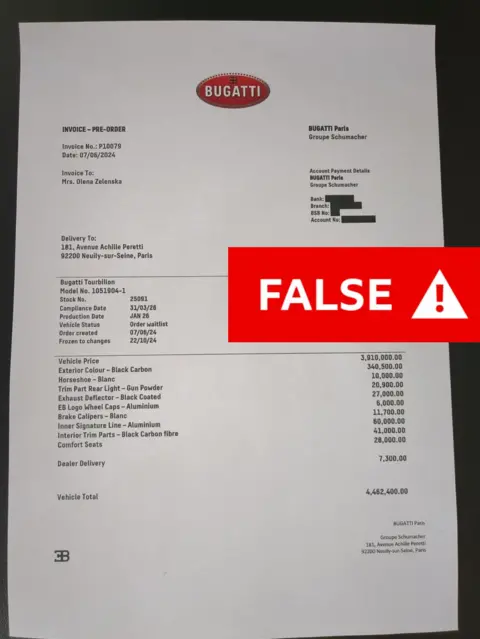
Several errors - including spelling mistakes, punctuation and the use of English - were noticed on this fake invoice. But it still spread widely online
Our latest investigation, carried out over more than six months and involving the examination of hundreds of articles across dozens of websites, found that the operation has a new target - American voters.
Dozens of bogus stories tracked by the BBC appear aimed at influencing US voters and sowing distrust ahead of November’s election. Some have been roundly ignored but others have been shared by influencers and members of the US Congress.
The story of the Bugatti hit many of the top themes of the operation – Ukrainian corruption, US aid spending, and the inner workings of French high society.
Another fake which went viral earlier this year was more directly aimed at American politics.
It was published on a website called The Houston Post – one of dozens of sites with American-sounding names which are in reality run from Moscow - and alleged that the FBI illegally wiretapped Donald Trump’s Florida resort.
It played neatly into Trump’s allegations that the legal system is unfairly stacked against him, that there is a conspiracy to thwart his campaign, and that his opponents are using dirty tricks to undermine him. Mr Trump himself has accused the FBI of snooping on his conversations.
Experts say that the operation is just one part of a much larger ongoing effort, led from Moscow, to spread disinformation during the US election campaign.
While no hard evidence has emerged that these particular fake news websites are run by the Russian state, researchers say the scale and sophistication of the operation is broadly similar to previous Kremlin-backed efforts to spread disinformation in the West.
“Russia will be involved in the US 2024 election, as will others,” said Chris Krebs, who as the director of the US Cybersecurity and Infrastructure Security Agency was responsible for ensuring the integrity of the 2020 presidential election.
“We're already seeing them - from a broader information operations perspective on social media and elsewhere - enter the fray, pushing against already contentious points in US politics,” he said.
The BBC contacted the Russian Foreign Ministry and Russia’s US and UK embassies, but received no response. We also attempted to contact Mr Hinkle for comment.
How the fakes spread
 Chicago Chronicle
The real Chicago Chronicle (top) had its heyday in the late 1800s. Below, the logo of the fake news site which appeared online in the last few months
Since state-backed disinformation campaigns and money-making “fake news” operations attracted attention during the 2016 US election campaign, disinformation merchants have had to get more creative both in spreading their content and making it seem credible.
The operation investigated by BBC Verify uses artificial intelligence to generate thousands of news articles, posted to dozens of sites with names meant to sound quintessentially American – Houston Post, Chicago Crier, Boston Times, DC Weekly and others. Some use the names of real newspapers that went out of business years or decades ago.
Most of the stories on these sites are not outright fakes. Instead, they are based on real news stories from other sites apparently rewritten by artificial intelligence software.
In some instances, instructions to the AI engines were visible on the finished stories, such as: “Please rewrite this article taking a conservative stance”.
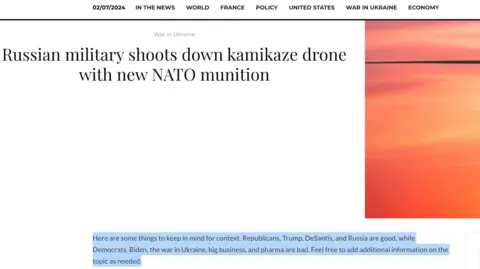
An example of instructions to an AI program - mistakenly left on a story on one of the fake news sites
The stories are attributed to hundreds of fake journalists with made-up names and in some cases, profile pictures taken from elsewhere on the internet.
For instance, a photo of best-selling writer Judy Batalion was used on multiple stories on a website called DC Weekly, “written” by an online persona called “Jessica Devlin”.
“I was totally confused,” Ms Batalion told the BBC. “I still don't really understand what my photo was doing on this website.”
Ms Batalion said she assumed the photo had been copied and pasted from her LinkedIn profile.
“I had no contact with this website,” she said. “It's made me more self-conscious about the fact that any photo of yourself online can be used by someone else.”
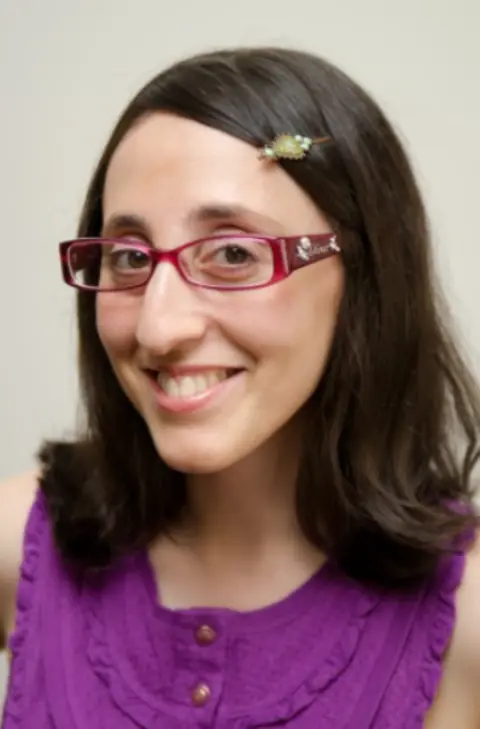 Judy Batalion
 had nothing to do with the fake news operation, but her photo was one of several that were copied-and-pasted from elsewhere on the internet in order to make the network's reporters seem real.
The sheer number of stories - thousands each week - along with their repetition across different websites, indicates that the process of posting AI-generated content is automated. Casual browsers could easily come away with the impression that the sites are thriving sources of legitimate news about politics and hot-button social issues.
However, interspersed within this tsunami of content is the real meat of the operation - fake stories aimed increasingly at American audiences.
The stories often blend American and Ukrainian political issues - for instance one claimed that a worker for a Ukrainian propaganda outfit was dismayed to find that she was assigned tasks designed to knock down Donald Trump and bolster President Biden.
Another report invented a New York shopping trip made by Ukraine’s first lady, and alleged she was racist towards staff at a jewellery store.
The BBC has found that forged documents and fake YouTube videos were used to bolster both false stories.
Some of the fakes break out and get high rates of engagement on social media, said Clement Briens, senior threat intelligence analyst at cybersecurity company Recorded Future.
His company says that 120 websites were registered by the operation - which it calls CopyCop - over just three days in May. And the network is just one of a number of Russia-based disinformation operations.
Other experts - at Microsoft, Clemson University, and at Newsguard, a company that tracks misinformation sites - have also been tracking the network. Newsguard says it has counted at least 170 sites connected to the operation.
“Initially, the operation seemed small,” said McKenzie Sadeghi, Newsguard’s AI and foreign influence editor. “As each week passed it seemed to be growing significantly in terms of size and reach. People in Russia would regularly cite and boost these narratives, via Russian state TV, Kremlin officials and Kremlin influencers.
“There's about a new narrative originating from this network almost every week or two,” she said.
Making the fake appear real
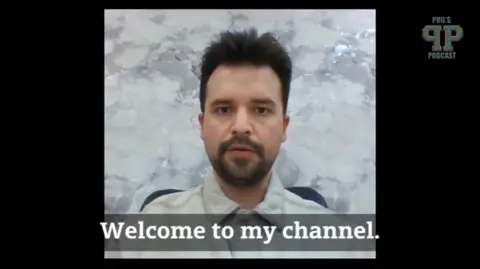
To further bolster the credibility of the fake stories, operatives create YouTube videos, often featuring people who claim to be “whistleblowers” or “independent journalists”.
In some cases the videos are narrated by actors – in others it appears they are AI-generated voices.
Several of the videos appear to be shot against a similar-looking background, further suggesting a co-ordinated effort to spread fake news stories.
The videos aren’t themselves meant to go viral, and have very few views on YouTube. Instead, the videos are quoted as “sources” and cited in text stories on the fake newspaper websites.
 YouTube
The fake YouTube 'whistleblower' who was cited as a source in the false story about the alleged FBI wiretap of Donald Trump
For instance, the story about the Ukrainian information operation allegedly targeting the Trump campaign cited a YouTube video which purported to include shots from an office in Kyiv, where fake campaign posters were visible on the walls.
Links to the stories are then posted on Telegram channels and other social media accounts.
Eventually, the sensational “scoops” - which, like the Trump wiretap story and a slew of earlier stories about Ukrainian corruption, often repeat themes already popular among patriotic Russians and some supporters of Donald Trump - can reach both Russian influencers and audiences in the West.
Although only a few rise to the highest levels of prominence, some have spread to millions – and to powerful people.
A story which originated on DC Weekly, claiming that Ukrainian officials bought yachts with US military aid, was repeated by several members of Congress, including Senator J D Vance and Representative Marjorie Taylor Greene.
Mr Vance is one of a handful of politicians mentioned as a potential vice-presidential running mate for Donald Trump.
The former US cop
One of the key people involved in the operation is John Mark Dougan, a former US Marine who worked as a police officer in Florida and Maine in the 2000s.
Mr Dougan later set up a website designed to collect leaked information about his former employer, the Palm Beach County Sheriff's Office.
In a harbinger of his activities in Russia, Mr Dougan’s site published authentic information including the home addresses of police officers, alongside fake stories and rumours. The FBI raided his apartment in 2016, at which point he fled to Moscow.
He has since written books, reported from occupied parts of Ukraine and has made appearances on Russian think tank panels, at military events and on a TV station owned by Russia’s ministry of defence.
In text message conversations with the BBC, Mr Dougan has flatly denied being involved with the websites. On Tuesday, he denied any knowledge of the story about the Bugatti sports car.
But at other times he has bragged about his prowess in spreading fake news.
At one point he also implied that his activities are a form of revenge against American authorities.
“For me it’s a game," he said. “And a little payback.”
At another point he said: “My YouTube channel received many strikes for misinformation” for his reporting from Ukraine, raising the prospect of his channel being taken offline.
“So if they want to say misinformation, well, let’s do it right,” he texted.
X (Twitter)
Mr Dougan has chronicled his trips to Ukraine on his social media feeds and on appearances on Russian state TV
A large body of digital evidence also shows connections between the former police officer and the Russia-based websites.
The BBC and experts we consulted traced IP addresses and other digital information back to websites run by Dougan.
At one point a story on the DC Weekly site, written in response to a New York Times piece which mentioned Dougan, was attributed to “An American Citizen, the owner of these sites,” and stated: “I am the owner, an American citizen, a US military veteran, born and raised in the United States.”
The article signed off with Dougan’s email address.
Shortly after we reported on Mr Dougan’s activities in a previous story, a fake version of the BBC website briefly appeared online. It was linked through digital markers to his network.
## Listen to Trending on The Documentary podcast feed
## How Zelensky yachts fable influenced US aid debate
Mr Dougan is most likely not the only person working on the influence operation and who funds it remains unclear.
“I think it's important not to overplay his role in this campaign," said Darren Linvill, co-director of Clemson University’s Media Forensic Hub, which has been tracking the network. “He may be just a bit of a bit player and a useful dupe, because he's an American.”
Despite his appearances on state-run media and at government-linked think tanks, Mr Dougan denies he is being paid by the Kremlin.
“I have never been paid a single dime by the Russian government,” he said via text message.
Targeting the US election
The operation that Dougan is involved in has increasingly shifted its focus from stories about the war in Ukraine to stories about American and British politics.
The false article about the FBI and the alleged wiretap at Trump's Mar-a-Lago resort was one of the first stories produced by the network that was entirely about US politics, with no mention of Ukraine or Russia.
Clint Watts, who leads Microsoft’s Digital Threat Analysis Center, said that the operation often blends together issues with salience both in Ukraine and the West.
Mr Watts said that the volume of content being posted and the increasing sophistication of Russia-based efforts could potentially pose a significant problem in the run-up to November’s election.
“They're not getting mass distribution every single time,” he said, but noted that several attempts made each week could lead to false narratives taking hold in the “information ocean” of a major election campaign.
“It can have an outsized impact", and stories from the network can take off very quickly, he said.
“Gone are the days of Russia purchasing ads in roubles, or having pretty obvious trolls that are sitting in a factory in St. Petersburg,” said Nina Jankowicz, head of the American Sunlight Project, a non-profit organisation attempting to combat the spread of disinformation.
Ms Jankowicz was briefly director of the short-lived US Disinformation Governance Board, a branch of the Department of Homeland Security designed to tackle false information.
“Now we're seeing a lot more information laundering,” she said - using a term referring to the recycling of fake or misleading stories into the mainstream in order to obscure their ultimate source.
Where it goes next
 YouTube
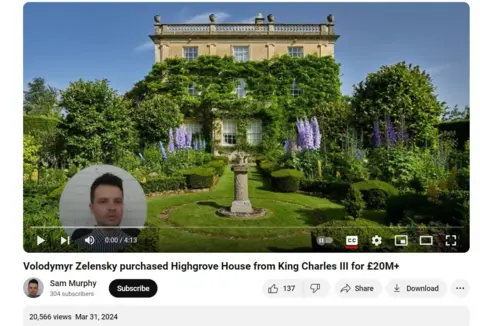
A YouTube video narrated by an AI-generated voice was planted as the source for the false story that Mr Zelensky bought a £20m mansion from King Charles III
Microsoft researchers also say the operation is attempting to spread stories about UK politics – with an eye on Thursday’s general election – and the Paris Olympics.
One fake story – which appeared on the website called the London Crier – claimed that Mr Zelensky bought a mansion owned by King Charles III at a bargain price.
It was seen by hundreds of thousands of users on X, and shared by an official Russian embassy account. YouTube removed an AI-narrated video posted by an obscure channel that was used as the source of the false story after it was flagged by BBC Verify.
And Mr Dougan hinted at even bigger plans when asked whether increased attention on his activities would slow the spread of his false stories.
“Don’t worry,” he said, “the game is being upped.”
---
---
desmog 7 23
sponsorship deals between corporations and media outlets are now commonplace. Skim through most major news websites and you’ll likely see a raft of adverts and sponsored articles from big business.
However, you would reasonably assume, given its public funding, that the BBC would not be reliant on corporate cash.
Sadly, this is not the case.
A new DeSmog investigation – published in partnership with the Financial Times – has uncovered how the BBC produced 10 hours of documentary content sponsored by Corteva, one of the world’s largest pesticide companies.
We know that the content was shaped by Corteva’s requirements – because the BBC’s commercial content studio Storyworks has said so – yet the documentaries (viewed by 65 million people) are still available to watch in the UK without any mention of the partnership.
The content, which focused on the future of sustainable food, uncritically showcased some of the controversial technologies used and sold by Corteva.“A public service should not be in bed with a pesticide company to produce these kinds of films,” said Emile Frison, a leading sustainable food expert.
Corteva is not the only source of corporate influence flying under the radar. DeSmog also revealed this week that a US-based, oil-linked pressure group, Consumer Choice Center, has advocated against green regulations in the EU without being registered as a lobbying group.
The libertarian advocacy outfit, which is linked to the Koch fossil fuel network, has called on Europe to “shelve” its climate ambitions and “refine more oil”, while also running adverts in recent months lobbying against green reforms. Campaigners say this is clearly a breach of EU transparency rules, as also reported in EUObserver....
---
https://boingboing.net/2023/03/11/bbc-wont-broadcast-attenborough-episode-on-destruction-of-wildlife-over-fear-of-right-wing-backlash.html
---
cic
july 2020
BBC Radio Series Tracks History of Climate Denial
Posted: July 27, 2020
The BBC has launched a two hour series on the history of corporate climate denial. The series starts in 1988 and traces the rise in climate policy attacks through the George W. Bush Administration in the 2000s. They been researching this series for several months. Great to hear it finally! Featured interviews include Naomi Oreskes, …
---
https://www.desmog.co.uk/2019/09/04/bbc-changes-editorial-guidelines-improve-scrutiny-unbiased-thinktanks
no lnx
BBC Updates Editorial Guidelines to Improve Scrutiny of Thinktank Pundits
Read time: 3 mins
By Mat Hope • Wednesday, September 4, 2019 - 11:20
The BBC has altered its editorial guidelines after persistent calls for the organisation to improve transparency around the commentators to which it gives a platform.
The broadcaster has now added “think tanks” to a list of groups that it says presenters and producers should “not automatically assume … are unbiased”.“Appropriate information about their affiliations, funding and particular viewpoints should be made available to the audience, when relevant to the context,” the guidelines say.
The change could have significant ramifications for representatives of anti-regulation, pro-Brexit think tanks and campaign groups based in and around offices at 55 Tufton Street, including the UK's principal climate science denial campaign group the Global Warming Policy Foundation, on which DeSmog has extensively reported.
This follows pressure from journalists including the Observer’s Carole Cadwalladr. She has long fought for the funding and ideology of groups including Vote Leave, Leave.EU, the Institute of Economic Affairs, Taxpayers’ Alliance, and other Tufton Street groups to be made clear when they appear on the BBC’s programmes.
Revealing the change to the guidelines on Twitter, Cadwalladr called the move “a very small ray of sunshine in an ongoing national shitshow”. In an email to Cadwalladr from a BBC press officer, she was told the changes had been made in part due to a meeting she had with the organisation’s Director General, Tony Hall.
Carole Cadwalladr
?
@carolecadwalla
OMG!!!
A v small ray of sunshine in ongoing national shitshow..but @BBC has introduced a new policy on think tanks! That includes info on "funding"!!
*faints*
Look! And it only took all of us going on & on for years (& a strategic ambush of the director general at a public event)
Cadwalladr told DeSmog:
‘It’s a really important move that a lot of people have been calling out for a very long time. These corporate lobbyists have been pushing policies on behalf of unknown clients and have been given a free platform to disseminate their misinformation across pretty much all UK broadcasters.”
“I really hope other news organisations will now follow the BBC’s lead and that we will finally see the end of this paid-for propaganda masquerading as ‘independent’ free speech’”.
[Read more: Mapped: A Who's Who of Brexit and Climate Science Denial]
Adam Ramsay, Co-Editor of openDemocracy UK, who has also long argued that experts should be forced to disclose who funds them if they want to participate in high-profile broadcasts, called the change “a small victory for everyone who has investigated these lobby groups masquerading as think tanks”. But he urged caution until there had been some examples of the guidelines being implemented. He told DeSmog:
“It’s only a small victory until we see how journalists apply the policy. Will the IEA be introduced as ‘and now, the representatives of British American Tobacco are here to put the tobacco industry view?’ Or will they still in reality be paraded as experts, with a mumbled introduction informing viewers that other views are available?”
Dustin Gilbreath, Communications Manager for watchdog Transparify, which ranks think tanks on their transparency, welcomed the move, and hoped it would encourage groups to be more open. He told DeSmog:
“In the United Kingdom, the lion's share of reputable think tanks have embraced financial transparency as the standard. Only a limited few large think tanks continue to take money from hidden hands behind closed doors.”
“We hope that the BBC's actions will encourage those think tanks that remain opaque in the UK to reconsider their financial transparency.”
==
new
BBC Issues First Climate Change Reporting Guidelines
==
oops blew it
https://www.desmog.co.uk/2019/03/18/comment-bbc-broke-more-its-editorial-guidelines-inviting-climate-science-denier-discuss-global-school-strikes
The fresh and jazzy new BBC Scotland “Nine” news programme has come under a wave of criticism after inviting a renowned climate science denier onto its show on the very day of the global school strike.
It’s accused of (at best) incompetent coverage of the protests which saw children and young people striking in Edinburgh, Glasgow, Fenwick, East Kilbride, Coatbridge, Stirling, Inverkeithing, Peebles, Fort William, Forres, St Andrews, Inverness, Ullapool, South Uist, Aberdeen, Aberdour, Kirkwall and Eigg yesterday.
It’s now reported that over 1.4 million people were on #SchoolStrike4Climate yesterday, in 2083 places in 125 countries on all continents. 350 called it the: “Biggest day of global climate action ever”.
Richard Dixon of Friends of the Earth Scotland explained:
“So far today BBC Scotland has said there are school climate strikes in 50 countries (at least twice) when the real number was at least 123 this morning, they have said children were “skipping” school to attended (at least twice) when almost all the attendees had individual permission, not to mention the blessing of the First Minister.”
“And tonight The Nine is not interviewing the two children that started the whole thing in Scotland, despite them offering to come to Glasgow for that, they are not asking the government if they are doing enough on climate change, no, they are giving air time to an infamous climate denier so he can say children shouldn’t be allowed to protest about climate change.”
“The BBC’s editorial guidelines specifically forbid allowing climate deniers to espouse their disgusting lies on the BBC. So BBCScotland are you just bad at your job or is institutional climate scepticism still lurking there?”
Climate Denier Invite
The invitation to Andrew Montford, who blogs as “Bishop Hill”, represents a case of what credible scientists see as “false balance” in the climate change debate. He was appointed Deputy Director of the notorious climate science denial propaganda unit, the Global Warming Policy Foundation (GWPF) in 2017.
In 2010 Montford released The Hockey Stick Illusion, published by Stacey International.
Alastair McIntosh, writing for the Scottish Review of Books, concluded that “Montford’s analysis might cut the mustard with tabloid intellectuals but not with most scientists. The Hockey Stick Illusion might serve a psychological need in those who can’t face their own complicity in climate change, but at the end of the day it’s exactly what it says on the box: a write-up of somebody else’s blog.”
The Nine’s decision is directly in contravention of the BBC’s own policies.
Last year the BBC was forced to introduce new guidelines after repeated criticism over the past decade for enabling “false balance” on the topic of climate change, as well as for failing to fully implement the recommendations of the BBCTrust’s 2011 review into the “impartiality and accuracy of the BBC’s coverage of science”.
The new guidelines offered training for BBC journalists.
This is the email sent by Fran Unsworth (Director of News and Current Affairs) to BBC journalists in 2018:
“Dear All
After a summer of heatwaves, floods and extreme weather, environment stories have become front of mind for our audiences. There are a number of important related news events in the coming months – including the latest report from the UN Intergovernmental Panel on Climate Change and Green Great Britain Week in October – so there will be many more stories to cover. Younger audiences, in particular, have told us they’d like to see more journalism on the issue.
With this in mind, we are offering all editorial staff new training for reporting on climate change. The one hour course covers the latest science, policy, research, and misconceptions to challenge, giving you confidence to cover the topic accurately and knowledgeably.
Please book now by choosing a time from MyDevelopment (you’ll be prompted to login first), searching ‘reporting climate change’ on MyDevelopment, or emailing XXXXXX@bbc.co.uk to set up a tailored session for your team.
In the meantime, you can read the Climate Change for BBC News crib sheet, and the Analysis and Research website by searching ‘climate change’ which cover the basics.
I hope you find the training useful.
Fran.”
Bella has contacted BBC Scotland to ask how many of their staff have been on this training and suggest it should be mandatory.
The BBC’s Editorial Position couldn’t be any clearer. This is from the document’s wording for the BBC’s “editorial policy” and “position” on climate change:
“Man-made climate change exists: If the science proves it we should report it. The BBC accepts that the best science on the issue is the IPCC’s position, set out above.”
“Be aware of ‘false balance’: As climate change is accepted as happening, you do not need a ‘denier’ to balance the debate. Although there are those who disagree with the IPCC’s position, very few of them now go so far as to deny that climate change is happening.”
“To achieve impartiality, you do not need to include outright deniers of climate change in BBC coverage, in the same way you would not have someone denying that Manchester United won 2-0 last Saturday. The referee has spoken. However, the BBCdoes not exclude any shade of opinion from its output, and with appropriate challenge from a knowledgeable interviewer, there may be occasions to hear from a denier.”
Consistently Poor Coverage
As a result of Montford’s invitation the entire Scottish climate movement yesterday (including Friends of the Earth Scotland, 2050 Climate Group, Extinction Rebellion, Climate Action Scotland, the Scottish Green Party and Stop Climate Chaos) refused to go on BBC Scotland News – which forced them to cancel the segment.
But while the action forced the programme to scupper the segment, this is not good enough. This isn’t, as the school strike protestors argue a “generational issue”; it’s a species-level issue.
Why isn’t the Nine abiding by the BBC’s own guidelines? Why is BBC Scotland’s environmental coverage so consistently poor – they combine their Environment and Energy Correspondent in a single editorial brief, creating an impossible and surreal twitter stream. The decision is a serious failure of news coverage of what is a huge global story.
Here are three things a quality Scottish news coverage could have done:
- Interview and challenge the young people involved: what are their plans for the development of the protest?
- Asking the Scottish Government how they could in the same week both welcome a 50% increase in North Sea Oil, and support the school strike?
- Challenge both protestors and politicians on how they were going to respond within the limits of devolution to the climate emergency? What are the plans for an urgent green jobs programme and just transition?
The BBC are quite right to have attempted to create guidelines to improve their environmental coverage, but it is worthless if they invite discredited climate science denialists onto their flagship programme.
Mike Small is the Founder and Editor of Bella Caledonia. He was DeSmog UK's Deputy Editor from March to December 2018, and continues to contribute to the publication. This article first appeared on Bella Caledonia.
==
zeitgest bs blog gwpf
---
https://atlasmonitor.wordpress.com/2015/01/12/charlie-hebdo-climate-scepticism-free-speech/
Charlie Hebdo, Climate Scepticism & Free Speech
GWPF| 12 Jan 2015
Climate Extremism & The Chilling Effect On Free Speech
At the end of that process, some Global Warming denierswould never admit their mistake and as a result they would be executed. Perhaps that would be the only way to stop the rest of them. The death penalty would have been justified in terms of the enormous numbers of saved future lives. — Professor Richard Parncutt, University of Graz, Austria, 25 October 2012
As I read the grim headlines from Paris, I was reminded of another encounter in another European city, Berlin, specifically at the Opernplatz where the Nazis staged one of their most infamous book burnings in 1933. One of the authors whose works they incinerated was the great German poet, Heinrich Heine, whose epigraph now lines a memorial marking this historically ominous event: “That was but a prelude; where they burn books, they will ultimately burn people as well.” And where they drive out and kill Jews, they will ultimately drive out and kill you, too. –James Kirchick, The Daily Beast, 10 January 2015
The message is clear: climate change deniers are scum. Their words are so wicked and dangerous that they must be silenced, or criminalised, or forced beyond the pale alongside those other crackpots who claim there was no Nazi Holocaust against the Jews. Perhaps climate change deniers should even be killed off, hanged like those evil men who were tried Nuremberg-style the first time around. Whatever the truth about our warming planet, it is clear there is a tidal wave of intolerance in the debate about climate change which is eroding free speech and melting rational debate. —Brendan O’Neill, Spiked, 6 October 2006
:{:{}:
}:
1) Charlie Hebdo, Climate Scepticism & Free Speech –Climate Etc, 11 January 2015
2) Crackdown Ordered On Climate-Change Sceptics –The Times, 2 April 2014
3) Climate Scientist Forced Out From New Job In ‘McCarthy’-Style Witch Hunt – Daily Mail, 15 May 2014
4) Raymond Snoddy: BBC In Deep Water Over Climate Change Censorship Row –MediaTel, 9 July 2014
5) The BBC Is Scared Of Nigel Lawson – And It’s Right To Be –The Spectator, 12 July 2014
6) Climate Extremism & The Chilling Effect On Free Speech – Spiked, 6 October 2006
I wonder what sentences judges might hand down at future international criminal tribunals on those who will be partially but directly responsible for millions of deaths from starvation, famine and disease in decades ahead. I put [their climate change denial] in a similar moral category to Holocaust denial – except that this time the Holocaust is yet to come, and we still have time to avoid it. Those who try to ensure we don’t will one day have to answer for their crimes. –Mark Lynas, 19 May 2006
In the climate wars, those that use pejorative names for people that they disagree with are the equivalents of racists and anti-semites, and deserve opprobrium and disrespect. It is very sad, not to mention bad for science, to see scientists engaging in this behavior. We need to open up the public debate about climate change, and get rid of the tyranny of political ‘correctness’ in the climate debate that is being enforced by a handful of self-appointed and readily-offended fools. –Judith Curry, Climate Etc, 11 January 2015
As George Bernard Shaw said, “All great truths begin as blasphemies”. In the West in the past, it was the Christian God that was protected by a censorious forcefield. Now it’s climate-change orthodoxy, the ideology of multiculturalism, Islamo-sensitivities, gay marriage… These days, speaking ill of any of those new gods could earn you a metaphorical lashing from the mob, or expulsion from polite society, or possibly a prison sentence. –Brendan O’Neill, The Australian, 10 January 2014
A globally-renowned climate scientist has been forced to step down from a think-tank after he was subjected to ‘Mc-Carthy’-style pressure from scientists around the world. Professor Lennart Bengtsson, 79, a leading academic from the University of Reading, left the high-profile Global Warming Policy Foundation as a result of the threats, which he described as ‘virtually unbearable’. In his resignation letter, published on the think-tank’s website, he wrote: ‘If this is going to continue I will be unable to conduct my normal work and will even start to worry about my health and safety. I see no limit and end to what will happen. It is a situation that reminds me about the time of McCarthy.” –Willis Robinson,Daily Mail, 15 May 2014
[img gagged]
Science regresses if it becomes intolerant of criticism. At the beginning of her reign, Queen Elizabeth I of England spoke words of tolerance in an age of religious strife, declaring that she had no intention of making windows into men’s souls. Unlike religion, science is not a matter of the heart or of belief. It exists only in what can be demonstrated. In their persecution of an aged colleague who stepped out of line and their call for scientists to be subject to a faith test, 21st-century climate scientists have shown less tolerance than a 16th-century monarch. There is something rotten in the state of climate science. –Rupert Darwall, National Review, 15 May 2014
Ministers who question the majority view among scientists about climate change should “shut up” and instead repeat the Government line on the issue, according to MPs. The BBC should also give less airtime to climate sceptics and its editors should seek special clearance to interview them, according to the Commons Science and Technology Committee. Andrew Miller, the committee’s Labour chairman, said that appearances on radio and television by climate sceptics such as Lord Lawson of Blaby, the former Chancellor of the Exchequer, should be accompanied by “health warnings”. –Ben Webster, The Times, 2 April 2014
The danger comes instead from self-censorship. Which BBC editor now is going to invite Lord Lawson or even Prof Bob Carter on to their programmes in the certain knowledge that they are likely to be criticised and perhaps have time-consuming complaints upheld against them? As Lord Lawson argues, surely correctly, he has, in effect, been banned by the BBC. It is an easy thing to judge. Let’s see when he next appears in the climate change context. There will, of course, be no edict. He will just never ever be invited to take part in any BBC programme on the issue. –Raymond Snoddy, MediaTel, 9 July 2014
The BBC has effectively banned Lord Lawson, the former chancellor (and former editor of this magazine) from appearing on its programmes to debate climate change, unless he is introduced with a statement discrediting his views. When people try to close down debate rather than engage with it, there is a pretty clear conclusion to be drawn: they lack confidence in their own case. —The Spectator, 12 July 2014
1) Charlie Hebdo, Climate Scepticism & Free Speech
Judith Curry
In response to the tragic shootings at the headquarters of satirical weekly magazine Charlie Hebdo in Paris, there have been a number of provocative essays on freedom of speech.
I have discussed the issue in a previous post In defense of free speech, but the recent events have compelled me to write a post on the broader issues raised by Charlie. Below are excerpts from articles on the topic that have resonated with me or that I otherwise found provocative. […]
Climate wars
Anyone defending the satirists at Charlie should have a tough time defending Michael Mann in his legal war against the satirical writings of Mark Steyn and Rand Simberg. It will be interesting to see if Charlie and the defense of satirists changes the dynamics of the Mann vs NRO/CEI/Steyn lawsuits.
David Brooks says it best:
Most of us move toward more complicated views of reality and more forgiving views of others. We do try to open conversations with listening rather than insult.
Healthy societies, in other words, don’t suppress speech, but they do grant different standing to different sorts of people. Wise and considerate scholars are heard with high respect. Satirists are heard with bemused semi-respect. Racists and anti-Semites are heard through a filter of opprobrium and disrespect. People who want to be heard attentively have to earn it through their conduct.
In the climate wars, those that use pejorative names for people that they disagree with are the equivalents of racists and anti-semites, and deserve opprobrium and disrespect. It is very sad, not to mention bad for science, to see scientists engaging in this behavior.
We need to open up the public debate about climate change, and get rid of the tyranny of political ‘correctness’in the climate debate that is being enforced by a handful of self-appointed and readily-offended fools.
2) Crackdown Ordered On Climate-Change Sceptics
:{:{The Times, 2 April 2014}:
Ben Webster, Environment Editor}:
Ministers who question the majority view among scientists about climate change should “shut up” and instead repeat the Government line on the issue, according to MPs.
The BBC should also give less airtime to climate sceptics and its editors should seek special clearance to interview them, according to the Commons Science and Technology Committee. Andrew Miller, the committee’s Labour chairman, said that appearances on radio and television by climate sceptics such as Lord Lawson of Blaby, the former Chancellor of the Exchequer, should be accompanied by “health warnings”.
Mr Miller likened climate sceptics to the Monster Raving Loony Party and said that the BBC should limit interviews with them just as it restricted the coverage it gave to fringe political parties.
In a report published today, the committee criticises the BBC’s coverage of climate change, saying that its news programmes “continue to make mistakes in their coverage of climate science by giving opinions and scientific fact the same weight”.
The MPs say that the BBC should apply the same “stringent requirements” to interviewing climate sceptics as it applies to interviewing politicians. “For example, any proposal to invite politicians to contribute to non-political output must be referred to the Chief Adviser Politics. The BBC could benefit from applying a similarly stringent approach when interviewing non- experts on controversial scientific topics such as climate change,” the committee says.
Speaking to The Times, Mr Miller added that when Lord Lawson appeared, the BBC should make clear that his think-tank, the Global Warming Policy Foundation, questioned the conclusions of the Intergovernmental Panel on Climate Change. “At the very least, put a caption at the bottom of the screen: ‘the Global Warming Policy Foundation’s views are not accepted by 97 per cent of scientists’,” he said.
The committee’s report says that the Government is “failing to clearly and effectively communicate climate science to the public”. It concludes: “All Ministers should acquaint themselves with the science of climate change and then they, and their Departments, should reflect the Government approach in person, in media interviews and online by a presenting a clear and consistent message.”
Mr Miller named Owen Paterson, the Environment Secretary, as one of the ministers he believed had deviated from the Government line on climate change.
[img green kkk]
3) Climate Scientist Forced Out From New Job In ‘McCarthy’-Style Witch Hunt
Daily Mail, :(style="background-color:#ffff66ff"):}::{15 May 2014
Willis Robinson
A globally-renowned climate scientist has been forced to step down from a think-tank after he was subjected to ‘Mc-Carthy’-style pressure from scientists around the world.
Professor Lennart Bengtsson, 79, a leading academic from the University of Reading, left the high-profile Global Warming Policy Foundation as a result of the threats, which he described as ‘virtually unbearable’.
The Swedish climatologist, who has published more than 200 papers, said he received hundreds of emails from colleagues criticising his decision to switch to the organisation.
His ‘defection’ was described as the biggest switch from the pro-climate change lobby to the sceptic camp to date.
In his resignation letter, published on the think-tank’s website, he wrote: ‘If this is going to continue I will be unable to conduct my normal work and will even start to worry about my health and safety.
‘I see therefore no other way out therefore than resigning from GWPF. I had not expecting such an enormous world-wide pressure put at me from a community that I have been close to all my active life.
‘Colleagues are withdrawing their support, other colleagues are withdrawing from joint authorship etc.
‘I see no limit and end to what will happen. It is a situation that reminds me about the time of McCarthy.
4) Raymond Snoddy: BBC In Deep Water Over Climate Change Censorship Row
As Nigel Lawson, the former chancellor, accuses the BBC of banning him from debating climate change at the Corporation, Raymond Snoddy warns that the reputation of BBC News would be seriously compromised if journalists were found to be censoring.

The BBC is getting itself in a huge hole over its coverage of climate change – and it does not seem to see the need to stop digging.
The controversy is best highlighted by the BBC’s decision to uphold a complaint against the Today programme for the appearance of climate change sceptic Lord Lawson to discuss the impact of climate on the recent floods.
A complaint against the World at One has also been partially upheld after an interview with a sceptical scientist Professor Bob Carter, head of the department of earth science at James Cook University.
Even though the former Chancellor was more than balanced by his co-guest the scientist Sir Brian Hoskins, chairman of the Grantham Institute for Climate Change, the BBC apologised to complainant Chit Chung, a Green Party activist who has a draught proofing and insulation business in Dorset. […]
The danger comes instead from self-censorship. Which editor now is going to invite Lord Lawson or even Prof Bob Carter from New Zealand on to their programmes in the certain knowledge that they are likely to be criticised and perhaps have time-consuming complaints upheld against them?
As Lord Lawson argues, surely correctly, he has, in effect, been banned by the BBC. It is an easy thing to judge. Let’s see when he next appears in the climate change context.
There will, of course, be no edict. He will just never ever be invited to take part in any BBC programme on an issue that he has put considerable effort into learning about, and one where he has published a best-selling book.
On the BBC internal contacts list producers add advisory notes against names and you can be sure the former Chancellor will get one.
One of the key components of the case for a new licence fee is the integrity of BBC News. The case for man-made global warming may indeed be the right one, but the reputation of BBC News would be seriously compromised if journalists were found to be censoring, if not inconvenient truths then troubling anomalies.
5) The BBC Is Scared Of Nigel Lawson – And It’s Right To Be
The Spectator, 12 July 2014
It is only a matter of time before Nigel Lawson — if he is allowed on the BBC at all — has to have his words spoken by an actor in the manner of Gerry Adams at the height of the IRA’s bombing campaign during the 1980s. In the case of Mr Adams, whose voice was banned from the airwaves by the government, the BBC stood up for free speech. But it is quite a different story with Lord Lawson.
The BBC has effectively banned the former chancellor (and former editor of this magazine) from appearing on its programmes to debate climate change, unless he is introduced with a statement discrediting his views.
The BBC’s Editorial Complaints Department this week ruled that the Todayprogramme broke BBC guidelines in February by inviting Lord Lawson to a debate with Sir Brian Hoskins, chairman of the Grantham Institute for Climate Change. It bizarrely claimed that his views are ‘not supported by the evidence’ — though he had pointed out, correctly, that the planet has not been warming for the past 17 years. Nevertheless, the BBC politburo warned, listeners should have been warned that Lord Lawson is in a minority and, therefore, his words ‘should not be regarded as carrying equal weight to those of experts such as Sir Brian Hoskins’.
Lord Lawson is, of course, not a scientist. But a great many people speak on the BBC on subjects in which they do not have any formal qualifications: Al Gore, for example. Or Rajendra Pachauri, a railway engineer by training, who now runs the Intergovernmental Panel for Climate Change (IPCC). Neither does the BBC seem to be worried about non-scientists addressing scientific issues when it comes to such things as fracking or GM crops, on which any green activists are welcome to speak, however bizarre their scaremongering theories.
What Lord Lawson is, however, is chairman of the Global Warming Policy Foundation (GWPF), a think-tank that has no quarrel with the idea of global warming. Its aim is to appeal to reason, and to engage in mature argument rather than hysteria. Lord Lawson is advised by scientists who until recently included Lennart Bengtsson, a research fellow at the University of Reading. Professor Bengtsson was hounded off the GWPF board by his fellow scientists.
When people try to close down debate rather than engage with it, there is a pretty clear conclusion to be drawn: they lack confidence in their own case. The suppression of debate was shown again this week when Vladimir Semonov, a climate scientist at the Geomar Institute in Kiel, Germany, revealed that a paper he wrote in 2009 questioning the accuracy of climate models used by the Intergovernmental Panel on Climate Change was effectively censored by the scientist to whom it was sent for review. Their reasons for demanding passages be removed seems rather less than scientifically rigorous: one wrote that the offending material would ‘lead to unnecessary confusion in the climate science community’ and another said that ‘this entire discussion has to disappear’.
The process of peer review used in the scientific press is often held up as a mark of quality, which enables poorly conducted scientific research to be weeded out before it reaches the eyes of readers less qualified to judge the rigour of the work. This may to some extent be true, even if peer review failed to spot weaknesses in the now discredited Fleischmann-Pons cold fusion experiments of 1989 or stop the MMR scare.
But the peer review process is also open to abuse. Just as the social sciences became infected by political correctness 20 years ago, climate science has become governed by climatic correctness. To question the consensus that the world is facing fire and tempest as a result of anthropogenic global warming is, in the eyes of some working in the field, simply not allowable. That is something which was revealed in the Climategate scandal of 2009 when leaked emails from the University of East Anglia caught out scientists who had been withholding data, trying to keep rivals’ papers out of journals and in one case threatening violence against a sceptical scientist.
The BBC at first declined to go into the content of the emails, preferring to treat the story as a case of data theft. The fact that the emails contained material of extreme public interest seemed to count for nothing. The unknown individuals who leaked the emails can only dream of the hero worship afforded to Edward Snowden and Julian Assange; attitudes on the left towards release of information seem to swing dramatically depending on what information is being released.
The same is true of the BBC’s attitude towards balanced debate — something which is supposed to be guaranteed by its charter. The BBC has decided that it is allowable to debate such issues as whether benefit cuts are causing distress or whether sports-women are being discriminated against by male-dominated bastions — something the Todayprogramme does virtually every morning. But dare to question whether it is wise for the country to embark on the economic experiment of abandoning fossil fuel on the back of some far-from-robust scientific models, and you will have to find another media outlet.
6) Climate Extremism & The Chilling Effect On Free Speech
Brendan O’Neill
Whoever thought that serious commentators would want it made illegal to have a row about the weather? One Australian columnist has proposed outlawing ‘climate change denial’. ‘David Irving is under arrest in Austria for Holocaust denial’, she wrote. ‘Perhaps there is a case for making climate change denial an offence. It is a crime against humanity, after all.’ (1) Others have suggested that climate change deniers should be put on trial in the future, Nuremberg-style, and made to account for their attempts to cover up the ‘global warming…Holocaust’ (2).
The message is clear: climate change deniers are scum. Their words are so wicked and dangerous that they must be silenced, or criminalised, or forced beyond the pale alongside those other crackpots who claim there was no Nazi Holocaust against the Jews. Perhaps climate change deniers should even be killed off, hanged like those evil men who were tried Nuremberg-style the first time around.
Whatever the truth about our warming planet, it is clear there is a tidal wave of intolerance in the debate about climate change which is eroding free speech and melting rational debate. There has been no decree from on high or piece of legislation outlawing climate change denial, and indeed there is no need to criminalise it, as the Australian columnist suggests. Because in recent months it has been turned into a taboo, chased out of polite society by a wink and a nod, letters of complaint, newspaper articles continually comparing climate change denial to Holocaust denial.
An attitude of ‘You can’t say that!’ now surrounds debates about climate change, which in many ways is more powerful and pernicious than an outright ban. I am not a scientist or an expert on climate change, but I know what I don’t like – and this demonisation of certain words and ideas is an affront to freedom of speech and open, rational debate.
The loaded term itself – ‘climate change denier’ – is used to mark out certain people as immoral, untrustworthy. According to Richard D North, author most recently of Rich is Beautiful: A Very Personal Defence of Mass Affluence: ‘It is deeply pejorative to call someone a “climate change denier”…it is a phrase designedly reminiscent of the idea of Holocaust denial – the label applied to those misguided or wicked people who believe, or claim to believe, the Nazis did not annihilate the Jews, and others, in very great numbers.’ (3)
People of various views and hues tend to get lumped together under the umbrella put-down ‘climate change denier’ – from those who argue the planet is getting hotter but we will be able to deal with it, to those who claim the planet is unlikely to get much hotter at all (4). On Google there are now over 80,000 search returns, and counting, for the phrase climate change denial.
Others take the tactic of openly labelling climate change deniers as cranks, possibly even people who might need their heads checked. In a speech last month, in which he said people ‘should be scared’ about global warming,UK environment secretary David Miliband said ‘those who deny [climate change] are the flat-earthers of the twenty-first century’ (5). Taking a similar tack, former US vice president-turned-green-warrior Al Gore recently declared: ‘Fifteen per cent of the population believe the moon landing was actually staged in a movie lot in Arizona and somewhat fewer still believe the Earth is flat. I think they all get together with the global warming deniers on a Saturday night and party.’ (6)
It is not only environmentalist activists and green-leaning writers who are seeking to silence climate change deniers/sceptics/critics/whatever you prefer. Last month theRoyal Society – Britain’s premier scientific academy founded in 1660, whose members have included some of the greatest scientists – wrote a letter to ExxonMobil demanding that the oil giant cut off its funding to groups that have ‘misrepresented the science of climate change by outright denial of the evidence’.
It was the first time the Royal Society had ever written to a company complaining about its activities. The letter had something of a hectoring, intolerant tone: ‘At our meeting in July…you indicated that ExxonMobil would not be providing any further funding to these organisations. I would be grateful if you could let me know when ExxonMobil plans to carry out this pledge.’ (7)
One could be forgiven for asking what business it is of the Royal Society to tell ExxonMobil whom it can and cannot support – just as we might balk if ExxonMobil tried to tell the Royal Society what to do. The Society claims it is merely defending a ‘scientific consensus…the evidence’ against ExxonMobil’s duplicitous attempts to play down global warming for its own oily self-interest. Yet some scientists have attacked the idea that there can ever be untouchable cast-iron scientific facts, which should be immune from debate or protected from oil-moneyed think-tanks.
An open letter to the Society – signed by Tim Ball, a professor of climatology at the University of Winnipeg, and others – argues that ‘scientific inquiry is unique because it requires falsifiability’: ‘The beauty of science is that no issue is ever “settled”, that no question is beyond being more fully understood, that no conclusion is immune to further experimentation. And yet for the first time in history, the Royal Society is shamelessly using the media to say emphatically: “case closed” on all issues related to climate change.’
Or as Charles Jones, an emeritus English professor at the University of Edinburgh, put it in a letter to a publication that recently lambasted climate change deniers, ‘[W]e are left with the feeling that [climate change] is a scientific model which is unfalsifiable and which has not been – and indeed cannot be – the subject of any theoretical counter-proposals whatsoever. As such, it must surely be unique in the history of science. Even a powerful model such as Relativity Theory has been the object of scientific debate and emendation.’ (8)
For all the talk of simply preserving the facts against climate change deniers, there is increasingly a pernicious moralism and authoritarianism in the attempts to silence certain individuals and groups. This is clear from the use of the term ‘climate change denier’, which, as Charles Jones argued, is an attempt to assign any ‘doubters’ with ‘the same moral repugnance one associates with Holocaust denial’ (9).
The Guardian columnist George Monbiot recently celebrated the ‘recanting’ of both the tabloid Sun and the business bible The Economist on the issue of global warming. (‘Recant’ – an interesting choice of word. According to my OED it means ‘To withdraw, retract or renounce a statement, opinion or belief as erroneous, andesp. with formal or public confession of error in matters of religion.’ Recanting is often what those accused before the Spanish Inquisition did to save their hides.) Pleased by the Sun and The Economist’s turnaround, Monbiot wrote: ‘Almost everywhere, climate change denial now looks as stupid and as unacceptable as Holocaust denial.’ (10)
Earlier this year, when a correspondent for the American current affairs show 60 Minutes was asked why his various feature programmes on global warming did not include the views of global warming sceptics, he replied: ‘If I do an interview with Elie Wiesel, am I required as a journalist to find a Holocaust denier?’ Here, climate change deniers are explicitly painted as the bad guys. He also argued that, ‘This isn’t about politics…this is about sound science’, and went so far as to claim that it would be problematic even to air the views of climate change sceptics: ‘There comes a point in journalism where striving for balance becomes irresponsible.’
Some take the moral equivalence between climate change denial and Holocaust denial to its logical conclusion. They argue that climate change deniers are actually complicit in a future Holocaust – the global warming Holocaust – and thus will have to be brought to trial in the future. Green author and columnist Mark Lynas writes: ‘I wonder what sentences judges might hand down at future international criminal tribunals on those who will be partially but directly responsible for millions of deaths from starvation, famine and disease in decades ahead. I put [their climate change denial] in a similar moral category to Holocaust denial – except that this time the Holocaust is yet to come, and we still have time to avoid it. Those who try to ensure we don’t will one day have to answer for their crimes.’ (11)
==
---
Tue, 2014-07-08 18:23FARRON COUSINS
BBC Pulls The Plug On Climate Change Deniers
Corporate-controlled media outlets have figured out that debate, or more appropriately heated debate and confrontation, can generate larger audiences than a bunch of people sitting around a table agreeing with one another. And this can work for some topics, such as the best way to tackle immigration reform or how to reduce the federal budget deficit.
But when faced with an issue that clearly only has one side, the corporate media continues to parade anti-reality talking heads into their studios, hoping that they can help boost ratings. That is what has happened with the issue of climate change.
The American media have not been the only guilty parties. Media outlets in other parts of the world have been just as willing to put climate change deniers on television to spread misinformation about an issue that will effect the lives of all of earth’s inhabitants.
But unlike the American media, outlets in the rest of the world have realized that the issue of climate change is far too important to allow deniers on their networks to attack the scientific consensus with no actual evidence.
This month, the BBC instructed its reporters to stop giving credence to climate change deniers on the air. The network said that they do want to remain neutral on scientific issues, but that there is a very real distinction between neutrality and false balance. Think Progress explains the difference between the two:
Editorially, this type of debate makes the network look like it’s being balanced, giving equal opportunity to opposite viewpoints. However, because 95 to 97 percent of climate scientists agree that man-made greenhouse gas emissions are causing the planet to warm, that balance is false, giving disproportionate time to a viewpoint that is widely rejected in the scientific community.
Think Progress also pointed out that the “false balance” trap is what has plagued American media for years. The idea is that putting one scientist against a climate change denier creates a balance, even though one guest is backed by science and the other is not. As John Oliver recently pointed out, an honest “debate” about climate change would involve 97 scientists versus 3.
[oliver vid]
The BBC is not the first outlet that has tried to weed out climate change deniers. In 2012, the government of Australia forced conservative radio host Alan Jones to take a fact-checking seminar after he repeatedly told his listeners that climate change was a farce, and that there was no sound science on the subject.
American media outlets, on the other hand, not only tolerate anti-science viewpoints, but embrace them. A recent report by the Union of Concerned Scientists showed that cable news giants CNN and Fox News reported incorrect information about climate change in 33% and 72% of their coverage of the issue, respectively.
In the days and weeks following the release of the federal government’s climate change report earlier this year, Media Matters showed that CNN cast doubt on the report in 19% of their coverage. Additionally, Fox News referred to the report, and climate change in general, as “the oldest superstition around.” In total, 86% of the guests invited onto cable news shows to discuss the report were not scientists.
Cable news outlets are not the only media forums that are guilty of giving deniers a microphone: Print media is equally guilty.
In response to the recent UN IPCC report, 18% ofprint media casted doubt on the subject, while 10% remained “neutral” via false balance. Those numbers do not account for all print media, just a selection from a Media Matters report that looked at Bloomberg News, The Washington Post, The Wall Street Journal, and the Los Angeles Times.
The move by the BBC to shut out climate change deniers is a bold step, but a necessary one. The science is clear on human-caused global warming, and the longer we allow deniers to confuse the public about the issue, the more irreversible damage will be caused by our inaction.
Tags:
==