Schatz, B Sen
1/22 leo peltier covid pos ltr to biden
---
an 4 25
Hundreds of President Donald Trump's nominees for high-level positions throughout the federal government have run into a brick wall, and the lone senator behind it has no plan to relent any time soon.
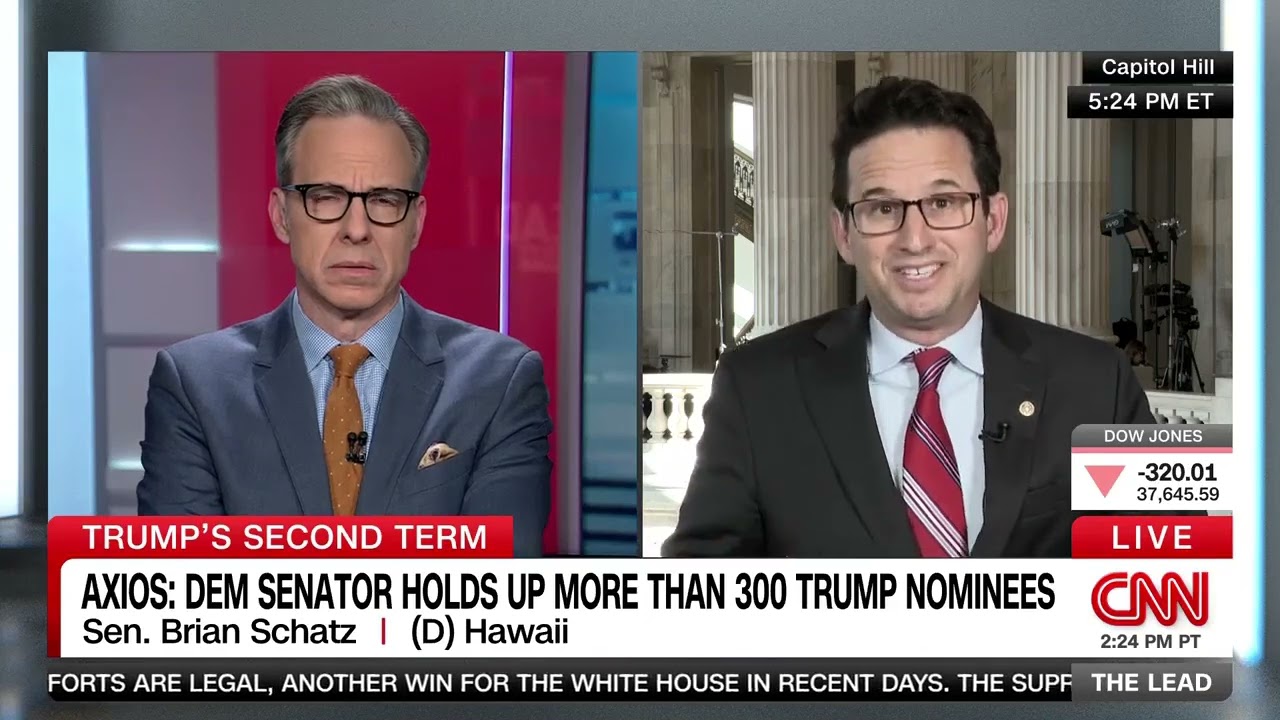 , Sen. Brian Schatz (D-Hawaii), who is a member of both the Senate Appropriations and Foreign Relations Committees, delved into why he was expanding his hold to include more than 300 of Trump's nominees along with several critical pieces of bipartisan legislation. The Hawaii senator explained that his hold — which he is doing by denying "unanimous consent" (the process by which the Senate conducts official business) — is meant to apply "leverage" to both the administration and the Republican majority.
"I cannot grant them unanimous consent ... I'm just objecting to that. If they want any of these nominees or these bills to receive a vote, they have to schedule the vote. But this will slow them down," Schatz said. "And this is designed to lay down a marker both about the lawlessness of the Trump administration, but also about the fact that Donald Trump himself is destroying the American economy on purpose."
READ MORE:Member of Congress picked for Trump Cabinet threatened Johnson 'not to stand in her way'
According to Axios, Schatz's hold includes nominees to lead the Office of Personnel Management, the inspector general for the Department of Labor and nine bipartisan bills that have already made it through their respective committees — including bills Schatz himself voted for in his own committees. Tapper pointed out that two of those bills are meant to "counter activities by the terrorist group Hezbollah in Latin America" and to oppose "China's assault on Hong Kong's democracy." He noted that those bills "seem pretty important," and asked Schatz why he's blocking them.
"Part of what it means to do a hold is that sometimes you're going to block things that you would otherwise allow to happen. And that's the case for these ... but we have to generate some leverage," Schatz responded. "And so until Secretary [Marco] Rubio comes to the committee and testifies about what they're doing in terms of illegally eviscerating United States aid, I'm not going to allow those even those bipartisan bills to move forward ... We have to be willing to stand up to these folks and gum up the works, even if it's politically uncomfortable to block a bill that you would otherwise be for."
Tapper pushed back and reminded Schatz that he called Sen. Tommy Tuberville (R-Ala.) a "maniac" during his blockade of hundreds of promotions for high-ranking military officers, which lasted for most of 2023. But Schatz noted that his denial of unanimous consent for Trump's nominees was completely different than Tuberville's hold on promoting military officers.
"There's a pretty important distinction between what Senator Tuberville did and what I'm doing. These are political appointees which are always or usually subject to a Senate vote. And so what i'm doing is slowing them down," the Hawaii Democrat said. "What Senator Tuberville did was prevent a one-star admiral from being a two-star admiral. These are career Department of Defense flag and general officers that were blocked. That is not the same as what I'm doing."
READ MORE:'I wonder why': VP brutally mocked after Usha Vance says he's 'very lonely'
---
an 2 25
Secretary of State Marco Rubio enjoyed strong bipartisan support 99-0?! when his nomination was confirmed in the U.S. Senate on Inauguration Day 2025. Senate Minority Leader Chuck Schumer (D-New York), however, made it clear that he will not "rubber stamp" President Donald Trump's nominees — and plans to evaluate them on a case-by-case basis.
Schumer had no problem supporting Rubio's nomination, but Defense Secretary Pete Hegseth, on the other hand, didn't receive a single Democratic vote in the U.S. Senate. And when three GOP senators joined Democrats in their opposition, it took a tie-breaker from Vice President JD Vance to get Hegseth confirmed.
Now, Sen. Brian Schatz (D-Hawaii) — who voted for Rubio but against Hegseth — is, according to the Wall Street Journal's Alexander Ward, saying that he will place a "blanket hold" on Trump's State Department nominees unless his administration ceases its attacks on the U.S. Agency for International Development (USAID).
READ MORE: 'Big government populist demagogue': Right-wingers slam Trump tariffs as markets plummet
Ward, in an article published on February 3, explains, "Schatz's threat came as Elon Musk's Department of Government Efficiency aims to close the U.S. Agency for International Development; the agency's existence as an independent government organization is codified in federal law. Over the weekend, DOGE staffers forced their way into USAID's headquarters in Washington, gaining access to classified information and closing the building to employees on Monday."
The Hawaii Democrat didn't mince words, telling the WSJ, "I will oppose unanimous consent. I will vote no. I will do maximal delays until this is resolved."
Schatz’s "move," according to Ward, "would leave several bureaus and offices without senior leadership, complicating U.S. diplomatic efforts and the administration’s ability to speak with a clear voice about its foreign priorities."
"Schatz’s move shows that Democrats are stepping up their efforts to block DOGE's attempts to dissolve USAID — and it a signals a greater willingness to push back on the new president," Ward reports. "He and other lawmakers in his party will show up at the agency’s Washington headquarters Monday in a show of support. Democratic senators said they have talked with Republicans in recent days over what actions, if any, they might take to reverse the administration’s actions against USAID. For now, they say there is little they can do legislatively, especially because the organization's existence already is delineated in federal statute."
READ MORE:Donald Trump’s tariff wallop demonstrates the brute power of an imperial presidency
Schatz predicts that legal challenges to Republican anti-USAID efforts will be successful.
The U.S. senator told the WSJ, "You cannot wave a wand and eliminate a department established by federal law, so it will be reversed by a court."
---
huh?
an 9 22
"Shame on President Biden and the White House for doubling down on environmental deregulation to benefit dirty industry," said one campaigner.
Sen. Joe Manchin may have pulled the plug on efforts to include his dirty permitting deal in must-pass government funding legislation, but the Biden White House said late Tuesday that it intends to seek out another "vehicle" to pass the gift to the fossil fuel industry, prompting climate advocates to vow to tank the measure again if necessary.
In a statement after Manchin (D-W.Va.) asked Senate Majority Leader Chuck Schumer (D-N.Y.) to remove the permitting overhaul from the government funding bill, White House Press Secretary Karine Jean-Pierre made clear that President Joe Biden doesn't intend to let the measure die despite fresh warnings over its potentially disastrous emissions impacts.
"The president supports Senator Manchin's plan because it is necessary for our energy security, and to make more clean energy available to the American people," Jean-Pierre said. "We will continue to work with him to find a vehicle to bring this bill to the floor and get it passed and to the president's desk."
Climate groups reacted with anger to Biden's insistence on a path forward for the proposed permitting overhaul, which would weaken bedrock environmental laws and fast-track dirty energy projects such as the Mountain Valley Pipeline, a top priority of Manchin and his fossil fuel industry donors.
"Shame on President Biden and the White House for doubling down on environmental deregulation to benefit dirty industry, even after a defeat they deserved," tweeted Basav Sen, director of the Climate Justice Project at the Institute for Policy Studies. "Our grassroots movement power defeated you once. We'll beat you again."
During a press call on Wednesday, climate campaigners stressed that continued resolve will be necessary to prevent a revival of Manchin's proposed permitting overhaul, particularly as reports suggest Democratic leaders could try to attach the measure to an annual Pentagon funding bill ahead of the November midterms.
"The fight is not over, but it should now be crystal clear that Congress needs to listen to and meaningfully engage impacted communities," said Stephen Schima, senior legislative counsel for Earthjustice.
Lauren Maunus, advocacy director at the youth-led Sunrise Movement, said on the call that "the last thing" Biden should do is "further appease one coal baron in Washington and perpetuate more climate disaster through expanding fossil fuels."
"As we're six weeks out from the midterms election, voters like myself need to see Biden deliver further action on climate," Maunus added. "We need to see him declare a climate emergency and use his full power to prevent these record-strength hurricanes from further destroying our homes."
[goldtooth twt]
manchin and Schumer's scheme to expedite the passage of permitting reforms by attaching them to government funding legislation collapsed after it became clear that there weren't enough Republican votes to make up for opposition among members of the Democratic caucus, spearheaded by Sen. Bernie Sanders (I-Vt.).
In a statement late Tuesday, Sanders credited "the more than 650 environmental groups and community organizations who made clear that, in the midst of the horrific climate crisis that we face, the last thing we need is a side deal which would build more pipelines and fossil fuel projects that would have substantially increased carbon emissions."
With a number of Democratic caucus members in the House and Senate opposed to Manchin's permitting plan on climate grounds, its future prospects are highly uncertain.
One path forward could involve securing enough GOP support to nullify Democratic opposition, an effort that would likely entail making the plan even more friendly to the fossil fuel industry—something more along the lines of what Sen. Shelley Moore Capito (R-W.Va.) has proposed.
Senate Minority Leader Mitch McConnell (R-Ky.), who whipped his members against Manchin's proposal, has voiced support for Capito's legislation, calling it "a strong, robust package that would actually move the ball forward."
The next opportunity for Manchin to ram through permitting reforms as part of a separate package could be the National Defense Authorization Act (NDAA), a bloated Pentagon funding bill that typically sails through both chambers of Congress each year with relatively little opposition.
"The NDAA is still out there," Capito told reporters Tuesday.
Sen. Brian Schatz (D-Hawaii), a supporter of Manchin's legislation, also said Tuesday that he sees the NDAA as the "most likely next viable vehicle" for permitting reforms.
With the Senate expected to return to session after an early-October recess to vote on the NDAA, Food and Water Watch policy director Jim Walsh warned that a bipartisan permitting deal "will be even worse than what Manchin was proposing."
"They are specifically eyeing the defense spending bill," he added, "bringing fossil fuel politics into national defense."
The Democratic leadership could also opt for a standalone vote on permitting reforms, which rank-and-file lawmakers have been demanding for weeks.
Mary Small, national advocacy director at the progressive advocacy group Indivisible, said Tuesday that "given the intense debate over the provisions in the deal, we look forward to debating the merits of this deal in a standalone vote."
"In the wake of this win and over the next few months, we urge leadership to focus on a winning legislative agenda that unifies the Democratic caucus," said Small. "As we have seen with this fight, attaching controversial policies to must-pass vehicles is a recipe for infighting and failure."
https://www.alternet.org/2021/10/exxonmobil-climate-tax/
no lnx
The truth behind ExxonMobil’s claims to support a carbon tax
Elliott Negin and Independent Media Institute October 13, 2021
When then-ExxonMobil lobbyist Keith McCoy conceded in a secretly recorded video in May that the oil giant voiced support for a carbon tax only because it assumed it would never happen, ExxonMobil CEO Darren Woods said the company was "shocked by these interviews" and stood by its "commitments to working on finding solutions to climate change."
Wood's reaction was reminiscent of Captain Louis Renault feigning surprise to discover gambling at Rick's Café in the 1942 film "Casablanca." After quietly pocketing his winnings, Renault justifies closing down the nightclub by exclaiming, "I'm shocked, shocked to find that gambling is going on in here!"
Woods was shocked? Really? Just one look at his company's financial records would show that despite claiming to endorse a carbon tax—initially in a cynical attempt to derail a cap-and-trade bill that was under consideration in 2009—ExxonMobil has funneled millions of dollars over the last decade to lawmakers who staunchly oppose the idea.
Backing Climate Science Deniers
One tried-and-true way corporations ensure access to Congress is by making campaign contributions. Although there may not be a verifiable quid pro quo, donations guarantee access, and access guarantees influence.
So, given ExxonMobil's professed support for a carbon tax, one might reasonably assume that the company's political action committee (PAC) and employees would back lawmakers who sponsor such legislation and, over time, withdraw their funding for senators and representatives who stand in the way.
In fact, the opposite is true.
During the video interview, McCoy—who at the time was ExxonMobil's senior director of federal relations—compared lobbying Congress with fishing.
"When you have an opportunity to talk to a member of Congress," he said, "I liken it to fishing, right? You know you have bait, you throw that bait out…. And… [then you start to] reel them in…. They're a captive audience. They know they need you. And I need them."
The goal, he explained, is to develop a close relationship with legislative staff. "You want to be able to go to the chief… and say, look, we've got this issue, we need Congressman So-and-So to be able to either introduce this bill, we need him to make a floor statement, we need him to send a letter," he said. "You name it, we've asked for everything."
:{
}:
Not quite everything. ExxonMobil apparently has not asked for a carbon tax, notwithstanding the fact that the company was one of the founding members of the Climate Leadership Council (CLC), a bipartisan, industry-supported group, which was formed in 2017 to promote a carbon tax, and a year later, the company pledged to give $1 million over a two-year period to Americans for Carbon Dividends(AFCD), the council's lobbying arm. Over the last decade, members of both houses have voted on a handful of carbon tax-related amendments and nonbinding resolutions. In every case, a sizable majority who received donations from ExxonMobil's PAC and employees rejected the idea. For example:
In March 2015, the Senate voted 58 to 42 to pass a budget amendment prohibiting a carbon tax. Thirty of the 40 senators who had received ExxonMobil campaign contributions since 2010, including amendment sponsor Roy Blunt (R-MO), voted in favor of the prohibition.
In June 2016, the House passed a resolution introduced by Steve Scalise (R-LA) stating that a carbon tax "would be detrimental to American families and businesses" by a 237 to 163 margin. Eighty-five percent of the House members who voted for the resolution had received ExxonMobil political donationssince 2013. By contrast, only 26 of the representatives who voted against the resolution—16 percent—had received ExxonMobil money.
:{
}:
In July 2018, the House passed another Scalise-sponsored resolution asserting that "a carbon tax would be detrimental to the United States economy," this time by a 229 to 180 vote. During the 2018 election cycle, 75 percent of the representatives who gave the resolution a thumbs up received ExxonMobil donations. Only 23 percent of the 180 who voted against it got ExxonMobil funding.
:{
}:
The disparity between ExxonMobil's PAC donations to supporters of the July 2018 Scalise resolution and its opponents is even more telling, given that PACs—which can contribute as much as $10,000 to a candidate per two-year cycle—more accurately represent a company's agenda than that of individual employees. The ExxonMobil PAC contributed more than $935,000 to 74 percent of the resolution's supporters, but only $109,500 to opponents during the 2018 election cycle. Scalise, the resolution's sponsor, and 37 of his 48 resolution cosponsors received ExxonMobil PAC contributions.
:{
}:
The most recent congressional carbon tax vote took place in the Senate in February during a round of votes on the pandemic relief bill. John Hoeven (R-ND) sponsored an amendment that would have prohibited such a tax. It was rejected on a strict party-line vote: All 50 Republican senators voted for the amendment; all 50 Democratic senators voted no.
ExxonMobil PAC donations to those senators are mostly party-line, too. Twenty-seven of the 50 Republicans collectively have received $233,000 during the 2018 and 2020 election cycles. Over that same time frame, the PAC contributed just $62,000 to 11 of the Democrats.
Snubbing Carbon Tax Proponents
In January 2018, ExxonMobil Vice President of Public and Government Affairs Suzanne McCarron reaffirmed the company's support for a carbon tax, the Paris climate agreement and other related climate policies in a blog post on the company's website. ExxonMobil, she maintained, is "committed to being part of the solution."
Nevertheless, during the 2018 and 2020 election cycles, ExxonMobil employees and its PAC donated nearly $834,000 to 28 of the 30 senators and 90 of the 109 representatives currently in Congress who, according to the Center for American Progress, still reject the scientific consensus that global temperatures are rising and that burning fossil fuels is largely to blame. The company's PAC funded 16 of the climate science deniers in the Senate and 81 in the House.
Lawmakers sponsoring carbon tax legislation, meanwhile, have enjoyed considerably less support. Over the last two election cycles, climate science deniers in the 117th Congress received six and a half times more from ExxonMobil than carbon tax proponents.
Two carbon tax bills have been introduced in the Senate this session, both byDemocrats: one sponsored by Rhode Island Sen. Sheldon Whitehouse, which has nine cosponsors, the other by Illinois Sen. Dick Durbin. Three carbon tax bills have been introduced in the House: one sponsored by Pennsylvania's Republican Rep. Brian Fitzpatrick with one cosponsor, another by Connecticut's Democratic Rep. John Larson with two cosponsors, and a third by Florida's Democratic Rep. Theodore Deutch with 84 cosponsors.
:{
}:
Since 2017, ExxonMobil employees and the company PAC have donated only $127,692 to these carbon tax proponents: $35,486 to eight of the 11 sponsors and cosponsors in the Senate and $92,206 to 33 of the 90 sponsors and cosponsors in the House. The PAC contributed to only three of the senators and 12 of the representatives.
Despite this decidedly lopsided funding pattern, McCoy insisted during the interview that ExxonMobil wants to work with lawmakers on carbon tax legislation. "Put forth a bill and we'll show you that we'll support that bill, we'll help you work on that bill," he said. But, he added, "Nobody wants to do that because it's not politically expedient to put forth a tax for people, it just isn't."
In fact, a number of lawmakers have "put forth a bill" to establish a carbon tax in successive congressional sessions, but the company has shown no support, and neither McCoy nor ExxonMobil's other in-house lobbyists have broached the topic with members of Congress since 2018—the same year it announced its $1 million donation to the Climate Leadership Council's lobbying arm, AFCD—according to ExxonMobil's quarterly lobbying reports.
Staffers working for Rep. Larson and Sen. Whitehouse, who both have been sponsoring carbon tax legislation for years, recently verified that ExxonMobil has not expressed support for their respective proposals. Larson introduced a bill in 2009, the same year that ExxonMobil announced that it favored the policy, while Whitehouse first sponsored one in 2014 and has reintroduced a version of it in every session since.
Out of frustration, Whitehouse and his fellow bill sponsor, Sen. Brian Schatz of Hawaii, sent a letter to ExxonMobil in August 2016 criticizing the company for its indifference.....
https://www.alternet.org/2020/06/senator-plans-amendment-to-end-transfer-of-military-equipment-to-local-police-as-militarization-of-cops-on-full-display
with the militarization of local police forces on full display as heavily armed cops and armored vehicles patrol the streets and crack down on protests over the killing of George Floyd, Sen. Brian Schatz on Sunday said he plans to introduce an amendment to end the federal program that permits the transfer of excess military equipment to police departments across the nation.
“Police departments have come to resemble military units, contributing to deadly violence disproportionately against black Americans.”
—Philip McHarris, Yale University
“I will be introducing an amendment to the National Defense Authorization Act to discontinue the program that transfers military weaponry to local police departments,” the Hawaii Democrat tweeted late Sunday.
Julián Castro, the former Housing Secretary, applauded Schatz’s proposal, warning that “as long as our police arm up like a combat force, they’ll act like it.”...
https://thehill.com/policy/energy-environment/434157-dem-lawmakers-introduce-bill-to-protect-science-research-from
Sen. Brian Schatz (D-Hawaii) and Rep. Paul Tonko (D-N.Y.) introduced legislation on Thursday to prevent political interference with public science research amid what they called "President Trump's multi-agency assault."
The lawmakers said in a press release that political interference has been a "longstanding concern that has taken on newfound urgency" in the current administration.
Provisions in the "Science Integrity Act" intend to make it so that political considerations do not factor into scientific conclusions, to prohibit the suppression of scientific findings and to allow scientists to answer media inquiries about their work without prior agency approval.
“Independent, rigorous scientific research is one of the most powerful tools we have for advancing the public interest and keeping the American people safe,” Tonko said in the statement.
“President Trump’s multi-agency assault on environmental standards has hinged on efforts to distort, bury and even rewrite credible public scientific findings, including his absurd denial of the growing climate crisis and efforts to cover up evidence that the American people are being exposed to dangerous toxins," he added.
Schatz in the statement said that we are facing "unprecedented times" for science.
"While it’s not the first time it has been under attack, this time feels worse," he said. "That’s why we need to answer the call of our times and stand up for science.”
==
==
https://en.wikipedia.org/wiki/Brian_Schatz
Brian Emanuel Schatz (pronounced /:{ʃɑːtz:(style="border-bottom:1px dotted"):}:/; born October 20, 1972) is an American politician who is the senior United States Senator for Hawaii. Schatz was appointed by Governor Neil Abercrombie to replace the U.S. senator Daniel Inouye after his death in 2012.
Schatz served in the Hawaii House of Representatives from 1998 to 2006, where he represented the 25th Legislative District, and was chairman of the Democratic Party of Hawaii from 2008 to 2010. He also worked as chief executive officer of Helping Hands Hawaii, an Oahu nonprofit social service agency, until he resigned to run for Lieutenant Governor of Hawaii in the 2010 Hawaii gubernatorial election as the running mate of Neil Abercrombie.[1] He served as lieutenant governor until December 26, 2012, when Abercrombie appointed Schatz to serve out Daniel Inouye's U.S. Senate term until the 2014 special election.[2] Upon his swearing-in, Schatz was the youngest U.S. Senator in the 112th Congress; in the current congress, he is the fourth-youngest, after Chris Murphy of Connecticut, Cory Gardner of Colorado, and Tom Cotton of Arkansas. Schatz won the 2014 special election to complete his term.
Contents
Early life, education, and early career
Schatz was born in Ann Arbor, Michigan. He is the son of Barbara Jane (Binder) and Irwin Jacob Schatz, a cardiologist and native of Saint Boniface, Manitoba.[3][4][5] When Brian was two years old, his family moved to Hawaii,[6] where he graduated from Punahou School.[7][8] Schatz enrolled at Pomona College in Claremont, California; he spent a term studying in Kenya as part of the International Training Program, where he developed skills in public service.[9] After graduating with a B.A. in philosophy, he returned to Hawaii, where he taught at Punahou before taking other jobs in the nonprofit sector. He became active in the community through his involvement in Youth for Environmental Services in the 1980s. He served as CEO of Helping Hands Hawaii and director of the Makiki Community Library and of the Center for a Sustainable Future. In March 2010, Schatz stepped down from Helping Hands to run for lieutenant governor.[10]
...
U.S. Senate (2012–present)
Appointment
Shortly before Sen. Daniel Inouye died on December 17, 2012,[26] he dictated a letter to Governor Neil Abercrombie, asking that U.S. Representative Colleen Hanabusa be appointed to finish out his term.[27][28]
Hawaii law on interim appointments to the U.S. Senate requires the governor to choose from three candidates selected by the party of the previous officeholder. On December 26, 2012, the Hawaii Democratic Party nominated Schatz, Hanabusa, and Esther Kia'aina, the deputy director of the Hawaii Department of Land and Natural Resources. The same day, Abercrombie named Schatz to the job, despite Inouye's request.[29] Later that night, Schatz accompanied President Barack Obama back to Washington, D.C. on Air Force One.[30] On December 27 Schatz was sworn in as a senator by Vice President Joseph Biden.
Schatz's appointment to Inouye's seat on December 27, 2012 made him the senior senator from Hawaii (Mazie Hirono, who was elected that November to replace retiring Sen. Daniel Akaka, took office just one week later on January 3, 2013). He is only the sixth person to represent Hawaii in the U.S. Senate, and the first non-Asian American to serve since Oren E. Long.
2014 election
See also: United States Senate special election in Hawaii, 2014
Schatz announced his intention to run for election in the special election to be held in 2014. In April 2013, Congresswoman Colleen Hanabusa announced she would oppose Schatz in the primary. The core of the Schatz campaign was climate change and renewable energy,[31] and fieldwork from the Super-PAC Climate Hawks Vote has been credited with possibly putting Schatz over the top in a close Democratic primary.[32] Schatz defeated Hanabusa by 1,782 votes (0.75 percent)[33] in a primary delayed in two precincts by Hurricane Iselle.[34]
As expected in heavily Democratic Hawaii, Schatz went on to win the general election with about 70% of the vote.[35]
Committee assignments
- Committee on Appropriations
- Subcommittee on Defense
- Subcommittee on Labor, Health and Human Services, Education, and Related Agencies
- Subcommittee on Legislative Branch (Ranking Member)
- Subcommittee on Military Construction, Veterans Affairs, and Related Agencies
- Subcommittee on Transportation, Housing and Urban Development, and Related Agencies
Political positions
LGBT rights
As lieutenant governor, Schatz indicated his support for same-sex marriage.[36]
Defense
In one of his first votes as senator, he voted against renewing the FISA Amendments Act Reauthorization Act of 2012.[37]
Gun laws
On April 17, 2013, Schatz voted to expand background checks for gun purchases.[38]
Global warming
Schatz participated in an overnight talkathon on behalf of climate change while the League of Conservation Voters, a group supporting the talkathon, was running campaign ads on Schatz's behalf.[39] During a debate on the Senate floor, Schatz said, "For several days in July of 2012, Greenland surface ice cover melted more than at any time in 30 years of satellite observation. During that month, an estimated 97 percent of the ice sheet thawed." Politifact rated this statement as only "half true" since he referred to the ice sheet, rather than the surface ice.[citation needed]
Government Surveillance
Schatz voted yes to the controversial Cyber Information Sharing Act, a bill that many civil rights groups oppose. [40] [41] The American Civil Liberties Union refers to CISA as "one of those privacy-shredding bills in cybersecurity clothing." [42]
Other
In order to encourage tourism in West Hawaii, Schatz is currently proposing that Customs begins in Japan so that planes can arrive in West Hawaii as domestic flights.[43]
Personal life
Schatz is married to Linda Kwok Kai Yun Schatz and has a son, Tyler, and a daughter, Mia.
Brian's identical twin brother, Steve, runs the Hawaii Department of Education's Office of Strategic Reform.[44]
His father, Dr. Irwin Schatz,[45] in 1964, was the first to publicly identify the injustice of the Tuskegee Study, and remained an influential critic of the study through his life.[46]
==
:{:{:{http://www.desmogblog.com/2016/02/03/senators-introduce-merchants-doubt-amendment-energy-bill-call-fossil-fuel-industry-end-denial-and-deception
}:}:}:
Democratic U.S. Senators Sheldon Whitehouse (RI), Ed Markey (MA) and Brian Schatz (HI) introduced an amendment into the energy bill yesterday intended to express Congress’s disapproval of the use of industry-funded think tanks and misinformation tactics aimed at sowing doubt about climate change science.
The amendment evokes the history of notorious anti-science efforts by the tobacco and lead industries to avoid accountability for the damage caused by their products, focusing similar ire on the fossil fuel industry’s decades-long climate cover-up.
Although it doesn’t name specific companies, the amendment is surely inspired by recent revelations about ExxonMobil’s early and advanced knowledge of the role of fossil fuels in driving climate change — which was followed by the company’s subsequent, unconscionable climate science denial efforts.
Just as tobacco and lead companies sowed doubt about the dangers of their products through the use of front groups and third-party experts, so did ExxonMobil — through its funding of a sophisticated network of denialists — work to deceive the public about climate science and the need for political action to end the fossil fuel era.
The most recent and damning #ExxonKnew revelations were published late in 2015 in investigative articles by both InsideClimate News and the Los Angeles Times in collaboration with the Columbia School of Journalism.
Sen. Bernie Sanders (I-VT) joined the amendment as a co-sponsor once it was introduced.
==
The U.S. Senate on Wednesday voted 98-1 to approve a resolution stating that “it is the sense of the Senate that climate change is real and not a hoax.” Then, about 15 minutes later, the Senate rejected a second resolution that said climate change is real and caused by humans.
The first resolution was approved — and co-sponsored — by one of the most outspoken climate deniers in the Senate, Sen. Jim Inhofe (R-OK), a man who literally wrote a book about how climate change is the “greatest hoax ever perpetrated.” The only Senator to vote against the resolution was Sen. Roger Wicker (R-MS).
Sounds too good to be true, right? That’s because it is. At the last minute, right before a vote was taken, Inhofe took the floor to state that he would be co-sponsoring and approving the amendment on the grounds that yes, climate change is real, but human-caused climate change is not. “Man cannot change climate,” Inhofe said. “The hoax is that there are some people that are so arrogant to think that they are so powerful that they can change climate.”
The resolution was originally put forth by Sen. Sheldon Whitehouse (D-RI) as an amendment to the bill to approve the Keystone XL pipeline. It was widely seen as a way to troll Republicans — a way for Democrats to say “Fine, if you want to approve the Keystone XL pipeline, you have to go on record about whether you think global warming is real.”
But Jim Inhofe out-trolled Sheldon Whitehouse. Jim Inhofe out-trolled us all.
Fortunately, the effort to get every Senator on the record about their stance on human-caused climate change was not all for naught. Shortly after the vote on Whitehouse’s resolution, the Senate also took up an amendment from Sen. Brian Schatz (D-HI), which stated that climate change is real and that humans contribute to it. That amendment failed, however, following a short speech from Sen. Lisa Murkoswki (R-AK) saying that the amendment’s inclusion of the word “significantly” — as in, humans “significantly” contribute to global warming — should warrant a “no” vote. Schatz’s amendment failed 50-49 (it needed 60 votes to pass), but it does mean that a slim majority of the U.S. Senate acknowledges that climate science is a real and valid thing.
Among the votes against Schatz’ amendment acknowledging that climate change is real were Sen. John McCain (R-AZ) and Sen. Rob Portman (R-OH). Republicans who voted to say that climate change is real and significantly caused by humans included Sens. Lamar Alexander (R-TN), Kelly Ayotte (R-NH), Susan Collins (R-ME), Mark Kirk (R-IL), and Lindsey Graham (R-SC).
==
http://insideclimatenews.org/news/20140820/qa-how-superpac-shoestring-taking-congress-climate-apathy
How a SuperPAC on a Shoestring Is Taking on Congress' Climate Apathy
"What is effective is talking to voters," says a founder of Climate Hawks Vote in an interview. "Luckily, that kind of work doesn't take a lot of money."
By Katherine Bagley, InsideClimate News Aug 20, 2014
The Climate Hawk Vote logo seen on this T-shirt. The SuperPAC claims to have made a difference in Hawaii, in a hotly contested primary race that saw incumbent Brian Schatz win by less than 2,000 votes. Credit: Joe Immen
148Share22
Earlier this month, Hawaii Democratic Sen. Brian Schatz won his party's primary race by just 1,769 votes in a hotly reported contest that lasted two years and saw millions in spending from special interests. But little reported was the 11th-hour entrance into the campaign by a tiny new SuperPAC that just may have helped seal the election for Schatz: Climate Hawks Vote....
-
The new senator from Hawaii may come from a laid-back state, but he's not very chill when it comes to climate change. Brian Schatz (D), the former lieutenant governor, said this week that climate change will top his legislative agenda as he joins the Senate as a replacement for the late Sen. Daniel Inouye (D).
“For me, personally, I believe global climate change is real and it is the most urgent challenge of our generation,” Schatz said.
Hawaii Senator Brian Schatz is a strong progressive who Elizabeth Warren called "precisely the kind of Democrat we need fighting to level the playing field for working families."1
But his Wall Street-backed primary challenger, Representative Colleen Hanabusa, voted to cut Social Security, supports drilling in the Arctic National Wildlife Refuge, and undercut President Obama's plan to raise the minimum wage to $10.10 an hour.2
article.wn.com/.../LCV_Launches_New_TV_Ad_Buy_Praising_Senator_...
Nov 21, 2013 - (Source: LCV - League of Conservation Voters) LCV Launches New TV Ad Buy Praising Senator Brian Schatz's Leadership on Clean Energy ...
www.cahill.com/professionals/ben-schatz
Education. Washington University in St. Louis, B.A., 2005; Washington University School of Law, J.D., 2008, magna cum laude, Order of the Coif ...
Missing: lcv
www.lcv.org/.../Reps-Grijalva-and-Lujan-Join-LCV-to-Highlight-Impact...
Sep 20, 2013 - Contact: Mike Palamuso, (202) 454-4598 or mike_palamuso@lcv.org ...Resources and Representative Ben Ray Luján (NM-3), a member of ...
www.lcv.org/issues/latinos-environment.html
In our nation's capitol, LCV has been building relationships with members of the ... BenRay Luján of New Mexico—in which they discussed the need for national ...
scorecard.lcv.org/roll-call-vote/2013-76-climate-change-safeguards
Hirono's Facebook Page · TwitterEmail · Schatz, Brian EmanuelHI Facebook ..... StateLCV Contacts · LCV Main Site. << Previous. 1. 2. 3. 4. Next >>. Go. Go. Go.