joe manchin Sen 56%
---
POW --> motherfucker, confirm on child tax credit, medicare
see manchinema
---
https://scorecard.lcv.org/moc/joe-manchin-iii
85* 56%
will not run, no labels?
---
comm dr jake johnson
this Is Corruption’: Manchin Chief of Staff Now Chief Lobbyist for Big Oil
“’Shocking!’ said absolutely no one,” responded one climate advocate.
Jan 13, 2023
The top aide of Sen. Joe Manchin, a close ally of the fossil fuel industry, is leaving the West Virginia Democrat’s office to work directly for Big Oil as a lobbyist at the American Petroleum Institute, one of the most powerful influence-peddling organizations in the United States.
Axios, which first reported the news of Lance West’s departure to API on Thursday, noted that “through the on-again and off-again Build Back Better negotiations, he developed a reputation as a fierce advocate for Manchin’s positions.”
RECOMMENDED...
Trump Admin Has Hired 100+ ‘Fossil Fuel Insiders’ to Fill Top Energy, Environmental Agency Roles
Advocates Warn of ‘Forced Labor’ Camp for Homeless People in Utah Designed to Enforce Trump Order
Manchin, the top recipient of oil and gas industry donations in Congress, ultimately succeeded in killing the Build Back Better package, which contained more ambitious climate measures than the recently passed Inflation Reduction Act, a law packed with fossil fuel giveaways that Manchin helped secure.
That the aide who helped Manchin fight for the industry’s interests in Congress is moving on to work as an oil lobbyist hardly surprised watchdogs and progressive critics, who cast the transition as a glaring example of Washington’s ever-spinning revolving door.
“This is corruption. Period,” tweeted Nina Turner, a senior fellow at the Institute on Race, Power, and Political Economy and a former co-chair of Sen. Bernie Sanders’ (I-Vt.) 2020 presidential campaign.
Others, including Jamie Henn of Fossil Free Media, reacted with mock astonishment:
West, who will be API’s vice president of federal government relations, joins the ranks of other former Capitol Hill staffers and lawmakers who have left Congress to represent the industries they were previously tasked with overseeing and regulating.
According to data compiled by OpenSecrets, more than 60% of oil and gas lobbyists in Washington, D.C. previously worked for the federal government in some capacity—from entry-level aide to chief of staff for members of the U.S. House and Senate.
API, which spent $3.6 million on lobbying in 2022, has been sued by New York City and the state of Minnesota for its role in misleading the public about the climate crisis.
---
readsludge paywall
Joe Manchin has landed his K Street gig, with a Wall Street gig on the side. The 77-year old retired senator, a former Democrat turned independent, will join lobbying, consulting, and investment firm Bondi Partners as a senior advisor, the company announced on Friday.
The news comes on the back of the announcement, earlier this month, that Manchin had been named an advisor to investment giant Apollo, on matters including energy markets, and that he would join the board of its insurance arm, retirement services company Athene.
Bondi Partners, founded by former Australian Ambassador Joe Hockey, has also brought on several former Trump administration officials in recent years. Its announcement of Manchin touts its “growing” U.S. team: its staff already included former White House chief of staff Mick Mulvaney, former principal deputy chief of staff Emma Doyle, and others.
Bondi Partners has offices in Sydney and Washington D.C. and advises clients seeking to expand into the U.S. market. In addition to lobbying and policy analysis, the firm’s services include reputation management and arranging access to capital, from sources ranging from private equity firms to global banks.
“Senator Manchin’s extensive knowledge of energy markets and economic policy will be invaluable to our clients and partners,” its announcement said.
The firm has a lobbying arm, Pacific Partners, which touts its senior advisor Doyle’s nickname as “the Trump whisperer,” due to her insight into the president’s management style. It also has an investment fund, 1941 Fund, focused on the defense and cyber industries, a joint initiative with Australia-based Ellerston Capital.
Manchin was a key centrist figure in Capitol Hill drama since joining the U.S. Senate in 2010. He frequently broke from his Democratic colleagues to halt major legislation and was opposed to reforming the Senate rules to eliminate the de facto filibuster that has increasingly made passing bills difficult for both parties over the past decade or so. In the first years of the Biden administration, he gained notoriety for doling out favors to his fossil fuel industry donors and raking in corporate PAC donations.
Bondi Partners is not a large Capitol Hill lobbying shop, but its top federal lobbying client represents many of the largest companies in the world....
---
lever
late last week, after Sen. Joe Manchin (D-W.Va.) obliterated much of what was left of President Joe Biden’s agenda by refusing to support his party’s scaled-back social safety net, climate, and tax package, some observers wondered what was in it for Manchin, the corporate Democrat who holds all the power in the divided Senate.
As The Lever has previously documented, the Democratic rotating villain role that Manchin is playing typically ends with a cushy landing spot on K Street working for big business. That’s certainly already true for one of Manchin’s longtime aides.
Jonathan Kott went from working as Manchin’s senior advisor to leading a well-funded dark money group that spent millions to crush Sen. Bernie Sanders’ (Ind.-Vt.) 2020 presidential bid, and then back to Capitol Hill. Now, Kott is a corporate lobbyist for health insurers, drug companies, the fossil fuel industry, and Fox News, while the media calls on the so-called “Manchin whisperer-for-hire” to offer commentary about what has motivated his former boss to repeatedly obstruct his party’s agenda.
Kott’s path through Washington’s proverbial “revolving door” showcases the lucrative career opportunities available to Democratic Hill staffers: If you work for conservative Democrats who protect corporate interests and loyally attack progressives, corporate America will come calling with a big bag of cash.
Kott did not respond to The Lever’s request for comment.
The trend of those working in Congress — whether as lawmakers or aides — leveraging their Capitol Hill connections and experience to work on behalf of wealthy special interests is not new, and the phenomenon has grown over time. The pattern is a stark reminder of the disingenuousness of the political establishment, which purports to prioritize the needs of constituents while getting rewarded by corporate interests for preserving the status quo.
A 2019 Public Citizenstudy found that nearly two-thirds of lawmakers who had retired or were defeated at the ballot box went on to work in the influence industry. Nearly 60 percent of these former members of Congress had taken up work for lobbying firms, consulting firms, trade organizations, or business groups to influence — and impede — federal government action.
Not surprisingly, staffers who move to K Street are likely to earn more money based on how many personal connections they retain on Capitol Hill, according to a 2017 study.
An Anti-Progressive Dark Money Project
Kott’s career path is a cautionary tale of how our political system — and its perverse incentives — chews up bright-eyed, bushy-tailed individuals who think they can effect change in the lives of real people through public service, only to get swept up in the game of trying to profit off their public sector experience through protecting the interests of the elite.
Kott’s career in public service began with an internship in the Department of Housing and Urban Development (HUD), where he worked to address homelessness.
“When I went to HUD, I realized I could help homeless people get a place to live, and that’s what I thought I would spend my time in politics doing,” he told The Hill. “But I got drawn into the press side, and that’s where I wound up.”
Kott went on to intern for Senate Majority Leader Chuck Schumer (D-N.Y.), and then served as a press aide for the presidential campaign of former Connecticut Sen. Joe Lieberman, the most notorious rotating corporate villain of the Obama era.
According to The Hill, Kott then went to work for the corporatist think tank Third Way, where he apparently “helped craft moderate messaging and policy.” Kott got the job by contacting Third Way co-founder Jonathan Cowan, who ran HUD while Kott interned there.
By 2013, Kott was back in the public sector, working as the communications director for Manchin, the coal-baron-turned-senator. For some time, he simultaneously worked for both Manchin and Sen. Chris Coons (D-Del.), a conservative Democrat and close Biden ally. Kott would go on to serve as Manchin’s senior advisor, too.
In the fall of 2019, Kott left Manchin’s office, according to Legistorm. He soon founded the Big Tent Project Fund, a dark money group focused on crushing Sanders’ presidential campaign.
The nonprofit spent $4.8 million on digital ads attacking Sanders, including those under the name United We Succeed. The ads criticized Sanders as a socialist who wanted to increase taxes on the middle class, saying that voting for him would mean Americans “losing our private health care.”
Kott told *Politico* of the ad campaign: “Despite over 50 years in public life, Bernie Sanders has never been fully vetted. The Big Tent Project will shed light on his record of politically toxic policy proposals starting in Nevada and South Carolina.”
The Campaign Legal Center, a Washington-based campaign finance group, filed a complaint with the Federal Election Commission (FEC) in 2020 alleging that the Big Tent Project Fund’s primary purpose was defeating Sanders, and the group had thus violated election laws by not registering as a political committee and not publicly disclosing its donors. CLC last year sued the FEC for failing to take action.
According to a copy of its tax return obtained by The Lever, the Big Tent Project Fund raised more than $12 million in 2020.
While the organization is not required to disclose its funding sources, its tax return makes clear it was financed by just a dozen donors. More than 80 percent of its cash came from just three donors who gave at least seven figures, including one who donated more than $6 million.
In addition to its anti-Sanders ads, the Big Tent Project Fund reported donating nearly $3 million to Center Action Now, a dark money group created by Tim Miller, a past campaign aide to Republican presidential candidate Jeb Bush.
Center Action Now’s digital ads were designed to target center-right Republicans and independents with messages attacking Sanders and boosting then presidential candidate Joe Biden as the moderate choice. Some of the ads contained general messages encouraging people to vote. The group never filed independent expenditure reports with the Federal Election Commission.
The Big Tent Project Fund also reported donating $1.3 million to the Progressive Policy Institute, a corporate-aligned, ostensibly centrist think tank.
The only independent contractor Big Tent Project Fund listed in its tax return is a Delaware-based company called CMP Partners, LLC, which Big Tent paid $4.9 million. According to Delaware incorporation documents for CMP Partners obtained by OpenSecrets, the company listed “Terrence Walsh” as its authorized representative.
Terrence Walsh appears to be Terry Walsh, president of the The Strategy Group, who was a top campaign advisor to former President Barack Obama.
CMP Partners’ only other appearances in FEC records have been related to two additional outside groups attacking progressive candidates: The company handled direct mail for Americans For Tomorrow’s Future, a super PAC that attempted to defeat Rep. Ilhan Omar (D-Minn.) in the 2020 primary, and also ran digital ads for Third Way against progressive Nina Turner in 2021, according to FEC independent expenditures filings.
Walsh did not respond to a request for comment.
“Slogans And Yelling Isn’t The Way It Works”
After the 2020 primary campaign, Kott returned to Capitol Hill, serving once again as a top aide to Coons. He soon decamped for K Street, becoming a partner at the corporate lobbying firm Capitol Counsel last June.
“Jon was a very effective communications director and trusted senior advisor for seven years,” Manchin said in a press release issued by the firm. “He is a thoughtful communicator and tactician with a true understanding of the importance of bipartisanship. I’m excited for him to be taking on this new role.”
Coons, for his part, said in the press release, “I’ve relied heavily on [Kott’s] candid advice, strategic insights, and vast media and political network. I wish him the very best in his new role at Capitol Counsel and look forward to maintaining our close friendship.”
In this new role, Kott has lobbied for oil and gas giant ExxonMobil as well as the American Fuel and Petrochemical Manufacturers, a lobbying group that represents oil, gas, and chemical interests.
He’s also lobbied for the Healthcare Leadership Council, a group representing prominent health insurers and drug companies opposed to universal health care, and pharmaceutical company Biogen. Kott’s work for Biogen has involved lobbying on efforts by Democrats to allow Medicare to negotiate prescription drug prices.
In June, Kott registered to lobby for Fox Corporation, the parent company of Fox News, including on “corporate tax issues.”
Kott is hardly the only recent example of a corporate Democratic aide who traded in public service for an influence industry gig. For instance, Sen. Kyrsten Sinema’s (D-Ariz.) former communications director John LaBombard left her office to become senior vice president at ROKK Solutions earlier this year — moving from an office allied with the drug industry to a public relations firm that has worked for Big Pharma.
While Kott now works as a corporate lobbyist, news outlets have regularly invited him on their programs to defend his former boss, Manchin, as the senator works to impede the Democratic Party agenda on issues like climate change and health care.
In a January appearance on CNN, Kott sought to explain away Manchin’s refusal to end the Senate legislative filibuster, a rule that requires 60 votes to advance most legislation. This position puts Manchin on the side of powerful corporate lobbying groups, but Kott framed Manchin’s position as “looking to preserve how the Senate works and force them to work in a bipartisan way.”
He added, “Slogans and yelling isn’t the way it works.”
Kott told The Daily Beast in April that Manchin “doesn’t really care about party affiliation and is just focused on what he’s hearing from his constituents. And that’s basically how he handles his votes. He goes home most weekends. He talks to as many people as he can, comes back and decides how he’s gonna vote. And that’s basically what he does.”
---
---
11 23 Joe Conason
when Joe Manchin announced his plan to retire from the United States Senate, he offered the following explanation: "I believe in my heart of hearts that I have accomplished what I set out to do for West Virginia." Manchin went on to add that while serving out the remainder of his term, he will also be "traveling the country and speaking out to see if there is an interest in building a movement to mobilize the middle, finding common ground and bringing Americans together."
Which was another way of saying that, although nominally a Democrat, he will consider running as a third-party candidate for president on the "No Labels" ticket, possibly drawing enough votes away from President Joe Biden to return former President Donald Trump to the White House.
The supposed purposes of the No Labels enterprise, which supposedly aims to bolster democracy while conducting its business behind closed doors, without accountability or transparency, are not plausible at all. Its principal leaders are Mark Penn, the pollster best known for being thrown out of Hillary Clinton's 2016 campaign, and his spouse Nancy Jacobson, both amply discredited already. The company they keep (or purchase), including such figures as former Sen. Joe Lieberman and former Nation of Islam official Ben Chavis, will not improve their operation's image.
Nobody should be surprised to learn that the financiers of this dubious outfit are the usual Republican billionaires whose real aim is to bring back Trump. They're the same fat cats who have become the biggest donors to Manchin in recent years. These rich right-wingers find the West Virginia senator charming, despite that "D" next to his name, because he is actually a wealthy coal baron. He opposed the child tax credit because, he told colleagues, parents in his state would use the money to buy illegal narcotics -- a very Republican remark, just brimming with compassion.
What remains puzzling is why the No Labels grifters would expect Manchin to have any great appeal as a national candidate. In the Senate he helped to kill voting rights, opposed abortion rights and did what he could to frustrate Biden's clean energy agenda. So he won't draw young, minority or female voters away from the Democrat.
For that matter, why would anyone support Joe Manchin? In departing the Senate, he boasted about a long list of political triumphs. But on closer inspection, that vaunted record consists chiefly of the federal spending projects he brought to his home state -- an argument that cuts sharply against his claim to have protected the nation from Biden's "excessive spending." (That spending looks quite wise at this point, since it boosted employment and protected us from the horrendous recession predicted by so many alleged experts.)
"I have accomplished what I set out to do for West Virginia," said Manchin as he patted his own back. What did he accomplish, though? The Mountain State is still impoverished, underinvested, poorly educated and lacking in most of the things that people need to thrive -- and that government is supposed to help provide.
The latest state rankings by U.S. News & World Report, a nonpartisan news outlet, tell the dismal story of what Manchin has in fact accomplished. In short, not much. West Virginia ranks at or near the very bottom in public health and health care quality, infrastructure, transportation, employment, economic opportunity, education and income inequality. Although the state is a top producer of coal and natural gas, it even ranks near the bottom in power grid reliability. And Manchin's beloved state is at 46 in overall livability.
Of course, life is a lot better if you're a West Virginian like Joe Manchin, who is worth a fortune, drives a Maserati and lives aboard a $700,000 yacht on the Potomac River. Yes indeed, he did a wonderful job as senator, at least for himself. It will be amusing to hear him explain why the average West Virginian's life improved so little despite his herculean efforts -- and why he felt that job was done -- if and when he runs for president.
---
medicare death panel ?
https://www.alternet.org/manchin-gop/
---
---
https://www.alternet.org/Bank/youre-hurting-my-country-why-french-president-macron-called-out-joe-manchin/
---
https://www.alternet.org/joe-manchin-defense-gas-stoves/
---
he and sinema late to disclose?
---
---
https://www.alternet.org/manchin-sinema-2659280053/
Joe Manchin and Kyrsten Sinema have earned a reputation for being the two Democratic U.S. senators — or in Sinema’s case, a formerly Democratic U.S. senator — who are the most...
---
judd Davos 1 23
...tuesday's WEF program included a panel with Senators Kyrsten Sinema (I-AZ) and Joe Manchin (D-WV). The pair shared an on-stage high-five in celebration of the filibuster, which has been used to block increases in the minimum wage, protections for voting rights, and efforts to maintain access to reproductive health care. ...
---
---
beaten 3x
biden pro?!
https://www.alternet.org/manchin-climate/
---
===
:{:{}:
}:
12 22 an
:{:{}:
}:
omg 10% up for DoD, many x more $
:{:{}:
}:
Joe Biden and the Democrats are desperately trying to salvage the Child Tax Credit expansion, which pulled millions of children out of poverty.
Reducing child poverty is especially beneficial to families in red states, where poverty is most entrenched. Yet opposition to the expansion has come from Republicans and from red-state Democratic Senator Joe Manchin of West Virginia.
Pundits and Republicans often claim that Democrats are out of touch with the working class and need to cater more to rural red-state voters. Yet it is red state politicians who are working tirelessly to impoverish children in their own states. In this, as in many things, the GOP is not the party fighting for red states. It’s the party fighting to immiserate them.
READ MORE: 'Absurd but also dangerous': WaPo Editorial Board torches Ron DeSantis' war on COVID-19 vaccines
A most hopeful policy
As I’ve said before in the Editorial Board, the Child Tax Credit — or Social Security for children — was one of Biden’s most successful and hopeful policies.
The Child Tax Credit (CTC) was instituted in 1997 in limited form. But the American Rescue Plan Act of 2021 turned the program into what was essentially a sweeping basic-income provision for poor families with children.
Annual payments increased from $2,000 to $3,600 per child under 6 and $3,000 per child ages 6-17. A loophole excluding parents with the lowest incomes was closed. And checks were sent monthly, rather than at the end of the year in a lump sum.
READ MORE: Trans rights, anti-trans laws, and the American imagination
The program only lasted for six months. But in that brief time, child poverty cratered. Food insufficiency went down by a quarter. Three million children were kept out of poverty for each month the program continued.
Then the CTC ran out and could not be renewed because of opposition from Manchin and the GOP. Quickly, 3.7 million children fell back into poverty.
Manchin’s opposition is especially painful because West Virginia has the fourth-highest child poverty rate in the nation; 23.1 percent of children live below the poverty line.
Mississippi has the worst poverty rate for children at 27.6 percent. Louisiana is second with 26.3 percent. Others in the top 10 are Alabama, Kentucky, Arkansas, South Carolina and Tennessee. The only blue state on the list is New Mexico, in third place at 25.6 percent.
Reducing child poverty is obviously good in itself. But there is reason to believe that the policy had strong additional benefits, especially in red states where child poverty is most entrenched.
The libertarian Niskanen Center projected that the expanded credit could increase consumer spending by $27 billion since families who received the money were not in a position to save it, but would quickly spend it on necessities. They estimated state and local tax revenues would rise by $1.9 billion.
The consumer spending boost would be greatest overall in large states like Texas, Florida and California. But the states that would benefit most proportionally were those with the lowest average incomes like Mississippi, Arkansas, and Idaho.
More like excuses
Despite the fact that red states would likely see disproportionate benefits, Republicans are still opposing the CTC while Democrats are attempting to find some way to renew it.
House Appropriations Chair Rosa DeLauro, a Connecticut Democrat, said that Democrats were trying to include the CTC in a bill intended to make it easier for businesses to get a tax write-off for research and development expenses.
Meanwhile, Biden has indicated a willingness to negotiate with Manchin, who has insisted he would block the CTC program unless it has work and income requirements.
Manchin says he’s worried the CTC will lead people to stop working and will encourage laziness. But it’s not clear why we should punish children because of the behavior of their parents. And in any case, there’s no evidence that the CTC reduced employment among those who received it.
On the contrary, employment declined after the CTC was withdrawn, possibly because parents could no longer afford to pay for childcare or lost access to transportation.
Manchin and Republicans have also expressed concerns about the possible inflationary effects of CTC. This is a case, though, where we know that the neediest people — children in poverty — are substantially helped by the policy. An increase in inflation seems like a small price to pay for pulling children out of poverty.
And if spending is a concern, we could couple the CTC with a tax on the wealthy in order to ensure revenue neutrality.
Republican objections sound less like reasons backed by evidence or strong moral principle, and more like excuses.
The politics of cruelty
We have a program that is proven to quickly lift millions of children out of poverty with virtually no downside. Why are people from states with the worst child poverty problems determined to kill that program?
The question answers itself.
Republican politicians have long devoted themselves to entrenching poverty and crushing those in need in their own states.
They oppose the CTC for the same reason that they have fought to prevent Medicaid expansion under the ACA, contributing to rural hospital closures and exacerbating the covid health crisis.
They oppose it for the same reason that they have repealed abortion rights, even though denying women abortion access impoverishes them and their children.
Manchin’s determination to keep children of West Virginia in poverty is in line with the longstanding and successful Republican effort to keep the people of Mississippi, Louisiana, West Virginia and other red states poor, ill and desperate.
Republicans claim to speak for authentic rural America. But the policies they promote very deliberately keep rural people and their children in desperate circumstances.
The people in power in red states keep hold of it by enforcing a brutal hierarchy. Poor people, women and Black people must be constantly crushed and humiliated to keep Manchin and his GOP cronies in office.
The politics of cruelty have a stronghold, and Republicans are not likely to lose power in Mississippi anytime soon.
But we should be clear that their politics are not based on some sort of true understanding of the needs of working people. They’re built on refusing to help those who need help in their state, and on forcing children into poverty.
===
---
https://www.alternet.org/2022/12/manchin/
sick days railroad nay
---
---
an comm dr 12 22 jake j
Senate Majority Leader Chuck Schumer said Tuesday that he intends to force a floor vote as soon as this week in a bid to ram through Sen. Joe Manchin's fossil fuel industry-friendly permitting bill, a ploy that climate groups and progressive lawmakers condemned and vowed to defeat.
Schumer's (D-N.Y.) planned maneuver, which he confirmed to reporters Tuesday, amounts to a last-ditch attempt to salvage legislation that has thus far failed to garner sufficient support to pass Congress. The permitting bill has also drawn sustained and furious protests from environmentalists, who warn the measure would expedite climate-wrecking fossil fuel projects—including Manchin's favored Mountain Valley Pipeline—and weaken bedrock environmental laws.
"This is abhorrent," the People vs. Fossil Fuels coalition wrote on Twitter in response to Schumer's plan. "We've stopped this TWICE now because it sells our communities and planet out for fossil fuel profits. If you haven't already, please take a min to call your senator and ask them to vote against this: 888-997-5380. We cannot afford any more fossil fuel projects."
Schumer said Tuesday that Manchin's proposal—which climate advocates have labeled a "dirty deal" and a "fossil fuel wish list"—will receive a floor vote as an amendment to the National Defense Authorization Act (NDAA), sprawling legislation that is set to authorize nearly $860 billion in military spending.
Schumer and Manchin have received large donations from a major utility giant and pipeline firms that would benefit from passage of the West Virginia Democrat's plan, which critics say uses the cover of permitting reform to advance regulatory changes long sought by the fossil fuel industry.
"We're gonna vote on that amendment," the Democratic leader told reporters Tuesday. "As you know, Republicans have blocked it in the House, even though permitting reform is something that they've always supported in the past. So I hope they'll help us."
What Schumer didn't mention is the significant opposition from Democratic lawmakers in both the House and Senate. Sen. Jeff Merkley (D-Ore.), who chairs an environmental justice and regulatory oversight subcommittee, made clear he would vote against the latest effort to revive Manchin's proposal.
"I cannot vote for a deal that cuts community non-profits out of the environmental reviews, further burdens frontline communities with toxic fossil projects, runs a fossil gas pipeline over every existing environmental law, and rigs the court system to boot," Merkley said Tuesday, referring to a provision in the bill that legal experts say would likely result in more favorable rulings for pipeline developers.
"We need improved permitting for renewable energy projects," Merkley added, "but this is not the way to do it."
[twt]
it's unclear whether Manchin's bill stands a chance in the upcoming Senate floor vote, with key Republicans including Sens. John Cornyn (R-Texas) and Jim Inhofe (R-Okla.) pledging to vote no.
In September, Manchin—who has enlisted the help of oil and gas CEOs—was forced to withdraw his permitting legislation after it became obvious it would crash and burn in a vote on the Senate floor.
Manchin, the top recipient of fossil fuel industry campaign donations in Congress, suffered another defeat earlier this month when Democratic leaders dropped their initial plans to attach his legislation to the NDAA.
"The zombie dirty deal to fast track fossil fuel projects—like the destructive Mountain Valley Pipeline—is raising its ugly head again," Rep. Raúl Grijalva (D-Ariz.), chair of the House Natural Resources Committee, tweeted Tuesday in response to Schumer's comments. "100+ [environmental justice] orgs have spoken. The House has spoken. No one wants this deal."
"It's time to let it go for good," Grijalva added.
---
---
an 12 22 comn dr
A broad coalition of environmentalists, public health campaigners, and progressive advocacy organizations on Monday issued a stern warning to Senate Majority Leader Chuck Schumer and House Speaker Nancy Pelosi not to include the so-called "dirty deal" on energy project permitting reforms in the mammoth military spending bill set to roll through Congress this month.
In a letter signed by more than 750 groups collectively representing millions of American constituents, the coalition calls on Schumer (D-N.Y.) and Pelosi (D-Calif.) to "unequivocally reject any effort to promote fossil fuels, advance unproven technologies, and weaken our core environmental laws" as it urges the two Democratic leaders to "stand with the communities who continue to bear the brunt of harm from fossil fuels" and act in ways "to prevent wholesale climate disaster."
Kept out of a must-pass stopgap funding bill in September, the permitting reform package is the darling of Sen. Joe Manchin (D-W.Va.), who has tried to force the proposal through on several occasions as part of his agreement earlier this year to support the watered-down Inflation Reduction Act (IRA) that passed both chambers of Congress and was signed into law by President Joe Biden. Since its earlier defeats, Manchin now wants to use the National Defense Authorization Act (NDAA) to force it through despite widespread opposition from expert critics, most members of his own Democratic Party, and outside campaigners.
On Sunday, The Washington Post reported—citing two people who requested anonymity to "describe private conversations"—that Pelosi "has been in talks with House Armed Services Committee Chairman Adam Smith (D-Wash.) about attaching a version of Manchin's permitting bill" to the NDAA.
According to the Post, the text of the NDAA with the controversial permitting reforms included could be released as early as Monday, though the sources cited in the reporting indicated the situation remains fluid and the legislative plans were "subject to change" prior to any vote.
While Manchin's push for permitting reforms was previously defeated, its possible inclusion in the massive military spending bill, also seen as must-pass legislation, has outraged environmentalists and climate campaigners who argue that the nation must end investments in new fossil fuel infrastructure—including the Mountain Valley Pipeline which would run through West Virginia—in order to make way for the renewable energy transition necessary to stave off the worst impacts of rising global temperatures.
"Manchin's dirty deal is just as toxic and dangerous as before," said Gaby Sarri-Tobar, energy justice campaigner at the Center for Biological Diversity,which spearheaded the letter. "This obvious fossil fuel giveaway would devastate communities and set back efforts to avoid a climate catastrophe. Especially after the administration's support of phasing down fossil fuels at the global climate conference, President Biden and Congress have to stop pandering to one senator's climate-killing agenda and reject any attempts to tack this poison pill to must-pass legislation."
Climate campaigners worldwide decried the failure of the U.N.-backed COP27 climate conference in Egypt that concluded last month without new and binding emissions reduction targets, especially for wealthy and high-polluting nations like the United States, where the fossil fuel industry maintains a powerful grip on lawmakers and government policy.
In the letter sent Monday, the groups said: "This fossil fuel wish list associated with the Inflation Reduction Act side deal, the so called Energy Independence and Security Act (EISA), is a cruel and direct attack on environmental justice communities and the climate writ large. This legislation would truncate and hollow-out the environmental review process, weaken Tribal consultations, and make it far harder for frontline communities to have their voices heard. It guts bedrock protections in the National Environmental Policy Act and a previous version also gutted the Clean Water Act."[twit]
under no circumstances should Democratic lawmakers feel compelled to honor a deal brokered with Manchin behind closed doors, say campaigners, especially as it represents such a blatant giveaway to the fossil fuel industry and other powerful corporate interests who have bankrolled the senator's political career.
"Once again, the health and dignity of tribal communities across the country are being threatened by the greed of the fossil fuel industry and the elected officials on their payroll," said Dr. Crystal Cavalier-Keck, co-founder of 7 Directions of Service, which also signed the letter.
"We're sick of having to fight to defend the basic bedrock environmental laws that allow our voices to be heard, while the climate crisis proliferates,"Cavalier-Keck continued. "Every lawmaker who is accountable to their constituents, especially those facing the most severe environmental injustices, must do all in their power to block this bill and all future attempts to risk our lives for a profit."
Donna Chavis of Friends of the Earth said over the weekend that elected lawmakers in Congress "must act right now to kill this dirty deal for good." She warned that "further silencing the voices most impacted by the climate crisis would erase the Biden administration's positive steps forward on environmental justice."
Campaigners like Jim Walsh, who serves as policy director at Food & Water Watch, vowed that opponents of the permitting deal would not rest in the fight to see the Manchin proposal—and others like it—defeated.
"Manchin's proposal serves the interests of the dirty energy companies that have supported his political career," Walsh said. "We will continue to oppose any schemes that incentivize fossil fuel expansion, undercut environmental and democratic protections, and sacrifice communities to the interests of corporate polluters."
---
---
manchema ~ BBB
increase leases and
an 8 22
sinema gets carried interest loophole reform jettisoned;
---
MVP
https://www.desmog.com/2022/09/29/manchin-permitting-reform-mountain-valley-pipeline-future/
---
---
8 22 pro pub
To accommodate the West Virginia senator, Democratic leadership agreed to legislation streamlining permits for the often-stalled Mountain Valley Pipeline and removing jurisdiction from a court that keeps ruling against the project.
But now, in the name of combating climate change, the administration of President Joe Biden and the Democratic leadership in Congress are poised to vanquish Jarrell and other pipeline opponents. For months, the nation has wondered what price Democratic West VirginiaSen. Joe Manchin would extract to allow a major climate change bill. Part of that price turns out to be clearing the way for the Mountain Valley Pipeline.
“It’s a hard pill to swallow,” said Jarrell, a former golf course manager who has devoted much of his retirement to writing protest letters, filing complaints with regulatory agencies and attending public hearings about the pipeline. “We’re once again a sacrifice zone.”
The White House and congressional leaders have agreed to step in and ensure final approval of all permits that the Mountain Valley Pipeline needs, according to a summary released by Manchin’s office Monday evening. The agreement, which would require separate legislation, would also strip jurisdiction over any further legal challenges to those permits from a federal appeals court that has repeatedly ruled that the project violated the law.
The provisions, according to the summary, will “require the relevant agencies to take all necessary actions to permit the construction and operation of the Mountain Valley Pipeline” and would shift jurisdiction “over any further litigation” to a different court, the D.C. Circuit Court of Appeals.
In essence, the Democratic leadership accepted a 303-mile, two-state pipeline fostering continued use of fossil fuels in exchange for cleaner energy and reduced greenhouse emissions nationwide.Manchin has been pushing publicly for the pipeline to be completed, arguing it would move much needed energy supplies to market, promote the growth of West Virginia’s natural gas industry and create well-paid construction jobs.
“This is something the United States should be able to do without getting bogged down in litigation after litigation after litigation,” Manchin told reporters last week. He did not respond to questions from Mountain State Spotlight and ProPublica, including about the reaction of residents along the pipeline route.
ProPublica and Mountain State Spotlight have been reporting for years on how a federal appeals court has repeatedly halted the pipeline’s construction because of permitting flaws and how government agencies have responded by easing rules to aid the developer.
The climate change legislation, for which Manchin’s vote is considered vital, includes hundreds of millions of dollars for everything from ramping up wind and solar power to encouraging consumers to buy clean vehicles or cleaner heat pumps. Leading climate scientists call it transformative. The Sierra Club called on Congress to pass it immediately. Even the West Virginia Environmental Council urged its members to contact Manchin to thank him.
“Senator Manchin needs to know his constituents support his vote!” the council said in an email blast. “Call today to let him know what climate investments for West Virginia means to you!”
But even some residents along the pipeline route who are avidly in favor of action against climate change say they feel like poker chips in a negotiation they weren’t at the table for. And they are anything but happy with Manchin. “He could do so much more for Appalachia, a lot more than he is, but he’s chosen to only listen to industries,” farmer Maury Johnson said.
It’s not clear exactly when the Mountain Valley Pipeline became a focal point of the efforts to win Manchin’s vote on the climate change legislation. Reports circulated in mid-July that the White House was considering giving in to some Manchin demands focused on fossil fuel industries. That prompted some environmental groups to urge Biden to take the opposite route, blocking the pipeline and other pro-industry measures.
Pipeline spokesperson Natalie Cox said in an email that it “is being recognized as a critical infrastructure project” and that developers remain “committed to working diligently with federal and state regulators to secure the necessary permits to finish construction.” Mountain Valley Pipeline LLC, the developer, is a joint venture of Equitrans Midstream Corp. and several other energy companies.
The company “has been, and remains, committed to full adherence” with state and federal regulations,” Cox added. “We take our responsibilities very seriously and have agreed to unprecedented levels of scrutiny and oversight.”
The White House and Senate Democratic Leader Chuck Schumer’s office did not respond to requests for comment.
Mountain Valley Pipeline is one of numerous pipelines proposed across the region, reflecting an effort to exploit advances in natural gas drilling technologies. Many West Virginia business and political leaders, including Manchin, hope that natural gas will create jobs and revenue, offsetting the decline of the coal industry.
To protect the environment, massive pipeline projects must obtain a variety of permits before being built. Developers and regulators are supposed to study alternatives, articulate a clear need for the project and outline steps to minimize damage to the environment.
In Mountain Valley Pipeline’s case, citizen groups have successfully challenged several of these approvals before the 4th U.S. Circuit Court of Appeals. In one widely publicized ruling involving a different pipeline, the panel alluded to Dr. Seuss’ “The Lorax,” saying that the U.S. Forest Service had failed to “speak for the trees” in approving the project. The decision was overturned by the U.S. Supreme Court, but not before the project was canceled.
The 4th Circuit has ruled against the Mountain Valley Pipeline time and again, saying developers and permitting agencies skirted regulations aimed at protecting water quality, public lands and endangered species. In the past four years, the court has found that three federal agencies — the U.S. Forest Service, the U.S. Army Corps of Engineers and the Interior Department’s Bureau of Land Management — illegally approved various aspects of the project.
While those agencies tweaked the rules, what Manchin’s new deal would do is change the referee. In March, Manchin told the Bluefield Daily Telegraph that the 4th Circuit “has been unmerciful on allowing any progress” by Mountain Valley Pipeline.
Then, in May, lawyers for the pipeline petitioned the 4th Circuit to assign a lawsuit by environmental advocates to a new three-judge panel, instead of having it heard by judges who had previously considered related pipeline cases. Among other things, the attorneys cited a Wall Street Journal editorial, published a week earlier, declaring that the pipeline had “come under a relentless siege by green groups and activists in judicial robes.”
Lawyers for the environmental groups responded in a court filing that Mountain Valley Pipeline LLC was just “dissatisfied that it has not prevailed” more often and was unfairly lobbing a charge that the legal process was rigged. The 4th Circuit rejected the company’s request.
It is unclear whether this pending case, which challenges a water pollution permit issued by West Virginia regulators, would be transferred if the Manchin legislation becomes law.
Congress has intervened in jurisdiction over pipeline cases before. In 2005, it diverted legal challenges to decisions on pipeline permits from federal district courts to the appeals court circuit where the projects are located. The move was part of a plan encouraged by then-Vice President Dick Cheney’s secretive energy task force to speed up project approvals. (Under the Constitution, Congress can determine the jurisdiction of all federal courts except the U.S. Supreme Court.)
Besides the pipeline, Manchin has cited other reasons for his change of heart on the climate change bill. He has emphasized that the bill would reduce inflation and pay down the national debt.
Approval for the pipeline may not be a done deal. Both senators from Virginia, where the pipeline is also a hot political issue, are signaling that they don’t feel bound by Manchin’s agreement with the leadership. Manchin’s own announcement said that Democratic leaders have “committed to advancing” the pipeline legislation — not that the bill would pass. Regional and national environmental groups are walking a fine line. They support the climate change legislation while opposing weakening the permit process.
The pipeline’s neighbors say they’ll keep fighting, but they recognize that the odds are against them. “You just feel like you’re not an equal citizen when you’re dealing with Mountain Valley Pipeline,” Jarrell said.
---
---
an 9 22
"Shame on President Biden and the White House for doubling down on environmental deregulation to benefit dirty industry," said one campaigner.
Sen. Joe Manchin may have pulled the plug on efforts to include his dirty permitting deal in must-pass government funding legislation, but the Biden White House said late Tuesday that it intends to seek out another "vehicle" to pass the gift to the fossil fuel industry, prompting climate advocates to vow to tank the measure again if necessary.
In a statement after Manchin (D-W.Va.) asked Senate Majority Leader Chuck Schumer (D-N.Y.) to remove the permitting overhaul from the government funding bill, White House Press Secretary Karine Jean-Pierre made clear that President Joe Biden doesn't intend to let the measure die despite fresh warnings over its potentially disastrous emissions impacts.
"The president supports Senator Manchin's plan because it is necessary for our energy security, and to make more clean energy available to the American people," Jean-Pierre said. "We will continue to work with him to find a vehicle to bring this bill to the floor and get it passed and to the president's desk."
Climate groups reacted with anger to Biden's insistence on a path forward for the proposed permitting overhaul, which would weaken bedrock environmental laws and fast-track dirty energy projects such as the Mountain Valley Pipeline, a top priority of Manchin and his fossil fuel industry donors.
"Shame on President Biden and the White House for doubling down on environmental deregulation to benefit dirty industry, even after a defeat they deserved," tweeted Basav Sen, director of the Climate Justice Project at the Institute for Policy Studies. "Our grassroots movement power defeated you once. We'll beat you again."
During a press call on Wednesday, climate campaigners stressed that continued resolve will be necessary to prevent a revival of Manchin's proposed permitting overhaul, particularly as reports suggest Democratic leaders could try to attach the measure to an annual Pentagon funding bill ahead of the November midterms.
"The fight is not over, but it should now be crystal clear that Congress needs to listen to and meaningfully engage impacted communities," said Stephen Schima, senior legislative counsel for Earthjustice.
Lauren Maunus, advocacy director at the youth-led Sunrise Movement, said on the call that "the last thing" Biden should do is "further appease one coal baron in Washington and perpetuate more climate disaster through expanding fossil fuels."
"As we're six weeks out from the midterms election, voters like myself need to see Biden deliver further action on climate," Maunus added. "We need to see him declare a climate emergency and use his full power to prevent these record-strength hurricanes from further destroying our homes."
[goldtooth twt]
manchin and Schumer's scheme to expedite the passage of permitting reforms by attaching them to government funding legislation collapsed after it became clear that there weren't enough Republican votes to make up for opposition among members of the Democratic caucus, spearheaded by Sen. Bernie Sanders (I-Vt.).
In a statement late Tuesday, Sanders credited "the more than 650 environmental groups and community organizations who made clear that, in the midst of the horrific climate crisis that we face, the last thing we need is a side deal which would build more pipelines and fossil fuel projects that would have substantially increased carbon emissions."
With a number of Democratic caucus members in the House and Senate opposed to Manchin's permitting plan on climate grounds, its future prospects are highly uncertain.
One path forward could involve securing enough GOP support to nullify Democratic opposition, an effort that would likely entail making the plan even more friendly to the fossil fuel industry—something more along the lines of what Sen. Shelley Moore Capito (R-W.Va.) has proposed.
Senate Minority Leader Mitch McConnell (R-Ky.), who whipped his members against Manchin's proposal, has voiced support for Capito's legislation, calling it "a strong, robust package that would actually move the ball forward."
The next opportunity for Manchin to ram through permitting reforms as part of a separate package could be the National Defense Authorization Act (NDAA), a bloated Pentagon funding bill that typically sails through both chambers of Congress each year with relatively little opposition.
"The NDAA is still out there," Capito told reporters Tuesday.
Sen. Brian Schatz (D-Hawaii), a supporter of Manchin's legislation, also said Tuesday that he sees the NDAA as the "most likely next viable vehicle" for permitting reforms.
With the Senate expected to return to session after an early-October recess to vote on the NDAA, Food and Water Watch policy director Jim Walsh warned that a bipartisan permitting deal "will be even worse than what Manchin was proposing."
"They are specifically eyeing the defense spending bill," he added, "bringing fossil fuel politics into national defense."
The Democratic leadership could also opt for a standalone vote on permitting reforms, which rank-and-file lawmakers have been demanding for weeks.
Mary Small, national advocacy director at the progressive advocacy group Indivisible, said Tuesday that "given the intense debate over the provisions in the deal, we look forward to debating the merits of this deal in a standalone vote."
"In the wake of this win and over the next few months, we urge leadership to focus on a winning legislative agenda that unifies the Democratic caucus," said Small. "As we have seen with this fight, attaching controversial policies to must-pass vehicles is a recipe for infighting and failure."
---
---
We can do this. We can get out of a world where we have to go kowtow, fist-bump the idiot king of Saudi Arabia. We can do it, but only if we’re willing to make the effort that Joe Manchin has kept us from making this week.
AMY GOODMAN:
Let’s name some names. I’m looking at a Politico piece that talks about where Senator Manchin, who chairs the Senate Energy Committee, you know, the top recipient of oil and gas funds, gets his money. Last quarter’s campaign finance data shows the trend is continuing. 'The senator received donations from executives at Georgia Power, including the utility’s CFO Aaron Abramovitz, and from Dominion Energy CEO Robert Blue. Energy services firm Concord Energy CEO Matthew Flavin gave Manchin the maximum allowable amount of $5,800, as did Southern CompanyGas CEO Kim Greene and Harvest Midstream CEO Jason Rebrook. Southern Company’s chair and CEO Chris Cummiskey gave Manchin $2,000, while three other company executives gave at least $1,000. An in-house lobbyist for the company donated $1,000 as well. Kara G. Moriarty, president of the Alaska Oil & Gas Association, gave $1,000, too, along with two executives from the energy storage company Form Energy.'
And it goes on: 'Manchin also took in more than $19,000 from political action committees belonging to fossil fuel or energy companies and their trade groups, including the Coterra Energy, NextEra Energy, North American Coal Corp., the American Exploration & Production Council’s PAC. The PACs for private equity giant the Carlyle Group and AT&T contributed $10,000 and $5,000, respectively.' Your response, Bill?
BILL McKIBBEN:
You know what’s pathetic? It’s pathetic how cheap it is to buy these guys. So, you know, for a few hundred thousand dollars, you can afford a senator, and he is able to put the kibosh on hundreds of billions of dollars in renewable energy spending. The list you just read is a list of all the people who don’t want the status quo to change, who want to slow down that change as much as they can. That’s what they are paying for, and that’s what they got, man. This was money well spent, from their point of view.
---
https://www.alternet.org/2022/07/joe-manchin-kills-climate-provisions/
jake j cmn dr
Sen. Joe Manchin of West Virginia informed Democratic leaders Thursday that he will not support any new climate spending or tax increases targeting the wealthy and large corporations, sinking his party's revived push for renewable energy investments and further undercutting the country's ability to rein in carbon emissions.
While Manchin's refusal to endorse green energy funding may have been entirely foreseeable given his close ties to the fossil fuel industry and his role in tanking the Build Back Better package just months earlier, climate advocates nevertheless voiced dismay at the power one individual has been able to exert over a process with implications for billions of people across the planet.
"This is nothing short of a death sentence," warned Varshini Prakash, executive director of the youth-led Sunrise Movement. "Our democracy is broken when one man who profits from the fossil fuel industry can defy the 81 million Americans who voted for Democrats to stop the climate crisis. It's clear appealing to corporate obstructionists doesn't work, and it will cost us a generation of voters."
Manchin's position, which he reportedly laid out during a closed-door meeting with the Democratic leadership on Thursday, marks a huge setback for the majority party's last-ditch attempt to assemble a far more limited reconciliation bill ahead of the pivotal midterm elections, in which Democrats' slim majorities in the House and Senate are at risk.
The Washington Post, the first outlet to report on the West Virginia Democrat's stance,noted that party leaders had already "agreed to surrender their most prized spending proposals, from offering paid family and medical leave to providing child care, free prekindergarten, and tax benefits to low-income Americans" in a bid to win Manchin's support, which is necessary to get a reconciliation package through the Senate.
"In more recent talks," the Post added, "[Senate Majority Leader Chuck] Schumer and his colleagues set about trying to woo the longtime holdout over a scaled-back approach—including tax credits to spur clean energy, incentives to encourage the purchase of electric vehicles, and limited penalties on the producers of harmful methane gas."
Sen. Ron Wyden (D-Ore.), chair of the Senate Finance Committee, told the newspaper that the collapse of climate talks is a devastating failure.
"I'm not going to sugarcoat my disappointment here, especially since nearly all issues in the climate and energy space had been resolved," said Wyden. "This is our last chance to prevent the most catastrophic—and costly—effects of climate change. We can't come back in another decade and forestall hundreds of billions—if not trillions—in economic damage and undo the inevitable human toll."
With new climate and tax provisions off the table, Manchin reportedly told top Democrats that he's open to letting Medicare negotiate the prices of a small number of prescription drugs and extending Affordable Care Act subsidies that are set to lapse in the coming months, which would mean surging premiums for millions of people.
The removal of climate provisions from the nascent legislative package is disastrous for U.S. efforts to bring carbon emissions into line with international targets and transition the country away from fossil fuels, the primary driver of the climate crisis.
But it's a major victory for the powerful and deep-pocketed oil and gas industry, which has been lobbying aggressively against renewable energy spending.
"Manchin has taken more money from the fossil fuel industry than anyone else in D.C.," noted Bill McKibben, co-founder of 350.org. "And the return on that investment has been enormous. Big Oil got its money's worth a thousand times over."
Morris Pearl, chair of the Patriotic Millionaires—a group that advocates for higher taxes on the wealthy—said Thursday that "Manchin just handed victory in America's class war to the billionaires."
"He's shown he doesn't care about the American people, he only cares about the tiny wealthy minority of Americans who are opposed to rich people (like his family and friends who own the coal mining industry) paying taxes," Pearl added. "Some may be ignorant, some may be corrupt, all are just sad pawns in the oligarchs' takeover of America."
The closure, for now, of legislative paths toward climate action spurred fresh calls for President Joe Biden to do everything he can through executive action.
Sen. Sheldon Whitehouse (D-R.I.) tweeted late Thursday that "it’s now time for executive Beast Mode" from the president, who has thus far resisted pressure to declare a climate emergency and take other steps to mobilize federal resources to combat a crisis whose deadly consequences are becoming more evident by the day.
"Do it all and start it now," Whitehouse demanded.
In a press release, the Sunrise Movement outlined a list of actions Biden could take without needing congressional approval:
- End the practice of leasing public lands and waters for fossil fuel production;
- Stop the issue of permits for any new fossil fuel infrastructure, including pipelines, petrochemical plants, and export terminals, especially Line 3, Line 5, and the Mountain Valley Pipeline;
- Declare a climate emergency;
- Update and strengthen outdated standards limiting particulate matter, ozone, carbon dioxide, sulfur dioxide, mercury, coal ash, and tailpipe emissions, as well as lead and copper rules preventing contamination of drinking water;
- Finalize new methane standards for new and existing oil and gas operations, and make these standards strong enough to cut methane pollution at least 65 percent below 2012 levels by 2025; and
- Direct the EPA to designate greenhouse pollutants as criteria air pollutants and set a science-based national pollution cap under the Clean Air Act.
"We won't stop fighting," said Prakash. "Biden must declare a climate emergency, and do everything in his executive power to stop the climate crisis immediately. That's the only way he can salvage his presidency and save our generation. And we must uproot this broken system and rebuild it to work for us."
---
---
https://www.alternet.org/2022/05/manchin-2657367957/
kid poverty up
---
an 4 22 common dr
'No negotiating with arsonists': Green groups slam Manchin-led climate compromise with GOP
Jessica Corbett and Common Dreams April 27, 2022
Advocacy groups on Tuesday blasted new efforts by U.S. Sen. Joe Manchin to strike a deal with the GOP on climate legislation after months of the West Virginia Democrat preventing the House-approved Build Back Better Act from reaching President Joe Biden's desk.
:{:{}:
}:
Manchin and Sen. Lisa Murkowski (R-Alaska) organized a Monday night meeting to "gauge bipartisan interest in a path forward that addresses our nation's climate and energy security needs head-on," a Manchin spokesperson, Sam Runyon, told Bloomberg.
Food & Water Watch managing director of policy Mitch Jones said in a statement Tuesday that "the Build Back Better bill was effectively stymied by Sen. Manchin, who is now apparently part of an effort to craft a bipartisan bill that would be even weaker than the compromise efforts he soundly rejected last year."
While congressional Democrats attempted to use the budget reconciliation process to pass the $1.75 trillion package, it was blocked by Sen. Kyrsten Sinema (D-Ariz.) and Manchin, who said Monday that "if I can find something bipartisan, we don't need reconciliation."
According to Bloomberg, "Manchin told reporters after the meeting that one area of common ground could be reform of the federal oil and gas leasing process."
The outlet reported:
In addition to reform on permitting, a potential package could include revisions to federal land policy, aid for domestic pipelines, efforts tobolster production of both liquefied natural gas at home and abroad and critical minerals, a person familiar with the matter said. It’s possible the changes could be paired with hundreds of billions of dollars in new and expanded tax credits for wind and solar power, nuclear plants, biofuels and advanced energy manufacturing sought by Democrats and the White House and included in earlier iterations of the Build Back Better spending bill, the person said.
Runyon didn't respond to a request for comment about the possible elements of a deal.
In his response to reports about Manchin's negotiations,Jones said that "this approach could only be considered 'climate legislation' if we warp the meaning of that term to include bills that will make climate change worse."
"Instead of letting Manchin and fossil fuel interests define the terms," he added, "the White House and Democratic leadership must push for the solutions we need, not merely what pleases Joe Manchin."
Sierra Club also released a statement Tuesday opposing attempts to compromise with the GOP, declaring that "just as there's no negotiating with arsonists on how much of a building they can burn, there's no negotiating with a party of climate deniers on climate action."
"For decades, the overwhelming majority of Republicans in Washington, D.C. have made their views on climate change abundantly clear: It's much ado about nothing, if it even exists," the group noted, citing some prominent examples—including recent comments from Sen. Kevin Cramer (R-N.D.), who attended Manchin's meeting.
During an NPR interview in January, Cramer said:
The vast majority of people that we work for, that would be our constituents, believe that there is climate change, that it is going the wrong direction in terms of the temperature of the Earth and that they want us to do something about it. My starting point is that it's not near the crisis that the alarmists have made it out to be. But at the same time, nobody is going to solve the problem except humans. Other than God himself, we're the only ones in a position to contribute or to lower our contribution, whatever that might be. And our constituents expect us to do that.
Asked what he says to young people concerned about the future, Cramer said that "what I would tell them is that the Earth has gone through cycles for as long as there's been creation. What I would also tell them is what we can't do is we can't destroy ourselves in the process of trying to save the Earth."
Discussing the Monday meeting with Axios, Cramer said that Manchin, "not surprisingly, likes to be proactive and he wants to see what's possible."
"What's acceptable to them has got to be something that can get 10 of us," he added. "And that's going to be pretty tough."
Sierra Club said that "even when Republicans are capable of recognizing the facts about the climate crisis, they're unwilling to take any action to address it," highlighting that Senate Minority Leader Mitch McConnell (R-Ky.) "wasted decades denying the existence of climate change—collecting a small fortune in donations from corporate polluters along the way—only to now have no plan to address the crisis."
"It's past time for President Biden and Democratic leadership to reject this nonsense and deliver on their promises of action on climate, care, jobs, and justice," the group asserted. "Our communities and our planet urgently need investments in transitioning to clean energy, reducing pollution, cutting costs for working families, creating good jobs, and promoting environmental justice."
Sierra Club was among the groups that held "Fight for Our Future" rallies across the country this past weekend.
---
https://www.alternet.org/2022/05/joe-manchin-2657420280/
Joe Manchin of West Virginia — a centrist Democrat in a state that former President Donald Trump won by 39% in 2020 — has been an ardent defender of fossil fuels, which have brought him millions of dollars. Manchin’s devotion to fossil fuels, including coal, has been evident not only in his business dealings, but also, in his voting record in the U.S. Senate. And journalist Chris McGreal, reporting from Fairmont, West Virginia, takes a look at Manchin’s pro-fossil fuels record in an article published by The Guardian GUK on May 31.
“For years, Manchin has justified voting against curbs on the burning of fossil fuels and other measures to tackle the climate crisis on the grounds that they were bad for West Virginia, with its economy and culture rooted in coal mining,” McGreal explains. “Last year, he used his vote in a hung U.S. Senate to block President Biden’s $3.5tn economic plan in part because he said he was ‘very, very disturbed’ that its climate provisions would kill the coal industry.”
Manchin, McGreal notes, earned “nearly half a million dollars” from his company, Enersystems, in 2020 and $5.6 million “over the previous decade.”
Christopher Regan, former vice chairman of the West Virginia Democratic Party, told The Guardian, “What’s he doing? Is this for West Virginia? Or is this just strictly for his own narrow pecuniary interest?”
McGreal points out that Manchin has promoted a type of coal that creates even more pollution than regular coal.
“Manchin founded Enersystems in 1988 with his brother, Roch, at about the time the state was considering an application to build a power plant in Grant Town, a small former mining community less than 20 minutes drive north of Fairmont,” McGreal observes. “Manchin, then a state senator, helped clear the way for the construction of the power plant while negotiating a deal to become the only supplier of its fuel — not just any fuel, but discarded coal known as ‘garbage of bituminous,’ more popularly called ‘gob,’ that is even more polluting than regular coal.”
Manchin’s voting record, including his hostility to green energy, has drawn plenty of criticism from liberals and progressives in his party. Nonetheless, McGreal points out that the West Virginia Democrat is relatively popular in his state, especially among Republican voters. A Morning Consult poll released in late April found that Manchin enjoys 57% approval in West Virginia; that number increases to 69% among Republicans.
Greg Thomas, a GOP operative in West Virginia, told The Guardian, “No one here cares about environmentalists protesting Joe Manchin’s personal financial holding. It’s gotten to the point where it’s like, who cares if he does? We assume they’re all corrupt…. His popularity in West Virginia is coming back after it dropped over his fights with Trump. Pushing back against (President Joe) Biden has helped. His position on energy issues has been big.”
---
an 4 22
no lnx
'Dude, really?': Filibuster champion Joe Manchin slammed for claiming he is 'concerned' about voting rights
.
Brandon Gage April 26, 2022
United States Senator Joe Manchin (D-West Virginia) lamented the erosion of voting rights during a hearing on Tuesday and observers on social media immediately tore into him for preventing the passage of the John Lewis Voting Rights Act.
"So on voting rights. I've always believed that a healthy democracy depends on a voting system as accessible, free, fair, and secure. While history is going to tell us that we have come a long way in ensuring all individuals, regardless of their race, sex, or political affiliation, have the ability to cast their vote. We can all agree that we still have a lot of work to do," said Manchin.
"I'm particularly concerned about the recent opinions and rulings that seem to undercut decades of established legal precedent," Manchin continued, referring to Supreme Court decisions that gutted the 1965 Voting Rights Act.
Watch below via The Recount:
Last November, Manchin joined a bipartisan Senate coalition in support of the legislation, which would have nullified efforts to disenfranchise voters by Republicans in dozens of states. But the bill ultimately failed in January because Manchin – along with conservative Democratic Senator Kyrsten Sinema of Arizona – refused to agree to amend the Senate filibuster. As a result, GOP lawmakers were able to torpedo the measure before it was debated on the Senate floor.
The impasse has stymied other proposals by Democrats, who hold a one-seat Senate majority due to Vice President Kamala Harris being a member of their party.
Twitter users had no interest in letting Manchin live it down....
---
https://www.washingtonpost.com/climate-environment/2021/10/28/oil-executives-testimony-live-updates/
lnx
....Oil and gas industry executives have a lot to be thankful for. On Thursday, hours before the execs were set to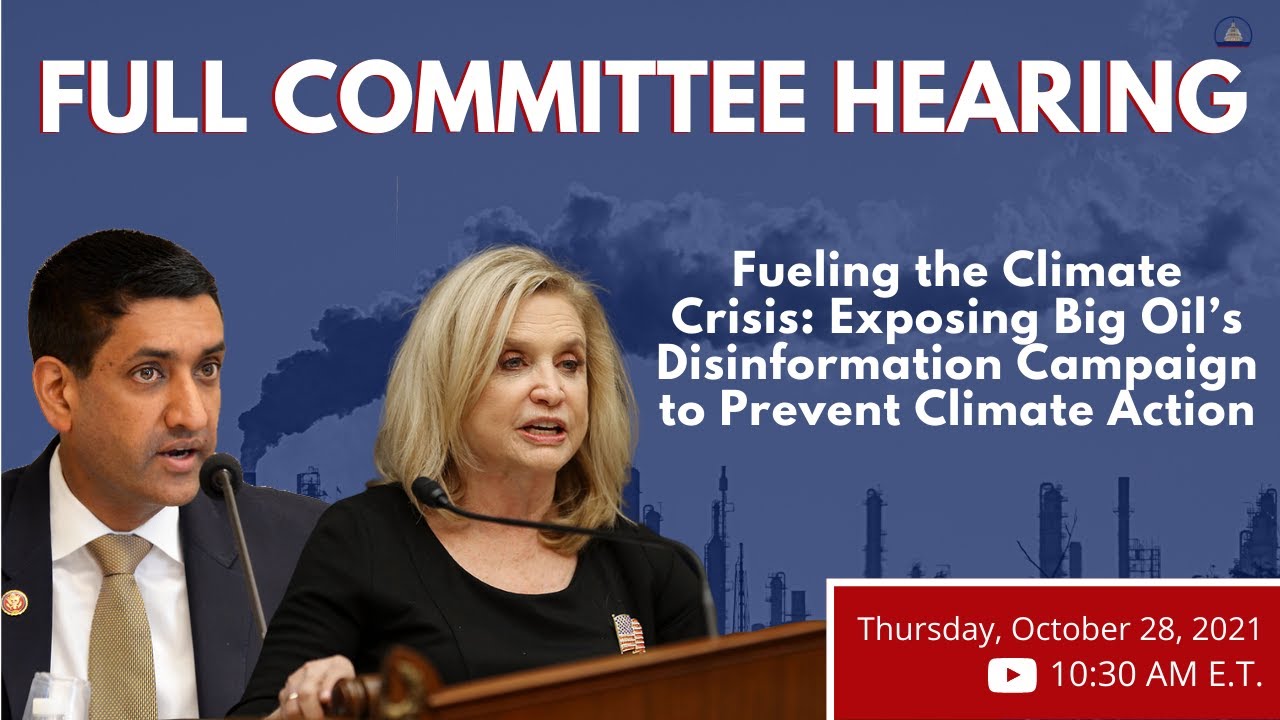 before the House Oversight Committee, alongside the heads of the American Petroleum Institute, or API, and the Chamber of Commerce, the Biden administration announced its framework for a $1.75 trillion reconciliation budget.
..."We’re leaving everything on the field here, in terms of our opposition to anti-energy provisions,” API CEO Mike Sommers told CNN earlier this month. (Ocasio-Cortez repeated the quote.) Representative Rashida Tlaib pointed out generous industry funding for front groups that have kneecapped national and state-level climate policy efforts. The industry spent $40 million, for instance, protecting the oil and gas industry’s ability to drill within 1,000 feet of playgrounds from a 2018 ballot initiative. Then there are all the documents, reported on at length by Inside Climate News, showing the disconnect between what Exxon told the public about climate change and what its own scientists knew to be true. Shell knew, too.
Watkins and her colleagues on the virtual stand—ExxonMobil CEO Darren Woods, Chevron CEO Mike Wirth, BP America CEO David Lawler, API CEO Mike Sommers, and Chamber of Commerce CEO Suzanne Clark—had plenty to be happy about elsewhere in the Capitol, too.
Having already funneled $462,500 in political action committee money to Senator Joe Manchin, who killed the Clean Electricity Payment Program (the centerpiece of the Build Back Better Act’s climate provisions), they could now claim another win. The text of the Build Back Better Act bill released during Thursday’s hearing revealed that the last remaining provision directly targeting fossil fuel emissions—a fee on methane emissions—had been stuffed with a $775 million fossil fuel subsidy....
---
---
https://www.alternet.org/2022/03/how-joe-manchin-got-rich-using-his-political-influence-to-benefit-the-coal-industry-report/
Donald Trump drew a great deal of criticism from environmentalists and Democrats when he displayed his “Trump digs coal” signs during his 2016 presidential campaign, but one Democrat who never said anything negative about Trump’s pro-coal signs was Sen. Joe Manchin of West Virginia. The centrist Democrat has been a consistent defender of fossil fuels, and an article by New York Times reporters Christopher Flavelle and Julie Tate takes a look at how profitable coal has been for the 74-year-old senator over the years.
Manchin, Flavelle and Tate note, earned a fortune from a plant in Grant Town, West Virginia, which is 15 miles south of the Pennsylvania state line.
“Mr. Manchin’s ties to the Grant Town plant date to 1987, when he had just been elected to the West Virginia Senate, a part-time job with base pay of $6500,” the Times reporters explain. “His family’s carpet business was struggling. Opportunity arrived in the form of two developers who wanted to build a power plant in Grant Town, just outside Mr. Manchin’s district. Mr. Manchin, whose grandfather went to work in the mines at age nine and whose uncle died in a mining accident, helped the developers clear bureaucratic hurdles.”
According to Flavelle and Tate, Manchin “supplied a type of low-grade coal mixed with rock and clay known as ‘gob’ that is typically cast aside as junk by mining companies but can be burned to produce electricity.”
“In addition, he arranged to receive a slice of the revenue from electricity generated by the plant — electric bills paid by his constituents,” the Times reporters note. “The deal inked decades ago has made Mr. Manchin, now 74, a rich man…. At key moments over the years, Mr. Manchin used his political influence to benefit the plant.”
Manchin, according to Flavelle and Tate, has “blocked legislation that would speed the country’s transition to wind, solar and other clean energy and away from coal, oil and gas, the burning of which is dangerously heating the planet.”
“With the war in Ukraine and resulting calls to boycott Russian gas,” Flavelle and Tate observe, “Mr. Manchin has joined Republicans to press for more American gas and oil production to fill the gap on the world market. But as the Grant Town plant continues to burn coal and pay dividends to Mr. Manchin,it has harmed West Virginians economically, costing them hundreds of millions of dollars in excess electricity fees. That’s because gob is a less efficient power source than regular coal.”
Flavelle and Tate point out that although Manchin declined to be interviewed for their article, the Times “spoke with three dozen former business associates, current and former government officials, and industry experts” and went over “thousands of pages of documents from lawsuits, land records, state regulatory hearings, lobbying and financial disclosures, federal energy data and other records spanning more than three decades.”
“The documents and interviews show that at every level of Mr. Manchin’s political career, from state lawmaker to U.S. senator, his official actions have benefited his financial interest in the Grant Town plant, blurring the line between public business and private gain,” according to Flavelle and Tate.
---
robt r says paralysis strategy ~ biden
---
https://www.alternet.org/2022/03/joe-manchin-clean-fossil-fuels/
---
https://www.alternet.org/2022/03/joe-manchin-gaslighting-electric-cars/
---
an 3 22
With barely a whimper, free community college for all Americans bit the dust, at least for now.
Already stripped from the pared-down Build Back Better bill proposed by the Biden administration in October, free community college will not re-emerge as a free-standing bill in 2022.
An initiative that has been implemented successfully in 19 states as different as Arkansas and California, you might think that two years of free college might have been a model for elevating successful local initiatives as federal policy.
But apparently it was one thing for states to shoulder the burden of creating an educated workforce and another for the Biden administration to make that investment.
First Lady and community college professor Dr. Jill Biden was tasked with presenting the disappointing news to the 2022 Community College National Legislative Summit last week. She spoke of the human cost of this failure.
"These aren't just bills or budgets to me, to you, right?” Biden told colleagues who had hoped for a $45.5 billion infusion of federal money. “And it was a real lesson in human nature that some people just don't get that."
It’s no surprise that Senators Joe Manchin (D-WV), Kyrsten Sinema (D-AZ) and their Republican allies don’t “get that.”
They believe that a $45.5 billion investment in technicians, health care workers and other skilled laborers we desperately need is an unaffordable “handout” that weakens Americans’ moral fiber.
New Hampshire’s Republican Governor Chris Sununu also rejected the plan. Students who didn’t pay, he argued, would not commit seriously to education.
The bill had other enemies. One was inside the house all along.
Private colleges and universities, and at least one major, public four-year institution, saw the plan as a direct threat to their bottom lines.
As early as last October, the National Association of Independent Colleges and Universitieswithheld its support because the idea was “untested” and government could better help students by increasing Pell Grants.
But federally funded free community college is neither new nor untested: many were free for almost a century.
Part of an education reform plan, two-year colleges would, University of Chicago president William Rainey Harper argued in the 1890s, make Morrill Act public education funds available to more Americans.
These “junior colleges” would be situated in public high schools and would relieve four-year colleges and universities from teaching basic college-level skills and general education courses.
As an example of what this could look like, Harper divided his own tuition-driven university into a “junior college” and a “senior college” in 1892. But it was a high school principal, in Joliet, Illinois, who, in 1901, took up Harper’s challenge to first offer college-level courses for free and then establish an independent, public junior college.
The junior college movement expanded heterogeneously before World War II. Some, as in California, were public and free, and usually an extension of high school. Others, like the private, tuition-driven Harcum Junior College in Bryn Mawr, Pennsylvania, established in 1915 to educate middle-class women, were intended as a launching pad for a university education.
But by the mid-century 20th century, that status of community colleges declined in many states. As college enrollment expanded dramatically under the 1944 GI Bill, Harvard president James Bryant Conant argued that junior colleges — now known as “community colleges” because of their democratic to local education — were primarily for students with modest, vocational goals.
Similarly, all community colleges were never free, but they were free in places where the desire for economic growth and democratic social mobility merged.
Native Floridians paid no tuition until 1969. Similarly, post-secondary schools in California, the largest educational system in the country, offered post-secondary education to in-state students for free until 1978.
Its 73 community colleges also served as feeder schools to four-year institutions. By providing skilled labor, free community and four-year colleges fueled both states’ growth as national hubs for the aerospace and military industries.
Although the United States is currently faced with worker shortages across its skilled labor force, there is hard evidence that reviving tuition-free community college could be the remedy.
In 2008, Knoxville, Tennessee, made this move, a program that became statewide in 2014, funded by a combination of taxpayer dollars and private donations. Mentorship and apprenticeship programs that complement course work have boosted poor students into well-paying jobs.
So, what are the barriers to supporting two-year schools?
First, as their opposition to the Biden plan reveals, public and private four-year colleges and universities remain fatally dependent on tuition dollars that would be diminished if students who wanted a four-year degree could complete two of them for free.
Despite the economic vulnerability that became evident during the first months of the covid crisis, these institutions and the politicians that support them have no immediate plan to replace tuition with more sustainable income streams, like taxes.
As importantly, Joe Manchin’s anxiety that Americans will become moochers, and Chris Sununu’s belief that students will only be disciplined learners if they have skin in the game, reflect a national divide on whether public goods should be shared or earned, and whether the nation benefits from educated workers.
But voters, not surprisingly, break along ideological, class, age and racial lines.
A recent Pew study reveals that 85 percent of Democrats, and only 36 percent of Republicans, believe public colleges should be tuition-free.
But over half of non-college educated Republicans under 50 do support taxpayer-funded community colleges. So do Americans under 30 by an overwhelming 73 percent.
And while only 51 percent of white Americans are in favor of canceling tuition, Black (86 percent), Hispanic (82 percent) and Asian American (69 percent) citizens support democratic access to post-secondary education.
And best of all, tuition-free community college does have a track record. It creates satisfying and sustainable lives for American families, and a robust economy that can respond to the needs of tomorrow.
---
https://www.alternet.org/2022/02/sanders-manchin/
41% spike in child poverty , slammed by Bernie
---
---
https://www.alternet.org/2022/02/to-us-oligarchs-majority-views-on-taxing-the-rich-count-for-little/
noah b
With one political party entirely committed to expanding inequality, and the other divided on the issue, overwhelming public support and commonsense ethical commitments don’t carry much weight.
That’s how oligarchies consolidate. The wealthy horde power and wealth, then that power and wealth gives them the ability to shape institutions to further increase their power and wealth.
Yellen has had some successes in restraining wealthy and corporate power. She negotiated an international agreement with 136 countries to implement a global corporate minimum tax of 15 percent.
At some point, corruption stops being a bug in democracy and starts becoming a feature of oligarchy.
Has the US passed that threshold?
Based on the sweeping and effective resistance to commonsense solutions to reign in wealthy tax scofflaws, the answer is not encouraging.
Since the 1970s, the United States has become steadily and inexorably more economically unequal. According to Pew, upper income families have brought in a larger and larger share of total income.
US income inequality is the highest of all G7 nations. Its Gini coefficient is .434, well above second highest UK at .392.
In 1968, the top 20 percent of households earned 43 percent of national income. By 2018, the top 20 percent of households earned 52 percent.
In 1989, the richest 5 percent of families had 114 times as much wealth as families in the second poorest income tier. In 2016, they had 248times as much wealth.
In 2020, the 50 richest Americans had almost as much wealth as the poorest half of the US population.
This massive concentration of wealth is also a massive concentration of power. The wealthiest people have access to the best lawyers, the best tax attorneys and the most powerful politicians.
That means that it is very difficult for the government to restrain them, or to create a more equitable economy and society against their wishes.
That’s how oligarchies consolidate. The wealthy horde power and wealth, then that power and wealth gives them the ability to shape institutions to further increase their power and wealth. [amp fdbk]
An example of oligarchical power is billionaire tax evasion. A recent IRS study found that wealthy Americans conceal more than 20 percent of their earnings. They are able to do this because of complex accounting scams involving offshore tax shelters.
The lost tax costs the government at least $175 billion a year in revenue. The top 1 percent of earners are responsible for a third of unpaid federal taxes.
In addition to these straightforwardly illegal accounting tricks, the very wealthy also benefit from at least nominally legal loopholes.
For instance, wealthy people have many assets that increase in value over time, but they do not pay taxes on those assets until they sell them.
They can borrow against those assets without paying taxes, since again the assets aren’t considered income. Then, if they die before selling the assets, they can pass them on to their heirs using trusts and other accounting shenanigans to avoid the estate tax.
ProPublica called this strategy Buy, Borrow, Die. It’s a key method for hoarding generational wealth, and entrenching oligarchy.
The Biden administration, led by Secretary of the Treasury Janet Yellen, have proposed strong measures to rein in billionaire corruption. In part, they want to restrain inequality. In part, they hope to fund other priorities like climate mitigation and anti-poverty measures in the administration’s Build Back Better infrastructure plan.
To address billionaire tax evasion, BBB included $80 billion to boost capacity and staff at the IRS. That would help make up for the steady budget-cuts under Republican administrations. Those have led to a 60 percent decrease in audits of taxpayers who earn more than $1 million. Biden said the investment would allow the IRS to collect $400 billion in taxes.
Biden, Yellen and Senate Finance Chair Ron Wyden have also been pushing for a billionaire tax to force the very wealthy to pay taxes on the increased value of their assets.
This would strike at the heart of the oligarchic “Buy, Borrow, Die” lifestyle. It would force the ultra-wealthy to pay their fair share, like everyone else, every year, year after year.
Policies that prevent the rich from escaping a tax burden everyone has to pay should be easy to pass in a democracy. You’d think preventing billionaires from cheating on their taxes would be a popular policy.
And you’d be correct.
A 2019 poll, for example, showed that 76 percent of Americans agreed that the wealthiest should pay more in taxes. Proposals to tax income over $10 million at 70 percent — a huge increase over current rates — obtained more than 50 percent support.
In an oligarchy, though, public support doesn’t necessarily count for all that much.
A notorious 2015 study found that politicians were much more likely to listen to and follow the political preferences of economic elites than those of the less affluent.
You can see that playing out in the politics of billionaire taxation.
Build Back Better, which included the beefed-up IRS funding, was scuttled by millionaire West Virginia Senator Joe Manchin, in large part, reportedly, because he was worried that poor parents would spend money on drugs.
A wealthy politician refused to enforce the law against billionaires because he was worried that poor people are natural criminals.
That is what you call class consciousness.
Wyden’s proposal to end “Buy, Borrow, Die” also failed after opposition from Manchin. It was of course opposed by Senate Republicans, whose main goal is to shovel as much money as possible to the rich in as short a time as possible.
Yellen has had some successes in restraining wealthy and corporate power. She negotiated an international agreement with 136 countries to implement a global corporate minimum tax of 15 percent. This would make it harder for businesses to escape tax burdens by moving their corporate offices. Congress still has to pass the treaty, but Yellen said she was confident they would do so.
The corporate minimum tax is a substantial achievement. But it’s also a small dam erected against the tsunami of inequality in the US.
With one political party entirely committed to expanding inequality, and the other divided on the issue, overwhelming public support and commonsense ethical commitments don’t carry much weight.
The wealthy have been expanding their power and influence for decades in the US. The result is that the US regularly chooses to make the rich richer rather than helping the poorest feed their children.
The outlook for change is likely to be even bleaker if Republicans recapture one or both legislative chambers in November.
Yellen and Biden are to be commended for fighting an ongoing rearguard action against corruption. But if government inability to restrain corruption is a feature of oligarchy, then the US is already well down a path that it is very difficult to retrace.
---
---
an 2 22
no lnx
This Washington lobbyist is one of Joe Manchin’s staunchest allies: report
Alex Henderson February 15, 2022
Although Sen. Joe Manchin of West Virginia has often been a source of frustration to the liberal/progressive wing of his party, the centrist West Virginia Democrat still has plenty of diehard supporters — from Never Trump conservatives to fellow Blue Dog Democrats. And one of Manchin’s staunchest allies, according to the Washington Post, is lobbyist Larry Puccio.
Post reporters Theodoric Meyer and Jeff Stein, in an article published on Valentine’s Day, stress that during the Joe Biden era, Puccio has been cashing in on Manchin’s status as a key swing vote in the U.S. Senate.
“Manchin is now the Senate’s swing vote and one of the most powerful men in Washington, and Puccio has figured out how to monetize his ability to get his old boss on the phone,” Meyer and Stein explain. “Barely a month after Democrats reclaimed the Senate last year, turning the ability to sway Manchin into a sought-after skill, Puccio registered for the first time as a federal lobbyist.”
The reporters continue, “In less than a year, Puccio has cashed in. He and a partner have lobbied the Senate almost exclusively, according to disclosure filings, pulling in more than $310,000 in addition to his earnings from his extensive state-level lobbying business in West Virginia.”
:{:{}:
}:
The 74-year-old Manchin was always a swing vote in the U.S. Senate, but like Sen. Kyrsten Sinema of Arizona, he became a make-or-break swing vote when Democrats gained a narrow Senate majority in January 2021 with two runoff victories in Georgia: Sen. Raphael Warnock and Sen. Jon Ossoff. If Manchin or Sinema vote with Republicans, it can sink a Democrat-sponsored bill — which is why lobbyists are paying such close attention to them.
“Puccio isn’t the only Manchin ally who’s been lured to K Street — several top lobbying firms snapped up former Manchin aides last year — but he goes back further with Manchin than almost anyone else in politics,” Meyer and Stein observe. “With trillions of dollars tied to Manchin’s vote, Washington clients have sought out Puccio’s guidance on how to influence the senator.”
The 66-year-old Puccio, according to the Post reporters, has known Manchin since he was in his early teens.
“Puccio spent nearly a decade as Manchin’s right-hand man, running his campaigns for secretary of state and for governor and serving as his chief of staff in both offices,” Meyer and Stein note. “When he stepped down in 2010 to become a lobbyist in the state, Manchin helped install him as the state party chairman and later tapped him to run Manchin’s leadership PAC. Many West Virginia Democrats view the two of them as inseparable, with Puccio able to speak on Manchin’s behalf in a way that no other aide or ally could.”
But the Post reporters also point out that while Manchin pays close attention to what Puccio has to say, that doesn’t automatically mean he will follow Puccio’s advice or vote with Puccio’s clients.
Tom Mainella, Democratic Mayor of Fairmont, West Virginia, told the Post, “Larry has always been with Joe, and that may be why some people want Larry to twist the senator’s arm about Build Back Better. But I don’t think anyone is going to twist the senator’s arm.”
---
https://www.alternet.org/2022/01/joe-manchin-filibuster/
placard say a maj never passed a bill ( fillibuster?) vs 160x Rp amy Klobuchar
Manchin pushes a revisionist history in his fight to preserve the filibuster
Jon Skolnik Salon January 21, 2022
no lnx
Wednesday, just months out from the midterm elections, Sens. Joe Manchin, D-W.Va., and Kyrsten Sinema, D-Ariz., blocked their own party's effort to pass a sweeping voting rights overhaul by refusing to exempt the measure from a Republican filibuster. The conservative Democratic explained his reasoning during a floor speech that day, addressing the upper chamber just as President Joe Biden prepared to address the nation ahead of his one-year anniversary in office. As Biden continued to push his stalled agenda, Manchin erected a big poster with one sentence to encapsulate his defense of the filibuster: "The United States Senate has NEVER been able to end debate with a SIMPLE MAJORITY."
Manchin's logic rests on the claim that no party has ever ended debate with a simple majority, largely because a filibuster requires 60 votes for a cloture (i.e., the official procedure used to end the filibuster). By creating a voting rights carveout in the filibuster that would allow Democrats to pass the bill with a simple majority, Democrats would be breaking legislative tradition, Manchin argues. His central assumption, however, is untrue.
The last three Supreme Court nominees – Justices Amy Coney Barrett, Brett Kavanaugh, and Neil Gorsuch – were all confirmed with a simple majority, noted political commentator Brian Tyler Cohen. In fact, Manchin himself was the 51st senator to back Kavanaugh, single-handedly ending debate on the scandal-plagued judge's confirmation.
And during Gorsuch's 2017 nomination, then-Senate Majority Leader Mitch McConnell, R-Ky., lowered the cloture threshold for a Supreme Court nomination from 60 to 51 votes – or a simple majority.
Manchin's opposition to a filibuster carveout also flies in the face of his past comments around changing the Senate rules.
Back in 2011, when Manchin was just a freshman senator, Senate Democrats failed to circumvent a Republican filibuster of then-President Barack Obama's $447 billion jobs plan. At the time, Manchin expressed frustration over the GOP's maneuver, suggesting that a bipartisan compromise may have been reached if not for the filibuster.
"We have become paralyzed by the filibuster and an unwillingness to work together at all, just because it's an election cycle," Manchin told the Charleston Daily Mail. "We couldn't even get the horse in the start gate, let alone to run the race. That's the problem here. It's political and it's being played absolutely unmercifully at the highest level."
Later that year, Manchin issued a press release expressly calling the Senate to "fix the filibuster."
"If senators want to halt action on a bill, they must take to the floor and hold it through sustained debate; end filibusters on motions to proceed to debate," the Democrat said.
On Wednesday, emotions ran high amongst Democrats, who have endured months of slow-walking by both Manchin and Sinema on President Biden's Build Back Better Act, the president's signature $2.2 trillion social spending plan.
Sen. Bernie Sanders, I-Vt., was clear on this point, saying that "it's not just this [filibuster] vote" that's frustrating.
"These are people who I think have undermined the President of the United States," he told reporters after Wednesday's failed vote. "They have forced us to go through five months of discussions which have gotten absolutely nowhere."
Back in December, Manchin effectively ended negotiations with both Biden and Senate Democrats on Build Back Better, saying that he could not support the measure due to fears around inflation and the national debt.
---
---
manchin and Sinema face backlash after posting grotesque tweets congratulating themselves
October 29, 2021
On Thursday, after weeks and weeks of goalpost-moving, constant compromising on what was already a compromise, incoherent messaging, and consternation, Sens. Joe Manchin and Kyrsten Sinema finally agreed to...
---
---
an 11 21
according to New York Times reporters Kenneth P. Vogel and Kate Kelly, Sen. Joe Manchin of West Virginia and Sen. Kyrsten Sinema of Arizona are attracting some wealthy GOP donors.
"Even as Ms. Sinema and Mr. Manchin, both Democrats, have drawn fire from the left for their efforts to shrink and reshape (President Joe) Biden's proposals," Vogel and Kelly explain, "they have won growing financial support from conservative-leaning donors and business executives in a striking display of how party affiliation can prove secondary to special interests and ideological motivations when the stakes are high enough. Ms. Sinema is winning more financial backing from Wall Street and constituencies on the right in large part for her opposition to raising personal and corporate income tax rates. Mr. Manchin has attracted new Republican-leaning donors as he has fought against much of his own party to scale back the size of Mr. Biden's legislation and limit new social welfare components." [twt]
the blue wave of 2018 showed how big a tent the Democratic Party is. Progressive allies of Sen. Bernie Sanders such as Rep. Alexandria Ocasio-Cortez of New York City and Rep. Ilhan Omar of Minnesota were among the success stories of 2018, but so were Manchin (who was reelected) and Sinema — who has often described the late Sen. John McCain of Arizona as her political idol and has been on very friendly terms with his daughter, conservative GOP activist Meghan McCain. And with Democrats having only a razor-thin majority in the U.S. Senate, Manchin and Sinema have the power to make or break legislation.
"The stream of cash to the campaigns of Ms. Sinema and Mr. Manchin from outside normal Democratic channels stands out because many of the donors have little history with them," Vogel and Kelly observe. "The financial support is also notable for how closely tied it has been to their power over a single piece of legislation, the fate of which continues to rest largely with the two senators because their party cannot afford to lose either of their votes in the evenly divided Senate."
The legislation that the Times reporters are referring to is the Build Back Better Act of 2021, which recently passed in the U.S. House of Representatives and now goes to the U.S. Senate for consideration.
"Their influence has been profound," Vogel and Kelly say of Manchin and Sinema. "The domestic policy bill, which would expand the social safety net and efforts to fight climate change,started out at $3.5 trillion and has been shrunk — mainly at the insistence of Mr. Manchin — to around $2 trillion; it could get smaller as the Senate takes up the version passed on (November 19) by the House."
The Times reporters note that Stanley S. Hubbard, a billionaire Republican, made a donation to Sinema in September, and Kenneth G. Langone (a Republican billionaire and Wall Street investor) recently donated to Manchin.
According to Vogel and Kelly, "One Wall Street executive joked that in his industry, Ms. Sinema — who, as a young politician, once likened political donations to 'bribery' — was now referred to as 'Saint Sinema' for opposing most of Mr. Biden's proposed taxes on the wealthy. She has, however, supported a 15% corporate minimum tax and other revenue-raising measures that will help pay for Mr. Biden's legislative spending."
---
---
an 11 21
official Washington will be quiet this week, but the fallout from the Kyle Rittenhouse verdict will continue to divide America along the Trumpian fault lines of fear, violence, and racism.
Closing arguments are scheduled today in the trial of three men charged with the killing of Ahmaud Arbery in Georgia. Though they chased him, they are claiming self-defense because, they say, Arbery tried to get control of a shotgun one of them was carrying. As with the Rittenhouse case, the trial raises questions of how self-defense laws will hold up as guns proliferate. Regardless of how it come out, the case also illustrates America's deepening split.
Congress's continuing investigation into the January 6 insurrection reveals the same rift, as will the Supreme Court's expected decision on executive privilege in that investigation, and its likely move to strike down New York State's law requiring people seeking licenses to carry handguns in public to show a "proper cause," as violating the Second Amendment.
The fault line has now extended into almost every facet of American lawmaking. When the "Build Back Better" bill passed the House late Friday night, 220 out of 221 Democrats voted for it. But all of the House's 213 Republicans voted against it. Why? The measures in the bill are hugely popular, according to polls. The bill includes the largest expansion of federal child-care assistance in history; free, universal prekindergarten for all American children ages 3 and 4; Medicare benefits covering hearing services; government for the first time being allowed to negotiate some prescription drug prices, aiming to lower the costs that seniors pay for lifesaving medicines such as insulin; and more than $550 billion to combat climate change — promoting greener energy and providing new perks for Americans who buy electric vehicles.
But policy popularity may be no match for fear, violence, and racism — whichRepublicans and the moneyed interests are now diligently exploiting to kill the bill in the Senate.So-called "moderate" Democrats (Senators Joe Manchin and Kyrsten Sinema) have expressed skepticism about its cost and scope. It would be one thing if Manchin's and Sinema's reservations were in good faith, but how can they be? Manchin frets about the bill's effects on inflation even though the bill lowers prices for most Americans of major expenses like childcare, drugs, and healthcare. Sinema says she prefers "legislation that is crafted in a bipartisan way," but who is she kidding? Mitch McConnell has made clear he won't allow a single Republican senator to vote for the bill.
The votes of every Senate Democrat are needed if the bill is to pass, but Manchin and Sinema are allowing rightwing tropes — and the big money behind them — to divide Democrats. As the New York Times reported yesterday, cash has poured into Manchin's and Sinema's political coffers from political action committees and donors linked to Wall Street, Big Pharma, and Big Energy, which have opposed proposals in the bill that Manchin and Sinema helped scale back.
The question that keeps haunting me is this: Is an America so deeply divided, and awash in political money that exploits that divide, any longer capable of doing bold things that are broadly popular?The only big thing we continue to do is feed the ravenous military-industrial complex— itself founded on fear, violence, and racism. (Efforts to whip up a new cold war with China conjure up old fears of a "yellow peril.") Congress is on the verge of giving the Pentagon even more money than the Pentagon and the Biden administration are seeking. The nation's military tab over the next ten years will be upwards of $8 trillion and is not paid for with expected revenue, in sharp contrast with the $2 trillion cost of the House's "Build Back America" plan, which would be paid for with tax increases on the wealthy and big corporations.
That America is becoming two separate nations is threatening everything we value. The most obvious beneficiaries (besides top executives of big corporations and Wall Street) are Donald Trump, Vladimir Putin, and Rupert Murdoch, who appear to be doing whatever they can to divide us even further.
---
---
10 21
west Virginia constituents decry 'immorality' of Joe Manchin
October 24, 2021
West Virginians were joined by economists and economic justice campaigners at a hosted by the Poor People's Campaign on Friday where they condemned Sen. Joe Manchin's...
---
---
4theppl --> lewis --> joe's plan?
Manchin's big hopes for a bipartisan deal just went down in humiliating defeat
David Badash The New Civil Rights Movement
October 20, 2021
Minutes ago Senate Republicans filibustered critical voting rights legislation – actually, filibustered debate on voting rights legislation. They refused to even allow debate on protecting the most important, most critic....
---
more outside donors than state?
https://www.alternet.org/2021/10/joe-manchin-2655328156/
---
---
Don Winslow, the author of several New York Times bestsellers, recently blasted Sen. Joe Manchin (D-W.Va.) in a newly-released video shared on social media...
---
corrupt
---
https://www.alternet.org/2021/10/joe-manchin-con/
https://www.alternet.org/2021/10/joe-manchin-con/
---
Manchin fumes after Bernie Sanders op-wd in West Virginia paper calls out obstruction of Biden agenda
Senator Joe Manchin of West Virginia lashed out Friday after a major newspaper in his home state published an op-ed by Sen. Bernie Sanders that called out Manchin's obstruction...
---
1021 kos an
blades
Sen. Joe Manchin has made clear that there is no way will he cast his crucial votefor the Democrats' reconciliation bill if it includes the Clean Electricity Performance Program (CEPP), the most powerful part of President Joe Biden's climate agenda. Thus does the senior senator from West Virginia display his true colors to anyone who was still confused about them.
CEPP would provide $150 billion to reward utilities that accelerate the replacement of the nation's coal- and gas-fired power plants with wind, solar, and nuclear energy in order to reach the goal of zero carbon emissions in the power sector by 2035. Without Manchin on board, White House staff and senior Democrats seem to have surrendered in the matter and are searching for ways to put together other programs to cut emissions. Without passage of a bill containing aggressive programs, Biden's team is going to have a devil of a time in Glasgow at the climate summit persuading China, India, and Brazil that he can even deliver the U.S. pledges on emissions cuts, much less that their nations should do better than they are.
Here's Coral Davenport at The New York Times:
A spokeswoman for Mr. Manchin, Sam Runyon, wrote in an email, "Senator Manchin has clearly expressed his concerns about using taxpayer dollars to pay private companies to do things they're already doing. He continues to support efforts to combat climate change while protecting American energy independence and ensuring our energy reliability."
I can't read minds, so I won't claim to know what is truly in Manchin's heart in this matter. What I do know is that anyone who truly accepts what scientists are saying about the climate crisis—anyone who actually backs "efforts to combat climate change"—would not use the political clout of his high office to cripple policies to prevent, mitigate, and adapt to the dire impacts of changes being projected for our future.
It's actually easier to respect a numbskull like Sen. James "Snowball" Inhofe, who wrote an entire book calling climate change a hoax and seems to truly believe it, than Manchin, who pretends he's down with the science even as his bank account gets ever fatter feeding off the teat of the fossil fuel industry. An industry that, in case anyone has forgotten, spent hundreds of millions of dollars promoting climate denial disinformation. Manchin and his family have thrived thanks to profiteers who created climate change doubt by gaslighting the populace, smearing scientists, attacking activists, and, of course, pouring gobs of campaign money into the pockets of compliant politicians in both parties.
There's a chance we'll still see passage of a reconciliation bill with a few crumbs on climate. But quite possibly not. As Democratic Sen. Tina Smith of Minnesota told The Times, "We must have strong climate action in the Build Back Better budget. I'm open to all approaches, but as I've said, I will not support a budget deal that does not get us where we need to go on climate action. There are 50 Democratic senators and it's going to take every one of our votes to get this budget passed."
Even if a bill with some climate elements in it does pass, without the CEPP, that cut will have far-reaching consequences beyond the power sector. While it contributes 25% of total U.S. greenhouse gas emissions, the transportation sector contributes 29%. Cutting that to zero requires a switchover from internal combustion vehicles to green-sourced electric power. Otherwise, much of the reduced carbon pollution from the operation of EVs will be undermined by the continuing operation of power plants burning fossil fuels to charge up those vehicles.
Then there's the humiliation of showing up in Glasgow with a lot more words than actions. Not the strongest negotiating posture.
If Joe Manchin really were serious about combatting the climate crisis, he would say okay to the CEPP, but only on the condition that the reconciliation bill's already hefty investment in coal communities be doubled. But no.
This week more than650 protesters,many of them Indigenous, were arrested in Washington for civil disobedience in protest of foot-dragging in Congress on climate change. In the words of a 90-year-old song written by Florence Reece in support of coal strikers in Harlan County, Kentucky, the protesters asked a question for those within earshot: "Which side are you on?"
Joe Manchin has shown us which side he is on. And that puts us, and generations to come, in peril.
---
an 1021
sadly no twt? on $
Climate campaigners on Friday responded to Sen. Joe Manchin's unrelenting obstruction of his own party's efforts to spend $3.5 trillion to combat the climate crisis and make other major social investments by accusing the right-wing West Virginia Democrat of doing the fossil fuel industry's bidding, and drawing attention to the "modern-day coal baron's" staggering conflicts of interest.
Manchin—Senate Democrats' 50th and potentially decisive vote on the pending Build Back Better and bipartisan infrastructure bills—admitted Thursday that he planned to pass legislation containing at least $25 billion in potential fossil fuel subsidies and then torpedo the more ambitious $3.5 trillion budget reconciliation package funding robust investments in climate solutions.
Manchin's insistence on a top-line reconciliation bill spending level of $1.5 trillion defies the wishes of the vast majority of his own constituents and has drawn fire from progressive critics, some of whom noted the senator's consistent support for annual Pentagon budgets approaching or surpassing $700 billion.
Others have drawn attention to the fact that Manchin is currently the top congressional recipient of fossil fuel industry donations, and last year personally earned roughly three times as much income from investments in his son's coal company as he did from his congressional salary. Since his election to the Senate in 2010, Manchin has made more than $4.5 million from his family's coal business.He has also earned the praise of an ExxonMobil lobbyist for obstructing climate action.
"Should any lawmaker with such a sizable financial conflict of interest wield decisive influence over what the U.S. government does about a life-and-death issue like the climate emergency?" asked Covering Climate Now executive director Mark Hertsgaard in a Thursday column calling Manchin a "modern-day coal baron."
"Shouldn't there be public discussion about whether that lawmaker should recuse himself from such deliberations?" Hertsgaard added.
Bill McKibben, co-founder of the climate advocacy group 350.org, wrote Friday that "Joe Manchin is actually doing the work of the fossil fuel industry."
"The Biden administration was trying to... move toward the clean energy world that both physics and finance demand—but the fossil fuel industry won't let it, and Manchin is their hostage-taker," he continued. "Whatever deal emerges today will be judged on... whether or not it allows us to meet [President Joe] Biden's target of cutting emissions in half by 2030. If Manchin gets his way, that won't happen."
:{:{}:
}:
"Manchin came to power with an ad showing him shooting climate regulations," added McKibben, "now he's holding a gun to the planet's head."
On Thursday, Varshini Prakash, executive director of the youth-led climate justice groupSunrise Movement, said, "Let's be clear, progressives are not the ones delaying the vote—Joe Manchin and Kyrsten Sinema are."
"The reality is that while our movement has been fighting like hell to pass historic climate, immigration, and economic policies, Manchin and Sinema have been in backroom fundraisers finding ways to kill the $3.5 trillion climate and jobs package to help working people," she added. "Let's stop pretending that there's anything else going on."
---
an 1021
During the 2020 Democratic primary, Sen. Elizabeth Warren made fighting corruption her number one priority. It may not have seemed that way in the press, which tended to characterize the senior senator from Massachusetts as a female Sen. Bernie Sanders. Most coverage focused heavily on her bold economic ideas, such as a wealth tax. But when she was actually asked what her major focus in politics was, Warren never hesitated to say that fighting corruption should come first — because of her commitment to passing progressive economic policies.
"The rich and the powerful have been calling the shots in Washington forever and ever," Warren told Vox's Ezra Klein in 2019, explaining why she was intent on passing a massive anti-corruption bill meant to curtail the influence of lobbyists and influence of moneyed interests on Capitol Hill.
"Look closely, and you'll see — on issue after issue, widely popular policies are stymied because giant corporations and billionaireswho don't want to pay taxes or follow any rules use their money and influence to stand in the way of big, structural change," she wrote in her plan announcement.
Warren's view is, sadly and perhaps surprisingly, not popular. Republicans clearly don't view corruption as a bad thing these days — that's one more reason why they love Donald Trump. But even on the left, where everyone says they're against corruption and voters in particular always sign off on the idea that ending corruption is a good idea, there's a gulf between saying you're against it and actually working to eradicate it. If more agreed with Warren to make corruption a priority target, we might not be watching President Joe Biden's bold agenda slowly fall apart now.
When it comes to brass tacks, not enough people are willing to put in the effort required to make fighting corruption a real agenda item. Activists are more likely to put their time into causes like health care and climate change. Democratic politicians, when they get power, are also attracted to policy fights that offer tangible rewards, such as increased social spending, rather than the more abstract and far-flung discourse about lobbyists and corruption. And voters definitely reward politicians for these priorities, which is one reason why Warren lost handily in the primary to Sanders and Biden.
But as the current debacle playing out on Capitol Hill demonstrates, Warren was right all along. Democrats and their voters may want to pass progressive legislation that addresses wealth inequality, climate change and lack of health care. But corrupt business interests keep stopping them. It's like trying to make a dress when someone keeps stealing your sewing machine. You can have the pattern and the fabric and the vision, but if you don't have the means to put it all together, you will never get that dress made.
Biden and Sanders are learning this the hard way as their dual vision for the Build Back Better plan — an expansive set of bills meant to address climate change, reduce poverty, ensure child care, expand health care, and build up American infrastructure, among other things — teeters on the edge of collapse. After spending months carefully constructing a two-track plan where moderate Democrats would support the progressive agenda, in exchange for progressives supporting the moderate agenda, a handful of centrist Democrats in the House and Senate are about to blow the whole thing up by reneging on their end of the bargain. And while there are multiple reasons for this backstabbing behavior, it's hard not to notice that the undue influence of lobbyists.
The two biggest names in the Senate Betrayal Caucus are, of course, Joe Manchin of West Virginia and Kyrsten Sinema of Arizona. Both are throwing their weight around, clearly trying to derail Biden's agenda while claiming to have no such intention. Instead, they come with an endless array of incoherent, even nonsensical, explanations as to why they can't just suck it up and vote for the two-bill track the Democratic caucus agreed to vote on. There's now an entire cottage industry built around psychoanalyzing these two: What do they want? What will get them to "yes"? Why won't they just tell us what they want, so we can give it to them? Why are they making so little sense?
Everyone has a favorite reason, but the likeliest is the boring one: They're being dodgy because they don't want to be honest about their real motives. Looking at their track records, it's hard not to notice that both deeply enjoy being wined and dined by some of the sleaziest lobbyists and fundraisers on Capitol Hill. Manchin, for instance, blew off fellow Democrats begging him to support voting rights in favor of going to a fundraiser held by oil and gas executives who have a financial interest in keeping working people from voting. Sinema is deep in cahoots with industry lobbyists who want to tank Biden's agenda, holding fundraisers with anti-Biden groups and taking money from the pharmacy industry, right before doing an about-face to block fair pricing drug policies she previously claimed to support.
It's not just those two. The price control policy for pharmaceuticals is one of the most wildly popular items in the Biden agenda — at least with voters. But a small group of Democrats in the House pulled that item out of the bill, and they're barely trying to pretend it's for any reason other than to appease pharmaceutical lobbyists. They likely know that politicians and voters may say they oppose corruption, but that actually doing something to stop it never becomes a priority.
Lobbyists have Sinema's ear, but her own party and voters do not. The Democratic party in Arizona is threatening a vote of no confidence against her, and her response was somewhere between a shrug and throwing them the finger. Activists are crowdfunding for a primary challenger against her. It is possible she is such an egomaniac that she thinks she's going to have a great re-election after teeing off her own voters, of course. But it's also hard not to wonder if she isn't influenced by the knowledge that she's all but guaranteed a well-heeled job in lobbying if she loses re-election. Notably, a lifetime ban on politicians becoming lobbyists is part of Warren's anti-corruption bill. If it was law, then Sinema might be making more pro-voter choices, rather than treating her constituents as an annoying inconvenience.
Corruption isn't a sexy issue, but focusing attention on it can pay huge dividends when it comes to advancing progressive causes. Take gun control, for instance. Decades of rational argumentation and emotional appeals did little to move the needle, policy-wise. Even in the face of children being murdered in schools repeatedly, Republican politicians have successfully blocked all bills, and Democrats didn't even bother making it a priority when they got power.Eventually, however, gun control advocates started to look away from the ideological arguments and toward the influence of the gun industry, through its main lobbying arm, the NRA.
Once they did that, real progress started to happen. Investigations revealed that the NRA was a thoroughly corrupt organization and that its leadership was on the take. Then the lawsuits started to fly. Now the organization is in very real danger of collapse — not because of its views, but because of its corruption. It might be too late, and Republicans may be too dug in on their gun mania to ever start to moderate. But without the NRA in their ear all the time, there could be a real chance to persuade even just a few Republicans to support common sense reforms that are backed by the majority of Americans. But only if the NRA is gone — and coming at them from a corruption angle was the path to this possibility.
It's admittedly a tough sell, even to Democrats. Most Democrats have been happy to back bills that tackle the issue in similar ways to what Warren proposes, and many seem to understand that they would benefit from a more level playing field, where wealthy interests have less influence over policy and politics. Still, as with most legislation that Democrats want to pass, anti-corruption bills have been torn apart on the shores of the filibuster. And the two people who are doing the most to make sure the filibuster remains and anti-corruption bills have no chance of passing? You guessed it: Manchin and Sinema. Corruption on Capitol Hill is a grotesque a house of mirrors, and until that changes, real progress will be an impossibly tall hill to climb.
---
---
defensive vs chat up kayaktivist Almost Heaven USS
https://www.alternet.org/2021/09/manchin-conflict-of-interest/
---
amy klo and he watered down 4theppl act
---
https://www.alternet.org/2021/09/joe-manchin-2655063636/
ah
Ever since he entered the U.S. Senate in 2010, Sen. Joe Manchin of West Virginia has made it abundantly clear that he will often cross party lines and vote with Republicans — and during the Biden era, the decidedly centrist Democrat has been a frequent source of frustration to the more progressive members of his party. Manchin is unpredictable, sometimes voting with fellow Democrats and sometimes voting with Republicans. And efforts by lobbyists to influence Manchin is the focus of a Washington Post report by journalists Theodoric Meyer and Jacqueline Alemany.
One of those lobbyists, Meyer and Alemany explain in an article published on September 20, is Jonathan Kott — a former Manchin senior aide who is now with the firm Capitol Counsel.
Kott told the Post, "Don't assume he's going to vote any way until he actually casts his vote. I went with him to almost every vote, and there were times when he made up his decision when he walked onto the floor. There's no way to sort of predict what he's going to do."
Kott, according to Meyer and Alemany, is "one of a handful of former Manchin aides now on K Street who now spend much of their time serving as professional Manchin whisperers, advising clients on how Manchin thinks and, in some cases, lobbying his office."
Meanwhile, Patrick Hayes, the 74-year-old Manchin's former chief of staff, is now with the lobbying firm Kountoupes Denham Carr & Reid.
"Larry Puccio, Manchin's longtime friend and former chief of staff while he was West Virginia's governor and secretary of state, registered as a federal lobbyist for the first time in February," Meyer and Alemany note. "Some Manchin alumni who were already downtown, meanwhile, picked up new clients, includingHayden Rogers, a former Manchin chief of staff whom Qatar's government hired in March as a foreign agent. The country's contract with Rogers' firm is worth a hefty $30,000 a month."
If Democrats had a larger majority in the U.S. Senate, trying to sell Manchin on President Joe Biden's Build Back Better Agenda wouldn't be so high a priority. But the Democratic Senate majority is razor-thin, making Manchin a key swing vote — along with another centrist Democrat: Sen. Kyrsten Sinema of Arizona.
"Divining which way the Senate's swingiest vote will go is the Washington parlor game of the moment," Meyer and Alemany observe. "And Manchin isn't exactly making it easier for those who want to see inside his head.He recently called for a 'strategic pause' on President Biden's $3.5 trillion budget bill, and made it clear he won't support 'anywhere near' that number 'without greater clarity about why Congress chooses to ignore the serious effects inflation and debt have on existing government programs.'"
---
journalists break down Manchin’s 'considerable financial interests' in fossil fuels
September 22, 2021
During the Biden era, centrist Democratic Sen. Joe Manchin has been a frequent source of frustration to the progressive wing of his party. The Democratic majority in the U.S. Senate is razor-thin, and the...
---
an 921
Appearing on MSNBC's "The Sunday Show" with host Jonathan Capehart, the co-chair of WV Can't Wait dropped the hammer on Sen. Joe Manchin (D-WV) for blocking a desperately needed stimulus bill that would provide welcome relief to his constituents.
With host Capehart quoting the senator from an op-ed in the Wall Street Journal where he wrote, "I have always said if I can't explain it, I can't vote for it and I can't explain why my Democratic colleagues are rushing to spend $3.5 trillion.," Stephen Smith opened fire on his senator.
"Look, here's the secret that every West Virginian knows: Joe Manchin, the rest our congressional delegation, they do not represent the working people of West Virginia," he accused. "They never have, they never will. That's because, up until now, you don't win high office in West Virginia because you serve the people; you win high office in West Virginia because you serve **Exxon, because you serve out-of-state landowners, bankers and corporate lawyers."
"That's who he's checking in with," he continued. "The only language they understand is power, and so the only hope we have on the ground of persuading these establishment politicians is to threaten to replace them. And so that's what we're doing. The threat must be credible, permanent, fearless, and most important, homegrown."
---
https://www.alternet.org/2021/09/joe-manchin-2654895078/
no lnx an 921
League of Conservation Voters gives scorecards to members of Congress based on their environmental records, and LCV's National Environmental Scorecard gives Sen. Joe Manchin of West Virginia a 54% favorable score for 2020 and an overalllifetime score of 49% — compared to the 96% lifetime score LCV gives Rep. Alexandria Ocasio-Cortez of New York City or the embarrassing 3% lifetime score LCV gives Rep. Jim Jordan of Ohio. Manchin, who receives neither AOC's stellar rating from LCV nor the abysmal rating given to Jordan, has had a friendly relationship with the coal industry than many other Democrats — and that relationship is the focus of an article published by The Intercept on September 3.
Journalist Daniel Boguslaw's article notes what Manchin has had to say about fossil fuels versus green energy and examines, in great detail, his relationship to the coal industry in West Virginia. The centrist Democrat told CNN, "If you're sticking your head in the sand and saying that fossil (fuel) has to be eliminated in America — and they want to get rid of it, and thinking that's going to clean up the global climate — it won't clean it up all. If anything, it would be worse."
Boguslaw explains, "Manchin's claim that climate pollution would be worsened by the elimination of fossil fuels — or by the resolution's actual, more incremental climate provisions — is highly dubious, if not outright false. What would unquestionably be impacted, however, is Manchin's own personal wealth."
The journalist goes on to offer elaborate details about Manchin's relationship with coal.
"For decades, Manchin has profited from a series of coal companies that he founded during the 1980s," Boguslaw notes. "His son, Joe Manchin IV, has since assumed leadership roles in the firms, and the senator says his ownership is held in a blind trust. Yet between the time he joined the Senate and today, Manchin has personally grossed more than $4.5 million from those firms, according to financial disclosures. He also holds stock options in Enersystems Inc., the larger of the two firms, valued between $1 and $5 million."
Boguslaw continues, "Those two companies, Enersystems Inc. and Farmington Resources Inc., the latter of which was created by the rapid merging of two other firms, Manchin's Transcon and Farmington Energy, in 2005. Enersystems purchases low-quality waste coal from mines and resells it to power plants as fuel, while Farmington Resources provides 'support activities for mining' and holds coal reserves in the Fairmont area."
The 74-year-old Manchin has been a fixture in West Virginia politics for decades. After serving in the West Virginia State Senate in the 1980s and 1990s, Manchin served as governor of West Virginia before being elected to the U.S. Senate in 2010. West Virginia is a deep red state, but being a Democrat didn't prevent Manchin from getting reelected to the U.S. Senate in 2012 and 2018. And during the Barack Obama era, Boguslaw notes, he fought against stricter Environmental Protection Agency rules.
"Manchin's advocacy for relaxing environmental regulations on the coal industry extends well beyond coal ash," Boguslaw observes. "In at least one instance, that advocacy was linked to the interests of the Edison Electric Institute, or EEI — an energy producer trade group tied directly to Manchin coal, as Sludge reported in July. In 2012, Manchin was one of the loudest voices opposing the Obama-era EPA rules limiting mercury and aerosolized acid emissions from power plants like Grant Town, which supplies power to an EEI member."
FROM YOUR SITE ARTICLES
What do Manchin and Sinema want to cut from Biden's plan? Dental ... ›
The hopelessly 'naïve' Joe Manchin has become Mitch McConnell's ... ›
Manchin made over $500K last year from West Virginia's most ... ›
RELATED ARTICLES AROUND THE WEB
Joe Manchin says he will oppose a $3.5 trillion budget bill ›
Supreme Court and Joe Manchin tighten Biden's political straitjacket ... ›
Joe Manchin: Why I'm voting against the For the People Act | Op-Ed ... ›
---
https://theintercept.com/2021/09/03/joe-manchin-coal-fossil-fuels-pollution/
...1987, the man who is now the senior senator from West Virginia chose his hometown as the fulcrum for his enterprise. He and his brothers centered their business dealings near Farmington, where their grandfather served as mayor, and established headquarters for Enersystems and Farmington Resources in the nearby city of Fairmont, on the banks of the Monongahela River. Manchin’s brokerage firm has failed to attract the same attention as the scalped mountains and blackened tap water in the southeast region of the state, where mountaintop removal mining has radically altered the once pristine landscape. But in the northern political enclave of Marion County, Manchin’s businesses are fueling environmental degradation and impacting public health with severe consequences.
Farmington is surrounded by some of West Virginia’s oldest mines, dirtiest power plants, and sprawling coal ash dumping grounds. Through these operations Manchin receives hundreds of thousands of dollars in revenue every year.
For the first time, a Type Investigations and Intercept analysis of public records reveals the impact of Manchin’s coal firms. For decades, they have relied on mines and refuse piles cited for dozens of Mine Safety and Health Agency violations, multiple deaths, and wastewater discharging that has poisoned tributaries feeding into the Monongahela River, as hundreds of thousands of tons of carcinogenic coal ash are dumped across Marion County.
While Manchin does not own the mines, refuse piles, and power plants that have polluted Marion County, he continues to reap their financial rewards. In tracing the life cycle of Manchin’s coal, from its origin at refuse sites, to the looming plants it powers, down into the water and soil of northern West Virginia, the steep and complex cost of Manchin’s empire begins to take shape....
deadly Work
Outside Fairmont in Barrackville, West Virginia, the Barrackville mine lies buried in the ridge rising over an outcropping of abandoned buildings in what was once the town’s bustling mining camp. In 1925, 33 miners lost their lives to a gas explosion in a mine that once supplied coal to the forges of Bethlehem Steel. As of 2019, when the latest comprehensive data was released by the Energy Information Administration, the refuse piles of low-quality coal those miners left behind serve as the second-largest coal source for Manchin’s Enersystems. (The firm moves less coal than the giants of the industry but still sold well over half a million tons from the site between 2008 and 2019.) The dangers of the Barrackville mine didn’t end with the 1925 explosion. Since 2000, the Barrackville site has been cited for five accidents and one death, when a heavy machinery operator was crushed by a bulldozer.
Over the past two decades, the Barrackville refuse pile was cited and fined for more than 30 safety violations by the Mine Safety and Health Administration, or MSHA. The charges include unsafe equipment, unsafe material storage, dangerous lack of lighting, unsafe brakes, failure to adequately inspect electrical equipment, failure to maintain automatic warning devices, unsafe vehicle storage, failure to complete daily safety inspections, failure to mark hazardous chemicals, failure to maintain miner training records, and failure to adequately train miners.
North of Barrackville, on the banks of the Monongahela River, is Enersystems’ largest supplier of waste coal as of 2019, the Humphrey No.7 mine, where over 40 safety violations have been recorded with the MSHA since 2000. These include failure to file adequate reports on coal slurry impoundments, failure to safely control dust, failure to adequately train new miners, failure to maintain adequate vehicle breaks, failure to correct equipment defects, failure to safely maintain power lines, failure to safely store loose hazardous material, failure to maintain adequate firefighting equipment, and failure to properly maintain flammable liquids storage. The mine has also seen two fatalities, the first when a worker died after falling from a coal barge, the second when a worker was crushed to death by a coal car.
“It’s backbreaking, and we always say that even if you survived it, you didn’t survive it,” said Terry Steele, a retired UMWA coal miner in West Virginia. “If you worked anytime underground, and your back is messed up, then the dust got you when you quit.”
Steele said that he voted for Manchin on only one occasion, thanks to the senator’s efforts to secure and stabilize miners’ pensions. Now he’s lobbying Manchin to finally act on easing miners’ access to the federal black lung fund, which was set up to compensate those suffering from pneumoconiosis. Manchin has advanced legislation that begins to address barriers facing black lung claimants, but for many, the bill doesn’t go far enough to ease access to the fund.
While the mining industry is notoriously dangerous, these hazards are not inevitable. Davitt McAteer, assistant secretary of the MSHA under President Bill Clinton and a former mine disaster investigator, told Type and The Intercept that mine safety violations exist on a spectrum. “You can minimize the risk, you can marginalize the risks, and you can protect people,” he said.
McAteer also noted that it should be possible to operate a mine without death and injury. “There are companies that operate [mines] safely without fatal accidents. It can be done, and that holds true with any kind of mine, but you have to spend the time and money to make it happen that way.”...
The KIND OF WASTE coal mined from sites like Humphrey No. 7 and the Barrackville pile have become a cause célèbre for the fossil fuel industry. Industry lobbyists arguethat the burning of waste coal helps to reclaim mines by removing waste piles that can leach toxins into the groundwater. In 2010, while serving as governor, Manchin codified this view by overseeing legislation to designate waste coal as an alternative energy source in the Alternative and Renewable Energy Portfolio Act. This practice not only spews tens of thousands of tons of carbon dioxide and sulfur dioxide into the atmosphere, but the combustion chambers also produce a solid, nonaerosolized byproduct: coal ash. In the case of the Grant Town plant, the ash is trucked back to mines across Marion County, including Barrackville, for disposal.
Some studies suggest that the alkaline nature of some kinds of coal ash neutralizes acid mine drainage, a pollutant formed by the reaction of water and oxygen with both above-ground coal refuse and the exposed metals left exposed in abandoned mines. But coal ash can also contain toxic heavy metals that can poison groundwater, further destabilizing West Virginia’s ecosystem. Avner Vengosh, a professor of environmental quality at Duke University who studies the impact of coal ash on the environment, told Type and The Intercept that without precise monitoring and analysis, there is no guarantee that coal ash actually reduces contamination. It may in fact introduce new contaminants into the environment and groundwater.
“A company needs to demonstrate that this practice is successful and that over the long term, the practice is beneficial rather than harming the environment,” Vengosh said. “It all depends on the relationship, the volume, and mass of the acid mine drainage. It’s really important to examine that relationship long term, because in the beginning often it looks great, but then there can be very quickly a breakthrough where fly ash becomes the primary source of contaminants.”
Manchin has been one of coal ash’s most vocal supporters in Congress. In 2016, hesponsored and secured legislation to ease states’ abilities to deregulate the toxic coal byproduct. In a 2016 press release heralding the bill’s passage, he wrote, “The overregulation of coal ash by the EPA would threaten vital industries and unnecessarily cost West Virginia and the nation more jobs.” The Grant Town plant could have been one such casualty: Subject to long-standing financial precarity, the plant would likely be unable to maintain its business without the option for cheap and unrestricted ash dumping.
According to West Virginia Public Service Commission documents, between 2001 and 2017 the Grant Town plant disposed of 9,422 tons of coal combustion residue, or CCR, per acre at the Barrackville mine site; 108,922 tons per acre in Idamay, an unincorporated town just south of Farmington; 63,919 tons per acre in Grant Town; 3,154 tons per acre at the Wilson site located between Grant Town and Barrackville; and 37,085 tons per acre at the Ralph Six site in Grant Town.
Public Service Commission of West Virginia documentsalso show that Enersystems operated and maintained refuse sites for American Bituminous Power Partners, or AmBit — the owner of the Grant Town power plant — at Barrackville and Farmington at least up until 2017. Marion County Clerk records further tie Manchin to the sites by showing that Manchin’s company Transcon — later merged into Farmington Resources — leased coal reserves in Barrackville and Farmington to AmBit on a 35-year lease beginning in 1993. (Ambit did not respond to multiple requests to comment for this story.)
In addition to placing what AmBit claims is beneficial coal ash into the Idamay mine site, the company has also been injecting acid mine drainage just outside Farmington. According to documents from a 2021 dispute between the energy company and a neighboring firm, Murray American Energy Inc, AmBit has been pumping coal waste into an underground mine pool complex. From there, it flows beneath the greater Fairmont area....
[supported coal miner pension act?]
“Everything Is Destroyed”
Manchin’s advocacy for relaxing environmental regulations on the coal industry extends well beyond coal ash. In at least one instance, that advocacy was linked to the interests of the Edison Electric Institute, or EEI, an energy producer trade group tied directly to Manchin coal, as Sludge reported in July.
In 2012, Manchin was one of the loudestvoices opposing the Obama-era EPA rules limiting mercury and aerosolized acid emissions from power plants like Grant Town, which supplies power to an EEI member. “The EPA needs to be our ally, not our adversary, and work with states like West Virginia that can produce domestic resources to make this country less dependent on foreign energy and more secure as a nation,” Manchin wrote at the time.
In 2019, when the Trump EPA had set in motion a plan to scrap those very same emissions standards for coal-fired power plants, Manchinchanged his tune, following the EEI’s lead in condemning the change. Joining a coalition of senators opposing the rule, he wrote that “Mercury is a deadly toxin that harms the development of fetuses and children. … It makes no sense to take any action that could lead to the weakening of mercury emission standards.”
As Bloomberg Law then reported, rolling back the environmental regulations could have knocked down the rates power stations could charge to consumers, because coal plants had factored the costs of expensive mercury scrubbing technology into their energy prices. But while mercury-scrubbing technology removes mercury, it also relies on another toxic chemical, bromide, to bind and remove the heavy metal. Bromide comes with its own health and environmental hazards.
“Because coal is the major source of mercury emissions in the world, every time you eat sushi and are exposed to mercury, that’s thanks to coal,” Vengosh explained. In order to reduce these mercury emissions, emitters began using bromide to bind mercury and keep it from aerosolizing. In doing so they began introducing a new dangerous chemical into the environment. “Waterways are becoming enriched in bromide, and when this water is treated with chlorination, that triggers the formation of a disinfection byproduct [haloacetic acids], and that goes straight into drinking water. So now we have a generation of toxic byproducts going straight into our veins.”
Grant Town drinking water was found to have levels of haloacetic acids exceeding EPA limits, and the city of Fairmont’s water department, the largest town abutting Farmington, has also seen spikes in the carcinogenic disinfection byproduct.
“The land is destroyed and the people who live around it,” Steele, the miner, said. “The water is destroyed. Everything is destroyed, and they do that because we allow them to do it. We are the ones who elect these politicians who are owned by coal whores. And they say for 80 years Democrats were in control, but true Democrats were never really in control. These guys were controlled by coal companies, and they just happened to have a D after their name.”...
---
mcconn prays for re infra twin
https://www.alternet.org/2021/09/manchin-sinema-2654865778/
---
---
mjr ppr edit
https://www.alternet.org/2021/06/joe-manchin-2653507623/
---
pretended principled bi-part stance w/ sinema on filibuster but
manchin he just got CoC $ https://www.salon.com/2021/06/10/joe-manchins-highly-suspicious-reversal-on-voting-bill-follows-donation-from-corporate-lobby/
Sen. Joe Manchin, the West Virginia Democrat famous for his vow to maintain the Senate filibuster and thereby scuttle much of President Biden's agenda, recently published an op-ed opposing the For the People Act, Democrats' whopping voting-rights bill. That article strongly echoed talking points from the U.S. Chamber of Commerce — and appeared shortly after the influential pro-business lobby resumed donations to Manchin's campaign after nearly a decade.
Manchin, who co-sponsored the sweeping voting rights legislation in 2019 and has supported filibuster reform in the past, became the first Senate Democrat to oppose the bill this week while reiterating his opposition to changing the filibuster, a key roadblock to voting reform. Skeptical members of Manchin's party have questioned the reasons for his opposition, especially after after a recent poll found that a majority of West Virginia voters support changing the filibuster rules and that 79% of the state's voters — including a large majority of Republicans — support the For the People Act.
Rep. Alexandria Ocasio-Cortez, D-N.Y., suggested that Manchin's opposition to the proposal and filibuster reform may really be about measures in the bill aimed at cracking down on lobbyists and dark money. ...
no lnx many
"This is probably just as much a part of Joe Manchin's calculus than anything else," she told MSNBC on Tuesday. "You look at the Koch brothers and you look at organizations like the Heritage Foundation and conservative lobby groups that are doing a victory lap ... over the fact that Manchin refuses to change on the filibuster. And I think that these two things are very closely intertwined."
Americans for Prosperity, a group backed by billionaire Republican donor Charles Koch, has explicitly targeted Manchin in its pressure campaign to defeat the legislation even though their own data shows that provisions cracking down on dark money are highly popular, including among Republican voters. Heritage Action, the advocacy arm of the Koch-backed Heritage Foundation, organized a rally earlier this year to pressure Manchin to oppose the bill. Heritage Action has also partnered with the American Legislative Exchange Council (ALEC) to craft model voting-restriction laws for Republican state legislators. A Heritage Action organizer boasted in a video obtained by Mother Jones that the group was behind key provisions of the controversial law recently passed in Georgia.
"Joe Manchin isn't moved by leaders who have spent decades organizing for civil rights," Rep. Jamaal Bowman, D-N.Y., tweeted after Manchin that said his position on the For the People Act had not changed after meeting with civil rights leaders on Tuesday. "Manchin isn't moved by the views of his constituents. Manchin isn't moved by GOP voter suppression bills in 43 states.Because Manchin is only moved by corporate donors and their agenda."
One group that has been a major cheerleader of Manchin's staunch opposition is the aforementioned U.S. Chamber of Commerce, a powerful pro-business group that also receives Koch money and generally supports Republicans.
Manchin's op-ed announcing his opposition echoed the Chamber's talking points in a letter to senators alleging that "partisan" legislation would "undermine" public confidence in democracy, even though Republicans across the country have advanced and enacted overtly partisan bills aimed at restricting ballot access.
"When it comes to this 'bipartisan' argument, I gotta tell you, I don't buy it," Ocasio-Cortez said. "Joe Manchin has voted for bills that have not been bipartisan before. Look at the American Rescue Plan. So this is not just about bipartisanship."
Advertisement:
The op-ed came after the Chamber, which has launched an expensive lobbying effort against the bill, resumed donations to Manchin's campaign for the first time since 2012. Reuters described this flow of corporate dollars as a "reward" for Manchin's opposition to numerous Biden administration's initiatives, as well as his stalwart support for the filibuster, which has almost certainly doomed the For the People Act.
"The timing of Sen. Manchin's announcement is highly suspicious," Kyle Herrig, president of the progressive government watchdog group Accountable.US,said in a statement to Salon. "Not long after the Chamber reopened their corporate checkbook for him, he made his opposition to voting rights known. Now millions of Americans may face significant roadblocks when they try to exercise their constitutional right to vote. Once again the U.S. Chamber of Commerce has found a way to stop any progress on voting rights from progressing on Capitol Hill."
Manchin's office and the U.S. Chamber of Commerce did not respond to questions from Salon.
The Chamber is one of the most powerful trade groups in the country, spending more than $80 million on lobbying last year, second only to the National Association of Realtors. It is the single largest lobbying spender this year, dropping over $17 million to influence policy, nearly twice as much as the pharmaceutical trade group PhRMA. The group has been aggressively lobbying against the For the People Act since 2019, spending more than $129 million on opposing the bill and related issues since it was first introduced in the House, according to lobbying disclosures.
While the U.S. Chamber's corporate members pay for its lobbying, its PAC donations come from the group's executives, staff members and other affiliated individuals. The Chamber's PAC made a contribution to Manchin in the first quarter of this year, its first since 2012. Shortly after, the Chamber issued an alert to all members of the Senate threatening to include "votes related to this bill in our annual How They Voted scorecard" and mentioning some of its specific provisions, including a requirement to disclose big donors and communications with candidates, a plan to strengthen the Federal Election Commission, and public financing of campaigns.
"The Chamber is deeply troubled by efforts at the state and federal level to enact election law changes on a partisan basis," the letter said. "Changes enacted on a partisan basis are the most likely to erode access and security and undermine public confidence and the willingness of the American people to trust and accept future election outcomes."
Manchin echoed that argument in his op-ed, writing that he believes "partisan voting legislation will destroy the already weakening binds of our democracy" and "partisan policymaking won't instill confidence in our democracy — it will destroy it."
Both the Chamber and Manchin have called for lawmakers to advance voting legislation on a "bipartisan" basis, although it's inarguable that one party is seeking to expand voting rights while the other is actively trying to restrict them. Manchin has claimed there is bipartisan support for the John Lewis Voting Rights Advancement Act, which would require states to pre-clear voting changes with the Justice Department. That's technically true: Exactly one Republican senator (Lisa Murkowski of Alaska) has expressed support for the bill. But Senate Minority Leader Mitch McConnell declared on Tuesday that his party would not support the legislation and denied that there was any threat to voting rights.
:{:{}:
Manchin, whose ties to the U.S. Chamber date back to at least 2010, when he was West Virginia governor, drew public praise from Chamber president and CEO Suzanne Clark earlier this year for his "principled stand" on preserving the filibuster, which is the most significant roadblock to the voting legislation.}:
Nick Vaugh, a lobbyist for the Chamber, presented Manchin with a "Spirit of Free Enterprise Award" in 2019, which the group says it gives to lawmakers who have supported its positions at least 70% of the time.
As it happens, Vaugh has been registered to lobby senators on the For the People Act and other issues since 2019, according to federal disclosure forms.
"It's unfortunate Sen. Manchin has bought into the U.S. Chamber's smears against the For The People Act," Herrig told Salon. "And just like the Chamber, he is wrong — there is nothing 'partisan' about protecting the right to vote for all Americans. In carrying the Chamber's water, Sen. Manchin is only inviting further voter suppression."
The Chamber's pressure on senators to oppose the voting rights legislation comes as many of its corporate members have joined forces to oppose Republican voting restrictions in state legislatures.
Advertisement:
Accountable.US has launched a six-figure "Drop the Chamber" campaign challenging corporations like Microsoft, Target and Salesforce to back up their public support of voting rights by cutting ties with the group, accusing it of "siding against millions of Americans who will be subject to these racist voter suppression laws."
"It's on Chamber members that claim to support voting rights to end their relationships and speak out against this assault on Americans' rights to vote," Herrig said, "because anything less makes them complicit."
Igor Derysh is a staff writer at Salon. His work has also appeared in the Los Angeles Times, Chicago Tribune, Boston Herald and Baltimore Sun.
Tips/Email: iderysh@salon.com Twitter: @IgorDerysh
~ called out
https://www.alternet.org/2021/06/aoc/
---
rev barber in his yard? might cave in voting rts?
---
an 621
sen. Joe Manchin erupts into shouting match with McConnell: You’re ‘more concerned about the health of Wall Street’
March 23, 2020
Sen. Joe Manchin (D-WV) called out Senate Majority Leader Mitch McConnell (R-KY) on Monday for being more concerned with propping up the economy than providing supplies to hospitals fighting the novel [covid]...
---
an 621
no lnx
:{:{}:
}:
Leaked recordings reveal Joe Manchin's real thoughts on filibuster and Jan 6 commission
:{:{}:
}:
Manchin under fire for prioritizing business by threatening to block infrastructure bill over corporate tax hike
Sky Palma June 16, 2021
In a private call this Monday that was obtained by The Intercept, Joe Manchin (D-WV) talked to major political donors during a meeting organized by the group No Labels, which The Intercept describes as a big money operation co-founded by former Sen. Joe Lieberman "that funnels high-net-worth donor money to conservative Democrats and moderate Republicans."
:{:{}:
}:
Interestingly, Manchin seemed open to filibuster reform -- a private stance that contradicts his public one.
"The call included several billionaire investors and corporate executives, among them Louis Bacon, chief executive of Moore Capital Management; Kenneth D. Tuchman, founder of global outsourcing company TeleTech; and Howard Marks, the head of Oaktree Capital, one of the largest private equity firms in the country," writes The Intercept's Lee Fang and Ryan Grim. "The Zoom participant log included a dial-in from Tudor Investment Corporation, the hedge fund founded by billionaire Paul Tudor Jones. Also present was a roster of heavy-hitting political influencers, including Republican consultant Ron Christie and Lieberman, who serves as a representative of No Labels and now advises corporate interests."
Manchin told the meeting's attendees that he needed help getting Republicans to vote in favor of a Jan. 6 commission in order to strip the "far left" of their best argument against the filibuster.
:{:{}:
}:
In regards to Missouri GOP Sen. Roy Blunt, Manchin said, "Roy Blunt is a great, just a good friend of mine, a great guy."
:{:{}:
}:
"Roy is retiring. If some of you all who might be working with Roy in his next life could tell him, that'd be nice and it'd help our country," Manchin continued. "That would be very good to get him to change his vote. And we're going to have another vote on this thing. That'll give me one more shot at it."
Read the full report over at The Intercept.
FROM YOUR SITE ARTICLES
Who made Joe Manchin 'The Decider'? Here's why West Virginia's ... ›
'Morally indefensible' and 'insane': Miners and Civil Rights leaders ... ›
Critics blast Manchin for two facts that blow up his argument against ... ›
Manchin finishes negotiating with himself over voting rights legislation - Alternet.org ›
Election law expert: Here's why Democrats should welcome Joe Manchin's voting rights deal - Alternet.org ›
RELATED ARTICLES AROUND THE WEB
Joe Manchin's Motivations - The New York Times ›
Voting Record | About | U.S. Senator Joe Manchin of West Virginia ›
Biden's inaccurate jab at Manchin's and Sinema's voting records ... ›
---
an ME 621
For months now, Sen. Joe Manchin (R-W-Va.) has worked tirelessly to block Democratic progress by stalling critical voting rights legislation and efforts to reform the filibuster.
While he appears to have no intention of stopping his show, a number of groups are growing tired of his antics. According to Truthout, Manchin recently attended a meeting with civil rights leaders and activists who are fed up with his attempts to block progress.
Speaking to Politico on Monday, NAACP president and CEO Derrick Johnson explained the reason for the meeting, which he and representatives of a number of organizations— including the National Urban League, the National Council of Negro Women, the NAACP, the Lawyers' Committee for Civil Rights Under Law, and the Leadership Conference on Civil and Human Rights—attended.
"The goal of the meeting for us in the civil rights leadership is to establish and build the relationship," Johnson said. "There was no particular item on the agenda, but we will have a conversation about our policy priorities and hopes to open up the dialogue so that we can, in fact, have the type of give-and-take opportunity to ensure that all Americans are supported."
Despite the efforts to appeal to Manchin, the lawmaker appears to be resolute in his way of thinking. At the time, CNN's Manu Raju offered details about the meeting.
"Meeting between civil rights activists and Manchin over S1 didn't change his mind," said Raju. He added, "'I don't think anybody changed positions on that,' Manchin said, calling the conversation 'constructive.'"
Poor People's Campaign co-chair the Rev. William Barber weighed in with The Washington Post.
"Even if [Manchin] doesn't change," Barber told The Washington Post, "we have to bear witness to how his policies are hurting the democracy, are a form of political and legislative violence, and that he is standing more on the side of the corporate lobbyists rather than poor and low-wealth workers and people across this country."
Although very little progress was made, civil rights leaders show no signs of backing down.
United Mine Workers (UMWA) International President Cecil Roberts described Manchin's actions as "wrong, constitutionally inconsistent, historically inaccurate, morally indefensible, economically insane, and politically unacceptable."
"It is wrong for these states to attack the basic rights of citizens to participate in our democracy," said Roberts. "Congress should be doing everything possible to not just maintain, but expand voting access and create freer and fairer elections. If only one party is interested in doing that, then so be it."
From Your Site Articles
- Here's the most revealing thing Joe Manchin has said about his ... ›
- How Joe Manchin responded to Biden's thinly veiled criticism ... ›
Related Articles Around the Web
- Opinion | Joe Manchin: I will not vote to eliminate or weaken the ... ›
- Manchin's opposition clouds future of Dems' elections bill ›
- Joe Manchin raises concerns about Biden's push for more ... ›
---
---
https://www.alternet.org/2021/05/joe-manchin-2652971342
badash
U.S. Senator Joe Manchin (D-WV) has just announced he will not support HR1, the critical voting rights protection and expansion bill already passed by the House of Representatives.
"I believe Democrats and Republicans feel very strongly about protecting the ballot boxes allowing people to protect the right to vote making it accessible making it fair and making it secure," Manchin told ABC News' Rachel Scott.
Republicans in at least 11 states have passed into law voter suppression bills, some of which literally reduce the number of ballot boxes, and access to those boxes, dramatically.
Manchin, who is more conservative than Alaska Republican Lisa Murkowski, voiced support for the far less comprehensive John Lewis Voting Rights Act, saying, "if we apply that to all 50 states and territories, it's something that can be done — it should be done."
"It could be done bipartisan to start getting confidence back in our system," he added, ignoring that the ones who destroyed confidence in the voting system are the Republicans.
On Tuesday Republicans on the Senate Rules Committee deadlocked the vote for the For the People Act, legislation that not only would secure voter protections but address rampant Republican gerrymandering as well as regulate dangerous dark money in politics. Senate Majority Leader Chuck Schumer now will need at least one Republican to support the For the People Act if it is to even get to the floor for a vote.
Some political analysts say that given there is legislation in 48 states to suppress the vote, if Democrats don't pass HR1, they will lose both the House and the Senate next year.
FROM YOUR SITE ARTICLES
- Manchin suggests he is willing to 'look at' Senate filibuster reforms ... ›
- 'Jesus Christ!' Sen. Joe Manchin has an outburst when pressed on ... ›
- Sen. Joe Manchin erupts into shouting match with McConnell: You ... ›
RELATED ARTICLES AROUND THE WEB
- Joe Manchin to oppose eliminating filibuster, expanding Supreme ... ›
- Why Joe Manchin Is So Willing And Able To Block His Party's Goals ... ›
- Joe Manchin: The conservative Democrat stuck in the middle - Vox ›
---
Democratic Sen. Joe Manchin of West Virginia on Tuesday reportedly mocked the popular push for a $15 federal minimum wage during a private event with restaurant industry lobbyists, telling attendees he prefers an hourly wage floor of $11 and nothing "above half of that" for tipped workers.
According to The Daily Poster, Manchin specifically singled out Sen. Bernie Sanders (I-Vt.)—one of the leading proponents of a $15 minimum wage in Congress—in remarks at the conference, which was hosted by the National Restaurant Association (NRA), a powerful lobbying group that has been fighting the Raise the Wage Act for years.
"We've been having meetings on minimum wage, and I can't for the life of me understand why they don't take a win on $11," said the West Virginia senator. "Bernie Sanders is totally committed in his heart and soul that $15 is the way to go. Well, it might be the way to go, Bernie, but it ain't gonna go. You don't have the votes for it. It's not going to happen. So they're going to walk away with their pride, saying we fought for $15, got nothing."
"If it comes down to one person," Manchin added, "I don't believe it should be above $11, I don't think the tipped wage should ever go above half of that."[twt]
Daily Poster's Joel Warner and Andrew Perez reported that Sean Kennedy, the NRA's top lobbyist, "couldn't contain his excitement" at Manchin's comments.
"From your lips to God's ears," said Kennedy, who sent a letter (pdf) to congressional leaders in February urging them to reject the Raise the Wage Act of 2021, which would gradually raise the federal minimum wage to $15 an hour by 2025 and phase out the subminimum wage for tipped workers—a proposal that's anathema to many in the restaurant industry.
last month, Manchin was one of eight Democratic senators who joined Republicans in voting down Sanders' attempt to reattach a $15 minimum wage provision to the American Rescue Plan, a coronavirus relief package. Senate Democrats removed the provision from the original bill in deference to the Senate parliamentarian, an unelected official who said the proposed wage hike violated arcane budget reconciliation rules.
Sen. Kyrsten Sinema (D-Ariz.), who voted against the Sanders amendment with a theatrical and now-infamous , joined Manchin in speaking at the NRA event on Tuesday.
During her remarks, according to The Daily Poster, Sinema said she believes that "achieving lasting results on the issues that matter to everyday Americans really requires bipartisan solutions."
HuffPost reported earlier this month that Sinema is working with Sen. Mitt Romney (R-Utah) on legislation that would increase the federal minimum wage, but the details—including the wage floor the bill will propose—have not been finalized. The federal minimum wage, which currently sits at $7.25 an hour, has not been raised since 2009.
Asked about the Sinema-Romney bill, Manchin told HuffPost, "I think it's $11."
If so, that would be lower than the current $12 minimum wage in Sinema's home state of Arizona, where a strong majority of voters favor raising the federal minimum wage to $15 an hour.
---