PRUITT 2
12/16 PRUITT 2 see 3 11/17 omfg
see pruitt s AG for earlier RAGA
SABd ryan Jackson swackhamer
reagan attacked the regs, bush ~ the science?
---
negin
Polluter-Friendly Scientists May Soon Join a Key EPA Advisory Panel
Scott Pruitt's EPA may soon replace its scientific advisers with advocates for industry interests.
BY Elliott Negin | September 26, 2017
Polluter-Friendly Scientists May Soon Join a Key EPA Advisory Panel
A third of the Environmental Protection Agency’s Science Advisory Board, an influential panel that reviews the science the agency uses in formulating safeguards, could be succeeded by climate science-denying, polluter-friendly replacements when their terms expire at the end of this month.
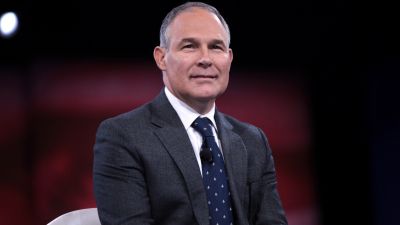
Scott Pruitt Will Make America Great Again — For Polluters
BY Bill Moyers | January 31, 2017
The board, which has been in existence for nearly 40 years, is traditionally populated by bona fide scientists from academia, government and industry who volunteer to serve three-year terms. This time around, as first reported by *E&E News, at least a dozen of the 132 candidates vying for one of the 15 open seats reject mainstream climate science. But that’s not all. There are at least 10 other equally inappropriate candidates on the list, and not all of them are scientists, despite the fact that it’s supposed to be a panel of *science advisers.
Among the 12 climate science deniers are Weather Channel co-founder Joseph D’Aleo, who wrongly claims global warming is due to natural oceanic, solar and volcanic cycles; and former Peabody Energy science director Craig Idso, now chairman of his family’s Center for the Study of Carbon Dioxide and Global Change, who insists “there is no compelling reason to believe that the rise in [average earth] temperature was caused by the rise in carbon dioxide.” D’Aleo, Idso and six of the other climate-fact-challenged candidates are affiliated with the fossil fuel industry-funded Heartland Institute, which has a long history of misrepresenting science.
The other 10 unsuitable candidates consistently side with industry when it comes to protecting the public from toxic hazards, regardless of the scientific evidence, and falsely accuse the EPA of being unscientific to try to undermine its credibility.
Soot Makes You Live Longer
One of the 10, toxicologist Michael Honeycutt, failed to secure a seat on the EPA’s seven-member Clean Air Scientific Advisory Committee when he was nominated for one last fall — with good reason. Over the last decade, Honeycutt, who heads the toxicology division of the Texas Commission on Environmental Quality, rolled back the state’s relatively weak protections for 45 toxic chemicals, including arsenic, benzene, formaldehyde and hexavalent chromium, the carcinogen that made Erin Brockovich a household name.
[
Who is Watching Out for the EPA?
BY BillMoyers.com Staff | June 27, 2017
Honeycutt also has attacked EPA rules for ground-level ozone (smog), which aggravates lung diseases, and particulate matter (PM) (soot), which has been linked to lung cancer, cardiovascular damage, reproductive problems and premature death. In October 2014, Honeycutt argued that there would be “little to no public health benefit from lowering the current [ozone] standard” because “most people spend more than 90 percent of their time indoors” and “systems such as air conditioning remove it from indoor air.” And despite the overwhelming scientific evidence directly linking fine soot particles to premature death, Honeycutt testified before Congress in June 2012 that “some studies even suggest PM makes you live longer.”
Better Living Through Chemistry
Another industry-friendly nominee, Kimberly White, is senior director of chemical products at the American Chemistry Council (ACC), the country’s largest chemical manufacturing trade association. Representing the interests of 155 corporate members, including chemical companies Dow, DuPont and Olin; pharmaceutical firms Bayer, Eli Lilly and Merck; and petrochemical conglomerates BP, ExxonMobil and Shell, the ACC has delayed, weakened and blocked science-based health, environmental and workplace protections at the state, national and even international levels.
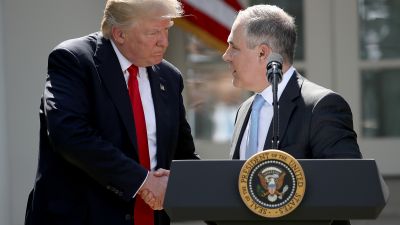
Trump EPA Dismisses the People in Charge of Scientific Integrity
BY Ben Adler | June 22, 2017
For example, the ACC has lobbied against establishing federal rules on silica dust exposure and disclosing the chemicals used in hydraulic fracturing. It has been instrumental in limiting community access to information about local chemical plants. And it has played a key role in quashing government efforts to regulate bisphenol A (BPA), an endocrine-disrupting chemical used in plastics and can linings; flame retardants, which have been linked to birth defects and cancer; and formaldehyde, a known carcinogen. White downplayed formaldehyde’s risks in a September 2016 blog on the ACC website.
The ACC also lobbies to weaken existing environmental safeguards. In written testimony for a House Science, Space and Technology Committee hearing last February, for example, White charged that the EPA uses irrelevant or outdated data and procedures when drafting new regulations.
Who Needs a Cleaner Environment?
Finally, three of the pro-polluter candidates are economists with a distinct corporate tilt: Richard Belzer, whose clients include the American Chemistry Council and ExxonMobil Biomedical Sciences; Tony Cox, whose clients include the America Petroleum Institute, Chemical Manufacturers Association and Monsanto; and John D. Graham, dean of Indiana University’s School of Public and Environmental Affairs, who is currently doing contract work for the Alliance of Automobile Manufacturers on fuel economy standards and the libertarian Searle Freedom Trust on regulatory “reform.” All three emphasize the cost to industry to reduce pollution, discount scientific evidence of the risk of exposure, and ignore the benefits of a cleaner environment.
Despite Threats to Kids’ Health, EPA Delays Rule on Pollutants](https://billmoyers.com/story/tweeting-epa-suggests-letting-oil-gas-companies-poison-kids-two-years/)
BY John Light | June 14, 2017
Perhaps the best known is Graham, who ran the Office of Management and Budget’s (OMB) Office of Information and Regulatory Affairs (OIRA) for five years during the George W. Bush administration. His appointment to that position was hotly contested because in his previous job, directing the Harvard Center for Risk Analysis, he routinely understated the dangers of products manufactured by the center’s corporate sponsors by using questionable cost-benefit analyses.
As predicted, Graham applied that same simplistic, industry-friendly calculus at OIRA, which oversees all government rulemaking, and at the tail end of his tenure in 2006, he unsuccessfully attempted to standardize risk assessments across all federal agencies. Public interest groups and the scientific community, spearheaded by the American Association for the Advancement of Science, came out in full force against the idea, and a National Research Council (NRC) committee unanimously rejected it as “fundamentally flawed.”
“Economists like Graham are frustrated because the EPA has been conservative about risk,” said Center for Progressive Reform co-founder Rena Steinzor, who wrote a stinging indictment of Graham’s government-wide proposal in a May 2006 issue of Inside EPA’s Risk Policy Report. “The EPA gives more margin to safety. That drives economists crazy. They think it leads to over-protection. But there are not many examples of chemicals that turn out to be less harmful than we thought.”
Foxes Advising the Foxes in the Henhouse?
Putting climate science deniers and industry apologists on the EPA Science Advisory Board (SAB) would not only undercut the panel’s legitimacy, it also would provide cover for the corporate shills now in key positions at the agency, starting with Administrator Scott Pruitt, who has the final say on who is selected, and Nancy Beck, a deputy assistant administrator who most recently worked for the American Chemistry Council, and before that, for Graham at OMB.
“The Science Advisory Board has been providing independent advice to the EPA for decades, ensuring that the agency uses the best science to protect public health and the environment,” said Genna Reed, a policy analyst at the Union of Concerned Scientists. “SAB members have always been eminent scientists who are committed to the often-challenging public service of working through complex scientific topics to help guide EPA decision-making. They are the EPA’s scientific compass. The agency’s mission to safeguard our air and water will be further compromised if Administrator Pruitt winds up selecting these unacceptable candidates.”
TOPICS: Environment
TAGS: advisory, air pollution, american chemistry council, climate change, climate change denial, environmental protection agency, scott pruitt
---
thos pyle aea open letter stinktanks:
April 23, 2018
The AEA, represented by Thomas Pyle, was among 22 groups signed on to an open letter asking President Trump to ignore recent criticism of EPA Administrator Scott Pruitt. [65]
In a speech to the U.S. Senate, a group of Democratic senators identified the organizations as front groups for the Koch Brothers and other wealthy donors, nicknamed the “Web of Deceit.” The senators outlined how, in addition to funding from the Koch network, many of the groups use untraceable “dark money” funneled through groups like Donors Capital Fund and Donors Trust to influence legislation, particularly with regards to climate and pollution.
Senator Whitehouse outlined it as “a web of deceit conceived and bankrolled by the Koch brothers and other self-interested billionaires to advocate for very selfish and unpatriotic policies.” Whitehouse added: “This web of deceit has infiltrated and populated the Trump administration, and it is swamping the interests of everyday Americans. [66]
The full list of pro-Pruitt signatories and their respective organizations is as follows:
- Saulius “Saul” Anuzius – 60 Plus Association
- Fred Birnbaum – Idaho Freedom Foundation
- L. Brent Bozell III– Media Research Center
- Amy Oliver Cooke – Independence Institute
- Wesley Denton – Conservative Partnership Institute
- Viv Forbes – The Carbon Sense Coalition
- Frank J Gaffney – Center for Security Policy
- Steve Goreham –Climate Science Coalition of America
- Phil Kerpen – American Commitment
- Andrew Langer – Institute for Liberty
- Lisa B. Nelson – American Legislative Exchange Council
- Rick Manning – Americans for Limited Government
- Jenny Beth Martin – Tea Party Patriots Citizens Fund
- William Perry Pendley – Mountain States Legal Foundation
- Thoma**s Pyle**– American Energy Alliance
- George Rasley – ConservativeHQ.com
- Sandy Rios – American Family Association
- Craig Richardson – Energy :{&:(style="box-sizing:border-box"):}: Environment Legal Institute
- Craig Rucker – Committee for a Constructive Tomorrow (**:{CFACT:(style="box-sizing:border-box"):}:)**
- Dr Jameson Taylor – Missisippi Center for Public Policy
- Kyle Wingfield – Georgia Public Policy Foundation
feb 2018
https://blog.ucsusa.org/elliott-negin/exxonmobils-climate-disinformation-campaign-is-still-alive-and-well/
In a recent blog post, ExxonMobil executive Suzanne McCarronreiterated her company’s claim that it fully accepts the reality of climate change and that it wants to do something about it....“I want to use this opportunity to be 100 percent clear about where we stand on climate change,” she wrote. “We believe the risk of climate change is real and we are committed to being part of the solution. So why is the company still a part of—in fact, a major part of—the problem?An exchange between Oklahoma Sen. James Inhofe and Environmental Protection Agency (EPA) Administrator Scott Pruitt during a recent is a case in point, providing a window into how ExxonMobil’s undue influence continues to block climate action.
During the January 30 hearing, which was held by the Senate Environment and Public Works (EPW) Committee, Sen. Cory Booker inadvertently provoked Inhofe by raising the issue of environmental justice.The New Jersey Democrat cited the threat climate change-induced flooding poses to three dozen Superfund sites in his state and asked Pruitt if he was “taking into account the environmental burdens disproportionately impacting communities of color, indigenous communities and low-income communities.”
Inhofe seized the opportunity to contradict Booker, claiming that minority and low-income communities are disproportionately harmed by environmental protections, specifically citing the Obama administration’s Clean Power Plan, which would have dramatically reduced carbon emissions from coal-fired power plants if Pruitt hadn’t repealed it.
Booker, Inhofe said, was implying that Pruitt was trying to “punish” vulnerable Americans. “I wanted to just remind you,” Inhofe told the committee, “that we had a guy I remember so well, Harry Alford. He was the president of the National Black Chamber of Commerce. He provided some of the most powerful testimony that I have ever heard when it comes to the effects of the Clean Power Plan and some of the other regulations … on black and Hispanic poverty, including job losses and increased energy costs.
“[Alford] was very emphatic as to who was paying the price on these,” the Oklahoma Republican continued, “and I think sometimes that the previous administration forgot that there are already people out there who are paying all they can pay just to try to eat and keep their house warm.”
ExxonMobil’s Echo Chamber
Inhofe’s source for his assertion? A discredited, ExxonMobil-funded study by an Exxon-funded advocacy group that was based on discredited studies by other ExxonMobil-funded organizations.
Inhofe rested his argument on previous congressional testimony by Harry Alford, president of the National Black Chamber of Commerce (NBCC), a shoestring, mom-and-pop operation that is unapologetic about taking fossil fuel industry money. “Of course we do and it is only natural,” Alford wrote on NBCC’s website. “The legacy of Blacks in this nation has been tied to the miraculous history of fossil fuel…. [F]ossil fuels have been our economic friend.”
One of NBCC’s closest economic friends is ExxonMobil, which has donated more than $1.14 million to the group since 2001.
What did the company get for that money?
In 2015, NBCC commissioned a report that claimed the Clean Power Plan would “inflict severe and disproportionate economic burdens on poor families, especially minorities.”
In fact, unchecked climate change would more than likely hurt those communities most, and investments in energy efficiency under the plan would ultimately lower electricity bills across the country.
How did NBCC arrive at its upside-down assessment? The Union of Concerned Scientists took a close look at the report and found it was based on several flawed fossil fuel industry-friendly studies. Two of those bogus studies were produced by ExxonMobil grantees: the Heritage Foundation, which received $340,000 from ExxonMobil between 2007 and 2013, and the U.S. Chamber of Commerce, which received $3 million between 2014 and 2016.
The Chamber study, which came out just days before the EPA released a draft of the Clean Power Plan, was debunked not only by the EPA, but also by *PolitiFact.com* and *The Washington Post*. Among its many faults, the Chamber study—which was co-sponsored by the American Petroleum Institute—wildly inflated the cost of the plan and failed to consider the benefits of cutting carbon emissions.
ExxonMobil Spreads its Money Around
But there’s more than just the fact that ExxonMobil financed deliberately flawed studies to try to derail the Clean Power Plan. The company also is a major supporter of a number of Senate EPW Committee members, including Inhofe, who are adamant climate science deniers.
Inhofe has deep ties to the oil and gas industry, which has donated $1.85 million to his campaign war chest over his long career in Congress, more than twice than any other industry.Three oil and gas companies are among the senator’s top 10 corporate contributors: Koch Industries, Devon Energy and …ExxonMobil.
Six of the other 10 Republicans on the EPW Committee also are on ExxonMobil’s donation list, including Wyoming Sen. John Barrasso, the current committee chairman. Roughly half of the $119,500 ExxonMobil contributed to the seven senators over the last decade went to Barrasso and Inhofe, the committee’s previous chairman.
Then there’s ExxonMobil’s link to Pruitt, Oklahoma’s attorney general before President Trump tapped him to run the EPA. From 2012 through 2013, he chaired the Republican Attorneys General Association (RAGA)and afterward served on the organization’s executive committee. From 2014 through 2016, ExxonMobil gave RAGA $160,000 in three annual installments.
Just a few weeks after the company made its 2016 donation of $50,000,Pruitt and then-RAGA Chairman Luther Strange, at the time Alabama’s attorney general, co-authored a National Review column attacking a coalition of state attorneys general investigating ExxonMobil and other fossil fuel companies for misleading investorsand the general public about climate change. Parroting ExxonMobil’s argument, Pruitt and Strange charged that the coalition was violating the company’s first amendment right to free speech.
“The debate” over climate change, they wrote “is far from settled. Scientists continue to disagree about the degree and extent of global warming and its connection to the actions of mankind. That debate should be encouraged — in classrooms, public forums, and the halls of Congress. It should not be silenced with threats of prosecution. Dissent is not a crime.”
Inhofe Upstaged
In this case, Inhofe’s counterfactual comment didn’t make it into the ensuing media coverage. Along with nearly everything else that was said during the two-and-a-half hour marathon, it was eclipsed by a bombshell dropped by Sen. Sheldon Whitehouse. The Rhode Island Democrat revealed that during a February 2016 radio interview, Pruitt said Trump would be “more abusive to the Constitution than Barack Obama, and that’s saying a lot.” Whitehouse read Pruitt’s remark aloud and asked him if he recalled making it.
“I don’t,” Pruitt responded, “and I don’t echo that today at all.”
“I guess not,” Whitehouse replied.
Not surprisingly, that embarrassing nugget was the story. There was no way that Inhofe’s rambling, ExxonMobil-sponsored falsehood could compete in the media with red meat like that. But overshadowed or not, Inhofe provided yet another incontrovertible piece of evidence that—despite ExxonMobil’s statements to the contrary—the company is still very much engaged behind the scenes in trying to stymie any government attempt to seriously address climate change.
Posted in: Climate Change, Energy, Science and Democracy, Scientific Integrity
Tags: disinformation
2012 indep inflection pt?
The Pruitt Emails: A Natural Gas Ventriloquism Act | NRDC
https://www.nrdc.org › experts › david-doniger › pruitt-emails-natural-gas...
2.
Career EPA Staff Objected to Trump Administration's Asbestos Plan
Attorneys and scientists with the U.S. Environmental Protection Agency (EPA) objected to the Trumpadministration's proposal of a "significant new use rule" (SNUR) for asbestos, according to internal agency emails obtained by the The New York Times.
Trump's former EPA boss Scott Pruitt quietly announced the proposal in June, framing the plan as an "important, unprecedented action on asbestos," a toxic construction material and known carcinogen that kills almost 15,000 U.S. citizens annually....
Scott Pruitt’s record reveals a long history of industry favoritism
As Oklahoma’s Attorney General, Pruitt has a history of slowing environmental regulation, cutting enforcement, and siding with industry.
NATASHA GEILING
JAN 18, 2017,
Oklahoma Attorney General Scott Pruitt gestures as he answers a question during a news conference in Oklahoma City. CREDIT: AP Photo/Sue Ogrocki, File
OKLAHOMA ATTORNEY GENERAL SCOTT PRUITT GESTURES AS HE ANSWERS A QUESTION DURING A NEWS CONFERENCE IN OKLAHOMA CITY. CREDIT: AP PHOTO/SUE OGROCKI, FILE
In 2005, former Oklahoma Attorney General Drew Edmondson (D) filed a lawsuit against 14 poultry firms?—?including Tyson Foods, the largest meat processing company in the world?—?arguing that they were not holding up their end of a 2003 agreement aimed at reducing pollution into Oklahoma’s northeastern Illinois River.
That lawsuit was brought to federal court in 2009, with both sides resting after 52 days of arguments. The trial ended in February of 2010?—?just months before Scott Pruitt, President-elect Donald Trump’s pick to head the Environmental Protection Agency (EPA), took over as Oklahoma Attorney General.
Despite Pruitt’s claims that states are best positioned to be the arbitrators of air and water protections, there has never been a decision on the Oklahoma poultry pollution lawsuit because Pruitt never took further action on the case, despite some clear evidence that the Illinois River suffered from agricultural-related pollution.
Trump to tap vocal EPA opponent to head the EPA]
Instead of pursuing a resolution in court, Pruitt sidestepped the lawsuit. Two years later, when presented with a chance to deepen Oklahoma’s 2003 phosphorous pollution requirements, Pruitt chose instead to conduct a three year-long study into the problem. As part of that study, Oklahoma agreed to suspend the deadline for compliance with its phosphorus pollution limits.
The final report, released in December of this year, found that the state of Oklahoma had based its 2003 limits off the best available science. Put another way, the state’s chief law enforcement officer stalled state anti-pollution efforts for three years, conducting a study to reaffirm what the state already knew?—?while water quality in the Illinois watershed continued to fall short of state standards.
“Regulation through litigation is wrong in my view,” Pruitt said in an interview with the Oklahoman newspaper in 2015, explaining why his office chose not to pursue the case further. “That was not a decision my office made. It was a case we inherited.”
But legal experts and environmental advocates say Pruitt’s decision not to follow through on the poultry pollution lawsuit is evidence of his deference to polluting industries at the expense of the environment?—?a consistent thread in his continued opposition to the agency he now wants to head.
“This isn’t about regulation by litigation, this is about law enforcement,” Valerie Baron, ?Equal Justice Works Law Fellow at Natural Resources Defense Council, told ThinkProgress. “Pruitt’s actions speak very loud and clear. This is really, at its heart, about enforcing the law. Pruitt was the state’s chief law enforcement officer and he showed that he would rather polluters dictate their own terms rather than hold them accountable.”
Stalling on enforcement
In 1993, Oklahoma began gathering data on water pollution?—?especially phosphorus, which is found in high amounts in chicken manure. That data was compiled into a report, released in 1996, which found that phosphorus and other nutrients in the Illinois River were feeding algal blooms and endangering Lake Tenkiller, a reservoir in Oklahoma fed by the Illinois River. In 2003, as a result of that study, Oklahoma and Arkansas agreed to work together to reduce nutrient pollution in the Illinois River watershed, setting a goal of reducing phosphorus pollution by 40 percent.
Two years later, however, Edmondson filed a lawsuit in federal court, arguing that several poultry firms were not doing enough to help stop nutrient pollution from entering into Oklahoma’s waterways. The lawsuit claimed that there were 2,363 chicken houses in the Illinois watershed, and that those chicken houses produced enough manure to equal the waste from 10.7 million people per year.
That waste was then being spread onto farmland in the watershed?—?and while chicken manure is a great fertilizer, if too much is spread onto a small area, the ground can become saturated with nutrients, meaning things like phosphorus and nitrogen can easily wash into waterways during precipitation events.
Trump’s EPA pick stood by while human-caused earthquakes spread across his state
The lawsuit stalled in federal court as Pruitt took office in 2010. But in 2012, just as the initial 2003 phosphorus reduction agreement was set to expire, Arkansas regulators issued a report questioning Oklahoma’s phosphorus standards. In response, Pruitt got Arkansas to agree to let a researcher at Baylor University study the phosphorus levels in the Illinois River watershed. That study, which concluded in December of this year, found that Oklahoma’s phosphorus standards had been based on the best available science. Based on the results of that study, it’s unlikely Oklahoma’s phosphorus limits will be weakened, a Pruitt spokesperson told E&E News.
Critics argue that Pruitt basically spent three years studying an issue that had already been resolved years before?—?effectively slowing down the rate of improvement in phosphorus pollution of the Illinois River. And while phosphorus levels in the Illinois River have declined in recent years, the bulk of that improvement happened before Pruitt even took office.
A friend of industry
Pruitt’s stated reason for not pursuing the poultry lawsuit further was his insistence that regulation should not be decided through litigation?—?an interesting line of reasoning from a man who has been party to more than a dozen lawsuits against the EPA aimed at rolling back pollution regulations. But as the Environmental Working Group points out in an investigation released January 14, Pruitt might have had more than philosophical reasons for quietly letting the lawsuit against major poultry firms languish in court: political donations.
According to the EWG report, executives of the poultry companies named in the 2005 lawsuit, as well as the companies’ lawyers, gave more than $40,000 to Pruitt’s campaign for Attorney General in 2010. Moreover, more than 90 percent of those contributions came from people living in Arkansas?—?an interesting phenomenon for a state-wide political race.
“Scott Pruitt has said that he chose not to pursue that case because he felt like it was regulation through litigation,” Kristen van de Biezenbos, an associate professor at the University of Oklahoma, told ThinkProgress. “I suspect that Scott Pruitt felt that it would set a bad precedent?—?he doesn’t want to be seen as someone that is anti-agriculture, which is the other big industry here in Oklahoma.”
Senators dig into Scott Pruitt’s fossil fuel connections before confirmation hearings begin
The poultry lawsuit is not the only example of litigation that mixes Pruitt’s role as Attorney General with donors to his political campaigns and political action committees (PACs). According to the New York Times, Pruitt filed 14 cases as Oklahoma Attorney General challenging federal environmental regulations; in 13 of those cases, co-parties on the lawsuit had contributed money either to Pruitt’s political campaigns or a Pruitt-affiliated PAC.
As president of the Republican Attorneys General Association (RAGA), Pruitt worked to increase donations from fossil fuel companies and organizations. Under his tenure, the American Petroleum Institute?—?the largest trade association for the oil and gas industry?—?as well as fossil fuel giants like ConocoPhillips, Alpha Natural Resources, and American Electric Power all joined the Republican Attorneys General Association.
With large donations coming in from fossil fuel companies and organizations, Pruitt helped found the Rule of Law Defense Fund, a spin-off of RAGA billed as a nonprofit “public policy organization for issues relevant to the nation’s Republican attorneys generals.” Because of its status as a nonprofit, it is not required to disclose the names of its donors?—?though it has received at least$175,000 from Freedom Partners, the super PAC founded by petrochemical billionaires Charles and David Koch.
Trump’s EPA pick forced to close his PACs?—?but the conflicts don’t end there
Pruitt’s work bringing in fossil fuel donations for both the Republican Attorneys General Association and the Rule of Law Defense Fund coincides with a number of complaints Pruitt sent to the EPA on behalf of the oil and gas industry.
Documents obtained by the New York Times during a 2014 investigation reveal the level of coordination between officials from major energy companies?—?like Devon Energy, the largest energy company in Oklahoma?—?and Pruitt’s office. In one instance, officials from Devon Energy appear to have drafted a letter that Pruitt then sent, on Oklahoma State Attorney General letterhead, along with his signature, to the EPA. The draft and the final letter sent by Pruitt are nearly indistinguishable.
In another instance, Devon Energy asked Pruitt to send a letter expressing his concern about the Interior Department’s plan to regulate methane from fracking operations on federal lands. Again, Pruitt sent a letter, on Oklahoma State Attorney General letterhead, that was a near replica of the letter drafted by Devon Energy.
Eric Lipton
?
@EricLiptonNYT
Jan 16, 2017
Replying to @EricLiptonNYT
Pruitt was a champion (for the oil industry) when it comes to trying to block endangered species listings too. (Usually after being asked) pic.twitter.com/vim5EoXbKy
Eric Lipton
?
@EricLiptonNYT
Devon Energy to Pruitt: Can you please intervene with Interior Secretary too to fight fed fracking rule. (Just insert your name here) Done. pic.twitter.com/vq092n7zaT
6:47 PM - Jan 16, 2017
At the time, the New York Times described Pruitt’s relationship with fossil fuel companies as an “unprecedented, secretive alliance,” created to “push back against the Obama regulatory agenda.”
“Scott Pruitt is notorious for being willing to act as a mouthpiece for the oil and gas industry of Oklahoma in resisting federal regulations,” van de Biezenbos said.
Cutting enforcement, boosting federalism
Before Pruitt became Oklahoma Attorney General in 2010, the Oklahoma Attorney General’s Office had an Environmental Protection Unit, which investigated environmental crimes like illegal dumping and contamination from refineries. In 2010, the budget for that office was $532,000?—?beginning in 2010, that budget fell sharply, declining to $97,000 in 2012 and $0 in 2015.
At the same time, Pruitt created something under the office of the solicitor general known as the Federalism Unit, aimed at handling challenges to federal regulations. In 2010, the budget for the office of the solicitor general was $0; by 2016, it had increased to $3.6 million.
NRDC’s Baron worries that Pruitt’s past dismantling of the state’s specialized environmental enforcement unit does not bode well for his concept of environmental enforcement as EPA administrator.
“It demonstrates a lack of understanding of the unique nature of environmental enforcement, and that is a dangerous perspective to have in the head of the EPA,” Baron said. “The unit that he dismantled was created, in part, to address the extremely technical nature of environmental enforcement, and he zeroed out that budget for environmental law and instead focused his attention on attacking EPA, the very agency that he now seeks to run.”
==
slash enforcement jobs epa
Associates from U.S. EPA Administrator Scott Pruitt's political days in Oklahoma have come to K Street.
Glenn Coffee and Crystal Coon began lobbying this week for QuikTrip Corp., a convenience store and gas station chain headquartered in Tulsa, Okla., on the renewable fuel standard, according to lobbying disclosure records released by the Senate.
Crystal Coon. Photo courtesy of LinkedIn.
Coffee served in the Oklahoma state Senate with Pruitt as well as in Oklahoma Republican Gov. Mary Fallin's administration, with Coffee serving as secretary of state and Pruitt as attorney general.
Coon served as chief of staff for Pruitt when he took office as attorney general. She has continued to work with Pruitt, consulting for his federal and state political committees.
Coffee too has been working with Pruitt. His law firm, Glenn Coffee & Associates, has done election law compliance work for Pruitt's state campaign.
The lobbying registration shows both are representing QuickTrip at Coffee's consulting firm, the Coffee Group. The convenience mart chain is both Coffee and Coon's first federal lobbying client, according to records.
"I plan to lobby on behalf of interests that I care about and that share a pro market, pro energy, pro environment vision," Coon said in a statement emailed to E&E News.
Glenn Coffee. Photo by Oklahoma Legislative Service Bureau, courtesy of Wikipedia.
QuikTrip has just gotten into the Washington lobbying game. Records show that the company also hired Steptoe & Johnson LLP in July last year and has spent $40,000 on lobbying so far.
As EPA chief, Pruitt has a big part to play in the renewable fuel standard. The agency administers the program, deciding how much ethanol is to be blended into gasoline.
QuikTrip has been in touch with the agency over its concerns with the RFS. It filed comments last month with Pruitt at EPA, attaching a letter sent earlier that said changing the program's so-called point of obligation would be "anti-consumer."
The Trump administration's actions on the RFS are being closely watched. A deal — supposedly engineered by Carl Icahn, the investor and adviser to President Trump — that would have shifted responsibility for renewable fuel mandates from refineries to fuel blenders fell apart earlier this week (*Greenwire*, March 8).
Twitter: @KevinBogardus Email: kbogardus@eenews.net
==
Security Guards 'Forcibly' Prevent Reporters From Attending EPA Hearing — And Shove One Out of The Building
An EPA spokesman claimed the room had reached capacity.
By Elizabeth Preza / AlterNet May 22, 2018, 7:02 AM GMT
The Environmental Protection Agency “forcibly” blocked reporters form attending a Tuesday summit with EPA Administrator Scott Pruitt, at one point grabbing a “reporter by the shoulders” and shoving her out of the building.
As the Associated Press reports, the EPA blocked news organizations including the AP and CNN from attending the heading on contaminated drinking water.
“Guards barred an AP reporter from passing through a security checkpoint inside the building,” the AP reports. “When the reporter asked to speak to an EPA public-affairs person, the security guards grabbed the reporter by the shoulders and shoved her forcibly out of the EPA building.”
In a statement, EPA spokesperson Jahan Wilcox said the reporters weren’t invited because there wasn’t enough space.
“This was simply an issue of the room reaching capacity, which reporters were aware of prior to the event,” he said. "We were able to accommodate 10 reporters, provided a livestream for those we could not accommodate and were unaware of the individual situation that has been reported
==
omg
newsweek
http://www.newsweek.com/under-trump-epa-more-about-politics-science-659578
A former Trump campaign aide is now vetting hundreds of millions of dollars in grant money the EPA gives out to worthy environmental science and projects each year. It could mean that thousands of science projects are in jeopardy under the Trump administration.
John Konkus—a public relations expert who chaired Trump’s 2016 campaign in Florida’s Leon County—has told agency staff he’s scrubbing climate change “the double C-word” from projects the EPA funds, according to The Washington Post.
In late August the energy and environment website E&E News revealed a directive from EPA Administrator Scott Pruitt instructing all grants to be routed to Konkus. If Konkus “has any concerns, comments, or questions on the solicitation,” it reads, he will intervene in the grant process.
Konkus’ title at the agency is deputy associate administrator for public affairs, placing him in the EPA’s communications department. From 2013 to December 2016 he served as executive vice president at the political consultancy Jamestown Associates. Konkus joined the EPA in early February after acting as Pruitt’s “sherpa” during his confirmation hearings.
President Donald Trump, Pruitt has questioned the very existence of climate change and whether it is man made. President Donald Trump outlined his plan to cut $2.4 billion from the EPA’s budget in 2018 last March. About half of the agency’s annual $8 billion budget goes to grants.
Konkus is now making decisions about which scientific projects are worthy of funding. So far he has cancelled nearly $2 million for university and nonprofit organization projects.
An EPA spokeswoman pointed out to The Post that the figure represents just 1 percent of grants that have been given since Pruitt took office.
Read more: Are government agencies taking their lead from Trump and going after journalists?
The new policy is a break with tradition and shows a politicization of the grant process. Public relations are not usually involved in funding decisions.
Yet Konkus is not the only political appointee at the agency. Pruitt is staffing the upper ranks of the agency, which regulates America’s energy and oil and gas industry, with climate change deniers.
At the end of August former secretary of the Wisconsin Department of Natural Resources (DNR) Cathy Stepp was appointed to head one of the EPA’s regional offices. “Her qualifications?” a release from the Natural Resources Defense Council (NRDC) asked, “Stepp doubts human activity is the primary cause of climate change.”
While Stepp was serving in Wisconsin the EPA had to step in twice to spur her to deal with issues such as manure-contaminated drinking water. She also told her department to remove information from their website talking about how carbon emissions impact climate change. Fines for violating environmental rules shrank during the six-years Stepp headed Wisconsin’s DNR.
Over the weekend the EPA took a page from President Trump’s playbook and began attacking journalists from the Associated Press who reported that the EPA had not yet visited toxic dumps in and around Houston, Texas, after Hurricane Harvey made landfall August 25.
A majority of the sites, AP reporters found, were accessible by foot or vehicle. The EPA accused the newswire of ‘fake news.’
Since Trump’s inauguration the EPA’s news releases have taken a decidedly pro-energy industry turn, New Yorker magazine fact checker Talia Lavin pointed out in a series of tweets Saturday. The press releases, Lavin said, show an EPA “that has near utterly abdicated its duty to regulate” that industry.
In calling the AP’s reporting false and targeting Biesecker, the agency “is engaging in political smearing of the press and critics,” she said.
In late August a group of Democratic Senators accused Pruitt in a letter of taking “deliberate steps to thwart transparency” at the agency, including forbidding “staff from taking notes during meetings, so that they do not create records of your questions or directions.”
When questions about Konkus’ qualifications to evaluate scientific and other environmental projects applying for grants were put to the EPA by E&E News, a spokesperson said, the “grants are being reviewed to ensure they adhere to the Trump administration's goals and policies and the EPA's back-to-basics agend
==
https://www.ecowatch.com/epa-energy-sector-2501855523.html
Pruitt, Zinke and Perry Target Clean Air and Water Rules to Curb 'Burdens' on Energy Sector
At a speech in North Dakota last month, President Trump boasted that his administration is refocusing the U.S. Environmental Protection Agency (EPA) to its "core mission: clean air and clean water."
"That's what I want—clean air," he continued. "Think of it. We talk about the—I want beautiful clean air, and I want crystal-clean water, right? That's what we want."
That statement—based on Trump's nine months of environmental rollbacks, from approving the Dakota Accessand Keystone pipelines to gutting the Clean Power Plan—could not be further from the truth.
In a shocking report from Reuters, EPA Administrator Scott Pruitt, Energy Sec. Rick Perry and Interior Sec. Ryan Zinke have each announced separate steps on how they will carry out President Trump's "energy independence" executive order in March to ease regulatory burdens on energy development.
One of the most environmentally consequential steps comes from Pruitt's EPA, which will try to pinpoint how the Clean Air Act and Clean Water Act affects energy sectors jobs. (Earth to Mr. President: these landmark laws are designed to give us "clean air" and "crystal-clean water.")
"We are working to curb unnecessary and duplicative regulatory burdens that do not serve the American people," Pruitt said in a statement.
Here are the other steps that Trump's agencies will be taking to boost the energy sector, as detailed by Reuters:
"The EPA will also create a task force to simplify the permit process for building new polluting facilities, weigh options to revamp national ambient air quality standards and launch a "smart sectors" program to engage with industries as it crafts regulations.
The Energy Department said it will focus on streamlining natural gas exports, review its national laboratory policies, review National Environmental Policy Act (NEPA) regulations for approving major infrastructure projects and reviewing the agency's popular household appliance standards program.
The Interior Department submitted what it called an 'energy burdens' report to the president, which outlines some Obama-era regulations it has started to reverse or reform, or has plans to.
This includes lifting the moratorium on coal leases on federal land, reviewing regulations on fracking on federal and tribal land, developing a five-year plan for offshore drilling and streamlining the federal leasing program and permitting process."
While the administration claims that boosting jobs and the economy are the end goal, a new feature in TIMEquestions if Pruitt's actions—and Trump's by extension—are serving industry interests instead:
"Since [Pruitt] took office, more than a dozen EPA regulations have been killed or put under review, from fuel-efficiency standards to regulations on the disposal of coal ash to restrictions on toxic metals like arsenic in waterways," the magazine noted. "Moreover, the Trump Administration has proposed slashing funding for the agency's law-enforcement branch, which identifies polluters under existing regulations.
"All this has aided businesses, propping up the declining coal industry, ensuring profit margins for chemical makers and reducing compliance costs for farmers. But the change has also weakened an agency designed to save lives.
"'They're trying to deconstruct and dismantle the basic protections,' says Mustafa Ali, a career EPA official who resigned in March after 24 years. 'They're creating situations where more folks are going to get sick, some folks are going to die, more folks are going to be put in harm's way.'"
==
https://insideclimatenews.org/news/24102017/trump-pruitt-epa-press-office-attacked-reporter-lipton-ap-harvey
As The New York Times readied a story on the Environmental Protection Agency for last weekend's front page, an agency spokeswoman ignored the reporter's questions and accused him of writing "elitist clickbait."
The jab, in an email that the newspaper quoted in its story, was just the latest in a series of attempts by the agency's press office to thwart reporters or attack their work—a strategy it appears to have adopted from Donald Trump's White House.
The approach is a "sharp departure" from past practice, said Dan Fiorino, who worked for the agency for more than 30 years and is now director of the Center for Environmental Policy at American University.
"It's trying to manipulate journalists and favor those who say the right things," Fiorino said. "Now, what we're seeing from EPA is pretty much what we're seeing from the administration. The press people are there to sell a very particular point of view. They'll limit access."
Regardless of whether the president was a Republican or a Democrat, or whether his regulatory agenda was friendly to environmentalists or to business interests, the agency's press office generally tried to appear neutral.
When the EPA was still relatively young, its administrator—William Ruckelshaus, who was on a mission to rescue the agency from its own missteps—issued what's become known as the "fishbowl memo."
The 1983 Reagan-era memo said the agency, long in the crosshairs of conservatives and regulated industries, would operate with as much transparency as it could to steer clear of controversy: "EPA will not accord privileged status to any special interest group, nor will it accept any recommendation without careful examination."
At the frontline of that effort was the agency's press office. But today, former employees say, that press office handles an agency that's less like a fishbowl than a dark-windowed SUV.
Attempts to Stem Information Flow
The agency's brass-knuckle style comes at a time when it is under intense scrutiny for changing environmental and climate regulations in ways that favor coal and other fossil fuels. Among other things, it is swamped with demands for access to internal communications and other records.
From its first days in office, the Trump administration has tried to stem the flow of information from the agency to the public. The blockades began right away in January, with reports that EPA employees were being told to stop talking to the press. Reporters have been barred from events, and the agency has attacked journalists through press releases, while at the same time using press releases to promote its administrator.
"If you care at all about how the public views your work, you would try to communicate with the reporters, who are largely in charge of disseminating the information," said Monica Lee, a former spokesperson during the Obama administration. "Instead, this press office relies on [EPA Administrator Scott] Pruitt's comments, made to a very specific audience or to very friendly reporters."
This press office's efforts accompany a broader attempt at tamping down the work of climate scientists at the agency and stripping mentions of their work and of climate change from EPA websites. Earlier this year, the agency dismissed members of its Board of Science Counselors, and last week Pruitt said he would issue a directive to bar scientists who received EPA grants from serving on EPA advisory boards because he believed the grants represent conflicts of interest.
Personal Attacks on Reporters
The latest in a string of controversies came this weekend when The Times ran afront-page story chronicling efforts by a top-level EPA appointee to downplay the risks of toxic chemicals. Before taking the job in May, the appointee, Nancy Beck, had been an executive for five years at the American Chemistry Council,which provides policy, communications and research for major chemical companies, including Arkema, DuPont and Monsanto.
Times reporter Eric Lipton asked the EPA and Beck for responses to a list of questions.EPA spokeswoman Liz Bowman—who also worked at the American Chemistry Council, as director of issue and advocacy communications, before joining Pruitt's EPA—replied in an email: "No matter how much information we give you, you would never write a fair piece. The only thing inappropriate and biased is your continued fixation on writing elitist clickbait trying to attack qualified professionals committed to serving their country."
The response has shocked former press officers.
"Blatantly attacking reporters and giving responses that are incredibly critical personally—it may help your base and it may fire them up, but it in no way serves the broader American people," said Liz Purchia, who ran the press office under Obama.
A month earlier, the agency tore into an Associated Press reporter, Michael Biesecker, for a story he and a colleague wrote about Superfund sites being under water in Texas after Hurricane Harvey. Biesecker, the agency said in an official press release, "has a history of not letting the facts get in the way of his story." The story, written by reporters who visited the sites after the hurricane, was correct, and the EPA later acknowledged damage there.
The press office under Obama hewed to standards outlined in its scientific integrity policy, which refers to the "fishbowl memo," which has essentially guided conduct since its release 34 years ago.
"That is the ethos," Fiorini said.
What's Required by Law?
By law, the EPA is required to have an Office of Public Affairs, which is "responsible for providing newsworthy information to the various communications media." Beyond that, an administration can release information how it wants, although it has to respond to requests for information by Congress or under the Freedom of Information Act.
"I'm not aware of any legal issues," Fiorino said, referring to the current press office. "But certainly, ethically and in terms of what you'd expect in a democracy, there are some real problems. This is a real sharp departure from what we've seen in the past."
The Obama administration's EPA press office got a rap on the knuckles from the Government Accountability Office in 2015 for a social media campaign to drum up support for a Clean Water Act rule. It was accused of violating propaganda and anti-lobbying rules.
"Historically, the press office at EPA, the public information people, get the information out there, and to some degree you want to put the administration, the people making decisions, in a good light," Fiorino said. "This administration is trying to create reality in a way that fits its view. That's really scary."
The EPA did not respond to questions for this story.
PUBLISHED UNDER:
==
secret ~ transparency
https://www.ecowatch.com/epa-pruitt-bodyguards-2500198933.html
2mil$ sec team; sched secert
Report: EPA Hires 12 More Bodyguards for Pruitt, Costing $2M Annually for Full Security Team
The U.S. Environmental Protection Agency (EPA) Administrator Scott Pruitt has been noted for taking unusual steps to operate with extreme caution at the job—including the installation of a $25,000 soundproof communications booth and contravening a bi-partisan EPA transparency practice of keeping his schedule secret.
Now, CNN reports, the EPA is expanding Pruitt's security detail with an additional 12 agents, meaning his total security fleet stands at 30 bodyguards. This will cost the department $2 million a year in salaries alone and does not include training, equipment or travel.
Meanwhile, President Trump's budget blueprint would cut the EPA's funds by more than 30 percent.
Before the new hires, Pruitt's security detail had already demanded "triple the manpower of his predecessors" and is forcing "officials to rotate in special agents from around the country who otherwise would be investigating environmental crimes," the Washington Post reported last month.
No other administrator has needed 24/7 security but Pruitt has reportedly received more death threats than any other EPA chief. The inspector general said the office has launched investigations into more than 70 such threats.
"We have at least four times—four to five times the number of threats against Mr. Pruitt than we had against Ms. McCarthy," said assistant inspector general Patrick Sullivan, referring to President Obama's EPA administrator, Gina McCarthy.
"The EPA is a lightning rod. We get threats from both sides of the spectrum," Sullivan told CNN. "Some people believe the EPA is not doing enough to enforce environmental laws, and they're upset about that. Other people think the EPA is doing too much, vis-à-vis enforcing environmental laws and they're upset about that."
However, eyebrows are raising over Pruitt's questionable use of taxpayer money. In August, the inspector general launched a "preliminary investigation" into Pruitt's frequent trips back to his home state of Oklahoma "at taxpayer expense" following congressional requests. Airfare for these trips reportedly cost more than $12,000.
https://www.ecowatch.com/pruitt-epa-lawsuits-2497715655.html
Pruitt Wants to Make the EPA Less Accountable to the Public
When the U.S. Environmental Protection Agency (EPA) breaks the law by missing deadlines, allowing polluters to violate regulations that protect our health and environment, one way the public holds it accountable is by taking the agency to court. Scott Pruitt and his corporate polluter allies see this as a problem, so Monday, the administrator moved to curtail the agency's practice of settling lawsuits with outside groups, making it easier to skirt the law.
"Pruitt's doing nothing more than posturing about a nonexistent problem and political fiction," John Walke, director of the Natural Resources Defense Council's Climate and Clean Air program said in reaction. "His targeting of legal settlements, especially where EPA has no defense to breaking the law, will just allow violations to persist, along with harms to Americans."
Over the years, the EPA has settled with numerous entities that have sued—industry groups, states and environmental organizations—but Pruitt's objection seems to focus solely on those who want to protect the nation's air, water and land. This new pro-polluter directive will serve only to prolong violations, delay protections and waste government resources fighting lawsuits against which the EPA has no defense.
"The irony is that polluters don't even have to sue Pruitt to get what they want. They just pick up the phone and ask," Walke said. "Make no mistake, the unspoken Trump EPA agenda is to allow more corporations to ignore the law and prolong EPA breaking the law; both will lead to dirtier air, dirtier water, and sicker people."
==
https://www.ecowatch.com/epa-clean-power-plan-2492833765.html
==
https://www.ecowatch.com/pruitt-doj-funding-2490534277.html
Pruitt Threatens to Cut Funds for DOJ Environmental Litigation, Spends $58K on Taxpayer-Funded Flights
U.S. Environmental Protection Agency (EPA) Administrator Scott Pruitt—who made a career out of suing the agency he now heads over clean air, water and climate safeguards—is trying to stop the enforcement of existing pollution-control laws by cutting off major funding for the Department of Justice's Environment and Natural Resources Division (ENRD), the New York Times reported.
According to the Times:[?]
[ENRD] lawyers handle litigation on behalf of the E.P.A.'sSuperfund programseeking to force polluters to pay for cleaning up sites they left contaminated with hazardous waste. The E.P.A. reimburses the Justice Department for that work, paying more than $20 million annually in recent years, or enough for 115 full-time employees, budget documents show.
But Mr. Pruitt has signaled that he wants to end those payments, potentially carving a major hole in the division's budget, in a little-noticed line in the E.P.A.'s budget proposal in the spring.
Notably, Pruitt said that cleaning Superfund sites was a priority. He said in July, "There is nothing more core to the Agency's mission than revitalizing contaminated land."
Since taking the job, Pruitt has made several moves to suspend environmental regulations, including protections against toxic wastewater, oil and gas pollution as well as climate pollution. The conservative Republican has close ties to the fossil fuel industry and infamously denies that carbon dioxide is a "primary contributor" to climate change.
Meanwhile, the Washington Post reported another instance of the EPA boss using taxpayer money for his own interests—he spent $58,219.19 on four military and private flights between February and August.
The most expensive was a $36,069 trip on June 7. Pruitt and several staff members traveled from Andrews Air Force Base to Cincinnati to join President Trump, the Post reported, citing congressional oversight committee records.
"When the administrator travels, he takes commercial flights," EPA spokeswoman Liz Bowman told the paper, adding that the administrator is the face of the agency and has an obligation to get around the country.
The EPA inspector general is already investigating the former Oklahoma Attorney General's frequent trips back to his home state amid speculation that Pruitt is really focused on a future run for Oklahoma senator or governor. Records show that the administrator's airfare for these trips cost more than $12,000, with most of that covering travel to and from Oklahoma.
Earlier this week, the Post reported that the EPA spent nearly $25,000 to construct a soundproof communications booth in the administrator's office.
Additionally, Pruitt has enlisted an 18-member security detail, costing the EPA $832,735.40 in the first quarter of 2017, records published by E&E News show.
==
https://www.ecowatch.com/pruitt-guts-clean-power-plan-2491015206.html
Pruitt Guts the Clean Power Plan: How Weak Will the New EPA Proposal Be?
By Rachel Cleetus
News articles indicate that the U.S. Environmental Protection Agency (EPA) is soon going to release a "revised" Clean Power Plan (CPP). It is very likely to be significantly weaker than the original CPP, which offered one of the country's best hopes for reducing carbon emissions that cause global warming.
EPA Administrator Scott Pruitt and President Trump have made no secret about their intent to stop and reverse progress on addressing climate change, so there's every reason to expect that the revised CPP will be fatally flawed and compromised.
Here's how we'll be evaluating it.
How We Got Here
In August 2015, the EPA issued final standards to limit carbon emissions from new and existing power plants, a historic first-ever step to limit these emissions. Those standards, developed under the Clean Air Act, came about as a result of a landmark 2007 Supreme Court ruling and subsequent Endangerment finding from the EPA.
The final CPP for existing power plants was projected to drive emissions down 32 percent below 2005 levels by 2030, while providing an estimated $26 billion to $45 billion in net benefits in 2030.
In March 2017, President Trump issued an executive order blocking the Clean Power Plan. He claimed to do so to promote "energy independence and economic growth," (despite the fact that the U.S. transition to cleaner energy continues to bring significant health and economic benefits nationwide). The EPA then embarked on a process of implementing the EO, including initiating a review of the CPP.
The U.S. Court of Appeals for the DC Circuit has granted two stays in court challenges related to the CPP, the most recent of which was issued on Aug. 8 for a 60-day period. These stays were specifically to give the EPA time to review the rule; this in no way changes the agency's "affirmative statutory obligation to regulate greenhouse gases."
The EPA is currently expected to issue a revised CPP by Oct. 7, aiming to head off litigation on this issue. Of course, if the plan they issue is a weak one, as it is likely to be the case, there is no question that court challenges will continue.
EPA's most recent status update filed with the DC Circuit confirms that the agency has sent a draft rule to the Office of Management and Budget, and Administrator Pruitt expects to sign the proposed rule in fall 2017. This will begin a comment period on the new draft rule before it can be finalized.
Five Metrics for Assessing the Revised Clean Power Plan Proposal
While we don't yet know exactly how the proposed rule will look, there are some key things we'll be watching for:
1. Will the revised plan cut power sector carbon emissions at least as much as the original CPP?
Not likely. Reports indicate that reductions might be limited to what can be achieved through measures at individual power plants, such as efficiency improvements. (Power plant efficiency improvements, known as 'heat rate improvements,' reduce the energy content of the fossil fuel consumed per unit of electricity generated at power plants).
The associated carbon reductions are going to be relatively small compared to what could be achieved through a power sector-wide approach—including bringing on line cleaner generation resources, increasing demand-side energy efficiency and allowing market-based trading—as was adopted in the original Clean Power Plan. For the final CPP, the EPA estimated that on average nationally a fleet-wide heat rate improvement of approximately 4 percent was feasible, which would result in a fleet-wide CO2 reduction of about 62 million tons in a year. (For context, U.S. power sector CO2 emissions in 2016 were 1,821 million metric tons).
2. Will it promote renewable energy while heading off an over reliance on natural gas?
An approach that's limited to carbon reductions at current fossil-fired power plants will miss one of the biggest opportunities to lower power sector emissions: ramp up cheap renewable energy!
The original CPP explicitly called out a role for renewable energy in helping to cost-effectively bring down carbon emissions. UCS analysis shows how boosting renewable energy can help cut emissions affordably while bringing consumer and health benefits. Simply switching from coal to gas, while it does lower carbon emissions at the power plant, is just not going to be enough to achieve the deep cuts in power sector emissions we ultimately need from a climate perspective. Boosting the contribution from renewable energy can help limit the climate, economic and health risks of an overreliance on natural gas.
3. Will it lowball the harms posed by climate change?
Administrator Pruitt seems to understand that legally the EPA is required to regulate carbon emissions and he cannot simply do away with the CPP without replacing it. But will the new plan actually recognize the magnitude of the damages that climate change poses?
Earlier this year, President Trump also issued an executive order undercutting the use of the social cost of carbon (SCC), which measures the costs of climate change (and the benefits of cutting carbon emissions). The SCC served as a proxy for measuring the dollar benefits of carbon reductions from the original CPP. If the re-proposed CPP uses an artificially low SCC, that would fly in the face of the latest science and economics.
4. Will it actually help coal miners get their jobs back?
Not very likely, a fact that even coal company executive Robert Murray and Sen. Mitch McConnell have admitted. Market trends are continuing to drive a historic transition away from coal-fired power that is unlikely to change just by getting rid of the CPP.
If the Trump administration and Congress are serious about helping coal miners and coal mining communities, they should invest in real solutions—worker training, economic diversification and other types of targeted resources—to help these communities thrive in a clean energy economy, as my colleague Jeremy Richardson wrote.
5. Will it increase pollution?
If the revised proposal attempts to maintain or increase the amount of coal-fired power, that will lead to more air, water and toxic pollution.
In addition to being a major source of carbon emissions, coal-fired power plants are a leading source of emissions of nitrogen oxides, sulfur dioxide, particulate matter, and mercury, among other types of harmful pollution. These pollutants cause or exacerbate heart and lung diseases and can even lead to death. Mercury can affect the neurological development of babies in utero and young children. The Clean Power Plan would have delivered significant health benefits through reductions in these co-pollutants.
Clean Energy Momentum Will Continue
Despite Administrator Pruitt's attempts to undermine the CPP, clean energy momentum will continue nationwide. The facts on the ground are rapidly changing. Market trends continue to drive down coal-fired power because coal is an increasingly uncompetitive option compared to cleaner options like natural gas and renewable energy.
That's why Xcel CEO Benjamin Fawke recently said "I'm not going to build new coal plants in today's environment." And "We're investing big in wind because of the tremendous economic value it brings to our customers."
It's why Appalachian Power's Chris Beam also said,
At the end of the day, West Virginia may not require us to be clean, but our customers are (…) So if we want to bring in those jobs, and those are good jobs, those are good-paying jobs that support our universities because they hire our engineers, they have requirements now, and we have to be mindful of what our customers want. We're not going to build any more coal plants. That's not going to happen.
The pace of growth in renewable energy growth is particularly striking, with new wind and solar installations outstripping that of any other source of power including natural gas.
And as my colleague Julie McNamara recently pointed out, energy efficiency is one of the top electricity resources in the U.S., and in fact was the third-largest electricity resource in the U.S. in 2015.
That's why more and more states, cities and businesses are doubling down on their commitment to renewable energy and the goals of the Paris climate agreement, saying "We're Still In!"
For all of you who care deeply about our nation's transition to clean energy, please ask your state legislators to push for more renewable energy even as the Trump administration tries to turn back progress.
We Still Need Robust Federal Policies
Despite the promising market trends, there's no denying we need robust federal policies to accelerate the current clean energy momentum and cut U.S. carbon emissions faster and deeper to meet climate goals.
The reality is that the original CPP itself was not strong enough, though it was a pivotal step in the right direction. The U.S. will need to do more, both in the power sector and economy-wide to cut emissions in line with the goals of the Paris agreement.
A weakened CPP would be a sad step back in our efforts to address global warming. At a time when the risks of climate change are abundantly clear—just consider this years' terrible hurricane and wildfire seasons—this is no time to delay action.
Administrator Pruitt: Do Your Job
Mr. Pruitt continues to show a blatant disregard for the mission of the agency he heads, while pandering to fossil fuel and other industry interests. Weakening the power plant carbon standards is just the latest in a long string of actions he has taken to undermine public health safeguards that were developed in accordance with laws Congress has passed.
Furthermore, he has repeatedly attacked the role of science in informing public policy. Perhaps most egregiously, he continues to deny the facts on climate change. (If he is genuinely interested in understanding the latest science, he need look no further than the U.S. National Academy of Sciences).
Administrator Pruitt, stop hurting our children's health and future. Do your job—and start by setting strong carbon standards for power plants.
Rachel Cleetus is the lead economist and climate policy manager at the Union of Concerned Scientists.
==
Pruitt's Sketchy Use of Taxpayer Money Now Includes Expensive Soundproof Booth
The U.S. Environmental Protection Agency (EPA) will spend nearly $25,000 to install a soundproof communications booth for Administrator Scott Pruitt inside his office, the Washington Post reported Tuesday.
According to a salesman at the company the EPA contracted, the agency's request ran far over the cost for a standard model because of several special "modifications" to further prevent data breaches and eavesdropping.
The Post reported that the agency already has a secure booth installed elsewhere in the building, and no other EPA administrator has taken the step to have a private booth installed. It's not just Pruitt's phone and computer time racking up the bills: CBS News reported Pruitt ran up thousands of dollars in taxpayer-funded travel by skipping commercial airline options to take private and military flights twice this summer.
"Critics say Mr. Pruitt has gone to unusual lengths to operate in secrecy at the EPA, where employees report he is often accompanied by armed guards even inside the agency, and avoids making important calls in his office," the New York Times noted.
As reported by the Post:
"Pruitt also has shied away from using email at EPA, often preferring to deliver instructions verbally and hold face-to-face meetings. The shift stems in part from public disclosure by the New York Times in 2014—following an open-records request of emails—of how Pruitt and other attorneys general had worked closely with the oil and gas industry to oppose Obama administration environmental safeguards ...
Pruitt, who has become a polarizing and high-profile figure as he seeks to roll back Obama-era policies and shrink the EPA's footprint, has essentially tripled the personal security detail that served past administrators. The detail now includes about 18 people to cover round-the-clock needs and his frequent travel schedule. Such 24/7 coverage has prompted officials to rotate in special agents from around the country who otherwise would be investigating environmental crimes."
For a deeper dive:
Booth: Washington Post, New York Times, The Hill. Flights: CBS
==
The skeptics who could snag science adviser slots
Scott Waldman, E&E News reporter
Climatewire: Thursday, September 14, 2017
Climate skeptics may soon join a key science advisory panel at U.S. EPA.
A number of people who reject the findings of mainstream climate science are being considered by the Trump administration for spots on EPA's Science Advisory Board, a voluntary but influential panel that reviews science used in environmental regulations.
At least one nominee hopes to use a position on the board to challenge the science undergirding many environmental regulations. One has said in a statement that the world must "abandon this suicidal Global Warming crusade." Another compared people concerned about climate change to "Aztecs who believed they could make rain by cutting out beating hearts."
EPA has submitted 132 names for public comment as possible members of the panel. About a dozen of them have made comments rejecting mainstream climate science. Many have connections to the fossil fuel industry or conservative think tanks, and some have received funding to attack the findings of mainstream scientists that humans are warming the globe at an unprecedented pace through the burning of fossil fuels.
The selection of any of those researchers would be the beginning of a very different advisory board that would bear the hallmark of the Trump administration's position on climate change, said Steve Milloy, an attorney and longtime EPA foe who worked on President Trump's transition team for the agency.
"Had some other Republican won the presidency and a swamp creature taken over the EPA, this would not be happening," he said, "but thank God for Scott Pruitt that he's got the courage to do this."
The Heartland Institute — a Chicago-based free-market think tank that pushes alternative climate science — nominated many of the current prospects.
Heartland Institute spokesman Jim Lakely said in an email: "We applaud any effort by Administrator Pruitt to bring qualified non-alarmist scientists onto the EPA's advisory boards. There is a vigorous debate over the causes and consequences of climate change, and it's vital that EPA acknowledge that fact and have a more balanced approach to the agency's rule-making."
The long list of nominees — identified by EPA staff members who oversee the advisory board — also includes mainstream climate scientists who have extensive experience working with the United Nations and EPA on climate change. Former top Obama EPA science official Paul Anastas made the list.
The deadline for public comment is set to expire Sept. 28. After that, EPA boss Pruitt will have final approval on the candidates. The board has 48 member slots, 15 of which expire at the end of the month. It's not clear how many positions will be filled.
The SAB, created in 1978, is tasked with "independent advice and peer review on the scientific and technical aspects of environmental issues to the EPA's Administrator." An EPA spokesman has said the agency wants industry to have a greater role than it has had previously in evaluating the science used by EPA to craft regulations.
Traditionally, most of the SAB members are from academia, though some have also come from industry and environmental groups.
The SAB is essential to the functioning of EPA because it is chartered by law to ensure the agency is using the best available science for regulations, said Peter Thorne, the board's current chairman and director of the Environmental Health Sciences Research Center at the University of Iowa. He said the SAB has a wide range of tasks that touch on almost every aspect of EPA's functioning. He said it's not just EPA that draws on its work — it's also state governments, nongovernmental organizations and private companies.
"The EPA Science Advisory Board needs to have people who are well-versed in the science that underlies the decisions that EPA makes, so if there are people who end up on the board who have views that are not grounded in solid science, then that is a problem," Thorne said.
Pruitt's prospects
Here are some of the skeptical nominees under consideration:
Joseph D'Aleo, a certified consultant meteorologist and co-founder of the Weather Channel: He has run climate skeptic websites and has appeared as a speaker at Heartland conferences. D'Aleo said his priority on the board would be attacking the endangerment finding, the legally binding document that holds that carbon dioxide and other greenhouse gases harm human health and must be regulated by the executive branch. He said he wants to challenge the finding because it could otherwise be used later to build back Obama-era environmental regulations.
Edwin Berry. edberry.com
"We're going to push for reconsideration, start from scratch and put together the best science," he said. "If CO2 is not a serious pollutant, let's focus the attention of the EPA on other issues."
Edwin Berry, a meteorologist and atmospheric scientist: He has funded his own climate research and says human carbon dioxide emissions do not cause climate change. He has compared those who believe in human-caused climate change to "Aztecs who believed they could make rain by cutting out beating hearts and rolling decapitated heads down temple steps." On his Twitter account, he has called Islam "a death cult" and has encouraged motorists to drive into protesters.
Berry, in an email to E&E News today, described his tweet as a joke and said he does not advocate violence.
"Clearly, my tween says to slowly drive to not hurt anyone," Berry said in the email, misspelling "tweet."
brn
Kevin Dayaratna. Heritage Foundation
Berry, who confirmed that he and a number of other skeptics were nominated by Heartland, said he wants to use his position on the board to show that humans barely contribute to atmospheric carbon dioxide levels, which he claimed are mostly driven by natural factors.
"Let's get over this whole thing about climate change being an important thing, because in fact we humans have a negligible impact on climate," he said. "And if we had the Paris Agreement and everything else, it wouldn't do any good anyway."
Alan Carlin, a retired EPA employee who is affiliated with Heartland: He fought the agency's crafting of the endangerment finding. Carlin, an economist, was at the center of a political firestorm under Obama after he produced a widely criticized 93-page report comprising cherry-picked scientific data and blog entries concluding that regulating carbon dioxide was "the worst mistake that EPA has ever made."
Kevin Dayaratna, a statistician at the conservative Heritage Foundation: His report was cited by Trump as a reason to withdraw from the Paris climate accord. It claimed that the agreement could shrink U.S. gross domestic product by $2.5 trillion within two decades (though Trump stated the impact as coming within a decade). The report was criticized by some as being misleading, because that amount is less than 1 percent of the aggregate GDP over that period and the report did not account for the cost of taking no climate change action. Dayaratna was invited to attend Trump's withdrawal announcement in June in the White House Rose Garden.
Craig Idso, a senior fellow at the Heartland Institute: He has researched the benefits of atmospheric carbon dioxide. His work has centered on highlighting how increased carbon dioxide will benefit plants.
Paul Driessen, a senior policy adviser at the Committee for a Constructive Tomorrow, a libertarian environmental think tank: His organization handed out leaflets at a climate protest this year in Washington, D.C., that said, "CO2 is not the 'control knob' of the climate." He also co-founded Climate Exit, or "Clexit," which criticized the science behind the Paris climate agreement and holds that spiking levels of atmospheric carbon dioxide benefit the Earth. "The world must abandon this suicidal Global Warming crusade," the group stated in its founding statement. "Man does not and cannot control the climate."
Gordon Fulks, a physicist and adviser to the Cascade Policy Institute, an Oregon-based libertarian think tank: He has denied that net sea ice melt is occurring and that the Earth is warming. He has said those who express concern about climate change are like a "societal pathogen that virulently spreads misinformation in tiny packages like a virus."
Anthony Lupo, another founding member of Clexit: He has received support from the Heartland Institute and helped in the unsuccessful fight against the endangerment finding in court.
Leighton Steward, a former energy company executive and a founder of groups that promote the rise of carbon dioxide as a benefit: He has also encouraged the United States to drop out of the Paris climate accord and says that natural warming is raising the temperature of the Earth.
David Legates, a professor of climatology at the University of Delaware: He has denied that human-caused climate change could have catastrophic consequences and has co-authored climate research claiming polar bears are not harmed by human-caused climate change that was quietly funded, at least in part, by Koch Industries Inc.
Critics want to boot EPA 'cronies'
...
==
https://www.ecowatch.com/scott-pruitt-epa-secrecy-2485258981.html
imposing limestone government building in central Washington where Scott Pruitt holds sway is increasingly operating away from public view with decisions made behind closed doors, once-public information blacked out, and influential insiders taking charge.
As the administrator of the U.S. Environmental Protection Agency (EPA), Pruitt has also proven elusive, having spent more than half of his days away from Washington amid speculation he's really focused on a future run for Oklahoma senator or governor. His frequent travel to the Midwestern state at taxpayers' expense recently prompted the agency's Inspector General to open an investigation—and yet, Pruitt has found time to quietly and systematically tear down policies that protect our health and safety.
Here are the five most glaring examples of the EPA chief's pattern of secrecy, and what it means for you.
- Suppressed Web Pages About Climate Change
In response to a Freedom of Information Act request, my organization recently received EPA records detailing more than 1,900 items that had been modified or deleted from the agency's website since President Trump's inauguration day—including information about how climate change affects children and pregnant women.
2. Keeps His Schedule Secret
Pruitt is hiding from the public even the most basic information about how he spends his business hours and with whom. Contravening a bi-partisan EPA transparency practice, Pruitt no longer makes any senior management calendars—including his own—available to the public. Americans have a right to know how a high-ranking, taxpayer-funded public servant spends his time and makes decisions that directly affect their lives.
3. Suspends Pollution Laws Without Public Input
Over the past six months, Pruitt has taken actions to suspend environmental safeguards without providing any opportunity for public input—including protections against toxic wastewater, oil and gas pollution as well as climate pollution.
Among one of Pruitt's earliest actions was to suspend, without any public input, protections against safety risks at major chemical facilities. Just a few months later, the Houston-area Arkema plant exploded after Hurricane Harvey flooded the site.
- Attacks Reporter Covering the EPA
Pruitt's press team lashed out against an Associated Press journalist after he co-authored a report that exposed the EPA's absence at Superfund sites flooded after Hurricane Harvey. The agency's press release attacked the reporter without rebutting any of the article's factual findings, raising concerns about the politicization of press coverage when public safety is at stake.
- Rolls Back Enforcement Against Polluters
Under Trump's administration, the EPA has quietly but dramatically reduced enforcement against polluters. So far, the agency has collected 60 percent less in civil penalties than previous administrations did during their first six months in office, a recent analysis by the Environmental Integrity Project found.
Not holding companies responsible for their pollution has tangible impacts in the form of more pollution, more illness and more avoidable early deaths among Americans like you and me.
So covert is Pruitt that he earned the Golden Padlock Award this summer from investigative reporters and editors who recognize the most secretive U.S. agency or individual. The judges were impressed by "the breadth and scope of Pruitt's information suppression techniques around vital matters of public interest."
Indeed, looking at the rapid transformation of the agency he led during the Nixon and Reagan administrations, former EPA Administrator Bill Ruckelshaus described Pruitt's first six months as someone "taking a meat ax to the protections of public health and environment and then hiding it."
Pruitt's efforts to hollow out the EPA and weaken the public health safeguards that the agency is required to uphold is why we're mobilizing, like never before, to protect and defend America's clean air and water.
Public opinion and, increasingly, the courts are on our side, but we cannot let up the fight for the future of our children and grandchildren at this critical time.
Using social media on Wednesday, advocates for climate action spoke out forcefully—and in huge numbers—against major media outlets that enable those who deny the connection between global warming and extreme weather events like Hurricane Harvey and Irma.
Using the hashtag #ClimateSilence, 350.org initiated a campaign aimed at calling out corporate media companies that have failed to include the issue of climate change—and humans' role in accelerating global warning—in most of their coverage of the recent hurricanes that have devastated Houston, the Caribbean and South Florida.
"With a few exceptions, the major TV networks completely failed to cover the scientifically proven ways that climate change is intensifying extreme weather events like hurricanes Harvey and Irma," said 350.org's executive director, May Boeve. "That's not just disappointing, it's dangerous. We won't be able to turn this crisis around if our media is asleep at the wheel."
As Hurricane Irma approached the Miami area from the Caribbean last week, many recalled Florida Gov. Rick Scott's refusal to acknowledge the consensus of 97 percent of peer-reviewed climate scientists regarding the impact of carbon emissions and other human activities on climate change.
Though Florida's low-lying coastlines make it one of the most vulnerable states to rising sea levels and other effects of climate change, according to a 2015 report by the Florida Center for Investigative Reporting, state employees have been discouraged from using the terms "global warming" and "climate change." Scott has skirted around questions about climate science, tellingreporters, "I am not a scientist."
Meanwhile, U.S. Environmental Protection Agency head Scott Pruitt scolded journalists for asking about the link between climate change and the size and strength of Hurricanes Harvey and Irma, telling CNN such questions were "misplaced" and "very, very insensitive" to victims of the storms.
350.org and millions of Twitter users argued on Wednesday that by not contextualizing the role of global warming throughout their coverage of storms like Irma and Harvey, media outlets are as much to blame for inaction on climate change as the politicians who deny its existence.
==
http://www.alternet.org/news-amp-politics/donald-trump-fake-news-government
Pruitt appears to be the most Trump-like member of Donald Trump’s cabinet, and now the federal agency he is tasked with leading, the Environmental Protection Agency, has officially adopted the president’s most pernicious habit.
When Trump recently visited hurricane-ravaged Houston he praised the Coast Guard while knocking the journalists tasked with covering the aftermath of Hurricane Harvey.
“Think of it, almost 11,000 people by going into winds that the media would not go into . . . unless it’s a really good story,” Trump said, before gesturing toward the media.
That same day, the Associated Press published a story about the flooding of toxic waste sites in Houston, noting that Scott Pruitt’s EPA was still not on the ground. The agency responded in Trump-like fashion,attacking the pressto distract from legitimate questions.
Echoing Trump’s longstanding habit of singling out specific reporters for attacks, the EPA called out one reporter on the story by name in a news release titled “EPA Response to the AP’s Misleading Story.” Remarkably, the statement starts with a personal attack on Washington-based AP reporter Michael Biesecker:
Despite reporting from the comfort of Washington, Biesecker had the audacity to imply that agencies aren’t being responsive to the devastating effects of Hurricane Harvey. Not only is this inaccurate, but it creates panic and politicizes the hard work of first responders who are actually in the affected area.
Biesecker’s AP colleague Jason Dearen, however, visited seven toxic sites known as “Superfund sites,” the most contaminated toxic waste sites in the country, in and around Houston — by boat, vehicle and on foot.
After the waters receded in the town of Crosby, Texas, situated between two Superfund sites, “a sinkhole the size of a swimming pool had opened up and swallowed two cars,” Biesecker wrote. “The acrid smell of creosote filled the air.” The Saturday report also noted that the “EPA had not yet been able to physically visit the Houston-area sites.”
In its unprecedented attack, the EPA accused the AP of leaving out information about the EPA’s other efforts to monitor the toxic land sites.
“Once again, in an attempt to mislead Americans, the Associated Press is cherry-picking facts, as EPA is monitoring Superfund sites around Houston and we have a team of experts on the ground working with our state and local counterparts responding to Hurricane Harvey,” EPA associate administrator Liz Bowman wrote in a statement. “Anything to the contrary is yellow journalism.”
The release went on to criticize past reporting by Biesecker, arguing that he has a “history of not letting the facts get in the way of his story.” To illustrate this, the EPA linked to a sensational Breitbart story that claimed the AP faced a “CNN-like scandal” after a July story Biesecker wrote inaccurately characterized an interaction between Pruitt and Dow Chemical CEO Andrew Liveris. Biesecker’s story, based on EPA schedules, initially said the two met for half an hour at a Houston hotel. The AP’s **story**turned out to be wrong because they were reporting on inaccurate meeting schedules provided by the EPA. The AP corrected its story when the formal meeting was canceled.
Besides the personal criticisms it leveled against the report’s author, the EPA’s statement did not point to any specific factual inaccuracies in the AP’s story. The report’s co-author, who reported from on the ground in Texas, was not singled out by the EPA statement. In fact, the EPA appeared to confirm the AP’s report overall, noting that more than a dozen sites have been flooded and that EPA has not investigated them in person — only monitoring the waste sites by plane until the floodwaters receded.
When pressed by reporters about the aggressive statement, agency officials continued their attack on the media.
“We understand you are very focused on our press release; we hope you will apply the same focus to the facts, which include that a national reporter from a wire service publishing [sic] inaccurate and misleading stories about the agency and it’s [sic] staff on the ground,” Bowman wrote in an email to Politico over the weekend. “We think that is more important than who drafted a press release.”
Earlier this year Trump called the press the “enemy of the American people.” Beyond the damage of his rhetoric, however, Trump’s war on so-called fake news through the official channels of the federal government can only have a chilling effect.
For its part, the AP standing by its story and its reporters.
“AP’s exclusive story was the result of on the ground reporting at Superfund sites in and around Houston, as well as AP’s strong knowledge of these sites and EPA practices,” AP’s executive editor Sally Buzbee said in a statement. “We object to the EPA’s attempts to discredit that reporting by suggesting it was completed solely from ‘the comforts of Washington’ and stand by the work of both journalists who jointly reported and wrote the story.”
Sophia Tesfaye is Salon's deputy politics editor
==
https://www.ecowatch.com/pruitt-climate-change-2482919348.html
Pruitt Evades Climate Change Discussion During Record-Breaking Storm
U.S. Environmental Protection Agency (EPA) chief Scott Pruitt called discussion of climate change during Hurricane Irma "misplaced" in a Thursday interview with CNN.
"To use time and effort to address [climate change] at this point is very, very insensitive to the people in Florida," Pruitt said when asked about climate change during his phone interview.
Reuters reported that Pruitt "declined to say" during a brief interview on Irma preparations whether he accepts the analysis of multiple climate scientists that the hurricane was strengthened by warming temperatures. Pruitt's remarks come as Irma churns towards Florida, breaking multiple meteorological records.
Irma is joined in the Atlantic by Hurricanes Katia and Jose, marking the first time since 2010 that three hurricanes have occupied the Atlantic Basin simultaneously.
"I have an urgent question for President Donald Trump and his fellow climate change deniers: how many natural disasters will it take for you to listen to the world's most prestigious scientists?" wrote Andrés Oppenheimer in the Miami Herald.
"The irony of Trump and his cadre of climate skeptics is that while they rely on the National Oceanic and Atmospheric Administration (NOAA) and its National Hurricane Center to warn us about incoming hurricanes, they don't pay attention to NOAA's own scientific conclusions about human-caused climate change," he added.
...
==
https://www.ecowatch.com/trump-epa-grants-climate-research-2481822320.html
Trump's EPA Can Now Veto Science Grants if They Mention Climate Change
By Jake Johnson
In what environmentalists characterized as an "outrageous" scheme by the Trump administration to put "politics before science," the U.S. Environmental Protection Agency (EPA) is now only issuing grants and awards if they are approved by a political appointee, the Washington Post's Juliet Eilperin reported on Monday.
John Konkus—a GOP operative who served as President Donald Trump's Leon County, Florida campaign chairman—now "reviews every award the agency gives out, along with every grant solicitation before it is issued," Eilperin noted.
She continued:
According to both career and political employees, Konkus has told staff that he is on the lookout for "the double C-word"—climate change—and repeatedly has instructed grant officers to eliminate references to the subject in solicitations.
Konkus, who officially works in the EPA's public affairs office, has canceled close to $2 million competitively awarded to universities and nonprofit organizations. Although his review has primarily affected Obama administration priorities, it is the heavily Republican state of Alaska that has undergone the most scrutiny so far.
Liz Bowman, an EPA spokeswoman, made clear in an interview with the Washington Post that the purpose behind having a political aide "screen" awards and grants has nothing to do with scientific merit.
Rather, Konkus's role is "ensure funding is in line with the agency's mission and policy priorities," Bowman said.
Given the Trump administration's moves during its first seven months in power—which include withdrawing the U.S. from the Paris climate accord and dismantling regulations aimed at protecting the air and water—environmentalists warned that the EPA's new standard for grants and awards essentially amounts to a ban on climate funding.
...
==
EPA Inspector General Investigating Pruitt's 'Frequent' Travel to Home State 'at Taxpayer Expense'
The U.S. Environmental Protection Agency (EPA)'s inspector general has launched a "preliminary investigation" into administrator Scott Pruitt's frequent trips back to his home state of Oklahoma "at taxpayer expense" following congressional requests.
The Office of Inspector General said in a letter it will investigate the "frequency, cost and extent of" Pruitt's travel to Oklahoma through the end of July. The office will also try to determine "whether EPA policies and procedures are sufficiently designed to prevent fraud, waste and abuse with the Administrator's travel that included trips to Oklahoma."
According travel records obtained by the Environmental Integrity Project, Pruitt spent 48 of the 92 days in March, April and May traveling, including 43 days on trips that included stops in Oklahoma. Airfare for these trips reportedly cost more than $12,000.
Before being tapped by President Trump to lead the EPA, Pruitt served as Oklahoma's attorney general who sued the agency he now heads more than a dozen times over environmental regulations.
His visits home as well as his stops to 25 Republican-led states during his cross-country "listening tour" have fueled reports that Pruitt wants to run for higher office. According to POLITICO, "[he's] spending time with GOP leaders and influential industries and packing in as many media hits as possible, laying out well-rehearsed talking points to bash former President Barack Obama's EPA."
"Pruitt seems to be using these visits to launch his political career," Sierra Club legislative director Melinda Pierce told Reuters. "Perhaps he should use polluter money to fund these trips if he's going to continue doing their bidding."
Reuters reports that Pruitt paid for some legs of the trips directly related to his visits home but it is unclear if he paid for all of them.
EPA spokeswoman Amy Graham defended Pruitt's travel.
"Administrator Pruitt is traveling the country to hear directly from the people impacted by EPA's regulations outside of the Washington bubble," Graham said. "This is nothing more than a distraction from the administrator's significant environmental accomplishments."
==
https://www.ecowatch.com/pruitt-beef-video-2476221846.html
Pruitt Appears in Big Beef Video Urging Farmers to Kill Clean Water Rule
U.S. Environmental Protection Agency (EPA) administrator Scott Pruitt appears in a video sponsored by the beef industry calling on farmers and ranchers to file official comments on a proposal to withdraw and rewrite the Obama-era "Waters of the United States" rule (or WOTUS) before the Aug. 28 deadline.
The National Cattlemen's Beef Association (NCBA) video was produced by the beef lobbying organization's policy division, Beltway Beef and was released last week. Notably, NCBA spent $117,375 in lobbying last year.
"When comments are made a part of a record—as rule-making—we have an obligation to review them," Pruitt says. "It helps inform our decision-making process; it helps us make better decisions. And so we want farmers and ranchers across this country to provide comments."
The video, filmed in Colorado during Pruitt's cross-country State Action Tour, directs viewers to a BeefUSA.orglink to submit comments on the proposed repeal. The site includes sample text to submit to the Federal Register.
"We're trying to fix the challenges from the 2015 rule," Pruitt says in the NCBA clip, "where the Obama Administration re-imagined their authority under the Clean Water Act and defined a Water of the United States as being a puddle, a dry creek bed, and ephemeral drainage ditches across this country, which created great uncertainty ... and we are fixing that, and then we're hearing from stakeholders about how to get it right as we go forward." [CF PAC LEG BS]
But law experts told E&E News that Pruitt's interpretation of the 2015 rule—which extends Clean Water Act protections to streams, wetlands and any water body that shares a "significant nexus" with clearly navigable waters—as "misleading" and "inappropriate."
For one, WOTUS specifically states that puddles are not considered waters of the U.S. E&E News also pointed out that the rule also excludes dry creek beds that do not have a bed, bank and high-water mark and ephemeral ditches that "flow only after precipitation."
Incidentally, as Oklahoma's former attorney general, Pruitt had sued the EPA over WOTUS, alleging that it amounted to executive overreach and a regulatory burden.
Environmental groups worry that nixing the Obama rule puts the country's waterways at risk. Waterkeeper Alliance warned in June: "Adopting a narrow definition of 'waters of the United States' (WOTUS) long sought by industry [will] allow uncontrolled pollution and destruction of our nation's rivers, streams, lakes and wetlands."
The EPA has since issued a response to its administrator's video appearance.
"As administrator Pruitt says in the video, receiving public comments from across the country helps EPA make informed decisions on proposed rules," an EPA spokeswoman said. "Just like the administrator's countless other interviews, there was no script and no cost to EPA to accommodate the National Cattlemen's Beef Association's request for a brief interview regarding EPA's State Action Tour and WOTUS."...
==
E&E
Pruitt slams 'false narrative' on climate report
Niina Heikkinen, E&E News reporter
Published: Tuesday, August 15, 2017
U.S. EPA boss Scott Pruitt is downplaying the importance of a climate report that has sparked concerns that the Trump administration will ignore global warming data that don't fit with its political agenda....
==
https://www.ecowatch.com/scott-pruitt-attack-science-2468710714.html
Pruitt’s Attack on Science Continues to Undermine Integrity at EPA
By Elena Saxonhouse and Adam Beitman
Shortly after Scott Pruitt took over the U.S. Environmental Protection Agency (EPA), the Sierra Club filed a formal complaint with the agency's Inspector General demonstrating that he violated EPA's Scientific Integrity Policy in multiple ways. Our filing called for an investigation into and resolution of Pruitt's televised denial of established science: the fact that carbon pollution plays a strong role in fueling the climate crisis. Wednesday, we received a private letter in response from the EPA's Office of the Science Advisor. Unfortunately, the letter and the panel decision it describes provide a fundamentally flawed reading of the Scientific Integrity Policy. The decision fails to address many of the areas of the policy the Sierra Club had called attention to, relies on partial quotes from the policy, and provides Pruitt with special protections afforded to actual scientists working at the agency, although he is—quite obviously at this point—not a scientist. This erroneous and incomplete review led to a conclusion that Pruitt had not technically violated the policy because he was expressing an "opinion."
What's more, as a sign of Pruitt's desperation for good press, his spokespeople leaked an earlier version of the letter to fringe websites earlier this week in an end-run around established EPA procedures, and before it had even been provided to the Sierra Club employees to whom it was addressed....
==
8/17 loss
EPA Reverses Decision to Delay Obama-Era Ozone Regulation After 15 States Sue
U.S. Environmental Protection Agency (EPA) Administrator Scott Pruitt reversed course on plans to delay an Obama-era ozone pollution regulation, announcing Wednesday that EPA would comply with the rule's original Oct. 1 deadline.
The move comes a day after 15 states and the District of Columbia filed suit against EPA for the delay, claiming that Pruitt's original plan to put a one-year stay on implementation would endanger "the health and safety of millions."
https://www.ecowatch.com/epa-ozone-pollution-2468656270.html
==
http://www.alternet.org/environment/protecting-superfunds-polluter-must-pay
It has been almost 40 years since the nation heard the cries for help from Love Canal, where a school and neighborhood in Niagara Falls, New York, was built on a toxic dump filled with 21,000 tons of chemical waste. Children were sick, parents were scared and families lost their homes.
I know, because my children, my family and my home were among them.
The Love Canal crisis created public awareness and a scientific understanding that the chemicals people are exposed to in their everyday environment can cause serious harm to their health, especially to pregnant women and young children.
This understanding of the serious risks of living near pollution was the impetus to creating the Superfund program in 1980. The program gives communities power to hold corporations responsible for cleaning up contamination. Today, a pending action by Environmental Protection Agency administrator Scott Pruitt threatens to strip that power away.
That’s why on Tuesday, a People’s Task Force on the future of the Superfund program released a series of recommendations to, as the task force puts it, “place public health as a priority” over “private interests and money.” The task force is comprised of representatives of 25 Superfund sites and 70 environmental organizations..
The cornerstone of the Superfund program is the “polluter pays” principle.
President Jimmy Carter signed the Superfund bill knowing that other sites similar to Love Canal would have immediate resources to reduce and eliminate people’s exposure to toxic chemicals. It worked well for 20 years under presidents Reagan, G.H.W. Bush and Clinton, who all supported the program and the tax that funded it.
Then in 1995, Congress allowed the tax to expire, and by 2003, the entire financial burden of cleaning up the worst orphan toxic sites fell to the taxpayers. As a result, the number of toxic sites cleaned up went from an average of 85 a year down to as few as eight a year today.
Pruitt says Superfund is his priority. As the “mother of Superfund,” as I am often called, I should be thrilled. Instead, I’m terrified.
How can Pruitt call Superfund a priority if he’s proposing cutting the program’s budget by $330 million without advocating for the polluters’ tax to be reinstated?
There are 1,300 sites on the Superfund list. Of those, 121 sites don’t have human exposure to toxic contaminants under control. There are another 187 sites where groundwater migration of waste isn’t under control.
Nearly 53 million people live within three miles of a Superfund site; 46 percent are people of color and 15 percent live below the poverty line.
Pruitt is forming a special Superfund task force, but his directive sounds eerily like a plan to expand the Superfund Alternatives program, and that would be a disaster.
Superfund Alternatives removes mandatory citizen participation and access to information and resources provided by Superfund. Under the program, technical assistance grants that allow citizens to hire their own experts to review data and plans are awarded by the polluter rather than the EPA.Under Superfund Alternatives, responsible parties agree to clean up a site to avoid the stigma of being listed on the National Priority List. The program benefits the polluter while punishing the victims. It gives power to corporations, takes it away from communities harmed by the toxic sites, and weakens EPA oversight.
The alternative approach also allows a company to avoid flagging a National Priority List site as a liability in its financial papers. This can have a significant impact, especially if the company is being sold.
If the polluter is cleaning up the site under Pruitt’s watch, it doesn’t take a crystal ball to see that the cleanup will be as minimal as possible. The result will be partially cleaned-up sites being used for other purpose—and on a path back to where we started 40 years ago.
Institutional controls were supposed to prevent land that is too contaminated for residential use from ever being used for homes and schools. At Love Canal, those institutional controls failed in the 1950s to stop construction of the 99th Street School.
Under Pruitt’s direction, families like those recently evacuated from contaminated public housing in East Chicago, Indiana, might still be there, getting sicker.
If Pruitt truly wants to protect people around Superfund sites, his first steps should be to advocate for reinstating the “polluter pays” tax to provide funds to adequately clean up sites.
He should hold polluters, not taxpayers, responsible for cleanup costs and collect triple damages from polluters who force EPA to go to court. He should also continue the technical assistance grants that provide communities with the information they need to understand their cleanup options.
Pruitt must protect the power of communities to hold polluters responsible, because after 40 years, it is painfully clear that we can’t count on corporations.
Lois Gibbs is the founder and executive director of the Center for Health, Environment and Justice (CHEJ).
==
http://www.alternet.org/environment/records-show-epa-head-scott-pruitt-travels-home-excessively-taxpayers-dime
Environmental Protection Agency (EPA) records show that administrator Scott Pruitt spent almost half of his days this spring in Oklahoma or on trips that included stops in his home state. The airfare for these trips cost more than $12,000, with most of that covering travel to and from the administrator's home state.
The records, obtained by the Environmental Integrity Project through a Freedom of Information Act request, show a total of 48 out of 92 days in March, April and May in which Pruitt was traveling, and 43 of those travel days were spent in Oklahoma or heading to or from Pruitt's home state.
These travel costs were for Pruitt himself, and do not include the price of travel and lodging for his staff or for hissecurity detail of up to 10 guards, which is at least twice as large as the security force provided to his predecessor as EPA administrator.
"These travel records show that administrator Pruitt is more focused on cultivating his relationships with industry and conservative political organizations in his home state of Oklahoma than he is on protecting the environment and the public health for the rest of America," said Eric Schaeffer, executive director of the Environmental Integrity Project (EIP) and former Director of Civil Enforcement at EPA.
Although former EPA administrator Gina McCarthy also frequently travelled back to her home in Boston, she paid for those flights, according to a report in The New York Times. By contrast, taxpayers paid for the more than $12,000 in airfare for Pruitt, according to EPA records.
The Times story included an interview with a professor of political science at the University of Oklahoma, Keith Gaddie, who suggested Pruitt was probably going home for personal reasons, because Pruitt's daughter recently graduated from the University of Oklahoma and he also has a son who is several years younger.
"If this is true, it raises questions about whether Mr. Pruitt improperly used federal funding for personal travel and business, and whether he should write a check to reimburse taxpayers for these expenses," said Schaeffer.
Among Pruitt's activities during his trips to Oklahoma, according to travel documents and Pruitt's calendar listings obtained by EIP, were:
- A March 23-27 trip to Oklahoma, including an event during which the EPA administrator received an award from the Oklahoma Well Strippers Association.
- An April 13-19 trip to Oklahoma, Chicago and Missouri, including an event in Oklahoma during which Pruitt wasthe keynote speaker at a meeting of a pro-industry lobbying group, the American Legislative Exchange Committee.
- A May 12-15 trip to Oklahoma and Colorado that included a meeting in Colorado with Pruitt at the conservativeHeritage Foundation.
- A May 19-22 trip to Oklahoma that included a tour by Pruitt of the Brainerd Chemical Company.
The travel vouchers also indicate the administrator had other unspecified "meetings" while in Oklahoma.
Excessive travel to one's home, on the taxpayer's dime, has raised ethical red flags in the past with the EPA Inspector General's Office.
On Sept. 22, 2015, EPA's Office of Inspector General criticized a former EPA regional administrator for scheduling 51 out of 88 trips over a 27 month period, or 58 percent of the total, to locations near his residence in Orange County, California. The Inspector General questioned whether, "some of this travel was essential to performance of the agency," after comparing these records to the travel habits of other regional administrators.
Administrator Pruitt's records show that trips to Oklahoma accounted for 43 out of his 48 travel days this spring, or 90 percent of that total.
"It seems fair to ask whether all of administrator Pruitt's trips—and the money they cost taxpayers—are essential to performance of the agency," said Schaeffer. "It is also fair to ask how much additional money is spent to fly his entourage of security guards back and forth to his home state if that is where the administrator is going to spend half his time."
On July 18, EPA sent via email an electronic file containing records of Pruitt's travel vouchers through May 31.EIP's summary of the administrator's travel is based on a review of the travel vouchers and schedule of meetings we obtained in response to a May 18 Freedom of Information Act request to EPA. Our estimate of airfare costs based on travel vouchers excludes the amounts that Pruitt appeared to have covered on several occasions. The estimate of travel days includes days spent travelling to or from Oklahoma or locations in other states for events or meetings.
The cost of airfare indicated on the chart reflects the amount paid by the US government for Pruitt's airfare only. It does not include any per diem nor does it include airfare or travel costs for other staff. If the records of travel vouchers indicate that Mr. Pruitt paid his own way for any segment of his travel, it has been reflected in the chart. Otherwise, total airfare includes all portions of multi-city trips, not just the segments to/from Oklahoma.
OMG
President Trump is set to name coal industry lobbyist Jeff Holmstead as second-in-command at the Environmental Protection Agency, according to the news site Axios. Since 2007, Holmstead has represented coal, railroad and utility companies as a partner at the powerful firm Bracewell LLP on K Street in Washington, D.C. Holmstead is also a former staffer to Senator James Inhofe of Oklahoma, a prominent climate change denier.
==
==
his inaugural address, Donald Trump declared that, effective immediately, he was transferring power to "you, the people." The new president added, "For too long, a small group in our nation's capital has reaped the rewards of government while the people have borne the cost.... That all changes starting right here and right now because this moment is your moment, it belongs to you."
Trump didn't go into any detail about whom he was referring to, but there's ample evidence to suggest "the people" who were acquiring power were powerful corporate interests. Consider this Associated Press report, for example.
The Trump administration's top environmental official met privately with the chief executive of Dow Chemical shortly before reversing his agency's push to ban a widely used pesticide after health studies showed it can harm children's brains, according to records obtained by The Associated Press.
Environmental Protection Agency Administrator Scott Pruitt's schedule shows he met with Dow CEO Andrew Liveris on March 9 for about a half hour at a Houston hotel.
About three weeks later, Pruitt ignored the findings of his own agency's chemical safety experts to allow the use of Dow's chlorpyrifos pesticide on food. The AP's report added that EPA scientists concluded "ingesting even minuscule amounts of the chemical can interfere with the brain development of fetuses and infants."
A spokesperson for Pruitt's agency said that when he spoke to Dow Chemical's CEO, the two did not discuss the pending decision on the pesticide. The timing, apparently, is supposed to be seen as a coincidence.
A separate AP report noted in April, "Dow Chemical chairman and CEO Andrew Liveris is a close adviser to President Donald Trump. The company wrote a $1 million check to help underwrite Trump's inaugural festivities.... When Trump signed an executive order in February mandating the creation of task forces at federal agencies to roll back government regulations, Dow's chief executive was at Trump's side."
http://www.msnbc.com/rachel-maddow-show
http://www.msnbc.com/rachel-maddow-show/how-the-debate-over-pesticides-unfolds-donald-trumps-swamp#break
==
Journalists chide Pruitt for keeping records secret
Mike Soraghan, E&E News reporter
Published: Monday, June 26, 2017
PHOENIX — A journalism organization is criticizing U.S. EPA Administrator Scott Pruitt's record on transparency by giving him a satirical award.
Investigative Reporters and Editors (IRE) recognized Pruitt on Saturday with its "Golden Padlock" award. IRE, which announced the award at its annual conference here, said it was highlighting Pruitt's efforts to keep public records secret and remove information from the EPA website.
"Judges were impressed with the breadth and scope of Pruitt's information suppression techniques around vital matters of public interest," said Toronto Star reporter Robert Cribb, head of the group's Golden Padlock committee. "It is a powerful expression of excellence in the principles of government secrecy that the Golden Padlock was created to honor."
Cribb said that Pruitt had been invited to receive the award in person, but no response was received.
Spokespersons for Pruitt did not immediately return an email yesterday seeking comment.
The controversy about records goes back to Pruitt's time as attorney general of Oklahoma.
The Center for Media and Democracy (CMD) made nine open records requests to Pruitt's office starting around January 2015. The requests sought Pruitt's correspondence with 29 fossil fuel companies, including Murray Energy Corp., Devon Energy Corp. and Koch Industries Inc. (*Climatewire*, Feb. 15).
CMD filed suit, and an Oklahoma judge told the attorney general's office in February to turn over the documents or provide them to her.
"There was an abject failure to provide prompt, reasonable access," Judge Aletia Haynes Timmons said from the bench (*Energywire*, Feb. 17).
The resulting emails showed Pruitt "closely coordinated with major oil and gas producers, electric utilities and political groups with ties to the libertarian billionaire Koch brothers to roll back environmental regulations." But many other emails have been withheld and are subject to a lawsuit.
Once released, the emails showed Pruitt had a familiar — if not symbiotic — relationship with fossil fuel companies during his time in statewide office (*Greenwire*, Feb. 22). Other emails have been withheld and are subject to a lawsuit (*Greenwire*, Feb. 24)
Since taking office, EPA has changed its website, most notably removing references to climate change. IRE said the agency has also removed information about air, water and ground pollution and the sources of toxic chemical releases. In a release, IRE said Pruitt is "helping lead a Trump administration effort to remove information from public websites."
Pruitt was chosen over four other finalists, including a judge who jailed a reporter because of his open records request and a mayor who buried records related to a bribery scandal by releasing more than a million documents.
"Too many government officials forget that they are paid by the public and that they work for the public," said IRE Executive Director Doug Haddix. "The Golden Padlock finalists are among the most egregious examples. Unfortunately, they have a lot of company with other officials across the country who fail the public by working in secrecy."
EPA
Ex-staffer: Climate website removal 'declaration of war'
Published: Monday, June 26, 2017
U.S. EPA's decision to scrap its climate change website amounts to "a declaration of war," according to one of the scientists who managed the site for more than five years.
Jason Samenow, who worked at the agency before becoming The Washington Post's weather editor, wrote in the Post that EPA's site lasted through 20 years of both Republican and Democratic administrations because it mirrored findings from the mainstream scientific community, including the government's own researchers.
"Yet [EPA Administrator Scott] Pruitt, a lawyer who has spent much of his career fighting climate change mitigation efforts, decided that he knows more than the thousands of scientists whose decades of work support this conclusion," Samenow wrote.
The agency has said it's "updating" the site but hasn't offered a timetable for doing so. It has archived the site without replacing it, though some cities are now hosting the information on their own sites (*Climatewire*, June 21).
President George W. Bush's staff severely limited any updates to the site, he wrote, but Pruitt's meddling is more drastic and "spiteful, as if he simply couldn't abide knowing that the agency he leads was publishing information he doesn't believe."
He continued: "Pruitt may not accept mainstream climate science conclusions, but if he wanted to promote his alternative views, a much more defensible and transparent action would have been to leave the site up while posting his perspective as well. Instead, one of the world's best climate science sites has vanished" (Jason Samenow, *Washington Post*, June 22). — AAA
https://www.ecowatch.com/scientific-advisory-board-notice-2445590872.html
EPA Gives Notice to Dozens of Scientific Advisory Board Members, Plans to Offer Buyout to 1,200 Employees
Dozens of scientists on the U.S. Environmental Protection Agency's (EPA) Board of Scientific Counselors and board subcommittees have been informed that they will not be renewed for their roles advising the agency, the Washington Post reported.
The move, which would dismiss 38 of the 49 remaining subcommittee members, "effectively wipes out [the board] and leaves it free for a complete reappointment," board executive committee chair Deborah Swackhamer told the Post.
img]
Advisory board members aren't the only ones facing the end of their time at EPA: the agency also announced Tuesday plans to buy out more than 1,200 employees this summer.
This signals a troubling attitude toward the EPA's scientific work, according to Ken Kimmell, president of the Union of Concerned Scientists.
"By sacking dozens of scientific counselors, [EPA Administrator Scott] Pruitt is showing that he doesn't value scientific input and the benefits it offers the public," Kimmell said.
"The administrator has an important job to do—and this includes listening to the best independent science and to make decisions that protect our health, our safety and our environment. Instead, he's delaying important public protections, denying the facts of climate change, and now, dismissing expert researchers who could help EPA do its best work. It's appalling to see an administrator so directly attack the effectiveness of his own agency."
For a deeper dive:
Board: Washington Post, Politico Pro. EPA buyouts: Washington Post, Politico Pro
==
https://www.ecowatch.com/epa-under-siege-2444990496.html
50+ Interviews With EPA Staff: Trump Poses 'Greatest Threat' to Agency in 47-Year History
From repealing and replacing Obamacare to constructing that border wall, President Donald Trump has broken a lot of promises that he made on the campaign trail. However, there is one area where Trump has been seemingly true to the his word—crippling the U.S. Environmental Protection Agency (EPA).
According to the first of a series of reports from the Environmental Data and Governance Initiative (EDGI), the Trump administration poses the greatest threat to the EPA's 47-year history.
The group's stunning analysis, The EPA Under Siege, draws on institutional history and the insight of more than 50 interviews with long-term EPA staff, who are unidentified in the report for their protection. The report's authors have identified plummeting morale, mutual distrust between political appointees and career staff, and
paralysis of operations within the EPA under current Administrator Scott Pruitt.
"Twice before, presidential administrations in North America have targeted their own environmental agencies with comparable aggression, in the early Reagan administration (1981-1983) and under Canadian Prime Minister Stephen Harper (2006-2015)," the EDGI report's authors state. "Trump's assault is on track to surpass these."
The EDGI is an international coalition of academics and nonprofits organizations that formed after Trump's election to address potential threats to federal environmental and energy policy. You may know of their detailed work on tracking changes to federal websites.
There are many unsettling revelations from the report, but this section says it all:
"From their front row seats, many agency veterans now think they see a gathering profile of the Trump administration's long game: to abolish the EPA. 'I think there's a general consensus among the career people,' one tells us, 'that at bottom they're basically trying to destroy the place.' Another, working in a different office, elaborates: 'I think this is just phase one … I think there's a much bigger master plan [discernible] if you read into what came out of restructuring ... we're going to be structured out. I think they're either going to break us up again and send us back to the ... programs we came from, or combine us with Energy or strip even further programs from us so that there's just a real exceedingly small base that's doing this work. I think the plan is to get rid of EPA.'"
Here are some of the other allegations from the EPA staff (you can read the whole collection of quotes here):
Pruitt has never met with environmental groups."I don't believe he's met with any environmental groups to date, so he's still kind of sticking with his core business, government groups." Almost no one interviewed in the report has had contact with Pruitt himself or seen him around the office. Rather, they take note of his frequent trips around the country and visits with like-minded constituencies, such as Western governors, farmers and coal miners.
Pruitt has banned staff from taking notes."There's a premium on, I would say secrecy. Meaning senior managers that are going into meetings with Pruitt…. aren't [allowed to compile] written materials. They're asked not to take notes, not to take a computer in and type notes… Everything is just verbal. If it's just verbal, then there's no record that you can get a FOIA to see what happened."
Pruitt has requested around-the-clock security."Pruitt is requesting in the 2018 budget that he have a security team, 24/7, made up of 10 people because he feels his life is I guess at risk because there's such internal hatred at EPA. This is scary and unfounded."
Pruitt's first speech to the agencywas carefully stage-managed to avoid dissent.His speech also never alluded to the EPA's longstanding work in safeguarding human health, science, scientists, ecology or even climate change. One staff member recalled, "I can say that many of us were seething after watching his speech. Well, watching it 'live' from the EPA TV. Junior staff were not permitted to attend in person. All staff were provided with the opportunity to rsvp to attend but apparently the rsvp list was reviewed with a fine toothed comb so only those certain to not cause a disruption during the speech, would be there. I assume that means old people with suits (which is what we saw on the EPA tv while watching the speech). Yes, I too was wondering when he would mention human health. Apparently never!"
Trump's visit to the EPA was met with frustration from staff employees.During Trump's March 28 visit to the agency's headquarters to sign "new energy revolution" executive order to undo Obama's climate policies he was flanked by coal miners, Pruitt, Vice President Mike Pence and the new Secretaries of Energy Rick Perry and Interior Ryan Zinke. However, few people at the EPA were invited. One interviewee said, "We were frankly insulted that the President would come to EPA to announce that he is overturning the work to battle the most urgent environmental problem of our generation—climate change. It was beyond comprehension that an Administration could be so arrogant and callous." Another veteran official described it as an "in-your-face, insulting [a] thing as I've experienced in my time here."
Some staff believe that Trump's draconian 2018 EPA budget proposal was influenced by conservative think-tanks.One EPA worker's "personal opinion" was that "it's all from the Heritage Foundation's report, almost verbatim ... they just literally went through the list and said well this is climate change, boom this goes. EJ [environmental justice] we couldn't care less about that, this goes."
===
with bannon pushed nationalist pov on Paris
===
http://www.exposedbycmd.org/2017/03/07/pruitt-emails-reveal-communications-alec-kochs/
Emails released to the Center for Media and Democracy (CMD) reveal close ties between Oklahoma Attorney General Scott Pruitt, the Koch-funded American Legislative Exchange Council (ALEC), and the fossil fuel interests that fund ALEC, including the Kochs’ Americans for Prosperity Group.
The emails were obtained after the Center for Media and Democracy filed an open records lawsuit against Pruitt in February for his two-year-long failure to respond to our open records requests for his email correspondence with major fossil fuel corporations.
An Oklahoma state court ordered Pruitt to release thousands of emails which are now online and available for public inspection, but CMD is still in court seeking to obtain 1,600 pages entirely withheld from the public under his assertion that they are privileged from release. CMD is also seeking emails from its first request that were not released and that include Pruitt’s correspondence in 2016 with corporations. CMD is also awaiting responses to eight other open records requests to Pruitt, whose release was delayed after the state Supreme Court halted the lower court’s order to expedite their release due to Pruitt’s dilatory handling of the requests.
PRUITT’S ALEC TIES
Pruitt was an Oklahoma state senator from 2002-2007. As a legislator, Pruitt chaired the ALEC Civil Justice task force in 2003 and perhaps other years. ALEC is a corporate bill mill where legislators and industry lobbyists work together behind closed doors to draft industry-friendly bills that are then introduced in state houses across the nation as “innovative” public policy stripped of their industry origins.
But Pruitt touted industry influence as a plus in an interview. “ALEC is unique in the sense that it puts legislators and companies together and they create policy collectively,” Pruitt said.
One cookie-cutter bill approved by ALEC’s Civil Justice task force in 2003 was the Asbestos and Silica Claims Priorities Act. It is one of many ALEC bills geared toward protecting the deadly asbestos industry and companies that don’t protect their workers from known asbestos or silica hazards. The bill increases the burden on a person bringing a lawsuit alleging an asbestos and silica-related injury.
Asbestos-related diseases kill at least 10,000 Americans every year, in many cases from mesothelioma, an incurable and painful cancer caused by exposure to asbestos. For decades, asbestos was used for insulation and industrial purposes, and the diseases particularly affect veterans, firefighters, construction workers, and individuals who worked in factories with high-heat machinery. In Wisconsin, veterans groups have been some of the most vocal opponents of the legislation: veterans make up just 8 percent of the population, but are 30 percent of mesothelioma cases.
Crystalline silica is also deadly. It can be found in sand, gravel, and stone as well as sidewalks and building materials. Silica dust has been classified as a human lung carcinogen and results in fatalities and seriously disabling illnesses. According to OSHA, silica exposure “remains a serious threat to nearly 2 million U.S. workers, including more than 100,000 workers in high risk jobs such as abrasive blasting, foundry work, stonecutting, rock drilling, quarry work and tunneling.” ALEC wants to make it harder for injured workers or their families to seek compensation.
Other bills approved by ALEC around that time include:
- Jury Patriotism Act (2002-2003)
- Notice and Opportunity to Repair Act (2003-2004)
- Drug and Alcohol Defense Act (2002-2003)
- Constitutional Guidelines for Punitive Damages Act (2003)
After Pruitt became attorney general, he stayed engaged with ALEC on energy and environmental issues. ALEC is funded by a number of big polluters including Devon Energy, Peabody Energy, Koch Industries, and ExxonMobil. In 2014, the *New York Times* won a Pulitzer Prize after it filed an open records request and exposed the fact that Pruitt received a letter from Devon, put it on his state letterhead, and sent it to the EPA. The Devon lobbyist lauded this move as “Outstanding!”
A February 2013 email from Amy Anderson, the ALEC Civil Justice task force staffer, asked for the AG’s digital signature for an ALEC letter. Pruitt’s office zipped over the signature minutes later. The letter was not disclosed. Another email from Anderson to Pruitt and others, provides details of Pruitt’s participation in an energy workshop at ALEC’s May 2013 meeting.
Included in the email was an invitation to “a reception on the evening of the 3rd at the Petroleum Club.” The Petroleum Club is a swank private club for industry executives at the top of the Chase Tower in downtown Oklahoma City. Anderson also requested Pruitt’s attendance at a luncheon sponsored by Koch Industries because it “would be delightful to have our current legislative members benefit from his experience as a former state legislator, an ALEC member and a now attorney general.”
Pruitt spoke at a December 2013 ALEC meeting on a panel called “Embracing American Energy Opportunities: From Wellheads to Pipelines.” Now we know from the Pruitt emails that he was invited to speak at ALEC by an industry lobbyist named Peter Glaser, a partner at the law firm Troutman Sanders LLP. Glaser has represented Peabody Energy and other energy companies fighting EPA efforts to address climate change.
In 2014, Pruitt at another ALEC meeting that was sponsored by Peabody Energy, ExxonMobil, Chevron, and the American Coalition for Clean Coal Electricity (ACCCE).
During his speech about the President Obama Clean Power Plan, Pruitt touted a line that polluting industries would love: “Beyond the regional haze case, we have something on the horizon, something more troubling. And that’s the proposed rule under 111(d) with respect to CO2 regulation. We have an EPA that is engaged in rulemaking, proposed rulemaking, that seeks to exert itself in a way that the statute doesn’t authorize at all.” Pruitt would join a group of states in a legal attack on the Clean Power Plan, a historic effort to rein in power-plant pollution by one-third over a span of years.
KEEPING UP WITH THE KOCHS AS OKLAHOMA ATTORNEY GENERAL
The stack of Pruitt emails received by CMD reveal email exchanges between Aaron Cooper, Director of Public Affairs for the attorney general’s office and Matt Ball, Oklahoma State Director for Americans for Prosperity (AFP), the right-wing political advocacy arm of the Koch political empire.
July 2013 emails show Ball organizing an August 22 event featuring Pruitt, Sen. James Lankford (OK-R), and William Yeatman, a senior fellow at the Competitive Enterprise Institute (CEI). Both Lankford and CEI have received Koch funding. In organizing the event, Ball helpfully instructs the AG’s staff on what he wants Pruitt to say,
“Frankly, I just assume the AG and Lankford talk sue and settle, how the EPA is deploying these tactics and what their respective offices have done on oversight and litigation, and let Yeatman from CEI give an objective analysis of costs to ratepayers from revised state implementation plan on regional haze (which includes the PSO rate increase). That way you guys don’t have to deliver those messages and can focus on what the AG does best, opposing the Obama administration and its nasty tactics on the environment.”
Industry groups and the U.S. Chamber of Commerce claim that agencies like EPA are “regulating” outside the normal rule making process when they are sued by environmentalist groups, like Greenpeace and Sierra Club, for not following the law and then settle those lawsuits in legally binding, court ordered agreements without inviting states or industry to participate.
Cooper promptly responds, “I think that what be good from our standpoint.” Ball, on August 14, sends an email with the final schedule detailed in which he praises Pruitt for “all they are doing to push back against President Obama’s EPA and its axis with liberal environmental groups.” Pruitt led a group of state attorneys general in suing the EPA for its correspondence with environmental groups.
In another email, Ball requests a same day meeting with Pruitt’s Chief of Staff and Assistant Attorney General, Melissa Houston and she agrees to meet him the next day in the AG’s conference room. The fractured emails do not indicate what the meeting was about.
Yet another email from December 2013, invites Dean Kuckelman, Senior Counsel, Litigation and Discovery, for Koch Companies Public Sector to a conference call with two of Pruitt’s assistant attorneys general and the Solicitor General. The topic of the conference is not known.
This email followed an email from Kuckelman to Houston with an attachment produced by the American Tort Reform (ATR) entitled, “Judicial Hell Holes.” The Kochs share ATR’s goals to make it harder for consumers to sue over products and services that kill or injure people. Judicial “hell holes” refer to states where it is easier for consumers to sue or unite in class action suits against giant, deep-pocketed corporations.
This is only a small sampling of the emails between Koch and ALEC staff and Pruitt staff, CMD is fighting for 1,600 pages withheld by Pruitt’s office in the lawsuit and additional emails, which will shed more light on these meetings and relationships.
The cozy relationship between Pruitt, the Kochs, ALEC crew, and the big polluters who fund ALEC will no doubt continue as Pruitt begins to dismantle the EPA.
Upon his appointment ALEC released a statement lauding Pruitt and claiming that Trump has “found just the right person to bring fresh leadership and much-needed reform to an agency currently out of control. Anyone who values striking a balance between sensible environmental regulations and the rule of law should delight in Pruitt’s appointment.”
While the corporate-fueled ALEC may be delighted, Americans concerned about the future of America’s lakes, bays, rivers, and more find Pruitt’s close relationship with polluters not very charming.
==
https://www.desmogblog.com/2017/06/13/epa-chief-scott-pruitt-red-team-climate-science-eight-year-old-talking-point-heartland-institute
Like many of his Trump administration colleagues, Environmental Protection Agency (EPA) chief Scott Pruitt has never really been down with the whole climate science thing.
Pruitt has denied that carbon dioxide from fossil fuel burning is the key driver of climate change, instead hedging his bets with an assortment of ifs, buts, and maybes.
Now, Pruitt is suggesting that what the American public really needs is more debate, more false equivalence, and more delay on policies to cut greenhouse gas emissions.
In an interview on a Breitbart online radio segment, Pruitt has backed the idea of pitting climate science deniers up against actual climate scientists in what he called a “Red Team, Blue Team” debate.
Citing an idea from a column in the Wall Street Journal, Pruitt suggested “those scientists get into a room and ask, ‘What do we know? What don’t we know? What risk does it pose to health in the United States and the world, with respect to this issue of CO2?’”
According to Pruitt, this would be a “true, legitimate, peer reviewed, objective, transparent discussion about CO2” — a discussion “the American people deserve.”
On the face of it, the suggestion might seem reasonable. What’s wrong with a good old debate, right?
Before we look at the people who have been pushing this “red team” idea, it’s worth clarifying something.
The Real Red Team
A version of this “red team” process already exists, and it’s called scientific peer review.
Scientists do research, write-up their findings, and submit them to a journal. The journal sends the paper to other qualified scientists who critique the work, sometimes mercilessly. That work may get published; at which point other scientists can build on the findings or find ways to reject them.
This is partly why, after the publication of tens of thousands of research papers going back a century or more, science academies and institutions around the world agree that global warming is real, is caused by humans, and is a serious problem.
So in the blue corner, you have all the credible and reasonable science, and in the red corner, you have something else.
In reality, the climate science denial industry has been touting itself as a viable “red team” for more than a decade.
Media Matters for America (MMFA), a think tank that monitors media outlets for “conservative misinformation,” has traced some of the history of the “red team” talking point back to a 2014 submission to the EPA from Professor John Christy, an atmospheric scientist at the University of Alabama in Huntsville.
After the submission, Christy continued to promote the idea in congressional testimony and to receptive media, says MMFA.
Heartland Institute as the Red Team
But before all this, one of America’s most notorious groups pushing climate science denial — the Heartland Institute — was touting the “red team” concept.
Since 2009, Heartland has been paying contrarian scientists to produce a report that specifically aims to undermine the scientific assessments produced by the United Nations Intergovernmental Panel on Climate Change (IPCC).
Heartland calls its reports the Nongovernmental International Panel on Climate Change (NIPCC). Others call them cherry-picked, selective pseudo-science.
In Heartland’s first NIPCC report in 2009, the group framed their critique as an innocent and disinterested “Team B.”
“It is a time-honored tradition in science to set up a ‘Team B’ which examines the same original evidence but may reach a different conclusion,” the preface mused.
In a follow-up 2011 “interim report,” Heartland again touted its credentials as a “Team B,” explaining its formative roots at a meeting in Milan in 2003 organized by Fred Singer and his Science and Environmental Policy Project (SEPP).
But in the following 2013 report — Climate Change Reconsidered II — the language had been tweaked. What was “Team B” was now a “Red Team.”

Heartland's 2013 NIPCC report used the term “red team.”
Long-serving Heartland scientist and NIPCC coordinator, the late Australian Dr. Bob Carter, wrote about the “red team” in a September 2013 column for the Rupert Murdoch–owned tabloid, the Daily Telegraph, based in Sydney.
Carter wrote: “In classic Green Team: Red Team tactical management style, the NIPCC has the role of providing an alternative Red Team view of the science of global warming, acting as a sort of 'defense counsel' to verify and counter the arguments mounted for climate alarm by the IPCC's Green Team prosecution.”
China Crisis
Later that year, Carter was in California to present the NIPCC report to the Ayn Rand Institute, alongside Singer and Heartland president Joe Bast.
Bast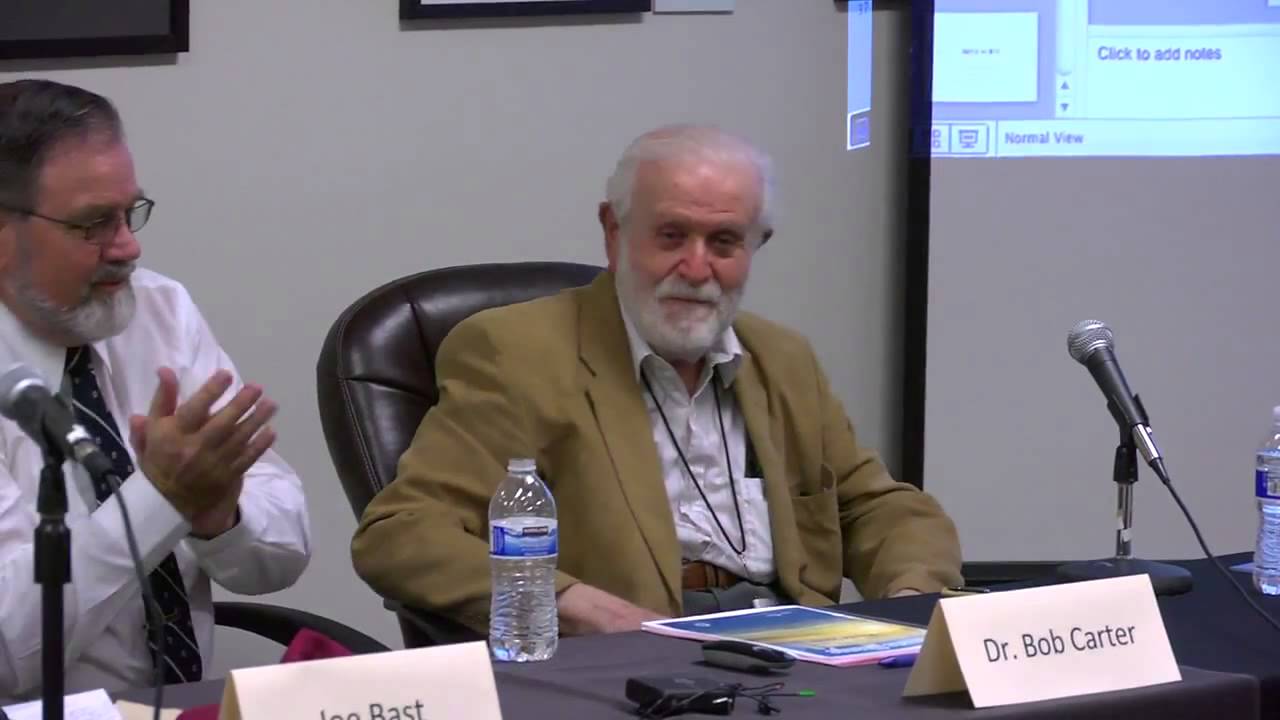 as “the mother of all environmental scare stories” but then suggested the science was actually a sinister cover for something else entirely.
“Groups on the left understand if we can control energy, you can control human beings, and that’s what it was all about,” claimed Bast.
Environmentalists were trying to “shut down the engines of the world,” Bast said, without saying why they might want to do any of those things.
“This was a search for a scientific justification for a political agenda,” Bast added. “The whole idea is to control energy.” (As a group that tirelessly defends the use of fossil fuels while attacking renewable energy, you have to wonder if it’s actually Heartland that wants to “control energy.”)
“We concluded we have to go after the science,” he said, adding Heartland’s “products and programs” would look to reach “all the way down to elementary school classrooms.” In recent weeks, Heartland has been mailing a condensed version of its NIPCC report to tens of thousands of school teachers across the country.
Bast told the room that two NIPCC reports had been “peer reviewed by the authors themselves,” which, by the way, is not how peer review works.
Bast said the NIPCC report had been “translated by the Chinese Academy of Sciences” while his communications director, Jim Lakely, held the Chinese version aloft.
After a round of applause, Bast said he hoped “other academies of science,” including Australia, would follow suit, implying the Chinese Academy of Sciences had somehow endorsed the report.
At the time of the Chinese version being released, Bast had issued a press release claiming a “historic moment” for global warming science. He sent Heartland staff, including Carter, to Beijing for a press opportunity.
But as DeSmog reported, the CAS issued a statement saying: “The claim of the Heartland Institute about CAS’ endorsement of its report is completely false.”
Bast was forced to apologize and had to pull the publication from his website and withdraw the original press release. But once Carter was out of China, Bast re-issued the press release and rejected the criticisms of the CAS.
Oddly, none of this detail made its way into Bast’s opening remarks.
Fake Discussion
Heartland, remember, once ran a billboard campaign with a picture of terrorist Ted “Unabomber” Kaczynski with the message: “I still believe in Global warming. Do You.”
That ill-fated 2012 ad campaign saw many of Heartland’s corporate backers pull their funding. But as DeSmog has shown, one of Heartland’s most generous backers is the family foundation of hedge fund billionaire Robert Mercer — also a major financial backer of Donald Trump’s presidential campaign as well as several of the conservative groups the Trump administration has drawn on to fill positions.
Not forgetting too, that Mercer is a major investor in Breitbart, which all brings us neatly back to Scott Pruitt.
“The American people need to have that type of honest discussion and that’s something that we hope to provide as part of our leadership,” Pruitt told the Breitbart radio segment.
No.
The people who desperately need that fake “honest discussion” are the fossil fuel interests and conservative ideologues desperate to retain power and influence in a world that so desperately needs a cleaner democracy and cleaner energy.
===
https://thinkprogress.org/pruitt-cites-bret-stephens-d7d3e94dc952
joe r
At the daily White House press briefing on Friday, one day after the Trump administration withdrew the U.S. from the Paris climate agreement, Press Secretary Sean Spicer handed the podium to EPA Administrator Scott Pruitt. Pruitt then ably provided the kind of nonstop falsehoods and misinformation the press and public have come to expect.
Pruitt said he didn’t know why people call him a “climate denier,” and then proceeded to quote and misquote Bret Stephens?—?the New York Times’ new columnist who has been widely criticized for spreading misinformation on climate change?—?as a basis for denying basic climate science.
Here’s the video, in which Pruitt tries to defend President Donald Trump’s catastrophic decision to exit the Paris climate deal:
First, Pruitt says some people call him a “climate denier,” but adds, “I don’t even know what it means to deny the climate.”
“Climate denier” is a shorthand for someone who rejects the well-established science of climate change. If you want to know why people call you a climate (science) denier, keep reading.
Pruitt then starts to quote from “Climate of Complete Certainty,” a recent column written by Stephens in the New York Times. That column, along with those that followed, was widely debunked by climate scientists and others weeks ago.
The NY Times promised to fact check their new climate denier columnist?—?they lied}
Times’ news staff trashes column on Twitter, while top scientist says paper is “willingly abetting climate change…
thinkprogress.org
But here’s the most stunning aspect of that. The “very important quote,” as Pruitt called it, is actually a misquote: Pruitt eliminated the portion where Stephens, widely viewed as a climate misinformer, said the fact that the planet has warmed is “indisputable.”
Here is the key part of what Pruitt quotes (emphasis added):
“Anyone who has read the 2014 report of the IPCC knows that, while the modest 0.85 degrees Celsius warming of the earth has occurred since 1880, much else that passes as accepted fact is really a matter of probabilities….”
Except that’s not what Stephens wrote, as you can see at the New York Times website:
“Anyone who has read the 2014 report of the Intergovernmental Panel on Climate Change knows that, while the modest (0.85 degrees Celsius, or about 1.5 degrees Fahrenheit) warming of the earth since 1880is indisputable, as is the human influence on that warming, much else that passes as accepted fact is really a matter of probabilities….”
Yes, without informing the press or the public who were listening, Pruitt simply misquoted and rewrote the part where Stephens said the 1.5°F (0.85°C) warming since 1880 is “indisputable, as is the human influence on that warming.”
Stephens’ line is full of factual errors in itself. Indeed, dozens of scientists signed a letter debunking Stephens, and the Times even issued a correction for most egregious of his errors in that sentence.
But in his desperation to justify his boss’ unjustifiable decision, EPA chief Scott Pruitt can’t even bring himself to admit what Stephens admits?—?that both global warming and the human influence on that warming is “indisputable.”
Four-and-a-half false statements EPA head Scott Pruitt made in just one interview}
Team Trump begins to roll out its plan to kill climate action, making up facts and ruining your children’s future.
So the man in charge of all environmental policy for this country can’t even utter the words conceded by a professional “climate change bullshitter,” as Vox labeled Stephens. Pruitt has more than earned the title “climate denier"
==
QUESTIONABLE
Scott Pruitt used Bret Stephens' New York Times climate op-ed to justify withdrawing from the Paris Agreement
2:42 p.m. ET
Back in April, The New York Times hired conservative columnist Bret Stephens from The Wall Street Journal as a contributor to its op-ed page. Stephens promptly started a kerfuffle at the Gray Lady when he centered his debut column around climate change; in it, he wrote, "Perhaps if there were less certitude about our climate future, more Americans would be interested in having a reasoned conversation about it."
In his column, titled "Climate of Complete Certainty," Stephens argued that much of the conclusions about climate change that pass "as accepted fact" are in fact "a matter of probabilities." In explaining President Trump's decision to pull the U.S. out of the Paris climate accord, EPA Administrator Scott Pruitt on Friday cited Stephens' column:
The New York Times was harshly criticized for surfacing Stephens' climate skepticism — or what The Week's Ryan Cooper referred to as Stephens' "breezy science denial-lite." Public editor Liz Spayd responded by defending the Times for providing readers with a "range of views." But observers were not impressed with Pruitt's use of Stephens' reasoning as a defense for withdrawing from the Paris Agreement; scan through some incredulous responses below. Kimberly Alters
==
mma
Paris agreement opponents publishing deceptive op-eds may have been assisted by Scott Pruitt’s EPA
EPA is “quietly working” to help right-wing activists publish op-eds arguing that Trump should take the U.S. out of the Paris agreement. As Axios reported, "Pruitt told aides he wanted them to pump the brakes on publicly lobbying for withdrawal from Paris. Instead, the EPA staff are quietly working with outside supporters to place op eds favoring withdrawal from Paris." Axios.com, [5/28/17]
Misleading op-eds have appeared in multiple newspapers in recent weeks.Media Matters identified five anti-Paris agreement op-eds featuring misinformation about the agreement and climate change that were published in newspapers in recent weeks, including some that were syndicated and appeared in multiple outlets. Papers publishing the op-eds included The Washington Times, the Boston Herald, USA Today, The News Journal, The Jackson Sun, and The Hill. *The Washington Times*, [5/15/17; Boston Herald, 5/22/17; USA Today, 5/23/17; The News Journal, 5/23/17; The Jackson Sun, 5/24/17; The Hill, 5/25/17]
==
https://www.ecowatch.com/epa-paris-agreement-op-eds-2429284572.html
EPA Reportedly Helped Paris Agreement Opponents Place Op-Eds in Newspapers
By Kevin Kalhoefer & Lisa Hymas
President Donald Trump has decided to exit the Paris climate agreement, according to Axios. The news site also reported that the Scott Pruitt-led U.S. Environmental Protection Agency (EPA) has been "quietly working" with opponents of the agreement to help them place op-eds in newspapers. Media Matters identified a number of anti-Paris agreement op-eds that have been published in papers around the U.S. in recent weeks, spreading misinformation about the expected economic impacts of the agreement, the commitment of developing countries to cutting emissions and climate science in general.
News Outlets Reported That Trump Has Decided to Leave the Paris Agreement; Trump Promised to Announce His Decision This Afternoon.
Trump plans to decide whether to remain in the climate pact in the coming days.
Axios and The New York Times both reported on May 31 that President Donald Trump is expected to pull out of the Paris agreement, according to sources with knowledge of the decision. Trump subsequently tweeted on May 31 that he would announce his decision on the Paris accord this afternoon at the White House Rose Garden. The agreement, reached in December 2015, brought nearly 200 nations together in a pledge to fight climate change and curb their greenhouse gas emissions.
img]
Paris Agreement Opponents Publishing Deceptive Op-Eds May Have Been Assisted by Scott Pruitt's EPA
EPA is "quietly working" to help right-wing activists publish op-eds arguing that Trump should take the U.S. out of the Paris agreement.
As Axios reported, "Pruitt told aides he wanted them to pump the brakes on publicly lobbying for withdrawal from Paris. Instead, the EPA staff are quietly working with outside supporters to place op eds favoring withdrawal from Paris."
Misleading op-eds have appeared in multiple newspapers in recent weeks.
Media Matters identified five anti-Paris agreement op-eds featuring misinformation about the agreement and climate change that were published in newspapers in recent weeks, including some that were syndicated and appeared in multiple outlets. Papers publishing the op-eds included The Washington Times, the Boston Herald, USA Today, The News Journal, The Jackson Sun and The Hill.
Right-Wing Op-Eds Pushed False Claim that Paris Agreement Would Be Economically Disastrous
Conservative op-ed writers falsely claimed that the Paris accord would impose massive costs on U.S. businesses and families.
In an opinion piece in The Washington Times, Ed Feulner, president of the Heritage Foundation, argued that the U.S. should withdraw from the agreement, adding, "As economist Nicolas Loris and U.N. expert Brett Schaefer recently noted, 'The U.S. regulations alone would increase energy costs for U.S. families and businesses, causing an overall average shortfall of nearly 400,000 jobs and total income loss of more than $20,000 for a family of four by the year 2035.'" The figures were based on a 2016 Heritage Foundation report that claimed former President Obama's keystone policy for meeting Paris obligations, the Clean Power Plan, would cause an "aggregate gross domestic product loss of more than $2.5 trillion" by 2035. And Loris, who also works for the Heritage Foundation, penned his own opinion piece in the Boston Herald claiming, "Compliance with the Paris agreement will cost the global economy trillions of dollars over the next 80 years."
Other studies have concluded that the Clean Power Plan would produce net economic growth.
PolitiFact rated as "False" a Trump statement that was partly based on Heritage's claim that the Clean Power Plan would reduce U.S. GDP by $2.5 trillion. The fact-checking website noted that other analyses, including one written by Harvard researchers and published in a peer-reviewed journal, found that the plan would have a multibillion-dollar net-positive effect on GDP.
A Citi study found that it is not addressing climate change that would be extremely costly.
A study by financial institution Citi found that unchecked climate change could cost up to $72 trillion in global GDP and that moving to a low-carbon economy would be approximately $2 trillion cheaper than not doing so. From Harvard Business Review:
Estimates of climate risk in the trillions are unfortunately getting more common. [In 2015], Citi produced a powerful study of the costs and benefits of shifting the energy system toward low-carbon technologies.Unchecked climate change, Citi said, could cost the world $72 trillion by the middle of the century. But the big surprise in Citi's report was the cost of building the low-carbon economy: the world can spend $2 trillion less in total on energy infrastructure and ongoing fuel costs than it would in the business-as-usual scenario. So we save $2 trillion and avoid losing up to $72 trillion in economic activity.
Transitioning to a clean energy economy in line with Paris obligations would fuel economic growth and stimulate job creation. A report published this year by the International Energy Agency and the International Renewable Energy Agency found that transforming the global energy system to line up with the goals of the Paris agreement "can fuel economic growth and create new employment opportunities" in energy and other sectors:
The energy transition can fuel economic growth and create new employment opportunities.
Global GDP will be boosted around 0.8% in 2050 (USD 1.6 trillion). The cumulative gain through increased GDP from now to 2050 will amount to USD 19 trillion. Increased economic growth is driven by the investment stimulus and by enhanced pro-growth policies, in particular the use of carbon pricing and recycling of proceeds to lower income taxes. In a worst-case scenario (full crowding out of capital), GDP impacts are smaller (sic) but still positive (0.6%) since the effect of pro-growth policies remains favorable. Important structural economic changes will take place. While fossil fuel industries will incur the largest reductions in sectoral output, those related to capital goods, services and bioenergy will experience the highest increases. The energy sector (including energy efficiency) will create around six million additional jobs in 2050. Job losses in fossil fuel industry would be fully offset by new jobs in renewables, with more jobs being created by energy efficiency activities. The overall GDP improvement will induce further job creation in other economic sectors.
Big businesses have strongly lobbied the Trump administration to stay in the Paris accord.
Despite right-wing claims that adhering to the Paris climate agreement would bring economic disaster, hundreds of major U.S. businesses have urged the Trump administration to stick to the climate deal. From CNN Money:
If Trump bails on the agreement, which has been signed by 195 countries, he will do so over the objections of hundreds of major U.S. businesses.
In recent months, big business has lobbied fiercely in favor of the deal, which aims to end the fossil fuel era. Even major oil firms like Chevron (CVX) and ExxonMobil (XOM) back it.
Exxon CEO Darren Woods wrote a personal letter to Trump earlier this month, urging him to stick to the deal. The U.S., he said, is "well positioned to compete" with the agreement in place and staying in means "a seat at the negotiating table to ensure a level playing field."
It might appear to be a strange move for energy firms, but many like the agreement because it favors natural gas (which they produce) over dirtier coal.
It's more than just energy firms, though: Microsoft (MSFT, Tech30), Apple (AAPL, Tech30), Starbucks (SBUX), Gap (GPS), Nike (NKE), Google (GOOGL, Tech30), Adidas (ADDYY) and L'Oreal (LRLCY) all support continued U.S. involvement.
Business leaders say the Paris deal, also called COP21, will help generate new jobs, limit damage from climate change and help assert American leadership on the global stage.
Conservative Op-Eds Argued Wrongly That China and India Are Not Taking Action
Right-wing op-eds falsely claimed that China, India and other developing nations were not committed to Paris goals.
In a syndicated column that appeared in USA Today and USA Today Network newspapers, Phil Kerpen, president of American Commitment and a former vice president of Americans for Prosperity, wrote, "The Paris treaty effectively bans coal-fired power plants in the United States—while China has 368 coal plants under construction and more than 800 in the planning stage. India's coal production under the deal is allowed to double by 2020—and they are likely to have emissions much higher than what they promised." And in his anti-Paris op-ed in theBoston Herald, Loris wrote, "Developing nations want affordable, dependable energy to raise their standards of living, and countries such as India, China and Indonesia need to use a lot of coal to get there."
China and India are on pace to meet their emissions targets ahead of schedule.
The Washington Post recently reported that an analysis conducted by the Climate Action Tracker found that "China and India are on track to overachieve on their climate pledges" and quoted Bill Hare, CEO of the nonprofit science and policy institute Climate Analytics, saying that China and India "are going to slow the global growth in CO2 emissions significantly." A New York Times editorial discussing the same analysis noted, "The shift from fossil fuels has ... been much faster and more pronounced than most experts expected. China has reduced coal use for three years in a row and recently scrapped plans to build more than 100 coal power plants. Indian officials have estimated that country might no longer need to build new coal plants beyond those that are already under construction."
China and India are taking big steps to develop clean energy and scale back coal plants.
In January of this year, China announced that it plans to spend more than $360 billion through 2020 on renewable energy sources and is canceling plans to build more than 100 coal-fired power plants. Last year, India announced that it plans to get 57 percent of its total electricity capacity from renewable sources by 2027 and launch a $2 billion equity fund to boost renewable energy development. According to The Associated Press, a March report by the groups CoalSwarm, the Sierra Club and Greenpeace found that "construction starts for coal-fired plants in China and India were down by 62 percent in January from a year earlier while new facilities starting operation declined 29 percent." Additionally, a May 22 New York Times editorial noted, "Electric vehicle sales in China jumped 70 percent last year, thanks in large part to generous government incentives. India is much further behind in this area, but the country's minister of power said last month that all cars sold in the country should be electric by 2030.
Developing nations pushed for a strong Paris agreement and were "crucial" to its adoption.
Developing countries, including the least developed countries, were a key part of the "high ambition coalition" that called for tougher climate change policies and "was widely credited with ensuring the Paris meeting ended in agreement," according to Climate Change News. Far from pushing for a weak agreement and wanting leeway to burn coal, the developing nations have been insistent on the need for fast action to deal with climate change, and have sounded alarms about the role of corporations and lobbyists in UN climate negotiations, fearing that they might weaken emissions goals.
Developing nations committed to cutting emissions even though it's more difficult for them and they have less responsibility to do so.
The world's developing countries have emitted only a small proportion of the climate-warming gases that humans have sent into the atmosphere over the past 160 years, and so they're responsible for only a small proportion of the global warming the world is experiencing. And yet all but two of the world's developing nations signed onto the Paris agreement and submitted action plans, many of which experts said were ambitious. Yet developing countries face a tougher challenge reducing emissions than their wealthier counterparts do. As Robert Lempert of the RAND Corporation explained to the Chicago Tribune, "The richest countries have much of their economy in lower-emitting sectors. ... The U.S. can grow their economy and improve their quality of life without increasing energy use. But in developing countries, you can't do that."
Op-Eds Against the Agreement Pushed Climate Science Denial
Anti-Paris agreement op-eds spread climate science misinformation.
In an op-ed for The Washington Times, Princeton emeritus physics professor and climate denier William Happer wrote that the U.S. "should withdraw from the Paris Climate Agreement," claiming, "For too long, well-meaning policymakers have been misled by propaganda, masquerading as science, that more atmospheric carbon dioxide (CO2) will harm the planet ... More CO2 is not a pollutant but is a benefit to humanity." In an op-ed in The Hill, Patrick J. Michaels of the Cato Institute attempted to undermine the scientific rationale behind the Paris agreement by disputing that human activity is the dominant cause of recent global warming.
Slate's Phil Plait: Claiming CO2 is not a pollutant is "ridiculous" and "in-your-face wrong."
In a Feb. 18 column, science journalist Phil Plait wrote in Slate that the frequently used climate-denier claim that CO2 is not a pollutant is "ridiculous," "in-your-face wrong" and a "typical denier distraction technique, trying to downplay or distract you from what's really going on." He summarized the overwhelming scientific consensus: While some carbon dioxide is necessary for plant life, burning fossil fuels and thus releasing excess carbon dioxide into the atmosphere is warming up the globe "too quickly for many living things to adapt." Carbon pollution is causing rapid changes to the Earth's climate, and, as Plait explained, that speed is the "danger; the rate at which we are heating the planet is unprecedented."
Humans are "by far" the dominant cause of global warming.
InsideClimate News reported in 2016 that "ninety to 100 percent of climate scientists agree that the planet is warming due to human activity, according to a peer-reviewed paper published Wednesday in the journal Environmental Research Letters. The study, called a 'consensus on consensus' synthesizes findings from prior published research." In 2013, the United Nations' Intergovernmental Panel on Climate Change reported, "It is extremely likely that human influence has been the dominant cause of the observed warming since the mid-20th century." The Intergovernmental Panel on Climate Change defines "extremely likely" as having 95 to 100 percent probability. A 2009 letter signed by 18 U.S. scientific organizations stated that "greenhouse gases emitted by human activities are the primary driver" of climate change. In a 2012 literature review for the blog Skeptical Science, Dana Nuccitelli laid out the overwhelming evidence that humans are the primary driver of climate change, writing, "A wide variety of statistical and physical approaches all arrived at the same conclusion: that humans are the dominant cause of the global warming over the past century, and particularly over the past 50 years. This robust scientific evidence is why there is a consensus among scientific experts that humans are the dominant cause of global warming."
Reposted with permission from our media associate Media Matters for America.
==
https://insideclimatenews.org/news/09052017/foia-donald-trump-interior-department-missing-climate-change-data-websites
As Donald Trump's administration continues to strip climate change information from federal websites, two advocacy groups and a conservation biologist are using a novel technique to try to force the government to republish the pages.
A new provision in open records law, added by Congress last year, requires agencies to publish electronically any information that isrequested at least three times through the federal Freedom of Information Act, so long as that information is not otherwise exempt from disclosure. Last week, the advocacy groups and the biologist submitted identical requests for climate change information, hoping to trigger that provision, and they just might succeed.
"The law is pretty explicit," said Aaron Mackey, an attorney with the Electronic Frontier Foundation, a nonprofit that promotes transparency. "The law just says, if you get three, then you have to affirmatively disclose it. This should work."
The effort by the Center for Biological Diversity, the Center for Media and Democracy, and Stuart Pimm, a professor at Duke University, is the latest in a broad campaign by scientists and advocates to cache federal data about climate change and other topics that they fear may be deleted by the Trump administration.
Volunteers have gathered formassive "data rescue" events to download information. Advocates have sued. Now, the groups are trying to use the Freedom of Information Act and the new provision to get the government, starting with the Interior Department, to re-post its old climate change webpages.
Last month, the Department of Interior quietly edited its climate change page, removing an extensive discussion of the effects of global warming and the department's work on the issue and replacing it with two short paragraphs that do not discuss any details of the impacts of climate change. Instead, it provided links to its bureau's climate change pages, including the page of the Bureau of Land Management, which no longer exists, and others that have been edited.
"The changes basically remove any information about the causes of climate change, most notably mankind's contribution of greenhouse gases to the atmosphere," said Amy Atwood, a senior attorney at the Center for Biological Diversity. "It's just absurd."
Paul Ross, a spokesman for the Interior Department, said in a statement emailed to InsideClimate News that "the Department's website has been updated periodically over the past few months to include additional priorities of the Department under new leadership." He declined to address the public records requests.
The department has 20 business days to reply to the requests. Atwood said her group would appeal if the requests are denied.
The new requirement in the open records law was an attempt to codify what has long been considered best practice, Mackey said. The overarching goal of the Freedom of Information Act, or FOIA, is to make government more transparent, so it encourages agencies to publish information that is frequently requested or may be of broad interest, such as administrative decisions. Many agencies, including the Interior Department, have online "reading rooms" where they make such documents available.
Mackey said that while the spirit of the law implies that agencies should publish information that's requested three times in an easily accessible area, like an online reading room, it contains no explicit direction beyond requiring them to make it "available for public inspection in an electronic format."
After the EPA removed its climate change page, it published an archived version following a series of FOIA requests. But it also removed links that would have made that archived page easy to find from the EPA's homepage. Atwood said the groups would use the same FOIA tactics to retrieve the information if the EPA deletes the archived page, or if the EPA or any other agency removes similar information.
This isn't the first time the groups have attempted to use the FOIA provision. In March, theysubmitted requests to eight federal agencies seeking hundreds of environmental data sets out of concern that the Trump administration would remove them from public view.
Atwood said they've gotten a range of responses so far. The Department of Agriculture has been working with them to try to identify and publish the data, she said, while others have simply rejected their requests or claimed—sometimes erroneously, according to Atwood—that the data was already published. The group is currently preparing to appeal those denied requests, and ultimately will go to court if the appeals fail.
The Center for Biological Diversity has also used more conventional FOIA requests to try to pry loose documents from the Trump administration, including records regarding whether leaders at several agenciesdirected their staffs to stop using the term "climate change." Last week, the group sued the EPA in attempt to compel it to release emails and a schedule for its administrator, Scott Pruitt, after the agency denied a request seeking those records. Atwood said she expects to file an average of one lawsuit each week as the group's FOIA requests are denied.
"We're really in a position to be able to pursue information from the Trump administration," Atwood said, "and we're doing it at every turn.
=
==
sci adv bd update
https://insideclimatenews.org/news/08052017/epa-science-advisory-board-dismissed-scott-pruitt-donald-trump
==
Lawmakers are calling on Environmental Protection Agency Administrator Scott Pruitt to hand over information about a key agency appointee, citing her record as an energy industry lobbyist as recently as the first quarter of this year.
Sens. Sheldon Whitehouse (D-R.I.) and Jeff Merkley (D-Ore.) sent a letter to Pruitt on Tuesday, challenging his appointment of Elizabeth "Tate" Bennett as deputy associate administrator of EPA's Office of Congressional and Intergovernmental Relations. In that role, Bennett is the agency's primary point person and liaison with Congress and state governments.
The senators cited President Donald Trump's executive order on ethics, writing: "Because of her activities as a registered federal lobbyist she cannot work on legislation, communicate with Congress, or coordinate and monitor regional, state and local responses to a wide-range of major issues faced by EPA."
Bennett worked for two years as a lobbyist for the National Rural Electric Cooperative Association, which represents more than 900 customer-owned rural utilities. The association, whose members have been historically reliant on coal, has pushed heavily against emissions-cutting regulations, including the Clean Power Plan.
The senators say that Bennett's appointment violates Trump's executive order on ethics, which says appointees can't "participate in the specific issue area" for which they lobbied in the two years prior to their appointment. Trump issued the order during his second week in office, following up on his oft-repeated campaign pledge to "drain the swamp." Previous presidents had similar ethics orders.
The EPA and Bennett's office did not immediately respond to a request for comment.
The letter points out that the association spent $5.3 million on lobbying during Bennett's tenure, and that she "specifically lobbied on a broad set of EPA matters, including EPA's Clean Power Plan and New Source Performance Standard, Clean Water Rule, ozone standard, EPA enforcement, pesticides bills, budget resolutions, and appropriations bills."
Prior to her position at the rural utilities association, Bennett was an energy and agriculture aid to Senate Majority Leader Mitch McConnell (R-Ky.).
The appointment is the latest in a series of lobbying-related ethics problems facing Trump appointees. Critics of Pruitt have questioned his deep ties to fossil fuel companies, including his leadership in the Koch brothers-funded Rule of Law Defense Fund, which lobbied heavily against environmental regulations.
Late last month, the director of the Office of Government Ethics challenged the Trump administration's granting of waivers that exempt appointees from the president's ethics pledge. On April 28, Walter M. Shaub, Jr., who was appointed to head the office by President Barack Obama in 2013, sent a request asking every executive branch to provide him a copy of any waivers by June 1.
Whitehouse and Merkley are asking for information about Bennett by June 2, including any waivers she may have signed, a signed copy of her ethics pledge and her "Executive Branch Personnel Public Financial Disclosure Report."
PUBLISHED UNDER:
epa
https://insideclimatenews.org/news/19052017/leaked-donald-trump-budget-EPA-climate-clean-energy-environment
Details of President Donald Trump's 2018 budget proposal, leaked this week, reveal that the administration appears determined to wallop environmental programs, including many that tackle climate change. It would cut Environmental Protection Agency funding by nearly one-third, slash spending on renewable energy innovation, and eliminate the Greenhouse Gas Reporting program, among other programs.
The White House only has the first move in the long budget process; once the proposal is unveiled officially next week, it will be Congress' turn to weigh in on spending priorities. With Trump embroiled in scandal, and many popular programs targeted for elimination, it's not at all clear that lawmakers will follow the president's lead.
The president's so-called "skinny" budget, released in March, also called for slashing EPA funding by 31 percent but was light on detail.
This second version of the budget proposal, leaked late this week, reveals that the administration intends to follow through on its commitment to reduce EPA to the size it was in the 1970s, when climate change wasn't on its radar screen.
Research on air and energy would be slashed by 67 percent, and clean air regulatory programs—which include climate change—would be cut 47 percent.
Among the EPA programs that would be eliminated:
- The $8 million Greenhouse Gas Reporting Program, under which industrial facilities have been reporting their carbon emissions since 2010.
- The $27 million national estuaries program for protection of coastal waterways.
- $7 million for Environmental Justice.
- $19.9 million in assistance to Alaska villages.
- $427 million in geographic programs focused on environmental issues in the Great Lakes, the Gulf of Mexico, Chesapeake Bay, Lake Pontchartrain in New Orleans and other hot spots.
By slashing the geographic programs, which have bipartisan support on Capitol Hill, the Trump administration is showing little inclination to open the budget process with any conciliatory moves to win over key members of Congress. To pass cuts to discretionary programs like those at EPA would require some Democratic support to reach 60 votes in the Senate, where the GOP holds 52 seats. Some Republicans also have indicated they would not support the deep cuts that the White House had signaled it was seeking.
At a public forum in Washington this week, Sen. Lisa Murkowski, (R-Alaska), chair of both the Senate Energy Committee and the Appropriations Committee's subcommittee on Interior, Environment, and Other Agencies, had voiced hope that the administration would back off of its planned cuts.
...
https://insideclimatenews.org/news/09032017/scott-pruitt-epa-donald-trump-climate-change-denial-co2-global-warming
march 3? 2x?
Back in Washington, D.C., Environmental Protection Agency administrator Scott Pruitt on Friday dismissed half of the members of an EPA scientific review board, clearing the way for new appointees from the industries the agency is tasked with policing. Among those removed from the EPA Board of Scientific Counselors was Michigan State University professor Robert Richardson, who tweeted, "Today I was Trumped." The dismissals come as the Trump administration seeks to slash EPA funding, roll back environmental regulations, appoint climate change deniers as the heads of government agencies, and defund and erase climate change programs and research.
==
https://thinkprogress.org/epa-makes-room-for-industry-scientists-237f4038f1ab
no links img
Scott Pruitt removes scientists from EPA advisory panels to make room for industry advocates
In unprecedented move, EPA chief declines to renew scientists for a second term.
EPA administrator Scott Pruitt, shown here meeting with coal miners in Pennsylvania in April, wants to bring more industry scientists onto his agency’s scientific advisory boards. CREDIT: AP Photo/Gene J. Puskar
The Environmental Protection Agency has started notifying members of a scientific review board that their terms as EPA advisers would not be renewed, a move experts in the field are calling unprecedented.
Scientists who serve on advisory boards at the EPA and other federal agencies typically are allowed to serve two full terms. But late last week the agency, under the leadership of administrator Scott Pruitt, informed several scientists on its 18-member Board of Scientific Counselors that they would not be permitted to serve a second term.
Robert Richardson, an ecological economist and an associate professor at Michigan State University’s Department of Community Sustainability, said that in almost all cases, scientists are re-appointed for a second three-year term. In January, Richardson was told that he and the other eight members of the panel who were nearing the end of their first term would have their positions extended for a second term.
“But on Friday, at 6:20 p.m., I received an email saying, ‘We’ve submitted paperwork to request that your appointment be renewed. However, the agency has decided not to renew your appointment,’” Richardson told ThinkProgress.
Pruitt reportedly plans to consider replacing the academic scientists with representatives from industries that the agency is required to regulate. Scientists see potential harm in allocating a certain number advisory panel seats to industry scientists.
“Frankly, it represents a fundamental misunderstanding of what the Board of Scientific Counselors does,” Richardson said. “I’ve seen quotes from EPA spokespersons that have said that we need a different mix on this board because they have a heavy hand in approving regulations.”
Trump-tied Texas group petitions EPA to reconsider whether greenhouse gases are a problem
The EPA’s endangerment finding is the cornerstone for U.S. policy on climate change.
thinkprogress.org
But members of the advisory panels have no authority in approving regulations, don’t review regulations, and don’t make recommendations with regard to regulations, Richardson explained.
Courtney Flint, a professor of natural resource sociology at Utah State University, also was notified by email that her appointment to the Board of Scientific Counselors was not going to be renewed. “This came as a surprise as I had been told that the appointment would be renewed. No other reason was given,” Flint said in a statement emailed to ThinkProgress.
A total of nine board members were affected by this decision, according to Flint. “It’s clear from the reports in the media that the current administration has said that they want to replace board positions held by academic scientists with members from industry, so I do not think I am speculating when I say that this is a political move,” she said.
In 1978, Congress directed the EPA to establish a Scientific Advisory Board (SAB), which today is a 47-member panel, to provide scientific advice to the administrator. The Board of Scientific Counselors, part of the EPA’s Office of Research and Development, was established as a discretionary federal advisory committee in 1996. Members of these advisory panels often work anywhere from 30 hours to hundreds of hours a year.
“Frankly, it represents a fundamental misunderstanding of what the Board of Scientific Counselors does.”
The EPA contends the removal of scientists from the advisory panels is not unusual. “We’re not going to rubber-stamp the last administration’s appointees. Instead, they should participate in the same open competitive process as the rest of the applicant pool,” agency spokesman J.P. Freire said in a statement emailed to the Washington Post. “This approach is what was always intended for the board, and we’re making a clean break with the last administration’s approach.”
House Science Committee Chairman Lamar Smith (R-TX) held a hearing on the issue in February, arguing that the composition of the SAB should be expanded to include more non-academics.
Christine Todd Whitman, who served as EPA administrator under George W. Bush, showed respect for the scientific process, experts say
In late March, the House passed the “EPA Science Advisory Board Reform Act of 2017,” a bill that calls for “a well-balanced expert panel, increased transparency, public participation to empower” the agency’s SAB to “provide meaningful and unbiased scientific advice, and better responsiveness to the public and Congress.”
The Washington Post reported in April that the SAB is facing an 84 percent cut, or $542,000, from its operating budget. The funds typically cover travel and other expenses for outside experts who attend the board’s public meetings.
Andrew Rosenberg, a marine scientist and director of the Center for Science and Democracy at the Union of Concerned Scientists, expressed dismay that the EPA wants to get more scientists from regulated industries on the agency’s advisory panels.
“Science advisory boards are not representational bodies,” Rosenberg told ThinkProgress. “You are there as an expert. You’re rendering your view as an expert on scientific programs and scientific evidence. If you turn it into a representational body, why would you have only regulated industries? What about NGOs? What about public health organizations?”
Pruitt has been forthright about the fact that the EPA’s primary constituents, under the Trump administration, are going to be industry, not the public, Rosenberg said. “If they are proposing that the decisions not be based on science, what is it they are proposing they be based on? The alternative is pure politics. Who has the most influence? That’s the wrong way to go. You don’t want to set a precedent that we make decisions based solely on influence in politics,” he argued.
Joe Arvai, a member of the SAB and director of the University of Michigan’s Erb Institute for Global Sustainable Enterprise, said regular turnover on these advisory boards is common, as scientists sometimes choose not to serve a second term. “What is unusual is not re-appointing people after their first term,” he told ThinkProgress.
“It’s general practice that if you have the credentials and if you are a credible scientist and serve on these boards for one term and you’re willing to be reappointed, I’ve never heard of an instance where someone wasn’t re-appointed for a second term,” he said.
Trump administration scrubs climate science pages from EPA website
“Updating language to reflect the approach of new leadership.”
thinkprogress.org
Between 2003 and 2008, Arvai served as an adviser to the staff office that manages the EPA boards. But times have changed from when he worked with Christine Todd Whitman, EPA administrator under President George W. Bush. “She was a Bush appointee but was very interested in what science had to say and what it would bring to her agency.” However, since Trump entered the White House, Arvai said he’s never seen an administration “come in with more disdain for mainstream science.”
Arvai said he’s never seen an administration “come in with more disdain for mainstream science.”
The membership of these advisory panels has always included “credible scientists” from industry, nonprofits, non-governmental organizations and think tanks, he noted. “There has never been any restriction against appointing people with credentials from a non-academic sector,” he added.
By making these changes, Pruitt and the Trump administration are hoping to “look like tough guys, like they’re getting tough on the all the liberal scientists,” he said. “But in a reality, it’s all for political show with no real practical change being implemented,” he added. “In reality, the board never stood in the way of industry. The board was an adviser to the administrator. And the administrator gets to choose whether or not to accept any advice or recommendations from the SAB."
==
https://insideclimatenews.org/news/26042017/environmental-protection-agency-scott-pruitt-trump-gop-fundraiser-hatch-act-violation
Environmental Protection Agency Administrator Scott Pruitt, facing a complaint that he had violated the law restricting political activity by federal officials, will not attend an Oklahoma GOP fundraising gala where he was slated to be keynote speaker, an administration official told InsideClimate News on Thursday.
The decision came after Sen. Sheldon Whitehouse, D-R.I., filed a complaint with the U.S. Office of Special Counsel over an invitation for a $100-a-plate May 5 Oklahoma Republican Party gala that promoted the chance to see Pruitt as it solicited "sponsorships" of $2,000 to $5,000.
"You do not want to miss Pruitt at this year's OKGOP Gala, as he discusses his plans to slash regulations, bring back jobs to Oklahoma, and decrease the size of the EPA!" the invitation said. "Make sure to purchase your Gala tickets so you don't miss out on Administrator Pruitt's future plans and how he will continue to Drain the Swamp! This is a once in a lifetime opportunity, so buy your tickets before they sell out."

EPA Administrator Scott Pruitt received top billing on the GOP fundraiser's promotional materials.
Whitehouse argued it was a violation of the Hatch Act, the 1939 law that prevents federal officials from using their office for political purposes. He said the "unmistakable impression" from the invitation was that by purchasing a ticket or sponsorship, the attendee would have special access to a federal employee discussing planned and pending official actions. "Anything short of prohibiting his attendance will not change, in the public's perception, that the OKGOP's Gala is a 'pay-to-play' event with a federal Cabinet official," Whitehouse's complaint said.
The administration official said the decision for Pruitt not to attend the event on Tuesday night was made after realizing that the flyer for the event had been distributed by the Oklahoma GOP without an opportunity for Pruitt's office to review it. Pruitt's office worked with EPA's ethics office to ensure that attendance at the event would comply with the law, and one of the rules had been that EPA be able to review the invitation in advance, the official said.
http://www.ecowatch.com/epa-chiefs-speak-out-pruitt-2359082031.html
CTW, browner, gina
It's simple. Clear air, drinkable water and a livable climate should not be partisan issues.
Four former U.S. Environmental Protection Agency (EPA) administrators were appointed by four different presidents—two Democrats and two Republicans. So, what could they have in common?
All of them have spoken out against the current administration's environmental policies—as new EPA Administrator Scott Pruitt repeats fossil fuel talking points, the president signs extreme executive orders that roll back environmental progress and a new federal budget proposes to cut EPA funding by 31 percent.
But here's just some of what these former administrators had to say:
EPA administrator under President George H. W. Bush (1989 - 1993)
"For a prospective EPA administrator to doubt or even contest a conclusion that 11 national academies of science have embraced is willful political obstruction."
==
==
http://www.ecowatch.com/pruitt-epa-ethics-violations-2323438512.html
Center for Biological Diversity and University of Oklahoma law professor Kristen van de Biezenbos filed a formal ethics complaint today with the Oklahoma Bar Association against U.S. Environmental Protection Agency (EPA) Administrator Scott Pruitt, seeking an investigation into whether Pruitt lied to Congress while under oath.
The investigation would target possible ethical violations stemming from Pruitt's misrepresentation to senators of his use of a personal email address, during his tenure as Oklahoma attorney general, for official business and speeches he gave to right-wing organizations against environmental protection.
img
Today's complaint asserts that Pruitt violated Oklahoma's rules of professional conduct when he told Sen. Sheldon Whitehouse during his confirmation hearing that he did not use a personal "me.com" email address for official state business while attorney general of Oklahoma. Records released in the course of an Oklahoma public records lawsuit show that Pruitt received at least one email message and possibly more, at a "me.com" email address. Additional records are still being reviewed by Oklahoma courts for possible public release.
"Pruitt's friends in the fossil fuel industry clearly knew how to reach him best: at his personal email address," said Amy Atwood, a senior attorney at the Center for Biological Diversity. "Lawyers and public servants must adhere to the strictest ethical standards and the Oklahoma Bar should investigate Pruitt's apparent carelessness with the truth."
One released email shows a message from a vice president of the American Fuel and Petrochemical Manufacturers association to Pruitt's me.com address, asking him to use his position as Oklahoma attorney general to help roll back renewable fuel standards that were set under the Obama administration. Other released emails show use of a redacted email address for Pruitt that may be personal, showing correspondence with representatives of the American Legislative Exchange Council. The American Legislative Exchange Council is widely viewed as a right-wing organization that has worked to weaken some of the nation's most important environmental laws, including laws Pruitt administers at the EPA, such as the Clean Air Act and Clean Water Act.
Use of a personal email address for official state business can lead to the loss of government records and to hacking. Misrepresenting facts is a matter that the Oklahoma Bar Association takes seriously.
In addition, Democratic members of the U.S. Senate Committee on Environment and Public Works noted in a March 17 letter to Pruitt that he failed to mention several public speeches or presentations that he has made related to energy or the environment, including to the Federalist Society.
"It seems that Mr. Pruitt may not have been candid at his confirmation hearing," said Kristen van de Biezenbos, the University of Oklahoma law professor who signed the complaint in her personal capacity. "It raises questions about why he hid the fact of his use of personal email for official state business, what else he misrepresented to Congress and what else his personal emails may show us about our EPA administrator's deference to the fossil fuel industry and organizations that support the rollback of environmental regulations."
==
Emails released to the Center for Media and Democracy (CMD) reveal close ties between Oklahoma Attorney General Scott Pruitt, the Koch-funded American Legislative Exchange Council (ALEC), and the fossil fuel interests that fund ALEC, including the Kochs’ Americans for Prosperity Group.
The emails were obtained after the Center for Media and Democracy filed an open records lawsuit against Pruitt for his two-year-long failure to respond to our open records requests for his email correspondence with major fossil fuel corporations. The court ordered Pruitt to release thousands of emails which are now online and available for public inspection, but CMD is still in court seeking to obtain 1,600 pages withheld and responses to eight additional open records requests.
PRUITT AN ALEC ALUMNUS WHO KEPT IN TOUCH
Pruitt was an Oklahoma state senator from 2002-2007. As a legislator, Pruitt chaired the ALEC Civil Justice task force in 2003 and perhaps other years. ALEC is a corporate bill mill where legislators and industry lobbyists work together behind closed doors to draft industry-friendly bills that are then introduced in state houses across the nation as “innovative” public policy stripped of their industry origins.
But Pruitt touted industry influence as a plus in an interview. “ALEC is unique in the sense that it puts legislators and companies together and they create policy collectively,” Pruitt said.
One cookie-cutter bill approved by ALEC’s Civil Justice task force in 2003 was the Asbestos and Silica Claims Priorities Act. It is one of many ALEC bills geared toward protecting the deadly asbestos industry and companies that don’t protect their workers from known asbestos or silica hazards. The bill increases the burden on a person bringing a lawsuit alleging an asbestos and silica-related injury.
Asbestos-related diseases kill at least 10,000 Americans every year, in many cases from mesothelioma, an incurable and painful cancer caused by exposure to asbestos. For decades, asbestos was used for insulation and industrial purposes, and the diseases particularly affect veterans, firefighters, construction workers, and individuals who worked in factories with high-heat machinery. In Wisconsin, veterans groups have been some of the most vocal opponents of the legislation: veterans make up just 8 percent of the population, but are 30 percent of mesothelioma cases.
Crystalline silica is also deadly. It can be found in sand, gravel, and stone as well as sidewalks and building materials. Silica dust has been classified as a human lung carcinogen and results in fatalities and seriously disabling illnesses. According to OSHA, silica exposure “remains a serious threat to nearly 2 million U.S. workers, including more than 100,000 workers in high risk jobs such as abrasive blasting, foundry work, stonecutting, rock drilling, quarry work and tunneling.” ALEC wants to make it harder for injured workers or their families to seek compensation.
Other bills approved by ALEC around that time include:
- Jury Patriotism Act (2002-2003)
- Notice and Opportunity to Repair Act (2003-2004)
- Drug and Alcohol Defense Act (2002-2003)
- Constitutional Guidelines for Punitive Damages Act (2003)
After Pruitt became attorney general, he stayed engaged with ALEC on energy and environmental issues. ALEC is funded by a number of big polluters including Devon Energy, Peabody Energy, Koch Industries, and ExxonMobil.In 2014, the *New York Times* won a Pulitzer Prize after it filed an open records request and exposed the fact that Pruitt received a letter from Devon, put it on his state letterhead, and sent it to the EPA. The Devon lobbyist lauded this move as “Outstanding!”
A February 2013 email from Amy Anderson, the ALEC Civil Justice task force staffer, asked for the AG’s digital signature for an ALEC letter. Pruitt’s office zipped over the signature minutes later. The letter was not disclosed. Another email from Anderson to Pruitt and others, provides details of Pruitt’s participation in an energy workshop at ALEC’s May 2013 meeting. Included in the email was an invitation to “a reception on the evening of the 3rd at the Petroleum Club.” The Petroleum Club is a swank private club for industry executives at the top of the Chase Tower in downtown Oklahoma City. Anderson also requested Pruitt’s attendance at a luncheon sponsored by Koch Industries because it “would be delightful to have our current legislative members benefit from his experience as a former state legislator, an ALEC member and a now attorney general.”
Pruitt spoke at a December 2013 ALEC meeting on a panel called “Embracing American Energy Opportunities: From Wellheads to Pipelines.” Now we know from the Pruitt emails that he was invited to speak at ALEC by an industry lobbyist named Peter Glaser, a partner at the law firm Troutman Sanders LLP. Glaser has represented Peabody Energy and other energy companies fighting EPA efforts to address climate change.
In 2014, Pruitt at another ALEC meeting that was sponsored by Peabody Energy, ExxonMobil, Chevron, and the American Coalition for Clean Coal Electricity (ACCCE). During his speech about the President Obama Clean Power Plan, Pruitt touted a line that polluting industries would love: “Beyond the regional haze case, we have something on the horizon, something more troubling. And that’s the proposed rule under 111(d) with respect to CO2 regulation. We have an EPA that is engaged in rulemaking, proposed rulemaking, that seeks to exert itself in a way that the statute doesn’t authorize at all.” Pruitt would join a group of states in a legal attack on the Clean Power Plan, a historic effort to rein in power-plant pollution by one-third over a span of years.
KEEPING UP WITH THE KOCHS AS OKLAHOMA ATTORNEY GENERAL
The stack of Pruitt emails received by CMD reveal email exchanges between Aaron Cooper, Director of Public Affairs for the attorney general’s office and Matt Ball, Oklahoma State Director forAmericans for Prosperity (AFP), the right-wing political advocacy arm of the Koch political empire.
July 2013 emails show Ball organizing an August 22 event featuring Pruitt, Sen. James Lankford (OK-R), and William Yeatman, a senior fellow at the Competitive Enterprise Institute (CEI). Both Lankford and CEI have received Koch funding. In organizing the event, Ball helpfully instructs the AG’s staff on what he wants Pruitt to say,
“Frankly, I just assume the AG and Lankford talk sue and settle, how the EPA is deploying these tactics and what their respective offices have done on oversight and litigation, and let Yeatman from CEI give an objective analysis of costs to ratepayers from revised state implementation plan on regional haze (which includes the PSO rate increase). That way you guys don’t have to deliver those messages and can focus on what the AG does best, opposing the Obama administration and its nasty tactics on the environment.” Industry groups and the U.S. Chamber of Commerce claim that agencies like EPA are “regulating” outside the normal rule making process when they are sued by environmentalist groups, like Greenpeace and Sierra Club, for not following the law and then settle those lawsuits in legally binding, court ordered agreements without inviting states or industry to participate.
Cooper promptly responds, “I think that what be good from our standpoint.” Ball, on August 14, sends an email with the final schedule detailed in which he praises Pruitt for “all they are doing to push back against President Obama’s EPA and its axis with liberal environmental groups.” Pruitt led a group of state attorneys general in suing the EPA for its correspondence with environmental groups.
In another email, Ball requests a same day meeting with Pruitt’s Chief of Staff and Assistant Attorney General, Melissa Houston and she agrees to meet him the next day in the AG’s conference room. The fractured emails do not indicate what the meeting was about.
Yet another email from December 2013, invites Dean Kuckelman, Senior Counsel, Litigation and Discovery, for Koch Companies Public Sector to a conference call with two of Pruitt’s assistant attorneys general and the Solicitor General. The topic of the conference is not known. This email followed an email from Kuckelman to Houston with an attachment produced by the American Tort Reform (ATR) entitled, “Judicial Hell Holes.” The Kochs share ATR’s goals to make it harder for consumers to sue over products and services that kill or injure people. Judicial “hell holes” refer to states where it is easier for consumers to sue or unite in class action suits against giant, deep-pocketed corporations.
This is only a small sampling of the emails between Koch and ALEC staff and Pruitt staff, CMD is fighting for 1,600 pages withheld by Pruitt’s office in the lawsuit and additional emails, which will likely shed further light on these meetings and relationships.
The cozy relationship between Pruitt, the Kochs, ALEC crew, and the big polluters who fund ALEC will no doubt continue as Pruitt begins to dismantle the EPA.
Upon his appointment ALEC released a statement lauding Pruitt and claiming that Trump has “found just the right person to bring fresh leadership and much-needed reform to an agency currently out of control. Anyone who values striking a balance between sensible environmental regulations and the rule of law should delight in Pruitt’s appointment.”
While the corporate-fueled ALEC may be delighted, Americans concerned about the future of America’s lakes, bays, rivers, and more find Pruitt’s close relationship with polluters not very charming.
http://www.exposedbycmd.org/2017/03/07/pruitt-emails-reveal-communications-alec-kochs/
==
omg
http://www.ecowatch.com/scott-pruitt-climate-change-2307785184.html
Scott Pruitt, the new head of the U.S. Environmental Protection Agency (EPA), does not think that carbon dioxide is a "primary contributor" to climate change—even though the actual science says it is.
...
Environmental groups have criticized Pruitt's latest comment and noted his notorious ties to the fossil fuel industry.
"It's become abundantly clear by now that Scott Pruitt is an anti-fact, anti-science climate change denier," Food & Water Watch executive director Wenonah Hauter said. "Does he also believe the Earth is flat? Does he also believe the Moon landings were a hoax? More likely, he'll simply say and do anything necessary to promote the corporate interests and enable the profits of the oil and gas industry. Anyone concerned about the future of our planet should be resisting the pro-polluter Trump/Pruitt agenda at every turn."
Sierra Club executive director Michael Brune had similar sentiments.
"The arsonist is now in charge of the fire department, and he seems happy to let the climate crisis burn out of control. As Pruitt testified before Congress, it is the legal duty of the EPA to tackle the carbon pollution that fuels the climate crisis, but now he is spewing corporate polluter talking points rather than fulfilling the EPA's mission of protecting our air, our water, and our communities," Brune said. "Pruitt is endangering our families, and any sensible Senator should demand he is removed from his position immediately for misleading Congress and being unfit and unwilling to do the job he has been entrusted to do."
And, as Environmental Working Group President Ken Cook retorted, "We wanted to check EPA Administrator Pruitt's comments with appropriate scientific experts but all the fifth graders we know are still in school."
Unlike many of the outright climate deniers in his political party including President Trump who believes global warming is a "hoax," Pruitt has admitted that climate change is real and humans contribute to it. However, his official position remains that humanity's impact on our warming planet is "subject to continuing debate."
During his contentious confirmation process, Pruitt said he was "aware of a diverse range of conclusions regarding global temperatures, including that over the past two decades satellite data indicates there has been a leveling off of warming, which some scientists refer to as the 'hiatus.'"
==
https://www.nytimes.com/2017/03/07/us/politics/scott-pruitt-environmental-protection-agency.html
ni link
E.P.A. Head Stacks Agency With Climate Change Skeptics
By CORAL DAVENPORTMARCH 7, 2017
WASHINGTON — Days after the Senate confirmed him as administrator of the Environmental Protection Agency, Scott Pruitt appeared at the Conservative Political Action Conference and was asked about addressing a group that probably wanted to eliminate his agency.
“I think it’s justified,” he responded, to cheers. “I think people across the country look at the E.P.A. the way they look at the I.R.S.”
In the days since, Mr. Pruitt, a former Oklahoma attorney general who built a career out of suing the agency he now leads, has moved to stock the top offices of the agency with like-minded conservatives — many of them skeptics of climate change and all of them intent on rolling back environmental regulations that they see as overly intrusive and harmful to business.
Mr. Pruitt has drawn heavily from the staff of his friend and fellow Oklahoma Republican, Senator James Inhofe, long known as Congress’s most prominent skeptic of climate science. A former Inhofe chief of staff, Ryan Jackson, will be Mr. Pruitt’s chief of staff. Another former Inhofe staff member, Byron Brown, will serve as Mr. Jackson’s deputy. Andrew Wheeler, a fossil fuel lobbyist and a former Inhofe chief of staff, is a finalist to be Mr. Pruitt’s deputy, although he requires confirmation to the position by the Senate.
The Pruitt Emails: E.P.A. Chief Was Arm in Arm With Industry FEB. 22, 2017
To friends and critics, Mr. Pruitt seems intent on building an E.P.A. leadership that is fundamentally at odds with the career officials, scientists and employees who carry out the agency’s missions. That might be a recipe for strife and gridlock at the federal agency tasked to keep safe the nation’s clean air and water while safeguarding the planet’s future.
“He’s the most different kind of E.P.A. administrator that’s ever been,” said Steve J. Milloy, a member of the E.P.A. transition team who runs the website JunkScience.com, which aims to debunk climate change. “He’s not coming in thinking E.P.A. is the greatest thing since sliced bread. Quite the opposite.”
Gina McCarthy, who headed the E.P.A. under former President Barack Obama, said she too saw Mr. Pruitt as unique. “It’s fine to have differing opinions on how to meet the mission of the agency. Many Republican administrators have had that,” she said. “But here, for the first time, I see someone who has no commitment to the mission of the agency.”
A pair of Trump campaigners from Washington State are also heading into senior positions at the E.P.A. Don Benton, a former Washington state senator who headed President Trump’s state campaign, will be the agency’s senior liaison with the White House. Douglas Ericksen, a current Washington state senator, is being considered as the regional administrator of the E.P.A.’s Pacific Northwest office.
As a state senator, Mr. Ericksen has been active in opposing efforts to pass a state-level climate change law taxing carbon pollution. Last month, he invited Tony Heller, a climate denialist who blogs under the pseudonym Steven Goddard, to address a Washington State Senate committee on the costs of climate change policy. Mr. Heller’s blog says “global warming is the biggest fraud in science history.”
“I think the reason both of these guys are being considered for this stuff is they were the only prominent elected officials in the state of Washington that were early supporters and organizers for Trump,” said Todd Donovan, a political scientist at Western Washington University. “No other state legislators were putting their necks out for Trump.”
Another transition official under consideration by Mr. Pruitt for a permanent position is David Kreutzer, a senior research fellow in energy economics and climate change at the conservative Heritage Foundation who has publicly praised the benefits of increasing carbon dioxide in the atmosphere. That view stands in opposition to the broad scientific consensus that increased carbon dioxide traps heat and contributes to the dangerous warming of the planet.
The agency’s policy agenda is snapping into focus: Last week, Mr. Trump signed an executive order directing Mr. Pruitt to begin the legal process of dismantling a major Obama-era regulation aimed at increasing the federal government’s authority over rivers, streams and wetlands in order to prevent water pollution. Also last week, Mr. Pruitt ordered the agency to walk back a program on collecting data on methane emissions, a potent greenhouse gas, from oil and gas wells.
This week, Mr. Trump is expected to sign an executive order directing Mr. Pruitt to begin the legal process of unwinding Mr. Obama’s E.P.A. regulations aimed at curbing planet-warming pollution from coal-fired power plants, and Mr. Pruitt is expected to announce plans to begin to weaken an Obama-era rule mandating higher fuel economy standards.
A draft White House budget blueprint proposes to slash the E.P.A. budget by about 24 percent, or $2 billion from its current level of $8.1 billion, and cut employee numbers by about 20 percent from its current staff of about 15,000.
Agency employees say morale has already been damaged. After working for years to draft climate change regulations under the Obama administration, many of those same career scientists and lawyers will be ordered to go back and undo them.
Photo
Senator James Inhofe, Republican of Oklahoma, a friend of Mr. Pruitt’s and a prominent climate change skeptic. Credit Zach Gibson/The New York Times
Ms. McCarthy, who oversaw the writing and execution of those major water and climate change regulations, said it would be difficult and time-consuming to reverse them, especially if Mr. Trump succeeds in greatly downsizing the agency.
“If you want to do these executive orders that require a whole rewrite of the rule, you have to get that right, legally,” she said. “It took years to do those rules. To now ask for those things to be undone with less staff and low morale — how are they going to do it?”
There is one area in which Mr. Pruitt has vowed to continue the traditional work of the E.P.A.: a longstanding program for sending funds to states to clean up “brownfields” — former industrial sites that have been contaminated by pollution. Although Mr. Trump’s budget blueprint would slash funds for that program, Mr. Pruitt pledged to a gathering of mayors in Washington last week that he would fight to save the program.
“With the White House and Congress I am communicating a message about brownfields,” he told mayors. “I want to hear from you about successes and communicate them.”
J. Christian Bollwage, the Democratic mayor of Elizabeth, N.J., a city that has been plagued with industrial pollution, said he was heartened to hear the pledge.
“I’ve never heard such a vociferous defense of providing brownfields grants,” he said. “He was explicit. He said he was going to take the defense of brownfields to the White House. I was impressed and hopeful.”
But, Mr. Bollwage added, “Coming from New Jersey, climate change is also a big issue. And I’m still worried about an administration that seems to think climate change is a hoax.”
Concern over Mr. Pruitt’s stewardship may not be long-lived. There is speculation that the E.P.A. chief already has his eyes on a different office.
Mr. Inhofe, 82, will complete his current Senate term in 2020. While he declined to speak of his retirement plans, Mr. Inhofe said of Mr. Pruitt, “I think he’d make a great senator.”
==
==
http://www.ecowatch.com/white-house-plagiarizes-exxon-2304764485.html
As if the ties between the Trump administration and oil and gas behemoth ExxonMobil weren't apparent enough, the White House on Monday issued a press release that lifted text wholesale from an Exxon press release published earlier that same day.
The Exxon release touted plans for expanded fossil fuel projects in the Gulf of Mexico, which the company itself described as "11 major chemical, refining, lubricant and liquefied natural gas projects at proposed new and existing facilities along the Texas and Louisiana coasts." (Despite repeated accidents and spills in the Gulf of Mexico—including the catastrophic BP oil spill in 2010—fossil fuel companies have continued to exploit the Gulf).
In fact, Exxon's new investments began in 2013, but that didn't stop the White House from giving credit to President Trump for what Trump himself described as "JOBS, JOBS, JOBS" on Twitter. In doing so, the White House simply copied most of the Exxon release verbatim.
Below are nearly identical excerpts from the two releases:
 The Exxon press release was published Monday at 3:10 p.m. EST.
 And the White House press release was published Monday at 3:43 p.m. EST.
Further demonstrating the cozy relationship between the White House and Exxon, former Exxon CEO and current Secretary of State Rex Tillerson met with Trump mere hours before the White House bragged about the oil company's investments, as Mother Jones' Rebecca Leber reported.
[img]"Exxon has a lot to be pleased with so far in Trump's term," Leber noted. "In addition to seeing Tillerson become the nation's top diplomat, the company scored an important victory when Trump signed a bill overturning an Obama-era rule requiring it to disclose payments to foreign governments. And last week, the U.S. Environmental Protection Agency withdrew a rule that would require oil and gas companies to report their methane emissions."
...
http://www.ecowatch.com/trump-auto-emissions-standards-2303524715.html
The oil industry and its "deep state" allies in the Trump administration have lured U.S. auto companies into a potentially fatal political trap, chumming Detroit by tapping into the deeply embedded penchant of the Big Three for chasing short-term market trends at the expense of long term value.
Excited by the arrival of a Big Oil ally, Scott Pruitt, to head the U.S. Environmental Protection Agency (EPA), the auto industry asked the Trump administration to undo the recent Obama Administration rule locking long term, reliable standards for emissions and fuel economy. The industry argued that the standards, which it agreed to back in 2009 as part of the auto bail-out, were now too onerous because consumers were shifting to buy SUV's again with lower oil prices. The argument is utterly bogus. The 2009 rules set separate, if ambitious, standards for each size class of vehicle, so while more SUV sales do drive up average emissions and oil consumption, they do not require the companies to make a single vehicle to a higher standard than they agreed to.
What's really at stake here is the pace of vehicle electrification. Meeting the 2009 standards for each vehicle class was always dependent on a significant portion of those vehicles being zero-emission electric drive. That's an existential threat to the oil industry—and in many ways to Detroit's dealers, who make most of their money repairing the drive trains of internal combustion cars. Electric drive vehicles (EV) have a fraction of the maintenance costs of gas or diesel.
But a rapid deployment of electric drive cars is vital to the long term global viability of automobile manufacturers. Whatever happens in the U.S., global auto markets are going electric and the Big Three need a major U.S. EV market to compete in the 21st century.
A few days before the Trump administration announced that—surprise, surprise—it was giving the auto industry everything it had asked for and more, not only waiving the post 2022 economy standards but also seeking to strip California of its historic right to set its own vehicle emissions rules, I attended a high level strategy session in New Delhi devoted to the future of India's auto fleet. If Detroit had been listening it might have realized the folly of resuming its servile junior partner status with oil.
The message could not have been clearer. Minister after Minister—roads, industry, rail, urban development—proclaimed India's urgent need for "transportation without oil." The government of India's top planners made clear that they were uniformly committed to an all electric vehicle economy by 2030, a step which would dry up the oil industry's biggest remaining growth target. It would also shut off the world's fastest growing automotive market to U.S. manufacturers if they continue to rely on internal combustion engines.
...
==
https://insideclimatenews.org/news/03032017/scott-pruitt-environmental-protection-agency-methane-greenhouse-gas-climate-change
==
==
Throwing the weight of his office behind the nation's biggest polluters, President Donald Trump on Tuesday signed an executive order directing his administration to dismantle the Obama-era Clean Water Rule.
Surrounded by other foes of environmental regulation, including the newly confirmed U.S. Environmental Protection Agency (EPA) head Scott Pruitt, the president declared the 2015 law, also known as Waters of the United States, "a horrible, horrible rule. Has sort of a nice name, but everything else is bad."
==
http://www.exposedbycmd.org/Scott-Pruitt-Missing-Emails
OKLAHOMA AG RELEASES 7,564 PAGES IN RESPONSE TO CMD REQUEST
Under court order, Oklahoma Attorney General’s office releases previously withheld emails and holds back others; more emails expected on February 27
OKLAHOMA CITY, Okla. — As a result of an Open Records Act request and lawsuit filed by the Center for Media and Democracy, on Tuesday night the Oklahoma Attorney General’s office released a batch of more than 7,500 pages of emails and other records it withheld prior to Scott Pruitt’s nomination as EPA Administrator last Friday.
The AG’s office has withheld an undetermined number of additional documents as exempted or privileged and submitted them to the Judge Aletia Haynes Timmons for review. A number of other documents were redacted, and CMD will be asking for the court to review those as well. On February 27, the AG’s office has been ordered to deliver records related to five outstanding requests by CMD.
“Despite repeated attempts by Pruitt and the Oklahoma AG’s office to stonewall CMD and the public, we’ve won a major breakthrough in obtaining access to public records that shine a light on Pruitt’s emails with polluters and their proxies,” said Nick Surgey, research director at the Center for Media and Democracy. “The newly released emails reveal a close and friendly relationship between Scott Pruitt’s office and the fossil fuel industry, with frequent meetings, calls, dinners and other events. And our work doesn’t stop here – we will keep fighting until all of the public records involving Pruitt’s dealings with energy corporations are released – both those for which his office is now asserting some sort of privilege against public disclosure and the documents relevant to our eight other Open Records Act requests.”
“There is no valid legal justification for the emails we received last night not being released prior to Pruitt’s confirmation vote other than to evade public scrutiny,” said Arn Pearson, general counsel for CMD. “There are hundreds of emails between the AG’s office, Devon Energy, and other polluters that Senators should have been permitted to review prior to their vote to assess Pruitt’s ties to the fossil fuel industry.”
Among the documents released late yesterday, CMD has found:
- The oil and gas lobby group American Fuel & Petrochemical Manufacturers (AFPM) coordinated opposition in 2013 to both the Renewable Fuel Standard Program and ozone limits with Pruitt’s office. While AFPM was making its own case against the RFS with the American Petroleum Institute, it provided Pruitt with a template language for an Oklahoma petition, noting “this argument is more credible coming from a State.” Later that year, Pruitt did file opposition to both the RFS and ozone limits.
- In a groundbreaking New York Times Pulitzer winning series in 2014, Eric Lipton exposed the close relationship between Devon Energy and Scott Pruitt, and highlighted examples where Devon Energy drafted letters that were sent by Pruitt under his own name. These new emails reveal more of the same close relationship with Devon Energy. In one email, Devon Energy helped draft language that was later sent by Pruitt to the EPA about the limiting of methane from oil and gas fracking.
- In 2013, Devon Energy organized a meeting between Scott Pruitt, Leonard Leo of the Federalist Society and coal industry lawyer Paul Seby to plan the creation of a “clearinghouse” that would “assist AGs in addressing federalism issues.” Melissa Houston, then Pruitt’s chief of staff emailed Devon Energy saying “this will be an amazing resource for the AGs and for industry.”
Last week, the Oklahoma County Court found Scott Pruitt in violation of the state’s Open Records Act for improperly withholding responsive public records and ordered his office to release thousands of emails in a matter of days. CMD’s lawsuit has driven unprecedented attention to Pruitt’s failure to disclose his deep ties to fossil industry corporations, with Senators on the Environmental and Public Works Committee declaring CMD’s records requests a matter of “federal importance.”
In her ruling, Judge Timmons slammed the Attorney General’s office for its “abject failure” to abide by the Oklahoma Open Records Act.
The judge gave Pruitt’s office until Tuesday, February 21, to turn over more than 2,500 emails it withheld from CMD’s January 2015 records request, and ordered the office to turn over an undetermined number of documents responsive to CMD’s five additional open records requests outstanding between November 2015 and August 2016 by February 27. No deadline has been yet set for a further three outstanding open records requests.
Background
On February 10, Pruitt’s office responded to the oldest of CMD’s nine outstanding Open Records Act requests but provided just 411 of the more than 3,000 emails they had located, withholding thousands of emails relevant to the request and still failing to respond to CMD’s eight other outstanding requests. On February 14 CMD filed a status report with the judge detailing the scope of missing documents, including 27 emails that were previously turned over to The New York Times in 2014.
Pruitt’s continued lack of transparency extends from a difficult nomination process in which research from CMD demonstrated Pruitt’s repeated pattern of obfuscating ties to deep-pocketed, corporate interests, including private meetings with major fossil fuel companies while chair of the Republican Attorneys General Association and fundraising for the Rule of Law Defense Fund.
On Friday, after Pruitt was confirmed as EPA Administrator, Senator Whitehouse cautioned that the GOP “will rue the day that they had this nomination rammed through the Senate on the very day that the emails were being litigated in Oklahoma, in order to get ahead of any counterpressure.”
==
https://www.desmogblog.com/2017/02/22/scott-pruitt-emails-oklahoma-epa
he Center for Media and Democracy(CMD) has published thousands of emails obtained from the office of former Oklahoma Attorney General, Scott Pruitt, who was recently sworn in as the head of the U.S. Environmental Protection Agency (EPA) for the Trump Administration.
Housed online in searchable form by CMD, the emails cover Pruitt's time spent as the Sooner State's lead legal advocate, and in particular show a “close and friendly relationship between Scott Pruitt’s office and the fossil fuel industry,” CMD said in a press release. CMD was forced to go to court in Oklahoma to secure the release of the emails, which had sat in a queue for two years after the organization had filed an open records request.
Among other things, the emails show extensive communication with hydraulic fracturing (“fracking”)giant Devon Energy, with Pruitt's office not only involved in discussions with Devon about energy-related issues like proposed U.S. Bureau of Land Management fracking rules, but also more tangential matters like how a proposed airline merger might affect Devon's international travel costs. They also show a close relationship with groups such as the Koch Industries-funded Americans for Prosperity and the Oklahoma Public Policy Council, the latter a member of the influential conservative State Policy Network (SPN).
On the BLM fracking rule, Priutt's office solicited input from Devon, the Oklahoma City fracking company, which seemed to incorporate the feedback in the company's formal legal response. Pruitt's office was aiming to sue the BLM on the proposed rules, a case multiple states eventually won, getting indispensible aid in the effort from the Interstate Oil and Gas Compact Commission (IOGCC).
“Any suggestions?” Pruitt's office wrote in a May 1, 2013 email to a Devon vice president. Attachments missing from the FOIAresponse make it unclear to what extent edits suggested by Devon were actually inserted into the AG's correspondence, although Pruitt's deputy later wrote “thanks for all your help on this.”...
[docs]
This batch of emails was not among those published by the New York Times as a part of its investigation into the correspondence Pruitt and other Republican state-level Attorneys General had with energy companies, which revealed that Devon had ghostwritten letters which Pruitt's office sent to federal officials and agencies.
“Cut and Paste”
Another section of the emails (page 562) shows that an official from Edison Electric Institute (EEI)emailed Pruitt's office to solicit an article for the Air and Waste Management Association Journal on the topic of regional haze. When Pruitt’s spokesman said the office will not be able to make the deadline, the EEI official told them not to worry because it can “be cut and paste from past editorials and court filings, language that has already been approved in the past.”
docs
...
“We are pleased the EPA has approved a plan developed by PSO and state leaders,” Stuart Solomon, President and Chief Operating Officer for Public Service Company of Oklahoma, said in a press release at the time. “I want to thank Governor Fallin and her administration for their leadership and assistance in helping develop this plan along with the Oklahoma Department of Environmental Quality.”
Pruitt and his office were not thanked within the press release. In July 2016, the U.S. Court of Appears issued a stay on that rule and it was never promulgated.
Koch Ties
The emails also shed new light on the relationship between Pruitt and the sphere of advocacy outfits and legal groups funded by Koch Industries' billionaires Charles and David Koch.
For example, Pruitt and many other Attorneys General — plus industry actors at companies such as Southern Company, ConocoPhillips, Chesapeake Energy, TransCanada, Devon Energy, Marathon Oil and others — received an invitation (see page 560)to an event hosted by George Mason University, the Koch-funded libertarian bastion, at its Mason Attorneys General Education Program. That invite came from Henry Butler, Dean of the George Mason University School of Law.
Harold Hamm, President Donald Trump’s campaign energy adviser, was also included on the list of those invited, as well. An email attachment of the invite was not included in the batch.
Beyond George Mason, the emails also show Pruitt's office maintained communications (see page 683) with Americans for Prosperity Oklahoma State Director, John Tidwell, as well as with SPN member Oklahoma Public Policy Council. SPN receives Koch money.
Too Little, Too Late?
These are some of the highlights found within the massive batch of emails. CMD argues, as the Democratic Party's Senate leadership posited, that these emails would have been useful in doing their constitutional “advise and consent” confirmation process work for Pruitt.
“There is no valid legal justification for the emails we received last night not being released prior to Pruitt’s confirmation vote other than to evade public scrutiny,” said Arn Pearson, general counsel for CMD. “There are hundreds of emails between the AG’s office, Devon Energy, and other polluters that Senators should have been permitted to review prior to their vote to assess Pruitt’s ties to the fossil fuel industry.”
==
http://www.ecowatch.com/pruitt-emails-epa-2267776222.html
In her ruling, Judge Aletia Haynes Timmons slammed the Attorney General's office for its "abject failure" to abide by the Oklahoma Open Records Act.
The judge gave Pruitt's office until Tuesday, Feb. 21, to turn over more than 2,500 emails it withheld from CMD's January 2015 records request and just 10 days to turn over an undetermined number of documents responsive to CMD's five additional open records requests outstanding between November 2015 and August 2016.
schatz tweet
Thursday's expedited hearing was granted after CMD, represented by Robert Nelon of Hall Estill and the ACLU of Oklahoma, filed a lawsuit that has driven unprecedented attention to Pruitt's failure to disclose his deep ties to fossil industry corporations. On Friday, Pruitt is expected to face a full Senate vote on his nomination to run the EPA.
On Feb. 10, Pruitt's office finally responded to the oldest of CMD's nine outstanding Open Records Act requests but provided just 411 of the more than 3,000 emails they had located, withholding thousands of emails relevant to the request and still failing to respond to CMD's eight other outstanding requests. On Feb. 14 CMD filed a status report with the judge detailing the scope of missing documents, including 27 emails that were previously turned over to The New York Times in 2014.
"Scott Pruitt broke the law and went to great lengths to avoid the questions many Americans have about his true motivations," said Nick Surgey, CMD's director of research. "Despite Pruitt's efforts to repeatedly obfuscate and withhold public documents, we're all wiser to his ways and the interests he really serves. The work doesn't stop here to make sure communities across the country have the information they need to hold him accountable to the health and safety of our families."
...
==
cmd ovrview
Nick Surgey and Jamie Corey
Scott Pruitt is President-elect Donald Trump's nominee to be Administrator of the Environmental Protection Agency (EPA). Since 2010, he has been the Attorney General of Oklahoma, having previously served in the Oklahoma State Senate from 1999 to 2006.
Pruitt was the subject of a Pulitzer prize winning New York Times investigation in 2014 ("Energy Firms in Secretive Alliance With Attorneys General") which described "the unprecedented, secretive alliance that Mr. Pruitt and other Republican attorneys general have formed with some of the nation's top energy producers to push back against the Obama regulatory agenda". He describes himself as "a leading advocate against the EPA's activist agenda."
Many fossil fuel funded groups responded to Pruitt's nomination with delight. In a joint January 12, 2017 letter sent to the Senate, leaders from 22 organizations gave their "strong support" for Pruitt's confirmation. The signers featured many climate change denial groups backed with fossil fuel cash, including the Competitive Enterprise Institute, the Heartland Institute and the 60 Plus Association. The American Legislative Exchange Council (ALEC) expressed its own support for Pruitt, who is a former ALEC member, stressing that he would "work constructively with industry" as well as the states to "spur economic growth."
Senator Jim Inhofe, Senior Member of the U.S. Senate Environment and Public Works (EPW) committee which is to hold Pruitt's confirmation hearing, told a crowd in DC on Pruitt's nomination: "I never dreamed he'd be the director of the EPA. You'll love this guy." Senator Inhofe is a notorious climate change denier.
Relationship to Fossil Fuel Industry
Pruitt has received almost $350,000 in campaign contributions from the fossil fuel industry, according to a review by the Center for American Progress. He named Harold Hamm, the CEO of the oil and gas industry company Continental Resources, Chairman for his election campaign in 2014.
In addition, Pruitt has raised substantial funds for his two federal PACs-known as "Liberty 2.0" and "Oklahoma Strong." According to Politico, Liberty 2.0 has raised more than $168,000 from energy interests, and Oklahoma Strong Leadership has raised $72,000. In January 2017, an attorney for the two PACs stated the two groups were working on a plan for "shutting them both down and disbursing remaining funds."
In February 2016, in conjunction with the RAGA winter national meeting, lobbyist C. Boyden Gray hosted a fundraising event in support of Oklahoma Strong at his home in Washington, D.C.
Pruitt was the focus in a Pulitzer Prize winning New York Times investigative series published in 2014, which examined how numerous Republican attorneys general, including Pruitt, had formed secret alliances with energy corporations. The investigation revealed that Devon Energy lobbyists had drafted letters for Pruitt, which he in turn sent to the EPA under his own name and with almost no changes. Pruitt similarly sent other letters drafted almost entirely by industry lobbyists to other federal agencies. Eric Lipton of the Times received a Pulitzer Prize for this reporting.
Pruitt on Climate Change
Pruitt has made statements that contradict mainstream scientific consensus on climate change:
"That debate is far from settled. Scientists continue to disagree about the degree and extent of global warming and its connection to the actions of mankind. That debate should be encouraged — in classrooms, public forums, and the halls of Congress. It should not be silenced with threats of prosecution. Dissent is not a crime," Pruitt stated in an editorial that he co-authored in May 2016 with Alabama Attorney General Luther Strange.
According to a report by the Financial Times, Pruitt said humanity's contribution to global warming was "subject to considerable debate."
Pruitt's 2014 attorney general campaign website claimed "flawed science" is used to "promote a dangerous no-growth agenda, which has the potential for disastrous consequences domestically and with respect to our national security."
Pruitt signed an amicus brief defending ExxonMobil from investigations of fraud in September 2016, which stated climate change was the subject of "legitimate international debate" and that "the "clearest and most undeniable fact about climate change is that, like so many other areas of science and public policy, the debate is unsettled, the research far from complete, and the path forward is unclear."
History with the EPA
Pruitt calls himself a "leading advocate against the EPA's activist agenda." According to a review by the New York Times, as Attorney General of Oklahoma Pruitt filed 14 lawsuits against the EPA, many of which challenged rules aimed at reducing air pollution and greenhouse gas emissions. "In all but one of these 14 cases, regulated industry players also were parties. And these companies or trade associations in 13 of these cases were also financial contributors to Mr. Pruitt's political causes," the New York Times reported.
EPA's Regional Haze Rule (2011)
Cross-State Air Pollution Rule (CSAPR) (2011)
Mercury and Air Toxics Standards for Power Plants (MATS) (2012)
Alleged EPA violated the Freedom of Information Act (FOIA) (2013)
Regulation of greenhouse gases under the Clean Air Act (2014)
Draft rule of the Clean Power Plan (2014)
Clean Power Plan (July 2015)
Clean Power Plan (August 2015)
Clean Power Plan (June 2016)
Mercury and Air Toxics Standards for Power Plants (MATS) (2015)
Waters of the United States (WOTUS) (2015)
National Ambient Air Quality Standards (NAAQS) (2015)
Methane Emissions (2016)
Startup, Shutdown and Malfunction and Scheduled Maintenance (SSM & SM) State Implementation Plan (2016)
Oil and Natural Gas Sector: Emission Standards for New, Reconstructed and Modified Sources (2016)
The Republican Attorneys General Association
Pruitt has been a member of the Republican Attorneys General Association (RAGA) since 2011 and chaired the group for two terms in 2013 and 2014.
RAGA is a highly secretive corporate funded association of republican state attorneys general. Corporations can pay a premium rate RAGA membership fee of up to $125,000 for the privilege of holding private and secret briefings with attorneys general and their staff. Most of RAGA's budget is used to help re-elect republican attorneys general. It has received almost $4 million from fossil fuel industry connected entities since 2014, according to a review of the group's filings by the Center for Media and Democracy.
Pruitt spoke at a 2015 Republican Attorneys General Association (RAGA) meeting where fossil fuel giants Murray Energy and Southern Company paid for meetings with Republican attorneys general to discuss their opposition to the Clean Power Plan. Materials from this meeting were obtained by CMD. The meeting took place less than two weeks before the same GOP officials petitioned federal courts to block the Obama administration's signature climate proposal. According to a meeting agenda, Pruitt spoke alongside Mike Duncan (President of the American Coalition for Clean Coal Electricity), Geoffrey Barnes (Counsel at Murray Energy), West Virginia Attorney General Patrick Morrisey and Texas Attorney General Ken Paxton.
The Rule of Law Defense Fund
Pruitt was a member of the Rule of Law Defense Fund (RLDF) board of Directors since it was created in 2014 until late 2016. He chaired the group from 2015 until he stepped down in December 2016 following his nomination by Trump.
The RLDF is a 501C4 organization, and so it is not required to publicly disclose its sources of funding. It was created in 2014 by the Republican Attorneys General Association, with which it shares staff and office space and holds joint events.
RLDF is highly secretive about what it does. CMD obtained an agenda for one RLDF meeting, held in April 2016 which featured a session about blocking the Clean Power Plan. Pruitt was a speaker on the panel which also included David Rivkin, a partner at the law firm Baker Hostetler. Rivkin, who is a donor to Pruitt's Oklahoma Strong PAC, is representing the state of Oklahoma in the lawsuit against the Clean Power Plan.
Currently, only two funders of RLDF have been identified, both with deep ties to the fossil fuel industry. Freedom Partners, the mega-fund created by Charles and David Koch, gave RLDF $175,000 in 2014. The Edison Electric Institute (EEI) gave RLDF a $25,000 contribution in 2014. EEI is the trade association for the utility sector, and has engaged in litigation in an attempt to block the Clean Power Plan
Defending ExxonMobil
In his role as attorney general in Oklahoma, Pruitt has come to the defense of ExxonMobil, currently under investigation by several state attorneys general on whether the company misled the public and its shareholders about the risks of climate change. The investigation came after groundbreaking reporting from Inside Climate News and by Columbia University/LA Times.
Pruitt co-authored an editorial in May 2016 with Alabama Attorney General Luther Strange which criticized the investigations. "We won't be joining this coalition, and we hope that those attorneys general who have joined will disavow it. Healthy debate is the lifeblood of American democracy, and global warming has inspired one of the major policy debates of our time," the co-authored piece stated.
Pruitt was scheduled to moderate a discussion at a 2016 Republican Attorneys General Association (RAGA) conference, at which fossil fuel industry lobbyists met with Republican AG's to discuss the investigations and how they could assist ExxonMobil. According to audio of the session released by CMD, Pruitt withdrew from the session at the last moment due to illness.
In June 2016, Pruitt signed a letter along with 12 other attorneys general that opposed the ExxonMobil investigations. "Using law enforcement authority to resolve a public policy debate undermines the trust invested in our offices and threatens free speech," the AG's wrote in the letter. In September 2016, he filed an amicus brief to defend ExxonMobil in court against a subpoena to provide documents to the attorney General of Massachusetts.
The American Legislative Exchange Council
In response to the appointment of Pruitt, ALEC said President-elect Trump "found just the right person to bring fresh leadership and much-needed reform to an agency currently out of control. Anyone who values striking a balance between sensible environmental regulations and the rule of law should delight in Pruitt's appointment."
As a state legislator, Pruitt chaired the ALEC Civil Justice task force which deals with tort reform. "ALEC is unique in the sense that it puts legislators and companies together and they create policy collectively," Pruitt said of ALEC in an interview published in 2003.
After Pruitt became attorney general, he stayed engaged with ALEC on energy and environmental issues:
In 2014, Pruitt spoke at a 2014 ALEC meeting that was sponsored by polluting companies including Peabody Energy,
In 2013, Pruitt spoke at an ALEC meeting during a panel called "Embracing American Energy Opportunities: From Wellheads to Pipelines."
ExxonMobil, Chevron, the American Coalition for Clean Coal Electricity (ACCCE).
During his speech about the Clean Power Plan, Pruitt said: "Beyond the regional haze case, we have something on the horizon something more troubling. And that's the proposed rule under 111(d) with respect to CO2 regulation. We have an EPA that is engaged in rulemaking, proposed rulemaking, that seeks to exert itself in a way that the statute doesn't authorize at all."
==
https://insideclimatenews.org/news/25012017/scott-pruitt-epa-oklahoma-environment-oil-gas
Environmental lawyers from Oklahoma joined the chorus of those pressuring U.S. senators to reject President Donald Trump's pick to lead the Environmental Protection Agency, Oklahoma Attorney General Scott Pruitt. They argue Pruitt abandoned environmental cases and regulation in his state, in favor of polluting oil, gas and agricultural industry interests.
The lawyers met with members from the Senate Committee on Environment and Public Works this week, rebutting Pruitt's claims during his confirmation hearing that he has taken steps to protect the environment.
Their criticisms go back to the beginning of Pruitt's tenure. Shortly after taking office in 2011, Pruitt dismantled the office's Environmental Protection Unit, established by his Democratic predecessor in 1996 to pursue violators of the state's environmental laws. The unit pursued dozens of cases against polluters, especially in the farming industry. In 1997, it helped establish the state's Environmental Crimes Task Force, which launched 142 investigations and 56 criminal prosecutions, according to the unit's former chief, Kelly Hunter Foster.
In his confirmation hearing last week, Pruitt referred to a list of environmental cases his office has pursued. That list cites 15 cases, all but three inherited from his predecessor.
"If you don't have the expertise to look for them, they're not going to come find you," said Foster, who became chief of the unit in 2001, and is now an attorney with the environmental group Waterkeeper Alliance.
A spokesman for Pruitt did not respond to requests for comment.
The Senate vote on Pruitt's confirmation had not been scheduled as of Wednesday.
Pruitt also has not supported municipal environmental cases, the lawyers said. The city of Bethany last year sued two aerospace companies—Gulfstream Aerospace and Rockwell Automation—for polluting groundwater with two degreasing solvents, trichloroethene and tetrachloroethene.
"This city of Bethany is clearly the type of case that previous attorney generals, that I'm aware of, would have gotten in involved with at the very least, or maybe even have taken it over," said David Page, a longtime environmental attorney representing Bethany in the case.
Page also recently filed a class action against the oil services giant Halliburton, accusing the company of polluting groundwater in the southern Oklahoma city of Duncan.
"With regard to the Halliburton case, in my experience, they would have at least investigated to see if there's criminal conduct," Page added.
Since Trump announced his EPA pick earlier this month, news reports have underscored Pruitt's sustained attack on the agency he's been appointed to head and his apparent reluctance to enforce environmental regulation. As attorney general, Pruitt has pursued 14 lawsuits against the EPA, while receiving nearly $240,000 from the fossil fuel industry or associations that represent it. (ICN has documented Pruitt's deep ties to the industry, including its support for his political career.)
The agriculture industry also appears to have gotten favorable treatment.
Pruitt, who assumed the attorney general's post in 2011, has failed to pursue a 2005 lawsuit filed by his predecessor against Tyson Foods and a dozen other poultry companies, accusing them of polluting the scenic Illinois River in the northeastern part of the state. The Environmental Working Group, after taking a dive into campaign finance records, revealed thatexecutives and lawyers for those companies gave more than $40,000 to Pruitt's 2010 election campaign.
The dispute over water pollution in the area goes back decades, as Oklahoma and poultry producers upstream in Arkansas have battled over who is responsible for cleaning it up. In 2003, the states reached a resolution that gave Arkansas 10 years to impose mandatory limits on the amount of chicken manure that could be applied as fertilizer in the watershed. From 2000-10, levels of phosphorus, the primary pollutant in chicken manure, fell by 70 percent.
That drop represented progress, but didn't meet standards set by the EPA in the 2003 agreement. Rather than enforcing the standards, Pruitt amended the 2003 agreement, asking for further study to determine appropriate phosphorus targets and giving polluters additional time to meet them.
The National Chicken Council, which represents the poultry industry, did not return a request for comment.
In his confirmation hearing last week, Pruitt defended that decision, citing it as a victory for the state's waterways. But according to the language of the agreement, the states agreed "not to institute or maintain administrative enforcement action, judicial proceedings or take regulatory actions contrary" to the amendment.
"He extended the compliance period and said he wouldn't sue," Page said.
In his confirmation hearing, Pruitt also said he had done "nothing to undermine" the 2005 case against the poultry industry for polluting the river, and had only "filed briefs in support of the court."
A review of the docket, Page noted, shows no such briefs.
PUBLISHED UNDER:
http://www.ecowatch.com/ebell-epa-purge-2218823381.html
In various interviews on Thursday, former U.S. Environmental Protection Agency (EPA) transition chief Myron Ebell confirmed the Trump team would probably seek significant cuts to the agency's workforce and budget, but would not provide details of specific policy recommendations he made to the president.
Ebell, who told the AP that the federal government has "been staffed with scientists who believe the global-warming alarmist agenda," floated the idea of downsizing EPA from 15,000 to 5,000 employees as an "aspirational goal" but acknowledged that getting cuts that significant past Congress would be a challenge for the administration.
On the Hill, Sen Tom Harper, D-DE, blasted EPA Administrator nominee Scott Pruitt for giving answers "shockingly devoid of substance" to senators' written follow-up questions, as Oklahoman environmental lawyers lobbied lawmakers Wednesday to highlight Pruitt's cozy relationship with industry during his time as Oklahoma attorney general.
==
lil sis
President-elect Donald Trump has nominated Oklahoma Attorney General Scott Pruitt to serve as administrator of the U.S. EPA. Pruitt has a long history of working to protect the interests of oil, gas, and utility companies. See our full coverage on DeSmog here.
In 2015, Pruitt, as Oklahoma's AG, filed suit against the EPA over the Clean Power Plan, the regulation that would curb carbon dioxide emissions from power plants. Assisting Pruitt were attorneys from BakerHostetler, one of the nation’s largest law firms.
Two of the BakerHostetler attorneys joining Pruitt, David B. Rivkin Jr. and Andrew M. Grossman, recently established the Free Speech in Science Project to defend companies and groups over their climate science denial. The group arose shortly after investigations began into ExxonMobil’s knowledge and actions relating to climate change. A few months after the group launched, Pruitt signed a letter, along with other Republican attorneys general, to counter the climate fraud investigations of fossil fuel companies.
Source: Energy and Policy Institute
http://www.energyandpolicy.org/trump-nominated-oklahoma-attorney-general-scott-pruitt/
Donald Trump has nominated Oklahoma Attorney General Scott Pruitt to serve as administrator of the U.S. EPA. Pruitt, has a long history of working to protect the interests of oil, gas, and utility companies as detailed by DeSmogBlog, and was a member of the American Legislative Exchange Council (ALEC).
“The head of the EPA cannot be a stenographer for the lobbyists of polluters and Big Oil,” House of Representatives Democratic leader Nancy Pelosi said of Pruitt.
In 2015, Pruitt filed suit against the EPA over the Clean Power Plan, the regulation that would curb carbon dioxide emissions from power plants. Assisting Pruitt were attorneys from BakerHostetler, one the nation’s largest law firms.
Two of the BakerHostetler attorneys joining Pruitt, David B. Rivkin Jr. and Andrew M. Grossman, recently established the Free Speech in Science Project to defend companies and groups over their climate science denial. The group arose shortly after investigations began into ExxonMobil’s knowledge and actions relating to climate change. A few months after the group launched, Pruitt signed a letter, along with other Republican attorneys general, to counter the climate fraud investigations of fossil fuel companies.
Earlier in his career, when he was a state representative, Pruitt was a member of ALEC and a task force chair. In 2003, he said in an interview:
ALEC is unique in the sense that it puts legislators and companies together and they create policy collectively.” In Pruitt’s opinion, the regular legislative process doesn’t allow for enough time listening to business. “The actual stakeholders who are affected by policy aren’t at the table as much as they should be … Serving with them is very beneficial, in my opinion.”
ALEC connects lawmakers with corporate lobbyists to produces model bills that are then introduced in legislatures across the country. Model bills can be brought to ALEC by the lobbyists themselves, which has led some to describe this organization as a “corporate bill mill.” In fact, in December 2015, ALEC brought together state legislators to develop a model bill that would dismantle the Clean Power Plan, and featured a speaker who said, “Carbon dioxide is not a pollutant. It is a benefit. It is the very elixir of life.”
Pruitt, then as attorney general, spoke at the ALEC : where he criticized the EPA and the Keep It In The Group campaign. }:
Transcript of some of the Pruitt ALEC speech: “This body called the EPA, this agency called the EPA, what is their role? What is their objective? Is it to pick winners and losers in the energy context? Is it to say renewables are good and fossil fuels are bad? So we’re going to use are regulatory power to penalize fossil fuels and to elevate other types of energy? …
This EPA and all the agencies associated with it, they’re trying to make electricity so costly that they are forcing conservation, for you to use less across this country or pay an exorbitant price. That’s what this country is facing in the years ahead …
Do you know under the know under the Clean Water Act that the EPA has no jurisdictional authority over hydraulic fracturing unless the frac fluid that is used in the extraction process has diesel in it? But despite that. FracFocus is something industry publishes and the fluids they use and if there’s no diesel EPA has no authority. But despite that what is the EPA doing today? They’re engaged in a study to do just what I mentioned, regulate and overtake the regulation of hydraulic fracturing at the state level. Either displace it or duplicate it to make it so time consuming that it affects production across this country. That’s picking winners and losers …
Beyond the regional haze case, we have something on the horizon something more troubling. And that’s the proposed rule under 111(d) with respect to CO2 regulation. We have an EPA that is engaged in rulemaking, proposed rulemaking, that seeks to exert itself in a way that the statute doesn’t authorize at all …
Again, another example that the EPA taking a statute and saying we’ll improve or fix or take a different approach than authorized by Congress.”
Pruitt was also part of another session at that year’s event, specifically about the EPA. According to the Center for Media and Democracy, “In keeping with ALEC’s longtime denial of both the science and solutions to climate change, Oklahoma Attorney General Scott Pruitt, a Republican, spoke about proposed Environmental Protection Agency (EPA) limits on carbon pollution. That session was sponsored by the world’s largest publicly owned coal company, Peabody Energy, and the trade association for the coal industry, the American Coalition for Clean Coal Electricity (ACCCE), of which Peabody is a member.”
In addition to the Clean Power Plan, the EPA has been working on plans to regulate chemical substances that pose risks to human health, including asbestos; opposing the utility industry’s legal attack over a rule limiting the toxic metals (such as mercury, lead, selenium) that are discharged from power plants; finalizing fuel economy standards that will require automakers to raise the average fuel efficiency of cars and trucks to 54.5 miles per gallon by 2025; enforcing the finalized coal ash rule, which set new recordkeeping, reporting, and groundwater monitoring requirements.
Update: ALEC published its response to the Pruitt nomination.“In selecting Oklahoma Attorney General Scott Pruitt to serve as Administrator of EPA, President-elect Trump has found just the right person to bring fresh leadership and much-needed reform to an agency currently out of control … he has led coalitions of state attorneys general in challenging the legality of a litany of EPA regulations including theRegional Haze rule, the Waters of the United States rule, and the Clean Power Plan. As Pruitt, these regulations collectively do little in the way of protecting public health but plenty in the way of needlessly driving up energy costs and usurping regulatory authority from the states.”
- Posted in: American Legislative Exchange Council, ExxonMobil
- Tagged in: Andrew M. Grossman, BakerHostetler,Clean Power Plan, David B. Rivkin Jr.
==
https://www.desmogblog.com/2017/01/18/scott-pruitt-gets-grilled-fossil-fuel-ties-epa-hearing
Oklahoma Attorney General Scott Pruitt sat down before the Senate's Environment and Public Works Committee for his confirmation hearing as a nominee to run the Environmental Protection Agency (EPA). Senator John Barrasso, the Wyoming Republican who newly chairs the committee, opened the hearing with a number of compliments for Pruitt. Just after, the ranking Democrat, Tom Carper of Delaware, used his introductory remarks to say that he's never opposed an EPA nominee before, from either party, and strongly indicated that Pruitt wouldn't get his vote.
The rest of the more than three hour morning session proceeded in turn, with Republican members complimenting the attorney general and lobbing him softball questions, and the Democrats grilling him on his stance on climate science, his ties to the fossil fuel industry, and his perspective on what role the EPA has in actually, well, protecting the environment.
Pruitt, who called famous climate denier Senator James Inhofe a “mentor,” opened with a lengthy statement in which he said that the “job of a regulator is to make things regular,” and admitted that “human activity in some manner” impacts the planet's climate, before backing off and claiming widespread uncertainty over how much climate change can be attributed to humans.
In his opening statements, Pruitt didn't bring up his role with the Republican Attorneys General Association, the Rule of Law Defense Fund, the American Legislative Exchange Council (ALEC), or any other affiliations that have helped him secure funding and support from the fossil fuel industry.
DeSmog recently mapped out this web of potential conflicts of interest, which you can see here:
Before the hearing formally got underway, protesters were turned away from the entrace, and one woman's voice could be heard saying, “My people are dying at Standing Rock. I have the right to be here.” This followed a report tweeted by Gavin Bade of Utility Dive that Republican staffers had paid people to stand in line to keep protesters out of the hearing room.
Throughout the hearing, after a tough line of questioning from a Democrat, Chairman Barrasso would often enter into the record an article or letter that provided some manner of cover to Pruitt. For example, after Senator Bernie Sanders called him out repeatedly for not trusting the scientific consensus on climate change, Barrasso produced a letter by the Cornwall Alliance that supported Pruitt's nomination and bore the signature of a few dozen scientists, most if not all of whom have been exposed as recipients of fossil fuel funds.
Notable among the letter's signatures are Anthony Watts, a climate skeptic and former television meteorologist who has received funding from the Heartland Institute; Willie Soon, an aerospace engineer whose research claiming the Sun, rather than humans, causes climate change has received considerable funding from the oil and gas industry; and Roy Spencer, a research scientist at the University of Alabama, Huntsville, who says “the extra carbon dioxide we pump into the atmosphere is not enough to cause the observed warming in the last 100 years” and who has authored reports for the Texas Public Policy Foundation, whose funders include Koch Industries, Koch Family Foundations, the tobacco Industry, and ExxonMobil.
Senator Whitehouse Exposes Pruitt's Fossil Fuel Ties
An early barrage of questions came from Senator Sheldon Whitehouse, the Rhode Island Democrat, who held up a chart (that resembles a simplified version of ours above) to show clearly how Pruitt has benefited financially from fossil fuel companies including Devon Energy, Southern Company, Koch Industries, and ExxonMobil.

Senator Merkley Asks Why Pruitt Sends Letters Written by Oil Companies
In 2014, the New York Times reported that Attorney General Pruitt's office sent a letter to the EPA, complaining about the agency's methane rules, which was almost entirely written by Devon Energy. Senator Jeff Merkley of Oregon pushed him on this point:
“There were 1,016 words in the letter, and all but 37 words were written by Devon Energy,” said Merkley. “Do you acknowledge that you presented a private oil company's position, rather than a position developed by the people of Oklahoma?”
Pruitt demurred, and Merkley pushed, “How can you present that as representing the people of Oklahoma when you simply only consulted an oil company to push its own point of view for its private profit?”
Pruitt responded meekly that the letter wasn't intended to represent only one company, but the whole industry.
Senator Booker on Asthma and Public Health
After discussing the 14 lawsuits that Pruitt has brought against the EPA, all but one of which involved a co-litigator that had contributed to his campaign or political action committees, Senator Corey Booker of New Jersey asked if his concern for protecting the public health of Oklahomans was as strong as it was for protecting oil and gas companies.
“Do you know how many kids in Oklahoma have asthma?” Booker asked.
“I do not, sir,” Pruitt said.
“More than 111,000 children in Oklahoma. More than one in ten have asthma, one of the highest rates in the U.S.A,” Booker explained. “How many letters did you send to the EPA about this public health crisis?”
The question wound up being a rhetorical one, as Pruitt refused to answer.
Senators Markey and Sanders on Climate Science and Record-Setting Heat
It was announced the morning of the hearing that 2016 was the hottest in the 137 year record, and Senator Edward Markey led with that news flash. He then got Pruitt to say, under oath, “I do not believe that climate change is a hoax.”
Senator Bernie Sanders of Vermont followed the climate science line of questions, bringing up the studies showing 97 percent of climate scientists are in consensus that humans are causing climate change, and asking Pruitt why he didn't trust such staggering agreement among experts.
“You are applying to a job as administrator of the EPA to protect our environment. The majority of our scientists are telling us we need to act boldly and you're telling me there needs to be more debate and we should not act boldly.”
Sanders was incredulous when he asked if it was Pruitt's opinion that the EPA should play a role in regulating greenhouse gas emissions, and Pruitt answered, “My personal opinion is immaterial.”
This post will be updated with more from the afternoon session of the hearing.
Afternoon Session
The hearing would end up lasting another three hours after the lunch break.
Many of the same themes and topics which arose during the morning session repeated themselves during round two. Senators Whitehouse, Markey, Merkley, Carper, and Booker led the round of adversarial questioning, while U.S. Sen. John Barrasso (R-WY) consistently inserted reports, news stories, analyses and the like into the record almost immediately in rebuttal to many of their questions after they asked them.
Carper asked Pruitt if he had done anything, as attorney general, regarding clean air issues in Oklahoma. In so doing, he held up a chart depicting pollution in various counties in the Sooner State.
...
==
AN
...Grim Future for the Environment
Scott Pruitt, the Oklahoma attorney general who recently sued the U.S. Environmental Protection Agency over its plan to reduce greenhouse gas emissions, is, incredibly, Trump's pick to head that very agency. Pruitt has called the climate change debate "far from settled."
Texas oil and gas investor Doug Deason, who, along with his billionaire father, Darwin, is a Republican political mega-donor and key figure in the Koch political network, pushed for his friend Pruitt to head the EPA. (Doug and his wife Holly wrote a tribute to the Koch brothers last year, supported by Freedom Partners.)
It's hard to imagine anyone whose anti-environmental policies would benefit Koch Industries' profits more than Pruitt, who is bound to deregulate the environment and encourage fossil fuel production as much as possible, benefiting large fossil fuel corporations like Koch Industries, which operates oil refineries and gas pipelines, sells natural gas and owns tar sands land in Canada. As Oklahoma attorney general, he established a "federalism unit to combat unwarranted regulation and overreach by the federal government." As the Chicago Tribute reported, Pruitt defended Exxon against allegations that it knew about climate change for decades and misled the public; fought to restrict clean water protections; and submitted a letter to the EPA that was actually written by Devon Energy, whose corporate PAC donated to his attorney general campaigns.
Sure enough, Koch Industries PAC also contributed $10,000 to Pruitt's attorney general campaigns in 2010 and 2014. Other top contributors include Chesapeake Energy, Devon Energy and ExxonMobil. What's more, the independent Republican State Leadership Committee, to which Koch Industries has given nearly $1.3 million in the last decade, spent $150,000 supporting Pruitt in the 2010 race. In 2014, Freedom Partners even gave $175,000 the political nonprofit Pruitt directed.
==
http://www.ecowatch.com/senate-tillerson-pruitt-2178383086.html?page=2
==
http://www.ecowatch.com/trump-epa-scott-pruitt-2176944176.html
no img
Elliott Negin
Nominating Oklahoma Attorney General Scott Pruitt to run the U.S. Environmental Protection Agency (EPA) gives lie to Donald Trump's claim that he is serious about protecting the public from pollution. While the president-elect has waffled on climate change, he has been unequivocal about toxics.
"Clean air is vitally important," Trump declared during a Nov. 22, 2016 interview with The New York Times. "Clean water," he added, "crystal clean water is vitally important. Safety is vitally important." And when he announced Pruitt's nomination in early December, Trump vowed that the attorney general would "restore the EPA's essential mission of keeping our air and water clean and safe."
Putting aside the fact that the EPA has not forsaken that mission, Pruitt's track record indicates that he would do the exact opposite. Under Pruitt, the acronym EPA would stand for Every Polluter's Ally.
Since he took office as Oklahoma's attorney general in 2010, Pruitt has repeatedly sued the EPA to block key safeguards limiting power plant pollution, most notably the Cross-State Air Pollution Rule, which limits sulfur dioxide and nitrogen oxides and the Mercury and Air Toxics Standards (MATS), which curb mercury, arsenic, cyanide and other emissions.
Sulfur dioxide and nitrogen oxides are primary ingredients of soot and smog pollution, which cause a number of respiratory problems, including bronchitis and aggravated asthma, as well as cardiovascular disease and premature death. Mercury and other toxic pollutants covered by MATS have been linked to heart disease, neurological damage, birth defects, asthma attacks and premature death. Some 25 million Americans suffer from asthma, alone. That's one out of every 12 people.
The potential benefits of the Cross-State Rule and MATS are considerable.Taken together, they are projected to prevent 18,000 to 46,000 premature deaths across the country and save $150 billion to $380 billion in health care costs annually. In Pruitt's home state, the two regulations would avert as many as 720 premature deaths and save as much as $5.9 billion per year.
Pruitt also has sued the EPA to prevent the agency from implementing a rule that would reduce the amount of ground-level ozone or smog, which the American Lung Association says is the most widespread pollutant nationwide and one of the most dangerous. Produced when sunlight heats nitrogen oxides, volatile organic compounds and carbon monoxide from power plants, industrial facilities and automobiles, ozone pollution has been linked to respiratory problems, cardiovascular disease and premature death. It is particularly harmful for the most vulnerable, including children, the elderly, and people already suffering from asthma or another respiratory disease.
No matter. In October 2015, Pruitt joined with four other states to challenge the new ozone rule in court, despite the fact that earlier that month, the Oklahoma Department of Environmental Quality said the state could meet the new EPA limits.
Pruitt also has targeted clean water safeguards. In July 2015, he sued the EPA over the Clean Water Rule, which the agency and the Army Corps of Engineers had just issued to clarify the scope of the Clean Water Act. The rule was in response to two Supreme Court decisions—in 2001and in 2006—that called into question whether the federal government had the authority to protect smaller streams, wetlands and other water bodies that flow into drinking water supplies. From a scientific perspective, it's a no-brainer. As EPA Administrator Gina McCarthy explained in a statement: "For the lakes and rivers we love to be clean, the streams and wetlands that feed them have to be clean, too."
Pruitt doesn't see it that way. In a March 2015 column he co-wrote with Kentucky Sen. Rand Paul for The Hill, Pruitt called the Clean Water Rule "the greatest blow to private property rights the modern era has seen." Pruitt and Rand maintain that states should be responsible for protecting the environment within their respective borders, not the federal government. Never mind that air and water pollution do not honor political boundaries and state legislatures are all too often dominated by corporate interests.
Besides Pruitt's disdain for air and water safeguards, he is no fan of federal efforts to address climate change, which he falsely insists is an open scientific question. Pruitt, who has received generous contributions from fossil fuel interests, is not only party to a pending lawsuit against the EPA over its Clean Power Plan to curb electricity sector carbon emissions, he also attempted unsuccessfully to overturn the agency's science-based "endangerment finding" that greenhouse gases threaten public health and welfare, a cornerstone of the EPA's climate work.
Public health advocates are rightly horrified at the prospect of Pruitt running the EPA. The response from Ken Kimmell, president of the Union of Concerned Scientists, was typical.
"The EPA plays an absolutely vital role in enforcing long-standing policies that protect the health and safety of Americans, based on the best available science," Kimmell said in a press statement. "Pruitt has a clear record of hostility to the EPA's mission, and he is a completely inappropriate choice to lead it. ... It's this simple: If senators take seriously their job of protecting the public, they must vote no on Pruitt."
http://www.factcheck.org/2016/12/facts-trumps-epa-nominee/
Scott Pruitt, President-elect Donald Trump’s nominee to head the U.S. Environmental Protection Agency, has made some questionable claims related to global warming, fracking and the Clean Power Plan.
A self-described “leading advocate against the EPA’s activist agenda,” Pruitt, Oklahoma’s attorney general since 2011, has repeatedly sued the agency and other government entities over environmental rules and regulations, at times in direct cooperation with fossil fuel companies.
Pruitt’s questionable claims include:
- He falsely said in May that scientists “disagree about the degree” and “connection” of global warming “to the actions of mankind.” As we have written time and time again, the vast majority of climate scientists believe global warming is real and human-caused.
- He also said the Clean Power Plan will “significantly” increase electricity prices. Whether the price change is “significant” is a matter of opinion, but the Energy Information Administration estimates that prices under the plan would range from a 7 percent decrease to a 7 percent increase between 2025 and 2040, depending on the region.
- He implied in April 2014 that’s there’s no evidence to support a link between fracking and water contamination. There is some evidence to support a link in certain instances, but not enough to definitively conclude that contamination is widespread, as we wrote in early December.
The Senate will first have to confirm the president-elect’s nomination before Pruitt is officially appointed the administrator of the EPA.
While Democrats won’t hold the majority in the Senate next year, many have vowed to fight Pruitt’s confirmation, Politico reported on Dec. 8. The website wrote, for example, that Oregon Sen. Jeff Merkley said “it’s ‘hard to tell’ if Democrats can rally enough Republicans to block the nomination, but vowed to ‘thoroughly vet’ Pruitt during confirmation hearings.”
Politico added that “Pruitt’s confirmation would mark a seismic shift for EPA” due to the fact that all EPA administrators since the 1980s have sided with the large body of scientific evidence that supports human-caused global warming.
Climate Change Skeptic
In a May *National Review* op-ed, Pruitt questioned the scientific consensus concerning global warming.
Pruitt, May 17: Healthy debate is the lifeblood of American democracy, and global warming has inspired one of the major policy debates of our time. That debate is far from settled. Scientists continue to disagree about the degree and extent of global warming and its connection to the actions of mankind.
As we have written over and over and over again, it’s wrong to claim that the “debate is far from settled” — the vast majority of scientists agree that global warming is occurring and that at least half of it is due to human activity.
First, multiple surveys involving thousands of climate scientists have found that about 97 percent of them believe global warming is real and human activity is the primary cause, as we wrote last year.
Second, the United Nations’ Intergovernmental Panel on Climate Change concluded in its fifth assessment report published in 2013 that it’s “extremely likely” that more than half of the global temperature rise since 1950 is due to human activities, as we also wrote last year.
We have fact-checked similar claims by Trump numerous times, as recently as November.
The Clean Power Plan and Other Lawsuits
Similar to the president-elect himself, Pruitt has stated an interest in keeping the country’s air clean, but primarily through state regulation. But when environmental issues cross state lines, they can “sometimes require federal intervention” from the EPA, Pruitt said in May.
Pruitt’s suits against the EPA have had mixed results, however.
In his first year as attorney general, Pruitt sued the EPA for federal overreach in its Cross-State Pollution Rule, which addresses air pollution from coal power plants that crosses state lines via wind currents. Effectively, the rule aims to prevent downwind states from being held responsible for pollution produced upwind.
In 2014, Pruitt lost the case when the Supreme Court reversed a lower court ruling that prevented the rule from taking effect.
Early in his tenure as attorney general, Pruitt also sued the EPA over its Regional Haze Rule, which requires states to work with federal agencies to develop plans to reduce haze that limits views in national parks and wilderness areas. The EPA rejected Oklahoma’s plan in 2011 and instead sought to implement its own stricter standards, which prompted Pruitt’s suit.
Haze is the product of sunlight interacting with pollution particles in the air, explains the EPA. The pollutants that make up haze have also been linked to human health and environmental issues such as respiratory illnesses and acid rain. “Most of this haze is not natural. It is air pollution, carried by the wind often many hundreds of miles from where it originated,” the agency says.
After a lower court concluded in July 2013 that the EPA “lawfully exercised” its authority in replacing the state’s plan with its own, Pruitt asked the Supreme Court to review the case. In May 2014, the Supreme Court rejected Pruitt’s request.
Pruitt also has sued the EPA over the Clean Power Plan, along with 26 other states, citing federal overreach of the agency.
The EPA finalized the plan in August 2015. The plan aims to reduce carbon pollution from the power sector to 32 percent below 2005 levels by 2030, says the EPA. Unlike the Regional Haze Rule, the Clean Power Plan aims to regulate coal power plant pollution specifically to combat climate change, says the EPA.
However, on Feb. 9, 2016, the Supreme Court placed a hold on the plan based on state opposition.
In the May National Review op-ed, Pruitt said the plan would “significantly” increase electricity prices for Americans. This is a matter of opinion, but according to the Energy Information Administration, changes in electricity prices with the plan would vary depending on the region, with one region seeing an estimated price decrease. Price changes would vary because some regions would have to make bigger changes than others and may take different routes to compliance, the EIA explains.
For example, in Texas, one of the states that is suing the EPA over the plan, the EIA estimates electricity prices would be 7 percent lower in 2025 with the plan compared to without it. While the state would see a 4 percent increase in prices in 2030, electricity prices would be the same in 2040 regardless of whether or not the plan is implemented.
Texas would see a price reduction in 2025 because the state “adds a large amount of wind capacity in the early years of the projection period to take advantage of available federal tax credits,” the EIA says.
In the region where Oklahoma lies — the Southern Plains — the EIA projects electricity prices would be the same in 2025 with or without the plan. After 2025, electricity prices would be, at most, 4 percent higher with the plan than without it.
The Northeast, a region where no state has sued the EPA over the plan, would see the largest price hikes for the nation overall with a 7 percent increase in 2030 with the plan, compared to without it. (New Jersey has sued the EPA over the plan, but the state doesn’t fall under EIA’s delineation of the Northeast in its electricity estimates.)
The EIA projects the Northeast would see the largest price hikes because the region relies heavily on natural gas and because it has a “competitive pricing market.”
Electricity prices for the U.S. as a whole would be at minimum 1 percent higher in 2025 and at maximum 5 percent higher in 2030 with the plan compared to without it, the EIA says.
Most recently in August, Pruitt sued the EPA over methane regulations on oil and natural gas production. “Pound for pound, the comparative impact of [methane] on climate change is more than 25 times greater than CO2 over a 100-year period,” says the EPA. The suit has yet to be settled.
Pruitt has worked directly with energy companies in opposing the EPA’s regulations.
In December 2014, the New York Times reported that Pruitt had sent letters to the EPA arguing that it overestimated air pollution, including methane, produced by new natural gas wells in Oklahoma — and the Times found that the letter was written nearly word-for-word by lawyers for Devon Energy, one of Oklahoma’s largest oil and gas companies. Oklahoma is one of the top oil- and gas-producing states in the country.
Pruitt’s office “rejected any suggestion that the attorney general has been wrong to send to Washington comment letters written by industry lobbyists, or to take up their side in litigation,” the Times also reported. “It is the content of the request not the source of the request that is relevant,” his office told the newspaper.
Muddied Fracking-Water Link
Also similar to the president-elect, Pruitt has said he’s interested in keeping the country’s water clean, but again through state, not federal, regulations. However, Pruitt has made questionable claims about the potential link between hydraulic fracturing, or fracking, and water contamination.
Fracking is a technique used to retrieve natural gas and oil from rock below the earth’s surface. The process involves injecting water, sand and chemicals into wells at high pressure, releasing oil and gas that would otherwise be difficult to recover.
In February 2014, Dan Engelberg, the then-director of water issues at the EPA’s Office of Program Evaluation, said his office would begin “preliminary research on the EPA’s and states’ ability to manage potential threats to water resources from hydraulic fracturing.” In response, Pruitt sent a letter in April 2014 to Engelberg, saying he was concerned that the project was “politically motivated.”
Pruitt, April 2014: I am concerned that this project is politically motivated and ignores the EPA’s three previous failed attempts to link hydraulic fracturing to water contamination. In addition, the US Department of Energy has investigated hydraulic fracturing’s potential harm to water supplies and found no evidence linking the drilling technique to groundwater contamination.
We reached out to Pruitt’s office to ask which investigations by the EPA and the DOE Pruitt was referring to then, but we have yet to hear back.
Regardless, scientists didn’t have enough data to reach a definitive conclusion about the link (or lack thereof) between fracking and water contamination across the country then — and they still don’t now. More research must be done to confirm or refute whether water contamination involving fracking is widespread.
As we explained in early December, much of the debate surrounding whether fracking has led to groundwater contamination stems, in part, from a lack of water quality data predating fracking and oil and gas production in general.
In a June 2015 draft report, the EPA reported specific cases of water contamination related to fracking, but it said that it “did not find evidence” that fracking has “led to widespread, systemic impacts to drinking water resources in the United States.”
But the EPA’s own advisory board told the EPA in August that it didn’t “quantitatively” support its conclusion or define the terms “systemic” and “widespread,” among other issues. In order to keep its conclusion intact in the final draft, the agency should address these issues, the advisory board said.
The EPA published the final report on Dec. 13. During a press conference on the same day, Thomas Burke, EPA science adviser and deputy assistant administrator, said that, after taking into consideration comments on the draft report, EPA scientists decided to retract the “widespread, systemic” conclusion.
He summarized the final report’s findings accordingly: “There is scientific evidence that hydraulic fracturing activities can impact drinking water resources under some circumstances,” he said. These circumstances include spills of fracking fluids, fracking in defective wells and inadequate disposal of fracking fluids, all of which have occurred.
Burke explained further that EPA scientists retracted the conclusion about “widespread, systemic” impacts because “[s]ignificant data gaps and uncertainties limited our ability to estimate the national frequency of impacts.” The data needed to make this conclusion hasn’t been collected, isn’t publicly available or is very difficult to aggregate, he added.
Thus, contrary to Pruitt’s implication, there’s some evidence linking fracking and water contamination in select cases, but there’s not enough evidence to conclude whether or not this phenomena is widespread.