nordhaus, Ted
---
ntbcw econ wm nobel?
He is the nephew ofWilliam Nordhaus, an environmental economist at Yale University.}:
===
Is Climate Really on the Ballot?
Why Projections of US Emissions Under Harris Versus Trump Should Be Taken With A Grain of Salt
Oct 2, 2024
One of the long-standing tropes of climate politics in the United States is that as every presidential election comes into view, the future of the planet hangs in the balance. It does not matter what the climate movement has said about the Democratic candidate in the past. Bill McKibben at various times branded both Barack Obama and Hilary Clinton as climate deniers and the Sunrise Movement gave Joe Biden an F on his climate agenda during the 2020 primaries. Nor does it much matter that it is hard to distinguish any difference in US performance on emissions under Democratic versus Republican administrations. US emissions actually rose faster under Bill Clinton’s presidency than they did under either Bush I or II and they fell faster under Donald Trump than under Joe Biden even after excluding the deep decline in emissions in the last year of the Trump administration due to the COVID-19 pandemic.
That’s not because either of the Bushes or Trump necessarily had better climate or energy policies than Clinton or Biden. But the reality is that economic growth rates, sectoral shifts in the composition of advanced developed economies, the business cycle, interest rates, and a range of other factors will almost always dominate emissions trajectories over the four or eight years that any administration will hold office.
Over the longer term, technological change has a huge effect. The inflection point that tipped the US economy from rising to falling emissions at the end of the 2000s, for instance, was the financial crisis and great recession. But the thing that sustained it was the shale gas revolution, which flooded the US electricity market with cheap natural gas over the decade that followed and drove coal fired generation in the US electricity sector to record low levels.
As we at Breakthrough Institute were the first to document, the shale gas revolution was not just a private sector technological revolution. It was made possible by decades of federal policy, including research and development, demonstration projects, public/private partnerships between the Department of Energy and the oil and gas industry, and a generous federal production tax credit for unconventional gas. But the important work that those policies did unfolded decades before shale gas remade the global energy landscape over the last decade and a half. The Carter, Reagan, Bush, and Clinton administrations can all take some credit for the shale gas revolution, even though the environmental benefits largely accrued to the emissions accounts of the Obama, Trump, and now Biden administrations.
Nonetheless, with the presidential election looming, a number of prominent energy system modelers have produced analyses purporting to quantify the emissions consequences of a Harris versus Trump victory in November. These analyses largely build upon analysis produced after the passage of the Inflation Reduction Act in 2022, which projected deep reductions in US emissions over the next decade due to those new policies, suggesting that US emissions were likely to fall by 40% or more by the end of this decade.
As we demonstrated earlier this year, those analyses have already proven to be highly unreliable. US emissions, clean energy deployment, and electric vehicle adoption are all lagging well behind initial projections. Moreover, those projections all calculated the emissions benefits that the IRA would bring against a no-policy baseline that assumed that the US economy would decarbonize much more slowly in the absence of the IRA than it did over the thirty years prior to the passage of the IRA. Models projecting deep emissions reductions from the IRA over the next decade, in other words, did so in comparison to a counterfactual scenario that assumed that the US economy would re-carbonize over the next decade.
The safe bet, of course, is that the US decarbonization rate over the next decade or two will not look terribly different from what it has looked like over the last three decades, featuring a slow and fairly consistent long term decline in the carbon intensity of the US economy, with short term outcomes in absolute annual emissions largely driven by macroeconomic factors that are to a significant degree out of control of federal policymakers and more particularly almost entirely independent of federal climate and energy policy. And indeed, since those initial models were released, what has become clear is that US emissions are trending toward the historic decarbonization rate.
For this reason, the new projections showing dramatic differences in outcomes between a Trump and Harris administration should probably be taken with a grain of salt. The energy policy think tank Energy Innovation, for instance, has released new national modeling suggesting a second Trump administration could cause the U.S. to emit 1760 million metric tons of CO2-equivalents (MMT CO2e) more annually in 2030 than a Harris administration continuing Biden’s policies—a difference equivalent to annual emissions from Russia. A few days later, the Princeton REPEAT Project published a somewhat differentanalysis comparing modeled future post-IRA U.S. emissions with a hypothetical “frozen policies” counterfactual in which Biden had not succeeded in implementing any new policies after assuming office. REPEAT’s analysis projected a difference of up to 600 MMT CO2e emitted in 2030. REPEAT finds a smaller disparity than Energy Innovation partly because REPEAT’s “frozen policies” assumes that policy that existed prior to Biden taking office would continue through the end of the decade, whereas Energy Innovation assumes that a Republican administration would actively attempt to repeal policies that contributed to decarbonization that preexisted Biden’s election.
Similar to earlier post-IRA projections from both groups, these new projections forecast emissions under a Trump administration to substantially underperform the historic decarbonization rate while emissions under a Harris administration substantially overperforms that rate.
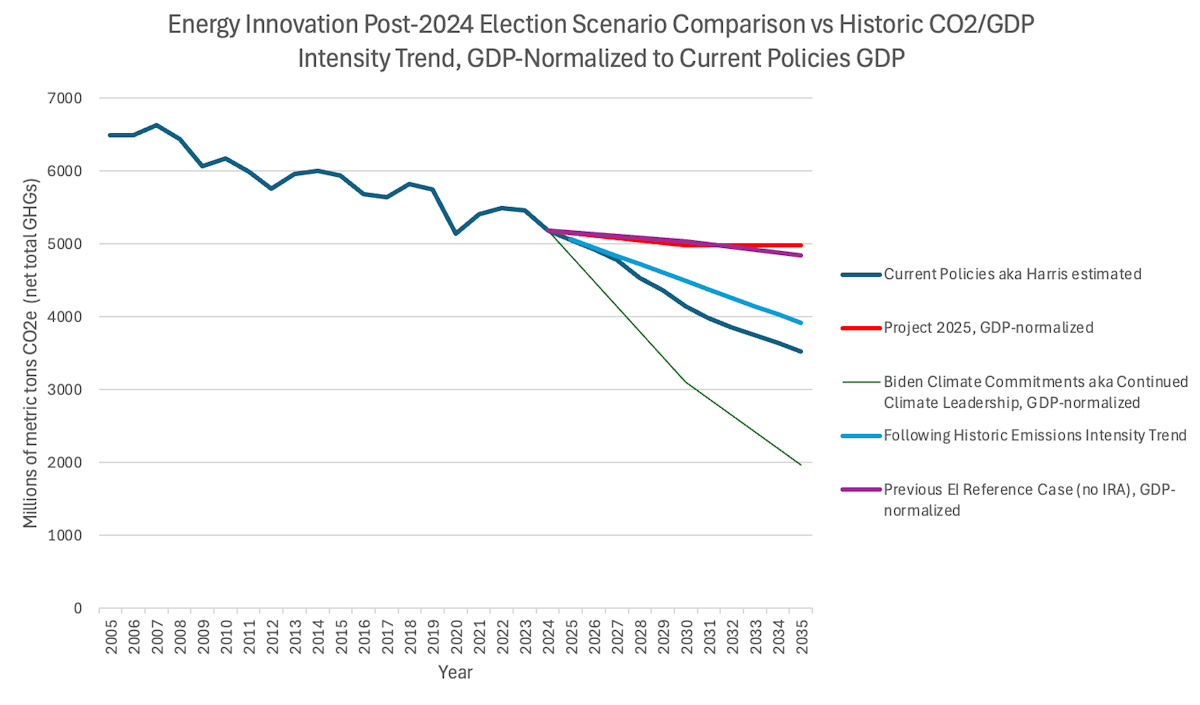 Figure 1:Modeled U.S. future emissions, adapted from 2023 and 2024 Energy Innovation analyses of climate policies under a future Harris administration (Current Policies), a future Trump administration (Project 2025), and a previous 2023 no-IRA scenario (Previous Reference). The lighter blue line marks the historic 1990-2022 trend of improving U.S. CO2e/GDP (-4.48% year-on-year), extrapolated to 2050. Note that this CO2e/GDP-based trend produces effectively identical emissions as a naive extrapolation of the U.S. gross emissions trend from 2005-2022 or 2008-2022. Source: The Breakthrough Institute
But one need not interrogate these findings, and the assumptions behind them, for long to see that there are plenty of ways that the opposite might be the case. A counterfactual world where the Biden administration did not pass the IRA and the IIJA, for instance, might have been one in which interest rates and inflation would have been at least somewhat lower, which might have kept a lot of clean energy projects that have been canceled over the last three years afloat.
Looking forward, some financial analysts are forecasting higher economic growth in the early years of a Harris administration versus a Trump administration, due to Trump’s sweeping proposal to impose heavy tariffs on Chinese imports and higher deficits resulting from another round of tax cuts. Slower economic growth under a second Trump administration could easily result in lower emissions, even if Trump were to succeed in repealing the IRA in full.
Recent modeling by Rocky Mountain Institute of the proposed Manchin-Barrasso permitting reform bill, to take another example, finds that the expanded transmission capacity that it projects would produce virtually the same magnitude of emissions benefit as REPEAT projects for a Harris versus Trump administration. Should Manchin-Barraso not pass in the closing days of the present Congress, it is hard to say whether prospects for permitting reform will be better under a Trump or Harris administration.
Similar uncertainties abound about the future of nuclear energy. How will a second Trump administration view Biden era policies to support nuclear energy under provisions of both the IRA and the IIJA? How will Harris appointees to the NRC proceed on regulatory modernization and reform? Now fold in many further uncertainties. Will Harris’ newfound love of natural gas and permitting reform last beyond the election? What commitment, if any, does Trump really have to Project 2025 beyond repealing the IRA? Does it extend to repealing policies established during the first Trump administration, as assumed by Energy Innovation?
Insofar as events, not campaign promises, more often than not shape presidencies, how will a Trump administration versus a Harris administration respond if AI drives a massive increase in electricity demand from data centers over the next four years? Or if China invades Taiwan? Even assuming that both of these initiating events occurred under either administration, the choices that they would make in response might be quite different and might have quite different consequences in terms of the macroeconomic and geopolitical context in which both emissions and broader energy system evolution would unfold.
Decarbonization and meaningful climate mitigation is a long game. Policy, governance, and leadership matter. As I argued earlier this year, the historic decarbonization rate is, in significant part, the long term signal of past energy policy. But attempting to discern a policy signal from present policy proposals over the comparatively short duration of a single presidential term is a fool's errand. Doing so may serve various partisan and electoral purposes. But it tells us nothing about what matters and doesn’t matter in efforts to cut emissions and transition to cleaner energy.
Indeed, if the history of US and global decarbonization tells us anything, it is that the things that matter, with the benefit of hindsight, are rarely the things that most political actors in the present imagine. Shale gas, to return to one example, was not taken seriously as a potential breakthrough technology through the 70’s, 80’s, and 90’s. At the time, far more resources, expectation, and hype were directed at oil shale, synfuels, solar, wind, and nuclear. Twenty years ago, to take a different example, various schemes to develop coal-fired electricity generation with carbon capture frequently dominated climate policy discussions while nuclear energy was, at best, an afterthought.
Thirty or fifty years from now, there will almost certainly be a range of policy choices made by a Trump or Harris administration that will have proven to be decisive, perhaps for the better, perhaps not. IRA investments in electrified steel production or carbon removal or hydrogen production might open up new technological possibilities. Perhaps will Trump ignite a trade war that will tank the global economy, drive major expansion of US mining and processing of critical minerals, or both.
The future is unwritten. As Vaclav Smil has reminded us for many years now, an energy transition is a remarkably slow moving thing, deeply enmeshed with the macroeconomy and constrained by the massive inertia of built infrastructure designed to last for many decades. Insofar as a Trump or Harris administration is characterized by major energy policy achievements or failures, they will likely not manifest until well after the next president has left office and the efficacy of those policies will only be apparent in hindsight.
I write that in full recognition that Harris effectively endorsed much of the Breakthrough Institute’s energy policy agenda last week, recognizing the importance of gas for the global energy transition and security, the importance of advanced nuclear to US climate ambitions, calling for across the board investment in clean technology, and for permitting reform and other steps to clear regulatory hurdles to a clean energy economy. My own policy preferences on these questions are no more immune to the basic truth that policy agendas almost never play out the way that their advocates hope they will than are anyone else’s.
That is especially true when it comes to carbon emissions, technology, and policy. We have lots of strong evidence that technology policy can help drive important technological change. But that change is, by its very nature, shot through with uncertainty while its benefits almost always substantially lag the election cycles in which those policies are established, amended, or repealed.
That doesn’t mean that modeling different energy futures and the potential impact of technology policies can’t tell us anything useful. At the very least, understanding what assumptions modeled projections are sensitive to can usefully help us understand which policy levers might matter, and under what circumstances. All else equal, emissions in 2030 with permitting reform and, hence, a lot more transmission probably will be lower than without, for instance. But there are all sorts of ways that the first step in that chain of events—permitting reform—might not lead to more transmission, which in turn might not result in lower emissions.
The notion that such a causal chain exists, from permitting reform to lower emissions, is based upon assumptions that are input into the models, not conclusions that come out of them. 2030 with permitting reform but also high inflation, high interest rates, high tariffs, and an economic recession, for instance, might not see a lot of new transmission or clean energy deployed even if it does see lower emissions because the economy tanks. 2030 in which the IRA has been preserved and AI-driven energy demand mushrooms might be one in which emissions were substantially higher but decarbonizing technological change proceeded faster.
Ultimately, future U.S. emissions outcomes hinge upon economic conditions and technological factors and costs. The IRA and other Biden policies could certainly influence those factors, but only alongside a vast host of other variables. Those tumultuous political and economic uncertainties make it more unlikely than not that the future of U.S. decarbonization is narrowly synonymous with the survival of the IRA in its present form or that the trajectory of US emissions over the next four or six years are any more likely than in the past to validate Democratic or environmental policy preferences. While there are plenty of good reasons to prefer a Harris presidency over a Trump presidency, short term emissions projections are not among them.
Some Odds and Ends:
- Grist’s Kate Yoder has written a great profile of Breakthrough’s Patrick Brown and the controversy he kicked off when he criticized Nature and the peer review process that incentivizes scientists to focus overwhelmingly on climate change while ignoring other factors driving impacts associated with wildfires and other weather related climate impacts. I’ve had a long and complicated relationship with Grist. Back when it started, in the early 2000s, as a startup, web-based environmental journalism outlet, Grist put itself on the map by extensively covering the Death of Environmentalism controversy rather than trying to suppress it. In subsequent years, it published a lot of execrable ad hominem attacks on me, Breakthrough, and folks like Roger Pielke Jr. from the likes of David Roberts and Joe Romm. But over the last decade, Grist has produced some of the best and most thoughtful environmental journalism in the business, from folks like Nathanael Johnson, Shannon Osaka, Zoya Teirstein, and Kate. Kate’s story does an admirable job of playing it straight, covering a highly charged controversy and letting her readers decide what to think. A lot of big name environmental journalists could learn a lot from her reporting.
- The vote on Matthew Marzano’s confirmation to the NRC at the Senate Environment and Public Works Committee was postponed until after the election last week, as the majority didn’t have the votes to move the confirmation out of committee. It is now scheduled for mid-November. If the Democratic majority succeeds in moving Marzano’s confirmation out of committee, it will then need to find floor time in the lame duck session amidst a lot of other high priority items. So the prospects for Marzano’s confirmation, while not dead yet, have considerably dimmed. It’s unfortunate that the White House did not choose to move forward with one of several well vetted Democratic candidates with long-standing and public records of supporting regulatory modernization. Any of these candidates would almost certainly have received broad and bipartisan support in both the committee and the Senate floor. Should the Senate, correctly in my view, refuse to confirm Marzano, that opportunity will need to wait until the next Congress.
:{* By my count, Genevieve Guenther has now quietly acknowledged at least 6 of the 8 major errors that George Morrison identified in his very abbreviated fact check of her new book. These include her fundamental misunderstanding of the carbon cycle, her exaggerating the GDP impact of extreme weather in the United States by a factor of 100, her bizarre claim that bioenergy crops produce ionizing radiation, her claim that global agricultural yields have fallen since 1960, her claim that removing carbon from the atmosphere only reduces global warming by half as much as adding carbon increases it, and her claim that health care and labor productivity savings from limiting warming to 2 degrees would pay for the cost of the energy transition.
She has not addressed, anywhere as far as I can tell, the seventh issue that Morrison identified, the claim that with 3C of warming, much of the United States would be too hot for people to go outside for 3 months of the year. And she has simply repeated her clearly erroneous claim that Robert Solow had admitted in a footnote in his seminal “A Contribution to the Theory of Economic Growth,” that long term economic growth was limited by the availability of agricultural land, either continuing to mistake his criticism of leading Keynesian growth theories of the time for his own theory or, more likely, simply prevaricating in order to avoid acknowledging that the central claim that underpins her entire chapter on economic growth is complete nonsense. Mostly, she has just attacked the messenger, believing, probably correctly, that as long as her supporters in the climate movement believe that our factcheck was produced by bad people in bad faith, they won’t much care that her argument is built upon claims that are demonstrably wrong.}:
---
[
Ted Nordhaus
Ted Nordhaus is Founder and Executive Director of Breakthrough.](https://thebreakthrough.org/people/ted-nordhaus)
Related Articles
Will The Inflation Reduction Act Beat Business as Usual?

by Seaver Wang , Juzel Lloyd , Alex Trembath & Ted Nordhaus
---
nyt
Op-Ed Contributors
Global Warming Scare Tactics
By Ted Nordhaus and Michael Shellenberger
- April 8, 2014
Credit...Leigh Guldig
OAKLAND, Calif. — IF you were looking for ways to increase public skepticism about global warming, you could hardly do better than the forthcoming nine-part series on climate change and natural disasters, starting this Sunday on Showtime. A trailer for “Years of Living Dangerously” is terrifying, replete with images of melting glaciers, raging wildfires and rampaging floods. “I don’t think scary is the right word,” intones one voice. “Dangerous, definitely.”
Showtime’s producers undoubtedly have the best of intentions. There are serious long-term risks associated with rising greenhouse gas emissions, ranging from ocean acidification to sea-level rise to decreasing agricultural output.
But there is every reason to believe that efforts to raise public concern about climate change by linking it to natural disasters will backfire. More than a decade’s worth of research suggests that fear-based appeals about climate change inspire denial, fatalism and polarization.
For instance, Al Gore’s 2006 documentary, “An Inconvenient Truth,” popularized the idea that today’s natural disasters are increasing in severity and frequency because of human-caused global warming. It also contributed to public backlash and division. Since 2006, the number of Americans telling Gallup that the media was exaggerating global warming grew to 42 percent today from about 34 percent. Meanwhile, the gap between Democrats and Republicans on whether global warming is caused by humans rose to 42 percent last year from 26 percent in 2006, according to the Pew Research Center.
Other factors contributed. Some conservatives and fossil-fuel interests questioned the link between carbon emissions and global warming. And beginning in 2007, as the country was falling into recession, public support for environmental protection declined.
A changing climate, a changing world
Card 1 of 4
Climate change around the world:In “Postcards From a World on Fire,” 193 stories from individual countries show how climate change is reshaping reality everywhere, from dying coral reefs in Fiji to disappearing oases in Morocco and far, far beyond.
The role of our leaders:Writing at the end of 2020, Al Gore, the 45th vice president of the United States, found reasons for optimism in the Biden presidency, a feeling perhaps borne out by the passing of major climate legislation. That doesn’t mean there haven’t been criticisms. For example, Charles Harvey and Kurt House argue that subsidies for climate capture technology will ultimately be a waste.
The worst climate risks, mapped:In this feature, select a country, and we'll break down the climate hazards it faces. In the case of America, our maps, developed with experts, show where extreme heat is causing the most deaths.
What people can do:Justin Gillis and Hal Harvey describe the types of local activism that might be needed, while Saul Griffith points to how Australia shows the way on rooftop solar. Meanwhile, small changes at the office might be one good way to cut significant emissions, writes Carlos Gamarra.
Still, environmental groups have known since 2000 that efforts to link climate change to natural disasters could backfire, after researchers at the Frameworks Institute studied public attitudes for its report “How to Talk About Global Warming.” Messages focused on extreme weather events, they found, made many Americans more likely to view climate change as an act of God — something to be weathered, not prevented.
Some people, the report noted, “are likely to buy an SUV to help them through the erratic weather to come” for example, rather than support fuel-efficiency standards.
Since then, evidence that a fear-based approach backfires has grown stronger. A frequently cited 2009 study in the journal Science Communication summed up the scholarly consensus. “Although shocking, catastrophic, and large-scale representations of the impacts of climate change may well act as an initial hook for people’s attention and concern,” the researchers wrote, “they clearly do not motivate a sense of personal engagement with the issue and indeed may act to trigger barriers to engagement such as denial.” In a controlled laboratory experiment published in Psychological Science in 2010, researchers were able to use “dire messages” about global warming to increase skepticism about the problem.
Many climate advocates ignore these findings, arguing that they have an obligation to convey the alarming facts.
But claims linking the latest blizzard, drought or hurricane to global warming simply can’t be supported by the science. Our warming world is, according to the United Nations Intergovernmental Panel on Climate Change, increasing heat waves and intense precipitation in some places, and is likely to bring more extreme weather in the future. But the panel also said there is little evidence that this warming is increasing the loss of life or the economic costs of natural disasters. “Economic growth, including greater concentrations of people and wealth in periled areas and rising insurance penetration,” the climate panel noted, “is the most important driver of increasing losses.”
Claims that current disasters are connected to climate change do seem to motivate many liberals to support action. But they alienate conservatives in roughly equal measure.
What works, say environmental pollsters and researchers, is focusing on popular solutions. Climate advocates often do this, arguing that solar and wind can reduce emissions while strengthening the economy. But when renewable energy technologies are offered as solutions to the exclusion of other low-carbon alternatives, they polarize rather than unite.
One recent study, published by Yale Law School’s Cultural Cognition Project, found that conservatives become less skeptical about global warming if they first read articles suggesting nuclear energy or geoengineering as solutions. Another study, in the journal Nature Climate Change in 2012, concluded that “communication should focus on how mitigation efforts can promote a better society” rather than “on the reality of climate change and averting its risks.”
Nonetheless, virtually every major national environmental organization continues to reject nuclear energy, even after four leading climate scientists wrote them an open letter last fall, imploring them to embrace the technology as a key climate solution. Together with catastrophic rhetoric, the rejection of technologies like nuclear and natural gas by environmental groups is most likely feeding the perception among many that climate change is being exaggerated. After all, if climate change is a planetary emergency, why take nuclear and natural gas off the table?
While the urgency that motivates exaggerated claims is understandable, turning down the rhetoric and embracing solutions like nuclear energy will better serve efforts to slow global warming.
Ted Nordhaus is the chairman and Michael Shellenberger is the president ofthe Breakthrough Institute, an environmental research organization.
---
via drilled
the New Denial Is Delay
How an attempt to revolutionize the environmental movement became a push to delay action on climate change.
By Paul D. Thacker
In October 2004, Ted Nordhaus and Michael Shellenberger, the founders of a scrappy Bay Area think tank called The Breakthrough Institute, published “The Death of Environmentalism,” an essay that argued the environmental movement had failed. To knock back critics, the duo constantly underlined their environmental credentials and years of experience providing public relations advice to green groups like the Sierra Club and Natural Resources Defense Council.
Seeking to define themselves as different from run-of-the-mill climate skeptics, Shellenberger told a reporter around that time, “We’re not like Bjorn Lomborg or whatever.” Lomborg, of course, is the Danish climate contrarian best known for the fact-challenged book Cool It and, more recently, False Alarm.
A few years after seeking to differentiate the Breakthrough Institute from Lomborg, Shellenberger joinedthe Danish writer on a panel at Brown University, where both urged more tempered rhetoric on climate change. As reported by the Brown Daily Herald, Shellenberger argued that climate change experts dismissed him and Lomborg because policy experts did not allow for their “alternative voices.”
[janus forum pix]
More than a decade later, Shellenberger has left the Breakthrough Institute, but little else has changed. Both Shellenberger and Lomborg have released new books—as in the past, experts immediately savaged them. In a review at Yale 360, Pacific Institute emeritus president Peter Gleick wrote, “Bad science and bad arguments abound in 'Apocalypse Never' by Michael Shellenberger.” Taking a pickaxe to Lomborg’s book False Alarm, Nobel Prize winning economist Joseph Stiglitz wrote in the New York Times, “This book proves the aphorism that a little knowledge is dangerous. It’s nominally about air pollution. It’s really about mind pollution.”
--
A decade after theBreakthrough Institute burst on the scene firing shots at Big Green, Shellenberger followed Sierra Club president Mike Brune onto the stage for Brainstorm Green, Fortune Magazine’s 2014 conference for environmental leaders. After opening remarks from Brune, dressed the part of an environmental nonprofit boss in boring suit and tie, Shellenberger stepped up to the podium in slacks and a fitted shirt—uniform-ready to host an inspiring Ted Talk.
He then proceeded to berate Brune for failing to offer real solutions to climate change.
By this point, Shellenberger no longer felt the need to namecheck his environmental roots before launching a missile at Big Green. He recounted how, in contrast to Brune and his ineffective Sierra Club, he and Breakthrough co-founder Ted Nordhaushad successfully lobbied for the New Apollo Project, a coalition advocating for cleantech and renewable energy. Shellenberger added that the New Apollo later convinced the Obama administration to put $150 billion into a stimulus bill.
After leaving the podium, Shellenberger sat down next to Brune to continue the debate. Brune then punched back, “We operate differently from your Breakthrough Institute. We are not a think tank; we are a group that gets results...on the ground.”
With a grin and a shrug, , “We had pretty good results with the stimulus, actually.”
The sparring was vintage Breakthrough: tiny, Left Coast think tank smacks down Big Environment for sclerotic thinking and green solutions less palatable than last week’s stale, organic, whole grain muffins. Also standard: Shellenberger’s Apollo parable relied on a string of selective facts, loudly paraded onto stage for political theater.
Started in the early 2000s, the Apollo Alliance banded together dozens of labor unions and green groups in a coalition that advocated for federal funding to advance technologies and create jobs for clean energy. Members included everyone from the NAACP, SEIU, Greenpeace, Tides Foundation, League of Conservation Voters, and the AFL-CIO. Anyone who was anyone began adopting Apollo-like rhetoric, including Bill Clinton, and The Nationeditor and publisher Katrina Vanden Heuvel. Not surprisingly, a founding board memberof Apollo was the Sierra Club’s executive director, which makes it odd that Shellenberger would try to seize sole credit for the coalition’s purported success, let alone use it against Brune.
In reality, Nordhaus and Shellenberger were two of the many, many people that helped get the coalition off the ground. And in 2005, nearly a decade before that public spat with Brune, Shellenbergerannounced that he had left Apollo over disagreements with members. In a recent interview with Drilled,Shellenberger put it more bluntly: “I was shitcanned from Apollo over ‘Death of Environmentalism.’”
Despite that happening more than fifteen years ago, Shellenberger still references his time with the Apollo Alliance when plugging his tale as a hero to save the planet from climate change. In January 2020, for example, when he testified before the House Science Committee, Shellenberger noted “In 2003 I co-founded the Apollo Alliance to advocate for a Green New Deal, which we called a ‘New Apollo Project.’” He added that Obama’s stimulus (passed in 2009) funded many Apollo proposals for renewables, energy efficiency, and electric vehicles.
In speaking with Drilled, Shellenberger claimed to have had a hand in that stimulus as well, after meeting with Obama’s policy team. “And the Obama people, they got it right away,” Shellenberger said. “And then the rest is history. They basically were like, ‘Yeah, we want to do a big investment in clean energy.’ And that was the stimulus investment.”
A recently retired Hill staffer, who did not want his name in the media, said he worked for decades on appropriations for the House but never heard of the Breakthrough Institute. He wondered how Shellenberger—or anyone—could claim personal credit for passing billions of dollars in renewable energy policy with just one or two meetings, when the Hill is swarming with professional lobbyists working around the clock.
“He’s constantly reinventing his story to build the appearance of power and access,” said Kert Davies, who spent 13 years at Greenpeace examining energy policy, before founding the Climate Investigations Center in 2013. Davies said he first met Shellenberger in the early 2000s, when Shellenberger was vying to get a communications contract with Greenpeace. “He takes credit for things [that happened] years after he was boosted from the Apollo Alliance. He can say whatever he wants, and it’s all vapor because the organization is now gone.”
“They aren’t players up here on the Hill,” a Democratic Committee staffer said of The Breakthrough Institute. This staffer has spent almost two decades in Congress working on environmental and climate change policy but is not authorized to speak to the media. “They spend most of their time shooting spitballs at mainstream environmental organizations and that makes them a bright, shiny object to some journalists.”
Nonetheless, when Nordhaus and Shellenberger flew from California to Washington in 2009 to discuss climate policy, NPR interviewed them outside the Senate Dirksen Office Building, and reported their funder Peter Teague’s claims that President Obama had adopted Breakthrough’s “language and visionary rhetoric.”
--
Jockeying to position themselves as the smart, thoughtful adults on environmental policy is core to the Breakthrough model, and to Shellenberger's approach post-Breakthrough as well, along with constant bashing of “Big Environment.” In 2005, after Greenpeace created the website Exxon Secrets to track the oil company’s funding for climate change disinformation, Mother Jones published a sprawling investigationdetailing how Exxon was throwing buckets of cash at forty organizations that attacked the scientific consensus on climate....
later sez any kaufman art performance]
---
---
uc davis gmo boot camp, brkthru gave pam r award
In July 2014, Dr. Ronald indicated in an email to a colleague that Entine was an important collaborator who could give them good suggestions on who to contact to raise additional funds for the first IFAL event. In June 2015, IFAL co-hosted the “Biotech Literacy Project boot camp” with Genetic Literacy Project and the Monsanto-backed group Academics Review. Organizers claimed the event was funded by academic, government and industry sources, but non-industry sources denied funding the events and the only traceable source of money came from industry, according to reporting by Paul Thacker in The Progressive.
Tax records show that Academics Review, which received its funding from the agrichemical industry trade group, spent $162,000 for the three-day conference at UC Davis. The purpose of the boot camp, according to the agenda, was to train and support scientists, journalists and academic researchers to persuade the public and policy makers about the benefits of GMOs and pesticides.
Speakers at the UC Davis boot camp included Jay Byrne, Monsanto’s former director of corporate communications; Hank Campbell of the Monsanto-funded American Council on Science and Health; professors with undisclosed industry ties such as University of Illinois Professor Emeritus Bruce Chassy and University of Florida Professor Kevin Folta; Cami Ryan, who now works for Monsanto; David Ropeik, a risk perception consultant who has a PR firm with clients including Dow and Bayer; and other agrichemical industry allies.
:{Keynote speakers were Dr. Ronald, Yvette d’Entremont the Sci Babe:(style="background-color:#ffcc66ff"):}:,:{ a “science communicator” who defends pesticides and artificial sweeteners while taking money from companies that sell those products, and }::{Ted Nordhaus of the Breakthrough Institute. (Nordhaus was also listed as a Science Literacy Project board member }::{on the original 2015/2016 tax form, but his name was removed along with Dr. Ronald’s in the amended form Entine filed in 2018; Nordhaus said he never served on the board.)}:
---
~ agro-ecology
Small-scale Food System Enlarges Human Footprint
The following keynote address was delivered by Ted Nordhaus at the first annual Institute for Food and Agricultural Literacy Symposium on June 3, 2015. The speech has been lightly edited.
Thank you for having me today. It has come to my attention during the course of this conference that the fast food chain Chipotle has announced that it will no longer serve food grown with genetically modified organisms. Apparently, this occurred last month, but somehow I missed it on Twitter. Between the debut of Caitlyn Jenner, the latest royal baby, and the FIFA corruption scandal, I guess it just slipped through my stream....
Leapfrogging Progress
The Environmental Case for Industrial Agriculture

by Ted Nordhaus
Taking Modernization Seriously
by Michael Lind
---
https://thebreakthrough.org/issues/food/synthetic-fertilizer-infographic
---
https://undark.org/article/ted-nordhaus-carrying-capacity-ecology/
==
2008
http://content.time.com/time/specials/packages/article/0,28804,1841778_1841779_1841804,00.html
...
:{[long]
A PRACTICAL PATH FORWARD
At this point, if there is a moral hazard argument to be made, it is against the two-degree threshold, not for it. Humans are going to live on a significantly hotter planet for many centuries. The notion that two degrees remains an achievable target risks diverting attention from steps we might take today to better weather the changes that are coming. Once the world lets go of the unrealistic two-degree target, a range of practical policies comes much more clearly into focus.
We should do all that we can to speed up decarbonization. Accelerating the coal-to-gas transition and continuing the deployment of today’s renewable energy technologies would incrementally reduce climate risk even if neither is capable of decarbonizing economies at rates consistent with achieving the two-degree target. At the same time, it is important to support those efforts in ways that don’t lock out technologies that will be necessary to achieve deeper emissions cuts over the longer term. Continuing subsidies for low-efficiency solar panels, for instance, have shut higher-efficiency solar technologies out of the renewables market. Cheap gas has rendered many nuclear power plants, which don’t get the same privileged access to electrical gridsordirect production subsidies as do wind and solar energy, uneconomical. At relatively low overall shares of electricity generation, variable sources of power such as wind and solar risk crowding out other zero-carbon options that will be necessary to fully decarbonize power grids. And if deep decarbonization is the objective, much greater public investment will be needed to develop and commercialize clean energy technologies, even though those technologies are unlikely to contribute much to emissions-cutting efforts over the next several decades.
Meanwhile, we need to stop trying to balance the increasingly parsimonious carbon emissions budgets entailed by a two-degree target on the backs of the global poor. There is no moral justification for denying those populations the benefits of fossil-fuel-driven development. Lower-emissions levels associated with curtailed development will not provide any meaningful amelioration of climate extremes for many decades to come, whereas the benefits that come with development will make those populations substantially more resilient to climate extremes right now.
Finally, the world must get serious about researching carbon removal and geoengineering and developing the international institutions and governance frameworks necessary to use them, not out of the certainty that we will eventually need them but through an abundance of caution that we might.
From its earliest days, climate policy and advocacy has always been predicated, sometimes explicitly and always implicitly, on the idea that climate change was a problem that could be solved. The two-degree threshold is a reflection of that impulse. In reality, climate change is now a permanent condition of the human present and future, one that we will manage more or less successfully but that we will never solve. Liberating international climate policy efforts from the various constraints that the two-degree threshold imposes can’t eliminate all of the risks that climate change will bring. But doing so might allow us to manage them better.
==
dad legit clinton ferc lawyer
https://books.google.com/books?id=OjlqDwAAQBAJ
---
https://www.foreignaffairs.com/articles/world/2018-02-08/two-degree-delusion
==
wikifluff
Ted Nordhaus is an American author, environmental policy expert, and the chairman of The Breakthrough Institute. He was listed in Time* magazine's Heroes of the Environment (2008),[1] winner of the 2008 Green Book Award,[2] co-editor of *Love Your Monsters (2011) and co-author of Break Through (Houghton Mifflin 2007) and The Death of Environmentalism (2004).[3]He and his co-author Michael Shellenberger were described by Slate Magazine as "modernists" or "eco-pragmatists".[4]
:{Breakthrough Institute
Nordhaus is chairman of the Breakthrough Institute, which he co-founded with Michael Shellenberger in 2003.[3] Today, Breakthrough Institute consists of a policy staff, an annual conference, a policy journal, and a network of affiliated fellows.[5][6][7]
Breakthrough Institute analyses of energy, climate and innovation policy have been cited by US President Barack Obama.,[8]National Public Radio ^[9]^ the ^Wall Street Journal[10] and C-SPAN.[11]
Nordhaus has co-authored analyses of cap and trade climate legislation,[12] of the "planetary boundaries" hypothesis,[13][14]energy rebound from energy efficiency measures,[15] carbon pricing,[16] renewable energy subsidies,[8][17] nuclear energy,[18]and shale gas.[17][19][20]
The Institute argues that climate policy should be focused on higher levels of public funding on technology innovation to "makeclean energy cheap," and has been critical of climate policies like cap and trade and carbon pricing that are focused primarily on raising energy prices.[21][22][23][24]
The Institute has conducted research showing that shale gas and other major technological innovations were created by American government institutions and public financing. The Institute advocates higher levels of public spending on technology innovation, which they argue will lead to higher environmental quality, economic growth, and quality of life.[17][19][20]
:{Writings
In 2004, Nordhaus and Shellenberger, both long-time strategists for environmental groups, co-authored a controversial essay, "The Death of Environmentalism: Global Warming Politics in a Post-Environmental World." The paper argues that environmentalism is conceptually and institutionally incapable of dealing with climate change and should "die" so that a new politics can be born. The essay was debated,[3][25] and continues to be widely discussed ^[26] and taught[27]
In, 2007, Houghton Mifflin published Nordhaus and Shellenberger's Break Through: From the Death of Environmentalism to the Politics of Possibility (Houghton Mifflin, 2007). Break Through is an argument for what its authors describe as a positive, "post-environmental" politics that abandons the environmentalist focus on nature protection for a new focus on technological innovation to create a new economy. Time Magazine named Nordhaus and Shellenberger two of its 32 Heroes of the Environment (2008) calling Break Through "prescient" for its prediction that climate policy should focus not on making fossil fuels expensive through regulation but rather on making clean energy cheap.[1] Break Through was awarded the Green Book Award, 2009, whose other recipients include E.O. Wilson and James Hansen.[2]
Their writings have focused on the intersection of climate change, energy innovation, and politics. The two predicted the failure of cap and trade for its focus on making fossil fuels expensive rather than on technology innovation to make clean energy cheap.[28][29] They faulted the Kyoto climate treaty for being focused on what they called "shared sacrifice" rather than shared technological innovation.[30] They have criticized green cultural life as a consequence of status anxieties among Western consumers.[31] And they have argued for a "theology" of ecological modernization that embraces technological innovation and human development.[32]
Nordhaus and Shellenberger have argued for a "climate pragmatism" and an embrace of modernization and human development. They are co-authors of an alternative framework to the United Nations process focused on energy innovation, pollution control and adaptation.[33][34][35]
In 2011, Nordhaus and Shellenberger started The Breakthrough Journal, which The New Republic called "among the most complete efforts to provide a fresh answer" to the question of how to modernize liberal thought,[6] and The National Reviewcalled "...the most promising effort at self-criticism by our liberal cousins in a long time." ^[36]
:{An Ecomodernist Manifesto
In April 2015, Nordhaus joined with a group of scholars in issuing An Ecomodernist Manifesto.[37][38] The other authors were: John Asafu-Adjaye, Linus Blomqvist, Stewart Brand, Barry Brook. Ruth DeFries, Erle Ellis, Christopher Foreman, David Keith, Martin Lewis, Mark Lynas, Roger A. Pielke, Jr., Rachel Pritzker, Joyashree Roy, Mark Sagoff, Michael Shellenberger, Robert Stone, and Peter Teague[39]
:{Personal life
Nordhaus is the son of Robert Nordhaus, former General Counsel of the United States Department of Energy, and the brother of Hannah Nordhaus, environmental journalist and author of The Beekeepers Lament.[40][not ^in ^citation ^given] He is the nephew ofWilliam Nordhaus, an environmental economist at Yale University.[41]
:{References
- ^ ^Jump up to:^a^ ^b^ Bryan Walsh, *Time Magazine*, September 24, 2008
- ^ ^Jump up to:^a^ ^b^ Stevens' Center for Science Writing, January 8, 2008
- ^ ^Jump up to:^a^ ^b^ ^c^ Felicity Barringer, "Paper Sets Off A Debate On Environmentalism's Future," *New York Times* February 6, 2005
- Jump up Keith Kloor, "The Great Schism in the Environmental Movement," December 12, 2012
- Jump up Joe Garofoli, "Thinkers Take Apart Liberalism in Order to Save It," *San Francisco Chronicle,* June 16, 2011
- ^ ^Jump up to:^a^ ^b^ Mark Schmitt, *The New Republic,* "Has Liberalism Entered a Post-Obama Era?, June 30, 2011
- Jump up The Breakthrough Institute
- ^ ^Jump up to:^a^ ^b^ "The End of Clean Energy Subsidies?" *New York Times*, May 5, 2012
- Jump up Christopher Joyce, "Nuclear Woes Push Japan into a New Energy Future," *NPR News*, March 11, 2012
- Jump up Joseph White, Obama's Energy Shift: It's Not About Climate, *Wall Street Journal*, January 27, 2011
- Jump up C-Span, "Role of Government in Energy Innovation," May 22, 2012
- Jump up Bryan Walsh, "What the Energy Bill Really Means for CO2 Emissions," *Time Magazine*, June 27, 2009
- Jump up "Boundary Conditions," *The Economist,* June 16, 2012
- Jump up David Biello, "Walking the Line: How to Identify Safe Limits for Human Impacts on the Planet," *Scientific American*, June 13, 2012
- Jump up John Tierney, "When Energy Efficiency Sullies the Environment," *New York Times,* March 7, 2011
- Jump up Michael Totty, "Should There Be a Price on Carbon?" *Wall Street Journal*, October 5, 2012
- ^ ^Jump up to:^a^ ^b^ ^c^ David Leonhardt, "There's Still Hope for the Planet," New York Times, July 21, 2012
- Jump up Michael Totty, "Nuclear Energy's Fall — and Rise," *Wall Street Journal*, April 17, 2010
- ^ ^Jump up to:^a^ ^b^ Michael Shellenberger and Ted Nordhaus, "A Boom in Shale Gas? Credit the Feds," *Washington Post*, December 16, 2011
- ^ ^Jump up to:^a^ ^b^ Kevin Begos, "Decades of Federal Dollars Helped Fuel Gas Boom," *Associated Press*, September 23, 2012
- Jump up Ted Nordhaus and Michael Shellenberger, "Second Life: A Manifeto for a New Environmentalism," *The New Republic*, September 24, 2007
- Jump up Richard Harris, "Putting a Financial Spin on Global Warming," NPR News, June 24, 2009
- Jump up Ted Nordhaus and Michael Shellenberger, "How to Change the Global Energy Conversation, *Wall Street Journal*, November 28, 2012
- Jump up "Fast, Clean and Cheap: Cutting Global Warming's Gordian Knot,"Harvard Law and Policy Review, January 2008, Vol. II, No. 1
- Jump up Katharine Mieszkowski, "Dead Movement Walking?" *Salon,* January 14, 2005
- Jump up http://aaahq.org/AM2012/abstract.cfm?submissionID=1955)
- Jump up http://www.skidmore.edu/~bturner/go231.htm
- Jump up Ted Nordhaus and Michael Shellenberger, "Getting Real on Climate Change, *American Prospect*, November 21, 2008
- Jump up Ted Nordhaus and Michael Shellenberger, "Cap and Charade," *The New Republic,* October 14, 2010
- Jump up Michael Shellenberger and Ted Nordhaus "Scrap Kyoto," *Democracy Journal*, Summer 2008.
- Jump up Ted Nordhaus and Michael Shellenberger, "The Green Bubble: Why Environmentalism Keeps Imploding," *The New Republic*, May 20, 2009
- Jump up Michael Shellenberger and Ted Nordhaus, "Evolve," Orion Magazine, September/October 2011
- Jump up Daren Samuelsohn, "Report: Treat climate change like 'Fight Club'," Politico, July 26, 2011
- Jump up Lisa Friedman, "'Climate pragmatists' call for an end to Kyoto process" ClimateWire, July 26, 2011
- Jump up Bryan Walsh, "Fighting Climate Change by Not Focusing on Climate," *Time Magazine*, July 26, 2011
- Jump up Steven Hayward, "An Environmental Reformation," *The National Review*, July 18, 2011
- Jump up "An Ecomodernist Manifesto". ecomodernism.org. Retrieved April 17, 2015. A good Anthropocene demands that humans use their growing social, economic, and technological powers to make life better for people, stabilize the climate, and protect the natural world.
- Jump up Eduardo Porter (April 14, 2015). "A Call to Look Past Sustainable Development". The New York Times. Retrieved April 17, 2015.On Tuesday, a group of scholars involved in the environmental debate, including Professor Roy and Professor Brook, Ruth DeFries of Columbia University, and Michael Shellenberger and Ted Nordhaus of the Breakthrough Institute in Oakland, Calif., issued what they are calling the “Eco-modernist Manifesto.”
- Jump up "Authors An Ecomodernist Manifesto". ecomodernism.org. Retrieved April 17, 2015. As scholars, scientists, campaigners, and citizens, we write with the conviction that knowledge and technology, applied with wisdom, might allow for a good, or even great,Anthropocene.
- Jump up The Beekeepers Lament
- Jump up Douglas W. Cray (24 Mar 1977). "People and Business; Status of the Nordhaus Brothers In Administration Is Cleared Up". The New York Times. Retrieved 29 May 2013.
- American environmentalists
- American non-fiction environmental writers
- Living people
- Radical centrist writers
==