Pielke, R
see JR = 2
Not to be confused with his father, atmospheric scientistRoger Pielke, Sr..
NO MERRI
wasn't sure about jr for a while b/c he tried to cover tracks, eg claimed to be hijacked by heartland?
out and proud 6/16 eg v shukula hit; Grijalva asked for his $ records (a year) after gop went after legit cli sci (eg Mann?)
SEE BAK
html2014-04-26
10 25
Over at The Climate Brink, Andrew Dessler and Zeke Hausfather have taken on the role of self-appointed sheriffs of climate science, at times in highly partisan and personal terms. Recently, Dessler, along with another scientist, Robert Kopp, and dozens of others, prepared a lengthy response to the Department of Energy’s Climate Working Group (DOE CWG) report.
Today, Dessler posted a further critique of the DOE CWG —Is this the most embarrassing error in the DOE Climate Working Group Report? Dessler’s post is remarkable for the simple fact that he reveals in great detail that he does not understand the science he is policing.
The focus of Dessler’s post is his claim that the DOE CWG authors fail to appreciate the distinction between the concepts detection and attribution and time of emergence — and this represents “the central flaw” in the DOE CWG report.
In fact, as I show undeniably below, Dessler’s post reveals that he actually does not understand IPCC terminology or its application. Irony abounds. Someone should be embarrassed, and it’s not the DOE CWG authors.
Let’s dive into the details.
Dessler presents a definition of the time of emergence of a climate signal that is completely at odds with the definition used by the Intergovernmental Panel on Climate Change (IPCC). Dessler then uses his bespoke definition to argue that the DOE CWG authors made an “embarrassing error” by not employing his bespoke definition, rather than instead relying on the IPCC.
Here is Dessler’s bespoke definition (emphases in original):
Emergence is all about the size of the influence. It means that the climate has shifted so much that the average value of some parameter is larger than the largest value in a pre-industrial climate. In other words, you’ve emerged into a new climate.
The IPCC, in stark contrast, has a very different definition of the time of emergence(emphases in original):
Time when a specific anthropogenic signal related to climate change is statistically detected to emerge from the background noise of natural climate variability in a reference period, for a specific region (Hawkins and Sutton, 2012).
Lest there be any doubt, the IPCC in its definition cites Hawkins and Sutton (2012), who explain:
The signal of anthropogenic climate change is emerging against the background of natural climate variability. Only when the signal of change is of sufficient magnitude relative to this background variability can we be confident that a significant change has been detected. Such detection is a necessary step in the process of attributing a particular change to a specific cause, such as the observed rise in greenhouse gas concentrations [Hegerl et al., 2007].
Hawkins and Sutton (2012) explain that the time of emergence is a forward looking concept, in contrast to detection, which is backwards looking (emphasis added):
A headline conclusion from the IPCC AR4 was that “most of the observed increase in global average temperatures since the mid-20th century is very likely due to the observed increase in anthropogenic greenhouse gas concentrations”. Of greater importance for adaptation to climate change are changes on the regional and local scales that affect people, economies and ecosystems. However, on these smaller scales natural variability is larger, making detection more difficult. Some detection and attribution studies that have addressed these scales have obtained positive results [Hegerl et al., 2007; Stott et al., 2010], but for many regions and variables the signal of anthropogenic change has yet to clearly emerge from the ‘noise’ of natural climate variability.
So when will the signal emerge? And where and how?
Under the definitions of the IPCC, when looking at the past climate, detection of change (at a particular statistical level of confidence) and emergence of a signal of change (employing various possible methods) are conceptually identical, even if specific methodologies and results may vary....
==
9 pp pielke
https://www.budget.senate.gov/imo/media/doc/Dr.%20Roger%20Pielke%20-%20Testimony%20-%20Senate%20Budget%20Committee.pdf
Four Take-Home Points 1. At the outset, I emphasize explicitly and unequivocally that human-caused climate change is real, that it poses significant risks to society and the environment, and that various policy responses in the form of mitigation and adaptation are necessary and make good sense. 2. The best and likely, the only, antidote to misinformation is accurate information. Successfully producing, communicating, legitimizing, and trusting accurate information to inform policy requires upholding standards of scientific integrity. 3. Unfortunately, in important areas of climate science such standards have not been upheld and the self-correcting function of science has short-circuited. In my testimony, I illustrate examples of shortfalls, with a focus on the persistent misuse of outdated and implausible scenarios. 4. Concerns expressed about misinformation are sometimes weaponized by politicians, journalists, and experts, ironically and pathologically, to spread misinformation and to undermine accurate information.
...
For a deeper elaboration of my views on the science and policy of climate, please see my book The Climate Fix (2010).Nothing in the testimony that follows should be interpreted as downplaying the importance of climate change or policy responses to it. In fact, the issue is so crucial that we should expect nothing less than the absolute highest standards of scientific integrity in research and the information being provided to policymakers...
p 4
long-term future to produce projections of future changes in climate, their impacts on society and the environment, and the consequences of alternative possible policy actions. 11 However, the scenarios that are currently prioritized in climate research and in policy analyses are badly outdated, and for a range of reasons have not been updated.12 Carbon dioxide emissions in the real world are already – today -- at a level far less than those projected in the most commonly-used climate scenarios found in research and assessment. This can be clearly seen in the figure below which shows baseline scenarios of the IPCC for carbon dioxide emissions (from energy and industry) to 2100.13 The overwhelmingly most-used scenario in climate research and cited in the assessments of the IPCC is the highest curve on the graph (called SSP5-Baseline, or SSP5-RCP8.5). Under current policies, the real world is currently following a trajectory consistent with the blue curve titled “Stated Policies.”14 The difference between the two is wide and getting wider. Every day that we continue to prioritize the most extreme scenario in research and policy is a day that we mislead ourselves...
The most used climate scenario in research and assessment is the RCP8.5 scenario (meaning 8.5 watts per meter2 ) which represents a global temperature increase of 4.8°C above 1850-1900, according to the IPCC. 16 The real world is actually tracking below a RCP4.5 scenario (meaning 4.5 watts per meter2 ) which represents a global temperature increase of 2.9°C above 1850- 1900. 17 Here is why this matters: Much if not most policy guidance relies on the outdated RCP8.5 scenario as our current trajectory and a RCP4.5 scenario as indicating policy success. For example, the 2022 White House White Paper titled, “Climate Risk Exposure: An Assessment of the Federal Government’s Financial Risks to Climate Change” used the RCP8.5 scenario to represent where we are heading, the RCP4.5 scenario to represent successful climate policy, and the difference between the two to represent the benefits of mitigation.18,19...
The pervasive misuse of climate scenarios is not a unique failure of scientific integrity in climate
science. Here are several other important examples, documented in detail at the links provided:
• Misrepresentation of NOAA’s “billion-dollar disasters” as an indicator of climate
change;21
• Misuse of scenarios in the production of “social cost of carbon” estimates;22
• Promotional claims of disaster “event attribution” at odds with the IPCC;23
• Clear errors on tropical cyclone intensity in the IPCC AR6 report;
24 Confirmed by an
IPCC insider;25
• Misrepresentations of agricultural science by IPCC AR6;26
• Inaccurate IPCC AR6 challenges to the quality of NOAA’s hurricane “best track” data;27
• Conflicting claims between IPCC AR6 Working Groups 1 and 2;28
• IPCC AR6 claims in many places that the RCP8.5 is “business as usual”;29
• Misuse of extreme scenarios by the Network for Greening the Financial System;30
• False claims by the United Nations of increasing disasters;
31
Most of these examples are clear and unambiguous cases of information that are wrong or
misleading (as opposed to legitimate differences of judgment). There are enough examples of
failures of scientific integrity that the climate science community and those who oversee and
fund its research should take steps to ensure that quality is upheld....
Dr. Pielke- Senate Budget Testimony Page 7 of 9 21 June 2023
p7
- Concerns expressed about misinformation are sometimes weaponized by politicians,
journalists, and experts, ironically and pathologically, to spread misinformation and to
undermine accurate information.
In 2015, following testimony I delivered before both the House and the Senate summarizing
consensus conclusions of the IPCC, a member of Congress suggested that I may have been the
recipient of undisclosed funding from fossil fuel companies.He demanded that I be investigated
by my university. My university complied. I was investigated and the results were of course not
surprising to me – I was not the recipient of any funding from fossil fuel interests – openly or
hidden – and never had been. However, the very public accusation was enough to derail my work
and upset my career in ways that continue today.32
This is a good example of the creation of misinformation in the insinuation that I was receiving
payments from fossil fuel companies in exchange for expressing the results of peer-reviewed
science in my area of expertise. In this way, the substance of my research and testimony on
climate (and specifically on extreme weather and climate change) could easily be discounted as
misinformation paid for under-the-table by fossil fuel companies. Because my testimony was
based on the IPCC assessments, the creation of misinformation about me was used to turn robust
science and assessment into perceived misinformation, without confronting the IPCC assessment
itself.
My experiences are far too common. For instance, in Financial Times last week Oxford
professor Ben Caldecott, director of the Oxford Sustainable Finance Group, wrote of challenges
to academic freedom related to ESG research.
33 Specifically, he wrote,
. . . of instances where financial institutions and ESG data providers have sought to
undermine academic freedom. They have done this by trying to change the results of
research before publication, or have attempted to prevent it from being published at all, to
protect their products and services.
Harassment and intimidation, including threats of legal action and of funding being
withdrawn, have been used to bully universities and individual researchers. The
organisers of academic conferences have also been pressured to remove peer-reviewed
papers from schedules.
To cite another example, in 2020 several scholars published a paper in PNAS defending the use
of the most extreme RCP8.5 climate scenario as the most appropriate climate scenario to inform
policy.
34 It is of course common for researchers to disagree with each other’s work in the
literature, so a defense of RCP8.5 is neither unexpected nor inappropriate.
However, what was inappropriate was the authors’ failure to disclose an actual or perceived
financial conflict of interest. They were funded by McKinsey & Co., a consultancy that relies ...
heavily on RCP8.5 in its business promotion and services.35 In their funding disclosure
accompanying paper the authors declared “no competing interests.” This was false.
That PNAS study has been cited in other studies more than 500 times since it was published – a
rate of every other day – typically as justification for the continued use of the outdated and
implausible RCP8.5 scenario in research. Meantime, so far in 2023, about a dozen studies have
been published every day using the outdated RCP8.5 scenario, according to Google Scholar.
The mere fact that research is commissioned or funded by an interested party of course does not
mean that the research is improper or flawed, much less that it is misinformation. However, it is
standard practice in science to acknowledge funding and actual or perceived conflicts of interest,
as a basis for adding context to interpreting published research.
Climate research does not play by the same rules as, for instance, the medical sciences, in
disclosing or managing financial conflicts of interest. This is problematic in the context of many
billions of dollars devoted to climate advocacy and incentives found in philanthropy, business,
and government.36 Climate change is big business. Maintaining standards of scientific integrity
means that it is essential that everyone follow well-established standards of scientific integrity –
and this includes those funded by fossil fuel interests, renewable energy interests, and, in fact, all
interests.
Partisans may argue that the rules apply only to their opponents, and not their allies. They may
argue over which “side” is worse. Such behaviors are pathological – the simple fact is that
principles of scientific integrity apply to everyone.37 Anything less is a recipe for systemic
failures of scientific integrity and misinformation. Congress has an important role to play in
helping to ensure that standards of scientific integrity apply to everyone across the board.
---
---
12 21
:{a massive outbreak of tornadoes left scores dead across eight states this weekend, and given that this weather arose in a warmer, changed climate, President Biden, his FEMA Administrator, numerous news outlets:{}:, } :{ }:scientists:{ and }:meteorologists:{ }:discussed:{ how such an extreme event could be influenced by climate change.}:
Despite all that qualified nuance, the right (predictably) went nuts. Rupert Murdoch’s _{New York Post}_ and Fox News _{were very mad}_ but didn’t exactly have anyone on hand who knew the science well enough to offer any science to the contrary
For their attempted refutation, Breitbart _{cited Steven Koonin}_, who in turn cited now-quite-outdated reports and their wishy-washy trend observations (which aren’t the point!). _{Town Hall cited}_ Steve Milloy, as _{did the Daily Caller}_, because apparently defending Big Tobacco gives you climate expertise to answer questions actual scientists are still working out.
In _{an email to supporters}_, Climate Depot’s headline claimed a “Meteorologist calls Biden’s tornado climate link ‘utter bullsh*t,’” quoting and linking to Chris Martz, who is in fact _{not only not a meteorologist}_, but not even a college graduate, having _{just completed his first semester}_ at Millersville University. (Though _{Chris did note}_ that geophysics PhD and American Meteorological Fellow Michael Mann “oversimplifies the issue” and “isn’t a trained meteorologist.”)
Marc Morano’s email also cites an old post by _{climate satellite mistake-maker}_ Roy Spencer, followed by a reference toRoger Pielke Jr., who is _{making good use of his cramped office}_ by tweeting quotes from the IPCC as though the consensus view of tornado trends has a bearing on this specific event’s conditions. (Generous of Jr. to stop _{publicly airing his weird daddy issues}_ long enough to give his opinion on tornadogenesis!)
After Pielke _{is our favorite climate-, covid-}_, _{Sandy Hook- and Obama birther}_-_{conspiracy}_theorist: Tony Heller. He excerpted a bunch of old newspaper clippings to prove that, since tornadoes happened in the past before climate change, that means climate change must not be changing the climate in which they form now. (Makes sense, right?)
But Pielke Jr.’s appearance in Morano’s email alongside his apparent peers Chris Martz (class of ‘25) and Tony Heller (no class at all) is just the warm-up, the paltering of what past trends may or may not mean for a current situation.
And others in conspiracy-land are offering their opinions and asking some “legitimate” questions, and it’s pretty entertaining, in the dark and depressing way this sort of thing is amusing.
As _{Media Matters reported}_, Alex Jones, fresh off his court losses regarding aforementioned Sandy Hook school shooting conspiracy theories, told his InfoWars audience that the Biden administration “officially” ordered Texas to turn off the power last February. Which means “the question is did [President Biden] use weather weapons to cause the tornadoes? That’s a legitimate question to ask.”
It’s not like this is the first time an InfoWarrior has offered some creative explanations for extreme weather. _{Remember back in 2018 when}_ Jones’s co-conspiracy-theory-conspirator suggested thatJohn Kerry saved Hawaii from a hurricane with an energy beam fired from Antarctica? (Or is that not a legitimate question to ask? We’re unsure of the meaning of the phrase at this point.)
Even that’s not the craziest take though! _{Remember the Wobble prediction}_ that aliens are controlling the Earth’s movement — the real cause of climate change — and are soon going to wobble us so hard it reveals the mystery planet Nibiru?
Well, since Tony Heller’s _{banned from Twitter he’s taken to Gab}_, and his fellow poster there _{ROGTruth1 has an update for us on The Wobble}_ we discussed the other day: It’s what actually caused the tornadoes, and a bunch of other events!
“The temporary wobble in the earth’s axis has been superseded by a severe wobble. So, the regular disturbances which have been a true cause of climate change are now manifesting as more significant events.” From an earthquake in Peru on November 28th, to cold in Europe, earthquakes in Japan, windstorm in Turkey and tornadoes in the US, the wobble’s just getting started.
Apparently “soon” in December, a “Massive New Madrid Adjustment (unzipping) will occur over a period of 3 weeks” leading to the “entire region west of the Mississippi” to “sink” and “shift Southwest,” causing “major disruption through the Ohio valley and up through the St. Lawrence Seaway.” After that 3 week cataclysm but also still in “December soon” will be a 150 foot tsunami that “will hit the UK and Western Europe,” while “backwash of up to 50’ will hit the Eastern seaboard of the USA.”
If you’re as concerned as we are, rest assured that while there will be “no warnings from the elite that are fully briefed and aware,” the good news is that “half of humanity has been subliminally contacted.”
Those of you who have been contacted already, you know the plan. Those that haven’t? Sorry, we can’t say anything further, but you should consider listening to the “experts” cited here if you’re worried, they seem to have things pretty well figured out.
===
re grijalva complained bitterly (said he would have been proud to take FF $ but never offered, sort of petulantly quit sci --> brkthru inst
balling info leaked he got $1K mo from heartland, RP also?]
===
... part two of Friends of Science Society's 18th Annual Event online will feature American author Marc Morano with "Green New Deal: The Great Regret".
== SPONSORED [sm font] no lnxNew Yorker Magazine Has a Moral Obligation to Open the Climate Debate Before COP26, says Friends of Science SocietyBy Friends of Science Society Sep 29, 2021Updated Sep 29, 2021 Comments CALGARY, Alberta, Sept. 29, 2021 /PRNewswire-PRWeb/ -- In response to the Sept. 27, 2021, interview in The New Yorker with Swedish climate activist Andreas Malm
who advocates for 'intelligent sabotage' of critical infrastructure that underpins modern society,
The New Yorker is morally obliged to interview Swedish climate scientists like Hans Jelbring to calm the dangerous rhetoric of Malm before the November 2021 COP26 climate conference,
says Friends of Science Society. As discussed in the LA Review of Books of Jan. 2021, Malm's case is that humanity faces a 'hellscape' earth, and thus rather than march in the streets,
climate activists should sabotage equipment of energy developers and providers.Friends of Science says extremist rhetoric from Malm and groups like Extinction Rebellion exist because of the lack of media coverage of rational, dissenting, scientific views on climate change.The promotion of climate hysteria by Columbia Journalism Review's "Covering Climate Now" project exacerbates the public fears, where some 400 media outlets preach climate catastrophe to an audience of 2 billion people. This one-sided coverage and intentional polarization has now created a danger for society itself with media giving a profile to people like Malm. Local Trending News]A sober reading of the ~4,000-page United Nations IPCCAR6 report released last month, mentions 'climate emergency' and 'climate crisis' only once on a page about media coverage.
The alarming 'hockey stick' graph that appears in the IPCC Summary for Policy Makers (that makes it seem as if now is the hottest time ever) does not appear in the scientific document
as explained in this Friends of Science video – obviously an effort to manipulate policymakers and the media. The 'hockey stick' data set has been deconstructed by Steve McIntyre of Climate Audit.Roger Pielke, Jr. explains that this IPCC report has abandoned the view of a 'hellscape' future for humanity associated with a scenario known as RCP 8.5
and contrary to Malm's claim that wildfires and floods are evidence of climate change, Pielke, Jr.'s review shows the scientific report of the IPCC does not see any such trends. Pielke, Jr.
and colleague Justin Ritchie have shown in a peer-reviewed study that most catastrophic thinking on climate has stemmed from persistent use of the RCP8.5 scenario 'as if business-as-usual' when it is implausible. These scenarios were only meant for climate research and not for policy making. Malm's claims about wildfires as evidence of climate change are misinformed, as Friends of Science Society explained last year to a SLATE journalist in this post and video.
Likewise, this year's alarming heat that occurred coincident to the tragic Lytton, BC fire can be understood by atmospheric conditions, as explained by Jean van Vliet and Brigitte van Vliet-Lanoie.Friends of Science Society calls on The New Yorker to be responsible and open up the debate on climate science with qualified scholars holding dissenting views
such as Swedish scientist Gösta Petterson (author of "Falskt Alarm/False Alarm" – his work promoted in English by Elsa Widding),
or any of the scientists and scholars of CLINTEL, the climate intelligence organization of over 900 signatory scientists and scholars who state there is no climate emergency.The CLINTEL World Climate Declaration can be read here.CLINTEL's president, Dr. Guus Berkhout, will be the first speaker at Friends of Science Society's 18th Annual Event, online, this Saturday, October 2, 2021, at 10 a.m. MDT/12 p.m. EDT .
Dr. Berkhout will present "Climate Science: Let the Data Speak" and will show how the actual data does not support the 'hellscape' fears and rhetoric of activists like Malm. On Oct. 6, 2021, at 7 p.m. MDT/9 p.m. EDT, part two of Friends of Science Society's 18th Annual Event online will feature American author Marc Morano with "Green New Deal: The Great Regret". There will be live Q&A following each presentation. Both events are free to the public. About Friends of Science Society is an independent group of earth, atmospheric and solar scientists, engineers, and citizens that is celebrating its 19th year of offering climate science insights.
After a thorough review of a broad spectrum of literature on climate change, Friends of Science Society has concluded that the sun is the main driver of climate change, not carbon dioxide (CO2).Friends of Science Society P.O. Box 23167, Mission P.O.Calgary, AlbertaCanada T2S 3B1 Toll-free Telephone: 1-888-789-9597 Web: friendsofscience.org E-mail: contact(at)friendsofscience(dot)org Web: climatechange101.ca Media Contact Michelle Stirling, Friends of Science Society, 8887899597, media@friendsofscience.org Twitter SOURCE Friends of Science Society
Two of the professors under investigation have a CU Boulder connection: Pielke, a professor in the Center for Science and Technology Policy Research, and Steven F. Hayward, who now teaches at Pepperdine University but spent the 2013-14 academic year as CU’s first Visiting Scholar in Conservative Thought and Policy [curry, RP and hayward all at shillenberger brkthru inst].
IHE sorta
...beckwith Francis J. Beckwith is professor of philosophy and church-state studies at Baylor University. This piece was originally published by the James G. Martin Center for Academic Renewal.
So, in the fall I brought George Yancey (University of North Texas) and Patrick Deneen (University of Notre Dame) to campus. Yancey spoke on “Conservatives in Academia: Is There Bias Against Them?” while Deneen gave a talk on “The End of Liberalism: Why the World Is Falling Apart.”
In the spring, the university hosted lectures by Elizabeth Corey (Baylor University), who spoke on “Can Conservatives Support Diversity?” and author Rod Dreher, who discussed his New York Times best-seller, The Benedict Option.
==
https://www.sourcewatch.org/index.php/James_G._Martin_Center_for_Academic_Renewal
James G. Martin Center for Academic Renewal, formerly the John William Pope Center for Higher Education Policy, is a right-wing 501(c)3 nonprofit and associate member of the State Policy Network (SPN).[1] The organization along with the John William Pope Foundation, a 501(c)3 organization that provides funding to many SPN and other right wing organizations, is underwritten by Art Pope.
The James Martin Center was founded by the John Locke Foundation in 2003 as the Pope Center, changing its name at the beginning of 2017. The organization aims to add conservatives to the faculty of public universities. Its vision for "improving" universities is:[2]
- Increase the diversity of ideas taught, debated, and discussed on campus;
- Encourage respect for the institutions that underlie economic prosperity and freedom of action and conscience;
- Increase the quality of teaching and students’ commitment to learning so that they graduate with strong literacy and fundamental knowledge;
- Encourage cost-effective administration and governance.
==
==
Fact-Checking the Attacks
The administration and its allies appear to be repeating one main talking point in their effort to discredit the National Climate Assessment: They claim, inaccurately, that the report represents only a worst-case scenario. It actually reflects a broad range of possible future outcomes—along with an enormity of direct, present-day observations of the impacts of global warming.
The naysayers are trying to build that falsehood on a number of misleading assertions:
- White House spokeswoman Sarah Huckabee Sanders said "even Obama's undersecretary for science didn't believe the radical conclusions of the report that was released." This appears to be a reference to Steven Koonin, a former chief scientist for BP, who spent 18 months as an undersecretary in the Obama administration's energy department. Koonin has long maintained climate science is not "settled," and has argued the government should have a red-team/blue-team debate—an idea championed unsuccessfully by former EPA Administrator Scott Pruitt.
- Sanders also said that the National Climate Assessment "is based on the most extreme modeled scenario, which contradicts long-established trends." But in fact the report considered the full range of climate scenarios set out by the Intergovernmental Panel on Climate Change, looking at what will happen if carbon emissions decline, if they stabilize, and if they continue to grow unabated. As Hayhoe noted inher Twitter thread, "the observed increase in global carbon emissions over the past 15–20 years has been consistent with higher scenarios."
- The Trump EPA put out a news release it called a "fact check" on Wednesday, citing an article on the conservative website The Daily Caller to try to bolster an assertion by Wheeler that Obama administration's science adviser John Holdren instructed the report's authors in 2015 to look at worst-case scenarios. "Mr. Wheeler's insinuation is absolutely false," Holdren, now at Harvard, responded in a statement. "Assertions by high officials of the Trump administration that these are 'worst case' reports are nothing more than a flimsy attempt to discredit the careful and comprehensive work of some of the best climate scientists in the country, inside and outside of government," Holdren said.
- Wheeler, a former coal industry lobbyist, said the administration might intervene in future climate reports. "Going forward, I think we need to take a look at the modeling that's used for the next assessment," Wheeler said. But the report underwentseveral rounds of technical and policy reviewby the 13 federal agencies involved. There was a series of regional engagement workshops that reached more than 1,000 people in over 40 cities, with listening sessions, webinars and public comment. Anexpert external peer review of the whole report was performed by a committee of the National Academies of Sciences, Engineering, and Medicine.
- Roger Pielke Jr., apolitical scientist at the University of Colorado at Boulder, Colorado, took issue with the reportfor including a figure that was widely quoted in the media: that U.S. GDP could take a 10 percent hit by 2100 due to climate change. The estimate was derived from an innovative, cutting-edge modeling of climate impacts on the U.S. economy published in the journal *Science*. Pielke, who often says he agrees with the core science on global warming but disputes how it is applied, argued this headline-grabbing data point should not have been included, since it reflected a scenario of more global warming than is commonly reckoned in modeling. Robert Kopp, a climate scientist at Rutgers University and co-author of the Sciencepaper, said the team purposefully took into account the unlikely—though not impossible—scenario at the end of the charted curve because of its potentially large consequences. "We were deliberately trying to include tail risks, not just 'most likely' outcomes, because consideration of tail risks is crucial to sound risk management," Kopp said in an email.
The arguments of the Trump administration have been amplified in media coverage in the aftermath of the report's release.
Danielle Pletka of the conservative think tank American Enterprise Institute prefacing her remarks with the caveat, "I'm not a scientist," before delivering a blizzard of inaccuracies on Sunday's "Meet the Press" on NBC aimed at undermining the report's credibility. Pletka said the last two years have been the coldest on record, when in fact they have been among the warmest. She said the U.S. "is not using dirty coal anymore," when in fact about 30 percent of U.S. power is still generated by coal and only one U.S. coal plant has technology in place to capture some of its carbon emissions.
Hayhoe pre-taped an appearance on CNN's Anderson Cooper 360 show to talk about the National Climate Assessment on Tuesday, but her appearance—though posted online—was bumped from the TV broadcast. CNN instead aired a segment with paid contributor Rick Santorum, a former Republican U.S. senator from Pennsylvania, who accused climate scientists of stoking alarm to make money.
==
3/17 signed letter with real sci?
BUT:
http://www.ecowatch.com/lamar-smith-climate-science-2336435692.html
Climate Deniers' Big Day on Capitol Hill
No one thought that Lamar "my career has been funded by fossil fuels" Smith was going to put on an unbiased hearing on climate science. After all, the minority Democrats on Smith's House Committee on Science, Space, & Technology published a report this month, Much Ado About Nothing, which details Smith's "crusade to attempt to undermine and invalidate" Tom Karl's pause-buster study. (Yet Smith still can't get NOAA's name right)!
Although little was said about Karl, Wednesday'sHouse Science Committee hearingwith Drs. Michael Mann, John Christy, Judith Curry and Roger Pielke Jr. was a quite a circus. Which is exactly why someone who's been through Smith's nonsense, Dr. David Titley, wrote for the Washington Post that scientists should boycott these biased hearings.
That would be nice, if that meant that Smith would stop holding them. But since he shows no sign of slowing his inquisition, someone needs to show up to set the record straight and push back on all the denial packed into the hearing like so many clowns in a tiny car.
And that's exactly what Dr. Mann did, successfully walking the tight-rope between correcting other witnesses and coming off as a jerk. Most notably and most clearly getting under Smith's skin, Mann cited a recent Science Magazine articledescribing Smith's comments at the Heartland conference. Mann read the killer quote about how Smith "acknowledged that the committee is now a tool to advance his political agenda rather than a forum to examine important issues facing the U.S. research community."
In response,Lamar Smith, the esteemed media critic who cited the Daily Mail's bogus Bates story, who has written for Breitbart and said that people should get their news directly from Trump, claimed that Science Magazine is "not known as an objective magazine." As Emily Atkin of the New Republic aptly put it, "The fact that the chairman of the House Science committee doesn't consider that source 'objective' is ACTUALLY MIND BLOWING."
Smith, with pie on his face, also demonstrated his media savvy by citing the never-correct editorial page of the Wall Street Journal on heat records. This opinion is about as solid as cotton candy and has been contradicted by the paper's own reporting.
[img]
Speaking of dumb Wall Street Journal opinions, Mann also did a nice job of calling out Pielke's hypocrisy for whining in the Journal about being harassed, after sending threatening letters to Mann and Kevin Trenberth's bosses when they criticized his awful FiveThirtyEight piece that needed correction.
Also needing correction was John Christy, who trotted out his error-laden graph of models and observations. Again, Mann highlighted the foolishness of his fellow witnesses by pointing out how others have corrected Christy many times on the satellite record vs. the thermometer record. And more importantly, he cited the recent research that totally debunks Christy's false contention that models overestimate warming.
And then there's Judith Curry who, true to form, was there to talk about uncertainty (inappropriately). Again Mann was prepared, pointing out that uncertainty is actually a reason to take stronger action sooner. Uncertainty cuts both ways: while Curry and the GOP would have you believe maybe warming won't be so bad, it could actually be much worse than we fear.
Curry also bristled at being referred to as a "climate science denier" in Mann's written testimony. That's silly: She's teamed up with the Kochs, questioned the validity of the endangerment finding and said in her opening statement that it's time to "make the debate about climate change great again." So it is safe to say that "Judith Curry is absolutely a climate denier."
And she proved it in the hearing, denying the science and claiming we don't know how much is human versus natural. In 2014, NASA's Gavin Schmidt laid out the case for Curry that our best estimate is that humans are causing 110 percent of warming. (It's more than 100 percent because natural forces and particulate pollution cause cooling, which CO2 is overcoming to cause warming).
Curry also questioned ocean acidification science, in a way that Brian Kahn noted "is way out of step with most ocean scientists" that he's talked with.
Other odds and ends that made an appearance include the 1998 documents showing Big Oil's plan to inject uncertainty into the climate debate, the long-debunked 70s cooling myth and Smith's tired denial of the consensus.
So like any good circus, there were plenty of clowns, people lion, tired grr-causing myths and bear-ly believable statements.
Oh my.
Here's the full hearing:
==
he posted to 538:
http://fivethirtyeight.com/features/disasters-cost-more-than-ever-but-not-because-of-climate-change/
One of the dangerous things about purporting objectivity because your journalism uses data is that even data can be conveyed with prejudice. “In a perfect world the data would just speak for itself, but that’s never the case,” the economist Allison Schranger wrote at Quartz following FiveThirtyEight’s launch. “Interpreting and presenting data requires making judgments and possibly mistakes.” That’s why so many writers have been concerned about FiveThirtyEight’s climate writer, Roger Pielke, Jr, a University of Colorado professor, who ThinkProgress once called “the most debunked person in the science blogosphere, possibly the entire Web.”
Though Pielke has a deep pool of knowledge about climate change, as The Week has chronicled, he also has strong personal opinions and a history of using data to back them up against the larger scientific community.President Obama’s science adviser, John Holdren, has “accused [Pielke] of selective quotation and obfuscation,” and though Pielke claims to believe in climate change, Foreign Policy has included him on its list of climate skeptics. (He also has a shaky history with data, having once included the results of the filmmaker Michael Mann when analyzing the inflation of news coverage of a study by the scientist Michael Mann.)
Pielke’s first post for the site covers the link between climate change and extreme weather—or lack thereof: “Disasters Cost More Than Ever—But Not Because of Climate Change.” In the post, he first shows the rising rate of global disaster losses, then adjusts the figure for the rise in global GDP—showing that global disaster losses have actually flatlined. “We’re seeing ever-larger losses simply because we have more to lose—when an earthquake or flood occurs, more stuff gets damaged,” writes Pielke. Which is an interesting point, but not relevant to climate change.
The shame is, there are plenty of subjects that could use a parsing from FiveThirtyEight: Silver could suss out the actual climate impact of shipping oil by rail, or give hard numbers on how decreased public research dollars effects disease funding—a subject the The New York Times specifically said was missing “[comprehensive] tracking [of] the magnitude and impact of private science.” Even a rigorous look at how to parse out acceptable health coverage would be welcome.
--------
Roger Pielke Jr recently made the remarkable discovery that, in addition to his university salary from George Mason University (reported by Pielke as $250,000), JagadishShukla, the leader of the #RICO20, together with his wife, had received a further $500,000 more in 2014 alone from federal climate grants funnelled through a Shukla-controlled “non-profit” (Institute for Global Environment and Security, Inc.), yielding total income in 2014 of approximately $750,000.
Actually, the numbers are even worse than Pielke thought.
- Pielke had quoted Shukla’s 2013 university salary, but his university salary had increased more than 25% between 2013 and 2014: from $250,816 in 2013 to $314,000 in 2014.
- In addition, the “non-profit” organization had also employed one of Shukla’s children (not reported, but say $90,000); and,
- IGES transferred $100,000 from its climate grants to a second corporation controlled by the Shukla family (the Institute for Global Education Equality of Opportunity and Prosperity, Inc.), which in turn transferred $100,000 to an educational charity in Shukla’s home town in India, doubtless a worthy charity, but one that Shukla could have supported from his own already generous stipend.
Over a million dollars in total in 2014 alone.
In addition, Shukla’s long-time associate, James Kinter, participated in the same double dip, though on a less grandiose scale. Kinter, also a Professor at George Mason,doubled his 2014 university salary of $180,038 with $171,320 from IGES, for a total 2014 income of $351,358.
In today’s post, I’ll make an attempt to follow the money. This analysis is not an audit as I obviously do not have access to original documents – only public information and, for the purposes of this note, only online research. In addition, the history is quite complicated, as the institutions reach back over 30 years and have changed relationships over time. I’ve examined NSF, NOAA and NASA online grant information, which covers only part of the period (NOAA to 2001; NASA to 2006) and placed a summary spreadsheet online here.
Because “warmists” regularly re-assure skeptics that income from research is strictly regulated under federal policies (e,g. Andrew Dessler here), the parties who ought to have the most interest in the structure are warmists, rather than skeptics, though the opposite seems to be the case thus far.
NSF Policy
Before discussing Shukla’s structure, I’ll first quickly comment on institutional policies, as both the federal agencies (NSF, NOAA, NASA) and the university (George Mason) purport to have policies that prevent double-dipping.
===
12/14 BS
Here is a list of what I am calling my top 5 climate essays of 2014. No doubt there are others that deserve mentioning, but these are the ones that come to mind this morning. These essays are chosen because the stand out to me in some way, which I describe below. All are focused in some way or another on the climate policy debate as it occurs in the public sphere. Were I to pick essays or papers on various aspects of climate science I’d have a different list. In the comments, I welcome suggestions for other essays of 2014 worth reading and remembering.
In his characteristic style, ASU’s Dan Sarewitz explains that the debate on climate change has become intolerant and narrow. Climate change is important, but so too are other issues. Key excerpt:
…the climate-change-as-apocalypse orthodoxy thereby radically narrows the range of viewpoints we are willing to tolerate and the range of options we are willing to consider for dealing with complex challenges to our well-being like natural disasters and infectious disease and poverty and civil strife.
- Matt Nisbet, Engaging in Science Policy Controversies
This is a long essay, adapted from a book chapter, from a leading scholar on communication in science and policy. Nisbet brings fresh thinking, empirical analyses and an unwillingness to be cowed to provide some sharp insights on the nature of the climate debate. Key excerpt:
no matter how knowledgeable and adept the expert community might be in applying research to their public engagement efforts; resolution of intensely polarized debates take years, if not decades to resolve; and requires the different sides in a debate to give ground, negotiate and compromise.
see cites his nibs, and recs carbon tax? [DIVERSIFYING POLICY OPTIONS AND TECHNOLOGICAL CHOICES
Apart from recruiting new voices and emphasizing new frames of reference; the expert community can also balance the efforts of climate advocates by expanding the range of policy options and technologies considered. As Roger Pielke Jr. (2007) argues, instead of allowing their expertise to be used in efforts to promote a narrow set of policy approaches, experts and their institutions must act independently as “honest brokers” to expand the range of policy options and technological choices under consideration by the political community. The broader the menu of policies and technologies under consideration, the greater the opportunity for compromise among decision-makers.
In their research on cultural groups, the findings of Kahan and colleagues’ (2011) strongly suggest that perceptions of climate change are policy and technology dependent and that consensus is more likely to occur under conditions of a diverse rather than narrow set of proposed solutions. In these studies, when Hierarchical Individualists read that the solution to climate change was more nuclear power or geoengineering, their skepticism of expert statements relative to climate change decreased and their support for policy responses increased. In contrast, when the solution to climate change was framed as stricter pollution controls, Hierarchical Individualists acceptance of expert statements on climate change decreased, whereas Communitarian Egalitarians increased. “It isn’t the case, of course, that carbon- emission controls are the only policy response to climate change risks; technologies that furnish a substitute for and that offset the effects of greenhouse-gas-producing energy sources can contribute, too,” write Kahan and his colleagues. “Many of these alternatives, such as nuclear power and geoengineering, are likely to convey cultural resonances that affirm rather than threaten hierarchical and individualist confidence in the power of human ingenuity to overcome environmental constraints on economic production.”
Pielke (2011) notes that polls show the public for several years has favored action on climate change but at low levels of intensity, suggesting that it is not a lack of public support limiting policy action. “The challenge facing climate policy is to design policies that are consonant with public opinion, and are effective, rather than try to shape public opinion around particular policies,” he argues (p. 43). “A broad portfolio of technologies and practices should be supported…despite the fact that no one energy technology will be universally popular,” he writes. Eventually, tough choices will be needed politically about what technologies to deploy, but that “should not preclude innovation, lest we limit our options before those options are even available” (p. 229). In this case, he argues that once next generation technologies are available that make meaningful action on climate change lower-cost, then much of the argument politically over scientific uncertainty will diminish.
If we apply Pielke and Kahan’s reasoning to the climate debate, it follows that building political consensus on climate change will depend heavily on experts and their institutions calling attention to a broad portfolio of policy actions and technological solutions, with some actions such as tax incentives for nuclear energy, government support for clean energy research, or proposals to defend and protect local communities against climate change impacts more likely to gain support from both Democrats and Republicans. As effective honest brokers, scientists and their institutions should pro-actively encourage journalists, policymakers, and the public to discuss a broad menu of options, rather than tacitly allow (or sometimes promote) efforts by climate activists, bloggers and commentators to limit debate to just a handful of options that fit with their own ideology and cultural outlook.
I observed the dynamics identified byPielke, Kahan, and others while conducting my own research analyzing a group of major U.S. foundations and funders who had bet heavily on the ability of technocratic expertise to overcome political differences on climate change and in the process committed the mistake of investing in an ideologically narrow set of policy goals and technologies (Nisbet, 2011). In 2006, several of the country’s wealthiest foundations hired a consulting firm to comprehensively survey the available scientific literature and to consult more than 150 leading climate change and energy experts. The result of this intensive undertaking was the 2007 report Design to Win: Philanthropy’s Role in the Fight Against Global Warming.
Leading the report was the recommendation that “tempering climate change” required a strong cap and trade policy in the U.S. and the European Union, and a binding international agreement on greenhouse gas emissions. The report predicted that passage of cap and trade legislation would “prompt a sea change that washes over the entire global economy.” The report included little to no discussion of the role of government in directly sponsoring the creation of new energy technologies. The report was additionally notable for the absence of any meaningful discussion of social, political or technological barriers. Instead, the authors offered a decidedly optimistic outlook: “The good news is that we already have the technology and know-how to achieve these carbon reductions—often at a cost savings.”]
- Martin Lewis, Eco-Authoritarian Catastrophism: The Dismal and Deluded Vision of Naomi Oreskes and Erik M. Conway
Lewis provides a devastating critique of a recent book, and in the process identifies much that has gone off kilter in the climate debate. Lewis recognizes that there are excesses on all sides of the climate debate, but he focuses his attention on those climate advocates who do much to hurt their cause. Key excerpt:
This essay addresses only one side of this spectrum, that of the doomsayers who think we must forsake democracy and throttle our freedoms if we are to avoid a planetary catastrophe. Although it may seem paradoxical, my focus on the green extreme stems precisely from my conviction that anthropogenic climate change is a huge problem that demands determined action. Yet a sizable contingent of eco-radicals, I am convinced, consistently discredit this cause.
2. Roger Pielke, Jr., Disasters Cost More Than Ever — But Not Because of Climate Change
I add this essay not because it is either novel (it wasn’t) or particularly well-written (ho-hum). Rather, as you probably know this essay prompted a coordinated backlash against FiveThirtyEight and me (sordid details here). It was an important experience for me and for my thinking about my desire to continue doing climate-related research (much diminished). Two direct consequences of the episode are this blog, where I can ring-fence my climate work, and a new book on disasters and climate change. The substance in the essay was straight out of the IPCC and thus scientifically solid. It was the response to it that makes it memorable for me.
Key excerpt, which looks solid after another year of below average global disaster losses:
When you read that the cost of disasters is increasing, it’s tempting to think that it must be because more storms are happening. They’re not. All the apocalyptic “climate porn” in your Facebook feed is solely a function of perception. In reality, the numbers reflect more damage from catastrophes because the world is getting wealthier. We’re seeing ever-larger losses simply because we have more to lose — when an earthquake or flood occurs, more stuff gets damaged.
1. Richard Tol, Hot Stuff, Cold Logic
Richard Tol has written a clear and powerful essay on climate policy. It really deserves to be widely read. It is a challenging piece and sure to make you think, and may even make you angry. You can’t ask for much more than that. Key excerpt:
In sum, while climate change is a problem that must be tackled, we should not lose our sense of proportion or advocate solutions that would do more harm than good. Unfortunately, common sense is sometimes hard to find in the climate debate.
These are my top five. How about you?
==
CU's Benson complies uneasily with Democratic probe into climate professor
4/1/2015
THE COLORADO STATESMAN
University of Colorado officials have turned over information — albeit grudgingly — onprofessor Roger Pielke Jr. to U.S. House Democrats on what he calls a “witch hunt” into the funding of certain climate scientists.
CU President Bruce Benson complied last week with a request by U.S. Rep. Raul Grijalva, D-Ariz., for Pielke’s salary, external funding sources and financial-disclosure forms as part of a probe into whether professors who deviate from the so-called “consensus” view on climate change receive fossil-fuel funding.
At the same time, Benson bristled at the implication that the CU Boulder environmental studies professor had somehow slanted his research to advance a political agenda.
“We are aware of nothing to suggest that Professor Pielke’s research and conclusions were influenced by improper considerations,” said the March 23 letter signed by Benson and CU Boulder chancellor Philip DiStefano.
“As we provide this response, we would like to emphasize that Professor Pielke is a highly regarded researcher and that we fully support the principles of academic freedom,” the letter said. “Consistent with the principles of academic freedom, Professor Pielke’s research is subject to rigorous peer review, which helps advance and build scientific knowledge in the field.”
Grijalva, the ranking Democrat on the House Natural Resources Committee, has come under intense criticism from Republicans and scientific groups, led by the American Meteorological Society, for his investigation into the funding sources of seven professors.
He has defended the probe by noting that the professors have all testified before Congress on climate-change issues. All seven have also challenged the environmental movement’s assertion that elevated carbon dioxide levels in the atmosphere have triggered extreme weather events.
“I am hopeful that disclosure of a few key pieces of information will establish the impartiality of climate research and policy recommendations published in your institution’s name and assist me and my colleagues in making better law,” said Grijalva in his Feb. 24 letter to Benson.
Two of the professors under investigation have a CU Boulder connection: Pielke, a professor in the Center for Science and Technology Policy Research, and Steven F. Hayward, who now teaches at Pepperdine University but spent the 2013-14 academic year as CU’s first Visiting Scholar in Conservative Thought and Policy.
The House Democrats’ investigation comes amid a searing political debate over the funding of academics in the so-called “alarmist” or “warmist” camp versus those in the “denier” or “skeptics” camp. Senate Republicans produced a report last year tying liberal foundations to the funding of climate-change advocacy groups.
Grijalva launched his probe following a New York Times report on the conservative Koch Foundation’s funding of Dr. Wei-Hock “Willie” Soon at the Harvard-Smithsonian Center for Astrophysics. Soon failed to disclose his financial connection before testifying in the past before Congress, said Grijalva, although Soon has argued that his research is not influenced by his financial support.
In his letter, Grijalva said he was concerned about “potential conflicts of interest and failure to disclose corporate funding sources in academic climate research.”
He said that Pielke’s 2013 Senate testimony “featured the claim, often repeated, that it is ‘incorrect to associate the increasing costs of disasters with the emission of greenhouses gases,’” adding that White House science adviser John Holdren disagrees with Pielke.
“My colleagues and I cannot perform our duties if research or testimony provided to us is influenced by undisclosed financial relationships,” said Grijalva.
Of the seven professors named, Pielke has been the most outspoken, condemning the investigation as a McCarthyist “witch hunt” in a post on his Climate Fix blog headlined, “I Am Under ‘Investigation.’”
“I have no funding, declared or undeclared, with any fossil fuel company or interest,” said Pielke in the Feb. 25 post. “I never have. Representative Grijalva knows this too, because when I have testified before the US Congress, I have disclosed my funding and possible conflicts of interest. So I know with complete certainty that this investigation is a politically-motivated ‘witch hunt’ designed to intimidate me (and others) and to smear my name.”
Pielke also argues that he’s hardly a poster child for climate-change “denial.” While he disagrees with catastrophic global-warming scenarios, he agrees that “human-caused climate change is real” and supports a carbon tax as well as the EPA’s proposed carbon regulations on coal-fired plants. VERIFY
Still, that’s enough to make him controversial. He parted ways with the statistics blog FiveThirtyEightlast year after his article, “Disasters Cost More Than Ever — But Not Because of Climate Change,” touched off a social-media campaign to have him fired, described by Discover columnist Keith Kloor as an “ugly pile-on.”
Other climate scientists have weighed in on the Grijalva probe by stressing that funding sources should be transparent while raising concerns about the politics. In 2010, the Republican Attorney General of Virginia came under similar criticism when he launched a probe into the funding of then-UVA climate professor Michael Mann.
“It was wrong when it was done by Republicans and right-wing think tanks, and it’s wrong when it’s done by Democrats and left-wing think tanks,” University of Washington climate professor Eric Steig told National Public Radio.
At least two other universities —Arizona State University and the University of Delaware — have responded to Grijalva’s request. Arizona State’s response was similar to that of CU: ASU President Michael M. Crow provided information on professor Robert Balling’s external funding, salary and financial disclosure forms, but not his testimony or communications, saying ASU did not keep those records.
But the University of Delaware refused to turn over any documentation specific to the funding of professor David Legates, saying such information was “protected by academic freedom,” according to a March 16 letter signed by the president and provost.
CU spokesman Ryan Huff noted that all of the information provided on Pielke was public information.
“Had we received a Colorado Open Records Act request from a member of the public for the identical information, our response would have been the same,” Huff said.
Meanwhile, Pielke has since announced that he will leave the field of climate research. A member of the advisory board for the Breakthrough Institute, which advocates technological solutions for environmental dilemmas, Pielke said in a March 1 blog post he plans to continue focusing on “science, innovation and politics.”
He added that he made his decision long before the launch of the Grijalva investigation.
“I have had my say and as a scholar I am ready to move on to more fertile fields of study,” Pielke said.
===
Grijalva:
I am Under “Investigation”
FEBRUARY 25, 2015 ~ ROGERPIELKEJR
As some of you will already know, I am one of 7 US academics being investigated by US Representative Raúl Grijalva (D-AZ) who is the ranking member of the House of Representatives Committee on Environment and Natural Resources. Rep. Grijalva has sent a letter to the president of my university requesting a range of information, including my correspondence, the letter is here in PDF.
Before continuing,let me make one point abundantly clear: I have no funding, declared or undeclared, with any fossil fuel company or interest. I never have.Representative Grijalva knows this too, because when I have testified before the US Congress, I have disclosed my funding and possible conflicts of interest. So I know with complete certainty that this investigation is a politically-motivated “witch hunt” designed to intimidate me (and others) and to smear my name.
For instance, the Congressman and his staff, along with compliant journalists, are busy characterizing me in public as a “climate skeptic” opposed to action on climate change. This of course is a lie. I have written a book calling for a carbon tax, I have publicly supported President Obama’s proposed EPA carbon regulations, and I have just published another book strongly defending the scientific assessment of the IPCC with respect to disasters and climate change. All of this is public record, so the smears against me must be an intentional effort to delegitimize my academic research.
What am I accused of that prompts being investigated? Here is my crime:
Prof. Roger Pielke, Jr., at CU’s Center for Science and Technology Policy Research has testified numerous times before the U.S. Congress on climate change and its economic impacts. His 2013 Senate testimony featured the claim, often repeated, that it is “incorrect to associate the increasing costs of disasters with the emission of greenhouse gases.”
The letter goes on to note that John Holdren, President Obama’s science advisor, “has highlighted what he believes were serious misstatements by Prof. Pielke.” (For background on this see here and here.) My 2013 testimony to the Senate is here and House is here in pdf (Q&A following hearing here and here). The testimony was the basis for my recent book on Disasters & Climate Change.
Congressman Grijalva doesn’t have any evidence of any wrongdoing on my part, either ethical or legal, because there is none. He simply disagrees with the substance of my testimony – which is based on peer-reviewed research funded by the US taxpayer, and which also happens to be the consensus of the IPCC (despite Holdren’s incorrect views).[note he does not say what those are? did he before?]
Adam Sarvana, communications director for Natural Resources Committee’s Democratic delegation, reinforced the politically-motivated nature of the investigation in an interview:
“The way we chose the list of recipients is who has published widely, who has testified in Congress before, who seems to have the most impact on policy in the scientific community”
Let’s see – widely published, engaged with Congress, policy impact — these are supposed to be virtues of the modern academic researcher, right? (Here in PDF is my view on the importance of testifying before Congress when asked. I still think it is important.)
I am pleased that some colleagues with whom I have had professional disagreements with in the past have condemned the investigation via Twitter, among them Eric Steig (of Real Climate), Bob Ward (LSE) and Simon Donner (UBC). This shows some real class. In contrast, Michael E. Mann, who I defended when a Virginia politician came after him, used the “investigation” as a chance to lob childish insults my way via Twitter. Some things you can always count on in the climate arena!
So far, I have been contacted by only 2 reporters at relatively small media outlets. I’d say that the lack of interest in a politician coming after academics is surprising, but to be honest, pretty much nothing surprises me in the climate debate anymore. Even so, there is simply no excuse for any reporter to repeat incorrect claims made about me, given how easy I am to find and just ask.
The incessant attacks and smears are effective, no doubt, I have already shifted all of my academic work away from climate issues. I am simply not initiating any new research or papers on the topic and I have ring-fenced my slowly diminishing blogging on the subject. I am a full professor with tenure, so no one need worry about me — I’ll be just fine as there are plenty of interesting, research-able policy issues to occupy my time. But I can’t imagine the message being sent to younger scientists. Actually, I can: “when people are producing work in line with the scientific consensus there’s no reason to go on a witch hunt.”
When “witch hunts” are deemed legitimate in the context of popular causes, we will have fully turned science into just another arena for the exercise of power politics. The result is a big loss for both science and politics.
https://theclimatefix.wordpress.com/2015/02/25/i-am-under-investigation/
Various musings on climate science and policy by Roger Pielke Jr
--
Recent Posts
A Quick Guide to Pielke Jr. on Climate
[vid of petty won't back down as he back down]
This will be the last post on the short life of this blog. As friends and colleagues know, I have been on a glide path out of the climate field for a while now, mainly because I have had my say and as a scholar I am ready to move on to more fertile fields of study. This is a decision that I made long before the events of the past week. I had thought I’d just quietly fade away on the issue, but after the events of the past week, that obviously isn’t happening!
So to be clear: I am no longer conducting research or academic writing related to climate, I am not available for talks, and on the climate issue I have no interest in speaking with reporters or giving testimony before Congress. This is not a problem for me or the issue. The field is rich and full of smart people doing interesting work, and the topic will for a long time remain scientifically important and politically significant. I’ve been privileged as a scholar to have been able to participate in the debate, along with great colleagues with whom I’ve collaborated and learned from, and to have our views been heard at the highest levels of both science and policy. As a policy scholar I could not ask for any more.
If you wish to know my views on climate, you can easily find them here:
- The Climate Fix (2011) – a book about climate science, policy and politics;
- Disasters and Climate Change (2014)- A short book summarizing the state of the science;
- The Hartwell Approach to Climate Policy (2015) – an edited volume introducing the broader intellectual tradition to which my work has contributed;
- Peer reviewed research, 1988-2014: dozens of papers with dozens of colleagues on many aspects of the climate issue, science, policy, politics. Google scholar has them here and most can be found for download on my University of Coloradowebsite;
- Commentary – I have written commentary on various aspects of the climate debate in the New York Times, Wall Street Journal, Financial Times, USA Today and many other places. These too can be found at my University of Colorado website.
- Blogging – I have blogged on climate since 2004, at times almost daily. You can see my views evolve, mature and change over that period at:
- Prometheus blog, 2004-2009
- Roger Pielke, Jr.s’s blog, 2009-2014
- The Climate Fix (this blog), 2014-2015
Going forward, if I have anything further to discuss or report about the Congressional investigation of my work, it’ll be over at Roger Pielke, Jr.’s Blogwhere I will of course continue to write about science, innovation and politics. I do keep getting encouraged to do a 2nd edition of The Honest Broker, so perhaps that is still in the cards. If I do feel compelled to comment on climate issues, not likely, but if so, it will be on Twitter @RogerPielkeJr.
For the past few years the bulk of my academic attention has been focused on issues related to the governance of sport (as my Twitter followers know). I will continue to be blogging on that subject at The Least Thing, which is also the title of a book that I am completing this spring. People argue a lot about sports issues too. We policy scholars tend to gravitate to such issues. Thanks for reading!
I am Under “Investigation”
The Precipitous Decline in US Flood Damage as a Percentage of GDP
Future Trends in Carbon-Free Energy Consumption in the US, Europe and China
What Does the Peer-Reviewed Literature Say About Trends in East Coast Winter Storms?
==
his link led to another of his links re mann? re fudge:
http://rogerpielkejr.blogspot.com/2010/05/picking-cherries-and-hot-fudge.html
...?
In the comment thread to a post on the recent Der Spiegel article about the politicization of climate science a long series of comments has resulted from the following exchange about the IPCC presentation of the so-called Hockey Stick graph. First, Der Spiegel wrote the following (translated from the original German):
But what appeared at first glance to be fraud was actually merely a face-saving fudge
A frequent and thoughtful commenter said:
IMO hiding uncertainty _is_ research misconduct.
To which I responded:
I hear what you are saying, however, in the world of academia, this is just not the case. If it were, most work across most field would be guilty of such charges ;-)
Those two sentences have resulted in several lengthy comment threads, with many comments critically directed at me, fueled by a cheap-shot post by Andrew Montford who has since apologizedand asked for clarification, which is fair enough. Here is the clarification.
First, what are we even talking about?
We are talking about the presentation by the IPCC of Figure 2.1. in theThird Assessment Report.
 Why does this matter?
From the perspective of policy, it does not matter. Let me be very clear about what I mean by this: My views on climate policy are not sensitive to any of the information presented in IPCC TAR 2.21.The Hockey Stick could be rotated 180 degrees or mirror-imaged or shaken like a jump-rope and it would not alter my views of climate policy one bit. When, back in 2005, I asked SteveMcIntyreand some of his critics at Real Climateabout why the debate matters for climate policy, there seemed to be a consensus that that time that it did not.
Of course, things are a bit more complicated than this. For many observers, especially those more skeptical, the Hockey Stick debate has come to serve as a proxy for the integrity of all of climate science and the IPCC. It thus serves as a political proxy for larger debates about climate change. For better or worse, it is an important lens through which people view the practice of all of climate science.
:{What happened?
}:What happened with respect to the presentation of the IPCC graph is that uncertainties were hidden from view in an effort to present a "tidy story." Steve McIntyre has well-documented the events in a large number of posts, but this one pretty much tells the story.
From the CRU emails we are privvy to some of the inside discussion about this issue (quotes from here). One scientist explained that there are some complexities that should probably be discussed (emphases added):
I know there is pressure to present a nice tidy story as regards 'apparent unprecedented warming in a thousand years or more in the proxy data' but in reality the situation is not quite so simple… [There are] some unexpected changes in response that do not match the recent warming. I do not think it wise that this issue be ignored in the chapter.
Another scientist wanted that "nice tidy story" and protested that if they included the data showing "unexpected changes" then (emphases added):
. . . we have to comment that “something else” is responsible for the discrepancies in this case. . . Otherwise, the skeptics have an field day casting doubt on our ability to understand the factors that influence these estimates and, thus, can undermine faith in the paleoestimates. I don’t think that doubt is scientifically justified, and I’d hate to be the one to have to give it fodder!
You can see the problematic data series in the following early version of the IPCC 2.21 graph below in yellow, with its pronounced decline at the end.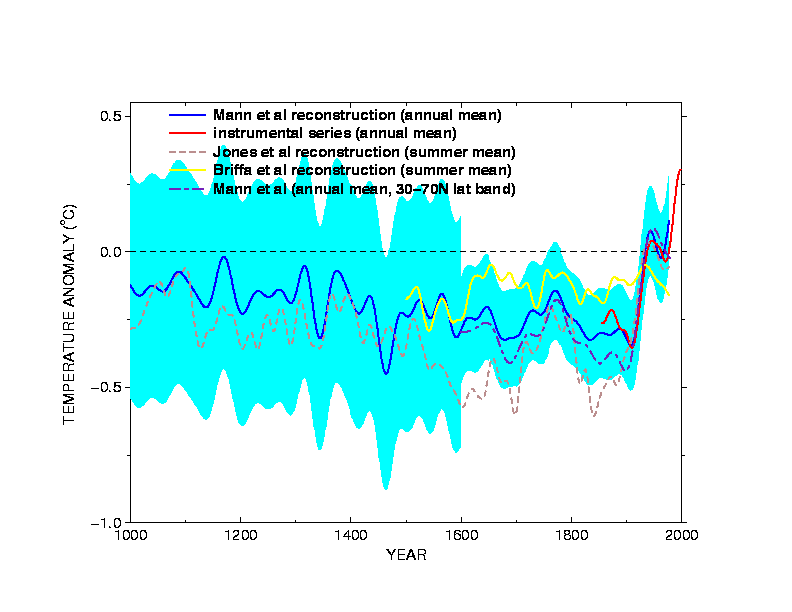
You can also see the "decline" at the end of the series that was at odds with the instrumental record -- it was this divergence which complicated the "tidy story." But as you can see in the final IPCC figure 2.21 that was published (shown above) decisions were made to "hide the decline" and present a "nice tidy story."
Was it Fraud or Something Else?
The facts of what happened here should not be controversial. A group of scientists associated with the IPCC decided to simplify the presentation of paleo-climate data in orger to convey a "tidy message" and to try to avoid the "skeptics" some "fodder" with which to have a "field day." Of course, those plans backfired pretty badly!
The selective presentation of information is a form of cherrypicking, a widely used term that I described in 2004 as follows:
the careful selection of information to buttress a particular predetermined perspective while ignoring other information that does not
The actions by the IPCC scientists to "hide the decline" were a form of cherrypicking.
Semantics aside, anyone seeking to bring charges of formal scientific misconduct against these scientists or the IPCC would have a tough -- I'd say impossible -- case to make. To understand this you need to know what scientific misconduct actually is, and how it is judged. The scientists here were clearly shaping a message, explicitly motivated by a political agenda against the "skeptics" and grounded in a fundamental distrust of policy makers and the public to be able handle the complete information.
As I argue in The Honest Broker, the penalties for cherrypicking are a loss of credibility and legitimacy in scientific and political processes. But make no mistake, everyone is selective in the information that they present when making an argument, scientific or political. In fact, there is no practical way to present all of the information and all of the uncertainties. The question thus is not whether one seeks to manage the presentation of uncertainties -- but rather have you made a argument that is fair, robust and legitimate? Meeting these criteria typically means being open about uncertainties, warts and all. If you are perceived not to have made such an argument then you may see some of the following occur -- your paper could be rejected for publication, your peers might disagree with your views, your policy arguments dismissed, your credibility diminish and so on. Thus, while the selective presentation of information is unavoidable, one cherrypicks at some large risk.
What I find most remarkable about this episode, and others in which the IPCC has been found cherrypicking, is ultimately how very trivial the episodes actually are. Just take a look at the two figures above -- is the science of climate change undermined by that loose yellow thread dangling down in the original graph? Are non-experts incapable of understanding the uncertainties associated with the "divergence problem"? The IPCC has clearly allowed or perhaps even enabled some serious lapses in judgment by its authors by allowing them to risk so much for so little.
This episode is not about scientific fraud -- at least in the way that I understand the concept to be defined in the academy. This episode if one of several --too many -- in which the IPCC was found to be risking its credibility to present a "tidy story." Hopefully, the scientific community has learned that a desire for tidiness should not trump an overarching concern for maintaining the credibility and legitimacy of expert advice, even if that means presenting the science alongside uncertainties and complexities.
But there are lessons here for critics as well. It is reasonable to feel betrayed, angry and upset that the experts tried to play you for a fool. But making wild accusations of fraud and calling for legal sanctions (and worse) simply diminishes your own credibility and represents an ironic sort of overreach.
Posted by Roger Pielke, Jr.at 5/16**/2010** 07:21:00 AM
==
Conflicts of interest and disclosure of funding sources have been topics du jour lately in science policy circles. Last month activists opposed to genetically modified food rattled academic scientists working in that field by submitting requests for their correspondence under state open records laws. Then the Union of Concerned Scientists released a report warning that such requests can become vehicles for harassing academic researchers. In Wisconsin, an ongoing effort by the state’s largest public university to shield some research efforts from freedom of information requests has caused controversy.
Then, in the highest profile development, news outlets released information gathered by environmental groups about the funding sources of Willie Soon, a scientist at the Harvard-Smithsonian Center for Astrophysics in Cambridge, Massachusetts. The groups alleged that Soon, a prominent critic of mainstream climate science and opponent of government action on climate change, had not disclosed funding from corporate sponsors to journals that published his work, potentially violating journal policies. The Smithsonian has launched an investigation.
The Soon revelations inspired Senator Edward Markey (D–MA) to send letters to numerous energy industry groups, asking them to disclose the names of scientists they had funded. They also prompted Representative Raul Grijalva (D–AZ), the top Democrat on the Natural Resources Committee of the U.S. House of Representatives, to launch an investigation last week into the funding sources of seven academics who have studied climate change or testified before Congress on the matter, often to criticize research findings or policy proposals. Grijalva asked universities to provide the salaries of the seven, official disclosure policies and statements, details on any external funding sources of the academics, and copies of any “communications” related to testimony they provided to government bodies.
Grijalva’s wide-ranging request caused an uproar, including claims that it represented a “witch hunt,” as well as letters expressing concern about the balance between transparency and academic freedom from the American Geophysical Union and the American Metrological Society. This week, Grijalva backed off a bit, saying the request for correspondence was an “overreach,” but defending the push for disclosure.
One of the scientists targeted by Grijalva is Roger Pielke Jr., a science policy expert at the University of Colorado, Boulder. Pielke has been something of a lightning rod in climate debates, sometimes drawing attacks from all sides as a result of his views on research and policy. He’s also written extensively on conflict of interest, and has been actively tweeting and blogging in recent days in defense of himself.
Yesterday, ScienceInsider spoke to Pielke by phone. This interview has been edited for clarity and brevity.
Q: When the Soon stories came out last week, you said he should have mentioned his conflict of interest, but otherwise the issue was blown out of proportion. Yet the Smithsonian, which jointly runs his institution, is carefully investigating it.
A: I've written on conflict of interest for a long time, and I've participated in efforts to tighten up conflict of interest policies in the scientific community; I'm currently on a National Research Council committee that's doing just that. It's a really important issue. Five years ago I was one of the strongest critics of the [Intergovernmental Panel on Climate Change] for not having any conflict of interest policies.
By all means, Willie Soon, whom I don't know and I don't know anything about his research, should follow the guidelines of his institution, and the journals in which he publishes, and Congress when he testifies. If he's violated those requirements he's done something that's pretty serious … But if you look at our community, the failure to disclose conflicts of interest is fairly endemic. Economics has dealt with this; the medical sciences have dealt with this; the geosciences really haven’t.
Q: Senator Markey says that companies in the fossil fuel industry should disclose the outside scientists they fund. Do you agree?
A: The best way for that disclosure to occur is in the reporting process, by individuals who are funded, in their disclosures to journals, their institutions, or Congress when you testify. Getting companies to release information on who they fund and what they fund is probably a difficult fight.
Q: Do you think we have sufficient standards for disclosure for scientists?
A: I was part of a 2009 report by the Bipartisan Policy Center [a Washington, D.C. think tank] on conflict of interest policies. What we sought to do was to tell the government to harmonize policies on this across the federal agencies, to provide advice to the incoming Obama administration to restore integrity to science. And we said journals should have clear policies on disclosure.
But one thing to keep in mind is that you can’t judge research by who funds it. Once disclosure is done the research should be judged on its merits.
Q: Have you ever turned down funding because you were concerned about how it would look to disclose it?
A: Never. Unfortunately that's not a problem I've had, nobody's knocking on my door offering me money.
Q: Have you received any funding that you haven't disclosed?
A: No.
Q: Five years ago you told us you wanted to stop publishing on climate policy. Why?
A: Yes, [that decision has] been a few years in the making. You know, I wrote my dissertation on science in the climate debate. I've written on mitigation, adaptation, geoengineering, impacts of climate change. So, intellectually, the benefits of continuing to do work in this area aren't that high. On the other end of the conversation, the cost of participating in the issue continue to go up. Between being run out of [the popular statistics blog FiveThirtyEight.com] for writing on my research last year and what's happening this week [in] Congress, a lot of folks want to make the issues surrounding climate about me, instead of the issues. That makes it fairly untenable to participate.
Posted in Climate, Policy, Scientific Community
===
Earlier in the year, Roger Pielke Jr. was named as a contributing writer for Nate Silver’s newly re-launched *FiveThirtyEigh*t site. Shortly after that, Pielke, a climate policy scholar and political scientist at the University of Colorado, in Boulder, published an article at FiveThirtyEight headlined, “Disasters Cost More Than Ever–But Not Because of Climate Change.”
Critics pounced immediately in blogs and on Twitter. That harsh reaction was then reported and commented on atSalon, Huffington Post, Slate, the Columbia Journalism Review, and elsewhere.
I recently conducted a Q & A with Pielke about this episode and the aftermath. The links in my questions are from me. I asked Pielke to provide his own links.
KK: It’s been noted on Twitter that you are not listed on the main contributors page for FiveThirthyEight. Does this mean you no longer write for the site? If so, can you explain what happened?
RPJR: That is correct, I no longer write for 538. Last month, after 538 showed some reluctance in continuing to publish my work, I called up Mike Wilson, the lead editor there, and told him that it was probably best that we part ways. I wished them well in their endeavor going forward. I remain a fan. Since then I have joined up with SportingIntelligence, a UK-based website that focuses on analyses of economic and other quantitative aspects of sport. It’s a great fit. And of course, I continue to publish in places like USA Today and the Financial Times on a wide range of subjects
KK: What do you make of the uproar your FiveThirtyEight piece generated? I know it quickly degenerated into an ugly pile-on, which I and some other journalists found unseemly. But did critics have any legitimate points you want to acknowledge?
RPJR: Well, that first piece was written on a subject that I have written on many times before (and perhaps as much as anyone) – disasters and climate change. The short essay was perfectly consistent with the recent assessments of the IPCC. The fact that some folks didn’t like it was not surprising — most anything on climate change is met with derision by somebody. What was a surprise was the degree to which the negative response to the piece was coordinated among some activist scientists, journalists and social media aficionados. I think that took everyone by surprise. I learned some new things about certain colleagues and journalists — both really good things and some really pathetic things. Seeing a campaign organized to have me fired from 538 also taught me a lesson about the importance of academic tenure.
KK: If you could write the piece over again, what would you do differently, if anything?
RPJR: Looking back, probably the main thing I would do differently would be to simply not write about climate change at 538. When I was originally hired there was actually zero discussion about me focusing on climate or even science, but rather covering a wide range of topics. I made clear to Nate and Mike that I was looking to at least partially escape from the climate change wars by focusing on other issues. The climate change piece was an obvious place to start even so because the IPCC reports had just been released and the topic is also covered so thoroughly in the peer reviewed literature. Clearly, that judgment was wrong!
KK: Have you and Nate Silver talked about this ordeal? What was his reaction?
RPJR: I have not spoken with or corresponded with Nate since that first piece. Of course, I do wish that 538 had shown a bit more editorial backbone, but hey, it is his operation. If a widely published academic cannot publish on a subject which he has dozens of peer-reviewed papers and 1000s of citations to his work, what can he write on? Clearly Nate is a smart guy, and I suspect that he knows very well where the evidence lies on this topic. For me, if the price of playing in the DC-NYC data journalism world is self-censorship for fear of being unpopular, then it is clearly not a good fit for any academic policy scholar.
KK: The condemnation of your 538 piece quickly spiraled into ugly personal broadsides painting you (incorrectly) as a climate skeptic. This happened in various high profile venues, such as Slate. How did you feel when this happened?
RPJR: If you are engaged in public debates on issues that people care passionately about, then you will be called names and worse. It goes with the territory. It is not pleasant of course, but at the same time, it is a pretty strong indication that (a) your arguments matter and (b) people have a hard time countering them on their merits. Even so, it is remarkable to see people like Paul Krugman and**John Holdren**brazenly make completely false claims in public about my work and my views. That they make such false claims with apparently no consequences says something about the nature of debate surrounding climate.
KK: You say you were surprised by “the degree to which the response to the piece was coordinated among some activist scientists, journalists and social media aficionados.” But this response did not happen in a vacuum, either. For years, your work–or more specifically–pointed statements you’ve made about the climate science establishment–have been heavily criticized by a number of outspoken climate scientists and widely read climate bloggers. Looking back, it appears that animosity directed towards you stems more from sharply-worded commentary on your blog and elsewhere, than your research.
For example, in his recently published book, “Reason in a Dark Time: Why the Struggle Against Climate Change Failed–and What it Means for Our Future,” NYU’s Dale Jamieson wrote about you. Here’s an excerpt that was posted at Salon:
In a 2010 book, Roger Pielke Jr. claimed that “[c]limate science is a fully politicized enterprise, desperately in need of reform if integrity is to be restored and sustained.” “Climategate,” the episode in November 2009 in which thousands of documents were stolen from the Climate Research Unit at the University of East Anglia, revealed scientists “who saw themselves as much as activists as researchers,” … “plotting to corrupt the peer review system.” According to Pielke Jr., the theft exposed a “clique of activist scientists” engaged in a “coup against peer review.” He went on to accuse a broad range of scientists and public figures of trying to scare people into taking action on climate change or advocating such scare tactics.
One remarkable feature of Pielke Jr.’s discussion is its shrillness. “Clique,” “coup,” and “plotting” are the kinds of terms usually reserved for organized crime syndicates, terrorist organizations, and other conspiracies against the public good. The repeated use of the word “activist” mobilizes a characteristic trope of right-wing ideologues. The term is typically applied to judges, who like scientists are supposed to be neutral when carrying out their duties, but all too often, on this view, betray their professional responsibilities. Even someone who is sympathetic to the claim that political considerations sometimes find their way into climate science might shrink from Pielke Jr.’s characterization of climate science as “a fully politicized enterprise.”
Perhaps you take issue with how Jamieson has characterized your statements. But even still, he appears to have identified the reasons for much of the animosity towards you that has built up over the years. This is the larger context that I think informs the ugly brouhaha over your 538 piece. What are your thoughts on this?
RPJR: Anyone following these debates over the years and has observed whose arguments have actually been vindicated will no doubt understand why some of the louder critics of mine have resorted to bitter personal attacks. More generally, however, there is a common strategy of delegitimization used in the climate debates. It seems that labeling someone a “denier” offers a convenient excuse to avoid taking on arguments on their merits and to call for certain voices to be banished.
I’ve known Dale Jamison for about 25 years, dating back to the time that he was a philosophy professor at Colorado and NCAR. I have always got on well with him and learned a lot from him during the years that we were colleagues. I am perfectly comfortable with my claim that parts of the climate science field are indeed “fully politicized.” At the same time, as I have often said, there are many brilliant and hard-working scientists in the field. It just so happens that some of the most fervent ideologues find themselves in positions of authority.I don’t think that this is at all controversial.
What is controversial is the question whether the ends justify the means. That is to say, is the climate issue so important that we should look past issues of scientific integrity among those whose heart is in the right place? Jamieson suggests that we should:
“I’ve known Roger for a long time, and he’s done a lot of work that I respect. Part of why I called him out in the book is because he’s not a climate change denier. He’s somebody who knows better, but the rhetoric that he’s used against scientists and the exaggerations and the kind of personal fights that he’s gotten into around the issue have really distracted from the broad consensus that actually exists around doing something.”
First, I’m flattered to see that Dale thinks that my views are so influential so as to distract from a broad consensus. I’d just disagree with that conclusion. As I document with evidence in The Climate Fix, there is a very strong and stable consensus in the US and worldwide about doing something on climate. But more generally, should an academic really be measuring his arguments by who they favor in a political debate? Or should I call things like I see them? I’ve chosen to call things as I see them, and I am quite happy with that career choice.
Second, many of the public debates that I have been involved in are associated with efforts to discredit or misrepresent my own academic work. The 538 episode is just one such example. I document in my book an episode when back in 2001 a leading climate scientist asked me to underplay my work for political reasons. Not only do I believe this to be unethical, I also think that it will be counterproductive for those calling for action. Trying to trick policy makers or the public to believe that — say, disasters are getting worse because of climate change or that we have all the technologies we need for deep decarbonization — will only backfire in the end. I am a big fan of playing it straight with the science, because over the long term that reinforces public trust and leads to more reliable policy recommendations.
KK: I should say that I am in no way excusing or rationalizing the behavior of climate bloggers and others who have previously used slanderous language in an attempt to discredit you. But I guess what I getting at here is this: Do you feel in any way responsible for provoking the deep-seated anger directed at you over the years, which seems to have culminated in this mob-like attack on your reputation after publication of the 538 piece? I just wonder if you feel like, given the chance to go back in time, might you have phrased your own criticisms of the climate science community differently?
RPJR: It is a fair question. Hindsight is of course 20/20. But let’s say that all the criticisms Jamieson levies are accurate: I have been hard on some climate scientists. I have criticized some of their work in public, and even accused some of exploiting scientific authority for political ends. Sometimes I have used colorful language (“coup against peer review” — though for actual “shrillness” I would point Jamieson over to Joe Romm!). Some people have disagreed with my arguments. I have even been critical of the IPCC at times. Also, I have popularized my work on carbon pricing, decarbonization, energy, disasters, and the politicization of science. My work has occasionally been cited by the bad guys. I have also challenged claims that are seemingly widely accepted, but which my work shows to be wrong. I believe that policy debates deserve a plurality of voices, not a harmonization of views. I do not focus obsessively on the skeptics and deniers.
What part of the above would I change? Not much at all.
To be very clear, it is only a few climate scientists who have engaged in the “mob-like attacks” (it was actually mostly journalists and bloggers). Almost all the feedback I get from colleagues in climate science is overwhelmingly positive. Those climate scientists engaged in the climate debate are all big boys (mostly) and girls. If they cannot take the rough and tumble of public debate, then they should not be in public debate. There is “deep-seate anger” because of colorful language and apparent thin skins? Right. Tell me about it.
Ultimately, what I learned from the 538 episode is how small and insular the community of self-professed “climate hawks” actually is. Sure they made a lot of noise online and got John Stewart’s attention. But that was because of Nate Silver’s fame, not mine. Back in the real world, outside the climate blogosphere and the NY-DC data journalism circle virtually no one knew or much cared about the 538 brouhaha, even within academia. I found that encouraging.
I do wish the 538 folks all the best going forward. They were put in a difficult position. I have no hard feelings. There are some brilliant people there and they will no doubt have some great successes.
But in conclusion, let’s take a step back. Disaster losses continue to increase worldwide. Carbon dioxide continues to accumulate in the atmosphere. The world continues to demand ever more energy. Climate policies in place or proposed are not up to the task. In short, we need more ideas, more debate, more disagreement if we are to make intelligent progress. Efforts to demonize or silence unwelcome voices probably don’t move the dial very far on any of these issues Was this campaign to have me removed from 538 a victory for the climate movement? Was it the right battle to wage? I hope the climate hawks ask themselves these questions.
http://blogs.discovermagazine.com/collideascape/2014/07/28/roger-pielke-jr-fivethirtyeight-climate-critics
CATEGORIZED UNDER: CLIMATE POLICY, CLIMATE POLITICS, CLIMATE SCIENCE, GLOBAL WARMING, SCIENCE
MORE ABOUT: CLIMATE CHANGE, CLIMATE POLICY, CLIMATE SCIENCE, DALE JAMIESON, FIVETHIRTYEIGHT, GLOBAL WARMING, NATE SILVER, ROGER PIELKE JR., SCIENCE JOURNALISM
==
breakthru:
it has become fashionable in some circles to come out against economic growth. Bill McKibben, the author and climate change activist, asserts that “growth may be the one big habit we finally must break.” He adds that this is “a dark thing to say, and un-American.” Such calls for an end to growth are typically advanced in environmental debates and those about economic globalization. But what does it actually mean to be against economic growth? I argue that to be anti-growth actually implies keeping poor people poor.
RELATED ARTICLES
ELECTRICITY FOR ALL
August 15, 2013
HOW MUCH ENERGY DOES THE WORLD NEED?
February 26, 2013
OUR HIGH-ENERGY PLANET
April 08, 2014
DEEPENING DEMOCRACY
September 30, 2013
EMISSIONS IMPOSSIBLE
December 17, 2013
ENERGETIC AFRICA
April 07, 2014
ELECTRIFY TO ADAPT
August 01, 2014
BEHIND JAPAN’S CLIMATE FAIL
November 21, 2013
Economic growth is simply a metric that reflects the accumulation of wealth over time, usually based on universalized US dollars. Economists define economic growth in three parts: (a) growth in labor, which refers to an increase in the number of people working; (b) growth in capital, which refers to increases in the availability of things that can be used by labor in the process of producing goods (like food) and services (like surgery); and (c) increasing productivity, which can be thought of as improvements in the efficiency with which we turn labor and capital into goods and services.
We can use the three components of economic growth to better understand what it means to be “anti-growth.”
Anti-Labor Growth, The Neo-Malthusians
One sort of objection to growth sits squarely in the tradition of Thomas Malthus and is focused on global population. Neo-Malthusians most recently rose to prominence and influence in the 1960s and 1970s, with Paul Ehrlich the most famous US advocate for population control. Today the neo-Malthusian moment seems to have waned, likely due in part to the fact that UN population projections now foresee the end of population growth later this century, followed by a decline in some scenarios. Even so, the Neo-Malthusian movement has its adherents. As Alan Weisman wrote in a book released last year (see In Review): “From the instant we’re born, even the humblest among us compounds the world’s mounting problems.” Neo-Malthusians see anti-growth as limits on population.
Anti-Capital Growth, The Peak Earthers
Another branch of anti-growth thinking focuses not on the number of people, but rather their consumption of resources. The Peak Earthers, as I call them, present their views through a suite of concepts, such as ecological footprints, planetary boundaries, and natural capital. Such concepts reflect valid concerns, but it turns out that, with respect to limits on continued economic growth, humans have had a tendency to break through physical limits through gains in efficiency and substitution. A good example is “peak oil,” which seems ever on the horizon yet keeps retreating as we tap new petroleum sources. Peak Earthers see anti-growth, rather than efficiency gains and substitution, as a solution to resource constraints.
Anti-Productivity Growth, The Luddites
The term “Luddite” refers to an industrial protest movement of the early 1800s, and derives from Ned Ludd, one of the lead protestors. “Luddite” is commonly used to mean anti-technology, a reference to the fact that the original Luddites destroyed industrial machines – but that’s a misreading of history. What the Luddites were protesting was the effect of productivity gains resulting from the introduction of machines into factories as a consequence of the industrial revolution. Today, we see Luddite concerns in other sectors. For instance, in December 2013, The Washington Post ran an article with the headline, “Eight Ways Robots Stole Our Jobs in 2013.” Luddites see anti-growth as a way to stop the effects of technology on the economy.
When we break down the idea of anti-growth into its component parts, we very quickly see that “anti-growth” is not a particularly coherent concept. For instance, those favoring what is often called “sustainable growth” – such as using renewable energy technologies, rather than using fossil fuels, to power growing material wealth – would not fit any of the three categories presented above. Sustainable growth clearly is not anti-growth.
In the near future, economic growth and its consequences for the planet will be dominated by today’s poor countries. The OECD estimates that between 2013 and 2030 82 percent of economic growth will occur in what are today considered to be the “poor” parts of the world, with just 18 percent of growth occurring in the United States, Western Europe, Japan, and a few other wealthy countries. Similarly, in January BP released its 2014 “Energy Outlook to 2035,” which projects that 95 percent of growth in energy consumption worldwide to 2035 will occur in poorer countries.
Some try to sugar-coat their anti-growth arguments by focusing their attention on the rich world. But with most of the world’s expected growth to occur in the poor parts of the world, such arguments are simply mathematical non sequiturs. The reality is that to be anti-growth today is actually to be anti-growth with respect to poor countries. The fact that very few, if any, anti-growth activists are openly demanding that poor countries remain poor tells us how powerful a force growth is in today’s global politics.
Ultimately, debates over growth tend to mask more fundamental debates about ideologies, values, and what kind of world we wish to see in the future. Breaking concerns about growth into its component parts helps to focus such debates on questions that can be addressed empirically, and those which cannot. So when you encounter an anti-growth advocate, ask him or her, which kind are you, Neo-Malthusian, Peak Earther, or Luddite?
This article originally appeared in the Spring 2014 edition of Earth Island Journal, www.earthislandjournal.org.
Photo Credit: rt.com

===
ROGER PIELKE, JR.*
Who is he? Environmental studies professor at the University of Colorado-Boulder and a fellow of the university's Cooperative Institute for Research in Environmental Sciences; author of The Honest Broker: Making Sense of Science in Policy and Politics
Chief beef: Hurricanes and the bottom line
Telling quote: "We cannot make a causal link between increase in greenhouse gases and the costs of damage associated with hurricanes, floods, and extreme weather phenomena." —interview with FP
Role: Pielke, whose father is also a scientist and an outspoken critic of the IPCC, is emblematic of just how confusing traditional labels are: For his work questioning certain graphs presented in IPCC reports, Pielke has been accused by some of being a climate change "denier." Meanwhile, for his work on adaptation, he has been accused by others of being an "alarmist." [note no cite]
One of Pielke's main additions to larger climate debate has been participation in studies and workshops that have concluded, in his words, "We cannot make a causal link between increase in greenhouse gases and the costs of damage associated with hurricanes, floods, and extreme weather phenomena." Whereas An Inconvenient Truth presented worsening storms as reason to support greenhouse gas mitigation, Pielke thinks that increased costs of disasters in recent years are due to "one overriding factor -- more wealth, more people, more property in harm's way." He took issue with the IPCC for one chart in its 2007 report, which seemed to imply causation when there was, if anything, only circumstantial evidence in his eyes. "Mine is an argument against using disasters as a justification for greenhouse gas emissions."
But his refutation of what he saw as sloppy logic certainly does not imply skepticism about climate change and the need to take mitigation and adaptation efforts seriously, he insists. In outlets like The New Republic and Yale Environment 360, Pielke has articulated a more nuanced point of view, often arguing for greater distinctions between debates about scientific integrity and those about public policy. For his part, he thinks, "Climate change is a huge problem, and it's a problem linked to human activity. Greenhouse gases are an important part of that, but it's not only greenhouse gases. And we need to respond accordingly."
*Editor's note: Pielke has informed the editors of FP that he strongly objects to being included on a list titled "Climate Skeptics." The aim of the list was, as the introduction states, to separate "the noise from the serious concerns" with regards to those offering critiques of either climate science or institutions charged with presenting climate science to the public or policy-makers; the article was explicitly not intended to equate the viewpoints of all people contained on the list. Pielke has been quoted in the mainstream media voicing concerns about the IPCC, as in today's Wall Street Journal, as well as questioning sloppy logic on the part of some environmentalists, for instance objecting to overstatements about hurricanes being linked to global warming.
==
In an unprecedented move, the President’s Science Advisor, Dr. John P. Holdren, has published a devastating 6-page debunking of one of the country’s leading climate confusionists, Roger Pielke Jr.
I’ll excerpt Holdren’s comprehensive critique, “Drought and Global Climate Change,” below. Worsening drought may be the climate impact that affects the most people in the coming decades, as I discussed in my 2011 literature review in the journal Nature. It is valuable to see the the subject laid out so clearly by the nation’s top scientist.
Our understanding of drought and climate change is evolving pretty rapidly, so even the latest IPCC reports are already out of date. Having read much of the recent drought literature and interviewed many of the leading drought experts in the last few years, I can say that Holdren’s views are right in the mainstream of climatologists’ view of drought.I can think of no climate scientists who share Pielke’s startling assessment of Holdren’s views as “zombie science.”
In fact, some drought experts believe the situation is considerably worse than is widely understood. As one top researcher on the climate-drought link confirmed with me recently, “The U.S. may never again return to the relatively wet conditions experienced from 1977 to 1999.”
HOLDREN AND PIELKE
John Holdren is one of the most distinguished scientists in America. He is a past president of the American Association for the Advancement of Science. Author of over 200 articles and papers, Holdren is a member of the National Academy of Sciences, the National Academy of Engineering, and a foreign member of the U.K.’s Royal Society.
I have known Holdren for more than two decades, and not only does he have more breadth of knowledge on all things climate than most, he is very judicious in his choice of words.
Roger Pielke Jr. is a political scientist who has publicly questioned the scientific integrity of more climate scientists than just about anyone else on the planet. He has smeared literally hundreds of scientists (as I document here).
That is no doubt a key reason Pielke was included on Foreign Policy‘s “Guide to Climate Skeptics.”
http://www.foreignpolicy.com/articles/2010/02/25/the_fp_guide_to_climate_skeptics
No doubt that’s why the websites that most prominently feature or reprint Pielke’s attacks are climate denial sites like WattsUpWithThat and ClimateDepot. It is also why he is probably the single most disputed and debunked person in the science blogosphere, especially on the subject of extreme weather and climate change (see here and here). Typical are:
- A Few Things Ill Considered: “His [Pielke's] latest effort atsabotaging productive discourse on climate science and policy is a really low blow, putting to rest any lingering hopes one might have had that he still had some integrity stashed away in there somewhere.”
- James Annan’s blog: “The consistently wrong chronicles…. Roger Pielke has been saying some truly bizarre and nonsensical things recently.”
- Tim Lambert (Deltoid) has a whole categoryon Pielke: “Roger Pielke Jr has attempted to trash me using innuendo, fabrication and outright misrepresentation. I correct the record.”
Before his death, the widely revered climatologist Stephen Schneider described one of his run-ins with Pielke this way five years ago:
It is typical of a trickster and a careerist–which is how I personally see him–and so do most of my colleagues these days who I have discussed it with.
Now Pielke has embraced thewidely discredited Bjorn Lomborgargument that climate action is bad for the poor, when the science makes clear that climate inaction would be devastating to the poor. Climate action is the only sustainable path out of poverty, as climate expert and development practitioner John Abraham explains in a UK Guardian piece that Pielke has yet to respond to.
It should be obvious that if you’ve garnered a 6-page debunking by the nation’s top scientist, then you’ve moved into the elite ranks of climate confusionists.
If you want the full story on how Pielke has attempted to scandalize his personal quibbles with Holdren (to use a phrase Dr. Stefan Rahmstorf first applied to Pielke), HotWhopper has a must read post. Here’s the short version.
Back in December, Pielke criticized Holdren for pulling his punches on climate science, tweeting, “Since becoming sci advisor Holdren has always stayed on safe (boring) ground in his public remarks.”
Then, in mid-February, when Holdren offered some straightforward well-grounded scientific statements about how climate change is worsening Western droughts,Pielke slammed him, tweeting “it is brazen for zombie science to show up in the White House!”
Talk about damned if you do and damned if you don’t!
As Holdren explains, in a February 25 hearing, “Senator Jeff Sessions (R-AL) suggested that I had misled the American people with comments I made to reporters on February 13.” In particular, Sessions quoted testimony Pielke had given in July:
It is misleading, and just plain incorrect, to claim that disasters associated with hurricanes, tornadoes, floods or droughts have increased on climate timescales either in the United States or globally.
Drought has “for the most part, become shorter, less, frequent, and cover a smaller portion of the U.S. over the last century”. Globally, “there has been little change in drought over the past 60 years.”
The first quote in the second paragraph is from the U.S. Climate Change Science Program’s 2008 report, “Weather and Climate Extremes in a Changing Climate,” and the second is from a 2012 paper by Sheffield et al. in the journal Nature.
As an important aside, Sheffield’s paper has been disputed. I recently interviewed Aiguo Dai, and he thinks the Sheffield analysis is flawed. Dai stands by his conclusion in a 2012 paper in Nature Climate Change that “Historical records of precipitation, streamflow, and drought indices all show increased aridity since 1950 over many land areas.”
When Holdren rebutted Pielke’s charges in Senate testimony, Pielke demanded “If you do indeed believe that my views are ‘outside the scientific mainstream’ could you substantiate that claim”?
Holdren’s full devastating reply is “Drought and Global Climate Change: An Analysis of Statements by Roger Pielke Jr.”
Besides reviewing the drought literature, Holdren makes a crucial point that “any reference to the CCSP 2008 report in this context should include not just the sentence highlighted in Dr. Pielke’s testimonybut also the sentence that follows immediately in the relevant passage from that document and which relates specifically to the American West.” Here are the two key sentences from the report in their entirety):
Similarly, long-term trends (1925–2003) of hydrologic droughts based on model derived soil moisture and runoff show that droughts have, for the most part, become shorter, less frequent, and cover a smaller portion of the U.S. over the last century (Andreadis and Lettenmaier, 2006). The main exception is the Southwest and parts of the interior of the West, where increased temperature has led to rising drought trends (Groisman et al., 2004; Andreadis and Lettenmaier, 2006).
Amazingly, Pielke’s testimony did include the second sentence about rising drought trend in the SW and West — which would seem to render most of his attack (and Sen. Sessions’ attack) on Holdren moot — but Pielke buried it in a footnote. Again, Hotwhopper explainsjust how head-exploding this all is.
Holdren makes a key point that I have made repeatedly — severe drought is much more than just a reduction in precipitation. He explains: “In my recent comments about observed and projected increases in drought in the American West, I mentioned four relatively well understood mechanisms by which climate change can play a role in drought. (I have always been careful to note that, scientifically, we cannot say that climate change caused a particular drought, but only that it is expected to increase the frequency, intensity, and duration of drought in some regions ― and that such changes are being observed.)”
These four mechanisms are:
- In a warming world, a larger fraction of total precipitation falls in downpours, which means a larger fraction is lost to storm runoff (as opposed to being absorbed in soil).
- In mountain regions that are warming, as most are, a larger fraction of precipitation falls as rain rather than as snow, which means lower stream flows in spring and summer.
- What snowpack there is melts earlier in a warming world, further reducing flows later in the year.
- Where temperatures are higher, losses of water from soil and reservoirs due to evaporation are likewise higher than they would otherwise be.
Holdren reviews the scientific literature on those statements in his reply, noting “the second, third, and fourth mechanisms reflect elementary physics and are hardly subject to dispute (but see also additional references provided at the end of this comment).” Holdren states:
As I have also noted in recent public comments, additional mechanisms have been identified by which changes in atmospheric circulation patterns that maybe a result of global warming could be affecting droughts in the American West. There are some measurements and some analyses suggesting that these mechanisms are operating, but the evidence is less than conclusive, and some respectable analysts attribute the indicated circulation changes to natural variability. The uncertainty about these mechanisms should not be allowed to become a distraction obscuring the more robust understandings about climate change and regional drought summarized above.
Holdren is being characteristically conservative in his language here. As I’ve written, climate scientists specifically predicted a decade ago that Arctic ice loss would bring on worse droughts in the West — and California is now in the death-grip of a brutal, record-breaking drought, driven by the very change in the jet stream that scientists had anticipated.
But Holdren’s main point is the important one — quite separate from any changes in precipitation that climate change may cause, there is little dispute that human-caused climate change is worsening droughts in the West and Southwest. I recommend his entire paper to readers interested in this important subject.
Tags:
http://thinkprogress.org/climate/2014/03/03/3349411/john-holdren-roger-pielke-climate-drought/
comes with put head in vice caveat:
Revkin asserts (here) that a key litmus test of whether the IPCC is serious about restoring its credibility and good name is if it puts Roger Pielke, Jr. (!!!) on the author team of a special panel report, “Managing the Risks of Extreme Events and Disasters to Advance Climate Change Adaptation.”
Revkin sheds his reporter’s hat in the piece to campaign for Pielke, his long-time Rolodex BFF,since he manages to omit every single reason why that would be a uber-low priority for the IPCC as it goes about making a few needed improvements and defending its good name. Revkin fails to interview or even link to all but one of the dozens of scientists and science bloggers and others who have debunked Pielke in recent years. Of course, being consistently wrong is no impediment to being an IPCC author, as John Christy can attest.
Guess who the one person Revkin links to is?
On the one hand, Pielke is identified by Revkin as “a researcher at the University of Colorado with a long publication record” who deserves to be an IPCC author — indeed, who must be an IPCC author to restore the organization’s credibility. On the other hand, here’s how I’m identified:
Here’s the test. Roger A. Pielke Jr., a researcher at the University of Colorado with a long publication record on climate and disaster trends was one of the 31 experts nominated by the United States to be an author of that study, but was not among the 13 chosen. While he has been an aggressive critic of the panel’s practices on his blog, and a frequent target of energy and climate campaigners, Dr. Pielke’s research record in this particular field stands on its own.
Yes, I’m “energy and climate campaigners.” Well, at least I’m plural!
UPDATE: Pielke challenges me to a “debate” and I reply. See also “Debate the controversy!“
Anyway, welcome, Andy Revkin, to the ranks of “energy and climate campaigners.” I’m glad to see you lobbying hard to make your guy an IPCC author, insisting that is somehow a litmus test of the new IPCC.
Roger Pielke, Jr. is the single most disputed and debunked person in the entire realm of people who publish regularly on disasters and climate change. He trashes the reputation of any scientist who even suggests that there is the tiniest link whatsoever between climate change and extreme weather “” even though he himself has stated such a link exists (click here, reposted below).
Consider Pielke’s knee-jerk response to Sen. Inhofe’s recent McCarthyite tactics to criminalize science, documented by climate whistleblower Rick Piltz here.
The science blog Rabett Run had pointed out:
This is indeed a Sister Soljah moment for the Pielkes…. Has Inhofe gone so far that even they will acknowledge and denounce his Climate McCarthy act, or not? Will they hide their ethics in the sand and do thei
?
But Pielke wrote his post on the subject merely calling Inhofe’s despicable move “a bit of clown-like bluffing”— and then he goes about attacking Rick Piltz. Rick Piltz! He says Piltz “focuses on the Inhofe report to … use these scientists for his own partisan purposes.” To Pielke, defending scientists from Inhofe’s ‘Climate McCarthy act’ is using them for “partisan purposes.” Seriously.
Foreign Policy’s “Guide to Climate Skeptics.
Pielke was just included on Foreign Policy‘s “Guide to Climate Skeptics.” He disputed that, of course, but then, that’s what he does. At least Foreign Policy didn’t back down, as Alternet did— see ClimateChangePsychology’s post, “AlterNet.org censors Buffalo Beast article on climate villains — deletes Roger Pielke, Jr., under pressure.” Indeed, if you want to know how Pielke and company operate, you must read the science blog Rabett Run (click here)which noted, “It sure looks like the Climate McCarthy’s won here…. The Buffalo Beast and AlterNet editors blew it” by backing down in the face of pressure from “Pielke and friends.”).
As an aside, the term “climate skeptic” is meaningless, since all real scientists are skeptics. What is most telling about the Foreign Policy piece isn’t their inclusion of Pielke, it’s the quote from Pielke about John Christy, who was also included as a climate skeptic:
“I respect him,” Pielke says. “I disagree with him, but I respect him.”
Now Christy has made far more egregious scientific blunders than most people Pielke regularly attacks, ones that just happened to all be in the direction of Christy’s skeptical views (see “Should you believe anything John Christy and Roy Spencer say?“) But that doesn’t stop Christy from trying to smear scientists who haven’t made such mistakes (see here). See also “Earth to John Christy: Misleading for free is wrong, too.“ In the Vermont case on the state’s effort to embrace California’s tailpipe GHG emissions standards, the car companies brought in Christy as an expert witness to rebut Hansen (see here). In one footnote on the sea level rise issue, the judge noted, “it appears that the bulk of scientific opinion opposes Christy’s position.“ The little respect that Christy shows the facts or other scientists is is reason enough not to respect him.
No, I’m not comparing Pielke to Christy. It’s easy to tell where Christy stands, but impossible to tell where Pielke stands. He asserts that he accepts the basic IPCC conclusions and in particular that he supports very strong emissions concentration targets — but then he trashes any scientist who actually proposes a plausible plan as “politicizing science” while only offering the mildest of policy proposals himself (see Finally, Roger Pielke admits he supports policies that will take us to 5-7°C warming or more). That allows him to be quoted as a “contrarian” by the media (at least those who aren’t paying attention) — someone who supposedly believes in the science but is critical of scientists.
Ken Caldeira
Revkin says his litmus test for the IPCC’s credibility is a target of “energy and climate campaigners.” But in fact he is far, far more a target of scientists and science bloggers. Climate scientist Ken Caldeira was so shocked at Pielke’s remarks on IPCC chief Pachauri, he wrote me (click here) an email titled, “I can’t believe the New York Times has done it again “¦” that reads in its entirety:
Joe,
Does Roger Pielke Jr really believe that Pachauri is exaggerating the climate change problem in order to obtain more funds for his nonprofit research center?
If Pielke is going to make insinuations in the New York Times about the ethics of Dr Pachauri, he owes it to us to make his beliefs clear. He should state clearly which of the following two statements he believes:
:{
(a) Dr Rajendra Pachauri is exaggerating the climate change problem in order to obtain more funds for his nonprofit research center.
(b) Dr Rajendra Pachauri isnotexaggerating the climate change problem in order to obtain more funds for his nonprofit research center.
For a man with a $49,000 salary, donating all of his consulting fees to nonprofit organizations would ordinarily be seen as a sign of professional integrity and dedication. It is outrageous that Pielke attempts to turn this around and use it to insinuate an ethical lapse. It makes one wonder about Pielke’s motives.
Best,
Ken
PS. You can quote this if you would like”¦.
}:
Revkin only links to one post I did criticizing Pielke, and not even a technical critique, and yet 0n matters of technical accuracy, Roger Pielke, Jr., is probably the most debunked person in the science blogosphere.
Science Bloggers
Here’s just a selection from Tim Lambert (Deltoid) at Science Blogs:
- Pielke Pity Party: Roger Pielke Jr has attempted to trash me using innuendo, fabrication and outright misrepresentation. I correct the record.
- Another Pielke train wreck: Roger Pielke Jr has greatly miscounted the number of news stories about a new climate study, leading him to make spurious charges of bias.
- Pielke Jr vs drafts: Roger Pielke Jr has been abusing draft documents to score points again.
- Pielke train wreck continues: More carriages have come off the rails in the Roger Pielke Jr train wreck. Pielke finally does a hypothesis test. Trouble is, it’s an unpaired t-test, which would only make sense if GISS and HADCRU were independent of each other….
- Pielke train wreck: If you haven’t been watching the Roger Pielke Jr train come off the rails and the carriages smashing into each other and exploding, I suggest you look at this post from James Annan: Roger Pielke has been saying some truly….
And then you can start on James Annan’s blog, with
- :{The :(style="background-color:#ffffff;"):}::{consistently wrong chronicles:(style="background-color:#ffff66;"):}:…. Roger Pielke has been saying some truly bizarre and nonsensical things recently.
But this isn’t just about being consistently wrong, which, of course, is in the eye of the beholder, “science” and “facts” being relative as we all know they are. It is Pielke’s anti-fact nature, though, that you seem blind to, Andy, which is why he is the last person who should be a litmus test for the IPCC’s effort to restore its good name as an organization that is “just the facts, ma’am.” Read those posts. Interview the authors.
Here’s James Annan again:
Of course being the political scientist that he is, RPJnr is dropping the crucial rider and simply presenting the claim that the trend has a high bias. That transforms the claim from irrelevant to wrong….
UPDATE: This is getting rather surreal, which unfortunately seems to be a feature of many exchanges with RPJnr.
After Berkeley economist Brad DeLong posted an email from someone pointing out that Pielke (Jr) is “dishonest and wrong,” came this must-read email exchange where DeLong notes Roger “appears to go completely off the rails in email.” Do read the comments for the many links to various debunkings of Pielke from various science bloggers, like this one:
Brian Schmidt said…
Roger Pielke Jr. has written that Jim Hansen supported open-air carbon capture and sequestration. Actually, Hansen supports biomass power-generation with point source carbon capture and sequestration. That’s a very big stretch to use Hansen as supportive of Roger’s quest for continuing the practice of sticking CO2 in the air and catching it later.
Also, Roger listed Hansen as supporting deep-ocean sequestration of captured CO2, a less-safe but possibly less-expensive form of sequestration (compared to other sequestration possibilities) that would be helpful for Roger’s interest. Actually, Hansen supported geological underground sequestration that is also under the ocean, the safest but most-expensive sequestration option.
Documentation here:
:{
http://backseatdriving.blogspot.com/2009/02/tierney-and-pielke-jrs-wild.html
}:
Then there’s the climate scientists at RealClimate. Here’s a classic debunking of Pielke from 2008, “RealClimate: Model-data-comparison, Lesson 2.” And here’s Dr. Stefan Rahmstorf after one recent comment by Pielke (emphasis added):
… we’re discussing Supplementary Material and a response to one of those 90,000 review comments now, not even the report itself. You’ve been working hard to scandalize your personal quibbles with IPCC here – how consistent is this with your self-proclaimed role as “honest broker”? Stefan
I know that Revkin wants to make this about me vs. Roger, but I ain’t the one who framed Roger, he did it to himself.
Sure the blogosphere is a rough place, and I get into my fair share of tiffs, mainly with the hardcore disinformers — but then again I’m not running to be on some IPCC panel, let alone the savior of the IPCC’s credibility, with you as campaign manager. I might add that I am certainly qualified to be one on a few of the chapters in the Working Group III Report “Mitigation of Climate Change,” but I can only imagine how Roger would go ballistic if I were named as an author, and how you would quote him gleefully saying how that only serves to undermine the independence and credibility of the IPCC (and I seriously doubt you would call him an energy and climate campaigner).
Pielke wrote on my blog that
We define “acceptable levels” in our Nature paper as 500 ppm (the level focused on by IPCC WG III) and 450 ppm(the level focused on by the EU and implicitly in the FCCC).
Now I think you’ll agree that stabilizing at 450 to 500 ppm requires a whole lot of very specific policies and a high price for carbon starting pretty damn soon.
Indeed, the Hadley Center makes the rather obvious argument that if you want stabilization at those levels, you would need “early and rapid decline” in emissions and “Action starts in 2010″³ (see Hadley Center study warns of “catastrophic” 5-7°C warming by 2100 on current emissions path). Even the staid International Energy Agency makes the same painfully obvious point, that global emissions must peak by 2020 and that the price for CO2 in 2030 might hit $180 a ton (see “Must-read IEA report explains what must be done to avoid 6°C warming“).
But Pielke’s primary proposal is “a $5 charge on each ton of carbon dioxide” and then use the money to develop clean tech technologies and infrastructure!!! You might as well bring a squirt gun to a firestorm.
But God forbid a climate scientist actually proposes even a moderate set of policies to get to 450 ppm, as Pielke will immediately come down hard attacking that scientist as politicizing science.
Indeed, while I have focused in this post on what countless climate scientists and science bloggers have said about Pielke — since my critiques can be so easily dismissed by you as that of a “campaigner” — let’s look at what Pielke says. Let me go through once again how, in Dr. Rahmstorf’s words, Pielke works hard to scandalize personal quibbles.
[Regular readers can skip the rest of this. Apologies for the length of this post, but I'm trying to do the reporting that Andy left out. Feel free to add your own links in the comments.]
Scandalizing Personal Quibbles
Last June, Pielke launched one of the most absurd attacks in his career “” on a few innocuous sentences in the terrific new NOAA-led report, :{:{Global Climate Change Impacts in the United Sta:(style="background-color:#ffff66;"):}::{tes:(style="background-color:#ffffff;"):}::(style="box-sizing:border-box;margin:0px;padding:0px;border:0px;font-variant:inherit;font-weight:inherit;vertical-align:baseline"):}:. Pielke launched the strongest possible accusation on his blog — “misrepresenting science in a government report” — on the basis of four sentences in this 196-page, 13-agency report:
While economic and demographic factors have no doubt contributed to observed increases in losses,[346] these factors do not fully explain the upward trend in costs or numbers of events.[344,347] For example, during the time period covered in the figure to the right, population increased by a factor of 1.3 while losses increased by a factor of 15 to 20 in inflation-corrected dollars. Analyses asserting little or no role of climate change in increasing the risk of losses tend to focus on a highly limited set of hazards and locations. They also often fail to account for the vagaries of natural cycles and inflation adjustments, or to normalize for countervailing factors such as improved pre- and post-event loss prevention (such as dikes, building codes, and early warning systems).[348,349]
You will note that these sentences don’t actually make any strong scientific statement about the link between climate change and increased insurance-industry losses from weather-related disasters. Indeed, this paragraph is immediately followed by:
What is known with far greater certainty is that future increases in losses will be attributable to climate change as it increases the frequency and intensity of many types of extreme weather, such as severe thunderstorms and heat waves.
So it is impossible to suggest, as Pielke does, that the authors are stating or even implying that there is a high certainty of a very large connection between climate change and insurance losses. Now what is particularly laughable about Pielke’s attack is that he himself told Nature in 2006:
Clearly since 1970 climate change (i.e., defined as by the IPCC to include all sources of change) has shaped the disaster loss record.
Yes, that is what Pielke said. You can look it up yourself (see Pielke in Nature: “Clearly, since 1970 climate change “¦ has shaped the disaster loss record”).
Can anybody (other than Pielke) tell me how Pielke’s 2006 statement is consistent with his harsh assault on the credibility of the climate report and the integrity of the authors? Can anybody tell me who but the most uninformed journalists would rely on anything Pielke says about real science or real scientists?
Pielke isn’t a “skeptic.” He is a disinformer. He disinforms every debate he enters. After his smear of Mills, no other word fits him.
In fact, here’s an extended excerpt from the 2006 Nature story, “Insurers’ disaster files suggest climate is culprit” (PDF here):
Insurance companies, acutely aware of the dramatic increase in losses caused by natural disasters in recent decades, have been convinced that global warming is partly to blame. Now their data seem to be persuading scientists, too. At a recent meeting of climate and insurance experts, delegates reached a cautious consensus: climate change is helping to drive the upward trend in catastrophes.
The meeting, held near Munich on 25-26 May, was jointly organized by Munich Re, the world’s largest reinsurance company, and the University of Colorado in Boulder. It brought together climate, atmosphere and weather researchers with economists and insurance experts to discuss what could be behind recent disaster losses, both economic and human”¦.
Delegates seem to have found the record persuasive. Their consensus statement, to be released on 8 June, says there is “evidence that changing patterns of extreme events are drivers for recent increases in global losses”"¦.
:{
“Dissent over the issue is clearly waning,” says Peter H¶ppe, head of Munich Re’s Geo Risks department, who co-chaired the workshop with Roger Pielke Jr, director of the University of Colorado’s Center of Science and Technology Policy Research. “Climate change may not be the dominant factor, but it has become clear that a relevant portion of damages can be attributed to global warming.”
Previously sceptical, Pielke says that he is now convinced that at least some of the increased losses can be blamed on climate: “Clearly, since 1970 climate change has shaped the disaster loss record.”
}:
Now remember, the NOAA-led report did not assert climate change was the dominant factor in the recent disaster loss record. In fact, the report merely says that “Analyses asserting little or no role of climate change in increasing the risk of losses tend to focus on a highly limited set of hazards and locations.”
Ironically, Pielke then proceeds to prove this criticism correct by then focusing in his post on a very highly limited set of hazards — hurricanes. I won’t repeat all of his torturous “logic” — his entire post is the blog equivalent of waterboarding — but you can see how he cleverly leaps from quoting his narrow paper on hurricane damages to the very broad assertion, “The CCSP report however, says the opposite, that these factors do not explain the upward trend in costs or numbers of events. To support this claim they provide two citations” [Evan Mills inScience and the 2007 IPCC report].
Now what is doubly ironic about Pielke falling into the exact mistake that the USGCRP report warns against is that in a blog post three days after his post attacking the report, Pielke praises a new article, “Tropical cyclone losses in the USA and the impact of climate change “” A trend analysis based on data from a new approach to adjusting storm losses” (subs. req’d), which concludes:
In the period 1971-2005, since the beginning of a trend towards increased intense cyclone activity, losses excluding socio-economic effects show an annual increase of 4% per annum. This increase must therefore be at least due to the impact of natural climate variability but, more likely than not, also due to anthropogenic forcings.
Yes, you read that right.
Pielke says an article that concludes there is a better than 50% chance that human-emissions are contributing to increased losses from hurricanes since 1971 is“a valuable paper”
Pielke of course dismisses the two citations the USGCRP use for their very mild claim, one of which is the IPCC, that Pielke claims to believe in. The other cite is a 2005 Sciencepaper by Lawrence Berkeley National Laboratory’s Evan Mills (a report coauthor), “Insurance in a Climate of Change,” which states (PDF here with figures and citations):
Global weather-related losses in recent years have been trending upward much faster than population, inflation, or insurance penetration, and faster than non-weather-related events….
According to the latest Intergovernmental Panel on Climate Change (IPCC) assessment, climate change has played a role in the rising costs of natural disasters. As an illustration of the linkages, the distribution and frequency of lightning strikes is expected to shift under climate change, and insurers indeed observe a notable increase in losses during periods of elevated temperatures.
This is another innocuous paper, used to support a very innocuous statement in the report, but Pielke uses it to smear the entire report and the author, Evan Mills, in the most over-the-top fashion because Mills has done some consulting with the insurance industry:
Imagine if an industry-funded government contractor had a hand in writing a major federal report on climate change. And imagine if that person used his position to misrepresent the science, to cite his own non-peer reviewed work, and to ignore relevant work in the peer-reviewed literature. There would be an outrage, surely….
How can we explain how such a patently bad paragraph full of misrepresentations appeared in a U.S. government report?
… So a person responsible for misrepresenting sciencein a government report has ties and presumably financial interests with companies that have an interest in climate policy outcomes? No, couldn’t be. Could it?
[Pause to clean up gray matter now scattered all over the vise.]
The paragraph Pielke attacks isn’t filled with misrepresentations. It isn’t filled with a single statement that Pielke or anyone else has disproven. Indeed, the thrust of the paragraph is no different than a statement Pielke himself made in Nature, no different than the conclusion of a journal article Pielke himself has praised.
I have known Evan Mills professionally for almost two decades. He is a world-class scientist, highly regarded in his field. His remarkable resume is here. His response in Science to Pielke’s original critique of his article is here. Unlike Pielke, Mills is trained scientist who works for one of the preeminent science-based institutions in the world, Lawrence Berkeley National Laboratory, and must meet the highest ethical standards.
Many insurance companies are desperately trying to understand and respond to climate change despite the best efforts of Pielke to smear anyone who suggests there is even the tiniest link between climate change and extreme weather. Obviously, we should encourage our leading insurers to consult with our top scientists.
To Pielke, any scientist who consults with an insurance company is forever tainted.
I would add that Mills is not the first scientist Pielke has smeared on this issue of a link between climate change and extreme weather/insurance losses due to extreme weather. Pielke said that the 3000 scientists listening to Gore at the AAAS meeting were “willing silent collaborators” to “the misrepresentation of climate science” because they did nothing while Al Gore made the link, albeit with very careful word choice(see “Unstaining Al Gore’s good name, Part 1“).
Merely listening to innocuous comments is enough for Pielke to slam your integrity.
In Pielke’s brand of political correctness, there simply is no word choice acceptable to even discuss the link, except of course whatever he feels like saying or blogging on, which is perfectly acceptable.
This is the guy Revkin says must be an IPCC author on a report on this very subject if the IPCC is to restore its credibility.
An exploded mind is a terrible thing to waste.
[This post has been updated.]
http://thinkprogress.org/climate/2010/02/28/205559/foreign-policys-guide-to-climate-skeptics-includes-roger-pielke-jr-meanwhile-andy-revkin-campaigns-for-him-to-be-an-ipcc-author/
==
3/14 huffpo
http://thinkprogress.org/climate**/2014**/03/19/3416369/538-climate-article/?ir=Green
One of the first articles on Nate Silver’s highly anticipated data-driven news site used flawed data to make its conclusions, according to some of the nation’s top climate scientists.
Silver’s FiveThirtyEight published its first article about climate change on Wednesday, entitled “Disasters Cost More Than Ever — But Not Because of Climate Change.” But climate scientists are condemning the article and its author, Roger Pielke Jr., saying he ignored critical data to produce a “deeply misleading” result.
The crux of Pielke’s article is this: Extreme weather events are costing us more and more money, but that is not because climate change is making extreme weather more frequent or intense. The reason we are losing more money, rather, is because we have more money to lose. Pielke came to this conclusion by measuring rising disaster damage costs alongside the rising global Gross Domestic Product. He also cited a U.N. climate report, along with his own research, to assert that extreme weather events have not been increasing in frequency or intensity.
“Pielke’s piece is deeply misleading, confirming some of my worst fears that Nate Silver’s new venture may become yet another outlet for misinformation when it comes to the issue of human-caused climate change,” said Michael Mann, director of the Earth System Science Center at Pennsylvania State University. “Pielke uses a very misleading normalization procedure that likely serves to remove the very climate change-related damage signal that he claims to not be able to find.”
Pielke, a political scientist who has proven to be Silver’s most controversial hire to date, has actually been making his argument about increased disaster costs for years.
His story in FiveThirtyEight is one that he has written before, in Chapter 7 of his 2011 book “The Climate Fix.” Just like in his article, the chapter argues that increased wealth and development is the principal cause of increased monetary losses from extreme weather events — not more extreme weather from climate change....
===
UPDATE (5/10 3:15 pm): Heartland Institute de-listed Roger Pielke Jr. as a ”Heartland Expert” today after Pielke asked them to make clear he has no affiliation with them in any way. Yet as recently as last night, in a response to this post, he asserted, “If they chose to highlight me as an expert, that is their business.” #FAIL. The other amazing thing is that Pielke knew about the listing as far back as May 4! Anyway, we’re now seeing an “exodus” of “Heartland experts,” since Benny Peiser also got de-listed after my post. Pielke’s original page is cached here. The delisted page is here.
On day 6 of Heartland-gate, we visit their distinguished list of “Experts.”
As you know, the Heartland Institute is still unapologetic for its ad comparing the Unabomber to those who accept climate science or report on it. And they still insist on their website that “the most prominent advocates of global warming aren’t scientists. They are murderers, tyrants, and madmen.”
Their website also lists as “Heartland Experts” many of the most prominent advocates of climate science denial: John Christy, Joseph D’Aleo, Myron Ebell, Richard Lindzen, Bjorn Lomborg, Phelim McAleer, Ann McElhinney, Patrick Michaels, Steve Milloy, Lord Christopher Monckton, Marc Morano, Benny Peiser, Ian Plimer, Harrison Schmitt, Fred Singer, Fred Smith, Roy Spencer, Anthony Watts, and, last but not least, **Roger Pielke**.
http://www.sourcewatch.org/index.php?title=Roger_Pielke_Jr.
==
hmmn
[Lord Lawson, former chancellor of the exchequer and now chairman of climate sceptic thinktank, the Global Warming Policy Foundation]
Earlier this week,Martin Wolf of the Financial Times**announced that the "climate sceptics have won"**.His comments echo those of former Nasa scientist James Hansen who told an audience in Edinburgh last year that the sceptics "have been winning the public debate with the help of tremendous resources." The action needed in response to this situation was spelt out by Lord Stern – the eponymous author of the well-known 2007 report on the economics of climate change – who once called sceptics "forces of darkness" who had to be "driven back."
Such comments reflect a conventional wisdom in the climate debate. Climate sceptics, or deniers as they are often called, are presented as all-powerful forces bankrolled by rich corporations who have wielded their awesome power to block efforts to deal with the threat of human caused climate change. How do we know that climate sceptics have such power? As**Martin Wolf explains**, it is the "world's inaction" on climate policy which reveals their power.
From this perspective then, a key challenge of securing action on climate change is to defeat the sceptics – to drive back the forces of darkness so that the forces of good might prevail. Victory will be achieved by winning the battle for public opinion on the state of climate science.
However, a closer look at the logic underlying such arguments reveals a chain of causality which scholars of the public understanding of science have long critiqued as the ineffectual "deficit model" of science. Even more troubling, there is reason to believe that the focus of attention by climate campaigners on sceptics actually works against effective action.
The so-called "deficit model" suggests that the public lacks certain knowledge that if it were known properly (so closing the deficit) would lead them to favor certain policy actions. In other words, if only you understood the "facts" as I understand them, then you would come to share my policy preferences.
The deficit model helps to explain why people argue so passionately about "facts" in public debates over policies with scientific components. If you believe that acceptance of certain scientific views is a precondition for, or a causal factor in determining what policy views people hold, then arguments over facts serve as political debate by proxy.
Dan Kahan, professor of psychology at Yale Law School, has conducted several studies of public views on climate change and finds that the causal mechanisms of the "deficit model" actually work in reverse: people typically"form risk perceptions that are congenial to their values."Our political views shape how we interpret facts. On an issue as complex as climate, there are enough data and interpretations to offer support to almost any political agenda. Thus we have arguments over the degree or lack of consensus among scientists, and see efforts to delegitimise outlier positions in order to assert one true and proper interpretation. Added to the mix is the temptation to push "facts" beyond what science can support, which offers each side the opportunity for legitimate critique of the excesses of their opponents. These dynamics can (and do) go on forever.
In the first half of the 20th century, the American political commentator Walter Lippmann recognized that uniformity of perspective was not necessary for action to take place in democracies. He explained that the goal of politics is not to make everyone think alike, but to help people who think differently to act alike. A vast body of scholarship supports the limitations of the deficit model, yet it remains a defining feature of debates over climate policy today.
It is bad enough that those operating under the assumptions of the deficit model are wasting their time, or working against their own interests. What is worse is that such strategies fail to recognize that the battle over public opinion on climate change has long been over – it has been won, decisively in fact, by those favoring action. ?
Data on public opinion on climate change has been collected, in some cases for several decades, in countries around the world. What it shows is remarkably strong support for the so-called scientific consensus, as well as strong support for policy action. Even in the notoriously climate sceptical United States, Gallup finds: "trends throughout the past decade - and some stretching back to 1989 – have shown generally consistent majority support for the idea that global warming is real, that human activities cause it, and that news reports on it are correct, if not underestimated."
Another Gallup poll of 128 countries in 2007 and 2008 found strong majorities in most countries - including most large emitters of carbon dioxide – believe that global warming is a result of human activities. Public opinion does vary a great deal, often literally with the weather, but it has overall been remarkably consistent over many years in support of action. Far from being an obstacle to action on climate change, public opinion is in fact a resource to be capitalized upon.
Studies of the relationship of public opinion and political action on a wide range of subjects show nothing unique or very interesting about the state of public opinion on climate change. Significant policy action has occurred on other issues with less public support on many occasions (as I documented in my recent book, The Climate Fix). Instead of motivating further support for action, efforts to intensify public opinion through apocalyptic visions or appeals to authority, have instead led to a loss of trust in campaigning scientists and a deep politicization of the climate issue. Citing the ample evidence of the ineffectiveness of such approaches, Dan Kahan complains of climate campaigners: "They keep pounding the data, and with a rhetorical hammer that drives home all the symbolism that generates distrust and resistance in larger parts of the population … Why?"
If public opinion is not an obstacle to action on climate change, then what is? The first is a failure of imagination. Conventional wisdom on climate policy has long been that energy prices need to be made more expensive. Dearer energy fits into a complex causal chain of policy action as follows:
Win public opinion via closing the science deficit, defeating the sceptics→then the public will pressure politicians for action→politicians respond by passing laws, and signing international treaties→dirty fossil energy then becomes more expensive→people consequently feel economic pain→not liking economic pain, people demand additional actions on energy efficiency and fossil fuel alternatives→such actions will stimulate innovation in the public and private sectors, as well as in civil society→ these innovations then deliver low carbon alternatives→problem solved.
Laid out from start to finish, this entire causal chain seems like a Rube Goldberg invention. If the causal chain founders at the first step where the deficit model shows up, it completely collapses at the point where energy is supposed to become more expensive in order to create incentives (experienced by voters as economic pain) to propel efficiency and innovation.
The idea that higher priced energy can be used as a lever to transform the global energy system may work in abstract economic models, but fails spectacularly in real world politics. As Martin Wolf explains, "A necessary, albeit not sufficient condition, then, is a politically sellable vision of a prosperous low-carbon economy. That is not what people now see."
A second obstacle to action is the pathological obsession of many environmental campaigners with the climate sceptics. By concluding that the sceptics are the main obstacle to action, campaigners are not only demonstrating a spectacularly circular logic, but they are also devoting their energies to a fruitless fight. Make no mistake, fighting sceptics has its benefits – it reinforces a simplistic good versus evil view of the world, it gives a sense of doing something, and privileges scientific expertise in policy debates. However, one thing that it does not do is contribute towards effective action on climate change.
The battle over public opinion on climate change has long been won, and not by the sceptics. But simply by virtue of their continued existence, the climate sceptics may have the last laugh, because many climate campaigners seem to be able to see nothing else in the debate. Climate sceptics are not all powerful and may not even be very relevant to efforts to decarbonise the global economy. They have, however, cast a spell upon their opponents.
Roger Pielke Jr. is professor of environmental studies in the Centre for Science and Technology Policy Research at the University of Colorado. On Twitter he is @RogerPielkeJr
SW
Roger A. Pielke Jr. is a professor of environmental studies at the Center for Science and Technology Policy Research[2] at theUniversity of Colorado at Boulder.[1]. Dr. Pielke is a prolific and controversial writer; his most recent book setting forth his views is called "The Honest Broker: Making Sense of Science in Policy and Politics," which was published byCambridge University Pressin 2007. His doctorate is in political science.[2]
Some of Dr. Pielke's comments and work have proven to be controversial. Critics note that his work has been frequently cited by "global warming skeptics,"[3] Dr. Pielke and his allies have praised his independence and called his critics "climate McCarthyists."[4] (For more information on who the "skeptics" are and which corporations fund skeptics, SourceWatch has created a global warming skeptic clearinghouse.)
Contents[hide] |
Politics
On political views, Dr. Pielke has stated "If you want to know what I think about things that I have some expertise in, just have a look at our blog and my publications and you’ll get a pretty good sense of my views on particular subjects."[5] He has written that he supported Barack Obama's 2008 campaign to be President.[2] Huffington Post writer David Roberts has argued that Dr. Pielke has "been playing footsie with denialists and right-wing ideologues for years; they're his biggest fans."[6] Dr. Pielke describes himself as a "Blue Dog Democrat."[7]
Controversial Positions
Dr. Pielke has published hundreds of articles in a variety of publications, and some of his statements and arguments have attracted significant controversy.
Testimony about Bush Administration Political Interference in Science
During 110th Congress, Democratic leaders investigated claims by numerous scientists that their research and findings were subject to political interference by members of the Bush Administration, and Dr. Pielke was selected by the Republican minority to testify during that investigation.[8] In the face of voluminous documentation of political interference by the Bush Administration, Dr. Pielke asserted that President Bush's actions were similar to those observed in the Clinton Administration, that science in policy was unavoidably political, and scientists had politicized science.[9]
The Union of Concerned Scientists (UCS), along with many others in the scientific community, strongly disagreed that the Bush Administration's pattern of interference in scientific integrity was simply business as usual in Washington.[10] For example, UCS provided a thorough compilation of the manipulation, suppression, and distortion of critical scientific information in its "A to Z Guide to Political Interference in Science."[11]
To take just one of many examples, Dr. Pieter Tans, a chief scientist at the National Oceanic and Atmospheric Agency’s Global Monitoring Division in Boulder, Colorado--in the same city as Dr. Pielke--"was asked by lab director Dr. David Hofmann to cancel a conference session on energy use and the carbon cycle due to its 'policy implications' and was told that the words 'climate change' could not appear in the titles of any presentations. Hoffman had previously told Tans and other NOAA scientists not to use the word 'Kyoto' in presentations or papers."[12] At the time of this political interference and censorship, Dr. Tans was chair of the Scientific Program Committee for the Seventh International Carbon Dioxide Conference and was preparing to talk about "the dominant role that carbon dioxide plays as a forcing agent in climate change."[13] Dr. Tans was later told that any material dealing with climate change, including his laboratory’s website content, had to be pre-approved at the White House level.[14]
(Dr. Pielke has testified before other House and Senate Committees on climate issues, as listed in detail below.)[15]
Scientific Integrity
In 2006, Dr. Pielke drew parallels between the integrity of a non-scientist government contractor, Ms. Susan Hassol, who was serving as one of the editors of a climate report and who had previously written about climate changes underway, and the highly controversal Bush White House political operative Philip Cooney who edited government reports to downplay the science of climate change.[16] Ms. Hassol is a writer whose work documents climate changes; among other things, she wrote HBO's global warming documentary, Too Hot Not To Handle, which premiered in April 2006.[17]Before joining the Bush White House, Philip Cooney who had spent years on the payroll of the American Petroleum Institute where he worked as a leading lobbyist against regulation of the oil and gas industry and served as the former "climate team leader" of API. After the scandal described below documented that Cooney had extensively revised government scientific conclusions, which Dr. Pielke was referencing, Cooney resigned and took a job with ExxonMobil.)
Specifically, Dr. Pielke stated that "A prominent non-scientist responsible for editing official government reports on climate change is at the exact same time being paid to engage in advocacy work related that that issue. To quote the media question to Scott McClellen regarding the Phil Cooney affair, 'are there not indications of at least the appearance of impropriety?'" Dr. Benjamin Santer of the Lawrence Livermore National Laboratory, who served as the Convening Lead Author of Chapter 5 of the U.S. CCSP Synthesis and Assessment Report 1.1 ("Temperature Trends in the Lower Atmosphere"), argued that this was "a cheap shot," adding that the suggestion that associate editor referenced by Dr. Pielke, Susan Hassol, "is responsible for introducing some form of bias in the Report" could not be "further from the truth."[18] He explained that "Susan Hassol's expertise has been invaluable in helping the authors of the first CCSP Report explain complex scientific issues in terms readily understandable by a lay audience. She has made our Report a better and clearer Report. She has not modified the scientific conclusions of the Report," in contrast to the work of Bush political operative Philip Cooney.
(The House Committee on Oversight and Government Reform issued a report documenting the numerous ways in which Philip Cooney modified the scientific conclusions of materials produced by government scientists. This report includes original documents showing how Cooney added and deleted text to advance a political agenda of undermining confidence in climate change issues and introduce greater doubt that climate change was underway. Links to documentary evidence of this interference is provided in this congressional report noted in the footnote below.[19])
Dr. Pielke responded to Dr. Santer by stating, "Let me reiterate that this post is not to disparage either Mr. Cooney or Ms. Hassol, but to compare and contrast their very similar professional roles and how it seems that each has been treated very differently by the media and commentators, and certainly by scientists."[20] Dr. Pielke noted that he also commented in his original note: "I am sure that Ms. Hassol must be good at what she does, given her resume ..."[21]
Answering a review by Michael Tobis of his book "The Honest Broker" Pielke writes "My concern about climate science is that too many science arbiters and honest brokers have decided to engage in advocacy. The choice to become an advocate is of course a personal one, but I would argue that some place needs to be reserved for honest brokering of policy options, a role best served by authoritative institutions. However, this role that has gone wanting in the context of climate as the IPCC, national academies and professional organizations have all jumped on the advocacy bandwagon to some degree."[22] Pielke goes on to argue that scope for action has been narrowed by the "advocacy" he complains of. In this interesting exchange he also says climate change is like "abortion politics."
Critique of the Predictions of NASA Scientist James Hansen
Dr. Pielke has argued that NASA Scientist James Hansen's 1988 prediction of global warming was inaccurate.[23] Of the two lower projections Pielke wrote that "neither is particularly accurate or realistic. Any conclusion that Hansen's 1988 prediction got things right, necessarily must conclude that it got things right for the wrong reason (italics in original)."[24]
Tim Lambert has argued that "Pielke's criticism of Hansen's scenarios is badly misconceived. The important input to Hansen's model was the total forcing from greenhouse gasses, but Pielke ignores this to focus on the growth rate of emissions of each gas. For instance, he claims that scenario B was off by a factor of 2 on CO2. This sounds like a lot until you discover that means that emissions grew by 0.5% per year instead of 1% a year. And that works out to scenario B having the concentration of CO2 in the atmosphere within 1% of what has actually happened. Pielke is being much more than a little unfair by calling a prediction that got within 1% of the correct answer as not being "particularly accurate or realistic"."[25]
Hurricane Theory and Climate Change
Dr. Pielke has suggested that hurricanes should be part of the climate change mitigation debate. He published a peer-reviewed study on this topic in the journal Proceedings of the Philosophical Transactions of the Royal Society.[26] This paper updates and extends a study that he originally published in the skeptic journal Energy and Environment, and at the 2007 Fall meeting of the American Geophysical Union, Dr. Pielke gave a joint presentation on hurricanes and climate change with noted global warming skeptic Stephen McIntyre.[27]
The Intergovernmental Panel on Climate Change
In a February 2, 2010 televised interview on BBC TV, Dr. Pielke said his work for the**Intergovernmental Panel on Climate Change**had been misrepresented in a report produced by the IPCC. In particular, he cited a graph that was included in the report that showed a relationship between rising temperatures and the increasing costs of damages from weather-related occurrences. Dr. Pielke stated he was surprised to see the graph, "because there's no evidence in the literature to suggest that that relationship exists."
"Even more troubling," Dr. Pielke said, was the fact that one of IPCC's reviewers asked the IPCC to check with him (Pielke) about this information. Pielke said that the IPCC responded by saying they thought he had changed his mind on the topic. Pielke maintains that this was not true. He also took exception to the IPCC's citing of information in its report from non-peer-reviewed sources, like NGO reports, newspaper articles and information from private sources. Dr. Pielke said that the IPCC must be sure that is has the public's trust and should make it clear when they are relying on non-peer-reviewed sources.[28] (As noted above, however, Dr. Pielke himself has cited his own prior works and others that were not subject to peer review.)
In response to criticism of how its Fourth Assessment Report handled the question of recent trends in economic losses from climate-related disasters, the IPCC issued a statement in January, 2010 saying
"...This section of the IPCC report is a balanced treatment of a complicated and important issue. It clearly makes the point that one study detected an increase in economic losses, corrected for values at risk, but that other studies have not detected such a trend. The tone is balanced, and the section contains many important qualifiers. In writing, reviewing, and editing this section, IPCC procedures were carefully followed to produce the policy-relevant assessment that is the IPCC mandate." [29]
Affiliations
- University of Colorado 2001 - present as Professor in the Environmental Studies Program;[30]
- Director of the Cooperative Institute for Research in Environmental Sciences (CIRES) at the University of Colorado 2001-2007; he is currently a Fellow of CIRES;[30]
As of April 2011, Pielke is also:
- Visiting Senior Fellow, Mackinder Programme, London School of Economics[1]
- Senior Visiting Fellow at the Consortium for Science, Policy and Outcomes at Arizona State University[1]
- Senior Fellow ofThe Breakthrough Institute[1]
- From 2001-2006 he was a director of Weatherdata, Inc., "a leading provider of weather services", according to Wikipedia.
- Member of advisory boards of the Societal Impacts Program at National Center for Atmospheric Research and the Pacific ENSO Applications Center at the University of Hawaii - dates not specified;[31]
- Scientist at the National Center for Atmospheric Research 1993-2001;[30]
- Associate Fellow of the James Martin Institute for Science and Civilization at Oxford University's Said Business School 2007;[31] and
- as of May 2009 Pielke Jr. is a member of the editorial boards of Minerva, Darwin, Environmental Science & Policy, Global Environmental Change, Natural Hazards Review, Policy Sciences, and Water Resources Research [31].
Books and Articles
Dr. Pielke has authored or co-authored several books including:
- Daniel Sarewitz (Editor), Roger A. Pielke Jr. (Editor) and Radford Byerly Jr. (Editor), Prediction: Science, Decision Making, and the Future of Nature, Island Press, April 2000. ISBN 1559637765 ISBN 978-1559637763
- Roger A. Pielke Jr, The Honest Broker: Making Sense of Science in Policy and Politics, Cambridge University Press, May 2007. ISBN 0521694817 ISBN 978-0521694810
And he has written hundreds of articles published by a variety of publishers. Here are some of the opinions columns written by Dr. Pielke:
- D. Sarewitz and R. A. Pielke, Jr., "Breaking the Global-Warming Gridlock", The Atlantic Monthly, July 2000, Volume 286 No 1, pages 55-64.
- Roger Pielke Jr. and D. Sarewitz, "Anyone for Global Warming?", The Washington Times, February 2, 2000.
- Roger Pielke Jr. and D. Sarewitz, "Society has to Learn to Adapt", The Albuquerque Journal, August 5, 2001.
- Roger Pielke Jr., "When Science Gets Political", Newsday, February 23, 2003.
- Roger Pielke Jr., "Politics and science mix badly", International Herald Tribune, January 20, 2003.
- Roger Pielke Jr., "Pre-emptive politics ignores science", Rocky Mountain News, August 18 , 2003.
- Roger Pielke Jr., "Making sense of science in the politics of the stem-cell debate", Rocky Mountain News, July 31, 2004.
- D. Sarewitz and R.A. Pielke, Jr., "Rising Tide", The New Republic, January 6, 2005.
- Roger Pielke Jr. and D. Sarewitz, "Managing the next disaster", Los Angeles Times, September 23, 2005.
- Roger Pielke Jr. "Accepting politics in science",The Washington Post, January 10, 2005, p. A17.
- Roger Pielke Jr., "Science, Politics and Press Releases", The Albuquerque Journal, April 2, 2006.
- Roger Pielke Jr, "Climate change is serious, but we have to have a realistic response", Guardian Unlimited, London, United Kingdom, October 13, 2006.
- Roger Pielke Jr., "Overheated Claims", Financial Post, June 17, 2008.
- Roger Pielke Jr., "Political realities will undermine energy pricing", Letter to the Editor, Financial Times, July 21, 2008.
- Roger Pielke Jr., "Europe’s climate policy may be more about appearances", The Financial Times, December 24, 2008.
- Roger Pielke Jr. and C. Green, "The cure for carbon", Rocky Mountain News, November 22, 2008.
Testimony to Congress all B 43
- Roger Pielke Jr., :{Statement of Dr. Roger A. Pielke, Jr. to the :(style="background-color:#ffffff;"):}::{Committee on Environment and Public Works :(style="background-color:#ffff66;"):}::{if the United States Senate, Hearing on Economic and Environmental Risks Associated with Increasing Greenhouse Gas Emissions:(style="background-color:#ffffff;"):}:, March 13, 2002. INHOFE?
- Roger Pielke Jr. "Response of Dr. Roger A. Pielke, Jr. to Questions Posed by the Committee on Environment and Public Works of the United States Senate, Hearing on Economic and Environmental Risks Associated with Increasing Greenhouse Gas Emissions, May 29, 2002.
- Roger Pielke Jr., :{Statement to the :(style="background-color:#ffffff;"):}::{Committee on Government Reform :(style="background-color:#ffff66;"):}::{of the United States House of Representatives, Hearing on Climate Change: Understanding the Degree of the Problem:(style="background-color:#ffffff;"):}:, July 20, 2006.
- Roger Pielke Jr., Statement to the Committee on Government Reform of the United States House of Representatives, Hearing on Political Interference in the Work of Government Climate Change Scientists, January 30, 2007.
- Roger Pielke Jr., :{Statement to the :(style="background-color:#ffffff;"):}::{House Committee on Science and Technology:(style="background-color:#ffff66;"):}::{ of the United States House of Representatives:(style="background-color:#ffffff;"):}:: The State of Climate Change Science 2007: The Findings of the Fourth Assessment Report by the Intergovernmental Panel on Climate Change (IPCC), Working Group III: Mitigation of Climate Change, May 16, 2007.
Contact details
Roger Pielke, Jr.
Center for Science and Technology Policy Research
University of Colorado
1333 Grandview Ave, Campus Box 488
Boulder, Colorado 80309-0488
Phone: 303-735-3940 (direct), 303-735-0451 (Policy Center)
Fax: 303-735-1576
Email: pielke AT colorado.edu
Website: http://sciencepolicy.colorado.edu/about_us/meet_us/roger_pielke/
Blog: http://rogerpielkejr.blogspot.com/
Other resources
Related SourceWatch articles
- Global warming
- Father Roger Pielke, Sr., atmospheric scientist
- Breakthrough Institute
- Center for Science and Technology Policy Research
References
- ↑ 1.0 1.1 1.2 1.3 Home page. Roger Pielke Jr.'s Blog. Retrieved on 2011-04-13.
- ↑ 2.0 2.1 Roger Pielke Jr., "Interview with Brad Johnson, Center for American Progress", Prometheus (blog), February 25th, 2009.
- ↑ Dylan Otto Krider, ""Is Roger Pielke, Jr. Zelig?", Skepticism Examiner, March 1, 2008.
- ↑ See, e.g., The Breakthrough Institute's work on this point, which is available at http://thebreakthrough.org/blog/2009/11/climate_mccarthyism_part_i_joe.shtml
- ↑ "Occasionally Asked Questions About Roger Pielke, Jr.", accessed May 2007.
- ↑ David Roberts, "Bashing Dirty Hippies and Getting Played: A Case Study in Six Chapters", The Huffington Post, January 17, 2007.
- ↑ "Occasionally Asked Questions About Roger Pielke, Jr.", accessed May 2007.
- ↑ David Roberts, "House committee hearings on politicization of climate science: guess who the Republicans invited?," Grist, 30 Jan 2007.
- ↑ Committee on Oversight and Government Reform - Republicans, "Testimony By Dr. Roger Pielke Jr.", January 30, 2007
- ↑ E.g., http://www.ucsusa.org/scientific_integrity/abuses_of_science/a-to-z-guide-to-political.html
- ↑ E.g., http://www.ucsusa.org/scientific_integrity/abuses_of_science/a-to-z-guide-to-political.html
- ↑ http://www.ucsusa.org/scientific_integrity/abuses_of_science/cant-say-climate-change-at.html
- ↑ http://www.ucsusa.org/scientific_integrity/abuses_of_science/cant-say-climate-change-at.html
- ↑ http://www.ucsusa.org/scientific_integrity/abuses_of_science/cant-say-climate-change-at.html
- ↑ http://sciencepolicy.colorado.edu/publications/search.html?action=Search&searchString=&selectedMetadata[]=2432&showAllRecords=¤tPage=1&limitPerPage=500 accessed February 19, 2010
- ↑ Roger Pielke Jr., ""Conflicted about Conflicts of Interest?", Prometheus blog, 23 April 2006.
- ↑ http://www.climatecommunication.org/about_susan.html, accessed February 20, 2010
- ↑ Roger Pielke Jr., "Conflicted about Conflicts of Interest??", Prometheus blog, 23 April 2006.
- ↑ Committee Report: White House Engaged in Systematic Effort to Manipulate Climate Change Science http://oversight.house.gov/index.php?option=com_content&view=article&id=3373:committee-report-white-house-engaged-in-systematic-effort-to-manipulate-climate-change-science-&catid=44:legislation&Itemid=&layout=default&date=2010-02-01
- ↑ Roger Pielke Jr., "Conflicted about Conflicts of Interest??", Prometheus blog, 23 April 2006.
- ↑ Roger Pielke Jr., "Conflicted about Conflicts of Interest??", Prometheus blog, 23 April 2006.
- ↑ "[1]"
- ↑ Roger Pielke Jr., "Evaluating Jim Hansen's 1988 Climate Forecast", Prometheus, May 29, 2006.
- ↑ Roger Pielke Jr., "Scenarios, Scenarios: Hansen’s Prediction Part II", Prometheus, May 30, 2006.
- ↑ Tim Lambert, Pat Michaels: "fraud, pure and simple", Deltoid, June 5, 2006. See generally, Tim Lambert, "Pielke train wreck", Deltoid, May 16, 2008; Tim Lambert, "Pielke train wreck continues", Deltoid, May 19, 2008; Tim Lambert, "Do not cite or quote", Deltoid, August 7, 2008.
- ↑ "Future economic damage from tropical cyclones: sensitivities to societal and climate changes", Philosophical Transactions of the Royal Society, 2007.
- ↑ Roger Pielke Jr. "AGU Powerpoint with Steve McIntyre" posted on Prometheus blog, December 10, 2007.
- ↑ BBC Scientists debate errors in IPCC climate science Television broadcast; debate/interview. Kirsty Wark interviews Professor Chris Field, co-chair of the IPPC Working Group, and Dr. Roger Pielke, Jr. February 3, 2010
- ↑ Intergovernmental Panel on Climate Change IPCC Statement on Trends in Disaster Losses (pdf) Press release, January 25, 2010
- ↑ 30.0 30.1 30.2 "Homepage", University of Colorado Center for Science and Technology Policy Research, accessed May 2009.
- ↑ 31.0 31.1 31.2 http://sciencepolicy.colorado.edu/about_us/meet_us/roger_pielke/about.html
External resources
- Roger Pielke Jr. Publications list
- "Occasionally Asked Questions About Roger Pielke, Jr."
- Deltoid
- Wikipedia page on Roger A. Pielke Jr.
Categories: Climate change | Environment | United States | People
wiki
The Cooperative Institute for Research in Environmental Sciences (CIRES) is a research institute that is sponsored jointly by the National Oceanic and Atmospheric Administration (NOAA) Office of Oceanic and Atmospheric Research (OAR) and the University of Colorado Boulder (CU). CIRES scientists study the Earth system, including theatmosphere, hydrosphere, cryosphere, biosphere, and geosphere, and communicate these findings to decision makers, the scientific community, and the public.
It is one of 16 NOAA Cooperative Institutes (CIs).[1]
Contents
History and research
CIRES was established in 1967 and is the oldest and largest of NOAA’s cooperative institutes nationwide. CIRES facilitates interdisciplinary collaboration between researchers at the University of Colorado and NOAA’s Office of Oceanic and Atmospheric Research (OAR), National Environmental Satellite, Data and Information Service (NESDIS), and the National Weather Service (NWS).
CIRES includes more than 700 scientists, staff, and students, and CIRES scientists publish more than 500 peer reviewed publications annually. Examples of research focused upon societal needs include monitoring changes in the atmospheric concentration of greenhouse gases, assessing the health of Earth’s ozone layer, projecting the impacts of climate change on water supply and other critical resources, documenting the thinning of polar ice, monitoring the quality of the air and water, helping to respond to drought and wildfire, developing microbial agents for degrading environmental pollutants, improving earthquake predictions, and providing decision makers with information for more effective risk assessments.
Divisions
Cryospheric and Polar Processes Division (CPP) The cryosphere comprises Arctic climate, ice sheets and glaciers, snow cover and snow hydrology, and permafrost. Cryospheric and Polar Processes Division research at CIRES combines data collection, modeling, and data analysis to understand how the cryosphere influences, and responds to, changes in the global climate.
Another major activity of this division is archiving and distributing satellite information about the cryosphere in the Snow and Ice Distributed Active Archive Center (DAAC) as a part of NASA's Earth Observing System(EOS) Data and Information Center. These data increase scientists’ understanding of how the cryosphere is changing and the global impacts of those changes.
Ecosystem Science Division (ES) This division research focuses on water quality, land-atmosphere exchanges, and regional and global disturbances. Research focuses on topics such as bacteria that break down environmental toxins; land use changes; nutrient and pollutant studies in lakes and streams; biogenic emissions of important trace gases to the atmosphere; and protection of crops against frost.
Environmental Chemistry Division (EC) Research topics include measurements and analysis of pollutants and naturally occurring compounds, reaction kinetics, surface science, and analytical instrumentation development. Recent studies cover wide-ranging subjects including acid rain, air and water pollution like that occurring in the Denver brown cloud, and climate change resulting from emission of carbon dioxide and other pollutants. Other areas of research include stratospheric ozone depletion, tropospheric photochemical oxidant formation, and the increase of atmospheric greenhouse gases.
Environmental Observations, Modeling and Forecasting Division (EOMF) This division focuses on increasing understanding of interactive processes in the Earth's physical environment and developing a clearer picture of its sensitivities to natural and human-caused change. One chief area of study is the greenhouse effect and how to determine the onset of a theoretically predicted warming.
Solid Earth Sciences Division (SES) Active research areas in geophysics include earthquake prediction; studies of the size, shape, and dynamic forces of Earth; isotope geochemistry; and the behavior of Earth’score and mantle. This research involves the use of seismography, analytical and numerical modeling efforts, and space geodetic techniques, such as laser ranging, artificial satellites, and interferometric observations of radio waves emanating from deep space.
An important component of CIRES research in geodesy/geodynamics is participation in the multi-university consortium developed to assemble, test, and administer the deployment of instrument packages that use radio signals from Global Positioning System (GPS) satellites to determine distances between points on Earth’s surface. The scientific objective is to monitor crustal deformation in tectonically active areas.
Weather and Climate Dynamics Division (WCD) This division focuses on understanding how global processes are intertwined to create the weather and climate observed from the troposphere to the mesosphere. This includes observational and theoretical research on the interactive boundary layers; the El Niño Southern Oscillation (ENSO) and its effects on climate prediction; global waves and turbulence in the stratosphere; and fine-scale turbulence in the boundary layer.
Centers and programs
CIRES supports four centers that provide the functional link between NOAA and 11 departments at the University of Colorado Boulder. The centers include the:
- Center for Limnology, studying lakes, streams, and wetlands;
- Center for Science and Technology Policy Research (CSTPR), which conducts research and education to meet the needs of public and private decision makers for environmental science information;
- Earth Science and Observation Center (ESOC), focusing on the development and application of remote sensing techniques for studying all aspects of the Earth system;
- National Snow and Ice Data Center (NSIDC), which studies Earth’s frozen realms (called the cryosphere), including floating sea ice, lake ice, glaciers, ice sheets, snow cover, and permafrost.
CIRES also has two interdisciplinary programs: Western Water Assessment (WWA) and Education and Outreach. WWA is one of 11 NOAA-funded Regional Integrated Sciences and Assessments (RISA) programs across the country. WWA researchers, specializing in climate, water, ecology, law, and the social sciences, work with decision makers across the West to produce useful, policy-relevant information about climate variability and change.
External links
References
- :{Jump up:(style="top:-99999px;clip:rect(1px 1px 1px 1px);overflow:hidden;position:absolute !important;padding:0px !important;border:0px !important;height:1px !important;width:1px !important;-webkit-user-select:none"):}:^ "Cooperative Institutes". NOAA Office of Oceanic and Atmospheric Research. Retrieved 2014-04-26.
==