Academics Review
see retraction watch
https://progressive.org/magazine/how-the-biotech-industry-cultivates-positive-media/
july 2017
flaking for gmo's
On April 2016, Monica Eng of WBEZ, Chicago’s NPR station, published a critical story revealing that the agrichemical giant Monsanto had quietly paid a professor at the University of Illinois to travel, write, and speak about genetically modified organisms (GMOs), and even to lobby federal officials to halt further GMO regulation. In a grueling, year-long reporting project, Eng uncovered documents proving that Monsanto made the payments to University of Illinois professor Bruce Chassy, and that he advised Monsanto to deposit money in the university’s foundation, where records are shielded from public disclosure.
What she didn’t expect was the massive blowback: The university accused her of being an activist, not a journalist, and she was hounded by Twitter trolls who jumped on her story and waged a campaign to discredit her personally.“I knew that this would be a big story,” Eng says.
“I’ve worked as a professional journalist in Chicago for more than three decades,” Eng says. “I’ve uncovered questionable activity in government groups, nonprofits, and private companies. But I don’t think I have ever seen a group so intent on trying to personally attack the journalist covering the issue.”
Eng’s experience is just one example of a strategy first invented by Big Tobacco to smear critics, spin reporters, and tamp down information that could damage the industry’s image.
“I don’t think I have ever seen a group so intent on trying to personally attack the journalist covering the issue.”
—Monica Eng
In recent months, media outlets have reported on a disturbing trend of corporate-sponsored journalism. The British Medical Journal exposed a multiyear campaign by Coca-Cola to influence reporters covering obesity by secretly funding journalism conferences at the University of Colorado. The watchdog group Health News Review reported that two journalism professors at the University of Kansas asked more than 1,100 health-care reporters about their views on opioids in a survey that was funded, in part, by the Center for Practical Bioethics, a group the U.S. Senate Finance Committee investigated for its ties to opioid manufacturers.
The biotech industry is particularly focused on taming controversies surrounding GMOs and the chemicals that are used on genetically modified crops, including Monsanto’s weedkiller glyphosate. The world’s most widely used herbicide, glyphosate is critical for the successful cultivation of GMO corn and soybeans. A recent study found that the chemical’s use by farmers has jumped fifteen-fold since 1996. The World Health Organization’s International Agency for Research on Cancer has identified glyphosate as “probably carcinogenic to humans.”
In January, a judge overruled Monsanto’s objections, and the state of California will add a label with a cancer warning to the popular glyphosate-based weed killer RoundUp. The Inspector General for the Environmental Protection Agency just announced he is investigating whether a former high-ranking EPA official colluded with Monsanto. In addition to filing lawsuits and hiring lobbyists, the chemical industry is deploying industry-allied scientists and using pro-GMO websites to discredit journalists covering glyphosate and GMOs.
New York Times investigative reporter Danny Hakim has dealt with online abuse in recent months for writing articles critical of the agrichemical industry. Google Hakim’s name and you find little mention of seventeen years at the Times, during which time he won a Pulitzer Prize. Instead, you’ll find articles criticizing his reporting at sites like the American Council on Science and Health (“Glyphosate: NYT’s Danny Hakim Is Lying to You”) and the Genetic Literacy Project (“Why Danny Hakim’s New York Times GMO exposé misleads”).
“The industry’s PR campaign to reframe the GMO debate and intimidate journalists through harassment and name-calling has been remarkably successful in my view,” says food author and journalism professor Michael Pollan. “I think this is partly a function of the political and public relations naiveté of many of my fellow science writers.”
One tactic industry allies employ to discredit questions about GMOs is to narrow the discussion to food safety. Pro-GMO scientists and writers mock experts and critics, by portraying them as loonies who think eating a bag of corn chips is akin to ingesting a bottle of arsenic. But this is a misleading line of attack, since GMO concerns are wide-ranging, including how well they are tested for safety, their impact on agriculture and the ecosystem, and the toxicity of glyphosate.
“The industry’s PR campaign to reframe the GMO debate and intimidate journalists through harassment and name-calling has been remarkably successful in my view...”
—Michael Pollan.
Most of all, there is legitimate debate about whether industry should be engineering a crop that requires the heavy use of pesticides. Industry and its allies attempt to discredit such questions by comparing GMO critics to climate denialists and vaccine safety denialists.
Hints of the biotech industry’s media tactics have leaked from court cases filed against Monsanto alleging glyphosate causes cancer. Several filings reference internal Monsanto documents that describe the company’s social media strategy called “Let Nothing Go”—a program in which individuals who appear to have no connection to the industry rapidly respond to negative social media posts regarding Monsanto, GMOs, and agrichemicals.
Lawyers in one case told a judge that documents show Monsanto funnels money to the Genetic Literacy Project and the American Council on Science and Health in order to “shame scientists and highlight information helpful to Monsanto and other chemical producers.”
Industry has also secretly funded a series of conferences to train scientists and journalists to frame the debate over GMOs and the toxicity of glyphosate. The most widely attended of these events happened in 2014 at the University of Florida and in 2015 at University of California-Davis. In emails, organizers referred to these conferences as biotech literacy bootcamps, and journalists are described as “partners.” Organizers included the chairman of the horticultural sciences department at the University of Florida, Kevin Folta, the Genetic Literacy Project’s Jon Entine, University of Illinois’s Bruce Chassy, and consultant Cami Ryan.
While claiming to be “independent” of industry influence, Folta was exposed in The New York Times for taking money from Monsanto to promote GMOs. Shortly before the Timesarticle reported on his connection to Monsanto, Folta’s university declared its intention to donate these undisclosed payments to charity.
Entine was affiliated with a now-defunct group called STATS, which promoted positive messages about chemicals and provided communications support for tobacco companies. Last year, Entine wrote an article attacking professors at Columbia Journalism School for their investigationsof ExxonMobil’s involvement in climate change denial. Years ago, an article in *The New Yorker* reported on Entine’s apparent involvement in the industry’s coordinated condemnation of a professor at University of California-Berkeley, whose research is critical of pesticides.
Besides receiving money to help Monsanto, Chassy runs Academics Review,a site suggested to him by an executive at Monsanto who emailed, “The key will be keeping Monsanto in the background so as not to harm the credibility of the information.”
After helping plan the first conference, Cami Ryan later took a job with Monsanto.
“These are distressing materials,” says Naomi Oreskes, professor of the history of science at Harvard University, after reviewing documents and emails about the conferences. Oreskes says the involvement of the American Council on Science and Health is especially problematic, given its long history of undermining the science on chemical safety and pesticides. She added: “It is clearly intended to persuade people that GMO crops are beneficial, needed, and not sufficiently risky to justify labeling.”
After early discussions in 2013, Entine later emailed Folta, Chassy, and Ryan noting that the conferences needed to include people “strategically located” in key states where political battles over GMO foods were occurring. Entine added that once the program is figured out, “I’ll take on proposing the handful of journalists and media experts that we would hope to bring on board.”
When a journalist asked who was behind the 2015 conference at UC-Davis, Entine wrote that the biotech literacy events had university sponsorship, as well as support from the U.S. Department of Agriculture, the State Department, and Academics Review, which gets some industry support. In an email to several scientists, Chassy also claimed that universities and U.S. federal agencies were funding the literacy bootcamp conferences, and said the honoraria for presenters would be $2,500. Chassy added, “Journalists aren’t inexpensive.”
But both the University of Florida and UC-Davis denied financially supporting these conferences. A spokesperson from the State Department said the agency merely sent a speaker to the 2014 conference at the University of Florida. After weeks of repeated requests, a spokesperson for the U.S. Department of Agriculture was unable to find evidence of the federal agency’s financial support for the conferences.
So where did the cash come from? It’s a twisted money trail.
An agreement signed by Entine states that the literacy bootcamp at UC-Davis anticipated having many expenses paid by the Biotechnology Industry Organization (BIO). When contacted, BIO confirmed that it gave Academics Review $175,000 for the 2014 conference at the University of Florida and $165,000 for the 2015 conference at UC-Davis. But BIO added that the money was cycled through a nonprofit it operates called the Council on Biotechnology Information (CBI).In fact, the tax forms for CBI state that it gave a total of $300,000 to Academics Review in both 2014 and 2015. And tax forms for Academics Review, which Chassy runs with his wife, note that the group spent more than $160,000 on the UC-Davis conference in 2015.
In short, the only traceable money source is the biotech industry. So, what did industry money buy?
A flyer for the 2015 event at UC-Davis lists more than a dozen faculty, including Jay Byrne, a former public relations officer at Monsanto who now runs a PR firm that promotes GMOs. Also listed as faculty is Nina Fedoroff, a professor at Penn State, who also serves as a science adviser, and resident media critic, for a law firm that represents the biotech industry.
Among the attendees at the UC-Davis conference listed as “journalists” were Hank Campbell of the website Science 2.0, which regularly posts pro-GMO propaganda. Campbell is now president of the American Council on Science and Health, which attacks reporters for exposing scientists’ hidden ties to industry and the potential dangers of pesticides.
After reviewing conference documents, Marion Nestle, professor of nutrition, food studies, and public health at New York University, said, “If journalists attend conferences that they are paid to attend, they need to be deeply suspicious from the get-go.” She added that the conference organizers were likely trying to convince journalists that anyone questioning the safety of GMOs “is anti-science and in the same category as climate change deniers.”
Gary Schwitzer, who is the publisher of HealthNewsReview and an adjunct associate professor at the University of Minnesota School of Public Health, is also concerned.
“Far too many journalists are sliding down the slippery slope of attending conferences that are sponsored by entities with financial interests,” he said. “This practice changes journalism [into] another form of pay-for-play.”
When asked about the funding for the bootcamps and the financial support from industry to his organization, Entine responded, “Sorry, I’ve never heard of you. I don’t respond to activists with no history of credible reporting.”
Folta said he understands the conferences were funded by BIO and he organized the events outside of work hours. “All of my funding, as always, is and has been fully disclosed in accordance with university policy,” he added.
In a statement to The Progressive, Monsanto wrote that the company collaborates with multiple organizations and provides financial support in a transparent manner to many industry organizations including CBI, of which the American Council on Science and Health is a supporting partner. Monsanto added that it does not provide funding to the Genetic Literacy Project, but ignored repeated questions about their financial support for the American Council on Science and Health.
Chassy did not respond to queries about funding for Academics Review and the biotech conferences. But he did join Entine and Folta in sending a letter to The Progressiveaccusing the author of unspecified “bias and harassment tactics” and “multiple false and potentially libelous insinuations and claims.”
“Many reporters are simply too intimidated and afraid to report on the health and environmental effects of the agrichemical industry and its products.”
Gary Ruskin is codirector of U.S. Right to Know, a nonprofit that works on transparency in the food industry and receives some funding from the Organic Consumers Association. His group first got public records of industry-supported conferences.“Many reporters are simply too intimidated and afraid to report on the health and environmental effects of the agrichemical industry and its products,” he says.
Industry tars public health advocates and reporters as anti-science for raising issues the public needs to understand. That should worry us all.
usrtk
cornell:
CAS Director Sarah Evanega worked with Monsanto’s Cami Ryan to organize a series of workshops in 2017 to promote genetically engineered foods.
Responding to a request from a DuPont Pioneer executive, Evanega recruited University of Florida Professor Kevin Folta to speak to the University-Industry Consortium, a group that works to maintain “a competitive advantage” for its corporate and academic members. Although Folta has misled the public about his ties to industry, Evanega has promoted him as “an amazing champion for change” and “a model for scientists.”
Evanega invited CAS advisory board member Alison Van Eenennaam, a cooperative extension specialist at UC Davis, to speak at the DuPont Pioneer-funded Cornell Breeding Symposium. The emails show Evanega asking Van Eenennaam to submit comments on a government proposal to regulate GMOs, and discussing how to develop feminist materials to promote GMOs.
Evanega served on the working group of the UC Davis Institute for Food and Agricultural Literacy (IFAL), alongside Monsanto staffers and two industry front groups, Genetic Literacy Project and Academics Review. The groups co-hosted an industry-funded “boot camp” to train scientists and students to promote and defend GMOs and pesticides.
TIES TO KEY AGRICHEMICAL INDUSTRY FRONT GROUP
Pamela Ronald has multiple ties to a leading agrichemical industry front group, the Genetic Literacy Project, and its executive director, Jon Entine. She assisted them in many ways. For example, documents show that in 2015, Dr. Ronald appointed Entine as a senior fellow and instructor of science communications at UC Davis, and collaborated with Genetic Literacy Project to host an agrichemical industry-funded messaging event that trained participants how to promote agrichemical products.
The Genetic Literacy Project is described in an award-winning *Le Monde* investigation as a “well-known propaganda website” that played a key role in Monsanto’s campaign to discredit the World Health Organization cancer research agency’s report on glyphosate. In a 2015 PR document, Monsanto identified Genetic Literacy Project among the “industry partners” the company planned to engage to “orchestrate outcry” about the cancer report. GLP has since published many articles attacking the cancer scientists as “anti-chemical enviros” who lied and engaged in corruption, distortion, secrecy and fraud.
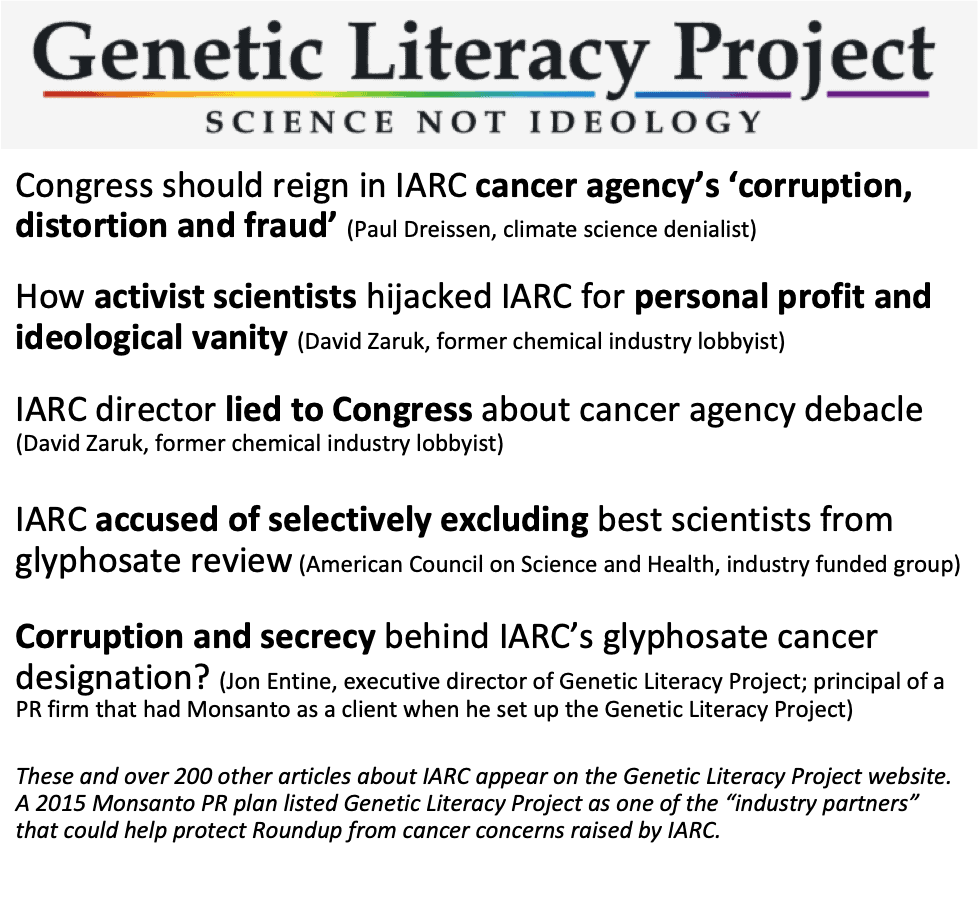
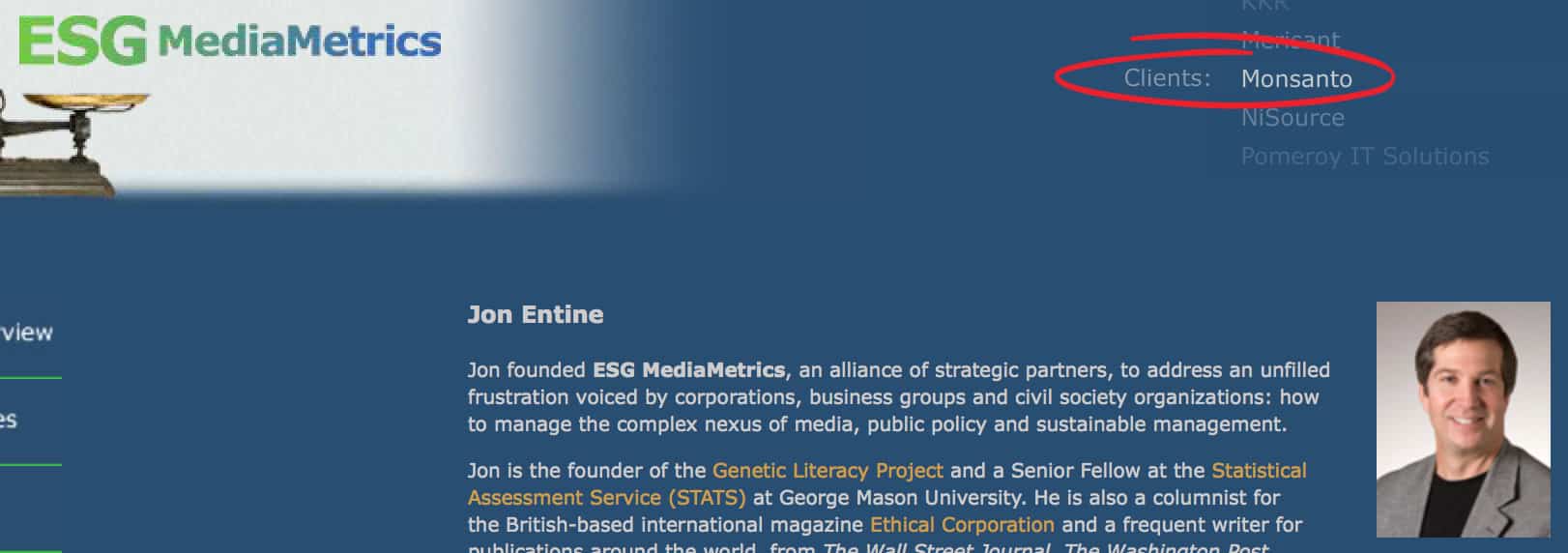
Entine has longtime ties to the chemical industry; his body of work includes defending pesticides, industrial chemicals, plastics, fracking, and the oil industry, often with attacks on scientists, journalists and academics. Entine launched the Genetic Literacy Project in 2011 when Monsanto was a clientof his public relations firm. The GLP was originally associated with STATS, a nonprofit group journalists have described as a “disinformation campaign” that seeds doubt about science and is “known for its defense of the chemical industry.”
In 2015, the Genetic Literacy Project moved to a new parent organization, the Science Literacy Project. IRS tax filings for that year indicated that Dr. Ronald was a founding board member of the Science Literacy Project, but emails from August 2018 show that Dr. Ronald convinced Entine to retroactively remove her name from the tax form after it became known she was listed there (the amended tax form is now available here). Dr. Ronald wrote to Entine, “I did not serve on this board and did not give permission for my name to be listed. Please take immediate action to notify the IRS that my name was listed without consent.” Entine wrote that he had a different recollection. “I clearly recall you agreeing to be part of the board and head the initial board … You were enthusiastic and supportive in fact. There is no question in my mind that you agreed to this.” Nevertheless he agreed to try to get her name removed from the tax document.
The two discussed the tax form again in December 2018 after this fact sheet was posted. Entine wrote, “I listed you in the original 990 based on a telephone conversation in which you agreed to be on the board. When you represented to me that you disagreed, I purged the record as you requested.” In another email that day, he reminded Dr. Ronald that “in fact you were associated with ‘that organization: as we worked together, seamlessly and constructively, in making the boot camp at your university a great success.”
Science Literacy Project tax forms now list three board members: Entine; Drew Kershen, a former law professor who was also on the board of “Academics Review,” a group that claimed to be independent while receiving its funds from agrichemical companies; and Geoffrey Kabat, an epidemiologist who serves on the board of scientific advisors for the American Council on Science and Health, a group that received money from Monsanto for its work defending pesticides and GMOs.
FOUNDED, LED UC DAVIS GROUP THAT ELEVATED INDUSTRY PR EFFORTS
Dr. Ronald was the founding director of the World Food Center’s Institute for Food and Agricultural Literacy (IFAL), a group launched in 2014 at UC Davis to train faculty and students to promote genetically engineered foods, crops and pesticides. The group does not fully disclose its funding.
Documents show that Dr. Ronald gave Jon Entine and his industry front group Genetic Literacy Project a platform at UC Davis, appointing Entine as an unpaid senior fellow of IFAL and an instructor and mentor in a science communications graduate program. Entine is no longer a fellow at UC Davis. See our 2016 letter to the World Food Center inquiring about funding for Entine and IFAL and their obscure explanation about where their funding comes from.
In July 2014, Dr. Ronald indicated in an email to a colleague that Entine was an important collaborator who could give them good suggestions on who to contact to raise additional funds for the first IFAL event. In June 2015, IFAL co-hosted the “Biotech Literacy Project boot camp” with Genetic Literacy Project and the Monsanto-backed group Academics Review. Organizers claimed the event was funded by academic, government and industry sources, but non-industry sources denied funding the events and the only traceable source of money came from industry, according to reporting by Paul Thacker in The Progressive.
Tax records show that Academics Review, which received its funding from the agrichemical industry trade group, spent $162,000 for the three-day conference at UC Davis. The purpose of the boot camp, according to the agenda, was to train and support scientists, journalists and academic researchers to persuade the public and policy makers about the benefits of GMOs and pesticides.
Speakers at the UC Davis boot camp included Jay Byrne, Monsanto’s former director of corporate communications; Hank Campbell of the Monsanto-funded American Council on Science and Health; professors with undisclosed industry ties such as University of Illinois Professor Emeritus Bruce Chassy and University of Florida Professor Kevin Folta; Cami Ryan, who now works for Monsanto; David Ropeik, a risk perception consultant who has a PR firm with clients including Dow and Bayer; and other agrichemical industry allies.
Keynote speakers were Dr. Ronald, Yvette d’Entremont the Sci Babe, a “science communicator” who defends pesticides and artificial sweeteners while taking money from companies that sell those products, and Ted Nordhaus of the Breakthrough Institute. (Nordhaus was also listed as a Science Literacy Project board member on the original 2015/2016 tax form, but his name was removed along with Dr. Ronald’s in the amended form Entine filed in 2018; Nordhaus said he never served on the board.)
bush 43 (went to perdue u?)
Anne Lindsay, Deputy Director of the Office of. Pesticide Programs (OPP) at the US Environmental Protection Agency, even said of the claims by Professor Hayes after the SAP was called due to his allegations, “It has been claimed that research on frogs shows that atrazine causes changes in the production of aromatase, an enzyme that is involved in the conversion of testosterone to estrogen. It has also been claimed that other scientists have shown similar effects in other species … There is no direct scientific information to assess this hypothesis.”
:{
}:
[http://academicsreview.org/wp-content/uploads/2014/03/anne-lindsay-testimony.pdf]
EPA is already under constant attack and there is no reason to add a lightning-rod to what should be a neutral SAP by including someone who has a political, cultural, and scientific agenda against the products he would need to investigate.
Respectfully,
Hank Campbell
Science 2.0
==
https://www.alternet.org/environment/glyphosate-monsantos-toxic-legacy
http://retractionwatch.com/2017/08/10/unearthed-docs-monsanto-connected-campaign-retract-gmo-paper/
Unearthed emails: Monsanto connected to campaign to retract GMO paper
A trove of internal documents from Monsanto, recently unsealed in a lawsuit against the agricultural biotech giant, has revealed the firm’s role in the knotty tale of a paper from the lab of a scientist known for his stance against genetically modified organisms (GMOs).
That paper is “:{Long term toxicity of a Roundup herbicide and a Roundup-tolerant genetically modified maize:(style="padding:0px;margin:0px"):}:,” published in September 2012 in the journalFood and Chemical Toxicology(FCT) and :{retracted in January 2014:(style="padding:0px;margin:0px"):}:. :{Gilles Seralini:(style="padding:0px;margin:0px"):}:, a scientist known for an adversarial stance towards GMOs, was first author. The documents have also spurred the retraction of several pro-GMO articles on Forbes.com written by Henry Miller, a fellow at the Hoover Institution, a conservative think tank at Stanford University. Emails showed that one of the articles, which didn’t discuss Seralini’s paper, was ghostwritten by Monsanto.
The :{documents:(style="padding:0px;margin:0px"):}:, posted last week by the law firm of Baum, Hedlund, Aristei and Goldman, show Monsanto engaged with a network of scientists and other commentators to spread the message that the Seralini paper was bad science and should be retracted. Seralini told Retraction Watch that this proves what he has been saying all along, that Monsanto led a concentrated effort to discredit his science and protect its bottom line. He said:
I deduced from the beginning that it was organized….
But the effort to counteract Seralini’s work was not one-sided. [what?! huh logic?] Bruce Chassy, at the time a professor at the University of Illinois, now retired, told us he approached Monsanto to ask if they would act as allies “in the fight against the abuse of science,” in the form of anti-GMO research that he believed to be shoddy. He said that he has been critical of Monsanto’s business practices, but thinks they hire good scientists and are thus a good source of information on GMOs:
If I can use Monsanto to get science a fair hearing, I’ll do it. Since they know more about this than anybody else, they’re the people to go to.
Monsanto tried to ensure that the campaign to retract the 2012 paper wouldn’t be linked back to the company. On Sept. 26, 2012 — a week after the paper came out, :{Eric Sachs, a Monsanto executive, wrote several colleagues:(style="padding:0px;margin:0px"):}: to emphasize:
We have done our part. It is time now for the public sector and especially our network of experts to do theirs…
Monsanto must not be put in the position of providing the critical analysis that leads the editors to retract the paper… There is a difference between defending science and participating in a formal process to retract a publication that challenges the safety of our products.
To achieve this, Monsanto coordinated with the scientists mentioned in the documents on what to say in response to and how to maximize the impact of the response. Based on the documents obtained, that took the form of published articles, including letters to the editor of FCT, at least one of which called for retraction.
A contentious paper
Seralini should be no stranger to our regular readers — controversy has followed the 2012 paper at almost every turn, from the irregular methods Seralini used to promote it to the media (such as asking some journalists to sign a non-disclosure agreement to see it in advance of publication) to initial publication in FCT. Even after it was retracted, it was republished in 2014 — by a journal that :{didn’t subject it to peer review:(style="padding:0px;margin:0px"):}:. The FCT version has been cited 54 times since it was retracted, and 95 in total, according to Clarivate Analytics’ Web of Science, earning it Clarivate’s “highly cited paper” designation.
In a :{statement issued:(style="padding:0px;margin:0px"):}: after the retraction, Seralini accused Monsanto of promoting criticisms of the paper and installing a former employee on the FCT editorial board.
While the documents highlight close ties between Monsanto and at least four people who criticized the study, plenty of scientists criticized the paper’s scientific merits in both the :{mainstream:(style="padding:0px;margin:0px"):}: and :{academic:(style="padding:0px;margin:0px"):}: press. Still, the decision to retract was as contentious as the decision to publish. An FCT investigation found no evidence of fraud, misconduct, or gross error, which are required by Committee on Publication Ethics (COPE) guidelines for retraction; however, FCT cited COPE guidelines in their :{retraction notice:(style="padding:0px;margin:0px"):}: anyway.
As our co-founder Ivan Oransky :{told :(style="padding:0px;margin:0px"):}:*:{CBS News:(style="padding:0px;margin:0px"):}:* in 2014, after the paper was :{republished:(style="padding:0px;margin:0px"):}: in a different journal:
This whole episode has taken us farther away from knowing the truth …
This is a good example of what happens when people with hardened beliefs manipulate a system for the result they want …
:{
}:
“We are ‘connected’ but did not write the letter”
The :{documents show that Monsanto was in contact with Chassy:(style="padding:0px;margin:0px"):}:, who wrote several pieces attacking Seralini’s paper. On Sept. 25, 2012, Chassy :{co-authored an article with Henry Miller:(style="padding:0px;margin:0px"):}:, the fellow at the conservative think tank, which Miller published in his capacity as a Forbes.com contributor. The article suggested that Seralini had gone beyond “bad science” and into fraud. That article and two other posts from Miller related to GMOs have since been removed from Forbes.com, but are available through the internet archive (one, :{co-written with Chassy:(style="padding:0px;margin:0px"):}:, criticized an earlier 2012 Seralini paper; the other was :{ghost-written by Monsanto:(style="padding:0px;margin:0px"):}: itself in 2015).
Mia Carbonell, senior VP of global communications at Forbes, told Retraction Watch that it has pulled down all of Miller’s articles on its site, because he violated the terms of his contract:
All contributors to Forbes.com sign a contract requiring them to disclose any potential conflicts of interest and only publish content that is their own original writing. When it came to our attention that Mr. Miller violated these terms, we removed all of his posts from Forbes.com and ended our relationship with him.
Both Miller and Chassy said they weren’t involved in the decision to take down the Forbes articles and that they disagreed with the decision. Miller told us that, like Chassy, he has “sought information from [Monsanto] …on scientific issues when I thought they had information of value.” He said he does not have a financial connection to Monsanto. Chassy said that he has never personally accepted money from Monsanto, although his university did [see update].
One day after the Forbes.com article ran, Chassy sent FCT Editor-in-chief A. Wallace “Wally” Hayes a :{strongly-worded email:(style="padding:0px;margin:0px"):}: in which he said the journal had an “ethical obligation” to retract the paper.
Chassy was also :{one of 25 co-authors of a formal letter to the editor:(style="padding:0px;margin:0px"):}: of the FCT that called for the paper’s retraction. (The letter has not been cited.) In September 2012, as the letter was being drafted, a Monsanto staff member asked about the company’s involvement with it and expressed hesitation about whether the company should even disclose its knowledge of the letter to investors. :{Sachs wrote:(style="padding:0px;margin:0px"):}::
We are “connected” but did not write the letter or encourage anyone to sign it.
As :{reported by the :(style="padding:0px;margin:0px"):}:*:{New York Times:(style="padding:0px;margin:0px"):}:*, Hayes himself had a :{“contractual relationship” with Monsanto:(style="padding:0px;margin:0px"):}: while he was editor of FCT. Hayes, now an adjunct professor at the University of Massachusetts, told the Times he was not under contract with Monsanto when the paper was retracted and that his relationship played “no role whatsoever” in that decision. However, Hayes was i:{n contact with Monsanto executives soon after the paper came out:(style="padding:0px;margin:0px"):}:, offering advice on what they might round up to submit to him as rebuttal.
The docs also :{reveal ties between Monsanto and Colin Berry,:(style="padding:0px;margin:0px"):}: a British toxicologist, who published his own letter in FCT criticizing the paper. On Sept. 20, 2012, the day after FCT published the Seralini paper, :{Berry emailed David Saltmiras:(style="padding:0px;margin:0px"):}:, his contact at Monsanto, to ask:
Have you seen this? I have been asked to comment asap – anything you want to say[?]
Saltmiras replied:
I hope scientist of your caliber and standing may consider penning a joint letter to the Editor focusing on scientific deficiencies and the flawed scientific review process.
A third scientist, :{Andrew Cockburn:(style="padding:0px;margin:0px"):}:, a toxicology consultant who at the time was a visiting professor at UK’s University of Newcastle, was also on the email chain and chimed in:
…if you can provide the ammunition I’d be happy to respond …
Monsanto did not respond to Retraction Watch’s request for comment.
Sachs, the Monsanto executive, realized the risks of attacking the decision to publish the paper and call for retraction. On Sept. 26, as he insisted it should not be Monsanto to swing the axe, he wrote:
We should not provide ammunition for Seralini, [genetic modification] critics and the media to charge that Monsanto used its might to get this paper retracted.
Update 8/11/2017 UTC 14:30:
Bruce Chassy told us that he had never personally received money from Monsanto; however, several readers have pointed out that he has in fact accepted thousands of dollars from Monsanto, routed through the University of Illinois Foundation and nominally slated for “outreach” to avoid scrutiny. A Chicago Public Radio investigation from March 2016 showed:
Monsanto sent more than $140,000 in “biotech research and outreach” payments through the University of Illinois Foundation between 2006 and June 2012, the month Chassy retired. Further documents confirm that at least $57,000 was routed to Chassy over a period of 23 months.
And a *New York Times* article from September 2015 said that in 2011 Monsanto gave Chassy a grant for an undisclosed amount “to support ‘biotechnology outreach and education activities.’”
==
==
usrtk
https://usrtk.org/food-for-thought/julie-kelly-cooks-up-propaganda-for-the-agrichemical-industry/
Julie Kelly is a food writer and cooking instructor who emerged in 2015 as a fierce advocate for the agrichemical industry, with articles defending pesticides, arguing against GMO labeling and attacking the organic food industry. Her work has appeared in the National Review, The Hill, Huffington Post, the Wall Street Journal and Forbes.
Kelly has not disclosed her funding sources.
Julie Kelly’s husband, John Kelly Jr., is a lobbyist for the agribusiness giant ADM, among other corporate clients including Blackstone and CVS; and government clients including DuPage County where Julie Kelly formerly worked as a policy consultant to county board chairman Dan Cronin.
Articles Dropped from Forbes
In August 2017, Forbes deleted articles by Julie Kelly that share a byline with Henry I. Miller, a Hoover Institution fellow, following revelations that Monsanto ghostwrote an article attacking the International Agency for Research on Cancer, which Miller published under his own name in Forbes.
The New York Times reported on Aug. 1:
- Documents show that Henry I. Miller asked Monsanto to draft an article for him that largely mirrored one that appeared under his name on Forbes’s website in 2015. Forbes removed the story from its website on Wednesday and said that it ended its relationship with Mr. Miller amid the revelations.
Retraction Watch further reported: Forbes “has pulled down all of Miller’s articles on its site, because he violated the terms of his contract” which calls for authors “to disclose any potential conflicts of interest and only publish content that is their own original writing.”
The emails, posted here, show how corporations work with with writers like Miller to promote industry talking points while keeping their collaborations secret. In this case, a Monsanto executive asked Miller to write a column and provided him with a “still quite rough draft” as “a good start for your magic.” The rough draft appeared a few days later, largely unchanged, under Miller’s name in this Forbes column.
Kelly and Miller have co-written at least a dozen articles together, promoting pesticides, arguing for deregulation and attacking the organic industry. Kelly articles removed from the Forbes website include, among others: “Federal Subsidies to Organic Agriculture Should be Plowed Under” (7.12.17), “Will the Trump Administration Usher in an Era of Less Cronyism and Pay-to-Play?” (11.16.16) and “How Organic Agriculture Evolved from Marketing Tool to Evil Empire” (12.2.15).
Inaccuracies
A July 12, 2017 article attacking the organic industry — removed from the web by Forbes because of the co-byline with Henry I. Miller — Kelly and Miller cited an Academics Reviewreport attacking the organic industry as a reputable, independent source. Documents show Academics Review was set up as a front group with the help of Monsanto and with industry funding to attack the organic industry and critics of GMOs.
A Dec. 2, 2015 article in Forbes co-written by Kelly and Miller falsely claimed that University of Florida Professor Kevin Folta “turned over almost 5,000 emails” in response to pubic records requests, “only oneof which showed any connection with Monsanto.” In fact, the New York Times posted 174 pages of Folta’s emails showing many interactions with Monsanto and Ketchum, the agrichemical industry’s PR firm.
Kelly has claimed, inaccurately, that genetically engineered foods lead to lower pesticide use and create huge advantages for farmers; in fact, GMOs have led to higher overall herbicide use due to herbicide-tolerant GMO crops and farmers have experienced many problems.
Manufacturing Doubt about Climate Science / Pesticide Risk
Julie Kelly’s work includes:
Casting doubt on the science of climate change in the National Review
Attacks on climate activists, for example tweeting to Bill McKibben, “You are a piece of shit.”
[ ](https://usrtk.org/wp-content/uploads/2017/02/Julie-Kelly-tweet-attack-on-Bill-McKibben-.png)
Calling on Congress to defund the International Agency for Research on Cancer, the World Health Organization’s cancer research arm, in The Hill.
Kelly’s frequent co-author Miller is a member of the “scientific advisory board” of the George C. Marshall Institute, which is famous for its oil and gas industry funded denials of climate change. In articles co-bylined with Miller, Kelly has:
- Argued that organic farms are “an affront to the environment.”
- Promoted DDT as an effective pesticide that should not have been banned, and argued that “green zealots” and “ignorant ideological activists” could ruin the food supply by pressuring EPA to ban Monsanto’s glyphosate.
- Described the Trump Administration as likely to usher in an era of “greater governmental transparency and accountability, and a more level playing field” that could be a huge boon to the GMO industry.
The Hoover Institution, which promotes Kelly’s work, has a mission to “limit government intrusion into the lives of individuals.” Its top funder is the Sarah Scaife Foundation, which was identified in a 2013 Drexel University study as among “the largest and most consistent funders of organizations orchestrating climate change denial” and a foundation that promotes “ultra-free-market ideas in many realms.”
Chemical Industry Allies
USRTK has compiled a series of fact sheets about writers and PR groups the agrichemical industry relies on to manufacture doubt about science that raises concern about risky products and argue against environmental health protections.
– Why You Can’t Trust Henry I. Miller– Why Forbes Deleted Some Kavin Senapathy Articles–The American Council on Science and Health is Corporate Front Group
– Jon Entine of Genetic Literacy Project: The Chemical Industry’s Master Messenger
– Trevor Butterworth / Sense About Science Spins Science for Industry– Does Science Media Centre Push Corporate Views of Science?
Follow the USRTK investigation of Big Food and its front groups: https://usrtk.org/our-investigations/
Food For Thought, Our Investigations American Council on Science and Health, Bill McKibben, climate change science denial, Henry Miller, Hoover Institute, Julie Kelly
==
==
Also read the letter from Academics Review co-founder Bruce Chassy!
Former University of Illinois food science professor Bruce Chassy is known for his academic gravitas. Now retired nearly four years, Chassy still writes and speaks often about food safety issues, identifying himself with the full weight of the decades of experience earned at the public university and as a researcher at the National Institutes of Health. Chassy tells audiences that before he retired in 2012, he worked “full time” doing research and teaching.
What Chassy doesn’t talk much about is the other work he did while at the University of Illinois — promoting the interests of Monsanto Co., which has been trying to overcome mounting public concerns about the genetically engineered crops and chemicals the company sells. He also doesn’t talk much about the hundreds of thousands of dollars Monsanto donated to the university as Chassy was helping promote GMOs, or Monsanto’s secretive role in helping Chassy set up a nonprofit group and website to criticize individuals and organizations who raise questions about GMOs.
But emails released through Freedom of Information Act requests show that Chassy was an active member of a group of U.S. academics who have been quietly collaborating with Monsanto on strategies aimed at not just promoting biotech crop products, but also rolling back regulation of these products and fending off industry critics. The emails show money flowing into the university from Monsanto as Chassy collaborated on multiple projects with Monsanto to counter public concerns about genetically modified crops (GMOs) – all while representing himself as an independent academic for a public institution.
A New York Times article by Eric Lipton published last September laid bare the campaign crafted by Monsanto and other industry players to use the credibility of prominent academics to push the industry’s political agenda. That Times article focused primarily on University of Florida academic Kevin Folta, chairman of the university’s Horticultural Sciences Department, and Folta’s work on behalf of Monsanto. But an examination of recently released email exchanges between Monsanto and Chassy show new depths to the industry efforts.
The collaborations come at a critical juncture in the United States regarding GMO public policy. Mandatory GMO labeling is set to take effect in Vermont on July 1; Congress is wrestling over a federal labeling law for GMOs; and several other states are seeking their own answers to rising consumer demand for transparency about this topic.
Many consumer and environmental groups want to see more restrictions and regulation on GMO crops and the glyphosate herbicide many know as Roundup, which is used on GMOs. But the companies that market the crops and chemicals argue their products are safe and there should be less regulation, not more. Monsanto’s roughly $15 billion in annual revenue comes almost exclusively from GMO crop technology and related chemicals.
Amid the furor, the revelations about corporate collaboration with public university scientists to promote GMOs have sparked a new debate about a lack of transparency in the relationships between academics and industry.
Chassy has said he did nothing unethical or improper in his work supporting Monsanto and the biotech crop industry. “As a public-sector research scientist, it was expected... that I collaborate with and solicit the engagement of those working in my field of expertise,” Chassy has stated.
Still, what you find when reading through the email chains is an arrangement that allowed industry players to cloak pro-GMO messaging within a veil of independent expertise, and little, if any, public disclosure of the behind-the-scenes connections.
CRITICAL COLLABORATIONS
- In a November 2010 email, Monsanto chief of global scientific affairs Eric Sachs tells Chassy that Monsanto has just sent a “gift of $10,000” to the university “so the funds should be there.” He then tells Chassy he is working on a plan for Monsanto and others in the agribusiness industry to support an “academics review” website that Chassy can use to counter concerns and allegations raised by critics of GMOs. “From my perspective the problem is one of expert engagement and that could be solved by paying experts to provide responses,” Sachs wrote. “The key will be keeping Monsanto in the background so as not to harm the credibility of the information.”
- In a separate 2010 exchange, Jay Byrne, president of the v-Fluence public relations firm and former head of corporate communications for Monsanto, tells Chassy he is trying to move the Academics Review project forward. He suggests “we work on the money (for all of us).” Byrne says that he has a list of GMO critics for Academics Review to target. He tells Chassy that the topic areas “mean money for a range of well-heeled corporations.”
- In 2011, several emails show Chassy and Monsanto chief of global scientific affairs Eric Sachs, along with others, discussing ways to lobby the Environmental Protection Agency against expanded regulation of biotech crops.
- In one email exchange from September 2011, Chassy suggests how the biotech crop industry might “spin” a government study that found significant levels of the chemical glyphosate, the key ingredient in Monsanto's Roundup herbicide, in air and water samples.
- In emails from 2012, Chassy and Monsanto’s Sachs and Monsanto’s John Swarthout, who leads the company’s “scientific outreach and issues management,” discuss an upcoming presentation Chassy is preparing to make in China. They discuss Monsanto’s review of, and changes to, the presentation. Monsanto’s Sachs instructs Swarthout to send slide decks to Chassy as material for his presentation.
- In April 2012, Monsanto toxicologist Bruce Hammond asks in an email if short videos can be created about the “safety of GM crops.” Chassy says that he is applying for funding from the State Department and “also seeking other sources of support” and can use university equipment to make the videos. Chassy asks Monsanto’s Hammond for a list of videos that “you think would be helpful.” Chassy tells Hammond that Byrne’s group V-fluence has helped create and edit the video scenarios.
- In separate emails, Monsanto’s Sachs tells Chassy that Monsanto is shooting its own videos” but says “Obviously, independent content from the U of I and supported by US Govt agencies is the preferred approach.” Sachs tells Chassy that Monsanto is happy to help “provide guidance or approaches for additional videos.”
EMAILS ABOUT MONEY
The emails also discuss money.
- In an October 2010 email, Chassy tells colleagues at the university that Monsanto has told him it is going to make a “substantial contribution” to his biotech account at the university.
- In an October 2011 exchange, Chassy asked Sachs about a contribution for the university foundation biotech fund. The Monsanto executive responded that he would "make a gift to the foundation right away" if it had not already been made. Chassy instructs Monsanto to mail the check to the head of the university’s department of food science and to enclose a letter saying the check is “an unrestricted grant… in support of the biotechnology outreach and education activities of Professor Bruce M. Chassy.”
- And in April and May of 2012 Chassy asks Monsanto directly about an expected “deposit.” In one, on May 31, 2012, as he was preparing to begin his retirement on June 30, Chassy wrote Monsanto’s Sachs again asking “is there any way to find out if a check was issued to U of I for me? I don’t see it in my account yet…”
- Also in May 2012, Monsanto made a $250,000 grant to the university to help set up an agricultural communications endowed chair. That donation was just a drop in the bucket of the donations from Monsanto – at least $1.9 million in the last five years, according to the university, - for agriculture-related projects.
CONTINUED CLOSE TIES
The close ties between Monsanto and Chassy continued past Chassy’s retirement in June 2012 from the university. Through 2013 and 2014 Chassy frequently appeared as an “independent expert” on the GMO Answers website, a pro-GMO site funded by Monsanto and other agribusiness giants. In that role, he answered questions and concerns about GMOs.
Chassy also has continued to operate Academics Review,publishing critical articles about individuals and organizations, including the World Health Organization’s cancer experts, that report information unfavorable for the GMO crop industry. (I was the subject of at least two such attacks in 2014. Chassy objected to my presentation of both sides of the GMO safety debate in one Reuters article and objected to a second Reuters article that detailed the findings of a USDA report that found both benefits but also concerns associated with GMOs.)
When asked about its interactions with Chassy, Monsanto has said that there is nothing improper with its “engagements” with “public sector experts,” and that such collaborations help educate the public on important topics. The university also has said it sees nothing wrong with the relations. A university spokeswoman said Chassy has "strong scientific credibility." She also said that Monsanto has given the university at least $1.9 million in the last five years.
But others familiar with the issues say the lack of transparency is a problem.
“These revelations regarding the connections are very important,” said George Kimbrell, senior attorney with the Center for Food Safety, a nonprofit consumer advocacy group. “The basic disclosure that some academics and other ‘neutral’ commentators in the public sphere are actually paid operatives/working directly with the chemical industry rightly alarms the public, as they are being misled.”
Revelations similar to these involving University of Florida Professor Kevin Folta’s connections to Monsanto did spark a public backlash after emails showed Folta received an unrestricted $25,000 grant and told Monsanto he would “write whatever you like.” Folta said in a Jan. 18 blog that he no longer works with Monsanto because of the heated backlash.
Both Chassy and Folta have repeatedly written or been quoted in news articles that failed to disclose their connections to Monsanto and the GMO industry. In a recent example, Chassy has co-authored a series of articles that argue GMO labeling is a “disaster in waiting,” again with no disclosure of his collaboration with GMO developer Monsanto. His co-author is Jon Entine, founder of the PR firm ESG MediaMetrics, whose clients have included Monsanto, a connection Entine does not include in the article.
The revelations in the emails about Chassy, Folta and other assorted academics, leave many questions about who to trust, and how to trust, information critical to understanding our evolving food system. With food labeling issues at the forefront of debate, it’s time for more transparency.
Carey Gillam is research director at U.S. Right to Know, a nonprofit organization that investigates the risks associated with the corporate food system. She has worked as a journalist, researcher and writer specializing in food and agriculture for more than 20 years.
==
- ### Foundation/Non-profit Links
- American Council on Science and Health
- Center for Environmental Risk Assessment (formerly AgBios)
- Center for Food Integrity
- CheckBiotech
- GMO Compass EU
- ILSI
- International Food Information Council Foundation
- International Service for the Acquisition of Agri-Biotech Applications (ISAAA)
- Organisation for Economic Co-Operation and Development (OECD)
- ### Government Links
- ### Other Links
- ### University Links
- Agbioforum Journal
- AgBiosafety, University of Nebraska
- Information Systems for Biotechnology, Virginia Tech.
- Landgrant Universities About Agricultural Biotechnology
- Public Research and Regulation Initiative (PRRI)
- Sense About Science
- The GMO misinformation page. :{University of Georgia:(style="background-color:#ffff66;"):}:
==
US Rep. Mike Pompeo (R-Kansas) today introduced legislation that would recognize the federal government’s authority to determine [READ PREVENT] if mandatory GMO labels should be applied to foods, to require FDA to review GMO-containing foods prior to marketing, and to define the word “natural” as applied to foods. Reuters carried a story on the proposed legislation written by Carey Gillam. Academics Review has assigned low grades in the past due to Ms. Gillam’s inaccurate reporting on GM foods which reflects a clear bias (http://academicsreview.org/2014/03/grading-the-science-usdas-economic-research-report-coverage-by-reuters/). In her April 9, 2014 report on the proposed legislation Ms. Gillam claimed “But there are also many scientific studies showing links to human and animal health problems, and many indicating environmental damage related to GMO crops.”[note weeds cut?]
This statement is simply factually incorrect:
- There are many scientific studies that show that GM crops are safe
- There are a handful of discredited and flawed scientific studies that claim GM crops are not safe but these have been widely rejected by the scientific community
3. There is a broad scientific consensus, supported by 18 years of real-world experience by tens of millions of farmers who have planted billions of acres of GM crops, that GM technology presents no new or different risks and is as safe as, or is safer than other modalities of breeding. The vocal misrepresentation of fact by a few well funded hardcore dissidents by whom Ms. Gillam’s views are apparently informed do not change these facts.
4. Ms. Gillam also claims “Notably, millions of acres of U.S. farmland have developed weed resistance due to heavy use of crops that have been genetically altered to withstand dousings of Monsanto’s Roundup herbicide, and the subsequent heavy use of Roundup.” As is true with all herbicides, weeds with elevated resistance to glyphosate have emerged and have caused concern in 15-40% of planting locations, the challenge this presents to farmers can be controlled by better stewardship practices. [read: higher doses] The claim that crops are doused with Round-Up is emotionally loaded but equally inaccurate.
For these reasons Academics Review have to assign this report a grade of F.
Additional review in support of this assessed grade:
Reprinted here with the author’s permission from theInformation Technology & Innovation Foundation.
REUTERS (PREDICTABLY) GETS IT WRONG. AGAIN.
One of the reasons the “controversy” over crops improved through biotechnology persists, is because it is manufactured and sustained by a well-organized, ongoing campaign, funded and sustained by vested interests. This astroturf campaign [who? why?]is fueled by credulous and disengaged journalists who recycle their press releases, and allow those biases to bleed over into other coverage.
We’ve written before about one repeat offender, Carey Gillam, of Reuters. She’s back with more of the same, in a story that ran on 9 April covering legislation introduced in Congress that would (redundantly) preempt state legislation to mandate labels that would mislead consumers and abet fraudulent marketing campaigns. Gillam writes “But some scientific studies warn of potential human and animal health problems, and GMO crops have been tied to environmental problems, including rising weed resistance. Millions of acres of U.S. farmland have developed weed resistance due to heavy use of crops that have been genetically altered to withstand dousings of Monsanto’s Roundup herbicide.”
Hold the weed/herbicide resistance issue for a moment, and let’s look at the “scientific studies that warn of potential human and animal health problems…” This claim is false, and flagrantly so. Gillam has been called on this before, yet she continues to recycle the falsehood. It bears repeating: there is not a single credible study showing any health or safety problem with any of the foods or animal feeds on the market derived from crops improved through biotechnology. Not one. FDA’s evaluation of each and every one can be found here. Gillam obviously cannot be bothered, but it makes for illuminating (if soporific) reading. Professional opponents of agricultural biotechnology, whose water Gillam reliably carries, argue that the FDA consultation process is “voluntary.” This, too, is a canard we’ve previously addressed, one which ignores that the same products have been subjected to equivalent, mandatory reviews in the EU, Japan, Australia, Canada, and other countries around the world. Gillam also ignores the recent reaffirmation from the FDA Commissioner that these foods are safe, and that FDA labels give consumers everything bit of scientifically defensible information about the safety and nutritional value of these foods.
The repeated citing of these false claims ignores the robust global consensus on the safety of crops improved through biotechnology, and recycles the canard that the science is undecided; that the published studies demonstrating the safety of these crops are counterbalanced by credible scientific publications suggesting otherwise. This is bogus, and after the last time Gillam ran it, we called her on it. That lead to an email exchange.
I challenged her to back up what she had written, and asked her to provide examples of the scientific papers she claims credibly support the notion that there are genuine safety issues here. . “I’d love to know what papers you think credibly support the claims you reported. Why not bring them on and let’s see what they are… But I could be wrong. If you have data, stand behind it. If not, I can provide you plenty of data on which a balanced journalist could base a correction.”
She responded “…The scientific literature showing a variety of health and environmental concerns surrounding the use of GMOs is out there. I have not just read the studies and made copies, but talked to scientists in several different countries about their concern.” Conspicuously absent from her response was any mention of just which studies these are. Perhaps because she knows she can’t cite any that haven’t been rejected by the scientific community or retracted by the journals in which they were published by mistake. Pressed further, instead of providing any examples of these mythical studies, she resorted to the shill gambit (hurling accusations that the views one disagrees with are bought and paid for, and thus do not have to be dealt with on their merits) thus conceding the argument.
As for biotech improved crops being “tied to environmental problems, including rising weed resistance. Millions of acres of U.S. farmland have developed weed resistance due to heavy use of crops that have been genetically altered to withstand dousings of Monsanto’s Roundup herbicide…” there are several points to be made.
The first is that the evolution of resistance/tolerance is completely unsurprising. In fact, “The First Journal Article on Insecticide Resistance was Published 100 Years Ago this Month”. Gillam may be to discover gambling in the casino, but it’s been known for some time. And experts in weed management have known about glyphosate tolerant weeds for some time as well, and they don’t fit comfortably into activist story line Gillam dutifully parrots. Never mind that farmers don’t “douse” weeds with glyphosate, or anything (why not? It costs money, and dousing is unnecessary, wasteful and expensive.) The bottom line is that the resistance issues are most severe in the fields of farmers who failed to follow the recommended and established best practices, and went instead year on year using only one method of weed control, eschewing the rotation and alternation of crops and weed control methods called for by long experience. The result is neither a new problem, nor one that cannot be managed. As any chef can tell you, the kitchen knife needs sharpening from time to time, and every so often one must buy a new one.
Others have noted Gillam’s repeated offenses in this area. Sadly, it seems nothing will change until something changes. Perhaps it’s time for her editors to move her to a beat that would give her less opportunity to exercise the prejudices she is obviously unwilling to check.
Contributor L. Val Giddings, Ph.D. (Genetics, Evolutionary Biology). Dr. Giddings is a senior fellow at the Senior Fellow at Information Technology & Innovation Foundation.
Filed Under: Grading Science
Tags: Carey Gillam, Reuters, science journalism
==
pbs punked
study published in Science magazine suggested that attitudes toward same-sex marriage were more likely to be changed by face-to-face conversations with gay canvassers over straight ones. But now that study has been redacted, spurring questions about how scientific research is published. Hari Sreenivasan talks to Ivan Oransky, co-founder of Retraction Watch, who broke the story.
COMMENTS
227 64 +1 EMAIL
TRANSCRIPT
JUDY WOODRUFF: Next, we explore questions about how scientific findings are published and verified, and whether allegations of fraud involving a top science journal are damaging credibility with the wider public.
Yesterday, “Science” magazine retracted a study published in December that found people’s attitudes toward same-sex marriage were more likely to be changed by face-to-face conversations with gay canvassers over straight ones. It was a study that got quite a bit of pickup in the media. Now that it’s been retracted by a leading journal, it poses questions for the scientific establishment.
Again to Hari, who has more on the story.
HARI SREENIVASAN: The study’s lead author asked for the retraction after the original findings could not be duplicated, and his co-author, a graduate student, was accused of misrepresenting how the work was done.
This is the latest retraction in a major journal. In recent years, there have been others involving cloning and stem cell research.
Ivan Oransky is a journalist, as well as a medical doctor, who broke this story. He is co-founder of the blog Retraction Watch and global editorial director of MedPage Today, an online medical news service for physicians and other medical professions.
So, first of all, this particular case, how did we get here? What went wrong?
IVAN ORANSKY, Co-Founder, Retraction Watch: So, what seems to have gone wrong is that only some of this study — or at least we can only see that some of this study actually happened.
Lots of pressure on researchers. We don’t exactly know what happened here in the sort of early days, but part of the study, which was that gay people went to people’s houses and tried to convince them that gay marriage was a good thing, that they should agree with it, that part seems to have happened.
What’s a little unclear is whether surveying them afterwards to tell whether you actually changed their minds, which in this case was a pretty important part of the study, whether that actually happened. And so you fast-forward a little bit. The paper gets published in a really big journal, as you said, in “Science,” a major medical — excuse me — a major science journal.
HARI SREENIVASAN: Yes.
IVAN ORANSKY: And that happens in December, and then a couple of month later, some grad students at Berkeley, they decide, oh, we want to do the next set of experiments. We think this is pretty cool.
HARI SREENIVASAN: And this is science works.
IVAN ORANSKY: That’s supposed to be how science works.
So, they start looking at it and something doesn’t look right to them. They start asking a lot of questions, which, again, is supposed to be the way science works, ask the lead author, hey, what’s actually happening here? And no one can find the data.
Some admissions were made about what had happened and what hadn’t happened and how it had been misrepresented. And very quickly, which is I think an important point here, very quickly, the author said — one of the authors said, we should retract this. The journal said, we’re going to put a big stamp on this saying expression of concern.
Within a week, and that just happened this week, the paper’s gone from the record. It’s retracted.
HARI SREENIVASAN: Yes, but people are going to look at this and say but there is supposed to be a system of checks and balances before it gets to the journal, at the journal, the peer review process. We have esteemed colleagues. There’s lots of smart people that could have poked a hole in this before you got to it.
IVAN ORANSKY: There are lots of smart people who can poke a hole in it if they sort of take the opportunity.
Scientists are under a lot of pressure. You and I, as journalists, we’re under a lot of pressure. We know what this is like. And, quite frankly, peer review, it’s something you do, I wouldn’t say exactly spare time, but you’re not paid for it. And so in order to have found what was wrong here, you really would have had to have seen, actually had to have looked at the original data.
And what most people don’t realize is that this sort of Good Housekeeping Seal of Approval that journalists would like you to think peer review, this vaunted peer review system is, it’s not really Good Housekeeping Seal of Approval. There are a lot of holes. You have got to look at the original data.
And that speaks to how science is supposed to work, because you shouldn’t take any particular study, in this case a study that actually showed something that was really very surprising and new and different from what other studies had shown. You shouldn’t take it, even if it turns out to be true, as the answer.
HARI SREENIVASAN: So there are different causes for why certain studies over the years have fallen through the cracks. Right? Sometimes, it’s malicious intent, someone actively trying to doctor the data. Other times, it’s careless error, et cetera.
Are these fabrications more common now or are we in this Internet era able to detect them faster?
IVAN ORANSKY: It’s very clear that we’re able to detect these, sort of whether they’re fraud or just sloppiness or honest error, much more quickly.
Here we are, we’re able to look at all these papers online. We have plagiarism detection software. Plagiarism is a big reason for retraction as well in science, as well in journalism. And so about two-thirds of the time, they’re due to fraud, something that would be considered misconduct.
But it’s very clear that in the last like 15 years, the number of retractions has gone up by 10. So there are 10 times as many retractions — there were times as many retractions in 2010 as in 2001. And, again, it’s because we’re better at finding it.
Whether there’s also more pressure on scientists and more — therefore more fraud, it is a bit of an open question. But it’s also important to keep in mind these 400 — and maybe now it’s 500 or 600 retractions a year — that’s out of like two million or three million papers. So let’s not sort of say, oh, well, everything is fraudulent just because this is on the rise.
HARI SREENIVASAN: Right. This is something that scientists have to now become more vigilant about.
But also who gets hurt by this? In this specific study, it’s kind of a social science experiment. But there are some ethical lines that have been crossed.
IVAN ORANSKY: So, in this particular case, I think one sort of person — it’s not a person, but a group that might take a hit is science itself.
Here we are talking about this study, what went wrong, why did this get into such a major journal. My understanding is that some of the findings here, the sort of — at least the idea, was used as part of the sort of canvassing on the referendum in Ireland that just happened.
So this actually had some real-life ramifications. Maybe it was not a cancer trial or something like that. But, often, some of these studies actually do involve real people who are having terrible diseases like cancer. And they all are — I shouldn’t say all, but many of them involve federal funding.
So you and I are paying for these studies, and then they turn out to be fraudulent. Well, that’s not a great thing.
HARI SREENIVASAN: All right, Ivan Oransky, editor of Retraction Watch, thanks so much for joining us.
IVAN ORANSKY: Thanks for having m
==
Dr oz cited by NYer
http://academicsreview.org/reviewed-content/dr-oz-show-introduction/dr-oz-conclusion-how-to-avoid-gmos/
redo of 2x below:
You are here: Home » News » Letter to Dr. Oz Show Producers by Bruce Chassy, PhD
Letter to Dr. Oz Show Producers by Bruce Chassy, PhD
Academics Review | Oct 06, 2012 | 16 comments
5 October 2012
Greg Tufaro, producer
Brook Jacobsen, producer
Dr. Oz Show
Zoco Productions, LLC/ Harpo Studios
110 N. Carpenter Street
Chicago, IL 60607
Dear Greg and Brook:
I am following up on my conversations and previous correspondence with you regarding the plans by the Dr. Oz Show to air health and safety claims by Jeffrey Smith about agricultural biotechnology (GMOs) and food issues. As discussed, I was unable to participate in your program due to a family conflict. After consulting with other colleagues who were similarly approached by you and those who did participate, however, I am compelled to again voice my concerns regarding the potential violation by Dr. Oz of medical ethics and high risk of misrepresentation of human health information by Dr. Oz, Zoco Productions and Oprah Winfrey’s Harpo Studios on this issue.
As a public sector scientist, researcher and academic administrator with more than 40 years experience, I am appalled that any medical professional would give a platform to the likes of Mr. Jeffrey Smith to impart health information to the public. Mr. Smith has no accredited or formal education in any health, nutrition, or other related science fields. Research into Mr. Smith’s credentials reveals that his only professional experience prior to taking up his crusade against biotechnology is as a ballroom dance teacher, yogic flying instructor and political candidate for the Maharishi cult’s natural law party. The fact that Mr. Smith was even allowed to appear on stage on a nationally broadcast television health-oriented program is hard to believe; hearing from my colleagues who did participate that Dr. Oz referred to Smith as a “scientist” during the program taping is an egregious misrepresentation.
Simply put, Mr. Smith’s health, environmental and safety claims about biotechnology have no basis whatsoever in medicine or science. Thousands of published and peer reviewed studies conducted over the past thirty-plus years contradict his claims and bizarre hypotheses associating health dangers linked to foods derived using biotechnology production methods. This is corroborated by such respected scientific and medical authorities as the American Medical Association, World Health Organization with the Food & Agriculture Organization of the United Nations, Institute for Food Technologists and the American Dietetic Association. Regulatory bodies including the U.S. Food and Drug Administration (FDA), European Food Safety Authority (EFSA) and Food Safety Commission of Japan (FSCJ) all confirm this safety.
Further, our correspondence and conversations, as well as those you had with other academic colleagues who were invited to participate, suggests you engaged in questionable and misleading tactics to secure our participation on your show. When we raised concerns about past treatment of academic participants discussing biotechnology on the Dr. Oz show, you stated “I understand the suspicion and the reservations any scientist would have after the last go-round. My best assurance can only come from the fact that producing a show in that vein isn’t something I agree with at all. That producer is no longer with us. I’m not into producing surprises or blindsiding anybody…” Yet, neither you nor Ms. Jacobsen disclosed that Lisa Oz, the show’s co-producer and wife of Dr. Oz, was the narrator for Mr. Smith’s video attacking biotechnology and an active campaigner for the Proposition 37 efforts in California.
As to you assurances that there would be no surprises or “bait-and-switch” tactics involved, I was informed that “deals were cut” between Dr. Oz and other participants like Organic Valley CEO Gary Hirshberg to prevent the scientists from fully participating in the program. These back-room deals caused changes to the described format for the interviews as laid out by you in advance of the program. Yet, apparently Mr. Hirshberg objected to appearing side-by-side with actual scientists as he made his claims but was allowed to remain on stage while they made their rebuttals. Further, Dr. Oz allowed Mr. Smith to re-tape his segment after the scientists spoke in response to his segment’s initial taping and after they had left the program.
You assured me and the other invited participants that the show was interested in a fair hearing of views from all sides with no pre-judged conclusions. Yet, I also learned that Dr. Oz practiced a pre-scripted conclusion to the program warning viewers to avoid the risks of GMOs by purchasing only organic foods prior to interviewing the scientists and hearing both sides. Similarly, during the taping of the Dr. Oz Show you incorporated graphics provided by Jeffrey Smith implying correlated health risks with the use of biotechnology crops that are simply not based in any medical science or study. These graphics are crude and inaccurate representation which will mislead people to believe biotechnology crops are associated with these diseases – the very same representation could be done showing, for example, that as viewership for the Dr. Oz show rose so did incidents of these diseases, suggesting watching your show is a health risk. Neither is of course true. Biotechnology crops are as safe, if not safer, than their conventional and organic counterparts.
All of this would lead any reasonable person to believe your representations were disingenuous and that this show was orchestrated theater on behalf of Mr. Smith and the Proposition 37 campaign. Since Mr. Smith and his collaborator, Dr. Oz show co-producer Lisa Oz, are active proponents behind the Proposition 37 California Ballot Initiative, the program you intend to air on the Fox network prior to the November 6, 2012 election appears by all manners to be an orchestrated and essentially in-kind donation of a free campaign commercial for this initiative. Worse, Dr. Oz will be amplifying thoroughly debunked and potentially dangerous nutrition and health-related advice to his viewing audience.
Your assurances and the tactics of the Dr. Oz show fall short of even the lowest standards of media and medical ethics.
Sincerely,
Bruce Chassy, PhD
Professor Emeritus, Department of Food Science & Nutrition
University of Illinois
CC:
Bill Becker, General Counsel
Harpo Studios
110 N. Carpenter St.
Chicago, IL 60607
Michael Angus, Executive Vice President & General Counsel
Fox Broadcasting ??
2121 Avenue of the Stars
Los Angeles, CA 90067
Zackery P. Morazzini, General Counsel
California Fair Political Practices Commission
428 J Street, Suite 620
Sacramento, CA 95814
Gary Schwitzer, Publisher Health News Review ??
The California Endowment Health Journalism Fellowships
USC Annenberg School for Communication & Journalism
The Alhambra, 1000 South Fremont Avenue, Unit 83, Building A-0, Office 0204
Alhambra, CA 91803Bruce M. Chassy, PhD
No related posts.
Filed Under: News
==
Dr. Oz Show Introduction:
< Previous: 8.2—Mold-free food better for babiesNext: Dr. Oz Show Presentation >
On October 17, 2012 – just weeks prior to the November election on which a California ballot initiative proposed to make sweeping changes to the way foods are labeled, Jeffrey Smith (a previous program guest) was invited by Dr. Oz to share his views on the health risks of GMOs on his nationally syndicated television program. Dr. Oz also invited GMO labeling advocate and organic food CEO Gary Hirshberg on the show to lobby on behalf of the California initiative known as Proposition 37. Two respected academics from the University of California at Davis also agreed to appear and respond to Smith and Hirshberg’s claims about agricultural biotechnology (which these activists prefer to call ‘genetically engineered foods’).
Click here to download a PDF transcript of the Dr. Oz program. Academics Review has posted the various segments of this show with comments from academic reviewers about the accuracy of claims made here:
Dr. Oz introduction (below – scroll down)
Dr. Oz presentation on GMOs
Dr. Oz interview with Jeffrey Smith
Dr. Oz interview with Robin Bernhoft
Dr. Oz presentation of Seralini rat study pictures
Dr. Oz interview with Martin McGloughlin
Dr. Oz interview with Gary Hirshberg and Alison Van Eenennaam
Dr. Oz concluding presentation
Also read the letter from Academics Review co-founder Bruce Chassy to Dr. Oz’s producers about the show’s misrepresentations and mistreatment of academics. Click here for Dr. Chassy’s letter to Dr. Oz. And click here to see the petition signed by more than 100 other independent academic experts calling on Dr. Oz to disavow the false and misleading health claims made on his show.
note, theirs, not the show (compare?)
http://academicsreview.org/wp-content/uploads/2012/10/DR_OZ_SHOW_10-17-2012_TRANSCRIPT.pdf
DR. OZ PROGRAM SEGEMENT TRANSCRIPT OCTOBER 17, 2012
“GMO Foods: Are They Dangerous to Your Health?”
Dr. Oz introduction: I'm throwing out a term today that affects what you're eating each and every day.
Genetically modified foods, well you're probably eating them right now and don't even know it. And a new
report claims they can damage your health and even cause cancer. But some experts say they're
inexpensive and healthy way to put dinner on your table. Are they safe? Should they be labeled? What
do you need to know?"
Voiceover on images: "It's the brave new world of food and it's probably already on your plate.
Scientists can now take DNA from one species, a plant, bacterium or (emphasis added) even a fish! and
add it to another. The goal? To produce bigger crops, ward off plant diseases and ultimately lower the
price of the food on your table. Introduced less than 20 years ago, nearly 90 percent of the corn,
soybeans and sugar beets grown in America have been genetically modified. As a result, experts
estimate up to 3 out of 4 of your favorite foods have been genetically modified. Many of these foods have
been banned by some European countries and even in Peru. But the FDA says they are not harmful.
There's enough controversy that Californians will soon vote to decide if genetically modified foods should
be labeled. You have a right to know what's in your food. So what do you need to know about genetically
modified foods?"
Dr. Oz presentation: "Let me show you in more detail how genetically modified food is made. The basic
idea is to take a feature from one organism and you put it into another organism. You might take
bacteria genes and mix them into a plant like in corn. In plain English that means right now we can take
corn with built in pesticide that kills off any bugs and makes it resistant to all those toxic chemical sprays
we put on to kill weeds and other things. Now in the future, scientist might be able to move genes from a
fish that lives in cold water and put it into a tomato so maybe that tomato can easily survive in the
weather, especially if that weather is cold. That's the aspiration, the hope."
Dr. Oz interview: "Dr. Robin Bernhoff past president of the American Academy of Environmental
Medicine and Jeffrey Smith author of Genetic Roulette and he's a filmmaker as well are concerned about
the potential health risks of genetically modified foods. No for the sake of full disclosure, my wife Lisa was
a narrator on Jeffrey's film. And because the things Jeffrey says are so controversial nearly every
scientist we reached out to, to defend genetically modified foods said no to coming on the show for one
reason or another. Or, they refused to share the stage with him. So today we are doing something we
have never done before. After Jeffrey makes his points, he has to leave the stage before we can speak
to the scientists in favor of genetically modified foods. (To Jeffrey) I know that will be a little awkward, but
we're going to have this conversation. Why are you so concerned about genetically modified foods?"
Jeffrey Smith: "Well there’s thousands of doctors around the United States who prescribe non-GMO...
...
DR. OZ PROGRAM SEGEMENT TRANSCRIPT OCTOBER 17, 2012
Academics Review responded to an October 17, 2012 airing of the Dr. Oz Show promoting claims by Jeffrey Smith about the safety of foods derived from agricultural biotechnology (GMOs). The elements of this response included:
- A letter to Dr. Oz producers prior to the program airing to share concerns about the information being presented and experience of the scientists who did participate in the show. Click here to read the letter to Dr. Oz Show producers.
- Response letter signed by more than 100 independent scientists to “highly misleading and inaccurate information” presented by the Dr Oz Show. Click here to read the scientists’ open letter to the Dr. Oz Show.
- A transcript with analysis and response from academics to the Dr. Oz program on GMOs. Click here to read the transcript and response to the Dr. Oz program on GMOs.
- A resulting detailed analysis of Dr. Oz by Michael Specter, published in the New Yorker. Click her to read about Academics Review and Dr. Oz in the New Yorker Magazine.
==
You are here: Home » News » Letter to Dr. Oz Show Producers by Bruce Chassy, PhD
Letter to Dr. Oz Show Producers by Bruce Chassy, PhD
Academics Review | Oct 06, 2012 | 16 comments
5 October 2012
Greg Tufaro, producer
Brook Jacobsen, producer
Dr. Oz Show
Zoco Productions, LLC/ Harpo Studios
110 N. Carpenter Street
Chicago, IL 60607
Dear Greg and Brook:
I am following up on my conversations and previous correspondence with you regarding the plans by the Dr. Oz Show to air health and safety claims by Jeffrey Smith about agricultural biotechnology (GMOs) and food issues. As discussed, I was unable to participate in your program due to a family conflict. After consulting with other colleagues who were similarly approached by you and those who did participate, however, I am compelled to again voice my concerns regarding the potential violation by Dr. Oz of medical ethics and high risk of misrepresentation of human health information by Dr. Oz, Zoco Productions and Oprah Winfrey’s Harpo Studios on this issue.
As a public sector scientist, researcher and academic administrator with more than 40 years experience, I am appalled that any medical professional would give a platform to the likes of Mr. Jeffrey Smith to impart health information to the public. Mr. Smith has no accredited or formal education in any health, nutrition, or other related science fields. Research into Mr. Smith’s credentials reveals that his only professional experience prior to taking up his crusade against biotechnology is as a ballroom dance teacher, yogic flying instructor and political candidate for the Maharishi cult’s natural law party. The fact that Mr. Smith was even allowed to appear on stage on a nationally broadcast television health-oriented program is hard to believe; hearing from my colleagues who did participate that Dr. Oz referred to Smith as a “scientist” during the program taping is an egregious misrepresentation.
Simply put, Mr. Smith’s health, environmental and safety claims about biotechnology have no basis whatsoever in medicine or science. Thousands of published and peer reviewed studies conducted over the past thirty-plus years contradict his claims and bizarre hypotheses associating health dangers linked to foods derived using biotechnology production methods. This is corroborated by such respected scientific and medical authorities as the American Medical Association, World Health Organization with the Food & Agriculture Organization of the United Nations, Institute for Food Technologists and the American Dietetic Association. Regulatory bodies including the U.S. Food and Drug Administration (FDA), European Food Safety Authority (EFSA) and Food Safety Commission of Japan (FSCJ) all confirm this safety.
Further, our correspondence and conversations, as well as those you had with other academic colleagues who were invited to participate,suggests you engaged in questionable and misleading tactics to secure our participation on your show.When we raised concerns about past treatment of academic participants discussingbiotechnology on the Dr. Oz show, you stated “I understand the suspicion and the reservations any scientist would have after the last go-round. My best assurance can only come from the fact that producing a show in that vein isn’t something I agree with at all. That producer is no longer with us. I’m not into producing surprises or blindsiding anybody…” Yet, neither you nor Ms. Jacobsen disclosed that Lisa Oz, the show’s co-producer and wife of Dr. Oz, was the narrator for Mr. Smith’s video attacking biotechnology and an active campaigner for the Proposition 37 efforts in California.
As to you assurances that there would be no surprises or “bait-and-switch” tactics involved, I was informed that “deals were cut” between Dr. Oz and other participants like Organic Valley CEO Gary Hirshberg to prevent the scientists from fully participating in the program. These back-room deals caused changes to the described format for the interviews as laid out by you in advance of the program. Yet, apparently Mr. Hirshberg objected to appearing side-by-side with actual scientists as he made his claims but was allowed to remain on stage while they made their rebuttals. Further, Dr. Oz allowed Mr. Smith to re-tape his segment after the scientists spoke in response to his segment’s initial taping and after they had left the program.
You assured me and the other invited participants that the show was interested in a fair hearing of views from all sides with no pre-judged conclusions. Yet, I also learned that Dr. Oz practiced a pre-scripted conclusion to the program warning viewers to avoid the risks of GMOs by purchasing only organic foods prior to interviewing the scientists and hearing both sides. Similarly, during the taping of the Dr. Oz Show you incorporated graphics provided by Jeffrey Smith implying correlated health risks with the use of biotechnology crops that are simply not based in any medical science or study. These graphics are crude and inaccurate representation which will mislead people to believe biotechnology crops are associated with these diseases – the very same representation could be done showing, for example, that as viewership for the Dr. Oz show rose so did incidents of these diseases, suggesting watching your show is a health risk. Neither is of course true. Biotechnology crops are as safe, if not safer, than their conventional and organic counterparts.
All of this would lead any reasonable person to believe your representations were disingenuous and that this show was orchestrated theater on behalf of Mr. Smith and the Proposition 37 campaign. Since Mr. Smith and his collaborator, Dr. Oz show co-producer Lisa Oz, are active proponents behind the Proposition 37 California Ballot Initiative, the program you intend to air on the Fox network prior to the November 6, 2012 election appears by all manners to be an orchestrated and essentially in-kind donation of a free campaign commercial for this initiative. Worse, Dr. Oz will be amplifying thoroughly debunked and potentially dangerous nutrition and health-related advice to his viewing audience.
Your assurances and the tactics of the Dr. Oz show fall short of even the lowest standards of media and medical ethics.
Sincerely,
Bruce Chassy, PhD
Professor Emeritus, Department of Food Science & Nutrition
University of Illinois
CC:
Bill Becker, General Counsel
Harpo Studios
110 N. Carpenter St.
Chicago, IL 60607
Michael Angus, Executive Vice President & General Counsel
Fox Broadcasting ??
2121 Avenue of the Stars
Los Angeles, CA 90067
:{Zackery P. Morazzini, General Counsel
California Fair Political Practices Commission}:
428 J Street, Suite 620
Sacramento, CA 95814
Gary Schwitzer, Publisher Health News Review ??
The California Endowment Health Journalism Fellowships
USC Annenberg School for Communication & Journalism
The Alhambra, 1000 South Fremont Avenue, Unit 83, Building A-0, Office 0204
Alhambra, CA 91803Bruce M. Chassy, PhD
No related posts.
Filed Under: News
==
Dr. Oz Show Introduction:
< Previous: 8.2—Mold-free food better for babies
Next: Dr. Oz Show Presentation >
On October 17, 2012 – just weeks prior to the November election on which a California ballot initiative proposed to make sweeping changes to the way foods are labeled, Jeffrey Smith (a previous program guest) was invited by Dr. Oz to share his views on the health risks of GMOs on his nationally syndicated television program. Dr. Oz also invited GMO labeling advocate and organic food CEO Gary Hirshberg on the show to lobby on behalf of the California initiative known as Proposition 37. Two respected academics from the University of California at Davis also agreed to appear and respond to Smith and Hirshberg’s claims about agricultural biotechnology (which these activists prefer to call ‘genetically engineered foods’).
Click here to download aPDF transcript of the Dr. Oz program. Academics Review has posted the various segments of this show with comments from academic reviewers about the accuracy of claims made here:
- Dr. Oz introduction (below – scroll down)
- Dr. Oz presentation on GMOs
- Dr. Oz interview with Jeffrey Smith
- Dr. Oz interview with Robin Bernhoft
- Dr. Oz presentation of Seralini rat study pictures
- Dr. Oz interview with Martin McGloughlin
- Dr. Oz interview with Gary Hirshberg and Alison Van Eenennaam
- Dr. Oz concluding presentation
Also read the letter from Academics Review co-founder Bruce Chassy to Dr. Oz’s producers about the show’s misrepresentations and mistreatment of academics. Click here for Dr. Chassy’s letter to Dr. Oz. And click here to see the petition signed by more than 100 other independent academic experts calling on Dr. Oz to disavow the false and misleading health claims made on his show.
note, theirs, not the show (compare?)
http://academicsreview.org/wp-content/uploads/2012/10/DR_OZ_SHOW_10-17-2012_TRANSCRIPT.pdf
DR. OZ PROGRAM SEGEMENT TRANSCRIPT OCTOBER 17, 2012
“GMO Foods: Are They Dangerous to Your Health?”
Dr. Oz introduction: I'm throwing out a term today that affects what you're eating each and every day.
Genetically modified foods, well you're probably eating them right now and don't even know it. And a new
report claims they can damage your health and even cause cancer. But some experts say they're
inexpensive and healthy way to put dinner on your table. Are they safe? Should they be labeled? What
do you need to know?"
Voiceover on images: "It's the brave new world of food and it's probably already on your plate.
Scientists can now take DNA from one species, a plant, bacterium or (emphasis added) even a fish! and
add it to another. The goal? To produce bigger crops, ward off plant diseases and ultimately lower the
price of the food on your table. Introduced less than 20 years ago, nearly 90 percent of the corn,
soybeans and sugar beets grown in America have been genetically modified. As a result, experts
estimate up to 3 out of 4 of your favorite foods have been genetically modified. Many of these foods have
been banned by some European countries and even in Peru. But the FDA says they are not harmful.
There's enough controversy that Californians will soon vote to decide if genetically modified foods should
be labeled. You have a right to know what's in your food. So what do you need to know about genetically
modified foods?"
Dr. Oz presentation: "Let me show you in more detail how genetically modified food is made. The basic
idea is to take a feature from one organism and you put it into another organism. You might take
bacteria genes and mix them into a plant like in corn. In plain English that means right now we can take
corn with built in pesticide that kills off any bugs and makes it resistant to all those toxic chemical sprays
we put on to kill weeds and other things. Now in the future, scientist might be able to move genes from a
fish that lives in cold water and put it into a tomato so maybe that tomato can easily survive in the
weather, especially if that weather is cold. That's the aspiration, the hope."
Dr. Oz interview: "Dr. Robin Bernhoff past president of the American Academy of Environmental
Medicine and Jeffrey Smith author of Genetic Rouletteand he's a filmmaker as well are concerned about
the potential health risks of genetically modified foods. No for the sake of full disclosure, my wife Lisa was
a narrator on Jeffrey's film. And because the things Jeffrey says are so controversial nearly every
scientist we reached out to, to defend genetically modified foods said no to coming on the show for one
reason or another. Or, they refused to share the stage with him. So today we are doing something we
have never done before. After Jeffrey makes his points, he has to leave the stage before we can speak
to the scientists in favor of genetically modified foods. (To Jeffrey) I know that will be a little awkward, but
we're going to have this conversation. Why are you so concerned about genetically modified foods?"
Jeffrey Smith: "Well there’s thousands of doctors around the United States who prescribe non-GMO...
...
DR. OZ PROGRAM SEGEMENT TRANSCRIPT OCTOBER 17, 2012
“GMO Foods: Are They Dangerous to Your Health?”
Dr. Oz introduction: I'm throwing out a term today that affects what you're eating each and every day.
Genetically modified foods, well you're probably eating them right now and don't even know it. And a new
report claims they can damage your health and even cause cancer. But some experts say they're
inexpensive and healthy way to put dinner on your table. Are they safe? Should they be labeled? What
do you need to know?"
Voiceover on images: "It's the brave new world of food and it's probably already on your plate.
Scientists can now take DNA from one species, a plant, bacterium or (emphasis added) even a fish! and
add it to another. The goal? To produce bigger crops, ward off plant diseases and ultimately lower the
price of the food on your table. Introduced less than 20 years ago, nearly 90 percent of the corn,
soybeans and sugar beets grown in America have been genetically modified. As a result, experts
estimate up to 3 out of 4 of your favorite foods have been genetically modified. Many of these foods have
been banned by some European countries and even in Peru. But the FDA says they are not harmful.
There's enough controversy that Californians will soon vote to decide if genetically modified foods should
be labeled. You have a right to know what's in your food. So what do you need to know about genetically
modified foods?"
Dr. Oz presentation: "Let me show you in more detail how genetically modified food is made. The basic
idea is to take a feature from one organism and you put it into another organism. You might take
bacteria genes and mix them into a plant like in corn. In plain English that means right now we can take
corn with built in pesticide that kills off any bugs and makes it resistant to all those toxic chemical sprays
we put on to kill weeds and other things. Now in the future, scientist might be able to move genes from a
fish that lives in cold water and put it into a tomato so maybe that tomato can easily survive in the
weather, especially if that weather is cold. That's the aspiration, the hope."
Dr. Oz interview:"Dr. Robin Bernhoff past president of the American Academy of Environmental
Medicine and Jeffrey Smith author of Genetic Roulette and he's a filmmaker as well are concerned about
the potential health risks of genetically modified foods. No for the sake of full disclosure, my wife Lisa was
a narrator on Jeffrey's film. And because the things Jeffrey says are so controversial nearly every
scientist we reached out to, to defend genetically modified foods said no to coming on the show for one
reason or another. Or, they refused to share the stage with him. So today we are doing something we
have never done before. After Jeffrey makes his points, he has to leave the stage before we can speak
to the scientists in favor of genetically modified foods. (To Jeffrey) I know that will be a little awkward, but
we're going to have this conversation. Why are you so concerned about genetically modified foods?"
Jeffrey Smith: "Well there’s thousands of doctors around the United States who prescribe non-GMO...
O
bs
Academics Review was founded by two independent professors of food-related microbiology, nutritional, and safety issues on opposite ends of the planet: in rural central Illinois, and in urban Melbourne, Australia. Bruce M. Chassy, Ph.D., and David Tribe, Ph.D., are two of the most widely recognized experts in the world on how plants grow, and the resulting effects plants, as foods, can have on human health.
Bruce M. Chassy, Ph.D.
Dr. Chassy is a professor of food microbiology and a professor of nutritional sciences at the University of Illinois at Urbana-Champaign. He received his B.A. in chemistry from San Diego State University, and his Ph.D. in biochemistry from Cornell University. Dr. Chassy previously worked as a research chemist in the U.S. National Institutes of Health’s National Institute of Dental Research, and he has served as a member of the U.S. Food and Drug Administration’s Food Advisory Council, and as a councilor and a member of the executive committee for the Institute of Food Technologists. He has been a Fulbright Scholar and has served as an NIH visiting professor. Dr. Chassy was head of the Department of Food Science and Human Nutrition at the University of Illinois from 1989-2000, and he served as an Assistant Dean in the College of Agricultural, Consumer and Environmental Sciencesfrom 2000-2009.
David Tribe, Ph.D.
Dr. Tribe is a senior lecturer in food science, food safety, biotechnology and microbiology in the Department of Microbiology and Immunology at the University of Melbourne, Australia. He received his B.Sc. in biochemistry and chemistry and a Ph.D. in applied molecular genetics at the University of Melbourne. Dr. Tribe’s current research focuses on food risk analysis and management, with a particular emphasis on the risks of microbes in food and epidemics caused by bacterial pathogens. He has been active in the Australian Society for Microbiology, and he previously served as vice-president and as a member of the Council of Directors of the Australian Biotechnology Association.
- ### Foundation/Non-profit Links
- **American Council on Science and Health**
- Center for Environmental Risk Assessment (formerly AgBios)
- Center for Food Integrity
- CheckBiotech
- GMO Compass EU
- ILSI
- International Food Information Council Foundation
- International Service for the Acquisition of Agri-Biotech Applications (ISAAA)
- Organisation for Economic Co-Operation and Development (OECD)
- ### Government Links
- ### Other Links
- ### University Links
You are here: Home » Individuals » Tyrone Hayes: The infamous “gay frog” creating “IDGAF!” Berkley professor, movie star and litigation consultant
Tyrone Hayes: The infamous “gay frog” creating “IDGAF!” Berkley professor, movie star and litigation consultant
“IDGAF! Come on?????… do you thinkI care about propriety and professionalism?” – Tyrone Hayes email 2010.
Tyrone Hayes has been characterized as the Kanye West of the academic world for his controversial ethics, bizarre behavior and apparent insatiable desire for theatrically promoting his un-replicated research claims. Like television producers forced to cut off hip hop artist West’s microphones during unscripted rants, it’s time for the academic community to do the same with the “gay frog” creating “environmental biologist rap artist” Tyrone Hayes.
Hayes is a tenured professor at the University of California Berkeley turned litigation consultant for hire and documentary movie star whose claims and self-described “IDGAF!” (I don’t give a f*@k!) behavior[[1]](file:///C:/Users/jbyrne/AppData/Local/Microsoft/Windows/Temporary%20Internet%20Files/Content.Outlook/QUYT8QKU/Tyrone%20Hayes%20%282%29.docx#_ftn1) clearly stretch the boundaries of sound science and typical academic ethics. He’s made his fame via allegations that a common agricultural herbicide is turning male frogs into females and vice-a-versa, which he giddily promotes on any stage provided with his slide show of photos he suggests are copulating gay frogs. These gay frog claims landed Hayes cameo appearances in multiple documentary films including Academy Award winning Jessica Yu’s 2012 Last Call at the Oasis. His exploitative gender and sexual orientation stereotyping aside, were such claims valid it would certainly be something meritorious of broader scientific review and exploration.
Therein lays the problem with Professors Hayes’ work and claims. Valid claims are those which are verifiable through replication by other scientists. Honest and acceptable peer review of academic research claims requires that data and processes by which that data and corresponding conclusions are drawn be transparent and made available to other independent scientists for corroboration. And where such data and conclusions are being used to make demands of regulators to ban products associated with these claims, the research and data should be openly shared with those regulators to inspect and validate on behalf of the public whose health and interests they are entrusted. Yet, Tyrone Hayes refuses to share his data with peers, regulators or any other independent academic or scientific review. Further, thousands of studies over more than 50 years, including dozens seeking to replicate his specific claims, failed to replicate or confirm his results and conclusions.
Engaging in flawed or un-replicated research from which you make personal fame and derive your income in and of itself may or may not be academic misconduct. There are plenty of bad scientists in academia and elsewhere who have promoted flawed ideas for various personal and profit motivations. Yet here again, Professor Hayes offers us fodder for questioning how and why any academic institution sees him as a fit and upstanding professional whose research is supported.[[2]](file:///C:/Users/jbyrne/AppData/Local/Microsoft/Windows/Temporary%20Internet%20Files/Content.Outlook/QUYT8QKU/Tyrone%20Hayes%20%282%29.docx#_ftn2) Berkeley dean Mark Schlissel notes Hayes’ decade-long email campaign has “moved increasingly into the personal arena” but the school has not chosen to investigate the matter. Hayes’ behavior also raises questions as to how he is so oft quoted for his “expertise” by such noteworthy and mainstream media outlets as the New York Times, NPR and National Geographic.
Tyrone Hayes has created a cottage industry for himself via his tongue-in-cheek “Atrazine Lovers” website, paid speaking tours and as a well compensated “expert” consultant to plaintiff’s attorneys seeking to profit from public fears generated by Hayes’ gender-bending pesticide claims. He’s always good for a salacious and alarm-raising sound bite for any inquiring reporter which makes him a darling of the environmental activist fringe which frequently invokes his name and claims in their attacks on farming and related crop protection practices . He openly attacks scientists, government regulators and critics withsexually graphic and threatening verbal assaults found in trails of thousands of email screeds he has let lose when his claims are challenged or dismissed. While Tyrone Hayes may not “GAF” about academic professionalism or scientific integrity when justifying his claims with open, credibly peer reviewed research, we do.
The mission of Academics Review is to independently, dispassionately and objectively scrutinize claims based on scientific research regardless of the style or form of the source. Stay tuned here as Academics Review dissects Tyrone “IDGAF” Hayes research claims made in his Last Call at the Oasis cameo and his other publications and sources.
For now, here are some additional sources on this subject:
- Science Magazine, published by the American Academy of Arts & Sciences (AAAS), report:‘I Told Ya, You Can’t Stop the Rage, August 19, 2010 detailing the Hayes ethics issues.
- Nature Magazine, E-mails spark ethics row, August 18, 2010, on the Hayes email ethics challenge.
- The New York Times, Enviro Groups Cheer as Scientist Bombards Agribusiness With Profane E-Mails, on August 26, 2010, citing “reams of explicit, taunting e-mails sent to company employees by a professor whose research on the health risks of their product had won nationwide notice…”
- Other sources on Tyrone Hayes include: Mother Jones Magazine, :{The Washington Times:(style="background-color:#fff200"):}:, Harpers Magazine, Ethics Education Library, and the UC Berkeley newspaper The Daily Californian.
[[1]](file:///C:/Users/jbyrne/AppData/Local/Microsoft/Windows/Temporary%20Internet%20Files/Content.Outlook/QUYT8QKU/Tyrone%20Hayes%20%282%29.docx#_ftnref1) The Frog War, by Dashka Slater, Mother Jones Magazine, January/February 2012.
[[2]](file:///C:/Users/jbyrne/AppData/Local/Microsoft/Windows/Temporary%20Internet%20Files/Content.Outlook/QUYT8QKU/Tyrone%20Hayes%20%282%29.docx#_ftnref2) E-mails spark ethics row, by Rex Dalton, Nature, August 18, 2010.
HAYES
Turning Science into a Circus: The New Yorker, Rachel Aviv and Tyrone Hayes
Syngenta may have good reason to feel it was treated unfairly, even dishonestly, in the New Yorker article. The real damage, however, is that such shoddy journalism debases the public’s understanding of how science should be conducted and the importance of non-politicized, sound science-based regulatory systems to protect consumers
Mar 07, 2014 | 2 comments | View Post
Tyrone Hayes
Tyrone Hayes: The infamous “gay frog” creating “IDGAF!” Berkley professor, movie star and litigation consultant is now profiled under individuals on Academics Review.
Feb 19, 2013 | 0 comments | View Post
Tyrone Hayes: The infamous “gay frog” creating “IDGAF!” Berkley professor, movie star and litigation consultant
“IDGAF! Come on?????… do you think I care about propriety and professionalism?” – Tyrone Hayes email 2010. Tyrone Hayes has been characterized as the Kanye West of the academic world for his controversial ethics, bizarre behavior and apparent insatiable desire for theatrically promoting his un-replicated research claims. Like television producers forced to cut off hip […]
Feb 13, 2013 | 0 comments | View Post
1.16—Rats fed Roundup Ready Canola have healthy livers
Feeding Roundup Ready canola to rats had no effect on the weights of their livers See Genetic Roulette’s False Claims at Bottom of Page Analysis of Peer-Reviewed Research: First, it should be said that the feeding tests mentioned in Genetic Roulette were carried out on canola meal, which is not used in food. Edible canola […]
Feb 19, 2010 | 0 comments |
==
stay tuned above links to:
In this section we organize and present content evaluated against peer reviewed and published findings by academics whose expertise in in the field of presented claims. We review books, movies and other publications which seek to further advocacy goals using unfounded claims mis-attributed to scientific findings. Examples you can find in our reviews include:
Genetic Roulette is Jeffrey Smith’s second self-published book in which he rants against biotech agriculture. In it, he details 65 separate, “documented” claims that the technology causes harm in a variety of ways. **Click here** to see each of those claims – referred here as Myths — stack up against peer-reviewed science.
In 2012 Smith collaborated with Lisa Oz and turned his book into a movie promoted as part of a campaign in support of mandatory labeling of GMOs. In his movie, Smith explains how a mandatory labeling initiative in California (called Proposition 37) will create a tipping point for food companies and result in a ban on the use of biotechnology in all agricultural food production in the United States. In October of 2012 Smith appeared on the Dr. Oz Show to promote the claims made in his film. Details of his appearance along with comments from academic reviewers can befound here.
Additionally, we offer a glossary of important terms found throughout our site, which you may **view here**. You can navigate to other reviewed content from the content link at the top of this page.
If you have content you’d like to recommend we review, please share it with us using the comment form below.
gmopundit is tribe
http://gmopundit.blogspot.com/
PETITION
Dr. Oz Presents Highly Inaccurate Information
Academics Review | Oct 17, 2012 | 25 comments
An October 2012 airing of the Dr. Oz television program includes the use of graphic images alleging associations between specific health risks and foods from crops produced using agricultural biotechnology. We the undersigned academics, scientists, researchers, health and related professionals find these claims and corresponding graphic representations to be highly misleading and irresponsible.
Dr. Mehmet Oz has repeatedly allowed Jeffrey Smith, an activist with no scientific or medical backgroundor other relevant credentials, to appear on his program and make claims that GMOs are somehow associated with human health and safety risks. As Dr. Oz and his producers have been repeatedly informed:
- The safety of biotech-derived foods has been thoroughly addressed by the international scientific community through decades of peer reviewed, published research.
- U.S. and international regulatory, science and health agencies including the Food & Drug Administration, European Food Safety Authority and the World Health Organization confirm these foods are safe.
- Highly respected, independent academic, science and health organizations such as the American Medical Association, the National Academies of Science and the American Dietetics Association have all confirmed these foods are safe.
- The health and safety claims made by Jeffrey Smith, repeatedly promoted on the Dr. Oz Show, his affiliated radio programs and websites, are without basis and refuted by extensive peer reviewed scientific and medical research.
Yet, after being clearly informed of these facts, the Dr. Oz Show aired graphic images of tumor-riddled laboratory rats and charts implying associations with the use of biotechnology crops and alleged increases in human health issues ranging from ulcerative colitis to gastrointestinal disorders. Academic health experts, invited to appear on the program by Dr. Oz, informed the host and program producers that the graphics provided by Jeffrey Smith had no medical relevance or accuracy whatsoever and urged that they not be used.
Viewers of this and similar Dr. Oz productions with Jeffrey Smith are being presented with highly inaccurate and irresponsible health-related advice. That Dr. Oz Show program co-producer Lisa Oz, a collaborator and narrator for Mr. Smith’s latest video which uses these same graphics and which is being used to promote a California ballot initiative about GMOs, presents a further impression of a conflict-of-interest in the program’s promotion of Smith and these baseless safety allegations so close to the November election date.
We urge Dr. Oz to make an immediate public statement disavowing these misleading health claims promoted by his show, and we urge his program promoters, sponsors and distributors (including: Oprah Winfrey’s Harpo Studios and Sony Pictures Television Distribution) to reevaluate their continued involvement with this or any programs which promote such baseless and irresponsible health claims.
(Scroll to bottom of page to sign and view additional names and comments.)
Nina V. Fedoroff, Ph.D.Distinguished Professor, King Abdullah University of Science and Technology (KAUST), Evan Pugh Professor, Huck Institutes of the Life Sciences, Penn State University, United States
Comment: “I am particularly outraged because Dr. Oz’s producer assured me repeatedly that this show would not be structured to support the “GMOs are dangerous” scenario, but would present a scientifically defensible perspective. What a joke! My only regret is that I actually helped engage two very respected scientists, Dr. Martina Newell-McGloughlin and Dr.Alison L. Van Eenennaam in this farce. My apologies to them.”
Wayne Parrott, PhDCollege of Agricultural & Environmental Sciences,University of Georgia,United States
Martina Newell-McGloughlin, D.Sc.
Director, UC Systemwide Biotechnology Research and Education Program (UCBREP), Co-Director, NIH Training Program in Biomolecular Technology, Adjunct Associate Professor, University of California Davis, United States
Prof. Chris J Leaver, PhD, CBE, FRS, FRSEmeritus Professor Plant Science University of Oxford, England
Peggy G. Lemaux, PhD
University of California Berkeley, United States
Comment: “This is irresponsible journalism and a disservice to the American people, raising a health specter that simply is not true.“
Bruce Chassy, PhDProfessor Emeritus of Food Science, Nutritional Sciences FSHN, University of Illinois at Urbana-Champaign, United States
Ingo Potrykus, PhDProfessor emeritus, Swiss Federal Institute of Technology Zuerich, Switzerland
Kent J. Bradford, PhDDirector, Seed Biotechnology Center, University of California Davis, United States
Prof. Dr. Hans-Jörg Jacobsen, PhDLeibniz-Universität Hannover, Germany
Prof. Atanas Atanassov, PhDJoint Genomic Center, Sofia University, Bulgaria
Prof. Robert Wager, BSc, MA
Microbiology, Biochemistry, Molecular Biology, Vancouver Island University, Canada
:{Henry I. Miller, MD
}:Robert Wesson Fellow, Hoover Institution, Stanford University, United States:{
}:Comment: “Regrettably, Dr. Oz has demonstrated yet again his inclination to embrace and promulgate New Age nescience. He is a fraud and a huckster, a Jeffrey Smith with a stethoscope.” Piero Morandini, PhDAssistant professor in Plant Physiology, Lecturer in Plant Biotecnology Dept. of BioScience, University of Milan, Italy
Comment: “The graphics are of the ‘Stork type.’ In the late ’50s the stork population was declining in Germany and the same was true for the human population. The conclusion for some people was then that grandma was right, storks bring babies! Even if there is any time coincidence between two phenomena, this does not mean that one causes the other. The graphs are also highly misleading since the vast majority of genetically engineered plants are used as feed and not for food. Claiming that they cause an increase in all the mentioned illnesses in some indirect way is nonsense.”
Jonathon Harrington, BSc, Chartered Biologist & Farmer
Wales, United Kingdom
Maria Mercedes Roca, PhD
Plant Pathologist, Biosafety Program, Department of Environmental and Development Studies, Zamorano University, Honduras
Drew L. Kershen, J.D., LL.M
Earl Sneed Centennial Professor of Law (Emeritus), University of Oklahoma, College of Law, United States
Luis Destefano Beltrán, Ph.D
Professor, Genomics Research Unit, Universidad Peruana Cayetano Heredia, Lima, Perú
Professor Malcolm Elliott, BSc, PhD, DSc, CBiol, FSB
Norman Borlaug Institute for Global Food Security, United Kingdom
Steven H. Strauss, PhDDistinguished Professor, Oregon State University, United States
Comment: ”Dr. Oz needs to distance himself from outrageous charlatans such as Smith. It will undermine his credibility, and thus the value and trust in other information he presents. This would be a piety as he often presents good, highly valued health information.”
Gilbert L. Ross, MD
American Council on Science & Health, United States
Comment “As medical and executive director of the American Council on Science and Health, a consumer education nonprofit devoted to sound-science based public health policy, I would like to sign the petition for myself and for ACSH as well.acsh.org“
Prof. Jonathan Gressel
Weizmann Institute of Science, Rehovot, Israel
Comment: “The rats shown on the Oz show are a strain that has a very high incidence of cancer, and would have developed the same proportion of cancers no matter what fed – including organic food and herbal teas, or whatever. If Dr Oz is a competent medical practitioner, he surely should have known that. “
Professor Alan McHughen, D.Phil.
University of California Riverside, United States
Tony Shelton, PhD
Professor Department of Entomology, International Professor; Associate Director International Programs, Cornell University, United States
C.S. Prakash, PhD:{
}:Professor, Tuskegee University, United States
Rakha Hari Sarker, PhD
Professor, Department of Botany, University of Dhaka, Bangladesh
L Val Giddings PhD. :{
}:Senior Fellow Information Technology and Innovation Foundation. Washington, DC. United States
Dr. William J. Price
Statistician, University of Idaho, Moscow, Idaho, United States
Steven N. Blair, Professor
Arnold School of Public Health, University of South Carolina, United States
Comment: “I am very concerned with the growing amount of ‘false science’ promoted via the popular media. We need higher standards.”
Elizabeth Hodson de J. Ph.D.
Emeritus Professor Pontificia Universidad Javeriana, Colombia
Professor Anthony Trewavas Ph.D. FRS.
University of Edinburgh, United Kingdom
Comment: “Unfortunately the world is full of opinionated people who do not have either the qualifications or understanding to make any sensible comment on food or food technology. To ask Jeffrey Smith about food is as about as useful as asking the meat counter employee in the supermarket how to conduct a detailed heart operation.”
David Tribe, Ph.D.
Senior Lecturer in Food Microbiology and Safety, Department of Agriculture and Food Systems, University of Melbourne, Australia.
Comment: “Healthy food decisions very important to us all. It is unfair to ordinary Americans to have a TV program that mentions misleading, badly designed and wrongly interpreted experiments on rats as if they were good health advice. Film directors are not qualified health advisers either. The American public deserve much better than Dr Oz gives them on this program. “
Camille (Cami) D. Ryan, B.Comm., Ph.D.
College of Agriculture and Bioresources, University of Saskatchewan, Saskatoon, Canada
Kevin M. Folta, Ph.D.
Associate Professor, Asst. Director, Plant Molecular and Cellular Biology Program, University of Florida, United States
Comment: “There’s an oath somewhere that says, “Do no harm”. Perpetuation of misinformation from profiteering, scare-mongering, non-scientific authors harms the advancement of applied science and ultimately harms the people that need science the most.“
L. Curtis Hannah, PhD,
Plant Molecular and Cellular Biology Program, University of Florida, United States
Comment: “Foods, like people, should be judged by their intrinsic merits and not their genetic origin.”
Meghan Wulster-Radcliffe, PhD
CEO, American Society of Animal Science, United States
Robert Stone, BSA UofS Saskatoon SK
Stone Farms, Davidson Sk., Canada
Neal Carter, P.Eng
Comment: “I have worked around the globe for ~30 years as a bioresource engineer, which has given me a first-hand look at the value of biotechnology and the challenges it can help to overcome. As president and founder of an agriculture biotechnology company, I am painfully aware of the lack of public understanding of biotech foods. One of the main reasons for this lack of knowledge is the misinformation propagated by influential individuals that consumers trust, like Dr. Oz. It is extremely unfortunate when consumers turn to “health experts” for advice and instead are given misleading information based on pseudoscience that has been refuted by nearly all reputable scientific bodies. If Dr. Oz truly is concerned with providing his followers with reputable health advice, he will focus on the scientific evidence and, like the AMA, WHO, UN FAO and many more, will acknowledge that approved biotech foods are just as healthy and safe as their conventional counterparts.“
Leah McGrath – RD, LDN
Comment: “Thank you. This only confirms my fears about Dr. Oz. It’s unfortunate that he has become so widely watched when he promotes no or bad science. This type of tabloid TV attracts and alarms many needlessly.“
Gary B. Anderson, Ph.D.
Distinguished Professor Emeritus, Department of Animal Science, University of California, Davis, United States
Josephine Trott, PhD
Department of Animal Science, University of California, Davis, United States
Comment: “GMO foods have decades of sound scientific research behind them to prove they are perfectly safe. Scare mongering based on shoddy science is not a public service and any medical professional should be smart enough to know that.”
Juan F. Medrano, Ph.D.
Professor, Department of Animal Science,University of California, Davis, United States
Alex Murdoch, B.Sc., CPHI(C)
Certified Public Health Inspector, Canada
Ralph A. Ernst, PHD
Retired Extension Poultry Specialist, University of California, Davis, United States
James D. Murray, Ph.D.
Professor, Department of Animal Science, Department of Population Health and Reproduction, Chair, Animal Biology Graduate Group, University of California, Davis CA, United States
Gary B. Anderson, Ph.D.
Distinguished Professor Emeritus, Department of Animal Science, University of California, Davis, United States
Alan B. Bennett, Ph.D.
Professor, University of California, Davis, United States
Dr. Shanthu Shantharam
Professor of Seed Technology and Biosafety Institute for the Genetically Modified Agricultural Products, Iowa State University, United States
Comment: “Formerly, Branch Chief of the Biotechnology Regulatory Services, USDA-APHIS, Riverdale, MD, USA. Taught Agbiotech Policy Development and Analysis at Princeton University and Asian Institute of Technology, Bangkok.“
Prof. em. Klaus Ammann
Steering Committee Public Research and Regulation Initiative, University of Bern, Switzerland
Comment: “It is time to stop this kind of misinformation ignoring science, it’s a new kind of analphabetism by just following hearsay information.”
Mark Cantley, BA (Cantab, mathematics), MSc, Dip Operational Research (London School of Economics), CDipAF (Accounting and Finance), United Kingdom
Comment: “Currently retired. Previously head of the Concertation Unit for Biotechnology in Europe (CUBE) in the Directorate-General for Research, European Commission, 1978-1992, and 1999-2005; and of the Operational Research group in the Management and Technology Unit at OECD, Paris, 1993-1998).Our Unit in the EC fought against regulatory follies on biotechnology, from 1979 to 1992; losing the battle with the envirocrats at European and national levels. Our unit was closed. Sunt lacrimae rerum – it would make you weep.“
Prof. Dr. Klaus-Dieter Jany
Professor for Biochemistry and Biology, Germany
Former director of the Centre for Molecular Biology at the Federal Research Centre for Nutrition and Food, Karlsruhe (Germany)
Allen Van Deynze, Ph.D.
University of California, Davis, United States
Comment: “It is concerning that someone who claims to be a trained medical practicioner does not have the scientific scrutiny to question the facts before publicizing them. A disservice to his audience making one question the rest of his claims.“
Raman Meenakshi Sundaram, PhD, Sr. Scientist (Crop Improvement)
Directorate of Rice Research, Hyderabad, India
Professor Selim Cetiner, Ph. D.
Sabanci University, Istanbul, Turkey
Professor Vivian Moses:{
}:Emeritus Professor of Microbiology, Queen Mary College, University of London, United Kingdom
Thomas R. DeGregori, Ph.D
Professor of Economics, University of Houston, United States
Alan Conley, BVSc, MS, PhD
Professor, Department of Population Health & Reproduction,School of Veterinary Medicine, University of California, DavisCA United States
Alan B. Bennett, Ph.D.
Professor, University of California, Davis, United States
Robert Wager B.Sc., M.Sc.
Vancouver Island University, Nanaimo BC Canada
Alan Conley, BVSc, MS, PhD
Professor, Department of Population Health & Reproduction, School of Veterinary Medicine, University of California, Davis CA United States
Joe Kamalay, PhD
University of Missouri, St. Louis, United States
Dr. S.M. Balachandran
Principal Scientist (Biotechnology), Directorate of Rice Research, Hyderabad, India
Comment: “It is unfortunate that this sort of malicious reports are being tolerated by genuine scientifc community. As socially responsible scientists, we must join together to thwart any attempt to subvert the scientific truth about GM foods which can help feed millions of people.”
Felix M’mboyi, Ph.D.
Environmental Resources Management Centre for Sustainable Development, Nairobi, Kenya [Deputy Director], St Paul’s University [Adjunct Senior Lecturer], Consortium for Economic Research and Development Studies, CERDS Consult [CEO], Consortium for Commercialization of GM Crops in Kenya [Member/Advisor], Kenya
Comment: “I am a Deputy Director at the Environmental Resources Management Centre for Sustainable Development and also a Chief Coordinating member of the Consortium for Commercialization of GM Crops in Kenya. Here in Africa, we have viewed Dr Oz programme as an insult to the intelligence of the scientific community. In our recent meeting in Nairobi Kenya, stakeholders from East Africa felt aggrieved by Dr Oz Programme given that biotechnology and especially GM crops give the best promise for reducing incidences of food insecurity and low productivity on our continent. In fact stakeholders from across the divide including relevant government agencies that regulate GM crops activities were of the view that Dr Oz programme would not have any significant impact on the resolve of governments in the region to embrace biotechnology for food production, income generation and reduction of poverty amongst Africans.”
Elizabeth Maga, PhD
Department of Animal Science, University of California, Davis, United States
Professor Eduardo Blumwald
Department of Plant Sciences, University of California, Davis, United States
Jason Schneiderman Ph.D.
Fellow, Perelman School of Medicine, University of Pennsylvania, United States
Comment: “This, like many of Dr. Oz’s reports, is a case of false balance.”
K. K. Narayanan, PhD
Metahelix Life Sciences, Bangalore, India
Comment: “Misleading the lay public about a technology which can potentially address the problems of the poor is totally irresponsible. The half-truths and patently false assertions made in the television program has to be exposed.”
J. Scott Vernon, Ph.D.
Professor of Agricultural Communication, California Polytechnic State University
Comment: “Dr. Oz should reevaluate his code of ethics.“
Joseph G Dickenson BSc (Agr)
Ontario Federation of Agriculture, Ontario, Canada
James Moller
UC Davis Animal Science
Kellie Bauman BSc, MSc, Animal Sciences
Quality Assurance, Food Safety
Mark Walton, Ph.D.
CMO, Recombinetics
Professor Vivian Moses:{
Emeritus Professor of Microbiology, Queen Mary, University of London}:
==

IFRT, YES! Books & Coordinating Council
The Institute for Responsible Technology (IFRT), also known as “A project of The Coordinating Council” in promotional materials and IRS tax filings, is a non-profit tax-exempt organization founded byJeffrey Smith in 2003 and located at his home in Fairfield, Iowa. From 2003-2011 IFRT operated as a project of “The Coordinating Council” – a Seattle, Washington based 501c3 non-profit organization formed by alternative health industry lobbyists Craig Winters from which he operated his “Campaign to Label GE Foods.” Winters worked closely with such anti-biotech advocacy groups as the Center for Food Safety (Andrew Kimbrell*), Organic Consumers Association (Ronnie Cummins) and the Institute for Agriculture & Trade Policy (Mark Ritchie) in promoting regulatory, legal and legislative barriers to agricultural biotechnology. Winters frequently acknowledged his Coordinating Council campaign goals were to ban all GMOs, and that labeling GE foods would “have nearly the same effect as a ban.” Winters became ill in 2008 and passed away in 2009 around which time Jeffrey Smith took over responsibility for the organization.
Based on tax returns filed by Jeffrey Smith on behalf of “The Coordinating Council,” the organization reported no income or expenditures from 2004-2007. The tax returns for the organization in subsequent years reveal the following:
- 2008 IRS form 990: “Implemented education and public awareness regarding public health issues in food production” – Jeffrey Smith, sole listed board member and sole employee, paid $24,000 from a total income of $261,316 and expenditures of $209,506 (Return filed September 15, 2011).
- 2009 IRS form 990: “Implemented education and public awareness regarding public health issues in food production” – Jeffrey Smith sole listed board member and sole employee paid $24,000 from a total income of $202,052 and expenditures of $216,154 (Returned filed September 15, 2011).
- 2010 IRS form 990: “Implemented education and public awareness regarding public health issues in food production” – Jeffrey Smith sole listed board member and sole employee paid $24,000 from a total income of $315,612 and expenditures of $254,509 (Returned dated September 12, 2011).
- 2011: No return yet on file.
In 2012, Jeffrey Smith filed new 501c3 paperwork to establish the Institute for Responsible Technology as a separate entity from “The Coordinating Council.” Since the IFRT project founding in 2003, Jeffrey Smith has been the only listed employee in tax filings and only references person in media reports associated with the organization.
Smith has similarly created a “publishing house” called Yes! Books. Also co-located at Smith’s home in Fairfield, Iowa with the IFRT and sharing the same phone number as IFRT and the Coordinating Council, Yes! Publishing’s only listed books are Jeffrey Smith’s Seeds of Deception and Genetic Roulette. There are no other formal business filings for Yes! Publishing with the Iowa Secretary of State and it appears this “publishing house” is another “project” operating and funded under “The Coordinating Council” for business and tax purposes.
Smith’s loosely organized “non-profit” and self-publishing house appear to all be sole proprietorship’s with Jeffrey Smith as the only listed board member and employee. However, Smith uses these organizations to assert his expertise in the area of genetic engineering claiming to be a “best selling” author for his publications. His books appear on no publishing industry recognized “best seller” lists and his “research” institute’s foundation appears to rest solely on Smith’s self-published books, pamphlets and DVDs. Smith appears to be the sole beneficiary of these books and pamphlet sales, combined with speaking fees and donations to his “non-profit” organization.
Some of the sources of IFRT’s annual budgets can gleaned from financial sponsors acknowledged on Jeffrey Smith’s website. They include a range of organic, natural products and alternative health providers that mirror reported contributors to GMO labeling ballot initiatives in California and other states. Among the largest donors are Organic Valley (George Simeon), Stonyfield Organic Yogurt (Gary Hirshfield), Natural News Insider (Mike Adams) and Mercola.com - alternative health and nutraceuticals (Joe Mercola).
* It is worth noting that Andrew Kimbrell, a well known anti-biotech activist and litigator, is also founding board member of theAlliance for Bio-Integrity in Fairfield, Iowa with Maharishi Institute executive vice president Steven M. Druker. The Alliance sued the U.S. FDA to block the development of GMOs and this 1999 anti-biotech litigation relied upon expert witness Jeffrey Smith’s employer John Fagan at the Genetic-ID GMO testing service. The Alliance for Bio-Integrity operated from 1996-2001 overlapping with Jeffry Smith’s tenure at Genetic-ID as director of business development and marketing. Kimbrell and Smith continue to work together on anti-biotechnology campaigns including the 2012 California Proposition 37 ballot initiative to label GE foods. A similar organization “Truth in Labeling” coalition was formed by Alliance for Bio-Integrity co-founder and Maharishi Institute teacher Anne Dietrich, also active in the anti-GMO labeling movement. All have file tax returns from Fairfield, IA sharing the same accountants who handle the books for the Maharishi Institute’s various ventures.
(Last updated November 2012)
8/14
targets;
CNN “UpWave” article: 10 ways to keep your diet GMO-free
No related posts.
1 vote, average: 1.00 out of 121 vote, average: 1.00 out of 121 vote, average: 1.00 out of 121 vote, average: 1.00 out of 121 vote, average: 1.00 out of 121 vote, average: 1.00 out of 121 vote, average: 1.00 out of 121 vote, average: 1.00 out of 121 vote, average: 1.00 out of 121 vote, average: 1.00 out of 121 vote, average: 1.00 out of 121 vote, average: 1.00 out of 12 (1 votes, average: D out of 12)
You need to be a registered member to rate this post.
Apr 11, 2014 | 0 comments | View Post
Debunking pseudo science “lab testing” health risk claims about glyphosate (Roundup)
“Recently claims of adverse effects caused by glyphosate have begun to appear. Although none of the reports has proven credible, it appears that these reports are part of a deliberate campaign to create the False impression that glyphosate is highly toxic and harmful as a basis of calling for bans…”
1 vote, average: 1.00 out of 121 vote, average: 1.00 out of 121 vote, average: 1.00 out of 121 vote, average: 1.00 out of 121 vote, average: 1.00 out of 121 vote, average: 1.00 out of 121 vote, average: 1.00 out of 121 vote, average: 1.00 out of 121 vote, average: 1.00 out of 121 vote, average: 1.00 out of 121 vote, average: 1.00 out of 121 vote, average: 1.00 out of 12 (1 votes, average: D out of 12)
You need to be a registered member to rate this post.
Apr 10, 2014 | 1 comment | View Post
Reuters' Gillam earns failing grade, again, for coverage of GMO science issues
Reuters’ Gillam earns failing grade, again, for coverage of GMO science issues
Reuters’ Carey Gillam repeated citing of false claims ignores the robust global consensus on the safety of crops improved through biotechnology, earning her another failing grade for accuracy and science journalism.
1 vote, average: 1.00 out of 121 vote, average: 1.00 out of 121 vote, average: 1.00 out of 121 vote, average: 1.00 out of 121 vote, average: 1.00 out of 121 vote, average: 1.00 out of 121 vote, average: 1.00 out of 121 vote, average: 1.00 out of 121 vote, average: 1.00 out of 121 vote, average: 1.00 out of 121 vote, average: 1.00 out of 121 vote, average: 1.00 out of 12 (1 votes, average: D out of 12)
You need to be a registered member to rate this post.
Apr 09, 2014 | 0 comments | View Post
Why Consumers Pay More for Organic Foods? Fear Sells and Marketers Know it.
An academic review of more than 25 years of market research, marketing tactics and government programs driving sales in the organic and natural product industries
1 vote, average: 1.00 out of 121 vote, average: 1.00 out of 121 vote, average: 1.00 out of 121 vote, average: 1.00 out of 121 vote, average: 1.00 out of 121 vote, average: 1.00 out of 121 vote, average: 1.00 out of 121 vote, average: 1.00 out of 121 vote, average: 1.00 out of 121 vote, average: 1.00 out of 121 vote, average: 1.00 out of 121 vote, average: 1.00 out of 12 (1 votes, average: D out of 12)
You need to be a registered member to rate this post.
Apr 07, 2014 | 1 comment | View Post
CNN Health earns D- grade
CNN Health article ignores overwhelming scientific consensus on GMO safety: D-
This article comes from the website unwave, a new Turner Corporation venture that proudly claims to provide “a distinctive opportunity for Turner to leverage our vast branding and content expertise to create business opportunities with advertisers and consumers in a high-growth, high-impact business segment.” In short, it’s slick deceptive internet advertising for the lucrative health […]
0 votes, average: 0.00 out of 120 votes, average: 0.00 out of 120 votes, average: 0.00 out of 120 votes, average: 0.00 out of 120 votes, average: 0.00 out of 120 votes, average: 0.00 out of 120 votes, average: 0.00 out of 120 votes, average: 0.00 out of 120 votes, average: 0.00 out of 120 votes, average: 0.00 out of 120 votes, average: 0.00 out of 120 votes, average: 0.00 out of 12 (0 votes, average: F out of 12)
You need to be a registered member to rate this post.
Apr 02, 2014 | 0 comments | View Post
Turning Science into a Circus: The New Yorker, Rachel Aviv and Tyrone Hayes
Turning Science into a Circus: The New Yorker, Rachel Aviv and Tyrone Hayes
Syngenta may have good reason to feel it was treated unfairly, even dishonestly, in the New Yorker article. The real damage, however, is that such shoddy journalism debases the public’s understanding of how science should be conducted and the importance of non-politicized, sound science-based regulatory systems to protect consumers
0 votes, average: 0.00 out of 120 votes, average: 0.00 out of 120 votes, average: 0.00 out of 120 votes, average: 0.00 out of 120 votes, average: 0.00 out of 120 votes, average: 0.00 out of 120 votes, average: 0.00 out of 120 votes, average: 0.00 out of 120 votes, average: 0.00 out of 120 votes, average: 0.00 out of 120 votes, average: 0.00 out of 120 votes, average: 0.00 out of 12 (0 votes, average: F out of 12)
You need to be a registered member to rate this post.
Mar 07, 2014 | 2 comments | View Post
USDA ERS 2014 GE Crops Report
Grading the Science: USDA’s Economic Research Report & Coverage by Reuters
Grading the Science: USDA’s Economic Research Report A- & Coverage by Reuters D
0 votes, average: 0.00 out of 120 votes, average: 0.00 out of 120 votes, average: 0.00 out of 120 votes, average: 0.00 out of 120 votes, average: 0.00 out of 120 votes, average: 0.00 out of 120 votes, average: 0.00 out of 120 votes, average: 0.00 out of 120 votes, average: 0.00 out of 120 votes, average: 0.00 out of 120 votes, average: 0.00 out of 120 votes, average: 0.00 out of 12 (0 votes, average: F out of 12)
You need to be a registered member to rate this post.
Mar 01, 2014 | 0 comments | View Post
Beneficial insects not harmed by GM crops
Feedstuffs Food Link article on GMOs and beneficial insects earns A for science
A LARGE body of literature has shown that genetically modified (GM) plants that produce proteins from the bacterium Bacillus thuringiensis (Bt) to protect themselves from insect pests have little to no effect on a wide range of non-target insects.
0 votes, average: 0.00 out of 120 votes, average: 0.00 out of 120 votes, average: 0.00 out of 120 votes, average: 0.00 out of 120 votes, average: 0.00 out of 120 votes, average: 0.00 out of 120 votes, average: 0.00 out of 120 votes, average: 0.00 out of 120 votes, average: 0.00 out of 120 votes, average: 0.00 out of 120 votes, average: 0.00 out of 120 votes, average: 0.00 out of 12 (0 votes, average: F out of 12)
You need to be a registered member to rate this post.
Feb 20, 2014 | 0 comments | View Post
Tufts University statement on Golden Rice Research
Multiple reviews found no concerns related to the integrity of the study data, the accuracy of the research results or the safety of the research subjects. In fact, the study indicated that a single serving of the test product, Golden Rice, could provide greater than 50 percent of the recommended daily intake of vitamin A in these children, which could significantly improve health outcomes if adopted as a dietary regimen.
0 votes, average: 0.00 out of 120 votes, average: 0.00 out of 120 votes, average: 0.00 out of 120 votes, average: 0.00 out of 120 votes, average: 0.00 out of 120 votes, average: 0.00 out of 120 votes, average: 0.00 out of 120 votes, average: 0.00 out of 120 votes, average: 0.00 out of 120 votes, average: 0.00 out of 120 votes, average: 0.00 out of 120 votes, average: 0.00 out of 12 (0 votes, average: F out of 12)
You need to be a registered member to rate this post.
Sep 19, 2013 | 0 comments | View Post
A critical assessment of the paper ‘GM Soy: Sustainable? Responsible?’
In 2010, Antoniou et al published a paper entitled GM Soy: Sustainable? Responsible? This made a number of claims of alleged negative impacts associated with the global use of genetically modified (GM) soybeans on human and animal health, on environmental safety and on socio-economic status. This briefing note examined and assessed the main claims in this paper.
0 votes, average: 0.00 out of 120 votes, average: 0.00 out of 120 votes, average: 0.00 out of 120 votes, average: 0.00 out of 120 votes, average: 0.00 out of 120 votes, average: 0.00 out of 120 votes, average: 0.00 out of 120 votes, average: 0.00 out of 120 votes, average: 0.00 out of 120 votes, average: 0.00 out of 120 votes, average: 0.00 out of 120 votes, average: 0.00 out of 12 (0 votes, average: F out of 12)
You need to be a registered member to rate this post.
Aug 07, 2013 | 0 comments | View Post
Dr. Oz and Academics Review in the New Yorker
The Trouble with Dr. Oz by Michael Specter in the New Yorker Magazine.
0 votes, average: 0.00 out of 120 votes, average: 0.00 out of 120 votes, average: 0.00 out of 120 votes, average: 0.00 out of 120 votes, average: 0.00 out of 120 votes, average: 0.00 out of 120 votes, average: 0.00 out of 120 votes, average: 0.00 out of 120 votes, average: 0.00 out of 120 votes, average: 0.00 out of 120 votes, average: 0.00 out of 120 votes, average: 0.00 out of 12 (0 votes, average: F out of 12)
You need to be a registered member to rate this post.
Feb 19, 2013 | 0 comments | View Post
Tyrone Hayes
Tyrone Hayes: The infamous “gay frog” creating “IDGAF!” Berkley professor, movie star and litigation consultant is now profiled under individuals on Academics Review.
0 votes, average: 0.00 out of 120 votes, average: 0.00 out of 120 votes, average: 0.00 out of 120 votes, average: 0.00 out of 120 votes, average: 0.00 out of 120 votes, average: 0.00 out of 120 votes, average: 0.00 out of 120 votes, average: 0.00 out of 120 votes, average: 0.00 out of 120 votes, average: 0.00 out of 120 votes, average: 0.00 out of 120 votes, average: 0.00 out of 12 (0 votes, average: F out of 12)
You need to be a registered member to rate this post.
Feb 19, 2013 | 0 comments | View Post
Dr. Oz Presents Highly Inaccurate Information
We urge Dr. Oz to make an immediate public statement disavowing these misleading health claims promoted by his show, and we urge his program promoters, sponsors and distributors (including: Oprah Winfrey’s Harpo Studios and Sony Pictures Television Distribution) to reevaluate their continued involvement with this or any programs which promote such baseless and irresponsible health claims.
0 votes, average: 0.00 out of 120 votes, average: 0.00 out of 120 votes, average: 0.00 out of 120 votes, average: 0.00 out of 120 votes, average: 0.00 out of 120 votes, average: 0.00 out of 120 votes, average: 0.00 out of 120 votes, average: 0.00 out of 120 votes, average: 0.00 out of 120 votes, average: 0.00 out of 120 votes, average: 0.00 out of 120 votes, average: 0.00 out of 12 (0 votes, average: F out of 12)
You need to be a registered member to rate this post.
Oct 17, 2012 | 25 comments | View Post
Letter to Dr. Oz Show Producers by Bruce Chassy, PhD
I am compelled to again voice my concerns regarding the potential violation by Dr. Oz of medical ethics and high risk of misrepresentation of human health information by the Dr. Oz Show with regard to GMOs.
0 votes, average: 0.00 out of 120 votes, average: 0.00 out of 120 votes, average: 0.00 out of 120 votes, average: 0.00 out of 120 votes, average: 0.00 out of 120 votes, average: 0.00 out of 120 votes, average: 0.00 out of 120 votes, average: 0.00 out of 120 votes, average: 0.00 out of 120 votes, average: 0.00 out of 120 votes, average: 0.00 out of 120 votes, average: 0.00 out of 12 (0 votes, average: F out of 12)
You need to be a registered member to rate this post.
Oct 06, 2012 | 16 comments | View Post
Scientists Smell A Rat In Fraudulent Study
Maybe we have reached a turning point where the media will finally realize that they have been played for years by expert professional con-men. Not only was there never any plausible scientific reason to believe that genetically engineered crops posed risks any different from other crops, but hundreds of risk-assessment experiments and vast cultivation and consumption of them provides a high level of confidence about their safety and usefulness.
0 votes, average: 0.00 out of 120 votes, average: 0.00 out of 120 votes, average: 0.00 out of 120 votes, average: 0.00 out of 120 votes, average: 0.00 out of 120 votes, average: 0.00 out of 120 votes, average: 0.00 out of 120 votes, average: 0.00 out of 120 votes, average: 0.00 out of 120 votes, average: 0.00 out of 120 votes, average: 0.00 out of 120 votes, average: 0.00 out of 12 (0 votes, average: F out of 12)
You need to be a registered member to rate this post.
Sep 24, 2012 | 0 comments | View Post
Academics Review Multimedia Gallery Updated
Julie Taylor earns a D- for her CNN Health article published via upwave – “Turner Broadcasting’s new lifestyle brand designed to entertain the health into you!” Taylor writes, “There is no consensus in the scientific community that GMOs are safe, says David Schubert at the Salk Institute for Biological Studies…” To read Taylor’s article which opens, […]
1 vote, average: 1.70 out of 121 vote, average: 1.70 out of 121 vote, average: 1.70 out of 121 vote, average: 1.70 out of 121 vote, average: 1.70 out of 121 vote, average: 1.70 out of 121 vote, average: 1.70 out of 121 vote, average: 1.70 out of 121 vote, average: 1.70 out of 121 vote, average: 1.70 out of 121 vote, average: 1.70 out of 121 vote, average: 1.70 out of 12 (1 votes, average: C- out of 12)
You need to be a registered member to rate this post.
Jul 03, 2012 | 0 comments | View Post
New Site Pushes Peer-Reviewed Science Over Misinformation
AcademicsReview.org launches with point-by-point analysis of Jeffrey Smith’s claims against GM foods and genetic engineering, holding each up to peer-reviewed, international science. The founders, two professors from the United States and Australia, invite other scientists to join the mission.
1 vote, average: 1.70 out of 121 vote, average: 1.70 out of 121 vote, average: 1.70 out of 121 vote, average: 1.70 out of 121 vote, average: 1.70 out of 121 vote, average: 1.70 out of 121 vote, average: 1.70 out of 121 vote, average: 1.70 out of 121 vote, average: 1.70 out of 121 vote, average: 1.70 out of 121 vote, average: 1.70 out of 121 vote, average: 1.70 out of 12 (1 votes, average: C- out of 12)
You need to be a registered member to rate this post.
Mar 23, 2010 | 5 comments | View Post
Food Safety: Focus on Real Risks, Not Fake Ones
Food Safety: Focus on Real Risks, Not Fake Ones
Disease microbes, nutrient shortages and lack of access are greatest threats, not biotechnology. Contamination of fish and meat with parasites, or grains with mold toxins, are also significant food health hazards.
1 vote, average: 1.70 out of 121 vote, average: 1.70 out of 121 vote, average: 1.70 out of 121 vote, average: 1.70 out of 121 vote, average: 1.70 out of 121 vote, average: 1.70 out of 121 vote, average: 1.70 out of 121 vote, average: 1.70 out of 121 vote, average: 1.70 out of 121 vote, average: 1.70 out of 121 vote, average: 1.70 out of 121 vote, average: 1.70 out of 12 (1 votes, average: C- out of 12)
You need to be a registered member to rate this post.
Mar 18, 2010 | 1 comment | View Post
Jeffrey Smith
Jeffrey Smith: False Claims Unsupported by Science
Jeffrey Smith has gained fame for claiming biotech foods are dangerous, but none of his claims are based on sound science. Smith has no discernible scientific training yet makes 65 such claims in his book Genetic Roulette. Click here for a point-by-point response based on peer-reviewed science.
final entry on seralini suggest he's getting rich from a kid's book and doc film?
Retracted Seralini GMO-rat study republished
 A highly controversial — and retracted — 2012 study by Gilles Seralini and colleagues of the effects of genetically modified maize and the Roundup herbicide on rats has beenrepublished.
Retraction Watch readers may recall that the editor of Food and Chemical Toxicology decided to retract the heavily criticized paper because it was “inconclusive.” The editor, A. Wallace Hayes, claimed that this was consistent with Committee on Publication Ethics (COPE) guidelines, although we and many others disagreed.
Here’s the original abstract of the *Food and Chemical Toxicology* paper, which has been cited 55 times, according to Thomson Scientific’s Web of Knowledge:
The health effects of a Roundup-tolerant genetically modified maize (from 11% in the diet), cultivated with or without Roundup, and Roundup alone (from 0.1 ppb in water), were studied 2 years in rats. In females, all treated groups died 2-3 times more than controls, and more rapidly. This difference was visible in 3 male groups fed GMOs. All results were hormone and sex dependent, and the pathological profiles were comparable. Females developed large mammary tumors almost always more often than and before controls, the pituitary was the second most disabled organ; the sex hormonal balance was modified by GMO and Roundup treatments. In treated males, liver congestions and necrosis were 2.5-5.5 times higher. This pathology was confirmed by optic and transmission electron microscopy. Marked and severe kidney nephropathies were also generally 1.3-2.3 greater. Males presented 4 times more large palpable tumors than controls which occurred up to 600 days earlier. Biochemistry data confirmed very significant kidney chronic deficiencies; for all treatments and both sexes, 76% of the altered parameters were kidney related. These results can be explained by the non linear endocrine-disrupting effects of Roundup, but also by the overexpression of the transgene in the GMO and its metabolic consequences.
The new paper, which appears in a different journal (more on that in a moment), includes a new analysis. Here’s the abstract:
Background
The health effects of a Roundup-tolerant NK603 genetically modified (GM) maize (from 11% in the diet), cultivated with or without Roundup application and Roundup alone (from 0.1 ppb of the full pesticide containing glyphosate and adjuvants) in drinking water, were evaluated for 2 years in rats. This study constitutes a follow-up investigation of a 90-day feeding study conducted by Monsanto in order to obtain commercial release of this GMO, employing the same rat strain and analyzing biochemical parameters on the same number of animals per group as our investigation. Our research represents the first chronic study on these substances, in which all observations including tumors are reported chronologically. Thus, it was not designed as a carcinogenicity study. We report the major findings with 34 organs observed and 56 parameters analyzed at 11 time points for most organs.
Results
Biochemical analyses confirmed very significant chronic kidney deficiencies, for all treatments and both sexes; 76% of the altered parameters were kidney-related. In treated males, liver congestions and necrosis were 2.5 to 5.5 times higher. Marked and severe nephropathies were also generally 1.3 to 2.3 times greater. In females, all treatment groups showed a two- to threefold increase in mortality, and deaths were earlier. This difference was also evident in three male groups fed with GM maize. All results were hormone- and sex-dependent, and the pathological profiles were comparable. Females developed large mammary tumors more frequently and before controls; the pituitary was the second most disabled organ; the sex hormonal balance was modified by consumption of GM maize and Roundup treatments. Males presented up to four times more large palpable tumors starting 600 days earlier than in the control group, in which only one tumor was noted. These results may be explained by not only the non-linear endocrine-disrupting effects of Roundup but also by the overexpression of the EPSPS transgene or other mutational effects in the GM maize and their metabolic consequences.
Conclusion
Our findings imply that long-term (2 year) feeding trials need to be conducted to thoroughly evaluate the safety of GM foods and pesticides in their full commercial formulations.
The team circulated an embargoed version of the study to members of the media last week. They withheld the name of the journal — a highly unusual move about which our sister blog, Embargo Watch, has more — and said the name would be released at a press conference that’s starting as this post goes live. That omission — which Seralini told Retraction Watch was to prevent GMO and Roundup maker Monsanto from pressuring editors to revoke publication — extended to a passage that appears in italics before the study (more on this passage in a moment):
Empirical natural and social sciences produce knowledge which should describe and explain past and present phenomena and estimate their future development. To this end quantitative methods are used. Progress in science needs controversial debates aiming at the best methods as basis for objective, reliable and valid results approximating what could be the truth. Such methodological competition is the energy needed for scientific progress. In this sense, [the editor] aims to enable rational discussions dealing with the article from G.-E. Séralini et al. (Food Chem. Toxicol. 2012, 50:4221–4231) by re-publishing it. By doing so, any kind of appraisal of the paper’s content should not be connoted. The only aim is to enable scientific transparency and, based on this, a discussion which does not hide but aims to focus methodological controversies. [the editor and journal's name will be released at the press conference, June 24th]
Retraction Watch learned yesterday, however, that *Environmental Sciences Europe* — a journal where Seralini has published before — was the journal publishing the new version. The journal, part of SpringerOpen, is too young to have an official Impact Factor (IF). Using the same calculation, however, the journal would have an IF of .55. That would place it about 190th out of the 210 journals in the “environmental sciences” category at Thomson Scientific. (For comparison, Food and Chemical Toxicology has an IF of just above 3, and a ranking of 27th.)[cf entine?]
This is hardly the first time that the authors of a retracted paper have republished it. In a recent case, they did so in the same journal. But in a more typical case, they republished the work in another journal, with a lower IF.
The republished study was peer-reviewed, according to the press materials, and Seralini confirmed that it was in an email to Retraction Watch. But we were curious what “any kind of appraisal of the paper’s content should not be connoted” meant. We asked Seralini and the editor of Environmental Sciences Europe, Henner Hollert, but neither responded.
Seralini and his colleagues provide a timeline in the press materials of their version of events. One element in particular caught our eye:
Wallace Hayes wrote an article to defend his position that raises doubts about his understanding of the study and raw data. He mentions in his defense he was unable to conclude that “there was a clear link between GMO and cancer.” An obvious error of W. Hayes as the term “cancer” has never been mentioned in the paper of Séralini’s research team. And it does not affect any aspect of the research on Roundup.
Now, “tumor” and “cancer” are not necessarily the same thing. But the original paper certainly referred to tumors repeatedly, and Seralini, as *Nature* reported at the time,
…has promoted the cancer results as the study’s major finding, through a tightly orchestrated media offensive that began last month and included the release of a book and a film about the work.
Speaking of the book and film about Seralini’s work, the authors — who have lambasted their critics for failing to disclose potential conflicts of interest, including in a paper published alongside the new version – didn’t declare them as conflicts:
The author(s) declare that they have no competing interests, and that, in contrast with regulatory assessments for GMOs and pesticides, they are independent from companies developing these products.
RETRACTIONWATCH
From Wikipedia, the free encyclopedia
:{**Retraction Watch** is a :(style="background-color:#ffffff;"):}:blog that reports on retractions of scientific papers.[1] The blog was launched in August 2010 and is produced by science writers Ivan Oransky (executive editor of Reuters Health) and Adam Marcus (managing editor of Anesthesiology News).[2]
Contents
Scope
Oransky and Marcus were motivated to launch the blog to increase the transparency of the retraction process.[3] They observed that retractions of papers generally are not announced, and the reasons for retractions are not publicized.[3] One result is that other researchers or the public who are unaware of the retraction may make decisions based on invalid results. Oransky describes an example of a paper published in Proceedings of the National Academy of Sciences (PNAS) that reported the identification of a molecule that could cause breast cancers to respond to a drug that otherwise was not effective on this type of tumor. Although the paper was retracted, its retraction was not reported in the media outlets that had reported on its conclusions, and before it was retracted a company had been established to make use of the reported discovery.[4]
The blog argues that retractions provide a window into the self-correcting nature of science, and can provide insight into cases of scientific fraud.[5] Its operators say that as science journalists, they have "found retractions to be the source of great stories that say a lot about how science is conducted."[4]
Case discussions
When asked why a particular paper published in the Journal of the American Chemical Society had been retracted, the author told Retraction Watch that an error in the study had been discovered after publication, and that the technique he had described in the paper as an advancement was actually no more useful than the existing technique.[6] Science journalist Ben Goldacre commented, "That's useful information, much more informative than the paper simply disappearing one morning," noting that the retracted paper had already been cited 14 times "by people who believed it to be true."[6]
Watch view
Some journal editors are unwilling to respond to enquiries from Retraction Watch. On one single instance, when contacted about a retracted paper, the editor of one medical journal told the blog: “It’s none of your damn business,” and that retraction notices were issued “to inform our readers that the article is retracted," but "the public doesn’t need to know the details".[7]
Impact
Retraction Watch has demonstrated that retractions are more common than was previously thought.[4] When Retraction Watch was launched, Marcus "wondered if we’d have enough material".[8] It had been estimated that about 80 papers were retracted annually.[4] However, in its first year, the blog reported on approximately 200 retractions.[9] Retraction Watch has garnered praise[2][10] as useful to aspiring scientific journalists or people interested in the issue of accuracy."[3][6]
References
- :{Jump up:(style="top:-99999px;clip:rect(1px 1px 1px 1px);overflow:hidden;position:absolute !important;padding:0px !important;border:0px !important;height:1px !important;width:1px !important;-webkit-user-select:none"):}:^ Strauss, Stephen (April 7, 2011). "Searching for truth in published research". CBC News. Retrieved October 25, 2011.
- ^ :{Jump up to::(style="top:-99999px;clip:rect(1px 1px 1px 1px);overflow:hidden;position:absolute !important;padding:0px !important;border:0px !important;height:1px !important;width:1px !important;-webkit-user-select:none"):}:^a b(http://en.wikipedia.org/wiki/Retraction_Watch#cite_ref-cmaj_2-1) Collier R (2011). "Shedding light on retractions.". CMAJ 183(7): E385–6. doi:10.1503/cmaj.109-3827. PMC 3080553.PMID 21444620.
- ^ :{Jump up to::(style="top:-99999px;clip:rect(1px 1px 1px 1px);overflow:hidden;position:absolute !important;padding:0px !important;border:0px !important;height:1px !important;width:1px !important;-webkit-user-select:none"):}:^a b(http://en.wikipedia.org/wiki/Retraction_Watch#cite_ref-cjr_3-1) c(http://en.wikipedia.org/wiki/Retraction_Watch#cite_ref-cjr_3-2) Silverman, Craig (August 9, 2010). "Retraction Action".Columbia Journalism Review. Retrieved October 25, 2011.
- ^ :{Jump up to::(style="top:-99999px;clip:rect(1px 1px 1px 1px);overflow:hidden;position:absolute !important;padding:0px !important;border:0px !important;height:1px !important;width:1px !important;-webkit-user-select:none"):}:^a b(http://en.wikipedia.org/wiki/Retraction_Watch#cite_ref-OakesABSW_4-1) c(http://en.wikipedia.org/wiki/Retraction_Watch#cite_ref-OakesABSW_4-2) d(http://en.wikipedia.org/wiki/Retraction_Watch#cite_ref-OakesABSW_4-3) Kelly Oakes, Helping journalists track retractions: one year of Retraction Watch, Association of British Science Writers, 20 August 2011
- :{Jump up:(style="top:-99999px;clip:rect(1px 1px 1px 1px);overflow:hidden;position:absolute !important;padding:0px !important;border:0px !important;height:1px !important;width:1px !important;-webkit-user-select:none"):}:^ Oransky, Ivan; Adam Marcus (August 3, 2010). "Why write a blog about retractions?". Retraction Watch. Retrieved October 25, 2011.
- ^ :{Jump up to::(style="top:-99999px;clip:rect(1px 1px 1px 1px);overflow:hidden;position:absolute !important;padding:0px !important;border:0px !important;height:1px !important;width:1px !important;-webkit-user-select:none"):}:^a b(http://en.wikipedia.org/wiki/Retraction_Watch#cite_ref-guardian_6-1) c(http://en.wikipedia.org/wiki/Retraction_Watch#cite_ref-guardian_6-2) Goldacre, Ben (January 14, 2011). "Now you see it, now you don't: why journals need to rethink retractions". The Guardian. Retrieved October 25, 2011.
- :{Jump up:(style="top:-99999px;clip:rect(1px 1px 1px 1px);overflow:hidden;position:absolute !important;padding:0px !important;border:0px !important;height:1px !important;width:1px !important;-webkit-user-select:none"):}:^ Marcus, Adam (January 5, 2011). "Why was that paper retracted? Editor to Retraction Watch: 'It’s none of your damn business:{':(style="padding-right:0.2em"):}:". RetractionWatch. Retrieved October 25, 2011.
- :{Jump up:(style="top:-99999px;clip:rect(1px 1px 1px 1px);overflow:hidden;position:absolute !important;padding:0px !important;border:0px !important;height:1px !important;width:1px !important;-webkit-user-select:none"):}:^ Wade, Nicholas (October 14, 2010). "3 Harvard Researchers Retract a Claim on the Aging of Stem Cells". New York Times. Retrieved October 25, 2011.
- :{Jump up:(style="top:-99999px;clip:rect(1px 1px 1px 1px);overflow:hidden;position:absolute !important;padding:0px !important;border:0px !important;height:1px !important;width:1px !important;-webkit-user-select:none"):}:^ "Making science transparent". Ottawa Citizen. August 12, 2011. Retrieved October 25, 2011.
- :{Jump up:(style="top:-99999px;clip:rect(1px 1px 1px 1px);overflow:hidden;position:absolute !important;padding:0px !important;border:0px !important;height:1px !important;width:1px !important;-webkit-user-select:none"):}:^ Revkin, Andrew (September 6, 2011). "A Reality Check on Clouds and Climate". New York Times. Retrieved October 25, 2011.
External links
==
--
Ivan Oransky is vice president and global editorial director of MedPage Today. He also blogs at Embargo Watch and Retraction Watch.
He spent 2009 to 2013 as executive editor of Reuters Health. Previously, he was managing editor, online, of Scientific American. From 2002 to 2008, he was at The Scientist, Magazine of the Life Sciences, first as web editorial director (2002-2004) and then as deputy editor (2004-2008), overseeing day-to-day editorial operations of print and online. Under his leadership, the editorial team of The Scientist earned the 2006, 2007, and 2008 Gold Eddie Awards for science magazines from FOLIO, the 2008 Magazine of the Year Award from the American Society of Business Publication Editors' Magazine of the Year contest (80,000 and under division), and the and finalist (top 10) status in the 2007 Magazine of the Year contest. He also conceived of and edited a supplement on schizophrenia that won ASBPE's top award for supplements in 2008.
In its first year of publication, Praxis Post, an online magazine of medicine and culture of which he was the founding editor, was a finalist for the 2001 Online News Association Award for General Excellence.
He has written for publications including the Boston Globe, Fitness, The Lancet, Slate, and the Wall Street Journal Online.
He serves on the board of directors of the Association of Health Care Journalists, and as AHCJ treasurer since 2009. He has taught medical journalism in New York University’s Science, Health, and Environmental Reporting program since 2002, and taught at the City University of New York's Graduate School of Journalism from 2007 to 2009. He is a clinical assistant professor of medicine at the New York University School of Medicine, where he received his MD. During medical school, he served as editor-in-chief of Pulse, the medical student section of the Journal of American Medical Association.
He completed his internship at Yale University and has a BA from Harvard.
--
related http://embargowatch.wordpress.com/page/3/
=
Archive for the ‘gilles seralini’ Category
Republished Seralini GMO-rat study was not peer-reviewed, says editor
 In our coverage Tuesday of the republication of the controversial retracted study of GMOs and rats by Gilles Seralini and colleagues, we wrote this about a strange passage in an editor’s note on the paper:
The republished study was peer-reviewed, according to the press materials, and Seralini confirmed that it was in an email to Retraction Watch. But we were curious what “any kind of appraisal of the paper’s content should not be connoted” meant. We asked Seralini and the editor of Environmental Sciences Europe, Henner Hollert, but neither responded.
Hollert has responded to the same question from Nature, which reports: Read the rest of this entry »
Written by Ivan Oransky
June 26, 2014 at 12:15 pm
Posted in elsevier, environmental science, gilles seralini, springer retractions,unreliable findings
Retracted Seralini GMO-rat study republished
A highly controversial — and retracted — 2012 study by Gilles Seralini and colleagues of the effects of genetically modified maize and the Roundup herbicide on rats has beenrepublished.
Retraction Watch readers may recall that the editor of Food and Chemical Toxicology decided to retract the heavily criticized paper because it was “inconclusive.” The editor, A. Wallace Hayes, claimed that this was consistent with Committee on Publication Ethics (COPE) guidelines, although we and many others disagreed.
Here’s the original abstract of the *Food and Chemical Toxicology* paper, which has been cited 55 times, according to Thomson Scientific’s Web of Knowledge: Read the rest of this entry »
Written by Ivan Oransky
June 24, 2014 at 5:00 am
Posted in environmental science, france, gilles seralini, italy retractions, springer retractions, unreliable findings
Weekend reads: Seralini GMO-rat study retraction aftershocks; NEJM investigates conflicts of interest
Another busy week at Retraction Watch. Here’s a sampling of items about scientific publishing, research misconduct, and related issues from around the web:
Written by Ivan Oransky
February 8, 2014 at 9:41 am
Posted in gilles seralini, studies about retractions, weekend reads
Journal editor defends retraction of GMO-rats study while authors reveal some of paper’s history
The debate over the retraction of a highly controversial paper on the effects of GMOs on rats continues unabated. This week, Adriane Fugh-Berman and Thomas Sherman wrote on the Hastings Center website that Read the rest of this entry »
Written by Ivan Oransky
January 16, 2014 at 9:30 am
Posted in elsevier, food and chemical toxicology, france, freely available, gilles seralini, toxicology, unhelpful retraction notices, unreliable findings
Controversial Seralini GMO-rats paper to be retracted
 A heavily criticized study of the effects of genetically modified maize and the Roundup herbicide on rats is being retracted — one way or another.
The paper — by Gilles Seralini and colleagues — was published in *Food and Chemical Toxicology* last year. There have been calls for retraction since then, along with other criticism and a lengthy exchange of letters in the journal. Meanwhile, the paper has been cited 28 times, according to Thomson Scientific’s Web of Knowledge, and the French National Assembly (their lower house of Parliament) held a long hearing on the paper last year, with Seralini and other scientists testifying.
Now, as reported in the French media, the editor of the journal, A. Wallace Hayes, has sent Seralini a letter saying that the paper will be retracted if Seralini does not agree to withdraw it.
Here’s most of the November 19 letter, including Hayes’ proposed retraction notice: Read the rest of this entry »
Written by Ivan Oransky
November 28, 2013 at 9:13 am
Posted in elsevier, environmental science, food and chemical toxicology, france,gilles seralini, toxicology, unreliable findings