ALT ENERGY 2
SEE THREE 3 26 CHRIS WRIGHT TRUMP DOE
:{:{new node 2/15
==
see main for older: alternative energy
lomborg says green tech/energy the answer then shits on it?
see wind 2AND THREE
also solar2
SEE FOX MURDOCH BS FOX BIZ VARNEY
see RPS portfolio, also solar wars 1/16}:
BAK 3 26
---
GRIST 7 26
Inside the government’s push to divert Puerto Rico solar funds to a bankrupt utility
---
OMFG
EPI LEGIT
David Stevenson, who led a national campaign against offshore wind power for the Delaware-based Caesar Rodney Institute, is now fighting land-based solar and wind farms and promoting fossil fuels and nuclear power with the Michigan-based Mackinac Center for Public Policy, a group funded by the donor network of petrochemical billionaires Charles and Chase Koch.
The Caesar Rodney Institute (CRI) and Mackinac Center are both affiliated with the State Policy Network (SPN), which serves as the central hub of a 50-state network of right-leaning think tanks. SPN has long sought to derail state clean energy and climate change policies, and is funded by right-wing and corporate donors that include fossil fuel interests.
“The free-market policy approach employed by affiliated state think tanks helps to identify policies that are focused on helping all people to flourish,” SPN states in the FAQ section of its website.
SPN’s approach to energy policy contradicts its claim to promote policies based on free market principles. In 2024, SPN identified preventing states from adopting wind and solar power as one of the network’s legislative priorities. SPN further encourages politicians to pick winners and losers in the electricity sector by favoring coal, natural gas, and nuclear power.
Last year, SPN credited years of work by CRI and SPN’s Offshore Wind Working Group with laying the groundwork for the Trump administration’s efforts to halt the nation’s offshore wind boom.
Stevenson has said he resigned from his position at CRI in October over a salary dispute, after spending 14 years as Director of CRI’s Center for Energy & Environmental Policy. Stevenson landed his new job as the Mackinac Center’s Director of Energy and Environmental Policy by December. He replaced Jason Hayes, who left the Mackinac Center for the Trump-aligned America First Policy Institute.
During his first few months in Michigan, Stevenson has supported the Mackinac Center’s efforts to derail Michigan’s Healthy Climate Plan and 100% by 2040 clean energy standard, and enable fossil fuels and nuclear power to supplant renewable energy sources like wind and solar power as the Great Lakes State’s primary power sources for the future.
At the Mackinac Center, Stevenson will have at his disposal the resources of an SPN group with significantly more funding than CRI and that, unlike CRI, has received hundreds of thousands of dollars in publicly reported funding annually from Koch-led groups in recent years.
CRI reported revenue of $463,000 for 2024 in its most recent annual report to the IRS. The Mackinac Center reported revenue of over $11 million for 2024, and its lobbying arm, Mackinac Center Action, reported nearly $1.5 million in revenue.
The Kochs’ Stand Together Trust and Stand Together Fellowship organizations reported contributing close to $1.7 million to the Mackinac Center for Public Policy between 2020 and 2024.* The Koch group Americans for Prosperity contributed $550,000 to Mackinac Center Action in 2023 and 2024.
Stevenson and the Mackinac Center use their opposition to wind and solar power as leverage to push for propping up uneconomic coal plants and increasing gas and nuclear power
“Two news outlets, including Bloomberg News, declared him [Stevenson] to be the man who killed offshore wind,” Jarrett Skorup, the Mackinac Center’s Vice President for Marketing and Communications, said in an article earlier this year announcing Stevenson’s hiring.
The Bloomberg story Skorup referenced was the first to report on a policy proposal prepared by Stevenson that showed how CRI’s anti-offshore wind campaign fit into a broader policy agenda that included using the promise of emerging small modular reactor technology (SMR) as leverage for delaying the planned closure of the coal-fired Indian River power plant in Delaware.
In early January of last year, Stevenson emailedcopies of a “SMR Nuclear proposal” he’d prepared for Delaware’s Governor Matt Meyer to Natalie Magdeburger, the mayor of Fenwick Island, along with a copy of a draft anti-offshore wind executive order intended for then president-elect Donald Trump. The Energy and Policy Institute obtained a copy of Stevenson’s email and the attachments through a records request to the Town of Fenwick Island.
[MANY DOCS]
Under Magdeburger’s leadership, the Town of Fenwick Island contributed $10,000 in taxpayer money to the CRI’s anti-offshore litigation fund, as requested by Stevenson.
“CRI is funded entirely from the voluntary contributions of individuals, foundations and corporations,” CRI says on the FAQ section of its website. “CRI neither solicits nor accepts government funding.”
State think tank affiliates of SPN must “not accept government funding,” according to SPN’s website.
The “SMR Nuclear proposal” Stevenson shared recommended that Meyer initiate a dialogue with Exelon and Delmarva Power about purchasing the Indian River coal-fired power plant in Delaware, which would close the following month. Stevenson’s proposal pointed to “headwinds” facing offshore wind, including from the incoming Trump administration, and recommended Exelon purchase the Indian River plant and eventually convert it to SMR.
“Since there is a long lead time to build SMR’s Exelon would need to operate with coal until the replacement becomes available,” Stevenson said in the proposal, which called for Exelon to sell the power from the plant to Delmarva Power, which is owned by Exelon.
Stevenson’s proposal said Delaware would also need to waive Indian Point’s compliance with the Regional Greenhouse Gas Initiative (RGGI) for the extended period when the plant would continue to burn coal. CRI has long opposed RGGI, the multi-state cap-and-trade program that’s helped reduce power sector greenhouse gas emissions in the Northeast and generated funding for energy efficiency and clean energy programs that have saved utility customers $2.7 billion as of 2023.
In 2017, Stevenson acknowledged that his consulting firm, Alternative Strategies Consulting, had worked for “utilities and large energy users” while under examination in a lawsuit where he challenged Delaware’s implementation of RGGI. Stevenson said at the time that he was required to keep the names of all of his clients confidential.
Republican state lawmakers in Delaware have since picked up on the idea of restarting the Indian River coal plant, and potentially converting it to SMR or gas. The plant’s owner, NRG, has said it closed the Indian River plant for economic reasons after two straight years of financial losses for the plant.
Earlier this year, Stevenson contributed to a report where the Mackinac Center laid out its 2026 energy policy recommendations for state lawmakers in Michigan, and called for replacing aging coal plants with nuclear, not wind and solar, power.
“… both the JH Campbell and Monroe coal-fired plants may be suitable locations for either large scale or small modular reactor units,” the Mackinac Center report said.
The report claimed that state lawmakers could save millions by delaying power plant closures, and linked to a December blog post by Stevenson defending the Trump administration’s controversial orders delaying the planned closure of the J.H. Campbell coal plant originally scheduled for May of last year. In the blog post, Stevenson pointed to a 2025 report where the Mackinac Center called for keeping the J.H. Campbell and Monroe plants running until 2040, long past their planned closure dates.
Consumers Energy, which owns the J.H. Campbell plant, has reported that the cost of complying with the Trump administration’s orders has reached $400 million. Consumers Energy is passing those costs on to electric utility customers throughout the 15-state Midcontinent Independent System Operator (MISO) regional power grid that includes Michigan. Consumers Energy had previously expected that replacing the J.H. Campbell plant with solar power and energy storage would save Michigan customers $600 million by 2040.
In March, Trump appointees at the U.S. Department of Energy and the Department of Justice cited Stevenson’s blog post in a legal brief defending the J.H. Campbell plant orders against a legal challenge by Michigan’s Attorney General Dana Nessel. Trump’s Secretary of Energy Chris Wright has issued multiple orders over the past year requiring Consumers Energy to delay closing the J.H. Campbell plant using emergency powers under Section 202(c) of the Federal Power Act.
“The Trump Administration is crying wolf over a non-existent energy emergency, while at the same time undermining every effort made to increase the efficiency, affordability, and reliability of domestic energy markets,” Nessel said last month, after Wright issued his fifth order targeting the plant for continued operation.
In his blog post, Stevenson argued that the J.H. Campbell plant should remain open at least until the Michigan Public Service Commission approves a new generation plan for Consumers Energy, and that state utility regulators should consider nuclear and natural gas as options for replacing Campbell.
The Mackinac Center wants to keep a DTE coal plant that buys petroleum coke from Koch Carbon running until 2040, rather than closing it by 2032
The Monroe coal plant is owned by DTE, which currently plans to close two of the plant’s four coal-burning units in 2028, and the remainder in 2032. DTE expects to save customers $1.4 billion by closing the plant.
Fuel receipt data compiled by the Energy Information Administration through Form 923 shows the Monroe plant buys petroleum coke from Koch Carbon, a subsidiary of Koch Industries, where Charles Koch is chairman and CEO and his son Chase is an executive vice president. Koch Carbon’s piling of petroleum coke in Detroit drew public scrutiny and protest in 2013, prompting the company to move the piles to Ohio. DTE was listed as one of the recipients of the pet coke stored at the Detroit location in Koch Carbon’s response to a request for information from the EPA’s Air Enforcement and Compliance Assurance Branch.
Stevenson and the Mackinac Center want to repeal Michigan’s landmark clean energy laws
In March, Stevenson delivered testimony in support of Michigan House Energy Committee Chair Pauline Wendzel’s “Project Lighthouse” legislation, House Bills 5710 and 5711, which would repeal Michigan’s landmark [2023 clean energy laws](https://www.michigan.gov/mpsc/commission/workgroups/2023-energy-legislation#::text=The%20laws%20also%20include%20three%20one-time%20proceedings:,Increases%20the%20cap%20from%201%25%20to%li%25).
The legislation approved by Republicans in the Michigan House would slow down the “build-out of the cheapest, fastest energy, limiting Michigan’s ability to leverage federal investments and pushing the state toward more expensive, long-term fossil fuel infrastructure” if it becomes law, according to the Michigan League of Conservation Voters (LCV).
It would also remove “basic planning and reporting requirements, allowing pollution to go unreported and increasing costs as energy demand grows,” Michigan LCV said.
In his testimony in support of the legislation, Stevenson again pointed to a 2025 report prepared for the Mackinac Center by the Center for the American Experiment, a Minnesota-based SPN affiliate, and Always on Energy Research, a SPN partner. The Lignite Energy Council, a coal industry group that’s opposed 100% clean energy legislation in neighboring Minnesota, paid the Center of the American Experiment $115,000 for electrical grid and reliability modeling in 2023.
The 2025 reportclaimed that powering Michigan with coal, gas, large-scale nuclear, and SMR would be cheaper than transitioning to a mix of wind, solar, nuclear, and energy storage. In addition to postponing the closures of the J.H. Campbell and Monroe plants until 2040, the report called for outfitting the state’s existing coal and gas plants with carbon capture and storage (CCS). The report also claimed relying on wind, solar, and energy storage “could lead to numerous blackouts throughout the year.”
“Our study might be contested,” Stevenson acknowledged in his testimony.
SMR projects in the U.S. and globally have run into cost overruns, according to the Institute for Energy Economics and Financial Analysis. Multiple high-profile utility projects aimed at demonstrating the commercial viability of CCS for coal plants have devolved into costly economic boondoggles mired in public scandal.
Always on Energy Research has churned out similar reports for other SPN groups, including two reports focused on New England’s power grid prepared for the Americans for Prosperity Foundation and SPN groups based in Connecticut, Maine, Massachusetts, New Hampshire, and Rhode Island. The Acadia Center, an environmental group working to halve carbon emissions in the Northeast by 2030, has published rebuttals of Always on Energy Research reports on New England.
“Misleading analysis grossly inflates the cost of clean energy, selectively ignores fuel savings, and proposes highly unrealistic alternative scenarios,” the Acadia Center said of Always on Energy Research’s methodology in its latest rebuttalin January.
Stevenson received funding from SPN to lead a nuclear waste discussion group with nuclear industry contacts
Isaac Orr of Always on Energy Research noted in a presentation to state lawmakers in North Dakota in September that Stevenson had joined Always on Energy Research as the group’s Director of Nuclear Development. The presentation included a slide that listed Stevenson’s nuclear industry contacts:
INDUSTRY CONTcts gfx always on
Orr’s presentation also said that Stevenson “currently chairs a discussion team to end the used nuclear fuel problem with key members of the nuclear industry, and states that may host recycling and storage through federal legislation.”
Stevenson said in an article last summer that he received a grant from SPN to form the discussion group, in which he described SPN affiliates’ work with supportive lawmakers to identify potential host-states for nuclear waste.
DonorsTrust contributed $50,000 to Always on Energy Research, $200,000 to CRI, nearly $2.9 million to the Mackinac Center, and over $9.8 million to the State Policy Network in 2024. DonorsTrust does not publicly disclose the names of its donors, but tax-exempt foundations that donate to Donor Trust are required to report those contributions publicly in their annual reports to the IRS.
Right-wing tech investor Peter Thiel’s foundation contributed $426,775 to DonorsTrust in 2024, and $1,276,111 in 2023. Thiel has backed major advanced nuclear and SMR start-ups like Oklo, Helion, and General Matters.
Stoking opposition to wind and solar farms
Last year, Stevenson sent President Trump’s political appointees to the U.S. Department of Interior a barrage of messages recommending actions the agencies could take to fulfill Trump’s campaign pledge to halt offshore wind development. EPI obtained copies of the communications through a FOIA request.
Stevenson served on Trump’s first Environmental Protection Agency transition team in 2016. The Mackinac Center has credited Stevenson’s earlier research as having “played a role” in killing the Clean Power Plan, the Obama-era EPA’s attempt to regulate greenhouse gas emissions from power plants nationally for the first time.
“Hi, I have been actively opposing offshore wind for both economic and environmental reasons since 2017, and formed a national coalition, the American Coalition for Ocean Protection, assisting a number of beach community groups organize and grow,” Stevenson said in one email sent to multiple Trump administration officials at DOI in mid-April of 2025.
Stevenson’s anti-offshore wind campaign began in Delaware with the launch of CRI’s Save Our Beach View campaign, which stoked local opposition to offshore wind projects planned off the coasts of Maryland and Delaware.
In 2021, Stevenson and CRI announced the launch of the American Coalition for Ocean Protection (ACOP) to raise money for anti-offshore wind litigation through the Ocean Environment Legal Defense Fund. Membership in ACOP included anti-offshore wind groups and SPN think tanks based along the East Coast, plus the Mackinac Center in Michigan.
The Mackinac Center has a history of opposing offshore wind power development in the Great Lakes region, but supports continued operation of Enbridge’s Line 5 oil and gas pipeline. Tribes, environmentalists, and the State of Michigan have fought for years to shut down Line 5, which runs below the Straits of Mackinac that connects Lake Michigan and Lake Huron, due the risk of a catastrophic spill.
CRI initially served as a fiscal sponsor for the anti-offshore wind group Protect Our Coast NJ.
CRI also offered to serve as a conduit to raise money for anti-offshore wind “Save the Horseshoe Crabs” ads in response to an email from Dianna Harris of Protect Our Coast Delmarva obtained from the Town of Fenwick Island.
“We are planning a zoom call next week with a wider group of about 50 people that have been paying close attention so we may raise some money then,” Stevenson said in one email to Harris.
In 2025, Stevenson and David Wojiick of the Committee for a Constructive Tomorrow served as the lead signers on a letter that called on Trump’s Secretary of the Interior Doug Burgum to revoke federal approvals for eleven offshore wind projects, including four that were already under construction. Cosigners included anti-offshore wind activists from the East and West Coasts, the Great Lakes region, and representatives of multiple SPN affiliate and partner groups.
Stevenson emailed the letter to Burgum to Trump appointees at DOI and BOEM. Laura Keehner Rigas, a White House Liaison to DOI, received a copy of the letter from Stevenson, and forwarded Stevenson’s email to four other political appointees.
“Thank you!” Deidre Kohlrus, a Senior Advisor to Burgum, responded to Rigas.
While operating out of Delaware, Stevenson signaled openness to solar and had solar panels on his roof. Upon arriving at the Mackinac Center, Stevenson quickly got to work attacking solar farms in Michigan.
“The future of electric generation is clearly nuclear, not solar, and state legislation needs to change in recognition of this reality,” Stevenson said in a January blog post for the Mackinac Center.
The Mackinac Center has for years served as a platform for promoting the views of anti-wind and anti-solar activists in Michigan, including Kevon Martis. In 2024, Martis was the public face of the Citizens for Local Choice ballot committee, which aimed to repeal a 2023 Michigan law that streamlined siting of wind and solar farms. Citizens for Local Choice failed to gather enough signatures to get the issue on the ballot, but received a $10,000 contribution from Tom Rastin, a retired gas industry executive who has bankrolled opposition to solar farms in neighboring Ohio.
“Solar projects often face resistance from local governments,” Stevenson wrote in his blog post in January.
“Recognizing local opposition, the Legislature gave the Michigan Public Service Commission authority to override local permit bans,” Stevenson said in the same blog. “Opponents to this law are attempting to repeal it through a ballot initiative.”
Citizens for Local Choice appears to be inactive, but Republican lawmakers in Michigan targeted the 2023 siting law this year as part of Project Lighthouse, as the Mackinac Center noted in another blog post.
Michigan ranked among the top 10 states for new solar additions during the first quarter of this year, according to the Solar Energy Industries Association.
Stand Together Trust reported contributions to the Mackinac Center for Public Policy that totaled $525,000 in 2022 and $400,000 in 2023, both for general operating support, and $421,400 for 2024 for “KAP” (the Koch Associate Program). Stand Together Fellowship contributed $350,000to the Mackinac Center for education in 2020.*}:
Top photo is a screenshot from a Michigan House video of David Stevenson’s testimony before the Energy Committee on April 14, 2026*
Always On Energy ResearchAmerican Coalition for Ocean ProtectionCharles KochChase Kochcitizens for local choiceCommittee for a Constructive TomorrowDavid StevensonDavid WojiickDeidre KohlrusDepartment of InteriorDonald TrumpDoug BurgumEnbridgekevon martisKoch CarbonLaura Keehner RigasLignite Energy CouncilOcean Environment Legal Defense FundProtect Our Coast DelmarvaProtect Our Coast New JerseyStand Together Trusttom rastin
---
---
an grist 3 26
In January, the Trump administration announced that it had completed its dismantling of yet another Biden-era climate program. This time, the target was the Department of Energy’s Loan Programs Office, which Democrats had injected with almost $400 billion to support ambitious new clean energy projects.
The Biden administration pursued climate policy primarily by having Congress pass massive subsidies for solar power, wind energy, and electric vehicles. But much of the infrastructure needed to push the U.S. further away from fossil fuel dependence — like new nuclear power plants, high-voltage transmission lines, and battery factories — needed more than the tax credits at the core of Biden’s Inflation Reduction Act to get off the ground. The Loan Programs Office was meant to fill that gap by making prudent loans to ambitious projects that the private sector saw as too risky. With its $400 billion windfall, the once-obscure office became the largest energy lender in the world.
That ambition apparently put the office in the crosshairs of Trump’s Secretary of Energy, Chris Wright. He said the Biden administration “rushed [loans] out the door in the final months after Election Day,” and said he had rooted out projects that “do not serve the best interest of the American people.” Wright claimed to have scrubbed or “revised” around 80 percent of the Biden administration’s $100 billion loan portfolio, and he teased plans to advance new loans that would support President Donald Trump’s anti-renewable-energy agenda. He even rechristened the office as the “Energy Dominance Financing” program — a reference to Trump’s catchphrase for his fossil-fuel-friendly energy policy.
The truth, however, bears little resemblance to Wright’s combative rhetoric. Former federal officials and sources who have worked with the Loan Programs Office say that the program has survived the Trump-era purge in something close to its Biden-era form — and that it is still supporting the buildout of clean energy. Wright has vastly overstated his revisions and left untouched projects that will support emissions-free energy at the country’s utilities, including major transmission upgrades and nuclear power plants.
(The anonymous sources quoted below requested anonymity to avoid retaliation or because they have ongoing work with the federal government; the Department of Energy declined to answer questions or make Wright and other program leaders available for interviews.)
Republicans finally pushing back against 'problematic' signature Trump issue
Republicans finally pushing back against 'problematic' signature Trump issue
The quiet about-face by the Trump administration may signal a recognition that carbon-free energy can play a major role in managing the electricity price hikes that have angered voters in recent years.
“It sounds like the Trump administration seems to be responding to the energy affordability politics in a way that is, if not constructive, at least acknowledges that steel needs to get in the ground,” said Advait Arun, a policy analyst at the Center for Public Enterprise, a nonprofit that supports government-led economic development. “There are ways to reframe all these projects for their agenda.”
Here’s how the Loan Programs Office typically works: A utility or startup approaches the Department of Energy proposing to build a new power plant, transmission line, or battery factory. Once the applicant is approved, it borrows money from the U.S. Treasury at a lower rate than it could get from private banks, and the Department of Energy guarantees the loan. If the project falls through, the Department pays back the Treasury with the money appropriated by Congress. If the project succeeds, the government grows its pool of funding for future loans.
This program was first established during George W. Bush’s presidency in 2005, to help spur clean energy development. But under Bush’s successor, President Barack Obama, the Loan Programs Office became a magnet for controversy. That’s because the authority lent around $500 million to the solar cell manufacturer Solyndra, which later collapsed, leading the government to lose almost its entire investment. Republicans seized on the episode as evidence of the program’s failure — despite the fact that the loan authority also financed success stories such as Tesla, and its overall loss rate of 3 percent is much lower than that of many private sector lenders. The controversy was largely a distant memory by 2022, when Biden’s Inflation Reduction Act gave the office almost $400 billion — around 10 times its initial mandate — in guarantee authority to invest in battery startups, new renewables, and grid upgrades to support a clean energy transition.
But the office was slow to deploy its new authority, and former officials later said it suffered from an excess of post-Solyndra caution and bureaucracy. This led to long negotiations and risk analysis around every individual loan. A report from three former Energy Department staffers later found that the “executive branch machinery … defaulted to caution, process, and reactive strategies.” It took more than a year for the office to develop a fast-track process for major utility loans, and many deals weren’t completed until after Trump’s 2024 win. The projects that Wright claimed were “rushed out the door” had in fact suffered from too much due diligence, in the eyes of many observers, rather than too little.
When Secretary Wright arrived in D.C., he jammed up the program even more. The Loan Programs Office had three different leaders in the first six months of the Trump administration, lost more than half its staff to Elon Musk’s workforce reduction efforts, and halted almost all communication with borrowers.
“Moving any application through any milestone would require political appointee approval as part of a new consolidation of decision rights, and approvals were not granted,” said Jen Downing, who served as a senior adviser at the Loan Programs Office under the Biden administration and stayed on for the first few months of the Trump administration, in a letter to Congress last summer. Downing, who left the office last May and is now a partner at the clean tech investing firm Ara Partners, told lawmakers that the new Trump administration leadership spent months examining almost every loan made under Biden, in an apparent search for wrongdoing or poor lending decisions.
Wright did nix a few major loans such as the Grain Belt Express, a wind power transmission line in Missouri opposed by Republican senator Josh Hawley. But former Energy Department staffers said that many of the $30 billion in loans that Wright claimed to have shut down were in fact cancelled by the borrowers themselves, which is typical for risky and complex projects. Many withdrew even before Trump’s election, including a battery recycling plant project that fell apart due to market conditions.
“The number is fake,” said Jigar Shah, who led the Loan Programs Office under Biden. “I think in some ways, it’s to convince Trump that they’re shutting down loans.”
Other Biden-approved projects have survived, like a $1.45 billion loan to a solar panel manufacturer in Georgia called QCells, which has continued without interruption. In the case of a loan for a mine at Nevada’s Thacker Pass, which was supposed to produce lithium for electric vehicle batteries, the department doubled down and took an equity stake in the project, rather than cancelling the loan.
The new leader of the loan office is Greg Beard, a former executive at the private equity firm Apollo who also ran a crypto mining company. Thus far, Beard has only advanced projects that began under Biden. That includes the office’s most recent announcement of a massive $26.5 billion loan to Southern Company, the regional utility that serves Georgia and Alabama. The loan will fund upgrades at the utility’s new nuclear power plant in Georgia, new long-duration batteries that can store solar power, and upgrades to 1,300 miles of transmission lines.
That said, the final version of the loan also substitutes 5 gigawatts of new gas power in place of a solar project that was included under the Biden-era version of the deal, according to former Loan Programs Office officials. But this change isn’t as big a deal as it might sound; the utility was always planning to build both solar and natural gas as part of its response to surging power demand, and it will still build both. The only thing that changed between administrations is which power plants will receive low-cost federal financing. The Trump administration’s three other announced loans are also holdovers from Biden. They have little to do with fossil energy, despite Trump’s repeated promises to revive coal and oil. They include a new transmission line and the restart of another nuclear plant in Pennsylvania.
“I do think that it’s in many ways a branding exercise,” said another former Department of Energy official who worked in the loan division.
Beard has said he wants to use the office to “make energy more affordable,” “win AI,” “bolster the grid,” and “get us out from under the China strategy to dominate certain critical minerals.” But it’s unclear how much appetite utilities have for the reconfigured program. The Energy Department has held roadshow meetings with data center developers, courting hyperscalers such as Meta with the promise that they will build nuclear power for data centers on federal land. Beard told CNBC that he has a pipeline of around 80 projects waiting to move forward, but that’s less than half of the 191 projects that were in the pipeline in December of 2024, as Biden prepared to leave office.
Shah said that was in part due to the fact that Beard has applied similar standards to those he maintained in his private sector job at Apollo. Beard has suggested he wants all applicants to provide corporate guarantees for their debt, which makes it hard for many projects to qualify.
“Not only are they sending the signal that they’re canceling loans, but then the other side, they’re sending a signal that they’re only going to approve projects that a New York private equity firm would finance,” said Shah. Sources familiar with the program say that the office has already received at least one major new loan application, which is related to nuclear energy, but it’s still in the early stages. The loan office is also trying to coordinate multiple utilities to purchase nuclear reactor parts in bulk.
Thanks to a change in the One Big Beautiful Bill Act, the major tax law signed by President Trump last summer, the program can now directly support fossil generation such as natural gas. This federal loan support was illegal under the Biden administration, when projects had to reduce greenhouse gases. But it’s far from clear that Wright and Beard could succeed in repurposing the loan program for pure fossil fuel finance, if that’s their goal. Interest in new coal plants is almost nonexistent, and there is plenty of other capital available for new natural gas generation, including from data center developers themselves. A more likely outcome is that the revamped office will continue to support a handful of deals for “clean firm” energy projects that Trump and Wright find appealing, like nuclear, as well as critical minerals production.
Spokespeople for the Department of Energy and the Energy Dominance Financing office, as the loan program has been renamed, declined to answer questions or make Beard available for an interview.
Experts say that even if the deal flow in the office slows down, there’s still a silver lining for the energy transition. More important than the exact shape of the new loans is the fact that Congress did not slash the program altogether, as it did with other Inflation Reduction Act programs such as the electric-vehicle tax credits and the Environmental Protection Agency’s “green bank.” Still, the long-term future of the program is uncertain. When Republicans in Congress modified the loan office with Trump’s One Big Beautiful Bill Act last year, they also added an expiration date. Unless lawmakers choose to renew the program, the last date that the office can make loans is September 30, 2028.
Even so, the fact that two presidents with opposite views on climate policy have both made use of the program may bode well for its survival.
“I still think that the program is an important tool,” said a consultant in the energy field who has interacted with the loan office. “The technology areas that the current administration is prioritizing, all of those sort of squarely fit into the boundaries or the authorities that exist.”
This article originally appeared in Grist at https://grist.org/energy/trump-biden-chris-wright-loan-programs-office/.
---
---
BILL MCKIBB 2 25? 26
CHINA WILL OWN AUTO SECTOR WITH ev; 3 CITIES MAKE MORE CARS THAN FORD? BETTER ONES?
CO2 PEAKED YRS EARLY?
1 IN 5 SICK DIE FROM AIR POLUT? INDIA REALLY Bad air
CHINA BUILDS = 3 COAL PLANTS ON ALT ENERGY A DAY?!
china taking climate leadership abandoned by us trump
---}:
---
OFFSHORE WIND 80% KILLED, CT RESTORED 1? 26
---
AN 2 26
America lost $35 billion in clean energy projects last year — thanks to Trump
===
---
WFB 12 25
January 1, 2026
Just one year ago, our nation's great coastline was being filled with hideous windmills. Ford was building electric "trucks." Oil companies had climate goals.
Donald Trump pledged to stop the madness. But who would be the enforcer? Enter Interior Secretary Doug Burgum.
Remember those windmills? No, you don't. Remember when oil demand was supposed to peak by 2030? No, you don't. Remember Greenpeace? No, you don't.
What do you remember? Record oil production and the lowest gas prices since 2021. And Burgum is just getting started, as this sorry excuse for a letter from congressional Democrats opposing his plans to sell a f—kload of oil and gas leases next year made clear:
"The United States already leads the world in oil and gas production," they wrote after calling on Burgum to "halt" the sales. "The industry currently holds more than 2,000 offshore leases covering over 12 million acres of federal waters." Awesome. Thanks for reminding us!
The closest thing to a hit piece produced on Burgum during his time in the cabinet was published in the Atlantic(duh). "Interior Secretary Doug Burgum likes chocolate-chip cookies—preferably freshly baked and still warm," reporters Michael Scherer and Ashley Parker wrote. Burgum asked political appointees at the department to "Learn to regularly bake cookies for Burgum and his guests, using the industrial ovens at the department headquarters." Somebody give this man a promotion!
So add it to the list: towering oil production, cratering gas prices, and warm chocolate-chip cookies baked fresh by federal bureaucrats. The hair doesn't move. The drilling rigs do. Burgum is well on his way to making the country energy-dominant. Now he gets something just as sweet: He's a Washington Free Beacon Man of the Year.
Published under: Doug Burgum , Man of the Year , Oil
---
NO LNX
America elected a simpleton and the wreck he leaves behind could be permanent
U.S. President Donald Trump attends a ceremony marking the 24th anniversary of the September 11, 2001, attacks on the United States at the Pentagon, in Washington D.C., U.S., September 11, 2025. REUTERS Evelyn Hockstein
Sabrina Haake, Raw StoryNovember 25, 2025
Since Donald Trump has been back in office, energy prices have increased at more than double the rate of inflation. The Consumer Price Index from the end of October reported an “all items price index” increase for food, shelter, and transportation of 3.0 percent over a 12-month period, while energy services for the same period rose by 6.4 percent.
After promising to slash energy prices, Trump has done the opposite. His energy policies reflect the same ethos driving everything else in his retribution playbook: reward donors and inflict pain on Democrats, even when the economic consequences are nationwide.
Lust for retribution
In early October, Trump announced the claw-back of billions of dollars in federal funding for utilities, money that had been appropriated to reinforce power grids and reduce electricity prices.
Targeting blue states exclusively, Budget Director Russ Vought announced the cancellation of “nearly $8 billion in Green New Scam funding to fuel the Left’s climate agenda.” In all, 321 Congressionally set awards supporting 223 wind, solar, and transmission projects were trashed.
Trump’s aversion to clean energy isn’t the only factor driving costs. His refusal to upgrade the grid, his half-baked export and tariff initiatives, and his blind support for energy-sucking AI data centers are all contributing to surging energy prices with no relief in sight.
As Canary Media framed it, “Trump slapped tariffs on certain wind turbine materials and opened a sham “national security” probe to pave the way for even more. He halted construction on a nearly completed offshore wind farm and moved to revoke permits for two more. He canceled hundreds of millions in port funding critical to offshore wind development and imposed new directives to stifle renewable projects on federal lands.”
Trump’s dedication is showing: after only ten months of Trump 2.0, US household electric bills have increased by 10 percent, and are expected to continue climbing.
UN Climate Summit
Trump is doing more than reversing US climate successes, he’s also undermining progress in other parts of the world. Last month, when the International Maritime Organization agreed on the world’s first carbon tax on global shipping to encourage the transition to cleaner fuels, Trump released a childish Truth Social rant threatening to retaliate.
This month, he ignored the UN Climate Summit in Brazil. Thankfully, California Governor Gavin Newsom attended, representing the world’s fourth-largest economy. Newsom highlighted California's efforts to step up on climate where Trump has stepped out.
Facing down the embarrassment of an antiquated, know-nothing, pro-fossil fuel regime, Newsom didn’t hold back. When asked about the US retreat from global climate action, he called Trump “an invasive species … He’s a wrecking ball president trying to roll back progress of the last century … he’s doubling down on stupid.”
Newsom did more than talk. While he was at the summit, he signed new Memoranda of Understanding (MOUs) with Brazil, Colombia, and Chile to advance clean energy, wildfire prevention, and other climate-related initiatives. He also expanded California’s existing partnerships with China and Mexico on clean energy development and zero-emission freight corridors.
Newsom managed to bolster California's profile as a stable international business and climate partner despite the optics of a US president ruled by ego and impulse.
Our loss, China’s gain
In September, addressing the UN, Trump called climate change a “con job” and urged other world leaders to abandon their climate efforts despite the Earth’s rising temperatures. Trump claimed falsely that China sells wind turbines to the world without using them at home, and told assembled leaders, “If you don’t get away from the green energy scam, your country is going to fail.”
The next day, China pledged the reverse. Xi Jinping announced China’s plan to increase electric vehicle sales and dramatically increase wind and solar power, targeting a 600 percent increase over 2020 levels.
Despite Trump’s claim, China has vastly expanded wind power developments at home, adding 46 gigawatts of new wind energy this year alone, enough to power than 30 million homes. Meanwhile, our Cro-Magnon regime froze permits for wind farms and issued stop work orders, ending tens of thousands of wind energy jobs in the process.
Critics agree that Trump’s withdrawal from climate efforts ceded valuable ground to China, which is now rapidly expanding its renewable and EV industries. China’s Ming Yang Smart Energy just unveiled OceanX, a two-headed offshore wind turbine. OceanX is expected to cut offshore energy costs to one-fifth of Europe’s costs while allowing wind farms to operate with fewer, more powerful turbines.
“China gets it,” Newsom said at the UN Climate Summit, “America is toast competitively, if we don’t wake up to what the hell they’re doing in this space, on supply chains, how they’re dominating manufacturing, how they’re flooding the zone.”
Newsom is right. Americans are suffering the tragedy of an uninformed and unstable president who rejects science, a president who wants to take us back to the 19th century. We have also inflicted our tragedy on the rest of the world.
Pope Leo frames climate action as a moral and spiritual imperative, tying the “cry of the Earth” to the “cry of the poor,” because small island nations and the global south, including poor states in the US, will continue to suffer the most from extreme weather and climate destruction.
Trump will be dead before climate change becomes an obvious existential threat. As Newsom said, he is only temporary. But the global destruction he leaves behind could be permanent. We owe it to our children, ourselves, and all the earth’s inhabitants to never again elect an imbecile, and to shut this one down before he kills us all.
Sabrina Haake is a columnist and 25+ year federal trial attorney specializing in 1st and 14th A defense. Her Substack, The Haake Take, is free.
---
---
MMA
Murdoch media continues scapegoating renewable energy in New Jersey
Special ProgramsClimate & Energy
Written by Ilana Berger
Published 10/21/25
Right-wing media are pushing hard to disparage New Jersey’s renewable energy investments, which they misleadingly blame for high electricity rates.
In 2025, New Jersey’s wholesale electric bills rose dramatically, with average residential customers seeing bills climb by roughly 17-20% per month. Next year, ratepayers can likely expect another 1.5 - 5% increase on top of that.
Several factors are contributing to the rate hikes in New Jersey. They include increased demand for electricity to power new data centers and New Jersey grid operator PJM Interconnection’s reported failure to quickly connect renewable projects to the grid. But news outlets owned by the Murdoch family — Fox Business and the editorial boards of The Wall Street Journal and the New York Post — are pinning the blame for electricity costs on renewable energy, insisting that eliminating subsidies for renewable energy and building more fossil fuel infrastructure in the state are among the answers to New Jersey’s cost-of-living crisis.
The Trump administration has taken this approach as well, scrapping billions in renewable energy projects. Increasingly, the consequences consumers are already experiencing elsewhere reveal that a crusade against renewable energy is unlikely to benefit New Jersey or the country as a whole.
Electricity bills have spiked in New Jersey, a result of changes in the state’s energy market
- The rate hike has impacted customers of the regional transmission operator PJM Interconnection, which serves 13 states including New Jersey.Several factors — such as long waiting times for new projects to connect to the grid, growing energy demand, and fossil fuel projects becoming uneconomical and closing — led to tightened supply and caused a dramatic price spike. Regional Plan Association, [8/5/25; Inside Climate News, 8/18/25; Natural Resources Defense Council, 7/25/25]
- State policymakers are frustrated with long timelines for renewable energy projects that could help drive down costs.In late September, Pennsylvania Gov. Josh Shapiro said, “We need to move more quickly on energy-producing projects, and we’ve got to hold down costs. If PJM cannot do that, then Pennsylvania will look to go it alone.” Shapiro, along with 10 other governors from PJM’s member states, “are requesting more say in how PJM allocates its resources and brings generation online,” according to Grist. And according to The Gothamist, although “New Jersey currently has 33 large-scale, shovel-ready solar projects awaiting approval by PJM … many could take a year or 18 months longer to get approval.” Grist, [10/15/25; The Gothamist, 8/19/25]
Murdoch media outlets, hosts, and guests misleadingly blame climate-friendly policies for high energy prices
- Fox Business host Stuart Varney said he blames “green policies” for “skyrocketing electricity prices” in New Jersey.Fox Business, *Varney & Co.*, [10/16/25]
- Fox Business host Jackie DeAngelis claimed that “idiotic proposals” like “investing in renewables” have “taken these rates up,” mentioning New Jersey.DeAngelis continued, “People see what happens when you have President Trump in versus Joe Biden and your gas prices come down and how that feels. We are suffering from these higher electricity prices in blue states because at the helm the governors like Phil Murphy, like Kathy Hochul, they won't do what they need to do to bring those prices down.” Fox Business, *The Big Money Show,*[10/3/25]
- Varney said that Republican gubernatorial candidate Jack Ciattarelli “has a plan to bring energy prices down” while guest Steve Forbes chided current New Jersey Gov. Phil Murphy’s energy policies. Forbes said that popularity ratings are down for Murphy and New Jersey Democrats because “they won't build a pipeline from Pennsylvania, which has plenty of natural gas, which is low pollution, clean — they won't bring it in. And then windfarms — offshore, kill the whales, bring them onshore, you kill the birds. Not a good combination. And they call it pure energy — no, it's impure when you start with how they get those minerals out of the earth in Africa and elsewhere to make those windfarms.” Fox Business, *Varney & Co.*, [9/29/25]
- The Wall Street Journal Editorial Board complained about New Jersey that “as always, Democrats blame business” for rate hikes “rather than change their bad policies,” which include “requiring that 100% of state power come from ‘clean energy’ by 2035.’” The Wall Street Journal, [9/28/25]
- The New York Post Editorial Board said Democratic New Jersey gubernatorial candidate Sherrill’s plan to “tame costs” for residents includes “locking in pricey ‘clean energy’” and falsely claimed that “it’s precisely Democrats’ drive for zero emissions that has sent electric bills soaring.”The New York Post, [9/27/25; Regional Plan Association, 8/5/25]
The anti-renewable energy agenda right-wing media are promoting in New Jersey is playing out across the country, and many are questioning its logic
- After the Trump administration announced it was canceling $8 billion in renewable energy and clean tech projects, some Republicans expressed concerns about projects in their states.Politico spoke to several lawmakers in red states who said they did not know what would become of major energy projects under the cuts, or had contacted the administration for “restoration of those things.” Politico, [10/14/25]
- The governor of Utah recently spoke out against the Trump administration’s efforts to impede a massive solar project in Nevada.“This is how we lose the AI/energy arms race with China,” Republican Utah Gov. Spencer Cox wrote. He encouraged an “all-of-the-above approach to energy,” but emphasized that “incredible leaps in battery technology completely change the value proposition of solar in the right places.” According to Utility Dive, “The project’s National Environmental Policy Act status is listed as canceled on the Bureau of Land Management’s website.” The Interior Department denied cancelling the project, and said that applicants that were involved could eventually resubmit “individual proposals.“ Canary Media, 10/13/25; Utility Dive, [10/14/25; Twitter/X, 10/10/25]
- The New York Times Editorial Board explained that Trump’s One Big Beautiful Bill Act will also likely drive up electricity prices. The Times pointed to an analysis from the consulting firm National Economic Research Associates, which found that the bill’s “ repeal of the tax credits alone may push electricity prices almost 10 percent higher than they would be otherwise by 2029.” The New York Times, [10/9/25]
- A recent Politico analysis found that “states that embrace renewable energy are far more likely to save money for electricity consumers than those relying on fossil fuels or nuclear power.” Looking at data from the U.S. Energy Information Administration, Politico found that most states that get a higher than average percentage of their electricity from renewable sources “had below-average electricity rates in June” and that “states that have been the quickest to add wind and solar generation to the grid have had lower power prices.” Politico, [10/7/25]
//
10/17/25 3:58 PM EDT
10/10/25 10:57 AM EDT
10/07/25
:{:{---}:
===}:
an 10 25
After President Donald Trump returned to the White House almost nine months ago, his administration carried out an aggressive campaign to downsize a range of federal government agencies. And it did so with the help of the Department of Government Efficiency (DOGE), which was led by Tesla/SpaceX/X.com head Elon Musk at the time.
Agencies ranging from the Internal Revenue Service (IRS) to the U.S. Department of Veterans Affairs (VA) to the U.S. Social Security Administration (SSA) were targeted for mass layoffs. Another was the U.S. Department of Energy (DOE).
In a Canary Media article republished by Mother Jones on October 16, journalist Maria Gallucci details the Trump Administration's push to eviscerate the Energy Department's Office of Clean Energy Demonstrations (OCED) — a move that might have killed a lot of job creation.
"The Office of Clean Energy Demonstrations was supposed to be a launchpad for ambitious projects to help America lead the way on cleaner power and manufacturing. Now, it's been reduced to a shell of itself," Gallucci explains. "As the Trump Administration slashes spending and fires workers across the federal government, the U.S. Department of Energy has emerged as one of the hardest-hit agencies — and perhaps no other of its divisions has been singled out as deliberately as OCED…. The situation is best summarized by the budget the White House has requested for OCED for the next fiscal year: $0."
According to Gallucci, this is a "dramatic reversal" from former President Joe Biden's energy policies.
"During the Biden Administration," Gallucci explains, "Congress endowed it with nearly $27 billion to try to scale up cutting-edge technologies that could curb planet-warming pollution from industrial facilities and power plants. Trump officials have, in recent months, hollowed out the office, canceling billions in previously issued awards for everything from low-carbon chemical manufacturing to rural energy resiliency, while also dismissing over three-quarters of its employees…. Experts and insiders warn that the tumult within OCED and the DOE more broadly is eroding the private sector's trust in the federal government and its ability to drive energy innovation."
Advait Arun of the Center for Public Enterprise told Gallucci that the Trump Administration "has really created a chilling effect on the willingness of future early-stage technology developers to work with the Department of Energy."
A former OCED staffer, interviewed on condition of anonymity, told Gallucci, "We are eliminating ourselves as a leader in the clean energy space, especially for the industrial complex. What I'm seeing is China is about to slip right into that position. Just logically and economically, I don't understand the steps that are being taken."
*Read Maria Gallucci's full article at this Mother Jones link.
---
---
YMAIL 8 25 LeeAnn Hall, National Campaign for Justice
info@juststrategy.org
Donald Trump just canceled the Lava Ridge Wind Project in Idaho. This project would have generated 1 gigawatt of clean wind power, enough electricity to power more than 750,000 homes for a full year. After years of planning, environmental review, and community engagement, the project had been approved and scaled back to avoid cultural and environmental impacts.
Now, with the stroke of a pen, Interior Secretary Doug Burgum has reversed that approval. He cited so-called "legal deficiencies" and announced that no new wind or solar project on federal land can proceed without his personal sign-off. This is part of a sweeping campaign to stall renewable energy development across the United States.
Trump is delivering for his Big Oil donors by gutting projects that threaten their profits. Lava Ridge was a direct investment in America’s future with homegrown clean energy, reduced dependence on foreign oil from countries like Saudi Arabia, and a major step toward slowing climate change. Trump killed it to keep his fossil fuel backers happy.
The consequences of this decision go far beyond Idaho. Every clean energy project on federal land is now at risk. Every step toward energy independence is in jeopardy. Every ton of greenhouse gas emissions we could be cutting will now remain in the atmosphere, heating our planet and fueling climate disasters.
---
---
---
RWW 8 25
...Roberts’ recommendation was part of a ten-point policy agenda he urged the state legislators to adopt. Among his other recommendations:
- Roll back environmental regulations—“nonsense from the Green New Scam”—that he said are contributing to a crisis in affordable housing;
- End subsidies and preferential treatment for “fickle energy resources.” (He said nothing about the subsidies enjoyed by fossil-fuel industries);
...
---
an 725
Two Senate Republicans are now blocking a confirmation vote for three of President Donald Trump's nominees to positions in the U.S. Treasury Department in protest of one of the administration's newest policies.
Politico's Kelsey Tamborino and Josh Siegel reported Monday that Sens. Chuck Grassley (R-Iowa) and John Curtis (R-Utah) are now holding up votes for Treasury Department general counsel Brian Morissey, assistant Treasury Secretary Francis Brooke and Treasury Department undersecretary Jonathan McKernan. According to Politico, Grassley and Curtis are blocking the officials' confirmation to protect lucrative solar and wind energy projects in their states. And they're apparently not the only Senate Republicans willing to go to the mat for those projects.
"The pair, alongside other GOP senators, have escalated their pressure on the Trump administration in recent days to back off its efforts to strangle new solar and wind energy projects, warning that potential cancellations would make it harder to meet growing power demand," Tamborino and Siegel wrote.
READ MORE:'She is very very dumb': Fox News host mocked after flubbing basic civics lesson
One part of Trump's massive new tax and spending law is the repealing of renewable energy investments made possible by former President Joe Biden's Inflation Reduction Act. As New York Times columnist Thomas Friedman detailed last month, the legislation will "kneecap America’s renewable energy industry" while making China the de facto world leader in green energy technology.
In July, Trump issued an executive order instructing the Treasury Department to "strictly enforce" provisions in the new law that end tax credits for renewable energy development, which would be the responsibility of the Treasury officials Curtis and Grassley are blockading. The order also specified when a project was said to have begun construction, which Grassley said goes against what Congress has already passed.
“What it means for a project to ‘begin construction’ has been well established by Treasury guidance for more than a decade. Moreover, Congress specifically references current Treasury guidance to set that term’s meaning in law,” the Iowa Republican said in the Congressional Record. “This is a case where both the law and congressional intent are clear.”
According to Politico, the tax and spending law defunds all projects slated to start generating power after 2027. Several Republicans fought for compromise language that was included in the final bill that allowed more time for renewable energy projects beginning construction in the next six months.
}:
ONLY NOT JRL FAIL
TV news barely covered Trump's Big Oil “quid pro quo” last year. Now that it's come to fruition, networks should give the scandal the attention it deserves.
Big Oil lands $1 billion tax break in Trump’s “One Big Beautiful Bill” as EPA staff are to “pause” oil and gas enforcement
Special ProgramsClimate & Energy
Written by Allison Fisher
:{:{Published 06/20/25}:
Last May, The Washington Post published an exclusive story on a dinner at Mar-a-Lago in which Donald Trump promised to reverse then-President Joe Biden's actions on climate change as he asked Big Oil executives to fundraise $1 billion for his presidential campaign, assuring that they would be getting a “deal” due to the “taxation and regulation they would avoid thanks to him.” Reportedly, oil and gas executives did make “significant contributions to the Trump campaign.”
Over a four-day period, MSNBC was the only major TV network to cover the story, which All In host Chris Hayes described as “a political quid pro quo.”
Now, two new stories emerged this week that give more context to the promised “deal” the oil and gas industry is getting under Trump’s second term. National TV networks should inform their audience about how Big Oil is benefitting under Trump.
Bloomberg reported on June 17 that the Senate version of Trump’s “One Big Beautiful Bill” now includes a tax break for the oil and gas industry “estimated to be worth more than $1 billion.”
The provision would allow energy companies subject to a 15% corporate alternative minimum tax to deduct certain drilling costs when calculating their taxable income. Companies including ConocoPhillips, Ovintiv Inc. and Civitas Resources, Inc. lobbied in favor of it.
The change was included in the legislation released Monday by Republicans on the Senate tax writing committee, which would slash tax credits for wind, solar, electric vehicles and hydrogen.
…
Other supporters of the measure, which wasn’t included in the House version of the bill, include the Domestic Energy Producers Alliance, founded by oil billionaire and Trump donor Harold Hamm.
The same legislation would repeal tax credits for the clean power industry, which would threaten more than 800,000 jobs and raise energy prices for consumers.
In fact, clean energy technologies constituted93% of new power generation capacity added to the grid last year alone, and the climate provisions in the Inflation Reduction Actwhich Trump wants repealed, “have spurred the highest levels of factory construction in American history, with more than 400,000 new jobs announced across the country.”
Meanwhile, CNN reported on June 16 that “the Environmental Protection Agency has told staff overseeing the country’s industrialized Midwest — a region plagued by a legacy of pollution — to stop enforcing violations against fossil fuel companies.”
Four sources with knowledge of the situation at the EPA’s Region 5 office, which oversees six Midwestern states, told CNN that enforcement officials were informed that “there is a pause on oil and gas enforcement” at staff meetings.
“That is how our regional management is interpreting signals from the president,” the EPA enforcement staffer said.
Officers stopped being able to issue notices of violation or send information requests to fossil fuel companies suspected of polluting, the sources told CNN. A violation notice is a prerequisite for taking a company to court for alleged violations of environmental laws.
These instructions are on top of other administration efforts to radically reduce safeguards that protect Americans from fossil fuel-related pollution and open up more land for oil and gas drilling.
Earlier this month, for example, the EPA announced plans to eliminate Biden-era regulations limiting the amount of carbon emissions and other pollution released into the atmosphere by fossil fuel-fired power plants. CBS reported the rule the EPA seeks to revoke “is projected to reduce 1.38 billion metric tons of carbon dioxide from entering the atmosphere by 2047, as well as eliminate tens of thousands of tons of other harmful air pollutants that are dangerous to public health” — an amount of pollution “equivalent to driving more than 320 million gas-powered cars for a year, according to an EPA estimate.”
The new CNN report also notes:
An early snapshot of enforcement data from Trump’s start of his second term shows the overall number of EPA enforcement cases initiated or closed across sectors has dropped by 32% compared with the first three months of the Biden administration, according to publicly available EPA data analyzed for CNN by environmental watchdog Environmental Integrity Project. The same data shows nearly 60% fewer cases have been initiated or closed compared with the first three months of Trump’s first term.
Taken together, these reductions in taxes, regulations, and enforcement for the fossil fuel industry are essentially what Trump promised to deliver for Big Oil in exchange for backing his 2024 campaign.
At the time, The Atlantic’s David A. Graham described the proposition as “undeniably scandalous.” Now that these gifts to Big Oil are being delivered, TV networks should inform their audience about the dirty “deal” between Trump and Big Oil playing out at the expense of the booming clean energy industry, our health, and our climate.
//
05/14/24 5:01 PM EDT
05/17/24 2:58 PM EDT
06/23/25
---
---
senator kickass:
TY channel: 
XO thaT wind and solar are not energy
jb clark omb social cost carbon 86 memo 150 to epa 190 but only 4 harms [nit wildfire], not systemic economic risk cascade mortgage housing price collapse
700 billion subsidy
EPA carbon not pollut; us ff plants more than all but 6 cty
jerome powell fed shut dn our partic in int’l crntrlal banks 180 members gp: 4 min in disband task for on climate risk others refused; 86 own climate risk gp at fed;
yergin orzag 5k word manifsto for aff energy pragmatism; never mentions risk cost
---
---
Clean Energy Project Cancellations Top $14 Billion So Far in 2025
BY MARIANNE LAVELLE
Businesses have pulled the plug on big projects amid Trump’s retreat on climate action. But plenty remain in the pipeline, awaiting a Congressional decision on tax credits. ICN 6 25
---
MMA
Right-wing media use Iberian Peninsula power outage to justify Trump's energy agenda
Power outages happen under many circumstances, but this one became a fixation of conservatives attempting an attack on renewable energy technology
Special ProgramsClimate & Energy
Written by Ilana Berger
Published 05/13/25 MMA
- Right-wing media have attempted to politicize a major power outage that hit Spain, Portugal, and parts of France at the end of April by making it a symbol of the dangers of decarbonization and renewable energy. In reality, the causes of the power outage are still being investigated, and emerging findings suggest it to be a multifaceted problem that implicates the entire energy grid.
Europe has long drawn criticism from the right in the U.S. and abroad for its ambitious net-zero goals. Spain, for example, is a global leader in renewable energy and aims to source 81% of its energy from renewable sources by the end of this decade.
In the U.S., opponents of renewable energy claimed the power outage exposed the irreconcilable shortcomings of wind, solar, and storage batteries and used it to validate President Donald Trump’s hostility toward these technologies and his “drill baby drill” energy agenda of oil and gas expansion. But power outages have also long impacted fossil fuel energy grids, and renewable energy has proved resilient in the face of past extreme weather.
- ## What we know about the power outages: Still not much, but there is speculation
- On April 28, Spain, Portugal, and parts of France experienced widespread power outages that impacted millions. By the next day, power was almost entirely restored. But the event left people stranded on public transit and in elevators and has been tied to at least seven deaths. It was the largest power outage ever recorded in Spain. AP News, [4/30/25; rtve, 4/29/25; Reuters, 4/28/25]
- Spain’s electric grid operator Red Eléctrica and Spanish officials say they still do not know what exactly caused this response from the grid, however, a cyberattack has been ruled out.Red Eléctrica has ruled out a cyberattack and an unusual atmospheric event that was first thought to have sparked the power outage. The company’s operations director, Eduardo Prieto, has also said there were no “definitive conclusions” about what happened. Environment Minister Sara Aagesen pointed out, “The system has worked to perfection with a similar demand situation and with a similar energetic mix [in the past], so pointing the finger at renewables when the system has functioned perfectly in the same context doesn’t seem very appropriate.” Wired,[5/2/25; The Guardian, 4/30/25; Scientific American, 4/30/25]
- The power outage occurred following a large and sudden drop in energy generation, leading to the grid “automatically disconnecting both internally and from the rest of the European grid,” according to Wired.Red Eléctrica found that three separate losses of power generation occurred right before the power outage, and that two losses in southwest Spain likely involved at least one solar plant. But Aagesen said officials are still “seeking to identify the plants” that were compromised. Wired,[5/2/25; Bloomberg, 5/5/25; Rice University’s Baker Institute for Public Policy, 5/2/25]
- The power outage came as European power sources are shifting away from fossil fuels.On April 16, Spain reached a landmark energy achievement when renewable resources met 100% of the country’s electricity needs. A drop in demand for fossil fuels and ambitious renewable energy targets in the European Union have discouraged investment in oil and gas, and Spain has a plan to shutter all of its remaining nuclear plants by 2035. At the time of the power outage, some gas and nuclear plants were online, but “solar accounted for 59% of the country’s electricity supplies, wind nearly 12%.” Carbon Brief, [4/30/25, 1/22/25; Rice University’s Baker Institute for Public Policy, 5/2/25; ABC News, 5/9/25; Ember Energy, 1/23/25]
- Power outages have also long impacted fossil fuel energy grids.The news site Heatmap pointed to 2021 power outages that killed 200 people in Texas to illustrate that “even on renewable-heavy grids, blackouts can still come down to failures of fossil fuel systems.” Heatmap, [4/30/25]
- In the past, renewable energy has proved resilient in the face of extreme weather. After Hurricanes Fiona and Ian hit Puerto Rico and Florida in 2022, respectively, public utility customers largely lost power. But reporting at the time highlighted homes, businesses, and even an entire community in Florida that were all able to keep the lights on because of solar. Inside Climate News, [9/20/22; CNN, 10/2/22]
- Climate change will continue to make energy grids less reliable. In summer 2023, heat-related power outages impacted oil refineries in Texas and Louisiana, decreasing energy production and causing higher gas prices. Spectrum News 1, [7/28/23; Forbes, 10/9/23]
- :{:{Experts say what’s needed is to better incorporate renewable energy into the mix, rather than abandoning renewables. Bloomberg columnist Javier Blas wrote, “Authorities need to focus on how to better integrate growing renewable production into the grid to strengthen resilience, rather than retreat from and dismantle net-zero generation.” And Reuters pointed out, “The European Union's power grid mostly dates back to the last century and half the lines are over 40 years old. … While global investment in renewables has nearly doubled since 2010, investment in grids has barely changed at around $300 billion a year.”}:
Additionally, the centralized nature of most traditional energy grids, where energy flows from the grid to customers and provides a consistent energy frequency, doesn’t take advantage of the strengths of renewable energy. Institutions like the National Renewable Energy Laboratory (which President Donald Trump recently targeted with layoffs) are researching technology called grid-forming inverters that can prevent power outages in renewable energy systems, and similar projects are being constructed around the world. Bloomberg, [4/30/25; Reuters, 5/6/25; IEEE Spectrum, 4/13/24; S&P Global, 5/5/25; Reuters, 5/5/25; Colorado Public Radio, 5/5/25]}:
- ## Right-wing media made renewable energy the villain in the incident, radically oversimplifying the obstacles countries like Spain are facing
- Diana Furchtgott-Roth of the fossil fuel-funded Heartland Institute, noted in The Daily Signal that there are subsidies for renewable energy in Europe and claimed that in the U.S., “Inflation Reduction Act subsidies for wind and solar, now being reconsidered by Congress, are central to the problem” of grid instability.“The president is taking steps to prevent blackouts by cutting subsidies for renewables; keeping existing power plants running; rolling back some environmental rules; and pulling out of net-zero international agreements,” she concluded. The Daily Signal, [5/5/25; Media Matters, 7/31/24]
- Renewable energy opponent Michael Shellenberger claimed that Spanish leaders “know that it was renewables” but have been “spreading misinformation about it, so to speak,” on Fox Business and dedicated two editions of his newsletter,Public, to the issue.He also noted that “the number of Spaniards that believe in God has declined, and sunlight and solar is sort of the new God.” In his newsletter, Shellenberger claimed that “the Spanish government is lying about the blackout” because the “electrical grid operator blamed renewables.” Fox Business,*The Bottom Line,*[5/1/25; Substack, 4/28/25, 4/30/25; Media Matters, 8/29/23]
- Comedian-turned-right-wing-influencer Russell Brand amplified Shellenberger’s newsletter, calling it an “excellent analysis on how this situation has been brought about.” Brand also suggested that the power outages were intentional: “This could be because of overreliance on renewables. That’s certainly one perspective — maybe that was part of the plan all along.” Rumble, [4/30/25]
- On Fox Business, during an interview with Energy Secretary Chris Wright, host Stuart Varney said that “the outages were caused by over-reliance on renewable energy sources, wind and solar,” and Wright responded that it’s too early to be certain but “I think that’s quite likely.” Wright also used the power outages to justify rolling back climate policy in the U.S. After speaking about Trump’s agenda for what Varney called “energy dominance,” such as ramping up liquified natural gas exports, Wright also called Europe’s climate programs “unproductive” and said they are “not changing global greenhouse gas emissions.” He argued, “They’re deindustrializing their nations, they’re impoverishing their citizens, and they’re making their energy more expensive and less reliable. … No one else is going to go down that road.” Fox Business,*Varney & Co.*, [4/30/25]
- A Wall Street Journal op-ed from two members of the University of the Hesperides’ Peter Huber Center in Spain, which is named for the late Manhattan Institute fellow and climate denier Peter Huber, blamed “energy-transitionist ideologues” who “engineered a vulnerability” and “disregarded warnings grounded in laws of physics.” The Wall Street Journal, [4/30/25; The Federalist Society, accessed 5/9/25; SourceWatch, accessed 5/9/25]
- On Fox Business,Big Money Showco-host Taylor Riggs said, “Michael Shellenberger’s full takedown of the Spain and Portugal big rolling blackouts that they’re having. He says, ‘Renewables don’t risk blackouts, said the media, but they did and they do. … It’s clear that too little inertia due to the excess solar resulted in a system collapse.’”Fox Business, *The Big Money Show*, [4/29/25; Substack, 4/28/25]
- Interior Secretary Doug Burgum referenced the European outage in an interview with Fox News’ Harris Faulkner and claimed that the U.S. is in a different place because Trump’s “energy dominance” is preventing “the Biden blackouts and brownouts that were potentially put right on our doorstep here because of the energy policies of the prior administration.”Fox News, *The Faulkner Focus,*[4/29/25]
- Climate denier Marc Morano told One America News guest host Riley Lewis, “When you have a grid reliant on solar and wind, it is not flexible. In other words, any jolt to the system and it goes down.”Morano also amplified disinformation about power outages that occurred in Texas in 2021, claiming that the state had a similar situation during a winter storm that killed hundreds. One America News, *The Real Story with Riley Lewis*, [4/29/25; DeSmog, accessed 5/9/25; Media Matters, 2/19/21]
- On Fox Business, Morano claimed that the cause of the power outages was “solar and wind for one simple reason: Spain has been focused on net zero.”Morano continued, “When you have that much solar power, particularly in renewables running, it is not a durable power system, and it can't handle shocks to the system.” Fox Business, *The Bottom Line*, [4/28/25]
- On his radio show, Fox News host Sean Hannity called the power outages “radicalism on display” because “Spain has one of the highest proportions of renewable energy, providing about 56% of the nation's electricity.”Premiere First, *The Sean Hannity Show,* [4/28/25]
- :{:{On his show, right-wing influencer Benny Johnson also amplified Shellenberger’s commentar}:y saying, “Overreliance on renewables behind catastrophic blackouts in Spain. … Renewables don't risk blackouts, said the media, but they did and they do. The physics are simple.” [YouTube, The Benny Show,
 ; Substack, 4/28/25]}:
- The Daily Mail wrote a misleading article suggesting that renewables were to blame for the power outages and quoting a climate denier as an expert. The Mail proclaimed that “scientists reveal what’s to blame for the Iberian Peninsula’s cascading power outage,” citing in part “heavy reliance on wind and solar,” despite also acknowledging that “the source of the cascading failure might have been a combination of different factors.” The Mail also used energy consultant and climate denier Kathryn Porter as an expert, quoting her saying that “there's a strong chance that the large amount of solar on the system created the conditions for this to be a widespread blackout and made it much worse.”
The Daily Mail, [4/29/25; Twitter/X, 4/21/25]
- ## Right-wing media have a track record of misleadingly blaming power outages on renewable energy when in reality, it has been a source of stability during extreme weather
- In 2021, Fox News and other right-wing influencers spread the false claim that wind energy was responsible for a major power outage in Texas which contributed to the deaths of over 200 people.After the deadly winter storm, then-Fox News host Tucker Carlson and others blamed “Green New Deal policies.” An image of a frozen-looking wind turbine, which was actually shot in 2014 in Sweden, went viral. It became clear that Texas’ energy infrastructure, including natural gas equipment, was not set up to withstand the cold temperatures. Media Matters, [2/19/21; The Texas Tribune; 1/3/22]
---
British energy giant had planned a big switch to green energy. That's been shelved.
email g 2 25
===
6 24 gmail moraNO bs //
Battery breakthrough could supercharge transition to renewable energy - MSN
MSN
Researchers say they have discovered a way to make a highly efficient form of battery cheap enough to be commercially viable on a massive scale, ...
---
---
11 23 fox
victory celebration
The wheels are starting to fall off the green energy bandwagon. The rose-colored glasses are clearing up and reality is sinking in. AND OTHER TRITE EXPRESSIONS
The giant push toward a net zero utopia is not practical and has been a complete disservice to the American consumer. Components of the green movement are experiencing major setbacks, namely offshore wind, electric vehicles (EVs), and investments.
Offshore wind projects are struggling to secure financing and stay on track. The biggest blow came last month, when the world’s largest offshore wind developer Ørsted canceled two major projects off the New Jersey coastline, taking the wind right out of Gov. Phil Murphy’s green energy sails. Ørsted is also suspending work on offshore projects in Maryland and Delaware.
President Biden previously set a goal of ensuring 50% of car purchases are electric by 2030. The White House said EPAs recent tailpipe rules would provide a "clear pathway for a continued rise in EV sales."
The EV market is also losing steam. Sales are slumping and manufacturers are scaling back on production. (Anna Moneymaker/Pool/Getty Images | Sean Gallup/Getty Images)
Among the wave of cancellations are projects in Massachusetts, Rhode Island, New York and Connecticut. Several other projects are on the ropes and a host of companies are paying millions to break their contracts.
BIDEN ADMIN QUIETLY RELEASED STUDY SHOWING GREEN ENERGY RECEIVES FAR MORE SUBSIDIES THAN FOSSIL FUELS
The industry hit another snag recently when Germany-based Siemens Gamesa Renewable Energy pulled the plug on its wind turbine blade facility in Portsmouth, Virginia. Siemens Gamesa, one of the world’s leading suppliers, says, "development milestones to establish the facility could not be met."
According to BloombergNEF, at least half of U.S. wind contracts have or are at risk of being terminated. The causes are typically due to skyrocketing inflation, high interest rates, choked supply chains and financial troubles.
Offshore wind is leaving a ‘heavy environmental footprint’ on the East Coast: CFACT’s Craig RuckerVideo
Offshore wind is costly and difficult to implement.
The EV market is also losing steam. Sales are slumping and manufacturers are scaling back on production.
EXPERT WARNS GREEN ENERGY PROJECTS ‘ARE NOT WORTH IT’ AS PRICES SPIRAL ‘OUT OF CONTROL’
Ford Motor Company stands to lose $4.5 billion on its EV business for 2023 and will be delaying many of their EV investments.
General Motors said it was restructuring EV goals, Honda shelved plans to develop affordable EVs with GM, and Hertz said it will slow their rate of purchasing them due to high repair costs. Elon Musk is even considering putting off plans for a $1 billion plant in Mexico.
Nobody wins in this push for electric vehicles besides China: Lisa BootheVideo
Most, if not all, manufacturers are reporting major losses per EV sold. Ford lost $62,000 per vehicle in the third quarter; one luxury electric vehicle company lost an astounding $430,000. Countless others are losing tens of thousands of dollars per vehicle, quarter after quarter.
Car dealers are slashing EV prices. EVs sit on lots nearly twice as long as internal combustion engines. Even industry-leader Tesla has been shaving thousands off their retail prices due to unmet sales expectations.
This kind of loss is not sustainable for any company.
EV MARKET COULD BECOME THE ‘NEXT BIG FLOP’: ECONOMIST
President Biden pushes electric vehicles despite high pricesVideo
The EV market is niche. Those who want one have one. But the rest of America is not convinced they would be better off with an EV on account of a multitude of reliability factors. Nor can they afford the steep price tag.
Consequently, the last few months have seen stock prices drastically dropping in companies across the green spectrum. From wind to solar to EVs to fuel cells, investors are abandoning the "green" energy ship in droves. It might be sinking.
Siemens Energy stock is down 45%; Ørsted, 67%; Power Inc., a hydrogen fuel cell producer, 71%; Charge Point Holdings Inc., an EV charging company, 70%; Blink Charging Co., another EV charging company, 72%; and Nikola Corp., maker of heavy-duty EVs, has gone from $65 a share in mid-2020 to the current price of less than $1 per share.
Green energy agenda is ‘environmental nightmare’: Michael ShellenbergerVideo
A recent Wall Street Journal article noted that such companies are "finding it more difficult to secure financing than at any time in the past decade."
CLICK HERE FOR MORE FOX NEWS OPINION
We need to read between the lines here. The green energy revolution is not working, nor is central planning. You cannot force Americans to buy cars they don’t want any more than you can force energy transitions that aren’t viable.
Green energy is wholly inadequate to meet the needs of all Americans, and turns out, is insanely expensive.
Doug Burgum: Green New Deal spending is buried in Biden's 'Inflation Creation Act'Video
The World Economic Forum says that getting to net zero by 2050 will cost an extra $3.5 trillion a year. The U.S. has already poured hundreds of billions into the effort and continues to keep shoveling. All on the backs of the American taxpayer, to save a mere fraction of temperature. Maybe.
CLICK HERE TO GET THE FOX NEWS APP
Heritage Foundation’s chief statistician estimates that even if all fossil fuels were eliminated from the United States, not even 0.2 degrees Celsius would be salvaged.
It’s time to quit throwing other people’s money into these projects and let the market dictate the solutions.
CLICK HERE TO READ MORE FROM KRISTEN WALKER
Kristen Walker is a policy analyst for the American Consumer Institute, a nonprofit education and research organization. For more information about the Institute, visit www.theamericanconsumer.org or follow us on Twitter @ConsumerPal.
LNX
The wheels are starting to fall off the green energy bandwagon. The rose-colored glasses are clearing up and reality is sinking in.
The giant push toward a net zero utopia is not practical and has been a complete disservice to the American consumer. Components of the green movement are experiencing major setbacks, namely offshore wind, electric vehicles (EVs), and investments.
Offshore wind projects are struggling to secure financing and stay on track. The biggest blow came last month, when the world’s largest offshore wind developer Ørsted canceled two major projects
The EV market is also losing steam. Sales are slumping and manufacturers are scaling back on production.
EXPERT WARNS GREEN ENERGY PROJECTS ‘ARE NOT WORTH IT’ AS PRICES SPIRAL ‘OUT OF CONTROL’
EV MARKET COULD BECOME THE ‘NEXT BIG FLOP’: ECONOMIST
We need to read between the lines here. The green energy revolution is not working, nor is central planning. You cannot force Americans to buy cars they don’t want any more than you can force energy transitions that aren’t viable.
The World Economic Forum says that getting to net zero by 2050 will cost an extra $3.5 trillion a year. The U.S. has already poured hundreds of billions into the effort and continues to keep shoveling. All on the backs of the American taxpayer, to save a mere fraction of temperature. Maybe.
---
===
12 22 ecowatch
How Major Southeast Utilities Paid Local Media for Favorable Coverage
In Florida and Alabama, powerful utilities have lobbied against the renewable energy transition.
At the same time, they funneled money through consulting firm Matrix LLC to six media sites in the two states that published coverage favorable to the utilities, as NPR and Floodlight revealed in a major investigation Monday. In one instance, the editor-and-chief and publisher of media site The Capitolist — Brian Burgess — wrote to Matrix asking for permission to publish a solar-positive story requested by a different sponsor.
===
:{:{}:
}:
APR 14, 2022
Wind was second-largest source of U.S. electricity generation on March 29
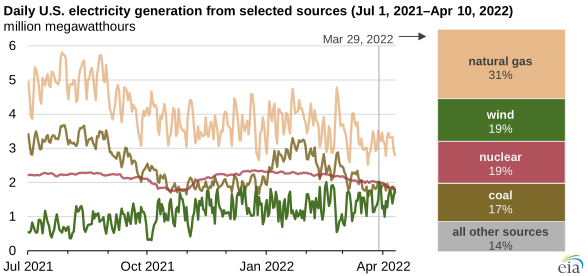
Source: U.S. Energy Information Administration, Hourly Electric Grid Monitor
---
On Tuesday, March 29, wind turbines in the Lower 48 states produced 2,017 gigawatthours (GWh) of electricity, making wind the second-largest source of electric generation for the day, only behind natural gas, according to our Hourly Electric Grid Monitor. Daily wind-powered electricity had surpassed coal-fired and nuclear electricity generation separately on other days earlier this year but had not surpassed both sources on a single day.
---
===
winter fail scapegoat
https://www.alternet.org/2021/05/texas-gov-was-aware-of-gas-shortages-days-before-winter-storm-blackout-but-publicly-blamed-solar-winds-anyway-report/
---
---
klare tom d
https://www.alternet.org/2021/05/renweable-energy-resources/
Thanks to its very name — renewable energy — we can picture a time in the not-too-distant future when our need for non-renewable fuels like oil, natural gas, and coal will vanish. Indeed, the Biden administration has announced a breakthrough target of 2035 for fully eliminating U.S. reliance on those non-renewable fuels for the generation of electricity. That would be accomplished by "deploying carbon-pollution-free electricity-generating resources," primarily the everlasting power of the wind and sun.
With other nations moving in a similar direction, it's tempting to conclude that the days when competition over finite supplies of energy was a recurring source of conflict will soon draw to a close. Unfortunately, think again: while the sun and wind are indeed infinitely renewable, the materials needed to convert those resources into electricity — minerals like cobalt, copper, lithium, nickel, and the rare-earth elements, or REEs — are anything but. Some of them, in fact, are far scarcer than petroleum, suggesting that global strife over vital resources may not, in fact, disappear in the Age of Renewables.
To appreciate this unexpected paradox, it's necessary to explore how wind and solar power are converted into usable forms of electricity and propulsion. Solar power is largely collected by photovoltaic cells, often deployed in vast arrays, while the wind is harvested by giant turbines, typically deployed in extensive wind farms. To use electricity in transportation, cars and trucks must be equipped with advanced batteries capable of holding a charge over long distances. Each one of these devices uses substantial amounts of copper for electrical transmission, as well as a variety of other non-renewable minerals. Those wind turbines, for instance, require manganese, molybdenum, nickel, zinc, and rare-earth elements for their electrical generators, while electric vehicles (EVs) need cobalt, graphite, lithium, manganese, and rare earths for their engines and batteries.
At present, with wind and solar power accounting for only about 7% of global electricity generation and electric vehicles making up less than 1% of the cars on the road, the production of those minerals is roughly adequate to meet global demand. If, however, the U.S. and other countries really do move toward a green-energy future of the kind envisioned by President Biden, the demand for them will skyrocket and global output will fall far short of anticipated needs.
According to a recent study by the International Energy Agency (IEA), "The Role of Critical Minerals in Clean Energy Transitions," the demand for lithium in 2040 could be 50 times greater than today and for cobalt and graphite 30 times greater if the world moves swiftly to replace oil-driven vehicles with EVs. Such rising demand will, of course, incentivize industry to develop new supplies of such minerals, but potential sources of them are limited and the process of bringing them online will be costly and complicated. In other words, the world could face significant shortages of critical materials. ("As clean energy transitions accelerate globally," the IEA report noted ominously, "and solar panels, wind turbines, and electric cars are deployed on a growing scale, these rapidly growing markets for key minerals could be subject to price volatility, geopolitical influence, and even disruptions to supply.")
And here's a further complication: for a number of the most critical materials, including lithium, cobalt, and those rare-earth elements, production is highly concentrated in just a few countries, a reality that could lead to the sort of geopolitical struggles that accompanied the world's dependence on a few major sources of oil. According to the IEA, just one country, the Democratic Republic of the Congo (DRC), currently supplies more than 80% of the world's cobalt, and another — China — 70% of its rare-earth elements. Similarly, lithium production is largely in two countries, Argentina and Chile, which jointly account for nearly 80% of world supply, while four countries — Argentina, Chile, the DRC, and Peru — provide most of our copper. In other words, such future supplies are far more concentrated in far fewer lands than petroleum and natural gas, leading IEA analysts to worry about future struggles over the world's access to them.
From Oil to Lithium: the Geopolitical Implications of the Electric-Car Revolution
The role of petroleum in shaping global geopolitics is well understood. Ever since oil became essential to world transportation — and so to the effective functioning of the world's economy — it has been viewed for obvious reasons as a "strategic" resource. Because the largest concentrations of petroleum were located in the Middle East, an area historically far removed from the principal centers of industrial activity in Europe and North America and regularly subject to political convulsions, the major importing nations long sought to exercise some control over that region's oil production and export. This, of course, led to resource imperialism of a high order, beginning after World War I when Britain and the other European powers contended for colonial control of the oil-producing parts of the Persian Gulf region. It continued after World War II, when the United States entered that competition in a big way.
For the United States, ensuring access to Middle Eastern oil became a strategic priority after the "oil shocks" of 1973 and 1979 — the first caused by an Arab oil embargo that was a reprisal for Washington's support of Israel in that year's October War; the second by a disruption of supplies caused by the Islamic Revolution in Iran. In response to endless lines at American gas stations and the subsequent recessions, successive presidents pledged to protect oil imports by "any means necessary," including the use of armed force. And that very stance led President George H.W. Bush to wage the first Gulf War against Saddam Hussein's Iraq in 1991 and his son to invade that same country in 2003.
In 2021, the United States is no longer as dependent on Middle Eastern oil, given how extensively domestic deposits of petroleum-laden shale and other sedimentary rocks are being exploited by fracking technology. Still, the connection between oil use and geopolitical conflict has hardly disappeared. Most analysts believe that petroleum will continue to supply a major share of global energy for decades to come, and that's certain to generate political and military struggles over the remaining supplies. Already, for instance, conflict has broken out over disputed offshore supplies in the South and East China Seas, and some analysts predict a struggle for the control of untapped oil and mineral deposits in the Arctic region as well.
Here, then, is the question of the hour: Will an explosion in electric-car ownership change all this? EV market share is already growing rapidly and projected to reach 15% of worldwide sales by 2030. The major automakers are investing heavily in such vehicles, anticipating a surge in demand. There were around 370 EV models available for sale worldwide in 2020 — a 40% increase from 2019 — and major automakers have revealed plans to make an additional 450 models available by 2022. In addition, General Motors has announced its intention to completely phase out conventional gasoline and diesel vehicles by 2035, while Volvo's CEO has indicated that the company would only sell EVs by 2030.
It's reasonable to assume that this shift will only gain momentum, with profound consequences for the global trade in resources. According to the IEA, a typical electric car requires six times the mineral inputs of a conventional oil-powered vehicle. These include the copper for electrical wiring plus the cobalt, graphite, lithium, and nickel needed to ensure battery performance, longevity, and energy density (the energy output per unit of weight). In addition, rare-earth elements will be essential for the permanent magnets installed in EV motors.
Lithium, a primary component of lithium-ion batteries used in most EVs, is the lightest known metal. Although present both in clay deposits and ore composites, it's rarely found in easily mineable concentrations, though it can also be extracted from brine in areas like Bolivia's Salar de Uyuni, the world's largest salt flat. At present, approximately 58% of the world's lithium comes from Australia, another 20% from Chile, 11% from China, 6% from Argentina, and smaller percentages from elsewhere. A U.S. firm, Lithium Americas, is about to undertake the extraction of significant amounts of lithium from a clay deposit in northern Nevada, but is meeting resistance from local ranchers and Native Americans, who fear the contamination of their water supplies.
Cobalt is another key component of lithium-ion batteries. It's rarely found in unique deposits and most often acquired as a byproduct of copper and nickel mining. Today, it's almost entirely produced thanks to copper mining in the violent, chaotic Democratic Republic of the Congo, mostly in what's known as the copper belt of Katanga Province, a region which once sought to break away from the rest of the country and still harbors secessionist impulses.
Rare-earth elements encompass a group of 17 metallic substances scattered across the Earth's surface but rarely found in mineable concentrations. Among them, several are essential for future green-energy solutions, including dysprosium, lanthanum, neodymium, and terbium. When used as alloys with other minerals, they help perpetuate the magnetization of electrical motors under high-temperature conditions, a key requirement for electric vehicles and wind turbines. At present, approximately 70% of REEs come from China, perhaps 12% from Australia, and 8% from the U.S.
A mere glance at the location of such concentrations suggests that the green-energy transition envisioned by President Biden and other world leaders may encounter severe geopolitical problems, not unlike those generated in the past by reliance on oil. As a start, the most militarily powerful nation on the planet, the United States, can supply itself with only tiny percentages of REEs, as well as other critical minerals like nickel and zinc needed for advanced green technologies. While Australia, a close ally, will undoubtedly be an important supplier of some of them, China, already increasingly viewed as an adversary, is crucial when it comes to REEs, and the Congo, one of the most conflict-plagued nations on the planet, is the leading producer of cobalt. So don't for a second imagine that the transition to a renewable-energy future will either be easy or conflict-free.
The Crunch to Come
Faced with the prospect of inadequate or hard-to-access supplies of such critical materials, energy strategists are already calling for major efforts to develop new sources in as many locations as possible. "Today's supply and investment plans for many critical minerals fall well short of what is needed to support an accelerated deployment of solar panels, wind turbines and electric vehicles," said Fatih Birol, executive director of the International Energy Agency. "These hazards are real, but they are surmountable. The response from policymakers and companies will determine whether critical minerals remain a vital enabler for clean energy transitions or become a bottleneck in the process."
As Birol and his associates at the IEA have made all too clear, however, surmounting the obstacles to increased mineral production will be anything but easy. To begin with, launching new mining ventures can be extraordinarily expensive and entail numerous risks. Mining firms may be willing to invest billions of dollars in a country like Australia, where the legal framework is welcoming and where they can expect protection against future expropriation or war, but many promising ore sources lie in countries like the DRC, Myanmar, Peru, and Russia where such conditions hardly apply. For example, the current turmoil in Myanmar, a major producer of certain rare-earth elements, has already led to worries about their future availability and sparked a rise in prices.
Declining ore quality is also a concern. When it comes to mineral sites, this planet has been thoroughly scavenged for them, sometimes since the early Bronze Age, and many of the best deposits have long since been discovered and exploited. "In recent years, ore quality has continued to fall across a range of commodities," the IEA noted in its report on critical minerals and green technology. "For example, the average copper ore grade in Chile declined by 30% over the past 15 years. Extracting metal content from lower-grade ores requires more energy, exerting upward pressure on production costs, greenhouse gas emissions, and waste volumes."
In addition, extracting minerals from underground rock formations often entails the use of acids and other toxic substances and typically requires vast amounts of water, which are contaminated after use. This has become ever more of a problem since the enactment of environmental-protection legislation and the mobilization of local communities. In many parts of the world, as in Nevada when it comes to lithium, new mining and ore-processing efforts are going to encounter increasingly fierce local opposition. When, for example, the Lynas Corporation, an Australian firm, sought to evade Australia's environmental laws by shipping ores from its Mount Weld rare-earths mine to Malaysia for processing, local activists there mounted a protracted campaign to prevent it from doing so.
For Washington, perhaps no problem is more challenging, when it comes to the availability of critical materials for a green revolution, than this country's deteriorating relationship with Beijing. After all, China currently provides 70% of the world's rare-earth supplies and harbors significant deposits of other key minerals as well. No less significant, that country is responsible for the refining and processing of many key materials mined elsewhere. In fact, when it comes to mineral processing, the figures are astonishing. China may not produce significant amounts of cobalt or nickel, but it does account for approximately 65% of the world's processed cobalt and 35% of its processed nickel. And while China produces 11% of the world's lithium, it's responsible for nearly 60% of processed lithium. When it comes to rare-earth elements, however, China is dominant in a staggering way. Not only does it provide 60% of the world's raw materials, but nearly 90% of processed REEs.
To put the matter simply, there is no way the United States or other countries can undertake a massive transition from fossil fuels to a renewables-based economy without engaging economically with China. Undoubtedly, efforts will be made to reduce the degree of that reliance, but there's no realistic prospect of eliminating dependence on China for rare earths, lithium, and other key materials in the foreseeable future. If, in other words, the U.S. were to move from a modestly Cold-War-like stance toward Beijing to an even more hostile one, and if it were to engage in further Trumpian-style attempts to "decouple" its economy from that of the People's Republic, as advocated by many "China hawks" in Congress, there's no question about it: the Biden administration would have to abandon its plans for a green-energy future.
It's possible, of course, to imagine a future in which nations begin fighting over the world's supplies of critical minerals, just as they once fought over oil. At the same time, it's perfectly possible to conceive of a world in which countries like ours simply abandoned their plans for a green-energy future for lack of adequate raw materials and reverted to the oil wars of the past. On an already overheating planet, however, that would lead to a civilizational fate worse than death.
In truth, there's little choice but for Washington and Beijing to collaborate with each other and so many other countries in accelerating the green energy transition by establishing new mines and processing facilities for critical minerals, developing substitutes for materials in short supply, improving mining techniques to reduce environmental hazards, and dramatically increasing the recycling of vital minerals from discarded batteries and other products. Any alternative is guaranteed to prove a disaster of the first order — or beyond.
Copyright 2021 Michael T. Klare
Follow TomDispatch on Twitter and join us on Facebook. Check out the newest Dispatch Books, John Feffer's new dystopian novel Frostlands (the second in the Splinterlands series), Beverly Gologorsky's novel Every Body Has a Story, and Tom Engelhardt's A Nation Unmade by War, as well as Alfred McCoy's In the Shadows of the American Century: The Rise and Decline of U.S. Global Power and John Dower's The Violent American Century: War and Terror Since World War II.
Michael T. Klare, aTomDispatch* regular, is the five-college professor emeritus of peace and world security studies at Hampshire College and a senior visiting fellow at the Arms Control Association. He is the author of 15 books, the latest of which is *All Hell Breaking Loose: The Pentagon's Perspective on Climate Change. He is a founder of the Committee for a Sane U.S.-China Policy.
FROM YOUR SITE ARTICLES
- Texas oil and gas regulators rushed to defend the industry's image ... ›
- Frozen wind turbines aren't the main culprit for Texas' power ... ›
- Texas lawmakers target renewable energy in the aftermath despite ... ›
RELATED ARTICLES AROUND THE WEB
- Renewable Energy Division | Mass.gov ›
- State Renewable Energy Resources | Energy Resources for State ... ›
- Renewable Energy Definition and Types of Renewable Energy ... ›
==
===
https://medium.com/@tejasgole67/is-michael-moore-right-8603f982d049
crunch #'s
==
dn 820
BP to Slash Oil & Gas Production, Invest Billions into Renewable Energy
---
==
Why companies as diverse as eBay, IKEA and Mars are increasingly supporting US clean energy policies
Zdravka Tzankova, Vanderbilt University
Increased business lobbying for incentives and mandates may tip the balance in favor of a cleaner US energy policy.
==
omg
https://www.alternet.org/2020/05/pathological-trump-slaps-wind-and-solar-industry-with-50-million-in-old-rent-bills-while-pushing-big-oil-bailouts/
==
---
5/20
Inside Clean Energy: A California Utility Announces 770 Megawatts of Battery Storage. That’s a Lot.
BY: DAN GEARINO
Southern California Edison plans to build seven storage projects on a fast timetable despite the economic disruption of the coronavirus. Read More
==
---
desmog 520
In the UK, pro-Trump commentator James Delingpolewrote on the same website that Moore’s documentary was the “most powerful, brutally honest and important documentary of his career”.
He said it “clearly shows that renewable energy is damaging to the landscape and to wildlife and does NOT reduce the use of fossil fuels”. He suggested it could help Trump win the upcoming US election because it “undermines the entire basis of the Green New Deal” advocated by some Democrats. Elsewhere, Delingpole has called Moore his “new hero” and praised the film for “causing greenie heads to explode”.
Breitbart News, whose UK branch Delingpole edits, was co-founded by Steve Bannon, former White House Chief Strategist for Donald Trump, and board member of scandal-hit political consultancy Cambridge Analytica. Breitbart and Cambridge Analytica were both financially backed by long-standing funders of climate science denial, the Mercer Family.
Matt Ridley, an author and former chairman of the Northern Rock bank, whose collapse precipitated the 2008 financial crash in the UK, has also applauded Planet of the Humans for being “extremely critical of the green renewable energy industry, saying it’s just as industrial as the fossil fuel industry, in fact it’s dependent on it”.
Speaking in a webinar organised by the British Conservation Alliance, a student network that describes itself as the “home of conservative climate solutions”, Ridley, who has a coal mine on his family estate, said you “simply cannot run a modern economy on wind or solar because there just isn’t enough space for putting up the panels or the windmills. And there isn’t enough resources.”
‘Renewable energy is a profit-driven scam and the environmental movement is corrupt’
These groups and individuals have also used the film to promote the narrative that renewable energy is a scam, backed by crony capitalists colluding with environmentalists.
In his blog about the film, theCompetitive Enterprise Institute’s Myron Ebellcalled it a “stunning evisceration of so-called green energy and the people profiting from it”
==...
==
Indiana Bill Would Make it Harder to Close Coal Plants
:{:{BY: DAN GEARINO}:
If the bill passes, Indiana would become the third in the U.S. to pass a law aimed at combating market forces that make renewables and natural gas cheaper than coal. Read More}:
---
1219 icn
https://insideclimatenews.org/news/19122019/ferc-pjm-grid-coal-subsidy-ruling-renewable-energy-nuclear-illinois-pennsylvania-climate-change
Federal energy regulators issued an order Thursday that likely will tilt the market to favor coal and natural gas power plants in the nation's largest power grid region, stretching from New Jersey to Illinois.
Critics say that it effectively creates a new subsidy to prop up uneconomical fossil fuel plants and that it will hurt renewable energy growth and, ultimately, consumers.
The new rules, approved by the Federal Energy Regulatory Commission, are designed to counteract state subsidies that support the growth of renewable energy and use of nuclear power. The rules involve what are known as "capacity markets," where power plants bid to provide electricity to the grid. The change would require higher minimum bids for power plants that receive such subsidies, giving fossil fuel plants an advantage.
the FERC order, passed 2-1, is a response to complaints from operators of coal and natural gas power plants who say that state subsidies have led to unfair competition in the grid region managed by PJM Interconnection.
Richard Glick, the panel's lone Democrat, cast the dissenting vote and said during the commission meeting that his Republican colleagues were trying to "stunt transition to a clean energy future that states are pursuing and consumers are pursuing."
In his written dissent, he called the order "illegal, illogical and truly bad public policy."
Environmental groups and clean energy advocates have long criticized PJM for rules that provide an economic lifeline to old fossil fuel plants, which produce greenhouse gases that drive climate change.
"Today's order erects a major new barrier to clean energy, undercutting efforts by states to slash pollution and address climate change," Tom Rutigliano, a senior advocate for the Natural Resources Defense Council's Sustainable FERC Project, said in a statement. "Federal regulators are forcing customers to pay for dirty power they don't want or need."
Expect Court Challenges...
==
great: sometimes one election is all it takes
- So far, it’s a simple fact that Democrat-controlled states are way ahead of Republican-controlled in committing to carbon-free energy and getting it online as Bloomberg Environment reports.
- Hitting renewable targets is challenging, no matter which way a state capitol leans. Indiana, which saw Democrats win both state houses and the governorship in 2018, “is far from meeting annual interim goals meant to keep it on track for 25% renewable electricity by 2025,” reports Midwest Energy News.
- Still, a single transformational statewide election can quickly reverse years of bad policy. Take Maine, for instance.
- Since January, when Democrat Janet Mills replaced Republican Paul LePage in the governor’s seat, it’s been “the most productive session for the environment and clean energy in my 23 years,” a green advocate tells The Christian Science Monitor, adding, “Not just 23 years. Ever.”
- Two-termer LePage “slapped a moratorium on wind turbines and viewed renewable energy, as one critic put it, as ‘an existential threat’ to the state’…promoted fossil fuels, vetoed clean energy bills, tried to tear up environmental regulations, was alone among Atlantic coast governors to court offshore drilling, refused to issue voter-approved conservation bonds, and sought to tax vast protected forestland or open it to development,” the Monitor reports.
- Since Mills took office in January, and with Democrats controlling both houses of the state legislature, Maine has enacted laws “to nearly eliminate carbon dioxide emissions by 2050, expand solar and offshore wind, promote electric vehicles, and distribute 100,000 heat pumps. It became the first state to ban foam food containers and the third to ban single-use plastic bags. It also prohibited offshore oil and gas drilling, stiffened river and lake water protections, threw out Mr. LePage’s appointees, and established a new office to help plan for climate change,” reports the Monitor.
- Maine was one of 7 states where Democrats pried governor’s seats from Republicans in the 2018 election, out of 13 where Republicans were considered vulnerable, and lost none, as CNN reported last fall.Republicans picked up one seat, Alaska, that had been held by an independent.
- “Before the election, just [just??] 42 percent of Americans were represented by Democratic governors,” CNN noted. In January, that rose to 53 percent.
---
demog 619
Wednesday, June 12, 2019 - 13:30 • GUEST
US Renewable Energy Capacity Beats Coal for the First Time
---
==
At least 11 million people now work in the renewable industry globally
"Governments are prioritizing renewables as a driver of low-carbon economic growth."
==
Native Renewables: Powering Up Tribal Communities
==
https://insideclimatenews.org/news/12032019/trump-budget-cuts-renewable-energy-efficiency-electric-vehicle-tax-credit-deficit
The Trump administration's latest budget proposal would radically reduce new spending on federal programs for advancing clean energy.
One of the deepest cuts would slash funding for the Department of Energy's Office of Energy Efficiency and Renewable Energy (EERE) by 87 percent—from $2.3 billion last year to $343 million in new spending next year.
The EERE cuts appear less extensive at first glance because the administration's fiscal year 2020 plan, released Monday, counts some past funding that has been delayed. But even with the rolled over funds, the total of $696 million for the office would cripple support for novel and promising technologies for advanced wind turbines, high-tech materials, green buildings and more.
The White House also proposes eliminating tax credits for electric vehicles and an array of other incentives for reducing carbon emissions. And it makes a third attempt to eliminate the Advanced Research Projects Agency-Energy (ARPA-E) program, an incubator for cutting-edge energy research and development.
These programs proposed for the chopping block have long enjoyed broad support in Congress and the cuts seem unlikely to be adopted, especially now that the House is led by a Democratic majority. Even under the Republicans, lawmakers rebuffed Trump's two previous proposals to slash this part of the energy budget.
But the new budget proposal shows that the Trump administration is doubling down on its resolve to retreat from a federal role in advancing a clean energy economy and maintaining global leadership in the technology.
EPA Would Be Cut 31%, Deficit Would Rise
Energy and the environment would take a far larger hit than other non-military spending. Across-the-board, non-military discretionary spending would be cut 5 percent. The Environmental Protection Agency would get a 31 percent cut, to $6.1 billion, and the Department of Energy's budget would be cut 11 percent, to $31.7 billion.
The White House, meanwhile, is proposing a 12 percent increase for the Office of Fossil Energy Research and Development, to $562 million. The office administers the Energy Department's research into carbon capture and other technologies to advance use of fossil fuel. There is also more money for nuclear power.
In the context of a $4.75 trillion federal budget, the EERE office is a small line item. But studies have shown that it has been effective in its mission. The Energy Department website boasts that $12 billion in investments by EERE has translated into $230 billion in net economic benefit to the United States—an annual return on investment of more than 20 percent.
A senior administration official who gave a background briefing to reporters said the budget includes "more reduction in spending than any president in history has ever proposed."
It also would result in a projected budget deficit of about $1.1 trillion, thanks largely to the 2017 enacted tax cuts. The Trump administration maintains that over the long term the tax cuts will stimulate growth and increased revenue. The deficit is "a real problem that is not a result of our economic policies," the administration official said. "We don't think the tax cuts are going to lead to anything but economic growth over 10 years."
The full details of the budget, justifying the White House's proposals program by program, have not yet been published. But some elements were released in a series of fact sheets, summaries and briefings.
Budget Proposal 'Ignores the Climate Crisis'
Democrats reacted dismissively to the budget draft.
Rep. Kathy Castor, a Democrat from Florida who chairs a newly created climate committee in the House, said it "ignores the climate crisis."
In a statement, she said that "the climate crisis must be addressed through virtually all areas of American life, and as a result, virtually all areas of the President's budget should address this."
Rep. Adam Schiff, a California Democrat, wrote on Twitter: "You know what, Mr. President, keep your budget. We'll take it from here."
PUBLISHED UNDER:
==
1/19
icn
Clean Economy Weekly: The Bankruptcy Felt Round the Clean Energy World
:{:{BY: DAN GEARINO}:
Anyone with a vested interest in clean energy has reason to feel uneasy as PG&E plans to file for bankruptcy protection, Dan Gearino writes. Read More}:
--
---
https://www.ecowatch.com/nuclear-power-cost-renewables-2625524662.html
Nuclear Power Is Economically Obsolete
By Grant Smith
Last year the Trump administration's Energy Department announced the launch of a media campaign to counter what an official called "misinformation" about nuclear power. We haven't noticed an upsurge in pro-nuclear news—because there is none to report.
On the first day of 2019, the energy industry trade journal Power asked whether new technology can save nuclear power by making new reactors economically feasible—not only to replace coal and natural gas but also to compete with the rapidly dropping cost of renewable energy. The verdict from Peter Bradford, a former member of the federal Nuclear Regulatory Commission:
. . . [N]ew nuclear is so far outside the competitive range. . . . Not only can nuclear power not stop global warming, it is probably not even an essential part of the solution to global warming.
His bleak outlook is shared by the authors of a recent article in the Proceedings of the National Academy of Sciences. The authors—an engineer, an economist and a national security analyst—reviewed the prospects for so-called advanced designs for large nuclear reactors, and for much smaller modular reactors that could avoid the billions in construction costs and overruns that have plagued the nuclear energy industry since the beginning.
They concluded that no new designs can possibly reach the market before the middle of the century. They cite the breeder reactor that, according to the Bulletin of Atomic Scientists, received $100 billion in public development funds worldwide over six decades and still did not get off the ground.
The authors say there may be an opening for small modular reactors but that it will be very difficult to find a market for these reactors without—as is always the case with nuclear power—a massive infusion of taxpayer dollars. "For that to happen," they argue, "several hundred billion dollars of direct and indirect subsidies would be needed to support their development and deployment over the next several decades, since present competitive energy markets will not induce their development and adoption."
Despite the past failure and poor future outlook, support for more nuclear funding persists. In a recent study, the Energy Department pointed to the $50 billion in federal incentives provided to renewables like solar and windpower between 2005 and 2015, implying that such policies can have a similar impact on modular nuclear reactors. But unlike nuclear power, the costs of wind and solar have dropped dramatically, to the point where the cost of new, unsubsidized utility-scale wind and solar power investment can now compete with that of existing coal and nuclear power plants.
The bigger question is whether nuclear power is needed at all.
Nuclear advocates' claims that nuclear power is required to fight climate change falls short. California met its climate goal of reducing greenhouse gas emissions to 1990 levels by 2020 four years early by turning off its nuclear plants and setting policies that prioritize renewables, energy efficiency and energy storage investments over natural gas plant additions.
An argument advanced in the Energy Department report is that, to ensure that power can be delivered 24/7, large coal and nuclear power plants designed to run day and night—also known as baseload plants—need to be replaced by small nuclear units that run day and night. However, mounting, real-world evidence refutes this assertion.
Recent studies from New York and California show that it is cheaper to invest in renewables, energy efficiency and energy storage in order to replace aging nuclear plants than it is to keep the existing plants running. Savings range from hundreds of millions to billions of dollars—achieved without any impact on electric system reliability.
Nuclear power belongs in a museum. We shouldn't continue to squander public dollars on a technology that will never make economic sense. We should divert resources into improving and deploying wind, solar, energy efficiency and energy storage technology that we know will keep the lights on, effectively reduce carbon emissions and cost what we can afford to pay. Grant Smith is senior energy policy advisor at Environmental Working Group.
RELATED ARTICLES AROUND THE WEB
- Renewables Now Contribute Nearly One-Fifth of U.S. Electricity ... ›
- Nuclear Energy in the U.S.: Expensive Source Competing with ... ›
- High costs and renewables challenge the case for nuclear power ... ›
- Barriers to Renewable Energy Technologies ›
==
==
9 Renewable Energy Highlights of 2018
By Jeff Deyette
Despite the Trump administration's ongoing attempts to prop up coal and undermine renewables—at FERC, EPA and through tariffs and the budget process—2018 should instead be remembered for the surge in momentum toward a clean energy economy. Here are nine storylines that caught my attention this past year and help illustrate the unstoppable advancement of renewable energy and other modern grid technologies.
1. California Goes All-In for Carbon-Free Electricity
In late August, California—the world's 5th largest economy—committed to the target of fully decarbonizing its power sector by 2045. The landmark legislation also strengthens the state's renewable portfolio standard (also known as a renewable energy standard, or RES) from 50 to 60 percent by 2030. What's more, at the bill signing, Governor Jerry Brown signed an executive order that establishes a goal of achieving carbon-neutrality across all sectors of California's sprawling economy by 2045, cementing the state's place as a global leader in climate action.
2. Several States Strengthen Their RES Requirements
State-level renewable electricity standards continued to be a primary driver of new renewable energy development in 2018. In addition to California, legislatures in New Jersey (50 percent by 2030), Connecticut (40 percent by 2030) and Massachusetts (35 percent by 2030) all adopted stronger targets for renewable energy, accelerating their states' transitions away from fossil fuels. In addition, voters in Nevada overwhelmingly approved a measure to increase their state's RES to 50 percent by 2030 (the measure must be approved again in 2020 to officially become law).
3. Clean Energy Champions Win Gubernatorial Races
One of the bright spots in November's election results was the number newly elected governors who campaigned on aggressive clean energy and climate change agendas. Newly elected governors in at least 10 states, including California, Colorado, Connecticut, Illinois, Maine, Michigan, Minnesota, Nevada, New Mexico and Wisconsin, have pledged to accelerate clean energy and carbon reductions in their states by supporting U.S. commitments to the Paris agreement, joining the U.S. Climate Alliance and/or calling for renewable energy targets of 80 to 100 percent. These election results demonstrate the widespread support for greater investments in renewable energy and signal the push for even stronger clean energy policies in the coming year.
4. Record Low Prices for Renewables
Innovation, growing economies of scale and attractive financing continued to drive the costs down for renewables in 2018. Power purchase agreements for wind and solar projects in states like Arizona, Nevada, Colorado, Kansas, New Mexico, Oklahoma and Texas have reportedly ranged between $20 to $30 per megawatt-hour, well below the cost of natural gas generation—and the technologies are positioned for further cost reductions to continue to be low-cost options even as federal tax incentives change. What's even more exciting is that the many of these low-priced projects also include energy storage components, increasing their value to the grid.

5. Major Utilities Commit to Low-Carbon Portfolios
Earlier this month, Xcel Energy became the first major utility to commit to a completely carbon-free electricity supply across the eight states it operates in. In doing so, it joins a growing number of utilities that are committing to phasing out their use of coal and transitioning to substantially lower carbon energy portfolios. Also this year, both Consumers Energy in Michigan and NIPSCO in northern Indiana announced plans to phase out coal generation and utility giant American Electric Power announced a goal of reducing its carbon emissions 80 percent by 2050. What's especially exciting about these utility actions is that they are driven primarily by economics, clearly demonstrating the competitiveness of clean energy technologies.
6. Corporate Renewable Energy Purchases Keep Growing
Low renewable energy prices continue to attract major corporations looking to save money and achieve ambitious sustainability goals. As a result, direct corporate purchases of renewable energy have become a major driver of renewable energy deployment. In 2018, the Rocky Mountain Institute reports, corporate renewable energy purchases—led by companies like Facebook, Walmart, ATT and Microsoft—reached more than 6.4 gigawatts (GW). The number of corporations investing in renewables expanded at a record pace this year as well, with nearly two-thirds of Fortune 100 and nearly half of Fortune 500 companies now having set ambitious renewable energy goals.
7. Offshore Wind Moves Forward
While no new offshore wind projects came online in the U.S. this year (the next project—off the Virginia coast—is scheduled for 2020), the industry did take some big leaps toward becoming a major player in the nation's power supply. For example, the winning bid for Massachusetts' first request for offshore wind proposals to help meet the state's offshore wind requirements passed in 2016 went to an 800-megawatt project from Vineyard Wind at a shockingly low price of about 6.5 cents per kilowatt-hour. In addition, the latest U.S. Bureau of Ocean Energy Management auction for leasing parcels of water for future projects resulted in 11 bidders and $405.1 million in winning bids, both smashing previous records. And strong state policies, including new offshore wind requirements in New Jersey and elsewhere, mean that there's a lot more action to come.
8. Storage Steps Into the Spotlight
Once a fringe player in the electric power sector, the energy storage industry is quickly emerging as a game changer in the transition to a clean energy economy as a tool for integrating much higher levels of renewable energy. In 2018, the pipeline for new storage projects doubled to nearly 33 GW as more utilities are investing in the technology thanks largely rapidly falling prices and growing support from state policies. While California has led the nation in storage deployment to date, New York recently established the strongest storage requirement in the country at 3,000 MW by 2030. Earlier this year, New Jersey set an ambitious storage target of 2,000 MW by 2030 and Massachusetts significantly increased its storage requirement to 1,000 megawatt-hours by 2025. At the federal level, the Federal Energy Regulatory Commission issued Order 841, which directs regional grid operators to set market rules that allow energy storage to participate on a level playing field in the wholesale energy, capacity and ancillary services markets.
9. PG&E Turns Down the Gas With Storage and Renewables
In one particular sign of what's to come in 2019 and beyond in terms of how these technologies fit together to displace fossil fuels, one of the most exciting regulatory decisions I saw this year was the California Public Utility Commission's approval of PG&E's plan to use energy storage to replace retiring gas generators. One of the key barriers to fully transitioning to a carbon-free economy is replacing natural gas generation and the ancillary services they provide to the power grid. This decision, which marks the first time a utility will directly replace power plants with battery storage, should spur many more similar projects to move forward in California and across the country and open the door for integrating much higher levels of renewable energy onto the power grid.
These nine stories are just a sampling of what occurred in 2018 to further the clean energy transition. As the year comes to a close, UCS will continue to work hard to keep up the clean energy momentum in 2019.
==
https://www.exposedbycmd.org/2018/10/02/kochpac-pay-play-aims-slow-solar-renewables/
One of Koch Industries’ favorite current federal bills would change how states regulate utilities on renewable energy. A Center for Media and Democracy (CMD) analysis shows the legislation is supported by politicians receiving large contributions from the Koch Industries Political Action Committee (KochPAC).
The Pay
The so-called “Ratepayer Fairness Act of 2017” (H.R. 1572) would require state public utility commissions to determine whether the setting of electricity rates for technologies deployed by individual customers, such as solar energy or energy storage, results in subsidies to those customers from customers who do not deploy those technologies.
Rep. Richard Hudson (R-NC) sponsored H.R. 1572 and received $15,000 from Koch Industries in the 2017-2018 election cycle to his campaign and First in Freedom PAC. The only U.S. House member to co-sponsor it isRep. Markwayne Mullin (R-OK), who has also received a combined $15,000 from KochPAC into his congressional re-election committee and his leadership PAC.
The Play
H.R. 1572 seeks to limit utility commissions from designing electricity rates favorable to solar or renewable energy if that technology causes customers or classes of customers to subsidize other customers or customer classes.
The bill would force utility commissions to hold hearings to consider whether setting electricity rates for a technology disproportionately affects some customers or customer classes, even if all customers gain in the long run (for example in reducing the need for new electricity generating plants).
If a commission finds that such subsidies or disproportionate effects exist, the bill then requires it to determine whether those subsidies are “appropriate,” as defined under current law. If the legislature or utility commission took a narrow view of “appropriate,” that policy could be used to stifle solar and other renewables.
Legislatures and public utility commissions do wander away from “true” cost allocations to pursue other values like “just and reasonable rates” for residential customers.
Some public utility commissions can currently consider the environmental cost of changes in rates among classes, and many renewable advocates argue that the social costs of carbon — such as aridization, or pollution and its public health effects — should also be considered, as it is in the European Union.
Although the Trump Administration has retreated from assigning a social cost to carbon in its decision-making, state utility commissions are taking up the practice.
H.R. 1572 is consistent with the Administration’s attempt to slow the use of storage facilities by solar energy and other renewable energy sources.
The Players
The bill was originally introduced into the U.S. House in the last congressional session by then-U.S. Representative Mike Pompeo, now the Secretary of State. Koch Industries was Pompeo’s top contributor in every election between 2010 and 2016.
Jane Mayer noted in her book, Dark Money:
After his election, Pompeo turned to the company for his chief of staff, choosing Mark Chenoweth, a lawyer who had worked for Koch Industries’ lobbying team.Within weeks, Pompeo was championing two of Koch Industries’ legislative priorities — opposition to Obama’s plans to create a public EPA registry of greenhouse gas polluters and a digital database of consumer complaints about unsafe products.
Among other ties to the Kochs, The Washington Post notes that Pompeo started a business with private equity financing from the Kochs.
The only company other than Koch Industries lobbying for this bill is Edison International, the parent company of Southern California Edison, and both have been large contributors to Republican congressional political organizations.
Companion legislation in the U.S. Senate (S. 613) was introduced by Sen. Jeff Flake (R-AZ), a climate change denier who took $166,000 from oil and gas companies, including Koch Industries, in his last election in 2012.
With Flake retiring from the Senate, no significant action is expected on this legislation this year, but the Kochs always have the money to push new policies.
---
https://insideclimatenews.org/news/27092018/election-2018-governor-races-renewable-energy-wisconsin-maine-michigan-colorado-new-mexico-nevada
Some of the most consequential elections for climate policy this fall could be the 36 governor's races, where a blue wave could position clean energy advocates as a significant counterforce against the Trump administration's fossil fuel agenda.
Republicans currently hold a near-record 33 governorships—a lock on power that has served as a brake on clean energy progress in some areas.
But the tide may be ready to turn. As many as a third of those seats are considered toss-ups or are leaning Democratic in the upcoming election, according to analysts like the Cook Political Report and University of Virginia political scientist Larry Sabato.
Several of the Democratic contenders have 100 percent clean energy commitments in their platforms, and many others support ambitious renewable portfolio standards, net-metering incentives and other climate policies.
[ ](https://insideclimatenews.org/sites/default/files/styles/colorbox_full/public/2018-Election-Governor-Battleground-States--529px.png?itok=YWdUKzLP)
The model for environmental advocates is New Jersey Gov. Phil Murphy, a Democrat elected last November who has reversed several of the policies of his Republican predecessor, Chris Christie. He reinstated New Jersey's membership in the Northeast's carbon cap-and-trade system known as the Regional Greenhouse Gas Initiative, and signed legislation to mandate that utilities obtain 50 percent of their electricity from renewable sources by 2030. With Murphy's first appointee, the state's Public Utility Commission now has a Democratic majority and a mandate to come up with a new program to incentivize rooftop solar.
"The most critical policies are set at the state level," said Adam Browning, executive director of Vote Solar. "When it comes to the renewable energy agenda, the future is very much on the ballot this November."
These are some of the ways state policies could change:
- In Nevada, New Hampshire, New Mexico and Maine, the state legislatures passed renewable energy initiatives in the past year and a half that had bipartisan support—but were vetoed by GOP governors.
- In 38 states, governors have the power to appoint members of public utility commissions—the regulatory bodies that make decisions affecting billions of dollars of energy infrastructure investment.
- Many of the governors elected this fall will have a key role in the reshaping of Congressional districts after the 2020 census.
Advocates and opponents of climate policies and clean energy have been pouring millions of dollars into the races.
...
==
==
Facebook Joins 100% Renewable Energy Revolution
Facebook announced Tuesday it will slash greenhouse gas emissions by 75 percent and transition global operations to 100 percent renewable energy by the end of 2020 in efforts to "help fight climate change."
Similarly, Tesla CEO Elon Musk tweeted over the weekend that his company's enormous Gigafactory in Sparks, Nevada will run entirely on Tesla Solar by the end of 2019.
==
https://www.ecowatch.com/scientists-hit-back-another-paper-claims-100-renewables-is-possible-and-affordable-2569987338.html
Scientists Hit Back: Another Paper Claims 100% Renewables is Possible and Affordable
Is it possible for the world to run on 100 percent renewable energy? It's a noble goal, as the best science tells us we must significantly slash fossil fuel consumption or else the planet faces dangerous climate change.
A number of academics believe it's not only feasible to wean off coal, natural gas and other polluting fuels by transitioning to renewable sources such as solar and wind power, it's even cost-effective.
Other researchers disagree, and this divide has spilled out into a spiraling debate, with each side pumping out more research to prove their positions. Last September, Australian scientist Benjamin Heard, an advocate for nuclear power, and his team published a critical review in the journal Renewable and Sustainable Energy Review that stated, "there is no empirical or historical evidence" that a 100 percent renewable electricity system is feasible.
Now, in a direct rebuttal published Thursday in the same journal, scientists concluded there are no roadblocks on the path to a clean energy future.
The authors of the new paper hail from the Karlsruhe Institute of Technology, the South African Council for Scientific and Industrial Research, Lappeenranta University of Technology, Delft University of Technology and Aalborg University.
In the earlier paper, Heard and his colleagues raised a number of questions, including whether renewables-based systems can survive extreme weather events or when the wind isn't blowing or when the sun isn't shining. They also questioned if the power grid could stay stable with such variable generation.
The scientists in the current paper responded to each critique after reviewing of dozens of existing studies and highlighting examples of successful grid operators around the world, from Denmark to Tasmania.
In the first scenario, during periods of extreme weather or when wind and solar energy fail or fall short, Brown and his team suggest imports, hydroelectricity, batteries and other storage methods. Or, in the " worst-case solution," they said hydrogen or synthetic gas produced with renewable electricity could fill that gap. As for maintaining grid stability, they offered technical solutions, such as rotating grid stabilizers and newer electronics-based solutions.
"While several of the issues raised by the Heard paper are important, you have to realize that there are technical solutions to all the points they raised, using today's technology," said lead author Tom Brown of the Karlsruhe Institute of Technology in a statement.
"Furthermore," added Christian Breyer of Lappeenranta University of Technology, who co-authored the response, "these solutions are absolutely affordable, especially given the sinking costs of wind and solar power."
"There are some persistent myths that 100 percent renewable systems are not possible," noted Brian Vad Mathiesen of Aalborg University, another co-author of the response. "Our contribution deals with these myths one-by-one, using all the latest research. Now let's get back to the business of modelling low-cost scenarios to eliminate fossil fuels from our energy system, so we can tackle the climate and health challenges they pose."
After the paper was released, Heard, the lead author of the September paper, tweeted "congratulations" to Brown and his team for the publication and called it "a tough journal."
But it's clear the debate is not over yet. Brown added, "There *is* something about the way all this 'possible and affordable' stuff, under a little scrutiny, demands massive additional research, subsidies, far-reaching policies interrelated across economic sectors, market reforms etc. AKA 'political will'"
---
https://www.ecowatch.com/tesla-australia-battery-2568719032.html
Tesla's Giant Australian Battery Saved Consumers $35 Million in Four Months
Since switching on in December, Tesla's massive battery in South Australia has already drastically lowered prices in the region's frequency and ancillary services market (FCAS) and has taken a major share of that market, Renew Economy reported.
During Australian Energy Week, McKinsey and Co. partner Godart van Gendt boasted about the stunning efficiency of the 100-megawatt Powerpack system, which is connected to Neoen's Hornsdale wind farm....
==
==
Click here to see CDP's infographic about cities around the globe that are using renewable energy.
In the U.S., 58 cities and towns have now committed to transition to 100 percent clean, renewable energy, including big cities like Atlanta and San Diego. Earlier this year, U.S. municipalities Denton, Texas and St. Louis Park, Minnesota, became the latest communities to establish 100 percent renewable energy goals.
In June 2017 the U.S. Conference of Mayors, representing 250 U.S. mayors, resolved to support the procurement of 100 percent renewable energy for cities by 2035.
Burlington's Bold Breakaway
Burlington, Vermont is one of the first U.S. cities to report to CDP that it sources 100 percent of its electricity from renewable sources.
Burlington began its transition to a net-zero economy back in 1978 when it replaced its coal plant with a 50-MW generating station powered on biomass. The next step was harnessing wind and solar power through the construction of a 10-MW wind farm and the installation of rooftop solar PVs on high schools, the airport and the electric department. In 2014, when citizens voted to approve a $12 million bond in 2014 for the city's energy department to purchase the 7.4-MW Winooski Hydroelectric Plant, Burlington's transformation to 100 percent renewable energy was complete.
The city's shift to green energy has also helped its residents, not raising electricity rates in eight years. And seizing the opportunity to turn Burlington into a center of innovation, the city has continued its progressive push by investing in charging stations for electric vehicles and developing plans to pipe steam from the biomass plant to heat downtown homes.
Solar San Francisco
Three thousand miles away on America's west coast, San Francisco is trailblazing the path in solar power—driven by economic reality. Last year, municipal leaders took the bold move to become the first American city to mandate solar roofs on most new construction. Under the legislation, all new buildings under 10 stories must have solar PV or solar thermal panels installed on at least 15 percent of their roof space. Consequently, the city now boasts more than 15-MW of solar PV.
With an electricity mix of 34 percent renewable energy, San Francisco still has a long way to go to reach its ambitious target of 100 percent by 2030. But the wheels are clearly in motion to scale-up solar power, with the city serving as a shining example of the power of solar.
Unsubsidized renewables were the cheapest source of electricity in 30 countries last year according to the World Economic Forum. With renewables predicted to be consistently more cost effective than fossil fuels globally by 2020, the rate at which cities around the world follow San Francisco's lead is likely to pick up pace.
Cities as the Battleground
Cities are vital to the transition to a low-carbon economy. Cities are home to half the world's population and are expanding rapidly. In the U.S. alone, over 80 percent of the population lives in urban areas. Meanwhile, cities around the globe are responsible for over 70 percent of energy-related carbon emissions.
As cities expand, they need to ensure that the new infrastructure they put in place is fit for a low-carbon economy. Public-private partnerships will be crucial to transitioning to green energy, particularly with the propensity for deficits in public finance.
The good news is that CDP's data shows that globally, cities are moving in the right direction in engaging with the private sector. In 2016, we collected data from 570 cities around the world and found that municipalities highlighted a total of 720 climate-related projects suitable for private sector investment, worth a combined $26 billion. One year later, that figure had ballooned to 1,045 projects and more than $52 billion.
Much of the drive behind city climate action and reporting comes from the 7,000+ mayors signed up to the Global Covenant of Mayors for Climate and Energy who have pledged to act on climate change.
Despite the prospect of the American withdrawal from the Paris agreement, cities in the U.S. and around the world are still putting ambitious plans in place to harness the power of clean electricity. Cities not only want to shift to renewable energy, but most importantly, they can. We urge all cities to disclose to us, work together to meet the goals of the Paris agreement and prioritize the development of ambitious renewable energy procurement strategies.
Kyra Appleby is Director of Cities at global environmental impact non-profitCDP.
==
https://www.alternet.org/environment/100-renewable-energy-worldwide-isnt-just-possible-its-more-cost-effective-existing
:{:{}:
}:
==
BHP's review comes on the heels of mounting shareholder pressure to reconsider its memberships with groups that espouse views contrary to the company's stated values. The report affirmed that BHP believes "the warming of the climate is unequivocal, the human influence is clear and physical impacts are unavoidable" and reasserted the company's support for the Paris agreement.
As reported by the New York Times:
The move highlights the delicate considerations huge mining companies must contend with as they seek to balance profit with social and environmental awareness.
It represents the latest example of a business that is largely built around traditional fossil fuels responding to investor and government concern over climate change. Last week, the oil and gas giant BP said it would spend $200 million to acquire a large stake in a solar power developer, while Norway's Statoil and France's Total have also made investments in renewables.
==
lithium bs ~
https://www.ecowatch.com/renewable-energy-suzuki-2514182227.html
---
https://www.ecowatch.com/tax-bill-wind-solar-2514029749.html
Senate Tax Bill Could Be 'Devastating' to Wind and Solar Power
The tax bill heading barreling towards a vote in the Senate already includes a worrisome rider that would open up the pristine Arctic National Wildlife Refuge to oil and natural gas drilling.
Now, renewable energy trade associations are raising the alarm about a eleventh-hour provision called the Base Erosion Anti-Abuse Tax (BEAT) program that "would have a devastating, if unintended, impact on wind and solar energy investment and deployment," according to a letter addressed to the Senate.
The BEAT provisions "undermine our capacity to use renewable energy tax credits, which have value only if they can be monetized," a letter, signed by the Solar Energy Industries Association, the American Council on Renewable Energy, American Wind Energy Association and Citizens for Responsible Energy Solutions, warned.
As Utility Dive explained, while BEAT is meant to make it harder for corporations to dodge taxes, it also renders impractical the monetization of the Production Tax Credit (PTC) for wind power projects and the Investment Tax Credit (ITC) for solar projects.
Tax credits have fueled the renewable energy industry's boom. The current PTC and ITC allows developers to deduct 30 percent of the cost of installing a solar or wind energy system from their federal taxes.
Greg Wetstone, president and CEO of the American Council on Renewable Energy, told Utility Dive that the BEAT provision would affect $50 billion in annual investment in renewable energy projects.
"This should not be happening now," he said. "It came out of nowhere." Apparently, the provision was inserted on Thanksgiving eve during a last-minute markup of the tax bill in the Senate finance committee.
Greentech Media delved further:
That problem is the Base Erosion Anti-Abuse Tax (BEAT) provision, which targets "earnings strippings," where large companies with foreign operations reduce their tax bills through cross-border payments they can then deduct in the U.S. The BEAT provision aims to circumvent that stripping with a minimum tax of 10 percent of taxable income.
BEAT would require every company to do two calculations: one quantifying 10 percent of a company's taxable income, including cross-border payments, and another quantifying the corporation's tax liability, excluding any tax credits the company received from tax equity investments.
The BEAT provision applies to all but R&D; credits. If a company has invested in renewables, the second number could be lower than the first. If that's the case, the company would have to pay the difference in taxes.
"This is Defcon One," Wetstone also told TIME. "It would simply undermine the financial structure that is critical for renewable energy and bring a booming sector to a halt."
Environmental groups have also spoken out against the heavily contested tax bill.
Michael Brune, executive director of the Sierra Club, condemned the House version "for [gutting] incentives for renewable energy and electric cars while ignoring the tens of billions of dollars the government hands out to fossil fuel corporations (which, of course, would also see their taxes slashed)."
Here's the letter from the renewable energy trade groups in full:
We are writing on behalf of the thousands of leading investors, developers, manufacturers, and corporate energy consumers in the U.S. renewable energy sector to alert you to urgent concerns with the Base Erosion Anti-Abuse Tax (BEAT) provisions in the Senate Tax Cuts and Jobs Act. As drafted, the BEAT program would have a devastating, if unintended, impact on wind and solar energy investment and deployment.
While we are grateful that the Senate tax proposal leaves the current phase-down schedules for wind and solar energy tax credits unchanged, the bill's BEAT provisions undermine our capacity to use renewable energy tax credits, which have value only if they can be monetized. For multi-national companies covered under the BEAT provisions, the renewable tax credits would, as drafted, be subject to a new 100 percent tax. Not surprisingly, major financial institutions have indicated that, under such a regime, they would no longer participate in tax equity financing, the principle mechanism for monetizing credits. The tax equity marketplace would collapse under these provisions, leading to a dramatic reduction in wind and solar energy investment and development.
It is important to note that, while the BEAT provisions are intended to promote U.S. investment and job growth, the program's treatment of renewable energy tax credits – which are generated exclusively through investment in U.S. projects – would have the opposite impact, dramatically reducing American wind and solar energy investment and job creation. These sectors are important national economic drivers, generating nearly $50 billion in annual U.S. investment.
It is also extremely problematic that the BEAT provisions apply retroactively to tax credits generated by operating, as well as new, projects, and would penalize companies that have relied on the tax code. Companies holding tax credits would do their best to sell them immediately, even at great discounts, a phenomenon that would flood the marketplace and further damage tax equity markets. We do not believe it fair or appropriate for Congress to reduce the value of tax incentives that have been relied upon in good faith by investors and developers. Such a result is especially concerning in this case, given that the wind and solar power sectors agreed to the phase-down of their own tax credits as part of the bipartisan compromise captured in the PATH Act of 2015.
We respectfully, and urgently, ask that the BEAT program be amended to exempt the production and investment tax credits from the calculation of the base erosion tax, just as the research and development tax credit is exempted from the provision in the current draft. Please feel free to let us know if we can provide additional information regarding any aspect of this issue.
==
==
part of choke hold series icn
https://insideclimatenews.org/news/29102017/renewable-energy-ohio-rps-law-fossil-fuel-political-donations-coal
COLUMBUS, Ohio—On March 30, Bill Seitz, a charismatic Republican, took to the floor of the Ohio House to make a case for gutting a 2008 law designed to speed the adoption of solar and wind as significant sources of electricity in the state. The law, he warned, "is like something out of the 5-Year Plan playbook of Joseph Stalin." Adopting a corny Russian accent, he said, "Vee vill have 25,000 trucks on the Volga by 1944!'"
Nine years before, Seitz and his colleagues, Republicans and Democrats alike, had voted overwhelmingly for the measure he now compared to the work of a Communist dictator. It made Ohio the 25th state to embrace requirements and inducements to lure utilities away from coal, a major contributor of the gases fueling global climate change. Studies suggested the law would help create green energy jobs and boost the Ohio economy—and it has.
Now, Seitz said, it was obsolete. Natural gas, rapidly displacing coal, was the resource Ohio ought to foster, he said. He also argued the law gives an unfair advantage to wind and solar when the state's last nuclear plant is fighting for its life. Most important, Seitz insisted, the government had no business telling anyone what kind of energy to buy. By the time he was done, he had secured a veto-proof majority to undo key parts of the law.
What happened to turn lawmakers so decisively against a statute they'd adopted 93-to-1 less than a decade ago?
The answers begin with the 2008 financial crisis, which hit Ohio hard and greatly depressed energy demand, and they include the shale gas boom, which benefited Ohio producers and made coal uncompetitive.
But there's more to the story, too.
As fossil fuel interests mobilized at the national level to fight proposals to mitigate climate change that would undercut their profits, they made Ohio a priority for fighting clean energy policy at the state level. Beginning in earnest in 2011, a network of coal companies, utilities, think tanks, nonprofit foundations and political action committees coalesced to roll back Ohio's alternative energy initiatives.
Industry-supported think tanks provided highly questionable research purporting to show big job losses. An industry group claiming to represent consumers—and accused of using fraudulent tactics before regulatory agencies—advised Seitz's staff on how to water down the definition of alternative energy. And industry sources donated to the campaigns of state politicians, like Seitz, who've kept the repeal-and-replace bills coming, even after Republican Gov. John Kasich vetoed a similar effort.
This network includes Americans for Prosperity, a foundation funded by the energy magnates Charles and David H. Koch; the Heritage Foundation, a Washington-based advocacy group known for its criticism of climate change science; and the American Legislative Exchange Council(ALEC), another conservative nonprofit in Washington with Koch ties that frequently spoon-feeds draft legislation to state politicians.
Seitz is on ALEC's national board of directors, but he bristles at the suggestion that he relies on the council for guidance. "ALEC doesn't drive me," he told InsideClimate News. "If anything I drive ALEC." Either way, in 2012, ALEC adopted an "Electricity Freedom Act" that reads like a declaration of war against the kind of energy rules on the books in Ohio and calls for the effort to reject them that Seitz leads.
The Rise of Clean Energy Scare Studies
Once a major coal producer, Ohio has a lesser-known history with fuel-free electricity. In the winter of 1887-88, Charles F. Brush constructed the world's first electricity-generating wind turbine on a 60-foot iron mast behind his Cleveland mansion. Brush held more than 50 patents, and his company joined with several others to form General Electric. In 1984, physicist Harold McMaster first demonstrated in his Toledo basement the potential for thin, non-silicon-based films to capture the sun's energy. Glasstech, now called First Solar, has led the conversion of Toledo into a solar manufacturing hub. The University of Toledo trains engineers for the many photovoltaic companies in the region, and, in 2007, it added the Wright Center for Photovoltaics Innovation and Commercialization to transfer what's in its labs to nearby factories.
...
"Ohio has a legitimate claim to being a leader in renewable energy, which is what makes the effort to stymie renewables here all the more ironic," said Bill Spratley, former executive director of Green Energy Ohio, an advocacy organization in Columbus. He said if the Seitz bill became law, "we might end up supplying everyone else with these wonderful technologies while we don't get to benefit from them ourselves."
Spratley testified against Seitz's bill. He noted that there are roughly 80 companies making parts for wind power systems in Ohio and scores of engineers and sales representatives installing solar, "and those jobs aren't going anywhere," he said. "Those are local jobs."
Ten years ago, more Ohio politicians embraced Spratley's message. In 2007-08, as the "Energy, Jobs and Progress" plan made its way toward law, energy demand was strong, prices were expected to remain high, and awareness of coal's contribution to climate change had peaked. The law committed Ohio to cutting energy consumption by 22 percent by 2025 and diversifying sources so that 12.5 percent of its electricity would come from alternative energy sources—geothermal, biomass, wind, solar.
:{:{}:
In 2011, the former American Tradition Institute, now the Energy and Environment Legal Institute, commissioned an analysis of the economic impacts of Ohio's energy standards. Based in Washington, the EELI receives funding from Peabody Energy and Arch Coal, the two largest suppliers of coal in the United States. The Beacon Hill Institute, then an affiliate of Boston's Suffolk University and a frequent publisher of papers critical of climate-related policies, undertook the study.Demand and prices fell with the recession and the shale gas boom, but the promise of more jobs and less global warming continued to resonate. Or it did until studies started showing up that warned that the law would do more harm than good.}:
In its report, Beacon Hill forecast that the Ohio energy standards would result in the loss of 9,750 jobs, wipe out $1.1 billion in disposable income every year, and force Ohioans to pay $8.6 billion more for electricity in 2025. The authors, among them BHI's executive director, David G. Tuerck, reached this conclusion based on an economic model that ignored the rapidly declining cost of electricity generated by wind and solar. Beacon Hill later lost its Suffolk University affiliation because, a university spokesman told The Boston Globe, its research lacked rigor and tended to reach conclusions sought by its underwriters.
...
no link below, many
Cost claim and rebuttal.
On April 13, 2011, ALEC sent the Beacon report to all its members in the Ohio legislature, warning that the energy rules were "a blueprint for economic misery."
RPS cost claim and savings rebuttal.
Citing the study, state Sen. Kris Jordan introduced a bill five months later to repeal the alternative energy standards. The measure didn't make it out of committee, but Jordan, Seitz and others kept at it, until, in 2014, they managed to secure a two-year freeze on meeting the annual benchmarks established under the 2008 law.
Cost claim and rebuttal
More scare studies followed.In 2015, the Institute of Political Economy at Utah State University published a paper suggesting Ohio's energy rules would kill off 29,000 jobs. Last spring, theBuckeye Institute,a free-market think tank across the street from the Ohio Statehouse in Columbus, modeled four economic scenarios; the rosiest estimated that the renewable and energy efficiency standards would cost Ohio 6,800 jobs and $806 million in GDP by 2026.
RPS jobs claim and rebuttal.
"Those studies are completely bogus," said Terrence O'Donnell, a lawyer representing renewable energy developers at Dickinson Wright, a Columbus law practice. "The Utah one is the most ridiculous, because it blames everything that happened to the economy during the recession on the renewable portfolio standards. It's laughable. There's not one policy maker I know of who still refers to it." The Buckeye Institute, he added, assesses "a fictitious Ohio law, not the one on the books." For example, the Buckeye economists assume "that the cost containment provisions in the law simply won't kick in if prices for renewable energy rise. But they don't say why." And the price of solar electricity hasn't just fallen a little bit; it's less than half of what it was three years ago.
Several other studies have concluded that Ohio's energy rules have, on the contrary, created jobs and improved the economy. One, published by Ohio State University's Center for Resilience, found that in 2012 alone, the law stimulated a modest .04 percent, or $160 million, in GDP growth statewide. According to the Ohio Environmental Council (OEC), the state added more than 2,300 renewable energy projects and 25,000 clean energy jobs since 2009. Not minus 29,000 jobs, but plus 25,000 jobs, and not based on a model, but on payroll and labor statistics.
Renewable Portfolio Standards, State by State
Trish Demeter, the OEC's managing director of energy, said the 2008 law benefits the state in another way. Its energy efficiency provisions are saving money. For every dollar invested in efficiency, she said, "Ohio ratepayers are saving between $1.10 and $4.20 on their utility bills, depending on what kind of consumer they are." She said this data came from actual receipts, not models, and had been reviewed by the Ohio Consumers Council and the American Council for an Energy-Efficient Economy (ACEEE).
So whose numbers are right? On behalf of Gov. Kasich's office, Matt Cox, a Ph.D. from MIT and founder of Greenlink, a consulting practice in Atlanta, modeled three scenarios to try to determine if Ohio's energy rules were too aggressive. Overall, Cox found that the rules generated more jobs, more GDP and, in time, lowered electrical bills.
Ohio State Rep. Bill Seitz
Seitz told InsideClimate News that Cox ought not to have factored public health impacts of air pollution into his study. Cox responded, "How can you do a cost-benefit analysis and not factor in a cost that is borne, not by the utility, but by everyone else?"
Dave Anderson is policy and communications manager for the Energy & Policy Institute, a watchdog group headquartered in San Francisco. He and his team note that all three of the organizations behind the Ohio scare studies—Beacon Hill, Utah State and Buckeye—have received donations from the Koch brothers or their affiliates. For example, the Buckeye Institute receives funding from the Koch-backed Donors Capital Fund and Claude R. Lambe Charitable Foundations, as well as directly from the Charles G. Koch Charitable Foundation.
Passionate Opposition to Wind Power
The bill that froze Ohio's energy rules in 2014 also created an Energy Mandates Study Committee to determine whose numbers were best and what to do next.
To staff the committee, Seitz turned to Sam Randazzo, general counsel for a consortium of electricity purchasers large and small called the Industrial Energy Users of Ohio. Randazzo has been deeply involved in shaping Ohio's energy policy for five decades and, like Seitz, opposes the 2008 standards.
On Aug. 8, 2016, as the freeze neared expiration and the EMSC was due with its findings, Seitz wrote to 10 utility, gas and coal lobbyists, as well as Randazzo, that "we should be meeting as a small group to figure out what that report is going to say." (The watchdog group EPI obtained this email through a public records request.)
The EMSC counted 12 elected officials, among them Seitz, as members. These 12 collectively received $830,000 in campaign contributions from utilities, oil and gas interests, and coal mining companies, according to an investigation by the National Institute on Money in State Politics. Contributions from electric utilities to Seitz more than tripled after he began trying to dismantle the state's renewable energy standards.
Following the Money
Randazzo disputed any notion that the committee was stacked by the fossil fuel industry. "This was a legislatively appointed body with representation by both Republicans and Democrats," he said. And, it was "absolutely open to all stakeholder positions."
In an interview, Seitz was blunt about whose interests he was looking out for. "Coal is moribund and crowded out by natural gas. If there's anyone I should have an affinity for it's the natural gas guys. ... The old saying is, you dance with who brung you to the dance. In Ohio, natural gas is who brung us to the dance."
Seitz despises wind turbines, and his dedication to rolling back Ohio's energy standards stems in part from his passionate opposition to wind power. In fact, the only reason he voted for the standards back in 2008, he said, was a promise by the Senate president that he could write the language on turbines. Over time, Seitz has been behind restrictions that have wiped out any large new projects. "There will be no wind farms!" he said, with satisfaction.
Turbines, Seitz said, take up too much room, don't work when the wind doesn't blow, and are not a good fit for his district, in the far corner of the state where it borders Indiana and Kentucky. His neighbors love spending time in their yards and don't want any turbines wrecking their "view sheds," or chopping up bats and birds, he said. And it doesn't help matters that "it seems to be a cabal of urban millennials who love wind [power] and want to inflict the damage on rural landscapes—stick it out there in the country where all the bumpkins can't do anything about it. That's not very nice. So I'm not a big fan of wind."
Gov. John Kasich
The final Energy Mandates Study Committee report was a gift to incumbent utilities and gas and coal interests. It recommended an indefinite extension of the freeze on renewable standards and more or less mirrored a bill Kasich vetoed on Dec. 22, 2016, saying the measure could undermine the state's improved business climate and prevent businesses and homeowners from saving money by saving energy.
Undeterred by Kasich's veto, HB 114, the bill that passed on March 30, contains much of the EMSC wishlist.
Seitz's staff also received advice from the Consumer Energy Allianceon expanding the definition of what counts as an alternative form of energy. The CEA is comprised of few consumers, operates out of HBW Resources, a Washington-based lobbying firm, and is backed by major oil and gas companies, such as Chevron, ExxonMobil, Marathon, Shell and Norway's Statoil. It's a lobbying group that has been challenged before the Federal Energy Regulatory Commission for submitting public comment letters from individuals who later said in sworn statements that they never signed them. The CEA withdrew a petition in Wisconsin after a local reporter found that some people who signed it actually opposed the utility rate changes CEA was pushing.
Seitz laughed at the notion that he is the face of a well-funded industry campaign. "As I've made clear 20 times, I find mandates philosophically obnoxious," he said. "Look, I'm an antitrust lawyer by background and training. Antitrust lawyers tend to favor competition and not be a big fan of monopolies, and tend to believe that government interference ought to be kept to a minimum."
His bill is now in the state Senate, where it may face an uphill fight. John Fortney, spokesman for the Republican majority caucus and Senate President Larry Obhof, said any legislation will have to be a compromise acceptable to both houses and Kasich. Kasich's office did not respond to repeated requests for an interview.
Andrew Kear, an assistant professor of political science and environment and sustainability at Bowling Green State University, said HB 114 can't survive without substantial changes. He said any measure will have to recognize that renewable energy is an economic driver in parts of the state. "They have to get beyond the false dichotomy that it's environment versus economy," he said.
==
---
https://www.alternet.org/environment/scott-pruitt-declares-war-wind-and-solar-energy-while-fossil-fuels-get-billions
negin
E:{PA Administrator Scott Pruitt recently proposed eliminating federal tax credits for wind and solar power, } :{ that they should “stand on their own and compete against coal and natural gas and other sources” as opposed to “being propped up by tax incentives and other types of credits....”}:
Stand on their own?
Pruitt surely must be aware that fossil fuels have been feasting at the government trough for at least 100 years. Renewables, by comparison, have received support only since the mid-1990s and, until recently, have had to subsist on scraps.
Perhaps a review of the facts can set Administrator Pruitt straight. There’s a strong case to be made that Congress should terminate subsidies for fossil fuels and extend them for renewables, not the other way around.
A Century (or Two) of Subsidies
To promote domestic energy production, the federal government has been serving the oil and gas industry a smorgasbord of subsidies since the early days of the 20th Century. Companies can deduct the cost of drilling wells, for example, as well as the cost of exploring for and developing oil shale deposits. They even get a domestic manufacturing deduction, which is intended to keep U.S. industries from moving abroad, even though—by the very nature of their business—they can’t move overseas. All told, from 1918 through 2009, the industry’s tax breaks and other subsidies amounted to an average of $4.86 billion annually (in 2010 dollars), according to a 2011 study by DBL Investors, a venture capital firm. Accounting for inflation, that would be $5.53 billion a year today.
The DBL study didn’t include coal due to the lack of data for subsidies going back to the early 1800s, but the federal government has lavished considerably more on the coal industry than on renewables. In 2008 alone, coal received between $3.2 billion and $5.4 billion in subsidies, according to a 2011 Harvard Medical School study in the Annals of the New York Academy of Sciences.
Meanwhile, wind and other renewable energy technologies, DBL found, averaged only $370 million a year in subsidies between 1994 and 2009, the equivalent of $421 million a year today. The 2009 economic stimulus package did provide $21 billion for renewables, but that support barely began to level the playing field that has tilted in favor of oil and gas for 100 years and coal for more than 200.
A 2009 study by the Environmental Law Institute looked at U.S. energy subsidies since the turn of this century. It found that between 2002 and 2008, the federal government gave fossil fuels six times more than what it gave solar, wind and other renewables. Coal, natural gas and oil benefited from $72.5 billion in subsidies (in 2007 dollars) over that seven-year period, while “traditional” renewable energy sources—mainly wind and solar—received only $12.2 billion. A pie chart from the report shows that 71 percent of federal subsidies went to coal, natural gas and oil, 17 percent—$16.8 billion—went to corn ethanol, and the remaining 12 percent went to traditional renewables.
A new study by Oil Change International brings us up-to-date. Published earlier this month, it found that federal subsidies in 2015 and 2016 averaged $10.9 billion a year for the oil and gas industry and $3.8 billion for the coal industry. By contrast, the wind industry’s so-called production tax credit, renewed by Congress in December 2015, amounted to $3.3 billion last year, according to a Congress Joint Committee on Taxation (JCT) estimate. Unlike the fossil fuel industry’s permanent subsidies, Congress has allowed the wind tax credit to expire six times in the last 20 years, and it is now set to decline incrementally until ending in 2020. Similarly, Congress fixed the solar industry’s investment tax credit at 30 percent of a project’s cost through 2019, but reduced it to 10 percent for commercial projects and zeroed it out for residences by the end of 2021. The JCT estimates that the solar credit amounted to a $2.4-billion tax break last year. Totaling it up, fossil fuels — at $14.7 billion — still received two-and-a-half times more in federal support than solar and wind in 2016.
The Costs of Pollution
Subsidy numbers tell only part of the story. Besides a century or two of support, the federal government has allowed fossil fuel companies and electric utilities to “externalize” their costs of production and foist them on the public.
Although coal now only generates 30 percent of U.S. electricity, down from 50 percent in 2008, it is still responsible for two-thirds of the electric utility sector’s carbon emissions and is a leading source of toxic pollutants linked to cancer; cardiovascular, respiratory and neurological diseases; and premature death. The 2011 Harvard Medical School study cited above estimatedcoal’s “life cycle” cost to the country—including its impact on miners, public health, the environment and the climate—at $345 billion a year.
But that was last year. Since taking office, the Trump administration has been working overtime to bolster coal, which can no longer competeeconomically with natural gas or renewables. Earlier this year, it rescinded a rule that would have protected waterways from mining waste, and a few months ago it filed a repeal of another Obama-era measure that would have increased mineral royalties on federal lands. More recently, Energy Secretary Rick Perry asked the Federal Energy Regulatory Commission to ensure that coal plants can recover all of their costs, whether those plants are needed or not.In July 2016, the federal government finally began regulating the more than 1,400 coal ash ponds across the country containing billions of gallons of heavy metals and other byproducts from burning coal. Coal ash, which has been leaching and spilling into local groundwater, wetlands, creeks and rivers, can cause cancer, heart and lung disease, birth defects and neurological damage in humans, and can devastate bird, fish and frog populations.
Natural gas burns more cleanly than coal, but its drilling sites, processing plants and pipelines leak methane, and its production technique—hydraulic fracturing—can contaminate water supplies and trigger earthquakes. Currently the fuel is responsible for nearly a third of the electric utility sector’s carbon emissions. Meanwhile, the U.S. transportation —whose oil-powered engine exhaust exacerbates asthma and likely causes other respiratory problems and heart disease—is now the nation’s largest carbon polluter, edging out the electric utility sector last year for the first time since the late 1970s.
Like the coal industry, the oil and gas industry has friends in high places.Thanks to friendly lawmakers and administrations, natural gas developers are exempt from key provisions of seven major environmental lawsthat protect air and water from toxic chemicals. Permitting them to flout these critical safeguards forces taxpayers to shoulder the cost of monitoring, remediation and cleanup—if they happen at all.
The Benefits of Clean Energy
Unlike fossil fuels, wind and solar energy do not emit toxic pollutants or greenhouse gases. They also are not subject to price volatility: wind gusts and solar rays are free, so more renewables would help stabilize energy prices. And they are becoming less expensive, more productive, and more reliable every year. According to a recent Department of Energy (DOE) report, power from new wind farms last year cost a third of wind’s price in 2010 and was cheaper than electricity from natural gas plants.
Perhaps the biggest bonus of transitioning to a clean energy system, however, is the fact that the benefits of improved air quality and climate change mitigation far outweigh the cost of implementation,according to a January 2016 DOE study. Conducted by researchers at the DOE’s Lawrence Berkeley National Laboratory and National Renewable Energy Laboratory, the study assessed the impact of standards in 29 states and the District of Columbia that require utilities to increase their use of renewables by a certain percentage by a specific year. Called renewable electricity (or portfolio) standards, they range from California and New York’s ambitious goals of 50 percent by 2030 to Wisconsin’s modest target of 10 percent by 2015.
It turns out that it cost utilities nationwide approximately $1 billion a year between 2010 and 2013—generally the equivalent of less than 2 percent of average statewide retail electricity rates—to comply with the state standards. On the benefit side of the equation, however, standards-spawned renewable technologies in 2013 alone generated $7.4 billion in public health and other societal benefits by reducing carbon dioxide, sulfur dioxide, nitrogen oxide and particulate matter emissions. They also saved consumers as much as $1.2 billion by lowering wholesale electricity prices and as much as $3.7 billion by reducing natural gas prices, because more renewable energy on the grid cuts demand—and lowers the price—of natural gas and other power sources that have higher operating costs.
Take Fossil Fuels Off the Dole
If the initial rationale for subsidizing fossil fuels was to encourage their growth, that time has long since passed. The Center for American Progress (CAP), a liberal think tank, published a fact sheet in May 2016 identifying nine unnecessary oil and gas tax breaks that should be terminated. Repealing the subsidies, according to CAP, would save the U.S. Treasury a minimum of $37.7 billion over the next 10 years.
An August 2016 report for the Council on Foreign Relations by Gilbert Metcalf, an economics professor at Tufts University, concluded that eliminating the three major federal tax incentives for oil and gas production would have a relatively small impact on production and consumption. The three provisions—deductions for “intangible” drilling costs, deductions for oil and gas deposit depletion, and deductions for domestic manufacturing—account for 90 percent of the cost of the subsidies. Ending these tax breaks, Metcalf says, would save the Treasury roughly $4 billion a year and would not appreciably raise oil and gas prices.
At the same time, the relatively new, burgeoning clean energy sector deserves federal support as it gains a foothold in the marketplace. Steve Clemmer, energy research director at the Union of Concerned Scientists, made the case in testimony before a House subcommittee last March that Congress should preserve wind and solar tax incentives beyond 2020.
“Until we can transition to national policies that provide more stable, long-term support for clean, low-carbon energy,” he said, “Congress should extend federal tax credits by at least five more years to maintain the sustained orderly growth of the industry and provide more parity and predictability for renewables in the tax code.” Clemmer also recommended new tax credits for investments in low- and zero-carbon technologies and energy storage technologies.
Despite the steady barrage of through-the-looking-glass statements by Trump administration officials, scientific and economic facts still matter. Administrator Pruitt would do well to examine them. Congress should, too, when it considers its tax overhaul bill, which is now being drafted behind closed doors. If they did, perhaps they would recognize that—economically and environmentally—it would be far better for the future of the planet to phase out fossil fuel subsidies and provide more incentives for clean energy.
---
---
https://www.ecowatch.com/off-act-tulsi-gabbard-2479880368.html
9/17
Rep.Tulsi Gabbard (D-HI) introduced the Off Fossil Fuels for a Better Future Act (OFF Act) last week. This visionary bill comes as the nation bears witness to the devastation being brought by the climate change-super charged storm Harvey to Texas and Louisiana and braces for Irma's impacts. Storms like this and other extreme weather events will become all the more frequent and intense unless bold action is taken. Gabbard's bill—the strongest yet introduced in Congress—will put us on a path towards avoiding increased climate chaos: It will place a moratorium on new fossil fuel projects and move the country to 100 percent renewable energy by 2035, with a focus on a rapid transition in the next ten years. The bill is co-sponsored by Representatives Nanette Barragan (D-CA), Barbara Lee (D-CA), Ted Lieu (D-CA), Jamie Raskin (D-MD), Keith Ellison (D-MN) and Jan Schakowsky (D-IL).
==
---
https://www.ecowatch.com/north-carolina-energy-bill-2435815592.html
Red States Lead on Renewables
A sweeping bipartisan bill to reform energy policies and encourage the growth of renewable energy was introduced by conservative lawmakers in the North Carolina legislature this week. The consensus bill, the result of months of negotiations, would grant utilities' request to reform various renewable energy laws, but includes incentives for the solar industry, including solar rebates and third-party leasing.
The bill will go to a full vote in the House this week, where it could face blowback from climate change skeptics despite its significant Republican support. North Carolina isn't the only red state pushing the envelope on renewable energy: as a new piece in the New York Times points out, "some of the fastest progress on clean energy is occurring in states led by Republican governors and legislators, and states carried by Donald J. Trump in the presidential election."
The measure passed House Finance Tuesday, shortly before Gov. Roy Cooper issued a statement supporting it:
"This legislation will help North Carolina stay ahead with lower cost renewable energy that protects our environment and grows our economy. I urge the Legislature to pass it and I commend everyone who worked so hard to get this agreement," Cooper wrote.
Over the last four years, North Carolina has become the nation's second largest solar market, with California first.
As reported by WRAL:
"Among other things, the measure would lift the state's ban on third-party leasing, allowing customers to rent the equipment for rooftop and community solar arrays, substantially reducing the upfront cost. It would also promote net metering, which gives the owner of a residential or commercial property with solar panels a bill credit for the retail cost of energy he or she puts back onto the grid, and it would include a solar rebate program for residential customers. And it would mandate a study on energy storage technology for intermittent sources like solar and wind."
For a deeper dive:
NC bill: AP, WRAL, News & Observer, Charlotte Business Journal, North State Journal. Red states & renewables: New York Times
---
https://environmentamericacenter.org/reports/amc/blocking-sun-utilities-and-fossil-fuel-interests-are-undermining-american-solar-power
11/17
EXECUTIVE SUMMARY
Solar power is clean, affordable and popular with the American people. The amount of solar energy currently installed in the U.S. can power one in 14 American homes; that amount is expected to triple within the next five years.
The growth of American solar energy in the past decade has been the result of smart solar-friendly state policies like net metering and tax incentives for solar infrastructure, putting clean energy within financial reach of millions more Americans. The recent appointment of officials favored by electric utilities and fossil fuel interests to key positions within the Department of Energy and other federal agencies makes the preservation of strong solar policies in the states more important than ever.
In 2017, utilities continue to chip away at key state policies that put rooftop solar on the map in the United States, making it harder for Americans to invest in clean energy.
This report documents 20 fossil fuel-backed groups and electric utilities running some of the nation’s most aggressive campaigns to slow the growth of solar energy in 12 states, including eight attempts to reduce net metering benefits and seven attempts to create demand charges for customers with solar power. Citizens and policy-makers must be aware of the tools that utilities are using to undermine solar energy across America and redouble their commitment to strong policies that move the nation toward a clean energy future.
A national network of utility interest groups and fossil fuel-backed think tanks has provided the funding, model legislation and political cover to discourage the growth of rooftop solar power.
- The Edison Electric Institute, the trade group that represents U.S. investor-owned electric utilities, launched the current wave of attacks on solar in 2012. Since then, EEI has worked with the American Legislative Exchange Council to create model legislation to repeal state renewable electricity standards and attack net metering.
- The American Legislative Exchange Council also provides utility and fossil fuel interests with access to state legislators, and its anti-net metering policy resolution has inspired legislation in states like Washington and Utah.
- TheKoch brothers have provided funding to the national fight against solar by funneling tens of millions of dollars through a network of opaque nonprofits. The Koch-funded campaign organization Americans for Prosperity (AFP) has carried out anti-solar organizing efforts.
- The Consumer Energy Alliance (CEA) is a Houston-based front group for the utility and fossil fuel industry, representing companies like Florida Power and Light, ExxonMobil, Chevron and Shell Oil. CEA has spent resources and shipped representatives across the country to help utilities fight their battles in states like Florida, Indiana, Maine and Utah.
- The state industry group Indiana Energy Association successfully lobbied on behalf of the state’s biggest electric utilities to end net metering, replacing it instead with a new solar policy that limits consumer compensation for generating rooftop power.
At thestate level,electric utilities have used the support provided by national anti-solar interests, as well as their own ample resources, to attack key solar energy policies.
- In Florida, Florida Power and Light, Gulf Power Electric, Tampa Electric Company and Duke Energy, the largest utility in the U.S., spent millions of dollars funding the front group, Consumers for Smart Solar, which was the primary backer of a failed 2016 ballot initiative that would have restricted rooftop solar growth. In 2017, Florida Power and Light drafted language for a new bill to restrict solar growth in Florida.
- Two major Arizona utilities – Arizona Public Service and Salt River Project – have successfully pushed for anti-rooftop solar policies. Arizona Public Service, the biggest utility in Arizona, has also been accused of improperly cultivating influence with the state commission that regulates utilities and funneling dark money into recent commissioner elections.
- In Utah, Rocky Mountain Power tried once again to eliminate net metering and charge additional fees to its 20,000 customers that generate rooftop power. Public outcry from ratepayers and the solar industry forced Rocky Mountain Power to settle, grandfathering all current solar customers into net metering.
- In Texas, El Paso Electric renewed its past attempt to create a separate, and more expensive, rate class for solar customers. In 2015, the utility spent $3.1 million on filing and negotiating fees, an amount ultimately charged to ratepayers, before dropping the proposal, only to pick it up again this year.
- In 2015, Nevada Energy successfully campaigned the Nevada utilities commission to eliminate net metering, a move that effectively halted the growth of rooftop solar in its service territory for two years. After widespread public protest, state legislators effectively reinstated net metering in 2017.
As of mid-2017, there were at least 90 ongoing policy actions in U.S. states with the potential to affect the growth of rooftop generation, such as limits on net metering or new utility fees that make solar power less affordable.
State decision-makers should resist utility and fossil fuel industry influence, and reject policies such as
- Elimination of, restrictions on, or unfair caps on net metering;
- Discriminatory surcharges or tariffs for solar customers;
- Utility rate designs that discourage solar adoption;
- Unnecessary regulatory burdens on solar energy; and
- Rollbacks of renewable electricity standards.
In addition, state leaders should embrace ambitious goals for solar energy and adopt policies that will help meet them, including:
- Considering the benefits of distributed solar energy to the grid, to ratepayers and to society in any rate making or policy decisions about solar energy;
- Implementing strong net metering and interconnection standards, which enable many customers to meet their own electricity needs with solar power;
- Encouraging community shared solar projects and virtual net metering, which can expand solar access to more customers;
- Enacting or expanding solar or distributed renewable carve-outs and renewable electricity standards;
- Enabling financing mechanisms to allow for greater solar access to businesses and residents;
- Allowing companies other than utilities to sell or lease solar to residents and businesses; and
- Making smart investments to move toward a more intelligent electric grid that will enable distributed sources of energy such as solar power to play a larger role.
Policymakers should also uphold our country’s commitment to reduce carbon pollution. Solar power will play a major role in any strategy to reduce global warming pollution and the carbon footprint of the energy we generate and consume.
==
10 States Leading the Pack in Clean Energy Jobs
By Joel Jaeger
The solar, wind and energy efficiency industries already employ millions of people in the U.S. and they're poised to grow.
According to the U.S. Department of Energy, there are 374,000 American jobs in solar energy, 102,000 in wind energy and more than 2.2 million related to energy efficiency. For comparison, 160,000 Americans work in coal, 360,000 in natural gas and 515,000 in oil.
Solar and wind are among the most dynamic industries in the nation. In 2016, solar employment expanded 17 times faster than the overall economy. Wind turbine technicians are expected to be the fastest-growing occupation over the next 10 years.
America's clean energy jobs are spread out far and wide. Below, see if you can find your state in the top 10 for solar, wind and energy efficiency employment:

A Closer Look at the Top States for Clean Energy Development
Texas is the top state for wind jobs and California is the top state for solar and energy efficiency jobs. Florida, Illinois, Massachusetts, Michigan, New York, North Carolina and Ohio also rank in the top 10 in multiple categories.
Of course, it's easier for Texas and California to be at the top of the list because they have such large populations. But what about the concentration of clean energy jobs as a proportion of total state employment?
Looking at employment on a per capita basis, North Dakota and South Dakota somewhat surprisingly come out on top for wind. About 4.3 out of every 1,000 jobs in North Dakota are in wind energy, as are 3.6 of every 1,000 in South Dakota. On solar, California still leads the pack even on a per capita basis, with solar accounting for 9.3 out of every 1,000 jobs. Nevada is a close second, with 8.9 out of every 1,000 jobs in solar energy. For energy efficiency, the leading states are Vermont (35.8 out of every 1,000 jobs) and Delaware (28.5 out of every 1,000 jobs).
Looking Beyond Electricity
It's not just in electricity, either. The share of the auto industry working with alternative fuels and fuel-efficient vehicles is growing as well. Of the 2.4 million workers in the industry in early 2016, more than 259,000 worked with alternative-fuel vehicles (including natural gas, hybrids, plug-in hybrids, all electric and hydrogen fuel cell vehicles) and at least 710,000 workers were focused on improving fuel economy or transitioning to alternative fuels.
It's clear that clean energy is driving job growth across the U.S. creating new economic opportunities and cutting across party lines. The question now is: Will the clean energy revolution continue under the Trump administration?
==
http://www.alternet.org/environment/how-94-year-old-genius-may-save-planet
...Goodenough announced in early March that he and his team at the University of Texas at Austin had invented a glass-based battery that blows away the performance of every previous kind of battery, including lithium-ion batteries—which were invented in the 1980s by…him. So right now, Goodenough’s technology is powering your smartphone, laptop, electric toothbrush, Tesla and any other rechargeable electronic thing you own. Lots of inventors claim they’re working on breakthrough types of batteries. Goodenough is the only one who can also say he’s done it before.
End of Gas-Powered Cars?
Goodenough’s new battery can store three times more energy than a comparable lithium-ion battery, according to the very serious Institute of Electrical and Electronic Engineers (IEEE). The new battery also solves some other lithium-ion troubles. Like, it won’t catch fire, so a hoverboard won’t suddenly melt your kid’s Vans as she scoots across the playground. The IEEE also reports that Goodenough’s batteries seem to be able to soak up in minutes as much charge as a lithium-ion battery gets in hours.
Battery technology may not make you swoon, but it is the missing link in getting the planet off carbon-based energy. Oil, coal and natural gas are such effective energy sources because they can be stored and burned whenever needed—whether in a car’s gas tank or at an electric plant. Solar and wind generate electricity only when nature cooperates, and batteries are the lone way to store electricity to be used anytime. If batteries become cheap, powerful, safe and quick to charge, one of carbon’s big advantages disappears. The headline on the IEEE’s report even asked: “Will a New Glass Battery Accelerate the End of Oil?”
This breakthrough could finally make gasoline-powered, emission-spewing cars seem as gross and old-timey as an outhouse. If Goodenough’s battery works as advertised, Tesla, General Motors and other automakers could sell electric cars that would travel 600 miles on a charge. Recharging would take about as long as a stop for breakfast at a Waffle House. “I think we have the possibility of doing what we’ve been trying to do for the last 20 years,” Goodenough told the IEEE. “That is, to get an electric car that will be competitive in cost and convenience with the internal combustion engine.”...
:{:{}:
}:
=
http://www.ecowatch.com/china-renewable-energy-investment-2180695528.html
==
==
http://www.alternet.org/environment/bacteria-produces-fuel-welcome-future-sustainable-energy
==
:{:{}:
}:
==
http://www.ecowatch.com/renewable-energy-growth-2162122653.html
By Jessica Collingsworth
With the Clean Power Plan's future up in the air and concerns about how science might fare given the recent election results, some may think 2016 wasn't a great year for clean energy. However, lots of great state level policies were passed—some with bipartisan support—and there's even some good news on the national front. Looking back at the last year I see a lot of clear signs that the clean energy transition is moving forward in the U.S.
Here are eight states that really stepped up to become climate leaders:
- California
In August, the California legislature passed remarkable climate change legislation. SB 32 builds on Assembly Bill 32, the landmark Global Warming Solutions Act of 2006 that required California to reduce its greenhouse gas emissions to 1990 levels by 2020. SB 32 now sets the next target, to reduce greenhouse gas emissions to 40 percent below 1990 levels by 2030. Another bill, AB 197 increases legislative oversight and transparency for the state's climate change programs and emphasizes the state's commitment to ensuring these policies help communities most impacted by climate change and air pollution.
California is on track to meet its emissions reductions goals and its overall economy is growing. The Union of Concerned Scientists (UCS) brought in our scientists and passage of these two bills cemented the state's commitment to leading the fight against climate change.
- Illinois
On Dec. 1, Illinois passed the Future Energy Jobs Bill (SB 2814). The bill was passed with bipartisan support, and was signed into law by Republican Gov. Bruce Rauner. The Illinois Clean Jobs Coalition (which UCS is a member of) worked on the bill for nearly two years. The bill includes several big wins for clean energy including a meaningful fix to the state's existing Renewable Portfolio Standard (RPS)law that corrects flaws in the policy, new in-state renewable build requirements for wind and solar, the state's first community solar program, and a new Illinois Solar for All program which is a comprehensive low-income solar deployment and job training initiative. The bill also increased the state's energy efficiency policies; ComEd will achieve a 21.5 percent reduction and Ameren will achieve a 16 percent reduction in energy use by 2030.
- Maryland
The state passed landmark legislation, the Greenhouse Gas Emissions Reduction Act (SB 323), which was signed into law by Republican Gov. Larry Hogan. The law requires Maryland to reduce statewide greenhouse gas emissions by 40 percent from 2006 levels by 2030. This target was unanimously recommended by the state's bipartisan Climate Change Commission in fall 2015. The legislation was supported by a diverse group of stakeholders and is expected to create and maintain thousands of jobs.
- Massachusetts
This summer Massachusetts legislators passed an omnibus energy bill that will once again make Massachusetts a clean energy leader. The bill includes a large scale clean energy procurement requirement for hydro, wind, solar and other renewable sources and the necessary transmission to power the state. The legislation also calls for Massachusetts utilities to solicit contracts for 1,600 megawatts of offshore wind development by 2030. That's enough to meet 15 percent of Massachusetts's electricity needs. In all, up to 40 percent of the state's electricity could come from clean energy sources by 2030.
5. Michigan
This month the state passed Senate bills 437 and 438, that make progress on Michigan's clean energy future. The legislation strengthens the state's renewable portfolio standard (RPS) from 10 percent by 2015, to 15 percent by 2021, and requires renewable energy resources to be built within the service territories of utilities that serve Michigan. The strengthened RPS ensures a baseline level of diversity in Michigan's energy mix.
For energy efficiency, the legislation changes the state's current standard to a regulatory-focused process in 2021, but it will preserve current levels of energy efficiency by requiring utilities to regularly submit efficiency plans that must maintain efficiency investments deemed reasonable and prudent. The legislation also removes the existing cap on energy efficiency program spending, and provides a new incentive structure that could drive utilities to achieve annual savings of 1.5 percent.
- New York
The New York Public Service Commission (PSC) gave approval to Gov. Cuomo's plan for New York to obtain 50 percent of its electricity from renewable sources by 2030, through the state's Clean Energy Standard. The PSC order established an overall legally binding renewables target for 2030, and requires New York state utilities to ramp up long-term purchases of renewable energy credits to meet those targets. This builds on the state's commitment to reduce greenhouse gas emissions by signing the Under 2 MOU in 2015, which sets a laudable target to reduce emissions 40 percent by 2030 and 80 percent below 1990 levels by 2050.
- Oregon
In March, the Oregon Legislature passed the Clean Energy and Coal Transition Act (Senate Bill 1547) with bipartisan support. The legislation doubles Oregon's existing renewable portfolio standard (RPS) from 25 percent by 2025 to 50 percent by 2040 and requires the state's two largest utilities (Portland General Electric and Pacific Power) to phase out coal generation imports by 2035. A huge advantage of Oregon's coal phase out is that it creates room in the power supply for cleaner energy sources. The legislation had true consensus with support from environmental groups, the state's consumer advocate, businesses and the state's two largest utilities.
- Rhode Island
The state passed HB 7413 that will increase the state's renewable energy standard by 1.5 percent each year, requiring 38.5 percent of the state's electricity to come from renewables by 2035. Also, the state's Block Island became the site of the first offshore wind project in the Western Hemisphere. The project consists of five wind turbines adding up to 30 megawatts which became operational this year and more offshore wind is coming!
Wait, There's More!
Sometimes good news comes in the form of stuff that didn't happen. Florida's Solar Amendment 1, an anti-solar ballot initiative, didn't pass. The amendment was backed by utilities and fossil fuel interests, and was an attempt to deceive voters and limit solar development in the state.
National Level
And on the national level, the five-year extension of federal tax credits for wind and solar signed into law late last year was a huge driver for clean energy development this year and in the coming years. One million solar installations are now turned on in the US. Solar is being installed throughout the U.S. thanks to falling prices and a vast supply of sunshine. And U.S. wind generation set new records in 2016 as costs continue to fall.
---
no graphs or links see rps
red state green pwr:
he Mandalay Bay Convention Center in Las Vegas just became the new home of the country’s largest rooftop solar installation, a sprawling 26,000-panel array smack dab in the middle of Sin City. The project is just the latest jewel in the crown for Nevada solar energy geeks. Just down the road on Interstate 15 sits the Ivanpah solar power station, the world’s largest solar thermal plant.
Despite Nevada’s emergence as a national leader on clean energy, Silver State legislators have intervened on behalf of power utilities to slow the growth of solar. In doing so, they have exposed a divide among conservatives when it comes to clean energy.
Recent policy fights have pitted right-wing grassroots activists against well-funded conservative advocacy groups aligned with fossil fuel producers and power utilities. These organizations may hold the upper hand for now, but the growth of renewable energy could shift the balance of power.
Clean energy is booming in historically conservative states
Americans of all ideological stripes love, love clean energy. Across the country, deep-red states are leading the charge on zero-carbon power.
Deep-red Texas now boasts more wind generating capacity than the next three biggest producers combined, according to the Department of Energy. As a portion of total generating capacity, Oklahoma, Kansas, North Dakota, South Dakota and Iowa lead the nation. Iowa siphons nearly a third of its power from the sky. Soon, Carbon County, Wyoming, home of the state’s first coal mine, will cut the ribbon on the largest wind farm in North America.
Source: Department of Energy
On solar, a similar story plays out. Sun-drenched Arizona ranks second in the country for solar capacity. North Carolina comes in third. Reddish-purple Nevada boasts more solar power per capita than anywhere in the country. There are more solar workers in Clark Country, Nevada?—?seat of Las Vegas?—?than in 46 U.S. states.
Rapidly falling prices for renewables have made clean energy profitable in communities flush with wind and sunshine. Wind power is now the cheapest source of energy in the United States, even without government subsidies. Solar trails close behind. Last year, renewables accounted for more than two-thirds of new U.S. generating capacity.
The trend towards clean energy has motivated tremendous job growth. Today, there are more Americans working in solar than in coal mining or oil and gas extraction. According to a report from Synapse, an energy consulting firm, the shift to clean power could produce a net gain of 500,000 jobs a year between now and 2050.
Source: Department of Energy
Source: Department of Energy
Conservatives want clean energy
While renewables have a bright future, a curious thing happens where practice runs up against politics. In historically conservatives states at the forefront of clean power, public officials have opposed policies aimed at advancing low-carbon power.
Twenty-six states are currently suing to block the EPA plan to limit carbon pollution from power plants, including right-leaning renewable energy leaders like Texas, Oklahoma, Kansas, Arizona and North Carolina. And yet, in each of these states a majority of adults support setting “strict CO2 limits on existing coal-fired power plants.” Nationwide, a majority of Republicans support regulating carbon dioxide as a pollutant.
You can see fights play out at the local level. Until recently, Nevada utilities bought surplus electricity from rooftop solar panels at the retail rate?—?what energy wonks call net metering. The practice made solar cost-effective for homes and business, but it threatened the bottom line of power companies. In a win for utilities, state legislators gouged net metering, dealing a blow to Nevada’s nascent clean energy industry. Solar companies are now fleeing the state, absconding with hundreds of jobs.
The fight over net metering exposed a rift among conservatives. On one side, conservative advocacy groups funded by electric utilities and fossil fuel producers oppose net metering. On the other side, Tea Party conservatives have aligned with left-leaning environmental groups in support of net metering. Together, these groups have fought for clean energy in Oklahoma, Georgia and Florida, among other states. While Tea Partiers lack deep pockets, they are flush with public support.
According to a poll from the conservative ClearPath Foundation, 72 percent of Republicans want the U.S. to accelerate the growth of clean energy. Even those who doubt the human fingerprint on global climate change see clean energy as a force for good. Renewables represent energy independence, economic vitality and resilience in the face of a terrorist strike. Proponents say distributed solar panels and wind turbines are less vulnerable to attack than centralized power plants.
For Tea Party conservatives, the fight for clean energy comes down to a single word animating the vast populist movement?—?freedom. The homepage of TUSK, a right-wing advocacy group working for net metering, warns that utilities “want to extinguish the independent rooftop solar market in America to protect their socialist control of how we get our electricity.” Below, a statement from the group’s leader, Barry Goldwater Jr., says, “Republicans want the freedom to make the best choice and the competition to drive down rates.”
Clean power: not if, but when
The scrap between pro-fossil fuel, pro-utility conservative elites and pro-renewable Tea Party conservatives could be rendered moot by the steady march of technological progress. Declining prices for renewables mean that wind and solar are quickly displacing coal- and gas-fired power plants. And, with a little help from energy storage and energy efficiency, power grids will offer more and more zero-carbon power.
The question is not if, but when. Tax incentives, renewable energy mandates and limits on carbon pollution could accelerate the growth of wind and solar and help avert the worst that climate change has to offer. So far, such policies have been met with resistance. The fight over clean energy highlights the imbalance of power.
Right-wing clean energy activists are disperse. They are not organized to pursue broad national campaigns. Better-funded fossil fuel advocates have the advantage of concentrated power. Americans for Prosperity and the American Legislative Exchange Council are highly organized with years of experience duking out legislative battles in state capitals and in Washington. But, as red states reap the benefits of clean energy?—?clean air, cheap power, job growth?—?the balance of power could shift.
States with the highest concentration of wind turbine technician jobs. Source: Bureau of Labor Statistics
The growth of wind and solar would translate into greater political power for clean energy advocates. Tea Party organizers could stand on equal footing with energy utilities in policy fights, like the battle over net metering in Nevada.
“I believe conservatives who believe in the free market would be receptive to the right message,” said Tea Party leader Debbie Dooley in an interview with Midwest Energy News. “If you go out and say we need solar because of climate change and you hate coal, that’s the wrong message. If you go out and hold elected officials accountable for supporting these monopolies, that’s something conservatives will respond to.”
==
==
http://ecowatch.com/2016/06/28/ceres-ranks-utilities/
Among the 30 holding companies, Sempra, PG&E, Edison International and Xcel ranked the highest for renewable energy sales,accounting for more than half of the total sales. Renewable resources made up more than 20 percent and in Sempra’s case, nearly 36 percent, of the companies’ sales in 2014. FPL, American Electric Power, ConEdison and PPL Corp ranked at the bottom, with renewable energy sales accounting for less than two percent of their total retail electricity sales.
...
Wide disparities in the utilities’ clean energy performance remain, however, underscoring the need for swift implementation of the U.S. Environmental Protection Agency’s Clean Power Plan. The plan reduces carbon emissions from electric power plants by 32 percent by 2030.
“Renewable energy and energy efficiency, key building blocks of the Clean Power Plan, are increasingly cost-effective options for electric utilities looking to lower their carbon emissions,” said Dan Bakal, director of electric power programs at Ceres, a nonprofit sustainability advocacy organization.
“Our analysis shows that the U.S. electric sector is in the midst of an unprecedented shift toward clean energy resources and that state policies are critical for continued progress in achieving national and international climate goals.”
Utilities with the strongest results were typically in states with strong clean energy policies, such as Colorado, Minnesota, Massachusetts and California. The lowest-ranked utilities were mostly in southeast states, such as Alabama and Mississippi, which have weak state policies.
==
==
http://ecowatch.com/2016/03/25/renewable-energy-investments/
Global investment in renewable energy was more than twice that of coal and gas last year, according to a new report, despite plummeting fossil fuel prices.
:{:{==}:
}:
CSR apple
==
As part of its ongoing efforts to minimize its environmental footprint, Apple has issued $1.5 billion in bonds that will finance sustainable business projects. This is the largest ever “green bond” issued by a U.S. corporation.
http://ecowatch.com/2016/02/19/apple-green-bond/
==
:{:{==}:
}:
apostate
==
http://grist.org/grist-50/profile/angel-garcia/
Green cred: Politically active since college, this gregarious lawyer is a newly minted energy activist. In 2013, the former Romney delegate and past president of the Chicago Young Republicans became an organizer forYoung Conservatives for Energy Reform, which encourages lawmakers to support clean energy in the name of national security. “I don’t think [clean energy] is an issue the Democrats should own,” Garcia says. “We have Republicans who want clean air too, and want to make America energy-independent. We might not all agree on why we’re investing in solar or wind, butwe’re working toward the same goals.”
==
---
http://ecowatch.com/2016/01/26/investment-renewables-cleantech/
==
:{:{==}:
}:
http://ecowatch.com/2015/11/20/mark-jacobson-renewables/ stanford
http://www.nationalgeographic.com/climate-change/carbon-free-power-grid/#cover
==
[http://ecowatch.com/2015/11/19/cities-100-renewable-energy/ 4 U.S. Cities That Have Gone 100% Renewable]
==
Since 2010, the dirty energy industry has poured $12 million and initiatives, including a $1.1 million gift to Gov. Scott. Every single member in the legislature has taken money from the fossil fuel industry, with the 16 leaders averaging about $200,000 apiece. Some of the top donors were Duke Energy, Gulf Power and Koch Industries.
Koch Brothers’ Anti-Solar Campaign in Florida
It should come as absolutely no surprise that the Koch brothers are leading the efforts to stifle solar energy in Florida.
When citizens in the state gathered the necessary signatures to get an initiative on the ballot that would repeal Florida’s anti-consumer solar restrictions, the Koch brothers sprang into action to make sure that this initiative was dead on arrival.
According to a report by PR Watch, the Kochs created a new astroturf group, Consumers for Smart Solar, that is working to create a counter-initiative that would actually prohibit consumers and businesses from contracting with solar companies that install solar equipment without charging an upfront fee—the only way that most Florida citizens would be able to afford solar energy.
This ballot initiative is supported by the Florida state government, as Florida’s Attorney General Pam Bondi is very vocal in her opposition to the citizens’ amendment due to her strong support for the dirty energy industry.
The Kochs and other industry interests were dealt a major blow last week when the Florida Supreme Court approved the Solar Choice Amendment to appear on the 2016 ballot.
Also working against the industry is the fact that 2016 is an election year, meaning Democratic voter turnout will be at an all time high, giving the initiative a very good chance at succeeding.
But even if the Florida fight goes in favor of consumers, the Koch brothers are also fighting against the solar industry in Arizona, Ohio and Kansas.
Again, these are likely to ultimately prove losing battles for the brothers, as 74 percent of American citizens believe that a portion of all electricity generated in the U.S. should come from clean, renewable sources.
The Kochs might wield a lot of power, but they don’t have enough money to fight the will of the 74 percent, or 235 million, Americans.
===
http://ecowatch.com/2015/06/11/hawaii-renewable-energy-standard
Ditching Fossil Fuels and Switching to 100% Renewables No Problem, Says Stanford Study and Hawaii goes for 100%. See Solar. 6/15.
:{:{}:
}:
==
6/15
Powerful interests are facing off on the future of renewable energy in North Carolina.
A bill to freeze the state’s renewable portfolio standard (RPS) — a mandate on how much clean energy utilities have to use — was shoved through committee last month, but despite a wide Republican majority (34-16), the bill hasn’t been brought to the Senate floor. Similar legislation has been introduced and shot down in past years.
Environmental and business groups fighting the bill say that reintroducing the same bill until it passes is a classic American Legislative Exchange Council (ALEC) tactic. The North Carolina bill was brought by a legislator affiliated with ALEC, the conservative group backed by the Koch brothers, whose billion-dollar enterprise is built largely on fossil fuels.
But despite the time and money ALEC is pouring into fighting the transition to renewable energy, it seems that wind and solar have some powerful supporters, as well. Big businesses, including data services and clean energy developers, have paired with environmental advocates to stymie many of ALEC’s challenges.
Last year, ALEC-affiliated legislators in Arizona, Colorado, Kansas, and Ohio proposed rolling back state RPSs. New Mexico and New Hampshire saw efforts, as well. Only the efforts in Ohio were successful, while Kansas reached a different agreement this year.
Across the country, supporters have relied on free market rhetoric to say RPSs make electricity more expensive. “The high cost of renewable energy is paid by all state citizens, including those who already struggle to pay the cost of electricity,” according to ALEC’s sample legislation for repealing an RPS.
In North Carolina, where a companion bill already passed in the House, Americans for Prosperity’s North Carolina state director Donald Bryson echoed ALEC’s position, saying that the customer fees were set to triple.
“This compromise measure provides relief to families who pay their utility bills and work hard to grow the economy without taxpayer support or government favors,” Bryson said.
The local utility company, though, disagreed with that analysis.
Duke Energy, North Carolina’s giant electricity company — which doesn’t have the cleanest record — doesn’t have a problem with the RPS, and says that ratepayers have not been put on the hook for clean power investment in the state.
We don’t think the current REP is a cost burden to customers.
“We did not ask for this legislation; we are actually neutral on this legislation,” Randy Wheeless, a spokesman for Duke Energy, told ThinkProgress. The utility has stayed “well under” the cost cap stipulated in the RPS, Wheeless said. “We don’t think the current REP is a cost burden to customers,” he said. In his home area, customers pay about 50 cents a month to support renewable energy development.
North Carolina has been something of a solar success story. Last year, the state was in the top five for solar job growth, adding 2,500 workers, , $652 million was invested in solar installations, and 13 times more solar was installed than in 2010. In fact, North Carolina recently extended an investment tax credit for solar, and the state has attracted some of the biggest names in technology. Data centers use a phenomenal amount of power, and for tech companies, renewable energy is a key component in plans to go green.
While the bill flounders awaiting Senate vote, Apple, Facebook, and Google co-signed a letter to state leadership last week, saying the RPS actually saves money for ratepayers. The companies cited the RPS as a reason they have located in North Carolina.
“The undersigned companies have chosen to locate in North Carolina in part because the state’s existing energy policies enable us to operate and grow our businesses in furtherance of the goals mentioned above,” the lettersays.
Renewable energy might save money, but it also has widespread support. A recent University of Michigan pollfound that the majority of Americans, “of every race, income and education level, and religious and political affiliation,” support state-level mandates on renewable energy.
The more popular renewable energy is, the more pressure companies have to get off fossil fuels. In one stark example, Amazon has been asked to account for its energy mix after announcing new cloud computing centers in coal-heavy Ohio (which did freeze its RPS last year). Yahoo, Hootsuite, and 17 other online companies have all asked the company to reveal its energy sources.
...
http://www.globalpossibilities.org/the-tide-is-turning-against-alec-in-the-renewable-energy-battle/
---
==
http://ecowatch.com/2015/05/14/renewable-energy-standard/
Spearheaded by New Mexico Sen. Tom Udall, and co-sponsored by fellow New Mexico Sen. Martin Heinrich, Massachusetts Sen. Ed Markey, Colorado Sen. Michael Bennett, Hawaii Sen. Mazie Hirono, Oregon Sen. Jeff Merkley and Rhode Island Sen. Sheldon Whitehouse, the bill would require that utilities generate 30 percent of their electricity from renewable sources by 2030. It would start with an 8 percent requirement in 2016 and rise gradually. Udall has introduced the bill each year since 2002, first as a representative and then as a senator, and was able to steer it to passage in the House in 2007 before it stalled.
“A national Renewable Electricity Standard will help slow utility rate increases and boost private investment in states like New Mexico—all while combatting climate change,” said Udall. “Investing in homegrown clean energy jobs just makes sense, and that’s why I’m continuing my fight for a national RES.”...
==
But in the last few years, pressed by fossil fuel businesses such as Koch Industries and advocacy groups funded by the Koch brothers, including Americans for Prosperity and the American Legislative Exchange Counsel (ALEC), bills have been introduced in state after state to repeal these standards. And in a few states, such as Ohio and West Virginia, they’ve succeeded.
Now Kansas is following in their footsteps. This week the legislature voted to repeal its mandatory renewable portfolio standard (RPS), passed in 2009, and replace it with a voluntary standard. It passed overwhelming, 105-16 in the Kansas House and 35-3 in its Senate.
The legislation is now headed for Gov. Sam Brownback’s desk, and he’s certain to sign it, given that it was unveiled at a press conference last week held by Gov. Brownback and legislative leaders at which he said it “further solidifies and stabilizes the policy environment so that investment can continue in Kansas.” The *Wichita Eagle* noted that Mike Morgan, a lobbyist for Kansas-based Koch Industries, was also present at the news conference.
The bill, SB 91, is being touted as a compromise. While it replaces the mandatory standard, which required utilities to generate 20 percent of their electricity from renewable sources by 2020, with the voluntary one, Kansas’ burgeoning wind industry staved off a proposed 4.33 percent excise tax on wind production. The bill also shortened the lifetime property tax exemption for businesses using renewable energy sources to 10 years. The deal was struck in a series of closed-door meetings with legislators, the conservative Kansas Chamber of Commerce, Americans for Propserity and wind industry representatives.
Kansas is already a national leader in wind generation. Last year, wind provided more than 21 percent of the state’s electricity, exceeding the 20 by 20 standard. According to the Wind Coalition, it has created 12,000 jobs in the state.
“The wind energy industry has been an economic and job growth engine for Kansas,” said Wind Coalition spokesperson Kimberly Svaty. “We are pleased that an agreement was reached that will provide investment and policy stability so Kansas can continue be an industry leader. We are always willing to come to the table with anyone who is willing to recognize wind energy’s economic benefits.”
But the group’s executive director Jeff Clark acknowledged, “It’s a step back from what we have now.”
Environmental groups, who were not at the table when the legislation was crafted, were not so upbeat. Zack Pistoria of the Kansas Sierra Club called it a “backroom deal,” and said, “Our state is riding the brakes while other states are hitting the gas pedal—Nebraska, Oklahoma, Iowa. They’re going to have a competitive edge. Now’s the time to double down on renewable energy, not double back.” He pointed out that the wind industry’s involvement likely resulted from their effort to stave off the excise tax, which could have crippled it.
Americans for Prosperity, which had called the Kansas Renewable Portfolio Standard an “unaffordable mandate [that] merely drains family budgets, promoted by “powerful environmental interests,” expressed delight at the repeal.
“This is a good compromise that promotes the free market,” said the group’s Kansas state director Jeff Glendening. “We support an energy policy that allows the free market to decide which energy Kansans consume. Wind has a role in the mix. An electric market free of mandates is most efficient.”
YOU MIGHT ALSO LIKE
Battle Continues in Fight to Save States’ Renewable Energy Policies
Ohio’s Renewable Energy Freeze Threatens Growth of Solar and Wind Investments and Jobs
War on Renewables Claims Victory in West Virginia
==
More than half of U.S. states have a renewable standard or target in place that determines the amount of renewable energy they produce. Now, seven Democratic senators want the U.S. to follow suit, and are pushing for the country to establish a nationwide standard for renewable energy.
:{:{This week, the group of Democratic senators introduced legislation to establish a national Renewable Electricity Standard (RES) that would require utilities to get 30 percent of their electricity from renewable energy sources by 2030. U.S. Sen. Tom Udall (D-NM), the bill’s lead sponsor, has been pushing for a national renewable standard for almost a decade, and helped pass similar legislation in the House prior to his 2008 election to the Senate.}:
It’s been about seven years since Congress passed a comprehensive energy bill.}:
In announcing the bill, Udall said its passage would “help slow utility rate increases and boost private investment in states like New Mexico — all while combating climate change.” He further stated that with more than half the states having “widely successful RES policies” that “it’s time to go all in.”
Sen. Martin Heinrich (D), the other New Mexican senator, is a co-sponsor on the bill along with Sens. Edward Markey (D-MA), Michael Bennet (D-CO), Jeff Merkley (D-OR), Sheldon Whitehouse (D-R.I.) and Mazie K. Hirono (D-HI).
Heinrich said creating a national standard would “help unleash the full potential of America’s clean, homegrown energy while putting people to work at the same time.”
An analysis published Tuesday by the Union of Concerned Scientists (UCS) supports the New Mexican senators’ statements. In examining the impacts of a 30 percent renewable energy by 2030 national RES, the researchers found that renewable energy generation would be 57 percent higher than business as usual by 2030, and that it would save consumers a total of $25.1 billion on electricity and natural gas bills from 2015-2030.
The report also found that local economies would benefit in a number of ways. A national RES would drive $294 billion in cumulative new capital investments over the next 15 years — $106 billion more than under a business-as-usual scenario. It would also provide $2.6 billion in cumulative property taxes received by local governments from 2015-2030 and generate $830 million in cumulative wind power land lease payments to rural landowners over that same time frame.
According to UCS, the national RES would also put a significant dent in domestic power sector carbon dioxide emissions, which are responsible for nearly 40 percent of of total U.S. carbon dioxide emissions. UCS found that implementing the national RES would reduce power plant emissions by nearly 11 percent in 2030, and that the cumulative impact between 2015 and 2030 would be to cut carbon dioxide emissions from the power sector by 1.5 billion metric tons.
This additional 11 percent reduction would do a lot to help achieve the EPA’s proposed Clean Power Plan target of cutting national electricity emissions by 30 percent below 2005 levels by 2030. It would also add a major element to the Obama Administration’s broader commitment to reduce overall U.S. emissions 17 percent from 2005 levels by 2020 and 26 to 28 percent by 2025.
:{:{}:
Electricity Generation Mix, Business as Usual and 30 Percent by 2030 National RES}:
A national RES may seem like a stretch for the current Congress, but there may be more promise than usual this year, as the bill is one of a number of energy related proposals to be considered by the Senate Energy and Natural Resources Committee over the next couple months. As the Washington Examiner notes, these are not high-profile bills that will elicit major attention similar to the recent Keystone XL saga, but rather “fairly technical” efforts that could have broad-ranging impacts on U.S. energy policy. They include things like updating the country’s aging grid, investing in energy efficiency, adjusting electricity markets to prevent price distortions, and funding new ways of extracting natural gas.
Elgie Holstein, senior director for strategy planning at the Environmental Defense Fund, told ThinkProgress that the clean energy and energy efficiency bills are part of a number of ideas coming forward from the Democratic minority to “ensure that any energy legislation is balanced.”
He said a number of bills on the Republican side have to do with oil and gas — initiatives that would do things like accelerate permitting and increase infrastructure — and that balancing these priorities out will be a major part of any large energy bill.
“It’s been about seven years since Congress passed a comprehensive energy bill,” he said. “I think there’s an enormous and growing appetite on all sides to address the many issues that have come up over the years and the many changes that have occurred in America’s energy posture.”
Holstein said that while it’s hard to tell yet exactly how this will all play out — especially considering that the House is even more divided than the Senate — even if the legislative process in this Congress “ends up being a dress rehearsal” for a renewed effort next Congress, “it’s still worth doing.”
Udall said on Tuesday that he’d like it if the national RES became part of a larger energy bill being put together by Lisa Murkowski (R-AK), chairwoman of the Senate’s energy committee.
If it becomes law, the national RES would be imposed incrementally, starting with an 8 percent requirement in 2016 — just about 1 percent higher than non-hydro renewable power generation in the U.S. in 2014 — before moving up to 12 percent in 2020 and eventually 30 percent in 2030. It would exclude municipal utilities and rural electricity coops and would not preempt higher standards already in place at the state level.
Udall appears to have his own source of renewable energy in pushing for a national renewable energy standard. He came closest during his time in the House, when he managed to pass a bill requiring utilities to produce 15 percent of their power from clean energy sources by 2020. A similar version actually passed the Senate as well, ushered through by then-Sen. Jeff Bingaman (D), a fellow New Mexican and chairman of the Senate Energy and Natural Resources Committee. However, the bills were never reconciled between the two chambers, and in any case President George W. Bush would not have been amenable to signing the legislation.
Udall even tried to take advantage of the acrimonious Keystone XL approval debate in Congress earlier this year by offering an amendment to the legislation that would have established a 25-percent-by-2025 national RES, which ultimately failed 45-53.
For the time being, when Udall is home in New Mexico he can appreciate the state’s Renewable Portfolio Standard, which requires 20 percent of utility’s power to come from renewable sources by 2020. Passed by Democratic Gov. Bill Richardson in 2007, even this standard has come under fire in recent years by House Republicans, who view it as government overreach and a threat to electricity prices.
In arid states like New Mexico, ramping up renewable energy output provides a particularly tangible benefit: it saves water. A recent study by New Mexico’s largest utility, PNM, found that renewable energy provided by the utility will save 382 million gallons of water by 2016.
“Once a solar panel and a wind turbine is made and installed, neither one requires any water consumption,” Sanders Moore, executive director of Environment New Mexico, recently said while discussing the state’s RPS. “So based on that, we’re seeing a huge net benefit in water savings.”
In a blog post on the Senate’s opportunity to pass energy legislation, Franz Matzner at the Natural Resources Defense Council writes that the Senate should embrace proposals like Udall’s national RPS that build on the country’s growing foundation in clean energy.
:{:{Congress “should build a national energy bill with measures that move toward the shared goals of cleaner, safer, more sustainable energy,” he writes. “The roadmap is there. Congress just needs to stay on the path.”}:
Tags:}:
==
5.15
koch fail
:{:{}:
}:
For the past four years, a set of right-wing advocacy groups, largely funded by the Koch brothers and the fossil fuel industry, has been waging jihad on bipartisan government policies that support renewable energy.
At the federal level this means the tax credits that have been in place for more than 20 years, encouraging the growth of wind, solar, ethanol, and other renewable energy sources.
At the state level, the primary target has been state renewable power standards, known as RPS laws. More than 30 states have adopted such standards, requiring or encouraging their power companies to diversify their fuel supply, develop local resources and local industries, and clean up the environment.
The laws have been adopted in red and blue states, led by Republican and Democratic governors and legislators. They’ve been adopted by regulatory bodies, city councils, cooperative boards, and directly by voters.
Now, with some RPS laws having been in place for more than a decade, the results are in: Renewable energy is growing, local jobs and industries are being created, and it has been difficult to detect any rate increases as a result. In fact, according to the Lawrence Berkeley National Lab, compliance costs for RPS laws were an average of 1 percent of retail electricity rates across the 24 states they studied.
It’s hard to think of a policy that’s more popular with the public. Even utilities have made their peace with RPS laws. Jim Rogers, former CEO of Duke Energy, opposed rollback efforts in North Carolina in 2013. “Personally I support the renewable energy portfolio standard,” he said.
But this kind of success story rubs some people the wrong way, like H. Sterling Burnett of the Heartland Institute. Renewable energy laws are basically the devil, he says, created by “environmental lobbyists with a hatred for capitalism and fossil fuels that make modern society possible” along with “crony socialists and government elitists.”
Heartland and its allies started a coordinated effort in 2011 to stop the growth of clean energy. The cast has evolved, but has included the American Legislative Exchange Council, Grover Norquist, the Koch-backed group Americans for Prosperity, and members of the State Policy Network, a chain of state-level imitations of the Heritage Institute.
I like to call it the Koch Machine: The Koch brothers put in the money and out pops propaganda and corrupt politicians.
Most of their efforts to stymie clean energy have failed. Even the handful of “victories” that they claim are actually failures in disguise — a point most media reports have missed.
Granted, they did have some success in Ohio last year, winning a bill that pauses increases in the state’s RPS for two years while legislators study the issue. Though, to be honest, the heavy lifting to push that bill through was done by First Energy, the Akron-based mega-utility, not by the Koch Machine.
More recently, the gang has had to resort to some ridiculous media spin and cut some ludicrous deals in order to save face.
In January, the West Virginia legislature repealed the state’s Alternative and Renewable Energy Portfolio Standard, a law adopted in 2009 that was intended to diversify their fuel supply. But the 25 percent “mandate” was so meaningless it begged the question of why it existed in the first place. It required the use of every kind of power generation except old-fashioned sub-critical coal plants. That meant coal burned in newer supercritical plants, natural gas, nuclear, tire burning, and existing 50-year-old hydroelectric plants all counted — and they already made up more than two-thirds of supply.
“We’re the only state that has an alternative portfolio standard that would be met with 100 percent coal,”boasted Jeff Herholdt, director of the West Virginia Division of Energy, in 2013.
West Virginia Gov. Earl Ray Tomblin (D) simply shrugged when the bill came to his desk. “I don’t think it’s going to make a big difference if the bill is repealed,” he said.
Nonetheless, the Koch Machine went into spin cycle. “One can only hope other states follow West Virginia’s sensible lead,” said our man Burnett in a Heartland news release.
The latest example is in Kansas, where (full disclosure) I’ve been working with the local energy advocate theClimate + Energy Project on an organizational development plan. During my visits to Kansas, I’ve gotten an earful about the latest developments.
This week a deal was struck between the wind industry, Americans for Prosperity (AFP), and the state Chamber of Commerce, brokered by Gov. Sam Brownback (R) and legislative leaders.
The deal, which still needs to pass the legislature, would change the state’s 20-percent-by-2020 RPS requirement to a voluntary goal. In exchange, the legislature would drop a proposed excise tax on wind power and maintain a property tax exemption.
Dropping the mandatory RPS might sound bad, but in reality it won’t make any difference. Regulated utilities have already exceeded the mandate for 2020, according to data from the Kansas Corporation Commission. The state as a whole gets 21.7 percent of its power from 3,000 megawatts of wind, with an additional 1,273 megawatts under construction or contract.
So why bother setting a 20 percent goal for 2020 when the state is already at 21.7 percent? Isn’t that a little silly?
AFP and the Chamber have been trying for four years to repeal the RPS, losing each time. Wind power has created too many benefits for western Kansas, as a $7 billion investment pays out $16 million in lease payments to farmers each year and more than $13 million in payments in lieu of taxes (PILOT), according to Polsinelli, a Kansas City law firm. (PILOT payments are what wind farms pay to counties instead of a property tax.) The state’s booming wind industry also helped attract a Siemens wind turbine manufacturing plant to Hutchinson in central Kansas.
A coalition of happy farmers, county commissioners, local chambers of commerce, and economic development officials — all Republicans, of course — refused to go along with the plan to stop one of the few bright spots in a declining rural economy.
But with Koch Industries, headquartered in Wichita, making RPS repeal a top priority, it became uncomfortable for politicians in Topeka. They were eager to get the issue settled to make their biggest political patron happy.
In the end, a tax deal offered a way out. In 2012, the Kansas legislature famously whacked its state income tax, eliminating it entirely for “job creators,” in a real-world application of trickle-down economic theory. But the job creators didn’t create, and state revenues collapsed, creating a budget crisis.
As the legislature desperately looked around for budgets to cut and taxes to raise, their eye fell on the wind industry. Legislators proposed eliminating a property tax exemption — retroactively, making wind farms pay for past years of taxes — and imposing a new excise tax, even on contracts already negotiated and signed. By the business-friendly standards of Kansas Republicans, this was shocking behavior, and it wasn’t clear that the tax changes would pass.
The wind industry saw an opportunity. In exchange for legislators dropping the proposed tax increases that might not pass, the industry would give up a mandate that was already fully met. AFP and the Chamber would save face, the Kochs would be appeased, and the wind industry would go on selling highly affordable wind power to utilities, who are already planning how to meet new EPA power plant regulations.
The next pretend victory may be in Texas, where the state Senate has already agreed to repeal the state’s 1999 RPS. Signed by then-Gov. George W. Bush, the 5,880-megawatt mandate spurred an explosion of wind development. In 2005, it was increased to the unheard-of level of 10,000 megawatts by 2025, a real stretch goal.
Lo and behold, Texas now has 13,000 megawatts of wind providing more than 10 percent of the state’s power. Thanks to new transmission lines, another 9,000 megawatts is under construction.
So again, why repeal a mandate that was surpassed a long time ago? The main theory around Austin is that it will appease the Koch Machine and the Tea Party minority and insulate Republican legislators from primary challenges. Throw them a bone, even though the change would have no effect on wind development.
Bottom line: RPS laws are being met ahead of schedule, with essentially no rate impact, creating jobs, clean air, and rural prosperity. Half a dozen states are in the process of expanding and extending them, including Hawaii (100 percent!) and California (50 percent!). The little progress being made to repeal them is just absurd political theater.
The Koch Machine will spin it differently, but the truth is they lost even in the home state of Koch Industries. Pretty embarrassing.
==
4/15
Charles and David Koch, who head Koch Industries, made a significant part of their billions from fossil fuels. And they fight like a pair of angry rattlesnakes to defend their right to make still more billions, spewing climate change-causing greenhouse gases into our atmosphere.
That means they have to fight tooth and nail against all attempts to make energy generation cleaner and more environmentally friendly. They are funding groups, lobbyists and elected officials to engage in battles to beat back the growth of solar energy generation, which is creating jobs at almost 20 times the rate of the overall U.S. economy. Renewable energy advocates across the country are working hard to fend off the lies that the Koch Brothers, ALEC and others have been purchasing.
SolarFlordia
The battle to beat back solar’s rapid growth is being fought across the country.
Here are some of the current battlegrounds.
1. Floridians for Solar Choice, a group working to amend the state’s constitution to ban any attempts by the government or utility companies to put obstacles and penalties in the way of local, small-scale solar energy generation, has brought together proponents on the left and right. They’re working to collect signatures to place the issue on the 2016 ballot to change a Florida law that says customers must buy energy from a utility company.
Despite extensive support from conservatives for the initiative, the Koch-funded group, Americans for Prosperity Florida, is campaigning against it, saying it would lead to higher electricity costs and decreased competition. It put out a press release that said, “In Georgia, similar net metering policies have resulted in rate hikes and did not result in solar becoming any more economically viable.” PolitiFact Florida fact checked Americans for Prosperity’s claim and rated it “pants on fire,” its most emphatic category of falsehood.
SolarCity
Arizonautility companies are doing their best to discourage the state’s burgeoning solar sector with increased rates.
- Sunny Arizona has been the site of attacks against solar, led by operatives with ties to the Koch-backed American Legislative Exchange Council (ALEC) and other Koch-connected groups. As the L.A. Times reported last year, “A major utility and a tangle of secret donors and operatives with ties to ALEC and the Kochs invested millions to persuade state regulators to impose a monthly fee of $50 to $100 on net-metering customers. Two pro-business groups, at least one of which had previously reported receiving millions of dollars from the Koch brothers, formed the campaign’s public face. Their activities were coordinated by GOP consultant Sean Noble and former Arizona House Speaker Kirk Adams, two early architects of the Koch network of nonprofits.”
In 2013, the Arizona Corporation Commissions, which regulates the state’s utilities, granted them a $5 a month fee on customers with solar panels, much less than the $50-$100 a month they had been seeking. As the utilities continue to seek the rate increases and larger fees they claim are necessary to offset solar customers’ use of the grid, solar provider SolarCity filed a lawsuit earlier this month against major Arizona utility Salt River Project (SRP) for their new rate plan that penalizes solar customers.
“For the last several years Arizonans have enjoyed the ability to generate their own electricity on their own property,” says SolarCity. “Their choices have also helped contribute to the creation of more than 9,000 local solar jobs in Arizona. SRP has sabotaged the ability of Arizona consumers to make this choice if they happen to live in SRP territory. SRP cannot justify the elimination of competition and the denial of Arizonans’ choice in electricity service. In America, we expect companies to respond to competition and innovation with better service, lower costs and increased efficiency. What SRP has done instead is unacceptable and unlawful.”
RooftopSolarFlorida
Extra fees and higher rates for customers who install solar panels are being sought by utility companies backed by groups like Americans for Prosperity and ALEC. Photo credit: Floridians for Solar Choice
3. Americans for Prosperity Kansas is leading the campaign to end the renewable standards portolio in the Koch Brothers’ home state of Kansas, claiming “Focusing on unaffordable mandates merely drains family budgets.” The current standards, passed in 2009, require that 10 percent of electricity currently provided by utilities companies come from renewable energy sources, increasing to 15 percent in 2016 and 20 percent in 2020. Repeal of those standards is currently being considered by the Kansas legislature.
The Wichita Business Journal reported a few weeks ago that Senator Bob Olson, who chairs the utilities committee and has received thousands of dollars in campaign contributions from Koch Industries, shut down questioning from Democratic Senator Tom Hawk regarding the funding source of a study from Utah State University that claimed the standards have cost Kansas 5,500 jobs.
“Environmental groups question the study because Utah State has received more money than most universities from foundations linked to Wichita’s Koch Industries, and the lead researcher was Randy Simmons, whose title is Charles G. Koch professor of political economy,” said the Wichita Business Journal.
Meanwhile, Topeka-based Westar Energy has a case pending before the utility-regulating Kansas Corporation Commission to allow it to charge a higher rate to customers who generate their own electricity. “This is another attempt by the utility to kill solar in Kansas,” said Aron Cromwell, co-owner of Lawrence, Kansas-based solar installer Cromwell Environmental, told Midwest Energy News. “They have made no effort whatsoever to justify their rates. No study has been done to prove that solar is a cost to ratepayers.”
SolarFla
Koch-funded groups claim renewable energy costs jobs, but solar is one of the fastest growing job sectors in the U.S. Photo credit: Floridians for Solar Choice
4. Last year, Ohio became the first state in the country to backpedal from its 2008 renewable energy standards last June when Governor John Kasich signed the bill that froze the standards for two years. That bill, SB 310, was pushed by—guess who!—Americans for Prosperity and ALEC. Now the legislature has convened a panel empowered to consider whether to repeal the standards permanently, ALEC-written legislation dubbed the “Electricity Freedom Act.” Ohio’s standards required that a quarter of the state’s electricity come from renewable and alternative sources by 2025 and that utilities increase efficiency 22 percent.
“Passing SB 310 is the right thing to do to protect Ohio’s consumers and business owners from higher energy prices,” said Americans for Prosperity state director Eli Miller at the time of the bill’s passage in the legislature. “These standards have proven to be unrealistic. The legislature has done the right thing by voting to temporarily freeze these standards so that the economic well-being of our working families and businesses can be factored in before moving forward.”
That’s not what a report by Pew Charitable Trusts revealed. It found that the standards had already generated $1.3 billion in clean energy investments including $421 in solar between 2009 and 2013, a period in which solar installations grew by 90 percent, but that investment has already stalled due to the uncertainty of how the legislature might act, and that the freeze and possible repeal threatened thousands of jobs.
http://ecowatch.com/2015/03/27/solar-under-attack-koch-brothers
==
alec/koch attack update
http://ecowatch.com/2015/03/18/zombie-attack-rooftop-solar-michael-brune/
==
3/15
World Wind Industry Grows 44% in 2014 (SustainableBusiness.com)
Solar Energy Jobs Growing By Leaps and Bounds (Climate Central)
SolarCity Sues Arizona Utility Over Solar Anti-Competitive Practices (Gigaom)
Colorado House Kills Senate Bill to Rollback Renewable Energy Standard (Denver Post)
Illinois Gov. Rauner Seeks to Slash Efficiency, Energy Programs (Midwest Energy News)
Tesla's Answer to Range Anxiety: Plug-In at the Four Seasons (Bloomberg)
==
In W.Va., New GOP Majority Defangs Renewable Energy Law That Never Had a Bite
In a largely symbolic move, West Virginia legislators have repealed a law that required utilities to generate a quarter of their power from renewable or alternative sources by 2025.
==