McKibben 2 3rd Act
---
6 24 now two
---
3 26 MTA SOCAL
GMAIL our thirty-seven working groups, I am able to see the tremendous energy and spirit at work in our community every day.
Last month, we hosted our second annual How to Lobby workshop, where an enthusiastic group of volunteers discussed plans to influence state legislators on AI data centers and climate Superfund bills, Public Utility Commissions on advancing renewable energy, and municipal leaders on combatting ICE cruelty in their communities.
Rebecca Solnit Discusses "The Beginning Comes After the End" with Bill McKibben
March 10, 2026 — 4PM PT/7PM ET
In this sequel to her enduring bestseller Hope in the Dark, Rebecca Solnit surveys a world that has changed dramatically since the year 1960. Join Rebecca Solnit, as she discusses,The Beginning Comes After the End, a thrilling account of the sheer breadth and scale of social, political, scientific, and cultural change.
BILL MCKIBB 2 25? 26 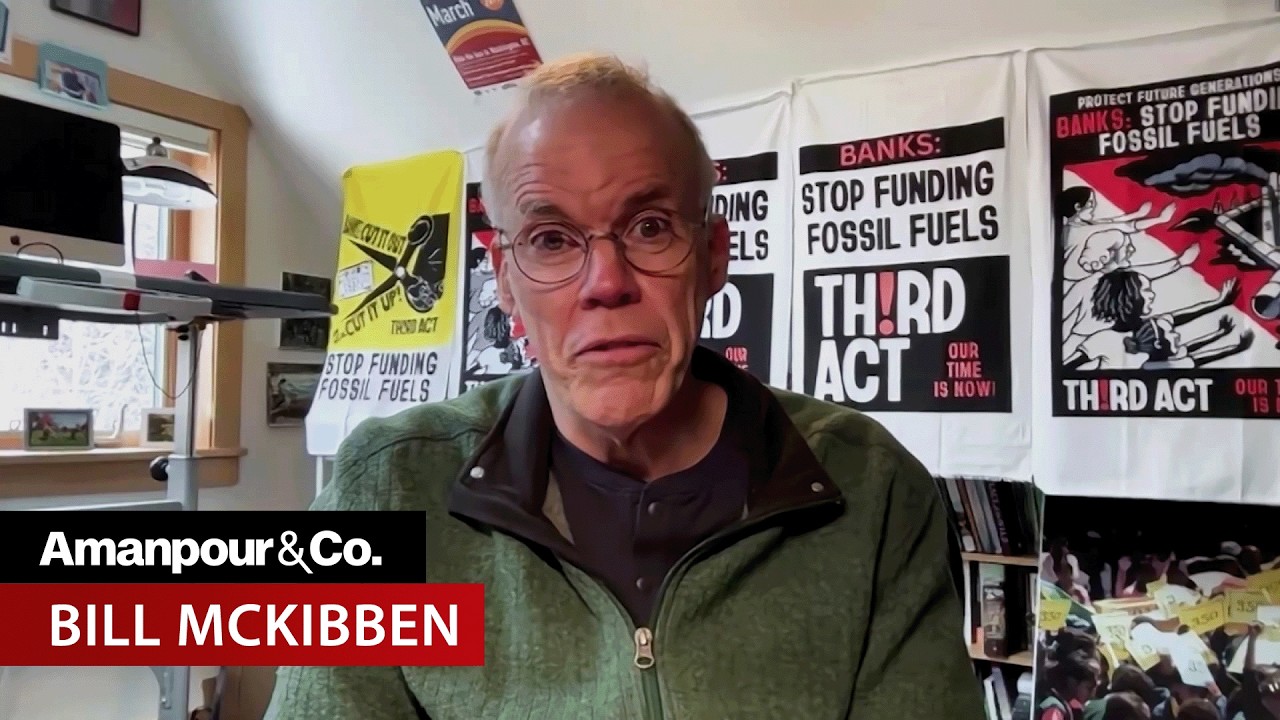
CHINA WILL OWN AUTO SECTOR WITH ev; 3 CITIES MAKE MORE CARS THAN FORD? BETTER ONES?
CO2 PEAKED YRS EARLY?
1 IN 5 SICK DIE FROM AIR POLUT? INDIA REALLY Bad air
CHINA BUILDS = 3 COAL PLANTS ON ALT ENERGY A DAY?!
---}:
The E.P.A. Rescinds a Landmark Finding | The New Yorker
The New Yorker
Marc Morano, who worked for Rush Limbaugh and played a key role in the Swift Boat attacks on John Kerry before he switched to attacking climate ...
no lnx
The E.P.A. Rescinds a Landmark Finding
But it’s not game over for future climate action—and understanding why allows for a more nuanced picture of where the fight actually stands now.
By Bill McKibben
February 20, 2026
It fell to Doug Burgum, once the governor of North Dakota and now the Secretary of the Interior, to offer something resembling a scientific explanation for the Trump Administration’s decision to rescind the Environmental Protection Agency’s “endangerment finding,” which states that greenhouse gases such as carbon dioxide pose a risk to the planet’s health. “CO2 was never a pollutant,” Burgum said. “When we breathe, we emit CO2. Plants need CO2 to survive and grow. They thrive with more CO2.”
Considering that, in recent weeks, Burgum has also appeared in a cartoon with a lump of coal known as Coalie (“Mine, Baby, Mine!”) on social media, such reasoning is perhaps the best that one can hope for. It’s roughly the equivalent of explaining to a drowning person that you’re not going to throw him a life preserver because water is a building block of life. Carbon dioxide is, in fact, among the most dangerous substances at work on the Earth; as it collects in the atmosphere from the burning of fossil fuels, it is rapidly raising the Earth’s temperature, melting its poles, and setting off endless rounds of flood and fire. The latest warning came this past week, from a global team of scientists who noted, in a journal paper, that “we may be approaching a perilous threshold, with rapidly dwindling opportunities to prevent dangerous and unmanageable climate outcomes.” Indeed, recent weeks have produced predictions that a new El Niño is in the offing for later this year and, with it, the near certainty of new and dire temperature records.
Given all that, the decision to terminate the E.P.A.’s finding—which the agency issued in 2009, two years after the Supreme Court ruled, in Massachusetts v. E.P.A., that greenhouse gases are pollutants under the Clean Air Act—has to rank as one of the signal moments in America’s descent into idiocracy. Literally every major scientific organization in the world, not to mention every other U.S. President since 1988, and even all the largest oil companies, have acknowledged the dangers of greenhouse gases. The decision is of a piece with the Trump Administration’s withdrawal from the Paris Agreement and its efforts to disconnect satellites and monitoring stations—including, in December, the National Center for Atmospheric Research, in Boulder—that the world has relied on to track changes in the planet’s chemistry and temperature.
The repeal of the finding will face significant legal challenges, but the climate-skeptic industry is convinced that it has won a final battle. “We are pretty close to total victory,” Myron Ebell, a veteran of the movement, who fought climate and conservation initiatives for decades and served in the first Trump Administration, told the Times. Marc Morano, who worked for Rush Limbaugh and played a key role in the Swift Boat attacks on John Kerry before he switched to attacking climate-change policy, appears in an E.P.A. news release stating that the Administration’s actions “will make America much safer from any future climate wreckage inflicted by potential presidents like Gavin Newsom or AOC.”
A Times piece on the E.P.A.’s decision ran under a headline ratifying a sense that the Rubicon is now in the rearview mirror of a gas-guzzling S.U.V.: “Trump Administration Erases the Government’s Power to Fight Climate Change.” The fear is understandable—the finding has been the linchpin of federal regulations on everything from cars to coal-fired power stations. But it’s not, in fact, game over for future climate action, and understanding why allows for a more nuanced picture of where the climate fight actually stands now.
It was in 1988 that the public debate about climate change began, after the NASA scientist James Hansen testified before Congress and warned of the coming crisis. But, for the next thirty-five years or so, the fact that fossil fuel was relatively cheap and clean energy was relatively expensive constrained the debate. For the most part, environmentalists’ strategies involved somewhat complicated ways to bypass that economic reality. If they couldn’t persuade elected officials to raise the price of fossil fuels through taxes, they could, for instance—and quite legitimately—argue for treating by-products of fossil fuels as dangerous pollutants and begin to limit their use on that basis. The finding, though entirely correct, was also always a work-around, a way of avoiding having to directly confront the overwhelming power of the fossil-fuel industry in our political and economic life.
Then, earlier this decade, it became cheaper to produce energy from the sun and the wind than from coal and gas and oil. Around the world, the surge in clean power is now moving faster than any energy transition in history. Over the course of twenty-one months, greenhouse-gas emissions in China have plateaued and even dropped; perhaps even more significant, coal use has declined recently in India, as solar fields expand, creating a real possibility that it may be the first large nation to pass through rapid economic development without relying mostly on fossil fuel. And new reports indicate that Africa is now the fastest-growing solar market in the world, with solar capacity up fifty-four per cent over the course of the past year.
The Trump Administration can, of course, hinder the development of clean tech in the U.S.—it has shut down under-construction windfarms, restricted the installation of panels on federal lands, and removed already built and paid-for E.V. chargers from federal buildings. That it has done this to appease the fossil-fuel industry, which provided enormous financial support to Republicans in the 2024 elections, is too obvious to be worth denying. But that effort speaks, at least in part, to the industry’s nervousness. It’s even in trouble in Texas, which last year led the U.S. in clean-energy and battery installation, and where, Google announced just this past week, two new data centers it is building will be fuelled by solar power.
So if a President Newsom (in his current role, as governor of California, Newsom just signed a new agreement on climate coöperation with the British government) or a President Ocasio-Cortez were to take office someday, with a goal to rejoin the international climate fight or just to restore the U.S. as a serious manufacturing competitor to China, their first priority would not be a new endangerment finding from the E.P.A. That was the right move back in the day. Now job No. 1 would be getting back to building clean energy. ♦
Bill McKibben is a contributing writer at The New Yorker focussing on climate policy. His books include “Here Comes the Sun: A Last Chance for the Climate and a Fresh Chance for Civilization.”
More:
Climate Change
E.P.A. (Environmental Protection Agency)
ZM 12 25
HCR
And because of that, that makes us. The beneficiaries of an extraordinary moment that looks much like the moment of the creation of the United States of America. You know, if you think about the framers of the Constitution, and certainly of the founders who wrote the Declaration of Independence.
Heather Cox Richardson
16:24:32
They are always talking about the fact they get to write the future. Thomas Paine said, I wrote this down.
Heather Cox Richardson
We have it in our power to begin the world over again.
And that joy in the creation, not in the having, but in the doing.
---
action NY? bank? citi
---
an
11 25
President Donald Trump’s "wrecking-ball approach to America has a precedent: the MAGA evangelical perversion of Jesus’s message of radical love to one of hate and aggression," writes The Guardian's Bill McKibben.
McKibben notes that Trump's " most revealing and defining moments – not its most important, nor cruelest, nor most dangerous, nor stupidest, but perhaps its most illuminating," came when he started postingplans of his gilded ballroom and then posted an AI video dumping feceson American cities.
"He has done things 10,000 times as bad – the current estimate of deaths from his cuts to USAID is 600,000 and rising, and this week a studypredicted his fossil fuel policies would kill another 1.3 million. But nothing as definitional," McKibben says.
But "no one – not Richard Nixon, not Andrew Jackson, not Warren Harding, not anyone – would have imagined boasting about defecating on the American citizenry," he notes.
" Trump has managed to turn America’s idea of itself entirely upside down. And he has done it with the active consent of an entire political party," McKibben adds.
McKibben says that those, including himself, raised as "mainline Protestant Christians" should not be surprised by any of this.
"We have watched over the years as rightwing evangelical churches turned the Jesus we grew up with into exactly the opposite of who we understood him to be," he writes.
"At its most basic, they turned a figure of love into a figure of hate who blesses precisely the cruelties that he condemned in the Gospel; we went from 'the meek shall inherit the Earth' to 'the meek shall die of cholera'," he says.
McKibben says that despite this, he and his fellow Christians have not fought back against this effectively, if at all.
"What particularly hurts is the fact that at no point did we manage to fight back, not effectively anyway. Without intending to, we surrendered control of the idea of Jesus. It is a story that may provide some insights into how to fight the attack on democracy."
McKibben explains how Christianity has morphed into something completely different than it was in the 1950s when a majority of Americans subscribed to some form of the religion.
"Now the most public and powerful forms of Christianity, the vast and often denominationally independent megachurches and TV ministries, are as wildly different from that version of Protestantism as Donald Trump is from Eisenhower," he says.
Today's "newly ascendant version of Christianity," McKibben explains, is a far cry from that.
"The Jesus of this imagination – muscular, aggressive and American – is a different man than the one I grew up worshipping," he says. "The idea that he can be invoked to justify cutting off aid to foreign countries and bundling immigrants into the back of unmarked vans is repulsive to me, but also mystifying – as if gravity suddenly pulled objects upward."
McKibben says that "I am less concerned with the shrinkage of the mainline church than with the replacement of its Jesus with this very different one."
Allie Beth Stuckey, "one heir to Charlie Kirk’s placeat the top of Maga Christianity," McKibben writes, has a very different version of the Jesus he grew up worshipping.
"She is a distillation of the currently dominant American Christianity, and above all, her Jesus rejects empathy," he says.
"Basing your support for ICE raids on terrified immigrants on a relatively obscure passage in a relatively obscure Old Testament story is a good example of what is known as prooftexting – the citing of some verse somewhere to support your predetermined beliefs," he explains.
The Bible, McKibben says, also says nothing on much of the culture wars MAGA mouthpieces use verse to attack.
It "has almost nothing to say about the rest of their favorite culture war hobby horses – you can find five scattered references to what might be homosexuality in the Bible, though recent scholarship makes clear they were actually attacks on prostitution and abuse," he writes.
And while the Bible says nothing about transgender people, he writes, "57 percent of the Republican party’s advertising spending in her race had reportedly gone to attacking transgender people, a topic – again – that Jesus ignored."
"None of that spending went to attacking Elon Musk (a recently self-proclaimed “cultural Christian”), who had managed to kill 600,000 poor people by 'feeding USAID into a woodchipper' in the first weekend of his Doge campaign," McKibben notes.
The parallels in today's MAGA movement are there, but they are lost on them completely, he explains.
"If you think I am being hyperbolic here, a 'rich young ruler' actually presented himself to Jesus and asked what he should do, and Jesus said he should sell his stuff and give it to the poor. This is what Jesus was about." he writes.
The hypocrisy, McKibben notes, has become downright farcical.
"The idea that personal salvation – as opposed to concern for others – was at the heart of Christianity always bordered on the heretical, but over the decades it has morphed into the absurd farce we see now, where Jesus is held to bless every show of dominance and aggression we can imagine," he says.
More people are becoming aware of this and acknowledging and fighting against it, he says.
Rep. James Talarico(D-TX), a part-time Presbyterian seminary student, has surged on the "strength of his forthright declaration of the kind of retro Christianity," McKibben says.
In a sermon Talarico gave two years ago, he said, "Jesus came to transform the world. Christian nationalism is here to maintain the status quo. They have coopted the Son of God. They have turned this humble rabbi into a gun-toting, gay-bashing, science-denying, money-loving, fear mongering fascist. And, it is incumbent upon all Christians to confront it, and denounce it.”
McKibben saysPope Leo's recent words condemning the Trump administration's cruelty show demonstrate this denunciation as well, and he hopes there will be more.
"America is best defended, in other words, by reference to the best about American history, just as Christianity is best defended by reference to what makes it distinctive and beautiful, which is the example of Jesus," he says.
an common dr
as the Midwestern and Eastern U.S. braced for what could be the longest heatwave in decades for some locations, a wildfire near Los Angeles forced more than 1,000 people to evacuate over Father's Day weekend.
The climate crisis caused primarily by the burning of fossil fuels is making both heatwaves and wildfires more frequent and extreme, and politicians and environmental advocates pointed out the role that state and national policy can play in fueling extreme weather.
"Each of the last 12 months have been the hottest on record," Sen. Bernie Sanders (I-Vt.) wrote on social media on Sunday. "This week, cities across the country will see record-high temperatures. A vote for Donald Trump is a vote to surrender the fight against the devastation of climate change. We cannot let that happen."
"Politicians making bad policy decisions (like killing congestion pricing) is the number one cause of climate change, which makes heatwaves like this one worse."
Former U.S. President Donald Trump reportedly told oil and gas executives this spring that donating $1 billion to his campaign would be a "deal" for them because he would dismantle the Biden administration's climate regulations.
Sanders' remarks came as the National Weather Service (NWS) Weather Prediction Center forecast that "record-breaking heat" would "expand from the Midwest and Great Lakes to the Northeast this week, potentially lingering through early next week."
NWS said the heatwave would be the "first significant" heatwave of the season and could break daily temperature records and some monthly June temperature records for the portion of the country stretching from the Ohio Valley to the Northeast between Monday and next Saturday.
"The longevity of dangerous heat forecasted for some locations has not been experienced in decades," NWS said.
The heat index could come close to 105°F in many places, and nighttime temperatures of around 75°F mean that those without cooling infrastructure will see "little to no relief."
The high temperatures could impact millions of people from Michigan to Maine. As of Saturday, 22.6 million people were under extreme heat warnings, watches, or advisories, according toThe New York Times.
University of California, Los Angeles, climate scientist Daniel Swain told the Timesthat the heat would "affect a bunch of highly populated areas where there hasn't been quite as many stories about extreme heat recently," adding, "Now, it's New England's turn."
The NWS warned, "With the intense heat and high humidity it is important to take precautions to protect one's health, particularly those without effective cooling and/or adequate hydration."
New York Gov. Kathy Hochul issued a warning on social media on Saturday, pointing out that extreme heat is the leading weather-related cause of death in the U.S.
However, climate advocates criticized Hochul for exacerbating the root cause of more extreme heatwaves with her last-minute cancellation of a New York City congestion pricing plan earlier this month.
"Politicians making bad policy decisions (like killing congestion pricing) is the number one cause of climate change, which makes heatwaves like this one worse," the Sunrise Movement wrote in response to Hochul's post.
Long-time climate advocate and author Bill McKibben said: "This governor just blocked congestion pricing, one of the most important climate policy advances possible. She's redefining trolling."
Climate Central noted that, "while heatwaves are common in summer, this early season excessive, likely record-breaking heat is made as much as two times to five times MORE likely to occur in mid-June due to human-caused climate change (particularly overnight warmth)."
Meanwhile, on the West Coast, the Post Fire ignited at around 1:45 pm on Saturday local time in Los Angeles County, California, about 65 miles from downtown Los Angeles, The Washington Postreported.
As of Sunday afternoon, it had spread 12,265 acres and was 2% contained, according to California Department of Forestry and Fire Protection (Cal Fire). Fire officials said the blaze was fanned by heat, low humidity, and wind and had damaged two structures.
"Currently crews are working to construct perimeter fire lines around the flakes of the fire. Aircraft are working to stop forward progress but have limited visibility," Cal Fire wrote on Sunday, adding that "the fire is pushing up into Hungry Valley Park. California State Park Services have evacuated 1,200 people from Hungry Valley Park. Pyramid Lake is closed because of the threat of the Post Fire."
One of those evacuated was 33-year-old Oscar Flores, who was visiting Hungry Valley Park with his 12-year-old son on Saturday.
"It looked like it was the last day of the world," Flores told the Los Angeles Times. "People were loading quickly and merging out, driving fast. The ranger said you have 10 minutes [to get] whatever you can pack."
===
costco credit?
citibank
3rd act cut credit cards end of yr DN 4 22
an 7 22
A scorching heat wave continues to fuel wildfires across southern Europe and parts of North Africa, resulting in hundreds of heat-related deaths and forcing thousands to evacuate their homes. The record-breaking temperatures come as Senator Joe Manchin of West Virginia has effectively killed President Biden’s Build Back Better climate legislation after stringing Biden along for 18 months. “It’s appalling, but it’s not unexpected. It’s why we have to keep building movements bigger,” says Bill McKibben, climate author, educator, environmentalist and founder of the organizations Third Act and 350.org.
Transcript
AMY GOODMAN:
Bill McKibben, I also want to ask you about the scorching heat wave that continues to fuel wildfires across southern Europe and parts of North Africa. In France, thousands have been forced to evacuate fires that have scorched over 22,000 acres. Meanwhile, the governments of Spain and Portugal said hundreds of people died from heat-related causes during the second week of July. In the United Kingdom, the British government has issued its first-ever 'Red' extreme heat national severe weather warning, with forecasters predicting high temperatures will top 40 degrees Celsius, 105 degrees Fahrenheit, for the first time ever.
This coming as last week West Virginia Senator Joe Manchin told Democratic leaders on Capitol Hill he will not support legislation to combat the climate emergency or any tax increases on the wealthy and large corporations. The youth-led climate justice group Sunrise Movement called Manchin’s decision 'nothing short of a death sentence.' And you tweeted in response, 'Manchin has taken more money from the fossil fuel industry than anyone else in DC. And the return on that investment has been enormous. Big Oil got its money worth a thousand times over.'
Talk more about what’s happening in the world with these scorching heat waves, and what the U.S. is not doing about it.
BILL McKIBBEN:
Well, let’s talk first about the heat. Britain has the longest temperature record in the world. People have been looking at thermometers there longer than they have any other part of the planet. And the temperatures we’re seeing today and tomorrow in Britain are going to smash those records, not even just beat them by a tenth of a degree but by a full 1 or 2 degrees Celsius, 3 or 4 degrees Fahrenheit. That shouldn’t be statistically possible, but it is, because we’re living on a different world than those old thermometers were on.
The scariest thing, really, about what’s happening this week, not just in Europe, but also in China, where there’s an extraordinary heat wave underway, and also across much of the U.S. — the temperature is going to be 104 in Minneapolis today, I think — the scariest thing is, we’re in the middle of a La Niña, a cold cycle on this planet. As you know, we break new global temperature records normally when we’re in an El Niño phase in the Pacific, but June, last month, was the hottest June ever recorded on Earth. When we next have an El Niño, the numbers are going to be just completely off the charts. This is very, very scary.
And what makes it scarier, as you point out, is the lack of a real political response from most places around the world, the U.S. in particular. Joe Manchin choosing this moment to sabotage finally the climate legislation that the president had put forward is particularly galling. This is the third time in the last 30 years that the U.S. Congress has considered serious climate legislation — the Kyoto stuff back in the 1990s, the cap-and-trade stuff in 2009, 2010, and now this Build Back Better bill, that groups like the Sunrise Movement had fought for years to get through.
I’m afraid that, in retrospect, it’s pretty clear Manchin was going to do this all along. You remember that leaked secret hidden videotape that came out last year, where Exxon’s chief lobbyist described Manchin as their 'kingmaker' and said that they met with him every week to discuss policy. It’s pretty clear how those meetings have been going. He’s played this very well by stringing it out all these many, many months, 18 months. He’s kept the Biden administration from being able to take executive action for fear of offending him. It’s appalling, but it’s not unexpected. It’s why we have to keep building movements bigger. We need more pressure on this system in order to make change, or we’re going to be stuck just where we are.
The one upside? We know, and we get more confirmation with each passing week, that renewable energy is getting cheaper and cheaper and cheaper. There was an auction last week in the United Kingdom for new tenders for electricity provision. And the cost of offshore wind was coming in at one-quarter the price of burning gas to produce electricity.
We can do this. We can get out of a world where we have to go kowtow, fist-bump the idiot king of Saudi Arabia. We can do it, but only if we’re willing to make the effort that Joe Manchin has kept us from making this week.
AMY GOODMAN:
Let’s name some names. I’m looking at a Politico piece that talks about where Senator Manchin, who chairs the Senate Energy Committee, you know, the top recipient of oil and gas funds, gets his money. Last quarter’s campaign finance data shows the trend is continuing. 'The senator received donations from executives at Georgia Power, including the utility’s CFO Aaron Abramovitz, and from Dominion Energy CEO Robert Blue. Energy services firm Concord Energy CEO Matthew Flavin gave Manchin the maximum allowable amount of $5,800, as did Southern CompanyGas CEO Kim Greene and Harvest Midstream CEO Jason Rebrook. Southern Company’s chair and CEO Chris Cummiskey gave Manchin $2,000, while three other company executives gave at least $1,000. An in-house lobbyist for the company donated $1,000 as well. Kara G. Moriarty, president of the Alaska Oil & Gas Association, gave $1,000, too, along with two executives from the energy storage company Form Energy.'
And it goes on: 'Manchin also took in more than $19,000 from political action committees belonging to fossil fuel or energy companies and their trade groups, including the Coterra Energy, NextEra Energy, North American Coal Corp., the American Exploration & Production Council’s PAC. The PACs for private equity giant the Carlyle Group and AT&T contributed $10,000 and $5,000, respectively.' Your response, Bill?
BILL McKIBBEN:
You know what’s pathetic? It’s pathetic how cheap it is to buy these guys. So, you know, for a few hundred thousand dollars, you can afford a senator, and he is able to put the kibosh on hundreds of billions of dollars in renewable energy spending. The list you just read is a list of all the people who don’t want the status quo to change, who want to slow down that change as much as they can. That’s what they are paying for, and that’s what they got, man. This was money well spent, from their point of view.
AMY GOODMAN:
António Guterres said today, the U.N. secretary-general, 'Half of humanity is in the danger zone from floods, droughts, extreme storms and wildfires. No nation is immune. Yet we continue to feed our fossil fuel addiction. … We have a choice. Collective action or collective suicide. It is in our hands.' Bill McKibben, your final comments on this?
BILL McKIBBEN:
Guterres has actually been a hero, and he’s exactly right. And it’s not that hard. Look, there’s four big banks that are the big funders to the fossil fuel industry. They’re all American. That’s why at Third Act we’re working so hard to try and cut off that flow of funding to the fossil fuel industry. There’s a handful of people who are keeping us on a path toward existential destruction, and we have got to stand up to them, and we’ve got to do it now.
AMY GOODMAN:
Your final comment about Saudi Arabia and other countries the U.S. is relying on to increase oil production, when in fact, actually, now gas prices are dropping, but, more importantly, it looks like these oil companies — while people think it’s because there’s a lack of oil and gas, it’s that they’re using this moment, this opportunity, this war in Ukraine — these corporations — to gouge consumers and are making more than they ever have in their history?
BILL McKIBBEN:
If you don’t like the oil companies — and, man, you should not like the oil companies — if you don’t like the Saudis — and I sure don’t — we need e-bikes, e-buses, electric vehicles. The day that we’ve got a bunch of them on the road is the day that we can tell these guys to go take a jump in the lake.
AMY GOODMAN:
Bill McKibben, author, educator, environmentalist, founder of Third Act, organizing people over 60 for progressive change, also founder of 350.org, we’ll link to your piece in The New Yorker, 'If Egypt Won’t Free Alaa Abd El-Fattah, It Had Better Brace for an Angry Climate Conference.' His book is just out, The Flag, the Cross, and the Station Wagon: A Graying American Looks Back at His Suburban Boyhood and Wonders What the Hell Happened.
Watch below:
https://thirdact.org/what-we-do/banking-on-our-future/
Banking on our Future Pledge
We the undersigned are account-holders at Chase, Citibank, Bank of America, or Wells Fargo, and we do not want our money to support lending for fossil fuel companies and projects responsible for the climate crisis. Therefore, if these four big banks continue to lend our money for fossil fuel exploration and development beyond December 31, 2022, we pledge collectively to move our accounts out of these four big banks into more environmentally and socially conscious banks and financial service providers, including checking, savings, and/or credit cards.
Our request, and our hope, is that Chase, Citibank, Bank of America, and Wells Fargo will reform their lending practices so that we will continue to be customers, but we are unwilling to have our resources used to fund climate destruction. Move your money, or we will move ours.
report
despite 'Splashy' Net-Zero Vows, Big Banks Dumping Trillions Into Fossil Fuels
"With Wall Street banks leading the charge, these financial institutions are directly complicit in undermining a climate-stable future for us all."
March 30, 2022
Flouting their public vows to put themselves and their clients on a path to net-zero greenhouse gas emissions, the world's 60 largest private banks have provided a total of $4.6 trillion in financing for the fossil fuel industry since the Paris Agreement entered into force in 2016.
That's according to the latest edition of :{Banking on Climate Chaos:(style="box-sizing:border-box"):}:, an annual report that tracks the banking industry's funding of oil and gas initiatives that are threatening global hopes of reining in carbon pollution and averting climate disaster.
In 2021 alone, the report finds, the world's biggest private-sector banks financed oil and gas to the tune of $742 billion. That year, the 60 banks featured in the new analysis poured $185.5 billion into the 100 companies doing the most to expand the fossil-fuel sector worldwide through offshore drilling, fracking, coal mining, liquefied natural gas infrastructure, and more. Authored by Oil Change International, the Rainforest Action Network, the Indigenous Environmental Network, and other groups and endorsed by hundreds of organizations from around the world, the report published Wednesday spotlights the marked contrast between banks' public commitments to net-zero emissions targets and their actions, which reflect a continued stake in fossil fuel development.
The worst offenders in the banking industry, according to the report, are the U.S. financial behemoths JPMorgan Chase, Citi, Wells Fargo, and Bank of America,which together accounted for 25% of all fossil fuel financing identified over the past six years.
The report highlights a number of specific projects, including the Mountain Valley Pipeline (funded by JPMorgan Chase, Wells Fargo, and Bank of America), drilling in offshore Guyana (funded by JPMorgan Chase, Citi, and Bank of America), and the Line 3 Pipeline (funded by TD, Scotiabank, and the Bank of Montreal), efforts that have drawn fierce resistance from Indigenous communities.
"Indigenous peoples have long been leading the fight for the sacredness of the land, water, and Earth," Mea Johnson, divestment campaign coordinator with the Indigenous Environmental Network, said in a statement Wednesday. "Mother Earth has always given us what we need to thrive. We will not back down until our natural balance is restored and anyone helping fund the extractive destruction of our communities will be held accountable."
Alison Kirsch, research and policy manager at the Rainforest Action Network, added that "any further expansion of fossil fuels risks locking humanity into generations of climate catastrophe, yet the top fossil clients of the world's largest banks are still being showered with tens of billions of dollars even as they actively expand drilling, mining, fracking, and other fossil fuel development unabated."
"With Wall Street banks leading the charge," Kirsch added, "these financial institutions are directly complicit in undermining a climate-stable future for us all and must immediately end their support of any further fossil fuel infrastructure expansion."
The banks' financing decisions fly in the face of their own pledges to bring their policies into line with critical climate goals, such as achieving net-zero greenhouse gas emissions by 2050, a benchmark that 44 of the 60 banks profiled in the new report have backed.
"But global banks have massively supported the companies doing the most to open new oil and gas fields," notes the new report. "Banks with net-zero commitments last year... financed the top 20 upstream oil and gas expansion companies, potentially helping to lock the planet into decades of climate-warming emissions." According to the International Energy Agency, reaching net-zero emissions by 2050 would mean ensuring "no new oil and gas fields."
Adele Shraiman, a representative for theSierra Club's Fossil-Free Finance campaign, said Wednesday that the analysis "makes it clear that banks must clean up their act and stop funding the expansion of dirty fossil fuel projects like fracked gas exports, tar sands pipelines, and offshore drilling in order to align with what the science demands and what their own commitments require."
"Despite their splashy climate pledges, big banks have largely continued with business-as-usual and actually increased their overall fossil fuel financing since the Paris Agreement," said Shraiman. "As we look ahead to shareholder season, we'll be keeping up the pressure on the banks and their investors to take these critical reforms seriously and stop bankrolling the fossil fuel industry's reckless expansion plans."