burgum doug DOI
---
billionaire thus pluto 4
SEE PJT 2025 PENDLEY PENDEJO BERNHARDT ~ESA BEARS EARS AM ANTIQ ACT
SEE VANITY PJTs preserv docs 1126
AI data ctr?
trump trans 2
see hamm
SEE CENSOR WWW MEMORY HOLE
see conflict critical minerals
clean coal BS
SEE ENEGY DOMINANCE DRILL BABY PUBLIC PARK LAND 2 26 2009 ENDANGER ZELDEN
SEE OFFSHORE WIND WHALE BS // VOUGHT CRUICKSHANK
PERC?
---
note fox 3rd party BS TPPF
---
-=-=
cnn an 11 26
House Democrats are demanding that the Interior Department retain documents related to President Donald Trump’s construction projects around Washington after whistleblowers warned that key paperwork has already been destroyed before Democrats take power, congressional sources tell CNN.
The warnings come as the Trump administration is signaling it will accelerate plans for moving ahead with the projects — a key part of what the president sees as his legacy — to lay as much groundwork as possible before the Democrats take over Congress in January.
On Tuesday, the top Democrat in the House Natural Resources committee, which has oversight of the agency that has helped fast-track many of Trump’s projects, plans to issue letters to the Interior Department as well as other federal agencies and private companies, requesting that they “preserve all records and data responsive to oversight” the congressional panel oversees.
[How presidential power has grown far beyond what the nation’s founders envisioned
The targets of the letters from Rep. Jared Huffman, shared first with CNN, give an early indication of what could be in the crosshairs for investigation when the California Democrat becomes chairman of the committee in the new Congress.
Multiple credible whistleblowers have approached Huffman’s committee in recent weeks to voice concern that the Interior Department is getting rid of records in anticipation of forthcoming scrutiny, the sources told CNN. The agency oversees much of the national parkland Trump wants to use for his projects.
The Interior Department called the whistleblower claims “100% false.”
“The Department follows all federal records management obligations as directed by the Department’s ethics officials,” a spokesperson said.
Among the other recipients of the preservation letters are the National Park Service and the Bureau of Land Management, which are part of Interior.
Letters are also being sent to the Agriculture Department and companies like Lockheed Martin and John Deere that are known to have donated to Trump’s projects. CNN has asked them for comment. Whistleblowers did not say these entities had destroyed documents.
However, all letter recipients must reply to certify their compliance, which requires efforts to “preserve existing records collections and productions,” as well as “Identify and recover any deleted information” and “suspend any destruction and deletion practices.”
A mandate to investigate
Rep. Jared Huffman speaks at the site of President Donald Trump's proposed triumphal arch, in Arlington, Virginia, on May 14. Andrew Harnik/Getty Images
The typically under-the-radar National Resources committee may lack the prominence of the Judiciary or Oversight committees, but in the new Congress it is set to take on the mantle of chief antagonist and auditor of projects that Trump has deeply and personally invested in seeing through.
The committee holds legislative jurisdiction over national parks and federal lands, on which Trump is attempting to build projects like the East Potomac golf course and the triumphal arch.
“Everything is coming; it’s all coming,” Huffman told CNN in an interview, signaling that his committee is readying a large arsenal of tools that come with the gavel in the new majority.
“It’s just going to be an entirely new day,” he said, noting that a win of the magnitude Democrats achieved in the midterms will embolden their investigations, as there is a belief that they have a true mandate from voters who felt the president was focused on the wrong issues.
Committee aides expect to hold a high-profile hearing on one or several projects early in the new Congress. The golf course and triumphal arch are chief among the areas of focus.
In anticipation of possible obstruction from the administration, the committee is prepared to issue subpoenas.
Huffman believes that the committee’s work could stop some of the president’s construction projects from going forward, “especially because we have standing to go to court if we have to,” he said. “We’ll have tools to be able to stop a lot of it.”
The committee has also been coordinating with House Oversight and Judiciary, which have mapped out an aggressive approach to investigate other areas of the administration.
Turbo-speed timelines
President Donald Trump watches as the last steel beam is installed during an event at the site of the White House ballroom on November 4.
President Donald Trump watches as the last steel beam is installed during an event at the site of the White House ballroom on November 4. Andrew Harnik/Getty Images
At the same time, multiple sources close to the approval process on Trump’s projects told CNN they are seeing a new urgency on the part of the administration to get as far as it can by the end of the year.
The move to supercharge some of the president’s projects is being met with ire by many in the preservationist community who have been fighting against them.
The triumphal arch; a project to put up fencing at Lafayette Square near the White House; the East Potomac Golf Links; and the Tidal Basin Development Concept plan, which includes the president’s Garden of American Heroes, will all see action pushing them ahead over the next 60 days.
Some will be going in front of key federal agencies for approval, and others are moving forward in the historical preservation evaluation process.
“We’re going to start seeing all of these things happening simultaneously,” said Charles Birnbaum of the Cultural Landscape Foundation. “It is going to be like a storm where it plays out until the new Congress is seated.”
The day after the midterm elections, Trump appeared in front of the White House ballroom construction site, signing the last steel beam before it was raised.
Davis Ingle, a spokesperson for the White House, said: “President Trump is moving at lightning speed because we don’t have time to waste in our mission to make America greater than ever before.”
-=-=-
-=-=
CONTEXT
EXMR
Posts by William Perry Pendley
Read the latest stories and analysis from William Perry Pendley.
An Elon Musk insider shares what he found in Washington — and it should terrify youOp-Eds
An Elon Musk insider shares what he found in Washington — and it should terrify you
William Perry Pendley
Tyler Hassen, who Elon Musk’s Department of Government Efficiency embedded at the Department of the Interior, has written an extraordinary book: Inside DOGE: The Real Story from a Senior Insider — must reading if you care about America’s future.
Hassen’s findings made news in late March 2025 on Fox News’s Special Report with Bret Baier. Musk referenced a billion-dollar contract for a customer service survey that, writes Hassen, “I could have done … in high school.” (He would not have had misspellings.) Interior Secretary Doug Burgum, whom Hassen extols, killed it after Hassen’s briefing, but not before Interior spent $100 million!
A Princeton graduate who held executive management positions with postings in New York, London, and five countries over his 20-year career, Hassen is the founder and CEO of Stable Crest Holdings LLC in Houston. In Washington in 2025, dressed like a banker amid engineers in hoodies and staff in jeans and T-shirts, Hassen, armed with his laptop, confronted bureaucratic gobbledygook. Worse: “No briefing packet. No onboarding manual. No list of priorities. Just: Figure it out.” Fortunately, Hassen and his colleagues figured it out.
Hassen was there because the national debt gnawed at him. “It wasn’t politics — it was math. We’ve grown used to the illusion that the bill never comes due. But the number is now over $39 trillion and rising.” Musk was his leader, and President Donald Trump (whom Hassen lauds as the reason DOGE existed) and Burgum were his bosses, but his clients were taxpayers.
At Interior, he found “two worlds colliding — [career employees] preserving how things have always been done [and political appointees] trying to change them in real time.” That produced resilience but also resistance that made it “almost impossible to know who truly believed in what we were trying to do. [Hassen] didn’t have the luxury of discovering it slowly.” He pursued competence, clarity, and “people who answered directly, moved quickly, and didn’t hide behind jargon.” Fortuitously, he found them and applauds their value, vision, and vigor.
Immediately, he flew to California to referee a water crisis, a “baptism by fire into the media world,” where Hassen “went from an anonymous executive in Houston to a public figure in one of the most politicized water fights in America.” “[P]erception isn’t just reality; it’s a weapon.” If a “narrative sets, facts become secondary.”
In Washington, Hassen scrutinized government contracts for “waste,” which Musk described: “Money is most poorly spent when you’re spending someone else’s money on people you don’t know. That’s the federal government.” After Hassen cracked the code concealing the worst waste and issued precise “data calls” forcing answers from bureaucrats, he found billions in “waste hiding in plain sight.” Equally profligate were 25,719 previously unreviewed grants totaling a “staggering” $26.7 billion.
Hassen uncovered a department awash in waste: Federal Advisory Committee Act creations of which Interior had 79, squandering time and money; “nonprofits” whose sole funding source — Interior — supported fat-cat executives; and 160 leases for empty offices countrywide. DOGE’s focus on “external vendors exploiting government inefficiencies” yielded a blind spot, which Hassen exposed: “[A] sprawling ecosystem of hidden service shops and embedded consultants, moving billions of dollars in ways most people … never saw.”
Despite Hassen’s and DOGE colleagues’ efforts, contracts continued to be issued, grants kept getting made, and employees were still being hired. Initially horrified by the suggestion, he agreed to lead one of Interior’s most important posts: assistant secretary for policy, management, and budget. “PMB wasn’t a niche policy office,” Hassen found out. “It was the nerve center of Interior.” There, Hassen controlled contract issuance, grant making, and reductions in force, including freezing the onboarding of probationary employees.
Hassen ascertained the Interior had 50 human resources offices with 2,000 employees coast-to-coast, ensuring chaos: 300,000 separate job descriptions for 70,000 employees! IT was no better: 18 chief information officers supervised 2,000 staffers. Worse was procurement: over 1,000 officers managed five contracts apiece! An expensive consulting firm spent five years studying consolidation and proposed another five years to oversee it. Hassen’s team took five weeks.
Musk warned: “There aren’t even fifty of us in this room — but there are millions of government workers who want us to fail.” Unfortunately, millions of others declared war on DOGE. Hassen, many of whose DOGE colleagues vote for Democrats, wondered when believing the federal bureaucracy is bloated and inefficient became a partisan issue.
DOGE’s “incredibly gifted” people suffered “long hours, data discipline, and a willingness to absorb criticism without flinching” while declining opportunities with “tremendous salaries and equity,” to “work for the American people.” In return, they got death threats! Nevertheless, the “turmoil” over DOGE did not alter its mandate to “reduce waste, streamline bureaucracy, and increase accountability.” Hassen remains hopeful for DOGE 2.0.
TRUMP FOUGHT UNELECTED BUREAUCRATS. NOW THEY’RE BEING CODED INTO IMMORTALITY
Hassen characterizes Musk’s famous email to federal employees (“What did you do last week? Please write 5 accomplishments.”) as a mirror that, once held up “inside a bureaucracy, [reveals] who is willing to look — and who would prefer to turn it away.”
Hassen holds up a mirror to the people. Will they continue treating federal workers as untouchable, even sacred? If they do, public good becomes secondary, and reform becomes impossible. Having endured a similar experience at Interior during the first Trump administration, I hope Americans heed Hassen.
-=-=
9 26 https://globalextremism.org/post/project-2025-comes-for-public-lands/
No Accident: Project 2025 Comes for Public Lands
September 23, 2026
William Perry Pendley wrote the Interior Department chapter of Project 2025. Doug Burgum now runs the Interior Department, and he is carrying it out. Endangered species, America’s public lands, and the sacred places on them are paying the price.
Key Takeaways
Project 2025 wanted wild horses disposed of. The government sold 3,700 of them last year, many for as little as $25, through a loophole that for some ends at a slaughter plant.
Project 2025 complained that Trump’s first-term monument cuts didn’t go far enough. He has now cut Bears Ears and Grand Staircase-Escalante national monuments, both in Utah, by about 90 percent each.
Project 2025 wanted the Endangered Species Act kept out of the way of “economic development.” The wildlife agencies didn’t wait for Congress. They rewrote the rules, and 20 states and the District of Columbia sued on September 9. Five days later, Fish and Wildlife told its field offices that killing an endangered animal breaks no law unless the killing was the point.
Project 2025 called for “aggressively building the border wall system on America’s southern border.” Homeland Security has waived cultural and environmental laws to build it, and crews are blasting Kuuchamaa, a Kumeyaay sacred mountain on the U.S.-Mexico border.
The mustangs had waited years in an Idaho feedlot, penned there since helicopters ran them down off the range. In March, the Bureau of Land Management finally shipped 68 of them out. The trailers went 1,800 miles east to Brandon Jones, an Ohio livestock trader who had paid the government $25 a head. Around midnight the next day, two double-decker cattle trucks came for the horses. Jones won’t say where they went.
Jones told The New York Times, which ran the investigation on its front page in August, that he has nothing to do with Fred Bauer. Bauer is one of the largest exporters of slaughter horses to Canada, where they are processed into meat for human consumption and sold abroad.
William Perry Pendley, who wrote Project 2025’s Interior chapter, once ran the bureau now selling those horses. A federal judge ruled in 2020 that he had served unlawfully as its acting director for 424 days. His chapter asked Congress to repeal the Antiquities Act and to rein in the Endangered Species Act. Congress has done neither. Interior, under Secretary Doug Burgum, has found other ways, and the horses show how.
Project 2025’s section on wild horses ends by telling Congress to pass a law letting the bureau “dispose humanely of these animals.” Congress never did, and it still bars the bureau from spending money to kill healthy wild horses. A 2017 survey of 556 registered voters, commissioned by wild horse advocates, found 80 percent of respondents, including 86 percent of Trump voters, opposed killing them.
Livestock inspection records show some of the government’s mustangs on trucks bound for Canadian slaughter plants.
The bureau posts wild horses on its online adoption site, and after three one-week listings with no takers, it labels a horse unadoptable and can sell it. Once sold, the horse loses its protections. The buyer promises in writing not to slaughter it or knowingly sell it to someone who will. The middleman signs nothing, and the horses go to Canada. The government can spend more than $3,000 to capture a mustang and bring it to market, then sell it for $25.
Slaughter plants pay up to $750 per horse.
Clare Staples runs Skydog Sanctuary, a rescue for wild horses and burros with ranches in California and Oregon. She wrote to Burgum the day the Times story ran, demanding the sales program be shut down. She had spent more than a year combing the bureau’s own sales records and standing at the kill pens. Her count runs 19 months, a longer stretch than the government’s one-year figure: 6,331 wild horses sold, against a historic average of about 1,200 a year. More than half were one to four years old, prime adoption age, and nearly three-quarters sold for $25 or less. Staples has tracked 333 wild horses and burros into kill pens this year alone. Selling protected animals for $25 to be butchered abroad, she said, is “a betrayal of the law and the American people.”
Sacred Lands
Trump signed the monument orders in the Oval Office on July 13, 2026, with Utah’s senators, Mike Lee and John Curtis, Gov. Spencer Cox, and state House Speaker Mike Schultz lined up behind him. The proclamations took effect September 11, and Bears Ears was reduced from 1.36 million acres to 121,000, a 91 percent cut. Grand Staircase-Escalante lost about the same share. Conservation groups sued on September 2.
The proclamation itself acknowledges the twin buttes known as the Bears Ears, “which are considered sacred by the Native American tribes that call this area their ancestral home.” The same document lists “critical minerals such as silver, copper, molybdenum, lead, uranium, vanadium, and zinc.”
The proclamation also ended the Bears Ears Commission (BEC), through which the Hopi Tribe, the Navajo Nation, the Ute Mountain Ute Tribe, the Ute Indian Tribe of the Uintah and Ouray Reservation, and the Pueblo of Zuni had co-managed the monument with the federal government. In its place is an advisory committee whose named seats number 15: five for the tribes, four for San Juan County and its towns, and six for people recommended by Utah’s governor. The secretaries of the Interior and Agriculture now have no “obligation to engage, consult, or coordinate with the BEC or a comparable entity,” the proclamation states, though it still requires them to consult tribes under other laws.
Pendley has fought over sacred ground before. In 1996, Mountain States Legal Foundation, the Denver firm he then led, sued the Park Service over a voluntary June climbing ban at Devils Tower in Wyoming, a site many Northern Plains tribes hold sacred. A federal appeals court tossed the case in 1999, ruling that the climbers had no standing to sue.
In his Project 2025 chapter, Pendley wrote that Trump’s first-term review had been “insufficient” because only two Utah monuments were cut. The next administration, the chapter says, “must seek repeal of the Antiquities Act of 1906.” The law protects “cultural and natural resources of historic or scientific interest on federal lands,” and it confines each monument to the “smallest area compatible with proper care and management of the objects to be protected.” Whether that clause lets a president carve down a monument a predecessor created is the question the conservation groups have asked a federal court to answer.
The day the cuts took effect, mining companies filed 16 new claims on land stripped from Bears Ears.
What Counts as Harm
Since 1975, wrecking an animal’s habitat has counted as harming the animal. The Fish and Wildlife Service and the National Marine Fisheries Service deleted that definition in a rule published July 14, 2026, and wrote nothing to replace it. The rescission took effect September 14. Logging the last of an owl’s nesting ground no longer harms the owl. Two more rules followed a week later. Newly listed threatened species lost their automatic protection. Critical habitat can now be trimmed when a company makes a credible case about the cost of preserving it.
Twenty states and the District of Columbia sued in federal court in California on September 9, five days before the harm rescission was due to take effect. The rules “are wrong on the merits, the morals and the law,” Washington Attorney General Nick Brown said. The complaint calls the harm rescission “a reversal of staggering proportions.” The rescission’s own preamble invites companies holding “take” permits to hand them back “in order to not have to continue spending resources to mitigate.”
Brian Nesvik, director of the Fish and Wildlife Service, signed the memo on September 14 and sent it to every one of the agency’s field offices. The New York Times obtained a copy. It turns on one word. Until now, “take” has covered killing or injuring a listed animal whether or not anyone meant to. Now it covers only the killings someone intended. Wildlife advocates say that lets a logging company knowingly cut down a forest full of endangered bats, as long as it was after the timber.
Most endangered animals that die at human hands are killed by accident, in the course of somebody’s business, the Times reported. Because those deaths have counted as take, developers seek permission first. A builder who wants to put houses where an endangered salamander lives traditionally applies for an incidental take permit promising to protect a few of them, or pays to conserve some elsewhere, and the government forgives the rest. The memo appears to upend that arrangement. If an accidental death breaks no law, nobody needs the permit.
Andrew Mergen argued endangered species cases for the Justice Department and teaches law at Harvard now. Everyone has understood the act to mean one thing, he told the Times: “Don’t kill endangered species.” The memo drains it of that meaning. People are held responsible all the time for harm they never intended but should have seen coming, Mergen said.
Interior’s press office wouldn’t say why it adopted the new reading, or whether the memo is already in force, and sent an unsigned statement saying the act “continues to prohibit take of endangered wildlife.” Stateline reported on September 21 that the memo’s instructions to staff take effect immediately.
Pendley’s chapter asks Congress to keep the Endangered Species Act from being used to “seize private property, prevent economic development, and interfere with the rights of states.” Interior got there with a rule and a memo. Pendley cheered the result. The new reading, he told Cowboy State Daily, “will shield innocent people from litigation by the country’s largest law firm, the Department of Justice.”
The Border
Kuuchamaa, a 3,885-foot peak that straddles the border near Tecate, is sacred to the Kumeyaay. In their creation story, a shaman became the mountain. It has been on the National Register of Historic Places since 1992, and the listing itself states that disturbing its natural state would be sacrilegious. Contractors have been blasting it anyway, and the explosions send rock tumbling down its Mexican side.
From a park in Tecate, Baja California, about half a mile away, Norma Meza Calles can hear the crews breaking boulders. Kumeyaay from both sides of the border have climbed the mountain for generations to sit on those boulders, Meza Calles, a Kumeyaay leader who works as a guide, told KPBS. “They’re destroying it,” she said in Spanish. “No one ever consented or supported the use of dynamite on the mountain,” Emily Burgueno, a Kumeyaay Nation member in California, told the Associated Press. The Department of Homeland Security waived cultural and environmental laws to speed the work.
Project 2025’s Homeland Security chapter directs the Pentagon to “assist in aggressively building the border wall system on America’s southern border.” Congress has since put more than $46 billion behind construction. The waiver power Homeland Security is using comes from a 1996 immigration law that Congress broadened in 2005, long before Project 2025 existed.
In Southern Arizona, the wall has reached O’odham country, which straddles the border. In April, a Homeland Security contractor damaged the Las Playas Intaglio, a 1,000-year-old fish-shaped geoglyph in the Cabeza Prieta National Wildlife Refuge that pointed toward the Gulf of California. The Tohono O’odham Nation sued Homeland Security in June to stop a 30-foot wall in three places along the stretch of border that crosses its reservation. Tribal leaders posted No Trespassing signs on August 7. U.S. District Judge Richard J. Leon denied the Nation’s request to halt construction a week later. On August 25, according to the Nation, contractors entered the reservation with about 20 masked, armed Border Patrol agents. Homeland Security says the work sits inside the Roosevelt Reservation, a 60-foot federal strip along the border. The Nation appealed on August 26.
About 30 miles west of the reservation, a second fence is planned 150 feet from the existing wall through Organ Pipe Cactus National Monument. Crews have already cleared ground a few miles east of Quitobaquito Springs, a desert oasis where O’odham families have held ceremonies for generations and where the endangered Quitobaquito pupfish and the Sonoyta mud turtle live. Lorraine Marquez Eiler, a Hia-Ced O’odham elder whose great-great-grandparents walked about 50 miles through the Sonoran Desert to the springs, called the wall “another slap in the face” to her ancestors. “This is not ours to own. It is ours to protect,” Verlon Jose, chairman of the Tohono O’odham Nation, said at the springs.
Nobody Home
The National Historic Preservation Act requires federal agencies to weigh what a project will do to historic places, and to consult tribes, before they build. Pendley’s chapter asked Interior to revive a first-term order “clarifying” those reviews. Hiring rules under the Trump administration cap the agencies at one new employee for every four who leave, so most vacancies stay open.
Landscape Architecture Magazine combed Office of Personnel Management data and counted about 6,700 Park Service departures, close to three in 10 of the people who worked there in 2024.
The White House wanted deeper cuts. Its 2026 budget asked Congress to take nearly $4 billion from the land agencies. Appropriators balked and held Park Service funding roughly level, but a budget line can’t rehire a ranger who took the buyout. This year’s request targets the Historic Preservation Fund, which pays for state and tribal historic preservation offices. It would cut the fund by 95 percent.
What Hasn’t Happened Yet
Pendley’s complaint about Trump’s first term was that the cuts to protected lands stopped at the Utah line. The new list doesn’t. In April 2025, a senior Interior official told E&E News the department was weighing cuts to at least six monuments: Bears Ears, Grand Staircase-Escalante, Ironwood Forest, Chuckwalla, Organ Mountains-Desert Peaks, and Baaj Nwaavjo I’tah Kukveni-Ancestral Footprints of the Grand Canyon. Burgum said the monuments were under review but “not a top priority of the administration.” Two are done. Baaj Nwaavjo I’tah Kukveni covers 917,618 acres around Grand Canyon National Park, takes in Red Butte and land the 13 tribes of the Grand Canyon Tribal Coalition fought to protect, and keeps new uranium mining out. It is still on the list.
The horses never needed a vote. The ban on killing them rides in the spending bill nearly every year, and the White House left it out of its 2027 budget request, as it did the year before. Congress put it back last time.
-=-=
-=-=
RWW 9 26
- Kelsey Ables @ The Atlantic: The Next Change Trump Has Planned for the Smithsonian
A letter from Interior Secretary Doug Burgum revealed new details about warning signs the White House will install near the American-history museum.
-=-=
-=-=
MTA GMAIL 8 26
The Trump regime is paying German energy giant RWE $1.22 billion not to build offshore wind farms. It is the fifth such deal this year, pushing the public cost of dismantling clean-power projects toward $4 billion.
This is not an isolated decision. This administration has attacked pollution limits for power plants, sought exemptions allowing industrial facilities to release more toxic chemicals, weakened methane controls, and moved to erase the scientific foundation for regulating greenhouse gases. Trump officials proudly call this the largest deregulatory campaign in American history.
They're not stopping there, the 2027 fiscal budget proposal, is signaling a catastrophic shift that would reduce National Park Service funding by over 25% percent. The proposal slashes $736 million from national park operations while simultaneously allocating $10 billion for “Presidential Capital Stewardship Program” focused on vanity projects in Washington, D.C. Compounding these cuts, Secretary of the Interior Doug Burgum has introduced another deferred resignation program and voluntary early retirement to further decimate the workforce on our public lands.
The beneficiaries are no mystery: oil, gas, coal, and other corporate polluters and extractors. Neither is the political bargain. During his campaign, Trump reportedly told oil executives that if they raised $1 billion to return him to the White House, they would receive a lucrative policy payoff. Now our tax payer dollars are paying companies to abandon clean energy while major polluters receive weaker rules and fewer consequences.
...
-=-=
---
MPU
Abbott Laboratories was investigated for poisoning babies. After a $500,000 donation, Trump let them off the hook.
The government had been investigating a baby formula producer for life-threatening facility contamination. After a half-million-dollar donation, Trump’s enforcers just dropped the case.
Jun 29
*By Lucy Dean Stockton, More Perfect Union
The Department of Justice just dismissed a years-long criminal probe investigating potentially life-threatening contamination at an Abbott Laboratories facility, an Illinois-based health care and technology company that donated more than $500,000 to President Donald Trump’s inauguration funds and has extensive financial connections to one of Trump’s top cabinet members.
The DOJ this week confirmed that it had dismissed its investigation into potential negligence from Abbott Laboratories, which manufactures popular formula brand Similac, over its mismanagement of a baby formula production facility that potentially endangered infants’ lives — and may be connected to two infant deaths.
The probe, which began under the Biden administration, followed an incident in which regulators discovered potentially deadly bacteria on equipment in the facility in February 2022. The facility resumed production in June of that year, but tight industry concentration strained the baby formula market, contributing to a national shortage in 2022, which forced families to seek assistance from food banks, friends and doctor’s offices.
According to reporting from The Wall Street Journal, some DOJ prosecutors believed they had evidence to criminally charge the company, but the agency’s top decision-makers closed the probe instead, now opting to pursue financial clawbacks and civil penalties.
Abbott faced another legal battle in January 2023, when Biden’s Federal Trade Commission began formally investigating the company for collusion in the baby formula market. The agency alleged that Abbott may have colluded in bidding for contracts with the USDA’s Women, Infants, and Children (WIC) food assistance program. The company is also facing legal penalties of nearly $500 million in a Missouri lawsuit related to its formula for premature infants.
Abbott previously won a $750 million federal contract in 2020 to deliver 150 million COVID-19 rapid test kits, and won another under Biden. In his first term, Trump’s administration also fought on behalf of the baby formula industry, arguing against international resolutions that would have limited companies’ ability to advertise and sell baby formula abroad, threatening Abbott’s part in a $70 billion global industry. Last May, Trump publicly celebrated Abbott’s $500 million investment in its Illinois and Texas manufacturing facilities as a step towards reviving American drug manufacturing.
In the 2024 election, Abbott’s former CEO Miles White — who stepped down from the company in 2021 after a 38-year tenure — chaired former North Dakota Governor Doug Burgum’s presidential campaign. White, Abbott employees and their families gave $4 million in donations to the Best Of America PAC, which was created to support Burgum’s presidential run. Of that, White gave at least $2 million. In February 2025, Burgum was confirmed as Trump’s Secretary of the Interior.
Abbott also donated at least $35,000 to Trump’s inaugural event in 2016, and White publicly expressed he was “optimistic” about Trump’s presidency.
No unopened, distributed Abbott baby formula products have tested positive for the bacteria that sickened the babies, an Abbott spokesperson told More Perfect Union in an email. Abbott declined to comment on the company’s political donations.
---
==
abundance bros libtard
reving dr
Abundists haven’t been shy about their support for high level Trump toadies.
Secretary of the Interior Doug Burgum
A billionaire software magnate with a side hustle leasing his land to oil companies, Burgum has become a favorite of the Abundance crowd. When his name was announced, Politicoreported that much of the jubilation came from Burgum’s attention to “one of the abundance agenda’s key fixations, or bogeymen: permitting reform.”
In Open Philanthropy’s announcementof their $120 million Abundance And Growth Fund (funded largely by tech titans Dustin Moskovitz and Patrick Collison), they cite Burgum’s previous calls for zoning reform and infrastructure investment as proof that abundance ideas have been “gaining traction for some time on both sides of the U.S. political spectrum.”
Matthew Yglesias, who Derek Thompson described as the “OG grandfather” of the ideas in Abundanceand is a Senior Fellow at the Niskanen Center, reassured his liberal audience that Burgum is “a totally solid pick who’ll do good things.” Yglesias also previously supported Burgum for Secretary of Housing and Urban Development.
Alec Stapp, the co-founder and co-CEO of the Institute for Progress made his support for Burgum very clear, saying “Excited to see Burgum land a cabinet role in the new administration. He’s a YIMBY abundance guy.” Aidan Mackenzie, an infrastructure fellow at the Institute for Progress, also chimed in, adding “I think it was a really good pick.”
When speaking about Trump’s intent to nominate Burgum to lead the Department of the interior, CEO of theInclusive Abundance Initiative, Derek Kaufman said “We are excited for the abundance community to resume work with the new administration on electricity transmission and permitting reform, which came so close to becoming law at the end of 2024.”
Alex Trembathof the Breakthrough Institute celebrated Burgum’s first day in the Trump administration simply, posting a quote from Burgum that reads simply: “We are entering an era of abundance”
Armand Domalewski, a self-appointed abundance influencer with an increasingly prominent voice in the abundance world, celebrated Burgum’s appointment, posting “BURGUM BROS WE ARE SO BACK.”
Thomas Hochman of the Foundation for American Innovation has been particularly thrilled with Burgum’s inclusion in the Trump administration, declaring “In Burgum we trust” and celebrating Burgum’s role in exempting companies from the Endangered Species Act and in ensuring further fossil fuel exploitation.
Secretary of Energy Chris Wright
Oil and gas magnate Chris Wright is perhaps the single most popular Trump appointee among the Abundance crowd. Politicodescribed his nomination as having brought together “unlikely friends” to support “Chris Wright’s ‘energy abundance’ future” and as being backed by “the loose coalition of analysts and writers pushing for an ‘abundance agenda.’”
Inclusive Abundance’s Derek Kaufmanhas praised Wright’s appointment as a win for abundance and helpfully pointed out that “The word ‘abundance’ appears 11 times in the confirmation hearing transcript for President Trump’s nominee to run the Department of Energy, Chris Wright. It was invoked by Senators across the political spectrum, ranging from Mike Lee (R-UT) to Bill Cassidy (R-LA) to Lisa Murkowski (R-AK) to Martin Heinrich (D-NM).”
In their $120 million abundance grant announcement, Open Philanthropycelebrated the conservative embrace of abundist ideas, citing Wright’s appointment as evidence. “On the right, President Trump has issued an executive order focused on reducing energy costs […] and Secretary of Energy Chris Wright has argued for the removal of burdensome regulations on nuclear power.”
Institute for Progress’ Aidan Mackenziealso praised Chris Wright’s nomination, saying “Both Burgum and Chris Wright seem committed to an all-of-the-above approach to energy; they’re very pro-oil and gas, but they’re also excited about forms of clean energy, especially nuclear and geothermal.”
The Breakthrough Institute’s Alex Trembatheven defended Wright’s assertion that climate change is not a crisis, saying “Chris Wright’s claim that climate change is not a “crisis” is, while not the last word on the subject, much more scientifically defensible than the claims of his environmentalist critics.” Trembath later posted “Chris Wright: smart choice.”
Thomas Hochman summed up his opinion of the appointment simply: “Wright pursuing an all-of-the-above approach to energy production… pretty ideal”
NIH Director Jay Bhattacharya
The Trump administration has utterly dismantled the National Institutes of Health and is currently proposing a 40% cut, which would devastate scientific advancement for generations. But don’t worry, abundists have full confidence in Trump’s NIH Director, Jay Bhattacharya. While he does have a medical degree, Bhattacharya has never practiced medicine nor even completed a medical residency.
Open Philanthropy was bullish on Bhattacharya in March, when they said, “There is also cross-partisan interest in improving science policy, from newly nominated NIH director Jay Bhattacharya’s calls for a focus on reproducibility and funding high impact research, to the launch of the new Technology, Innovation, and Partnerships directorate at the NSF during the Biden administration.” Tragically, the Trump administration has proved less interested in funding research than cutting it, throwing the NSF that Open Philanthropy was so excited about into complete chaos.
The Foundation for American Innovation’sChief Economist, Samuel Hammond,said Bhattacharya’s appointment was cause for optimism, posting “That said, how many people do you know going into HHS? The folks I know around Jim O’Neill, Jay Bhattacharya and Martin Makary are extremely high quality and serious about reform. Doesn’t mean I’ll agree with all their ideas, but there are some genuine reasons for optimism if you know anything at all ahout [sic] the behind the scenes.”
Institute for Progress’co-founder and co-CEO, Caleb Watney, elevated Bhattacharya’s analysis of the “increasing difficulty of funding novel research and younger scholars at the NIH,” a hobbyhorse of the abundance community, and said he was “very glad to see a larger focus on this issue.”
---
---
EPI LEGIT
David Stevenson, who led a national campaign against offshore wind power for the Delaware-based Caesar Rodney Institute, is now fighting land-based solar and wind farms and promoting fossil fuels and nuclear power with the Michigan-based Mackinac Center for Public Policy, a group funded by the donor network of petrochemical billionaires Charles and Chase Koch.
The Caesar Rodney Institute (CRI) and Mackinac Center are both affiliated with the State Policy Network (SPN), which serves as the central hub of a 50-state network of right-leaning think tanks. SPN has long sought to derail state clean energy and climate change policies, and is funded by right-wing and corporate donors that include fossil fuel interests.
“The free-market policy approach employed by affiliated state think tanks helps to identify policies that are focused on helping all people to flourish,” SPN states in the FAQ section of its website.
SPN’s approach to energy policy contradicts its claim to promote policies based on free market principles. In 2024, SPN identified preventing states from adopting wind and solar power as one of the network’s legislative priorities. SPN further encourages politicians to pick winners and losers in the electricity sector by favoring coal, natural gas, and nuclear power.
Last year, SPN credited years of work by CRI and SPN’s Offshore Wind Working Group with laying the groundwork for the Trump administration’s efforts to halt the nation’s offshore wind boom.
Stevenson has said he resigned from his position at CRI in October over a salary dispute, after spending 14 years as Director of CRI’s Center for Energy & Environmental Policy. Stevenson landed his new job as the Mackinac Center’s Director of Energy and Environmental Policy by December. He replaced Jason Hayes, who left the Mackinac Center for the Trump-aligned America First Policy Institute.
During his first few months in Michigan, Stevenson has supported the Mackinac Center’s efforts to derail Michigan’s Healthy Climate Plan and 100% by 2040 clean energy standard, and enable fossil fuels and nuclear power to supplant renewable energy sources like wind and solar power as the Great Lakes State’s primary power sources for the future.
At the Mackinac Center, Stevenson will have at his disposal the resources of an SPN group with significantly more funding than CRI and that, unlike CRI, has received hundreds of thousands of dollars in publicly reported funding annually from Koch-led groups in recent years.
CRI reported revenue of $463,000 for 2024 in its most recent annual report to the IRS. The Mackinac Center reported revenue of over $11 million for 2024, and its lobbying arm, Mackinac Center Action, reported nearly $1.5 million in revenue.
The Kochs’ Stand Together Trust and Stand Together Fellowship organizations reported contributing close to $1.7 million to the Mackinac Center for Public Policy between 2020 and 2024.* The Koch group Americans for Prosperity contributed $550,000 to Mackinac Center Action in 2023 and 2024.
Stevenson and the Mackinac Center use their opposition to wind and solar power as leverage to push for propping up uneconomic coal plants and increasing gas and nuclear power
“Two news outlets, including Bloomberg News, declared him [Stevenson] to be the man who killed offshore wind,” Jarrett Skorup, the Mackinac Center’s Vice President for Marketing and Communications, said in an article earlier this year announcing Stevenson’s hiring.
The Bloomberg story Skorup referenced was the first to report on a policy proposal prepared by Stevenson that showed how CRI’s anti-offshore wind campaign fit into a broader policy agenda that included using the promise of emerging small modular reactor technology (SMR) as leverage for delaying the planned closure of the coal-fired Indian River power plant in Delaware.
In early January of last year, Stevenson emailedcopies of a “SMR Nuclear proposal” he’d prepared for Delaware’s Governor Matt Meyer to Natalie Magdeburger, the mayor of Fenwick Island, along with a copy of a draft anti-offshore wind executive order intended for then president-elect Donald Trump. The Energy and Policy Institute obtained a copy of Stevenson’s email and the attachments through a records request to the Town of Fenwick Island.
[MANY DOCS]
Under Magdeburger’s leadership, the Town of Fenwick Island contributed $10,000 in taxpayer money to the CRI’s anti-offshore litigation fund, as requested by Stevenson.
“CRI is funded entirely from the voluntary contributions of individuals, foundations and corporations,” CRI says on the FAQ section of its website. “CRI neither solicits nor accepts government funding.”
State think tank affiliates of SPN must “not accept government funding,” according to SPN’s website.
The “SMR Nuclear proposal” Stevenson shared recommended that Meyer initiate a dialogue with Exelon and Delmarva Power about purchasing the Indian River coal-fired power plant in Delaware, which would close the following month. Stevenson’s proposal pointed to “headwinds” facing offshore wind, including from the incoming Trump administration, and recommended Exelon purchase the Indian River plant and eventually convert it to SMR.
“Since there is a long lead time to build SMR’s Exelon would need to operate with coal until the replacement becomes available,” Stevenson said in the proposal, which called for Exelon to sell the power from the plant to Delmarva Power, which is owned by Exelon.
Stevenson’s proposal said Delaware would also need to waive Indian Point’s compliance with the Regional Greenhouse Gas Initiative (RGGI) for the extended period when the plant would continue to burn coal. CRI has long opposed RGGI, the multi-state cap-and-trade program that’s helped reduce power sector greenhouse gas emissions in the Northeast and generated funding for energy efficiency and clean energy programs that have saved utility customers $2.7 billion as of 2023.
In 2017, Stevenson acknowledged that his consulting firm, Alternative Strategies Consulting, had worked for “utilities and large energy users” while under examination in a lawsuit where he challenged Delaware’s implementation of RGGI. Stevenson said at the time that he was required to keep the names of all of his clients confidential.
Republican state lawmakers in Delaware have since picked up on the idea of restarting the Indian River coal plant, and potentially converting it to SMR or gas. The plant’s owner, NRG, has said it closed the Indian River plant for economic reasons after two straight years of financial losses for the plant.
Earlier this year, Stevenson contributed to a report where the Mackinac Center laid out its 2026 energy policy recommendations for state lawmakers in Michigan, and called for replacing aging coal plants with nuclear, not wind and solar, power.
“… both the JH Campbell and Monroe coal-fired plants may be suitable locations for either large scale or small modular reactor units,” the Mackinac Center report said.
The report claimed that state lawmakers could save millions by delaying power plant closures, and linked to a December blog post by Stevenson defending the Trump administration’s controversial orders delaying the planned closure of the J.H. Campbell coal plant originally scheduled for May of last year. In the blog post, Stevenson pointed to a 2025 report where the Mackinac Center called for keeping the J.H. Campbell and Monroe plants running until 2040, long past their planned closure dates.
Consumers Energy, which owns the J.H. Campbell plant, has reported that the cost of complying with the Trump administration’s orders has reached $400 million. Consumers Energy is passing those costs on to electric utility customers throughout the 15-state Midcontinent Independent System Operator (MISO) regional power grid that includes Michigan. Consumers Energy had previously expected that replacing the J.H. Campbell plant with solar power and energy storage would save Michigan customers $600 million by 2040.
In March, Trump appointees at the U.S. Department of Energy and the Department of Justice cited Stevenson’s blog post in a legal brief defending the J.H. Campbell plant orders against a legal challenge by Michigan’s Attorney General Dana Nessel. Trump’s Secretary of Energy Chris Wright has issued multiple orders over the past year requiring Consumers Energy to delay closing the J.H. Campbell plant using emergency powers under Section 202(c) of the Federal Power Act.
“The Trump Administration is crying wolf over a non-existent energy emergency, while at the same time undermining every effort made to increase the efficiency, affordability, and reliability of domestic energy markets,” Nessel said last month, after Wright issued his fifth order targeting the plant for continued operation.
In his blog post, Stevenson argued that the J.H. Campbell plant should remain open at least until the Michigan Public Service Commission approves a new generation plan for Consumers Energy, and that state utility regulators should consider nuclear and natural gas as options for replacing Campbell.
The Mackinac Center wants to keep a DTE coal plant that buys petroleum coke from Koch Carbon running until 2040, rather than closing it by 2032
The Monroe coal plant is owned by DTE, which currently plans to close two of the plant’s four coal-burning units in 2028, and the remainder in 2032. DTE expects to save customers $1.4 billion by closing the plant.
Fuel receipt data compiled by the Energy Information Administration through Form 923 shows the Monroe plant buys petroleum coke from Koch Carbon, a subsidiary of Koch Industries, where Charles Koch is chairman and CEO and his son Chase is an executive vice president. Koch Carbon’s piling of petroleum coke in Detroit drew public scrutiny and protest in 2013, prompting the company to move the piles to Ohio. DTE was listed as one of the recipients of the pet coke stored at the Detroit location in Koch Carbon’s response to a request for information from the EPA’s Air Enforcement and Compliance Assurance Branch.
Stevenson and the Mackinac Center want to repeal Michigan’s landmark clean energy laws
In March, Stevenson delivered testimony in support of Michigan House Energy Committee Chair Pauline Wendzel’s “Project Lighthouse” legislation, House Bills 5710 and 5711, which would repeal Michigan’s landmark [2023 clean energy laws](https://www.michigan.gov/mpsc/commission/workgroups/2023-energy-legislation#::text=The%20laws%20also%20include%20three%20one-time%20proceedings:,Increases%20the%20cap%20from%201%25%20to%li%25).
The legislation approved by Republicans in the Michigan House would slow down the “build-out of the cheapest, fastest energy, limiting Michigan’s ability to leverage federal investments and pushing the state toward more expensive, long-term fossil fuel infrastructure” if it becomes law, according to the Michigan League of Conservation Voters (LCV).
It would also remove “basic planning and reporting requirements, allowing pollution to go unreported and increasing costs as energy demand grows,” Michigan LCV said.
In his testimony in support of the legislation, Stevenson again pointed to a 2025 report prepared for the Mackinac Center by the Center for the American Experiment, a Minnesota-based SPN affiliate, and Always on Energy Research, a SPN partner. The Lignite Energy Council, a coal industry group that’s opposed 100% clean energy legislation in neighboring Minnesota, paid the Center of the American Experiment $115,000 for electrical grid and reliability modeling in 2023.
The 2025 reportclaimed that powering Michigan with coal, gas, large-scale nuclear, and SMR would be cheaper than transitioning to a mix of wind, solar, nuclear, and energy storage. In addition to postponing the closures of the J.H. Campbell and Monroe plants until 2040, the report called for outfitting the state’s existing coal and gas plants with carbon capture and storage (CCS). The report also claimed relying on wind, solar, and energy storage “could lead to numerous blackouts throughout the year.”
“Our study might be contested,” Stevenson acknowledged in his testimony.
SMR projects in the U.S. and globally have run into cost overruns, according to the Institute for Energy Economics and Financial Analysis. Multiple high-profile utility projects aimed at demonstrating the commercial viability of CCS for coal plants have devolved into costly economic boondoggles mired in public scandal.
Always on Energy Research has churned out similar reports for other SPN groups, including two reports focused on New England’s power grid prepared for the Americans for Prosperity Foundation and SPN groups based in Connecticut, Maine, Massachusetts, New Hampshire, and Rhode Island. The Acadia Center, an environmental group working to halve carbon emissions in the Northeast by 2030, has published rebuttals of Always on Energy Research reports on New England.
“Misleading analysis grossly inflates the cost of clean energy, selectively ignores fuel savings, and proposes highly unrealistic alternative scenarios,” the Acadia Center said of Always on Energy Research’s methodology in its latest rebuttalin January.
Stevenson received funding from SPN to lead a nuclear waste discussion group with nuclear industry contacts
Isaac Orr of Always on Energy Research noted in a presentation to state lawmakers in North Dakota in September that Stevenson had joined Always on Energy Research as the group’s Director of Nuclear Development. The presentation included a slide that listed Stevenson’s nuclear industry contacts:
INDUSTRY CONTcts gfx always on
Orr’s presentation also said that Stevenson “currently chairs a discussion team to end the used nuclear fuel problem with key members of the nuclear industry, and states that may host recycling and storage through federal legislation.”
Stevenson said in an article last summer that he received a grant from SPN to form the discussion group, in which he described SPN affiliates’ work with supportive lawmakers to identify potential host-states for nuclear waste.
DonorsTrust contributed $50,000 to Always on Energy Research, $200,000 to CRI, nearly $2.9 million to the Mackinac Center, and over $9.8 million to the State Policy Network in 2024. DonorsTrust does not publicly disclose the names of its donors, but tax-exempt foundations that donate to Donor Trust are required to report those contributions publicly in their annual reports to the IRS.
Right-wing tech investor Peter Thiel’s foundation contributed $426,775 to DonorsTrust in 2024, and $1,276,111 in 2023. Thiel has backed major advanced nuclear and SMR start-ups like Oklo, Helion, and General Matters.
Stoking opposition to wind and solar farms
Last year, Stevenson sent President Trump’s political appointees to the U.S. Department of Interior a barrage of messages recommending actions the agencies could take to fulfill Trump’s campaign pledge to halt offshore wind development. EPI obtained copies of the communications through a FOIA request.
Stevenson served on Trump’s first Environmental Protection Agency transition team in 2016. The Mackinac Center has credited Stevenson’s earlier research as having “played a role” in killing the Clean Power Plan, the Obama-era EPA’s attempt to regulate greenhouse gas emissions from power plants nationally for the first time.
“Hi, I have been actively opposing offshore wind for both economic and environmental reasons since 2017, and formed a national coalition, the American Coalition for Ocean Protection, assisting a number of beach community groups organize and grow,” Stevenson said in one email sent to multiple Trump administration officials at DOI in mid-April of 2025.
Stevenson’s anti-offshore wind campaign began in Delaware with the launch of CRI’s Save Our Beach View campaign, which stoked local opposition to offshore wind projects planned off the coasts of Maryland and Delaware.
In 2021, Stevenson and CRI announced the launch of the American Coalition for Ocean Protection (ACOP) to raise money for anti-offshore wind litigation through the Ocean Environment Legal Defense Fund. Membership in ACOP included anti-offshore wind groups and SPN think tanks based along the East Coast, plus the Mackinac Center in Michigan.
The Mackinac Center has a history of opposing offshore wind power development in the Great Lakes region, but supports continued operation of Enbridge’s Line 5 oil and gas pipeline. Tribes, environmentalists, and the State of Michigan have fought for years to shut down Line 5, which runs below the Straits of Mackinac that connects Lake Michigan and Lake Huron, due the risk of a catastrophic spill.
CRI initially served as a fiscal sponsor for the anti-offshore wind group Protect Our Coast NJ.
CRI also offered to serve as a conduit to raise money for anti-offshore wind “Save the Horseshoe Crabs” ads in response to an email from Dianna Harris of Protect Our Coast Delmarva obtained from the Town of Fenwick Island.
“We are planning a zoom call next week with a wider group of about 50 people that have been paying close attention so we may raise some money then,” Stevenson said in one email to Harris.
In 2025, Stevenson and David Wojiick of the Committee for a Constructive Tomorrow served as the lead signers on a letter that called on Trump’s Secretary of the Interior Doug Burgum to revoke federal approvals for eleven offshore wind projects, including four that were already under construction. Cosigners included anti-offshore wind activists from the East and West Coasts, the Great Lakes region, and representatives of multiple SPN affiliate and partner groups.
Stevenson emailed the letter to Burgum to Trump appointees at DOI and BOEM. Laura Keehner Rigas, a White House Liaison to DOI, received a copy of the letter from Stevenson, and forwarded Stevenson’s email to four other political appointees.
“Thank you!” Deidre Kohlrus, a Senior Advisor to Burgum, responded to Rigas.
While operating out of Delaware, Stevenson signaled openness to solar and had solar panels on his roof. Upon arriving at the Mackinac Center, Stevenson quickly got to work attacking solar farms in Michigan.
“The future of electric generation is clearly nuclear, not solar, and state legislation needs to change in recognition of this reality,” Stevenson said in a January blog post for the Mackinac Center.
The Mackinac Center has for years served as a platform for promoting the views of anti-wind and anti-solar activists in Michigan, including Kevon Martis. In 2024, Martis was the public face of the Citizens for Local Choice ballot committee, which aimed to repeal a 2023 Michigan law that streamlined siting of wind and solar farms. Citizens for Local Choice failed to gather enough signatures to get the issue on the ballot, but received a $10,000 contribution from Tom Rastin, a retired gas industry executive who has bankrolled opposition to solar farms in neighboring Ohio.
“Solar projects often face resistance from local governments,” Stevenson wrote in his blog post in January.
“Recognizing local opposition, the Legislature gave the Michigan Public Service Commission authority to override local permit bans,” Stevenson said in the same blog. “Opponents to this law are attempting to repeal it through a ballot initiative.”
Citizens for Local Choice appears to be inactive, but Republican lawmakers in Michigan targeted the 2023 siting law this year as part of Project Lighthouse, as the Mackinac Center noted in another blog post.
Michigan ranked among the top 10 states for new solar additions during the first quarter of this year, according to the Solar Energy Industries Association.
Stand Together Trust reported contributions to the Mackinac Center for Public Policy that totaled $525,000 in 2022 and $400,000 in 2023, both for general operating support, and $421,400 for 2024 for “KAP” (the Koch Associate Program). Stand Together Fellowship contributed $350,000to the Mackinac Center for education in 2020.*}:
Top photo is a screenshot from a Michigan House video of David Stevenson’s testimony before the Energy Committee on April 14, 2026*
Always On Energy ResearchAmerican Coalition for Ocean ProtectionCharles KochChase Kochcitizens for local choiceCommittee for a Constructive TomorrowDavid StevensonDavid WojiickDeidre KohlrusDepartment of InteriorDonald TrumpDoug BurgumEnbridgekevon martisKoch CarbonLaura Keehner RigasLignite Energy CouncilOcean Environment Legal Defense FundProtect Our Coast DelmarvaProtect Our Coast New JerseyStand Together Trusttom rastin
---
---
pbs 5 26
AMNA NAWAZ: Meanwhile, I want to turn to another piece of critical reporting you have been doing, tracking the money around the Trump administration, new reporting that
0:07
7 seconds
energy companies are set to get nearly a billion dollars to not build offshore wind farms. I know the president has been critical of these projects in the past, but why that payout?
0:17
17 seconds
LIZ LANDERS: Several large-scale wind energy projects on the East and West Coast of the U.S.
0:22
22 seconds
have been canceled in the last few months. In March, the administration announced a nearly $1 billion payout to TotalEnergies, which is a French company, to abandon an offshore wind project.
0:34
34 seconds
They had bought two leases in 2022, one off the coast of North Carolina. That was for more than
0:40
40 seconds
$133 million, and then another off the coast of New York for $795 million. And then last week,
0:48
48 seconds
more than $900 million in additional payouts were made for two more projects, Bluepoint Wind off of the coast of New York and New Jersey and Golden State Wind off of the coast of California.
0:59
59 seconds
So between the last few months, there have been nearly $2 billion in these payments. The administration had initially tried to block some of these wind projects from going forward,
1:09
1 minute, 9 seconds
citing national security concerns. That was batted down in several different courts.
1:14
1 minute, 14 seconds
And the interior secretary, Doug Burgum, told the Associated Press that these projects were only viable when they were propped up
by taxpayer subsidies under the Biden administration. We reached out to the Department of Interior to ask about this. We did not hear back from them in time.
1:27
1 minute, 27 seconds
AMNA NAWAZ: Nearly $2 billion in payments. So does the administration have the spending authority to do that? LIZ LANDERS: There are serious questions about the legality of this.
1:35
1 minute, 35 seconds
I spoke with Liz Klein earlier today. She was the former director under President Biden of the Bureau of Ocean Energy Management. And she does not think that it is legal
1:44
1 minute, 44 seconds
for the administration to be taking these kinds of steps. Here's a little bit of what she had to say.
1:50
1 minute, 50 seconds
ELIZABETH KLEIN, Former Director, Bureau of Ocean Energy Management: Many of us believe they have gone outside of what is lawful, certainly outside of any appropriate process. They have
crafted these agreements, which really the best way to describe them are backdoor deals that lack transparency. They lack an appropriate process that you would normally follow.
2:10
2 minutes, 10 seconds
LIZ LANDERS: Klein says that the agency that she used to oversee does not have the statutory or regulatory authority to refund the monies to these companies after
2:19
2 minutes, 19 seconds
they paid for the lease. And, Amna, this is raising questions for members of Congress and also Republicans in New York state who are questioning the administration's moves here.
2:28
2 minutes, 28 seconds
AMNA NAWAZ: Liz Landers, great reporting, as always. Thank you so much. LIZ LANDERS: Of course.
---
---
DUCK 2 26

The Wilderness Society
New map illustrates public lands reach of Trump's "energy dominance ...
Feb 24, 2025A new map and data from The Wilderness Society illustrate the potential reach of executive and secretarial orders issued to fulfill President Trump's fossil fuel-centric "energy dominance" vision.

Los Angeles Times
How the Trump administration sold out public lands in 2025
Dec 25, 2025Almost a year into the Trump presidency, it's clear his administration has sided with the corporations seeking to mine and drill our nation's public lands.

westernpriorities.org
New map illustrates Trump's destructive "energy dominance" plan for ...
Feb 25, 2025The Wilderness Society produced a new map to illustrate the potential reach of executive and secretarial orders signed by President Donald Trump and Interior Secretary Doug Burgum in pursuit of their shared fossil fuel-centric "energy dominance" vision for America's public lands. "As we speak, the Trump administration's Department of the Interior is deciding which of our treasured ...

Center for American Progress
A Historically Bad Year for Public Lands Under President Trump
Dec 11, 2025The Trump administration's attacks on parks and public lands broke records in 2025, but they also met intense public opposition.
New York Times
Why Is Trump Dumping East Wing Rubble in a Public Park?
2 days agoThe East Potomac Golf Links is a municipal course that has been a fixture in Washington for decades. President Trump is turning it into something else.

UPI
https://www.upi.com › Top_News › US › 2025 › 10 › 15 › public-land-alaska-texas-oil-drilling-mining › 8411760534258
Most public land already open to energy production; Trump wants ... - UPI
Oct 15, 2025The Trump administration has vowed to open up public land to usher in an age of American energy dominance but in the West there is little frontier left.

Western Environmental Law Center
https://westernlaw.org › trump-escalates-war-on-nature-with-attack-on-public-lands-rule
Trump escalates war on nature with attack on Public Lands Rule
Sep 10, 2025The rescinding of this common-sense rule shows that the Trump Administration is dead set on prioritizing energy development and extractive industries over all other uses on our public lands, rather than seeking to uphold balanced land-management practices." - Alec Underwood, conservation director of the Wyoming Outdoor Council Contact:
CNN
https://www.cnn.com › 2025 › 09 › 30 › climate › coal-power-trump-public-lands
Trump is handing out public land and millions of dollars to ... - CNN
Sep 30, 2025While the Trump administration wages war against clean energy, it is now vowing to lease millions of acres of public lands at a discount and spend hundreds of millions of dollars to prop up the ...
---
WFB FLUFFERS
January 1, 2026
Just one year ago, our nation's great coastline was being filled with hideous windmills. Ford was building electric "trucks." Oil companies had climate goals.
Donald Trump pledged to stop the madness. But who would be the enforcer? Enter Interior Secretary Doug Burgum.
Remember those windmills? No, you don't. Remember when oil demand was supposed to peak by 2030? No, you don't. Remember Greenpeace? No, you don't.
What do you remember? Record oil production and the lowest gas prices since 2021. And Burgum is just getting started, as this sorry excuse for a letter from congressional Democrats opposing his plans to sell a f—kload of oil and gas leases next year made clear:
"The United States already leads the world in oil and gas production," they wrote after calling on Burgum to "halt" the sales. "The industry currently holds more than 2,000 offshore leases covering over 12 million acres of federal waters." Awesome. Thanks for reminding us!
The closest thing to a hit piece produced on Burgum during his time in the cabinet was published in the Atlantic(duh). "Interior Secretary Doug Burgum likes chocolate-chip cookies—preferably freshly baked and still warm," reporters Michael Scherer and Ashley Parker wrote. Burgum asked political appointees at the department to "Learn to regularly bake cookies for Burgum and his guests, using the industrial ovens at the department headquarters." Somebody give this man a promotion!
So add it to the list: towering oil production, cratering gas prices, and warm chocolate-chip cookies baked fresh by federal bureaucrats. The hair doesn't move. The drilling rigs do. Burgum is well on his way to making the country energy-dominant. Now he gets something just as sweet: He's a Washington Free Beacon Man of the Year.
Published under: Doug Burgum , Man of the Year , Oil
===
POLITICO E AND E
{Internal emails reveal Interior’s Empire Wind deliberations}:
:{:{By Ian M. Stevenson, Benjamin Storrow | 08/28/2025}:
The messages show the Trump administration included offshore wind foes in the push to cancel permitted projects.
Turbines operate off the coast of Block Island, Rhode Island. Julia Nikhinson/AP
When NOAA scrutinized a wind project off the coast of New York this spring, it turned to a new hire who had spent years criticizing offshore wind.
Annie Hawkins — who helmed a fishing industry group opposed to coastal wind projects before joining NOAA as its top lawyer — was one of several senior officials included in a planning email in the days leading up to an Interior Department order that halted construction on Empire Wind, according to emails obtained by POLITICO’s E&E News.
The emails — obtained in a Freedom of Information Act request — provide a glimpse into President Donald Trump’s sustained attack on the wind industry. They show that administration officials moved quickly in April to assemble findings that would later be cited by Interior Secretary Doug Burgum as the rationale for halting construction of the 54-turbine project.
It is unclear what role Hawkins played in deliberations over the Empire Wind stoppage, which was later reversed. The documents indicate she was included on one email and later removed. NOAA, which is part of the Commerce Department, declined to comment. Interior and its Bureau of Ocean Energy Management, which oversees offshore wind, did not respond to requests for comment. Hawkins referred questions to NOAA.
But Hawkins’ presence on the email chain is likely to raise questions among offshore wind supporters.
The emails also show that senior officials at Interior received detailed recommendations from Green Oceans, a Rhode Island group opposed to offshore wind, for how to cancel leases granted to offshore wind developers. Interior issued a stop work order last week to Revolution Wind, a project off Connecticut and Rhode Island.
The administration’s deliberations around Empire Wind came shortly after the project developer, Equinor, began offshore construction and amid a public campaign from congressional Republicans and offshore wind opponents to have the project stopped.
Matthew Giacona, who was then deputy director at BOEM, thanked officials at NOAA in an email dated April 11 for their “engagement this week” and invited them to assist in Burgum’s review of offshore wind leases and permits. On the first day of his second term in January, Trump halted all new wind permits and ordered a review of existing leases.
If NOAA “has any reports or analyses that can be provided to inform the Secretary’s comprehensive assessment, these inputs would be extremely helpful as we ensure the Secretary has full information available as he continues his review,” Giacona wrote in the April 11 message.
Erik Noble, NOAA’s principal deputy assistant secretary for oceans and atmosphere, replied: “Message received. We will be in touch.”
Included on Noble’s email were officials such as Hawkins, Interior policy adviser Brittany Kelm, Interior Deputy Solicitor Damon Hagan, Interior Associate Solicitor Karen Hawbecker and BOEM chief of staff Jennafer Foreman. Hawkins was later removed from the email chain, according to the documents.
BOEM officials appear to have begun drafting the stop work order before they received the report from NOAA. Bureau officials shared a draft of an order to Equinor to shut down construction on Empire Wind on the morning of April 15.
In a separate reply 20 minutes before noon on April 15, Noble replied to Hawbecker, Hagan, Kelm and other administration officials with a “technical screening analysis” of the Empire Wind project.
Hawbecker promptly forwarded the report to BOEM’s then-acting Director Walter Cruickshank and James Anderson, BOEM’s associate director of the Office of Budget & Administration.
“FYI — here’s NOAA’s document,” Hawbecker wrote. “I’m assessing it now.”
Less than three hours later, Cruickshank sent an email with a draft of the order to two BOEM officials. “This is close hold until it’s sent. No word yet on when that will be, as the Secretary’s Order needs to come first,” he wrote.
‘Flawed science’
That NOAA report became the administration’s justification for taking the rare step to halt construction. In an email April 17, Anderson called the report “the basis of” another memo from Burgum ordering the construction halt. Burgum himself posted on social media that NOAA scientists had “revealed” the project’s approval was “built on bad & flawed science.”
But Interior has not released the contents of the report. In response to a prior records request from E&E News, the department blacked out all 27 pages of its findings.
Interior’s deliberations came as offshore wind opponents called for the Trump administration to stop Empire Wind.
Rep. Chris Smith, a New Jersey Republican, sent Burgum a letter in late March calling on Interior to halt the project. The leader of a fishing group penned an opinion piece in the New York Poston April 10 warning of ecological destruction if the Trump administration allowed Empire Wind to move forward.
Steve Milloy, a conservative activist who questions climate science, followed with an opinion piece in the Daily Caller saying Interior needed to stop construction of offshore wind projects underway to satisfy the intent of Trump’s Day 1 executive order.
Trump lifted the work stoppage in May after claiming to strike a deal with New York Gov. Kathy Hochul, a Democrat, to permit two pipelines in the state. Hochul rejected that claim, but said she was open to permitting pipelines that complied with state law.
The order nevertheless represented a massive setback for Equinor, which has estimated it cost the company more than $200 million. It also raised issues for other offshore wind developers like Ørsted, which suddenly found itself unable to sell a share of a nearby project under construction at an attractive price.
Equinor declined to comment on the emails.
Matt Walker, a regional campaign manager at the Natural Resources Defense Council, an environmental group, called the administration’s stop-work orders “reckless, rushed and entirely unjustified.”
“According to email records, the administration apparently needed no more than a few hours to assess information about the Empire Wind project before putting a stop-work order in place,” he said by email.
Hawkins was one of the leading critics of offshore wind before joining NOAA, regularly criticizing the industry as the head of the Responsible Offshore Development Association.
RODA, as the group is commonly known, repeatedly criticized the Biden administration’s for moving too quickly to permit offshore wind projects. In 2020, before Biden took office, the group called for a five-year moratorium on new offshore wind leasing. It later filed an unsuccessful legal challenge to Vineyard Wind, a 62-turbine development being built off the coast of Massachusetts.
Hawkins previously worked as an attorney representing the Fisheries Survival Fund, an industry group for the scallop industry that unsuccessfully challenged Empire Wind’s lease in court.
‘We’ll talk soon’
But Hawkins has not always been critical of Empire Wind. In 2021, she hailed negotiations between Equinor and fishermen over Empire Wind’s turbine placement as a model for collaboration between the fishing and wind industries.
“Is it a solution to all the problems, and if we do this there are no impacts? Absolutely not. Is it a potentially good, effective way to minimize some of the impacts? Yes,” Hawkins told E&E News at the time. “It does highlight that there are things we can do working together to minimize the impacts.”
The records also show how one anti-wind nonprofit, Green Oceans, shared detailed recommendations with Interior for how to revoke offshore wind leases and scored a meeting with a senior Interior official in May.
In emails to Burgum and acting Assistant Secretary for Lands and Minerals Management Adam Suess, the organization shared a 68-page report called “Cancelling Offshore Wind Leases.”
The report includes detailed analyses of relevant laws and regulations, pointing out potential law violations for wind projects off the coasts of Massachusetts and Rhode Island. It was written by Maureen Koetz, president of Planet A* Strategies, who previously worked at the Nuclear Energy Institute and as aide to former Sen. Pete Domenici, a New Mexico Republican.
One of the potential issues the report flagged was national security.
BOEM and the Department of Defense “still do not have an adequate analysis or evaluation of the cumulative impacts to national security” of the projects in New England, the report stated.
The Green Oceans group sent the report to Suess on May 2 — two weeks after the Empire Wind stop-work order — along with a reminder about a meeting scheduled the following week.
“I appreciate it,” Suess wrote back to the group. “We’ll talk soon.”
Last week, BOEM halted work on Revolution Wind, a 65-turbine project off of Rhode Island that is 80 percent completed. BOEM said in a letter to Ørsted that the stoppage was needed to address “national security interests of the United States.”
Green Oceans, which was founded in 2023 by a group of property owners, has emerged as one of the leading offshore wind opponents in New England.
Elizabeth Knight, a co-founder of Green Oceans, could not be reached for comment.
---
---
AN 11 25
HARPERS FERRY, W.Va. — Despite concerns about attempted historical erasure at Harpers Ferry National Historical Park due to new Trump administration policies being unfounded, some historians worry other attempts across the country may have a detrimental impact on historical preservation in the U.S.
ABC 7 News first reported that Harpers Ferry was forced to remove items located in its slavery exhibit due to the Trump Administration’s March 27 executive order, “Restoring Truth and Sanity to American History.” According to the report, the order would force “the National Park Service [to] remove or cover up signs or displays that have been determined by the Trump administration to disproportionally emphasize negative aspects of American history or historical figures.”
However, Alan Spears, the senior director for cultural resources at the National Parks Conservation Association, said a citizen watchdog group created to protect and enhance America’s national parks found the story to be false. As a historian, Spears’ work in the association is focused on protecting and promoting historic and cultural resources tied to the federal parks department.
According to him and other historians, concern is still being raised about how this order is affecting national parks and important historical exhibits across the country.
According to the order, it intends to “restore Federal sites dedicated to history, including parks and museums, to solemn and uplifting public monuments that remind Americans of our extraordinary heritage, consistent progress toward becoming a more perfect Union, and unmatched record of advancing liberty, prosperity and human flourishing.”
Two months after the initial order was released, on May 20, the Secretary of the Interior released an additional order, SO 3431, which essentially “operationalized” the order for the United States Parks Service, according to Spears.
The order did three things. First, it set up QR codes that allowed parkgoers to enter comments about the location. Spears said he believes that the administration was looking for people to “tattle on the National Park service to say, ‘We don’t really like this interpretation. It’s too liberal, it’s too woke, it’s too DEI, it’s too anti-American.’”
However, what the Secretary of the Interior found instead was that many parkgoers had either positive things to say about the historical interpretation of these sites or that these sites actually needed more work when defining issues like slavery, women’s rights, labor rights, and Native and Indigenous history.
Next, the parks were ordered to submit lists of any interpretive materials that might fall into what SO 3431 is trying to remove. Finally, the Secretary of the Interior sorted through these lists and sent out letters of noncompliance.
According to Spears, not all parks submitted lists for review, and not all parks were sent letters from the Interior. Ultimately, Harpers Ferry was not included in either set.
There are some images that could trigger a letter of noncompliance, according to Spears, such as photographs from their “Protests in America” display of a man being arrested at an AIDS protest, a group protesting the Vietnam War and the National Women’s Party that protested for women’s suffrage, for example. However, the park has not received orders to remove them, and Spears said that as far as he is aware, they do not plan to.
However, he said he does believe that the administration is not running an entirely transparent process. Despite Harpers Ferry not being on the list, several other facilities in the country were told to scrub their historical sites and landmarks.
Signs about climate change at Acadia National Park in Maine have been taken down, an LGBTQ display at a Rosie the Riveter site in Oakland, California, was taken down and then put back after concern was raised, and references to transgender activism at the Stonewall Inn in New York City have been removed.
“The truth of the matter is that nobody really is talking publicly about what’s been on the target list,” Spears said.
The language of the order itself has also caused concern, with the focus framed on “the greatness of the achievements and progress of the American people or, with respect to natural features, the beauty, abundance, and grandeur of the American landscape,” instead of outright saying it will enforce bans on historical knowledge focused on marginalized groups.
Another historian and graduate student, Peter D’Arpa, said he believes the wording is built to give it plausible deniability.
“[The administration] can’t, right now, just do stuff. They have to keep people happy, where we’re at right now.”
He compared this language to fascist states like Nazi Germany, in which Nazis would “build consensus amongst your population of who belongs and who doesn’t,” “get them angry at certain groups,” and only then, once they were used to ostracize members of the group, could they move on to their removal or inflict violence on them.
Spears said what’s happening now is an issue of “whether or not this country wants to come to grips with the lingering effects” of difficult parts of American history, including slavery.
In his perspective, some do and some don’t — and that is one of the crises at the heart of the historical erasure, he said.
“I think it’s important that efforts to soften, sanitize, erase this history is critically important,” Spears said. “If you don’t want to learn about slavery and its lingering impacts on this country, that’s your choice. I think it’s a bad choice, but it’s your choice.”
In the end, he said he does not want that choice to be taken away from those who actively want to seek out these stories and learn from them.
“I do believe that if we… want to bring people together, that we have to see each other and understand a little bit more about where we’ve come from. That means our history — that shared national narrative of ours — has to include the ugly parts as well as the beautiful parts,” Spears said.
D’Arpa has also raised concerns about the order and how it points to division within the country. According to him, the division and historical erasure happening now are a result of citizens being angry and scared that they are being forgotten by those in power.
“They hear that the Democrats say they want to take care of a specific group of people, but they don’t hear the Democrats say they want to take care of all Americans, and that scares people that are in rural America that might like American policies,” he said. “They don’t want to be forgotten, they don’t want to feel like they’re being forced to accept a certain ideology that they don’t agree with.”
Politically, D’Arpa said he believes the order to be anti-American. He said that it points to the president taking power away from the people and the states, using the power of the federal government to force the people and the states “to basically think the way the government wants them to think.”
The historical preservation and documentation that took place during this time also inspired the Citizen Historians for the Smithsonian, an organization in which volunteers photograph and film different exhibits in the Smithsonian, should anything be removed or changed. The Smithsonian museums located in D.C. have been sent letters of noncompliance, but as of right now, nothing has changed.
Historically, similar censorship has happened in Communist China, according to historian and professor at Georgetown University and co-founder of the citizen historians group Citizens Historians for the Smithsonian James Millward.
After the Tiananmen Square massacre of 1989, the Chinese Communist Party worked very hard over decades to ensure people didn’t know the full story of what happened.
“They created their own version of what it was, and made it impossible to write about or talk about,” Millward said.
The historical preservation and documentation that took place during this time also inspired the Citizen Historians for the Smithsonian, an organization in which volunteers photograph and film different exhibits in the Smithsonian, should anything be removed or changed. The Smithsonian museums located in D.C. have been sent letters of noncompliance, but as of right now, nothing has changed.
Lizzie Watts, who worked in the National Parks Service for 49 years, said she feels the order makes it harder to tell a complete story. She said she believes people work hard to preserve historical sites like Harpers Ferry because they tell an inclusive story of our history.
“All stories are not happy, all stories don’t end on a good note, but they’re history,” she said. “If we ever want to get back to a moderate world where everyone gets along and understands each other and works for the betterment of the United States, then we have to be inclusive. You can’t leave people out, you can’t avoid the sad things to just “try to save the positive parts of history.”
Ultimately, all these historians say that the order is unique to the United States in this moment, and although it is not clear what the future of it will look like, they worry about the preservation of the nation’s history for future generations.
---
---
MMA 10 25
Frequent Fox appearances are central to the Trump administration's climate and energy misinformation strategy
Special ProgramsClimate & Energy
Written by Evlondo Cooper
Research contributions from Harrison Ray
Published 09/29/25
Fox News and Fox Business have not simply covered President Donald Trump’s destructive climate and environmental agenda — they have served as the administration’s preferred vehicles for selling it to the public.
Since late July, Environmental Protection Agency Administrator Lee Zeldin, Energy Secretary Chris Wright, and Interior Secretary Doug Burgum have made dozens of appearances across Fox News and Fox Business programs to defend the proposed repeal of the EPA’s endangerment finding, shift blame for soaring electricity bills away from fossil fuel volatility, and portray offshore wind projects as both unreliable and dangerous.
By turning to Fox networks, senior Trump officials gain a platform where destructive environmental deregulation is framed as common sense and basic policy questions are never asked. What emerges from these appearances is not legitimate debate or accountability journalism, but a symbiotic relationship that allows the Trump administration to launder harmful misinformation through Fox’s news and opinion programming — leaving viewers with a distorted picture of climate science, energy policy, and the real stakes of the administration’s environmental rollbacks.
Topline findings
- Doug Burgum, Chris Wright, and Lee Zeldin have appeared a combined 36 times on Fox networks from July 29 through September 21. Zeldin and Burgum are tied for the most appearances during this period, with 13 apiece, followed by Wright with 10.
- Fox Business’Mornings with Maria Bartiromofeatured the three Trump administration officials the most, with 8 total appearances, followed by the network’sVarney & Co.(7 combined appearances) and Fox News’America Reports(5 appearances). Kudlow, The Ingraham Angle, and Fox & Friends each hosted the Trump officials twice during the studied period.
- ## Trump officials used Fox appearances to push misinformation after the administration proposed repealing the EPA’s landmark endangerment finding
- While Fox networks have spread misleading claims about climate and energy for years, the appearances by administration officials in the weeks following the proposed repeal of the endangerment finding released on July 29 offer a snapshot of how they work hand-in-hand with the Trump White House to downplay the scientific basis for greenhouse gas regulation, distort the causes of rising electricity prices, and attack renewable energy.
EPA Administrator Lee Zeldin
Zeldin has leaned on Fox’s coverage to launder claims that climate regulations are illegitimate and that reliance on renewable energy is driving economic pain.
During the August 13 episode of Fox Business’ Kudlow, Zeldin argued that the endangerment finding — a 2009 scientific determination that provided the legal framework for the EPA to regulate greenhouse gas emissions — rested on “a lot of mental leaps” and claimed that “the Clean Air Act doesn’t make any reference to the greenhouse gases.” (In reality, the Supreme Court’s Massachusetts v. EPA ruling explicitly found that greenhouse gases qualify as air pollutants under the Act.) He paired that dismissal with charges that Obama-era scientific findings were exaggerated and “pessimistic,” and closed the segment by promoting natural gas pipelines as the only path to affordable energy and job growth.
- Video file
Video
Citation
From the August 13, 2025, episode of Fox Business' Kudlow
- During the September 1 episode of Fox News’ One Nation with Brian Kilmeade, Zeldin presented Trump’s deregulatory agenda as the backbone of U.S. “energy dominance,” dismissing offshore wind projects as inefficient and unreliable for consumers. In contrast, he again portrayed fossil fuel expansion — particularly natural gas — as both environmentally superior and essential for national security.
Energy Secretary Chris Wright
Wright has similarly leaned on Fox to attack renewable energy as too costly, unreliable, and an obstacle to America’s economic and technological ambitions. He also used his appearances to make sweeping claims that fossil fuel expansion is the only realistic path forward and to blame renewable energy for electricity price increases.
During a segment about the “importance of unleashing U.S. energy” to meet growing demand from artificial intelligence on the September 4 episode of Fox & Friends, Wright told viewers that artificial intelligence represents “perhaps the highest use of electricity.” Later that day on Fox News’ The Ingraham Angle, Wright described offshore wind projects as a “guaranteed” driver of higher electricity costs, telling host Laura Ingraham that wind and solar are “variable, parasitic sources” that make the power grid less reliable and more expensive. He also claimed that by adopting offshore wind, the United States would be “competing for the most expensive electricity in the world.” Ingraham did raise the issue of higher electricity costs during the Trump administration but allowed Wright to spin, evade, and double down on falsely blaming renewable energy.
- Video file
Video
Citation
From the September 4, 2025, edition of Fox News’ The Ingraham Angle
- On the September 19 episode of Fox Business’ Mornings with Maria Bartiromo, Wright labeled global investment and uptake of renewables such as wind and solar as a “complete trainwreck” and insisted that climate change is a “slow-moving, gradual phenomenon, nowhere near a crisis or a disaster.”
Interior Secretary Doug Burgum
Burgum has also used Fox appearances to promote the administration’s fossil fuel expansion agenda while attacking renewables as unreliable and costly.
During the August 2 episode of Fox Business' Maria Bartiromo’s Wall Street, Burgum defended the administration’s proposed rollback of the endangerment finding, agreeing with Zeldin and Wright that the EPA had overstepped its authority. He also blamed increased energy costs on Obama- and Biden-era climate regulations, pushed deregulation as a way to unleash economic growth, and attacked offshore wind.
- Video file
Video
Citation
From the August 2, 2025, episode of Fox Business' Maria Bartiromo’s Wall Street
- On the August 20 episode of Mornings with Maria Bartiromo, Burgum announced a sweeping offshore oil and gas leasing plan while continuing to attack offshore wind. He tied fossil fuel production to U.S. dominance in the race for artificial intelligence, claiming that only coal and gas could deliver the electricity needed for growth, and contrasted this with “blue state” reliance on renewables, which he described as intermittent, subsidized, and responsible for high electricity costs.
- ## The climate and energy realities Fox keeps from its audience
- Fox networks have repeatedly provided Zeldin, Wright, and Burgum with a platform to repeat administration talking points and propaganda without pressing them on the evidence that undercuts their claims. As a result, Fox viewers have been left with a curated narrative that omits the most important facts.
For example, on Kudlow, after Zeldin dismissed the endangerment finding as “a lot of mental leaps,” Fox host and former Trump economic adviser Larry Kudlow never pointed out that it was grounded in the Supreme Court’s 2007 Massachusetts v. EPA decision and decades of scientific consensus. Nor did viewers hear that it has prevented hundreds of thousands of premature deaths and delivered billions in net economic benefits.
And when Wright insisted that renewables drive up electricity prices on The Ingraham Angle, the Fox host did not mention that analysts instead point to fossil fuel volatility, surging demand from AI data centers, and Trump’s own decision to roll back and cancel renewable energy projects as the primary drivers of increased electricity costs.
On Mornings with Maria Bartiromo, as Burgum railed against offshore wind energy and celebrated coal and gas as the foundation of energy dominance, Bartiromo never noted that solar energy combined with battery storage is now the cheapest and fastest-to-build source of new power, or that clinging to coal plants saddles consumers with higher bills while increasing pollution. Instead, the segment cast fossil fuels as the only reliable option, ignoring the economic and health benefits of renewables.
The Trump administration’s reliance on Fox News and Fox Business is not incidental; it is a core communications strategy. By prioritizing their appearances on Fox networks, officials like Zeldin, Wright, and Burgum gain access to a powerful megaphone while shielding themselves from scrutiny or accountability. Fox’s “straight news” programs give their talking points the appearance of neutrality, and its opinion hosts repeat and amplify those same claims until they harden into conventional wisdom.
The result is the laundering of misleading talking points: Administration officials feed misinformation into Fox, the network recycles and legitimizes it, and audiences are left with a propagandistic narrative that obscures the public health costs of climate change and environmental deregulation and dismisses the economic benefits of clean energy.
- ## Methodology...
---
---
AN 8 25
Federal employees at the Department of the Interior are reportedly raising alarms over a weekly video series titled “Inside Interior,” which they describe as "propaganda" — a slick, over‑the‑top portrayal of President Donald Trump and agency leadership, complete with staged scenes and breathless narration.
The Daily Beast reportedWednesday that Interior Secretary Doug Burgum, once tagged “Diva Doug” for requesting political appointees to bake chocolate chip cookies and summoning a U.S. Park Police helicopter for his own personal use, now finds himself at the center of growing backlash within his own department.
Staffers deride the Environment and Natural Resources Agency as “The Department of Propaganda,” a moniker born from their mounting frustration with weekly “Inside Interior” videos, widely criticized for their slick, "Dear Leader"-style presentation and unabashed praise of Trump and Burgum to a lesser extent.
READ MORE:'Let me just stop you there': Wallace cuts off guest who calls for 'nuance' on Trump move
The latest installment, according to the report, touts that “Interior made major moves to strengthen America’s energy future, protect taxpayer interests, and keep our nation’s capital city safe.”
But the true inflection point came with a July 4 special that left many shaken. The clip opens with Trump dancing to the Village People’s YMCA, then cuts to him exiting Air Force One, greeted by cheering construction workers, before returning to more footage of Trump, much to the chagrin of those compelled to watch.
The report further noted that the narration heralds the day with a patriotic fervor likened to authoritarian regimes: “Happy Birthday America!” “Today we celebrate 249 years of American liberty, freedom and strength and we’re doing it under the fearless leadership of President Donald J. Trump, who reminds us every day what true patriotism looks like as he works tirelessly to make America great again.”
Critics among the staff have dubbed the presentation “North Korea‑worthy," according to the report.
READ MORE:(Opinion) Trump's reckoning may be right around the corner — here's why
Meanwhile, many already felt demoralized by deep cuts tied to tech billionaire Elon Musk’s Department of Government Efficiency initiative and a policy shift prioritizing fossil fuel development over conservation.
A National Park Service employee told The Beast: “I have never seen a more blatant and deplorable display of propaganda on behalf of the Trump administration.”
Adding insult to injury, they note, “They even called for the USA to celebrate the 4th ‘the MAGA way!’”
Click here to read the Daily Beast's report in full (subscription required).
READ MORE:'It's a real gut punch': Rural voters 'stunned' by Trump's damage
---
YMAIL 8 25 LeeAnn Hall, National Campaign for Justice
info@juststrategy.org
Donald Trump just canceled the Lava Ridge Wind Project in Idaho. This project would have generated 1 gigawatt of clean wind power, enough electricity to power more than 750,000 homes for a full year. After years of planning, environmental review, and community engagement, the project had been approved and scaled back to avoid cultural and environmental impacts.
Now, with the stroke of a pen, Interior Secretary Doug Burgum has reversed that approval. He cited so-called "legal deficiencies" and announced that no new wind or solar project on federal land can proceed without his personal sign-off. This is part of a sweeping campaign to stall renewable energy development across the United States.
Trump is delivering for his Big Oil donors by gutting projects that threaten their profits. Lava Ridge was a direct investment in America’s future with homegrown clean energy, reduced dependence on foreign oil from countries like Saudi Arabia, and a major step toward slowing climate change. Trump killed it to keep his fossil fuel backers happy.
The consequences of this decision go far beyond Idaho. Every clean energy project on federal land is now at risk. Every step toward energy independence is in jeopardy. Every ton of greenhouse gas emissions we could be cutting will now remain in the atmosphere, heating our planet and fueling climate disasters.
---
an tom dispatch long
Trump's new greed deal the ultimate act of destruction the prophets have predicted - Alternet.org
...
“The U.S. government is rushing to give away our spiritual home before the courts can even rule — just like it rushed to erase Native people for generations,” said Nosie of Apache Stronghold following the decision. “This is the same violent pattern we have seen for centuries.”
While Trump’s antagonism toward Native sovereignty isn’t surprising, it may be puzzling why his administration is so concerned with the nation’s supply of critical minerals like Oak Flat’s copper. As he’s made clear, Trump believes climate change to be a hoax invented by China, and he’s done his best to impede the growth of the renewable energy sector. Yet, like many of Trump’s other bombastic policy proposals, the undercurrents here appear more driven by ego than by ideology.
Trump’s Not Green But Greed New Deal
If Donald Trump has one defining trait, it’s his need to dominate in almost any imaginable situation. Illustrated by his falsehoods and refusal to acknowledge Joe Biden’s victory in the 2020 election, he not only hates losing (and that’s putting it mildly!) but also refuses to concede defeat. And one thing is certain: the U.S. is losing control over the world’s mineral resources to China.
When it comes to critical minerals, the Chinese not only control most of the mines but also maintain and operate the majority of the world’s processing facilities. No other country comes close in the race for critical minerals. China finances the majority of critical mineral projects worldwide, totaling $57 billion over the past 20 years. It holds 35% of the globe’s reserves, but is responsible for 70% of their extraction and 87% of their processing on this planet.
In contrast, the U.S. relies entirely on China and other places for 12 of the 50 minerals on its “List of Critical Minerals” and is more than 50% dependent on imports for 28 more. Those minerals include metals like aluminum, cobalt, graphite, and lithium. And being “critical” doesn’t mean they are in short supply. For instance, believe it or not, the U.S. already has an excess supply of copper, which makes the proposed mine at Oak Flat all the more unnecessary and insidious. Adding to the absurdity, China’s Chinalco conglomerate holds almost 15% of Rio Tinto, so mining Oak Flat will, in the end, still benefit the Chinese.
While Biden’s Department of Energy allocated $19.5 million to increase domestic production of such minerals, $43 million to enhance battery technologies for EVs, and another $150 million to build processing facilities, that amount pales in comparison to China’s $230 billioninvestment in its EV market from 2009 to 2023 alone. Unsurprisingly, China now accounts for 62% of the world’s EVs and 77% of the batteries that power them. And it’s not just about the green tech. All those minerals shipped from China (80% of the U.S. supply) are also used as components for Artificial Intelligence and in the work of carmakers, aerospace companies, the defense industry, and others.
We know Trump doesn’t care about the climate or green energy policies, which he’s called a “scam.” Still, he understands that whoever commands those resources has the power to navigate the future of the global economy. Today, 30% of the world’s energy is produced by renewables (up 10% since 2010). Although fossil fuels still dominate, green energy is set to grow 90% by 2030. Nothing that Trump does can alter this trajectory — and now he evidently wants in.
On April 24th, the Department of the Interior, after being prodded by Trump, announced that it would eliminate environmental reviews and fast-track the development of oil, gas, and critical minerals on public lands.
“The United States cannot afford to wait,” Interior Secretary Doug Burgum said in a statement. “We are cutting through unnecessary delays to fast-track the development of American energy and critical minerals — resources that are essential to our economy, our military readiness, and our global competitiveness.”
Burgum was sounding the alarm, even if there was no real bell to ring. After all, the U.S. already has more fossil fuels than it knows what to do with. Weeks earlier, amid Trump’s escalating tariff war, China had retaliated by threatening to end shipments of critical minerals to the United States, all but flatlining Trump’s hopes of reinvigorating the American manufacturing sector.
There were, however, a couple of problems with Burgum’s edict (and Trump’s emergency energy decree that preceded it). First, it takes a significant amount of time to get a mine up and running (on average, 16 years), and it’s not always environmental reviews that are to blame. You need to find the resource, gather investors, and build out the necessary infrastructure, which may include roads and other facilities. None of this will happen quickly enough to offset China’s threat, even without environmental reviews. Second, although the U.S. does have a wealth of critical minerals in its backyard, it doesn’t maintain the processing facilities needed to handle them. Mining a bunch of new metals without refinement centers is an exercise in futility, akin to pumping millions of gallons of oil without the refineries to turn it all into gasoline.
Even so, this reality hasn’t stopped the over-eager Trump, who worked to cut a deal with Ukraine for access to its mineral wealth and has his sights set on nabbing Greenland’s as well. No doubt, Elon Musk, who has long criticized the U.S. for lagging behind China when it comes to mineral dominance, has been advising Trump to get a move on, even if it’s too late.
That MAGA Energy
What such critical mineral mining means for the future of the climate remains uncertain. Yet, as Trump has made clear, his insistence that the U.S. should open public lands for exploration isn’t about reducing carbon emissions at all. In fact, he’s hellbent on increasing them. It’s about bolstering U.S. capitalism, enriching mining companies, and, well, Making America (and undoubtedly Donald Trump) Great Again....
==
6 25 not much talk National Energy Dominance Council
Douglas James Burgum (/ˈbɜːrɡəm/ BURG-əm; born August 1, 1956) is an American businessman and politician who has served as the 55th United States secretary of the interior since February 1, 2025, under President Donald Trump. A member of the Republican Party, he previously served as the 33rd governor of North Dakota from 2016 to 2024.
Burgum was born and raised in Arthur, North Dakota. After graduating from North Dakota State University in 1978 with a bachelor's degree in university studies and earning an MBA from Stanford University two years later, he mortgaged inherited farmland in 1983 to invest in Great Plains Software in Fargo. Becoming its president in 1984, he took the company public in 1997. Burgum sold the company to Microsoft for $1.1 billion in 2001. While working at Microsoft, he managed Microsoft Business Solutions. He has served as board chairman for Australian software company Atlassian and SuccessFactors. Burgum is the founder of Kilbourne Group, a Fargo-based real-estate development firm, and also is the co-founder of Arthur Ventures, a software venture capital group.
Burgum won the 2016 North Dakota gubernatorial election in a landslide. He was reelected by a wide margin in 2020. In June 2023, Burgum launched a campaign for the 2024 Republican presidential nomination. He ended his candidacy in early December 2023, and became an advisor on the Trump campaign's energy policy. On November 14, 2024, President-elect Trump announced his intention to nominate Burgum as the United States secretary of the interior and named him chair of the National Energy Council.[1]
Early life
Burgum was born on August 1, 1956, in Arthur, North Dakota, the son of Katherine (née Kilbourne) and Joseph Boyd Burgum. He has a brother, Bradley, and a sister, Barbara.[2][3] He was born where his grandfather established a grain elevator in 1906.[4] The company evolved into an agribusiness that the family still owns.[5]
During his freshman year in high school, Burgum's father died. He later said that the experience shaped him as a person.[6] He graduated from North Dakota State University (NDSU) in 1978. He was a member of Sigma Alpha Epsilon and served as student body president. As a college student, he started a chimney-sweeping business.[7]
Burgum later studied at the Stanford Graduate School of Business, where he befriended Steve Ballmer, who became CEO of Microsoft.[7] He completed his M.B.A. from Stanford's Graduate School of Business in 1980.[8]
Business career
Great Plains Software
After earning his MBA, Burgum moved to Chicago to become a management consultant at McKinsey & Company.[5]
In March 1983, Burgum mortgaged $250,000 of farmland to provide the seed capital for accounting software company Great Plains Software in Fargo.[4] He acquired a 2.5% stake in the company,[9] and became its vice president of marketing.[10] In 1984, Burgum led a group of investors,[10] including relatives,[5] who purchased a controlling interest in Great Plains Software from Joseph C. Larson, the company's founder, who retained a minority interest.[10]
During the 1980s, Fortune magazine often ranked Great Plains Software among the nation's top 100 companies to work for. Burgum grew the company to about 250 employees by 1989 and led it to about $300 million in annual sales, after using the internet to help it expand beyond North Dakota.[9] He said he built the company in Fargo because North Dakota State University was there; NDSU acted as a feeder school to supply engineering students to GPS.[11] The company went public in 1997.[9][12] In 1999 the company acquired Match Data Systems, a development team in the Philippines.[13] In 2001, Burgum sold Great Plains Software to Microsoft for $1.1 billion in stock.[14][15] Announced in December 2000, the acquisition was completed in 2001.[15] According to Burgum, he held a 10% stake in Great Plains at the time.[16]
Microsoft
After the sale, Burgum was named senior vice president of Microsoft Business Solutions Group,[17][18] the unit created from GPS.[19] At Microsoft, he was responsible for making enterprise apps a priority.[20] In 2005, he expressed interest in stepping down as senior vice president to become chairman of Microsoft Business Solutions.[21] In September 2006, he announced that he planned to leave Microsoft entirely by 2007.[22]
Investment firms
In 2008 Burgum co-founded Arthur Ventures, a venture capital company that invests in businesses involved in technology, life sciences, and clean technologies.[23][24] The group began operation with a $20 million fund and primarily invested in companies in North Dakota and Minnesota.[25] By 2013 it had expanded operations into Nebraska, Missouri, Arizona, and Iowa.[25]
Burgum is also the founder of the Kilbourne Group, a real-estate development firm focused on downtown Fargo.[26][27] In 2013 he created plans to build the tallest building in Fargo—a 23-story mixed-use building—to be named either Block 9 or Dakota Place.[28] It was completed in 2020 as the RDO Building.[29] The company advocated for a convention center to be built in downtown Fargo.[30] It acquired and renovated many Fargo properties, including the former St. Mark's Lutheran Church and the former Woodrow Wilson alternative high school.[31] Several of the companies he has invested in are in Fargo.[14][32]
In 2009, he was "urged to apply" for the position of president of North Dakota State University, but in 2010 he was passed over for Dean Bresciani.[33]
Early political involvement
Burgum endorsed Republican Steve Sydness for one of North Dakota's U.S. Senate seats in 1988.[34] He supported the gubernatorial campaigns of Republicans John Hoeven and Jack Dalrymple in 2008 and 2012.[35][36]
Governor of North Dakota (2016–2024)
:{[
In 2016, Burgum announced his candidacy for governor of North Dakota as a Republican. With no formal political experience, he lost the state Republican party's endorsement to longtime attorney general Wayne Stenehjem, but defeated Stenehjem handily in the primary election two months later. Burgum faced Democrat Marvin Nelson and Libertarian Marty Riske in the November general election and won with over 75% of the vote.[37][38] He was sworn in on December 15, 2016, alongside running mate Brent Sanford.[39][40]
[ ](https://en.wikipedia.org/wiki/File:Division_commander_visits_North_Dakota_-_July_2018.jpg)Burgum meets with the commanding general of the Mississippi Valley Division of the United States Army Corps of Engineers in June 2018
During both terms, North Dakota maintained a robust fossil fuel industry. Burgum set a goal for North Dakota to become carbon-neutral by 2030, which he planned to accomplish through carbon capture and storage technology to capture and sequester carbon dioxide in the state's geological formations and by using carbon dioxide for enhanced oil recovery and via agricultural practices that sequester carbon in soil.[41] The 2021 announcement of the goal sparked $25 billion in private sector investment, according to remarks he made at the annual meeting of the North Dakota petroleum council.[42] Burgum was reelected in 2020 with over 65% of the vote.[43][44]
[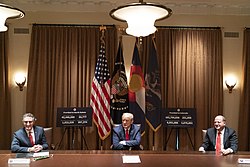 ](https://en.wikipedia.org/wiki/File:President_Trump_Meets_with_the_Governor_of_CO_and_the_Governor_of_ND_%2849897650676%29.jpg)Burgum with President Donald Trump and Jared Polis in May 2020
On December 20, 2022, Sanford resigned, citing a desire to return to the private sector. Burgum appointed businesswoman Tammy Miller as lieutenant governor. She took office on January 2, 2023.[45]
Since taking office, Burgum has presented the Rough Rider Award, North Dakota's highest civilian award, numerous times. Those chosen have included Virgil Hill,[46] Steve D. Scheel,[47] and Clint Hill.[48][49]
In January 2023, Burgum and other North Dakota officials threatened to sue Minnesota over a law that would require the state's electricity to come from sources that do not emit carbon dioxide.[50] Minnesota governor Tim Walz signed the bill on February 7, 2023.[51] In an attempt to mitigate the schoolteacher shortage,[52] Burgum announced the creation of a Teacher Retention and Recruitment task force that would consist of multiple members, Burgum, and the North Dakota Superintendent of Public Instruction.[53] In October 2023, Burgum condemned Hamas and noted that 84 North Dakotans who were on a church tour were stranded in Bethlehem as the fighting began.[54]
On March 20, 2023, Burgum vetoed a bill to raise the state interstate speed limit to 80 mph.[55] During the 2023 legislative session, he signed a bill that exempts members of the North Dakota National Guard and reserve from paying income tax,[56] and another that provided over $500 million in tax relief.[57]
On October 22, 2023, a special session of the North Dakota Legislative Assembly was called after the North Dakota Supreme Court struck down the state's budget as unconstitutional, stating that the general budget did not meet North Dakota's constitution's single-subject requirement for bills. Burgum had to be present in Bismarck to approve the 14 separate budget bills that the legislature seeks to pass to recreate the initial budget. Burgum stating he expected to return to this presidential campaign within a week of the session being called, however, the special session resolved the budget and was closed in just three days.[58][59][60]
On January 22, 2024, Burgum announced that he would not run for a third term as governor.[61] On February 21, he endorsed Lieutenant Governor Tammy Miller to succeed him.[62] Miller lost the primary to U.S. representative Kelly Armstrong, who won the general election.[63][64][65]
2024 presidential campaign
Main article: Doug Burgum 2024 presidential campaign
:{[
In March 2023, Burgum expressed interest in running for president in the 2024 United States presidential election.[66][67] On June 5, 2023, he posted a video to his Twitter X account teasing a "big announcement" for June 7.[68] He formally announced his campaign in The Wall Street Journal the morning of June 7, with the launch of a campaign website and a rally in Fargo scheduled to take place later that day.[69] After his announcement, Burgum began campaigning in Iowa.[70]
Burgum was reported to have spent more money on advertisements than any other presidential candidate.[71] He was endorsed by North Dakota's entire Congressional delegation, U.S. senators John Hoeven and Kevin Cramer and U.S. representative Kelly Armstrong.[72][73] He was also endorsed by actor Josh Duhamel, who also endorsed him in his 2016 campaign.[74][75]
:{Burgum expressed support for the U.S. Supreme Court's Dobbs decision. His support derived from his position that abortion restrictions should be left to states. He pledged that as president he would not sign a national abortion ban and that the president should not focus on culture war issues. According to Politico, Burgum sought to play up his stance as a China hawk by speaking of a cold war with China.[76] On July 10, 2023, he began offering $20 gift cards for a donation of any amount to his primary campaign. A spokesman for Burgum acknowledged that it was an attempt to reach the threshold of individual donors required to participate in the first Republican primary debate.[77]
The promotion was successful.[78] Despite its success, he was ridiculed on social media, with some users declaring that they had donated $1 to Burgum and $20 to Joe Biden's reelection campaign.[79][80] Federal election officials have not said whether this and similar moves by other candidates is illegal.[81] Burgum also qualified for the second debate, held on September 27.[82] He failed to qualify for the November 5 debate in Miami.[83]}:
On December 4, Burgum announced that he was suspending his campaign, citing frustration with the RNC's high threshold of donations and polling to qualify for debates.[84][85][86]
Vice-presidential speculation
During his campaign, Burgum said he would not accept the vice presidency or a cabinet position if he was not nominated for president, so he was widely expected at the time to seek a third term as governor in the 2024 North Dakota gubernatorial election.[87] On January 22, 2024, he announced he would not do so.[88]
Before the Iowa caucuses, Burgum endorsed former president Donald Trump.[89] Afterward, he began campaigning for Trump, who praised Burgum and said he wanted him to be an important member of his next administration.[90] Later, Trump said Burgum would be "very good" as vice president, but reiterated that he had not yet made a decision.[91] Burgum spoke on behalf of Trump at the North Dakota caucuses.[92] Trump ally and U.S. senator Kevin Cramer said Burgum would be a clear front-runner for a cabinet position, most likely secretary of energy.[93] Later during the primary season, Burgum was reportedly high on Trump's VP shortlist,[94] and on May 2, Trump announced that Burgum was one of four remaining contenders, alongside senators Marco Rubio, Tim Scott, and J.D. Vance.[95]
During the Republican National Convention, news broke that Burgum had not been selected as Trump's running mate.[96] According to campaign insiders, Trump was leaning toward Burgum, but his sons Donald Jr. and Eric persuaded him to choose Vance.[97][98][99]
Burgum is the Trump campaign's main advisor on energy policy.[100] Axios reported that the Trump campaign has sent him as a surrogate to campaign events more than anyone else on Trump's shortlist for running mate.[101]
Secretary of the Interior (2025–present)
 Burgum being sworn in on February 1, 2025. sotomayor
Nomination and confirmation
On November 15, 2024, President-elect Donald Trump announced that he intended to nominate Burgum for Secretary of the Interior in the second Trump administration.[102][103][104][105][106] The Department of the Interior oversees public lands, natural resources, and the Bureau of Indian Affairs, among other things.[107] Reportedly, Trump's primary directive to Burgum as interior secretary has been to "drill" at a massive scale.[108]
Trump also named Burgum as his new "energy czar" to handle deregulation and private investments. This position will also give Burgum a seat on the National Security Council.[109][110][111][112]
Burgum's selection was highly praised by numerous Republican senators, including John Barrasso, Dan Sullivan, and Tim Sheehy.[113][114] Many tribal leaders also expressed support for his nomination.[115] It received backlash from environmental groups over Burgum's ties to and plans for the fossil fuel industry, such as his support for the pro-coal Lignite Energy Council.[116]
Before the Energy and Natural Resources Committee, Burgum stated that he viewed America's public lands and waters as part of the country's financial "balance sheet", and advocated for extracting potentially trillions of dollars worth of oil, gas and minerals via mining and drilling. He also stated that he intended to realize Trump's plan for energy independence via "energy dominance" and an expansion of America's fossil fuel production. He also argued that curbs on energy production posed a national security threat as it means the United States has to import fuel from other countries, such as Russia and Iran. He also said "I believe that climate change is a global phenomenon, for sure."[117]
On January 23, 2025, the Senate Energy and Natural Resources Committee approved Burgum's nomination in a 18–2 vote.[a][118][119] On January 30, 2025, Burgum was confirmed by the U.S. Senate in a 79–18 vote.[120]
Tenure
[
On February 1, 2025, Burgum was sworn in as the fifty-fifth United States secretary of the Interior.[121] Burgum's first act was sending a department-wide email calling for reduced regulation and the expansion of natural resource extraction.[122] To this end Burgum signed a suite of orders to speed project development and permitting and to eliminate regulations from the Inflation Reduction Act.[123] Andrea Travnicek, a North Dakotan who worked in Burgum's gubernatorial cabinet and in the Senate Energy and Natural Resources Committee, was nominated by Trump as assistant secretary of the Interior.[124]
Burgum was praised by many tribes for ordering indigenous related programs be exempt from Trump's cutting of government diversity, equity, and inclusion programs.[125]
[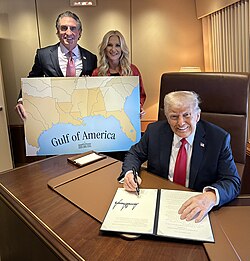 ](https://en.wikipedia.org/wiki/File:President_Trump_signing_a_Proclamation_declaring_February_9th_%22Gulf_of_America_Day%22,_2025.jpg)Burgum onboard Air Force One with President Donald Trump signing a proclamation declaring February 9 "Gulf of America Day," 2025
Burgum was also tapped to lead Trump's efforts to rename the Gulf of Mexico as the "Gulf of America," which included his department contacting mapping companies like Google Maps.[126]
On February 18, 2025, Trump announced that Burgum, as interior secretary, would lead his "National Energy Dominance Council" with secretary of energy Chris Wright as vice-chairman.[127] Shortly after, Burgum was also confirmed as a speaker at the 2025 Conservative Political Action Conference.[128]
Later in March, Burgum suggested that Trump should use emergency authority under a "national energy emergency" to keep as many coal plants open as possible and that "if there had been units at a coal plant that have been shut down, we need to bring those back".[129][130] He also stated that more energy production could be achieved through drilling on federal lands.[131] Burgum later announced the department was partnering with the Department of Housing and Urban Development and its secretary Scott Turner to use public lands to build more affordable housing in the country.[132][133]
In late March, Burgum announced the department would open up 1.53 million acres of the Alaskan Arctic National Wildlife Refuge to oil drilling in accordance with an executive order by President Trump to allow more energy production in the state.[134][135][136]
In April, Burgum ordered a halt to a $5 billion offshore wind project by Equinor off the coast of New York City.[137] This was part of a larger effort by the second Trump administration to stop offshore wind projects.[137]
On April 17, Burgum signed an order that gives control of national parks to DOGE executive Tyler Hassen.[138]
Political positions
Burgum has made critical comments about Joe Biden and his performance as president of the United States on Facebook and in public messages.[139] During his 2016 campaign he described himself as a moderate on social issues and a fiscal conservative.[140]
Energy and environment
Burgum supports the fossil fuel industry, especially in the Bakken region of western North Dakota.[141] He supports the Dakota Access Pipeline.[142] He has said that American energy independence is an issue of national security. He derided what he called a "full-on assault of liquid fuels in this country" and has regularly criticized policies to subsidize electric vehicles. He called for opening Bureau of Land Management land for energy-related activities such as rare earth metal mining and oil and natural gas drilling. He promised to make North Dakota carbon neutral by 2030; he said he would loosen regulations for the gas industry, but also said he is committed to clean energy projects.[143]
Burgum criticized the Biden administration for policies phasing out gas stoves in some forms of new housing.[144]
CO2 pipelines
Burgum has been a vocal supporter of carbon capture pipelines while governor, going so far as to allow three natural gas companies, Summit Carbon Solutions, Navigator CO2 Ventures, and Wolf Carbon Solutions, to use eminent domain to seize land to install pipelines.[145] These pipelines would transport excess carbon dioxide captured from ethanol production plants in Iowa to facilities in North Dakota to store them deep underground. Many rural residents oppose the pipelines due to the fear of leaks as well as the seizure of private land to create them.[146] When confronted about the issue at an Iowa rally, Burgum changed his position, saying he fervently opposed eminent domain, but insisted that carbon capture was good for the economy and the environment and that it would allow the use of traditional internal combustion automobiles indefinitely.[145]
Abortion
During his 2016 gubernatorial campaign, Burgum was noted for saying women were "unsafe" before Roe v. Wade. In 2024, he said his position on abortion had evolved in that he believes abortion laws should be left to the individual states.[147]
In April 2023, Burgum signed a near-total ban on abortion in North Dakota.[148] While campaigning for president, he said that he would not support a nationwide abortion ban, preferring that individual states set abortion policy.[149] He supported the Supreme Court decision Dobbs v. Jackson Women's Health Organization that overturned Roe v. Wade.[150][151]
Gun rights
Burgum received an A grade on gun issues from the NRA Political Victory Fund and signed numerous laws that ease access to firearms.[152][153] He has touted his love of hunting.[154]
Mental health
In an interview with ABC News, Burgum's wife, Kathryn, opened up about her history of being suicidal and an alcoholic and said that, if she became First Lady, her top priority would be to find a solution to the "behavior health crisis", to end the stigmatization of mental illness, and to rework mental health insurance.[155] Shortly afterward, at an event in New Hampshire, Burgum said he believed addiction was the root of most of America's problems, including crime, homelessness, and mental health. He said that if elected president he would overhaul the reimbursement systems for mental health care and would find a place for the private sector to get involved in funding solutions for substance use disorders. As governor, Burgum shifted some of North Dakota's prisons to look more like mental health institutions, a policy he said he would attempt to emulate at the federal level.[156]
National security
Burgum deployed the North Dakota National Guard to the southern border with Mexico numerous times to assist Texas.[157] In April 2022, he and 25 other governors created the American Governors' Border Strike Force to help one another with border defense against illegal immigration and human trafficking.[158] He argued that energy independence is key to fending off China and Russia.[159]
During the 2024 Republican debate in Milwaukee, Burgum expressed concern about China, claiming it is America's "number one threat" and that the U.S. should put "anti-warship missiles in Taiwan."[160] During campaign stops, Burgum expressed disdain for President Biden's handling of foreign aid to Ukraine and his hostage deals with Iran.[161] He blamed Iran for the October 7 Hamas-led attack on Israel, and said Iran was emboldened by Biden's release of $6 billion of previously frozen Iranian assets.[162]
Cybersecurity
In 2019, Burgum signed legislation to develop a central cybersecurity operations center for the state's network of over 250,000 users and 400 state and local government entities under the Executive Branch's IT Department-North Dakota Information Technology (NDIT).[163][164] At his direction, NDIT began a Multi-State Security Operations Center to facilitate threat intelligence sharing and coordinate cybersecurity operations between member states.[165] In 2023, he signed House Bill 1398, requiring cybersecurity education for all K-12 Students, making North Dakota the first state to have a cybersecurity education requirement for its students.[166]
LGBTQ rights
In July 2020, Burgum called the 2020 Republican platform "divisive and divisional" on LGBTQ issues.[167] He signed numerous veto-proof bills sent by the North Dakota Legislative Assembly during its 2023 session that some have called "anti-trans", including a near-total ban on gender-affirming care for minors.[168][169][170][171]
Education
On November 12, 2021, Burgum signed a law banning the teaching of critical race theory in North Dakota K-12 schools.[172] During the first Republican primary debate in Milwaukee, he spoke of his belief that federal regulations are unhelpful to schools and that red-tape regulations harm teacher innovations.[173]
Entitlements
Burgum supports preserving existing entitlement programs, saying they should be federally protected. He also supports improving federal efficiency to free up more money for entitlement. In 2021 he signed a bill into law that exempted Social Security from North Dakota's state income tax.[154]
Personal life
Burgum married his first wife, Karen Stoker, in 1991. They had three children before divorcing in 2003.[174] In 2016, Burgum married Kathryn Helgaas.[175][174] As first lady of North Dakota, Kathryn Burgum champions the Recovery Reinvented program on addiction and recovery.[176]
While campaigning for president in 2024, Burgum said in an interview that he likes the music of Keith Urban and enjoys watching the television shows Yellowstone and Ted Lasso.[177]
Board work
Burgum served on the advisory board for the Stanford Graduate School of Business[17] and was on the board of SuccessFactors during the 2000s, serving as chair from 2007 until the 2011 sale of the company to SAP. In 2012 he became the first chairman of the board for Atlassian, after it expanded from its initial board of three members (none of whom served as chair).[178] During 2011 and 2014, he twice spent several months as the interim CEO of Intelligent InSites,[17] a company for which he has served as the executive board chair since 2008.[24] In the same year he became a member of Avalara's board of directors.[179]
Philanthropy
In 2001,[180] Burgum donated a refurbished school building he had acquired in 2000 to North Dakota State University. It was named Renaissance Hall and became home to the university's visual arts department, major components of the architecture and landscape architecture department, and the Tri-College University office.[181] In 2008, Burgum started the Doug Burgum Family Fund, which focuses its charitable giving on youth, education, and health.[17] In 2011, the Burgum family donated about $800,000 to the Plains Art Museum in Fargo to support its Center for Creativity, which is named in honor of Burgum's mother, Katherine Kilbourne Burgum.[182][183]
Awards and honors
Burgum received honorary doctorates from North Dakota State University[19] in 2000 and the University of Mary in 2006.[17]
In 2009, Burgum received the Theodore Roosevelt Roughrider Award from Governor John Hoeven.[184]
Electoral history
---
Green With Envy? A Conservation Group Has 10 Ideas For U.S. Interior Dept.
News Radio 1200 WOAI - iHeart
"I don't know how politically viable they are, but everything they suggested seems really on track with a good conservation policy" said Marc Morano ...
https://woai.iheart.com/featured/san-antonios-first-news/content/2025-04-14-green-with-envy-a-conservation-group-has-10-ideas-for-us-interior-dept/
San Antonio's First News
Green With Envy? A Conservation Group Has 10 Ideas For U.S. Interior Dept.
By B.D. Hobbs
Apr 16, 2025
In addition to all of the great work and cuts being made in Washington D.C. by 'DOGE', a leading Montana based conservation group is hoping to streamline the U.S. Department of Interior.
It's the Property and Environment Research Center (PERC), a nonpartisan leader in "market solutions" for conservation, and they have come up with 10 ideas to make it happen.
"I don't know how politically viable they are, but everything they suggested seems really on track with a good conservation policy" said Marc Morano with the Climate Depot, "It's not so much spending, it's the regulatory process. Definitely, you want to deregulate and streamline all of that. This is a heavy regulatory agency historically."
Basically, the group wants to cut a lot of the 'green tape', not the 'red tape'.
"The main thing they're talking about is just to streamline the agency to make it more efficient and work with local communities" Morano told KTRH, "They're just looking at it from a sort of a 'think tank' perspective, and seeing a more efficient way to run things. And they're probably right."
Former North Dakota Governor, Doug Burgum is the new U.S. Secretary for the Department of the Interior.
vid] 2 13
U.S. Interior Secretary Doug Burgum argues that President Donald Trump will get American energy ‘rolling’ again during an appearance on ‘America’s Newsroom.’ save 1 trillion; cut 27? SD; trump waNT roi ON PUBLIC LAND; ENERGY COSTS; BIDEN INFL BC SPENdING $ OUT DR; OFFSHORE BAN = LOWER 48; PEAK INAUG 5 AM NO WIND/SOLAR,
---
2 25 heated email
At a dinner for Big Oil executives last year, Donald Trump promised to give the fossil fuel industry essentially anything it wanted in exchange for $1 billion toward his re-election effort. The dinner was organized by Harold Hamm.
The fossil fuel industry went on to donate $96 million directly to Trump’s campaign; spend $80 million on political advertising; and pour God-knows-how-much cash into dark money groups that don’t have to reveal their donors. Most of the fundraisers were organized by Harold Hamm.
After the election, Trump quickly nominated North Dakota Governor Doug Burgum to lead the Department of Interior, which oversees fossil fuel and renewable development on federal lands and waters. Burgum is close personal friends with Harold Hamm.
Trump went on to nominate fracking executive and climate denier Chris Wright to lead the Department of Energy, which oversees energy policy and research. Wright was hand-selected for the position by Harold Hamm.
While most national media has be understandably fixated on Elon Musk’s takeover of the federal bureaucracy, another billionaire’s influence on the Trump administration has slid by largely unnoticed. Hamm, the founder and executive chairman of fracking company Continental Resources, has been instrumental in driving Trump’s full-speed campaign to deregulate the fossil fuel industry and crush its main competition: renewables.
HEATED is 100 percent reader-supported, independent climate journalism. To receive new posts and support my work, consider becoming a free or paid subscriber today.
Long-deemed Trump’s “energy whisperer,” Hamm enjoys a close personal relationship with the president. “He’s my original oil guy that taught me so much about oil,” Trump said at a fundraiser last year. The fracking tycoon had dinner with Trump during his New York hush money trial, and offered to help pay Trump’s $454 million bond during his civil fraud case. Hamm also partied with Trump on election night, and toasted with soon-to-be-Interior-Secretary Burgum—who happens to make about $50,000 a year leasing 200 acres of farm land to Hamm’s fracking company.
|
Donald Trump points to Continental Resources CEO Harold Hamm on Wednesday, Oct. 23, 2019, in Pittsburgh. (AP Photo/Evan Vucci, File)
Now, just weeks into the new administration, Hamm is watching as his personal wish-list is fulfilled. In May, a Trump advisor told the New York Times that Hamm “wants that LNG pause gone, he wants the California waiver and the tailpipe rule gone.” On his first day in office, Trump signed an executive order that targeted all three of those things.¹
In addition, in August, the Washington Post reported that Hamm’s policy priorities for a Trump administration would include “opening up more federal lands to drilling, easing the Endangered Species Act and curbing numerous regulations at the Environmental Protection Agency.” Coincidentally, on his first day in office, Trump’s signed another executive order that targeted all those things, too.²
Hamm also encouraged other oil executives to share their policy priorities with Trump, the Post reported, and they did. Since then, Hamm’s hand-picked Cabinet leaders have issued a slew of Big Oil-approved policies designed primarily to boost fossil fuel industry profits and destroy competition from renewables. They include:
- The Interior Department suspended all clean energy development on federal land, while continuing development for oil and gas. (Heatmap, Jan. 24)
- The Energy Department abruptly stopped paying out grants from its climate and clean energy programs, halting billions of dollars in funding for states and companies to protect the environment and advance renewables. (E&E, Feb. 7)
- Burgum, on his first day as Interior Secretary, issued a seven-page directive weakening protections for national monuments, migratory birds, endangered and threatened species in order to further fossil fuel development. (Inside Climate, Feb. 5)
- Burgum also issued an order reversing the Biden administration’s protection of most of the U.S. coastline and parts of Alaska from oil drilling. (E&E, Feb. 4)
- Wright said the Department of Energy has started re-started the permit consideration process for new liquified methane gas facilities. The process had previously been paused so the government could consider whether the projects were in the best interest of the climate. (Oil and Gas Journal, Feb. 7)
I point out Hamm’s influence in these areas for three reasons. The first is that it’s a necessary, yet often overlooked, way to expose Trump’s lies about his energy agenda. The president and his supporters love to frame Trump’s pro-fossil fuel policies as some sort of benevolent act for ordinary Americans—simply a means to lower inflation. But aside from the fact that that argument doesn’t actually make sense, it’s a distraction from the bigger picture. The primary goal of Trump’s energy policies is to drive profits for Hamm and the other oil billionaires who donated lavishly to his campaign. Let’s keep our eye on the oligarchical ball.
The second is to encourage other media outlets and creators to remember that Musk isn’t the only billionaire whose self-serving actions may have devastating consequences for the rest of us. Dismantling renewable energy development and climate regulation doesn’t just pose a threat to the United States. It poses an existential threat to the ecological and economic stability of the world.This deserves equally frequent and urgent coverage, if not more.
The third is simply to remind everyone that the people destroying the planet have names and faces. Hamm has said he does not want a job for himself in the administration, and enjoys his current set-up, in which Trump “calls on me for advice and help.” This is a clear indication he’d prefer to remain in the shadows. That alone feels worth bringing his influence to light.
Some spare thoughts:
- Hamm is not the only oil billionaire with influence over Trump, he just appears to be the closest. You can read about some of the others here.
- During his Senate confirmation hearing to lead the Department of Energy, Wright said he still stands by previous comments that ‘wildfires are just hype.’
- Seven Democrats in the Senatevoted in favor of confirming Wright to lead the Department of Energy, despite Wright’s outspoken climate science denial. They are: Maggie Hassan, Jeanne Shaheen, John Hickenlooper, Michael Bennett, Ben Ray Luján, Martin Heinrich, and Ruben Gallego.
- Wright tried to walk back his climate denial during his confirmation hearing, saying he thinks climate change is real but that global energy poverty is a more urgent issue. This is an incredibly tired and well-debunkedtalking point. The two problems are not mutually exclusive.
- Wright’s oil services company, Liberty Energy, is public. I don’t know what can be done with that information, but it felt like something worth pointing out.
---
---
desmog
doug Burgum, one of President Donald Trump’s cabinet nominees, held a dinner for fossil fuel CEOs at a private event during the Williston Basin Petroleum Conference, held in Bismarck, ND, from May 14 to 16, 2024, emails obtained by the research group Fieldnotes and shared with DeSmog show.
During his Secretary of the Interior Senate confirmation hearing on January 16 before the Committee on Natural Resources, Burgum’s favorable stance towards fossil fuel energy and his skepticism about renewable energy was on display – with the former North Dakota governor suggesting that renewable energy storage wasn’t quite ready for game time, while also talking up the potential for “clean coal.”
That’s disconnected from the current state of the U.S. electrical grid, where over 13,700 megawatts of energy storage like batteries, often paired with wind or solar, were already deployed by the end of last year. Meanwhile, the only commercial coal power plant to use carbon capture, Petro Nova, can supply up to about 240 megawatts when it’s up and running, but the carbon capture project spent much of the past half-decade offline.
But Burgum is no stranger to advocates for carbon capture. At his May 2024 dinner, the then-North Dakota governor was seated with Harold Hamm, the oil tycoon and CEO of Continental Resources, and Liberty Energy’s Chris Wright — nowTrump’s nominee to lead the Department of Energy. Todd Slawson, chair of the North Dakota Petroleum Council, and Danny Brown, CEO of Chord Energy, one of the Bakken shale’s largest oil producers, were also assigned seats near Burgum.
Loren Kopseng, one of the men behindRainbow Energy, – a North Dakota company with big “clean coal” plans – was a last-minute addition to Burgum’s table, the documents show.
Reviving ‘Clean Coal’ Claims
“We have an opportunity to decarbonize, produce clean coal, and with that produce reliable baseload [electrical power] for this country,” Burgum testified at his Senate confirmation hearing.
Burgum’s mention of “clean coal” was striking in part because Trump himselfseems to have moved on from talking about coal — any kind of coal. The heavily polluting fossil fuel’s use has slumped dramatically over the past decade and a half, sinking to less than 15 percent of America’s power supply in thefirst 10 months of 2024 (a smaller share than either renewable energy or nuclear power).
Burgum’s repeated “clean coal” references drew immediate fire from energy watchdogs, who say there’s a good reason the term has fallen out of favor.
“Industry has been talking about ‘clean coal’ for more than a quarter century with no action — because the technology is insanely expensive and it doesn’t work,” Tyson Slocum, director of Public Citizen’s Energy Program, said in a statement in response to Burgum’s testimony. “Make no mistake: When Burgum talks about ‘clean coal,’ he’s really pushing to revive dirty, old, expensive, and climate-destroying coal power plants to power AI.”
Burgum did not respond to a request for comment.
During his testimony, Burgum, whomade his fortune in part from running tech companies, alleged that the nation faces a “shortage of electricity” driven by what he called “the AI arms race.”
He also has a history ofrubbing shoulders with coal execs — including, for example, top executives from the owners of North Dakota’s largest coal-fired power plant, Rainbow Energy’s Coal Creek Station. The roughly 45-year-old plant, which had beenunprofitable for years, wasexpected to be shut down by the end of 2022 — before the privately owned Rainbow stepped in. Rainbow has big plans to build data centers at its coal power plant and has called carbon capture “vital” to its plans for the coal plant (vital, at least, for Rainbow’s funders).
Dining at the Governor’s Residence
On May 15, while attendees at the Williston Basin Petroleum Conference were at anetworking social, Burgum and a few dozen others on aVIP List headed tothe Governor’s Residence — a multimillion-dollar home built with a mix ofpublic and private funding — for the dinner. Burgum was slated to offer “host remarks,” and then Hamm, Wright, and others were to offer comments to the full group, according to anagenda circulated with the invitation, obtained by Fieldnotes via an open records request
The small handful of fossil fuel executives joined Burgum at the head table of the May 2024 dinner, where the menuincluded walleye fish cakes, a beef entree, and peach cobbler “with vanilla bean ice cream and bourbon caramel,” plus wine and beersupplied by Ron Ness, the president of the North Dakota Petroleum Council (NDPC), according to emails Fieldnotes also obtained.
Contacted for comment, Kopseng told DeSmog he was on a private jet, a Cessna Citation CJ4, and referred questions to Stacy Tschider, Rainbow’s CEO.
“Doug Burgum has been a strong advocate for innovation in energy and carbon capture technologies, recognizing their potential for supporting economic growth and reducing emissions,” Tschider told DeSmog in an email. “Rainbow Energy remains committed to advancing projects like the work at Coal Creek Station to incorporate carbon capture as part of a broader strategy to transition to cleaner energy solutions. However, it’s too early to speculate on how Burgum’s appointment might specifically affect Rainbow or other coal projects.”
“We remain confident in the potential of emerging carbon capture technologies, which are grounded in extensive research and real-world testing,” Tschider added. “While challenges exist, Rainbow is working with industry leaders and researchers to ensure these technologies are scalable and effective. Our approach is guided by science and a commitment to balancing energy reliability with environmental responsibility.”
Crypto, Coal, and Carbon Capture
With Coal Creek Station’s long-time customers shifting away from fossil fuels, Rainbowhas moved to put its coal plant to use, at least in part, by powering data centers, which can be used for artificial intelligence, cloud computing, or mining cryptocurrency. Asked about cryptocurrency, a Rainbow executivetold The Washington Post in 2022 that he “wouldn’t identify it as bitcoin,” but acknowledged plans to add data centers at Coal Creek.
The company has drawnover $42 million in federal funding to study adding carbon storage to Coal Creek. Rainbow Energysays its Coal Creek project would be “the largest post-combustion CCUS project in the world,” referring to carbon capture and utilization storage. The Department of Energy, which is funding the research under the Biden administration’s Bipartisan Infrastructure Law, expects studying and permit preparation to continue through 2027.
The Coal Creek Station was the 25th largest source of greenhouse gas pollution in the U.S.,data from the U.S. Environmental Protection Agency for 2023, the most recent available year, shows. Based on permits sought by Rainbow Creek, the Bismark Tribunenoted in May that the company is looking tobuild a data center near the plant.
Carbon capture for Coal Creek Station’s coal operations remains on the drawing board. Afederal grant has begun partially funding plans for potential carbon storage at the power plant — but the grant is aimed at “investigating the feasibility” of storing captured carbon at Coal Creek Station, according to aSeptember 2024fact sheet, and that work is expected to continuethrough September 2026. Historically, coal plants havestruggled to retrofit for carbon capture — and Rainbow has facedcriticism for being vague about how it plans to actually capture the carbon it plans to sequester.
Even before the Infrastructure law grant was announced, Burgumtouted the project as “a model of clean baseload power for the world,” adding that he was “deeply grateful to Loren Kopseng” and others associated with the buy-out.
The VIP dinner was far from the only time Burgum connected with Rainbow’s executives. “Great to have a productive discussion with the CEOs of MinnKota, Basin, and Rainbow Energy to discuss concerns about federal overreach and its impact on our state’s energy sectors,” hetweeted in March 2024. “North Dakota is fully committed to protecting our baseload power from unlawful regulations.”
During his confirmation hearing with the Senate Energy and Natural Resources Committee, Burgum seemed to use the word “baseload” as a stand-in for coal or other fossil fuels, to the point where he drew pushback from one member of the committee. “I don’t want the word ‘baseload’ to be code for no renewables,” Sen. Angus King, an Independent from Maine, told Burgum.
Burning coal for electrical power in the U.S. peaked the year before the financial crisis of 2008, according to the U.S. Energy Information Administration, a time when Trump himself was airing the sixth season of “The Apprentice.” Coal use in the U.S. has plunged from over a billion short tons in 2007 to just 387 million in 2023 — with more than one-third of the fuel’s decline occurring during Trump’s first term.
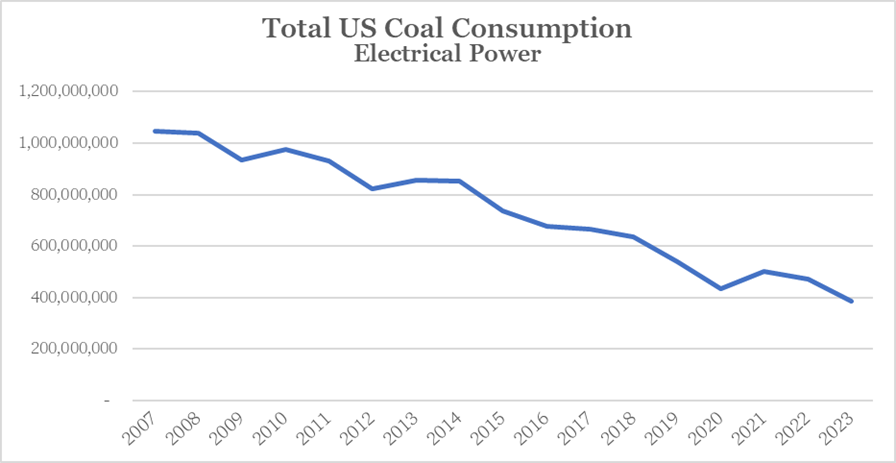 *Data on U.S. coal consumption for electrical power in short tons from theU.S. Energy Information Administration. Credit: DeSmog.
During his time as North Dakota’s governor, Burgum activelyfought to prevent Coal Creek Station from closing.
Coal Creek burns a form of coal called lignite — and while North Dakota is hardly known as a coal state, it is home to two lignite coal mines that produced over 4 million short tons of coal apiece in 2023 (making them “major” U.S. mines by federal standards).
“Governor Doug Burgum has been a staunch supporter of North Dakota’s coal industry and has worked tirelessly to secure and foster jobs for the more than 12,000 North Dakotans that rely on the industry,” the Lignite Energy Council said in astatement endorsing Burgum’s run against Trump in the Republican presidential primary in 2023.
In addition to Rainbow Energy’s plans, Burgum has alsosupported Project Tundra, a plan to retrofit North Dakota’s Milton R. Young coal-fired power plant with carbon capture. Project Tundra hit a major setback in December, when TC Energy, the project’s lead contractor, departed without offering a public explanation,according to Inside Climate News.
Rainbow officials have previously acknowledged that carbon capture can be costly. “Another question we always get is, who runs towards fossil fuels?” Tschider, Rainbow’s CEO, said as he presented at the Williston Basin Petroleum Council conference on May 14, 2024, the day before Burgum’s VIP dinner. “We do.”
“Nobody’s talking about building a coal plant. Nobody,” Tschider added. “Any coal plant that is built has to have carbon capture on it, and that can be very, very, very expensive.”
But despite those concerns, Burgum nonetheless talked up the potential for carbon capture at his Interior secretary nomination hearing. “We know that we have the technology to deliver clean coal,” hetold the Senate Energy and Natural Resources Committee.
“It’s reckless for someone who is seeking a cabinet position to throw around fictional solutions to a very real problem,”said Sierra Club legislative director Melinda Pierce in a statement.
“We urge Doug Burgum to move on from his ‘clean coal’ fairytales and get serious about the problems that our communities are facing by helping our nation responsibly transition to clean energy.”
-----
tools lil sis
mapping-the-billionaire-winners-of-the-2024-election
December 12, 2024
Author(s): Derek Seidman
Issues: Billionaires, Money in Politics
This is the first in a new series of LittleSis posts mapping out billionaire power in current U.S. politics, including the new Trump administration. To see the latest posts in this LittleSis series, sign up for our newsletter and follow us onX,Bluesky,Facebook, and[Instagram
no charts
It’s nothing new that, in 2024, billionaires once again plowed massive amounts of cash into the presidential and congressional elections. Dozens upon dozens of billionaires backed Trump and Harris with huge donations. According to one study, billionaire families spent a mind-boggling $2 billionon the recents elections.
That said, the sheer amount of cash flowing from just a tiny handful of billionaire donors — with $994 million from the top ten contributors alone, measured beforefinal-quarter contributions of 2024 were even disclosed — is astronomical. Moreover, the crassness of Trump’s open embrace of the ultra-wealthy feels shocking even by the standards of U.S. billionaire rule. Trump’s transition is refusing to disclose donors, and Trump’s authoritarian style and total disdain for any ethics around conflicts of interests, will give billionaires even more unchecked power.
The extent of directbillionaire influence within the administration is seen in the very make-up of Trump’s transition team and top appointees, whose ranks include multiple billionaires. Two of those billionaires — Linda McMahon and Howard Lutnick — are co-chairing Trump’s transition team, and thus overseeing the set-up of his incoming administration. Trump has further nominated McMahon for Education secretary and Lutnick for Commerce Secretary. Meanwhile, billionaire Scott Bessent is set to become Treasury Secretary, meaning two billionaires — Lutnick and Bessant — will occupy core positions overseeing financial and economic policy.
Trump has also appointed two billionaires, Vivek Ramaswamy and Elon Musk, as co-chairs of the new Department of Government Efficiency, which is tasked with advising the administration on government cuts and austerity. Musk, of course, is the wealthiest person alive, and Musk, Lutnick, and McMahon are known to be especially close with Trump.
All told, according to a November 2024 Americans for Tax Fairness report, “the combined wealth of President-elect Trump’s wealthiest nominees and transition team officials,” amounts to $313 billion — and this number has since climbed well over $400 billion with Elon Musk’s net worth skyrocketing. As former labor secretary Robert Reich has said, Trump’s regime “will be a billionaires’ ball.”
This post looks at some of the billionaires and billionaire groups — Wall Street elites to crypto tycoons, fossil fuel barons to Elon Musk — that are set to benefit from the incoming Trump administration.
*Wall Street Billionaires
A host of powerful Wall Street billionaires lined up behind Trump as major donors and fundraisers toward his reelection and as donors to his GOP allies.
These Wall Street billionaires, concentrated in private equity and hedge funds, included Stephen Schwarzman of Blackstone (worth $53.8 billion), Ken Griffin of Citadel (worth$47 billion), Paul Singer of Elliott Management (worth $6.2 billion), John Paulson of Paulson & Co. (worth $3.8 billion), and Nelson Peltz of Trian Partners (worth $1.7 billion).
Two Wall Street billionaires — Howard Lutnick and Scott Bessant — are also set to become Commerce Secretary and Treasury Secretary, respectively. Other financial billionaires, like JPMorgan CEO Jamie Dimon, have reportedly been serving as a “sounding board” for Trump.
All told, according to Sludge, “[d]onors from the securities and investment industry contributed a total of $193.8 million to the Trump campaign and outside spending groups supporting him, more than any other industry,” as of September 22, 2024.
Wall Street’s support for Trump has not been entirely smooth. Some billionaires like Schwarzman, Peltz, Griffin and others had previously disavowed Trump, especially after the January 6, 2021 capitol insurrection, before crawling back.
Moreover, there are tensions between Wall Street and Trump over issues like tariffs (which Wall Street opposes) and mass deportations (which Wall Street also opposes, but for purely economic reasons, not any humanitarian grounds). Overall, the financial industry is not a fan of the volatility and unpredictability that can come with a Trump regime.
But all this is rivalled — and indeed, for most Wall Street barons, outweighed — by the enormous potential to enrich themselves under Trump.
Trump has promised to reduce the corporate tax rate and to weaken regulatory bodies like the Securities and Exchange Commission (SEC) and Consumer Financial Protection Bureau (CFPB), and Wall Street is salivating over a potential mergers and acquisitions boom under Trump.
There’s also the potential for Wall Street to cash in on the privatization of public assets. For example, Trump backers John Paulson and Bill Ackman are big investors in the federal government’s housing finance companies, Freddie Mac and Fannie Mae, which, theNew York Times reports, could be privatized under Trump and deliver huge windfalls to investors.
One private equity executive, commenting before the election, summed up Wall Street’s perspective on Trump: “We’ll get richer if he wins.”
To be sure, many Wall Street barons, from Michael Bloomberg to Jonathan Gray, backed Kamala Harris. But they will not be hurting under the new Trump administration (Gray, in fact, is President and Chief Operating Officer of Blackstone, where he’s second-in-line to the Trump-backing Schwarzman).
*Crypto Billionaires
The 2024 election cycle signaled the clear emergence of the crypto elite as a major political player. Prominent crypto billionaires — such as Cameron and Tyler Winklevoss (worth $2.7 billion each), Coinbase’s Brian Armstrong (worth $13.7 billion), investor Marc Andreessen (worth $1.9 billion), Ripple Labs’ Brad Garlinghouse, and others — plowed millions towards pro-crypto PACs while crypto billionaires donated and fundraised for Trump.
All told, a triad of crypto-led PACs — Fairshake, Project Progress, and Defend American Jobs — spent more than $265.5 million dollars during the 2024 election cycle, according to the Lever,who declared that “the cryptocurrency industry is perhaps the biggest winner of the 2024 election cycle.”
The crypto industry has been volatile and faced fines, with growing calls, including from the Biden administration, for stronger regulation. Many crypto billionaires backed Trump, who courted the industry and said he’d be the first “crypto president,” betting that he’d stem these regulatory calls and also replace current SEC head Gary Gensler.
It appears the Trump-backing crypto barons will now get their wish, with top Trump cabinet appointees and power players who are very friendly to the industry. Howard Lutnick, the billionaire Trump ally who Trump nominated as Commerce Secretary, is deeply pro-crypto and personally tied to the industry. Trump also tapped pro-crypto billionaire Scott Bessent as Treasury Secretary, who one crypto executive called the “perfect pick” who will be “most pro-innovation, pro-crypto Treasury [secretary] we’ve ever seen.”
Many crypto leaders want the Commodity Futures Trading Commission (CFTC), rather than the more powerful SEC, to supervise the industry, and Trump has signaled support for this. Trump has also nominated the crypto-allied Paul Atkins to head the SEC, fulfilling the crypto billionaire bloc’s wish to ditch Gary Gensler, who it sees as an ardent foe.
The denizens of Trump World are adamantly pro-crypto, with numerous figures — JD Vance, Howard Lutnick, Elon Musk, Robert Kennedy Jr., Pete Hegseth, Tulsi Gabbard, and others — tied to or invested in the industry. Trump’s own media company, Trump Media and Technology Group, which operates Truth Social, and which Trump has a 53% stake in that he says he’ll retain, is in talks to buy Bakkt, a cryptocurrency trading venue, while the Trump family has a newly-created crypto project called World Liberty Financial. The former CEO of Bakkt is Kelly Loeffler, who Trump has nominated to head the Small Business Administration, and Loeffler’s husband still runs Bakkt’s parent company.
Crypto saw a major downturn in 2022, and one of its shining stars, Sam Bankman-Fried, was arrested on fraud charges and subsequently found guilty and sentenced to 25 years in prison. But the industry’s started to bounce back, with Bitcoin hitting record highs and surging more after Trump’s victory. The industry and its billionaires have also attained cultural cachet in the Trumpian conservative universe as edgy, rule-breaking, and futuristic.
Another tech and crypto billionaire investor, David Sacks, publicly flipped toward supporting Trump during the election and helped line up Silicon Valley donors behind him with a fundraiser Sacks’ personally hosted. Now, Trump has named Sacks his artificial intelligence and cryptocurrency czar.
All told, crypto’s massive backing of Trump is reaping major rewards for industry billionaires, who will have pro-crypto regulators and close access to the administration, and who are set to see their wealth bloom even higher.
The rise of an aggressive, anti-regulatory pro-Trump donor bloc deeply overlaps with a split in Silicon Valley that turned some tech billionaires toward Trump. The Guardianestimates that the tech industry spent at least $394.1 million on the election, with the bulk of that coming from Elon Musk.
Tech’s Trump backers are already getting one top demand from their wishlist: Trump is replacing Federal Trade Commission chair Lina Khan, a tough regulator of AI and corporate mergers, with a more industry-friendly chair.
But to be sure, Kamala Harris and the Democrats had their own massive bench of Silicon Valley billionaire donors, including Reid Hoffman, Eric Schmidt, Bill Gates, Sheryl Sandberg, Ben Horwitz, and Laurene Powell Jobs. And while they wanted Harris to win, as Hoffman made clear in a somewhat conciliatory post-election Financial Times op-ed, his ilk will try to find a way to do just fine under a Trump administration.
*Elon Musk
Among Trump’s billionaire backers, Elon Musk is in a class of his own. Musk is worth over $433 billion. He is, by far, the world’s richest person. He owns and runs a constellation of influential, omnipresent corporations, including X (formerly Twitter), Tesla, and SpaceX. Few people in the world are more famous — or more powerful and wealthy — than Elon Musk.
When Musk endorsed Trump and threw himself into Trump’s election, it represented more than a mere endorsement. Musk is fusing the vast business operation, influence machine, and popular following that runs through him with the MAGA movement and Trump himself. Through this, he stands to benefit financially, but also attain higher heights of influence for his reactionary conspiracy-peddling and hyper-libertarian ideology. In short, Musk is fomenting true oligarchic power.
Musk spent at least $264 million to reelect Trump, according to investigative news outlet Sludge. He plowed the money into his very own America PAC, which focused on new voter turnout for Trump in swing states. Musk oversaw the PAC’s day-to-day operations. He even offered a $1 million daily giveaway to voters (for this, he’s being sued for fraud) and workers for America PAC have complained of horrible treatment.
Musk has now emerged as a close confidant of Trump and his family. And with Trump’s reelection, Musk stands to benefit as much as anyone. Since Trump was elected, Musk’s net worth has skyrocketed by around $130 billion.
There are several ways that Musk stands to benefit from the Trump administration. Musk oversees a truly massive business empire of electric vehicles, space satellites and space rockets, social media, artificial intelligence, and more. All these business interests are deeply impacted by government regulations and government contracts.
Though Musk pushes a hard libertarian ideology, he benefits from vast government subsidies. “Mr. Musk’s rocket company, SpaceX, effectively dictates NASA’s rocket launch schedule,” notes the New York Times. “The Defense Department relies on him to get most of its satellites to orbit. His companies were promised $3 billion across nearly 100 different contracts last year with 17 federal agencies.”
The New York Timesalso notes Musk’s “numerous and adversarial” entanglements with federal regulators. “His companies have been targeted in at least 20 recent investigations or reviews, including over the safety of his Tesla cars and the environmental damage caused by his rockets,” they write.
As the premier Trump insider, Musk will now have direct influence within, and allies overseeing, the government agencies — from the Securities and Exchange Commission (SEC) and the Federal Communications Commission (FCC) to Office of Management and Budget (OMB) and the Consumer Financial Protection Bureau (CFPB, which Musk wants to “delete”) — that carry out regulation, oversee investigations, and reward government contracts.
All this, of course, poses enormous conflicts of interest, with Musk openly influencing the very government entities that impact his own business operations and wealth.
Musk’s influence and cultural cachet also stand to grow further. His social media platform, X, which Musk dominates as a user and content shaper, will likely deepen as basic communications and media infrastructure for the MAGA movement.
Moreover, Trump has appointed Musk to head up the new Department of Government Efficiency (DOGE) with billionaire Vivek Ramaswamy. It’s an advisory body, not an official government agency, and it remains to be seen how much power and influence DOGE will actually have. It could be a lever for implementing hyper-austerity, or it could be a plaything for two libertarian billionaire bros. But the precedent of awarding a huge donor, and the world’s wealthiest person, with their own “department,” is ominous.
It’s worth noting that while Musk also has discrete interests tied to specific companies, his vast business empire gives him a larger, generalized power and set of interests located at the very heart of U.S. capitalism and its future. Space technology, electric vehicles, AI, social media: this is all at the center of research and development and hardening geopolitical rivalries. Like Amazon and Jeff Bezos, Musk business operations dominate, and are even synonymous with, the very infrastructure that billions of people and governments worldwide depend on.
*Fossil Fuel Billionaires
Trump rode to reelection promising to “drill, baby drill” and achieve U.S. “energy dominance” in the world. He sought $1 billion from the fossil fuel industry in exchange for advancing its interests. While the $1 billion mark fell short, Trump was strongly backed by oil and gas billionaires, and the fossil fuel industry will benefit from an ultra-friendly administration.
The industry gave more than $75 million to Trump and his allies in 2024, with $15 million of this coming from three oil billionaires who own private companies: Harold Hamm (Continental Resources), Kelcy Warren (Energy Transfer) and Jeffery Hildebrand (Hilcorp Energy).
Other billionaire fossil fuel donors included George Bishop of GeoSouthern Energy and coal magnate Joseph Craft III, as well as fossil fuel-tied “mine operators, shipbuilders, engineering firms, hedge funds and little-known oil producers,” said theNew York Times.
Trump has promised to ramp up fossil fuel production in the U.S., reapprove the Keystone XL oil pipeline, pull the U.S. out of the Paris Agreement, reauthorize oil drilling in Alaska’s Arctic National Wildlife Refuge in Alaska, and weaken EPA regulations, among other things.
Trump has signaled his clear intention to follow through with these promises by making industry-friendly appointments tied to top energy and environment positions. These include fracking executive (and drinker of fracking fluid) Chris Wright as Energy Secretary, Lee Zeldin as Environmental Protection Agency head, and Doug Burgum as Interior Secretary.
Wright is a fossil fuel zealot who, as Energy Secretary, will run the department with huge influence over U.S. energy, environmental and nuclear policies. The American Petroleum Institute, the industry group for Big Oil, praised the appointment of Wright and congratulated Trump on his victory.
Lee Zeldin is a Chair of America First Policy Institute (AFPI), a policy group backed by Christian Nationalist oil baron Tim Dunn, a major Trump donor who has publicly stated he wants to end the classification of CO2 as a pollutant.
But Doug Burgum, who served as governor of the fracking powerhouse state of North Dakota and has deep ties to the fossil fuel industry, stands to be the major player directing Trump’s energy policy. As Interior Secretary, he’ll oversee hundreds of millions of acres of federal land that oil companies are itching to drill on. But even more, he’ll be coordinating the administration’s “energy dominance” agenda as Trump’s “energy czar,” heading up Trump’s National Energy Council and occupying a seat on the National Security Council.
All told, oil billionaires like Hamm stand to benefit greatly from a new Trump administration that promises to be a close ally of fossil fuel interests, even if this means intensifying the climate chaos that’s destabilizing the world and causing massive human dislocation and suffering.
*Potential Fractures in Billionaire Rule?
There are other billionaire and corporate blocs set to benefit from Trump’s rule, such as private prison and detention companies like CoreCivic and GEO (who Trump Attorney General nominee Pam Biondi lobbied for). And there are a slew of massive individual billionaire donors, from the railroad heir magnate Timothy Mellon to ultra-right shipping barrons Richard and Elizabeth Uihlein, who gave enormous sums to Trump and other Republicans.
While we face daunting challenges in a period of intensified direct billionaire rule, it’s also worth remembering that there is potential for fissures within the billionaire class. Trump’s cabinet contains blocs that are in tension with each other: neocons versus isolationists, austerity backers who also want vast government subsidies for corporate elites, and people who want to calm markets versus people who want to impose tariffs or just seek political revenge. Trump is notoriously capricious and volatile and is quick to turn on those who were once insiders.
And of course, there’s the fundamental conflict between Trump’s mere rhetoric of populism and his true agenda of billionaire rule that will further immiserate the working class. This will be a challenging period for progressive forces, but the left should seek to monitor and, to the extent possible, exploit divisions among billionaires.
Note: Maps in this post may be updated as new information comes along
This is the first in a new series of LittleSis posts mapping out billionaire power in current U.S. politics, including the new Trump administration. To see the latest posts in this LittleSis series, sign up for our newsletter and follow us on X, Bluesky, Facebook, and Instagram.
---
---
Trump just declared an 'energy emergency.' Here's what it ...

The Washington Post
https://www.washingtonpost.com › 2025/01/20 › trump...](https://www.washingtonpost.com/climate-environment/2025/01/20/trump-day-one-executive-orders-energy/)
2 days ago — In a Day 1 executive order, President Donald Trump withdrew from the landmark climate accord. Additional orders on energy are expected.
NO LNX WAPO
Trump just declared an ‘energy emergency.’ Here’s what it means.
In Day 1 executive orders, President Donald Trump withdrew from the landmark climate accord and pushed to dismantle his predecessor’s environmental agenda.
January 20, 2025
By Maxine Joselow, Chico Harlan and Evan Halper
During his first moments as the nation’s 47th president Monday, Donald Trump moved to withdraw the United States from the Paris agreement, boost domestic fossil fuel production and reverse many of former president Joe Biden’s signature efforts to combat climate change and other pressing environmental problems.
The flurry of executive orders drew cheers from the fossil fuel industry but raised fears among U.S. allies about the future of global climate initiatives. The United States ranks as the largest historical emitter of planet-warming greenhouse gases, and its exit from the Paris accord threatens to derail emissions-cutting efforts during a critical four-year period.
Nations pledged in 2015 to limit global temperature rise to 1.5 degrees Celsius (2.7 degrees Fahrenheit) above preindustrial levels — a crucial threshold for averting the most catastrophic climate impacts. But scientists recently confirmed that 2024 was the first year to surpass this threshold — and the hottest year on record.
Trump signed an executive order pulling out of the Paris climate accord during an event with supporters at Capital One Arena in D.C. He slammed the accord as “unfair” and “one-sided,” prompting loud applause from the crowd.
Later on Monday in the Oval Office, Trump signed additional executive orders declaring a “national energy emergency,” boosting oil and gas drilling in Alaska, “unleashing American energy” and stopping new offshore wind projects in federal waters. It was not immediately clear what government actions the energy emergency would entail, although Trump allies have suggested it could allow federal agencies to quickly approve pipelines and other fossil fuel infrastructure deemed important to national security.
In the orders, Trump directed agencies to review dozens of Biden’s environmental policies and, if possible, quickly reverse them. He instructed the Energy Department to end the Biden administration’s pause on approving new facilities that export liquefied natural gas, and he instructed the Interior Department to lift restrictions on oil and gas drilling across millions of acres of federal lands in Alaska, including in the Arctic National Wildlife Refuge.
“We will drill, baby, drill,” Trump declared in his second inaugural address Monday, adding that the United States has “the largest amount of oil and gas of any country on Earth, and we are going to use it.” (In fact, Venezuela and Saudi Arabia have the biggest oil reserves, according to the U.S. Energy Information Administration.)
It is common for presidents to sign executive orders on their first day that reverse some of their predecessors’ decisions. But the contrast between Biden’s climate legacy and Trump’s energy agenda is particularly pronounced, heralding a seismic shift in policy across the federal government.
Some of the steps outlined in Trump’s executive orders, such as ending the pause on new LNG exports, will take effect immediately. Other efforts, such as rewriting complicated regulations, could take months or even years.
For instance, it could take years for the Environmental Protection Agency and the Transportation Department to weaken fuel-efficiency standards for cars and light trucks, which Biden strengthened. Though Trump has described these rules as an “electric vehicle mandate,” they do not ban the sale of new vehicles powered by gasoline or diesel.
In some cases, market forces could have a greater impact on the nation’s energy landscape than the new administration’s policies. The price of oil, for instance, tends to dictate companies’ decisions about major new investments in drilling and refining.
Trump had made no secret of his energy agenda for his first day in office, frequently boasting about his plans after his November victory over Biden.
“I will sign Day One orders to end all Biden restrictions on energy production, terminate his insane electric vehicle mandate, cancel his natural gas export ban, reopen [Arctic National Wildlife Refuge] in Alaska — the biggest site, potentially anywhere in the world — and declare a national energy emergency,” Trump said in December.
Former North Dakota governor Doug Burgum, Trump’s pick for interior secretary and “energy czar,” also suggested during his confirmation hearing Thursday that the incoming administration could consider declaring an energy emergency because of soaring electricity demand.
“This is part of a larger crisis our nation is facing around electricity,” Burgum told the Senate Energy and Natural Resources Committee.
The energy emergency declaration relies heavily on concerns about the nation’s power grid not being able to keep up with surging demand, particularly from tech companies developing artificial intelligence. It stresses that the nation’s “ability to remain at the forefront of technological innovation” requires more energy.
In a call with reporters Monday morning, officials with the incoming administration stressed that the order is focused, in part, on keeping the United States ahead of China in the AI arms race.
The tech companies building these data centers had initially planned to power them solely with clean energy. But new wind and solar generation is not keeping up with the needs of the immense AI infrastructure, and tech companies are routinely being told their projects will have to wait years to come online.
Pulling out of Paris again
Among Trump’s initial climate moves, the decision to exit the Paris agreement stands as the most internationally consequential, reinforcing a sense that the United States is an unreliable partner in the global effort to reduce emissions. That sense had been growing even before Trump’s election, as the United States expanded its oil and gas production after joining other nations in pledging to phase out fossil fuels.
“We are back to countries performing actions in their narrow, short-term interests,” said Li Shuo, director of the China climate program at the Asia Society Policy Institute. “That will inform the judgment of all the other political capitals in the world that the zeitgeist of global climate action is not where it should be.”
In Beijing, China’s Foreign Ministry expressed concern over Trump’s decision to withdraw from the Paris agreement.
“Climate change is a common challenge faced by all of humanity. No country can stand apart from it or stay unaffected,” said Guo Jiakun, the ministry’s spokesman. “Upholding the concept of a shared future for mankind, China will work with all parties to actively tackle the challenges of climate change and jointly advance the global transition toward a green and low-carbon [future],” Guo said at a press briefing Tuesday.
Though Trump announced a similar action in 2017, at the start of his first term, the circumstances then were different: A rule stated that parties could withdraw from the accord, which came into force in 2016, only once it was three years old. Because the withdrawal process takes a year, the United States technically remained a member of the agreement until Nov. 4, 2020 — one day after voters awarded the presidency to Biden.
This time, the United States will be able to exit the accord more quickly. And the move will come at a perilous time for global climate efforts.
Right-wing parties, particularly in Europe, are gaining traction by pushing back against green policies. Wealthy countries are falling well short in financing climate-related projects in poorer nations, swelling a sense of injustice between the Global North and Global South — and leaving some countries worried about the viability of future global negotiations.
“A lot of countries could use [the U.S. exit] as an excuse to do little,” said Linda Kalcher, a former U.N. climate adviser and the founder of Strategic Perspectives, a Brussels-based climate policy group.
At the same time, many countries see an economic case for the clean-energy transition — and a political opportunity to fill a power vacuum.
China might have the most to gain, policymakers and experts predict. Already, China’s share of global solar panel manufacturing exceeds 80 percent. And Chinese-made EVs are surging in competition against those of American and European automakers. The United States’ withdrawal from the Paris accord could further cement a perception of Beijing as the superpower that can help the world cope with climate perils.
When Trump pulled out of the Paris agreement the first time, a group called America is All In announced that dozens of states, cities and corporations were still committed to the pact. Gina McCarthy, the former White House climate czar under Biden and the managing co-chair of America is All In, promised in a statement to continue that fight.
“Our states, cities, businesses, and local institutions stand ready to pick up the baton of U.S. climate leadership and do all they can — despite federal complacency — to continue the shift to a clean energy economy,” she said.
===
an 1 25
U.S. Senate Democrats raised concerns Wednesday that Republicans have scheduled a hearing for one of President-elect Donald Trump’s nominees before he completed the necessary paperwork and an FBI background check.
Senate Democratic Leader Chuck Schumer and Energy and Natural Resources Committee ranking member Martin Heinrich separately criticized the decision, saying it sets a troubling precedent.
“Yesterday, the Chairman of the Committee on Energy and Natural Resources noticed a hearing for Governor Doug Burgum to serve as the next secretary of the Interior, without minority consent, as has long been standard practice,” Schumer said during a floor speech. “Senate Democrats on the committee expressed reasonable objections to proceeding to this hearing, because the committee has not yet received basic information on Governor Burgum’s background.”
Heinrich, a New Mexico Democrat, released a written statement that he was extremely disappointed Utah Republican Sen. Mike Lee, chairman of the committee, scheduled the hearing for Burgum, the former governor of North Dakota.
“The Senate has a constitutional duty to advise and, if it determines, consent to the President’s nominees. This requires careful consideration of each nominee,” Heinrich wrote. “To achieve this, for decades, nominees that have come before the ENR Committee have submitted responses to a standard questionnaire and a completed financial disclosure form, approval from the Department’s ethics office, and completion of an FBI background check. Until these steps have been completed, I will not consent to notice of nomination hearings.
“Every nominee, every party, every administration should be subject to the same standards. I would urge Chairman Lee to reconsider his decision.”
A committee spokesperson said Heinrich has not yet received confirmation the FBI completed Burgum’s background check.
Heinrich also hasn’t received Burgum’s financial disclosure report, called Form 278e, or paperwork from the Office of Government Ethics saying their personnel have reviewed his financial disclosures and ethics agreements, and they believe he is in compliance with ethics laws, as required by the Ethics in Government Act, according to the spokesperson.
Lee in his own statement wrote that it was “disappointing to see Ranking Member Heinrich seeking to delay issuance of a hearing notice instead of focusing on delivering what voters demanded in November’s election: restoring American energy dominance after years of high energy prices and policy failures.”
“Governor Burgum submitted his paperwork to the Office of Government Ethics last week, and the committee has the same amount of paperwork that Energy and Natural Resources Committee Democrats had in 2009 when they noticed confirmation hearings,” Lee wrote. “I, as chairman, have made every effort to work with our Democratic colleagues, but we won’t give in to delays that undermine the American people’s mandate. It’s time to move forward and focus on solutions that will unleash America’s full energy potential, and I hope Democrats will work with us to deliver results for the American people.”
Burgum hearing anticipated next week
Burgum’s hearing is scheduled for Tuesday at 10 a.m., making it one of the first hearings for any of Trump’s nominees. Trump announced in November that he wanted Burgum, who ended his second term as North Dakota’s governor in December, to lead the Interior Department.
Burgum, 68, graduated from North Dakota State University in 1978 before going on to attend Stanford University Graduate School of Business, where he received a master’s of business administration in 1980.
He worked at Great Plains Software, becoming CEO before Microsoft bought the company in 2001. Burgum then worked as senior vice president for that company until 2007. A year later, he co-founded venture capital firm Arthur Ventures.
Yahoo Finance estimated in 2002 that Burgum’s net worth was approximately $1.1 billion.
Burgum was first elected as governor of North Dakota in 2016 with 76.5% of the vote and then reelected in 2020 with 65.8%.
Other confirmation hearings scheduled for Tuesday include a Senate Veterans’ Affairs Committee hearing for former U.S. Rep. Doug Collins of Georgia, whom Trump plans to nominate for VA secretary, and an Armed Services Committee hearing for Pete Hegseth, whom Trump wants to lead the Department of Defense.
The confirmation process is expected to continue Wednesday with hearings for Trump’s pick for Homeland Security secretary, Kristi Noem of South Dakota, in the Homeland Security and Governmental Affairs Committee; his selection for secretary of State, Marco Rubio of Florida, in the Foreign Relations Committee; and the pick for Office of Management and Budget director, Russ Vought, in the Homeland Security committee.
Others are likely to be scheduled in the days and weeks ahead, but the Senate cannot take floor votes on the nominees until after Trump takes the oath of office on Jan. 20.
No hearing yet for RFK Jr.
Chairman of the Health, Education, Labor and Pensions Committee Bill Cassidy said during a brief interview earlier this week he didn’t know when he would begin committee hearings with Trump’s nominees for public health agencies, like the National Institutes of Health or Centers for Disease Control and Prevention, since they hadn’t yet completed their paperwork and background checks.
The Louisiana Republican said he hoped to begin those hearings before the end of January, but wasn’t sure if that would be possible.
“The only reason I hesitate is because, obviously, we have other hearings and I’m not sure if everything … that we need to receive, we have received. So partly, this is outside my hands,” Cassidy said.
Other committees, he said, were also waiting on paperwork and background checks from some of Trump’s nominees before scheduling hearings.
“I know other committees have had issues that they’ve not yet received everything they need to receive, in which case I don’t control that process,” Cassidy said.
The ongoing outbreak of highly pathogenic avian influenza, also known as bird flu, or H5N1, is one reason Cassidy gave for why he wants to quickly confirm public health nominees.
“Well, H5N1 is serious, absolutely. And, of course, you want to get people in there, you want it to be the right person, on and on and on,” Cassidy said. “So I think we proceed with all due haste.”
Louisiana reported the country’s first human death related to the ongoing bird flu outbreak on Monday, shortly after Cassidy gave his comments about the confirmation process.
Cassidy met on Wednesday with Robert F. Kennedy Jr., Trump’s nominee for Health and Human Services secretary, in the senator’s Capitol Hill office, a typical part of the nomination process.
Cassidy, a physician who earned his medical degree from Louisiana State University Medical School in 1983, wrote on social media afterward that he had “a frank conversation” with Kennedy.
“We spoke about vaccines at length,” Cassidy wrote. “Looking forward to the hearings in HELP and Finance.”
*Ariana Figueroa contributed to this report.
Last updated 4:13 p.m., Jan. 8, 2025
Ohio Capital Journal is part of States Newsroom, a nonprofit news network supported by grants and a coalition of donors as a 501c(3) public charity. Ohio Capital Journal maintains editorial independence. Contact Editor David Dewitt for questions: info@ohiocapitaljournal.com.
===
---
an 11 24
Watchdog groups are warning that the Cabinet that President-elect Donald Trump is assembling is already showing signs of being a pay-for-play arrangement in which his biggest backers are rewarded with the ability to shape government policy in their favor.
According to a Tuesday report in the Guardian, the president-elect is raising red flags with several of his Cabinet picks, who are slated to oversee agencies regulating the industries in which they have a significant financial stake. In one example, Interior Secretary-designate Doug Burgum – the current Republican governor of North Dakota with close ties to fracking magnate Harold Hamm — will be in charge of issuing oil and gas drilling licenses.
Hamm himself donated roughly $4 million to Trump's election effort, while soliciting additional donations from others in the industry. The Guardian reported that the oil and gas industry put up approximately $75 million toward sending Trump back to the White House. Hamm was also at the Mar-a-Lago meeting in which Trump asked the oil industry to pony up $1 billion to his reelection bid in exchange for favorable policies.
READ MORE:Trump raged at billionaire donors during private dinner and called Harris a slur: report
Other Trump Cabinet appointees, like Department of Commerce secretary-designate Howard Lutnick and Department of Education secretary-designate Linda McMahon, also donated millions of dollars to Trump's bid for the presidency. According to the Guardian's calculations, they donated $6 million and $21 million to his campaign and allied super PACs, respectively. Both are also the co-chairs of his presidential transition.
Meanwhile, billionaire Tesla and SpaceX CEO Elon Musk — who spent more than $200 million of his own money to get Trump elected — is chairing a so-called "government efficiency" advisory board in which he'll be recommending steep, draconian budget cuts to the agencies regulating his businesses.
"Trump has taken the cliche that ‘all politics is local’ and turned it into ‘all politics is about personal payback’," former Federal Election Commission general counsel Larry Noble told the Guardian. "The naked transactional nature and potentially dangerous conflicts of interests reflected in Trump’s ongoing paybacks are unprecedented in modern times."
The president-elect was particularly open in his promises of exchanging policy for campaign cash while he was running his third campaign for the White House. In October, the New York Times reported that Trump has flip-flopped on numerous issues after being faced with the prospect of bringing in additional donations from wealthy contributors. This includes cryptocurrency, tobacco, marijuana and TikTok, among others.
READ MORE:Two right-wing billionaires outline plan for mass firings and cuts to antipoverty programs
Saurav Ghosh of the Campaign Legal Center decried Trump's rewarding of political donors with Cabinet posts, saying his "transactional approach to governing epitomizes corruption and will sadly ensure that in his second term, big donors’ interests will continue to come before the needs of millions of Americans.
“Major donors have had a hand in shaping policy in every recent administration, but the unprecedented role that Musk and certain other donors, especially from the tech and finance industries, played in the campaign and are now playing in the transition means that their influence over the incoming administration’s agenda is likely to be unprecedented,” said Brennan Center for Justice director of elections and government Dan Weiner.
Click here to read the Guardian's report in its entirety.
READ MORE:Trump probed over $1 billion 'quid pro quo' deal with Big Oil
---
---
an 11 24
Although some of President-elect Donald Trump's picks for his incoming administration are almost certain to be confirmed by the U.S. Senate without significant delay — including Sen. Marco Rubio (R-Florida) for secretary of state and North Dakota Gov. Doug Burgum for secretary of the U.S. Department of the Interior — others are way more controversial.
Critics of former Rep. Tulsi Gabbard (D-Hawaii), Trump's pick for national intelligence director, are attacking her as an apologist for Russian President Vladimir Putin and Russia's invasion of Ukraine. In the medical field, opponents of Trump's choice for director of the U.S. Department of Health and Human Services (HHS), Robert F. Kennedy Jr., are slamming him as an anti-vaxxer conspiracy theorist with dangerous, unscientific ideas.
Trump's picks are also drawing condemnation for being climate change deniers.
READ MORE:'Comeback of polio': Expert warns Trump picks will have 'major impact' on public health
In an article published on November 27, The Guardian's Oliver Milman explains, "Donald Trump's cabinet picks have been eclectic and often controversial, but a unifying theme is emerging, experts say, with the U.S. president-elect's nominees offering staunch support to fossil fuels and either downplaying or denying the climate crisis caused by the burning of these fuels."
The nominees Milman specifically mentions include Lee Zeldin as Environmental Protection Agency (EPA) administrator and Chris Wright as energy secretary. Wright, Milman notes, once claimed that "there is no climate crisis."
Milman, however, described Burgum as a "moderate compared to these other picks, having accepted that the climate crisis is real and even, as governor of North Dakota, setting a target for the state to be carbon-neutral."
Daniel Esty, who focuses on environmental policy at Yale University in Connecticut, described Wright as "the most worrisome of these folks."
READ MORE:'Gaslighting': Mehdi Hasan unleashes on 'centrists' who say Harris was too 'left-wing'
Etsy told The Guardian, "Some people didn't think Trump would actually try to execute this, but it looks like he really is going to pull back on climate change commitments, against the tide of history."
READ MORE:Robert Reich: The last tariff increase 'ended up worsening the Great Depression'
*Read The Guardian's full report at this link.
---
gets edge in veepstakes on noem puppy murder
5 24 an
one of the possible picks to be Donald Trump’s vice presidential running mate, seen as “rapidly ascending” the list, is urging billionaires to vote for the ex-president.
North Dakota Republican Governor Doug Burgum “is quickly moving up former President Trump’s list of possible vice presidential picks because Trump’s team believes he would be a safe choice who could attract moderate voters,” Axios reported on Sunday. “Burgum is on a long list of VP contenders, but Trump’s rising interest in the North Dakota governor has been clear in recent weeks — and reveals his latest thinking about how he thinks his running mate could help him with undecided voters.”
Praising Governor Burgum, the National Review’s Michael Brendan Dougherty on Monday wrote he was “the only candidate in 2024 to easily exceed expectations in the debates.”
“He is a well-liked governor from a small state. He projects seriousness and sobriety, two qualities Pence also had that were important to balance the 2016 Republican ticket. Burgum is also good at championing Republican policy, including our desperately needed policies of energy abundance and supply-side reform. He is also the right age — 67 — with no signs of slowing down. Burgum needs to survive the millions poured into opposition research, but, if he does, I think he would bring credit and balance to the Republican ticket.”
READ MORE: ‘Next Week, Absolutely’: Marjorie Taylor Greene Says She Will Move to Oust Speaker Johnson
On Tuesday, Gov. Burgum, appearing on Fox News, told Laura Ingraham, “when you see someone who cares this deeply about this country, what he’s going through and what the Democrats and the liberal media is putting him through, and how he gets up and fights for every day people in America every day, and then his policies are all in the right direction.”
“If you’re a billionaire and you care about your shareholders, you care about your family and your grandkids, you should be voting for someone that’s going to bring prosperity to America and peace to the world, that’s what President Trump is going to do, that’s what he did for us when he was president,” Burgum claimed.
The Hill adds, “Ingraham suggested a lot of billionaires are still planning to support President Biden, especially those that are the ‘Wall Street types.’”
Last year, asked if he would ever do business with Trump, Bergum told NBC News, “I don’t think so,” and added, “I just think that it’s important that you’re judged by the company you keep.”
Some reports call Bergum a billionaire, while Forbes last year reported it “estimates Burgum’s net worth to be at least $100 million.”
Watch the video below or at this link.
---
gop debate? fox
Doug Burgum: Green New Deal spending is buried in Biden's 'Inflation Creation Act'Video
GOP DEBATE i’m from town of 300 ppl, pay too much for energy, security 1.2 trillian inflayioncration act subsides china opec for chinopec, sanction russia oil power chinasolar factory w coal and russ gas;
==
http://thehill.com/homenews/state-watch/321018-state-legislators-take-steps-to-criminalize-protests
Republican state legislators across the country are advancing bills that would criminalize or penalize some public protests just a month after millions of Americans took to the streets in opposition to President Trump.
In North Dakota, where protesters occupied land around an unfinished section of the Dakota Access oil pipeline, Gov. Doug Burgum (R) on Thursday signed four laws that would stiffen penalties against protests. The measures increase sanctions for offenses related to riots and broaden the definition of trespassing, allowing law enforcement officers to issue citations and fines.
The new laws, passed under emergency provisions that allow them to take effect immediately, came just hours after a protest camp near the pipeline was evacuated.
Senators in neighboring South Dakota on Thursday passed a bill that would allow the governor to create a "safety zone" in emergency situations. Anyone who entered the zone would be fined.
Legislators who backed the measure specifically cited the Dakota Access project and possible protests against the Keystone XL oil pipeline, which will run through South Dakota. Gov. Dennis Daugaard (R), who sponsored the legislation, said it was needed to deter “professional agitators.”
“Certainly, the Keystone XL pipeline would be a likely prompt to these types of demonstrations,” Daugaard told reporters at a press conference last week.
Native American tribes objected to the legislation, which they say improperly targets them.
Minnesota lawmakers say cracking down on protesters who block access to highways is among their top priorities this legislative session. On Wednesday, two legislative committees voted to increase penalties for protests that block access and to make protesters liable for costs incurred by police responding to their demonstrations.
The Minnesota legislation follows protests against the shooting deaths of several black men by police. Those protests blocked roads leading to the Minneapolis-St. Paul airport. Legislators in Indiana and Iowa have also considered bills to criminalize blocking streets during protests.
Arizona Republicans have introduced a measure to expand racketeering laws, which target organized crime groups, to include rioting. The bill would allow police officers to arrest and the seize the assets of those who organize protest events.
Civil libertarians say the measures are unconstitutional overreactions to a historic era of protests.
“Robust protest activity is a sign of the health of our republic. Our democracy is literally designed for citizens to get out in the streets and make their voices heard to their legislators,” said Lee Rowland, a senior attorney with the ACLU’s Speech, Privacy and Technology Project.
“To see legislators in these states make it a priority not to listen to the voices of their constituents, but to silence them, is deeply troubling and fundamentally un-American.”
One measure in Tennessee goes so far as to give civil immunity to a driver who hits a protester blocking traffic.
The legislation, sponsored by state Rep. Matthew Hill (R), comes after a car hit volunteers helping protesters cross a street in Nashville as they demonstrated against the Trump administration’s orders blocking immigrants from seven Muslim-majority countries.
Hill’s measure passed its first test in a state Senate committee earlier his month. Hill did not respond to a request for comment on Friday.
A similar bill failed in the North Dakota legislature earlier this month.
Republican-led legislatures in Michigan and Virginia have already rejected their own measures increasing penalties on protests.
Rowland, who has been following state legislatures for about a dozen years, said the measures represent a “fairly unprecedented level” of action against protestors. The wave of bills come after high-profile protests including the Occupy movement, Black Lives Matter, and the Women's March on Washington, which took place the day after Trump’s inauguration.
The women’s march drew more than 3 million participants in cities across the nation. It attracted more people to Washington’s subway system than Trump’s inauguration, the city's transit authority reported.
==