medicare advantage p v t
===
merri ok
vought 2025
360 rev dr lobbyists
see pvtization
data mine AI?
neglected many artls late 2023
---
---
an 3 25
The watchdog group Public Citizen on Tuesday released a research brief about the hundreds of millions of dollars Medicare Advantage companies have spent on lobbying ahead of a U.S. Senate confirmation hearing for Dr. Mehmet Oz.
Oz, a heart surgeon and former television host, is President Donald Trump's nominee to run the Centers for Medicare and Medicaid (CMS)—an agency in the U.S. Department of Health and Human Services, which is led by conspiracy theorist Robert F. Kennedy Jr.
Health experts and others have sounded the alarm about Oz since Trump announceded his nomination in November, with many opponents highlighting the doctor's investments in companies with direct CMS interests and his push to expand Medicare Advantage when he unsuccessfully ran as a Republican to represent Pennsylvania in the U.S. Senate in 2022.
Medicare Advantage is a type of CMS-approved health insurance plan from a private company that seniors can choose for medical coverage instead of government-administered Medicare. Critics often call it a "profit-seeking healthcare scam."
Public Citizen's brief points out that last year, "more than half of all seniors eligible for Medicare were enrolled" in these private plans that "cost taxpayers hundreds of billions of dollars and deliver inferior care compared to traditional Medicare."
"Since their inception in 2003, Medicare Advantage plans are estimated to have cost taxpayers more than $600 billion in overpayments," the document notes. "These overpayments are expected to grow to $1 trillion over the next decade."
"Just seven companies account for 84% of all Medicare Advantage enrollment," the brief continues. "While lobbying disclosures do not reveal how much is spent on a single issue, disclosures reveal that these seven companies spent more than $330 million combined lobbying on all issues over the last five years, according to data from OpenSecrets."
Those companies are UnitedHealthcare, Humana, Blue Cross Blue Shield, CVS Health, Kaiser, Centene, and Cigna.
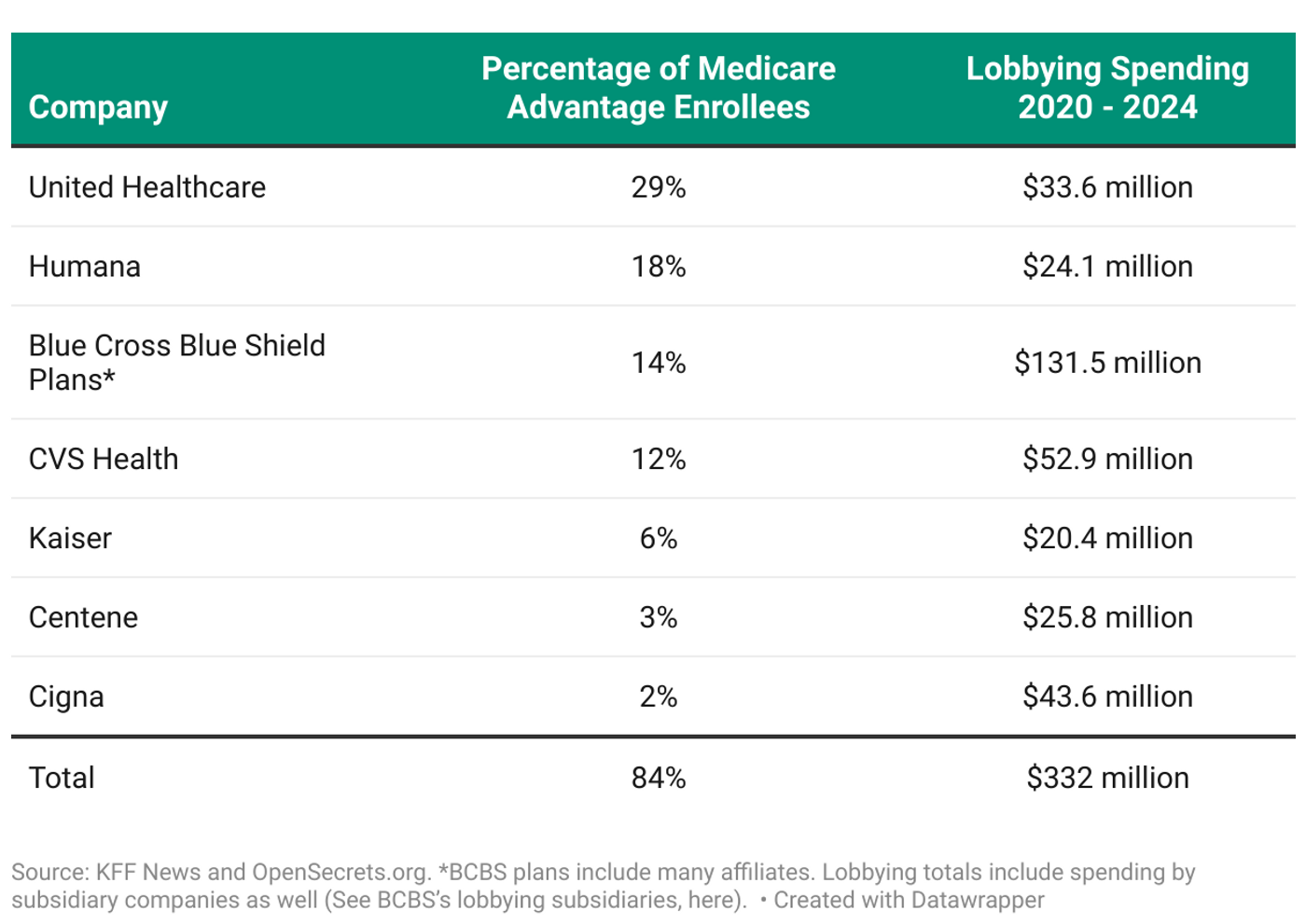
Public Citizen found that in 2024, they collectively had 328 lobbyists targeting the federal government, with nearly 70% of them specifically working on Medicare Advantage. Blue Cross had the most lobbyists focused on such plans (99), followed by Humana (33) and UnitedHealth Group (27).
"If Oz is confirmed as the CMS administrator, attacks on traditional Medicare are likely to move into overdrive," Eagan Kemp, a healthcare policy advocate at Public Citizen, warned in a Tuesday statement. "We should strengthen Medicare by improving it and expanding access to it, not weaken it through further privatization."
The Senate Committee on Finance is set to consider Oz on Friday morning. Since Trump returned to the White House in January, the GOP-controlled chamber hasn't blocked any of his nominees.
---
he is in medicare server says that is where the big fraud is but
an 2 25
Medicare Advantage fraud is staring Musk in the face — but critics predict he'll ignore it
---
---
an 12 24
A western New York health insurance provider for seniors and the CEO of its medical analytics arm have agreed to pay a total of up to $100 million to settle Justice Department allegations of fraudulent billing for health conditions that were exaggerated or didn’t exist.
Independent Health Association of Buffalo, which operates two Medicare Advantage plans, will pay up to $98 million. Betsy Gaffney, CEO of medical records review company DxID, will pay $2 million, according to the settlement agreement. Neither admitted wrongdoing.
“Today’s result sends a clear message to the Medicare Advantage community that the United States will take appropriate action against those who knowingly submit inflated claims for reimbursement,” Michael Granston, a DOJ deputy assistant attorney general, said in announcing the settlement on Dec. 20.
Frank Sava, a spokesperson for Independent Health, said in a statement: “The assertions by the DOJ are allegations only, and there has been no determination of liability. This settlement is not an admission of any wrongdoing; it instead allows us to avoid the further disruption, expense, and uncertainty of litigation in a matter that has lingered for over a decade.”
Under the settlement, Independent Health will make “guaranteed payments” of $34.5 million in installments from 2024 through 2028. Whether it pays the maximum amount in the settlement will depend on the health plan’s financial performance.
Michael Ronickher, an attorney for whistleblower Teresa Ross, called the settlement “historic,” saying it was the largest payment yet by a health plan based solely on a whistleblower’s fraud allegations. It also was one of the first to accuse a data mining firm of helping a health plan overcharge.
The settlement is the latest in a whirl of whistleblower actions alleging billing fraud by a Medicare Advantage insurer. Medicare Advantage plans are private health plans that cover more than 33 million members, making up over half of all people eligible for Medicare. They are expected to grow further under the incoming Trump administration.
But as Medicare Advantage has gained popularity, regulators at the federal Centers for Medicare & Medicaid Services have struggled to prevent health plans from exaggerating how sick patients are to boost their revenues.
Whistleblowers such as Ross, a former medical coding professional, have helped the government claw back hundreds of millions of dollars in overpayments tied to alleged coding abuses. Ross will receive at least $8.2 million, according to the Justice Department.
Ross said that CMS “created a bounty” for health plans that added medical diagnosis codes as they reviewed patients’ charts — and whether those codes were accurate or not “didn’t seem to bother some people.”
“Billions of dollars are being paid out by CMS for diagnoses that don’t exist,” Ross told KFF Health News in an interview.
Data Mining
DOJ’s civil complaint, filed in September 2021, was unusual in targeting a data analytics venture — and its top executive — for allegedly ginning up bogus payments.
DxID specialized in mining electronic medical records to capture new diagnoses for patients — pocketing up to 20% of the money it generated for the health plan, according to the suit, which said Independent Health used the firm from 2010 through 2017. DxID shut down in 2021.
Gaffney pitched its services to Medicare Advantage plans as “too attractive to pass up,” according to the Justice Department complaint.
“There is no upfront fee, we don’t get paid until you get paid and we work on a percentage of the actual proven recoveries,” Gaffney said, according to the complaint. Timothy Hoover, an attorney for Gaffney, said in a statement that the settlement “is not an admission of any liability by Ms. Gaffney. The settlement simply resolves a dispute and provides closure to the parties.”
‘A Ton of Money’
CMS uses a complex formula that pays health plans higher rates for sicker patients and less for people in good health. Health plans must retain medical records that document all diagnoses they highlight for reimbursement.
Independent Health violated those rules by billing Medicare for a range of medical conditions that either were exaggerated or not supported by patient medical files, such as billing for treating chronic depression that had been resolved, according to the complaint. In one case, an 87-year-old man was coded as having “major depressive disorder” even though his medical records indicated the problem was “transient,” according to the complaint.
DxID also cited chronic kidney disease or renal failure “in the absence of any documentation suggesting that a patient suffered from those conditions,” according to the complaint. Past conditions, such as heart attacks, that required no current treatment, also were coded, according to the DOJ.
The suit alleges that Gaffney said renal failure diagnoses were “worth a ton of money to IH [Independent Health] and the majority of people (over) 70 have it at some level.”
Ross filed the whistleblower case in 2012 against Group Health Cooperative in Seattle, one of the nation’s oldest managed-care groups.
Ross, a former medical coding manager there, alleged that DxID submitted more than $30 million in disease claims — many of which were not valid — on behalf of Group Health for 2010 and 2011. For instance, Ross alleged that the plan billed for “major depression” in a patient described by his doctor as having an “amazingly sunny disposition.”
Group Health, now known as the Kaiser Foundation Health Plan of Washington, denied wrongdoing. But it settled the civil case in November 2020 by agreeing to pay $6.3 million. The DOJ filed a second complaint in 2021, against Independent Health, which also used DxID’s services.
Ross said she lost her job after her suit became public in 2019 and was unable to secure another one in the medical coding field.
“It was rough at times, but we got through it,” she said. Ross, 60, said she is now “happily retired.”
False Claims
Whistleblowers sue under the False Claims Act, a federal law dating to the Civil War that allows private citizens to expose fraud against the government and share in any recovery.
At least two dozen such suits, some dating to 2009, have targeted Medicare Advantage plans for overstating the severity of medical conditions, a practice known in the industry as “upcoding.” Previous settlements from such suits have totaled more than $600 million.
The whistleblowers have played a key role in holding health insurers accountable.
While dozens of CMS audits have concluded that health plans overcharged the government, the agency has done little to recoup money for the U.S. Treasury.
In a surprise action in late January 2023, CMS announced that it would settle for a fraction of the estimated tens of millions of dollars in overpayments uncovered through its audits dating to 2011 and not impose major financial penalties on health plans until a round of audits for 2018 payments, which have yet to be done. Exactly how much plans will end up paying back is unclear.
“I think CMS should be doing more,” said Max Voldman, an attorney who represents Ross.
KFF Health News is a national newsroom that produces in-depth journalism about health issues and is one of the core operating programs at KFF—an independent source of health policy research, polling, and journalism. Learn more about KFF.
---
New Biden rule would rein in Medicare Advantage — but will Dr. Oz let it stand?
an 12 24
-
---
an 12 24
Federal officials resolved more than a decade ago to crack down on whopping government overpayments to private Medicare Advantage health insurance plans, which were siphoning off billions of tax dollars every year.
But Centers for Medicare & Medicaid Services officials have yet to demand any refunds — and over the years the private insurance plans have morphed into a politically potent juggernaut that has signed up more than 33 million seniors and is aggressively lobbying to stave off cuts.
Critics have watched with alarm as the industry has managed to deflate or deflect financial penalties and steadily gain clout in Washington through political contributions; television advertising, including a 2023 Super Bowl feature; and other activities, including mobilizing seniors. There’s also a revolving door, in which senior CMS personnel have cycled out of government to take jobs tied to the Medicare Advantage industry and then returned to the agency.
Sen. Chuck Grassley (R-Iowa) said Medicare Advantage fraud “is wasting taxpayer dollars to the tune of billions.”
“The question is, what’s CMS doing about it? The agency must tighten up its controls and work with the Justice Department to prosecute and recover improper payments,” Grassley said in a statement to KFF Health News. “Clearly that’s not happening, at least to the extent it should be.”
David Lipschutz, an attorney with the Center for Medicare Advocacy, a nonprofit public interest law firm, said policymakers have an unsettling history of yielding to industry pressure. “The health plans throw a temper tantrum and then CMS will back off,” he said.
Government spending on Medicare Advantage, which is dominated by big health insurance companies, is expected to hit $462 billion this year.
New details of the government’s failure to rein in Medicare Advantage overcharges are emerging from a Department of Justice civil fraud case filed in 2017 against UnitedHealth Group, the insurer with the most Medicare Advantage enrollees. The case is pending in Los Angeles. The DOJ has accused the giant insurer of cheating Medicare out of more than $2 billion by mining patient records to find additional diagnoses that added revenue while ignoring overcharges that might have reduced bills. The company denies the allegations and has filed a motion for summary judgment.
Records from the court case are surfacing as the Medicare Advantage industry ramps up spending on lobbying and public relations campaigns to counter mounting criticism.
While critics have argued for years that the health plans cost taxpayers too much, the industry also has come under fire more recently for allegedly scrimping on vital health care, even dumping hundreds of thousands of members whose health plans proved unprofitable.
“We recognize this is a critical moment for Medicare Advantage,” said Rebecca Buck, senior vice president of communications for the Better Medicare Alliance, which styles itself as “the leading voice for Medicare Advantage.”
Buck said initiatives aimed at slashing government payments may prompt health plans to cut vital services. “Seniors are saying loud and clear: They can’t afford policies that will make their health care more expensive,” she said. “We want to make sure Washington gets the message.”
AHIP, a trade group for health insurers, also has launched a “seven-figure” campaign to promote its view that Medicare Advantage provides “better care at a lower cost,” spokesperson Chris Bond said.
Revolving Door
CMS, the Baltimore-based agency that oversees Medicare, has long felt the sting of industry pressure to slow or otherwise stymie audits and other steps to reduce and recover overpayments. These issues often attract little public notice, even though they can put billions of tax dollars at risk.
In August, KFF Health News reported how CMS officials backed off a 2014 plan to discourage the health plans from overcharging amid an industry “uproar.” The rule would have required that insurers, when combing patients’ medical records to identify underpayments, also look for overcharges. Health plans have been paid billions of dollars through the data mining, known as “chart reviews,” according to the government.
The CMS press office declined to respond to written questions posed by KFF Health News. But in a statement, it called the agency a “good steward of taxpayer dollars” and said in part: “CMS will continue to ensure that the MA program offers robust and stable options for people with Medicare while strengthening payment accuracy so that taxpayer dollars are appropriately spent.”
Court records from the UnitedHealth case show that CMS efforts to tighten oversight stalled amid years of technical protests from the industry — such as arguing that audits to uncover overpayments were flawed and unfair.
In one case, Jeffrey Grant, a CMS official who had decamped for a job supporting Medicare Advantage plans, protested the audit formula to several of his former colleagues, according to a deposition he gave in 2018.
Grant has since returned to CMS and now is deputy director for operations at the agency’s Center for Consumer Information and Insurance Oversight. He declined to comment.
At least a dozen witnesses in the UnitedHealth case and a similar DOJ civil fraud case pending against Anthem are former ranking CMS officials who departed for jobs tied to the Medicare Advantage industry.
Marilyn Tavenner is one. She led the agency in 2014 when it backed off the overpayment regulation. She left in 2015 to head industry trade group AHIP, where she made more than $4.5 million during three years at the helm, according to Internal Revenue Service filings. Tavenner, who is a witness in the UnitedHealth case, had no comment.
And in October 2015, as CMS department chiefs were batting around ideas to crack down on billing abuses, including reinstating the 2014 regulation on data mining, the agency was led by Andy Slavitt, a former executive vice president of the Optum division of UnitedHealth Group. The DOJ fraud suit focuses on Optum’s data mining program.
In the legal proceedings, Slavitt is identified as a “key custodian regarding final decision making by CMS” on Medicare Advantage.
“I don’t have any awareness of that conversation,” Slavitt told KFF Health News in an email. Slavitt, who now helps run a health care venture capital firm, said that during his CMS tenure he “was recused from all matters related to UHG.”
‘Improper’ Payments
CMS officials first laid plans to curb escalating overpayments to the insurers more than a decade ago, according to documents filed in August in the UnitedHealth case.
In a January 2012 presentation, CMS officials estimated they had made $12.4 billion worth of “improper payments” to Medicare Advantage groups in 2009, mostly because the plans failed to document that patients had the conditions the government paid them to treat, according to the court documents.
As a remedy, CMS came up with an audit program that selected 30 plans annually, taking a sample of 201 patients from each. Medical coders checked to make sure patient files properly documented health conditions for which the plans had billed.
The 2011 audits found that five major Medicare Advantage chains failed to document from 12.3% to 25.8% of diagnoses, most commonly strokes, lung conditions, and heart disease.
UnitedHealth Group, which had the lowest rate of unconfirmed diagnoses, is the only company named in the CMS documents in the case file. The identities of the four other chains are blacked out in the audit records, which are marked as “privileged and confidential.”
In a May 2016 private briefing, CMS indicated that the health plans owed from $98 million to $163 million for 2011 depending on how the overpayment estimate was extrapolated, court records show.
But CMS still hasn’t collected any money. In a surprise action in late January 2023, CMS announced that it would settle for a fraction of the estimated overpayments and not impose major financial penalties until 2018 audits, which have yet to get underway. Exactly how much plans will end up paying back is unclear.
Richard Kronick, a former federal health policy researcher and a professor at the University of California-San Diego, said CMS has largely failed to rein in billions of dollars in Medicare Advantage overpayments.
“It is reasonable to think that pressure from the industry is part of the reason that CMS has not acted more aggressively,” Kronick said.
CMS records show that officials considered strengthening the audits in 2015, including by limiting health plans from conducting “home visits” to patients to capture new diagnosis codes. That didn’t happen, for reasons that aren’t clear from the filings.
In any case, audits for 2011 through 2015 “are not yet final and are subject to change,” CMS official Steven Ferraina stated in a July court affidavit.
“It’s galling to me that they haven’t recovered more than they have,” said Edward Baker, a whistleblower attorney who has studied the issue.
“The government needs to be more aggressive in oversight and enforcement of the industry,” he said.
Senior CMS official Cheri Rice recommended in the October 2015 email thread with key staff that CMS could devote more resources to supporting whistleblowers who report overbilling and fraud.
“We think the whistleblower activity could be as effective – or even more effective – than CMS audits in getting plans to do more to prevent and identify risk adjustment overpayments,” Rice wrote.
But the handful of cases that DOJ could realistically bring against insurers cannot substitute for CMS fiscal oversight, Baker said.
“Unfortunately, that makes it appear that fraud pays,” he said.
Spending Surge
In December, a bipartisan group of four U.S. senators, including Bill Cassidy (R-La.), wrote to CMS to voice their alarm about the overpayments and other problems. “It’s unclear why CMS hasn’t taken stronger action against overpayments, despite this being a longstanding issue,” Cassidy told KFF Health News by email.
In January, Sen. Elizabeth Warren (D-Mass.) and Rep. Pramila Jayapal (D-Wash.) called for CMS to crack down, including by restricting use of chart reviews and home visits, known as health risk assessments, to increase plan revenues.
Cassidy, a physician, said that “upcoding and abuses of chart review and health risk assessments are well-known problems CMS could address immediately.”
Advocates for Medicare Advantage plans, whose more than 33 million members comprise over half of people eligible for Medicare, worry that too much focus on payment issues could harm seniors. Their research shows most seniors are happy with the care they receive and that the plans typically cost them less out-of-pocket than traditional Medicare.
Buck, the spokesperson for the Better Medicare Alliance, said that as the annual open enrollment period starts in mid-October, seniors may see “fewer benefits and fewer plan choices.”
The group has ramped up total spending in recent years to keep that from happening, IRS filings show.
In 2022, the most recent year available, the Better Medicare Alliance reported expenses of $23.1 million, including more than $14 million on advertising and promotion, while in 2023, it paid for a featuring seniors in a bowling alley and left viewers with the message: Cutting Medicare Advantage was “nuts.”
Bruce Vladeck, who ran CMS’ predecessor agency from 1993 through 1997, said that when government officials first turned to Medicare managed care groups in the 1990s, they quickly saw health plans enlist members to help press their agenda.
“That is different from most other health care provider groups that lobby,” Vladeck said. “It’s a political weapon that Medicare Advantage plans have not been at all reluctant to use.”
The Better Medicare Alliance reported lobbying on 18 bills this year and last, according to OpenSecrets. Some are specific to Medicare Advantage, such as one requiring insurers to report more detailed data about treatments and services and another to expand the benefits they can offer, while others more broadly concern health care costs and services.
Proposed reforms aside, CMS appears to believe that getting rid of health plans that allegedly rip off Medicare could leave vulnerable seniors in the lurch.
Testifying on behalf of CMS in a May 2023 deposition in the UnitedHealth Group suit, former agency official Anne Hornsby said some seniors might not “find new providers easily.” Noting UnitedHealth Group is the single biggest Medicare Advantage contractor, she said CMS “is interested in protecting the continuity of care.”
---
thom 3 5 24
— Scientists have developed lab-grown meat that is healthier, easier on the planet, and, when manufactured at scale, cheaper than beef, pork, or chicken. The animal ag industry freaked out and threw a bunch of cash at Republican members of Congress, who are now trying to outlaw the product before the companies developing it can get to scale. Even the buggywhip makers back in the day didn’t think the way to protect their industry was to buy off politicians (of course that was before five corrupt Republicans on the Supreme Court legalized political bribery).
— Climate change is devastating our planet and fine particle emissions from trucks cause hundreds of thousands of deaths and illnesses from heart disease, COPD, asthma, and cancer every year. To solve the problem, the EPA put forward new truck emission standards that will phase in between 2027 and 2032. This week, twenty-seven Republican-controlled states whose politicians take money from the fossil fuel industry sued to block the rules and protect the profits of the trucking and petroleum industries.
— Title IX of the federal code, which forbids gender-based discrimination in education, is being extended by the Department of Education to protect members of the queer community. Rightwing Christian groups, which provide billions of dollars and millions of votes to Republicans, pinged state-level politicians, so now Texas, Louisiana, Alabama, Tennessee, and Oklahoma have filed suit before hand-picked rightwing judges to allow schools to legally trash LGBTQ+ students.
— The Consumer Finance Protection Bureau (CFPB) promulgated a new rule limiting credit card late fees to $8 each, protecting America’s most vulnerable families. The banks pulled the GOP’s chain and Republican senators Tim Scott, John Thune, John Barrasso, Jerry Moran, John Boozman, Steve Daines, Mike Rounds, Thom Tillis, Marsha Blackburn, Kevin Cramer, Mike Braun, Bill Hagerty, and Katie Britt introduced legislation to reverse the policy and allow banks to again screw low-income people.
— In 2003, George W. Bush signed legislation to privatize Medicare through the so-called Medicare Advantage scam, which last year overcharged our government more than $140 billion while denying millions of claims from Americans unfortunate enough to have signed up for it. Republicans on the take from the insurance industry are now pushing a plan to gut or even shut down real Medicare, leaving all seniors to the tender mercies of this predatory industry.
— Ultra-processed foods are accused of causing obesity, diabetes, cancer, and host of other illnesses both physical and mental: American children, who consume as much as two-thirds of their calories from these products, are experiencing an epidemic of obesity and diseases associated with it. With Republican politicians running interference for them, the processed food industry has now succeeded in getting their ultra-processed “food” products placed in thousands of school lunch programs, paid for with our tax dollars. As The Washington Post noted a few months ago, “Republicans have continued to fight stricter standards” and, “Some Republicans are now threatening to block the USDA from further limiting sodium and reducing added sugar in milk…”
'Hell no': Trump allies' plan to privatize Medicare draws outrage - Alternet.org
---
'This should be a national scandal': Medicare Advantage plans using AI for denials - Alternet.org
---
https://www.alternet.org/2019/10/trump-just-launched-a-stealth-attack-on-medicare/
no lnx many
Trump just launched a stealth attack on Medicare
Written by Diane Archer / Common Dreams October 7, 2019
Watch out, older Americans and people with disabilities! President Trump just announced a plan to give corporate health insurers more control over your health care. His new executive order calls for “market-based” pricing, which would drive up costs for everyone with Medicare, eviscerate traditional Medicare, andsteer more people into for-profit “Medicare Advantage” plans.
Seema Verma, the Trump appointee who heads the Centers for Medicare and Medicaid Services (CMS), may not have warned Trump about the slew of government audits revealing that many Medicare Advantage plans pose “an imminent and serious risk to the health of… enrollees.” They also overcharge taxpayers to the tune of $10 billion a year.
In the last few years alone, CMS’ limited audits have highlighted major issues with Medicare Advantage plans. Reports from the Department of Health and Human Services Office of the Inspector General (OIG) and Government Accountability Office (GAO) have underscored these issues. They have recommended that CMS increase its oversight of Medicare Advantage plans and its enforcement efforts.
A Medicare Payment Advisory Commission report indicates that the problems with Medicare Advantage may be even more far-reaching than the government audits indicate. The Medicare Advantage plans have failed to turn over reliable and complete claims data, as required by law. Without this data, it’s not possible to know whether they are covering the health care services they are paid to provide or to oversee them to the extent necessary.
Last month, Senators Sherrod Brown, Amy Klobuchar, Chris Murphy, Richard Blumenthal, Bernie Sanders and Debbie Stabenow laid out several serious malfeasances by these corporate Medicare insurers—including UnitedHealth Group, Aetna, Cigna and Humana—in a detailed letter they sent to Verma.
The insurers’ wrongdoings are systematic. They are ongoing. They endanger the health and financial well-being of millions of people. They undermine the financial integrity of the Medicare program and harm the U.S. Treasury. Yet, to date, CMS has failed to develop, let alone execute, a plan to hold these insurers accountable for violating their legal obligations and to ensure their members get the health care to which they are entitled.
Tens of billions in overcharges are one big problem. Medicare Advantage plans have been overcharging the government for their services for many years now, by claiming that their members are in worse health than they actually are in order to increase payments. To make matters worse, they have refused to pay back the tens of billions in overpayments that the federal government has made to them. UnitedHealth successfully fought to keep the government from collecting this money.
Another major concern is that Medicare Advantage plans are failing to cover the care their members need and are entitled to. Government audits show that Medicare Advantage plans are inappropriately delaying and denying care and coverage to hundreds of thousands (if not millions) of their members. This puts patients’ health and safety at risk. Thousands of people end up paying for care that should have been covered—or foregoing care altogether.
CMS has not named or flagged these corporate health plans on its Medicare website or notified people in any other way of plans with serious violations, as it had agreed to do at the recommendation of the Office of the Inspector General. So, people with Medicare are unaware when they enroll in a Medicare Advantage plan that the government has found to be jeopardizing the health and safety of its members. Instead, CMS continues to give four- and five-star ratings to some of these health plans. In the process, it misleads older adults and people with disabilities about their performance.
What’s more, CMS has found that a sizeable number of Medicare Advantage plans have for years issued highly inaccurate provider directories; and, the GAO has noted “concerns about ensuring enrollee access to care.” Many of these health plans have narrowed their provider networks. GAO suggests that it is not at all clear which of these Medicare Advantage plans have an adequate number and mix of health care providers in their networks.
To date, the Trump administration has been steering people into Medicare Advantage plans, without regard to their deficiencies. And, it has failed to provide people with Medicare with meaningful information about their health plan choices as required by law. It is on a reckless path, promoting the business interests of Medicare Advantage plans that violate the law over the health care needs of vulnerable Americans.
The administration and its congressional allies are playing a game of bait and switch with older adults and people with disabilities. They allow Medicare Advantage plans to lure people with benefits that traditional Medicare does not offer, such as dental care and transportation services to the doctor, without exposing their failings. The Trump administration’s goal is to fully privatize Medicare and shift more costs onto older and disabled Americans.
To be clear, Trump’s executive order does nothing to hold the Medicare Advantage plans accountable for their fraudulent overcharges or their inappropriate denials of care and coverage. Rather, it rewards them. It gives them even more discretion regarding the services they cover and the freedom to create new bells and whistles to lure in members. The health and financial well-being of older and disabled Americans hangs in the balance.
This article was produced by Economy for All, a project of the Independent Media Institute.
---