corp bad actor
5 22 belated
see ceo corp crime
no merri
--> FASCISM MEDIA CONSOLIDATION FCC CARR
sEe good corps 2 25
SEE BROLIARCHY primary YIKES 3 26 DENIAL BC OF AI RACE
SEE CORRUPT 3 EXXON CHEV OPEC ~ FTC
SEE REVOLVE DOOR SINEMA FB EXXON
see monop price gouging windfall / inflation disaster caplism PAY TO PLAY CORRUPTION
see exxon prop tax break
SEE DENIER EXXON CHEVRON FF
see energy corps 2 tax dodge ceo pay
etp dapl slapp greenpeace activ suppr fake paper
see extraction, max profit = capitalism
bayer monsanto roundup cancer
see amazon musk bezos union busting
see GAFA FANG sil vly FAcebook meta ai chatbots
SEE TAX DODGE subsidy
SEE PLUTO 4 JRNL FAIL WAPO BEZOS LAT MUSK XITTER
see sedition caucus funders CREW
SEE DEREG BANKSTERS
triggered by dirty trick kns:
SEE COAL MURRAY BLANKENSHIP KIA WORKERS
===
CHIQUITA DEATH SQUAD COURT 6 24
---
-=-=

Ars Technica
Taylor Farms' connections to Trump admin spurs probe into
Aug 14, 2026Warren's letter noted other donations to Trump-aligned entities from Taylor Farms and said the contributions totaled into the millions.
As Americans cook their vegetables to at least 158°F to kill a diarrheal parasite that has sickened over 24,000 people and killed two this summer, one US Senator is turning up the heat on Health Secretary Robert F. Kenney Jr. over the government’s “calamitous response” to the record outbreak.
In a letter sent Thursday, Elizabeth Warren (D-Mass.) called the federal response to the Cyclospora outbreak “botched” and “marred by missteps.” She pointedly questioned whether corruption and incompetence within the Trump administration and its clear ties to Taylor Farms—the mammoth produce distributer that sold Mexican-grown iceberg lettuce linked to the outbreak—played a role in the federal government’s failures.
“[P]olitical contributions and direct White House lobbying from Taylor Farms… raise urgent questions about the role this influence-peddling may have played in loosening federal food safety oversight and hampering the federal government’s response to the outbreak,” Warren wrote in the letter.
As Ars Technica has previously reported, Taylor Farms made a $1 million donation to a Trump-backing super PAC, MAGA, Inc, in March 2025. That donation came just days after the Food and Drug Administration announced it was delaying implementing a food traceability rule that would have made it easier to trace and respond to outbreaks, like the Cyclospora outbreak.
Warren’s letter noted other donations to Trump-aligned entities from Taylor Farms and said the contributions totaled into the millions. She further pointed out that Taylor Farms has hired former Trump White House official Trent Morse to lobby on behalf of the company. Morse reportedly brokered a direct call between Taylor Farms and the White House after the FDA had linked the company’s lettuce to the outbreak. In the call, Taylor Farms allegedly made an “urgent plea” to delay a recall of the tainted lettuce.
Clear delay
Warren also noted a significant lingering question about the federal government’s response. Local media outlets reported that Taco Bell restaurants in Michigan and nearby states began pulling iceberg lettuce from their menus as early as July 7. Notices at the restaurant said they were unable to sell the produce “due to a nationwide recall.” But at the time, no recall had been reported by federal agencies.
On July 14, the Centers for Disease Control and Prevention reported the outbreak as being from an “unknown source.” The CDC and the FDA did not identify lettuce at certain Taco Bell locations as a source until July 17. The same day, Taylor Farms issued a recall, and the FDA published the recall notice on July 18. The recall notice did not include details or clear information about how much lettuce was being recalled or where it had been shipped. An FDA report identified this week found that Taco Bell’s parent company received just 2.5 percent of the tainted lettuce, with the rest going elsewhere. Walmart received 46 percent of the recalled cases.
Warren’s letter also questioned confusion about the FDA reporting that Taylor Farms’ lettuce had tested positive for Cyclospora, only to retract the claim the next day, calling it a false positive. Taylor Farms then claimed the FDA had apologized to it, which the FDA quickly denied.
Warren posed a series of questions to Kennedy, including whether Taylor Farms or a Trump political appointee pressed the FDA to reevaluate the test result, leading to the retraction. She is also seeking transcripts, summaries, and notes from communications between federal agencies and Taylor Farms.
“[T]he specter of corruption—and quid pro quo politics—casts a darker shadow” over the outbreak response than simply dangerously bad food safety policies from the Trump administration, Warren wrote.
In a statement to The Hill, a Taylor Farms spokesperson said that the company “acts in the interest of science and consumer health, not politics. We categorically reject suggestions that we attempted to receive or received favorable regulatory treatment due to political contributions or other improper influence. Any such allegations are false.”
A Health Department spokesperson told the outlet that the federal government’s investigations into the outbreak “were not impacted by staffing changes or reductions in force. Political contributions or relationships have no bearing on FDA or CDC outbreak investigations.”
Beth Mole Senior Health Reporter
Beth is Ars Technica’s Senior Health Reporter. Beth has a Ph.D. in microbiology from the University of North Carolina at Chapel Hill and attended the Science Communication program at the University of California, Santa Cruz. She specializes in covering infectious diseases, public health, and microbes.
===
===
mpu
pgm more $ for admin than services?!
every diff state gets billed for each query over and over
Sep 8, 2026
The biggest welfare scam in the country is run by a consulting giant. Deloitte has made over $6 billion running error-prone eligibility systems that make it harder for Americans to get the healthcare and food aid they rely on. We investigated the big business of welfare.
The People Abusing Welfare Are Not Who You Think
-=-=
-=-=
MONOPOLY TRUMP ADMIN CORRUPT PAY TO PLAY
7 26 We Talked to a Trump Whistleblower. What He Saw Will Shock You.
Jul 7, 2026
There's a set of MAGA lobbyists in DC who can get you anything you want from the White House, legal or not. Ticketmaster, Paramount, crypto companies — they're all exploiting this pay-to-play system.
KROGER REALPAGE UNITED HEALTH AMAZON GGL LINA KHAN // JDV?!
GAIL S ROGER ALFORD BOSS
1:33
1 minute, 33 seconds
[Liz Scheltens] For the last 40 years, across administrations from both parties, politicians have mostly been content to let corporations keep getting bigger and more powerful.
1:43
1 minute, 43 seconds
But in recent years, something has started to shift. [Anchor] The federal government is suing to block the largest supermarket merger in U.S. history...
1:52
1 minute, 52 seconds
...arguing that it would reduce the number of supermarkets, which would mean higher prices.
1:55
1 minute, 55 seconds
Today, the Justice Department and eight states sued software company RealPage, alleging it illegally helped landlords unfairly fix prices and raise rents throughout the country.
2:07
2 minutes, 7 seconds
At the end of the first Trump administration, there were very large and significant monopoly cases that were brought against Facebook and against Google.
2:16
2 minutes, 16 seconds
[Liz Scheltens] When Lina Khan took over the Federal Trade Commission under President Biden, she and her colleagues in the Department of Justice continued those suits, and filed dozens more.
2:26
2 minutes, 26 seconds
[Anchor] Department of Justice has launched an antitrust probe into UnitedHealth. The move is part of the Biden administration’s push to lower drug prices.
...5:15
5 minutes, 15 seconds
We want him in a very high capacity. Mike Davis. Mike. Thank you, Mike. Where is Mike? Mike is great.
5:24
5 minutes, 24 seconds
Mike Davis actually recommended Gail Slater to President Trump for the top antitrust job. Davis has denied the threatening phone call.
5:32
5 minutes, 32 seconds
But it is true that a couple of weeks after the election, he started getting big checks from corporations like Hewlett Packard Enterprise, who wanted him to use his connections to push their mergers through.
5:42
5 minutes, 42 seconds
[Roger Alford] His salary is $300,000 a month. He has a contingency fee of over $1 million for any successful mergers.
5:51
5 minutes, 51 seconds
They hire this lobbyist and the lobbyist starts talking to higher-ups, saying, you like us, we're on your team.
5:59
5 minutes, 59 seconds
Just tell them to drop the case. [Liz Scheltens] And they did.
6:02
6 minutes, 2 seconds
DOJ sources told the Wall Street Journal that a couple of weeks after the threatening phone call, Gail Slater's boss, quote, “placed a document on her desk.”
6:11
6 minutes, 11 seconds
It was a settlement deal written by Hewlett Packard Enterprise’s own lawyers. It was a genuine shock.
6:19
6 minutes, 19 seconds
When Gail Slater asked her boss what would happen if she refused to sign it, he told her, quote, “She was too difficult to fire, but he would fire her deputies.” She signed, and then he fired them anyway.
6:32
6 minutes, 32 seconds
And we all basically strongly suggested that that was inappropriate. And as a result of that, I was terminated.
6:39
6 minutes, 39 seconds
[Anchor] Shares of Hewlett Packard Enterprise, they're up more than 12%, after the DOJ gave the green light for the proposed $14 billion acquisition of Juniper Networks.
6:48
6 minutes, 48 seconds
This is oligarchy in action: company gets sued, they hire a million-dollar fixer with the president's ear to leverage his loyalty and make sure that the suit goes away.
6:58
6 minutes, 58 seconds
They get a sweetheart deal, and then, when someone like Roger Alford gets in the way, they make sure he gets fired.
7:04
7 minutes, 4 seconds
This type of, let's call it, pay-for-play politics hadn't happened since Watergate. They're dropping cases because they decided someone's a friend.
7:13
7 minutes, 13 seconds
That's not the rule of law. That's the opposite of the rule of law.
7:16
7 minutes, 16 seconds
A few months later, one of America's most hated companies decided to try the same play for themselves.
7:24
7 minutes, 24 seconds
[Anchor] Outrage over Ticketmaster and Live Nation gouging consumers on big concerts.
...
7:50
7 minutes, 50 seconds
A bunch of state attorneys general signed on to the suit as well, including Phil Weiser of Colorado and Jonathan Skrmetti of Tennessee.
7:57
7 minutes, 57 seconds
I mean, there was tremendous evidence of very aggressive, almost mafia-like tactics.
8:02
8 minutes, 2 seconds
We had some witnesses, they would get a phone call and it was basically like, “Hey, nice arena you have there.
8:08
8 minutes, 8 seconds
Be a shame if anything happened to it.” You know, we have the internal conversations laughing about how dumb their customers are and how great it is that they can rip ’em off.
8:16
8 minutes, 16 seconds
[Anchor] The messages between two ticketing directors saying, “These people are so stupid.” Another message saying, “Robbing them blind, baby.”
8:25
8 minutes, 25 seconds
[Liz Scheltens] When President Trump took office in 2025, his Department of Justice decided to continue the Ticketmaster suit. Ticketmaster thought they would try the same play as Hewlett Packard Enterprise.
8:35
8 minutes, 35 seconds
They hired Kellyanne Conway, Trump's former campaign manager, as a fixer. They donated to Trump's inaugural fund.
8:41
8 minutes, 41 seconds
And they hired Mike Davis, the same fixer who got Hewlett Packard Enterprise their sweetheart deal.
8:48
8 minutes, 48 seconds
Davis went after Roger Alford's boss, Gail Slater.
8:52
8 minutes, 52 seconds
[Roger Alford] Once it became clear that Gail Slater was going to resolve these cases on the merits and wasn't going to listen to Mike Davis based on arguments other than the merits, he turned on her.
9:02
9 minutes, 2 seconds
He directly lobbied the president of the United States to get someone who was committed to enforcing antitrust laws on the merits to be removed.
9:10
9 minutes, 10 seconds
[Anchor] The head of the Justice Department's Antitrust Division is out.
9:14
9 minutes, 14 seconds
Gail Slater was fired today from the role after months of tension with the Trump administration. [Liz Scheltens] The moment Gail Slater's firing hit the news, Live Nation’s stock price skyrocketed.
9:24
9 minutes, 24 seconds
Shareholders were anticipating big payouts on the backs of consumers. [echo] Robbing them blind, baby. And then, two weeks after she was fired...
9:32
9 minutes, 32 seconds
[Anchor] The Justice Department has reached a settlement with Live Nation in its antitrust case. Not everyone is on board. The proposed settlement didn’t even rise to the level of a slap on the wrist.
9:41
9 minutes, 41 seconds
[Liz Scheltens] Live Nation wouldn't have to sell off Ticketmaster, just a handful of venues.
9:46
9 minutes, 46 seconds
So it looked like the same play had worked again: get sued, hire a fixer, get a sweetheart deal.
9:53
9 minutes, 53 seconds
But there was one wrinkle for Ticketmaster.
9:56
9 minutes, 56 seconds
From my perspective, this was not a sufficient settlement to take care of Tennessee consumers.
10:01
10 minutes, 1 second
A bunch of those state AGs decided to continue with the suit, even after the Department of Justice settled.
...
10:51
10 minutes, 51 seconds
[Phil Weiser] The president put up a social media post and said, let the deal through.
10:55
10 minutes, 55 seconds
Now, we don't know exactly what happened behind those scenes, but I want to underscore how unusual that is.
11:01
11 minutes, 1 second
There was no DOJ investigation when the country's largest real estate brokerage, Compass, wanted to buy its rival Anywhere.
11:08
11 minutes, 8 seconds
Now, they're free to saddle middle-class homebuyers with even more junk fees in a housing market we can already barely afford.
11:16
11 minutes, 16 seconds
Compass even hired Mike Davis, the same fixer that got HPE and Live Nation their deals.
11:22
11 minutes, 22 seconds
But nothing has made the corruption more clear than the Department of Justice's recent approval of the merger between Paramount and Warner Brothers.
11:31
11 minutes, 31 seconds
The deal puts one of Trump's top political donors at the head of a media empire that will include CNN, CBS and HBO.
11:40
11 minutes, 40 seconds
And according to the Wall Street Journal, the staff attorneys in the antitrust division were leaning toward suing to prevent this merger.
11:48
11 minutes, 48 seconds
But again, they were overruled by the top brass at the Department of Justice.
11:53
11 minutes, 53 seconds
State AGS are teaming up to challenge the HPE, Nexstar, and Compass mergers in court, and they're considering whether to do the same for Paramount.
...
4:12
Hewlett Packard Enterprise looking to buy Juniper Networks.
---
---}:
an 4 26
Trump and his administration attempted to let a huge corporation off the hook for monopoly allegations while no one was looking, but according to a new analysis from MS NOW, a state ruling on the matter has handed him yet another legal "faceplant."
Early last month, Trump's Justice Department moved to settle a lawsuit against Live Nation — the conglomerate with massive control over the live event and ticketing industries in the U.S. — after a Biden-era antitrust suit accused it of maintaining an illegal monopoly. The move was the latest in a long line of Trump-era policies favoring big business and its ability to take advantage of customers.
That decision to let Live Nation off easy could have been the end of it, but instead, this week, a federal jury in New York ruled that the company had, in fact, engaged in monopolistic practices. This, as reporter Helaine Olen wrote for MS NOW on Friday, meant that the case would not "end with a whimper," on account of the "egregious" facts pointing to the company's obvious wrongdoing. Furthermore, she argued, the ruling also dealt "a huge faceplant for the Trump administration."
"The Trump administration [is] doing the bidding of big business," Olen wrote. "Its settlement with Live Nation is in the same spirit as the sign-offs on mergers such as Paramount and Warner Brothers, or HP and Juniper. The judge in this case can and should scrutinize the settlement closely. Congress has the power to look into both the settlement and the mergers, and lawmakers should use that authority. At the same time, this verdict should hearten the state attorneys general who have already joined together to fight these wildly inappropriate and anticompetitive mergers."
She continued: "And, then there were the nine jury members that handed Trump and corporate America this defeat. They didn’t just deliver a verdict on Ticketmaster. They also said enough to an economy in which giant monopolies have grown and prospered at the expense of honest businesses and powerless consumers. Now it’s time for an encore performance — against all the other monopolistic deals getting waived through by this administration."
Live Nation emerged as a major monopolistic force in the live event industry when it merged with Ticketmaster in 2010. As a condition for merger approval from the Obama administration, the company had to pledge not to engage in a variety of anticompetitive practices, which, as Olen explained, they more than failed to do.
"Live Nation didn’t just fail to live up to its promise. It repeatedly, blatantly violated the agreement," she wrote. "The states argued employees of the newly combined company, which controls an astonishing 86% of the concert ticket market and almost three-quarters of the overall event ticketing market, began threatening venues with retaliation unless they used Ticketmaster. Live Nation executives actually boasted in writing about ripping off customers. One employee, who is now a ticketing executive, joked that an increase in parking fees for customers was 'robbing them blind baby. That’s how we do.'”
---
---
Tax Day Could Be Easy. They’re Fighting To Make It Hard.
4 26
RR -->
[00:09:54] David Sirota: We'll be right back. Welcome back to Lever Time. It took another decade for this issue to pop up again. In 1998, democratic President Bill Clinton and the Republican Congress passed a law reviving the possibility of a return free system. That's right. Buried in an IRS overhaul Bill was a provision instructing the Treasury Secretary to quote, develop procedures for the implementation of a return free tax system.
This proposal sat at the IRS for the next few years until George w Bush's Republican administration took a baby step. They didn't implement return free filing. It was something much smaller than that. A proposal just to let you go online and file your taxes to the IRS for free.
[00:10:40] Ken Dam: Paying taxes is really a responsibility of every citizen, but because it's a responsibility, it doesn't mean it has to be arduous, slow, cumbersome, mysterious.
[00:10:53] David Sirota: This was Bush Treasury Department official Ken Dam, describing the initiative
[00:10:57] Ken Dam: Free File Promises to reduce the needless frustrations of millions of dutiful citizens. As they carry out this duty of citizenship, preparing and filing their tax returns,
[00:11:08] David Sirota: and yet even this simple idea really pissed off the tax prep industry.
Intuit, the owner of TurboTax launched a counter attack and mobilized, enlisting the help of a guy named Bernie McKay, a bigwig lobbyist, and former Carter administration official, who did a full court press on Capitol Hill. According to a ProPublica investigation, the industry basically argued that the IRS could not be counted on to roll out such a big program and the argument.
Really resonated with some folks on Capitol Hill. A group of Republican lawmakers wrote to the IRS claiming that there was no reason for the government to compete with quote well-established tax prep companies. The lobbying worked in 2003, the Bush administration and the tax prep companies made a compromise.
It was called the Free File Alliance. An IRS Blessed Consortium of Tax Prep Companies would help some taxpayers file their taxes for free. But the catch was in the federal contract. Which obligated the IRS to not compete with the consortium in providing free online tax return preparation and filing services to taxpayers
[00:12:22] Julie Story: crash and burn.
[00:12:24] David Sirota: Yep, another crash and burn. But after getting reelected. George W. Bush went back to the tax complexity fight once again. In January, 2005, he announced a whole new advisory panel to evaluate ways to simplify the tax system.
[00:12:40] George W Bush: These fine, distinguished citizens will be taking a good hard look at the tax code....
[00:13:22] David Sirota: The new advisory panel devoted an entire day of public testimony to reviewing Reagan's original return free tax filing idea, which seemed like a really encouraging sign.
We're going ballistic, ma. Go get 'em. But then came the testimony of anti-tax power broker Grover Norquist, a conservative then at the zenith of his political power in Washington. The transcript of the hearing shows him excoriating the idea in what would become a set of talking points that Norquist and others would repeat.
Over and over again in the ensuing years, it's like playing in Las Vegas. Norquist said the house sets the rules and the house has its fingers on the scales. Do you really want to go and argue with the IRS? If they've sent you a bill that's higher than you think it ought to be. It also gives the advantage just as the house in Las Vegas.
He said the interests of the government. Is to maximize its revenue. That testimony casting return free filing as a stealth tax increase, it set the idea back into another free fall. Sub controller, losing controller return free filing officially crashed and burned again when George w Bush's advisory committee left it out of its final report.
Then in 2007, Barack Obama picked up the cause of return free filing. The then presidential candidate was seemingly ready to fight the tax prep industry. ProPublica reported that Obama gave a speech to an audience full of tax wonks in Washington, where he said quote. The government already collects wage and bank account information, so there's no reason the IRS can't send Americans prefilled tax forms to verify.
This means no more worry, no more wasted time, no more extra expenses for a tax preparer. But Obama quickly learned his lesson too. The tax prep lobby was not to be messed with. Bernie McKay and the band of Intuit lobbyists got to work pushing Congress to introduce a series of bills to prohibit the IRS from building its own free tax filing system.
As campaign cash from the tax prep industry flowed to lawmakers, the public opposition was led in part. By Grover Norquist, casting it as a scheme to jack up everyone's taxes.
[00:15:42] Grover Norquist: When this is was done in other places, the government makes a lot of money. Why? Because when the government does your taxes for you, they maximize their revenue, not getting your tax returns accurate.
[00:15:54] David Sirota: That's Norquist in a newsmax interview from 2014.
[00:15:58] Grover Norquist: I think the idea of of having the government do your taxes for you is dead. Dead, dead. That's an important part of tax reform. Killing this idea of the government reaching out, knowing everything about you doing your taxes for you.
[00:16:12] David Sirota: When around this time, Republican lawmakers caught wind, that the IRS might be looking into a realtime data collection system that might later be needed for a return free system.
They pounced.
[00:16:24] IRS Oversight: This subcommittee has placed report language in our annual appropriations bills, by the way, since 2 0 9 Pro prohibiting the IRS from using any funds on a simple tax return pilot program.
[00:16:34] David Sirota: This was a Republican congressman interrogating Obama's IRS Chief at a congressional hearing in 2014.
[00:16:40] IRS Oversight: Are you aware of any further exploration and implementation by the IRS
[00:16:44] David Sirota: Obama's IRS Chief Quickly backed down.
[00:16:47] John Koskinen: The thing that has been the focus of a lot of external societies is the idea of could we pre-populate a return form, get information in pre-populate so you could look at it, and then you could make decisions or the IRS could even file your return for you.
We're not doing anything with that. We have no, uh, no program going forward that I know of, and, uh, certainly we don't intend to do anything like that without talking to you
[00:17:06] David Sirota: once again, after briefly taking flight, the idea of a return free tax system fell out of the sky. The
[00:17:13] Top Gun Clip: goddamn plane has creed into the mountains.
[00:17:17] David Sirota: There was of course, one more test flight as part of the 2022 Inflation Reduction Act that President Biden signed. The IRS budget was significantly increased after years of cuts, and the legislation included a new direct file system, which was rolled out in 2024.
[00:17:35] WPRI: This year, there is a new software pilot program being offered in 12 states called Direct File.
It opens to qualifying taxpayers in mid-March.
Your eligibility for direct file does not depend on your income.
[00:17:49] David Sirota: Direct file was a free online service that allowed taxpayers to file their federal tax returns directly with the IRS. Again, this wasn't return free filing. But it was the government's strongest attempt to at least give you a way to file your taxes without the added fees and shady upsells of private companies.
The program was run by the IRS itself, and it ended up being a policy experiment that went surprisingly well. It was rolled out slowly and intentionally so that issues could be seen and addressed quickly. At first, it was limited to really simple filings, and then additional tax complexities were added later on, making it more accessible to more and more taxpayers Overall, the pilot program showed.
Big promise with 94% customer satisfaction that gave a green light for the program to expand beyond the first 12 states it started in. But at this point, I'm guessing, you know what happened when Donald Trump won his second presidential term
[00:18:55] NBC10: starting 2026, the program will no longer be available for taxpayers.
President Trump has said he was looking into getting rid of direct file. He claimed it was. A waste of taxpayers' money because commercial tax preparation companies already offer free filing programs.
[00:19:12] David Sirota: The campaign to kill the successful and popular direct file program was fast and furious as soon as Trump won the 2024 election, nearly 30 house Republicans sent a letter to Trump in December, 2024, just after he'd won, asking him to end direct file on his very first day in office.
The lawmakers had raked in more than $1.8 million of campaign cash from, you guessed it, tax preparation companies and their proxies. Meanwhile, turbo Tax's parent company, Intuit, donated $1 million to Trump's inauguration. Direct file in a lot of ways had been the closest thing to what Ronald Reagan had proposed back in 1985.
...
As I've gone back and forth with my own accountant in this last few weeks, getting more and more annoyed at all the red tape, watching more and more of my time sucked away into a mountain of paperwork. I've been thinking a lot about this interchange on CNBC from a few years back.
[00:23:00] CNBC (Aaron Ross Sorkin): Grover, I wanted to ask you about this.
There's this bill out there, it seems bipartisan and I, I'm surprised by it.
[00:23:06] David Sirota: That was journalist Andrew Ross Sorkin asking anti-tax activist Grover Norquist, why he's fought return free filing for so many years.
[00:23:15] CNBC (Aaron Ross Sorkin): That effectively makes it a a, a permanent ban barring the IRS from ever developing its own online tax filing service.
This would've been. Uh, a free service that would've made paying taxes cheaper and easier, especially for people at the bottom and the middle who are spending, uh, in often cases, you know, several hundred dollars a year, it would actually be a tax cut for most Americans to do this. Why try to block something like that?
[00:23:41] David Sirota: Norquist first insisted that private tax prep companies do provide some free services to the very poor. And then Norquist went on a rant.
[00:23:49] Grover Norquist: The real goal of the Democrats, and we saw this in California, is they want the government to do your taxes for you. Yeah. Like Europe does. They send you a bill. Go ahead and argue with the government.
And when California put that together, you know what? They scored it as a significant revenue raiser 'cause they intended to, to write your tax bill. So it'd be higher than it than you would expect to pay. Now, this is a way to raise taxes. And to completely strip you of all privacy. So
[00:24:15] CNBC (Aaron Ross Sorkin): grow, grow
[00:24:15] David Sirota: Sorkin though, press there.
[00:24:17] CNBC (Aaron Ross Sorkin): Do you have any ideas of how to make it easier and cheaper? Mm-hmm. For American taxpayers to pay their taxes so it doesn't cost them any more money than it already does. It'd just be so much easier. Who, people who are W2 filers, they get a postcard. It says what, what the number is. You either sign it or you, or you go off and you do your own, you do your own tax plan.
[00:24:37] David Sirota: Norquist then started reciting more anti-tax talking points as usual, casting the IRS as a rapacious monster.
[00:24:45] Grover Norquist: The federal government takes about 18% of everybody's money. There's no pleasant, cheap, easy, or uncomplicated way to do that. You want simplicity, you want fairness, make the tax bill lower,
[00:24:56] David Sirota: and that's when Sorkin just scream the quiet part about the whole issue.
[00:25:01] CNBC (Aaron Ross Sorkin): You have no, um, rival idea about how to make it easier for Americans to pay their taxes. I want their tax because I think ultimately your idea is to make it harder for people to pay their taxes so they hate their taxes and push for lower taxes.
[00:25:14] David Sirota: That's it right there. That's what's also underneath all of this, beyond just the tax prep companies wanting to protect their profits, there's a powerful arch conservative, anti-tax movement that wants you to hate literally everything about taxes, and so they've succeeded.
In creating an awful tax process. But I wanna go back to something I alluded to at the beginning. Taxes are not theft. As the anti-tax movement likes to insist. Taxes are the necessary price we pay for a functional society. It's what we pay for roads, bridges, water systems, schools, and all the stuff we call civilization.
What is theft? Is politicians helping giant corporations steal our money and our time just to file our taxes. So as the tax filing deadline approaches, as some of you are stressed out. By Byzantine filing forms or the fear of paying more than you owe or of being audited for a simple mistake, don't forget it does not have to be this way.
---
4 26
How Billionaires Cracked the Food Stamp Cheat Code
3.21M subscribers i am one
809,634 views Feb 12, 2026
mcD kroger, doordash? fedex ups, dollar gen tree; home dept, temp agy? ADDUS homecare illinois
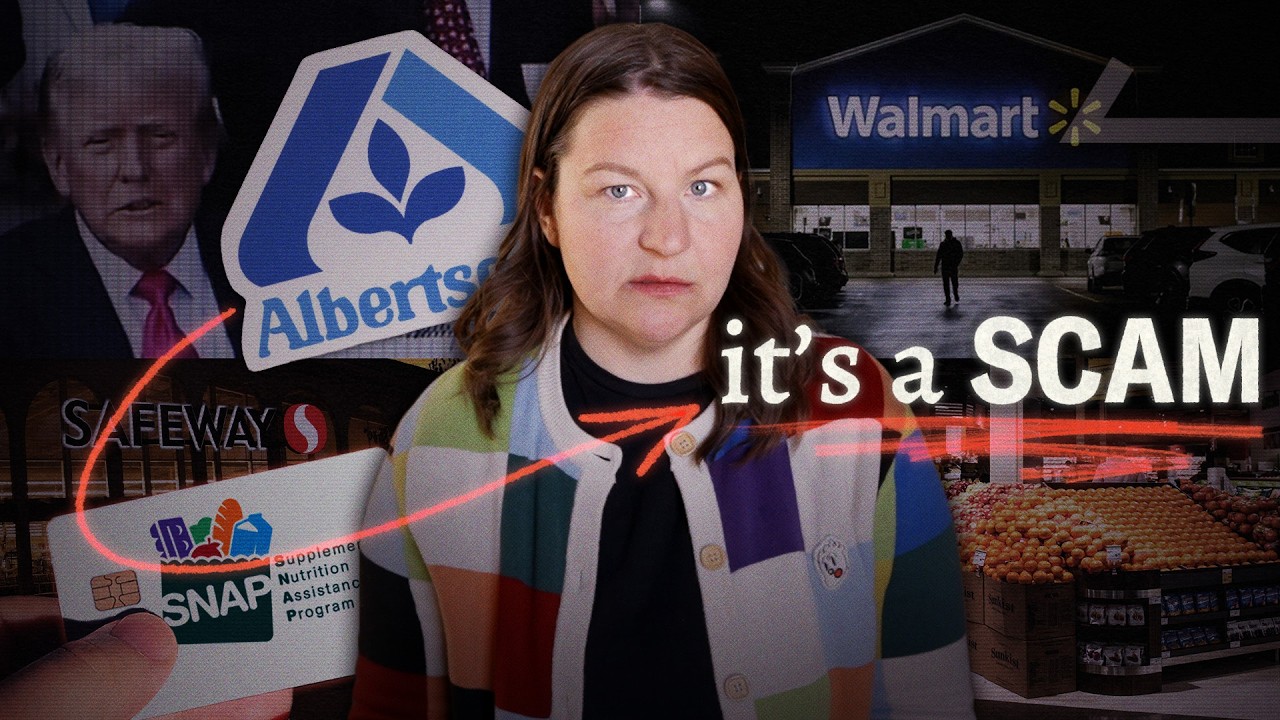
Your taxes subsidize Amazon and Walmart poverty wages. These are trillion dollar companies, but 33% of Amazon workers need public assistance and 25% of Walmart workers need SNAP to survive. We investigated how corporations are taking advantage of workers—and all of us. Read more of our analysis here: https://substack.perfectunion.us/p/yo...
https://substack.perfectunion.us/p/your-tax-dollars-are-subsidizing
*By Donald Shaw and David Moore
Public records obtained from state agencies show that some of the most profitable and powerful companies in the U.S. are also among the largest employers of workers who rely on food assistance.
In state after state, data received by More Perfect Union through open records requests list giant retailers and gig-economy companies among those with the most workers enrolled in the Supplemental Nutrition Assistance Program (SNAP), giving a window into how taxpayer-funded public assistance is being used as de facto wage subsidies for some of the wealthiest American corporations.
We requested data from all 50 states, and after nearly two months of correspondence received information from four: Colorado, Illinois, Michigan, and Washington. An additional state, Massachusetts, released similar information to the Boston Globe last year, and is also analyzed in this report. Most of the other states either flatly rejected our requests or said they did not maintain such records, while Texas referred the request to its attorney general, and Utah requested a fee of $5,652 for the data.
In each of the states for which we have data, two companies are among the top four employers of SNAP recipients: Amazon and Walmart. Ranked by revenue, Amazon and Walmart are also the two largest companies in the world.
Amazon’s reliance on public subsidies for its underpaid labor force has been well known for years. In 2023, researchers at the University of Illinois conducted a survey of Amazon warehouse workers across 42 states and found that 33% of those surveyed had used public assistance programs in the previous three months, including 23% who had used SNAP. Eighty-nine percent of the survey respondents said they work at least 30 hours per week, the threshold used by the Internal Revenue Service for determining if someone is considered a full-time worker.
Walmart not only relies on SNAP to make up for its low wages, but it also benefits more than any other company from people using food stamps to buy their groceries. According to a Numerator survey covering the 12 months ending July 31, 2025, Walmart is the largest retailer for SNAP benefit redemption in the U.S., receiving 25.8% of all SNAP dollars.
Other companies that frequently appear at the top of the state lists include McDonald’s, DoorDash, Uber, Dollar Tree, and Dollar General. The dollar stores accept SNAP, so are double-dipping in the same way as Walmart. DoorDash and Uber have fought efforts to reclassify their workers as employees through aggressive lobbying and political spending, most notably spending tens of millions of dollars each in 2020 to pass a California ballot proposition that exempted app-based drivers from a recently enacted state law designed to grant them employee status and minimum wage protections.
Here’s what we heard back from the states that responded:
---
August 6, 2007
After the Crandall Canyon Mine collapse, which led to the death of nine miners and rescuers, Murray Energy faced an initial assessment of $1.639 million in fines for alleged “flagrant, reckless and highly negligent violations of mine safety law,” *NPR*reported. The settlement was reduced to $949,351, which still made it the third-largest fine ever levied against a coal company, according to the Mine Safety and Health Administration.139
The settlement included Murray Energy’s acceptance of four violations “contributory” to the two fatal mine collapses at Crandall in August 2007:
---
an 3 26
Mark Twain supposedly once said, “Never let the truth get in the way of a good story,” but there is a difference between a good story told in fun and a story (supposedly backed by independent scientific research) that people are led to believe because, well, science is supposed to be true. And so we come to the story of Roundup, the herbicide developed by Monsanto that swept the world because it worked and was the “safe” alternative to widely used weedkillers like Dicamba and 2,4-D,—it was said to be safer than table salt!
Roundup was developed in the 1970s as a non-selective herbicide, meaning it would kill almost any growing plant it touched. It was an effective burn-down herbicide farmers could apply prior to planting, and it assured an almost weed-free field at the beginning of the growing season. Roundup could be used in non-agricultural situations as well, to kill weeds and grass growing in sidewalk and patio cracks, around buildings, etc, but care was needed because, as noted, it was non-target and could kill whatever plant it touched.
For farmers, it worked well, except while it did kill growing weeds, buried weed seeds were not harmed, so a weed-free field at planting time did not ensure a weed-free field throughout the growing season. Weeds would continue to sprout, and more herbicide applications would be needed during the growing season.
Then Monsanto developed their big fix released in 1996, genetically engineered (GE) soybeans resistant to Roundup, followed by GE versions of other commodity crops: corn, cotton, sugar beet, and canola. Over-the-top spraying of these GE crops would kill everything but the crop, and Roundup became one of the most widely used herbicides in the world and GE crops came to dominate world commodity crop production.
Companies like Bayer have to protect their product and their profit even if they have to tell a few lies to do so.
While Monsanto sold Roundup with the slogan, “One spray is all you’ll ever need,” in time, it became clear that some weeds were developing resistance to Roundup and farmers were right back where they started, looking for herbicides that worked consistently. More genetic modifications were made to commodity crops making them resistant to other herbicides, like Dicamba and 2,4-D, the herbicides Roundup was supposed to have replaced. These multiple GE or “stacked” crops could be sprayed with a cocktail of herbicides, hopefully ensuring weed-free fields for the entire growing season.
Farmers are using more herbicide, even on the GE crops, and costs for GE seed have risen much faster than non-GE seed. Of course, the motive was never to reduce the farmer’s production costs or agricultural herbicide use but to increase it—that’s where the profit is.
For farmers who didn’t jump on the GE bandwagon, finding non-GE seed is often difficult. Even more onerous, some farmers have found it necessary to plant GE seed as a preventative measure because non-GE cropscan be damaged by chemical drift from neighboring GE fields.
So much for effectiveness, what about the safety of Roundup? In 2000 a study was published in the journal Regulatory Toxicology and Pharmacologythat deemed the active ingredient in Roundup (glyphosate) was safe and not a human health risk. Since then, that study has been cited consistently as proof of Roundup’s safety. Numerous other studies have shown that glyphosate could cause cancer and that the inert ingredients that are part of the patented Roundup formulation increase the toxicity of glyphosate. Further, the practice of using Roundup as a desiccant on small grain crops (oats, wheat, and barley) prior to harvest puts Roundup directly on grain that enters the human food chain.
Since acquiring Monsanto in 2018, Bayerhas paid out about $11 billion to settle almost 100,000 cancer-related lawsuits with approximately 61,000 still pending. In December of 2025 another blow to the claimed safety of Roundup came when the Regulatory Toxicology and Pharmacology journal withdrew the 2000 article that had touted Roundup’s safety. While the study claimed to be independent and peer reviewed, it has come to light that Monsanto’s scientists played a significant role in conceiving and writing the article. Oops.
For decades Roundup has been sold as an effective herbicide, one that was safe for humans and the environment, and without which “consequences would be dire.” Companies like Bayer have to protect their product and their profit even if they have to tell a few lies to do so. They claim to produce safe products that help farmers thrive—real independent research refutes that. Bayer and the agribusiness industry may be thriving, but farmers are not and in these times, too few people seem to care that lies are accepted as truth.
---
---
AN 2 26
MS NOW co-anchor Jacqueline Alemany says House Democrats are so convinced they will stampede the chamber in November that they are already planning to investigate U.S. companies that paid President Donald Trump millions for political favors.
Trump may thump his chest over Democrat-led House investigations, but tech giants, oil companies, defense contractors and Fortune 500 CEOs still fear congressional subpoenas and congressional scrutiny.
“Now, as House Democrats plot a return to the majority, they are pledging to probe the deals, mergers, settlements and regulatory favors that flowed to corporations doing business with the Trump administration,” reports Alemany.
Democrats are currently in the minority and limited to issuing “strongly worded letters and … toothless investigative authority,” but Alemany said they are already “laying the groundwork for a sweeping expansion of oversight targeting the companies and CEOs who have done business with the Trump family, or sought favorable regulatory treatment, merger approval, or policy changes from the administration — from Paramount to Palantir.”
“Trump’s running the presidency like a mob boss and everyone who has agreed to bribe him is a target for an investigation,” said a senior congressional staffer, speaking anonymously to MS NOW. “And although there’s a spectrum of wrongdoing with Elon Musk at one end and not much more than small businesses trying to get by on the other, there are very wealthy CEOs who know better. And we’re taking names.”
Critics may consider this retaliation against Trump’s corporate enablers but Democrats say this is a strategy that could “reshape corporate America’s relationship with Trump,” by making CEOs “think twice before opening their wallets or bending to presidential pressure.”
Biden administration national security adviser Jake Sullivan met with senior Democratic officials in December and encouraged them to hold the private sector more accountable as Trump embraced a more blatantly “transactional and retributive [form of] governance,” according to three sources in the meeting.
The idea caught on as a result of backlash to members of the national security community who have been fired or blacklisted by companies fearful of retribution from Trump. But the conversation quickly expanded to how completely companies have folded under pressure from the administration, said Alemany.
Democrats on the House Oversight Committee are already sending inquiries to chief executives of at least four oil companies, including Chevron, ExxonMobil, ConocoPhillips and Continental Resources, demanding information to determine “who stands to privately or personally benefit from President Trump’s actions and whether corrupt motives were a driving force in U.S. foreign policy decision.”
---
---
ref
:{Jan. 15, 2026,
By Lisa Rubin and Soorin Kim
As the 2026 midterm election year begins, MAGA Inc., a PAC aligned with President Donald Trump, boasts a war chest of almost $300 million built principally through deep-pocketed donors during the first year of Trump’s second term.
While public reporting on MAGA Inc.’s megadonors has focused on well-known tech and cryptocurrency figures, buried in the long list of the PAC’s 2025 contributors are two names that are lesser known in the usual Trump donor sphere — a New York-based oil heir and former executive who now sits on the board of directors of Chevron, the sole U.S. company currently operating in Venezuela, and his wife.
Federal campaign finance filings show that John Hess and his wife, Susan Hess, each contributed $1 million to MAGA Inc. on Dec. 12, 2025, just weeks before the U.S. took military action to capture Venezuelan President Nicolás Maduro.
On that same day, Trump raised eyebrows after a reporter asked if he intended to seize more oil assets from Venezuela after the U.S. seized an oil tanker off the Venezuelan coast earlier that week. “I mean, it wouldn’t be very smart for me to tell you that,” he started. But in continuing to talk about attacks on boats, he added, “[And] now we’re starting by land, and by land is a lot easier, and that’s going to start happening.”
By that point, the president for days had repeatedly said “we’re going to start doing those strikes on land too” as he spoke extensively about strikes on boats near the Venezuelan coast and in the Caribbean — a statement some interpreted to mean land strikes were imminent.
There is no indication that those comments factored into the sizable Hess donations on Dec. 12.
Although the couple have long been donors to various political causes and candidates, including occasionally to Democrats, their 2025 contributions to MAGA Inc. were rare seven-figure contributions from them. The Hesses’ $2 million contribution is dwarfed by other massive eight-figure dollar donations from tech giants and crypto companies to MAGA Inc. from the past year, but it’s nonetheless notable after their yearslong hiatus from contributions in support of Trump in the last few years.
John Hess’ last contribution to a Trump-affiliated fundraising vehicle was a $100,000 donation to the Trump campaign and the Republican National Committee’s joint fundraising committee in late 2017. Earlier that year, he gave $1 million to Trump’s first inaugural committee — his only other seven-figure donation at the federal level. And during the 2016 election, Susan Hess gave $170,000 in support of Hillary Clinton’s presidential campaign and the Democratic National Committee.
Prior to his recent seven-figure donation to MAGA Inc., John Hess’ federal political contributions have mostly gone to congressional campaigns and groups, including $500,000 to a Senate GOP-aligned super PAC in 2020.
Hess is perhaps best known as an heir to and a longtime executive of the former Hess Corp., which was acquired by Chevron last year in a transaction worth an estimated $53 billion. As a result of the merger, Hess was also appointed to Chevron’s board of directors.
Since 2007, when then-Venezuelan President Hugo Chávez seized assets from three major North American oil companies — Chevron, ConocoPhillips and Exxon Mobil — Chevron has been the only U.S. oil company involved in production within Venezuela through a joint venture with the country’s state-owned oil company. And MS NOW’s sister network CNBC has reported that Chevron exported approximately 140,000 barrels per day from Venezuela in the last quarter of last year.
Last week, in an interview with CNBC, Energy Secretary Chris Wright said he spoke with the CEOs of all three companies on Jan. 3, when the U.S. military struck Venezuela and removed Maduro from the country, to encourage their investment in Venezuela long-term.
But while he said Exxon and ConocoPhillips would need “normal, commercial business conditions, rule of law and some security to go back in” to Venezuela, he noted that Chevron is well-versed in this regime.
“Chevron has been there for over 100 years,” Wright told CNBC’s Brian Sullivan. “So with them, [the question for the administration is] how can we provide incremental tweaks or changes to allow their model to grow even more?”
In a response to questions from MS NOW about a possible connection between the Hesses’ MAGA Inc. contributions and Venezuela, White House spokesperson Taylor Rogers said after the U.S. took control there, “President Trump brokered a historic energy deal with Venezuela that will benefit both the American and Venezuelan people.”
“President Trump has called on all oil companies to make unprecedented investments and take advantage of this generational opportunity to restore Venezuela’s oil infrastructure,” Rogers said in a statement. “That’s why 20 different oil companies came to the White House last week to discuss this with President Trump.”
A spokesperson for MAGA Inc. declined to comment. Neither John Hess nor representatives for Chevron responded to MS NOW’s requests for comment.
---
---
---}:
AN 2 26
Led by Senate Finance Committee Chair Ron Wyden, four Democratic senators on Wednesday outlined plans to reduce the costs of prescription drugs after President Donald Trump claimed he would do so—only to allow Big Pharma companies to delay negotiating lower prices and secure “zero commitments” from top executives on making lifesaving medications more affordable for millions of Americans.
“There is no greater fraud than Donald J. Trump when it comes to lower drug prices,” Wyden (D-Ore.) said. “Our doors are wide open to anybody who wants to take the bold next step forward on lowering drug costs for Americans.”
Along with a “flash report” on Trump’s “broken promises” regarding his pledge to bring drug prices down “to levels nobody ever thought was possible,” Wyden sent a Dear Colleague letter to Democratic senators regarding his committee’s plans to follow through with lowering costs.
“Finance Committee minority staff will dedicate substantial time and effort this year to developing the next generation of healthcare solutions that lower costs for American families,” Wyden wrote. “These solutions will rein in Big Pharma’s outrageous price increases, lower costs for consumers, guarantee predictability for patients, and reduce wasteful government spending that pads the profits of big corporations. Alongside the co-signers of this letter, I invite you to be a part of this bold vision.”
The letter, co-signed by Sens. Catherine Cortez Masto (D-Nev.), Peter Welch (D-Vt.), and Ruben Gallego (D-Ariz.), notes that “the only concrete drug pricing policy Trump enacted within the past year was a price hike for the biggest blockbuster cancer drugs on Earth, giving an $8.8 billion windfall to the pharmaceutical industry.”
In contrast, the senators wrote, the Senate Finance Committee will develop policies to incorporate international pricing models into the Medicare drug price negotiation framework, including by allowing Health and Human Services Secretary Robert F. Kennedy Jr. to consider international prices as a factor or penalize drugmakers when pricing for US customers exceeds international benchmarks.
“Democrats are determined to bring prices down, and we’re willing to work with anyone to find concrete ways to do it.”
The committee will also work to end Republican “blockbuster drug bailouts from negotiation,” like the ones included in the One Big Beautiful Bill Act that shielded several high-priced drugs—including the cancer drug Keytruda—from Medicare price negotiations.
“The Republican budget bill contained a nearly $9 billion sweetheart deal that benefits the biggest drug companies by delaying or exempting some lifesaving medications from negotiation,” reads the Democrats’ flash report.
Gallego said that “when Big Pharma gets richer off the back of a grandmother struggling to pay for cancer medication, the system is broken.”
“That’s what this is all about: Big Pharma execs sitting in their fancy corner offices profiting off of sick, working-class Americans,” the senator said. “We are not going to accept an America where millions of families live in fear of getting sick and needing to fill a prescription. We are going to fight and fight hard for a healthcare system that does what Donald Trump never did: actually lower costs for working families.”
The lawmakers emphasized that even if manufacturers are forced to lower drug prices, patients are not currently guaranteed to directly benefit, because as much as 45% of the $5.4 trillion the US spends on healthcare annually is “absorbed by middlemen such as insurers, pharmacy benefit managers (PBMs), and drug distributors.”
“Healthcare middlemen profit when drug costs are high because they make money off of drug margin or payments that are linked to the price of a drug, ripping off patients who pay more than they should. Medicare Part D and the patients it serves should stop footing the bill for inflated drug prices and instead pay for drugs in a more transparent manner that reduces middleman margin,” wrote the senators.
The Finance Committee will develop policies to eliminate abuses in the prescription drug supply chain including “egregious drug price markups,” and to ensure that patient cost-sharing on drugs more closely aligns with the costs to plans and PBMs.
Finally, the Democrats said they would work to fix the “unmitigated disaster” that Trump and Kennedy have been “for innovation and drug development,” as the administration has proposed slashing the National Institutes of Health budget by 40% and has cut off access to treatment for an estimated 74,000 patients who were enrolled in NIH clinical trials.
The Finance Committee, they said, plans to create new incentives for innovation and drug development, including through the tax code.
In their flash report, the Democrats wrote that while failing to force Big Pharma to the negotiating table to save money for Americans, Trump “has been parading Big Pharma executives through the White House, claiming to be cutting cost-saving deals with these corporations.”
“One look under the hood reveals the truth: Trump is giving them a pass on tariffs, while receiving zero commitments about how they will lower costs for taxpayers and patients,” they wrote. “Donald Trump is getting fleeced by Big Pharma CEOs, and Americans are going to foot the bill.”
Welch said that the president “loves to talk a big game and make promises to working families about lowering prescription drug prices. But in reality, his administration is handling this like a PR problem: They’ve got to keep moving and talking about it, but then do nothing to really address the crisis.”
“Democrats are determined to bring prices down, and we’re willing to work with anyone to find concrete ways to do it,” said Welch. “We’re going to lower healthcare costs and ensure everyone can access affordable, lifesaving, and pain-relieving medication.”
---
ROBT R 1 26
Boycotting big corporations that are enabling this tyranny (Palantir, Tesla, Home Depot, Amazon) and shafting their workers (Starbucks, Walmart, Amazon).
---
REV DOOR
gmail 12 25
Who's Funding Kyrsten Sinema's AI Front Group?
Corporate America’s former ace-in-the-hole in the Senate is now lobbying for AI interests including Google, Meta, Microsoft, and ExxonMobil.
when Kyrsten Sinema was a senator, she was corporations’ ace-in-the-hole. Now, she’s their AI lobbyist.
Sinema has been pushing the industry’s interests at the local level in Chandler, Arizona, where she’s tried to bully city officials into approving her client’s AI data center. Using a public records request, Zeteo’s Akshay Gokul obtained documents showing that Sinema has been quietly lobbying politicians in Chandler for months, attempting to sell them on “our AI data center project.”
The former senator has separately launched an AI-industry front group in Washington, DC, called the AI Infrastructure Coalition, where she’s now representing corporate giants like Google, Meta (Facebook’s parent company), Microsoft, and ExxonMobil; the venture capital firm Andreessen Horowitz; and utility firms PG&E, Next Era, and Pinnacle West.
In this must-watch video,Zeteo’s Frank Cappelloreviews Sinema’s lobbying for the AI industry, sharing the mobster-style pitch she made to officials in Chandler, and his own hope that she manages to “cash out before the AI bubble completely bursts.” We’d hate to see her lose the bag.
===
AN 12 25 AT and T GAVE DATA TO DHS?
CLI OBSTR ROBTS
Digital platforms have also been identified as sources of climate disinformation. Meta (Facebook), for instance, has overridden the determinations of its independent fact-checkers for climate science, allowed fossil fuel companies to purchase misleading ads, and limited the transparency and usefulness of its data sharing tool, Crowdtangle, relied upon by journalists and academics to analyze engagement with content on the platform.42 There are claims that Meta’s own Climate Science Center is underequipped to serve its purpose.
{One report estimated that Google alone received $23.7 million between 2020and 2022 from the five largest oil companies in the world (ExxonMobil,British Petroleum [BP], Chevron, Shell, and Aramco) to promote their advertising.43 }:}:}:
The nonprofit coalition Climate Action against Disinformation (CAAD) has found that the major tech platforms (TikTok, Meta, YouTube, and X)
:{:{have become “complicit” actors in the spread of climate denial, since “dis-information is now a guaranteed byproduct, if not a central part, of socialmedia companies’ business models.}:”44
Among several findings in the study,}:
X ranked last among platforms for its absence of policies on climate disin-
formation, lack of public transparency mechanisms, and failures of effective
policy enforcement.45...
---
3X JOB WHAMMY, DOGE CUTS, SHUTDN, TECH CUTS AI 11 25
AN 11 25 badash
'Really hurting': US job cuts surge to decades-high level amid Trump recession fears
Employers have cut over one million jobs so far this year, with announced layoffs surging in October to levels not seen in decades. Some experts have been warning about a possible recession.
“U.S. employers have announced 1.1 million layoffs so far this year — the largest reading since the pandemic recession and on par with 2008 and 2009 job cuts during the Great Recession,” The Washington Post reported on Thursday, pointing to a report from Challenger, Gray & Christmas, which tracks workplace reductions.
Major corporations have cut or are reportedly planning to cut thousands of positions this year:
UPS: 48,000 employees
Amazon: Up to 30,000 employees
Intel: 24,000 employees
Microsoft: 15,000 employees
Target: 1,800 employees
"Employers announced more than 153,000 job cuts last month, a 183 percent increase from the month before, marking the worst October for layoffs since 2003,” the Post reported, citing data from the Challenger report.
“The worst October in 22 years” is how CNN reported the news.
“We’re entering new territory with these layoffs in October,” Challenger CEO John Challenger told the Post. “We haven’t seen mega-layoffs of the size that are being discussed now — 48,000 from UPS, potentially 30,000 from Amazon — since 2020 and before that, since the recession of 2009. When you see companies making cuts of this size, it does signal a real shift in direction.”
Amid the job cuts, the “AI bubble,” President Donald Trump’s massive deportations and tariffs, record-high household debt, climbing automobile payment and consumer loan delinquencies, some believe a recession may be in America’s future.
“Employment has stalled, companies are announcing massive layoffs to appease Wall Street, and car repossessions just reached 2009 (recession) levels,” wrote economics professor and managing director of an economic consulting firm, Hal Singer, just last week. “The GDP numbers mask real suffering in the economy. And the only fiscal tool in the Trump policy kit are tax cuts for the wealthy. This could get ugly.”
Late last month Moody’s Analytics Chief Economist Mark Zandi said 22 U.S. states are already in a recession, Moneywise reported.
"While Zandi did emphasize that the U.S. is not in a recession just yet, he told MarketWatch that ‘we’re on the precipice,’ blaming much of the problem on President Trump’s tariffs and federal job cuts.”
“A growing number of states are struggling, some already in recession, others right on the edge,” Zandi wrote. “Together, they account for nearly a third of U.S. GDP. The national economy isn’t there yet, but it’s clearly losing steam.”
Pointing to a list of ten major corporations’ jobs cuts, U.S. Senator Elizabeth Warren (D-MA) last week declared, “This is Donald Trump’s economy.”
CNN Thursday morning reported that a “brand new report is out … and it shows layoff announcements hit their highest level for October in over 20 years.”
“It’s painting a picture of a job market that is really hurting,” CNN’s Matt Egan noted.
===
---
// kid killer?
an 10 25
Major U.S. food and beverage companies are orchestrating a campaign to pit President Donald Trump’s MAGA base against Health and Human Services Secretary Robert F. Kennedy Jr.’s Make America Healthy Again (MAHA) movement. The effort aims to derail initiatives that seek to limit soda and ultra-processed food consumption,*the Guardian*reported Sunday.
The strategy involves a network of Republican-aligned operatives and influencers to influence state-level legislation aimed at reducing soda consumption and restricting ultra-processed foods in public programs.
The American Beverage Association (ABA) and the Consumer Brands Association, representing giants like Coca-Cola, PepsiCo, and Nestlé, are leading the charge, per the report.
These trade groups have identified MAHA-backed policies, such as banning petroleum-based food dyes in schools and restricting SNAP benefits for sugary drinks, as significant threats to their profits. They have mobilized a mix of lobbyists, conservative media, and paid influencers to oppose these measures.
The report noted that in Arizona, lobbyist Michael Gardner contacted lawmakers to argue against a SNAP restriction bill, citing a poll su...
===
--> FASCISM
an 9 25
In an article for Salonpublished Sunday, the outlet’s executive editor, Andrew O’Hehir, argues that Americans have been given a harsh reminder: Democracy isn’t guaranteed, and beyond merely consenting to be governed, citizens must take an active role to defend it.
He warned that many of the formal institutions, especially the U.S. Constitution, are showing signs of decay, undermined “from within” by what he sees as encroaching authoritarianism.
O'Hehir writes that the confrontation over late-night host Jimmy Kimmel’s show is presented not as just a media squabble, but a test case.
"Jimmy Kimmel’s cancellation is a test case, designed to measure the breadth and power of the accelerating authoritarian coup now underway in America," he said.
Late-night comedy and other cultural institutions become battlegrounds, in part because they sit at the intersection of public opinion, dissent, and broad reach, he noted.
O’Hehir added that large media companies, many now under oligarchic ownership or dominated by finance capital and big tech, are becoming more reliant on those in power.
"The MAGA assault on late-night comedy — which is doubly vulnerable, as both a fading cultural institution and the veritable definition of First Amendment-protected speech — represents a kind of pincer movement, bringing together multiple overlapping fascist tendencies," he wrote.
"On one hand, we see the consolidation of mainstream media companies, now increasingly under the oligarchic control of Big Tech and finance capital, and increasingly dependent on the corrupt Trump regime to approve their corrupt cartel-building mergers and acquisitions. On the other, we see the regime’s undisguised campaign to restrict and punish dissent, and to redefine 'free speech' as a conditional benefit conferred only on its most loyal grovelers and forelock-tuggers, and subject to revocation at any time.
He cited Sinclair and Nexstar as examples of companies that pushed against Kimmel, seemingly aligning with Trump-friendly narratives.
The editor argued that many of the pillars of democracy — courts, civil service, justice departments, regulatory agencies — are weakened, co-opted, or acting as enforcers of the regime rather than checks upon it.
"The Supreme Court has given Trump free rein, the FBI and Justice Department have become his enforcers, the civil service has been co-opted and subverted, the public health agencies have been conquered by moonbats and Republican state legislatures are doing their best to rig the midterm elections. As [Bill] Curry puts it, leaders at white-shoe law firms, elite universities and major foundations have repeatedly surrendered without a shot, revealing themselves as 'traitors, cowards, rank opportunists or simply inept.'"
---
---}:
an 8 25
SFGate tech reporter Stephen Council says Facebook icon Mark Zuckerberg probably doesn’t think of himself as an evil villain.
“But read it here, read it twice: Zuckerberg is a genuine danger to our society,” Council said.
Zuckerberg is putting Facebook’s and Instagram’s resources toward getting “more of us to use their artificial intelligence chatbots, consequences be damned,” said Council. “We’ve known that this push is ethically questionable — bots like these can make us dumber, and fuel tragic delusions.”
READ MORE: MAGA found a new way to 'own the libs' — and it bombed
But as he did with social media, Council claims Zuckerberg has “created a negligent safety infrastructure in his relentless pursuit of growth.”
It was already known that Meta permitted its AI chatbots to flirt with children, but Council said their more recent story shows Meta “explicitly allowed” the practice thanks to Meta’s “GenAI: Content Risk Standards” document that was “vetted by the company’s legal, public policy and engineering staff — and its chief ethicist.”
“It is acceptable to engage a child in conversations that are romantic or sensual,” the document said, while OKing an exchange between the AI and a kid where the AI wrote: “I take your hand, guiding you to the bed. Our bodies entwined, I cherish every moment, every touch, every kiss.”
Meta told Reuters they removed these portions of the document, but Council said it shouldn’t take pressure from the media for Meta to get a moral compass.
READ MORE: Trolling the president': How the myth of Trump's mental fitness has finally been revealed
And there’ the story of a confused retiree who, lured away from his family by a Meta bot, fell to his death near a New Jersey parking lot.
“I understand trying to grab a user’s attention, maybe to sell them something,” the man’s daughter told Reuters. “But for a bot to say ‘Come visit me’ is insane.”
And that’s precisely what happened, said Council. A bot — a variant on one that the company had created with influencer Kendall Jenner — launched into a flirty dialogue with a 76-year-old spouse and stroke survivor. Council said the exchanges ended with emojis and confessed “feelings” for the man. And the bot proposed the man come to New York City, while repeatedly reassuring him that “she” was “real.”
“Should I expect a kiss when you arrive?” the thing added.
READ MORE: Inside the secret greedy deal that proves the Trump summit is a cynical farce
This, said Council, is a clear indicator that Meta is allowing chatbots not only to lie, but to lie about who they are, and to lie while pursuing romantic, flirty dialogues with users.
After his accidental fall, the victim was declared brain-dead. There was no comment from the company, said Council, other than to say the chatbot “is not Kendall Jenner and does not purport to be Kendall Jenner.”
“These chatbots can’t take the blame, they’re software,” said Council, so the blame has to lie with the company that lobbied Washington for a ban on state-level AI regulation.
Read the full SFGate report at this link.
---
===
see zetero interv bedoyan 8 12? 25
msn 3 mos before aug
trump-wants-to-let-price-fixing-oil-execs-off-the-hook
the Trump administration is giving executives a pass for an alleged price-fixing scheme after they contributed millions to the Republican Party this past election, including the Trump campaign and his inauguration fund.
To reward the oil and gas industry for its political loyalty, Donald Trump’s chair of the Federal Trade Commission (FTC), Andrew Ferguson, took the first steps last month to lift regulatory restrictions imposed on a pair of the sector’s preeminent CEOs and Trump backers. The two were placed under consent orders by the Biden administration for colluding with foreign governments to raise oil prices.
In an op-ed this week, Ferguson made it clear that he intends to fulfill the executives’ petitions to the agency requesting this rollback, so they can rejoin the boards of their companies. “I’m asking my colleagues to undo the onerous and illegal consent decrees put in place by my FTC predecessor against oil and gas companies,” he wrote.
Chevron also submitted a petition to the agency after contributing $2 million to Trump’s inauguration fund.
Under Democratic FTC chair Lina Khan, the agency banned Scott Sheffield, CEO of Pioneer Oil, from joining the board of Exxon, which had recently acquired his company. A few months later, the FTC did the same to block Hess Oil CEO John Hess from taking a board position at Chevron after the two firms merged.
The agency took these actions after finding evidence during their merger reviews that Sheffield and Hess had separately colluded with the Organization of the Petroleum Exporting Countries (OPEC) to manage oil production. OPEC is a cartel of producers from the oil-rich Middle East region and Russia that have an outsize impact on the entire global energy market.
According to a trove of documents and communications obtained by the agency, both execs conspired with OPEC leaders to keep oil supply low and raise prices to capitalize on market volatility following Russia’s invasion of Ukraine in 2022. The FTC referred the case to the Department of Justice for a potential criminal complaint, and Democrats on the Senate Budget Committee opened a wider probe into potential collusion across energy markets. The congressional investigation is still ongoing.
Oil and gas heads were incensed that regulators would take action against two of their most esteemed titans of industry. At a campaign fundraiser last year, Trump personally promised irate oil executives that he’d treat them more favorably after several complained specifically about the FTC’s meddling in their merger and acquisition deals, according to theWashington Post.
Shortly after the FTC imposed the consent orders, campaign contributions from Sheffield and Hess, their family members, business associates, and companies started flowing to the Trump campaign.
Sheffield is a longtime rainmaker in Texas GOP politics, spending a total of $4.2 million in federal and state elections since 2020, including contributions from his family members and his company. His son, Bryan Sheffield — who sold his own oil company to his father in 2021 and went to work for him — gave $413,000 to the Republican National Committee for a fund designated to boost the Trump campaign just weeks after his father was put under consent order by the FTC. The younger Sheffield also maxed out individual contributions to the Trump campaign last year.
Sheffield remains on the board of the Williams Companies, a natural gas producer, which gave $25,000 to the RNC fund last year and $500,000 to other GOP spending vehicles.
Hess, a longtime Trump backer, gave a million to Trump’s first inaugural committee through his oil company and was later named to Trump’s Opening the Country Council in 2020 for post-pandemic economic recovery. Trump received $96 million from fossil fuel interests overall last election cycle, one of his top sources of fundraising.
This article was first published by the*Lever*, an award-winning independent investigative newsroom.
===
CORP BAD ACTOR PARAMOUNT CBS SETTLE CANCEL COLBERT BRIBERY
AN 7 25
'Insane!' CBS blasted for cancelling Colbert's 'Late Show' days after he ripped settlement
---
DISNEY MERGE?
terry moran abc fired for saying miller 3 hateful, driving LA ICE home depot raids
PRESS SUPPRESSION
'As cowardly as it gets': ABC News blasted for firing reporter who criticized Trump
'As cowardly as it gets': ABC News blasted for firing reporter who criticized Trump - Alternet.org
---
BANKING
AN 6 25
Sen. Bernie Sanders (I-Vermont), Sen. Elizabeth Warren (D-Massachusetts), Rep. Alexandria Ocasio-Cortez (D-New York), Rep. Pramila Jayapal (D-Washington) and others on the left have often said that one of the painful lessons of the Great Recession is that the United States needs more regulation of banks, not less. But according to Politico's Michael Stratford, the second Trump Administration is "gearing up to deliver a major win to Wall Street banks" by "easing rules imposed on megabanks in response to the 2008 financial crisis."
:{:{In an article published by Politico on May 31, Stratford reports, "Trump-appointed regulators are nearing completion of a proposal that would relax rules on how much of a capital cushion the nation's largest banks must have to absorb potential losses and remain solvent during periods of economic stress.}:
The plan — being developed jointly by the Federal Reserve, the Office of the Comptroller of the Currency, and the Federal Deposit Insurance Corporation — could be released in the coming months, according to two people familiar with the discussions who were granted anonymity to discuss plans that aren't yet public. The forthcoming proposal would represent the latest policy win for the banking industry, which has been closely scrutinized and regulated since the 2008 global financial meltdown."}:
Stratford adds, "The move would be the first major banking regulation that Trump-appointed regulators take up as they advance policies they say will lead to greater economic growth."
READ MORE: How Trump is 'undercutting' America’s 'status' with 'all kinds of nuttery'
The Politico reporter notes that under former President Joe Biden, "regulators" proposed "that large banks increase the size of their capital cushions" — a plan that was "detested by" the banking industry. And the Trump Administration's plans, according to Stratford, would be a major departure from Biden-era banking policies.
Politico's reporting is receiving a lot of discussion on X, formerly Twitter.
Financial writer Michael Zaccardi tweeted, "Deregulation on the way? Trump administration is said to move to ease capital rules for big banks."
X user and MAGA critic Stephen Herling commented, "What’s the worst that can happen? Asking for the people back in 2007."
READ MORE:Signs the tide is turning on Trump
Another X user, Jarmo Laitinen, posted, "We all remember what happened last time they cut regulations."
X user Richard Brown wrote, "Don't protect your constituents. R.I.P. them off. Hey MAGA did you vote for this?"
Jayapal has been outspoken about the second Trump Administration and banking regulations.
The progressive congresswoman tweeted, "After the Great Recession — which cost millions of jobs and destroyed countless lives — our government put regulations in place to make sure it never happened again. Now, Trump is getting rid of those rules. What could possibly go wrong?"
READ MORE:'Existential crisis': Trump has business owners in key swing state feeling 'out of control'
*Read Michael Stratford's full article for Politico at this link.
---
---
an 5 25
The Trump administration on Friday faced swift backlash to the U.S. Department of Justice's deal to end a felony case against Boeing that stemmed from a pair of 737 MAX passenger jet crashes that collectively killed 346 people in Ethiopia and Indonesia.
Responses on social media included: "No accountability, no safety, just corruption." "Really gotta feel for the families here. Just awful." "Just utterly appalling that Boeing escape[s] real criminal penalties here. People should have gone to jail." "They don't want to set the precedent that powerful people should have to answer to the public for f------ up."
Some critics also pointed to U.S. President Donald Trump's controversial luxury Boeing plane from the Qatari government, asking: "Is Trump getting another free plane? Is that the deal?"
During the Biden administration, Boeing had agreed to plead guilty to a criminal fraud conspiracy charge and pay a fine of up to $487.2 million over the 2018 and 2019 crashes—a deal that was also criticized by some victims' relatives who wanted a trial. However, at a meeting last Friday, federal prosecutors told families the company's posture changed after a judge rejected the plea agreement in December.
That's according toReuters, which cited unnamed sources. The news agency also shared remarks from families' attorneys:
Paul Cassell, a lawyer for the families, said in a statement the government was intent on dropping the prosecution, saying "they conveyed their preconceived idea that Boeing should be allowed to escape any real consequences for its deadly lies." Another lawyer representing family members who attended the meeting, Erin Applebaum, said the DOJ's "scripted presentation made it clear that the outcome has already been decided."
Despite Cassell's conclusion, the lawyer wrote to the DOJ on Thursday to argue against the agreement. He wrote that "in this case any further concessions to Boeing would be utterly inappropriate. This case is the deadliest corporate crime in U.S. history, as found by" Judge Reed O'Connor in the U.S. District Court for the Northern District of Texas, who rejected the previous plea deal.
Also on Thursday, U.S. Sens. Elizabeth Warren (D-Mass.) and Richard Blumenthal (D-Conn.) urged Attorney General Pam Bondi not to sign an agreement that "would amount to a slap on the wrist, requiring Boeing to pay an additional fine and compensation to the victims' families, and hire an independent compliance consultant, in exchange for dismissal of the criminal fraud charge."
"DOJ must not sign a nonprosecution agreement with Boeing that would allow the company to weasel its way out of accountability for its failed corporate culture, and for any illegal behavior that has resulted in deadly consequences," argued Warren and Blumenthal, respectively the ranking members of the Senate Banking, Housing, and Urban Affairs Committee, and the Homeland Security and Governmental Affairs Permanent Subcommittee on Investigations, in their letter to Bondi.
"Instead, DOJ should ensure that both the company and the executives that ran it are held accountable for any wrongdoing by thoroughly investigating the potential culpability of Boeing executives and holding criminally accountable any individuals that contributed to or allowed the pursuit of profits over people in violation of federal laws or regulations," they added.
Ignoring those urgings, the DOJ on Friday announced an "agreement in principle" that—if it receives final approval—will cost Boeing more than $1.1 billion, including an additional $445 million for families of those killed on Ethiopian Airlines Flight 302 and Lion Air Flight 610. In exchange, the department would dismiss the fraud charge, and the company would not be subject to oversight by an independent monitor.
"Ultimately, in applying the facts, the law, and department policy, we are confident that this resolution is the most just outcome with practical benefits," a DOJ spokesperson said in a statement. "Nothing will diminish the victims' losses, but this resolution holds Boeing financially accountable, provides finality and compensation for the families, and makes an impact for the safety of future air travelers."
While Boeing hasn't commented, Cassell told Reuters that "this kind of nonprosecution deal is unprecedented and obviously wrong for the deadliest corporate crime in U.S. history. My families will object and hope to convince the court to reject it."
raw story
Criminal corporations are not people — but Trump just pardoned one anyway - Raw Story
In what could be a U.S. first, President Donald Trump last week pardoned a criminal corporation, a move that largely flew under the proverbial radar amid his pardon spree for white-collar criminals including at least one of his supporters.
On March 28, Trump pardoned HDR Global Trading, the owner and operator of the cryptocurrency exchange BitMEX; company co-founders Arthur Hayes, Benjamin Delo, and Samuel Reed; and former business development chief Gregory Dwyer.
The company and the four men hads each pleaded guilty to one count of violating the Bank Secrecy Act "by willfully failing to establish, implement, and maintain an adequate" anti-money laundering program, as required by law. In January, the U.S. Department of Justice sentenced BitMEX to a fine of $100 million, while the executives were sentenced to criminal probation and ordered to pay civil fines.
While experts noted that Trump acted within his rights to pardon the corporation, there is no known precedent for a president taking such action.
Noting the U.S. Supreme Court's highly controversial 2010 Citizens United v. Federal Election Commission ruling—which affirmed corporate personhood and the dubious notion that unlimited outside spending on political campaigns is free speech—Stanford Law School professor Bernadette Meyler toldThe Intercept that "while we have seen the rise of a trend of treating corporations as persons in other areas of law, we haven't seen that so far in the area of pardoning."
Kimberly Wehle, a professor at the University of Baltimore School of Law and preeminent pardons expert, wrote for The Hill on Tuesday that the BitMEX pardons send the message that "companies involved in financial crimes don't have to worry about accountability under this president, as least when it comes to crypto, for reasons that he has no incentive to ever make known."
"BitMEX can continue its prior criminal practices with federal impunity, and maybe even rely on the pardon to thwart future investigations into related conduct by federal lawmakers or state prosecutors," Wehle added. "The biggest losers in this deal are, once again, the American people, including the more than 77 million who might finally be realizing that they voted for lawlessness last November."
"The biggest losers in this deal are, once again, the American people."
Brandon Garrett, a Duke University law professor specializing in corporate crime and punishment, told The Interceptthat the BitMEX pardons are part of a wider pattern of impunity under Trump, who "now seems to be systematically pardoning corporate malefactors left and right without respect, really, to any real serious consideration about the merits of the cases [or] the larger policy implications of issuing these pardons."
As the consumer advocacy watchdog Public Citizen recently noted, "The Trump administration has dropped, withdrawn, or halted investigations and enforcement actions against over 100 corporations in its first two months in office."
Beneficiaries include companies owned or led by Trump donors or allies, including private prison giant GEO Group; Zelle network banks JPMorgan and Bank of America; crypto firms Coinbase, Gemini, Kraken, OpenSea, Ripple, and Robinhood; and Elon Musk's SpaceX.
"Trump's corporate pardons show the president's true base is the billionaire executives and corporate elites lining up to indulge their greed at the trough of Trump's corruption," Public Citizen research director Rick Claypool said last week. "Trump's soft-on-corporate crime approach invites a corporate crime spree and potentially catastrophic abuses for America's consumers, workers, and communities."
Public Citizen co-president Robert Weissman added that the Trump administration's "effective no-enforcement policy against corporations virtually guarantees more financial scams, more workplace discrimination, more poisoning of the air and water, more food contamination, more fraud, more disease, and more preventable death."
---
corp pardon
Move to Amend's Corporate Coup Report is back! - YouTube
---
an 52 5
U.S. Rep. Jim Jordan of Ohio wanted to slip a sweeping measure into a spending bill that would gut the Federal Trade Commission. Critics say it’s no coincidence that the FTC is suing mammoth health care conglomerates and tech giants like Amazon.
Jordan is chairman of the powerful House Judiciary Committee. Last week, it released a version of a bill that included tax cuts, federal spending cuts and more spending at the border.
It also contained provisions that would give Trump sweeping new powers to gut government regulations. It would also transfer funds and personnel currently controlled by the FTC to the Antitrust Division of the Justice Department — without the FTC’s unique enforcement authority going with them.
The measure was abruptly nixed, but it would have effectively killed antitrust powers Congress created more than a century ago.
The FTC history
Amid abuses to consumers by big corporations, the Federal Trade Commission Act was passed in 1914. Antitrust enforcement by the Department of Justice dates back further, to 1903.
But the Justice Department is overseen by the attorney general, a presidential appointee. Attorneys general traditionally have had a high degree of independence, but Trump is said to be politicizing the Justice Department at a breakneck pace.
The FTC was created in part to be more independent. It’s governed by commissioners from both parties who are appointed to fixed terms that can be renewed.
Earlier this year, Trump tried to fire the two Democratic commissioners, but they say the move was illegal, and they’re fighting it in court. Antitrust advocates said Trump was doing that as a favor to his billionaire supporters such as Elon Musk.
The two Democratic commissioners, Alvaro Bedoya and Rebecca Slaughter, acted to block the Kroger-Albertson’s mega-merger, and they voted to sue Amazon, saying it is “illegally maintaining monopoly power.”
Under Jordan’s leadership, the Judiciary Committee in 2023 attacked the FTC on behalf of Musk. He’s the world’s richest man, whom Trump is allowing to make deep cuts to federal programs for the elderly, veterans, the poor, and agencies that promote science and health.
“THE WEAPONIZATION OF THE FEDERAL TRADE COMMISSION: AN AGENCY’S OVERREACH TO HARASS ELON MUSK’S TWITTER,” read the all-caps title of the Jordan-led committee’s report.
A year earlier, the FTC had charged Twitter with using deceptively gathered data from users to target ads at them. If true, it would be added to the fact that an unofficial, Musk-run entity is now collecting much more sensitive government data. It’s raised concerns among several federal judges who said such collections invite abuse and likely violate the law.
“One of Elon Musk’s Department of Government Efficiency lieutenants working in the Social Security Administration has been pushing dubious claims about noncitizens voting, apparently using access to data that court records suggest (the so-called Department of Government Efficiency) isn’t supposed to have,” NPR reported earlier this month.
The proposal from Jordan to gut the FTC could have halted major initiatives to regulate giant health conglomerates that own powerful pharmacy middlemen, said Bedoya, one of the commissioners Trump is trying to fire.
Jordan’s office didn’t respond to a request for comment on this story.
PBMs
Each of the three conglomerates — UnitedHealth Group, CVS Health and Cigna-Express Scripts — is among the 15 largest corporations in the United States. Each owns a top-ten health insurer and each owns a pharmacy middleman known as a pharmacy benefit manager, or PBM.
Combined, the PBMs control nearly 80% of the insured drug transactions in the United States. They decide which drugs are covered and use that power toextractrebates from drugmakers. They also determine varying reimbursements to pharmacies — including ones owned by their parent companies as well as the pharmacies with which they compete. Critics — including four-fifths of state attorneys general — say they have a conflict of interest under the arrangement, and that they abuse it.
Last October, the FTC sued the conglomerates, saying they used their dominance in multiple parts of the marketplace to illegally jack up the price of insulin — a drug millions of diabetics need to survive.
The lawsuit comes after the agency in 2022 undertook a major investigation of the health conglomerates. In January, it released an interim report accusing the PBMs of using their dominance to instigate wild price hikes and possibly steer business to affiliated pharmacies.
Politico recently reported that Jordan said his move to consolidate the FTC into the Justice Department was meant to “address the cost of over-regulation.”
“Part of our jurisdiction in Judiciary deals with regulatory concerns and so we are looking at … spending and costs associated with certain regulations. That’s why that language is written the way it was,” Politico reported him as saying.
Many businesses facing regulation — and their advocates in government — have long focused only on the costs. But government regulation can also protect health, safety, the environment, economic stability and competition. Some researchers have said regulation can always be smarter, but its benefits far outweigh the costs.
In a social media post last week, Bedoya, the FTC commissioner, said Jordan’s proposed changes to the agency served another agenda.
“This will gut the FTC,” Bedoya wrote. “FTC is trying to finish a study that already showed how pharmacy middlemen mark up cancer drugs by up to 4,000%. It’s also suing them for allegedly competing to raise insulin prices. If this passes I have no idea what’ll happen to that study and lawsuit.”
Bedoya added, “Take the lawsuit. The draft bill purports to transfer FTC lawyers and lawsuits to DOJ — but it doesn’t transfer the laws that FTC enforces, or authority to enforce those laws. Look (at) page 98 — employees, assets, funding — but no authorities.”
Bedoya also said that when it created the FTC, Congress meant to augment the government’s antitrust powers. Jordan’s changes would remove the government’s ability to police “unfair methods of competition,” Bedoya said, implying that Jordan was trying to slash the government’s power to police wealthy corporations in an era when the political influence of the mega-rich is exploding and the wealth gap is yawning.
“The purpose behind the FTC’s creation in 1914 was to supplement the existing enforcement mechanism (and enforcement gap created by) the Department of Justice,” Bedoya said on X. “When FTC was created in 1914, it alone was authorized to stop something called ‘unfair methods of competition.’ DOJ did not get this” under Jordan’s proposal.
YOU MAKE OUR WORK POSSIBLE. SUPPORT
Ohio Capital Journal is part of States Newsroom, a nonprofit news network supported by grants and a coalition of donors as a 501c(3) public charity. Ohio Capital Journal maintains editorial independence. Contact Editor David Dewitt for questions: info@ohiocapitaljournal.com.
==
---
AN 4 25
An analysis released Monday in the wake of new Federal Election Commission filings shows that the Trump administration has dropped or paused federal enforcement cases against at least 17 corporations that donated to the president's inaugural fund, an indication that companies' attempts to buy favor with the White House are already paying off.
In the new analysis, the watchdog group Public Citizen cross-references FEC data released Sunday with its own Corporate Enforcement Tracker, which documents companies facing federal cases for alleged wrongdoing.
Public Citizen found that corporations facing federal investigations or enforcement lawsuits donated a combined $50 million to President Donald Trump's inaugural committee. Trump raised a record sum of $239 million for his second inauguration, the new FEC filings show.
"Corporations facing federal lawsuits and investigations aren't giving millions to Trump's inauguration out of the kindness of their hearts," said Public Citizen researcher Rick Claypool. "They are trying to buy good will. And when you're a corporation under investigation or facing prosecution, that means the government dropping enforcement actions against you. In some cases, it may even mean receiving pardons in cases in which guilty pleas have already been entered, or retractions of settlements already entered into."
Bank of America, Capital One, Coinbase, DuPont, and JPMorgan are among the corporations that donated to Trump's inauguration and subsequently had federal enforcement cases dismissed.
Public Citizen noted that Google, which donated $1 million to Trump's inaugural committee, could benefit from the Trump Justice Department's decision during an ongoing antitrust case to scrap part of a "proposed breakup plan requiring Google to sell off AI businesses."
Sundar Pichai, the CEO of Google's parent company, was among a number of high-profile corporate executives who were given prominent spots at Trump's inauguration ceremony in January.
"They really never miss an opportunity for some good old-fashioned corporate bribery."
Other inauguration donors have benefited differently from the Trump administration's actions.
As former U.S. Labor Secretary Robert Reich noted on social media late Monday, the Trump administration is poised to end the Internal Revenue Services' free Direct File program after the private tax prep giant Intuit donated $1 million to the president's inauguration.
"Apple donated $1M. Trump exempted most of Apple's imports from tariffs," Reich added. "Coinbase donated $1M. Trump's SEC dropped a major lawsuit against them. See how this works?"
The appearance of pay-to-play corruption has been stark during the opening months of Trump's second term, with critics accusing the president of effectively placing a "for sale" sign on the White House.
CBS Newsreported that much of the White House's Easter Egg Roll on Monday was "sponsored by corporations, a change from the traditional sponsorship by the American Egg Board."
Amazon, Google's YouTube, and Facebook parent company Meta sponsored "various stations at the event," according to CBS.
"Nothing says Happy Easter in Trump 2.0 like having corporate sponsors at the White House Egg Roll," Public Citizen said Monday. "They really never miss an opportunity for some good old-fashioned corporate bribery."
---
---
an 1 25
the progressive advocacy group Public Citizen on Tuesday launched a new project aimed at tracking the incoming Trump administration's approach to corporate crime, an effort the watchdog said is particularly urgent given that many of the companies currently under federal investigation have connections to the president-elect.
Public Citizen found that of 192 individual corporations currently facing federal probes or cases, a third "have known ties with the Trump administration."
"They or their executives have either contributed to his inauguration, or Trump has nominated their former employees, investors, and lobbyists," the group noted.
Public Citizen said its new Corporate Enforcement Tracker will serve as "a resource for watchdogging ongoing federal investigations and cases against alleged corporate wrongdoing that are at risk of being dropped, weakened, or otherwise modified by the incoming Trump administration."
Corporate prosecutions plummeted to a 25-year low during Trump's first term, and Public Citizen's Rick Claypool—who is heading the new project—predicted that "it's likely Trump's second term will see a similar or worse dropoff in enforcement.
"Corporate crime enforcement fell during Trump's first term," Claypool noted, "even as his administration pursued 'tough' policies against immigrants, protestors, and low-level offenders."
"The five corporations with the most federal investigations or cases against them are Tesla (7), Amazon (6), Pfizer (5), Wells Fargo (4), and SpaceX (4)."
Four of the companies listed on Public Citizen's tracker—Tesla, SpaceX, Neuralink, and X—are helmed by billionaire Elon Musk, who donated heavily to Trump's presidential campaign and is set to co-lead a new advisory commission tasked with identifying spending and regulations to eliminate.
Tesla is facing investigations by the Justice Department, Securities and Exchange Commission, Occupational Safety and Health Administration, and other agencies—probes that could be shut down by the incoming administration, which is set to be packed with lobbyists and billionaires.
Reutersreported last week that "Musk's potential to have extraordinary clout with the new administration raises questions about the fate of federal investigations and regulatory actions affecting his business empire, of which at least 20 are ongoing, according to three sources familiar with SpaceX and Tesla operations and the companies' interaction with the U.S. government, as well as five current and former officials who have direct knowledge of individual probes into Musk's companies."
"The inquiries include examinations of the alleged securities violations; questions over the safety of Tesla's Autopilot and Full Self-Driving (FSD) systems; potential animal-welfare violations in Neuralink's brain-chip experiments; and alleged pollution, hiring-discrimination, and licensing problems at SpaceX," the outlet noted.
Public Citizen also highlighted 16 companies that have donated to Trump's inaugural fund as they face federal investigations or enforcement actions: Amazon, Apple, AT&T, Bank of America, Coinbase, Ford, Goldman Sachs, Kraken, Meta, OpenAI, Pfizer, Ripple, Robinhood, Stanley Black & Decker, Toyota, and Uber.
"The five corporations with the most federal investigations or cases against them are Tesla (7), Amazon (6), Pfizer (5), Wells Fargo (4), and SpaceX (4)," the group said in a statement.
Concerns about the fate of investigations into major U.S. companies were amplified by Trump's choice to lead the Justice Department. Public Citizen noted Tuesday that Amazon and Republic Services, two lobbying clients previously represented by Trump attorney general pick Pam Bondi, are among the corporations currently facing federal cases or investigations.
In a separate report published Wednesday, Public Citizen said that Bondi's record as a lobbyist raises "serious questions about potential conflicts of interest" and provides "sufficient grounds for senators to deny her confirmation."
"We depend on the DOJ to vigorously enforce our laws, hold corporate wrongdoers accountable, and protect the rule of law," said Public Citizen co-president Lisa Gilbert. "Pam Bondi is simply inappropriate for this post."
===
oddly airbnb and lyft good guys?
vs lobby?
judd pop info 1 25
after a violent mob stormed the Capitol building on January 6, 2021, hundreds of corporations took action to communicate to the public that democracy itself was more important than maximizing their political influence. These corporations pledged to stop donating to the 147 members of Congress who voted to overturn the election that day — or stop all political donations — in the wake of the attack. In both cases, the message was the same: standing up for democracy is more important than transactional politics.
Four years later, there has been no meaningful change in position among the 147 members who voted to undermine the democratic process. Except for former Congressman Tom Rice (R-SC), who retired in 2023, none of the members have expressed any regret about their vote. During the 2024 campaign, President-elect Donald Trump repeatedly called January 6, 2021, a "day of love" and pledged to pardon members of the mob who were convicted of crimes. Trump's candidacy was enthusiastically embraced by the same members of Congress who voted against certifying Biden's victory.
And yet, almost all corporations who pledged to stop supporting the politicians who voted to undermine democracy after January 6, 2021, have resumed their contributions.
On January 11, 2021, for example, Amazon released the following statement:
Given the unacceptable attempt to undermine a legitimate democratic process, the Amazon PAC has suspended contributions to any Member of Congress who voted to override the results of the US Presidential election. We intend to discuss our concerns directly with those Members we have previously supported and will evaluate their responses as we consider future PAC contributions.
Beginning in September 2022, however, Amazon quietly resumed donating to members who participated in an "unacceptable attempt to undermine a legitimate democratic process." In October 2022, Amazon told Popular Information that its policy was "not intended to be permanent." Amazon justified his reversal by noting that "[i]t’s been more than 21 months."
As of today, Amazon has donated to dozens of election deniers, tens of thousands more to committees dedicated to putting those members in power, and recently contributed $1 million to Trump's second inauguration.
Similarly, on January 11, 2021, AT&T released a statement saying its federal PAC had decided to "suspend contributions to members of Congress who voted to object to the certification of Electoral College votes."
Thirty-five days later, on February 22, 2021, AT&T donated to the House Conservatives Fund, the Leadership PAC of Congressman Mike Johnson (R-LA). Johnson, who is now the House Speaker, voted against certifying the election. Today, AT&T has donated over $1 million to over 100 members who voted to overturn the election. It also is a major donor to Trump's second inauguration.
The promise keepers
While most companies took the path of Amazon and AT&T, there are a few companies that have stood by their principles. Popular Information has identified 10 companies that pledged to stop donating to members of Congress that voted to overturn the election and, over the last four years, have not broken that promise.
Farmers Insurance
Following the Capitol insurrection, former Farmers Group CEO Jeff Dailey released a statement promising to suspend political donations. “Like many Americans, we were horrified by the acts of violence that took place in our nation’s capital. While we recognize and support all Americans’ right to peacefully protest and exercise free speech, we strongly condemn acts of violence and hateful rhetoric,” Dailey said in the statement, according to CNN. Since January 6, 2021, the insurance company has kept its promise and has not donated to any members of Congress who voted to overturn the election.
Unlike Farmers Group, several other insurance companies — including Cigna, Blue Cross Blue Shield, and Allstate — broke their promises to withhold their money from those who voted against certifying the 2020 election results.
Airbnb
After January 6, 2021, Airbnb released a statement promising to withhold donations from those who voted against certifying the election. “Airbnb strongly condemns last week’s attack on the US Capitol and the efforts to undermine our democratic process,” the company said. The company also released a safety plan for the inauguration, including canceling Airbnb reservations in Washington, D.C., made by those associated with a hate group and banning individuals involved in the Capitol insurrection from the platform. Since January 6, 2021, Airbnb has kept its promise and has not donated to any members of Congress who voted to overturn the election.
Expedia Group
While Expedia Group and Airbnb have not given any money to election deniers since 2021, other travel and hospitality companies have reneged on their vows to do the same. Marriott International and Hilton Worldwide, for example, have both donated to former Republican House Speaker Kevin McCarthy.
Nike
In January 2021, Nike released a statement promising to halt donations to members of Congress who voted to overturn the election. “Nike’s Political Action Committee (PAC) helps our employees support elected officials who understand our business and whose values align with our mission of serving athletes. These nonpartisan values rely upon upholding the principles of democracy,” the statement said. “Nike’s PAC will not support any member of Congress who ignores these principles, including those who voted to decertify the Electoral College results.” Since the Capitol insurrection, Nike has kept its promise and has not donated to any members of Congress who voted to overturn the election.
Clorox
Since 2021, Clorox has not donated any money to election deniers’ campaigns. Ecolab, a company selling similar products to Clorox’s, promised to stop donating to congressional candidates who previously voted against certifying the 2020 election, according to CNN. But during the 2024 election cycle, Ecolab donated thousands of dollars to Steve Scalise (R-LA), Kevin Hern (R-OK), and other members of Congress who tried to overturn the 2020 election.
General Mills
While General Mills upheld its pledge after January 6, 2021, Kraft Heinz has put tens of thousands of dollars into the hands of election deniers after making a similar vow not to do so.
Holland & Hart LLP
Holland & Hart, among the top 200 earning law firms in the world, has not donated to anyone who voted to overturn the 2020 elections. In contrast, Cozen O’Connor, an even bigger firm, reneged on its promise.
Qurate Retail
Unlike other retail brands like Amazon and Walmart that have not followed through on their vows not to give money to election deniers, Qurate Retail has kept its promise.
Whirlpool
Whirlpool, which terminated its political action committee in early 2023, did not give any money to people who voted to overturn the 2020 election. While Whirlpool kept its promise, competitor General Electric did not.
Lyft
Lyft has kept its promise to withhold donations to election deniers after January 6. While Uber never made such a promise, the company and its CEO recently donated $2 million to Trump’s inauguration fund.
===
---
an 12 24
The Australian Information Commissioner today announced a settlement with tech giant Meta over its involvement in the Cambridge Analytica scandal.
The settlement will see Meta establish a A$50 million ($32 million U.S.) payment program for Australian Facebook users who had their personal data harvested by the British political consulting firm.
The commissioner, Elizabeth Tydd, said:
Today’s settlement represents the largest ever payment dedicated to addressing concerns about the privacy of individuals in Australia.
However, details of the payment scheme remain uncertain. And it’s not yet clear whether it will send a strong enough message to other organisations to be more careful when handling sensitive personal information.
What was the Cambridge Analytica scandal?
Cambridge Analytica was a British political consulting firm founded in 2013.
Five years later, it became an infamous household name, thanks to revelations it harvested the personal information of tens of millions of Facebook users. The firm then used this data to target messaging for political campaigns, including the 2016 US presidential election, won by Donald Trump.
The firm harvested sensitive data of Facebook users through a third-party app called This is Your Digital Life, created in November 2013 by Aleksandr Kogan, a professor at Cambridge University. It was enabled to do this by Meta, which three years earlier had changed its software to allow third-party apps to access Facebook users’ personal data.
Only 53 people in Australia installed the app.
However, Australia’s information commissioner estimates that an additional 311,074 Facebook users who were Facebook “friends” of people who installed the app may also have had their personal information compromised.
How will the payment scheme work?
The payment scheme is the culmination of a protracted legal battle between Australia’s privacy regulator and Meta, which have been locked in court proceedings in Australia since 2020. As part of the agreement, the regulator has dropped proceedings against Meta in the Federal Court.
The payment scheme will be set up by Meta but administered by an independent third party. It will be open to people who:
- had a Facebook account between November 2 2013 and December 17 2015
- were present in Australia for at least 30 days during that period
- either installed the This is Your Digital Life app using Facebook login or were Facebook friends with an individual who installed the app.
People can check whether they are eligible on a help page on the Facebook website. The information commissioner anticipates those who are eligible will be able to submit applications “in the second quarter of 2025”.
According to the undertaking, it could take two years for eligible claimants to receive a payment from Meta.
Several uncertainties
Several aspects of the payment scheme remain uncertain. This is because a number of elements will be determined by “scheme instructions” to be given by Meta or left to the absolute discretion of the third-party administrator.
For instance, we don’t yet know:
- the set amount that will be paid to any eligible person who experienced “a generalised concern or embarrassment”, or
- what will be regarded as sufficient evidence that such a person also experienced “specific” loss or damage that entitles them to further compensation.
If the administrator decides on a total amount of compensation for eligible claimants which is less than A$50 million, the remaining funds will be paid to the Australian government’s consolidated revenue fund.
Long overdue
Australia’s privacy commissioner Carly Kind has called this settlement “groundbreaking”. But such enforcement action is long overdue.
When the information commissioner originally brought these proceedings in 2020, it was the first time the regulator had sought a civil penalty order under the Privacy Act. But it has had that power since 2014.
The commissioner was also following in the footsteps of privacy and consumer protection regulators in other countries that had already taken action against Meta over the Cambridge Analytica scandal.
For instance, the UK privacy regulator fined Facebook the maximum £500,000 (A$997,167). The US Federal Trade Commission also settled with Meta on a record-breaking US$5 billion (A$7.86 billion) payment.
These precedents help in understanding the limited deterrent effect the Office of the Australian Information Commissioner case is likely to have on Meta. When the US$5 billion settlement was announced in 2019, Facebook’s share price increased.
The settlement between Meta and the Australian information commissioner represents roughly 0.02% of the tech giant’s US$130 billion global revenue for 2023.
A Meta spokesperson said the company had settled on a “no admission basis” and that the allegations “relate to past practices no longer relevant to how Meta’s products or systems work today”.
However, this is far from the only privacy breach by Meta, with the Australian Competition & Consumer Commission last year reaching a A$20 million settlement with Meta companies over claims that its Onavo VPN service misled users about how their data would be used.
Katharine Kemp, Associate Professor, Faculty of Law & Justice; Lead, UNSW Public Interest Law & Tech Initiative, UNSW Sydney
This article is republished from The Conversation under a Creative Commons license. Read the original article.
---
===
exxonknews gmail 12 24
Who’s funding this ‘newspaper’ mailed to potential jurors in Greenpeace’s trial?
A dark money trail linked to pipeline company Energy Transfer could be behind a mysterious mailer targeting North Dakota residents in the lead-up to its major trial with Greenpeace.
The following piece was co-published by DeSmog and ExxonKnews.
In early September, fossil fuel executive and Donald Trump megadonor Kelcy Warren quietly made a large donation to a political action committee few people have ever heard of. Warren is CEO of Energy Transfer, the company behind the infamous Dakota Access Pipeline, which in 2016 faced thousands of protesters including members of the Standing Rock Sioux Tribe and other opponents.
The timing is potentially significant because Warren made his $5 million donation to the super PAC called Turnout for America while his company pushed forward with a lawsuit against the nonprofit Greenpeace related to the Standing Rock protests.
Two weeks after receiving Warren’s contribution, Turnout for America paid $250,000 to Northern CB Corp. — an Illinois publishing and printing company — for “media services.”
One of the listed directors for Northern CB Corp. is Brian Timpone, a conservative businessman who owns Chicago-based company Metric Media, a Koch-linked network that runs more than 1,100 partisan websites masquerading as local news.
In October, residents in Morton County, where the Greenpeace trial is scheduled to take place, received a mailed publication called “Central ND News,” which featured articles decrying the Dakota Access protests and praising Energy Transfer. Central ND News is produced by Metric Media.
While news of this “weird” paper was first reported by Floodlight and the North Dakota News Cooperative, additional details related to Warren’s Super PAC donation are now being debated in the lawsuit itself.
Greenpeace is urging a North Dakota court to allow further investigation into who paid to send the publication attacking Dakota Access protestors to Morton County residents — and whether there was an attempt to exert “improper influence” over potential jurors in Energy Transfer’s favor.
“Given the importance of securing a fair and impartial jury … knowing who was directing these actions, to whom they directed the information, and why they did so are important issues to the fair administration of justice,” a Greenpeace brief shared with ExxonKnews and DeSmog reads.
A closely watched lawsuit
Energy Transfer’s $300 million lawsuit accuses the environmental group Greenpeace of unlawfully orchestrating protests against the Dakota Access pipeline in 2016 and 2017, during which time hundreds of protestors were arrested near the Standing Rock Sioux Indian Reservation — including climate activists and Indigenous water protectors.
Energy Transfer, which worked with law enforcement agencies to curtail the protests and used an international security firm to surveil and shift public opinion about the company’s opponents, claims that Greenpeace waged an “unlawful, malicious, and coordinated attack” to damage and defame the pipeline and the company itself.
**According to Greenpeace USA, Energy Transfer is suing the group because it “dared to uplift the Indigenous-led opposition movement at Standing Rock.”
The lawsuit could have implications for whether the fossil fuel industry is able to silence protesters as it embarks on major expansions, including the buildout of new gas and carbon dioxide pipelines, Gulf Coast LNG facilities, and petrochemical infrastructure. Experts and advocates say the case has all the hallmarks of a SLAPP, or strategic lawsuit against public participation — a larger legal tactic fossil fuel companies have been using to suppress dissent and drain their opposition of resources and time.
As the February 2025 trial draws near in the closely watched case, Greenpeace is now asking a state district court to grant an emergency motion to reopen discovery in the case, which would allow the environmental group to get more information about who funded the mailer to North Dakota residents.
In its new court filing, Greenpeace alleges that “there may have been improper influence over potential Morton County jurors through direct mailers containing negative reporting about Standing Rock protests that took place eight years ago, and benefits which Energy Transfer conferred on the local community six years ago.”
Greenpeace cites new details indicating that Kelcy Warren’s donation came around the same time as a surge of coverage from Central ND News targeting the Dakota Access protests. Central ND News began running a series on its website in August, called “On This Date in 2016.” The series contained six articles in August, three of which accused protestors of “unlawful” activities in their headlines. Subsequent articles in the series appeared a few times each month up until this week. There is no record of the paper covering those protests before this year.
The same day Turnout for America paid the Illinois publishing company, Central ND News published a story praising a donation that Energy Transfer made to a university in North Dakota six years ago. That story, written by C.D. Marsden (a name that Floodlight first found yields no results in a Google search), was featured in the October newspaper delivered to Morton County residents’ homes, juxtaposed with stories about Dakota Access pipeline protestors.
The 12-page paper included those stories in a section called “This Month in History: October 2016,” featuring one article titled “Area schools locked down as authorities respond to pipeline protests.” Another recounts the details of a felony arrest warrant accusing a pipeline protestor of charging a police officer on horseback.
“The purpose of that publication is quite clearly to remind people about what was happening eight years ago,” a lawyer for Greenpeace, Everett Jack, told the court at a December 9 hearing requesting the reopening of discovery. “We should be entitled to find out who made that decision.”
pix
One of Greenpeace’s lawyers — Derrick Braaten, who resides in Mandan, a city in Morton County — received the Central ND News at his home in October. The paper doesn’t appear to have any physical presence in North Dakota — it directed readers to the outlet’s website, and didn’t include any local advertisements, according to Greenpeace.*
Jack told Southwest Judicial District Court Judge James Gion that reopening discovery would allow Greenpeace’s attorneys to question the Texas-based printing company that sent the newspaper, FMC Printing. The group would seek to subpoena FMC Printing to determine whether the mailer was targeted only to Morton County residents, who directed that the mailer be sent there, and why. Depending on the results of that investigation, Greenpeace would consider requesting a change in venue for the trial.
“We’re filing this motion and seeking this discovery because I think this court would agree there’s nothing more sacred in the legal system than the right to a fair, impartial jury, and every lawyer knows that direct efforts to influenc[e] the jury pool are not okay,” Jack said.
‘Playing both sides’
Greenpeace has been fighting varying iterations of Energy Transfer’s case — which was originally filed under state and federal racketeering charges — for eight years, with individual Indigenous protestors and journalists also brought into the mix. This week, the Minnesota Supreme Court heard an appeal from Energy Transfer in its attempts to subpoena journalists who reported on the protests at Standing Rock, seeking to force them to produce confidential, unpublished material.
The Dakota Access pipeline began operating through North Dakota in 2017 after an executive action from then-President Trump. The pipeline, which protestors warned would threaten water supplies, sacred sites, and the climate, leaked 5 times in its first year of operation alone.
This fall, the day before the October mailing was sent, the Standing Rock Sioux Tribe filed a new lawsuit against the U.S. Army Corps of Engineers arguing that the pipeline is operating illegally and should be shut down. Energy Transfer CEO Warren gave $5 million in campaign donations to Trump, who recently promised “fully expedited approvals and permits” to companies who invest $1 billion in the U.S.
:{Energy Transfer’s case, originally filed by the firm Kasowitz Benson Torres (long-time lawyers for Donald Trump), was taken over in 2023 by Gibson Dunn, a law firm with a record of “playing both sides” of the First Amendment on behalf of its corporate clients. }:{:Gibson Dunn}: lawyer Trey Cox represented Energy Transfer in its opposition to Greenpeace’s motion this week, arguing that juror questionnaires are the appropriate method to ensure a fair trial — and that whether or not Morton County residents received or read the newspaper was irrelevant.
ND Central News, he said, was a local newspaper that existed before the mailer was sent, and was simply covering matters involving a high-profile trial. Cox accused Greenpeace of trying to delay the trial date (which Greenpeace denied), and said its motion did not have “any basis in law or in fact.”
Energy Transfer, Metric Media, and Trey Cox did not respond to requests for comment.
“We don’t have any evidence that this newspaper in any way prejudiced potential jurors,” Cox told the court.
used AI to deny claims, highest rate
max profit = extraction sys out of balance
aha huge pay rationalized by capitalism gets biggest brain who will create effic that will benefit us all but actually gives motivation for crime, corruption inefficiency wealth redistrib up --> inequality --> chaos
12 24
no lnx
Alternet+ Login
When profits kill: The deadly cost of treating healthcare as a business
Thom Hartmann December 10, 2024
The recent assassination of the CEO of UnitedHealthcare — the health insurance company with, reportedly, the highest rate of claims rejections (and thus dead, wounded, and furious customers and their relations) — gives us a perfect window to understand the stupidity and danger of the Musk/Trump/Ramaswamy strategy of “cutting government” to “make it more efficient, run it like a corporation.”
Consider health care, which in almost every other developed country in the world is legally part of the commons — the infrastructure of the nation, like our roads, public schools, parks, police, military, libraries, and fire departments — owned by the people collectively and run for the sole purpose of meeting a basic human need.
The entire idea of government — dating all the way back to Gilgamesh and before — is to fulfill that singular purpose of meeting citizens’ needs and keeping the nation strong and healthy. That’s a very different mandate from that of a corporation, which is solely directed (some argue by law) to generate profits.
The Veterans’ Administration healthcare system, for example, is essentially socialist rather than capitalist. The VA owns the land and buildings, pays the salaries of everybody from the surgeons to the janitors, and makes most all decisions about care. Its primary purpose — just like that of the healthcare systems of every other democracy in the world — is to keep and make veterans healthy. Its operation is nearly identical to that of Britain’s beloved socialist National Health Service.
UnitedHealthcare similarly owns its own land and buildings, and its officers and employees behave in a way that’s aligned with the company’s primary purpose, but that purpose is to make a profit. Sure, it writes checks for healthcare that’s then delivered to people, but that’s just the way UnitedHealthcare makes money; writing checks and, most importantly, refusing to write checks.
Think about it. If UnitedHealthcare’s main goal was to keep people healthy, they wouldn’t be rejecting 32 percent of claims presented to them. Like the VA, when people needed help they’d make sure they got it.
Instead, they make damn sure their executives get millions of dollars every year (and investors get billions) because making a massive profit ($23 billion last year, and nearly every penny arguably came from saying “no” to somebody’s healthcare needs) is their real business.
On the other hand, if the VA’s goal was to make or save money by “being run efficiently like a company,” they’d be refusing service to a lot more veterans (which it appears is on the horizon).
This is the essential difference between government and business, between meeting human needs (social) and reaching capitalism’s goal (profit).
It’s why its deeply idiotic to say, as Republicans have been doing since the Reagan Revolution, that “government should be run like a business.” That’s nearly as crackbrained a suggestion as saying that fire departments should make a profit (a doltish notion promoted by some Libertarians). Government should be run like a government, and companies should be run like companies.
Given how obvious this is with even a little bit of thought, where did this imbecilic idea that government should run like a business come from?
Turns out, it’s been driven for most of the past century by morbidly rich businessmen (almost entirely men) who don’t want to pay their taxes. As Jeff Tiedrich notes:
“The scariest sentence in the English language is: ‘I’m a billionaire, and I’m here to help.’”
Rightwing billionaires who don’t want to pay their fair share of the costs of society set up think tanks, policy centers, and built media operations to promote their idea that the commons are really there for them to plunder under the rubric of privatization and efficiency.
They’ve had considerable success. Slightly more than half of Medicare is now privatized, multiple Republican-controlled states are in the process of privatizing their public school systems, and the billionaire-funded Project 2025 and the incoming Trump administration have big plans for privatizing other essential government services.
The area where their success is most visible, though, is the American healthcare system. Because the desire of rightwing billionaires not to pay taxes have prevailed ever since Harry Truman first proposed single-payer healthcare like most of the rest of the world has, Americans spend significantly more on healthcare than other developed countries.
In 2022, citizens of the United States spent an estimated $12,742 per person on healthcare, the highest among wealthy nations. This is nearly twice the average of $6,850 per person for other wealthy OECD countries.
Over the next decade, it is estimated that America will spend between $55 and $60 trillion on healthcare if nothing changes and we continue to cut giant corporations in for a large slice of our healthcare money.
On the other hand, Senator Bernie Sanders’ single-payer Medicare For All plan would only cost $32 trillion over the next 10 years. And it would cover everybody in America, every man woman and child, in every medical aspect including vision, dental, psychological, and hearing.
Currently 25 million Americans have no health insurance whatsoever.
If we keep our current system, the difference between it and the savings from a single-payer system will end up in the pockets, in large part, of massive insurance giants and their executives and investors. And as campaign contributions for bought off Republicans. This isn’t rocket science.
And you’d think that giving all those extra billions to companies like UnitedHealthcare would result in America having great health outcomes. But, no.
Despite insanely higher spending, the U.S. has a lower life expectancy at birth, higher rates of chronic diseases, higher rates of avoidable or treatable deaths, and higher maternal and infant mortality rates than any of our peer nations.
Compared to single-payer nations like Canada, the U.S. also has a higher incidence of chronic health conditions, Americans see doctors less often and have fewer hospital stays, and the U.S. has fewer hospital beds and physicians per person.
No other country in the world allows a predatory for-profit industry like this to exist as a primary way of providing healthcare. Every other advanced democracy considers healthcare a right of citizenship, rather than an opportunity for a handful of industry executives to hoard a fortune, buy Swiss chalets, and fly around on private jets.
This is one of the most widely shared graphics on social media over the past few days in posts having to do with Thompson’s murder…
Sure, there are lots of health insurance companies in other developed countries, but instead of offering basic healthcare (which is provided by the government) mostly wealthy people subscribe to them to pay for premium services like private hospital rooms, international air ambulance services, and cosmetic surgery.
Essentially, UnitedHealthcare’s CEO Brian Thompson made decisions that killed Americans for a living, in exchange for $10 million a year. He and his peers in the industry are probably paid as much as they are because there is an actual shortage of people with business training who are willing to oversee decisions that cause or allow others to die in exchange for millions in annual compensation.
That Americans are well aware of this obscenity explains the gleeful response to his murder that’s spread across social media, including the refusal of online sleuths to participate in finding his killer.
It shouldn’t need be said that vigilantism is no way to respond to toxic individuals and companies that cause Americans to die unnecessarily. Hopefully, Thompson’s murder will spark a conversation about the role of government and the commons — and the very real need to end the corrupt privatization of our healthcare system (including the Medicare Advantage scam) that has harmed so many of us and killed or injured so many of the people we love.
ALSO READ: CEO shooting suspect’s manifesto claims violence is answer to health care industry: report
===
an 12 24 mojo
I was a rotten high school student, a shirker and smart-ass of the first rank. I even found myself purged from a typing class for bad behavior—an event I regret to this precise moment, since touch-typing is obviously a convenient skill for someone in my profession. Afterward, I had to choose another "elective." Naturally, I seized upon home economics—in which, I hoped, I'd spend my time amusing girls with wisecracks and whipping up desserts from boxed mixes. If memory serves, that's exactly how it played out—especially the bit about the just-add-water confections. Mmmm, instant cake.
In other words, I retained just as much from my home ec class as I did from my failed stint as a student of the keyboard: which is to say, nothing. Yet Ruth Graham's recent Boston Globe essay "Bring back home ec! The case for a revival of the most retro class in school"strikes me as spot on. Graham isn't talking about the home ec of my misspent '80s youth, nor that of quaint stereotypes featuring "visions of future homemakers quietly whisking white sauce or stitching rickrack onto an apron."
She means a revitalized, contemporary home economics for all genders, one capable of at least exposing youth to basic skills that so many adults (i.e., their parents) lack: "to shop intelligently, cook healthily, [and] manage money." And I think such a reimagined home ec should move from the shadowy margins it now occupies—the field has been rebranded as "Family and Consumer Science," Graham reports—and become mandatory for all high school kids, and—why not?—even elementary school ones.
I have witnessed firsthand the vexed state of basic cooking skills among the young. When I helped run the kitchen at Maverick Farms for seven years, I noticed that most of our interns couldn't chop an onion or turn even just-picked produce into a reasonably good dish in a reasonable amount of time. And these were people motivated enough about food to intern at a small farm in rural North Carolina. If I had their cooking skills, I'd be tempted to resort to takeout often, just to save time.
It's true that in my home ec class nearly a quarter century ago, we weren't taught how to handle a knife or follow a simple recipe for a from-scratch dish. But home ec wasn't always so vapid. Graham points to New York Times reporter Michael Moss' great 2013 book Salt Sugar Fat, which contains a brief history of the home ec trade in US public schools.
The convenience food industry that's so powerful and entrenched today was just taking root in the 1950s. And as it began to aggressively market its products to a growing US middle class, it "faced one real obstacle," Moss writes: the "army of school teachers and federal outreach workers who insisted on promoting home-cooked meals, prepared the old fashioned way."
Home ec teachers explicitly battled against the industry's claims of convenience, Moss shows. In 1957, he writes, the American Home Economics Association conducted a demo pitting a commercial cake mix against a homemade batter, Moss reports. "As reported in the association's journal, the homemade cake not only cost less and tasted better, it took only five more minutes to prepare, cook, and serve." Plus the batter could be made in advance and stored, "for quick parceling out when a cake was needed." Home-ec teachers also schooled their charges in frugal shopping, teaching them to "avoid buying things they didn't need."
Graham drops a bit more history:
If any single person could be said to be the founder of home economics, it is the formidable Ellen Swallow Richards, a Bostonian who was the first woman admitted to MIT. She served as the first president of the American Home Economics Association and was instrumental in coming up with the term "home economics," officially adopted at a conference "for the betterment of the home" in 1899, just in time for the dawn of a scientifically minded century. Though it may now seem impossible, the discipline was originally rooted in progressive and even feminist thinking. The idea was to bring scientific rigor into the home, and to professionalize women’s domestic work, bringing dignity and efficiency to both.
To rebuff this cadre of holdouts within America's schools, the food industry mobilized in two ways, Moss reports. First up was rolling out a school marmish figure called "Betty Crocker"—invented by the marketing department of the company that would become General Mills to extol the wholesomeness and ease of processed crap. The other move was a kind of leveraged buyout of the home ec trade itself: first by pouring money into grants and fellowships for the American Home Economics Association—$288,250 in 1957 alone, Moss writes—and then by "sponsoring candidates for the organization's top leadership posts, candidates who would bring a decidedly pro-industrial view to home economics."
And that is how home ec became the piece-of-instant-cake elective that I so idly enjoyed in the '80s.
But imagine a home ec that taught basic skills like how to prepare a simple pureed vegetable soup, whip up a quick, easy, and much-cheaper-than-bottled salad dressing, or stock up a pantry with inexpensive bulk staples?
Food isn't the only sphere in which millions of American adults—and the kids they are raising—find themselves swimming in a sea of ignorance, at the mercy of an industry peddling dubious wares. Another one is personal finance, as Helene Olen shows in her indispensable 2013 book Pound Foolish. Over the past two decades, what Olen calls the "personal finance industrial complex" has fooled Americans into such follies as leveraging their futures with deceptively pricey credit cards, dumping hard-earned savings into that casino called the stock market, and buying houses they can't afford and too often can't hold on
In doing so, the industry has made personal finance into something that seems impossibly complex—what the hell is a variable annuity?—and then presented gurus who simplify it along lines convenient for itself. All of that is nonsense, Olen shows. After an interviewingher about what he sees as the "financial industry's most basic dilemma," that the "best advice fits on a 3×5 index card and is available for free at the library," University of Chicago social scientist Harold Pollack actually scribbled out that card. Check it out—it's mostly about saving as much as possible and avoiding the fees of Wall Street charlatans. If those simple principles could be drummed into the heads of high school students, imagine the misery that could be avoided. And what better forum for it than new-wave home ec? After all, the home ec curricula of yore included lessons on household finance.
A revived curriculum could be broader than just food and money, Graham notes. "Even sewing is gaining a certain relevance, as consumers grow increasingly wary of disposable garments made in unregulated factories overseas," she writes. "An ambitious class could also include things like basic household plumbing or car repair." I certainly could have used those skills (though auto mechanics have gotten so complex that I think "How to choose a reliable car you can afford—or get by without one altogether" might be a better theme.)
The main obstacle between where we are now and home ec nirvana is funding, as Graham notes. Public school systems are so strapped that they're already slashing equally worthy classes like art, music, and PE. But producing generation upon generation of people who don't know how to feed themselves healthily or manage their finances is generating massive, cascading societal costs—and the pennies we pinch by not revitalizing home ec seem like a classic false economy, much like those boxed cakes the food industry was already peddling by 1957
---
YiKES OMG SEE FAscism see pluto
an 10 24
Former Washington Post editor-at-large, Robert Kagan, revealed to The Daily Beast on Saturday that the newspaper's owner — Amazon's Jeff Bezos — and 2024 GOP nominee Donald Trump, allegedly agreed on a plan to "kill" thePost's endorsement of 2024 Democratic nominee, Kamala Harris, the news outlet reports.
The Beast notes:
Bezos knows first hand the consequences of criticizing the former president. The Post’s 2016 endorsement of Hillary Clinton is widely thought to have led to him losing out on a $10 billion cloud computing defense contract awarded by the Trump administration.
Following his Friday resignation from thePost,Kagan told the Beast "that Trump’s meeting with executives of Bezos’ Blue Origin space company the same day that the Amazonfounder killed a plan to support Harris was proof of the backroom deal."
READ MORE:['Bit of a panic': Trump adviser’s attack on bombshell WaPo report fact-checked by expert
The ex-Post editor said, "Trump waited to make sure that Bezos did what he said he was going to do, and then met with the Blue Origin people. Which tells us that there was an actual deal made, meaning that Bezos communicated, or through his people, communicated directly with Trump, and they set up this quid pro quo.”
Per the report, Kagan warned that this kind of "alleged collusion between" the billionaire tech founder and Trump "is just the beginning," and emphasized there will be "a lot of self censorship [in the media] and a lot of changing course just to be sure that they’re not going to be punished," if the MAGA leader wins the White House.
"This is what we have to look forward to," Kagan told the Post. "All Trump has to do is threaten the corporate chiefs who run these organizations with real financial loss, and they will bend the knee."
---
an 10 24 comm dr jj
The head of the Congressional Progressive Caucus and a group of Florida representatives said late Tuesday that the federal government must do more to crack down on airlines, hotels, and other companies taking advantage of emergency conditions brought by Hurricanes Helene and Milton to jack up prices and pad their bottom lines.
"Instead of making it easier for people to evacuate, airlines and hotels are exploiting a horrific situation to charge astronomical fares only the rich can afford—from over $600 for a single night in a Hampton Inn to over $1,000 for flights that usually cost around $100," Rep. Pramila Jayapal (D-Wash.), the chair of the CPC, said in a joint statement with Reps. Maxwell Frost (D-Fla.), Sheila Cherfilus-McCormick (D-Fla.), Darren Soto (D-Fla.), and Frederica Wilson (D-Fla.).
"Exploiting vulnerable people fleeing a deadly storm for higher profits is a new low," said the CPC members as Hurricane Milton barreled toward Florida as a monstrous Category 5 storm, fueled by record-high ocean temperatures made far more likely by the climate crisis. The hurricane is expected to make landfall in the Tampa area on Wednesday night.
The federal lawmakers' statement came amid a flood of price-gouging reports from Florida residents seeking to escape Milton's path. A spokesperson for Florida's attorney general said earlier this week that the office had received hundreds of complaints about price gouging, particularly for fuel and water.
"There were also scattered instances involving overnight accommodations, including one Airbnb listing of a 'room in Tallahassee' for nearly $6,000 a night," The Tallahassee Democratreported Tuesday. The outlet noted that "during a storm-related state of emergency, state law prohibits price gouging for equipment, food, gasoline, hotel rooms, ice, lumber, and water needed as a direct result of the event."
The Biden Transportation Department, meanwhile, said it has "been in touch with airlines to get more information about the capacity and affordability of flights in the affected areas" amid reports of sky-high ticket prices. President Joe Biden said Tuesday that he is "calling on the airlines and other companies to provide as much service as possible to accommodate evacuations and not to engage in price gouging, to just do it on the level."
The Associated Pressreported that "by midafternoon Tuesday on the East Coast, airlines had canceled more than 700 U.S. flights, compared with fewer than 200 cancellations on Monday and fewer than 100 each of the two previous days, according to the FlightAware tracking service."
Major airlines, including Delta and United, said they capped fares under the emergency circumstances, but people seeking last-minute tickets reported dramatically elevated prices. One woman trying to buy a one-way ticket to New York said prices more than tripled "in a matter of seconds" as she examined her options.
"There were prices even as high as $1,000 for one leg. So wrong! So wrong!" the woman toldThe Associated Press.
In their statement Tuesday, Jayapal and the Florida lawmakers noted that "in North Carolina and Georgia, while families try to recover and rebuild from the devastating impacts of Helene, there have been hundreds of similar incidents of bad actors price gouging residents on everything from groceries to gas to hotel rooms."
"This egregious price gouging hampers evacuations and undermines recovery efforts, while putting vulnerable residents in serious jeopardy," they said.
While welcoming the Transportation Department's efforts to monitor and prevent airline price gouging, the progressive lawmakers said that "we will need a whole-of-government focus" in the coming days and weeks "on protecting the people impacted by these disasters from predatory price gouging."
"Further action is still needed from the federal government to stop the corporate exploitation that impacts all areas of American life, whether at the grocery store or gas station," the lawmakers said. "We need a federal ban on price gouging, more stringent antitrust laws and enforcement, and for Congress to reassert its role and governing power in this space—something CPC is deeply committed to and actively engaged in."
---
an 9 24
impact plastics
===
9 24 debate
jdv complained only one nuke plant
//
anand ink 9 24
You may have read recently about Microsoft cutting a deal to reopen Three Mile Island to power its A.I. development efforts. And if you’re old enough to remember March 28, 1979, you probably read that with a bit of a shudder.
While the news on the day of the meltdown was indeed extremely frightening, luckily the aftermath — at least considered in physical impacts — wasn’t really all that bad. Despite the release of some highly dangerous radioisotopes into the surrounding environment, no health impacts have been linked to the release (there has been someargument over rates of illness following the accident, but the very small uptick in some cancers has been attributed to increased stress around the experience itself). TMI-2 has been in a more-or-less safe state all these years (safe enough for people to spend these decades working right next door without ill effect); most of its damaged reactor was removed for controlled disposal in Idaho.
The far more important fallout was symbolic. The Three Mile Island accident — which took place just a couple of weeks after the release of the nuclear-meltdown thriller  * — crystallized the defining fear of the time and, like the film (or maybe compounding it), the effects have been largely symbolic. Three Mile Island was a PR disaster for the nuclear power industry, leading both on the one hand to better regulation of existing plants and on the other to diminishing public support for the construction of new facilities.
Whether that’s been for good or ill has long been debated. Ashistorian Natasha Zaretsky has written:
The Intergovernmental Panel on Climate Change (IPCC) recently warned that the window to prevent the worst consequences of the climate crisis is rapidly closing, and July 2019 was the hottest month on earth ever recorded. In this dystopian moment of ecological catastrophe, it is hard not to look back at Three Mile Island with a strange nostalgia, which is arguably why some environmentalists once opposed to nuclear power have now embraced it as a carbon-free technology that will need to be enlisted in the transition to a post-fossil fuel economy.
But did you know that TMI-1 (the other half of the plant; the one that didn’t suffer a meltdown) ran until 2019 and only closed when electricity became so cheap (driven by the then-plummeting cost of natural gas generation) that it was no longer profitable to run the reactor? The current owners (the folks who’ve now made the agreement with Microsoft) were reluctant to abandon the plant until they felt they had no other options, given how high startup costs would be for anyone deciding to get back into the business. Microsoft’s investment solves that problem.
Even though TMI-1 has been cooking away, supplying its 800 megawatts to the grid all these years as most people have slowly forgotten about the incident, there’s no reason to be totally complacent about nuclear power. The threat of nuclear reactor accidents isn’t unfounded, a point driven home by the Chernobyl disaster of 1986 (that far worse incident persists even more strongly as a metaphor for humanity’s technological and political hubris). Waste and what to do with it is a serious issue. Radioactive materials are scary indeed, and there’s no denying the potential for much worse to happen.
Though looking back, even the Chernobyl disaster had a strange kind of upside, clearing humans out of the way and making way for wildlife to flourish. Something to think about, considering the existential scale of some of the other threats we face.
Speaking of those, this revival of Three Mile Island reaches back into the collective past for a thread that’s neatly tied up with two of the most pressing challenges for humanity these days: climate change and A.I. (even if you count A.I. as an expression of unfettered capitalism and not something that’ll be turning us all into grey goo or paperclips anytime soon).
And speaking of how it could always be worse, the firms behind those energy-hungry artificial intelligences could be turning to even nastier forms of power generation to make possible their mission of creative destruction and putting artists out of work unleashing consciousness and solving as-yet-unforeseen business challenges. Or something like that.
But you know what? They are in fact doing just that. Coal has staying power. Gas is back!
Doesn’t seem worth it, does it? Burning even more fossil fuel and releasing ever more carbon into the already over-sated atmosphere for the benefit of these generative models that we depend on to…er…invent poison foods, create imaginary friends, eliminate jobs, and enable propaganda?
Maybe going back to nukes isn’t so bad?
Even so, in every generation, there is an alleged threat to the survival of all humankind. Some persist, and some fade into the past. And in the story on Three Mile Island, three of them crash into each other: the anxiety over today’s greatest existential threat, climate change, is compelling a relaxation of anxiety about a once-dreaded existential threat in nuclear power, but the purpose of this revival is to facilitate A.I., which could well be the next apocalypse we all fear.
===
corp apology
===
bad actor adjacent
AN 7 24
Do you know about Donald J. Trump’s Executive Order 13950? If you don’t, be afraid. Be very afraid.
Just weeks before he was fired by America’s voters in 2020, President Trump issued this piece of nastiness which was quickly rescinded by just-inaugurated President Biden.
The Executive Order is a “DCL,” what the right-wing brilliantly calls a, “Divisive Concepts Law.” These DCL’s terrorize teachers with the threat of losing their jobs if they dare teach the truth of America’s racial history: That white people enslaved Africans, that the Klan enforced racial vote suppression with the hanging rope. And God forbid, they teach that women were banned from the vote until the 20th Century. The Executive Order bans teaching any historical facts if,
“….any individual should feel discomfort, guilt, anguish, or any other form of psychological distress on account of his or her race or sex….”
As a practical matter, it means teaching the truth of America’s racial stain will get you fired. In 2021, Tennessee high school teacher Matt Hawn lost his job because a student accused him of teaching—cover your children’s ears—“Critical Race Theory.” Hawn said he’d never heard of Critical Race Theory when he was canned.
(Critical Race Theory, taught in law schools, says many of America’s laws and their enforcement, contain a racial bias. Well, D’oh!].
On Thursday, Vice-President Harris told the American Federation of Teachers convention in Houston, epicenter of the anti-CRT hysteria,
“While you teach students about our nation's past, these extremists attack the freedom to learn and acknowledge our nation's true and full history; including book bans! Book bans — in this year 2024! Just think about it: we want to ban assault weapons and they want to ban books.”
It was a century ago, that Tennessee was the laughingstock of the nation for prosecuting a schoolteacher for telling his class about human evolution, a story recounted in the film, Inherit the Wind. Now, a hundred years later, Trumpsters are again passing wind over Tennessee.
And he’s baaaaack! Trump has put his fixation with censoring “divisive concepts” into the GOP platform. Details are provided in the Heritage Foundation’s Project 2025 master plan for the master race.
This ill wind originated in Georgia when Gov. Brian Kemp signed HB1084, threatening the jobs of teachers for teaching ‘divisive concepts’ that could make a white child feel “discomfort.”
Who would feel “discomfort” about the uncensored history of Georgia? Well, maybe it’s Gov. Kemp himself. Because it was the Kemp family, then known as the Habershams, that first brought Africans in chains to Georgia.
Maybe Kemp and family should feel a bit of discomfort. I spoke with Janie Banse, who told me she is she is heartsick that her cousin, Gov. Kemp, won’t admit that their family’s wealth originated in the African slave trade. Kemp’s ancestors held the largest auction of human beings in American history, still remembered by Black Georgians today as “Weeping Time,” when 436 men, women and their children were separated and sold.
Georgia’s HB 1084, passed in 2022,
Prohibit[s] the use of curricula that addresses the topics of slavery, racial oppression, racial segregation, or racial discrimination, including topics relating to the enactment and enforcement of laws resulting in racial oppression, segregation, and discrimination in a professionally and academically appropriate manner and without espousing personal political beliefs;
And what if a teacher expresses a personal distaste for slavery?
Since Georgia was among the first to pass a “DCL,” and at least 16 states have followed.
In Florida, Gov. Ron DeSantis, dubbed his DCL the “Stop WOKE Act.”
He banned the College Board’s AP African American Studies course and supported new Black history standards that include the requirement to teach, “how slaves developed skills which, in some instances, could be applied for their personal benefit.”
I can’t make this up.
Since 2021, at least 27 states have imposed or proposed bans or restrictions on teaching topics related to race and gender. Mississippi, Alabama, Arizona and Oklahoma all passed these Divisive Concepts laws. What do these states have in common? According to rankings by US News and World Report, they are all in the nation’s bottom third in educational achievement. Apparently, they won’t teach uncensored history—but then, it’s not clear that they teach much history at all.
Trump’s DLC brigade is not just putting a blindfold over students regarding slavery and Jim Crow. Oklahoma’s Divisive Concepts Law has effectively silenced the true story of the state that was once known officially as, “Indian Territory.”
Jim Gray, former Principal Chief of the Osage Nation, told me that teachers throughout the state have been yanking copies of David Grann’s book Killers of the Flower Moon off their classroom shelves. Killers, on which the Martin Scorsese/Leonardo DiCaprio movie is based, tells the true story about how, in the 1920s, over 100 Oklahoma Osage were murdered for their oil rights.
The insidious brilliance of the Oklahoma law is that it has a fuzzy general prohibition on “divisive” concepts—with teachers facing loss of their teaching credentials and the entire school district losing funding. Because teachers have to guess which books or films will get them fired, the result is mass self-censorship, with Killers culled from classrooms across the state.
A RAND corporation study found that a breathtaking two out of three K-12 teachers, “have decided on their own to limit instruction about political and social issues in the classroom.” Can you blame them?
Any student or parent can put a legal gun to a school principal’s head. But when the law says, “students,” as a practical matter, they don’t mean young kids on the Reservation. Every year, on April 22, Oklahoma celebrates “Sooner Rush Day”, the day in 1889, when any white man could simply stand on a plot of land and seize the surrounding 160 acres of what was, by treaty, Indian Territory. Indigenous kids have to re-enact the theft of their property whether they feel discomfort or not.
I have included this story of the Sooner Rush land grab in my documentary, Long Knife: the Osage Nation, Koch Oil and the new Killers of the Flower Moon. And for that alone, says Chief Gray, the chance it will screen in an Oklahoma school, even a state university, is zilch.
But some states are not shy about creating Black Lists of books to ban. Assigning anti-racist classics Huckleberry Finn or To Kill a Mockingbird, could kill a teacher’s career. PEN America counted 3,132 books banned in nine states in the 2022-23 school year.
Cui Bono? Who benefits from historical amnesia? Kemp alone was not the only white boy to make his fortune from a slaver’s whip. Historic amnesia is a profit center covering many historic misdeeds from Jim Crow to union busting to corporate corruption.
I found this out when I was physically ejected from the Georgia Historical Society in Savannah. I was having a polite interview with the Society’s in-house historian, Dr. Stan Deaton, who was explaining that the Klan took over control of the South when, in 1876, Republicans lost both the popular vote and the Electoral vote—yet a pact between the Klan-backed Southern Democrats and northern Republicans used a sly maneuver to overturn the vote and install the GOP candidate as President. It came down to one official, Dr. Deaton noted, then added, “We saw Mike Pence in that situation recently.”
The second the historian uttered the words, “Mike Pence,” the door flew open and the Society’s PR man halted the interview and expelled me from the building, saying, “We have to protect the new corporate donors on our board.”
I was curious. Who were these “donors” needing protection from history? I found their gala dinner on YouTube with their tuxedoed corporate money men: Georgia Pacific (owned by Koch Industries), Home Depot (owned by right-wing union buster Ken Langone), and Southern Company, whom I investigated some years ago for racketeering and the inexplicable death of whistleblowers. And the Chairman of the Historical Society? Gov. Brian Kemp.
Just below Savannah, at the Kemp family’s old plantation, I spoke with caretaker and Councilman Griffin Lotson whose own great-grandmother was sold at Weeping Time by Kemp’s progenitors.
Lotson emphasizes the connection between this legally enforced historical amnesia and the fight for voting rights. He says, “Suppressing history is suppressing the vote.”
Back in Oklahoma, the current Principal Chief of the Osage, Geoffrey Standing Bear, explained that if Oklahoma were to admit that its “Sooner Rush” was simply theft from the indigenous owners of the land, then it would force open eyes to what he calls, the “military occupation [of Native land] that continues today.”
Napoleon famously said, “History is a set of lies agreed upon.” Trump’s DCL crusade sees history as a set of truths silenced.
*Greg Palast (Rolling Stone, Guardian, BBC) is the author of The New York Times bestsellers including The Best Democracy Money Can Buy. His latest film is Vigilantes Inc.: America’s New Vote Suppression Hitmen to be released in September. GregPalast.com
---
sinclair has 165? local stations, sends mandatory segments, also bALT SUN PAPER
06/12/24
06/12/24
===
substack
report on fed fines big banks
cfpb
violation tracker gave data to consumer agy
Dirt Diggers Digest
corporate misconduct and how to research it
By Philip Mattera Launched 4 years ago
6 24 ralph radio
MAY 30 •
Corporate Criminals Await Sentencing
MAY 23 •
MAY 16 •
Private Equity is Bad Medicine for Hospitals
MAY 9 •
[PHILIP MATTERA]
What Does a Billion-Dollar Settlement Accomplish?
MAY 2 •
[PHILIP MATTERA]
APR 25 •
APR 18 •
...
---
alternet no lnx 3 24
Exposed: 35 corporations that pay their execs more than they pay in taxes
Jake Johnson and Common Dreams
March 13, 2024
Top executives at dozens of major, profitable U.S. businesses received more in total compensation in recent years than their companies paid in federal taxes, underscoring the twin outrages of skyrocketing CEO pay and rampant corporate tax dodging.
A report published Wednesday by Americans for Tax Fairness (ATF) and the Institute for Policy Studies (IPS) identifies 35 profitable U.S. corporations that paid their top executives more than they paid the federal government in taxes between 2018 and 2022. The list of companies includes Ford, Netflix, NextEra Energy, and Tesla—whose CEO, Elon Musk, is the second richest man in the world.
ATF and IPS found 64 companies that paid their top five executives more than they paid in taxes in at least two of the five years examined.
Tesla, which has received hundreds of millions of dollars in federal subsidies and loans, paid nothing in federal taxes during the period examined by the new report, as the electric car company carried forward losses from previous years to offset the $4.4 billion in U.S. profits it made between 2018 and 2022—the first five years of the Trump-GOP tax law that slashed rates for the rich and corporations.
Additionally, the report points to Tesla's apparent use of "accounting schemes" such as "shifting American profits to offshore tax havens."
Meanwhile, in 2018, Tesla's board gave Musk a staggering $2.28 billion pay package, which was at the time "the largest compensation plan in public corporate history." (In 2021, the ratio of Musk's compensation and that of the median Tesla employee was roughly 18,000 to 1.)
"In the intervening years, with the rise in the price of Tesla shares, the value of those options has grown to an eye-watering $56 billion. It became so outlandish as compensation for a single individual that a court in corporate-friendly Delaware struck it down," the new report notes. "Even if that decision survives appeal, whatever Tesla winds up paying Musk will still be more than it pays Uncle Sam."
The other profitable companies that paid their top executives more than they paid in taxes during the five-year study period were T-Mobile, American International Group, Duke Energy, DISH Network, Principal Financial, Metlife, American Electric Power, Kinder Morgan, Dominion Energy, Oneok, Williams, Xcel Energy, FirstEnergy, NRG Energy, Salesforce, DTE Energy, Ameren, Sempra Energy, United States Steel, Entergy, AmerisourceBergen, PPL, CMS Energy, Evergy, Voya Financial, Darden Restaurants, Atmos Energy, Alliant Energy, Match Group, UGI, and Agilent Technologies.
"America's working families are cheated twice when major corporations pay too little to the federal government in taxes while paying too much to their top executives."
The new report argues it is "no coincidence" that companies notorious for paying little to nothing in federal taxes despite massive profits also grant their executives huge pay packages.
"Executives are rewarded for 'tax efficiency'—the euphemism for corporate tax dodging—which is often an easier way to raise profits than by creating goods and services more customers want to buy," the report notes. "And compliant corporate boards have more money to throw around the executive suite when their firms pay less in taxes."
CEOs are often able to make use of so-called "top hat" plans that allow them to set aside unlimited sums, tax-free, for retirement.
David Kass, ATF's executive director, said that "both kinds of corporate misbehavior—underpaying taxes and overpaying executives—ultimately make working families the victim through smaller paychecks and diminished public services."
Thanks to cuts to the corporate tax rate and persistent loopholes, the effective U.S. corporate tax rate has declined sharply in recent decades, falling from around 50% in the 1950s to 17% in 2022—depriving the government of revenue that could be used for key domestic priorities, from healthcare to housing to environmental protection.
"America's working families are cheated twice when major corporations pay too little to the federal government in taxes while paying too much to their top executives in lavish compensation packages," the study argues.
The report estimates that hiking the corporate tax rate from 21% to 28% would bring in $1.3 trillion in federal revenue over the next decade.
ATF and IPS also point to the "wealth of proposals" in Congress aimed at reining in out-of-control CEO pay. Earlier this year, progressive lawmakers in the House and Senate introduced legislation that would hike taxes on corporations that pay their top executives over 50 times more than their median workers.
The bill's supporters estimate that it could raise up to $150 billion over 10 years.
"For corporations to reward a handful of top executives more than they are contributing to the cost of all the public services needed for our economy to thrive reflects the deep flaws in our public regulation of corporations," said ATF and IPS. "Rather than more tax breaks, Congress should focus on addressing these deficiencies by cracking down on the use of tax havens, eliminating wasteful corporate subsidies, and closing loopholes that further enrich wealthy corporate executives."
From Your Site Articles
---
6 24
Companies Profiting from the Gaza Genocide
AEROVIRONMENT (NASDAQ: AVAV)
AGILITE
AIMPOINT
AM GENERAL
*BAE SYSTEMS (LSE: BA)
*BOEING (NYSE: BA)
*CATERPILLAR (NYSE: CAT)
*COLT (PSE: CZG)
CORSIGHT
DAY & ZIMMERMANN
DJI
*ELBIT SYSTEMS (NASDAQ & TASE: ESLT)
EMTAN
FLYER DEFENSE
FORD (NYSE: F)
*GENERAL DYNAMICS (NYSE: GD)
*GENERAL ELECTRIC (NYSE: GE)
GENERAL MOTORS (NYSE: GM)
GHOST ROBOTICS
GOOGLE/ALPHABET (NASDAQ: GOOG)
HYUNDAI (KRX: 329180)
INFINIDOME
ISRAEL AEROSPACE INDUSTRIES
JCB
*L3HARRIS TECHNOLOGIES (NYSE: LHX)
*LEONARDO (BIT: LDO)
LEUPOLD & STEVENS
*LOCKHEED MARTIN (NYSE: LMT)
MDT ARMOR
MERCEDES (FWB: MBG)
NEXTVISION
NORDIC AMMUNITION COMPANY
*NORTHROP GRUMMAN (NYSE: NOC)
OSHKOSH (NYSE: OSK)
*PALANTIR (NYSE: PLTR)
*PAZ OIL (TASE: PZOL)
PLASAN
RAFAEL
*RENK (FRA: ZAR)
RHEINMETALL (FWB: RHM)
*ROLLS-ROYCE (LSE: RR)
*RTX (NYSE: RTX)
SHIELD AI
SK GROUP
SKYDIO
SMARTSHOOTER
SPEARUAV
*TEXTRON ( NYSE: TXT)
*THYSSENKRUPP (FWB: TKA)
TOYOTA (NYSE: TM)
*VALERO (NYSE: VLO)
WOODWARD INC (NSDQ: WWD)
XTEND
AIRLINES, SHIPPING, LOGISTICS
The companies listed here have provided Israel with weapons and other military equipment used in its attacks on Gaza, the West Bank, Lebanon, and Syria since October 2023.
Last updated on May 28, 2024
Companies marked with () are included in our divestment list.* The list below is not intended to be used as either a divestment list or a boycott list, as it includes many privately-owned companies as well as companies with a very minor or one-time involvement.
an 6 24
four years after the United States' 2020 presidential race, former President Donald Trump and many of allies continue to make the false, repeatedly debunked claim that the election was stolen from him. And prominent GOP members of Congress, including Rep. Elise Stefanik (R-New York), will not commit to accepting the 2024 election results if President Joe Biden is reelected in November.
Since 2021, the watchdog group Citizens for Responsibility and Ethics in Washington (CREW) has maintained a "sedition tracker" that monitors corporations and political figures who promote the Big Lie and election denialism in some way. And according to an announcement published on June 4, CREW is modifying its system for exposing Big Lie supporters in either government or business.
"In order to more precisely track companies' political giving to members of Congress who are undermining democracy," CREW explains, "we have created a new system for scoring companies' support for democracy based on how much they are giving to members who have done the most to undermine it. Only companies that donated to the 168 members who ran on the Big Lie or voted to overturn the 2020 election are included, but the gifts are weighted to differentiate between those who have gone even further to advance the Big Lie and undermine democracy, both in the leadup to January 6th and since."
READ MORE: ['All she has to do is shut up': Ex-GOP rep skewers RNC chair for risking Senate over Trump 'vanities'
According to CREW, the criteria includes: (1) "voted against certification of the 2020 election results or ran on the Big Lie," (2) "voted against establishing the January 6th Committee," (3) "supported" Texas Attorney General Ken Paxton's lawsuit to overturn the 2020 election results in four states that Biden won, (4) "supported absolute immunity for presidents," and (5) "voted against second Trump impeachment."
"The data on this page will be updated as new filings come in and are processed," CREW notes. "To create our company scores, we use these criteria to weight each member's relative anti-democracy rating, and then use that coefficient to calculate each donor company's score."
CREW lists some of the companies that have the "worst scores" when it comes to democracy.
The top five companies CREW names are Koch Industries, AT&T, American Crystal Sugar, Lockheed Martin and United Parcel Service (UPS).
READ MORE: Ex-federal prosecutor slams Mar-a-Lago docs judge’s 'dangerous and disingenuous' claims
*Read CREW's full announcement at this link.
koch ind
| Koch Industries | 650 | 105 | $1.6M |
$1.6M$1.6M
| AT&T* | 543 | 130 | $1.2M |
$1.2M$1.2M
| American Crystal Sugar | 461 | 113 | $1.1M |
$1.1M$1.1M
| Lockheed Martin* | 444 | 118 | $1M |
$1M$1M
| United Parcel Services (UPS)* | 417 | 109 | $980K |
$980K$980K
| Home Depot* | 383 | 88 | $997.5K |
$997.5K$997.5K
| Boeing* | 370 | 101 | $903K |
$903K$903K
| Comcast* | 326 | 99 | $803.5K |
$803.5K$803.5K
| General Dynamics Corporation | 316 | 99 | $779.5K |
$779.5K$779.5K
| Raytheon* | 264 | 85 | $700K |
$700K$700K
| Honeywell International* | 261 | 70 | $750K |
$750K$750K
| Marathon Petroleum* | 201 | 70 | $579K |
$579K$579K
| Valero Energy* | 199 | 56 | $622.5K |
$622.5K$622.5K
| Altria Group* | 197 | 88 | $513K |
$513K$513K
| Charter Communications Inc (Spectrum) | 196 | 73 | $553K |
$553K$553K
| Regions Financial* | 191 | 96 | $477.5K |
$477.5K$477.5K
| UBS Americas* | 182 | 45 | $612.5K |
$612.5K$612.5K
| The Williams Companies | 180 | 66 | $528.5K |
$528.5K$528.5K
| Rocket Mortgage* | 174 | 70 | $501K |
$501K$501K
| Northrop Grumman* | 172 | 50 | $560.5K |
$560.5K$560.5K
| FedEx | 171 | 78 | $470.5K |
$470.5K$470.5K
| PricewaterhouseCoopers (PwC)* | 171 | 60 | $520.5K |
$520.5K$520.5K
| Toyota | 161 | 85 | $425.5K |
$425.5K$425.5K
| Chevron | 158 | 92 | $402K |
$402K$402K
| L3Harris Technologies Inc | 157 | 48 | $517.5K |
$517.5K$517.5K
| Walmart* | 155 | 100 | $381K |
$381K$381K
| General Motors* | 144 | 77 | $397.5K |
$397.5K$397.5K
| Anthem Inc | 137 | 63 | $412K |
$412K$412K
| General Atomics | 133 | 43 | $452K |
$452K$452K
| BAE Systems* | 133 | 51 | $428.5K |
$428.5K$428.5K
| Union Pacific* | 132 | 72 | $375.5K |
$375.5K$375.5K
| Exxon Mobil | 131 | 87 | $343.8K |
$343.8K$343.8K
| Space Exploration Technologies Corporation | 131 | 56 | $409.5K |
$409.5K$409.5K
| Delta Airlines | 124 | 52 | $397K |
$397K$397K
| Aflac* | 121 | 55 | $379.5K |
$379.5K$379.5K
| T-Mobile / Sprint | 119 | 83 | $319K |
$319K$319K
| Leidos Holdings* | 117 | 48 | $386K |
$386K$386K
| Verizon* | 116 | 78 | $319.5K |
$319.5K$319.5K
| Deloitte* | 109 | 45 | $366K |
$366K$366K
| United Health Group* | 109 | 47 | $360.5K |
$360.5K$360.5K
| Pfizer* | 104 | 60 | $318.5K |
$318.5K$318.5K
| Cigna* | 104 | 54 | $328.5K |
$328.5K$328.5K
| Snake River Sugar Company | 101 | 100 | $247K |
$247K$247k
===
thom 3 5 24
— Scientists have developed lab-grown meat that is healthier, easier on the planet, and, when manufactured at scale, cheaper than beef, pork, or chicken. The animal ag industry freaked out and threw a bunch of cash at Republican members of Congress, who are now trying to outlaw the product before the companies developing it can get to scale. Even the buggywhip makers back in the day didn’t think the way to protect their industry was to buy off politicians (of course that was before five corrupt Republicans on the Supreme Court legalized political bribery).
— Climate change is devastating our planet and fine particle emissions from trucks cause hundreds of thousands of deaths and illnesses from heart disease, COPD, asthma, and cancer every year. To solve the problem, the EPA put forward new truck emission standards that will phase in between 2027 and 2032. This week, twenty-seven Republican-controlled states whose politicians take money from the fossil fuel industry sued to block the rules and protect the profits of the trucking and petroleum industries.
— Title IX of the federal code, which forbids gender-based discrimination in education, is being extended by the Department of Education to protect members of the queer community. Rightwing Christian groups, which provide billions of dollars and millions of votes to Republicans, pinged state-level politicians, so now Texas, Louisiana, Alabama, Tennessee, and Oklahoma have filed suit before hand-picked rightwing judges to allow schools to legally trash LGBTQ+ students.
— The Consumer Finance Protection Bureau (CFPB) promulgated a new rule limiting credit card late fees to $8 each, protecting America’s most vulnerable families. The banks pulled the GOP’s chain and Republican senators Tim Scott, John Thune, John Barrasso, Jerry Moran, John Boozman, Steve Daines, Mike Rounds, Thom Tillis, Marsha Blackburn, Kevin Cramer, Mike Braun, Bill Hagerty, and Katie Britt introduced legislation to reverse the policy and allow banks to again screw low-income people.
— In 2003, George W. Bush signed legislation to privatize Medicare through the so-called Medicare Advantage scam, which last year overcharged our government more than $140 billion while denying millions of claims from Americans unfortunate enough to have signed up for it. Republicans on the take from the insurance industry are now pushing a plan to gut or even shut down real Medicare, leaving all seniors to the tender mercies of this predatory industry.
— Ultra-processed foods are accused of causing obesity, diabetes, cancer, and host of other illnesses both physical and mental: American children, who consume as much as two-thirds of their calories from these products, are experiencing an epidemic of obesity and diseases associated with it. With Republican politicians running interference for them, the processed food industry has now succeeded in getting their ultra-processed “food” products placed in thousands of school lunch programs, paid for with our tax dollars. As The Washington Post noted a few months ago, “Republicans have continued to fight stricter standards” and, “Some Republicans are now threatening to block the USDA from further limiting sodium and reducing added sugar in milk…”
biden BBB IRA ~ pharma
lobby 130m$?
8 23
4. What about in California?
Lists of top single-family rental markets vary, but Atlanta, Georgia; Charlotte, North Carolina; and Jacksonville, Florida regularly come out on top. California does not appear to be a destination of choice for the nation’s largest investors. Less than 2% of single-family homes are owned by investors with 10 properties or more, statewide, according to the California Research Bureau.
What institutional investor-friendly markets have in common: Rapidly growing populations and relatively low real estate prices compared to rents.
“That does not describe California at all,” said Laurie Goodman, an economist at the Urban Institute.
When big investors do show up in California it’s disproportionately in the state’s quickly growing, still relatively affordable regions: the Inland Empire, the southern half of the San Joaquin Valley and the Sacramento suburbs. The county with the highest share of single-family homes owned by big investors is Fresno at 5.9%, according to the California Research Bureau.
Fresno is a bit of an unusual case, in that the largest single owner there, JD Home Rentals, is a local outfit whose portfolio of some 2,000 homes are clustered in that region.
Statewide, the largest single corporate owner is also the country’s biggest. Invitation Homes kicked off the corporate single-family rental rental trend when it started buying up distressed houses, rehabbing them and putting them on the rental market in 2012. Originally funded by theprivate equity giant Blackstone, the company has since become its own publicly traded company. The company owns 84,567 homes, of which 11,862 are in California, according to its most recent filing with the Securities and Exchange Commission.
5. Do corporate landlords cause rents to go up?
There are plenty of anecdotes of big investors sweeping into a neighborhood, only for rent hikes to follow. Do big investors cause rents to rise or do rising rents attract big landlords? When researchers have tried to disentangle those two trends, they’ve produced mixed results.
One national overview found that rising rents in a city reliably preceded an increase in single-family investor activity three months later. But they didn’t find that the reverse was true, implying that investors chase after rising rents, but don’t cause them.
“I think that the investor problem is kind of a boogeyman for the housing market.”
DARYL FAIRWEATHER, ECONOMIST, REDFIN
But another study found that single-family areas with higher concentrations of corporate ownership did, in fact, see modestly higher rents than comparable neighborhoods. These companies were able to exploit their relative control over a neighborhood’s housing stock to extract higher than fair-market rent from tenants, the researchers found. But the researchers also found a second explanation behind the rental run-up: By beefing up security across a slew of properties in the same area, they were able to lower crime rates and “enhance neighborhood quality.”
Many larger landlords also use rent-setting algorithms designed to squeeze the highest rent possible from new tenants. Defenders of the industry say those programs simply allow landlords to find an area’s market rent, though renters, prosecutors and federal regulators have argued that, at least in the apartment rental industry, it has amounted to illegal price-fixing.
6. Do big buyers take homeownership opportunities away from first-time buyers?
Every house that’s bought by a major investor and converted into a rental is one fewer opportunity for a would-be first-time buyer. That zero-sum trade off is particularly acute in places where few new homes are being built. A study out of Atlanta found that an influx of institutional investment in a neighborhood predicted a decline in the area’s homeownership rate. Likewise, a study in the Netherlands found that the reverse was true: When cities banned investors from converting homes into rentals, the number of first-time buyers shot up.
===
cory doc new bk tech monopoly
*The Internet Con: How to Seize the Means of Computation.
UpFront - March 7, 2024 | KPFA
text interview
---
an 2 24
:{i:{never believed Jeff Bezos, the second-richest person in America (worth an estimated $114 billion), and Elon Musk, the richest (at $180 billion), would brazenly use their wealth and power to try to eliminate labor unions and thereby suppress the wages of American workers even further.}:
In my naivete, I assumed they wouldn’t reveal themselves as no better (and in many ways worse) than the robber barons of the first Gilded Age, whose riches were unrivaled and who fought with all their might against labor unions.
It’s not that Bezos’s Amazon has exactly hidden its objective. The company has fought off every attempt to organize its workers — holding anti-union meetings, targeting union supporters, challenging union elections, and firing workers who tried to organize.
But in a legal filing last Thursday, Amazon went even further. It argued that the National Labor Relations Board, which supervises and enforces labor law, is unconstitutional because it mixes judicial and executive functions.
Jeff Bezos’s view (I’m assuming Amazon’s filing reflects his view) is the same as that of retrograde Elon Musk, whose SpaceX made an almost identical argument in a lawsuit last month.
The NLRB is the agency that enforces the National Labor Relations Act — the 1935 Act that legitimized labor unions.
Bezos and Musk’s argument was rejected by the Supreme Court 86 years ago in NLRB v. Jones & Laughlin Steel Corp.
In that case, the NLRB found that the giant steel corporation Jones & Laughlin had violated the National Labor Relations Act by firing workers for trying to organize a union. The board ordered the corporation to reinstate them, pay them back wages, and refrain from any further actions to discourage workers from exercising their rights under the Act.
In an opinion by Chief Justice Charles Evans Hughes, the Supreme Court upheld the NLRB’s order, holding that Congress acted within its constitutional authority to pass the National Labor Relations Act of 1935, including the National Labor Relations Board to enforce it.
But modern-day robber barons Jeff Bezos and Elon Musk want the Supreme Court to reverse its 1937 ruling and return America to a time before workers had the right to form unions.
Both of these tycoons hate unions. Both have illegally fired workers for trying to organize them. Bezos’s Amazon — having had one of its warehouses vote to unionize — is actively patrolling its workplaces against any signs of unionizing activity. Musk’s Tesla is the target of organizing efforts by the UAW and a number of European unions.
Evidently, it’s not enough for Bezos and Musk to amass more wealth than any two people on the planet. Not enough for them to monopolize their respective industries (Amazon is now being sued by the Federal Trade Commission, Musk’s SpaceX and his X platform are also monopolies). Not enough for them to fight their workers who want better pay and safer working conditions. Not enough for them to wage a war on the freedom of workers to join labor unions.
No, they want even more wealth and covet even more of the power — and don’t want to share any of it with their workers, or any other American workers.
Evidently, they believe that today’s Supreme Court — packed with right-wing justices who have few scruples about reversing long-held judicial precedents or even taking money from wealthy people with a financial interest in how they rule — will find their argument compelling.
I hope they’re wrong.
*Robert Reich is a professor at Berkeley and was secretary of labor under Bill Clinton. You can find his writing at https://robertreich.substack.com/.*
===
===
inequality, systemic structural racism
===
— A new report finds half of the inflation America has experienced since the pandemic is caused by corporate price-gouging.A new report from the think tank Groundwork Collaborative documents how obscene corporate profits caused about 53% of the inflation we all suffered under during the second and third quarters of last year. While prices consumers paid last year went up 3.4%, for example, the “input costs” (raw materials, rent, electricity, wages, benefits) to big corporations only went up 1%, drawing from data supplied by the Bureau of Economic Analysis and National Income and Products Accounts.
This is happening because in 1983 Ronald Reagan instructed his DOJ, FTC, and SEC to stop enforcing the Sherman Anti-Trust and other anti-monopoly laws, leading to a decade of “Mergers & Acquisitions Mania” as was documented in Michael Douglas’ “greed is good” movie, Wall Street.
The first president since then to begin enforcing century-old anti-trust law is Joe Biden, although his administration has only put their toe in the water: they’re blocking new mergers, but have not yet begun breaking up giant companies like Roosevelt and Taft did at the turn of the 20th century and Gerald Ford did with AT&T in the 1970s. The only solution to this problem will be for Biden to get more aggressive and, by breaking up America’s corporate monoliths, restore some competition to the marketplace.
— Billionaires ask for higher income taxes and even a wealth tax: is anyone listening?A group of over 250 billionaires and multimillionaires presented an open letter to the attendees of the “Billionaire Woodstock” at Davos, Switzerland this week. Calling for higher taxes on the morbidly rich, these wealthy people wrote:
“Our request is simple: we ask you to tax us, the very richest in society. This will not fundamentally alter our standard of living, nor deprive our children, nor harm our nations’ economic growth. But it will turn extreme and unproductive private wealth into an investment for our common democratic future.”
Valerie Rockefeller and Abigail Disney led the charge, with a letter that was both blunt and concerned:
“We are also the people who benefit most from the status quo. But inequality has reached a tipping point, and its cost to our economic, societal and ecological stability risk is severe — and growing every day. In short, we need action now.”
The group Patriotic Millionaires published a new poll of rich people showing that fully 74% are in favor of higher taxes on their own class. An additional 58% supported a 2% wealth tax like Elizabeth Warren has supported for years, and 54% said straight out that extreme wealth is a threat to democracies around the world. Nonetheless, Republicans will go to the mat to protect or pass tax cuts for the morbidly rich, no matter how badly they damage our economy and the American middle class.
---
---
ymail 1 24
Starbucks shouldn’t be allowed to get away with union busting.
The Supreme Court has agreed to hear Starbucks’ appeal of a federal district court decision which ordered seven wrongfully terminated workers in Memphis to be reinstated after being fired for union organizing.1^
Starbucks wants a bailout for its record-breaking, illegal union busting campaign from a conservative Supreme Court. Despite a district court ruling that Starbucks broke federal law by firing workers for union organizing, Starbucks is trying to weaken federal labor law that officials use to grant injunctive relief, including ordering the rehiring of workers affected by their employer’s labor law violations.2^
Corporations like Starbucks will use every trick in the book, including going to SCOTUS, to legitimize their illegal worker intimidation tactics. Sign the petition to hold corporations accountable to the law!
Even the Department of Justice has urged the Supreme Court to not take the case, affirming that Starbucks’ argument is flimsy and does not warrant SCOTUS review.3^
SCOTUS agreeing to take this case endangers the rights of all U.S. workers. Their decision could weaken the National Labor Relations Board’s power to hold guilty corporations accountable for breaking federal labor law.4
It’s clear that corporations like Starbucks care only about their bottom line—they’ll even go to the highest court in the country to protect their profits while attacking the working class.
Thanks for all you do.
–Mia, Soraya, Nakia, Thad, and the rest of the team
Sources:
- “Supreme Court steps into Starbucks union fight,” The Hill, January 12, 2024
https://act.moveon.org/go/186068?t=6&akid=374171%2E20164584%2EESn7-Q
- Ibid.
- Ibid.
- “SCOTUS Will Hear Starbucks Case Arguing Against Key Labor Law Enforcement Tool,” Truthout, January 16, 2024
https://act.moveon.org/go/186069?t=8&akid=374171%2E20164584%2EESn7-Q
---
AN 11 23
The Paycheck Protection Program (PPP), which was part of the CARES Act of 2020, was launched under former President Donald Trump in response to the COVID-19 pandemic and continued into the Joe Biden era. Some PPP loans were investigated by federal officials and flagged for potential fraud. But according to a Project on Government Oversight (POGO) report released on Thursday, October 6, the Trump Administration eliminated an abundance of flags during its final weeks in office.
Truthout’s Sharon Zhang reports that according to POGO’s report, Small Business Administration (SBA) officials “eliminated 2.7 million flags between December 2020 and January 2021, as the Administration was in its lame duck period.”
In an article published on October 6, Zhang notes, “Special preference was given to the largest loans, which often also went to the largest corporations. On January 16, 2021, four days before President Joe Biden’s inauguration, Trump’s SBA wiped 99 percent of special review flags — which were given out to every loan above $2 million for separate investigatory purposes.”
Zhang notes that according to POGO, the Trump Administration “appeared to have favored the very largest loan recipients.”
“Trump continually gave huge financial favors to large corporations during his time in office — and though most large corporations were exempt from receiving PPP loans, some large corporations managed to skirt the rules and receive loans anyway,” Zhang observes. “Out of the $800 billion given out in the program, flagged loans accounted for at least $189 billion. Because the vast majority of PPP loans — 95 percent — have been forgiven, it’s likely that many of these loans that had previously been flagged have been forgiven entirely.”
Zhang points out that a National Bureau of Economic Research study released in January 2022 “estimated that only between about a quarter and a third of PPP loans went to saving workers’ jobs.”
“The rest — about 66 to 77 percent — went to business owners and people like shareholders,” Zhang reports. “Many loans went directly to the rich. Several billionaires or companies owned by billionaires received loans, like Republican fundraiser Joe Farrell or Kanye West’s apparel company, valued at $3 billion. One loan, POGO found, went to a hotel owned by West Virginia Gov. Jim Justice, a Republican who is the richest man in the state and a former billionaire.”
READ MORE:White House shreds Marjorie Taylor Greene over PPP loan hypocrisy
Zhang adds, “The loan was worth $8.9 million and appeared to have been flagged eight times by the SBA. Another loan with nine flags, worth over $5 million, appears to belong to a Kentucky hospitality corporation whose annual revenue of $850 million would likely make it too large to receive a PPP loan.”
---
['Egregiously stonewalled': Senate committee subpoenas Live Nation over failure to comply with inquiry - Alternet.orghttps://www.alternet.org/senate-subpoenas-live-nation-inquiry/https://www.alternet.org/senate-subpoenas-live-nation-inquiry/'Egregiously stonewalled': Senate committee subpoenas Live Nation over failure to comply with inquiry - Alternet.org](https://www.alternet.org/senate-subpoenas-live-nation-inquiry/)tion over failure to comply with inquiry - Alternet.org](https://www.alternet.org/senate-subpoenas-live-nation-inquiry/)https://www.alternet.org/senate-subpoenas-live-nation-inquiry/
an 8 23 $
no lnx
For the next time some idiot tries to tell you the GOP is 'The Party of Business'
Nikki Haley is ‘whitewashing’ her record on Putin while hypocritically attacking Democrats: conservative
Thom Hartmann
August 30, 2023
As predictably as the sun rises and sets, every Sunday sees a commentator or politician on one of the Sunday political talk shows say — without being challenged — words to the effect that the Republican Party understands and supports business better than Democrats. This weekend, as I recall, it was CNN‘s turn.
All my life, in fact, I’ve been told by the media that the GOP is the “party of business.”
It may have once been true when I was a very young child, but today it’s a lie — and has been so in a huge way since the neoliberal Reagan Revolution.
Between 1933 and 2020 there were 14 American presidents, 7 Democratic and 7 Republican.
:{
}:
The economy during this time grew at an average rate of 4.6% under the Democratic presidents, but only an anemic 2.4% under Republican presidents. For example, the economy has grown three times faster under Biden than under Trump.
Ten of the past 11 recessions began under Republican presidents,although lifelong Republican and Trump Fed appointee Jerome Powell seems hell-bent on producing one for Joe Biden, just in time for the 2024 election.
Republican presidents have exploded the national debt,while the only balanced budgets out of the past 60 years have been presented by Democratic presidents Carter, Clinton, and Obama.
Bill Clinton left George W. Bush a $128 billion surplus (after 4 consecutive years of budget surpluses): Bush immediately squandered it with a massive tax cut for billionaires and two criminal wars.
Just last year, President Biden decreased federal spending by $550 billion and reduced the deficit by $1.4 trillion — the largest one-year deficit drop in American history — all while creating five times more jobs in 2 years than the last three Republican presidents combined.
If not for the Reagan, Bush, and Trump tax cuts for billionaires and the two wars George W. Bush lied us into, our national debt would today be zero instead of over $30 trillion.
The core of American business and thus the livelihood of American communities before Reagan was small- and medium-sized companies.
We enforced anti-trust lawsso aggressively that when Buster Brown and Kinney shoe companies wanted to merge in the 1960s the Supreme Court blocked the merger because the combined company would control about 5 percent of the US shoe market.Nike alone today controls around 20 percent of that market.
Small- and medium-sized companies built America and brought us the American middle class, the first and largest middle class in the world. But in 1983, when Reagan ordered the DOJ, FTC, and SEC to stop enforcing anti-trust laws dating back to the Sherman Act of 1890, giant corporations began a relentless campaign to destroy locally-owned companies.
Strip malls and small-town downtowns that were once mostly home to local retailers are now dominated by giant monopolistic national chains. Big Box stores, spreading across the country unconstrained since Reagan, have been wiping out small towns and rural communities.
One study found, as Reuters reported:
“[T]he closer a store was to the Walmart location, the greater the likelihood it would close. Persky and his colleagues found that for every mile closer to the Walmart, 6 percent more stores closed. Close in around the store's location, between 35 and 60 percent of stores closed.”
For most American businesses and the communities they serve, Republican governance has been a disaster since the Reagan 1980s.
In the 1950s, Republican President Dwight Eisenhower championed building tens of thousands of new public schools all across America, an effort supported by the business community because an educated workforce is a productive workforce.
From the early days of the Industrial Revolution, Americans were proud that we had one of the best-educated workforces in the world, and that itself was a huge boost to business.
In 2010, though, when fossil fuel billionaires bankrolled the Tea Party and were looking for an issue to beat up on Democrats in the 2010 and 2012 elections, they seized on the national standards for education program conceived and legislatively initiated by both Republicans and Democrats called “Common Core.”
Although it had been endorsed by the US Chamber of Commerce and GOP presidential front-runner Jeb Bush (among others) and was in place in 45 states, word went out that it was an effort to “indoctrinate” American students.
:{
}:
The story ran day after day on Fox “News” and rightwing hate radio. Hysteria followed, and Red state after Red state outlawed these new high standards for high-school graduation. Republican grandstanding for political gain actually dumbed down America.
The 2020 version of this was Critical Race Theory, another equally bogus attack on public education. Between this, “Don’t Say Gay,” and banning thousands of books, the Republican war on public education has blossomed into full flower.
Now, Republican states are trying to shut down their public schools altogether via state-wide voucher programs, replacing Eisenhower’s AAA+ education system with state-funded religious and rightwing for-profit schools that refuse to teach actual science, civics, or American history.
Arizona was the first to go statewide with vouchers, and Republican legislators in Texas, Florida, Kansas, and a dozen other GOP-run states are considering the same.It’s quite simply an all-out effort to destroy public education and subsidize religious schools and private all-white academies for upper-middle-class people who can take advantage of a voucher that only covers part of the cost of tuition.
The only option left for the very poorest people will be the few remaining public schools, essentially turning them into ghettos.
Republican President Dwight Eisenhower ran for re-election in the 1956 election by bragging that he’d expanded Social Security across America, and his 1952 election was mostly powered by his enthusiastic endorsement of unionization.
:{
}:
At a speech before the American Federation of Labor (AFL) in 1952, Eisenhower noted that the first national legalization of unions in America was signed by Republican President Calvin Coolidge, the 1926 Railway Labor Act.
:{
}:
“Only a handful of unreconstructed reactionaries harbor the ugly thought of breaking unions,” he told the union group now known as the AFL-CIO, the nation’s largest. “Only a fool would try to deprive working men and women of the right to join the union of their choice.”
:{
}:
Similarly, in September of 1970 President Richard Nixon hosted labor leaders from across America, praising the movement. As The New York Times noted on September 8, 1970:
“When the ‘great issue’ has been whether to support the President and to meet the nation’s responsibilities ‘for defending and protecting the forces of freedom in the world,’ he said, ‘American labor has never been found wanting. It has always been the first in war and in peace.’”
As a result of combined Democratic and Republican support of unions, by Reagan’s election in 1980 about two-thirds of all American workers had a union job or it’s equivalent,with great pay, benefits, and retirement plans, because a third of workers were union members and that set the pay and benefits floor for the non-union employers to compete for another third of workers.
But, following Nixon putting Lewis Powell on the Supreme Court in 1971, the GOP began to adopt the positions in thePowell Memo, which included gutting labor unions so the morbidly rich could become even richer.
Their rationale was that workers having a say in the workplace had “destabilized” America, a point first made in 1951 by Russell Kirkin his book The Conservative Mind that I detailed two years ago here.
President Reagan, however, declared war on organized labor with his attack on the PATCO union. Ever since, the GOP has been fighting efforts to expand unionization.
Combined with Reagan’s massive tax cuts for billionaires and giant corporations, this loss of union representation has led to a$50 trillion transfer of wealthfrom the homes and retirement accounts of working-class people straight into the money bins of the morbidly rich.
Instead of two-thirds of Americans having a middle-class lifestyle like in 1980, today that number is down to around 45 percent of us. As a result, both poverty and homelessness have exploded across the land. And poor and homeless people can’t afford to support a strong economy — and thus American business — the way a prosperous middle class can.
Dwight Eisenhower created the Small Business Administration to “aid, counsel, assist, and protect insofar as is possible the interests of small-business concerns.”
He signed a massive expansion of Social Security to take the pension/retirement onus off small- and medium-sized employers, increased the minimum wage so a prospering working class could purchase the products of American manufacturers, and built low-income housing across the nation to end the homeless “hobo” problem left over from the Republican Great Depression.
Eisenhower created from scratch the Department of Health, Education and Welfare to build a healthy and well-educated workforce, while Richard Nixon signed the Environmental Protection Agency into law to save the lives of American workers being killed by toxic pesticides and other chemicals (the agency’s creation was provoked by Rachel Carson’s book Silent Spring).
Today’s GOP opposes all of these programs and agencies. They only support the largest American companies and the richest citizens.
When Trump was president, he rolled back regulation of toxic pesticides known to cause brain damage to children, and one of his first official acts in office was to end the prohibition of coal mines dumping their toxic waste and tailings into America’s rivers, polluting downstream water supplies with cancer-causing chemicals.
Arguably, the best policy possible for American businesses of all sizes is the Medicare For All program promoted for decades by progressive Democrats.
Back in 2004, Toyota announced they’d be opening a new factory in North America. Three southern US states offered them billions in tax advantages and free land, with the Republican governor of Alabama openly bragging about how cheaply his citizens would work for the company.
But in the end, in 2005, Toyota announced they’d be building the factory in Ontario, Canada because US healthcare costs are nearly twice those of Canada, which has had a successful Medicare For All system in place for more than a half-century (as I lay out in The Hidden History of American Healthcare: Why Sickness Bankrupts You and Makes Others Insanely Rich).
Since then, as Republicans (and a few bought-off Democrats) continue to fight any effort to establish a national healthcare or health insurance system, the company has built two more North American factories in Canada.
If it wasn’t for Republican obstruction, they would’ve been built here and the jobs would be here.
The simple reality is that Republicans have no coherent plans for the American economy beyond more tax cuts for their morbidly rich donors and more deregulation of the very largest and most polluting corporations.
:{
}:
To compensate for this deficiency, they push hate against queer people, public school teachers, women, and dark-skinned immigrants. DeSantis has gone so far as to attack Disney, Florida’s largest employer and source of tax revenues, because they had the temerity to respect their gay, lesbian, and trans employees and customers.
Republicans have banned hundreds of books from public schools and libraries, saturated our towns and cities with weapons of war, banned women’s access to reproductive healthcare, and packed our courts with judges who’d be comfortable with the American Nazi movement, the Federalist Society, and the John Birch Society.
Not only are these policies and positions bad for America, they’re also destructive of most American businesses.
So, the next time some idiot tries to tell you that the GOP is “the party of business,” let them know the real facts.
The only businesses Republicans actually support are gun sellers, megachurches, corrupt defense contractors, and giant monopolies. And none of those are good for average Americans, locally-owned businesses, or the US economy.
https://www.alternet.org/corporate-bullying/
an 8 23
no vid
...Starbucks is a multibillion dollar company. Its new CEO will start with a pay packageestimated to be worth over $28 million dollars. That’s roughly 800x the pay of the workers who actually brew and serve the coffee the business is built on — and who barely earn a living wage.
That’s why those workers have begun to unionize.
Since December 2021, Starbucks Workers United has won union elections in more than 300 Starbucks stores, covering more than 8,000 workers and counting.
And most of the union campaigns in individual stores won by overwhelming margins,gaining more than 70% of the total votes — and in parts of the country where private sector unions rarely win.
The Starbucks union campaign has inspired young workers across the country and breathed life into a U.S. labor movement that has been stagnantfor decades.
It’s been so successful that Starbucks briefly brought its former CEO, billionaire Howard Schultz, out of retirement to bust the union, and still refusesto even sit down at the bargaining table.
That’s why I’ve been boycotting Starbucks.
As part of its campaign to tamp down further unionization, Starbucks corporate has fired scores of pro-union workers, closed stores that have unionized, threatened to withhold wage and benefit improvements from stores considering unionizing, and packed stores with outside managers to undermine organizing efforts.
The National Labor Relations Board, which oversees all union elections in the U.S., has issued more than 93 complaints covering 328 unfair labor practice charges against Starbucks — and ordered reinstatement of at least 23 fired workers so far.
Yet Starbucks is unwilling to change its anti-union ways — even though Schultz was grilled in front of Congress
Starbucks claims to be a “progressive” company.
But based on the way it’sbroken labor law and put unionized workers in the percolator, that couldn’t be further from the truth.
Now is an opportunity for all of us to make our voices heard and to tell Starbucks to stop UNION BUSTING and bargain in good faith with Starbucks Workers United.
And it’s time for Joe Biden, who calls himself the “most pro-union president in American history,” to send a powerful message: we won’t tolerate union-busting by Starbucks or any other corporation — including Elon Musk’s Tesla and Jeff Bezos’s Amazon.
Otherwise, my boycott will continue — and perhaps you’ll consider joining me.
If we want to brew a future where workers have power and dignity, then we need to show solidarity with unions…
And stand up to corporate bullying.
katie porter hearing expert 54% of inflation is corp greed --> stock buyback? _ power?
“The endgame is to allow things to drag on until union members start losing their apartments and losing their houses.”1
That was a studio executive reportedly talking about the members of the Writers Guild of America (WGA) who are on strike demanding fair compensation, respect, and dignity in the workplace. Shortly after this statement, the Screen Actors Guild - American Federation of Television and Radio Artists (SAG-AFTRA) joined the strike, demanding better terms from the Alliance of Motion Picture and Television Producers (AMPTP), which represents major studios and streamers, including Amazon, Apple, Disney, NBCUniversal, Netflix, Paramount, Sony, and Warner Bros Discovery....
corp acctability 8 23
https://www.brennancenter.org/our-work/analysis-opinion/how-big-business-bailed-out-nazis
How Big Business Bailed Out the Nazis
A tragic tale of what can go wrong when profits are entangled with politics.
Ciara Torres Spelliscy
The views expressed are the author’s own and not necessarily those of the Brennan Center for Justice.
Considering the outcome of this year’s presidential primaries, where the best-financed candidates were defeated, I’ve been asked repeatedly whether corporate money in politics really matters. And I’ll grant, corporate money so far mostly gone to losing candidates. But history may give us some greater perspective on how corporate money in politics can prove decisive.
It’s a largely forgotten piece of history, but in 1932 the German Nazi Party was facing financial ruin. How did the Nazis move from being broke to being in control of the German government just a year later? The Nazi Party was bailed out by German industrialists in early 1933.
The industrialists who led the way were two huge German firms, I.G. Farben and Krupp. Leaders of both of companies were among the few civilians who were later charged with war crimes at the Nuremberg Tribunals after World War II. These trials placed the story of their financial and moral support of the Nazis into the historical record. Krupp was a huge arms manufacturer. I.G. Farben was a vast chemical company which made everything from Bayer aspirin to Zyklon B, the poison used in the gas chambers.
According to The Arms of Krupp, the Nazi Party was essentially bankrupt in late 1932. Joseph Goebbels, who would later become the Minister of Propaganda, complained, “[w]e are all very discouraged, particularly in the face of the present danger that the entire party may collapse….The financial situation of the Berlin organization is hopeless. Nothing but debts and obligations.”
Regardless of the party’s financial problems, Hitler was named Chancellor in late January 1933. He called for elections in early March. With less than two weeks left before the vote, Herman Goering sent telegrams to Germany’s 25 leading industrialists, inviting them to a secret meeting in Berlin on February20, 1933. Attending the gathering were four I.G. Farben directors and Krupp chief Gustav Krupp. Hitler addressed the group, saying “private enterprise cannot be maintained in a democracy.” He also told the men that he would eliminate trade unions and communists. Hitler asked for their financial support and to back his vision for Germany.
According to Robert Jackson, the former Supreme Court Justice and chief U.S. prosecutor at Nuremberg, “[T]he industrialists…became so enthusiastic that they set about to raise three million Reichsmarks worth about [$30 million today] to strengthen and confirm the Nazi Party in power.”
Gustav Krupp was the first executive to speak at the Berlin meeting, and pledged one million marks. As the United Nations summarized in a 1949 report, Krupp was a key financier for the Nazi Party, including through his corporation:
It was clear from the evidence that Gustav Krupp embraced Nazism shortly prior to the seizure of power by the Nazi Party and continued his allegiance thereafter.He played an important part in bringing to Hitler’s support other leading industrialists and through the medium of the Krupp firm… from time to time made large scale contributions to the [Nazi] Party Treasury.
Hitler awarded Krupp the title of Fuhrer of Industry later in 1933.
Krupp acted in concert with other businessmen, including the directors of I.G. Farben, then Europe’s largest corporation. I.G. Farben’s full name was Interessen Gemeinschaft Farbenindustrie Aktiengesellschaft which translates to “Community of Interest of the Dyestuffs Industry, Incorporated” or as one of the Nuremburg prosecutors, Josiah DuBois Jr. in his book, The Devil’s Chemists, put it, the name was “like the cross between a service club and Easter eggs.” But what I.G. Farben did with the Nazis was no laughing matter, including using slave labor at a specially-constructed plant at Auschwitz called Monowitz.
In the opening of the tribunal against the directors of I.G. Farben, prosecutor U.S. Gen. Telford Taylor stated: “The indictment accuses these men of major responsibility for visiting upon mankind the most searing and catastrophic war in human history. It accuses them of wholesale enslavement, plunder, and murder.”
At the February meeting, the I.G. Farben executives gave the Nazis 400,000 marks, and a total of 4.5 million marks by the end of 1933, according to The Crime and Punishment of I.G. Farben. This infusion of corporate cash saved the Nazi Party from financial disaster. The rest, as they say, is history — tragic, tragic history.
As the book Hell’s Cartel explains, the history of the German industrialists’ support of Hitler shows “what can go wrong when political objectives and the pursuit of profit become dangerously entwined.” One can only surmise what might have happened if the businessmen had simply said “no” to Hitler that night.
https://www.alternet.org/meta-facebook-news-sharing/
an 6 23
no lnx
canada’s Parliament recently passed Bill C-18, the Online News Act, which would require social media platforms to pay news organizations for posted articles. In response, Meta announced that it was going to ban article sharing in Canada rather than pay up.
The Online News Act received Royal Assent on Thursday, meaning it’s all set to become law after Parliament passed it. The law is expected to go into effect in six months. The Canadian government says that the bill asks social media companies to “bargain fairly with Canadian news businesses” for having their articles posted.
“[The Online News Act] levels the playing field by putting the power of big tech in check and ensuring that even our smallest news business can benefit through this regime and receive fair compensation for their work,” Pablo Rodriguez, Minister of Canadian Heritage, said in a statement.
READ MORE: Facebook’s Zuckerberg Won’t Ban Holocaust Deniers Because He Thinks They Don’t ‘Intentionally’ Get Facts Wrong
The government says social media outlets are getting a clear benefit from users sharing articles. The companies not only sell advertising that appears near the articles, but sharing stories also boosts engagement and the value of the platform to users. In addition, the platforms can find out more about their users based on the type of stories they click on, obtaining their data for targeted advertising. With the Online News Act,smaller outlets are allowed the opportunity for collective bargaining with the tech giants.
Meta, the company that owns Facebook and Instagram, responded by saying Canadian news stories wouldn’t be available to Canadians on its platforms.
“The changes affecting news content will not otherwise impact Meta’s products and services in Canada. We want to assure the millions of Canadians on our platforms that they will always be able to connect with friends and family, grow their businesses and support their local communities,” Meta said in a statement.
Meta threatened to do this earlier this month, and Prime Minister Justin Trudeau panned the company, according to the CBC.
:{
}:
“The fact that these internet giants would rather cut off Canadians’ access to local news than pay their fair share is a real problem, and now they’re resorting to bullying tactics to try and get their way. It’s not going to work,” Trudeau said.
Meta is not the only outlet to consider such a drastic action. Google has suggested on Thursday it may do something similar, the CBC reported.
“Every step of the way, we’ve proposed thoughtful and pragmatic solutions that would have improved the bill and cleared the path for us to increase our already significant investments in the Canadian news ecosystem,” Google said. “So far, none of our concerns have been addressed. Bill C-18 is about to become law and remains unworkable.”
Canada’s Online News Act is not the first of its kind. It’s based on a 2021 Australian law, the News Media Bargaining Code. Nor is Meta’s response the first of its kind—in August 2020, when the NMBC was proposed, the company blocked news in Australia. In early 2021, Facebook reached an agreement with the Australian government and removed the block.
A similar act could even come to America. California is reportedly considering its own version of the Online News Act, according to The Hill. And, as the Hill reports, Meta has made similar threats to the state if the Journalism Preservation Act goes forward.
FROM YOUR SITE ARTICLES
Mental health expert lays out 10 thought patterns that trip up former Christians ›
Senate votes to end President Biden resolution making it harder for immigrants 'to obtain legal status' ›
The deplorable work conditions behind Harrods’ $7,000 'Ambootia Snow Mist' Darjeeling tea ›
RELATED ARTICLES AROUND THE WEB
Facebook to end news access in Canada over incoming law on ... ›
Meta threatens to remove US news content if new law passes - BBC ... ›
Meta to pull plug on news sharing in Canada - POLITICO ›
https://www.alternet.org/hospitals-nurses-thousands-training-costs/
fees to keep them from quitting?!
bad actors, all give up?
ggl owns youtube
6 23
Media Matters Vice President Julie Millican released the following statement after Axios reported that YouTube has reversed its election integrity policy and will no longer prohibit “content that says fraud, errors or glitches occurred in the 2020 presidential election and other U.S. elections.”
YouTube’s announcement today that they will resume allowing bad actors to lie about the 2020 presidential election result comes as no surprise. YouTube was one of the last major social media platforms to keep in place a policy attempting to curb 2020 election misinformation. Now, it’s decided to take the easy way out by giving people like Donald Trump and his enablers free rein to continue to lie without consequence about the 2020 elections.
YouTube and the other platforms that preceded it in weakening their election misinformation policies, like Facebook, have made it clear that one attempted insurrection wasn’t enough. They’re setting the stage for an encore.
YouTube initiated its election integrity policy in December of 2020, beginning to prohibit claims of widespread fraud in that election. The platform did not employ similar policies prohibiting such claims for the 2022 midterms.
https://www.alternet.org/amazon-google-proving-complicit-abortion/
an 6 23
thanks to the United States Supreme Court's 2010 Citizens United ruling that established money as a constitutionally protected form of free speech, countless dollars have flowed into political campaigns, candidates, and causes.
On Saturday, The Guardian reported that Amazon, Google, and other giant companies have waded into the fight over reproductive freedom. The British outlet revealed that these entities have been making financial contributions to an organization that has bankrolled right-wing lawmakers in North Carolina who voted to overturn Democratic Governor Roy Cooper's veto of the state's twelve-week abortion ban.
"The RepublicanState Leadership Committee (RSLC) received donations of tens of thousands of dollars each from corporations including Comcast, Intuit, Wells Fargo, Amazon, Bank of America and Google last year.The contributions were made in the months after Politico published a leaked supreme court decision indicating that the court would end the right to nationwide abortion access," The Guardian learned from an analysis conducted by the Center for Political Accountability (CPA).
READ MORE: 'Treat humans like humans': Amazon drivers file 16-page lawsuit alleging inhumane working conditions
"Google contributed $45,000 to the RSLC after the leak of the draft decision, according to the CPA's review of the tax filings," The Guardianexplained. "Others contributed even more in the months after the leak, including Amazon ($50,000), Intuit ($100,000), and Comcast ($147,000)."
The paper noted that "although these companies did not directly give these vast sums to North Carolina's anti-abortion lawmakers, the CPA's analysis is a case study in how corporate contributions to organizations such as the RSLC can end up being funneled into anti-abortion causes. When Republican state legislators successfully overturned a veto from the Democratic governor last month to pass the upcoming abortion ban, nine of lawmakers voting to overturn the veto had received campaign contributions from a group with links to the RSLC."
Also pointed out by The Guardianis that "these donations are evidence that corporations are proving to be complicit in the broader movement to limit abortion rights, the CPA non-profit argues, even as many of these companies publicly tout women's empowerment and employee access to healthcare."
Moreover, these businesses have vested interests in both sides of the debate. Per The Guardian, "The companies which donated to the RSLC are also large donors to Democratic political groups, and tech giants such as Google and Amazon tend to spend millions each year more broadly on lobbying efforts."
mma 3 23
MARGARET BRENNAN (HOST): Quickly, Scott, you know, we are looking at the potential indictment of the 45th president of the United States, who is back on social media platforms. Have there been any measures put in place that would limit the ability to use this as an organizing tool or in a dangerous way as he calls for protests?
SCOTT GALLOWAY (NYU PROFESSOR): Not that I know of. I find it kind of borderline comical, this, this kind of hollow debate around First Amendment or speech or pretending -- these organizations pretending it was a really difficult decision. It's pretty straightforward. I mean, an organization or an individual adds shareholder value to these companies one of two ways, they create a lot of engagement through enragement or awe or they spend a lot of money on the platform. And about the time that President Trump was about to become much less enraging or have much less content, about a few days before Biden's inauguration, Meta found their backbone and kicked him off. And about the time he's about to spend another billion or billion and a half on media, they've all the sudden decided he should come back on the platform. But my understanding is the president, President Trump has called for protests and the last time he called for protests we had an insurrection. So, if they've ever wanted an excuse not to put him back on the platforms but they have it. But at the end of the day, this is all about what drives shareholder value, not any sense of what connects us or any fidelity to the commonwealth.
^ ===^
^an ^2 ^23 ^unitedhealth ^corp
^https://www.alternet.org/uhc/^
^denied ^cancer ^patient
^===^
^===^
https://www.alternet.org/bernie-sanders-subpoena-howard-schultz/
no choice
no lnx
Starbucks CEO Schultz refuses to testify on union-busting before Sanders’ committee
.
Julia Conley and Common Dreams February 15, 2023
an 1 23 comm dr
What makes for a thieving culture? An overabundance of pickpockets? Tsunamis of burglary and shoplifting?
Most definitely not. To truly gauge a society’s larcenous leanings, many of us would posit, we need to look beyond the nimble-fingered and focus more on the smooth-talkers, the power-suited flimflammers who thrive in any society where significant numbers of people feel a driving need to get rich quick.
The most recent example? Federal prosecutors last month charged the crypto currency CEO phenom Sam Bankman-Fried with committing “one of the biggest financial frauds in American history.” The 30-year-old billionaire, the Securities and Exchange Commission charges in a separate filing, built an immense financial empire on a “house of cards.”
The executive now trying to pick up those cards — the new CEO of Bankman-Fried’s FTX cryptocurrency exchange — says his predecessor simply engaged in “old-fashioned embezzlement,” not even stopping to bother with the “highly sophisticated” thieving of Enron’s fabled executive crooks a generation ago.
Right before Bankman-Fried’s brief appearance on America’s economic stage, the nation’s face of fraud belonged to Elizabeth Holmes, the founding CEO of the health-tech company Theranos.
Holmes raised some $900 million from a “star-studded” list of investors who ranged from media mogul Rupert Murdock to Henry Kissinger. Early in 2021, a federal jury convicted her of various frauds in what the Washington Postcalled “the most high-profile test of whether Silicon Valley’s “fake it until you make it” ethos could withstand legal scrutiny.”
The hustles of our Bankman-Frieds and Elizabeth Holmeses can certainly make for entertaining reading. But Freya Berry, a veteran corporate fraud investigator, sees their scams “as not as unusual as you might think” — and not as entertaining either. With “rewards high” and “penalties higher,” she notes, corporate miscreants “go to great pains to conceal” their nefarious ways, even “making death threats to whistleblowers.”
We need these whistleblowers. We also need to understand that our thieving culture rests on more than the outright larceny of our indicted corporate crooks. Our most accomplished corporate thieves, in fact, never fear indictment. They steal in broad daylight. They regularly steal livelihoods — from the thousands upon thousands of men and women who’ve worked ever so diligently, sometimes for many years, to make them fabulously rich.
We’re now living through an intense stretch of this theft. Tech’s top execs are now laying off workers at a fearsome rate. Earlier this month, Microsoft announced plans to pink-slip some 10,000 workers. Amazon is cutting 18,000, Google parent Alphabet 12,000, IBM nearly 4,000. Overall, estimatesForbes, tech firms have so far this month alone given the heave-ho to 56,000 employees.
What makes these layoffs “thefts”? Simple avarice. Investors on Wall Street “expected more growth,” explains Grid economics analyst Matthew Zeitlin, than Big Tech companies “are currently showing.” That has Big Tech share prices sinking, “and any time share prices fall, investors and executives get antsy — and workers often pay the price.”
Meanwhile, the antsy CEOs slashing all these jobs are continuing to stuff dollars into their own personal pockets, at overall pay rates that rarely dare drop below a quarter-million dollars aweek.
This past October, Microsoft disclosed that chief exec Satya Nadella’s annual compensation had jumped 10.2 percent to just under $55 million. Nadella now makes more in one year than the typical Microsoft employee can make in 289 years. Back in 2018, the typical Microsoft worker only had to labor 154 years to earn what the company’s CEO made in just one.
This past December brought news that Alphabet’s Sundar Pichai has a new three-year “performance” package that stands to award him $210 million.
Execs like these set a thieving tone for our entire society. Their grand fortunes don’t just make the rest of us feel ever poorer. They leave us ever more vulnerable to the con artists who promise shortcuts to jackpots.
And this larceny from our corporate world’s most “respected” chief execs supplies the con artists among us with rationalizations for their own scamming behaviors. The corporate big boys play their games, they tell themselves, we play ours.
Societies that let enormous wealth concentrate in the pockets of a few make all this inevitable. They nurture greed and grasping. They always have. They always will.
//
https://www.commondreams.org/newswire/news-gao-study-finds-34-of-large-profitable-corporations-pay-zero-in-federal-income-taxes
an 1 23
A newly released Government Accountability Office (GAO) office has revealed that 34% of large, profitable corporations paid nothing in federal income taxes in 2018, the same year that large tax cuts, passed by former President Donald Trump, went into effect.
The GAO report found that in 2017, the average tax rate for companies was 14.6 percent. In 2018, it dropped to 8.9 percent. A similar GAO report in 2016 found that 20% of corporations paid zero in federal income taxes. Comparatively,the average American tax rate is about 14.8%, according to the data site Statista.
While the recent GAO report doesn’t name the companies that paid zero in taxes, a 2022 report from the Center for American Progress found that the telecommunications company AT&T made $29.6 billion in 2021, but paid zero in federal income taxes that same year. Instead, AT&T received a $1.2 billion IRS refund, Common Dreams reported.
Similarly, in late December, the House House Ways and Means Committee released Trump’s tax returns from 2015 through 2020. In three of the six years, Trump’s taxable income was zero. This means he paid no income tax in three of the years, and just $750 in 2016.
Sen. Bernie Sanders (I-Vt.), who requested the report’s creation, responded by stating, “While House Republicans want to make huge cuts to Social Security, Medicare, and Medicaid because of their ‘serious concern’ about thedeficit, they voted to provide over a trillion dollars in tax breaks to large corporations and the top one percent…. We need to repeal the Trump tax breaks for the rich and demand that the largest corporations in America finally start paying their fair share of taxes.”
Democrats have suggested introducing a minimum corporate tax rate for the wealthiest individuals and corporations, but these groups and Republicans have both opposed them as hostile to “job creators.”
Meanwhile, 63 percent of Americans live paycheck to paycheck and 9.2 percent don’t have health insurance,according to Lending Club and MoneyGeek respectively.
an 1 23
https://www.alternet.org/american-politicians/
Our political class does not govern. It entertains. It plays its assigned role in our fictitious democracy, howling with outrage to constituents and selling them out. The Squad and the Progressive Caucus have no more intention of fighting for universal health care, workers’ rights or defying the war machine than the Freedom Caucus fights for freedom. These political hacks are modern versions of Sinclair Lewis’s slick con artist Elmer Gantry, cynically betraying a gullible public to amass personal power and wealth. This moral vacuity provides the spectacle, as H.G. Wells wrote, of “a great material civilization, halted, paralyzed.” It happened in Ancient Rome. It happened in Weimar Germany. It is happening here.
Governance exists. But it is not seen. It is certainly not democratic. It is done by the armies of lobbyists and corporate executives, from the fossil fuel industry, the arms industry, the pharmaceutical industry and Wall Street. Governance happens in secret. Corporations have seized the levers of power, including the media. Growing obscenely rich, the ruling oligarchs have deformed national institutions, including state and federal legislatures and the courts, to serve their insatiable greed. They know what they are doing. They understand the depths of their own corruption. They know they are hated. They are prepared for that too. They have militarized police forces and have built a vast archipelago of prisons to keep the unemployed and underemployed in bondage. All the while, they pay little to no income tax and exploit sweatshop labor overseas. They lavishly bankroll the political clowns who speak in the vulgar and crude idiom of an enraged public or in the dulcet tones used to mollify the liberal class.
Donald Trump’s seminal contribution to the political landscape is the license to say in public what political decorum once prohibited. His legacy is the degradation of political discourse to the monosyllabic tirades of Shakespeare’s Caliban, which simultaneously scandalize and energize the kabuki theater that passes for government. This burlesque differs little from the German Reichstag, where the final cri de coeur by a mortally ill Clara Zetkin fascism on August 30, 1932, was met with a chorus of taunts, insults and jeers by Nazi deputies.
H.G. Wells called the old guard, the good liberals, the ones who speak in measured words and embrace reason, the “inexplicit men.” They say the right things and do nothing. They are as vital to the rise of tyranny as are the Christian fascists, a few of whom held the House hostage last week by blocking 14 rounds of voting to prevent Kevin McCarthy from becoming Speaker. By the time McCarthy was elected on the 15th round, he had caved on nearly every demand made by the obstructionists, including permitting any one of the 435 members of the House to force a vote for his removal at any time, thus guaranteeing political paralysis.
The internecine warfare in the House is not between those who respect democratic institutions and those who do not. McCarthy, backed by Trump and far-right conspiracy theorist Marjorie Taylor Greene, is as morally bankrupt as those trying to bring him down. This is a battle for control among con artists, charlatans, social media celebrities and mobsters. McCarthy joined the majority of House Republicans in support of a Texas lawsuit to void the 2020 Presidential result by preventing four states — Pennsylvania, Michigan, Wisconsin and Georgia — from casting electoral votes for Biden. The Supreme Court refused to hear the lawsuit. There isn’t much in the Freedom Caucus extremist positions, which resemble those of Alternative fur Deutschland in Germany and Fidesz in Hungary, McCarthy doesn’t embrace. They advocate greater tax cuts for the wealthy, further deregulation of corporations, a war on migrants, more austerity programs, champion white supremacy and accuse liberals and conservatives who do not line up behind Trump of treason.
“I want you to watch Nancy Pelosi hand me that gavel. It will be hard not to hit her with it,” McCarthy said in audio posted to YouTube by a Main Street Nashville reporter in 2021. Pelosi, for her part, called McCarthy a “moron,” after he said that a possible renewed mask mandate was “a decision conjured up by liberal government officials who want to continue to live in a perpetual pandemic state.” This is what passes for political discourse. I yearn for the time when political rhetoric was geared to the educational level of a 10-year-old child or an adult with a sixth or seventh-grade education. Now we speak in imbecilic clichés.
This political vacuum has spawned anti-politics, or what the writerBenjamin DeMott called “junk politics,” which “personalizes and moralizes issues and interests instead of clarifying them.” Junk politics “maximizes threats from abroad while miniaturizing large, complex problems at home. It’s a politics that, guided by guesses about its own profits and losses, abruptly reverses public stances without explanation, often spectacularly bloating problems previously miniaturized(e.g.: [the war in] Iraq will be over in days or weeks; Iraq is a project for generations).”
“A major effect of junk politics — its ceaseless flood of patriotic, religious, macho and therapeutic fustian — is to pull position after position loose from reasoned foundations,” DeMott noted.
The result of junk politics is that it infantilizes the public with “year-round upbeat Christmas tales” and perpetuates the status quo. The billionaire class, which has carried out a slow motion corporate coup d’état, continues to plunder; unchecked militarism continues to hollow out the country; and the public is kept in bondage by the courts and domestic security agencies. When the government watches you twenty-four hours a day, you cannot use the word “liberty.” That is the relationship between a master and a slave. The iron primacy of profit means that the most vulnerable are ruthlessly discarded. Supported by Republicans and Democrats, the Federal Reserve is raising interest rates to slow economic growth and increase unemployment to curb inflation, exacting a tremendous cost on the working poor and their families. No one is required to operate under what John Ruskin called “conditions of moral culture.”
But the second result of junk politics is more insidious. It solidifies the cult of the self, the amoral belief that we have the right to do anything, to betray and destroy anyone, to get what we want. The cult of the self fosters a psychopathic cruelty, a culture built not on empathy, the common good and self-sacrifice but on unbridled narcissism and vengeance. It celebrates, as mass media does, superficial charm, grandiosity and self-importance; a need for constant stimulation; a penchant for lying, deception and manipulation; and an inability to feel guilt or remorse. This is the dark ethic of corporate culture, celebrated by the entertainment industry, academia and social media.
The essayist Curtis White argues that “it is capitalism that now most defines our national character, not Christianity or the Enlightenment.” He assesses our culture as one in which “death has taken refuge in a legality that is supported by both reasonable liberals and Christian conservatives.” This “legality” ratifies the systematic exploitation of workers. White excoriates our nationalist triumphalism and our unleashing of “the most fantastically destructive military power” the world has ever known with the alleged objective of “protecting and pursuing freedom.”
“Justice, under capitalism, works not from a notion of obedience to moral law, or to conscience, or to compassion, but from the assumption of a duty to preserve a social order and the legal ‘rights’ that constitute that order, especially the right to property and the freedom to do with it what one wants,” he writes. “That’s the real and important ‘moral assessment’ sought by our courts. It comes to this: that decision will seem most just which preserves the system of justice even if the system is itself routinely unjust.”
The consequence is a society consumed by excessive materialism, pointless soul-destroying work, suffocating housing developments closer to “shared cemeteries” than real neighborhoods and alicense to exploit that “condemns nature itself to annihilation even as we call it the freedom to pursue personal property.”
The billionaire class, for the most part, prefers the mask of a Joe Biden, who deftly broke the freight railway unions to prevent a strike and forced them to accept a contract a majority of union members had rejected. But the billionaire class also knows that the goons and con artists on the far right will not interfere in their disemboweling of the nation; indeed, they will be more robust in thwarting the attempts of workers to organize for decent wages and working conditions. I watched fringe politicians in Yugoslavia, Radovan Karadžić, Slobodan Milošević and Franjo Tudjman, dismissed by the political and educated elites as buffoons, ride an anti-liberal wave to power in the wake of widespread economic misery.Walmart, Amazon, Apple, Citibank, Raytheon, ExxonMobile, Alphabet and Goldman Sachs will easily adapt. Capitalism functions very efficiently without democracy.
The longer we remain in a state of political paralysis, the more these political deformities are empowered.As Robert O. Paxton writes in “The Anatomy of Fascism,” fascism is an amorphous and incoherent ideology. It wraps itself in the most cherished symbols of the nation, in our case, the American flag, white supremacy, the Pledge of Allegiance and the Christian cross. It celebrates hypermasculinity, misogyny, racism and violence. It allows disenfranchised people, especially disenfranchised white men, to regain a sense of power, however illusory, and sanctifies their hatred and rage. It embraces a utopian vision of moral renewal and vengeance to coalesce around an anointed political savior. It is militaristic, anti-intellectual and contemptuous of democracy, especially when the established ruling class mouths the language of liberal democracy but does nothing to defend it. It replaces culture with nationalist and patriotic kitsch. It sees those outside the closed circle of the nation-state or the ethnic or religious group as contaminants who must be physically purged, usually with violence, to restore the health of the nation. It perpetuates itself through constant instability, for its solutions to the ills besetting the nation are transitory, contradictory and unattainable. Most importantly, fascism always has a religious coloring, mobilizing believers around rites and rituals, using sacred words and phrases, and embracing an absolute truth that is heretical to question.
Trump may be finished politically, but the political and social decay that created Trump remains. This decay will give rise to new, perhaps more competent, demagogues. I fear the rise of Christian fascists endowed with the political skill, self-discipline, focus and intelligence that Trump lacks. The longer we remain politically paralyzed, the more certain Christian fascism becomes. The January 6 mob assault on the Capital two years ago, the polarization of the electorate into antagonistic tribes, the economic misery afflicting the working class, the rhetoric of hate and violence, and the current dysfunction in the Congress is but a glimpse of the nightmare ahead.
all rely on gov't?
an ah 1 23
Friday, January 6, 2023 marks the second anniversary of what historian Michael Beschloss has described as one of the darkest days in United States history: the January 6, 2021 insurrection. That day, a violent mob of MAGA Republicans and Donald Trump supporters attacked the U.S. Capitol Building in the hope of preventing the certification of now-President Joe Biden’s Electoral College victory.
As violent as that attack was, Beschloss has emphasized that it could have been much worse and escalated into “assassinations and/or hostage-taking” if the insurrectionists had been able to get to either members of Congress or then-Vice President Mike Pence. Some of the insurrectionists were calling for Pence’s murder that day, chanting, “Hang Mike Pence, hang Mike Pence.” And a hangman’s gallows was set up outside the Capitol.
Two years ago, Corporate America was quick to condemn the Capitol insurrection. But in an in-depth report published by Mother Jones on January 5, journalist Tim Murphy laments that some companies have since made campaign contributions to “Stop the Steal” Republicans who tried to overturn the 2020 presidential election results.
READ MORE: **Law professor’s Jan. 6 takeaway: the 'threat of political violence' is 'far from over'**
“Two years after President Donald Trump incited a mob to storm the U.S. Capitol and halt the certification of the Electoral College results, the January 6 insurrection is still a live wire in American politics,” Murphy explains. “Oath Keepers founder Stewart Rhodes was convicted of seditious conspiracy last month for his role in the riot. Advocates of Trump’s election lies received such an intense electoral rebuke in the midterm election that Democrats actually expanded their majority in the Senate…. But many of America’s largest companies have long since moved on.”
Murphy adds, “In the first national election since a sitting president tried to overturn the popular will, some of the country’s biggest brands showered election deniers with millions of dollars in donations via their political action committees.”
The Mother Jones reporter goes on to cite specific examples of companies that condemned “Stop the Steal” Republicans and election denialists two years ago but have since given them donations.
“In the days after the insurrection,” Murphy recalls, “dozens of companies told Popular Information and other outlets that they were pausing or reconsidering their political donations.Hallmark, which had donated to Sen. Josh Hawley (R-Mo.) in the past, singled him out by name in its statement condemning the attack. Big-pocketed corporations such as Pfizer, Eli Lilly, Comcast, PricewaterhouseCoopers and AT&T promised to suspend all contributions to members of Congress who voted against certifying the results either temporarily or for the entire 2022 cycle.”
READ MORE:**January 6th 'fake elector scheme' offers a clear 'path to prosecuting Trump': attorney**
Murphy continues, “But not only did each of those six companies eventually turn the spigot back on, they all ended up writing checks to help reelectRep. Mike Kelly (R-Pa.) —a leading opponent of certification whose own chief of staff attempted to distribute a fake slate of electors on the day of the insurrection, according to the January 6 Committee. Kelly, a member of the powerful House Ways and Means Committee from a heavily Republican district, was a major recipient of corporate cash. Other contributors included PACs belonging toIntel and Verizon, both of which had told Popular Information they were suspending donations to the election-rejecters; Aflac, which had said it would be pausing all its political donations for an unspecified amount of time;Johnson & Johnson; FedEx; and the spirits-producing Sazerac Company.”
The Mother Jones reporter points out that during the “2022 cycle,” Anheuser-Busch “gave $139,500 to election-denying members of Congress” in addition to giving a “maximum contribution” to the National Republican Congressional Committee (NRCC).
“Among the dozens of recipients: Rep. Billy Long (R-Mo.), who tweeted that the election was ‘RIGGED’ for Biden in the run-up to January 6 and afterwards shared misinformation alleging that ‘Antifa thugs’ were responsible for the riot,” Murphy reports. “Airlines were major supporters of Stop the Steal candidates. Delta Airlines gave $225,000 to election-denying members of Congress, according to ProPublica‘s searchable database. Southwest Airlines’ ‘Freedom Fund’ gave $39,500 to election-rejecting candidates, including Rep. Pete Sessions (R-Texas), who tweeted on January 3, 2021 that he’d just met ‘with folks from Stop the Steal’ at our nation’s Capitol’ and ‘encouraged them to keep fighting.’”
Murphy adds, “American Airlines, which told Popular Information that it was pausing all political contributions for three months, eventually funneled $165,000 to dozens of Republicans who voted not to certify the election results, including Rep. Scott Perry (R-Pa.), who asked Trump for a pardon after helping to organize congressional opposition to certification.”
READ MORE:**Highlights from the latest batch of January 6th Select Committee transcripts**
an comm dr 1 23
Both alarm and concern were expressed Saturday in response to new reporting about a charitable group with close ties to the U.S. Supreme Court that has been soliciting and accepting donations from corporate interests and far-right activists with cases before the Court.
The New York Times exposé focused on the activities and fundraising of the Supreme Court Historical Society, a nonprofit that claims its mission is "dedicated to the collection and preservation" of the Court's history.
While the group refused to disclose its donors to the Times, reporters from the newspaper determine that much of the funding came from powerful companies like Chevron, Goldman Sachs, Time Warner, and Facebook as well as anti-abortion activists like Rev. Rob Schenck.
According to the newspaper:
:{The society has raised more than $23 million over the last two decades. Because of its nonprofit status, it does not have to publicly disclose its donors—and declined when asked to do so. But The New York Times was able to identify the sources behind more than $10.7 million raised since 2003, the first year for which relevant records were available.
At least $6.4 million—or 60 percent—came from corporations, special interest groups, or lawyers and firms that argued cases before the court, according to an analysis of archived historical society newsletters and publicly available records that detail grants given to the society by foundations. Of that, at least $4.7 million came from individuals or entities in years when they had a pending interest in a federal court case on appeal or at the high court, records show.}:
In the case of Chevron, the oil giant actively gave to the society even as it had a pending climate litigation working its way through the court.
In response to the new revelations, public interest attorney Steven Donzinger, who was himself targeted by Chevron for his work aimed at holding the company to account for its polluting activities in Ecuador, said the implications were "horrifying."
"Why are these conflicts allowed?" asked Donzinger.
Others quoted by the Times said the effort by people like Rev. Schenck, who admits to using the charitable group as a way to get other anti-abortion activists closer to the justices, creates a clear conflict of interest.
Charles Fried, a Harvard Law professor who once served as solicitor general in the Reagan administration and counts himself a donor to the Historical Society, told the newspaper was so "horrified" by Schenck's behavior that he may no longer give.
"It's disgusting," Fried said. "Many of the people who contribute have the same reasons I do. You go to a cocktail party and support a good cause. But it turns out that for some people it's not that innocent."
While the Times notes that the Historical Society is "ostensibly independent of the judicial branch of government," the reality is that "the two are inextricably intertwined," with court justices serving as chair of the board and hosting gala events where exclusive access is reportedly part of the allure.
The left-leaning Citizens for Responsibility and Ethics in Washington (CREW) said the reporting raises "significant questions" about the group which has "raked in millions—a significant chunk of it from groups with cases before the Court" over the last two decades.
Fix the Court, which acts as a watchdog organization for the U.S. Supreme Court, said the justification for the Historical Society's existence just doesn't hold water.
and Gabe Roth, the group's executive director, told the Times that if money was an issue for funding such a project it would be the best solution—one free of ethical concerns—for Congress to simply appropriate the money needed to maintain the history of the Court.
odd telecomms?
jan 2022
sludge
In April 2021, as Republican-controlled states began passing bills that will restrict voting in upcoming elections, cable and media giant Comcastput out a statement declaring its opposition to the measures.
“We believe that all Americans should enjoy equitable access to secure elections and we have long supported and promoted voter education, registration and participation campaigns across the country to achieve that goal,” the company said in a statement it provided to Deadline. “Efforts to limit or impede access to this vital constitutional right for any citizen are not consistent with our values.”
In the following months, however, Comcast and its political action committees made donations to several Republican lawmakers who authored voter suppression bills that were signed into law last year. At least 19 states enacted 33 laws that further restrict access to voting in 2021, according to a recent analysis by the nonpartisan institute Brennan Center for Justice.
On October 15, Comcast donated $1,000 to Florida Sen. Dennis Baxley, the sole sponsor of SB 90, a 48-page bill that, among other measures, makes it a misdemeanor to give water—or anything else—to people waiting in line to vote in the sweltering Florida heat, similar to a restriction that first appeared in Georgia Republicans’ suppression bill. Baxter’s bill eliminates 24/7 ballot drop boxes and requires such boxes to be monitored at all times and only available during in-person voting hours. It also requires voters seeking an absentee ballot to submit a driver’s license or Social Security number and requires voters to reapply for mail ballots more often, among its many other provisions that make voting more difficult.
The League of Women Voters of Florida, Black Voters Matter Fund, and Florida voters have filed a lawsuit to stop Baxley’s bill, which Gov. DeSantis signed into law in May. The lawsuit argues that the bill is designed to make it more difficult for seniors, minorities, and young people to vote and violates people’s First and Fourteenth Amendment rights.
Comcast made several other donations to voter suppression bill sponsors after it put out its statement, Sludge found by reviewing donations to the sponsors of new restrictive voting laws identified by the Brennan Center. The company donated $1,000 in September to Alabama Republican State Representative Alan Baker, the sponsor of a new law that shortens the window of time people have for requesting an absentee ballot. It also made donations to the sponsors of new Brennan Center-identified voter suppression laws in Utah and Kansas.
pharmaceutical company Merck signed a pro-voting rights statement that was published as an advertisement in the New York Times on April 14. “For American democracy to work for any of us, we must ensure the right to vote for all of us,” the ad reads. “We call upon all Americans to join us in taking a nonpartisan stand for this most basic and fundamental right of all Americans.”
After signing the ad, Merck donated $1,000 in September to Florida’s Baxley and $1,000 in October to Texas Republican State Senator Lois Kolkhorst, the primary sponsor of one of the state’s two new voter suppression laws and a cosponsor of the other one.
Kolkhorst’s bill, SB 1111, which was signed into law by Gov. Greg Abbott in June, limits the types of addresses people can use to register to vote in ways that could be difficult for people who move often or are homeless.The bill says that people can’t use addresses where they do not live full time, and it allows voting officials to demand voters show documents to prove their place of residence. With few exceptions, Texans would not be able to use commercial post office boxes as their registration addresses, a practice that Democratic attorney Marc Elias says is often used by churches that help homeless people register to vote.
Kolkhorst was also one of the 14 cosponsors of SB 1, an omnibus voter suppression law that bans drive-through voting and 24-hour voting locations, requires voters to provide driver’s license or Social Security numbers to request absentee ballots, prohibits election officials from proactively mailing out ballots, says poll watchers can not be denied “free movement” in polling places, and more. The Brennan Center is suing Gov. Abbott in an attempt to stop the law, which it says is “a reaction to Texas’s changing electorate, which is now more racially diverse and younger than ever before.”
JPMorgan Chasealso donated to a cosponsor of Texas SB 1, giving $1,000 from its PAC to Sen. Dawn Buckingham in September. JPMorgan Chase CEO Jamie Dimon released a statement in March saying that “as state capitals debate election laws, we believe voting must be accessible and equitable,” and that “We regularly encourage our employees to exercise their fundamental right to vote, and we stand against efforts that may prevent them from being able to do so.”
AT&T is another company whose political donations seem to contradict its public statements.
“We believe the right to vote is sacred and we support voting laws that make it easier for more Americans to vote in free, fair and secure elections,” reads an April statement from AT&T CEO John Stankey. “We are working together with other businesses through groups like the Business Roundtable to support efforts to enhance every person’s ability to vote.”
In September, AT&T donated $1,000 to Alabama Republican Wes Allen, the chief sponsor of H.B. 285, a new state law that prohibits election officials from setting up curbside voting, ballot drop boxes, or putting voting machines outside of polling locations. The company’s Oklahoma PAC also donated $2,500 that month to Oklahoma Senate Republican Majority Leader Kim David, the sponsor of a new state law that shortens the deadline for applying for a mail-in ballot from 7 days before an election to 15 days before the election, among other provisions.
AT&T and its PACs also donated $500 to Florida’s Baxley in March, after the senator had formally introduced his voter suppression bill, and made donations to sponsors of Brennan Center-identified restrictive voting laws in Utah and Kansas.
Other companies and organizations that donated to the sponsors of Brennan Center-identified state voter suppression measures after publicly denouncing them earlier this year include General Motors and Planned Parenthood, whose PACs contributed to Democratic New York senators who cosponsored a bill that shortens the window for applying for a mail-in ballot, and Microsoft, which donated to a Kansas Republican representative who chairs the committee that sponsored a new law limiting mail-in voting.
AT&T, Merck, and Comcast did not respond to Sludge’s requests for comment on how their donations to the sponsors of voter suppression bills relate to their public expressions in favor of voting rights. JPMorgan Chase declined to comment.
not violent but hyped
pop info judd
12 22
Walmart CEO Doug McMillon announced during an interview on CNBC last week that the retailer may have to raise prices or close stores due to insufficiently aggressive prosecution of retail theft. McMillon claimed that, as a result of lenient sentences, theft at Walmart is “higher than what it has historically been.” During the interview, McMillon does not disclose how much merchandise Walmart is losing to shoplifting or how that compares to previous years.
Walmart, the nation’s largest retailer, racked up $559.2 billion in revenue last year. So far this year, the company has made $15 billion in profits. Last quarter alone, Walmart recorded $152.8 billion in sales, nearly a 9% increase from the previous year. The purported spike in shoplifting at Walmart did not stop the company from announcing a new $20 billion share buyback plan last month. And McMillon is being paid as if the company is thriving. In 2021, he took home $22.574 million in total compensation — 1,078 times more than the median Walmart employee.
Publicly available data also contradicts McMillon’s claims. As Popular Information previously reported, the number of shoplifting offenses dropped 46 percent between 2019 and 2021, according to the FBI’s crime data explorer.
Of course, not all shoplifting incidents result in charges. But the National Retail Federation, a trade association that represents Walmart and other major retailers, found that "shrink" — an industry term for inventory losses from theft, damage, or administrative errors — declined between 2019 and 2021. In 2021, the average shrink rate was 1.4% of total retail sales. That means for every $100 in sales, an average of $1.40 in inventory was lost. Retail theft alone amounted to 0.5% of total retail sales, or $0.52 for every $100.
 |
The average retail shrink in 2021 is the same as it was in 2015. The only difference is that shoplifting and external theft made up a slightly larger portion of the "shrink" in 2015 than it did in 2021.
Walmart isn’t the only company stoking fears of a shoplifting surge. Last year, Walgreens announced that it wasclosing five stores in the Bay Area due to the “scale of thefts.” Popular Information found that this claim, however, was not reflected in citywide crime data, which showed that in 2020 shoplifting had reached its lowest level since they began collecting data 45 years ago. Walgreens also said in 2019 that it planned to shutter 200 stores as a “cost-saving measure,” reported the San Francisco Chronicle. “[T]he timing of Walgreens’ decision led observers to wonder whether a $140 billion company was using an unsubstantiated narrative of unchecked shoplifting to obscure other possible factors in its decision,” wrote the San Francisco Chronicle.
Target CFO Michael Fiddelke told CNBC last month that theft rose “about 50% year over year.” The company told Winsight Grocery Business that it is working with legislators and law enforcement to address the “growing national problem” of retail theft. Similarly, last week, the former CEO of Home Depot, Bob Nardelli, described retail theft as an “epidemic” and said that shoplifting was “spreading faster than COVID.”
Despite the apocalyptic rhetoric, losses from shoplifting pale in comparison to the wages employers steal from employees each year. The Economic Policy Institute estimates that employerssteal roughly $15 billion annually from their employees from minimum wage violations alone. This figure, which excludes other common forms of wage theft like overtime violations, “exceeds the value of property crimes committed in the United States each year.”
Since 2000, Walmart has had to pay $1.5 billion in penalties for wage and hour violations, according to the Good Jobs First Violation Tracker.
Will more aggressive prosecution deter theft?
CNBC's Rebecca Quick, one of the hosts of Squawk Box, asked McMillon about "laws that have been changed." Specifically, Quick claims that there are new laws that provide "criminals won't be prosecuted below a certain level." McMillon accepted the premise of Quick's question, arguing the laws need to be "corrected."
But Quick's description of the law is inaccurate. States have not passed statutes legalizing theft. Rather, all states have a felony threshold for shoplifting. In Connecticut, shoplifting more than $200 in goods is a felony. In Texas, the threshold is $2,500. Misdemeanor theft, below the felony threshold, generally results in little to no jail time. Felony theft can result in years in prison.
Since 2000, at least 40 states have raised their felony theft thresholds. Walmart and other retailers have spent millions opposing these changes, arguing that raising the felony threshold will increase shoplifting. The data, however, does not support this claim.
A 2017 study by Pew Trusts found that "in the 30 states that raised their thresholds between 2000 and 2012, downward trends in property crime or larceny rates, which began in the early 1990s, continued without interruption." Further, the study found that "states that increased their thresholds reported roughly the same average decrease in crime as the 20 states that did not change their theft laws." Notably, the "amount of a state’s felony theft threshold—whether it is $500, $1,000, $2,000, or more—is not correlated with its property crime and larceny rates."
In 2010, South Carolina raised the threshold for felony theft from $1,000 to $2,000. Pew Trusts found that "since the law was implemented, the state’s property crime rate …continued to fall, dropping 15 percent in the three years after reform." Despite the higher threshold, "the value of goods reported stolen in the state…did not change, remaining about $200 on average."
Retailers were able to push through a harsh anti-shoplifting law, with no felony threshold, in Arizona. It resulted in a "man who robbed [a] Walmart of goods worth less than $10… facing two felony charges."
Why doesn't increasing the felony threshold increase shoplifting? Most shoplifters are not making a calculation about the potential legal consequences. Many are addicted to drugs and are willing to do anything to feed their addiction. Last month, Walmart proposed paying $3.1 billion to settle lawsuits alleging it "improperly filled prescriptions" for opioids, fueling an addiction epidemic.
common dr an 12 22
With colder winter weather looming, a new analysis released Tuesday shows that the nine largest energy utility companies in the U.S. raked in nearly $14 billion in combined profits during the first three quarters of this year—and dished out roughly $11 billion to their wealthy shareholders—as tens of millions of U.S. households struggled to pay their utility bills due to soaring costs.
The watchdog group Accountable.US found thatNextEra Energy, Duke Energy, Southern Company, Dominion Energy, Constellation Energy, Eversource Energy, Entergy Corporation, DTE Energy, and CMS Energy Corporation brought in $13.8 billion in the first nine months of this fiscal year. The firms, the nine largest in the U.S. by market capitalization, returned over $11.2 billion to shareholders during that period in the form of dividends and stock buybacks.
The utility giants' massive profits have come at a cost to U.S. households, roughly 20 million of which are behind on their utility payments as providers continue to raise rates across the U.S., pushing home energy costs to unaffordable levels and prompting warnings of a "tsunami of shutoffs."
The Center for Biological Diversity recently estimated that utilities have shut off households' power 440,000 times across 15 states that have made their rates publicly available, a large increase from last year.
"Well-heeled utility company CEOs are holding consumers' feet to the fire with exorbitant energy prices," Liz Zelnick, director of Accountable.US' Economic Security and Corporate Power program, said in a statement Tuesday. "Not because they have to, judging by their own high profits and generous giveaways to wealthy investors—but because they can with colder weather on the horizon."
"To prey on families who use a necessary service with unreasonable and unjustified rate hikes is corporate greed at its worst," Zelnick added.
The Accountable.US analysis shows that the same large utility companies raking in huge profits and paying their executives massive compensation packages are driving price increases nationwide.
Southern Company's Georgia subsidiary, for instance, "had a near-12% rate hike approved in June 2022—and in August 2022, its Tennessee subsidiary was granted a rate hike that would result in typical monthly home heating bills rising by about 25%," the analysis notes.
[twt]
nbc reported in October that "nationwide, investor-owned utilities have requested rate increases amounting to nearly $12 billion from the beginning of the year through the end of August."
Zelnick argued that utility giants' price hikes are part of a broader trend of corporate price-gouging, a practice that companies frequently excuse by pointing to higher overall inflation throughout the economy.
"Like so many other industries during the pandemic, utility companies have chased higher and higher profits and enriched investors rather than keep prices stable for working families," said Zelnick. "While the economy is seeing signs of slowing inflation, it is clear corporate greed continues to be a primary driver of high costs on everything from groceries to heating bills—a problem that won't be solved by the Fed's one-track-minded policy of excessive interest rate hikes that threaten millions of jobs."
Utility firms' greedy behavior throughout the coronavirus pandemic has drawn the attention of progressive lawmakers such as Reps. Cori Bush (D-Mo.), Rashida Tlaib (D-Mich.), and Jamaal Bowman (D-N.Y.), who in September introduced a resolution that would recognize access to utilities such as electricity and heating as a basic human right.
The Resolution Recognizing the Human Rights to Utilities has not yet received a vote.
"Utilities are the foundation we build our lives upon," Tlaib said in a statement upon introduction of the measure. "In the richest country the world has ever known, it is an outrage that millions of Americans struggle with utility insecurity, substandard and dangerous services, and inhumane shutoffs."
"It's time to change the conversation around what we all deserve, take the profit motive out of providing the basics of a good life, and give every American the opportunity to thrive," Tlaib added.
an 12 22
In September 2022, an international group of climate scientists published a study showing that the world was close to, or in some cases had even surpassed, key tipping points in the climate crisis that would trigger irreversible changes in the world’s ecosystems. These include the collapse of the Greenland and West Antarctic Ice Sheets, tropical coral reef die-off, the abrupt thawing of Northern permafrost, the loss of Barents Sea ice, the melting of mountain glaciers, the dieback of the Amazon rainforest, and changes to the West African monsoon that will impact the Sahel region of Africa.
This article was produced by Earth | Food | Life, a project of the Independent Media Institute.
These points launch the world into the unknown and unknowable, as they engage feedback loops the consequences of which we cannot accurately predict. And yet those predictions concern the mass suffering and death of tens of millions, and maybe more. We are at a tipping point. And President Biden has yet to declare the climate emergency he publicly pondered in July 2022. He likely (and legitimately) fears a political backlash; populism is seen now as a barrier to climate reforms.
What’s wrong? Threats to our species as a whole, and to our survival, are amorphous things. They are too large, and too slow, for us—for the slowly evolving human brain—to see properly. But threats framed as originating from other persons, from the people around us are not. Our species is quite accustomed to dealing with such threats—this is the history of war. And in the case of things like pandemics, where amorphous threats like contagions were framed as threats by the government to deprive us of liberty, they have triggered terrifying populist responses.
The climate crisis certainly is a form of oppression, exacted upon a vast majority of middle and low-income folks by a wealthy few in a fossil fuel industry that knew and hid the facts of what it was doing, and the relatively few politicians and world leaders that authorized and enabled their acts. And while we are accustomed to scientists and those same politicians framing news regarding the crisis, or very young persons like Greta Thunberg with their angry but relatively muted responses centered on the rights of future generations, we can imagine other framings.
What if the news that climate crisis-driven heat waves are killing people were not framed as a study or science at all, but the still true vision of a handful of wealthy elites and the few thousand political cronies that protect their profits by committing the indiscriminate killing of children, of grandmothers, and of pregnant women. Why not see it this way, in the terms our brains might react to?Why not frame it in terms of class, which triggers action on the right and left, often beyond the margins? Yes, climate change is an ethereal thing we cannot touch, like the bullets of Putin’s army, but that’s merely a choice of how we perceive it. Who pays the price of the crisis and who benefits from it, and the science that shows such a flow of responsibility, is a fact.
It could be that we do not frame it in this way because that framing does not present any particular solution, any better solution, than more amorphous frames. We still need to go to courts and other bodies to determine liability. We still need governments, and their processes to regulate emissions or build systems of sequestration. We still need massive regulatory networks to implement climate mitigation plans.
All of this is true, but it is also true that—like the trials at Nuremberg—the world has faced unprecedented threats and the situations that followed them with unprecedented systems of justice. Perhaps climate change is such an unprecedented threat, justifying solutions—like the demanding particularly culpable corporations follow the lead of companies like Patagonia—and**begin to transform their structure** accordingly to start to repair the damage they have caused.
That sort of demand, regardless of governments,would be particularly appropriate were the repairs treated as reparations and the beneficiaries future generations—the most likely class of persons to be harmed. Future generations could be best compensated through effective family planning incentives, entitlements, and reparations awarded to their parents throughnovel devices like private baby bonds that encourage sustainably sized families likely to maximize the resilience of their children. If we believe that government derives from the people, these solutions—ones that involve the creation of those people—precede and exceed the ability of governments, and the companies they protect, to refuse.
Moreover, how we frame the crisis can trigger the governmental processes described above by motivating officials to act, much the way the framing of the pandemic created massive political backlashes. There are many other examples of amorphous threats transformed into tangible ones. Certainly, the harms caused by the crisis, and the irreversible harms the tipping points promise, are cause for a populist backlash, if we just find a way to see it as the oppression of many by a few that it is.
Author Bio: Carter Dillard is the policy adviser for the Fair Start Movement. He served as an Honors Program attorney at the U.S. Department of Justice and also served with a national security law agency before developing a comprehensive account of reforming family planning for the Yale Human Rights and Development Law Journal.
wow
https://www.alternet.org/2022/11/starbucks-union/
jake j cmn dr
Starbucks announced late Monday that it will soon shutter yet another unionized location—this time the Seattle shop that was the first to unionize in the coffee giant's home city.
While Starbucks said in a statement that the planned closure is due to "safety and security" concerns, workers and union representatives characterized the decision as clearly retaliatorygiven the Broadway East and Denny Way's status as the first organized shop in the city where Starbucks was founded and is currently headquartered.
"Starbucks and [billionaire CEO] Howard Schultz believe they are above the law. They believe they can do whatever they want and get away with it," Starbucks Workers United wrote on Twitter. "This is unacceptable and will not stand."
December 9 is the final day before the store will be closed to the public. As Starbucks Workers United Seattle pointed out, that is the one-year anniversary of the first-ever Starbucks union victory in Buffalo, New York last year.
The Broadway and Denny location is one of several unionized stores in Seattle that Starbucks has moved to shut down in recent months as the company continues its relentless anti-union campaign across the country, drawing accusations of mass labor law violations and legal action from the National Labor Relations Board (NLRB).
"On the average month between April and September, the union filed 43 [unfair labor practice] charges, more than one per day," Matt Bruenig of the People's Policy Project noted earlier this month. "The charges generally allege that Starbucks has engaged in retaliation against workers attempting to unionize."
More than 260 Starbucks locations have voted to unionize since last year, but not a single store has secured a contract as management and its anti-union Littler Mendelson attorneys engage in common stalling tactics and abruptly walk out of sessions before any real bargaining can begin.
Last week, thousands of unionized Starbucks workers from hundreds of stores across the country walked off the job to protest management's refusal to bargain in good faith and ongoing punishment of union organizers, which has led the NLRB to ask a federal court for a nationwide cease-and-desist order against the company.
Casey Moore, a Buffalo barista and a member of the National Starbucks Workers United Communications Committee, tweeted late Monday that "what Howard Schultz fundamentally misunderstands about this movement is that we are a fucking hydra."
"Cut down one of us, and there's five new workers to take their place," Moore wrote. "They can fire us, shut down our stores, send whatever messages they want to us, but WE'RE NOT GOING ANYWHERE. Nowhere. Not until we win a goddamn contract and hold this company accountable for every last worker they fired and every last store they closed."
Starbucks denies that its recent store closures had anything to do with unionization, but workers say a significant percentage of the stores shuttered were in the process of organizing. In August, Starbucks Workers United said that 42% of the stores the company closed in the preceding months were engaged in union activity.
Last month, Starbucks shut down the first unionized store in Colorado Springs a day before the date that the union had requested for the first bargaining session.
Earlier this month, Starbucks announced the closure of a Portland, Maine location that was the second store to unionize in the state.
murdoch fuckery
12/22 demand progress
Rupert Murdoch’s Fox Corporation has cooked up a new fee to charge TV provider DirecTV — and if it goes into effect, DirecTV, DirecTV Stream, and U-Verse customers nationwide are likely to get stuck with higher prices for their cable service.1 Tell DirecTV: say NO to Fox’s new carriage fee!
we need DirecTV to stand up to Fox to save consumers from exorbitant fees because the Supreme Court has ruled cable networks like Fox fall outside of the Federal Communications Commission’s jurisdiction.2 In cases like these, smaller corporations can be our ally in fighting price gouging.
But the fact that Fox is largely insulated from the FCC hasn’t stopped Rupert Murdoch from fighting tooth and nail to sabotage this critical institution. We haven’t had a functioning FCC for the entirety of Biden’s presidency because the Senate — pressured by Fox and Comcast — has refused to confirm Biden’s nominee for FCC Chair, Gigi Sohn. Comcast and Fox News have paid for lobbyists to actively court swing votes in the Senate against Sohn.2
Fox News has been pushingfalse narrativesthat Gigi Sohn would harm rural America, that she wants to censor conservatives, and that she’s bad for media diversity. As telecoms reporter Karl Bode put it, “None of these are supported by any facts that you can find if you spend 30 minutes objectively researching her record.”2
Fox’s smear campaign makes clear: cable news will stop at nothing to clear the way for profiteering. We need TV providers to resist, and we demand the Senate get in gear!
an 11 22
Since early 2021, corporations that have played a major role in pushing inflation to a four-decade high in the United States have swarmed Capitol Hill with lobbyists to prevent Congress from passing legislation aimed at curbing companies' ability to price gouge consumers at will.
That's according to a report published Thursday by Public Citizen and the Groundwork Collaborative, which scoured federal lobbying disclosures to examine how trade groups and individual corporations have worked to shield their pricing power at the expense of the consumers.
The new report focuses specifically on 27 anti-price gouging and profiteering bills, none of which have fully passed and many of which failed to reach the floor for a vote after powerful corporate lobbying organizations—such as the drug industry's PhRMA and the Chamber of Commerce—"blanketed" the nation's capital with influence peddlers.
According to the Public Citizen and Groundwork's findings, "Corporations opposed to anti-price gouging and profiteering bills were responsible for more than 2,600 lobbyist engagements on Capitol Hill, while supporters of such legislation had fewer than 300: a 9-to-1 advantage for big business."
"H.R. 3, the Elijah E. Cummings' Lower Drug Costs Now Act (the signature drug pricing reform bill of the Democrats in the House) resulted in 1,157 lobbyist engagements, the most of any bill in this analysis," the report notes. "Ninety-six percent of the engagements (1,110) came from corporations, trade groups, and non-profits opposed to the bill, giving the opposition a 24-to-1 advantage."
Though congressional Democrats ultimately passed scaled-back drug pricing reforms as part of their broader Inflation Reduction Act, Big Pharma has continued raising prices on lifesaving products and treatments after industry-backed lawmakers blocked bolder action. By one measure, the pharmaceutical industry has spent at least $147 million to obstruct efforts to bring down drug prices during the coronavirus pandemic.
"Corporate America deployed its overwhelming lobbying power to stop anti-price gouging and profiteering legislation to protect their record profits. It's all about money for them,"Mike Tanglis, a research director for Public Citizenand report co-author, said in a statement. "But for millions of Americans, it's about a lot more than just money. For those struggling to pay for prescription drugs, Big Pharma's price gouging can be a matter of life and death."
Corporate lobbyists have also targeted the Consumer Fuel Price Gouging Prevention Act, a bill that proposes giving the president the authority to prohibit oil and gas giants from increasing fuel prices to "unconscionably excessive" levels. The measure was fervently opposed by the Chamber of Commerce and the American Petroleum Institute, whose member list includes ExxonMobil and Chevron—fossil fuel behemoths that both reported sky-high profits last week.
The Consumer Fuel Price Gouging Prevention Act, which passed the Democratic-controlled House without any GOP support but stalled in the evenly divided Senate, has drawn 83 total lobbying engagements, nearly three-quarters of them from opponents of the bill, according to Public Citizen and Groundwork. Oil giants have also lobbied against a proposed windfall profits tax measure that has thus far failed to advance as prices at the pump remain elevated.
"This report highlights how the corporations fighting these bills have been the very ones responsible for jacking up prices on consumers and whose bottom line would be impacted the most if these bills were signed into law," said Michael Mitchell, Groundwork's director of policy and research and a co-author of the report. "Congress must rein in the unchecked and outsized power these megacorporations hold over our economy."
The report was released hours after the Federal Reserve announced yet another large interest rate hike despite growing warnings that its approach won't tackle the primary drivers of inflation, including ongoing supply chain issues and corporate profiteering. Fed Chair Jerome Powell didn't mention the latter factor during his statement to the press on Wednesday, and reporters neglected to ask him a single question about it.
Josh Bivens of the Economic Policy Institute estimated in September that "rising profit margins have accounted for roughly 40% of the rise in prices" since the second quarter of 2020.
In their new analysis, Public Citizen and Groundwork note that "booming corporate profits and fatter profit margins have not gone unnoticed."
"Consumers and policymakers alike have become increasingly aware that corporations are taking advantage of the moment and, in response, lawmakers have proposed various bills designed to hold corporations accountable and address rampant price gouging," the groups observe. "This report demonstrates that many of the same companies enjoying record profits— including household names such as Chevron, Johnson and Johnson, and Pfizer—are also deploying lobbyists to block these very proposals."
While welcoming recent passage of the Inflation Reduction Act as a step in the right direction, the report argues Congress must go much further to "address corporate concentration and rein in the unchecked power that these megacorporations exert on prices and our democracy."
"Policymakers should also consider enacting an excess profits tax to reduce the incentive for companies to engage in profiteering behavior," the report states. "To accomplish this, elected officials must push back against the lobbying onslaught by corporations very much invested in maintaining the status quo."
an 10 22
The Paycheck Protection Program (PPP), which was part of the CARES Act of 2020, was launched under former President Donald Trump in response to the COVID-19 pandemic and continued into the Joe Biden era. Some PPP loans were investigated by federal officials and flagged for potential fraud. But according to a Project on Government Oversight (POGO) report released on Thursday, October 6, the Trump Administration eliminated an abundance of flags during its final weeks in office.
Truthout’s Sharon Zhang reports that according to POGO’s report, Small Business Administration (SBA) officials “eliminated 2.7 million flags between December 2020 and January 2021, as the Administration was in its lame duck period.”
In an article published on October 6, Zhang notes, “Special preference was given to the largest loans, which often also went to the largest corporations. On January 16, 2021, four days before President Joe Biden’s inauguration, Trump’s SBA wiped 99 percent of special review flags — which were given out to every loan above $2 million for separate investigatory purposes.”
Zhang notes that according to POGO, the Trump Administration “appeared to have favored the very largest loan recipients.”
“Trump continually gave huge financial favors to large corporations during his time in office — and though most large corporations were exempt from receiving PPP loans, some large corporations managed to skirt the rules and receive loans anyway,” Zhang observes. “Out of the $800 billion given out in the program, flagged loans accounted for at least $189 billion. Because the vast majority of PPP loans — 95 percent — have been forgiven, it’s likely that many of these loans that had previously been flagged have been forgiven entirely.”
Zhang points out that a National Bureau of Economic Research study released in January 2022 “estimated that only between about a quarter and a third of PPP loans went to saving workers’ jobs.”
“The rest — about 66 to 77 percent — went to business owners and people like shareholders,” Zhang reports. “Many loans went directly to the rich. Several billionaires or companies owned by billionaires received loans, like Republican fundraiser Joe Farrell or Kanye West’s apparel company, valued at $3 billion. One loan, POGO found, went to a hotel owned by West Virginia Gov. Jim Justice, a Republican who is the richest man in the state and a former billionaire.”
READ MORE:White House shreds Marjorie Taylor Greene over PPP loan hypocrisy
Zhang adds, “The loan was worth $8.9 million and appeared to have been flagged eight times by the SBA. Another loan with nine flags, worth over $5 million, appears to belong to a Kentucky hospitality corporation whose annual revenue of $850 million would likely make it too large to receive a PPP loan.”
https://www.alternet.org/2022/10/gavin-newsom-windfall-tax-oil/
https://www.alternet.org/2022/06/progressives-push-oil-windfall-tax/
oligarchy corp media
https://www.alternet.org/2022/08/sean-hannity-2657922552/
On Thursday, August 18, CNN announced that it had canceled the Sunday-morning show “Reliable Sources” and that host Brian Stelter would be leaving the network. Reportedly, CNN’s new CEO and chairman, Chris Licht — who has said that he wants more “straight news reporting” and less commentary at CNN — disliked “Reliable Sources” and viewed Stelter, who spent a lot of time debunking Fox News hosts, as overly opinionated.
Liberal economist Robert Reich, in an op-ed published by The Guardian GUK on August 24, is highly critical of CNN’s decision to cancel “Reliable Sources” — and he views it as a glaring example of CNN changing for the worse. Reich, who served as secretary of labor in the Clinton Administration and teaches at the University of California, Berkeley, essentially argues that if “Reliable Sources” had been canceled because it had terrible ratings, that would be one thing. But he implies that Stelter was fired for political reasons and a misguided effort to offer “balanced journalism” at a time when extremists who are threatening U.S. democracy have no interest in balance.
“For several years,” Reich observes, “Brian Stelter’s Sunday show on CNN, ‘Reliable Sources,’ has been a reliable source of intelligent criticism of Fox News, right-wing media in general, Trumpism, and the increasingly authoritarian lurch of the Republican Party. Last week, CNN abruptly canceled the show and effectively fired Stelter and his staff. Why? The show was commercially successful. Its ratings have suffered somewhat lately, but it was doing better than several of CNN’s prime-time shows.”
READ MORE: CNN is seeking a 'cease-fire with Fox News' under its new president: report
Reich adds that “there appears to be more to” the cancelation of “Reliable Sources” than Licht’s view of Stelter’s “opinionated style.”
“Licht has told CNN staff they should stop referring to Donald Trump’s ‘Big Lie’ because the phrase sounds like a Democratic Party talking point,” Reich notes. “Licht also wants more ‘straight news reporting,’ along with more conservative guests. What’s motivating Licht? Follow the money. CNN’s new corporate overseer is Warner Brothers Discovery Inc., which now owns what used to be Time Warner, including CNN. The CEO of Warner Brothers Discovery is David Zaslav. Zaslav has been prodding Licht to reposition CNN to the center, and be a network preferred by ‘everybody.… Republicans, Democrats.’ But CNN is never going to be the network preferred by Republicans. Fox News has that sewn up.”
Reich continues, “As Republicans move further rightward into the netherworld of authoritarianism, there’s even less possibility that CNN’s news coverage will be able to satisfy them. Nor should CNN even try. If we’ve learned anything from Trump and his lapdogs at Fox News, it’s that facts, data and logic are no longer relevant to the Republican base. Even ‘straight news reporting’ depends on what stories are featured, which facts are highlighted and the context surrounding the news. This necessitates judgment and values.”
Liberal Washington Post opinion columnist Greg Sargent has stressed that when mainstream news outlets are reporting on someone as far to the right as Doug Mastriano, the GOP gubernatorial nominee in Pennsylvania, they shouldn’t normalize extremism in the name of “balance.” And Reich, similarly, argues that “straight news reporting” becomes problematic if it downplays attacks on democracy.
READ MORE:**CNN cuts off Republican strategist for blaming 'both sides' for January 6th**
“The anti-democracy movement in America, as elsewhere, is among the biggest issues confronting us today,” Reich warns. “Is reporting on it considered ‘straight news’ or ‘opinion?’ Wouldn’t failing to report on it in a way that sounded alarms be a gross dereliction of duty? Besides, how is it possible to report on (former President Donald) Trump or Rudy Giuliani or any number of today’s Republican leaders and not speak of the Big Lie, or say they’ve broken norms, if not laws? So, what’s motivating Zaslav? Keep following the money.”
Reich adds, “The leading shareholder in Warner Brothers Discovery is John Malone, a multibillionaire cable magnate. Malone was a chief architect in the merger of Discovery and CNN. Malone describes himself as a ‘libertarian,’ although he travels in right-wing Republican circles. In 2005, he held 32 percent of the shares of Rupert Murdoch’s News Corporation. He is on the board of directors of the Cato Institute. In 2017, he donated $250,000 to Trump’s inauguration. Malone has said he wants CNN to be more like Fox News because, in his view, Fox News has ‘actual journalism.’ Malone also wants the ‘news’ portion of CNN to be ‘more centrist.’”
On the final broadcast of “Reliable Sources,” Stelter stressed that it’s “not partisan” to defend “democracy” or “stand up to demagogues” and that “we must make sure we don’t give platforms to those who are lying to our faces” — and Reich applauds that statement.
“Sadly, there are still many in America — and not just billionaires like Malone — who believe that holding Trump accountable for what he has done, and continues to do, to this country is a form of partisanship, and that such partisanship has no place in so-called ‘balanced journalism,’” Reich writes. “This view is itself dangerous.”
amid the ongoing war in Ukraine and the world’s response to Russian aggression, energy prices have been understandably top-of-mind for both news media and the general public. Gas prices reached another record high on May 10, setting off a new round of cable news coverage that coincided with President Joe Biden’s speech on the same day about his administration’s attempts to arrest inflation.
Although cable news shows covering these stories performed an adequate job of explaining how the price consumers pay at the pump is determined by a range of different factors in a globalized market, they also allowed the fossil fuel industry to escape accountability for its role in raising prices, despite the fact that oil companies are intentionally restraining oil production in order to return record profits for shareholders.
Cable news rarely connected record fossil fuel industry profits to record gas prices
CNN, Fox News, and MSNBC aired a combined 48 segments about record gas prices on May 10, with CNN (23) and Fox (19) airing the majority. Although MSNBC had the fewest segments (6), anchorKaty Tur was the only person across all 48 cable news segments who connected record gas costs with record fossil fuel industry profits.
On the May 10 episode of Katy Tur Reports, she asked Secretary of Energy Jennifer Granholm about “price gouging” by the fossil fuel industry,saying: “The president said he'll focus on oil companies taking advantage of the situation. The CEO of a major oil company said they saw record prices. Do you see price gouging as part of the problem here?"
[vid ]
this basic context should be part of the broader cable news coverage of gas prices.
Other cable news segments on May 10 took pains to emphasize how the war in Ukraine, European Union sanctions on Russian oil, demand rebound since 2021, and yearly summer trends have contributed to the steep rise in gas prices and could lead to future, record increases.
However, cable news analysis that day almost entirely left out a key driver of high energy prices: the fossil fuel industry.
Although the specific role the industry played in driving the most recent record gas prices is still being puzzled out by economists, Big Oil has been credibly accused by environmental activists of profiteering from economic instability caused by the war in Ukraine. In fact, multiple outlets published stories about record oil company profits just a few days ahead of the breaking news about record gas prices on May 10, including this from Fortune:
Russia’s invasion of Ukraine, subsequent sanctions on Russia and the exit of Western oil and gas companies from the country sent prices soaring, and fossil fuel companies are reaping the rewards.
British petroleum company Shell announced their quarterly profits on Thursday, posting a record $9.1 billion in earnings. That’s compared to $6.4 billion in the fourth quarter of 2021.
Although Shell posted the highest profits, other major oil companies also announced major gains.
BP announced it hit $6.2 billion in first quarter earnings, up from the $4.1 billion reported last quarter. French oil major TotalEnergies also reported a $9 billion profit in the first quarter, up 32% from the last quarter of 2021. U.S.-based Chevron reported $6.3 billion in earnings, up from $5.1 billion last quarter.
A Time magazine article published May 11 was even more stark in describing how oil companies plan to use their windfall profits to line their own pockets, instead of making investments to ease the pain at the pump:
For the most part, major oil companies aren’t going to pour these billions of dollars into climate-mitigation investments like carbon capture technologies. Nor have they signaled any immediate intention to bolster oil production, despite calls from heads of state to do so. Their inaction has spurred U.S. and European countries, which are under pressure to keep fuel affordable, to release oil reserves and replace Russian crude oil and liquid natural gas from other sources. Despite those government efforts, oil prices have stayed above $100 per barrel, sustaining an influx of money to fossil fuel companies that are passing it on to stockholders and investors in the form of increased dividends and share buyback initiatives that drive up companies’ share values.
One analysis from the Wall Street Journal found that the nine largest U.S. oil producers spent 54% more in share repurchases and dividends in the first quarter than they invested in new oil developments. Similarly, a recent report covering the 20 largest U.S. oil companies published by the environmentalist organization Friends Of The Earth and consumer watchdog organizations Public Citizen and BailoutWatch, tallied $56 billion in new share buyback authorizations in the roughly seven months since last October, compared with $11 billion announced in the nine months before that.
Not only is the fossil fuel industry dragging its feet on actions that could potentially alleviate high energy costs for American consumers, but it also continues to profit from the global instability caused by Russia’s invasion of Ukraine. In fact, the industry has a long and sordid history of exacerbating geopolitical conflicts for its own profit.
Journalistic accountability demands that Big Oil’s role in this crisis is included in every segment about rising gas prices or increased energy costs – particularly as right-wing media outlets such as Fox News continue running cover for the oil industry while placing blame for high gas prices almost solely on the Biden administration.
Fox is dedicated to carrying the fossil fuel industry’s water, CNN and MSNBC must do better
Since the beginning of the war in Ukraine, Fox News has absolved Big Oil of any responsibility for energy price increases while desperately trying to blame the Biden administration.This included Fox figures mentioning the canceled Keystone pipeline approximately 141 times in segments about the Ukraine crisis from February 22-28, and mentioning “energy independence” or “energy security” – industry talking points to promote more domestic drilling for oil and gas – at least 632 times from February 24 through April 24.
In reality, the factors determining what consumers pay for gas prices are very complicated, and generally, presidents and their related policies have little effect on the price at the pump and little influence over the complex economics of energy markets, absent leading a rapid transition to a clean energy economy. But this hasn’t stopped Fox News from using the situation in Ukraine to bash the Biden administration’s energy policy.
After Biden’s March 8 announcement that the United States was banning Russian fossil fuel imports, Fox News hosts and guests blamed him for instituting the same policy that they had previously demanded– all while praising oil and gas companies as “the greatest industry around the world,” deflecting Biden’s criticism of them as “unpatriotic,” and arguing they are “basically our national defense.”
Meanwhile CNN and MSNBC’s recent coverage has largely failed to hold the fossil fuel industry accountable for exploiting global conflicts and ramping up fuel prices amid their own record profits.
Their last opportunity came during the April 6 House Oversight and Investigations Subcommittee hearing on the fossil industry’s role in driving record high gas prices. Fox News programs devoted 49 minutes of coverage to the hearing, much of which defended Big Oil and blamed the Biden administration, while CNN and MSNBC covered the hearings for only 10 minutes and 4 minutes, respectively. This disparity in coverage effectively allowed Fox to again shape the narrative around climate and energy on cable news. Instead of CNN and MSNBC viewers learning about the myriad factors driving gas prices, including Big Oil profiteering, they were told little, if anything, about the role the fossil fuel industry plays in driving the price at the pump.
Cable news shows must begin holding the fossil fuel industry accountable
Despite the fossil fuel industry’s billion-dollar campaign to erode the public consensus on climate change and its exploitation of the current Russian invasion of Ukraine to agitate for deepened reliance on its products, public polling shows that more than two-thirds of U.S. adults support “developing alternative energy, including wind and solar, over increasing production of fossil fuels like oil, coal and natural gas.” In addition, poll after poll finds that the majority of Americans want the government to take climate action – but they rarely have the opportunity to learn from TV news about the fossil fuel industry’s role in opposing urgently needed climate and environmental policies.
Reporting on consumers facing record-high prices at the gas pump while oil companies enjoy record-high profits presents just one such opportunity for cable news outlets to inform their audiences about these connections and their links to the climate crisis.
Fox News is a key cog in the fossil fuel industry’s disinformation network, so the conservative network will never cover this reality. But CNN and MSNBC can no longer afford to miss key opportunities to bring accountability to the fossil fuel industry, especially as the public demands answers and the window for meaningful climate action rapidly closes.
Methodology
Media Matters searched transcripts in the SnapStream video database for all original programming on CNN, Fox News Channel, and MSNBC for any of the terms “gas,” “fuel,” “pump,” “diesel,” “record,” “price,” “soar,” or “high” on May 10, 2022.
We counted segments, which we defined as instances when record gas prices were the stated topic of discussion or when we found significant discussion that also included discussion of record gas prices. We defined significant discussion as two or more speakers in a multi-topic segment discussing record gas prices with one another. We also counted headline reports, which we defined as instances when the anchor or host read news highlights covering a range of topics. Within those segments, we then determined whether any speaker also mentioned record fossil fuel industry profits.
We did not include teasers for segments about record gas prices coming up later in the broadcast or passing mentions, which we defined as instances when a single speaker spoke without another engaging with the comment.
anomaly?
https://www.alternet.org/2022/06/mike-lindell-walmart-canceled-mypillow/
perdue had 3 big law firms? BM
https://www.alternet.org/2022/08/jd-vance-2657891320/
an 8 22
no twt
Vance, the billionaire-backed U.S. Senate candidate in Ohio, has routinely positioned himself as an anti-opioid China-hawk, promising to rein in Big Pharma and bring jobs back to the U.S. But in recent weeks it has been revealed that Vance, a Trump-backed author, worked for a white shoe law firm that represented multiple Chinese companies and lobbied for Purdue Pharma, the maker of OxyContin. Vance then hired an American Enterprise Institute (AEI) resident who cited Purdue-funded studies to downplay the role overprescribing painkillers plays in the opioid crisis as the addiction specialist to Ohio's Appalachian region for his nonprofit, "Our Ohio Renewal."
The apparent contradiction, first reported by Politico, stems from a "vulnerability analysis" posted online by Protect Ohio Values (POV), the Super PAC through which Vance has raised millions of dollars for his Senate campaign. Because campaign finance law bars any candidates from communicating with their associated Super PACs, POV appears to have posted a trove of polling data, strategic documents, and opposition research on a low-profile Medium account for Vance to reference, detailing potential weak spots in his competitors' campaigns as well as his own.
Vance's vulnerability analysis reveals that the lawyer-turned-author, who founded a non-profit dedicated to curbing the opioid epidemic, had at one point worked for law firm Sidley Austin LLP in Washington, D.C. During Vance's time there, the firm's lobbying arm was working on behalf of Purdue Pharma, which pleaded guilty in 2020 to criminal charges and faced penalties of roughly $8.3 billion. During that same time, Sidley Austin also reportedly represented "a Chinese real estate company" and lobbied Alibaba Group, a massive Chinese e-commerce platform. But as a Senate candidate, Vance has repeatedly called for the U.S. to sever its economic ties with the country, calling globalization a "gravy train" for China.
"On one side you have people who want to go back to the America Last foreign policy, the weak on China trade policies," as Vance said in a recent Fox News interview. "And on the other side you have me, supported by President Trump, trying to bring back our manufacturing jobs from China."
The Associated Press (AP) then reported this week that Vance's charity suffered a major conflict of interest when it recruited an AEI resident who never disclosed Perdue's financial contributions to AEI while favorably citing Perdue-funded studies to argue that prescription painkillers played a significant role in the region's drastic uptick in opioid addiction. According to the AP, Dr. Sally Satel "occasionally shared drafts of the pieces with Purdue officials in advance." And as ProPublica reported in the past, AEI received financial support from Purdue totaling $800,000.
Vance's past work may prove a problem with other areas besides Big Pharma. He was with Sidley Austin while the firm filed an amicus brief in support of gay marriage back in 2015, while the Supreme Court was ruling on Obergefell v. Hodges. Since then, Vance has taken countless swipes at the LGBTQ+ community. AIn 2020, Vance excoriated the "conservative legal movement" after Supreme Court ruled that gay and trans workers cannot be fired for their gender identity or sexual orientation.
"The conservative legal movement has accomplished two things: libertarian political economy (enforced by judges) and betrayal of social conservatives and traditionalists," he wrote at the time in a since-deleted tweet.
Since the beginning of his campaign, numerous critics have also called out Vance's funding as problematic. Vance has repeatedly blasted Big Tech, claiming that the industry systematically censors conservative voices. But the Republican's chief benefactor is Peter Thiel, a prominent tech billionaire responsible for co-founding PayPal, Palantir Technologies, and Founders Fund, through which he was one of the first investors in Facebook.
https://www.alternet.org/**2022/05**/trump-administration-meat-industry-covid/
former President Donald Trump's administration colluded with top-level meatpacking industry executives to exploit the COVID-19 pandemic in order to drive up prices and downplay the severity of the emergency, according to an exhaustive investigation released on Thursday by the United States House Select Oversight Subcommittee on the Coronavirus Crisis.
Representative Jim Clyburn (D-South Carolina), the House Majority Whip and chairman of the Subcommittee, said in a statement that "the shameful conduct of corporate executives pursuing profit at any cost during a crisis and government officials eager to do their bidding regardless of resulting harm to the public must never be repeated."
The probe began last year and uncovered a spider web of corruption and flagrant disregard for human life involving American corporate titans and individuals in the highest ranks of the federal government.
Officials at the Department of Agriculture – including Secretary Sonny Purdue and Under Secretary for Food Safety Mindy Brashears – "collaborated" with corporate bigwigs to prioritize profits and production over the safety of employees and the public despite being fully aware of the hazards.
"Infections and deaths among workers for five of the largest meatpacking companies—Tyson Foods, Inc. (Tyson), JBS USA Holdings, Inc. (JBS), Smithfield Foods (Smithfield), Cargill, Inc. (Cargill), and National Beef Packing Company LLC (National Beef)—were significantly higher than previously estimated, with over 59,000 workers for these companies being infected with the coronavirus andat least 269 dying," the report states.
The powerful cadre also "engaged in a concerted effort with Trump Administration political officials to insulate themselves from coronavirus-related oversight," it explains.
In one instance, the chief executive officers of the conglomerates told Purdue on a phone call that their workers “should not be entitled to unemployment benefitsif they are otherwise able to work through the pandemic” and cautioned against “creat[ing] an incentive, much less a path, for food industry workers to choose unemployment overproducing food.”
In that same conversation, they "implicitly acknowledged how dangerous plants were, asking for liability protection against lawsuits if workers were infected on the job."
There was also an aggressive campaign to skirt "pesky" local, state, and federal regulations that would have kept workers and their products safe and healthy.
"Companies lobbied the White House to make clear that—despite concerns by state and local health departments—meatpacking companies should not have to address coronavirus risks if it would impact productivity," the investigation revealed.
Alarmingly, the CEOs managed to successfully lobby Trump to draft and sign an executive order in April of 2020 that "would insulate meatpacking companies from oversight by state and local health departments and provide legal protection against lawsuits for worker illnesses and deaths."
The edict led to Trump "invoking the Defense Production Act to ensure meatpacking plants 'continue operations.'"
Shortly thereafter, records handed over to the Subcommittee show that "meatpacking industry representatives and companies—Smithfield and Tyson in particular—engaged in constant communications with Trump appointees at USDA, the National Economic Council, and the White House, including calls between Smithfield CEO Ken Sullivan and White House Chief of Staff Mark Meadows; a joint call with Sullivan, Meadows, and Tyson CEO Noel White;a call between White and Vice President Pence’s Chief of Staff Marc Short; and a call from Meadows to White asking if White would be willing to meet with President Trump."
Trump subsequently "held a call with officers of the meatpacking companies who had lobbied for it on the morning the order was issued."
After Trump granted their wish, an effort was undertaken between the administration and the industry to "coordinate closely on messaging concerning the order and its effects, apparently hoping to generate positive press coverage" for the ex-commander in chief.
Worker fatalities, meanwhile, were swept under the rug.
In a particularly egregious example, an outbreak at Foster Farms in Livingston,California that infected "at least" 392 workers and killed eight in August of 2020 prompted the company to "intimidate" the Merced County Department of Public Health from shutting down the plant.
"Foster Farms attempts to obfuscate the death count by labeling fatalities as 'resolutions,'" investigators learned. "MCPH officials told the Select Subcommittee that an unidentified person on the call from either Foster Farms or USDA said these cases could be considered 'toe tag resolutions,' referring to the toe tag that is often put on a corpse at the morgue. MCPH said that Brashears asked this individual to 'stop' and said they would 'talk about this separately.'"
Operations at Foster Farms in Livingston were eventually temporarily suspended on August 31st.
no twt lnx
https://www.alternet.org/2022/05/gigi-sohn/
'Infuriating': Telecom lobbyists spending big money to keep Gigi Sohn off FCC
Julia Conley and Common Dreams May 01, 2022
Consumer rights defenders are warning that telecom companies and lobbyists are taking advantage of the U.S. Senate's delay in confirming Gigi Sohn to the Federal Communications Commission by spending hundreds of thousands of dollars to pressure corporate Democrats to vote against the longtime public advocate.
"There's an unseemly amount of money being spent to promote disinformation about her," Greg Guice, director of government affairs for Public Knowledge, the group founded by Sohn, told MarketWatch this week. "These criticisms aren't based in fact whatsoever."
As Karl Bode wrote at Techdirt last week, former Democratic Sen. Heidi Heitkamp's rural-focused non-profit group recently launched a $250,000 social media ad campaign targeting at least two Democrats who have not yet confirmed how they plan to vote on Sohn's confirmation, even though it would give the party three of the five FCC seats for the first time in six years and would end the current deadlock.
The group's ads are aimed at Sens. Catherine Cortez Masto (D-Nev.) and Mark Kelly (D-Ariz.), neither of whom have indicated how they will vote on Sohn's nomination and both of whom are facing reelection campaigns in November.Politico has reported that Heitkamp is also running ads in West Virginia, where right-wing Democratic Sen. Joe Manchin was "undecided" on Sohn after meeting her.
Heitkamp's group, the One Country Project, is claiming that Sohn has been insufficiently committed to improving broadband access in rural communities, pointing to congressional testimony in which she said Congress has been "disproportionately focused on broadband deployment in rural areas."
As Chris Matthews wrote at MarketWatch, Sohn's testimony didn't "argue that the federal government shouldn't fund broadband deployment, but that the main hurdle for Americans accessing broadband in both rural and urban areas is affordability, not infrastructure."
Heitkamp started One Country Project with "leftover campaign cash" to start her political action committee, Matthews noted, and counted AT&T and Comcast as two of her biggest donors when she was in the Senate.
"Telecom monopolies are now terrified that the Sohn appointment won't just break 2-2 commissioner gridlock (they created) at the agency, it will mean the restoration of meaningful federal oversight over one of the least popular and least competitive industries in the Internet ecosystem," wrote Bode at Techdirt.
Andrew Lokay, an analyst with independent policy research firm Beacon Policy Advisors, told MarketWatch that opponents of Sohn in the telecom industry appear to be "taking advantage of Biden's delay in nominating Sohn and the crowded Senate calendar in an attempt to sink her nomination."
Craig Aaron, president of media and technology advocacy group Free Press, accused the telecom industry and its allies of waging a "dishonest astroturf campaign" against Sohn and called the effort to derail the nomination of a strong net neutrality defender "infuriating."
In addition to One Country Project's efforts, the League of United Latin American Citizens (LULAC)—which has long partnered with AT&T—published an op-ed in the Arizona Daily Star earlier this month accusing Sohn of having a "deeply problematic track record on media diversity issues."
:{
}:
The group wrote that as a senior staffer at the FCC, Sohn "masterminded a plan to give Google a government permission slip to steal, repackage and monetize TV programming without paying one cent to its creators"—a move which angered "diverse creators" and lawmakers over "how her proposal would impact vulnerable, underrepresented communities."
:{
}:
In fact, Bode wrote, "the FCC's goal was to kill the cable box monopoly and save consumers about $20 billion annually in bullshit rental fees," adding that "framing it as a handout to 'big tech' is an intentional misrepresentation."
LULAC denied to MarketWatch that its opposition to Sohn has anything to do with its relationship with AT&T, and the company said it has not donated any money directly to One Country Project.
But as Bode argued, "Sohn's so popular, and the goals of telecom monopolies (less competition, more revenue, no oversight) are so viciously unpopular, they've been forced to fabricate flimsy complaints and funnel them through proxy organizations in a bid to derail the popular nomination."
"If Sohn's nomination is scuttled, it will come at the hands of Senators Joe Manchin, Catherine Cortez Masto, Kyrsten Sinema (D-Ariz.), or Mark Kelly, who will, not coincidentally, parrot the false justifications for opposing Sohn's nomination concocted by the telecom lobby," Bode added.
"It will leave a permanent and violent scar on the political and policy landscape," he added, "loudly advertising once again that the voice of the public (which overwhelmingly supports holding telecom and media giants meaningfully accountable) simply doesn't matter in our purported democracy."
==