United Health gp
===
NO MERRI
rfk maha 10 26
ceo shot
an 2 23
https://www.alternet.org/uhc/
denied cancer patient
also phama middleman?
hegseth? bolsonaro?
chuck norris medicare advantage bs?
===
===
SEE JON O UNITED HEALTH 9 26
-=-=
-=-=
clarence rv
RV HMO EXEC
- AI: Potential conflict of interest: At the time of the HMO case, Welters was CEO of AmeriChoice, an HMO later acquired by UnitedHealth.
- Participation despite potential conflict: While Thomas reportedly recused himself from other cases involving UnitedHealth, he participated in this specific case.
- Impact of the ruling: The 2004 ruling broadly benefited the health insurance industry by shielding employer-sponsored insurers from liability if they refused to cover certain services and patients were harmed.
- Undisclosed loan: The loan from Welters was not disclosed publicly at the time of the ruling and was only revealed later by the New York Times in 2023.
- Loan forgiveness: Investigations by Senate Democrats suggest that most, or even all, of the loan was ultimately forgiven by Welters, which could have implications for tax reporting and ethics disclosures.
- Questions of impartiality: Critics argue that the circumstances surrounding the RV loan and the Justice's decision to participate in the HMO case raise serious questions about the impartiality of the Supreme Court.
---
7 26 We Talked to a Trump Whistleblower. What He Saw Will Shock You.
Jul 7, 2026
There's a set of MAGA lobbyists in DC who can get you anything you want from the White House, legal or not. Ticketmaster, Paramount, crypto companies — they're all exploiting this pay-to-play system.
KROGER REALPAGE UNITED HEALTH AMAZON GGL LINA KHAN // JDV?!
GAIL S ROGER ALFORD BOSS
1:33
1 minute, 33 seconds
[Liz Scheltens] For the last 40 years, across administrations from both parties, politicians have mostly been content to let corporations keep getting bigger and more powerful.
1:43
1 minute, 43 seconds
But in recent years, something has started to shift. [Anchor] The federal government is suing to block the largest supermarket merger in U.S. history...
1:52
1 minute, 52 seconds
...arguing that it would reduce the number of supermarkets, which would mean higher prices.
1:55
1 minute, 55 seconds
Today, the Justice Department and eight states sued software company RealPage, alleging it illegally helped landlords unfairly fix prices and raise rents throughout the country.
2:07
2 minutes, 7 seconds
At the end of the first Trump administration, there were very large and significant monopoly cases that were brought against Facebook and against Google.
2:16
2 minutes, 16 seconds
[Liz Scheltens] When Lina Khan took over the Federal Trade Commission under President Biden, she and her colleagues in the Department of Justice continued those suits, and filed dozens more.
2:26
2 minutes, 26 seconds
[Anchor] Department of Justice has launched an antitrust probe into UnitedHealth. The move is part of the Biden administration’s push to lower drug prices.
...5:15
5 minutes, 15 seconds
We want him in a very high capacity. Mike Davis. Mike. Thank you, Mike. Where is Mike? Mike is great.
5:24
5 minutes, 24 seconds
Mike Davis actually recommended Gail Slater to President Trump for the top antitrust job. Davis has denied the threatening phone call.
5:32
5 minutes, 32 seconds
But it is true that a couple of weeks after the election, he started getting big checks from corporations like Hewlett Packard Enterprise, who wanted him to use his connections to push their mergers through.
5:42
5 minutes, 42 seconds
[Roger Alford] His salary is $300,000 a month. He has a contingency fee of over $1 million for any successful mergers.
5:51
5 minutes, 51 seconds
They hire this lobbyist and the lobbyist starts talking to higher-ups, saying, you like us, we're on your team.
5:59
5 minutes, 59 seconds
Just tell them to drop the case. [Liz Scheltens] And they did.
6:02
6 minutes, 2 seconds
DOJ sources told the Wall Street Journal that a couple of weeks after the threatening phone call, Gail Slater's boss, quote, “placed a document on her desk.”
6:11
6 minutes, 11 seconds
It was a settlement deal written by Hewlett Packard Enterprise’s own lawyers. It was a genuine shock.
6:19
6 minutes, 19 seconds
When Gail Slater asked her boss what would happen if she refused to sign it, he told her, quote, “She was too difficult to fire, but he would fire her deputies.” She signed, and then he fired them anyway.
6:32
6 minutes, 32 seconds
And we all basically strongly suggested that that was inappropriate. And as a result of that, I was terminated.
6:39
6 minutes, 39 seconds
[Anchor] Shares of Hewlett Packard Enterprise, they're up more than 12%, after the DOJ gave the green light for the proposed $14 billion acquisition of Juniper Networks.
6:48
6 minutes, 48 seconds
This is oligarchy in action: company gets sued, they hire a million-dollar fixer with the president's ear to leverage his loyalty and make sure that the suit goes away.
6:58
6 minutes, 58 seconds
They get a sweetheart deal, and then, when someone like Roger Alford gets in the way, they make sure he gets fired.
7:04
7 minutes, 4 seconds
This type of, let's call it, pay-for-play politics hadn't happened since Watergate. They're dropping cases because they decided someone's a friend.
7:13
7 minutes, 13 seconds
That's not the rule of law. That's the opposite of the rule of law.
7:16
7 minutes, 16 seconds
A few months later, one of America's most hated companies decided to try the same play for themselves.
7:24
7 minutes, 24 seconds
[Anchor] Outrage over Ticketmaster and Live Nation gouging consumers on big concerts.
...
7:50
7 minutes, 50 seconds
A bunch of state attorneys general signed on to the suit as well, including Phil Weiser of Colorado and Jonathan Skrmetti of Tennessee.
7:57
7 minutes, 57 seconds
I mean, there was tremendous evidence of very aggressive, almost mafia-like tactics.
8:02
8 minutes, 2 seconds
We had some witnesses, they would get a phone call and it was basically like, “Hey, nice arena you have there.
8:08
8 minutes, 8 seconds
Be a shame if anything happened to it.” You know, we have the internal conversations laughing about how dumb their customers are and how great it is that they can rip ’em off.
8:16
8 minutes, 16 seconds
[Anchor] The messages between two ticketing directors saying, “These people are so stupid.” Another message saying, “Robbing them blind, baby.”
8:25
8 minutes, 25 seconds
[Liz Scheltens] When President Trump took office in 2025, his Department of Justice decided to continue the Ticketmaster suit. Ticketmaster thought they would try the same play as Hewlett Packard Enterprise.
8:35
8 minutes, 35 seconds
They hired Kellyanne Conway, Trump's former campaign manager, as a fixer. They donated to Trump's inaugural fund.
8:41
8 minutes, 41 seconds
And they hired Mike Davis, the same fixer who got Hewlett Packard Enterprise their sweetheart deal.
8:48
8 minutes, 48 seconds
Davis went after Roger Alford's boss, Gail Slater.
8:52
8 minutes, 52 seconds
[Roger Alford] Once it became clear that Gail Slater was going to resolve these cases on the merits and wasn't going to listen to Mike Davis based on arguments other than the merits, he turned on her.
9:02
9 minutes, 2 seconds
He directly lobbied the president of the United States to get someone who was committed to enforcing antitrust laws on the merits to be removed.
9:10
9 minutes, 10 seconds
[Anchor] The head of the Justice Department's Antitrust Division is out.
9:14
9 minutes, 14 seconds
Gail Slater was fired today from the role after months of tension with the Trump administration. [Liz Scheltens] The moment Gail Slater's firing hit the news, Live Nation’s stock price skyrocketed.
9:24
9 minutes, 24 seconds
Shareholders were anticipating big payouts on the backs of consumers. [echo] Robbing them blind, baby. And then, two weeks after she was fired...
9:32
9 minutes, 32 seconds
[Anchor] The Justice Department has reached a settlement with Live Nation in its antitrust case. Not everyone is on board. The proposed settlement didn’t even rise to the level of a slap on the wrist.
9:41
9 minutes, 41 seconds
[Liz Scheltens] Live Nation wouldn't have to sell off Ticketmaster, just a handful of venues.
9:46
9 minutes, 46 seconds
So it looked like the same play had worked again: get sued, hire a fixer, get a sweetheart deal.
9:53
9 minutes, 53 seconds
But there was one wrinkle for Ticketmaster.
9:56
9 minutes, 56 seconds
From my perspective, this was not a sufficient settlement to take care of Tennessee consumers.
10:01
10 minutes, 1 second
A bunch of those state AGs decided to continue with the suit, even after the Department of Justice settled.
...
10:51
10 minutes, 51 seconds
[Phil Weiser] The president put up a social media post and said, let the deal through.
10:55
10 minutes, 55 seconds
Now, we don't know exactly what happened behind those scenes, but I want to underscore how unusual that is.
11:01
11 minutes, 1 second
There was no DOJ investigation when the country's largest real estate brokerage, Compass, wanted to buy its rival Anywhere.
11:08
11 minutes, 8 seconds
Now, they're free to saddle middle-class homebuyers with even more junk fees in a housing market we can already barely afford.
11:16
11 minutes, 16 seconds
Compass even hired Mike Davis, the same fixer that got HPE and Live Nation their deals.
11:22
11 minutes, 22 seconds
But nothing has made the corruption more clear than the Department of Justice's recent approval of the merger between Paramount and Warner Brothers.
11:31
11 minutes, 31 seconds
The deal puts one of Trump's top political donors at the head of a media empire that will include CNN, CBS and HBO.
11:40
11 minutes, 40 seconds
And according to the Wall Street Journal, the staff attorneys in the antitrust division were leaning toward suing to prevent this merger.
11:48
11 minutes, 48 seconds
But again, they were overruled by the top brass at the Department of Justice.
11:53
11 minutes, 53 seconds
State AGS are teaming up to challenge the HPE, Nexstar, and Compass mergers in court, and they're considering whether to do the same for Paramount.
...
4:12
Hewlett Packard Enterprise looking to buy Juniper Networks.
---
-=-=
September 29, 2026 EpochTV Live
MAHA Summit 2026 Features VP Vance and Health Secretary Kennedy
 EpochTV Live
MAHA Summit 2026 is held on Sept. 29 in Washington, D.C., featuring Vice President JD Vance and Health and Human Services Secretary Robert F. Kennedy Jr.
Agenda:
9:00 to 9:10 a.m.: OPENING REMARKS (Brief Remarks)
- Alex Hardy, CEO, MAHA Holdings
- Finn Kennedy, board member, MAHA Holdings
- Tony Lyons, co-founder and president, MAHA Action
9:10 to 9:40 a.m.: PSYCHEDELIC MEDICINE, THE NEXT FRONTIER
- Rob Barrow, CEO, Definium Therapeutics
- Michael Halstead, CEO, Helus Pharma
- Kabir Nath, CEO, Compass Pathways
- Moderated by Matt Zorn, deputy general counsel, HHS
9:40 to 10:10 a.m.: DEMOCRATIZING CARE
- Patrick Carroll, chief medical officer, Hims & Hers
- Geoff Cook, CEO, Noom
- Matt Mazzeo, co-founder, Noho Labs
- Moderated by Evan Miller, founder and CEO, GameDay Men’s Health
10:10 to 10:40 a.m.: PREVENTION, EARLIER DETECTION, AND A NEW FUTURE FOR CANCER
- Eric Berg, founder and CEO, Dr. Berg Nutritionals
- Josh Ofman, CEO, GRAIL
- Moderated by Zach Lahn, regenerative farmer
10:40 to 11:10 a.m.: AFFORDABILITY FIRST
- Wyatt Decker, chief physician, value-based care, UnitedHealth
- Catherine Gaffigan, president, health solutions, Elevance
- Mike Tuffin, president and CEO, AHIP
- Moderated by Alec Aramanda, principal deputy director, CMS
11:10 to 11:40 a.m.: RECOVERY FIRST
- Ricky Bloomfield, chief medical officer, Oura
- Ana Montero, co-founder and CEO, Atlas
- Carlos Nunez, chief medical officer, ResMed
- Moderated by Sairam Parthasarathy, director, Center for Sleep, Circadian, and Neuroscience Research, University of Arizona
11:40 a.m. to 12:25 p.m.: LUNCH
12:25 to 12:55 p.m.: AI AND HEALTHCARE
- Virgílio “V” Bento, founder and CEO, Sword Health
- Syed Mohiuddin, head of healthcare, Anthropic
- Nick Perry, co-founder and CEO, Candid Health
- Moderated by Annie Lamont, co-founder, Oak HC/FT
12:55 to 1:25 p.m.: PREVENTION AT SCALE
- Eduardo Conrado, president and CEO, Ascension
- Warner Thomas, president and CEO, Sutter Health
- Eugene Woods, CEO, Advocate Health
- Moderated by Adam Boehler, managing partner, Rubicon Founders
1:25 to 1:55 p.m.: SECURING AMERICA’S FOOD SUPPLY AND ENVIRONMENTAL INNOVATION (Fireside Chat)
- David Friedberg, CEO, Ohalo Genetics
- Brooke Rollins, secretary, USDA
1:55 to 2:25 p.m.: REFORM AT CMS
- Chris Klomp, chief counselor, HHS
- Mehmet Oz, administrator, CMS
- Moderated by Russell Brand, comedian and broadcaster
2:25 to 2:55 p.m.: THE GREAT LONGEVITY DEBATE
- Alex Colville, co-founder and general partner, age1
- Bryan Johnson, founder, Blueprint
- Max Marchione, co-founder and CEO, Superpower
- Moderated by Aidan Dewar, co-founder and CEO, Nourish
2:55 to 3:25 p.m.: BUILDING THE AI HEALTH STACK
- Ed Baker, chief product officer, Whoop
- Maayan Cohen, co-founder and CEO, Hello Heart
- Felipe Millon, head of government go-to-market, OpenAI
- Moderated by Omar Lateef, president and CEO, Rush University System
3:25 to 3:55 p.m.: MODERNIZING MAHA REGULATION
- Kyle Diamantas, acting commissioner, FDA
- Calley Means, senior advisor at HHS
- Lee Zeldin, administrator, Environmental Protection Agency
- Moderated by Tony Lyons, co-founder and president, MAHA Action
3:55 to 4:25 p.m.: THE MAHA ATHLETE
- Michael Chandler, three-time Bellator champion, UFC
- Noah Syndergaard, former MLB All-Star pitcher
- Mike Tyson, undisputed heavyweight champion
- Moderated by Gary Brecka, founder, The Ultimate Human
4:25 to 4:55 p.m.: REAL FOOD AT SCALE
- Michael Boes, chief MAHA officer, Steak ’n Shake
- Scott Morris, senior vice president, private brands, Walmart U.S.
- Jonathan Neman, co-founder and CEO, Sweetgreen
- Moderated by Stefanie Spear, principal deputy chief of staff, HHS
4:55 to 5:00 p.m.: EXCITING ANNOUNCEMENT
- Cheryl Hines, actress and author
5:00 to 5:30 p.m.: IN CONVERSATION: VICE PRESIDENT JD VANCE AND SECRETARY KENNEDY (Fireside Chat)
- Vice President JD Vance
- Robert F. Kennedy Jr., secretary, HHS
-=-=
ggl 4 26
[### Pete Hegseth's Venmo: Defense Contractors, UnitedHealth ...

The American Prospect
https://prospect.org › Politics](https://prospect.org/2025/02/05/2025-02-05-pete-hegseths-venmo-defense-contractors-unitedhealth/)
Feb 5, 2025 — Spread out across Hegseth's Venmo are senior members of UnitedHealth Group, which is based in Minnesota, where Hegseth unsuccessfully ran for ...Read more
AI Overview
According to an analysis of his Venmo transactions, Pete Hegseth, former Defense Secretary nominee, has connections to senior executives at
UnitedHealth Group and its military-focused division, Optum Serve. These connections surfaced amid scrutiny of his professional network, which includes various defense contractors and industry lobbyists.
merican Prospect +1
- Network Ties: Reports indicate Hegseth's network included leaders within UnitedHealth Group.
- Optum Serve Connection: These contacts included officials with Optum Serve, which operates programs for the military.
- Context: The connection was reported in February 2025 by The American Prospect, outlining his network of executives and defense contractors.
merican Prospect +1
Note: In a separate event, Brian Thompson, the CEO of UnitedHealthcare (a unit of UnitedHealth Group), was killed in New York City in December 2024.
 NPR +1
---
davita dialysis
In 2012, DaVita acquired Healthcare Partners for $4.42 billion.[15] In September 2016, Healthcare Partners was renamed DaVita Medical Group.[citation ^needed] In June 2019, the division was sold to UnitedHealth Group's Optum division for $4.3 billion.[16]
---
TDB
Hegseth’s Venmo Is on Display in Embarrassing Leak
Pete Hegesth’s Venmo is publicly viewable and showing his full list of friends and contacts, according to a report.
While Hegseth’s transactions are private, his list of friends on the mobile payment service isn’t—and it’s a who’s who of Washington bigwigs, defense contractors, and healthcare executives, The American Prospectreported.
A name appearing on Hegseth’s friends list could mean he has transacted with the person, but Venmo also has an option to automatically add phone contacts as friends in the app. At the very least, it suggests that the two people are in touch.
All over the list are executives from up-and-coming Silicon Valley defense contractors Palantir (founded by Republican superdonor Peter Thiel) and Anduril, both of which already have multimillion-dollar contracts with the DOD. They could be poised for additional deals under Hegseth’s regime.
Hegseth’s rolodex appears to include executives from Palantir, a defense contractor founded by major GOP donor Peter Thiel. / Marco Bello / Getty Images
His other ties to Silicon Valley include Google’s former director of law enforcement and information security, a former advisor to Thiel’s hedge fund, and former Sen. Scott Brown—who since leaving Congress has become the leader of Competitiveness Coalition, a group that advocates against anti-trust action.
In addition to defense and tech, the healthcare industry is well represented in Hegseth’s contacts. The friends list features executives at UnitedHealth Group, including a vice president, product director, and public affairs consultant.
Hegseth has long pushed for the privatization of Veterans Affairs, the government agency that supplies health insurance for military veterans. As an advisor to the White House during Trump’s first term, he even reportedly advocated outsourcing more of the agency’s work.
While Hegseth doesn’t oversee VA as defense secretary, he could directly attempt to privatize Tricare, the health insurance option for active duty military members.
...
---
TAP
Ahead of his confirmation hearing earlier this month, Secretary of Defense Pete Hegseth’s very public biography was the leading topic of discussion. Major media outlets and Democratic senators seized on a police report detailing a violent allegation of sexual assault, a $50,000 settlement, allegations of public intoxication, Christian crusader tattoos, and the now-secretary’s long-standing support of Eddie Gallagher, a Navy SEAL accused of committing a war crime.
But left mostly unexamined in the deluge of details about his sordid background was any scrutiny of the potential conflicts of interest hiding in plain sight, which offer insight into how he might approach key policy issues before the Pentagon.
Hegseth’s Venmo profile, left on public, reveals a digital Rolodex stocked with C-suite executives who have serious financial stakes in befriending the top dog at DOD. Despite the depiction of Hegseth by both Trump acolytes and Democrats alike as an anti-establishment crusader, his contacts are stocked with consummate Washington insiders from the political, media, and donor class.
More from Daniel Boguslaw | [Luke Goldstein]
The individual transactions on Hegseth’s Venmo account are private, but what remains public is his list of friends; at most, that can indicate accounts he’s repeatedly transacted with. At the very least, this list represents phone contacts that were transported into his account as Venmo friends. As Joe Biden found out the hard way, a publicly available network of associates of the head of the Pentagon could be a national-security risk.
The Defense Department did not return a request for comment.
Heavily featured in the list are a new generation of tech-centric defense contractors hailing from Silicon Valley, a break with the old-guard citadel in Northern Virginia. These include officials with GOP mega-donor Peter Thiel’s Palantir and Palmer Luckey’s Anduril. While this cohort already receives billions of dollars’ worth of defense technology–related contracts, they’re hungry for more. They recently announced their intent to form a joint cartel to compete against legacy contractors like Boeing, Lockheed Martin, and Raytheon for a wide array of government procurement and services.
Former Wisconsin Rep. Mike Gallagher, who recently cashed in on his political connections as the new head of defense for Palantir, is on the list, as is Christian Brose, the chief strategy officer for Anduril. Brose was a former congressional staffer on the Armed Services Committee for Sen. John McCain.
Former Massachusetts Republican Sen. Scott Brown (who is musing about running again for a New Hampshire seat in the U.S. Senate in 2026) also appears to be friends with Hegseth. He now chairs a lobbying front group for the tech industry called the Competitiveness Coalition. In 2022, the coalition helped to kill an antitrust bill in Congress that would have more aggressively regulated the e-commerce business of Amazon, another major budding defense contractor. Amazon currently holds a multibillion-dollar contract with DOD for cloud services through its AWS operation.
The secretary of defense has been a long-standing proponent of privatizing the Department of Veterans Affairs.
Evan Bahr, a former adviser to Peter Thiel’s hedge fund who now works in venture capital, is also on the contact list.
Defense is not the only industry group well represented in Hegseth’s Rolodex with business decisions sitting before the Pentagon. Spread out across Hegseth’s Venmo are senior members of UnitedHealth Group, which is based in Minnesota, where Hegseth unsuccessfully ran for U.S. Senate in 2012. A UHG vice president, product director, and a public affairs consultant who has represented the health giant all show up as well.
The secretary of defense has been a long-standing proponent of privatizing the Department of Veterans Affairs, even advising the Trump White House during its first term to take steps to outsource more VA health operations, because government health care, in his words, “doesn’t work.” UnitedHealth is already the largest private administrator of Medicare Advantage, the private Medicare option, and would be uniquely well positioned to move into the veterans market should the opportunity present itself. In fact, it already has.
Optum, a subsidiary owned by UnitedHealth, currently serves as a third-party administrator for managing the VA’s Veterans Community Care Program (VCCP). The costs of this privatized expansion of VA care rose from $14.8 billion in 2018 to $28.5 billion in 2023. Year-over-year referrals to providers outside of the VA are expanding by double digits, including privately provided emergency care services for veterans, which make up more than a third of VCCP spending.
As Wendell Potter, the health executive turned industry whistleblower, put it succinctly, “For veterans enrolled in private Medicare Advantage (MA) plans run by UnitedHealth, Optum effectively double dips—collecting full payments from Medicare for the expected medical costs of that enrollee for the entire year while simultaneously charging the VA for coordinating private care for the same patient. According to a recent study from Harvard, as much as $1.3 billion in excess funding went to Medicare Advantage plans for veterans who, by and large, relied on VA care instead.”
Because the private sector is incentivized to wring as many reimbursements out of the federal government as possible, reporting shows that veterans are getting ill-advised prostate surgeries, marked-up chemo drugs, and unnecessary joint replacements, all on the taxpayer dime.
Meanwhile, Hegseth is on the record urging further privatization of the VA. Veterans groups “encourage veterans to apply for every government benefit they can ever get after they leave the service,” he told Fox News in 2019. “To me, the ethos of service is, I served my country because I love my country and I’m gonna come home and start the next chapter of my life. If I’ve got a chronic condition—mental, physical, otherwise—the government better be there for me, but otherwise I don’t want to be dependent on that.”
As defense secretary, Hegseth does not have direct control over the policy decisions of the Veterans Health Administration; that is part of a different cabinet agency, the Department of Veterans Affairs. However, the Pentagon does run TRICARE, the health care program for uniformed military, and Hegseth’s clear support for privatization, backed by contacts throughout the largest health care leviathan in America, could play a role there.
UnitedHealth has a division called Optum Serve, which runs a variety of programs for the military. These include the Military Health System Global Nurse Advice Line, which provides assistance on emergencies, scheduling, and other services; Military Entrance Processing Command Medical Referral Services, which provides referrals to outside specialty physicians; and a joint program with the VA and DOD that provides technical support for clinical practice guidelines.
Little attention was paid during Hegseth’s confirmation hearing to his former role as CEO of Concerned Veterans for America, a Koch-backed initiative that supports privatizing vast swaths of the VA. Numerous individuals with ties to the Koch network appear in Hegseth’s contacts, mainly for the Stand Together group, an umbrella organization that directs funding to various free-market causes.
Talking heads from right-wing outlets like the Daily Wire, The Washington Free Beacon, and Hegseth’s former employer Fox News are the most well represented in Hegseth’s Venmo friends, but the contacts also include a handful of mainstream-outlet reporters at Politico and The New York Times. Only one major Democratic politician is Venmo friends with Hegseth: Rep. Seth Moulton (D-MA). Make of that what you will.
As one would expect, Hegseth is well connected across the Trump world. But his Venmo friends actually reflect deeper ties to the old guard of Conservatism Inc. Bush administration alumni are peppered throughout his contacts, such as former national security adviser Mark Pfeifle. Laura Loomer, retired UFC fighter Nik Lentz, and Robert O’Neill, one of the members of SEAL Team Six who killed Osama bin Laden, also appear to have a direct line to the secretary of defense.
UPDATE:A previous version of this article identified Richard Salgado, who served as Google’s director of law enforcement and information security until 2022 and now runs a private consultancy, as someone in Defense Secretary Hegseth’s contacts. The person in the contacts was a different Richard Salgado. The Prospect regrets the error.*
Tagged:corporate power, Defense Department, Health & Social Policy, health insurance, Medicare, military, Pete Hegseth, Politics, privatization, UnitedHealth, Veterans Affairs

Luke Goldstein
Luke Goldstein is a writing fellow at The American Prospect. He previously worked as a reporter/research associate at the Open Markets Institute and interned at Washington Monthly. More by Luke Goldstein

Daniel Boguslaw
Daniel Boguslaw is an investigative reporter based in Brooklyn. More by Daniel Boguslaw
---
off bs
this weekend at the CPAC conference one of your Hotline editors, Steve Moore, called AARP an “evil organization” for its nefarious relationships with the Biden administration and one of the country’s largest health insurance conglomerates, UnitedHealth.
The Biden campaign lashed out in a social media blast asserting the old chestnut that Repubs want to cut Social Security and Medicare:
Here’s a reality check: AARP doesn’t really represent the interests of seniors anymore – if it ever did. AARP is a functionary of one of the nation’s largest health insurer behemoths – United Health.
AARP now collects $1 BILLION a year (not $1 million) in royalties from UnitedHealth – a gargantuan insurer with a $500 billion market cap.
This sweetheart arrangement with UnitedHealth explains why AARP sold seniors down the river by supporting ObamaCare despite calls from their own members running 14-to-1 against it.
UnitedHealth and AARP also supported the Biden Inflation Acceleration Act, which imposed price controls on drug companies in a way that is not lowering drug prices but is slowing R&D funding for new drugs to combat Alzheimer’s, Parkinson’s, ALS, and cancer. The last time we checked seniors are the strongest advocates for winning the race for the cure.
AARP signed on to this bill even though it raided over $250 billion from Medicare drug spending to pay for supersized Obamacare subsidies and green energy giveaways.
AARP has opposed many of the most modest debt reduction plans to save America’s future while supporting higher taxes on our kids and grandkids.
If you’re a member of AARP, maybe you should reconsider. We urge our members to check out AMAC or 60+, which are organizations that truly support the interests of older Americans.
---
an 52 5
U.S. Rep. Jim Jordan of Ohio wanted to slip a sweeping measure into a spending bill that would gut the Federal Trade Commission. Critics say it’s no coincidence that the FTC is suing mammoth health care conglomerates and tech giants like Amazon.
Jordan is chairman of the powerful House Judiciary Committee. Last week, it released a version of a bill that included tax cuts, federal spending cuts and more spending at the border.
It also contained provisions that would give Trump sweeping new powers to gut government regulations. It would also transfer funds and personnel currently controlled by the FTC to the Antitrust Division of the Justice Department — without the FTC’s unique enforcement authority going with them.
The measure was abruptly nixed, but it would have effectively killed antitrust powers Congress created more than a century ago.
The FTC history
Amid abuses to consumers by big corporations, the Federal Trade Commission Act was passed in 1914. Antitrust enforcement by the Department of Justice dates back further, to 1903.
But the Justice Department is overseen by the attorney general, a presidential appointee. Attorneys general traditionally have had a high degree of independence, but Trump is said to be politicizing the Justice Department at a breakneck pace.
The FTC was created in part to be more independent. It’s governed by commissioners from both parties who are appointed to fixed terms that can be renewed.
Earlier this year, Trump tried to fire the two Democratic commissioners, but they say the move was illegal, and they’re fighting it in court. Antitrust advocates said Trump was doing that as a favor to his billionaire supporters such as Elon Musk.
The two Democratic commissioners, Alvaro Bedoya and Rebecca Slaughter, acted to block the Kroger-Albertson’s mega-merger, and they voted to sue Amazon, saying it is “illegally maintaining monopoly power.”
Under Jordan’s leadership, the Judiciary Committee in 2023 attacked the FTC on behalf of Musk. He’s the world’s richest man, whom Trump is allowing to make deep cuts to federal programs for the elderly, veterans, the poor, and agencies that promote science and health.
“THE WEAPONIZATION OF THE FEDERAL TRADE COMMISSION: AN AGENCY’S OVERREACH TO HARASS ELON MUSK’S TWITTER,” read the all-caps title of the Jordan-led committee’s report.
A year earlier, the FTC had charged Twitter with using deceptively gathered data from users to target ads at them. If true, it would be added to the fact that an unofficial, Musk-run entity is now collecting much more sensitive government data. It’s raised concerns among several federal judges who said such collections invite abuse and likely violate the law.
“One of Elon Musk’s Department of Government Efficiency lieutenants working in the Social Security Administration has been pushing dubious claims about noncitizens voting, apparently using access to data that court records suggest (the so-called Department of Government Efficiency) isn’t supposed to have,” NPR reported earlier this month.
The proposal from Jordan to gut the FTC could have halted major initiatives to regulate giant health conglomerates that own powerful pharmacy middlemen, said Bedoya, one of the commissioners Trump is trying to fire.
Jordan’s office didn’t respond to a request for comment on this story.
PBMs
Each of the three conglomerates — UnitedHealth Group, CVS Health and Cigna-Express Scripts — is among the 15 largest corporations in the United States. Each owns a top-ten health insurer and each owns a pharmacy middleman known as a pharmacy benefit manager, or PBM.
Combined, the PBMs control nearly 80% of the insured drug transactions in the United States. They decide which drugs are covered and use that power toextractrebates from drugmakers. They also determine varying reimbursements to pharmacies — including ones owned by their parent companies as well as the pharmacies with which they compete. Critics — including four-fifths of state attorneys general — say they have a conflict of interest under the arrangement, and that they abuse it.
Last October, the FTC sued the conglomerates, saying they used their dominance in multiple parts of the marketplace to illegally jack up the price of insulin — a drug millions of diabetics need to survive.
The lawsuit comes after the agency in 2022 undertook a major investigation of the health conglomerates. In January, it released an interim report accusing the PBMs of using their dominance to instigate wild price hikes and possibly steer business to affiliated pharmacies.
Politico recently reported that Jordan said his move to consolidate the FTC into the Justice Department was meant to “address the cost of over-regulation.”
“Part of our jurisdiction in Judiciary deals with regulatory concerns and so we are looking at … spending and costs associated with certain regulations. That’s why that language is written the way it was,” Politico reported him as saying.
Many businesses facing regulation — and their advocates in government — have long focused only on the costs. But government regulation can also protect health, safety, the environment, economic stability and competition. Some researchers have said regulation can always be smarter, but its benefits far outweigh the costs.
In a social media post last week, Bedoya, the FTC commissioner, said Jordan’s proposed changes to the agency served another agenda.
“This will gut the FTC,” Bedoya wrote. “FTC is trying to finish a study that already showed how pharmacy middlemen mark up cancer drugs by up to 4,000%. It’s also suing them for allegedly competing to raise insulin prices. If this passes I have no idea what’ll happen to that study and lawsuit.”
Bedoya added, “Take the lawsuit. The draft bill purports to transfer FTC lawyers and lawsuits to DOJ — but it doesn’t transfer the laws that FTC enforces, or authority to enforce those laws. Look (at) page 98 — employees, assets, funding — but no authorities.”
Bedoya also said that when it created the FTC, Congress meant to augment the government’s antitrust powers. Jordan’s changes would remove the government’s ability to police “unfair methods of competition,” Bedoya said, implying that Jordan was trying to slash the government’s power to police wealthy corporations in an era when the political influence of the mega-rich is exploding and the wealth gap is yawning.
“The purpose behind the FTC’s creation in 1914 was to supplement the existing enforcement mechanism (and enforcement gap created by) the Department of Justice,” Bedoya said on X. “When FTC was created in 1914, it alone was authorized to stop something called ‘unfair methods of competition.’ DOJ did not get this” under Jordan’s proposal.
YOU MAKE OUR WORK POSSIBLE. SUPPORT
Ohio Capital Journal is part of States Newsroom, a nonprofit news network supported by grants and a coalition of donors as a 501c(3) public charity. Ohio Capital Journal maintains editorial independence. Contact Editor David Dewitt for questions: info@ohiocapitaljournal.com.
==
--}:
alternet
It's not just social media that's giving violent white supremacists a pass
Thom Hartmann January 11, 2025
— The fossil fuel industry is apparently paying off Republicans — in a practice legalized by Republicans on the Supreme Court — to make sure Congress never passes legislation to hold them accountable for all the death and destruction they’ve caused by lying about climate change for the past 50 years. }:
Here, for example, are the biggest recipients of their largesse, according to OpenSecrets:
Romney, Mitt (R-UT) $8,291,262; Cornyn, John (R-TX) $4,678,062; Cruz, Ted (R-TX) $4,138,421; McConnell, Mitch (R-KY) $2,852,107; McCarthy, Kevin (R-CA) $2,581,832; Hutchison, Kay Bailey (R-TX) $2,332,021; Inhofe, James M (R-OK) $2,320,139; Pearce, Steve (R-NM) $2,236,714; Barton, Joe (R-TX) $2,211,987; Brady, Kevin (R-TX) $2,087,396; Scalise, Steve (R-LA) $1,847,013; Murkowski, Lisa (R-AK) $1,792,602.
If you haven’t yet noticed the trend, just check out the party affiliation of each…}:
— Convicted Felon Trump now has the “Scarlet F”: Our first felon President. There was a time that many of us remember when America — for all our faults, history, and stupid international meddling — was seen around the world as a beacon of morality and the staunchest defender of democratic values. Now, we’re the laughingstock — or the terror — of the developed world, since a grifting adjudicated sexual abuser, Putin lackey, and chronic liar is about to become president again. Alexander Hamilton warned us, but our media was far too busy fluffing Trump’s ego and sanewashing his BS to remind us that our first Secretary of the Treasury and the main author of the Federalist Papers wrote, in 1792:
“Those then, who resist a confirmation of public order, are the true Artificers of monarchy... When a man unprincipled in private life, desperate in his fortune, bold in his temper, possessed of considerable talents, having the advantage of military habits—despotic in his ordinary demeanour—known to have scoffed in private at the principles of liberty—when such a man is seen to mount the hobby horse of popularity—to join in the cry of danger to liberty—to take every opportunity of embarrassing the General Government & bringing it under suspicion—to flatter and fall in with all the non sense of the zealots of the day
It may justly be suspected that his object is to throw things into confusion that he may ‘ride the storm and direct the whirlwind.’” (Emphasis added)}:
And “directing the whirlwind” of racial hate, fear, and bigotry — as I regularly point out here on Hartmann Report— is exactly what Trump thinks he can do to reverse the Civil Rights movement and the New Deal (I’m skeptical he can pull it off). The Founders — and FDR and LBJ — must be rolling in their graves…
— It's not just social media that's giving violent white supremacists a pass... Without telling us, so far as I can tell, Bloomberg is reporting that the FBI (and the DHS more generally) stopped seriously monitoring and infiltrating violent white supremacist groups two years ago, around the time they were being trashed for such investigations by sedition-, Putin-, and Trump-loving Republicans in the House. The pressure seems to have worked.
“In 2022, DHS closed its Disinformation Governance Board, designed to offer best practices in countering viral conspiracies,” reports Bloomberg, adding that, “DHS also recently shuttered a unit that swept the internet for threatening materials in public posts, social media messages and online forums…”
Putin’s internet trolls, operating with huge budgets and the resources of the Russian state behind them, have since become a major force on the top social media sites, and both X and Meta are no longer suppressing their lies and attacks on democracy. Is it fossil fuel billionaires or social media billionaires who are the greatest threat to the future of world peace and democracy? Hard to choose…
— Greedy insurer interrupts cancer surgery in shocking mid-procedure call... Dr. Elisabeth Potter was in the middle of surgery on a breast cancer patient when a nurse ran into the operating theater to say that UnitedHealthcare was on the phone demanding to speak with her. She interrupted the surgery, leaving the unconscious patient whose chest was cut open on the table, to take the call. Here’s her story in her own words, as she told it on Instagram and later confirmed with Newsweek:
“So, I scrubbed out of my case and I called UnitedHealthcare, and the gentleman said he needed some information about her. Wanted to know her diagnosis and whether her inpatient stay should be justified. And I was like, ‘Do you understand this? She's asleep right now and she has breast cancer?’ And the gentleman said, ‘Actually, I don’t — that’s a different department that would know that information.’ And I was like, ‘Well, she does need to stay overnight tonight, and you have all the information with you because I got approval for this surgery, and I need to go back and be with my patient now.’ But, yeah, it’s out of control. Insurance is out of control. I have no other words.”
I can think of a few words: Parasitic, thief, malefic, heinous, flagitious, depraved, monstrous, mephistophelean, godless, loathsome, psychopathic, cruel, sadistic, maleficient, and vile for a start… Feel free to add your nouns or adjectives in the comments below.
— Indiana Republicans want to threaten rape victims with felonies if they try to get an abortion. Over at her brilliant “Abortion Every Day” substack newsletter, Jessica Valenti tells us that Indiana State Senator Mike Young has proposed legislation that would subject a woman in that state to 2.5 years in prison if she were to claim rape to get an abortion (about the only way to get an abortion in Indiana, unless your life is in danger) and then can’t subsequently prove to the satisfaction of the state’s GOP that she was actually raped.}:
The bill also makes it a crime to possess the abortion drug mifepristone, evoking the possibility of midnight raids with Indiana police kicking in the doors of women who Indiana Republicans think may have purchased the drug from an online telehealth physician. Freedumb!!}:
— Wondering why Trump is on a jeremiad against Panama? Some suggest his rant was timed to coincide with Jimmy Carter’s funeral to give rightwing media an excuse to trash Carter’s signing the Panama Canal Treaty that Nixon first started negotiating. But consider this story from Newsweek titled “Trump Organization Accused of Tax Evasion in Panama.” Just like the way he scammed New York State out of tax dollars (for which he was adjudicated and sentenced last year) his failed hotel in Panama hadn’t been paying its taxes either. Trump’s involved in a huge lawsuit down their right now, and some speculate that toppling the Panamanian government might work out well for his personal interests. Keep an eye on this one!
— James Carville suggests Jeff Bezos is trying to buy Trump via Melania. Amazon has just announced that they’re going to spend $40 million on a documentary about Melania Trump, who got her legal status in the US with a “genius visa” that’s typically reserved for the world’s top scientists and Nobel Prize winners (there are only around 3,000 issued every year). Carville, who was himself the subject of a recent Netflix documentary, implies that this number stinks of a payoff:
“This is something I’m going to claim some expertise in, the subject of documentaries because I’ve been the subject of two and I’ve been the subject of a recent one… You can produce a world class documentary for $2 million. I know it. You couldn’t spend $40 million on a documentary if you tried 10 times harder to do it, so where’s the money going? Well, we know where the money is going.”
Why? Well, the Federal Trade Commission (FTC) and 17 state attorneys general are suing Amazon for allegedly maintaining a monopoly through anticompetitive practices, and Bezos apparently hates unions and might want help stopping them in his warehouses…
— Crazy Alert! Greenlanders really hate Trump, so Don Jr. had to hire homeless people to make it look like somebody was welcoming him. Danish Radio (which once loaned me a studio for two weeks to do my show: great people!) is reporting that after having Greenlanders give him the finger in the airport and post “Yankee go home” on Facebook, Don Jr. had to hire a few local “homeless and socially disadvantaged” people to pretend to be Trump supporters for his recent stunt visiting that country. As one local, Tom Amtof of the town of Nuuk, told DR News: “All they have to do is put on a cap and be in the Trump staff’s videos. They are being bribed, and it is deeply distasteful.” Yeah, distasteful. Again, there are other words…
NOW READ: Trump and his minions attempt to make America small, stupid and mean
[The Deadly Consequences Of UnitedHealth’s Unchecked Growth
Failure to block the insurance giant’s market consolidation, including by a judge with a potential conflict of interest, has led to worse care, higher prices, and a mounting human toll.
Parshley
https://www.levernews.com/the-deadly-consequences-of-unitedhealths-unchecked-growth
12 24 mta
Recent headlines have been grappling with the startling public reaction to the killing of UnitedHealthcare CEO Brian Thompson. Articles like Economic Times’ ““Little sympathy: UnitedHealthcare CEO Brian Thompson's death becomes a meme and source of ridicule on social media; here's the reason why”” and USA Today’s “The UnitedHealthcare CEO was killed and many had little sympathy. Why?”?” reflect a grim reality: a widespread disillusionment with the healthcare-for-profit system and its devastating impact on everyday lives.
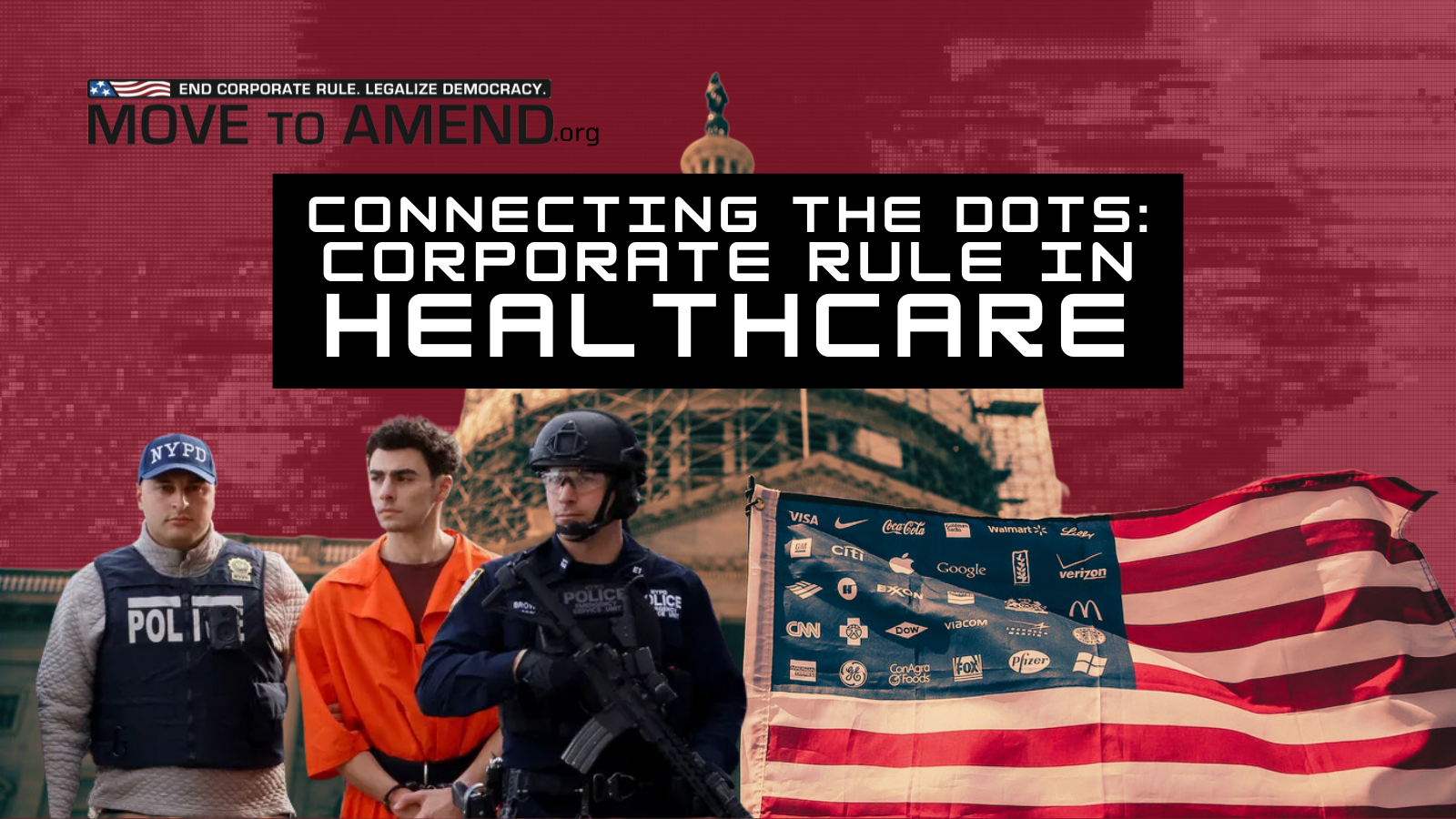
The alleged shooter, 26-year-old Luigi Mangione's, , has pled not guilty to multiple federal charges, including murder. Legal experts are speculating that the case could face “the highest risk” of jury nullification, as public sentiment appears to sympathize more with the accused than the victim. This reaction highlights a critical truth: while the act of violence is indefensible, the misery caused by the for-profit healthcare industry is rooted not in the actions of any one CEO, but in a system of corporate rule that prioritizes profit over people.
The misery so many people suffer at the source of the Healthcare-for-profit Industry is corporate personhood, not from an errant CEO.
The Root of the Problem: Corporate Constitutional Rights
At the heart of this system is the doctrine of corporate personhood, which grants corporations constitutional rights originally intended for human beings. This, combined with the notion of money equaling free speech, has allowed corporations to hijack our political system, undermining free and fair elections, and turning governance into a mechanism for advancing corporate interests. The result? A healthcare system that treats human lives as commodities.
We recently examined the outsized political influence of the healthcare industry in our piece, “Political Influence of the Healthcare Industry.” We laid out why, despite overwhelming public support for a universal healthcare system, corporate interests continue to block progress.
Massive corporate profits.
Healthcare as a Commodity, Not a Right
A dizzying array of corporate interests use their political power to maximize their profits by treating healthcare as a commodity rather than a human right.
Pharmaceutical manufacturing and health products corporations, insurance corporations, medical device and supplier corporations, hospital/nursing home corporations, health services/HMO corporations and individual health professionals have been gouging taxpayers and patients for decades.
Could Jury Nullification Be a Tipping Point?
The possibility of jury nullification in this case is a striking example of public outrage reaching a boiling point. When a jury is willing to defy evidence and the law to send a message, it signals something profound: the system itself is so unjust that ordinary people are willing to challenge it in extraordinary ways.
This potential jury action is not just about one man on trial—it’s about a growing refusal to accept a system where corporate greed dictates our lives, health, and well-being. It’s a call for change that we cannot afford to ignore.
Connecting the Dots: Corporate Rule in Healthcare
The tragic killing of Brian Thompson is not just an isolated incident; it is a symptom of a deeper, systemic problem. Corporate power has become so entrenched that the pain and suffering of ordinary people are now seen as collateral damage in the pursuit of ever-growing profits.
This is why Move to Amend exists. We are working to end the domination of corporations in our political system by passing the *We the People Amendment*(H.J.Res. 54). This amendment would abolish corporate constitutional rights and end the legal fiction that money equals speech. Only by addressing the root causes of corporate rule can we create a healthcare system—and a society—that prioritizes the well-being of people over profits.
At Move to Amend, we don’t take a dime from big corporations or their PACs. Our work is powered entirely by people like you—individuals who believe that healthcare should be a human right, not a privilege for the wealthy.
National organizations representing physicians and nurses who are working to make healthcare accessible to ALL have joined us because they know dismantling corporate rule is essential to fixing our healthcare system - you can view the 790 organizational endorsements we have here.
---
ref
the U.S. health system is dead last among high income countries when it comes to “affordability, administrative efficiency, equity, and healthcare outcomes.” Every other “developed” country on the planet provides health coverage for all its citizens. The U.S. has the world’s highest healthcare spending per capita, one of the results of nearly two-thirds of the population being covered by private/corporate insurance.
Cost, coverage and access are major public concerns of the present inadequate health system. Efforts to reduce costs and expand public coverage and access for seniors, those with pre-existing conditions, or individuals needing long-term care, drugs, dental, vision or psychological services have been routinely opposed in Congress.
Kamala Harris has proposed expanding the Democrats’ 2022 drug pricing reform package; expanding Medicare to some home care, vision, and hearing benefits; strengthening the Affordable Care Act; canceling medical debt; and legalizing abortion access. Donald Trump and the GOP have called for further privatization/corporatization of health services. He sought to repeal the Affordable Care Act while President. While he's vowed to preserve Medicare in a second term, his plan to cut taxes would bankrupt the program in a few years.
Privatization/corporatization of healthcare, including Medicare Advantage plans, are peddled as ways to save money and to increase healthcare “efficiency.”
Neither candidate or party support a universal, comprehensive and affordable Medicare for All plan, such as the Medicare for All Act proposed by Pramila Jayapal in the House and Bernie Sanders in the Senate and supported by Physicians for National Health Program, HealthcareNOW and scores of organizations.
Article 25 of the 1948 United Nations' Universal Declaration of Human Rights asserts, "[e]veryone has the right to a standard of living adequate for the health and well-being of himself and of his family, including food, clothing, housing and medical care and necessary social services." President Franklin Delano Roosevelt called for a Second Bill of Rights in 1944 that identified the "right to adequate medical care and the opportunity to achieve and enjoy good health" as one of several fundamental conditions to achieve human happiness and well being.
Why is there so much opposition to a public health system? Massive corporate profits. A dizzying array of corporate interests use their political power to maximize their profits by continuing to make healthcare a commodity for profit rather than a human right.
Pharmaceutical manufacturing and health products corporations, insurance corporations, medical device and supplier corporations, hospital/nursing home corporations, health services/HMO corporations and individual health professionals have been gouging taxpayers and patients for decades.
How have they accomplished this? The granting of First Amendment "free speech rights" to corporations by the Supreme Court in the 1970s and expanded in the 2010 Citizens United ruling has legalized the ability of business corporations to contribute massive sums of funds to corrupt elections and public policies.
What follows are the current totals of the health sector of the 2023-2024 election cycle (which runs through the end of this year).
---
First, the major political campaign "contributors" (more like "investors)
Top Contributors, 2023-2024
| Contributor | Total | To Dems | To Repubs | To liberal groups | To conservative groups |
| Adelson Clinic for Drug Abuse Treatment & Research | $20309100 | $0.00 | $309100 | $0.00 | $20000000 |
|---|---|---|---|---|---|
| Abbott Laboratories | $4941377 | $477867 | $444636 | $4430 | $4000100 |
| Karla T Jurvetson MD | $3524255 | $964035 | $520.00 | $2559600 | $0.00 |
| Farrington Rocket LLC | $3000000 | $0.00 | $0.00 | $0.00 | $3000000 |
| Cooper House | $2953631 | $1308616 | $0.00 | $1890000 | $0.00 |
| Kaiser Permanente | $2345807 | $1974013 | $246059 | $60768 | $3950.00 |
| Leon Medical Centers | $2199018 | $100415 | $913178 | $0.00 | $1185400 |
| American Hospital Assn | $2048165 | $1106152 | $797889 | $14300 | $0.00 |
| Starkey Hearing Technologies | $2020312 | $248165 | $1772147 | $0.00 | $0.00 |
| Transcarent | $1989484 | $1269288 | $51.00 | $165000 | $0.00 |
|UnitedHealth Group|$1947844|$902095|$907735|$41743|$100355|
| VillageMD | $1840484 | $25917 | $89557 | $0.00 | $1725000 |
|---|---|---|---|---|---|
| DE Shaw Research | $1690961 | $290609 | $0.00 | $1400000 | $0.00 |
| Blue Cross/Blue Shield | $1622576 | $871676 | $725782 | $102625 | $1000 |
| American Society Of Anesthesiologists | $1613982 | $865456 | $748526 | $0.00 | $0.00 |
|Pfizer Inc|$1605152|$1003625|$563652|$95596|$10.00|
| Massachusetts General Hospital | $1565643 | $1212698 | $9112.00 | $337110 | $0.00 |
|---|---|---|---|---|---|
| Sterling Medical Group | $1561200 | $0.00 | $1561200 | $0.00 | $0.00 |
| Greater New York Hospital Assn Management | $1500000 | $0.00 | $0.00 | $1500000 | $0.00 |
| Stiefel Laboratories | $1459951 | $1459951 | $0.00 | $0.00 | $0.00 |
Source: https://www.opensecrets.org/industries/contrib?cycle=2024&ind=H
---
Next are the recipients. They include both Democrats and Republicans.
Top 20 Recipients, 2023-2024
| Rank | Recipient | Chamber | Total |
| 1 | Harris, Kamala (D) | President | $36,161,276 |
|---|---|---|---|
| 2 | Trump, Donald (R) | President | $9,870,673 |
| 3 | Haley, Nikki (R) | President | $2,798,394 |
| 4 | Brown, Sherrod (D-OH) | Senate | $2,687,463 |
| 5 | Kennedy, Robert F Jr. (I) | President | $2,223,527 |
| 6 | Tester, Jon (D-MT) | Senate | $2,042,089 |
|---|---|---|---|
| 7 | Allred, Colin (D-TX) | House | $1,963,884 |
| 8 | Schiff, Adam (D-CA) | House | $1,767,032 |
| 9 | Gallego, Ruben (D-AZ) | House | $1,688,489 |
|10|Ca:{sey, Bob (D-PA)|Senate|$1,611,019|}:
| 11 | DeSantis, Ron (R) | President | $1,578,348 |
|---|---|---|---|
| 12 | Baldwin, Tammy (D-WI) | Senate | $1,239,115 |
| 13 | Slotkin, Elissa (D-MI) | House | $1,147,361 |
| 14 | Rosen, Jacky (D-NV) | Senate | $1,140,395 |
| 15 | Guthrie, Brett (R-KY) | House | $1,112,199 |
| 16 | Tlaib, Rashida (D-MI) | House | $1,075,140 |
| 17 | Krishnamoorthi, Raja (D-IL) | House | $1,065,665 |
| 18 | Jeffries, Hakeem (D-NY) | House | $1,023,117 |
| 19 | Porter, Katie (D-CA) | House | $960,663 |
| 20 | Blackburn, Marsha (R-TN) | Senate | $956,904 |
Source: [*https://www.opensecrets.org/industries/recips?cycle=2024&ind=H
---
Lobbying by the Health Industry
Total spent : $378,598,017 / 2024
Number of Clients: 1724
Number of Lobbyists: 3010
Number of Revolvers (48.87%): 1471(number of lobbyists who used to work for the government -- many of the same agencies where they previously worked
| Industry | Total |
|---|---|
| Pharmaceuticals/Health Products | $198,946,907 |
| Hospitals/Nursing Homes | $62,807,215 |
| Health Services/HMOs | $61,741,772 |
| Health Professionals | $50,420,976 |
| Misc Health | $4,681,147 |
Source: [*https://www.opensecrets.org/industries/lobbying?cycle=2024&ind=H
-----
Health-related corporations are undermining this year’s elections, leading to negative consequences for the affordability, coverage, and access to healthcare — as well as for democracy itself. They are profiting at our expense by exploiting First Amendment free speech rights.
But it doesn't end there. They also avoid public efforts to protect people and families by hijacking other constitutional rights that were originally intended exclusively for human beings.
These include:
√ First Amendment religious rights
The Supreme Court in its Burwell v. Hobby Lobby decision prohibited the Department of Health and Human Services from requiring closely held, for-profit secular corporations to provide contraceptive coverage as part of their employer-sponsored health insurance plans under the Affordable Care Act if it violated the corporation's First Amendment "religious rights and beliefs." To extend and pretend that private, personal religious rights apply to entities such as business corporations is a breach of a constitutional firewall with potential widespread discriminatory implications.
√ Fourth Amendment search and seizure rights.
Tens of thousands of deaths are annually attributed to occupational disease while several million people report work-related injuries and tens of thousands of workplace fatalities. Corporate Fourth Amendment search and seizure rights, affirmed in cases like Marshall v. Barlow which prevent inspectors from the Occupational Safety & Health Administration onto corporate property, threatens worker health and safety.
Making healthcare a human right and creating an authentic democracy are inextricably connected. We're experience a democracy crisis more than a healthcare crisis that is due to the reality of corporate constitutional rights and money equaling free speech.
Enacting the We the People Amendment (HJR54) would end all corporate constitutional rights, not just free speech rights, AND end the constitutional doctrine that money equals speech.
Onward in creating healthcare and real democracy for all,
---
12 24
UnitedHealthcare, the health insurer whose CEO was murdered earlier this month, has spent decades fighting and winning political battles to maintain the for-profit health system status quo and kill any attempts to reform it.
Mere hours after Speaker Nancy Pelosi backed off the public option in a 2009 interview with CNN, a top UnitedHealthcare lobbyist sent out an email to various Washington insiders inviting them to a $2,400-per-person “event with Speaker Pelosi at my home.” (Chip Somodevilla / Getty Images)
The shocking murder of health insurer UnitedHealthcare (UHC) CEO Brian Thompson has ignited a fierce debate about the United States’ uniquely for-profit, insurer-dominated health care system, with the assassin having been apparently motivated by rage at its many injustices. What has largely escaped notice is UHC’s decades-long efforts, in concert with other parts of the health care industry, to blunt attempts to reform the system in a way that would benefit consumers and assuage this roiling anger.
From the earliest days of the Bill Clinton administration’s tilt at health care reform, through wrangling over Barack Obama’s dog’s breakfast of a health care bill, to the rise of Bernie Sanders and his Medicare for All proposal, UHC has been a Zelig-like presence, taking a central role in beating back efforts to change an often capricious and cruel system.
Working with other insurers and for-profit health care entities, UHC has marshaled considerable resources — its money, lobbyists, and political connections — to prevent anything approaching the kind of public health care systems that exist in other countries from emerging in the United States, and to preserve a market-oriented system where the government’s role, if any, is to feed the profits of companies like itself.
A bitter irony is that the reforms UHC and others have bitterly fought for decades, had they been enacted, may well have prevented the kind of boiling over of popular fury that erupted in the reaction to Thompson’s killing. It’s impossible to know, but perhaps these defeated reforms could have not only saved the lives of countless patients over the years but also that of the late UHC chief executive himself.
Shaping Hillarycare
UHC had a front-row seat to Bill and Hillary Clinton’s doomed attempt to reform the US health care system, which took the form of “managed competition,” a market-based concept pushed by a broad swath of the industry that aimed to lower costs and get to universal coverage by encouraging and regulating competition between private insurers.
The company was one of six major HMOs whose CEOs were part of the “Chicago Group,” an informal working group advising and supporting the new administration as it embarked on the make-or-break effort. The CEOs “unanimously” agreed that only “harnessing the power of competitive forces” could rein in ballooning health care costs and urged Clinton to embrace “managed competition” as the solution, according to an April 1993 document held in the Clinton Presidential Library.
The Clinton White House didn’t take up all of the group’s ideas. One of their proposals, for example, was federally preempting “any willing provider” legislation, state laws that effectively stopped insurers from creating selective networks of preferred doctors. But managed competition ended up being the broad framework of Clinton’s business-friendly reform, which eschewed price controls or the kind of robust government role in health care common in other industrialized countries.
It did so even as the model had proved a failure in Minnesota, where it had been pioneered, but which by 1993 had seen a spate of double-digit rate increases and the poor and chronically unwell struggling to get coverage. As one local activist had put it to the St. Paul Pioneer Press, it was “the last gasp of the insurance industry to stay alive.” Or in the words of one executive from another insurer that advised on Clinton’s initiative: “For Prudential, the best scenario for reform — preferably even to the status quo — would be enactment of a managed competition proposal.”
UHC left other fingerprints on the reform effort, besides the fact that then first lady Clinton was indirectly invested in the firm at the same time she led the task force spearheading reform. A top adviser to both that task force and Ira Magaziner, the senior domestic policy advisor directing the effort, was Lois Quam, vice president for public sector services at UHC, a fact that raised eyebrows at the time given the obvious conflict of interest. An internal memo noted that Quam had stock options in UHC as part of her role at the company as well as “a generous salary and compensation package” and “an arrangement” to return after her stint in Washington was done.
“For Quam, it may not be easy to argue that her financial interest is ‘not so substantial,’” the memo stated, regarding efforts to get a waiver for her to join the working group. (Upon permanently leaving UHC in 2007, Quam publicly endorsed a public health insurance option, charging that the industry’s rapacious business practices in the interim had made it unavoidable.)
“Modernizing” Medicare
UHC next played a leading role in George W. Bush’s “modernization” of Medicare in 2003, which established a new prescription drug benefit that funneled billions of government subsidies to drug companies, who were entrusted to keep prescription drug costs down, aided by its barring of the federal government from negotiating for lower prices. The law, the Medicare Modernization Act, also created the Medicare Advantage program that has given private insurers a bigger and bigger role in the entitlement.
UHC was by no means the only player in a full-court press from Big Pharma, HMOs, and other for-profit health care interests pushing the bill, which saw them hire more lobbyists and spend more money than ever, to the tune of a combined $141 million. But it was a pivotal cog. UnitedHealth Group (UHG), UHC’s parent company, spent $1.3 million lobbying on the Medicare bill, according to a Public Citizen report, paying seven separate lobbyists to work on it.
Giving it extra clout was the fact that William McGuire, UHC’s chairman and CEO at the time, had been a major bundler for Bush, putting together more than $100,000 worth of donations for the then president. Meanwhile, Robert Wood, the former chief of staff to Bush’s Health and Human Services secretary, left the administration just before Congress wrangled over the bill to join a lobbying firm, where he proceeded to lobby Congress on behalf of, among other for-profit health care entities, UnitedHealth Group.
UHC also exerted pressure through its arrangement with the influential AARP (the Association of American Retired Persons, before it permanently made its name an acronym), which controversially threw its weight and that of its thirty-five million members behind Bush’s measure, running a huge nationwide ad campaign in support. From 1997 on, the AARP had contracted with UHC and other insurers to provide Medicare supplemental insurance, netting it a $161 million profit, which prompted resentful Democratic leaders Nancy Pelosi and Tom Daschle to suggest a conflict of interest.
Medicare Advantage, birthed from that 2003 legislation, has proven a financial boon to UHC, which now runs the largest Medicare Advantage health plan, accounting for 9.4 million enrollees, or 29 percent of enrollment in a program that draws $462 billion of federal spending. AARP has been criticized for saying little about the increasingly scandal-ridden program, even as it continues to earn big money from a cobranded Medicare Advantage plan with UHC — which, incidentally, has been a vocal opponent of any changes to it. UHC, meanwhile, has been the subject of at least three lawsuits alleging it used the program to take advantage of taxpayers for its own profit and fraudulently overbilled the federal government.
The company worked in the years ahead to keep its cash cow in place. In 2013, it won a major victory after a Medicare Advantage industry lobbying campaign led many Democrats and ultimately the Obama administration to reverse course on cuts to federal rates for the program. The about-face was engineered thanks to an advertising campaign in key states and more than 160 lawmakers writing the Centers for Medicare and Medicaid Services (CMS) to reverse course, an initiative led by industry trade group America’s Health Insurance Plans, which UHC was a part of until 2015. Most recently, it joined another industry-wide push against payment cuts, this time from Joe Biden’s administration, with the UHC chief executive personally making the pilgrimage to Capitol Hill to argue against it in 2023.
At the same time that the Medicare Modernization Act was being worked on, UHC wasn’t limiting its ambitions to the federal level. New York insurers at the time were largely getting away with ignoring a state law forcing them to pay medical claims on time, simply treating millions of dollars of fines over their serial tardiness as a business cost, secure in the knowledge that stricter legislation wouldn’t clear the Republican-controlled state senate. In 2003, the New York Post reported that the state’s health insurers had steered much of its $2.3 million worth of donations since 1999 to Republicans in the state senate, who tended to sit on health and insurance committees.
UHC alone gave more than $35,000 to various New York Republicans in that period. That included then governor George Pataki, senate majority leader Joseph Bruno, and Senator William Larkin, who would become president of the National Conference of Insurance Legislators — an association of state lawmakers whose main policy focus was insurance — and be named one of the hundred “most powerful people in the insurance industry” in North America by a trade publication.
Killing the Public Option
UHC had a more central role in watering down the next Democratic president’s crack at health care reform, namely Barack Obama’s effort early in his first term. Despite campaigning on a public option, Obama and Democratic leaders in Congress infamously wound up dropping the policy in favor of yet another series of regulatory tweaks that left the private insurer system in place while further fattening their bottom lines.
Again, insurers and other parts of the health care industry spent unheard-of amounts to recruit and pay for an army of lobbyists on Capitol Hill to shape the reform. Again, the industry lured people from Capitol Hill through the revolving door and into its payrolls to give it more sway in Congress. But UHC’s role this time was more direct.
A key statistic touted by opponents of the public option — that nearly ten times as many people as was estimated by the Congressional Budget Office would sign up for the program, potentially collapsing the private insurance sector — was cooked up by a UHC subsidiary. The company pressured its employees to agitate against the public option and other parts of the reform by contacting lawmakers, helpfully drafting model letters for them to send, and even directed them to join explicitly right-wing political events organizing against it.
The insurer made inroads with legislators’ offices, according to a *BusinessWeek*report at the time, feeding them talking points and policy advice that steered the reform debate away from ideas that would threaten insurer dominance. As part of this, it retained Daschle, the former Senate Democratic leader and public option proponent, who now gave the company advice it would use to kill the measure in exchange for pay. It parked an eighteen-wheeler full of top-of-the-line medical equipment near the Capitol in response to a proposed tax on insurers, and invited lawmakers to see the incredible things the industry was doing.
Infamously, mere hours after Pelosi backed off the public option in a 2009 interview with CNN, a top UHC lobbyist sent out an email to various Washington insiders inviting recipients to a $2,400-per-person “event with Speaker Pelosi at my home.”
Once again, the resulting reform, devoid of a public option, proved highly lucrative to UHC and the insurance industry. In a Bloomberg Governmentstudy covering the eighteen months after the law’s passage, five of the country’s major insurers, including UnitedHealth Group, saw their profit margins expand at a higher rate. By 2015, UHC executives openly celebrated that they had seen their earnings markedly rise in response to the rush of new Obamacare customers.
But its commitment was fickle. By 2017, the company, at this point the country’s largest insurer, had pulled out of nearly all of the health insurance exchanges that were key parts of Obamacare, deciding they were no longer profitable, and preempting further exits from competitors. The move sent tremors of concern for the future sustainability of the reform. In the interim, it had been a major donor to lawmakers like Senator Amy Klobuchar, who worked to chip away at funding elements of the law in deference to the health care industry.
Medicare for Some
By 2019, UHC and the industry had a huge problem on its hands. The political rise of Sanders gave renewed momentum to a push for a single-payer system, in the form of the Vermont senator’s Medicare for All proposal, which was cosponsored by fourteen of his Senate colleagues, including several Democratic presidential hopefuls.
“One of the things you said: ‘We’re really quiet’ or ‘It seems like we’re quiet.’ Um, we’ve done a lot more than you would think,” UHC’s then CEO Steve Nelson said in a February 2019 town hall meeting, in a recording obtained by the Washington Post, after an employee asked what the company was doing in the tug of war over Medicare for All. “You want to be kind of thoughtful about how you show up and have these kind of conversations, because the last thing you want to do is become the poster child during the presidential campaign.”
Through its membership in the Healthcare Leadership Council, UHG was part of the health care industry front group Partnership for America’s Health Care Future (PAHCF), created in 2018 to preempt Sanders’s policy and more or less every other Democratic proposal at the time to expand government-provided health care, such as the option to buy into Medicare or lowering its eligibility age to sixty.
With a $50 million war chest, it put out a seven-figure TV ad blitz warning against such reforms, a nearly $300,000 digital ad campaign targeting voters in battleground and primary states doing the same, and gave lawmakers whole talking points to copy and paste into their op-eds against the policy. Later, once the threat of Sanders had been neutralized, it turned its efforts to agitating against President Joe Biden’s public option proposal, which he had by then already stopped talking about.
While PAHCF attacked Sanders as “a leading advocate for upending our nation’s health care system in favor of starting from scratch,” UHG then CEO David Wichmann warned his signature proposal would mean “the wholesale disruption of American health care” that “would surely jeopardize the relationship people have with their doctors, destabilize the nation’s health system, and limit the ability of clinicians to practice medicine at their best” while having “a severe impact on the economy and jobs.”
Biden, who vowed to veto Medicare for All if it ever came to his desk, was the top recipient of UHG donations in 2020, and his campaign got a personal vote of confidence from several UHG executives in the form of maxed-out $2,800 donations. While UHG’s and other health insurer’s stocks plunged following the introduction of Sanders’s Medicare for All bill, they surged after Biden’s massive Super Tuesday primary victory.
UHC also spent considerable resources lobbying against the policy at the time, according to federal lobbying filings. The company spent $6.4 million lobbying the federal government on a plethora of issues between the second quarter of 2019 and the first quarter of 2021, among which were “single-payer proposals” and “Medicare for All.” Once Biden was inaugurated, in the $7.4 million it spent over the next six quarters, those were replaced with “proposals to expand health insurance coverage.”
For all of the talk from UHC and the anti–Medicare for All coalition that building on Obamacare was the better way to go, it worked during this period to undermine that reform too, while also fighting against other minor reforms made to better regulate the system while keeping the insurer-preferred system in place.
Overall, the firm put nearly $38 million toward federal lobbying from 2017 to 2024. A consistent focus of its lobbying for those first few years was repealing Obamacare’s health insurance tax, another measure to keep the program fiscally self-sustaining. Congress finally did so in 2019, a major victory for the health care industry, with the repeal taking effect in 2021.
Other high-profile matters included the Inflation Reduction Act — which partially repealed the ban on Medicare negotiating drug prices that had been put in place by Bush’s UHC-backed 2003 measure — as well as drug pricing reforms more generally and surprise billing, which Congress (mostly) eliminated in 2020. Though UHC officially opposed surprise billing, it also yanked away coverage for some out-of-network care in what was seen as a response to the measure passing.
The company continued its war against the public option not just at the federal level but at the state-level too. As Connecticut, the home base of the health insurance industry, tried to create its own statewide public option, UHC and other insurers moved to defeat it.
They formed an online campaign named “Insurance Matters to CT” to put out talking points against the idea and, not unlike in 2010, held a webinar urging its employees to call lawmakers and otherwise organize against an idea that would be “the path to single payer” and charge people “artificially low premiums.” According to that leaked webinar, the company was part of “three major coalitions” in the state working against the measure. In 2021, UHG and other insurers also wrote to Connecticut governor Ned Lamont, issuing a thinly veiled threat that they, as major employers, would leave the state if it passed. The bill died the next month under threat of Lamont’s veto, the third consecutive time it had been defeated.
UHC spent more than $550,000 lobbying the Connecticut government from 2019 to 2024 as the public option bill struggled to gain traction — major sums at the state level that far exceed spending by many other big firms. Insurance Matters to CT, meanwhile, has continued to argue against the idea, while also training its ire on the state’s Partnership Plan, which allows municipalities to join the state employee health care plan.
Avoidable Tragedies
UHC is not by any means the only corporate actor that has worked intensely to kill measures like Medicare for All, a public option, and other reforms that would have put Americans’ lives ahead of private profits. These efforts have always been successful precisely because they’ve seen the entire for-profit health care industry mobilize itself into a tidal wave of political pressure.
But the human tragedy that has struck UHC, as well as its ubiquitous and sometimes central role in these efforts, makes this history particularly notable. One can’t help but wonder how the terrible events of the past month might have gone differently had UHC and other insurers lost one or more of these political battles over the years.
---
https://www.motherjones.com/politics/2024/12/us-health-insurance-coverage-healthcare-system-problems-medical-debt-profits-data-charts/
===
UnitedHealth uses AI model with 90% error rate to deny care, lawsuit alleges - Ars Technica
UnitedHealthcare, the largest health insurance company in the US, is allegedly using a deeply flawed AI algorithm to override doctors' judgments and wrongfully deny critical health coverage to elderly patients. This has resulted in patients being kicked out of rehabilitation programs and care facilities far too early, forcing them to drain their life savings to obtain needed care that should be covered under their government-funded Medicare Advantage Plan.
That's all according to a lawsuit filed this week in the US District Court for the District of Minnesota. The lawsuit is brought by the estates of two deceased people who were denied health coverage by UnitedHealth. The suit also seeks class-action status for similarly situated people, of which there may be tens of thousands across the country.
The lawsuit lands alongside an investigation by Stat News that largely backs the lawsuit's claims. The investigation's findings stem from internal documents and communications the outlet obtained, as well as interviews with former employees of NaviHealth, the UnitedHealth subsidiary that developed the AI algorithm called nH Predict.
"By the end of my time at NaviHealth I realized: I'm not an advocate, I'm just a moneymaker for this company," Amber Lynch, an occupational therapist and former NaviHealth case manager, told Stat. "It's all about money and data points," she added. 'It takes the dignity out of the patient, and I hated that."
Ars Video
### How Scientists Respond to Science Deniers
AI-based denials
According to the lawsuit, UnitedHealth started using nH Predict in at least November 2019, and it is still in use. The algorithm estimates how much post-acute care a patient on a Medicare Advantage Plan will need after an acute injury, illness, or event, like a fall or a stroke. Post-acute care can include things like therapy and skilled care from home health agencies, skilled nursing homes, and inpatient rehabilitation centers.
It's unclear how nH Predict works exactly, but it reportedly estimates post-acute care by pulling information from a database containing medical cases from 6 million patients. NaviHealth case managers plug in certain information about a given patient—including age, living situation, and physical functions—and the AI algorithm spits out estimates based on similar patients in the database. The algorithm estimates medical needs, length of stay, and discharge date.
But Lynch noted to Stat that the algorithm doesn't account for many relevant factors in a patient's health and recovery time, including comorbidities and things that occur during stays, like if they develop pneumonia while in the hospital or catch COVID-19 in a nursing home.
According to the Stat investigation and the lawsuit, the estimates are often draconian. For instance, on a Medicare Advantage Plan, patients who stay in a hospital for three days are typically entitled to up to 100 days of covered care in a nursing home. But with nH Predict, patients rarely stay in nursing homes for more than 14 days before receiving payment denials from UnitedHealth.
When patients or their doctors have requested to see nH Predict's reports, UnitedHealth has denied their requests, telling them the information is proprietary, according to the lawsuit. And, when prescribing physicians disagree with UnitedHealth's determination of how much post-acute care their patients need, their judgments are overridden.
Favorable failings
The use of faulty AI is not new for the health care industry. While AI chatbots and image generators are currently grabbing headlines and causing alarm, the health care industry in the US has a longer record of problematic AI use, including establishing algorithmic racial bias in patient care. But, what sets this situation apart is that the dubious estimates nH Predict spits out seem to be a feature, not a bug, for UnitedHealth.
Since UnitedHealth acquired NaviHealth in 2020, former employees told Stat that the company's focus shifted from patient advocacy to performance metrics and keeping post-acute care as short and lean as possible. Various statements by UnitedHealth executives echoed this shift, Stat noted. In particular, the UnitedHealth executive overseeing NaviHealth, Patrick Conway, was quoted in a company podcast saying: "If [people] go to a nursing home, how do we get them out as soon as possible?"
The lawsuit argues that UnitedHealth should have been well aware of the "blatant inaccuracy" of nH Predict's estimates based on its error rate. Though few patients appeal coverage denials generally, when UnitedHealth members appeal denials based on nH Predict estimates—through internal appeals processes or through the federal Administrative Law Judge proceedings—over 90 percent of the denials are reversed, the lawsuit claims. This makes it obvious that the algorithm is wrongly denying coverage, it argues.
But, instead of changing course, over the last two years, NaviHealth employees have been told to hew closer and closer to the algorithm's predictions. In 2022, case managers were told to keep patients' stays in nursing homes to within 3 percent of the days projected by the algorithm, according to documents obtained by Stat. In 2023, the target was narrowed to 1 percent.
And these aren't just recommendations for NaviHealth case managers—they're requirements. Case managers who fall outside the length-of-stay target face discipline or firing. Lynch, for instance, told Stat she was fired for not making the length-of-stay target, as well as falling behind on filing documentation for her daily caseloads.
In an emailed statement, UnitedHealth's subsidiary Optum Health told Ars:
The naviHealth predict tool is not used to make coverage determinations. The tool is used as a guide to help us inform providers, families and other caregivers about what sort of assistance and care the patient may need both in the facility and after returning home. Coverage decisions are based on CMS coverage criteria and the terms of the member’s plan. This lawsuit has no merit, and we will defend ourselves vigorously.
Ultimately, case managers do not decide on coverage or denials—those decisions fall to NaviHealth's physician medical reviewers. But, those physicians are advised by the case managers, who are held to the 1 percent target.
And case managers are specifically trained to defend the algorithm's estimate to patients and their care providers. One training document obtained by Stat discussed the blunt tactics case managers were told to take when patients and caregivers pushed back on denials. It stated:
- If a nursing home balked at discharging a patient with a feeding tube, case managers should point out that the tube needed to provide "26 percent of daily calorie requirements" to be considered as a skilled service under Medicare coverage rules.
- If a nurse took a broader tack, and argued a patient was unsafe to leave, case managers were instructed to counter, in part, that the algorithm's projections about a patient's care needs, and readiness for discharge, are based on a "severity-adjusted" comparison to similar patients around the country. "Why would this patient be any different?" the document asks.
No winning
Even for the patients who appeal their AI-backed denials and succeed at getting them overturned, the win is short-lived—UnitedHealth will send new denials soon after, sometimes within days.
A former unnamed case manager told Stat that a supervisor directed her to immediately restart a case review process for any patient who won an appeal. "And 99.9 percent of the time, we're going to turn right back around and issue another [denial]," the former case manager said. "Well, you won, but OK, what'd that get you? Three or four days? You’re going to get another [denial] on your next review, because they want you out."
The plaintiffs leading the proposed class-action suit include the family of Gene Lokken, who died on July 17 of this year. On May 5 2022, the 91-year-old fell at home, fracturing his leg and ankle. After around six days in the hospital, he was moved to hospice care, where he spent a month recovering from his injuries. After that, doctors said he became well enough to start physical therapy. But UnitedHealth only paid for 19 days of therapy, dumbfounding his doctors and therapists, who described his muscle functions as "paralyzed and weak." The family appealed the denial, but their appeal was rejected. The rejection letter UnitedHealth sent the family said additional physical therapy was unneeded because there were no acute medical issues, and he was self-feeding and required minimal help for hygiene and grooming.
The family had no choice but to pay out of pocket for his therapy, spending around $150,000 until his death.
The other plaintiff is the family of Dale Tetzloff, who suffered a stroke on October 4, 2022, and was admitted to a hospital. While there, the 74-year-old's doctors referred him to a skilled nursing home and determined he would need at least 100 days of post-acute care. But, after 20 days at the skilled nursing home, UnitedHealth denied further coverage.
His family appealed the denial, twice, overturning it on the second appeal after NaviHealth doctors reviewed Tetzloff's medical records. But, after 40 days at the skilled nursing home, UnitedHealth denied coverage again and refused to provide a reason. The family continued trying to appeal the denial, but were unsuccessful. Meanwhile, they paid $70,000 out of pocket over about 10 months. In June, 2023, he was moved to an assisted living facility, where he died on October 11.
The lawsuit accuses UnitedHealth and NaviHealth of breach of contract, breach of good faith and fair dealing, unjust enrichment, and insurance law violations in many states. It calls for actual damages, damages from emotional distress, disgorgement and/or resititution, and an end to the AI-based claims denials.
It’s unclear how much UnitedHealth saves by using nH Predict, but Stat estimated it to be hundreds of millions of dollars annually. In 2022, UnitedHealth Group’s CEO made $20.9 million in total compensation. Four other top executives made between about $10 and $16 million each.
===
12 24
no lnx
:{Alternet
When profits kill: The deadly cost of treating healthcare as a business
Thom Hartmann December 10, 2024
The recent assassination of the CEO of UnitedHealthcare — the health insurance company with, reportedly, the highest rate of claims rejections (and thus dead, wounded, and furious customers and their relations) — gives us a perfect window to understand the stupidity and danger of the Musk/Trump/Ramaswamy strategy of “cutting government” to “make it more efficient, run it like a corporation.”
Consider health care, which in almost every other developed country in the world is legally part of the commons — the infrastructure of the nation, like our roads, public schools, parks, police, military, libraries, and fire departments — owned by the people collectively and run for the sole purpose of meeting a basic human need.
The entire idea of government — dating all the way back to Gilgamesh and before — is to fulfill that singular purpose of meeting citizens’ needs and keeping the nation strong and healthy. That’s a very different mandate from that of a corporation, which is solely directed (some argue by law) to generate profits.
The Veterans’ Administration healthcare system, for example, is essentially socialist rather than capitalist. The VA owns the land and buildings, pays the salaries of everybody from the surgeons to the janitors, and makes most all decisions about care. Its primary purpose — just like that of the healthcare systems of every other democracy in the world — is to keep and make veterans healthy. Its operation is nearly identical to that of Britain’s beloved socialist National Health Service.
UnitedHealthcare similarly owns its own land and buildings, and its officers and employees behave in a way that’s aligned with the company’s primary purpose, but that purpose is to make a profit. Sure, it writes checks for healthcare that’s then delivered to people, but that’s just the way UnitedHealthcare makes money; writing checks and, most importantly, refusing to write checks.
Think about it. If UnitedHealthcare’s main goal was to keep people healthy, they wouldn’t be rejecting 32 percent of claims presented to them. Like the VA, when people needed help they’d make sure they got it.
Instead, they make damn sure their executives get millions of dollars every year (and investors get billions) because making a massive profit ($23 billion last year, and nearly every penny arguably came from saying “no” to somebody’s healthcare needs) is their real business.
On the other hand, if the VA’s goal was to make or save money by “being run efficiently like a company,” they’d be refusing service to a lot more veterans (which it appears is on the horizon).
This is the essential difference between government and business, between meeting human needs (social) and reaching capitalism’s goal (profit).
It’s why its deeply idiotic to say, as Republicans have been doing since the Reagan Revolution, that “government should be run like a business.” That’s nearly as crackbrained a suggestion as saying that fire departments should make a profit (a doltish notion promoted by some Libertarians). Government should be run like a government, and companies should be run like companies.
Given how obvious this is with even a little bit of thought, where did this imbecilic idea that government should run like a business come from?
Turns out, it’s been driven for most of the past century by morbidly rich businessmen (almost entirely men) who don’t want to pay their taxes. As Jeff Tiedrich notes:
“The scariest sentence in the English language is: ‘I’m a billionaire, and I’m here to help.’”
Rightwing billionaires who don’t want to pay their fair share of the costs of society set up think tanks, policy centers, and built media operations to promote their idea that the commons are really there for them to plunder under the rubric of privatization and efficiency.
They’ve had considerable success. Slightly more than half of Medicare is now privatized, multiple Republican-controlled states are in the process of privatizing their public school systems, and the billionaire-funded Project 2025 and the incoming Trump administration have big plans for privatizing other essential government services.
The area where their success is most visible, though, is the American healthcare system. Because the desire of rightwing billionaires not to pay taxes have prevailed ever since Harry Truman first proposed single-payer healthcare like most of the rest of the world has, Americans spend significantly more on healthcare than other developed countries.
In 2022, citizens of the United States spent an estimated $12,742 per person on healthcare, the highest among wealthy nations. This is nearly twice the average of $6,850 per person for other wealthy OECD countries.
Over the next decade, it is estimated that America will spend between $55 and $60 trillion on healthcare if nothing changes and we continue to cut giant corporations in for a large slice of our healthcare money.
On the other hand, Senator Bernie Sanders’ single-payer Medicare For All plan would only cost $32 trillion over the next 10 years. And it would cover everybody in America, every man woman and child, in every medical aspect including vision, dental, psychological, and hearing.
Currently 25 million Americans have no health insurance whatsoever.
If we keep our current system, the difference between it and the savings from a single-payer system will end up in the pockets, in large part, of massive insurance giants and their executives and investors. And as campaign contributions for bought off Republicans. This isn’t rocket science.
And you’d think that giving all those extra billions to companies like UnitedHealthcare would result in America having great health outcomes. But, no.
Despite insanely higher spending, the U.S. has a lower life expectancy at birth, higher rates of chronic diseases, higher rates of avoidable or treatable deaths, and higher maternal and infant mortality rates than any of our peer nations.
Compared to single-payer nations like Canada, the U.S. also has a higher incidence of chronic health conditions, Americans see doctors less often and have fewer hospital stays, and the U.S. has fewer hospital beds and physicians per person.
No other country in the world allows a predatory for-profit industry like this to exist as a primary way of providing healthcare. Every other advanced democracy considers healthcare a right of citizenship, rather than an opportunity for a handful of industry executives to hoard a fortune, buy Swiss chalets, and fly around on private jets.
This is one of the most widely shared graphics on social media over the past few days in posts having to do with Thompson’s murder…
Sure, there are lots of health insurance companies in other developed countries, but instead of offering basic healthcare (which is provided by the government) mostly wealthy people subscribe to them to pay for premium services like private hospital rooms, international air ambulance services, and cosmetic surgery.
Essentially, UnitedHealthcare’s CEO Brian Thompson made decisions that killed Americans for a living, in exchange for $10 million a year. He and his peers in the industry are probably paid as much as they are because there is an actual shortage of people with business training who are willing to oversee decisions that cause or allow others to die in exchange for millions in annual compensation.
That Americans are well aware of this obscenity explains the gleeful response to his murder that’s spread across social media, including the refusal of online sleuths to participate in finding his killer.
It shouldn’t need be said that vigilantism is no way to respond to toxic individuals and companies that cause Americans to die unnecessarily. Hopefully, Thompson’s murder will spark a conversation about the role of government and the commons — and the very real need to end the corrupt privatization of our healthcare system (including the Medicare Advantage scam) that has harmed so many of us and killed or injured so many of the people we love.
ALSO READ: CEO shooting suspect’s manifesto claims violence is answer to health care industry: report
===
===
NEWSWEEK
NO LNX?
The fatal shooting of UnitedHealthcare CEO Brian Thompson on Wednesday, which New York City police have described as "brazen" and "targeted," occurred after the insurance provider has faced legal scrutiny over its coverage.
Police have yet to make an arrest in the midtown Manhattan shooting, and a motive remains unclear. The shooting drew an array of reactions, with many critics not entirely sympathetic as they pointed out that the company has denied coverage to some patients. Others, however, slammed those reactions as insensitive, saying that a killing isn't justified and that acts of violence should be denounced.
One criticism of UnitedHealthcare that has garnered attention following the shooting involves a lawsuit alleging the company uses artificial intelligence (AI) to deny coverage to some elderly patients who are on a Medicare Advantage plan, despite allegedly being aware that the algorithm has a 90 percent error rate.
The lawsuit was filed on November 14, 2023. It names UnitedHealth Group, UnitedHealthcare and NaviHealth as the defendants. It was brought by the families of two now-deceased patients who were denied coverage by UnitedHealthcare for stays at nursing homes. The suit is ongoing, and its claims have not been proved in court.
Newsweek reached out via email to UnitedHealthcare for comment.
United Healthcare AI lawsuit
What the UnitedHealthcare AI Lawsuit Alleges
The lawsuit alleges the provider continues using the system because it knows that only about 0.2 percent of policyholders will appeal their denied claims and that the majority will "either pay out-of-pocket costs or forgo the remainder of their prescribed post-acute care."
The suit says that UnitedHealthcare banks "on the patients' impaired conditions, lack of knowledge, and lack of resources to appeal the erroneous AI-powered decisions."
It goes on: "The fraudulent scheme affords Defendants a clear financial windfall in the form of policy premiums without having to pay for promised care, while the elderly are prematurely kicked out of care facilities nationwide or forced to deplete family savings to continue receiving necessary medical care, all because an AI model 'disagrees' with their real live doctors' determinations."
The suit says that an AI model was used to compare a patient's diagnosis, age, living situation and physical function to similar patients to predict the person's needs, estimated length of stay and target discharge date from care facilities.
That model, however, allegedly provided "generic recommendations" that did not "adjust for a patient's individual circumstances and conflict with basic rules on what Medicare Advantage plans must cover," according to the suit.
UnitedHealth Group's Response to Suit
Read more Health Care
Police Find Backpack in Central Park Suspected to Belong to UnitedHealthcare CEO Gunman
UnitedHealthcare CEO May Have Hired His Own Killer—Former Police Commander
Blue Cross Blue Shield's Corporate 'About Us' Page Vanishes From Website
New Unmasked Images Released of Smiling UnitedHealthcare CEO Suspect
In May, UnitedHealth Group's lawyers argued the suit should be dropped because the plaintiffs "failed to exhaust the exclusive administrative appeal process set by the Medicare Act," reported the website Stat. They said the issues raised in the lawsuit are with the federal government, not UnitedHealth or its subsidiaries.
For instance, the lawsuit alleged that patients were "rarely" in a nursing home for more than two weeks before they started to receive payment denials, despite Medicare Advantage plans allowing patients who were in the hospital for three days to get up to 100 days in a nursing home.
The lawsuit also says that more than 90 percent of these denials that are appealed are ultimately reversed.
Some in the health care industry have been raising concerns about the use of AI in insurance. A Newsweek report found that concerns are particularly prevalent for patients on Medicare Advantage plans, which are provided by private insurance companies that have contracts with the federal government.
The AI lawsuit is among the examples of scrutiny UnitedHealthcare is facing following the fatal shooting of its CEO. But as some critics cited the lawsuit after the shooting, or even joked about it, others viewed these reactions as crass.
"Just a reminder that Brian Thompson, the CEO of UnitedHealth who was just shot and killed in NY, was a human being with a family. So many of the comments on his murder are despicable," wrote Julie Nelson, an anchor at Minnesota news station KARE, in a post to X (formerly Twitter).
UHC CEO Shooting: What We Know
The suspect in Thompson's shooting was still at large Thursday afternoon, with police releasing their clearest image yet of him more than 24 hours after the shooting.
"UPDATE: Below are photos of a person of interest wanted for questioning regarding the Midtown Manhattan homicide on Dec. 4. This does not appear to be a random act of violence; all indications are that it was a [premeditated], targeted attack," New York's Police Department (NYPD) wrote in a post to X.
Thompson, 50, was shot dead near the Hilton Hotel in midtown Manhattan at about 6:45 a.m. Wednesday, police said. A masked suspect fled the scene to a nearby alleyway and then rode away on an E-bike toward Central Park.
Thompson was taken to Mount Sinai Hospital, where he was pronounced dead. He was expected to speak at an investor presentation at the Hilton later in the day for UnitedHealthcare, the largest private health insurer in the U.S. He had served as the company's CEO since 2021.
Authorities said Thursday that a bullet found at the shooting scene was emblazoned with the words deny, defend and depose, ABC News reported.
NYPD Commissioner Jessica Tisch told reporters at a Wednesday press conference that the suspect was "lying in wait" for several minutes before the shooting.
"Many people passed the suspect, but he appeared to wait for his intended target. I want to be clear: At this time, every indication is that this was a premeditated, preplanned, targeted attack," she said.
In a statement, UnitedHealth Group said the company is "deeply saddened and shocked" by the shooting.
"Brian was a highly respected colleague and friend to all who worked with him. We are working closely with the New York Police Department and ask for your patience and understanding during this difficult time. Our hearts go out to Brian's family and all who were close to him," the statement reads.
AN 12 24
Fox News hosts Sandra Smith and Jeanine Pirro criticized Republican state Delegate Nino Mangione of Maryland after his cousin, Luigi Mangione, was arrested for the murder of CEO executive Brian Thompson.
"Another twist in this story, this just into our newsroom, the suspect's cousin is a Maryland State Delegate," Smith reported Monday. "So this is now being confirmed, the suspect's cousin is a Maryland State Delegate, Antonio D. Mangione, goes by Nino."
"How was it possible there wasn't anyone, anywhere in the country who was saying, that person's in my family, I know that guy?" she said.
Former FBI investigator Bill Daly said it was "quite surprising that it took a McDonald's employee in Pennsylvania to identify this person."
"How does anybody who is related to this person not say, I know that guy, and call the police?" Smith asked Pirro.
"Well, that is certainly a very relevant question," Pirro agreed. "Once a guy at McDonald's can pick up the phone and a relative and someone who is in a particular job where he's working for the government, essentially, and for the people, can't, you know you've got a problem."
Watch the video below from Fox News.
//
man being held in connection to the Manhattan shooting of a health insurance executive reportedly had a manifesto claiming violence was the answer to problems with the health care industry.
The New York Times reported Monday that Luigi Mangione, 26, was being held in Pennsylvania in connection to the shooting of Brian Thompson.
Mangione was said to have a handwritten manifesto railing against the insurance industry for putting profits above health care.
According to CNN, the document suggested that violence was the answer to health care insurance problems.
A "ghost gun" and a suppressor were also reportedly found in the man's possession.
===
3 24 cpac steve moore off bs
this weekend at the CPAC conference one of your Hotline editors, Steve Moore, called AARP an “evil organization” for its nefarious relationships with the Biden administration and one of the country’s largest health insurance conglomerates, UnitedHealth.
The Biden campaign lashed out in a social media blast asserting the old chestnut that Repubs want to cut Social Security and Medicare:

Here’s a reality check: AARP doesn’t really represent the interests of seniors anymore – if it ever did. AARP is a functionary of one of the nation’s largest health insurer behemoths – United Health.
AARP now collects $1 BILLION a year (not $1 million) in royalties from UnitedHealth – a gargantuan insurer with a $500 billion market cap.
This sweetheart arrangement with UnitedHealth explains why AARP sold seniors down the river by supporting ObamaCare despite calls from their own members running 14-to-1 against it.
UnitedHealth and AARP also supported the Biden Inflation Acceleration Act, which imposed price controls on drug companies in a way that is not lowering drug prices but is slowing R&D funding for new drugs to combat Alzheimer’s, Parkinson’s, ALS, and cancer. The last time we checked seniors are the strongest advocates for winning the race for the cure.
AARP signed on to this bill even though it raided over $250 billion from Medicare drug spending to pay for supersized Obamacare subsidies and green energy giveaways.
AARP has opposed many of the most modest debt reduction plans to save America’s future while supporting higher taxes on our kids and grandkids.
If you’re a member of AARP, maybe you should reconsider. We urge our members to check out AMAC or 60+, which are organizations that truly support the interests of older Americans.
===
UnitedHealth Group
From SourceWatch
Jump to: navigation, search
UnitedHealth Group Incorporated is a large U.S. health insurance company with about 70 million customers. Brands include AmeriChoice (manages various Medicare and Medicaid options), Ovations (specializes in people aged 50+), UnitedHealth Group International (in Europe, Latin America, and Asia), and UnitedHealthcare (consumer-oriented health benefit plans). ^[1]
Top competitors are Aetna, Blue Cross, and WellPoint. In 2006, UnitedHealth had revenues of US$71.5 billion with profits of US$4.1 billion. ^[2]
Contents[hide] |
Efforts to oppose health care reform
Corporate mobilization of employees
In August, 2009, as the country was debating a Democratically proposed health reform bill, UnitedHealth Group sent out a letter to its employees urging them to call the company's "United for Health Reform Advocacy Hotline" to speak with an advocacy specialist about health care reform. According to the letter, the advocacy specialist would help UHG employees write "personalized messages" to elected officials, and arm them with talking points to use at local events to help them better oppose the public health insurance option. The letter also said the specialist would assist employees with finding and attending town hall meetings about health care reform. The letter directed employees to a Web site, www. unitedforhealthreform.com/events. ^[3]
Corporate mobilization of employees in a way that gives the appearance of a "grassroots uprising" against proposed legislation was a tactic used by Philip Morris in the 1990s to oppose U.S. Food and Drug Administration regulation of tobacco.
Ad boycott against Air America Radio
United Healthcare refused to advertise on the progressive Air America Radio. In October 2006, around 90 companies, including United Healthcare, told ABC Radio Networks that they did not want their ads to play on radio stations that carried Air America Radio. ^[4]^ ^[5]^ ^[6]
CEO William W. McGuire removed in stock scandal
In 2006, the Securities and Exchange Commission, the Internal Revenue Service, and prosecutors in the U.S. attorney's office in New York began investigating the conduct of UnitedHealth Group's leadership for backdating stock options. Chairman and Chief Executive Officer of UnitedHealth Group was removed from office. The Washington Post said of McGuire, "his greed in amassing $1.1 billion in stock options plus a pension of $5.1 million a year is matched only by the revelation that the board member who chaired the compensation committee had conflicts of interest." ^[7]^ ^[8]^ ^[9]
Political contributions
UnitedHealth Group gave $336,000 to federal candidates in the 2006 election through its political action committee - 39% to Democrats and 60% to Republicans. ^[10]
Lobbying
The company spent $2,534,000 for lobbying in the first half of 2007. Some of the lobbying firms used were Barbour, Griffith and Rogers, Wexler and Walker Public Policy Associates, Dutko Worldwide, and Ogilvy Government Relations. ^[11]
Personnel
Key people and 2006 pay: ^[12]
- Richard T. Burke, Sr., Chairman
- Stephen J. Hemsley, Chief Executive Officer and Director, $15,549,028[13]^
- G. Mike Mikan, Chief Financial Officer
Selected members of the Board of Directors: ^[14]
- James A. Johnson, Vice Chairman, Perseus LLC
- Thomas H. Kean, Former Governor of New Jersey
- Douglas W. Leatherdale, Former Chairman and Chief Executive Officer, The St. Paul Companies, Inc.
Contact details
9900 Bren Road East
Minnetonka, MN 55343
Phone: 952-936-1300 begin_of_the_skype_highlighting 952-936-1300 end_of_the_skype_highlighting
Fax: 952-936-7430
Web: http://www.unitedhealthgroup.com
References
- ↑ About page, UnitedHealth Group, accessed November 2007.
- ↑ UnitedHealth Group Profile, Hoovers, accessed November 2007.
- ↑ United for Health Reform (UnitedHealth Group PAC) Take Action Today! Email. August 13, 2009
- ↑ Marc Fisher, "Air America, in the Throes of Victory?", The Washington Post, December 10, 2006.
- ↑ "Air America on Ad Blacklist?", FAIR, October 31, 2006.
- ↑ "Air America Blackout", FAIR.org/ABC memo, October 25, 2006.
- ↑ "A Board With Its Back To The Wall", BusinessWeek, July 10, 2006
- ↑ Joshua Freed, "Feds Seek to Speed UnitedHealth Probe", ABC News, April 30, 2007 .
- ↑ "The Options Blood Bath", Washington Post, November 14, 2006.
- ↑ 2006 PAC Summary Data, Open Secrets, accessed November 2007.
- ↑ UnitedHealth Group lobbying expenses, Open Secrets, accessed November 2007.
- ↑ UnitedHealth Group Key People, Hoovers, accessed November 2007.
- ↑ Stephen J Hemsley, Forbes, accessed November 2007.
- ↑ Board of Directors, UnitedHealth Group, accessed November 2007.
Retrieved from "http://www.sourcewatch.org/index.php?title=UnitedHealth_Group"
Categories: Corporations | Health | Insurance industry | Scandals | United States