Breyer, Justice
==
5/19 ala outlaw abort felony 99 yrs designedd for scotus ~ roe
merri ok
kasky v nike dissent with o’connor?
breyer does primer on stare decisus? DN 5/15/19
PAL OF O’CONNOR
ga 6 wk heartbeat
==
western trAd pARTNERS mONTANA cu DO- OVER?
===
621 much talk about when he shd step down vs gop mcconn BS
---
DISSENT VOTER SUPPRESS // SOTOMAYOR
AN 1 26
NO LNX
Inside the GOP plot to end America as we know it
Thom Hartmann January 05, 2026
It’s not just a brand new year; it’s a midterm election year. And the stakes this coming November are mind-boggling, so, of course, Republicans are starting to do everything they can to rig the election.
Just a week ago, for example, Trump’s Postal Service changed the rules about getting your mail-in ballot postmarked so it’ll be counted. Instead of postmarking letters when they’re received, Post Offices will now postmark them when they get “processed,” which may happen days later.
In the 2024 presidential election, the feds estimated that around 104,000 mail-in ballots nationwide weren’t counted because they were postmarked late; with this change, the number this fall and for 2028 could be in the millions.
Meanwhile, Republican secretaries of state are enthusiastically purging voters from the rolls as they get ready for this fall. Remember, reporter and economist Greg Palast found, using official federal and state numbers, that in 2024:
Kamala Harris“Trump lost. That is, if all legal voters were allowed to vote, if all legal ballots were counted, Trump would have lost the states of Wisconsin, Michigan, Pennsylvania and Georgia. Vice-President would have won the Presidency with 286 electoral votes.“And, if not for the mass purge of voters of color, if not for the mass disqualification of provisional and mail-in ballots, if not for the new mass “vigilante” challenges in swing states, Harris would have gained at least another 3,565,000 votes, topping Trump’s official popular vote tally by 1.2 million.”
You’d think we each have a right to vote, rather than voting being just a privilege that Republican-controlled states could take away in dozens of different ways.
Supreme Court Republicans on the ruled, for example, that we have a right to own a gun. As a result, before a state or local government can take away your gun, they must first go before a judge to prove the necessity of doing so.
But, Republicans on the Court tell us, Republican secretaries of state can eliminate your right to vote without even telling you; how does that make sense?
14th Amendment After all, the to the Constitution references “the right to vote at any election” and even says that any state that violates that right shall lose members of its congressional delegation as punishment.
The 19th Amendment references “The right of citizens of the United States to vote…”
The 24th Amendment starts, “The right of citizens of the United States to vote…”
The 26th Amendment is all about, “The right of citizens of the United States, who are eighteen years of age or older, to vote…”
ConstitutionAdditionally, the , in Article I, Section 4, says that Congress can make federal laws that overrule state laws restricting or regulating voting:
“The Times, Places and Manner of holding Elections for Senators and Representatives, shall be prescribed in each State by the Legislature thereof; but the Congress may at any time by Law make or alter such Regulations…”
And, sure enough, Congress did just that in 1993 when it passed the National Voter Registration Act (NVRA), sometimes referred to as the Motor Voter Act because, among other things, it provided for the option of instant voter registration when a person gets a driver’s license in every state in the union.
Now known as 52 U.S. Code § 20501, this law of the land opens with:
The Congress finds that -(1) the right of citizens of the United States to vote is a fundamental right
(2) it is the duty of the Federal, State, and local governments to promote the exercise of that right and
(3) discriminatory and unfair registration laws and procedures can have a direct and damaging effect on voter participation in elections for Federal office and disproportionately harm voter participation by various groups, including racial minorities.
And it wasn’t a particularly contentious law when it was passed: every Democrat present in the Senate voted for it (Rockefeller missed the vote) as did all but two Republicans.
So how did we get from the Constitution repeatedly asserting a “right to vote” and Congress passing a law that unambiguously proclaims that right, to the current state of affairs where states regularly and methodically deprive citizens of their “right” to vote and instead claim that it’s merely a privilege?
As I lay out in The Hidden History of the War On Voting, much of the blame rests with the most conservative and regressive of our federal institutions, the Supreme Court.
The first real test of the NVRA came in 2018, when Ohio’s Republican Secretary of State, John Husted, went on a voter-purge binge (that hit Black, student, and elderly neighborhoods particularly hard) and was sued by the A. Phillip Randolph Institute for violating Ohio citizens’ constitutional right to vote.
In a bitter 5-4 decision, the Republican majority ruled in Husted v Randolph that purging voters because they failed to return a junk-mail-like postcard was entirely legal.
It’s a practice that was called “caging” back when Karl Rove’s guy was allegedly doing it and it was illegal then but has, since that Court ruling, spread to pretty much every Republican-controlled state in the nation.
They’ll identify a part of the state that they consider particularly “prone to fraud“ — in other words, filled with a lot of Black and brown people — and mail postcards that look like junk mail into those precincts. When people failed to return them, they are automatically removed from the voting rolls. In most cases they don’t even know they’ve been purged until they show up to vote and are turned away.
Justice Samuel Alito’s decision was particularly biting, claiming that the arguments made by the citizens who’d lost their right to vote were “worse than superfluous” and their argument that they shouldn’t have to regularly check in with the Secretary of State’s office to stay on the voter rolls represented logic “no sensible person” could agree with.
Sensible or not, in his dissent, liberal Justice Stephen Breyer pointed out that around 4 percent of Americans move every year. Yet, he wrote:
“The record shows that in 2012 Ohio identified about 1.5 million registered voters — nearly 20 percent of its 8 million registered voters — as likely ineligible to remain on the federal voter roll....”
Justice Sonia Sotomayor’s dissent was even more scathing.
“Congress enacted the NVRA against the backdrop of substantial efforts by States to disenfranchise low-income and minority voters,” she wrote, “including programs that purged eligible voters from registration lists because they failed to vote in prior elections.“The Court errs in ignoring this history and distorting the statutory text to arrive at a conclusion that not only is contrary to the plain language of the NVRA but also contradicts the essential purposes of the statute, ultimately sanctioning the very purging that Congress expressly sought to protect against.”
She then quoted the “right to vote” NVRA preamble noted above, and, essentially, accused the conservatives on the Court of helping Republicans in the states they controlled engage in massive racial and economic discrimination in the voting process.
“[This decision] entirely ignores the history of voter suppression against which the NVRA was enacted and upholds a program that appears to further the very disenfranchisement of minority and low-income voters that Congress set out to eradicate. … Our democracy rests on the ability of all individuals, regardless of race, income, or status, to exercise their right to vote.”
The “right to vote” took another hit when the State of Florida’s Supreme Court ordered a recount of the 2000 presidential election but five Republicans on the US Supreme Court ignored the 10th Amendment (“states’ rights”) and stopped the recount.
That was a good thing for George W. Bush because when the Florida vote was later recounted by a consortium of newspapers including the New York Times and the Washington Post, they found, as the Times noted on Nov. 12, 2001:
“If all the ballots had been reviewed under any of seven single standards and combined with the results of an examination of overvotes, Mr. Gore would have won...”
Nonetheless, Chief Justice William Rehnquist dismissed all the nation’s concerns about the Court flipping the 2000 presidential election in that totally partisan 5-4 decision, writing in his opinion:
“[T]he individual citizen has no federal constitutional right to vote for electors for the President of the United States.”
Which casts us in a pretty terrible light. As Rep. Jamie Raskin (D-MD) points out:
“The constitutions of at least 135 nations — including our fellow North American countries, Canada and Mexico — explicitly guarantee citizens the right to vote…”
Instead, Raskin notes, because of five corrupt Republicans on the US Supreme Court we’re in the company of countries like Azerbaijan, Chechnya, Indonesia, Iran, Libya, and Pakistan.
Republicans are pushing a full-blown authoritarian agenda and they know it’s so unpopular that the only way they can get it through is to suppress the vote and thus rig the system.
That’s why they’ve already successfully passed previously-unthinkable major voter suppression laws in 18 states and have them pending in many more. They’ve changed the law in Georgia and several other states so that they can now throw out the votes from entire neighborhoods or cities where they don’t like the outcome; all they have to do is vaguely assert a “suspicion of fraud.”
Between the massive gerrymandering effort the GOP has launched nationwide and the Post Office’s changes that’ll hit Blue states with high levels of mail-in voting (some only have mail-in voting), the next few elections are going to be a real challenge for Democrats.
Additionally, as you’re reading these words, millions of voters are being purged from the rolls in Red states, particularly in Blue cities with significant minority populations.
As a result, this fall we’re going to have to show up in absolutely overwhelming numbers just to get squeaker victories in these now-heavily-rigged Republican-controlled states.
Unless enough of us stand up, speak up, and get active to regain control of Congress this fall and push legislation protecting American voters, Republicans will continue to eviscerate the voting right they’ve now turned into a privilege until it becomes completely meaningless.
And that will signal the end of America as we know it.
---
-=-=
RECUSE VS CLARENCE
-=-=
PETITION TO THE SUPREME COURT OF THE UNITED STATES AND TO THE U.S. CONGRESS
(By signing this form, you will be added to the Supreme Court petition and an email will be sent to your U.S. Representatives and Senators.)
Subject: Justice Clarence Thomas must recuse himself from Monsanto Co. v. Durnell, No. 24-1068, due to conflicts of interest undermining judicial impartiality.
To the Honorable Justices of the Supreme Court of the United States and the U.S. Congress:
We, the undersigned citizens, believe that Justice Clarence Thomas should recuse himself from participating in Monsanto Co. v. Durnell — a case docketed for the current term involving alleged harms from Monsanto’s Roundup herbicide — because of his previous employment with the company, his documented history of support for the company as a Senate aide, and longstanding ethical concerns related to his position on previous cases involving Monsanto — all of which give rise to reasonable questions about his impartiality.
Background
Monsanto Co. v. Durnell is a petition for writ of certiorari in which Monsanto seeks review of a state court judgment against it on claims that exposure to glyphosate — the active ingredient in Roundup — caused serious illness, and that Monsanto failed to warn consumers about the risks.
Grounds for Recusal
Under 28 U.S.C. § 455, federal judges and justices should disqualify themselves “in any proceeding in which their impartiality might reasonably be questioned,” including when they have a former professional relationship with a party.
1. Former Employment at Monsanto
- Early in his career, Clarence Thomas worked as an attorney for Monsanto Corporation in the late 1970s. Subsequently, as a Senate aide, it is documented that he relentlessly lobbied his boss on behalf of corporate interests, including Monsanto’s.
- Although more than four decades have passed, this prior professional relationship creates at least the appearance of bias when Thomas adjudicates cases involving his former employer — particularly given the seriousness and potential economic impact of disputes like Durnell.
- In past Supreme Court cases involving Monsanto, including Monsanto Co. v. Geertson Seed Farms (2010), Thomas did not recuse despite this connection, while other justices, like Justice Breyer, voluntarily stepped aside when they had distinct personal ties to the case.
2. Judicial Ethics and Public Confidence
- Supreme Court justices are not bound by the Judicial Code of Conduct that applies to lower federal judges, and are rarely required to explain recusal decisions. Still, experts and lawmakers have repeatedly noted that the Court’s legitimacy depends on avoiding even the appearance of partiality.
- Public trust in the judiciary is eroding, in part due to perceptions that justices participate in cases where conflicts should warrant recusal. Ensuring that Justice Thomas steps aside from Monsanto Co. v. Durnell would affirm the principle that justice must not only be done but be seen to be done.
3. Precedent and Standards
- In federal practice, judges routinely recuse themselves when a reasonable observer could question their impartiality, including when they previously represented a party in a matter substantially related to the case before the judge.
- Although recusal by a Supreme Court justice is discretionary, it is grounded in the same normative principles that apply across the judiciary: fairness, impartiality, and confidence in the rule of law....
-=-=
-=-=
stepHen breyer CITIZENS UNITED
Ten Years After Citizens United - Public Citizen
In dissent, Justice Stephen Breyer disputed Roberts' characterization that the court, before Citizens United, had deemed only direct "quid pro quo" exchanges as constituting corruption. Breyer also disputed Roberts' view it was proper to draw the line at "quid pro quo" exchanges.
Opinion: One word sums up Breyer's judicial philosophy | CNN
Jan 26, 2022Gore, which awarded the 2000 election to George W. Bush; Citizens United v. Federal Election Commission , which hastened the deregulation of political campaign fundraising in 2010 and Shelby County v.
Jeffrey Toobin is chief legal analyst for CNN and the author of “The Nine” and “The Oath.” The opinions expressed in this commentary are his own. View more opinionon CNN.
CNN —
To understand the kind of Supreme Court justice that Stephen Breyer became, it helps to understand how he became a judge.
In the 1970s, Breyer took a leave from his professorship at Harvard Law School to work as counsel to Sen. Ted Kennedy of Massachusetts on the Judiciary Committee. It was an unusually productive period, and Breyer played a key role in measures deregulating the airline, trucking and railroad industries. The issues generated a lot of bipartisan agreement, because liberals liked the downward pressure on prices for consumers, and conservatives supported the removal of constraints on businesses. (The policies worked, more or less.)
Late in Jimmy Carter’s presidency, after his defeat by Ronald Reagan in the 1980 election, he nominated Breyerfor a seat on the First Circuit Court of Appeals. Republicans could easily have buried the nomination and allowed a president of their party to fill the important seat. But on December 9, 1980, the Senate confirmed Breyer by an 80-10 vote. Of course, this kind of collegiality and bipartisanship in the contemporary Senate is inconceivable.
In other words, Breyer came of age when the Senate, and the whole federal government, was a great deal more functional than it is today. The jurisprudence of some Supreme Court justices can be summed up in a single, favorite word. For Anthony Kennedy, it was the majestic (and vague) “dignity.” For Breyer, it’s “workable.” He was forever searching for the bipartisan solutions to society’s problems. Breyer believed in compromise and competence. He thought reasonable people could always make progress if they worked together in good faith.
It was Breyer’s misfortune, though, to live in an ideological age. More to the point, he was mostly liberal on a mostly conservative court. In the big cases since former President Bill Clinton appointed him to the Court in 1994, he was often on the losing side, as in Bush v. Gore, which awarded the 2000 election to George W. Bush; Citizens United v. Federal Election Commission, which hastened the deregulation of political campaign fundraising in 2010 and Shelby County v. Holder, which gutted the Voting Rights Act in 2013.
The great liberal victories of Breyer’s era, like the decision striking downsome of the Bush administration’s policies in Guantanamo Bay in 2008 or guaranteeing the right to same-sex marriage in 2015, were usually written by Kennedy, not Breyer.
When Breyer came to the court, he was mostly a technocrat – a scholar of antitrust and administrative law. But over time he developed a distinct approach to constitutional law, which was characterized by his pragmatism and moderation.
For example, he dissented in 2008, when the court held for the first time, in District of Columbia v. Heller, that the Second Amendment offers some protection to individuals to own handguns. In that case, Justices Antonin Scalia and John Paul Stevens dueled over the intent of the Framers of the Constitution. Breyer, in contrast, wrote a dissenting opinion arguing that the “District’s regulation, which focuses upon the presence of handguns in high-crime urban areas, represents a permissible legislative response to a serious, indeed life-threatening, problem.” In typical fashion, Breyer thought the court should not interfere with a workable solution to a serious problem.
Breyer’s careful, rhetorically cautious manner did command a majority in several important cases protecting a woman’s right to choose abortion. He corralled the vote of Justice Sandra Day O’Connor (a close friend and ally) in Stenberg v. Carhart, a 2000 case which struck down a so-called partial birth abortion law in Nebraska. Likewise, in June Medical Services v. Russo, Breyer won Chief Justice John Roberts’ vote in a 2020 case invalidating Louisiana’s burdensome regulations on abortion clinics. Of course, this aspect of Breyer’s legacy is at great and immediate risk with the current, more conservative court.
Breyer is known as a generous, friendly colleague, who never spoke harshly, on or off the bench, about his fellow justices. In oral arguments, he was famous for his windy, and frequently bewildering, hypothetical questions. (“No animals in the park doesn’t necessarily apply to a pet oyster, OK?” he once said.)
Married into a distinguished British family – his wife Joanna Breyer is a renowned child psychologist – the justice enjoys the refined life of a trans-Atlantic intellectual. He expounds on Marcel Proustand currently serves on the jury that selects the Pritzker prize, the Nobel for architects. He also believes that American judges have much to learn from the laws of other nations.
It’s possible to see in Breyer a throwback to a different age at the Supreme Court and in American life. It’s true that the court has never been a gentle place, and ideology has always mattered to the presidents who made the nominations and the justices who served. But the current court is closer than ever to a straight-up legislative body, where Democrats and Republicans have predictable fights with predictable results.
And like the Senate where Breyer used to work, the court now has less room for compromise and comity. That’s a loss for the country, and so is Stephen Breyer’s departure from the Supreme Court.
---
How to Reverse Citizens United - The Atlantic
I n a powerful dissent in 2014, Justice Stephen Breyer demonstrated how the Court's recent 5-4 decisions striking down campaign-finance laws are out of step with the Court's own precedents ...
Will Supreme Court Reconsider Citizens United? Two Justices Hope So
Last Friday night at the close of business, she wrote a statement in which she was joined by Justice Stephen Breyer suggesting that the controversial Citizens United case should be revisited.
Justice Ruth Bader Ginsburg knows an opportunity when she sees one.
Last Friday night at the close of business, she wrote a statement in which she was joined by Justice Stephen Breyer suggesting that the controversial Citizens United case should be revisited.
Citizens United held that the government cannot ban campaign spending by corporations in elections.
Ginsburg had voted against Citizens United in 2010, and in Friday's statement she was signaling that a new case might give the court the opportunity to look at Citizens United again.
The statement did not come out of the blue.
Last December the Montana Supreme Court issued an opinion that appears to directly contradict Citizens United, upholding a Montana law that prohibits campaign expenditures by corporations. Opponents of the decision asked the U.S. Supreme Court in Washington to step in and block the Montana decision.
"If Montana is allowed to flout this court's holdings in Citizen's United in such a willful and transparent fashion, respect for the Constitution, the rule of law, and this court will be eroded," wrote James Bopp, a lawyer for plaintiffs challenging the Montana ruling.
The Supreme Court did step in at 6 p.m. on the eve of a three-day weekend to put a temporary hold on the Montana Supreme Court's ruling. Ginsburg agreed with the decision. "Because lower courts are bound to follow this court's decisions," the stay was necessary, she said.
But then she went further.
Ginsburg and Breyer (another Citizens United dissenter) said in a statement attached to the court's order: "Montana's experience, and experience elsewhere since this court's decision in Citizens United v. FEC makes it exceedingly difficult to maintain that independent expenditures by corporations 'do not give rise to corruption or the appearance of corruption.'"
She quoted a key part of the Citizens United decision.
Ginsburg, of course, recognizes that the five justices who ruled in favor of Citizens United still sit on the bench.
Fred Wertheimer, president of Democracy 21,who is a fierce critic of Citizens United, explains her strategy.
"If the court takes this case, it will create the opportunity on the highest legal stage to present a compelling case to the Supreme Court that it was dead wrong in the Citizens United decision. That may not convince the five justices who decided the case to change their opinion, but it will be part of building the case that will ultimately prevail that Citizens United was wrongly decided and must be reversed."
Ginsburg references the current state of affairs in elections. She says, "in light of the huge sums currently deployed to buy candidates' allegiance " the Court should have the opportunity to explore whether Citizens United "should continue to hold sway."
Even though the Supreme Court granted the temporary stay, it does not mean that the court will automatically take up the case and hold hearings. It could "summarily reverse" and send the case away without merit briefs or arguments.
Tom Goldstein, publisher of the influential ScotusBlog, says that the court could summarily reverse a decision with only five votes, but a different "rule applies when four justices are willing to vote for plenary review - i.e., the "four votes to grant" rule takes precedence over the "five votes can summarily reverse" rule.
While the majority of the Montana Supreme Court distinguished its case from Citizens United by saying that the Montana case "concerns Montana law, Montana elections and it arises from Montana history" Justice James C. Nelson dissented.
Nelson said that while he "thoroughly" disagrees with Citizen's United, "the fact remains that the Supreme Court has spoken."
"Like it or not, Citizens United is the law of the land as regards corporate political speech. There is no 'Montana exception," he said.
"The Supreme Court could not have been more clear in Citizens United v. FEC: Corporations have broad rights under the First Amendment to the United States Constitution to engage in political speech, and corporations cannot be prohibited from using general Treasury funds for this purpose based on antidistortion, anticorruption or shareholder-protection interests," Nelson wrote.
Two years after the Citizens United case, those on opposing sides seemed to be getting even further apart when it came to the issue of campaign finance. But Ruth Bader Ginsburg is laying down a marker.
---

Citizens United v. FEC - Wikipedia
Ruth Bader Ginsburg · Stephen Breyer ... Citizens United v. Federal Election Commission, 558 U.S. 310 (2010), is a landmark decision of the Supreme Court of the United States regarding campaign finance laws and free speech under the First Amendment to the U.S. Constitution.
---
https://www.npr.org/2021/06/24/1009750949/supreme-court-justices-hand-farmworkers-union-a-loss
sTEVE INSKEEP, HOST:}:
The Supreme Court has once again tightened the leash on labor unions and their ability to organize workers. The spotlight was on the United Farm Workers and a California law which allowed union organizers to enter farms to speak to workers during non-working hours for a limited number of days each year. Here's NPR legal affairs correspondent Nina Totenberg.
NINA TOTENBERG, BYLINE: By a 6-3 vote along ideological lines, the conservative court majority gutted a California regulation enacted nearly 50 years ago after a campaign by famed union organizer Cesar Chavez. The court said that the law unconstitutionally appropriated private land by allowing union organizers to go on to farm property to drum up union support. The decision, however, stopped short of imposing similar restrictions on the federal labor law, and the court said its decision did not apply to government health and safety inspectors and their access to private property. Federal protections for union access to the worksite were first enacted in the 1930s, but farmworkers were excluded from the law, an exclusion that California sought to make up for nearly a half-century ago.
But after the Supreme Court's decision on Wednesday, California's regulation is, for all practical purposes, gone. Mario Martinez, general counsel for the United Farm Workers Union, contends that in the 1930s, race was the motivating factor in excluding farmworkers from the original federal law protecting union access to the workplace. And now, he says, migrant workers, some of the poorest laborers in the country, are again being left out.
MARIO MARTINEZ: You double down on that exclusion and discrimination by saying that a state law that's been in existence for almost 50 years is not respectful of the growers' rights. But, obviously, there was no discussion of the workers who are essential workers to feed America. There was no discussion of their rights at all.
TOTENBERG: Other union leaders echoed that sentiment. Nicole Berner, general counsel for theService Employees International Union, says if workers learned anything during the pandemic, it was that they needed a union to defend their rights.
NICOLE BERNER: Farmworkers kept working to keep food on all of our tables, and now, because of today's ruling, they'll face even greater obstacles in their efforts to improve their working conditions.
TOTENBERG: Wednesday's decision, written by Chief Justice John Roberts, said that California's regulation amounted to an appropriation of the growers' property, an unconstitutional physical taking of their land without the just compensation required by the Constitution. Joshua Thompson of the Pacific Legal Foundation, which represented the growers, said the court gave them exactly what they asked for.
JOSHUA THOMPSON: When the property rights are infringed by denying farms the right to choose who can come inand cannot come into their property, constitution demands that the government pay for that right.
TOTENBERG: Thompson noted accurately that some of the protections for union organizers' access enacted into the federal law in the 1930s have been eroded by the Supreme Court over time. But Wednesday's decision was only the latest in a series of decisions over the last 16 years that have aimed directly at the heart of organized labor in the United States. The culmination came in 2018, when the court hamstrung public-sector union efforts to collect partial dues from non-union members to cover the costs of collective bargaining. In that decision, the court, by a 5-4 majority, overturned a 40-year-old precedent that had allowed unions to collect limited so-called fair share fees from workers who were not in the union but who benefited from the terms of the contract that the union negotiated.
Wednesday's decision was a potentially mortal blow to the farmworkers in particular. But Mario Martinez, the union's counsel, says there are ways to fight back, from organizing boycotts through social media against particular growers to other measures, including strikes that could make it painful for the growers. UCLA law professor Katherine Stone has written multiple books on labor and employment law.
KATHERINE STONE: Whether it's going to happen within the context of the labor law or whether we're going to have a whole new era of labor warfare is an open question. If you don't have orderly mechanisms to deal with worker organizing and to deal with collective action of workers, then you get disorderly mechanisms.
TOTENBERG: Joining Chief Justice Roberts' opinion yesterday were the court's five other conservatives. Justice Stephen Breyer wrote the dissent for himself and the court's two other liberals.They said that allowing temporary access to an employer's property in non-working hours is not the same thing as a physical taking of property that would require compensation. Nina Totenberg, NPR News, Washington.
---
---
https://www.ecowatch.com/clean-water-act--2645821708.html
the U.S. Supreme Court ruled against the Trump administration Thursday in a case Earthjustice called "the clean water case of the century."
The case concerned a Maui, Hawaii wastewater treatment plant that pumped around four million gallons of sewage a day into groundwater, where some of it reached the Pacific Ocean, The New York Times reported. Maui County and the Trump administration argued that the plant did not need a Clean Water Act permit if the waste was passing through groundwater before entering protected waters, but the court rejected that narrow interpretation of the landmark environmental law six to three.
"We do not see how Congress could have intended to create such a large and obvious loophole in one of the key regulatory innovations of the Clean Water Act," Justice Stephen Breyer wrote in the majority opinion, as Earthjustice reported
[twt?]
Earthjustice brought the case on behalf of Maui environmental groups Hawaiʻi Wildlife Fund, Sierra Club-Maui Group, Surfrider Foundation and West Maui Preservation Association. Both the Hawaiʻi District Court and the Ninth Circuit Court of Appeals had ruled against the county, but the Supreme Court case was high stakes.
"If the Supreme Court endorses the county's position, it would open a massive loophole for every polluter in the country to avoid regulation of their discharges by the law that protects the nation's waterways," arguing Earthjustice attorney David Henkin said in November 2019.
By backing up the county's case, the Trump Environmental Protection Agency was also reversing the agency's historic position, The Associated Press reported. This is in keeping with other Trump administration attempts to weaken water protections, such as its rollback of the Clean Water Rule rule granting protection to small streams and wetlands.
"This decision is a huge victory for clean water," Henkin said. "The Supreme Court has rejected the Trump administration's effort to blow a big hole in the Clean Water Act's protections for rivers, lakes and oceans."
Henkin said it was likely the lower court would now order the Maui plant to get a permit for its activities and ensure they do not damage the ocean. They have already been found to have harmed a coral reef.
Chief Justice John Roberts and Justices Ruth Bader Ginsburg, Sonia Sotomayor, Elena Kagan and Brett Kavanaugh joined Breyer in the majority opinion, while Justices Clarence Thomas, Neil Gorsuch and Samuel Alito dissented, though Alito wrote his own dissent, The New York Times reported.}:
"Based on the statutory text and structure, I would hold that a permit is required only when a point source discharges pollutants directly into navigable waters," Thomas wrote, according to The Associated Press.
In the majority ruling, the court did not go as far as the environmental advocates, who argued a permit was needed for any pollutants that "actually and foreseeably reach navigable surface waters," The New York Times reported.
The Ninth Circuit Court of Appeals had ruled entirely in favor of the environmental groups, but Breyer said that standard was too all-encompassing and would include things like "pollutants carried to navigable waters on a bird's feathers."
Instead, he argued that discharges into groundwater had to be regulated if they were the "functional equivalent" of a direct discharge.
But Earthjustice still touted the decision as a win, and CNN Supreme Court analyst and University of Texas School of Law professor Steve Vladeck said it would boost water-protection efforts.
"Compared to the argument that it does not require permits for any groundwater pollution, which the county and the three dissenting justices all argued, this result will both empower the federal government to more aggressively regulate such pollution and allow private parties to sue when that regulation fails," Vladeck told CNN.
- Maui Mayor Rejects Clean Water Act Settlement, Aims for Supreme ... ›
- U.S. Supreme Court Agrees to Hear Hawaii Clean Water Act Case ... ›
==
dissent? Alito maj
https://www.latimes.com/politics/la-na-pol-supreme-court-crimes-immigrants-legal-trump-20190319-story.html**
2nd 5-4 ruling
a major blow for immigrant rights, the Supreme Court ruled the government can detain immigrants with past criminal records indefinitely and without due process—even decades after their convictions. The 5-4 ruling Tuesday in favor of the government centers around a 1996 law that allows immigration officials to take immigrants into custody after they are released from jail—but without specifying a time frame. The ACLU, which brought the case on behalf of immigrants affected by the law, said, “[T]he Supreme Court has endorsed the most extreme interpretation of immigration detention statutes, allowing mass incarceration of people without any hearing, simply because they are defending themselves against a deportation charge. We will continue to fight the gross overuse of detention in the immigration system.”
---
---
https://truthout.org/articles/unequal-protection-protecting-corporate-liars/
the first direct shot across the bow of the doctrine of a corporation’s “right to lie” by using its “personhood” to claim First Amendment “free speech” rights came in April 1998, when Mark Kasky, a California political activist, noticed that Nike was engaged in what he considered to be a deceptive greenwashing campaign. Kasky had long been a runner and wore Nike shoes, so he was particularly distressed when he saw Nike’s communications director, Lee Weinstein, publish a letter in the San Francisco Examiner in December 1997 that said, in part, “Consider that Nike established the sporting goods industry’s first code of conduct to ensure our workers know and can exercise their rights.”2}:
This letter was just a small part, it turned out, of a national campaign by Nike to convince the American public that it was making sure that its contractors and subcontractors were treating their employees in Asia well. The year before, Steve Miller, Nike’s sports marketing director, pledged in a letter to athletic program directors and presidents of U.S. universities that Nike’s manufac turers complied with “government regulations regarding minimum wage and overtime as well as occupational health and safety, environmental regulations, workers’ insurance, and equal opportunity provisions.”3
What Nike wasn’t mentioning, but which was leaked to the press in 1997, was a 1996 audit of one of the company’s overseas factories (this one in Vietnam) by Ernst & Young. The audit, which Nike had commissioned but then tried to keep secret, documented how workers in the Vietnamese factory were exposed to cancer-causing solvents like acetone and toluene in ways that would have been flatly illegal in the United States and were not protected from deafening levels of noise; it also raised a series of questions on other workplace issues. As Mother Jones documented in a February 2001 article (“Greenwashing on Trial” by Josh Richman), “another Nike-funded study found evidence of physical and verbal abuse and sexual harassment at nine of its contract factories in Indonesia.”4
kasky was outraged that Nike held itself out as the model corporate citizen. He told filmmaker Lori Cheatle (for her movie This Land Is Your Land, which also features Naomi Klein, Thomas Frank, Jim Hightower, and me, along with seven others):“The Nike code of conduct stated that they maintained the highest standards of health, worker safety, and compensation, and they used that to market their products. So I felt very upset when I realized that a lot of the representations they were making might not be true.”
He and a lot of people in California were buying Nike products under false assumptions or misrepresentations, so he called an attorney and decided to take the company to court.
Kasky went to attorney Alan Caplan (of the “Joe Camel” cigarette lawsuit fame), and together they invoked a rather unique California law that allowed individuals to behave as if they were the state’s attorney general and sue companies for fraudulent or other illegal practices, producing what would ultimately become the Supreme Court case Kasky v. Nike.
[vid 404 The Daily Take: Why Fox News has the Right to Lie to Us]
in 1999 the case was dismissed by San Francisco Superior Court Judge David Garcia, who suggested that Nike’s right to lie—to “free speech”—was protected by the First Amendment of the U.S. Constitution. Kasky and Caplan appealed to the U.S. Court of Appeals, where, in March 2000, that court ruled against Kasky again, with Justice Douglas Swager arguing that Nike was only promoting its products, as any company would, could, and should be able to do in a world of corporate “persons” endowed with free-speech rights.
His comment specifically noted that Nike’s use of inaccurate letters to the editors in newspapers across America, letters telling untruths to university presidents, and other false statements to the press were “within the core area of expression protected by the First Amendment.”
Undeterred, Kasky carried his suit to the California Supreme Court, which ruled in May 2002 (by one vote, 4 to 3) that Nike had violated the California laws against unfair competition and false advertising. The Supreme Court justices didn’t, however, challenge the notion that First Amendment protections didn’t extend to commercial “speech” by corporations; instead they suggested that such rights should be limited to the commercial interests of the corporation and that the action of Nike in this case “bears only a tangential relation to commercial transactions.”
At that point Nike decided that, rather than pay the fine and change its business practices, it would take the case all the way to the U.S. Supreme Court, where a very curious thing happened.
The Supreme Court typically gets more than ten thousand requests every year to hear cases. It has a small army of clerks and lawyers (usually including clerks for the justices—Samuel Alito chooses not to have his clerks participate—known as the “cert pool”)who filter through them to find the ones that have reasonable merit and which the justices may be interested in hearing. The Court as a whole then considers the thousand or so that survive the culling process, further reducing the caseload for the year to a number typically around one hundred total cases (it takes the votes of four justices to grant certiorari, allowing the case to be argued before the Court).
After the Court has gone through all this work to whittle down its case-load, each case comes before the justices in two ways. First, both parties to the case file their own legal briefs or arguments in writing.Second, interested parties—“friends” of either side (by virtue of association or concern for the issue behind the case)—file Friend of the Court, or amicus curiae, briefs, adding their voices to the arguments. Then the justices hear oral arguments, which these days are limited to thirty minutes for each side, after which each justice and his or her staff retire to their offices to consider the arguments, more carefully look over the amicus briefs, and correspond with other justices about each case.
Eventually—typically over a period of a few months—a consensus emerges or a vote is taken, and on each case the Court decides who wins or loses. The justices then write agreements or dissents with or from the majority opinion, and when all is ready for the public they announce their decision.
Except in the Kasky case.
The Court did agree to hear the case, in the 2003 session. The justices heard the oral arguments on June 26. They accepted the amicus briefs—including filings from companies that included ABC, Inc.; the American Society of Newspaper Editors; the Associated Press; Forbes, Inc.; Fox Entertainment Group; Gannett Company; the Hearst Corporation; the McClatchy Company; the National Association of Broadcasters; the National Broadcasting Company (NBC); National Public Radio, Inc.; the New York Times Company; Newsweek, Inc.; PR Newswire; the Seattle Times Company; Time, Inc.; Tribune Company; U.S. News & World Report; and the Washington Post Company—all agreeing with Nike.
ExxonMobil, Bank of America, and Microsoft filed their own three-company brief on behalf of Nike, and similar separate filings came from the National Association of Manufacturers, Pfizer, and the U.S. Chamber of Commerce, among others.
Even the American Civil Liberties Union (ACLU) filed a brief defending Nike’s right to “free speech” as a “person” in America.The legal department of the AFL-CIO (American Federation of Labor and Congress of Industrial Organizations) filed a brief defending Nike’s “right to lie” (it is true that as persons we have a “right to lie” except in particular cases such as when under oath). Even the very liberal New York Times columnist Bob Herbert wrote an impassioned op-ed supporting Nike’s right to deceive the public. All three mistakenly believed that corporations had had First Amendment rights since 1886, and all three were strong advocates of the First Amendment. And the AFL-CIO, of course, was a corporation itself, albeit a unique nonprofit form of incorporation.
There was also a loud public debate on the issue. Citizen activist groups picketed the Supreme Court, decrying corporate personhood and the entire idea that constitutional protections like free speech should be granted to corporations instead of being the exclusive province of humans, while the New York Times, the Wall Street Journal, and the Washington Post (among others) ran shrill editorials warning of dire consequences for the future of capitalism and democracy if corporations weren’t finally and fully granted the constitutional right of free speech.
The Court then heard the oral arguments, in which Kasky’s lawyers, Alan Caplan and Philip Neumark, revisited the series of very specific lies that they asserted Nike had told the American public in their original lawsuit. They said that Nike:
In order to maintain and/or increase its sales, made misrepresentations by the use of false statements and/or material omissions of fact, including but not limited to the following:
(a) claims that workers who make NIKE products are protected from and not subjected to corporal punishment and/or sexual abuse;
(b) claims that NIKE products are made in accordance with applicable governmental laws and regulations governing wages and hours;
(c) claims that NIKE products are made in accordance with applicable laws and regulations governing health and safety conditions;
(d) claims that NIKE pays average line-workers double-the-minimum wage in Southeast Asia;
(e) claims that workers who produce NIKE products receive free meals and health care;
(f) claims that the GoodWorks International (Andrew Young) report proves that NIKE is doing a good job and “operating morally”; and
(g) claims that NIKE guarantees a “living wage” for all workers who make NIKE products.5
Nike, for its part, argued that when it hired former UN ambassador and Atlanta mayor Andrew Young to check them out, he found that everything was hunky dory: “Although some news organizations concluded that some allegations against Nike had merit, former United Nations Ambassador Andrew Young concluded in an independent review commissioned by Nike that the charges were largely false.”6
Further, Nike’s lawyers said that when the California Supreme Court concluded that it was okay for Marc Kasky to use the consumer protection laws to hold Nike accountable for what it said to the public, it was way too broad a use of the laws against fraud or deception in commerce. Nike’s lawyers wrote: “The California court’s conclusion that government may regulate all statements of fact by commercial entities that could influence consumers sweeps far too broadly…”
Nike’s lawyers also didn’t like the law in California that let an individual act as if he were the attorney general: “The private attorney general provisions of the UCL and FAL thus violate the First Amendment because they omit not only any requirement that the plaintiff have suffered harm, but also any other meaningful constraint on the ability of private plaintiffs to bring lawsuits…” which could impose a “crushing burden” on a multibillion-dollar corporation like Nike.
And, finally, calling implicitly on the doctrine that a corporation is a person protected by the Bill of Rights, Nike argued: “Even if petitioner’s [Nike’s] statements could be characterized as ‘commercial speech,’ the legal regime approved by the California Supreme Court violates the First Amendment.” In other words, “We’re a company, which is the same as a person, and so we have the First Amendment right to say whatever we want, just like anybody else. To say that we have to only say things that are accurate violates our First Amendment right of free speech.”
All of this was laid before the Court. There were multiple dimensions to the case, but at its heart was the issue of whether a corporate “person” had the same “right to lie,” guaranteed by the First Amendment to the U.S. Constitution, as you and me. If I can tell my wife that she looks great in a dress that I really think is ugly (but know she loves), Nike had the right to tell Americans that it was treating its workers well (even though it wasn’t and knew it).
But something caught in the Court’s throat. Chief Justice William Rehnquist, with six of his colleagues, decided that the Court had made a big mistake when it granted a writ of certiorari, the declaration that the case was legitimate and appropriate for the Court to hear.
Remember that it was Rehnquist who, in the earlier First National Bank of Boston v. Bellotti case (mentioned in chapter 1), had said that he disagreed with what he believed was the decision of the Supreme Court in 1886, that corporations were persons. And, interestingly, the attorneys who crafted the amicus brief on behalf of Marc Kasky took special pains to point out—with the hope that Rhenquist would read it and have a “EUREKA!” moment—that the Court had actually never created corporate personhood in 1886.
Quoting from the first edition of this very book, Kasky’s attorneys wrote directly to Rehnquist in their brief:
Indeed, the initial grant of “personhood” under the Fourteenth Amendment to corporations was, to a certain extent, a judicial mistake. Corporate person-hood is generally attributed to the Court’s decision in Santa Clara County v. Southern Pacific Railroad Co., 118 U.S. 394 (1886), although the Court in that case specifically declined to address the issue. In Santa Clara County, Santa Clara County sued the Southern Pacific Railroad Company for failure to pay taxes, and the railroad presented the Court with six defenses, including the argument that corporations were persons under the Equal Protection Clause of the Fourteenth Amendment. Because one of the other five defenses was successful, the Court had no occasion to decide the question of corporate personhood and specifically declined to do so:
If these [other] positions are tenable, there will be no occasion to consider the grave questions of constitutional law upon which the case was determined below; for, in that event, the judgment can be affirmed upon the ground that the assessment cannot properly be the basis of a judgment against the defendant.
As the judgment can be sustained upon this [other] ground, it is not necessary to consider any other questions raised by the pleadings and the facts found by the court.
Id. at 411, 416. Indeed, in a companion case, Justice Field in a concurring opinion lamented that the “tax cases from California” did not “decide the important constitutional questions involved.” County of San Bernardino v. Southern Pac. R. Co., 118 U.S. 417, 422 (1886) (Field, J., concurring).
Nevertheless, it appears that the court reporter, J.C. Bancroft Davis, included a headnote stating, “The defendant Corporations are persons within the intent of the clause in section 1 of the Fourteenth Amendment to the Constitution of the United States, which forbids a State to deny to any person within its jurisdiction the equal protection of the laws.” See Thom Hartmann, Unequal Protection: The Rise of Corporate Dominance and the Theft of Human Rights 107 (2002) (quoting J.C. Bancroft Davis, 118 United States Reports: Cases Adjudged in the Supreme Court at October Term 1885 and October Term 1886 394 (Banks & Brothers Publishers).7
In other places in the brief, its authors took special pains to point out how Santa Clara had been misinterpreted over the years. (One sentence, for example, begins, “Notwithstanding the mistaken ‘personification’ of corporations in Santa Clara, the Court’s subsequent rulings reveal that this Court has not consistently applied the implications…”)
Every step along the way helped telegraph to Rehnquist that his dislike of what he thought had been decided in 1886 in Santa Clara was a good gut instinct because he was right. Corporations aren’t persons, and the Court had not said they were in 1886!
Nobody knows what happened when this bombshell hit Rehnquist’s desk, as the Court is notoriously secretive. But something big happened because Rehnquist leapt into action—and that action was to decide not to decide the Kasky case. Inexplicably, astoundingly, and virtually without precedent, Rehnquist and most of his colleagues issued a very, very terse statement.
The single sentence the Court issued said only: “The writ of certiorari is dismissed as improvidently granted.”
In other words, “When we decided to listen to these arguments and look over this case, granting it legal certification before us, we screwed up. Therefore we’re tossing out the certification and going to pretend we never even heard this case or read its briefs.”
While this dismissal represented the thinking of the majority of the Court, Justices Sandra Day O’Connor and Stephen Breyer were incensed. Breyer wrote: “In my view…the questions presented directly concern the freedom of Americans to speak about public matters in public debate, no jurisdictional rule prevents us from deciding those questions now, and delay itself may inhibit the exercise of constitutionally protected rights of free speech without making the issue significantly easier to decide later on.”
But regardless of Breyer’s or O’Connor’s concern that the Court was kicking the can down the road, the case came to a halt, and Kasky and Nike settled out of court almost immediately when the California courts granted Kasky the legal right to access Nike’s internal files (known as a grant of discovery). The amount of money Nike paid Kasky’s lawyers to stop at that point and not pursue discovery, rather than legally riffle through Nike’s internal papers, was never disclosed, and Kasky, for his part, agreed with the decision to stop discovery when Nike made a seven-figure gift to an organization that worked to help sweatshop workers around the world.
The world was safe for corporate liars (although California’s citizens were still free to go after them in a limited fashion). Corporate personhood hadn’t been challenged. And the weird coalition of liberals (Bob Herbert and the ACLU) and conservatives (NBC, ABC, the Chamber of Commerce, and others) who worried that ending a corporation’s right to call on the First Amendment would be a disaster for America all breathed a sigh of relief.
Until 2010.
Notes:...
---
==
Stephen Gerald Breyer (/ˈbraɪər/; born August 15, 1938) is an Associate Justice of the Supreme Court of the United States. Appointed by President Bill Clinton in 1994, and known for his pragmatic approach to constitutional law, Breyer is generally associated with the more liberal side of the Court.[3]
Following a clerkship with Supreme Court Associate Justice Arthur Goldberg in 1964, Breyer became well known as a law professor and lecturer at Harvard Law School, starting in 1967. There he specialized in administrative law, writing a number of influential textbooks that remain in use today. He held other prominent positions before being nominated for the Supreme Court, including special assistant to the United States Assistant Attorney General for Antitrust, assistant special prosecutor on the Watergate Special Prosecution Force in 1973, and serving on the First Circuit Court of Appeals from 1980 to 1994.
In his 2005 book Active Liberty, Breyer made his first attempt to systematically lay out his views on legal theory, arguing that the judiciary should seek to resolve issues in a manner that encourages popular participation in governmental decisions.
new
on January 27, 2022, Breyer and President Joe Biden announced Breyer's intention to retire from the Supreme Court.[4] On February 25, 2022, Biden nominated Ketanji Brown Jackson, a judge on the U.S. Court of Appeals for the District of Columbia Circuit and one of Breyer's former law clerks, to succeed him.[5] The Senate confirmed Jackson on April 7, 2022, by a vote of 53–47.[6] Breyer remained on the Supreme Court until June 30, 2022.[7][8] Breyer wrote majority opinions in landmark Supreme Court cases such as Mahanoy Area School District v. B.L. and Google v. Oracle and notable dissents questioning the constitutionality of the death penalty in cases such as Glossip v. Gross.
Contents
- 1Early life and education
- 2Legal career
- 3Judicial career
- 4Judicial philosophy
- 5See also
- 6Footnotes
- 7Further reading
- 8External links
Early life and education
Breyer was born in San Francisco, California, the son of Anne A. (née Roberts) and Irving Gerald Breyer,[4] and raised in a middle-class Jewish family. Irving Breyer was legal counsel for the San Francisco Board of Education.[5] Both Breyer and his younger brother, Charles, who is a federal district judge, are Eagle Scouts of San Francisco's Troop 14.[6][7] Breyer's paternal great-grandfather emigrated from Romania to the United States, settling in Cleveland, where Breyer's grandfather was born.[8] In 1955, Breyer graduated from Lowell High School. At Lowell, he was a member of the Lowell Forensic Society and debated regularly in high school tournaments, including against future California governor Jerry Brown and future Harvard Law School professor Laurence Tribe.[9]
Breyer received a Bachelor of Arts in Philosophy from Stanford University, a Bachelor of Arts from Magdalen College at Oxford University as a Marshall Scholar,[10] and a Bachelor of Laws (LL.B) from Harvard Law School. He is also fluent in French.[11]
In 1967, he married the Hon. Joanna Freda Hare, a psychologist and member of the British aristocracy, as the youngest daughter of John Hare, 1st Viscount Blakenham. The Breyers have three adult children: Chloe, an Episcopal priest and author of The Close; Nell, and Michael.[12]
Legal career
Breyer served as a law clerk to Associate Justice Arthur Goldberg during the 1964 term (list), and served briefly as a fact-checker for the Warren Commission. He was a special assistant to the United States Assistant Attorney General for Antitrust from 1965 to 1967 and an assistant special prosecutor on the Watergate Special Prosecution Force in 1973. Breyer was a special counsel to the U.S. Senate Committee on the Judiciary from 1974 to 1975 and served as chief counsel of the committee from 1979 to 1980.[12] He worked closely with the chairman of the committee, Senator Edward M. Kennedy, to pass the Airline Deregulation Act that closed the Civil Aeronautics Board.[9][13]
Breyer was a lecturer, assistant professor, and law professor at Harvard Law School starting in 1967. He taught there until 1994, also serving as a professor at Harvard's Kennedy School of Government from 1977 to 1980. At Harvard, Breyer was known as a leading expert on administrative law.[14] While there, he wrote two highly influential books on deregulation: Breaking the Vicious Circle: Toward Effective Risk Regulation and Regulation and Its Reform. In 1970, Breyer wrote "The Uneasy Case for Copyright", one of the most widely cited skeptical examinations of copyright. Breyer was a visiting professor at the College of Law in Sydney, Australia, the University of Rome,[12] and the Tulane University Law School.[15]
Judicial career
From 1980 to 1994, Breyer was a judge on the United States Court of Appeals for the First Circuit; he was the court's Chief Judgefrom 1990 to 1994.[12] In the last days of President Jimmy Carter's administration, on November 13, 1980, Carter nominated Breyer to the First Circuit, and the U.S. Senate confirmed him on December 9, 1980, by an 80–10 vote.[17] He served as a member of the Judicial Conference of the United States between 1990 and 1994 and the United States Sentencing Commissionbetween 1985 and 1989.[12] On the sentencing commission, Breyer played a key role in reforming federal criminal sentencing procedures, producing the Federal Sentencing Guidelines, which were formulated to increase uniformity in sentencing.[18]
In 1993, President Bill Clinton considered him for the seat vacated by Byron White that ultimately went to Justice Ruth Bader Ginsburg.[19] Breyer's appointment came shortly thereafter, however, following the retirement of Harry Blackmun in 1994, whenClinton nominated Breyer as an Associate Justice of the Supreme Court on May 13 of that year. Breyer was confirmed by the U.S. Senate in an 87 to 9 vote and took his seat August 3, 1994.[12] Breyer was the second-longest-serving junior justice in the history of the Court, close to surpassing the record set by Justice Joseph Story of 4,228 days (from February 3, 1812, to September 1, 1823); Breyer fell 29 days short of tying this record, which he would have reached on March 1, 2006, had Justice Samuel Alito not joined the Court on January 31, 2006.
...
In an interview on Fox News Sunday on December 12, 2010, Breyer stated that based on the values and the historical record, the Founding Fathers of the United States never intended guns to go unregulated and that history supports his and the other dissenters' views in District of Columbia v. Heller. He summarized:
We're acting as judges. If we're going to decide everything on the basis of history – by the way, what is the scope of the right to keep and bear arms? Machine guns? Torpedoes? Handguns? Are you a sportsman? Do you like to shoot pistols at targets? Well, get on the subway and go to Maryland. There is no problem, I don't think, for anyone who really wants to have a gun.[41]
1/24
Death penalty
In 2015, Breyer dissented in Glossip v. Gross, which held by a 5–4 vote that prisoners challenging their executions must provide a "known and available" execution method before challenging their method of execution. In a dissent joined by Ginsburg, Breyer questioned the constitutionality of the death penalty itself. He wrote, "For the reasons I have set forth in this opinion, I believe it highly likely that the death penalty violates the Eighth Amendment. At the very least, the Court should call for full briefing on the basic question."[45] In July 2020, Breyer reiterated this position, writing, "As I have previously written, the solution may be for this Court to directly examine the question whether the death penalty violates the Constitution."[46]
Environment
In Friends of the Earth, Inc. v. Laidlaw Environmental Services, Inc. (2000), Breyer was in the 7–2 majority that held that people who use the North Tyger River for recreational purposes but could not do so due to pollution had standing to sue industrial polluters.
On April 23, 2020, Breyer wrote the majority opinion in County of Maui v. Hawaii Wildlife Fund.[47] The Court ruled that the County of Maui must have a permit under the Clean Water Act in order to release groundwater pollution into the ocean. Although the ruling was less broad than the 9th Circuit's ruling, environmentalist groups saw the ruling as a win and an affirmation of the Clean Water Act.[48]
On July 31, 2020, Breyer dissented when the Supreme Court, in a 5–4 decision, refused to lift a stay on the 9th Circuit ruling that halted construction of the wall at the U.S.-Mexico border. The Sierra Club argued that the wall would harm the environment unduly, including threatening wildlife and changing the flow of water in the Sonoran Desert.[49] Breyer wrote, "The Court's decision to let construction continue nevertheless, I fear, may 'operat[e], in effect, as a final judgment.'" Ginsburg, Sotomayor, and Kagan joined his dissent.[50]
On March 4, 2021, Breyer dissented in United States Fish and Wildlife Serv. v. Sierra Club, Inc., joined only by Sotomayor. The case concerned the Sierra Club's request under the Freedom of Information Act (FOIA) for "draft opinions" concerning rules governing underwater structures that are used to cool industrial equipment. The Sierra Club argued that it had the right to access the documents.[51] The majority opinion limits environmental groups' ability to obtain government documents under FOIA.[52] Breyer wrote in his dissent, "Agency practice shows that the Draft Biological Opinion, not the Final Biological Opinion, is the document that informs the EPA of the Services' conclusions about jeopardy and alternatives and triggers within the EPA the process of deciding what to do about those conclusions. If a Final Biological Opinion is discoverable under FOIA, as all seem to agree it is, why would a Draft Biological Opinion, embodying the same Service conclusions (and leaving the EPA with the same four choices), not be?"[53]
In Hollyfrontier Cheyenne Refining v. Renewable Fuels Association, Breyer ruled for oil refineries, joining the majority opinion, which held that oil refineries struggling financially did not need a continuous exemption every year since 2011 in order to be granted an exemption from federal renewable fuels policy.[54]
Health care
Breyer generally voted to uphold the Affordable Care Act since its passage in 2010. He wrote the 7-2 majority opinion in California v. Texas, a decision on June 17, 2021, holding that Texas and other states lacked standing to sue against the Affordable Care Act's individual mandate. Breyer wrote, "It is consequently not surprising that the plaintiffs cannot point to cases that support them. To the contrary, our cases have consistently spoken of the need to assert an injury that is the result of a statute's actual or threatened enforcement, whether today or in the future."[55]
Partisan gerrymandering
On April 28, 2004, Breyer dissented in Vieth v. Jubelirer, in which the Court held that partisan gerrymandering is a non-justiciable claim. Breyer wrote in his dissent, "Sometimes purely political 'gerrymandering' will fail to advance any plausible democratic objective while simultaneously threatening serious democratic harm. And sometimes when that is so, courts can identify an equal protection violation and provide a remedy."[56] In 2006, Breyer was in a 5–4 majority holding that District 23 of the 2003 Texas redistricting violated the Voting Rights Act due to vote dilution. Along with Justice John Paul Stevens, Breyer would also have ruled in favor of plaintiffs' claims that Texas's statewide plan was an unconstitutional partisan gerrymander. In June 2019, Breyer dissented in Rucho v. Common Cause, in which the Supreme Court decided 5–4 that gerrymandering is a non-justiciable claim.[57]
Voting rights
Breyer wrote the majority opinion in Alabama Legislative Black Caucus v. Alabama, which ruled that racial gerrymandering claims must be looked at district by district, and struck down four of Alabama's state Senate districts as unconstitutional racial gerrymanders.[58]
Breyer joined Ginsburg's dissent in Shelby County v. Holder. A 5–4 majority ruled that Section 4(b) of the Voting Rights Act is unconstitutional. Breyer joined another dissent by Ginsburg in RNC v. DNC, which overturned a lower court's extension of a voting deadline in the Wisconsin primary elections.[59] The lower court had extended the deadline so that people who had not yet received mail-in ballots by April 7 could vote by mail in the wake of the COVID-19 pandemic. Breyer dissented in a similar Wisconsin case in October; the petitioners had asked the court to require Wisconsin to count mail-in ballots received up to six days after Election Day, and the Court, with Breyer, Sotomayor, and Kagan dissenting, refused the petitioners' request to extend the deadline.[60] Breyer joined Kagan's dissent in Brnovich v. DNC (2021), a case that upheld Arizona's ban on ballot harvesting and refusal to count out-of-precinct ballots.[61] As the most senior dissenter, Breyer likely assigned the dissenting opinion to Kagan.[citation ^needed]
Retirement
 Breyer announcing his pending retirement alongside President Joe Biden on January 27, 2022
After Democratic victories in the 2020 presidential and Senate elections, progressive activists and Democratic members of Congress called on Breyer to retire so that President Biden could nominate a younger liberal justice.[62][63] In an August 2021 New York Times interview, Breyer said he wished to retire before his death, and recounted a conversation he had with Justice Antonin Scalia in which Scalia mentioned that he did not want his successor to "reverse everything I've done for the last 25 years". Breyer said that Scalia's point will "inevitably be in the psychology" of his decision to retire.[64] In a September 2021 interview with Fox News's Chris Wallace, Breyer said activists calling for his retirement are "entitled to their opinion" and "I didn't retire because I had decided on balance I wouldn't retire". He said he took several factors into account when deciding his retirement plans, and reiterated that he did not plan to "die on the court".[65]
On January 26, 2022, news outlets reported Breyer's intention to retire from the court at the end of the 2021–22 term.[66] Breyer confirmed his pending retirement in a White House announcement alongside Biden on January 27.[67] On February 25, Biden announced his nomination of Ketanji Brown Jackson, a former clerk of Breyer and judge of the United States Court of Appeals for the District of Columbia Circuit, to succeed Breyer on the Supreme Court.[68] The U.S. Senate confirmed Jackson by a vote of 53–47 on April 7, 2022.[69] The last opinion Breyer wrote before his retirement was the majority opinion in Torres v. Texas Department of Public Safety.[70] He retired on June 30, 2022, at 12:00 noon EDT, following the court's final opinions and orders for the term.[71][72] Breyer's retirement left only one military veteran, Samuel Alito, on the Supreme Court.[73]
Judicial philosophy
In general
Further information: Purposive approach
Breyer's pragmatic approach to the law "will tend to make the law more sensible", according to Cass Sunstein, who added that Breyer's "attack on originalism is powerful and convincing".[74]
Breyer consistently voted in favor of abortion rights,[75][36] one of the most controversial areas of the Supreme Court's docket. He also defended the Court's use of foreign law and international law as persuasive (but not binding) authority in its decisions.[76][77][78] Breyer is also recognized as deferential to the interests of law enforcement and to legislative judgments in the Court's First Amendment rulings. He demonstrated a consistent pattern of deference to Congress, voting to overturn congressional legislation at a lower rate than any other Justice since 1994.[79]
Breyer's extensive experience in administrative law is accompanied by his staunch defense of the Federal Sentencing Guidelines. He rejects the strict interpretation of the Sixth Amendment espoused by Justice Scalia that all facts necessary to criminal punishment must be submitted to a jury and proved beyond a reasonable doubt.[80] In many other areas on the Court, too, Breyer's pragmatism was considered the intellectual counterweight to Scalia's textualist philosophy.[81]
In describing his interpretive philosophy, Breyer has sometimes noted his use of six interpretive tools: text, history, tradition, precedent, the purpose of a statute, and the consequences of competing interpretations.[82] He has noted that only the last two differentiate him from textualists such as Scalia. Breyer argues that these sources are necessary, however, and in the former case (purpose), can in fact provide greater objectivity in legal interpretation than looking merely at what is often ambiguous statutory text.[83] With the latter (consequences), Breyer argues that considering the impact of legal interpretations is a further way of ensuring consistency with a law's intended purpose.[74]
Active Liberty
[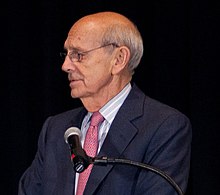 ](https://en.wikipedia.org/wiki/File:Stephen_Breyer_%28cropped%29.jpg)Breyer in 2011
Breyer expounded his judicial philosophy in 2005 in Active Liberty: Interpreting Our Democratic Constitution. In it, Breyer urges judges to interpret legal provisions (of the Constitution or of statutes) in light of the purpose of the text and how well the consequences of specific rulings fit those purposes. The book is considered a response to the 1997 book A Matter of Interpretation, in which Antonin Scalia emphasized adherence to the original meaning of the text alone.[75][84]
In Active Liberty, Breyer argues that the Framers of the Constitution sought to establish a democratic government involving the maximum liberty for its citizens. Breyer refers to Isaiah Berlin's Two Concepts of Liberty. The first Berlinian concept, being what most people understand by liberty, is "freedom from government coercion". Berlin termed this "negative liberty" and warned against its diminution; Breyer calls this "modern liberty". The second Berlinian concept—"positive liberty"—is the "freedom to participate in the government". In Breyer's terminology, this is the "active liberty" the judge should champion. Having established what "active liberty" is, and positing the primary importance (to the Framers) of this concept over the competing idea of "negative liberty", Breyer makes a predominantly utilitarian case for rulings that give effect to the democratic intentions of the Constitution.[citation ^needed]
The book's historical premises and practical prescriptions have been challenged. For example, according to Peter Berkowitz,[85] the reason that "[t]he primarily democratic nature of the Constitution's governmental structure has not always seemed obvious", as Breyer puts it, is "because it's not true, at least in Breyer's sense, that the Constitution elevates active liberty above modern [negative] liberty". Breyer's position "demonstrates not fidelity to the Constitution", Berkowitz argues, "but rather a determination to rewrite the Constitution's priorities". Berkowitz suggests that Breyer is also inconsistent in failing to apply this standard to the issue of abortion, instead preferring decisions "that protect women's modern liberty, which remove controversial issues from democratic discourse". Failing to answer the textualist charge that the Living Documentarian judge is a law unto himself, Berkowitz argues that Active Liberty "suggests that when necessary, instead of choosing the consequence that serves what he regards as the Constitution's leading purpose, Breyer will determine the Constitution's leading purpose on the basis of the consequence that he prefers to vindicate".[citation ^needed]
Against the last charge, Cass Sunstein has defended Breyer, noting that of the nine justices on the Rehnquist Court, Breyer had the highest percentage of votes to uphold acts of Congress and also to defer to the decision of the executive branch.[86] However, according to Jeffrey Toobin in The New Yorker, "Breyer concedes that a judicial approach based on 'active liberty' will not yield solutions to every constitutional debate", and that, in Breyer's words, "respecting the democratic process does not mean you abdicate your role of enforcing the limits in the Constitution, whether in the Bill of Rights or in separation of powers."[16]
To this point, and from a discussion at the New York Historical Society in March 2006, Breyer has noted that "democratic means" did not bring about an end to slavery, or the concept of "one man, one vote", and it is the concept of universal suffrage that allowed corrupt and discriminatory (but democratically inspired) state laws to be overturned in favor of civil rights.[87]
Other books
In 2010, Breyer published a second book, Making Our Democracy Work: A Judge's View.[88] In it, he argues that judges have six tools they can use to determine a legal provision's proper meaning: (1) its text; (2) its historical context; (3) precedent; (4) tradition; (5) its purpose; and (6) the consequences of potential interpretations.[89] Textualists, like Scalia, only feel comfortable using the first four of these tools; while pragmatists, like Breyer, believe that "purpose" and "consequences" are particularly important interpretative tools.[90]
Breyer cites several watershed moments in Supreme Court history to show why the consequences of a particular ruling should always be in a judge's mind. He notes that President Jackson ignored the Court's ruling in Worcester v. Georgia, which led to the Trail of Tears and severely weakened the Court's authority.[91] He also cites the Dred Scott decision, an important precursor to the American Civil War.[91] When the Court ignores the consequences of its decisions, Breyer argues, it can lead to devastating and destabilizing outcomes.[91]
In 2015, Breyer released a third book, The Court and the World: American Law and the New Global Realities, examining the interplay between U.S. and international law and how the realities of a globalized world need to be considered in U.S. cases.[92][93]
Other views
In an interview on Fox News Sunday on December 12, 2010, Breyer said that based on the values and the historical record, the Founding Fathers of the United States never intended guns to go unregulated and that history supports his and the other dissenters' views in District of Columbia v. Heller. He summarized:
We're acting as judges. If we're going to decide everything on the basis of history—by the way, what is the scope of the right to keep and bear arms? Machine guns? Torpedoes? Handguns? Are you a sportsman? Do you like to shoot pistols at targets? Well, get on the subway and go to Maryland. There is no problem, I don't think, for anyone who really wants to have a gun.[94]
In the wake of the controversy over Justice Samuel Alito's reaction to President Barack Obama's criticism of the Court's Citizens United v. FEC ruling in his 2010 State of the Union Address,[95] Breyer said he would continue to attend the address:
I think it's very, very, very important—very important—for us to show up at that State of the Union, because people today are more and more visual. What [people] see in front of them at the State of the Union is that federal government. And I would like them to see the judges too, because federal judges are also a part of that government.[96]