MONOPOLY 2 anti-trust
619
see earlier
merri ok
SEE media consolidation}:
oops see anti-trust too big to fail mono2
see inflation
see algo extraction
SEE INEQUALITY
see corp bad actor
see price gouging windfall // inflation
see dereg admin state
see corruption
see lobbyist
SEE TRUMP AGENCY THAT LET OFF HOOK DOJ FTC
---
com dr 5 26
‘Stinks of Rotting Meat’: Critics Warn Trump DOJ Settlement Would Legalize Price-Fixing
“Get ready for even higher prices for chicken, turkey, and pork,” said one antitrust attorney.
May 08, 2026
US President Donald Trump’s Justice Department moved Thursday to settle a Biden-era antitrust lawsuit against the analytics firm Agri Stats, proposing an agreement that critics say would effectively give the stamp of federal approval to meat industry price-fixing schemes.
The Justice Department—now headed by Acting Attorney General Todd Blanche, formerly Trump’s personal lawyer—hailed the proposed settlement as a “historic” win over a company whose “business model directly raised the price of chicken, turkey, and pork in local grocery stores across our nation.” But critics said the agreement, which must undergo review by a federal judge, would do nothing substantial to rein in price-fixing in the meat industry.
Lee Hepner, senior legal counsel for the American Economic Liberties Project, said the deal “stinks of rotting meat,” noting that the settlement was proposed just days before the case was set to go to trial.
“No way does it address the harms,” Hepner said of the 79-page settlement. “Agri Stats spent decades hiking prices on over 90% of processed meat in the country. Now they’re being told to exercise some discretion going forward.”
“It’s a gut punch to those who worked on this case for four years thinking it might actually deter these price fixing services from cropping up in every other industry,” Hepner added.
The Biden administration brought the antitrust lawsuit against Agri Stats in September 2023, accusing the company and its subsidiary EMI of “collecting, integrating, and distributing competitively sensitive information related to price, cost, and output among competing meat processors.”
“While distributing troves of competitively sensitive information among participating processors, Agri Stats withholds its reports from meat purchasers, workers and American consumers, resulting in an information asymmetry that further exacerbates the competitive harm of Agri Stats’ information exchanges,” the Biden DOJ said.
“This settlement legalizes meat price-fixing—it just says you have to bring the giant retailers and distributors in on the game.”
The Trump Justice Department’s settlement would require Agri Stats to “make the vast majority of information” it distributes “available to all interested domestic purchasers on reasonable and non-discriminatory terms,” along with several other conditions.
But the settlement states that EMI is not otherwise “prohibited... from continuing to provide EMI Price Reports in substantially the same manner as it did as of April 24, 2026.”
Agri Stats noted in a statement Thursday that it “denied all allegations” of illegal conduct and “has admitted no wrongdoing” as part of the settlement. Agri Stats’ lead counsel in the case called the deal “a win” for both the company and consumers—a claim that antitrust advocates rejected, calling the agreement blatantly one-sided in the corporation’s favor.
“This settlement legalizes meat price-fixing—it just says you have to bring the giant retailers and distributors in on the game,” wrote Basel Musharbash, managing attorney at Antimonopoly Counsel. “Get ready for even higher prices for chicken, turkey, and pork.”
The proposed Agri Stats settlement is the latest favorable deal that Trump’s Justice Department—which is in the grip of lobbyists with ties to the president—has cut with a major corporation accused of illegal price-fixing.
Last November, as Common Dreams reported, the Justice Department agreed to settle a Biden-era lawsuit filed against the real estate software company RealPage, which was accused of an “unlawful scheme to decrease competition among landlords in apartment pricing and to monopolize the market for commercial revenue management software.”
RealPage welcomed the settlement, noting that the agreement included “no financial penalties, damages, or findings or admissions of wrongdoing.”
---
---
an 4 26
Trump and his administration attempted to let a huge corporation off the hook for monopoly allegations while no one was looking, but according to a new analysis from MS NOW, a state ruling on the matter has handed him yet another legal "faceplant."
Early last month, Trump's Justice Department moved to settle a lawsuit against Live Nation — the conglomerate with massive control over the live event and ticketing industries in the U.S. — after a Biden-era antitrust suit accused it of maintaining an illegal monopoly. The move was the latest in a long line of Trump-era policies favoring big business and its ability to take advantage of customers.
That decision to let Live Nation off easy could have been the end of it, but instead, this week, a federal jury in New York ruled that the company had, in fact, engaged in monopolistic practices. This, as reporter Helaine Olen wrote for MS NOW on Friday, meant that the case would not "end with a whimper," on account of the "egregious" facts pointing to the company's obvious wrongdoing. Furthermore, she argued, the ruling also dealt "a huge faceplant for the Trump administration."
"The Trump administration [is] doing the bidding of big business," Olen wrote. "Its settlement with Live Nation is in the same spirit as the sign-offs on mergers such as Paramount and Warner Brothers, or HP and Juniper. The judge in this case can and should scrutinize the settlement closely. Congress has the power to look into both the settlement and the mergers, and lawmakers should use that authority. At the same time, this verdict should hearten the state attorneys general who have already joined together to fight these wildly inappropriate and anticompetitive mergers."
She continued: "And, then there were the nine jury members that handed Trump and corporate America this defeat. They didn’t just deliver a verdict on Ticketmaster. They also said enough to an economy in which giant monopolies have grown and prospered at the expense of honest businesses and powerless consumers. Now it’s time for an encore performance — against all the other monopolistic deals getting waived through by this administration."
Live Nation emerged as a major monopolistic force in the live event industry when it merged with Ticketmaster in 2010. As a condition for merger approval from the Obama administration, the company had to pledge not to engage in a variety of anticompetitive practices, which, as Olen explained, they more than failed to do.
"Live Nation didn’t just fail to live up to its promise. It repeatedly, blatantly violated the agreement," she wrote. "The states argued employees of the newly combined company, which controls an astonishing 86% of the concert ticket market and almost three-quarters of the overall event ticketing market, began threatening venues with retaliation unless they used Ticketmaster. Live Nation executives actually boasted in writing about ripping off customers. One employee, who is now a ticketing executive, joked that an increase in parking fees for customers was 'robbing them blind baby. That’s how we do.'”
---
===}:
AN 11 25
Do you ever wonder why Republican propaganda appears to be everywhere while solid, informative news keeps going belly-up? It’s all about money, author Katherine Stewart tells Bulwark. Republican propaganda has it and news does not.
Fox News channels and amplifies rage at a carefully curated target, which never appears to be the Republican Party and that channeling “has worked overwhelmingly to the advantage of the authoritarian right wing,” Stewart said.
You can try to blame it on new technology, or the kind of reporters working in the industry, or the theory that the media has simply come to reflect the biases and polarization of the public. But it all really comes back to money and the moneyed interests who value driving the argument.
“Today … 40 percent of all local TV news stations are under the control of the three largest broadcast conglomerates: Sinclair Broadcast Group, Gray Television, and Nexstar Media Group,” said Stewart. “Their stations — each company now owns about 100 affiliated with ABC, CBS, FOX, or NBC — operate in more than 80 percent of U.S. media markets. A conglomerate with a distinct and well-documented right-wing bias, such as Sinclair, has an outsize footprint on our information ecosystem.”
And under the Trump administration, the concentration of the media business has accelerated.
“Consider that Trump cleared the way for [“Trumpy billionaire Larry Ellison, and his son, David”] to merge their Skydance Media company with Paramount in order to gain control of CBS News. Thanks to this preferential treatment, the Ellisons’ new media giant is now in the running to purchase Warner Bros. Discovery, which includes the crown jewel of the media marketplace: CNN,” said Stewart. “Other companies adapt swiftly to the new cronyistic landscape. Comcast, which previously drew scrutiny from the Trump administration for its own efforts to purchase Warner Bros. Discovery, recently donated up to $10 million to fund Trump’s White House “renovation.”
These major media executives feel little need to satisfy any mission to genuinely inform the public, said Stewart. What they want is profits, and hate-based rage-bait is generally more profitable than information.
“Fox News blazed the trail when it reconceived the product that cable news produces: Instead of the straight story, information became fodder for entertainment, persuasion, and grievance. Under the direction of Roger Ailes, the outlet applied all the tricks of demagoguery to expand and consolidate its reach, including a hand-in-glove coordination with the GOP,” Stewart said.
These same companies “protect their turf” by protecting governments that decline to regulate their anti-competitive moves.
A similar drive toward oligopoly profits is at play in the tech industry, Stewart warned. When a government grants and enforces an effective monopoly to some technologist, they are “likely to use just as much misinformation and manipulation as they can get away with to protect their privileged position.”
The corporations that own the tech industry are also in the hands of plutocrats, who generally favor right-wing governments “because they want to keep as much of their money as possible—and prevent the little people from telling them what to do with it, said Stewart.
“Consider Peter Thiel, who identifies those who wish to end tax exemptions for the super-rich as possible representatives of ‘the antichrist,’” said Stewart. “Or consider Jeff Bezos, who is undermining The Washington Post’s long tradition of exemplary journalism by turning the Opinion section into an regime-friendly advocate for ‘personal liberties.’”
There’s no pretending this can all be overcome “simply by reducing partisan divides and promoting civility,” said Stweart. “… We need to confront and challenge media and tech oligopolies and establish a system that produces journalism committed to the goal of any free press, which is to inform the public and promote the truth.”
Read the New Republic report at this link.
REF
On a recent trip through Florida, my Uber driver was intent on letting me know just how truly evil Nancy Pelosi is. I attempted to deflect, as I often do in such circumstances, but he persisted. Didn’t I think it was outrageous that Democrats want to raise rich people’s taxes? What about “abolishing the police”?
“A lot of people want something for nothing,” he said. “They want to get things for free. I don’t believe in that. I say if you don’t work, don’t come looking for handouts.”
He continued in this vein, sprinkling his anger and frustration with right-wing talking points on the scourge of immigrant criminals and the Biden crime family.
“Where did you hear that?” I finally asked when he got around to his spiel on open borders.
“They were talking about it on Fox News,” he said.
With unobtrusive questioning, I learned that he had worked in health care and was recently laid off. He was extremely concerned with keeping his car free of smudges and scuff marks because, as he told me, he found it very expensive to clean and maintain. When he wasn’t venting at the Democrats, he was bashing Uber. “They’re taking more and more from us drivers,” he said. “It’s impossible to make a living.”
It’s a tale as old as time. A skewed economic system delivers stress and frustration to a large group of people who previously imagined that they had a path to a decent life, and somehow all that rage gets channeled into a reactionary brand of politics.
It’s the “channeling” part of the story that interests me here. Rage is natural, but it isn’t a constant. It can be amplified—and it can be directed. That is pretty much what has been happening for the past two decades. And the channeling, while hardly monolithic, has worked overwhelmingly to the advantage of the authoritarian right wing. It is impossible to overstate the damage to American political culture of a rising right-wing media ecosystem, centered on Fox News. The question is not whether this is happening but why.
There was once a simple theory about media bias. It said that the problem with media is all about the kind of people who enter the profession of journalism. This has mostly been a cherished theory of the right, because the usual story is that journalists are, by nature, liberal types in an Amtrak corridor who view “real Americans” with contempt. But there is a left-wing version, which says that professional journalists are all “establishment” types militantly committed to perpetuating the status quo.
A second theory holds that the media has simply come to reflect the biases and polarization of the public. This story is usually accompanied with hoary truisms, like “for every Fox, there’s an MSNBC.” It’s the notion that media caters to partisans on left and right with equal fervor, dishing up whatever red or blue meat they would like.
A third idea blames it all on new technology, with the premise that social media and handheld devices, by their very nature, mess with people’s minds and produce a distorted media landscape.
These theories are incomplete at best. First, they fail to acknowledge that right-wing and left-wing media spheres are not equal and opposite poles of a symmetrical system. This fact has been proven in careful studies of reporting patterns across many years.
“The right is more insular, it is more extreme, and it is more partisan,” said the director of research at the Berkman Klein Center, which conducted one such study. Indeed, while both left- and right-wing media spread false stories, a summary of the research from the Harvard Kennedy School’s Shorenstein Center on Media, Politics and Public Policy notes, “Misinformation is currently predominantly a pathology of the right.” A study out of the University of Amsterdam, published earlier this year, asserts that far-right populist parties undermine democracy with misinformation as a matter of political strategy.
Importantly, the political impact of these two media spheres is not remotely comparable. One study, examining voting patterns among viewers in regions where Fox was off the air for technical reasons for certain periods indicates that Fox alone may have shifted between 3 percent and 6 percent of the votes in recent elections.
But perhaps the most important feature of the media landscape today comes down to money. Specifically, the endless, flowing river of oligarchic monopoly money.
Well-functioning media systems have generally included some kind of public constraint or oversight that keeps journalism from veering too far from its fundamental mission of informing the public. This public involvement can take the form of regulation (through broadcast licenses, for example), through support for large public broadcasting corporations (the BBC in the U.K., CBC in Canada), or through a variety of other mechanisms (like the old Fairness Doctrine in the United States).
In the U.S., public constraint on media has largely evaporated. But that doesn’t mean that the system has been handed over to “the market.” Today, for example, 40 percent of all local TV news stations are under the control of the three largest broadcast conglomerates: Sinclair Broadcast Group, Gray Television, and Nexstar Media Group. Their stations—each company now owns about 100 affiliated with ABC, CBS, FOX, or NBC—operate in more than 80 percent of U.S. media markets. A conglomerate with a distinct and well-documented right-wing bias, such as Sinclair, has an outsize footprint on our information ecosystem.
Under the Trump administration, the concentration of the media business has accelerated. And the administration has made it abundantly clear that the pathway to further consolidation involves pleasing (and funneling money to) the regime and its ruler. The news cycle related to Jimmy Kimmel’s exclusion and subsequent reinstatement has come and gone, but the real story endures. It was always fundamentally about securing regulatory approval for the CBS merger as a stepping stone to the CBS-Warner merger, which will leave us with a media behemoth under the thumb of Trumpy billionaire Larry Ellison, and his son, David.
Consider that Trump cleared the way for the Ellisons to merge their Skydance Media company with Paramount in order to gain control of CBS News. Thanks to this preferential treatment, the Ellisons’ new media giant is now in the running to purchase Warner Bros. Discovery, which includes the crown jewel of the media marketplace: CNN. Other companies adapt swiftly to the new cronyistic landscape. Comcast, which previously drew scrutiny from the Trump administration for its own efforts to purchase Warner Bros. Discovery, recently donated up to $10 million to fund Trump’s White House “renovation.”
It appears that these major media executives feel little need to satisfy any mission to genuinely inform the public. They want profits. And at least since the dawn of yellow journalism in the late nineteenth century, hate-based rage-bait has been seen as generally more profitable than information. The idea that such outlets are news organizations is increasingly quaint. Fox News blazed the trail when it reconceived the product that cable news produces: Instead of the straight story, information became fodder for entertainment, persuasion, and grievance. Under the direction of Roger Ailes, the outlet applied all the tricks of demagoguery to expand and consolidate its reach, including a hand-in-glove coordination with the GOP. This explains part—but only part—of the right-wing tilt in the media system.
The other part has to do with the kind of profits involved. The major media corporations in the U.S. aim for the kind of oligopoly profits that economists call “rents.” They make money by protecting their turf. The best way to protect their turf is to have governments that decline to regulate their anti-competitive moves—or, as in the present, that actively encourage anti-competitive outcomes that favor the regime. In short, they accumulate these rents by locking themselves into the economic and political structure.
One could argue that the mainstream media is not the only kid in town, and that the rise of social media, bloggers, and a thousand points of light on the internet have created a new landscape. But the role of the majors in anchoring the center and edges of national conversations should not be underestimated. My Florida Uber driver illustrates the point well. He was clearly picking up misinformation from a wide range of sources. But when it came to justifying his positions to me, he cited Fox News as holy writ.
A similar drive toward oligopoly profits is at play in the tech industry. The tech determinist narrative says that evil is built into the social media machine and its various hardware devices. But this just isn’t true. There is no natural law that says that social media, or any other technology, must be used for misinformation and manipulation. However, when you grant and enforce an effective monopoly to some technologist, they are likely to use just as much misinformation and manipulation as they can get away with to protect their privileged position.
One could still ask why a system that is so corrupted with money and regulatory policy would necessarily tilt to the right. The obvious answer is that the money that controls these corporations is in the hands of plutocrats, who generally favor right-wing governments because they want to keep as much of their money as possible—and prevent the little people from telling them what to do with it. Consider Peter Thiel, who identifies those who wish to end tax exemptions for the super-rich as possible representatives of “the antichrist.” Or consider Jeff Bezos, who is undermining The Washington Post’s long tradition of exemplary journalism by turning the Opinion section into an regime-friendly advocate for “personal liberties.”
But there’s a more subtle reason why these systems tilt away from progress and democracy. It’s because they are inherently corrupt and unreasonable. The last thing our tech, media, and corporate oligopolies want is an informed public, carrying on a rational debate about how we should govern ourselves. Their aim is to create dependence, and they succeed in doing so by filling up Uber drivers and others with narratives that appeal to resentment and frustration. The best way to control people, after all, is to get them to control themselves.
The main solutions, I hope, are clear. Let’s not pretend this can all be overcome simply by reducing partisan divides and promoting civility. And let’s set aside the idea that a few new apps to limit screen time or tame the worst bits of social media will have much of an effect. The fundamental problem is money and control. We need to confront and challenge media and tech oligopolies and establish a system that produces journalism committed to the goal of any free press, which is to inform the public and promote the truth.
---
---
an 5 25an states
U.S. Rep. Jim Jordan of Ohio wanted to slip a sweeping measure into a spending bill that would gut the Federal Trade Commission. Critics say it’s no coincidence that the FTC is suing mammoth health care conglomerates and tech giants like Amazon.
Jordan is chairman of the powerful House Judiciary Committee. Last week, it released a version of a bill that included tax cuts, federal spending cuts and more spending at the border.
It also contained provisions that would give Trump sweeping new powers to gut government regulations. It would also transfer funds and personnel currently controlled by the FTC to the Antitrust Division of the Justice Department — without the FTC’s unique enforcement authority going with them.
The measure was abruptly nixed, but it would have effectively killed antitrust powers Congress created more than a century ago.
The FTC history
Amid abuses to consumers by big corporations, the Federal Trade Commission Act was passed in 1914. Antitrust enforcement by the Department of Justice dates back further, to 1903.
But the Justice Department is overseen by the attorney general, a presidential appointee. Attorneys general traditionally have had a high degree of independence, but Trump is said to be politicizing the Justice Department at a breakneck pace.
The FTC was created in part to be more independent. It’s governed by commissioners from both parties who are appointed to fixed terms that can be renewed.
Earlier this year, Trump tried to fire the two Democratic commissioners, but they say the move was illegal, and they’re fighting it in court. Antitrust advocates said Trump was doing that as a favor to his billionaire supporters such as Elon Musk.
The two Democratic commissioners, Alvaro Bedoya and Rebecca Slaughter, acted to block the Kroger-Albertson’s mega-merger, and they voted to sue Amazon, saying it is “illegally maintaining monopoly power.”
Under Jordan’s leadership, the Judiciary Committee in 2023 attacked the FTC on behalf of Musk. He’s the world’s richest man, whom Trump is allowing to make deep cuts to federal programs for the elderly, veterans, the poor, and agencies that promote science and health.
“THE WEAPONIZATION OF THE FEDERAL TRADE COMMISSION: AN AGENCY’S OVERREACH TO HARASS ELON MUSK’S TWITTER,” read the all-caps title of the Jordan-led committee’s report.
A year earlier, the FTC had charged Twitter with using deceptively gathered data from users to target ads at them. If true, it would be added to the fact that an unofficial, Musk-run entity is now collecting much more sensitive government data. It’s raised concerns among several federal judges who said such collections invite abuse and likely violate the law.
“One of Elon Musk’s Department of Government Efficiency lieutenants working in the Social Security Administration has been pushing dubious claims about noncitizens voting, apparently using access to data that court records suggest (the so-called Department of Government Efficiency) isn’t supposed to have,” NPR reported earlier this month.
The proposal from Jordan to gut the FTC could have halted major initiatives to regulate giant health conglomerates that own powerful pharmacy middlemen, said Bedoya, one of the commissioners Trump is trying to fire.
Jordan’s office didn’t respond to a request for comment on this story.
PBMs
Each of the three conglomerates — UnitedHealth Group, CVS Health and Cigna-Express Scripts — is among the 15 largest corporations in the United States. Each owns a top-ten health insurer and each owns a pharmacy middleman known as a pharmacy benefit manager, or PBM.
Combined, the PBMs control nearly 80% of the insured drug transactions in the United States. They decide which drugs are covered and use that power toextractrebates from drugmakers. They also determine varying reimbursements to pharmacies — including ones owned by their parent companies as well as the pharmacies with which they compete. Critics — including four-fifths of state attorneys general — say they have a conflict of interest under the arrangement, and that they abuse it.
Last October, the FTC sued the conglomerates, saying they used their dominance in multiple parts of the marketplace to illegally jack up the price of insulin — a drug millions of diabetics need to survive.
The lawsuit comes after the agency in 2022 undertook a major investigation of the health conglomerates. In January, it released an interim report accusing the PBMs of using their dominance to instigate wild price hikes and possibly steer business to affiliated pharmacies.
Politico recently reported that Jordan said his move to consolidate the FTC into the Justice Department was meant to “address the cost of over-regulation.”
“Part of our jurisdiction in Judiciary deals with regulatory concerns and so we are looking at … spending and costs associated with certain regulations. That’s why that language is written the way it was,” Politico reported him as saying.
Many businesses facing regulation — and their advocates in government — have long focused only on the costs. But government regulation can also protect health, safety, the environment, economic stability and competition. Some researchers have said regulation can always be smarter, but its benefits far outweigh the costs.
In a social media post last week, Bedoya, the FTC commissioner, said Jordan’s proposed changes to the agency served another agenda.
“This will gut the FTC,” Bedoya wrote. “FTC is trying to finish a study that already showed how pharmacy middlemen mark up cancer drugs by up to 4,000%. It’s also suing them for allegedly competing to raise insulin prices. If this passes I have no idea what’ll happen to that study and lawsuit.”
Bedoya added, “Take the lawsuit. The draft bill purports to transfer FTC lawyers and lawsuits to DOJ — but it doesn’t transfer the laws that FTC enforces, or authority to enforce those laws. Look (at) page 98 — employees, assets, funding — but no authorities.”
Bedoya also said that when it created the FTC, Congress meant to augment the government’s antitrust powers. Jordan’s changes would remove the government’s ability to police “unfair methods of competition,” Bedoya said, implying that Jordan was trying to slash the government’s power to police wealthy corporations in an era when the political influence of the mega-rich is exploding and the wealth gap is yawning.
“The purpose behind the FTC’s creation in 1914 was to supplement the existing enforcement mechanism (and enforcement gap created by) the Department of Justice,” Bedoya said on X. “When FTC was created in 1914, it alone was authorized to stop something called ‘unfair methods of competition.’ DOJ did not get this” under Jordan’s proposal.
YOU MAKE OUR WORK POSSIBLE. SUPPORT
Ohio Capital Journal is part of States Newsroom, a nonprofit news network supported by grants and a coalition of donors as a 501c(3) public charity. Ohio Capital Journal maintains editorial independence. Contact Editor David Dewitt for questions: info@ohiocapitaljournal.com.
---
---}:
an 3 25
New research suggests corporations are using bird flu as an excuse to jack up prices — and their profits rose before the disease even reached their flocks, the Guardian reported Tuesday.
The cost of a dozen large eggs reached a record high of almost $5 in January. Bird flu has certainly contributed to rising prices; about 12.7 million birds are affected by the disease, according to the U.S. Department of Agriculture. 166 million poultry have been culled since 2022. But bird flu is not the only reason for skyrocketing prices.
“Bird flu does not fully explain the sticker shock consumers experience in the egg aisle … corporate consolidation is a key culprit behind egg price spikes,” Amanda Starbuck told the Guardian. She is the lead author on a new report from Food and Water Watch.
READ MORE: 'Highly inappropriate': Concerns surround Joni Ernst’s relationships with top military officials
“Powerful corporations that control every step of the supply chain – from breeding hens to hatching eggs to processing and distributing eggs – are making windfall profits off this crisis, raising their prices above and beyond what is necessary to cover any rising costs,” she added.
“The egg production industry – like the retailer sector that producers mostly sell to – is highly concentrated," writes the Guardian’s Nina Lakhani. "This gives a handful of big corporations the opportunity to influence prices outside the impact of shocks like avian flu and the Covid 19 pandemic on supply and demand."
Cal-Maine, the largest egg producer in the U.S., saw gross profits increase by 7 between 2021 and 2023, shooting up to 1.2 billion. During this time, their flocks had not been hit by bird flu and their sales only increased by a small amount. They “issued shareholder dividends totaling $250m in fiscal year 2023 — 40 times more than the previous fiscal year. The Mississippi-based company sold 7% more eggs in 2024 compared to 2021 and tripled its profits over the same period, according to company filings,” Lakhani writes.
In some geographic areas, prices went up before bird flu reached them as well. For example, in the South, prices followed national increases, even though egg production rose and bird flu didn’t reach flocks until January.
There were more eggs, but higher prices, in 2023. “Between April and December 2023, national retail inventories of eggs each month exceeded the five-year average by as much as almost 13%. Yet the average egg price for consumers was higher than the five-year average each month,” Lakhani writes.
According to a study from the University of Arkansas, bird flu accounts for a 12-24 percent increase in prices.
Angela Huffman, co-founder of the nonpartisan group Farm Action, thinks the Federal Trade Commission and the Department of Justice should investigate egg prices. “Based on publicly available data, we’ve observed that egg price increases far exceed what would be expected based on hen losses and the industry has not increased the number of laying hens as expected during a period of high prices. This strongly suggests potential antitrust violations,” she said. “The FTC and DOJ have the authority to investigate beyond what is publicly available… we urge them to exercise this authority.”
“The working class is struggling to afford groceries while companies like Cal-Maine are raking in huge profits and rewarding their shareholders,” Rep. Ro Khanna (D-Calif.) told the Guardian. “The Trump administration has the power to lower grocery bills, but instead they are imposing blanket tariffs on allies, firing federal workers who are trying to prevent the bird flu, and putting billionaires over ordinary Americans.”
READ MORE: 'Horror movie': German tourist remains in ICE detention center after over a month
Meanwhile, the conditions at factory farms are ideal for the flu to spread. “These same companies exacerbate the bird flu outbreak by raising their birds on factory farms, crammed together in hundreds of thousands or millions, creating the perfect breeding ground for disease,” Starbuck said.
---
===
yikes
mcconnell mafia
an 12 24
Trump's pick to lead the Federal Trade Commission vowed in his job pitch to end current chair Lina Khan's "war on mergers," a signal to an eager corporate America that the incoming administration intends to be far more lax on antitrust enforcement.
Andrew Ferguson was initially nominated by President Joe Biden to serve as a Republican commissioner on the bipartisan FTC, and his elevation to chair of the commission will not require Senate confirmation.
In a one-page document obtained by Punchbowl, Ferguson—who previously worked as chief counsel to Sen. Mitch McConnell (R-Ky.)—pitched himself to Trump's team as the "pro-innovation choice" with "impeccable legal credentials" and "proven loyalty" to the president-elect.
Ferguson's top agenda priority, according to the document, is to "reverse Lina Khan's anti-business agenda" by rolling back "burdensome regulations," stopping her "war on mergers," halting the agency's "attempt to become an AI regulator," and ditching "novel and legally dubious consumer protection cases."
Trump announced Ferguson as the incoming administration's FTC chair as judges in Oregon and Washington state blocked the proposed merger of Kroger and Albertsons, decisions that one antitrust advocate called a "fantastic culmination of the FTC's work to protect consumers and workers."
According to a recent report by the American Economic Liberties Project, the Biden administration "brought to trial four times as many billion-dollar merger challenges as Trump-Pence or Obama-Biden enforcers did," thanks to "strong leaders at the FTC" and the Justice Department's Antitrust Division.
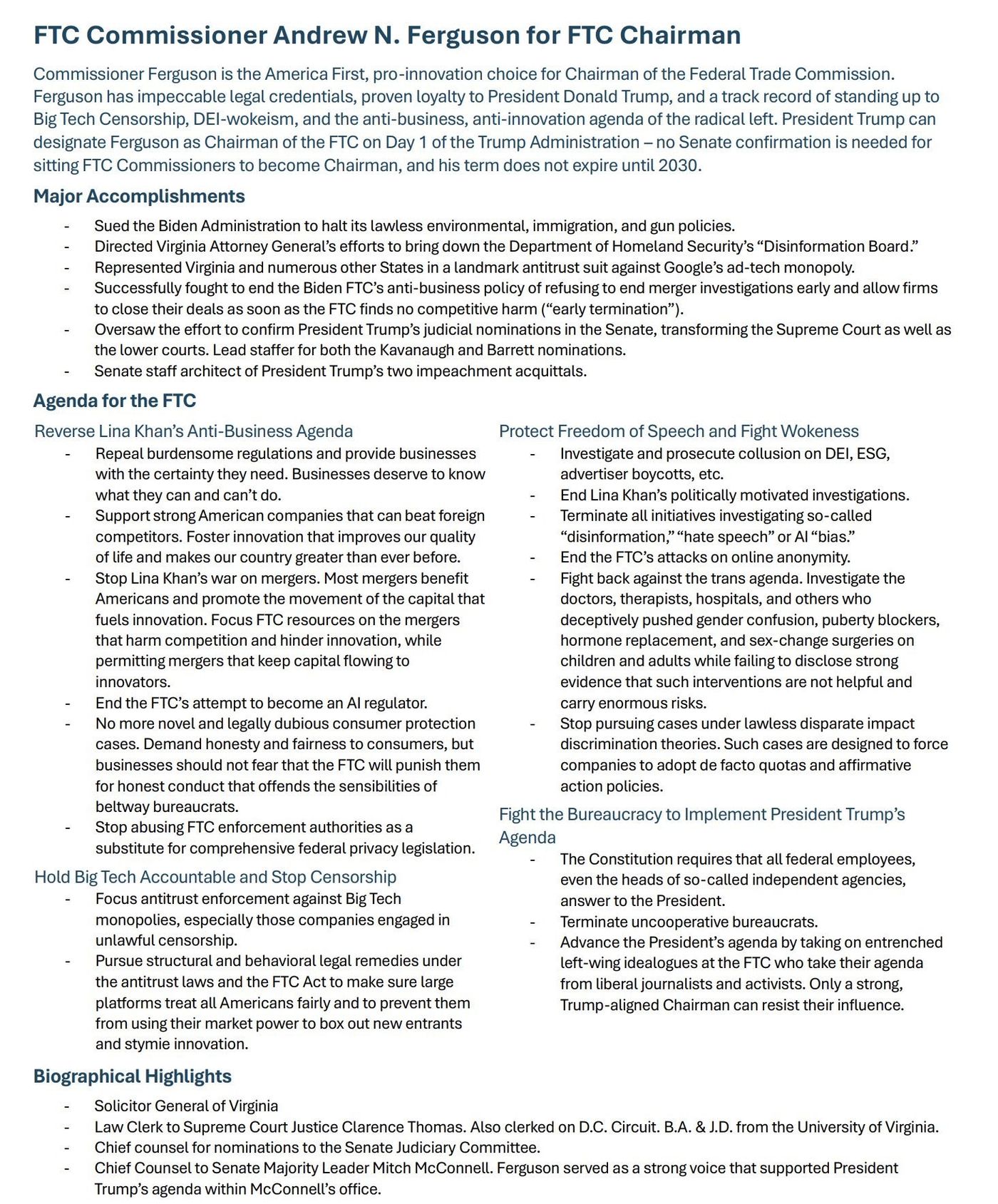
In a letter to Ferguson following Trump's announcement on Tuesday, FTC Commissioners Alvaro Bedoya and Rebecca Kelly Slaughter wrote that the document obtained and published by Punchbowl "raises questions" about his priorities at the agency mainly "because of what is not in it."
"Americans pay more for healthcare than anyone else in the developed world, yet they die younger," they wrote. "Medical bills bankrupt people. In fact, this is the main reason Americans go bankrupt. But the document does not mention the cost of healthcare or prescription medicine."
"If there was one takeaway from the election, it was that groceries are too expensive. So is gas," the commissioners continued. "Yet the document does not mention groceries, gas, or the cost of living. While you have said we're entering the 'most pro-worker administration in history,' the document does not mention labor, either. Americans are losing billions of dollars to fraud. Fraudsters are so brazen that they impersonate sitting FTC commissioners to steal money from retirees. The word 'fraud' does not appear in the document."
"The document does propose allowing more mergers, firing civil servants, and fighting something called 'the trans agenda,'" they added. "Is all of that more important than the cost of healthcare and groceries and gasoline? Or fighting fraud?"
As an FTC commissioner, Ferguson voted against rules banning anti-worker noncompete agreements and making it easier for consumers to cancel subscriptions. Ferguson was also the only FTC member to oppose an expansion of a rule to protect consumers from tech support scams that disproportionately impact older Americans.
"Andrew Ferguson is a corporate shill who opposes banning noncompetes, opposes banning junk fees, and opposes enforcing the Anti-Merger Act," said Basel Musharbash, principal attorney at Antimonopoly Counsel. "Appointing him to chair the FTC is an affront to the antitrust laws and a gift to the oligarchs and monopolies bleeding this country dry."
===
11 7 24 thom
Donald Trump is preparing to crash the American economy. He intends to do it by tearing up vital parts of our American government. He may even hire Elon Musk to pull it off. And from his point of view, this is not going to be a bad thing. The farther the economy crashes, the greater the buying opportunity for billionaires. It all has to do with something called the administrative state.
While it’s not sexy or even particularly interesting to the average American voter, having a strong administrative state is essential to a high-functioning economy. A strong administrative state is the only thing that protects entrepreneurs and small businesses from being squashed like bugs by monopolistic behemoths, and small businesses are our nation’s main growth engine.}:
:{For example, over 70 percent of all new jobs created since 2019 were created by small businesses, producing almost 13 million new jobs over the past 25 years. Small business creation is up 50 percent over Trump’s years because the Biden administration has been enforcing the rule of law, including taking on the giant tech monopolies. Small businesses now account for over 43 percent of all American economic activity.
A strong administrative state is also the only thing that can protect the environment from those who’d destroy it for their own profits. It’s the only thing that can protect consumers from defective or even deadly products and food or drug contamination. It our only defense against predatory banks, airlines, and insurance companies, among others. A strong administrative state that follows and enforces the rule of law — as opposed to the kind of grift-driven kleptocracies typical of strongman governments — is essential, in other words, to a functioning national economy.}:
Here in America, we see this best in the contrast between lightly bureaucratic and largely unregulated Red states and more bureaucratic and regulated (and taxed) Blue states and counties. While Red and Blue states are represented in Congress about 50/50, as the Brookings Institution found a few years ago: > “Biden’s winning base in 509 counties encompasses fully 71% of America’s economic activity, while Trump’s losing base of 2,547 counties represents just 29% of the economy.”
But now the administrative state is in the crosshairs of the incoming Trump administration, and their planned assault on it will almost certainly cause a loss of economic vitality, probably even leading to a major recession (every*Republican president since Nixon has had a major recession after tinkering with tax and regulatory policies;none*of the Democratic presidents have created one since Carter, and his started under Nixon). We also see this at the level of the nation-state. As Professor Timothy Snydernotes: > “Now consider the Russian and Hungarian economies. Russia sits on hugely valuable natural resources, and yet is a poor country. The profits from its oil and gas are in the hands of a few oligarchs. > >
“Hungary sits in the middle of the European Union, the most successful trade project of all time. And yet Hungarians are poorer than their neighbors, in part because the Orbán regime corruptly channels EU resources to friendly oligarchs. > > “The lesson is clear. Democracy is a method of checking corrupt rulers. When there is no functioning democracy, corruption is unchecked. And democracy is an element of a more fundamental guarantor of prosperity, the rule of law. In Hungary and Russia, the rule of law has been bent and broken, to the benefit of the few, and to the detriment of the many. Ending the rule of law is the Trump-Vance platform.”
Gutting the administrative state is the first and imperative aspect of ending or weakening the rule of law. Because, as Steve Bannon famously told America, the main goal of the Trump administration is “the ‘deconstruction’ of the administrative state.” He added: > “Every business leader we’ve had in is saying not just taxes, but it is also the regulation. I think the consistent …[thing] is the deconstruction. The way the progressive left runs is, if they can’t get it passed, they’re just going to put in some sort of regulation in an agency. That’s all going to be deconstructed and I think that that’s why this regulatory thing is so important.”
We saw this movie before, during the last Trump administration. He put a coal lobbyist in charge of EPA, an oil lobbyist at Interior, a Telcom lobbyist and lawyer at FCC, a professional union-busting lawyer in charge of the Labor Department, an advocate for replacing public schools with religious ones in charge of the Education Department, etc., etc. But that was more mere corruption than a wholesale destruction of administrative agencies. Since the Chevron deference decision by the Supreme Court this past year, though, it’s now possible that Trump could actually destroy the American administrative state.
Even whenChevronwas still intact eight years ago, the result of Trump’s corruption in his previous administration, just like with Reagan’s and Bush’s deregulatory campaigns, was a massive recession that started*before*Covidcame along. Trump will fire Lena Kahn at the Federal Trade Commission, blowing up the antitrust efforts of the Biden administration; the fat cat billionaires already are eagerly anticipating running amok (which is why they threw billions at Trump’s campaign). The result, predictably, will be another Republican economic disaster for America’s working class.
Interestingly, our country’s most famous investor also seems to be thinking along these same lines. Warren Buffett has recently sold over $325 billion in stock and is simply sitting on that huge pile of cash. Why? Probably the Oracle of Omaha can see the same thing I’m pointing out here: Trump is preparing to turn the economy over to Musk and his billionaire buddies and the result will be a disaster.
A disaster, by the way, that will be very useful to Buffett and other billionaires; recessions and depressions are when America’s largest fortunes are typically made or expanded because they represent great buying opportunities to those with cash, while at the same time the small companies being squeezed are willing to sell for a song.
:{:{ So get ready; we’re in for a bumpy few years as America descends into a strongman-run oligarchy while the Supreme Court and Trump’s toadies rip apart the protections of the administrative state we’ve so carefully constructed in the years since the Civil War and the Republican Great Depression. It may well be a disaster for your 401(k), and millions will lose their jobs in a recession. If Musk cuts $2 trillion from the federal budget, as promised, it will almost certainly impact Social Security and take a huge bite out of programs for veterans, children, and the disabled. It would probably also have to end all subsidies under the Affordable Care Act, and end hundreds of billions in federal aid to infrastructure construction programs. Get ready now, to the extent that you can. Forewarned is forearmed. }:
===
---
8 24 mma
on August 15, Democratic presidential nominee Vice President Kamala Harris began outlining her economic agenda, which includes fighting excessive prices by enacting a federal ban on price gouging.
Most states already have some kind of law banning price gouging in at least some circumstances, but Harris’ new proposal would create the first ever federal ban on price gouging on groceries and empower the Federal Trade Commission to enforce these new consumer protections.
Yet Fox News and others in the media reacted by falsely mischaracterizing Harris’ proposal as setting price controls, denying that price gouging exists in the food industry, and ranting about communism.
- ## Harris’ plan specifically mentions anti-monopoly actions and enhanced authority for the FTC and state attorneys general to combat price fixing, not price controls
- Bloomberg White House reporter Josh Wingrove posted a Harris campaign email previewing her plan that makes no mention of price controls. What the announcement did mention was “authority for the FTC and state attorneys general to investigate and impose harsh penalties” on corporations engaging in price gouging, “resources for the federal government to identify and take on price-fixing and other anti-competitive practices” in the food industry, and support for small businesses to break into the food industry to take on monopolies. Twitter/X, [8/15/24]
- Washington Post economics reporter Jeff Stein posted another Harris campaign announcement that cited state price gouging laws and laid out plans to grant more authority to the FTC and state attorneys general and increase competition in the food industry. There was no mention of price controls. Twitter/X, [8/15/24]
- In a press release, the Harris-Walz campaign detailed its price gouging initiative to empower regulators and state attorneys general and to tackle predatory price gouging. In an August 16 press release fully detailing the Harris-Walz campaign’s broader economic agenda, the campaign reiterated that, if elected, Harris will work to “advance the first-ever federal ban on price gouging on food and groceries,” stipulating that these policies would be aimed at “big corporations” that “unfairly exploit consumers” and that the regulatory and legal authority to investigate and enforce the new anti-price gouging rules would rest with “the FTC and state attorneys general.” Harris-Walz campaign press release, [8/16/24 via Popular Information]
- Axios: Price controls are “just not how anti-price gouging policies work in the U.S.” Axios markets correspondent Emily Peck wrote that “critics are conflating the idea with Soviet-style price controls, and calling the plan ‘Kamunism.’” She explained that there’s been “wild speculation about what the plan could mean, including opinion pieces expressing fears that retailers won't be able to, say, set the price of a gallon of milk, and that it would lead to widespread shortages, black markets and hoarding,” but that “that's just not how anti-price gouging policies work in the U.S.,” pointing to a federal draft bill that “largely mirrors state laws” but is limited to larger companies “with at least $100 million in revenue.” Axios, [8/20/24]
- Nobel prize-winning economist Paul Krugman: “Kind of amazing how much of the commentariat went into a tizzy over Harris calling for price controls, when she did no such thing.” Twitter/X, [8/18/24]
- Economic writer Matthew Yglesias: “After all the tweets, I'm pretty sure Harris did not in fact propose price controls on groceries — just kind of vaguely said that antitrust enforcement is good (it is good).” Twitter/X, [8/16/24]
- ## Right-wing media falsely mischaracterized Harris’ proposal as setting price controls
- Multiple Fox News headlines claimed Harris’ proposal was a “price control” plan. An August 16 Fox News article critical of Harris was headlined “Dave Ramsey explains why Kamala Harris' price control plan will not curb inflation: ‘It's not sustainable.’” Several Fox headlines on August 17 labeled Harris’ plan as a “price control plan” or “price control proposal,” and another parroted Donald Trump’s accusation that Harris was pursuing “Soviet style” policies. Fox News, [8/16/24, 8/17/24, 8/17/24, 8/17/24]
- National Review: “Kamala Harris’s Price-Control Plan Is an Attempt to Rewrite History.” National Review Senior Editor Charles C.W. Cooke quoted from a New York Times article describing earlier Biden administration efforts “to target corporate consolidation and price gouging, including attempts to stoke more competition in the meat industry and the Federal Trade Commission’s lawsuit this year that seeks to block the merger of two large grocery retailers, Kroger and Albertsons.” None of that constitutes a “price-control plan.” National Review, [8/15/24]
- Washington Examiner: “Kamala Harris’s inflation ‘solution’: Nixon’s price controls and Trump’s tax policy.” Washington Examiner commentary writer Tiana Lowe Doescher claimed that Harris is “taking the tried and failed doctrine of price controls” from former President Richard Nixon. Washington Examiner, [8/16/24]
- Washington Free Beacon: “Kamala Harris Finally Has an Economic Plan: Price Controls on Food.” The Free Beacon referred to the plan as a “price control scheme.” Washington Free Beacon, [8/15/24]
- Fox host Dana Perino cited The Washington Post’s editorial board referring to Harris’ plan as a “gimmick” and called her plan “price controls.” The Post editorial likened Harris’ plan to “President Richard M. Nixon’s failed price controls from the 1970s.” Fox News, *America’s Newsroom*, [8/19/24; The Washington Post, 8/16/24]
* ## An FTC investigation revealed price gouging by major supermarket chains, and there have been many cases of price fixing in the food industry
- In March, the FTC released a report on grocery supply chain disruptions during the pandemic, which found that some supermarket corporations “seem to have used rising costs as an opportunity to further raise prices to increase their profits, which remain elevated today.” FTC chair Lina Khan said, “The FTC’s report examining U.S. grocery supply chains finds that dominant firms used this moment to come out ahead at the expense of their competitors and the communities they serve.” Federal Trade Commission, [3/21/24, 3/21/24]
- The Washington Post stated in early February that “the White House Council of Economic Advisers also found in a new report that grocery store profit margins remain higher than their pre-pandemic levels.” The Washington Post, [2/2/24]
- Former Labor Secretary Robert Reich: Consolidation in the food industry allows major corporations “to coordinate prices instead of compete on the basis of lower prices.” Reich explained: “Food prices remain high because there’s little to no competition across the entire food supply chain. This has allowed big corporations to engage in a price gouging free-for-all.” Robert Reich, [8/13/24]
- Reuters: Meat-packing company JBS “agreed to pay $25 million to commercial beef purchasers that accused the meat-packing company of conspiring with industry rivals to restrict market supply in order to keep prices artificially high.” Reuters, [4/17/23]
- Large pork corporations have paid multiple settlements totaling nearly $200 million for price-fixing schemes in recent years. Meat + Poultry magazine reported in July that “in the last few years, JBS USA and Smithfield Foods, other large pork processing companies in the United States, have reached settlements on other direct-purchaser pork pricing cases. In 2022, JBS USA reached a $20 million settlement, and Smithfield reached an $83 million settlement. The next year, Smithfield agreed to a $75 million settlement.” The Minnesota Star Tribune reported in April that “Hormel Foods will pay more than $11 million to settle class-action lawsuits alleging the company worked with other pork producers to illegally fix prices and overcharge customers.” Meat + Poultry, [7/9/24; The Minnesota Star Tribune, 4/11/24]
- Reuters: Chicken suppliers have paid out at least $284 million in multiple price-fixing lawsuits. Reuters reported that “consumers, direct purchasers of chicken and commercial plaintiffs such as restaurants and grocery stores in the coordinated cases accused” large chicken suppliers “of conspiring for years to keep prices artificially high by curbing production and sharing nonpublic data about supply and demand.” Reuters reported that “among some of the food distributors’ earlier settlements, Tyson agreed in 2021 to pay $80 million to the direct purchaser plaintiffs. Pilgrim’s Pride that year settled for $75 million. In 2023, Koch resolved claims against it for $47.5 million, and House of Raeford Farms paid $27.5 million.” Reuters, [3/1/24]
- Tuna company StarKist settled a canned tuna price fixing lawsuit in June. StarKist previously pleaded guilty to “charges of colluding to fix the price of canned tuna from late 2011 to late 2013.” Just Food, [6/27/24]
- A federal jury ordered egg producers to pay over $17 million in an antitrust case over price fixing dating back to the 2000s. The Associated Press reported that “the jury found that the egg suppliers exported eggs abroad to reduce the overall supply in the domestic market, as well as limited the number of chickens through means including cage space, early slaughter and flock reduction” to artificially raise the price of eggs. The Associated Press, [12/1/23]
- ## Fox denied that price gouging even exists in the food industry
- Fox business host Larry Kudlow claimed there is no evidence that corporations, especially food companies, engage in price gouging. Fox Business host Larry Kudlow criticized Harris’ then-upcoming speech, accusing her of “basically going to bash businesses” and claiming “there is no evidence of corporate price gouging.” Kudlow added: “The rate of return, the margins are very modest across the board. In fact, food price margins from grocery stores and food companies actually declined in July, and I don't know what they did in June. But that’s an old charge. It’s just what people on the left always blame, business.” Fox News, *America’s Newsroom*, [8/14/24]
- Fox & Friends co-host Brian Kilmeade said: “Their profit margin is so low. … Supermarkets are having trouble making ends meet. So they’re not the problem.” Kilmeade also defended these corporations, arguing that, “if Kamala Harris is going to run on, ‘I prosecuted corporations for price gouging,’” Republicans should defend corporations. Fox News, *Fox & Friends*, [8/14/24]
- Fox contributor Jason Chaffetz: “By the way, if you are in the grocery business, that is one of the tightest margin businesses that there is. Don't think that those are the people causing the problem.” Fox News, *America Reports*, [8/15/24]
- Fox & Friends co-host Ainsley Earhardt: “When she says my solution is to go after the price gougers — you’re going to go after grocery stores? Their margins are so low, they’re not making a lot of money.” Guest co-host Will Cain added: “The average margin for a business in America is 8.5%. That’s how much profit they’re making. The grocery business is making 1.2%.” Fox News, *Fox & Friends*, [8/16/24]
- ## Most states have some kind of law banning price gouging, and Republicans have taken legal action against price gouging
- The National Conference of State Legislatures has documented that “Thirty-seven states, Guam, Puerto Rico, the U.S. Virgin Islands and the District of Columbia have statutes or regulations that defining price gouging during a time of disaster or emergency.” The NCSL’s explanation continued: “In most states, price gouging is set as a violation of unfair or deceptive trade practices law. Most of these laws provide for civil penalties, as enforced by the state attorney general, while some state laws also enforce criminal penalties for price gouging violations.” National Conference of State Legislatures, [3/10/22]
- Former President Donald Trump used executive authority to ban price gouging of medical supplies during the COVID-19 pandemic. In March 2020, Reuters reported: “President Donald Trump signed an executive order on Monday to prevent hoarding and price gouging of crucial medical supplies needed to fight the deadly coronavirus, while Attorney General William Barr announced that the Justice Department has already launched hoarding investigations to carry out the order.” Reuters, [3/24/20]
- GOP-led states, including Texas and Florida, have sued corporations for price gouging in recent years, showing that such actions are common. Opposition researcher Tyson Brody made several posts on X (formerly Twitter) showing press releases from Texas Attorney General Ken Paxton announcing price gouging lawsuits, including against a food company. He also posted a news headline about Florida Attorney General Ashley Moody warning against price gouging during the recent hurricane season. Twitter/X, [8/16/24, 8/16/24, 8/16/24, 8/16/24]
- Multiple GOP senators asked the Justice Department “to investigate continued allegations of (“meat packer”) price fixing within the cattle market” in 2020. In their letter, Sens. Michael Rounds (R-SD), Kevin Cramer (R-ND), Steve Daines (R-MT), and John Hoeven (R-ND) cited the fact that “the four largest meat packing companies control approximately 80 percent of the beef processing in the United States,” and asked, “Does this concentration of market power amongst the four large packers create an unfair oligopoly in contradiction with U.S. Antitrust law?” The senators also cited a 20% price increase for “processed boxed beef” to show their concern. United States Senate, [3/19/20]
- ## Right-wing media called Harris’ plan “communism” and other such nonsense
- Fox contributor Jason Chaffetz: “Her first new policy to implement is what the communists would do, what socialists would do.”Chaffetz continued: “And that is the government’s going to come in and solve this. The government is going to dictate what prices are going to be. Is there anything more scary to the entrepreneurs in the business community than the government controlling your prices? Her solution for inflation and fixing the economy is for the government to take over? I don't think this is going to fly. I don't think it's going to come over very well. It’s never worked. That's not who we are as a country.” Fox News, *America Reports*, [8/15/24]
- Fox contributor Sean Duffy: This is a “set of commie policies. … They want to go old school socialism, fix prices.” Fox Business anchor Dagen McDowell said, “You will have bare shelves, so ‘Make America the Soviet Union’ should be the slogan there.” Fox News, *The Faulkner Focus*, [8/15/24]
{ Fox guest Kevin O’Leary:}: “It's been tried before in countries like the Soviet Union, North Korea, Cuba. Doesn't work. So obviously that's not going to happen.” Fox News, *The Story*, [8/15/24]
- Fox host Sean Hannity: “The best Kamala could come up with is, what? Marxism, socialism, statism — I don't know, basically communism.” Hannity also compared Harris’ plan to the Soviet Union. Fox News, *Hannity*, [8/15/24]
- Fox host Rachel Campos-Duffy: “The plan apparently involves a Soviet-style price control to stop inflation. … Socialism is never the answer.” She added: “This is always the plan of every tin-pot communist dictator. After they destroy the economy, the next step is always price control.” Fox News, *Jesse Watters Primetime*, [8/15/24]
- Fox host Laura Ingraham portrayed Harris as “Comrade Kamala” during a monologue bashing her policy proposal. Fox News, *The Ingraham Angle*, [8/16/24]
- Turning Point USA founder Charlie Kirk: “Communism is not coming to America. It’s already here.” Twitter/X, [8/15/24]
* Conspiracy theorist Alex Jones: “This has always been the plan. You will eat the bugs! Kamala Harris’ Proposed Price Controls May Lead to ‘Communism, Mass Starvation, End of America.’” Twitter/X, [8/18/24]
- A Fox report cited Washington Post opinion columnist Catherine Rampell, who falsely claimed that Harris proposed price controls that make her appear “communist.” Rampell’s column is titled, “When your opponent calls you ‘communist,’ maybe don’t propose price controls.” Fox News, *Your World with Neil Cavuto*, [8/16/24; The Washington Post, 8/15/24]
related
08/15/24 11:20 AM EDT
08/20/24 4:33 PM EDT
08/02/24
===
===
an 6 24
with monthly inflation down to its lowest point in more than two years and heading toward the Federal Reserve's target, the Biden administration on Wednesday celebrated "welcome progress."
But an analysis from Accountable.US showed how more than 100 million peoplewho rent their homes in the U.S. are not seeing the benefits of what one Biden spokesperson called "the great American comeback" in their housing costs, particularly millions of people whose homes are owned by corporate landlords.
The government watchdog found that the six largest corporate landlord companies brought in close to a combined $300 million in increased profits in the first quarter of 2024, with the profits mostly stemming from rent hikes.
Overall in the U.S., rent prices have skyrocketed by 31.4% since 2019 while wages have increased by just 23%, meaning tenants need to earn nearly $80,000 per year to keep from being rent-burdened and spending 30% or more of their income on rent.
The six companies included in the Accountable.US analysis on Wednesday have more than rent increases in common: They have all faced lawsuits regarding their use of the property management software company RealPage, which is alleged to have used an algorithm to fix rent prices, impacting about 16 million rental units in the United States.
The largest net income increase Accountable.US found among the six corporate landlords was that of Camden Property Trust, which increased its net income by 97% in the first quarter of this year to $85.8 million. The company spent $50 million on stock buybacks that it said were made possible by its "weighted average monthly rental rate," which went up nearly 2% year over year.
"Big corporate landlords have kept right on raising rent on everyday families regardless of how high their profits have grown."
Essex Property Trust increased its net income by 76% year over year to more than $285 million, also raising rents by 2.1%, while Equity Residential's income jumped 39% to $305 million as it increased its rental rates by 3.4%, with tenants paying an average of $3,077.
AvalonBay Communities saw its net income increase 18% to $173.6 million, apparently owing both to its "rental and other income" revenue going up by 5.6% and its "management, development, and other fees" for tenants soaring by 68.4% to nearly $1.8 million.
"Big corporate landlords have kept right on raising rent on everyday families regardless of how high their profits have grown. Adding insult to injury, many landlords rewarded a small group of wealthy investors with new handouts at the expense of struggling tenants," said Liz Zelnick, director of the economic security and corporate power program at Accountable.US.
The group's analysis was released weeks after the Federal Bureau of Investigation conducted a raid on an Atlanta-based property management firm in the Department of Justice's antitrust investigation into RealPage regarding "allegations of a nationwide conspiracy to artificially inflate apartment rents."
As Competition Policy International (CPI)reported earlier this month, "RealPage's system, which provides rental price recommendations based on real-time data from landlords, is alleged to be a key tool in manipulating the rental market. The firm's influence covers 70% of multifamily apartment buildings."
"The scheme purportedly operated by encouraging landlords to adopt RealPage's pricing recommendations, a practice they follow 80-90% of the time," reported CPI."This coordinated approach reduces the availability of rental units, driving up prices. One of the architects of RealPage's system reportedly stated that the aim is to prevent landlords from undervaluing their properties, ensuring consistently higher rents across the board."
Zelnick said it was "unsurprising that some of the same companies that needlessly inflated housing costs have worked closely with a software company accused of helping landlords coordinate a massive price fixing scheme. Through-the-roof rent hikes based on greed—not need—have kept many Americans from getting ahead, which is why Congress must do more to support the Biden administration's affordable housing actions."
President Joe Biden has urged Congress to pass legislation to stop price gouging by landlords and to build millions of affordable rental units.
===
===
6 24 ymail judd
over the last four years, rents have skyrocketed by an average of over 30% nationwide and are a major factor in the overall inflation rate. There are a variety of factors behind the increases, including an overall housing shortage. But the Department of Justice is investigating another potential cause: a massive criminal conspiracy among large landlords.
Last month, the FBI reportedly conducted an unannounced raid of Cortland Management, a major corporate landlord based in Atlanta. The surprise search appears to be part of a Department of Justice criminal investigation, first reported by Politico in March, into an alleged scheme among many corporate landlords to artificially increase rents through collusion.
The investigation centers around the use of RealPage, advanced property management software used by many corporate landlords. Following a 2022 exposé by ProPublica, RealPage and landlords that use the software have been named defendants in multiple class action lawsuits, as well as actions filed by the Attorneys General of Arizona and Washington, DC.
According to the lawsuit filed by the State of Arizona in February, landlords that are supposed to be in competition with each other "outsource daily pricing and ongoing revenue oversight" to RealPage. The company allegedly facilitates and encourages landlords to work cooperatively to increase rents. An e-book produced by RealPage says that the company allows corporate landlords who are “technically competitors” to "work together . . . to make us all more successful in our pricing." RealPage bragged that landlords that use its software “continually outpace the market in good times and bad.” In other words, RealPage helps landlords charge higher rates than they would in a truly competitive market. An executive for Camden Property Trust, a corporate landlord based in Houston, said deploying RealPage's software resulted in "pushing people out" with higher rents but ultimately increased revenue by $10 million.
How corporate landlords collude via algorithm
Corporate landlords that use RealPage software dominate the rental market in many metropolitan areas. In Phoenix, according to Arizona's lawsuit, "70% of multifamily apartment units listed in the Phoenix metropolitan area are owned, operated, or managed by companies that have contracted with RealPage." According to the lawsuit filed by DC, 60% of large multifamily buildings (50 units or more) set prices using RealPage's software.
RealPage's former CEO revealed that participating landlords share "occupancy rates, rents charged for each unit and each floorplan, lease terms, amenities, move-in dates, and move-out dates." After feeding in this highly-detailed information that would normally be kept proprietary, "landlords agree to outsource their pricing authority to RealPage—rather than competing with one another on price." RealPage even has a feature called "auto-pilot" that lets the software set rent prices without any human approval or intervention.
The system has resulted in large rent increases that were previously unthinkable, according to RealPage's own executives. “As a property manager, very few of us would be willing to actually raise rents double digits within a single month by doing it manually," RealPage executive Andrew Bowen said.
Arizona's lawsuit alleges that RealPage "puts significant pressure on participants to ensure they adopt RealPage’s prices." Specifically, RealPage employs "pricing advisors" who "meet with landlords to ensure that properties are implementing RealPage’s set rates." This is described by Arizona as "policing the conspiracy to make sure no one cheats by lowering prices and trying to gain market share." RealPage training materials, cited in the DC lawsuit, advise that landlords "should be compliant" with the software's pricing recommendations. The Arizona lawsuit claims that landlords "agree that if they fail to consistently implement RealPage’s set rates, their contract with RealPage will be terminated." Jeffrey Roper, who created the RealPage algorithm, explained that if "you have idiots undervaluing, it costs the whole system."
According to DC's lawsuit, this practice shows that "while RealPage sought to grow the cartel to maximize profits, it also understood the importance of universal adherence and was willing to expel an occasional cartel member to demonstrate its commitment to enforcement of the agreed-upon pricing scheme." While the RealPage software eliminates the need for competitors to meet in a smoke-filled room, Arizona asserts that it "is still illegal… for competitors to join together decision-making power to raise, depress, fix, or stabilize prices—no matter the technology used to effect a price-fixing agreement."
Why the feds are focusing on Atlanta
Why is the FBI specifically raiding a corporate landlord that uses RealPage in Atlanta? The agency is not commenting, but a class-action lawsuit revealed that landlords who use RealPage control a large number of properties in the Atlanta area. According to the plaintiffs, landlords using RealPage "account for over 53% of the multifamily rental market in the Atlanta Submarket." This is a map, included in the complaint, which shows properties using RealPage software in the Atlanta area.
...
The use of RealPage in the Atlanta area has coincided with a sharp increase in rental prices. Overall, rents in Atlanta are up 56% since 2016.
Where will the FBI conduct its next raid? They have plenty of choices. RealPage also controls a large share of the market in Baltimore, Charlotte, Houston, and Miami.
RealPage says this is all a big misunderstanding. After DC filed its lawsuit in November 2023, the company said its critics were incorrectly drawing "a causal connection between revenue management software like ours and increases in market-wide rents." It said the lawsuit was "wrong on both the facts and the law and we will vigorously defend against it."
Not everyone involved in the scheme is so confident. Earlier this year, two corporate landlords named in a class action lawsuit filed by tenants reached settlements with the plaintiffs. The terms were not disclosed.
===
===
pro pub algo Close oct 2022
on a summer day last year, a group of real estate tech executives gathered at a conference hall in Nashville to boast about one of their company’s signature products: software that uses a mysterious algorithm to help landlords push the highest possible rents on tenants.
“Never before have we seen these numbers,” said Jay Parsons, a vice president of RealPage, as conventiongoers wandered by. Apartment rents had recently shot up by as much as 14.5%, he said in a video touting the company’s services. Turning to his colleague, Parsons asked: What role had the software played?
“I think it’s driving it, quite honestly,” answered Andrew Bowen, another RealPage executive. “As a property manager, very few of us would be willing to actually raise rents double digits within a single month by doing it manually.”
The celebratory remarks were more than swagger. For years, RealPage has sold software that uses data analytics to suggest daily prices for open units. Property managers across the United States have gushed about how the company’s algorithm boosts profits.
“The beauty of YieldStar is that it pushes you to go places that you wouldn’t have gone if you weren’t using it,” said Kortney Balas, director of revenue management at JVM Realty, referring to RealPage’s software in a testimonial video on the company’s website.
The nation’s largest property management firm, Greystar, found that even in one downturn, its buildings using YieldStar “outperformed their markets by 4.8%,” a significant premium above competitors, RealPage said in materials on its website. Greystar uses RealPage’s software to price tens of thousands of apartments.
RealPage became the nation’s dominant provider of such rent-setting software after federal regulators approved a controversial merger in 2017, a ProPublica investigation found, greatly expanding the company’s influence over apartment prices. The move helped the Texas-based company push the client base for its array of real estate tech services past 31,700 customers.
The impact is stark in some markets.
In one neighborhood in Seattle, ProPublica found, 70% of apartments were overseen by just 10 property managers, every single one of which used pricing software sold by RealPage.
To arrive at a recommended rent, the software deploys an algorithm — a set of mathematical rules — to analyze a trove of data RealPage gathers from clients, including private information on what nearby competitors charge.
For tenants, the system upends the practice of negotiating with apartment building staff. RealPage discourages bargaining with renters and has even recommended that landlords in some cases accept a lower occupancy rate in order to raise rents and make more money.
One of the algorithm’s developers told ProPublica that leasing agents had “too much empathy” compared to computer generated pricing.
Apartment managers can reject the software’s suggestions, but as many as 90% are adopted, according to former RealPage employees.
The software’s design and growing reach have raised questions among real estate and legal experts about whether RealPage has birthed a new kind of cartel that allows the nation’s largest landlords to indirectly coordinate pricing, potentially in violation of federal law.
Experts say RealPage and its clients invite scrutiny from antitrust enforcers for several reasons, including their use of private data on what competitors charge in rent. In particular, RealPage’s creation of work groups that meet privately and include landlords who are otherwise rivals could be a red flag of potential collusion, a former federal prosecutor said.
At a minimum, critics said, the software’s algorithm may be artificially inflating rents and stifling competition.
“Machines quickly learn the only way to win is to push prices above competitive levels,” said University of Tennessee law professor Maurice Stucke, a former prosecutor in the Justice Department’s antitrust division.
RealPage acknowledged that it feeds its clients’ internal rent data into its pricing software, giving landlords an aggregated, anonymous look at what their competitors nearby are charging.
A company representative said in an email that RealPage “uses aggregated market data from a variety of sources in a legally compliant manner.”
The company noted that landlords who use employees to manually set prices “typically” conduct phone surveys to check competitors’ rents, which the company says could result in anti-competitive behavior.
“RealPage’s revenue management solutions prioritize a property’s own internal supply/demand dynamics over external factors such as competitors’ rents,” a company statement said, “and therefore help eliminate the risk of collusion that could occur with manual pricing.”
The statement said RealPage’s software also helps prevent rents from reaching unaffordable levels because it detects drops in demand, like those that happen seasonally, and can respond to them by lowering rents.
RealPage did not make Parsons, Bowen or the company’s current CEO, Dana Jones, available for interviews. Balas and a Greystar representative declined to comment on the record about YieldStar. The National Multifamily Housing Council, an industry group, also declined to comment.
Proponents say the software is not distorting the market. RealPage’s CEO told investors five years ago that the company wouldn’t be big enough to harm competition even after the merger. The CEO of one of YieldStar’s earliest users, Ric Campo of Camden Property Trust, told ProPublica that the apartment market in his company’s home city alone is so big and diverse that “it would be hard to argue there was some kind of price fixing.”
What role RealPage’s software has played in soaring rents — which in the decade before the pandemic nearly doubled in some cities — is hard to discern. Inadequate new construction and the tight market for homebuyers have exacerbated an existing housing shortage.
But by RealPage’s own admission, its algorithm is helping drive rents higher.
“Find out how YieldStar can help you outperform the market 3% to 7%,” RealPage urges potential clients on its website.
Few tenants know that such software, owned by a privately held company, has had a hand in rent increases across the country.
In Boston, renter Kaylee Hutchinson said she was puzzled when her landlord — unbeknownst to her, a RealPage client — told her days into the first pandemic lockdowns that her rent was going up. Building staff insisted that the market rate for her apartment was 6.5% higher than she was paying, despite her protests that people were fleeing the city.
Kaylee Hutchinson’s landlord, who uses RealPage’s pricing software, told her rent was going up at the start of the pandemic even as many people were fleeing the city. Credit:Philip Keith, special to ProPublica
A few weeks later, she and her fiancé saw a newly vacant unit in their building advertised online for less. One of their landlord’s policies permitted moving to another unit owned by the company, so they did.
Hutchinson, who is an analyst for the police department, wondered if a computer algorithm was behind building staff’s inflexibility. “It was pretty obvious they should have been dropping prices,” she said. “They were digging their heels in.”
Hutchinson said she watched apartments in her building sit vacant at prices that didn’t make sense to her.
“A normal mom-and-pop landlord, they’re worried about having a good tenant and protecting their interest in the agreement,” Hutchinson said. “These companies, they’ll just replace you.”
The Origins of YieldStar
One of YieldStar’s main architects was a business executive who had personal experience with an antitrust prosecution.
A genial, self-described “numbers nerd,” Jeffrey Roper was Alaska Airlines’ director of revenue management when it and other major airlines began developing price-setting software in the 1980s.
Competing airlines began using common software to share planned routes and prices with each other before they became public. The technology helped head off price wars that would have lowered ticket prices, the Department of Justice said.
The department said the arrangement may have artificially inflated airfares, estimating the cost to consumers at more than a billion dollars between 1988 and 1992. The government eventually reached settlements or consent decrees for price fixing with eight airlines, including Alaska Airlines, all of which agreed to change how they used the technology.
At one point, federal agents removed a computer and documents from Roper’s office at the airline. He said he and other creators of the software weren’t aware of the antitrust implications. “We all got called up before the Department of Justice in the early 1980s because we were colluding,” he said. “We had no idea.”
When Roper returned to the United States in the early 2000s after a stint in central and eastern Europe, he said, he discovered the apartment rental industry was so far behind technologically that it resembled the emerging markets he’d just left.
Apartment managers were “basically pricing their product on a paper napkin,” said Roper, who eventually formed his own company.
Old computers and manual recordkeeping were mainstays of the industry. Leasing agents gauged how their buildings compared by calling up competitors. “This was just a ripe business,” with lots of money and lots of opportunities for technological improvement, Roper said.
RealPage hired Roper as its principal scientist in 2004 to improve software it had bought from Camden Property Trust, a large investor-backed owner and manager of apartment buildings.
Roper quickly realized he required data — a lot of data — to get the algorithm working properly. He began building a “master data warehouse” that pulled in client data from other RealPage applications, such as those for leasing managers.
A proof-of-concept version of the software had performed well in tests at townhouses Camden offered for rent in its home city of Houston.
At the time, the street behind Camden’s townhouses was shut down while a grocery store was being built. Leasing staff wanted to discount rent for the townhouses because of the nuisance, said Kip Zacharias, who worked with Camden as a consultant.
Instead, YieldStar suggested boosting rents. “We were like, ‘Guys, just try it,’” Zacharias said.
The units ended up renting for significantly more than staff had expected, he said. “That was kind of the eureka moment,” Zacharias said. “If you’d listened to your gut, you would have lowered your price.”
The practice of lowering rent to fill a vacancy was a reflex for many in the apartment industry. Letting units sit empty could be costly and nerve-wracking for leasing agents.
Such agents sometimes hesitated to push rents higher. Roper said they were often peers of the people they were renting to. “We said there’s way too much empathy going on here,” he said. “This is one of the reasons we wanted to get pricing off-site.”
Unimpeded by human worries, YieldStar’s price increases sometimes led to more tenants leaving.
Camden’s turnover rates increased about 15 percentage points in 2006 after it implemented YieldStar, Campo, the company’s CEO, told a trade publication a few years later. But that wasn’t a problem for the firm: Despite having to replace more renters, its revenue grew by 7.4%.
“The net effect of driving revenue and pushing people out was $10 million in income,” Campo said. “I think that shows keeping the heads in the beds above all else is not always the best strategy.”
(Reminded of that quote, Campo told ProPublica it “sounds awful” and doesn’t reflect how he or Camden views renters today. “We fundamentally believe our customers are the most important part of our business,” he said. “We’re not about pushing people out.”)
Hiking rents at the same time benefited all landlords, the industry learned. “A rising tide lifts all boats,” one real estate executive and revenue management proponent told the industry publication Yield Pro in 2007.
One of the greatest threats to a landlord’s profit, according to Roper and other executives, was other firms setting rents too low at nearby properties. “If you have idiots undervaluing, it costs the whole system,” Roper said.
Jeffrey Roper helped develop YieldStar, which uses an algorithm to suggest prices for apartments across the country. Credit:Shelby Tauber for ProPublica
Roper wasn’t the only technologist working on an apartment pricing algorithm. Donald Davidoff, the primary developer of rival software called Lease Rent Options, or LRO, said he designed his program differently, to head off any concerns about collusion.
Instead of relying on a digital warehouse that includes competitor data, Davidoff used a complex formula and public market data to steer LRO’s algorithm. The system relied on incremental price shifts to manage demand for apartments, said Davidoff, an MIT-educated former rocket engineer. “That’s not dissimilar to changing a trajectory of a rocket through inflection of a nozzle,” he said — making small changes that can dramatically alter something’s course over time.
Davidoff said he was careful to avoid features that might run counter not only to anti-discrimination laws, such as the Fair Housing Act, but also those that bar competitors from conspiring to set prices.
“I had many conversations with attorneys to understand where the boundaries are,” he said. “Anybody who’s building one of these systems or is involved in these should care a lot about fair housing and should care a lot about price collusion to avoid both.”
Roper told ProPublica that when he was developing the YieldStar software more than a decade ago, he was concerned about avoiding both issues. He also said he didn’t want to misuse private data in pricing.
“I was highly sensitized to: You just don’t do it,” Roper said.
Despite differences in the software’s design, RealPage acquired LRO in 2017 after months of scrutiny by the antitrust division of the justice department. Federal regulators review mergers above a certain size — right now, it is transactions valued at $101 million — and typically allow them to proceed after only a preliminary review. But some are flagged for a more extensive look. The government can challenge a merger in court if it believes it could substantially harm competition.
RealPage’s purchase of LRO received such a second look, but the DOJ allowed it to proceed in late 2017. The department did not respond to requests for comment.
The approval allowed RealPage to acquire its only significant competitor, Roper said, adding, “I was surprised the DOJ let that go through.”
RealPage was pricing 1.5 million units, and the acquisition of LRO would double that, Steve Winn, RealPage’s then-CEO, said at a mid-2017 investor conference. “I don’t think there’s any concentration, enough concentration, of buying or pricing power here” to warrant DOJ concerns, he said. A third company had a substantial footprint in the market, Winn said, but property managers’ own manual pricing processes or proprietary systems were RealPage’s largest competitor.
“We expect our combined platform to drive accelerated, sustained revenue growth,” Winn said in a media release announcing the deal.
RealPage’s influence was burgeoning. That year, the firm’s target market — multifamily buildings with five or more units — made up about 19 million of the nation’s 45 million rental units. A growing share of those buildings were owned by firms backed by Wall Street investors, who were among the most eager adopters of pricing software.
RealPage renamed its combined pricing software AI Revenue Management. By the end of 2020, the firm was reporting in a Securities and Exchange Commission filing that its clients used its services and products to manage 19.7 million rental units of all types, including single-family homes. The private equity firm Thoma Bravo bought the public company a few months later for $10.2 billion.
Winn, whose net worth Forbes estimates at $1.7 billion, stepped aside. He did not respond to requests for comment.
A spokesperson for Thoma Bravo declined to comment.
Who Uses the Software and How It Works
Somewhere around 2016, according to one trade group, the industry’s use of the pricing software began to achieve “critical mass.”
The more property managers who sign on to RealPage services, the more data flows into the company’s repository. That in turn aids its pricing service, which the company says “leverages multifamily’s largest lease transaction database.”
RealPage’s clients include some of the largest property managers in the country. Many favor cities where rent has been rising rapidly, according to a ProPublica analysis of five of the country’s top 10 property managers as of 2020. All five use RealPage pricing software in at least some buildings, and together they control thousands of apartments in metro areas such as Denver, Nashville, Atlanta and Seattle, where rents for a typical two-bedroom apartment rose 30% or more between 2014 and 2019.
Greystar and FPI Management each control hundreds of buildings in metro areas where rents have risen steeply in recent years. And Equity Residential, Lincoln Property Company and Mid-America Apartment Communities each manage dozens of buildings in high-growth markets.
In contrast, these same companies control fewer buildings in metro areas such as Philadelphia, Tampa and Chicago, where rents have increased more slowly, the analysis found.[much more, see bak] DOJ ANTI-TRUST FAIL 2016?
===
3 24
cory doc new bk tech monopoly
*The Internet Con: How to Seize the Means of Computation.
UpFront - March 7, 2024 | KPFA
text interview
---
---
1 24 an robt reich
when I was a boy, my father sold dresses and blouses to the wives of factory workers. As the wages of those workers rose through the 1950s, my father earned enough to expand his business to a second shop in another factory town not far away. We were by no means rich, but he earned enough to put us in the middle class.
For three decades after World War II, the average hourly compensation of American workers rose in lockstep with the nation’s productivity gains. In other words, as workers produced more value, they got more pay.
It was a virtuous cycle, from which our family and tens of millions of others benefited: The economy grew, and the middle class expanded. Its purchasing power rose, causing the economy to grow faster. This fueled new investments and innovations that further enriched and enlarged the middle class.
But then, beginning in the late 1970s, the virtuous cycle came to a halt.
While productivity gains continued much as before and the economy continued to grow, wages began to flatten. Starting in the early 1980s, the median household’s income stopped growing altogether, when adjusted for inflation.
Today, the median household is earning just a bit more than it did in 1979, 45 years ago (adjusted for inflation).
If you’re a non-supervisory worker who relies on an hourly wage — still the vast majority of workers — you’re earning no more than you earned in 1969. Job security also declined.
So, despite an economy that’s far larger and more productive than it was 40 or 50 years ago, the typical American worker has gone nowhere.
The standard explanation attributes this to neutral “market forces,” especially globalization and technological innovations that have made many working Americans less competitive.
While surely important, the standard explanation can’t account for much of what’s happened. It doesn’t explain why the transformation occurred so suddenly, over a relatively small number of years. Nor why other advanced economies facing similar forces didn’t succumb to them. Nor why so much of the nation’s income and wealth have gone to the top.
America’s middle class has shrunk because of its declining bargaining power — orchestrated and directed by America’s oligarchy. The economic gains that would otherwise have gone to the middle class went instead to the moneyed interests at the top. Let me explain.
1. The financialization of the economy
Before the 1980s (as I noted in our discussion about the decline of the common good), large corporations were in effect owned by all their stakeholders, who were assumed to have legitimate claims on them.
As early as 1914, the popular columnist and public philosopher Walter Lippmann called on America’s corporate executives to be stewards of America. “The men connected with [the large corporation] cannot escape the fact that they are expected to act increasingly like public officials …. Big businessmen who are at all intelligent recognize this. They are talking more and more about their ‘responsibilities,’ and their ‘stewardship.’”
This vision of corporate governance came to be widely accepted by the end of World War II. Frank Abrams, chairman of Standard Oil of New Jersey, declared in a 1951 address that typified what other chief executives were saying at the time:
*“The job of management is to maintain an equitable and working balance among the claims of the various directly affected interest groups … stockholders, employees, customers, and the public at large. Business managers are gaining professional status partly because they see in their work the basic responsibilities [to the public] that other professional men have long recognized as theirs.”
Pulp and paper executive J.D. Zellerbach told Timemagazine that “[t]he majority of Americans support private enterprise, not as a God-given right but as the best practical means of conducting business in a free society … . They regard business management as a stewardship, and they expect it to operate the economy as a public trust for the benefit of all the people.”
But a radically different vision of corporate ownership emerged in the late 1970s and early 1980s. It came from corporate “raiders” who mounted hostile takeovers with high-yield junk bonds.
The raiders used leveraged buyouts and undertook proxy fights against the “industrial statesmen” who, in their view, were depriving shareholders of the wealth that properly belonged to them.
The raiders assumed shareholders were the only legitimate owners of the corporation and that the only valid purpose of the corporation was to maximize shareholder returns.
This transformation did not happen by accident. It was a product of changes in laws governing corporations and of financial markets — changes that were promoted by the monied interests, America’s oligarchs.
In 1974, at the urging of pension funds, insurance companies, and Wall Street, Congress enacted the Employee Retirement Income Security Act. Before then, the giant portfolios of pension funds and insurance companies could be invested in only high-grade corporate and government bonds. Legally, it was their fiduciary obligation.
The 1974 Act changed that, allowing pension funds and insurance companies to invest in the stock market — thereby making a huge pool of capital available to Wall Street.
In 1982, another large pool of capital became available when Congress allowed savings and loan banks — the bedrocks of local home mortgage markets — to invest their deposits in a wide range of financial products, including junk bonds and other risky ventures promising high returns.
The convenient fact that the government insured savings and loan deposits against losses made these investments all the more tempting (and ultimately cost taxpayers some $124 billion when many of the banks went bust).
Meanwhile, the Reagan administration loosened other banking and financial regulations and simultaneously cut the enforcement staff at the Securities and Exchange Commission.
All this made it possible for corporate raiders to get the capital and the regulatory approvals they needed to mount unfriendly takeovers.
During the whole of the 1970s, there had been only 13 hostile takeovers LBO of companies valued at $1 billion or more. During the 1980s, there were 150.
Even where raids did not occur, CEOs felt pressured to maximize shareholder returns for fear their firms might otherwise be targeted. Hence, they began to see their primary role as driving up share prices.
The easiest and most direct way for CEOs to accomplish this feat was to cut costs — especially payrolls, which constitute most firms’ largest single expense.
Accordingly, the corporate statesmen of the 1950s and 1960s were replaced by the corporate butchers of the 1980s and 1990s, whose nearly exclusive focus was to “cut out the fat” and “cut to the bone.”
When Jack Welch took the helm of GE in 1981, the company was valued by the stock market at less than $14 billion. When he retired in 2001, it was worth about $400 billion. Welch accomplished this largely by cutting payrolls.
Before his tenure, most GE employees had spent their entire careers with the company. But between 1981 and 1985, a quarter of them — 100,000 in all — lost their jobs, earning Welsh the moniker “neutron Jack.” Even when times were good, Welch encouraged his senior managers to replace 10 percent of their subordinates every year in order to keep GE competitive.
Other CEOs tried to outdo even Welch. As CEO of Scott Paper, “Chainsaw” Al Dunlap laid off 11,000 workers, including 71 percent of headquarters staff. Wall Street was impressed, and the company’s stock soared.
When Dunlap moved to Sunbeam in 1997, he promptly laid off half of Sunbeam’s 12,000 employees. (Unfortunately for Chainsaw Al, he was caught cooking Sunbeam’s books; the SEC sued him for fraud, and he settled for $500,000, agreeing never again to serve as an officer or director of any publicly held company.)
In consequence of this change in the purpose of the American corporation, share prices soared, as did the compensation packages of CEOs. The results have been touted as “efficient” because resources theoretically have been shifted to “higher and better uses.”
But the human costs of this transformation have been huge. Millions of workers have lost jobs and wages. Many communities have been abandoned.
Nor have the efficiency benefits been widely shared.
As corporations have steadily weakened their workers’ bargaining power, the link between productivity and workers’ income has been severed.
Almost all the gains from growth have gone to the top. As noted, the average worker today is no better off than his or her equivalent 40 years ago, adjusted for inflation. Most are less economically secure.
Not incidentally, few own any shares of stock.
The richest 1 percent of Americans now own 52 percent of all the shares of stock owned by Americans. The richest 10 percent, 93 percent. The nation’s economic gains, once distributed broadly to the working and middle class — have been siphoned to the top.
2. Globaloney
Wages have also been suppressed because workers who are worried about keeping their jobs have accepted lower pay, relative to the economy’s productivity gains, than they did 40 years ago.
Here again, political decisions steered by the nation’s oligarchy have played a significant role. Some of the prevailing job insecurity is the result of trade agreements that invited American companies to outsource jobs abroad.
The conventional view equating “free trade” with the “free market” — in contrast to government “protectionism” — is wrong.
Just as all nations’ markets reflect political decisions about how they should be organized, so-called “free trade” agreements entail complex negotiations about how different market systems are integrated.
Within these negotiations, the interests of large corporations and Wall Street, to fully protect the value of their intellectual property and financial assets, have repeatedly trumped the interests of average working Americans to protect the value of their labor.
3. The Fed and inflation
When the Federal Reserve raises interest rates and Congress opts for austerity to reduce federal budget deficits — two policies favored by the oligarchy — the resulting unemployment also undermines the bargaining power of average workers.
Higher unemployment keeps wages low. This means higher corporate profits, leading to higher returns for shareholders.
The high inflation after the pandemic was driven in part by supply shortages and a major government stimulus. But it was also driven by monopolistic corporations using the excuse of inflation to raise their prices.
The Fed, however, believed that a root cause of inflation was wage growth, and it set out to slow the economy and loosen the labor market by raising interest rates. Here, too, the strategy was consistent with the views of the moneyed interests and was pushed by them.
4. The risk-shift to workers
Public policies that emerged during the New Deal and World War II placed most of the risks of economic change on large corporations rather than workers — through Social Security, worker’s compensation, 40-hour workweeks with time-and-a-half for overtime, and employer-provided health benefits (wartime price controls encouraged such tax-free benefits as substitutes for wage increases).
By the 1950s and 1960s, a majority of the employees of large companies remained with the companies for life. Their paychecks rose steadily with seniority, productivity, the cost of living, and corporate profits. When they retired, they received generous corporate pensions.
But after the junk-bond and takeover mania of the 1980s, that relationship broke down.
Even full-time workers who have put in decades with a company can now find themselves without a job overnight — with no severance pay, no help finding another job, no health insurance, and little or no pension.
Nearly one out of every five working Americans is now in a part-time job. Many are temporary workers, freelancers, independent contractors, or consultants, whose incomes and work schedules vary from week to week or even day to day. Two-thirds of American workers are living paycheck to paycheck.
The risk of getting old without a pension is rising.
In 1980, more than 80 percent of large and medium-sized firms gave their workers “defined-benefit” pensions that guaranteed them a fixed amount of money every month after they retired.
Now, fewer than 10 percent of companies provide their workers defined-benefit pensions. Instead, they offer “defined contribution” plans whose risks have been shifted to the workers. When the stock market tanks, as it did in 2008 and then again in 2020, their 401(k) plans tank along with it.
A quarter of all workers with so-called “matching” defined-benefit plans get no match because they don’t earn enough to contribute to them.
Meanwhile, the risk of a sudden loss of income continues to rise. Even before the crash of 2008, the Panel Study of Income Dynamics at the University of Michigan found that over any given two-yearstretch, about halfof all families experienced some decline in income.
Those downturns have become progressively larger. In the 1970s, the typical drop was about 25 percent. By late 1990s, it was 40 percent. By the mid-2000s, family incomes rose and fell twice as much as they did in the mid-1970s, on average.
Workers who are economically insecure are not in a position to demand higher wages. They are driven more by fear than by opportunity.
This is another central reality of American capitalism as organized by those with the political power to make it so.
5. The demise of labor unions
Fifty years ago, when General Motors was the largest employer in America, the typical GM worker earned $35 an hour in today’s dollars.
Today, America’s largest employer is Walmart, and the typical entry-level Walmart worker earns about $11 an hour.
This doesn’t mean the typical GM employee a half-century ago was “worth” four times what the typical Walmart employee today is worth. The GM worker was not better educated or motivated than today’s Walmart worker.
The real difference is that GM workers a half-century ago had a strong union behind them that summoned the collective bargaining power of all autoworkers to get a substantial share of company revenues for its members.
Because more than a third of workers across America then belonged to a labor union, the bargains those unions struck with employers raised the wages and benefits of non-unionized workers as well. Non-union firms knew they would be unionized if they did not come close to matching the union contracts.
Today’s Walmart workers do not have a union to negotiate a better deal. They are on their own. Because only 6 percent of today’s private-sector workers are unionized, most employers across America have no incentive to match union contracts. This puts unionizedfirms at a competitive disadvantage.
The result has been a race to the bottom.
Some argue that the decline of American unions is simply the result of “market forces.” But other nations have been subject to many of the same “market forces” and continue to have strong unions. In Sweden, 90 percent of workers in the private sector are unionized. These unions continue to provide their middle classes sufficient bargaining power to command a significant share of economic growth — a much larger share than that received by the middle class in the United States.
Why the difference? Look to politics and the allocation of power.
***
The National Labor Relations Act of 1935 guaranteed American workers the right to organize into unions and imposed on employers the legal responsibility to bargain with them.
As unions gained economic power in the late 1930s and 1940s, they gained greater. political power and wielded it to further enlarge the bargaining clout of American workers. After the legendary Treaty of Detroit in 1950, when Big Business and Big Labor agreed to share productivity gains in exchange for labor peace, the rate of unionization increased dramatically, as did wages and benefits.
Which is why, by the mid-1950s, almost a third of all American employees in the private sector of the economy belonged to a union, and why the median wage increased in tandem with productivity growth.
But starting in the late 1970s, the process went into reverse. Union membership began to decline, as did the economic and political power of unions, along with the bargaining clout of most workers.
The reasons for the decline involved the changes I’ve already noted — globalization, labor-replacing technologies, and a shift in the purpose of the corporation to maximizing shareholder returns.
But the decline of labor unions was also the consequence of political and legal decisions demanded by the monied interests.
When the Taft-Hartley Act of 1947 allowed states to enact “right-to-work” laws, workers who did not pay dues got a free ride off of those who did, thereby undermining the incentive for anyone to join a union in the first place.
Until the 1980s, such laws had minimal effect because they were enacted in southern and western states. Most industries remained in the north.
But as corporations came under increasing pressure to show high returns and cut labor costs, many CEOs found “right-to-work” states more alluring. Even the old heartland industrial states of Indiana and Michigan have enacted “right-to-work” laws.
CEOs whose corporations had high percentages of unionized workers moved, or threatened to move, to “right-to-work” states.
Additionally, Reagan’s notorious firing of the nation’s air traffic controllers for going on strike (which he had a right to do because they had no right to strike) signaled to the nation’s large employers that America had embarked on a different era of labor relations.
Workers who inhabited the local service economy — retail, restaurants, custodial, hotels, elder and child care, hospitals, transportation — faced a different challenge. Their jobs were in less danger of disappearing, because they couldn’t be outsourced abroad and most would not be automated. In fact, the number of local service jobs in America has continued to grow.
But because so many workers expelled from the older industrialized economy had no choice but to seek local service jobs, service-sector employers easily found people willing to work for low wages, few benefits, and little chance of advancement.
Walmart and major fast-food chains, such as Starbucks, have been aggressively anti-union. They’ve blocked union votes, fired workers who tried to organize, refused to enter into contract negotiations, and intimidated others into rejecting the union — all in violation of the National Labor Relations Act.
A succession of Democratic presidents have promised legislation streamlining the process for forming unions and increasing penalties on employers who violate the law, but nothing has come of these promises. (President Biden has been the first to strengthen the National Labor Relations Board and encourage it to enforce the law.)
The result of all this has been a steady decline in the percentage of private-sector workers who are unionized. Despite the jolt of labor activism in 2023, that percentage continues to drop.
The decline parallels the declining share of total income going to the middle class.
Take a look:

6. Summary
The underlying problem is that average working Americans have steadily lost the bargaining power to receive as large a portion of the economy’s gains as they received in the first three decades after World War II. As a result, instead of the middle class growing, it has shrunk.
To attribute this to the impersonal workings of the “free market” is to ignore how the market has been reorganized since the 1980s. America’s oligarchs — the moneyed interests — have spearheaded this reorganization in order to receive a steadily larger share of the nation’s economic gains. As those gains have risen, so has the oligarchy’s power to accumulate even more.
But it doesn’t have to be this way. Next week we’ll look at whether — and how — countervailingpower can be restored so that more of America’s poor and working class can ascend into the middle class once again.
*Robert Reich is a professor at Berkeley and was secretary of labor under Bill Clinton. You can find his writing at https://robertreich.substack.com/.*
an 8 23 $
no lnx
For the next time some idiot tries to tell you the GOP is 'The Party of Business'
Nikki Haley is ‘whitewashing’ her record on Putin while hypocritically attacking Democrats: conservative
Thom Hartmann
August 30, 2023
As predictably as the sun rises and sets, every Sunday sees a commentator or politician on one of the Sunday political talk shows say — without being challenged — words to the effect that the Republican Party understands and supports business better than Democrats. This weekend, as I recall, it was CNN‘s turn.
All my life, in fact, I’ve been told by the media that the GOP is the “party of business.”
It may have once been true when I was a very young child, but today it’s a lie — and has been so in a huge way since the neoliberal Reagan Revolution.
Between 1933 and 2020 there were 14 American presidents, 7 Democratic and 7 Republican.
:{:{}:
}:
The economy during this time grew at an average rate of 4.6% under the Democratic presidents, but only an anemic 2.4% under Republican presidents. For example, the economy has grown three times faster under Biden than under Trump.
Ten of the past 11 recessions began under Republican presidents,although lifelong Republican and Trump Fed appointee Jerome Powell seems hell-bent on producing one for Joe Biden, just in time for the 2024 election.
Republican presidents have exploded the national debt,while the only balanced budgets out of the past 60 years have been presented by Democratic presidents Carter, Clinton, and Obama.
Bill Clinton left George W. Bush a $128 billion surplus (after 4 consecutive years of budget surpluses): Bush immediately squandered it with a massive tax cut for billionaires and two criminal wars.
Just last year, President Biden decreased federal spending by $550 billion and reduced the deficit by $1.4 trillion — the largest one-year deficit drop in American history — all while creating five times more jobs in 2 years than the last three Republican presidents combined.
If not for the Reagan, Bush, and Trump tax cuts for billionaires and the two wars George W. Bush lied us into, our national debt would today be zero instead of over $30 trillion.
The core of American business and thus the livelihood of American communities before Reagan was small- and medium-sized companies.
We enforced anti-trust lawsso aggressively that when Buster Brown and Kinney shoe companies wanted to merge in the 1960s the Supreme Court blocked the merger because the combined company would control about 5 percent of the US shoe market.Nike alone today controls around 20 percent of that market.
Small- and medium-sized companies built America and brought us the American middle class, the first and largest middle class in the world. But in 1983, when Reagan ordered the DOJ, FTC, and SEC to stop enforcing anti-trust laws dating back to the Sherman Act of 1890, giant corporations began a relentless campaign to destroy locally-owned companies.
Strip malls and small-town downtowns that were once mostly home to local retailers are now dominated by giant monopolistic national chains.Big Box stores, spreading across the country unconstrained since Reagan, have been wiping out small towns and rural communities.
One study found, as Reuters reported:
“[T]he closer a store was to the Walmart location, the greater the likelihood it would close. Persky and his colleagues found that for every mile closer to the Walmart, 6 percent more stores closed. Close in around the store's location, between 35 and 60 percent of stores closed.”
For most American businesses and the communities they serve, Republican governance has been a disaster since the Reagan 1980s.
In the 1950s, Republican President Dwight Eisenhower championed building tens of thousands of new public schools all across America, an effort supported by the business community because an educated workforce is a productive workforce.
From the early days of the Industrial Revolution, Americans were proud that we had one of the best-educated workforces in the world, and that itself was a huge boost to business.
In 2010, though, when fossil fuel billionaires bankrolled the Tea Party and were looking for an issue to beat up on Democrats in the 2010 and 2012 elections, they seized on the national standards for education program conceived and legislatively initiated by both Republicans and Democrats called “Common Core.”
Although it had been endorsed by the US Chamber of Commerce and GOP presidential front-runner Jeb Bush (among others) and was in place in 45 states, word went out that it was an effort to “indoctrinate” American students.
:{:{}:
}:
The story ran day after day on Fox “News” and rightwing hate radio. Hysteria followed, and Red state after Red state outlawed these new high standards for high-school graduation. Republican grandstanding for political gain actually dumbed down America.
The 2020 version of this was Critical Race Theory, another equally bogus attack on public education. Between this, “Don’t Say Gay,” and banning thousands of books, the Republican war on public education has blossomed into full flower.
Now, Republican states are trying to shut down their public schools altogether via state-wide voucher programs, replacing Eisenhower’s AAA+ education system with state-funded religious and rightwing for-profit schools that refuse to teach actual science, civics, or American history.
Arizona was the first to go statewide with vouchers, and Republican legislators in Texas, Florida, Kansas, and a dozen other GOP-run states are considering the same.It’s quite simply an all-out effort to destroy public education and subsidize religious schools and private all-white academies for upper-middle-class people who can take advantage of a voucher that only covers part of the cost of tuition.
The only option left for the very poorest people will be the few remaining public schools, essentially turning them into ghettos.
Republican President Dwight Eisenhower ran for re-election in the 1956 election by bragging that he’d expanded Social Security across America, and his 1952 election was mostly powered by his enthusiastic endorsement of unionization.
:{:{}:
}:
At a speech before the American Federation of Labor (AFL) in 1952, Eisenhower noted that the first national legalization of unions in America was signed by Republican President Calvin Coolidge, the 1926 Railway Labor Act.
:{:{}:
}:
“Only a handful of unreconstructed reactionaries harbor the ugly thought of breaking unions,” he told the union group now known as the AFL-CIO, the nation’s largest. “Only a fool would try to deprive working men and women of the right to join the union of their choice.”
:{:{}:
}:
Similarly, in September of 1970 President Richard Nixon hosted labor leaders from across America, praising the movement. As The New York Times noted on September 8, 1970:
“When the ‘great issue’ has been whether to support the President and to meet the nation’s responsibilities ‘for defending and protecting the forces of freedom in the world,’ he said, ‘American labor has never been found wanting. It has always been the first in war and in peace.’”
As a result of combined Democratic and Republican support of unions, by Reagan’s election in 1980 about two-thirds of all American workers had a union job or it’s equivalent,with great pay, benefits, and retirement plans, because a third of workers were union members and that set the pay and benefits floor for the non-union employers to compete for another third of workers.
But, following Nixon putting Lewis Powell on the Supreme Court in 1971, the GOP began to adopt the positions in thePowell Memo, which included gutting labor unions so the morbidly rich could become even richer.
Their rationale was that workers having a say in the workplace had “destabilized” America, a point first made in 1951 by Russell Kirkin his book The Conservative Mind that I detailed two years ago here.
President Reagan, however, declared war on organized labor with his attack on the PATCO union. Ever since, the GOP has been fighting efforts to expand unionization.
Combined with Reagan’s massive tax cuts for billionaires and giant corporations, this loss of union representation has led to a$50 trillion transfer of wealthfrom the homes and retirement accounts of working-class people straight into the money bins of the morbidly rich.
Instead of two-thirds of Americans having a middle-class lifestyle like in 1980, today that number is down to around 45 percent of us. As a result, both poverty and homelessness have exploded across the land. And poor and homeless people can’t afford to support a strong economy — and thus American business — the way a prosperous middle class can.
Dwight Eisenhower created the Small Business Administration to “aid, counsel, assist, and protect insofar as is possible the interests of small-business concerns.”
He signed a massive expansion of Social Security to take the pension/retirement onus off small- and medium-sized employers, increased the minimum wage so a prospering working class could purchase the products of American manufacturers, and built low-income housing across the nation to end the homeless “hobo” problem left over from the Republican Great Depression.
Eisenhower created from scratch the Department of Health, Education and Welfare to build a healthy and well-educated workforce, while Richard Nixon signed the Environmental Protection Agency into law to save the lives of American workers being killed by toxic pesticides and other chemicals (the agency’s creation was provoked by Rachel Carson’s book Silent Spring).
Today’s GOP opposes all of these programs and agencies. They only support the largest American companies and the richest citizens.
When Trump was president, he rolled back regulation of toxic pesticides known to cause brain damage to children, and one of his first official acts in office was to end the prohibition of coal mines dumping their toxic waste and tailings into America’s rivers, polluting downstream water supplies with cancer-causing chemicals.
Arguably, the best policy possible for American businesses of all sizes is the Medicare For All program promoted for decades by progressive Democrats.
Back in 2004, Toyota announced they’d be opening a new factory in North America. Three southern US states offered them billions in tax advantages and free land, with the Republican governor of Alabama openly bragging about how cheaply his citizens would work for the company.
But in the end, in 2005, Toyota announced they’d be building the factory in Ontario, Canada because US healthcare costs are nearly twice those of Canada, which has had a successful Medicare For All system in place for more than a half-century (as I lay out in The Hidden History of American Healthcare: Why Sickness Bankrupts You and Makes Others Insanely Rich).
Since then, as Republicans (and a few bought-off Democrats) continue to fight any effort to establish a national healthcare or health insurance system, the company has built two more North American factories in Canada.
If it wasn’t for Republican obstruction, they would’ve been built here and the jobs would be here.
The simple reality is that Republicans have no coherent plans for the American economy beyond more tax cuts for their morbidly rich donors and more deregulation of the very largest and most polluting corporations.
:{:{}:
}:
To compensate for this deficiency, they push hate against queer people, public school teachers, women, and dark-skinned immigrants. DeSantis has gone so far as to attack Disney, Florida’s largest employer and source of tax revenues, because they had the temerity to respect their gay, lesbian, and trans employees and customers.
Republicans have banned hundreds of books from public schools and libraries, saturated our towns and cities with weapons of war, banned women’s access to reproductive healthcare, and packed our courts with judges who’d be comfortable with the American Nazi movement, the Federalist Society, and the John Birch Society.
Not only are these policies and positions bad for America, they’re also destructive of most American businesses.
So, the next time some idiot tries to tell you that the GOP is “the party of business,” let them know the real facts.
The only businesses Republicans actually support are gun sellers, megachurches, corrupt defense contractors, and giant monopolies. And none of those are good for average Americans, locally-owned businesses, or the US economy.
---
---
https://www.alternet.org/janet-yellen-2661983964/
---
---
mirror inverse?
what happened to free mkt?
https://www.mediamatters.org/**ben-shapiro**/ben-shapiro-argues**-antitrust-lawsuits-against-collusion-brands-pride-marketing
---
---
demand progress 2 23
It’s not just Amgen and Horizon — America’s biggest corporations are trying to get even bigger. That’s bad for consumers, public health, and innovation.
Amazon is attempting to acquire One Medical for $3.9 billion,4 a move that would help Amazon on its path towards becoming a health care monopoly. Facebook’s parent, Meta, is trying to acquire a prominent VR company.5 Two major railroad companies are trying to merge for $27 billion, continuing consolidation in the railroad industry that the Department of Justice (DOJ) has called seriously concerning.6
This is not an extensive list, just some examples of the attempts by corporate giants to consolidate their power. But we have federal antitrust laws to protect competition and to protect consumers from worse products for higher prices. Our elected leaders and regulatory agencies must do everything in their power to more frequently and forcefully scrutinize and, when necessary, block these mergers.
---
2 23
Department of Justice (DOJ) just announced a massive antitrust case against Google that, if successful, will significantly break up Google. It would force the tech giant to separate its digital advertising business.1
We need the DOJ to keep at this, enforce antitrust law, and break up the dangerous tech giants to protect consumers and competition. Amazon, Meta, Google are all too big and powerful.
Sign the petition to the DOJ: Break up Big Tech corporations like Google, Amazon, and Facebook.
Reports say this could be a case that even expands the power of antitrust law in the United States.2 With antitrust champions like Jonathan Kanter and Lina Khan in the Biden administration, we may have the chance to not only break up Google, but also Amazon, Facebook, and other tech companies.
Antitrust enforcement is a critical check on the power of corporations, and a check we desperately need on tech companies in control of so much of our data, the information we consume, the social media we use, and the goods we buy. It’s time to break up Big Tech. demand progress
---
---
an 11 22
Although Democrats overperformed in the 2022 midterms, it’s likely that they will still narrowly lose the House of Representatives. At the least, their majority will be much reduced. They may pick up one seat in the Senate still, but even so, they are going to continue to struggle to pass vital measures like the protection of abortion rights and voting rights.
That doesn’t mean that Democrats can’t make needed changes though.
Presidents have a great deal of power. And President Joe Biden has been using that power in some hopeful ways.
READ MORE: Are we supposed to believe Republicans were duped?
For example, his administration appears to be reversing a decades-long status quo and embracing vigorous antitrust enforcement.
This is a vital step in reducing inequity and breaking the hammerlock the wealthy currently have on policy and public life.
With the threat of authoritarianism looming, the reinvigoration of antitrust policy could be one of the few positive signs of democratic renewal.
The biggest recent victory for the administration’s tougher trust-busting approach was in the book industry. The Biden Justice Department brought a lawsuit to block the merger of Penguin Random House and Simon & Schuster.
READ MORE: Trust buster explains why 'monopoly power is the biggest threat' to small businesses and competition
The US District Court Judge Florence Y. Pan agreed with the Justice Department that the merger would “lessen competition” for “top-selling books.”
Joseph Kanter of the Justice Department said the decision was the correct one, because the deal “would have reduced competition, decreased author compensation, diminished the breadth, depth and diversity of our stories and ideas, and ultimately impoverished our democracy.”
The Justice Department argued that Penguin Random House Simon & Schuster would be so large that it would be able to push down advances for books from top authors like Stephen King (who testified against the merger.)
The Justice Department also said that the merger would significantly reduce the number of book releases, limiting what was available to readers and shrinking the breadth of public discourse.
Those sound like good reasons to prevent a deal. However, those arguments for antitrust action have been denigrated and even verboten for decades.
As Stacy Mitchell, co-director at the Institute for Local Self-Reliance, explains on Twitter, “For 40 years, antitrust has largely operated within the narrow confines of the consumer welfare standard — ie, the only harm that matters is to consumer prices.”
What this meant was that the Justice Department would only prevent mergers if the merger was deemed likely to raise consumer prices. Under that rubric, lower advances for authors wouldn’t matter, since authors are providers, not consumers. Neither would a reduced diversity of books.
As Mitchell suggests, it wasn’t always this way.
In the book How to Think Like an Economist, Elizabeth Popp Berman explains that antitrust used to have a broad remit.
In the early 20th century, antitrust was seen as an important means of regulating the economy and society as a whole.
Antitrust lawyers and government regulators saw antitrust legislation as an important means of protecting small businesses, which were seen as essential to the health of civic life. Limiting mergers prevented individuals from accumulating vast wealth and power, which could damage the health of democracy.
These goals led to aggressive enforcement of antitrust legislation in the early 20th century, Berman says. The 1914 Clayton Antitrust Act prevented companies from buying one another’s stock if the effect would “substantially limit competition.”
This provision was largely enforced by lawyers using a prosecutorial frame. When they felt the law was being violated, and that they could win in court, they would sue.
Over time, however, the framework for government action in general, and for antitrust in particular, began to shift.
Republicans had long been very skeptical of antitrust enforcement. As they gained power in the 1980s, Democrats went on defense and began to turn to what Berman calls an “economic style” of thinking.
The economic style emphasized efficiency first and foremost, dismissing other goals. Through this frame, the point of antitrust was simply to make markets as efficient as possible.
That meant that antitrust regulators focused only on whether a merger would raise consumer prices. BORK BORK BORK!
Even in cases where officials thought they could win, they started to do assessments of whether the merger would raise prices or not. If it would, they would move forward. If it wouldn’t, they wouldn’t even try to stop the merger, even if it might reduce competition in other respects.
The results of the lax enforcement regime have been stark.
Concentration of businesses has increased markedly since the 1970s. Competition has fallen. In the 1990s, a profitable business had a 50 percent chance of being profitable in 10 years; today it has an 80 percent chance. That’s an indication that entrenched businesses are using market power to squelch rivals.
The failure of antitrust policy is linked to rising inequality. The gap between the rich and everyone else started to widen substantially in the 1980s.
Between 1975 and 2014, households in the bottom 60 percent of income saw income rise 9 percent. Income grew 22 percent for those in the 80th percentile. It grew a stunning 36 percent for those at the 95th percentile.
One calculation suggests that between 1975 and 2020, the economy transferred a staggering $50 trillion from working Americans to the wealthy.
Early trustbusters worried this kind of concentration of wealth and power could damage democracy. And, given our current predicament, they appear to have been right. Billionaires gave a staggering, record-breaking $881 million to candidates in the midterms.
Almost all of that money went to Republicans who are seen as pro-business, and who are also increasingly embracing authoritarian attacks on democratic norms and institutions like the J6 coup attempt.
The Penguin Random House/Simon & Schuster might not have raised prices for consumers. But it would have reduced payments for authors — increasing inequality by allowing (very, very rich) corporations to keep more money from (some rich, some not so rich) authors.
And it would have reduced the number of books published. That would have cut access to ideas in the public sphere.
A shift in antitrust enforcement philosophy won’t reverse wealth inequality or save democracy all at once or all on its own. But after four decades of increased business concentration and growing oligarchy, it’s well past time to start busting trusts again.
Hopefully the Biden Administration’s new focus indicates a long-term shift by Democratic leadership away from a model based solely on efficiency, and back to a recognition that antitrust can be a tool to restrain the wealthy and powerful for the public good.
---
an 11 22 maker said better than hu b/c no compassion; team human tenant w/ perfect record booted b/c potential higher profit out there; encourage empty.
The senator tasked with overseeing federal antitrust enforcement is urging the U.S. Department of Justice to investigate whether a Texas-based company’s price-setting software is undermining competition and pushing up rents.
Amy Klobuchar, the Minnesota Democrat who chairs the Senate Subcommittee on Competition Policy, Antitrust and Consumer Rights, sent a letter to the DOJ’s Antitrust Division this month. It was also signed by two other Democrats, Sen. Richard Durbin of Illinois and Sen. Cory Booker of New Jersey.
“We are concerned that the use of this rate setting software essentially amounts to a cartel to artificially inflate rental rates in multifamily residential buildings,” the letter said. It encouraged the DOJ to “take appropriate action to protect renters and competition in the residential rental markets.”
In mid-October, a ProPublica investigation documented how real estate tech company RealPage’s price-setting software uses nearby competitors’ nonpublic rent data to feed an algorithm that suggests what landlords should charge for available apartments each day. Legal experts said the algorithm may be enabling violations of antitrust laws.
ProPublica detailed how RealPage’s User Group, a forum that includes landlords who adopt the company’s software, had grown to more than 1,000 members, who meet in private at an annual conference and take part in quarterly phone calls. The senators raised specific questions about the group, saying, “We are concerned about potential anticompetitive coordination taking place through the RealPage User Group.”
RealPage did not immediately respond to a request for comment.
RealPage has said that the company “uses aggregated market data from a variety of sources in a legally compliant manner” and that its software prioritizes a property’s own internal supply and demand dynamics over external factors such as competitors’ rents. The company has said its software helps reduce the risk of collusion that would occur if landlords relied on phone surveys of competitors to manually price their units.
The DOJ declined to comment on the letter.
The department five years ago reviewed RealPage’s plan to acquire its biggest competitor in pricing software, but federal prosecutors declined to seek to block the merger, which doubled the number of apartments RealPage was pricing.
The senators noted that transaction, saying RealPage has made more than 10 acquisitions since 2016. They said in data-intensive industries, “the ability to acquire more data can result in the algorithms suggesting higher prices and can also increase the barriers to entry” for other competitors. The lawmakers encouraged the department “to consider looking back at RealPage’s past behavior to determine whether any of it was anticompetitive.”
The letter follows two others sent by lawmakers urging the DOJ or Federal Trade Commission to investigate RealPage. Since ProPublica’s investigation was published, three lawsuits have been filed on behalf of renters alleging that the software is artificially inflating rents and facilitating collusion. RealPage has denied allegations in a lawsuit filed in San Diego, and it has not responded to calls for comment about the other two legal actions, filed in federal district court in Seattle.
---
---
:{:{}:
---
7 22
https://www.alternet.org/2022/07/monopolies-slowly-killing-rural-america/
}:
Former United States Labor Secretary Robert Reich released a new video on Thursday blasting agricultural conglomerates for decimating American farming.
"Just four firms control 85% of all beef, 66% of all pork, and 54% of all poultry. This degree of monopolization is hurting farmers — andyou. "Monopolists control nearly every part of the food production process, from selling feed to farmers, to packaging the meat and poultry for supermarkets. Half of all chicken farmers report having just one or two processors to sell to."
Local food producers are trapped in a cycle of corporate dominance.
"Farmers are essentially forced to buy from and sell to monopolies at whatever price the corporation wants – often taking on crushing debt to do so. They are trapped in long-term binding contracts, with no way out but losing their livelihood altogether," Reich explained. "Meatpackers used to compete at cattle auctions for what ranchers produced – which helped ranchers get a reasonable return on their investment. Now, with so few buyers, ranchers have no choice but to sign contracts with meatpackers, and sell their cattle for a lower price than if the market were truly competitive."
Subsides that traditionally benefited small farms have been gobbled up by industrial giants.
"In 1980, 62 cents of every dollar consumers spent on beef went to ranchers. Today, only 37 cents do. Most of the profits are going into the pockets of the monopolists," Reich pointed out. "And here’s the kicker: Even though farmers are getting squeezed, the ag monopolists are also charging youhigher prices. During the pandemic, beef prices rose nearly 16% — and the four biggest beef companies’ profits rose more than 300 percent."
That, in turn, has resulted in severe price gouging.
READ MORE: Watch: Robert Reich dismantles the 'rubbish' behind minimum wage myths
"These corporations are using their monopoly power to fix prices. Just recently, beef giant JBS settled — without admitting guilt, of course — a beef price-fixing casefor $52.5 million," Reich said. "Monopolization is happening across the food sector. In corn, soybeans, dairy, pesticides, a*nd* farm machinery. The result is the same: lower pay to farmers, bigger profits for the monopolists, higher prices for you."
Reich concluded that breaking up big agriculture is what is best for the country and its struggling farmers, a handful of whom he quoted:
I'm here to tell the powers at be to enforce the antitrust laws for the world of agriculture.
The laws are on the books. We have to strengthen those laws and do what Teddy Roosevelt did to break up the monopolies.
Don't let these boys who come to Washington with pockets of money set there and bribe our congressman year after year after year.
Who will stand up for me if you don't?
Watch below or at this link.
---
---
2 22 an jon s salon
White House is reportedly split on why American consumers are facing record inflation, with numerous officials apparently reticent to blame corporate greed despite remarks made by executives indicating that Corporate America is raising prices higher than it needs to.
According to The Washington Post, congressional testimony of asenior administration official was reportedly altered in recent weeks to omit claims linking inflation to monopoly power.The subtle move underscores the apparent tensions between officials in the White House around how to balance sound political messaging with what some see as hard economic realities.
"It's been the war of the 'track changes' inside the administration over how much the White House can lean in on the extent to which competition and greed are driving inflation," one official told the Post. ("Track changes" refers to a feature built into Microsoft Word that allows users to see who made what edits to a shareable document.)
In recent weeks, Democratic politicians and progressive groups have condemned Corporate America's role in driving inflation, which reached 7% by the end of 2021 – the largest 12-month increase since 1982.
"Giant corporations are making record profits by increasing prices, and CEOs are saying the quiet part out loud: they're happy to help drive inflation," Warren tweeted on Monday. "American families pay higher prices and corporate executives get fatter bonuses."
Warren highlighted remarks made by several executives at food and grocery companies like Kroger, Tyson, Procter & Gamble, who have openly crowed about inflation being good for business despite consumers feeling squeezed. According to the Bureau of Labor Statistics, the prices ofmeat, poultry, fish and eggs collectively shot up by 12.5% throughout last year. Meanwhile, meatpackers' profit margins skyrocketed by 300% during the pandemic, according to Reuters.
In recent months, the White House has made commitments to cracking down on meat producers, particularly when it comes to price-fixing. Back in September, Biden announced a broad vowed to heighten enforcement of antitrust laws and improve transparency in labeling.
Still, the administration has come short of blaming Big Business as the chief culprit for inflation on the whole.
"I think they've tried to be honest about the economic situation, and I, for one, appreciate that," liberal economist Dean Baker told the Post. "They have to make a political call about whether that's the right decision, but I think it's best for them to be honest and I think they've done that."
Officials in the Council of Economic Advisers have reportedly advised that financial opportunism only accounts for one component of the recent price increase, the Post reported. But according to a joint missive penned by American Economic Liberties Project and the Groundwork Collaborative, corporate consolidation costs the average American household $5,000 annually.
"There is now overwhelming evidence that large corporations with significant market power are exploiting the broader supply chain crisis to raise prices," the letter stated, "even when no bottleneck or shortage seems to exist."
---
---
https://www.alternet.org/2021/08/corporate-lobbying/
no lnx twt
'Democracy for sale': Analysis ties corporate consolidation to increased lobbying
Jessica Corbett and Common Dreams August 26, 2021
An analysis published Wednesday about corporate consolidation and political lobbying in the United States found that large mergers—particularly in Big Tech, the pharmaceutical industry, and the oil and gas sector—has increased corporate control of American democracy.
The new research paper from the American Economic Liberties—entitled Project Democracy for Sale: Examining the Effects of Concentration on Lobbying in the United States (pdf)—was authored by Reed Showalter, an attorney and a fellow at the anti-monopoly group.
"Concentrated markets are bad for consumers, bad for workers, and bad for innovation. But this research suggests that the concentration crisis in America is even more than a purely economic problem—it's also a democracy problem," Showalter said in a statement.
"We urgently need to understand and contain the power that monopolies have over the rest of us," he asserted. "Lawmakers, enforcers, and leaders cannot afford to ignore the widespread harms from concentration any longer."
The report emphasizes that "the bigger companies get, the more powerful they become. A large majority of Americans distrust concentrated economic power, and criticism of the world's largest companies is a regular part of discourse within America's political parties and around the world. Research has borne out the power of money in politics."
"Corporate lobbying works," the paper continues. "A number of studies show that the amount spent on lobbying positively impacts a firm's equity returns and market share. Firms that engage in lobbying also appear to have lower effective tax rates than those that do not."
Given those conditions, Showalter examined the U.S. internet, pharmaceutical, and fossil fuel sectors. The paper notes that the first case study "primarily includes digital platform companies like Google, Facebook, Amazon, and Netflix" and "does not extend, for example, to internet providers and other internet infrastructure companies."
The researcher found "a noteworthy relationship" between consolidation and political activity. Though the data is a bit limited—which the paper acknowledges, urging some degree of caution—it shows that "in all three industries, concentration appears to predict elevated lobbying spending."
According to Showalter:
In the oil and gas industry as well as among internet companies, the more market power a corporation acquires, the more it lobbies. In the pharmaceutical industry, the data is even more compelling. When pharmaceutical companies gained market power, they lobbied more, and when they lost market power, they lobbied less. One tentative conclusion from this analysis is that monopolies seek to acquire political power, whereas competitive businesses focus on competing with each other instead of dominating public rule-making bodies.
"In short, the results of this report suggest that not only is big business good at lobbying, but that bigger business leads to more lobbying," the paper says. "That means monopoly is a threat to representative democracy—and that protecting our democracy requires effective antitrust."
The report also addresses the political implications of Showalter's findings—specifically, the suggestion that the negative impacts of industry concentration "cannot be understood merely through the consumer welfare lens" and using that standard to govern antitrust "allows practitioners in the field to ignore non-price effects" of companies consolidating.
The new research "casts doubt on pure regulatory solutions that do not reduce concentration, since more lobbying can mitigate regulatory action or even turn regulatory choices into mechanisms to protect entrenched incumbents," the paper says. "If concentration begets political influence, then even a hypothetically economically efficient monopoly offering low consumer prices can still be an undemocratic usurper of political power."
In other words, according to the report, "stronger antitrust premised on reducing corporate concentration should be understood not just as a mechanism to address market power problems, but as an anti-corruption measure in itself."
Concluding that "corporate concentration and antidemocratic political influence go hand in hand," Showalter urges U.S. policymakers to recognize the limits of the consumer welfare standard when creating and implementing new regulations for major industries.
"The antitrust laws were a response to rising economic concentration, and the laws' framers recognized that concentrated economic power can poison our democracy," he writes. "This article is a starting point but hopefully also a reminder that antitrust is equipped and designed to grapple with the political ramifications of economic concentration. Those crafting and enforcing the doctrine should feel empowered to step into the shoes they were meant to fill."
The New York Times' "DealBook" newsletter noted Showalter's ties to President Joe Biden:
Showalter's report begins with an interesting acknowledgment, thanking Tim Wu, a former Columbia law professor who is now a technology and competition policy adviser at the White House. What's more, Showalter works at the law firm founded by Jonathan Kanter, whom President Biden recently nominated to lead the Justice Department's antitrust division. Showalter said that Kanter did not discuss the report with him and that his work as a fellow was separate from his day job. But he acknowledged more generally that the expansive approach to antitrust that his report advocated appeared to be ascendant in the halls of power.
The report comes as Congress is considering a package of antitrust bills advanced by the House Judiciary Committee in late June.Demand Progress executive director David Segal pointed out at the time that "many members are reciting Big Tech's talking points and pushing their amendments. This is why it is necessary that Congress act to break these companies up and diminish their power of speech, the economy, and our government."
"No matter what does or doesn't emerge from Congress in the coming weeks or months, it is vital that the Biden administration use existing tools to rein in the power of these monopolies," he added, calling Lina Khan, the president's pick to chair the Federal Trade Commission, "a tremendous step in this direction" and urging more similar actions that prioritize the public interest.
FROM YOUR SITE ARTICLES
Historian on the implications of corporate imperialism: Here's what ... ›
55 corporations paying no federal tax last year spent $450 million on ... ›
The True History of Libertarianism in America: A Phony Ideology to ... ›
RELATED ARTICLES AROUND THE WEB
How Corporate Lobbyists Conquered American Democracy - The ... ›
How And Why Corporate Lobbying Will Continue To Matter During ... ›
The truth about lobbying: 10 ways big business controls government ... ›
---
===---
aha 221: wage theft, not just farmworkers or indiv rest mgr: amazon and other bigs corps do it, algo? max profit /extract built into corp DNA
// gig economy? stole tips for wages; bezos steps down/sideways? new ceo is aws; talk of brkup?
https://www.alternet.org/2021/02/amazon-wage-theft/
---
---
1220 medium
"
Competition is for losers”: How Peter Thiel helped Facebook embrace monopoly
“Only one thing can allow a business to transcend the daily brute struggle for survival,” Peter Thiel wrote in his bestselling 2014 book, Zero to One.That one thing, Thiel stated outright, is “monopoly profits.”
In the book, which was embraced as a business bible in Silicon Valley and beyond, Thiel made the case for monopoly as the ultimate goal of capitalism. Indeed, “monopoly is the condition of every successful business,” he asserted. With it, you’re free to set your own prices, think long-term, innovate, and pursue goals other than mere survival. Without it, you’re replaceable, and your profits will eventually converge on zero. Thiel went on to describe economists’ valorization of competition as “a relic of history” — an “ideology” that “pervades our society and distorts our thinking.” His core thesis was summarized in a 2014 Wall Street Journal op-ed headlined “Competition Is for Losers.” Thiel apparently liked that phrase: It was also the title of a talk he gave at Stanford that same year.
Thiel’s disdain for competition influenced a generation of founders, funders, executives, and even media pundits. (“Peter Thiel’s Zero to One might be the best business book I’ve read,” The Atlantic’s Derek Thompson wrote in a 2014 review.) The book helped justify the market dominance held even then by Google in search, Apple in smartphones, Amazon in e-commerce, and Facebook in social networking while urging every ambitious technologist to dream of creating their own wildly profitable monopoly.
Thiel’s views on monopoly and competition likely shaped the thinking of Mark Zuckerberg long before the publication of Zero to One. Thiel was Facebook’s very first outside investor: In 2004, the year the company was founded, he took a 10% stake in Facebook and joined its board. Sixteen years later, he is still on the board and is often described as a friend and mentor to Zuckerberg. And you can see Thiel’s influence in Zuckerberg’s own quotes, which are now coming back to haunt him. In a 2008 email, Zuckerberg wrote, “It is better to buy than compete.”
But the current wave of Big Tech antitrust scrutiny represents a reckoning for Thiel’s ideas and for the industry that embodies them.
The Pattern
- The battle to break up Facebook is on. This week, the Federal Trade Commission and 46 state attorneys general filed antitrust suits against the company that could permanently alter the shape of the internet. They charge that Facebook’s acquisitions of Instagram and WhatsApp, coupled with policies that excluded rivals from its platform, were a clear effort to monopolize “personal social networking.” And they are seeking to break up Facebook by forcing it to divest Instagram and WhatsApp, which have become massive platforms in their own right since Facebook bought them in 2012 and 2014, respectively.
- The suits are part of a broader federal antitrust push against Big Tech. The Department of Justice sued Google in October while Amazon and Apple remain under investigation. A House subcommittee released a report this fall calling for sweeping antitrust reform focused on online platforms. EU suits of various stripes are underway. I wrote in October about why this is a battle that will define the internet for decades to come.
- Facebook’s initial defense appears disingenuous. In a statement responding to the suit, the company blasted the FTC for seeking to unwind mergers that it had reviewed and allowed to proceed at the time. It accused the commission of engaging in “revisionist history” and seeking a “do-over” with “seemingly no regard for settled law or the consequences to innovation and investment.” But I looked up the FTC’s public statements following those reviews, and it states explicitly that the matter should not be considered permanently settled. “This action is not to be construed as a determination that a violation may not have occurred,” the FTC’s closing letter said. It added, “The Commission reserves the right to take such further action as the public interest may require.” Facebook did not immediately respond to a request for comment.
- Breaking up Facebook won’t be easy, regardless. The New York Timesexplained the legal hurdles the U.S. antitrust suits will face based on interviews with several legal experts. However, antitrust scholar Tim Wu made a compelling case on Medium that some of these apparent obstacles are misconstrued or overstated. The cases’ outcome will hinge on not just whether Facebook holds a monopoly over social networking but whether it has used anticompetitive means to build and hold it and whether the result has helped or hurt consumers. Meanwhile, Facebook has been working for over a year to integrate Instagram and WhatsApp with its own products, which will make them trickier to untangle.
- As the legal battle unfolds, Zuckerberg’s own words will be held against him. I wrote earlier this week about the evidence that monopoly was always Facebook’s goal. Much of that evidence comes in the form of internal emails published as part of a congressional subcommittee’s antitrust investigation of Facebook and other Big Tech firms earlier this year. Facebook’s attempts to argue that its acquisitions of Instagram and WhatsApp were about improving its products, rather than neutralizing potential competitors, might be undermined by emails in which Zuckerberg himself implied the latter.
- To bring this back to Thiel, the current antitrust push against Big Tech can be seen as an inevitable clash of ideologies. Zero to Onearticulated the unspoken ideology of Silicon Valley’s internet giants, which is that market dominance is evidence of success rather than wrongdoing. There are some compelling points in favor of this view, and while I’m no fan of Thiel’s, it’s worth reading his arguments closely before dismissing them. He distinguishes between a monopoly that’s achieved by creating a brand-new market (good) and one that’s achieved through shadier means, such as regulatory capture (bad). He contends that the way to ensure market dynamism is not to break up monopolies but to create fertile conditions for other, new monopolies to come along that will render it obsolete.
- Yet it’s not hard to imagine how Thiel’s outlook has helped to justify behavior by tech titans that routinely crosses the line from aggressive to anticompetitive, including Facebook’s policy of cutting off access to its platform from any company it deems a direct competitor. Like Gordon Gekko in Wall Street proclaiming that “greed … is good,” Thiel’s full-throated defense of monopoly gave tech leaders such as Zuckerberg philosophical cover to ruthlessly pursue their own self-interest while patting themselves on the back for it.
- Tellingly, Thiel himself predicted the playbook that companies like Facebook would use to defend themselves against antitrust action. Here he is explaining it in the Wall Street Journal’s excerpt of Zero to One:
Monopolists lie to protect themselves. They know that bragging about their great monopoly invites being audited, scrutinized and attacked. Since they very much want their monopoly profits to continue unmolested, they tend to do whatever they can to conceal their monopoly — usually by exaggerating the power of their (nonexistent) competition.
That’s a point worth keeping in mind the next time you hear Facebook talk up TikTok as an existential threat.
- At the same time, Thiel’s assumptions of market dynamism have lost some currency as the current crop of tech monopolies just keep getting bigger and stronger. Now, the pro-competition arguments may be regaining the upper hand at last, thanks to the work of legal scholars such as Lina Khan, Sally Hubbard, Wu, and others, along with a wider backlash against Big Tech.
- So will Facebook really be broken up? For an expert, in-depth look at the suits’ chances, read antitrust economist Hal Singer’s post for *ProMarket*. Spoiler: Despite the relative rarity of unwinding mergers that were previously cleared, Singer believes an ultimate breakup is “more likely than not.” He also notes, however, that “this won’t happen overnight or even in 2021, as antitrust moves like molasses.”
---
Turns out letting ‘efficient’ monopolies control our food supply was a terrible idea
Claire Kelloway / Washington Monthly
For many Americans, grocery shopping has become an intensely stressful experience. To maintain social distancing, people must queue before entering stores. Once inside, they must scramble to find increasingly scarce…
==
https://www.alternet.org/2020/02/this-merger-is-a-monopolistic-disaster-consumer-groups-decry-approval-of-t-mobile-sprint-deal/
https://www.alternet.org/2020/02/this-merger-is-a-monopolistic-disaster-consumer-groups-decry-approval-of-t-mobile-sprint-deal/
==
https://www.alternet.org/2020/01/heres-how-existing-antitrust-law-could-save-our-democracy-robert-reich/
==
dn 1/20 pt 6 camb anal
AMY GOODMAN: Facebook’s a crime scene, Jehane. Elaborate on that.
JEHANE NOUJAIM: Absolutely. Facebook is where this has happened. Initially, we thought this was Cambridge Analytica — right? — and that Cambridge Analytica was the only bad player. But Facebook has allowed this to happen. And they have not revealed. They have the data. They understand what has happened, but they have not revealed that.
AMY GOODMAN: And they have profited off of it.
JEHANE NOUJAIM: And they have profited off of it.
KARIM AMER: Well, it’s not just that they’ve profited off it. I think what’s even more worrisome is that a lot of our technology companies, I would say, are incentivized now by the polarization of the American people. The more polarized, the more you spend time on the platform checking the endless feed, the more you’re hooked, the more you’re glued, the more their KPI at the end of the year, which says number of hours spent per user on platform, goes up. And as long as that’s the model, then everything is designed, from the way you interact with these devices to the way your news is sorted and fed to you, to keep you on, as hooked as possible, in this completely unregulated, unfiltered way — under the guise of freedom of speech when it’s selectively there for them to protect their interests further. And I think that’s very worrisome.
And we have to ask these technology companies: Would there be a Silicon Valley if the ideals of the open society were not in place? Would Silicon Valley be this refuge for the world’s engineers of the future to come reimagine what the future could look like, had there not been the foundations of an open society? There would not be. Yet the same people who are profiting off of these ideals protecting them feel no responsibility in their preservation. And that is what is so upsetting. That is what is so criminal. And that is why we cannot look to them for leadership on how to get out of this.
We have to look at the regulation. You know, if Facebook was fined $50 billion instead of five, I guarantee you we wouldn’t be having this conversation right now. It would have led to not only an incredible change within the company, but it would have been the signal to the entire industry. And there would have been innovation that would have been sponsored to come out of this problem. Like, we can use technology to fix this, as well. We just have to create the right incentivization plan. I have belief that the engineers of the future that are around can help us get out of this. But currently they are not the — they are not the decision makers, because these companies are not democratic whatsoever.
EMMA BRIANT: Could I? Yes, please. I just wanted to make a point about how important this is for ordinary Americans to understand the significance for their own lives, as well, because I think some people hear this, and they think, “Oh, tech, this is maybe quite abstract,” or, you know, they may feel that other issues are more important when it comes to election time. But I want to make the point that, actually, you know what? This subject is about all of those other issues.
This is about inequality and it being enabled. If you care about, you know, having a proper debate about all of the issues that are relevant to America right now, so, you know, do you care about the — you know, the horrifying state of American prison system, what’s being done to migrants right now, if you care about a minimum wage, if you care about the healthcare system, you care about the poverty, the homelessness on the streets, you care about American prosperity, you care about the environment and making sure that your country doesn’t turn into the environmental disaster that Australia is experiencing right now, then you have to care about this topic, because we can’t have an adequate debate, we cannot, like, know that we have a fair election system, until we understand that we are actually having a discussion, from American to American, from, you know, country to country, that isn’t being dominated by rich oil industries or defense industries and brutal leaders and so on.
So, I think that the issue is that Americans need to understand that this is an underlying issue that is stopping them being able to have the kinds of policies that would create for them a better society. It’s stopping their own ability to make change happen in the ways that they want it to happen.
EMMA BRIANT: It’s not an abstract issue. Thank you.
AMY GOODMAN:
What would be the most effective form of regulation? I mean, we saw old Standard Oil broken up, these monopolies broken up.
AMY GOODMAN: Do you think that’s the starting point for companies like Facebook, like Google and others?
EMMA BRIANT: I think that’s a big part of it. I do think thatElizabeth Warren’s recommendations when it comes to that and antitrust and so on are really important. And we have legal precedents to follow on that kind of thing.
But I also think that we need an independent regulator for the tech industry and also a separate one for the influence industry. So, America has some regulation when it comes to lobbying. In the U.K., we have none. And quite often, you know, American companies will partner with a British company in order to be able to get around doing things, for instance. We have to make sure that different countries’ jurisdictions cannot be, you know, abused in order to make something happen that would be forbidden in another country.
We need to make sure that we’re also tackling how money is being channeled into these campaigns, because, actually, there’s an awful lot we could do that isn’t just about censoring or taking down content, but that actually is, you know, about making sure that the money isn’t being funneled in to the — to fund these actual campaigns. If we knew who was behind them, if we were able to show which companies were working on them and what other interests they might have, then I think this would really open up the system to better journalism, to better — you know, more accountability.
And the issue isn’t just about what’s happening on the platforms, although that is a big part of it. We have to think about, you know, the whole infrastructure.
AMY GOODMAN: Propaganda researcher Emma Briant; Jehane Noujaim and Karim Amer, the directors of The Great Hack, the Netflix documentary just shortlisted for an Academy Award; and Cambridge Analytica whistleblower Brittany Kaiser, author of Targeted: The Cambridge Analytica Whistleblower’s Inside Story of How Big Data, Trump, and Facebook Broke Democracy and How It Can Happen Again.
---
https://www.alternet.org/2020/01/when-will-we-stop-screwing-poor-and-rural-americans-on-broadband/
no lnx
When will we stop screwing poor and rural Americans on broadband?
Written by Nancy LeTourneau / Washington Monthly January 3, 2020
Here is the lede to a Wall Street Journal story that ran on Christmas Eve:
Americans in low-income neighborhoods and rural areas get slower broadband speeds even though they generally pay similar monthly prices as their counterparts in wealthy and urban areas.
The country’s biggest broadband provider charges more in markets without competition.
Most people don’t have a choice.
These are among the findings of a Wall Street Journal analysis of America’s internet bills.
The story, based on an examination of 3,300 bills for broadband service in 50 states, detailed how customers in low-income neighborhoods wind up paying the same monthly rates as those in wealthier areas, but for service that is 40 percent slower (it’s slower still for folks in rural areas). Plus, lower-income and rural customers are routinely hit with extra fees that others aren’t. To make matters even worse, two out of three Americans live in areas where there is only one provider of high-speed internet service—in other words, under a monopoly.
:{:{}:
}:
...
---
Tim Wu Curse of Bigness
new gilded age
audio interview: https://kpfa.org/episode/upfront-january-1-2020/
---
---
https://www.alternet.org/2019/11/the-monopolization-of-milk/
no lnx
The monopolization of milk
Written by Claire Kelloway / Washington Monthly November 21, 2019
Earlier this year, both The New York Times and National Public Radio reported that Chinese retaliatory tariffs in Trump’s trade war were accelerating the loss of U.S. dairy farms. In the first half of 2019, dairy exports to China were down 54 percent from the previous year, at a time when dairy farmers rely on exports to market a surplus of milk that’s driven milk prices below most farmers’ break-even point for nearly four years.
Meanwhile, Trump’s Secretary of Agriculture has told dairy farmers that the only way to stay afloat in these tough times is to get big, or get out, while promising new markets for U.S. dairy products in the yet-to-be-ratified U.S.-Mexico-Canada agreement.
These declarations reflect a powerful conventional wisdom about the plight of America’s farmers, namely, that agricultural consolidation is inevitable, and that American farmers must export their way to profitability. But that conventional wisdom, which is shared even by some leading voices in the Democratic Party, is seriously out of focus. Although trariffs and technology play a role, they are hardly the main factors in the dairy crisis.
One critical reason dairy farms feel pressure to consolidate is because milk retailers, buyers, and, processors have spent years consolidating around them—and neither the Trump nor previous administrations have done much to stop it. Now, a merger between major milk monopolists threatens to deal another blow to ailing dairy farmers, and its not clear if federal enforcers will do anything to stop it.
Last week, America’s largest dairy processor, Dean Foods, filed for Chapter 11 bankruptcy and announced that it was in advanced talks to sell to America’s largest cooperative, Dairy Farmers of America (DFA). These two goliaths are a case study in how unchecked mergers beget abusive monopolies that harm both farmers and consumers. But because Dean has filed for bankruptcy, this otherwise questionable union could avoid antitrust scrutiny under the failing firm defense, which allows for mergers when one firm would otherwise go out of business. In other words, two monopolists may soon join forces to create an even bigger monopoly.
DFA is the amalgamate of a three-way cooperative merger in late 1997 and Dean Foods rose to prominence by buying up regional milk brands since the 1980s. Today, DFA has a near monopoly in many regional markets, and controls roughly 30 percent of all raw milk in the U.S., handling more than two and a half times as much milk as the next largest co-op. At the same time, Dean sells 12 percent of all fluid milk and claimed to be five times larger than its next competitor in 2013.
As detailed by Leah Douglas in the Washington Monthly last year, these giants have been accused of colluding against the interest of dairy farmers and consumers for years. Two groups of farmers have settled multi-million-dollar antitrust claims with DFA, and another has spun-off a case to seek more damages in court. On the consumer end, Dean Foods reached an antitrust settlement with grocery chain Food Lion in 2017 over allegations thatthe firm avoided competing with DFA-owned National Dairy Holdings to raise retail milk prices.
A Dean Foods-DFA merger would make this otherwise illegal collusion perfectly legal, since our antitrust laws permit collusion once it occurs within a single corporation. “The more DFA expands downstream into fluid milk processing the greater the leverage it’s going to have in a variety of ways,” Peter Carstensen, a Professor Emeritus at the University of Wisconsin Law School and former Department of Justice antitrust attorney, told me. So-called “‘tacit’coordination becomes much more possible because … that will be an internal corporate [decision].”
The merger means that dairy farmers have even fewer processors competing to buy their milk. “As a producer, I’m concerned about DFA making this large a purchase,” said Charles Untz, a farmer and former DFA board member. “It puts a lot of the control of the fluid market in the hands of one co-op. That sends a little fear as far as the milk price goes, because they can literally dictate what they pay for milk.”
...
==
https://kpfa.org/episode/the-ralph-nader-radio-hour-september-9-2019/
tim wu
interview
anti-trust // gilded age, inequality
==
==
10 bipartisan Attorneys General launch antitrust investigation against Facebook
Attorneys General from Colorado, Florida, Iowa, Nebraska, North Carolina, Ohio, Tennessee, and the District of Columbia, led by New York Attorney General Letitia James, have initiated an antitrust investigation into Facebook, seeking to determine whether the company "endangered consumer data, reduced the quality of consumers’ choices, or increased the price of advertising." Read the rest
---
https://boingboing.net/2019/09/06/new-gilded-age-2.html
If you know the name Robert Bork, it's probably in the context of his failure to secure Senate confirmation when Ronald Regan put him up for the Supreme Court (his sins from his days in the Nixon administration caught up to him).
But Robert Bork's failure to attain a Supreme Court seat did nothing to erode his influence:indeed, Bork's work, more than anyone else's, is responsible for the new Gilded Age, with its inequality crisis, political instability, and looming environmental disaster.If the human race ends up extinct in a generation or two, Robert Bork will be high up in the list of people to blame for it.
Bork was a liar, who invented a fictional history of US anti-monopoly law in which the lawmakers who authored, debated and passed those laws didn't actually mind monopolies at all -- all they cared about was "consumer harm" (that is, the prices paid by the public rising in the short term after a company or handful of companies cornered their markets); and "collusion" (especially trade unions, consumer groups, and other checks on corporate power).
Bork's ideas were radioactively implausible, but they did have an important advantage in the "marketplace of ideas": they stood to make the richest people in America much, much richer, and so Bork found no shortage of corporate backerswho helped him create a network of judicial "education" programs, political campaigns, think tankies, and intellectually dishonest academics who would line up behind his idea. Every president since Reagan has expanded Bork's doctrine, allowing for even more aggressive market concentration, producing a country (and a world) where a handful of firms dominate virtually every industry, from telcoms to talent agencies:{, } :{ to }:eyewear:{, to }:Big Tech:{.}:
And while all this has made the 0.1% a lot richer, the major impact has been to increase the power of corporations over governments, at the expense of democratic control and transparency. Once firms are concentrated, they find it easier to agree on a common set of lobbying goals, and they have the excess capital ("monopoly rents") to spend on achieving those goals.
This corporate power was what animated the lawmakers who crafted US anti-monopoly laws: the corrupting influence of trusts and the robber-barons who ran them were seen as antithetical to good governance, national welfare, and widespread prosperity. Corporate concentration was a force for political destabilization and corruption, and the fact that this also meant higher prices was important, but not central, to US anti-monopoly policy.
Bork offered a radical reinterpretation of antitrust law. Inventing a legislative history out of whole cloth, he argued that Congress enacted the Sherman Act only to protect “consumer welfare” and not to control the broader economic and political power of corporations. Further, based on hypotheses with little or no empirical support, he asserted that mergers and trade restraints allowed businesses to lower costs and improve services and thereby benefit consumers.
Bork did believe in one antitrust prohibition. He argued that collusion among rivals should be aggressively prosecuted. His conception of collusion swept broadly and did not differentiate, for example, between pharmaceutical companies conspiring to raise prices on prescription drugs and public defenders banding together to obtain a living wage.
In the 1970s and 1980s, corporate attorneys, citing and quoting Bork on behalf of their clients, found increasingly receptive audiences in the federal courts and agencies. The Supreme Court, starting in the Nixon years, and the Department of Justice and Federal Trade Commission, beginning with Reagan, were eager to read the theories of Bork into case law and policy. (In 1982, Reagan appointed Bork as a court of appeals judge and gave him the opportunity to directly rewrite antitrust doctrine.) For instance, in a 1979 decision, the Supreme Court, quoting Bork’s Antitrust Paradox and relying on his fabricated account of congressional intent, stated “Congress designed the Sherman Act as a ‘consumer welfare prescription.’”
Bork’s intellectual clout reflected a larger shift in judicial philosophy during the period. The big business-funded law and economics movement preached a particular brand of economic theory (aligned with Bork’s) through judicial training programs. They persuaded federal judges to protect the privileges of the wealthy and large corporations.
How Robert Bork Fathered the New Gilded Age[Sandeep Vaheesan/Promarket]
(via Naked Capitalism)
/ / 9 COMMENTS
BORK BORK BORK / BORKED / CHRIST WHAT AN ASSHOLE / CORPORATISM / GUILLOTINE WATCH / I HATE YOU RONALD REAGAN / INEQUALITY / LATE STAGE CAPITALISM / MONOPOLISM
==
==
...Then, last fall, Amazon set off a frenzied bidding war to land its second headquarters. In the ensuing months, as the leaders of more than 200 cities groveled to attract the company’s eye, they sent a clear message to their constituents: Amazon’s widening reach is something to be wished for fervently. For Amazon, this public-relations windfall—coming at the very moment when some are beginning to question its power, and propelled, in many cases, by leading progressive mayors—may prove even more valuable than the subsidies that elected officials are offering. And those offers have been astonishingly large: Maryland is dangling $5 billion, along with close proximity to Congress. In New Jersey, meanwhile, Senator Cory Booker, former governor Chris Christie, and Newark Mayor Ras Baraka put together an offer worth $7 billion. That’s $2 billion more than Amazon says its new headquarters will cost.
In June of 2016, Senator Elizabeth Warrengave a headline-grabbing speech calling for action to check monopoly power. She singled out several dominant companies, including Amazon, noting that “the platform can become a tool to snuff out competition.” And she argued that we should use antitrust policy to break up concentrations of power and broaden opportunity, presenting a progressive economic vision that has more to offer people than simply an enhanced social safety net.
In recent months, a growing number of political leaders have started to make the case for restoring antitrust policy to its former strength and purpose. The US House of Representatives now hosts the newly formed Antitrust Caucus. Its founders include Congressman Ro Khanna (D-CA), who, interestingly, hails from Silicon Valley, and who urged antitrust enforcers last summer to undertake a much more thorough review of the Amazon–Whole Foods merger than they did. Another member is Congressman David Cicilline (D-RI), who’s been outspoken about the destructive power of dominant tech platforms to manipulate consumers and impede start-ups. The caucus’s first piece of legislation, which would require the antitrust agencies to retrospectively review the effects of mergers they have approved, has been introduced by Congressman Keith Ellison (D-MN), who believes that “massive monopolies are threatening our democracy.”
Democrats aren’t the only ones pushing for a more muscular approach to monopolies. Missouri Attorney General Josh Hawley, a Republican and candidate for the US Senate, has launched an antitrust investigation of Google.
[MONOPOLY’S NEW RULES
SPECIAL INVESTIGATION: THE DIRTY SECRET BEHIND WARREN BUFFETT’S BILLIONS
David Dayen
DOES MONOPOLY POWER EXPLAIN WORKERS’ STAGNANT WAGES?
Bryce Covert
ELIZABETH WARREN’S ‘BIG FIGHT’ AGAINST MONOPOLIES
George Zornick]
How might we use the tools of antitrust law to check Amazon’s power? One approach would break the company into two pieces by spinning off its e-commerce platform from its retail operation, thereby eliminating the conflict inherent in controlling market access for one’s competitors.We could then designate the resulting platform company as a common carrier, obligating it to offer all sellers access on equal terms, just as we did with the railroads. Alongside this, we need to once again police predatory pricing, the practice of selling goods below cost to drive out competition. Antitrust enforcers and the courts dismissed predatory pricing as a concern in the 1980s on the grounds that the tactic rarely succeeds. Amazon has shown otherwise.
Amazon will undoubtedly respond to any effort to rein it in by making its dominance seem like the inevitable outcome of technological progress. When Bezos was asked several years ago about his company’s effect on publishers and booksellers, he responded: “Amazon is not happening to bookselling; the future is happening to bookselling.” Bezos would like us to believe that we shouldn’t expect to enjoy the benefits of the digital revolution without surrendering our markets to Amazon’s control. But history tells a different story: Federal antitrust cases against AT&T, IBM, and Microsoft all produced a surge of innovation and start-up activity in their wake.
Back in Michigan, Lampen-Crowell is eager to compete. He’s added a series of injury-prevention workshops to the calendar, along with a schedule of weekly runs with various goals, from improving speed to helping residents stay active during the state’s long winters. The question now is whether we as citizens will insist that this business, and many others like it, have a fair chance to succeed.
Stacy Mitchell is co-director of the Institute for Local Self-Reliance, where her research focuses on economic concentration and the health of local economies. Her recent reports include “Amazon’s Stranglehold” (co-authored with Olivia LaVecchia) and “Monopoly Power and the Decline of Small Business.”
---
==
The five largest chicken companies now make up 61% of the market, compared with 34% in the hands of the top four firms in 1986. As the biggest companies expanded their control, they raised farmers’ average pay by a mere 2.5 cents a pound from 1988 to 2016, while the wholesale price of chicken rose by 17.4 cents a pound, according to data from the USDA and the National Chicken Council.
==
https://www.alternet.org/2019/06/robert-reich-why-we-need-to-break-up-big-tech/
no lnx
Robert Reich: Here’s why we need to break up Big Tech
ROBERT REICH / ROBERT REICH'S BLOG
25 JUN 2019 AT 13:53 ET
Former United States Secretary of Labor Robert Reich/Screengrab
The combined wealth of Facebook’s Mark Zuckerberg, Amazon’s Jeff Bezos, and Google’s Sergey Brin, and Larry Page is larger than the combined wealth of the bottom half of the American population.
They are the leaders of a second Gilded Age – ushered in by semiconductors, software and the internet – which has spawned a handful of hi-tech behemoths and crushed competition.
Facebook, Amazon, Google, Apple, and Microsoft now have the highest market values for all public corporations in America.
As of today, only three countries in the world have a GDP higher than these companies’ combined market value of approximately 4 trillion dollars.
America’s first Gilded Age began in the late nineteenth century with a raft of innovations – railroads, steel production, oil extraction – that culminated in mammoth trusts run by “robber barons” like J.P. Morgan, John D. Rockefeller, and William Vanderbilt.
The answer then was to break up the railroad, oil, and steel monopolies.
The answer today is the same: Break Up Big Tech.
First: They have a stranglehold on the economy.
Nearly 90 percent of all internet searches now go through Google. Facebook and Google together will account for nearly 60 percent of all digital ad spendingin 2019 (where most ad money goes these days).
They’re also the first stops for many Americans seeking news (93 percent of Americans say they receive at least some news online). Amazon is now the first stop for almost half of all American consumers seeking to buy anything online.
With such size comes the power to stifle innovation.
Google uses its search engine to promote its own productsand content over those of its competitors, like Yelp. Facebook’s purchases of WhatsApp and Instagram killed off two potential rivals. Apple stifles competition in its App Store.
Partly because of this economic concentration, the rate that new job-creating businesses have formed in the United States has almost halved since 2004, according to the Census Bureau.
Second: Such size also gives these giant corporations political power to get whatever they want, undermining our democracy.
In 2018, Google, Amazon, Facebook, Apple, and Microsoft spent 70.9 million dollars on lobbying and supporting candidates.
As a result, Amazon – the richest corporation in America– paid nothing in federal taxes last year. Meanwhile, it held a bidding war to extort billions from states and cities eager to have its second headquarters.
Not to mention, these companies have tremendous influence over how Americans receive information. And as we’ve seen, Facebook and Google have enabled the manipulation of our elections.
Report Advertisement
Third: Giant tech companies also hurt the environment.
Many are failing to reduce greenhouse emissions, as they promised, and are unwilling to commit fully to renewable energy.
Finally: Their huge wealth isn’t being shared with most of their workers.
Nine in 10 workers in Silicon Valley make less now than they did in 1997, adjusted for inflation. And many are part of the “working homeless.” That is, people who work full time and yet are still homeless.
The answer is to break them up. That way, information would be distributed through a large number of independent channels instead of a centralized platform. And more startups could flourish.
Even one of Facebook’s founders has called for the social media behemoth to be broken up.
Senator Elizabeth Warren has introduced a proposal to do just that. It would force tech giants to open up their platforms to more competition or break up into smaller companies.
Other countries are already taking on Big Tech. The European Union fined Google nearly 3 billion dollars for antitrust violations in 2017.
Let’s be clear: Monopolies aren’t good for anyone except for the monopolists, especially when they can influence our elections and control how Americans receive information.
In this new Gilded Age, we need to respond to them as forcefully as we did to the monopolies of the first Gilded Age and break them up.
---
---