Ukraine 2
new 1019
see rudy
parnas
see impeach
see war and its use as API BS
see manafort
this is a proxy for overlapping factors: loyalty to trump, (lack of conscience); 2) conspiracy theory 3) pro-putin/corruption eg flynn, manafort
note how CEC all in
===
an 1 25
During Donald Trump's first term as president, Paul Manafort was among the many Trump allies who faced criminal charges. The veteran GOP operative was sentenced to 47 months in prison in 2019 after being found guilty on multiple charges of tax fraud and bank fraud, but in 2020, Trump granted him a presidential pardon.
Manafort has a long history of lobbying for extreme far-right figures in Europe, Latin America and other parts of the world. And in 2025, according to the **Daily Beast's Sean Craig, Manafort and "his team" have been offering their "services" to the far right in Ukraine and France (including a "billionaire backer of" National Front leader Marine Le Pen).
Craig, in an article published on January 13, reports, "A memo pitching the services of Manafort's team — including Trump's 2024 co-campaign manager Chris LaCivita and his 2024 pollster Tony Fabrizio — was circulated in Kyiv recently, the (New York) Times reported, to anxious reception….. Manafort told the Times that he has been contacted 'by numerous parties in Ukraine,' though said he 'never submitted a proposal on any matter to anyone in Ukraine.'"
READ MORE:['Fascist ideology': Veteran actor slams 'orange idiot' Trump for 'nonsense' claims about LA wildfires
Craig adds, "LaCivita said he and Fabrizio “are not currently under contract” with Manafort’s team, adding 'successful political consultants on both the right and left routinely do political consulting overseas.'"
Manafort served as one of Trump's campaign managers in 2016 before Kellyanne Conway joined the campaign. Craig notes that although Manafort's "connections to people with Russian intelligence ties" worried members of the Senate Intelligence Committee in 2020, his "prospects on the global consulting circuit have been revived by Trump's election victory in November."
"A pitch memo sent to French billionaire Pierre-Édouard Stérin, who plans to invest $150 million in the next decade in far-right parties in his country — including Le Pen’s —offered to 'develop a state-of-the-art and multidimensional campaign plan' that would target voters and use opposition research to discredit opponents," Craig explains. "Stérin’s associate Arnaud Rérolle told the (New York) Times that he held a call with Manafort, whose team agreed to provide the memo."
Craig adds, "They opted not to sign a contract with his team, however. Manafort may turn to Peru, where the Times said he spoke with a representative of Lima Mayor Rafael López Aliaga last month. Aliaga leads the conservative Popular Renewal and is a likely presidential candidate in 2026."
==
12/21
biden deliver on democ summit, PO's china ussr claim new cold war (putin 150k troop on border, sez defensive ~ nato
https://www.propublica.org/article/lets-recall-what-exactly-paul-manafort-and-rudy-giuliani-were-doing-in-ukraine
3/22
no lnx dox
alhough Russia’s full-scale invasion of Ukraine is just days old, Russia has been working for years to influence and undermine the independence of its smaller neighbor. As it happens, some Americans have played a role in that effort.
:{
}:
One was former President Donald Trump’s campaign chairman Paul Manafort. Another was Trump’s then-lawyer Rudy Giuliani.
It’s all detailed in a wide array of public documents, particularly a bipartisan 2020 Senate report on Trump and Russia. I was one of the journalists who dug into all the connections, as part of the Trump, Inc. podcast with ProPublica and WNYC. (I was in Kyiv, retracing Manafort’s steps, when Trump’s infamous call with Ukraine’s president was revealed in September 2019.)
Given recent events, I thought it’d be helpful to put all the tidbits together, showing what happened step by step.
Americans Making Money Abroad. What’s the Problem?
Paul Manafort was a longtime Republican consultant and lobbyist who’d developed a speciality working with unsavory, undemocratic clients. In 2004, he was hired by oligarchs supporting a pro-Russian party in Ukraine. It was a tough assignment: The Party of Regions needed an image makeover. A recent election had been marred by allegations that fraud had been committed in favor of the party’s candidate, prompting a popular revolt that became known as the Orange Revolution.
In a memo for Ukraine’s reportedly richest man, Rinat Akhmetov, Manafort summed up the polling: Many respondents said they associated the Party of Regions with corruption and considered it the “party of oligarchs.”
Manafort set to work rebranding the party with poll-tested messaging and improved stagecraft. Before long, the Party of Regions was in power in Kyiv.One of his key aides in Ukraine was, allegedly, a Russian spy.The Senate Intelligence Committee report on Trump and Russia said Konstantin Kilimnik was both “a Russian intelligence officer” and “an integral part of Manafort’s operations in Ukraine and Russia.”
Kilimnik has denied he is a Russian spy. He was indicted by Special Counsel Robert Mueller for obstruction of justice for allegedly trying to get witnesses to lie in testimony to prosecutors in the Manafort case. Kilimnik, who reportedly lives in Moscow, has not been arrested. In an email to The Washington Post, Kilimnik distanced himself from Manafort’s legal woes and wrote, “I am still confused as to why I was pulled into this mess.”
Manafort did quite well during his time in Ukraine. He was paid tens of millions of dollars by pro-Russian President Viktor Yanukovych and other clients, stashing much of the money in undeclared bank accounts in Cyprus and the Caribbean. He used the hidden income to enjoy some of the finer things in life, such as a $15,000 ostrich jacket. Manafort was convicted in 2018 of wide-ranging financial crimes.
“We Are Going to Have So Much Fun, and Change the World in the Process”
In 2014, Manafort’s plum assignment in Ukraine came to an abrupt end. In February of that year,Yanukovych was deposed in Ukraine’s second uprising in a decade, known as the Maidan Revolution, in which more than a hundred protesters were killed in Kyiv. He fled to Russia, leaving behind a vast, opulent estate (now a museum) with gold-plated bathroom fixtures, a galleon on a lake and a 100-car garage.
:{
}:
With big bills and no more big checks coming in, Manafort soon found himself deep in debt, including to a Russian oligarch. He eventually pitched himself for a new gig in American politics as a convention manager, wrangling delegates for an iconoclastic reality-TV star and real estate developer.
:{
}:
“I am not looking for a paid job,” he wrote to the Trump campaign in early 2016. Manafort was hired that spring, working for free.
According to the Senate report, in mid-May 2016 he emailed top Trump fundraiser Tom Barrack, “We are going to have so much fun, and change the world in the process.” (Barrack was charged last year with failing to register as a foreign agent, involving his work for the United Arab Emirates. He has pleaded not guilty. The case has not yet gone to trial.)
A few months later, the Trump campaign put the kibosh on proposed language in the Republican Party platform that expressed support for arming Ukraine with defensive weapons.
One Trump campaign aide told Mueller that Trump’s view was that “the Europeans should take primary responsibility for any assistance to Ukraine, that there should be improved U.S.-Russia relations, and that he did not want to start World War III over that region.”
According to the Senate report, Manafort met Kilimnik twice in person while working on the Trump campaign, messaged with him electronically and shared “sensitive campaign polling data” with him.
Senate investigators wrote in their report that they suspected Kilimnik served as “a channel for coordination” on the Russian military intelligence operation to hack into Democratic emails and leak them.
The Senate intel report notes that in about a dozen interviews with Special Counsel Robert Mueller, Manafort “lied consistently” about “one issue in particular: his interactions with Kilimnik.”
Manafort’s attorney did not immediately respond to a request for comment.
Manafort didn’t make it to Election Day on the Trump campaign. In August 2016, The New York Times revealed that handwritten ledgers recovered from Yanukovych’s estate showed nearly $13 million in previously undisclosed payments to Manafort from Yanukovych and his pro-Russian party. Manafort was pushed out of his job as Trump’s campaign chairman less than a week later.
After Trump won the election, the Senate report says, Manafort and Kilimnik worked together on a proposed “plan” for Ukraine that would create an Autonomous Republic of Donbas in separatist-run southeast Ukraine, on the Russian border. Manafort went so far as to work with a pollster on a survey on public attitudes to Yanukovych, the deposed president. The plan only would need a “wink” from the new U.S. president, Kilimnik wrote to Manafort in an email.
Manafort continued to work on the “plan” even after he had been indicted on charges of bank fraud and conspiracy, according to the Senate report. It’s not clear what became of the effort, if anything.
“Do Us a Favor”
With Manafort’s conviction in 2018, Rudy Giuliani came to the fore as the most Ukraine-connected person close to President Trump. Giuliani had long jetted around Eastern Europe. He’d hung out in Kyiv, supporting former professional boxer Vitali Klitschko’s run for mayor. One of Giuliani’s clients for his law firm happened to be Russia’s state oil producer, Rosneft.
By 2018, Giuliani had joined Trump’s legal team, leading the public effort to discredit Robert Mueller’s investigation. Giuliani saw that Ukraine could be a key to that effort.
Giuliani ended up working with a pair of émigré business partners, Lev Parnas and Igor Fruman, to make contacts in Ukraine with corrupt and questionable prosecutors, in an effort to turn up “dirt” on Joe Biden’s son, Hunter Biden, who had served on the board of a Ukrainian energy company. Giuliani also worked to sow doubt about the ledger that had revealed the secret payments to Manafort, meeting with his buddies in a literally smoke-filled room.
Parnas and Fruman told the president at a donor dinner in 2018 that the U.S. ambassador in Kyiv was a liability to his administration.
Credit:(Transcript courtesy of rev.com)
Trump recalled Ambassador Marie Yovanovitch, who had been a vocal opponent of corruption in Ukraine, from Kyiv in May 2019.
Two months later, Trump had his infamous call with Ukraine’s new President, Volodymyr Zelenskyy.
Zelenskyy asked Trump for anti-tank Javelin missiles. You know what happened next. Trump said he needed Zelenskyy to first “do us a favor” and initiate investigations that would be damaging to Joe Biden. He also pressed Zelenskyy to meet with Giuliani, according to the official readout of the call:
These events became publicly known in September 2019, when a whistleblower complaint was leaked.
“In the course of my official duties, I have received information from multiple U.S. Government officials that the President of the United States is using the power of his office to solicit interference from a foreign country in the 2020 U.S. election,” the whistleblower wrote.
In December 2019, as animpeachmentinquiry was at full tilt, Giuliani flew to Ukraine and met with a member of Ukraine’s parliament, Andrii Derkach, in an apparent effort to discredit the investigation of Trump’s actions. Derkach, a former member of the Party of Regions, went on to release a trove of dubious audio “recordings” that seemed to be aimed at showing Biden’s actions in Ukraine, when he was vice president, in a negative light.
Within months, the U.S. Treasury Department sanctioned Derkach, describing him as “an active Russian agent for over a decade” who tried to undermine U.S. elections. Derkach has called that idea “nonsense.”
In a statement, Giuliani said, “there is nothing I saw that said he was a Russian agent. There is nothing he gave me that seemed to come from Russia at all.” Giuliani has consistently maintained that his actions in Ukraine were proper and lawful. His lawyer did not immediately respond to a request for comment.
Where They Are Now...
Many of Trump’s allies have been charged or investigated for their work in and around Ukraine:
:{
}:
Paul Manafort: convicted of financial fraud — then pardoned by Trump
:{
}:
Rick Gates: a Manafort aide who pleaded guilty to conspiracy and lying to the FBI
:{
}:
Sam Patten: another Manafort associate convicted for acting as a straw donor to the Trump inaugural committee on behalf of a Ukrainian oligarch
:{
}:
Rudy Giuliani: reportedly under criminal investigation over his dealings in Ukraine; his lawyer called an FBI search of his home and seizure of electronic devices “legal thuggery”
Lev Parnas and Igor Fruman: convicted for funneling foreign money into U.S. elections; Parnas’ attorney said he would appeal
Key Documents
US Senate Intelligence Committee Russia Investigation Volume 5: Counterintelligence Threats and Vulnerabilities
Special Counsel Robert Mueller’s Report
Many of the exhibits from Paul Manafort’s 2018 trial are available for free with a CourtListener account
==
trump inc pod? //
https://www.alternet.org/2020/09/rick-perrys-ukrainian-dream-ex-energy-secretary-accidentally-lead-trump-into-impeachment-and-simultaneously-helped-his-friends-cash-in-on-a-big-gas-deal/
rick Perry came to Washington looking for a deal, and less than two months into his tenure as energy secretary, he found a hot prospect. It was April 19, 2017, and Perry, the former Texas governor, failed presidential candidate and contestant on “Dancing With the Stars,” was sitting in his office on Independence Avenue with two influential Ukrainians. “He said, ‘Look, I’m a new guy, I’m a deal-maker, I’m a Texan,’” recalls one of them, Yuriy Vitrenko, then Ukraine’s chief energy negotiator. “We’re ready to do deals,” he remembers Perry saying.
The deals they discussed that day became central to Ukraine’s complex relationship with the Trump administration, a relationship that culminated in December with the House vote to impeach President Donald Trump. Perry was a leading figure in the impeachment inquiry last fall. He was among the officials, known as the “three amigos,” who ran a shadow foreign policy in Ukraine on Trump’s behalf. Their aim, according to the findings of the impeachment inquiry in the House, was to embarrass Trump’s main political rival, Joe Biden.
Alongside this political mission, Perry and his staff at the Energy Department worked to advance energy deals that were potentially worth billions of dollars to Perry’s friends and political donors, a six-month investigation by reporters from Time, WNYC and ProPublica shows. Two of these deals seemed set to benefit Energy Transfer, the Texas company on whose board Perry served immediately before and after his stint in Washington. The biggest was worth an estimated $20 billion, according to U.S. and Ukrainian energy executives involved in negotiating them.
if this long-discussed deal succeeds, Perry himself could stand to benefit: In March, three months after leaving government, he owned Energy Transfer shares currently worth around $800,000, according to his most recent filing with the Securities and Exchange Commission.
Perry appears to have stayed on the right side of the law in pursuing the Ukraine ventures. Federal prosecutors in the Southern District of New York, or SDNY, questioned at least four people about the deals over the past year, according to five people who are familiar with the conversations and discussed them with our reporting team on the condition of anonymity. “As far back as last year, they were already interested in events that had taken place in Ukraine around Rick Perry,” including allegations that Perry “was trying to get deals for his buddies,” says one of the people who spoke to the Manhattan prosecutors. Perry is not a target of their investigation, according to two sources familiar with the probes.
But two ethics experts say Perry’s efforts were violations of federal regulations. Administration officials are not allowed to participate in matters directly relating to companies on whose board they have recently served. Other experts say Perry and his aides may have broken a federal rule that prohibits officials from advocating for companies that have not been vetted by the Commerce Department. “Even if it skirts the criminal statute, it’s still unethical,” says Richard Painter, the top ethics lawyer in the White House of President George W. Bush, with whom we shared our findings.
Through a spokesman, Perry said he “never connected or facilitated discussions” between Energy Transfer and Ukraine’s state energy firm in one of the deals we uncovered. The spokesman declined to comment on the other ventures Perry advanced while in government, including the $20 billion deal, or on the federal probe. In response to written questions for this article, Energy Transfer said, “We are not aware of any contact between Secretary Perry and Ukrainian officials on Energy Transfer’s behalf.”
Our investigation shows how the hunt for energy profits in Ukraine mixed money and politics at the highest levels of the Trump administration. Perry, in and out of office, advanced the business interests of his friends and political allies. The Ukrainians, in turn, sought to exploit Perry’s agenda to advance their national interests. Now the success of Perry’s deals may depend on the outcome of the November elections, according to Ukrainian officials involved in the negotiations. That means the presidential race will not only set the conduct of American foreign policy. It could also reshape billions of dollars’ worth of business deals whose fate is closely tied to who is in power.
This account is based on interviews with more than two dozen current and former government officials and energy executives in the U.S. and Ukraine. Our reporting team has pursued leads and sources in Miami, Houston, New York, Kyiv and Washington, D.C., and reviewed hundreds of pages of legal documents, lobbying records, corporate emails and internal government communications. Many of the details the team uncovered have not previously been reported, and together they reveal another side of the events that set the stage for the impeachment of the U.S. president.
The Ukrainians were never naive in their overtures to the Trump team. They realized that Trump was a businessman. “We studied his psychological profile,” says Konstantin Eliseev, who advised Ukraine’s president on foreign policy when Trump took office in 2017. Their strategy, says Vitrenko, was “to lure or to seduce” the Trump administration by offering deals to its officials. “It was typical for Ukrainian politicians,” says the energy negotiator. “They thought that if they could, to some extent, corrupt the U.S. government, or get them interested commercially or personally, it would help.”
The Ukrainians desperately needed that help. Since 2014, they have been at war with Russia, and their country relies on U.S. support for its very survival. The first offer they dangled in that April 2017 meeting with Perry was indeed seductive: They were looking for a Western partner to take a 49% stake in the country’s gas pipeline network. “It’s a classic cash cow,” says Oleksandr Kharchenko, one of the Ukrainian energy experts involved in trying to sell a stake in the company. Its annual profits, he says, are close to $2 billion.
The Ukrainians apparently got Perry’s attention. From the outset, Perry’s focus on Ukraine had puzzled his colleagues in government, who say that he took a personal interest in the country’s affairs. Those affairs would normally fall under the purview of the State Department, not the Energy Department. But at the U.S. Embassy in Kyiv, officials felt that Perry’s office had taken the lead on Ukraine policy. “Secretary Perry’s staff was very aggressive in terms of promoting an agenda and excluding embassy personnel from meetings without giving explanations,” David Holmes, a senior embassy official, said in a deposition to Congress during the impeachment inquiry last year.
Some of the voices driving that agenda were not members of the Energy Department but private businessmen, usually from Texas. The most visible was Michael Bleyzer, an old friend and political donor of Perry’s. Known for his long mane of silver hair and a passion for scuba diving, Bleyzer was born in the Ukrainian city of Kharkiv and had immigrated to the U.S. in 1978. As Bleyzer explained in a series of emails and phone interviews, he shares an interest in photography with Perry, and they have taken trips together to shoot pictures in Colorado and Israel. “He considers me to be Mr. Ukraine,” says Bleyzer. “Whenever he had questions about Ukraine, he would turn to me.”
So did the Energy Department. In July 2017, three months after Perry’s first Ukraine meeting, his staff invited Bleyzer to discuss Ukraine policy at their office in Washington, according to their internal emails. (The emails were released in February in response to a Freedom of Information Act request from American Oversight, a good-governance watchdog.) Over the following year, Bleyzer became a steady presence at the U.S. Embassy in Kyiv, often requesting meetings with U.S. Ambassador Marie “Masha” Yovanovitch. “Bleyzer came to the embassy once a month,” says a person familiar with the meetings. The embassy staff were deeply concerned about the dual role Bleyzer appeared to be playing, both as a private businessman in search of oil and gas deals in Ukraine, and as an informal adviser to Perry. “We always tried to convince Masha not to take the meeting,” says a person familiar with these visits. “But she said: ‘I can’t. He’s Perry’s buddy.’” (Yovanovitch declined to comment for this article.)
Bleyzer also had contacts at Energy Transfer, the company where Perry used to be a director. Its CEO, Kelcy Warren, gave $6 million to super PACs behind Perry’s 2016 presidential race. In mid-June 2018, Bleyzer organized a trip to Kyiv for one of the company’s executives. “I brought Energy Transfer to Ukraine,” Bleyzer says of that trip. Their interest, he says, had to do with Ukraine’s gas pipeline network, which the country had opened to foreign investment. It was the same deal the Ukrainians had pitched in Perry’s office a year earlier, in April 2017. “Bleyzer told me, when he came to visit me, that this [company] was blessed by Perry,” says one of the Ukrainian executives he met with. “The company was called Energy Transfer.” (Bleyzer denies saying this and says he “never discussed Energy Transfer with Perry.”)
The two sides did not make an obvious match. Energy Transfer has never done a major deal outside of North America. But the investment in Ukraine was enticing. The country’s pipeline system is a reliable moneymaker, says Sergey Makogon, the head of the company that operates it. Russia pays more than a billion dollars a year to send its gas through Ukraine’s pipelines to Europe. If Energy Transfer invested in that pipeline system, it could get a share of those profits. Vitrenko, who later led the negotiations with Energy Transfer, says they discussed an American investment of as much as $3 billion.
During his time in the Trump administration, Perry had no formal ties to Energy Transfer. He had sold his shares in the company after Trump nominated him to his Cabinet and stepped down from its board. At his confirmation hearing before the Senate in January 2017, Perry said under oath that he had no conflicts of interest in leading the U.S. Energy Department. But during his tenure, the Energy Department worked to advance a deal between Ukraine and Energy Transfer, according to three of the Ukrainian negotiators involved. “They support this deal 100%,” says Kharchenko, one of the Ukrainian negotiators. The Energy Department says it did not encourage or advance these talks. The company says it never got enough information from the Ukrainians to determine the value of a potential investment.
But the pipeline system was hardly the biggest project Ukraine had to offer the Americans. Far more valuable was the prospect of selling American gas in Europe.At the end of 2015, while Perry was serving on the company’s board, Energy Transfer received a federal permit to build a gas-export terminal in Lake Charles, in southern Louisiana. A few months later, the company signed a deal with Shell, the Dutch energy giant, to jointly develop the terminal at an estimated cost of about $11 billion.
This new export venture had left one big question unanswered: Where would Energy Transfer ship its gas? The global market for liquefied natural gas, or LNG, has plenty of suppliers, with shipments pouring out of Qatar, Australia and other major exporters. To make this project succeed, Energy Transfer needed a major buyer for its gas, ideally a buyer that would commit to a long-term supply deal. By 2019, an opportunity like that had emerged in Ukraine.
Perry wasn’t coy about his agenda in Ukraine. When he first visited Kyiv in November 2018, he told a gathering of businessmen about a complex way to get American gas to Europe. It would involve shipping the gas to Poland on giant tankers, then stashing it underground in Ukraine before selling it back, westward, into the European Union. “The potential for Ukraine is stunning,” Perry told the business roundtable. Soon after, officials at the Energy Department began to coin new terms for American LNG, calling it “freedom gas” and “molecules of freedom” as they sought to market it around the world.
While the Obama administration also sought to undercut Russian energy influence by exporting American LNG to Europe, some of Perry’s colleagues in the Trump administration were surprised, and often frustrated, by the secretary’s focus on selling gas. “He was a fierce advocate for LNG exports around the globe,” saidTom Pyle, who headed the Trump transition team at the Department of Energy. “But he failed to restart the nuclear-waste program or initiate the much needed reforms at the agency, which are major disappointments,” Pyle told the energy-focused publication E&E News.
Perry ultimately went straight to the top in Ukraine with his energy evangelism — and his favored disciples. In May 2019, Trump sent him to Kyiv to attend the inauguration of Ukraine’s new president, Volodymyr Zelensky. During a meeting that day, Perry did something his handlers at the U.S. Embassy did not expect, despite their extensive planning for the talks. Perry handed a piece of paper to Zelensky and urged him to have a look. As he did so, Perry explained that the note contained a list of names of “people he trusts,” according to Holmes, the U.S. diplomat, who was the official note taker at the event.
Among the names on the list was Bleyzer, Perry’s old friend from Houston. The following month, June 2019, Bleyzer finally got the deal he wanted in Ukraine. In an auction of licenses to drill for oil and gas, the choicest license went to Bleyzer’s company, which got the rights to develop some of Ukraine’s biggest oil and gas fields over the next 50 years. The deal was first reported by The Associated Press in November. It is potentially worth billions of dollars.
There was another name on Perry’s list, and it surprised the Ukrainians:Robert Bensh. A little-known oil and gas executive from Texas, Bensh had known Perry for only a few months by that point. Starting in the early 2000s, Bensh spent over a decade as one of the few American investors in Ukraine’s oil and gas sector. His contacts in Kyiv included close associates of Ukraine’s corrupt former President Viktor Yanukovych, who was ousted in a revolution in 2014. After that revolution, Bensh’s business in Ukraine dried up, and he had returned to Houston. “I wanted nothing to do with Ukraine,” Bensh told our reporting team in a series of interviews.
The Ukrainians soon understood at least one of the reasons for his return: Bensh was tied to Perry’s dream of exporting American gas to Ukraine. Along with a group of investors from Louisiana, Bensh was promoting a company called Louisiana Natural Gas Exports Inc., better known among its founders as LNGE. Established in June 2018, the company had no deals or assets to its name. The man listed as its co-founder and director,Marsden Miller, is related to Bensh by marriage. In 1987, a jury in Louisiana found Miller guilty of corruption; his sentence was later overturned, and the government dropped the case against him after the U.S. Supreme Court narrowed the relevant statute in an unrelated case. LNGE owns no gas fields, no pipelines, no tankers and no export terminal. But its executives had connections in Ukraine and at the Energy Department. On July 10, 2019, those connections began to bear fruit.
That date marked a turning point in Ukraine’s relations with the Trump administration. It was that afternoon in the White House that two officials from Kyiv were pressured to open investigations into Trump’s political rivals. National Security Adviser John Bolton memorably called the day’s events a “drug deal.”
But the Ukrainians had another date with the Trump administration that evening. After the unsettling interaction at the White House, the two had a dinner meeting in a restaurant near the White House with two top Perry aides. Also there: Robert Bensh. As he sat down at the table, Oleksandr Danyliuk, then the national security adviser to Ukraine’s president, remembers wondering why Bensh would be invited to a private dinner with senior government officials. “Smells like trouble,” Danyliuk remembers thinking.
The deal Bensh and his partners had in mind was very similar to the one Perry had raised during his first trip to Kyiv eight months earlier. To them, at least, it seemed like a win all around. Shipping U.S. gas via Poland to Ukraine and then reselling it in the European Union would “make money for LNGE,” Bensh explains. It could also make a lot of money for an American company like Energy Transfer that was looking for long-term buyers of gas from its export terminal. “To be able to build their terminals, they have to get orders,” says Bensh. And of course the deal would also fit with Perry’s agenda of selling American “freedom gas” to the world.
But from Ukraine’s point of view, the plan had some critical flaws. One was the cost of transport: shipping American gas to Europe is expensive. And if Ukrainians agreed to buy that gas, they might get stuck paying a premium for many years to come. While prior governments in Kyiv had espoused the idea, the new administration there was skeptical. “It looks like it would be a big disaster,” says Danyliuk, the national security adviser. In any case, during that dinner near the White House, he was too preoccupied with the day’s “drug deal” to talk about any gas deals. Bensh could see it was the wrong time to push.
But Perry continued to promote his vision for American natural gas exports. That same month, July 2019, he was among the U.S. officials urging Trump to hold a phone call with Ukraine’s new president. “The only reason I made the call was because Rick asked me to,” the president later told a group of Republican lawmakers, according to a report in Axios that cited three of them. “Something about an LNG plant,” Trump reportedly added. When the call took place on July 25, 2019, Trump urged the Ukrainian president to open investigations against the Biden family, famously asking Zelensky to “do us a favor.” A rough transcript of the call would become Exhibit A of the impeachment inquiry.
The rough transcript makes no mention of Perry’s gas agenda, but in the wake of the presidential shakedown, Perry pressed ahead.For much of that summer, his staff had been preparing to sign an international energy agreement during a summit in Warsaw. The aim of the summit, which began at the end of August 2019, was to pave the way for U.S. companies to ship gas to Ukraine via Poland. LNGE was angling to become one of those U.S. companies, and Perry’s team had invited the company’s chief executive to attend. The company had even written up a preliminary offer to Naftogaz, Ukraine’s state energy firm.
Perry and his staff were urging Ukraine to sign it, according to three energy executives close to the ongoing negotiations. “They basically said: ‘If you want us as friends, you’ve got to do this,’” one of them recalled. But the Ukrainians had bigger worries at the time. A few days before the summit, Politico had broken the news that the Trump administration had frozen a package of military aid to Ukraine later revealed to be worth $400 million. The Kyiv delegation was desperate to get the freeze lifted. “The biggest priority for me was the military aid,” says Danyliuk.
So he left it to Naftogaz, the state energy company, to consider the offer of a deal with LNGE. “We looked them up,” says Andrew Favorov, the Naftogaz executive who vetted the potential partner. A Google search led them to the past legal woes of Miller, LNGE’s co-founder and director. That was a red flag for the Ukrainians. Moreover, says Favorov, “The company has no real assets.” So Naftogaz advised its government not to pursue a gas deal with the Louisiana company.
Soon the deal faced another problem. Three weeks after the Warsaw summit, news broke that a whistle-blower had raised the alarm over Trump’s pressure campaign in Ukraine, and the White House released the rough transcript of Trump’s phone call with Zelensky. Amid all the public attention, the discussions of a U.S.-Ukraine gas deal went quiet, according to energy executives involved on both sides. With the impeachment investigation gaining steam, and his name emerging as a central player in the Ukraine saga, Perry announced in October that he would resign from the Energy Department at the end of the year.
The deal that Perry and his allies pursued for three years while he was in Washington didn’t die when he stepped down and returned to Texas. After Trump’s acquittal in the Senate on Feb. 5, Perry’s allies inside and outside of government revived the massive U.S. gas-export deal he had been advancing, and pushed forward. In early March, representatives of LNGE met with Perry’s successor as energy secretary, Dan Brouillette, a veteran of Louisiana politics. “He told us they were still 100% behind the deal,” says one of the LNGE representatives who was at that meeting. The Energy Department denies it supported the deal. The meeting with LNGE “was purely introductory and informational,” says Shaylyn Hynes, a spokesperson for the department.
After that meeting, things in Ukraine began to move fast. On March 11, the Zelensky government issued a decree appointing Bensh to the board of Naftogaz. Two days later, Ukraine’s deputy energy minister announced that Ukraine had agreed to a major LNG deal with the Americans. The U.S. partner on the deal: Louisiana Natural Gas Exports.
The details were not disclosed, but the way the deal came about raised eyebrows on both sides of the Atlantic. In the U.S., critics pointed out that the Energy Department’s apparent support for the deal appears to have violated federal rules that bar U.S. officials from advocating for U.S. companies that have not been vetted by the Commerce Department. LNGE never went through that vetting process, according to its executives. “The vetting process is there to identify conflicts of interest, previous improper dealings, anything that might reflect poorly on the U.S. government as a whole,” says Theo LeCompte, who was a deputy chief of staff at the Commerce Department during Barack Obama’s second term. Brouillette’s office confirmed that LNGE had not been vetted and denied that the department had advocated for the company.
On the Ukrainian side, things were even more curious: Ukraine had not invited any competition for the deal. But even with the U.S. Energy Department’s apparent blessing, the deal still wasn’t a lock. Naftogaz executives were still refusing to partner with the Louisiana company. As an alternative partner on the Ukrainian side, Kyiv’s Energy Ministry proposed an obscure state entity called MGU, which holds the shares of Ukraine’s gas pipeline system.
But executives at that company also began to raise alarms, most notably the chairman of its supervisory board, Walter Boltz, a stately Austrian who had been brought in to help clean up the notoriously troubled Ukrainian gas industry. “Nobody wanted to tell the Americans, ‘OK, this is a silly idea, stop it,’” says Boltz of the Louisiana deal. “You need to keep your friends happy.” And the Ukrainians, he added, “might even be willing to pay a little bit more, I guess, to make Trump happy and keep the military aid flowing.”
By the end of May, the Energy Ministry had fired the skeptic Boltz and announced another preliminary agreement with the Louisiana company. In a 20-page document, known as a memorandum of intent, the two sides spelled out the rough terms of the deal. Ukraine would agree to take shipments of gas from Louisiana for the next 20 years, according to a copy obtained by our reporting team. The volumes involved were substantial, amounting to 5.5 billion cubic meters per year, more than the annual gas consumption of Slovakia, an EU member that borders Ukraine. Executives at the Louisiana company say they projected the total sales from the deal to be around $20 billion, or roughly a billion dollars per year over two decades.
Still, the agreement left one crucial question unanswered: Where was the Louisiana company going to get all that gas? In June, LNGE turned to Energy Transfer. By that point, Perry had reclaimed his seat on the board of Energy Transfer and acquired its stock. Once the Louisiana executives had their preliminary deal with Ukraine, they went to Energy Transfer in search of a gas terminal, says Miller, the co-founder of LNGE. In a statement, Energy Transfer played down these discussions, saying they amounted to “one introductory conference call” that did not go any further, and Miller insists they did not talk about a partnership in Ukraine at the time. Other executives at LNGE say it was just one step toward completing the $20 billion deal. “First we had to finalize the deal in Ukraine,” one of them says. “Then we get the gas.”
It was at this final stage in the negotiations that the deal ran into major trouble. The Ukrainians began to stall. According to one official involved in Ukraine’s deliberations about the deal, the reason for the delay was in large part political. By then, the COVID-19 pandemic was raging, and Trump’s approval ratings had gone into sharp decline amid his chaotic handling of the outbreak. His chances of winning reelection began to look less and less likely.
For the Ukrainians, that changed the political equation behind the deal. “If Biden is elected, I’d say Biden’s [team] would be pretty curious, to say the least,” about how the deal with LNGE came together, says the official involved in Ukraine’s deliberations. “In terms of relationships, that would be very damaging,” adds the official. “Given the latest [poll] numbers, that’s simply a stupid thing to do,” he says.
Perry’s allies found themselves getting the cold shoulder. Six months after the Zelensky government named Bensh to the board of Naftogaz, he has yet to officially take up that post. Bleyzer, Perry’s friend from Texas, hasn’t fared much better. Soon after he won the licenses to develop oil and gas fields in Ukraine in June 2019, Naftogaz challenged the awarding of those licenses in court. Ukraine’s government, which owns 100% of Naftogaz, has declined to interfere in the litigation, which has prevented Bleyzer’s oil and gas projects from getting off the ground.
As for Energy Transfer, during the heat of the impeachment investigation in October 2019, the Ukrainian Parliament decided that selling the country’s gas pipelines wasn’t such a great idea, and it voted to ban foreign ownership of those pipelines. The global collapse in gas prices during the COVID-19 pandemic, meanwhile, hit Energy Transfer hard. Its plans to build an LNG-export terminal in Louisiana took a blow at the end of March 2020, when Shell, its 50-50 partner in the project, decided to pull out, citing adverse market conditions.
Some of the executives in Louisiana are furious over the foot-dragging in Kyiv, and they put the blame on Naftogaz. In emails obtained by our reporting team, Miller, the director and co-founder of the Louisiana company, lashed out at Naftogaz for telling the government in Kyiv about Miller’s overturned conviction on corruption charges. “This is the guy who went to the U.S. Attorney for the SDNY?” Miller wrote indignantly to his colleagues, referring to Andriy Kobolyev, the Naftogaz CEO. Indeed, the U.S. attorney’s office for New York’s Southern District had contacted Kobolyev in the fall of 2019, and he says he agreed to speak to its investigators. Those investigators have since questioned at least three other people about Perry’s efforts to secure gas deals in Ukraine, according to the people familiar with what they told the investigators.
But earlier this year, prosecutors dropped that line of questioning, according to two people familiar with the questions they have posed since April. Noah Bookbinder, a former anti-corruption prosecutor with whom we shared our findings, says U.S. laws make prosecuting conflicts of interest difficult. “Criminal conflicts of interest are not charged all that frequently, because they can be hard to prove,” he says. “It’s got a relatively modest sentence. So often prosecutors will look at that and say, ‘It’s a lot of hard work to prove that, and it’s not the biggest offense. So we’re not going to take the time to go down that path.’”
Two years ago, some Democrats called for tighter restrictions on potential conflicts of interest, and they have pointed to Perry’s relationship with Energy Transfer to justify new legislation. Sen. Elizabeth Warren introduced a bill in 2018, known as the Anti-Corruption and Public Integrity Act, that would ban corporations from hiring or paying former heads of agencies they have lobbied. In a letter to Perry and Energy Transfer last January, Warren urged Perry to resign from Energy Transfer’s board. “This is exactly the kind of unethical, revolving-door corruption that has made Americans cynical and distrustful of the federal government,” Warren wrote. In a curt reply, the company told Warren it was “fully aware of our legal and ethical standards related to Secretary Perry rejoining our board.”
So is the $20 billion deal dead? Not necessarily. The Ukrainians appear to be waiting to see which way the political winds turn in November. Should Trump win another term, some Ukrainians assume Perry’s deal might come back to life. “Wait three months, and then see what happens,” says the official involved in the deliberations in Kyiv. “This is obvious political stuff. You don’t have to be a genius to understand this logic.”
But for all the Ukrainian efforts to seduce the Americans, some at least are disappointed with the entire process. They had hoped, on some level, that the U.S. agenda was still driven by a shared set of goals and values, like strengthening alliances and pushing back against the influence of Russia. But over time, says Vitrenko, the energy negotiator, it became clear that the overarching aims were simpler and, to the Ukrainians, more familiar. “It was about making deals,” he says. And making money.
==
7/20 AN
GOP chairman won’t confirm or deny receiving Biden ‘materials’ from foreign sources — even as Ukrainians say they’re passing him dirt
Matthew Chapman / Raw Story July 22, 2020
On Wednesday, NBC News reported that Senate Homeland Security Committee Chairman Ron Johnson (R-WI), who is currently running a probe into the financial dealings of former Vice President Joe Biden’s family in…
==
==
dn
https://theconversation.com/american-influence-could-take-the-hit-as-putin-zelenskiy-try-to-make-peace-in-ukraine-127500
==
==
https://www.alternet.org/2019/12/trump-ordered-pentagon-to-delay-ukraine-aid-less-than-2-hours-after-zelensky-phone-call-foiad-emails
no lnx
Trump ordered Pentagon to delay Ukraine aid less than 2 hours after Zelensky phone call: FOIA’d emails
Written by News Corpse, Daily Kos December 22, 2019
The fact that Donald Trump has now been impeached (despite what the loons on Fox News say), hasn’t slowed the discovery of new evidence of his guilt. This is one of the reasons that it’s so important to ensure a comprehensive consideration of the Articles of Impeachment when they get transmitted to the Senate. House Speaker Nancy Pelosi knows this, and so do the vast majority of Americans who favor a full and fair hearing, including witnesses and document production.
The impeachment controversy has sparked as epic battle between Pelosi and the Senate’s GOP majority leader, Mitch McConnell, who has already announced that he has no intention of conducting a fair hearing and will be “taking his cues” from White House lawyers. In the meantime, new evidence has already emerged that appears to be profoundly damaging to Trump:
Chuck Schumer
SenSchumer
This email from Michael Duffey—approximately 90 minutes after President Trump’s call with the president of Ukraine—is all the more reason why we need Duffey and others to testify in a Senate trial.
The “sensitive nature”? What is that about?
A screenshot of the email from Michael Duffey]
That’s right. Less than two hours after Trump got off the phone with President Zelensky of Ukraine, he ordered the Defense Department to withhold military aid to a country that was being invaded at the time by Russia. The order included a directive to keep it quiet due to it’s “sensitive nature.”
Trump is fond of telling everyone to “read the transcript” of his phone call with Zelensky. He’s tweeted that demand 29 times in the past few weeks. Most recently, yesterday. He is referring to reading the notes made in a memo that describes his conversation with Zelensky. And he is apparently too oblivious to recognize that the memo actually confirms that he conditioned military aid on Zelensky’s promise to help him smear Joe Biden. What Trump said, in response to Zelensky’s inquiry about the aid, was…
“I would like you to do us a favor though because our country has been through a lot and Ukraine knows a lot about it.”
That’s a textbook quid pro quo. Trump then talks about getting some information related to a debunked conspiracy theory about a computer server that belonged to the Democratic National Committee. But he quickly segues from that to explicit requests for dirt on Joe Biden:
“There’s a lot of talk about Biden’s son, that Biden stopped the prosecution and a lot of people want to find out about that so whatever you can do with [Rudy Giuliani and] the Attorney General [William Barr] would be great … so if you can look into it.”
This new memo was acquired through a Freedom of Information Act request by the Center for Public Integrity.It is among the documents that the White House had previously refused to surrender to congressional investigators. There are many more that Trump continues to withhold. And he is still refusing to allow his staff to give testimony.
But if there’s one thing this memo proves, it’s that there is a real need to continue probing this criminal president and the accomplices in his administration. And when the Senate takes up the impeachment, they must permit the introduction of new evidence and testimony from relevant witnesses. The truth will likely come out eventually, anyway. But if Republicans in Congress allow Trump to deny access to it at this stage, they will be held accountable by both the courts and the voters.
==
https://www.alternet.org/2019/12/white-house-hiding-documents-revealing-officials-waved-red-flags-over-reasons-for-withholding-ukraine-aid-report/
no lnx
White House hiding documents that show officials waved red flags over reasons for withholding Ukraine aid: report
White House acting Chief of Staff Mick Mulvaney speaks with reporters Thursday, Oct. 17, 2019, in the James S. Brady Press Briefing Room at the White House.
Written by Matthew Chapman / Raw Story December 21, 2019
On Saturday, The Daily Beast reported that the White House is blacking out documents that could reveal more about whether low-level officials at the Office of Management and Budget were concerned that President Donald Trump’s scheme to withhold military aid from Ukraine was illegal.
“The administration so far has declined to release copies of its internal communications about this vital issue — the legality of what Trump had ordered,” reported The Beast. “On Friday, in 146 pages of new documents provided to the Center for Public Integrity under a court order, the Justice Department blacked out — for the second time — many of the substantive passages reflecting what key officials at the Pentagon and the Office of Management and Budget said to one another.”
At issue is a federal law known as the Impoundment Control Act. Under this law, the White House must release funds appropriated by Congress, and cannot withhold them without a clear reason under law communicated to Congress. There was a September 30 deadline past which point failure to release any of the funds would be illegal — and while the delay ultimately did not hit that deadline, OMB officials worried that the longer they waited, the more difficult it would be to follow the law. At least two resigned rather than carry out the suspension.
“In an email on July 25, for example, as a senior OMB political appointee named Michael Duffey told the Pentagon’s comptroller aout the aid halt, he said, ‘Given the sensitive nature of the request, I appreciate your keeping that information closely held to those who need to know to execute the direction,'” reported The Beast. “Throughout this period, the reason for the aid halt was rarely discussed, even within the government. In an email on Sept. 11 — the day the funding halt finally ended — OMB official Edna T. Falk Curtain told a senior defense official that ‘I still have no insight on the rationale for the hold.'”
You can read more here.
==
https://www.alternet.org/2019/12/ukrainian-politician-who-peddles-biden-dirt-arrested-as-giuliani-visits-kyiv
no lnx
Ukrainian politician who peddles Biden dirt arrested as Giuliani visits Kyiv
Written by Travis Gettys / Raw Story December 6, 2019
A former Ukrainian lawmaker who has peddled dirt on Joe Biden’s family was arrested earlier this week in Germany, where he is awaiting extradition to his home country.
Oleksandr Onyshchenko, who had close ties to Ukraine’s former president before fleeing the country to avoid embezzlement allegations, was arrested Friday by German authorities at the request of Ukraine’s National Anti-Corruption Bureau and Specialized Anti-Corruption Prosecutor’s Office, reported The Daily Beast.
“According to our information, Oleksandr was in the process of seeking international protection and could not be arrested in accordance with Article 33 of the international convention relating to the status of refugees,” said Oleg Ishemko, the former lawmaker’s attorney.
Onyshchenko was arrested as President Donald Trump’s allies continue seeking information about Burisma Group, where Biden’s son Hunter Biden once served as a board member.
The president’s personal attorney Rudy Giuliani flew to Kyiv this week to hold meetings on that topic, which is also being probed as part of the impeachment inquiry.
==
1219 dn
Trump Knew of Whistleblower Complaint When He Released Ukraine Aid
https://www.alternet.org/2019/12/justice-department-laying-groundwork-for-criminal-investigation-into-trump-based-on-ukraine-bombshell-report/
==
https://www.alternet.org/2019/11/new-trove-of-ukraine-docs-exposes-clear-paper-trail-from-rudy-giuliani-to-the-oval-office-to-secretary-pompeo
no lnx
New trove of Ukraine docs exposes ‘clear paper trail from Rudy Giuliani to the Oval Office to Secretary Pompeo’
Written by Jake Johnson / Common Dreams November 24, 2019
A trove of State Department documents obtained late Friday by watchdog group American Oversight provided new details on Secretary of State Mike Pompeo’s involvement in the White House effort to pressure Ukraine to investigate President Donald Trump’s political rivals.
The documents, which the State Department turned over in compliance with a Freedom of Information Act lawsuit, showed that Pompeo spoke to Trump’s personal lawyer Rudy Giuliani by phone at least twice earlier this year as Giuliani was pressing Ukraine to probe former Vice President Joe Biden. At least one of the calls was arranged by Trump assistant Madeleine Westerhout, the documents showed.
Giuliani in March was also orchestrating a smear campaign against former U.S. Ambassador to Ukraine Marie Yovanovitch, who Trump removed from her post in May.
In April, following his calls with Giuliani, Pompeo also called Rep. Devin Nunes (R-Calif.), who has been implicated in the effort to dig up dirt on Biden.
American Oversight
@weareoversight
- Nov 23, 2019
Replying to @weareoversight
This was just the first production of documents from our first lawsuit seeking the public release of Trump administration Ukraine records. There will be more.
We also have active lawsuits for records from Perry, Mulvaney, Sondland, DOD, and more. https://www.americanoversight.org/investigation/the-trump-administrations-contacts-with-ukraine …
The Trump Administration’s Contacts with Ukraine - American Oversight
American Oversight is investigating the extent of the administration’s troubling efforts to coerce a foreign government into helping to attack the president’s perceived political enemies.
americanoversight.org
American Oversight
?
@weareoversight
We can see why Secretary Pompeo refused to release these documents to Congress: the paper trail connects him to Giuliani, showing a March 2019 call right before a call to Rep. Nunes. https://www.americanoversight.org/state-department-releases-ukraine-documents-to-american-oversight …
View image on Twitter
Pompeo, who admitted last month that he was on the July 25 call between Trump and Ukrainian President Volodymyr Zelensky, has refused to cooperate with the House impeachment inquiry into Trump.
Austin Evers, executive director of American Oversight, said the newly released documents shed light on the reasons behind Pompeo’s reluctance to testify or hand over information requested by impeachment investigators.
“We can see why Mike Pompeo has refused to release this information to Congress,” Evers said in a statement. “It reveals a clear paper trail from Rudy Giuliani to the Oval Office to Secretary Pompeo to facilitate Giuliani’s smear campaign against a U.S. ambassador.”
“The evidence is only going to get worse for the administration as its stonewall strategy collapses in the face of court orders,” added Evers. “That American Oversight could obtain these documents establishes that there is no legal basis for the administration to withhold them from Congress. That conclusively shows that the administration is engaged in obstruction of justice.”
In an interview with the New York Times last month, Giuliani acknowledged that he spoke with Pompeo about Ukraine in late March.
As the Times reported late Saturday:
In connection with one such conversation, Mr. Giuliani said he provided Mr. Pompeo a timeline listing what he considered to be key events implicating targets of Mr. Trump, including the Bidens, Ms. Yovanovitch and Ukrainians whom Mr. Giuliani said had disseminated damaging information about Mr. Trump’s 2016 campaign chairman, Paul Manafort.
Shortly after, Mr. Pompeo “called and said, ‘Do you have any backup?'” Mr. Giuliani said in the interview.
In response, Mr. Giuliani said, he had someone hand-deliver to Mr. Pompeo’s office an envelope containing a series of memos detailing claims made by a pair of Ukrainian prosecutors in interviews conducted by Mr. Giuliani and his associates in January.
The State Department documents come just days after U.S. Ambassador to the European Union Gordon Sondland testified before the House Intelligence Committee that “everyone was in the loop” on Trump’s effort to press Ukraine for an investigation into Biden.
In an interview on MSNBC Saturday, Rep. Ted Lieu (D-Calif.), a member of the House Judiciary Committee, said the American Oversight documents confirm Sondland’s testimony.
“These documents show that Giuliani was not freelancing, that he was essentially talking to Secretary Pompeo,” said Lieu. “Everybody was on the same page.”
PoliticusUSA
@politicususa
Rep. @tedlieu says newly released State Department documents show that "everybody was on the same page" regarding Trump's extortion scheme. #ctl #p2
Embedded video
https://theintercept.com/2019/11/22/sure-even-fox-questions-trumps-ukraine-conspiracy-theory/
All the President’s Crimes
“ARE YOU SURE THEY DID THAT?” EVEN FOX QUESTIONS TRUMP’S UKRAINE CONSPIRACY THEORY
Robert Mackey
The hosts of “Fox and Friends” appear to be losing patience with Donald Trump’s conspiracy theory that Ukraine, not Russia, interfered in the 2016 election.
==
==
manafort, solomon black ledger nunes
see bak for all
https://theintercept.com/2019/11/19/republicans-use-impeachment-hearings-smear-ukrainian-helped-expose-manafort
https://www.alternet.org/2019/11/how-the-election-of-zelensky-threatened-trumps-plan-to-exploit-corruption/
==
https://www.alternet.org/2019/11/thank-god-putin-is-gloating-that-political-battles-in-the-us-are-putting-accusations-of-election-interference-on-ukraine/
ukraine vis impeach?
...interesting timing on Russian President Vladimir Putin’s part. In an economic forum in Moscow Wednesday, Putin remarked that he’s pleased that “political battles” in the United States have distracted from Russia’s interference in the 2016 election.
“Thank God,” he told the gathering, “no one is accusing us of interfering in the U.S. elections anymore; now they’re accusing Ukraine.”
Yes, that is very handy for him, isn’t it. It would sure be good to know if he and Donald Trump discussed just how convenient for everyone it would be if Trump could get Ukraine to take the blame for it all.
But that’s pure speculation. Putin’s trolling of the U.S., however, is very real.
==
==
https://www.alternet.org/2019/11/how-the-firing-of-marie-yovanovitch-exposed-a-second-layer-to-trumps-ukraine-racket/
no lnx
How the firing of Marie Yovanovitch exposed a second layer to Trump’s Ukraine racket
PBS NewsHour
Written by Nancy LeTourneau / Washington Monthly November 15, 2019
Republicans have made a big deal out of the fact that a president has the right to fire an ambassador. During her testimony on Friday, Marie Yovanovitch agreed. She said,”I have always understood that I served at the pleasure of the President.” The issue under review is not the fact that Trump fired Yovanovitch. Rather, it is the reason he did so. As Yovanovitch’s testimony made clear, she became an obstacle to the president’s attempt to exploit corruption in Ukraine.
Here is how Yovanovitch described the situation in Ukraine.
It was— and remains—a top U.S. priority to help Ukraine fight corruption. Significant progress has been made since the 2014 Revolution of Dignity. Unfortunately, as the past couple of months have underlined, not all Ukrainians embraced our anti-corruption work. Thus, perhaps, it was not surprising, that when our anti-corruption efforts got in the way of a desire for profit or power, Ukrainians who preferred to play by the old, corrupt rules sought to remove me. What continues to amaze me is that they found Americans willing to partner with them and, working together, they apparently succeeded in orchestrating the removal of a U.S. Ambassador.
As George Kent said during Wednesday’s hearing, “You can’t promote principled anti-corruption action without pissing off corrupt people.” It’s clear that Ambassador Yovanovitch pissed off some corrupt people and they launched a smear campaign in order to get her fired.
We know that on the Ukrainian end, those people included two corrupt former prosecutors Viktor Shokin and Yuriy Lutsenko. It appears that the role of Lev Parnas and Igor Fruman was to connect people like that to Rudy Giuliani, as well as reporters like John Solomon. That’s the nexus between Yovanovitch and Trump’s attempt to bribe the Ukrainian government in order to get dirt on his political opponent. There were actually three groups of actors in this drama.
Trump wanted dirt on Joe Biden, as well as affirmation of his conspiracy theory about Ukraine interfering in the 2016 election to help Clinton.
Zelensky wanted U.S. support, both in the form of a White House meeting and military aid.
Corrupt Ukranians wanted to upend the anti-corruption efforts of career professionals like Yovanovitch.
The Ukrainians fed dirt on Yovanovitch to both Giuliani and Solomon, which eventually got her fired. At the same time, they dished out lies about the Bidens and the 2016 election, which Giuliani took back to Trump and Solomon published in his articles. Trump used those lies to pressure Zelensky into making a public statement about opening investigations into the Bidens and the 2016 election—holding out a White House meeting and military aid as the payoff. Everyone was going to get what they wanted, until the whistleblower exposed the whole racket.
That is why I nearly jumped out of my seat on Wednesday when Representative Jim Himes said that “President Trump wasn’t trying to end corruption in Ukraine, I think he was trying to aim corruption in Ukraine at Vice-President Biden and at the 2020 election.” There were actually two quid pro quos that were part of this whole deal. In addition to the one Trump was using against Zelensky, the corrupt prosecutors were willing to dish up dirt on the president’s political opponents in exchange for an end to U.S. anti-corruption efforts in Ukraine.
This is where Bill Taylor’s testimony about the two diplomatic channels that were at work in Ukraine—the regular and the irregular—comes into play. Amidst their efforts to get dirt on Trump’s political opponents, the irregular channel, led by Rudy Giuliani, was working to undermine the anti-corruption efforts of the regular channel. The smears against Yovanovich and her eventual firing were part of that effort.
Crowdstrike conspiracy theory that ukraine meddled in 2016 on behalf of hillary, Not russian vlad trump pal for trump. the hacked DNC server ended up in ukraine, to keep it away from US cops (tho FBI had mirror copy). essential myths b/c pesky problem of 3 million popular vote which delegitimatizes djt (ratings, popularity/love/base). He thinks his greatness/legacy falls on his disruptive and deal-making abilities, so end cold war again and solve middle east peace; alsoexplains suck up to n korea? (plus just loves tough guys, thinks he is one and can deal with them, but where is My roy cohen? Michael has same name/rep/fixer rep? deal w/ mafia concrete? all transactional [tho even the godfather had a bank component, someday maybe you are in a position to do me a favor).
Under pressure from____ ukraine dropped investigation of manafort and let Kilimnik escape to Russia; alternative fact conspiracy theory flogged by rudy that Biden pressured ukraine to back off investigation of his son Biden who was on Bd of purisma sp. Lev & igor trying to capture ukraine nat gas corp (tired to make side deal to cash in personally, as did rudy?!) their fake fromt corp/llc global energy that paid rudy 500K$ from still unknown source [no one wants to say firtash? timeline does not line up?]
https://www.rawstory.com/2019/11/impeachment-probe-looking-into-mulvaney-involvement-with-ukraine-before-trump-phone-call-report/
according to a report at the Daily Beast, Democrats are asking questions about acting White House Chief of Staff Mick Mulvaney’s curious decision to hold up a weapons shipment to Ukraine before Donald Trump’s phone call with President Zelensky.
:{
}:
The report notes that Mulvaney, in his other job as head of the Office of Management and Budget (OMB), held up the sale of Javelin anti-tank missiles to Ukraine even after the Trump administration had approved the sale.
The Beast reports, “The unusual move didn’t just foreshadow the huge fight that has President Donald Trump now facing impeachment. It also caught the eye of congressional investigators in the impeachment inquiry. This summer, OMB delayed the provision of a second shipment of military aid to Ukraine.An Intelligence Community whistleblower pointed to the Trump administration’s decision to temporarily hold up the aid as a source of concern about alleged efforts to extort Ukraine. Democrats responded by opening an impeachment inquiry.”
According to one Democrat, Mulvaney has some explaining to do.
“If I were an enterprising reporter, I’d spend a little bit of time on the issue of Javelin missiles,” Rep. Gerry Connolly (D-VA) told reporters on Wednesday.
The report goes on to note that Mulvaney has been closed-mouthed about the decision even when pressed by the Pentagon.
“Various officials, including the anonymous whistleblower whose account launched the impeachment probe, have said that OMB—which remains under Mulvaney’s leadership after his promotion to Trump’s acting chief of staff—declined to explain to the Department of State, the Pentagon, and Capitol Hill why it froze the 2019 aid package,” the report states. “The postponement generated quiet confusion and frustration for months. It is highly unusual for OMB to get involved with funds that had already been apportioned by Congress, as the Ukraine aid had.”
That, in turn, has drawn scrutiny from House investigators.
“Mulvaney’s skepticism about the Javelin sales has drawn the attention of impeachment investigators, who are scrutinizing his work on Ukraine policy,” The Beast reports. “He is already a central focus of the impeachment inquiry, thanks to his role in delaying nearly $400 million of U.S. security aid to Ukraine. Officials have testified that the Trump administration temporarily withheld that aid in an effort to force Kyiv to announce an investigation of the Bidens.”
You can read more here.
==
https://www.alternet.org/2019/11/paul-manafort-pushed-ukraine-conspiracy-theory-on-trump-during-the-2016-campaign-mueller-documents/
no lnx
Paul Manafort pushed Ukraine conspiracy theory on Trump during the 2016 campaign: Mueller documents
Written by Heather Digby Parton / Salon November 4, 2019
During the 2016 campaign candidate Donald Trump was always a bit odd about Russia. He claimed he knew Russian President Vladimir Putin, then denied he knew him a dozen different times. He insisted that the Russian president thought he was a genius based upon a mistranslated comment. We now know that the entire top tier of Trump’s campaign was eager to accept “dirt” from Russia on his Democratic opponent in June of 2016. But in real time one of the first clues that something was weird with Trump and Russia was the fact that his campaign changed only one aspect of the Republican platform: military aid to Ukraine, of all things.
Robert Mueller was unable to prove there was anything nefarious about that request, only concluding that the Trump campaign adviser who made it had conversations with the Russian ambassador and had called Trump’s top foreign policy adviser, Jeff Sessions, at the time. Why this was the only policy change in the entire convention remained a big mystery.
It’s now been reported that Ukraine has been on Trump’s mind since at least June of 2016, when news reports started to surface about Russian hacking of the Democratic National Committee. According to documents released to BuzzFeed under the Freedom of Information Act, Trump’s campaign chairman at the time, Paul Manafort, told him that Ukraine was likely responsible for the hacking, not Russia. As time went on and it became obvious that the hackers were actively helping his campaign, Trump latched on to that alternative narrative.
According to interviews with Manafort’s deputy Rick Gates, who participated in the campaign at the highest level, this theory was first shared by none other than Konstantin Kilimnik, a pro-Russian Ukrainian with apparent ties to Russian intelligence who served as Manafort’s conduit to Russian oligarch Oleg Deripaska, to whom Manafort owed millions of dollars. This theory was evidently passed around at meetings with top campaign officials as they tried to figure out how to access the hacked material themselves.
Gates also told Mueller’s team that Gen. Michael Flynn, Trump’s first national security adviser, agreed that it was likely Ukraine had done the hack, because U.S. intelligence agencies were so incompetent that their conclusion it was the Russians had to be incorrect. Apparently, Flynn believed he could use his intelligence sources to get hold of those “missing emails.” It never occurred to any of them, apparently, that Russia wasn’t trying very hard to hide its tracks for a reason.
Just after the Republican convention in July 2016, Trump was asked about the Russian invasion of Crimea. In fact, it was at the same press conference when he made the famous “Russia, if you’re listening” comment that he said this:
MareikeAden
@MareikeAden
I asked @realDonaldTrump:"Would you as president want to recognize #Crimea as Russian, lift sanctions?" - "Yes we would be looking at that"
I asked @realDonaldTrump:”Would you as president want to recognize #Crimea as Russian, lift sanctions?” – “Yes we would be looking at that”
— MareikeAden (@MareikeAden) July 27, 2016
It’s possible that Trump simply didn’t know what she was talking about. But now that we know campaign officials were obsessively talking about Ukraine during this period, that seems less likely. It also seems less likely that the change in the platform was just a weird decision by one low-level staffer. Trump and his campaign were already building their case that Russia was not behind the hacking. It’s easy to understand why Manafort would push this. He was under investigation by the Ukrainians at the time. And Flynn was openly hostile to the intelligence community because it had rightfully discerned that he was batshit crazy, and had successfully had him removed from his highly sensitive position as head of the Defense Intelligence Agency.
Why was Trump so eager to exonerate Russia? That can be explained in a number of ways. He wanted a Trump Tower Moscow deal so badly he could taste it. The rumors that Russians were helping his campaign were floated almost immediately from the time the DNC hack became public. Despite his eagerness to work with them, Trump wasn’t so naive that he didn’t realize that might not look good to the public. (He’s been much less cautious since he became president, going out of his way to please Putin and consistently defying those who tell him it’s not a good idea on either a policy or a political basis.)
Why Trump has tilted so strongly toward Russia remains the burning question of the Trump era and we may never know the answer. But whatever motivated him has pushed him to make decisions that led to his inclusion in the exclusive club of presidents who have been investigated for impeachable crimes.
It is probable that the extent of Trump’s experience with Ukraine prior to the 2016 campaign was leering at Miss Ukraine in the Miss Universe pageant dressing room. But according to the Washington Post, his hostility toward the country, fed by cronies such as Manafort, Giuliani and Flynn (along with some possible whispered sweet nothings by a certain strongman) is intense:
Three of President Trump’s top advisers met with him in the Oval Office in May, determined to convince him that the new Ukrainian leader was an ally deserving of U.S. support.
They had barely begun their pitch when Trump unloaded on them, according to current and former U.S. officials familiar with the meeting. In Trump’s mind, the officials said, Ukraine’s entire leadership had colluded with the Democrats to undermine his 2016 presidential campaign.
“They tried to take me down,” Trump railed.
Energy Secretary Rick Perry, the senior member of the group, assured Trump that the new Ukrainian president was different — a reformer in Trump’s mold who had even quoted President Ronald Reagan in his inaugural address, for which the three advisers had been present. But the harder they pushed in the Oval Office, the more Trump resisted.
“They are horrible, corrupt people,” Trump told them.
These Trump advisers seemed to take him at his word, as do others quoted in the story. But we know that Trump had an ulterior motive for resisting the aid to Ukraine, don’t we? He needed something to bribe Ukrainian leaders with so they would announce they were going to investigate the 2016 election and Joe Biden’s alleged corrupt dealings. It served his purpose quite well to say that he actually believed they were “horrible, corrupt people.” Even he isn’t so brazen that he would tell his advisers that he wanted Ukraine to smear a political opponent and get Russia off the hook for its sabotage of the 2016 election, so maybe hold off on giving the Ukrainians any aid until they’re desperate enough to cooperate.
Rudy Giuliani, who has been meeting with Ukraine officials since 2017 about this, and who admitted to consulting with Manafort as well, has clearly been spinning this Ukraine conspiracy theory with Trump ever since 2016, waiting for the Mueller report to be released to put the screws to the Ukrainian government. But hubris got to Trump, who foolishly made the ask himself, setting off alarms that can’t be turned off.
One Twitter wag summed up the case perfectly:
Grudge of Whales
@grudging1
Donald Trump extorted a foreign government to take down a political opponent and in the process hampered their ability to combat their regional aggressor who happened to help Donald Trump against his previous political opponent.
Donald Trump extorted a foreign government to take down a political opponent and in the process hampered their ability to combat their regional aggressor who happened to help Donald Trump against his previous political opponent.
— Grudge of Whales (@grudging1) November 3, 2019
If you think of Trump’s Ukraine conspiracy theory as the cover-up operation for his 2016 crimes, the whole thing makes a lot more sense.
Heather Digby Parton, also known as “Digby,” is a contributing writer to Salon. She was the winner of the 2014 Hillman Prize for Opinion and Analysis Journalism.
https://www.alternet.org/2019/11/treasure-trove-of-mueller-memos-shows-trump-benefited-the-russians-beyond-their-wildest-expectations/
Sunday morning, an MSNBC “AM Joy” panel took up the release of a batch of memos from special counsel Robert Mueller’s investigation that were released on Saturday that shed light on even more connections between aides to the president and Russian officials.
Reviewing the documents obtained by Buzzfeed News, conservative columnist Jennifer Rubin said Russia lucked out with Trump as a presidential candidate...
ref
https://www.buzzfeednews.com/article/jasonleopold/mueller-report-secret-memos-1
no lnx many docs
THE MUELLER MEMOS
The Mueller Report’s Secret Memos
BuzzFeed News sued the US government to see all the work that Mueller’s team kept secret. We have published the first installment, with revelations about the Ukraine conspiracy theory, Michael Cohen, Paul Manafort, and more.
Posted on November 2, 2019, at 12:08 p.m. ET
Paul Manafort was pushing the unfounded conspiracy theory — now part of the impeachment inquiry into President Donald Trump — that Ukraine hacked the Democratic National Committee's emails as early as 2016.
The president’s former personal lawyer, Michael Cohen, "had to keep Trump out of the messaging related to Russia” in preparation for his testimony to Congress under oath and that the false testimony was "not his idea."
Top Trump campaign aide Rick Gates said the campaign was “very happy” when a foreign government helped release the hacked DNC emails.
These are some of the revelations that BuzzFeed News pried loose after pursuing five separate Freedom of Information Act lawsuits for all the subpoenas and search warrants that then–special counsel Robert Mueller’s team executed, as well as all the emails, memos, letters, talking points, legal opinions, and interview transcripts it generated.
[Read the documents here.]
In response to a court order, the Justice Department released the first installment of documents: hundreds of pages of summaries of FBI interviews with witnesses, available here for the first time. Another installment will be released every month for at least the next eight years.
The documents revealed Saturday, known as “302 reports,” are summaries of interviews with former White House official and Trump campaign manager Stephen Bannon, Cohen, Gates, and more. They are some of the most important and highly sought-after documents from Mueller’s investigation. They reveal what key players in the campaign told FBI agents about Russia, Trump, the email hack during the 2016 presidential campaign, and Trump's associates’ handling of the special counsel’s investigation.
Mueller’s 448-page report last March was the most hotly anticipated prosecutorial document in a generation, laying out the evidence of Russia's interference in the 2016 election and the Trump administration’s efforts to obstruct the inquiry. The report, however, reflected only a small fraction of the billions of primary-source documents that the government claims Mueller’s team may have amassed over the course of its two-year investigation.
[We want your help! If you see something in these memos, you can email reporter Jason Leopold at jason.leopold@buzzfeed.com or reach us securely at tips.buzzfeed.com.]
Those documents are a crucial national legacy, a key to understanding this important chapter in American history. But the public has not been allowed to see any of them. Until now.
After years of speculation and accusation, these documents offer a chance for everyone to view a key function of American democracy. That opportunity — hard-won, but enshrined anew with each additional FOIA release — commences today. It will last long after all the players have departed.
Some takeaways from the memos:
Manafort was pushing the conspiracy theory that Ukraine hacked the DNC as early as 2016
In an April 2018 interview with the special counsel’s office, Rick Gates, who had served as deputy Trump campaign chair and had long been Paul Manafort’s right hand, told investigators that after the campaign learned the DNC had been hacked,Manafort pushed the theory that Ukraine, not Russia, had orchestrated the attack.It’s a conspiracy theory that’s persisted in right-wing circles, even after the US Intelligence Community concluded Russia was involved, and one that Trump brought up in his July 2019 call with Ukrainian President Volodymyr Zelensky.
In a written memorandum of the July call released by the White House, Trump at one point says to Zelensky, “I would like you to find out what happened with this whole situation with Ukraine, they say CrowdStrike… I guess you have one of your wealthy people… The server, they say Ukraine has it.”
Read more on this.
Relevant document on page 14:
FBI
Michael Cohen "had to keep Trump out of the messaging related to Russia"
The documents reveal how Cohen, Trump's former personal lawyer who spent years in his inner circle, worked through how to talk about issues related to Trump and Russia.
In preparation for his testimony to Congress, "Cohen's message had several components," according to notes of his FBI interview. "COHEN has to keep TRUMP out of the messaging related to Russia and keep TRUMP out of the Russia conversation." He also told investigators that any false testimony was "not his idea."
Cohen told Congress in February, “In his way, he was telling me to lie,” about concealing negotiations to build a Trump Tower in Moscow.
Cohen pleaded guilty in 2018 to lying to Congress about when discussions related to the Trump Tower Moscow deal had ended.
Relevant document on page 77:
FBI
Cohen also "learned the message to have the Russia investigations end early from discussions with TRUMP, SEKULOW" and a third person whose name is redacted.
Relevant document on page 74:
FBI
Gates said the Trump campaign was "very happy" about the release of hacked DNC emails
Gates, who served as Trump’s deputy campaign chair, told Mueller’s team in late 2018 that the release of the hacked emails “offered a mode of deflection for the campaign after a sink in polling numbers following Trump's comments about Ted Cruz's father at the end of the Republican National Convention.”
WikiLeaks founder Julian Assange said in June 2016 that the group had an upcoming email leak related to Hillary Clinton. After that, Manafort instructed Gates to “periodically call” someone whose name is redacted from the documents “to check in on where the information was and when it would be coming,” Gates told the FBI.
“Trump was generally frustrated Clinton's missing emails had not been found,” Gates also told investigators.
Read more and view the relevant documents.
After the hacked DNC emails, Trump told Gates that "more leaks were coming"
Shortly after the Democratic National Convention in 2016 — which came right after Russian hackers stole DNC emails, throwing the party into disarray — Trump and Gates, a top campaign aide, were riding in a car from Trump Tower in Manhattan to LaGuardia Airport.
Trump told Gates that "more leaks were coming."
When it came to the Trump campaign conspiring with Russia to influence the election, Mueller's report, released in April, found that no charges were warranted, but that there is still information he did not know.
“While the investigation identified numerous links between individuals with ties to the Russian government and individuals associated with the Trump campaign,” Mueller wrote about a conspiracy with Russia, “the evidence was not sufficient to support criminal charges.”
Relevant document on page 42:
FBI
Bannon told the FBI that Jared Kushner vacationed with a Russian oligarch
Bannon told FBI investigators that Ivanka Trump and Jared Kushner were on vacation in Croatia with a “Russian billionaire” in August 2016 — appearing to confirm a long-suspected and long-denied connection between Trump world and a Russian oligarch.
Messages between Bannon and an unnamed individual with a Breitbart domain email address — exchanged in July 2017, one month before Bannon was fired from his position as White House chief strategist —revealed that they were hoping to leverage this information against Kushner.Bannon cofounded the far-right Breitbart and rejoined it in August 2017.
The messages and information were documented as part of an interview with then–special counsel Robert Mueller’s investigators, and were revealed by BuzzFeed News for the first time Saturday.
Representatives for Kushner and Ivanka Trump didn’t immediately return requests for comment.
In a Feb. 14, 2018, interview with the special counsel’s office, Bannon said that Kushner had been on vacation with a Russian oligarch when he took over the Trump campaign in August 2016.
In the documents released Saturday, Bannon told investigators that Kushner had been in Croatia with the unnamed Russian billionaire,Rupert Murdoch’s ex-wife Wendi Deng,and the Russian’s girlfriend, whom Bannon said his sources in the intelligence community found to be “questionable.”
Relevant document on page 109:
FBI
Kushner and his family’s Croatian vacation in August 2016 was widely covered in the media. Throughout the trip, Deng was photographed with Kushner and his wife, Ivanka, who also shared a picture of herself and Deng in the country’s capital city on her Instagram account.
Deng didn’t immediately return a request for comment.
Bannon referenced Kushner’s vacation in an email dated July 24, 2017, to an individual with a Breitbart domain email address whose name has been redacted. Bannon appeared to indicate that the information, if reported and confirmed, could be valuable against Kushner, his rival for power in the Trump administration.
“He was on ‘vacation’ off the coast of Croatia with a Russian billionaire when I took over the campaign,” Bannon wrote.
“How do we prove that?” The unnamed person replied. “That’s game set match.”
Relevant document on page 178:
FBI
The same day as these emails, Bannon exchanged messages with someone at Breitbart about a Guardian story reporting that Kushner secured a real estate deal with another Soviet-born oligarch.
“Don’t touch yet,” Bannon said.
“k this is big though isn’t it? It’s the ball game…” the Breitbart person responded.
“All and everything,” Bannon replied.
Relevant document on page 179:
FBI
Manafort was advising the Trump campaign up until days before the election
Bannon’s emails show that Manafort was still advising the Trump campaign three days before the Nov. 8, 2016 election — despite having been fired in August — and said the campaign needed to hide that fact.
Manafort emailed Kushner on Nov. 5 and wrote that he was “feeling really good about our prospects on Tuesday.” He said that he was focused “on preserving the victory” and had sent Kushner “a memo deal[ing] with this concern.” Manafort wrote that he had sent the memo to Reince Priebus, the former chair of the Republican National Committee and Trump's former chief of staff, and “briefed Rick Gates and Hannity.”
Kushner forwarded the email to Bannon the same day and asked him what he thought.
“We need to avoid this guy like the plague,” Bannon said in an email to Kushner dated Nov. 5. “Paul is nice guy but can’t let word get out he is advising us.”
“They are going to try to say the Russians worked with wiki leaks to give this victory to us.”
Relevant document on page 238:
FBI
Page 29, Rick Gates's 302:
Gates said Trump's "Russia if you're listening" line was an "ad lib." He was referring to Trump's comment, "Russia, if you're listening, I hope you're able to find the 30,000 emails that are missing," at a July 27, 2016, press conference in Florida. He was urging Russian hackers to work to find emails belonging to his opponent, Hillary Clinton.
Gates also said that he recalled "staff meeting conversations about 'someone out there has to have the missing emails.'"
Related document:
FBI
A Trump associate sent Bannon a bizarre debate tactic
Trump supporter and associate Ted Malloch emailed Bannon before the first debate and said Trump should start by handing Hillary Clinton a "Writ of Indictment."
Trump and his associates by that time had led "lock her up" chants at his rallies at the Republican National Convention. And he told Clinton during the second debate she'd "be in jail" if he became president over her email controversy.
Relevant document on page 230:
==
This week, Army Lt. Col. Alexander Vindman, a top Ukraine expert on the National Security Council, gave testimony in relation to his firsthand knowledge of the July 25 phone call between President Donald Trump and Ukrainian President Volodymyr Zelensky. It has been reported that Vindman testified that he objected to Trump's back door foreign policy with Ukraine, which reportedly included a quid pro quo suggestion that the country provide him with dirt on Joe Biden's son Hunter, on two occasions.
In service of the president, right-wing media launched a smear campaign against Vindman, accusing him of harboring inner loyalty to Ukraine. Vindman was born in Ukraine, emigrated to the United States as a child, served in the Army, and earned a Purple Heart in Iraq. The accusations made by right-wing media are in bad faith, but do align with previous strategies made by right-wing media to attack the credibility of any figure that interferes with Trump's personal interests.
Last week, we detailed right-wing media's efforts to discredit Bill Taylor, and it appears that they will use the same tactic going forward. From the newly employed CNN political commentator and former Republican member of Congress Sean Duffy, to Laura Ingraham and Brian Kilmeade at Fox, conservative pundits across the board are in unison, repeating the same lies and conspiracy theories in an effort to protect the president.
==
Pompeo doubles down on conspiracy theory claiming Biden and Obama withheld Ukraine assistance

Official White House Photo by Shealah Craighead5
Written by Mark Sumner / Daily Kos October 31, 2019
It’s often forgotten that Secretary of State Mike Pompeo attended West Point, where he took a pledge to hold honesty above all. And the person who seems to forget it most often is Mike Pompeo.
The Washington Post reports that Pompeo appeared on Fox News Wednesday evening not only to profess his support for an entire series of definitively debunked, never-made-any-sense-to-begin-with conspiracy theories—such as American company CrowdStrike ferrying a secret “missing” DNC server to Ukraine, and the Steele dossier actually being written by a Ukrainian hired by Hillary Clinton. Pompeo refused to condemn any of the things that Trump was asking Ukrainian President Volodymyr Zelensky to investigate, even though they aren’t just false—they are genuinely bizarre.
:{
Then Pompeo made his own contribution to the Hall of Ludicrous by adding a new conspiracy theory, one that involves President Barack Obama: “I couldn’t tell you why, I couldn’t answer if it’s because of Hunter Biden, that Barack Obama and Vice President Biden didn’t give weapons to Ukraine. They’ll have to answer for that. Maybe — maybe I just don’t have the full story.”
}:
Here’s Pompeo—Secretary of State Pompeo—suggesting that Ukraine didn’t receive military aid from the Obama administration. Except it received $1 billion in aid. And, unlike Trump, Obama did not delay that aid for a personal political favor or send his personal attorney to Kyiv to badger officials into repeating conspiracy theories. Pompeo is blaming a failure to provide assistance that never happened on a scandal that never was. And he knows that he does have the full story—he just doesn’t like it.
:{
But maybe Pompeo is talking about the bipartisan decision to restrict offensive weapons sales to Ukraine over concerns that the struggle in Ukraine could become a proxy war between the U.S. and Russia. A bipartisan concern that was written into the language authorizing military assistance. If that’s the case, maybe he should consider something that was not a conspiracy theory—that Donald Trump stepped in to remove that idea from the Republican platform.
}:
Pompeo was also asked about testimony that the “transcript” provided concerning the Trump phone call with Zelensky was incomplete. He replied by calling that story “leaks from Democrats” and said, “What I know is I was on the call, I listened to the call.”
He was on the call, so he could explain anything that’s missing from the document provided by the White House. If he was concerned about telling the truth.
==
https://www.alternet.org/2019/10/trumps-right-wing-defenders-earn-the-deplorable-label-with-their-vicious-attack-on-the-latest-impeachment-witness/
no lnx
Trump’s right-wing defenders earn the ‘deplorable’ label with their vicious attack on the latest impeachment witness
Written by Nancy LeTourneau / Washington Monthly October 29, 2019
It was only a week ago that a chorus of people on both the left and right rose up to defend Tulsi Gabbard from Hillary Clinton’s statement that “she’s the favorite of the Russians” by pointing to Gabbard’s military service. The point was that someone who has served honorably should never have their loyalty to America questioned.
Trump’s enablers, however, are in a very difficult position right now. With every witness being deposed in the House impeachment inquiry, the picture of an American president pressuring a foreign government to smear his political opponents grows more clear. They are now the ones who are attacking the loyalty of someone who served honorably in the military.
Lt. Col. Alexander Vindman, the top Ukraine expert on the National Security Council, is set to become the first current White House staffer to testify. Danny Hakim reports on what he will say in his prepared opening statement.
He will be the first White House official to testify who listened in on the July 25 telephone call between Mr. Trump and President Volodymyr Zelensky of Ukraine that is at the center of the impeachment inquiry, in which Mr. Trump asked Mr. Zelensky to investigate former Vice President Joseph R. Biden Jr.
“I did not think it was proper to demand that a foreign government investigate a U.S. citizen, and I was worried about the implications for the U.S. government’s support of Ukraine,” Colonel Vindman said in his statement. “I realized that if Ukraine pursued an investigation into the Bidens and Burisma it would likely be interpreted as a partisan play which would undoubtedly result in Ukraine losing the bipartisan support it has thus far maintained.”…
“This would all undermine U.S. national security,” Colonel Vindman added, referring to Mr. Trump’s comments in the call.
Vindman didn’t think what Trump did was “proper” because it wasn’t. For those of us who deal in facts, that is the bottom line. But if your task is to defend the president, no matter what he does, your job is a little more difficult. That is why congressional Republicans have relied almost exclusively on criticizing the process of the impeachment inquiry rather than the substance of the testimony being provided.
With Vindman’s testimony looming, Trump’s enablers have decided that their only defense is to attack the messenger. But how do you do that for someone with this resume?
Alexander S. Vindman and his twin brother, Yevgeny, were 3 years old when they fled Ukraine with their father and grandmother, Jewish refugees with only their suitcases and $750, hoping for a better life in the United States.
In the 40 years since, he has become a scholar, diplomat, decorated lieutenant colonel in the United States Army and Harvard-educated Ukraine expert on the White House National Security Council.
If you are Sean Duffy, CNN’s latest Trump-enabling commentator, you question his loyalty to the United States.
Aaron Rupar
?
@atrupar
Sean Duffy on CNN on Army Lt. Col. Vindman: "It seems very clear that he is incredibly concerned about Ukrainian defense. I don't know that he's concerned about American policy ... we all have an affinity to our homeland where we came from ... he has an affinity for the Ukraine."
Embedded video
It seems very clear that [Vindman] is incredibly concerned about Ukrainian defense. I don’t know about his concern [for] American policy, but his main mission was to make sure the Ukraine got those weapons. I understand it: We all have an affinity to our homeland where we came from. Like me, I’m sure that Vindman has the same affinity…He’s entitled to his opinion, he has an affinity, I think, for the Ukraine, he speaks Ukrainian, he came from the country, and he wants to make sure they’re safe and free.
It was actually Laura Ingraham who first leveled this kind of attack on Vindman Monday night. She zeroed in on this part of the report from Danny Hakim.
While Colonel Vindman’s concerns were shared by a number of other officials, some of whom have already testified, he was in a unique position. Because he emigrated from Ukraine along with his family when he was a child and is fluent in Ukrainian and Russian, Ukrainian officials sought advice from him about how to deal with Mr. Giuliani, though they typically communicated in English.
Ingraham twisted that into an accusation that Vindman was working as a double agent, saying “Here we have a U.S. national-security official who is advising Ukraine, while working inside the White House, apparently against the president’s interest.” Her guest, John Yoo, responded by saying “You know, some people might call that espionage.” Note the rather Freudian slip from Ingraham in accusing Vindman of working against “the president’s interest.” Even she can’t suggest that what Giuliani was doing in Ukraine was in the country’s national interest.
So is this a case of “both sides do it,” with both Clinton and Trump enablers questioning the loyalty of people who have served in the military? Not even close.
First of all, Clinton never questioned Gabbard’s loyalty. She merely pointed to something that was already in the public record: “she’s the favorite of the Russians.” In other words, there is evidence to support Clinton’s claims.
On the other hand, Trump’s enablers have zero evidence when it comes to their attacks on Vindman. Coming to this country as a 3 year-old refugee is the quintessential American story. Duffy’s charge is reminiscent of that time when Trump questioned the impartiality of a federal judge because of his Mexican heritage. Using someone’s ethnicity or country of origin as a way to question their loyalty to this country is the definition of what we mean when we use the word “deplorable.”
At the time that Vindman was attempting to advise Ukrainians about the pressure they were getting from Giuliani, the official public position of the United States was to assist that country in their defense against Russian incursion. Giuliani has made it abundantly clear that his efforts were to assist his client, Donald Trump, not to promote our national interests. So you can understand why the Ukrainians were confused and went to a trusted source for guidance.
In the end, military service is no defense against charges of criminality or corruption. Anyone who doubts that should simply look at what transpired with Michael Flynn. Just as with any other American, it is the facts that matter. The smears against Lt. Col. Vindman aren’t deplorable because he served in the military. They deserve that characterization because they are devoid of evidence and are therefore nothing more than an attempt to attack the messenger.
==
‘A crime called libel’: Experts outraged after torture advocate John Yoo accuses White House Ukraine expert Vindman of espionage on Fox News
David Badash / The New Civil Rights Movement
manafort ukraine hit on Julia PM
**Former Trump aide approved 'black ops' to help Ukraine president**
Thu 5 Apr 2018 11.00 EDTLast modified on Thu 5 Apr 2018 20.00 EDT
• Proposing to**rewrite Wikipedia**entries to smear a key opponent of the then Ukrainian president.
• Setting up a fake thinktank in Vienna to disseminate viewpoints supporting Yanukovych.
• A **social media blitz** “aimed at targeted audiences in Europe and the US”.
[An anonymous video attacking Yulia Tymoshenko.
Paul Manafort Ukraine connections: who's who?
https://www.rightwingwatch.org/post/ben-shapiro-trump-used-irregular-channels-because-he-was-rightfully-paranoid/
ben Shapiro, a right-wing political commentator and the editor-in-chief of The Daily Wire, attempted to defend President Donald Trump in light of testimony from Bill Taylor, the United States’ top diplomat in Ukraine. Taylor testified that the Trump administration had circumvented normal diplomatic channels and that Trump ordered that foreign aid to the country be dependent on Ukraine’s president launching an investigation into one of Trump’s political enemies.
:{During } :{ of his podcast, Shapiro defended Trump’s behavior surrounding Ukraine. }::{In part of that defense, Shapiro argued that government is a “self-fulfilling prophecy” in which leaders rule according to their perception of what the government is like. Because Trump had good reason to believe the government was corrupt since he was being targeted by Democrats, Shapiro argued, he chose to use “improper channels” to do his political bidding.}:
“He also feels as if he has been targeted, and correctly so. He feels that he is being targeted by people inside his own administration, to the cheers of the media. And that’s true, he is being targeted by people in his own administration to the cheers of the media,” Shapiro said.
To back up his claims that Trump was right to feel targeted, Shapiro cited recent news reports that the author of an anonymous New York Times op-ed last year, identified only as a senior official in the Trump administration, will be publishing a book called “A Warning.” He argued that the book was the type of thing that would rightly motivate Trump to set up improper communications channels.
“That’s not good for the presidency. It’s not good for the country. And of course, it’s going to underscore how suspicious Trump is of people inside his administration, and it’s going to encourage Trump to set up exactly the sort of irregular channels that Bill Taylor was talking about,” Shapiro said. “Why would you set up an irregular channel? The only reason to set up an irregular channel is because you don’t trust the regular channel. One of the reasons you might not trust the regular channel is it feels like the regular channel is being used as a method of hurting you.”
Shapiro added, “It’s hard to argue with Trump about why Trump should feel differently.”
The anonymously authored book set to come out later this year is, according to Shapiro, “underscoring the president’s distrust in government, which leads him to set up irregular channels, which leads them to make mistakes, which leads him into traps, which leads the Democrats to seem to believe that they have material to impeach.”
Later in the same episode of his podcast, Shapiro argued that Trump’s comparison of the impeachment process to “lynching” was not actually problematic.
==
==
history
https://theconversation.com/trump-has-upended-the-long-history-of-us-investment-in-ukraines-democracy-124863
==
https://www.alternet.org/2019/10/bill-barrs-alternate-universe-investigation-has-a-goal-right-wing-authoritarian-rule
no lnx
Bill Barr’s alternate universe ‘investigation’ has a goal: Right-wing authoritarian rule
Written by Heather DigbyParton October 25, 2019
Students of the modern conservative movement often date the recent supercharged radicalization of the Republican Party to the rise of Newt Gingrich and the Republican Revolution in the early 1990s. It’s true that the GOP went seriously off the rails during that period and the craziness has been picking up speed ever since. But in reality, the conservative movement has been radical from its beginnings, starting with the anti-communist crusade after World War II all the way through Goldwater to Reagan, Gingrich and now Trump. Now it has finally shed all trappings of a sophisticated political ideology, culminating in this surreal parody of a presidency in 2019. The conservative “three legged stool” of small government, traditional values and global military leadership has completely disintegrated.
But one aspect of that earlier conservative movement has continued to chug along with its long-term project to transform the U.S. into an undemocratic, quasi-authoritarian plutocracy. That would be the group of far-right lawyers who started the Federalist Society,with the goal of packing the judiciary with true believers, along with a certain group of Reagan-era legal wunderkinds who came to believe that the GOP could dominate the presidency for decades to come. They developed the theory of the “unitary executive,” originally advanced by Reagan’s odious attorney general Ed Meese ( recently awarded the Presidential Medal of Freedom)which holds that massive, unaccountable power is vested in the president of the United States.
Attorney General William Barr was one of those lawyers, along with White House counsel Pat Cipollone, former appeals court judge Michael Luttig and others who encouraged Barr to take the job, particularly after his famous memo declaring that what any normal person would see as obstruction of justice doesn’t apply to the president. (In a nutshell, Barr agrees with former President Richard Nixon, who said, “If the president does it, it’s not illegal.”)
Barr is described as supremely confident in his beliefs, which is to say that his overweening arrogance is not an act put on someone who is overcompensating to hide insecurity. He believes in this theory and when it became obvious that former Attorney General Jeff Sessions was not long for the job, Barr and his legal cabal appear to have seen the clueless and corrupt Donald Trump as a perfect instrument to test their theory, and perhaps set legal precedents that would enable future right-wing presidents to use the full power of the presidency to dominate American politics without regard to democratic norms or congressional checks and balances.Indeed, they had been setting the stage for such a man for decades.
It’s also obviously the case that Barr, and perhaps his Reaganite cronies as well, are suffering from the malady known as Fox News Brain Rot, the symptoms of which are an extreme susceptibility to absurd right-wing conspiracy theories and an inability to believe anything that contradicts them. (Barr once said that there was more evidence for the bogus Uranium One charges than the Russian interference in the 2016 election, which confirms the diagnosis.)
That is the toxic combination of views has the Attorney General of the United States running all over the world seeking evidence to back up a ridiculous conspiracy theory in which Ukraine, the “deep state,” the Intelligence agencies of Italy, the U.K. and Australia, Hillary Clinton and the Democratic National Committee all conspired to frame Russia and Donald Trump in the 2016 election. They call this an investigation into the “origins” of the Russia investigation, which is also being handled by the Department of Justice’s inspector general and special counsel John Durham, appointed by Barr.
Barr’s personal intervention is outside the boundaries of the normal procedures, but that is yet another example of his “unitary executive” theory: He works for the president and the president has the power to assign him to any task, including being an international man of mystery. So far, Barr appears to be coming up goose eggs with the foreign intelligence services. The Wall Street Journal reported that he is “sparking discord in several foreign capitals, going outside usual channels to seek help from allies in reviewing the origins of a U.S. counterintelligence investigation begun during the 2016 presidential campaign.”
On Thursday night the Times set the political world aflame with a report that Durham has officially opened a criminal investigation into the matter.No one is sure what basis there is for this, but reports over the past week or so suggest Durham’s team is focusing intently on the people Donald Trump often rails against in his public statements, including former FBI agent Peter Strzok and possibly high-level intelligence community personnel such as former CIA chief John Brennan and former director of national intelligence James Clapper.
The timing of the story is obviously designed to counter the very bad news coming out of the House impeachment investigation in the House on a daily basis. This isn’t surprising. We’ve been expecting that Senate Judiciary Committee chair Lindsey Graham, R-S.C., would hold parallel hearings into the origins of the Russia investigation, as promised. Graham is now balking because the Senate rules would require that he allow Democratic participation. (The fact that the Senate Intelligence Committee has released two substantial reports on the 2016 election, making clear that they came to the same conclusions as the FBI and the intelligence community regarding Russian interference on Trump’s behalf, also complicates matters for him.)
So Graham has been reduced to introducing a meaningless resolution saying that the House is being unfair, obviously hoping to appease Trump and keep his homegrown followers happy. According to the Daily Beast, it’s not working. In fact, TrumpWorld wants Graham to call House Intelligence Committee chair Adam Schiff to testify before Graham’s Senate committee, which would be a serious violation of congressional norms. He seems reluctant for the moment, but who knows what he’ll be willing to do as time goes on?
So for the moment the task of bringing the Fox News alternate-universe conspiracy theory to the mainstream falls to Barr and Durham. They have both reportedly been to Ukraine in recent weeks, presumably searching for that elusive “DNC server” that Trump constantly babbles about. Maybe they will manage to delight the Trump base by trying to prosecute some FBI and CIA personnel. Barr seems willing to push the boundaries beyond anything we could have imagined, so that’s not as outrageous as it sounds.
The only remedy for this is for Congress to reassert its own prerogatives and impeach the president and, if necessary, his henchmen. If they fail to hold him accountable for the vast abuse of power and corruption of his office, the precedents will be set and the “unitary executive” will become the working model for all Republican presidents, just as Barr intends. The next one will no doubt be more efficient at using it than Donald Trump.
==
mick ukrainian server hillary? part of rudy envelope? GRU did-info? see crowdstrike
// nunes on steele doss?
https://www.alternet.org/2019/10/it-was-nutso-devin-nunes-reportedly-made-himself-look-ridiculous-by-obsessing-over-the-steele-dossier-in-ukraine-hearing/
no lnx
‘It was nutso’: Devin Nunes reportedly made himself look ridiculous by obsessing over the Steele Dossier in Ukraine hearing
[
House Intelligence Committee Chairman Devin Nunes speaking at the 2018 Conservative Political Action Conference (CPAC) in National Harbor, Maryland.]
Written by Cody Fenwick October 18, 2019
While the House Intelligence Committee is spearheading impeachment with its investigation into President Donald Trump’s Ukraine scandal, it seems Republican Rep. Devin Nunes of California can’t stop obsessing about the Steele Dossier.
According to the Daily Beast, the ranking member of the committee launched into an exchange during the closed impeachment inquiry hearings about the dossier on Thursday with Gordon Sondland, the ambassador to the European Union who is at the center of the Ukraine scandal. He was a point person in Trump’s efforts to get the Ukrainians to announce an investigation into the 2016 election as well as former Vice President Joe Biden in exchange for favorable treatment from the White House.
Sondland, the Daily Beast found, was “perplexed” by Nunes’ focus on the dossier, which is itself another matter entirely from the subject of the inquiry. But Nunes has been obsessed for years with the dossier, which was compiled by former British spy Christopher Steele and documented a series of claims, many unproven, about Trump and his aides’ ties to Russia. Though Republicans like Nunes have tried to smear the FBI’s entire Russia investigation and the subsequent work by Special Counsel Robert Mueller by associating it with the dossier, theprobe’s final report revealed that the investigation began long before the bureau received Steele’s findings on another basis entirely.
The Daily Beast tried to explain why Nunes might bring up the dossier in the hearing:
The context, according to three sources familiar with the episode, was [Nunes’] effort to explain why President Trump might be “upset” about Ukraine.
Nunes, the top Republican on the House Intelligence Committee that is leading the impeachment probe, said some of the dossier’s contents dealt with Ukraine, and that the Clintons paid for it. Some attendees said it seemed oddly divorced from the topic at hand–namely, whether Trump pressured the Ukrainian government to investigate one of his political opponents.
A Nunes spokesperson told the outlet that he has made similar comments publicly. But apparently, those in the hearing were still baffled.
“It was nutso,” said of the sources told the Daily Beast of Nunes’ exchange. “It was awkward.”
==
==
https://www.alternet.org/2019/10/state-department-official-tells-congress-that-mick-mulvaney-helped-organize-controversial-ukraine-meeting-report
no lnx
State Department official tells Congress that Mick Mulvaney helped organize controversial Ukraine meeting: report
Official White House Photo by Evan Walker
Written by Alex Henderson October 16, 2019
109
The Ukraine debacle has been a scandal not only for President Donald Trump, but also, for Trump allies such as his attorney, Rudy Giuliani, and Secretary of State Mike Pompeo. And another Trump ally who is receiving some Ukraine-related scrutiny from House Democrats, according to a Washington Post report, is Acting White House Chief of Staff Mick Mulvaney.
In the Post, Greg Miller, Josh Dawsey and Greg Jaffe note that in late May, Mulvaney “put an unlikely trio in charge of managing the U.S./Ukraine account amid worrisome signs of a new priority, congressional officials said Tuesday: pressuring the fledgling government in Kiev to deliver material that would be politically valuable to President Trump.” That “trio,” according to the Post, consisted of two diplomats (Gordon Sondland and Kurt Volker) as well as Energy Secretary Rick Perry.
The role that Mulvaney played in recruiting Sondland, Volker and Perry to take over relations with Ukraine was revealed on Tuesday when George Kent (Ukraine expert for the U.S. State Department) testified before Congress at a closed-door hearing held by three Democrat-lead committees: the House Intelligence Committee, the House Foreign Affairs Committee and the House Oversight Committee.
Giuliani, however, is insisting that Mulvaney didn’t play a significant role in U.S. dealings with Ukraine. The Post quotes the former New York City mayor as saying, “I don’t remember any substantive conversation with Mick. I don’t remember him approving, disapproving, getting involved, having an interest. Mulvaney was not a big player in this. I dealt with Volker and Sondland.”
Others, however, have indicated that Mulvaney’s role in the Ukraine fiasco was substantial. When Fiona Hill (formerly Trump’s top adviser on Russia-related matters) testified before Congress, she noted that former National Security Adviser John Bolton was troubled by the Trump Administration’s Ukraine-related activities — and according to Hill, Bolton asserted that he refused to be “part of whatever drug deal Sondland and Mulvaney are cooking up.”
The Ukraine scandal came about after a whistleblower in the U.S. intelligence community made a complaint about a July 25 phone conversation between Trump and Ukrainian President Volodymyr Zelensky. According to a rough transcript of that conversation, Trump tried to pressure Zelensky into digging up dirt on a political rival, former Vice President Joe Biden. The whistleblower’s complaint led to House Speaker Nancy Pelosi, previously the Democratic Party’s most prominent impeachment skeptic, coming out in favor of an impeachment inquiry.
Trump supporters have denied that there was a “quid pro quo” during that July 25 conversation, but House Democrats have been asserting that there was: military aid to Ukraine in exchange for political dirt on the Bidens. And according to the Post’s report, Mulvaney put a hold on $400 million in military aid to Ukraine in the weeks before the July 25 conversation.
A former U.S. official, quoted anonymously, told the Post that Sondland “was talking to Mulvaney all the time” about Ukraine earlier this year. And Chris Wipple, author of “The Gatekeepers,” a book about previous White House chiefs of staff, told the Post, “Mulvaney has really abdicated the most important duty of any White House chief of staff, and that’s to tell the president hard truths. He really should have thrown his body in front of that phone call with Zelensky.”
==
Trump has nominated Steven Menashi for a lifetime seat on the Second Circuit U.S. Court of Appeals.Despite already having a deeply troubling record, during Senate questioning Menashi refused to provide answers to basic questions regarding his involvement in helping to shape policy in the Trump administration.
Perhaps most troubling, Menashi is now also refusing to answer questions regarding any involvement he may have had in the events around Trump's attempts to pressure Ukraine (and other governments) into investigating his political opponents.
==
see ukraine 2 stephen miller etc deep state
Similarly, The Federalist has published more than 50 articles about Ukraine since September 23. Among its arguments for Trump’s innocence are that it was actually the Democrats who colluded with a foreign government during the 2016 election, that this entire scandal exposes only that the Biden family is corrupt, that the whistleblower can’t be trusted because he contacted a House aide before filing his complaint, that members of the “deep state” made suspicious changes to a whistleblower complaint form, that anti-Trump members of the press are just lying because they’re not happy with the outcome of the 2016 election, and finally, that sure, Trump did it, but it’s not like it’s a crime or anything. (Of course, The Federalist is far from alone in pushing most of these arguments.)
There’s a lot of baseless speculation and downright false information in those articles, and it’s certainly possible that the people writing them know this. The goal, as in any Gish Gallop, is to make debunking bad information a Sisyphean task while overloading the public with useless information in order to confuse them.
==
https://www.mediamatters.org/trump-impeachment-inquiry/right-wing-media-cant-get-their-story-straight-impeachment-they-agree
mma 1019
It's not your imagination: Right-wing media are all over the map on this Ukraine story. Media Matters' Parker Molloy ponders the chances that the approach could work.
As President Donald Trump stares down an impeachment inquiry over the Ukraine scandal, his allies in right-wing media can’t seem to get their stories straight. From arguing that everything is totally normal to accusing former President Barack Obama and former Vice President Joe Biden of corruption to defiantly defending Trump’s behavior itself, Trump’s right-wing media allies are making an extraordinary number of sometimes-contradictory arguments all coming to the conclusion that he did nothing wrong (or if he did, it wasn’t really that bad).
Fox host and occasional Trump adviser Sean Hannity said that the president had “a sworn duty, a constitutional duty” to ask Ukraine to investigate Biden and his son, Hunter. Hannity’s Fox News colleague Gregg Jarrett has also said that if Trump had not asked Ukraine to investigate Biden, it would have been “a dereliction of his constitutional duty.” Fox News contributor Andrew McCarthy said it’s “not only normal, it’s entirely appropriate” for Trump to ask Ukraine for help. Hannity has also argued that the real story is about the previous administration’s corruption, a position also floated by NBC News and MSNBC contributor Hugh Hewitt as well as Rush Limbaugh.
Some right-wing media figures employed another defense, saying evidence shows that there was no quid pro quo in Trump’s demand for Ukraine to investigate Biden.This line of argument has been championed by Fox News’ John Roberts, Melissa Francis, and Pete Hegseth, among others. Even if there was a quid pro quo, it’s not like there would be anything wrong with that, argued Fox Business’ Stuart Varney, Fox News’Lisa Kennedy Montgomery, and Fox guest Joe DiGenova. Yet another popular defense of Trump involved attacks on the original whistleblower who disclosed content of Trump’s phone call. Fox & Friends co-hosts Brian Kilmeade and Steve Doocy initially tried to brush off the whistleblower’s complaint on a bogus procedural ground. On Hannity, guest Victoria Toensing baselessly claimed the whistleblower was connected to billionaire George Soros. Fox Business’ Lou Dobbs and Trump administration official Stephen Miller (among many others) pushed the conspiracy theory that the whistleblower was a “deep state” operative trying to “overthrow” Trump. The Wall Street Journal’s James Freeman questioned the concept of whistleblowers, brushing off the complaint as just secondhand information and a mere “objection to policy.” Fox’s Geraldo Rivera called the whistleblower “a punk who's snitching out the president's phone calls to a foreign leader.”
It’d be easy to write these arguments off as just panicked flailings, but combined, they may actually may make for an effective defense.
In 1994, an anthropologist named Eugenie Scott coined a term for a debate technique: the Gish Gallop. Named after creationist Duane Gish, Scott described the Gish Gallop as “spewing forth torrents of error that the evolutionist hasn't a prayer of refuting in the format of a debate.” The Gish Gallop’s effectiveness lies in the way it puts the opponents immediately on defense, rendering them unable to advance their own arguments without first having to devote time and energy into refuting a series of falsehoods. To not refute false claims, no matter how little sense they make or how obviously false they may be, could be interpreted as an acceptance of their underlying truths.
The rapid-fire, scattershot responses to Trump’s Ukraine scandal from right-wing media outlets are their own form of a Gish Gallop. Glenn Beck posted a rambling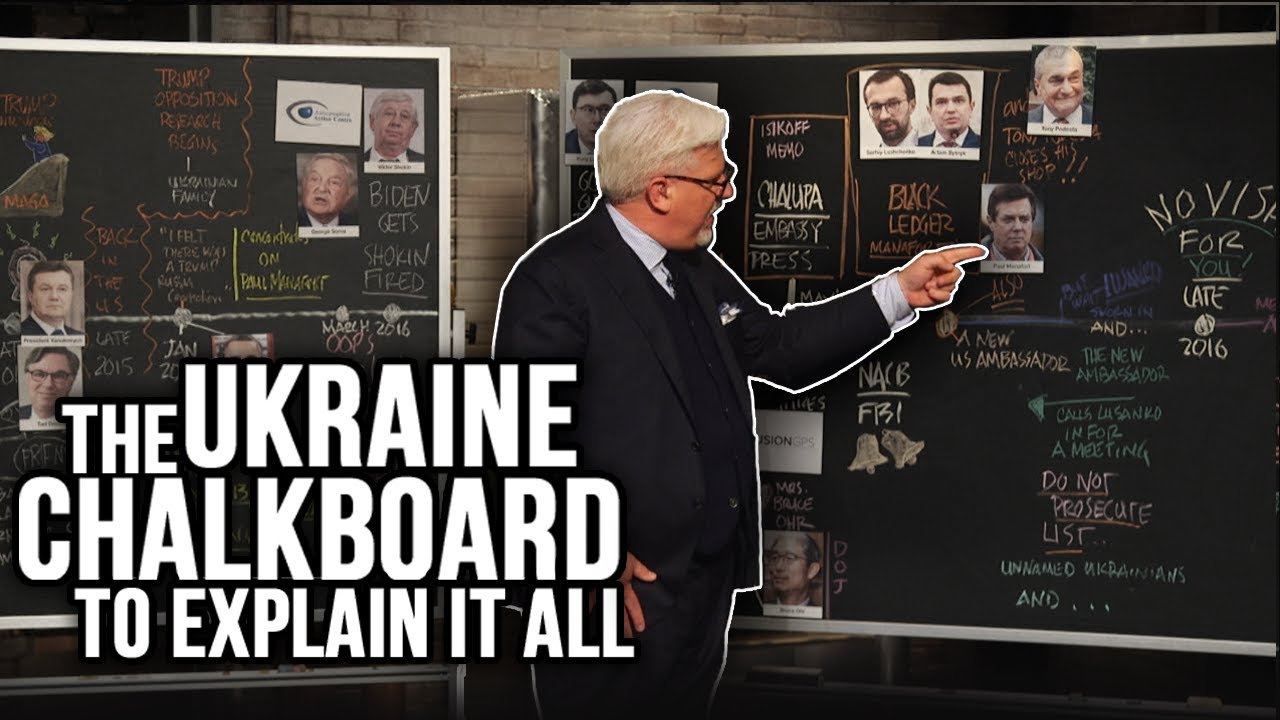 explaining what he viewed as the “timeline” of corruption involved in the Ukraine scandal. Rather than addressing the issue at hand -- that Trump has openly admitted to soliciting help from foreign countries to harm a political opponent -- Beck’s convoluted video went off in a series of tangents involving Soros, Hunter Biden, and WikiLeaks.
Trump lawyer Rudy Giuliani uses this technique to perfection in his TV appearances. Given the opportunity, he’ll ramble endlessly, often breaking off into vaguely related asides and contradicting things he said just moments before. He uses lots of words to say very little. While one could argue in support of putting him on air and letting him talk himself into a corner, that argument becomes muddied once you view what he does as a Gish Gallop.
Similarly, The Federalist has published more than 50 articles about Ukraine since September 23. Among its arguments for Trump’s innocence are that it was actually the Democrats who colluded with a foreign government during the 2016 election, that this entire scandal exposes only that the Biden family is corrupt, that the whistleblower can’t be trusted because he contacted a House aide before filing his complaint, that members of the “deep state” made suspicious changes to a whistleblower complaint form, that anti-Trump members of the press are just lying because they’re not happy with the outcome of the 2016 election, and finally, that sure, Trump did it, but it’s not like it’s a crime or anything. (Of course, The Federalist is far from alone in pushing most of these arguments.)
There’s a lot of baseless speculation and downright false information in those articles, and it’s certainly possible that the people writing them know this. The goal, as in any Gish Gallop, is to make debunking bad information a Sisyphean task while overloading the public with useless information in order to confuse them.
The Daily Show’s Michael Kosta satirized this approach in a video riddled with intentionally nonsensical lines like, “What about Eric Holder’s Hulu password? Malia Obama’s Venmo history? Oh, hey, Jay-Z visitor logs? Fake birds. Soros funded weather modification turbines? Did that ever cross your mind?” The video is good for a quick laugh while being only slightly more ridiculous than reality.
Whether employed on purpose or accident, the technique can work. That’s even more reason for mainstream outlets to make sure they aren’t playing into the hands of propagandists.
There’s reason to believe that Fox News, a source for so much of this obfuscation, is succeeding as a reality distortion field for conservative voters. An October 3 USA Today/Ipsos poll found that while non-Fox viewers support impeachment by a margin of 51% to 31%, Fox viewers oppose it 71% to 17%. As Media Matters’ Matt Gertz wrote last month, this is why Fox News exists:
Forty-five years ago, President Richard Nixon resigned. His impeachment at the time seemed almost certain, as key Republican senators had signaled they would no longer support him. But Nixon’s acolytes did not blame their president for his gross corruption and mind-boggling criminality. Instead, they blamed the press -- the “enemy,” as Nixon had described it -- for hounding him out of office.
...
Richard Nixon didn’t have Fox. Donald Trump does. And that may make all the difference. That’s no coincidence -- it’s what the network was created to do.
This is a precarious moment for political media. Fox News and other right-wing blogs and radio shows exist to push propaganda. But more reputable, more mainstream media outlets can avoid serving as yet another platform for propagandists to Gish Gallop their way through the discourse.
In the article in which Eugenie Scott coined that term, there’s one piece of advice that stands out:
Before you accept a debate, consider if what you are about to do will harm the cause more than promote it. Many scientists justify the debate by saying, "creationists will claim that scientists are afraid to debate them." So what?
Her point is worth remembering -- in the context of formal debates as well as cable news panel discussions.
mma 1019
As the last credible journalist to have a daily show on Fox News, Shep Smith probably should have resigned a long time ago. The network has been a right-wing propaganda network for years, and under Trump has turned into regime TV. On Friday, he finally did resign, and initial reports have indicated that his actions were driven by how bad the network has gotten.
Smith's resignation comes shortly after Fox News executives reportedly sided against him in an on-air feud with Fox News host Tucker Carlson over the seriousness of Trump's behavior in regards to Ukraine. In the end, Carlson said thatSmith was giving partisan opinion and not news. The entire episode was extremely telling: Tucker Carlson portrayed Smith's show -- at first implicitly and then explicitly -- as leftist fake news, much the same way he does nightly with CNN and MSNBC, even teaming up with closeTrump ally Joseph diGenova. And Fox News executives were fine with it.
Smith's departure is a disaster for Fox News. As Media Matters' Matt Gertz wrote in the wake of Smith's announcement, "Smith’s willingness to push back against the misinformation rampant elsewhere on the network had made him extremely valuable to Fox. It provided the network’s executives with a fig leaf they could wave whenever critics argued that Fox was nothing more than a propaganda apparatus on behalf of the president and his allies. That fig leaf is gone. Fox belongs to the Seans Hannity and Lous Dobbs. And now, everyone knows it."
Gird your loins: Fox News is about to get even worse.
==
==
drollinger
https://www.rightwingwatch.org/post/trump-cabinet-bible-study-teacher-expands-reach-in-ukraine-through-anti-lgbtq-politician
https://www.rightwingwatch.org/post/trump-cabinet-bible-study-teacher-expands-reach-in-ukraine-through-anti-lgbtq-politician
There’s seemingly no end to the list of Trump allies tromping around Ukraine. Ralph Drollinger, who teaches weekly Bible studies for members of the Trump Cabinet and members of Congress through Capitol Ministries, recently got back from a 10-day European trip where Drollinger “met with numerous Christian parliamentarians, trained newly named ministry leaders, cultivated teams to further the ministry and preached the gospel to more than 50,000 people at a national festival,” according to a blog post on Capitol Ministries’ website.
That festival was in Kyiv, Ukraine’s capital, and according to Capitol Ministries, Drollinger “greeted the Ukrainian people from the U.S. Presidential Cabinet, the Senate, and the House of Representatives Members Bible studies that he teaches weekly in Washington, D.C., then told the assembly that he and [his wife] Danielle were there to meet with government and religious leaders about expanding CM’s Bible study ministries in Ukraine.” The event was sponsored by a Ukrainian evangelical group.
Drollinger and Capitol Ministries are dedicated to evangelizing and “discipling” public officials around the globe and at every level of government to his “very conservative” version of Christianity, one which claims a biblical grounding for right-wing social, economic, environmental, criminal justice, and immigration policies. He teaches that government’s God-given role is to “quell evil” and that government officials “must send a constant message that sin will be punished.” According to Drollinger, Trump sends him handwritten notes praising his written Bible study materials.
Drollinger uses his high-profile relationships with the Trump administration and other politicians to expand his access and ability to preach his particular biblical worldview to powerful public officials in the U.S. and overseas. Drollinger’s expansion inHonduras, Nicaragua, and other Latin American countries was a focus of an international reporting collaboration by more than 15 outlets earlier this year.
Drollinger’s key political ally in Ukraine is an anti-LGBTQ member of Parliament, Pavlo Unguryan, who teamed up with Capitol Ministries to launch what the group calls a “thriving discipleship Bible study to parliamentarians” in 2018. Unguryan started a prayer group with other parliamentarians in 2008, and he has chaired the parliamentary caucus “For Spirituality, Morality and Health of Ukraine.”
In 2013, Unguryan called for a pride parade in Kyiv to be banned, saying he feared public LGBTQ events would be “the first step towards the legalization of same-sex relationships and same-sex marriage, and then introduction of mandatory training programs for homosexual parenting.” He added, “At the end, we will have the prosecution of any critical comments against these people.”
In 2015, Unguryan was vocal in resisting legislation that would ban anti-gay job discrimination to bring Ukraine into compliance with European Union standards and give Ukrainian citizens access to visa-free travel in the EU. “As a country with a thousand-year-old Christian history, we simply cannot allow this,” Unguryan said. “Today, a special status for sexual minorities is simply unacceptable.”
Writing in Foreign Policy after the legislation was rejected in parliament (although it eventually passed), Lev Golinkin wrote:
In perusing websites and statements by both Russian and Ukrainian far right groups and politicians, one is stunned by the identical tone: Both invoke the imagery of a nation with “a thousand-year history of Christianity” battling back the encroachment of decadent Western values in order to justify their cause. Both use the same derogatory terms for homosexuals. Both insist that their country can have a future only once it is cleansed of “foreign” influences. The only difference is, one set of slogans is written in Russian, the other in Ukrainian.
Also in 2015, Unguryan called homosexuality “a treatable disease” and accused gay people of pedophilia, noted Ukrainian journalist Maxim Eristavi. In 2016, Unguryan urged deputies not to endorse a Council of Europe convention on the prevention of violence against women and domestic violence because the document mentioned “gender,” a concept he said should be abandoned “for the sake of Christian values and common sense.” The parliament also, at his request, “eliminated the concept of ‘sexual orientation’ from the bill amending some laws of Ukraine in connection with the ratification of the Council of Europe Convention.”
As Right Wing Watch has reportedbefore, Drollinger teaches that the Bible assigns men and women particular responsibilities and believes the Bible does not permit women to teach men about the Bible, which explains why all his regional directors and Bible study leaders are men. He says that in “God’s ordained institution of husband-wife marriage,” women must submit to their husbands as a reflection of Christ’s submission to God the Father.
Earlier this year, Unguryan joined other anti-choice and anti-LGBTQ activists at the World Congress of Families in Verona, where he reportedly “expressed his hope that Europe would see the rise of a ‘Bible Belt spanning Italy, Romania, Croatia, Hungary and Ukraine.’” This summer, he was one of a group of deputies suggesting that sessions of parliament begin with the Lord’s Prayer. (They were not successful.)
In July, the blog of Radio Free Europe/Radio Liberty highlighted a tweet from journalist Tom Rowley saying, “Another day, another outrageous quote from Ukrainian MP and PACE delegate Pavlo Unguryan, who says on parliamentary TV that child sexual abuse ‘blossoms’ among sexual minorities – and that Pride Marches will soon lead to ‘Pedophilia Marches.’”
Earlier this year, Unguryan led a “Family Forum” gathering that drew Ukrainian religious and political leaders as well as U.S.-based, global anti-LGBTQ activist Brian Brown. An organizer said the event was designed to “unite our efforts around the Christian idea of Ukraine’s development and resist the total attack of amorality.” Open Democracy reported on the gathering:
According to the forum’s website, the event’s main aims included developing a “strategy to resist urgent threats to the Ukrainian family”, such as attempts by the Ukrainian parliament to ratify the Istanbul Convention, “gay parades” and other “anti-family legislation”.
The day was opened with speeches by representatives of Ukraine’s political elite, but the afternoon agenda focused on education and outreach workshops. The forum’s final resolution included a number of points, among them a call on the government to revoke the position of Parliamentary Ombudsperson on gender policy, minimise the number of abortions carried out and “actively propagandise the insitute of the family and family values”.
According to a translated version of an article from Censor.net, Unguryan had already submitted a package of bills that he wanted those in attendance of the Family Forum to support: According to Unguryan, a package of family bills has already been submitted to the Cabinet of Ministers, which the organizers hope for adoption. The legislative acts concern the requirement to prohibit commercial surrogate motherhood, the inclusion of representatives of religious organizations in the Supervisory Board of Public Television, the removal of gender terminology from legislation and family support.
Unguryan, who was in the U.S. last year to get trained by Capitol Ministries, seemingly shares Drollinger’s belief that nations will thrive when policymakers are guided by Drollinger’s interpretation of the Bible.
“Our goals are to take the Gospel and initiate Bible study groups in all areas of our society such as law enforcement, judiciary, healthcare system, education etc,” Unguryan is quoted saying in a Capitol Ministries’ post from May. “That is the fastest way to enforce law and bring a true transformation to Ukraine.”
“We are so blessed by our partnership with Pavel!” Drollinger said. “He has grown his ministry in Ukraine much faster than we’ve been able to here in the U.S.!”
“Many local government ministries have already been established in Ukrainian provinces and communities,” Capitol Ministries says, adding that the Drollingers trained 40 “newly appointed ministry leaders.” The Drollingers “also traveled to meet with government and faith leaders in Romania, Serbia, Macedonia, and Brussels. Other leaders traveled from Norway, Russia, and Moldovia to meet with the couple to discuss planting Bible study ministries.”
In May, Capitol Ministries reported that Drollinger was connected with Unguryan by Oleg Rachkovski, Capitol Ministries’ Eurasia regional director. Rachkovski also saw to it that “Oaks in Office,” Drollinger’s handbook for ministry leaders and public officials, was translated into Russian; it is being used as a guide for Bible studies in Ukraine. “Oaks in Office” is a compilation of 52 of Drollinger’s weekly written Bible studies that Drollinger believes should guide public officials “on crucial policy issues as viewed through the Bible.”
In the U.S., Drollinger has built relationships with high-profile Trump administration officials and conservative politicians through his Bible studies for members of the House and Senate and cabinet. Two of Trump’s cabinet members, Agriculture Secretary Sonny Perdue and NASA Administrator Jim Bridenstine,have keynoted fundraising dinners for Capitol Ministries that were held in 2018 and 2019 at the World Ag Expo, held in the heart of California’s agriculture industry. (Before moving to D.C., Drollinger ran a ministry with California state legislators.)
Drollinger joined the pro-Trump prayer warriors at Intercessors for America last year to pray for Trump and his cabinet members. Drollinger asked people to pray that he’d be able to move his cabinet Bible study into the White House compound so that it would be easier for Trump and Vice President Mike Pence to attend.
Drollinger is also keen to find his way into the Supreme Court. Last fall, at a religious right prayer gathering shortly before the confirmation of Brett Kavanaugh to the Supreme Court, Drollinger told participants that U.S. Secretary of Health and Human Services Alex Azar is “really good friends with Justice Kavanaugh.” He said Azar had predicted that once Kavanaugh was on the court, “either we’ll have him here to the cabinet Bible study or he’ll want to start one in SCOTUS.” Added Drollinger, “So pray that would happen, of all places, at the Supreme Court.”
It seems likely that if Drollinger had in fact been invited to lead Bible studies at the Supreme Court, we would have heard about it. Perhaps Kavanaugh, a Catholic, and his Catholic colleagues might not be terribly enthusiastic about being taught by Drollinger, who expresses disdain for those whose interpretations of scripture do not align with his own, and who has called the Catholic Church “the world’s largest false religion.”
Tags: Pavlo UnguryanRalph DrollingerAnti-GayAnti-LGBTChurch-StateGender IdeologyInternationalUkraineCapitol Ministries
==
https://www.alternet.org/2019/10/bolton-went-ballistic-new-report-finds-at-least-4-white-house-officials-were-panicked-by-trumps-ukraine-conduct/
no lnx
‘Bolton went ballistic’: New report finds at least 4 officials were panicked by Trump’s Ukraine conduct
Written by Cody Fenwick October 11, 2019
650
It wasn’t just the whistleblower.
That’s the major takeaway from a new Washington Post report, which detailed the panic and alarm in the White House surrounding President Donald Trump’s warped policy toward Ukraine. This scandal has led to an invigorated impeachment inquiry. Republicans have tried to discount a whistleblower’s complaint about the Ukraine matter — which has been overwhelmingly supported by evidence that has since become public — by attacking the still-anonymous person as partisan and out to get the president. By contrast, the new report paints a picture of widespread opposition to the president’s actions within his own White House.
Four, and possibly more, national security officials in the White House were concerned about Trump’s actions, according to the report, both before and after the president’s now-infamous July 25 call with Ukrainian President Volodymyr Zelensky. In the call, Trump strongly indicated that U.S. assistance to Ukraine could be contingent on Zelensky giving him what he wanted, specifically: investigations into the 2016 election and former Vice President Joe Biden.
The report explained:
Those concerns soared in the call’s aftermath, officials said. Within minutes, senior officials including national security adviser John Bolton were being pinged by subordinates about problems with what the president had said to his Ukrainian counterpart, Volodymyr Zelensky. Bolton and others scrambled to obtain a rough transcript that was already being “locked down” on a highly classified computer network.
“When people were listening to this in real time there were significant concerns about what was going on — alarm bells were kind of ringing,” said one person familiar with the sequence of events inside the White House, who, like others, spoke on the condition of anonymity to discuss a sensitive matter. “People were trying to figure out what to do, how to get a grasp on the situation.”
The fact that the transcript was concealed — inappropriately, it seems — on a specialized server has drawn scrutiny from House Democrats as a potential coverup. The White House would later release a rough transcript of the call under congressional and public pressure following news about the whistleblower’s complaint.
Officials’ concerns were amplified, the report said, by the input of Ambassador to the EU Gordon Sondland, whose involvement in the scandal was exposed in a series of damning text messages released as a part of the investigation. Sondland, those texts show, was a key part of the team working to pressure Ukraine to launch the president’s desired investigations, potentially in exchange for congressionally approved military aid.
The report recounted:
Amid a broader discussion in which White House officials were encouraging Ukraine to continue its work to eliminate corruption in the country’s energy sector, Sondland blurted out that there were also “investigations that were dropped that need to be started up again,” according to a U.S. official familiar with the matter.
Senior officials understood Sondland’s statement to be a reference to Burisma and Biden. “Bolton went ballistic” after the meeting, the official said. In the ensuing days, senior NSC officials including Bolton and Kupperman huddled over their concerns about Ukraine.
Bolton would shortly thereafter be out of a job at the White House.
==
https://www.alternet.org/2019/10/this-is-the-very-important-reason-trumps-russian-and-ukraine-scandals-are-directly-linked-cnns-jeffrey-toobin/
toobin says mueller punt embolden djt --> ukraine
==
https://www.alternet.org/2019/10/understanding-trumps-whackiest-conspiracy-theory-to-date/
no lnx many
Understanding Trump’s whackiest conspiracy theory to date
Written by Heather Digby Parton / Salon October 7, 2019
Here’s what’s OK: If we feel there’s corruption, like I feel there was in the 2016 campaign — there was tremendous corruption against me — if we feel there’s corruption, we have a right to go to a foreign country. And just so you know — just so you know, I was investigated. I was investigated. Okay? Me. Me. In my campaign — I ran, I won. I was invest- — you won’t say that, will you? I was investigated. I was investigated. And they think it could have been by U.K. They think it could have been by Australia. They think it could have been by Italy. So when you get down to it, I was investigated by the Obama administration. By the Obama administration I was investigated.
— Donald Trump, Oct. 4, 2019
Last Friday I wrote about the origins of the Joe Biden-Ukraine conspiracy theory, when the same professional hitmen who pushed the “crooked Hillary” story about alleged influence-peddling with the Clinton Foundation produced a book alleging that Biden had leveraged his power as vice president to help his son’s business. (The evidence shows that not only did Biden not do that, the actions he took were actually detrimental to his son’s case.)
All that is almost hilarious in light of this AP report that broke late on Sunday night in which it was revealed thatclose associates of Trump’s fixer Rudy Giuliani and Energy Secretary Rick Perry have been doing some lucrative influence-peddling of their own, trying to leverage their relationships for shares in a natural gas company in Ukraine. Trump is now trying to blame Perry for that misguided phone call to Ukrainian President Volodymyr Zelensky that led to the impeachment inquiry. It’s never a dull moment in this Ukraine scandal.
It’s clear, however, as the quote above shows, that while Trump was happy to tar his political rival Joe Biden, his true interest in Ukraine lies in his ongoing obsession with a daft conspiracy theory that he and Russia were both set up by the FBI, the CIA and the foreign services of several key U.S. allies, along with Ukraine, the Democratic National Committee and the Hillary Clinton campaign. The ostensible goal was to destroy his campaign and if that didn’t work, his presidency. Trump seems to have convinced Attorney General Bill Barr, Secretary of State Mike Pompeo and at least a few U.S. senators that this is a legitimate line of inquiry.
Barr has been running around the world, accompanied at times by the special prosecutor he assigned to investigate the matter, interviewing the heads of the intelligence services of various allies. He asked the president himself to intervene with certain heads of state to get their cooperation with the probe.
The specific aspect of the conspiracy theory that took Barr to Italy this past week was laid out in detail by Lucian K. Truscott IV in Salon on Sunday. In a nutshell, it all revolves around onetime Trump “coffee boy” George Papadopoulos and Joseph Mifsud, the mysterious “professor” who told Papadopoulos that the Russians had dirt on Hillary Clinton — which Papadopoulos in turn drunkenly shared with the Australian high commissioner to the U.K. in a pub a few weeks later. That led to the Aussies sounding the alarm to the U.S., which led to the FBI taking a look to see whether Russians were trying to interfere in the presidential election.
Giuliani has been running his mouth about this for months calling Mifsud a “counterintelligence operative, either Maltese or Italian” and Papadapoulos has been tweeting as if he’s a high level investigator for the Department of Justice:
George Papadopoulos
@GeorgePapa19
AG Barr has been on official travel in Italy for the past two days. As I explained months ago, on Fox and in my book, Mifsud was an Italian operative handled by the CIA. Italy holds the keys to the kingdom. Right government, right time. ????????
He’s quite the super-sleuth. It’s his wild imagination that has fueled this particular conspiracy theory, along with the bizarre 4chan storyline that suggests the security firm CrowdStrike framed Russia on behalf of the DNC. Trump mentioned that in the phone call with Zelensky, but seems to have embellished the conspiracy theory even beyond the ludicrous narrative right-wingers had previously laid out. According to NBC News, when the president said “I guess you have one of your wealthy people. … The server, they say Ukraine has it,” people who knew the context thought that “Trump’s call felt detached from any sense of logic.” How unusual.
Sen. Ron Johnson, R-Wis., seems to think this whole thing makes sense, however. He appeared on “Meet the Press” on Sunday and shared his thoughts on the matter:
@MeetThePress
WATCH: @SenRonJohnson is asked why he winced & brings up a "conspiracy theory."@chucktodd: "I have no idea why we're going here. ... Can we please answer the question I asked you instead of trying to make Donald Trump feel better here that you're not criticizing him?" #MTP
Embedded video
If that sounded a bit scattered, here’s Pompeo pretending that everyone in the administration is just doing their jobs:
“It is not only appropriate, but it is our duty to investigate if we think there was interference in the election of 2016,” Mr. Pompeo said in Athens. “I think everyone recognizes that governments have an obligation — indeed, a duty — to ensure that elections happen with integrity, without interference from any government, whether that’s the Ukrainian government or any other. And so inquiries with respect to that are completely important.”
He added: “There’s been some suggestion somehow that it would be inappropriate for the United States government to engage in that activity, and I see it just precisely the opposite. I see our duty to engage in activity that ensures that we have fair, free elections.”
Keep in mind that Pompeo was first appointed as Trump’s CIA director, and led his own investigation which found no wrongdoing by the agency. Yet he came out and gave that sanctimonious little speech legitimizing this loony conspiracy theory. Even he has to pay homage to Trump and his consigliere Giuliani’s febrile fantasies. Frankly, he doesn’t seem to mind.
The Wall Street Journal reports that U.S. allies are becoming increasingly irritated by this ridiculous crusade. Barr is going outside the normal channels, riling up internal politics in their countries andbasically making a hash of America’s foreign policy.He and Pompeo may just be trying to soothe Trump’s massive ego — or maybe they’ve drunk the Kool-Aid too. In the end, that doesn’t much matter. The most powerful nation on earth is clearly being run by a bunch of kooks. It’s hard to see why anyone else would ever trust us again.
Heather Digby Parton, also known as “Digby,” is a contributing writer to Salon. She was the winner of the 2014 Hillman Prize for Opinion and Analysis Journalism.
perry doe frack? ukraine, thrown under bus?
==
Giuliani’s effort is gaining traction on Capitol Hill. Sen. Charles E. Grassley (R-Iowa), chairman of the Senate Finance Committee, and Sen. Ron Johnson (R-Wis.), chairman of the Homeland Security Committee, have announced their renewal of an inquiry into any coordination between Ukraine and Democratic Party officials.
==
State Department Inspector General Steve Linick provided "assorted news clippings and conspiratorial memos" on alleged Democratic wrongdoing in Ukraine that "he did not assign credibility to" on Wednesday in a private committee hearing that he requested, the New York Times reports.
Why it matters: Interview notes involving Trump's personal lawyer Rudy Giuliani and "Ukrainian officials about the Bidens" appeared to be among the materials, which were addressed to Secretary of State Mike Pompeo, per NYT.
- Giuliani was subpoenaed this week by the House Intelligence Committee to produce documents by Oct. 15 related to his and President Trump's alleged efforts to push Ukraine's government to investigate Joe Biden.
- Giuliani has yet to state if he would cooperate with the subpoena, but he said he would comply with the impeachment inquiry if Trump tells him to.
The big picture: The whistleblower complaint — which cites a phone call between Ukrainian President Volodymyr Zelensky and Trump — alleges that the president used "the power of his office to solicit interference from a foreign country in the 2020 election" and claims that Giuliani and Attorney General Bill Barr appeared to be involved in the effort as well.
What they're saying:
“The briefing and documents raise troubling questions about apparent efforts inside and outside the Trump Administration to target specific officials, including former Vice President Joe Biden's son and then-U.S. Ambassador to Ukraine Masha Yovanovitch, who was abruptly removed as Ambassador in May after a sustained campaign against her by the President’s agent, Rudy Giuliani.
The documents provided by the Inspector General included a package of disinformation, debunked conspiracy theories, and baseless allegations in an envelope marked 'White House' and containing folders labeled 'Trump Hotel.' These documents also reinforce concern that the President and his allies sought to use the machinery of the State Department to further the President’s personal political interests."
— Joint statement from the chairs of the House Intelligence, Foreign Affairs, and Oversight and Reform committees
Background: Linick said the materials were delivered to Secretary of State Mike Pompeo "earlier this year from someone purporting to be at the White House," per the Times, and "a legal adviser at the department" passed it on to Linick's office.
- Linick "doubted" the origin of the materials, but "thought lawmakers should have it in light of their investigative work," NYT reports.
Go deeper: Fact check: What Joe and Hunter Biden actually did in Ukraine
==
ref 3
https://www.washingtonpost.com/world/national-security/giuliani-consulted-on-ukraine-with-imprisoned-paul-manafort-via-a-lawyer/2019/10/02/
no lnx
National Security
Giuliani consulted on Ukraine with imprisoned Paul Manafort via a lawyer
By Josh Dawsey ,
Tom Hamburger ,
Paul Sonne and
Rosalind S. Helderman October 2 at 8:41 PM
In his quest to rewrite the history of the 2016 election, President Trump’s personal attorney has turned to an unusual source of information: Trump’s imprisoned former campaign chairman Paul Manafort.
:{
}:
Rudolph W. Giuliani in recent months has consulted several times with Manafort through the federal prisoner’s lawyer in pursuit of information about a disputed ledger that would bolster his theory that the real story of 2016 is not Russian interference to elect Trump, but Ukrainian efforts to support Hillary Clinton.
:{
}:
The relationship, which Giuliani acknowledged in an interview this week with The Washington Post, stems from a shared interest in a narrative that undermines the rationale for the special counsel investigation. That inquiry led to Manafort’s imprisonment on tax and financial fraud allegations related to his work in Kiev for the political party of former president Viktor Yanukovych.
:{
}:
Giuliani’s effort is gaining traction on Capitol Hill. Sen. Charles E. Grassley (R-Iowa), chairman of the Senate Finance Committee, and Sen. Ron Johnson (R-Wis.), chairman of the Homeland Security Committee, have announced their renewal of an inquiry into any coordination between Ukraine and Democratic Party officials.
Manafort, who is serving a 7½ -year term in a federal prison in Pennsylvania, has continued to express support for Trump, and Trump has never ruled out giving him a pardon.
Trump’s push on a July 25 call to get Ukrainian President Volodymyr Zelensky to investigate the matter, and also probe former vice president Joe Biden, triggered an impeachment inquiry in the House. Many of the accusations Giuliani has been making about Ukraine recycle those that Manafort’s team first promulgated.
Giuliani joined Trump’s legal team in April 2018 to help defend the president against special counsel Robert S. Mueller III’s probe, and the former mayor said he launched his own investigation into Ukraine late last year, which led him to consult with Manafort. He said he has not spoken directly to Manafort in two years.
“It was that I believed there was a lot of evidence that the [Democratic National Committee] and the Clinton campaign had a close connection to Ukrainian officials,” Giuliani said, noting that he was never advocating for a pardon of Manafort. “It was all about Trump. I don’t think I could exonerate Manafort.”
Manafort’s lawyer, Kevin Downing, did not respond to a request for comment.
[Impeachment inquiry puts new focus on Giuliani’s work for prominent figures in Ukraine]
:{
}:
Giuliani said his consultation with Manafort centered on trying to ascertain the veracity of a secret black ledger obtained by Ukraine’s National Anti-Corruption Bureau, which the New York Times revealed in an August 2016 story. The Times said the ledger recorded $12.7 million in cash payments from Yanukovych’s political party to Manafort. The revelation led Manafort to resign from the campaign.
Giuliani’s narrative recasts Ukrainian accusations in 2016 against Manafort and efforts by Democratic operatives to gather research on Manafort after he took a leading role in Trump’s campaign as a conspiracy involving both Ukrainian and American officials to swing the election for Clinton.
As part of that, Giuliani has focused on a theory that Manafort’s team was promoting as early as 2017: that the Ukrainian government separately interfered in the 2016 campaign on behalf of Clinton through the activities of a Ukrainian American contract worker for the DNC, Alexandra Chalupa.
Chalupa confirmed she worked part-time as an outreach worker for the DNC to Ukrainian Americans and others, and met with Ukrainian officials from the embassy in Washington during that time. She said she “sounded the alarm” on Manafort outside her duties for the DNC, and sought to circulate that information, because she said she was concerned about Manafort’s ties to Yanukovych, who was backed by Russian President Vladimir Putin. She said the Ukrainian Embassy stayed clear of U.S. election matters, even with regard to Manafort.
“The White House has been pushing this narrative to distract from Donald Trump’s gross abuse of power in pressuring a foreign country to interfere in our elections,” DNC press secretary Adrienne Watson said in a statement.
There were Ukrainian Americans and people in the Ukrainian anti-corruption movement who were motivated to “shine a light” on Manafort’s activities in Ukraine during 2016, and some Ukrainian Americans were active on behalf of Clinton, said Jeffrey Mankoff, deputy director of the Russia and Eurasia program at the Center for Strategic and International Studies, but he said those activities aren’t equivalent to Russia’s state-sponsored intervention, which included the release of stolen emails and an extensive online disinformation campaign.
“One theory has been documented with extensive detail in the Mueller Report,” Mankoff said. “The other is something that Rudy Giuliani and people in his orbit have conjured up as a way to cast aspersions and confuse the story.”
Giuliani said he needed to consult with Manafort through the latter’s lawyer this spring to ask whether a black ledger ever existed.
“I said, ‘Was there really a black book? If there wasn’t, I really need to know. Please tell him I’ve got to know,’” Giuliani recalled asking Manafort’s lawyer. “He came back and said there wasn’t a black book.”
Giuliani said he was interested in the matter to prove his theory that the ledger’s release, which he has claimed was done in conjunction with U.S. officials, was part of a falsified pretext for U.S. authorities to reopen a case against Manafort.
The FBI, however, already had a case open against Manafort before the 2016 campaign, having interviewed him twice about his work in Ukraine in 2013 and 2014.
The special counsel’s office did not introduce the “black ledger” at Manafort’s trial in Virginia in August 2018, nor did Manafort's defense team mention the document during his trial on tax and financial fraud charges, or try to show that it had been forged.
After a jury convicted Manafort of eight felonies, the former Trump campaign chairman pleaded guilty in Washington to avoid a second trial. As part of his plea, Manafort acknowledged that he made more than $60 million in Ukraine, laundering more than $30 million of it through foreign companies and bank accounts to hide it from the IRS and cheating the government out of $15 million in taxes. He also agreed that he had lobbied in the United States on behalf of Ukrainian officials without registering and that he conspired to tamper with witnesses in his case.
Serhiy Leshchenko, a Ukrainian journalist, anti-corruption campaigner and former member of parliament, said the ledger “was obtained by an anonymous source in the burned-out ruins of the headquarters of Yanukovych’s party.” His involvement in the release of part of its contents at a news conference, he said, was motivated by a desire that Manafort be brought to justice for his activities in Ukraine.
“Giuliani’s entire approach is built on disinformation and the manipulation of facts,” Leshchenko said in an op-ed in The Post. “Giuliani has developed a conspiracy theory in which he depicts my revelations about Manafort as an intervention in the 2016 U.S. election in favor of the Democratic Party.”
In a text conversation with Manafort from August 2017 released by prosecutors, Fox News host Sean Hannity mentions “Ukraine interference” as one of the issues he was highlighting to attack Mueller. On his show that year, Hannity repeatedly claimed Ukraine had intervened in the 2016 election by sharing information on Manafort with a DNC contractor. Manafort did not respond directly to those claims but frequently encouraged and praised Hannity throughout the summer.
The White House also promoted the allegation.
:{
}:
“If you’re looking for an example of a campaign coordinating with a foreign country or a foreign source, look no further than the DNC, who actually coordinated opposition research with the Ukrainian Embassy,” White House spokeswoman Sarah Sanders said in July 2017.
Grassley and Johnson, writing this week in a letter to Attorney General William P. Barr, again mentioned the allegations as a matter they intend to investigate.
“Ukrainian efforts, abetted by a U.S. political party, to interfere in the 2016 election should not be ignored,” the senators wrote. “Such allegations of corruption deserve due scrutiny, and the American people have a right to know when foreign forces attempt to undermine our democratic processes,” the senators wrote in the letter.
Correction:An earlier version of this story misidentified Sen. Charles Grassley’s committee chairmanship. The story has been corrected.
Rachel Weiner contributed to this report.
Josh Dawsey
Josh Dawsey is a White House reporter for The Washington Post. He joined the paper in 2017. He previously covered the White House for Politico, and New York City Hall and New Jersey Gov. Chris Christie for the Wall Street Journal. Follow
Tom Hamburger
Tom Hamburger is an investigative reporter on the national desk of The Washington Post. He has covered the White House, Congress and regulatory agencies, with a focus on money and politics. Follow
Paul Sonne
Paul Sonne covers the U.S. military and national security. He previously reported for the Wall Street Journal from Moscow, London and Washington. Follow
Rosalind S. Helderman
Rosalind Helderman is a political enterprise and investigations reporter for The Washington Post. She joined The Post in 2001. Follow
We dig deeper.
==
ref 2
https://www.miamiherald.com/news/politics-government/article235501772.html
Two South Florida businessmen from the former Soviet Union could find themselves dragged into an impeachment inquiry targeting President Donald Trump over their political activities in Ukraine.
Lev Parnas and Igor Fruman were cited — although not by name — in a government whistleblower complaint released Thursday alleging improper behavior by the president. Parnas and Fruman helped introduce Trump’s personal lawyer, Rudy Giuliani, into top Ukrainian political circles, according to widespread media accounts.
A July 25 telephone call between Trump and Ukrainian President Volodymyr Zelensky led House Speaker Nancy Pelosi to announce an impeachment inquiry earlier this week. During the call, Trump pressured his counterpart to investigate Democratic rival Joe Biden and his son, Hunter, sparking the whistleblower complaint and widespread public concern even from the administration’s Republican allies in Congress.
“The connections and associates which Giuliani had on President Trump’s behalf in Ukraine ... those really should be the heart of the investigative process,” said Kenneth F. McCallion, a former federal prosecutor and attorney for former Ukrainian Prime Minister Yuliya Tymoshenko in the United States.
Reached on his cellphone Thursday, Parnas called the impeachment inquiry a “soap opera” and defended Trump.
“[Personally], it’s a headache. It’s upsetting, being dragged into something like this,” he said.
Parnas said Ukraine’s government has access to information on alleged wrongdoing by the Bidens and U.S. officials overseas — but that the U.S. government proved indifferent to receiving it through official channels. Thanks to his friendship with Giuliani, he said, he and Fruman became the best people to get it into the Trump administration’s hands. The information could affect the 2020 election.
“I got certain information and I thought it was my duty to hand it over,” he said. He declined to comment on the details of his relationship with Giuliani, although he said the former New York City mayor was his lawyer as well as friend.
While Giuliani hoped to gather information damaging to Trump’s rivals, experts have largely dismissed claims that a conspiracy was afoot. Joe and Hunter Biden have denied wrongdoing.
Parnas’ and Fruman’s newfound political prominence, including major donations to GOP candidates, belies a history of financial troubles.
Parnas is a former stockbroker who was threatened last year with eviction from a $5,500-per-month home in Boca Raton, court records show. His company was evicted in 2015 for failing to pay rent. The Ukrainian-American businessman is also at the center of a $325,000 donation to a pro-Trump super PAC that is under scrutiny from federal regulators. Details about that contribution were revealed only when an investor sued Parnas over a loan made for an unmade film Parnas was promoting called “Anatomy of an Assassin.”
Fruman, a real estate investor who also runs a New York import-export business dealing in coffee, baby food, ketchup and dairy products, and Parnas also allegedly bragged about their alliances with Republican power brokers like Giuliani and Florida Gov. Ron DeSantis in order to procure a six-figure loan from an investor for a natural gas business they run. But the men struggled to pay the investor back on time, leading to a lawsuit.
Their political efforts have met with some success. A month after meeting with Giuliani, Parnas and Fruman earlier this year, Ukrainian prosecutors announced an investigation into whether officials had attempted to swing the election in favor of Hillary Clinton, according to a detailed profile of Parnas and Fruman’s activities by Buzzfeed News and the Organized Crime and Corruption Reporting Project. Trump called the allegations “big” and “incredible” on Fox News.
The whistleblower complaint expressed concern that Trump is “using the power of his office to solicit interference from a foreign country in the 2020 U.S. election.” It repeatedly mentioned the role of Giuliani in Ukraine. And in three footnotes, the whistleblower cites media reports revealing how Parnas and Fruman were instrumental. The complaint refers to the men as “two associates of Mr. Giuliani.”
Giuliani has confirmed Parnas and Fruman are his legal clients. Fruman could not be reached Thursday. Attorneys who have represented him did not respond to requests for comment. Giuliani has said his efforts in Ukraine had the full support of the president.
A Reuters reporter last week saw Giuliani and Parnas sitting at a table together at Trump’s hotel in Washington, D.C.
Parnas, Fruman and their natural-gas company, Global Energy Producers, have given more than $400,000 to Republican candidates and committees supporting them in federal elections. The vast majority of that money has gone to committees supporting Trump, but Republican Florida Sen. Rick Scott is the next biggest beneficiary. In 2018, Fruman gave $15,000 to a joint-fundraising committee backing Scott’s Senate race. They also gave $50,000 to the campaign of DeSantis, a Trump ally, in June 2018 and $35,000 combined to a committee supporting failed Republican gubernatorial candidate Adam Putnam.
Together, Parnas and Fruman joined Donald Trump Jr. for breakfast in Beverly Hills last year, a deleted social media post obtained by BuzzFeed/OCCRP shows.Both men have been spotted at Trump properties, including Mar-a-Lago, according to published reports. Another photo shows Parnas at the White House with Trump earlier this year.
On the website of his current company, Fraud Guarantee, Parnas lists one of his early business ventures as “shipping the first containers of freight between the United States and the former Soviet Union in the early 1990s.” Fraud Guarantee, where he is co-founder and CEO, protects investors “from losses due to fraud,” according to the website. Parnas has been repeatedly sued over alleged unpaid debts and rents in Palm Beach County courts. (“I don’t know anybody that has only good in their business,” Parnas said Thursday. “I’ve never done anything illegal, I’ve never been charged, I’ve never been near anything like that.”)
In addition to his interests in real estate and shipping, Fruman is the president of the Ukrainian-based Otrada Luxury Group, which sells cars, jewelry, boats, food and alcohol, according to a company pamphlet. He lives in Sunny Isles Beach, public records show, which is also the location of Seafront Properties, LLC, for which he is the registered agent. He has “personal ties” to a powerful businessman in the Ukrainian port city of Odessa called “the Grey Cardinal” who is believed to associate with organized crime figures, according to OCCRP, an international consortium of investigative journalists.
THE EASTERN FRONT
On May 17, 2018, a Delaware shell company called Global Energy Producers contributed $325,000 to America First Action, a pro-Trump super PAC,according to federal campaign finance records. Parnas was described as the CEO of the firm and Fruman as the president in unrelated documents.
It was their big introduction into GOP politics and a world of international intrigue.
The next year, Parnas would prove crucial in setting up meetings between Giuliani and former Ukrainian prosecutor Yuriy Lutsenko, according to the New York Times.
Giuliani was said to be primarily seeking two things: Information about how material damaging to former Trump campaign chairman Paul Manafort was publicly leaked in Ukraine. And an agreement from Ukraine’s government to investigate the involvement of Biden’s son in a Ukrainian energy company, which could hinder Biden’s campaign against Trump in the 2020 presidential election.
Thanks to Parnas, Giuliani spoke on the phone with Lutsenko and met with him for several hours in New York City in January, the Times reported. They reportedly met again in Warsaw in February.
“[Lutsenko] brought documentation, verification. It opened Giuliani’s eyes,” Parnas told reporters at Buzzfeed and OCCRP, saying the information could aid Attorney General William Barr’s inquiry into the origins of special counsel Robert Mueller’s investigation, as well as the 2020 election.
“It’s all going to come out,” Parnas added. “Something terrible happened and we’re finally going to get to the bottom of it.”
[pix President Donald Trump’s personal attorney, Rudy Giuliani, in the East Room of the White House in July 2018]
All told, Parnas and Fruman introduced Giuliani to three current and former Ukrainian prosecutors, according to OCCRP.
Although both men have claimed to open doors in Ukraine for Giuliani, neither is registered as a foreign agent with the U.S. Justice Department. Whether they need to is murky, in part, because of Giuliani’s unusual status as someone doing the bidding of the U.S. president while not actually an appointed official.
After the Times story in May, Giuliani canceled his planned visit to Ukraine.
He did however meet with an adviser to Ukraine’s president in Madrid in August, according to the whistleblower complaint.
The $325,000 donation to the Trump super PAC was the subject of a complaint by a nonpartisan watchdog group to the Federal Election Commission last year. TheCampaign Legal Centersaid Global Energy Partners did not have assets required to make such a hefty donation and that the funds had in fact come from an unknown source.
“We’ve seen that these two shady characters managed to buy their way into Trump world with a $325,000 super PAC contribution and then leveraged the access the contribution afforded to push this highly dubious scheme in Ukraine,” Brendan Fischer of the Campaign Legal Center said in an interview Thursday.
More details about the source of the money have been revealed in a civil lawsuit filed in federal court.
In the lawsuit, an investor in a movie-deal-gone-bad won a judgment worth more than $500,000 plus interest against Parnas. Wire transfers unveiled in the lawsuit showed that the money had not been donated to the Trump super PAC by Global Energy Partners but by another company managed by Parnas, according to a supplemental complaint lodged by the CLC in June.
“America First Action violated the law by filing this false report, which has kept the public in the dark about the true sources of its support. Parnas, Fruman, or others who engineered this scheme also violated the law by laundering the contribution through LLCs,” the complaint stated. “But we still don’t know where the money actually came from. The FEC should find out.”
America First Action said it could not comment on “ongoing legal matters.”
“We take our legal obligations seriously and scrupulouslycomply with the law,” the group said in a statement.
Parnas said Thursday the money came from the sale of a Miami-area condo and that the donation was legitimate. On Thursday, the Daily Beast published a story confirming that a company linked to Fruman had sold a Bal Harbour condo for $4.1 million.
Tony Andre, a South Florida attorney helping the jilted movie investor recover the judgment, said his research has found Parnas’ finances to be opaque.
“His financial dealings seem questionable when you consider his history of non-payments of debts,” Andre said Thursday.
[pix President Donald Trump meets with his Ukrainian counterpart, Volodymyr Zelensky, at the United Nations on Wednesday, Sept. 25, 2019.
MYSTERY MEN
It’s not clear how Parnas, Fruman and New York’s former mayor got to know each other.
Giuliani has been mixed into the complicated Ukrainian political scene for more than a decade. A confidential State Department cable, sent from the U.S. Embassy in Kiev back to headquarters and published by Wikileaks, described how Giuliani was seeking to help former heavyweight boxing champion Vitaliy Klitschko in his bid to enter the political ring there.
According to BuzzFeed/OCCRP, Parnas came to the United States in 1976 when he was 4.
A check of Parnas on the website BrokerCheck, operated by the Financial Industry Regulatory Authority (FINRA), shows him associated with three companies that have been expelled from the industry’s self-regulating body. Parnas worked in the securities business since 1994, sometimes using the name Larry Parnell, but has not been a registered broker since 2009, when the North Miami Beach company he worked for, Basis Financial, LLC, was expelled.
In a settlement with the body, Basis Financial’s owners admitted to a range of misrepresentations and misconduct and FINRA determined the company failed to establish anti-money-laundering policies.
In 2003, another Parnas-associated company, Program Trading Corp., in Boca Raton, was expelled from FINRA. Parnas had a stake of 25-to-50 percent in the company, through his Florida company Aaron Investment Group, according to documents. FINRA expelled the company after it refused to pay fines and settle with the National Association of Securities Dealers, which accused Program Trading of malfeasance.
Parnas was also a broker in the mid 1990s with Euro-Atlantic Securities, Inc. That firm was at the center of a stock fraud prosecution in New York in 2001 involving several alleged organized crime figures. Parnas had left the company by the time indictments were brought for stock-price manipulation.
He has never been personally charged.
Igor Fruman with President Donald Trump. Fruman is referenced — but not by name — in the whistleblower complaint pertaining to Trump’s call with the Ukrainian president.
Born in Belarus, Fruman spent years in Ukraine before migrating to Miami where, in 2005, he married Yelyzaveta Naumova, also a Ukrainian national. Naumova filed for divorce in 2017, records show.
Fruman ran an import/export business and owned a boutique hotel in Odessa, Ukraine, according to BuzzFeed/OCCRP. A milk canning plant he invested in went bankrupt after going nearly $25 million in debt, the news organizations reported.
In March, Russian-born businessman Felix Vulis sued Fruman and Parnas after Global Energy Producers failed to pay back a $100,000 loan from Vulis last September. The two parties agreed to a settlement for an undisclosed amount last month.
In order to procure the loan, Fruman and his associates at GEP bragged about his connections to Giuliani, the complaint said. In March of 2018, Fruman and Parnas attended a Trump donor meeting at Mar-a-Lago as a kickoff event for Trump’s 2020 campaign, according to OCCRP. Their biggest donation came two months later.
Paperwork for the $325,000 contribution to the Trump super PAC lists a home in Boca Raton as an address for Global Energy Partners. Parnas confirmed it was his residence.
Reached Thursday, Victor Imber, the man who owns that home, said “Who is Lev Parnas?” and hung up the phone.
Miami Herald staff writer David Smiley and Miami Herald researcher Monika Leal contributed to this report.
10/19 bak no lnx
see 2 bak 10/19
primary 818
see manafort and mog russian mafia
cf trms on odd russia timeline, myst phone call promise
https://www.alternet.org/2019/09/impeachment-resignation-treason-federal-charges-reaction-to-the-stunning-trump-ukraine-news/
...Thursday ended with the absolutely bombshell news that Donald Trump and Rudy Giuliani allegedly schemed to withhold military and financial aid to Ukraine—unless the newly elected prime minister found some kind of dirt on Joe Biden’s son Hunter, who has done work in Ukraine. You could and should read more about this scandal from my colleague, Mark Sumner, who has a great summary of the situation and a complete timeline of the scandal.
For what it’s worth, we aren’t talking small funds here. We are talking $250 million in aid that the White House blocked this summer, which was, coincidentally, released on Thursday.
Almost immediately after the news skyrocketed to the top trending topic on social media, Rudy Giuliani appeared on CNN where he lost his mind and admitted he was a co-conspirator in a Ukraine deal. More incredibly, Giuliani then ran to Twitter to not just affirm his role; he also directly implicated Donald Trump.
...
==
==
mirror/whataboutism?
https://www.alternet.org/2019/09/trump-and-his-henchmen-have-eagerly-dug-for-a-biden-scandal-in-ukraine-now-its-coming-back-to-bite-them
no lnx
Trump and his henchmen have eagerly dug for a Biden scandal in Ukraine. Now it’s coming back to bite them
Written by Bob Cesca / Salon September 10, 2019
As Donald Trump grows noticeably more desperate, he’s blundering his way into more unforced errors, metaphorically stepping on a series of rakes scattered on the White House lawn. With each careless step onto another rake, he keeps clobbering himself in the face again and again. In particular, Trump appears to be setting a trap for Joe Biden, should the former vice president win the Democratic nomination next year. But it’s a plot that’s already backfiring. After all, my rule remains: Trump always makes things worse for Trump.
Before we dig into the latest harrowing developments on this front, let’s review. Back in May, I wrote about a story originally reported by the New York Times involving Joe Biden, his son Hunter Biden and Ukraine.
Late in the Obama administration, Joe Biden was dispatched to Kiev, armed with a relatively severe ultimatum. While there, the Times reported, Biden threatened to withhold a billion dollars in government loans unless the then-prosecutor general, Viktor Shokin, was fired. Shortly thereafter, Shokin was indeed fired and replaced by Yuriy Lutsenko. The cash was released.
Here’s where it gets hinky — but not really. Prior to Biden arriving in Kiev, an investigation had been underway by prosecutor Shokin into a natural gas company called Burisma Holdings. One of the corporation’s board members was Hunter Biden, the vice president’s son and a New York lawyer who apparently pulled down a salary of $50,000 per month for his position with the company.
While it may look as if Biden exploited the loan money as leverage in order to kill an investigation into a corporation that employed his son, Bloomberg learned that the Burisma investigation had been shuttled to the back burner in 2015 before Biden’s trip and, the report added, the Obama administration’s intention was to convince the Ukrainian government to crack down on corruption in general.
A former Ukrainian official, Vitaliy Kasko, told Bloomberg, “There was no pressure from anyone from the U.S. to close cases against [Mykola] Zlochevsky.” Zlochevsky is the founder and owner of Burisma.
Fast forward to 2019. Somewhere around the time Rudy Giuliani held meetings with prosecutor Lutsenko in New York, Ukraine reopened the case against Burisma in March of this year (although Bloomberg disputes this detail as well). The Times also reported that Lutsenko took up the case again in order “to curry favor from the Trump administration for his boss and ally.”
Bloomberg and the New York Times agree in their reporting that Burisma was a topic of conversation between Giuliani and Lutsenko in Manhattan.
However, since Ukraine elected a new president, 41-year-old Volodymyr Zelensky, a reformer who’s not beholden to the Kremlin, prosecutor Lutsenko was replaced by Ruslan Riaboshapka in late August. So this means the Trumpers have to start from scratch, trying to convince the new Ukrainian government to keep digging into Hunter and Joe Biden. Naturally, Rudy answered the call, meeting with officials from the Zelensky administration in Madrid, according to the Times and confirmed by Giuliani, where Trump’s TV lawyer tried once again to convince Ukraine to focus on the Bidens.
The meeting must’ve gone badly because Trump has decided Prime Minister Zelensky isn’t an ally, and it probably doesn’t help that Zelensky isn’t a Putin disciple. Consequently, Trump has withheld $250 million in promised military aid to Ukraine, all while Ukraine continues to fight off Putin’s loyalists in that region. Trump also refuses to invite Zelensky to the White House.
Yes, it’s another gigantic, sloppy tongue-kiss for Putin from the president, further confirming Trump’s ongoing status as Putin’s puppet, endangering U.S. national security and undermining democracy here and elsewhere. And that’s not all …
It’s also collusion in plain sight. Trump and Giuliani are busily blackmailing Ukraine, leaving it vulnerable to Putin’s aggression, in order to strong-arm Zelensky into helping the Trump campaign defeat Joe Biden by manufacturing the whopper Democratic scandal of the 2020 election cycle.
As the Washington Post editorial board observed last week, “Mr. Trump is not just soliciting Ukraine’s help with his presidential campaign; he is using U.S. military aid the country desperately needs in an attempt to extort it.”
Fortunately, the House Intelligence Committee, along with both the Foreign Affairs and Oversight Committees, will launch simultaneous investigations into Trump’s and Giuliani’s attempted collusion with Ukraine. Intelligence Committee chair Adam Schiff, D-Calif., said in a statement:
A growing public record indicates that, for nearly two years, the President and his personal attorney, Rudy Giuliani, appear to have acted outside legitimate law enforcement and diplomatic channels to coerce the Ukrainian government into pursuing two politically-motivated investigations under the guise of anti-corruption activity. As the 2020 election draws closer, President Trump and his personal attorney appear to have increased pressure on the Ukrainian government and its justice system in service of President Trump’s reelection campaign, and the White House and the State Department may be abetting this scheme.
What separates this investigation from the ongoing 2016 Trump-Russia collusion probe is the clear-as-crystal fact that Giuliani confessed to meeting with Andrii Telizhenko in May, and with Ukrainian official Andriy Yermak in August to try to make it all happen. The Trumpers stupidly wanted everyone to know what they were doing in order to hamfistedly inject the Biden story into the conservative-entertainment complex.
Ever the impulsive, erratic doofuses, the Trump team badly botched the story and instead of keeping their powder dry, they circled back for more. I guess William Barr’s factually inaccurate summary of the Mueller report convinced Trump that he could get away with anything, no matter how obviously corrupt it was. As a result, we’re looking at yet another impeachment article added to the conga-line of high crimes committed by this White House.
Of course, none of this will keep Trump from amplifying the Biden story when the time comes. Regardless of the facts and irrespective of further revelations from the congressional committees, Trump will frame the story as Biden colluding with Ukraine. The Republicans are never afraid of projection, that’s for sure. Worse, Trump will accuse the House committees of also colluding with Ukraine if and when documents are requested from Kiev, including a transcript of Trump’s July 25 phone call with Zelensky.
The good news is that the story is complicated and therefore not easily summarized by a Trump tweet or with a rally zinger for Trump’s Red Hats to repeat like the dutiful fanboys they are. Democrats will have plenty of time to prepare a defense, knowing exactly where Trump is headed with this non-scandal. There’s also the distinct possibility this will all end up as another rake handle to Trump’s face, magnifying the fact that he’s not just grossly unfit for re-election, but grossly unfit to continue serving his first term as well.
just keeps coming up:
lobbyist Pleads Guilty to Failing to Register as a Foreign Agent for Ukraine
September 5, 2018
Following closely behind a string of recent enforcement actions under the Foreign Agents Registration Act (FARA), on August 31, 2018, Samuel Patten, a former associate of Paul Manafort and prominent Washington, DC lobbyist, pleaded guilty for failing to register as a foreign agent under FARA and other counts, including causing and concealing foreign payments.
Mr. Patten’s plea and cooperation agreement stipulates that starting around 2014, he formed a lobbying and political consulting services company in the United States, which was retained to advise the Opposition Bloc (a Ukrainian political party) and members of that party, including a prominent Ukraine oligarch who had funded the party. Among other activities, the company performed political consulting services in the United States on behalf of its Ukrainian clients, including contacting members of the U.S. Legislative and Executive branches, as well as the media. The lobbying activity was undertaken to promote the interests of the Ukrainian oligarch and to influence U.S. public opinion. Mr. Patten also assisted the Ukrainian oligarch in drafting op-eds targeting the U.S. press, without disclosing that he was acting as an agent of the Opposition Bloc.
Notwithstanding the fact that Mr. Patten acknowledged engaging in one or more FARA registerable activities, including political activities, within the United States, and although aware that these activities triggered a registration obligation under FARA, Mr. Patten chose not to register under the statute. In addition to FARA violations, Mr. Patten also pleaded guilty to assisting the Ukrainian oligarch with illegally purchasing tickets to President Trump’s inauguration. Mr. Patten now faces up to five years in prison and a fine of up to $250,000. A sentencing date has yet to be set.
Mr. Patten’s prosecution is yet another example of the U.S. Department of Justice’s increasing focus on FARA enforcement. In 2017, Paul Manafort and Richard Gates were charged with knowingly and willfully violating FARA by failing to register as foreign agents of the government of Ukraine, the Ukrainian Party of Regions, former Ukrainian President Viktor Yanukovych, and the Opposition Bloc. Shortly thereafter, in May 2018, Nisar Ahmed Chaudhry, a U.S. permanent resident and Pakistani national, pleaded guilty to charges that he failed to register as a foreign agent in connection with lobbying work he did for the Pakistani government to shape U.S. foreign policy from 2012 through 2018.
These recent prosecutions reinforce the importance of ensuring compliance with the statute – from registering as a foreign agent within the 10-day window for doing so to timely filing and labeling all informational materials that are disseminated to two or more persons. Indeed, foreign agents who intentionally and willfully violate any provision of the statute may be subject to significant criminal and/or civil penalties, including fines up to $10,000 and imprisonment for up to five years. Foreign agents who willfully make false statements or intentionally fail to provide material information in support of their registration or supplemental statements are also subject to these penalties.
po
https://pando.com/2014/02/28/pierre-omidyar-co-funded-ukraine-revolution-groups-with-us-government-documents-show/
==
sitcom hs tchr elected? pres gets 73% vs Poroshenko
https://www.vox.com/2018/8/31/17805310/sam-patten-mueller-plea-manafort
Mueller investigation has resulted in yet another plea deal. Sam Patten, a Republican lobbyist, pleaded guilty Friday to violating the Foreign Agents Registration Act in his unregistered work for a Ukrainian politician and a Ukrainian oligarch — and agreed to cooperate with the government.
Patten was charged by the US attorney’s office for the District of Columbia. But Mueller’s team referred the investigation there and Patten’s plea agreement specifically says he must cooperate with the special counsel’s office. Andrew Weissmann, an attorney on Mueller’s team, attended Patten’s hearing Friday.
There are several similarities between Patten’s work and the unregistered Ukrainian lobbying allegations against Paul Manafort. Like Manafort, Patten worked for Ukraine’s pro-Russian political faction. Like Manafort, his payments went through offshore accounts in Cyprus.
Also like Manafort, Patten worked closely with Konstantin Kilimnik, a Russian national who Mueller claims is tied to Russian intelligence services. (Mueller indicted Kilimnik alongside Manafort this year for attempted witness tampering, but he is overseas and has not been arrested.)
Weissmann, who attended the Patten hearing, is Mueller’s lead attorney handling the prosecution of Manafort. Manafort was convicted of eight counts of financial crimes in Virginia last week, but he is scheduled to face another trial on conspiracy, unregistered lobbying, and witness tampering charges in Washington, DC, next month.
What Sam Patten pleaded guilty to doing
According to the criminal information document filed by the DC US attorney’s office, Patten and Kilimnik (who is not named but referred to as “Foreigner A”) founded a lobbying and consulting company together. They did campaign work in Ukraine and lobbying work in the US, and were paid over $1 million between 2015 and 2017.
Specifically, the document claims that Patten contacted members of Congress and their staffers, State Department officials, and members of the press on behalf of his Ukrainian clients — all without registering under the Foreign Agents Registration Act, as required by law.
Patten also admits to helping his Ukrainian oligarch client get around the prohibition on foreign donations to Donald Trump’s inauguration committee. The oligarch sent $50,000 to Patten’s company, and then he gave that money to a US citizen, who bought the four tickets. The tickets were given to the oligarch, Kilimnik, another Ukrainian, and Patten himself.
Finally, Patten also admits to misleading the Senate Intelligence Committee and withholding documents from them during testimony this January.
Who is Sam Patten?
Patten worked for George W. Bush’s State Department, and according to his website, he’s done work in Ukraine, Georgia, Kazakhstan, Iraq, and Russia. He also worked as the Eurasian program director at Freedom House, a group that promotes democracy and human rights, between 2009 and 2011.
Patten’s ties to Kilimnik were known publicly and described in profiles by the Daily Beast’s Lachlan Markay and the Atlantic’s Natasha Bertrand earlier this year. Indeed, Patten even publicly defended Kilimnik in the press when he came under Mueller’s scrutiny this year.
Intriguingly, Patten is also tied to the controversial political consulting firm Cambridge Analytica. Patten told the Daily Beast earlier this year that he worked with the company in its 2014 US elections work and on “several overseas campaigns.”
Cambridge later did work for Donald Trump’s presidential campaign and came under investigative scrutiny for, among other things, its use of Facebook data. Mueller’s team reportedly looked into Cambridge Analytica in their Russia probe, but has not charged any matter related to the firm.
This is the third known referral by Robert Mueller to other Justice Department offices — but now, Patten is cooperating with Mueller
Either because of lack of resources or a desire to avoid expanding his probe too much beyond the central players in the Russia investigation, Mueller is now known to have referred several potentially criminal matters he has discovered to other offices in the Justice Department to investigate.
The special counsel reportedly referred another inquiry of prominent Washington figures’ Ukrainian lobbying to the US attorney’s office for the Southern District of New York (SDNY), this one concerning Tony Podesta, Vin Weber, and Greg Craig. (This trio worked with Manafort and his associate Rick Gates on some of their Ukraine projects.)
Mueller also referred the investigation of Michael Cohen for tax and campaign finance violations to SDNY (though he appears to have continued investigating Cohen on matters related to Russia). Cohen pleaded guilty on eight counts in the SDNY case last week.
The charge here — not registering as a foreign agent under FARA — is believed to be widespread in Washington, but it is rarely prosecuted. Mueller’s probe, however, seems to have turned up a plethora of evidence of such violations, even for figures he hasn’t closely focused on.
The Patten investigation is the third known probe Mueller has referred. Yet this does not seem to have been a complete handoff, since his plea agreement specifically mentions he must cooperate with the special counsel’s office. So Patten has become Mueller’s newest cooperator.
==
sam patten
Wayback Machine
Patten headed the International Republican Institute (IRI)’s Moscow office from 2001-2004, and provided technical assistance to a range of political parties and non-governmental organizations. In particular, he worked closely with the late opposition leader Boris Nemtsov, whose center-right party, the Union of Right Forces, pushed for free market and democratic reforms. Sam traveled extensively throughout Russia’s 11 time zones, building relationships and a nuanced understanding of Russia’s character. From 2009-11, Sam served as Eurasian program director at Freedom House, an advocacy group, where he continued to focus on Russian affairs, as well as those in the broader region.
http://officeofsampatten.com/experience/uk/
Union of Right Forces - Wikipedia
https://en.wikipedia.org/wiki/Union_of_Right_Forces
The Union of Right Forces political party, or SPS is a Russia political public organization and formerparty, initially founded as an electoral bloc in 1999 and associated with free market reforms, privatization, and the legacy of the "young reformers" of the 1990s: Anatoly Chubais, Boris Nemtsov, and Yegor Gaidar. ... SPS formally condemned the 2014 Russian military ...
Boris Nemtsov - Wikipedia
https://en.wikipedia.org/wiki/Boris_Nemtsov
Boris Yefimovich Nemtsov was a Russian physicist and liberal politician. Nemtsov was one of ... After a 2008 split in the Union of Right Forces, he co-founded Solidarnost. ... Beginning in 2012, Nemtsov was co-chair of the Republican Party of Russia ... Once in Parliament he joined the "Reform Coalition" and "Centre-Left" ...
Boris Nemtsov – Boris Nemtsov Foundation for Freedom
https://nemtsovfund.org/en/boris-nemtsov-2/
Boris Nemtsov Prize · Boris Nemtsov Academic Center · Monitor · Summer School ... Boris Nemtsovwas born October, 9 1959 in Sochi (a Russian city on the ... In 2005-2006, Nemtsov acted as an advisor to Ukrainian President Viktor Yushchenko. ... In 2008, Nemtsov left the Union of Right Forces because of the party's drift ...
Union of Right Forces | Revolvy
https://www.revolvy.com/page/Union-of-Right-Forces
The Union of Right Forces political party, or SPS (Russian: ???´? ???´??? ???, ... Despite allegations of fraud, Boris Nemtsov accepted responsibility for the election ... the SPS formally condemned the 2014 Russian military intervention in Ukraine. ... to centre-right liberal politicians (as in European political spectrum) and to ...
Political Parties - Union of Right Forces - GlobalSecurity.org
https://www.globalsecurity.org/military/world/russia/political-parties-sps.htm
Sep 18, 2016 - Nemtsov, erstwhile co-leader of the Union of Right Forces (SPS), headed an SPS ... He also served as an advisor to Ukrainian President Viktor ...
Missing: center ?| ?Must include: ?
center
How I Remember Boris Nemtsov - Human Rights in Ukraine
khpg.org/en/index.php?id=1519682124
Feb 27, 2018 - Russian politician Boris Nemtsov was assassinated on February 27, 2015, ... and, unlike other leaders of the liberal Union of Right Forces party, did not ... A poll taken by the Levada Center in 2015 showed that 11 percent of ...
Union of Right Forces - WikiVisually
https://wikivisually.com/wiki/Union_of_Right_Forces
The Union of Right Forces political party, or SPS (Russian: ???´? ???´??? ???, ... Despite allegations of fraud, Boris Nemtsov accepted responsibility for the election ... the SPS formally condemned the 2014 Russian military intervention in Ukraine. ... A uranium enrichment center could be operational in Russia in 2007, ...
Looking back at Boris Nemtsov: 'Meduza' reviews the career of one of ...
https://meduza.io/en/feature/2015/02/28/looking-back-at-boris-nemtsov
Feb 28, 2015 - On the evening of February 27, opposition politician Boris Nemtsov was ... he did onUkraine and the Russian military's role in destabilizing that country. ... In 1999, he and two allies led theparty list for Union of Right Forces, ... Instead, they plan to hold a memorial for Boris Nemtsov in thecenter of Moscow.
Who was Mister Putin? An Interview with Boris Nemtsov ...
https://www.opendemocracy.net/.../who-was-mister-putin-interview-with-boris-nemtso...
Feb 2, 2011 - I am convinced that it was the right decision to form the Party of National ... and he has been criticized by people closest to the centre of power, ..... The Union of Right Forces always consisted of two factions, a Nemtsov faction and a Chubais faction. .... Ukraine does not want to become part of Putin's Russia.
Fear envelops Russia after killing of Putin critic Boris Nemtsov
https://www.cnbc.com/.../fear-envelops-russia-after-killing-of-putin-critic-boris-nemts...
Feb 28, 2015 - Russians fear the killing of opposition leader Boris Nemtsov is a pivot ... about President Vladimir V. Putin and Russian involvement in the Ukraine .... Mr. Nemtsov had left a restaurant in the GUM shopping center on ... Mr. Nemtsov of the Union of Right Forces political party, scorned the investigators' claim.
==
Opposition Bloc (
Ukrainian: ??????????? ????) is a Ukrainian political party that was founded in 2014 as six parties that did not endorse Euromaidan merged.[7][5] In the 2014 election, it won 29 seats predominantly in the Dnipropetrovsk, Donetsk, Zaporizhia, Luhansk and Kharkiv oblasts.[8]
American lobbyist Paul Manafort acted as political consultant for the party.[9]
In Ukraine the party is perceived as the successor of the disbanded Party of Regions.[10]
1 History
1.1 Party "Leading force"
1.2 2014 parliamentary elections and since
2 Ideology and stances
3 Member parties
4 Election results
4.1 Verkhovna Rada
5 See also
6 References
7 External links
History
Party "Leading force"
The party was registered at the Ukrainian Ministry of Justice on 23 April 2010 as "Leading force" (Ukrainian: ?????? ????).[11] The party was the led by Anatoly Kornienko.[11]
The party did not participate in the 2012 parliamentary elections.[12]
2014 parliamentary elections and since[edit]
Paul Manafort was hired as an advisor to (former Manafort client) Viktor Yanukovych’s former head of the Presidential Administration of Ukraine Serhiy Lyovochkin.[9] Manafort was tasked with rebranding Party of Regions.[9] Instead, he argued to help stabilize Ukraine, Manafort advised to create a new political party called Opposition Bloc.[9] According to Ukrainian political analyst Mikhail Pogrebinsky “He thought to gather the largest number of people opposed to the current government, you needed to avoid anything concrete, and just become a symbol of being opposed".[9]...
https://www.linkedin.com/pulse/trump-biggest-scandal-us-history-he-tool-russians-both-frydenborg?trk=mp-reader-card
part 2?
Putin had overplayed his hand: his royal straight flush of an ace of natural gas, a king in Yanukovych, a queen in Firtash, a jack in Mogilevich, and a 10 in Manafort did not anticipate a wild-card joker in the form of Yanukovych’s allies fleeing him; that joker lined up with four 2s consisting of many of the Ukrainian people to make five of a kind, the people beating Putin’s flush. But Putin had invested a lot into Ukraine over many years, into controlling its politics and energy sector through gas, Yanukovych, Mogilevich, Firtash, and Manafort: faced with his whole house of cards collapsing in on itself in the face of popular resistance, and with a government hostile to him and his intentions once again in place after a decade of effort designed to restore and maintain Russian hegemony over Ukraine, Putin went to Plan B: the dismemberment of Ukraine and war.
Which is exactly where the situation is today (and, of course, gas is in the middle of the conflict).
Firtash has fled Ukraine as well, and is also wanted by U.S. authorities for a separate racketeering and bribery scheme; he was living in a sort of exile in Austria, but just late last month, a U.S. extradition request based on bribery and corruption charges in a Chicago-based case was approved in Austrian court (the ruling is almost unappealable), though in a bizarre twist he was arrested mere minutes after the ruling by Austrian authorities on a Spanish warrant related to charges of money laundering and organized crime.
In light of ties to Manafort and the related implications for Trump’s presidency, as well as the scandals and ensuing war in Ukraine, his relationship with the Russian mafia, and importance to Putin, this could be one of the most sensational and important internationally focused trials in many years. And, not to be macabre, but it is highly doubtful that either Putin or the Russian mafia will give Firtash the chance to prove his loyalty or show his disloyalty, as powerful men willing to orchestrate murder for far less have little reason to allow him to be tried and risk so much., especially as they have demonstrated a willingness to act through any means necessary to silence individuals who put them at risk.
In the end, Manafort made millions and Gates profited too to the tune of who knows how much off the activities mentioned here (e.g., hand-written records from the office of Yanukovych’s Party of Regions show the Party had set aside payments totaling $12.7 million specifically for Manafort from 2007-2012 alone; Gates was also involved with Manafort in the $19 million Cayman Islands fiasco with Deripaska, who accused both of the other two of illegally bailing out on him the fate of that $19 million is still unknown; all this is totally apart from the newly-revealed annual $10 million Manafort got from his Deripaska-brokered deal), profiting to an obscene degree all while helping to weaken and corrupt Ukraine’s democracy, assisting massively crooked international energy deals, undermining U.S. interests, helping Putin and his allies profit enormously, and helping Russia dominate Ukraine. The culmination of their work for over a decade can be seen in the first war on European soil in two decades. And it was this resume which earned them spots on Trump’s campaign as he sought to become the leader of the free world and succeeded. For some time it even seemed Manafort had more influence on Trump than anyone whose last name was not Trump.
Manafort and Gates have plenty of other questionable dealings, including one particularly scandalous piece of drama with a Russian oligarch featured in the Panama papers revelations and close to Putin. There are at least two U.S. government inquiries into Manafort and one into Page, and Trump associate and Republican political operative Roger Stone is being investigated by the FBI for his ties to WikiLeaks and its founder Julian Assange, who have questionable ties to Russia and who the whole world knows is receiving information stolen by Russian government hacks related to Clinton, Podesta, and the Democratic party. There are also other Trump campaign staff and/or associates with questionable ties to Russia: Michael Caputo and retired Lt. Gen. Michael Flynn, and one American ex-spy alleges a plot by the Kremlin to co-opt Trump against the backdrop of all this.
Less is known about Gates and his role, but after he was brought onto the Trump Campaign by Manafort), he was important enough to be trusted with the vetting of Melania Trump’s Republican National Convention speech—Donald Trump’s wife’s introduction to the nation as a whole—a task at which he famously failed, and failed miserably. It was not clear what the status of Gates was once Manafort resigned, but recent reporting has shown that kept a low profile after and acted a link between the campaign and the RNC; once Trump won, he was apparently planned Trump’s inauguration, and since then he was shipped off to a pro-Trump and strangely quiet-ish nonprofit called America First Priorities (which also landed Trump All Star Katrina Pierson), where he has stayed until this the new reporting on Manafort, after which it seems he was deemed too much of a liability and was nudged out just days ago.
As for Page, it still isn’t even clear who brought him into the Trump Campaign (Julia Ioffe’s account of Page, the most exhaustive yet, illustrates how multiple answers have been given and none have been confirmed, but people sure seem angry about being asked about him); what is known (and it isn’t much) is that he was one of only five foreign policy advisors Trump could actually name in a Washington Post interview from a year ago, suggesting his influence on Trump could be far from insignificant. As his relationships with important Russians are being looked into by the U.S. government, to simply dismiss him as being a charade would be premature, indeed—especially in light of information on Page apparently meeting with Russian officials coming out of the as of yet only partly-substantiated dossier from an ex-MI6 intelligence officer—despite questions of how serious his role was at Merrill and how deep his ties to Gazprom and RAO actually were. What is certain is that questions about his role remain, questions which need to be answered, especially in light of his incredibly anti-American, pro-Russian views that could just as easily be coming from Russian Foreign Minister Sergei Lavrov or a “pundit” on RT and his continued investment in Gazprom.
Direct Trump Involvement
Trump might have enough to worry about were it just for what has been described above; still, while both of the previous schemes are relevant to Trump insofar as three future Trump Campaign staff—Page, Gates, one of the most important and powerful people in his entire presidential run: Manafort—were involved in various ways in the just-outlined past criminal schemes and/or in the future acted to further the interests of Putin and his Russian government, now we get into territory where Trump himself was directly involved, and in not just one, but roughly a half-dozen situations linked to Russian organized crime.
A piece of context that is important to note for all of the following cases is that the setting for the following suspicious deals was a Donald Trump and a Trump Organization that was reeling financially.
By the mid-2000s Trump was having a hard time finding investors: he had just declared bankruptcy in 2004 for one of his major casino businesses to the tune of $1.8 billion in debt (and would declare another business bankruptcy in 2009, his fifth and sixth overall business bankruptcies, respectively) and all major Wall Street lenders—whose relationships with Trump had been souring for years—stopped offering Trump loans, in part because of his frustrating and suspicious business practices.
That is, all but one: Deutsche Bank, yet even that relationship “frayed” starting in 2008 because of Trump’s untrustworthiness as a business partner (Deutsche itself would later become involved in major money laundering scandals involving Russia, but more on that later).
So Trump was clearly hurting for investment after that 2004 bankruptcy, and yet, somehow, by 2008, Donald Trump Jr. was able to publicly remark that “Russians make up a pretty disproportionate cross-section of a lot of our assets” and that “we [i.e., the Trump Organization] see a lot of money pouring in from Russia;” yes, this was a time when Trump was aggressively courting Russian business (it should now be obvious why Trump has not released his taxes and why that information could, and likely will be, so crucial to the investigations into his Russia ties and to the public’s evaluation of Trump).
In fact, a report from Reuters from less than two weeks ago noted how in just seven Trump luxury towers in southern Florida, 63 Russian passport/address-holders have bought $98.4 million in property; they include “politically connected businessmen and other elites,” though “none of the buyers appear to be from Putin’s inner circle;” one buyer, Alexander Yuzvik, was senior at Spetstroi, a Russian state-owned company that has done construction for Russian military and intelligence, including the G.R.U. and the F.S.B. intelligence agencies that were heavily involved the 2016 American election hackings, with Yuzvik only stepping down in March 2016, after the hacking operations had begun, though as of now, no evidence has surfaced linking him to these operations.
The above figures may even be a conservative estimate: at least 703 out of 2,044 of the units in the seven towers were owned by limited liability corporations (LLCs), often designed to mask their owners’ identities; many owners’ nationalities could not be identified; and Russian-Americans without a Russian passport/address were not included.
****
At the same time the aforementioned Eurasian gas and Manafort-led New York real estate dual schemes were taking place, and while Donald Trump was losing investors in the U.S., Trump was cultivating Russian/former-Soviet business relationships. One of his point men in these efforts was Felix Sater, the son of a mob captain of Mogilevich’s Russian mafia operation; the offices of Bayrock, Sater’s real estate company where he was Chief Operating Officer and eventually the dominant force within, were even in Trump Tower itself.
Sater, a man with a violent, criminal, mafia-rife past of his own, had himself previously been caught up in an elaborate 1990s $41 million stock fraud scheme on Wall Street that had used the Russian mob to launder money at a time, it should be noted, when Mogilevich was active in large-scale stock fraud and laundering in North America. Sater ended up assisting U.S. authorities for years, even, apparently, on CIA-related national security issues involving missile terrorism-related purchases in either Afghanistan or Russia, and the details on all this remain something of mystery: his operations with the government remain secret and the juiciest details of the Wall Street case were sealed and remain so despite repeated efforts to unseal them (they were sealed at the time, interestingly enough, by then-U.S. Attorney for the Eastern District of New York, Loretta Lynch, who just stepped down as U.S. Attorney General the day Trump was inaugurated president).
As a result, there is also virtually no information on the specifics of the Russian mafia’s activities in Sater’s Wall Street scam, but there is a reasonably good chance or even higher that Mogilevich was running the Russian mob’s involvement in it, or was at least involved, since he was actively pursuing similar schemes in the U.S. at the time, had a connection to his old capo in Sater, and since Mogilevich was already such a major figure in the Russian mob at this point, keeping in mind that hierarchy matters quite a bit in organized crime; in fact, it is far less likely that the Russian mafia would be involved without Mogilevich when considering the points just mentioned.
Now, that last point should not be taken lightly, considering that, just a few years later, Mogilevich was a primary actor in laundering billions of dollars on behalf of Firtash, Manafort, Yanukovych, and Putin; is it more or less likely that he would turn to an old connection—one with experience laundering money who had come to have the favor of the U.S. government, no less—to help with the laundering? Even without the Wall Street capers, Sater would have been an attractive candidate based on family ties alone, as would his nominal entry into real estate, as the real estate market in the U.S. has been an ideal avenue for money laundering for some time and is a top concern of U.S. officials, in part due to lax state, local, and federal laws.
Sater began working with Trump in in the early 2000s, trying to help him land real estate deals in Moscow, even showing Ivanka and Donald Jr. around the city in 2006 and introducing the Trumps to influential Russians. None of these potential Moscow deals ever went through…
Criminal Scheme #3: The Trump/Sater/Bayrock Deals
But a number of deals in the United States between Trump and Bayrock produced a far more interesting—and incriminating—history.
Perhap’s Sater’s most famous partnership with Trump was an infamous deal to develop a SoHo property in Manhattan. The deal was concocted in 2006 by Trump, Sater, and two other partners from former Soviet states: one was Bayrock chairman Tevfik Arif, an ex-Soviet government official from Kazakhstan who’s rise to fortune is at least somewhat questionable; the other was Tamir Sapir from Georgia, who had decades ago established ties to numerous important Soviet officials after immigrating to the U.S., who may have very well been (once) part of—or even come to the U.S. secretly working for—the Soviet Ministry of Internal Affairs (at whose academy he had apparently studied), whose source of his wealth had long been subject to rumor-fueled suspicion, who introduced Trump to Bayrock, and whose former business partner had pled guilty to racketeering conspiracy charges spanning 13 years with the Gambino crime family (incidentally or not, at the time of the SoHo deal, it seems Sapir was not exactly mentally fit).
It turns out that the SoHo deal had a significant portion of its Sater-and-Arif facilitated financing—some $50 million specifically approved by Trump for it and three other projects—flow from a firm in Iceland, FL Group, linked to the Panama Papers revelations and one apparently known as a hub for the money of Russians “in favor with Putin.” Financing for these projects was also secured from Alexander Mashkevich (or Machkevich), a Kazakhstani billionaire with a history of money laundering.
Considering Sater had helped pave the way for this investment and recalling his Mogilevich connection, it is hardly unreasonable to assume that there is a high probability that some of the money coming in from Russians was in one way or another tied directly or indirectly to the giant Eurasian gas scheme worth billions, as this period was especially a time when Russians tied to Putin and operating through Manafort, Firtash, and Mogilevich were aggressively trying to funnel money away from prying eyes of the likes of Tymoshenko. Besides the Russian financing, some of the transactions involving the property were clearly carried out by shell corporations for the purpose of laundering money, transactions from which Trump profited. Furthermore, the SoHo deal was structured to cheat the U.S. government out of tens of millions in taxes, as the investments were illegally restructured as loans (not incidentally tax-free) to avoid paying hefty taxes on them, loans that would also give FL Group a big chunk of theoretical future profits over time.
In the end, the deal went terribly for Trump, who was sued for fraud—his children Eric and Ivanka had inflated the level of interest in order to attract buyers—and in a 2011 settlement, he refunded 90% of the deposits on the building’s condos.
One must wonder why likely Russian investors were so eager to invest $50 million in this deal, and if it was an excuse to launder money, rather than an actual investment, as was the case with the Park Avenue deal involving Manafort & Co, and that model would seem to be repeated by Bayrock again and again, Repeated in deals with Trump and with Sater serving again as a point-man.
Even as construction on Trump SoHo began in 2007, another of the Trump/Bayrock projects was rising in Fort Lauderdale, Florida; this one, the Trump International Hotel & Tower, would also result in disaster and led to over a dozen lawsuits, with over 100 condo buyers suing for $7.8 million. The project was supposed to have been completed by the end of 2007 but fell way behind schedule; Sater and his Bayrock partners secretly and seemingly cashed out their stakes in this project and several others—including the SoHo deal—in a deal with the aforementioned Icelandic firm, FL Group. Trump eventually pulled his name from the project, and when its buyers learned this in May, 2009, this only increased their outrage and added to lawsuits already in motion accusing Trump and Bayrock of fraud. As in the SoHo deal, confidential settlements, this time with dozens of buyers, ensued, and Trump refused to accept any responsibility, blaming the problems on the economic crises. Florida courts declined to rule that Trump or his partners had committed fraud, including a state appeals court just last year. The project finished years late, cost some $200 million, and was eventually sold for merely $115 million at a foreclosure auction. And while the evidence of money laundering in this case is not as explicit or solid as the information publicly reported on in the SoHo deal, it is still a similarly structured deal with the same partners that led to a similarly dubious result, making it more likely, not less, that similar laundering was taking place.
Another Bayrock partnership with Trump in Fort Lauderdale (not part of the FL Group ventures) was originally conceived of as the Trump International Beach Club; an initial $2 million in capital was provided by Arif in 2003, and from that point, Sater and Arif conned a friend of Arif’s who was also Sater’s landlord, Elizabeth Thieriot, lying about the value of the club, hiding their own investment in the project, and convincing her to provide a $1 million investment for a mere 4% of the Club, 12 times what they had paid for that percentage and allowing them to make a 1,125% profit on her investment; as in the SoHo deal, they illegally labeled the investment a loan to avoid paying taxes on it and were using their fraud to hide skimming $1 million off the top; on top of that, when there was income finally generated in 2005, they defrauded their partner Thieriot of her rightful share; eventually Theiriot figured out some of what was going on and sued her scammers in court in 2006, and they pulled similar scams on other investors/members in the Club. The project was apparently eventually reconceived of as the Trump Las Olas Beach Resort, but was suspended in a declining market by Trump himself in October 2007.
Another deal among the four which received FL Group financing was a failed project that never even got off the ground in Phoenix, Arizona. Trump began eyeing the Camelback area of Phoenix, Arizona, for a luxury residential tower back in late in 2003, a project similar to the others; Trump’s team, and then Trump himself, met with the mayor, who wasn’t impressed with Trump, and at a meeting in January, 2005, when plans were unveiled, local residents showed up to argue against the development, yet by September, the appropriate city bodies had approved the plans. It seems Sater’s people organized intimidation, bribery, and deception as tactics to deter residents from gathering enough signatures to force a public referendum that could have overridden the city bodies’ approval; under this pressure, the city council voted to reverse its decision and pressed the developers and the neighborhood association to reach a compromise, at which point Trump himself abandoned the project, not wanting to be part of anything that would be scaled down any further in scope and ambition. Ernie Mennes, the owner of the Camelback property who had gone into a partnership with the Bayrock/Trump developers, sued Bayrock in 2007 in federal court, accusing Sater of both threatening to “cut off his legs and leave him ‘dead in the trunk of his car’” and of stealing money from the project for himself. The judge oversaw a settlement and the case was sealed, likely because of Sater’s special relationship with the government. This property was part of the $50 million pseudo-offloading to FL group, and by June of 2009, Bayrock was relieved of the property, which it had left $36 million in debt, when it was “sold out from under” the company at a trustee auction for a mere $10 million.
The final in the group of four projects of Bayrock tied to FL’s “investment” involved a Waterpointe property in Queens (apart from approving FL’s money, Trump was otherwise not involved). Bayrock bought the property in 2008 for $25 million, but the soil was contaminated and had to be replaced, which Bayrock did with other soil that was even more contaminated and was fined $150,000 for doing so; when Bayrock defaulted on a loan in 2011, the lender took over Waterpointe and sold it for roughly $11 million, less than half what Bayrock had paid.
As for FL Group, it failed in spectacularly 2008, along with Iceland’s other major banks/funds and many others in the world during the great global financial meltdown.
In a 2013 NY State Supreme Court lawsuit rising from a process that began in 2008, former and then-business partners of Sater’s at Bayrock—Jody Kriss and Michal Ejekam—sued Sater and his accomplices for damages and nonpayment related to Sater’s hiding of his past and his use of Bayrock primarily as a vehicle for criminal activities; in it, Donald and Ivanka Trump and the Trump Organization are named as defendants and the federal government is accused of illegally concealing Sater’s past and crimes in a way that defrauded previous victims from 1998 scam—including Holocaust Survivors—and subsequent victims of the other above schemes of many millions in restitution. The NY State Supreme Court removed the Trumps and their Organization from the suit; the plaintiffs had only sought declaratory relief in regards to the Trumps, i.e., they asked the court to determine what liability the Trumps had in regards to the case, and they were removed “without prejudice,” meaning the removal was no comment on their guilt/responsibility/innocence and that they could be sued again on the same grounds later.
*****
Taken together, these examples amount to catastrophic losses and colossal mismanagement on the part of Sater and Bayrock and, at the very least, gross negligence and incompetence on the part of Trump; at most, he might have been aware of some of what was going on and turned a willful blind eye, or, even worse, he might have been in on it, though no evidence exists that proves this).
Actually, the performance of Bayrock was so bad, one would not be faulted for concluding they did not care at all about performance. And that seems to be right on the mark: it seems, if anything, these schemes were designed to move large amounts of money, often Russian-tied, into temporary projects that never came to fruition, but that would benefit Sater, Trump, and others high-up in the deals, but rarely if ever the investing partners outside this upper echelon; it seems these other duped partners and especially Trump would lend an air of respectability to clearly criminal schemes that were so poorly managed that the only logical conclusion is that Sater and his friends at Bayrock did not care about the future success of the projects nearly as much as they cared about laundering money and skimming from the top. Furthermore, since FL Group was a stupendously bad performer even by the standards of the 2008 financial crisis, and given its close ties to Kremlin-connected Russian money, one could also be forgiven for thinking there was something more going on there than met the eye. We may never know all the details or whose money was laundered and for what reasons—and if I had a magic wand I’d love to see if any the Manafort/Yanukovych/Firtash/Mogilevich Eurasian gas scheme money made its way into any of these Trump ventures—but it seems clear a lot of dirty Russian money was involved.
When considering Sater, it is important to remember that he has been busted multiple times by law enforcement and yet has not served jail time in America (with the exception of one year for stabbing a man in the face with a margarita glass and severing a nerve in the man’s face, or, as Trump put it under oath, Sater “got into a barroom fight, which a lot of people do.”) and enjoys the favor of the U.S. government, suggesting he is anything but a generally and especially stupid person; also remember that Sater has a long history of money laundering.
So, in fact, once you look at the Bayrock deals and Sater assuming Bayrock’s primary reason to exist is for RICO money laundering, these deals that were once seemingly mind-bogglingly stupid all of a sudden make a lot of sense, and, in series of lawsuits beginning primarily on behalf of two of Sater’s Bayrock partners—Jody Kriss and Michael Ejekam, who weren’t in on the fun—for money they say is owed to them, Bayrock is precisely described as a RICO criminal organization, of which money laundering is one of its primary activities (in the main complaint, the word “launder” or one of its derivatives appears 39 times in the document).
Sater Saga
[biz card]
After Sater left Bayrock in 2008, none of this stopped him from being brought into the Trump Organization in 2010 as a “Senior Advisor to Donald Trump” even after Trump was made aware of Sater’s criminal past, and circumstantial evidence points to Sater still being connected to the Russian mafia. For his part, Trump has issued his typically contradictory and slippery statements—more aptly called lies—in regards to these dealings and, in particular, his relationship to Sater, with Trump lying repeatedly about his relationship with Sater and Bayrock in an attempt to falsely minimize them. And there is no distancing Trump from Bayrock: one of Bayrock’s flagship presentationsfrom as late as 2008 list its three Trump-named projects discussed above before all others and lists The Trump Organization as its first “strategic partner” (followed by FL Group), Donald Trump as its first “reference,” and “Trump Tower” in New York as its address.
The Huffington Post also recently discovered just a few days ago that Sater owns three shell companies—Global Habitat Solutions (GHS), United Biofuels Company LLC, and Sands Point Partners GP LLC—that are apparent fakes that “sell no products and have no customers,” ideal for being used to launder money; GHS had collaborated with another company named Titan Atlas in promoting itself, a company co-founded by Donald Trump Jr. and in which Trump Jr. also invested; Sater used promotional images from Titan Atlas’ website for GHS’s own after Trump Jr. introduced him to Titan Atlas’ other co-founder, Jeremy Blackburn (with an unsurprisingly troubled corporate past), and Tital is now owned by another company controlled by the Trump Organization, run by Trump Jr. since his father became president. .
Sater even donated the maximum amount allowed to Trump’s 2016 presidential campaign, and the White House is even using Sater as a back-channel diplomatic go-between for Trump’s person lawyer, Michael Cohen, and a heavily-pro-Russian/pro-Putin Ukrainian legislator, Andrii Artemenko, who are discussing a Ukraine “peace plan” being pushed by close Putin aides; Artemeno also claims he has information damaging to Petro Poroshenko, Ukraine’s anti-Russian president facing off against Putin and his proxies in the Ukrainian Civil War. In an only partially-verified-by-U.S.-officials 35-page dossier on Trump and his people compiled by a respected ex-MI6 British intelligence officer, Christopher Steele, Cohen is said to have secretly met with Russian government officials during the late stages of the presidential campaign, though it is not clear if this—or what—specific information has been corroborated by U.S. officials, with journalists having been unable to thus far verify the information on Cohen, who denies playing this role.
The reason a lot of what is known about Sater and his past misdealings is publicly available, besides a then-revelatory late-2007 New York Times article, is because of the intrepid efforts of two of the lawyers who often represented plaintiffs against Sater in court: Richard Lerner and Frederick Oberlander.
Going back to that 2013 lawsuit, because Assistant U.S. Attorney Todd Kaminsky was included in these accusations for illegally aiding and covering up for Sater, U.S. Attorney for the Southern District of New York (SDNY) Preet Bharara (more on him on in a bit) ended up being involved tangentially in defending him in his capacity as a U.S. Attorney, playing a role in trying to moving the suit from the state court system to SDNY jurisdiction, but it was ultimately moved because of Sater and his ties to the government, not Kaminsky. Once in the hands of the Federal court, Kaminsky was removed without prejudice from the proceedings.
Which brings us to one of the untold stories of this election, and one which may never be told in full: how Sater’s cooperation with the government gave him government protection from being held liable in many cases for his misdeeds while also helping to suppress information about him and these misdeeds, and how, had his past and crimes been front and center over the past decade, this knowledge could have done much to derail and discredit Donald Trump, his brand and family at a time when he was building a national following with his hit show The Apprentice, which he even used to promote his fraudulent, money-laundered SoHo deal.
That the public, including Trump’s and Bayrock’s clients and customers, were kept in the dark about Sater—a fact which undoubtedly helped all of these related deals and others advance, which was not lost on partners of Sater’s, and which is at the heart of much of the legal action against Sater—and were kept in dark because Sater cooperated with the U.S. government, adds quite a what-if twist to the tale of Trump and his dramatic rise over the last decade to become the most powerful man in the world: what if the government hadn’t protected Sater, and all that evidence was out in the open while Trump and Bayrock were courting buyers and were fighting court battles? What would that have done to Trump’s reputation if he became most known for defrauding customers and money laundering with a Russian mafia-deluged violent felon, to his hit show The Apprentice (one can just imagine NBC saying “You’re fired!” to Trump), and to his political aspirations?
In a much less chaotic, less exciting world than the insanity that confronts us today, one can be sure such a salacious story involving a playboy New York tycoon would have been front, center, and dominant in national and international media coverage; lawsuits, trials, and investments may also have gone differently for Trump if such information was common knowledge, too; he may have just faded away in disgrace, or least into a sideshow, if not landing in jail.
Yes, if not for the favors the U.S. government did in protecting and, thus, abetting, Sater, it is far more likely that Trump would have collapsed in scandal than risen to be our current president. This abetting may very well be unwitting, but the two aforementioned lawyers—Lerner and Oberlander–believe differently, that the government cooperation with Sater yielded disappointing results, that Sater fooled and tricked the government into helping him in exchange for dubious assistance of questionable value and that this arrangement may have been such an embarrassment for the government that they covered up this and his past to save face and protect the careers of those involved. No court rulings have affirmed these assertions, yet it is notable that in the U.S. Supreme Court proceedings involved in arguing over Sater’s information being withheld from the public, the Court tacitly admitted that at least some of the points made by Lerner and Oberlander were valid when they ordered many of the documents surrounding Sater be made public, the only reason that much of information about him is now publicly available.
Epilogue of Intrigue
As for Arif and Mashkevich, two other major players in the whole Trump/Bayrock/FL Group saga, Arif was arrested in Turkey in September 2010 when he was at a sex party with apparently underage girls on board a Yacht (which had been once belonged to none other than Atatürk) under suspicion of running a complex prostitution and human trafficking ring in a scheme of which it seems Mashkevich was also a part, though Arif was later acquitted under mysterious circumstances and Mashkevich was not charged.
Going back to Trump’s sole major Wall Street lender, Deutsche Bank, since 2012, it has loaned trump over $300 million, a sum that is still owed. This amount presented a major conflict of interest for the newly inaugurated President Trump in late January 2017, because Deutsche was under investigation by the U.S. Department of Justice (DoJ) for orchestrating $10 billion in illegal fake trades from 2011-2015 that might have been part of a massive Russian money laundering scheme; U.S. and UK officials levied $630 million in massive fines against Deutsche at the end of January 2017, but DoJ was not part of this and is still investigating, raising the question of the independence and impartiality of Trump’s own new Attorney General, Jeff Sessions, himself under fire for possible improper interactions with Russian officials and forced to pledge to recuse himself from any investigations of into the 2016 election and Russian interference in it. Deutsche itself is under pressure to allow an independent investigation into Trump’s accounts with the Bank (his family also has accounts with Deutsche), even after its own investigation apparently found no link to Trump’s accounts and Russia.
It was just revealed that Deutsche was also involved in another major laundering scam of Russian money to the tune of $24 million, including the specific division that Trump owes $300 million, with the overall laundering scheme—known as the Global/(Great) Russian Laundromat—involving dozens of Western banks and a sum ranging from $20-$80 billion through the years 2010-2014; the hundreds involved in the scheme include Russia’s notorious oligarchs and Russia’s F.S.B., the main successor to the famed Soviet K.G.B. intelligence agency, with Putin having longstanding intimate ties to both and with some of the money in the scheme apparently being used to further Putin’s and Russia’s interests.
As if there weren’t enough bad connections to Trump Tower, Mogilevich-associated Russian mafia boss and apparent all-around celebrity Alimzhan Tokhtakhounov was overseeing an illegal high-stakes international gambling ring for wealthy clientele that in part operated out of Trump Tower in New York. Among other prolific activities, Tokhtakhounov had gained notoriety for apparently fixing 2002 Olympic ice skating matches to help get a gold medal for a fellow Russian, as well as one for a pair of French skaters in exchange for a French visa, but was soon after in Russia and safe from prosecution. The gambling ring connected to Trump Tower, run by two of his capos, Vadim Trincher and Anatoly Golubchik, was popular with Russian and Ukrainian oligarchs in both Russia and Ukraine, and besides the gambling ring, they also engaged in some $100 million in money laundering. Trincher himself in 2009 bought an apartment in Trump Tower just below an apartment owned by Trump himself, in which he nearly held a fundraiser for Newt Gingrich two years later, but had to cancel because of a mold problem and a water leak; it was from this apartment that Trincher ran a branch of said gambling ring. Another linked gambling/laundering ring was run by one of Trincher’s sons, who owned an entire floor in Trump tower, and another son of Trincher’s ran multiple illegal poker rooms throughout New York City.
An indictment naming Tokhtakhounov and his people was filed by U.S. Attorney Preet Bharara, mentioned earlier, and the same Preet Bharara fired controversially by Trump just last month after Trump had promised Bharara he would not fire him, and it should be noted that several of the past and ongoing cases involving Trump and/or his associates occurred in the jurisdiction of SDNY and that a number of potential future cases would also occur there if they moved forward and would have been handled by Bharara if he had not been fired. It was Bharara’s indictment that led to a 2013 raid on Vadim Trincher’s Trump Tower apartment, and arrests made there and elsewhere nabbed 29 suspects. A mere seven months after he was indicted, a nonchalant Tokhtakhounov was a red-carpet VIP guest at Trump’s 2013 Miss Universe Pageant in Moscow, a city where, to this day, he is regularly seen at trendy public places.
We also have the curious case of the Trump’s fabulously ostentatious mansion—the “Maison de l’Amitie”—in Palm Beach, Florida, that he bought back in 2004 for $41 million. A representative of Trump claimed Trump put $25 million of his own money into renovating the house, but this is doubtful; plans obtained who improvements were relatively minor, and, Typical of Trump, he seemed to be lying through his teeth: when taking a local reporter on a tour, he claimed he installed gold fixtures in bathroom, but when the report scratched a faucet, gold paint came off to reveal not-gold underneath. Trump set his asking price at $125 million when he listed early in 2006, but had trouble finding a buyer; then, in March 2008, he brought his price down to $100 million, but it still wasn’t until that July that he got Russian oligarch billionaire Dmitry Rybolovlev to buy the mansion for $95 million after some haggling in a deal said to be the largest U.S. residential real estate deal ever. If you’re thinking that Trump might have swindled Rybolovlev, that’s very possible: he has a habit of falling for tricksters, especially when it comes to art deals; the house was appraised at less than only $59.8 million in 2013, and though it rose to $81.8 million in the summer of 2016, that was still about 15% less than what he had paid. Just months after he bought the house, he ended up in a messy divorce drama with his wife, who was after the house; there are plans to demolish the house, and Rybolovlev has not even physically entered the house, which may be demolished.
But unlike other major Russian oligarchs doing business with Trump or his allies, either directly or indirectly, Rybolovlev is no apparent friend or ally of Putin or the Russian mafia, which seems to put this story in the category of mere trivial.
But then, multiple reports that Rybolovlev’s private jet had repeatedly been tracked to cities where and when candidate and later president Trump was: Las Vegas in October, just five days before Election Day in North Carolina, and in Miami in February, creating a sense of intrigue. One might be tempted to say this is meaningless, yet on top of this, his accounts of the mansion deal have changed, making people wonder if he has something to hide.
At the very least, this Palm Beach mansion saga is a good reminder that Trump is a swindler and a liar, and if you’re still not connived, google Trump University, Trump Steaks…
And oh, we just found out that during the campaign, Republicans paid a private intelligence firm that works closely with an ex-K.G.B. officer to dig up dirt in Clinton.
Putting the Pieces Together: Not a Pretty Picture
Sorry, Trump fans, but it’s time a reality check: it’s more likely that you will soon be struck by lighting than that all of these threads together and tied together by a Russian mafia godfather end up as innocent, harmless coincidences when it comes possible connections between Team Trump and Team Putin.
It is also crucial to note that the whole Russian operation in Ukraine—using Russia’s natural resources, deals related to them, and the profits from selling them to dominateand corrupt political elites of neighboring and other countries along with hacking and (mis/dis)information operations—is hardly unique to Ukraine; Putin is trying to domuch the same thing throughout Europe, and it was clear he successfully threw his weight around last year during our election to help Trump win in what I called the (First) Russo-American Cyberwar, part of his overall war on Western Democracy and promotion of what I call democratic fascism.
The question is now about whether or not there was treason going on during that (First) Russo-American Cyberwar. If (and we don’t know yet) Putin was able co-opt agents people Manafort, Gates, Page, and/or others, this would simply be current Russian standard operating procedure for how it spreads its power throughout the world in the era of Putin; such hybrid warfare and “Cold War”-type or non-hot warfare being directed at America should not only not surprise Americans, it should be expected. And it seems that, along with Manafort and Page, the record-fast-recently-resigned-due-to-Russian-related-stuff Trump National Security Advisor Gen. Michael Flynn and longtime Manafort and Trump confidante Roger Stone are all under an official FBI “counterintelligence”—to use FBI Director James Comey’s exact word—investigation, and Manafort, Page, and Stone all just volunteered to testify before Congress.
Should those hearings be public, that would be epic.
PAGE 2- (brief) CONCLUSION HERE
...
Conclusion: Trump Has Terrible Judgment or Is a (Treasonous) Criminal or Both
I will never forgive the news media or the American people for not caring enough about the aforementioned information when it mattered most and had the chance to change the outcome of this election, since any one of these main three threads alone carried more weight than Clinton’s and yet got only a fraction of the coverage that red-herring of a “scandal” got. Nor will I forgive Comey for his political tone-deafness, the politically-suicidal liberals who empowered Trump by myopically and narcissistically not voting for Clinton, or the Republican Party for so willingly spreading its buttocks for Putin; anyone who doubts me on that last point can watch the disgraceful behavior of Republicans on the supposedly relatively non-partisan House Intelligence Committee, especially its Chairman Devin Nunes and shallow grandstander Trey Gowdy, the latter of whom led the partisan witch-hunt that was the last “Benghazi”—really Clinton e-mail—investigation. Yes, I have no faith in Trump—Team Trump has lied at least 20 times about its ties to Russia as of early March and only continues to do so in the most outlandish and unprecedented and Orwellian of ways, making the possible reality of a serious cover-up more and more likely—but seeing Nunes as the Intelligence Committee Chairman act in such an unprecedented way—blatantly covering for the president—made me tear up and almost cry because his behavior is such a dramatic sign of how our government is failing us and how the last bastion protecting this country from what I call democratic fascism—that bastion now being that the party in power won’t twist every organ of government it can to benefit itself politically no matter the cost—may be crumbling. As historian Douglas Brinkley (who implored the public after Trump won to “give...[Trump]…a chance”) said of all of this: “There’s a smell of treason in the air.”
Trump repeatedly claimed during his campaign he would surround himself with “the best people;” I’m sure he believed himself, and that is the problem. What has been outlined here is probably one of the strongest cases (if not the strongest) against Trump’s judgment as leader, whether in business or in politics; if you surround yourself on a regular basis with mobsters and criminals and those who favor the worldview (or purse) of America’s greatest enemy over America itself, there is no more discussion to be had: Donald Trump is too stupid and too incompetent a leader to be president as he simply cannot be trusted to make decisions about whom to give power to (for every supposed hit there are far more misses and we can’t delegate the fate of our nation a game of chance; sorry, but I’m nearly convinced that Trump picked Gen. Mattis to run the Pentagon simply because he like Mattis’ nickname of “Mad Dog”); Trump’s selection of Paul Manafort alone would be disqualifying enough, and that’s just the beginning.
And that is the best case scenario that he was too stupid to see that his people were playing him for a fool or were abusing their power in a way that could destroy his potential presidency and do the nation irreparable harm. But if Trump himself in any way knew about any possible collusion with Russia, that takes us from disqualifying incompetence into the realm of treason. Even if that is not the case, the newest revelations are making it more and more likely that some sort of treason from within his camp will be uncovered—Comey recently noted that this counterintelligence investigation began in July, some ten months ago, and if it was clear there was no collusion it would probably have ended long ago—and it is increasingly likely that this issue will cripple Trump’s presidency in ways not seen since the later nineteenth-century, when Reconstruction’s war between President Andrew Johnson and Congressional Republicans, as well as the scandals of the Gilded Age, dramatically weakened the presidency.
Russia is as defiant as ever, just in recent months and weeks assassinating—or trying to assassinate-—opponents, arresting hundreds of peaceful protesters and Russian’s main opposition leader (Alexei Navalny, again) during Russia’s largest protests in five years, trying to overthrow democratically elected foreign governments (Montenegro), hacking foreign politicians in ways designed to sway elections (from Hillary Clinton to France’s Emmanuel Macron and beyond), fanning the flames of war in Ukraine, slaughtering civilians in Aleppo, and assaulting the world of norms the West has known since the end of WWII.
And Donald Trump is in the White House and wants to be Putin’s friend.
*****
Sometimes, if there’s enough smoke, it’s undeniable that there is a fire even if the flames are obscured or not visible from afar. Back in July, when I began my in-depth exploration around the same time the FBI did, I wrote that
... it’s possible there is some sort of coordinated effort going on between Trump or people in his campaign and Putin or people associated with him. But I wouldn’t be terribly surprised if we also have two groups of actors here acting mostly independently yet with common purpose. I also wouldn’t be surprised if some of Trump’s associates, especially Manafort, are part of some sort of deal (tacit or otherwise) to promote Putin’s agenda within Trump’s campaign between several staffers or just himself on one side and Putin’s agents on the other, given Manafort's and several staffers' histories. And it’s certainly believable—in fact, almost certain—that Putin would like to see Clinton defeated and Trump in the White House, since it would be hard to envision a leader that would or could play more into Putin’s hands than Trump.
This may yet backfire on and Trump and Putin, since the Russian interference is so obvious...
Sometimes I hate being right.
© 2017 Brian E. Frydenborg all rights reserved, no republication without permission, attributed quotations welcome
?
See related articles:
The (First) Russo-American Cyberwar: How Obama Lost & Putin Won, Ensuring a Trump Victory
The (First) Russo-American Cyberwar: How Obama Lost & Putin Won, Ensuring a Trump Victory
Trump, Putin, Russia, DNC/Clinton Hack, & WikiLeaks: “There's Something Going on” with Election 2016 & It's Cyberwarfare & Maybe Worse
If you appreciate Brian's unique content, you can support him and his work by donating here.
Time to Cut Out the Middlemen in Ukraine Gas Trade - Atlantic Council
www.atlanticcouncil.org/.../ukrainealert/time-to-cut-out-the-middlemen-in-ukraine-ga...
May 29, 2018 - The heist was devised years ago by mafia kingpin Semion Mogilevich, and has been fronted by Dmytro Firtash with the blessing of Russian ...
Semion Mogilevich - Wikipedia
https://en.wikipedia.org/wiki/Semion_Mogilevich
Semion Yudkovich Mogilevich is a Ukrainian-born, alleged Russian organized crime boss, believed by European and United States federal law enforcement agencies to be the "boss of bosses" of mostRussian Mafia syndicates in the world. ... involved in Russia–Ukraine gas disputes, and a partner ofRaiffeisen Bank.
?
Biography · ?Czech raid · ?Toronto exchange · ?Money laundering and ...
WikiLeaks cables link Russian mafia boss to EU gas ... - The Guardian
https://www.theguardian.com/world/2010/dec/01/wikileaks-cables-russian-mafia-gas
Dec 1, 2010 - Semyon Mogilevich, one of FBI's most wanted people, identified as real power behind billionaire owner of Ukrainian-based RUE.
Trump Aides and Russian Mobsters Pulled Strings in Putin's Massive ...
https://medium.com/.../trump-aides-and-russian-mobsters-pulled-strings-in-putins-mas...
Mar 30, 2017 - Gazprom would basically sell billions of dollars of gas to Firtash through RUE ... Unsurprisingly, some of the disputes between Ukraine and Russia ... This meant taking on Firtash, Mogilevich and the Russian mafia, and RUE.
The 1995 Gangster Meeting in Israel That Blows Opens the Trump ...
https://www.linkedin.com/.../1995-gangster-meeting-israel-blows-opens-trump-russia-...
Aug 30, 2017 - Among the mafia bosses present was Semion Mogilevich, the “Boss of Bosses” ... As Putin took charge of Russia in 1999, a Ukrainian named Dmitry Firtash ... broker for the transport andsale of Central Asian gas into Ukraine.
Married to the Ukrainian Mob – Foreign Policy
https://foreignpolicy.com/2014/03/19/married-to-the-ukrainian-mob/
Mar 19, 2014 - Meet Dmytro Firtash, the shady billionaire at the heart of Russia's energy ... andlegendarily crooked gas trade between Russia and Ukraine.
The Mafia Ruling Ukraine's Mobs - The Daily Beast
https://www.thedailybeast.com/the-mafia-ruling-ukraines-mobs
Mar 23, 2014 - The grassroots agitation in favor of Russia has become less ... Seilem mob, which has been closely tied over the years to ousted Ukraine President ... Dmytro Firtash, the gas-trading mogul who was arrested by Austrian police ...
Russia-Ukraine gas dispute: Is Europe under threat? | Europe| News ...
https://www.dw.com/en/russia-ukraine-gas-dispute-is-europe-under.../a-42912675
Mar 9, 2018 - The new gas dispute between Russia and Ukraine is causing some concern in the EU. Brussels has offered to assist in settling the dispute, .
salon manafort timeline:
...
2008: Rick Davis
arranged for Deripaska to meet then–presidential candidate John McCain at an international economic conference in Switzerland. At the time, Davis was McCain’s campaign manager, having taken a leave from his company with Manafort.
June 2008: CMZ Ventures, described as “one of the more bizarre development teams ever assembled in the city,” forms and attempts to buy the Drake Hotel in Manhattan for $850 million. CMZ was made up of Manafort, Arthur G. Cohen, a former top developer in the city, and Brad Zackson, who had served as a right-hand man to Fred Trump Sr. Zackson had been “the exclusive broker and manager for Fred Trump of the original Trump Organization.”
Zackson gained “access to society’s inner circle through the Trumps.” According to the Commercial Observer, Zackson had wanted to buy a property in the Bahamas, but needed help navigating the bureaucracy there, so he teamed up with Cohen and Manafort.
The Real Deal reported:
Manafort and Zackson were neighbors in the Hamptons, and soon became friends and business associates. Zackson says he invested in Manafort’s film production business, Manhattan Pictures, best known for the 2005 film The Dying Gaul.
Manafort had “an uncanny ability to conjure investors, such as Ukrainian billionaire gas king Dmitry Firtash, for projects,” the Commercial Observerreported in 2011.
Mr. Manafort then met with Ukranian billionaire Mr. Firtash, a part owner of Eural Transgas, in Kiev, and secured the promise of an initial $112 million for the project, but that fell apart when Mr. Firtash became distracted by an investment in troubled Bank Nadra back home. Grasping, Mr. Zackson wrote in an email in March 2009: “I have an idea to bring [Donald] Trump in on the Drake. I think it solves a lot of issues right away.”
Court documents show Deripaska was also “set to make a $56 million investment in the Drake,” through the Pericles fund.
But the company, designed to be a billion-dollar fund to buy distressed luxury real estate, never made a single purchase.
Former Ukrainian Prime Minister Yulia Tymoshenko alleged in a lawsuit that “Firtash used CMZ as a front in order to hide income illegally skimmed from his natural gas company RosUkrEnergo,” but a judge ultimately dismissed the suit.
2010: Manafort helps elect Yanukovych as president of Ukraine.
2014: Yanukovych is forced to flee Ukraine for Russia in the face of widespread public protests.
2014: Deripaska dissolves the private equity fund being managed by Manafort. He accuses Manafort in a Cayman Islands court of taking nearly $19 million.
Feb. 29, 2016: Manafort reportedly reaches out to Trump via their mutual friend Tom Barrack with two memos, which laid out the case for why he’d be a good fit for the campaign. These memos were reported on by the New York Times in April 2017. In one of them, Manafort “refers vaguely to work he performed, years ago, to clear noisy airspace over Mr. Trump’s Florida resort.” He stresses that he’ll work for free.
The Washington Post: “ ‘I really need to get to’ Trump, Manafort said, according to Barrack. He told Barrack he wanted to work as Trump’s convention manager, helping him navigate what they expected would be a contentious affair.”
March 2016: Manafort meets Barrack at the Montage hotel in Beverly Hills to talk about joining the Trump campaign.
March 28, 2016: Trump campaign hires Manafort to work unpaid.
May 2016: Konstantin Kilimnik, who worked for Manafort in his Kiev political consulting operation since 2005, and Manafort meet.
May 19, 2016: Manafort is named chairman of the Trump campaign.
July 2016: Manafort reportedly offers private briefings on the campaign to Deripaska over email.
Aug. 2, 2016: Manafort and Kilimnik meet at the Grand Havana Club, an upscale cigar bar in Manhattan, to talk “caviar,” which is believed to be a reference to earlier payments made to Manafort by Deripaska.
August 2016: A phone belonging to one of Manafort’s daughters is hacked and hundreds of her text messages are eventually posted on a darknet website. The texts reveal Manafort’s daughters were worried about the work he did in Ukraine and that someone had tried to blackmail him, suggesting they could reveal a secret meeting Manafort had supposedly arranged for Trump in 2012 with a Yanukovych ally.
Aug. 19, 2016: Manafort submits his resignation from the Trump campaign.
...
==
https://www.propublica.org/article/robert-rundo-denis-nikitin-hooligans-europe-hate-group
no lnx
Robert Rundo, a leader of the violent white supremacist group known as the Rise Above Movement, pounded the man, hitting him with a series of thudding punches — left, right, left — that sent his foe staggering backwards.
But this wasn’t a street brawl captured on video: It was a boxing match — complete with 12-ounce gloves, a referee, and scantily attired ring girls — and it was promoted by a white supremacist fight club in Ukraine. The event was held inside a bunker-like building in Kiev, with fighters competing inside a cage of the sort familiar to mixed martial arts fans in America.
With the skinhead subculture fading, neo-Nazi organizers in Europe have turned to promoting boxing and mixed martial arts bouts with the aim of pulling in new recruits.
About This Partnership
This story is part of an ongoing collaboration between ProPublica and Frontline that includes documentaries scheduled to begin on PBS in August 2018.
Rundo’s fight in Ukraine occurred this spring, as he and two other RAM members toured Europe. In Kiev, Rundo and other RAM members hung out with Denis Nikitin, a burly Russian soccer hooligan who has become one of the most successful fight promoters in ultra-nationalist circles.
On social media the group posted video and photos from the event, which was held in May. Based in Southern California, RAM’s members were involved in political violence last year in Charlottesville and other American cities. The group says it wants to revive the “warrior spirit” of the white male, and its videos of fight-training, weight-lifting and street melees have proven popular on social media.
Before traveling to Ukraine, Rundo and another RAM member, Robert Smithson, visited the German town of Ostritz to compete in a mixed martial tournament at the Shield and Sword festival, a white power convergence held on Hitler’s birthday. Attracting roughly 1,000 fascists from across the continent, the gathering was arranged by Germany’s National Democratic Party, the closest thing the country has to an openly Nazi political party. The mixed martial arts tournament held that weekend, Kampf der Nibelungen, is the largest white power combat sports event in Europe, according to researchers monitoring European extremists.
Observers of the far-right in Europe are concerned about the infiltration of neo-Nazis into the boxing and MMA scenes — and they’re particularly worried about Nikitin.
“He is seen as dangerous by those who monitor the far right” due to his “outright neo-Nazi ideology — preaching racial war and the need to ‘reconquer’ the ‘living space’ of the white man in Europe,” said Pavel Klymenko, a Ukrainian researcher with the FARE Network who tracks soccer hooligans.
According to Klymenko, Nikitin has taught knife-fighting techniques and hand-to-hand combat skills to extremist groups in Russia, Ukraine, Romania, Italy, Germany and the United Kingdom. In recent years he has launched a successful streetwear company called White Rex — one T-shirt design features an iron cross, an emblem used by the Nazis, and the words “YOU MUST MURDER,” while another depicts the logo of the Spanish fascist party, or Falange.
Nikitin has repackaged older white supremacist ideas for a new generation, rebranding them as “nationalist concepts,” said Karim Zidan, an independent journalist who writes on the intersection of sports and politics. “Nikitin is a massive figure in both MMA and football hooliganism. In a way, he’s weaponized both sports for his cause,” Zidan told ProPublica and Frontline.
At the Southern Poverty Law Center, Keegan Hankes, an analyst who follows RAM, said the group’s trip to Europe “signals that they aren’t just hobbyists. It’s gives them credibility” within the U.S. white power movement.
Social media postings show Rundo acquired several new tattoos on RAM’s European excursion, including an “8” on each shoulder (88 is the white supremacist code for “Heil Hitler”) and the White Rex logo (a Viking warrior) on his right shin with the word “fanatic” emblazoned below.
RAM has also begun importing White Rex T-shirts and selling its own garments as a means of funding the group. The Southern California organization operates an online store, Right Brand Clothing, which carries items from Nikitin’s clothing line as well as other brands like Svastone.
Nikitin refused to comment when contacted by ProPublica and Frontline, saying via email, “There will be no contact or information exchange with you. Just sit quietly and see us rise.”
==
Ukraine Says It Staged Anti-Kremlin Journalist Babchenko's Death to Save His Life from Russian Hired Gun
By Chris Sosa, AlterNet
The journalist appeared unharmed at a press conference. READ MORE»
TRMS: artemko gave ukraine plan tio m cohen who said he gave it to flynn but also said not? 5/18
==
s team said that Friday’s news does not show any wrongdoing.
“As the congressman has acknowledged before, the meeting was a dinner with two longtime acquaintances ? Manafort and Weber ? from back in his White House and early congressional days. The three reminisced and talked mostly about politics. The subject of Ukraine came up in passing,” Ken Grubbs, Rohrabacher’s spokesman, told HuffPost in an email. “It is no secret that Manafort represented [pro-Putin Ukrainian President] Viktor Yanukovych’s interests, but as chairman of the relevant European subcommittee, the congressman has listened to all points of view on Ukraine. We may only speculate that Manafort needed to report back to his client that Ukraine was discussed.”
Still, Rohrabacher has emerged as an important figure in the investigations into potential collusion between the Trump campaign and Russian efforts to help President Donald Trump and hurt his rival Hillary Clinton.
One of a mere handful of well-known GOP figures in Washington who were enthusiastic about Trump before his election victory, Rohrabacher was once under consideration to be the new administration’s secretary of state. He has cast doubt on the conclusions of the U.S. intelligence community about the election and said voters benefited from the hacksof Clinton campaign messages. Last year, he met with Julian Assange of WikiLeaks, the group that released the stolen Clinton materials, and said he wanted to give Trump information proving the hack was not committed by Russia. Soon afterward, top Republicans curtailed his powers on his influential subcommittee. And in 2016, Rohrabacher had meetings with Trump adviser Michael Flynn ? who is now cooperating with Mueller ? and with Russian lawyer Natalia Veselnitskaya ? who is known for a Trump Tower meeting she had with Donald Trump Jr., Manafort and others hoping that Russia would share information damaging to Clinton.
The 15-term congressman is courting controversy even as he faces what observers describe as his toughest re-election race yet in a California district that seems to be turning more liberal. He appears unfazed.
“My constituents couldn’t care less about this,” Rohrabacher told The New York Times last year. “They are not concerned about Russia.”
==
Vadim Zinovyevich Rabinovich (sometimes spelled Vadym Rabynovych (Ukrainian: ????? ??????????? ?????????; Russian: ????´? ????´?????? ??????´???; Hebrew: ???? ????????'??; born 4 August 1953, Kharkiv, USSR) is a Ukrainian businessman, politician, president of the All-Ukrainian Jewish Congress and leader of the Center political party, a presidential candidate in the elections of 2014, deputy of Ukraine VIII convocation of the Opposition Bloc.
==
Artemenko
hmn
http://news.fark.com/newdata/news?ad=2796262&bl=83097&ag=20&st=20&ct=adpreview&out=1
http://crooksandliars.com/2017/03/eighth-russian-connected-trump-found-dead
... hard out there for a potentially compromising conduit between Trump and Vladmir Putin.
This one strikes particularly close to home. Alex Oronov was found dead, according to a Facebook post by Andrii Artemenko, an Ukrainian MP. Oronov was apparently quite successful in agribusiness. He had an interest in an ethanol business set up by Michael and Bryan Cohen in the Ukraine. Michael Cohen is Donald Trump's attorney. Bryan, in addition to being Michael's brother, is Oronov's son-in-law. With Artemenko and others, Oronov had organized a "peace plan," which was described by The New York Times as a back-channel opportunity for the Trump administration:
Mr. Flynn is gone, having been caught lying about his own discussion of sanctions with the Russian ambassador. But the proposal, a peace plan for Ukraine and Russia, remains, along with those pushing it: Michael D. Cohen, the president’s personal lawyer, who delivered the document; Felix H. Sater, a business associate who helped Mr. Trump scout deals in Russia; and a Ukrainian lawmaker trying to rise in a political opposition movement shaped in part by Mr. Trump’s former campaign manager Paul Manafort.
[..]
Mr. Trump has confounded Democrats and Republicans alike with his repeated praise for the Russian president, Vladimir V. Putin, and his desire to forge an American-Russian alliance. While there is nothing illegal about such unofficial efforts, a proposal that seems to tip toward Russian interests may set off alarms.
[..]
But the proposal contains more than just a peace plan. Andrii V. Artemenko, the Ukrainian lawmaker, who sees himself as a Trump-style leader of a future Ukraine, claims to have evidence — “names of companies, wire transfers” — showing corruption by the Ukrainian president, Petro O. Poroshenko, that could help oust him. And Mr. Artemenko said he had received encouragement for his plans from top aides to Mr. Putin.
“A lot of people will call me a Russian agent, a U.S. agent, a C.I.A. agent,” Mr. Artemenko said. “But how can you find a good solution between our countries if we do not talk?”
Oh yeah, I'm sure this is completely altruistic on the part of Artemenko.
Artemenko's announcement of Oronov's passing does not include a cause of death (as best as I can tell from Facebook's translation app), but does point a finger at the stress brought on by The New York Times article to being too much for Oronov to bear. I'm sure it could be natural causes, but there is a disturbingly significant number of suspicious deaths surrounding Trump and Putin. And remember, even if the official cause of death is something like a heart attack, that doesn't mean his head wasn't bashed in.
Because that's the kind of thing that happens in Soviet....er, Trump's America.
(h/t to Josh Marshall, who offers this Occam's Razor theory of what appears to be a snowballing story.)
==
warning wikipedi punked by anti-semitic BS?
Vadim Zinovyevich Rabinovich (sometimes spelled Vadym Rabynovych (Ukrainian: ????? ??????????? ?????????; Russian: ????´? ????´?????? ??????´???; Hebrew: ???? ????????'??; born 4 August 1953, Kharkiv, USSR) is a Ukrainian businessman, politician, president of the All-Ukrainian Jewish Congress and leader of the Center political party, a presidential candidate in the elections of 2014, deputy of Ukraine VIII convocation of the Opposition Bloc.
1 Biography
2 Media holdings
3 2014 Presidential campaign
4 References
5 External links
Biography
In 1970, he left Kharkiv secondary school ? 45 and entered the Kharkiv National Automobile and Highway University.
In 1973-1975 Vadym Rabinovych went through a compulsory military service in the Air Defense Army of the Soviet Army.
From 1975 he worked as a foreman in repair and construction department of the Kharkiv city council.
From the beginning of 1986 started running a business.
In 1995 together with Alexander Rodnyansky and Boris Fuksman (Fuchsmann) (Ukr.) he founded the 1+1 TV channel.
In 1994 Vadym Rabynovych set the Media International Group and from 1997 to 2009 held a post of a president of the CN – Stolichnye Novosti publishing house.
In 1996 Rabinovich was appointed chairman of Israeli-Ukrainian Chamber of Commerce. A naturalized Israeli citizen, Rabinovich maintains homes in Ukraine and Israel.[1] Rabinovich had his visa to the United States revoked in 1995 reportedly due to his links with criminal arm dealers.[2]
In 1997 Rabinovich created (and lead) the All-Ukrainian Jewish Congress in 1997.[2] He dissolved that organization in April 1999 to create a new one named the United Jewish Community of Ukraine, which promptly elected him its leader.[2]
In 2008 Vadym Rabynovych acquired the News One TV channel.
He also donated over 10 mil NIS towards restoration of the Hurva Synagogue.[3][4] Many Jewish leaders believe he is trying to buy positive publicity to make up for the negative publicity that his financial and political activities have drawn.[2]
Rabinovich donated funds that helped finance the reconstruction of the old city Hurva Synagogue, which stands in case in the square that was named after him. The reason the square was named after him was because people thought he was dead, and the square was named "Vadim Rabinovich Z"L" (meaning "may his/ her memory be a blessing" in Hebrew) Councilwoman Rachel Azaria made a petitioned[5] Supreme Court of Israel to rescind the naming of the square saying it was under pretense. The high court accepted the petition made by Azaria and revoked the naming of the square after him. By law it is forbidden to name streets and public venues in Jerusalem after living people.[6]
Since 2013 he has been running the News Network media group.
Rabynovych strongly supports Jewish charitable organisations.
In Israel he is known as a benefactor of the famous golden menorah to the Temple Institute in Jerusalem.
11 September 2005 on the initiative of Vadym Rabynovych, a monument to victims of terrorism was opened in Kiev with the participation of the President of Ukraine Viktor Yushchenko, the US Ambassador John E. Herbst and Russian Ambassador Viktor Chernomyrdin.
Since 1997 he has been the president of the All-Ukrainian Jewish Congress.
Since 2001 he has been heading the Step Towards Unity Forum of Christians and Jews.
Since 2001 Rabinovich has been a co-chair of the European Jewish Parliament.
From 2007 to 2013 he was a president of the Arsenal Kiev football club.
25 March 2014 Vadym Rabynovych submitted documents to the Central Election Commission for registration as a self-nominated candidate for the presidency of Ukraine.[7] In the election he received 2.25% of the vote.[8] The best result Rabinovich showed in Zaporizhia, Mykolaiv and Odessa regions, as well as in Dnipropetrovsk - almost 5%.
He is leader of the All-Ukrainian Union "Center" political party (For Life, ?? ????? since mid 2016)
In the 2014 Ukrainian parliamentary election Vadym Rabynovych was elected into parliament; after placing 4th on the electoral list of Opposition Bloc.[9][10] In May 2016 he left the party and its parliamentary faction.[11]
July 2016 Rabynovych revamped his political career when his old party "Center" was renamed to its current name For life.[12][13]
Media holdings[edit]
In 2000 Vadym Rabynovych set the Media International Group (MIG), which embraced CN–Stolichnye Novosti publishing house, MIGnovosti newspaper in Ukraine, MIGnews in Israel and Delovaya Nedelya weekly.
MIG holding company, in due time, also included Novoe Russkoe Slovo (The New Russian Word) the longest published Russian daily newspaper in the USA (weekly since 2009), Narodnaia Volna radio station, CN-Stolichnye Novosti political weekly, Stolichka daily newspaper, DN-Delovaya Nedelya business weekly in Ukraine, Moskovskiye Novosti weekly in Russia as well as the MIG Israeli newspaper.
Holding also owned several radio and television stations and several Internet sites: M?Gnews.com, M?Gnews.com.ua, M?Gsport.com, NRS.com, DN.k?ev.ua, CN.com.ua, a number of print media in Ukraine and Israel.
From 2011 to 2014 Vadym Rabynovych is a co-owner of the first international Jewish news channel Jewish News One (JN1).
In November 2013 a new project – News Network media group, which is owned and funded by Vadym Rabynovych, was presented.
In January 2014 it was announced about the sale of the JN1 and the MIGnews.com.ua website by Vadym Rabynovych. The new owner of media resources became a businessman Eugene Muraviev.
In June 2014 a new station Rabinovich FM was presented.
2014 Presidential campaign[edit]
Kyiv Post reported that Rabynovych had filed as a self-appointed candidate for the 2014 Ukrainian presidential election. This was partly to counter characterization of the new Ukrainian government as anti-Semitic. After submission of the documents for his registration Rabinovich stated "I want to destroy the myth about an anti-Semitic Ukraine, which is spreading around the world. Probably I'm the most fortunate candidate. Today unification is needed, and I'm a unifying candidate. I have no maniacal thirst for power, I just want to help the country".[7] In the election he received 2.25% of the vote.[8]
References[edit]
Jump up http://www.jpost.com/LandedPages/PrintArticle.aspx?id=67110
^ Jump up to:a b c d Rabinovich rallies his supporters, Kyiv Post (8 April 1999)
Jump up^ "Hurva Synagogue restoration nears completion". Retrieved 11 September 2016.[dead link], Jerusalem Post, 28 March 2008.
Jump up^ From ruin to reconstruction, the Hurva Synagogue is completed – again, Jewish Journal, 9 March 2010.
Jump up^ Naming of Old City plaza after oligarch stirs debate, Jerusalem Post, 1 June 2012.
Jump up^ Why was Old City square named after Ukrainian oligarch, 500 years before his time?, The Time of Israel, 1 May 2012
^ Jump up to:a b http://en.interfax.com.ua/news/general/197738.html
^ Jump up to:a b "Poroshenko wins presidential election with 54.7% of vote - CEC". Radio Ukraine International. 29 May 2014.
(Russian) Results election of Ukrainian president, ???????? (29 May 2014)
Jump up^ Poroshenko Bloc to have greatest number of seats in parliament, Ukrinform (8 November 2014)
People's Front 0.33% ahead of Poroshenko Bloc with all ballots counted in Ukraine elections - CEC, Interfax-Ukraine (8 November 2014)
Poroshenko Bloc to get 132 seats in parliament - CEC, Interfax-Ukraine (8 November 2014)
Jump up^ (Ukrainian) Full electoral list of Opposition Bloc, Ukrayinska Pravda (19 September 2014)
Jump up http://ukropnews24.com/from-the-opposition-bloc-goes-rabinovich/
Jump up http://ukropnews24.com/party-the-center-received-a-new-name/
Jump up http://ukropnews24.com/the-main-political-parties-in-ukraine-has-lost-in-the-ranking-the-survey/
External links[edit]
Wikimedia Commons has media related to Vadim Rabinovich.
An interview with Vadim Rabinovich, president of the All-Ukrainian Jewish Congress, 9 July 2004.
[hide]
vte
Candidates in the 2014 Ukrainian presidential election
Winner
Petro Poroshenko
Other candidates
Yulia TymoshenkoOleh LyashkoAnatoliy HrytsenkoSerhiy TihipkoMykhailo DobkinVadim RabinovichOlga BogomoletsPetro SymonenkoOleh TyahnybokDmytro YaroshAndriy HrynenkoValeriy KonovalyukYuriy BoykoMykola MalomuzhRenat KuzminVasyl KuybidaOleksandr KlymenkoVasyl TsushkoVolodymyr SaranovZoran Shkiryak
Withdrew
Natalia KorolevskaOleg Tsaryov
See also
EuromaidanTimeline of the Euromaidan
Categories: 1953 birthsLiving peopleFC Arsenal KyivPeople from KharkivUkrainian billionairesUkrainian emigrants to IsraelUkrainian JewsUkrainian mass media ownersUkrainian philanthropistsJewish philanthropistsNaturalized citizens of IsraelIsraeli billionairesIsraeli JewsIsraeli mass media ownersSoviet JewsUkrainian criminalsUkrainian victims of crimeCandidates for President of Ukraine (2014)Ukrainian football chairmen and investorsEighth convocation members of the Verkhovna RadaOpposition Bloc politiciansIsraeli criminals21st-century Ukrainian politicians
==
http://www.politico.com/story/2017/03/trump-russia-manafort-235850
U.S. and Ukrainian authorities have expressed interest in the activities of a Kiev-based operative with suspected ties to Russian intelligence who consulted regularly with Paul Manafort last year while Manafort was running Donald Trump’s presidential campaign.
The operative, Konstantin Kilimnik, came under scrutiny from officials at the Federal Bureau of Investigation and the State Department partly because of at least two trips he took to the U.S. during the presidential campaign, according to three international political operatives familiar with the agencies’ interest in Kilimnik.
Kilimnik, a joint Russian-Ukrainian citizen who trained in the Russian army as a linguist, told operatives in Kiev and Washington that he met with Manafort during an April trip to the United States. And, after a late summer trip to the U.S., Kilimnik suggested that he had played a role in gutting a proposed amendment to the Republican Party platform that would have staked out a more adversarial stance towards Russia, according to a Kiev operative.
The FBI declined to comment on Kilimnik, while the State Department did not respond to a request for comment. It’s unclear whether either agency launched any kind of official inquiry into Kilimnik, nor is it clear whether the interest from the U.S. authorities is ongoing.
The Ukrainian prosecutor general in August did launch a formal investigation into Kilimnik’s suspected ties to Russian intelligence, according to documents obtained by POLITICO. The prosecutor’s office subsequently told POLITICO that it has cleared Kilimnik, though the Ukrainian parliamentarian who requested the investigation questioned its thoroughness and suggested the agency was trying to avoid an investigation that could have had implications in the U.S. presidential race.
The revelations about the authorities' interest in Kilimnik come amid ongoing FBI and congressional investigations into Russia’s alleged meddling in the presidential race, as well as probes into ties between Russia and President Trump’s associates
==
Trump campaign guts GOP's anti-Russia stance on Ukraine - The ...
https://www.washingtonpost.com/...gops...russia...ukraine/.../98adb3b0-4cf3-11e6-a7d8-...
Jul 18, 2016 - Trump campaign guts GOP's anti-Russia stance on Ukraine ... new Republican platformwon't call for giving weapons to Ukraine to fight ... Trump's campaign chairman, Paul Manafort, worked as a lobbyist for the Russian-backed former ... The United States has provided Ukraine with non-lethalequipment ...
Trump Campaign Changed Ukraine Platform, Lied About It - The Daily ...
www.thedailybeast.com/.../trump-campaign-changed-ukraine-platform-lied-about-it.h...
Aug 3, 2016 - Top Trump aide Paul Manafort swore that the campaign had nothing to do with a radical change in the official Republican Party position on Ukraine. ... in language on Ukraine “absolutely didnot come from the Trump campaign.” ... Mapping Donald Trump's Many Ties To Vladimir Putin's Russia; play icon ...
Donald Trump's Campaign Tweaked The GOP Platform On Ukraine In ...
www.npr.org/.../how-the-trump-campaign-weakened-the-republican-platform-on-aid-to...
Aug 6, 2016 - The changes to the GOP platform also highlight a rare instance where ... to provide lethaldefensive weapons to the Ukrainian government, ... do regarding Ukraine and Russia, and that perhaps he might not even ... Paul Manafort's past work for deposed Ukrainian President Viktor Yanukovych, a Putin ally.
Trump, Deferring To Putin, Deleted GOP Platform's Call To Supply ...
www.forbes.com/.../trump-deferring-to-putin-deleted-gop-platforms-call-to-supply-u...
Jul 18, 2016 - Trump has boasted that a good negotiator does not say what he is not ... Removing defensive lethal weapons to Ukraine from the platform does just that. ... grounds that Ukraine cannot defeat the Russian military and that the ...
In a shift, Republican platform doesn't call for arming Ukraine against ...
www.latimes.com/world/la-na-pol-ukraine-gop-20160720-snap-story.html
Jul 21, 2016 - For decades, Republican doctrine has viewed Russia as a power to mistrust. ... They note that Trump's campaign manager, Paul Manafort, had worked ... Ukraine with weapons in addition to the substantial non-lethal aid the ...
Did Trump campaign soften platform language to benefit Russia ...
www.politifact.com/truth-o.../did-trump-campaign-soften-platform-language-benefi/
Aug 4, 2016 - While the original version of the Republican Party platform is not public and ... (Read aboutManafort's connections to pro-Russian Ukrainian ...
Manafort Denies Trump Campaign Changed GOP Platform On Ukraine
talkingpointsmemo.com/livewire/manafort-ukraine-gop-platform
Aug 1, 2016 - Manafort Denies Trump Campaign Changed GOP Platform On Ukraine ... that softened the party's stance on helping Ukraine defend itself against Russian aggression. ... "It absolutely did notcome from the campaign. ... the U.S. should help Ukraine by "providing lethal defensive weapons" and instead wrote ...
Did Trump Change The GOP Platform On Ukraine? | The Daily Caller
dailycaller.com/.../revisiting-the-persistent-myth-that-the-trump-campaign-changed-th...
Mar 6, 2017 - ... a draft of the GOP platform that called for the U.S. to provide “lethal defensive ... “It absolutely did not come from the Trump campaign,” Manafort said. ... “Trump campaign guts GOP'santi-Russia stance on Ukraine,” read the ...
Authorities looked into Manafort protégé - POLITICO
www.politico.com/story/2017/03/trump-russia-manafort-235850
Mar 8, 2017 - Kilimnik, a joint Russian-Ukrainian citizen who trained in the Russian ... on Kilimnik, while the State Department did not respond to a request for comment. .... to the GOP platform calling for the U.S. to provide “lethal defensive ...
Trump's Untruths About Russia Are Piling Up - The Atlantic
https://www.theatlantic.com/politics/archive/2017/03/the-untruths-of.../518490/
Mar 3, 2017 - Manafort: It absolutely did not come from the Trump campaign. ... George Stephanopolous: Then why did you soften the GOP platform on Ukraine? ... the platform calling for the provision of lethal weapons to Ukraine to defend ...
https://en.wikipedia.org/wiki/Ukraine#Orange_Revolution
Orange Revolution
Main article: Orange Revolution
Protesters at Independence Square on the first day of the Orange Revolution
In 2004, Viktor Yanukovych, then Prime Minister, was declared the winner of the presidential elections, which had been largely rigged, as the Supreme Court of Ukraine later ruled.[123] The results caused a public outcry in support of the opposition candidate, Viktor Yushchenko, who challenged the outcome. This resulted in the peaceful Orange Revolution, bringing Viktor Yushchenko and Yulia Tymoshenko to power, while casting Viktor Yanukovych in opposition.[124]
Activists of the Orange Revolution were funded and trained in tactics of political organisation and nonviolent resistance by Western pollsters[clarification needed] and professional consultants[who?] who were partly funded by Western government and non-government agencies but received most of their funding from domestic sources.[nb 1][125] According to The Guardian, the foreign donors included the U.S. State Department and USAID along with the National Democratic Institute for International Affairs, the International Republican Institute, the NGO Freedom House and George Soros's Open Society Institute.[126] The National Endowment for Democracy has supported democracy-building efforts in Ukraine since 1988.[127] Writings on nonviolent struggle by Gene Sharp contributed in forming the strategic basis of the student campaigns.[128]
Russian authorities provided support through advisers such as Gleb Pavlovsky, consulting on blackening the image of Yushchenko through the state media, pressuring state-dependent voters to vote for Yanukovich and on vote-rigging techniques such as multiple 'carousel voting' and 'dead souls' voting.[125]
Yanukovych returned to power in 2006 as Prime Minister in the Alliance of National Unity,[129] until snap elections in September 2007 made Tymoshenko Prime Minister again.[130] Amid the 2008–09 Ukrainian financial crisis the Ukrainian economy plunged by 15%.[131] Disputes with Russia briefly stopped all gas supplies to Ukraine in 2006 and again in 2009, leading to gas shortages in other countries.[132][133] Viktor Yanukovych was elected President in 2010 with 48% of votes.[134]
Euromaidan and 2014 revolution
Main articles: Euromaidan and 2014 Ukrainian revolution
For more details on the ongoing protests, see Timeline of the Euromaidan.
Pro-EU demonstration in Kiev, 27 November 2013, during Euromaidan
The Euromaidan (Ukrainian: ??????????, literally "Eurosquare") protests started in November 2013 after the president, Viktor Yanukovych, began moving away from an association agreement that had been in the works with the European Union and instead chose to establish closer ties with the Russian Federation.[135][136][137] Some Ukrainians took to the streets to show their support for closer ties with Europe.[138] Meanwhile, in the predominantly Russian-speaking east, a large portion of the population opposed the Euromaidan protests, instead supporting the Yanukovych government.[139] Over time, Euromaidan came to describe a wave of demonstrations and civil unrest in Ukraine,[140] the scope of which evolved to include calls for the resignation of President Yanukovych and his government.[141]
Violence escalated after 16 January 2014 when the government accepted new Anti-Protest Laws. Violent anti-government demonstrators occupied buildings in the centre of Kiev, including the Justice Ministry building, and riots left 98 dead with approximately fifteen thousand injured and 100 considered missing[142][143][144][145] from 18 to 20 February.[146][147] Owing to the violent protests, Members of Parliament voted on 22 February to remove the president and set an election for 25 May to select his replacement.[148] Petro Poroshenko, running on a pro-European Union platform, won with over fifty percent of the vote, therefore not requiring a run-off election.[149][150][151]
Upon his election, Poroshenko announced that his immediate priorities would be to take action in the civil unrest in Eastern Ukraine and mend ties with the Russian Federation.[149][150][151] Poroshenko was inaugurated as president on 7 June 2014, as previously announced by his spokeswoman Irina Friz in a low-key ceremony without a celebration on Kiev's Maidan Nezalezhnosti square (the centre of the Euromaidan protests[152]) for the ceremony.[153][154] In October 2014, Ukrainians voted to keep Poroshenko in power.[155]
Civil unrest and Russian intervention
==
https://github.com/BuzzFeedNews/trumpworld/blob/master/data/person-person-connections.csv
PAUL MANAFORT ABDUL RAHMAN AL-ASSIR Manafort secured a loan from al-Assir https://www.washingtonpost.com/politics/in-business-as-in-politics-trump-adviser-no-stranger-to-controversial-figures/2016/04/26/970db232-08c7-11e6-b283-e79d81c63c1b_story.html?utm_term=.de35331c8594
PAUL MANAFORT ARTHUR G. COHEN "negotiated a deal to buy the site of the Drake Hotel on Park Avenue in Manhattan," per the New York Times https://www.nytimes.com/2016/08/01/us/paul-manafort-ukraine-donald-trump.html
PAUL MANAFORT DMITRY FIRTASH Worked together in bid for site of Drake Hotel in NYC https://www.washingtonpost.com/politics/in-business-as-in-politics-trump-adviser-no-stranger-to-controversial-figures/2016/04/26/970db232-08c7-11e6-b283-e79d81c63c1b_story.html?utm_term=.de35331c8594
PAUL MANAFORT DMYTRO FIRTASH Manafort and Firtash,"an oligarch who made billions as a middleman for Gazprom," were partners in "a deal to buy the site of the Drake Hotel on Park Avenue in Manhattan," per the New York Times https://www.nytimes.com/2016/08/01/us/paul-manafort-ukraine-donald-trump.html
PAUL MANAFORT RINAT AKHMETOV Manafort worked to improve image of Akhmetov's companies https://www.nytimes.com/2016/08/01/us/paul-manafort-ukraine-donald-trump.html
PAUL MANAFORT SERHIY LYOVOCHKIN Manafort ran PR for Lyovochkin's campaign https://www.nytimes.com/2016/08/01/us/paul-manafort-ukraine-donald-trump.html
PAUL MANAFORT VIKTOR F. YANUKOVYCH Manafort ran PR for Yanukovych's campaign
==
[http://www.globalpossibilities.org/the-poisoned-poor-in-poor-countries-man-made-toxic-pollutants-spread-like-cancer-and-heres-why-you-should-care/ THE POISONED POOR: ]IN POOR COUNTRIES MAN-MADE TOXIC POLLUTANTS SPREAD LIKE CANCER AND HERE’S WHY YOU SHOULD CARE 8/15.
http://www.independent.co.uk/news/uk/crime/ukrainian-energy-magnate-with-close-links-to-senior-tories-arrested-in-austria-after-fbi-9190366.html
2014
Dmitry Firtash: Ukrainian energy magnate with close links to senior Tories arrested in Austria after FBI investigation
John Whittingdale and Lord Risby on board of organisation with strong ties to Dmitry Firtash
==
honorary DICtator
https://en.wikipedia.org/wiki/Viktor_Yanukovych
Viktor Fedorovych Yanukovych (Ukrainian: ??´???? ??´??????? ?????´???, About this sound listen (help·info); Russian: ?????? ????????? ????????; born 9 July 1950) is a Ukrainianpolitician who served as the fourth President of Ukraine from February 2010 until his removal from power in February 2014. Yanukovych served as the governor ofDonetsk Oblast, a province in eastern Ukraine, from 1997 to 2002. He was Prime Minister of Ukraine from 21 November 2002 to 31 December 2004, under PresidentLeonid Kuchma.
Yanukovych first ran for president in 2004: he advanced to the runoff election, and initially defeated his opponent. However, the election was fraught with allegations of fraud and voter intimidation. This caused widespread citizen protests and Kiev's Independence Square was occupied in what became known as the Orange Revolution. The Ukrainian Supreme Court nullified the runoff election, and ordered a second runoff. Yanukovych lost this second runoff election to Viktor Yushchenko.
Yanukovych served as Prime Minister for a second time from 4 August 2006 to 18 December 2007, under President Yushchenko.
Yanukovych was elected president in 2010, defeating Yulia Tymoshenko. November 2013 saw the beginning of a series of events that led to his ousting as president.[4][5][6] Yanukovych rejected a pending EU association agreement, choosing instead to pursue a Russian loan bailout and closer ties with Russia. This led to popular protests and the occupation of Kiev's Independence Square, a series of events dubbed the "Euromaidan" by young pro-European Union Ukrainians. In January 2014, this developed into deadly clashes in Independence Square and in other areas across Ukraine, as Ukrainian citizens confronted the Berkut and other special police units.[7] In February 2014, Ukraine appeared to be on the brink of civil war, as violent clashes between protesters and special police forces led to many deaths and injuries.[8][9][10] On 21 February 2014, Yanukovych claimed that, after lengthy discussions, he had reached an agreement with the opposition.[11] Later that day, however, he fled the capital for Kharkiv, travelling next to Crimea, and eventually to exile in southern Russia.[12]
On 22 February, the Ukrainian parliament voted to remove him from his post, on the grounds that he was unable to fulfill his duties.[13] Although the legislative removal by an impeachment procedure would have lacked the number of votes required by Ukraine's then-current constitution,[14] the resolution did not follow the impeachment procedure but instead established that Yanukovych "withdrew from his duties in an unconstitutional manner" and citing "circumstances of extreme urgency",[15][16] a situation for which there was no stipulation in the then-current Ukrainian constitution.[17] Parliament set 25 May as the date for the special election to select his replacement,[13][18][19][20] and, two days later, issued a warrant for his arrest, accusing him of "mass killing of civilians."[21]
Since his departure, Yanukovych has conducted several press conferences. In one of these, he has declared himself to remain "the legitimate head of the Ukrainian state elected in a free vote by Ukrainian citizens".[22] In an April 2014 poll, only 4.9% of respondents expressed a desire to see Yanukovych return to the presidency.
On 3 October 2014, several news agencies reported that according to a Facebook post made by the aide to the Ukrainian Interior Minister, Anton Gerashchenko, Viktor Yanukovych had been granted Russian citizenship by a "secret decree" of Vladimir Putin.[23] On the same day, Russian presidential spokesman Dmitry Peskov said that he didn't know anything about this and hadn't seen such a decree.[24]
In January 2015 Interpol placed Yanukovych on its wanted list.[25] On 18 June 2015 Yanukovych was officially deprived of the title of President of Ukraine.[26] July 16, 2015 Interpol has suspended international arrest warrant for Yanukovych. Interpol found that information from the Ukrainian law enforcement bodies on the basis of which Yanukovych was wanted, raises serious doubts.[27][28][29][30]
Contents [hide]
1 Early life and career
2 Political career: 1996–2010
2.1 Prime Minister (2002–2004)
2.2 2004 presidential campaign
2.3 After the Orange Revolution
2.4 2006–2007 elections and second premiership
3 Presidential campaign and election
4 Presidency (2010–2014)
4.1 Inauguration
4.2 First days
4.2.1 Presidential powers of appointment
4.3 Domestic policy
4.3.1 Financial policy
4.3.1.1 Tax code
4.3.1.2 Domestic spending vs. debt
4.3.2 Energy policy
4.3.2.1 Russian gas
4.3.2.2 Downgrading uranium stock
4.3.3 Cultural policy
4.3.3.1 East/West Ukraine unification
4.3.3.2 Holodomor
4.3.3.3 Russian as an official language
4.3.3.4 Religion
4.3.4 Social policy
4.3.4.1 Chernobyl workers' benefits cut
4.4 Foreign policy
4.5 Alleged attempt to remove opposition
4.6 Press censorship allegation
4.7 Crimea naval base
4.8 2012 parliamentary elections
5 Vote to remove from presidency
5.1 Constitutionality challenged
5.2 Disavowal by party
5.3 Abandoned estate
5.4 Background to removal
5.4.1 Euromaidan protests
5.4.2 Reports of corruption and cronyism
5.4.3 Accusations of police abuse and vote rigging
6 Exile in Russia
6.1 28 February press conference
6.2 The issue of Russian military intervention
6.3 11 March press conference and further developments
7 Former criminal convictions and new criminal cases
7.1 Ukrtelekom case
7.2 Signing of the Kharkiv treaty
7.3 Mass murder at Maidan
7.4 Property theft through conspiracy
8 Academic degrees
9 Personal life
10 Cultural and political image
10.1 Awards
11 See also
12 Notes
13 References
14 Further reading
15 External links
==
Russian gas[edit]
According to Yanukovych, relations between Ukraine and Russia in the gas sector were to be built "according to the rules of the market".[58][109] He saw the gas agreement signed in 2009 after the 2009 Russia-Ukraine gas dispute as very unprofitable for Ukraine and wants to "initiate the discussion of the most urgent gas issues" after the 2010 presidential election.[86] Yanukovych has promised before his election as Ukrainian President to "solve the issue" concerning the Russian Black Sea Fleet, currently stationed in the Ukrainian port Sevastopol, "in a way so that the interests of Russia or Ukraine would not be harmed".[110]This led to the April 2010 Ukrainian–Russian Naval Base for Natural Gas treaty. Yanukovych had also promised to create a consortium that would allow Russia to jointly operate Ukraine's gas transportation network and he has pledged to help Russia build the South Stream natural gas pipeline.[111] As of June 2010 both did not happen. Yanukovych rejected accusations that improvement of Ukrainian-Russian relations harmedrelations with the European Union. "Our policy is directed to protection of our national interests. We do not live in a fairy tale and understand that our partners also defend their interests".[112] In February 2012 Yanukovych stated, referring to relations with Russia, "It is not wise to fall asleep next to a big bear".[113]
...
As president, Yanukovych stated in early February 2010 that he would support the freedom of speech of journalists and protect their interests.[161]In general he wants the civil society to be involved in government policy making.[162] During spring 2010 Ukrainian journalists and Reporters Without Borders complained of censorship by Yanukovych's Presidential Administration; despite statements by Yanukovych how deeply he values press freedom and that ‘free, independent media that must ensure society’s unimpeded access to information.’[163] Anonymous journalists stated early May 2010 that they were voluntarily tailoring their coverage so as not to offend the Yanukovych administration and the Azarov Government.[164] The Azarov Government,[165] the Presidential Administration and Yanukovych himself denied being involved with censorship.[166][167] In a press conference 12 May 2010 President Yanukovych’s representative in the Verkhovna Rada Yury Miroshnychenko stated that Yanukovych is against political repression for criticism of the regime.[168]
Crimea naval base[edit]
On 22 April 2010, Yanukovych stated he did not rule out the possibility of holding a referendum on the stationing of the Russian Black Sea Fleet in Ukraine after the necessary legislative framework is adopted for this in future. Yanukovych did plan to hold plebiscites also on other subjects.[170]Opposition members accused Yanukovych of "selling out national interests".[171] According to Yanukovych the main priority of his foreign policy is to integrate Ukraine "into the European mainstream", while improving relations with Russia.[171] According to Yanukovych the only way out of holding the state budget deficit down, as requested by the International Monetary Fund, while protecting pensioners and minimal wages was to extend the Russian Navy lease in Crimea in exchange for cheaper natural gas.[171]On 21 April 2010 in Kharkiv, Yanukovych and Dmitry Medvedev, the Russian President, signed the 2010 Ukrainian–Russian Naval Base for Natural Gas treaty, whereby the Russian lease on naval facilities in Crimea would be extended beyond 2017 by 25 years with an additional 5-year renewal option (to 2042–47) in exchange for a multi-year discounted contract to provide Ukraine with Russian natural gas. This treaty was approved by both the Russian and Ukrainian parliaments (Verkhovna Rada) on 27 April 2010.[169]
...
Reports of corruption and cronyism[edit]
Yanukovych has been widely criticized for "massive" corruption and cronyism.[185][191][192][193][194]
By January 2013, more than half of the ministers appointed by Yanukovych were either born in the Donbas region or made some crucial part of their careers there, and Yanukovych has been accused of "regional cronyism" for his staffing of police, judiciary, and tax services "all over Ukraine" with "Donbas people".[195] Over 46% of the budget subventions for social and economic development was allotted to the Donbas region's Donetsk Oblast and Luhansk Oblast administrations – 0.62 billion UAH ($76.2 million) versus 0.71 billion UAH ($87.5 million) for the rest of the country.[196]
Anders Åslund, a Swedish economist and Ukraine analyst, has described the consolidation of Ukrainian economic power in the hands of a few "elite industrial tycoons", one of the richest and most influential of whom has become President Yanukovych's own son Oleksandr Yanukovych. The exact distribution of wealth and precise weight of influence are difficult to gauge, but most of the country's richest men are afraid to cross the Yanukovich family, even in cases where their own economic interests favor an economically pro-EU Ukraine.[191] Young "robber capitalis[ts] have been buying up both public and private businesses at "rock bottom" prices available in the stagnating economic conditions brought on by Yanukovych's economic policies."[197] According to Aslund, one notable exception to the Yanukovych family's influence is Petro Poroshenko, who is described as "uncommonly courageous", although his confectionery empire is less susceptible to ruin by the substantial power the Yanukovych family wields in the heavy industry sectors located in Yanukovych's geographic power base of Donetsk.[191]
Yanukovych had an estimated net worth of $12 billion,[citation needed] and has been accused by Ukrainian officials of misappropriating funds from Ukraine's treasury. Arseniy Yatsenyuk has claimed that treasury funds of up to $70 billion were transferred to foreign accounts during Yanukovych's presidency. [198] Authorities in Switzerland, Austria and Liechtenstein froze the assets of Yanukovych and his son Oleksander on 28 February 2014 pending a money laundering investigation. Yanukovych has denied that heembezzled funds and has said that his alleged foreign accounts do not exist.
On 12 January 2015, Interpol issued a Red Notice for him, making him a wanted person, on charges of 'Misappropriation, embezzlement or conversion of property by malversation, if committed in respect of an especially gross amount, or by an organized group.'[199]
Accusations of police abuse and vote rigging[edit]
Yanukovych has been accused, by Amnesty International among others, of using the Berkut to threaten, attack, and torture Ukrainian protesters. The Berkut, recently disbanded, were a controversial national police force under his personal command. The Organization for Security and Cooperation in Europe confirmed witness accounts of voters being blocked from access to polls and being attacked along with local election officials who tried to frustrate the Berkut's practice of falsifying voters' ballots in favor of Yanukovych's Party of Regions candidates. Individual cases have been reported of citizens grouping together and fighting back against the Berkut in order to preserve election integrity and results.[7] Upon coming to power Yanukovych had reversed oversight measures established during the Yushchenko administration to restrain the Berkut's abuse of citizens whereupon the special force "upped its brutality."[200]
https://github.com/BuzzFeedNews/trumpworld/blob/master/data/person-person-connections.csv
PAUL MANAFORT ABDUL RAHMAN AL-ASSIR Manafort secured a loan from al-Assir https://www.washingtonpost.com/politics/in-business-as-in-politics-trump-adviser-no-stranger-to-controversial-figures/2016/04/26/970db232-08c7-11e6-b283-e79d81c63c1b_story.html?utm_term=.de35331c8594
PAUL MANAFORT ARTHUR G. COHEN "negotiated a deal to buy the site of the Drake Hotel on Park Avenue in Manhattan," per the New York Times https://www.nytimes.com/2016/08/01/us/paul-manafort-ukraine-donald-trump.html
PAUL MANAFORT DMITRY FIRTASH Worked together in bid for site of Drake Hotel in NYC https://www.washingtonpost.com/politics/in-business-as-in-politics-trump-adviser-no-stranger-to-controversial-figures/2016/04/26/970db232-08c7-11e6-b283-e79d81c63c1b_story.html?utm_term=.de35331c8594
https://en.wikipedia.org/wiki/Dmytro_Firtash
Dmytro Vasylovych Firtash (Ukrainian: ??????´ ????´?????? ??´????) Firtash[1] was born on 2 May 1965 in Bohdanivka (within Zalishchiky Raion of Ternopil oblast), Ukrainian SSR, Soviet Union, now Synkiv, Ukraine. As a middleman for the Russian natural gas giant Gazprom, Firtash funneled money into the campaigns of pro-Russia politicians in Ukraine.[2]
Dmytro Firtash is a Ukrainian businessman, investor and philanthropist. He is head of the board of directors of Group DF.[3] He was President of the Federation of Employers of Ukraine (FEU),[4] He was Chairman of the National Tripartite Social and Economic Council (NTSEC),[5] He was Co-Chairman of Domestic and Foreign Investors Advisory Council under the Ministry of Education, Science, Youth and Sports of Ukraine,[6] and he was a member of the Committee for Economic Reforms under the President of Ukraine.[7]
Since the Maidan revolution of 2014, he has not yet returned to Ukraine. The current status of many of his various offices and titles within Ukraine are not clear; specifically those not directly related to his own business holdings. To date, he has retained ownership of his assets within Ukraine, including those areas presently under Russian control. He is wanted in the United States on charges of bribery, relating to his business in the titanium industry. In November 2016 the Anti-Corruption Prosecutor's Office of Spain put Firtash on the international wanted list for alleged money laundering.[8]
Contents [hide]
1 Assets
2 Business career
3 Political career
4 Charity
5 Stance
6 Controversy
7 Notes
8 References
8.1 Unannotated references
9 External links
Assets[edit]
Firtash is co-owner of RosUkrEnergo and controls much of Ukraine's titanium business. He gained control of previously state-owned titanium assets across Ukraine in 2004. He also owns several chemical plants.[9] In May 2011, Firtash took over Nadra Bank (at the time Ukraine's 11th largest bank). Nadra Bank had gone into default in 2009 but it has since restructured its foreign debt with significant write-offs.[10]
Firtash was elected President of the Joint Representative Body,a joint representative agency of employers at the national level, on 29 November 2011.[11]
Firtash has become one of the leading investors in the power sector and chemical industry in Central and Eastern Europe.[12] His plants and companies are present in Ukraine, Germany, Italy, Cyprus, Tajikistan, Switzerland, Hungary, Austria and Estonia. The international group of companies Group DF ('The Firtash group of companies') founded by Firtash in 2007 consolidates assets in the chemical industry, power sector and real estate.
In 2010, Firtash launched an effort towards consolidation of the Ukrainian nitrogen business. From September 2010 to September 2011, Firtash acquired ownership in 'Concern STIROL' (Horlivka), 'Severodonetsk Production Association Azot' and 'Cherkassy Azot'.[13] In just over a year, the joint marketing strategy of the four fertilizers manufacturers owned by Firtash substantially strengthened its domestic market position. The businessman is also actively pursuing an agenda of titanium industries development.[14]
Business career
Firtash started in business almost immediately after completing his military service. He founded his own trading company first in Chernivtsi, Ukraine, eventually moving to (the capital of Russia) Moscow in the early 1990s.
In 2007, a private international group of companies, Group DF ("the Firtash group of companies") was formed to consolidate Dmitry Firtash's business assets in different sectors. Presently, Group DF incorporates assets in the chemical industry, energy sector and real estate, and this consolidation effort is still underway.
In 2010, Firtash launched an effort towards consolidation of the Ukrainian nitrogen business. From September 2010 to September 2011, Firtash acquired ownership in Concern STIROL (Gorlovka), Severodonetsk Production Association Azot and Cherkassy Azot. In just over a year, the joint marketing strategy of the four fertilizer manufacturers owned by Firtash substantially strengthened its domestic market position. He is also actively pursuing an agenda of titanium industry development.[15]
Firtash bought 100 percent of InterInter Media Group Limited (back) from Valeriy Khoroshkovskyi on 1 February 2013, for his GDF Media Limited.[16] In June 2007 Khoroshkovskyi had expanded his U.A. Inter Media Group Ltd with various other channels bought from Firtash.[17]
In April 2014 Dmitry Firtash stated[18] that "despite the difficult conditions of doing business in Ukraine, as well as the political crisis", OSTCHEM enterprises, part of Firtash's Group DF, continued to ramp up production.[19][20][21] The investments directed to the development and modernization of OSTCHEM enterprises allowed significant increases in the production capacities of Rivne Azot, Stirol Concern, and Crimea soda plant in Q1 2014.[22]
In September 2016, having worked in the position of the President of the Federation of Employers of Ukraine for 5 years, Firtash stated that it was necessary to make the rotation in the management of this organization and resigned the position of the FEU President.[23]
Political career[edit]
In spring 2002, Dmitry Firtash tried to go to the Parliament being member of the all-Ukrainian political association "Women for the Future", which was under the patronage of Lyudmyla Kuchma, wife of the then President of Ukraine. However, the association "Women for the Future" won only 2.11% of votes[24] and Firtash didn't get to Parliament.
Charity[
Firtash is a member of the Guild of Cambridge Benefactors, set up in 1998 to recognize the generosity of major benefactors over £1 million to the University and Cambridge Colleges.[25] At a Guild of Cambridge Benefactors' event held on 19 March 2014 to honor the University's most prestigious donors, his wife Lada Firtash was in attendance. A group which calls itself Positive Investment Cambridge (PIC) handed out leaflets and daffodils to donors attending the event that called for the University to "spring clean" its donations.[26]
Firtash has been active in initiating and developing programs aimed at promoting Ukraine at the international arena.
In 2008, on Firtash's initiative and with his financial support, the University of Cambridge (UK)[27] established a Cambridge Ukrainian Studies aimed at promoting the study of Ukraine's rich cultural heritage in the United Kingdom and beyond. [nb 1]
Firtash has been supporting a series of other massive educational projects. An example of such philanthropic support is his financing of construction of the Ukrainian Catholic University campus in the city of Lviv.
The entrepreneur is actively involved in projects aiming at the international promotion of Ukrainian culture.[nb 2]
In 2012 The University of Cambridge is delighted to announce that Dmitry Firtash has been nominated to receive the Chancellor's 800th Anniversary Campaign Medal for Outstanding Philanthropy, which will be presented at an exclusive ceremony in Cambridge in October 2012 by the Vice-Chancellor Professor Sir Leszek Borysiewicz.
Stance[edit]
From the beginning of the political crises in Ukraine, Firtash had a clear-cut position concerning Euromaidan.[32][33] On 30 January 2014 he called for a peaceful and civilized conflict resolution.[34]
In May 2014, when interviewed by Inter TV channel, Firtash, Head of the Board of Group DF, stated that Ukraine must be strong, neutral and independent. He also pointed out that the top priority faced by Ukraine is to legitimize the government, which can only become a possibility after running the elections.[citation needed]
Controversy
Firtash is a controversial figure in Ukraine.[35] According to documents uncovered during the United States diplomatic cables leak in 2010, Firtash told U.S. Ambassador to Ukraine William Taylor of needing permission from alleged Russian crime boss Semyon Mogilevich to do business in Ukraine during the lawless 1990s.[36] The same documents suggest that Firtash also claimed to be friends with President Viktor Yushchenko.[37] Firtash denied the remarks.[36] Allegedly, Gazprom, a Russian natural-gas extraction company, had asked Mogilevich to oversee natural-gas deliveries from Russia to Ukraine via gas intermediary RosUkrEnergo. All parties deny connections with Mogilevich.[36] Other cables said Firtash and Mogilevich were linked through ostensible offshore company vehicles either by joint ownership through former spouses or through Firtash heading companies in which Mogilevich's former spouse was the shareholder.[38] It was also suspected that Raiffeisen Bank, an Austrian-based bank, was a front to legitimize RosUkrEnergo.[38]
On 16 June 2009, Yulia Tymoshenko accused fellow candidates in the 2010 Ukrainian presidential election, Viktor Yushchenko, Arseniy Yatseniuk and Viktor Yanukovych of having the same campaign headquarters financed by Firtash.[39][40] On 26 April 2011 Tymoshenko sued Firtash and RosUkrEnergo in a U.S. District Court in Manhattan accusing them of "defrauding Ukraine's citizenry by manipulating an arbitration court ruling, "undermining the rule of law in Ukraine" in connection with the 2010 international arbitration court ruling in Stockholm that ordered Ukraine's state energy company Naftogaz to pay RosUkrEnergo 11 billion cubic meters (bcm) of natural-gas to compensate for fuel it had "expropriated" plus 1.1 billion bcm as a penalty.[41][42]
According to media reports, in 2010, Firtash was involved in financing of Viktor Yanukovych's presidential campaign.[43]
Allegedly Firtash and influential multi-time Minister Yuriy Boiko "are close associates".[44][45][46][47]
Certain analysts and Ukrainian politicians believe that Firtash is a secret force behind the sentencing of Yulia Tymoshenko in 2011 either as revenge or because of his "lucrative relations" with Russia he is deliberately hindering Ukraine's European Union integration.[48] Firtash was accused in a New York court of "masterminding" Tymoshenko's imprisonment; the case was dismissed in March 2013.[49]
In the 2012 Ukrainian parliamentary election Firtash was perceived as being one of UDAR's main sponsors.[50] This has been denied by UDAR.[51]
On 23 July 2013 brothers Ilya and Vadim Segal, the New York-based owners of Dancroft Holdings, brought charges in New York County Supreme Court against Firtash and Nadra Bank, Ukraine's eighth-largest bank.[52][nb 3]
In March 2014 Firtash on behalf of the business circles of Ukraine addressed to the Head of the Russian Union of Industrials and Entrepreneurs Aleksandr Shokhin and the entire business community of Russia concerning situation on the political arena and called Russian businessmen for stopping the war between Russia and Ukraine.[57]
On 13 March 2014, Austrian authorities arrested Firtash on bribery and other charges at the request of American law enforcement agencies.[58] On 30 April 2015 announcing the decision of the court the judge Christoph Bauer named "at least partially politically motivated accusations" made by US justice as one of the reasons for the extradition refusal. It was found that during more than a year that passed since his arrest in Vienna the US justice system has not provided sufficient evidence to Austrian court that Firtash paid bribes in India, in particular the US has not passed the witnesses interview protocols. Firtash was released from custody in Vienna after being ordered to pay the bail of €125m (£105m, $172m), the largest in Austrian legal history.[nb 4][nb 5][nb 6]
Firtash told reporters after the trial that he was planning to return to Ukraine after receiving the adjudication.[8] But next December, Ukrainian Interior Minister Arsen Avakov stated that Firtash would be detained on his return to Ukraine in connection with a relevant request by the United States Department of Justice.[8]
In November 2016 Firtash was placed on the international wanted list by the Anti-Corruption Prosecutor's Office of Spain for alleged money laundering.[8]
Notes
PAUL MANAFORT DMYTRO FIRTASH Manafort and Firtash,"an oligarch who made billions as a middleman for Gazprom," were partners in "a deal to buy the site of the Drake Hotel on Park Avenue in Manhattan," per the New York Times https://www.nytimes.com/2016/08/01/us/paul-manafort-ukraine-donald-trump.html
PAUL MANAFORT RINAT AKHMETOV Manafort worked to improve image of Akhmetov's companies https://www.nytimes.com/2016/08/01/us/paul-manafort-ukraine-donald-trump.html
PAUL MANAFORT SERHIY LYOVOCHKIN Manafort ran PR for Lyovochkin's campaign https://www.nytimes.com/2016/08/01/us/paul-manafort-ukraine-donald-trump.html
PAUL MANAFORT VIKTOR F. YANUKOVYCH Manafort ran PR for Yanukovych's campaign
==
1
UNITED STATES DISTRICT COURT FOR THE SOUTHERN DISTRICT OF NEW YORK
YULIA TYMOSHENKO and JOHN DOES 1 through 50,
on behalf of themselves and all of those similarly situated,
Plaintiffs,
Civ. No. 11-02794 (RJS) v.
AMENDED COMPLAINT
DMYTRO FIRTASH a/k/a DMITRY FIRTASH, SEMYON MOGILEVICH, ROSUKRENERGO AG, GROUP DF, GROUP DF LIMITED, GROUP DF FINANCE LIMITED, GROUP DF REAL ESTATE, NADRA BANK, CENTRAGAS HOLDING AG, CMZ VENTURES, LLC, KALLISTA INVESTMENTS LLC a/k/a CALISTER INVESTMENTS LLC, THE DYNAMIC GROUP a/k/a THE DYNAMIC FUND
,
BARBARA ANN HOLDINGS LLC, VULCAN PROPERTIES, INC., BRAD S. ZACKSON, PAUL J. MANAFORT, YURIY BOYKO, VALERIY KHOROSHKOVSKY, VIKTOR PSHONKA, RENAT KUZMIN, OLEKSANDR NECHVOGLOD and LILIA FROLOVA and JOHN DOES 1 through 100,
Defendants
. __
AMENDED COMPLAINT
I.
INTRODUCTION
1.
This case concerns the arbitrary prosecutions, arrests, and detentions of former Ukrainian Prime Minister Yulia Tymoshenko and other political opposition members in violation of international law, which have been carried out by or with the assistance of Defendants, representing a collection of private and public figures that stand to benefit politically and/or financially by eliminating Ukraine’s political opposition.
These political persecutions are part of a larger complex racketeering scheme, involving the laundering of money in the United States and abroad, and the payment of illegal kickbacks to Ukrainian government officials, perpetrated by Defendants, who have worked both inside and outside of government channels for the purpose of unjustly enriching themselves at the expense of Ukrainian citizens. 2.
Since Viktor Yanukovych assumed office as President of Ukraine in February
2010, at least 12 of his administration’s senior political opponents former Prime Minister Yulia Tymoshenko and 11 senior officials in her administration - have been arbitrarily arrested, detained, and prosecuted on unfounded, politically-motivated criminal charges in violation of international law. These political persecutions have been carried out at the direction of Defendant Viktor Pshonka,
Ukraine’s
Prosecutor General, with the knowledge, consent, and material support, if not at the request, of the remaining Defendants and their agents and co-conspirators, in an attempt to quash political opposition in Ukraine and unjustly enrich Defendants at the expense of Ukrainian citizens. 3.
The current regime’s
political persecution of its opponents has been facilitated by a number of measures instituted by the Yanukovych ...
Case 1:11-cv-02794-KMW Document 23 Filed 12/19/11 Page 1 of 94
https://www.scribd.com/document/319257946/Yulia-Tymoshenko-v-Dmytro-Firtash-Paul-Manafort-et-al
==
slate
2x
The Quiet American
Paul Manafort made a career out of stealthily reinventing the world’s nastiest tyrants as noble defenders of freedom. Getting Donald Trump elected will be a cinch.
By Franklin Foer
Donald Trump’s political strategist Paul Manafort, left, with former presidential candidate Ben Carson at a campaign reception on April 21 in Hollywood, Florida.
Joe Raedle/Getty Images
Mar-a-Lago, Donald Trump’s palace, is impressive by the standards of Palm Beach—less so when judged against the abodes of the world’s autocrats. It doesn’t, for instance, quite compare with Mezhyhirya, the gilded estate of deposed Ukrainian President Victor Yanukovych. Trump may have 33 bathrooms and three bomb shelters, but his mansion lacks a herd of ostrich, a galleon parked in a pond, and a set of golden golf clubs. Yet the two properties are linked, not just in ostentatious spirit, but by the presence of one man. Trump and Yanukovych have shared the same political brain, an operative named Paul Manafort.
Ukrainians use the term “political technologist” as a favored synonym for electoral consultant. Trump turned to Manafort for what seemed at first a technical task: Manafort knows how to bullwhip and wheedle delegates at a contested convention. He’s done it before, assisting Gerald Ford in stifling Ronald Reagan’s insurgency at the GOP’s summer classic of 1976. In the conventions that followed, the Republican Party often handed Manafort control of the program and instructed him to stage-manage the show. He produced the morning-in-America convention of 1984 and the Bob Dole nostalgia-thon of 1996.
Given Manafort’s experience and skill set, it never made sense that he would be limited to such a narrow albeit crucial task as delegate accumulation. Indeed, it didn’t take long before he attempted to seize control of the Trump operation—managing the budget, buying advertising, steering Trump toward a teleprompter and away from flaming his opponents, appearing on air as a primary surrogate.
Some saw the hiring of Manafort as desperate, as Trump reaching for a relic from the distant past in the belated hope of compensating for a haphazard campaign infrastructure. In fact, securing Manafort was a coup. He is among the most significant political operatives of the past 40 years, and one of the most effective. He has revolutionized lobbying several times over, though he self-consciously refrains from broadcasting his influence. Unlike his old business partners, Roger Stone and Lee Atwater, you would never describe Manafort as flamboyant. He stays in luxury hotels, but orders room service and churns out memos. When he does venture from his suite for dinner with a group, he’ll sit at the end of the table and say next to nothing, giving the impression that he reserves his expensive opinions for private conversations with his clients. “Manafort is a person who doesn’t necessarily show himself. There’s nothing egotistical about him,” says the economist Anders Aslund, who advised the Ukrainian government. The late Washington Post columnist Mary McGrory described him as having a “smooth, noncommittal manner, ” though she also noted his “aggrieved brown eyes.” Despite his decades of amassing influence in Washington and other global capitals, he’s never been the subject of a full magazine profile. He distributes quotes to the press at the time and place of his choosing, which prior to his arrival on the Trump campaign, was almost never. (Indeed, he did not respond to requests to comment for this story.)
His work necessarily entails secrecy. Although his client list has included chunks of the Fortune 500, he has also built a booming business working with dictators. As Roger Stone has boasted about their now-disbanded firm: “Black, Manafort, Stone, and Kelly, lined up most of the dictators of the world we could find. … Dictators are in the eye of the beholder.” Manafort had a special gift for changing how dictators are beheld by American eyes. He would recast them as noble heroes—venerated by Washington think tanks, deluged with money from Congress.
Playing tennis with Yanukovych at Mezhyhirya might have been the culmination of Manafort’s long career. He spent nearly seven years commuting to Kiev. Over that stretch, he remade Ukrainian politics and helped shift the country into Vladimir Putin’s sphere of influence. It was an impressive achievement, at least according to the ethical calculus that governs Manafort’s world. But then along came Donald Trump—another oligarch in desperate need of his services.
* * *
The genesis of Donald Trump’s relationship with Paul Manafort begins with Roy Cohn. That Roy Cohn: Joe McCarthy’s heavy-lidded henchman, lawyer to the Genovese family. During the ’70s, Trump and his father hired Cohn as their lawyer to defend the family against a housing discrimination suit. (Cohn accused the Feds of using “Gestapo-like tactics.”) But Cohn and Trump became genuine pals, lunching at the Four Seasons and clubbing together at Studio 54. It was Roy Cohn who introduced Stone and Manafort to Trump.
During those disco years, Stone and Manafort were tethered together. They were both kids from Connecticut, attending colleges in Washington, though they couldn’t have been more different. Stone loved attention and garnered it with theatrical flair. He was a bad boy, soi-disant. As a student at George Washington University, Stone moonlighted for the Nixon campaign and gravitated to Jeb Magruder, deputy director of the Committee to Re-Elect the President. Dirty tricks came naturally to Stone. He assumed a pseudonym and made contributions on behalf of the Young Socialist Alliance to one of Nixon’s potential challengers. He hired spies to infiltrate the McGovern campaign. Stone wasn’t shy about his handiwork. In fact, he wasn’t shy about anything. He loved to sit for interviews and vamp. Stone is a bodybuilding fanatic who posed shirtless in the New Yorker. The photo captured his implanted hair, but not the tattoo of Richard Nixon on his back.
Manafort had a very different mentor. He studied under the future secretary of state, James A. Baker III, who wielded his knife with the discipline of a Marine and the polish of a Princetonian. It was a good fit for Manafort, who shared his mentor’s pragmatic conservatism and his thirst for politics. (His father spent six years as the mayor of New Britain, Connecticut, a Republican who flourished in Democratic terrain.) Baker, an avid collector of young talent, had managed Gerald Ford’s re-election campaign. That’s where he spotted Manafort and anointed him aide de camp. When Baker needed his own manager for his 1978 campaign to become attorney general of Texas, he tapped Manafort. The experience of whispering in Baker’s ear left a lasting impression. “Paul modeled himself after Baker,” one of his friends told me.
Despite his Yankee stock, Manafort ran Reagan’s Southern operation, the racially tinged appeal that infamously began in Philadelphia, Mississippi, the hamlet where civil rights activists were murdered in 1964. The success of the 1980 campaign gave Stone and Manafort cachet. More important, they helped run Reagan’s transition to power. They stocked the administration, distributing jobs across the agencies and accumulating owed favors that would provide the basis for their new lobbying business. They opened their doors in 1981.
Manafort and Stone pioneered a new style of firm, what K Street would come to call a double-breasted operation. One wing of the shop managed campaigns, electing a generation of Republicans, from Phil Gramm to Arlen Spector. The other wing lobbied the officials they helped to victory on behalf of its corporate clients. Over the course of their early years, they amassed a raft of blue-chip benefactors, including Salomon Brothers and Rupert Murdoch’s News Corp.
Another early client was Donald J. Trump. What Trump wanted was help fending off potential rivals to his Atlantic City casino business. He especially feared the rise of Indian gaming. As the 2016 campaign has graphically illustrated, Trump doesn’t treat rivals gently. Testifying before a congressional committee in 1993, he began with his rote protestations of friendship. “Nobody likes Indians as much as Donald Trump.” He then proceeded to worry that the tribes would prove unable to fend off gangsters. “There is no way Indians are going to protect themselves from the mob ... It will be the biggest scandal ever, the biggest since Al Capone … An Indian chief is going to tell Joey Killer to please get off his reservation? It’s unbelievable to me.”
Trump poured money into a shell group called the New York Institute for Law and Society. The group existed solely to publish ads smearing his potential Indian competition. Under dark photos of needles and other junkie paraphernalia, the group asserted, “The St. Regis Mohawk Indian record of criminal activity is well documented.” (It wasn’t.) “Are these the new neighbors we want?” We know that Trump and Stone were behind the New York Institute because Gov. George Pataki investigated its doings. He slapped Trump and Stone with a $250,000 fine and required them to publicly apologize for running the ads.
Manafort didn’t own the Trump account at the firm. But one of his former partners told me that he would dispense advice and pitch in, winning Trump’s trust. When Manafort took an apartment in Trump Towers in 2006, he would kibitz with his old client when they’d run into one another on the elevator. “Trump knew this guy was top drawer,” says one Republican operative.
* * *
Manafort and Stone built a glamour firm. The Black in its name belonged to Charles Black, who as a 25-year-old launched the Senate career of Jesse Helms. Later, they lured Lee Atwater, the evil genius who would devise the Willie Horton gambit for George H.W. Bush. The firm had swagger. In the early ’80s, the partners spoke openly to the Washington Post of their annual $450,000 salaries. According to the consultant Ed Rollins, Black would later boast that the firm had schemed to gain cartel-like control of the 1988 Republican presidential primary. They managed all of the major campaigns. Atwater took Bush; Black ran Dole; Stone handled Jack Kemp. A congressional staffer joked to a reporter from Time, “Why have primaries for the nomination? Why not have the candidates go over to Black, Manafort and Stone and argue it out?”
Manafort actively avoided the spotlight, though he had a knack for garnering unwanted attention. He took on clients and causes that even most of his colleagues on K Street considered outside the usual bounds. Black, Manafort, and Stone hired alumni of the Department of Housing and Urban Development then used those connections to win $43 million in “moderate rehabilitation funds” for a renovation project in Upper Deerfield, New Jersey. Local officials had no interest in the grants, as they considered the shamble of cinder blocks long past the point of repair. The money flowed from HUD regardless, and developers paid Manafort’s firm a $326,000 fee for its handiwork. He later bought a 20 percent share in the project. Two years later, rents doubled without any sign of improvement. Conditions remained, in Mary McGrory’s words, “strictly Third World.” It was such an outrageous scam that congressmen flocked to make a spectacle of it. Manafort calmly took his flaying. “You might call it influence-peddling. I call it lobbying,” he explained in one hearing. “That’s a definitional debate.”
Strangely, the HUD scandal proved a marketing boon for the firm. An aide to Mobutu Sese Seko told the journalist Art Levine, “That only shows how important they are!” Indeed, Manafort enticed the African dictator to hire the firm. Many of the world’s dictators eventually became his clients. “Name a dictator and Black, Manafort will name the account,” Levine wrote. (Levine’s piece, published in Spy, featured a sidebar ranking the ethical behavior of Washington lobbyists: It found Black, Manafort the worst of the bunch.) The client list included Philippine strongman Ferdinand Marcos (with a $900,000 yearly contract) and the despots of the Dominican Republic, Nigeria, Kenya, Equatorial Guinea, and Somalia. When the Center for Public Integrity detailed the firm’s work, it titled the report “The Torturers’ Lobby.”
Indeed, the firm was an all-purpose image-buffing operation. As the Washington Post has reported, Manafort could book his clients on 60 Minutes or Nightline—and coach them to make their best pitch. He lobbied Congress for foreign aid that flowed to his clients’ coffers. He might even provide a few choice pieces of advice about tamping down domestic critics. Manafort understood the mindset of the dictator wasn’t so different from his corporate clients. According to one proposal unearthed by congressional investigators, the firm boasted of “personal relationships” with administration officials and promised “to upgrade backchannels” to the U.S. government.
This wasn’t empty rhetoric. On a Friday in 1985, Christopher Lehman left his job at the National Security Council. The following Monday, he was flying with Manafort, his new boss, to the bush of Angola to pitch the Chinese-trained guerilla Jonas Savimbi, who wanted covert assistance from the U.S. to bolster his rebellion against Angola’s Marxist government. Savimbi briefly left a battle against Cuban assault forces and signed a $600,000 contract.
The money bought Savimbi a revised reputation. Despite his client’s Maoist background, Manafort reinvented him as a freedom fighter. He knew all the tricks for manipulating right-wing opinion. Savimbi was sent to a seminar at the American Enterprise Institute, hosted by the anticommunist stalwart Jeanne Kirkpatrick, a reception thrown by the Heritage Foundation, and another confab at Freedom House. (Kirkpatrick introduced Savimbi, who conscripted soldiers, burned enemies, and indiscriminately laid land mines, as a “linguist, philosopher, poet, politician, warrior ... one of the few authentic heroes of our time.”)
Manafort’s campaign worked wonders. His lobbying helped convince Congress to send Savimbi hundreds of millions in covert aid. Indeed, every time Angola stood on the precipice of peace talks, Manafort, Black worked to generate a fresh round of arms—shipments that many experts believe extended the conflict. Sen. Bill Bradley was blunt in assigning blame. “When Gorbachev pulled the plug on Soviet aid to the Angolan government, we had absolutely no reason to persist in aiding Savimbi. But by then he had hired an effective Washington lobbying firm, which successfully obtained further funding.” Or as Art Levine concluded, “So the war lasted another two more years and claimed a few thousand more lives! So what? What counts to a Washington lobbyist is the ability to deliver a tangible victory and spruce up his client’s image.”
* * *
Paul Manafort
Paul Manafort, after Trump delivered his foreign policy speech at the Mayflower Hotel in Washington, D.C., April 27, 2016.
Jim Bourg/Reuters
Who pays Paul Manafort? The question can be devilishly difficult to answer. He doesn’t always file the forms demanded by the Foreign Agents Registration Act. And he may not even need to disclose who cuts his checks. The law is porous, and over time revisions in the act have created various ways for lobbyists to hide their deeds. Like Henry Kissinger, Manafort can claim that he merely “consults” with foreign governments, relieving him of the legal burden of announcing his benefactors.
Money arrives to Manafort circuitously, sometimes through the dodgiest of routes. We know this because he admitted one instance to investigators. If there’s one place on the planet inhospitable to American political consultants, it is France. So when Manafort wrote a campaign strategy for Eduoard Balladur’s presidential campaign in 1995, his role was kept from the public. Payments traveled beneath the table. In fact, the French investigation revealed, the money came from a good friend and old client of Manafort’s, a Lebanese arms dealer called Abdul Rahman al-Assir. (Manafort took Assir to George H.W Bush’s inauguration in 1989; Assir once loaned Manafort $250,000, as the Washington Post reported this week).
Manafort’s fee was a small piece of a larger kickback scheme. At least $200,000 came to Manafort, some of it via accounts in Madrid. It was part of a deal brokered by Assir. He arranged for France to sell Pakistan three Agosta submarines—with tens of millions of euros in “commissions” returning to the coffers of the Balladur campaign. The scandal, known in France as the “Karachi Affair,” has hovered over the country’s politics ever since it broke in 2010. (The English ex-wife of another Franco-Lebanese arms dealer involved in l’affair revealed the Manafort payments to a French judge.)
It wasn’t the only time that Manafort received money from the Pakistanis. Michael Isikoff has reported that Manafort was paid $700,000 by the Kashmiri American Council—ostensibly a grassroots organization advocating against Indian control of the contested borderland. Funding for the group, however, came from Pakistani intelligence. The assistant U.S. attorney who investigated the Kashmiri American Council has called it a “false flag operation.” Manafort flew his own false flags in the name of his stealth client. In 1993, he traveled to Kashmir to obtain footage for a video his firm was producing on behalf of the Pakistanis. The work entailed interviewing Indian officials, who would have never granted access if Manafort announced his true purpose. To get in the door, he lied about his identity, telling the Indians that he worked for CNN. Manafort has denied that he ever misrepresented himself, but he so offended the Indian government that a spokesman for its foreign ministry issued a public rebuke: “The whole thing was obviously a blatant operation of producing television software with a deliberate and particularly anti-Indian slant by lobbyists hired by Pakistan for this very purpose.”
* * *
Among the Republican establishment, there’s hope that Manafort will prove the turnaround artist who fixes the mess of the Trump campaign, giving it a professionalism that nobody could have expected. Indeed, he has a track record of successfully making over candidates, though his greatest success came in an entirely different political ecosystem.
In 2005, the Ukrainian oligarch Rinat Ahmetov summoned Manafort to Kiev. Ahmetov hailed from Donetsk, the Russian-oriented heavy-industry east of the country. Ahmetov had cause for panic. The best political hope for his region, and, more to the point, his own business interests, was a gruff politician called Victor Yanukovych. As a teen, Yanukovych spent three years in prison for robbery and assault. After his release, he was again arrested for assault. None of this past history—these “youthful mistakes,” which he once instructed the KGB to expunge from his record—slowed his rise through the political ranks. In 2002, he served a brief stint as prime minister in a sclerotic pro-Russian government, mired in corruption scandals.
When Ahmetov summoned Manafort, in 2005, his candidate had suffered a crushing defeat. Yanukovych had just run for president of Ukraine, a campaign that involved rampant fraud and the possible poisoning of his opponent with dioxin. His bid ended in massive protests against him and his crude attempts to overturn the will of the people. The protests, the Orange Revolution, were a burst of optimism that Ukraine might transcend its past and take its seat as a European-style democracy. They should have destroyed Yanukovych’s career.
Viktor Yanukovich
Former prime minister of Ukraine Viktor Yanukovich, on April 2, 2004.
Sergei Supinsky/AFP/Getty Images
Yanukovych seemed a hopeless case. “A kleptocratic goon, a pig who wouldn’t take lipstick” is how one American consultant who worked in Ukraine described him. Yet Manafort saw hope, as well as a handsome paycheck. Despite Yanukovych’s Soviet style, Manafort considered him political clay that could be molded. “He saw raw talent where others didn’t and he shaped it brilliantly,” one former State Department official told me. Manafort set about giving Yanukovych a new look: well-tailored suits, shirts and ties that matched, a haircut that tamed his raging bouffant. Manafort taught the pol a few simple lessons that helped sand down his edges. He showed him how to wave to a crowd, rather than keep his arms locked to his sides. He instructed him to refrain from speaking off the cuff. He taught him how to display a modicum of empathy when listening to the stories of voters. “I feel your pain,” Yanukovych would now exclaim at his rallies. One Ukrainian columnist cheekily asked his readers to identify the 10 elements of Yanukovych rallies that Manafort had imported from the Republican conventions he’d run.
The buffed image was born from opinion surveys, conducted by a team of pollsters Manafort brought to Kiev. He found that the hope of the Orange Revolution had curdled into frustration with the government’s incompetence. So Manafort crafted a new image of Yanukovych—businesslike, not likable but persistent—that stood as a pragmatic antidote to the hapless Orange Revolutionaries. People believed that when Yanukovych was prime minister, “there had been an order to things,” Brian Mefford, a Ukraine-based consultant told me. “That’s the sentiment they tried to run on.”
At the same time, Manafort understood how to accentuate divisions in the Ukrainian electorate. He had overseen Reagan’s Southern strategy; he understood the power of cultural polarization. His polling showed that Yanukovych could consolidate his base by stoking submerged grievances. Even though there was little evidence of the mistreatment of Russian language speakers by the Ukrainian state, he encouraged his candidate to make an issue of imagined abuses to rally their base. To the same end, he instructed Yanukovych to rage against NATO, which he did by condemning joint operations the alliance was conducting in Crimea.
When American Ambassador William Taylor arrived in Kiev in 2006, he summoned Manafort to a meeting in his office. Manafort would become a fixture in the offices of American ambassadors to Ukraine, the U.S. government’s primary conduit to Yanukovych and the pro-Russian camp. As Taylor told a group of American democracy activists just after the meeting, he had asked Manafort to tamp down Yanukovych’s criticisms of the joint operations NATO was conducting with the Ukrainians. The implications of his ask were clear: The interests of American security were hurt by such rhetoric. “American to American, I’m asking you to talk to him.” Manafort scoffed at the notion. He bluntly announced that he wouldn’t ask Yanukovych to dial back the rhetoric. It polled too well.
To be fair, Manafort was hardly the only American in Yanukovych’s orbit. Bernie Sanders’ consultant Tad Devine went to work for him in 2009. Ukrainians spent heavily in Washington, hiring a small army of top-drawer Republican lobbyists, including former congressmen Vin Weber and Billy Tauzin, to bolster Yanukovych’s image in Washington and ultimately stave off American support for Ukrainian democracy. But Manafort set up the largest shop in Kiev, housed in a well-guarded office just off Independence Square. During elections, his operation swelled to six American consultants, in addition to Ukrainian translators and drivers. He procured a special role in the Yanukovych camp. Anders Aslund told me, “Manafort became Yanukovych’s closest political advisor.”
* * *
In 2005, John McCain received a call from a staffer on the National Security Council. There was a problem, the staffer told the senator. The man orchestrating McCain’s presidential campaign was Paul Manafort’s partner, a lobbyist named Rick Davis. The administration wanted the senator’s help dialing back the duo’s work in Ukraine, two top McCain aides told me. By promoting enemies of the Orange Revolution, they were undermining American policy.
The call came after Manafort and Davis had already drawn McCain into their eastern escapades. It wasn’t just Ukraine. That year, the pair had consulted on behalf of pro-independence forces in the tiny principality of Montenegro, which wanted to exit Serbia and become its own sovereign republic. On the surface, this sounded noble enough, so noble that McCain called Montenegro’s independence the “greatest European democracy project since the end of the Cold War.”
A report in the Nation, however, showed that the Montenegrin campaign wasn’t remotely what McCain described. The independence initiative was championed by a fantastically wealthy Russian mogul called Oleg Deripaska. Deripaska had parochial reasons for promoting independence. He had just purchased Montenegro’s aluminum industry and intended to buy broader swaths of its economy. But he was also doing the bidding of Vladimir Putin, on whose good graces the fate of all Russian business ultimately hangs. The Nation quoted Deripaska boasting that “the Kremlin wanted an area of influence in the Mediterranean.”
Manafort and Davis didn’t just snooker McCain into trumpeting their client’s cause; they endangered him politically, by arranging a series of meetings with Deripaska, who the U.S. had barred from entering the country because of his ties to organized crime. In 2006, they steered McCain to attend a dinner with the oligarch at a chalet near Davos, where Deripaska speechified for the 40 or so guests. (The Washington Post reported that the oligarch sent Davis and Manafort a thank-you note for arranging to see the senator in “such an intimate setting.”) Seven months later, Manafort and Davis took McCain to celebrate his 70th birthday with Deripaska on a yacht moored in the Adriatic.
Not everyone within the McCain camp felt comfortable with this relationship. One group of aides pushed hard for McCain to fire Rick Davis for sullying the senator with the firm’s muck. McCain intended to do just that. The senator had backed the cause of Ukrainian democracy and he couldn’t stomach his top aide’s firm working to undermine it. What’s more, aides had come to McCain with the rumor that Deripaska had purchased an apartment in Trump Tower for Davis and Manafort. But in the moment, McCain lost his nerve, as his aides have recounted the episode. Davis supplied a tear-filled soliloquy that saved his job. “Rick’s plea somehow worked—and that was the root of the divisions that tore apart the campaign,” one of McCain’s top advisers told me.
It was just unsubstantiated hearsay that Deripaska had paid for Manafort’s flat. Yet McCain aides were right to suspect the relationship. Manafort and Davis were hungry for the oligarch’s cash. As the Washington Post reported, they even convinced Deripaska to invest in a $200 million private equity fund they created. For their efforts, Deripaska paid Davis, Manafort, and another one of their partners a $7.5 million management fee. But apparently they didn’t do very much managing, or investing either. When Deripaska asked for an audit of the fund in 2008, Manafort and Davis never delivered one. In fact, according to a complaint that Deripaska filed in court, Davis and Manafort “provided no additional updates.” Deripaska was desperate to get his money back—which, the Post noted, coincided with Manafort’s strange disappearance from public view. At the time, Roger Stone wrote friends a cryptic email titled, “Where’s Paul Manafort?” He supplied a multiple-choice set of answers including “Was seen chauffeuring Yanukovych around Moscow” and “Was seen loading gold bullion on an Army Transport plane from a remote airstrip outside Kiev and taking off seconds before a mob arrived at the site.”
Deripaska wasn’t the only dubious oligarch to invest with Manafort. He orchestrated a major deal with a Ukrainian called Dmitry Firtash. A fireman and soldier, Firtash found ways to flourish in the post-Soviet economy as a middleman, selling natural gas—by his own admission, he did so thanks to his connections with Seymon Mogilevich, the Russian Mafia’s “boss of bosses.”
But his crucial connection was to Vladimir Putin. Firtash’s grand scheme was detailed in a thorough investigation published by Reuters. Gazprom, the Russian state-owned natural gas conglomerate, would sell to Firtash at a deep discount. Firtash, in turn, resold the gas to the Ukrainian government, investing the profit in funding for pro-Putin politicians, including Victor Yanukovych.
Reuters was blunt in describing the pernicious effect of Firtash’s dealings:
It demonstrates how Putin uses Russian state assets to create streams of cash for political allies, and how he exported this model to Ukraine in an attempt to dominate his neighbour, which he sees as vital to Russia’s strategic interests. With the help of Firtash, Yanukovich won power and went on to rule Ukraine for four years. The relationship had great geopolitical value for Putin: Yanukovich ended up steering the nation of more than 44 million away from the West’s orbit and towards Moscow’s until he was overthrown in February.
After Firtash made billions off the scheme, he and Manafort partnered to buy the site of the old Drake Hotel on Park Avenue. With a longtime Trump family aide and the developer Arthur Cohen, Manafort and Firtash hatched a grand plan. They called their project the Bulgari Tower, and it would feature a mall, private club, and spa. Or at least that’s what they described in their plans. In 2008, Firtash wired $25 million to New York to bankroll the project. According to court documents, he also set up a $100 million investment fund, paying Manafort and his partners a $1.5 million fee for managing the money.
It was a good moment for Firtash to park his cash in Manhattan. His arch-enemy Yulia Tymoshenko, an old natural gas broker herself, had come to power a year earlier. She moved aggressively against Firtash, whose company she described as “a wart on the body.” She cut her own deal with Putin for the supply of energy, eliminating Firtash from the business. And she seized his massive stockpile of gas, effectively nationalizing the source of his fortune.
Defeating Tymoshenko thus became Firtash’s primary goal in life. He spent heavily on Yanukovych’s campaign against her in 2010. Fortunately for Firtash, Manafort was on the job. When the consultant first arrived in Kiev, Yanukovych was the subject of near universal derision. But his years of grooming Yanukovych, and perfecting his political machinery, carried him to victory—a narrow win rooted in the missteps of his opponents, but one that would have never happened without skilled reinvention. Marveling at this accomplishment, the Ukranian journalist Mustafa Nayeem wrote that Manafort was “the only person who really adapted to Ukrainian political reality.”
As soon as Yanukovych came to power, he restored Firtash’s business. Most important, the new government settled a lawsuit that Firtash had filed objecting to Tymoshenko’s seizure of his gas. As part of the settlement, the government handed $3 billion worth of natural gas to Firtash: his old stash plus an extra billion cubic meters of gas thrown into the deal as compensation for his troubles. Der Spiegel, which reviewed the text of the settlement, concluded, “Viktor Yanukovych, the president of Ukraine, served the commercial interests of an oligarch with whom he has close ties—at the expense of his own country. And, in doing so, he also did Moscow a favor.”
As for Bulgari Tower, the project sputtered and shuttered in January 2009. Yulia Tymosehnko didn’t like the smell of things. She sued Manafort and Firtash for racketeering in the Southern District of New York. “The money kept going in and out,” her lawyer Kenneth McCallion told me. “Real estate was the ostensible reason for sending money to New York. But they never wanted to close on the project, they wanted to keep the cash liquid, so it could keep going back to Ukraine.” The suit never had much of a chance, because it didn’t offer enough supporting evidence to justify its grandiose claim: that Manafort and Firtash were laundering money to finance human rights abuses on a grand scale. But her case raised all manner of troubling questions, and reinforced an old one: Why would Paul Manafort so consistently do the bidding of oligarchs loyal to Vladimir Putin?
* * *
That’s hardly a question to bother Donald Trump, who has professed his own admiration for Putin’s bare-chested leadership. Over months of tweets and taunts, Donald Trump has terrified most of the Republican establishment, who view him as a brand-shattering electoral debacle in the making. But that’s precisely why Paul Manafort has gravitated toward him, and what makes the client such a perfect match for the consultant.
Manafort has spent a career working on behalf of clients that the rest of his fellow lobbyists and strategists have deemed just below their not-so-high moral threshold. Manafort has consistently given his clients a patina of respectability that has allowed them to migrate into the mainstream of opinion, or close enough to the mainstream. He has a particular knack for taking autocrats and presenting them as defenders of democracy. If he could convince the respectable world that thugs like Savimbi and Marcos are friends of America, then why not do the same for Trump? One of his friends told me, “He wanted to do his thing on home turf. He wanted one last shot at the big prize.”
==