Sessions, Pete Rep 9 3%
19 TAGS 8 26
rudy ukraine corruption
ff ceo EXXON
NRA
STEVEN MILLER? CRUEL
TEA PARTY RSC
Sessions may be able to capitalize on his four years as chairman of the National Republican Congressional Committee, where he raised money for Republican candidates across the country and oversaw the tea-party wave of 2010, when the party picked up 63 seats in the House.
SEDITION CAUCUS
WEAPONIZATION
CULT CORRUPT BALLARD LOBBY
KOCH
ESG
3 22 bak
Peter Anderson Sessions (born March 22, 1955) is an American politician who serves in the United States House of Representatives for Texas's 17th congressional district as a member of the Republican Party. He chaired the House Rules Committee from 2013 to 2019 and is a former chair of the National Republican Congressional Committee.[1] He was defeated for reelection by Democrat Colin Allred in 2018.[2] On October 3, 2019, Sessions announced that he was running for Congress again in 2020.[3][4] He was elected to the 17th district congressional seat on November 3, 2020.[5]
oversight118?
see trump coup
===
https://scorecard.lcv.org/moc/pete-sessions
9, 3% life 2021
--=-=
GGL 8 26
AI Overview
Texas Congressman Pete Sessions is a staunch opponent of gun control and a lifetime member of the National Rifle Association (NRA), consistently voting against assault weapon bans and supporting broader firearm access with high ratings from gun rights groups. [1, 2]
Political Stance and Voting Record
- Opposes bans on semi-automatic firearms and high-capacity magazines, arguing that mass shootings stem from mental health issues rather than access to guns.
- Received over $200,000 in political contributions and support from gun rights organizations like the NRA throughout his career.
- Earned an "A+" rating from the NRA for his legislative record.
- Co-sponsored pro-gun legislation including national concealed carry reciprocity and measures easing interstate firearm sales. [1, 2, 3, 4]
-=-=-=
2021 427
Supporting Tribal Management of BisonWildlife, Environmental Justice, Public Lands/Forests
2021385Transformative Climate, Jobs, and Justice Investments (2x Score)Climate Change, Air, Clean Energy, Environmental Justice, Transportation, Public Lands/Forests, Water, Other
2021385Transformative Climate, Jobs, and Justice InvestmentsClimate Change, Air, Clean Energy, Drilling, Environmental Justice, Public Lands/Forests, Transportation, Water, Other
2021379Censuring Paul GosarJustice and Democracy
2021272Taking Action on PFAS ContaminationToxics/Public Right to Know
2021260Restoring the Voting Rights ActJustice and Democracy
2021247Pro-Environment Funding PackageOther, Climate Change, Clean Energy, Clean Air, Clean Water, Environmental Justice
2021217Protecting People from PFASToxics/Public Right to Know; Water
2021208Investing in Transportation and Water InfrastructureClimate Change, Transportation, Water, Clean Energy, Environmental Justice
2021206Building Climate-resilient Wastewater InfrastructureWater, Climate Change
2021201Investing in Climate-Smart and Pro-Wildlife InfrastructureTransportation, Climate Change, Wildlife
2021196Removing Confederate Statues from the U.S. CapitolLands/Forests, Justice and Democracy
2021185Repealing Assault on Methane Pollution SafeguardsClimate Change, Dirty Energy
2021169Corporate Climate Risk Disclosure RequirementsClimate Change; Other
2021145Increasing Awareness and Reporting of Hate CrimesOther, Justice and Democracy
2021132Washington, D.C. StatehoodJustice and Democracy
202191Protecting Dreamers and Immigrants Fleeing DisastersJustice and Democracy, Other
202170Protecting the Rights of Workers to OrganizeOther, Justice and Democracy
202162Voting Rights and Democracy ReformsJustice and Democracy
202145Protecting Public Lands and Waters Across the WestPublic Lands/Forests
202117Impeachment for Incitement of InsurrectionJustice and Democracy
202111Certifying Pennsylvania’s Electoral VotesJustice and Democracy
202110Certifying Arizona’s Electoral VotesJustice and Democracy
2018472Border Wall FundingOther
2018420Blocking Protections for Gray WolvesWildlife
2018392Undermining NEPA Review in Liquefied Natural Gas ProjectsClimate Change, Dirty Energy, Drilling
2018390Minimizing Methane PollutionClimate Change, Clean Air
2018365Anti-Environmental Spending BillOther
2018363Anti-Climate Solutions ResolutionClimate Change
2018357Undermining Access to the CourtsEnvironmental Justice
===
---
ref
The Miami Trial Exposing Foreign Influence In Trumpland
Inside a $50 million Venezuelan lobbying deal and a court battle ensnaring White House power brokers — including Secretary of State Marco Rubio and chief of staff Susie Wiles.
 Luke Goldstein
ShareFollow *The Lever* On Google
At every stage in Marco Rubio’s political ascent, David Rivera has been by his side.
Twenty years ago, the two Miami-raised Cuban-American Republicans earned the nicknames “Batman and Robin” as they rose to power in the Florida House of Representatives. When Rubio sought the speaker’s gavel, Rivera, known as Rubio’s “enforcer,” whipped the necessary votes. The young legislators even put down a mortgage together for a Tallahassee bachelor pad near the state Capitol.
Later, when Rubio was debating whether to launch a long-shot bid for the U.S. Senate, Rivera convinced him to run and campaigned for him across Florida. And when Rubio decided to propose to his now-wife, Rivera helped him pick out the engagement ring.
This month, the two will be by one another’s side once again — except this time on opposite sides of a courtroom.
Rivera is standing trial in Miami federal court for allegedly acting as a foreign agent on behalf of Venezuela, and Rubio, now secretary of state, is scheduled to testify as a government witness against him.
The blockbuster case hasn’t just ensnared Rubio, a central architect of President Donald Trump’s recent overthrow of the Venezuelan government. It provides a rare glimpse into a constellation of powerful figures in Trump’s orbit — including his White House chief of staff — who have profited from shaping U.S. policy on Venezuela, potentially without always disclosing the true nature of their work.
Now-Secretary of State Marco Rubio, left, talks to reporters as David Rivera looks on. (AP Photo/Alan Diaz)
Alongside Rubio, the cast of characters in the case includes a Florida oilman currently advising Trump on Venezuela policy; former Trump senior counselor Kellyanne Conway; a powerful Republican congressman code-named “Sombrero”; a notorious player in the Iran-Contra scandal; a convicted cocaine trafficker with cartel ties; the legal counsel for Jeffrey Epstein’s associate, Ghislaine Maxwell; and even Venezuela’s deposed president, Nicolás Maduro.
Filings in the case, alongside those in related lawsuits and countersuits, hint at hundreds of pages of unreleased documents detailing illicit business networks running from Caracas, Venezuela, to Miami and Washington, D.C. The limited records available describe clandestine operations, government bribes, multimillion-dollar kickbacks, drug smugglers, FBI informants, and secret deals involving Venezuela’s acting president.
The biggest bombshell of all? Documents presented by defense attorneys indicate that Rivera may not have been the only unregistered foreign agent working for Venezuela. According to a subpoena and a judicial decision, representatives of an ascendant lobbying firm in D.C. may also have been hired to promote the Venezuelan government’s interests without the proper disclosures. That includes one of Trump’s top officials: Susie Wiles, his chief of staff.
The trial — and its revelations about foreign influence — is poised to bedevil the White House, even as it tries to move on from its Venezuela ventures to its next regime-change operations in Iran. Under Trump’s increasingly hawkish second administration, the foreign lobbying industry has been booming, with new foreign-agent registrants reaching record highs over the past year.
Legal insiders in Miami interviewed by The Lever never expected the Justice Department’s case against Rivera, initiated in 2022 during the Biden administration, to reach trial under Rubio’s watch. Many still anticipate it will end in a sweetheart deal, given the Trump administration’s freewheeling approach toward pardoning allies.
“This Trump DOJ has been notorious for dropping cases and giving pardons, pointing the finger at the Biden administration, claiming this is some sort of witch hunt,” said Joseph DeMaria, a former prosecutor with the Justice Department’s organized crime strike force who is now a Miami-based defense attorney familiar with the Rivera case. “The question is, why wait until the eve of the trial for this one?”
The Justice Department did not respond to a request for comment on the case. But whichever route it chooses, the government is caught in a bind.
Dropping the case — and appearing to go soft on an alleged Venezuelan foreign agent just as government prosecutors build their narco-terrorism case against the country’s former leader and reportedly prepare corruption charges against his replacement — could spark a media firestorm.
Keeping the case alive, however, could expose the administration’s inner circle to scrutiny and potentially damning revelations.
A $50 Million Mystery
By the time Rubio and Rivera sold their Tallahassee home in 2015 after facing foreclosure over disputed bank payments, Rivera had become a political liability.
During their four terms together in the Florida state legislature, Rubio harnessed the flair and showmanship of political theater. Rivera was the workhorse.
A power broker with meticulous attention to detail, Rivera wielded political muscle behind the scenes to pass landmark legislation on projects ranging from the buildout of the Port of Miami tunnel to a free trade agreement with Colombia. An inveterate policy wonk, Rivera would fondly cite arcane provisions from these measures years later.
But alongside those accomplishments came accusations of graft. In Tallahassee, Rivera garnered a reputation as a “Nixonian” political operator for the lengths he would go to win. He once rear-ended a truck carrying incriminating campaign leaflets from his political opponent, according to a 2002 police report.
By the time Rivera lost his reelection for U.S. Congress in 2013 after serving one term, he had been plagued by so many scandals that colleagues described his behavior as “pathological.” And some of his schemes reportedly implicated Rubio.
In the 2000s, the FBI investigated Rivera for a variety of transgressions, although it never brought charges. Among other matters, agents examined whether the legislator accepted bribes from gambling industry executives seeking to block Native American tribes from expanding their casino operations.
In a separate incident, both Rivera and Rubio faced scrutiny for voting to exonerate a fraudulent investment company that wagered on life insurance policies held by elderly and infirm AIDS patients after the two lawmakers received thousands of dollars in donations from a political action committee cofounded by the head of the operation.
Soon after, federal authorities investigated the company for allegedly laundering drug cartel money, eventually shutting it down and sending its top executive to prison.
In 2017, the Federal Election Commission filed a lawsuit against Rivera, alleging that he financed a straw candidate to run against his Democratic opponent in the 2012 primary for Florida’s 25th district in an unsuccessful effort to damage his electoral prospects. After pursuing the matter for years, regulators dropped the case at the start of 2025.
The State Department did not respond to a request for comment regarding Rubio and Rivera’s long-standing friendship and other matters. But for years, despite the slew of controversies, Rubio publicly defended his old roommate as he rose through the Republican ranks.
In 2022, however, Rivera faced charges that were far more difficult to overlook.
That year, federal prosecutors arrested Rivera and charged him — along with a fellow political consultant, Esther Nuhfer — with working for Venezuela in violation of the Foreign Agents Registration Act (FARA), which requires individuals and organizations to register with the Department of Justice when engaging in U.S. political activity on behalf of foreign governments.
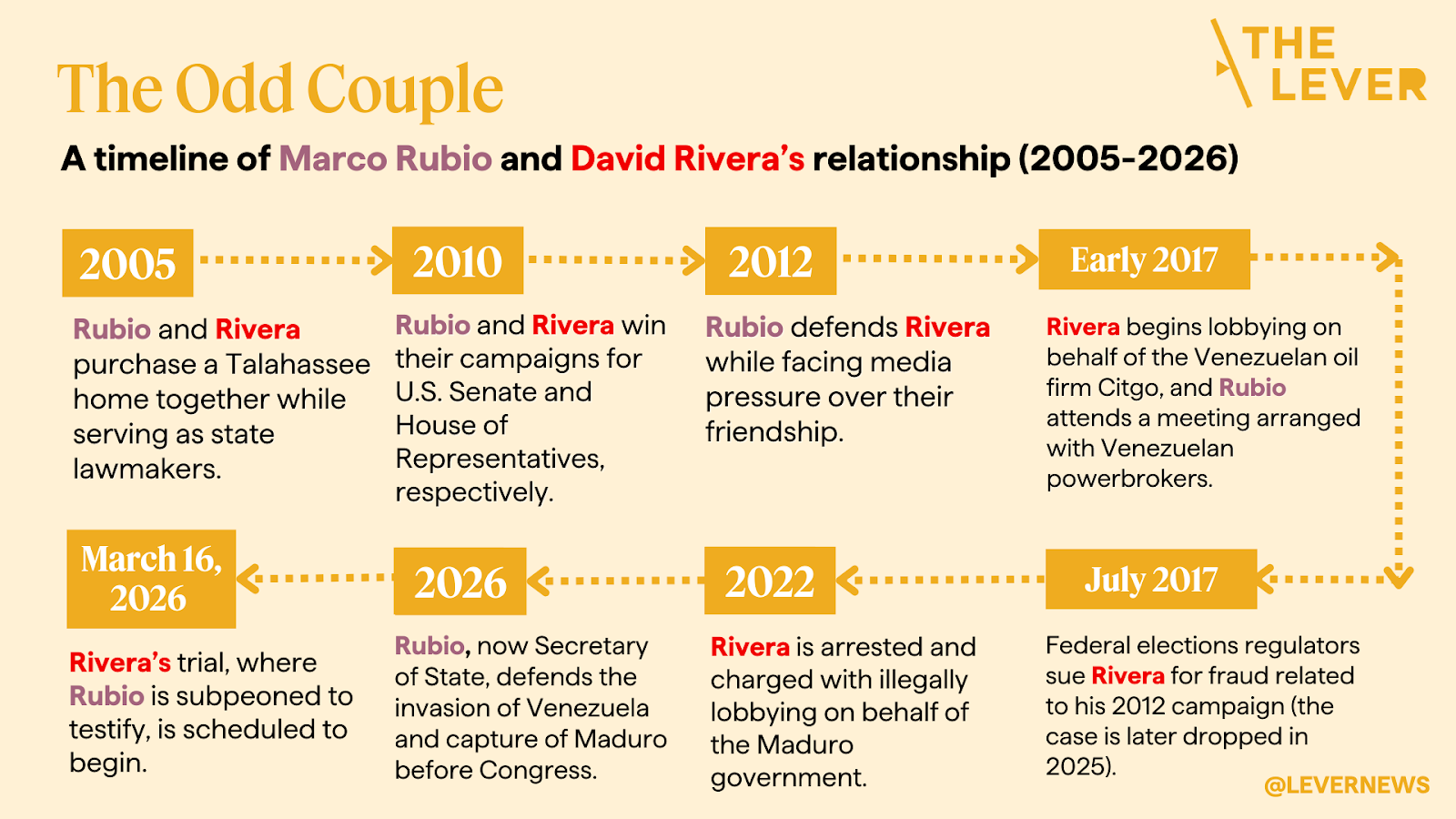 A graphic illustrating Marco Rubio and David Rivera’s relationship. (Source: The Lever)
Enacted in 1938 in response to rising Nazi propaganda in the United States, the Foreign Agents Registration Act requires more stringent disclosures than ordinary lobbying, since foreign clients may have national interests that conflict with those of the United States.
“The question under the law is whether the benefit [of the lobbying] is purely private, divorced from a benefit or control by a foreign government or party,” said Joshua Rosenstein, a lawyer at the Washington firm Sandler Reiff, which advises clients on compliance with lobbying and ethics laws. “The greater the involvement of a foreign government or political party, the less likely it is that you can shoehorn your activities under an exemption.”
The statute also applies to “a person whose activities are directly or indirectly supervised, directed, controlled, financed, or subsidized” by a foreign principal.
According to the Justice Department’s indictment of Rivera, the problems originated in 2017, when he began lobbying on behalf of Citgo, the U.S. subsidiary of Venezuela’s state-owned oil company.
For his work, Citgo paid Rivera’s consulting firm $50 million, a massive sum of money for a single lobbying firm. For comparison, the entire U.S. oil and gas industry spent just over $120 million on federal lobbying in 2022.
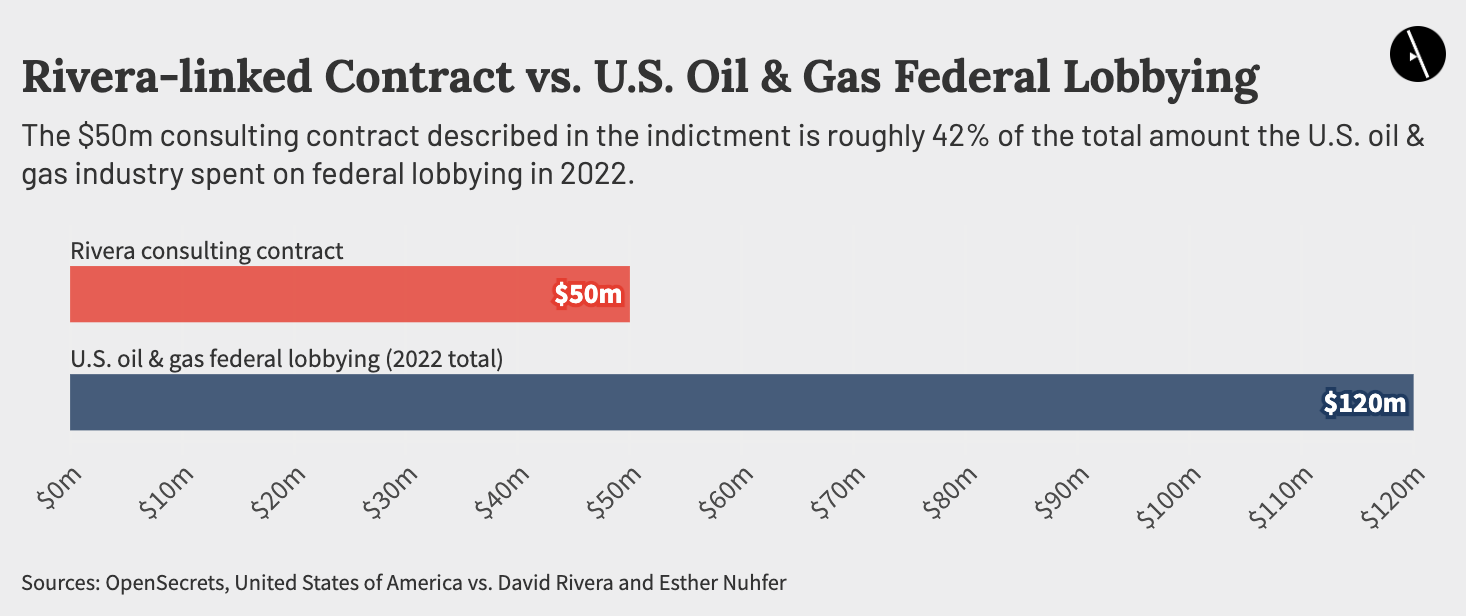 A graphic illustrating the size of David Rivera’s Citgo lobbying contract. (Source: The Lever)
Federal prosecutors allege that Rivera’s lobbying contract was actually a front for a foreign-influence campaign designed to avoid registering under the Foreign Agents Registration Act to conceal the full scope of the operation.
According to the indictment, Rivera was operating as an unregistered foreign agent to normalize relations between Venezuela and the U.S. — two countries that have been adversaries since socialist leader Hugo Chávez came to power in 1999.
Rivera was allegedly working for representatives of the Maduro government, which took power after Chávez’s death in 2013. Among the officials involved, prosecutors say, was then-Vice President Delcy Rodríguez, who now serves as Venezuela’s president.
“It was the purpose of the conspiracy for the defendants to unlawfully enrich themselves… in an effort to influence United States foreign policy towards Venezuela and to conceal these efforts by failing to register under FARA as agents of the Government of Venezuela,” the indictment reads.
Rivera allegedly used his political connections as a longtime Republican lawmaker to arrange meetings between Venezuelan power brokers and U.S. officials.
According to prosecutors, those meetings included a sit-down with Rubio as well as a meeting in Caracas between Maduro and Rep. Pete Sessions (R-Texas), who represents the oil-rich Lone Star State, which has financial interests in Venezuela’s mammoth oil reserves. At the time, Sessions chaired the House Rules Committee, which plays a pivotal role in deciding what legislation receives votes on the House floor.
Kellyanne Conway, a senior counselor to Trump during his first term, also participated in several of the meetings, according to text messages included in the indictment.
Sessions and Conway could not be reached for comment.
In text message exchanges cited by prosecutors, Rivera and his associates used pseudonyms to obscure the specifics of these meetings. The Texas congressman was referred to as “Sombrero,” while millions of dollars were called “melones.” Their code name for Maduro was “El Guaguero,” a reference to the president’s early career as a bus driver.
These 2017 and 2018 meetings— some reported at the time — came at a fraught moment in U.S.-Venezuela relations. Inside the Trump administration, officials were split over Venezuela policy, including proposals to tighten sanctions or normalize U.S. business ties.
Officials ultimately chose the former, ramping up sanctions in 2017 and again in 2020.
At the end of 2025, Rivera’s defense team subpoenaed Rubio to testify about those meetings. Federal prosecutors subsequently decided to call Rubio themselves, apparently concluding that his testimony would strengthen the government’s case.
Rivera, whose lawyers refused to make him available for an interview with The Lever, denies any wrongdoing. His attorneys have argued in court filings that Rivera, a longtime critic of Venezuela’s communist government, was working to undermine Maduro, not help him.
“We confidently believe that the evidence proves the opposite of what the government has alleged,” Rivera’s lawyers wrote in a December letter to the State Department requesting Rubio’s testimony.
“Specifically, then Senator Rubio and Mr. Rivera were focused only on their support for the Opposition [political leaders] in Venezuela, on sanctions against the Maduro government, and on removing Maduro as head of state in Venezuela.”
The Tycoon, The Trafficker, And The Trump Whisperer
As part of their defense, Rivera’s attorneys appear ready to suggest that the foreign-agent violations leveled against their client could just as easily be applied to another political operative: Wiles, Trump’s chief of staff.
To make their case, Rivera’s lawyers are zeroing in on two businessmen named in the indictment: a wealthy Venezuelan media mogul named Raúl Gorrín and a convicted cocaine trafficker named Hugo Perera.
Court documents claim that Gorrín, the politically connected head of a Caracas-based media company called Globovisión, helped orchestrate the alleged foreign-agent operation and served as a go-between for Rivera and the upper echelons of the Venezuelan government.
According to Rivera’s indictment, Gorrín took part in several of the meetings brokered by Rivera, including a sit-down with Rubio. Rivera also reportedly tried to use Gorrín’s private jet for the rendezvous with Conway.
An employee at Globovision works at the channel’s headquarters in Caracas, Venezuela. (AP Photo/Leslie Mazoch)
Gorrín, who was sanctioned by the U.S. government in 2019 for his purported involvement in foreign bribes and money laundering, was reportedly paid handsomely for his work.
In 2020, Citgo filed a lawsuit against Rivera for breach of contract. According to the suit, Rivera paid $4 million of his $50 million contract fee to Gorrín as a kickback for helping him land the arrangement. Rivera apparently funneled the money through Gorrín’s Miami-based yacht company.
The Lever did not receive a response from Globovisión for a request for comment from Gorrín.
The Citgo lawsuit also alleges Rivera paid $5 million to another subcontractor for help arranging the Citgo contract: Perera, a Miami real estate developer who was convicted in the 1990s for his role in a drug-smuggling operation run by the Cali Cartel in Colombia.
Perera’s name is notably absent in the government’s indictment, and he’s agreed to act as a cooperating witness against Rivera at trial. In retaliation, Rivera has countersued Perera for allegedly violating their confidentiality agreement. Rivera has also claimed in a court deposition that the FBI told him that Perera was an informant.
Perera, who now runs a Miami real estate company, did not respond to a request for comment.
At the same time that Gorrín and Perera were working with Rivera, court documents indicate that both men were engaged in related activities for Ballard Partners, a powerful U.S. lobbying firm that Wiles co-led at the time.
In 2017, the first year of the alleged foreign-agent scheme involving Rivera, Ballard Partners also registered to lobby on behalf of Gorrín’s Globovisión, seeking to expand the network’s presence on U.S. television platforms. Ballard earned $450,000 from the contract, making Globovisión the firm’s third-largest client that year.
Ballard’s work for Gorrín appears to have been extensive. In a subpoena letter sent to the White House requesting Wiles to testify in the upcoming trial, Rivera’s defense team describes roughly 400 pages of documents related to Wiles’ lobbying work gathered during the discovery phase of the case.
Court filings also reference numerous emails exchanged between Gorrín, Wiles, and other Ballard lobbyists. One of those lobbyists was Otto Reich, a former U.S. ambassador to Venezuela who previously ran the interagency office that helped coordinate the Iran-Contra weapons sales during the Ronald Reagan administration.
Other Ballard emails went to Harry Sargeant, an oil executive who is currently advising Trump on his post-regime-change efforts in Venezuela. (Trump’s attorney general, Pam Bondi, began working at Ballard Partners in 2019 after serving as Florida’s attorney general, though she is not referenced in the correspondence described in the filings.)
Based on these email exchanges, Rivera’s lawyers also claim Perera was simultaneously working for Ballard while also serving as a subcontractor for Rivera.
“Discovery documents show that Hugo Perera, an important government witness in the case, was involved in these pro-Venezuelan activities through Ballard Partners at the same time the government has alleged that Mr. Rivera and Ms. Nuhfer were supporting pro-Maduro efforts on behalf of Venezuela,” the attorneys wrote.
 A graphic showing how Venezuelan oil money moved through a network of Washington power brokers. (Source: The Lever)
“I Happen To Know That My Government Wants A Way Out”
Rivera’s lawyers do not accuse Wiles or her Ballard colleagues of illegal conduct. But their filings suggest the government’s legal standard for charging Rivera could potentially implicate a far wider circle of MAGA operatives — including the president’s chief of staff.
No federal records show that Wiles or Ballard Partners ever registered under the Foreign Agents Registration Act for any Venezuelan entity.
“We’re not taking a position on that [legal question] in the case,” said Ed Shohat, one of the defense attorneys representing Rivera.
Ballard Partners did not respond to multiple requests for comment. But the firm has publicly maintained that it complied with all foreign and domestic lobbying laws and that its work related only to Globovisión’s commercial interests in the U.S. The lobbying firm dropped Gorrín as a client in 2018, amid a federal investigation that would lead to U.S. sanctions against him the following year.
“Ballard Partners’ work for Globovisión involved Globovisión’s efforts to expand its TV network into the U.S. market,” Brian Ballard, the founder of Ballard Partners, said in a statement to the Miami Herald.
But a key document in the Rivera case obtained by the Miami Herald appears to suggest that Ballard’s work for Gorrín may have gone beyond strictly commercial interests.
In 2017, Ballard reportedly drafted a memo for Gorrín to provide to Trump, though he ultimately never delivered it. The letter apparently outlined a proposal to mend strained U.S.-Venezuela relations by offering Maduro a path out of the country in exchange for a transition in leadership. As described by the Miami Herald, the document did not directly relate to, or mention, Globovisión’s access to U.S. markets or other commercial interests.
“I happen to know that my government wants a way out, a way to save their skins and fortunes,” the draft letter from Gorrín read. “The opposition, on the other hand, wants a way in but is not unified in how to achieve its goals.”
Should Ballard Partners’ work on the Gorrín letter — or its other lobbying efforts — have required the firm to register under the Foreign Agents Registration Act? That’s likely impossible to determine without additional information about Globovisión’s relationship with the Venezuelan government.
“An exemption [to FARA] would be available, provided the client (Globo) isn’t directed/controlled by a foreign government or political party, and the principal beneficiary of the work wasn’t a government or political party,” said Rosenstein, the lobbying lawyer. “That’s a factual question.”
According to Rosenstein, foreign lobbying involves many legal gray areas, in part because the Justice Department has prosecuted relatively few cases, leaving the law with limited judicial precedent. Under Attorney General Pam Bondi, the Trump Justice Department has curtailed enforcement of foreign corruption and lobbying laws.
Made with Flourish • Create a chart
A graphic illustrating where key figures connected to the alleged Venezuelan lobbying network are based. (Source: The Lever)
The hundreds of pages of Ballard records described by Rivera’s attorneys could shed light on the matter, but the documents may never become public. Last month, a federal magistrate judge in Florida’s Southern District Court granted a Justice Department petition allowing Wiles to avoid testifying at Rivera’s trial, thereby permitting related documents to remain under seal.
But in his ruling, the judge made a surprising admission.
“To be clear, no one disputes that Ballard Partners registered under FARA and dealt with Gorrín openly,” wrote Magistrate Judge Edwin Torres.
Torres’ office refused to comment. But if Torres is correct, it would mean that — despite no publicly available record of the filing — Trump’s chief of staff previously worked as a registered foreign agent for a government the U.S. recently moved to overthrow.
Under Pressure
Miami insiders say Rivera’s aggressive defense strategy isn’t just legal maneuvering ahead of trial; it’s also a political effort to pressure the Trump administration to drop the case.
That campaign includes issuing subpoenas to a striking list of high-profile witnesses, including not just Rubio, but also Conway and Sessions. Rivera’s attorneys even subpoenaed Maduro, Venezuela’s deposed president, who is currently awaiting his own trial on U.S. narco-terrorism charges. Maduro’s attorneys resisted the subpoena, saying their client would plead the Fifth.
Former U.S. Rep. David Rivera speaks with media outside Miami federal court in Miami, Dec. 20, 2022. (AP Photo/Joshua Goodman)
While Miami defense lawyer Joseph DeMaria believes some of these witnesses could provide crucial testimony for Rivera’s defense, he also notes the political optics of such subpoenas.
“A lot of this strategy is political — to try to put pressure on the Trump administration to leave Rivera alone,” said DeMaria. ”Depending on how the judge rules on [the defense’s requests for testimony], that could lead them to wanting to make a deal with Rivera.”
Rivera’s legal team has a track record of exploiting political leverage when evidence-based legal defenses don’t pan out in the courtroom. One of Rivera’s attorneys is David Markus, a renowned Miami defense lawyer who also represents Ghislaine Maxwell, Jeffrey Epstein’s associate and convicted sex trafficker.
“A lot of this strategy is political — to try to put pressure on the Trump administration to leave Rivera alone.”
As Maxwell’s counsel, Markus has openly proposed a deal with the Trump administration in which his client would receive “clemency” in exchange for being allowed to speak “fully and honestly” about whether the president was involved in any potential sex crimes, or the crimes for which she was convicted.
In a *Vanity Fair*interview about his work, Markus embraced the ethos of a defense attorney: “I love representing the underdog.”
If David Rivera is an underdog, he’s an underdog with powerful friends in Washington — some of whom may soon be called to testify.
---
===
lev parnas pro publ
...Solomon recalls first encountering Parnas through Pete Sessions, the once-powerful Texas Republican member of Congress who is now in the middle of the Trump impeachment inquiry. Sessions accepted campaign donations from Parnas and Fruman, and had met with the two men as they sought to oust an American diplomat in Ukraine. Later, Sessions wrote a letter to Secretary of State Mike Pompeo, urging him to replace the envoy Marie Yovanovitch, who had been the subject of extensive criticism in the conservative media. She was later fired and is a key witness for House Democrats trying to impeach the president.
Sessions, who has denied knowledge of the campaign finance scheme laid out by prosecutors, told ProPublica that he has no connection to Solomon.
“I don’t know John,” he said.
Solomon says his personal attorneys, Joe diGenova and Victoria Toensing, a husband-and-wife legal team that regularly represents conservative luminaries, set up his first formal meeting with Parnas. He asserted that his editors “were aware” that he was seeking help from diGenova and Toensing on matters concerning Ukraine.
===
How each Speaker candidate voted in overturning 2020 election results
by Lauren Sforza - 10/22/23
With nine candidates in the running for Speaker, some Republicans are raising questions over whether their votes on overturning the 2020 election results should be a factor in electing the next leader.
The House has been in turmoil since eight Republicans joined forces with Democrats earlier this month to oust former Speaker Kevin McCarthy (R-Calif.) from his position. Since then, the House GOP has struggled to unite behind one candidate for the Speakership.
The GOP conference voted in a secret-ballot election Friday to boot Rep. Jim Jordan (R-Ohio) as the Republican nominee after he failed three times to secure the 217 votes needed for the Speakership. Jordan was Republicans’ second nominee, following Majority Leader Steve Scalise’s (R-La.) decision to back out one day after the conference narrowly voted to nominate him.
Some Republicans, such as Rep. Ken Buck (R-Colo.), are saying that the candidates’ stances on who won the 2020 election will factor into their votes. Buck, one of the eight Republicans who voted to oust McCarthy, told reporters Friday that declaring President Biden as the lawful winner of the 2020 election will be one of his criteria when choosing a new candidate.
McCarthy, Jordan and Scalise were among Republicans who voted in favor of overturning those election results.
Former Rep. Liz Cheney (R-Wyo.) said on CNN’s “State of the Union” on Sunday that any candidate who voted to reject the results of the 2020 election should be disqualified from running for the Speakership.
Hours after a mob of rioters stormed the Capitol on Jan. 6, 2021, 139 House Republicans voted to object to the election results in either Arizona, Pennsylvania or both. The vote to overturn Arizona’s election results failed 303-121 and the vote to overturn Pennsylvania’s results failed 282-138.
Here is how each Speaker candidate voted on the objections:
House Majority Whip Tom Emmer (R-Minn.)
Emmer opposed the objections to both Arizona’s and Pennsylvania’s election results, making him one of two Speaker candidates who did not vote to overturn either of the state’s results.
Buck has voted for Emmer in each of the three ballots cast for the Speakership this month. The majority whip has also secured McCarthy’s endorsement, though the former Speaker voted in favor of objecting to Arizona’s and Pennsylvania’s 2020 presidential election results.
Rep. Kevin Hern (R-Okla.)
Hern voted to object to both the Arizona and Pennsylvania election results.
He is a staunch supporter of former President Trump and has backed the former president’s false claims that the 2020 election was stolen.
House Republican Conference Vice Chair Mike Johnson (R-La.)
Johnson also voted to object to the election results in both Arizona and Pennsylvania.
He officially announced he is in the race for Speaker via a “Dear Colleague” letter to members Saturday morning. He serves on the House Judiciary Committee.
Rep. Byron Donalds (R-Fla.)
Donalds is another Republican who voted to object to both Arizona’s and Pennsylvania’s election results.
Donalds officially announced his run Friday night via a post on X, the platform formerly known as Twitter.
He had received votes for the Speakership from GOP holdouts during McCarthy’s 15-ballot Speaker race in January, and he also garnered a few during Jordan’s three ballots last week.
Rep. Jack Bergman (R-Mich.)
Bergman voted yes on objecting to Arizona’s and Pennsylvania’s election results.
In a surprise move, he announced he would be running for the Speakership over the weekend, vowing in a statement that he would “end the deadlock, and win the vote.”
Rep. Austin Scott (R-Ga.)
Scott is the second of only two candidates to not object to either Arizona’s or Pennsylvania’s results.
Scott, a seventh-term congressman, shocked many when he pulled a significant show of support in his bid against Jordan last week, when he lost the secret ballot against Jordan in a 124-81 vote.
Rep. Pete Sessions (R-Texas)
Sessions voted in favor of objecting to Arizona’s and Pennsylvania’s 2020 presidential results.
He served as chairman of the National Republican Congressional Committee from January 2009 until January 2013. He revealed Friday that he would run for Speaker of the House, signaling that he is ready to jump pack into GOP leadership.
Rep. Dan Meuser (R-Pa.)
Meuser split his votes on whether to overturn the two states’ election results. He voted to sustain an objection to his home state of Pennsylvania’s election results but did not object to Arizona’s election results.
He officially filed to run for Speaker, according to the list of declared candidates House Republican Conference Chairwoman Elise Stefanik (R-N.Y.) announced Sunday.
Rep. Gary Palmer (R-Ala.)
Palmer, a five-term congressman, is the sixth Speaker candidate to have objected to both Arizona’s and Pennsylvania’s election results.
He was a surprise name when Stefanik announced the candidates.
Tags 2020 presidential election Austin Scott Byron Donalds Dan Meuser Gary Palmer Jack Bergman Jan. 6 attack Jim Jordan Ken Buck Kevin Hern Kevin McCarthy Mike Johnson Pete Sessions Steve Scalise Tom Emmer
===
9 24
Press Releases - United States Congressman Pete Sessions
May 30, 2024WACO, TX-Today, Congressman Pete Sessions (TX-17) released the following statement after the jury returned with thirty-four guilty verdicts in the New York v.Trump case in Manhattan.. Congressman Sessions said, "Today's jury decision in New York v.Trump is outrageous.. The Federal Election Commission formally dropped its case on this same case over three years ago.
- en.wikipedia.org
Only include results for this siteHide site from these results
Share feedback about this site
 https://en.wikipedia.org › wiki › Pete_Sessions
Pete Sessions - Wikipedia
Pete Sessions was born in Waco, Texas, on March 22, 1955, ... Sessions supported Trump's 2017 executive order imposing a temporary ban on immigration from seven predominantly Muslim nations, saying, "Just as President Obama suspended the refugee program in 2011 for six months, the Trump administration is working to protect national security by ...
- dallasnews.com
Only include results for this siteHide site from these results
Share feedback about this site

In deleted tweet, Pete Sessions says he told pro-Trump group to 'keep ...
Jan 14, 2021news Politics. In deleted tweet, Pete Sessions says he told pro-Trump group to 'keep fighting' before Capitol riot The longtime congressman, who now represents a Central Texas district, wrote ...
- kcentv.com
Only include results for this siteHide site from these results
Share feedback about this site

Waco Congressman Pete Sessions speaks out on Former President ... - KCEN-TV
Mar 25, 2023Waco Congressman Pete Sessions speaks out on Former President Donald Trump's rally. The City of Waco expects 15,000 attendees, but there could be even more. Congressman Pete Sessions prepares Waco ...
- kxxv.com
Only include results for this siteHide site from these results
Share feedback about this site

Congressman Sessions speaks about 2nd assassination attempt on Donald Trump
Sep 16, 2024Former President Donald Trump escaped a second assassination attempt over the weekend in Florida. 25 News spoke to U.S. Congressman Pete Sessions about the Secret Service's reaction, and where ...
- sessions.house.gov
Only include results for this siteHide site from these results
Share feedback about this site
Congressman Sessions to Partake in House Oversight Committee Hearing ...
Jul 19, 2024Congressman Pete Sessions (TX-17), a senior member of the House Committee on Oversight and Accountability and chairman of the Subcommittee on Government Operations and the Federal Workforce, will participate in an Oversight hearing scheduled for July 22 entitled "Oversight of the U.S. Secret Service and the Attempted Assassination of President Donald J. Trump."
- texastribune.org
Only include results for this siteHide site from these results
Share feedback about this site
 https://www.texastribune.org › 2023 › 10 › 23 › house-speaker-race-pete-sessions
Who is Pete Sessions? - The Texas Tribune
Oct 23, 2023Sessions' 2018 loss to Allred was a major upset during a wave of Democratic victories in swing districts that were largely a response to then-President Donald Trump.
- kens5.com
Only include results for this siteHide site from these results
Share feedback about this site

Who is Pete Sessions and why is he running for House Speaker?
Oct 23, 2023Sessions' 2018 loss to Allred was a major upset during a wave of Democratic victories in swing districts that were largely a response to then-President Donald Trump.
- pbs.org
Only include results for this siteHide site from these results
Share feedback about this site
Pete Sessions appears to be 'Congressman 1′ ensnared in ... - PBS
Trump criticizes the Bidens, but his own family's business raises questions. By Gretchen Frazee. A timeline of key events in the Trump-Ukraine story. By Magan Crane. Go Deeper. pete sessions ...
- keranews.org
Only include results for this siteHide site from these results
Share feedback about this site

Congressman Pete Sessions wants to be House speaker. Here's what you ...
Oct 24, 2023Congressman Pete Sessions, R-Waco, has been in Congress for nearly 30 years. Now, he wants to be speaker of the House of Representatives. ... Emmer has crossed Trump on multiple occasions, ...
no lnx an 8 23
twenty-two House Republicans have signed on to a motion filed in federal court requesting to be allowed to join Governor Greg Abbott in defending the Texas Republican against a federal government lawsuit alleging his 1000 feet of razor wire and floating buoys constructed of circular saw blades, designed to prevent migrants from crossing into the United States from Texas, are illegal.
They have invoked the Bible’s Book of Genesis, including Noah’s Ark, to make their case.
“In a motion filed on behalf of U.S. Rep. Jodey Arrington, R-Lubbock, and other GOP members, lawyers for the conservative Texas Public Policy Foundationhave asked to be part of the case and targeted how a key law is interpreted in it,” the Houston Chronicle reports.
The Texas Public Policy Foundation is the right-wing organization The New York Times last year profiled as “The Texas Group Waging a National Crusade Against Climate Action.”
RELATED: Supreme Court in Hand, Far Right Wing Prepares to ‘Take the Reins of Government’
The buoys, deployed on the Rio Grande river, may have led to the deaths of two migrants, possibly including a child.
Democratic U.S. Rep. Joaquin Castro of Texas called the buoys “barbaric,” and in video showed they are constructed of circular saw blades. In that video Congressman Castro also points to Governor Abbott’s razor wire fences.
Sawyer Hackett, a senior advisor to former Obama Cabinet Secretary Julián Castro, referred to the floating fences as “razor wire death trap buoys.”
“A key point to the Arrington group’s defense is whether the 1,900-mile Rio Grande should be defined as a navigable waterway despite being used by thousands of boats every year,” The Chronicle explains. “They point to a court case from 1870 that suggested that the term navigable waterway is intended to mean moving commerce from one state to another or to a different country and not just one where any small boat occasionally uses the river.”
READ MORE: Critics Blast Top US Conservative Think Tank President for Applauding Italy’s Election of ‘Neo-Fascist’ Prime Minister
That’s where the Bible and Noah’s Ark come in.
“Indeed, if one takes the Book of Genesis literally, then the entire world was once navigable by boats large enough to carry significant amounts of livestock,” the proposed amicus brief reads. “Under the federal government’s theory, these anecdotes would render any structure built anywhere in Texas an obstruction to navigation subject to federal regulation.”
Governor Abbott has had a long partnership with theTexas Public Policy Foundation.
In 2016, as NCRM reported, Abbott while at the Texas Public Policy Foundation, unveiled a major policy plan toalter the U.S. Constitution, adding nine amendments,the result of which could have lead to same-sex marriage bans and anend of LGBTQ protections.
According to Congressman Arrington, the list of signatories to his amicus brief include: Rep. Jodey Arrington, Dr. Michael Burgess, Rep. August Pfluger, Rep. Brian Babin, Rep. Andy Biggs, Rep. Roger Williams, Rep. Lance Gooden, Rep. Beth Van Duyne, Rep. Jake Ellzey, Rep. Vern Buchanan, Rep.Chip Roy, Rep. Nathaniel Moran, Rep. David Rouzer, Rep. Pete Sessions,Rep. Ronny Jackson, Rep. Sam Graves,Rep. Clay Higgins, Rep. Michael Cloud,Rep. Keith Self, Rep. John Carter, Rep. Jeff Duncan, Rep. Kat Cammack.
Watch the video above or at this link.
'Very scary': Former RNC staffer dishes on the more terrifying members of GOP's right-wing
===
https://podtail.com/en/podcast/drilled/the-anti-esg-campaign-gets-a-boost-from-raga/
no lnx
The Anti-ESG Campaign Gets a Boost from RAGA - Transcripts
June 13, 2023
Ever since the Securities and Exchange Commission announced its intention to make Environmental Social and Governance metrics actually mean something to investors, polluting industries have suddenly turned on ESG. Now that fight has a legal strategy, being carried out by the Republican Attorneys General Association.
Transcript: https://www.steno.ai/drilled/the-anti-esg-campaign-gets-a-boost-from-raga
Hello and welcome back to Drilled, I'm Amy Westervelt. We've talked before on this show about the growing backlash against taking environmental, social, and governance, or ESG, factors into consideration when it comes to investing. The watchdog group Documented first revealed last year that state treasurers were getting in on the action, kicking woke investment firms likeBlackRock out of their states. Back then I wondered when the attorneys general would show up to join the fray, and now sure enough, they are here. The Republican Attorneys General Association, RAGA, our old favorite, has come to play in the anti-ESG space. But first, a quick reminder, why all this upset about ESG all of a sudden in the first place? Good question. For a really long time, oil companies actually kind of loved ESG. It was all very loose and self-reported, and it gave them a way to unlock so-called green capital. But in 2021, the Securities and Exchange Commission, the SEC, looked around and went, huh, there are all these different SEG ratings, and some of them seem a little scammy, and no one knows what these disclosures even really mean. These are the kinds of things it's our job to clean up. So we are going to provide formal guidance on climate risk disclosure.
And that is when you start to see corporate interests, fossil fuel companies, and right-wing politicians lose their minds over ESG. Because all of a sudden, they couldn't just write whatever they wanted to in a report, they might have to actually disclose what their real climate risks are.
Speaker 5 00:02:16
Here is Jesse Coleman withDocumented. I think that a lot of this, both the legislative side, this legal strategy, the strategy of using state treasurers to pressure asset managers into attack climate disclosure, all of this is really mostly aimed at SEC scope three emissions disclosure requirements coming, you know, supposedly coming soon
Speaker 4 00:02:43
in the next couple of months, even. Wait, sorry, I'm gonna pause to define scope three. That means how your product's actually being used, not how you're making it, which is a big deal for especially heavy polluting industries
Speaker 5 00:02:58
like oil and gas companies, for example. Yeah, yeah, it's a really big deal. Whereas ESG, having a non-standardized ESG disclosure is no big deal to a major company. The SEC coming and saying, how much carbon emissions are you really responsible for? Not just, you know, what you're claiming you're responsible for, but if you're an oil company, for example, how much carbon are you actually putting in the atmosphere from everything that you've gotten from underground? What is your real impact? And that is a really big deal. It's probably one of the biggest climate policy issues in play right now. So, you know, in my opinion, a lot of this anti-ESG stuff, which doesn't make a lot of sense on its face, you know, these state bills that have passed in some states and been introduced in a ton of states, the actual thing that those bills are gonna do, they're not gonna have a really big impact. And sort of this antitrust stuff is very similar in the sense that, you know, the claims are kind of weak and it's hard to say exactly what the impact is gonna be specifically. But at the same time, it's building up all of this pressure and it's building up all of this political inertia that is all aimed at opposing, disclosing climate emissions. And that's what this SEC rule would do when it comes out, is that it would require publicly traded companies to disclose those emissions.
So, you know, in my opinion,
that's the real goal, is to keep that from happening. You may have heard Jesse mention there the words antitrust. That is where the Republican Attorney's General Association comes into the picture. Back in June, 2021, a guy named Jason Isaac, who spearheads the Texas Public Policy Foundation's work on energy, went to a meeting of the American Legislative Exchange Council, ALEC, with an idea for a legal strategy that he thought could take ESG down.
Speaker 7 00:05:04
Documented shared audio from that meeting with us. Yes, so earlier, a couple months ago,our state affairs committee voted nine to nothing. So, broad bipartisan support, every single member voted in support to give the committee subpoena authority.
Speaker 6 00:05:16
So, they have sent out a couple months ago,
Speaker 7 00:05:24
our state some paper documents to find out where this collusion is happening. We anticipate truckloads of documents being delivered. And so, we look forward to the Texas Public Policy Foundation to going through those meticulously, because we believe that there is, and we actually partner with C. Boyden Gray, Boyden Gray Associates law firm out of Washington, D.C. Corporate collusion, liability risk for the ESG agenda to charge higher fees and rig the market. We believe that there's antitrust violations. This is really kind of geared towards our attorneys general to lay the foundation for antitrust violations on this corporate collusion. Find out the connections with the Glasgow Financial Alliance for net zero, which has over, I think, $100 trillion under managed assets in there. And there are the connections with the glad zero, this Paris Accord, which is net zero. So, I hope our committee gets a ton of paper back
Speaker 1 00:06:23
from these large financial institutions.
Speaker 7 00:06:28
Hope our committee gets in the courts and our attorneys generalaround the country filed antitrust violations.
Speaker 4 00:06:34
So, yeah, cartels colluding for decarbonization.What the hell is he talking about here?We're gonna try to answer that question right after this quick break. And we're back. So, after COP26 in Glasgow, insurers and asset managers, both formed groups focused on ESG. In both cases, these firms were saying, look, all sorts of environmental and social factors can impact our bottom line, and we would like to know what those risks might be so we can factor that into our decision-making around what to ensure and what to invest in. But according to Isaac, these firms talking to each other, issuing joint statements about what kind of information they'd like to see from companies, that's colluding to rig the market. In the wake of that 2021 ALEC meeting you heard Isaac talking at before, not only did Texas continue with the investigation Isaac mentioned, but Arizona Attorney General, Mark Bernovich, opened an investigation into ESG investing. And Raga coordinated a letter to various asset managers and politicians with more than a dozen attorneys general signed on, stating their concern that ESG investing might actually be an antitrust violation.
Speaker 5 00:08:13
Here's Jesse Coleman again. We started to see some of the bright lights of the Republican Attorneys General Association file various kinds of legal attacks on ESG issues, whether that's going directly after asset managers and asking them questions about their net zero commitments, or that's going directly after ratings agencies
Speaker 4 00:08:38
and saying that you're boycotting fossil fuels. And they seem to have coalesced around this idea of painting ESG as some sort of corporate collusion, you know, building an antitrust case. Can you explain what the thinking is there,
what they're trying to prove?
The allegation is that a lot of large asset managers get together in a shadowy cabal and they plan to collude to reduce carbon emissions. The reason these groups are alleging antitrust violations is that antitrust violations are very scary to companies. If a jury finds you guilty of an antitrust violation, it's very expensive. And it's a pretty hard bar to meet. And most experts are saying that the antitrust allegations that are coming from these people that are opposing climate policy, they probably don't have a leg to stand on, but a lot like slap suits and other kinds of legal tools that are used to silence people, just defending against the antitrust allegation is very, very expensive. So, you know, you see companies really backing away from participation in these kind of global groups that are trying to address climate emissions and trying to address investment
10:08
in the fossil fuel industry by large asset managers. In 2022, Alec once again held a meeting with a session on how to handle ESG at the state level. And again, the antitrust strategy was front and center. This time, Isaac was in the room cheering on new proponents of the strategy, including Will Hild with Consumers Research, which is funded by former Federalist Society President Leonard Leo, Paul Watkins, who used to work in the Arizona Attorney General's office and now runs an outfit called Fusion Law, advising on these sorts of strategies. Andy Puzder, former CEO of the Food Conglomerate that is home to Wendy's and Hardee's, and Catherine Gonzalez with the Heritage Foundation. Puzder kicked things off by comparing ESG investors
11:03
to, not kidding here, the Nazis. I wanna tell you, ESG investing is socialism in sheep's clothing. I mean, this is the challenge of your generation. My father's generation's challenge was the Nazis, who, by the way, were, of course, very proud socialists. The challenge of my generation was the communists, who were, of course, very committed socialists. The challenge of your generation is ESG investing, and it's more insidious than communism or the Nazis. It's the thing they're doing it. So ESG, Environmental Social and Governance. Like, how bad could that be, right? It sounds so innocuous, but it's a ruse. It's a ruse to conceal the fact that it's a direct threat to our founding principles.
11:53
It's a threat to our democracy. How bad could that be, right?
Speaker 4 00:11:55
It's a threat to our democracy.
Speaker 6 00:12:02
Hild and Watkins kept it focused on the litigation strategy. They get in rooms and they talk about they're gonna set a policy across the market. Now, it's been a while since I was in law school,
but when I was there, that was antitrust 101. And that's why you see U.S. senators saying this is potentially criminal antitrust liability.
Speaker 4 00:12:22
You see AG saying that they're going to investigate. And again,I have yet to speak with a single legal expert who thinks that this strategy could actually win in court. But like we said before, that is not necessarily the point. It's already having a chilling effect on investment firms and insurance companies in these net zero groups. And now that Republicans have control of the House, it's the focus of a series of oversight committee hearings too. The first one happened back in May and featured the attorneys general of Utah and Alabama as witnesses.
Speaker 1 00:13:00
Here'sSean Reyes, attorney general of Utah. But ever since the signing of the Paris Agreement, there's been anopen conspiracy to bypass Congress using the power of horizontal agreements by key players in our financial system. Some of these groups are Climate Action 100, the Glasgow Alliance for Net Zero, which include the largest asset managers, banks and insurance companies globally. These horizontal organizations seek to use their collective market power over tens of trillions in assets
to force burdensome changes on American companies.
amy: The Democrats witnessed during this hearing, Illinois State Treasurer Michael Frerichs gave a great and completely non-climate related example
of where ESG can safeguard profits. The more data we as investors have, the better informed our decisions are when selecting investments over the long term. ESG is about looking at a wider range of risks and value opportunities that could have a material financial impact on investment performance. For example, if you're investing in apharmaceutical company, it's thinking about whether that company has exposure to massive lawsuits because of its role in the opioid epidemic. Our approach is to integrate material ESG factors into investment decisions along with many other considerations. We are not ignoring traditional financial factors like profitability and credit worthiness. We are integrating more data into our decisions
to give us a better idea of risk and growth prospects. Frerichs also pointed out that limiting the information investors can get about the companies they're investing in
is the exact opposite of a free market idea. This pushback is anti-free market and anti-investor. It is misleading and it is harmful. It harms retirement savers, pensioners, working people, businesses, and it harms America. This coordinated campaign is focused on ESG investing. Most people don't know what ESG is. ESG is data. ESG is simply additional information that investment professionals use to assess risk and return prospects. It is about value, not about values. In order to maximize returns, an investor must be able to manage and mitigate risk. The more data we as investors have, the better informed our decisions are when selecting investments over the long term. ESG is about looking at a wider range of risks and value opportunities.
It could have a material financial impact
on investment performance. Last week, the House Oversight Committee held its second hearing on this subject,
calling on none other than Jason Isaac himself to testify. I'm Jason Isaac. I'm the director of LifePowered, a national initiative of the Texas Public Policy Foundation to raise America's energy IQ. And I live a high carbon lifestyle. And I think the rest of the world should too. That's why I refer to the ESG agenda as the China ESG agenda. It does very little to help Americans. It does everything to help the Chinese Communist Party. And again, making energy expensive, scarce and government controlled. This body, the United States Congress has not ratified the Paris Treaty. It is not the law of the land here in the United States, butto force an American entrepreneur to admit that his company will comply with that
is just mind blowing to me.
Whether the committee will hold a third hearing remains to be seen. I'm not sure the anti-ESG bench of experts rolls that deep. Plus, while these ideas might get folks at an ALEC meeting riled up, they're remarkably unpopular with American voters, including the majority of Republican voters. New Mexico rep Melanie Stansberry
made that point at last week's hearing. What I find particularly strange about this conversation is that over 63% of American voters actually oppose, directly oppose, any kind of government interference in investing strategies. And the vast majority of Republicans oppose it as well. And when you look at the bigger picture, when you look at what the American people are actually asking Congress to do, asking businesses in the private sector to do, almost 70% of Americans are in support of actions to address climate change,
to transition to a clean energy economy. Whether the SEC will be swayed by the antitrust argument remains to be seen.
That's it for this week. Thanks for listening, and we'll see you next time. Drilled is an original critical frequency production. Our producer is Sarah Ventre. Sound design, mixing, and mastering are by Peter Duff, who also wrote our original score. Our first amendment attorney is James Wheatman at the First Amendment Project. And the show is reported, written, and hosted by me, Amy Westervelt.
==
https://newrepublic.com/article/172636/esg-house-oversight-conspiracy
may 11 no lnx
QANON REBOOT
Republicans Are Truly Losing Their Minds Over ESG
Right-wingers at a House Oversight Committee hearing Tuesday insisted this boring investment strategy is some kind of global conspiracy.
Steve Marshall speaks at a podium in front of the Supreme Court building.
Alabama Attorney General Steve Marshall, who testified at Tuesday’s hearing on ESG, speaks to members of the press in October 2022.
On Tuesday, the House Oversight Committee convened a hearing on environmental, social, and governance, or ESG, investing criteria. For over a year now, Republicans have been trying to turn this obscure three-letter acronym into a full-fledged culture war.So far, the right has expressed its complaints about ESG via a word salad whose components don’t share much of a relationship either to reality or one another. This pattern persisted on Tuesday, when the word “cabal” was used at least three times in reference to allegedly “woke” investors.
ESG criteria, in reality, refer to the broad set of data that investors look at to determine a company’s impact on the world and the impact the world might have on it. In other words, it’s not just about whether a company is “good” according to some abstract set of values. It represents another way of factoring risk exposure into investment—something financiers have been doing for centuries.
“Elites from around the globe have formed alliances to coordinate together to implement woke climate policy.”
The two witnesses Republicans summoned to this week’s committee hearing weren’t economists or investment professionals, who might be familiar with these criteria or risk assessment in general, but attorneys general from Utah and Alabama, respectively: Sean Reyes and Steve Marshall. Whatever ESG actually means, to them and other anti-ESG crusaders, is mostly irrelevant. For those trying to understand their crusade, the hearing showed that it’s best to think of ESG as a canvas onto which the right projects its own plans and anxieties.
If you’ve heard of Marshall, it may well be because he’s spent considerable time since 2020 trying to overturn the results of that year’s presidential election, and shield other Republicans from accountability for spreading lies about it. Both he and Marshall joined fellow red states attorneys general in filing a brief with the Supreme Court supporting Trump’s claims about election fraud. Marshall, for his part, was serving as head of the Rule of Law Defense Fund that year, which sent out robocalls encouraging Trump supporters to flock to the Capitol on January 6.RLDF—whose donors include the Edison Electric Institution and the Judicial Crisis Network—is also a sister organization of the Republican Attorneys General Association, or RAGA, which Marshall was appointed chair of after continuing to deny, in 2022, that Joe Biden won the 2020 election.
Generous RAGA donors have included Koch Industries, Chevron, Exxon, Fox, andTikTok. ProPublica recently reported that companies that initially withdrew funds from RAGA over its role in the January 6 attack are back, including Amazon, Walmart, and JPMorgan Chase’s PAC. Overall, RAGA revenues jumped 68 percent in 2022.
In his testimony, Marshall—who chairs a secretive organization pushing a clandestine political agenda through undemocratic means—accused a “cabal of global elites” of being “clearly connected through various alliances” to try to force an ESG agenda onto an unwilling public. Reyes similarly accused “woke investors” like Blackrock of being part of an “organized syndicate of pressure” that is engaged in an “open conspiracy to bypass Congress.” Answering big policy questions like decarbonization, he argued, “is the role of the people’s elected representatives in a democracy—including each of you in Congress, state elected officials, and local leaders—not unelected bureaucrats or foreign governments.”
In other words, someone who’s spent the last several years attempting to overturn the results of a democratic election took to the Capitol on Tuesday to accuse an ill-defined set of actors of trying to sidestep democracy by asking companies if climate-fueled droughts, floods, and fires (for instance) might have some impact on their operations.And while claiming only to want investors to adhere to fiduciary duty, Republicans failed to mention that much of Wall Street’s wariness around investing in new fossil fuel production has nothing to do with a “woke” agenda: Before the pandemic, energy companies on the S&P 500 were underperforming every other sector on that index, and had spent a decade lagging behind as they binged cash on rapid drilling through the shale boom. Its fortunes have changed in recent years, but investors and oil and gas industry managers themselves are urging modesty on exploration and production precisely so that they can make more money.
“People don’t like men. People don’t like people with a European background, that sort of thing.”
“Elites from around the globe have formed alliances to coordinate together to implement woke climate policy,” Marshall said in his opening statement. “These schemes undermine our system of government because unelected elites are making policy decisions outside of democratic processes.” The footnote on that sentence in his pre-written testimony references Consumers Research, which is funded by millions of dollars in undisclosed donations and advised by right-wing legal guru Leonard Leo.
Republicans on the committee responded enthusiastically to this opening salvo. Wisconsin Republican Glenn Grothman asked Marshall whether “ESG” might influence decisions over who companies hire or put on corporate boards. “Right now there’s certain disfavored groups in our society,” Grothman mused. “People don’t like men. People don’t like people with a European background, that sort of thing. Could this be something where you’re encouraging businesses not to hire or promote people from certain unfavored groups.” In a moment dripping with irony, Texas Representative Pete Sessions decried “activist government making decisions on behalf of free people” in service of his larger point, supporting efforts to limit financial institutions’ decision-making power—and even what kind of data can be made available to them—in order to curb the spread of ESG.
It would be a fool’s errand to try to find much coherence in the right’s screeds against supposedly woke investors—who don’t really seem to exist. But today’s Oversight hearing might have accidentally illustrateda good rule of thumb: Whatever Republicans accuse the “ESG movement” of doing is something they’re probably already doing themselves.
Kate Aronoff @KateAronoff
Kate Aronoff is a staff writer at The New Republic.
===
===
2 stories at war at fossil fuel ceo:
note god devil terms
https://gizmodo.com/republicans-slobbered-all-over-themselves-to-apologize-1847959116
ref 3 gizmodo bAD CODE NO LNX
gop have a, shall we say,...relationship. But that relationship went from snuggly to downright NSFW on Thursday at a hearing ostensibly about...The House Oversight Committee welcomed executives from four fossil companies and two trade groups as well as a pipeline welder to probe decades of campaigns to confuse the public. There’s plenty of fodder. The past few years have seen...$59,956 in oil and gas money in the 2020 election cycle) said, thanking the company for increasing production. “I want to thank those companies that are actually increasing production,” Jordan later added.
“These companies beingvillainized,” said Rep. Jody Hice (recipient of $5,000 from the oil and gas industry in 2020, which talk about getting your money’s worth). Hice did not ask a question.
“It’s just people who don’t have anything better to do than type on their keyboards,” Rep. Byron Donalds ($18,110 from oil and gas interests so far this cycle) said of climate activists before turning to the oil CEOs. “Let’s be very clear, you need anapology. What I witnessed today isrank intimidation by the chair of this committee. ... It is disgusting, it is absolutely disgusting. Somebody better call Merrick Garland, tell him to get in here, and watch the intimidation that came from this very panel today. It’s not about defending Big Oil. ... I’m sorry for you. And I’m sorry for the people in our country who have to witness shenanigans like this.”
“While this committee may not like you because you’re executives, because your companies have been successful, I just want to apologize for the decorum. Because thank you for what you’ve done,” said Rep. Yvette Herrell ($115,126 from the industry she was overseeing, making her the second-biggest oil and gas recipient in the House so far this cycle). “There are people here who believe in you. Thank you. ... In fact, I would just submit tosaving anybody who has gotten a vaccination or who is going to get one, thank you to the oil and gas industry because I would bet that almost every single one of the syringes has been touched by a petroleum product. ... I just want to thank all of you for being here today.”
“You guys all have a good story to tell. Don’t be afraid to tell people how much cleaner things are than in the past. It doesn’t do any good for you any good to get allwokeon us,” Rep. Glenn Grothman ($30,576 from oil and gas in 2020 and $3,570 so far this year.)
“It’s been very shameful how the other side wants to demonize ouroil and gas industry. I’m very proud of our oil and gas industry, the innovators that adopt new tech, provide a higher standard of living, and jobs throughout our country,” saidRep. Bob Gibbs,the $28,558 oil and gas man in 2020. He later added, “I’m disappointed the chair failed to recognize that and demonize them on that.”
“I apologize to our witnesses that were called and asked to take part in this today,” saidRep. Pete Sessions, who has so far received $11,400 from oil and gas interests and raked in $237,375 in 2018. (2020 data was unavailable.)
“There is a moral case to be made for the fossil fuel industry and fossil fuels as a whole,” Rep. Pat Fallon, who has taken in $5,600 in oil and gas money. “If we want more abundant and inexpensive and cleaner energy—which we all should do—these witnesses here should be the ones that we are supporting and applauding and not demonizing.”
“These very important energy companies and the [American] Petroleum Institute understand you’ve got yourself here, you’ve seen the attitude of the folks on the left of this committee. When you get asked this morning that, aren’t you embarrassed, that’s really an irrational question to ask CEOs about their company,” said Rep. Andy Biggs, the receiver of $27,253 in oil and gas money in 2020.
“My, my, my. Good lord help us to be protected from this threat from within. American patriots are so done with career politiciansand Democratic socialist insanity... We are nauseated by thecontinuous attacks on working Americans and American industry. This entire debacle of a hearing today of why my colleagues across the aisle will lose their majority status very soon,” Rep. Clay Higgins predicted. (Higgins has received $10,426 in fossil fuel cash so far this cycle and $40,773 in 2020.)
“Did President Biden or anyone from the White House apologize to you?” Rep. James Comer, who received $18,500 in fossil fuel cash in 2020, asked the welder Republicans invited. (For the record, he did not....
a United Nations report out this week warns the world as a whole is facing a “production gap,” with more fossil fuels on tap to be produced than is compatible with a safe climate. Other reports have warned that new fossil fuel exploration must stop next year, emissions must fall at unprecedented rates over the next decade, and that cutting fossil fuel production and use is the most surefire way to do that. The reason we’re at this precipice is because the fossil fuel industry pursued a misinformation campaign while further entrenching their product with the global economy, fully aware that it would cause major climate damage.
It is also because Republicans (and a handful of Democrats) have blocked climate action, and have maintained a grip on power in no small part thanks to millions of dollars from the fossil fuel industry. The industry has directed roughly 85% of its donations in 2020 to Republicans, and is on track to do the same this year (and has done the same in past years, too). Those same Republicans who apologized to the industry and thanked it on Thursday.
Anyways, this is all very cool and very legal.
===
wiki 3 22
Committee assignments[
- House Committee on Rules, chair
In 2012, Sessions was named chair of the House Rules Committee for the 113th Congress by Speaker of the House John Boehner. He retained his chairmanship into the 115th Congress.
Party leadership and caucus memberships[
- National Republican Congressional Committee, former chairman
- Results Caucus
- Malaysia Trade, Security and Economic Cooperation Caucus
- Republican Study Committee[30]
- Congressional Hispanic Conference
- Tea Party Caucus
- Congressional Cement Caucus
- Congressional Western Caucus[31]
Political views[
Casinos[
In late 2001 and early 2002, Sessions cosigned letters to two Cabinet members asking them to shut down casinos operated by several Native American tribes. Within 18 months of sending the letters, he received a total of $20,500 from tribes associated with Jack Abramoff. In response to criticism, his office said that he wrote the letters because he believed that gambling is a local issue, falling under his long-held support for federalism.[32][33]
Earmarks:{:(style="margin-right:0.25em"):}:[edit:{]}:
In 2008, Sessions added a $1.6 million earmark for dirigible research to an appropriations bill. The earmark benefited a Chicago company, Jim G. Ferguson & Associates, that had no experience in government contracting or dirigible research. Former Sessions aide and convicted felon Adrian Plesha was a lobbyist for the firm.[34][35] In September, Plesha sued Jim G. Ferguson & Associates for non-payment of fees and expenses connected with his lobbying effort on their behalf.[36]
Magic:{:(style="margin-right:0.25em"):}:[edit:{]}:
In March 2016, Sessions introduced a House resolution to "recognize magic as a rare and valuable art form and national treasure."[37][38]
Cannabis:{:(style="margin-right:0.25em"):}:[edit:{]}:
Sessions opposed allowing states to determine their own policies regarding the legality of cannabis and the regulation of legal cannabis markets. As chair of the House Rules Committee, he repeatedly stifled proposed amendments relaxing federal laws against cannabis, including one that would have allowed medical marijuana access to veterans in states where the drug is legal.[39]
Military and police:{:(style="margin-right:0.25em"):}:[edit:{]}:
Sessions supported the 1033 program, under which the U.S. military transfers surplus military equipment to local law enforcement agencies; the program is controversial because of its association with militarization of police. In 2015 and 2017, he cosponsored Republican legislation to reverse the Obama administration's restrictions on the 1033 program.[40]
Hurricane aid:{:(style="margin-right:0.25em"):}:[edit:{]}:
In 2012, Sessions voted against disaster relief for the victims of Hurricane Sandy.[41] In August 2017, in the wake of Hurricane Harvey, which devastated parts of Texas, he called for disaster relief for its victims.[41][42]
Office of Congressional Ethics[
In 2016, Sessions criticized the independent, nonpartisan Office of Congressional Ethics (OCE), calling it "a political witch hunt" and "an outside process that's very controversial, is not working well and is highly unpopular because of its original mandate and jurisdiction is hugely flawed."[43] In 2017, he publicly defended a House Republican plan to dismantle the OCE; the plan was abandoned after a public uproar.[44]
Environment[
In 2017, Sessions sponsored a bill to delay for nine years the full implementation of 2015 ozone standardsset by the Environmental Protection Agency under the Obama administration; the bill passed the House, largely on party lines.[45]
Sessions supported the North Texas Invasive Species Barrier Act of 2014, a bill that would exempt the North Texas Municipal Water District (NTMWD) from prosecution under the Lacey Act for transferring water containing invasive species from Oklahoma to Texas.[46] The Lacey Act protects plants and wildlife by creating civil and criminal penalties for various violations, including transferring invasive species across state borders.[46] Sessions argued that the bill was necessary to prevent "more than 1.5 million customers of the North Texas Municipal Water District" from facing "restricted access to water as a result of the discovery of invasive species in Lake Texoma."[47]
Orlando shooting:
Sessions drew controversy in 2016 when he asserted that the site of the Pulse nightclub in Orlando, the scene of a terrorist mass shooting, was not a gay club.[48][49]
Health care:{:(style="margin-right:0.25em"):}:[edit:{]}:
Sessions opposes abortion and supports defunding Planned Parenthood.[50]
Sessions favors repealing the Patient Protection and Affordable Care Act (ACA or "Obamacare").[51] He supported the March 2017 version of the American Health Care Act, the House Republicans' replacement for the ACA.[52] On May 4, 2017, he voted to repeal the ACA and pass the American Health Care Act.[53][54]
Race:{:(style="margin-right:0.25em"):}:[edit:{]}:
In September 2010, Sessions remarked after watching the Princeton University men's basketball team, "How often can you go see a bunch of white guys play basketball?" He also reportedly said that the players stayed entirely below the rim. The comments were described as an allusion to the phrase "White Men Can't Jump", and were called inappropriate by New Jersey Representative Bill Pascrell.[55]
Less than two weeks after his "white guys" comments, Sessions made controversial comments about the Democratic Congressional Campaign Committee (DCCC) giving money to and supporting "African Americans like Sanford Bishop. And when you have to retreat back to ... your hard base you're having to make tough decisions."[56][57]
Immigration and citizenship:{:(style="margin-right:0.25em"):}:[edit:{]}:
Sessions voted against the DREAM Act in 2010.[58]
Sessions supported Trump's 2017 executive order imposing a temporary ban on immigration from seven predominantly Muslim nations, saying, "Just as President Obama suspended the refugee program in 2011 for six months, the Trump administration is working to protect national security by making adjustments in the refugee vetting process. It is critical that we address the threat of individuals who come to our country to create chaos and threaten our freedom."[59]
In 2017, Sessions suggested that Congress could appropriate funds for part of construction of a U.S.-Mexico border wall demanded by Trump as part of "a Republican-only bill" to continue funding the government.[60]
Ties to Allen Stanford:{:(style="margin-right:0.25em"):}:[edit:{]}:
Sessions came under scrutiny for his personal ties to disgraced banker Allen Stanford,[61] who in 2012 was convicted of orchestrating a $7 billion Ponzi scheme.[62] Sessions received over $44,000 in political contributions from Stanford and his associates.[61] He also took multiple trips to Fire Island and to the Caribbean to attend Stanford-sponsored events; these trips included private travel on Stanford's fleet of jets and accommodations.[61][62] In 2014, VICE News obtained records from Stanford's internal files that indicated that in 2007 and 2008, before the scandal came to light, Sessions had intervened on Stanford's behalf with the Treasury Department's Office of Foreign Assets Control, allowing Stanford to bypass certain Cuban embargo restrictions.[62] Also, in 2004, Sessions and two other Republican representatives, Bob Ney and John E. Sweeney, wrote to Venezuelan banking regulators, "vouching for Stanford's character when Stanford was trying to obtain a charter to open a bank in the country, at a time when regulators there were reluctant because of reports they had received that Stanford was running a Ponzi scheme and engaged in money laundering."[62]
Venezuela:{:(style="margin-right:0.25em"):}:[edit:{]}:
Sessions and Rudy Giuliani were involved in back-channel talks attempting to persuade Venezuelan President Nicolás Maduro to leave office in 2018. The effort was backed in part by private interests. The negotiations were opposed by White House officials including then-National Security Adviser John Bolton, The Washington Post reported.[63]
Russia:{:(style="margin-right:0.25em"):}:[edit:{]}:
In 2017, Sessions, as chair of the House Rules Committee, stalled a bill imposing additional sanctions against Russia and Iran from moving to the floor, saying that some parts of the bill, which passed the Senate on a 98–2 vote, could create "huge problems to companies in Dallas, Texas, that I represent" and place them at a competitive disadvantage.[64]
In July 2018, Sessions argued that it was unnecessary to increase federal funding for election security.[65] The U.S. intelligence community had concluded that Russia interfered in the 2016 election and that it was continuing to interfere in election systems as of July 2018.[65]
Legislative strategy:
In early February 2009, Sessions made the following comment about the Republican Party legislative strategy in the House of Representatives: "Insurgency, we understand perhaps a little bit more because of the Taliban. And that is that they went about systematically understanding how to disrupt and change a person's entire processes."[66][67] He continued: "I'm not trying to say the Republican Party is the Taliban.... I'm saying an example of how you go about [it] is to change a person from their messaging to their operations to their front-line message. And we need to understand that insurgency may be required when the other side, the House leadership, does not follow the same commands, which we entered the game with."[68]
Countrywide Financial loan:
In January 2012, it was reported that Sessions received a so-called "VIP" or "Friends of Angelo" loan in 2007 from troubled mortgage lender Countrywide Financial, which was granted at a lower interest rate than was available to the public. Former Countrywide CEO Angelo Mozilo created the program to boost the company's standing with politicians, celebrities and well-connected business figures. Sessions received a $1 million loan from Countrywide at below-market rates, which he never declared in financial disclosures. His name and those of other legislators who received similar loans subsequently appeared in a House Committee on Oversight and Government Reform's ethics investigation into improper gifts.[69][70] He was cleared of any wrongdoing by the House Committee on Oversight and Government Reform when its investigation found he did not receive any preferential treatment or a below-market interest rate on his mortgage from Countrywide.[71]
Implication regarding the French[
During the 2013 government shutdown, after being questioned about his position on the shutdown and his presence at the National World War II Memorial, which was open while other National Park Service monuments and parks remained closed, he replied, "We're not the French; we don't surrender."[72] As chair of the House Rules Committee, Sessions had in fact introduced HR 368 to a vote in the House, which allowed the shutdown to take place; he voted for the bill.[73][non-primary ^source ^needed]
^...
===
https://sethabramson.substack.com/p/the-trump-brazil-scandal-did-donald
no pix twt with kush jan 8?
Introduction
When Proofpublished a major exposé on the potential involvement of the Brazilian government in the planning of the January 6 insurrection—in the form of significant evidence that the son of the Brazilian president, Eduardo Bolsonaro, as well as many Trump donors with significant ties to Brazil, attended a secretive January 5 meeting at Trump’s private residence at Trump International Hotel—a shrewd Proof reader asked (I here paraphrase), “How would the Brazilians have been able to aid Trump and his political team so close to the day of the insurrection?”
One possible answer is that, as we know from major-media reporting, the Brazilians had been working with Team Trump since early 2019 on weakening Venezuela, even as Trump personal attorney Rudy Giuliani and a gaggle of top Trump advisers (including now-Congressman Pete Sessions of Texasand notorious Trump national security adviser Erik Prince) were secretly negotiating with Venezuela’s government in ways they believed would benefit both themselves and Donald Trump’s political career. This possibility forms the basis of the following article, which includes, as well, a bundle of new evidence suggesting that the **January 5 “war council**” involving all of Trump’s top advisers—an event lied about by a number of them—may in fact have involved not just one but two locations, and possibly the President of the United States himself.
{Note: See the national bestseller Proof of Corruption, published by Macmillan in mid-2020, for a whole chapter on the clandestine negotiations between top Trump agents and Maduro’s socialist regime in Venezuela.}:
Sidney Powell and Rudy Giualiani
When Trump legal adviser Sidney Powell, who for weeks had been working alongside Trump’s personal lawyer, Giuliani, announced nearly two months before the January 6 insurrection that she had secret sources in South America who were working with her to uncover smoking-gun evidence of voting-machine manipulation in the 2020 presidential election, the curtain suddenly rose on a large rogues’ gallery of possible Trumpist accomplices in Brazil and Venezuela. Tellingly, Giuliani began to publicly distance former president Trump from Powell the moment Powell began referring to clandestine political operations allegedly under way in South America. So why did Powell’s references to that continent necessitate a public split from the president and his family, when months and even years of QAnon conspiracy theories spilling from Sidney Powell’s lips had failed, apparently, to necessitate that critical political pivot?
According to a report in the New York Times, at a time post-election when Trump was working with Brazilian president Jair Bolsonaro to support dissident elements in Venezuela—particularly on the question of whether Venezuela’s recent elections had been rigged to aid the nation’s current socialist president (unrecognized by the U.S.), Nicolas Maduro—members of Trump’s legal team suddenly gained access to “an affidavit…signed by a former military official from Venezuela about elections there”, as well as evidence (now widely believed to be manufactured) that “elections software company Smartmatic helped the Venezuelan government rig its [recent] elections by switching votes and leaving no trail.”How in the world would an obscure former federal prosecutor from Texas get connected to Venezuelan dissidents? What channels would a private citizen use to get in touch with elements of a hostile foreign governmentnot recognized by the United States, indeed the hostile foreign government Trump had publicly mused about invading? No one knows, and not only wouldn’t Powell say, but per the New York Times she would only show partial screenshots of the evidence in her possession—perhaps concerned that providing entire documents to the media might reveal their provenance.
It is worth repeating here that her legal partner in Trump’s scurrilous post-election lawsuits, Giuliani, presently represents and for some time has represented one of the most powerful—and corrupt—dissidents in Venezuela, Alejandro Betancourt, who is currently a wanted man in the United States, and whose Spanish castle was used by Giuliani as he was secretly trying to rig the 2020 presidential election as part of what is now known as the “Trump-Ukraine scandal.” Moreover, that Sidney Powell’s longtime client Michael Flynn is an Erik Prince associate; that Prince had in December of 2019 held secret talks with both Venezuelan dissidents and representatives of the socialist government of Nicolas Maduro; that Trump had expressed little admiration for Juan Guaidó,implying that he is resigned to a Maduro government in Venezuela;and that Trump had himself ostensibly spent 2019 working with Jair Bolsonaro to undermine Maduro—but only enough to put pressure on Maduro, not to effectuate any significant change in the governance of Venezuela, all point toward a coordinated Trump effort to acquire evidence of election fraud in Venezuela that began with Bolsonaro’s 2019 rise to power in Brazil and coincided with Trump’s own preparations to falsely announce evidence of voter fraud if he lost the 2020 presidential election.
{Note: Keep in mind that Trump and his closest associates have a long history of preparing voter fraud claims well in advance of an election. For instance, it was in mid-2016 that top Trump political adviser Roger Stone launched the so-called “Stop the Steal” movement—doing so many, many months before the 2016 presidential election to poison the well of Americans’ faith in their national elections’ integrity in the event Hillary Clinton was elected.}:
Daniel Beck and Eduardo Bolsonaro
As has just been reported by Revista Fórum in Brazil, it was shortly after Bolsonaro came to power in 2019, after having been elected at the very end of 2018, that the fortunes of certain top Trump allies started to rise in Brazil as part of—according to reports by local media—the newly elected president’s bid to strengthen his ties with Donald Trump.
According to Revista Fórum, a company run by QAnon conspiracy theorist, Txtwire CEO, and January 5 “war council” attendee Daniel Beck—the son of Doyle Beck, a powerful GOP official in the blood-red state of Idaho who may also have been at the war council—“won in December [2019] a bid of [$2,041,700 U.S. dollars] to arm vehicles of the Federal Highway Police (PRF), under the [Bolsonaro] Ministry of Justice.”
Beck’s company, Combat Armor Defense, also won, after Bolsonaro’s election but before he had assumed power, a contract from the Brazilian Ministry of Defense: a more modest $50,000 contract, one that would soon be dwarfed by the one earned after the Bolsonaro administration was in place. Just so, according to Revista Fórumthe Trump-donor-run company only “installed itself in Brazil after the election of Jair Bolsonaro, in 2019. Combat Armor’s headquarters are [now] in Vinhedo, in the interior of São Paulo.” The Brazilian media outlet notes that Beck and his company plan to soon“open a new [facility] in Indaiatuba [in Brazil]”, the clearance for which would likewise have been granted by the Bolsonaro administration prior to the January 6 insurrection in the United States.
Notably, the most powerful member of the Brazilian House from São Paulo is none other than Eduardo Bolsonaro—the son of Jair Bolsonaro and the head of the House Foreign Relations Committeein Brazil. The younger Bolsonaro is, therefore, as important to the future of Daniel Beck’s company as any government official in Brazil with the sole exception of the President of Brazil himself.
It’s under these circumstances that the FBI will undoubtedly be asking the following question: if Daniel Beck was invited, for no reason anyone can fathom, to participate in a twenty-person secret meeting about the January 6 plan-of-attack at Trump’s private residence at Trump International Hotel on January 5—an illicit event that we know included two members of Trump’s family, Donald Trump Jr. and Eric Trump, and concerned the political, legal, financial, professional, and personal future of the then-President of the United States, their father Donald Trump—and if the Brazilian official most significant to the livelihood of the aforementioned Daniel Beck was at that very moment in D.C. meeting with the aforementioned President of the United States and Donald Trump’s other politically active adult child, Ivanka Trump, exactly what are the odds that at some point these two meetings were conjoined via video teleconference or speaker phone?
{Note: I am leaving out of this essay—as it’s a topic worthy of its own article—the longtime and highly controversial links between late Trump donor Sheldon Adelson and special treatment for his casino plans in Brazil. Jair Bolsonaro was working to aid those plans when Adelson died.}:
Charles Herbster and Layne Bangerter
Before the FBI gives a final answer the question above—about the possibility that the now-infamous January 5 “war council” was held simultaneously in two locations—it will first need to wrestle with another, damnably thorny one: why did one of the self-admitted attendees at the January 5 Trump International Hotel meeting, Charles W. Herbster, originally report on Facebook that the meeting was in fact taking place at the White House? For that matter, when Herbster then edited his post to change the location from the White House to Trump International Hotel, why did he delete the name “Rudy Giuliani” from his post but make no other edits? In other words, why did Herbster consider it accurate to say that Giuliani was at the meeting, but not accurate to pin Giuliani’s location during the meeting as Trump International Hotel? Or, in the alternative, why was it deemed important to keep Rudy Giuliani—he of the top-shelf South American connections related to prior Trumpist attempts to steal the 2020 election, and the only person present at the January 5 war council with a professional duty to report out its result to the President of the United States, were the president not to attend himself—out of the January 5 pre-insurrection picture altogether?
We know that there were “call-ins” to the January 5 Trump International Hotel meeting during its run-time, as Stop the Steal organizer Ali Alexander says he spoke to top Trump political adviser and Donald Trump Jr. girlfriend Kimberly Guilfoyle at a time she was in the Trump International Hotel meeting. We also know, as previously reported by Proof, that there were others besides Daniel Beck inside Trump’s private residence at Trump International Hotel who would have good cause to know Eduardo Bolsonaro, including powerful GOP official Layne Bangerter, whose connections to not just Brazil generally but São Paulo specifically go back decades. And we know that Michael Lindell—and possibly, per a January 6 livestream by the MyPillow CEO and former crack addict, Rudy Giuliani, Sidney Powell, and Michael Flynn—were all with Eduardo Bolsonaro at some point on January 5. So how much sense would it make for there to be no January 5 uplink between Donald Trump’s public residence (the White House) and his private residence (Trump International Hotel), at a time when so many interconnected persons were meeting at these two locations to discuss the same topic[pix w 5 ? ppl blurred]
Note: Everything about the above January 5 social media post, made at a time when Daniel Beck couldn’t have known it would be controversial—lending it important indicia of reliability from an investigative standpoint—contradicts recent statements by Senator Tommy Tuberville of Alabama, who claimed his presence at the meeting lasted only five or ten minutes, not “the evening”, and that the topic of discussion was “2022”, not “the elections [of 2020], illegal votes [in 2020], court cases [in 2020], the republics’ [sic] status [in 2020] and what to expect on [Capitol Hill] tomorrow [January 6, 2021].” Proof has asked before and will ask again: having already been caught lying about his presence at the January 5 Trump International Hotel meeting, why would Tuberville continue lying? Who that was present at that meeting—either live or via teleconference uplink—would be worth Tommy Tuberville lying to protect at a moment that he would reasonably believe himself to be under aggressive FBI investigation?}:
Donald Trump and Jair Bolsonaro
It’s worthwhile, now, to return for a moment to the Trump-Bolsonaro relationship.
It’s not just that Trump and Jair Bolsonaro purportedly share the same goals with respect to Venezuela—I say “purportedly” because of the evidence that Trump used Giuliani, Prince, and Sessions to try to strike some sort of murky deal with Maduro that would allow him to remain in power (see Proof of Corruption), though it’s not clear what information or other assets Maduro would have had to provide Trump in return—it’s that Bolsonaro’s particular focus in his dealings with Trump has been on the matter of election integrity, and how the issue of election integrity could be cynically leveraged to undermine (in, one notes, a classic neo-fascist irony) election integrity.
Per a report by WSWS, on the evening of Insurrection Day Jair Bolsonaro declared,
“I followed everything [that was happening at the Capitol]. You know I’m connected to Trump. You know my answer [about whether I think the 2020 election was stolen]. Now, [there have been] a lot of [voter] fraud allegations, a lot of [voter] fraud allegations.”
But Bolsonaro didn’t stop there. In the shadow of an armed insurrection against the U.S. government that had only just ended, he opined about his own recent election: “Mine [my 2018 ‘first-round’ election] was defrauded. I have proof of it. I should have won in the first round.”
On January 7, the day after the insurrection, President Bolsonaro continued railing about election fraud: “What was the problem [in the United States on Insurrection Day]? Lack of trust in the vote. So there, the people voted [in November] and the mail vote was boosted because of the so-called pandemic, and some people voted three or four times. Dead people voted. If we don’t have printed ballots in 2022 [in Brazil], some means to audit the vote, we are going to have a problem worse than in the U.S.”
In view of the foregoing, the FBI must now investigate whether Trump’s legal team—present at the January 5 war council at Trump International Hotel—believed that the Bolsonaros, both father and son, were key allies in getting evidence of “voter fraud” in Venezuelan elections. Such evidence would have been critical to Trump’s publicly confirmed, twelve-part pre-inauguration plan to hold onto the American presidency.
{Note: On Wednesday, March 10, Proof will publish the details of this twelve-part plan, which prominently includes the absolute necessity that Rudy Giuliani and Sidney Powell publicly present new and compelling evidence of voter fraud in the 2020 presidential election in the days immediately following Eduardo Bolsonaro’s visit to the United States.}:
Eduardo Bolsonaro
As much as Eduardo Bolsonaro may have billed his several-day trip to Washington as a “vacation” from his official duties, and as much as he may have attempted to double down on this thin ruse by posting a picture of himself at the White House with Ivanka Trump holding his newborn daughter Georgia Bolsonaro (with his wife, Heloísa Bolsonaro, claiming that the purpose of the trip to the White House was simply to visit “Aunt Ivanka”) all of the available evidence suggests that Bolsonaro did nottravel to Washington 48 hours before an armed insurrection against the United States Capitol and leave Washington 48 hours after an armed insurrection against the United States Capitol—meeting with Trump family members, Trump administration officials, Trump campaign officials, Trump lawyers, and Trump political advisers at various locations throughout his stay—just to take a photo of a family friend holding his baby.
Consider the following facts:
- WSWS reports that Bolsonaro’s trip to the White House was “on the evening of January 5,” meaning that it coincided with the Trump International Hotel war council attended by at least one of Bolsonaro’s key foreign “constituents.”The timing of the meeting—approximately sixteen hours before the most important moment in Donald Trump’s life, given the repercussions he stood to face legally and politically and financially if he lost the White House—is not consistent with a social visit, nor is the simultaneous (and otherwise inexplicable) invitation of two men Eduardo Bolsonaro would have reason to know, Daniel Beck and Layne Bangerter, to Trump’s private residence inside Trump International Hotel.
- Bolsonaro brought the outgoing Brazilian ambassador to the United States with him to the White House on January 5. By bringing Nestor Forster Jr., Brazil’s outgoing ambassador, with him to the White House, Bolsonaro ensured that Trump would spend the last few hours before a potential civil insurrection—one whose potential dangers Trump was already aware of, given the public lies he had already told about going to the Capitol the next day, when in fact he had no intention of doing so—with the two most important diplomats from the nation of Brazil, by January 5 Trump’s most staunch ally in the entire Western Hemisphere. Forster’s presence also gives the lie to Heloísa Bolsonaro’s patently silly “Aunt Ivanka” story. Moreover, given that President Bolsonaro had wanted Eduardo to be his ambassador rather than Forster, and given that Forster was on his way out of his role, and given that (say it with me) Eduardo’s dad is the President of Brazil, the delegation Jair Bolsonaro sent to the White House on January 5 not only had to be received by President Trump himself but could not possibly be seen by Trump and/or his family as having anything less than the full authority of the Bolsonaro administration behind them. Indeed, Eduardo’s social media posts from January 5, while hiding the full scope of his visit to the White House, acknowledged his visit’s significant and indeed undeniable diplomatic import.
- Eduardo Bolsonaro had met with President Trump before, suggesting that it would’ve been a “snub” if Trump had refused to meet with him on January 5. Jair Bolsonaro brought his son with him, rather than his foreign minister, when he met with Trump and Trump’s home in Florida, Mar-A-Lago, in March 2019, less than 90 days after Bolsonaro’s inauguration. It is nearly impossible to conceive of Trump refusing to see Eduardo Bolsonaro when the son of one of his top foreign allies in the world was in the White House. So why didn’t Eduardo Bolsonaro’s social media postings on January 5 acknowledge a visit with the President of the United States? Why, instead, did Bolsonaro—and for that matter his wife—use social media to create the cover story that they were only at the White House to introduce their daughter to “Aunt Ivanka” in her suspiciously-close-to-the-Oval-Office personal office inside the White House? {Note: Trump has a history, documented in the Proof trilogy, of “dropping in” on meetings that aren’t on his schedule in order to meet privately with individuals without having these meetings appear in any records. In one of the most damning examples of this, Trump “dropped in” on a meeting between his lawyers, Paul Manafort, and Manafort’s lawyers by suddenly showing up on speakerphone to tamper with a federal witness—urging Manafort to “stay strong” as the FBI was trying to get him to flip. This event is detailed in the Proof trilogy.}:
- Eduardo Bolsonaro didn’t go to the White House just once during his 120 hours in America—he went at leasttwice. Most don’t realize that not only did Eduardo Bolsonaro travel to the White House, the seat of the Trump administration and Ground Zero for January 6 planning, on the evening of January 5, he also returned to the White House on January 8 to meet with—perhaps among unnamed others—Jared Kushner (see photo below).
- If Tuberville, attending an event at Trump International Hotel with several other senators, was indeed “asked to speak” about the future of the U.S. at an event that was ongoing at one of three times—while Eduardo Bolsonaro was at the White House; while Bolsonaro was meeting with Lindell, who attended the Trump International event; or at some other point when Bolsonaro was in D.C. blocks from where Tuberville was speaking—what would cause Bolsonaro tomisssuch an event?
- It is important to remember that Eduardo Bolsonaro runs Brazil’s House Foreign Relations Committee, had been used by his father as an ambassador to the Trump administration in the past, and was with his nation’s designated ambassador to the U.S. on January 5. What could (at least) three United States senators be talking about on the eve of Joe Biden’s certification as president-elect that Bolsonaro would nothave wanted to and been intended tohear? Why would such a presentation, from at least three members of the upper house of Congress who would help determine America’s future on January 6, be of utility and interest to Txtwire CEO Daniel Beck and a couple of GOP officials from Idaho, but not top Trump ally Eduardo Bolsonaro? Why would Bolsonaro, who is friends with Donald Trump Jr. and Eric Trump and would spend at least some part of his D.C. trip with Michael Lindell (and possibly Lindell’s constant pre-insurrection companions, per Lindell, Giuliani and Powell and Flynn) but then be kept from attending a meeting all six of these people allegedly attended?
Steve Bannon
All of the above is made more troubling by the presence of Steve Bannon as the White House’s top outside political adviser in the days leading up to the insurrection. There is no evidence that Bannon was at Trump International Hotel on January 5, but we do not yet know if he was at the White House or in communication with either the White House or Trump’s private residence at Trump International Hotel on that critical date.
What we do know is that Bannon helped Donald Trump to strategize for January 6—and that Eduardo Bolsonaro is one of Bannon’s closest associates.
As WSWS notes, Eduardo, who may well have met with Trump mere hours before the insurrection, “is a close associate of American fascist ideologue Steve Bannon. As for [Brazilian ambassador Nestor] Forster [Jr., who was with Eduardo Bolsonaro at the White House on January 5], he has worked as a bridge between [Jair] Bolsonaro and Trump loyalists. The conservative dailyEstado de S. Paulorevealed that Forster has fed the Brazilian cabinet…reports from the far-right, pro-Trump media about fraud in the U.S. elections in order to support [Jair] Bolsonaro’s alignment with Trump.”
Not only does this reporting bring both Eduardo Bolsonaro and Nestor Forster deeper into Trump’s inner circle in the hours before the insurrection, it also underscores that when Bolsonaro and Forster went to the White House on January 5 they were focused on the very same thing Donald Trump was: “reports from the far-right, pro-Trump media about fraud in the U.S. elections.”As noted already at Proof, both above and in prior articles, the Bolsonaros’ association with this topic is both a domestic one (i.e., a focus on Bolsonaro’s own claims of election fraud, which would be bolstered if Trump could establish, however fraudulently, that such activity occurs at a high level even in the United States) and an international one (i.e., inasmuch as both Donald Trump and Jair Bolsonaro believe that the key to toppling the regime of a supposed mutual enemy in Venezuela, Nicolas Maduro, was spiriting out of Venezuela evidence that Maduro won his recent elections by fraud—“evidence” that would simultaneously benefit Bolsonaro in his ongoing contestations with Brazil’s northern neighbor, and Trump in his efforts to “prove” that the 2020 presidential election had been stolen from him).
The Typo Heard Round the World
All of which brings us back to Charles Herbster, a Trump administration official on January 5 and yet a man who couldn’t—if we are to credit what he and other Trumpists are implicitly telling us—distinguish between the White House and a Trump hotel. Indeed, whatever the outcome of the ongoing FBI investigation into the White House’s connections to the January 6 insurrection, can anyone identify a more bizarre “typo” by a Trump administration official, or indeed anyone associated with the American government, than a top Trump adviser stating, by accident, that he was at the White House—the White House—when he really wasn’t?
To be clear, there is no evidence that Herbster was at the White House rather than Trump International Hotel on January 5. The question here is what Herbster could have seen or experienced on January 5 that would cause him to accidentally place himself, in a social media post, at the White House. What might cause confusion of this sort? David Bossie, said by Herbster to be a January 5 meeting attendee, tried to convince the Alabama Political Reporter that (in somewhat kinder terms) Herbster is senile, but the facts don’t support it: the wealthy Herbster was not only a Trump administration official on January 5 but an ambitious one, having announced plans to run for the governorship of a (technically) purple state, Nebraska. So rather than asking whether Charles Herbster has lost his memory, perhaps we should be asking a question about another man’s memory: Tommy Tuberville’s. Is the extraordinary fact of the Herbster “typo” at all related to the extraordinary nature of Senator Tuberville’s “confession” to having been at Trump International Hotel—which confession contains within it a slew of new and seemingly unnecessary lies?
{Note: Keep in mind that Herbster didn’t just edit his Facebook post: he posted it, he edited it, he deleted it, and then re-posted it, suggesting that he realized at some point in this sequence of events how explosive it was.}:
It must be emphasized that the notion that the President of the United States’ public residence in D.C. having a ready-to-roll video-conferencing hook-up to his private residence in D.C. is not only not far-fetched, it’s consistent with what we know about security protocols and Trump’s proclivities. Certainly, the president would want and in some cases need ready access to staff at the White House while relaxing at his private residence a few blocks from the Oval Office. And if such a hook-up does exist, it adds nothing to this commonsensical presumption to say that it would be state-of-the-art.
Jared Kushner and Eduardo Bolsonaro
Another unanswered question: why did Eduardo Bolsonaro have to return to the White House less than 72 hours after he left it, on January 8? What business was unfinished?
What we know for certain is that, at a minimum, Bolsonaro met with one of Trump’s top political advisers, Kushner, during his return visit to 1600 Pennsylvania Avenue: twt pix w/ kush]
This is the translation of Eduardo Bolsonaro’s captioning of his meeting with Kushner:
“I was pleased to be received at the White House, albeit quickly, by Jared Kushner, [who was] responsible for so many peace deals in the Middle East. [His] simultaneous approach, based on [a] dialogue between Arabs and Jews, invented a new paradigm [that can] be followed by other world leaders.”
Just as Eduardo Bolsonaro explained his January 5 visit to the White House to meet with a member of the Trump family as a mere friendly visit with “Aunt Ivanka,” here the Trump-liaison son of the President of Brazil, a top Trump ally—again oddly unwilling to say whether he spoke to the President of the United States while he was at the White House—uses a slightly different cover story, assuring his social media followers that his trip to the White House was “quick.” Needless to say, this was and is impossible for his followers on social media to confirm, but Bolsonaro’s seemingly unnecessary editorial remark raises more questions than it answers. If Bolsonaro had already been at the White House less than 72 hours earlier, what communication did he need to have with one of Trump’s top political advisers that couldn’t have occurred via phone? Especially if the interaction was intended to be “quick”?
Second, Bolsonaro’s lauding of Team Trump for simultaneously communicating with both sides of an entrenched divide has echoes of Trump’s apparent foreign policy in South America that cannot be ignored. Is the analagous situation Eduardo Bolsonaro is imagining Trump’s agents simultaneously speaking with the Maduro government and the Venezuelan opposition led by Juan Guaidó? Or is he referring to his father at once reaching out to the both the Trump administration and the incoming Joe Biden administration? We cannot know for certain what Bolsonaro was referring to, but we can say that on January 8 the young Bolsonaro (also known as “bananinha” or “Little Banana” in Brazil) was his country’s de facto ambassador to the United States, meeting with the Trump adviser (perhaps among others) who had acted as his own country’s de facto ambassador to basically every autocratic nation Trump had sought to do illicit business with—Russia, Saudi Arabia, and the UAE, for instance—and then declaring that “other world leaders” should use the clandestine negotiating tactics Kushner had perfected during his time in the White House. While cryptic, this message deserves consideration by federal officials investigating what Bolsonaro was doing in America during the insurrection.
Conclusion
As already noted at Proof, Eduardo Bolsonaro is considered to be one of the most corrupt men in Brazil, with his noteworthy specializations including (a) clandestine negotiations with foreign leaders, (b) working with rough-and-ready paramilitary forces to illegally seize and maintain control of civilian areas, (c) paying middlemen for illicit services, and (d) being a “Trump whisperer” to not just the former president himself but his family and whole inner circle.
It is certainly worth the FBI investigating whether Giuliani’s confidence that he could get smoking-gun evidence of voting irregularities in the ten days after a presumptively delayed joint session of Congress was prompted by his significant contacts in South America, just as the mystery of Daniel Beck’s attendance at the January 5 war council— along with others with ties to the very city represented by Eduardo Bolsonaro—could be explained by the possibility that these two men were at the same meeting on January 5 rather than different ones, and that the President of the United States was also present.
===
===
gOP congressman deletes tweet saying he met with 'Stop the Steal' and told them to 'keep fighting'
January 24, 2021
Rep. Pete Sessions (R-TX) quietly deleted a tweet he posted saying that he met with the "Stop the Steal" rioters ahead of their armed insurrection on the U.S. Capitol. He told them at the time to "keep fighting
===
WaPo: Giuliani Held Back-Channel Call with Maduro
Washington Post says President Trump’s personal lawyer Rudy Giuliani held a back-channel phone call with Venezuelan President Nicolás Maduro in September 2018, which aimed to push Maduro out of power and open up Venezuela for business. Also on the call was then-Texas Republican Congressmember Pete Sessions. The Post reports the call was part of a shadow diplomatic effort backed by private business interests.
==
Giuliani, President Donald Trump’s personal attorney, called Venezuelan leader Nicolas Maduro late last year in an attempt to oust him from the presidency, The Washington Post reported, citing people familiar with the endeavor.
The call is another instance of Giuliani’s involvement in U.S. diplomatic policy. The former New York mayor has come under intense scrutiny for his continuing efforts to dig up dirt on former Vice President Joe Biden and his son Hunter in Ukraine. Trump’s request for Ukraine President Volodymyr Zelenskiy to announce investigations into the Bidens, along with a conspiracy theory about Ukraine meddling in the 2016 presidential election, are at the center of the charges in the president’s impeachment in Congress.
In September 2018, Giuliani and former Rep. Pete Sessions, R-Texas, called Maduro as part of a back-channel effort to broker a negotiated exit for the embattled Venezuelan leader, according to the Post.
Sessions’ spokesman Matt Mackowiak confirmed the Post’s report to CNBC.
“Congressman Sessions traveled to Caracas in April 2018 to conduct direct negotiations with President Maduro on a diplomatic mission that was coordinated by the highest levels of the State Department,” Mackowiak said in an emailed statement.
“The goal was to arrange Maduro’s peaceful exit to allow a transition to a democratically elected government. Several months later a conference call was held with several participants, including Congressman Sessions and Mayor Giuliani,” he said.
People familiar with the State Department told the Post that officials there did not organize or participate in Sessions’ communications with Maduro. The newspaper reported that several U.S. officials disputed that the government backed Sessions’ trip.
The White House declined CNBC’s request for comment on the Post’s report.
The U.S. has challenged Maduro’s legitimacy to lead Venezuela and has joined an international coalition pressuring him to cede power to Juan Guaido, whom they have recognized as the country’s acting president.
The call was made without approval from White House officials, who did not know why Giuliani was involved once they found out about his actions, one former senior administration official told the Post.
The back-channel attempt to deal with Maduro defied the official U.S. policy led by then-national security advisor John Bolton, which involved a campaign of tightening sanctions on the Venezuelan regime, the newspaper reported. Giuliani’s Ukraine involvement also was outside of official U.S. policy.
Lev Parnas, an associate of Giuliani who played a role in his Ukraine dealings, was also involved in the shadow diplomacy effort with Venezuela, according to the Post.
Mackowiak told the Post thatSessions met Parnas on Capitol Hill in May, and that Parnas wanted to talk about a proposal to sell liquefied natural gas in Ukraine. That meeting came about five weeks after Sessions traveled to Caracas intending to spur progress in Venezuela, according to his comments to the Dallas Morning News in 2018.
In August 2018, Parnas met with Giuliani and two American executives with business investments in Venezuela to talk about the back channel to Maduro, the Post reported.
Parnas was arrested in October on charges of violating federal campaign finance laws. His indictment alleges that he and another associate made illegal donations to a then-sitting U.S. congressman, speculated to be Sessions, and that Parnas had asked that congressman for assistance in getting the U.S. to remove its ambassador to Ukraine.
Sessions sent Secretary of State Mike Pompeo a letter urging that ambassador’s removal on May 9 — the same day Parnas posted photos of his meeting with Sessions on social media, the Post reported.
Mackowiak told the Post that Sessions did not act at Parnas’ request, but rather wrote the letter after hearing concerns about the ambassador from other members of Congress.
Last month, Parnas’ lawyer Joseph Bondy said Parnas was willing to testify before Congress as part of an ongoing impeachment proceeding against Trump.
**Read the Post’s full report here.**
==
omg this could finish djt? 10/18/19
https://www.mediamatters.org/john-solomon/how-conservative-writer-john-solomon-served-conduit-rudy-giulianis-ukraine-conspiracy
At the center of the impeachment inquiry into President Donald Trump lies a disinformation campaign led by his personal attorneyRudy Giuliani that was aided and abetted by conservative writer John Solomon. Through Solomon, Giuliani injected his disinformation campaign straight into the heart of conservative media -- Fox News -- with seemingly full knowledge of at least some at Fox. And eventually, Solomon landed a job at the network.
It is now known that Trump blessed Giuliani to run a shadow foreign policy campaign in Ukraine, in which he sought information that would undermine the intelligence community's findings that Russia interfered in our 2016 election to benefit Trump. Giuliani was also trying to dig up dirt to smear former Vice President Joe Biden, a front-runner to challenge Trump in the 2020 election.
Much attention has focused on Giuliani’s actions and the shady cast of characters he worked with, but less has been paid to the right-wing media figures who colluded with the president’s lawyer to make his smear campaign public -- a plan that came dangerously close to succeeding.
What follows is a case study in how right-wing media work hand in hand with Trump cronies to smear his enemies, undermine democracy, and defend the president at all costs.
Here’s how it went down.
Key Takeaways
- Rudy Giuliani, working with con men and Trump cronies, pursued an “investigation” in Ukraine that he claimed showed both Ukrainian collusion with Democrats in 2016 and evidence that then-Vice President Joe Biden acted corruptly in Ukraine to benefit his son.
- In March, Giuliani sent the results of his investigation to the State Department to be investigated and to conservative columnist John Solomon.
- The same month, Solomon began publishing a series of columns that mirrored the sourcing and claims Giuliani made in his State Department dossier.
- Over the next six months, Solomon published 45 columns aimed at discrediting the Russia investigation, 12 of which focused primarily on Ukraine.
- During that same time period, Solomon appeared on Fox News or Fox Business at least 72 times.
- Fifty-one of those appearances were on Hannity, whose host dutifully promoted Solomon’s scoops and wove them into his ever-evolving conspiracy theory that deep state elements in the government have been plotting to overthrow Trump.
- On October 5, John Solomon landed a job at Fox.
Key players
Rudy Giuliani -- the president’s personal attorney who has traveled around the globe attempting to dig up dirt on Democrats and discredit the Russia investigation on Trump’s behalf.
Lev Parnas and Igor Fruman -- two Soviet-born con men with ties to Ukraine who worked with Giuliani to concoct the disinformation campaign and to get the U.S. ambassador to Ukraine fired, reportedly in the hopes of advancing their business interests in the country. The two have since been arrested for campaign finance violations related to making allegedly illegal campaign donations to Republican candidates and committees, as well as a pro-Trump super PAC. They also reportedly worked for Dmitry Firtash.
Dmitry Firtash -- a Ukrainian pro-Russian oligarch and former businessassociate of Paul Manafort who is in Austria fighting extradition to the United States to face charges related to a bribery conspiracy. At the same time Parnas and Fruman were working with Giuliani, the two were reportedly also working on Firtash’s behalf to push for the removal of the U.S. ambassador to Ukraine as part of a plan to install new leadership at Ukraine’s Naftogaz gas company. Part of this plan reportedly would have included Naftogaz paying “Firtash a debt of more than $200 million that Firtash believes he is owed by the company.” NBC reported that while this was happening, Firtash “was playing a key role in the effort by Parnas, Fruman, and Giuliani to hunt for dirt on Donald Trump's political opponents in Ukraine.”
Victoria Toensing and Joe diGenova -- two attorneys closely tied to Trump who also worked with Giuliani to support his efforts in Ukraine. The duo are known for their role in bolstering conspiracy theories about the Russia investigation and at one point were considered to join Trump’s personal legal team. The two quietly represent Dmitry Firtash in fighting his extradition to the United States. They hired Parnas as an “interpreter” to work with them on the Firtash case while Parnas was also working with Giuliani.
John Solomon -- a conservative columnist who until recently was the executive vice president of The Hill. Solomon was the conduit through which Giuliani, Parnas, Toensing and diGenova planted their stories in order to spread their coordinated disinformation campaign through the media.
Sean Hannity -- Fox News host who is close to Trump and worked with Giuliani to make his show an integral part of their media strategy, providing a place where they could sow the seeds of the smear campaign against Biden. Giuliani and Hannity discussed this strategy in January, and Solomon became a staple on Hannity’s prime-time programming.
The plan
According to Parnas, his friendship with Giuliani began two years ago as they were running in similar political circles and attending the same events. In late 2018, Parnas and Fruman began connecting Giuliani to a network of disgraced former and current Ukrainian officials and prosecutors to dig up dirt on Biden and the 2016 election.
The conspiracy theory they concocted went like this: Ukrainian officials worked with Democrats to find dirt on Trump’s one-time campaign manager Paul Manafort in order to damage Trump. They did so, Giuliani claimed, by fabricating the “black ledger” that showed that Manafort had received millions of dollars from the former pro-Russia Ukrainian ruling party that had been recently overthrown. The revelation of this ledger helped force Manafort’s resignation from Trump’s campaign, and Manafort was eventually prosecuted and convicted of a wide range of crimes as part of special counsel Robert Mueller’s investigation into Russian electoral interference in the 2016 election.
In addition, according to Giuliani’s conspiracy theory, the Ukrainian Embassy was working with Hillary Clinton’s 2016 presidential campaign and in return, the American Embassy and the Obama administration actively blocked investigations in Ukraine that Giuliani claims targeted Democrats’ political allies. As with most conspiracy theories on the right, George Soros is involved in this one too. The theory posits that a Ukrainian good governance, anti-corruption group -- the Anticorruption Action Centre (AntAC) -- was involved in framing Manafort and was corruptly tied to an FBI agent who was investigating Manafort. Giuliani also claims that an investigation into the group was shut down due to U.S. pressure and that the U.S. ambassador to Ukraine provided Ukrainian officials with a “do not prosecute” list that included people linked to AntAC. As a bonus, through the “investigation,” Giuliani claims to have been presented with evidence that then-Vice President Biden acted corruptly by withholding U.S. aid to force the resignation of a Ukrainian prosecutor investigating his son.
Nothing about this conspiracy theory is true. First, there’s no evidence that the infamous “black ledger” was fraudulent, and several payments listed in the document have been confirmed to be accurate. The Intercept reported: “Sergii Leshchenko, a former investigative journalist and reformist member of parliament who helped publicize the off-the-books payments” said that “Giuliani ‘is a liar’ for saying that the black ledger was a forgery. ‘It is a real document, with real signatures,’ Leshchenko said in a telephone interview, explaining that it had been examined by Ukrainian law enforcement experts.” Giuliani seems to have adopted the false claim about the ledger from Manafort, whose legal team has embraced it since 2017 and whom Guiliani has been meeting with to discuss the materials.
As for Giuliani’s claims that investigations into AntAC were dropped due to political pressure, the State Department has called claims of a so-called “do not prosecute” list “complete poppycock.” And an investigation into the group’s handling of foreign aid money was widely believed to be politically motivated retaliation for the group’s anti-corruption work. Finally, while Biden did pressure Ukraine to fire a prosecutor who was roundly criticized for blocking corruption investigations, there’s no evidence that he did so to benefit his son. In reality, the push to get the prosecutor in question, Viktor Shokin, fired was a part of an anti-corruption effort by advocates and international supporters of Ukraine. The United States’ well-established position was that ousting Shokin was a critical aspect of anti-corruption measures. The investigation into the energy company whose board included Hunter Biden was long dormant, and Hunter Biden was never the subject of the investigation.
Nonetheless, Giuliani says he completed his “investigation” in March and sent his findings to Secretary of State Mike Pompeo with the understanding that Pompeo would investigate. (NBCNews.com, however, reported: “A source with knowledge of the events said ... that Pompeo never promised Rudy Giuliani that he would investigate the contents of the envelope or anything related to Ukraine.”) Giuliani also sent the materials to Solomon.
NBCNews.com obtained a copy of the documents that Giuliani sent to the State Department in March and reported that they contained “a glimpse of an intricate media strategy to spread the story including segments being placed on Fox News.” NBC said the “documents also show that Giuliani, through conservative writer John Solomon’s columns in The Hill, attempted to tie former ambassador to Ukraine Marie Yovanovitch to the liberal donor George Soros as part of a massive conspiracy to take down Trump’s former campaign manager Paul Manafort and help Hillary Clinton win the 2016 election.” The materials Giuliani sent included interview notes from interviews he conducted with then-current and former Ukrainian prosecutors that “paint the picture of the narrative that Giuliani has been pushing involving the Bidens.”
The media strategy
Giuliani and associates feed story to Solomon
Around the same time Giuliani sent his packet of materials to the State Department, he also sent the materials to Solomon, who began reporting on its contents through the opinion pages of The Hill without identifying the materials as having originated with Giuliani. Solomon’s writing for some time had focused heavily around trying to discredit the Mueller investigation and the notion that Russia meddled into the 2016 elections to help Trump. On March 20, he published the first of many scoops specifically related to Ukraine’s involvement in this effort. Over the next six months, Solomon published 45 columns aimed at discrediting the Russia investigation, 12 of which primarily focused on Ukraine.
In his reporting, Solomon spelled out Giuliani’s conspiracy theory in detail. For instance:
- He reported that Ukrainian officials claimed to have “evidence of wrongdoing by American Democrats and their allies in Kiev, ranging from 2016 election interference to obstructing criminal probes,” at least some of it related to Biden.
- Solomon reported that these officials tried to “deliver their evidence to Washington” but were unable because the American ambassador (Yovanovitch) “blocked” them “from obtaining a visa” to the U.S.
- He weaved an elaborate story about Americans working with Ukrainians to dig up dirt on Trump’s one-time 2016 campaign manager Manafort, in order to damage Trump.
- He claimed that the infamous “black ledger” that showed Manafort had received millions in undisclosed payments from Ukrainian officials was fabricated andreleased to damage Trump. He also suggested that in January 2016, Obama’s Department of Justice pressured Ukraine to help the department investigate Manafort in response to Trump’s rise in popularity in the Republican primary race (Manafort did not join the Trump campaign until March 2016).
- He strongly suggested that the Obama State Department pressured Ukrainian officials to drop an investigation into a Ukrainian good governance group linked to Soros because Soros backed Clinton.
- He also claimed the U.S. ambassador’s “do not prosecute” list included people related to this organization, and he strained to link the group to the Manafort investigation by claiming that an FBI agent involved in the investigation is tied to the same group.
- And, of course, he claimedthat Biden withheld a billion dollars worth of U.S. aid to shut down an investigation into Burisma Holdings and Biden’s son Hunter through his position on the company’s board.
Solomon’s reporting relies heavily on the sources Giuliani fed him. In an interview with The Washington Post, Giuliani named three current and former Ukrainian prosecutors as persons he interviewed, specifically former Ukrainian Prosecutor General Viktor Shokin, then-Ukrainian Prosecutor General Yuri Lutsenko, and Nazar Kholodnytsky, head of Ukraine’s Specialized Anti-Corruption Prosecutor’s Office. Giuliani is also known to have met with a former Ukrainian diplomat named Andrii Telizhenko and is linked to Kostiantyn Kulyk -- Lutsenko’s deputy who was indicted on corruption charges in 2016. Eight of the twelve columns Solomon wrote on the topic featured at least one of these five sources.
At least three of Solomon’s columns feature information meant to undermine the validity of the Russia investigation that may have been leaked from the Ukrainian pro-Russia oligarch Dmitry Firtash’s legal team, which included diGenova and Toensing. Toensing and diGenova have been working with Firtash since at least July -- and indeed Solomon published an entire column in July based exclusively off material and anonymous sources from Firtash’s legal team. They appear to have been involved with his case much earlier than July, though.
Included in the material Giuliani sent to the State Department is a March 26 email from Solomon -- titled “Fwd: Outline of Soros reporting, including embedded documents” -- in which Solomon forwarded a draft of his article before it was published to the same three people working with Giuliani who are also known to have been working with Firtash -- Parnas, Toensing, and diGenova. The column was the first of three that mentioned Firtash, and it attempted to tie AntAC -- and through it Soros -- “to highly visible U.S. actions against the oligarch Dmitri Firtash, a major target of the Soros group, and Manafort.” Solomon repeated the suggestion in his August 7 column on Soros’ “secret 2016 access” to State Department officials. In a fourth column, Solomon reported on an affidavit of a former Ukrainian prosecutor that he exclusively received. The affidavit was prepared “at the request of lawyers acting for Dmitry Firtash … for use in legal proceedings in Austria.”
Solomon brings the conspiracy theory to Fox
The next stage in the plan involved Solomon taking his “scoop” to Fox News, specifically to SeanHannity. From March 20 -- when Solomon published his first story on the Ukraine conspiracy theory -- through October 2, Solomon appeared on Fox News or Fox Business at least 72 times. Fifty-one of those appearances were on Hannity, whose host dutifully promoted Solomon’s scoops and wove them into his ever-evolving conspiracy theory that “deep state” elements in the government have been plotting to overthrow Trump. Giuliani also appeared on those networks frequently, clocking in at least 64 appearances on Fox News and Fox Business during that time period. Toensing and diGenova appeared over 75 times on the two networks during this period.
The fact that they were working together on these stories, or -- in the case of Toensing and diGenova -- that they were legally representing Firtash, was certainly not transparent to viewers. In perhaps the most egregious example, on the September 26 episode of Hannity, Hannity hosted Solomon to report on an affidavit he obtained from the disgraced prosecutor Shokin, who claimed he was forced to resign to stop the investigation into the company connected to Hunter Biden. Hannity then hosted diGenova and Toensing to discuss it, and the two hailed the affidavit as proof of their conspiracy theory and declared it would “shoot a hole in” Biden’s defense.
However, the affidavit states that it was prepared “at the request of lawyers acting for Dmitry Firtash … for use in legal proceedings in Austria.” In other words, diGenova and Toensing were part of the legal team that produced the affidavit that Solomon later exclusively obtained, wrote up, and then took to Hannity -- a fact not mentioned by any of them. Giuliani has since repeatedly referenced this affidavit in numerous media appearances to support his claims about Biden’s alleged corruption.
Hannity repeatedly gave clues suggesting he knew the full range of stories Solomon would be reporting. For instance, despite the fact that Solomon’s March 20 column did not mention Biden or corruption, Hannity teased on his radio show that day that “I just happen to have a little birdie telling me in my ear that, well, Joe Biden may have an issue here that is bigger than anything ever alleged about Donald Trump.” On September 23, Hannity and Giuliani admitted to having talked about the Biden Ukraine story as early as January.
The payoff
Giuliani repeatedly touted and praised Solomon’s “blockbuster” reporting. He has at least twice opined that Solomon should “get a Pulitzer Prize” and has taken to Twitter to sing Solomon’s praises:
Hannity, too, repeatedly praised Solomon’s “great reporting” as he hyped Solomon’s columns. He regularly described Solomon as a “friend” of the program and declared that mainstream news outlets, like The New York Times, “peddled lies, conspiracy theories and hoax[es]” about the Russia investigation whereas Solomon “was right” all along. On April 25, Hannity asked Trump about Solomon’s and others' reporting around the Russia investigation, and the president replied: “These are great reporters. … These are people that should be getting Pulitzers.” Trump added, “These are the ones that should be winning. It sounds like big stuff. It sounds very interesting with Ukraine.”
Solomon’s efforts paid off. On October 5, Fox News confirmed that John Solomon had joined the network as a contributor. During his first appearance on Hannity as an official Fox News employee, Hannity said: “John Solomon, welcome to the family. It’s been a long time coming, sir.”
==
==
- Rated 0% by the LCV, indicating anti-environment votes. (Dec 2003)
- Rated 13% by HSLF, indicating an anti-animal welfare voting record. (Jan 2012)
===
texas GOP Congressman Pete Sessions was not supposed to be in any political trouble.
Last October, the powerful, 21-year Dallas representative and chair of the House Rules Committee had a blunt message for GOP dark money groups that were considering spending a dime to help him."I begged the NRCC, even when I was chairman, 'Keep the hell away from Dallas, Texas,'" he told the Fort Worth Star-Telegram. "We need to go in somewhere else, it's up to me to win in Dallas, Texas. It's not up to some other group."
Fast forward to today: the Paul Ryan-aligned Congressional Leadership Fund (CLF) is reserving $2.7 million in TV airtime to support Sessions this fall, starting this September. And Sessions does not appear to be begging them to keep the hell away from Dallas this time.
One reason might be that, contrary to his confidence last year, he is now in real trouble.
To begin with, he is considerably to the right of his voters in Texas' 32nd Congressional District, who voted for Hillary Clinton in 2016. Sessions votes with Trump nearly 98 percent of the time and has plenty of right-wing baggage — he has used his power as Rules Committee chairman to block dozens of amendments to protect state laws allowing marijuana use. Last month, he also faced controversy after appearing to blame a murdered woman for her own shooting death because she was "unfair" to her husband. His record and message could fall flat in a district that is rapidly suburbanizing and growing more liberal.
Additionally, Democrats recruited a dream candidate in Colin Allred. A former linebacker for the Tennessee Titans, Allred left the NFL to pursue law and became a civil rights attorney, working for President Barack Obama's Department of Housing and Urban Development.
The upshot is that Sessions' seat is now rated a toss-up by the Cook Political Report. And as the CLF's ad buy makes clear, any bravado the GOP might have had about keeping this seat without outside spending or serious effort seems to have flown out the window.
==
I first read about this on HotWhopper, and was reminded by a post on Climate Progress. Thanks guys!
Republican Senator Jeff Sessions had recently tried to use Pielke’s testimony from July 2013 to run the old “nothing’s changed”/”warming is good anyway!” shell game while questioning Dr. Holdren (linked on Rabett Run). Dr. Holdren testified that increased drought in the American West and Southwest has been a consequence of anthropogenic climate change. Sessions tried to dispute this irritating fact using Pielke’s – totally honest-broker, like, fer sure – testimony claiming there hasn’t been a change in drought trends. Dr. Holdren promised to back up his testimony and put Pielke’s in context and did so a few days later. It makes for an amusing read, unless you’re Roger Pielke Jr....
http://wottsupwiththat.com/2014/03/04/white-house-science-adviser-attacks-roger-pielke-jr-for-his-senate-testimony-pielke-responds-with-a-skillfull-counterstrike/
==
Rules Committee Chairman Pete Sessions has thrown his hat into the ring as a potential contender for House majority leader, an aide confirmed Wednesday.
Sessions, a Texas Republican, is already lining up supporters for a potential bid, the aide said. The position will be vacated by Eric Cantor, who lost a primary Tuesday night in a major upset.
Sessions may be able to capitalize on his four years as chairman of the National Republican Congressional Committee, where he raised money for Republican candidates across the country and oversaw the tea-party wave of 2010, when the party picked up 63 seats in the House.
==
| AT&T Inc | $131,190 | $50,940 | $80,250 |
|---|---|---|---|
| Cash America International | $126,270 | $33,800 | $92,470 |
| MBNA Corp | $96,300 | $43,300 | $53,000 |
| National Beer Wholesalers Assn | $87,500 | $0 | $87,500 |
| National Assn of Realtors | $86,500 | $1,500 | $85,000 |
| Bank of America | $84,365 | $15,865 | $68,500 |
| Dean Foods | $82,350 | $27,250 | $55,100 |
| Energy Future Holdings Corp | $78,924 | $30,400 | $48,524 |
| JPMorgan Chase & Co | $78,679 | $18,750 | $59,929 |
| United Parcel Service | $78,600 | $0 | $78,600 |
| American Bankers Assn | $75,482 | $1,250 | $74,232 |
| National Assn of Home Builders | $75,045 | $545 | $74,500 |
| American Society of Anesthesiologists | $71,000 | $0 | $71,000 |
| Credit Union National Assn | $70,362 | $1,650 | $68,712 |
| Associated Builders & Contractors | $68,000 | $0 | $68,000 |
| National Auto Dealers Assn | $67,500 | $0 | $67,500 |
| Contran Corp | $67,200 | $57,200 | $10,000 |
| Koch Industries | $66,000 | $4,000 | $62,000 |
| National Rifle Assn | $65,000 | $0 | $65,000 |
| American Medical Assn | $63,500 | $0 | $63,500 |
---
| Health Professionals | $1,290,212 |
|---|---|
| Oil & Gas | $864,546 |
| Lawyers/Law Firms | $797,415 |
| Misc Finance | $760,364 |
| Securities & Investment | $690,334 |
| Commercial Banks | $624,663 |
| Real Estate | $622,160 |
| Insurance | $609,088 |
| Leadership PACs | $462,374 |
| Retired | $415,514 |
| Finance/Credit Companies | $414,612 |
| Misc Manufacturing & Distributing | $318,290 |
| Business Services | $304,088 |
| Computers/Internet | $290,381 |
| Pharmaceuticals/Health Products | $289,199 |
| Electric Utilities | $259,155 |
| Retail Sales | $245,136 |
| Automotive | $231,600 |
| Food & Beverage | $211,950 |
| Telephone Utilities | $210,540 |
Sector Totals
| Sector | Total | PACs | Indivs |
|---|---|---|---|
| Agribusiness | $604,075 | $416,780 | $187,295 |
| Communications/Electronics | $803,776 | $424,232 | $379,544 |
| Construction | $675,060 | $401,008 | $274,052 |
| Defense | $317,763 | $267,463 | $50,300 |
| Energy & Natural Resources | $1,234,752 | $701,330 | $533,422 |
| Finance, Insurance & Real Estate | $4,059,324 | $1,870,102 | $2,189,222 |
| Health | $1,898,233 | $1,082,152 | $816,081 |
| Lawyers & Lobbyists | $993,883 | $189,908 | $803,975 |
| Transportation | $599,465 | $446,499 | $152,966 |
| Misc Business | $1,723,012 | $859,671 | $863,341 |
| Labor | $93,500 | $93,500 | $0 |
| Ideological/Single-Issue | $983,407 | $827,646 | $155,761 |
| Other | $525,351 | $5,000 | $520,351 |
===
http://www.sourcewatch.org/index.php?title=Pete_Sessions
Pete Sessions, a Republican, has represented the Thirty-Second Congressional District of Texas in the U.S. House of Representatives since 1996 (map).

Sessions became the chairman of the Republican Congressional Campaign Committee following the 2008 congressional elections. In this post, Sessions is responsible for leading efforts to get more Republicans elected to the House of Representatives.
Contents [hide] |
Record and controversies
General information about important bills and votes for can be found in Congresspedia's articles on legislation. You can add information you find on how Pete Sessions voted by clicking the "[edit]" link to the right and typing it in. Remember to cite your sources!
Iraq War
For more information see the chart of U.S. House of Representatives votes on the Iraq War.
Environmental record
For more information on environmental legislation, see the Energy and Environment Policy Portal
Oil
Pete Sessions has voted in favor of big oil companies on 90% of important oil-related bills from 2005-2007, according to Oil Change International. These bills include Iraq war funding, climate change studies, clean energy, and emissions.[1] See below for oil money in politics.
Ties to Jack Abramoff
- Ties to Jack Abramoff and a scandal involving earmarks benefitting campaign contributors resulted in Sessions being named in 2006 by Citizens for Responsibility and Ethics in Washington as one of the twenty most corrupt US legislators. [1][2]
Positions on bankruptcy legislation
Sessions, in a floor debate on the Bankruptcy Abuse Prevention and Consumer Protection Act of 2003 on January 28, 2004, said the following:
"This bill is crafted to ensure the debtor's right to a fresh start while protecting the system from flagrant abusers by those who can, should, and, we believe, will be paying their own bills. Bankruptcy should not be a convenience or just another financial planning tool, and this legislation will ensure that it will remain a safety net for those who genuinely need it while trying to prevent bad actors from imposing their costs on everyone else...By tightening our current laws and making it more difficult to escape fraud by declaring bankruptcy, we are expressing no tolerance for those who would game the system to make up for their own wrongdoing."[2]
Tried to help friend recover assets hidden from creditors
In February 2005, Sessions provided an affidavit recounting a cell phone conversation with a long-time constituent and campaign contributor Ahron Katz about transferring assets to his wife in order to avoid scrutiny from a judgement creditor regarding an ongoing stock fraud investigation. The Katzes sought Sessions’ opinion about their plan to dodge the court deadline by transferring the remainder of Ahron Katz’s assets to his wife. In his deposition, Sessions expressed concern about Katz losing his nest egg, while neglecting to express concern over the ethical ramifications of the perjurious plan.[3]
Bio
Background
Sessions was born March 22, 1955 in Waco, Texas and he graduated from Southwestern University. Sessions worked with Southwestern Bell. He is an Eagle Scout.
In 1991, he finished third in a special election for the U.S. House of Representatives.
Congressional Career
Sessions ran for Congress again in 1994 against 5th District incumbent Democrat John Bryant. Sessions made a tour of the district with a livestock trailer full of horse manure, claiming that the Clinton Health Care plan stunk more than the manure. Sessions lost by a 50%-47% margin.
When Bryant decided to seek a Senate seat in 1996, Sessions was elected to succeed him as a Republican. Sessions faced some close campaigns in 1998 and 2000, but when new redistricting placed Sessions in a district that was slightly more Democratic, he moved to the new 32nd District (map). In 2004, Sessions defeated fellow Congressman Martin Frost, who had also moved to the 32nd after Republican-engineered redistricting eliminated Frost's former district.

2006 elections
In 2006, Democrats nominated Will Pryor to face Sessions in his November 2006 bid for reelection. (See U.S. congressional elections in 2006) [3] Sessions retained his set.
Money in politics
This section contains links to – and feeds from – money in politics databases. cid=N00005681&cycle=2006
Links to more campaign contribution information for Pete Sessions from the Center for Responsive Politics' OpenSecrets.org site. | Links to more campaign contribution information for Pete Sessions from the Center for Responsive Politics' OpenSecrets.org site. | Links to more campaign contribution information for Pete Sessions from the Center for Responsive Politics' OpenSecrets.org site. |
|---|---|---|
| Fundraising profile: | 2006 election cycle | Career totals |
| Top contributors by organization/corporation: | 2006 election cycle | Career totals |
| Top contributors by industry: | 2006 election cycle | Career totals |
- Revolving door profile for Pete Sessions from the Center for Responsive Politics' OpenSecrets.org website.
- 2006 privately funded travel profile for Pete Sessions from the Center for Responsive Politics' OpenSecrets.org website.
- Personal finance profile for Pete Sessions from the Center for Responsive Politics' OpenSecrets.org website.
Oil Money in Politics
Pete Sessions has received $71,350 in oil contributions during the 110th congress. $37,800 of those dollars were from industry PACS. In total, Sessions has accepted $452,577 from oil companies between 2000 and 2008, which makes him one of the top recipients of oil money.[4] See above for oil and energy voting record.
Committees and Affiliations
Committees
Committee assignments in the 109th Congress (2005-2006)
- House Committee on Budget
- House Committee on Rules
- Subcommittee on the Legislative and Budget Process
Coalitions and Caucuses
- Chair, Results Caucus, 1997-present
Boards and other Affiliations
- Executive Committee, White Rock District, Circle Ten Council, Boy Scouts of America, 2000
- Board Member, East Dallas Young Men's Christian Association, 1989-2000
- Chair, Northeast Dallas Chamber of Commerce, 1994
- Former Chair, White Rock District, Circle Ten Council, Boy Scouts of America
- Former Treasurer/Secretary, East Dallas Rotary Club
- Team Leader/Volunteer, Adopt-A-Shoreline
More Background Data
Wikipedia also has an article on Pete Sessions. This article may use content from the Wikipedia article under the terms of the GFDL.
-----
 Pete Sessions on Corporations  |
|---|
Click here for 8 full quotes on Corporations OR background on Corporations.
|
 Pete Sessions on Crime  |
|---|
Click here for 5 full quotes on Crime OR background on Crime.
|
 Pete Sessions on Drugs  |
|---|
Click here for 6 full quotes on Drugs OR background on Drugs.
|
 Pete Sessions on Education  | Pete Sessions on Education |
|---|---|
Click here for 11 full quotes on Education OR background on Education.
|
 Pete Sessions on Energy & Oil  |
|---|
Click here for 20 full quotes on Energy & Oil OR background on Energy & Oil.
|
 Pete Sessions on Environment  |
|---|
Click here for 11 full quotes on Environment OR background on Environment.
|
 Pete Sessions on Families & Children  |
|---|
Click here for 5 full quotes on Families & Children OR background on Families & Children.
|
===
wiki
Peter Anderson "Pete" Sessions (born March 22, 1955) is an American politician. He represents Texas's 32nd congressional district in the U.S. House of Representatives. He is a member of the Republican Party. He is the current chairman of the House Rules Committee and a former chairman of the National Republican Congressional Committee.[1]
Contents
- 1 Early life, education and career
- 2 U.S. House of Representatives
- 3 Controversies
- 4 Personal life
- 5 References
- 6 External links
National Republican Congressional Committee:{:(style="margin-right:0px;margin-left:0px"):}:[edit:{]}:
In the 2010 election, during his tenure as chairman of the National Republican Congressional Committee, the party gained control of the House with significant gains. They won a net gain of 63 seats and 89 new freshman members.[11]
Committee assignments:{:(style="margin-right:0px;margin-left:0px"):}:[edit:{]}:
- House Committee on Rules, chairman
In 2012, he was named chairman of the House Rules Committee for the 113th Congress by Speaker of the House John Boehner. The Rules Committee is among the oldest standing committees in the House, having been first formally constituted on April 2, 1789.[citation ^needed]
Party leadership and caucus memberships:{:(style="margin-right:0px;margin-left:0px"):}:[edit:{]}:
- National Republican Congressional Committee, former chairman
- Results Caucus
- Malaysia Trade, Security and Economic Cooperation Caucus
- Republican Study Committee
- Congressional Hispanic Conference
- Tea Party Caucus
===
In an unprecedented move, the President’s Science Advisor, Dr. John P. Holdren, has published a devastating 6-page debunking of one of the country’s leading climate confusionists, Roger Pielke Jr.
I’ll excerpt Holdren’s comprehensive critique, “Drought and Global Climate Change,” below. Worsening drought may be the climate impact that affects the most people in the coming decades, as I discussed in my 2011 literature review in the journal Nature. It is valuable to see the the subject laid out so clearly by the nation’s top scientist.
Our understanding of drought and climate change is evolving pretty rapidly, so even the latest IPCC reports are already out of date. Having read much of the recent drought literature and interviewed many of the leading drought experts in the last few years, I can say that Holdren’s views are right in the mainstream of climatologists’ view of drought. I can think of no climate scientists who share Pielke’s startling assessment of Holdren’s views as “zombie science.”
In fact, some drought experts believe the situation is considerably worse than is widely understood. As one top researcher on the climate-drought link confirmed with me recently, “The U.S. may never again return to the relatively wet conditions experienced from 1977 to 1999.”
HOLDREN AND PIELKE
John Holdren is one of the most distinguished scientists in America. He is a past president of the American Association for the Advancement of Science. Author of over 200 articles and papers, Holdren is a member of the National Academy of Sciences, the National Academy of Engineering, and a foreign member of the U.K.’s Royal Society.
I have known Holdren for more than two decades, and not only does he have more breadth of knowledge on all things climate than most, he is very judicious in his choice of words.
Roger Pielke Jr. is a political scientist who has publicly questioned the scientific integrity of more climate scientists than just about anyone else on the planet. He has smeared literally hundreds of scientists (as I document here).
That is no doubt a key reason Pielke was included on Foreign Policy‘s “Guide to Climate Skeptics.” No doubt that’s why the websites that most prominently feature or reprint Pielke’s attacks are climate denial sites like WattsUpWithThat and ClimateDepot. It is also why he is probably the single most disputed and debunked person in the science blogosphere, especially on the subject of extreme weather and climate change (see here and here). Typical are:
- A Few Things Ill Considered: “His [Pielke's] latest effort atsabotaging productive discourse on climate science and policy is a really low blow, putting to rest any lingering hopes one might have had that he still had some integrity stashed away in there somewhere.”
- James Annan’s blog: “The consistently wrong chronicles…. Roger Pielke has been saying some truly bizarre and nonsensical things recently.”
- Tim Lambert (Deltoid) has a whole category on Pielke: “Roger Pielke Jr has attempted to trash me using innuendo, fabrication and outright misrepresentation. I correct the record.”
Before his death, the widely revered climatologist Stephen Schneider described one of his run-ins with Pielke this way five years ago:
It is typical of a trickster and a careerist–which is how I personally see him–and so do most of my colleagues these days who I have discussed it with.
Now Pielke has embraced thewidely discredited Bjorn Lomborg argument that climate action is bad for the poor, when the science makes clear that climate inaction would be devastating to the poor. Climate action is the only sustainable path out of poverty, as climate expert and development practitioner John Abraham explains in a UK Guardian piece that Pielke has yet to respond to.
It should be obvious that if you’ve garnered a 6-page debunking by the nation’s top scientist, then you’ve moved into the elite ranks of climate confusionists.
If you want the full story on how Pielke has attempted to scandalize his personal quibbles with Holdren (to use a phrase Dr. Stefan Rahmstorf first applied to Pielke), HotWhopper has amust read post. Here’s the short version.
Back in December, Pielke criticized Holdren for pulling his punches on climate science,tweeting, “Since becoming sci advisor Holdren has always stayed on safe (boring) ground in his public remarks.”
Then, in mid-February, when Holdren offered some straightforward well-grounded scientific statements about how climate change is worsening Western droughts, Pielke slammed him, tweeting “it is brazen for zombie science to show up in the White House!”
Talk about damned if you do and damned if you don’t!
As Holdren explains, in a February 25 hearing, “Senator Jeff Sessions (R-AL) suggested that I had misled the American people with comments I made to reporters on February 13.” In particular, Sessions quoted testimony Pielke had given in July:
It is misleading, and just plain incorrect, to claim that disasters associated with hurricanes, tornadoes, floods or droughts have increased on climate timescales either in the United States or globally.
Drought has “for the most part, become shorter, less, frequent, and cover a smaller portion of the U.S. over the last century”. Globally, “there has been little change in drought over the past 60 years.”
The first quote in the second paragraph is from the U.S. Climate Change Science Program’s 2008 report, “Weather and Climate Extremes in a Changing Climate,” and the second is from a 2012 paper by Sheffield et al. in the journal Nature.
As an important aside, Sheffield’s paper has been disputed. I recently interviewed Aiguo Dai, and he thinks the Sheffield analysis is flawed. Dai stands by his conclusion in a 2012 paper in Nature Climate Change that “Historical records of precipitation, streamflow, and drought indices all show increased aridity since 1950 over many land areas.”
When Holdren rebutted Pielke’s charges in Senate testimony, Pielke demanded “If you do indeed believe that my views are ‘outside the scientific mainstream’ could you substantiate that claim”?
Holdren’s full devastating reply is “Drought and Global Climate Change: An Analysis of Statements by Roger Pielke Jr.”
Besides reviewing the drought literature, Holdren makes a crucial point that “any reference to the CCSP 2008 report in this context should include not just the sentence highlighted in Dr. Pielke’s testimony but also the sentence that follows immediately in the relevant passage from that document and which relates specifically to the American West.” Here are the two key sentences from the report in their entirety):
Similarly, long-term trends (1925–2003) of hydrologic droughts based on model derived soil moisture and runoff show that droughts have, for the most part, become shorter, less frequent, and cover a smaller portion of the U.S. over the last century (Andreadis and Lettenmaier, 2006). The main exception is the Southwest and parts of the interior of the West, where increased temperature has led to rising drought trends (Groisman et al., 2004; Andreadis and Lettenmaier, 2006).
Amazingly, Pielke’s testimony did include the second sentence about rising drought trend in the SW and West — which would seem to render most of his attack (and Sen. Sessions’ attack) on Holdren moot — but Pielke buried it in a footnote. Again, Hotwhopper explainsjust how head-exploding this all is.
Holdren makes a key point that I have made repeatedly — severe drought is much more than just a reduction in precipitation. He explains: “In my recent comments about observed and projected increases in drought in the American West, I mentioned four relatively well understood mechanisms by which climate change can play a role in drought. (I have always been careful to note that, scientifically, we cannot say that climate change caused a particular drought, but only that it is expected to increase the frequency, intensity, and duration of drought in some regions ― and that such changes are being observed.)”
These four mechanisms are:
- In a warming world, a larger fraction of total precipitation falls in downpours, which means a larger fraction is lost to storm runoff (as opposed to being absorbed in soil).
- In mountain regions that are warming, as most are, a larger fraction of precipitation falls as rain rather than as snow, which means lower stream flows in spring and summer.
- What snowpack there is melts earlier in a warming world, further reducing flows later in the year.
- Where temperatures are higher, losses of water from soil and reservoirs due to evaporation are likewise higher than they would otherwise be.
Holdren reviews the scientific literature on those statements in his reply, noting “the second, third, and fourth mechanisms reflect elementary physics and are hardly subject to dispute (but see also additional references provided at the end of this comment).” Holdren states:
As I have also noted in recent public comments, additional mechanisms have been identified by which changes in atmospheric circulation patterns that maybe a result of global warming could be affecting droughts in the American West. There are some measurements and some analyses suggesting that these mechanisms are operating, but the evidence is less than conclusive, and some respectable analysts attribute the indicated circulation changes to natural variability. The uncertainty about these mechanisms should not be allowed to become a distraction obscuring the more robust understandings about climate change and regional drought summarized above.
Holdren is being characteristically conservative in his language here. As I’ve written, climate scientists specifically predicted a decade ago that Arctic ice loss would bring on worse droughts in the West — and California is now in the death-grip of a brutal, record-breaking drought, driven by the very change in the jet stream that scientists had anticipated.
But Holdren’s main point is the important one — quite separate from any changes in precipitation that climate change may cause, there is little dispute that human-caused climate change is worsening droughts in the West and Southwest. I recommend his entire paper to readers interested in this important subject.
Tags:
http://thinkprogress.org/climate/2014/03/03/3349411/john-holdren-roger-pielke-climate-drought/
===