COLLUSION 2
see main
2/19
becoming generic for interactions w/ russia? 3 22 eg ron j
see meddling active measures/disinfo
SEE RETALIATION 7 25 ED FUCKING MARTIN JARED WISE EX FBI RATCLIFFE?
see also mueller
see durham mirror fail
see russia-gate for ~ BS
ira/gru --> derkach --> RUDY
see ukraine2 crowdstrike, efforts to say it was not russian that meddled 2016
this should include GRU IRA efforts to steal the election, not just direct ties to trump campaign
see butina NRA
html longstanding and bold
---
-=-=-=
-=-=
an 8 26
Trump has repeatedly said that investigators exonerated him of accusations of improper connections with the Russian government, but a new report complicates that claim by exposing a previously-overlooked FBI investigation into those foreign ties.
“For the last year, the Trump administration’s efforts to seek retribution against intelligence officials and FBI agents who investigated Russia’s 2016 election meddling have been spearheaded by federal prosecutors in South Florida trying to build a criminal case,” reported The New York Times' Michael S. Schmidt on Monday. “But in recent weeks, the White House has added a dimension to its push to rewrite the history of the Russia investigation, releasing a trove of previously classified FBI memos that it says back up President Trump’s claims that a so-called deep state was out to get him.”
He added, “There is little new of substance in the documents, and nothing that fundamentally undercuts the FBI’s rationale for pursuing the Russia investigation. But the material does shed new light on an often overlooked aspect of the swirl of events surrounding Mr. Trump in his first months in office in 2017: the bureau’s remarkable decision to open a separate counterintelligence investigation into the president of the United States, and how that inquiry was sidetracked before it had much of a chance to get going.”
The article went on to argue that the investigation was prompted by Trump’s May 2017 firing of FBI Director James B. Comey, which senior officials and counterintelligence agents worried was done to obstruct his investigation into Russia’s 2016 election meddling.
“Referring to the counterintelligence inquiry, one of the declassified memos made public by the White House last week said: ‘The goal of the investigation is to determine if President Trump is or was directed by, controlled by, and/or coordinated activities with, the Russian Federation in a manner constituting a threat to the national security of the United States and/or a violation of federal criminal statutes,’” Schmidt wrote.
Ultimately the FBI’s investigation was superseded by special counsel Robert Mueller’s probe into potential collusion between Trump and Russia.
“When Mr. Mueller’s report was released in 2019, it said that the investigation had found no evidence that Mr. Trump and his campaign had conspired with the Russians during the 2016 election,” Schmidt wrote. “But Mr. Mueller declined to make a determination about whether Mr. Trump obstructed justice. The report did not contain a section on Mr. Trump’s personal ties to Russia and whether he was compromised or represented a counterintelligence threat.”
Schmidt continued, “Shortly after the report was released, Mr. Mueller testified about it before Congress, acknowledging under questioning that he had not examined whether, for example, Russian oligarchs had laundered money through Mr. Trump’s businesses.”
In July Anthony Scaramucci, a former communications director for Trump, argued that the president is indeed compromised by Russia.
“If Trump is disavowing NATO and breaking an 80 year tradition — something’s wrong,” Scaramucci posted on X. “If Trump is praising Vladimir Putin, whose entire economy is slightly smaller than the state of Texas — something’s wrong. If Trump is disavowing the 1994 defense agreement where we told Ukraine to give up their nuclear weapons and we’d protect them — the agreement that got him impeached in his first term — something is wrong.”
Meanwhile in May, Rep. Don Bacon (R-NE) argued Trump’s seeming hostility toward Ukraine in its fight against the Russian invasion is proof that the president has a pro-Russia bias. He described Trump as “totally failing” in Russia and that he favored Russian President Vladimir Putin over Ukrainian president Volodymyr Zelenskyy.
-=-=
---
NO LNX
Thom Hartmann February 04, 2026
The British newspaper Daily Mail is out with a deeply researched investigative report, the result of a long collaboration between columnists Glen Owen and Dan Hodges, along with Mark Hookham (Assistant Editor Investigations), and Daisy Graham-Brown (Investigative Reporter).
It’s shocking in its detail and its implication that Vladimir Putin has basically owned Donald Trump for years, even before Trump ran for president in 2016.
They note of last week’s partial (about 50 percent) Epstein document release:
“The files include 1,056 documents naming Russian President Vladimir Putin and 9,629 referring to Moscow. [Jeffrey] Epstein even seems to have secured audiences with Putin after his 2008 conviction for procuring a child for prostitution.”
Essentially, they’re arguing that Epstein was running an operation on behalf of the KGB/Putin that lured wealthy and powerful men to Epstein’s New York and Palm Beach mansions and his island where they were surreptitiously filmed having sex with underage girls.
That material was then presumably passed along to Putin, who used it for leverage when he needed it:
“Intelligence sources believe Epstein was running ‘the world’s largest honeytrap operation’ on behalf of the KGB when he procured women for his network of associates.”
In return for giving Putin videos of wealthy, famous men in criminally compromising positions, Putin reportedly arranged for massive amounts of corrupt Russian money to be handed to Epstein to launder in the US.
Such money typically comes from illicit drug and oil deals, outright theft, sanctions evasions, and Russian organized crime oligarchs (including Putin and his associates) and is frequently laundered in this country using real estate. It’s the Mafia’s favorite, too.
America has the most lax and largely useless real estate transaction laws in the developed world, so a main way to launder such dirty cash is through cash-based real estate transactions (which are illegal in almost every other developed country).
And we know that Trump and his sons, when US and European banks refused to loan him any more money after his multiple bankruptcies, started taking in enough money to ensure the survival of his little real estate empire and it was all coming from Russia.
As Don Jr. told wealthy attendees to a 2008 real-estate conference:
“In terms of high-end product influx into the U.S., Russians make up a pretty disproportionate cross-section of a lot of our assets.”
Similarly, Eric Trump told a friend, who later testified about it:
“‘Well, we don’t rely on American banks. We have all the funding we need out of Russia.’ I said, ‘Really?’ And he said, ‘Oh, yeah. We’ve got some guys that really, really love golf, and they’re really invested in our programs. We just go there all the time.’”
This is one of the reasons Sen. Ron Wyden (D-OR), the Ranking Democrat on the Senate Finance Committee (that oversees US banking) has been demanding access to Epstein’s finances and even introduced legislation (the Produce Epstein Treasury Records Act) to require that disclosure, which Republicans are currently blocking.
That alone is worth a call to your two US senators.
The documents released last week included a series of email conversations between Epstein and senior European officials close to Putin. This is way beyond Gary Hart and Monkey Business; this is the President of the United States being in the pocket of a foreign power and profiting from it. They pretty much openly suggest Epstein knew about ways to “handle” Trump:
“Other messages revealed Epstein claimed he could give the Kremlin valuable insight into Mr Trump ahead of a summit with Putin in Helsinki. …“In a June 2018 exchange, Epstein indicated that Vitaly Churkin, Russia’s ambassador to the UN, ‘understood Trump after our conversations.’ …
“Earlier that month Epstein had also messaged Steve Bannon, a Trump ally, to tell him Mr Jagland was due to meet Putin and Lavrov and was then staying overnight with him at his mansion in Paris.” [Emphasis added]
Epstein, of course, died under deeply suspicious circumstances in jail while Trump was president (and now Epstein’s partner in crime, Ghislaine Maxwell, has been moved to a country club type of facility where she reportedly spends the days training puppies). As Republican consultant Harlan Hill noted on Twitter at the time of Epstein’s supposed suicide:
“Dead men tell no tales. Just as Jeffrey Epstein starts to name names, he decides to kill himself? Mkay. Totally believable.”
So, if Epstein had given Putin video of Trump having sex with underage girls, and Trump knows it and has for decades, how might that have changed Trump’s behavior?
Might it provoke him to hang a photo of Putin in the White House?
Or go along with Putin’s daily slaughter of Ukrainian children?
Give Putin’s top diplomat information that burned a spy and an anti-Russia operation?
Tell the world that he trusts Putin over the US intelligence services?
Put a Putin-friendly conspiracy fan in charge of all US intelligence?
Severely damage NATO, a perpetual thorn in Putin’s side?
Shatter our alliances with the EU and other democratic nations in ways that may well last for generations?
Refuse to make America’s dues payments to the UN, causing that body to have to shut down, perhaps permanently, this summer?
Steal US intelligence secrets, including top-secret nuclear information, and put it in a place where Russian spies or their associates can easily access and photocopy it?
Unleash ICE in a way that turns Americans against each other leading to the “Second US Civil War” that Russian media and Putin’s #2 man (Medvedev) have been gleefully predicting?
Gut America’s soft power around the world by shutting down USAID, leading to the deaths of hundreds of thousands mostly children, in the Third World while opening opportunities for Putin and Xi to pick them up as new alliances?
In 2019 The Washington Post revealed that, throughout his first presidency, Donald Trump was having secret phone conversations with Putin (over 20 have been identified so far, including one just days before the 2020 election).
The Moscow Project from the American Progress Action Fund documents more than 270 known contacts between Russia-linked operatives and members of the Trump campaign and transition team, as well as at least 38 known meetings, all just leading up to the 2016 election.
The manager of his 2016 campaign, Paul Manafort — who was previously paid tens of millions by Vladimir Putin’s people to install a pro-Putin puppet as Ukraine’s president in 2010 — has admitted that he was regularly feeding secret inside-campaign strategy and polling information to Russian intelligence via the oligarch who typically paid him on their behalf.
Throughout the campaign, he regularly let Russia know where Trump needed specific types of help, and how, and when.
With that help, an army of bots, shills, and trolls were unleashed on social media to successfully swing the young white male vote toward Trump.
Trump pardoned Manafort, which got him out of prison. He’s still fabulously rich from his work for Russia and his unpaid efforts to elect Trump.
As The New York Times noted in 2020:
“[I]nvestigators found enough there to declare that Mr. Manafort created ‘a grave counterintelligence threat’ by sharing inside information about the presidential race with Mr. Kilimnik and the Russian and [pro-Russian] Ukrainian oligarchs whom he served.”
There is no known parallel to this behavior by any president in American history — one could argue it easily exceeds Benedict Arnold’s audacity — and criminally bringing stolen top secret documents to Mar-a-Lago is just the tip of the iceberg.
The Washington Post reported that Trump had a habit of carrying top-secret information that could severely damage our national security, leaving it in hotel rooms in hostile nations.
Was he bringing these documents with him to sell? Or just to show to leaders or oligarchs in those countries to impress them? Or because Putin told him to?
Trump doesn’t put all that effort into hauling things around unless he’s terrified.
“Boxes of documents even came with Trump on foreign travel,” The Post noted, “following him to hotel rooms around the world — including countries considered foreign adversaries of the United States.”
When Robert Mueller’s team tried to investigate Trump’s ties to Russia and his possibly sharing sensitive military information with Putin, they were stonewalled.
The Mueller Report identified ten specific instances of Trump trying to obstruct the investigation, including offering the bribe of a pardon to Paul Manafort, asking FBI Director Comey to “go easy” on General Flynn after Flynn’s dinner with Putin, and directing Attorney General Jeff Sessions to limit Mueller’s ability to investigate Trump’s connections to Russia.
As the Mueller Report noted:
“The President launched public attacks on the investigation and individuals involved in it who could possess evidence adverse to the President, while in private the President engaged in a series of targeted efforts to control the investigation.“For instance, the President attempted to remove the Attorney General; he sought to have Attorney General Sessions un-recuse himself and limit the investigation; he sought to prevent public disclosure of information about the June 9, 2016 meeting between Russians and campaign officials; and he used public forums to attack potential witnesses who might offer adverse information and to praise witnesses who declined to cooperate with the government.”
It adds, detailing Trump’s specific Obstruction of Justice crimes:
“These actions ranged from efforts to remove the Special Counsel and to reverse the effect of the Attorney General’s recusal; to the attempted use of official power to limit the scope of the investigation; to direct and indirect contacts with witnesses with the potential to influence their testimony.”
There are, after all, credible assertions from American intelligence that when Trump was elected, members of Russian intelligence and Putin’s inner circle were literally partying in Moscow, celebrating a victory they believed they made happen.
And apparently Putin and his intelligence operatives had good reason to be popping the champagne in November, 2016. They were quickly paid off in a big way.
In his first months in office, Trump outed an Israeli spy to the Russian Ambassador in what he thought was going to be a “secret Oval Office meeting” (the Russians released the photo to the press), resulting in MOSAD having to “burn” that spy.
The undercover agent was apparently working in Syria that year against the Russians, who were embroiled in the midst of Assad’s Civil War and indiscriminately bombing Aleppo into rubble (creating a brown-skinned refugee crisis in Europe, which both Putin and Orbán exploited).
That, in turn, prompted the CIA to worry that a longtime American spy buried deep in the Kremlin was similarly vulnerable to Trump handing him over to Putin.
As CNN noted (when the story leaked two years later):
“The source was considered the highest level source for the US inside the Kremlin, high up in the national security infrastructure, according to the source familiar with the matter and a former senior intelligence official.“According to CNN’s sources, the spy had access to Putin and could even provide images of documents on the Russian leader’s desk.”
The CIA concluded that the risk Trump had burned or was about to burn our spy inside the Kremlin was so great that — at massive loss to US intelligence abilities that may even have otherwise helped forestall the invasion of Ukraine — they pulled our spy out of Russia in the first year of Trump’s presidency, 2017.
Similarly, when they met in Helsinki on July 16, 2018, Trump and Putin talked in private for several hours and Trump ordered his translators’ notes destroyed; there is also concern that much of their conversation was done out of the hearing of the US’s translator (Putin is fluent in English) who may have been relegated to a distant part of the rather large empty ballroom in which they met.
The Washington Post reported, after a leak six months later, that when Trump met privately for those two hours with Putin the CIA went into “panic mode.” A US intelligence official told the Post:
“There was this gasp’ at the CIA’s Langley, Virginia headquarters. You literally had people in panic mode watching it at Langley. On all floors. Just shock.”
Three weeks after Trump’s July 16, 2018 meeting with Putin in Helsinki, Sen. Rand Paul (R-KY) made a solo trip to Moscow to personally hand-deliver a document or package of documents from Trump to Putin. Its contents are still unknown, although Paul told the press it was a “personal” letter of some sort.
Paul has also consistently taken Trump’s and Putin’s side with regard to the Ukraine war: he single-handedly blocked a $40 billion military aid package in the Senate. When the FBI searched Mar-a-Lago, he responded with a call for the repeal of the Espionage Act, which Jack Smith was prepared to charge Trump under. Paul further suggested the FBI may have “planted” Secret documents at Mar-a-Lago.
Ten days after Paul’s trip to Moscow, The New York Times reported that the CIA was worried because their sources inside Moscow had suddenly “gone silent”:
“The full reasons the sources have gone silent are not known,” the Times reported, but Trump having intentionally burned a man working for the FBI — whose job at that time was to find and reveal Russian agents involved in or close to the Trump campaign — may also have had something to do with it:
“[C]urrent and former officials said the exposure of sources inside the United States has also complicated matters,” noted the Times. “This year, the identity of an F.B.I. informant, Stefan Halper, became public after [Trump-loyal MAGA Republican] House lawmakers sought information on him and the White House allowed the information to be shared. Mr. Halper, an American academic based in Britain, had been sent to talk to Trump campaign advisers who were under F.B.I. scrutiny for their ties to Russia.”
Things were picking up the following year, in 2019, as Putin was planning his invasion of Ukraine while Trump was preparing for the 2020 election.
In July 2019, Trump had conversations with five foreign leaders during and just before a presidential visit that month to Mar-a-Lago; they included Putin and the Emir of Qatar.
In one of those conversations, according to a high-level US Intelligence source, Trump “made promises” to a “world leader” that were so alarming it provoked a national security scramble across multiple agencies.
As The Washington Post noted in an article titled “Trump’s communications with foreign leader are part of whistleblower complaint that spurred standoff between spy chief and Congress”:
“Intelligence Community Inspector General Michael Atkinson determined that the complaint [against Trump] was credible and troubling enough to be considered a matter of ‘urgent concern,’ a legal threshold that requires notification of congressional oversight committees.”
On the last day of that month, July 31, Trump had another private conversation with Putin.
The White House spokespeople told Congress and the press that Trump said that he and Putin discussed “wildfires” and “trade between the nations.” No droids in this car…
But the following week, on August 2nd, The Daily Beast’s Betsy Swan reported that Trump had that week asked the Office of the Director of National Intelligence for a list of all its employees (including all our “spies”) who had worked there more than 90 days, and the request had intelligence officials experiencing “disquiet.”
Perhaps just by coincidence, months after Trump left office with cases of classified documents, The New York Times ran a story with the headline Captured, Killed or Compromised: C.I.A. Admits to Losing Dozens of Informants:
“Top American counterintelligence officials warned every C.I.A. station and base around the world last week,” the Times’ story’s lede began, “about troubling numbers of informants recruited from other countries to spy for the United States being captured or killed, people familiar with the matter said.“The message, in an unusual top secret cable, said that the C.I.A.’s counterintelligence mission center had looked at dozens of cases in the last several years involving foreign informants who had been killed, arrested or most likely compromised. Although brief, the cable laid out the specific number of agents executed by rival intelligence agencies — a closely held detail that counterintelligence officials typically do not share in such cables.”
In the years since, Trump continues to maintain a close relationship with Putin; most recently he revealed that he’d asked “a favor” of the Russian dictator to “pause” his murderous, war-crime bombing of civilian infrastructure in Ukraine “for one week.” Putin, being in the power position, chose to laugh at Trump and continued his assault on the nation, although he did throw Trump a bone by pausing his hits on Kiev for a few days.
These aren’t just “a few bad judgment calls” or a president with “strange foreign policy instincts.” These stories (and literally hundreds of others) point to a man who’s behaved, consistently and predictably, like someone under leverage, someone whose personal fear of exposure of some sort of major crime — like the ones we know Epstein was holding over other billionaires — outweighs his loyalty to the nation he swore to serve.
If Americans don’t demand real investigations, genuine accountability, and impeachment and jail time for what sure looks like the greatest counterintelligence failure in our history, we may lose what’s left of our democracy before the 2028 elections can fix things.
If Democrats can take control of either branch of Congress and if Schumer and Jeffries get spine transplants and begin a serious investigation into Trump’s destruction of the United States and our historic role in the world, they’ll have enough to keep them busy for years.
This is not about politics or personality. It’s about whether a country can survive being led by someone who looks captured and compromised by a foreign power. If even half of this is true, then staying quiet is the same as going along with it.
We must demand real investigations and real consequences, or accept that the presidency can be bought, blackmailed, and used against the country itself.
Let your elected officials know your thoughts on this, and don’t forget to demand your elected Republicans step up and defend America, too. You can reach your member of Congress and both your Senators via the congressional switchboard at: (202) 224-3121.
See you in the streets on March 28th!
---
RETALIATION
nbc?
:{July 9, 2025
By Ken Dilanian, Ryan J. Reilly and Dan De Luce
The Trump administration has put two repeated targets of President Donald Trump under criminal investigation, although details of what exactly they are being investigated for or how far the Justice Department intends on taking the probes are unclear.
The two targets are former CIA Director John Brennan and former FBI Director James Comey, whom Trump fired in his first term, according to a statement that a Justice Department spokesperson provided to reporters.
The statement followed a Fox News article on Tuesday evening reporting on the existence of the investigations. After referring to Comey and Brennan, the spokesperson said the Justice Department does "not comment on ongoing investigations.”
A lawyer for Comey had no comment. Brennan, who is a paid contributor to NBC News and MSNBC, said he has not been contacted by the Justice Department or the CIA about the reported investigation. The FBI declined to comment.
The Fox News article was published as both FBI Director Kash Patel and Attorney General Pam Bondi are facing significant blowback from conservative media and influencers over their handling of the Jeffrey Epstein investigation and material related to it. This week, the Justice Department and the FBI put out a memo restating what prior investigations had already found: that Epstein, a convicted sex offender and financier, killed himself in his jail cell in 2019 and that there was no incriminating evidence against uncharged third parties.
Patel, before joining the government, engaged with conspiracy theories about Epstein, while a statement from Bondi that an Epstein "client list" was sitting on her desk fueled more speculation on the right. Bondi later said she was speaking about documents related to Epstein, not an actual list.
U.S. newsVirginia Gov. Glenn Youngkin says his family was rescued in Texas floods
As for Brennan, a source briefed on the matter said CIA Director John Ratcliffe had made a criminal referral of Brennan to the Justice Department. Exactly what prompted the Comey investigation is unclear.
Ratcliffe last week released an internal CIA review that criticized Brennan’s handling of a 2017 intelligence assessment concluding that Russian President Vladimir Putin wanted to help Trump defeat Democrat Hillary Clinton in the 2016 election.
Any conduct that took place during that campaign or even in most of Trump’s first term is now outside the typical five-year statute of limitations for federal crimes. The Fox News article mentions testimony that Brennan gave to the House Judiciary Committee in May 2023 about the so-called Steele Dossier that was an issue during the 2016 campaign. It cites no specific conduct from Comey during the past five years.
A special counsel appointed by then-Attorney General William Barr spent years investigating how the 2017 intelligence assessment was put together, requiring many CIA officials to hire lawyers. That special counsel, John Durham, also used a grand jury to scrutinize the actions of Brennan, Comey and many who worked for them over how the FBI and CIA handled investigations into Russia’s effort to interfere in the 2016 election. But Durham did not charge the two former leaders or accuse them of wrongdoing. His sole charge against a public official came against a low-level FBI lawyer who had lied on a warrant application.
The Trump administration has been taking action against people involved in investigations of the president and his supporters. The Justice Department has a "Weaponization Working Group" that is examining those investigations, and many who worked on them and were still in the department have been fired. And on his first day in office, Trump pardoned his supporters who stormed the Capitol on Jan. 6, 2021.
ED FUCKING MARTIN JARED WISE EX FBI
---
an 7 25
The Guardian reports even dedicated CIA critic Tim Weiner is sounding the alarm on the damage President Donald Trump is doing the agency.
Weiner — who wrote the CIA political take-down ‘Legacy of Ashes’ about decades of CIA mistakes and bad behavior — compares Trump’s second administration to watching the U.S. stand with Russia, Iran and North Korea by voting against a UN resolution condemning the invasion of Ukraine.
“You come to the realization, if you hadn’t already: ‘My God, the president of the United States has gone over to the other side. He has joined the authoritarian axis,’” Weiner said.
READ MORE: Stick a fork in him: Trump finally faces the threat of retribution—from MAGA
A chapter of Weiner’s new book "The Mission" addresses how the CIA was blindsided by Russia’s influence operation on behalf of Trump’s 2016 campaign. This was when Russian intelligence began releasing hacked Democratic National Committee emails, dealing a devastating blow to Hillary Clinton’s campaign.
“The Russians stole our f—————— election. How do we make sure this never happens again?” Weiner recalls CIA head Tom Rakusan demanding of his staff.
Following two impeachments, an insurrection and a second election, Trump is back in the White House and bent on revenge against the CIA. He’s also hired, according to Weiner, “a coterie of dangerously incompetent and servile acolytes to the highest positions of national security”.
“What keeps me up at night,” he told The Guardian, “is the fact that Trump has put the instruments of American national security in the hands of crackpots and fools, and that their incompetence and ideological blinkers will blind them to a coming attack. If the United States gets hit again under Trump, he will destroy what is left of our democracy.”
READ MORE:'This is his king complex': Republicans split as Trump threatens to 'takeover' a 'pigsty'
Weiner describes new CIA director, John Ratcliffe — a former personal injury attorney — as “a spineless person who will do whatever Trump tells him to do.”
Ratcliffe immediately fired hundreds of recently hired staffers and then sent their names to Elon Musk in an unclassified email that Weiner said was probably intercepted by the Russians and Chinese, who are now presumably working to recruit them as spies.
“All they need to do is to find people who are either deeply resentful or who might have a financial or a drug problem to be exploited,” Weiner said.
Trump’s anti-diversity crusade was another foolish mistake because “if you want to spy in a nation like Somalia or Pakistan or China, it might be wise to have a workforce that is not made up exclusively of white guys, and who speak languages other than English,” Weiner said. “Diversity was one of the CIA’s few superpowers, and the mindless abolition of the effort to diversify the CIA’s officers and analysts was one of the most stupid self-inflicted wounds that Radcliffe could have delivered.”
READ MORE:'Blatantly political': Outrage grows as Americans receive misleading email from Trump admin
Sadly, Weiner says no “Robert Mueller” or “Barack Obama” is going to save the nation. What that takes is a massive upheaval from Americans.
“[T]he other day, several million Americans marched in the street to protest the Mad King. And just as only we can defeat ourselves, I think only we can save ourselves,” Weiner said.
Read the full Guardian report at this link.
---
---
the Senate Intelligence Committee report on Russian interference in the United States presidential election, officially titled Report of the Select Committee on Intelligence United States Senate on Russian Active Measures Campaigns and Interference in the 2016 U.S. Election,* is the official report in five volumes documenting the findings and conclusions of the United States Senate Intelligence Committee concerning the Russian attack efforts against election infrastructure, Russia's use of social media to affect the election, the U.S. government's response to Russian activities, review of the Intelligence Community Assessment, and counterintelligence threats and vulnerabilities. The redacted report is 1,313 pages long. It is divided into five volumes.
The first volume of the report was released on July 25, 2019, and the fifth and last volume was released to the public on August 18, 2020.[1][2] The Senate Intelligence Committee's investigation extended more than three years, includes interviews of more than 200 witnesses, and reviews more than one million documents.[2] Marco Rubio, acting committee head,[a] said that "no probe into this matter has been more exhaustive.”[4] On the stature of the report, the Senate Intelligence Committee said the report is "the most comprehensive description to date of Russia's activities and the threat they posed".[5]
:{:{The Republican-led Senate Intelligence Committee submitted the first part of its five-volume report in July 2019 in which it concluded that the January 2017 Intelligence Community assessment alleging Russian interference was "coherent and well-constructed". The first volume also concluded that the assessment was "proper", learning from analysts that there was "no politically motivated pressure to reach specific conclusions". The final and fifth volume, which was the result of three years of investigations, was released on August 18, 2020,[6] ending one of the United States "highest-profile congressional inquiries."[7][8] }:
The Committee report found that the Russian government had engaged in an "extensive campaign" to sabotage the election in favor of Donald Trump, which included assistance from some of Trump's own advisers.[7]}:
Like the Mueller report that preceded it, the report does not find a criminal conspiracy between Russia and the Trump campaign, but it does go further than the Mueller report in detailing the many suspicious links between Trump associates and Russian officials and spies. In particular, it describes Paul Manafort as "a grave counterintelligence threat". According to the report, "some evidence suggests" that Konstantin Kilimnik, to whom Manafort provided polling data, was directly connected to the Russian theft of Clinton-campaign emails.[9][10] In addition, while Trump's written testimony in the Mueller report stated that he did not recall speaking with Roger Stone about WikiLeaks, the Senate report concludes that "Trump did, in fact, speak with Stone about WikiLeaks and with members of his Campaign about Stone's access to WikiLeaks on multiple occasions."[11]
...
Volume II: Russia’s Use of Social Media
Volume II of the report is 85 pages long.
Like the first volume of the report issued by the Special Counsel investigation into the interference,[20][21] the joint press statement issued by the Department of Homeland Security and the Office of the Director of National Intelligence in October 2016,[22] and the declassified Intelligence Community assessment released in January 2017,[15] the second and fifth volumes of the report concluded that the Russian interference occurred primarily by hacking-and-dumping operations targeting the internal communications of the Democratic National Committee, the Democratic Congressional Campaign Committee, and Clinton campaign officials (specifically John Podesta) and active measures social media campaigns (particularly on Facebook and Twitter) to influence the electorate to vote for Donald Trump over Hillary Clinton in the general election.[30]
The second volume of the report notes that the active measures social media campaign also attempted to influence voters to vote for Bernie Sanders over Hillary Clinton in the Democratic primary elections, for Donald Trump over Jeb Bush, Ted Cruz, and Marco Rubio in the Republican primary elections, Jill Stein as well as Donald Trump over Hillary Clinton in the general election, and targeted the consideration of Mitt Romney to serve as U.S. Secretary of State in the Trump administration with an opposition campaign during the Trump transition.[31]
Other platforms identified by the second volume of the report as being used for Russian active measures on social media included Instagram, YouTube, Google+, Google Search, Gmail, Google Ads, Google Voice, Reddit, Tumblr, and LinkedIn, while other platforms were used as well.[32] While the second volume of the report cites a 2016 study published by the NATO Strategic Communications Center of Excellence that found that entities supported by the Russian government have employed paid online trolls to post misleading information on Wikipedia in the context of the Russo-Ukrainian War, the report did not identify Wikipedia as one of the Web 2.0 services used by the Russian government to influence voters in the 2016 presidential election.[33]
Subsequent declassified Intelligence Community assessments and press statements released discussing Russian interference in the 2018 elections, the 2020 elections, and the 2022 elections have likewise concluded or stated that the interference occurred primarily by active measures social media influence campaigns and not by cyberattacks on U.S. elections infrastructure—including by spreading disinformation about the security of the elections infrastructure itself to undermine confidence in U.S. election processes and in democracy in the United States by the American public.[43][b][c]
...
Volume V: Counterintelligence Threats and Vulnerabilities
Volume V of the report, with 966 pages, was released to the public on August 18, 2020, albeit heavily redacted.[49][50] The report concluded that "the Russian government engaged in an aggressive, multi-faceted effort to influence, or attempt to influence, the outcome of the 2016 presidential election".[49] The report investigated "many aspects of the counterintelligence threat posed by the Russian influence operation", which targeted both the Trump campaign and the election.[50]
Findings on the hack and leak of Democratic Party material
The Senate Intelligence Committee concluded that Russian president Vladimir Putin had ordered the 2016 Democratic National Committee cyber attacks and the subsequent leaks of stolen material damaging to Hillary Clinton's presidential campaign.[51]
The committee wrote that Trump's presidential campaign "sought to maximize the impact of those leaks to aid Trump's electoral prospects". The Trump campaign "created messaging strategies to promote and share" the material, and "encouraged further leaks". The Trump campaign tasked Trump associate Roger Stone to gather information about WikiLeaks' release of the material; Stone reported to Trump and senior campaign members.[52]
Findings on Paul Manafort and Konstantin Kilimnik
The Senate Intelligence Committee assessed that Trump campaign chairman Paul Manafort's "high-level access and willingness to share information with individuals closely affiliated with the Russian intelligence services" was a "grave counterintelligence threat".[50] The foremost individual was Manafort's employee Konstantin Kilimnik, a Russian.[50] The committee identified Kilimnik as a "Russian intelligence officer"; describing that Manafort and Kilimnik had a "close and lasting relationship" even through the 2016 election.[53] Manafort repeatedly tried to "secretly share internal Campaign information with Kilimnik", including "sensitive internal polling data or Campaign strategy".[53]
The Senate Intelligence Committee introduced a new allegation regarding Kilimnik, that he "may have been connected" to the Russian military intelligence's hack and leak of Democratic Party material. However, the report's discussions on this topic are redacted.[54] Manafort's connection with the Russian hack and leak operation is "largely unknown", but possible, given "two pieces of information" the committee found; the details of such information were also redacted.[53]
Findings on the Transition
The Transition section of the report mentions that "Russia took advantage of members of the Transition Team's relative inexperience in government, opposition to Obama Administration policies, and Trump's desire to deepen ties with Russia to pursue unofficial channels through which Russia could conduct diplomacy."[55][56]
Background on Page and Limitations on the Committee's Investigation
The Inspector General of the Department of Justice found serious FBI errors in the application for surveillance on Carter Page, a former Trump campaign aide, while concluding that Page's travels in Russia and his past connections with Russian intelligence officers justified the FBI's concerns.[11][57] Despite Page producing electronic documents and sitting for an interview that lasted six and a half hours, "The Committee had significant challenges in its attempt to understand Page's activities, including his role as a foreign policy adviser to the Trump Campaign."[11][58]
The Steele Dossier: Its Origins and Handling
The report notes that the Steele dossier, a private intelligence report written by Christopher Steele, alleging a "well-developed conspiracy of co-operation" between the Trump campaign and the Russian government, "found that the tradecraft reflected in the dossier is generally poor relative to IC standards; the Department of Justice (DOJ) Office of the Inspector General (OIG) and many who the Committee spoke with at the FBI also found serious fault with Steele's tradecraft."[11][59]
Republican and Democratic "additional views" and disagreements
The Senators' conclusions were sharply divided along party lines as to the degree of involvement by the Trump campaign and "whether to absolve or condemn the Trump campaign".[60]
The New York Times wrote:
"The special counsel, Robert S. Mueller III, found insufficient evidence to accuse anyone associated with the Trump campaign of engaging in a criminal conspiracy with Russian intelligence officials conducting interference operations. But Mr. Mueller left unanswered the murkier question of what constitutes cooperation or collusion outside the context of a criminal violation. While the Senate report established broad bipartisan agreement about what happened in 2016, Democrats and Republicans could not agree whether those facts added up to collusion between the Trump campaign and the Russian government."[60]
"Additional Views": Republicans
Senators Risch, Rubio, Blunt, Cotton, Cornyn, and Sasse stated:
"The committee found no evidence that then-candidate Donald Trump or his campaign colluded with the Russian government in its efforts to meddle in the election... After more than three years of investigation by this Committee, we can now say with no doubt, there was no collusion."[61][62][60]
Some Republican Senators wanted to "state more explicitly that Trump's campaign did not coordinate with Russia. They say that while the report shows the Russian government 'inappropriately meddled' in the election, 'then-candidate Trump was not complicit.'"[63]
While the other GOP Senators signed the GOP "Additional Views" statement, Richard Burr, "the chairman who led the investigation", and Susan Collins did not sign it.[63]
"Additional Views": Democrats
Senators Heinrich, Feinstein, Wyden, Harris, and Bennet stated:
"The Committee's bipartisan Report unambiguously shows that members of the Trump Campaign cooperated with Russian efforts to get Trump elected."[64][60]
"It is our conclusion, based on the facts detailed in the Committee's Report, that the Russian intelligence services' assault on the integrity of the 2016 U.S. electoral process[,] and Trump and his associates' participation in and enabling of this Russian activity, represents one of the single most grave counterintelligence threats to American national security in the modern era."[65][66]
Comparison to Mueller investigation
The Democratic senators described significant differences between the Mueller investigation and the Committee's report:
"While Mueller's was a criminal probe, the Senate investigation was a counterintelligence effort with the aim of ensuring that such interference wouldn't happen again."[63]
The Senators wrote:
"There is also important additional context that should be provided to the reader regarding what the Committee's Report is, and what it is not. The Committee's Report does not duplicate the Special Counsel's investigation. The Special Counsel's work was criminal in nature, not a counterintelligence investigation. Counterintelligence investigations address intelligence questions pertaining to national security threats, not merely statutorily prohibited crimes. That is why the Committee pursued its investigation from a counterintelligence, perspective. And it is why the Special Counsel's inability to 'establish' a criminal conspiracy between the Trump Campaign and Russia does not convey the breadth and complexity of the threat presented by their actions."[67]
Reactions
President Donald Trump
President Donald Trump, when asked about the report on August 18, 2020, said he "didn't read it".[68][69]
Democrats
Senate Minority Leader Chuck Schumer responded to the fifth volume release by saying "Despite nearly four years of repeated warnings from America’s national security officials, President Trump has failed to protect America’s elections and even opened the door for Vladimir Putin to again attack our country in the same insidious way."[70]
Russia
Russian state news service TASS responded to the release of the fifth volume on August 18, citing a statement by Dmitry Peskov, a spokesperson for Russian president Vladimir Putin, saying "The Kremlin regrets that as the U.S. presidential elections in November 2020 approach, more and more reports of alleged attempts by Russia to interfere in the electoral process will appear," such statements "have nothing to do with the truth".[71]
See also
Notes
- The committee had been led by Senator Richard Burr (R-NC), until he stepped down from the chair position when the FBI began a probe of his stock-trading activities.[3]
- Similarly, a report prepared for the U.S. Senate Foreign Relations Committee released in January 2018 detailed allegations of Russian government interference in the 2016 United Kingdom European Union membership referendum including by active measures on social media,[44] while the Intelligence and Security Committee of Parliament released a report in July 2020 that likewise noted that open source studies have concluded that Russian interference occurred in the referendum including by active measures on social media.[45]
- The Intelligence and Security Committee report also notes that open source studies have concluded that a Russian influence campaign occurred in the 2014 Scottish independence referendum,[46] and both the Intelligence and Security Committee report and the Senate Foreign Relations Committee report both detail the hack-and-leak operation alleged to have been conducted by the Russian government during the 2017 French presidential election.[47][48]
References
---
ggl 7 25 SENATE report russia interference election rubio
[### Rubio Statement on Senate Intel Release of Volume 5 ...

Senate Select Committee on Intelligence | (.gov)
https://www.intelligence.senate.gov › 2020/08/18 › pres...](https://www.intelligence.senate.gov/2020/08/18/press-rubio-statement-senate-intel-release-volume-5-bipartisan-russia-report/)
Aug 18, 2020 — The Senate Intelligence Committee conducted a bipartisan and thorough investigation into Russian efforts to influence the 2016 election and undermine our ...
[### Senate panel finds Russia interfered in the 2016 U.S. ...

PBS
https://www.pbs.org › newshour › politics › senate-pan...](https://www.pbs.org/newshour/politics/senate-panel-finds-russia-interfered-in-the-2016-us-election)
Aug 18, 2020 — The Trump campaign's interactions with Russian intelligence services during the 2016 presidential election posed a “grave” counterintelligence threat, a Senate ...
[### S. Rept. 116-290 - RUSSIAN ACTIVE MEASURES ...

Congress.gov
https://www.congress.gov › senate-report](https://www.congress.gov/congressional-report/116th-congress/senate-report/290/1)
Senate report on RUSSIAN ACTIVE MEASURES CAMPAIGNS AND INTERFERENCE IN THE 2016 U.S. ELECTION, VOLUMES I-V. This report is by the Intelligence (Select)
[### Report of the Select Committee on Intelligence United ...

Senate Select Committee on Intelligence | (.gov)
https://www.intelligence.senate.gov › 2020/08/18 › pub...](https://www.intelligence.senate.gov/2020/08/18/publications-report-select-committee-intelligence-united-states-senate-russian-active-measures/)
Aug 18, 2020 — Russian Active Measures Campaigns and Interference in the 2016 US Election Report Volumes IV Together with Additional Views
[### Senate report outlines 'grave' Russian threat in 2016 ...

Roll Call
https://rollcall.com › 2020/08/18 › senate-intelligence-c...](https://rollcall.com/2020/08/18/senate-intelligence-committee-russian-interference-2016-election-report/)
Aug 18, 2020 — The Senate Intelligence Committee released its final report on Russian interference in the 2016 elections, detailing ties with the Trump ...
[### Senate Intelligence Committee report on Russian ...

Wikipedia
https://en.wikipedia.org › wiki › Senate_Intelligence_C...](https://en.wikipedia.org/wiki/Senate_Intelligence_Committee_report_on_Russian_interference_in_the_2016_United_States_presidential_election)
The Senate Intelligence Committee report on Russian interference in the United States presidential election, officially titled Report of the Select ...
[### A Collusion Reading Diary: What Did the Senate ...

Lawfare
https://www.lawfaremedia.org › article › collusion-readi...](https://www.lawfaremedia.org/article/collusion-reading-diary-what-did-senate-intelligence-committee-find)
by T Carney · 2023 · Cited by 3 — Our summary of the Senate Intelligence Committee's final report on Russian interference in the 2016 election.
[### Senate Panel Details Ties Between 2016 Trump Campaign ...

The New York Times
https://www.nytimes.com › U.S. › Politics](https://www.nytimes.com/2020/08/18/us/politics/senate-intelligence-russian-interference-report.html)
Nov 4, 2020 — Kilimnik to Russia's major election interference operations, conducted by the intelligence service known as the G.R.U.. Democrats highlighted Mr ...
[### Republican Senators Misrepresent Their Own Russia Report

Lawfare
https://www.lawfaremedia.org › article › republican-sen...](https://www.lawfaremedia.org/article/republican-senators-misrepresent-their-own-russia-report)
Aug 18, 2020 — The Senate Intelligence Committee's Russia report is a serious piece of work. Too bad its authors are not taking it seriously.
[### Senate Releases Final Report On Russia's Interference In ...

NPR
https://www.npr.org › 2020/08/18 › senate-releases-fina...](https://www.npr.org/2020/08/18/903616315/senate-releases-final-report-on-russias-interference-in-2016-election)
Aug 18, 2020 — A GOP-led Senate panel released a report Tuesday that details extensive contacts between Trump campaign advisers and Russian intelligence in 2016.
---
RWW
04/23/2025
by
- Khaya Himmelman @ Talking Points Memo: Trump’s DOJ Is Taking Cues From MAGA Influencers And Conspiracy Theorists
President Trump’s nominee for D.C. U.S. Attorney Ed Martin, and Donald Trump’s Department of Justice more broadly, are taking cues from right-wing influencers — allowing some of the loudest media figures on the right to influence significant decisions, including who gets fired from the DOJ and who and what gets investigated.
ref tpm
Trump’s nominee for D.C. U.S. Attorney Ed Martin, and Donald Trump’s Department of Justice more broadly, are taking cues from right-wing influencers — allowing some of the loudest media figures on the right to influence significant decisions, including who gets fired from the DOJ and who and what gets investigated.
It’s the latest way in which Trump’s DOJ has shirked its duty to uphold even the appearance of independence from the White House, and from Trump’s allies and friends in the right-wing social media sphere who have their own political agendas.
“It’s unprecedented for government officials to take direction or suggestions from highly polarized people and act on it within our government, especially when we’re talking about the DOJ,” Wendy Via, president and co-founder of The Global Project Against Hate and Extremism, said in an interview with TPM. “It eradicates all the DOJ is supposed to be — independent, for justice.”
Most recently, Martin — who has been serving in the role to which he was nominated in an acting capacity since January — targeted a former DOJ prosecutor who was a part of Special Counsel Robert Muller’s team, Aaron Zelinsky, with a letter alleging Zelinsky had somehow intentionally “sent an innocent man to jail.” The most striking part of the letter, though, was that a section of it was pulled directly, without attribution, from an old article on a website run by investigative journalist-turned-MAGA-aligned conspiracy theorist John Solomon.
As Mother Jones points out in a recent report on the letter of inquiry to Zelinsky, Martin’s letter includes a portion that appears to be fully lifted from a 2020 article from “Just the News,” a right-wing outlet started by Solomon.
Solomon started Just the News in 2020 after publishing a series of articles for The Hill highlighting claims by Trump allies who, at the time, were attempting to conjure up allegations of a corruption scheme involving Joe Biden and Ukraine — an effort that eventually led to Trump’s first impeachment in the House during his previous administration.
The April 14 letter accuses Zelinksky of making “false statements” that aided in sending “an innocent man to jail in an attempt to advance the false narrative that the campaign of a serving President had colluded with Russia to win the presidency,” according to Mother Jones‘ reporting. This is a reference to right-wing conspiracy theories that emerged around Trump ally George Papadopoulos’s prosecution.
Just The News did not respond to TPM’s request for comment.
Then in March, the White House appears to have taken a cue from right-wing political activist and conspiracy theorist Laura Loomer, firing a career federal prosecutor in Los Angeles without reason.
The prosecutor, Adam Schleifer, had been working on a case against the founder of Fatburger, Andrew Wiederhorn, who, according to the New York Times, was a donor to political action committees that have supported Trump.
Right before Schleifer’s dismissal, though, Loomer posted on X, sharing screenshots of old posts where Schleifer had been critical of Trump. “Why is Biden holdover @AdamSchleiferNY Adam Schleifer still working for the US Attorney’s office under the new Trump administration? He is a Trump hater who has been working at the US Attorney’s office since 2021,” she wrote. “Fire him. He supported the impeachment of President Trump and said he wanted to repeal Trump’s tax plan.”
And in February of this year, Denise Cheung, who was in charge of the criminal division of the Washington, D.C. U.S. Attorney’s Office, resigned from her post after refusing to comply with an order from Martin to open a grand jury investigation into Biden-era Environmental Protection Agency grants. The only known evidence that Martin had to support this order for both an investigation and a potential asset freeze was a 5-minute video clip from a right-wing conspiracy theory website, Project Veritas.
The Project Veritas video clip purported to show a former Biden-era EPA employee talking about distributing climate specific funding to non-profit organizations ahead of the start of the Trump administration.
“When I explained that the quantum of evidence did not support that action, you stated that you believed that there was sufficient evidence,” wrote Cheung in her resignation letter to Martin. “As I shared with you, at this juncture, based upon the evidence I have reviewed, I still do not believe that there is sufficient evidence to issue the letter you described, including sufficient evidence to tell the bank that there is probable cause to seize the particular accounts identified.”
Via, from the Global Project Against Hate and Extremism, called the DOJ’s reliance on right-wing influencers and conspiracy theorists “incredibly bizarre.”
“Of all of our agencies, the DOJ, and then of course under that the FBI, are supposed to be the most independent, the least affected by politics,” she added. “When I say it’s unprecedented, I don’t even know what other words to use, because it is so antithetical to who America is.”
---
---
TRUMP BOASTS LIES WORLD NOW RESPECTS US AGAiN, BUT OPPOSITE; HEGSETH JDV UNDO POSTWAR SYSTEM; NEGOIT UKR 3 DICTATOR PETRO-STATES SAUDI
2 25
AN
Last week in Europe, the United States sent some very strong messages it is prepared to upend the established global order.
US Vice President JD Vance warned a stunned Munich Security Conference that Europe has an “enemy within”, referring to leaders who ignore their citizens’ concerns and values. He also advocated for right-wing political groups to be brought into the mainstream.
Meanwhile, at a meeting of NATO defence ministers, US Defence Secretary Pete Hegseth talked about hard power, the warrior ethos and the need for NATO members to spend up to 5% of their GDPs on defence. Most have only just climbed to about 2%, the longstanding NATO guideline.
In Poland, he reaffirmed the US commitment to the defence of Poland (and NATO) and committed to bolstering the US military presence there. So, despite the mixed messaging, the United States is not leaving Europe anytime soon. YOU SURE?
Meanwhile, President Donald Trump is reportedly demanding a significant levy from Ukraine as payback for US protection and support.
The combination of remarks has left pundits and policymakers wondering – is the US-led international order, with its multilateral institutions, nearing its end?
The demise of the rules-based order?
The United States played a leading role in establishing the rules-based international order from the ashes of the second world war.
Critics have decried the UN-related institutions that arose at this time. But the rules-based order is perhaps best viewed as Voltaire saw the Holy Roman Empire: “no way holy, nor Roman, nor an empire”. Those proclaiming the demise of the rules-based order should be careful what they wish for.
Such a system of trusted international exchanges barely existed prior to 1945. And while superpowers have carved out many exceptions for themselves, the rules-based order has nonetheless resulted in a time of remarkable stability and prosperity for the world.
So, why would the United States now appear to be retreating from this arrangement? The declining centrality of US influence goes some way to explain this.
China’s rise and the rise of Trump
To place the current events in proper context, we need to go back 25 years, when China joined the World Trade Organisation (WTO).
This move was supported by and facilitated by then US President Bill Clinton in a belief that market liberalisation would eventually lead to political liberalisation.
Since then, China’s growth has skyrocketed thanks to its ready access to global markets. But it’s retained a strong mercantilist approach, counter to the spirit of the WTO. This has generated much resentment and nervousness among Western powers about the changing global power balance.
Since Xi Jinping’s rise to power in 2012, in particular, China has taken on an adversarial position to the rules-based order, following its own set of rules.
In effect, the world got neither the political nor the trade liberalisation that it once sought from China. Rather, the rules as they applied in China (and to an extent in Russia) allowed state-owned enterprises to co-opt – if not outright steal – technology shared by their international industry partners.
Foreign companies were squeezed out of China and had difficulty competing with lower-priced Chinese products at home.
Trump’s rise is, in part, a reaction to these developments. During his first term from 2017–20, Trump fitfully attempted to take a retaliatory, transactional approach to international relations. Now, as he begins his second term, he has a much more clear-eyed plan of action.
What Trump expects now
What became startlingly clear at the Munich Security Conference was Trump’s new vision of transactional alliances with America’s traditional partners.
In his view, the United States is not so much retreating into isolationism as much as it’s acting as a great power with its own economic interests at heart. Trump is eager for the US to assert its place in a world where spheres of influence matter as much – if not more – than any particular set of rules.
Evidently, the US is no longer advocating for multilateralism, in which states cooperate as equals. Now, it’s focused more on multi-polarity – a world with several great powers, in which the US puts its own interests first. As Trump frequently reminds us, “America First”.
According to this world view, allies and adversaries have equally been taking unfair advantage of:
- America’s famous openness (notably its borders)
- its liberal trade policies (which, according to Trump, has led to the de-industrialisation of the American heartland).
Its allies have also taken advantage of the generosity of its security umbrella, leading to their cavalier approach to security.
The Trump administration’s remedy to all of this involves doling out sanctimonious advice. An example of this: Vance telling European allies they should .
 JD Vance’s speech to the Munich Security Conference.
It’s also doling out some tough medicine, apparently trying to provoke a reaction in European capitals so they significantly increase their defence spending. This would enable the US to step back from being Europe’s security guarantor and finally undertake its long-talked-about pivot to Asia and focus on its main adversary: China.
Russia evidently features as part of this plan. Trump appears intent to try to cleave Russia from its Chinese embrace in order to either isolate or weaken China. A hard-nosed deal with Russia over Ukraine may well be the price he’s willing to pay to make that happen. JUST HAD ANOTHER GREAT CALL W XI
For America’s close security and economic partners, this presents an unprecedented challenge. The old preconceptions and expectations no longer seem to apply. What’s important now is not so much America’s shared values with Europe, it’s their overlapping interests.
For America’s allies, as well as its adversaries, this is going to require some hard thinking and new strategies, both economically and militarily.
John Blaxland, Professor, Strategic and Defence Studies Centre, Australian National University
This article is republished from The Conversation under a Creative Commons license. Read the original article.
---
---
NO LNK AN
Why is Trump bending the knee?
U.S. President-elect Donald Trump attends the America First Policy Institute (AFPI) gala at Mar-A-Lago in Palm Beach, Florida, U.S., November 14, 2024. REUTERS/Carlos Barria
U.S. President-elect Donald Trump attends the America First Policy Institute (AFPI) gala at Mar-A-Lago in Palm Beach, Florida, U.S., November 14, 2024. REUTERS/Carlos Barria
Thom Hartmann February 19, 2025
What if Putin owns Trump?
I mean, seriously, what the hell is up with this? The BBC reported yesterday that Trump gave Russia everything they want with regard to Ukraine, rewarding Putin’s invasion of a sovereign European nation, and even took steps to help rebuild Russia’s economy that sanctions and the war damaged:
“The Americans said they agreed to four principles with the Russians, maintaining talks between the delegations, restoring broader diplomatic ties, enabling teams to work on a path to end the war in Ukraine, and then what the US called historic economic and investment opportunities with Russia.
“But what of any concessions being demanded of Moscow? Mr. Rubio wouldn't set any out to reporters after the meeting, saying only that it would be a matter for future talks. Mr. Lavrov, the Russian foreign minister, made clear European peacekeeping forces were out of the question. …
“Pressed on why the US wasn’t laying down conditions for Moscow in order to agree to a durable peace, Mr Rubio said the two sides would only agree to ending the war on terms they were each happy with.” (emphasis mine)
Trump, in other words, has ordered Lil’ Marco to give Russia whatever they want and to hell with Ukraine. It’s a complete betrayal of Ukraine, America, democracy, and our European allies.
He even incoherently blamed Ukraine for Russia invading them, killing their people, stealing their children, and destroying their cities:
“Well, you've been there for three years. You should have ended it three years. You should have never started it.
“You could have made a deal. I could have made a deal for Ukraine that would have given them almost all of the land, everything, almost all of the land, and no people would have been killed and no city would have been demolished and not one dome would have been knocked down.”
This morning, Trump went even farther, lying with Russian talking points about how much money America has spent in Ukraine and calling President Zelenskyy a “dictator.”
Why?
ALSO READ: 'Outrageous lies': Trump floats kicking millions off of Social Security
What if Trump is working for Putin? What if Putin somehow owns him? And has been running him as an asset since at least 2017?
That would be more important than Russian agents Robert Hanssen (life without parole), Aldrich Ames (life without parole), or Ethel and Julius Rosenberg (death penalty).
Jack Smith’s case in Florida was limited to Trump stealing sensitive documents and sharing them on two publicly known occasions (and didn’t even reference other known acts like Kid Rock’s allegation that Trump showed him Top Secret maps in the White House: this was apparently a regular thing for Trump).
That said, you can bet your bottom dollar that the FBI and other agencies worked as hard as they could to contain the damage done by Trump’s leaving documents that could cause “grave damage” to America in public places where spies could simply waltz in and take cell-phone pictures of them by attending a wedding or paying $200,000 for essentially unlimited access Club membership.
But what if it goes beyond that? What if Putin has owned him for years?
From Russian oligarchs laundering money through his operations — real estate is the most common device used worldwide for money laundering — to keeping him alive in his most difficult times, like those multiple bankruptcies in the 1990s when he almost lost everything?
Or perhaps blackmailing him?
What if Putin got him the presidency, and he knows that if America found out for sure, it would destroy him?
Which begs the question: exactly how much damage might Trump have already done to our nation, and what does he have planned for this second term?
And is he getting ongoing day-to-day instructions from Putin, which explains why he’s so reluctant to discuss their conversations, as Rachel Maddow documented last night?
In 2019 The Washington Post revealed that, throughout his last presidency, Donald Trump was having secret phone conversations with Russia’s President Putin (over 20 have been identified so far, including one just days before the 2020 election).
The Moscow Project from the American Progress Action Fund documents more than 270 known contacts between Russia-linked operatives and members of the Trump campaign and transition team, as well as at least 38 known meetings just leading up to the 2016 election.
The manager of his 2016 campaign, Paul Manafort — who was previously paid tens of millions by Vladimir Putin’s people to install a pro-Putin puppet as Ukraine’s president in 2010 — has admitted that he was regularly feeding secret inside-campaign strategy and polling information to Russian intelligence via the oligarch who typically paid him on their behalf.
Throughout the campaign, Manafort let Russian intelligence know where Trump needed help, and when.
Trump pardoned Manafort, which got him out of prison. He’s still fabulously rich from his work for Russia.
As The New York Times noted in 2020:
“[I]nvestigators found enough there to declare that Mr. Manafort created ‘a grave counterintelligence threat’ by sharing inside information about the presidential race with Mr. Kilimnik and the Russian and [pro-Russian] Ukrainian oligarchs whom he served.”
There is no known parallel to this behavior by any president in American history — one could argue it easily exceeds Benedict Arnold’s audacity — and bringing documents to Mar-a-Lago was just the tip of the iceberg.
The Washington Post reported in 2022 that Trump had a habit of carrying top-secret information that could severely damage our national security, leaving it in hotel rooms in hostile nations.
Was he bringing these documents with him to sell? Or just to show to leaders or oligarchs in those countries to impress them? Or because Putin, who has agents in those countries, told him to?
Trump doesn’t put all that effort into hauling things around unless it’s extraordinarily important to his ego or he thinks he can makes money off them. Or he’s scared.
“Boxes of documents even came with Trump on foreign travel,” The Post noted, “following him to hotel rooms around the world — including countries considered foreign adversaries of the United States.”
When Robert Mueller’s FBI team tried to investigate Trump’s ties to Russia and his possibly sharing sensitive military information with them, they were stonewalled.
The Mueller Report identified ten specific instances of Trump trying to obstruct the investigation, including offering the bribe of a pardon to Paul Manafort, asking FBI Director Comey to “go easy” on General Flynn after his dinner with Putin, and directing Attorney General Jeff Sessions to limit Mueller’s ability to investigate Trump’s connections to Russia.
As the Mueller Report noted:
“The President launched public attacks on the investigation and individuals involved in it who could possess evidence adverse to the President, while in private the President engaged in a series of targeted efforts to control the investigation.
“For instance, the President attempted to remove the Attorney General; he sought to have Attorney General Sessions un-recuse himself and limit the investigation; he sought to prevent public disclosure of information about the June 9, 2016 meeting between Russians and campaign officials; and he used public forums to attack potential witnesses who might offer adverse information and to praise witnesses who declined to cooperate with the government.”
It adds, detailing Trump’s specific Obstruction of Justice crimes:
“These actions ranged from efforts to remove the Special Counsel and to reverse the effect of the Attorney General’s recusal; to the attempted use of official power to limit the scope of the investigation; to direct and indirect contacts with witnesses with the potential to influence their testimony.”
There are, after all, credible assertions from American intelligence that when Trump was elected, members of Russian intelligence and Putin’s inner circle were literally partying in Moscow, celebrating a victory they believed they made happen.
And apparently Putin and his intelligence operatives had good reason to be popping the champagne in November, 2016. They were quickly paid off in a big way.
In his first months in office, Trump outed an Israeli spy to the Russian Ambassador in what he thought was going to be a “secret Oval Office meeting” (the Russians released the photo to the press), resulting in MOSAD having to “burn” (relocate, change identity of) that spy.
The undercover agent was apparently working in Syria that year against the Russians, who were embroiled in the midst of Assad’s Civil War and indiscriminately bombing Aleppo into rubble.
That, in turn, prompted the CIA to worry that a longtime American spy buried deep in the Kremlin was similarly vulnerable to Trump handing him over to Putin.
As CNN noted (when the story leaked two years later):
“The source was considered the highest level source for the US inside the Kremlin, high up in the national security infrastructure, according to the source familiar with the matter and a former senior intelligence official.
“According to CNN’s sources, the spy had access to Putin and could even provide images of documents on the Russian leader’s desk.”
The CIA concluded that the risk Trump had burned or was about to burn our spy inside the Kremlin was so great that — at massive loss to US intelligence abilities that may even have otherwise helped forestall the invasion of Ukraine — they pulled our spy out of Russia in the first year of Trump’s presidency, 2017.
Similarly, when they met in Helsinki on July 16, 2018, Trump and Putin talked in private for several hours and Trump ordered his translators’ notes destroyed; there is also concern that much of their conversation was done out of the hearing of the US’s translator (Putin is fluent in English) who may have been relegated to a distant part of the rather large empty ballroom in which they met.
The Washington Postreported, after a leak six months later, that when Trump met privately for those two hours with Putin the CIA went into “panic mode.” A US intelligence official told the Post:
“There was this gasp’ at the CIA’s Langley, Virginia headquarters. You literally had people in panic mode watching it at Langley. On all floors. Just shock.”
Three weeks after Trump’s July 16, 2018 meeting with Putin in Helsinki, Senator Rand Paul made a solo trip to Moscow to personally hand-deliver a document or package of documents from Trump to Putin. Its contents are still unknown, although Paul told the press it was a “personal” letter of some sort.
Senator Paul has also consistently taken Trump’s and Putin’s side with regard to the Ukraine war: he single-handedly blocked a $40 billion military aid package in the Senate. When the FBI searched Mar-a-Lago, he responded with a call for the repeal of the Espionage Act. He further suggested the FBI may have “planted” Secret documents at Mar-a-Lago.
Ten days after Paul’s trip to Moscow, The New York Times reported that the CIA was freaked out because their sources inside Moscow had suddenly “gone silent”:
“The full reasons the sources have gone silent are not known,” the Times reported, but Trump having intentionally given a man working for the FBI to Putin — a man whose job at that time was to find and reveal Russian agents involved in or close to the Trump campaign — may also have had something to do with it.
“[C]urrent and former officials said the exposure of sources inside the United States has also complicated matters,” noted the Times. “This year, the identity of an F.B.I. informant, Stefan Halper, became public after [Trump-loyal MAGA Republican] House lawmakers sought information on him and the White House allowed the information to be shared. Mr. Halper, an American academic based in Britain, had been sent to talk to Trump campaign advisers who were under F.B.I. scrutiny for their ties to Russia.”
Things were picking up the following year, in 2019, as Putin was planning his invasion of Ukraine while Trump was preparing for the 2020 election.
In July 2019, Trump had conversations with five foreign leaders during and just before a presidential visit that month to Mar-a-Lago; they included Putin and the Emir of Qatar.
In one of those conversations, according to a high-level US Intelligence source, Trump “made promises” to a “world leader” that were so alarming it provoked a national security scramble across multiple agencies.
As The Washington Post noted in an article titled, “Trump’s communications with foreign leader are part of whistleblower complaint that spurred standoff between spy chief and Congress”:
“Intelligence Community Inspector General Michael Atkinson determined that the complaint [against Trump] was credible and troubling enough to be considered a matter of ‘urgent concern,’ a legal threshold that requires notification of congressional oversight committees.”
On the last day of that month, July 31, Trump had another private conversation with Putin.
The White House spokespeople told Congress and the press that Trump said that he and Putin discussed “wildfires” and “trade between the nations.” No droids in this car…
But the following week, on August 2nd, The Daily Beast’s Betsy Swan reported that Trump had that week asked the Office of the Director of National Intelligence for a list of all its employees (including all our “spies”) who had worked there more than 90 days, and the request had intelligence officials experiencing “disquiet.”
Perhaps just by coincidence, months after Trump left office with cases of classified documents, The New York Times ran a story with the headline Captured, Killed or Compromised: C.I.A. Admits to Losing Dozens of Informants:
“Top American counterintelligence officials warned every C.I.A. station and base around the world last week,” the Times’ story’s lede began, “about troubling numbers of informants recruited from other countries to spy for the United States being captured or killed, people familiar with the matter said.
“The message, in an unusual top secret cable, said that the C.I.A.’s counterintelligence mission center had looked at dozens of cases in the last several years involving foreign informants who had been killed, arrested or most likely compromised. Although brief, the cable laid out the specific number of agents executed by rival intelligence agencies — a closely held detail that counterintelligence officials typically do not share in such cables.”
And now, to complicate matters, Elon Musk has access to the payroll records of all of our nation’s spies and other foreign intelligence agents. The Elon Musk who, himself, has also reportedly been having secret conversations with Putin.
If it turns out the Trump has been acting as an agent for Russia, how long might this have been going on?
Czechoslovakia’s Státní bezpečnost (StB) first started paying attention to Trump back in 1977, as documented by the German newspaper Bildwhen the StB’s files were declassified, because Trump married Czech model Ivana Zelnickova, his first wife, recently buried on his golf course in New Jersey.
Czechoslovakia at that time was part of the Warsaw Pact with the Soviet Union, and Ivana and her family had been raised as good communists. Now that a Czech citizen was married into a wealthy and prominent American family, the StB saw an opportunity and started tracking Trump virtually from his engagement.
As 2016 and 2018 investigations by The Guardian found:
“Ivana’s father, Miloš Zelníček, gave regular information to the local StB office about his daughter’s visits from the US and on his celebrity son-in-law’s career in New York. Zelníček was classified as a ‘conspiratorial’ informer. His relationship with the StB lasted until the end of the communist regime.”
An investigative reporting breakthrough by Craig Unger for his book American Kompromat led Unger to Uri Shvets, a former KGB spy who’d been posted to Washington, DC for years as a correspondent for the Soviet news agency TASS.
Shvets told the story — from his own knowledge — of how Trump and Ivana visited Moscow in 1987 and were essentially recruited or seduced by the KGB, a trip corroborated by Luke Harding in his book Collusion: Secret Meetings, Dirty Money, and How Russia Helped Donald Trump Win.
Their trip was coordinated by Intourist, the Soviet travel agency that was a front for the KGB, and the Trumps’ handlers regaled Donald and Ivana with Soviet talking points, presumably about things like the horrors of NATO.
The KGB’s psychological profile of Trump had determined he was vulnerable to flattery and not much of a deep thinker, so they told him repeatedly how brilliant he was and that he should run for president in the US.
Much to the astonishment and jubilation of the KGB, Trump returned from Moscow to the US to give a Republican presidential campaign speech that fall in Portsmouth, New Hampshire.
He then purchased a large ad in The New York Times, The Washington Post, and The Boston Globe on September 1, 1987 that questioned America’s ongoing support of Japan and NATO, both thorns in the side of the USSR and their Chinese allies.
Trump’s ad laid it on the line:
“Why are these nations not paying the United States for the human lives and billions of dollars we are losing to protect their interests? ... The world is laughing at America’s politicians as we protect ships we don’t own, carrying oil we don’t need, destined for allies who won’t help.”
As The Guardian reported in 2021:
“The bizarre intervention was cause for astonishment and jubilation in Russia. A few days later Shvets, who had returned home by now, was at the headquarters of the KGB’s first chief directorate in Yasenevo when he received a cable celebrating the ad as a successful ‘active measure’ executed by a new KGB asset.
“’It was unprecedented,’ [Shvets said.] … It was hard to believe that somebody would publish it under his name and that it will impress real serious people in the west but it did and, finally, this guy became the president.’”
Meanwhile, Putin was making friends with powerful influence over American foreign policy.
Turkish President Recep Tayyip Erdoğan, who flipped his nation into a strongman neofascist state following an unsuccessful attempted coup in 2016 (he imprisoned and tortured numerous journalists and political opponents), has been deepening his relationship with Russian President Vladimir Putin ever since that US election year.
In 2017, Erdoğan apparently gained access to America’s deepest secrets by secretly paying off General Michael Flynn even as Flynn became Trump’s National Security Advisor, who also had at least one secret phone conversation with Russian Ambassador Sergey Kislyak after Flynn started working in the White House.
Flynn pleaded guilty in December of 2017 to “willfully and knowingly” making “false, fictitious and fraudulent statements” to the FBI about one of those conversations with Russian Ambassador Kislyak. Flynn was also an unregistered agent of a foreign government while working in the White House: he had also taken about a half-million dollars from Erdoğan.
Around the time he was leaving office, Trump pardoned Flynn, essentially burying the entire story.
The plot thickened when America learned, from a blockbuster 2022 report in Axios by Jonathan Swan, that just before leaving office, back on October 21, 2020, Trump had signed Executive Order 13957, aka Schedule F.
It would allow him to instantly fire as many as 50,000 senior federal employees encompassing the Civil Service management of every government agency including the FBI, CIA, NSA, large parts of the Pentagon, and DHS, and allow Trump to replace all of them with nakedly political loyalist appointees.
And now Musk is doing it for him. Deconstructing the American government. For Trump. Or for Putin.
From campaigning to destroy NATO to selling out Ukraine this week to demolishing the free world’s confidence in America’s ability to keep top secret information confidential, Trump’s goal appears to be, to paraphrase Ron DeSantis, to “Make America Russia.”
After all, it’s not like we’ve never had a rightwing coup attempt before in this country: wealthy Republican industrialists tried to kidnap and kill President Franklin Roosevelt 92 years ago and turn America into an Italian/German-style fascist state “friendly to capitalism.”
Not a single one of those traitors, some aligned with Hitler, was ever arrested or tried; why not try again?
NOW READ: Trump's view of the world is becoming clear
---
---
dmitri simes nunes bill clinton opp res kislyak butina
12 24 david corn mojo
With Donald Trump tapping Kash Patel, the MAGA provocateur, conspiracy theory monger, and grifter, to be FBI director, it’s time to revisit the Trump-Russia scandal. I know many folks think this is old news. The matter was long ago swept under the rug. Yet the basic facts remain incontrovertible:
Vladimir Putin attacked the 2016 election with a covert hack-and-leak operation to help Trump win, and Trump aided and abetted that assault by denying it was underway—thus providing cover to a foreign adversary subverting American democracy—while seeking to exploit it. As president, Trump continued the cover-up by echoing and affirming Putin’s phony professions of innocence. Despite the clear evidence, Trump has gotten away with this act of profound betrayal. Patel is a big reason for that.
As an aide to then-Rep. Devin Nunes (R-Calif.), the chair of the House Intelligence Committee, Patel led an investigation after the 2016 election of the FBI’s probe of the Kremlin’s attack and contacts between the Trump campaign and Russia. It’s important to remember that there were two different components of that probe.
The bureau was looking at the Russian operation—which entailed hacking Democratic officials and operatives and then publicly disseminating through WikiLeaks internal memos and private emails to harm Hillary Clinton’s campaign—and it was also examining ties between the Trump crew and Russians. This inquiry was triggered when the bureau learned that a Trump foreign policy adviser named George Papadopoulos supposedly told a senior Australian diplomat he had been informed that Russia could secretly assist the Trump campaign by releasing derogatory information on Clinton.
After that, the FBI began looking at Trump associates with connections in Russia. One lead for the investigators was a campaign adviser named Carter Page, a business consultant who had mucked about in Russia for years and who made a trip to Moscow in July 2016 and met with Russian officials.
With Page of interest to the investigators, the bureau sought and received a secret surveillance warrant—in government parlance, a FISA warrant—to spy on Page. Here’s where things get tricky. The FBI used what became known as the Steele dossier in its applications for a series of FISA warrants for Page. This was the now infamous collection of private memos produced by former British intelligence officer Christopher Steele that contained a host of unproven accusations about Trump-Russia links. (Remember the golden showers?)
As a Justice Department inspector general later concluded, the FBI erred in using this document to justify its request for the FISA warrant on Page and screwed up in other disturbing ways in obtaining these warrants. That is, Page’s civil rights were violated. (Interest declared: I was the first reporter to reveal the existence of the Steele dossier—with an article in Mother Jones that appeared on October 31, 2016. But I did not publish the unsubstantiated memos.)
Now pay close attention to follow Nunes and Patel’s dodgy sleight of hand. They contended (loudly) that the FBI misconduct regarding its use of the Steele dossier and the Page warrants meant that the entire Trump-Russia investigation was a witch hunt and that all talk of the Russian attack mounted to boost Trump was a hoax.
And as some Trump critics and journalists raised the notion that the Trump campaign might have colluded with Putin’s operation, Patel and other Trump defenders used the Steele dossier mess-up to counter that accusation and to contend that the entire matter was nothing but a phony Democratic dirty trick. (Steele had written his memos as a consultant to an opposition research firm paid by a law firm working for the Clinton campaign.)
In a brilliant stroke of disinformation, Trump, Nunes, Patel, and others falsely asserted that it had been the Steele memos that had prompted the FBI to launch its Trump-Russia investigation—called Crossfire Hurricane—meaning the inquiry, based on a purportedly fraudulent document that was a product of a Democratic oppo initiative, was utterly illegitimate and illegal. The realscandal, they insisted, was not Moscow clandestinely helping Trump win the White House and Trump accepting and assisting that effort, but rather the Deep State fabricating this so-called scandal.
In his 2023 book, Government Gangsters: The Deep State, The Truth, and Our Battle for Democracy, Patel claims credit for “breaking open the biggest criminal conspiracy by government officials since Watergate — Russia Gate.” He repeatedly boasts that by exposing this supposed scandal—the Deep State concocting a bogus investigation to sabotage Trump—he helped save American democracy. He also asserts over and over that the FBI’s Russian investigation was predicated on the Steele dossier, which he alleges was purposefully manufactured as part of a conspiracy against Trump—“a political hit job”—run by Democrats, the FBI, the “fake news mafia,” and the Deep State.
What Patel did from the start was to engineer a wonderful deflection to defend and protect Trump. He created a false narrative in which the FBI’s misuse of the Steele dossier delegitimized Crossfire Hurricane and proved the whole investigation was baseless and a criminal conspiracy against Trump—and nothing else mattered. This is the cover story that Trump and his acolytes have been deploying for years.
Patel’s book makes almost no mention of the actual Russian attack on the 2016 election. Absent is any reference to the material stolen by Moscow’s hackers and leaked to hurt Clinton and aid Trump. (The worst leaking began right after the “grab-’em-by-the-pussy” video came out.)
Nor does he acknowledge that Trump and his team repeatedly issued false denials and covered for Putin. He doesn’t include the meeting at Trump Tower in June 2016 between Trump’s senior aides and a Russian emissary who they were informed was part of a secret Kremlin operation to assist the Trump campaign. WikiLeaks does not appear in these pages.
Patel ignores Trump’s own secret efforts during the campaign to score a huge real estate deal in Moscow—and his company’s attempt to obtain assistance from Putin’s office. Not surprisingly, he leaves out the Justice Department IG’s finding that the FBI’s initiation of Crossfire Hurricane was not based on the Steele document and not the product of “political bias or improper motivation.”
It was legitimate. Also missing from the book is the key fact that John Durham, a special counsel handpicked by Attorney General Bill Barr to investigate and advance the Patel-promoted conspiracy theory that the Deep State illegally whipped up the Russia “hoax” to destroy Trump, flopped and found no massive criminal plot or significant and widespread wrongdoing.
No, all that counts is the Steele dossier and the Page FISA warrants. In Patel’s world, the various government reports that confirmed that Russia waged information warfare to boost Trump do not exist. Most notably, there’s not a hint in his book that in 2020, the Senate Intelligence Committee, then chaired by Republican Sen. Marco Rubio, released a bipartisan 966-page report that detailed the Russian assault, stating it was designed to help elect Trump and that the “Trump Campaign publicly undermined the attribution of the hack-and-leak campaign to Russia, and was indifferent to whether it and WikiLeaks were furthering a Russian election interference effort.” That is, the Trump campaign helped the Russians.
This report disclosed that Paul Manafort, who was Trump’s campaign chair for months during 2016, repeatedly held covert meetings with a former business associate named Konstantin Kilimnik, who was a Russian intelligence officer, and “sought to secretly share internal Campaign information” with him. The committee put it bluntly: “Kilimnik likely served as a channel to Manafort for Russian intelligence services.”
Moreover, the committee reported it had “obtained some information suggesting Kilimnik may have been connected to [Russian intelligence’s] hack and leak operation targeting the 2016 U.S. election.” And the committee said it had uncovered “two pieces of information” that “raise the possibility” that Manafort himself was connected “to the hack-and-leak operations.” The report’s discussion of that information, though, was redacted.
Trump’s top campaign adviser clandestinely huddling with a Russian intelligence officer who was possibly involved in Moscow’s attack—that sure smells like collusion. At the least, it’s a real, honest-to-God scandal. The committee’s conclusion: Manafort posed a “grave counterintelligence threat.” (Manafort was imprisoned in 2018 for committing fraud and money laundering. Trump pardoned him in late 2020.)
Manafort does not appear anywhere in Patel’s book. Not a single sentence. (Here’s a suggestion for members of the Senate Judiciary Committee: Should Patel make it to a confirmation hearing, ask him if he read the Senate Intelligence Committee report and if he accepts its findings. If he says he hasn’t, he’s not a serious nominee for this job.)
For eight years, Patel has been engaged in Soviet-style revisionism. Create a sham story and airbrush out the truth. He bears much credit for concocting the fraudulent tale that Trump and MAGA have used for years to hide a truth they can’t handle: Trump was elected with covert Russian assistance, and, if the campaign didn’t collude directly with the Russians, Trump and his gang winked at this attack on America and joined Putin in the cover-up. In part thanks to Patel, this has never become the dominant narrative.
Put simply, Patel has been a useful idiot for Putin.
Given that Patel, a QAnon supporter who has peddled the Big Lie that the 2020 election was stolen from Trump and championed the ridiculous idea that the January 6 riot Trump incited was sparked by “strange agitators” and federal agents, has sued his critics for defamation, let me be explicit:
By calling him a useful idiot I’m not suggesting he has been a Russian asset or in cahoots with Russian operatives. But his effort to help Trump escape the treasonous stench of the Trump-Russia scandal by promoting a misleading account of this affair has been of tremendous value to Moscow. Patel essentially created a false alibi for Trump and a distraction that took the heat off Trump and Russia.
And he has vowed to seek revenge against those Deep State schemers who he claims illegally plotted against Trump by investigating the Russia matter. In the distorted view of reality Patel pushes, they are the wrongdoers in this episode, not Trump and not Putin. Patel hasn’t stopped selling this bunk. Yesterday, he sent out an email solicitation for the foundation he operates—under the subject heading “The Deep State can not be trusted”—that opened with this exclamation: “Remember Russia Gate? Fraud!”
One component of the FBI’s mission is to counter Russian espionage and covert actions aimed at the United States. Is this a mission Patel can take on? There are few MAGA advocates who have done more than him to help Trump and Putin dodge accountability for their devious misdeeds of 2016. Placing Patel in charge of the FBI could be akin to putting it in the hands of a mole. One can imagine the joy within the Kremlin prompted by the prospect of Patel leading this critically important agency. The Russians certainly would have reason to call him “our man in the bureau.”
===
Alternet+ no lnx
Trump’s appointees are the Trojan horse that could lead to America’s strategic collapse
Thom Hartmann November 21, 2024
The mainstream media is baffled: Why would Trump promote candidates to oversee critical agencies with millions of employees and multi-billion-dollar budgets who have little to no management experience and have openly expressed hostility toward the institutions they’ll oversee?
I’ve seen legendary reporter Bob Woodward, who wrote several books about Trump, on three different TV shows this week asking to the effect of, “What could Trump possibly gain from these incompetent appointments?
If he just wanted loyalty, there’s no shortage of rational, competent members of the military and intelligence community who’re loyal to Trump.
So why is he selecting people like Hegseth, Gaetz, and Gabbard to run agencies that could directly involve confrontations with Russia?
Trump wants Gaetz for the job as our nation’s top law enforcement officer, Attorney General (who oversees the FBI), where he could block the FBI from investigating Trump’s embrace of Putin and Russia’s spying and disinformation efforts here in the US.
Why? Gaetz, after all, has called for Trump to “defund, get rid of, abolish the FBI…”; he apparently hates the agency that investigated and threatened to prosecute him.
Pete Hegseth, who Trump wants to put in charge of our Department of Defense, is openly critical of our NATO allies, saying they are, “self-righteous and impotent nations asking us to honor outdated and one-sided defense arrangements they no longer live up to.”
:
Who else hates NATO? Vladimir Putin. Hegseth has also echoed Putin’s assertion that he doesn’t have designs on the Baltic states, arguing that he doubted Putin would go “much further” than the Polish border.
And both Hegseth and Gaetz have a history of lurid, possibly illegal sexual activity that could subject them to blackmail by a foreign power…like Russia.
Tulsi Gabbard, who Trump wants to put in charge of all 18 of America’s intelligence agencies — giving her full access to America’s darkest secrets and our spies buried deep within Russia and China — has repeatedly and openly embraced Vladimir Putin’s positions on world affairs.
Regarding Ukraine, she argued that Russia was forced to invade that country because, echoing Putin, she falsely claimed Ukraine was developing (with US help) biological weapons and conspiring with NATO to put troops on Russia’s border.
Former Secretary of State Clinton said Russia was “grooming” Gabbard, and Congresswoman Debbie Wasserman Schultz was equally blunt:
“There’s no question I consider her someone who is likely a Russian asset.”
And JD Vance, also selected by Trump and now our vice-president elect, has famously said:
“I don’t really care what happens to Ukraine one way or another,” no doubt bringing cheers from the Kremlin.
So, what’s really going on here?
Is it possible that Trump isn’t trolling us or trying to do “dominance plays” with Congress, but actually wants these people to injure or destroy the agencies he’s putting them in charge of?
Is it even conceivable that Trump, in league with Putin (or at least sharing his goal of weakening and damaging America), actually wants our intelligence, defense, and investigative agencies to be gutted to the point of impotence?
That these appointees could be Trojan horses he’s planning to use to destroy America from within?
That he’s that angry with the country whose past leaders have ridiculed him, whose elites have rejected him all his life, and that has even tried to put him in prison?
That he’d like our country — which he disdains — to be brought to its knees?
That his loyalty, perhaps for years, has been to a country and system of government very different from America and what our founders envisioned?
In 2019 The Washington Post revealed that, throughout his presidency, Donald Trump was having secret phone conversations with Russia’s President Putin (over 20 have been identified so far, including one just days before the 2020 election).
Just months ago, we discovered that he and Elon Musk have both been having regular, secret conversations with Putin for at least the past two years.
This embrace of a foreign dictator first cranked into visibility in 2016.
The Moscow Project from the American Progress Action Fund documented more than 270 known contacts between Russia-linked operatives and members of the Trump 2016 campaign and transition team, as well as at least 38 known meetings just leading up to that year’s election.
The manager of his 2016 campaign, Paul Manafort — who was previously paid tens of millions by Vladimir Putin’s people to install a pro-Putin puppet as Ukraine’s president in 2010 — has admitted that he was regularly feeding secret inside-campaign strategy and polling information to Russian intelligence via the oligarch who typically paid him on their behalf.
Throughout the campaign, he let them know where Trump needed help, and when. Speculation is that they used that information for their successful 2016 Facebook campaigns.
Trump pardoned Manafort, which got him out of prison; he’s still fabulously rich from his work for Russia.
As The New York Times noted in 2020:
“[I]nvestigators found enough there to declare that Mr. Manafort created ‘a grave counterintelligence threat’ by sharing inside information about the presidential race with Mr. Kilimnik and the Russian and [pro-Russian] Ukrainian oligarchs whom he served.”
There is no known parallel to this behavior by any president in American history — one could argue it easily exceeds Benedict Arnold’s audacity — and bringing documents to Mar-a-Lago is just the tip of the iceberg.
The Washington Post reported two years ago last August that Trump had a habit of carrying top-secret information that could severely damage our national security, leaving it in hotel rooms in hostile nations.
Was he bringing these documents with him to sell? Or just to show to leaders or oligarchs in those countries to impress them? Or for bragging rights to impress dignitaries, businessmen, or ladies he brings back to his room?
Trump doesn’t put all that effort into hauling things around unless it’s extraordinarily important to his ego or he thinks he can make money off them.
“Boxes of documents even came with Trump on foreign travel,” The Post noted, “following him to hotel rooms around the world — including countries considered foreign adversaries of the United States.”
When Robert Mueller’s team tried to investigate Trump’s ties to Russia and his possibly sharing sensitive military information with them, they were stonewalled by the Trump administration.
The Mueller Report identified ten specific instances of Trump trying to criminally obstruct the investigation, including offering the bribe of a pardon to Paul Manafort, asking FBI Director Comey to “go easy” on General Flynn after his dinner with Putin, and directing Attorney General Jeff Sessions to limit former FBI Director Mueller’s ability to investigate Trump’s connections to Russia.
As the Mueller Report noted:
“The President launched public attacks on the investigation and individuals involved in it who could possess evidence adverse to the President, while in private the President engaged in a series of targeted efforts to control the investigation.
“For instance, the President attempted to remove the Attorney General; he sought to have Attorney General Sessions un-recuse himself and limit the investigation; he sought to prevent public disclosure of information about the June 9, 2016 meeting between Russians and campaign officials; and he used public forums to attack potential witnesses who might offer adverse information and to praise witnesses who declined to cooperate with the government.”
It adds, detailing Trump’s specific Obstruction of Justice crimes:
“These actions ranged from efforts to remove the Special Counsel and to reverse the effect of the Attorney General’s recusal; to the attempted use of official power to limit the scope of the investigation; to direct and indirect contacts with witnesses with the potential to influence their testimony.”
There are, after all, credible assertions from American intelligence agencies that when Trump was elected, members of Russian intelligence and Putin’s inner circle were literally partying in Moscow, celebrating a victory they believed they made happen.
And apparently Putin and his intelligence operatives had good reason to be popping the champagne in November, 2016. They were quickly paid off in a big way.
In his first months in office, Trump outed an Israeli/American asset/spy to the Russian Ambassador in what he thought was going to be a “secret Oval Office meeting” (the Russians released the photo to the press), resulting in MOSAD having to “burn” (relocate, change identity of) that spy.
The undercover agent was apparently working in Syria that year against the Russians, who were embroiled in the midst of Assad’s Civil War and indiscriminately bombing Aleppo into rubble.
That, in turn, prompted the CIA to worry that another longtime American spy, this one buried deep inside the Kremlin, was similarly vulnerable to Trump handing him over to Putin.
As CNN noted (when the story leaked two years later):
“The source was considered the highest level source for the US inside the Kremlin, high up in the national security infrastructure, according to the source familiar with the matter and a former senior intelligence official.
“According to CNN’s sources, the spy had access to Putin and could even provide images of documents on the Russian leader’s desk.”
The CIA concluded that the risk Trump had burned or was about to burn our spy inside the Kremlin was so great that — at massive loss to US intelligence abilities that may even have otherwise helped forestall the invasion of Ukraine — they pulled our spy out of Russia in the first year of Trump’s presidency, 2017.
Similarly, when they met in Helsinki on July 16, 2018, Trump and Putin talked in private for several hours and Trump ordered his translators’ notes destroyed; there is also concern that much of their conversation was done out of the hearing of the US’ translator (Putin is fluent in English) who may have been relegated to a distant part of the large empty ballroom in which they met.
The Washington Post reported, after a leak six months later, that when Trump met privately for those two hours with Putin the CIA went into “panic mode.” A US intelligence official told the Post:
“There was this gasp’ at the CIA’s Langley, Virginia headquarters. You literally had people in panic mode watching it at Langley. On all floors. Just shock.”
Three weeks after Trump’s July 16, 2018 meeting with Putin in Helsinki, Senator Rand Paul made a solo trip to Moscow to personally hand-deliver a document or package of documents from Trump to Putin. Its contents are still unknown, although Paul told the press he believed it was a “personal” letter of some sort.
Senator Paul has also consistently taken Trump’s and Putin’s side with regard to the Ukraine war: he single-handedly blocked a $40 billion military aid package in the Senate. When the FBI searched Mar-a-Lago, he responded with a call for the repeal of the Espionage Act. He further suggested the FBI may have “planted” Secret documents at Mar-a-Lago.
Ten days after Paul’s trip to Moscow, The New York Times reported that the CIA was worried because their sources inside Moscow had suddenly “gone silent”:
“The full reasons the sources have gone silent are not known,” the Times reported, but Trump having intentionally burned a man working for the FBI — whose job at that time was to find and reveal Russian agents involved in or close to the Trump campaign — may also have had something to do with it:
“[C]urrent and former officials said the exposure of sources inside the United States has also complicated matters,” noted the Times. “This year, the identity of an F.B.I. informant, Stefan Halper, became public after [Trump-loyal MAGA Republican] House lawmakers sought information on him and the White House allowed that information to be shared. Mr. Halper, an American academic based in Britain, had been sent to talk to Trump campaign advisers who were under F.B.I. scrutiny for their ties to Russia.”
Things were picking up the following year, in 2019, as Putin was planning his invasion of Ukraine while Trump was preparing for the 2020 election.
In July 2019, Trump had conversations with five foreign leaders during and just before a presidential visit that month to Mar-a-Lago; they included Putin and the Emir of Qatar.
In one of those conversations, according to a high-level US Intelligence source, Trump “made promises” to a “world leader” that were so alarming it provoked a national security scramble across multiple agencies.
As The Washington Post noted in an article titled “Trump’s communications with foreign leader are part of whistleblower complaint that spurred standoff between spy chief and Congress”:
“Intelligence Community Inspector General Michael Atkinson determined that the complaint [against Trump] was credible and troubling enough to be considered a matter of ‘urgent concern,’ a legal threshold that requires notification of congressional oversight committees.”
On the last day of that month, July 31, Trump had another private conversation with Putin.
The White House spokespeople told Congress and the press that Trump said that he and Putin discussed “wildfires” and “trade between the nations.” No droids in this car…
But the following week, on August 2nd, The Daily Beast’s Betsy Swan reported that Trump had that week asked the Office of the Director of National Intelligence for a list of all its employees (including all of our spies) who had worked there more than 90 days, and the request had intelligence officials experiencing “disquiet.”
Did Trump ever return that document to the intelligence agencies? I can find no record of a news story suggesting that he did. It appears to have vanished.
Perhaps just by coincidence, months after Trump left office with cases of classified documents, The New York Times ran a story with the headline Captured, Killed or Compromised: C.I.A. Admits to Losing Dozens of Informants:
“Top American counterintelligence officials warned every C.I.A. station and base around the world last week,” the Times’ story’s lede began, “about troubling numbers of informants recruited from other countries to spy for the United States being captured or killed, people familiar with the matter said.
“The message, in an unusual top secret cable, said that the C.I.A.’s counterintelligence mission center had looked at dozens of cases in the last several years involving foreign informants who had been killed, arrested or most likely compromised. Although brief, the cable laid out the specific number of agents executed by rival intelligence agencies — a closely held detail that counterintelligence officials typically do not share in such cables.”
If it turns out the Trump has been acting as an agent for Russia, a Trojan horse right here in America, how long might this have been going on?
Czechoslovakia’s Státní bezpečnost (StB) first started paying attention to Trump back in 1977, as documented by the German newspaper Bildwhen the StB’s files were declassified.
It began when Trump married Czech model Ivana Zelnickova, his first wife, recently buried on his golf course in New Jersey after she fell down a flight of stairs and died.
Czechoslovakia at that time was part of the Warsaw Pact with the Soviet Union, and Ivana and her family had been raised as good communists. Now that a Czech citizen was married into a wealthy and prominent American family, the StB saw an opportunity and started tracking Trump virtually from his engagement.
As 2016 and 2018 investigations by The Guardian found:
“Ivana’s father, Miloš Zelníček, gave regular information to the local StB office about his daughter’s visits from the US and on his celebrity son-in-law’s career in New York. Zelníček was classified as a ‘conspiratorial’ informer. His relationship with the StB lasted until the end of the communist regime.”
An investigative reporting breakthrough by Craig Unger for his book American Kompromat led Unger to Uri Shvets, a former KGB spy who’d been posted to Washington, DC for years as a correspondent for the Soviet news agency TASS.
Shvets told the story — from his own knowledge — of how Trump and Ivana visited Moscow in 1987 and were essentially recruited or seduced by the KGB, a trip corroborated by Luke Harding in his book Collusion: Secret Meetings, Dirty Money, and How Russia Helped Donald Trump Win.
Their trip was coordinated by Intourist, the Soviet travel agency that was a front for the KGB, and the Trumps’ handlers regaled Donald and Ivana with Soviet talking points, presumably about things like the horrors of NATO.
The KGB’s psychological profile of Trump had determined he was vulnerable to flattery and not a deep thinker, so they told him repeatedly how brilliant he was and that he should run for president in the US.
Much to the astonishment and jubilation of the KGB, Trump returned from Moscow to the US to give a Republican presidential campaign speech that fall in Portsmouth, New Hampshire.
He then purchased a large ad in The New York Times, The Washington Post, and The Boston Globe on September 1, 1987 that questioned America’s ongoing support of Japan and NATO, both thorns in the side of the USSR and their Chinese allies.
Trump’s ad laid it on the line:
“Why are these nations not paying the United States for the human lives and billions of dollars we are losing to protect their interests? ... The world is laughing at America’s politicians as we protect ships we don’t own, carrying oil we don’t need, destined for allies who won’t help.”
As The Guardian reported in 2021:
“The bizarre intervention was cause for astonishment and jubilation in Russia. A few days later Shvets, who had returned home by now, was at the headquarters of the KGB’s first chief directorate in Yasenevo when he received a cable celebrating the ad as a successful ‘active measure’ executed by a new KGB asset.
“’It was unprecedented,’ [Shvets said.] … It was hard to believe that somebody would publish it under his name and that it will impress real serious people in the west but it did and, finally, this guy became the president.’”
Meanwhile, Putin was making friends with powerful influence over American foreign policy.
Turkish President Recep Tayyip Erdoğan, who flipped his nation into a strongman neofascist state following an unsuccessful attempted coup in 2016 (he imprisoned and tortured numerous journalists and political opponents), has been deepening his relationship with Russian President Vladimir Putin ever since that US election year.
In 2017, Erdoğan apparently gained access to America’s deepest secrets by secretly paying off General Michael Flynn even as Flynn became Trump’s National Security Advisor; he also had at least one secret phone conversation with Russian Ambassador Sergey Kislyak after Flynn started working in the White House.
Flynn pleaded guilty in December of 2017 to “willfully and knowingly” making “false, fictitious and fraudulent statements” to the FBI about one of those conversations with Russian Ambassador Kislyak. Flynn was also charged as an unregistered agent of a foreign government (Turkey) while working in the White House: prosecutors said he had taken about a half-million dollars from Erdoğan.
Around the time he was leaving office, Trump pardoned Flynn, essentially burying the entire story.
The plot thickened when America learned, from a blockbuster 2022 report in Axios by Jonathan Swan, that just before leaving office, back on October 21, 2020, Trump had signed Executive Order 13957.
It would allow him to instantly fire as many as 50,000 senior federal employees encompassing the Civil Service management of every government agency including the FBI, CIA, NSA, large parts of the Pentagon, and DHS, and allow Trump to replace all of them with nakedly political loyalist appointees.
And it wouldn’t stop there. As Donald Moynihan wrote for Slate about this “Schedule F” Executive Order:
“Schedule F would burn down the civil service system. It would be a government of the lawless leading the incompetent. …
“Government data unfavorable to the administration would be suppressed or altered. Public statements about what government actors are actually doing would become rarer and less believable. And questionable actions by the security forces to target political enemies and protect friends could become routine.
“Career public employees would be forced to choose between their oath to the Constitution—in effect, their oath to serve the public—and keeping their job. They will have their loyalty questioned based on which political organizations they associated with in college, or voter registration, or social media activity. Some will not go along with the program. They will be fired. Or never join the government in the first place.”
Trump didn’t have the time to push that executive order through the federal bureaucracy, but it gives us a clear picture of his vision for a second Trump administration, particularly since this is still on the Project 2025 agenda.
Campaigning to destroy NATO; opposing aid to Ukraine; demolishing the free world’s confidence in America’s ability to keep top secret information confidential; utterly destroying our senior-most intelligence and military agencies; installing Trojan horses to lead them: Trump’s goal appears to be, to paraphrase Ron DeSantis, to “Make America Russia.”
What are Trump’s real goals with these appointments?
As the old saying goes, “Watch what he does, not what he says.”
NOW READ: Until there’s a liberal media apparatus, the Democrats will live in Trump’s America
---
---
an 11 24
Russia made an audacious public attempt to blackmail the incoming U.S. president, according to a military expert.
Vladimir Putin and his ministers are already trying to mess with Donald Trump's head when Kremlin intelligence chief Nikolai Patrushev claimed in an interview that Trump had "relied on certain forces" to win a second term in the White House and warned that he had "corresponding obligations" that he was "obliged to fulfill," wrote Slate columnist Fred Kaplan.
:{:{"This is a mind-blowing bit of psychological warfare!" Kaplan wrote. "The Russians are basically telling Trump: We put you in office. Now it’s time for you to pay us back.Did this make Trump wonder: WTF?"}:
The FBI, the director of national intelligence and the top cybersecurity agency all confirmed that Russia was sowing disinformation against Kamala Harris during the election campaign, and law enforcement blamed the foreign adversary for bomb threats called into polling stations in Black neighborhoods.
"However, there is no evidence — nor has anyone claimed — that Trump or his campaign staffers colluded in, or knew anything about, these videos or the bomb threats," Kaplan wrote. "If Trump did have some involvement, or if Russia possesses some other form of kompromat (compromising material) on Trump, Patrushev’s message constitutes an extraordinarily bodacious threat of blackmail, delivered in public, against an American president-elect.
"If Trump did not have any involvement in this escapade, Patrushev’s gambit shows — some would say, confirms— that Russia’s main goal, in all these misinformation ventures, is to sow chaos, breed mistrust, and weaken the sinews of democracy in Western countries, especially in the U.S., regardless of who is the president," Kaplan added.
Trump and the MAGA movement have long sought to improve relations with Russia, but Kaplan said the Kremlin's reaction to his re-election should serve as a warning.
"One can only wonder what Trump will do — whether he’ll change his position, whether he’s capable of changing his stance — when he realizes, if he realizes, that Putin is not his friend," Kaplan wrote. "Trump certainly should not act as if he is."
---
---
2 24 maga mike 180 on border bill on orders frrom trump to keep issue for 2024 election; said will kill ukraine funding b/c no border bill?!
===
alternet-no lnx
Trump and his traitors to democracy are shockingly brazen
Thom Hartmann
February 13, 2024
Trump and Putin are collaborating to tear America apart. And Trump and his allies in Congress and across the spectrum of rightwing hate media aren’t even trying to hide it.
Americans aren’t used to thinking of our country as a battleground. We haven’t been invaded by another country’s military since the War of 1812 and haven’t seen blood shed on our soil in formal armed conflict since the Civil War.
But the United States is very much a battlefield today; instead of bullets and bombs, the weapons being used are digital, psychological, and social.
READ: Trumpism must continue to push the next angriest idea — no matter how irrational
And increasingly Americans are being forced to choose sides: are we with democracy, or will we elect Trump and join Russia, China, and North Korea in making the world safe for dictators?
In South Carolina last week Trump came right out and said that if he became president again he’d refuse to enforce Article 5 of the NATO treaty and let Putin take Poland or any other part of Europe he wants.
“I would encourage them to do whatever the hell they want,” Trump said of Russian troops and their leader President Putin.
His comments drew an immediate rebuke from Jens Stoltenberg, the Secretary General of NATO, who laid it out clearly:
“Any suggestion that allies will not defend each other undermines all of our security, including that of the US, and puts American and European soldiers at increased risk.”
Yesterday, European Council President Charles Michel said Trump’s taking that position on NATO was “reckless,” and “serve[s] only Putin’s interest.”
This was clarified by useful idiot Tucker Carlson’s “interview” with Putin, who rambled on for two hours about how Ukraine isn’t really a country, but merely a breakaway part of Russia that must be reclaimed. // maddow nazi line on poland invasion architect
He didn’t even seem particularly passionate about the talking point American Putin supporters love to promote, that Putin was “forced” to invade Ukraine to stop the further expansion of NATO: most of his rant was about the founding of the Russian state in 862, a time when Moscow didn’t even yet exist.
Meanwhile, Trump’s and Putin’s war against democracy goes on here. David Gilbert reports in Wired magazine that Russian social media trolls, imitating Americans, played a major role in the recent truck “convoy” to the southern border:
“A Russian disinformation campaign is deploying everything from high-ranking lawmakers and government officials to lifestyle influencers, bloggers, and powerful state-run media outlets to stoke divisions in the United States around the Texas border crisis.
“WIRED has also obtained exclusive access to data from two separate disinformation research groups that demonstrate a coordinated Russian effort on Telegram and X (formerly Twitter) to sow discord by pushing the narrative that the US is heading for civil war.”
Just a few months ago, the US intelligence community released a report to 100 countries letting them know that Russia is attacking democracies by trying to sow dissent and mistrust among their people, largely through social media and sympathetic influencers.
The cable said:
“Russia is pursuing operations to degrade public confidence in the integrity of elections themselves. For Russia, the benefits of these operations are twofold: to sow instability within democratic societies, and to portray democratic elections as dysfunctional and the resulting governments as illegitimate.”
One senior intelligence official involved in the analysis told CBS News:
“[W]e are seeing them look at their perceived success in 2016 and their perceived success in 2020 in gumming up outcomes to be something that should be continued moving forward, and even maybe expanded.”
Donald Trump has been hit with 31 charges under the Espionage Act of 1917, a law that was last used in an internationally high profile case to execute Julius and Ethel Rosenberg with the electric chair at Sing Sing prison in 1953. He’s charged with stealing hundreds of top-secret documents, taking them to Florida, sharing them with people who have no security clearance, and lying to the FBI and the National Archives about it.
Of greatest concern, a 10-inch-thick binder of raw intelligence from our spies and sources in Russia has gone missing. This is the sort of thing that Putin would pay billions for, and maybe has.
This should surprise nobody: during his presidency, Donald Trump was having regular secret phone conversations with Russia’s President Putin (over 20 have been identified, including one just days before the 2020 election).
There are, after all, credible assertions that when Trump was elected, members of Russian intelligence and Putin’s inner circle were literally partying in Moscow, explicitly celebrating a victory they truly believed they helped make happen.
In his first months in office, Trump outed an Israeli spy to the Russian Ambassador, resulting in MOSSAD having to “burn” (relocate, change identity of) that spy. That, in turn, prompted the CIA to worry that a longtime US spy buried deep in the Kremlin was similarly vulnerable to Trump handing him over to Putin.
As CNN noted when the story leaked two years later:
“The source was considered the highest level source for the US inside the Kremlin, high up in the national security infrastructure, according to the source familiar with the matter and a former senior intelligence official.
“According to CNN’s sources, the spy had access to Putin and could even provide images of documents on the Russian leader’s desk.”
The CIA concluded that the risk Trump would out the spy was so great that, at massive loss to US intelligence abilities that may have helped forestall the invasion of Ukraine, we pulled the spy out of Russia in 2017.
Similarly, when they met in Helsinki, Trump and Putin talked in private for several hours and Trump ordered his translators’ notes destroyed; there is also concern that much of their conversation was done out of the hearing of the US’s translator (Putin is also fluent in English and German) who may have been relegated to a distant part of the rather large room in which they met.
Things were picking up in 2019, as Putin was planning his invasion of Ukraine while Trump was preparing for the 2020 election:
— On July 31, 2019 Trump had another private conversation with Putin. The White House told Congress and the press that they discussed “wildfires” and “trade between the nations.” No droids in this car…
— The following week, on August 2nd, The Daily Beast’s Betsy Swan reported that Trump had just asked the Office of the Director of National Intelligence for a list of all its employees (including all our “spies”) who had worked there more than 90 days, and the request had intelligence officials experiencing “disquiet.”
— Within a year, The New York Times ran a story with the headline: “Captured, Killed or Compromised: C.I.A. Admits to Losing Dozens of Informants.” The CIA then alerted American spies around the world that their identities had probably been compromised by then-President Trump himself.
Also in 2019, when the international press verified that Putin was paying the Taliban a bounty to kill American service members in Afghanistan (and 4 of our soldiers died as a result), Trump refused to demand the practice stop, another sign that Putin runs him, not the other way around.
As The New York Times noted at the time:
“Mr. Trump defended himself by denying the Times report that he had been briefed on the intelligence... But leading congressional Democrats and some Republicans demanded a response to Russia that, according to officials, the administration has yet to authorize.”
Instead of stopping Putin from putting a bounty on American troops, Trump shut down every US airbase in Afghanistan except one (there were about a dozen), crippling incoming President Biden’s ability to extract US assets from the country in an orderly fashion.
In July 2019, Trump had conversations with five foreign leaders during and just before a visit to Mar-a-Lago; they included Putin and the Emir of Qatar. In one of those conversations, according to a high-level US Intelligence source, Trump made “promises” to a “world leader” that were so alarming it provoked a national security scramble across multiple agencies.
As The Washington Post noted in an article titled “Trump’s communications with foreign leader are part of whistleblower complaint that spurred standoff between spy chief and Congress”:
“Intelligence Community Inspector General Michael Atkinson determined that the complaint [against Trump] was credible and troubling enough to be considered a matter of ‘urgent concern,’ a legal threshold that requires notification of congressional oversight committees.”
Along his journey toward converting America into a full-blown Russian-style oligarchy, Trump has picked up quite a few democracy-skeptical allies.
As early as 2018, for example, Senator Rand Paul made a solo trip to Moscow to personally hand-deliver a package of secret documents from Trump to Putin.
Its contents are still unknown.
Senator Paul has also consistently taken Trump’s side with regard to the 2020 election and, when the FBI searched Mar-a-Lago two years ago, responded with a call for the repeal of the Espionage Act.
When Trump was busted for stealing US secrets and hiding them in Florida, Paul suggested the FBI may have “planted” Secret documents at Mar-a-Lago. Last week he launched a filibuster-style attack on a new senate proposal to give military aid to Ukraine.
These traitors to democracy and American ideals have become shockingly brazen. And they’re gaining more followers every day, as Putin uses his internet troll army to convince the GOP base to demand their politicians abandon Ukraine and NATO.
America is now a battlefield in an epochal war between the forces of democracy and fascist autocracy. Much of the warfare is happening in cyberspace, and in some cases is even being assisted by the rightwing billionaires who own our largest social media companies.
What we once called the Cold War is now something Putin believes he can win — and, if Trump or somebody like him is re-elected president this November, he will have won.
---
an 12 23
in January 19, 2021, his last full day in office, then-president Donald Trump signed a memorandum ordering the declassification of “a binder of materials” containing raw Russian intelligence and various reports so highly-classified it was kept in a safe inside a vault at CIA headquarters in Langley, Virginia.
That 10-inch deep binder has been missing since Trump left the White House, according to a detailed CNN report which reveals the existence of the binder for the first time, outside of a memoir by Cassidy Hutchinson, a top aide to Trump White House chief of staff Mark Meadows.
“The binder contained raw intelligence the US and its NATO allies collected on Russians and Russian agents, including sources and methods that informed the US government’s assessment that Russian President Vladimir Putin sought to help Trump win the 2016 election, sources tell CNN,” the news network reported Friday. Its disappearance has been “raising alarms among intelligence officials that some of the most closely guarded national security secrets from the US and its allies could be exposed, sources familiar with the matter told CNN.”
“The binder was last seen at the White House during Trump’s final days in office,” CNN’s report continues. “The former president had ordered it brought there so he could declassify a host of documents related to the FBI’s Russia investigation. Under the care of then-White House chief of staff Mark Meadows, the binder was scoured by Republican aides working to redact the most sensitive information so it could be declassified and released publicly.”
In his memorandum, Trump states that he ordered the binder brought to the White House.
“At my request, on December 30, 2020, the Department of Justice provided the White House with a binder of materials related to the Federal Bureau of Investigation’s Crossfire Hurricane investigation,” the memo states.
“Portions of the documents in the binder have remained classified and have not been released to the Congress or the public,” Trump continued. “I requested the documents so that a declassification review could be performed and so I could determine to what extent materials in the binder should be released in unclassified form.”
Under Crossfire Hurricane, the Bureau investigated the links between Donald Trump, the Trump campaign, and Russia, and whether the Trump campaign was coordinating with Russia’s efforts to attack the U.S. election process to help Trump get elected. Special Counsel Robert Mueller took over the investigation in what the nation later learned was a highly-controlled effort that Trump “tried to seize control of … and force Mueller’s removal.”
Trump’s top and most loyal advisors, including Attorney General Bill Barr, tried to stop Trump from declassifying the binder, which Trump believed exonerated him from allegations Russia had helped him win the 2016 election, allegations proven by the Mueller investigation and by a Senate Republican-majority Intelligence Committee investigation.
READ MORE: ‘Thoughts and Prayers’: Moms Group Releases ‘Devastating’ Ad on Sandy Hook Anniversary
Copies of the binder were made, to hasten the DOJ’s work to redact its declassified contents as necessary for national security so it could be released.
Cassidy Hutchinson, whose testimony before the nation during a primetime televised hearing of the House Select Committee on the January 6 Attack’s riveted the nation, “testified to Congress and wrote in her memoir that she believes Meadows took home an unredacted version of the binder. She said it had been kept in Meadows’ safe and that she saw him leave with it from the White House,” according to CNN.
“’I am almost positive it went home with Mr. Meadows,’ Hutchinson told the January 6 committee in closed-door testimony, according to transcripts released last year.”
“A lawyer for Meadows,” CNN adds, “however, strongly denies that Meadows mishandled any classified information at the White House, saying any suggestion Meadows was responsible for classified information going missing was ‘flat wrong.'”
Read the entire CNN report here.
---
---
an 8 23
a seasoned Federal Bureau of Investigation counterintelligence officer told the United States Senate Judiciary Committee that he was ordered by his superiors to "stop investigating Rudy Giuliani and to cut off contact with any sources who reported on corruption by associates of former President Donald Trump," according to a whistleblower complaint that was exclusively obtained by Business Insider's Mattathias Schwartz.
"The agent, who served 14 years as a special agent for the bureau, including a long stint in Russia-focussed counter-intelligence, claims in a 22-page statement that his bosses interfered with his work in 'a highly suspicious suppression of investigations and intelligence-gathering' aimed at protecting 'certain politically active figures and possibly also FBI agents' who were connected to Russian and Ukrainian oligarchs," Schwartz writes. "Those figures, the statement claims, explicitly included 'anyone in the [Trump] White House and any former or current associates of President Trump.'"
Schwartz explains that the employee's account was "apparently leaked and posted in mid-July to a Substack newsletter. Insider has independently obtained a copy of the complaint and verified its authenticity, but has not corroborated all of its claims."
READ MORE: 'They’re coming for everyone': Looming Georgia indictments send Trump allies running for cover
The unnamed individual said in an interview with Insider that he was motivated by the desire to "policymakers accountable, whether they're on the left or the right." According to Schwartz, the whistleblower felt the FBI was at "a decision point" and wondered, "Are we going to do public corruption or not?"
Schwartz continues, "The whistleblower told Insider that he was finally ordered to stop investigating Giuliani and the rest of the Trump White House in August 2022, after months of what he says were persistent efforts to frustrate his work,at a meeting with three FBI supervisors at a bureau field office. Insider was able to confirm the agent's account of the meeting with a second source with knowledge of what took place."
Schwartz notes that "the directions he received included a strict prohibition on filing intelligence reports relating to Giuliani or any other Trump associate" during an August 2022 meeting where he was fed "performance issues and concerns" despite having "eight consecutive years of "excellent" or "outstanding" work.
"In one case, the statement says, the agent developed information from confidential informants that Giuliani had allegedly done paid work for Pavel Fuks, a Ukrainian oligarch and 'asset of the Russian intelligence services.' (That charge was previously reported by Rolling Stone.) The whistleblower also looked into claims that Giuliani had fraudulently raised money from investors to produce a never-completed film about Joe Biden in the months before the 2020 election," Schwartz explains. "The agent's reporting on Giuliani wasn't received well in the bureau's New York field office, his statement says. 'In the midst of my reporting involving Giuliani, which had previously been identified by my supervisor as 'high impact,' my management told me they received a call from a supervisor in [the New York field office], who they did not identify,' the statement says. 'This supervisor had taken issue with my reporting.'"
---
---
an 2 23
In January, former FBI agent Charles McGonigal was arrested on federal charges that included money laundering and violating U.S. sanctions against Russia. The charges pertained to his connection to Russian billionaire Oleg Deripaska.
Federal prosecutors, according to ABC News, had accused McGonigal of "receiving payments through shell companies and forging signatures in order to keep it a secret that Deripaska was paying" him. In court, McGonigal pleaded "not guilty" to all charges.
Now, Sen. Sheldon Whitehouse, the Rhode Island Democrat who chairs a Senate Judiciary subcommittee, is reaching out to U.S. Attorney General Merrick Garland regarding the issues that McGonigal’s case raises about Russia and the United States' 2016 presidential election. McGonigal reportedly worked on the FBI’s Trump/Russia probe that year.
In a letter to Garland, Whitehouse wrote, "McGonigal’s arrest raises the potential for a plea and the possibility of a debrief. In the event that debrief occurs, I would like your assurance that someone independent of the FBI will be involved."
In his letter to Garland, Whitehouse CC’d Michael E. Horowitz, inspector general of the U.S. Department of Justice.
Whitehouse went on to express concerns that because of his work in the FBI’s New York Field Office in 2016, McGonigal "may have knowledge of or have participated in political activities to damage then-candidate Hillary Clinton and help then-candidate Donald Trump."
"The situation is even more troubling given that McGonigal was arrested for, among other things, allegedly working with Russian oligarch Oleg Deripaska, whom McGonigal was assigned to investigate while working for the FBI," Whitehouse told Garland. "Deripaska, a known associate of Trump 2016 campaign chairman Paul Manafort, was sanctioned for interfering with the 2016 presidential election to help Donald Trump."
READ MORE:Did Charles McGonigal sabotage the 2016 election?
In the letter, the Rhode Island Democrat told Garland it was "vital" that "any plea" in McGonigal’s case "be accompanied by a full debrief."
Whitehouse, a former federal prosecutor, served as Rhode Island’s state attorney general before being elected to the U.S. Senate in 2006 and unseating moderate Republican Sen. Lincoln Chaffee.
---
---
an ah 2 23
When former special counsel Robert Mueller released, in 2019, his in-depth report on Russian interference in the United States’ 2016 presidential election, then-President Donald Trump was quick to describe it as a total exoneration of him — a claim that was echoed repeatedly by a long list of right-wing media outlets. In reality, the Mueller report was more complex than that.
Mueller, a conservative Republican and former FBI director, concluded that the 2016 Trump campaign’s interactions with Russians did not rise to the level of a full-fledged criminal conspiracy. But the Mueller report, when one really digs into it, shows that those interactions were at least questionable.
Moreover, Robert Mueller never said that the Russian government did not interfere in the 2016 election; that interference, according to Mueller, was quite real. And Mueller’s investigation led to criminal prosecutions of some of Trump’s close associates, including his former campaign manager Paul Manafort.
READ MORE: Appeals court orders release of secret memo Barr 'used to undercut the Mueller report'
CNN’s Michael Warren, on April 18, 2019, pointed out, “Mueller’s report concludes that it ‘did not establish that members of the Trump campaign conspired or coordinated with the Russian government in the election interference activities.’ That’s as clear as it can be, but Mueller also concluded that both the Russian government and the Trump campaign believed the other would be beneficial.”
Nonetheless, MAGA Republicans continue to dismiss Russiagate as an example of “Trump derangement syndrome” run amok. But libertarian/conservative journalist Cathy Young, in a lengthy article published by The Bulwark on February 8, stresses that Russiagate is “hardly” the “hoax” that “Trump cultists” claim it is.
Young cites two reasons why “Russiagate skeptics” were feeling giddy in January. But neither of them, she writes, mean that Russiagate was a mere “hoax.”
“Committed skeptics of ‘Russiagate’ — the scandal around Russian interference in the 2016 election with the intent of helping elect Donald Trump, and the Trump campaign’s collaboration with this effort — had a good month in January,” Young explains. “First, a study released on January 9 concluded that Russian disinformation and propaganda on Twitter, while a real phenomenon, did not significantly affect American attitudes — partly because the notorious Russian bots were, as The Intercept put it, ‘a small speck when compared to homegrown posters’ — or influence the results of the 2016 election.”
Young continues, “Then, on January 30, Columbia Journalism Review published a four-part report on Russiagate with a scathing analysis of media coverage by veteran investigative journalist Jeff Gerth. It concluded that the news media repeatedly fell short of professional standards in their handling of the story, compromising their objectivity and contributing to polarization and erosion of public trust in journalism. The reaction from the skeptics — a motley crowd that includes everyone from hardcore Donald Trump cultists to anti-anti-Trumpists to critics of America’s national security apparatus and various anti-establishment contrarians — was downright exuberant.”
But Young goes on to say that none of that means that Russian interference in the 2016 presidential election didn’t happen.
“Some Democrats, shocked by Hillary Clinton’s loss to Donald Trump in November 2016, did fall back on exaggerated claims of Russian interference — including claims that there had been actual vote-tampering — instead of examining Clinton’s very real flaws as a candidate,” Young argues. “But it is no less true that plenty of conservatives have used the supposed ‘Russia hoax’ to promote narratives of Republican victimization…. Examining and critiquing the media’s handling of Russiagate is important and necessary,but it can be done without downplaying Russia’s very real assaults on election integrity in the U.S. and in other democracies.”
Young adds, “Otherwise, the ‘Russia hoax’ quickly becomes an excuse for everything from Trump’s attempt to subvert the 2020 election to the enabling of Russia’s foreign aggression: in other words, the last refuge of scoundrels.”
READ MORE: Trump goes on hours-long rant against FBI after J6 committee criminal charges — and admits he lost
Read The Bulwark’s full report at this link.
---
---
2016 collusion post fbi mcgonigal
https://snyder.substack.com/p/the-specter-of-2016
...Anne Applebaum once put the question the right way: why didn't the FBI investigate Trump’s connections to Putin much earlier? In retrospect, it seems as though the FBI investigation of Trump’s campaign and its Russian connections in 2016 was not only late, but weirdly understated. Known as "Cross-Fire Hurricane," it defined the issue of Russian influence narrowly, as a matter of personal contact between Trump campaign officials and Russians. Meanwhile, as that investigation was going on, Russia was in the middle of a major social media campaign which, according to the leading scholar of presidential communications, made it possible for Trump to be elected. And that larger influence campaign was not investigated by the FBI, let alone countered.
If anything, it looks as though the New York office of the FBI, wittingly or unwittingly, rather pushed in the same direction than resisted Russia’s pro-Trump influence operation. As no doubt everyone remembers, Russia was able to phish for emails from institutions and people around Clinton, and used some of them, out of context, to create harmful fictional narratives about her. Simultaneously, there was a concern about Clinton's use of a private email server. In the popular mind, these two issues blurred together, with Trump's help. Trump asked the Russians to break into Clinton's email account, which they immediately tried to do. Nothing about Clinton's emails proved to be of interest. The FBI closed an investigation in July 2016, saying that there was no basis for criminal charges against Clinton.
Then, weirdly, FBI director James Comey announced on 28 October 2016, just ten days before the election, that the investigation into Clinton's emails had been reopened. This created a huge brouhaha that (as polls showed) harmed Clinton and helped Trump. The investigation was closed again after only eight days, on 6 November, with no charges against Clinton. But that was just two days before the election, and the damage was done. As I recall it, in the fury of those last forty-eight hours, no one noticed Comey's second announcement, closing the investigation and clearing Clinton. I was canvassing at the time, and the people I spoke to were still quite excited about the emails. Why would the FBI publicly reveal an investigation on a hot issue involving a presidential candidate right before an election? It now appears that Comey made the public announcement because of an illicit kind of pressure from special agents in the FBI New York office. Comey believed that they would leak the investigation if he did not announce it.
In office, Trump knew that Russia had worked to get him elected, but the standard of guilt was placed so high that he could defend himself by saying that he personally had not colluded. The Mueller Report, which I still don't believe many people have actually read, demonstrated that there was a multidimensional Russian influence campaign on behalf of Trump. The Trump administration countered by claiming that there was no evidence that Trump personally had been in contact with Putin personally. That defense was certainly misleading; but it was available in part because of the narrow scope of FBI investigations in 2016.
To be fair, FBI, along with Homeland Security, did investigate cyber. But this was after the election when it could make no difference; and in the report, cyber was defined narrowly, limited to phishing and the breach of systems. These are important issues, but they were not the main issue. What the phishing and breach of systems enabled was the main issue: a social media campaign that exploited emotions, including misogyny, to mobilize and demobilize voters.
Russia used the raw email in specific operations on Trump's behalf, for example by rescuing him from the Access Hollywood tapes scandal. Right after it emerged that Trump advocated sexual assault, Russia released a fictional scandal connecting Clinton to the abuse of children. That allowed Trump's followers to believe that whatever he did, she was worse; and the scandal was blunted. It verges on inconceivable that McGonigal was unaware of Russia's 2016 influence campaign on behalf of Trump. He knew the players; he is now alleged to have been employed by one of them. Even I was aware of the Russia's 2016 influence campaign. It became one of the subjects of my book Road to Unfreedom, which I finished the following year.
The Russian influence campaign was an issue for American counterintelligence. It is worth pausing to understand why, since it helps us to see the centrality of McGonigal and the meaning of this scandal. Intelligence is about trying to understand. Counterintelligence is about making that hard for others. Branching out from counterintelligence are the more exotic operations designed to make an enemy not only misunderstand the situation, but also act on the basis of misunderstandings, against the enemy's own interests. Such operations, which have been a Russian (or Soviet) specialty for more than a century, go under the name of "provocation," or "active measures," or "maskirovka." It is the task of counterintelligence to understand active measures, and prevent them from working. The Russian influence operation on behalf of Trump was an active measure that the United States failed to halt. The cyber element, the use of social media, is what McGonigal personally, with his background and in his position, should have been making everyone aware of. In 2016, McGonigal was section chief of the FBI's Cyber-Counterintelligence Coordination Section. That October, he was put in charge of the Counterintelligence Division of the FBI's New York office.
And it was just then, in October 2016, that matters began to spin out of control. There were two moments, late in the presidential campaign, that decided the matter for Donald Trump. The first was when Russian rescued him from the Access Hollywood scandal (7 October). The second was FBI director James Comey's public announcement that he was reopening the investigation of Hillary Clinton's emails (28 October). The reason Comey made that public announcement at that highly sensitive time, ten days before the election, was not that he believed the public needed to know, nor that the matter was likely of great consequence. On his account, it was that he believed that FBI New York office was going to leak it anyway. Rudolph Giuliani had apparently already been the beneficiary of leaks; claimed to know in advance of what he called a "surprise" that would help Donald Trump, namely Comey's public announcement of the email investigation.
It looked at the time like Comey had been played by people in FBI New York who wanted Trump to win. Comey has now confirmed this, although his word choice might be different. And I did wonder, back then, if those special agents in New York, in turn, were being played. It was no secret at the time that FBI special agents in New York did not like Hillary Clinton. Making emotional commitments public is asking to be exploited. For people working in counterintelligence, this is a particularly unwise thing to do. The nature of working in counterintelligence is that, if you are not very good, you will find yourself in the vortex of someone else's active measure. Someone else will take advantage of your known vulnerabilities - your misogyny, perhaps, or your hatred of a specific female politician, or your entirely unjustified belief that a male politician is a patriotic messiah -- and get you to do something that feels like your own decision.
Now that we are informed that a central figure in the New York FBI office was willing to take money from foreign actors while on the job, this line of analysis bears some reconsideration. Objectively, FBI New York was acting in concert with Russia, ignoring or defining narrowly Russia's actions, and helping deliver the one-two punch to Clinton in October that very likely saved Trump. When people act in the interest of a foreign power, it is sometimes for money, it is sometimes because the foreign power knows something about them, it is sometimes for ideals, and it is sometimes for no conscious motive at all -- what one thinks of as one's own motives have been curated, manipulated, and directed. It seems quite possible -- I raise it as a hypothesis that reasonable people would consider -- that some mixture of these factors was at work at FBI New York in 2016.
All of these pieces of recent history must hang together in one way or another, and the fresh and shocking revelation of McGonigal's arrest is a chance for us to try to see how. Again, if these allegations are true, they will soon be surrounded by other heretofore unknown facts, which should lead us to consider the problem of election integrity in a general way. As of right now, the circumstantial evidence suggests that we consider the possibility that the FBI's reporting work in 2016, which resulted in a framing of the issue which was convenient for Trump and Russia, might have had something to do with the fact (per the indictments) that one of its lead agents was willing to take money from foreign actors while on the job. In connection with the leaks from FBI New York late in the 2016 campaign, which had the obvious effect of harming Clinton and helping Trump, McGonigal's arrest also demands a broader rethink of the scale of the 2016 disaster. How much was FBI New York, wittingly and unwittingly, caught up in a Russian active measure?
the charges have not been proven. If they are, it would be a bit surprising if the two offenses with which McGonigal is now charged were isolated events. There is a certain danger, apparently, in seeing them this way, and letting bygones be bygones. A U.S. attorney presenting the case said that McGonigal "should have known better"; that is the kind of thing one says when a child gets a bellyache after eating too much cotton candy at the county fair; it hardly seems to correspond to the gravity of the situation.
Failing to understand the Russian threat in the 2010s was a prelude to failing to understand the Russian threat in 2020s. And today Americans who support Russia in its war of atrocity tend to be members of the Trump family or people closely aligned with Trump, such as Giuliani. The people who helped Trump then take part in the war on Ukraine now. Consider one of the main architects of Russia's 2016 campaign to support Trump, Yevgeny Prigozhin. In 2016, his relevant position was as the head of the Internet Research Agency; they were the very people who (for example) helped spread the story about Clinton that rescued Trump from the Access Hollywood scandal. Without the Internet Research Agency covering his back, Trump would have had a much harder time in the 2016 election. Today, during the war in Ukraine, Prigozhin is now better known as the owner of Wagner, sending tens of thousands of Russian prisoners to kill and die.
The implications of the arrest go further. McGonigal had authority in sensitive investigations where the specific concern was that there was an American giving away other Americans to foreign governments. Untangling what that means will require a concern for the United States that goes beyond party loyalty. Unfortunately, some key political figures seem to be reacting to the news in the opposite spirit: suppressing the past, thereby destabilizing the future. Immediately after the McGonigal story broke, House Speaker Kevin McCarthy ejected Adam Schiff from the House intelligence committee, in a grand exhibition of indifference to national security. A veteran of that committee, Schiff has has taken the time to learn about Russia. It is grotesque to exclude him at this particular moment, in the middle of a war, and at the beginning of a spy scandal
...
---
---
https://www.dni.gov/files/ODNI/documents/assessments/ICA-declass-16MAR21.pdf
march 2021
Foreign Threats to the 2020 US Federal Elections
Key Judgment 1: We have no indications that any foreign actor attempted to alter any technical aspect of the
voting process in the 2020 US elections, including voter registration, casting ballots, vote tabulation, or reporting
results. We assess that it would be difficult for a foreign actor to manipulate election processes at scale without
detection by intelligence collection on the actors themselves, through physical and cyber security monitoring around
voting systems across the country, or in post-election audits. The IC identified some successful compromises of state
and local government networks prior to Election Day—as well as a higher volume of unsuccessful attempts—that we
assess were not directed at altering election processes. Some foreign actors, such as Iran and Russia, spread false or
inflated claims about alleged compromises of voting systems to undermine public confidence in election processes and
results.
Key Judgment 2: We assess that Russian President Putin authorized, and a range of Russian government
organizations conducted, influence operations aimed at denigrating President Biden’s candidacy and the
Democratic Party, supporting former President Trump, undermining public confidence in the electoral process,
and exacerbating sociopolitical divisions in the US. Unlike in 2016,we did not see persistent Russian cyber efforts
to gain access to election infrastructure. We have high confidence in our assessment; Russian state and proxy actors
who all serve the Kremlin’s interests worked to affect US public perceptions in a consistent manner. A key element of
Moscow’s strategy this election cycle was its use of proxies linked to Russian intelligence to push influence
narratives—including misleading or unsubstantiated allegations against President Biden—to US media
organizations, US officials, and prominent US individuals, including some close to former President Trump and
his administration.
Key Judgment 3: We assess that Iran carried out a multi-pronged covert influence campaign intended to undercut
former President Trump’s reelection prospects—though without directly promoting his rivals—undermine public
confidence in the electoral process and US institutions, and sow division and exacerbate societal tensions in the
US. We have high confidence in this assessment. We assess that Supreme Leader Khamenei authorized the campaign
and Iran’s military and intelligence services implemented it using overt and covert messaging and cyber operations.
Key Judgment 4: We assess that China did not deploy interference efforts and considered but did not deploy
influence efforts intended to change the outcome of the US Presidential election. We have high confidence in this
judgment. China sought stability in its relationship with the United States, did not view either election outcome as
being advantageous enough for China to risk getting caught meddling, and assessed its traditional influence tools—
primarily targeted economic measures and lobbying—would be sufficient to meet its goal of shaping US China policy
regardless of the winner. The NIO for Cyber assesses, however, that China did take some steps to try to undermine
former President Trump’s reelection.
Key Judgment 5: We assess that a range of additional foreign actors—including Lebanese Hizballah, Cuba, and
Venezuela—took some steps to attempt to influence the election. In general, we assess that they were smaller in scale
than the influence efforts conducted by other actors this election cycle. Cybercriminals disrupted some election
preparations; we judge their activities probably were driven by financial motivation
---
---
an 12 22
We’ve been warned. When the Republicans take control of the House, it’s going to be all Hunter’s laptop, all the time.
Despite haughty GOP denials, the laptop story is probably a cover for another Russian hack and leak operation, and the Republicans are gleefully laundering it.
Republicans have browbeaten various social media execs – who are surely nervous about being called before GOP committees – into saying they were wrong to throttle access to what everyone correctly assumed was foreign election interference laundered through Donald Trump’s personal lawyer and election interference go-to-guy Rudy Giuliani.
READ MORE: On aid to Ukraine, the Republicans are jammed
Various major media outlets have authenticated a small percentage of the data dump as having belonged to Hunter Biden. But that’s exactly what you’d expect in a hack and leak operation. The question is whether the data were really abandoned by Hunter Biden or whether they were uploaded to that laptop as a pretext for trafficking in stolen secrets.
“That’s Rudy”
In October 2020, weeks before the general election,the New York Postran a story about what Rudy Giuliani claimed was a hard drive abandoned by Hunter Biden at a computer repair shop in Wilmington, Delaware.
Over 50 retired intelligence pros signed an open letter arguing that L’Affaire MacBook bore all the hallmarks of Russian disinfo. Twitter’s former head of safety said this week that the story set off “every single one of my finely tuned [Russian intelligence] hack and leak campaign alarm bells."
READ MORE: GOP strategist pardoned by Donald Trump convicted of illegally funneling him Russian cash
Conveniently, the former shop owner who gave the data to Giuliani is legally blind, so he can’t say whether the man who dropped off the machines was Hunter Biden. He’s also a frothing conspiracy theorist who was unable to tell a straight story about the provenance of the laptop.
We know Vladimir Putin personally directed a campaign of interference in the 2020 elections that focused on feeding anti-Biden propaganda to influential Americans, including members of Trump’s inner circle, according to a 2021 report by the Office of the Director of National Intelligence.
The report doesn’t name names, but contains enough clues to identify Rudy Giuliani, Donald Trump’s personal lawyer, as the useful idiot in chief.
This time, the collusion between Trump and the Russians was right out in the open. With Trump’s support, Giuliani spent much of 2019 ostentatiously shuttling to Ukraine and huddling with Kremlin-linked oligarchs, including an active Russian agent who was later sanctioned by Secretary Steve Mnuchin’s Treasury Department for interference in the 2020 election.
Data from Hunter Biden’s computer were on the market in Kyiv around the time Giuliani went disinfo-shopping. As you recall, Giuliani was searching for dirt in Ukraine because Hunter Biden sat on the board of a Ukrainian energy company, Burisma Holdings, which, according to that ODNI report, was hacked by the Russian spy service known as the GRU in late 2019.
Multiple US intelligence agencies repeatedly and explicitly warned Donald Trump in 2019 that Giuliani’s bottomless thirst for dirt on the Bidens made him the target of a Russian intelligence operation. National Security Advisor Robert O’Brien warned Trump that any information Giuliani brought back from his Ukraine junket should be considered “contaminated” by the Russians. Trump reportedly shrugged and said, “That’s Rudy.”
Stolen and dumped
Let’s not forget Trump’s first impeachment was the result of a desperate bid to wring dirt out of the Ukrainians. Trump froze congressionally authorized defense aid to Ukraine in order to strong-arm the country’s new president into announcing a bogus investigation into Hunter Biden.
Republicans have falsely claimed that forensic analyses have proven that the data was found on a laptop that Hunter Biden abandoned at a repair shop in Delaware. These analyses have shown that some of the materials were produced by Hunter Biden. But that’s how hack and leak attacks work.
In a hack and leak, data is stolen and dumped.
A largely genuine trove of stolen data is also the perfect place to hide forged or stolen elements, which enjoy unearned credibility because they’re packaged with real stuff. That’s why the victims of hack and leaks are advised never to confirm the authenticity of anything.
The attackers are counting on the public to draw the erroneous conclusion that, because some things are genuine, the whole package is real, and – most importantly – that it came from where the cover story says it came from, be that an imaginary collective of good-hearted “hacktivists” or a computer repair shop in Delaware. Anywhere but the GRU.
The GRU is notorious for hacking and leaking.
A GRU unit known as FancyBear or APT128 famously deployed this tactic against the Democratic National Committee and the Hillary Clinton campaign in 2016. They also targeted George Soros, the World Anti-Doping Agency, scientists investigating the poisoning of a former Russian agent, and countless others. For particularly high-value targets, GRU combines hacking with good-old-fashioned stalking, following their targets around, hoping to catch them using insecure hotel wifi.
Isn’t it a crazy coincidence that a disk image of “Hunter Biden’s laptop” was revealed to the world by the same guy who we know was the main conduit for Russian disinformation about the Bidens? A guy who has also been investigated for other kinds of election interference on behalf of Trump.
If you believe that, I’ve got an extended warranty to sell you.
READ MORE: Fiona Hill warns Musk is 'transmitting a message' for Putin as DeSantis rushes to billionaire’s defense
---
---
an 8 22
The Federal Bureau of Investigation (FBI) search of Mar-a-Lago was specifically focused on the recovery of a "personal 'stash' of hidden documents" reportedly kept by former President Donald Trump, according to two high-ranking U.S. intelligence officials.
Speaking to Newsweek, inside sources shared details about the FBI's investigation. The FBI agents reportedly justified the highly publicized search by going "into Trump's residence on the pretext that they were seeking all government documents, says one official who has been involved in the investigation."
"They collected everything that rightfully belonged to the U.S. government but the true target was these documents that Trump had been collecting since early in his administration," said the source, who spoke anonymously.
A former official for the Trump administration also shared details about the specific documents that were being sought.
"Trump was particularly interested in matters related to the Russia hoax and the wrong-doings of the deep state," one former Trump official told the news outlet. "I think he felt, and I agree, that these are facts that the American people need to know."
Another official, who also opted to remain nameless also weighed in on the classification status of the documents and the legal requirements for those documents.
"All official documents, regardless of classification, are required to be returned to the Archives under the Presidential Records Act," one official said. "And surely the FBI was going about its business of retrieving everything."
READ MORE: Ex-federal prosecutor: DOJ may believe Donald Trump possesses more secret documents
Explaining the sensitive nature of the documents, one official also explained why these documents are particularly important.
"What we're talking about here is not just documents that the Archives was seeking to fulfill the provisions of the Act," one official said. "They were also after some number of documents that they considered more sensitive, but also documents that they felt the former president had no intention to return."
READ MORE:Time to negotiate is 'long gone': Former official explains why the FBI raided Trump
---
flynn unmask BS durham
https://www.alternet.org/2022/06/michael-flynn/
---
---
https://www.motherjones.com/politics/2022/06/how-john-durhams-probe-has-exposed-trumps-russia-con/
no lnx
How John Durham’s Probe Has Exposed Trump’s Russia Con
His three-year investigation has so far shown the only hoax was orchestrated by the former president.
DAVID CORN
Washington, DC, Bureau Chief
Special counsel John Durham leaves federal court in Washington last month.Manuel Balce Ceneta/AP
Donald Trump has bad timing. On Friday, he sent a letter to the Pulitzer Prize Board reiterating his demand that it rescind the awards given to the New York Times and the Washington Post in 2018 for their coverage of the Trump-Russia scandal. (That’s not what he called it.) He based this request on the prosecution of Democratic lawyer Michael Sussmann, who was indicted by special counsel John Durham for allegedly lying to the FBI during a September 2016 meeting when he shared with the bureau computer data research that suggested there might be a connection between a Trump-related business and Alfa Bank, a large Russian financial entity. Trump claimed the Sussmann case showed the “Russia hoax was a dirty campaign trick promulgated by Crooked Hillary Clinton and her associates.” Five days later, the jury, after only several hours of deliberation, acquitted Sussmann. Oops.
The quick not-guilty verdict was a sharp slap at Durham’s three-year-long investigation, which was launched by William Barr, when he was Trump’s loyalist attorney general, and which has come across as a political crusade mounted to undermine the various Trump-Russia investigations. Durham was tasked by Barr to investigate the origins of the FBI’s probe of the Russian attack on the 2016 election (which, according to multiple investigations, was waged to help Trump win) and the interactions between Trump associates and Russian operatives. Put simply, Durham’s job was to find that Trump had been set up by the bureau. When the Justice Department inspector general in late 2019 issued a report concluding the FBI had legitimate cause to investigate the Russian assault and the Trump campaign, Durham, in an unusual move, released a statement declaring, “we do not agree with some of the report’s conclusions as to predication and how the FBI case was opened.” A-ha, Trumpists exclaimed. Durham was on track to reveal that the FBI investigation was bogus from the get-go and Trump was right: It was all a hoax and a witch hunt.
Yet after years of toil, Durham has produced nothing to suggest the Russia investigation was a Deep State hit-job against Trump. He has brought three cases that have nothing to do with the origins of the investigation. One involved an FBI lawyer who altered an email used to obtain a search warrant after the investigation was started. (The attorney pleaded guilty and was sentenced to a year of probation.)
Another led to the indictment of Igor Danchenko, a source for the so-called Steele dossier, for allegedly lying to the FBI about his sources. His trial is scheduled to begin in October. This prosecution, too, has nothing to do with the origin or legitimacy of the FBI’s investigation, which was not triggered by the Steele reports. The third was the Sussmann case that just exploded in Durham’s face. It, too, was essentially unconnected to the FBI’s core investigation, given that the meeting in question happened months after the bureau began examining the Russian assault and that the FBI quickly dismissed the Trump-Alfa Bank tie.
Despite declaring over two years ago that he had reason to question the FBI’s opening of the Russia investigation, Durham has failed to make good on his assertion. His investigation has yielded zilch in this regard. His prosecutions are all sideshows.
But Durham has done Trump and his cultists a great favor by providing material they can exploit for one of their favorite pastimes: deflection.
For over five years, Trump and his minions have endeavored to beat back the Trump-Russia scandal with denial and distraction. They have done all they could to change the subject from the basics of the affair: the Kremlin attacked the 2016 election to help Trump; while this assault was underway, the Trump camp had troubling interactions with Russian operatives and was told the Kremlin intended to covertly assist Trump; Trump hid from the public his effort to land a major development deal in Moscow (for which he sought help from Vladimir Putin); the Trump campaign aided and abetted the Russian attack by denying and/or downplaying it; and, as president, Trump tried to impede the investigation. All of these are confirmed facts that make a damning case that Trump committed a grand act of betrayal to become president. Trump and his defenders, though, have tried to change the subject: the problematic Steele dossier, an improperly obtained search warrant, baseless conspiracy theories about the Democratic Party’s computer servers being whisked away to Ukraine, and, most recently, the Sussmann meeting.
Look at Trump’s letter to the Pulitzer board. It dwells on details that came out during the Sussmann trial about the Clinton campaign promoting the Alfa Bank allegation. This case, Trump claims, shows that Clintonites were trying to spread opposition research about him, particularly iffy data about a purported computer server tie between his business and Alfa Bank. He declares he was the victim of “shameful smears” from the Clinton campaign—and these covert attacks were the basis for the FBI investigation. The Clinton crew, of course, was trying to disseminate negative information about Trump—especially worrisome material about a possible Trump-Russia connection. But this had nothing to do with the investigation already begun by the FBI, which was launched independently of the Clinton effort.
Trump writes, “I again call on you to rescind the Prize you awarded based on blatantly fake, derogatory and defamatory news. If you choose not to do so, we will see you in court.” Putting aside whether Trump can sue a journalism awards committee for content it honors, he is yet again engaging in deflection. Nothing in the Sussmann case undercuts the investigations or the reporting related to the central elements of the scandal. Trump is trying to turn the thin gruel Durham has served up into a feast.
In the reality-based world, Durham actually has undermined Trump and his bogus narrative. He has failed to demonstrate that the Russia investigation was a witch hunt or hoax cooked up by Trump’s enemies. His small-beer cases do not challenge any of the main findings of the investigations, which justifiably taint Trump’s 2016 victory and presidency. Durham’s work (so far) shows that Trump’s attempts to distract from the scandal have been nothing but a big con. Trump shrieks about Sussmann, the Steele dossier, and other matters so the public doesn’t see what’s clearly there: a record of misdeeds, lies, and treachery. In a way, Durham has provided a valuable service. His inability to uncover evidence of a hoax confirms that Trump’s denials and diversions have been the real hoax all along.
---
---
https://www.alternet.org/2022/05/dhs-report-manipulated-trump-ally/
collusion rept buried? says IG
During 2020’s presidential race, national security experts were warning that the Kremlin and its allies would try to interfere in that election just as they had interfered in the 2016 election — and a report was released by the U.S. Department of Homeland Security’s Office of Intelligence and Analysis. The DHS Inspector General’s Office, in 2022, has been investigating that report; the results of the recent DHS IG probe were released on Tuesday, May 3, andaccording to DHS IG Joseph V. Cuffari, the 2020 report was improperly manipulated.
Reporters Courtney Bublé and Patrick Tucker, in Defense One, explain, “A top Trump Administration official delayed and altered an intelligence product about the upcoming 2020 presidential election, leading to the perception that it was changed to help Donald Trump’s reelection bid, according to a federal watchdog.”
Bublé and Tucker note that the newly released DHS IG report is titled “DHS Actions Related to an I&A Intelligence Product Deviated from Standard Procedures” and “reflects reporting by ABC News from back in September 2020.”
On September 2, 2020, ABC News reported that in early July 2020,DHS had “withheld publication of an intelligence bulletin warning law enforcement agencies of a Russian scheme to promote ‘allegations about the poor mental health’ of former Vice President Joe Biden.”
In 2020, the false and ageist claim that Biden was mentally impaired was pushed by Kremlin-operated media in Russia as well as by their useful idiots in far-right MAGA media in the United States.
In its newly released report, the DHS IG’s Office explains, “The acting secretary participated in the review process multiple times despite lacking any formal role in reviewing the product, resulting in the delay of its dissemination on at least one occasion. The delays and deviation from (the Office of Intelligence and Analysis) standard process and requirements put (the office) at risk of creating a perception of politicization.”
Bublé and Tucker note that in April 2020, DHS’ Cyber Million Center started drafting a report titled “Russia Likely to Denigrate Health of U.S. Candidates to Influence 2020 Electoral Dynamics.”
“Aiming to inform state and local governments,” Bublé and Tucker explain, “the analysts followed the Office of Intelligence and Analysis’ drafting and editing policies, the IG found. But when DHS leaders reviewed the report at a July 8, 2020 meeting,Acting Secretary Chad Wolf— who is referred to by his title but not explicitly named in the IG document — determined that DHS should hold the report because it would embarrass President Trump, according to a whistleblower complaint noted in the IG report.”
Bublé and Tucker add, “The report was delayed for months. A Cyber Mission Center official added a ‘tone box’ — a new section of text — that said China and Iran were trying to derail Trump’s reelection. When DHS investigators asked why the material outside of the original scope of the report was added, the official didn’t have a good answer.”
---
---
[[https://www.alternet.org/2022/03/gop-lawmakers-face-barrage-of-questions-over-viral-russian-ad/
[vid]
an 322
Republican Party is being labeled as the "Party of Treason” in a new, scathing political ad chronicling all that has transpired since Russia invaded Ukraine.
According to HuffPost, the ad was released by Really American, a progressive political action committee (PAC). The video highlights Independence Day 2018 when several Republican lawmakers' traveled to Moscow to visit the Kremlin.
With the video, the PAC tweeted, "A day after the Senate Intelligence Committee confirmed Russia interfered in our elections, 8 Republicans flew to Russia for a photo-op. Now they're blaming Biden for the invasion of Ukraine while repeating Kremlin talking points."
Although the trip was reportedly intended to address Russian interference, the video notes that Sen.Ron Johnson (R-Wis.), "downplayed said established threat just days later."[twt]
the video's narrator posed a number of compelling questions to Republican lawmakers asking: "why Republicans have 'consistently taken' the side of Russian President Vladimir Putin by, among other things, voting to block election security bills and backing Donald Trump for threatening to withhold military aid to Ukraine in exchange for dirt on Joe Biden, misconduct that led to the first impeachment of the former president."
The narrator concluded by saying, “Putin has shown his goal is to destabilize Western democracy from Ukraine to the U.S. We can’t allow his puppets to sink their claws deeper into our government.”
In just a short period of time, the video has gone viral. Since its release on Thursday, March 10, it has received more than 850,000 views as it continues to circulate on social media.
[ron j, shelby, moran, daines, thune, kay granger, john kennedy hoeven
#partyoftraitors
---
ref 2
... GOP is slammed as the “#PartyOfTreason” in a new viral ad from progressive PAC Really American.
The group’s spot recalls the visit to the Kremlin that eight Republican lawmakers controversially made on Independence Day in 2018,
https://www.npr.org/2018/07/06/626664156/gop-senators-spend-july-4-in-moscow no names ] a day after the Senate Intelligence Committee confirmed Russian interference in the 2016 U.S. presidential election.
---
ref july 2018
mADISON –Republican Sen. Ron Johnson is downplaying the threat Russia poses to U.S. elections, saying “these are not the greatest threats to our democracy.”
Johnson was part of a contingent of senators who met with Russian officials in Russia last week. He told reporters Tuesday that over half of their five-hour discussion focused on Russia’s involvement in the 2016 U.S. elections.
Johnson says Russian interference is “unacceptable” and “serious,” but “when you look at threats to this nation I look at much larger threats.”
He says U.S. elections are very difficult to hack and remain secure, while Russia’s interference on social media in 2016 was minimal.
Johnson has been critical of Senate sanctions against Russia, saying they have been ineffective and don’t leave President Donald Trump with enough negotiating room on other issues.]]
---
3 22 an
why does gop deride any ref to russian disinfo campaign help? b/c barr "cleared"? trump tower mtg doesn't ct? or it's OK to get dirt on hillary?
The U.S. Department of Justice (DOJ) on Tuesday announced the indictment of Elena Branson (a.k.a Elena Chernykh) who is being described as a "Russian spy."
Branson, who is facing five charges, is accused of being yet another alleged Russian spy who worked to promote former President Donald Trump and attract potential voters for his rallies. The latest development follows The Daily Beast's previous report detailing the FBI's investigative probe into Coordinating Council of Russian Compatriots of the U.S. — typically known for its Russian acronym, (KSORS) — and their work to promote Russian policies.
"Branson, 61, is also alleged to have tried to get Trump to attend the 2016 World Chess Championship, which was being held at New York’s South Street Seaport," NBC News reported Tuesday evening. "Prosecutors said she emailed a Trump adviser on Nov. 10, 2016, asking that Trump, then the president-elect, attend the event. The FBI said in the court filing that it publicly released photos from the event to show it was attended by Dmitry Peskov, who is now Putin's press secretary. There is no indication that Trump attended."
Per the federal complaint explained in a report published by The Independent, the U.S. Attorney's Office claims Branson corresponded "with a high-ranking Russian, as well as Vladimir Putin himself, in an effort to open a 'propaganda center' in New York City." She also "received tens of thousands of dollars in funding from the Russian government" as she held events and worked on messaging directed by Russian officials," according to the complaint.
The British monthly Byline Times also reported similar findings as it noted that Branson and her colleague Sergey Gladysh shared Facebook promotions for the “Trump 2020 Labor Day Cruise Rally” held in Portland, Ore., on Russian organization's social media page.
"The news website featured articles with the titles such as 'Second Trump term is crucial to prospect of better U.S.-Russia relations, safer world,' and “Biden victory will spell disaster for U.S.-Russia relations, warns billionaire," noted Stedman. "The billionaire referenced by the outlet is Oleg Deripaska, a key figure in the 2016 Trump campaign’s collusion with Russia."
---
MUELLER WENT AFTER OBSTRUCTION OF JUSTICE, TOLD FBI DOING CTR-INTELL BUT NO ONE DID?!
---
---
https://www.alternet.org/2021/07/putin--trump-kremlin-documents/
Joe Biden may be president, but in too many ways the Age of Trump marches on. American political and civic life continues to resemble a spy thriller, a horror movie or a science fiction dystopia that keeps spawning sequels. Most Americans want to escape the theater, but the doors are locked. Those who remain in their seats love these movies and can't get enough of their charismatic star.
The ending of this saga has been obvious since the beginning: Donald Trump is a malevolent force, with no loyalty to the United States and its people; yet his followers worship him as a god and nothing can tear them away from the cult.
Almost every day there are new plot twists. As reported last week, the highest-ranking officers and civilian leaders of the U.S. military were concerned that Trump might try to stage a military coup after his defeat in the 2020 presidential election. Gen. Mark Milley, chairman of the Joint Chiefs of Staff, considered a plan to resist such a move through mass resignations, a last-ditch effort to save democracy.
As detailed in Carol Leonnig and Philip Rucker's new book "I Alone Can Fix It," Trump became so enraged after losing to Joe Biden that some feared he would stage a "Reichstag fire" incident, in the mode of Adolf Hitler, that might allow him to seize absolute power. House Speaker Nancy Pelosi even asked Milley to ensure that Trump would not launch a nuclear attack and use the ensuing crisis as an excuse to suspend the Constitution and remain in power.
More "revelations" have followed: Last Thursday the Guardian reported that it had obtained classified documents from a 2016 meeting where the Russian government launched its secret campaign in support of Trump:
Vladimir Putin personally authorised a secret spy agency operation to support a "mentally unstable" Donald Trump in the 2016 US presidential election during a closed session of Russia's national security council, according to what are assessed to be leaked Kremlin documents.
The key meeting took place on22 January 2016, the papers suggest, with the Russian president, his spy chiefs and senior ministers all present.
They agreed a Trump White House would help secure Moscow's strategic objectives, among them "social turmoil" in the US and a weakening of the American president's negotiating position.
Russia's three spy agencies were ordered to find practical ways to support Trump, in a decree appearing to bear Putin's signature.
Western intelligence agencies are understood to have been aware of the documents for some months and to have carefully examined them. The papers, seen by the Guardian, seem to represent a serious and highly unusual leak from within the Kremlin.
The Guardian has shown the documents to independent experts who say they appear to be genuine. Incidental details come across as accurate. The overall tone and thrust is said to be consistent with Kremlin security thinking.
At this purported Kremlin meeting, Putin and the Russian intelligence services concluded that Trump could be easily manipulated to serve Russia's strategic goals because he is an "impulsive, mentally unstable and unbalanced individual who suffers from an inferiority complex." This document concludes, "It is acutely necessary to use all possible force to facilitate [Trump's] election to the post of US president."
The Guardian further concludes that the Kremlin's internal report was likely the work of Vladimir Symonenko, a senior Kremlin official who "provides Putin with analytical material and reports, some of them based on foreign intelligence." He discussed various "American weaknesses" Russian agents could exploit, including "a 'deepening political gulf between left and right," the U.S. 'media-information' space, and an anti-establishment mood under President Barack Obama."
The Guardian report has been met with considerable skepticism, some of it from the usual suspects who continue to claim — despite an abundance of known and proven facts — that the scandal sometimes dubbed "Russiagate" was all a hoax, or at least grossly exaggerated. But it's also fair to say that some respected national security experts are suspicious about the timing of the Guardian story, and the authenticity and provenance of the documents in question.
But other national security and intelligence experts believe the Guardian story is true and the Kremlin documents are authentic. Robert Baer, a former CIA case officer and author of several bestselling books who serves as an intelligence and security analyst for CNN, believes the Kremlin document is legitimate and was likely leaked to the Guardian by British intelligence.
In a recent conversation with journalist Ian Masters, Baer said that Donald Trump may indeed have served as a "useful idiot" on behalf of Russian interests, sent into the heart of American democracy as a "Trojan horse to cause problems." He suggests that Russian intelligence used the technique of "framing a guilty man" to muddy the waters around Trump and make him a more effective chaos agent.
Writing at Esquire, Charles Pierce explains how he reconciles concerns about the veracity of the Kremlin papers:
Are experts within the Western intelligence agencies divided about the authenticity of the documents, and did someone who believes them to be the smoking gun leak them in order to force the action? I'd certainly want to know more about their provenance than I do now.
Frankly, my impulse is to believe what The Guardian reported. The revelations certainly seem believable given some of the otherwise inexplicable actions of the previous president* and his administration*, and they also conform to the methods of ratfcking Russia has used in other democracies in Europe. (What up, Estonia?) And they also track with what we've learned recently about the former president*'s rabid-badger attempts to stay in power after he'd clearly lost the election — and, for that matter, his continued attempts to undermine confidence in this country's electoral system.
But my innate caution against leaping to conclusions based on leaks from intelligence services of any kind makes me cautious about this being a conclusive Eureka moment. Too many shadowy people have too many shadowy agendas for me to accept anything emerging from those shadows too readily. But there is one conclusion I will stand by, based on the Guardian story and its conformity to what a lot of us suspected was true about the previous president*: We simply have got to get rid of the Electoral College. Now.
Whatever one concludes about the authenticity of these Kremlin papers, one conclusion is obvious: Their observations about Donald Trump, and about the vulnerability of American society to disinformation and subversion, are correct.
Both Robert Mueller's report and the Senate Intelligence Committee's report on the 2016 election (the latter completed under Republican leadership) have conclusively shown that Russia interfered to help Donald Trump win as a way of advancing its strategic goals. Moreover, it is a matter of public record that Trump's inner circle included at least one Russian agent.
At almost every key juncture in his presidency, Trump made decisions that advanced Russia's interests to the disadvantage of the United States. In both public and private, he was strikingly submissive and deferential to Putin. Whether that reflects blackmail and control, or simply hero worship and admiration, is an unsettled question.
Even members of Trump's administration and Republican elected officials questioned his loyalty to the country, especially after the astonishing Helsinki summit of 2018.
In the end, Russia's strategy would prove to be brilliant:Trump left the White House with the U.S. a weakened world power, gripped by a plague that has killed at least 600,000 people, along with a neofascist insurgency that shows no signs of dying out. Right-wing terrorism and other violence is escalating, and the nation has become irreparably polarizedby the increasing radicalism of Republicans and the right.
In recent weeks I have reflected a great deal on my 2019 conversation with the late Dr. Jerrold Post, the founding director of the CIA's Center for the Analysis of Personality and Political Behavior. In Post's long and distinguished career, he served as the CIA's head psychological profiler under five presidents of both political parties. He described Donald Trump this way:
If one were to subtract from the ranks of political leaders all those with significant narcissistic personality features, the ranks would be perilously impoverished. I see Donald Trump as representing the quintessential narcissist. Using that phrase, though, is not to make a diagnosis, but to say he has a preponderance of these traits. Someone such as Donald Trump with that trait has no capacity to empathize with others, no constraints of conscience. Donald Trump also demonstrates a paranoid orientation. Whenever anything goes wrong, there is someone to blame.
There is also unconstrained aggression. This is very important. Never apologize, never admit you're wrong. That is part of Donald Trump's political style. But negotiating foreign policy is different from negotiating how to buy a skyscraper. Donald Trump also shows through his behavior a deep underlying insecurity. His grandiosity aside, Donald Trump is extremely fragile, and that trait is associated with extreme sensitivity.
Post also warned, nearly two years before it happened, that Donald Trump was unlikely to leave office peacefully:
In the last chapter of my new book I quote one of my favorite poems, which is, "Do not go gentle into that good night, but rage, rage at the dying of the light." I do not believe that Donald Trump will go gentle into that good night. In a close election, there is a very real hazard in terms of both potential outcomes. Should Trump win, as he did in 2016, he will make it a much bigger win and talking about the fraudulent election support on the Democratic side. But should Trump lose narrowly, I think we can be assured that he will not concede early. Trump may not even recognize the legitimacy of the election.
How will the American people deal with these continuous "revelations" about Trump and his regime? To this point, the response seems to be impotent rage. Because Trump and his inner circle are almost entirely rich white men, they will face no serious punishment for their crimes and other wrongdoing. Many Americans feel justifiable rage about a system which has one set of rules and laws for the rich and powerful (who are white) and another set for everyone else.
America is not just experiencing a democracy crisis caused by the Trump movement and the Jim Crow Republicans. The problem goes much deeper: America's political and social institutions are experiencing a legitimacy crisis, in which Trumpism is one symptom of a much larger disease.
The American people must decide whether their rage can be turned to productive or regenerative possibilities, or whether they continue to live in a state of learned helplessness, shrugging their shoulders as even more of the Trump regime's crimes are revealed. On that decision rests the future of democracy.
FROM YOUR SITE ARTICLES
- Documents about fake Bill Barr investigation of Trump obstruction of ... ›
- Intelligence security experts react to bombshell new Trump-Putin ... ›
- 'Beyond Putin's wildest dreams': Kremlin's backing of Trump had ... ›
RELATED ARTICLES AROUND THE WEB
- Trump Kompromat Claimed: Kremlin Documents Reportedly Show ... ›
- The person to 'weaken' America: what the Kremlin papers said about ... ›
- Reported Kremlin Leak Appears to Confirm Existence of Trump ... ›
---
---
any doubt on this?
an 521
Unredacted records show Paul Manafort lied to investigators about sharing polling data with Russia
Meaghan Ellis May 25, 2021
Newly unredacted court documents in the case of former President Donald Trump's campaign manager Paul Manafort show that he provided false claims regarding the information Russia received about U.S. polling data, according to MSBNC.
According to federal prosecutors, Manafort was not completely forthcoming about the arrangements made to share polling data about U.S. citizens with a Russian spy.
The latest development came to light on Monday, May 24 when the court documents were unsealed by U.S. District Judge Amy Berman Jackson. Per Huff Post, the unredacted documents highlight a number of Manafort's false claims.
"Manafort lied about his relationship with spy Konstantin Kilimnik during the time Robert Mueller was the special counsel investigating suspected Russian collusion with the Trump campaign in order to manipulate the presidential election, according to records."
The publication also reports that Manafort and his campaign deputy Rick Gates were accused of "periodically" sharing internal the Trump campaign's internal polling data on voters with Kilimnik. In addition to the files shared with Kilimnik, documents show that Manafort is also accused of "lying about several discussions he had with the spy about Kilimnik's Ukraine 'peace plan,'which investigators considered a strategy to divide the nation and provide a 'backdoor way for Russia to control part of eastern Ukraine.'"
In 2019, Manafort was convicted of "conspiracy against the U.S., conspiracy to obstruct justice, and tax and bank fraud." Although he was sentenced to seven years behind bars, he was pardoned by Trump in December 2020.
While Manafort claimed he hadn't had "'direct or indirect communication with anyone' in the Trump administration 'on any subject matter,'" prosecutors determined that was also a lie.
"The evidence demonstrates that Manafort lied ... Manafort had contacts with Administration officials," prosecutors wrote. Manafort's attorney, Kevin Downing, has yet to release a statement about the latest reports.
FROM YOUR SITE ARTICLES
Paul Manafort's family received a $1 million loan in 2017 — and the ... ›
'How frickin' stupid is this guy?': CNN Anderson Cooper and Jeffrey ... ›
A 'direct link' from the Trump campaign to the Russians — and it may ... ›
RELATED ARTICLES AROUND THE WEB
The Origins of Paul Manafort, Trump's Former Campaign Manager ... ›
Paul Manafort released from prison because of virus concerns ... ›
---
---
biden admin 421
i am not clear how maybe to prob agent/asset matters
https://www.alternet.org/2021/04/paul-manafort-mueller/
---
---
https://www.alternet.org/2021/04/watchdog-group/ ME
A government watchdog organization on Tuesday filed a lawsuit against the U.S. Department of Justice alleging that the federal executive department violated the government's public records law and failed to disclose non-exempt documents.
According to Law & Crime, the documents focused on a probe into whether or not former President Donald Trump and his longtime ally Erik Prince provided false statements during the Russian investigation.
In the lawsuit, which was filed in the U.S. District Court for the District of Columbia, the watchdog group Citizens for Responsibility and Ethics in Washington (CREW) alleges that "the government had failed to follow the law by not providing responses to its requests for public information concerning the Prince probe and whether it may have been affected by the Blackwater founder's close ties to the Trump administration."
CREW's request within the lawsuit stems from Prince's statement during a House Intelligence Committee hearing that was held back in 2017. At the time, Prince recounted the discussions he had with a Russian banker during their meeting in the Seychelles Islands. Prince was accused of falsifying details about the nature of the meetings which he reportedly described as "chance encounters." according to the publication.
Prince also "allegedly lied by claiming he was not acting as a Trump representative when, in fact, he was being briefed and debriefed before and after the meetings by Trump's camp."
Initially, the case against Prince did not come together. So, in 2020, CREW filed a request under the Freedom of Information Act (FOIA). The watchdog group sought "information regarding whether any DOJ investigation related to Mr. Prince had been influenced by political considerations or by DOJ officials seeking to accommodate President Trump."
In the lawsuit filed on Tuesday, CREW noted that it was pushing back against the "failure of DOJ to respond to a request for documents related to DOJ investigations into Erik Prince and whether those investigations were influenced by political considerations or by DOJ officials seeking to accommodate then-President Trump."
CREW also asked for a federal judge to order the DOJ to expedite the processing and production of proper documentation and award the watchdog group with associated legal fees relative to their efforts to build their case.
FROM YOUR SITE ARTICLES
- Justice Department engaged in improper hiring during Trump's final ... ›
- National security expert: DOJ IG report vindicated reason for FBI's ... ›
- DOJ abruptly drops 'personal revenge' lawsuit against former ... ›
RELATED ARTICLES AROUND THE WEB
- Assessing the DOJ lawsuit against Google ›
- Justice Department Sues Monopolist Google For Violating Antitrust ... ›
- Justice Department Sues Monopolist Google For Violating Antitrust ... ›
---
---
https://www.alternet.org/2021/02/russia-intelligence-trump/
DC rept
Lost in the news on the day of Trump's Insurrection was a devastating new watchdog report to Congress on the politicizing and distorting of intelligence during Donald Trump's time in office.
The analytic ombudsman, career intelligence community veteran Barry A. Zulauf, determined that under Trump national intelligence reports had become highly politicized. Important findings were suppressed to appease Trump's refusal to acknowledge Russian interference in American elections.
Zulauf's unclassified report paints a frightening picture of just how much the Trump administration skewed intelligence to suppress knowledge of interference by Russia in our 2020 elections.
From March 2020, in the critical months leading up to the elections, Zulauf "identified a long story arc of—at the very least—perceived politicization of intelligence."
Zulauf works in the Office of the Director of National Intelligence (ODNI), a Cabinet-level position created after the 9/11 terrorist attacks to oversee all U.S. intelligence operations. Zulauf's job within the ODNI was created by Congress to assist analysts throughout the intelligence community with complaints and concerns about politicization, biased reporting or lack of objectivity in intelligence analysis.
This is the first of a two-part series. Coming in Part 2: The intelligence community under Trump was not alone in diverting focus from Russian interference.
Zulauf determined that Trump's ODNI took "willful actions that… had the effect of politicizing intelligence, hindering objective analysis or injecting bias into the intelligence process."
While Zulauf tried to avoid specifically naming individuals responsible for much of the political heavy-handed rewriting, he repeatedly calls out actions taken by two recent Trump appointees, neither of whom had any chops as intelligence experts.
One is former an acting director, Richard Grenell. He had been a Fox News commentator and Trump-appointed ambassador to Germany, and took over the ODNI in February 2020 then relinquished the post the following May.
The second was the Texas congressman Trump appointed to replace Grenell, John Ratcliffe, best known as a fervent defender of the ex-president in his first impeachment.
In one particularly egregious example, Zulauf wrote, Ratcliffe insisted on highlighting Chinese election interference while downplaying Russian efforts.
"Ratcliffe just disagreed with the established analytic line on China, insisting 'we are missing' China's influence in the US and that Chinese actions ARE intended to affect the election," Zulauf wrote. "Ultimately the DNI insisted on putting material on China in…. As a result, the final published [assessment], analysts felt, was an outrageous misrepresentation of their analysis."
The intelligence community has procedures to make sure assessments are based on sound judgment by seasoned analysts, not rogue points of view especially when they are not supported by facts.
The Senate Intelligence Committee requested the ombudsman review possible politicization of intelligence. Interestingly, Zulauf notes, he had his own review under way when the Senate Intelligence Committee request arrived. The ombudsman started his own investigation after he was approached by ombudsmen at three other agencies within the intelligence community. They acted because intelligence agency professionals and managers perceived problems and were getting internal complaints about the politicization of intelligence.
Helsinki Betrayal
The findings come 29 months after Trump declared in Helsinki, standing next to Vladimir Putin, that he trusted the Russian leader, but not the American intelligence services.
By putting his trust in Putin, a former KGB colonel, saying that he took him at his word when he denied interfering in the 2016 presidential election, Trump reiterated his denunciations of American intelligence services.
Trump refused on most days to sit for his intelligence briefing, a closely guarded summary of worldwide threats to America and its allies. The report is prepared by experienced analysts based on reports from 17 American intelligence agencies, which feed material to Central Intelligence Agency for consideration.
The Presidential Daily Brief is tailored to each sitting president's style. Trump's brief was reduced to simplistic points, often illustrated with graphics. Russian actions against the United States were often left out or described obliquely to avoid provoking Trump.
Trump would have found even simplified daily briefings difficult to grasp given his ignorance about geopolitical affairs and history. For example, he once asked aides if Finland was part of Russia. He met with the Baltic presidents and confused their countries with the Balkans.
Mueller's Warning
While Special Counsel Robert S. Mueller III was barred from investigating Trump's conduct as a counterintelligence matter, his office did look into Russian interference in the 2016 election.
On July 24, 2019, Mueller told the House Judiciary and Intelligence committees that Russia would continue interfering in our elections. "It was not a single attempt, [Russia's] doing it as we sit here," he testified. "And they expect to do it during the next campaign."
Yet eight months later, on March 10, 2020, in presenting the views of the intelligence community, Bill Evanina, director of the National Counterintelligence and Security Center (NCSC), briefing members of Congress on election interference, said the opposite. He told lawmakers in a closed-door session for which summaries were released that there was no evidence that Russia had taken steps to help any candidate in the 2020 elections.
Analysts refer to talking points in these March statements, as well as subsequent statements in July, August and October of last year, as examples of "gross misrepresentation" of established intelligence community views.
The ombudsman's report attributes the rationale for these distortions and lies to the opposition they faced "getting their views on election interference across…in a confrontational environment."
But it does not assert that Trump directly ordered them. Several House managers noted during impeachment and Trump's better biographers have long noted, Trump gives direction the way mob bosses do, not by direct order but by relying on people to interpret a wink and a nod or even just tone of voice.
Misleading Congress...
---
final farcical end?
omfg
Trump, according to CNN's Kaitlin Collins, has chosen Rep. Devin Nunes of California to receive the Medal of Freedom — and Collins describes Trump's reasons for picking the far-right conspiracy theorist as a "doozy."
According to an official statement from the Trump White House, Nunes' "courageous actions helped thwart a plot to take down a sitting United States president. He also forced the disclosure of documents that proved that a corrupt senior FBI official pursued a vindictive persecution of Gen. Michael Flynn — even after rank and file FBI agents found no evidence of wrongdoing."
Here are some of the incredulous reactions that Twitter users have had to what Collins accurately described as a "doozy":...
https://www.alternet.org/2021/01/devin-nunes/
---
---
https://www.alternet.org/2020/12/trump-pardons-2649624556/
cody f
On Tuesday night, President Donald Trump unleashed a wave of pardons and grants of clemency for 20 individuals. Among those included in this round were two of the president's early supporters in Congress and two figures convicted in former Special Counsel Robert Mueller's investigation.
Since the special counsel was appointed specifically to shield the investigation from conflicts of interest with the president, these two pardons, much like the clemency offered to Trump allies Michael Flynn and Roger Stone, undercuts the integrity of Mueller probe.
Trump also gave pardons to four veterans who were convicted of killing Iraqi civilians while working as contractors in 2007.
Georga Papadopoulos was among those receiving a pardon on Tuesday. He is a former adviser on the president's 2016 campaign who pleaded guilty for lying to the FBI about his contacts with an individual offering emails from Hillary Clinton months before WikiLeaks began dumping hacked Democratic emails to influence the election. Though Papadopoulos expressed contrition and was granted a lenient sentence, he has since argued that he was the victim of a set-up. In a statement explaining the pardon, the White House dismissed Papadopoulos's illegal lies as a "process-related crime."
Trump also pardoned Alex van der Zwaan, who was charged by Mueller for lying to investigators. He admitted to deleting emails and misleading the investigation about his work with Rick Gates, who worked on Trump's 2016 campaign. This, too, was dismissed as a mere "process-related crime."
In another disturbing move, Trump repaid favors to two of his earliest endorsers in Congress, former Republican Reps. Duncan Hunter of California and Chris Collins of New York.
Hunter pleaded guilty to misusing campaign funds, while Collins pleaded guilty to conspiring to commit securities fraud and lying to the FBI. When indictments of the pair were rolled out under Attorney General Jeff Sessions, Trump attacked his hand-picked head of the Justice Department for daring to pursue the crimes of Republicans:
Two long running, Obama era, investigations of two very popular Republican Congressmen were brought to a well publ… https://t.co/QTG25ccvbp
— Donald J. Trump (@Donald J. Trump)1535999125.0
Hunter was sentenced to 11 months in prison, while Collins received a 26-month sentence. The only justification the White House offered for pardoning these crimes was that they came "at the request of many Members of Congress." Of course, it's not surprising that members of Congress would prefer to not see their buddies go to prison.
Nicholas Slatten, Paul Slough, Evan Liberty, and Dustin Heard all received pardons from Trump on Tuesday after facing charges including first-degree murder and manslaughter in the 2007 massacre of Iraqi citizens. They were working for the mercenary contractor Blackwater at the time, owned by Trump ally Erik Prince. The White House said many members of Congress had lobbied for these pardons and suggested there were questions about the evidence used in the case.
Two former agents of U.S. Customs and Border Protection, Ignacio Ramos and Jose Compean, also received pardons.They were convicted on charges of assault, using a firearm during a crime of violence, and deprivation of civil rights, after an incident in which Ramos shot an immigrant suspected of smuggling marijuana at the border. Former President George W. Bush had already commuted their sentences of 11 and 12 years in prison.
FROM YOUR SITE ARTICLES
- Trump advances far-right GOP congressman's call for multiple ... ›
- A new report details possible recipients of future Trump pardons ... ›
- Trump pardons Michael Flynn — making himself look even more guilty ›
RELATED ARTICLES AROUND THE WEB
- Trump Has Discussed With Advisers Pardons for His 3 Eldest ... ›
- Trump's pardons and commutations during his presidency ... ›
- Pardons Granted by President Donald Trump ›
---
---
1120
https://www.alternet.org/2020/11/less-redacted-mueller-report-released-on-eve-of-election-day-reveals-more-about-the-dnc-hacks-investigation/
no lnx twt
'Mind-blowing' passages released from unsealed Mueller report on eve of Election Day
Meaghan Ellis November 03, 2020
A newly-released and less-redacted version of Robert Mueller's investigation into the Democratic National Convention (DNC) server hack revealed details about prosecutors' investigation into Julian Assange, WikiLeaks, President Donald Trump's close advisor, Roger Stone, and the decision not to charge them for their involvement.
Based on the report, although it was confirmed that WikiLeaks leaked the stolen DNC emails back in July and October 2016, and that Stone appeared to have sufficient knowledge of the impending leak prior to the emails going public, "investigators 'did not have sufficient evidence' to prove active participation in the hacks or knowledge that the electronic thefts were continuing," according to Buzzfeed News.
The report also suggested there was no way to indicate that the hack was beneficial for Trump's first presidential campaign.
"In addition, federal prosecutors could not establish that the hacked emails amounted to campaign contributions benefitting Trump's election chances and furthermore felt their publication might have been protected by the First Amendment, making a successful prosecution tenuous."
Many have taken to Twitter with their reactions to the new release while criticizing U.S. Attorney General Bill Barr for suppressing politically damaging information that could have impacted Trump's presidential campaign.
The president's previous written testimony also appears to clash with the unsealed evidence in the Mueller report. In his written responses, Trump claimed he "could not recall discussing WikiLeaks with Mr. Stone."
Buzzfeed also offered a side-by-side comparison of both reports to show the distinct differences between the two. In many cases, full passages were suppressed from the previously released version of the report.
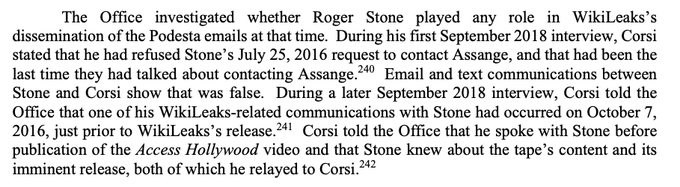
---
also fresh air
https://www.alternet.org/2020/10/trump-putin-soul-crushing-summit-showed-muellers-team-russia-benefited-from-the-2016-election-report
Federal prosecutors and FBI agents for special counsel Robert Mueller's Department of Justice (DOJ) office were left reeling after President Donald Trump publicly sided with Russian President Vladimir Putin following the Helsinki summit in 2018, according to memoir written by former Mueller prosecutor, Andrew Weissmann.
The memoir titled, "Where Law Ends[tyranny begins, enscribed on doj/ bldg]: Inside the Mueller Investigation" details the timeline of events that transpired just days after Mueller's office 12 Russian military intelligence officers were indicted for their alleged role in the alleged "hack and dump" leak operative carried out against Democratic National Committee and the Hillary Clinton campaign.
Despite the charges and evidence presented to support the indictments, Trump defended Putin as he insisted the president simply said that his country was not responsible.
"I have President Putin," Trump said at the time. "He just said it's not Russia I will say this: I don't see any reason why it would be."
"By this time, Trump not only had the conclusions of the original intelligence assessment, but the incontrovertible proof" from Mueller's team "to expand on and corroborate it," Weissmann wrote. "Still, Trump said, Putin 'was extremely strong and powerful in his denial,' and that was apparently enough for him."
According to the memoir, prosecutors in Mueller's office saw Trump's remarks as "surreal" and "soul crushing." Many found Trump's remarks to be relatively alarming.
"It was like they'd built up a mountain of incriminating evidence only to watch the prosecutor suddenly decide to call off the case and go home, just because the defendant said he wasn't guilty," Weissman added.
Weissmann continued, "The scene in Helsinki should have been stunning to the average American viewer, but for those within our office who'd poured energy into pinning down these facts, it was profoundly alarming.Here was our own president kowtowing to Putin, denying the election interference he had perpetrated on our nation and siding with a bloody dictator over a bipartisan consensus in the Senate and the nonpartisan conclusions of the IC that Putin had attacked our democracy."
Weissman's memoir, "Where Law Ends: Inside the Mueller Investigation" was released on Tuesday, September 29.
---
an 920
https://www.alternet.org/2020/09/ex-top-prosecutor-mueller-didnt-investigate-trump-finances-or-interview-ivanka-over-fears-of-a-blowback/
Igor Derysh / Salon September 23, 2020
A former prosecutor on Robert Mueller’s team said in a new book that the special counsel decided not to pursue President Donald Trump’s finances or interviews with his children over…
a former prosecutor on Robert Mueller’s team said in a new book that the special counsel decided not to pursue President Donald Trump’s finances or interviews with his children over fears that the president would shut down the investigation into Russian interference in the 2016 presidential election.
Andrew Weissmann, who led the prosecution of former Trump campaign chief Paul Manafort, blamed Aaron Zebley, Mueller’s top deputy in the investigation, for stopping investigators from looking into the president’s finances in his new book “Where the Law Ends,” according to excerpts published by The Washington Post.
Weissmann wrote that Zebley also pushed another prosecutor to “stand down” from pursuing Trump Organization documents because it risked affecting the negotiations with the president’s legal team to set up an interview with Trump. Trump ultimately did not appear for an interview and submitted written answers largely claiming not to recall key details.
“Aaron had a way of gaslighting you, of making you question your own reality, that you were being too aggressive in your drive to pursue leads and push harder — like you were not enough of an adult,” he wrote. "Repeatedly during our 22 months in operation, we would reach some critical juncture in our investigation only to have Aaron say that we could not take a particular action because it risked aggravating the president beyond some undefined breaking point,” he added, according to a New York Times report on the book.
Weissmann also argued that Mueller was wrong not to issue a subpoena to compel Trump’s testimony.
“What are we saying to future presidents, and to future investigators, who will have our decision thrown in their face?” Weissmann said he told Mueller. “If we do not subpoena the president in this investigation, how can others justify the need to do so?”
Weissmann said he wonders whether the team had “given it our all” in light of the questions left unanswered by the probe.
“As proud as I am of the work our team did — the unprecedented number of people we indicted and convicted and in record speed for any similar investigation — I know the hard answer to that simple question: We could have done more,” Weissmann wrote.
The former prosecutor listed a number of unanswered questions left open by the decision not to pursue Trump’s financial records.”We still do not know if there are other financial ties between the president and either the Russian government or Russian oligarchs,” he wrote. “We do not know whether he paid bribes to foreign officials to secure favorable treatment for his business interests, a potential violation of the Foreign Corrupt Practices Act that would provide leverage against the president. We do not know if he had other Russian business deals in the works at the time he was running for president, how they might have aided or constrained his campaign, or even if they are continuing to influence his presidency.”
Weissman noted elsewhere in the book that the same business account used to send hush money payments to Stormy Daniels after her alleged affair with Trump was also used to receive “payments linked to a Russian oligarch,” according to excerpts published by The New York Times.
---
==
ref 2
no lnx
https://www.nytimes.com/2020/09/21/us/politics/andrew-weissmann-mueller.html
Mueller’s Team Should Have Done More to Investigate Trump-Russia Links, Top Aide Says
A new book by one of the special counsel’s top deputies, Andrew Weissmann, is the first inside account of the investigation.
“We could have done more,” Andrew Weissmann, who was one of the top aides in the special counsel’s office, writes in a new book.
By Charlie Savage
Sept. 21, 2020
WASHINGTON — The team led by Robert S. Mueller III, the special counsel, failed to do everything it could to determine what happened in the 2016 election, shying away from steps like subpoenaing President Trump and scrutinizing his finances out of fear he would fire them, one of Mr. Mueller’s top lieutenants argued in the first insider account of the inquiry.
“Had we used all available tools to uncover the truth, undeterred by the onslaught of the president’s unique powers to undermine our efforts?” wrote the former prosecutor, Andrew Weissmann, in a new book, adding, “I know the hard answer to that simple question: We could have done more.”
The team took elaborate steps to protect its files of evidence from the risk that the Justice Department might destroy them if Mr. Trump fired them and worked to keep reporters and the public from learning what they were up to, Mr. Weissmann wrote in “Where Law Ends: Inside the Mueller Investigation,” which Random House will publish next week.
While he speaks reverently of Mr. Mueller, he also says his boss’s diffidence made him ill-suited for aspects of shepherding the politically charged investigation. He saw Mr. Mueller and his deputy, Aaron M. Zebley, as overly cautious.
Mr. Weissmann also defended against accusations by the president and his allies that he and other investigators were politically biased “angry Democrats”; Mr. Weissmann said his personal views had no bearing on the crimes that Russian operatives and Trump aides committed.
And he elevates particular details — for example, emphasizing that the same business account that sent hush payments to an adult film star who alleged an extramarital affair with Mr. Trump had also received “payments linked to a Russian oligarch.” The president has denied the affair; his former lawyer Michael D. Cohen controlled the account. Mr. Mueller transferred the Cohen matter to prosecutors in New York.
Previously a mafia and Enron prosecutor and then a lawyer at the F.B.I. for Mr. Mueller, who was the bureau’s director for 12 years, Mr. Weissmann ran one of three major units for the special counsel’s office. His “Team M” prosecuted Mr. Trump’s former campaign chairman Paul Manafort for numerous financial crimes. The goal was to flip him and learn whatever he knew about any Trump campaign links to Russia.
Mr. Manafort had worked for pro-Russian interests in Ukraine, and the investigation uncovered ties by his business partner, Konstantin V. Kilimnik, to Russian intelligence. The book builds toward investigators’ discovery that Mr. Manafort had shared internal campaign polling data with Mr. Kilimnik, who flew to the United States to meet with Mr. Manafort during the campaign, asking whether Mr. Trump would permit a peace plan for Russia to essentially take over all of eastern Ukraine.
But while admitting this much, Mr. Manafort — seeing the dangle of a potential pardon from Mr. Trump — refused to cooperate further. Investigators did not obtain any final puzzle pieces and lacked the evidence to charge anyone in the campaign with a criminal conspiracy involving Russia’s covert electoral assistance.
“It would seem to require significant audacity — or else, leverage — for another nation to even put such a request before a presidential candidate,” Mr. Weissmann wrote of Mr. Kilimnik’s request. “This made what we didn’t know, and still don’t know to this day, monumentally disconcerting: Namely, why would Trump ever agree to this? Why would Trump ever agree to this Russian proposal if the candidate were not getting something from Russia in return?”
Mr. Weissmann explained the significance of Mr. Manafort’s interactions with Mr. Kilimnik — also a major focus of a recent bipartisan Senate Intelligence Committee report, which explicitly labeled Mr. Kilimnik a Russian intelligence agent — more clearly than the Mueller report did.
Mr. Mueller had strictly forbidden leaks, and the special counsel team took extraordinary care to protect the high-profile, high-stakes investigation, Mr. Weissmann wrote. They kept window blind slats tilted at an angle to keep out prying eyes, shutting out natural light. They concocted an “almost comically elaborate and surreal” plan to sneak in “through the many hidden arteries of the courthouse” to obtain a grand jury indictment without tipping off reporters.
And worried about the possibility that Mr. Trump would fire them and the Justice Department would then seal off or destroy their evidence, the Mueller team members packed their numerous applications to judges for search warrants with extensive, up-to-date details about their investigation — ensuring they backed up their work beyond the reach of the executive branch.
Ty Cobb, a lawyer for Mr. Trump, also privately promised to be a “canary in the coal mine” and provide a heads up if Mr. Trump was going to fire the special counsel team, according to Mr. Weissmann. In an email, Mr. Cobb wrote that he “never made the commitment” described by Mr. Weissmann.
The investigation played out against the backdrop of regular vilification of the Mueller team by Mr. Trump and his allies like Fox News’s Sean Hannity — who turned out to be in regular contact with Mr. Manafort cooking up a “smear campaign” over text messages. Mr. Weissmann, a major target, wrote that such “ad hominem” insinuations of bias appealed to emotion rather than reason.
“I am a registered Democrat,” he wrote. “Does this make Paul Manafort or any of the other 32 people our office charged any less guilty? Did Russia not attack our democracy and disrupt our election with its self-described online information warfare operation? Which facts that we alleged in our various indictments — and to which many of those we indicted, including Manafort, would plead guilty — did our attackers believe were invented as a result of our alleged bias as ‘angry Democrats?’”
Mr. Trump’s allies have recently pointed with alarm to documents showing that cellphones issued to Mr. Mueller’s team were erased during the investigation; Mr. Weissmann twice entered an incorrect passcode too often, triggering a security measure that erased his phone. In an interview, he portrayed the concerns as a “tempest in a teapot” and said his understanding was that all emails and other such data from phones were backed up. He called on the Justice Department to release information about the special counsel’s data backup system.
Mr. Weissmann also wrote that he is not “anti-Trump” but rather “pro the rule of law.” Still, the distinction is less than clear in a book that also portrays Mr. Trump as a liar and a dangerous demagogue trying “to peel the world around him away from the rule of law — away from reason itself — and mold it to accommodate his desire for unchecked power.”
Mr. Weissmann was equally scathing about Attorney General William P. Barr, calling him an enabler and likening his misleading letter last spring about the then-still-secret Mueller report as a betrayal and “gut punch.”
Mr. Weissmann also criticized colleagues, portraying the special counsel team as divided between aggressive investigators like him, the F.B.I. special agent Omer Meisel and the prosecutor Jeannie Rhee — who headed “Team R,” which investigated Russian issues other than those centered on Manafort — and far more risk-averse law enforcement officials like Mr. Zebley who pulled punches.
In one episode in 2017, the Mueller team issued subpoenas to Deutsche Bank for information about Mr. Manafort’s income in Ukraine. Deutsche Bank had also lent large sums to the Trump Organization, and the White House somehow found out about the still-secret subpoenas — though not their focus. The White House demanded to know what investigators were doing, andMr. Mueller authorized Mr. Zebley to tell the White House that they had not been seeking Mr. Trump’s financial information.
“At that point, any financial investigation of Trump was put on hold,” Mr. Weissmann writes. “That is, we backed down — the issue was simply too incendiary; the risk, too severe.”
The book provides many other examples of concessions large and small. Investigators did not try to question Mr. Trump’s daughter Ivanka — who had spoken in the lobby to a delegation of Russians who came to Trump Tower in June 2016 to meet with campaign leaders who had been promised that they were offering dirt on Hillary Clinton from the Russian government.
They “feared that hauling her in for an interview would play badly to the already antagonistic right-wing press — look how they’re roughing up the president’s daughter — and risk enraging Trump, provoking him to shut down the special counsel’s office once and for all,” he wrote.
Similarly, they did not subpoena the Trump Organization for emails about its efforts to develop a Trump-branded building in Moscow, which were active deep into the 2016 campaign.
And they did not immunize Mr. Trump’s son Donald Trump Jr., a step that would have prevented him from being able to invoke the Fifth Amendment to avoid testifying about matters like the Trump Tower meeting. Bound by grand-jury secrecy rules, Mr. Weissmann did not come out and say whether Donald Trump Jr. was threatened with or actually issued a subpoena and used his right against self-incrimination to repel it.
Mr. Weissmann laid much of the blame for what he saw as a pattern of timidity on Mr. Zebley, portraying him as a primary decision maker. “Repeatedly during our 22 months in operation, we would reach some critical juncture in our investigation only to have Aaron say that we could not take a particular action because it risked aggravating the president beyond some undefined breaking point.”
Mr. Weissmann acknowledged, but did not clearly address, concerns that the aging Mr. Mueller had lost a step, both declaring that he was capable of making the tough decisions despite “speculative concerns” about his health but also describing him in one scene as looking drained and worn down by his years of grueling public service.
While Mr. Zebley obtained Mr. Mueller’s sanction for many of his cautious directives, in one striking episode, Mr. Zebley appeared in Mr. Weissmann’s telling to have unilaterally agreed — without Mr. Mueller’s knowledge — to a request by the office of the deputy attorney general overseeing them, Rod J. Rosenstein, not to coordinate with state prosecutors “as it would undermine the president’s pardon power.”
Two other former officials, who spoke on condition of anonymity, disputed the account. Mr. Rosenstein did not decline any request to share information with state prosecutors, a person familiar with his thinking wrote in an email.
Another person familiar with how the special counsel’s office interacted with Mr. Rosenstein’s office denied that there had been any agreement about sharing evidence with or withholding it from state prosecutors, and said Mr. Zebley had consulted with Mr. Mueller on every material decision.
On the failure to subpoena Mr. Trump, Mr. Mueller was determined to avoid “any public disagreements” with Mr. Rosenstein, Mr. Weissmann wrote. Because the special counsel regulations required telling Congress about any instance in which Mr. Rosenstein overruled him, Mr. Mueller never actually proposed subpoenaing Mr. Trump, instead coyly asking what Mr. Rosenstein’s reaction would be. Mr. Rosenstein just kept demurring.
In the end, Mr. Weissmann said in an interview, the caution was more justified early on to avoid provoking Mr. Trump into firing them before they could get going. But he and Ms. Rhee, among others, believed the office should have been willing to be more aggressive later on, after they had learned much of what Russia had done and had already used indictments to drag it into public view.
“We would have subpoenaed the president after he refused our accommodations, even if that risked us being fired,” he wrote. “It just didn’t sit right. We were left feeling like we had let down the American public, who were counting on us to give it our all.”
==
---
https://www.alternet.org/2020/10/oldest-living-cia-agent-believes-russia-infiltrated-gop-long-before-trump-took-over/
raw
The oldest living CIA agent believes Russia sank its hooks into the Republican Party well before President Donald Trump emerged as a viable candidate.
Peter Sichel was one of the CIA's first agents at the start of the Cold War, and he sees evidence of Russia's spycraft against Trump and the GOP in the Senate Intelligence Committee, reported The Daily Beast.
"One great advantage the Soviets always had over us, is that they played the long game. We thought in terms of quarters, whereas they thought in terms of years or even decades," Sichel said. "They were opportunistic, willing to let matters gradually develop until the right political faction or right leader to support had emerged."
Senate investigators found the Kremlin sought to infiltrate the Republican Party long before Trump became its nominee as part of Russian president Vladimir Putin's effort to deny the White House to Hillary Clinton.
Putin had fostered right-wing political movements across Europe to gain influence there, and Trump's presidential campaign promoted many of the same nationalist themes, and Sichel found numerous instances where Trump campaign operatives opened themselves up to possible Russian blackmail.
"The KGB were absolute masters at it," Sichel said, "and they would use whatever they could get their hands on. A favorite was honey traps [or sexual entrapments], but bribes, favors, whatever they could find. And once they had their hooks into you, they owned you."
Paul Manafort stayed in close contact with Russian spy Konstantin Kilimnik throughout the campaign, while Donald Trump Jr., Jared Kushner and Michael Flynn met with Russian intelligence operatives promising dirt against Clinton.
"The key thing is that all of them then lied about it to investigators, and that's where the potential blackmail comes in. Imagine if the FBI hadn't caught Flynn out, and he had remained in his post," Sichel said. "The Russians knew he lied — I'm sure they taped all their communications with him — so they would have had him over a barrel forever."
The 97-year-old Sichel said the president himself continued to compromise himself by lying about his own dealings with Russia.
"I know he doesn't see it this way, but by having all this stuff brought out in public, it removes the blackmail threat," Sichel said."The smartest thing Trump could have done when all this started to break was to just come out and say, 'Yes, it appears there was Russian involvement with my campaign, but that's over with now, I'm the president, so let's move on.' But he didn't do that, obviously. Perhaps there were reasons why he couldn't."
---
==
https://www.alternet.org/2020/09/former-fbi-agent-on-the-mueller-team-says-trump-was-badly-compromised-in-2016/
peter strock
==
---
https://www.alternet.org/2020/09/hhs-official-who-manipulated-cdc-reports-on-19-has-deep-russian-ties-report/
no lnx twt
On September 11, Politico reported that Michael Caputo, assistant secretary for the U.S. Department of Health and Human Services, interfered in the Centers for Disease Control and Prevention’s reports on COVID-19 in order to make them conform to President Donald Trump’s claims about the pandemic. And Caputo, journalist Mary Papenfuss reports in HuffPost, is drawing scrutiny for another reason as well: his ties to the Kremlin.
Caputo, Papenfuss notes, lived in Russia for six years and served as an adviser to former Russian President Boris Yeltsin from 1995-1999 before Vladimir Putin became Russia’s president. The HHS assistant secretary was an adviser to a subsidiary of Gazprom, an energy company owned by the Russian government — and Papenfuss points out thatCaputo “reportedly helped shore up Russian President Vladimir Putin’s reputation.”
“Caputo’s Kremlin ties were so concerning that he became a target of former special counsel Robert Mueller’s probe into Russian interference in the 2016 election,” Papenfuss explains. “He was questioned but was not charged with any offenses. He also testified before the House Intelligence Committee that he had no contact with Russians while serving on the Trump campaign.”
:{:{}:
}:
Caputo, a long-time ally of veteran GOP operative Roger Stone, has promoted the debunked conspiracy theory that it was the Ukrainian government, not the Kremlin, that interfered in the 2016 presidential election — and that the interference was in support of Democratic nominee Hillary Clinton, not Trump.Papenfuss notes that Caputo “has spread baseless accusations concerning activities in Ukraine by Joe and Hunter Biden. A key source of that Ukrainian smear, Andrii Derkach, turned out to be a Russian spy attempting to interfere in the current U.S. election, the Treasury Department revealed last week.”
During Trump’s impeachment trial in the U.S. Senate, Trump denounced the impeachment as “phony” — and he was also highly critical of the Russia investigation.
The Mueller report says of Caputo, “In the spring of 2016, Trump campaign advisor Michael Caputo learned through a Florida-based Russian business partner that another Florida-based Russian, Henry Oknyansky — who also went by the name Henry Greenberg — claimed to have information pertaining to Hilary Clinton. Caputo notified Roger Stone and brokered communication between Stone and Oknyansky. Oknyansky and Stone set up a May 2016 in-person meeting.”
---
==
9/20 cohen says he does not think trump was launder $ (except all russian olig $ was putin's?) bogus fla mansion deal
==
hmmn, if he really had goods, he would risk jail?
https://www.alternet.org/2020/09/fbi-is-sitting-on-classified-intelligence-that-could-destroy-trump-ex-agent-peter-strzok/
==
---
https://www.alternet.org/2020/09/putins-favorite-congressman-offered-julian-assange-a-pardon-if-he-covered-up-russian-meddling-lawyers/
raw story
american prosecutors said this week that formerRep. Dana Rohrabacher (R-CA) offered WikiLeaks founder Julian Assange a pardon from President Donald Trump if he agreed to help cover up Russia’s role in interfering in the 2016 presidential election.
*The Daily Beast* reports that witness Jennifer Robinson has testified that she attended a meeting between Rohrabacher and Assange in 2017 in which he made a direct quid-pro-quo offer.
Rohrabacher was joined in the meeting by Charles Johnson, a pro-Trump racist internet troll, and the two men led officials at the Ecuadorian embassy in London to believe they were acting on behalf of the president.
“They stated that President Trump was aware of and had approved of them coming to meet with Mr. Assange to discuss a proposal—and that they would have an audience with the president to discuss the matter on their return to Washington, D.C.,” Robinson said. the White House has denied that Trump was ever aware of such a scheme, however, and attorneys representing the U.S. government seemed to dispute Rohrabacher’s claims.
“After Robinson read her testimony in a London courtroom on Friday, lawyers representing the U.S. accepted the witness statement as accurate and confirmed they had no intention of cross-examining the claim,” The Daily Beast reports. “They did dispute, however, that President Donald Trump gave his blessing for the pardon offer.”
==
---
https://www.alternet.org/2020/09/former-fbi-agent-on-the-mueller-team-says-trump-was-badly-compromised-in-2016/
peter s
==
---
https://www.alternet.org/2020/09/the-warning-lights-are-flashing-red-how-trumps-toadies-are-helping-him-collude-with-russia/
After reviewing classified intelligence reports about Vladimir Putin’s attempts to interfere in the 2020 election over three weeks ago, Senator Richard Blumenthal tried to sound the alarm.
The warning lights are flashing red. America’s elections are under attack.
This week, I reviewed classified materials in the Senate’s Sensitive Compartmented Information Facility and received a similarly classified briefing on malign foreign threats to U.S. elections. I was shocked by what I learned — and appalled that, by swearing Congress to secrecy, the Trump administration is keeping the truth about a grave, looming threat to democracy hidden from the American people. On Friday, the Office of the Director of National Intelligence issued astatement that only hints at the threats.
The facts are chilling. I believe the American public needs and deserves to know them. The information should be declassified immediately.
Blumenthal went on to say that what he learned makes “Moscow’s past interference and nefarious actions look like child’s play.” We still, however, have no idea of what shocked him enough to write that op-ed in the Washington Post.
What we do know is how the Trump administration reacted. Last Friday, the Director of National Intelligence, John Ratcliffe, told Congress that his office would no longer brief them in person about foreign election interference, but would submit written reports. Clearly they don’t want to face probing questions from Congress. In defending his actions, however, Ratcliffe admitted that it goes beyond that.
[no twt]
ratcliffe’s initial argument doesn’t make any sense. He said that he is going to stop in-person briefings because members of Congress leaked classified information to the press. What he didn’t explain is how that would stop leaks. Classified information provided in writing is even easier to share with reporters.
In a scathing rebuke of Ratcliffe’s announcement, the Washington Post editorial board pointed out that the only so-called “leaks” came from the kind issued by Senator Blumenthal.
After the intelligence community briefed members of Congress in late July about threats to the upcoming election, Democrats expressed alarm about what they had learned — and about the fact that the information had not been shared with the American public. “The warning lights are flashing red. America’s elections are under attack,” wrote Sen. Richard Blumenthal (D-Conn.) in a Post op-ed, without disclosing any specifics…
[T]he only “leak” was the simple fact that the administration was withholding critical information about Russia’s interference — which, of course, is intended to help President Trump win reelection.
In that clip of Ratcliffe’s Fox News appearance, he eventually got to the point by saying that Democrats leaked information that “simply wasn’t true, that somehow Russia is a greater security threat than China.” In a case of obvious projection, Ratcliffe is telling us that the Trump administration doesn’t want Congress or the public to know what Moscow is doing to interfere in the election, but instead wants to change the narrative to focus on the distraction they’re offering about the threat posed by China. In other words, Ratcliffe is suggesting that he will now cherry-pick what intelligence is shared with Congress to provide cover for what Moscow is up to.
Added to that is a troubling story about yet another purge in the Justice Department by Attorney General Barr.
Current and former national security officials are raising concerns over Attorney General William Barr’s recent decision to remove the head of a Justice Department office that helps ensure federal counterterrorism and counterintelligence activities are legal – and replace him with a political appointee with relatively limited experience.
Barr has reassigned 23-year career professional Brad Wiegmann, who had been serving as Deputy Assistant Attorney General in charge of the Office of Law and Policy. As ABC News reports, “The office shapes government efforts by ensuring that new policies and executive actions don’t violate federal law.”
We’ve heard stories from former Trump administration officials who have said that they often found themselves having to tell the president that the actions he wanted to take were not legal. As former DHS Chief of Staff Miles Taylor said, Trump would claim to have “magical authorities” to break the law.
Now Barr has removed the person whose job it is to tell the administration when they are breaking the law and replaced him with a partisan loyalist. While it might not be unprecedented to do that, the fact that it comes a couple of months before an election makes this one troubling. Here is the most telling part about Wiegmann’s replacement, Kellen Dwyer:
From 2018 to 2019, he served as a fellow at the conservative-leaning Leonine Forum, a non-profit organization that says its alumni are “committed to the cause of reintroducing the tenets of [the Catholic church] into the political, policy, legal, business, and cultural activities of society.”
The Leonine Forum was created by the Catholic Information Center (CIC), an extremist group founded by Father John McCloskey, who eventually left the organization over allegations of sexual assault. Several members of the Trump administration have close ties to the CIC, including Attorney General Barr, White House counsel Pat Cipollone, and economic adviser Larry Kudlow.
What appears to be happening is that both Ratcliffe and Barr are paving the way for Putin and Trump, who speak regularly by phone, to illegally collude in their efforts to influence the election—this time from the Oval Office with the entire federal bureaucracy at their disposal.
---
---
https://www.alternet.org/2020/08/democrats-slam-shocking-abdication-of-responsibility-as-intelligence-officials-scale-back-election-security-briefings
no lnx twt
Julia Conley / Common Dreams August 31, 2020
House Intelligence Committee Chairman Adam Schiff (D-Calif.) indicated on Sunday that his committee may subpoena intelligence officials, following Director of National Intelligence John Ratcliffe’s announcement that regular election security briefings will be scaled back ahead of the general election.
“This intelligence paid for by taxpayers doesn’t belong to Donald Trump, it doesn’t belong to the intelligence agencies, it belongs to the American people,” Schiff told Dana Bash on CNN’s “State of the Union.”
Democrats expressed outrage over the weekend after Ratcliffe announced that lawmakers will no longer be receiving in-person briefings on election security, even amid concerns that foreign powers are attempting to interfere with the 2020 general election.
In what Democratic leaders called a “shocking abdication” of responsibility, Ratcliffe sent letters to members of the Senate and House Saturday evening, indicating that only written briefings will be provided until the November election and blaming leaks from Congress for the decision.
House Speaker Nancy Pelosi (D-Calif.) and Schiff (D-Calif.) accused Ratcliffe of betraying “the public’s right to know how foreign powers are trying to subvert our democracy.”
“This intelligence belongs to the American people, not the agencies which are its custodian. And the American people have both the right and the need to know that another nation, Russia, is trying to help decide who their president should be,” said Pelosi and Schiff, referring to intelligence shared in a briefing last month.
On Twitter, Schiff accused President Donald Trump of “lying and projecting” after Trump spoke about the decision in a press conference.
“They leaked the information,” Trump said of Ratcliffe’s decision. “And what’s even worse, they leaked the wrong information. And he got tired of it. So he wants to do it in a different forum, because you have leakers on the committee.”
The scaling-back of briefings comes a month after Politico reported on a classified security briefing given to all members of Congress by William Evanina, director of the National Counterintelligence and Security Center. At the meeting, Evanina acknowledged that “Russia is again trying to boost President Donald Trump’s reelection and denigrate his opponent.”
Democrats in the briefing urged Evanina to acknowledge the information publicly and denounced an earlier public statement he made in which he warned of potential election interference by Russia, China, and Iran.
The vague statement was “almost meaningless” and not helpful to voters, Democrats said.
Senate Minority Leader Chuck Schumer accused Trump of using Ratcliffe, a loyalist to the president who was elevated to his current position after serving in the House, “to hide the ugly truth from the American people—that the president is again receiving the help of the Kremlin.”
“DNI Ratcliffe has made clear he’s in the job only to protect Trump from democracy, not democracy from Trump,” said Schumer.
Previously, Trump and his postmaster general, Louis DeJoy, have overseen what critics call the sabotage of the U.S. Postal Service. Ahead of a general election in which millions of Americans will rely on voting-by-mail due to the coronavirus pandemic, DeJoy ordered cuts to overtime, the removal of mailboxes and mail-sorting machines, and changes to post office hours. The president has also baselessly claimed that the use of mail-in ballots will invite fraud, despite the fact that he himself has voted by mail, and openly admitted that undermining the USPS will ensure universal voting-by-mail is not possible.
In 2018, Special Counsel Robert Mueller charged 13 Russian nationals and three Russian organizations including a government-supported “troll farm” with conspiring to interfere with the 2016 U.S. election. Trump had long accused Mueller of leading a “witch hunt” and a “hoax” about Russia’s involvement. The Mueller Report, released in 2019, found that Trump campaign officials had extensive contacts with Russians and that many lied about those communications, but stopped short of accusing the president and his advisors of conspiring with Russia in 2016.
This year, former Office of Government Ethics director Walter Shaub tweeted, “if America has a legitimate election, it’ll be in spite of Trump’s best efforts to prevent one.”
Democratic presidential candidate Joe Biden, who was at the center of Trump’s impeachment trial last year regarding the president’s attempt to bribe Ukraine to open a public investigation into Biden’s son, accused Ratcliffe and Trump of violating the country’s “national security and sovereignty.”
“For the DNI to curtail one of the most basic duties of our nonpartisan Intelligence Community—to keep the United States Congress fully informed about threats to our nation, in this case, about the real and rising threat of foreign election interference—is nothing less than a shameless partisan manipulation to protect the personal interests of President Trump,” said Biden. “And it is a betrayal of the oath sworn to the American people and our Constitution.”
---
==
https://www.alternet.org/2020/08/rosenstein-blocked-fbi-from-probing-trumps-russian-ties-then-ordered-mueller-to-ignore-them-as-well
One of the many oddities of the now-terminated Robert Mueller probe into Russian election interference and its links to various members of the Trump campaign and family, and in fact of all known federal probes into Russia’s Trump-related actions, has been the seeming lack of any counterintelligence probe on Donald Trump’s myriad, longstanding financial connections to Russia—and what role those financial ties have played both in the Russian government’s actions on behalf of Trump and their possible leverage over the now-president.
:{:{}:
}:
A new story from *The New York Times*‘ Michael Schmidt reports that that’s because in the first months of the new Trump administration, former deputy attorney general Rod Rosenstein shuttered that investigation—then ordered special counsel Robert Mueller to steer clear of it himself. It’s not that the counterintelligence investigation into Trump’s known ties to Russian crime figures, to money laundering, and his family’s stated reliance on Russian cash has been kept closely-held: It never existed. And it still doesn’t.
The accusation being leveled by acting Federal Bureau of Investigation director Andrew McCabe against Rosenstein goes further, suggesting that Rosenstein intentionally misled him. Schmidt reports that McCabe launched a counterintelligence probe into Trump’s Russian ties immediately after Trump’s firing of former FBI director James Comey, a move that was widely publicly speculated to be a Trump move to quash investigations into Russian election actions and into numerous of Trump’s top advisers and allies. The fear within the intelligence community was that Trump’s behaviors could be impacted by unknown Russian pressures, representing an immediate national security threat.
Rosenstein, however, ordered the probe shut down. Rosenstein did not tell McCabe that directly, says Schmidt, but instead left McCabe “with the impression that the special counsel would take on [that] investigation” as part of Mueller’s overall Russian interference inquiry.
but separately, Rosenstein told Mueller that he wasn’t to pursue the counterintelligence concerns either.
That means no federal investigation into Trump’s Russian cash have been undertaken during his presidency, despite numerous papers and journalists themselves identifying significant ties between Donald Trump’s finances and individuals close to the Russian government. Not by intelligence officials, not by the special counsel’s team, and not the Senate’s own Russia probes. Through the entirety of Trump’s term, all probes of financial ties to Russian interests—which he has retained, even in the presidency—have each been blocked.
Schmidt’s claims here seem impossible to fully believe. It would require that federal law enforcement officials turn a blind eye to a potentially massive national security threat—the very real chance that Trump was and is being intimidated into, or merely bribed into, pursuing Putin-preferred policies damaging to the United States. Trump’s moves to weaken NATO, his pressure on allies to weaken Russian sanctions and re-elevate Russia as economic leader, and his mostly-successful sabotage of the Ukrainian government’s ability to push back Russian forces during a key Russian military push have each been contrary to longstanding U.S. interests. None have been competently explained, not even by Trump’s own national security officials.
As expert Marcy Wheeler suggests, that both Rosenstein and Sen. Richard Burr specifically chose, in their probes, “not to look into the most obvious source of compromise suggests that someone knows what they would find.” After Trump’s continued pattern of gleeful lawbreaking, it’s now more plausible to believe Trump is acting for personal financial gain in his dealings with Russia than it is to believe his actions rest on any supposed ideological foundation. The Senate and Justice Department both continue to make rigorously sure, however, to leave those questions intentionally unanswered.
==
https://www.alternet.org/2020/08/heres-what-the-senate-intel-report-tells-us-about-trump-and-roger-stones-39-phone-calls-during-the-2016-election/
on August 18, the Senate Intelligence Committee released its bipartisan report on Russian interference in the 2016 presidential election. One of the things addressed in the report is Donald Trump’s phone conversations with veteran GOP operative Roger Stone during the election — and according to an August 19 article by New York Times reporter Julian E. Barnes, the Senate Intelligence report sheds even more light on those interactions than the Mueller report and Stone’s criminal trial.
Barnes notes that according to court records, Stone and Trump had 39 phone conversations from March-November 2016 — one of which Barnes describes as “an intriguing phone call, on October 6, 2016, to Mr. Trump.”
“According to the Senate report,” Barnes explains, “Mr. Stone received a call that afternoon from a number belonging to an aide to Mr. Trump, who regularly used others’ phones to make calls. The topic of the conversation was not known, Senate investigators wrote, but they noted that Mr. Stone was focused on a potential WikiLeaks release.”
The Senate Intelligence Committee’s report concludes, “It appears quite likely that Stone and Trump spoke about WikiLeaks."
in October 2016, WikiLeaks published hacked Democratic e-mails that had been stolen by Russians.
Barnes points out that in its report, the Senate Intelligence Committee “laid out a range of evidence that Mr. Stone was focused on WikiLeaks. He and Mr. Trump had spoken a few days earlier, on September 29, also on the aide’s phone. Another campaign aide, Rick Gates, witnessed it and told investigators that the two men discussed WikiLeaks. After that call, Mr. Trump told Mr. Gates that ‘more releases of damaging information would be coming.’”
The Times reporter also notes that Stone “said the Senate conclusion that he had discussed WikiLeaks with the president was based solely on testimony by Mr. Gates and Mr. Trump’s former lawyer Michael D. Cohen. Mr. Stone called their testimony tainted by agreements with prosecutors to answer their questions.”
Stone has insisted that he did not know that people connected to the Russian government were behind the stolen Democratic e-mailsthat WikiLeaks published in October 2016 — and that he never discussed WikiLeaks with Trump. Barnes, notes, however, “The Senate report made clear that WikiLeaks, at least, ‘very likely’ knew the e-mails were coming from Russian intelligence, and that Mr. Stone knew about the most critical WikiLeaks release before it happened.”
Stone is among the many Trump associates who has faced criminal charges: he was convicted of charges ranging from witness tampering to lying to Congress and sentenced to 40 months in federal prison by Judge Amy Berman Jackson, a Barack Obama appointee. But Trump commuted Stone’s sentence in July, saving him from the prison sentence he was about to begin.
Barnes notes that the Senate Intelligence Committee “rejected Mr. Trump’s statement to prosecutors investigating Russia’s interference that he did not recall conversations with his long-time friend, Roger J. Stone Jr., about the e-mails, which were later released by WikiLeaks.”
In the Mueller report, former special counsel Robert Mueller concluded that the 2016 Trump campaign’s interactions with Russians — however questionable — did not rise to the level of a full-fledged criminal conspiracy. And Barnes points out that the Senate Intelligence report does not accuse Trump of lying. But Barnes also points out that the report “laid out extensive contacts between Trump advisers and Russians” and “detailed even more of the president’s conversations with Mr. Stone than were previously known, renewing questions about whether Mr. Trump was truthful with investigators for the special counsel, Robert S. Mueller III, or misled them.”
==
https://www.alternet.org/2020/08/this-is-what-collusion-looks-like-gop-led-senate-report-far-more-devastating-than-mueller-probe
lots of docs in twt not here
‘This is what collusion looks like’: GOP-led Senate report ‘far more devastating’ than Mueller probe
Written by Igor Derysh / Salon August 18, 2020
The Senate Intelligence Committee’s final report on its bipartisan Russia investigation revealed even more numerous contacts between President Donald Trump’s advisers and Russian operatives than former special counsel Robert Mueller’s report.
The committee, which is chaired by Sen. Marco Rubio, R-Fla., on Tuesday released its fifth and final report, totaling nearly 1,000 pages,following a three-year bipartsian investigation into Russia’s interference in the 2016 election. The report documents the extent to which Russia sought to influence the election — and members of Trump’s team welcoming their assistance.
“The Senate report — even more extensive than the Mueller investigation — paints a far more devastating picture of Russian intelligence operatives’ access to the Trump campaign, describing far more insidious connections than even Mueller did in his report,” Politico’s Kyle Cheney wrote.
The report, like Mueller’s, did not conclude that Trump’s campaign coordinated with Russia, but it found that Trump campaign chairman Paul Manafort worked with a “Russian intelligence officer” and handed him internal campaign data. The report also suggested that Manafort might also be linked to Russia’s hack of the Clinton campaign.
“The committee obtained some information suggesting that the Russian intelligence officer, with whom Manafort had a longstanding relationship, may have been connected to the G.R.U.’s hack-and-leak operation targeting the 2016 U.S. election,” the committee’s Democrats wrote. “This is what collusion looks like.”
The report found that Konstantin Kilimnik, a longtime associate of Manafort, was a “Russian intelligence officer” who might be connected to Russia’s “hack and leak operation.” (Manafort provided internal Trump campaign polling data to Kilimnik.)
While the Senate Russia report mentioned Kilimnik 819 times, the House Republican report did not mention him once. The Senate report also found that Kilimnik later “almost certainly helped arrange some of the first public messaging that Ukraine had interfered in the U.S. election.” Trump has repeatedly echoed the claim that Ukraine interfered in the election — not Russia.
Another part of the report also cited evidence raising the “possibility of Manafort’s potential connection” to the hack and leak operation, though the evidence was redacted.
The report described Trump’s former campaign chief as a “grave counterintelligence threat,” who worked with Russian operatives before and after the election.
The report also found thatTrump did discuss WikiLeaks with longtime adviser Roger Stone, even though he told Mueller’s team that he did “not recall” doing so. It also revealed that Stone directed an associate to request a leak of hacked emails by Clinton’s top aide when the infamous Access Hollywood tape dropped. The emails were published a half hour after the release.
Like the Mueller report, the Senate report also detailed efforts by Trump and his team to impede the years-long probe.
Sen. Mark Warner, D-Va., the vice chairman of the committee, urged the public to “review the documented evidence of the unprecedented and massive intervention campaign waged on behalf of then-candidate Donald Trump by Russians and their operatives and reach their own independent conclusions.”
Rubio, however, tried to spin the report as favorable for the president.
“We can say, without any hesitation, that the committee found absolutely no evidence that then-candidate Donald Trump or his campaign colluded with the Russian government to meddle in the 2016 election,” he said in a statement.
“What the committee did find however is very troubling,” he added. “We found irrefutable evidence of Russian meddling.”
But Rubio’s statement brushed over actions by Trump’s advisers, as well as the president’s own statements to investigators.
One part of the report notes that Trump told Mueller in written responses that he did “not recall” discussing WikiLeaks with longtime adviser Roger Stone, who was later convicted in the former special counsel’s probe before being granted clemency by the president.
“Despite Trump’s recollection, the committee assesses that Trump did, in fact, speak with Stone about WikiLeaks and with members of his campaign about Stone’s access to WikiLeaks on multiple occasions,” the report said.
The report also noted that WikiLeaks “likely knew it was assisting a Russian intelligence influence effort” by publishing stolen Democratic emails.
Stone “obtained information indicating” that Clinton campaign chief John Podesta would “be a target of an upcoming release, prior to WikiLeaks releasing Podesta’s emails . . . Stone then communicated his information to Trump,” the report said.
Stone directed an associate to tell WikiLeaks founder Julian Assange to “drop the Podesta emails immediately” the day the Trump campaign learned about the looming Access Hollywood tape.
The report also noted that the Senate investigation was met with “unprecedented potential executive privilege claims” from the White House.
“The committee was surprised by these assertions, because they were made inconsistently and because they have no basis in law,” the report said.
“The Trump campaign publicly undermined the attribution of the hack-and-leak campaign to Russia and was indifferent to whether it and WikiLeaks were furthering a Russian election interference effort,” the report added.
The report further concluded that Donald Trump Jr. might have obstructed the investigation, but the panel declined to pursue the issue due to “time and resource considerations.”
Trump Jr. participated in the infamous Trump Tower meeting with Kremlin-linked lawyer Natalia Veselnitskaya about obtaining dirt on Hillary Clinton. Veselnitskaya’s ties to the Russian government “were far more extensive and concerning than what had been publicly known,” the report said.
The report concluded by warning that “what happened to the United States in 2016 should be an alarm bell.”
“Russia is actively interfering again in the 2020 U.S. election to assist Donald Trump, and some of the president’s associates are amplifying those efforts,” the report said. “The Russian intelligence services’ assault on the integrity of the 2016 U.S. electoral process, and Trump and his associates’ participation in and enabling of this Russian activity, represents one of the single most grave counterintelligence threats” to the homeland.
==
wow, contrast fox:
Senate Intel says FBI gave 'unjustified credence' to Steele dossier, Russia 'took advantage' of Trump trans...
The Senate Intelligence Committee found that the FBI gave the unverified anti-Trump dossier “unjustified credence,” and that Russia “took ...
5 hours ago
Washington Post
Trump’s 2016 campaign chair was a ‘grave counterintelligence threat,’ had repeated contact with Russian intelligence, Senate panel finds
The Senate Intelligence Committee has released the fifth and final volume of its report into Russian interference in the 2016 election.
---
no lnx
National Security
Trump’s 2016 campaign chair was a ‘grave counterintelligence threat,’ had repeated contact with Russian intelligence, Senate panel finds
By
Karoun Demirjian and
Ellen Nakashima
August 18, 2020
President Trump’s 2016 campaign chairman posed a “grave counterintelligence threat” due to his interaction with people close to the Kremlin, according to a bipartisan Senate report released Tuesday that found extensive contacts between key campaign advisers and officials affiliated with Moscow’s government and intelligence services.
:{:{}:
}:
In its report, the Republican-led Senate Intelligence Committee states that Trump’s then-campaign chair Paul Manafort worked with a Russian intelligence officer “on narratives that sought to undermine evidence that Russia interfered in the 2016 U.S. election,” including the idea that purported Ukrainian election interference was of greater concern.
It found that a Russian attorney who met with Manafort, along with the president’s son, Donald Trump Jr., and his son-in-law Jared Kushner at Trump Tower in 2016, had “significant connections” to the Kremlin. The information she offered them was also “part of a broader influence operation targeting the United States that was coordinated, at least in part with elements of the Russian government,” the report stated.
But the panel also concluded that the FBI’s handling of Russian threats to the election was “flawed” and that the bureau gave “unjustified credence” to allegations about Trump’s Russia ties made in a dossier compiled by former British spy Christopher Steele, “based on an incomplete understanding of Steele’s past reporting record.”
Document: Read the Senate Intelligence Committee’s report on Russian interference in the 2016 election]
The Senate Intelligence Committee’s three-and-a-half year investigation stands as Congress’s only bipartisan examination of Russian interference in the 2016 election. The panel, significantly, agreed that the FBI overestimated Steel’s reliability and that Manafort and other aides exposed the campaign to undue Russian influence. But its leaders were noticeably divided along party lines in how they interpreted the report’s significance, and several committee members — including its acting chairman Sen. Marco Rubio (R-Fla.) — endorsed dissenting conclusions about Trump’s own culpability.
The partisan divisions are a sign that the panel’s tome likely will not put to rest the political wrangling over how seriously to treat foreign interference in U.S. democracy as the country heads into its most divisive election in modern history.
“After more than three years of investigation by this Committee, we can now say with no doubt, there was no collusion,” a group of six panel Republicans, including Rubio, wrote in a statementinstead accusing the Democratic Party of coordinating with foreign actors to produce Steele’s dossier.
“In 2016, the Democratic Party, using a series of arm’s length transactions, hired a foreign citizen to seek out dirt on a political opponent, provided by foreign sources,” the Republicans wrote, attacking the FBI for “sloppy work and poor judgment.”
Five Democrat senators — including Kamala D. Harris (D-Calif.), the party’s 2020 vice-presidential nominee — asserted the report “unambiguously shows that members of the Trump Campaign cooperated with Russian efforts to get Trump elected.” Referring specifically to their findings on Manafort, the Democrats wrote, “This is what collusion looks like.”
The intelligence committee’s vice chairman, Sen. Mark R. Warner (D-Va.), who did not sign onto the Democrats’ dissenting views, noted “a breathtaking level of contacts between Trump officials and Russian government operatives that is a very real counterintelligence threat to our elections,” and he encouraged “all Americans to carefully review the documented evidence of the unprecedented and massive intervention campaign waged on behalf of then-candidate Donald Trump by Russians and their operatives and to reach their own independent conclusions.”
The committee’s past chairman Sen. Richard Burr (R-N.C.), who oversaw the bulk of the investigation and also steered clear of the GOP’s dissent, struck a position in the middle.
“One of the Committee’s most important — and overlooked — findings is that much of Russia’s activities weren’t related to producing a specific electoral outcome, but attempted to undermine our faith in the democratic process itself,” he said in a statement. “Their aim is to sow chaos, discord, and distrust. Their efforts are not limited to elections. The threat is ongoing.”
Senate panel told Justice Dept. of suspicions over Trump family members’ Russia testimony
Burr and Warner launched the committee’s probe before Trump’s inauguration in January 2017 and sustained the bipartisan investigation over the following three and a half years, even as other Congressional investigations into the same matter faltered along partisan lines. Since the Senate Intelligence Committee began its probe, former special counsel Robert S. Mueller III also released a 448-page report on Russian interference in the 2016 election — and Trump was impeached and acquitted after Democrats accused him of coercing Ukrainian leaders to interfere in the 2020 election.
Though the committee’s probe covers much of the same turf as Mueller’s investigation, it was different in nature. Mueller was running a criminal probe; the Senate committee was conducting an intelligence investigation — a distinction that helps to explain some of nuanced differences between their conclusions.
The Senate panel’s probe, which was mostly driven by the committee’s bipartisan staff, included more than 200 witnesses and considered evidence relating to Russian disinformation, Trump’s personal, business and campaign contacts with Russians and the transition period following the 2016 election.
:{:{}:
}:
At one point, the document all but concludes that Trump aides were duped and manipulated by Russian interests they were too callow to understand.
“Russian officials, intelligence services, and others” acting in concert with the Kremlin “were capable of exploiting the transition team’s shortcomings,” the report concluded. “Based on the available information, it is possible — and even likely — that they did so.”
The report also presents a damning portrait of the Trump campaign’s hasty move in March 2016 to assemble a foreign policy team, asserting that it had recruited inexperienced people without thoroughly vetting them and thus potentially exposed itself to Russian influence.
“Ultimately,” the committee wrote, “the foreign policy team exposed the Trump Campaign to significant counterintelligence vulnerabilities.”
The committee pointed to Trump campaign aide George Papadopoulos, who attempted to secure a face-to-face meeting between Trump and Russian President Vladimir Putin through “highly suspicious” contacts with people close to the Russian government. Ultimately, investigators concluded, Papadopoulos “was not a witting co-optee of the Russian the Russian intelligence services. The panel also found that while Russia seemed to show an interest in campaign adviser Carter Page, investigators “found no indication that Page had useful Campaign information for the Russian intelligence services to extract, nor meaningful influence for them to exploit.”
The committee did find however that Putin personally directed the 2016 hack-and-leak campaign targeting the Democratic Party, the Democratic Congressional Campaign Committee and the Clinton campaign. The anti-secrecy group WikiLeaks “actively sought and played a key role in the Russian campaign and very likely knew it was assisting a Russian intelligence influence effort,” the report stated, surmising that a Russian military spy agency, known as the GRU, transferred hacked emails to WikiLeaks likely because it offered a more effective platform for publicity than the GRU’s own methods.
Yet investigators could not “reliably determine the extent of authentic, nonpublic knowledge” Trump’s friend Roger Stone had about WikiLeaks’s coming releases and shared with the campaign.
The panel noted that its investigation was hampered by several witnesses’ refusing interviews and to produce documents, citing Fifth Amendment rights that protect against self incrimination. These included Stone, Manafort and Rick Gates, the campaign’s deputy chair at that time. The panel’s request to interview Julian Assange was rebuffed.
The committee also outright accused Blackwater founder and Trump supporter Erik Prince of stonewalling its investigation, saying that it was “hampered by a lack of cooperation” and that his account of a controversial 2017 meeting in the Seychelles alongside a Russian official was “brief and deceptive.”
:{:{}:
}:
The committee previously released other volumes detailing aspects of its inquiry. Those reports focused on U.S. election security, Russia’s use of social media in disinformation campaigns, the Obama administration’s response to the perceived threat in 2016 and the intelligence community’s joint assessment that Russia had interfered in an attempt to tip the scales in Trump’s favor.
Yet the panel’s effort to maintain a bipartisan approach has not saved it from partisan scrutiny. Last year, the panel came under fire from Senate Republicans after issuing a subpoena for Donald Trump Jr. to come in for a second round of testimony.
After his testimony, Trump Jr. was one of several witnesses that the panel referred to the Justice Department for closer scrutiny over discrepancies between their testimony and that of Gates, the ex-deputy campaign chair who was a key witness in Mueller’s probe.
:{:{}:
}:
Earlier this year, Burr stepped aside as panel chairman after coming under scrutiny over stocks he sold in industries hit badly by the coronavirus pandemic. Rubio has been serving as acting chairman in his place.
ellen.nakashima@washingtonpost.com
Tom Hamburger, Rosalind S. Helderman, Greg Miller and Matt Zapotosky contributed to this report.
Most ReadNational Security
1
Trump’s 2016 campaign chair was a ‘grave counterintelligence threat,’ had repeated contact with Russian intelligence, Senate panel finds
2
Senate panel told Justice Dept. of suspicions over Trump family members’ Russia testimony
3
Ex-FBI lawyer, accused of falsifying document in probe of Trump’s campaign, to plead guilty
4
U.S. military made $2 million in civilian casualties payments in Afghanistan in recent years
5
Paul Manafort released from prison, granted home confinement due to coronavirus fears
==
ref
no lnx
National Security
Senate panel told Justice Dept. of suspicions over Trump family members’ Russia testimony
Donald Trump Jr. departs Capitol Hill in June 2019 after meeting privately with members of the Senate Intelligence Committee.]
By
Karoun Demirjian,
Ellen Nakashima and
Matt Zapotosky
August 15, 2020
The Republican and Democratic chairmen of the Senate Intelligence Committee notified federal prosecutors last year of their suspicion that several individuals, including President Trump’s family members and confidants, might have presented misleading testimony in the panel’s investigation of Russian interference in the 2016 election, people familiar with the matter said.
The list of individuals included the president’s son, Donald Trump Jr., and son-in-law, Jared Kushner, whose accounts of their pre-election meeting with a Russian lawyer were contradicted by the president’s former deputy campaign chairman Rick Gates in interviews that were part of the criminal investigation led by special counsel Robert S. Mueller III, these people said. Like others, they spoke on the condition of anonymity to discuss what remains a highly politicized and sensitive matter.
Inside the June 2016 Trump Tower meeting: A droning Russian lawyer and hot pink jeans, but no Clinton dirt]
But the intelligence committee, one person said, reserved its harshest allegations for the president’s former chief strategist, Stephen K. Bannon, former campaign co-chair Sam Clovis and private security contractor Erik Prince, saying it had reason to believe all three had lied to congressional investigators — a potential felony.
The committee’s concerns were detailed in a formal letter sent to the U.S. attorney’s office in Washington, D.C., in June 2019, people familiar with the matter said. Existence of the letter was first reported by the Los Angeles Times late Friday night.
The Senate Intelligence Committee referred several individuals’ testimony to the Justice Department over the course of its 3½ -year probe, citing discrepancies in their accounts, three officials said.
The panel, which has prided itself on having pursued its investigation without the politically charged disruptions that have undermined similar probes undertaken by other congressional committees, already has issued reports affirming that the Russians worked to damage Democrat Hillary Clinton in the 2016 election while bolstering Trump. It is expected to release the final volume of its findings as soon as next week.
The committee’s referrals were signed by then-Chairman Richard Burr (R-N.C.) and Vice Chairman Mark R. Warner (D-Va.), officials said. Some letters went to Mueller, whose investigation focused not only on Russia’s activities in 2016 but also on whether anyone within the Trump campaign conspired with those efforts. Others went to the D.C. U.S. attorney’s office.
It is unclear whether the Justice Department took action on the referrals. Officials there and with the D.C. U.S. attorney’s office declined to comment.
A referral is a tip that Congress suspects a crime was committed but does not by itself spark an investigation, let alone a prosecution. Prosecutors generally view referrals from Congress with suspicion, often seeing them as partisan attempts to embarrass political opponents — although this referral was made with bipartisan agreement. Others fall short of alleging serious legal wrongdoing.
Burr acknowledged in 2018 that the panel had made criminal referrals — and that “in a lot of those cases, those might be tied to lying to us.” At the time, he said the intelligence committee had interviewed more than 200 witnesses. His office declined to comment for this report.
According to the Los Angeles Times, which viewed a copy of the referral letter, the committee told the Justice Department than Bannon may have lied about his interactions with Prince and others regarding a meeting Prince held in the Seychelles with an official close to President Vladimir Putin. Prince had told Mueller’s team that he briefed Bannon on the meeting, which occurred before Trump’s inauguration in early 2017; Bannon denied the conversation took place.
Last year, shortly after a report was released detailing Mueller’s findings, the Democrat-led House Intelligence Committee made a criminal referral to the Justice Department for Prince, accusing him of intentionally misleading the panel during its examination of the 2016 election. The Times article also notes that Clovis was referred for possibly lying about his contacts with a Republican operative spearheading an effort to obtain undisclosed emails from a personal computer server belonging to Clinton.
William Burck, a lawyer for Bannon, declined to comment, saying “it’s impossible to respond to something I’ve never heard about before.”
Victoria Toensing, a lawyer for Clovis,said: “You mean former Chairman Burr, who is under investigation for insider trading, also doesn’t know the legalities of a false statement? Mr. Clovis testified at length before the special counsel’s grand jury and was never charged. After his testimony, we never heard again from the special counsel.”
The Justice Department has been investigating stock sales Burr made before the coronavirus pandemic crashed global markets, and in recent months seized his cellphone and executed a search warrant for his electronic communications. Burr stepped down as committee chairman amid the probe.
Matthew L. Schwartz, a lawyer for Prince, noted that Prince had testified to the House Intelligence Committee in November 2017 and his testimony has been public for years. That committee made a criminal referral in April 2019. “It unsurprisingly went nowhere,” Schwartz said in a statement. “If members of the Senate likewise made a referral — which we don’t know anything about — there would be nothing new for the Department of Justice to consider, nor is there any reason to question the Special Counsel’s decision to credit Mr. Prince and rely on him in drafting its report.”
Democrats examine Erik Prince’s statements on Seychelles meeting
Prince, according to a person familiar with the matter, never testified before the Senate Intelligence Committee, though he provided a copy of his House testimony to that panel.
The letter sent to prosecutors last year was divided into two sections, according to two people familiar with its contents. The first named those suspected of making false statements: Bannon, Clovis and Prince.
Its second section raised concerns about other witnesses whose testimony was contradicted by Gates, though it did not pointedly make a false-statements allegation, people familiar with the letter said. In addition to Trump Jr., that section of the letter also cited Trump’s former communications director Hope Hicks and former campaign chairman Paul Manafort.
Schiff says Donald Trump Jr. refused to answer some questions
Rep. Adam B. Schiff (D-Calif.) said Donald Trump Jr. did not answer some questions in a closed hearing on Dec. 6, 2017. (The Washington Post)
“We are fully confident in the testimony and information provided by Donald J. Trump, Jr.,” said Alan Futerfas, his lawyer. “In our view, this is a non-story.”
Trump Jr. says he’s ‘not at all’ worried about perjury charges
A lawyer for Manafort declined to comment. A representative for Kushner did not immediately respond to requests for comment. Hicks declined to comment immediately, citing a lack of familiarity with the referral.
Trump Jr., Kushner, Hicks and Manafort all either took part in or were involved in strategizing how to speak to the media about a June 2016 meeting at Manhattan’s Trump Tower with Natalia Veselnitskaya, the Russian lawyer promising damaging information about Clinton.
Trump Jr., who first sat for a lengthy interview with the Intelligence Committee investigators in late 2017 and returned under subpoena to speak with the full panel in June 2019, told investigators that he never informed his father about the Trump Tower meeting. But Trump’s former personal lawyer Michael Cohen told investigators working with Mueller that he recalled otherwise.
Cohen told Mueller’s team of being present when Trump Jr. “told his father that a meeting to obtain adverse information about Clinton was going forward,” according to a report detailing the special counsel’s findings. Cohen said he did not remember whether the meeting was connected to Russia, Mueller’s report said. He was later sentenced to three years in prison for, among other crimes, lying to Congress.
Gates, meanwhile, told Mueller’s team that he recalled that in the days before the Trump Tower meeting, Trump Jr. announced at a regular gathering of senior campaign staff and Trump family members that he had a lead on negative information about Clinton’s family foundation, according to the special counsel’s report. Among those present, Gates told Mueller, were Manafort, Hicks and Eric Trump, another of the president’s sons.
Spencer S. Hsu contributed to this report.
Karoun Demirjian
Karoun Demirjian is a national security reporter covering Capitol Hill, where she focuses on defense, foreign affairs, intelligence and policy matters concerning the Justice Department. She was previously a correspondent based in The Post's bureau in Moscow. Follow
Ellen Nakashima
Ellen Nakashima is a two-time Pulitzer Prize-winning reporter covering intelligence and national security matters for The Washington Post. She joined The Post in 1995 and is based in Washington, D.C. Follow
Matt Zapotosky
Matt Zapotosky covers the Justice Department for The Washington Post's national security team. He has previously worked covering the federal courthouse in Alexandria and local law enforcement in Prince George's County and Southern Maryland. Follow
More from The Post
==
wapo
Bipartisan leaders of the Senate Intelligence Committee last year notified the Department of Justice that members of President Donald Trump’s family and close circle “might have presented misleading testimony” to the panel during its investigation into Russian interference in the 2016 election, the Washington Post reports.
According to the Post, then-Chairman Richard Burr (R-NC) and Vice Chairman Mark R. Warner (D-VA) referred a list of individuals,including Donald Trump Jr. and Jared Kushner to federal prosecutors after their accounts of a pre-election meeting with Russian lawyer Natalia Veselnitskaya “were contradicted by the president’s former deputy campaign chairman Rick Gates” during former special counsel Robert Mueller’s investigation.
In a separate section, the congressional panel said it had reason to believe Steve Bannon, Erik Prince and former campaign co-chair Sam Clovis “had lied to congressional investigators — a potential felony,” the Post reports.
According to the Los Angeles Times, which first reported on the referrals and viewed a copy of the panel’s letter, the committee believes Bannon may have lied about his knowledge of a meeting Prince held in the Seychelles with a Russian official tied to the Kremlin. Per the Post, “Prince had told Mueller’s team that he briefed Bannon on the meeting, which occurred before Trump’s inauguration in early 2017; Bannon denied the conversation took place.”
==
---
https://www.alternet.org/2020/07/axios-reporter-reveals-most-shocking-revelations-trump-made-in-interview-about-russian-bounties/
aha doh trump does what about both siderism all the time on issues he wants to duck? eg russian activ meas, we do it too
Travis Gettys / Raw Story July 29, 2020
361
President Donald Trump admitted he never confronted Russia’s president Vladimir Putin about bounties on U.S. troops, but the reporter who interviewed him said that wasn’t even the “most shocking” revelation he made.
Axios reporter Jonathan Swan interviewed the president about the bounties allegedly placed on U.S troops in Afghanistan and his recent call with Putin, but he told MSNBC’s “Morning Joe” what shocked him the most about their conversation.
“In some ways, the most shocking part of that clip is actually not the first part where he admits for the first time on the record that he hasn’t raised the issue of the bounties with Vladimir Putin,” Swan said. “That’s the least shocking part of that call, because actually, frankly, you know, you could have a debate within policy circles about whether it’s the appropriate thing.”
“I mean, that there are dissenting opinions within the intelligence community about this intelligence,” he added. “It certainly is serious intelligence, being taken seriously by the allies, and there is a very good argument for why the president should raise it with Putin.”
But that wasn’t the most surprising revelation Trump made, Swan said.
“The second question is actually more important, which is, fine, you don’t believe this intelligence, or you’re skeptical of it,” Swan said. “Let’s try and take the most good-faith interpretation of it. But you know that Russia has been supplying weapons and money to the Taliban because the man who ran your forces in Afghanistan, John Nicholson, under your administration, said this on the record when he worked for you, and for him to say then, well, I didn’t — I don’t know if I’ve heard about this, never reached my desk, and by the way, we gave them weapons, too.”
“I mean, like in a different era,” he added. “I just — honestly, it was one of the most shocking — I’ve covered president Trump for five years. I think it’s one of the most shocking exchanges I’ve ever had with him.”
==
==
5/20
omfg
https://www.alternet.org/2020/05/on-putins-payroll-what-the-corrupt-move-to-drop-the-case-against-michael-flynn-really-means
dcj dc reptr
In a major step toward establishing a Trump dictatorship, the Justice Department moved Thursday to drop the criminal case against confessed felon Michael Flynn, the retired Army general and secret foreign agent who was Trump’s first national security adviser.
Instead of seeking equal justice under law, an extraordinary court filing demonstrated that Trump has one standard of justice for his enemies and an entirely different one for his allies. The court action shows how fully Trump has turned our Justice Department into his personal protection agency.
The 108-page court filing is rife with falsehoods and tortured interpretations of established facts, a mendacious necessity since Flynn twice confessed to multiple crimes under oath in open court. It argues that the lies Flynn told FBI agents were not “material” to the case against him. The trial court judge has already dismissed that as nonsense.
Flynn was secretly a well-paid agent of foreign interests while serving as Trump’s national security adviser.
It also argues that there was no legitimate reason ever existed to investigate Flynn, an astonishing claim since Flynn was secretly a well-paid agent of foreign interests while serving as Trump’s national security adviser. The claim is all the more remarkable because it is made by an ostensibly Republican administration after decades of Republican clamor about Russian spies and influence peddling.
Based on all this and more we can now reasonably refer to Trump’s Injustice Department.
Trump could have pardoned Flynn. “He was an innocent man,“ . “I’m very happy for General Flynn.”
But a pardon would not have allowed Trump to mark his territory, signaling to any who dare challenge his assertions that he is above the law.
From President to Dictator
By demonstrating unfettered control over our Justice Department, Trump has achieved a critical step required for a transition from a president with limited authority to de facto dictator.
The motion to drop the Flynn case fits Trump’s fact-free declaration last summer that “I have an Article II, where I have to the right to do whatever I want as president.”
Our Constitution allows no such thing. You might think that Trump, who has been saying since 1987 that he should be president, would have read Article II, which is only 1,023 words. But either Trump never read Article II or he doesn’t care about the limits it places on him including the requirement that he “shall take Care that the Laws be faithfully executed.”
Attorney General William Barr—better and properly called Attorney Specific to Trump—lacks unilateral power to dismiss the case against Flynn. Dismissal requires court approval under Rule 48(a) of the Federal Rules of Criminal Procedure.
Admitted His Crimes
Eminent lawyers stood beside Flynn when he confessed twice in open court to felonies. He allocated to crimes for which charges were dropped in a plea deal. Given this robust record of criminality, the Injustice Department’s action raises obvious questions:
- Will Republican senators, notably lawyers Mitch McConnell, Lindsey Graham, Lamar Alexander and Ted Cruz, at long last stand up for the rule of law or continue as moral jellyfish – blind, spineless and floating aimlessly in the waves of chaos and corruption flowing from the Trump White House?
- Will Speaker Nancy Pelosi authorize House investigative hearings into Trump violating his oath to “faithfully execute” the duties of his office and endangering our national security?
- If Trump persists with his refusal to cooperate with all House investigations, will Pelosi exercise the House’s Constitutional power to arrest recalcitrant witnesses, including Barr, and if appropriate to try them and upon conviction incarcerate them for contempt of Congress and other crimes?
- Will Joe Biden pledge that if elected his Justice Department will fully pursue the Russian connections to Trump and his campaign until we find out why Team Trump has worked so diligently to hide the truth?
Justice Department Turmoil
The extraordinary court filing follows what must have been a ferocious, months-long fight inside Barr’s Injustice Department because some career prosecutors resignedfrom the case earlier to avoid sullying their reputations.
The Thursday motion was signed only by Timothy Shea, a Barr protégé installed three months ago as acting United States Attorney for the District of Columbia.
Missing from the latest court papers were the signatures of Jocelyn Ballentine, an assistant prosecutor, and Brandon Van Grack, a veteran espionage case prosecutor. Van Grack resigned from the case in a one-sentence filing just moments before the motion to dismiss was submitted to Judge Emmet G. Sullivan of U.S. District Court.
Judge Sullivan can order Justice and its lawyers to explain these unusual actions. He could refuse to allow the case to be dropped or allow it, but with leave to refile the charges in the future. That would make Flynn vulnerable if Trump does not get a second term.
On Putin’s Payroll
Flynn and his company were on Putin’s payroll and worked for Turkish interests with deep ties to the Kremlin. Flynn was paid at least $680,000, some of which he lied about. At the time he was the president elect’s designated national security adviser.
After the allocation, Judge Sullivan told Flynn “arguably you sold out your country.” (Trump, on Thursday, called Flynn “a hero.”)
“All along, you were an unregistered agent of a foreign country while serving as the national security advisor to the president of the United States,” Sullivan told Flynn. “That undermines everything this flag over here stands for,” Sullivan said.
“This is a very serious offense… A high ranking senior official of the government making false statements to the Federal Bureau of Investigation while in the White House, very serious crime.”
That the Trump administration would shield a secret foreign agent who was the White House intelligence chief shows how important it is to Trump that he keep Flynn in his fold. Flynn made himself susceptible to blackmail by taking Russian money and lying about it, but it is not known if Flynn engaged in unquestionably traitorous conduct.
More Kremlin Connections
The Flynn case has its roots in Russian interference to help Trump win the 2016 election. So do other allies. Among these are the felony prosecutions of Roger Stone, Trump’s dirty tricks specialist, and campaign Manager Paul Manafort, a longtime foreign agent for dictators and Russian-speaking criminals and politicians.
Trump denies the Russians helped him become president. But America’s intelligence agencies, the bi-partisan chairs of the Senate Intelligence Committee, the 418-page Mueller report and emails from none other than Donald Trump Jr. all make clear the Kremlin helped Trump defeat Hillary Clinton. The only issue on which the facts are not complete was whether Trump was a passive beneficiary or he knowingly worked with the Kremlin, whether obliquely or hand-in-glove.
The president’s eldest son was told in writing in June 2016 that the Kremlin wanted to help his father become president. Trump Jr. replied enthusiastically “love it” and then met at Trump Tower with Kremlin agents. The son then lied and denied, telling both Fox News and ABC News that no such contact took place. More than a year later, as The New York Times was about to expose these lies, the namesake son released the damning emails.
Economic Collapse and Riots
Trump has openly talked six times about being president for life.When criticized for such assaults on American Constitutional principles, Trump lamely claimed he was joking. He also said last June that he anticipates that after completing the maximum of two terms his supporters will “demand that I stay longer.”
Trump campaigned on a promise to destroy our government, an issue that has disappeared from the news after getting almost no attention during his campaign.
‘Country Goes to Total Hell’
That promise came after Trump told Fox News in 2014 how to get rid of the Affordable Care Act, aka Obamacare. “When the economy crashes, when the country goes to total hell, and everything is a disaster… you’ll have riots to go back to where we used to be when we were great,” he said.
On Wednesday, as the pandemic death toll surpassed 75,000 Americans he renewed his demand that the law be made history. Repeal would leave at least 20 million Americans with no health insurance.
Just weeks after assuming office Trump held an unannounced meeting in the Oval Office with Russia’s foreign minister and Russian ambassador and a “photographer” for the Kremlin-owned Tass news agency. The Russians revealed the meeting. They also disclosed that Trump gave them “sources and methods” intelligence, which is closely guarded to protect human and technological assets.
Trump Places Trust in Putin
In 2018 in Helsinki Trump declared that he trusts Putin fully, but not America’s intelligence agencies.
Trump has met alone with Putin and Putin subordinates through his presidency. He ripped up the notes of his translator after one meeting, a crime under federal law. He met alone with Putin for at least one lengthy conversation using Putin’s interpreter.
These actions demonstrate Trump’s disloyalty and unfitness to be president, yet Senate Republicans refused to hear testimony after the House impeached him last year. Senate Republicans then voted twice not to convict except for one vote by the 2012 Republican presidential nominee, Mitt Romney, now the junior senator from Utah.
This latest abuse of power to protect a criminal crony who was on Vladimir Putin’s payroll and a secret foreign agent is more than an impeachable offense. Trump, Barr and Shea also sent a clear message: Team Trump harbors no regard for the rule of law, the foundation of our liberties and democratic freedoms.
---
==
https://www.alternet.org/2020/04/newly-released-fbi-documents-reveal-extent-of-roger-stones-direct-communications-with-julian-assange-report/
veteran GOP operative and long-time Donald Trump ally Roger Stone, who was sentenced to three years in federal prison in February for felonies that included witness tampering and lying to Congress, continues to vie for a presidential pardon. Meanwhile, FBI documents continue to offer insights on Stone’s past communications with WikiLeaks founder Julian Assange: according to FBI documents made public this week, Stone asserted in a 2017 direct message via Twitter that if prosecutors came for him, “I will bring down the entire house of cards.”
The Associated Press (AP) is reporting that FBI documents show that Stone sent that message weeks after former FBI Director Robert Mueller was appointed to head the Russia investigation. According to AP reporters Eric Tucker, Colleen Long and Michael Balsamo, the FBI records “reveal the extent of communications between Stone and Assange, whose anti-secrecy website published Democratic e-mails hacked by Russians during the 2016 presidential election, and underscore efforts by Trump allies to gain insight about the release of information they expected would embarrass Democratic opponent Hillary Clinton.”
FBI records, according to AP, show that in a direct Twitter message sent inJune 2017, Stone “reassured Assange that the issue was ‘still nonsense’ and said, ‘As a journalist, it doesn’t matter where you get information — only that it is accurate and authentic.”
Stone, AP reports, mentioned a 1971 U.S. Supreme Court ruling that paved the way for newspapers and magazines to publish the Pentagon Papers — documents about the Vietnam War that had been classified. The Trump ally, via Twitter, told Assange, “If the US government moves on you, I will bring down the entire house of cards. With the trumped-up sexual assault charges dropped, I don’t know of any crime you need to be pardoned for — best regards. R.”
Stone, in that message, appeared to be referring to the Swedish government’s sexual assault case against Assange, which was dropped.
https://www.mediamatters.org/pete-hegseth/pete-hegseth-democrats-and-media-are-agents-russia-not-donald-trump
after maguire report on meddle to schiff?
==
omg witchhunt vengeance
an 220 vengeance
https://www.alternet.org/2020/02/lindsey-graham-says-barr-has-process-for-biden-probe-russian-investigators-going-to-jail/
==
==
How the FBI Botched Its Russia Inquiry, One of the Most Closely Watched Cases in Its History
Eric Lichtblau
The investigation was slowed by communication failures, concerns about political optics, and an overall lack of urgency, along with plenty of mistakes.
intercept
when THE FBI opened a secret investigation in the summer of 2016 into possible ties between Russia and the Trump campaign, top FBI officials deemed it an urgent priority and put more than a dozen people on the case.
But deep inside this week’s massive report from the Justice Department’s inspector general, a conflicting narrative emerged that suggests the FBI may not have pursued the investigation as quickly or aggressively as it should have. Instead, the investigation was slowed at key points by communication failures, concerns about political optics, and an overall lack of urgency in some quarters, according to a series of episodes recounted by the inspector general.
News coverage about the report was dominated by its repudiation of President Donald Trump’s claims of an illegal FBI spying campaign directed against him, as well as its criticism of significant FBI errors in seeking wiretap approvals. But the findings about the erratic pace and aggressiveness of the investigation — on the eve of the 2016 election — raise troubling questions as well.
It took seven weeks, for instance, before reports about Trump-Russia links from British intelligence source Christopher Steele finally reached the FBI investigators that fall, a delay that FBI officials acknowledged was “excessive,” the inspector general’s report said.
The slow pace of the investigation into former Trump campaign manager Paul Manafort — now in prison on money-laundering charges — was a particular source of frustration, multiple officials at the Justice Department and the FBI told the inspector general. One senior Justice Department attorney complained bluntly that line-level prosecutors working with the FBI were “not moving quickly enough on its Manafort investigation,” the report said.
And a top Justice Department official at the time, Dana Boente, moved to speed up and centralize the entire Trump-Russia investigation in early 2017, weeks after Trump’s inauguration, because he believed that it “had not been moving with a sense of urgency,” the inspector general reported. The missed chances, some officials suggested, might have hampered the FBI’s abilities to gather fresh evidence of improper activity while it was happening.
How did such missteps happen during one of the most important and scrutinized investigations in the FBI’s history?
Top officials at both the FBI and the Justice Department, while pushing their people for an urgent investigation, were also voicing competing concerns about avoiding any “overt” steps that could be seen as influencing or interfering in the election that November, the report found.
Then-Deputy FBI Director Andrew McCabe directed officials to “get to the bottom of this as quickly as possible, but leave a light footprint,” and he and then-Deputy Attorney General Sally Yates “agreed that they did not want to do anything that could potentially impact candidate Trump,” the report said.
In the final weeks of the campaign, top FBI officials were also distracted by the discovery of a new cache of emails potentially related to the Hillary Clinton email investigation,leading then-FBI Director James Comey to send Congress an alert about the matter just 11 days before election — a move that Clinton blamed for helping tilt the election to Trump.
The FBI’s willingness to go to Congress with the new information on the Clinton emails — while keeping a tight lid on the Russia probe — bothered some people involved in the investigation. Steele, for one, told the inspector general that the FBI’s contrasting approach to the two cases was one reason he decided to break off his dealings with the FBI for a time.
The long-awaited report from the office of Inspector General Michael E. Horowitz was the most exhaustive examination to date of the FBI’s historic probe into Russia and the Trump campaign, and the final conclusions proved damaging to both the president and the FBI. Horowitz expanded on his findings in testimony Wednesday before the Senate Judiciary Committee, as Democrats and Republicans seized on different parts of the report to advance competing agendas.
In a central finding that dominated headlines this week, the review debunked Trump’s repeated claims that the FBI had illegally spied on his campaign, finding instead that the FBI had justified reasons to open the investigation. Nor was there evidence that “political bias” influenced the investigation, the report concluded....
==
https://www.alternet.org/2019/12/here-are-5-huge-lies-republicans-are-telling-about-the-new-report-on-the-russia-probe
no lnx
Here are 5 huge lies Republicans are telling about the new report on the Russia probe
Written by Cody Fenwick December 10, 2019
Justice Department Inspector General Michael Horowitz’s new report on the origins of Crossfire Hurricane, commonly called the Russia investigation, blew up many of the right wing’s favorite talking points and conspiracy theories about the FBI. At the same time, it exposed real failures of procedures meant to protect American citizens against undue surveillance and exposed the need for serious law enforcement reforms.
But most Republicans seem unfazed that the report undercuts President Donald Trump’s repeated accusations of “treason” and a “witch hunt,” and they show no genuine interest in pushing policy to generally make law enforcement more responsible. Instead, they’re trying to pin the blame on the Obama administration and bias against Trump, even though these claims actually distract from the genuine problems uncovered.
So instead of grappling with the complicated facts of the report, Republicans are just lying about what it says. Here are five huge lies you should be on the look out for, and why they’re false:
Aaron Rupar
@atrupar
Trump on the IG report: "It is incredible. Far worse than I ever would've thought possible. It's an embarrassment to our country, it's dishonest. It's everything that a lot of people thought it would be, except far worse."
Embedded video
This is absolutely not true. Trump has accused the FBI of “treason” for its investigation of members of his campaign, an accusation that was always ludicrous. Obviously, the report didn’t find anything “far worse” than treason — the worst finding seems to be that an FBI lawyer falsified a piece of evidence in an application for surveillance, making Carter Page’s activities look more suspicious than they otherwise would. This is quite bad, if true, but it’s far milder than much of what the FBI’s critics have claimed.
And in contrast to what Trump has been saying for more years now, the report said: “We did not find documentary or testimonial evidence that political bias or improper motivation influenced the decisions to open” investigations of Trump associates.
Ronna McDaniel
@GOPChairwoman
The mainstream media cannot dispute this fact:
Comey’s FBI repeatedly misled the FISA court and omitted key facts about the phony Steele Dossier, which launched the 2-year, $35M Russia investigation.
This should have never happened!
In fact, the media can dispute this fact, because it’s not true. The work of Christopher Steele did not “launch” Crossfire Hurricane, as Horowitz made perfectly clear. It explained that the officials working on the investigation “did not become aware of Steele’s election reporting until weeks [after the investigation began] and we therefore determined that Steele’s reports played no role in the Crossfire Hurricane opening.”
Senator John Cornyn
@JohnCornyn
It confirms that the Obama Justice Department spied on an American citizen by misleading the Foreign Intelligence Surveillance Court into issuing 4 separate warrants. https://twitter.com/Breaking911/status/1204151940202020864 …
Breaking911
@Breaking911
Schumer on Justice Department IG Report: "Let me repeat, so that all of those conspiracy theorists out there here it, this report confirms that the predicate for the FBI's investigation was valid and without political bias."
Embedded video
Again, this is false. Putting aside the controversial use of the word “spying,” and acknowledging that the report found serious errors in the application for the surveillance of Carter Page, these errors spanned both the Obama administration and the Trump administration. The application was re-approved by officials appointed by Trump himself.
Undercover Huber
@JohnWHuber
Statement from Attorney General Bill Barr
"The Inspector General’s report now makes clear that the FBI launched an intrusive investigation of a U.S. presidential campaign on the thinnest of suspicions that, in my view, were insufficient to justify the steps taken"
Barr is particularly cagey, and he is trying to contradict Horowitz even while ostensibly praising his work. By inserting the phrase “in my view,” he’s trying to blend together his own unsupported claims with the contrary assertions of Horowitz.
Perhaps the most significant conclusion Horowitz reached, however, is that Crossfire Hurricane properly predicated, despite what Barr said. He explained:
Additionally, given the low threshold for predication in the AG Guidelines and the DIOG, we concluded that the FFG information, provided by a government the United States Intelligence Community (USIC) deems trustworthy, and describing a first-hand account from an FFG employee of a conversation with Papadopoulos, was sufficient to predicate the investigation.
It’s true that, as the report says, the standards for predication are low. But it’s possible for the predication to fail to meet the standard — it can’t simply be that FBI agents have a “hunch.” Having concerning, first-hand information from a friendly foreign government — which public reporting indicates was Australia — that implicates national security is not “the thinnest of suspicions.” And Barr is just wrong to say that the report supports the idea that it is.
Steve Scalise
@SteveScalise
?? BREAKING ? The IG report proves Obama officials abused their FISA power to trigger an investigation into @realDonaldTrump's campaign.
Just more evidence Dems will break any rule or law to rig an election against Trump.
These crooked bureaucrats must be held accountable!
Yet again, this is blatantly wrong and grossly misleading about the underlying facts. The investigation was not of the campaign more broadly but of four distinct individuals tied to the campaign. And the fact that the report found no evidence to support the idea that there was political motivation behind the investigation refutes the claim that it is “more evidence Dems will break any rule or law to rig an election against Trump.”
And Scalise lied about the opening of the investigation, which preceded the decision to apply for FISA surveillance by several months. Again, there’s no evidence in the report that the investigation was opened improperly, even though it says that there were serious problems in the FISA process.
Cody Fenwick is a senior editor at AlterNet. He writes about politics, media and science. Follow him on Twitter @codytfenwick.
---
Former CIA officer: Trump and his allies have a long history of bullying intelligence experts who probe Russian election interference
https://www.alternet.org/2019/11/former-cia-officer-trump-and-his-allies-have-a-long-history-of-bullying-intelligence-experts-who-probe-russian-election-interference/
no lnx
Written by Alex Henderson November 26, 2019
When Fiona Hill, a former National Security Council (NSC) senior director specializing in Russian and European affairs, testified before the House Intelligence Committee on November 21, she stressed that there was zero evidence to support the claim that Ukraine rather than Russia interfered in the United States’ 2016 presidential election. Nonetheless, the CrowdStrike conspiracy theory persists on the far right. And journalist Alex Finley, in a report for Just Security, discusses the extremes that President Donald Trump’s allies have been willing to go to in the hope of discrediting intelligence on Russian election interference in 2016.
The CrowdStrike conspiracy theory claims that in 2016, the cyber-security firm CrowdStrike conspired with Democrats and the Ukrainian government to frame the Russian government for interfering in the presidential election. According to the false claim that the Ukrainian government — not Russian President Vladimir Putin — was the real villain in 2016, Finley notes, “Trump never could have colluded with Russia, because Russia never did anything wrong.” And Finley notes that Attorney General William Barr has been investigating people in the U.S. intelligence community who have been part of the Russia investigation — and appointed federal prosecutor John Dunham to head that investigation.
Finley explains, “Last month, media outlets reported that Barr’s investigation had become a criminal one. Whether true or not, the claim — much like the public attacks from Trump, Republicans and the conservative media ecosystem — seemed like a clear signal to civil servants — whether in the FBI, the CIA or the NSA — to tread very carefully if they planned to take any actions that came anywhere near the Russia-Trump nexus again.”
Finley adds, however, that Barr’s investigation “was not the first threatening message sent to the intelligence and law enforcement community” about Russia: Trump and his allies have a long history of going after people who investigated Russian interference in the 2016 election.
:{:{}:
For example, Finley points out, former FBI Director James Comey and former FBI Deputy Director Andrew McCabe were both fired. And Trump, Finley notes, “has repeatedly attacked FBI investigators Peter Stzrok and Lisa Page on Twitter and elsewhere with particularly prurient and unsettling comments.”
}:
Finley observes, “One of Mike Pompeo’s first actions when he became head of the CIA was to interrogate the analysts who had written the report concluding that Russia had interfered in the 2016 election and had aimed to help Trump win. More recently, Barr traveled to both the United Kingdom and Italy to meet with intelligence officials in those countries. While there, he asked those foreign governments about the actions of his compatriot American intelligence officers.”
During the Ukraine investigation and the impeachment inquiry, Finley adds, many of the witnesses have been smeared by Trump and his supporters — including Marie Yovanovitch (former U.S. ambassador to Ukraine) and Lt. Col. Alexander Vindman.
“What effect does this have on our national security?,” Finley asks. “If our intelligence community becomes reticent to chase down counterintelligence leads because the president or his associates might be involved or have an interest in how they play out, how vulnerable does the country become? The good news is: these civil servants seem like they won’t be cowed.”
==
==
Former CIA officer: Trump and his allies have a long history of bullying intelligence experts who probe Russian election interference
https://www.alternet.org/2019/11/former-cia-officer-trump-and-his-allies-have-a-long-history-of-bullying-intelligence-experts-who-probe-russian-election-interference/
no lnx
Written by Alex Henderson November 26, 2019
When Fiona Hill, a former National Security Council (NSC) senior director specializing in Russian and European affairs, testified before the House Intelligence Committee on November 21, she stressed that there was zero evidence to support the claim that Ukraine rather than Russia interfered in the United States’ 2016 presidential election. Nonetheless, the CrowdStrike conspiracy theory persists on the far right. And journalist Alex Finley, in a report for Just Security, discusses the extremes that President Donald Trump’s allies have been willing to go to in the hope of discrediting intelligence on Russian election interference in 2016.
The CrowdStrike conspiracy theory claims that in 2016, the cyber-security firm CrowdStrike conspired with Democrats and the Ukrainian government to frame the Russian government for interfering in the presidential election. According to the false claim that the Ukrainian government — not Russian President Vladimir Putin — was the real villain in 2016, Finley notes, “Trump never could have colluded with Russia, because Russia never did anything wrong.” And Finley notes that Attorney General William Barr has been investigating people in the U.S. intelligence community who have been part of the Russia investigation — and appointed federal prosecutor John Dunham to head that investigation.
Finley explains, “Last month, media outlets reported that Barr’s investigation had become a criminal one. Whether true or not, the claim — much like the public attacks from Trump, Republicans and the conservative media ecosystem — seemed like a clear signal to civil servants — whether in the FBI, the CIA or the NSA — to tread very carefully if they planned to take any actions that came anywhere near the Russia-Trump nexus again.”
Finley adds, however, that Barr’s investigation “was not the first threatening message sent to the intelligence and law enforcement community” about Russia: Trump and his allies have a long history of going after people who investigated Russian interference in the 2016 election.
For example, Finley points out, former FBI Director James Comey and former FBI Deputy Director Andrew McCabe were both fired. And Trump, Finley notes, “has repeatedly attacked FBI investigators Peter Stzrok and Lisa Page on Twitter and elsewhere with particularly prurient and unsettling comments.”
Finley observes, “One of Mike Pompeo’s first actions when he became head of the CIA was to interrogate the analysts who had written the report concluding that Russia had interfered in the 2016 election and had aimed to help Trump win. More recently, Barr traveled to both the United Kingdom and Italy to meet with intelligence officials in those countries. While there, he asked those foreign governments about the actions of his compatriot American intelligence officers.”
During the Ukraine investigation and the impeachment inquiry, Finley adds, many of the witnesses have been smeared by Trump and his supporters — including Marie Yovanovitch (former U.S. ambassador to Ukraine) and Lt. Col. Alexander Vindman.
“What effect does this have on our national security?,” Finley asks. “If our intelligence community becomes reticent to chase down counterintelligence leads because the president or his associates might be involved or have an interest in how they play out, how vulnerable does the country become? The good news is: these civil servants seem like they won’t be cowed.”
==
https://www.alternet.org/2019/11/long-awaited-doj-review-of-the-russia-probe-origins-looks-to-be-a-bust-for-conservative-conspiracists/
no lnx
Long-awaited DOJ review of the Russia probe origins looks to be a bust for conservative conspiracists
Written by Cody Fenwick November 23, 2019
Republicans and President Donald Trump have eagerly awaited a report from Justice Department Inspector General Michael Horowitz into the origins of the Russia investigation, due out on Dec. 9. But from all appearances — though there will be findings conservatives will latch on to in order to support their conspiracy theories — it looks to be a big bust for the main thrust of their favorite attacks on the investigation.
Trump and his defenders — mostly in right-wing media, but also, notably, Attorney General Bill Barr — have repeatedly suggested or claimed outright that the Russia investigation was a “hoax” designed to take down the president before he was even elected. President Barack Obama, some of them have argued, was behind the whole thing. Trump himself actually started much of this with a completely baseless and false tweet early in his presidency:
Donald J. Trump
?
@realDonaldTrump
Terrible! Just found out that Obama had my "wires tapped" in Trump Tower just before the victory. Nothing found. This is McCarthyism!
At the heart of all this is the right-wing theory that the Russia investigation, particularly the element that probed connections between the Trump campaign and the Kremlin effort to interfere in the 2016 election, was an unjustified political attack. This would be a great abuse of the Justice Department and an egregious civil rights violation, at the very least. But according to three new reports published Friday from the Washington Post, the New York Times, and the Wall Street Journal, Horowitz’s forthcoming report will find that the investigation was properly predicated.
Of course, this shouldn’t be surprising to anyone who read Special Counsel Robert Mueller’s report. Even though it did not find enough evidence to charge a criminal conspiracy between the Trump campaign and Russia, it found extensive evidence of suspicious and troubling ties between the two sides that undoubtedly warranted investigatory scrutiny.
The Times reported: “[The] draft report … concludes that the F.B.I. had enough evidence to meet the legal standard for opening the investigation, though Mr. Horowitz emphasized that the bar is low, the people said.”
“The report isn’t expected to accuse top FBI officials of abusing their authority because they were biased against Mr. Trump, a person familiar with it said—a claim the president and his supporters have long alleged,” the Journal noted.
The Post found: “In broad terms, the report refutes accusations of a political conspiracy by senior law enforcement officials against the Trump campaign to favor Democrat Hillary Clinton, while also knocking the bureau for procedural shortcomings, said the officials.” (It was easy to dismiss the view that the Justice Department was weaponized against Trump from the start, however, given that FBI Director James Comey likely put the nail in the coffin of Hillary Clinton’s campaign by publicly reopening the investigation of her emails days before the election.)
So what did Horowitz find that conservatives will like?
The most explosive allegation seems to be that an FBI lawyer, Kevin Clinesmith, reportedly fabricated part of the application for surveillance of Carter Page. The FBI began monitoring Page — who had ties to Russia and was reportedly targeted by spies as a potential asset before he worked for Trump — after he had worked for the Trump campaign.
What’s the significance of the Page surveillance application? It’s all a bit circuitous. Trump’s claim about Obama tapping the wires at Trump Tower has been thoroughly debunked, and no evidence ever supported it. But Trump defenders have twisted it into an allegation that there was spying on the Trump campaign, which then was twisted mostly around vague allegations about the improper surveillance of Page.
That a DOJ official apparently falsified evidence in a criminal investigation while authorizing surveillance of Page is a big deal, and if true, it’s great that it was uncovered. Everyone should be happy when law enforcement abuses are uncovered. But the reports do not indicate that the errors in the applications for surveilling Page would have undermined the case for the surveillance, even if they are serious.
And the finding doesn’t suggest what conservatives have long asserted, which is that the Russia probe was a hit job. Instead, it reflects what we should expect — that heavy scrutiny is likely to find some errors and wrongdoing in any human endeavor.
Clinesmith reportedly worked both on the Russia investigation and the Clinton email investigation, though, which will certainly inspire more conspiracy theories. Clinesmith no longer works at the FBI, the reports said.
The reports also suggest that Horowitz found addition “errors and ommissions” and procedural issues in the Page surveillance and the FBI’s work, but none are as significant as the Clinesmith finding. One FBI working on the case will reportedly be found to have been “careless,” according to the Times. Horowitz reportedly referred the Clinesmith case to U.S. Attorney John Durham, who is working with Barr on a separate criminal investigation related to the probe. The scope of Durham’s probe is unclear.
The report will also reportedly debunk some specific aspects of conspiracy theories that conservatives have pushed. In particular, the Times found:
The report is also said to conclude that Joseph Mifsud, a Russia-linked professor who told a Trump campaign official that Russia had damaging information on Mrs. Clinton in the form of hacked Democratic emails — a key fact used to open the investigation — was not an F.B.I. informant. That undercuts an assertion of conservative critics of the inquiry.
None of the evidence used to open the investigation came from the C.I.A. or from a notorious dossier of claims about Trump-Russia ties compiled by Christopher Steele, a former British intelligence agent whose research was funded by Democrats, the report concludes, according to the people briefed on it.
However, it also said: “Still, people familiar with questions asked by Mr. Horowitz’s investigators have suggested that he is likely to conclude that the filings exaggerated Mr. Steele’s track record in terms of the amount of value that the F.B.I. derived from information he supplied in previous investigations.”
The Times also noted:
…while Mr. Horowitz criticizes F.B.I. leadership for its handling of the highly fraught Russia investigation in some ways, he made no finding of politically biased actions by top officials Mr. Trump has vilified like the former F.B.I. director James B. Comey; Andrew G. McCabe, the former deputy who temporarily ran the bureau after the president fired Mr. Comey in 2017; and Peter Strzok, a former top counterintelligence agent.
Again, any legitimate criticism of law enforcement should be welcome. Given the immense power the FBI has to involve itself in ordinary people’s lives, it should subject to sharp oversight and scrutiny.
But it should also be recognized that Horowitz is conducting his investigation under intense political pressure. Trump, Barr, and the conservative media world are clearly desperate for him to find something to distract from the president’s wrongdoing. This isn’t to suggest that he would fabricate findings, of course, but that he may overstate their significance.
He’s already done this. He released a report on Comey’s handling of memos memorializing his interactions with Trump in early 2017, which the former FBI director later released publicly in a successful effort to trigger the special counsel investigation. As I’ve previously argued, that report completely vindicated Comey. But Horowitz framed his findings as a harsh condemnation of Comey, absurdly dinging the former director for rules violations that occurred after he no longer even worked for the Justice Department. And he completely ignored the context of Comey’s decisions, which is that his termination was likely a criminal act of obstruction of justice by the president.
So while I don’t expect Horowitz’s findings to be false, and while I welcome any findings that shine light on the functioning of law enforcement, I don’t expect him to give everyone a fair shake.
Even more confidently, I predict that, regardless of the general thrust and conclusions of Horowitz’s findings, the right wing will blow it out of proportion. If, as seems likely, the conspiracy theories about an FBI plot against Trump — and that the Russia investigation was a hoax — are thoroughly demolished, they won’t care at all. After all, the best conspiracy theories can never be disproven in the minds of true believers.
---
https://www.alternet.org/2019/11/treasure-trove-of-mueller-memos-shows-trump-benefited-the-russians-beyond-their-wildest-expectations/
Sunday morning, an MSNBC “AM Joy” panel took up the release of a batch of memos from special counsel Robert Mueller’s investigation that were released on Saturday that shed light on even more connections between aides to the president and Russian officials.
Reviewing the documents obtained by Buzzfeed News, conservative columnist Jennifer Rubin said Russia lucked out with Trump as a presidential candidate...
---
ref
https://www.buzzfeednews.com/article/jasonleopold/mueller-report-secret-memos-1
no lnx many docs
THE MUELLER MEMOS
The Mueller Report’s Secret Memos
BuzzFeed News sued the US government to see all the work that Mueller’s team kept secret. We have published the first installment, with revelations about the Ukraine conspiracy theory, Michael Cohen, Paul Manafort, and more.
Posted on November 2, 2019, at 12:08 p.m. ET
Paul Manafort was pushing the unfounded conspiracy theory — now part of the impeachment inquiry into President Donald Trump — that Ukraine hacked the Democratic National Committee's emails as early as 2016.
The president’s former personal lawyer, Michael Cohen, "had to keep Trump out of the messaging related to Russia” in preparation for his testimony to Congress under oath and that the false testimony was "not his idea."
Top Trump campaign aide Rick Gates said the campaign was “very happy” when a foreign government helped release the hacked DNC emails.
These are some of the revelations that BuzzFeed News pried loose after pursuing five separate Freedom of Information Act lawsuits for all the subpoenas and search warrants that then–special counsel Robert Mueller’s team executed, as well as all the emails, memos, letters, talking points, legal opinions, and interview transcripts it generated.
[Read the documents here.]
In response to a court order, the Justice Department released the first installment of documents: hundreds of pages of summaries of FBI interviews with witnesses, available here for the first time. Another installment will be released every month for at least the next eight years.
The documents revealed Saturday, known as “302 reports,” are summaries of interviews with former White House official and Trump campaign manager Stephen Bannon, Cohen, Gates, and more. They are some of the most important and highly sought-after documents from Mueller’s investigation. They reveal what key players in the campaign told FBI agents about Russia, Trump, the email hack during the 2016 presidential campaign, and Trump's associates’ handling of the special counsel’s investigation.
Mueller’s 448-page report last March was the most hotly anticipated prosecutorial document in a generation, laying out the evidence of Russia's interference in the 2016 election and the Trump administration’s efforts to obstruct the inquiry. The report, however, reflected only a small fraction of the billions of primary-source documents that the government claims Mueller’s team may have amassed over the course of its two-year investigation.
[We want your help! If you see something in these memos, you can email reporter Jason Leopold at jason.leopold@buzzfeed.com or reach us securely at tips.buzzfeed.com.]
Those documents are a crucial national legacy, a key to understanding this important chapter in American history. But the public has not been allowed to see any of them. Until now.
After years of speculation and accusation, these documents offer a chance for everyone to view a key function of American democracy. That opportunity — hard-won, but enshrined anew with each additional FOIA release — commences today. It will last long after all the players have departed.
Some takeaways from the memos:
Manafort was pushing the conspiracy theory that Ukraine hacked the DNC as early as 2016
In an April 2018 interview with the special counsel’s office, Rick Gates, who had served as deputy Trump campaign chair and had long been Paul Manafort’s right hand, told investigators that after the campaign learned the DNC had been hacked, Manafort pushed the theory that Ukraine, not Russia, had orchestrated the attack. It’s a conspiracy theory that’s persisted in right-wing circles, even after the US Intelligence Community concluded Russia was involved, and one that Trump brought up in his July 2019 call with Ukrainian President Volodymyr Zelensky.
In a written memorandum of the July call released by the White House, Trump at one point says to Zelensky, “I would like you to find out what happened with this whole situation with Ukraine, they say CrowdStrike… I guess you have one of your wealthy people… The server, they say Ukraine has it.”
Read more on this.
Relevant document on page 14:
FBI
Michael Cohen "had to keep Trump out of the messaging related to Russia"
The documents reveal how Cohen, Trump's former personal lawyer who spent years in his inner circle, worked through how to talk about issues related to Trump and Russia.
In preparation for his testimony to Congress, "Cohen's message had several components," according to notes of his FBI interview. "COHEN has to keep TRUMP out of the messaging related to Russia and keep TRUMP out of the Russia conversation." He also told investigators that any false testimony was "not his idea."
Cohen told Congress in February, “In his way, he was telling me to lie,” about concealing negotiations to build a Trump Tower in Moscow.
Cohen pleaded guilty in 2018 to lying to Congress about when discussions related to the Trump Tower Moscow deal had ended.
Relevant document on page 77:
FBI
Cohen also "learned the message to have the Russia investigations end early from discussions with TRUMP, SEKULOW" and a third person whose name is redacted.
Relevant document on page 74:
FBI
Gates said the Trump campaign was "very happy" about the release of hacked DNC emails
Gates, who served as Trump’s deputy campaign chair, told Mueller’s team in late 2018 that the release of the hacked emails “offered a mode of deflection for the campaign after a sink in polling numbers following Trump's comments about Ted Cruz's father at the end of the Republican National Convention.”
WikiLeaks founder Julian Assange said in June 2016 that the group had an upcoming email leak related to Hillary Clinton. After that, Manafort instructed Gates to “periodically call” someone whose name is redacted from the documents “to check in on where the information was and when it would be coming,” Gates told the FBI.
“Trump was generally frustrated Clinton's missing emails had not been found,” Gates also told investigators.
Read more and view the relevant documents.
After the hacked DNC emails, Trump told Gates that "more leaks were coming"
Shortly after the Democratic National Convention in 2016 — which came right after Russian hackers stole DNC emails, throwing the party into disarray — Trump and Gates, a top campaign aide, were riding in a car from Trump Tower in Manhattan to LaGuardia Airport.
Trump told Gates that "more leaks were coming."
When it came to the Trump campaign conspiring with Russia to influence the election, Mueller's report, released in April, found that no charges were warranted, but that there is still information he did not know.
“While the investigation identified numerous links between individuals with ties to the Russian government and individuals associated with the Trump campaign,” Mueller wrote about a conspiracy with Russia, “the evidence was not sufficient to support criminal charges.”
Relevant document on page 42:
FBI
Bannon told the FBI that Jared Kushner vacationed with a Russian oligarch
Bannon told FBI investigators that Ivanka Trump and Jared Kushner were on vacation in Croatia with a “Russian billionaire” in August 2016 — appearing to confirm a long-suspected and long-denied connection between Trump world and a Russian oligarch.
Messages between Bannon and an unnamed individual with a Breitbart domain email address — exchanged in July 2017, one month before Bannon was fired from his position as White House chief strategist —revealed that they were hoping to leverage this information against Kushner.Bannon cofounded the far-right Breitbart and rejoined it in August 2017.
The messages and information were documented as part of an interview with then–special counsel Robert Mueller’s investigators, and were revealed by BuzzFeed News for the first time Saturday.
Representatives for Kushner and Ivanka Trump didn’t immediately return requests for comment.
In a Feb. 14, 2018, interview with the special counsel’s office, Bannon said that Kushner had been on vacation with a Russian oligarch when he took over the Trump campaign in August 2016.
In the documents released Saturday, Bannon told investigators that Kushner had been in Croatia with the unnamed Russian billionaire,Rupert Murdoch’s ex-wife Wendi Deng,and the Russian’s girlfriend, whom Bannon said his sources in the intelligence community found to be “questionable.”
Relevant document on page 109:
FBI
Kushner and his family’s Croatian vacation in August 2016 was widely covered in the media. Throughout the trip, Deng was photographed with Kushner and his wife, Ivanka, who also shared a picture of herself and Deng in the country’s capital city on her Instagram account.
Deng didn’t immediately return a request for comment.
Bannon referenced Kushner’s vacation in an email dated July 24, 2017, to an individual with a Breitbart domain email address whose name has been redacted. Bannon appeared to indicate that the information, if reported and confirmed, could be valuable against Kushner, his rival for power in the Trump administration.
“He was on ‘vacation’ off the coast of Croatia with a Russian billionaire when I took over the campaign,” Bannon wrote.
“How do we prove that?” The unnamed person replied. “That’s game set match.”
Relevant document on page 178:
FBI
The same day as these emails, Bannon exchanged messages with someone at Breitbart about a Guardian story reporting that Kushner secured a real estate deal with another Soviet-born oligarch.
“Don’t touch yet,” Bannon said.
“k this is big though isn’t it? It’s the ball game…” the Breitbart person responded.
“All and everything,” Bannon replied.
Relevant document on page 179:
FBI
Manafort was advising the Trump campaign up until days before the election
Bannon’s emails show that Manafort was still advising the Trump campaign three days before the Nov. 8, 2016 election — despite having been fired in August — and said the campaign needed to hide that fact.
Manafort emailed Kushner on Nov. 5 and wrote that he was “feeling really good about our prospects on Tuesday.” He said that he was focused “on preserving the victory” and had sent Kushner “a memo deal[ing] with this concern.” Manafort wrote that he had sent the memo to Reince Priebus, the former chair of the Republican National Committee and Trump's former chief of staff, and “briefed Rick Gates and Hannity.”
Kushner forwarded the email to Bannon the same day and asked him what he thought.
“We need to avoid this guy like the plague,” Bannon said in an email to Kushner dated Nov. 5. “Paul is nice guy but can’t let word get out he is advising us.”
“They are going to try to say the Russians worked with wiki leaks to give this victory to us.”
Relevant document on page 238:
FBI
Page 29, Rick Gates's 302:
Gates said Trump's "Russia if you're listening" line was an "ad lib." He was referring to Trump's comment, "Russia, if you're listening, I hope you're able to find the 30,000 emails that are missing," at a July 27, 2016, press conference in Florida. He was urging Russian hackers to work to find emails belonging to his opponent, Hillary Clinton.
Gates also said that he recalled "staff meeting conversations about 'someone out there has to have the missing emails.'"
Related document:
FBI
A Trump associate sent Bannon a bizarre debate tactic
Trump supporter and associate Ted Malloch emailed Bannon before the first debate and said Trump should start by handing Hillary Clinton a "Writ of Indictment."
Trump and his associates by that time had led "lock her up" chants at his rallies at the Republican National Convention. And he told Clinton during the second debate she'd "be in jail" if he became president over her email controversy.
Relevant document on page 230:
FBI
Bannon on recognizing the Israeli capital as Jerusalem
In December 2017 Trump formally recognized the contested city of Jerusalem as the capital of Israel.
The move broke with the long-standing international consensus to refrain from recognizing Jerusalem as Israel's capital until it brokered a peace agreement with the Palestinians. But Trump made it a major campaign pledge.
After a Feb. 14, 2018, interview, the FBI wrote, "Bannon had been working on a proposal to move the Israeli capital to Jerusalem, the Christian right movement, putting money into a501(c)(4) using UAE money or 'those guys' which didn't end up happening, and putting together a security conference over in the Middle East in the Spring/Summer of 2017.
Relevant document on page 118:
FBI
This is just, well, lol
"Bannon first met Trump in August of 2010. Their first meeting was approximately 2 hours long. David Bossie was present and said that Trump was thinking of running for president in 2012. Bannon said 'for what country?'"
Relevant document on page 111:
FBI
Regarding Donald Trump Jr.'s meeting with a Russian lawyer at Trump Tower in 2016
The file for Cohen's FBI interview from August 2018 contained a few handwritten pages, with one note that read, "DJT Jr.: I have a meeting in order to get dirt on Clinton. (or, 'Hillary')."
Relevant document on page 265:
FBI
Here's the full file
Page 1 of 278
MORE ON THE MUELLER MEMOS
Trump's Campaign Was Talking About The Conspiracy Theory That Ukraine Was Involved In The DNC Hack Back In 2016
Zoe Tillman · Nov. 2, 2019
A Former Trump Campaign Aide Said The Campaign Was "Very Happy" About The Release Of Hacked DNC Emails
Emma Loop · Nov. 2, 2019
The Mueller Investigation Is Having An Unexpected Moment In Democrats’ Impeachment Inquiry Months After It Ended
Zoe Tillman · Nov. 1, 2019
Jason Leopold is a senior investigative reporter for BuzzFeed News and is based in Los Angeles. He is a 2018 Pulitzer finalist for international reporting, recipient of the IRE 2016 FOI award and a 2016 Newseum Institute National Freedom of Information Hall of Fame inductee.
Contact Jason Leopold at jason.leopold@buzzfeed.com.
Got a confidential tip? Submit it here.
==
omg this could finish djt? 10/18/19
https://www.mediamatters.org/john-solomon/how-conservative-writer-john-solomon-served-conduit-rudy-giulianis-ukraine-conspiracy
At the center of the impeachment inquiry into President Donald Trump lies a disinformation campaign led by his personal attorneyRudy Giuliani that was aided and abetted by conservative writer John Solomon. Through Solomon, Giuliani injected his disinformation campaign straight into the heart of conservative media -- Fox News -- with seemingly full knowledge of at least some at Fox. And eventually, Solomon landed a job at the network.
It is now known that Trump blessed Giuliani to run a shadow foreign policy campaign in Ukraine, in which he sought information that would undermine the intelligence community's findings that Russia interfered in our 2016 election to benefit Trump. Giuliani was also trying to dig up dirt to smear former Vice President Joe Biden, a front-runner to challenge Trump in the 2020 election.
Much attention has focused on Giuliani’s actions and the shady cast of characters he worked with, but less has been paid to the right-wing media figures who colluded with the president’s lawyer to make his smear campaign public -- a plan that came dangerously close to succeeding.
What follows is a case study in how right-wing media work hand in hand with Trump cronies to smear his enemies, undermine democracy, and defend the president at all costs.
Here’s how it went down.
Key Takeaways
- Rudy Giuliani, working with con men and Trump cronies, pursued an “investigation” in Ukraine that he claimed showed both Ukrainian collusion with Democrats in 2016 and evidence that then-Vice President Joe Biden acted corruptly in Ukraine to benefit his son.
- In March, Giuliani sent the results of his investigation to the State Department to be investigated and to conservative columnist John Solomon.
- The same month, Solomon began publishing a series of columns that mirrored the sourcing and claims Giuliani made in his State Department dossier.
- Over the next six months, Solomon published 45 columns aimed at discrediting the Russia investigation, 12 of which focused primarily on Ukraine.
- During that same time period, Solomon appeared on Fox News or Fox Business at least 72 times.
- Fifty-one of those appearances were on Hannity, whose host dutifully promoted Solomon’s scoops and wove them into his ever-evolving conspiracy theory that deep state elements in the government have been plotting to overthrow Trump.
- On October 5, John Solomon landed a job at Fox.
Key players
Rudy Giuliani -- the president’s personal attorney who has traveled around the globe attempting to dig up dirt on Democrats and discredit the Russia investigation on Trump’s behalf.
Lev Parnas and Igor Fruman -- two Soviet-born con men with ties to Ukraine who worked with Giuliani to concoct the disinformation campaign and to get the U.S. ambassador to Ukraine fired, reportedly in the hopes of advancing their business interests in the country. The two have since been arrested for campaign finance violations related to making allegedly illegal campaign donations to Republican candidates and committees, as well as a pro-Trump super PAC. They also reportedly worked for Dmitry Firtash.
Dmitry Firtash -- a Ukrainian pro-Russian oligarch and former businessassociate of Paul Manafort who is in Austria fighting extradition to the United States to face charges related to a bribery conspiracy. At the same time Parnas and Fruman were working with Giuliani, the two were reportedly also working on Firtash’s behalf to push for the removal of the U.S. ambassador to Ukraine as part of a plan to install new leadership at Ukraine’s Naftogaz gas company. Part of this plan reportedly would have included Naftogaz paying “Firtash a debt of more than $200 million that Firtash believes he is owed by the company.” NBC reported that while this was happening, Firtash “was playing a key role in the effort by Parnas, Fruman, and Giuliani to hunt for dirt on Donald Trump's political opponents in Ukraine.”
Victoria Toensing and Joe diGenova -- two attorneys closely tied to Trump who also worked with Giuliani to support his efforts in Ukraine. The duo are known for their role in bolstering conspiracy theories about the Russia investigation and at one point were considered to join Trump’s personal legal team. The two quietly represent Dmitry Firtash in fighting his extradition to the United States. They hired Parnas as an “interpreter” to work with them on the Firtash case while Parnas was also working with Giuliani.
John Solomon -- a conservative columnist who until recently was the executive vice president of The Hill. Solomon was the conduit through which Giuliani, Parnas, Toensing and diGenova planted their stories in order to spread their coordinated disinformation campaign through the media.
Sean Hannity -- Fox News host who is close to Trump and worked with Giuliani to make his show an integral part of their media strategy, providing a place where they could sow the seeds of the smear campaign against Biden. Giuliani and Hannity discussed this strategy in January, and Solomon became a staple on Hannity’s prime-time programming.
The plan
According to Parnas, his friendship with Giuliani began two years ago as they were running in similar political circles and attending the same events. In late 2018, Parnas and Fruman began connecting Giuliani to a network of disgraced former and current Ukrainian officials and prosecutors to dig up dirt on Biden and the 2016 election.
The conspiracy theory they concocted went like this: Ukrainian officials worked with Democrats to find dirt on Trump’s one-time campaign manager Paul Manafort in order to damage Trump. They did so, Giuliani claimed, by fabricating the “black ledger” that showed that Manafort had received millions of dollars from the former pro-Russia Ukrainian ruling party that had been recently overthrown. The revelation of this ledger helped force Manafort’s resignation from Trump’s campaign, and Manafort was eventually prosecuted and convicted of a wide range of crimes as part of special counsel Robert Mueller’s investigation into Russian electoral interference in the 2016 election.
In addition, according to Giuliani’s conspiracy theory, the Ukrainian Embassy was working with Hillary Clinton’s 2016 presidential campaign and in return, the American Embassy and the Obama administration actively blocked investigations in Ukraine that Giuliani claims targeted Democrats’ political allies. As with most conspiracy theories on the right, George Soros is involved in this one too. The theory posits that a Ukrainian good governance, anti-corruption group -- the Anticorruption Action Centre (AntAC) -- was involved in framing Manafort and was corruptly tied to an FBI agent who was investigating Manafort. Giuliani also claims that an investigation into the group was shut down due to U.S. pressure and that the U.S. ambassador to Ukraine provided Ukrainian officials with a “do not prosecute” list that included people linked to AntAC. As a bonus, through the “investigation,” Giuliani claims to have been presented with evidence that then-Vice President Biden acted corruptly by withholding U.S. aid to force the resignation of a Ukrainian prosecutor investigating his son.
Nothing about this conspiracy theory is true. First, there’s no evidence that the infamous “black ledger” was fraudulent, and several payments listed in the document have been confirmed to be accurate. The Intercept reported: “Sergii Leshchenko, a former investigative journalist and reformist member of parliament who helped publicize the off-the-books payments” said that “Giuliani ‘is a liar’ for saying that the black ledger was a forgery. ‘It is a real document, with real signatures,’ Leshchenko said in a telephone interview, explaining that it had been examined by Ukrainian law enforcement experts.” Giuliani seems to have adopted the false claim about the ledger from Manafort, whose legal team has embraced it since 2017 and whom Guiliani has been meeting with to discuss the materials.
As for Giuliani’s claims that investigations into AntAC were dropped due to political pressure, the State Department has called claims of a so-called “do not prosecute” list “complete poppycock.” And an investigation into the group’s handling of foreign aid money was widely believed to be politically motivated retaliation for the group’s anti-corruption work. Finally, while Biden did pressure Ukraine to fire a prosecutor who was roundly criticized for blocking corruption investigations, there’s no evidence that he did so to benefit his son. In reality, the push to get the prosecutor in question, Viktor Shokin, fired was a part of an anti-corruption effort by advocates and international supporters of Ukraine. The United States’ well-established position was that ousting Shokin was a critical aspect of anti-corruption measures. The investigation into the energy company whose board included Hunter Biden was long dormant, and Hunter Biden was never the subject of the investigation.
Nonetheless, Giuliani says he completed his “investigation” in March and sent his findings to Secretary of State Mike Pompeo with the understanding that Pompeo would investigate. (NBCNews.com, however, reported: “A source with knowledge of the events said ... that Pompeo never promised Rudy Giuliani that he would investigate the contents of the envelope or anything related to Ukraine.”) Giuliani also sent the materials to Solomon.
NBCNews.com obtained a copy of the documents that Giuliani sent to the State Department in March and reported that they contained “a glimpse of an intricate media strategy to spread the story including segments being placed on Fox News.” NBC said the “documents also show that Giuliani, through conservative writer John Solomon’s columns in The Hill, attempted to tie former ambassador to Ukraine Marie Yovanovitch to the liberal donor George Soros as part of a massive conspiracy to take down Trump’s former campaign manager Paul Manafort and help Hillary Clinton win the 2016 election.” The materials Giuliani sent included interview notes from interviews he conducted with then-current and former Ukrainian prosecutors that “paint the picture of the narrative that Giuliani has been pushing involving the Bidens.”
The media strategy
Giuliani and associates feed story to Solomon
Around the same time Giuliani sent his packet of materials to the State Department, he also sent the materials to Solomon, who began reporting on its contents through the opinion pages of The Hill without identifying the materials as having originated with Giuliani. Solomon’s writing for some time had focused heavily around trying to discredit the Mueller investigation and the notion that Russia meddled into the 2016 elections to help Trump. On March 20, he published the first of many scoops specifically related to Ukraine’s involvement in this effort. Over the next six months, Solomon published 45 columns aimed at discrediting the Russia investigation, 12 of which primarily focused on Ukraine.
In his reporting, Solomon spelled out Giuliani’s conspiracy theory in detail. For instance:
- He reported that Ukrainian officials claimed to have “evidence of wrongdoing by American Democrats and their allies in Kiev, ranging from 2016 election interference to obstructing criminal probes,” at least some of it related to Biden.
- Solomon reported that these officials tried to “deliver their evidence to Washington” but were unable because the American ambassador (Yovanovitch) “blocked” them “from obtaining a visa” to the U.S.
- He weaved an elaborate story about Americans working with Ukrainians to dig up dirt on Trump’s one-time 2016 campaign manager Manafort, in order to damage Trump.
- He claimed that the infamous “black ledger” that showed Manafort had received millions in undisclosed payments from Ukrainian officials was fabricated andreleased to damage Trump. He also suggested that in January 2016, Obama’s Department of Justice pressured Ukraine to help the department investigate Manafort in response to Trump’s rise in popularity in the Republican primary race (Manafort did not join the Trump campaign until March 2016).
- He strongly suggested that the Obama State Department pressured Ukrainian officials to drop an investigation into a Ukrainian good governance group linked to Soros because Soros backed Clinton.
- He also claimed the U.S. ambassador’s “do not prosecute” list included people related to this organization, and he strained to link the group to the Manafort investigation by claiming that an FBI agent involved in the investigation is tied to the same group.
- And, of course, he claimedthat Biden withheld a billion dollars worth of U.S. aid to shut down an investigation into Burisma Holdings and Biden’s son Hunter through his position on the company’s board.
Solomon’s reporting relies heavily on the sources Giuliani fed him. In an interview with The Washington Post, Giuliani named three current and former Ukrainian prosecutors as persons he interviewed, specifically former Ukrainian Prosecutor General Viktor Shokin, then-Ukrainian Prosecutor General Yuri Lutsenko, and Nazar Kholodnytsky, head of Ukraine’s Specialized Anti-Corruption Prosecutor’s Office. Giuliani is also known to have met with a former Ukrainian diplomat named Andrii Telizhenko and is linked to Kostiantyn Kulyk -- Lutsenko’s deputy who was indicted on corruption charges in 2016. Eight of the twelve columns Solomon wrote on the topic featured at least one of these five sources.
At least three of Solomon’s columns feature information meant to undermine the validity of the Russia investigation that may have been leaked from the Ukrainian pro-Russia oligarch Dmitry Firtash’s legal team, which included diGenova and Toensing. Toensing and diGenova have been working with Firtash since at least July -- and indeed Solomon published an entire column in July based exclusively off material and anonymous sources from Firtash’s legal team. They appear to have been involved with his case much earlier than July, though.
Included in the material Giuliani sent to the State Department is a March 26 email from Solomon -- titled “Fwd: Outline of Soros reporting, including embedded documents” -- in which Solomon forwarded a draft of his article before it was published to the same three people working with Giuliani who are also known to have been working with Firtash -- Parnas, Toensing, and diGenova. The column was the first of three that mentioned Firtash, and it attempted to tie AntAC -- and through it Soros -- “to highly visible U.S. actions against the oligarch Dmitri Firtash, a major target of the Soros group, and Manafort.” Solomon repeated the suggestion in his August 7 column on Soros’ “secret 2016 access” to State Department officials. In a fourth column, Solomon reported on an affidavit of a former Ukrainian prosecutor that he exclusively received. The affidavit was prepared “at the request of lawyers acting for Dmitry Firtash … for use in legal proceedings in Austria.”
Solomon brings the conspiracy theory to Fox
The next stage in the plan involved Solomon taking his “scoop” to Fox News, specifically to SeanHannity. From March 20 -- when Solomon published his first story on the Ukraine conspiracy theory -- through October 2, Solomon appeared on Fox News or Fox Business at least 72 times. Fifty-one of those appearances were on Hannity, whose host dutifully promoted Solomon’s scoops and wove them into his ever-evolving conspiracy theory that “deep state” elements in the government have been plotting to overthrow Trump. Giuliani also appeared on those networks frequently, clocking in at least 64 appearances on Fox News and Fox Business during that time period. Toensing and diGenova appeared over 75 times on the two networks during this period.
The fact that they were working together on these stories, or -- in the case of Toensing and diGenova -- that they were legally representing Firtash, was certainly not transparent to viewers. In perhaps the most egregious example, on the September 26 episode of Hannity, Hannity hosted Solomon to report on an affidavit he obtained from the disgraced prosecutor Shokin, who claimed he was forced to resign to stop the investigation into the company connected to Hunter Biden. Hannity then hosted diGenova and Toensing to discuss it, and the two hailed the affidavit as proof of their conspiracy theory and declared it would “shoot a hole in” Biden’s defense.
However, the affidavit states that it was prepared “at the request of lawyers acting for Dmitry Firtash … for use in legal proceedings in Austria.” In other words, diGenova and Toensing were part of the legal team that produced the affidavit that Solomon later exclusively obtained, wrote up, and then took to Hannity -- a fact not mentioned by any of them. Giuliani has since repeatedly referenced this affidavit in numerous media appearances to support his claims about Biden’s alleged corruption.
Hannity repeatedly gave clues suggesting he knew the full range of stories Solomon would be reporting. For instance, despite the fact that Solomon’s March 20 column did not mention Biden or corruption, Hannity teased on his radio show that day that “I just happen to have a little birdie telling me in my ear that, well, Joe Biden may have an issue here that is bigger than anything ever alleged about Donald Trump.” On September 23, Hannity and Giuliani admitted to having talked about the Biden Ukraine story as early as January.
The payoff
Giuliani repeatedly touted and praised Solomon’s “blockbuster” reporting. He has at least twice opined that Solomon should “get a Pulitzer Prize” and has taken to Twitter to sing Solomon’s praises:
Hannity, too, repeatedly praised Solomon’s “great reporting” as he hyped Solomon’s columns. He regularly described Solomon as a “friend” of the program and declared that mainstream news outlets, like The New York Times, “peddled lies, conspiracy theories and hoax[es]” about the Russia investigation whereas Solomon “was right” all along. On April 25, Hannity asked Trump about Solomon’s and others' reporting around the Russia investigation, and the president replied: “These are great reporters. … These are people that should be getting Pulitzers.” Trump added, “These are the ones that should be winning. It sounds like big stuff. It sounds very interesting with Ukraine.”
Solomon’s efforts paid off. On October 5, Fox News confirmed that John Solomon had joined the network as a contributor. During his first appearance on Hannity as an official Fox News employee, Hannity said: “John Solomon, welcome to the family. It’s been a long time coming, sir.”
==
==
https://www.washingtonpost.com/news/posteverything/wp/2019/02/23/feature/a-whos-who-of-the-many-many-people-in-the-russia-investigations-orbit-illustrated-by-steve-brodner/
Drawing to a close
An illustrated guide to the many, many people in the Russia investigation’s orbit
FEBRUARY 23, 2019
President Trump
Individual 1
Vladimir Putin
President of Russia
Jared Kushner
Senior adviser, son-in-law
Attended the June 2016 Trump Tower meeting. Led the campaign’s digital outreach efforts, which have been a focus of Mueller’s team, given the extent of Russian activity online.
Sam Clovis
Former Trump appointee at USDAand campaign and White House adviser
Point of contact for the campaign’s foreign policy advisory team, including Page and Papadopoulos.
Stephen K. Bannon
Former campaign CEO and senior adviser
Helped lead the campaign in its last few months and was in the West Wing during the period when FBI Director James Comey was fired.
Reince Priebus
Former chief of staff
Ran the West Wing during the first few months of Trump’s presidency, including when Comey was fired. As head of the Republican National Committee during the campaign, he was privy to the party’s inner workings.
Stephen Miller
Senior adviser
Helped draft the letter firing Comey.
Corey Lewandowski
Former campaign manager
Led the campaign until he was supplanted by Manafort.
George Papadopoulos
Former campaign adviser
Had repeated interactions with Russia-linked individuals. Appears to have precipitated the entire investigation when he told an Australian diplomat in 2016 that he knew of compromising material the Russians had on Hillary Clinton.
Sergei Millian
Belarus-born businessman
Reportedly an unwitting source for the Steele dossier. Worked to gain access to the Trump campaign through Papadopoulos.
Erik Prince
Founder of the private security company Blackwater
Met in January 2017 with a Russian official close to Putin. Prince described it as a chance encounter, but a witness cooperating with Mueller has said the meeting was planned to help establish a backchannel to the Kremlin.
Ivan Timofeev
Senior official at a Russian government-funded think tank
Contact of Papadopoulos, with contacts in the Russian Ministry of Foreign Affairs. Tried with Papadopoulos to arrange a meeting between Trump and Putin during the campaign.
Sergei Lavrov
Russian foreign minister
Met with Trump in the Oval Office the day after Comey’s firing. During the meeting. Trump revealed highly classified information that, according to U.S. officials, jeopardized a critical source of intelligence on the Islamic State.
K.T. McFarland
Former deputy national security adviser
A close ally of Flynn. First told investigators she never spoke with Flynn about a discussion Flynn had with the Russian ambassador about sanctions during the transition. She revised her statement after Flynn’s guilty plea contradicted her initial claim.
Konstantin Kilimnik
Russian political operative
His meeting with Manafort and Gates at Manhattan’s Grand Havana Room on Aug. 2, 2016, is a fulcrum of the investigation. Prosecutors believe the men exchanged information, including internal polling data, then left through separate exits.
Alex van der Zwaan
London-based lawyer
Son-in-law of a prominent Russian-based banker and the first person sentenced in the Mueller probe, he received a 30-day sentence for lying to the FBI about his contacts with Gates.
Paul Manafort
Former campaign chairman
Extensive Russian ties and questionable financial activity came to light even before the campaign ended. He was convicted of bank and tax fraud in August and pleaded guilty in September to conspiring to defraud the United States and obstruct justice. U.S. District Judge Amy Berman Jackson said this month that Manafort lied to prosecutors after agreeing to cooperate.
Rick Gates
Former campaign staffer
A longtime ally of Manafort who joined him on the campaign. Was indicted with Manafort on bank and tax fraud charges, but pleaded guilty and testified against Manafort.
Oleg Deripaska
Russian billionaire
Onetime Manafort business partner. Investigators say that, through Kilimnik, Manafort offered to give Deripaska “private briefings” on the campaign.
Vice President Pence
Pence was lied to by Flynn during the transition process, when Flynn denied he had discussions with the Russian ambassador about sanctions relief. Flynn was forced to resign just 24 days into his tenure as national security adviser.
Michael Flynn
Former national security adviser
The highest-ranking Trump aide to plead guilty as part of the investigation. Mueller argued that Flynn should receive no prison time because of his substantial assistance in the investigation. U.S. District Judge Emmet G. Sullivan delayed sentencing, which suggests Flynn may still go to prison.
Aras and Emin Agalarov
Russian father-and-son billionaires
Aras (left) and Emin (right) financed Trump’s Miss Universe pageant in Moscow in 2013, then requested the 2016 sit-down at Trump Tower. Phone records provided to Congress show that Trump Jr. and Emin spoke briefly three days later.
Maria Butina
Russian agent and gun rights activist
The first Russian national convicted of seeking to influence U.S. policy in the run-up to the 2016 election by acting as a foreign agent. Butina admitted to working with an American political operative to forge connections with the National Rifle Association and conservative leaders and candidates.
Alexander Torshin
Former Russian government official
Putin ally supervised Butina’s activities and became a regular at NRA events, meeting with Trump Jr. at an event in Louisville.
Viktor Vekselberg
Russian billionaire
One of Russia’s richest men and part of Putin’s inner circle. Gave Cohen a reported half-million dollars after the election.
Richard Pinedo
California man who pleaded guilty to identity theft. Prosecutors said Pinedo significantly aided the investigation by linking anonymous Internet activity to charged Russians.
Internet Research Agency
Russian state-sponsored “troll factory” based in St. Petersburg. It was named in a February 2018 indictment as the hub of an ambitious effort to trick Americans into following and promoting Russian-fed propaganda online.
Roger Stone
Republican political operative
Mueller has charged that Stone, a longtime Trump ally, sought to gather information about hacked Democratic Party emails at the direction of an unidentified senior campaign official and engaged in extensive efforts to hide the details of his actions.
Julian Assange
WikiLeaks founder
During the campaign, Stone claimed that he was in contact with Assange. Since then, Stone has emphatically denied any communication with Assange or advance knowledge of WikiLeaks document dumps.
Jerome Corsi
Author
Randy Credico
Radio host
Jason Sullivan
Social media consultant
Stone associates whom Mueller has questioned about a potential WikiLeaks connection.
Guccifer 2.0
According to a Mueller indictment, the online persona was operated by a dozen Russian military intelligence officers conspiring to hack Democrats.
Stormy Daniels
Adult-film star
Says she had an affair with Trump a decade ago. Trump lawyer and fixer Cohen came under federal investigation over a $130,000 payment he made to Daniels during the 2016 campaign to keep her silent. Cohen pleaded guilty and agreed to work with the Mueller investigation. Daniels is suing Trump to void a nondisclosure agreement about her claims. She also sued him for defamation, but a federal judge dismissed that case.
Michael Cohen
Lawyer
Told a federal judge that Trump was pursuing a deal to build a Trump Tower in Moscow throughout the first half of 2016 — as the candidate was stepping onto the world stage as a political figure and breaking with the GOP by praising Russia and Putin, whose help Cohen sought for the project.
Felix Sater
Russian-born businessman
The point person for the 2016 Trump Tower Moscow project. Sater suggested to Cohen that they give a $50 million penthouse to Putin as a way to market the tower: “If we have Putin in the penthouse every oligarch in Russia would want to live in that building.”
Rob Goldstone
British music publicist
Set up the 2016 Trump Tower meeting, promising incriminating information about Clinton as part of a Russian effort to help the Trump campaign.
Carter Page
Former campaign adviser
Page was under surveillance by the FBI for his contacts with Russian actors beginning in October 2016.
Sergey Kislyak
Former Russian ambassador
Met with several Trump advisers during the campaign (Sessions, Page) and during the transition (Flynn, Kushner).
Donald Trump Jr.
Son
Attended the June 2016 Trump Tower meeting.
Ike Kaveladze
U.S.-based employee of Aras Agalarov’s company
Attended the June 2016 Trump Tower meeting on behalf of Aras and Emin Agalarov.
Natalia Veselnitskaya
Moscow-based lawyer
Attended the June 2016 Trump Tower meeting. Said she was there to persuade the Trump campaign to oppose the Magnitsky Act, which imposed sanctions on Russia.
==
wm barr is investigating those at FBI who opened the investigation? at the instigation of?
---
https://www.alternet.org/2019/09/sean-hannitys-bizarre-fixation-on-hillary-clinton-exposed-in-new-review-of-his-primetime-show/
no lnx
Sean Hannity’s bizarre fixation on Hillary Clinton exposed in new review of his primetime show
Written by Shira Tarlo / Salon September 11, 2019
It has been nearly three years since President Donald Trump clinched the White House, however Fox News host Sean Hannity has remained fixated on the Democrat nominated in the 2016 elections: Hillary Clinton.
During the last presidential election cycle, Hannity labeled his primetime show the “Stop-Hillary Express” because of its sustained focus on defeating the Democratic Party’s presidential nominee. In the more than two years since Trump defeated Clinton and seized control of the White House, it appears the one-time conductor has continued taking his viewers for a ride on the anti-Clinton train.
From Trump’s inauguration in January 2017 through August 2019, Hannity mentioned Clinton in 505 of the 587 episodes of his program — a figure that represents 86 percent of his shows — according to a review conducted by Media Matters for America, a progressive news watchdog. And if you include mentions from guests, Clinton’s name was dropped in a staggering 91 percent of the episodes Hannity hosted over that time period.
Hannity’s apparent obsession with Clinton is “largely a reflection of his show’s focus on the dizzying conspiracy theory he constructed to defend Trump” from former special counsel Robert Mueller’s investigation into Russian interference in the 2016 election, according to Matt Gertz, a senior fellow at Media Matters.
Gertz further explained: “Hannity places Clinton at the center of several key strands of that web. In his telling, 1) federal investigators should have been charging Clinton for crimes related to her email server rather than looking into Trump’s associates; 2) some of the attorneys involved in the probe had conflicts of interest because they supported her election; and 3) the investigators ignored the ‘real’ collusion with Russia that she supposedly engaged in through the Uranium One pseudoscandal and via an anti-Trump dossier that became part of the investigation.”
Since Clinton largely receded from the national political spotlight in the wake of her defeat, Hannity’s references to the former presidential hopeful decreased in each of the first four months of Trump’s administration, according to Media Matters.
In 2017, Hannity mentioned Clinton in 88 percent of the episodes he hosted in January after Trump’s inauguration, 76 percent in February, 70 percent in March and just 39 percent in April, the lowest total over the course of the study. That figure spiked to 79 percent in May. Since then, Hannity’s mentions haven’t fallen below 60 percent in any month since October of 2017.
Gertz noted that the longest consecutive streak in which Hannity mentioned Clinton on the shows he has hosted was 60 — from April 8, 2019 to July 12, 2019. Hannity did not mention Clinton on five shows he hosted between April 26, 2017, through May 2, 2017, the longest consecutive streak in which the Fox News host did not name-drop Clinton.
“When Hannity takes a night off, the ‘stop-Hillary express’ rolls on, as the show typically features the same guests and themes, including the Clinton-focused anti-Mueller conspiracy theory,” Gertz concluded. “His guest hosts mentioned Clinton in 63% of their episodes, and she was mentioned in 85% of the episodes they hosted during the period of the study.”
Watch the astonishing supercut of Hannity’s Clinton name-drops here:
==
==
mueller sum 719
...According to Fox News reporter Chad Pergram, Nunes also said that Democrats refuse to accept reality because they live in an alternative universe.
It doesn’t much matter to Nunes that, during the primaries, prior to DNC law firm Perkins Coie hiring the company Fusion GPS, it had been paid by the conservative Washington Free Beacon to conduct opposition research. It doesn’t matter that Steele didn’t write the first memo in his collection of intel reports until over a week after the Russia investigation had already begun. It doesn’t matter that 73% of Steele’s findings have been completely or partially confirmed by press releases and the Mueller report. It doesn’t matter that when Steele made his discoveries, he didn’t deliver them to Perkins Coie, the DNC, or the Clinton campaign—he gave them to the FBI. If the plan had been to release a bunch of made-up negative information about Trump, giving it to the people who ultimately fired him as a source because he had talked to the media and didn’t reveal anything until months after the election wasn’t the smoothest move. It doesn’t matter that the DOJ inspector general just this week revealed that he had found Steele to be credible after interviewing him for 16 hours.
Nope. Even though James Comey is a Republican, Rod Rosenstein is a Republican, and Robert Mueller is a Republican, this was all a “Democrat-generated hoax,” even though there are outstanding indictments for 13 Russians who are either members of the GRU or work for the Internet Research Agency. Trump’s former national security adviser, Michael Flynn, has been prosecuted for lying about his contacts with Russia. Trump’s former personal lawyer, Michael Cohen, has been prosecuted and imprisoned for lying about his contacts and business deals with Russia and for campaign finance violations. Trump’s campaign chairman, Paul Manafort, has been prosecuted and imprisoned for lying about his business deals with Ukrainian and Russian oligarchs, while also being in contact with someone with ties to Russian intelligence and sharing internal polling information with them. Manafort’s deputy, Rick Gates, has been prosecuted for his financial ties to Russia and Ukraine. Attorney Alex Van Der Zwaan, who has links to Manafort in Ukraine, has been prosecuted and imprisoned for lying about communications between Rick Gates and Russian intelligence. Trump’s longtime friend and Manafort’s former business partner, Roger Stone, is currently being prosecuted for lying about being in contact with Russian Intelligence, WikiLeaks, and the Trump campaign while sharing information back and forth between them.
All of the lies, deletion and destruction of documents, obstruction, and witness tampering carried out by these Trumpsters may have been a cover-up conspiracy that ultimately succeeded and blocked Mueller from gathering the evidence he needed to make his case. It’s not that there wasn’t any collusion or conspiracy on the part of the Trump campaign; it’s that theobstruction itself may have prevented the special counsel’s office from proving conspiracy.
==
a h
https://www.alternet.org/2019/07/heres-the-damning-evidence-of-felony-coordination-between-trump-campaign-and-russians-that-the-mueller-report-overlooked-report/
Some Democrats and critics of President Donald Trump have been railing against Republicans for admitting that they haven’t read former special counsel Robert Mueller’s final report for the Russia investigation and for saying that they don’t plan to. But journalist and Trump critic Jed Shugerman takes a different approach in an in-depth piece published in the Daily Beast this week: rather than attacking Republicans and Trump supporters for not bothering to read the report, Shugerman argues that Mueller’s report isn’t as damning of the president and his allies as it should have been — and that Mueller is downplaying the importance of some key events.
“The bottom line is that the Mueller Report is a failure not because of Congress or because of public apathy, but because it failed to get the law, the facts or even the basics of writing right,” Shugerman asserts. “When Mueller testifies before Congress on July 17, he should be pressed on all of this."
In his report, Mueller concluded that the 2016 Trump campaign’s interactions with Russians, although questionable, didn’t rise to the level of a full-fledged criminal conspiracy. But Shugerman views Mueller’s analysis as flawed.
“It seems Mueller did not hire any legal experts with experience in campaign finance regulation,” Shugerman complains. “Given that this investigation was about campaign crimes, this appears to a revealing oversight with serious consequences.”
Shugerman goes on to say that Mueller’s “errors meant that, first, he failed to conclude that the Trump campaign criminally coordinated with Russia.” And the Daily Beast writer adds that Mueller “failed to indict campaign chairman Paul Manafort and his deputy, Rick Gates, for felony campaign coordination."
In 2018, Manafort was vigorously prosecuted in federal court for a long list of financial crimes thanks to Mueller’s investigation — and Gates became the prosecution’s star witness. But neither of them was accused of “felony campaign coordination,” Shugerman writes.
Shugerman, in his article, goes on to list and describe, in detail, interactions between Trump’s campaign and Russians in 2016 — and those interactions, he believes, are more damning than Mueller concludes in his report.
For example, Shugerman asserts, “Mueller should have concluded that both Manafort and Gates engaged in felony campaign coordination, and he should have indicted Manafort for it. Manafort is a lawyer with decades of experience working for presidential campaigns: it would be less difficult to establish knowing and willful violations. And Manafort’s extraordinary record of lying to prosecutors — and coordinating his lies with Trump’s lawyers — would help prove the case as an inference of consciousness of guilt.”
Shugerman concludes his piece by stressing that when Mueller publicly testifies before two committees in the House of Representatives on July 17, he hopes members of Congress will address some of the ways in which his report falls short — and why the Trump campaign’s interactions with Russians three years ago were more damning than the report indicates...“Given Mueller’s failure and Trump’s exploitation of that failure,” Shugerman stresses, “it is now Congress’ duty to the public, the candidates under investigation and future candidates to identify the law clearly and to explain that some of this behavior was a civil violation — and in fact, a criminal violation.”
---
https://www.alternet.org/2019/07/the-mysterious-professor-who-launched-muellers-investigation-has-gone-missing/
no lnx
The mysterious professor who launched Mueller’s investigation has gone missing
FBI Director Robert Mueller testifies during a House Appropriations Committee hearing on the FBI Budget, on Capitol Hill on March 19, 2013 in Washington, D.C. (UPI/Kevin Dietsch via Creative Commons)
written by Tom Boggioni / Raw Story July 1, 2019
According to a report in the Washington Post, a Maltese professor with mysterious ties to the Russians — and who precipitated special counsel Robert Mueller’s investigation of Donald Trump — is still missing and everyone wants to talk to him.
Joseph Mifsud, who was identified in the Mueller report as the person who offered to serve up emails belonging to former Secretary of State Hillary Clinton has fallen off the map since an October 2017 interview where he insisted “I never got any money from the Russians: my conscience is clear, I am not a secret agent.”
Mifsud, who has had extensive contacts with the Russians — including a meeting with President Vladimir Putin according to a former aide to the academic — reportedly met with George Papadopoulos, an aide to then-presidential candidate Donald Trump.
According to the report, “The conversation between Mifsud and Papadopoulos, eventually relayed by an Australian diplomat to U.S. government officials, was cited by special counsel Robert S. Mueller III as the event that set in motion the FBI probe into ties between the Trump campaign and Russia.”
Now that Mifsud is missing and only speaking through an attorney, both Trump’s defenders in the Republican Party and Democratic investigators want to talk to him — but he is not making himself available.
According to some of Trump’s most avid defenders, they believe Mifsud is working both sides and is also connected to the CIA or the FBI — which they hope to use as evidence of a plot against Trump.
“Seizing on the vacuum of information about him [Mifsud], they have promoted the idea that he was working for the FBI, CIA or possibly British or Italian intelligence, citing exaggerated and at times distorted details about his life,” the Post reports. “Trump attorney Rudolph Giuliani told Fox News in April that Mifsud was a ‘counterintelligence operative, either Maltese or Italian,’ who took part in what sounded to him like a ‘counterintelligence trap’ against Papadopoulos.”
Of interest to Democrats who are holding public hearings with Mueller, are his Russian contacts.
“An examination of Mifsud’s activities also shows that he began forging ties in Russia years earlier — and that he was working to expand his network in that country around the same time he met Papadopoulos in 2016, including by trying to broker new academic deals with a powerful Russian state university,” the report states. “Mifsud visited Moscow just weeks before the U.S. presidential election to mark the signing of the deal, according to Russian media reports at the time. In a previously unreported episode, he welcomed a Kremlin-linked academic to speak at Rome’s Link Campus University in December 2016, shortly after Trump’s election.”
The report notes that “the Mueller report … states Mifsud ‘had connections to Russia’ and ‘maintained various Russian contacts,’ including a former employee of the Internet Research Agency, the Russian organization that carried out a social media disinformation campaign in 2016,” while also pointing out that former FBI Director James Comey publically identified the professor as “a Russian agent.”
You can read more here.
---
an 519 no lnx
https://www.alternet.org/2019/05/former-director-of-national-intelligence-makes-it-clear-that-trump-would-not-have-won-without-russias-help
Former director of national intelligence makes it clear that Trump would not have won without Russia’s help
Former director of national intelligence makes it clear that Trump would not have won without Russia’s help Kremlin
written by Mark Sumner / Daily Kos May 26, 2019
375
When Donald Trump produced the first list of names for his death list this week, he didn’t include that of former Director of National Intelligence James Clapper. But Clapper appears to be out…
When Donald Trump produced the first list of names for his death list this week, he didn’t include that of former Director of National Intelligence James Clapper. But Clapper appears to be out to remedy this oversight by pointing out the fact that the Trump campaign didn’t just cooperate with Russia—it’s extremely unlikely Trump would have been elected without Russian support.
As Newsweek reports, Clapper’s just-released memoirs don’t shy away from drawing the obvious conclusion about the impact of the Russian interference and the benefits to Trump. As Clapper writes, “Surprising even themselves, [Russia] swung the election to a Trump win. To conclude otherwise stretches logic, common sense and credulity to the breaking point. Less than eighty thousand votes in three key states swung the election. I have no doubt that more votes than that were influenced by this massive effort by the Russians.”
Not only did the intelligence community have the information they needed to see that Russian interference was more than sufficient to cover Trump’s narrow margin of electoral victory—Trump knows it. Because the information Clapper is referencing was included in the first presentation that the intelligence community gave to Trump in January 2017.
Clapper is also clear in exactly why there wasn’t a larger effort in 2016 to fight back against Russia launching a military operation to interfere in a U.S. election.”House Speaker Paul Ryan and Senate Majority Leader Mitch McConnell said they would not support a bipartisan statement that might hurt their nominee for president,” wrote Clapper. “It seemed they had decided by then that they didn’t care who their nominee was, how he got elected or what effects having a foreign power influence our election would have on the nation, as long as they won.”
Trump has referenced Clapper dozens of times in Twitter and in his rally speeches. At first he claimed that the DNI had absolved Trump of any collaboration with Russia, though that wasn’t what Clapper said. Then that Clapper had written a “beautiful letter” praising Trump. But by the time that the Mueller investigation began, Trump listed Clapper among the “liars” who were conspiring against him, including FBI Director James Comey and CIA Director John Brennan. The former DNI also became a frequent target of attacks on Fox News, including by Trump favorites Hannity and Fox and Friends.
---
==
https://www.alternet.org/2019/04/how-corporate-media-is-preparing-to-repeat-the-mistakes-it-made-in-2016/
Continuing a firm tradition of admitting no mistakes in the 2016 campaign season, and certainly offering up no apologies for glaring errors that were made, most news organizations have played down the pivotal and almost jovial role they played in marketing Russian hackers who stole Democratic National Committee emails during the last presidential election cycle. The collective shrug comes in the wake of special counsel Robert Mueller’s 448-page report on Russian election interference, which offered up even more details regarding the brazen act of foreign sabotage. It was a campaign dirty-trick operation that only worked because the media so willingly played along as they piled on Hillary Clinton and hyped the stolen DNC emails as hugely important.
With the media’s stubborn insistence that they did nothing wrong in eagerly amplifying the work of Russian hackers, the threat looms for a repeat in 2020—and it’s not just hypothetical. For the third time in three years, House Democrats have tried to get Republicans to support a pledge not to use hacked materials against opponents in 2020. And for the third time in three years, Republicans have refused.
And there’s this:
Vice President Mike Pence refuses to answer if 1) he regrets using hacked emails during the 2016 campaign & 2) if he pledges not to do so in the next presidential campaign. He walked away upon attempted follow-up
...
---
==
https://www.alternet.org/2019/04/the-bizarre-link-between-wisconsin-and-russia/
no twt pix clarke w/ rooskie soldier
Mueller Report had plenty of information as to how Russians worked to subvert our elections and gained influence in our current US government. But what jumps out to me is how much of that story and related Russian affairs connected back to Wisconsin.
Our state appears in the Mueller Report as one of a handful in the Midwest that former Trump campaign chair Paul Manafort passed information about to a Russian intelligence agent. The report indicates that this was done to tell the Russians the best way to boost Trump’s chances in those states.
[twt manafort briek kilimnick?]
nd you may recall that Trump did surprisingly well in all of those states in November 2016. Funny, that.
One of the biggest assists Trump got was in the form of a record investment by the National Rifle Association. Keep that NRA support in mind when you hear about this story from Friday night.
"Maria Butina, who has admitted to working as a Russian agent to infiltrate an influential U.S. gun rights group and make inroads with conservative activists and Republicans, asked the court to sentence her to time served ahead of her April 26 sentencing, according to court documents.
Butina, 30, a former graduate student at American University who publicly advocated for gun rights, pleaded guilty in December to one count of conspiring to act as a foreign agent for Russia. She has remained in custody since her arrest in July 2018.
Prosecutors filed a memo on Fridayahead of this week’s sentencing. And check out this segment of that report, which might be familiar to you.
Soon after [Butina] drafted the Diplomacy Project proposal, in April 2015, she traveled to the United States to attend the Gun Rights Organization (aka the NRA)annual meetings with the Russian Official, where she highlighted her experience as a gun-rights advocate in Russia and was introduced to influential members of Political Party 1, one of whom announced his Presidential campaign shortly thereafter. Statement of Offense at 3. She did so in furtherance of the conspiracy’s goal to establish the back channel of communication as laid out in the Diplomacy Project. Id. at 3. Butina attended this announcement event in July 2015 and, after being tasked by the Russian Official to do so, wrote a report to him in which she emphasized the fact that she was introduced to one of that candidate’s three advisors for matters concerning international politics. A copy of the Twitter chats, along with the report, is attached hereto as Exhibit 4. According to her notes from a meeting with then-Russian Ambassador Sergei Kislyak in May 2015, she said she would “send the name of the advisor [to the candidate whose announcement event she later attended] who can come to Moscow.”
Looks like those Twitter chats will be released when the Butina file is redacted, likely after the sentencing happens on Friday.
But who was this candidate that Butina and Putin-appointed central banker Alexander Torshin met up with, and whose presidential announcement event did she go to in July 2015?
After Walker washed out of the 2016 election race, the sentencing memo describes how Butina organized a meeting with the NRA back home in Mother Russia.
"In December 2015, Butina invited powerful members of the Gun Rights Organization to Moscow as part of the conspiracy’s plan to establish the unofficial channel of communication.Statement of Offense at 3. She actively sought out meetings for this group with high-level Russian government officials, as arranged by the Russian Official. Id. As part of this endeavor, the defendant sought information from U.S. Person 1 about the degree of political influence held by the Gun Rights Organization members in the United States and stressed the need for a “political program” as part of the Gun Rights Organization trip to Moscow. Id. at 3-4.
Following the Gun Rights Organization trip to Moscow, the defendant and the Russian Official discussed the need to “hold the spot” now that “everyone has realized that [the Gun Rights Organization] is a valuable contact,” and she noted that there will be “attempts to seize the initiative.” Exhibit 2. Butina has since confirmed that she was worried about others within the Russian government or a political group or activist noticing that the contacts she had built with the Gun Rights Organization were valuable and cutting her and the Russian Official out of the loop. Just days later, Butina noted to the Russian Official that they would “quietly press” or “put pressure on [members of the Gun Rights Organization] later.”
Guess who was in Russia in December 2015?
[pix]
Also don’t forget that a couple of Wisconsin politicians knew about these Russian efforts before the 2016 election, but hid it from unsuspecting Wisconsin voters. In late Summer 2016, President Obama organized a “Gang of 12” to let them know about potential Russian hacking and interference, and 2 of the members of that meeting were then-House Speaker Paul Ryan, and Senate Homeland Security Chair Ron Johnson. That meeting that was kept from public knowledge before the elections after complaints from Senate GOP Leader Mitch McConnell.
I’ve referenced this Bruce Murphy article in Urban Milwaukee from January 2017 in the past, and that’s because it continues to link back to developments in the Trump-GOP-Russia connection. It also points to Johnson being complicit in keeping Wisconsinites from knowing about the Russian garbage that was being sent to their computers, and flat-out lying later on about what intelligence agencies told him.
Russia’s interference with the American elections fit the pattern of a country engaged in disinformation and destabilization efforts across the globe, as Johnson has described it. And Russia’s leader was someone Johnson already suspected of nefarious acts. Johnson had previously sponsored resolutions calling for a full investigation into the murder of a Russian political opposition leader and for an investigation of Russia’s attacks on the Ukraine.
Johnson, in short, had an opportunity to be a patriot and condemn the fact that Russia was now engaged in such activities in the United States. But he issued no resolutions — in fact, not one word — on Russian’s cyber attacks on America.
Worse, he has engaged in his own pattern of misinformation on the subject. After the CIA publicly released a report in January concluding that Russia meddled in the presidential election to help Republican presidential candidate Donald Trump win the election, Johnson issued a statement to the Wisconsin State Journal saying he would “would need more definitive information before drawing further conclusions.” Johnson did not reveal that he had been informed back in September this was happening.
Johnson went on to complain to CNBC that the CIA refused to brief him on Russian hacking, saying “I have not seen the evidence that it actually was Russia,” while failing to note the CIA report’s echoed the briefing he’d received from other intelligence leaders in September.
In addition, Ron Johnson was 1 of several GOP Senators who decidedlast year’s US Independence Day was a great time…to visit the Russians.
Sounds like investigative media might want to ask some questions of these Sconnie Republicans, why many seem to have no problem hanging out with high-level Russian officials, and ask what’s being done to prevent Wisconsinites from being targeted and propagandized against in 2020. The (non)-answers they give might be quite illuminating.
I’d also like to see Walker, Clarke, Paul Ryan, ex-Trump Chief of Staff Reince Priebus (named several times in the Mueller Report) and Ron Johnson go before Congress and answer some pointed questions in the coming months. They have a lot to answer for in how they’ve allowed our democracy to be threatened over the last few years, and why they don’t seem too willing to do much about it.
==
ref
https://urbanmilwaukee.com/2017/01/10/murphys-law-ron-johnson-asleep-on-russian-hacking/
Yesterday, in an interview with Wisconsin Public Radio, Sen. Ron Johnson made it clear he takes a very tough stand on Russia and its leader Vladimir Putin.
“I’m very wary of Vladimir Putin,” Johnson said. “There have been close to 30 suspicious political assassinations since he has taken power.”
As for Putin and Russian using cyber hacking to interfere with America’s elections, he declared, “I take it very seriously. As chair of European Subcommittee on Foreign Relations, we’ve held a number of hearings on Russia’s disinformation campaign and how they are trying to de-stabilize certainly Eastern European countries, but just their destabilization efforts around the world.”
Indeed, Johnson had “heard firsthand of Russia’s efforts to destabilize and interfere in the internal affairs of its neighbors,” he told the Wisconsin State Journal.
And yet back in mid-September when Johnson was informed by intelligence leaders of Russian hacking and was asked to join a bipartisan effort to warn Russia to desist, Johnson did nothing.
To date no one in the Wisconsin media has even reported that Johnson attended this intelligence briefing, much less that he had no response to the information.
The details of the mid-September meeting are in a story by the Washington Post, which reported that President Barack Obama had dispatched his counterterrorism and homeland security adviser, Lisa Monaco, FBI Director James B. Comey and Homeland Security Secretary Jeh Johnson “to make the pitch for a ‘show of solidarity and bipartisan unity’ against Russian interference in the election,” as a senior administration official told the Post.
As chairman of the Homeland Security and Governmental Affairs Committee, Johnson was one the so-called “Gang of 12,” the top 12 congressional leaders, who were invited to the meeting. (House Speaker Paul Ryanalso attended the meeting.) Johnson later confirmed to Politico that he participated in the briefing.
“In a secure room in the Capitol used for briefings involving classified information, administration officials broadly laid out the evidence U.S. spy agencies had collected, showing Russia’s role in cyber-intrusions in at least two states and in hacking the emails of the Democratic organizations and individuals,” the Post reported.
“And they made a case for a united, bipartisan front in response to what one official described as ‘the threat posed by unprecedented meddling by a foreign power in our election process.’”
But Republican leaders declined to join a bipartisan response to the information. Senate Majority Leader Mitch McConnell “raised doubts about the underlying intelligence and made clear to the administration that he would consider any effort by the White House to challenge the Russians publicly an act of partisan politics,” the Post reports.
Russia’s interference with the American elections fit the pattern of a country engaged in disinformation and destabilization efforts across the globe, as Johnson has described it. And Russia’s leader was someone Johnson already suspected of nefarious acts. Johnson had previously sponsored resolutions calling for a full investigation into the murder of a Russian political opposition leader and for an investigation of Russia’s attacks on the Ukraine.
Johnson, in short, had an opportunity to be a patriot and condemn the fact that Russia was now engaged in such activities in the United States. But he issued no resolutions — in fact, not one word — on Russian’s cyber attacks on America.
Worse, he has engaged in his own pattern of misinformation on the subject. After the CIA publicly released a report in January concluding that Russia meddled in the presidential election to help Republican presidential candidate Donald Trump win the election, Johnson issued a statement to the Wisconsin State Journal saying he would “would need more definitive information before drawing further conclusions.” Johnson did not reveal that he had been informed back in September this was happening.
Johnson went on to complain to CNBC that the CIA refused to brief him on Russian hacking, saying “I have not seen the evidence that it actually was Russia,” while failing to note the CIA report’s echoed the briefing he’d received from other intelligence leaders in September.
Johnson also complained that Obama had failed to confront the Russia government with strength, even though the Obama administration had proposed a strong stand on cyber hacking which Johnson declined to join.
So things stood until this week, when Johnson did an about face and declared his concern about Russia’s cyber hacking of his country. Why the sudden shift of position?
Perhaps because Trump’s election was certified last week so Russia’s efforts to help elect him can’t be used to pry away any electoral votes. Or perhaps because of the Senate hearing last Thursday, where senators on both sides of the aisle expressed concern about testimony by intelligence leaders on Russian hacking. As GOP Sen. Lindsay Graham noted, Republicans could be the next target of cyberattacks. “Could it be Republicans next election?” he said. “It’s not like we’re so much better at cybersecurity than Democrats.”
Indeed, all Americans are threatened when a hostile nation targets us for cyber attacks. That’s true now, and was true back in mid-September when Ron Johnson failed to take any action. Perhaps it’s time for him to explain why.
If you think stories like this are important, become a member of Urban Milwaukee and help support real independent journalism. Plus you get some cool added benefits, all detailed here.
More about the Russian Affair
- Op Ed: Is Walker a Russian Dupe? - Bill Kaplan - Jul 24th, 2018
- Gov. Scott Walker Political Operation Snagged $250,000 Check Mere Days After Meeting With Accused Russian Spy - One Wisconsin Now - Jul 20th, 2018
- What’s Walker Hiding? - Democratic Party of Wisconsin - Jul 18th, 2018
- Campaign Cash: Russian Operative Highlights Walker’s NRA Ties - Wisconsin Democracy Campaign - Jul 18th, 2018
- Matt Flynn Blasts Scott Walker for Meeting with Russian Spy - Matt Flynn - Jul 16th, 2018
- Plenty of Horne: Giuliani Can’t Practice Law in D.C. - Michael Horne - Jun 28th, 2018
- Pocan Statement Regarding Reports that Russian-Linked Facebook Ads Targeted Wisconsin - U.S. Rep Mark Pocan - Oct 4th, 2017
- Wisconsin Notified of Unsuccessful Russian Hacking Attempt - Wisconsin Elections Commission - Sep 22nd, 2017
- Murphy’s Law: Wisconsin A Key State for Russian Hacking - Bruce Murphy - Aug 8th, 2017
- Report Suggests Wisconsin Voters Targeted by Collusion Between Trump Campaign, Russian Fake News Operation - One Wisconsin Now - Jul 13th, 2017
- Rep. Pocan Statement on Former FBI Director James Comey’s Testimony on Trump and Russia - U.S. Rep Mark Pocan - Jun 8th, 2017
- Speaker Paul Ryan Swears House GOP To Secrecy Regarding Trump’s Ties To Russia, Spokesperson Lies About The Conversation - Democratic Party of Wisconsin - May 17th, 2017
- As FBI Confirms Russia Investigation - Democratic Party of Wisconsin - Mar 21st, 2017
- FBI Investigation into Links Between Trump/Russia Highlights Need for Special Prosecutor - U.S. Rep. Gwen Moore - Mar 20th, 2017
- Revelations about Sessions’ Contact with Russia Warrants his Removal - U.S. Rep. Gwen Moore - Mar 2nd, 2017
- Senators Call for Independent Prosecutor to Investigate Trump Officials’ Collusion with Russia and Apparent White House Cover-Up - U.S. Sen. Tammy Baldwin - Feb 15th, 2017
- Rep. Pocan Urges President Trump to Fully Declassify Report on Russian Interference in 2016 Election - U.S. Rep Mark Pocan - Feb 14th, 2017
- Murphy’s Law: Ron Johnson Asleep on Russian Hacking? - Bruce Murphy - Jan 10th, 2017
- U.S. Senator Tammy Baldwin Joins Call for Bipartisan Senate Select Committee Investigation of Russian Interference in 2016 Election - U.S. Sen. Tammy Baldwin - Jan 3rd, 2017
- U.S. Senator Tammy Baldwin Statement on Russian Cyberattacks - U.S. Sen. Tammy Baldwin - Dec 16th, 2016
- Wisconsin Comrades Set to Welcome Donald Trump, Whitewash Russian Attempts to Influence Elections- One Wisconsin Now - Dec 13th, 2016
==
==
also ref
https://www.jsonline.com/story/news/politics/2018/07/05/johnson-urges-dialogue-russia-but-warns-against-midterms-interference/761043002/
reppublican U.S. Sen. Ron Johnson said Thursday that he and others in a congressional delegation to Moscow put Russians on notice not to interfere with the 2018 midterm elections.
Johnson was in the group of congressional Republicans that traveled this week to Moscow for talks with Russian lawmakers.
Johnson said Russia's meddling in the 2016 U.S. elections was "brought up constantly by multiple senators."
"The point was made," Johnson said. "I think they are very well aware of the fact that a way to blow up this first step would be to interfere in the 2018 elections.
"They were very well put on notice that we're not buying what they're saying. That we're basically issuing, let me be kind here, guidance that it would not be smart to be caught meddling in 2018. I think they got the message. There's no way they couldn't have had."
The Washington Post reported the Republicans "sounded a newly conciliatory tone" in the talks that were held ahead of President Donald Trump's July 16 summit with Russian President Vladimir Putin in Helsinki, Finland.
U.S. Sen. Richard Shelby (R-Ala.) led the delegation. Johnson said he was only "cleared" to go on the trip last week, left for Moscow on Sunday and returned to Wisconsin Thursday.
Late last year, Johnson and fellow Republican Sen. John Barrasso of Wyoming called off a planned trip to Moscow after Russia denied a visa to Democratic Sen. Jeanne Shaheen of New Hampshire.
RELATED: Sen. Ron Johnson backs Russia probes but downplays urgency
RELATED: Wisconsin Sen. Ron Johnson walks back claims of an anti-Trump 'secret society' within FBI
Johnson said relations between the U.S. and Russia are "strained."
"I've been saying for a long time that I wish Russia was no worse than a friendly rival as opposed to an unfriendly adversary," he said. "I don't want it to degrade to the enemy category."
"Right now, we're adversaries, there's no two ways about it," he said.
But Johnson was hopeful that a process could be started for "an ongoing dialogue to find individuals so we can actually find relationships."
"Those on-going personal relationships can be crucial in uncertain times," he said.
"My takeaway there was a sincere desire on both sides to improve relationships," he added.
Johnson, who chairs the European subcommittee of the Senate Foreign Relations Committee, defended the trip that saw the U.S. lawmakers in Moscow over July 4th.
"This is an important relationship," he said. "Russia is not going away."
He added, "The main reason you go there is to understand their perspective."
This was Johnson's first trip Moscow, which he described as "a modern, well-maintained European city. There was nothing shabby about it."
He said there was "no evidence" that international sanctions were having an effect on the Russian economy. But he said Russia is rankled by sanctions on individuals, "targeting the oligarchs, their legislators."
---
https://www.alternet.org/2019/04/how-deep-does-the-russia-collusion-go-to-mcconnell/
On this Mueller collusion report day,it’s worth remembering the lengths to which Senate Majority Leader Mitch McConnell went to cover up what he knew before the election. The Russians were working to elect Donald Trump, and American intelligence agencies knew it. They told McConnell that. He threatened them with all-out political warfare if they tried to make that information public.In the report, Mueller details Paul Manafort, then Trump campaign manager, instructing his deputy Rick Gates to get internal polling information from battleground states to Oleg Deripaska, the oligarch and friend of Putin, through go-between Konstantin Kilimnik. “Manafort expected Kilimnik to share that information with others in Ukraine and with Deripaska,” Mueller found. And Gates did it. So what does this have to do with McConnell? Good question. Fast forward to January of this year, when Democratic leader Sen. Chuck Schumer forced a vote in the Senate on Trump’s Treasury Department’s decision to lift sanctions on companies linked to—you got it—Oleg Deripaska. One of those companies is aluminum manufacturing giant Rusal. The vote failed, with McConnell voting no.
Fast forward again to this week, and this: “Russian aluminum giant Rusal spent most of last year under US sanctions. Now it’s pumping $200 million into a new project in Kentucky.” Home state of Senate Majority Leader Mitch McConnell. What a shock, huh? By the way, Rusal is co-owned by Ukrainian-born billionaire Leonard (Len) Blavatnik, who donated $2.5 million to McConnell’s GOP Senate Leadership Fund through two of his holding companies during the 2016 campaign and a further $1 million in 2017.
Meanwhile, McConnell launched his re-election campaign Thursday morning, conveniently just as Attorney General William Barr was frantically trying to spin the upcoming disaster of the Mueller report release away. The cornerstone of his announcement was that he’s introducing legislation to raise the age for buying tobacco products to 21. As of now, Kentucky reporter Joe Sonka has tweeted that McConnell hasn’t been asked about the report and the new big investment from Russia in his state.
---
https://www.alternet.org/2019/04/a-matter-of-public-record-yale-history-professor-lists-50-reasons-trump-is-indebted-to-putin-dating-back-to-1984/
Timothy Snyder is the author of “The Road To Unfreedom”, of which The Guardian says — “Timothy Snyder is professor of history at Yale. His book Bloodlands, about the fallout of second world war atrocities on the eastern front, won the prestigious Hannah Arendt prize and was described by the late, great Tony Judt as “the most important book to appear on this subject in decades”. And yet as he unfolds this contemporary sequel, you might well hear, as I did from time to time, those sneery voices now lodged in your head that whisper of “liberal elitism” and “fake news” and “MSM” and “tempting conspiracies”, and which refuse ever, quite, to be quieted. How did we get here? Snyder has a good idea.”...Why we do think that Mr. Trump owes a debt to Mr. Putin? Here are fifty reasons. All of the facts are a matter of public record, and all of the sources can be found in my book The Road to Unfreedom. #RoadToUnfreedom
- 1/50 In 1984, Russian gangsters began to launder money by buying and selling apartment units in Trump Tower (#RoadToUnfreedom, p. 220).
- 2/50 In 1986, Mr. Trump was courted by Soviet diplomats, who suggested that a bright future awaited him in Moscow (#RoadToUnfreedom, p. 220).
- 3/50 In 1987, the Soviet state paid for Mr. Trump to visit Moscow, putting him up in a suite that was certainly bugged (#RoadToUnfreedom, p. 220).
- 4/50 In 2006, Russians and other citizens of the former Soviet Union financed Trump SoHo, granting Mr. Trump 18% of the profits — although he put up no money himself (#RoadToUnfreedom, p. 221).
- 5/50 In 2008, the Russian oligarch Dmitry Rybolovlev in effect gave Mr. Trump $55 million in an unusual real estate deal. In 2016, Mr. Rybolovlev appeared in places where Mr. Trump campaigned (#RoadToUnfreedom, p. 221).
- 6/50 In 2008, Donald Trump Jr. explained that the Trump Organization was dependent upon Russia. (#RoadToUnfreedom, p. 221).
- 7/50 In 2010, the Russian propaganda server RT helped American white supremacists to spread the lie that Barack Obama was not born in the United States. In 2011, Mr. Trump became the most prominent backer of this lie. (#RoadToUnfreedom, p. 223).
- 8/50 Mr. Trump was endorsed by the Russian political technologist Konstantin Rykov in 2012 (#RoadToUnfreedom, p. 102).
- 9/50 In April 2013, the FBI busted two gambling rings inside Trump Tower, which according to authorities were run by a Russian citizen. The US attorney who ordered the raid was later fired by Mr. Trump (#RoadToUnfreedom, p. 103).
- 10/50 Mr. Trump expressed the wish, on 18 June 2013, to be Mr. Putin’s “best friend.” (#RoadToUnfreedom, p. 102).
- 11/50 Mr. Trump was paid $20 million by Russians to spectate at a beauty pageant in summer 2013. The man who did the work, Aras Agalarov, would later help to arrange a meeting between the Trump campaign and Russians. (#RoadToUnfreedom, p. 102).
- 12/50 In summer 2014, a Russian advance team was sent to the United States to plan the cyber war of 2016 (#RoadToUnfreedom, p. 194).
- 13/50 In 2014 Mr. Putin’s advisor Sergey Glazyev anticipated the “termination” of the American elite (#RoadToUnfreedom, p. 226).
- 14/50 In 2014 a Russian think tank, the Izborsk Club, outlined the principles of a new information war to be fought against the United States (#RoadToUnfreedom, p. 226).
- 15/50 Steve Bannon met with Russian energy executives in 2014 and 2015, and tested messages about Putin on American voters. He would later run Mr. Trump’s campaign (#RoadToUnfreedom, p. 194).
- 16/50 In late 2014 Russia penetrated the email networks of the White House, the Department of State, and the Joint Chiefs of Staff (#RoadToUnfreedom, p. 194).
- 17/50 When Mr. Trump announced his candidacy in June 2015, Russia’s Internet Research Agency created and staffed a new American Department. (#RoadToUnfreedom, p. 227).
- 18/50 In October 2015, while running for president, Mr. Trump signed a letter of intent to have Russians build a tower in Moscow and put his name on it. The Trump Organization planned to give its penthouse to Mr. Putin as a present (#RoadToUnfreedom, p. 222).
- 19/50 In October 2015, Mr. Trump tweeted that “Putin loves Donald Trump” (#RoadToUnfreedom, p. 222).
- 20/50 Felix Sater, who had brokered deals between the Trump Organization and Russian investors, wrote in November 2015 that “Our boy can become president of the United States and we can engineer it” (#RoadToUnfreedom, p. 222).
- 21/50 Mr. Trump was endorsed in late 2015 by the think tank of the pro-Kremlin oligarch Konstantin Malofeev (#RoadToUnfreedom, p. 150).
- 22/50 In early 2016, the chair of the foreign relations committee of the Russian parliament said that Mr. Trump could “drive the Western locomotive right off the rails” (#RoadToUnfreedom, p. 218).
- 23/50 In February 2016, Mr. Putin’s cyber advisor boasted: “We are on the verge of having something in the information arena that will allow us to talk to the Americans as equals” (#RoadToUnfreedom, p. 227).
- 24/50 Russian military intelligence penetrated the Democratic National Committee in March 2016 as well as personal accounts of leading Democrats. Stolen emails were then used to discredit Hillary Clinton and aid Mr. Trump. (#RoadToUnfreedom, p. 232).
- 25/50 George Papadopoulos, a foreign policy advisor of the Trump campaign, is told by Russians in April 2016 that “dirt” on Hillary Clinton is available. He then met with Mr. Trump. He was later convicted of lying to the FBI (#RoadToUnfreedom, p. 240).
- 26/50 A Russian military intelligence officer bragged in May 2016 that his organization would take revenge on Hillary Clinton on behalf of Mr. Putin (#RoadToUnfreedom, p. 227).
- 27/50 Carter Page, an advisor of the Trump campaign, traveled to Moscow in July 2016. He then worked with success to make the Republican platform friendlier to Russia at the Republican National Convention (#RoadToUnfreedom, p. 214).
- 28/50 General Michael Flynn, an advisor of the Trump campaign and then Mr. Trump’s national security advisor, called himself “General Misha” and followed and retweeted Russian material from five Russian accounts. He later confessed to a federal crime (#RoadToUnfreedom, p. 241).
- 29/50 Mr. Trump requested, on 17 June 2016, that Russia search for Hillary Clinton’s emails. That same day Russian military intelligence began a phishing campaign to do just that (#RoadToUnfreedom, p. 232).
- 30/50 Some 22,000 emails stolen by Russia were released right before the Democratic National Convention, on 22 July 2016. (#RoadToUnfreedom, p. 232).
- 31/50 Thanks to Russia’s Internet Research Agency, 126 million Americans saw Russian propaganda designed to aid Mr. Trump in 2016. Almost none of them were aware that this was happening (#RoadToUnfreedom, p. 230).
- 32/50 Over the course of 2016 some fifty thousand Russian bots and some four thousand human accounts exploited Twitter to influence American public opinion on behalf of Mr. Trump. Almost no Americans were aware of this (#RoadToUnfreedom, p. 230).
- 33/50 In 2016, Russia sought to break into the electoral websites of at least thirty-nine American states (#RoadToUnfreedom, p. 231).
- 34/50 Throughout 2016, Russian elites referred to Mr. Trump as “our president” (#RoadToUnfreedom, p. 218).
- 35/50 Throughout 2016, Russian journalists were instructed to portray Mr. Trump positively and Hillary Clinton negatively (#RoadToUnfreedom, p. 218).
- 36/50 In June 2016 the leaders of the Trump campaign, Jared Kushner, Donald Trump, Jr., and Paul Manafort met with Russians in Trump Tower as part of, as the broker of the meeting called it, “the Russian government’s support for Trump” (#RoadToUnfreedom, p. 261).
- 37/50 Mr. Trump’s campaign manager Paul Manafort resigned in August 2016 after news broke that he had received $12.7 million in cash from a pro-Russian Ukrainian politician. Mr. Manafort was later convicted of crimes (#RoadToUnfreedom, p. 236).
- 38/50 When Mr. Trump seemed to be in trouble when a tape of his advocacy of sexual assault was published on 7 October 2016, emails stolen by Russia were released to change the subject (#RoadToUnfreedom, p. 233).
- 39/50 Mr. Trump personally encouraged his followers to explore the emails that Russia had stolen in tweets of 31 October and 4 November 2016 (#RoadToUnfreedom, p. 232).
- 40/50 In the months between Mr. Trump’s nomination as the Republican candidate and the election, anonymous limited liability (“offshore”) companies furiously purchased his properties (#RoadToUnfreedom, p. 222).
- 41/50 After Mr. Trump was accorded the victory in the presidential election in November 2016, he was given a standing ovation in the Russian parliament (#RoadToUnfreedom, p. 218).
- 42/50 After Trump was accorded the victory in the presidential election, he called Mr. Putin to be congratulated (#RoadToUnfreedom, p. 218).
- 43/50 In December 2016, before the inauguration, Michael Flynn illegally met with Russian officials to discuss Russia-friendly policy. One of his aides explained: “Russia has just thrown the U.S.A. elections to” Mr. Trump (#RoadToUnfreedom, p. 242).
- 44/50 After Mr. Trump’s victory, the leading man of the Russian media, Dmitry Kiselev, celebrated the end of human rights and democracy as US policy (#RoadToUnfreedom, p. 218).
- 45/50 In May 2017, Mr. Trump fired James Comey for taking part in an investigation of Russia’s cyberwar against the United States, and then bragged about doing so to Russian officials in the Oval Office (#RoadToUnfreedom, p. 245).
- 46/50 In June 2017, Mr. Putin essentially admitted that Russia had intervened in the election, saying that he had never denied that “Russian volunteers” had carried out a cyberwar on behalf of Mr. Trump (#RoadToUnfreedom, p. 227).
- 47/50 In June 2017, Mr. Trump ordered the firing of Robert Mueller, who had been tasked to carry out an investigation of Russian interference. The White House Counsel refused to carry out the order. Russia then began a campaign to slander Mr. Mueller (#RoadToUnfreedom, p. 246).
- 48/50 In September 2017, a Russian parliamentarian said on national television that the American security services “slept through” as Russia chose the US president (#RoadToUnfreedom, p. 225).
- 49/50 2017-2018 Mr. Mueller’s investigation led to the indictment of Russia’s Internet Research Agency, several Russian military intelligence officers, and multiple associates and campaign officials of Mr. Trump. It also produced a report that we have not yet been allowed to read
- 50/50 In June 2018, Mr. Putin confirmed before the international press that he had wanted Mr. Trump to win. At that same summit, in Helsinki, Mr. Trump said that he trusted Mr. Putin more than his own advisors. (#RoadToUnfreedom, p. 227).”
==
---
AN 419
When Sen. Bernie Sanders of Vermont conceded the 2016 Democratic presidential primary to former Secretary of State Hillary Clinton and encouraged his supporters to vote for her in the general election, many of them agreed that Clinton—shortcomings and all—would be much better for his liberal/progressive movement than GOP nominee Donald J. Trump. Sanders aggressively voiced his support for the centrist Clinton during his speech at the 2016 Democratic National Convention in Philadelphia, stressing that a Trump presidency would be terrible for the United States (an assertion that proved to be frighteningly accurate). The “Bernie or Bust” crowd, however, adamantly maintained its opposition to Clinton: some voted for Green Party nominee Jill Stein or Libertarian Party nominee Gary Johnson (a former Republican governor of New Mexico), some didn’t vote at all, some even voted for Trump. And the Washington Post, in an article published on Friday, is reporting that some of Sanders’ more anti-Clinton supporters may have been manipulated by the Kremlin three years ago.
Russian interference in the 2016 election and President Vladimir Putin’s preference for Trump over Clinton was probed extensively by Special Counsel Robert Mueller, whose Russia investigation concluded in March. But one thing that hasn’t been reported nearly as much is efforts by the Kremlin to manipulate and deceive Sanders’ supporters. And in the Washington Post, Michael Kranish reports that three years ago, there was a concerted effort by Russians to convince Sanders supporters that they would be better off under Trump.[wacko at mta MOVIE] Kranish reports that in 2016, a Twitter account called Red Louisiana News told Sanders supporters, “Conscious Bernie Sanders supporters already moving towards the best candidate Trump! #Feel the Bern #Vote Trump 2016.” And analysis by Clemson University, according to Kranish, found that Red Louisiana News was among thousands of pro-Trump online accounts that were actually based in Russia—not the United States—and stressed to Sanders supporters that they had more in common with Trump than with Clinton. Kranish also reports that Mueller, during his Russia investigation, alleged that a St. Petersburg, Russia-based group called the Internet Research Agency instructed its employees to write social media posts that were anti-Clinton but favorable to Sanders and Trump.
In a 2018 interview, Kranish notes, Sanders told Vermont Public Radio that in 2016, one of his campaign workers suspected that Russians were behind those posts and warned the Clinton campaign, “I think these guys are Russians.” Kranish adds, however, that the campaign worker didn’t share those concerns with Sanders himself.
Sanders also told Vermont Public Radio that in 2016, Russian government operatives “were playing a really disgusting role” in the election and set out to “sow division in this country.” The senator commented, “What they were saying is—in so many words—is Bernie Sanders is not going to win. So if you are a Bernie Sanders supporter, let me tell you: Hillary Clinton is a criminal, a murderer, a terrible person…. crazy, all of these disgusting things.”
Clemson University’s research, Kranish adds, found that “some 9000” tweets coming from Russia used the name “Bernie” and were retweeted 61,804 times and “liked” 59,281 times.
One of the Russian social media accounts mentioned in Kranish’s article called itself#BlackMenForBernie, had 72,121 followers and tried to convince African-American Sanders supporters that they shouldn’t support Clinton. One of its tweets read, “#BlackMenForBernie Leader Switches to Trump! I will Never Vote for Hillary, Welcome aboard the Trump Train.”
Kranish concludes his report by quoting Clinton spokesman Nick Merrill, who warns that if people in the Russia government were able to manipulate the 2016 presidential election, they inevitably “will strike again.” And therefore, Merrill asserts, “Democratic candidates” must “work together and support each other to defend against these threats.”
---
ref no lnx
Inside the Russian effort to target Sanders supporters — and help elect Trump
Sen. Bernie Sanders, I-Vt, and former Secretary of State Hillary Clinton spar in February 2016 during a Democratic presidential primary debate hosted by MSNBC at the University of New Hampshire in Durham, N.H. (David Goldman/AP)
By Michael Kranish April 12 at 6:00 AM
After Bernie Sanders lost his primary campaign for president against Hillary Clinton in 2016, a Twitter account called Red Louisiana News reached out to his supporters to help sway the general election. “Conscious Bernie Sanders supporters already moving towards the best candidate Trump! #Feel the Bern #Vote Trump 2016,” the account tweeted.
The tweet was not actually from Louisiana, according to an analysis by Clemson University researchers. Instead, it was one of thousands of accounts identified as based in Russia, part of a cloaked effort to persuade supporters of the Vermont senator to elect Trump. “Bernie Sanders says his message resonates with Republicans,” said another Russian tweet.
While much attention has focused on the question of whether the Trump campaign encouraged or conspired with Russia, the effort to target Sanders supporters has been a lesser-noted part of the story. Special counsel Robert S. Mueller III, in a case filed last year against 13 Russians accused of interfering in the U.S. presidential campaign, said workers at a St. Petersburg facility called the Internet Research Agency were instructed to write social media posts in opposition to Clinton but “to support Bernie Sanders and then-candidate Donald Trump.”
That strategy could receive new attention with the release of Mueller’s report, expected within days.
:{:{}:
}:
Sanders told Vermont Public Radio last year that one of his campaign workers figured out what was going on, alerted the Clinton campaign and told them, “I think these guys are Russians.” But Sanders said he never knew, and he later backed off his suggestion that his staff did. A spokesman referred questions to 2016 campaign manager Jeff Weaver, who said in an interview that Sanders “misspoke a little bit and conflated a few of the facts. .?.?. He did not know, I did not know, none of us knew” that Russia was behind the efforts.
Only recently, with the latest analysis of Twitter data, has the extent of the Russian disinformation campaign been documented on that social media platform.
:{:{}:
}:
A pair of Clemson University researchers, at the request of The Washington Post, examined English-language tweets identified as coming from Russia, many of which were designed to influence the election. It is impossible to say how many were targeted at Sanders supporters because many don’t include his name. Some 9,000 of the Russian tweets used the word “Bernie,” which were “liked” 59,281 times and retweeted 61,804 times.
:{:{}:
}:
But that was only one element of the Russian effort to target Sanders supporters, the researchers said. Many thousands of other tweets, with no direct reference to Sanders, were also designed to appeal to his backers, urging them to do anything but vote for Clinton in the general election.
“I think there is no question that Sanders was central to their strategy. He was clearly used as a mechanism to decrease voter turnout for Hillary Clinton,” said one of the Clemson researchers, Darren Linvill, associate professor of communications. The tweets examined in the new analysis “give us a much clearer understanding of the tactics they were using. It was certainly a higher volume than people thought.”
[Trump disavows past enthusiasm for WikiLeaks after Assange’s arrest]
The Russian social-media strategy underscores a challenge that Sanders faces as he once again seeks the Democratic presidential nomination, this time in a crowded field. Many Sanders supporters believe he was treated unfairly by the Democratic Party and Clinton, a point the Russians sought to capitalize on as they worked to undermine Clinton in the November election.
Although Sanders later denounced the Kremlin’s efforts and campaigned for Clinton, some Democrats believe he could have done more to smooth over tensions and encourage his supporters to support his onetime opponent. A former senior Clinton campaign official, speaking on the condition of anonymity to avoid publicly criticizing Sanders ahead of the 2020 primaries, said that there remains bitterness over the way Sanders repeatedly said the system was tilted against him.
Sanders said in May 2016 that party rules enabling Clinton to collect “superdelegates” did not meet the definition of “rigged,” but he called it a “dumb process which certainly has disadvantaged our campaign.”
The effort to promote Sanders as a way to influence the U.S. election began shortly after he declared his candidacy in spring 2015, according to Mueller’s indictment of the Russians. Russia’s aim was to defeat or weaken Clinton, who had angered Russian President Vladimir Putin when she had been secretary of state.
One reason that Sanders was on Russia’s radar has been little noted: he, like Trump, opposed trade deals such as the Trans-Pacific Partnership. Russian PresidentVladimir Putin had been critical of the TPP, saying it was secretive and “hardly facilitates sustainable development of Asia Pacific.”
:{:{}:
}:
During the primaries, Sanders gave at least three interviews to a Russia-controlled television network, RT, in which his trade stance was highlighted. The network in February 2016 criticized MSNBC for breaking away from Sanders after he said he was “helping to lead the opposition to the Trans-Pacific Partnership.” The network posted a story headlined, “Bernie Sanders 'censored' by MSNBC while criticizing trade deal.”
Around the same time that Sanders was featured on RT, Russian employees at the Internet Research Agency were given a document explaining how to influence the U.S. election. The workers were told to “use any opportunity to criticize Hillary and the rest (except Sanders and Trump — we support them),” according to Mueller’s indictment of the Russians.
The Twitter database shows the impact. The tweets sent from Russia, cloaked to look as though they came from Americans, included: “Bernie Sanders looks to black voters to boost his underdog campaign”; “Hillary Clinton’s summer of drama creates openings for Bernie Sanders and Joe Biden”; and “I’m for Bernie all the way!”
Then, in July 2016, WikiLeaks released emails from the Democratic National Committee that suggested the party machinery was tilted against Sanders. The DNC computers were later revealed to have been hacked by Russia. The hack prompted Trump to stoke the divide among Democrats. “Leaked e-mails of DNC show plans to destroy Bernie Sanders,” Trump tweeted July 23, 2016. “.?.?. On-line from Wikileakes [sic], really vicious. RIGGED!”
Russian trolls significantly increased their effort to persuade Sanders supporters to oppose Clinton in the general election. One of their methods was to try to convince African Americans that they couldn’t trust her.
“#BlackMenForBernie Leader Switches to Trump! I will Never Vote for Hillary,Welcome aboard the Trump Train,” said a tweet from an account that was said to come from Texas and was identified as “Southern. Conservative Pro God. Anti Racism.” The account, actually operated by a Russian, had 72,121 followers. The message was liked 260 times and retweeted 295 times, according to the Clemson database.
Linvill, the Clemson researcher, said Sanders was seen as “just a tool” to the Russians. “He is a wedge to drive into the Democratic Party,” resulting in lower turnout for Clinton, he said. The tweets suggested either voting for Trump or a third-party candidate such as Green Party nominee Jill Stein, or writing in Sanders’s name.
While it is impossible to show a direct correlation between a Russian-based tweet and someone’s vote in the United States, a post-election survey conducted for Ohio State University documented how false stories spread on social media may have caused a decline in turnout for Clinton. Only 77 percent of those surveyed who had voted for Barack Obama in 2012 supported Clinton in 2016; 10 percent backed Trump, 4 percent voted for third-party candidates, and 8 percent did not vote, according to the YouGov survey.
[Bernie Sanders unveils new Medicare-for-all legislation]
In an effort to demonstrate how inaccurate information makes its way into the mainstream, the survey asked respondents about three demonstrably false articles that had been widely distributed. A quarter of respondents believed the false story that Clinton was in “very poor health,” 10 percent believed that Trump had been endorsed by the Pope, and 35 percent (including 20 percent of Obama supporters) believed that Clinton had approved weapons sales to “Islamic jihadists, including ISIS.”
:{:{}:
}:
The Ohio State team concluded in a soon-to-be published final version of its report that “belief in these fake news stories is very strongly linked to defection from the Democratic ticket by 2012 Obama voters.” Obama voters who recognized all three stories as false voted for Clinton at a rate of 89 percent, while 61 percent who believed one of the stories was false voted for her, and 17 percent of those who believed two of the false stories supported Clinton.
:{:{}:
}:
Yoel Roth, Twitter’s head of site integrity, said Twitter had studied what happened during the presidential election and will apply those lessons as the 2020 campaign unfolds.
“Protecting the integrity of public conversation around elections is core to Twitter's mission,” Roth said in a statement to The Post. “Since 2016, we've launched new policies, significantly scaled our enforcement against malicious automation, built strong partnerships within the industry and with government entities, and opened the largest public archive of potential information operations online, including thousands of Russian-linked accounts we have removed.”
Sanders told Vermont Public Radio last year that the Russians “were playing a really disgusting role because they don’t believe in anything. And all they want to do is sow division in this country, bring people against each other. So what they were saying is — in so many words — is Bernie Sanders is not going to win, so if you are a Bernie Sanders supporter, let me tell you, Hillary Clinton is a criminal, a murderer, a terrible person .?.?. crazy, all of these disgusting things.”
Clinton spokesman Nick Merrill said “the Russians will strike again.” As a result, he said, it is imperative for “everyone else, especially Democratic candidates, to work together and support each other to defend against these threats.”
Craig Timberg contributed to this report.
https://www.washingtonpost.com/politics/inside-the-russian-effort-to-target-sanders-supporters--and-help-elect-trump/2019/04
...url?
==
---
AN
According to a report at Politico, Sen, Chuck Grassley (R-IUA) is conducting a war with President Donald Trump’s White House over their refusal to turn over information related to Russia.
The report states that Grassley “is accusing the Trump administration of stonewalling him over a request for documents related to the Russia investigation,” so he is holding up the nomination of a key Trump appointeeAccording to Politico, “The Iowa Republican’s demand for Justice Department documents on its probe of possible links between the Trump campaign and Moscow has left William Evanina’s nomination to head the National Counterintelligence and Security Center in limbo for the past year, frustrating the nation’s top intelligence leaders and even some fellow Senate Republicans.”
The report notes that Grassley is specifically seeking documents related to DOJ official Bruce Ohr, “who became a conduit between former British spy Christopher Steele and the FBI.”
In a statement submitted to the Congressional Record, Grassley wrote, “The administration’s continued, ongoing, and blatant lack of cooperation has forced my hand.”
Grassley has placed the blame for the lack of cooperation on Director of National Intelligence Dan Coats and was highly critical of how he is being treated.
...
==
https://www.alternet.org/2019/02/mueller-subpoenas-director-of-controversial-data-firm-cambridge-analytica-in-russia-probe/
Brittany Kaiser, a director of data company Cambridge Analytica, has been subpoenaed as part of special counsel Robert Mueller’s investigation into possible ties between Donald Trump’s 2016 presidential campaign and Russia, the Guardian reports.
A spokesman for Kaiser confirmed she is fully cooperating with Mueller, according to the Guardian, and that she is working with separate “US congressional and legal investigations into the company’s activities.>Kaiser is the second person from Cambridge Analytica who has been subpoenaed by Mueller. As the Guardian notes:
“In August, Sam Patten, a US political consultant who had worked for Cambridge Analytica on campaigns in the US and abroad, struck a plea deal with Mueller after admitting he had failed to register as a foreign agent for a Ukrainian oligarch.”
Patten worked with Paul Manafort, the former Trump campaign chairman who Mueller on Friday recommended spend up to 24 years in prison for “serious, longstanding, and bold” financial crimes,” and with Russian oligarch Konstantin Kilimnik, a subject of Mueller’s probe.
“Kaiser, however, is the first person connected directly to both the Brexit and Trump campaigns known to have been questioned by Mueller,” the Guardian reports.
...
==