Wolff, Richard econ
---
MERRI OK
5/22 show primer on fascism ~ L-R same BS
11 24 Economic Update with Richard D. Wolff
---
YT channel 10 25
https://www.youtube.com/results?search_query=wolfe+democracy+at+work
9 25
SCOTUS SAYS MONEY = SPEECH, COST 1B$ TO RUN PRES.
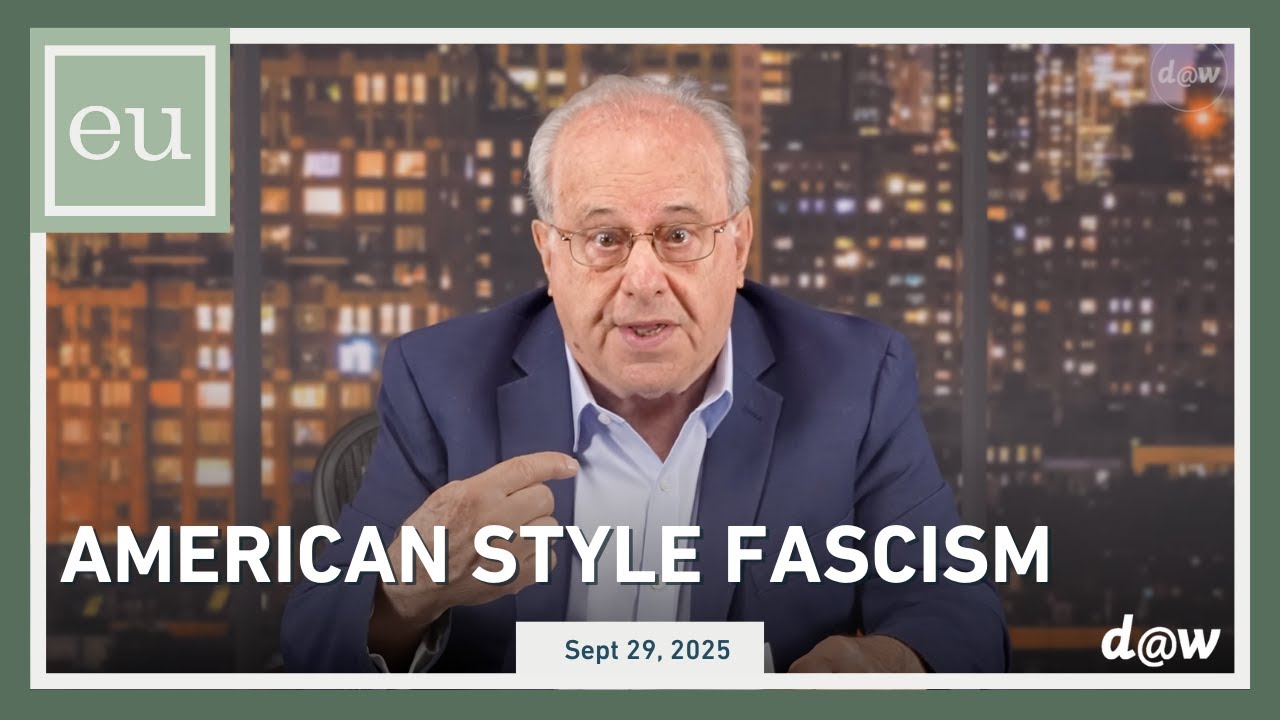
Economic Update: American Style Fascism
In the second half of today’s show, Professor Wolff interviews attorney Michael S. Smith, co-author of the new book, “From the Flag to the Cross: Fascism American Style.”
https://www.amazon.com/Flag-Cross-Fascism-American-Style-ebook/dp/B0FRG3QQV8
Has fascism arrived dressed in stars and stripes? This book offers a sharp analysis of American authoritarianism, how we got here, how to organize, and how to resist.
:{:{"Gangster capitalism," that's how Henry Giroux describes the system where a billionaire class controls the institutions that shape our lives—the media, corporations, universities, courts, and government. But does this centralization of power on behalf of the super-rich mean that fascism has taken over the United States? Certainly, the signs are there: Individuals not charged with a crime are picked up on the street by masked police and "disappeared."}:
Right-wing strongmen like Javier Milei of Argentina or Nayib Bukele of El Salvador are embraced warmly on the steps of the White House. The aptly titled Trump v. United States Supreme Court ruling just handed the president broad immunity for “official acts.” And Elon Musk, the president's unelected scourge of government inefficiency, gave repeated fascist-style salutes at Trump’s inauguration rally. His DOGE have fired tens of thousands of people, and illegally seized private personal data on millions of Americans.}:
So is this fascism, oligarchy, authoritarianism—or all of the above? Is there a special brand of American fascism? And, if so, what direction is it likely to take, and how can it best be resisted? In From the Flag to the Cross: Fascism American Style, seven prominent American socialists explore these questions. They come at the issues from different angles in an enlightening spectrum of opinion. But on one point, they are in unison: Trump is not the disease. He’s the symptom. The real threat is a violent, deeply embedded system—fueled by capitalism, white supremacy, Christian nationalism, and authoritarian rule—that long predates the 47th president.
Contributors: Chris Hedges, Richard Wolff, Dianne Feeley, Henry Giroux, Bill Mullen, Margaret Kimberley, and Kshama Sawant.SEATLE COUNCIL 20 MIN WAGE?
ratner who killed che/ bk
---
fabian
charlie.info438@gmail
jun 2025

---
AN 9 26
Dr. Richard D. Wolff, professor emeritus of economics at the University of Massachusetts Amherst, made it clear in his Thursday afternoon interview that America's elites and ordinary citizens alike are in mass denial about these realities. They continue to remain in this denial at their own peril, he added. Trump's destruction of long-term trade alliances have prompted former US partners to seek better deals elsewhere, slowly but permanently restructuring the global economy against our country's best interests.
Similarly, the Republican Party's indifference to working class woes — perhaps best embodied by Trump's focus on issues of personal interest only to himself and his supporters (renaming the Kennedy Center to include "Trump," building a White House ballroom) and dismissing efforts to build affordable housing as a "yawn" — guarantees that mainstream economic concerns will be inadequately addressed, if they are indeed meaningfully confronted at all.
To learn more, AlterNet had an expansive conversation with Wolff.
ROZSA: I want to start with a comment that President Trump made in June. He was asked by reporters whether he would sign affordable housing legislation, and his exact words were, "It hasn't been sent to me yet. It's coming. I understand. And then I'll make a de - Here's what I would like to say. It's a yawn." What are your thoughts about Trump describing affordable housing legislation as a quote unquote yawn? To what extent does that reflect on the Republican Party as a whole?
WOLFF: Yeah, I think the Republican Party, like Mr. Trump, when it's convenient for him to go along with the Republican Party, which it often is, but sometimes in a very demonstrable way, it isn't. He has his own agenda. It's not exactly the same. But in this case, it is the same. It's a notion that the private sector, in this case, the private sector that constructs housing, is to be left to make the decision of whether or not to build houses for the American people. And if so, which people. And we have a hard economic reality, which the president no doubt knows, which is that for the last 14 years, the inequality in the United States, the gap between rich and poor, has become steadily more and more extreme. And markets follow where the wealth is. That's how markets work.
You produce where you can get the most profit. That's the way the system is set up.
Rich people have the money to buy expensive housing. So that's the housing that the private sector builds, because it's profitable. What they don't build is housing that's affordable for middle and low income people, because it is either less profitable or not profitable at all. And at a time when you have record high interest rates, and remember, corporations are borrowing money all the time. They have to pay more to borrow more. It's expensive to borrow money.
Lumber, because it comes from Canada, is now more expensive in part because of tariffs Mr. Trump put on, and the whole reorganization of the Canadian economy to rely less on the American economy makes the cost of lumber that much higher. You're facing a situation where the costs of housing are rising, and therefore you need to charge more and more money, and only rich people can do that.
And the result is you have inadequate housing, and you have a wild rise in rentals across the country that reflects all that, and a rising cost of owning your own home if you're gonna go that route. Mortgages are now at a record high rate and about to go higher because of the Federal Reserve raising interest rates yesterday. So we're gonna be seeing over 7% mortgage rates become the norm. All of that produces a private sector focused on expensive condos in the rich areas of the country, the New York area, the San Francisco area, all of that. And the massive housing for middle and low income people becoming pinched and becoming more and more expensive. People, young people particularly, cannot afford a home, so they are all renters and there's not enough rental housing being built.
There's no coordinated governmental planning to handle this situation. It's just an unholy mess. And the response of the Republicans and of Mr. Trump to that mess is to wait for the market to sort it all out. Will the market sort it out? It may very well do that. It may, in the process, shift most Americans from owning their own homes to being renters. That process, I believe, is underway. And that will continue for as long as this situation is maintained. And the more the president talks that way, the more he is suggesting that they're not about to do very much, even if there is a bill passed and even if it has a provision here or there to make this situation better. It has already lasted many years. It needs massive intervention to deal with the problem.
None of that is on the horizon. And I think Mr. Trump is basically letting you know that.
ROZSA: Now I want to ask about something you said to me recently regarding our trade war with Canada. You said that you were not surprised that our government is surprised by Canada standing up for itself. You added, "Our government is busy strong-arming people around the world in every way that it can, militarily, economically, politically, and discovering time after time to their amazement if you take them seriously that the folks are going to resist."
As Canada and the European Union and China and these other nations such as the Middle East, as they resist America's bullying, how will that impact ordinary Americans economically?Wolff: It's gonna cause Americans one kind of grief after another. Let's go back and make sure everybody understands. And what that meant was that the United States helped allied countries recover from the war with the Marshall Plan and things like that. But those, the beneficiary countries, including Western Europe and Japan, were markedly contrasted with the countries that got no help at all, Russia and China being the number one examples, because of communist control in Russia, and then after 1949 also in China. And so those countries had to make it, if you like, on their own. They had to recover from horrific war-related damage. I mean, Russia and China probably ranked one and two in the amount of damage done during and by World War II, before, during, and after it, as any countries on earth.
The difference was after the war, they had to rely on themselves. They got no help. And there's a lesson. China is now the economic success story of this period of human history. No country has grown faster over the last 35 years than the People's Republic of China. And the preparation for that was what happened in the decades between their revolution, 1949, and the takeoff, if you like, in the 1980s and '90s that made them the colossus that they are now. Here's what that proves. If you don't work out a relationship with other parts of the world, they don't all go to sleep. They don't all imagine that their lot in life is to be poor forever. They go to work to replicate and to hopefully exceed whatever you've done. The Chinese and now the Russians too are showing that that's a possible way to react.
And that is having enormous impact on the third world, the global south, as they like to be called these days. And what the United States doesn't wanna face is what I just said. And so it doesn't understand that as it goes about bullying other countries, demanding that they invest in the United States, hitting tariffs so that the cost to Americans to buy their goods is raised by the tax we have to give to Mr. Trump and the Washington to have the imports come in. As you do that, you provoke, you incentivize all the rest of the world to get around the difficulties you are imposing on them, just as Russia and China had to get around their difficulties, consequent on the Cold War. And they're doing it. So, to give you just a couple of examples based on what I said to you five minutes ago, the Canadians being hit with tariffs by, and threatened with more by, Mr. Trump, or outright bans on their stuff coming to the United States. And remember, the US-Canada trade relationship was the most important one for both countries.
That their trade with one another outranked their trade with anybody else. You're forcing the Canadians under Mr. Carney to do their version of what the Russians and Chinese did several decades ago. And so they're doing it. And one result is they're gonna sell their lumber to the Europeans who need it. All right, if they're gonna do that, then the lumber is gonna not come south from Canada into the United States. That's gonna make the price of lumber go up and that's gonna make everything having to do with lumber. Every construction project, virtually every one, here in the United States is gonna be more expensive. It's gonna raise your rent, to put it as bluntly as I know how.
In the northern states of the United States, a lot of the electricity comes from Canada. It's electricity generated by water power, by gas and oil that exists under the soil in Canada. That's now not coming here. That's being sold to China and so on. All right, that means that what does come here, either from Canada, if any, or being replaced because Canadian energy is going elsewhere, by more expensive energy sourced in some other part of the world — that's gonna raise the cost of heating, that's gonna raise the cost of gas.
The United States' effort to impose rules on the Middle East has just shown us what can happen to the price of gas or diesel oil here in the United States. Diesel is now selling at, I don't know, twice what it was eight months ago. Gasoline, almost that big an increase.It's affecting Americans in a thousand ways. I've only mentioned half a dozen, but cutting yourself off from the rest of the world is a very expensive proposition. The reason the United States is embroiled around the world is because it was profitable for American companies to do that. They could make more profits if they could get oil from the Middle East, if they could get raw materials from Latin America and Asia, and on and on and on. Now, being unable to do that because you badger and bully your allies so that they do business elsewhere, these things are gonna become more expensive because your companies are gonna have to go elsewhere since they're no longer gonna be welcome in these countries, and on and on and on. This is a dead end, and it's a bad story. It doesn't end well.
And the isolation of the United States at this point, after you've had two or three centuries devoted to integrating the whole world, so that 10 years ago we were boasting that the world is now so terribly efficient because we have global supply chains. Now we discover, voilà, that a benefit can be an albatross around your neck if the conditions change. That's what's happened. The world economy, carefully constructed by capitalism over the last three centuries, is now threatening to throttle capitalism, as the tensions among the capitalist countries explode.
ROZSA: It's interesting that you talk about the world economy being restructured by capitalism and yet simultaneously against capitalism. I think about how President Trump is in some ways destroying the free market. He is talking about which industries should win or lose in terms of his tariff policies. President Grover Cleveland referred to that approach as a "communism of pelf." He is offering $5,000 checks to every adult as long as he wins the midterm elections. He openly allows his cronies to benefit, in ways that show you and I are obviously as far removed from being free-market capitalists as humanly possible. But at the same time, if I were a sincere free market capitalist, I would be horrified because he is definitely engaged in crony capitalism. Would you agree? And if so, or if not, why?
WOLFF: Oh, I think most people who pay much attention would agree. I don't even think that's very controversial anymore. If you pay attention, as I do, to the statements of the United States Chamber of Commerce, you will see — and it's not too subtle either — that they are very, very agitated and worried. They see Mr. Trump buying shares of the Intel Corporation on behalf of the government, taking a position in a dozen other major corporations, getting so close to the high-tech, artificial intelligence and all the rest of it that it's becoming difficult to know where the government ends and the private sector begins. For them, that's all anathema.
That is all apostasy, that's all a departure from the notion that a free-market system is the best system. If it were the best system, then he would be leaving not just a rental business to the private sector, but he would be leaving Intel Corporation to live or die based on its own private market manipulations. Instead, he's funding them and giving the government a say in what happens to them as a result of the government being an owner. So, but I don't think this is unusual. The three centuries, 17th, 18th, and 19th, were the centuries when capitalism's major achievement was the world economy, as they organized every corner of the globe into colonies of Europe, North America, and Japan. And they created a very lopsided, unequal world economy to their everlasting shame. But they did at least weld the economy together, making a center to which the wealth was collected and a periphery from which the wealth was taken. Okay, how did this end up? It didn't end well. It ended when the colonial countries went to war, World War I, and then again, World War II, destroying every single one of them in the process with one exception, the United States.
It benefited because air power hadn't been developed far enough, so the Atlantic and Pacific Oceans protected the United States from the mutual slaughter that the Europeans and the Japanese imposed on one another. So the end of capitalistic colonialism was the end of colonialism. Within a very short time after 1945, all of the old empire was gone. The British lost India, the French lost Indochina, and on and on and on and on. But the irony of ironies was, one country, the United States, inherited all of the global empire's results. Three centuries of colonialism handed over when those countries couldn't hold onto their colonies anymore, handed over to the one country that could try to run a global empire, unified, therefore bigger than anything the British, French, Germans, or Spanish had ever been able to do. That's been the life you and I have led.
We were born into this really odd moment when the United States was the global, singular, colonial power left, which could and did replace all the other colonial authorities with nominally independent governments, but that were, in reality, and particularly economically, utterly dependent on the United States, which dominated after 1945 in a way no other country ever did the globe. And we've been experiencing now the end of what everyone should have understood was a highly artificial temporary period of American history. Had they understood that, they wouldn't be as bereft of solutions as they now are as this singular empire dissolves all around them.
ROZSA: I have one final question. To what extent is the dissolution of America's supremacy the direct result of Trump's policies, and to what extent was it the inevitable consequence of variables that preceded Trump's ascension?
WOLFF: Mostly the latter. Mr. Trump isn't that powerful, never was. He's the latest in a long line. He's interesting because, being toward the end of this whole process — he has, in part, that's why he was elected — he's a bit more honest, a bit more blunt, a bit more transparent about all of this than the predecessors. If you look even now at the leadership of the Democratic Party, they still live in the fantasy that the United States occupies the same position now that it did, for example, in the 1980s and '90s. It doesn't. It's over. The empire is dissolving. You can't win in Iran. This desperately poor Middle Eastern country has stalemated you, the ostensibly most powerful in the world. Read what's going on. It is incredible. And it isn't just about Iran. It could have been anywhere else.
The point is, it's happening, and these poor countries, especially now with the alliance they have with Russia and China, they have the capacity to tell the United States, "No, you're not gonna get this. No, you're not gonna be able to do that. No, you're gonna have to share your power. You're gonna have to share your economic power." Mr. Trump is going to try to bomb his way, genocide his way, be Mr. Tough Guy and reverse all of this. It's not gonna happen. It's not within the capability of the United States. And that reality is impressing itself, but not surprisingly, it has the problem of massive denial. What population ever experienced the decline of its empire without a fairly long period of denying the inevitable, denying the very decline that was shaking them to the core? And that happened in Greece and Rome and the Ottoman Empire, Persian Empire — it's happening to the American Empire.
And so, you know, Chuck Schumer — I cannot imagine him saying what I've just been saying to you. That would be unpatriotic, or whatever goes through that tiny mind there. And so he's gonna say what it is that got him to his position now. You're seeing it in the leaders of Europe too. The Macrons, the Merzes, the Starmers. These are all people talking as though their countries still are the center of the world. It's over. They haven't been the center for a hundred years now. They still hold on to the delusion that they are. Americans make fun of them because of it, not realizing that they're replicating it.
-=-=
no lnx orig an 8 23
How capitalism is leading us to instability, inequality, and fascism
Richard D. WolffandIndependent Media InstituteOctober 14, 2020
The looming election has brought forward intensifying debates over a capitalism in crisis, rising nationalism and state power, and the possibility of a renewed fascism. Polarized politics and ideologies alongside long-accumulated social problems and movements shape the objects and tones of debate. Can fascism happen here; is it underway? Or can current capitalism avoid a return to fascism?Such questions reflect the high stakes of the election and this moment in history.
Should the state—the institution that organizes, enforces, and adjudicates the rules governing our behavior in society—exist in capitalism? That question has been important chiefly for certain ideologues who defend capitalism. Their major idea is that the problems of modern society are caused by the state. They are not caused by the employer-employee structure of capitalist enterprises or the markets, unequal distributions of wealth, and other institutions those enterprises support. Those ideologues imagine a pure, perfect, or good capitalism undistorted by any state apparatus. The capitalism they seek to achieve is very utopian. They conclude that by reducing the state (bad by definition), modern capitalism's problems can also be reduced. By eliminating the state, a thereby purified capitalism will solve those problems. From libertarians to Republican Party hacks, this ideology serves to deflect the justified resentment and anger of capitalism's victims away from capitalism and onto the state.
A contrary view holds that the state always existed throughout the history of societies in which the capitalist economic system prevailed. In them, the state—like other institutions—reflected each society's particular conditions, conflicts, and movement. The capitalist economy rested on a foundation of enterprises whose internal organization divided participating individuals into a minority (employers) and a majority (employees). The minority owned and operated the enterprises, making all of its basic decisions: what, how, and where to produce and what to do with output. The majority sold its labor power to the minority, owned little or nothing of the enterprise, and was excluded from the basic enterprise decisions. One result of that basic economic structure was the existence of a state. Another result was a pattern of state interventions in society that reproduced its prevailing capitalist economic system and the employers' dominant position within it.
Of course, the many internal contradictions of societies in which capitalism prevailed also influenced and shaped the state. Employees, for example, could and often did press the state for interventions that employers did not want. Struggles over the state and its interventions ensued. Individual outcomes varied, but the pattern that emerged over time was a state that reproduced capitalism. Likewise, in pre-capitalist societies such as slavery and feudalism, parallel patterns characterized their states. For considerable periods, those states also reproduced their class structures: masters and slaves in slavery and lords and serfs in feudalism. Usually, when a state no longer reproduced a particular class structure, its end was near.
The evolving conditions and conflicts in each society determined the size, activities, and history of its state. This includes determining whether state power is decentralized, centralized, or a mix of both. Social conditions and conflicts also determined the closeness, the intensity of collaboration, and even the possible merger between the state apparatus and the dominant class within each society. In European capitalism, initial decentralization gave way to a strong tendency toward state centralization. In certain extreme conditions, a centralized state merged with a capitalist class of large, concentrated employers into a system called fascism. The 20th century saw several major examples of fascism rise and fall. Now again fascism looms as a possible resort of capitalisms in trouble.
Usually, the transition from decentralized to centralized states reflected social conditions in which dominant classes needed strengthened state power to reproduce the system they dominated.They feared that otherwise, social conditions would provoke a collapse of their system and/or movements to a different economic system. In either case, their social dominance was at stake. Because that situation now looms on our historical agenda, so too does fascism.
Slave systems could persist in decentralized conditions. State power, perhaps localized within each slave master's hands, oversaw the reproduction of the system's two production positions: master and slave. Eventually, when reproduction was threatened—by disruptions to slave markets, slave revolts, or divisive struggles among masters—a separate state was created, given an apparatus, and strengthened. It often had slaves of its own ("state" slaves we might differentiate from "private" slaves owned by persons outside the state). Such a strengthened state was often more closely integrated with masters in a tighter, more coordinated reproduction of slavery. Violence by masters and the state conjointly against slaves recurred often.
In decentralized feudalisms, lords wielded state-type powers alongside their economic positions directing production by their subordinated serfs. Eventually, when pandemics, long-distance trade, serf revolts, or divisive warfare among lords (as dramatized in Shakespeare's plays) threatened feudalism, a centralized state arose from among contending lords. That state—a supreme lord or king—shared social power with the hierarchy of what we might call "private" lords to reproduce feudalism. In medieval Europe, strengthened feudal states evolved into absolute monarchies. Those were tight alliances between kings and hierarchies of lords within boundaries defining different nations. Those tight alliances deployed violence against serfs, serfs' revolts, rebellious lords, external threats, and one another.
Capitalism, like its slave and feudal predecessors, emerged in small, decentralized units of production. Capitalist enterprises, like slave and feudal production units (plantations, manors, or workshops), also displayed a system of two basic production positions. In the case of capitalism, those two positions were employer and employee. The differences were that in capitalism, no person owned another (unlike slavery), nor did one person owe religiously sanctioned labor obligations to another (unlike feudalism). Instead, a market in labor power was established over time. Employers were buyers and employees were sellers in a market exchange.
When problems eventually threatened the reproduction of early capitalism, it strengthened its state apparatus much as slavery and feudalism had done. One such problem was opposition by centralized slaveries and feudalisms to the capitalism that had emerged from them. Likewise, as capitalism grew and expanded across the globe, it disrupted other systems in ways they resisted. Violent interventions by strengthened state apparatuses subdued and reorganized them into what eventually became capitalism's formal and informal colonies. Such interventions encouraged a strong capitalist state and vice versa. The demands and revolts of employees also drove capitalists to construct state apparatuses that could discipline and suppress them. Likewise, "cutthroat" competition among employers required a powerful arbiter to manage and control them.
Even as capitalism spawned a strong state, there was a remarkable hesitancy in doing so that has confused the history of capitalism to this day. The hesitancy arose because early capitalism—the period when emerging capitalist enterprises were relatively small and hampered by powerful slave or feudal states—saw those states as its enemy. Capitalists and their spokespersons wanted the state kept out of the economy, blocked from favoring noncapitalist over capitalist enterprises. They wanted capitalist enterprises and the markets they increasingly dominated to be left alone by the state. Hostility to and thus hesitancy about strong states went from advocating "laissez-faire" in the 17th century to celebrating "the free market" in modern times. In the latter form, it is utopian, an imaginary construct useful for ideological projects justifying capitalism (as "efficient") and for libertarian slogans. No actual capitalism in recent centuries ever had a free market without state interventions and regulations.
From the 18th through the 20th centuries, capitalism spread globally from its initial centers in western Europe. The state was crucial to that spread via warfare ("opening" regions to trade) and colonizations.Conflicts among capitalists, especially the endemic struggles between competitive and monopoly capitalists and between capitalists from different nations, necessitated state interventions. Capital-labor conflicts and battles were always goads to state strengthening and interventions. Massive standing military establishments, routinized after World War II, generated military-industrial complexes. Those complexes, especially in the leading capitalist and military power after 1945, were just the kind of mergers of state and big capitalists that became models for parallel mergers among other industries and the state.
In the United States, one such parallel merger yielded the medical-industrial complex. There the role of the state was to protect a monopoly shared among four industries: doctors, hospitals, drugmakers and medical device-makers, and health insurance companies. The government enabled and sustains its merger with the medical-industrial complex. It does so in multiple ways. It exempts the complex from antitrust action. Government-subsidized Medicare and Medicaid—public health insurance for the elderly and the poor—carefully leave the younger, healthier, and more profitable clientele to the private health insurance companies. The government avoids buying pharmaceuticals in bulk and passing savings onto the public. Finally, the government has usually blocked and mostly denounced genuinely progressive reforms of this privately profitable medical system as "socialism."
De facto, if not de yet de jure, mergers of state and capitalist industry punctuated the growth of state power alongside the concentration and centralization of capital.
Now we have much the same happening in finance. Central banks—largely state institutions—long marched in close formations with major private banks in capitalist countries. The Federal Reserve has responded to the three capitalist crashes so far this century by not only greatly increasing its money creation and interest rate reductions but also by extending credit to nonfinancial corporations. The Fed buys corporate bond exchange-traded funds, corporate bonds in the secondary market, and asset-backed securities based on corporate debts. The Fed likewise now owns a third of residential mortgages. Government credit becomes ever more important relative to private credit. The government will soon coordinate its decisions on who gets how much government credit with other government policies including which Chinese companies get banned and which European companies get sanctioned. These financial developments mark more milestones on the road to state-capitalist merger.
Behind the racism, nationalism, and war-mongering that Hitler championed lay the core economic system of fascism. That involved a merger of the state and private big capitalists. The former enforced the conditions of profitability for the latter. In turn, the capitalists accommodated the running of their enterprises to finance, produce, price, and invest in ways supportive of the fascist state's policies. Expropriation of privately owned means of production targeted selected social sub-groups (such as Jews). Aryanization—not abolition—of private capitalism was the state's objective.
In contrast, socialists favored the socialization of private capitalists' enterprises.It was not the merger of the state with private capitalism that socialists sought; it was rather the dispossession of private capitalism. The state was to seize sole possession of means of production to operate a state capitalism. Most socialists saw state capitalism as an intermediate stage necessary to enable the transition to communism. That communism was understood as capitalism's antithesis: social (not private) property in means of production, government planning (not markets) to organize distribution of resources and products, workers' control of and running of enterprises, and distribution of output based on need as socially determined.
Fascism's economic organization is where economic development is now taking capitalism in general and U.S. capitalism in particular.U.S. capitalism now replicates a parallel tendency toward merger with a strong state that characterized slavery and feudalism earlier. Systemic challenges to capitalism's reproduction are met with growing state power, growing big capitalist business, and eventually their merger into a fascism. Exactly how and when capitalism evolves into fascism varies with the particular conditions and challenges of each national context. Likewise, the internal contradictions of capitalism—for example, its cyclical instability and its tendency toward deepening wealth and income inequality—can provoke mass resistances that can slow, stop, or reverse the evolution, at least for a while, or even redirect economic transition to socialism.
But the tendency of capitalism is toward instability (its cycles), inequality (its upward redistribution of wealth), and fascism (state-capitalist merger). The first 20 years of this new century display these tendencies in stark relief.
This article was produced by Economy for All, a project of the Independent Media Institute.
FROM YOUR SITE ARTICLES
Here's what happens when capitalism goes to war on democracy - Alternet.org ›
From climate change to creeping fascism, any 'return to normal' would be disastrous for America - Alternet.org ›
How the American craving for fascism persists - Alternet.org ›
How monopoly was invented to demonstrate the evils of capitalism - Alternet.org ›
Why capitalism should abandon its 'secular religion around markets' - Alternet.org ›
Shaping the public narrative: The Military-Entertainment Complex - Alternet.org ›
Worldwide fascism is being accelerated by the one thing few people want to talk about - Alternet.org ›
---
https://www.alternet.org/2021/02/global-economy/
shift in cap caps'l?
---
-=-=
iran war 3 econ efx 9 26
U.S. Empire in Decline: Richard Wolff on Iran War, Rising Inequality, $40T National Debt & More
-=-=
imi AN 2 23
The inflationthat plagues the United States and beyond results from a decision made by employers. Within the larger population, the employer class (under 2-3 percent of that population) controls the prices of goods and services. Each member of that class decides when, where, and how much to raise the prices of what that member sells. The employer class excludes the employee class from participation in its pricing decisions. Employers in banks and most other lending institutions likewise control interest rates: the “prices” charged for lending money. Employers comprise a tiny percentage of the American people while employees form the vast majority. The self-employed are a small minority between employers and employees.
This article was produced by Economy for All, a project of the Independent Media Institute.
Prices are what employees pay to employers. Wages are what employers pay to employees. Throughout the current U.S. inflation, prices rose considerably more than wages. The inflation thus worked, like so much else in U.S. capitalism, to redistribute wealth from employees to employers. Struggles over price and wage inflations are very much class struggles.
The employer class wields great influence over wages and salaries paid to the employee class. True, the classes have to bargain a bit. But with only about 10 percent of employees unionized in the United States, employers’ wealth and organization give them much more power to set individual wages and salaries than employees can wield through bargaining. Employees can quit individual jobs, but they rarely escape their class position. Most of those who quit will then have to submit to some other employer to survive. Employers, on the other hand, can respond to workers’ demands for higher wages or salaries in multiple ways: They can automate (replace workers with machines), relocate production (to other places where workers accept lower wages), or turn to immigrants or others willing to work for less. Employers can also close down production for a while to teach employees a basic economics lesson. In capitalism, the prevailing power is in the hands of the employer class. The employer class prefers capitalism because capitalism prefers it.
The class of employers wields a kind of dictatorial power. Employers are neither elected to their position by employees nor accountable to them. Small and medium employers are mostly accountable to themselves (and partly to taxation and regulatory departments of governments with regard to some decisions). Corporate employers—boards of directors—are elected not by employees but rather by shareholders. Shareholders do not elect boards of directors democratically (one person, one vote). Rather shareholders have as many votes as they own shares. The richer the shareholder, the more votes they have.
Because the richest Americans own the bulk of the shares (the 10 percent of the richest own 80 percent of all shares), their votes choose the employers. Not surprisingly, over the decades, those with the most wealth have largely joined the employer class. Corporate boards often found it advantageous to add rich shareholders to their boards. Rich shareholders, likewise, often found it useful to join the boards of corporations they owned. The children of corporate directors and major shareholders attend the same schools; often live in the same towns, cities, and neighborhoods; and often intermarry. Employers donate to politicians to make sure that their taxes and government regulation are minimized. “Regulatory capture”—when those ostensibly regulated control the regulators—is the capitalist norm. It has been the way to offset the occasional ability of employees to act collectively through the state to enact pricing regulations and other key enterprise decisions, which are otherwise made exclusively by the employer class. The top politicians and government regulators are drawn, in the main, from the ranks of the top employers. The United States has normalized and routinized these class formations and differentiations for a long time.
In the century after the U.S. Civil War, the employer class congratulated itself for the rise of the U.S. economy and empire against the accumulating difficulties of the British Empire. The remarkable upswing of white Americans’ standard of living led the employer class to claim not only that its profits caused “prosperity for all” but also that capitalism was the best possible economic system and American capitalism its greatest expression.Employers and their ideologues invented the notion of “American exceptionalism,”based on a particular interpretation of Adam Smith’s work. That interpretation’s logic held that because the U.S. facilitated the highest profit maximization for each employer, the economy was able to achieve the greatest wealth and growth, as if led by an invisible hand to that happy outcome. By the time Milton Friedman repeated that interpretation, U.S. capitalism was peaking. The beginning of its decline moved the employer class into a new and increasingly uncomfortable social position.
Since the 1970s, U.S. capitalism has delivered stagnant average real wages to the employee class. With productivity rising, that stagnation meant that growing output accrued chiefly to employers as rising profits. This situation would likely have crashed U.S. capitalism (as such situations have often done around the capitalist world) except for the explosion of consumer credit during the same period. The soaring profits enabled by stagnant wages were partly lent back to the employees who borrowed to buy homes and cars, use credit cards, and afford costlier higher education. They were only able to afford all this by carrying ever larger debt loads. Employees’ standard of living could only rise (seeking the “American dream”) on a foundation of rising debt. Employees henceforth produced not only profits for their immediate employers but also interest for the financial employers from whom they borrowed. The United States entered a period of rapidly growing inequality of income and wealth favoring the employer class.
Rising household debts became increasingly costly and anxiety-provoking as stagnant real wages moved them nearer to unsustainability. This eventually led to the credit system collapsing, and the 2008/2009 Great Recession ensued. Beyond its massive economic losses of wealth, the Great Recession saw a policy response of record low interest rates. That rendered minimal the carrying charge for the massive old and new debts. Cheap credit was desperately needed not only to cope with and get beyond the Great Recession but also to soften the impact of U.S. capitalism’s transition from exceptional growth to plateauing on credit to post-2008 decline.
Underlying wage stagnation and deepening inequality led to much greater questioning of capitalism.At first, it could not be spoken as such. Even Occupy Wall Street in 2011 dared not foreground a clear, anti-capitalist position. But Senator Bernie Sanders’s (I-VT) campaigns raised socialism’s profile sharply and quickly. The emerging consciousness was more a matter of anti-capitalism than an endorsement of Bernie’s very moderate socialism. In the last few years, capitalism has returned to the realm of daily acceptable discourse as it had been before the Cold War, albeit more for its critics than its defenders.
Along the way, anti-capitalism has also provoked a shift in the definitions of capitalism.Across the 20th century, capitalism was private property and markets, while socialism and communism were public property and central planning. After the shifts of the 1970s and 1980s—the collapse of the USSR and the above-discussed decline of U.S. capitalism—definitions changed. Capitalism became more closely associated, definitionally, with the employer-employee dichotomous organization of enterprises than with who owned them and whether the distribution of resources and products took place through the market or by plan. Socialism likewise shifted from a macroeconomic focus on the state as an owner and planner to a microeconomics focus instead on a different, democratic organization of enterprises along the lines of worker cooperatives.
These shifts reflected a shifting mass consciousness that looks to hold employers socially responsible for what they do as a class. The environmental movement was particularly important in targeting fossil fuel and other employers for their decisions. The #MeToo movement helped bring greater accountability against sexual misconduct in the workplace and beyond. More and more through to the present, the employer class and its dominance within capitalism have become the target of those seeking progressive social change. For capitalism’s victims and critics, the buck stops not with the political and governmental leaders viewed as puppets, but rather with the employer class viewed now as the puppeteers.
What comes after capitalism—what its critics claim as their goals—are less matters of state versus private property or planning versus markets. Rather it is the democratization of the workplace that critics cite as a crucial element missed by generations of social critics. That democratization of enterprises—their transformation into communities of equals—is understood to be required for a democratic society to exist and persist. Capitalism’s defining class struggle has always been that between the employer and employee classes. And the victory of the latter ends that dichotomous organization of workplaces (factories, offices, and stores) that grounds and defines capitalism’s class structures and struggles. Indeed, the victory of the employee class could thus finally close the sequence of all those dichotomous class structures (master/slave and lord/serf).
Author Bio: Richard D. Wolff is professor of economics emeritus at the University of Massachusetts, Amherst, and a visiting professor in the Graduate Program in International Affairs of the New School University, in New York. Wolff’s weekly show, “Economic Update,” is syndicated by more than 100 radio stations and goes to 55 million TV receivers via Free Speech TV. His three recent books with Democracy at Work are The Sickness Is the System: When Capitalism Fails to Save Us From Pandemics or Itself, Understanding Marxism, and Understanding Socialism.
---
https://www.alternet.org/2022/08/capitalism-abandon-secular-religion-markets/
Markets are one way of distributing goods and services from producers to consumers. They are established when divisions of labor occur in communities rather than having each person or family produce all that it consumes. Markets involve quid pro quo exchanges between those seeking to sell and those seeking to buy goods and services. Alternatives to markets always existed and also do now. Councils of elders, chiefs, local governmental authorities, religious authorities, and various cultural traditions, separately or together, have distributed products from producers to consumers, deciding who gets how much. Within households or families, kinship rules, including patriarchy and matriarchy, have organized the distribution of products from producers to consumers.
The market mechanism is very simple: People with wants or demands engage with people who own the goods and services. Owners enjoy the right to sell what they own if those who want it—prospective buyers—offer in exchange something the seller seeks to acquire. The two owners, one on each side of the exchange, bargain or negotiate over the precise terms of the exchange: what quantity of one item equals the quantity of the other item being traded. If and when a ratio of exchange (a price) is reached that both sides accept, the exchange is made. The market is thus “cleared.” It has successfully distributed the products to consumers.
The problems with the market system of distribution arise immediately once one asks how the market manages distribution when sellers and buyers arrive with very different plans for what they have to sell and what they wish to buy. If—for any reason—buyers seek to acquire 100 of any item while the sellers have only 50, the markets will respond in a very specific way.
Word spreads that a “shortage” of the item in question exists; demand for the item exceeds its supply in the market. Buyers immediately compete for the item in short supply by bidding up the prices that they can offer for it. As prices rise, the poorest buyers drop from the bidding as they cannot afford the higher prices. If, nonetheless, prices keep getting bid up, the buyers who have slightly more purchasing power than the poorest also drop out because they too cannot afford the higher prices. Eventually, the number of buyers is down to 50, the shortage is declared over, and the price stabilizes at whatever higher level was needed to equate the demand to the supply. Exactly the reverse happens when demand is lesser than supply.
The market mechanism thus distributes any item in relatively short supply (short relative to demand) in a manner that discriminates against those with little or no wealth relative to the rich. Markets are in no way neutral to or “above” conflicts between the rich and the poor. Of course, the seller in this case might have chosen not to raise prices and instead to have produced or ordered more products to sell. Free enterprise capitalism leaves in the hands of employers (under 1 percent of the population) the decision of whether to respond to supply shortages by raising prices (causing inflation) or raising production. Employers make their decision based on what profits they thereby gain or protect. The rest of us live with the consequences of their decision. These days employers seem to be profiting from inflation.
Defenders of markets retort that the rising price is how the market “signals” to producers to manufacture more so that they can tap into the high profits generated by high product prices. However, this “signaling” feature is well-known to all employers. They know that if they were to respond to the signals by producing or ordering more, the high prices and profits they are enjoying would quickly disappear. So the employers often exhibit no rush to produce more. And as high prices proliferate through the market system, more and more sellers begin to explain and excuse raising their prices because their “costs have risen.” The rest of us watch this spectacle of employers profitably using one another as an excuse for the rising prices even as they collectively impose inflation on the rest of us.
Capitalists long ago learned that they could profit by manipulating both supply and demand to create or sustain “shortages” that would enable them to get higher prices. Capitalism created the advertising industry to boost demand above what it might otherwise be. At the same time, each industry organized to control supply (via informal agreements among producers, mergers, oligopolies, monopolies, and cartels). Social conditions and changes beyond the control of capitalists require them to constantly adjust their manipulations of demand and supply. In reality, markets are useful institutions for capitalists to manipulate for profit. In ideology, markets are useful institutions for capitalists to celebrate as somehow ideal-for-everyone pathways to optimal efficiency.
Looking for, finding, and taking a job offer is also handled by markets in modern capitalism. If working-class people looking for jobs outnumber the available jobs, employers can lower wages knowing that desperate people will often take lower wages than risk going without wages. That process repeatedly went so far that it provoked a backlash. Workers demanded and won a legally enforced minimum wage. Employers mostly fought and opposed minimum wage laws and, once such laws were implemented, most employers resisted raising the minimum wage, often successfully. The U.S. federal minimum wage rate of $7.25 per hour was last raised in 2009. Employers also encourage automation (replacing jobs with machines), relocating jobs abroad, and bringing in immigrant workers. These steps involve several levels of manipulations of the job market’s supplies and demands to the end of slowing, stopping, or reversing wage increases. Employers manipulate labor markets, like product markets, for profit.
Another market handles loans. Lenders and borrowers negotiate an interest rate they can agree on to enable the credit to be given and the corresponding debt to be incurred. These days the central bank of the United States, the Federal Reserve or the Fed, is raising interest rates to slow or reverse the inflation it failed to prevent or slow over the last year. That raises the cost of all borrowing (for mortgages, car loans, credit cards, and more). Once again, the poorest among us feel the pain the most, followed by the middle class. Higher interest rates are likely to bother the rich less. Also, the rich, who are themselves lenders in many cases, tend to benefit from higher interest rates.
The Fed could have pressed President Joe Biden to follow former President Richard Nixon, who in 1971 imposed a wage-price freeze to stop inflation then. He decreed and enforced that the market would not be able to influence and set prices for a while. Doing that again now would at least discriminate less against the poor and middle class, instead of protecting the rich. One might have expected that from the Biden regime, which controls both houses of Congress, but market-fetishizing and neoliberalist thinking and policy seem to rule both, the U.S. Senate and House of Representatives.
The employer class itself often suspends and displaces markets. When the profitable manipulation of markets becomes too costly, capitalists often merge with or acquire one another. The external (to each enterprise) market relations between them then disappear. In their place, directly planned internal (to the enterprise) production and distribution of goods and services occur without exchanges.
Markets existed long before capitalism, but capitalism, as Karl Marx noted, made them ubiquitous, almost universal. Capitalism also raised and praised markets—and their prices—to give them an ideological importance, which leaned toward the absurd. As R.H. Tawney so brilliantly showed in his Religion and the Rise of Capitalism, early European capitalism had to fight hard to displace the notion of a “just” price inherited from the medieval Catholic Church. The “just” price—consistent with God’s laws and Christ’s teachings as interpreted by the church—differed often from the “market price” that equilibrated supply and demand. To win in that fight, defenders of capitalism found it useful to build a kind of secular religion around markets and their equilibrium prices, attributing God-like qualities of efficiency, fairness, and other similar attributes to them. However, as capitalism sinks into ever deeper trouble, it is time to topple false Gods as part of the process of finding our way to better institutions, and indeed to a better system.
---
https://kpfa.org/episode/economic-update-march-4-2022/
when capitalism [democ?] is under threat, as in 1929, fascism often chosen option
---
---
an 3 22
The growing disconnect between the capitalist system and the economic realities plaguing the United States is now nearing completion. On the ground, the accumulated problems of U.S. capitalism undermine its empire and challenge its very future. Meanwhile, the ever-deepening inequalities of wealth and income conjure up images of ancient Egypt’s pharaohs. Three economic crashes opening the new century (2000, 2008, and 2020) have shaken the system; so have the two wars America lost against very poor countries in the Middle East: Afghanistan and Iraq. The worst public health crisis in a century during the COVID-19 pandemic has further exposed how unprepared U.S. capitalism was and is, thereby imposing massive new human and financial costs lasting into the future.
A government that serves U.S. capitalism first and foremost borrowed trillions and enabled trillions more of new debt (corporate and household) that was used to fight long, losing wars and shore up a faltering economy. Now, after two terrible years of COVID plus an economic crash, with 3 million fewer jobs in 2022 than before COVID hit, a sharp inflation looms.Meanwhile, aided partly by profit-driven U.S. capitalists who moved their operations to China, the Asian country is now in a position where it is challenging U.S. capitalism globally.
Above the troubled ground sit two old political parties, the GOP and the Democratic Party, which are formed by and are stuck in the old political economy before all these problems accumulated into crises. From 1820 to 1970, U.S. capitalism experienced cycles, but these cycles were securely anchored in a long-term upward trend. Real wages rose every decade, at least for white workers. Recessionary downturns only interrupted the long trend up (and even then not for long). The Republican Party and the Democratic Party rarely went beyond the routine rituals of orderly contests over who deserved the credit for economic growth and who deserved the blame for the interruptions during recessions.
The one big exception resulted from the one super big interruption: the 1930s Great Depression. This shook U.S. capitalism to its core. Mobilized and led by a coalition of militant unions (CIO), socialist parties, and a communist party, the U.S. working class shifted sharply to the left. This shift won a New Deal from the administration of President Franklin D. Roosevelt. That deal taxed corporations and the rich significantly more. It then poured much of those funds into the new Social Security system, unemployment compensation, and a massive federal jobs program. Because of the New Deal, Roosevelt was reelected three times, and was the most popular president in U.S. history. Correspondingly, U.S. corporations and those they enriched felt seriously threatened during this period.
The GOP reacted strongly. Once FDR died and World War II ended, the Republican Party took the lead to undo the New Deal. It did this by splitting the coalition (which included the CIO, socialists, and communists) from the Democratic Party and the coalition partners from one another. Anti-communism, McCarthyism, and the Cold War served as the weapons of choice for the Republican Party. The GOP succeeded partly because the Democrats offered mostly weak opposition or none at all. Postwar Democrats were largely complicit in destroying most of what the New Deal had achieved (with the help, ironically, of many of the Democratic Party’s own prewar efforts). After 1945, the White House, Congress, and state and local governments resumed orderly political contests between the GOP and the Democratic Party. Both endorsed a musical chairs type of rotation of public authority personnel between them (until this system was undone by former President Donald Trump in 2020).
The old, established leaders of both parties still do not grasp or accept that the orderly rotation of public authority personnel is now over. Unable or unwilling to critically evaluate U.S. capitalism, these leaders missed the signs leading up to the accumulation of capitalism’s problems that now overwhelms them. The Bushes, Clintons, President Joe Biden, and their ilk want the old political system to persist. After all, for them this old political system did well. But now their disconnect from the capitalist reality that ultimately controls them threatens to render them blatantly ineffective, sadly out of their element. Because they cannot or dare not criticize that reality, its increasing difficulties and resulting mass disaffection are beyond their reach with the old tools, arguments, and spins that used to work.
Given the disconnected mainstreams of U.S. politics, mass disaffection provokes escapism and scapegoating. The GOP eagerly validates many of them (anti-immigration, white supremacy, quasi-fascism, culture wars, and anti-leftism) to enlarge its voter base. The Democrats, meanwhile, try to fight the extreme forms of that escapism and scapegoating (as in “basket of deplorables”) without offering any real alternative to it. The socialism represented by politicians like Senator Bernie Sanders (I-VT) and Representative Alexandria Ocasio-Cortez (D-NY) is so soft-pedaled by them that, given mainstream media biases, it only marginally hovers at the edges of the national political conversation.
What people increasingly need is protection from a beleaguered capitalist system itself, from its intrinsic instability (the accumulated crashes and their effects), intrinsic inequalities of wealth and income (and their effects), devastating ecological damages, and profit fetishism. But the GOP and the Democratic Party have long ago lost the ability to see or contend with any of that. They keep repeating neoliberal ideology (and its reframing of a U.S. empire as “globalization”) so often that they actually believe and are thereby imprisoned within the system.
Thus, a peculiar political theater of disconnectedness has emerged. The Republican and Democratic leaders cannot see what most of us can. They see “the big issues” as not being about capitalism. Yet what they do see and the solutions they propose will in fact be their response as capitalism’s crisis deepens. Thus, under Trump, the Republican Party has moved toward fascism. His GOP has used and will continue to use government to enforce capitalism as it totters by extinguishing what remains of unions, crushing the left, and militarizing media and culture, much as other dictators have, including Adolf Hitler in Germany after January 1933 and Benito Mussolini in Italy after October 1922. Like them, Trump has used hyperpatriotic nationalism mixed with racial superiority to justify all his actions. That is the real meaning behind Trump’s campaign slogans and his audiences’ cheers of “save America” and “Make America Great Again.” How far down the German and Italian fascist paths Trump and others like him will go depends on circumstances.
Capitalism’s crisis exists neither for Biden nor the Democratic establishment he leads, just as it does not for Trump and the GOP. The Democratic establishment defines itself over and against Trump. It is not about to go down the fascist road. It proposes instead to “protect democracy” from what Trump represents. That difference will frame many electoral campaigns in 2022 and 2024; it already does.The Democrats will “protect democracy” by “returning to the pre-pandemic normal.” The Democratic Party’s version of “Make America Great Again” is a resurrected post-World War II political economy, complete with U.S. global dominance based securely, they imagine, on a fast-growing U.S. capitalism.
Both the Republican and Democratic establishments warn their megadonors and the public that allowing the other to take political power will disrupt civil society and prevent America from becoming great again. The GOP screams that antifa and the Black Lives Matter movement will destroy white America and will result in a civil war. The Democrats counter that Trump and January 6 type “insurgents” will dissolve social peace inside the United States, provoke counteractions, and thereby lead to civil conflict. Social peace, each side insists, requires political war to defeat the other side. Neither side glimpses the absurd contradiction of its claims.
Which way U.S. politics will go depends less on the two parties or their disconnected rhetoric. What matters far more are the actualities of U.S. capitalism as the U.S. empire continues to decline and U.S. capitalism’s accumulated problems worsen. These latter factors will determine how the public views the parties’ disconnected policies. Today’s inflation offers an example of this. As a further slap in the face of the U.S. working class who have dealt with two years of economic crash plus the health catastrophe of COVID-19, inflation and the rising interest rates aimed to stop it will ultimately shake capitalism and shape politics.
How many angry working families will now sympathize with a politician who offers big changes versus a politician who offers “stay the course”? The business community wants inflation stopped. The responsive Fed will thus resort to quantitative tightening and raising interest rates. The responsive Biden will applaud the Fed. Those Fed actions can and likely will threaten jobs.So Biden must choose between the electoral risks of inflation versus those of job deterioration. That is the risky dead-end “choice” that the problems of capitalism will dump on Biden. And if 2022 proves to be the year when capitalism’s crisis breaks into the explicit open, will most Americans tilt toward Trump-type fascism or the “democracy protection” offered by the Democrats to protect themselves from capitalism’s crisis?
Hitler’s and Mussolini’s fascist solutions to crises in their nations’ capitalisms did not end well. Yet today’s leading U.S. capitalists seem not to know or care about historical precedents. They continue to perform their disconnected politics comfortably, oblivious to the imploding capitalism and the resulting damage to Americans. In that, they resemble the upper classes in Russia (up to 1917), in Germany (up to 1933), and in Italy (up to 1922). The most important questions thus become whether or not and how soon a new left can emerge that targets capitalism per se, proposes an alternative system, and charts a transition to this alternative system.
---
1 22
an
the declines of U.S. capitalism and of its imperial position provoke fear among its mainstream politicians. Their response, in large part, has been to deny that any such decline is happening. These politicians do this partly by acting as though the U.S. remains in the globally dominant position it occupied in the second half of the 20th century. Thus, to maintain this illusion, they start wars in the Middle East, maintain military bases in dozens of countries, intervene in other countries at will and describe the U.S. as the global guarantor of peace, security, and democracy.
Yet these U.S. politicians also sense what the population feels: that decline of capitalism and U.S. hegemony is actually happening.So repeated denials, while comforting the citizens of the country, do not suffice to control popular opinion and thereby common sense. Mainstream politicians in both Republican and Democratic establishments work to anticipate and deflect these popular feelings at any chance that they might evolve into a systemic critique.These politicians, who have seen the critics of U.S. capitalism grow in number and become increasingly vocal over the last decade, are slowly turning popular feelings relating to the decline of capitalism into anti-capitalism. The critics, meanwhile, blame capitalists and their established systems for this decline.
To forestall the success of the critics of capitalism, U.S. mainstream politicians promote popular rages against a series of “causes” relating to the very decline of capitalism they cannot admit or openly acknowledge. Their goal is to displace popular anger and to redirect people’s desire to protest the economic and social decline impinging on them due to this decline of capitalism. This is accomplished by loudly and repeatedly blaming certain scapegoats: immigrants, China, Russia, Black and Brown people, secularists, women, and liberals.
Mainstream politicians have divided their labor in this regard. Some politicians focus on the denial of the decline of capitalism, and others focus on the displacement and deflection of the anger being felt by people over the crumbling system. Some do both. Few recognize and even fewer admit the contradiction involved: what is denied ought then not be displaced, or what gets displaced entails an admission (not a denial) that there is something that needs displacement.
READ: How unchecked capitalism and massive inequality made America a bully nation
Because the U.S. lost its wars in Vietnam, Afghanistan, and Iraq, these wars must be denied, displaced onto someone else, or perhaps both. The same applies to the shrinking U.S. ability to control the politics of Latin America as evidenced by Cuba, Venezuela, Chile, and many more countries in the region. Similarly, because China’s rapid rise challenges U.S. global hegemony (after being long denied), the country is now treated as a “threat.” Blame for that threat must thus be displaced onto the Chinese, China’s ally Russia, or U.S. politicians who came before and failed to adequately prevent or dispose of the threat. Ironically, the fact that capitalist corporations, the U.S., and others profited greatly by moving production and other related facilities to China is rarely mentioned as causing the threat to U.S. global hegemony.
U.S. politicians’ program of denying and displacing is borrowed from the corporate sector (as is so much else that the government does). The profit-driven fossil fuel companies long denied that burning these fuels causes climate change or that their monopolistic practices destabilize and often inflate global markets. At other times or places, these corporations have blamed climate catastrophes and fluctuating energy prices on everything they can think of other than themselves and the profit-driven organizations representing the energy industry.
U.S. political leaders in both major parties failed utterly to anticipate, prepare for, and cope successfully with the ongoing COVID-19 pandemic.With the United States accounting for about 4 percent of the world’s population, the country suffered approximately 16 percent of the world’s COVID-19 deaths as of the end of January 2022 (despite its national wealth and developed health care system). Many other countries like Singapore and South Korea performed far more successfully in curbing the spread of the virus. Once again, mainstream politics on this issue is divided between deniers and displacers. Those who chiefly deny the failure relating to the handling of the pandemic by the United States do so by focusing instead on the rising and falling COVID-19 statistics relating to infections and deaths and celebrating whatever little progress is made regarding testing, masking, and vaccinating Americans, while carefully avoiding any comparisons to foreign efforts to combat COVID-19.
Various displacers choose to blame the rising number of COVID-19 cases on the nation’s leading infectious disease expert Dr. Anthony Fauci, the Centers for Disease Control and Prevention, former President Donald Trump, President Joe Biden, or the Chinese. One major displacement project stresses opposition to government or private mandates (to mask, vaccinate, or follow other public health guidelines) as a matter of personal freedom. Such displacers irrationally shift blame for the virus onto blame for the mandates and those who issued the mandates. Carefully exempted from blame is the profit motive that drove producers of tests, masks, and ventilators, as well as hospital operators, to invest elsewhere and not in the production and safe storage of tests, masks, and ventilators. U.S. capitalism failed to produce what is needed to manage pandemics known to cause menace to societies from time to time. Likewise, exempted from blame is the private profit motive that delayed investments in vaccine development and still further delays in the global distribution of COVID-19 vaccines. Denial and displacement work well to keep capitalism out of and away from public discussion, and from being targeted as the problem to be solved.
READ: Explaining 21st-century capitalism in a way everyone can understand]
More recently, mainstream U.S. politicians—again, establishment figures from both major parties—applied the denial and displacement mantra to the problem of inflation in the U.S. economy. The denial with which they confronted inflation was oddly focused on the future. Americans were officially assured that the inflation would be limited in extent and would be merely transitory. Its possible depth and duration were denied. Federal Reserve Chair Jerome Powell and others down the bureaucratic ladders confidently predicted inflation’s future decline. When the lack of evidence behind such denials about possible future decline in inflation became clear when the real inflation data were announced, attempts at displacements by politicians and bureaucrats grabbed the limelight. The no longer deniable inflation was dutifully blamed on supply chain disruptions, Federal Reserve monetary policy, the Democrats’ fiscal policies, the Chinese, Trump, or Biden.
Yet again, virtually nowhere did politicians or media commentators refer to capitalism’s role in causing this inflation. As every business school teaches its students and as capitalists have repeatedly admitted, profit is the bottom line, the goal of business decisions. One such decision is setting prices to maximize profits. After nearly two years (2020 and 2021) of a depressed profit situation for most businesses, employers across the U.S. wanted to recoup their lost profits. They hoped to do so by raising their prices as much as the market could bear. In capitalism, employers (a tiny minority of the population) exclude employees (the vast majority) from making price decisions. Especially in the latter half of 2021, many employers raised prices of their goods and services. They thereby caused an inflation to improve their profit situation: what they are in business for. For the employees, who are in the majority and were already hurt badly during the two years of the ongoing pandemic plus the 2008 economic crash, an inflation, especially one outrunning their wage increases, was unspeakably bad news.
Denial and displacement serve mainstream politics in capitalist societies. The politicians who are part of the system hide, as far as possible, the complicity of profit-driven capitalism in causing social problems. They obstruct (or actively undermine) public policies that might solve these problems and ignore the systemic changes that might be needed to resolve these inherent issues that form part of the capitalist system.
---
debate w/ ayn inst
on-shore tax haven trust "settlers"
https://kpfa.org/episode/economic-update-november-19-2021/
1 trillion hid in south dakota
---
---
an imi 10 21
The U.S. wars lost in Iraq and Afghanistan showed imperial overreach beyond what even 20 years of war could manage. That the defeats were drawn out for so many years shows that domestic politics and the funding of the domestic military-industrial complex were, more than geopolitics, the key drivers of these wars.Empires can die from overreach and sacrificing broadly social goals for the narrow interests of political and economic minorities.
The United States has 4.25 percent of the world's population yet accounts for about 20 percent of global deaths from COVID-19. A rich global superpower with a highly developed medical industry proved to be badly unprepared for and unable to cope with a viral pandemic. It now wrestles with a huge segment of its population that seems so alienated from major economic and political institutions that it risks self-destruction and demands the "right" to infect others. Refusing to accept lifesaving COVID-19 vaccine and mask mandates in the name of "freedom" mixes a frightening stew of ideological confusion, social division, and bitterly rising hostility within the population. The January 6 events in Washington, D.C., showed merely the tip of that iceberg.
Levels of debt—government, corporate, and household—are all at or near historical records and rising. Feeding and thereby supporting the rising debts is the Federal Reserve with its years of quantitative easing. Officials at the highest levels are now discussing the possible issuance of a trillion-dollar platinum coin to have the Fed give that sum in new credit to the U.S. Treasury to enable more U.S. government spending. The purpose goes far beyond political squabbling over the cap on the national debt. The goal is nothing less than freeing the government to inject still more massive amounts of new money into the capitalist system to sustain it in times of unprecedented difficulty.The Fed learned that today's capitalism needs such quanta of monetary stimulus thanks to the three recent crashes (2000, 2008, and 2020) witnessed by the capitalist system. A desperate empire approaches a version of the Modern Monetary Theory that empire leaders mocked and rejected not very long ago.
Extreme inequality, already a distinguishing feature of the United States, worsened during the pandemic. This inequality fuels rising poverty and rising social divisions among the haves, the have-nots, and the increasingly anxious think-they-haves. Attempts by employers to recoup the profits lost to the pandemic and to the capitalist crash during 2020 and 2021 have led many to impose additional squeezes on employees. This has led to official and unofficial strikes that continue amid a reawakening labor movement. On an individual level, the rate of workers who have been quitting their jobs has been hitting record highs.
Attempts by employers to recoup profits lost over the last two years also show up in the ongoing inflation besetting the empire. Employers set prices for what they sell. They know the Fed has juiced up the potential purchasing power by flooding markets with new money.Demand, pent up by the pandemic and the economic crashes, will help, at least for a while to support inflation. But even if temporary, the inflation will further worsen income and wealth inequalities and thereby set the U.S. up for the next crash. On top of this new century's three crashes (2000, 2008, and 2020), each worse than the one before, another crash, which could be still worse, could challenge the capitalist system's survival.
Fires, floods, hurricanes, droughts: the signs of climate catastrophe—not to mention its fast-climbing costs—add to the sense of impending doom provoked by all the other signs of empire decline. Here too, the tiny minority of fossil fuel industry leaders has succeeded in blocking or delaying the social action needed to cope with the problem. Empires decline when their long habits of serving minority elites blind them to those moments when the system's survival requires overriding those elites' needs, at least for a while.
For the first time in over a century, the United States has a real, serious, ascending global competitor. The British, German, Russian, and Japanese systems never reached that status. The People's Republic of China now has. No settled U.S. policy vis-à-vis China has proven feasible because of internal U.S. divisions and China's spectacular growth. Political leaders and "defense" contractors find China-bashing attractive. Denouncing China serves as popular scapegoating for many politicians in both parties and as support for an ever-increasing defense spending by the military. However, major segments of large corporate business have invested hundreds of billions in China and in global supply chains linked to China. They do not want to risk them. In addition, for decades, China has offered one of the world's lowest-cost, better educated and trained, and most disciplined labor forces coupled with the world's fastest-growing market for both capital and consumer goods. Competitive U.S. firms believe that global success requires their firms to be well established in that nation with the world's largest population, among the world's least-costly workers, and with the world's fastest-growing market. Everything taught and learned in business schools supports that view.Thus the U.S. Chamber of Commerce opposed former President Donald Trump's trade/tariff wars and now opposes President Joe Biden's hyped-up program of China-bashing.
There is no way for the United States to change China's basic economic and political policies since those are precisely what brought China to its now globally envied position of being a competitor to a superpower like the U.S. Meanwhile, China is expected to catch up to the United States with equality of economic size before the end of this decade. The problem for the U.S. empire grows, and the United States remains stuck in divisions that preclude any significant change except perhaps armed conflict and an unthinkable nuclear war.
When empires decline, they can slip into self-reinforcing downward spirals. This downward spiral occurs when the rich and powerful respond by using their social positions to offload the costs of decline onto the mass of the population. That only worsens the inequalities and divisions that provoked the decline in the first place.
The recently released Pandora Papers offer a useful glimpse into the elaborate world of vast wealth hidden from tax-collecting governments and from public knowledge. Such hiding is partly driven by the effort to insulate the wealth of the rich from that decline. That partly explains why the 2016 exposure of the Panama Papers did nothing to stop the hiding. If the public knew about the hidden resources—their size, origins, and purposes—the public demand for access to hidden assets would become overwhelming. The hidden resources would be seen as the best possible targets for use in slowing or reversing the decline.
Decline provokes more hiding, and that in turn worsens decline. The downward spiral is engaged. Moreover, attempts to distract an increasingly anxious public—demonizing immigrants, scapegoating China, and engaging in culture wars—show diminishing returns. Empire decline proceeds but remains widely denied or ignored as if it did not matter. The old rituals of conventional politics, economics, and culture proceed. Only their tones have become those of deep social divisions, bitter recriminations, and overt internal hostilities proliferating across the landscape. These mystify as well as upset the many Americans who still need to deny that crises have beset U.S. capitalism and that its empire is in decline.
Richard D. Wolff is professor of economics emeritus at the University of Massachusetts, Amherst, and a visiting professor in the Graduate Program in International Affairs of the New School University, in New York. Wolff's weekly show, "Economic Update," is syndicated by more than 100 radio stations and goes to 55 million TV receivers via Free Speech TV. His three recent books with Democracy at Work are The Sickness Is the System: When Capitalism Fails to Save Us From Pandemics or Itself, Understanding Socialism, and Understanding Marxism, the latter of which is now available in a newly released 2021 hardcover edition with a new introduction by the author.
---
https://www.alternet.org/2021/06/neoliberal/
Most Chileans recently voted out the remnants of military dictator Augusto Pinochet, along with Milton Friedman's policies and many U.S. interventions. They are at work on a radically new Constitution. In the United States, former President Donald Trump and President Joe Biden gave diminishing lip service to (or just ignored) neoliberal orthodoxy to push for and get massive government interventions into U.S. capitalism. Most of what remains of private capitalism is surviving on unprecedented, massive government life support, monetary and fiscal. A tired rerun of Cold War-style demonizing provides the ideological cover for the fading neoliberalism. Both major parties endorse huge and growing government economic interventions as urgently needed, homeland security-driven, anti-China policies.
Pity the poor libertarians. Their audience fades because the same intrusive government they blame for all economic ills demands loyalty in its fight with China. Former President Richard Nixon was less dishonest 50 years ago when he reportedly said, "We are all Keynesians now." In contrast, today's GOP mouths "conservative economics," yet merely quibbles over details of the government's gigantic money creation and deficit financing.
Today's declining U.S. capitalism can no longer repeat its previous bland celebrations of private enterprises and free markets. Too much is going wrong, provoking criticism, and deepening divisions across U.S. society. The last time U.S. capitalism stumbled this badly—the Great Depression of the 1930s—public health did not suffer massive failure at the same time. Yet, then too, criticism of capitalism reached far, wide, and deep. It was expressed in the unionization by the Congress of Industrial Organizations (CIO) of millions alongside zooming enrollments in two socialist parties and one communist party.
Yet, the New Deal negotiated by former President Franklin Delano Roosevelt and the employer class, on the one hand, with the coalition of unionists, socialists, and communists, on the other hand, achieved then much more than what President Biden seeks now. The pendulum then swung much farther from private enterprise and free markets to broad and deep economic interventions by the government—exemplified by Social Security, unemployment compensation, the minimum wage, and the federal hiring program. The pendulum now swings likewise, if less far, from the neoliberal tradition of Margaret Thatcher and Ronald Reagan to the government-led and government-regulated capitalism focused on "winning" the competition with China (or, as Trump promised, punishing the "cheating" performed by U.S. trading partners).
Then, the poles of economic debate mirrored the policy oppositions. It was private self-regulating and self-healing capitalism versus government regulatory interventions to save capitalism from self-destruction. Now, something basic has changed. The three capitalist crashes in 2000, 2008, and 2020, each much worse than the previous one, plus the failures to prepare for or cope with COVID-19, ushered in massive, ongoing government economic intervention. The Federal Reserve has smashed all prior records of money creation. The Treasury has smashed all prior records of financing government budget deficits with an expanding national debt. The private versus government parameters of economic debate are gone, replaced by de facto debates over the size, duration, and appropriate beneficiaries or targets of government interventions, monetary and fiscal.
Of course, government interventions in the economy were needed, solicited, and obtained across U.S. history by its private capitalists. But the latter feared that widening and eventually universal suffrage could turn government toward serving the interests of labor (the majority) rather than capital (the minority). So it was important to demonize the government's economic interventions, to compare their effects unfavorably to what private capitalism had accomplished and could yet achieve. But now what remains of private capitalism increasingly depends upon and expects government interventions as the equivalent of life support in medically extreme situations. The old demonization of government economic intervention sounds increasingly hollow and out of touch with reality. To modernize Nixon, we might say, "We are all interventionists now." And this has its inevitable effects on economic debates in academia, politics, and the media.
The die-hard libertarians and other supporters of free-market, private capitalism increasingly lump together liberals, social democrats, insufficient "conservatives," Keynesians, socialists, and communists. They comprise an evil, awful bloc of "the other," advocates for government economic intervention. While there are gradations among them, ranging from Xi Jinping to Donald Trump to Joe Biden, they are all viewed as advocates of massive government economic intervention. By articulating such a perspective, the die-hards inadvertently isolate and marginalize themselves as well as the economic debates defining them.
Contradictory discourse proliferates. U.S. officials denounce Chinese private megacorporations for their close ties to the Chinese government and military, as if their U.S. counterparts do not have comparable ties to the U.S. government and military. Chinese officials have celebrated their "socialist" achievements over the last 25 years, as if China had not invited and enabled private capitalist enterprises to enter and fuel those achievements.Increasingly, spokespersons in economies with greater degrees of private capitalism refer to economies with greater government intervention as "models" to be learned from. Thus, "we" must "learn" from "them" in order to better compete with them.
Slowly, the realization dawns that maybe it never was appropriate to center analytical attention and doctrinal disputation on the private versus public sectors of capitalist economies. Maybe all capitalisms mixed private enterprises and free markets with public enterprises and publicly regulated enterprises, markets, and economic planning activities. We do know that slave economic systems mixed private slave enterprises with public slave enterprises and state regulations of slave enterprises. We know that the same applies to feudal economic systems. It was a distraction to focus on the private versus public dispute as if it were central to understanding capitalism's place in history and in modern society.
Perhaps economics as a discipline is shifting gears to focus on a different basic discourse and debate. At the micro level, this debate would contrast and compare the functioning and effects (economic, political, and cultural) of two alternative organizations of workplaces. One of them, contemporary capitalism—embodied in both private and public enterprises—entails a version of the dichotomies inherited from slavery and feudalism. In these dichotomies, a small minority—enslavers in slavery, lords in feudalism, and employers in capitalism—makes all the key workplace decisions, holds the major power positions, and accumulates disproportionate wealth relative to what the majority—slaves, serfs, and employees—gets. The alternative workplace organization now struggles to emerge from the shadows and margins of those dichotomous discourses and realities. It exhibits a communal, collective, or cooperative organization of the workplace. Instead of hierarchy, this alternative is a horizontal organization that makes all workplace participants equally powerful. Each has one vote to decide democratically what to produce, how and where, and what to do with the surplus or profits to which all workplace participants contributed. These are called worker self-directed enterprises, or WSDEs (see Democracy at Work: A Cure for Capitalism).
At the macro level, the emerging debate would focus on how key institutions—markets, planning apparatuses, relations between workplaces and residential communities, schools, government, political parties, and so on—would link differently to the alternative enterprise organizations. The whole capitalism versus socialism debate would then be reorganized around this question: which enterprise organization—capitalist versus WSDE—best serves the interests of the communities engaged in such a debate.
Capitalism versus socialism debates would then stop being about private versus public ownership and free versus government-regulated (or planned) markets. They would refocus instead on hierarchical-capitalist versus democratic-collectivist organizations of workplaces (factories, offices, and stores). The original notion of socialism as a basic critique of and an alternative to capitalism would thereby return to displace its detour into debates over private versus public.
This article was produced by Economy for All, a project of the Independent Media Institute.
FROM YOUR SITE ARTICLES
- 'Joker': A harsh indictment of neoliberalism and gangster capitalism ... ›
- Neoliberal Self-Parody: Slate's Matt Yglesias Glibly Reacts to ... ›
- 'Neoliberal proto-fascism': Noam Chomsky explains how Trumpism ... ›
RELATED ARTICLES AROUND THE WEB
- What exactly is neoliberalism? ›
- How 'Neoliberalism' Became the Left's Favorite Insult ›
- The Rise of Neoliberal Feminism: Cultural Studies: Vol 28, No 3 ›
---
521 art brooks harv got clock cleaned by wolff in socialism debate, tho tried to look genial statesman and boosted his empirical BS on happiness. booktv
---
---
zombie corps live on borrowing/bank ( eg frack?) now is 3rd crash: dot.com, gr rec, covid
inequality BLM
https://kpfa.org/episode/letters-and-politics-august-10-2020/
---
---
https://www.alternet.org/2020/11/experts-explain-the-economic-situations-that-beget-successful-coups/
matt r
Throughout history, coups and coup attempts are more often than not linked to economic distress: the coup's leaders side with one group of industrialists or power-brokers, and opposition groups are supported by another. Now, Trump's own refusal to concede in the 2020 presidential election after a legitimate election loss, and his machinations to remain in power, have led to public debate over whether he is trying to perform a coup — or if that's even possible given the political and economic climate.
Salon reached out to economists who explained the ways in which current America's economic struggles have, and have not, created the climate in which Trump's coup attempt is possible. The verdict? The situation may not be quite right for Trump to be successful — with some caveats.
Because of Trump's political disposition, his coup d'etat would epitomize a right-wing coup — in which an authoritarian seizes control to consolidate their power on behalf of the ruling classes, from which Trump originates. Disregarding the legal and (possibly) military elements required for success, Trump could very well have popular support from his base were he to seize power. Indeed, polls show that 70 percent of Republicans accept Trump's disinformation about the election not being "free and fair," and seem willing and ready to turn against the concept of democracy.
"As for the broader question, there are tensions," Dr. Ioana Marinescu, assistant professor of economics at the University of Pennsylvania's School of Social Policy & Practice, wrote to Salon. "Rising inequality and stagnation of wages among the less educated should have empowered the left, but the left has increasingly become the party of the educated elites so they were not able to fully capitalize on this."
Marinescu noted that economist Dr. Thomas Piketty explored these themes last year in his book "Capital and Ideology," then added that "the populist or conservative right has then been able in some cases to speak to disaffected workers (those for example who lost their jobs to the China shock) by showing more respect for them and their values, and by promising a return to the prior state of the world (bring back manufacturing, something that is pretty hopeless given the economics)."
Dr. Richard D. Wolff, professor emeritus of economics at the University of Massachusetts Amherst, talked to Salon about how economic factors can usually be found in coups and attempted coups, although it would be a mistake to assume they are the only relevant variables.
"These are always multi-causal, multi-dimensional events," Wolff told Salon. "We can talk about the economics, but the economic aspects — and that's what they are — are never alone, or are never the only significant factor. . . . Economics always contributes to the attempt to make a coup, whether or not it's successful, and economics are always affected by a coup — again, whether it's successful or not. It's part of the story, but it's never some kind of dominating part, at least not in my experience. . . . but it's never absent either, and it wouldn't be here in the United States."
Wolff proceeded to explain to Salon that the United States "is in an extreme economic turmoil situation, fraught with enormous suffering coming at the end of a period of very profound changes and confronting [t]he upsurge in coronavirus cases all over the country." He noted that these conditions can make people either more politically active or resign themselves to political inactivity. The last occasion when America faced levels of unemployment, income inequality and lack of economic opportunity for young people was during the Great Depression in the 1930s, Wolff pointed out.
"Interestingly, during that Great Depression, the reaction of the mass of people was to become more politically active, not less so," Wolff said. "What struck so many of us was that, already at the period in 2008 and 2009 when we had the so-called Great Recession, was the level of non-activism. The fact that you didn't have the rise of a massive union organizing movement, the way you did in the 1930s with the CIO. You didn't have a mass upsurge of people joining two socialist and one communist party this time. You did have a bump up with the Democratic Socialists of America, but it was much smaller, much more modest, much more isolated, than what you had in the 1930s."
He added, "Now we have record-breaking inequality before and during the COVID-19 crisis, at least since it hit in March. The Bezoses of the world have gotten way richer, the mass of people the opposite, et cetera, et cetera. I think you've had pretty much the resignation of the mass of people, with the exception of a few signs, but I don't think they've congealed yet to give you the mass progressive upsurge that you had in the 1930s."
By contrast, America is finding itself in a situation now where a far right-winger like Trump is able to undermine the core institutions of democracy, although Wolff stopped short of saying that it will amount to a full-fledged coup.
"The bottom line of what I'm telling you is that the things that make coups happen, that have any kind of traction, don't seem to me to be present here," Wolff said, pointing out how American right-wingers misread public sentiment when attempting to pull off recent coups in other countries like Venezuela and Bolivia.
"My reading of the United States — and I'm frightened by it all too, so I'm not sitting on some pedestal of of self-assuredness — but I don't read a situation that would allow [Trump] to get away with anything more than either a quiet exit or, if that's not available, a blustery exit," Wolff explained. "If he's not smart enough to see that's his best option,some kind of coup-type event about which Stephen Colbert will have a lot of fun."
Dr. Karl Widerquist, a professor of philosophy at Georgetown University–Qatar who has doctorates in political theory and economics, told Salon that economic factors were probably a "wash" in terms of the 2020 election, with some American voters likely blaming Trump for the current bad economy (and correctly so) while others may have blamed the COVID-19 lockdowns and supported Trump's opposition to them.
"He's taken advantage of being president to further his white nationalism, but I don't think that's his main goal," Wilderquist told Salon. "I think Trump's main goal for his entire life is to convince as many people as possible that he's a winner that he wins and wins and wins, and that he's the world's biggest winner.And like a lot of us, he doesn't want to be a loser. The way to step down without feeling like a loser is to convince his echo chamber that he didn't lose. He won and that it was stolen from him. He doesn't need a coup to do that. He just needs to complain a lot."
FROM YOUR SITE ARTICLES
- 'Teetering on the edge of autocracy': Trump critics warn of a 'coup in ... ›
- Trump's coup attempt is very real — but there are several gaping ... ›
- Trump's limp coup is falling apart — and right-wing media is losing it ... ›
- Neoliberalism: Political success, economic failure - Alternet.org ›
- Anger grows at GOP over economic pain: 'I blame Mitch McConnell ... ›
---
---
https://www.alternet.org/2020/09/experts-us-is-experiencing-a-k-shaped-recovery-that-has-troubling-implications-for-the-future-of-americas-economy
During a Sunday appearance on “Fox News Sunday,” Symone Sanders, a senior campaign adviser to Democratic presidential candidate Joe Biden, lamented how recent economic gains were distributed unequally. “It is going well for folks at the top, but for folks who are middle class or below, it’s going down,” Sanders told host Bret Baier. “The question really is, is this [economy] working for working families, and the answer is no.”
The economic pickle Sanders described is sometimes called a “K-shaped” recovery — meaning one in which the wealthy benefit from the recovery while everyone else continues to suffer. Regardless of one’s feelings about the Biden campaign, Sanders’ analysis is echoed by economists — who say that the nascent K-shaped recovery has troubling implications for the future of America’s economy.
“I do think the USA is seeing a K-shaped recovery,” Dr. Gabriel Mathy, a macroeconomist at American University, told Salon by email. “The working class has to continue working, and the government transfers and additional unemployment insurance payments are falling. They must work outside the home, exposing themselves to the virus, and with schools opening they must find childcare. Richer groups have seen their stock portfolios rise and they are working from home, doing okay.”
Indeed, as CNBC recently reported, the wealthiest Americans are prospering as the stock market rallies but millions of Americans face the prospect of long-term unemployment. If the current trends continue, it is entirely possible that Wall Street banks and large retail outlet chains will flourish while small business owners, restaurants and service profession workers suffer. Likewise, billionaires have seen tremendous gains during the pandemic: SpaceX and Tesla CEO Elon Musk saw his net worth rise to $82.3 billion, a 27.5 billion rise since the beginning of 2020. Jeff Bezos’ fortune rose $71.1 billion, and he is now worth $186 billion; he started the year at $115 billion.
in other words, the recession is over for the richest among us — or, in some cases, they never experienced a recession at all.
Dr. Karl Widerquist, an American political philosopher and economist at Georgetown University in their Qatar campus, echoed Mathy’s perspective.
“Although employment has come back unusually fast, it has not come back nearly as fast as the stock market, which has completely recovered, and the real estate market, which doesn’t even seem to have slowed down,” Widerquist wrote to Salon. “People used to tell a joke: ‘The stock market has predicted nine of the past five recessions’ (usually attributed to Paul Samuelson). They won’t be telling that joke again any time soon. This rise in asset prices is coming as poverty is unusually high, food insecurity is rising, and perhaps in most stark contrast to rising real estate prices, a very large number of Americans are unable to pay their rent or their mortgages.”
Dr. Richard D. Wolff, professor emeritus of economics at the University of Massachusetts Amherst, wrote to Salon that the K-shaped recovery shouldn’t come as a surprise. If anything, America’s economic system was designed decades ago to guarantee unequal wealth redistribution.
“The whole system is set up to achieve this end, which is why the last 40 years have seen widening gap of rich and poor,” Wolff explained. “The rich and corporations use their wealth to shape politics, so it does not undo the results of an economy geared to inequality. In a political world of universal suffrage where capitalism pits an employer minority against an employee majority, such political corruption by money follows.”
Wolff noted that sometimes the poor and working classes revolt and force systemic changes that temporarily reduce income inequality — the most prominent instance being during Roosevelt’s presidency in the 1930s, which is no doubt why Biden is promising to emulate that administration — but Wolff pointed out that “once the crisis is past, the resumption of ‘normal capitalism’ likewise resumes the deepening of economic inequalities.”
Economists say if America wishes to halt the unequal recovery and create an economy that benefits all Americans, drastic reforms are needed — starting with a continuation of the temporary stimuli implemented in the immediate aftermath of the economic shutdown, but which have subsequently been allowed to expire.
“I think continuation of unemployment insurance benefits at the 600 dollar level is essential,” Dr. Mouhcine Guettabi, an associate professor of economics at the University of Alaska Anchorage, wrote to Salon. “This should be accompanied with aid to states and local governments so that we don’t see a second wave of layoffs due to budgetary pressures. Additionally, there should be extensions on the eviction moratoriums to ensure that the jobs crisis does not turn into a housing/homelessness crisis.”
Mathy expressed a similar thought to Salon, writing that “reauthorizing the pandemic assistance is important, and having additional transfers to households would help too. The CARES Act should have never expired, and additional help should be focused on struggling small businesses and poorer households.”
Widerquist told Salon that wealth redistribution on a large scale will also be necessary.
“The solution to increasing economic inequality is simple: taxation and redistribution,” Widerquist explained. “We need taxes on people who own assets — on the people who own all the things we make out of our land and natural resources — to support redistribution to everyone. With that in place, we all pay for resources we use and we all get paid for the resources everyone else owns or uses. As it is now, the people who own stuff get paid almost no matter what happens.”
One major obstacle to doing this, Widerquist observed, is that the current economy is “increasingly controlled by super-dominant corporations.” As one example, he drew attention to how almost all social media platforms depend on content provided by its users, even though those same people rarely have any ownership over what they produce.
“It might be necessary to transform them into users’ cooperatives, or into partnerships between users and the administration,” Widerquist argued. “Similarly online sales, streaming, and download services like Amazon, Netflix, Audible, Spotify, and Hulu should perhaps be partnerships between four stakeholders: users, content creates, the administration, and the workers. This may become essential to overcoming an enormous power imbalance developing in America.”
Wolff offered a different possibility when speaking to Salon — namely, that alternatives like worker cooperatives (where workers own a business and reap rewards for its financial success based on the extent of their contributions) should be considered, and that the types of reforms implemented by Roosevelt in the 1930s are not enough.
“Without basic system change, policies of reform either fail or else achieve victories,” Wolff explained, citing the New Deal as an example of something that worked well to reduce inequality but was slowly undone over the next half-century. Wolff advocated for a “basic system change” — specifically, “transition to a worker-coop based economic system whose democratic decision-making in each enterprise would never distribute income as unequally as capitalism normally does. That would the obviate the need for socially divisive redistributions.”
Trump’s opponent, Biden, is not advocating for such a systemic change, but rather a modest Keynesian stimulus akin to a smaller version of the New Deal. Specifically, Biden has advocated for stimulus legislation “a hell of a lot bigger” than the $2 trillion Congress initially spent in response to the recession, investing in a Pandemic Testing Board, creating a 100,000-plus worker Public Health Jobs Corps, passing new regulations on banks and the financial sector, requiring businesses to provide paid emergency sick leave, increasing Social Security checks by up to $200 a month and likewise increasing the size of the relief checks sent to families.
Yet politicians rarely follow through on all their promises, whether due to congressional pushback or a lack of political will. In any case, as America’s K-shaped recovery shows no signs of slowing, the gulf between rich and poor will continue to widen. The only question is how long Americans will stomach it.
---
---
https://www.alternet.org/2020/07/the-consequences-of-inequality-can-be-fatal/
...
Likewise, the rich buy the safer automobiles, more safely equip their homes, and clean and filter the water they drink and the air they breathe. No wonder the rich live years longer on average than other people. Inequality is often fatal, not just during pandemics.
In ancient Greece, Plato and Aristotle worried about and discussed the threat to community, to social cohesion, posed by inequalities of wealth and income. They criticized markets as institutions because, in their view, markets facilitated and aggravated income and wealth inequalities. But modern capitalism sanctifies markets and has thus conveniently forgotten Plato’s and Aristotle’s cautions and warnings about markets and inequality.
The thousands of years since Plato and Aristotle have seen countless critiques, reforms, and revolutions directed against wealth and income inequalities. They have rarely succeeded and have even more rarely persisted. Pessimists have responded, as the Bible does, with the notion that “the poor shall always be with us.” We rather ask the question: Why did so many heroic efforts at equality fail?
The answer concerns the economic system, and how it organizes the people who work to produce and distribute the goods and services societies depend on. If its economic organization splits participants into a small rich minority and a large non-rich majority, the former will likely be determined to reproduce that organization over time. Slavery (master versus slave) did; feudalism (lord versus serf) did; and capitalism (employer versus employee) does. Inequality in the economy is a root cause contributing to society-wide inequalities.
We might then infer that an alternative economic system based on a democratically organized community producing goods and services—not split into a dominant minority and a subordinate majority—might finally end social inequality.
==
==
wolff sys status:
https://www.alternet.org/2020/07/why-the-government-mostly-helps-people-who-need-it-the-least-even-during-a-crisis/
==
==
***
https://www.alternet.org/2020/07/the-sham-of-orthodox-economics-been-exposed-in-the-wake-of-covid-19/
A cornerstone of orthodox economics is the idea that capitalists’ decisions about investing and producing are inherently “efficient.” This means that capitalists select among all alternative courses of action those whose costs are minimal and whose benefits are maximal. Keeping costs to the lowest possible level while producing goods and services that yield the most possible revenue is what maximizes profit, the difference between costs and revenues. Capitalism, we are told, is the best system because it drives all those in charge of production (the owners and top executives of enterprises) to maximize profits and thus economic efficiency. Capitalists get profits, and the rest of us benefit from the efficiency of production within a capitalist system.
COVID-19 exposes the sham of orthodox economics. It was not profitable for capitalists to produce and stockpile adequate quantities of tests, masks, gloves, beds, etc., to be prepared for the virus. Given the costs to produce these commodities, there was no way of knowing how long they would need to be stockpiled before there would be a demand for and purchase of them. Stockpiling costs. So do monitoring stockpiles for deterioration and replacing deteriorated stocks or insuring against deterioration. There was, in short, no way to know (and thus be able to calculate) the costs in the manner fantasized by orthodox economics.
Likewise, there was no way for capitalists to know or calculate the prices they might receive for selling the commodities they might stockpile. If no major disease arrived, revenues might be very small and take a long time to materialize. If a pandemic arrived, high prices might be charged, but when? If a national emergency brought in the government as the single buyer of such commodities (then delivered freely to the people in need), the prices would likely be much lower. If the United States cooperated with other countries on producing and distributing these commodities, and if such cooperation included pricing, that too would impact revenues from selling them. In short, capitalists cannot know or calculate revenues in the manner fantasized by orthodox economics.
Capitalists in general—and U.S. capitalists in particular—calculated that profits would be greater in other investments than those that could have produced the items needed to prepare for and contain COVID-19. The results (negative revenues) of having inadequately prepared and inadequately contained COVID-19 far outdistance whatever it might have cost to make adequate preparations. Efficiency in dealing with the pandemic was not what capitalism achieved: quite the opposite.
AD REMOVED FOR SUBSCRIBED USER
Most orthodox economics textbooks—those actually used now in most college and university economics courses—teach the simple-minded cost-benefit or cost-revenue “model” as if it captured capitalists’ decision-making. Profit-maximizing capitalism is thus justified, as “efficient” society gets the most return for the least effort. The magical sleight of hand here requires that students be told that the model captures the essence of what capitalists actually do.
But that is false. The model captures nothing of the irreducibly unknown and unknowable in both costs and revenues. Instead, the model blithely assumes the opposite, that costs and revenues are in general knowable and known. Only then can the textbook claim that capitalism is efficient. And that is the point of the model and of the textbook: to justify and rationalize a capitalism that would otherwise risk the exposure that COVID-19 now performs.
Actual capitalists know perfectly well how they must constantly guess about costs and revenues, how their guesses are often wrong, and how the fortunes of their enterprises rise and fall as their guesses encounter realities. The difference between economics textbooks and capitalist reality explains the difference between academic departments of economics and “business schools.” Most U.S. universities include both. They don’t have two history or anthropology or English departments. There is a reason for two separate faculties: In economics departments, capitalism is justified and rationalized by “models” such as those based on calculating costs and benefits. In business schools, the models are mostly ignored in favor of examining how to run actual businesses confronting irreducible unknowns (not only in costs and revenues but also in personnel management, enterprise organization, and financing).
One desperate effort of orthodox economics to banish the unknown from their models is worth considering because it seems to have persuaded some. They can admit that the costs and revenues they refer to are not known for certain, but that the “probability” of specific costs and revenues occurring can be known. We can then speak, they tell us, of costs and revenues that are 50, 30, or 1 percent certain, and that can then allow for efficient capitalist decisions based on the known probability of outcomes.
This is yet more magical sleight of hand. Simply put, to know the probability of any specific cost or revenue requires that we know the full range of possible costs or revenues and how frequently each specific cost occurs (how costs are “distributed” across all possibilities). But that is precisely what is not known or knowable. Poor capitalists: in fact, they can know neither what their costs and revenues are nor what all the possible costs and revenues might be nor what probability attaches to each of them. Uncertainty and unknowability are irreducible; they always were.
Thus capitalism does not generate, let alone guarantee efficiency. It’s all a mirage of ideological justification. Capitalism serves capitalists first and foremost. That minority occupies or selects the occupants of most of the dominant positions in society. In this they are like the masters and lords in slave and feudal societies. In those societies, the self-justification of their dominant minorities concerned their physical, mental, or moral superiority and/or their special relationship to God or Gods. Capitalist societies that broke from slave and feudal predecessors also rejected those systems’ self-justifications. Capitalism had to find a different kind of self-justification.
It found one: the fantasy of “efficiency” as guaranteed by capitalists’ profit maximization. We are all supposed to bow down to capitalism the way our ancestors bowed down to slave masters, feudal lords, and kings. COVID-19 exposes what is at stake in continuing to believe in this fantasy.
For centuries, capitalists undertook investments that were “profitable” only because they did not know (and thus miscounted or ignored) all the ecological costs entailed. It was capitalists who moved enterprises from one part of the world to another for higher profits who did not know (and thus did not take into account) the social and human costs involved. It was capitalists who found more profitable investments than to prepare for and stockpile the needed protective equipment to defend public health against COVID-19. They did not know either.
Moreover, it was partly belief in the fantasy—that private profit-driven enterprise is the “most efficient” economic system—that hobbled governments around the world. They did far less than they could and should have done to compensate for capitalism’s failures adequately to prepare for or contain the virus. Across the globe, the more entrapped in that fantasy (as in the U.S., the UK, and Brazil), the worse the death and destruction of COVID-19. Where entrapment was less (as in New Zealand, Vietnam, and Japan)—sometimes because of competing traditional values not or not yet displaced by the capitalist fantasy—death and destruction were minimized.
A positive outcome of the coronavirus disaster would be a wider appreciation that liberating ourselves from capitalism requires rejecting its self-justifying ideology of efficiency.
Richard D. Wolffis professor of economics emeritus at the University of Massachusetts, Amherst, and a visiting professor in the Graduate Program in International Affairs of the New School University, in New York. Wolff’s weekly show, “Economic Update,” is syndicated by more than 100 radio stations and goes to 55 million TV receivers via Free Speech TV. His two recent books with Democracy at Work are Understanding Marxism and Understanding Socialism, both available at democracyatwork.info.
==
wolff
https://www.alternet.org/2020/05/why-the-neoliberal-agenda-is-a-failure-at-fighting-coronavirus/
==
==
an 520
capitalism is undermining our health and safety — but we can fight backRichard D. Wolff / Independent Media Institute
==
https://www.alternet.org/2020/05/journalist-explains-why-the-surprisingly-optimistic-stock-market-seems-increasingly-divorced-from-reality/
==
https://www.alternet.org/2020/05/mass-unemployment-is-a-failure-of-capitalism/
The difficulties caused to workers by record unemployment during the pandemic are a product of capitalism. Most of the time, employers decide to hire or fire workers depending on which choice maximizes employers’ profits. Profit, not the full employment of workers nor of means of production, is “the bottom line” of capitalism and thus of capitalists. That is how the system works. Capitalists are rewarded when their profits are high and punished when they are not. It’s nothing personal; it’s just business.
Unemployment is a choice mostly made by employers. In many cases of unemployment, employers had the option not to fire employees. They could have kept all employed but reduced their hours or days or else rotated off-work times among employees. Employers can choose to retain idled employees on payrolls and suffer losses they hope will be temporary.
However, unemployment is received almost everywhere and by almost all as a negative, unwanted experience. Workers want jobs. Employers want employees producing profitable output. Governments want the tax revenues that flow from employees and employers actively collaborating.
So why has the capitalist system periodically produced economic downturns wherever it has settled across the last three centuries? They have happened, on average, every four to seven years. The United States has had three crashes so far this century: “dot-com” in 2000; “sub-prime mortgage” in 2008; and now “coronavirus” in 2020. Thus the United States conforms to capitalism’s “norm.” Capitalists do not want unemployment, but they regularly generate it. It is a basic contradiction of their system.
AD REMOVED FOR SUBSCRIBED USER
There are good reasons why capitalism produces and reproduces unemployment over time. It draws benefits (as well as suffers losses) from doing so. Reproducing a “reserve army of the unemployed” enables periodic upsurges in capital investment to draw more employees without driving up wages. Rising wages—and thus falling profits—would accompany investment surges if all workers were already fully employed before such surges. Unemployment also disciplines the working class. The unemployed, often desperate to get jobs, give employers the opportunity to replace existing employees with unemployed candidates willing to work for less. Unemployment thus operates as a downward pressure on wages and salaries and thereby a boost for profits. In short, capitalism both wants and does not want unemployment; it expresses this tension by periodically adding to and drawing down a reserve army of the unemployed that it continually maintains.
That reserve army exposes a stark reality that no ideological gloss ever fully erases. While unemployment serves capitalism, it does not well serve society. That key difference is most glaringly in evidence when unemployment is very high, as it is today. Consider that today’s many unemployed millions continue much of their consumption while ceasing much of their production. While they continue to take their means of consumption from socially produced wealth, they no longer produce nor thereby add to social wealth as they did when employed.
Unemployment thus entails wealth redistribution. Part of the wealth produced by those who are still employed must be redistributed away from them and to the unemployed. Taxes accomplish that redistribution publicly. Employees and employers, labor and capital struggle over whose taxes will fund the consumption of the unemployed. Such redistribution struggles can be and often are bitter and socially divisive. In the private sphere of households, portions of the incomes and wealth of the employed likewise get redistributed to enable consumption by the unemployed: spouses share, as do parents and children, relatives, friends, and neighbors. Working classes always redistribute their incomes and wealth to cope with the unemployment capitalism so regularly imposes on them. Such redistributions typically cause or aggravate many tensions and conflicts within the working class.
Many public and private redistribution struggles could be avoided if, for example, public re-employment replaced private unemployment. If the state became the employer of last resort, those fired by private employers could immediately be rehired by the state to do socially useful work. Governments would stop paying unemployment benefits and instead pay wages to the re-employed, obtain in return real goods and services, and distribute them to the public. The 1930s New Deal did exactly that for millions fired by private employers. A similar alternative to private capitalist employment and unemployment (but not part of the New Deal) would be to organize the unemployed into worker co-op enterprises performing socially useful work on contract with the government.
This last alternative is the best because it could develop a new worker-co-op sector of the U.S. economy.That would provide the U.S. public with direct experience in comparing the capitalist with the worker-co-op sector in terms of working conditions, product quality and price, civic responsibility, etc. On that concrete, empirical basis, societies could offer people a real, democratic choice as to what mix of capitalist and worker-co-op sectors of the economy they prefer
Richard D. Wolff is professor of economics emeritus at the University of Massachusetts, Amherst, and a visiting professor in the Graduate Program in International Affairs of the New School University, in New York. Wolff’s weekly show, “Economic Update,” is syndicated by more than 100 radio stations and goes to 55 million TV receivers via Free Speech TV. His two recent books with Democracy at Work are Understanding Marxism and Understanding Socialism, both available at democracyatwork.info.
This article was produced by Economy for All, a project of the Independent Media Institut
==
https://www.alternet.org/2020/04/the-champions-of-capitalism-are-rushing-into-disaster-and-refusing-to-admit-their-ideology-has-failed/
no lnx
The champions of capitalism are rushing into disaster and refusing to admit their ideology has failed
President Donald J. Trump drops-by a meeting with Vice President Mike Pence and airline CEOs discussing the Coronavirus’s possible impact on the travel industry Wednesday, March 4, 2020, in the Roosevelt Room of the White House. (Official White House Photo by D. Myles Cullen)
Written by Richard D. Wolff / Independent Media Institute April 3, 2020
The desperate policies of panic-driven governments involve throwing huge amounts of money at the economies collapsed in response to the coronavirus threat. Monetary authorities create money and lend it at extremely low interest rates to the major corporations and especially big banks “to get them through the crisis.” Government treasuries borrow vast sums to get the collapsed economy back into what they imagine is “the normal, pre-virus economy.” Capitalism’s leaders are rushing into policy failures because of their ideological blinders.
The problem of policies aimed to return the economy to what it was before the virus hit is this: Global capitalism, by 2019, was itself a major cause of the collapse in 2020. Capitalism’s scars from the crashes of 2000 and 2008-2009 had not healed. Years of low interest rates had enabled corporations and governments to “solve” all their problems by borrowing limitlessly at almost zero interest rate cost. All the new money pumped into economies by central banks had indeed caused the feared inflation, but chiefly in stock markets whose prices consequently spiraled dangerously far away from underlying economic values and realities. Inequalities of income and wealth reached historic highs.
In short, capitalism had built up vulnerabilities to another crash that any number of possible triggers could unleash. The trigger this time was not the dot.com meltdown of 2000 or the sub-prime meltdown of 2008/9; it was a virus. And of course, mainstream ideology requires focusing on the trigger, not the vulnerability.Thus mainstream policies aim to reestablish pre-virus capitalism. Even if they succeed, that will return us to a capitalist system whose accumulated vulnerabilities will soon again collapse from yet another trigger.
In the light of the coronavirus pandemic, I focus criticism on capitalism and the vulnerabilities it has accumulated for several reasons. Viruses are part of nature. They have attacked human beings—sometimes dangerously—in both distant and recent history. In 1918, the Spanish Flu killed nearly 700,000 in the United States and millions elsewhere. Recent viruses include SARS, MERS andEbola. What matters to public health is each society’s preparedness: stockpiled tests, masks, ventilators, hospital beds, trained personnel, etc., to manage dangerous viruses. In the U.S., such objects are produced by private capitalist enterprises whose goal is profit. It was not profitable to produce and stockpile such products, that was not and still is not being done.
Nor did the U.S. government produce or stockpile those medical products. Top U.S. government personnel privilege private capitalism; it is their primary objective to protect and strengthen. The result is that neither private capitalism nor the U.S. government performed the most basic duty of any economic system: to protect and maintain public health and safety. U.S. capitalism’s response to the coronavirus pandemic continues to be what it has been since December 2019: too little, too late. It failed. It is the problem.
The second reason I focus on capitalism is that the responses to today’s economic collapse by Trump, the GOP and most Democrats carefully avoid any criticism of capitalism. They all debate the virus, China, foreigners, other politicians, but never the system they all serve. When Trump and others press people to return to churches and jobs—despite risking their and others’ lives—they place reviving a collapsed capitalism ahead of public health.
The third reason capitalism gets blame here is that alternative systems—those not driven by a profit-first logic—could manage viruses better. While not profitable to produce and stockpile everything needed for a viral pandemic, it is efficient. The wealth already lost in this pandemic far exceeds the cost to have produced and stockpiled the tests and ventilators, the lack of which is contributing so much to today’s disaster. Capitalism often pursues profit at the expense of more urgent social needs and values. In this, capitalism is grossly inefficient. This pandemic is now bringing that truth home to people.
A worker-coop based economy—where workers democratically run enterprises, deciding what, how and where to produce, and what to do with any profits—could, and likely would, put social needs and goals (like proper preparation for pandemics) ahead of profits. Workers are the majority in all capitalist societies; their interests are those of the majority. Employers are always a small minority; theirs are the “special interests” of that minority. Capitalism gives that minority the position, profits and power to determine how the society as a whole lives or dies. That’s why all employees now wonder and worry about how long our jobs, incomes, homes and bank accounts will last—if we still have them. A minority (employers) decides all those questions and excludes the majority (employees) from making those decisions, even though that majority must live with their results.
Of course, the top priority now is to put public health and safety first. To that end, employees across the country are now thinking about refusing to obey orders to work in unsafe job conditions. U.S. capitalism has thus placed a general strike on today’s social agenda. A close second priority is to learn from capitalism’s failure in the face of the pandemic. We must not suffer such a dangerous and unnecessary social breakdown again. Thus system change is now also moving onto today’s social agenda.
Richard D. Wolff is professor of economics emeritus at the University of Massachusetts, Amherst, and a visiting professor in the Graduate Program in International Affairs of the New School University, in New York. Wolff’s weekly show, “Economic Update,” is syndicated by more than 100 radio stations and goes to 55 million TV receivers via Free Speech TV. His two recent books with Democracy at Work are Understanding Marxism and Understanding Socialism, both available at democracyatwork.info.
This article was produced by Economy for All, a project of the Independent Media Institute.
==
---
220 richard w interview ; occupy --> bernie --> AOC
https://kpfa.org/episode/letters-and-politics-march-2-2020/
---
==
fundraiser not online? crit of corps
https://kpfa.org/episode/economic-update-february-21-2020/
==
When Richard Wolff and Chris Hedges get together, you know it will be an interesting conversation, andProf Wolff’s latest appearance on On Contact with Chris Hedges was no exception.
==
---
1119
invert yield curve; homewreckers book 8 mil foreclosures; big % llc shell corps; // CDO; R wolff says banks can't deal with hit 1/2 of Gt Recession , get loans to cover loans; mnuchin etc wilbur recalled gov't baillout after S&L; mnu sez put 1.x billion but pain nothing for indybank and then got subsidies to foreclose?! // get car for free, put some bucks in then pocket total profit 11/8/19
==
he does periodic primers and defense of socialism, here ctr-args *** quite good 1/20
https://kpfa.org/episode/economic-update-january-10-2020/
Three major criticisms of Economic Update are considered: (1) that we don’t praise capitalism for reducing world poverty, (2) that we don’t admit that “socialism has never worked anywhere,” and (3) that no inventor of a new product or technique who starts a business will ever accept that employees in such a business are equal partners with the inventor, originator of the business. Today’s program answers these criticisms, refuting their arguments systematically.
---
richard hobbs on wolff
https://kpfa.org/episode/economic-update-november-1-2019/
---
---
Wolff’s recent article “Grades Are Capitalism in Action. Let’s Get Them Out of Our Schools’ has taken flight and has even gotten Prof. Wolff an entertaining 7 minutes on Fox Business in which pundits were caught off guard by his reasoning.
https://truthout.org/articles/grades-are-capitalism-in-action-lets-get-them-out-of-our-schools/
For those of you who like going further into the ideas presented in Prof Wolff’s writing, we are proud to offer you Discussions with Wolff. Working with d@w, Prof Wolff writes discussion questions to accompany his articles, which then we offer for free on our website.
The capitalist economic system has major failures. It generates extreme, socially divisive inequalities of wealth and income. It consistently fails to achieve full employment. Many of its jobs are boring, dangerous and/or mind-numbing. Every four to seven years, it suffers a mysterious downdraft in which millions of people lose jobs and incomes, businesses collapse, falling tax revenues undermine public services, and so on. If these failures were widely perceived as the inherent failures of the capitalist system, the desirability and thus sustainability of capitalism itself might vanish.
How, then, has capitalism survived? Its persistence can best be explained in terms of ideology. The system produces and disseminates interpretations of its failures that blame these problems not on capitalism itself, but on other altogether different “causes.” Institutions have developed mechanisms to anchor such interpretations widely and deeply in the popular consciousness.
One key example is the concept of “meritocracy.” Schools are a key institution that teaches and practices meritocracy via the mechanism of grading. From primary school through the completion of my doctorate, I suffered the imposition of grades (A, B, C, etc.). Since becoming a professor, I have constantly been required to assign grades to my students for matters such as papers, exams and class performance.
Grading takes up much of my time that could be better spent on teaching or otherwise directly interacting with students. Meanwhile, grading has little educational payoff for students. It disrespects them as thinking people. And finally, it chiefly serves employers — but often in ways that are not much good for them either. In short, grading remains an immensely wasteful, ineffective and largely negative aspect of education at all levels: primary education, secondary education and higher education.
Let’s start from the teacher’s perspective as grader. When I read a paper or exam, I can see when a student presents a reasonable version of what I intended in my lectures or what I found worthwhile in the assigned readings. But of course, I cannot be sure whether the student is simply demonstrating their short-term memory and repeating whatever I stressed in class, or whether the student has genuinely understood — in the sense of grasping and internalizing — key points, as part of the student’s own intellectual formation. Without much more time and interaction with the individual student than schools enable or allow in 99 percent of cases, I cannot know which it is when I assign a grade.
When I see that a student has not understood the concepts that were taught, the possibilities become more numerous. Did the student understand the material differently from me in ways not reducible to matters of right and wrong? After all, every piece of verbal or written material is subject to perfectly reasonable multiple interpretations. Education is not well served by insisting on one answer as right and alternatives as wrong. Such insistence is more like indoctrination than education; it undermines creative, critical thinking.
Grading has little educational payoff for students. It chiefly serves employers.
Alternately, did the student’s lack of understanding reflect poor teaching more than poor learning? Education in schools is, after all, a relationship between people: a relationship to which both persons contribute. Grades reflect and represent the power of one side in that relationship over the other. Grades students get from teachers affect their intellectual development, their school and work careers, and major dimensions of their self-esteem. Most students never assign grades to their teachers. The few that can know full well how much less power their grading of teachers wields than the grades imposed on them by teachers. Moreover, teachers and students disagree over their relative responsibilities for “poor performances” by either. I was present in countless faculty meetings where teachers defensively blamed students entirely for the poor grades they “had achieved” (i.e., teachers had given them).
Should teachers have the compensated time to carefully read, listen to, or watch multiple presentations and responses by each student? Should teachers have the compensated time to explain to each student how they have approached and evaluated their work? Would not education be best achieved if students and teachers together were able to discuss, compare and debate their respective interpretations of questions, answers, issues and analyses? If all that were done — a very rare scenario in the U.S. educational system today — why also assign a grade? It would add little of substance.
Today’s economic system precludes teachers engaging so carefully, repeatedly and thoroughly with students. Capitalism’s enterprise organization — a small minority of employers (owners and their top executives) directing and controlling a large majority of employees — is replicated in private and public educational institutions. That organization and its financial constraints combine to preclude the interactions among teachers and students that real education requires. Beyond docile acceptance of the second-rate education they can offer, most schools shy away from efforts to hold the system responsible for fear of antagonizing university donors or officials.
Education in schools is a relationship between people: Grades reflect and represent the power of one side in that relationship over the other.
While capitalism’s imposed limits help explain the practice of grading, they do not excuse it. It is a very poor substitute for far superior educational practices thereby foregone.
Grading is not only a mechanism designed to save money spent on “education.” Grades also function as a major foundation and support for the meritocracy. The merit ideology functions as a crucial defense mechanism for capitalism given its failures. The U.S. idea of meritocracy asserts that one can quantitatively rank individuals’ qualitative capacities. Each individual’s work skills, production capabilities, contributions to output — as well as their intelligence, discipline, social skills, and much more — can be ranked. This framework holds that there are some individuals who best or most possess such qualities; some who possess the worst or least of them; and many who occupy positions between those two quantitative extremes.
Within the framework of meritocratic ideology, employers seek to hire the “best” employee and are willing to pay such individual workers more than they pay workers with “less” merit (ranked lower on some scale of productivity). In meritocratic logic, those offered no jobs can only blame themselves: They must assume they have too little merit. Workers learn in school to seek to accumulate merit and achieve higher rankings along the scales that count for employers. Coalitions of educators and employers have inserted the educational system into this merit system as an important place to acquire and accumulate merit that employers will recognize and reward. Better jobs and rising pay reward rising merit acquired through more education as well as “on-the-job” training.
Meritocracy redirects the blame for capitalism’s failures onto its victims.
Schools not only enable the consumers of education to acquire and accumulate merit; their operations also exemplify the merit system they support. Harvard University conveys more merit, per credit, than Kentucky State University. Schools that signal more merit can charge students more money. Among schools, within each school, and within each classroom, merit rules.
Meritocracy and the educational system’s key place within it are important because capitalism’s survival depends on them. The merit system organizes how individual employees interpret the unemployment they suffer, the job they hate, the wage or salary they find so insufficient, the creativity their job stifles, and so on. It starts as schools train individuals to accept the grades assigned to them as measures of individual academic merit. That prepares them to accept their jobs and incomes as, likewise, measures of their individual productive merit. Under this framework, unequal grades, jobs and income can all be seen as appropriate and fair: Rewards are supposedly proportional to one’s individual merit.
This paradigm leaves little room for any systemic criticism. Inadequate educations are not blamed on an inadequate educational system unable or unwilling to fund high-quality mass schooling. Unemployment, bad jobs and insufficient incomes are not blamed on the capitalist economic system. Had they been so blamed, both systems could well have come under criticism and opposition and died off long ago.
Meritocracy redirects the blame for capitalism’s failures onto its victims. Schools teach meritocracy, and grading is the method.
==
https://kpfa.org/episode/letters-and-politics-july-25-2019/
As part of an ongoing oral history project Letters & Politics is undertaking, today we bring you the second part of our conversation with Richard Wolff. He explains how Marx commented on the work of economists during and before his time. We talk about Marx’s criticisms, praise, and thoughts on the analyses of early economists, as well as the downturns of capitalism. Wolff also talks about the effect technical progress has on the development of capitalism and the losses of the workers versus the benefits of the employers.
Guest: Richard Wolff is Professor of Economics Emeritus at University of Massachusetts, Amherst and a Visiting Professor at the New School University in New York. His recent work has concentrated on analyzing the causes and alternative solutions to the global economic crisis. His groundbreaking book Democracy at Work: A Cure for Capitalism inspired the creation of Democracy at Work, a nonprofit organization dedicated to showing how and why to make democratic workplaces real. He hosts the weekly hour-long radio program “Economic Update,” which is syndicated on public radio stations nationwide. His latest book is *Understanding Marxism *focuses on Why we should pay attention to the great social critics like Marx. Americans, especially now, confront serious questions and evidences that our capitalist system is in trouble.
==
==
https://kpfa.org/episode/economic-update-april-5-2019/
fossil fuel driven? late stage capitalism?
privatize benefits, socialize costs eg tech co's use public funded tech
https://kpfa.org/episode/economic-update-april-5-2019/
Updates on LA strippers strike, Trump fails to end US trade deficit, UN reports on protests against capitalist inequality and gov’t repression of those protests, GM closes Lordstown, Ohio factory with tragic social effects, Trump and FED reduce bank regulation after 10 years of massive bank misdeeds. Interview with journalist Bob Hennellyon underpaid EMTs and right-wing hostility to Green New Deal’s proposal for a universal right to a job.
:{:{}:
}:
==
---
richard wolff in passing: IQ /st'd test merely reflect books and other educ experiences, so meritocricy is a scam/lie, privileged self-perpetuates (amplify/matthew eft?]
degrad of envir cost us all all the tine: bad roads break tires/cars, paint on house degrades, missed days of work ....
---
==
https://www.yesmagazine.org/new-economy/capitalism-we-can-do-better-20190305
lappe
==
richard w primer history, new crit of cap'l
On this episode of Economic Update, Prof. Wolff begins with socialism’s history especially in the US: from being widely discussed up to 1945, then repressed in the Cold War, and now vigorously revived since 2008. He then examines socialism’s basic economic criticism of capitalism in the 20th century. And finally, he shows how and why the socialism emerging now is new and different. split over ussr model, splinte gp took name communist --> social democrat (scand) holland, portugal
With Richard D. Wolff.
https://kpfa.org/episode/economic-update-february-1-2019/
---
==
https://kpfa.org/episode/economic-update-january-11-2019/
Updates on New York City council votes minimum wage for ride-hailing drivers (Uber, Lyft, etc.), Trump store is 85% goods made abroad, charter school teachers strike in Chicago, contradictions in US-China trade war, VW ends gas car production in favor of electric in evasion of need for mass transit. Interview Victor Wallis author of Red-Green Revolution: The Politics and Technology of Ecosocialism
==
https://kpfa.org/episode/economic-update-december-7-2018/
program begins by explaining the economics behind the great US anti-leftist purge (“McCarthyism”) after 1945. It then shows the economic impacts of that purge over the last half century. Finally, it explains how that history produced a very different political response to the crash of 2008 compared to FDR’s response to 1929.
With Richard D. Wolff.
---
wolff update overview
automation
https://kpfa.org/episode/upfront-march-13-2018/
---
youtube channel d at wk: https://www.youtube.com/channel/UCK-6FjMu9OI8i0Fo6bkW0VA
rd wolff yoputube: https://www.youtube.com/channel/UCB-5u8VgFc_TI1aAj8_SmDA
https://www.rdwolff.com/
https://www.democracyatwork.info/
---
https://www.patreon.com/economicupdate
oxfam 2k = bottom 50%
https://www.oxfam.org/en/pressroom/pressreleases/2018-01-22/richest-1-percent-bagged-82-percent-wealth-created-last-year
tax cut: 28k 60$, u MC 900$; 3.4 m 200K$ back
https://kpfa.org/episode/economic-update-march-23-2018/
==
==
berk talk 2/18?
https://kpfa.org/episode/talkies-march-1-2018/
def/ hist of cap'lism
***
==
great 2 hr talk LA april 20? 2017 emmanuel presbyterian kpfk
kpfa noon 5/19
he and marx are systems thinkers
Gt Depression succeded where socialists/unions filed, FDR forced to do the right thing, most popular in history ([make me do it")]
debt gave 20 year extension on class problems; car, credit card, student loan --> Gt Recession
trump won b/c he said vote with middle not index finger
==
http://www.rdwolff.com/
2013 inequality US argentina s africa
http://www.un.org/esa/socdev/documents/reports/InequalityMatters.pdf
==
7/25/14 cars and beef utterly irrational but MURKin but corps powerful mark h #1 and 2
==