KOCH 5
==
see freedom partners dereg wish list
see chls and fdn
see koch industries
david rip 8/19 cancer
see network/aspen 2
prolly neglected, but see AFP etc
---
---
gmail 11? 25
during this Trump administration, Charles Koch’s influence is everywhere. The fossil fuel billionaire funds a nationwide network of rightwing organizations, the most famous of which are probably American Legislative Exchange Council (ALEC), the prolific incubator of rightwing legislation, and Americans for Prosperity, the libertarian-conservative advocacy group, whichlobbied hard for Trump’s recent mega-bill that gave tax cuts to billionaires. The Koch network spent millions helping launch Project 2025, and its donors and partners are all over the Trump administration. Energy Secretary Chris Wright, for example, is a Koch network donor.
Connor Gibson is an independent opposition research consultant specialized in climate change deniers, fossil fuel lobbying, deceptive public relations, dishonest front groups, dark money, and all-things Koch. He founded Grassrootbeer Investigations after spending a decade at Greenpeace USA. I’ve been lucky enough to work with him, and I wanted to ask him how the Koch network’s influence is playing out now, during this time of unprecedented handouts to the billionaire class.
*Meaghan: Why have you devoted time to researching the Koch network?
Connor:Throughout my career, I’ve been paying attention to political spending that prevents policy solutions related to environmental protection and climate change. Koch Industries – the oil petrochemical industrial multinational conglomerate that’s headquartered in Wichita, Kansas – has been and remains a massive opponent to climate and environmental policies and regulations.
Corporations know exactly what to expect from their return on investment in politicians. For that reason, financial disclosures related to political spending are extremely important for identifying basic problems with our democracy.
The same exact logic can be applied to any interest group, whether it’s the pharmaceutical or insurance industry. These companies that sell these products are often not concerned with the impact that their product has on the consumer. They’re concerned with making money. In fact, as we know well enough now, corporations are legally mandated to maximize profits to shareholders, often at the expense of a healthy population. So, I take great interest in using the financial paper trail as key data points, examining the lobbying and donor disclosures, the behavior of politicians that are affiliated with these donors, to help make a case that perhaps there’s a quid pro quo arrangement.
*Meaghan: In this Trump era, all the corruption is such a brazen caricature of itself. Can you tell me how Koch spending fits into the oligarchy we’re seeing now?
Connor:Citizens United is 15 years old, and exceptionally rich people spending money is the new normal now. Charles Koch, I think, is still a unique case for a few reasons.
Charles Koch, as a political actor, is focused on many other issues, but his infrastructure – his nonprofit fleet, as I call it – is still unique in that it is totally centered around his privately controlled corporation, and his top executives are the people that are running the nonprofits in this network. We’re talking about a multi-billionaire-dollar network at this point.
What Charles Koch has built is also completely unique in terms of its structure, its sophistication, its scope and scale. Somebody who’s getting a lot of scrutiny, like Leonard Leo, who has been massively influential in terms of the Supreme Court, in terms of the Trump administration’s priorities, does not control nearly as much money as Charles Koch.
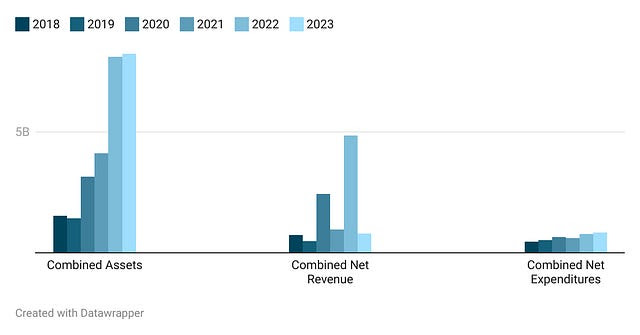
The Koch fleet is something like 27 nonprofit organizations that are regulated by the IRS. There are a handful of other organizations, PACs and super PACs, that are regulated by the Federal Election Commission. These are Koch-controlled groups, not just groups that they’re funding. That fleet was worth $8.4 billion in assets as of 2023, that’s the latest data that’s available, and that network spent a gross sum of $1.5 billion as of 2023. Money is also circulated between these Koch groups and there’s a dizzying mess of transactions where one group is granting to the other and maybe even granting right back. But, ultimately, it’s money going out the door for politics and policy fights that Charles Koch wants to see.
Koch is also unique in terms of his influence. The Koch apparatus is built around a for-profit company specifically, and that for-profit company has been very politically active for decades. There aren’t many corporations out there whose executives have been that neck deep in politics for so long.
*Meaghan: What’s an example of something that Koch and his allies have gotten with that spending?
Connor:The Koch network was over the moon about getting the tax bill with tax cuts passed by the Republican Congress during Trump’s first term. That was worth many untold billions of dollars for somebody like Charles Koch and every owner or major shareholder of a major corporation.
Super rich people got a great return on their investment for their efforts to support the Republican Congress, as well as getting their people on Donald Trump’s cabinet. The Kochs having such permanent infrastructure really allows them to adapt to those changing political winds and continually be opportunistic.
In general, the recipients of the Koch’s dark money funds, including front groups, can serve as independent validators, which is really important for their donors. The tobacco industry innovated by getting doctors to smoke and wage a public relations campaign against the facts of the harms of cigarettes. The oil companies, coal companies, car companies, did the exact thing when they hired a cohort of bozos, through consulting firms and subcontractors, to go on TV and say, “I am a scientist, and climate change is not a problem.” That’s still happening. So, being able to anonymize the money trail that pays for that is worth it for these companies.
...
---
grassrootbeer connor g cmd 5 25 email gmail
Charles Koch’s fleet of organizations spent a combined net total of $833 million in 2023 to influence public policy, elections, and certain charitable causes — marking its highest spending total to date.
As with previous years, the vast majority of the Koch fleet’s spending came from organizations that are predominantly focused on politics and policy.
And as in the past, the lines between policy influence efforts and genuine philanthropy remain blurred. Charles Koch’s significant university funding fuels his political influence apparatus, while his charitable contributions share the same “Stand Together” branding as his policy-focused organizations.
The Center for Media and Democracy (CMD) has conducted a comprehensive financial analysis of Charles Koch’s network of nonprofit and political organizations based on IRS tax records and U.S. Federal Election Commission (FEC) filings for the last six years available, 2018–23. Our most recent analysis for 2023 found:
- Combined assets remained relatively flat in 2023, totaling $8.2 billion across 34 distinct organizations.
- Total net revenue within the fleet dropped to a relative low of $624.3 million in 2023. This is largely due to the massive outlier transactions that took place in 2022, when Koch, Inc. (the company) transferred $4.3 billion in stock to the organization Believe in People, Inc.
- With a swollen war chest from massive private stock transfers, the Koch fleet’s net expenditures have climbed steadily since 2018, increasing by over $370 million (net).
- A total of $715 million circulated among 34 Koch-controlled organizations in 2023 — more than twice as much as the $331 million in intra-network spending in 2022.
- This $715 million accounts for the vast difference between gross revenue ($1.3 billion) and net revenue ($624 million), and between gross expenditures ($1.5 billion) and net expenditures ($833 million).
- Of the fleet’s combined gross expenditures, over 95% was spent by organizations that are predominantly focused on policy and politics.
- The remaining 4.6% of gross expenditures was reported by predominantly charitable groups having relatively little overlap with Koch’s political and policy goals. This includes the organization Movement Musick (previously known as Music C4, Inc.), which is controlled by Charles’ son Chase Koch and has been renamed several times.
Grassrootbeer Investigations posts are free!
Koch-Controlled Organizations Combined Financial Data
Create interactive, responsive & beautiful charts — no code required.
CMD’s analysis is based on the most recent IRS tax filings for 27 nonprofit organizations, in addition to the relevant disclosures of seven political action committees published by the FEC. The data builds upon similar investigations conducted in previous years and makes use of the same methodology previously disclosed.
Koch Begat Koch
While most of these organizations do not reveal their donors, grants that are disclosed show that the Koch fleet is relatively insular:
- Of the $363 million spent by the Stand Together Chamber of Commerce in 2023, over $156 million was sent to Americans for Prosperity (AFP) and its affiliated super PAC. Another $88.8 million was spent on employee salaries and benefits, indicating the scale of the fleet’s internal staffing network. Almost $60 million of the Stand Together Chamber’s spending is ambiguously listed as “other” expenses.
- More than $170 million of AFP’s $185 million budget -– 92% — came from two Koch-controlled organizations, the Stand Together Chamber of Commerce and Stand Together C4 Fund. All three groups operate out of the same office building in Arlington, VA.
- Two more groups operating out of the same office building received a similar proportion of their budgets from within the Koch fleet. The 501(c)(4) Yes Every Kid received 92% of its $8.7 million budget from the Stand Together C4 Fund. Its sister organization, the 501(c)(3) Yes Every Kid Foundation, received 87% of its $4 million budget from the Stand Together Trust.
- The Stand Together C4 Fund received 58% of its revenue from two large grants from other Koch-controlled groups: $213 million from Believe in People and $50 million from Key Change, which was previously named CCKC4.
- Nine Koch-controlled groups disclosed Stand Together Communications, an in-house public relations firm, as a top contractor in 2023, exceeding $107 million in combined contracts. Since 2018, the firm has received over $345 million in contract payments from Koch-controlled organizations.
- Another $20.5 million in 2023 contract payments were disclosed to i360, Koch’s AI-powered voter profiling and data company, which also conducts consulting services for many candidates and organizations outside of the Koch fleet.
On paper, 53% of the Koch fleet’s gross revenue came from other Koch-controlled groups. It is possible that additional funding ultimately came from Koch, Inc., or from wealthy business people and corporate heirs who coordinate their spending with the Koch family. The tax filings of key nonprofits do not disclose their donors, including the Stand Together Chamber of Commerce, which took in over $250 million in 2023, mostly from undisclosed sources.
Dark Money Grants
Koch continued to send millions of dollars to the National Philanthropic Trust (NPT), a multi-billion dollar donor-advised fund that serves to obscure the relationship between specific donors and grantees. A total of $3 million was granted to the trust in 2023 between two separate grants disclosed by the Stand Together Trust and the Knowledge & Progress Fund. Koch organizations have granted a total of $102.1 million to the NPT since 2019, representing 86% of Koch foundation grants to donor-advised funds in that timeframe.
Since 2005, Koch foundations have given a grand total of $138.2 million to donor-advised funds. 2019 was the first year the Koch fleet began passing grants through donor-advised funds like the NPT and the Fidelity Charitable Gift Fund instead of DonorsTrust. Previously, DonorsTrust and Donors Capital Fund received a combined $20.1 million from Koch foundations between 2005 and 2019.
Koch Grants to Universities
As with previous years, one of the larger net spenders within the Koch fleet was the Charles Koch Foundation, which focuses most of its grantmaking on higher education. In 2023 it granted $90.8 million to dozens of universities.
The Koch fleet has granted over $788 million to more than 500 universities since 2005, according to a recent analysis by CMD, in combination with older tax filing data. As CMD has previously reported, universities have long represented the foundation for Charles Koch’s overall policy influence strategy, prompting student and faculty resistance on many campuses.
The Mercatus Center and the Institute for Humane Studies (IHS) at George Mason University -– two organizations that have been controlled for decades by Koch, Inc.’s top executives -– continue to be major spenders within the Koch fleet. Mercatus, founded by Charles Koch and Richard Fink, acts as a strategic bridge between Koch’s university investments and its larger policy influence strategy, often advocating against policies and regulations that Koch, Inc. and other Mercatus sponsors seek to dismantle. The IHS serves as a key recruitment and training hub for the “talent pipeline” that Koch continues to prioritize.
George Mason University, Mercatus, and IHS have received over $305 million from Koch foundations since 2005, in addition to tens of millions in grants to GMU, IHS and Mercatus dating back to the mid 1980s.
Americans for Prosperity Priorities
Koch-controlled organizations were busy advancing a number of priorities in the realms of policy, lawsuits, and social issues in 2023. Much of this was conducted through AFP and its affiliated 501(c)(3) foundation and super PAC, which spent a combined total of $207 million that year:
- AFP Action, an FEC-registered super PAC, spent $30 million in 2023 as it warmed up for the 2024 elections, an effort that ultimately cost over $138 million during the two-year election cycle. The overwhelming majority of these funds were spent supporting Republican candidates and opposing Democrats.
- AFP endorsed staunchly anti-environmental gubernatorial candidates such as West Virginia’s Patrick Morrisey, Indiana’s Mike Braun, and Louisiana’s Jeff Landry, a climate change denier.
- As the fleet’s hub for “grassroots” activism, AFP continually orchestrated statements, reports, petitions, and events blaming then-President Biden for inflation, which many economists dismissed.
- AFP continued a long tradition of attacking worker’s unions. It encouraged Florida’s Republican Governor Ron DeSantis to “hold unions accountable,” fought against a repeal of the decade-old “right-to-work” anti-union law in Michigan, and condemned a strike by the United Auto Workers by unionized employees in Michigan and Ohio.
- 2023 was the busiest year in the anti-ESG (environmental, social, and governance investing) trend in the states, with 26 of the 48 total anti-ESG laws passed that year in 31 states. AFP, along with other heavily Koch-funded groups like the Texas Public Policy Foundation (TPPF), the Heritage Foundation, and the American Legislative Exchange Council, led a state and federal crusade against “ESG” risk assessments in investing as a means of shielding the fossil fuel industry from accountability for the investment risks posed by climate change and pollution.
- AFP celebrated a Supreme Court ruling in favor of a small business that refused to serve gay people. The ruling was opposed by the American Civil Liberties Union (ACLU). The Koch-funded Alliance Defending Freedom -– an extreme Christian hate group known for its discrimination against the LGBTQ population -– represented the plaintiff in the case.
- :{:{AFP released a statement praising Elon Musk’s “3 best changes” at X (Twitter), without noting the platform’s increased use by hate groups and its resulting drop in use and revenue. Koch has financed several organizations that are involved in a lobbying effort to shield big tech companies from antitrust laws.}:
- AFP’s Pennsylvania chapter continued to attack the Regional Greenhouse Gas Initiative (RGGI) -– a regional cap-and-trade partnership designed to reduce carbon emissions -– while Koch Supply and Trading was participating in RGGI trades.
Stand Together Trust Grantmaking in 2023
Koch’s advocacy activity was complemented by grantmaking activity run out of the Stand Together Trust, which has become the fleet’s primary funder of external policy influence groups in recent years. The Stand Together Trust spent $157 million in 2023, most of which was granted to other Koch-controlled organizations, as well as external organizations like the Foundation for Individual Rights and Expression (FIRE), the Cato Institute, and the TPFF. The trust also gave large grants to charitable organizations such as the Edward Charles Foundation -– which is itself a grantmaker -– and The Phoenix, an exercise-based drug rehab charity.
K–12 School Privatization
A combined $11.6 million was spent by Yes Every Kid (YEK) and the Yes Every Kid Foundation. YEK was founded on vague aspirations to “transform public education” by promoting school “choice,” evoking strong skepticism from teachers’ unions. YEK has a notable absence of educational professionals among its leadership, most of whom have backgrounds in politics, lobbying, and public relations.
Charles Koch has opposed unions of all kinds for decades, including teacher’s unions specifically. His fleet of organizations have long supported efforts to funnel money away from public to private schools. Some of Koch’s groups, such as the Bill of Rights Institute and Empowered (formerly “Youth Entrepreneurs”), work to inject controversial material into school curricula such as texts whitewashing the history of slavery in the U.S.
Philanthropy and Stand Together Music
While the fleet continued to focus spending on universities and policy influence groups, Charles and his son Chase Koch also cultivated social capital through their philanthropy in 2023.
Most of this nonpolitical philanthropy dates back to a questionable but successful public relations rebranding effort that began a decade ago and depends on the Stand Together Foundation as the primary grantmaker. The foundation spent over $62 million in 2023, most of which was on grants to organizations involved in relatively noncontroversial causes like youth mentorship and development, drug rehabilitation, and Christian charities.
With the increased leadership of Chase Koch, a guitarist in an active band, much of Koch’s philanthropic activity is focused on garnering partnerships with high-profile artists. Stand Together Music, a project brand operated by the Stand Together Chamber of Commerce, earned favorable media for its partnerships with big-name musicians including Machine Gun Kelly, Darryl “DMC” McDaniels, Pitbull, the Chainsmokers, and Aloe Blacc -– whose new album was named after Koch’s Stand Together brand. Favorable coverage of these collaborations runs in outlets funded by Stand Together, such as *SPIN*magazine.
Koch’s music-centered philanthropy received some critical coverage for its juxtapositional collaborations with politically progressive musicians like Tom Morello of Rage Against the Machine and Killer Mike of Run the Jewels. Killer Mike has continued working with the Koch family after initially signaling he wasn’t aware of who was behind Stand Together Music.
---
---
11 23
an
ahead of the Iowa caucuses in January, GOP mega donors who are looking to replace ex-President Donald Trump as the leading 2024 GOP nominee are "starting to run out of time" — but not giving up hope, according to a Wednesday Axios report.
Some mega-donors, like Home Depot co-founder Bernie Marcus are certain the MAGA hopeful will prevail, though Trump is not his first choice.
"There are people I've spoken to that are still sitting on the fence, that don't know what to do," Marcus said to ABC News, according to Axios. "They dislike the person Trump, but they recognize that the talent is there."
Additionally, in a recent op-ed for Real Clear Politics, he wrote, "Let's face it: Donald Trump is going to win the nomination."
However, other major Republican donors are looking to help ex-South Carolina Governor Nikki Haley take Trump's place.
Axios points out "Deep-pocketed establishment donors have been lining up behind Haley," such as GOP mega-donor Ken Griffin who said earlier this month that he is "actively contemplating" supporting Haley, and JPMorgan Chase Chief Executive Officer Jamie Dimon, who "has had private conversations with her."
Furthermore, "Americans for Prosperity Action, the leading political arm of the Koch network, said that Haley "will have the full weight and scope of AFP Action's unmatched grassroots army and resources," according to the news outlet.
Narrative Strategies founding partner Ken Spain emphasized, "The hope is this is increasingly becoming a two-person race with [former UN ambassador Nikki Haley] ... as the establishment alternative. It's still long shot, but a bet worth placing if you're an anti-Trump big money donor."
:{READ MORE:'Blatantly unconstitutional': Nikki Haley ripped for 'fascist' proposal to outlaw anonymity on social media
*Axios' full report is available here.
---
https://www.exposedbycmd.org/**2022/08**/30/charles-kochs-shape-shifting-influence-machine/
[docs]
charles Koch is unique among corporate CEOs. He controls a multibillion-dollar fleet of nonprofits that he and other wealthy business people have built into a massive influence machine over the past 20 years. This enables the Koch network to make a significant impact on U.S. :{courts:(style="box-sizing:inherit"):}:, :{politics:(style="box-sizing:inherit"):}:, and :{media:(style="box-sizing:inherit"):}:, regardless of who is in the White House.
This year, Charles Koch’s political influence apparatus is undergoing yet another round of restructuring, following its recent financial growth, expansion of organizations, and new dark money grantmaking arrangements.
The Center for Media and Democracy (CMD) recently reported on the network’s ballooning revenues of :{$2.2 billion in 2020:(style="box-sizing:inherit"):}:, the emergence of Chase Koch’s :{CCKC4:(style="box-sizing:inherit"):}: as a potentially major player on the U.S. political scene, and its :{use of the National Philanthropic Trust:(style="box-sizing:inherit"):}: to hide its financial transactions.
Frequent shifts in structure often correspond with election cycles. The changes help keep Koch’s dark money organizational structure opaque, especially since IRS disclosure requirements are so antiquated that they lag behind real time by a year or more.
Most of Charles Koch’s advocacy and political organizations have operated under the :{Stand Together Chamber of Commerce:(style="box-sizing:inherit"):}:, as of 2020, while the Charles Koch Institute (CKI) controlled most of the Koch funding vehicles. Several organizations in this Stand Together “family” have recently changed roles or started operating using trade names that differ from their legal names.
[docs]
:{
}:
:{
Table with 7 columns and 47 rows. Currently displaying rows 1 to 20.
Organization Name EIN/FEC # Status (2020) Type of Org Year Est. Prior Legal Names Trade Names
Americans For Prosperity 75-3148958 Active 501(c)(4) 2004 Concerned Veterans for America (2017 - present)
The Libre Initiative (2017 - present)
Generation Opportunity (2017)
Americans For Prosperity Action, Inc. (AFP Action) C00687103 Active Super PAC 2018 CVA Action (2017 - present)
Libre Action (2017 - present)
Americans For Prosperity Foundation 52-1527294 Active 501(c)(3) 1988 Citizens for a Sound Economy Educational Foundation (1988 - 2002) Concerned Veterans for American Foundation (2018 - present)
The Libre Initiative Institute (2018 - present)
Bill of Rights Institute 48-0891418 Active 501(c)(3) 1980
Capitol Leaders, Inc. 47-3438079 Active 501(c)(3) 2015 Freedom Partners Institute Inc. (2015 - 2016)
Cause of Action Institute 45-2805977 Active 501(c)(3) 2011
CCKC4, Inc. 83-3116152 Active 501(c)(4) 2018
Charles Koch Charitable Fund 85-4058882 Active 501(c)(3) 2020
Charles Koch Foundation 48-0918408 Active 501(c)(3) 1980 Charles G Koch Charitable Foundation (1980 - 2011)
Charles Koch Institute 27-4967732 Active 501(c)(3) 2011 Stand Together Fellowships (2022)
Chase Koch Foundation, Inc. 83-1697305 Active 501(c)(3) 2018 Chase and Annie Koch Foundation, Inc.
David H Koch Charitable Foundation 48-0926946 Active 501(c)(3) 1981
Institute for Humane Studies 94-1623852 Active 501(c)(3) 1985
John Quincy Adams Society 81-3308969 Active 501(c)(3) 2016
Knowledge & Progress Fund, Inc. 54-1899251 Active 501(c)(3) 1998
Koch Cultural Trust 48-0989992 Active 501(c)(3) 1986
}:
:{
p2
Organization Name EIN/FEC # Status (2020) Type of Org Year Est. Prior Legal Names Trade Names
Koch Family Foundation 48-6113560 Active 501(c)(3) 1955 Fred C. and Mary R. Koch Foundation, Inc. (1953 - 2018)
Mercatus Center, Inc. 54-1436224 Active 501(c)(3) 1988 Center for the Study of Market Processes (1978 - 1999)
Stand Together Chamber of Commerce, Inc. 45-3732750 Active 501(c)(6) 2011 The Seminar Network Chamber of Commerce, Inc. (2018)
Freedom Partners Chamber of Commerce, Inc. (2014 - 2017)
Association for American Innovation, Inc. (2011 - 2013)
Stand Together Foundation 27-3197768 Active 501(c)(3) 2010 Stand Together, Inc. (2016 - 2018)
Public Notice Research and Education Fund, Inc. (2010 - 2015)
The Seminar Network, Inc. 46-3508366 Active 501(c)(3) 2013 Concerned Veterans for America, Inc. (2013 - 2015) Stand Together Trust (2019 - present)
The Seminar Network Trust (2018)
TSN Institute 47-3175931 Active 501(c)(4) 2014 CKI Policy, Inc. (2018)
Freedom C4, Inc. (2015 - 2017)
Stand Together, Inc. (2014)
Vela Education Fund 84-4185046 Active 501(c)(3) 2020
Yes Every Kid Foundation 84-3535275 Active 501(c)(3) 2019
Yes Every Kid, Inc. 83-3028208 Active 501(c)(4) 2019
Youth Entrepreneurs, Inc. 48-1187886 Active 501(c)(3) 2014 Youth Entrepreneurs Of Kansas, Inc. (2014 - 2016) Empowered, Inc. (2022)
Center for Shared Services Trust 45-2548548 Terminated 501(c)(4) 2011
Claude R Lambe Foundation 48-0935563 Terminated 501(c)(3) Pre-1986
Freedom Partners Action Fund C00564765 Terminated Super PAC 2014
Fueling U.S. Forward Inc. 47-5486414 Terminated 501(c)(6) 2016
p 3
Fueling US Forward Institute 46-2346050 Terminated 501(c)(3) 2013 Generation Opportunity Institute, Inc. (2013 - 2016)
LIBRE Initiative Institute, Inc. 45-4123383 Terminated 501(c)(3) 2011
LIBRE Initiative Trust 45-2686411 Terminated 501(c)(4) 2011
Market Based Management Institute 20-3669097 Terminated 501(c)(3) 2005
SG C4 Trust 27-2546536 Terminated 501(c)(4) 2010
Vets for Economic Freedom Trust 45-3593119 Terminated 501(c)(4) 2011 Concerned Veterans for America
YEM Trust 27-2936085 Terminated 501(c)(4) 2010 Generation Opportunity
}:
as part of the reorganization, CKI has :{moved:(style="box-sizing:inherit"):}: its policy grantmaking operations :{into:(style="box-sizing:inherit"):}: the 501(c)(3) :{Stand Together Trust:(style="box-sizing:inherit"):}: and its educational programs into Stand Together Fellowships. As of 2020 (the most recently available IRS disclosures), Stand Together Trust was already increasing its role in :{financing:(style="box-sizing:inherit"):}: groups that influence public policy. Formerly known as the Seminar Network, Inc., the Stand Together Trust slowly began granting funds to universities and policy-focused nonprofits in 2017.
:{
Historically, the Charles Koch Foundation (CKF) had been the largest grantmaking organization controlled by the Koch family, funding :{climate change deniers:(style="box-sizing:inherit"):}: and other organizations that influence state and federal policy. In fact, CKF and CKI have been the two largest Koch-controlled nonprofits for most of the past decade, with assets of $462 million and $364 million, respectively, at the end of 2020.
In 2020, CKF focused most of its :{funding:(style="box-sizing:inherit"):}: on :{university programs:(style="box-sizing:inherit"):}:, which are :{key:(style="box-sizing:inherit"):}: to Charles Koch's :{strategy:(style="box-sizing:inherit"):}: of manufacturing long-term policy changes. That same year, much of his politically oriented grantmaking shifted from CKF to CKI.
Stand Together Communications Replaces "In Pursuit Of"
Stand Together Communications LLC is the Koch network's for-profit public relations agency. It was previously named :{In Pursuit Of:(style="box-sizing:inherit"):}:, which :{discontinued:(style="box-sizing:inherit"):}: its website in 2021. The :{staff:(style="box-sizing:inherit"):}: at In Pursuit Of shifted into positions at Stand Together Communications, according to LinkedIn :{profiles:(style="box-sizing:inherit"):}:.
Stand Together Communications received at least :{$38.4 million:(style="box-sizing:inherit"):}: from the Stand Together Chamber, :{Americans for Prosperity:(style="box-sizing:inherit"):}: (AFP), :{Americans for Prosperity Foundation:(style="box-sizing:inherit"):}:, and :{Stand Together Foundation:(style="box-sizing:inherit"):}: in 2020.
...
additionally, Stand Together Communications (listed as In Pursuit Of) :{received:(style="box-sizing:inherit"):}: over $3 million from AFP Action, a Koch-controlled super PAC, during the 2018 and 2020 election cycles.
This shift of marketing operations to Stand Together Communications might also explain the apparent closure of :{G-P Studios:(style="box-sizing:inherit"):}:, a media company affiliated with the Koch Industries subsidiary Georgia-Pacific. The G-P Studios website went dark in early 2022.
Youth Entrepreneurs Now Operates as "Empowered"
This year :{Youth Entrepreneurs:(style="box-sizing:inherit"):}:, which was :{founded:(style="box-sizing:inherit"):}: by Charles Koch and his wife Elizabeth in 1991 to give high school students business experience, has rebranded itself "Empowered."

The organization's new :{website:(style="box-sizing:inherit"):}: and :{magazine:(style="box-sizing:inherit"):}: share a vision of "building a community of change-making teachers rallied around the growth mindset." Favorite Koch buzzwords, like ":{value creation:(style="box-sizing:inherit"):}:" and the idea that free markets are key to ":{well-being:(style="box-sizing:inherit"):}:," remain central to Empowered's messaging.
The longstanding focus of Empowered has been on student training programs and curricula. :{Archives:(style="box-sizing:inherit"):}: of the Youth Entrepreneurs website show that its programs involved vetting and grooming teachers, and offering paid incentives for participating students:
A successful YE [Youth Entrepreneurs] teacher is an inspirational motivator and entrepreneurial thinker. We can assist the district to observe teaching styles and select the best fit for our nontraditional teaching style. [...]
YE is traditionally taught as a yearlong high school elective course by teachers who have been trained on our curriculum. We offer students and alumni the opportunity to earn money for business, education or personal development purposes by participating in continuing education opportunities through YE Academy.
Recent examples of the Koch family's manipulation of education include lesson plans created several years ago by the Koch-controlled Bill of Rights Institute that :{whitewashed the history of slavery:(style="box-sizing:inherit"):}: in the U.S. Many Koch-funded organizations have also :{contributed:(style="box-sizing:inherit"):}: to the manufactured :{hysteria:(style="box-sizing:inherit"):}: over the influence of critical race theory.
Koch-funded professors have authored economics textbooks that include :{inaccurate information:(style="box-sizing:inherit"):}: related to climate change, while others in Koch-funded economics departments have :{taught outright denial:(style="box-sizing:inherit"):}: of climate change—venturing into a scientific discipline well outside their own areas of expertise.
Stand Together Ventures Lab, STVL3, and STVL6
Another new group is Stand Together Ventures Lab (STV Lab), a for-profit operation that invests in business start-ups and helps them get established.
STV Lab works in conjunction with two limited liability companies (LLCs) disclosed in IRS tax filings of Koch-controlled organizations: :{STVL3, LLC:(style="box-sizing:inherit"):}: and :{STVL6, LLC:(style="box-sizing:inherit"):}:, that provide capital for the start-ups. :{According:(style="box-sizing:inherit"):}: to its website, STV Lab is "not affiliated" with :{Stand Together Ventures:(style="box-sizing:inherit"):}:, another Koch-run outfit that works "to supercharge organizations who innovate and disrupt the status quo" around issues like education and "cronyism in government and business."

Stand Together Chamber of Commerce Controls Koch Advocacy
Although the network of Koch-controlled groups has been renamed multiple times, a single brand name is often used to refer to multiple organizations.
Since 2011, a 501(c)(6) business league has served as the umbrella organization at the top of this network structure. That group is now known as the :{Stand Together Chamber of Commerce:(style="box-sizing:inherit"):}:, after a 2019 rebranding. Many of Charles Koch's advocacy groups report to the IRS that the Stand Together Chamber is their "direct controlling entity," as detailed in the table below.
[docs]
control structure
Table with 2 columns and 49 rows. Currently displaying rows 1 to 20.
Organization Name Direct Controlled Entities
American Strategies Group, LLC CAVHOCO, Inc. (C-Corp)
Americans For Prosperity PRDIST, LLC
Americans For Prosperity Foundation Americans For Prosperity
CAVHOCO, Inc. (C-Corp) DBLDBL, Inc. (C-Corp)
KNSLT, Inc. (C-Corp)
THOCO (C-Corp)
Charles Koch Foundation STVL3, LLC
EFPRP Investments, LLC
VAPOR Investments, LLC
VAPOR II Investments, LLC
Non-Profit 1888 Management Fund, LLC
John Quincy Adams Society
Charles Koch Institute Charles Koch Foundation
Charles Koch Charitable Fund
Chase Koch Foundation, Inc.
Stand Together Foundation
TSN Institute
Stand Together Trust
CCKC4, Inc.
Web Media, LLC
:{
}:
when it was :{founded:(style="box-sizing:inherit"):}: in 2011, theStand Together Chamber was briefly known as the:{ Association for American Innovation:(style="box-sizing:inherit"):}:. The group became the central fundraising nonprofit for the Koch brothers' annual :{gathering:(style="box-sizing:inherit"):}: of ultra-rich donors and political operatives, which dates back to :{2003:(style="box-sizing:inherit"):}:.
In late 2011, as the 2012 presidential election loomed, the organization rebranded itself :{Freedom Partners Chamber of Commerce:(style="box-sizing:inherit"):}:. It continued to operate under this name until the 2018 midterm election cycle, when it was renamed The Seminar Network Chamber of Commerce. Just prior to the 2020 presidential election cycle, the organization adopted its current title, the Stand Together Chamber of Commerce.
During each of these rebrands, the network of organizations controlled by Charles Koch used colloquial names similar to the shifting names of the 501(c)(6) organization. The network was known as Freedom Partners, and then, The Seminar Network. Now, as part of the latest :{marketing:(style="box-sizing:inherit"):}: effort, most of these groups have :{adopted:(style="box-sizing:inherit"):}: the deceptively progressive-sounding Stand Together :{brand:(style="box-sizing:inherit"):}:.
For example, several organizations and LLCs under the Koch umbrella also use the Stand Together brand, including the 501(c)(4) Stand Together Trust, and LLCs like Stand Together Communications and Stand Together Shared Services.
A short-lived super PAC named :{Stand Together PAC:(style="box-sizing:inherit"):}: operated briefly from 2020–22 but was :{administratively terminated:(style="box-sizing:inherit"):}: by the Federal Election Commission (FEC) in March when it :{failed:(style="box-sizing:inherit"):}: to file an end-of-year report.
To confuse matters, at least one Koch organization continued to operate in 2020 using an abandoned brand name: TSN Institute, an abbreviation of "The Seminar Network Institute." TSN Institute appeared to be in the process of :{draining:(style="box-sizing:inherit"):}: its assets.
Most of these groups and companies are not differentiated to the public, though the distinctions are made clear in their respective tax filings.
Americans for Prosperity, the LIBRE Initiative, and Concerned Veterans for America
Americans for Prosperity (AFP) is the most recognizable brand controlled by the Stand Together Chamber. AFP is the 501(c)(4) political arm of its sister organization, the 501(c)(3) :{Americans for Prosperity Foundation:(style="box-sizing:inherit"):}:, which was long overseen by its founding chairman, the :{late David Koch:(style="box-sizing:inherit"):}:.
Other Koch-controlled campaigning brands like the LIBRE Initiative and Concerned Veterans for America used to be distinct nonprofit organizations. Now they are simply :{registered:(style="box-sizing:inherit"):}: with the Virginia Corporation Commission as "fictitious names" for AFP, the AFP Foundation, and AFP Action, a super PAC regulated by the FEC.
...[doc]
FP Action Super PAC
Since AFP :{launched:(style="box-sizing:inherit"):}: the super PAC :{AFP Action:(style="box-sizing:inherit"):}: in 2018, it has spent tens of millions of dollars on independent expenditures and electioneering, including advertising and :{door-to-door canvassing:(style="box-sizing:inherit"):}:. AFP Action replaced the Koch brothers' previous super PAC, :{Freedom Partners Action Fund:(style="box-sizing:inherit"):}:, which :{shuttered:(style="box-sizing:inherit"):}: in August 2019 after its remaining funds were :{transferred:(style="box-sizing:inherit"):}: to AFP Action.
As with Americans for Prosperity and the AFP Foundation, AFP Action acts as the super PAC for Concerned Veterans for America and the LIBRE Initiative. AFP Action’s FEC profile :{lists:(style="box-sizing:inherit"):}: its alternative business names as CVA Action and LIBRE Action.
Mapping the Koch-Controlled Network
The visual below depicts the structure of Koch's nonprofit organizations since the most recently known changes, along with the companies and family trusts :{controlled:(style="box-sizing:inherit"):}: by the Koch family (excluding most of the dozens of :{subsidiaries:(style="box-sizing:inherit"):}: of Koch Industries).
Source material includes Schedules L, O, and R of these organizations' IRS 990 filings; business registries in Delaware, Kansas, and Virginia; the Stand Together :{website:(style="box-sizing:inherit"):}:; and Securities and Exchange Commission (SEC) :{filings:(style="box-sizing:inherit"):}:.
Given the need to rely on a patchwork of insufficient disclosures, this is likely a partial and outdated representation. The visual includes LLCs that are not discussed in this article. It is unclear if the many other LLCs in the Koch sphere formally interact with Koch-controlled policy and political nonprofits.
[very good grfx DL 922]
---
}:
ref 2 martens
https://kochdocs.org/2019/06/06/freedom-partners-roadmap-repeal/
2017 Koch Freedom Partners: A “Roadmap” for the Trump Administration to Repeal Environmental Rules
This 2017 document titled “A Roadmap to Repeal: Removing Regulatory Barriers to Opportunity” was created by Freedom Partners, a donor group Politico has called the “secret bank” of the Koch Brothers.
This memo from Charles Koch’s network to its funders details changes in the law sought by what was then called the Freedom Partners Chamber of Commerce, which was controlled by Koch and his operatives.
That group is now operating under the name “Stand Together.” Whatever the name, the concept is the same: this is the political agenda of the Koch empire in coordination with the CEOs and corporations that help fund Charles Koch’s agenda through a non-profit trade group–organized under 501(c)(5) of the IRS Code–which has operated under different brand names.
This kind of memo is one of the organizing tools deployed by Koch to get his billionaire and millionaire funder allies, who are part of what is also sometimes called the “Koch Network,” on the same page about the agenda for the year ahead. Koch’s political hq circulates these kinds of memos to attendees of the semi-annual retreats Charles Koch has been hosting for years to advance his personal and corporate agenda.
This particular memo is focused on Koch’s agenda to have the Trump Administration changes the laws to suit his goals. This “Roadmap” includes a list of “what can be repealed in the first 100 days” of the Trump administration such as:
- “Executive order putting a moratorium on new federal coal leases;”
- “Paris climate agreement requiring greenhouse gas emission reductions;”
- “Proposed Environmental Protection Agency (EPA) programs incidental to the Clean Power Plan;”
- “Final Stream Protection Rule regarding coal mine permitting;”
- “Bureau of Land Management (BLM) federal lands Methane Rule;”
- “Environmental Protection Agency (EPA) Renewable Fuel Standard (RFS): 2017 and 2018 obligations;”
- “EPA Greenhouse Gas Emission Standards: Medium- and Heavy-Duty Engines and Vehicles.”
It also lists “longer-term opportunities” such as the:
- EPA Rule defining The Waters of the United States;
- Reversing the EPA’s Clean Power Plan.
- [doc]
A ROADMAP TO REPEAL:
REMOVING REGULATORY
BARRIERS TO OPPORTUNITY
President Obama has imposed an unprecedented onslaught of regulatory costs on the U.S. economy. Since 2009, federal
agencies have issued more than 600 major regulations with a total cost exceeding $700 billion. These regulations have erected
barriers to opportunity for millions of American families, resulting in the weakest workforce in nearly 40 years.
Freedom Partners strongly supports efforts by President-elect Trump and the new Congress to repeal as many of President
Obama’s executive actions and regulations as possible. Removing these barriers to opportunity is among the surest ways to
jumpstart the U.S. economy and create more opportunity for all.
Unfortunately, repealing federal regulations is not as simple as it sounds. A successful strategy must be considered in three steps
and will require action from the administration, Congress, and the courts. Additionally, Freedom Partners urges Congress
to put lawmakers on record on as many of these regulations as possible so that voters can see where they stand and hold them
accountable in 2018.
STEP 1. WHAT CAN BE REPEALED IN THE FIRST 100 DAYS
Executive actions, proposed regulations, and recently finalized regulations.
Executive Actions and Proposed Regulations: President-elect Trump can unilaterally rescind any executive
action signed by President Obama or proposed regulations that have yet to be finalized, including, but not limited to:
Executive order establishing a task force on commercial advocacy
Executive order putting a moratorium on new federal coal leases
Presidential memorandum requiring new federal overtime rule promulgation
Paris Climate Agreement requiring greenhouse gas emissions reductions
Proposed Environmental Protection Agency (EPA) programs incidental to the Clean Power Plan
Proposed Consumer Financial Protection Bureau (CFPB) payday and vehicle title loan rules
Proposed CFPB arbitration rules
Regulations Finalized On or After June 13, 2016: Under the Congressional Review Act (CRA), Congress can
avoid a Senate filibuster to repeal all regulations finalized during the last 60 legislative days, with June 13, 2016, being the
cutoff date. Congress should prioritize the following:
Final Stream Protection Rule regarding coal mine permitting
Bureau of Land Management (BLM) federal lands Methane Rule
Environmental Protection Agency (EPA) Renewable Fuel Standard (RFS): 2017 and 2018 obligations
EPA Greenhouse Gas Emissions Standards: Medium- and Heavy-Duty Engines and Vehicles
STEP 2. LONGER-TERM OPPORTUNITIES
All other regulations passed before June 13, 2016 can be repealed in at least one of three ways.
Executive Rulemaking, Legislation to Rescind or Defund, and Judicial Challenges. These are time-consuming
processes that should begin immediately. President-elect Trump and Congress should prioritize the following:
EPA Rule defining The Waters of the United States
EPA Clean Power Plan
HHS Electronic Health Record Incentive Program
HHS Establishment of Exchanges and Qualified Health
DOL Overtime Rule
DOL Fiduciary Rule
FCC “Net Neutrality” Rule
USDA Calorie Labeling for Vending Machines
STEP 3. POLITICAL ACCOUNTABILITY
Freedom Partners will hold lawmakers who oppose regulatory relief accountable for their positions.
Floor Time: Congressional leaders should devote sufficient floor time to voting on finalized regulations and putting
lawmakers on record on President Obama’s most harmful regulations.
Voter Education: Network organizations will educate voters about their elected representatives’ positions on regulations
that impose barriers to opportunity for hardworking families.
This document was created by Freedom Partners, an organization which Politico called the “secret bank” of the Koch Brothers. https://www.politico.com/story/2013/09/behind-the-curtain-exclusive-the-koch-brothers-secret-bank-096669#ixzz2hj4y5I8o
Original Document (PDF) »
Contributed by Casey (Climate Investigations Center)
Plain Text
https://redgreenandblue.org/2022/03/25/koch-et-al-spent-50-million-climate-disinformation-2014-2020/
By Climate Denier Roundup
Between 2014 and 2022, there was $54,298,510 that went to just eight organizations that, per Kotch, “represents key groups primarily focused on energy and the environment that consistently mislead the public about the climate crisis.”
While bearing in mind that this is just the verifiable drop in an otherwise much larger and murkier bucket of fossil fuel funding for climate disinfo, which when including advertising and PR budgets is likely in the hundreds of millions, not tens of millions,it is still quite a sizable figure, and one that is hardly coming from grassroots supporters.
In fact, it’s mostly coming from a couple dozen billionaires, conservativedark money pass-throughs, and industry sources. “A dozen of the largest nonprofits donated $47.8 million to the leading climate denial organizations, accounting for 88% of the funds CMD was able to track down using FY 2014-20 federal tax returns.”
TheKoch Foundations of course makes the list at number eight, right behind the American Fuel and Petrochemical Manufacturers. Donors Trust/Donors Capitol Fund, the right’s “_{dark-money ATM}_,” tops the list, of course, followed by the Searle, Scaife, Mercer, Dunn and Bradley foundations, all more or less just tax write-off vehicles for rightwing billionaires trying to simply buy the reality they want.
2013 kroll: https://www.motherjones.com/politics/2013/02/donors-trust-donor-capital-fund-dark-money-koch-bradley-devos/
Jennie King of the Institute for Strategic Dialogue told Kotch that “bad actors are using a tried and tested playbook to weaken public mandates and create confusion [about] viable solutions going forward. This includes weaponizing climate response within a broader ‘culture wars’ frame and conflating it with any supposed controversy, from Covid-19 lockdowns and vaccine mandates to critical race theory, trans rights, or geopolitics.”
Similarly, the tobacco-defending climate deniers at Heartland lost over half their donations between 2019 and 2020, and that overall the recipients’ totals have dwindled from their 2016 peak.
This may be an indication that even as the fossil fuel industry begrudgingly begins to co-opt climate change and clean energy, they’ve done so well at integrating it into the Republican party that generally conservative funders could be keeping the charade going, even after it served its purpose of buying the industry a few decades of unchecked, climate-changing profits.
The little climate disinfo troll is all grown up now, and finding fun new pursuits attacking Trans people, defending racism, and, of course, spreading anti-covid/mask/vaccine propaganda.
(Originally appeared at DailyKos)
https://m.dailykos.com/stories/2022/3/24/2087833/-Koch-et-al-Spend-Over-50-Million-on-Climate-Disinfo-Organizations-Between-2014-2020
On Monday, Alex Kotch at the Center for Media and Democracy (CMD) _{published the latest count of climate disinfo funding}_, tallying up over $50 million in “donations” to climate denial groups, straight from industry profits, billionaire ideologues fortunes, and everything in between.
Between 2014 and 2022, there was $54,298,510 that went to just eight organizations that, per Kotch, “represents key groups primarily focused on energy and the environment that consistently mislead the public about the climate crisis.”
---
ref
https://www.exposedbycmd.org/2022/03/21/the-dirty-dozen-the-biggest-nonprofit-funders-of-climate-denial/
in its recently released report on climate impacts and adaptation, a working group of the Intergovernmental Panel on Climate Change points out the very real danger of climate misinformation—for the first time since its annual assessments began in 2017.
The report, which states that “urgent action” is needed “to avoid mounting loss of life, biodiversity and infrastructure,” finds that “vested economic and political interests have organized and financed misinformation and ‘contrarian’ climate change communication.” The resulting “rhetoric and misinformation on climate change and the deliberate undermining of science have contributed to misperceptions of the scientific consensus, uncertainty, disregarded risk and urgency, and dissent,” it contends.
Geoffrey Supran, a Harvard University fellow in the history of science, says it’s great that the Intergovernmental Panel on Climate Change (IPCC) has finally called this out. But he believes the report should also detail exactly who has been bankrolling misinformation about the climate crisis.
“Indeed, there’s enough to write another report on,” Supran said. “The veiled reference to ‘vested economic and political interests,’ for instance, is an example of where reports such as this can and, in my opinion, should go further, and name names. It is a quantified, reported fact that those vested interests include specific fossil fuel interests and libertarian billionaires such as ExxonMobil, the American Petroleum Institute, and Koch Industries, and that they have orchestrated multi-decade, multi-billion-dollar propaganda campaigns to sabotage science and undermine action.”
Naming Names
Fossil fuel corporations are among the special interests that have funded climate change denial for decades. But it’s not just the oil giants that are spreading this harmful misinformation. A host of nonprofit charities—ranging from mainstream money managers to private, right-wing foundations—are some of the biggest funders of climate change denial, research by the Center for Media and Democracy (CMD) has found.
CMD research has found that eight of the most egregious climate misinformation groups received more than $54 million from nonprofit funders between 2014 and 2020.
While the list is by no means exhaustive, it represents key groups primarily focused on energy and the environment that consistently mislead the public about the climate crisis.
[table NO LNX]
TABLE ONE
Top Climate Misinformation Groups, 2014-20
These leading climate misinformation organizations received large donations from nonprofits from 2014-20.
Table with 9 columns and 9 rows. Currently displaying rows 1 to 9.
Recipient 2014 2015 2016 2017 2018 2019 2020 TOTAL
Heartland Institute $3,799,025 $2,537,850 $3,676,617 $3,693,650 $3,925,637 $2,860,232 $903,950 21,396,961
Competitive Enterprise Institute $3,840,074 $2,987,869 $3,474,275 $2,580,736 $2,656,600 $1,223,901 $1,927,938 18,691,393
Property and Environmental Research Center $451,500 $776,500 $827,000 $897,000 $1,043,000 $962,000 $1,019,550 5,976,550
Institute for Energy Research/American Energy Alliance $50,628 $727,495 $506,902 $479,967 $336,000 $96,165 $292,146 2,489,303
CO2 Coalition $0 $125,000 $441,126 $663,883 $358,000 $398,078 $394,115 2,380,202
Committee for a Constructive Tomorrow $181,252 $327,002 $227,150 $236,310 $172,850 $326,355 $366,982 1,837,901
Energy and Environment Legal Institute $125,000 $296,000 $350,000 771,000
Center for the Study of Carbon Dioxide and Global Change $10,000 $125,000 $10,000 $210,200 $400,000 755,200
TOTAL $8,332,479 $7,481,716 $9,403,070 $8,561,546 $8,998,287 $5,866,731 $5,654,6xx... $54,298,510
----
nOnprofit donations to these eight climate misinformation organizations swelled from 2016–18 and decreased in 2019 and 2020. Note that 2020 data may be incomplete, as tax returns are not yet publicly available for some nonprofit donors.
Many other right-wing groups regularly spread misinformation on climate issues, but since their work focuses on other areas as well, their donors are not included in this report. Larger-scale studies such as “Obstructing action: foundation funding and US climate change counter-movement organizations”offer additional details.
The Dirty Dozen Funders of Climate Misinformation
A dozen of the largest nonprofits donated $47.8 million to the leading climate denial organizations, accounting for 88% of the funds CMD was able to track down using FY 2014-20 federal tax returns.
Half of the traceable funding came from DonorsTrust and Donors Capital Fund, two donor-advised fund sponsors that pass along their clients’ donations to other charities approved by their boards of directors. While the two funds give exclusively to conservative causes, no restrictions are apparent within that ideology. For instance, CMD was first to report that DonorsTrust is by far the biggest known funder of American white nationalist hate groups.
Among the “Dirty Dozen” climate denial financiers are foundations established by the right-wing Bradley, Koch, Mercer, Searle, and Scaife families. The Kochs, Mercers, and other Republican megadonors pour additional money into political groups and electoral campaigns focused on electing right-wing candidates who oppose meaningful action on climate change and often support expanding and deregulating the fossil fuel industry.
The funders named in this report have also financed a broader right-wing political strategy to misinform the public about a number of issues and increase GOP voter turnout.
“Bad actors are using a tried and tested playbook to weaken public mandates and create confusion [about] viable solutions going forward,” notes Jennie King, head of civic action and education at the Institute for Strategic Dialogue, an independent nonprofit dedicated to protecting human rights and reversing polarization, extremism, and disinformation around the world. “This includes weaponizing climate response within a broader ‘culture wars’ frame and conflating it with any supposed controversy, from Covid-19 lockdowns and vaccine mandates to critical race theory, trans rights, or geopolitics.”
Leading non-ideological donor-advised fund sponsors connected to the Vanguard and Fidelity financial firms are also among the Dirty Dozen climate misinformation funders.
“We cannot solve the climate crisis until we solve the climate misinformation crisis,” U.S. Rep. Ro Khanna (D-Calif.) told CMD. “It is disappointing that mainstream organizations are still keeping ties with groups that have attacked climate science and legislative solutions. We need to be calling this behavior out publicly, so Americans know which organizations are linked to climate denial efforts.”
All nonprofits identified by CMD that gave $10,000 or more to the top climate misinformation groups from 2014–20 are listed in the table below.
:{
}:
tABLE 2
:{
}:
Top Nonprofit Climate Denial Funders, 2014-20
Numerous charities, private foundations, and trade associations have bankrolled the climate misinformation movement.
Page 1 of 4
Table with 9 columns and 53 rows. Currently displaying rows 1 to 15.
Donor 2014 2015 2016 2017 2018 2019 2020 TOTAL
1 DonorsTrust/Donors Capital Fund $3,293,850 $3,816,850 $3,676,750 $2,422,000 $3,830,200 $2,101,732 $1,416,500 20,557,882
2 Searle Freedom Trust $839,500 $589,500 $1,140,000 $940,000 $1,096,000 $754,000 $985,000 6,344,000
3 Sarah Scaife Foundation $350,000 $610,000 $842,000 $875,000 $960,000 $715,000 $1,245,000 5,597,000
4 Mercer Family Foundation $885,000 $100,000 $1,075,000 $970,000 3,030,000
5 Dunn Foundation $1,200,000 $250,000 $325,000 $200,000 $350,000 $350,000 $350,000 3,025,000
6 Bradley Foundations $344,376 $318,876 $458,500 $519,000 $280,000 $475,000 $110,000 2,505,752
7 American Fuel and Petrochemical Manufacturers $365,000 $275,000 $470,000 $400,000 1,510,000
8 Koch Foundations $100,128 $431,891 $333,028 $413,016 $84,000 $99,049 $18,749 1,479,861
9 Vanguard Charitable Endowment Program $38,500 $228,500 $265,000 $230,000 $235,000 997,000
10 Fidelity Charitable Gift Fund $35,525 $21,350 $27,867 $241,355 $212,310 $231,055 $201,952 971,414
11 National Philanthropic Trust $150,000 $175,000 $175,500 $176,000 $200,000 876,500
12 Bartley J. Madden Foundation $45,000 $270,000 $270,000 $250,000 $30,000 865,000
13 Thomas W. Smith Foundation $150,000 $175,000 $200,000 $200,000 725,000
14 The 85 Fund $700,000 700,000
15 Ed Uihlein Family Foundation $10,500 $129,000 $35,000 $115,000 $115,000 $140,000...
:{
}:
:{
}:
----
P2
Donor 2014 2015 2016 2017 2018 2019 2020 TOTAL
16 Schwab Charitable Fund $206,600 $14,475 $121,775 $32,925 $45,100 $44,895 $95,480 561,250
17 Chase Foundation of Virginia $84,000 $113,000 $108,000 $85,000 $75,000 $75,000 540,000
18 Murray Energy $10,000 $285,000 $100,000 395,000
19 Adolph Coors Foundation $80,000 $100,000 $90,000 $100,000 370,000
20 Claws Foundation $65,000 $115,000 $175,000 355,000
21 Lilly Endowment $50,000 $50,000 $50,000 $50,000 $50,000 $50,000 $50,000 350,000
22 Diana Davis Spencer Foundation $50,000 $100,000 $150,000 300,000
23 National Christian Foundation $200,000 $1,100 201,100
24 The Carthage Foundation $160,000 160,000
25 Barney Family Foundation $40,000 $40,000 $40,000 $40,000 160,000
26 DuPage Community Foundation $25,000 $50,000 $55,000 $25,000 155,000
27 Deramus Foundation $25,000 $25,000 $25,000 $25,000 100,000
28 Pew Charitable Trusts $95,177 95,177
29 John William Pope Foundation $10,000 $10,000 $15,000 $25,000 $25,000 85,000
30 William H. Donner Foundation $82,000 82,000 ....
---
A number of the top funders of climate misinformation are closely connected. Staff and board members often overlap, and many currently work or previously worked for organizations linked to Charles Koch.
In addition to the fossil fuel companies themselves, this network of nonprofits has been effective at blocking meaningful policies and regulations to address the climate crisis. In 2022, after a number of dire warnings from the IPCC and other climate monitors, even a unified Democratic White House and congressional majority have yet to pass substantial environmental protection legislation.
In descending order, the leading nonprofit funders of climate science misinformation from 2014–20 are:
1. Donors Trust and Donors Capital Fund — $20.6 million
Known as the “dark money ATM of the conservative movement,” DonorsTrust and its sister fund, Donors Capital Fund, have been the nonprofit funding vehicles of choice for the wealthy right wing for many years. They are both donor-advised fund sponsors, meaning that they manage the charitable donations of their clients. These clients “advise” the funds on which nonprofit charities should receive their money, but the funds decide on the recipients.
Between 2014 and 2020, the two funds gave the most money—$13.3 million—to the Heartland Institute, a Chicago-based free-market think tank and charity that “has been at the forefront of denying the scientific evidence for man-made climate change,” according to DeSmog.
The institute has historically received significant funding from fossil fuel giants such as ExxonMobil, Koch Industries, and Murray Energy, and in the 1990s it worked with the tobacco company Philip Morris to question the science linking second-hand smoke to health problems.
The funds bankrolled the Competitive Enterprise Institute, a Washington, D.C.-based free market advocacy group that also has a history of funding from tobacco and oil companies, with nearly $6 million. The institute’s former executive director, Gregory Conko, is senior director of programs at DonorsTrust.
In addition, DonorsTrust and Donors Capital Fund funded these climate misinformation groups from 2014–20:
- Energy and Environment Legal Institute ($421,000)
- Center for the Study of Carbon Dioxide and Global Change ($400,000)
- Institute for Energy Research ($371,000)
- Committee for a Constructive Tomorrow ($122,000)
- Property and Environmental Research Center ($30,000)
Kimberly Dennis, cofounder and board chair of DonorsTrust, is on the board of the Property and Environmental Research Center (PERC), which was formerly known as the Political Economy Research Center. She’s also president of the right-wing Searle Freedom Trust.
Thomas Beach, a member of the DonorsTrust board of directors, also serves on the PERC board.
2. Searle Freedom Trust — $6.3 million
The Searle Freedom Trust, a private foundation launched with money from the pharmaceutical company that invented the sugar substitute aspartame, donated a total of $6.3 million to several of the organizations mentioned above, as well as to the CO2 Coalition ($400,000), a pro-carbon organization founded by prominent climate change denier William Happer, who is currently its chairman.
A former adjunct scholar at the Koch-funded Cato Institute, Happer served as deputy assistant for emerging technologies on Trump’s National Security Council, a position he used to attack mainstream climate science. A 2015 Greenpeace investigation revealed that he agreed to accept thousands of dollars from a fake Middle Eastern oil company to write a paper on the benefits of carbon dioxide. CO2 Coalition board member and former Exxon lobbyist Bill O’Keefe suggested in an email that funders of the paper route their money through DonorsTrust to hide their identities, and a DonorsTrust representative, who previously worked with Koch Industries, confirmed to Greenpeace investigators that the fund accepted foreign money if it came from a U.S. bank account, which allowed donors to remain hidden.
Happer also revealed that the CO2 Coalition had accepted thousands of dollars from coal giant Peabody Energy in exchange for his testimony that the earth is experiencing a “carbon dioxide famine” and would benefit from even more greenhouse gas emissions—a claim as absurd as it is false.
The Searle Freedom Trust is closely connected to the Competitive Enterprise Institute, where Searle program officer Richard Tren is on the board of directors. Searle donated the most—more than $3.4 million—to the Competitive Enterprise Institute during the seven-year period in question. In addition, the foundation gave $2.2 million to PERC, $224,000 to the Heartland Institute, and $80,000 to the Institute for Energy Research, which Charles Koch cofounded.
3. Sarah Scaife Foundation — $5.6 million
The Sarah Scaife Foundation is one of three foundations that were previously overseen by Richard Mellon Scaife, an heir to the Mellon industrial, oil, aluminum, and banking fortune. In addition to funding right-wing political and climate misinformation groups, the Scaife Foundation is a major donor to anti-Muslim and anti-immigrant organizations.
Since 2014, Scaife has given big donations to the Competitive Enterprise Institute ($2.4 million), PERC ($1.2 million), the Committee for a Constructive Tomorrow ($960,000), and the CO2 Coalition ($777,000), among other climate misinformation groups.
The 2020 board of directors included Roger Kimball, president of Encounter for Culture and Education, a nonprofit shell organization for Encounter Books, a publisher founded and funded by the Bradley Foundation.
4. Mercer Family Foundation — $3 million
The family foundation of hedge fund billionaire and Trump megadonor Robert Mercer and his daughter Rebekah is one of the Heartland Institute's biggest funders, having donated nearly $2.6 million to the group from 2014–17. It also contributed $320,000 to the CO2 Coalition in 2016 and 2017, and $125,000 to the Center for the Study of Carbon Dioxide and Global Change in 2016.
While this might suggest the Mercer Family Foundation stopped funding climate misinformation after 2017, it’s likely still doing so. By then the foundation had already given millions to DonorsTrust, which allows donors to shield their names from the public. But in 2018, the foundation ramped up the size of its donor-advised fund, giving more than $8 million to DonorsTrust and another $1.4 million the following year. Then, in 2020, the Mercer Family Foundation gave DonorsTrust $20 million, moving its charitable operation into its donor-advised fund.
A veteran donor to far-right causes, Mercer is a longtime patron of nationalist Steve Bannon, the former head of Breitbart News, CEO of the 2016 Trump campaign, and a former White House special adviser. Bannon is currently focused on coordinating an international far-right movement and rabble rousing through his video podcast, which is a prime vector for ongoing lies about alleged election fraud and other disinformation.
5. Dunn Foundation — $3 million
The behind-the-scenes Dunn Foundation (formerly Dunn's Foundation for Right Thinking) has become one of the biggest climate misinformation funders in the U.S. The private foundation of Florida-based multimillionaire William A. Dunn, president of Dunn Capital Management, gave $1.3 million to the Competitive Enterprise Institute, $1.2 million to PERC, and $600,000 to Heartland from 2014–20. Dunn is an emeritus member of the Competitive Enterprise Institute's board of directors and a former PERC board member.
6. Bradley Foundations — $2.5 million
The Wisconsin-based Lynde and Harry Bradley Foundation was founded by a charter member of the far-right John Birch Society in 1942. Now a $1-billion private foundation, it’s one of the biggest funders of right-wing state policy think tanks. The connected Bradley Impact Fund, a donor-advised fund sponsor, finances many of these same operations.
Since 2014, the Bradley foundations have given nearly $2 million to the Competitive Enterprise Institute, as well as large amounts to Heartland ($361,000) and the CO2 Coalition ($125,000), among other climate misinformation organizations.
The foundations are major funders of the Big Lie of widespread voter fraud, anti-labor activism, and school privatization. The Bradley Foundation board includes Cleta Mitchell, a leading voter suppression lawyer who attempted to help Trump overturn the 2020 presidential election results in Georgia, as well as Koch ally Art Pope, a North Carolina-based GOP megadonor.
7. American Fuel and Petrochemical Manufacturers — $1.5 million
A trade group representing oil, gas, and petrochemical companies, American Fuel and Petrochemical Manufacturers has done its part to advance misinformation about climate change on behalf of its members, which include oil giants Chevron, ExxonMobil, Marathon, and Valero. Its board chairman is Jeff Ramsey, CEO of Flint Hills Resources, an oil refining subsidiary of Koch Industries.
From 2015–18, the trade association donated to the American Energy Alliance ($1.2 million), the 501(c)(4) affiliate of the Institute for Energy Research; Heartland ($150,000); and the Competitive Enterprise Institute ($120,000). The group did not make any contributions in 2018, and tax records for 2019 and 2020 are not yet publicly available.
8. Koch Foundations — $1.5 million
Billionaire oil executive Charles Koch doled out at least $1.5 million to five climate misinformation organizations through two of his foundations. He and his firm Koch Industries have been among the most significant funders of climate change denial and misinformation for decades.
Since 2014, the Charles Koch Foundation and Charles Koch Institute bankrolled the Institute for Energy Research ($489,000), PERC ($390,000), the Competitive Enterprise Institute ($361,000), and two other climate misinformation operations.
A 2010 Greenpeace report showed that the Koch operation gave more to climate change-denying groups than big, public oil companies such as ExxonMobil.
9. Vanguard Charitable Endowment Program — $1 million
Like DonorsTrust and Donors Capital Fund, the Vanguard Charitable Endowment Program is a donor-advised fund sponsor—albeit a non-ideological one. It passes along clients’ donations to an array of causes deemed charitable by the Internal Revenue Service, including climate change misinformation and white nationalist hate groups. The charitable endowment program is not legally connected to the Vanguard investment company, but Vanguard money managers invest its charitable program’s funds and receive management fees, which the charitable arm raises from its clients. In other words, Vanguard profits from Vanguard Charitable and is able to increase its total money under management because of the relationship.
From 2014–18, Vanguard Charitable donated almost $1 million to the Heartland Institute. Between 2017 and 2020, it also gave nearly $70,000 to the VDARE Foundation, a white nationalist hate group, with the largest amount given in 2020.
As in past reporting, Vanguard responded to CMD’s request for comment with a standard statement glossing over concerns about the ethics of funding groups that help fossil fuel companies destroy the environment or demonize non-white people.
”Donors can recommend grants at any time to qualified 501(c)(3) public charities that are in good standing with the IRS,” the statement reads. “Vanguard Charitable abides by IRS guidelines that require all charitable dollars be used to advance the public good. If Vanguard Charitable becomes aware that an organization has been charged by state attorney general or federal regulatory authorities, putting the organization’s ability to carry out its charitable purpose in question, Vanguard Charitable will cease grantmaking until the issue has been resolved or charges have been dropped.”
Despite its board having full discretion over where its money goes, Vanguard appears to fund any nonprofit that isn’t being openly scrutinized by government authorities.
10. Fidelity Charitable Gift Fund — $971,000
Like its rival, Vanguard Charitable, the Fidelity Charitable Gift Fund is another donor-advised fund sponsor closely affiliated with, but not legally connected to, a major financial investment firm. The largest U.S. charity based on annual income, Fidelity Charitable has funded a number of climate misinformation groups in recent years, including the Committee for a Constructive Tomorrow ($354,000 since 2017), the Heartland Institute ($213,000 since 2014), and the Center for the Study of Carbon Dioxide and Global Change ($155,000 in 2018).
Like Vanguard, Fidelity Charitable has financed white nationalist hate groups. Fidelity did not respond to CMD’s request for comment.
11. National Philanthropic Trust — $877,000
The National Philanthropic Trust is a donor-advised fund sponsor that was worth $10.5 billion at the end of June 2020. Since 2014 it has donated $877,000 to the Competitive Enterprise Institute.
A National Philanthropic Trust spokesperson did not directly address a question about whether climate misinformation should qualify as a charitable activity, and whether that activity was worthy of the trust’s money. “As context, in 2021 National Philanthropic Trust donors recommended grants exceeding $200 million to charities focused on environmental causes, representing an increase of more than 100% compared to 2020,” the spokesperson said.
The National Philanthropic Trust gave the white nationalist VDARE Foundation $50,000 in the 2020 fiscal year, the most recent on record. When CMD asked if the trust is planning to take an honest look at its policies and confront the fact that it funds hate and environmental destruction, the spokesperson said, “NPT takes all constructive feedback under advisement and regularly reviews grantmaking policies.”
Among the top recipients of the National Philanthropic Trust’s donations in FY2020 was the Stand Together Foundation, a 501(c)(3) “venture philanthropy” foundation founded by Charles Koch, which received $37.9 million.
12. Bartley J. Madden Foundation — $865,000
The foundation of retired finance industry veteran Bartley J. Madden has mostly donated to the Heartland Institute ($775,000 from 2016–19), where Madden is a policy adviser. The foundation gave $90,000 to the Competitive Enterprise Institute between 2016 and 2020.
13. Thomas W. Smith Foundation — $725,000
Baker’s dozen: Hedge fund founder Thomas W. Smith is (along with Charles Koch) a major funder of free-market university programs and right-wing think tanks. He also stands out as a prodigious donor to organizations that oppose critical race theory.
Smith's foundation gave $400,000 to PERC and $325,000 to the CO2 Coalition from 2014–19. The foundation's 2020 tax records are not yet publicly available.
More Climate Misinformers
A number of other right-wing groups spread lies about the climate crisis, although they work on other issues as well.
The American Legislative Exchange Council (ALEC), a right-wing policy nonprofit that brings together state lawmakers and corporate lobbyists to write model legislation, has denied climate change for years, backing legislation that opposes environmental action and supports fossil fuel companies. Most recently, an ALEC committee approved model legislation penalizing government contractors who divest from fossil fuels. Already passed in Texas, the law is in play in four other states. DonorsTrust/Donors Capital Fund and the Searle, Bradley, Scaife, and Koch foundations all gave millions to ALEC from 2014–20.
Additional organizations that are funded by many of these same donors and misinform the public about the climate crisis include the American Enterprise Institute, Koch's Americans for Prosperity and affiliates, the Heritage Foundation, the Manhattan Institute, and the Texas Public Policy Foundation.
Media Exacerbate the Problem
Fossil fuel corporations and groups willfully disseminating misinformation about climate change get help from social media companies and the news media, including mainstream publications.
As chair of the House Oversight Subcommittee on the Environment, Rep. Khanna has “pledged to bring in the heads of these [social media] companies to outline the steps they are taking to crack down on misinformation.” Questioning social media CEOs “is one of the next steps in a long-term effort to hold fossil fuel companies responsible for their decades of climate misinformation,” continued Khanna, who added that his subcommittee will also examine others involved in the spread of this misinformation, including public relations firms.
Right-wing media regularly misinform their audiences, but in its report the IPCC working group also called out “traditional media” for “the journalistic norm of ‘balance’ (giving equal weight to climate scientists and contrarians in climate change reporting)," which distorts coverage by “unevenly amplifying certain messages that are not supported by science, contributing to politicization of science, spreading misinformation, and reducing public consensus on action."
alex k
300 pp bk mention koch network
“Since We Are Greatly Outnumbered”: Why and How the Koch Network Uses Disinformation to Thwart Democracy Nancy MacLean
...The program offers a case study in corporate propaganda. In its bid to convince listeners that the American way of life depends on the free market – and that any move toward social democracy presents a threat – the show dramatizes argumentative and rhetorical procedures that continue to shape American political culture.
Chapter 5 by Nancy MacLean examines an important source of the strategic disinformation now rife in American public life: the Koch network of extreme right donors, allied organizations, and academic grantees. She argues that these architects of the radical transformation of our institutions and legal system have adopted the tactic of disinformation in the knowledge that the hard-core libertarian agenda was extremely unpopular, and therefore required stealth to succeed.
The chapter tells the story of how Charles Koch and his inner circle, having determined in the 1970s that changes significant enough to enable a “constitutional revolution” (in the words of the political economist James McGill Buchanan) would be needed to protect capitalism from democracy, then went about experimenting to make this a reality. In the 1980s, they first incubated ideas for misleading the public to move their agenda forward, as shown by the strategy for Social Security privatization that Buchanan recommended to Koch’s Cato Institute, and by the operations of Citizens for a Sound Economy, the network’s first astroturf – or fake grassroots – organizing effort.
Subsequent practices of active disinformation by this network, for a project that could not succeed by persuasion and organizing alone, become more comprehensible when understood as driven by a mix of messianic dogma and self-interest. Later cases include tobacco “scholarship” for hire by Buchanan’s colleagues at George Mason University to deter the public health campaign against smoking; climate science denial to stop action on global warming; promotion of the myth of mass voter fraud to leverage racism to restrict the electorate; assurances of the benefits of an Article V Constitutional Convention, restricted to a few pre-announced changes; and the use of concocted memes of violent mobs requiring restraint, in order to win passage of new legislation to criminalize protest, particularly against the fossil fuel industry.
dogma seemed to be on the ropes w/ pandemic fail but kochs and mercer are libtards? murdoch? vaxxer revives? [crt?]
GOP mercers kochs AT&T FUND THIS?
https://www.alternet.org/2021/10/fox-news-fascism/
Since well before Donald Trump's election, Fox News has served as one of his movement's most powerful and effective propaganda outlets. In numerous ways both large and small, Fox News has mainstreamed fascist and authoritarian talking points, circulated Trump's thousands of lies and massaged, minimized or falsified the events of Jan. 6 and the ongoing coup against American democracy.
On a near-daily basis, Tucker Carlson and other Fox News hosts amplify white supremacist lies about the "Great Replacement"— even if they don't use that precise term — claiming that white people are the victims of a genocidal plot to "replace" them with nonwhites. New public opinion research shows that this type of white supremacist stochastic terrorism has been internalized by tens of millions of white Americans — specifically white Republican and Trump voters — to such an extreme that many of them are willing to condone or participate in acts of political violence in to overthrow Joe Biden's presidency and American democracy.[when do we get to use the guns, corp medical tyrrany? "]
More than 700,000 people have died in the United States from the coronavirus pandemic -- and this is a low estimate. More than a million Americans are expected to die before the virus is brought fully under control.
Public health experts have documented the direct role that Fox News and other right-wing media have played in encouraging their audience to not be vaccinated against the coronavirus. This is part of a much larger pattern of behavior, in which Fox News hasconsistently fueled and amplified coronavirus denialism. In total, Fox "News" has been a public health threat, and bears both direct and indirect responsibility for the deaths of hundreds of thousands of Americans.
Because Fox News has such pernicious influence control over its public that it has caused discord, chaos and other forms of dysfunction — almost certainly including interpersonal violence — within families, among friends and across entire communities. When and if American democracy finally succumbs to authoritarianism, its obituary should include Fox News for helping to kill it.
For almost a decade, Jen Senko has been documenting the personal impact of Fox News on the American people. In her 2015 documentary "The Brainwashing of My Dad," she showed in painstaking detail, how Fox News and the right-wing propaganda machine transformed her father into an angry, paranoid, bigoted, political extremist. Her father is only one of the millions of Americans who have fallen under the spell of Fox News and the right-wing hate machine — and by doing so became the base of support for Republican fascist movement.
In her new book, also called "The Brainwashing of My Dad," Senko continues to explore the damaging influence of Fox News and the larger right-wing echo chamber in America's worsening democracy crisis.
In this conversation, Senko details how Fox News functions like a type of cult that uses anger and fear to seduce and control its audience. She also explains how right-wing media creates an alternate universe that offers meaning, community and friendship for the confused, alienated and lonely people — predominantly older white men — who are its primary audience. Senko shares more personal anecdotes about how Fox News and its allied media have destroyed loving relationships,. She also warns that Fox News is priming its audience for political violence to support Donald Trump and the Republican-fascist ongoing coup attempt.
With your documentary, you tried to warn the American people that Fox News and the right-wing media are an extreme danger to the country. But here we are several years later, with America's democracy crisis continuing to escalate as the right has increasingly embraced fascism. How do you feel watching this disaster?
Right now, I'm very, very frustrated. When I made the documentary, I was naïve. I thought to myself, "I'm going to save the world. I'm going to save America." It was cathartic for me to make "The Brainwashing of My Dad."
Now the American people are like the frog in the boiling water. It was lukewarm at first, nice and comfy, and they were all just splashing around a little bit. Then the water gets hotter, and they don't notice. By the time they notice, it's too late and they're boiling.
Given all that has happened and is happening with Trump and the Republicans, my feelings are now panic and despair. I always still have a seed of hope. There are many more people now who did get the message that I was trying to explain about Fox News and where the country was headed. I also have hope because it seems that more Americans are organized to resist.
What do people outside Trump World and the MAGAverse — or who are just generally in denial about the existential threat the country is facing — not understand about what's happening?
Too many people still do not seem to get that what the Republicans and Trump are doing to undermine democracy was long in the planning. It is all like an octopus and it has many tentacles. The head of the octopus is the media.
As fast as perhaps the FBI can catch those who are working to betray the country and commit treason, Fox News is everywhere. There truly is a vast right-wing conspiracy, as Hillary Clinton described it back in the 1990s. This is true whether you like it or not.
Basically, a bunch of oligarchs, evangelicals, racists, mega-corporations and right-wing libertarians got together and planned how they could get rid of government and any policies that serve the public good. What they want is no public schools, no libraries, no post office, no Social Security, no public health option.These right-wing forces want privatization across the board so that they can make as much money as they want, unrestrained, and won't have to pay taxes. Then these same forces got control of the media, and could inject their message right into the public's collective mind.
This right-wing movement also did other things too, such as running for school boards and in other local elections. They used gerrymandering and created a panic about nonexistent voter fraud. But it is the right-wing media that drives the campaign. What shocks me the most is that most Americans still do not understand the big picture.
In your documentary, you showed in painful detail how Fox News and the right-wing machine literally changed your father's personality into a person you no longer recognized. Other Americans have experienced this — perhaps millions of them. What is your dad an example of? How do we understand what Fox News and the right-wing echo chamber did to him as representative of a much larger phenomenon?
My father was seduced by the anger and the excitement. People know that something's wrong, that the system is rigged somehow, but they don't give much thought to how. My father was also retiring from his job, and he found the right-wing media. This gave him something to occupy his mind and thoughts.
Now, suddenly, there's all this excitement in his life. There is some right-wing media person telling him that the government is in his personal business too much. There are very persuasive big personalities pushing my father's buttons and those of the audience in general. And you know what? That feels good. There is an addictive quality to anger like that. It was exciting for my father. It also provided him a group to belong to.
I believe that a lot of white men feel like, "Well, what am I supposed to do? And who am I?" They needed help in figuring themselves out, and the right-wing media and that world provided it. Too many such men developed a victim mentality, telling themselves, "I'm a victim, I'm mad, I've always wanted to fight back."
How was Fox News and the right-wing media machine able to take people such as your father and get them to a point where they would support a coup or political terrorism or conspiracy theories like QAnon? Were they always prone to such behavior or did Fox News and the right-wing machine make them that way?
On Twitter, a lot people will say to me, usually Democrats or liberals, "Oh, these people, they were always like that. They're just finding a port to park their boat in now." I do not believe that is necessarily true.
My dad hadn't been racist. He hadn't been anti-"illegal immigrant." After listening to Rush Limbaugh and Fox News, he got brainwashed. When I made the documentary, I did not know if I believed in brainwashing. Now I know that brainwashing does exist, it is real.
There's the brainwashing that happens through force, what we were all familiar with from movies. But what Fox News and the larger right-wing are doing is brainwashing by stealth. I believe this to be more insidious. There's only one type of information going into the brain. There's isolation. There is repetition. That is how they brainwash their public.
I feel like there has been a massive brainwashing campaign, something unlike anything we've ever seen before in this country. That's what's happened in America through Fox News and the right-wing media and movement.
Through your website and other outreach, many people have contacted you about how Fox News and the right-wing media machine have impacted their relationships. What are some of the common themes you are seeing?
One of them is anger. The relative, the loved one, the friend, whoever it may be, suddenly is angry more and more, it's their predominant mood. These people also become very argumentative. Many of these people who are watching Fox and are part of the right-wing echo chamber are incapable of having conversations that somehow do not turn to politics. They become obsessed with this new right-wing way of thinking. It becomes the person's mission. It is all of who they are.
What are some personal stories that jump out at you?
A woman recently shared with me how her husband was a good, sweet guy and a really quiet person. Right before Trump ran for office and became president, he started watching Fox News and his personality completely changed. He would yell at her and their child more. He would criticize her, his wife, because she was a Democrat, yell at her, yell at her kid, start criticizing her. The husband was becoming emotionally abusive.
The woman who reached out to me was afraid that it was going to traumatize her child and that she might have to leave her husband. She was really sad about it because she had once been very much in love with him.
Another person who contacted me lost several members of her family to COVID. Her father still wouldn't get the vaccine. He got COVID, and still wouldn't get the vaccine — or said he wouldn't — and he died because Tucker Carlson and other people on Fox News were telling people like him not to get vaccinated.
What is going on, emotionally and cognitively, where someone would listen to a person on TV who is telling them to do things that will cause them personal harm, that will hurt their family members, friends and other people they care about?
They're not thinking rationally. The part of their brain called the amygdala has been hijacked. That is the fight-or-flight part of the brain. When it is activated, the cerebral cortex is not functioning 100 percent. These people are responding from panic. In that moment, they go to the source that they have learned to trust. That source, in this case Fox News, is telling them, "You can only trust us." That source is angry all the time. It tells its public that the government has screwed them over and the politicians that have screwed them over. The response to Fox News and the right-wing machine actually becomes something physiological.
How does Fox News make friends with its viewers? Because what Fox News and other right-wing propaganda outlets are doing on a fundamental level is establishing an intimate relationship with their public.
There is a feeling that there is an in-group and an out-group. Fox and other parts of the right-wing media make their audience feel special, like they are in on something special. It is a very seductive feeling. Being part of a tribe makes people feel safer. That dynamic is also an example of groupthink.
Many Fox viewers and people who consume that right-wing media just want to belong to the group, to think the same way as everyone else in the group. You trust your people. You don't want to doubt them. They are your friends.
Are the people who watch Fox News awake, or are they asleep?
I think they're in a trance. They are definitely not awake. They're almost on autopilot. They are going to accept anything they are told by Fox.
Why would anyone listen to Fox News, or the right-wing echo chamber more generally, telling them to hurt people, to engage in violence? Why would a formerly reasonable person listen to these commands? What has gone wrong with them?
Because they are in such a rage. They are primed to take that next step. They're in such a rage because they believe, in their heart of hearts, that the 2020 election was stolen away from Trump. They really believe that their country is being taken over illegitimately.
Mix that in with the rage that they already have, where for example they truly believe, "Democrats are horrible, they're the devil's spawn. Anything that's wrong in my life is because of them. Now they're stealing the election, they stole my guy who speaks to me, who's like me." They're just ready to fight.
koch network is running TP ACA town hall play again:[bus tour?] sign: i will not let my child be your sci experiment; hands off my body ~ abortion https://www.msnbc.com/maddowblog
1021 an kos?
There's a meme commonly shared on social media that goes something like this: "If you drank from a garden hose, stayed outside till dark, rode in the back of a pickup truck, ate dirt, licked random amphibians, taunted apex predators, and slapped yourself repeatedly in the face just to feel something in the midst of your cosseted, banal, utterly meaningless existence, then SHARE." I may be paraphrasing, but the meaning is plain enough. Kids these days need fresh air and a maybe a good dose of COVID-19 to teach them that life is an adventure!
The problem with that meme is that the person who drank from a garden hose and got a parasitic condition that turned their brain to ricotta cheese before they briefly took up prop comedy, and then unceremoniously shuffled off to an Elysian afterlife (where premium champagne flows 24/7 from sketchy garden hoses) never gets to share that meme. Because they're fucking dead.
So, we're a nation of rugged individualists. I get it. Unfortunately, that attitude has put us behind the eight ball when it comes to COVID-19 mitigation. As in, we pretty much suck at it. Because too many of our fellow citizens are, well, pretty fucking dumb.
Enter the Koch brothers. Or, rather, the Koch brother. (David Koch drank from too many garden hoses, apparently, and is no longer with us.) Turns out that the same deep-pocketed creeps who were behind the astroturf tea party are now associated with a burgeoning movement to keep masks off the faces of our precious, cherubic children. And I could not be more depressed.
The Washington Post has obtained a form letter suggesting that the recent "grassroots" effort to turn our schoolchildren into little disease vectors of freedom is not so grassroots after all. The Koch(s) is (are) behind it.
According to The Post, a letter that sounds "passionate and personal" has been circulating among parents who are concerned that their kids might be called nerds or something (really, who knows what the fuck they think?), and they've been pestering local school officials with it.
But the heartfelt appeal is not the product of a grass roots groundswell. Rather, it is a template drafted and circulated this week within a conservative network built on the scaffolding of the Koch fortune and the largesse of other GOP megadonors.
That makes the document, which was obtained by The Washington Post, the latest salvo in an inflamed debate overmask requirements in schools, which have become the epicenter of partisan battles over everything from gender identity to critical race theory. The political melee engulfing educators has complicated efforts to reopen schools safely during a new wave of the virus brought on by the highly transmissible delta variant.
The document offers a rare glimpse into the inner workings of a well-financed conservative campaign to undermine regulations that health authorities say are necessary to contain the coronavirus. The frustration of many parents who want a greater say is deeply felt, school superintendentssay. But their anger is also being fueled by organized activists whose influence is ordinarily veiled.
Why? Seriously, why? What is it about the freedom to spread virus globules from sea to shining sea that's so appealing?
The letter has been distributed since Tuesday to members of the Independent Women's Network (IWN), which calls itself a "members-only platform that is free from censorship and cancellation." Unfortunately, these "mothers" don't appear to care if COVID-19 cancels their kid.
You can follow the link to the form letter the group is circulating, but if you'd rather not step into that den of disinformation, here's a particularly egregious excerpt:
It's a great blessing that COVID doesn't pose as serious a health risk to children as it does to adults. Critically, young kids do not significantly spread COVID either. Furthermore, now that the adults in our community (teachers, school staff, parents and family members) have had a chance to get vaccinated, the risk to adults of serious illness from COVID infection is even smaller.
Uh, no. As one doctor interviewed by The Postnoted, that's totally wrong. David Kimberlin, a physician at the University of Alabama at Birmingham, said the data "clearly [show] that children can transmit the virus, perhaps to a lesser extent than older adolescents and adults, but that second part is still not clear."
Kimberlin added that letters like the one promoted by the Koch-funded Independent Women's Network "will cause more deaths, more funerals and more white flags on the National Mall."
Meanwhile, the phony grassroots aura that the IWN has cloaked itself in stands in stark contrast to most parents' attitudes about masking mandates. According to an August Kaiser Family Foundation survey, 63% of parents think unvaccinated students and staff should be required to wear masks in school. But, hey, they tend not to show up on the news, ripping masks off people's faces while screaming anti-intellectual nonsense.
So what's the anti-mask furor about, really? Hell if I know. It's like these people are from another planet. And with an entire major political party already on the side of the virus, knowing that big, evil money is backing this dangerous nonsense is beyond depressin
torres-sp
Business interests have also worked to undo campaign finance reforms that voters wanted. In November 2016, North Dakota voters voted for an initiative to provide public financing in elections. But the state legislature repealed the measure and the governor signed the repeal into law by February 2017. The opponents of this change included American for Prosperity, a group linked to Charles Koch of the Koch Brothers and Koch industries.
https://www.alternet.org/2021/03/billionaire-elections/
A newly surfaced recording shows a senior adviser to Senate minority leader Mitch McConnell conspiring with the Koch brothers' network and other conservative groups to torpedo sweeping voting rights legislation.
The Jan. 8 recording obtained by *The New Yorker* reveals leading conservative activists are alarmed by public support for House Resolution 1 and Senate Bill 1, commonly known as the For The People Act, and they privately admitted they had no effective way to counter the argument that billionaires should be able to buy elections.
"When presented with a very neutral description" of the bill, "people were generally supportive,"Kyle McKenzie, the research director for the Koch-run advocacy group Stand Together."The most worrisome part . . . is that conservatives were actually as supportive as the general public was when they read the neutral description."
"There's a large, very large, chunk of conservatives who are supportive of these types of efforts," he added.
The election reform bill, which would ban large, anonymous political donations, enjoys broad public support, and McKenzie told participants that Senate Republicans would need to use "under-the-dome" legislative tactics to stop the bill because generally everyone but them agreed billionaires should not be able to buy elections behind the scenes.
"Unfortunately, we've found that that is a winning message, for both the general public and also conservatives," McKenzie said.
The Koch-funded group had spent a lot of money to find persuasive arguments against the bill, but found that even claiming it would allow Rep. Alexandria Ocasio-Cortez (D-NY) to hold Trump administration officials accountable wasn't particularly effective.
"Sadly," he said, conservatives weren't even persuaded when the phrase "cancel culture" was tied to the bill.
"It really ranked at the bottom," McKenzie said. "That was definitely a little concerning for us."
FROM YOUR SITE ARTICLES
- Billionaires who bankrolled Trump donate $10 million to super PAC ... ›
- Netflix Billionaire Reed Hastings' Crusade to Replace Public School ... ›
- 'Like hitting the jackpot': Dallas billionaire natural gas producer ... ›
RELATED ARTICLES AROUND THE WEB
- Tech billionaire 2020 election donations: Final tally ›
- Can Billionaires Buy Elections? ›
- Billionaires Spent 41 Times More On 2016 Election Compared To ... ›
==
how odd
https://www.exposedbycmd.org/2020/12/04/koch-fought-u-s-chamber-of-commerce-ten-2020-house-races/
==
ubc ch
There are many methods for analyzing the overall large identified network from which Figure 1 was
constructed. The first method we discuss here is the identification of hubs and authorities (Kleinberg,
1999). As a result of this iterative algorithm, each unit in the overall network receives scores measuring
the extent to which it is a hub. Similarly, scores measure the extent to which units are authorities.Loosely
put, hubs point to authorities and authorities are sources of influential information. While this may appear
to be circular as an algorithm, it points to distinctive roles played in this network. We focus here on
authorities as they are the primary sources for providing ideas, arguments and funds to other units in the
KB network. This cannot be underestimated given the greater influence of the core organizations in the
KB network for providing information and arguments to their allies.
The top authorities are: The Cato Institute; The Reason Foundation; The Heritage Foundation; The
Foundation for Economic Freedom; The Independent Institute; The Heartland Institute; The Mercatus
Center; The Foundation for Individual Rights in Education (FIRE). Most of these have been funded
heavily by the Koch Brothers.
The Cato Instituteis a libertarian think tank headquartered in Washington,
D.C. It was founded in 1977 by the KBs and heavily funded by, and extensively, through channels
enabled by them. One of its prominent goals is the downsizing of the national government - if not its
elimination. It is involved also in the climate change denial efforts. According to Mayer (2017: 106),
Charles Koch turned his private foundation into the Cato Institute. It supports total economic freedom for
the likes of the Koch brothers. The Reason Foundation 4 is another American libertarian think tank based
in Los Angeles, California. It was founded in 1978 and is also funded by the KBs. It strongly supports
outsourcing public services to private corporations as a part of a program advocating shrinking the
national government (Maclean, 2017: 143). No doubt, another motivation is to create additional profit
sources for private entities replacing governmental programs. We note the current Republican drive to
eliminate the Post Office to replace it with private carriers is consistent with this approach....
https://www.citizen.org/news/44-trump-administration-officials-have-close-ties-to-the-koch-brothers-public-citizen-finds/
:{
}:
:{
}:
:{
}:
:{
}:
:{
}:
:{
}:
:{
}:
:{
}:
:{
}:
:{
}:
:{
}:
:{
}:
:{
}:
:{
}:
:{
}:
:{
}:
:{
}:
:{
}:
:{
}:
:{
}:
:{
}:
:{
}:
:{
}:
:{
}:
:{
}:
NOVEMBER 30, 2017
44 Trump Administration Officials Have Close Ties to the Koch Brothers, Public Citizen Finds
Nov. 30, 2017
:{
}:
:{
}:
44 Trump Administration Officials Have Close Ties to the Koch Brothers, Public Citizen Finds
:{
}:
New Report Details How Allies and Former Employees of Republican Megadonors Are Influencing Trump Administration Policy
:{:{
}:}:
WASHINGTON, D.C. – Despite a rocky relationship during the 2016 presidential campaign between Donald Trump and the Koch brothers, the two Republican megadonors have infiltrated the Trump administration, with 44 Koch allies staffing the White House and other agencies, a Public Citizen report (PDF) finds.
More than one year after Trump’s election, political operatives and policy experts who have worked at numerous Koch-funded organizations have fanned out through the Trump administration. They are taking jobs influencing policies about taxes, the environment, energy, education and health care – in service of the hard-right anti-government agenda espoused by right-wing organizations created by the Kochs.
Public Citizen’s of the Koch brothers’ connections to the Trump administration and policy agenda in Washington, D.C., finds that:
• 44 Trump administration officials have close ties to the Koch brothers and their political groups, particularly Vice President Mike Pence, White House Legislative Affairs Director Marc Short, U.S. Environmental Protection Agency (EPA) Administrator Scott Pruitt and White House Budget Director Mick Mulvaney.
• Of the Koch allies who are working in the administration, most are in the White House, with 21 officials working there or nominated for White House jobs.
• Koch allies also are staffing jobs at the EPA, the Interior Department, the Energy Department and the Treasury Department. The positions they are advocating overlap with the Kochs’ economic interests in weakening regulatory enforcement, lowering corporate taxes, loosening environmental regulations and opening up public land to oil and gas extraction.
• The Kochs already have achieved the majority of goals contained in “Roadmap to Repeal” – a policy document published in January 2017 by Freedom Partners, a Koch group.
“Donald Trump is turning the Koch brothers’ corporate extremist fantasies into reality,” said Robert Weissman, president of Public Citizen. “Climate change denialism, enabling corporate wrongdoing, removing regulatory restraints are, literally, straight out of the Kochs’ playbook, and leading Koch operatives say the pending tax cuts for corporations and the superrich are the ‘most significant’ effort they have ever undertaken.”
“Our government should work for the people, rather than the interests of two of the wealthiest people in America,” said Alan Zibel, research director of Public Citizen’s Corporate Presidency Project and the report’s author. “Over several decades, the Kochs have built an elaborate structure of organizations, academic centers and donors to advance an anti-government agenda that most Americans do not support.”
Public Citizen’s analysis includes officials who have worked at Koch-created groups such as Americans for Prosperity, Freedom Partners, Libre Initiative, Concerned Veterans for America and Generation Opportunity. The analysis includes lawyers and lobbyists who have represented Koch businesses or political groups. It also includes individuals who worked at think tanks, advocacy groups and academic centers with Koch funding and close Koch ties.
[vid]
==
primer?
https://www.alternet.org/2020/06/meet-the-hidden-architect-behind-americas-racist-economics/
Nobel laureate James Buchanan is the intellectual linchpin of the Koch-funded attack on democratic institutions, argues Duke historian Nancy MacLean
Ask people to name the key minds that have shaped America’s burst of radical right-wing attacks on working conditions, consumer rights and public services, and they will typically mention figures like free market-champion Milton Friedman, libertarian guru Ayn Rand, and laissez-faire economists Friedrich Hayek and Ludwig von Mises.
James McGill Buchanan is a name you will rarely hear unless you’ve taken several classes in economics. And if the Tennessee-born Nobel laureate were alive today, it would suit him just fine that most well-informed journalists, liberal politicians, and even many economics students have little understanding of his work.
The reason? Duke historian Nancy MacLean contends that his philosophy is so stark that even young libertarian acolytes are only introduced to it after they have accepted the relatively sunny perspective of Ayn Rand. (Yes, you read that correctly). If Americans really knew what Buchanan thought and promoted, and how destructively his vision is manifesting under their noses, it would dawn on them how close the country is to a transformation most would not even want to imagine, much less accept.
that is a dangerous blind spot, MacLean argues in a meticulously researched book, *Democracy in Chains*, a finalist for the National Book Award in Nonfiction. While Americans grapple with Donald Trump’s chaotic presidency, we may be missing the key to changes that are taking place far beyond the level of mere politics. Once these changes are locked into place, there may be no going back.
An Unlocked Door in Virginia
MacLean’s book reads like an intellectual detective story. In 2010, she moved to North Carolina, where a Tea Party-dominated Republican Party got control of both houses of the state legislature and began pushing through a radical program to suppress voter rights, decimate public services, and slash taxes on the wealthy that shocked a state long a beacon of southern moderation. Up to this point, the figure of James Buchanan flickered in her peripheral vision, but as she began to study his work closely, the events in North Carolina and also Wisconsin, where Governor Scott Walker was leading assaults on collective bargaining rights, shifted her focus.
Could it be that this relatively obscure economist’s distinctive thought was being put forcefully into action in real time?
MacLean could not gain access to Buchanan’s papers to test her hypothesis until after his death in January 2013. That year, just as the government was being shut down by Ted Cruz & Co., she traveled to George Mason University in Virginia, where the economist’s papers lay willy-nilly across the offices of a building now abandoned by the Koch-funded faculty to a new, fancier center in Arlington.
MacLean was stunned. The archive of the man who had sought to stay under the radar had been left totally unsorted and unguarded. The historian plunged in, and she read through boxes and drawers full of papers that included personal correspondence between Buchanan and billionaire industrialist Charles Koch. That’s when she had an amazing realization: here was the intellectual linchpin of a stealth revolution currently in progress.
A Theory of Property Supremacy
Buchanan, a 1940 graduate of Middle Tennessee State University who later attended the University of Chicago for graduate study, started out as a conventional public finance economist. But he grew frustrated by the way in which economic theorists ignored the political process.
Buchanan began working on a description of power that started out as a critique of how institutions functioned in the relatively liberal 1950s and ‘60s, a time when economist John Maynard Keynes’s ideas about the need for government intervention in markets to protect people from flaws so clearly demonstrated in the Great Depression held sway. Buchanan, MacLean notes, was incensed at what he saw as a move toward socialism and deeply suspicious of any form of state action that channels resources to the public. Why should the increasingly powerful federal government be able to force the wealthy to pay for goods and programs that served ordinary citizens and the poor?
In thinking about how people make political decisions and choices, Buchanan concluded that you could only understand them as individuals seeking personal advantage. In an interview cited by MacLean, the economist observed that in the 1950s Americans commonly assumed that elected officials wanted to act in the public interest. Buchanan vehemently disagreed — that was a belief he wanted, as he put it, to “tear down.” His ideas developed into a theory that came to be known as “public choice.”
Buchanan’s view of human nature was distinctly dismal. Adam Smith saw human beings as self-interested and hungry for personal power and material comfort, but he also acknowledged social instincts like compassion and fairness. Buchanan, in contrast, insisted that people were primarily driven by venal self-interest. Crediting people with altruism or a desire to serve others was “romantic” fantasy: politicians and government workers were out for themselves, and so, for that matter, were teachers, doctors, and civil rights activists. They wanted to control others and wrest away their resources: “Each person seeks mastery over a world of slaves,” he wrote in his 1975 book, The Limits of Liberty.
Does that sound like your kindergarten teacher? It did to Buchanan.
The people who needed protection were property owners, and their rights could only be secured though constitutional limits to prevent the majority of voters from encroaching on them, an idea Buchanan lays out in works like Property as a Guarantor of Liberty(1993). MacLean observes that Buchanan saw society as a cutthroat realm of makers (entrepreneurs) constantly under siege by takers (everybody else) His own language was often more stark, warning the alleged “prey” of “parasites” and “predators” out to fleece them.
In 1965 the economist launched a center dedicated to his theories at the University of Virginia, which later relocated to George Mason University. MacLean describes how he trained thinkers to push back against the Brown v. Board of Education decision to desegregate America’s public schools and to challenge the constitutional perspectives and federal policy that enabled it. She notes that he took care to use economic and political precepts, rather than overtly racial arguments, to make his case, which nonetheless gave cover to racists who knew that spelling out their prejudices would alienate the country.
All the while, a ghost hovered in the background — that of John C. Calhoun of South Carolina, senator and seventh vice president of the United States.
Calhoun was an intellectual and political powerhouse in the South from the 1820s until his death in 1850, expending his formidable energy to defend slavery. Calhoun, called the “Marx of the Master Class” by historian Richard Hofstadter, saw himself and his fellow southern oligarchs as victims of the majority. Therefore, as MacLean explains, he sought to create “constitutional gadgets” to constrict the operations of government.
Economists Tyler Cowen and Alexander Tabarrok, both of George Mason University, have noted the two men’s affinities, heralding Calhoun “a precursor of modern public choice theory” who “anticipates” Buchanan’s thinking. MacLean observes that both focused on how democracy constrains property owners and aimed for ways to restrict the latitude of voters. She argues that unlike even the most property-friendly founders Alexander Hamilton and James Madison, Buchanan wanted a private governing elite of corporate power that was wholly released from public accountability.
Suppressing voting, changing legislative processes so that a normal majority could no longer prevail, sowing public distrust of government institutions— all these were tactics toward the goal. But the Holy Grail was the Constitution: alter it and you could increase and secure the power of the wealthy in a way that no politician could ever challenge.
Gravy Train to Oligarchy
MacLean explains that Virginia’s white elite and the pro-corporate president of the University of Virginia, Colgate Darden, who had married into the DuPont family, found Buchanan’s ideas to be spot on. In nurturing a new intelligentsia to commit to his values, Buchanan stated that he needed a “gravy train,” and with backers like Charles Koch and conservative foundations like the Scaife Family Charitable Trusts, others hopped aboard. Money, Buchanan knew, can be a persuasive tool in academia. His circle of influence began to widen.
MacLean observes that the Virginia school, as Buchanan’s brand of economic and political thinking is known, is a kind of cousin to the better-known, market-oriented Chicago and Austrian schools — proponents of all three were members of the Mont Pelerin Society, an international neoliberal organization which included Milton Friedman and Friedrich Hayek. But the Virginia school’s focus and career missions were distinct. In an interview with the Institute for New Economic Thinking (INET), MacLean described Friedman and Buchanan as yin and yang:
“Friedman was this genial, personable character who loved to be in the limelight and made a sunny case for the free market and the freedom to chooseand so forth. Buchanan was the dark side of this: he thought, ok, fine, they can make a case for the free market, but everybody knows that free markets have externalities and other problems. So he wanted to keep people from believing that government could be the alternative to those problems.”
The Virginia school also differs from other economic schools in a marked reliance on abstract theory rather than mathematics or empirical evidence. That a Nobel Prize was awarded in 1986 to an economist who so determinedly bucked the academic trends of his day was nothing short of stunning, MacLean observes. But, then, it was the peak of the Reagan era, an administration several Buchanan students joined.
Buchanan’s school focused on public choice theory, later adding constitutional economics and the new field of law and economics to its core research and advocacy. The economist saw that his vision would never come to fruition by focusing on whorules. It was much better to focus onthe rules themselves, and that required a “constitutional revolution.”
MacLean describes how the economist developed a grand project to train operatives to staff institutions funded by like-minded tycoons, most significantly Charles Koch, who became interested in his work in the ‘70s and sought the economist’s input in promoting “Austrian economics” in the U.S. and in advising the Cato Institute, a libertarian think tank.
Koch, whose mission was to save capitalists like himself from democracy, found the ultimate theoretical tool in the work of the southern economist. The historian writes that Koch preferred Buchanan to Milton Friedman and his “Chicago boys” because, she says, quoting a libertarian insider, they wanted “to make government work more efficiently when the true libertarian should be tearing it out at the root.”
With Koch’s money and enthusiasm, Buchanan’s academic school evolved into something much bigger. By the 1990s, Koch realized that Buchanan’s ideas — transmitted through stealth and deliberate deception, as MacLean amply documents — could help take government down through incremental assaults that the media would hardly notice. The tycoon knew that the project was extremely radical, even a “revolution” in governance, but he talked like a conservative to make his plans sound more palatable.
MacLean details how partnered with Koch, Buchanan’s outpost at George Mason University was able to connect libertarian economists with right-wing political actors and supporters of corporations like Shell Oil, Exxon, Ford, IBM, Chase Manhattan Bank, and General Motors. Together they could push economic ideas to the public through media, promote new curricula for economics education, and court politicians in nearby Washington, D.C.
At the 1997 fiftieth anniversary of the Mont Pelerin Society, MacLean recounts that Buchanan and his associate Henry Manne, a founding theorist of libertarian economic approaches to law, focused on such affronts to capitalists as environmentalism and public health and welfare, expressing eagerness to dismantle Social Security, Medicaid, and Medicare as well as kill public education because it tended to foster community values. Feminism had to go, too: the scholars considered it a socialist project.
The Oligarchic Revolution Unfolds
Buchanan’s ideas began to have huge impact, especially in America and in Britain. In his home country, the economist was deeply involved in efforts to cut taxes on the wealthy in 1970s and 1980s and he advised proponents of Reagan Revolution in their quest to unleash markets and posit government as the “problem” rather than the “solution.”The Koch-funded Virginia school coached scholars, lawyers, politicians, and business people to apply stark right-wing perspectives on everything from deficits to taxes to school privatization. In Britain, Buchanan’s work helped to inspire the public sector reforms of Margaret Thatcher and her political progeny.
To put the success into perspective, MacLean points to the fact that Henry Manne, whom Buchanan was instrumental in hiring, created legal programs for law professors and federal judges which could boast that by 1990 two of every five sitting federal judges had participated. “40 percent of the U.S. federal judiciary,” writes MacLean, “had been treated to a Koch-backed curriculum.”
MacLean illustrates that in South America, Buchanan was able to first truly set his ideas in motion by helping a bare-knuckles dictatorship ensure the permanence of much of the radical transformation it inflicted on a country that had been a beacon of social progress. The historian emphasizes that Buchanan’s role in the disastrous Pinochetgovernment of Chile has been underestimated partly because unlike Milton Friedman, who advertised his activities, Buchanan had the shrewdness to keep his involvement quiet. With his guidance, the military junta deployed public choice economics in the creation of a new constitution, which required balanced budgets and thereby prevented the government from spending to meet public needs. Supermajorities would be required for any changes of substance, leaving the public little recourse to challenge programs like the privatization of social security.
The dictator’s human rights abuses and pillage of the country’s resources did not seem to bother Buchanan, MacLean argues, so long as the wealthy got their way. “Despotism may be the only organizational alternative to the political structure that we observe,” the economist had written in The Limits of Liberty. If you have been wondering about the end result of the Virginia school philosophy, well, the economist helpfully spelled it out.
A World of Slaves
Most Americans haven’t seen what’s coming.
MacLean notes that when the Kochs’ control of the GOP kicked into high gear after the financial crisis of 2007-08, many were so stunned by the “shock-and-awe” tactics of shutting down government, destroying labor unions, and rolling back services that meet citizens’ basic necessities that few realized that many leading the charge had been trained in economics at Virginia institutions, especially George Mason University. Wasn’t it just a new, particularly vicious wave of partisan politics?
It wasn’t. MacLean convincingly illustrates that it was something far more disturbing.
MacLean is not the only scholar to sound the alarm that the country is experiencing a hostile takeover that is well on its way to radically, and perhaps permanently, altering the society. Peter Temin, former head of the MIT economics department, INET grantee, and author of *The Vanishing Middle Class*, as well as economist Gordon Lafer of the University of Oregon and author of *The One Percent Solution*, have provided eye-opening analyses of where America is headed and why. MacLean adds another dimension to this dystopian big picture, acquainting us with what has been overlooked in the capitalist right wing’s playbook.
She observes, for example, that many liberals have missed the point of strategies like privatization. Efforts to “reform” public education and Social Security are not just about a preference for the private sector over the public sector, she argues. You can wrap your head around those, even if you don’t agree. Instead, MacLean contends, the goal of these strategies is to radically alter power relations, weakening pro-public forces and enhancing the lobbying power and commitment of the corporations that take over public services and resources, thus advancing the plans to dismantle democracy and make way for a return to oligarchy. The majority will be held captive so that the wealthy can finally be free to do as they please, no matter how destructive.
MacLean argues that despite the rhetoric of Virginia school acolytes, shrinking big government is not really the point. The oligarchs require a government with tremendous new powers so that they can bypass the will of the people. This, as MacLean points out, requires greatly expanding police powers “to control the resultant popular anger.” The spreading use of pre-emption by GOP-controlled state legislatures to suppress local progressive victories such as living wage ordinances is another example of the right’s aggressive use of state power.
Could these right-wing capitalists allow private companies to fill prisons with helpless citizens—or, more profitable still, right-less undocumented immigrants? They could, and have. Might they engineer a retirement crisis by moving Americans to inadequate 401(k)s? Done. Take away the rights of consumers and workers to bring grievances to court by making them sign forced arbitration agreements? Check. Gut public education to the point where ordinary people have such bleak prospects that they have no energy to fight back? Getting it done.
Would they even refuse children clean water? Actually, yes.
MacLean notes that in Flint, Michigan, Americans got a taste of what the emerging oligarchy will look like — it tastes like poisoned water. There, the Koch-funded Mackinac Center pushed for legislation that would allow the governor to take control of communities facing emergency and put unelected managers in charge. In Flint, one such manager switched the city’s water supply to a polluted river, but the Mackinac Center’s lobbyists ensured that the law was fortified by protections against lawsuits that poisoned inhabitants might bring. Tens of thousands of children were exposed to lead, a substance known to cause serious health problems including brain damage.
Tyler Cowen has provided an economic justification for this kind of brutality, stating that where it is difficult to get clean water, private companies should take over and make people pay for it. “This includes giving them the right to cut off people who don’t—or can’t—pay their bills,” the economist explains.
To many this sounds grotesquely inhumane, but it is a way of thinking that has deep roots in America. In Why I, Too, Am Not a Conservative(2005), Buchanan considers the charge of heartlessness made against the kind of classic liberal that he took himself to be. MacLean interprets his discussion to mean that people who “failed to foresee and save money for their future needs” are to be treated, as Buchanan put it, “as subordinate members of the species, akin to…animals who are dependent.’”
Do you have your education, health care, and retirement personally funded against all possible exigencies? Then that means you.
Buchanan was not a dystopian novelist. He was a Nobel Laureate whose sinister logic exerts vast influence over America’s trajectory. It is no wonder that Cowen, on his popular blog Marginal Revolution, does not mention Buchanan on a list of underrated influential libertarian thinkers, though elsewhere on the blog, he expresses admiration for several of Buchanan’s contributions and acknowledges that the southern economist “thought more consistently in terms of ‘rules of the games’ than perhaps any other economist.”
The rules of the game are now clear.
Research like MacLean’s provides hope that toxic ideas like Buchanan’s may finally begin to face public scrutiny. Yet at this very moment, the Kochs’ State Policy Network and the American Legislative Exchange Council (ALEC), a group that connects corporate agents to conservative lawmakers to produce legislation, are involved in projects that the Trump-obsessed media hardly notices, likepumping money into state judicial races. Their aim is to stack the legal deck against Americans in ways that MacLean argues may have even bigger effects than Citizens United, the 2010 Supreme Court ruling which unleashed unlimited corporate spending on American politics. The goal is to create a judiciary that will interpret the Constitution in favor of corporations and the wealthy in ways that Buchanan would have heartily approved.
“The United States is now at one of those historic forks in the road whose outcome will prove as fateful as those of the 1860s, the 1930s, and the 1960s,” writes MacLean. “To value liberty for the wealthy minority above all else and enshrine it in the nation’s governing rules, as Calhoun and Buchanan both called for and the Koch network is achieving, play by play, is to consent to an oligarchy in all but the outer husk of representative form.”
Nobody can say we weren’t warned.
==
==
OMFG kochs push hard for work req for welfarE DURING COVID
https://www.exposedbycmd.org/2020/03/11/despite-coronavirus-threat-americans-prosperity-still-leads-fight-against-medicaid-expansion/
In opposing Medicaid expansion, Koch-funded organizations have increased the likelihood of the spread of the coronavirus in the U.S.
Fourteen states have not expanded Medicaid as allowed under the Affordable Care Act, known as Obamacare, and in many of those states the Koch-funded Americans for Prosperity (AFP) spearheaded opposition to expansion.
AFP, with affiliates in 38 states, is the Koch “astroturf” organization, activating people to oppose public sector unions, support repeal of Obamacare, and relaxed environmental standards. AFP’s budget, which has been primarily funded through the now-folded, Koch-funded Freedom Partners with other right-wing foundations chipping in, was $96 million in 2018.
After the Supreme Court in 2012 allowed states to opt out of Medicaid expansion under Obamacare, “Americans for Prosperity…spent millions in states around the country, including Arkansas, Florida, Ohio, Louisiana, Michigan and Pennsylvania,” using digital ads, door-to-door canvassing, and mailings against state legislative supporters of expansion.
Thanks, in part, to AFP’s efforts, Louisiana, Arkansas, and Florida, along with 11 other states, have not adopted Medicaid expansion. This means hundreds of thousands of people won’t be covered if they need to seek care for coronavirus.
In Kansas, home to Koch Industries, AFP is still making the fight against expanded Medicaid a legislative priority.
Expanded coverage raises eligibility for reduced-cost benefits for individuals and families from 100 percent up to 138 percent of the poverty level.
Between 130,000 and 150,000 people are expected to be covered by Medicaid expansion in Kansas, mostly adults without children or parents currently ineligible for benefits despite living in or near poverty. Roughly nine percent of Kansans are uninsured.
Nearly 45 percent of the 27 million Americans who are uninsured do not have coverage because they are not in a Medicaid expansion state, they are immigrants who do not qualify, or they do not qualify for financial assistance.
In the 14 states, including Kansas, that have not expanded Medicaid, “the costs of health insurance and medical care are weighed against equally essential needs, like housing, food, and transportation to work, and many uninsured adults report financial stress beyond health care,” according to the Kaiser Family Foundation. Consequently, those states will likely see greater community spread of coronavirus as those without health insurance avoid or delay care.
According to a recent study by the Center for Budget and Policy Priorities, Medicaid expansion saved more than 19,000 lives between 2014 and 2017, and state decisions to not expand Medicaid coverage resulted in more than 15,000 premature deaths over the same period.
Under the new threat of a widespread coronavirus epidemic, the number of unnecessary deaths can be expected to rise in non-expansion states.
But even with coronavirus as the backdrop, Kansas-AFP still held a lobby day on March 8 to promote its 2020 legislative agenda, which includes halting passage of Medicaid expansion legislation. Medicaid expansion in Kansas is supported by the Democratic governor and Republican Senate leader, but not AFP.
“AFP-KS has long maintained that expanding this system to thousands of able-bodies adults will have serious unintended consequences including tax increases to cover the added costs of thousands of additional enrollees, as well as forcing thousands off of their private insurance plans,” an AFP press release stated.
The tax increase fear is overblown because the federal government picks up 90 percent of the cost of expansion for the first three years.
Ignoring the costs of preventing and mitigating the coronavirus will inevitably raise state costs. Even with federal aid for patients, as is being discussed, many uninsured, not knowing their diagnosis, will fear the price tag of treatment and delay seeking medical care at a time when every day counts..
Medicaid expansion is supported by large majorities of voters from across the political spectrum. A February 2020 public opinion poll by the Kaiser Family Foundation in non-expansion states found that 61 percent of people surveyed want their state to expand Medicaid, versus only 29 percent opposed.
Last year, measures to expand Medicaid passed in four of five states where they appeared on the ballot In Utah, where a ballot initiative passed, AFP spent $125,000 in opposition.
“(T)he organization played a key role in killing Medicaid expansion in Tennessee,” according to an article in Governing. Tennessee still doesn’t have expansion, which would cover more than 100,000 additional residents.
In Oklahoma, where 200,000 people are eligible for Medicaid under expansion, the dark money group AFP was singled out by proponents of expansion for expected opposition to a ballot initiative there.
In Florida, AFP filed a lawsuit against an effort to put expansion on the ballot there last year, so an estimated 435,000 Floridians will not be covered under Medicaid for coronavirus or its after-effects.
In North Carolina, AFP is promoting a February study by the Foundation for Government Accountability, which has ties to the Koch network, arguing against expansion.
Coronavirus or not, AFP’s opposition to health care for the poor and working poor remains resolute.
==
Koch-Backed Work Rule Requirements Suffer Setback at Hands of GOP Governor
By :{Don Wiener:(style="font-variant-numeric:normal;font-variant-east-asian:normal;white-space:pre-wrap"):}: | March 25th, 2020 at 11:39 AM (CDT)
Ohio Governor Mike DeWine asks Trump administration to drop work requirements for Medicaid, food stamps, and Temporary Assistance to Needy Families in the face of the coronavirus pandemic.
==
==
https://www.exposedbycmd.org/2020/02/10/fox-henhouse-koch-backed-opponent-consumer-financial-protection-bureau
Conservative Foundations Finance Push to Kill the CFPB
by Alex Kotch | February 13th, 2020
Right-wing funders have given nearly $69 million to 11 groups that submitted Supreme Court amicus briefs in support of eliminating the Consumer Financial Protection Board, a key reform enacted in the wake of the Great Recession.
https://www.exposedbycmd.org/2020/02/13/conservative-foundations-finance-push-kill-cfpb/
fox in the Henhouse: Koch-Backed Opponent of Consumer Financial Protection Bureau Chairs Taskforce to Evaluate Its Regulations
by David Armiak | February 10th, 2020
The Koch anti-regulatory political network has given $63.6 million to groups that taskforce chair Todd Zywicki has held senior level positions in since 2008.
==
==
https://www.exposedbycmd.org/2020/01/27/right-wing-megadonors-financing-media-operations-promote-their-ideologies
no lnxmany charts
Right-Wing Megadonors Are Financing Media Operations to Promote Their Ideologies
Alex Kotch
By Alex Kotch | January 27th, 2020 at 8:33 AM (CST)
Democracy, Featured Investigations, Koch, NewsLeave a Comment
For decades, Charles Koch has been committed to radically changing American society into a libertarian paradise, free from taxes and regulations, in which the wealthiest oligarchs, like himself, can destroy the environment, exploit their workers, and reap astonishing profits.
His “Structure of Social Change,” first introduced by his top strategist, Richard Fink in the late 1970s, was a plan to weaponize philanthropy by using three areas of influence that would, together, gradually push far-right economic ideas into the American mainstream. The strategy begins with the funding of free-market university programs, something the Charles Koch Foundation has done at hundreds of higher education institutions including George Mason University, Florida State, and Western Michigan University, to produce the “intellectual raw materials” for libertarian policies. Then, Koch and his wealthy allies fund think tanks and policy shops that would convert the academic literature into usable policy proposals, which, in the third stage, Koch-funded advocacy groups promote to government officials and the greater populace.
Koch’s strategy has been a wild success, but it may not have been as effective without another avenue of influence: favorable media.
A CMD investigation has found that the family foundations of Charles Koch and a number of similarly-minded right-wing megadonors, along with two donor-advised fund sponsors that they use to shepherd their charitable contributions and receive special tax breaks, have donated at over $109 million to media operations since 2015, nearly all of them conservative.
DonorsTrust and Donors Capital Fund (DCF), the connected donor-advised fund sponsors, have sent more than $45.7 million of their clients’ money to finance media nonprofits, including the Media Research Center, Real Clear Foundation, and the National Review Institute, since 2015.
Longtime right-wing funders such as the Lynde and Harry Bradley Foundation, the Sarah Scaife Foundation, the Charles Koch Foundation, and the Charles Koch Institute have showered many of the same media groups with millions of dollars over the same period. The recipients range from the nonprofit behind The New Criterion, a magazine that runs lengthy think pieces from conservative intellectuals, to the libertarian Reason Foundation, to James O’Keefe’s far-right smear operation, Project Veritas.
The host of conservative media outlets have faithfully met the needs of their often billionaire funders. The Daily Caller, heavily funded by the Charles Koch Foundation, prints opinion pieces from senior fellows at the climate change-denying Heartland Institute claiming the idea that human-caused climate change is destroying the earth is a “delusion.” The Media Research Center’s CNS News site prints essays by right-wing personality Ben Shapiro attacking critics of free-market capitalism. Reason.com promotes the wonders of capitalism and makes podcasts extolling the legacy of the late David Koch, a longtime Reason Foundation trustee. Project Veritas attempts to smear the presidential campaign of economic populist Bernie Sanders and earns praise from President Donald Trump. The Motion Picture Institute produces films that attack regulation and a children’s video series in which an economics professor who is affiliated with several Koch-funded programs teaches kids about the value of free-market economics. And PragerU publishes five-minute videos attacking socialism, climate science, socialized medicine, and the left in general.
The 21 conservative donor nonprofits researched by CMD for this report are:
Adelson Family Foundation
Adolph Coors Foundation
Bradley Impact Fund
Charles Koch Foundation
Charles Koch Institute
Donors Capital Fund
DonorsTrust
Earhart Foundation
Ed Uihlein Family Foundation
Edgar and Elsa Prince Foundation
Heavenly Father’s Foundation (Wilks family)
Jacqueline Hume Foundation
John William Pope Foundation
JM Foundation
Lynde and Harry Bradley Foundation
Mercer Family Foundation
Richard and Helen DeVos Foundation
Sarah Scaife Foundation
Searle Freedom Trust
Thirteen Foundation (Wilks family)
Thomas W. Smith Foundation
The donors investigated by CMD provided more than half of the contribution revenue over the researched time period for several conservative news operations, including the Lucy Burns Institute and the American Media Institute.
Here are some of the biggest recipients of grants from these funders.
Lucy Burns Institute—$13.4 million
The Lucy Burns Institute, a Madison, Wisconsin-based nonprofit and member of the right-wing State Policy Network, received the most money from these nonprofit donors out of all media recipients. From 2015-18, the Institute took in nearly $13.4 million, mostly from DonorsTrust and DCF but also from the Coors Foundation, Bradley Foundation, the Sarah Scaife Foundation, and the Searle Freedom Trust. The Institute’s 2018 tax return is not yet publicly available, but grants from these six donors amounted to 76 percent of the Institute’s contribution revenue from 2015-17.
The Lucy Burns Institute runs the mainstream political database Ballotpedia. Its president, Leslie Graves, is married to GOP operative, Koch and Tea Party ally Eric O’Keefe, and Institute staff have been trained by Koch institutions.
The Lucy Burns Institute Board of Directors has members who are fixtures in the Koch-backed conservative political movement. Director Tim Dunn, the founder and CEO of an oil and gas company in Texas, is chairman of the Empower Texans Foundation, a group funded by DonorsTrust that has worked with Koch’s Americans for Prosperity, and vice chairman of the Koch-funded Texas Public Policy Foundation. Board member Jack McHugh is senior legislative analyst at the Koch-backed Mackinac Center for Public Policy.
Director Todd Graves is an attorney who represented the Wisconsin Club for Growth, a Koch network nonprofit whose leadership includes board member O’Keefe, the founder of the media group now known as the Franklin News Foundation, in Wisconsin’s John Doe investigations. Plaintiffs in the case accused then-Gov. Scott Walker of illegally coordinating with the Wisconsin Club for Growth. Conservative nonprofits researched by CMD gave over $1.1 million to the Franklin News Foundation, which publishes conservative news wire and website The Center Square, from 2015-18.
Media Research Center—$11.2 million
Brent Bozell’s Media Research Center was also a major recipient of right-wing foundations’ cash from 2015-18, scoring nearly $11.2 million from nine nonprofits tracked by CMD. The family foundation of Breitbart financier Robert Mercer gave $7 million to the Center from 2015-17, and DonorsTrust ($1.3 million) and the Sarah Scaife Foundation ($1.3 million) have given large amounts since 2015. The nine donors provided 27 percent of the Media Research Center’s contribution revenue from 2015-17.
The Media Research Center, which operates conservative sites such as CNSNews.com and Newsbusters and bills itself as a media watchdog, is a huge favorite of right-wing politicians and media personalities. In its 2018 annual report, the Center boasts of accolades from the likes of Vice President Mike Pence, Trump fanatic and Fox News host Sean Hannity, and Judicial Watch President Tom Fitton.
The Center’s work is “a fundamental element of my show prep daily; they always have been and they always will be,” said talk show host Rush Limbaugh.
Reason Foundation—$9.6 million
Libertarian think tank the Reason Foundation received close to $9.6 million from eight nonprofits researched by CMD, including $3.8 million from the Searle Freedom Trust and nearly $1.7 million from the two Charles Koch nonprofits, from 2015-18. The late David Koch was a Reason trustee.
The Reason Foundation publishes Reason Magazine and Reason.com, which includes podcasts and a video series by libertarian media personality John Stossel.
Project Veritas—$7.8 million
Right-wing propaganda organization Project Veritas, the group that took down ACORN and smeared Planned Parenthood, receives nearly one-third of its contribution revenue from DonorsTrust. From 2015-18, DonorsTrust funneled over $7.8 million to Project Veritas, accounting for 31.3 percent of its contribution revenue. The Bradley Impact Fund added $31,000 during that time period.
James O’Keefe and his Project Veritas attempt “stings” on Democratic politicians, liberal nonprofits, and media companies, most of which fail to prove anything close to the malfeasance O’Keefe hopes to expose. Perhaps most notably, the group tried to lure Washington Post reporters into writing about a woman who pretended to have had an underage affair with Alabama Senate candidate and right-wing extremist Roy Moore, but the reporters were able to sniff her out.
American Media Institute—$6.1 million
The American Media Institute bills itself as an independent investigative news service, but from 2015-16, Donors Trust, Donors Capital Fund, the John William Pope Foundation, and the Sarah Scaife Foundation gave it nearly $6.1 million, which was more than two-thirds of its total revenue. The following year, the Institute’s revenue dropped significantly, from $5.5 million in 2016 to $577,000 in 2017.
According to Media Matters, the Institute has “duped” mainstream news outlets into publishing its stories, which included one critical of the Clinton Foundation that originally didn’t meet the standards of its publisher, Fusion.
Real Clear Foundation—$5.9 million
The Real Clear Foundation, which funds investigative reporting for the site RealClearPolitics.com, is almost entirely funded by seven conservative nonprofits researched by CMD. DonorsTrust is the biggest donor, having given $3.8 million from 2015-18, and other contributors include Donors Capital Fund ($1 million), the two Charles Koch foundations ($458,000), the Ed Uihlein Foundation ($250,000), and the Thomas W. Smith Foundation ($100,000). The Koch total includes a $375,000 consulting contract paid by the Charles Koch Institute in 2018.
Daily Caller News Foundation—$5.2 million
The Daily Caller News Foundation (DCNF) funds much of the content of the Daily Caller website, a site that has several ties to white nationalists and was co-founded by now-Fox News host Tucker Carlson with $3 million from right-wing donor Foster Freiss. As of 2018, Carlson was secretary of the DCNF board of directors.
Charles Koch Foundation officials may express concern over the site’s extremism, but the foundation is DCNF’s biggest donor–by a mile. The Koch Foundation and the Charles Koch Institute combined to give over $3.3 million to the Daily Caller News Foundation from 2015-18, representing 37 percent of the group’s contribution revenue during that time period. Including grants from DonorsTrust, the Sarah Scaife Foundation and others, conservative nonprofits researched by CMD provided the DCNF with 58 percent of its donation revenue.
Charles Koch alleges he is not a fan of Trump, but Daily Caller and other Koch grant recipients has often been generous to the president. In fact, Daily Caller accepted an estimated $150,000 from the 2016 Trump campaign to rent its email list. Recently, reporting revealed that Trump family friend Tom Hicks, Jr. said last year that the Daily Caller editor could be counted on to advance Trump’s personal political goals regarding Ukraine.
Middle East Media and Research Institute—$5.1 million
An anti-Muslim nonprofit led by Daniel Pipes, the Middle East Media and Research Institute is another favorite of right-wing megadonors. The Institute, an organization at the “inner core” of the nation’s Islamophobia network that “attempts to portray Muslims and Arabs as being inherently irrational and violent,” according to the Council on American-Islamic Relations, took in $5.1 million–or 23 percent of its contribution revenue–from four conservative foundations from 2015-18: Sheldon and Miriam Adelson’s family foundation ($4 million), DonorsTrust ($564,800), the Sarah Scaife Foundation ($450,000), and the Bradley Foundation ($70,000).
Other recipients of funding by the 21 groups that CMD researched include far-right propaganda video operation Prager University Foundation ($4.2 million), the National Review Institute ($2.8 million), the American Enterprise Institute’s magazine, National Affairs (over $1 million), the American Spectator Foundation ($663,000), and neoconservative magazine Commentary, Inc. ($125,000).
The Center for American Greatness, an extremist, pro-Trump group that has published alt-right-style posts online, has on staff a former Trump official and an editor who won fellowships from the Earhart and Bradley foundations. The group earned its 501(c)(3) nonprofit tax status from the IRS in July 2017. The following year, DonorsTrust gave the Center for American Greatness $538,000, with the Bradley Foundation and Thomas W. Smith Foundation adding $150,000 and $50,000, respectively.
The Bradley Foundation website details an additional $3 million that it gave to media groups such as the Center for American Greatness and Encounter for Culture and Education, the conservative publisher of Encounter Books, in the first nine months of 2019.
Alex Kotch
About Alex Kotch
Alex is an investigative reporter based in Brooklyn, New York, and a contributor for the Center for Media and Democracy. A campaign finance expert, Alex helped launch money-in-politics website Sludge, and his work has been published by more than two dozen media outlets including International Business Times, The American Prospect, The Nation and Vice.com.
All articles by Alex Kotch
==
https://www.exposedbycmd.org/2020/01/23/koch-spends-more-2019-stop-action-climate
don w
This week Koch Industries, the parent of the conglomerate owned by Charles Koch, reported it spent almost $11 million on lobbying the U.S. Congress in 2019, up ten percent from its spending in 2018.
Koch lobbied against Democratic initiatives on a “Green New Deal,” and against other renewable energy legislation and donor transparency, while continuing to lobby for eliminating the tax credit for electric cars, a trade agreement with Mexico and Canada, and limits on the President’s ability to levy tariffs, duties and other trade measures.
While lobbying reports to the Congress do not show how much time or money is spent on different issues, it is clear from the number of mentions on Koch’s lobbying report that taking the U.S. out of the Paris climate accord continued to be a priority.
The Climate Action Now Act, H.R. 9, which passed the U.S. House by Democrats, would prevent federal funds from being used to leave the climate treaty. Koch opposes the bill. In November of last year, Trump initiated the process to remove the U.S. from the accord.
Koch also fought against H.R. 330, the Climate Solutions Act of 2019, which has not yet passed the House, that would require the U.S. to “increase the percentage of electricity sold in the United States that is generated from renewable sources” to 100 percent by 2035.
With the Fairness for Drivers Act of 2019, introduced in the U.S. Senate as S. 343 Koch continues to oppose electric plug-in vehicles or vehicles using renewable resources, such as fuel cells. The bill, which will see no action in the House as long as it is controlled by Democrats, would eliminate the tax credit for electric plug-in vehicles, as well as impose a tax on vehicles using renewable energy.
On the flip side, Koch opposed H.R. 2256, the Driving America Forward Act, which would expand tax credits for plug-in electric vehicles and fuel cell vehicles. The bill has 138 co-sponsors, not surprisingly all Democrats, and none receiving any money from Koch Industries’ political action committee, KochPAC.
On the other hand, all four of the House Democrats that have received contributions from KochPAC for the last three election cycles have not co-sponsored the bill: Collin Peterson (MN), Henry Cuellar (TX), Jim Costa (CA), and Kurt Schrader (OR).
As already reported by the Center for Media and Democracy (CMD), Koch also spent money trying to pass H.R. 531, which would repeal the Corporate Average Fuel Economy, or CAFE, fuel efficiency standards for cars and light trucks first set by Congress in 1975. The bill was introduced in the House, where it is blocked by Democrats, by Rep. Roger Williams (R-Texas). Williams has received $16,000 since 2014 from KochPAC and close to $1 million from the oil and gas industry during his career in Congress, according to the Center for Responsive Politics.
Koch continues to oppose a carbon pricing tax as well, last year in the form of opposition to H.R. 763, the Energy Innovation and Carbon Dividend Act of 2019. Koch’s lobbying against the bill was reinforced by a group sign-on campaign led by Grover Norquist’s Americans for Tax Reform, which has received money from front groups created by Koch and foundations controlled by Charles Koch.
Saying that a carbon tax “increases the power, cost, and intrusiveness of the government in our lives,” the letter was signed by 75 groups, many of which receive funding from Koch or the Koch-preferred funding vehicle, DonorsTrust, such as the Capital Research Center, 60 Plus Association, American Legislative Exchange Council, and state affiliates of the right-wing State Policy Network (SPN).
In 2019, as in decades past, Koch supported anything that maintains a reliance by the U.S. on oil and gas, and fought against any renewable energy or energy efficiency measure that would threaten its profits as the country’s tenth largest oil refiner, as well as one of the largest owners of oil and gas reserves and pipelines.
==
Polling Experts Bash Koch-Funded Electric Car Survey as 'Highly Biased' and 'Highly Misleading'
desmog 1/20
Senator John Barrasso and the Wall Street Journal (WSJ) editorial board are once again attacking the federal electric vehicle tax credit, and are once again relying on easily debunked talking points born of the Koch network’s influence machine.
Senator Barrasso has reportedly sent a letter to Republican colleagues in the Senate, advising them not to extend the electric vehicle (EV) tax credit.
The Wall Street Journal’s editorial board cheered Senator Barrasso’s act in an editorial published Tuesday. The deception and falsehoods are so rife in the WSJ editorial that it that begs for rebuttal. So here goes. READ MORE
desmog 919
desmog 919
Drivers of electric cars are being unfairly punished by punitive fees in several states, according to a newly published analysis by Consumer Reports. Legislators in 26 states have enacted or proposed special registration fees for electric vehicles (EVs) that the consumer advocacy group found to be more expensive than the gas taxes paid by the driver of an average new gasoline vehicle.
These punitive EV fees have been pushed in many states by the American Legislative Exchange Council (ALEC), the corporate-funded group which produces model legislation and voted on a model resolution supporting “equal tax treatment for all vehicles” — a move that bears the fingerprints of the fossil fueled–Koch network.
win (nb many props ~ mass transit and alt energy
August 28, 2019
==
note how systemic the machine
https://www.democracynow.org/2019/8/27/christopher_leonard_kochland_koch_brothers
kochland bk
lobbyist said #1 worry carbon
Billionaire conservative donor David Koch died Friday at the age of 79 from prostate cancer. David Koch — who was worth some $42 billion — and his brother Charles poured massive amounts of money into funding climate change denial through conservative think tanks and politicians. The Koch brothers founded the political advocacy group Americans for Prosperity in 2004, which is credited with turning the “tea party” into a full-fledged political movement. They also backed “right-to-work” efforts, which aim to weaken labor rights and quash union membership. The brothers made their fortune running Koch Industries, the second-largest privately held company in the United States. We speak with the business journalist Christopher Leonard, who just last week published a major new book examining the business dealings of the Koch brothers. It’s titled “Kochland: The Secret History of Koch Industries and Corporate Power in America.”
AMY GOODMAN: This is Democracy Now!, democracynow.org, The War and Peace Report. I’m Amy Goodman. We turn now to look at the legacy of billionaire conservative donor David Koch, who died on Friday at the age of 79 from prostate cancer. David Koch, who was worth some $42 billion, and his brother Charles Koch poured massive amounts of money into right-wing and libertarian causes over the past four decades, including funding climate change denial through conservative think tanks and politicians. The Koch brothers founded the political advocacy group Americans for Prosperity in 2004, which is credited with turning the “tea party” into a full-fledged political movement. The Kochs also backed “right-to-work” efforts, which aim to weaken labor rights and quash union membership. The brothers made their fortune running Koch Industries, the second-largest privately held company in the United States. They were oil barons.
Just last week, the business journalist Christopher Leonard published a major new book examining the business dealings of the Koch brothers. It’s titled Kochland: The Secret History of Koch Industries and Corporate Power in America. He just wrote a piece for The New York Times headlined “David Koch Was the Ultimate Climate Change Denier.” Christopher Leonard joins us now from Kansas City.
Welcome to Democracy Now! Why don’t we start there, with your — it wasn’t really a synopsis of the book in any way, because this is a tome. Congratulations on writing it, Chris.
CHRISTOPHER LEONARD: Thank you.
AMY GOODMAN: But “David Koch Was the Ultimate Climate Change Denier.” Now, if he is one individual, that’s his own business. But this affected the entire country. Explain what Kochland is and how he and his brother had such a massive effect on the issue of climate change and denialism in this country.
CHRISTOPHER LEONARD: Yes, I will. And maybe to start, we could back up and look at the corporate empire that made David and Charles Koch the richest — some of the richest people in America. They’ve owned this privately held firm in Wichita, Kansas, for decades, Koch Industries. And as we said earlier, Koch Industries is one of the largest corporations in America. Its annual sales are bigger than Facebook, Goldman Sachs and U.S. Steel combined.
And the thing about Koch Industries is that it specializes in the kinds of businesses that underpin civilization.You couldn’t boycott Koch Industries if you wanted to.The company makes the fuel people use to drive to work. It makes the building materials in their office building, from the windows to the carpet. It makes the material in our clothing, like Lycra, spandex, nylon, the stuff in diapers and exercise clothing. It makes nitrogen fertilizer, which is one of these products that most people don’t think they even use, but it really is the bedrock of our modern food system. So what you see is that this corporation is sort of quietly working the gears and levers that make modern society work. And the results have been tremendously profitable for David and Charles Koch as they’ve owned this company. Together, the brothers owned 80% of the firm before David Koch passed away last week.
So, the important thing that you asked me about is climate denial and the political impact of this empire. And it traces back to the fact that Charles and David Koch, for decades, have been patiently working to reshape American politics. The brothers, the best term you could probably use for them is “libertarian.” They hold a very vehement anti-government view. They truly believe that society needs to be organized as a marketplace, with only privately run roads, hospitals, insurance. They don’t believe in Social Security. They don’t believe in Medicare. So they’ve been steadily pushing back government regulations and programs like that.
But of primary concern to them is any effort to regulate greenhouse gas emissions, because Koch Industries is deeply involved in the fossil fuels business. It owns oil refineries, pipelines. It trades global energy supplies around the world. And decades ago, this company realized that if the government regulates greenhouse gas emissions or even puts a price on emitting carbon into the sky, it could really hurt Koch’s profits for decades to come. So the company has been, I think, unique and vitally important in derailing any action on climate change, going back to the early 1990s.
AMY GOODMAN: So, you talk about carbon being at the heart of Koch’s business —
CHRISTOPHER LEONARD: Yeah.
AMY GOODMAN: — and also Koch’s future.
CHRISTOPHER LEONARD: Yes.
AMY GOODMAN: You talk about the refineries and how they built them around the country, and then the political wing of their operation, if you will, in having to ensure that carbon is not regulated. Explain what they built.
CHRISTOPHER LEONARD: Absolutely, I will. And I’d like to say, this came from — I remember an interview I did a few years ago with a former senior lobbyist to Koch Industries. And I said, you know, “What got you up in the morning? What was your front-burner issue?” And the answer was carbon. This is what motivated the company.
Fossil fuels put gigatons of greenhouse gas emissions into the sky every year for free, essentially. And the cost of that pollution will be borne by society for decades. It’s what we call in the business community an “externality.” You get to externalize the cost of that pollution. So, if a price is put on that pollution, it changes the entire economics of fossil fuels production. And the big threat to companies like Koch Industries, ExxonMobil, Chevron is that this could hurt demand for fossil fuels in future decades. So, when that happens, all these investments you have, billions of dollars sunk into oil refineries and pipelines, that investment becomes less and less valuable as demand for fossil fuels falls.
So, it’s not easy to change American public policy. That I learned reporting this book. And Koch Industries and Charles and David Koch have been remarkably smart, patient and strategic in their approach to affecting U.S. policy. And they built this machine to do it, that is unrivaled in corporate America. You know, when I started reporting this book, I thought I was going to be writing a lot about campaign donations and super PACs. Boy, was I wrong. The real action always starts the day after the election. That’s where Koch Industries has its real expertise, and that’s where it’s shaped public policy.
So, to do that, Koch has one of the largest corporate lobbying operations in the United States, located about a block from the U.S. White House. Then it funds and supports a constellation of think tanks in Washington, D.C., like the Cato Institute or the American Energy Alliance. And what these groups do is they seed the ground in Washington with Koch’s ideas. These libertarian, anti-government ideas are made mainstream by groups like the Cato Institute. And they help force the conversation. They help shape the conversation.
Along with that, you have this network of campaign donors, who will, in an election cycle, sometimes give more money to political campaigns than the actual political parties themselves — hundreds of millions of dollars to entice politicians to embrace the Koch point of view.
And then, finally, perhaps most importantly, Koch has built a nationwide activist network called Americans for Prosperity. And what this is is a boots-on-the-ground operation. So, Americans for Prosperity has chapters around the country. They can activate people to go knock on doors, take petitions. They will charter busesfrom West Virginia, North Carolina, Missouri, Ohio, you name it. They will get buses of angry voters[pseudo-populist trigger anti-gubmint] to come to Washington, D.C., and then go visit congressional offices that have been specifically identified by that big corporate lobbying shop we talked about, where they can pressure lawmakers.
And Koch put this political machine into full force in 2009 and 2010, when it looked like the United States was going to regulate greenhouse gas emissions for the first time. You know, back then, there really was bipartisan support to do something on climate change. The Republican, John McCain,ran on doing something about climate change. But Koch Industries intervened, and, I think more than even Exxon or other companies, it sort of — it politicized this issue of climate change. And Koch went after any moderate Republicans who acknowledged that climate change was real, who supported any effort to put a price on carbon. And Koch helped to drive those people out of office. So it played a vitally important role in making it clear to Republicans that they could not support any effort on climate change.
AMY GOODMAN: The Kochtopus? Elaborate further.
CHRISTOPHER LEONARD: The Kochtopus, here’s a great example. In 2009, when we were debating climate change, my book shows that Koch secretly funded a think tank report from this group called the American Council [for] Capital Formation. And this report said that if we regulate climate change, it will be a disaster for the American economy. Then another Koch-funded think tank called the American Energy Alliance took the findings from that report, made political ads and targeted those ads at Republican politicians, like Lindsey Graham, who supported climate change legislation, so now Lindsey Graham has got these horrible campaign spots running back home. And then the corporate lobbyists from Koch will be visiting the offices of Lindsey Graham and explaining why they can’t support climate change bill.
So, the Kochtopus is this remarkably effective 360-degree machine that affects the public debate around issues like this, that has lobbyists who work on issues like this, and that can, finally, bring voters in. You know, Americans for Prosperity will — I’ve been at these events where they bus voters into Washington, D.C. They give them glossy printed protest signs. They feed them a boxed lunch. They take them to the congressional offices. And they can stoke what appears to be a real public revolt against legislation like this.
So, you know, the Kochtopus, as you call it, the political influence machine, really reflects Koch Industries’ business itself. It’s involved in the granular, complicated business of running our country that’s sort of below the surface, and they are truly masters of operating complex systems, whether it’s pipeline networks or political operations in Congress.
AMY GOODMAN: Chris Leonard, we have to break. We’re going to come back. And I want to ask you about — well, there was a particular chapter where you talk about warehouse operations, where they’re tracking workers’ activity down to the minute, and how they dealt with union organizing. I also want to ask you about how they gained their wealth off of Native American tribes, and some of their people almost went to jail for it. Christopher Leonard, business reporter and author of the new book, Kochland: The Secret History of Koch Industries and Corporate Power in America. Stay with us.
AMY GOODMAN: Arrigo Boito from Mefistofele. This is Democracy Now!, democracynow.org, The War and Peace Report. David Koch died last week of prostate cancer, well-known right-wing donor, major climate change denier, along with his brother Charles Koch. They are the subject of a new book that was written by Christopher Leonard, our guest today, called Kochland: The Secret History of Koch Industries and Corporate Power in America. So, let’s go to that chapter on workers and how the Kochs tracked the workers.
CHRISTOPHER LEONARD: Yes. You know, one of the big questions I wanted to explore going into this book is: Why have middle-class Americans been treading water economically for so long? We live in a country now where the economy can grow for 10 years, as it has over the last decade, but most middle-class Americans haven’t advanced economically. They haven’t kept the gains of their hard work. And I’m so curious as to why that is the case.
And you just can’t ignore the fact that labor unions in this country have gone from, you know, 33% of employees down to 7%. And the book shows labor unions sure as heck were not perfect. There were problems back in the ’70s. Some union bosses were corrupt. They used violence and intimidation. But when you fast-forward to today and see what the world looks like when labor unions have become truly broken and marginalized, you see this picture that I think is, frankly, disturbing.
I spent years reporting on a Koch Industries distribution center in Portland, Oregon, which is operated by Koch’s Georgia-Pacific division. And I interviewed many of these warehouse workers, who had been there since the ’70s, and they described a working life that is increasingly grueling and increasingly difficult.
After Koch bought this distribution in 2005, it used this software system called the Labor Management System, that tracks the warehouse workersevery second of the day. So they show up at work. They log in. The computer tells them where to go and what to do for the 10 hours they’re on the shift, at least, until they’re done. And not only that, but it tracks how quickly they are doing their job. And what Koch Industries would do for years is that it would publicly post these rankings of the employees, with a green tier doing the best, yellow tier kind of in the middle, and the red tier doing the worst. And if you performed at the bottom of your co-workers, you would be disciplined or even fired. And what this did was it sort of systematically divided workers and made them compete against each other, which went directly against the strength of a labor union, which is everybody bargaining together, you know, and having solidarity.
And by the year 2016, you just see kind of a grim picture in this warehouse. I interviewed a woman named Debra Roberts, who was forced to work 30 days in a row without a day off. And on the 30th day, when she was told she would finally get a day off, she broke down in tears. She was so exhausted. And I obtained the labor contracts of these employees, going back to the 1970s. I had an outside compensation expert look at these labor contracts. And what he told me is that these employees are earning less money today than they did back in the 1980s, when you adjust for inflation. So, you really see this picture of American workers being swamped by this pressure to increase productivity and increase profits, and having less and less control over their working life.
AMY GOODMAN: Christopher Leonard, how they made their wealth, in many cases, it was off the backs of Native American tribes. Explain their business model and why Native American reservations were so important to them.
CHRISTOPHER LEONARD: So this is a pretty remarkable story from Koch’s early years. You know, this company has always been deeply involved in the fossil fuel business. And back in the 1980s, Koch was the largest collector of crude oil in the United States. What that means is Koch was the company that would go to an oil well, collect the oil and then deliver it to market.
What U.S. Senate investigators discovered and the FBI discovered in the late 1980s was that Koch Industries was systematically underreporting how much oil it gathered. So, to put it in simple terms, Koch would show up at the well, it would take a hundred barrels of oil and leave a little ticket behind that said it had only taken 98 barrels of oil. So it’s getting two barrels without paying for it. I interviewed senior Koch former vice presidents, the oil gaugers who collected the oil. I reviewed transcripts of the depositions of senior Koch executives on this matter, court records. And what it clearly shows is that for years Koch was systematically taking oil without paying for it. Koch officials admitted in court they reaped roughly $10 million in profit a year from oil they didn’t pay for. And I think what’s so —
AMY GOODMAN: So they stole the oil.
CHRISTOPHER LEONARD: Well, I’ll tell you what. I use the words “stole the oil” in my book. I think when you take something without paying for it, it’s stealing. For the record, Koch Industries’ public relations department really disputed that account, and we settled on the term “taking without paying for it.” But in the book, I do say “oil theft.” They took it without paying for it for years. And the people I interviewed on the record told me they did it with prior knowledge. They knew they were taking oil without paying for it.
And again, it was a small, small percentage, but it always made sure Koch was on top. They put their thumb on the scale, and they took enough to always be on top. And what’s so illuminating about this is that it is a very complex world, this oil collection. You can never quite measure oil perfectly. And Koch would often just, when they were in a gray area like this, push it to the absolute limit and often evade accountability for actions like that.
AMY GOODMAN: So, criminal charges brought or avoided, and how was that used as a model for how they operated in the future?
CHRISTOPHER LEONARD: The United States Senate investigated this and just categorically showed that Koch stole oil, as they said in a Senate report. The case was then shifted to the U.S. Attorney’s Office in Oklahoma City in 1989. I interviewed the senior investigators on that case, the assistant U.S. prosecutor on that case. The investigators were convinced Koch had broken the law. They were trying to push the case higher.
The case eventually fell apart. And a big part of that was that in 1989 Koch Industries realized they needed to become more politically engaged. As we’ve said, Charles Koch was a libertarian. He tried to let Washington do its thing. But he realized that if he didn’t have a large political apparatus, he could be the target of investigations like this. So, this was when Koch really built the political network as we know it. And Koch began lobbying U.S. senators, like Kansas — then-Senator of Kansas Bob Dole.
They began, actually, lobbying the Native American communities and convincing the local leaders of the Osage community that Koch had not stolen oil. And, you know, Osage leaders like Charles O. Tillman gave comments saying that Koch had not stolen oil, and then Koch’s political apparatus would amplify that message in Washington, D.C. And Charles O. Tillman told me later in an interview that he really regretted his statements, because he only later realized Koch had, in fact, stolen oil.
But these political efforts helped cloud the picture. They painted federal prosecutors as being overzealous. And you really did see the beginnings of a playbook here, of this multifaceted, 360-degree political effort that seeks to change the public conversation, lobby lawmakers and help sort of push the regulators back off the plate, if you will.
AMY GOODMAN: Chris, we only have a minute, and I wanted to get to a comment you made in your book: “In many ways, Donald Trump posed a greater political threat to Charles Koch’s political agenda than Barack Obama.” Explain.
CHRISTOPHER LEONARD: Charles Koch wants Republicans to be libertarian and back off the private enterprise. Donald Trump has a different vision. It’s this “America first” vision. Donald Trump has made clear he will intervene in markets, whether it’s through tariffs, trading up trade deals or all the rest of it. The Koch political network knows that if Donald Trump wins re-election, he will reshape the Republican Party for a generation. We will have an “American first” Republican Party, not a libertarian public party. And that’s why you see this tug-of-war between Koch and Trump. Now, Koch supports Trump’s efforts to deregulate, but it is fighting him on these other fronts. And who knows where this will ultimately end up?
AMY GOODMAN: Well, we’re going to do Part 2 with you and post it online at democracynow.org. Christopher Leonard, author of the new book, Kochland: The Secret History of Koch Industries and Corporate Power in America. Christopher Leonard is a business reporter whose works appeared in The Washington Post, Wall Street Journal, Fortune, Bloomberg Businessweek. This is Democracy Now! I’m Amy Goodman. Thanks so much for joining us.
==
https://www.alternet.org/2019/08/here-are-11-things-the-koch-brothers-didnt-want-you-to-know
no lnx
Here are 11 things the Koch brothers didn’t want you to know
Koch Brothers Exposed political ad]
Written by Steven Rosenfeld August 23, 2019
The mega-billionaire brothers, David and Charles Koch, stand apart in the world of Republicans.
This story first ran inMay of 2014.
In 2012, their network of hardcore libertarian political donors spent $400 million on negative campaign ads intended to destroy government safety nets and defeat Democrats. They want to repeal Obamacare, dismantle labor unions, repeal any environmental law protecting clean water and air, roll back voting rights, privatize Social Security, stop a minimum wage increase and more. They don’t care about destroying the checks and balances in American democracy to get their way.
In an updated documentary by Robert Greenwald’s Brave New Films, Koch Brothers Exposed: 2014 Edition, we learn many things the Kochs don’t want you to know, from the origin of their radical agenda to other issues they’ve championed that haven’t made the national news, such as resegregating public schools.
Here are 11 things the Kochs don’t want you to know about them.
- The family’s $100 billion fortune comes mostly from a massive network of oil and gas pipelines, and investments in other polluting industries like paper and plastics. The brothers inherited the seed money for their holdings from their father Fred Koch, who made his first fortune building oil pipelines for the Russian dictator Joseph Stalin in the 1930s. Back in the states, Fred Koch supported racial segregation and white supremacist groups like the John Birch Society.
- Koch Industries is the second largest privately held company in America, worth upwards of $80 billion. It is one of the country’s top 15 polluters, responsible for more than 300 oil spills. It has paid over $100 million in fines and been found guilty by a federal jury of stealing oil from Native American lands.
- The Kochs have invested multi-millions in more than 85 right-wing organizations over the years to push an anti-government, libertarian agenda. Many local Tea Party chapters were fronts for Americans for Prosperity, one of their groups. Another big recipient, ALEC, or the American Legislative Exchange Council, drafts bills and talking points that Republican officials cite again and again. In the 2012 presidential election cycle, the Koch’s right-wing donor network spent $400 million on electioneering.
- The brothers work to create legal decisions to empower their efforts. They brought two U.S. Supreme Court Justices, Antonin Scalia and Clarence Thomas, to give speeches at their invitation-only gatherings for libertarian industrialists. That was before the Court issued its Citizens United ruling, gutting federal laws that restricted the kinds of outside campaigns they bankroll. They funded groups that filed thousands of pages of legal briefs to attack those election laws. After the Court threw out federal campaign restrictions in 2010—a ruling they help to write—the Kochs began to spend unprecedented sums to sway elections.
- Americans for Prosperity led a successful takeover of the school board in Wake County, North Carolina in 2009, which then ended student busing to resegregate high schools. They resurrected the coded rhetoric of the old South, using terms like “forced busing” and “neighborhood schools.” After hundreds of students were sent to other schools, the uproar was so great the AFP slate was voted out two years later, but not before the kids experienced racism and prejudice.
- As donors to higher education, the Kochs have designed grant agreements with more than 150 colleges and universities where they restrict academic freedom by exerting control over who gets hired. The programs they fund present only their views in class, curricula and in their research. They promote pro-business, libertarian inquiry, which does not allow the facts and results to lead to their own conclusions. Faculties at many universities have protested these donations and threats to academic freedom.
7. AFP was one of the lead groups in Wisconsin, encouraging Republican Gov. Scott Walker to revoke collective bargaining agreements with public employees—except for police and firefighters, who tend to support the GOP and law-and-order politicians. Through national legal advocacy groups like ALEC, they have introduced scores of reactionary anti-union bills in dozens of states.
8. Other Koch-funded efforts include the Republican national effort to unduly police the voting process to discourage young people, minorities and senior from casting ballots. The reactionary voting rights bills they have introduced in dozens of states impose stricter voter ID requirements, which do not prevent people from registering to vote but will keep them from getting a ballot if they cannot present specific paperwork. AFP and other Koch-funded groups, such as True The Vote, have recruited and trained mostly white poll watchers to challenge the credentials of mostly non-white voters, creating a climate of fear and intimidation around voting.
- The Koch brothers make $13 million a day from their investments, but they want to eliminate minimum wage laws and oppose any increases. People earning the federal minimum wage earn about $60 a day. A minimum wage worker would have to work almost 700 years to earn what the Kochs make in a day. (Koch-funded politicians have proposed 67 bills in 25 states to reduce the minimum wage.)
10. The Koch brothers want to destroy the most popular government program of all, Social Security,by funding right-wing think tanks that spread misinformation about Social Security’s long-term financial health, claiming it will not survive. They want people to invest their retirement savings on Wall Street, which is riskier and would earn billions in fees for investment firms. They want to raise the retirement age for Social Security to 70, which would especially penalize blue-collar workers who do manual labor, as their bodies wear out more quickly than white-collar workers.
11. The Koch brothers’ massive investments and holdings are literally killing the planet,because their primary business is transporting gas and oil. That includes the Canadian oil tar sands, which is the dirtiest source of fossil fuel on earth. If these sands are developed for the U.S. or Chinese markets, it would be the biggest carbon bomb in decades, hastening the progress of global climate change.
==
==
https://www.desmogblog.com/2019/08/07/documents-shine-new-light-koch-brothers-early-efforts-abolish-department-energy
A scheme to abolish the Department of Energy (DOE) helped spur a failed 1980 Libertarian Party presidential bid — and in the process laid the groundwork for Charles and David Koch's powerful network of influence — as documents from a newly published archive show.
The documents in the new KochDocs.org archive include a relatively little-noticed column penned by fossil fuel industrialist Charles Koch for the Libertarian Review in August 1977, in which Charles, who had served as a member of President Carter’s energy task force in 1976, argued against Carter’s energy policy, writing that the “only ‘certainty’ to be associated with governmental planning is that it will not work, will tend to produce results opposite to those intended, and will doom any substantial private long-range planning in energy development.”
Within three years, the Energy Department had been established by federal law — and its abolishment had become a central plank of the Libertarian Party’s 1980 presidential campaign, which featured Ed Clark as its presidential candidate and Koch Industries’ David Koch as his running-mate.
“There’s nothing wrong with America’s energy problems that deregulated, decontrolled private enterprise can’t cure,” a Clark campaign ad published on May 5, 1980 proclaimed.
“One of my first priorities as President would be to abolish the Department of Energy,” the ad quoted Clark as saying.
The documents shine new light not only on the Kochs’ early opposition to the formation of the Department of Energy but also on their evolution from direct participation in politics to secretive behind-the-scenes funders of the American political right.
“That election also handed the Kochs their first political setback, driving them to rethink their approach to libertarian ideas,” The New York Times reported in 2014. “Instead of replacing the Republican Party, they have helped to profoundly reshape it.”
The Department of Energy plays a heavy role in the nuclear industry — a competitor for Koch Industries, which is heavily invested in fossil fuels — and includes branches that fund research into energy and technology and that offer the federal government a source of information and data about the country’s energy supplies intended to be independent from industry sources.
“Seeing that letter from Charles Koch, basically opposing the creation of the Department of Energy, really struck me as significant,” Lisa Graves, the director of the Koch Docs project, told DeSmog. “That’s in some ways the origin story.”
An Animating Battle
The drive to create a federal energy department arose following OPEC’s 1973 oil embargo, which ended in 1974 but left a huge mark on the next presidential campaign. “Carter won that race. He comes into office in 1977, he’s sworn in, and one of the things that he feels he has a mandate from the American people to do is to address comprehensively the energy needs of America,” Graves said, “but there’s Charles Koch saying 'no' and using pretty strong rhetoric in his article.”
The dispute could potentially affect Koch Industries' interests, and not just because the Carter administration was considering an energy policy that included taxes that would have affected the Kochs. The Department of Energy would also offer Congress independent expertise on energy. “In essence, are Americans going to have information about the best public policy options for energy coming exclusively from the industry itself,” Graves asked, “or from independent sources focused on the public interest?”
“This is a battle that [Charles and David] fought and lost 40 years ago,” Graves added, “and yet it’s still a battle that is animating the Republican Party candidates that Koch has backed.”
Though the Energy Department still exists today, it’s currently helmed by a man who, like the Kochs, previously called for its abolition. In 2017, President Trump appointed Rick Perry to run the Department of Energy.
During his own failed presidential bid in 2012, Perry had called for the DOE to be abolished (once famously forgetting the name of the department during a televised primary debate in 2011).
Following his nomination, Perry walked back his call to abolish the DOE outright. “My past statements made over five years ago about abolishing the Department of Energy do not reflect my current thinking,” Perry told Congress during his confirmation hearings. “In fact, after being briefed on so many of the vital functions of the Department of Energy, I regret recommending its elimination.”
Perry’s tenure in office at the DOE has been called “a bonanza for corporations and the Koch brothers,” as climate science deniers and Koch-network veterans joined the top ranks of the Energy Department.
“In essence,” said Graves, “they have dramatic control or influence within these agencies because so many of the people who’ve been appointed either to top positions or to not-Senate-confirmed positions have Koch ties, either to Koch Industries or to their nonprofit operations.”
Holding the Purse Strings
The Libertarian Party was formed in the early 1970s, holding its first national convention in 1972 — a time when it countedjust 150 members in New York City — and electing its first state legislative candidate in Alaska in 1978.
The KochDocs archive's documents show that from 1976 to 1979, David Koch repeatedly cut big checks for the Libertarian Party, receiving personal thank you notes from party officials.
That funding surged when David became the party’s vice presidential candidate.
“You may know or know of the Koch family of Wichita, KS,” Steve Buckstein of the Clark for President Finance Committee wrote in a May 14, 1980 letter to an oil executive. “David Koch is Ed Clark's running mate, and through a loophole in the FECregulations is able to avoid the contribution limits placed on PACS and individuals. David is personally contributing at least $500,000 to the Clark campaign.”
Of the $3.48 million that the Clark for President Committee ultimately fundraised, $2.086 million came from David Koch personally, according to a December 1980 report by Ed Crane and Chris Hocker of the Libertarian Party. All told, Koch contributed 57 percent of the Clark campaign’s finances, the report adds, after taking into account additional money given or loaned to the party’s national committee.
The campaign seems to have been aware that so much funding by one individual could create an appearance that the party was too much under the sway of the Kochs. Under the heading “MORE NASTY QUESTIONS,” a campaign document includes the question: “According to the Federal Election Commission, your running mate, Mr. Koch, has already contributed half a million dollars to your campaign. Do you think it’s healthy to rely so heavily on one person’s money?”
'Too Far Off the Deep End'
The KochDocs archive's documents highlight the disdain that the Kochs expressed not only for the Democratic Party, but also for Republicans.
“I have been a supporter of Libertarian activities since the early 1960s and have found them to be the only effective way to combat the rapidly increasing governmental control over all aspects of our lives,” Charles G. Koch wrote in a December 23, 1975 letter on Koch Industries letterhead to the Rocky Mountain Oilman association. “Prior to that time, I supported the Republican Party but abandoned them in disgust when I found that in spite of their free enterprise rhetoric they were no better allies in the fight for free enterprise than the Democratic Party.”
In more recent years, Koch Industries' reported political contributions have overwhelmingly funded Republican candidates, while continuing to espouse a libertarian ideology. That, however, is only the tip of the iceberg on the Kochs' deeply opaquepolitical spending. (A recently revealed memo from the Koch-founded group Americans for Prosperity suggests that the network might make an effort to fund incumbent Democrats against progressive challengers in upcoming elections, GQreported in June, writing that “[b]y bankrolling incumbents, they can potentially shut out future progressive upstarts like Alexandria Ocasio-Cortez and Ayanna Pressley, both of whom beat long-sitting congressmen in 2018.”)
David Koch has distanced himself from today's Libertarian Party, saying that the party had moved too far afield from mainstream politics.
“I think the Republican Party has a great chance of being successful and that’s why I support it,” he said in 2012.
“The Libertarian Party is a great concept,” he added. “I love the ideals, but it got too far off the deep end, and so I dropped out.”
The documents on KochDocs.org highlight the role that the Kochs played in pushing the Libertarian Party towards fiercely advocating on energy and adopting a political platform that went past deregulation and into the wholesale dismantling of programs like the U.S. Postal Service and the Federal Aviation Administration. As a Libertarian Party candidate, David Koch had personally pushed for the abolishment of the Department of Energy on behalf of the party.
“The policies followed under both Republican and Democratic administrations have given us our current energy problems,” David Koch said in a May 31, 1980 statement. “President Carter has continued these mistaken policies and given us the Department of Energy boondoggle, a hefty new tax on domestic production, and a 10-cent a gallon fee on imported oil.”
David Koch, the oil executive, wrote that this was good reason to support Clark over what he called“establishment politicians.”
“Specifically, a Clark administration will abolish the Department of Energy,” David Koch continued, “whose only functions are to interfere with energy production and distribution and hand out subsides.”
==
12/17
Also: Fox "news side" anchor Shannon Bream was scheduled to keynote a fundraiser for a Koch linked group alongside the Republican governor of Florida, Ron DeSantis. After Media Matters reported on her appearance, Bream suddenly "had to cancel." She was replaced by a Wall Street Journalcolumnist.
https://www.exposedbycmd.org/2019/03/13/who-bankrolls-tucker-carlsons-hateful-propaganda-why-the-kochs-of-course/
Fox News’ Tucker Carlson is under fire this week for racist, sexist, and homophobic comments he made while chatting on “Bubba the Love Sponge” a shock jock radio show between 2006-2011. Groups are scrutinizing Fox’s advertisers and demanding that they drop the show.
But Carlson also publishes The Daily Caller, a controversial online media outlet with ties to white nationalists that has infamously peddled everything from climate denial and anti-Islamic tropes to false prostitution charges and violence against protesters.
Carlson’s moonlighting as an extremist at The Daily Caller is heavily bankrolled by — you guessed it — the Koch brothers. An investigation by the Center for Media and Democracy (CMD) finds that the Charles Koch Foundation has poured more than $2.7 million into the Daily Caller’s non-profit “charity” since 2012, which generates the lion’s share of the “news” that the Caller publishes.
Indeed, in 2016, Koch cash accounted for 83 percent of the The Daily Caller News Foundation’s $1.1 million in revenues.
Carlson Under Fire
As if catering to white supremacists was not bad enough, Media Matters published an inventory of hateful comments made by Carlson as a guest on the show between 2006-2011.
The radio host discusses Warren Jeffs, the religious leader who was investigated in 2007 for marrying off underage girls to older men and was eventually jailed for sexual assault of minors in 2011. When the radio host condemned Jeffs for being an “accessory to the rape of children,” Carlson said “whatever the hell that means,” and going on to suggest that forcible underage marriage is not as serious as forcible child rape. Listen to the tape here.
In other interviews, Carlson called Iraqis “semi-literate primitive monkeys,” who “don’t use toilet paper or forks.” They should just “shut the fuck up and obey.” Carlson spoke about his desire for a presidential candidate to blame the “lunatic Muslims who are behaving like animals.” That candidate would be “elected king” if they vowed to “kill as many of them as [they] can.” Carlson also said Afghanistan is “never going to be a civilized country because the people aren’t civilized.” Listen to the tape here.
The release of the older audio tapes gives “context and insight” on his nightly programming today, on MSNBC.
So far, Carlson has failed to apologize. As Fox News scrambles to control the damage, at least three advertisers — Allergan, letgo, and GreatCall — have had enough.
But with the focus on advertisers, it’s important to remember who else bankrolls Carlson’s mini media empire.
The Koch Caller?
The Kochs have long underwritten The Daily Caller. Previously, CMD reported that the Kochs gave $805,512 to The Daily Caller News Foundation between 2012 and 2015, predominantly from the Charles G. Koch Foundation. Since then, the numbers have continued to grow.
The Koch foundation gave another $946,000 in 2016 and $960,000 in 2017, the last year publicly available — for a total of $2.7 million.
In 2017, CMD analyzed emails sent by the Trump campaign to The Daily Caller subscribers and estimated that the outlet also received at least $150,000 from the Trump campaign in the months right before the November election, based on the fee charged for mailings to its list. The funding was never disclosed by Carlson or The Daily Caller as they reported on the Trump campaign.
In addition, CMD also examined the relationship between the non-profit and for-profit arms of Tucker Carlson’s operation. The mechanics of how they operate together raise serious concerns about whether Carlson’s tax-free nonprofit is operating primarily for the private benefit of his for-profit media outlet, which would be a violation of tax law.
CMD’s story was picked up by numerous media outlets including the Washington Post, which interviewed tax experts on the legality of the scheme.
“It really does look like the reason for the existence of this 501(c)(3) organization is to provide benefits to the for-profit company, and that should be a private benefit that is not acceptable,” Linda Sugin, a law professor at Fordham University, told the *Post* and other media outlets. “You can’t have money going into the foundation being used for purposes that are really to support the for-profit organization.”
==
offshore:
paradise papers
Charles and David Koch
David Koch
Facebook Twitter Pinterest
David Koch. Photograph: Carlo Allegri/Reuters
The shadow of the Koch brothers has fallen across the US political landscape for decades, as they have made huge donations in an attempt to push the Republicans further to the right.
Charles and David Koch control Koch Industries, the second largest privately held company in the US. In 2005, they bought the paper and pulp giant Georgia-Pacific for $21bn.
The Kochs took their new holding private, and in doing so shut the door on public access to information about its internal workings. The Paradise Papers open that door, giving a glimpse of how Georgia-Pacific conducts its affairs offshore.
Within months of the company being acquired by the Kochs, it relocated millions of dollars of profits from high-tax jurisdictions such as the US and UK to low-tax environments in Luxembourg and the offshore haven Bermuda.
At the center of the money shuffle was Georgia-Pacific Britain Ltd, a subsidiary leasing paper production equipment, which was incorporated in Bermuda but controlled and managed out of the UK.
Shortly after the Kochs bought Georgia-Pacific, the subsidiary found itself under pressure from UK tax authorities to settle a dispute over the leasing of a paper mill, at which point directors began discussing the possibility of “exiting the UK”.
In the ensuing months, the management of Georgia-Pacific Britain passed from the UK to Bermuda.
Two huge loans were made from Georgia-Pacific’s parent companies in the US to the Bermuda subsidiary, amounting to $522.1m.
A debt of $636.6m to the Bermuda subsidiary was also written off by Nekoosa Papers, which operated Koch paper mills in the US, in return for two new dollar loans of a similar value. Georgia-Pacific Britain went into liquidation in 2008.
Jack Blum, a lawyer specializing in offshore tax issues, likened the complex money flow set up under the structure to three-dimensional chess. “This is a brilliant piece of tax planning, done by very expensive lawyers,” he said.
“Companies working through steps recommended by the lawyers to minimize tax, putting profits as far away from the tax collectors as you can go. The lawyers … waltz through any number of pathways to make money disappear in this jurisdiction and show up in another jurisdiction where they pay no taxes.”
The Koch brothers have spent years building up a network of rightwing donors as an alternative power base to the Republican National Committee. In the 2016 presidential election, they invested about $250m trying to sway the US Senate and other contests, and have pledged to pump up to $400m into the midterms next year.
Despite minimizing their tax contribution to government coffers, the brothers, each worth an estimated $49.2bn, project themselves as patriots and claim through their primary organising body, Americans for Prosperity, to be focused on increasing the wealth of all citizens.
The Guardian reached out for comment to Koch Industries and Georgia-Pacific but they did not respond.
==
...new super PAC, the Koch network lost many of its big bets in 2018, including those placed on Matt Rosendale in Montana and Leah Vukmir in Wisconsin.
Wisconsin also saw the unseating of a Koch-network favorite, Gov. Scott Walker. Americans for Prosperity Action, one of many Koch-network groups that spend big money to influence elections, aided two incumbents in Iowa races, both of whom lost, and failed to elect prospective Nevada governor Adam Laxalt. (Freedom Partners, another Koch network group, criticized Laxalt’s opponent in a Facebook ad for taking campaign contributions.)
AFP Action reportedly spent at least $75,000, and in some cases spent as much as $300,000, on each race it targeted. At a July summit for donors in Colorado Springs, Charles Koch, CEO of Koch Industries and the network’s patriarch, pledged to spend something like $400 million on the 2018 election cycle.
Also at the conference, Koch promised that the network would be “much stricter” with whom it backs going forward. He criticized President Donald Trump’s protectionist policies, indicated the network might be open to working with Democrats, and presented a series of network priorities that break somewhat from the current Republican playbook and past Koch-precedent. These included education, criminal justice reform and “uniting people who have been previously divided.”
Trump’s tweet about how the “globalist Koch brothers” had “bad ideas” and were “no longer relevant” came soon after.
Though the Koch network did manage to help beat Sen. Claire McCaskill in Missouri and Phil Bredesen in Tennessee, 2018 was a far cry from the 2010 Tea Party wave when the network was at the crest of its power and influence. The group has made overtures to Democrats and progressive causes in the past, but the aftermath of the 2018 election could mark the moment where the network changes its approach in a big way.
:{Koch surrogates have been alluding to a coming shift. Gabrielle Broad, the host of } :{ (a sort of internet chat-series produced by }:Americans for Prosperity:{), tweeted a link to a Bloomberg article entitled “Koch Network Looks to a More Bipartisan Tone Following Midterms.”}:
“We see an opportunity to engage the American people to address some of the toughest problems facing our country,” said Broad’s tweet. “Exciting work ahead!”
James Davis, a network spokesman, toldBloomberg “a majority of Americans are rightly frustrated with the seeming inability to come together to solve major societal problems.”
According to Davis’s LinkedIn, he is both executive vice president of Freedom Partners, a Koch network group, and president of **In Pursuit Of**, a communications and marketing agency with strong ties to the white house. In Pursuit Of has seen an editorial director and a deputy director of writing go to work in the Trump administration as “special assistant(s) to the president” according to ProPublica. Davis also has a recommendation on his LinkedIn from former White House Press Secretary Sean Spicer.
Though the Koch network has stopped short of financially backing Democratic candidates, the network drew the ire of the Republican National Committee thanks to its unwillingness to back Kevin Cramer when he ran against Sen. Heidi Heitkamp (D-N.D.). They also famously sat out the general election between President Trump and Hillary Clinton in 2016. The network breaksfrom Republicans, especially those aligned with President Trump, in its assertion that any funding for a border wall should be bound to action protecting immigrants who benefit from the Deferred Action for Childhood Arrivals (DACA) program.
The network aligned itself with the American Civil Liberties Union and other liberal groups in support of the Florida ballot initiative that restored voting rights to Americans with felony convictions, (with some exceptions for those convicted of violent crimes) and it pushed for the First Step Act to become law.
Co-sponsored in the House by Hakeem Jeffries (D-N.Y.) and Doug Collins (R-Ga.), The First Step Act aims to reduce recidivism by introducing programs for inmates such as vocational training and improved drug rehabilitation. President Trump recently indicated he supports the act, and Jared Kushner and Ivanka Trump have supported the legislation for some time.
Under the First Step Act, the Bureau of Prisons would be compelled to create an “earned time credit” program, allowing inmates to shave days off their sentences by participating in jobs training and other programming. The act also mellows mandatory minimum sentencing requirements. The First Step Act would also expand the use of “algorithms that try to predict future behavior” according to the Marshall Project. Some worry reliance on algorithms could worsen existing racial or class disparities in the prison system.
Sen. Cory Booker (D-N.J.), Sen. Kamala Harris (D-Calif.) and Rep. John Lewis (D-Ga.) oppose the bill, saying that it is too narrow and does not deliver comprehensive reform.
The network also funds the Safe Streets and Second Chances program which is beta-testing a prisoner reentry model that would prioritize convicted people serving out more of their sentences at home. When the program was introduced in Texas, it was “headquartered” at Unlocking DOORS. Unlocking DOORS lists Geo Reentry Services, a Geo Group company, as a partner.
In part, the network appears to view mass incarceration as a matter of government waste. Accordingto the Koch Industries’ website, around three times as much is spent on incarceration than is spent on K-12 education.
The Kochs have not always embraced this more progressive approach to criminal justice. Back in 1994, the Kochs co-sponsored a conference for the American Legislative Exchange Council (ALEC) with the Corrections Corporation of America. The conference promoted the sort of “tough on crime” rhetoric that the First Step Act pushes back against. Both Charles and David Koch received an “Adam Smith Award” at the event. An ALEC task force was also instrumental in developing “three strikes you’re out” laws and mandatory minimum sentencing laws.
More recently, the Koch network has helped pay for political ads supporting “tough on crime” politicians. One ad, which calls out a Louisiana Democrat for supporting then-President Obama in his efforts to reduce sentences for nonviolent drug offenders, actually attacks policies for which Charles Koch has expressed support. That did not stop Koch Industries from donating to the candidate who sponsored the ad, David Vitter, who identifiedas a member of the Tea Party movement and was one of the only two Senators to vote against Hillary Clinton’s confirmation as secretary of state. A Koch network super PAC also backed Vitter’s campaign.
According to UnKoch My Campus, the Texas Public Policy Foundation, a State Policy Network affiliate, was instrumental in establishing the “Right On Crime” philosophy which advocates increased reliance on private prison systems, privatized parole and increased electronic monitoring. The State Policy Network is a Koch-affiliated group. An accidentally released 2010 tax document from the Texas Public Policy Foundation showed they received funding from Koch Industries as well as Geo Prison Group, another GEO Group company, whose website touts the company as a “complete electronic monitoring solutions provider.”
With more big money backing Democrats anyway, it is hard to predict if the left will embrace the new Koch network. President Obama incited laughter:{ at an NAACP event when he applauded the Kochs for their positions on criminal justice reform, and Sen. Elizabeth Warren has } :{for funding climate change denial research on the Senate floor. Koch Industries is also one of the most prolific contributors of greenhouse gases in the United States, and they’ve given tens of millions to groups who deny climate change. It is hard to imagine them selling the increasingly }:climate-hawkish:{ democrats on many of their policies.}:
Still, the Koch network is nothing if not adaptable. Their dozens of interlocking nonprofits, PACs and think tanks continue to reorganize and adapt to the shifting political landscape, and in spite of the recent departure of David Koch from the family’s political and business operations (making the iconic “Koch brothers” moniker archaic), Charles Koch is confident.
“We’ve more progress in the last five years than I did in the previous 50,” Koch said at the Colorado Springs conference. “All we have to do to capture (these opportunities) is to do the very thing that made Frederick Douglass such an amazing, principled social change entrepreneur: stand by our principals at whatever the cost. Resist all temptations in short-term gain.”
RELATED TOPICS
- aclu
- Adam Laxalt
- alec
- Barack Obama
- Bureau of Prisons
- Charles Koch
- Claire McCaskill
- Cory Booker
- DACA
- David Vitter
- Donald Trump
- doug collins
- First Step Act
- Frederick Douglass
- freedom partners
- Gabrielle Broad
- GEO Group
- Geo Reentry Services
- Hakeem Jeffries
- Heidi Heitkamp
- In Pursuit Of
- James Davis
- John Lewis
- Kamala Harris
- Koch Industries
- Leah Vukmir
- Marsha Blackburn
- Matt Rosendale
- Safe Streets and Second Chances
- Scott Walker
- Sean Spicer
- State Policy Network
- Texas Public Policy Foundation
- Will Lennon
https://www.alternet.org/koch-brothers-are-watching-you-and-new-documents-reveal-just-how-much-they-know
new documents uncovered by the Center for Media and Democracy show that the billionaire Koch brothers have developed detailed personality profiles on 89 percent of the U.S. population; and are using those profiles to launch an unprecedented private propaganda offensive to advance Republican candidates in the 2018 midterms.
The documents also show that the Kochs have developed persuasion models — like their "Heroin Model" and "Heroin Treatment Model" — that target voters with tailored messaging on select issues, and partner with cable and satellite TV providers to play those tailored messages during “regular” television broadcasts.
Over the last decade, big data and microtargeting have revolutionized political communications. And the Kochs, who are collectively worth $120 billion, now stand at the forefront of that revolution — investing billions in data aggregation, machine learning, software engineering and Artificial Intelligence optimization.
In modern elections, incorporating AI into voter file maintenance has become a prerequisite to producing reliable data. The Kochs’ political data firm, i360 states that it has “been practicing AI for years. Our team of data scientists uses components of Machine learning, Deep Learning and Predictive Analytics, every day as they build and refine our predictive models.”
Thanks to that investment (and the Supreme Court’s campaign finance rulings that opened the floodgates for super PACs), the Koch network is better positioned than either the Democratic Party or the GOP to reach voters with their individually tailored communications.
That is a dangerous development, with potentially dramatic consequences for our democracy.
The Kochs and i360
The Kochs formally entered the data space nine years ago, developing the “Themis Trust” program for the 2010 midterms — an uncommonly impactful election cycle where Republican operatives executed their REDMAP program and algorithmically gerrymandered congressional maps across the country in their favor.
In 2011, the Kochs folded Themis into a data competitor it acquired, i360 LLC, which was founded by Michael Palmer, the former chief technology officer of Sen. John McCain’s 2008 presidential campaign. Palmer still leads the organization.
Back then, as journalists Kenneth Vogel and Mike Allen documented, the Kochs’ long-term funding commitments to i360 allowed the organization to think bigger than their political competitors.
“Right now, we’re talking about and building things that you won’t see in 2016, because it’s not going to be ready until 2018,” Michael Palmer said in the wake of the 2014 midterm cycle.
Those programs are now operational. And according to a successful GOP campaign manager, i360 is the “best in the business” at providing Republicans with voter data.
i360’s client list reflects that data superiority. The country’s most notorious and effective political spenders, like the National Rifle Association, use the platform to identify and influence voters, as do Republican party committees, and U.S. House and Senate campaigns.
(A full list of i360’s clients is available here. Some clients, like the Republican Party of Wisconsin, have multiple sub-campaigns they run. It is also important to note that many Koch political groups, like Americans for Prosperity and the Libre Initiative, signed data sharing agreements with i360 in 2016 that are most likely still in effect.)
i360 sweetens the deal to its clients by offering its services at below-market rates. And once clients are locked into the i360 platform, they have access to the company’s voter file — the beating heart of modern political campaigns.
Conservatives agree that the Kochs are subsidizing i360. The losses they sustain by undercharging clients, however, are a pittance compared to the down-stream public policy returns and political power the Kochs receive from operating what amounts to a shadow political party in the United States — one that vigilantly guards the fossil fuel subsidies, deregulatory schemes, and regressive tax structures that enable Koch Industries to bring in $115 billion annually in private revenue.
Inside the i360 Voter File
i360’s voter file identifies “more than 199 million active voters and 290 million U.S. consumers,” and provides its users with up to 1,800 unique data points on each identified individual.
As a result, i360 and the Kochs know your vitals, ethnicity, religion, occupation, hobbies, shopping habits, political leanings, financial assets, marital status and much more.
They know if you enjoy fishing — and if you do, whether you prefer salt or fresh water. They know if you have bladder control difficulty, get migraines or have osteoporosis. They know which advertising mediums (radio, TV, internet, email) are the most effective. For you.
i360 has the following attribute tags, among hundreds of others, ranked 1-10, or subdivided otherwise in their voter file.
Here’s an example of an i360 attribute tag and code name, using a 1-10 value scale:
But i360 attribute codes are not limited to that 1-10 scale. Their knowledge of your financial standing is granular, from how much equity you have in your home to your net wealth and expendable income.
They know where you live, what your mortgage status is and even how many bathrooms are in your house.
i360 has also created a set of 70 “clustercodes” to humanize its data for campaign operatives. These categories range from “Faded Blue Collars” to “Meandering Millennials,” and have flamboyant descriptions that correspond with their attribute headings.
Here are some examples:
Koch Persuasion Models
Additionally, i360 has developed a series of persuasion models for its voter file. These models are often regionally sensitive — since voters have regional concerns — and are being used in federal elections and down-ballot races to assist Republicans across the country.
In 2016, i360 created a set of regional models while working with Sen. Rob Portman’s 2016 re-election campaign in Ohio. Portman started out the race polling nine points behind his Democratic opponent, Gov. Ted Strickland, but ultimately won with 58 percent of the vote.
The company developed a model that could predict whether a voter supported Portman or Strickland with 89 percent accuracy, and others that predicted voter policy preferences. Well aware of the 2016 landscape, i360 also made a Trump/Clinton model, an Anti-Hillary model, and a Ticket Splitter model.
Much of i360’s success in the race, however, was linked to understanding (after conducting extensive polling) that a “key local issue facing Ohio was the opioid epidemic.” In response, the company created a “heroin model” and a “heroin treatment model” that were particularly effective at convincing voters to support Portman.
When describing how they employed their “heroin model,” i360 was clear that Portman’s “position” on the crisis depended on the voter, emphasizing health care solution communications for some, and criminal justice solution communications for others.
Here is i360 on the subject:
…the issue of opioid abuse was particularly complex in that it was relatively unknown whether it was considered a healthcare issue or a criminal justice issue. The answer to this would dictate the most effective messaging. In addition, this was a particularly personal issue affecting some voters and not others.
By leveraging two predictive models — the Heroin model identifying those constituents most likely to have been affected by the issue of opioid abuse and the Heroin Treatment model determining whether those individuals were more likely to view the issue as one of healthcare or of criminal justice — the campaign was able to effectively craft their messaging about Senator Portman’s extensive work in the Senate to be tailored to each individual according to their disposition on the topic.
This manipulation of the opioid crisis for political gain has a perverse irony given the Kochs’ long-running work to provide corporate interests, including health care and pharmaceutical interests, with undue political power and influence over public policy decisions. The Kochs have gifted over a million dollars to ALEC, for example, an organization that counts Purdue Pharma — the unconscionable manufacturer of OxyContin — as a member.
The company also stated it joined Portman’s campaign 21 months before the election, and that, “Together, i360 and the campaign strategized a plan to execute one of the most custom-targeted, integrated campaigns to date with a focus on getting the right message to the right voter wherever that might be.”
This is notable because during the 2016 election, i360 also ran $11.7 million worth of “independent” expenditures for the National Rifle Association Political Victory Fund, Freedom Partners Action Fund, and Americans for Prosperity in Portman’s race.
These outside spenders, two of which are Koch-funded groups, and Portman’s campaign all used i360 to coordinate their digital marketing, phone banks and television ad buys, in the same market, in the same election.
Additionally, i360 supplied Portman’s campaign with other issue-based models on gun control, gay marriage and abortion that the company continues to supply to its clients in 2018.
Here are some examples of i360’s issue-based models:
The list goes on, but the structure stays the same. The Kochs are tailoring their advertising to you, because they know nearly everything about you.
==
Kochs are struggling to take leads with their targeted candidates in U.S. Senate, U.S. House, and gubernatorial races, despite spending tens of millions of dollars in independent expenditures through their affiliated groups, as well as super PACs for which they are major contributors but solicit money from other donors.
The Center for Media and Democracy (CMD) is tracking federal races with large expenditures, mostly for advertising by Americans for Prosperity (AFP), AFP Action, Freedom Partners Action Fund (FPAF), Concerned Veterans of America (CVA), and other Koch front groups in competitive federal races.
AFP, Team Koch’s astroturf operation, has opened offices for canvassing and calls in many races, but in most of the House races where the Kochs report huge independent expenditures, Koch candidates are tied with their opponents in the polls.
In the House, the Koch network is pouring millions into races in six states and, according to an aggregation of polls by RealClearPolitics, the candidates are tied in three races, behind in two, and ahead in one. Polls are notoriously inaccurate, so the races may change.
In Iowa’s first congressional district race where the Kochs have spent money to protect incumbent Rep. Rod Blum (R) against a challenge by Abby Finkenauer (D), Finkenauer is well ahead of Blum, so much so that Republican national party organizations have all but conceded the race.
In Texas, GOP incumbent Rep. Will Hurd is only slightly ahead of his opponent Gina Ortiz Jones (D) in the 23rd district. The Kochs consider the race so important that, as CMD has reported, the Kochs are backing Hurd even though he opposed repealing the Affordable Care Act (ACA).
In the U.S. Senate, there are statistical ties in two races, and Democratic incumbents are ahead in two races against Koch-backed challengers and behind in one against an incumbent. CMD has written about the lies in Koch ads in two of these races, Tennessee and Wisconsin.
Prior to making big independent expenditures for television and digital ads in these races, AFP “thanked” Democrats for voting for GOP bills, such as on banking “reform.” This was a cynical attempt by the Kochs to tie Democrats to positions they thought were generally opposed by Democrats.
In one Senate race in North Dakota where the ads ran, the GOP challenger, Congressman Kevin Cramer (R) has slammed the Kochs for interfering in state politics, and the Kochs have stayed out. Nonetheless, Cramer is well ahead of the incumbent Sen. Heidi Heitkamp (D). If Cramer wins, the Kochs can’t claim credit.
In gubernatorial races, the Kochs are spending millions on attacks ads against the candidates they oppose and positive ads for candidates they support. All three gubernatorial races are tied, with three open seats.
Latest Polling for High Koch-Spending Races
House
- Illinois: Roskam* (AFP) vs. Casten (Toss-up)
- Iowa: Blum* (AFP) vs. Finkenauer (Lean Finkenauer)
- Minnesota: Paulsen* (AFP) vs. Phillips (Lean Paulsen)
- Ohio: Chabot* (AFP) vs. Pureval (Lean Chabot)
- Texas: Hurd* (AFP) vs. Ortiz (Lean Hurd)
- Virginia: Brat* (AFP) vs. Spanberger (Lean Spanberger)
Senate
- Wisconsin: Baldwin* vs. Vukmir (AFP) (Lean Baldwin)
- Missouri: McCaskill* vs. Hawley (AFP) (Toss-up)
- Tennessee: Blackburn* (AFP) vs. Bredeson (Lean Blackburn)
- Florida: Nelson* vs. Scott (AFP) (Toss-up)
- Montana: Tester* vs. Rosendale (AFP Action) (Lean Tester)
Gubernatorial
- Florida: DeSantis (CVA, FPAF) vs. Gillum (Toss-up)
- Nevada: Laxalt (FPAF) vs. Sisolak (Toss-up)
- Wisconsin: Walker* (AFP) vs. Evers (Toss-up)
* Incumbent
Americans for Prosperity (AFP) — The Koch’s astroturf organization with chapters in most states, fighting in many of those on health care and tax issues. It cannot coordinate with the campaigns.
AFP Action — A newly created Super-Pac, sitting on over $6 million as of Friday, having spent $3 million on a marketing firm. AFP Action has not yet disclosed all of the races it will target but it does disclose contributors.
Concerned Veterans of America (CVA) — Another Koch front group with limited election roles doing independent expenditure.
Freedom Partners Action Fund (FPAF) — A Super-Pac like AFP Action, seemingly just starting to spend big money.
==
==
http://www.rightwingwatch.org/post/koch-and-adelson-come-to-the-rescue-of-trump-devotee-ron-desantis-in-florida/
:{Sludge:(style="box-sizing:border-box;transition-duration:0.2s;transition-property:background-color, border-color, box-shadow, color, opacity, text-shadow, transform, -webkit-transform;transition-timing-function:linear"):}:, an investigative money-in-politics website. Visit :{readsludge.com:(style="box-sizing:border-box;transition-duration:0.2s;transition-property:background-color, border-color, box-shadow, color, opacity, text-shadow, transform, -webkit-transform;transition-timing-function:linear"):}: to subscribe to its weekly newsletter.
Charles Koch, the billionaire CEO of Koch Industries who leads a vast, conservative political network, has made a habit of pointing out his disagreements with President Donald Trump, but sometimes money speaks louder than words.
Despite Republican Ron DeSantis’ fawning praise of Trump, whose trade tariffs and immigration policies have made Koch bristle, Koch’s political network is spending big to help the current congressman and Florida gubernatorial candidate edge out Democratic nominee Andrew Gillum. The progressive policies championed by Gillum would surely increase environmental regulations and government spending, two initiatives that Koch and his network of wealthy rightwing donors viciously oppose.
Billionaire casino magnate Sheldon Adelson and his wife Miriam—the biggest donors to outside political spending groups of the 2018 election cycle—have put up big bucks to assist DeSantis as well.
A Sludge analysis of state campaign finance data shows that these two GOP royal families have poured millions of dollars into this tight gubernatorial contest. In addition to direct contributions to DeSantis’ political committees from Koch Industries and the Adelsons, three independent spending groups financed by Koch and his donor network have spent millions of dollars backing DeSantis.
Koch Industries, which operates a global oil, chemicals and materials conglomerate, has several facilities in Florida, including for its paper company, Georgia-Pacific, and its synthetic materials business, Molex. Georgia-Pacific has been fined for dozens of environmental and workplace safety/health violations, as recently as 2017, and Molex was cited in 2012 for workplace safety/health violations, according to Good Jobs First. Overall, Koch Industries has had to pay $737 million for federal and state violations.
In the early 2000s, according to American Bridge, Koch Industries used the Koch political network’s ties to then-Gov. Jeb Bush to loosen environmental regulations just as Koch Industries purchased Georgia-Pacific, which operates waste pipelines that run through Florida and may have contributed to algae blooms in state rivers.
Gillum is running to “transition Florida to clean energy as rapidly as possible” and to crack down on “corporate polluters,” goals that would hurt Koch Industries’ bottom line.
For the Adelsons, uncritical support for Israel and its current government is their top issue, and DeSantis has been a leading booster of the Trump brand of Middle East diplomacy. Absent any proof, DeSantis has called Gillum an anti-Semite.DeSantis recently claimed that if elected, he would be the most pro-Israel governor in the country.
The Koch Groups
DeSantis is about as pro-Trump as you can get. His campaign’s first this year featured DeSantis, a self-proclaimed “pitbull Trump defender,” teaching his daughter to “build that wall” and to say, “Make America Great Again.”
In January 2016 DeSantis attended the Koch network’s invitation-only donor summit at a luxury resort in Indian Wells, Calif.. At these semi-annual gatherings, Koch and other rightwing billionaires and multi-millionaires get together to talk political spending strategy. Operatives invite various Republican candidates to audition before the donors of the Koch network.
It appears DeSantis passed the test, and even played golf with Koch at another donor summit in Colorado in June 2017.
A few months later, Americans for Prosperity’s Florida branch featured DeSantis at three events concerning tax cut legislation, which Congress passed in December to the Koch network’s delight.
In July 2018, Koch network super PAC Freedom Partners Action Fund (FPAF)endorsed DeSantis, giving him a big boost in the Republican primary where polls had him behind the frontrunner. Since then, FPAF, which is linked to Koch’s trade group and “central bank” of the Koch political network, Freedom Partners Chamber of Commerce, has spent $323,000 on mailers and digital ads supporting DeSantis.
FPAF recently released information on its 2018 third-quarter federal donors, including Charles Koch ($3 million) and Koch network donors Dick DeVos ($1 million) and Darwin Deason ($1 million), but its list of donors submitted to the Florida Division of Elections is extremely thin, amounting to only $25,000.
Another Koch super PAC popped up in September, this time tied to the Koch-backed social welfare nonprofit Americans for Prosperity.Americans for Prosperity Action, funded by FPAF ($5 million) and individuals such as Mountaire Corporation CEO Ronnie Cameron ($1 million) and private equity executive Wayne Laufer ($500,00), announced a digital ad and mailer campaign attacking Gillum, but no AFP Action documents appear on the Florida Division of Elections website. An AFP Action spokesperson told Sludge that the organization has spent $316,000 in the governor’s race. The committee had filed its registration papers weeks ago and that the Division of Elections was wrapping up the application process on Oct. 18.
Republican Governors Association
Both the Adelsons and Koch Industries have bankrolled the Republican Governors Association, a 527 political committee that spends on gubernatorial races around the country, this cycle. The Adelsons combined to donate $4 million to the RGA, while Koch Industries added $1 million, according to the group’s latest IRS filing.
The RGA created a Florida-based spending group, Florida Facts, and has donated $7.4 million to it so far. Florida Facts has spent nearly all of that total on TV ads attacking Gillum, including one that portrays him as a “radical, far-left” candidate and depicts him as an alien planet.
DeSantis PACs
Sheldon and Miriam Adelson donated $6,000 directly to the DeSantis campaign, but gave far more to an affiliated political committee, Friends of Ron DeSantis, which can accept unlimited amounts of money. Giving to Friends of Ron DeSantis are GOP megadonors who make up his campaign’s formidable Finance Leadership Team, including the Adelsons, who gave half a million dollars. Also on the team are current and former Koch network donors such as Foster Freiss ($10,000), Wayne Laufer ($75,000), Rebekah Mercer ($25,000) and Richard Uihlein ($500,000). The family of Education Sec. Betsy DeVos gave $200,000, including $50,000 from her husband, Dick. Koch network donor John Childs, a private equity executive, donated $600,000, and Ronnie Cameron gave $100,000. The Republican Governors Association also gave $1 million to the PAC.
Friends of Ron DeSantis also took in nearly $2.5 million from another committee, Fund for Florida’s Future, which is financed by several Koch network donors, including members of the Texas fracking billionaire Darwin Deason ($25,000) and his son, Doug ($10,000)—who are also on the leadership team—Laufer ($25,000) and Uihlein ($250,000), as well as other big donors, such as Home Depot co-founder Bernie Marcus ($250,000).
Gillum wants to end Florida’s school voucher program,which offers public scholarships for students to attend private and often religious schools. DeVos and her family are huge proponents of school vouchers, as well as school choice, and DeSantis’ proposal to expand “school choice” would certainly appeal to them.
DeSantis was able to transfer funds from his U.S. House campaign and his federal leadership PAC to Friends of Ron DeSantis. Koch Industries’ PAC donated $5,000 to DeSantis’ House campaign, which has transferred $1.1 million to Friends of Ron DeSantis. KochPACalso gave $5,000 to DeSantis’ leadership PAC, First Principles Fund, which later transferred $50,000 to Friends of Ron DeSantis.
Gillum has a billionaire benefactor, too. Liberal hedge fund manager Tom Steyer kicked in $2 million to Gillum’s Forward Florida PAC, and his NextGen America political nonprofit will reportedly spend $5 million to help Gillum’s bid for governor.
So far DeSantis’ campaign committee has raised roughly $12.3 million and spent close to $6.6 million, while Gillum’s campaign has received $13.4 million and spent roughly $9.6 million. But Friends of Ron DeSantis has gotten nearly $32 million in donations and spent almost all of that amount. Gillum’s Forward Florida has raised roughly $19.3 million since its inception in 2016 and has spent $16.6 million.
Additional Koch Ties
At least one member of DeSantis’ campaign team has worked for Koch-funded initiatives in the past. Communications strategist Sarah Bascom joined DeSantis’ campaign communications team in late September. In 2016, Bascom was the spokesperson for an anti-solar energy ballot measure campaign in Florida that was partially bankrolled by the Koch-backed political group 60 Plus Association.
The DeSantis and Gillum campaigns did not return requests for comment.
==
https://www.exposedbycmd.org/2018/09/24/attorney-general-schimel-withholds-documents-related-his-legal-war-against-affordable-care-act
Center for Media and Democracy (CMD) filed suit today against Wisconsin Attorney General Brad Schimel and the Department of Justice (DOJ) for refusing to disclose public records related to his high-profile legal war against the Affordable Care Act (ACA).
In February of this year, Schimel and Texas Attorney General Ken Paxton filed a lawsuit,joined by 18 other Republican AGs designed to do what Congress couldn’t — kill the Affordable Care Act. The suit seeks to strike down the law’s individual mandate and would eliminate coverage for preexisting conditions, the ACA’s most popular provision.
CMD submitted an open records request on August 3, 2018 for internal records and communications from the offices of Attorney General Schimel and the Solicitor General regarding the ACA. CMD limited the request to records between January 1, 2018 and August 3, 2018.
On August 20, 2018, the DOJ identified 1,940 relevant emails, but denied CMD’s request outright by claiming it would be “excessively burdensome” to review and redact them.
“Schimel’s case against the Affordable Care Act is of significant public interest. Why he would deny the public information about this controversial suit, which may ultimately be decided by the U.S. Supreme Court, is unknown. But the citizens of the state deserve answers,” said CMD Executive Director Arn Pearson.
“Wisconsin’s Open Records Law has a strong presumption of public access,” said Pines Bach attorney Christa Westerberg, who is representing CMD. “The Department’s denial is a burden on the public’s right to know on a matter of obvious public concern.”
If successful, Schimel’s ACA suit could result in 17 million people losing their health insurance. Insurance companies could be allowed to reject those with pre-existing conditions or jack up their rates.
Congress attempted to repeal and replace the ACA in 2017, but ultimately could not muster the votes in the Senate. Now Republican attorneys general are using their 527 political organization, the Republican Attorneys General Association (RAGA), to coordinate attacks on the ACA to weaken it and, with the latest suit, upend it.
Two of RAGA’s top donors, the billionaire Koch brothers, have spent hundreds of millions on the ACA repeal effort since the law was enacted. Koch Industries has contributed close to half a million to RAGA over the last year and a half and $10,000 directly to Schimel’s reelection campaign.
RAGA, in turn, has pumped $44,000 into Schimel’s campaign and has a $2.5 million ad buy praising the Attorney General running statewide.
“It is puzzling that Attorney General Brad Schimel, the man who created Wisconsin’s Office of Open Government, would deny a reasonable records request that clearly meets the criteria of Wisconsin’s Open Records law,” said David Armiak, a researcher with CMD.
The Center for Media and Democracy is a non-profit investigative watchdog group. Our reporting and analyses focuses on corporate influence and money in politics. We publish ExposedbyCMD.org, PRWatch.org, SourceWatch.org, and ALECExposed.org.
The complaint can be accessed on our website here.
==
orig kochtopus with explanation
http://ifg.org/kochtopus/
eg
phys force: https://thinkprogress.org/after-lobbying-to-kill-the-stimulus-koch-meeting-attendees-guarded-by-police-saved-by-stimulus-2a4f888804fa/ rancho mirage mtg cty sheriffs; DAPL
https://en.wikipedia.org/wiki/Political_activities_of_the_Koch_brothers
political activities of the Koch brothers include the financial and political influence of Charles G. and David H. Koch on United States politics. This influence is seen both directly and indirectly via various political and public policy organizations supported by the Koch brothers.[1][2][3]
The Koch brothers are the sons of Fred C. Koch, who founded Koch Industries, the second-largest privately held company in the United States, of which they own 84%.[4] Having bought out two other brothers' interests, they remain in control of the family business, the fortune which they inherited from their father, and the Koch family foundations.
The brothers have made significant financial contributions to libertarian and conservative think tanks and have donated primarily to Republican Party candidates running for office."[5] A network of like-minded donors organized by the Kochs pledged to spend $889 million from 2009–2016 and its infrastructure has been said by Politico to rival "that of the Republican National Committee."[6] They actively fund and support organizations that contribute significantly to Republican candidates, and in particular that lobby against efforts to expand government's role in health care and combating global warming.[7] By 2010, they had donated more than $100 million to dozens of free-market and advocacy organizations.[7]
- :{1:(style="display:table-cell;padding-left:0px;padding-right:0.5em"):}::{Background:(style="display:table-cell"):}:
- :{2:(style="display:table-cell;padding-left:0px;padding-right:0.5em"):}::{Political activity:(style="display:table-cell"):}:
- :{2.1:(style="display:table-cell;padding-left:0px;padding-right:0.5em"):}::{Political contributions:(style="display:table-cell"):}:
- :{2.1.1:(style="display:table-cell;padding-left:0px;padding-right:0.5em"):}::{Governor Scott Walker contributions:(style="display:table-cell"):}:
- :{2.1.2:(style="display:table-cell;padding-left:0px;padding-right:0.5em"):}::{Mitt Romney presidential candidacy:(style="display:table-cell"):}:
- :{2.1.3:(style="display:table-cell;padding-left:0px;padding-right:0.5em"):}::{2016 elections and Donald Trump:(style="display:table-cell"):}:
- :{2.2:(style="display:table-cell;padding-left:0px;padding-right:0.5em"):}::{Efforts against the PATRIOT Act:(style="display:table-cell"):}:
- :{2.1:(style="display:table-cell;padding-left:0px;padding-right:0.5em"):}::{Political contributions:(style="display:table-cell"):}:
- :{3:(style="display:table-cell;padding-left:0px;padding-right:0.5em"):}::{Organizations:(style="display:table-cell"):}:
- :{3.1:(style="display:table-cell;padding-left:0px;padding-right:0.5em"):}::{Impact:(style="display:table-cell"):}:
- :{3.2:(style="display:table-cell;padding-left:0px;padding-right:0.5em"):}::{Family foundations:(style="display:table-cell"):}:
- :{3.3:(style="display:table-cell;padding-left:0px;padding-right:0.5em"):}::{Think tanks and political organizations:(style="display:table-cell"):}:
- :{3.3.1:(style="display:table-cell;padding-left:0px;padding-right:0.5em"):}::{Citizens for a Sound Economy:(style="display:table-cell"):}:
- :{3.3.2:(style="display:table-cell;padding-left:0px;padding-right:0.5em"):}::{Americans for Prosperity:(style="display:table-cell"):}:
- :{3.3.3:(style="display:table-cell;padding-left:0px;padding-right:0.5em"):}::{Cato Institute:(style="display:table-cell"):}:
- :{3.3.4:(style="display:table-cell;padding-left:0px;padding-right:0.5em"):}::{Freedom Partners:(style="display:table-cell"):}:
- :{3.3.5:(style="display:table-cell;padding-left:0px;padding-right:0.5em"):}::{Other groups:(style="display:table-cell"):}:
- :{3.4:(style="display:table-cell;padding-left:0px;padding-right:0.5em"):}::{Free enterprise seminars:(style="display:table-cell"):}:
- :{3.5:(style="display:table-cell;padding-left:0px;padding-right:0.5em"):}::{Educational grants:(style="display:table-cell"):}:
- :{4:(style="display:table-cell;padding-left:0px;padding-right:0.5em"):}::{Issues and policy:(style="display:table-cell"):}:
- :{4.1:(style="display:table-cell;padding-left:0px;padding-right:0.5em"):}::{Evolution:(style="display:table-cell"):}:
- :{4.2:(style="display:table-cell;padding-left:0px;padding-right:0.5em"):}::{Climate change and use of fossil fuels:(style="display:table-cell"):}:
- :{4.3:(style="display:table-cell;padding-left:0px;padding-right:0.5em"):}::{Veterans affairs:(style="display:table-cell"):}:
- :{4.4:(style="display:table-cell;padding-left:0px;padding-right:0.5em"):}::{Patient Protection and Affordable Care Act:(style="display:table-cell"):}:
- :{4.5:(style="display:table-cell;padding-left:0px;padding-right:0.5em"):}::{Criminal justice reform:(style="display:table-cell"):}:
- :{5:(style="display:table-cell;padding-left:0px;padding-right:0.5em"):}::{Immigration:(style="display:table-cell"):}:
- :{6:(style="display:table-cell;padding-left:0px;padding-right:0.5em"):}::{Jane Mayer article in *The New Yorker*:(style="display:table-cell"):}:
- :{7:(style="display:table-cell;padding-left:0px;padding-right:0.5em"):}::{See also:(style="display:table-cell"):}:
- :{8:(style="display:table-cell;padding-left:0px;padding-right:0.5em"):}::{References:(style="display:table-cell"):}:
- :{9:(style="display:table-cell;padding-left:0px;padding-right:0.5em"):}::{External links:(style="display:table-cell"):}:
Background

The phrase "Koch brothers" generally refers to the sons ofFred C. Koch.[8][9][10][11] The most politically active sons are Charles Koch and David H. Koch who bought out their brothers Frederick and Bill in 1983.[12]
David H. Koch was the Libertarian Party's vice-presidential candidate in 1980.[13] He advocated for the abolition of Social Security, the FBI, the CIA, and public schools.[14][15] Koch put $500,000 of his own money into the race,[15] and he and Ed Clark, his presidential running mate, won 1.1% of the vote.[16] The experience of running for office caused David Koch to change course: "I had enough ... [W]e are not a nation that debates issues. We vote on candidates' personalities." By 1984, David had parted company with the Libertarian Party, because, he said, "they nominated a ticket I wasn't happy with" and "so many of the hard-core Libertarian ideas are unrealistic."[15]
David Koch has voiced support for gay marriage and U.S. military withdrawal from the Middle East. He has also stated that the government should consider defense spending cuts and tax increases to balance the budget.[17]
Interested in maintaining their discreet influence, Charles and David prefer to donate to non-profit groups who do not disclose their donors.[18]
Charles Koch funds and supports libertarian organizations such as the Cato Institute,[19] which he co-founded with Edward H. Crane and Murray Rothbard in 1977,[20] and is a board member at the Mercatus Center, a market-oriented research think tank at George Mason University. Charles Koch supported his brother's candidacy for Vice President on the Libertarian Party ticket in 1980.[7] After the bid, Charles told a reporter that conventional politics "tends to be a nasty, corrupting business ... I'm interested in advancing libertarian ideas".[7] In addition to funding think tanks, the brothers support libertarian academics;[21] since 1992, Charles has funded the Charles G. Koch Summer Fellow Program through the Institute for Humane Studies, which mentors young, self-described libertarians.[22]
The brothers promote the ideal of economic freedom as essential to society's well-being.[23]
Political activity
Koch Industries describes itself as being committed to free societies and free market principles and as supporting those who champion these things.[24]
...
Charles and David Koch have been involved in, and have provided funding to, a number of otherthink tanks and public policy organizations: They provided the initial funding for the Cato Institute, they are key donors to the Federalist Society,[63] and they also support, or are members of, the Mercatus Center,[64] the Institute for Humane Studies,[64] the Institute for Justice,[65] the Institute for Energy Research,[66] the Heritage Foundation,[67] the Manhattan Institute,[67] the Reason Foundation,[64] the George C. Marshall Institute,[68] the American Enterprise Institute,[68] and the Fraser Institute.[69][70] As of 2015, David Koch sits on the board of directors of the Cato Institute,[71] the Reason Foundation and the Aspen Institute.[72] A 2013 study by the Center for Responsive Politics said that nonprofit groups backed by a donor network organized by Charles and David Koch raised more than $400 million in the 2011–2012 election cycle.[66]
==
https://www.alternet.org/koch-brothers-turn-trump-during-annual-donor-conference-officials-warn-white-house-causing-long-term
Trump came under withering criticism at a yearly meeting of political heavyweights and donors assembled at Colorado conference hosted by the powerful Koch brothers, reports Politico.
According to the report, officials representing the billionaire brothers flayed the president over his tariffs as well as the “divisiveness” he has brought to the White House that is roiling the markets,with one spokesperson saying, Trump is doing “long-term damage” to the country.
“The divisiveness of this White House is causing long-term damage,” explained Brian Hooks, one of Charles Koch’s top deputies, to reporters at the conference. “When in order to win on an issue someone else has to lose, it makes it very difficult to unite people and solve the problems in this country. You see that on trade: In order to get to a good place on trade, convince the American people that trade is bad.' According to the report, six months ago the Kochs — Charles and David — were solidity in Trump’s camp as representative’s of the billionaire industrialist lavished praise on the president for passing a tax reform measure that benefited wealthier Americans.
Trump’s trade war with European allies, Canada and China has changed the game for the Kochs, and was reflected in video presentation delivered on Saturday, where Charles Koch warned the current “rise in protectionism” represents a “a natural tendency, but it’s a destructive one.”
According to Koch spokesperson Hooks, Trump is not the only one to blame for the trade war that is affecting not only heavy industry but is highly damaging to the agricultural sector.
Hooks said there was a “lack of leadership” on trade and other issues adding it includes “the White House and a number of politicians who are following that lead.”
The report goes on to state that the Koch brothers are not dialing back their political involvement in the 2018 midterms, with plans to to spend $400 million.
==
https://theintercept.com/2018/02/25/koch-brothers-trump-administration/
same as below
==
https://www.prwatch.org/news/2018/02/13323/koch-document-reveals-laundry-list-policy-victories-extracted-trump
no link chart/stats
Koch Document Reveals Laundry List of Policy Victories Extracted from the Trump Administration
Submitted by PRWatch Editors on February 28, 2018- 11:23am
In the backdrop of a chaotic first year of Donald Trump’s presidency, the conservative Koch brothers have won victory after victory in their bid to reshape American government to their interests.
Documents obtained by The Intercept and Documented show that the network of wealthy donors led by billionaire industrialists Charles and David Koch have taken credit for a laundry list of policy achievements extracted from the Trump administration and their allies in Congress.
The donors have pumped campaign contributions not only to GOP lawmakers, but also to an array of third-party organizations that have pressured officials to act swiftly to roll back limits on pollution, approve new pipeline projects, and extend the largest set of upper-income tax breaks in generations.
“This year, thanks in part to research and outreach efforts across institutions, we have seen progress on many regulatory priorities this Network has championed for years,” the memo notes. The document highlights environmental issues that the Koch brothers have long worked to undo, such as the EPA Clean Power Plan, which is currently under the process of being formally repealed, and Trump’s withdrawal from the Paris Climate Agreement, among their major accomplishments. The memo also highlighted administration efforts to walk back planned rules to strengthen the estate tax in a list of 13 regulatory decisions favored by the network.
The network’s political operation includes a polling and research outfit, Capitol Hill lobbyists, several hundred field staff, groups designed to air campaign ads, and an assortment of grassroots groups set up to appeal to certain constituencies. The LIBRE Initiative is a network group geared toward selling Koch policy ideas to Latino communities. Generation Opportunity works to reach out to millennials and college students; Veterans For America for veterans and military-minded voters.
To win support for the Republican tax legislation, the Koch network claims that it organized over 100 rallies in 36 states, contacted over 1.8 million activists, and knocked on over 33,000 doors. The group also spent freely on digital and television advertisements, with $1.6 million in TV spots to support the legislation in Wisconsin alone.
As The Intercept previously reported, the Koch network told its surrogates to downplay concern over the deficit, a major issue they raised during the Obama administration, in order to convince lawmakers to support the package.
Days after the tax bill passed, Charles Koch and his wife donated $500,000 to Speaker Paul Ryan’s joint fundraising leadership PAC, which has a heightened threshold for donations.
Despite some public antagonism over Trump — including flirtations with replacing him as the nominee with Ryan at the Republican National Convention — the Koch brothers have enjoyed incredible access with his administration. The president’s lawyer, Don McGahn; the president’s chief liaison to Congress, Marc Short; and the president’s counselor, Kellyanne Conway all previously worked for the Koch network before taking their current positions in the White House. Ethics forms reveal that officials across the government, including at the Environmental Protection Agency and the Department of Energy, previously served at Koch think tanks or other Koch groups. Vice President Mike Pence also maintains a very close relationship with the Koch brothers.
The Koch brothers are also hoping to fundamentally reshape other aspects of American society, including labor unions and the judiciary.
Donate to CMD!
The memo details efforts to weaken the power of labor unions, including a broad attack on private sector labor unions in states controlled by Republicans in 2017. Meanwhile, the memo notes that the Trump administration has shelved a number of Obama-era rules that were viewed as too friendly to workers and labor unions, including the Overtime Rule and the Joint Employer Rule. The latter would have reduced the barriers for workers at franchise businesses, like fast food outlets, to form a union.
“Labor reform is not an overnight process; advancing major federal labor reform requires a long-term strategy,” it adds. To that point, the Koch network plans to press forward with the Employee Rights Act, legislation to extend right-to-work laws nationally and set up new barriers for labor activists hoping to form new unions.
The memo notes that they believe Justice Anthony Kennedy will soon retire, and the effort to replace him will be “far more contentious” than the effort to confirm Justice Neil Gorsuch.
“If President Trump nominates a principled, constructionist nominee for Justice Kennedy’s seat or any other vacant seat, we anticipate engaging with both grassroots and under-the-dome tactics, bringing paid and earned media and events to support the confirmation.” The memo notes that the network sponsored pressure effort on Sens. Joe Manchin, D-W.V., Heidi Heitkamp, D-N.D.; and Joe Donnelly, D-Ind., all of whom eventually voted to confirm Gorsuch.
In Indian Wells, California, last month, the network held a retreat with 700 donors. Several journalists were invited to attend as long as they promised not to name the donors present.
Operatives from the network also led sessions to explain how to move forward into the midterm elections. The Koch brothers intend to spend $400 million to preserve the Republican majority in Congress and maintain GOP power at the state level.
In recent days, Koch network groups have purchased ads targeting Democratic lawmakers in key elections across the country. This week, a new ad began airing in Missouri criticizing Democratic Sen. Claire McCaskill, who is up for re-election this year.
“We’ve made more progress in the last five years than I had in the last 50,” Charles Koch reportedly said. “The capabilities we have now can take us to a whole new level.”
==
lee fang posted 2/18
ref to orig doc
Though by no means exhaustive, below is a list of a few of the key objectives of Network grassroots and
policy groups for 2018:

Engaging lawmakers and holding them accountable for comprehensive tax reform
Con?rming principled jurists

Ensuring worker freedom

Rolling back overregulation

Protecting America?s ?scal future

Eliminating corporate welfare

Increasing access to educational freedom

To advance these policy reforms, Network groups will:
0 Educate and engage Americans about these issues through our 36-state grassroots infrastructure,
0 Shape the narrative through paid and earned media, and

0 Persuade lawmakers with direct lobbying, events, and communications both in DC. and in their
home states and districts.

Once policy reforms become law, we help to defend those gains through ?Tt?x Working? campaigns which

connect people to the positive bene?ts and outcomes of such reforms while pushing back on the
opposition?s hyperbole and negative rhetoric about the changes.

COMPREHENSIVE TAX REFORM


For the ?rst time in more than a generation, lawmakers in both chambers have advanced comprehensive tax
reform. The Tax Cuts and Jobs Act, passed by the House and Senate on December 20th, now awaits the
President?s signature?although the White House has indicated that President Trump may wait until January
to sign the bill into law....
tax reform:
...Enacting principled, pro-growth, comprehensive tax reform has been the Seminar Network?s top
policy priority throughout 2017, and we are proud of the progress that this bill makes towards that
goal?although we also realize that there is more work to be done. The Network made an eight\-?gure
commitment to this initiative, leveraging waves of paid and earned media and highly?publicized grassroots
events to support our under?the?dome tactics and our consistent messaging. In addition, members of the
Seminar Network played a large role in the effort, urging decision-makers to stand firm on key issues within
the bill or to pursue better policies.


Educating Americans on how this bill will spur growth and economic bene?ts: The ?nal passage of
the tax reform bill will not mark the end of our efforts. The Network has recently announced a new multi\-
million dollar campaign over the next few years to educate Americans on the ways that comprehensive tax
reform will bene?t them.

AFP will continue to push forward in our goals of enacting pro-freedom legislation, constantly striving to
improve the laws and regulations that govern our tax system and all other facets of the American economy.

Holding lawmakers accountable for their votes: In addition to persuading lawmakers and educating
Americans during policy ?ghts, a key component of the Seminar Network?s strategy happens after votes take
place. Using direct mail, television and digital advertising, and phone?banking and door?knocking, our
grassroots organizations champion lawmakers who advance good policy (like tax reform)?and hold
accountable those who do not. The purpose of this is to help people understand what positions lawmakers
have taken and what the consequences are or will be because of their votes.

As an example, in October, Americans for Prosperity launched issue advocacy television ads in Indiana,

Missouri, and Wisconsin encouraging Senators Donnelly, McCaskill, and Baldwin to support tax reform.
AFP now plans to hold accountable those who stand in the way of this much-needed policy change.

REMOVING REGULATORY BURDENS


Continuing to remove the burden caused by unnecessary and harmful regulations imposed during
the Obama Administration?at both the state and federal level?remains a key focus of the
Network?s overall strategy. By leveraging the Network?s policy, grassroots, and communications
capabilities to build the public case for smarter approaches to regulation, we?ve already seen progress toward
this goal. In the ?rst eleven months of President Trump?s Administration, the \White House and Congress
have closely followed the Network?s Roadmap to Repeal, with Congress utilizing the Congressional Review
Act more than any other time in its history.

This year, thanks in part to research and outreach efforts across institutions, we have seen progress on many
regulatory priorities this Network has championed for years. Notable developments at the federal level
include:

CFPB Arbitration Rule Repealed by Congressional Review Act

EPA Waters of the US. Regulations I 71 Process of Being formally Repealed

Keystone XL Pipeline, Dakota Access Pipeline Permit; Approved

BLM Stream Protection Rule Overturned
EPA Clean Power Plan In Process of Being repealed

Infrastructure Project Permit Streamlining Executive Order Issued

Review Antiquities Act Abuse Executive Order Issued

BLM Rule Preventing Fracking on Federal and Indian Lands Rescinded

Withdraw the US. from the Paris Climate Agreement Withdrawn

EPA "sue and settle" practices Ended

Treasury Department estate-tax rules Eight Rules Repealed

Expanded joint employer independent contractor standards DOL Rescinded, Amendment Passed in
House

Repealed Obamacare limits on short-term insurance plans Executive Order Issued

State legislatures, particularly in states with a strong Network presence, have also made signi?cant
progress toward removing harmful and unnecessary regulations. For example, Wisconsin this year went so
far as to enact the nation's first REINS Act, which will require legislative approval of any issued regulation
that has an impact above a certain cost threshold.


JUDICIAL CONFIRMATION STRATEGY


The protection of the rule of law is critical to a free and open society. For this reason, grassroots groups
supported by the Seminar Network are engaging their activists to support the con?rmation of principled,
constructionist jurists from federal courts all the way up to the Supreme Court. These organization are
engaging around judicial nominations, mobilizing activists to support quali?ed nominees who respect the
rule of law, ?ghting to end judicial obstruction in Congress, and educating Americans about the value of a
fully-functioning judiciary. Freedom Partners Chamber of Commerce, Concerned Veterans for America,
and Americans for Prosperity have also been engaging in direct, under-the?dome tactics, working with allies
like the Federalist Society.

In the lower courts, our strategy is primarily focused on under-the-dome tactics. However, when it can make
a difference in the con?rmation process, we do activate our grassroots volunteers through tactics like phone
calls, digital ads, and telephone town halls.

NEXT: POTENTIAL BATTLE FOR JUSTICE SEAT

In Washington, there are reports that Justice Kennedy could announce his retirement from the court within
the next year. A traditional ?swing? seat, if a ?ght for Kennedy?s replacement materialized, it would be far
more contentious and potentially require a far more expensive effort.

If President Trump nominates a principled, constructionist nominee, for Justice Kennedy?s seat or any other
vacant seat, we anticipate engaging with both grassroots and under-the-dome tactics, bringing paid and
earned media and events to support the con?rmation. We expect that Network organizations would engage
their communications and grassroots capabilities to ensure a strict constructionist is con?rmed to the court.

If additional resources were available, the Network could choose to undertake a more expensive (but
potentially more effective) approach. This could possibly look like adding waves of direct mail, putting
together TV ads, or broadening the grassroots approach to target additional Senators who are potentially
persuadable....
==
https://corporatepresidency.org/koch/
no linx graph
The Koch Government: These 44 Trump Officials Have Close Ties to Right-Wing Billionaire Brothers
ALAN ZIBEL
FacebookTwitterLinkedInPrintFriendlyShare
The relationship between Donald Trump and the Koch brothers has gone from chilly to warm.
During the 2016 presidential campaign, Trump repeatedly sparred with Charles and David Koch, the billionaires who control the second-largest private company in America and run a right-wing political empire. As is typical for Trump, the tensions were evident on Twitter:
Starting right after the election, political operatives and policy experts who have worked at numerous Koch-funded organizations have fanned out through the Trump Administration. They are influencing policies involving taxes, the environment, energy, education and health care — all in service of a far-right anti-government agenda.
A Public Citizen review of the Koch brothers’ connections to the Trump administration and policy agenda in Washington, D.C. finds:
44 Trump administration officials have close ties to the Koch brothers and their network of political groups, particularly Vice President Mike Pence, White House Legislative Affairs Director Marc Short, EPA Administrator Scott Pruitt and White House budget director Mick Mulvaney.
The bulk of Koch allies are in the White House, with 21 officials working there or nominated for White House jobs.
Koch allies are also staffing jobs at the Environmental Protection Agency, Interior Department, Energy Department and the Treasury Department — reflecting the Kochs’ economic interest in reducing the size of government, lowering corporate taxes, loosening environmental regulations and opening up public land to oil and gas extraction.
The Kochs have already achieved the majority of goals contained in “Roadmap to Repeal” — a policy document published in January 2017 by Freedom Partners, a Koch group.
Our list of Koch-tied officials is below.
...
==
2x? ca offshore drill!
https://www.desmogblog.com/2018/03/06/california-trump-offshore-drilling-exxon-koch
Public officials throughout the state of California have made headlines for loudly opposing Secretary of the Interior Ryan Zinke's decision to approve offshore drilling in California and throughout the Pacific Outer Continental Shelf region.
This move is part of the Trump administration's broader plans to lease record amounts of offshore areas in the Gulf of Mexico and open up the Atlantic Ocean for drilling. Many city governments, county governments, the California Assembly, California Attorney General Xavier Becerra, and Governor Jerry Brown have all come out against Zinke's plan. Less discussed, though, is the fact that companies are already drilling offshore in southern California, an area perhaps better known for its popular beaches and oceanside resort cities.
Some of those offshore platforms are visible during a trip along Highway 1, the famed Pacific Coast Highway. More of those lease holdings are owned by ExxonMobil than any other company, according to a review of U.S. Bureau of Ocean Energy Management leasing data for the Pacific region. However, Koch Industries is also already a player in drilling off the California coast.
In all, some 188,869 acres of offshore land are dedicated to drilling in the Golden State. Production occurs on 38 different lease holdings. All of these leasings were put in place before the federal government enacted a moratorium on new drilling in California in 1982. The ban arrived in the aftermath of a massive offshore oil spill near Santa Barbara in 1969. That spill, resulting from a well blowout under Union Oil Company's Platform A, spewed as much as 4.2 million gallons of crude into the Pacific Ocean.
After that oil spill, the California State Lands Commission, which has also come out against the Trump proposal, imposed a state ban on new leases in 1994 through the California Coastal Sanctuary Act. Drilling agreements on the books before 1982, however, have been allowed to continue, and that's where ExxonMobil, Koch, and other companies come into play.
Of the 38 leases, ExxonMobil is the lead designated operator on 16 of those.Koch, by comparison, is more of a minor player.The company owns a 10.4 percent stake in one offshore drilling operation run by Beta Offshore Company and a 3.7 percent stake in another operated by Freeport McMoran, both of which sit off the coast of Santa Barbara County.
...
https://www.ecowatch.com/koch-brothers-public-transit-2579462053.html
Koch brothers are pouring money into grassroots state efforts to defeat public transit proposals, The New York Times reported.
Local chapters of Koch advocacy group Americans for Prosperity have worked in at least seven states since 2015 to sway voters against public transit proposals, with some notable successes: the group was partially responsible for the defeat of a popular light rail and bus improvement plan in traffic-choked Nashville this May, after making more than 42,000 phone calls and knocking on 6,000 doors.
Koch Industries is deeply embedded in the automobile industry, and the group has also launched attacks on electric vehicles in recent years. "Stopping higher taxes is their rallying cry," Ashley Robbins of Virginia Tech told The New York Times. "But at the end of the day, fuel consumption helps them."
As reported by The New York Times:
"Supporters of transit investments point to research that shows that they reduce traffic, spur economic development and fight global warming by reducing emissions. Americans for Prosperity counters that public transit plans waste taxpayer money on unpopular, outdated technology like trains and buses just as the world is moving toward cleaner, driverless vehicles.
...
The paucity of federal funding for transit projects means that local ballots are critical in shaping how Americans travel, with decades-long repercussions for the economy and the environment. Highway funding has historically been built into state and federal budgets, but transit funding usually requires a vote to raise taxes, creating what experts call a systemic bias toward cars over trains and buses. The United States transportation sector emits more earth-warming carbon dioxide than any other part of the nation's economy.
The Trump administration had initially raised hopes of more funding for transit by advocating a trillion-dollar infrastructure push. However, when that proposed plan was made public it reduced funding for transit-related grants."
RELATED ARTICLES AROUND THE WEB
- These Corporations Have the Biggest Influence on Climate Policy ›
- Network backed by Koch brothers is going "all in" for 2018 midterms ... ›
- Koch Brothers and Dark Money Gang Up on Nashville Transit ... ›
- The Increasingly Ugly Battle Over Transit in Nashville - CityLab ›
==
==
https://www.exposedbycmd.org/2018/05/24/who-are-2018-koch-candidates
At the 2018 Koch Donor Summit in January, the network of billionaires convened by Charles and David Koch announced that it plans to spend $400 million in the 2018 midterm election cycle, close to double the amount spent in the 2014 midterms and a 60 percent increase over the 2016 election cycle. The Kochs had planned to spend $900 million in the 2016 election cycle, but ended up spending less after Trump won the Republican nomination. “We will be spending more than any midterm in our network history,” Americans for Prosperity’s president Tim Phillips said.
“My challenge to all of us is to increase the scale and effectiveness of this network by an order of magnitude, by another tenfold on top of all the growth and progress we’ve already made,” Charles Koch said to more than500 attendees, who each donated at least $100,000 in 2017.
That “progress,” detailed in documents revealed by *The Intercept*, includes backing out of the Paris Climate Accord, undoing the Environmental Protection Agency’s (EPA) Clean Power Plan, getting Neil Gorsuch confirmed to SCOTUS, and Trump’s massive tax cut for corporations and the wealthy.
The Kochs’ network has already spent 35-40 percent of the $400 million pledged, according to Phillips. This includes money spent on policy campaigns and state-level efforts. Americans for Prosperity is “active” in 36 states.
A close examination of campaign finance disclosures from the Koch Industries Political Action Committee (KochPAC) shows that Team Koch has identified, and is investing heavily in, candidates for the U.S. House of Representatives and the U.S. Senate. To date, all but four of the Koch candidates are Republican.
The Kochs spend much of their money on i360, its data analytics company, which compiles information on the “199 million active voters,” and on its array of front groups, including Americans for Prosperity, Libre Initiative, Concerned Veterans for America, Generation Opportunity, and Freedom Partners Action Fund. Koch Industries also attempts to indoctrinate its 50,000 employees on whom and what to vote for or against.
During the 2016 election cycle, some of these groups endorsed candidates, but none have come out with endorsements to date for this cycle.
The disclosed spending of the Kochs through their KochPAC is only part of a much larger electoral operation.
Without further ado, below are the Koch Candidates of 2018. Stay tuned to ExposedByCMD for more on the Kochs’ electoral activities and the Koch Candidates 2018 page on SourceWatch for regular updates between now and the November election.
U.S. HOUSE OF REPRESENTATIVES
...
==
https://www.exposedbycmd.org/2018/02/28/koch-document-reveals-laundry-list-policy-victories-extracted-trump-administration/
In the backdrop of a chaotic first year of Donald Trump’s presidency, the conservative Koch brothers have won victory after victory in their bid to reshape American government to their interests.
Documents obtained by The Intercept and Documented show that the network of wealthy donors led by billionaire industrialists Charles and David Koch have taken credit for a laundry list of policy achievements extracted from the Trump administration and their allies in Congress.
The donors have pumped campaign contributions not only to GOP lawmakers, but also to an array of third-party organizations that have pressured officials to act swiftly to roll back limits on pollution, approve new pipeline projects, and extend the largest set of upper-income tax breaks in generations.
“This year, thanks in part to research and outreach efforts across institutions, we have seen progress on many regulatory priorities this Network has championed for years,” the memo notes. The document highlights environmental issues that the Koch brothers have long worked to undo, such as the EPA Clean Power Plan, which is currently under the process of being formally repealed, and Trump’s withdrawal from the Paris Climate Agreement, among their major accomplishments. The memo also highlighted administration efforts to walk back planned rules to strengthen theestate tax in a list of 13 regulatory decisions favored by the network.
The network’s political operation includes a polling and research outfit, Capitol Hill lobbyists, several hundred field staff, groups designed to air campaign ads, and an assortment of grassroots groups set up to appeal to certain constituencies. The LIBRE Initiative is a network group geared toward selling Koch policy ideas to Latino communities. Generation Opportunity works to reach out to millennials and college students; Veterans For America for veterans and military-minded voters.
[doc]
To win support for the Republican tax legislation, the Koch network claims that it organized over 100 rallies in 36 states, contacted over 1.8 million activists, and knocked on over 33,000 doors. The group also spent freely on digital and television advertisements, with $1.6 million in TV spots to support the legislation in Wisconsin alone.
As The Intercept previously reported, the Koch network told its surrogates to downplay concern over the deficit, a major issue they raised during the Obama administration, in order to convince lawmakers to support the package.
Days after the tax bill passed, Charles Koch and his wife donated $500,000 to Speaker Paul Ryan’s joint fundraising leadership PAC, which has a heightened threshold for donations.
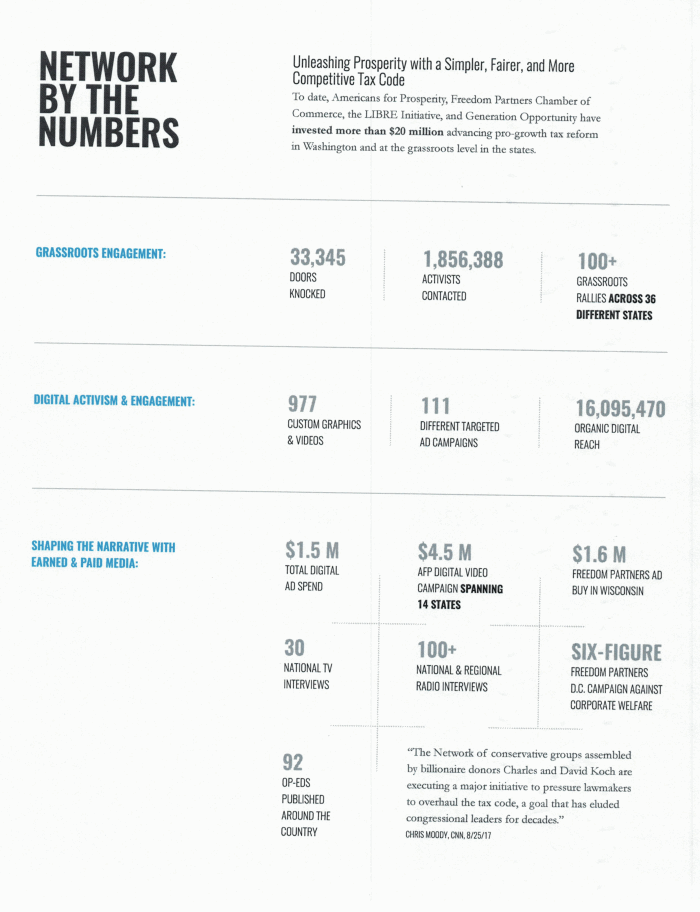
Despite some public antagonism over Trump — including flirtations with replacing him as the nominee with Ryan at the Republican National Convention — the Koch brothers have enjoyed incredible access with his administration. The president’s lawyer, Don McGahn; the president’s chief liaison to Congress, Marc Short; and the president’s counselor, Kellyanne Conwayall previously worked for the Koch network before taking their current positions in the White House. Ethics forms reveal that officials across the government, including at the Environmental Protection Agency and the Department of Energy, previously served at Koch think tanks or other Koch groups. Vice President Mike Pence also maintains a very close relationship with the Koch brothers.
The Koch brothers are also hoping to fundamentally reshape other aspects of American society, including labor unions and the judiciary.
The memo details efforts to weaken the power of labor unions, including a broad attack on private sector labor unions in states controlled by Republicans in 2017. Meanwhile, the memo notes that the Trump administration has shelved a number of Obama-era rules that were viewed as too friendly to workers and labor unions, including the Overtime Rule and the Joint Employer Rule. The latter would have reduced the barriers for workers at franchise businesses, like fast food outlets, to form a union.
“Labor reform is not an overnight process; advancing major federal labor reform requires a long-term strategy,” it adds. To that point, the Koch network plans to press forward with the Employee Rights Act, legislation to extend right-to-work laws nationally and set up new barriers for labor activists hoping to form new unions.
The memo notes that they believe Justice Anthony Kennedy will soon retire, and the effort to replace him will be “far more contentious” than the effort to confirm Justice Neil Gorsuch.
“If President Trump nominates a principled, constructionist nominee for Justice Kennedy’s seat or any other vacant seat, we anticipate engaging with both grassroots and under-the-dome tactics, bringing paid and earned media and events to support the confirmation.” The memo notes that the network sponsored pressure effort on Sens. Joe Manchin, D-W.V., Heidi Heitkamp, D-N.D.; and Joe Donnelly, D-Ind., all of whom eventually voted to confirm Gorsuch.
In Indian Wells, California, last month, the network held a retreat with 700 donors. Several journalists were invited to attend as long as they promised not to name the donors present.
Operatives from the network also led sessions to explain how to move forward into the midterm elections. The Koch brothers intend to spend $400 million to preserve the Republican majority in Congress and maintain GOP power at the state level.
In recent days, Koch network groups have purchased ads targeting Democratic lawmakers in key elections across the country. This week, a new ad began airing in Missouri criticizing Democratic Sen. Claire McCaskill, who is up for re-election this year.
“We’ve made more progress in the last five years than I had in the last 50,” Charles Koch reportedly said. “The capabilities we have now can take us to a whole new level.”
EMBRACING TRUMPISM
In the era of Trump, the Koch machine, including ALEC, has fully embraced Trumpism. Shortly after the November 2016 election, ALEC’s Executive Director Lisa Nelson told funders and members that she was thrilled to report that the Trump administration “does have the potential to be an ALEC administration. It is full of the people and ideas we’ve advanced since 1973…Now is our time. And ALEC is ready.” Since then over 40 Koch political operatives have signed on to work for the the Trump White House and administration, according to a recent report by Public Citizen.
==
CA CAFE
https://www.desmogblog.com/2018/04/10/koch-nichols-scott-pruitt-strip-california-waiver-regulate-auto-emissions
...In the weeks leading up to his announcement about the emissions standards, Pruitt had taken a more antagonistic tone towards California, signaling that he might attempt to revoke the waiver that was granted by the Obama administration, per legal mandate, in 2009.
“California is not the arbiter of these issues,” Pruitt told Bloomberg News in March, adding that the state “shouldn’t and can’t dictate to the rest of the country what these levels are going to be.”
With the waiver in hand, California can continue to enforce current greenhouse gas emissions standards, despite whatever the EPA sets as the new national standards for model years 2022-2025. On top of that, any other state can choose to adopt California’s standards, which 13 other states and the District of Columbia currently have.
Because these states represent roughly one-third of the country’s personal vehicle market, automakers would have to decide whether to set up two different production lines for states following the California standards and the rest of the country, or whether to treat California’s targets as a de facto national standard.
Predictably, the automakers, through the powerful Auto Alliance and Global Automakers trade groups, are calling for one national regime, which could result from a grand bargain like the one that Pruitt just scrapped, or could be delivered by Pruitt stripping California of its waiver.
Any attempt at such a repeal would be hugely controversial, and possibly illegal, due to many nuances in the Clean Air Act and the history of its application and enforcement. A waiver granted to California under the Clean Air Act has never been revoked, and has only been denied once.
Notably, that lone denial came in December 2007 when William (Bill) Wehrum, who ran the EPA’s clean air division at the time, convinced then-EPA Administrator Stephen Johnson to reject the state’s request to set its own greenhouse gas standards for vehicles, the very issue at hand today.
(California was later granted that same waiver in 2009 under the Obama administration, after the state sued the EPA, and after the Supreme Court had held in 2007 that the EPA was required to regulate greenhouse gas emissions. For a much more comprehensive background on California’s waiver and Wehrum’s opposition, see this recent Desmog article.)
Today, Wehrum is again the air chief at the EPA, and is again in a position to attempt to strip California of its unique authority to set its own air pollution limits. As Wehrum, Pruitt, and EPA policymakers work to figure out the new national emissions standards for cars and light trucks, they are hearing from groups including the American Consumer Institute and its Koch-tied coalition on the importance of revoking the California waiver.
Who Are the Groups Fighting California’s Clean Air Act Waiver?
The ACI letter to Pruitt, dated March 28, 2018, was signed by representatives from 11 groups, eight of which have known ties to the Koch network, and all of which are routine commenters on conservative issues.
The American Consumer Institute (ACI) is credited with organizing the coalition, and the letter is signed by its President Steve Pociask. The group is best known for opposing net neutrality efforts while being funded by a major internet service provider (ISP) lobby, as journalist Lee Fang detailed for VICE. More recently, Pociask has turned his attention to attacking electric vehicles, writing on Forbes that “the science on electric vehicles does not support continuing California’s waiver.”
Less Governmentis an “organization dedicated to reducing the power of government and protecting the First Amendment from governmental assault,” which was founded and run by Seton Motley, who is also listed as a Policy Adviser to the climate science-denying Heartland Institute. Though Motley and his Less Government org have their roots in telecom and media issues, he has in recent years engaged more on climate and energy issues, signing some anti-wind energy letters organized by the Koch-backed Americans for Prosperity and writing a bit on electric vehicles.
The Taxpayers Protection Alliance (TPA) is part of the network of front groups funded by the Koch brothers and their donor network through the Center to Protect Patient Rights (now called American Encore), and Freedom Partners. As the Energy and Policy Institute has described, “TPA essentially exists as a shell for its advocacy, based on its own IRS form 990s: 'The Taxpayers Protection Alliance has given control of the management duties and the daily activities of the organization to MLM Consulting, LLC (MLM). MLM will be responsible for managing the organization and work to support the exempt purposes of TPA. The President of TPA, David Williams, is the sole owner of MLM Consulting LLC.'” Williams signed the ACIletter to Pruitt. TPA has fought clean energy policy in the past using the website SolarSecrets.org and has published white papers arguing against solar energy tax credits.
Consumer Action for a Strong Economyis run by Matthew Kandrach, and has been linked to a number of coalition efforts stemming from the FreedomWorks organization, which was born of a merger between the Koch-founded Citizens for a Sound Economy (CSE) and Empower America.
American Commitment is run by Phil Kerpen, a former Vice President of Americans for Prosperity. The organization was founded by Sean Noble, a right-wing operative with close ties to the Koch brothers who also runs the Center to Protect Patient Rights (American Encore), a major funnel for Koch donor network money to front groups.
FreedomWorks was, as mentioned above, born of a merger between the Koch-founded Citizens for a Sound Economy (CSE)and Empower America, though it has no known Koch ties at present day. The group was described in a 2012 article in Mother Jonesas “one of the main political outfits of the conservative movement and an instrumental force within the tea party.” It pushes free market policies and has questioned the well-established science linking human activity to a warming planet.
The Competitive Enterprise Institute (CEI) is a conservative advocacy group dedicated to “economic freedom” that has received funding from ExxonMobil, Texaco, and the family foundations of the Koch brothers.
Americans for Tax Reform (ATR) is an anti-tax group that has received funding from the oil and gas lobbying group, the American Petroleum Institute, along with various groups in the Koch network such as the Claude R. Lambe Charitable Foundation and the Center to Protect Patient Rights, as well as DonorsTrust.
The 60 Plus Association describes itselfas the conservative alternative to the American Association of Retired Persons (AARP) and receives significant funding from groups connected to the Koch brothers. The group has also received funding from the American Petroleum Institute, and was created by Sean Noble (see American Commitment above). Noble was until recently a consultant for the Arizona Public Service utility company, and has led efforts in Arizona to kill solar-friendly legislation.
Frontiers of Freedom, run by George Landrith, has received significant funding from Exxon, the Koch brothers, and dark money organizations like Donors Trust. In 2015, Landrith launched the Energy Equality Coalition to battle against the federal electric vehicle tax credit. The coalition also includes David Williams of the Taxpayer Protection Alliance and Horace Cooper, a senior fellow at the Heartland Institute. Landrith is also a directorof the National Center for Public Policy Research (NCPPR).
The Center for Freedom and Prosperity was once funded by the Charles Koch Foundation and has actively lobbied for more liberalized tax laws, and for less scrutiny towards offshore tax havens.
Seven of the organizations that signed this letter to Pruitt — and five of the actual representatives who signed — also recently penned a letter to the U.S. Food and Drug Administration (FDA) defending “electronic and heat-not-burn” tobacco products (or vaping products), indicating that this network is defending the tobacco industry as well as oil and gas companies.
California and Partner States Fight Back
Nichols has signaled that California will not be retreating from its strong standards.
==
The Koch political network has announced plans to spend substantial money to target incumbent Democrats in the 2018 midterm elections, among them Sen. Jon Tester, (D-Mont.), the committee’s ranking Democrat.
==
https://www.alternet.org/news-amp-politics/right-wing-wants-roll-back-20th-century
TheRepublican Party's "tax reform" bill has passed both chambers of Congress. After differences between the House and Senate version are worked out, it will likely soon be signed by President Donald Trump. This legislation is more than a grotesque effort to take money from the poor and working class and give it to the very richest Americans and corporations. In reality, it is an effort to wholly remake American society by undoing the social progress of the New Deal, the Great Society and the civil rights movement.
:{
}:
This effort has been met with surprisingly little resistance from the American people.
Why?
Unlike the Republicans and movement conservatives, the Democratic Party is terrible at translating complex questions of public policy into simple narratives that evoke emotion and, in turn, action from the American people. Moreover, while the Republican Party systematically works to roll back the 20th century by eliminating programs such as Social Security, Medicare, Medicaid and the Affordable Care Act -- with the apparent goal of creating a Malthusian dystopia -- many prominent Democrats and other liberals are instead obsessed with enforcing purity tests for sexual harassment within their own party.
The mainstream news media has a very short attention span. The format of the 24/7 cable news cycle is also designed to avoid serious in-depth discussions of complex and important policy matters in favor of simple stories that generate ratings.
To a significant degree, the American people have been exhausted by Trump and the Republican Party's authoritarian and petit-fascist assaults on reality, truth and, yes, even the country's citizens. Many Americans have been driven into a sense of learned helplessness by Trump's presidential victory and the years of civic and cultural rot that enabled that outcome. Consequently, it has become difficult to imagine what a real and sustained resistance against the Republican Party, Donald Trump and the ascendant right would even look like.
How does the Republican tax bill fit into a larger strategy? Who are the "winners" and "losers"? What will the various factions in the right-wing coalition that forced through this bill receive for their machinations? In this radically revanchist effort to remake American society, how far back would the Republican Party and the Koch brothers like to take us? How can the American people fight back?
Ultimately, this assault on American democracy and society should not be a surprise. It has been operating both in the shadows and plain sight for decades. In an effort to understand the true goals and larger context for the Republican Party's tax reform legislation, I recently spoke with Nancy MacLean, the William H. Chafe Professor of History and Public Policy at Duke University. MacLean is also the author of the controversial new book "Democracy in Chains: The Deep History of the Radical Right’s Stealth Plan for America," which was nominated for the 2017 National Book Award.
A longer version of this conversation can be heard on my podcast, which is available on Salon’s Featured Audio page.
The Republican "tax reform" bill recently passed the Senate. It will be reconciled with the House version and signed by Donald Trump. This legislation can be described as a blueprint for changing American society in the vision of the most extreme elements of the right wing, including the Koch brothers, Christian fascists, plutocrats and others. You outlined their plan to undermine American society in "Democracy in Chains." How does it feel to be right?
I have a sinking feeling. I can see this thing happening and I can’t stop it. So it’s painful, actually, to be right.
Before we even get to the tax bill, let me point out that there are 30 states which are under the control of the Republican Party and the most extreme right-wing elements in the country. This tax bill, however one labels it, is intended to remake American society and government in order to push through an agenda that its advocates know is wholly unpopular and will only pass if they are dishonest about the goals involved. So instead, the Republican Party and right wing are operating by stealth. They’re moving with secrecy. They are planting things inside the bill that are like time bombs and the public does not seem to be paying any attention.
We have to help the American people understand the stealth dimensions of what the Republicans and the radical right have done with this tax bill, and also their efforts to destroy the Affordable Care Act. This legislation is being pushed through at breakneck speed and in violation of normal procedures. There were no public hearings. They did not have cost assessments. They did not allow debate.
When you combine this with the push for a constitutional convention, at which the No. 1 agenda item will be a balanced budget amendment -- put those things together, and this is a long-term stealth project to privatize Social Security and Medicare.In terms of the dishonest approach used to push this bill through, there are many examples. For example, in the near term, people will see tax cuts, but in the long term, they will see tax increases. That is particularly true for people [making less than] $75,000 a year in income. These are people who are probably the most stressed, probably working two jobs, who are not paying a lot of attention to what’s happening in the Senate for those reasons. Yet they are going to be the most hurt by this. This is so much more than a big giveaway of money to the rich. There will be huge automatic cuts to Medicare, Social Security and Medicaid that will come directly from the Republican decision to run up the deficit with these tax cuts.
The Republicans intentionally created a budget "crisis" with this tax bill and then will claim there is an emergency that necessitates destroying Social Security, MedicareandMedicaid. It is obvious and transparent. What role does conservative contempt for poor and working-class people play in the effort to subvert American democracy?
I think that’s crucial. Increasingly, I have started to think about this right-wing cause as being a type of economic eugenics. At the turn of the 20th century, eugenicists thought that you could breed better humans by paying attention to bloodlines, gene pools and the like.
Today they won't use such explicit language. But there are right-wing libertarians who obviously believe that people who have not succeeded in this society always have themselves to blame. As a historian, that conclusion is just astonishing given what we know about structures and how the rules have been rigged to benefit some people and harm others.
This is the ethical system that allows people like Paul Ryan to feel heroic and self-righteous as they inflict harm on other people. At its most basic, this libertarian moral system says that it would be better for people to die than to get health care financed by government from taxes paid for by others. You can die. Period.
Whatarethe transactional politics involved in this tax bill?
Well, I actually believe that Charles Koch is not in this just for the tax breaks and deregulation. I believe that he is utterly messianic, and that he believes, just as Ayn Rand did, that entrepreneurs and capitalists are the true heroes of the world. I have a feeling that Charles Koch seethes with rage that he does not get the adulation he believes that he deserves. He’s been at this now since the 1960s. That’s a very long time. He’s compared himself to Martin Luther. When Charles Koch launched this project in earnest in the late 1990s, he said, “I want to unleash the kind of force that propelled Columbus to his discoveries.”
He has that deep an ideological commitment. Others have relative degrees of that ideological commitment. Some are just operatives who understand that this is a really good gravy train to ride, that the pockets and the bank accounts are just endless or bottomless.
For the religious right they can get tax breaks for Christian home schooling and for Christian private schools. Ultimately, they can see their enemies humiliated.
Grover Norquist explains this strategy as "one fish, one hook." In other words, they don’t have to tell anybody the whole agenda that they are pushing for. So it is not even clear to me how many of even the upper-level operatives in this right-wing plot actually understand what the ultimate plan is.
How do we fight back against pure ideologues whose beliefs are their religion? The Democrats are a loose coalition of different interest groups. Frankly, they are not equipped to fight back against a Republican Party and broader right-wing movement that operates like a political cult.
I agree with you in the broad outlines. But it is important to make some key distinctions. For example, there is the Bernie [Sanders] wing of the Democratic Party. It is pretty astonishing that a Jewish socialist is now the most trusted and respected elected official in America.
There has also been a surge of grassroots activism in the past year in places such as Virginia. So I think there are definitely some places where you can see hope with how people are trying to both reinvent the Democratic Party and also renew the idea of democracy in America for the 21st century.
I can imagine a historian 20 or 30 or 50 years from now, looking back to this moment and coming up with two stories. I can imagine the story of how we didn’t stop this Koch network push to transform our democracy, even when it was so obvious. Instead we just pushed our society, our kids and grandkids, over a cliff.
But I also think on the more positive side. As a historian who studies social movements as being fundamental to significant historical change, I hope that someday people will look back on this moment and say that, right now, in this moment, in December of 2017, we were deep in the churning that was part of our beginning to figure our way out of this. There are people in all kinds of organizations and places who are feeling new urgency, who are coming together in creative ways, who can begin to turn the tide and to churn those larger gears of the sleepy, big organizations to make them change. But is that going to happen? I don’t really know. As you say, how we react to this Republican tax bill is going to be highly predictive of which way the story turns out.
America is an oligarchy, if not just a plutocracy. Could it be that Republicans and other members of theright wingdon't really care how unpopular their ideas and policies are because in practice this country is not a functioning democracy? So what if there’s a mass movement? So what if there are new social movements that are birthed out of this moment? The Republicans have gamed the system to maintain power.
You just pointed out another element of the stealth nature of this tax plan. It is being pushed by people who say they are for limited government. But the Republicans and their allies are actually using the power of national government to prevent voters in more progressive localities and states from being able to choose more progressive policies without being penalized for it.
Consider [economist] Tyler Cowen at George Mason University, who has been working with Charles Koch for 25 years on the Mercatus Center, the main academic outpost of this Koch effort to leverage universities for their political project. Cowen said in a recent book that people on the left keep saying the masses are going to react to this. There’s going to be protest on the streets. There’s going to be revolution and the like. Cowen said, “Ah, I don’t see it. I think the people are pretty happy with their technology. They’re absorbed with Facebook and binge-watching Netflix.” You know what? I think there’s some truth to that. As a historian, I don’t think that’s going to continue forever, but I can see why the Kochs and their operatives have gotten brazen.
In plain terms, if you were speaking to the average American about the dangers posed by this tax bill and the Republican Party andright wingmore generally, what year do they want to return the country to?
James McGill Buchanan, a Nobel-winning economist who devised the playbook that the Koch network is using, was very clear that he liked the constitutional rules of 1900. Consider that the constitutional rules of 1900 had us in a situation of chaos and ever-worsening depression because only the wealthy were doing well and everybody else was screwed.
That was also the period of the Lochner Court, as it was called, which issued a Supreme Court decision that was akin to the Citizens United of our day. That court basically said that workers had no right to organize together collectively, so corporations had all the power. It was a plutocracy. America had these roving battles between labor and capital. We had horrible, almost unimaginable levels of pollution. We had terrible problems with public health care. We had a country that you would not want to live in, and that’s a world that is idealized by the Republicans, the Kochs and the other elements of the extreme right who want to radically remake America in the worst way possible.
Do not forget that this was a period when the Constitution enabled mass voter suppression and racist decisions such as Plessy v. Ferguson, which argued that "separate was equal."
So these people don't just want to get rid of Obama’s legacy. They want to reverse the whole 20th-century model of citizen-driven government and make it so that property reigns supreme. That’s the beginning and the end of it. The American people need to realize that we’re going to be in ever-deepening trouble.
Chauncey DeVega is a politics staff writer for Salon
==
https://www.ecowatch.com/climate-denying-koch-brothers-back-purchase-of-time-magazine-2512979338.html
==
“So, it appears political appeasement may not save public funding in public media’s time. That leaves it in the hands of private sponsors. What’s the point?”
Maybe that one of those private sponsors is Koch Industries, who are currently using underwriting spots to try to greenwash their image with crap about their devotion to ‘renewable fuels’, whatever that is supposed to mean.
Don’t get me wrong; I listen to lots of NPR, and have supported them for years. And while I’m not satisfied with their coverage of climate change, at least there *is* coverage of climate change on their shows. But I really, really don’t like to hear those Koch spots; the Kochs have bought enough of this country’s politics and culture already.
==