layoff unemploy jobs
wow, belated 5/18
no merri
TRUMP FIRES LABOR STATS 8 25
for now thus includes unemployment insurance // social safety net (recall strict fr xian/libtard ~ lazy brn ppl) strict fr
see outsourcing
SEE GNP ECONOMY
---
neglected re covid
Trump has worked to accelerate America’s development of AI rather than regulate it, and the result is not just an epidemic of deepfakes and hallucinations being passed off as legitimate research. A new report reveals that some of the nation’s best-educated workers, who once were secure, are taking it on the chin.
“About one third of the total personal wealth in the United States is held by the top 1 percent of households, while the bottom half of Americans holds less than 3 percent, according to Federal Reserve data,” wrote The Washington Post's Elizabeth Dwoskin and Shira Ovide wrote on Sunday. This data includes former economic winners who are now finding themselves on the wrong side of layoffs and hiring freezes — tech workers.
“The sense of precariousness among America’s professional elite could be a preview of what’s ahead for the rest of the country as AI spreads,” the Post wrote. “Silicon Valley techies are ‘are guinea pigs for what tech dudes want to do to everyone,’ said Anil Dash, a technology entrepreneur.”
They added, “At tech companies, leaders obsessed with winning the AI race have tasked their workforces of coders, lawyers and HR professionals with becoming the front line of that transformation. They’re being measured by how quickly they can automate their own jobs while watching their colleagues get pushed out in successive waves of layoffs.”
The report continued, “Layoffs.fyi, which tracks announced job cuts, counts more than 800,000 tech workers laid off since 2022, including large staff reductions in recent months at Meta, Microsoft, Oracle and Amazon.” According to the Silicon Valley market research consultancy founder Oliver Raskin, whose company is called Signalcraft Insights, “there’s this whole tranche of people who’ve been quite used to being among the most upwardly mobile in society who are all of a sudden saying, ‘Now I’m the guy on the street.’”
In the mid-to-late 20th century, autoworkers were the group most likely to fall into the category of “entered a specialized field on the premise that it was well paying and stable, only to have the rug pulled out from under them.” Now that dubious distinction belongs to tech workers such as coders and engineers, whose positions are being outsourced to AI because the technology’s speed and without regard to notable dips in quality.
“There’s just a lot of uncertainty, a lot of fear, a lot of people feeling like, if they get let go from this job, they might not find another one,” Anneke Buffone, a psychology PhD who Meta hired to help employees’ well-being and safety but ultimately left in December, told the Post.
“She described getting pushback from managers when she tried to explain that a particular AI tool was a waste of time,” the Post reported. “The system had so many errors that she needed to redo its work.”
It continued, “But her bosses ‘were like, ‘No, keep using it more. It’ll just get better,’’ she said. ‘There’s a feeling among management that when you voice that AI has all these problems, they don’t want to hear it.” AI, she said, makes “everything go so much faster. It creates this illusion that you can get all this stuff done. Much of the time you’re just babysitting the AIs.’”
---
booed at ufc fight?
an 4 26
President Donald Trump likes to boast about his supposedly unanimous support within his own base, but a recent editorial from a prominent financial publication suggested his movement is not just slipping away from him. It’s eviscerating itself.
"The 'Make America Great Again' (MAGA) 'manosphere' is showing signs of internal fractures, as disagreements over U.S. President Donald Trump's handling of the Epstein files and the war in Iran spill into the open,” wrote the Money Control World Desk in an editorial published on Wednesday. As they pointed out, the so-called “manosphere” that fueled the MAGA movement
Trump launched with his 2016 presidential campaign is fracturing over the war in Iran and his longtime friendship with late convicted child sex trafficker Jeffrey Epstein.
"Prominent figures linked to the space include Andrew Tate, Ben Shapiro and Nick Fuentes, many of whom are now at odds over issues such as U.S.-Israel ties and the Epstein files,” Money Control World Desk wrote.
Even President Trump has been drawn into the fierce feud, which threatens to even further dampen enthusiasm that the Republican leader desperately needs as his party approaches the treacherous 2026 midterm elections.
"The tensions escalated after Trump lashed out at both commentators,” Money Control World Desk reported. “'They have one thing in common, low IQs,' he said. 'They're stupid people, they know it, their families know it, and everyone else knows it, too.'"
As war blooms, others in the movement are taking sides. Podcaster Joe Rogan described Trump’s ICE agents as engaged in “Gestapo tactics,” said he was disappointed in Trump’s evasive response to releasing Epstein’s files and opposes his war in Iran. Far-right commentator Alex Jones went from being one of Trump’s staunchest supporters to claiming he has betrayed his base with the Iran war and even questioning his mental fitness. Nick Fuentes, a far right commentator, proclaimed that “MAGA is dead,” and told the president: “Trump, you don’t have any young fans anymore.” Because of Trump’s recent comparison of himself with Jesus Christ and feuding with Pope Leo XIV, many Christian conservatives are even questioning whether Trump is the Antichrist.
Trump is equally controversialamong his base on economic issues. "The White House promised a manufacturing renaissance,” wrote Fortune business editor Nick Lichtenberg on Tuesday. “Instead, the factory floor keeps shrinking."
In particular, Lichtnenberg pointed out that "the blue-collar job market has been slowing for more than a year, with jobs in manufacturing and construction racking up roughly 150,000 net losses on an annual basis as of March… During Trump's first year back in the White House, the manufacturing sector alone shed 108,000 jobs — even as the administration touted a coming 'manufacturing boom.'"
He concluded with irony that "the same working-class men the MAGA economy promised to rescue are sitting out a hiring boom in the fastest-growing sectors of the U.S. economy because those jobs are considered women's work. Meanwhile, the factories they're waiting to return to keep shedding workers."
---
---
MMA
03/06/26
an 2 26
President Donald Trump repeatedly claims that manufacturing jobs have boomed during his second term, but a recent report reveals the construction spike is not doing what most people want — creating large numbers of jobs.
“Industry data show that much of the recent surge in construction jobs is tied to data centers and the power infrastructure that supports them, not a wave of new factories backed by fresh investment pledges Trump has secured,” wrote Politico’s Megan Messerly and Sam Sutton. “That matters because factories tend to employ far more people than data centers, one of the main reasons communities have been more receptive to the former setting up shop in their towns.”
By contrast, Trump claimed during his State of the Union message that “as thousands of new businesses are forming and factories, plants and laboratories are being built, we have added 70,000 new construction jobs in just a very short period of time. It’s getting bigger and bigger and stronger. Nobody can believe what they’re watching.”
Even though Trump says rising construction activity means Trump’s tariff policy is cultivating domestic manufacturing, Politico reports that many of these investments are in such early planning stages that “the factory jobs that could reshape communities are likely years away” — and that is assuming the factories in question produce lots of jobs, which often is not the case with data centers.
“Not one in the last year has started under this administration where we’ve procured the first man hour of work,” Sean McGarvey, president of the North America’s Building Trades Unions, told Politico. Although there have been announcements of projects, “they haven’t started yet… As far as actual shovels in the ground, that hasn’t happened.”
In terms of the 33,000 job gains in January, “economists believe those jobs were just a blip in the data, driven largely by unseasonably warm weather during the period when government statisticians were collecting data. That disconnect could complicate Republicans’ argument to working-class voters looking for signs of a Trump-fueled factory comeback.”
Quoting Scott Paul, president of the Alliance for American Manufacturing, Politico reported that “whether it’s warehouses, data centers, manufacturing or a Buc-ee’s or whatever, what is ultimately going to bring stable, high-paying jobs into the community? From that perspective, manufacturing is the winner. At a data center, there are fewer jobs. There will be a few high-skilled jobs, but not a lot of them.”
He concluded, “I think that’s a very fair question of, what’s going to get you more bang for the buck, employment wise?”
Mark Zandi, the chief economist at Moody’s Analytics, confirmed the type of construction cultivated by the Trump administration will not be particularly fruitful in terms of creating thousands of long-term jobs.
“You’re going to get some construction jobs because of data centers and build out of power capacity and maybe chip plants — that kind of thing,” Zandi said. “But that’s going to be offset by job loss in the housing sector. Multifamily, single family completions are weak and are going to continue to fall. And they’re much more worker intensive than the data centers.”
In fact, not only has Trump failed to stimulate manufacturing job creation. According to the liberal-leaning think tank Center for American Progress, he is actually making things worse.
“Far from the manufacturing sector ‘roaring back’ as Trump promised, the United States has lost more than 100,000 manufacturing jobs over the past year,” Allison McManus and Dawn Le from the liberal-leaning think tank Center for American Progress recently wrote. “These actions have pushed the country’s closest trading partners to seek deals elsewhere, including with China: Canada, India, Japan, South Korea, and the European Union have all recently sought new agreements without the United States.”
Similarly, when Trump claimed during the State of the Union message that tariffs would one day replace the income tax, experts scoffed.
“I believe that tariffs paid for by foreign countries will, like in the past, substantially replace the modern day system of income tax,” Trump claimed, prompting American Bridge 21st Century to tweet that “American families and businesses paid at least 90% of Trump’s tariffs last year. His agenda taxes Americans anyway you slice it.”
A moderate commentator echoed this critique.
“After a fairly sober opening, Trump is now veering into fantasy, falsely claiming that he ended taxes on Social Security and suggesting that tariffs paid by foreigners will mostly replace the income tax,” Nicholas Kristof of The New York Times posted on X. “All false.”
---
an 2 26
A Monday analysis from MS NOW revealed the employment trend that is helping to prop up Donald Trump's already meager job growth numbers, and it has more to do with an aging population than his undelivered manufacturing boom.
As of the most recent jobs report from last week, the U.S. has added around 359,000 jobs since Trump returned to the White House a little over a year ago. As MS NOW data journalist Philip Bump noted on Monday, while positive, that is still a far cry from the numbers during Joe Biden's presidency, which matched that figure every month.
Trump and his allies have attempted to spin this stalling growth by noting that around 600,000 private sector jobs have been created, and that the overall number is being dragged down by the massive cuts his administration made to government employees.
Despite Trump's pledge to bring manufacturing jobs back to the U.S., Bump's findings show that almost all the new jobs under his watch came from the "service" industry. Digging deeper, he found that "anomalous growth" in one specific sector of the service industry, healthcare, driven by a growing portion of the population: "old people."
"That’s a theme to the growth seen in 2025. The year saw increases in home health care aides, ambulatory health care services, hospitals and nursing/residential care facilities — all jobs related to taking care of people’s health," Bump explained. "This is a continuation of a pattern. Since 2000, the number of people working in individual and family services is up 300 percent. The number working in retirement and assisted living facilities has more than doubled."
He continued: "So what’s going on? Well, one central factor here is that Americans keep getting older. The baby boom extended from 1946 to 1964. In 2011, the oldest boomers began hitting age 65. The density of elderly people in the population began to skyrocket, pushing demand for health care aides and (lagging a bit) nursing home and retirement care."
The surge in population density caused by the baby boom has caused similar surges in demand for specific goods and services throughout the decades, Bump noted. When the generation was at its youngest, diaper demand exploded. A few years later, demand for grade school teachers also exploded.
As the healthcare needs of the increasingly elderly baby boomers increase, Bump predicted that they will continue to drive demand for healthcare workers to service them. However, he also noted that this is not a trend that can continue forever, implying that demand will begin to wane as the generation passes away, with the younger generations not replacing the elderly population at the same rate.
"Put another way, senior care — meaning health care and housing, as the 2025 numbers show — will continue to be a driver of job growth," Bump concluded. "Until, as with diapers and school teachers previously, they aren’t."
an 1 26
Trump official admits 7 straight months of job losses in key sector
AN 12 25
Karoline Leavitt's 'whopper' about a 'strong' job market shredded in blistering fact-check
an 12 25
bartir?
Fox host admits layoffs under Trump at highest point in decades
---
AN 12 25
White House scrambles for 'damage control' as report pins job losses on Trump policy
---
AN 12 25
'Steep small business job cuts': New jobs data exposes weakness in Trump economy
Revealed: Wealthy ranchers profit from public lands while taxpayers pick up the tab
---
---
an 12 25
*Newsweek*reportsthat blue collar jobs are collapsing under President Donald Trump as the labor market in 2025 "takes a decidedly white-collar tone" driven by artificial intelligence.
"AI has already been cited in many of the mass reductions announced by Amazon and other corporations in recent weeks," writes Hugh Cameron.
"But for all the hand-wringing over the potentially ill-fated employees of Silicon Valley and Wall Street, a quieter crisis appears to be unfolding for the U.S.'s blue-collar employees, despite the pledges and efforts of the current administration to foster a renaissance in marquee industries such as construction and manufacturing," he adds.
The delayed September jobs report corroborates this, showing "an encouraging uptick in overall hiring but no pause in blue-collar employment's long-term decline," Cameron writes.
Of the five areas of employment considered blue collar — manufacturing, mining and logging, transportation and warehousing, utilities, and construction — only construction saw an increase in employment, he notes.
That said, construction's 19,000-job gain was also "insufficient to offset the monthly loss of 25,300 jobs in transportation or manufacturing shedding a further 6,000," he writes.
"Year-over-year changes show that annual payroll declines have accelerated since January — albeit continuing a long-term trend—and have pushed blue-collar job growth into negative territory for the first time since the pandemic," Cameron explains.
Heidi Shierholz, chief economist for the Department of Labor during President Barack Obama's tenure, tells Newsweek there is "undeniably a deterioration in employment conditions for the U.S.'s blue-collar workers."
"Between April and September, goods-producing industries (manufacturing, construction, logging, mining), lost 72,000 jobs, with most of those losses (58,000) in manufacturing," she says.
Shierholz also says that "the services sector — which falls partially under the blue-collar umbrella — is 'limping along' thanks solely to gains in health care."
David Dorn, a labor market expert at the University of Zurich, says construction is particularly vulnerable to negative growth despite that slight uptick in employment.
"This sector is highly sensitive to broader economic deceleration, and increasingly restrictive immigration policies under the current U.S. administration are likely constraining labor supply," he says.
And while Dorn says it's hard to "isolate" the direct effects of Trump's tariffs on employment, he says he doubts "whether these had 'generated any sustained gains' in jobs."
Dean Baker, a co-founder of the Center for Economic and Policy Research, goes further and says "tariffs have been largely to blame for the uncertainty and 'overall weakness in demand' that has driven cautious hiring across blue-collar sectors," Newsweek reports.
"Companies are reluctant to invest in a context where they have no idea whattariffs will be in placesix months from now, much less three to five years from now," he says.
Baker also says that while manufacturing's gradual decline as a share of total employment has "been the case for more than 50 years," as labor demand shifted toward health care, education and other roles within the more service-focused economy, the president isn't trying to fix it either.
"Trump is doing nothing to address these issues," Baker says.
---
---
RWW
11/21/2025
by
- Reese Gorman @ NOTUS: Cory Mills Was Caught With Sex Workers Before Mission to Afghanistan in 2021, Sources Say
The group Mills had traveled with to Afghanistan parted ways with the then-congressional candidate in Tbilisi, Georgia, after they found out about the sex workers. It appears Mills went to Afghanistan on his own.
- Isabel van Brugen @ The Daily Beast: Trump’s Coast Guard Backtracks on Swastika Policy After Uproar
The military service had drafted a policy that labeled the Nazi insignia as “potentially divisive.”
- Madison Pauly @ Mother Jones: How Right-Wing Superstar Riley Gaines Built an Anti-Trans Empire
The swimmer tied a trans woman for fifth. The MAGA industrial complex took care of the rest.
- Alex Griffing @ Mediaite: Schumer Sparks Fierce Debate with Resolution Condemning Nick Fuentes: ‘Elevating Him’
Senate Minority Leader Chuck Schumer (D-NY) sparked a heated debate this week when he announced he would push a resolution condemning white supremacist Nick Fuentes onto the Senate floor next week. Critics of the move warned Schumer that he would be “elevating” the vehement misogynist and anti-Semite, giving him a valuable national boost in name recognition.
- Steve Benen @ The Maddow Blog: The White House’s celebration of the weak job market makes no sensE
Job growth in the first year of Donald Trump’s second term is on pace to be the worst since the Great Recession. So why is his team bragging?
---
MMA
November 20, 2025, edition of Fox Business' Mornings with Maria
Later in the program, a guest touched on the downward revisions, mentioning the changes to attack the BLS, much like Fox has done in the past — but didn’t mention that the August jobs numbers had turned negative.
Bartiromo continued promoting the jobs report as “a good report” on America’s Newsroom, saying that it shows “an economy that is growing, an economy that is producing jobs.”
Later on America’s Newsroom, Fox Business correspondent Edward Lawrence said: “This could be considered a blowout report.”
On Fox & Friends, Fox Business host Jackie DeAngelis said, “This is a good report … by all accounts,” and added that the four-year high unemployment rate “is not a great headline for the president,” and that “people will look at that and maybe think the economy isn’t doing well, but it actually is.”
While Fox personalities were praising this jobs report, they didn’t mention that it showed that the economy lost 4,000 jobs in August. From the September jobs report:
The change in total nonfarm payroll employment for July was revised down by 7,000, from +79,000 to +72,000, and the change for August was revised down by 26,000, from +22,000 to -4,000. With these revisions, employment in July and August combined is 33,000 lower than previously reported.
As a reminder, Fox was so pessimistic about the employment situation in August that, before that month’s report came out, network personalities began excusing an expected weak month of job growth by echoing President Donald Trump’s attack on the Bureau of Labor Statistics and its data production.
Crucially, and contrary to Fox's spin, these September data and prior month revisions are not giving a snapshot of the economy right now.
The data for September predates the historic government shutdown, which shaved billions of dollars from the economy and is likely to have coincided with significant job losses — the payroll firm ADP estimated the private sector was losing 11,250 per week in October.
And due to complications from the government shutdown, the Labor Department has canceled the official BLS employment situation for October.
Some economic experts have also pointed out that the September jobs report was, in fact, not particularly strong.
New York Times chief economics correspondent Ben Casselman noted that “this is the highest the unemployment rate has been since October 2021, when the economy was still emerging from the COVID pandemic.”
Harvard University economics professor Jason Furman called it “a weakish jobs report,” noting that the “3-month average is only 62K” jobs created.
Economics writer Joey Politano wrote: “The unemployment rate for Black Americans remained at 7.5% in September, the highest level since 2021 and a nearly 1.9% increase from the start of this year.”
Fox itself had attacked President Joe Biden over one September jobs report during his term of office that featured significantly more job gains than the most recent data. In 2023, Fox Business host Charles Payne declared that the 336,000 job gains initially estimated for that September — nearly three times more than in this jobs report — “was not a strong jobs report.”
//
09/05/25 11:48 AM EDT
08/01/25 11:13 AM EDT
05/02/25
---
---
3X JOB WHAMMY, DOGE CUTS, SHUTDN, TECH CUTS AI 11 25
AN 11 25
'Really hurting': US job cuts surge to decades-high level amid Trump recession fears
===
---
3X JOB WHAMMY, DOGE CUTS, SHUTDN, TECH CUTS AI 11 25
AN 11 25 badash
'Really hurting': US job cuts surge to decades-high level amid Trump recession fears
Employers have cut over one million jobs so far this year, with announced layoffs surging in October to levels not seen in decades. Some experts have been warning about a possible recession.
“U.S. employers have announced 1.1 million layoffs so far this year — the largest reading since the pandemic recession and on par with 2008 and 2009 job cuts during the Great Recession,” The Washington Post reported on Thursday, pointing to a report from Challenger, Gray & Christmas, which tracks workplace reductions.
Major corporations have cut or are reportedly planning to cut thousands of positions this year:
UPS: 48,000 employees
Amazon: Up to 30,000 employees
Intel: 24,000 employees
Microsoft: 15,000 employees
Target: 1,800 employees
"Employers announced more than 153,000 job cuts last month, a 183 percent increase from the month before, marking the worst October for layoffs since 2003,” the Post reported, citing data from the Challenger report.
“The worst October in 22 years” is how CNN reported the news.
“We’re entering new territory with these layoffs in October,” Challenger CEO John Challenger told the Post. “We haven’t seen mega-layoffs of the size that are being discussed now — 48,000 from UPS, potentially 30,000 from Amazon — since 2020 and before that, since the recession of 2009. When you see companies making cuts of this size, it does signal a real shift in direction.”
Amid the job cuts, the “AI bubble,” President Donald Trump’s massive deportations and tariffs, record-high household debt, climbing automobile payment and consumer loan delinquencies, some believe a recession may be in America’s future.
“Employment has stalled, companies are announcing massive layoffs to appease Wall Street, and car repossessions just reached 2009 (recession) levels,” wrote economics professor and managing director of an economic consulting firm, Hal Singer, just last week. “The GDP numbers mask real suffering in the economy. And the only fiscal tool in the Trump policy kit are tax cuts for the wealthy. This could get ugly.”
Late last month Moody’s Analytics Chief Economist Mark Zandi said 22 U.S. states are already in a recession, Moneywise reported.
"While Zandi did emphasize that the U.S. is not in a recession just yet, he told MarketWatch that ‘we’re on the precipice,’ blaming much of the problem on President Trump’s tariffs and federal job cuts.”
“A growing number of states are struggling, some already in recession, others right on the edge,” Zandi wrote. “Together, they account for nearly a third of U.S. GDP. The national economy isn’t there yet, but it’s clearly losing steam.”
Pointing to a list of ten major corporations’ jobs cuts, U.S. Senator Elizabeth Warren (D-MA) last week declared, “This is Donald Trump’s economy.”
CNN Thursday morning reported that a “brand new report is out … and it shows layoff announcements hit their highest level for October in over 20 years.”
“It’s painting a picture of a job market that is really hurting,” CNN’s Matt Egan noted.
===
---
AN 11 25 LAT
Los Angeles Times Pulitzer Prize-winning business journalist Michael Hiltzik writes that President Donald Trump has reversed the trend of President Joe Biden's booming economy and it's only getting worse.
Tuesday night's election boon for The Democrats, Hiltzik writes, only proves his point.
"The lesson delivered by the results is that Americans sense that the economy is reeling," he writes. "Most economic indicators are flashing yellow or even red."
Polls also point to Trump's abysmal economy, he notes, adding, "the indicators of economic pain are all around us. Every one of the leading opinion polls taken since Oct. 1 has shown Donald Trump’s approval rating on the economy to be deeply underwater, with the average calculated by RealClearPolling at negative 13.4 points."
Inflation, he writes, is "unmistakably on the rise again," as the consumer price index rose to 3.0 percent in September from a low of 2.3 percent in April, according to the Bureau of Labor Statistics.
An increase in food prices — up from 2.1 percent in May to 3.1 percent — "has potent political implications, since food is an expense experienced by consumers on almost a daily basis," Hiltzik says.
Job growth has also ebbed, he says, with monthly job creation "fading since Trump took office, with the figures turning negative in June, August and September," he writes.
Farm bankruptcies are rising, too. "Prices of such key crops as corn, wheat and soybeans have been falling as Trump’s trade war shrinks foreign demand for American produce," Hiltzik says.
Consumer spending is also down in "a serious slowdown from the 3.7 percent and 4.0 percent growth rates in the third and fourth quarter of last year, before Trump took office, Fitch Ratings calculated in September," he explains.
As the historic government shutdown continues, "headwinds threaten to keep building" against the economy, one which was thriving under Biden, he says.
"It’s proper to note that the economy Trump inherited from Biden was strong and getting stronger," Hilzik says.
”In truth, Biden inherited an unemployment rate of 6.8 percent from Trump’s first term, and bequeathed second-term Trump a rate of 4.1 percent, the lowest rate since the election of George W. Bush. Annual job growth fell to negative 6 percent during Trump’s first term, and Biden brought it up to an average of 1.4 percent."
Under Biden, "real gross domestic product growth per capita had fallen to an annualized rate of negative 1.8 percent under Trump 1.0; Biden brought it up to positive 2.1 percent," he notes.
Trump 2.0 also inherited an excellent employment to population ratio for workers 24 to 54 years old.
"When Biden took over, it was 76.2 percent, rising to to 80.5 percent when he ceded the White House to Trump — the highest handover value since 2000, according to the labor-affiliated Economic Policy Institute."
Conservatives "viewed Trump’s impending second term with a certain level of trepidation," Hilzik notes, saying some expected “the actual policies [would have been] less severe than suggested by Trump’s blustery campaign platform.”
They were more severe, he writes.
"The strongest headwind against growth is the uncertainty that Trump has imposed on the economy," he says.
About 71 percent of CEOs polled by Yale said that Trump's tariffs"were harming their business, 62 percent said the tariffs weren’t prompting them to invest more domestically and 59 percent said they expected no results from domestic investment as a result of the tariffs."
Despite the White House insisting the economy is strong, Hilzik says "the signs are that the near future, at least, will be economically bleaker than the present," and that "the one unmistakable positive sign in the economic landscape —a stock market reaching record highs — may be less encouraging than it appears on the surface."
Those highs, he says, are gains concentrated "among seven stocks associated with spending on artificial intelligence, and whether they can be sustained is an open question."
Trump's economic future looks bleak, Hilzik says, with no economic development "visible on the horizon that might relieve consumers of the feeling that they’re paying more for necessities and that their very livelihoods are under threat."
Tuesday's election sounded the alarm bells, Hilzik writes, but he's not sure the White House is listening.
"What Tuesday’s election results show is that consumers are voters. A rational administration would take that as a warning siren and reconsider its policies. This administration? Who knows?" he says.
---
---
an 9 25
'Biggest decline in 2-and-a-half years': Experts sound alarm on dismal labor market data
---
---
AN 9 25
In the 2024 election, the fact that Donald Trump's hardcore MAGA base aggressively supported him came as no surprise. But it was independents and swing voters who ultimately got Trump past the finish line and gave him a narrow victory in a close election.
Trump won the popular vote for the first time in 2024, defeating Democratic nominee Kamala Harris by roughly 1.5 percent — and the economy, according to polls, played a key role in that victory. Although the United States enjoyed record-low unemployment during Joe Biden's presidency, frustration over inflation worked to Trump's advantage.
But The New York Times' Jamelle Bouie, in his September 17 column, argues that Trump sold U.S. voters a "fantasy" that is now unravelling.
READ MORE: 'I'm the one asking the questions': CNN host cuts off Ted Cruz after he shouts over her
Trump, according to Bouie, told 2024 voters that "that there were no trade-offs" with the economy — and that Americans "could have their cake and eat it, too" when, "in reality," it "was a binary choice."
"The essence of President Trump's pitch to the American people last year was simple: They could have it both ways," Bouie explains. "They could have a powerful, revitalized economy and 'mass deportations now.' They could build new factories and take manufacturing jobs back from foreign competitors as well as expel every person who, in their view, didn't belong in the United States. They could live in a 'golden age' of plenty — and seal it away from others outside the country with a closed, hardened border."
One "binary choice," according to Bouie, was that "Americans could have a strong, growing economy, which requires immigration to bring in new people and fill demand for labor, or they could finance a deportation force and close the border to everyone but a small, select few."
"Millions of Americans embraced the fantasy," Bouie laments. "Now, about eight months into Trump's second term, the reality of the situation is inescapable. As promised, Trump launched a campaign of mass deportation. Our cities are crawling with masked federal agents, snatching anyone who looks 'illegal' to them — a bit of racial profiling that has, for now, been sanctioned by the Supreme Court. The jobs, however, haven't arrived."
READ MORE: 'Undisputed idiot king': Former NBC journalist calls Eric Trump 'the epitome of stupidity'
The New York Times columnist continues, "There are fewer manufacturing jobs than there were in 2024, thanks in part to the president's tariffs and, well, his immigration policies…. To embrace nativism in a global, connected economic world is to sacrifice prosperity for the sake of exclusion, just as the main effect of racial segregation in the American South was to leave the region impoverished and underdeveloped."
READ MORE: 'Didn't work for you': CNN analyst confronts Trump's favorite pundit on political violence
---
---
mma
August 1, 2025, edition of Fox Business' Mornings with Maria
MARIA BARTIROMO (FOX BUSINESS ANCHOR): 73,000 jobs, 73,000 jobs, created in the month of July, the number just coming out.
...
CHARLES PAYNE (FOX BUSINESS HOST): And that's total.
BARTIROMO: Four point two percent is the unemployment rate, right in line with expectations. Here are the numbers: For the month July, jobs came in 73,000 that was lower than the expectation, which called for 110,000 jobs. The unemployment rate right in step with expectations at 4.2%. Steve Moore, your reaction.
STEPHEN MOORE (GUEST): Look. I think this is all a result of — this disappointing number — is a result of all the turmoil over tariffs and and the trade wars. And that's sort of good news and bad news because guess what? In just the last few weeks, Trump has racked off a lot of victories here. As he gets more victories with the Europeans, with Japan, with the UK, I think that's gonna settle things. And then, that kind of turmoil will over. So I think, I think that — this is kind of a blip, and, and so I'm kinda I'm still very bullish on the US economy, but this is a disappointing number. I'd love to see, what the number was for private sector, as John was saying, is it private sector, or government? I want to see the government employment number down because remember, under Biden —
PAYNE: 83,000
MOORE: So much of the job creation was in the government sector.
...
PAYNE: I want to push back on it, I think this is more about the Federal Reserve.
BARTIROMO: Yeah.
PAYNE: Again, we've got a bifurcated economy. The Fed is — is they have a regressive approach here, right? They're still trying to clamp down on this economy, but it's not working, it's hurting 70% of the folks out there. Look at delinquencies, look at all the things that are hurting average household, I think — and also small businesses. They're coming into this year, the biggest question was how they even refinance. We're talking about financing government, then how do we help the small businesses out there? There are two economies, the Fed's looking at the wealthiest folks out there and thinking it means everyone. I think that's hurting jobs market more than anything else.
BARTIROMO: Mmhmm, yeah, it's a great point. I agree that this report is so critical for the Federal Reserve's next move. Stephanie, how do you read things?
STEPHANIE POMBOY (MACROMAVENS PRESIDENT): Well, I'm just stunned at another number in this report, and that is the downward revisions to the June figure, from 147,000 to just 14,000. So, looking over the last three months, we've got 73,000 in July, 14,000 in June, and 19,000 in May. Those are incredibly weak headline numbers, and that's the total, not just private jobs, so this is a very soft report. And I guess what I'm really blown away by July generally is a report where the seasonals are such that you can surprise on the upside very easily. Because a million people, roughly, drop out of the labor force with the school year, you know the school vacations. So that sets a very low seasonal bar for the data to clear, and clearly we tripped over the bar. So this is a very weak report.
...
POMBOY: And I guess it, you know, certainly strengthens the argument materially for the Fed to cut rates. It's interesting, because one presumes they've had at least some of the preliminary components of this report when they were in their meeting on Wednesday and made the decision, they probably had an early look at this. So, that probably is one of the reasons why you had the two dissents, but amazing that Powell stood firm despite that in the face of this data.
BARTIROMO: Well it's a great point you make, because these downward revisions show a lot more about this economy in the last couple of months. And if we're learning now in, you know, the first day of August, for the month of July, and the month in June that things were weakening, Jay Powell had access to that. How is it possible that he went forward and did not cut interest rates, even as he saw all of this data, Stephanie? Yes, that's why we had two dissenters, Miki Bowman and Christopher Waller.
POMBOY: I think that Trump kind of put him in a position where he had to stand firm, otherwise he would look like a total pushover. So ironically, by putting all that pressure on him, the president may have actually reinforced Powell's determination to stand firm in the face of data that clearly indicate that he should have been moving in the other direction. But as you said, Powell's always too late. That's not just a slight against Jay Powell. The Fed is always too late. They always overstay accommodation and create some kind of massive bubble. And then when that bubble bursts, they act like they're shocked that anything adverse happened, and they run in, and they put way too much stimulus there. And the next think you know, we've got another correction — recession on our hands. And so it's either too tight or two easy, they just can't seem to get it right. And I think it is definitely time to do a deep review of the Federal Reserve, and look at really, as Charles has talked about, the incredible damage that Federal Reserve's policy has done to the middle class of this country. I mean, it is responsible, in my view, for this yawning gap between the high end and the low end, and with each serial monetary bailout, they create, you know, they expand that wedge even wider.
===
rob reich an 4 254
in 2018, Elon Musk got the richest pay package in U.S. corporate history, then worth some $56 billion.
Nearly three months ago, a Delaware court voided that pay package, finding that the process to decide on it was “deeply flawed” because Tesla’s board didn’t properly disclose it to investors and had “barely any evidence of negotiations at all” with Musk.
Musk effectively decided on his own that he’d be paid $56 billion.
Last Wednesday, Tesla’s board said it would ask shareholders to vote again on that same pay package (now valued at about $47 billion) at its annual meeting on June 13.
READ:[10 fascinating SCOTUS facts to tide us over until it wrecks the country in June
In a letter to shareholders intended to justify the pay package, Robyn Denholm, Tesla’s chair, wrote:
Because the Delaware Court second-guessed your decision, Elon has not been paid for any of his work for Tesla for the past six years that has helped to generate significant growth and shareholder value. That strikes us — and the many stockholders from whom we already have heard — as fundamentally unfair, and inconsistent with the will of stockholders who voted for it.
Fundamentally unfair that Musk hasn’t yet been paid a $56 billion pay package that a court found to be illegal?
It didn’t stop him from selling $23 billion worth of stock and pledging hundreds of millions of existing shares against personal loans to finance his gonzo purchase of Twitter (now X).
Speaking of unfairness, Musk is extorting Tesla by implying that if shareholders refuse to sign off on his giant compensation package, he’ll devote more of his time to his other businesses, like SpaceX or his xAI startup.
The extortion began with the 2018 pay package, according to the Delaware court. The judge cited a meeting at which the board planned to ask Musk to commit a minimum amount of time to Tesla but chickened out because, according to one participant, “that would have been like saying goodbye to Elon.”
Tesla is already suffering from Musk’s lack of focus. Its slumping sales have erased billions off its market value in recent months. On Tuesday, it posted $21.3 billion in revenue, a 9 percent drop year over year — marking its biggest decline since 2012.
True to form, Musk is furious that the Delaware court nixed his giant pay package. “Never incorporate your company in the state of Delaware,” Musk said on X after the ruling, adding: “I recommend incorporating in Nevada or Texas if you prefer shareholders to decide matters.”
So he’s also having Tesla shareholders vote to move Tesla’s incorporation to Texas, where he can grab even more of Tesla’s profits for himself.
Musk doesn’t want an independent board of directors — which, according to the Delaware court, is why his pay package is the richest in corporate history.
According to the court, board chair Denholm will do whatever Musk wants because he’s rewarded her so generously. She cashed in stock options in 2021 and 2022 for $426 million, describing it as “life-changing.” (It was revealed in an SEC filing that Denholm plans to sell additional stock options expiring on August 16, worth $53 million.)
The judge also found that Tesla director James Murdoch (son of Rupert) is not independent due to his long-standing personal friendship with Musk, including going on joint family holidays. And board member Kimbal Musk is, well, Elon’s brother.
While we’re on the subject of fairness, what about Tesla’s mass layoffs last week?
A week ago Monday, Tesla announced it was laying off around 10 percent of its workforce, or roughly 14,000 people.
Last Tuesday, affected employees discovered they no longer had jobs because their keys to get into the Tesla parking lot didn’t work. Showing up to work only to be sent home is a hell of a way of firing someone, but it’s just like how Musk handled mass firings at Twitter.
Tesla appears to be offering workers two months of severance — the legal minimum — meaning that workers will be paid through June 14. In order to receive severance pay, laid-off workers must agree not to participate in any lawsuit or mass arbitration against the company or publicly defame Tesla.
The mass layoff went about as poorly as you might expect for a company that operates at the whim of its mercurial CEO.
American capitalism is coming apart because of people like Elon Musk, who insists on getting the largest pay package in corporate history while extorting his shareholders and shafting his workers.
Boards of directors are supposed to represent and protect shareholders, but Musk doesn’t want an independent board. Unions represent and protect workers, but Musk has used illegal means to fight off a union, according to the National Labor Relations Board.
Most of all, Musk rejects the entire concept of fairness. To him, it’s all about money. But fairness is the bedrock of capitalism. If most people come to believe that the system is rigged for the benefit of mercurial idiot savants and unprincipled robber barons, they will not support it.
History tells us that social upheavals sometimes lead to fairer systems, but they have sometimes fueled authoritarian strongmen.
Both Elon Musk and Donald Trump are sociopathic leaders who demand vast wealth and power, scoff at norms, want total control, and have no regard for anyone but themselves.
They are the antithesis of the common good.
-----
1 24 an robt reich
when I was a boy, my father sold dresses and blouses to the wives of factory workers. As the wages of those workers rose through the 1950s, my father earned enough to expand his business to a second shop in another factory town not far away. We were by no means rich, but he earned enough to put us in the middle class.
For three decades after World War II, the average hourly compensation of American workers rose in lockstep with the nation’s productivity gains. In other words, as workers produced more value, they got more pay.
It was a virtuous cycle, from which our family and tens of millions of others benefited: The economy grew, and the middle class expanded. Its purchasing power rose, causing the economy to grow faster. This fueled new investments and innovations that further enriched and enlarged the middle class.
But then, beginning in the late 1970s, the virtuous cycle came to a halt.
While productivity gains continued much as before and the economy continued to grow, wages began to flatten. Starting in the early 1980s, the median household’s income stopped growing altogether, when adjusted for inflation.
Today, the median household is earning just a bit more than it did in 1979, 45 years ago (adjusted for inflation).
If you’re a non-supervisory worker who relies on an hourly wage — still the vast majority of workers — you’re earning no more than you earned in 1969. Job security also declined.
So, despite an economy that’s far larger and more productive than it was 40 or 50 years ago, the typical American worker has gone nowhere.
The standard explanation attributes this to neutral “market forces,” especially globalization and technological innovations that have made many working Americans less competitive.
While surely important, the standard explanation can’t account for much of what’s happened. It doesn’t explain why the transformation occurred so suddenly, over a relatively small number of years. Nor why other advanced economies facing similar forces didn’t succumb to them. Nor why so much of the nation’s income and wealth have gone to the top.
America’s middle class has shrunk because of its declining bargaining power — orchestrated and directed by America’s oligarchy. The economic gains that would otherwise have gone to the middle class went instead to the moneyed interests at the top. Let me explain.
1. The financialization of the economy
Before the 1980s (as I noted in our discussion about the decline of the common good), large corporations were in effect owned by all their stakeholders, who were assumed to have legitimate claims on them.
As early as 1914, the popular columnist and public philosopher Walter Lippmann called on America’s corporate executives to be stewards of America. “The men connected with [the large corporation] cannot escape the fact that they are expected to act increasingly like public officials …. Big businessmen who are at all intelligent recognize this. They are talking more and more about their ‘responsibilities,’ and their ‘stewardship.’”
This vision of corporate governance came to be widely accepted by the end of World War II. Frank Abrams, chairman of Standard Oil of New Jersey, declared in a 1951 address that typified what other chief executives were saying at the time:
*“The job of management is to maintain an equitable and working balance among the claims of the various directly affected interest groups … stockholders, employees, customers, and the public at large. Business managers are gaining professional status partly because they see in their work the basic responsibilities [to the public] that other professional men have long recognized as theirs.”
Pulp and paper executive J.D. Zellerbach told Timemagazine that “[t]he majority of Americans support private enterprise, not as a God-given right but as the best practical means of conducting business in a free society … . They regard business management as a stewardship, and they expect it to operate the economy as a public trust for the benefit of all the people.”
But a radically different vision of corporate ownership emerged in the late 1970s and early 1980s. It came from corporate “raiders” who mounted hostile takeovers with high-yield junk bonds.
The raiders used leveraged buyouts and undertook proxy fights against the “industrial statesmen” who, in their view, were depriving shareholders of the wealth that properly belonged to them.
The raiders assumed shareholders were the only legitimate owners of the corporation and that the only valid purpose of the corporation was to maximize shareholder returns.
This transformation did not happen by accident. It was a product of changes in laws governing corporations and of financial markets — changes that were promoted by the monied interests, America’s oligarchs.
In 1974, at the urging of pension funds, insurance companies, and Wall Street, Congress enacted the Employee Retirement Income Security Act. Before then, the giant portfolios of pension funds and insurance companies could be invested in only high-grade corporate and government bonds. Legally, it was their fiduciary obligation.
The 1974 Act changed that, allowing pension funds and insurance companies to invest in the stock market — thereby making a huge pool of capital available to Wall Street.
In 1982, another large pool of capital became available when Congress allowed savings and loan banks — the bedrocks of local home mortgage markets — to invest their deposits in a wide range of financial products, including junk bonds and other risky ventures promising high returns.
The convenient fact that the government insured savings and loan deposits against losses made these investments all the more tempting (and ultimately cost taxpayers some $124 billion when many of the banks went bust).
Meanwhile, the Reagan administration loosened other banking and financial regulations and simultaneously cut the enforcement staff at the Securities and Exchange Commission.
All this made it possible for corporate raiders to get the capital and the regulatory approvals they needed to mount unfriendly takeovers.
During the whole of the 1970s, there had been only 13 hostile takeovers LBO of companies valued at $1 billion or more. During the 1980s, there were 150.
Even where raids did not occur, CEOs felt pressured to maximize shareholder returns for fear their firms might otherwise be targeted. Hence, they began to see their primary role as driving up share prices.
The easiest and most direct way for CEOs to accomplish this feat was to cut costs — especially payrolls, which constitute most firms’ largest single expense.
Accordingly, the corporate statesmen of the 1950s and 1960s were replaced by the corporate butchers of the 1980s and 1990s, whose nearly exclusive focus was to “cut out the fat” and “cut to the bone.”
When Jack Welch took the helm of GE in 1981, the company was valued by the stock market at less than $14 billion. When he retired in 2001, it was worth about $400 billion. Welch accomplished this largely by cutting payrolls.
Before his tenure, most GE employees had spent their entire careers with the company. But between 1981 and 1985, a quarter of them — 100,000 in all — lost their jobs, earning Welsh the moniker “neutron Jack.” Even when times were good, Welch encouraged his senior managers to replace 10 percent of their subordinates every year in order to keep GE competitive.
Other CEOs tried to outdo even Welch. As CEO of Scott Paper, “Chainsaw” Al Dunlap laid off 11,000 workers, including 71 percent of headquarters staff. Wall Street was impressed, and the company’s stock soared.
When Dunlap moved to Sunbeam in 1997, he promptly laid off half of Sunbeam’s 12,000 employees. (Unfortunately for Chainsaw Al, he was caught cooking Sunbeam’s books; the SEC sued him for fraud, and he settled for $500,000, agreeing never again to serve as an officer or director of any publicly held company.)
In consequence of this change in the purpose of the American corporation, share prices soared, as did the compensation packages of CEOs. The results have been touted as “efficient” because resources theoretically have been shifted to “higher and better uses.”
But the human costs of this transformation have been huge. Millions of workers have lost jobs and wages. Many communities have been abandoned.
Nor have the efficiency benefits been widely shared.
As corporations have steadily weakened their workers’ bargaining power, the link between productivity and workers’ income has been severed.
Almost all the gains from growth have gone to the top. As noted, the average worker today is no better off than his or her equivalent 40 years ago, adjusted for inflation. Most are less economically secure.
Not incidentally, few own any shares of stock.
The richest 1 percent of Americans now own 52 percent of all the shares of stock owned by Americans. The richest 10 percent, 93 percent. The nation’s economic gains, once distributed broadly to the working and middle class — have been siphoned to the top.
2. Globaloney
Wages have also been suppressed because workers who are worried about keeping their jobs have accepted lower pay, relative to the economy’s productivity gains, than they did 40 years ago.
Here again, political decisions steered by the nation’s oligarchy have played a significant role. Some of the prevailing job insecurity is the result of trade agreements that invited American companies to outsource jobs abroad.
The conventional view equating “free trade” with the “free market” — in contrast to government “protectionism” — is wrong.
Just as all nations’ markets reflect political decisions about how they should be organized, so-called “free trade” agreements entail complex negotiations about how different market systems are integrated.
Within these negotiations, the interests of large corporations and Wall Street, to fully protect the value of their intellectual property and financial assets, have repeatedly trumped the interests of average working Americans to protect the value of their labor.
3. The Fed and inflation
When the Federal Reserve raises interest rates and Congress opts for austerity to reduce federal budget deficits — two policies favored by the oligarchy — the resulting unemployment also undermines the bargaining power of average workers.
Higher unemployment keeps wages low. This means higher corporate profits, leading to higher returns for shareholders.
The high inflation after the pandemic was driven in part by supply shortages and a major government stimulus. But it was also driven by monopolistic corporations using the excuse of inflation to raise their prices.
The Fed, however, believed that a root cause of inflation was wage growth, and it set out to slow the economy and loosen the labor market by raising interest rates. Here, too, the strategy was consistent with the views of the moneyed interests and was pushed by them.
4. The risk-shift to workers
Public policies that emerged during the New Deal and World War II placed most of the risks of economic change on large corporations rather than workers — through Social Security, worker’s compensation, 40-hour workweeks with time-and-a-half for overtime, and employer-provided health benefits (wartime price controls encouraged such tax-free benefits as substitutes for wage increases).
By the 1950s and 1960s, a majority of the employees of large companies remained with the companies for life. Their paychecks rose steadily with seniority, productivity, the cost of living, and corporate profits. When they retired, they received generous corporate pensions.
But after the junk-bond and takeover mania of the 1980s, that relationship broke down.
Even full-time workers who have put in decades with a company can now find themselves without a job overnight — with no severance pay, no help finding another job, no health insurance, and little or no pension.
Nearly one out of every five working Americans is now in a part-time job. Many are temporary workers, freelancers, independent contractors, or consultants, whose incomes and work schedules vary from week to week or even day to day. Two-thirds of American workers are living paycheck to paycheck.
The risk of getting old without a pension is rising.
In 1980, more than 80 percent of large and medium-sized firms gave their workers “defined-benefit” pensions that guaranteed them a fixed amount of money every month after they retired.
Now, fewer than 10 percent of companies provide their workers defined-benefit pensions. Instead, they offer “defined contribution” plans whose risks have been shifted to the workers. When the stock market tanks, as it did in 2008 and then again in 2020, their 401(k) plans tank along with it.
A quarter of all workers with so-called “matching” defined-benefit plans get no match because they don’t earn enough to contribute to them.
Meanwhile, the risk of a sudden loss of income continues to rise. Even before the crash of 2008, the Panel Study of Income Dynamics at the University of Michigan found that over any given two-yearstretch, about halfof all families experienced some decline in income.
Those downturns have become progressively larger. In the 1970s, the typical drop was about 25 percent. By late 1990s, it was 40 percent. By the mid-2000s, family incomes rose and fell twice as much as they did in the mid-1970s, on average.
Workers who are economically insecure are not in a position to demand higher wages. They are driven more by fear than by opportunity.
This is another central reality of American capitalism as organized by those with the political power to make it so.
5. The demise of labor unions
Fifty years ago, when General Motors was the largest employer in America, the typical GM worker earned $35 an hour in today’s dollars.
Today, America’s largest employer is Walmart, and the typical entry-level Walmart worker earns about $11 an hour.
This doesn’t mean the typical GM employee a half-century ago was “worth” four times what the typical Walmart employee today is worth. The GM worker was not better educated or motivated than today’s Walmart worker.
The real difference is that GM workers a half-century ago had a strong union behind them that summoned the collective bargaining power of all autoworkers to get a substantial share of company revenues for its members.
Because more than a third of workers across America then belonged to a labor union, the bargains those unions struck with employers raised the wages and benefits of non-unionized workers as well. Non-union firms knew they would be unionized if they did not come close to matching the union contracts.
Today’s Walmart workers do not have a union to negotiate a better deal. They are on their own. Because only 6 percent of today’s private-sector workers are unionized, most employers across America have no incentive to match union contracts. This puts unionizedfirms at a competitive disadvantage.
The result has been a race to the bottom.
Some argue that the decline of American unions is simply the result of “market forces.” But other nations have been subject to many of the same “market forces” and continue to have strong unions. In Sweden, 90 percent of workers in the private sector are unionized. These unions continue to provide their middle classes sufficient bargaining power to command a significant share of economic growth — a much larger share than that received by the middle class in the United States.
Why the difference? Look to politics and the allocation of power.
***
The National Labor Relations Act of 1935 guaranteed American workers the right to organize into unions and imposed on employers the legal responsibility to bargain with them.
As unions gained economic power in the late 1930s and 1940s, they gained greater. political power and wielded it to further enlarge the bargaining clout of American workers. After the legendary Treaty of Detroit in 1950, when Big Business and Big Labor agreed to share productivity gains in exchange for labor peace, the rate of unionization increased dramatically, as did wages and benefits.
Which is why, by the mid-1950s, almost a third of all American employees in the private sector of the economy belonged to a union, and why the median wage increased in tandem with productivity growth.
But starting in the late 1970s, the process went into reverse. Union membership began to decline, as did the economic and political power of unions, along with the bargaining clout of most workers.
The reasons for the decline involved the changes I’ve already noted — globalization, labor-replacing technologies, and a shift in the purpose of the corporation to maximizing shareholder returns.
But the decline of labor unions was also the consequence of political and legal decisions demanded by the monied interests.
When the Taft-Hartley Act of 1947 allowed states to enact “right-to-work” laws, workers who did not pay dues got a free ride off of those who did, thereby undermining the incentive for anyone to join a union in the first place.
Until the 1980s, such laws had minimal effect because they were enacted in southern and western states. Most industries remained in the north.
But as corporations came under increasing pressure to show high returns and cut labor costs, many CEOs found “right-to-work” states more alluring. Even the old heartland industrial states of Indiana and Michigan have enacted “right-to-work” laws.
CEOs whose corporations had high percentages of unionized workers moved, or threatened to move, to “right-to-work” states.
Additionally, Reagan’s notorious firing of the nation’s air traffic controllers for going on strike (which he had a right to do because they had no right to strike) signaled to the nation’s large employers that America had embarked on a different era of labor relations.
Workers who inhabited the local service economy — retail, restaurants, custodial, hotels, elder and child care, hospitals, transportation — faced a different challenge. Their jobs were in less danger of disappearing, because they couldn’t be outsourced abroad and most would not be automated. In fact, the number of local service jobs in America has continued to grow.
But because so many workers expelled from the older industrialized economy had no choice but to seek local service jobs, service-sector employers easily found people willing to work for low wages, few benefits, and little chance of advancement.
Walmart and major fast-food chains, such as Starbucks, have been aggressively anti-union. They’ve blocked union votes, fired workers who tried to organize, refused to enter into contract negotiations, and intimidated others into rejecting the union — all in violation of the National Labor Relations Act.
A succession of Democratic presidents have promised legislation streamlining the process for forming unions and increasing penalties on employers who violate the law, but nothing has come of these promises. (President Biden has been the first to strengthen the National Labor Relations Board and encourage it to enforce the law.)
The result of all this has been a steady decline in the percentage of private-sector workers who are unionized. Despite the jolt of labor activism in 2023, that percentage continues to drop.
The decline parallels the declining share of total income going to the middle class.
Take a look:

6. Summary
The underlying problem is that average working Americans have steadily lost the bargaining power to receive as large a portion of the economy’s gains as they received in the first three decades after World War II. As a result, instead of the middle class growing, it has shrunk.
To attribute this to the impersonal workings of the “free market” is to ignore how the market has been reorganized since the 1980s. America’s oligarchs — the moneyed interests — have spearheaded this reorganization in order to receive a steadily larger share of the nation’s economic gains. As those gains have risen, so has the oligarchy’s power to accumulate even more.
But it doesn’t have to be this way. Next week we’ll look at whether — and how — countervailingpower can be restored so that more of America’s poor and working class can ascend into the middle class once again.
*Robert Reich is a professor at Berkeley and was secretary of labor under Bill Clinton. You can find his writing at https://robertreich.substack.com/.*
---
not violent but hyped
pop info judd
12 22
Walmart CEO Doug McMillon announced during an interview on CNBC last week that the retailer may have to raise prices or close stores due to insufficiently aggressive prosecution of retail theft. McMillon claimed that, as a result of lenient sentences, theft at Walmart is “higher than what it has historically been.” During the interview, McMillon does not disclose how much merchandise Walmart is losing to shoplifting or how that compares to previous years.
Walmart, the nation’s largest retailer, racked up $559.2 billion in revenue last year. So far this year, the company has made $15 billion in profits. Last quarter alone, Walmart recorded $152.8 billion in sales, nearly a 9% increase from the previous year. The purported spike in shoplifting at Walmart did not stop the company from announcing a new $20 billion share buyback plan last month. And McMillon is being paid as if the company is thriving. In 2021, he took home $22.574 million in total compensation — 1,078 times more than the median Walmart employee.
Publicly available data also contradicts McMillon’s claims. As Popular Information previously reported, the number of shoplifting offenses dropped 46 percent between 2019 and 2021, according to the FBI’s crime data explorer.
Of course, not all shoplifting incidents result in charges. But the National Retail Federation, a trade association that represents Walmart and other major retailers, found that "shrink" — an industry term for inventory losses from theft, damage, or administrative errors — declined between 2019 and 2021. In 2021, the average shrink rate was 1.4% of total retail sales. That means for every $100 in sales, an average of $1.40 in inventory was lost. Retail theft alone amounted to 0.5% of total retail sales, or $0.52 for every $100.
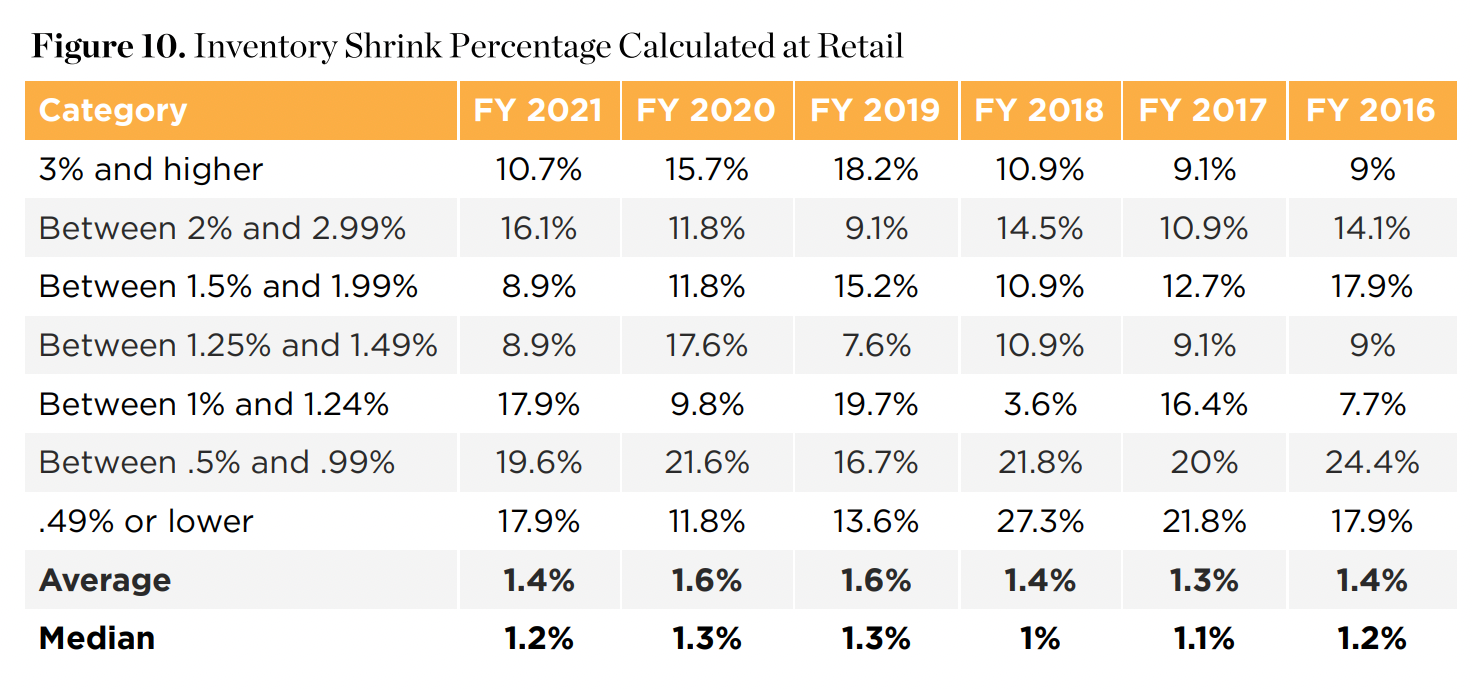 |
The average retail shrink in 2021 is the same as it was in 2015. The only difference is that shoplifting and external theft made up a slightly larger portion of the "shrink" in 2015 than it did in 2021.
Walmart isn’t the only company stoking fears of a shoplifting surge. Last year, Walgreens announced that it wasclosing five stores in the Bay Area due to the “scale of thefts.” Popular Information found that this claim, however, was not reflected in citywide crime data, which showed that in 2020 shoplifting had reached its lowest level since they began collecting data 45 years ago. Walgreens also said in 2019 that it planned to shutter 200 stores as a “cost-saving measure,” reported the San Francisco Chronicle. “[T]he timing of Walgreens’ decision led observers to wonder whether a $140 billion company was using an unsubstantiated narrative of unchecked shoplifting to obscure other possible factors in its decision,” wrote the San Francisco Chronicle.
Target CFO Michael Fiddelke told CNBC last month that theft rose “about 50% year over year.” The company told Winsight Grocery Business that it is working with legislators and law enforcement to address the “growing national problem” of retail theft. Similarly, last week, the former CEO of Home Depot, Bob Nardelli, described retail theft as an “epidemic” and said that shoplifting was “spreading faster than COVID.”
Despite the apocalyptic rhetoric, losses from shoplifting pale in comparison to the wages employers steal from employees each year. The Economic Policy Institute estimates that employerssteal roughly $15 billion annually from their employees from minimum wage violations alone. This figure, which excludes other common forms of wage theft like overtime violations, “exceeds the value of property crimes committed in the United States each year.”
Since 2000, Walmart has had to pay $1.5 billion in penalties for wage and hour violations, according to the Good Jobs First Violation Tracker.
Will more aggressive prosecution deter theft?
CNBC's Rebecca Quick, one of the hosts of Squawk Box, asked McMillon about "laws that have been changed." Specifically, Quick claims that there are new laws that provide "criminals won't be prosecuted below a certain level." McMillon accepted the premise of Quick's question, arguing the laws need to be "corrected."
But Quick's description of the law is inaccurate. States have not passed statutes legalizing theft. Rather, all states have a felony threshold for shoplifting. In Connecticut, shoplifting more than $200 in goods is a felony. In Texas, the threshold is $2,500. Misdemeanor theft, below the felony threshold, generally results in little to no jail time. Felony theft can result in years in prison.
Since 2000, at least 40 states have raised their felony theft thresholds. Walmart and other retailers have spent millions opposing these changes, arguing that raising the felony threshold will increase shoplifting. The data, however, does not support this claim.
A 2017 study by Pew Trusts found that "in the 30 states that raised their thresholds between 2000 and 2012, downward trends in property crime or larceny rates, which began in the early 1990s, continued without interruption." Further, the study found that "states that increased their thresholds reported roughly the same average decrease in crime as the 20 states that did not change their theft laws." Notably, the "amount of a state’s felony theft threshold—whether it is $500, $1,000, $2,000, or more—is not correlated with its property crime and larceny rates."
In 2010, South Carolina raised the threshold for felony theft from $1,000 to $2,000. Pew Trusts found that "since the law was implemented, the state’s property crime rate …continued to fall, dropping 15 percent in the three years after reform." Despite the higher threshold, "the value of goods reported stolen in the state…did not change, remaining about $200 on average."
Retailers were able to push through a harsh anti-shoplifting law, with no felony threshold, in Arizona. It resulted in a "man who robbed [a] Walmart of goods worth less than $10… facing two felony charges."
Why doesn't increasing the felony threshold increase shoplifting? Most shoplifters are not making a calculation about the potential legal consequences. Many are addicted to drugs and are willing to do anything to feed their addiction. Last month, Walmart proposed paying $3.1 billion to settle lawsuits alleging it "improperly filled prescriptions" for opioids, fueling an addiction epidemic.
an 9 22
We can thank the late economic justice warrior for her groundbreaking contribution in showing that “positive thinking” is part of a whitewashing of economic inequality.
Although the late Barbara Ehrenreich was best known for her 2001 bestselling book Nickel and Dimed: On (Not) Getting By in America, which chronicled the real-life impacts of the 1996 Welfare Reform Act, she made an equally great contribution to economic justice with her subsequent book exposing the cult of positive thinking.
This article was produced by Economy for All, a project of the Independent Media Institute.
Ehrenreich, who passed away on September 1, 2022, at age 81, had started her professional life with a PhD in cell biology. She didn’t relegate her journalism to mere facts. She delved as deep as she could—to a microscopic level—to make sense of the world. We concluded from Nickel and Dimed that people were not making it in America. But we realized through her book Bright-Sided: How Positive Thinking Is Undermining America that the economy was proceeding unimpeded by this fact because we were putting a smiley face on inequality.
The Great Recession began in 2007. Two years later, in 2009, Ehrenreich published Bright-Sided. Two years after that, in 2011, the Occupy Wall Street (OWS) protests began in New York’s Zuccotti Park and spread throughout the country. OWS participants called damning attention to the stark economic split between the haves and the have-nots, in this case the wealthiest “1 percent” of Americans and the rest of us—the “99 percent.” There was no putting a smiley face on the economy in that moment.
It was during this period that I had the honor of interviewing Ehrenreich. She explained that “there is a whole industry in the United States that got an investment in this idea that if you just think positively, if you expect everything to turn out alright, if you’re optimistic and cheerful and upbeat, everything will be alright.”
Ehrenreich, who survived cancer, said she began her investigation into the ideology of positive thinking when she had breast cancer, roughly six years before Bright-Sided was published. That’s when she realized what a uniquely American phenomenon it was to put a positive spin on everything, even cancer.
When she looked for online support groups of other women struggling with cancer, what she found was, “constant exhortations to be positive about the disease, to be cheerful and optimistic.” Such an approach obscures the central question of, “why do we have an epidemic of breast cancer?” she said.
She applied that idea to how positive thinking was obscuring questions of economic inequality.And she found that there was an entire industry built up to assure financially struggling Americans that their poverty stemmed from their own negative thinking and that they could turn things around if they simply visualized wealth, embraced a can-do attitude about their bleak futures and willed money to flow into their lives. Central to this industry are “the coaches, the motivational speakers, the inspirational posters to put up on the office walls,” and more, said Ehrenreich.
She also connected the rise of the American megachurch to the rising cult of the positive-thinkers. “The megachurches are not about Christianity. The megachurches are about how you can prosper because God wants you to be rich,” she said.
Joel Osteen, the pastor of a Houston-based megachurch, is perhaps one of the best-known leaders of the so-called prosperity gospel. In one of his sermons—conveniently to reach a maximum audience—Osteen claims that according to “the scripture,” “the wealth of the ungodly is laid up for the righteous,” and that “it will be transferred into the hands of the righteous.” His congregants may be tempted to imagine bank transfers from wealthy atheists magically pouring into their accounts.
Osteen has been the beneficiary of serious wealth transfers from his own congregants into his pockets, so much so that he can afford to live in a $10 million mansion. There’s no conundrum here, for Osteen is living proof to his followers that the power of positive thinking works.
Ehrenreich pointed out that the whole point of these churches is to create a positive experience for their congregants and to project a notion of exciting possibilities. The megachurch phenomenon is centered on “the idea that the church should not be disturbing. You don’t want to have a negative message at church. So that’s why you won’t even find a cross on the wall.”
Perhaps this is because the image of a bloodied, half-naked Jesus Christ nailed by his hands and feet to a wooden cross is just too painful to bear and might detract from dreams of future Ferraris and private jets. “What a downer that would be!” exclaimed Ehrenreich.
Where did the cult of positive thinking originate? “American corporate culture is saturated with this positive thinking ideology,” especially in the 1990s and 2000s, said Ehrenreich. “It grew because corporations needed a way to manage downsizing, which really began in the 1980s.”
Businesses that laid off masses of employees had a message that Ehrenreich encapsulated as, “you’re getting eliminated… but it’s really an opportunity for you. It’s a great thing; you’ve got to look at this positively. Don’t complain, don’t be a whiner, you’re not a victim, etc.”
Such sentiments percolated into the mainstream. Americans internalized the idea that losing one’s job has got to be a sign that something better is coming along and that “everything happens for a reason.” The alternative is to blame one’s employer, or even the design of the U.S. economy. And that would be dangerous to Wall Street and corporate America.
Another purpose of fostering positive thinking among those who are laid off is, as per Ehrenreich, “to extract more work from those who survive layoffs.” Indeed, we have an ugly culture of overwork in the U.S., with corporate employees having normalized the idea that they need to work insanely late hours, work on the weekends, and take on exhaustive amounts of responsibilities. After all, those who remain employed, unlike their laid-off former colleagues, ought to feel lucky to have a job—more positive thinking.
There may be a breaking point now, one that Ehrenreich thankfully lived to see, as a newer set of phenomena began emerging since the COVID-19 pandemic began. They include the “great resignation,” a term for masses of Americans quitting thankless jobs. And, more recently, “quiet quitting,” which is a new name for an older union-led idea of “work to rule” as workers are starting to only put in the hours they are paid to work and no more. How novel!
We owe Ehrenreich a debt of gratitude for shining a light not only on the perversity of the U.S. economic system but also on the gauzy veil of positive thinking that obscures the obscenity. Ehrenreich may not have lived to see her ideas of economic justice be fully realized. But, as she once told the New Yorker, “The idea is not that we will win in our own lifetimes and that’s the measure of us but that we will die trying.”
Author Bio: Sonali Kolhatkar is the founder, host and executive producer of “Rising Up With Sonali,” a television and radio show that airs on Free Speech TV and Pacifica stations. She is a writing fellow for the Economy for All project at the Independent Media Institute.
https://www.alternet.org/2021/05/gop-governors
kos
note criminalization
The flood of Republican-controlled states cutting off the federal unemployment benefits supplement will lead to nearly 2 million people losing payments before the September cutoff passed by Congress. The nearly 1.4 million people in the Pandemic Unemployment Assistance and the Pandemic Emergency Unemployment Assistance programs will lose everything they're currently getting, while people on traditional unemployment insurance will lose the $300 a week above their state's regular benefits.
"These changes have the potential to drastically scale back assistance to jobless workers far too early in the recovery," Andrew Stettner, senior fellow at The Century Foundation, told CNN. "Nationally, there are still 16.8 million workers on one of the unemployment programs, and the nation is still short 8 million-plus jobs from the start of the pandemic."
According to Stettner's calculations, the early cutoffs will strip billions of dollars from jobless workers. If every state that has announced it's refusing the federal supplement did so starting on June 12, it would be $10.8 billion, but several states have announced later cutoff dates.
The Republican message is that this is what's needed because too many people are sitting home living large on unemployment aid and are too lazy to work. In reality, writes Adam Chandler at The Washington Post, "In the past year alone, study after study has debunked the myth that the emergency benefits and occasional payments provided by the government are disincentivizing people from returning to the labor force en masse."
Back when the federal government was adding $600 a week to unemployment benefits—a measure passed by a Republican Senate and signed by Donald Trump—a study by Yale economists found "no evidence that high UI [unemployment insurance] replacement rates drove job losses or slowed rehiring." Also last summer, University of Massachusetts economist Arindrajit Dube looked at unemployed workers without a college degree. "Overall," he concluded, "these findings do not provide evidence supporting the claim that the [Federal Pandemic Unemployment Compensation] has held back the labor market recovery."
And, Chandler notes, even these supposedly lavish unemployment benefits are not eradicating hunger: "According to a Census Bureau survey last month, nearly 1 in 3 Americans on unemployment said they were still failing to cover routine expenses such as food, housing and medical treatments."
So studies show that the emergency benefits aren't keeping lazy people from looking for work. Surveys show that people are not living large, or even necessarily making ends meet. But history gives us a context for the persistent claims that that's what's going on, as AFL-CIO economist William Spriggs pointed out: [twt]
republicans can't reproduce those conditions, but they can use low or no unemployment benefits to force people back into minimum-wage and unsafe jobs—and the present-day effort also echoes the past in the disproportionately Black and Latino workers it targets, after 14 months in which Black and Latino people have disproportionately suffered and died as a result of the coronavirus pandemic.
So far, Montana, South Carolina, Arkansas, Alabama, Mississippi, North Dakota, Missouri, Iowa, Idaho, Tennessee, Wyoming, South Dakota, Utah, Georgia, Arizona, and Ohio have announced cutoff dates ranging from June 12 to July 10. More states could follow, raising the number of people in economic pain as a direct result of Republican lies about the unemployment situation.
FROM YOUR SITE ARTICLES
- Pandemic-downplaying GOP governor's grandmother dies in COVID ... ›
- New study finds Covid-19 death rates were higher in states with ... ›
- New polling reveals GOP governors' disastrous handling of COVID ... ›
RELATED ARTICLES AROUND THE WEB
- Teacher Tenure Targeted by G.O.P. Governors - The New York Times ›
- GOP governors ignore Biden's latest plea on mask mandates ›
- 16 GOP States to Axe Federal Jobless Aid, but Experts Warn of Risks ›
an 720
airline bailout loophole: Three companies received $338 million in relief money for workers — and laid workers off anyway
Justin Elliott, Jeff Ernsthausen / Pro Publica July 8, 2020
ProPublica is a Pulitzer Prize-winning investigative newsroom. Sign up for The Big Story newsletter to receive stories like this one in your inbox. Three airline industry companies slated to receive…
==
==
congressional GOP rejects a second round of stimulus checks as unemployment hits 36 million
Matthew Rozsa / SalonMay 21, 2020
Congressional Republicans are attempting to stop the passage of another relief package for Americans economically suffering as a result of the COVID-19 pandemic, even as an estimated 36 million Americans have…
==
https://www.alternet.org/2020/05/some-companies-are-using-bailout-funds-to-make-jobs-permanently-disappear-and-those-human-workers-are-not-coming-back-historian/
HNN singer
The federal Coronavirus bailout contains no restrictions on corporate investment in automation. That may be the most serious long term consequence of the pandemic.
It is widely reported how weak the federal guidelines are for use of Corona virus bailout funds. Most of the restrictions that require businesses to use taxpayer provided bailout dollars to retain their workforces were placed on small and medium sized operations. Enforcement mechanisms are weak, if non-existent. Businesses self-certify they made a good faith effort. Essentially, they expected to operate based on the honor system.
Large corporations are not even required to abide by these considerations. The bailout law is supposed to prevent corporate stock buybacks and excessive dividend payouts, and set limits on executive compensation, but the Secretary of the Treasury can waive these restrictions to protect the national interest, and Donald Trump has announced he has no intention of reporting to Congressional oversight committees. No employee protections are specified in the law and there are no restrictions on corporations using the money to invest in technology that replaces workers.
The almost half a trillion federal dollars targeted to bail out large corporations will be administered by Federal Reserve banks. But Fed officials are backing off from requiring these companies to protect their workers. In addition, direct Federal Reserve loans, which add billions to the corporate honeypot, come with no strings attached at all on how money will be used.
AD REMOVED FOR SUBSCRIBED USER
If you think corporations will act honorably to protect workers, you don’t understand American capitalism. Following the 2008 Wall Street and banking collapse, companies used federal bailout dollars to give corporate executives over one and a half billion dollars in salaries, bonuses, stock options, and benefits. Goldman Sachs, which received $10 billion from the federal government, then paid its President and CEO nearly $54 million.
Historically, war-profiteering has always been a particularly lucrative opportunity for corporations to enrich themselves at public expense. During the American Civil War, corporate America sold defective weapons and shoddy uniforms and shoes to the Union Army. During the Spanish-American War it sold spoiled or “embalmed beef” to feed the troops. Cost-plus contracts were introduced during World War I and continued during World War II. United States Major General Smedley Butler estimated that during the first World War, the United States government spent $16,000,000,000 on equipment and supplies that had “no relevant use in the war effort.” During World War II, a Special Senate committeeinvestigating the National Defense Program headed by future President Harry Truman reported that companies with the largest volume of war business increased their profits tenfold. Truman labeled some of the war profiteering as “treason.”
More recently, Pentagon auditors challenged more than a billion dollars in excessive spending and improper billing by Halliburton, which received non-competitive Defense Department contracts during the outsourced war in Iraq.A Congressional oversight committee estimated between $30 and $60 billion in contract fraud during the Afghan and Iraq wars.
In this crisis, stock market analysts celebrate the seeming paradox of stock price recovery while unemployment soars. They expect record unemployment will place pressure on the federal government to provide corporations with even more financial giveaways and low-cost loans.
Wartime corporate profits have frequently been used to mechanize production, increasing corporate wealth at the expense of workers. This happened in bituminous coal mining, my area of study, after both World War I and World War II. While the long-term impact of new technologies on overall employment may be positive, it is definitely negative for displaced workers and their families like 18th century British weavers, 19th century blacksmiths and carriage-makers, and post-World War II longshoreman and typographers, who live, eat, and have to pay rent or mortgages in the short term. Automation today projects as much worse than in past eras, not just threatening specific industries, but the nature of human work itself.
Currently, 15.6 million retail workers and 5.2 million warehouse workers, who together made up almost 15% of the American workforce before the Corona virus pandemic, are at the greatest risk of replacement by robots by corporations using unregulated federal bailout dollars.
Before the Corona virus pandemic, companies were increasingly using robots to replace human workers at call centers, warehouses and grocery stores. The corporate goal: cut labor costs and improve profit. Using the excuse that they are protecting humans from infection, companies are expanding automation. According to one tech company, retailers are now using “autonomous floor care robots” to replace humans doing 8,000 hours of daily work, a 13% increase from two months ago. Once an investment is made in purchasing these machines, human workers are not coming back.
The Giant Eagle supermarket chain, one of the largest privately held corporations in the United States with 32,000 employees, is using robots to keep track of inventory, supposedly freeing its employees to disinfect and sanitize store surfaces and process deliveries. But once the pandemic subsides, shelves won’t need to be disinfected, pressure for deliveries will decline, and the robots will still be there managing inventory.
Walmart employs 1.5 million workers, making it the United States’ largest private employer. It is partnering with Bossa Nova Robotics and researchers at Carnegie Mellon University to design a shelf-scanning robot to use in its stores and warehouses. One prototype operates 365 days a year without lunch breaks, vacations, or sick days, and takes only short time-outs to recharge its batteries. It scans shelves with a high-resolution camera and reports out-of-stock items for reordering.
Amazon employs more than 1.1 million Americans. In 2012, Amazon purchased a robotics company that developed mobile robots that read barcodes and collect and transport products in its huge warehouses. It also sponsors an international contest where robotics teams compete to create the fastest and most efficient robots. In December 2019, Amazon had more than 200,000 mobile robots in operation. Human workers are expected to keep pace with the robots if they want to keep their jobs. Injuries have increased along with productivity, but they may decline soon as Amazon introduces a new generation of robots that can pack items for shipping and replace more workers.
A major force in efforts push to replace humans with machines is the McKinsey consulting firm. McKinsey claims grocers could enhance their profits by reducing “the pool of labor hours” by as much as 65% using currently available automation technology. If McKinsey recommends something, it cannot be good for American workers.
According to a McKinsey Global Institute report, retail will not be the only work area dramatically impacted by automation: “currently demonstrated technologies could automate 45 percent of the activities people are paid to perform and.. about 60 percent of all occupations could see 30 percent or more of their constituent activities automated.” This was written before federal Coronavirus funding started to pour billions of dollars into technological research and the corporate acquisition of automated machinery.
Public attention therefore cannot just be about hunkering down and surviving the Corona virus. Democratic Party attempts to extend unemployment insurance during the pandemic, while vitally important, do not address what will happen when companies use bailout funds to make jobs permanently disappear. It is time to get very serious about planning for the post-pandemic world of work.
https://www.alternet.org/2020/05/journalist-explains-why-the-surprisingly-optimistic-stock-market-seems-increasingly-divorced-from-reality/
On Friday morning, the U.S. Bureau of Labor Statistics (BLS) delivered some grim economic news: unemployment in the United States, thanks to the coronavirus pandemic, reached 14.7% in April — and that 20.5 million U.S. jobs were lost last month. And yet, CNN reported, the Dow Jones Industrial Average, surged 330 points. Journalist Eric Levitz discusses this disconnect in an article for New York Magazine, citing it as proof that some people on Wall Street have become divorced from reality.
“Nearly one in five American workers have lost their jobs since mid-March,” Levitz explains. “The official unemployment rate in the United States is now 14.7% — the highest since the Great Depression — according to Friday’s jobs report. And that figure does not account for the past two weeks of historic job losses; the actual rate is likely closer to 20% by now. All across the country, small businesses are folding, while others are taking on onerous debts to survive.”
Levitz continues, “Absent the sudden emergence of a robust testing-and-tracing regime — or effective COVID-19 treatment, or a coronavirus vaccine — the ‘reopening of the economy’ is likely to produce a new wave of infections and thus, a durable dearth of consumer demand for in-person business and services.”
But despite all that bad news, Levitz adds, the “markets are rallying”—and one is seeing bouts of “optimism in a bullish stock market run.”
AD REMOVED FOR SUBSCRIBED USER
“The bulls’ case goes roughly like this: for years now, America’s corporate sector has been preparing for an economy fueled by the consumption of white-collar shut-ins, the labor of disempowered service workers, and the human-proofing of various industrial processes — without quite realizing that it was doing so,” Levitz observes. “Long before the pandemic hit, e-commerce was displacing retail, robots were replacing warehouse workers, and an erosion of labor’s bargaining power was putting downward pressure on service-sector wages.”
Levitz, however, makes a point that liberal Sen. Elizabeth Warren — a self-described “capitalist to my bones” — has often made and that President Franklin Delano Roosevelt made back in the 1930s: consumers are vital to capitalism. Without consumers, there is no one to buy capitalism’s products.
“Not everyone on Wall Street has imbibed this dystopian brand of techno-optimism,” Levitz observes. “Capitalism may be reducing its dependence on workers, but it still needs consumers. And consumers need jobs, or else more generous and extensive income support than Congress is prepared to provide.”
Levitz points to BlackRock CEO Larry Fink as an example of someone on Wall Street who is smart enough to realize that Wall Street is not immune to Main Street’s economic woes.
“Fink’s prophecies suggest that Wall Street’s worst days of the COVID-19 crisis may still be ahead of it,” Levitz warns. “All of which is to say: if you’re hoping to see strong medium-term growth in your 401(k), pray that our Wall Street overlords have secured enough independence from society — and dominance over the U.S. government — to immunize themselves against the bad times to come.”
==
https://www.alternet.org/2020/05/mass-unemployment-is-a-failure-of-capitalism/
==
https://www.alternet.org/2020/05/top-us-companies-lay-off-thousands-of-workers-while-rewarding-shareholders/
Some of the largest companies in the U.S. have rewarded their shareholders amid the coronavirus pandemic after firing thousands of employees.
Companies like heavy machinery manufacturer Caterpillar, denim-maker Levi Strauss, toolmaker Stanley Black & Decker, furniture manufacturer Steelcase and World Wrestling Entertainment have doled out more than $700 million to shareholders in cash dividends while slashing jobs and shuttering facilities, The Washington Post reported. Many other companies have likewise rewarded shareholders while laying off workers.
Caterpillar, for example, announced a $500 million distribution to shareholders in early April, according to the report, about two weeks after it announced that it was “temporarily suspending operations at certain facilities.” The company did not say how many workers would be impacted.
“We are taking a variety of actions globally, but we aren’t going to discuss the number of impacted people,” a spokesperson told the outlet. “We are taking a variety of actions at our global facilities to reduce production due to weaker customer demand, potential supply constraints and the spread of the COVID-19 pandemic and related government actions. These actions include temporary facility shutdowns, indefinite or temporary layoffs."
Levi Strauss announced that it would distribute $32 million to shareholders on April 7, the same day that the company said it would furlough retail workers. About 4,000 workers have been affected, according to The Post.
“As this human and economic tragedy unfolds globally over the coming months, we are taking swift and decisive action that will ensure we remain a winner in our industry,” Levi CEO Chip Bergh said at the time, after reporting big earnings in Q1.
Stanley Black & Decker announced in early April that it would furlough and lay off “non-essential” workers. It distributed $106 million in dividends to shareholders just two weeks later, The Post reported.
“Throughout our company’s 177-year history, Stanley Black & Decker has weathered a series of exogenous shocks and thrived,” CEO James Loree said in the statement last month. “We are in a strong position as we face today’s challenges and are taking the necessary actions now to protect our employees and the business while positioning the company to thrive into the future.”
Steelcase announced in March that it would cut operations in four states, issuing a statement saying it took “these actions in an effort to avoid permanent headcount reductions so the company and its employees can come through this crisis together.”
It announced the same day that it would issue a dividend of roughly $8 million to shareholders. Earlier that month, the company bought back $38 million in stock from shareholders.
The WWE, a company whose longtime former CEO Linda McMahon served in Trump’s Cabinet and now works on his re-election campaign, cut 10% of its workers and fired about 20 wrestlers a day before it announced $9 million in dividends for shareholders.
These five companies are far from the only corporations rewarding shareholders while cutting workers, but many other companies took steps to end dividends and buybacks in response to the economic crisis caused by the coronavirus.
The Gap, American Eagle and Darden Restaurants — which owns Olive Garden and LongHorn Steakhouse — announced that they would pause dividends and stop buybacks, according to The Post. Williams Sonoma said it would continue to pay full-time employees after shuttering its stores.
Chris Lu, who served as the Deputy Secretary of Labor under President Obama, called out the Trump administration for pushing to protect companies from being sued by workers who contract COVID-19 while ignoring businesses that reward shareholders at the expense of workers.
“In Trump’s economy, these companies won’t get punished,” he said. “Instead, he wants to give them liability protection.”
“In a downturn like this the first thing a company should do is give up any distributions to shareholders,” William Lazonick, an economist at the University of Massachusetts Lowell, told The Post. “But in a crisis, companies will differ. Some will care . . . and some will rob the workers, who should expect that their continued employment will be the company’s first concern.”
https://www.alternet.org/2020/04/this-is-horrible-florida-republicans-furious-after-unemployment-system-they-mangled-puts-trumps-re-election-in-jeopardy/
no lnx
‘This is horrible’: Florida Republicans furious after unemployment system they mangled puts Trump’s re-election in jeopardy
Written by Travis Gettys / Raw Story April 3, 2020
Republicans are furious that Florida’s broken unemployment system was working exactly as former Gov. Rick Scott intended — and it could help kill President Donald Trump’s re-election chances.
The coronavirus outbreak has sent thousands of suddenly unemployed workers to the state’s byzantine system to apply for help, and Republicans privately admit the $77.9 million system was designed to discourage jobless claims to keep numbers low after the great recession, reported Politico.
“It’s a sh*t sandwich, and it was designed that way by Scott,” said one advisor to Gov. Ron DeSantis. “It wasn’t about saving money. It was about making it harder for people to get benefits or keep benefits so that the unemployment numbers were low to give the governor something to brag about.”
Jobless Floridians are encountering dropped calls and busy signals in the Department of Economic Opportunity’s “Connect” system, and even those who get through are finding they’ll get just $275 a week for a maximum of 12 weeks.
“Everyone we talk to in that office when we ask them what happened tells us, ‘the system was designed to fail,’” one DeSantis adviser told Politico. “That’s not a problem when unemployment is 2.8 percent, but it’s a problem now, and no system we have can handle 25,000 people a day.”
The system was implemented on the promise that it would lower unemployment taxes for Florida businesses, and a 2011 analysis by the state legislature estimated the changes would save business owners more than $2.3 billion between 2011 and 2020 — but the COVID-19 outbreak has exposed its deficiencies and made it a political liability.
“This is horrible for people, I don’t want to minimize that,” the DeSantis adviser said. “But if we have to look past the crisis, it’s bad for the president and it’s bad for the governor.”
==
'Foreclosure king’ Steve Mnuchin claims never-before-seen surge in unemployment ‘not relevant’
an 320
==
https://www.alternet.org/2020/01/i-made-a-lot-of-bankers-look-very-good-trump-lets-the-mask-slip-as-wall-street-titans-get-32-billion-tax-windfall/
no lnx
‘I made a lot of bankers look very good’: Trump lets the mask slip as Wall Street titans get $32 billion tax windfall
Written by Jon Queally / Common Dreams January 17, 2020
“I made a lot of bankers look very good,” President Donald Trump boasted this week just before it was reported Thursday that the nation’s six largest banks alone have received an estimated $32 billion windfall thanks to Republican tax cuts.
The figures were generated by Bloomberg News after reviewing the 2019 profits earnings of JPMorgan Chase, Bank of America, Citigroup, Wells Fargo, Goldman Sachs, and Morgan Stanley.
By looking at the banks’ earnings in relation to effective tax rates that dropped from 20% to 18% last year—and comparing that to the 30% average they paid prior to the tax cut bill passed by Republicans and signed by Trump at the end of 2017—the analysis showed just how well the Wall Street giants have fared even as they cut back their work forces approximately 1,200 people over the same time period.
“The tax savings have spurred the banks to record profit,” Bloomberg‘s Yalman Onaran reported. “The six firms posted $120 billion in net income for 2019, inching past 2018’s mark. They had never surpassed $100 billion before the tax cuts.”
...[ask for thx]
==
==
https://www.alternet.org/2020/01/giant-megabanks-have-saved-billions-of-dollars-thanks-to-gop-tax-cuts-but-have-been-cutting-not-adding-jobs-report/
no lnx
Giant megabanks have saved billions of dollars thanks to GOP tax cuts — but have been cutting, not adding, jobs: report
Written by Alex Henderson January 17, 2020
In late 2008 — when George W. Bush was in the final months of his presidency and the Great Recession was accelerating — the term “too big to fail” was used to describe megabanks that were pleading for bailout money. But many of the megabanks that feared for their survival during the 2008 crash not only survived; they grew even larger. And journalist Dino Rabouin, in an article published by Axios on January 17, reports that for two years in a row, megabanks have been saving billions of dollars thanks to the GOP’s Tax Cuts and Jobs Act of 2017.
Drawing on data from Bloomberg News, Rabouin notes that the GOP tax law “helped power the biggest U.S. banks to record profits for the second straight year.” Yet “struggling workers,” according to Rabouin, are not the main beneficiaries.
“The tax cut was sold as a way to revitalize hiring and spending by American companies to boost the economy and help struggling workers,” Rabouin observes, “but the windfall is largely staying with banks and their shareholders…. Rather than use the money to hire a bonanza of workers or invest in big new capital projects or equipment, the banks used it largely to buy back stock and pad their balance sheets.”
Rabouin notes that “JPMorgan, Bank of America, Citigroup, Wells Fargo, Goldman Sachs and Morgan Stanley announced earnings this week showing they saved $18 billion in 2019, and their average effective tax rate fell to 18% from 20%. Banks had previously paid effective tax rates of around 30%, Bloomberg found.”
But despite all the money they saved in taxes, megabanks haven’t been increasing the size of their workforce. Rabouin writes, “The big banks have actually shed jobs since passage of the tax cut law, collectively reducing their workforce by 1200 people since 2017, Bloomberg reported.”
==
120 an
tech industry layoffs rose 351 percent in 2019. That could be a sign a recession loomingNicole Karlis / Salo
https://www.alternet.org/2020/01/inequality-in-the-trump-economy-just-keeps-getting-worse/
CEOs make more in first week of January than an average salary. Here’s the solution
Tobore Okah-Avae, The Conversation
Nobody else, apart from CEOs, has enjoyed a similar rise in their fortunes since the 1980s.
no lnx
Inequality in the Trump economy just keeps getting worse
Written by Sher Watts Spooner / Daily Kos January 5, 2020
Every month when the Bureau of Labor Statistics releases its monthly jobs report, Donald Trump and Republicans crow about the economy and the low unemployment rate. And every month, too many Americans wonder when they’re going to start feeling the effects of that “great economy.”
A recent study on poverty and a new way of measuring the quality of jobs show the shallowness of GOP claims about the U.S. economy. Poverty went up in at least one county in every state, concentrated in rural areas and the South. And a new system of measurement called the Job Quality Index shows that, although there are jobs available, for the most part, they aren’t jobs that pay well and aren’t career jobs for the long term. Often, they don’t even employ workers for a full 40 hours a week.
Combine that with the disastrous effects of the Trump tariffs and the trade war with China, especially how that trade war hurt U.S. manufacturing; the surge in bankruptcies of small farmers; the fact that American consumers now have a record $14 trillion in debt; and the 2017 GOP tax reform scam that turned into a windfall for big companies instead of helping everyday Americans, and most of us don’t feel that we’re better off than before Trump became president—a benchmark used by challengers in nearly every election.
Don’t forget that, after the GOP House and Senate passed and Trump signed the tax overhaul in late 2017, Trump’s message to his rich cronies at Mar-a-Lago gathered for the Christmas holidays was, “You all just got a lot richer.”
That was not a message that trickled down to average Americans. The supposed tax savings didn’t do much trickling down for them, either. Since the country started coming out of the Great Recession in 2009, the overall U.S. poverty rate has decreased. But between 2016 and 2018, the poverty rate grew in 30% of counties across America, according to data from the U.S. Census Bureau.
As a story from HuffPost put it:
The counties with the biggest jumps in poverty ranged across the political and demographic spectrum: from 97% white and solidly Republican-voting Carter County in Kentucky to black-majority, Democratic Bullock County in Alabama.
Most of the biggest increases were in areas both rural and Southern. Those areas generally had residents who lacked job training and skills and industries that suffered downturns.
Those industries included the coal industry in many of those poverty-stricken areas. Coal output has decreased by 27% in the last five years, and 50 coal power plants have closed across the country since Trump became president. That’s good news for the environment, but bad news for those counting on coal mining for a paycheck. It’s also a betrayal of one of Trump’s main promises in coal country.
But the unemployment rate is only 3.5%. That’s got to be great, right? Actually, considering the kinds of jobs available—and the fact that wage growth is fairly stagnant—not so much. And this isn’t a recent phenomenon.
The U.S. Private Sector Job Quality Index, or JQI, is a new economic indicator developed by academic economists that measures desirable higher-wage/higher-hour jobs versus lower-wage/lower-hour jobs. Job quality is defined as the weekly dollar-income a job generates for an employee. A paper defining the system and explaining why the detailed indicator is a more accurate reading of the economy is available at this link.
The paper’s conclusion reiterates the fact that U.S. manufacturing jobs have “declined dramatically in the last three decades,” and replacement jobs are poorer-paying, service-sector jobs with no guarantee of job stability or even a full work week. There also has been a “massive loss of market share, revenue, and jobs to foreign manufacturers.”
An important question surrounding the decline of manufacturing is whether those leaving manufacturing are transitioning into better or worse jobs. …
With other countries targeting what they see as high-value industries, the US is not just in danger of, but actually has been, forced into greater reliance on low-value, low-growth industries, offering lower-wage, lower-hours jobs. The success of superstar companies like Google or Apple or Pfizer should not blind us to the fact that today Leisure & Hospitality is our largest sector with 14.7 million non-management employees. It’s a sector that pays such workers $16.58 an hour and the average worker works just 25.8 hours a week — resulting in average weekly income of $428. …
When all that a country has left is the domestic manufacture of processed foodstuffs, you end up with a lot of unhealthy and unwealthy workers who are in dire shortage of security, much less dignity. A republic that offers no better than this cannot long endure.
“When U.S. unemployment is at a 50-year low, why do so many people have trouble finding work with decent pay and adequate predictable hours?” asks a story from Forbes on the JQI. Answer: Few non-specialized good jobs are available.
Tens of millions of working-aged Americans are still not formally employed and have no apparent interest in sending out a resume. If the job market is so hot, why are so many people sitting on the sidelines? One frequently cited explanation is the growing proportion of older generation workers. Now we have another more important element. Workers don’t re-enter the workforce because many of the jobs themselves are rotten. …
Many looked to the category of jobs known as Professional and Technical Services as a path for the economy to “move to higher ground.” Professional and Technical Services were supposed to offer high pay, growth in employee numbers, and an opportunity to increase productivity. In fact, the JQI does report that employment is up 41% in this sector and the average weekly pay for non-managerial workers of $1,575 exceeds the pay of many other industries. But that’s not enough to rescue what the economy lost in manufacturing.
To recap:
Many of the jobs available are poorer, with stagnant wages and little job stability or full employment guarantees.
The tax bills of many big companies ended up being even smaller than what was anticipated in the GOP tax scam law. This has caused a ballooning federal deficit that could reach $1 trillion in 2020.
Trump’s trade war with China led to a loss of U.S. manufacturing jobs and higher prices. No matter what he claims about a new agreement, it’s not a done deal, and it’s only “Phase One” of a partial deal with few specifics released.
After Trump’s tariffs against China, China retaliated with tariffs that were devastating to U.S. farmers. Despite $28 billion in farm subsidies in the last two years (many of which went to large agriculture suppliers, some foreign-owned), farm bankruptcies surged, especially in the Midwest.
The record $14 trillion in debt that Americans owe is spread across mortgages, auto loans, credit cards, student loans, and other forms of debt. By themselves, student loans make up $1.5 trillion of the debt total. And medical costs are still growing faster than income—medical costs have gone up 33% since 2009.
It doesn’t matter if the stock market had its best annual gain in six years. When only those at the top are benefiting from those stock market gains—not every worker has a 401(k) or fat IRA account—then there’s no trickle down from a bloated stock market. Although 20 states and 26 cities and counties are raising the minimum wage in 2020, the federal minimum wage of $7.25 an hour hasn’t gone up since 2009.
This is a message that all Democratic candidates should be repeating over and over, whether they’re running for president, the House, the Senate, or a state office: The Trump economy isn’t helping most Americans.
==
==
When auto plants shutter, opioid deaths skyrocket1219 an
==
==
https://www.alternet.org/2019/12/trump-turns-back-on-workers-as-companies-force-employees-to-train-their-cheaper-foreign-replacements-report/
no lnx
Trump turns back on workers as companies force employees to train their cheaper foreign replacements: report
.
Written by Tom Boggioni / Raw Story December 29, 2019
President Donald Trump’s claims that he is bringing jobs back to America are being called nothing more than hot air in a report stating U.S. companies are instead forcing their employees to train their foreign replacements and they will be out of a job once the training is over.
According to a report at Axios, “Opponents of job outsourcing are making a holiday-season appeal to President Trump: Stop U.S. companies from forcing American workers to train the very same cheaper foreign laborers who will soon replace them.”
The reports states: “AT&T is poised to send thousands into the new year hunting for new jobs after assigning them to train their own foreign replacements, according to conversations with current and former workers and documents obtained by Axios,” adding, “Many have worked for the company for over a decade. They aren’t being offered severance or early retirement, and may not easily find a comparable job elsewhere with similar pay.”
According to Sara Blackwell, a lawyer who represents displaced Americans workers, “American workers are tired of waiting for President Trump to do something on this issue. They’ve gone from great hope in President Trump’s administration, to great discouragement.”
Focusing on AT&T, the report continues, “Despite receiving a $3 billion tax cut last year, AT&T announced new and expanded alliances with big outsourcing companies to replace workers with foreign or cheaper domestic talent. Like many major U.S. companies, AT&T has been shifting jobs for years now — but 2019 was especially noteworthy, as workers claimed that as many as 3,000 finance jobs were being outsourced to Accenture. AT&T denied the 3,000 figure, but declined to provide Axios with its own number.”
Speaking with numerous AT&T workers, many acknowledged they will soon be out of a job, stating they were told “they were needed for a ‘knowledge transfer” — then tapped to train people on work visas or overseas who would replace them.”
That, in turn, changed their plans for the immediate future.
“Folks aren’t going on vacation, they’re cutting back on their Christmas shopping,” one employee confided. “If you know that you’re going to be losing your job, you don’t want to spend the money.”
Axios reports they asked for a comment from the White House of the job transfers and were rebuffed.
You can read more here.
electric mustang will be built in mex?
==
https://www.alternet.org/2019/12/senate-republicans-have-sold-their-souls-to-corporations-and-the-1-percent-and-failed-the-american-people-in-the-process-united-steelworkers-union-president/
https://www.alternet.org/2019/12/senate-republicans-have-sold-their-souls-to-corporations-and-the-1-percent-and-failed-the-american-people-in-the-process-united-steelworkers-union-president/
no lnx
wrong art'l?
US Steel to shutter Detroit plant and lay off 1,545 workers after Trump brags he ‘saved’ industry
[pix President Donald J. Trump signs the Section 232 Proclamations on Steel and Aluminum Imports (Official White House Photo by Joyce N. Boghosian)
Written by Igor Derysh December 22, 2019
U.S. Steel Corp. plans to permanently idle a giant plant in the Detroit area and lay off up to 1,545 workers as steelmakers face large financial losses despite President Donald Trump’s boasts that he “saved” the steel industry.
U.S. Steel CEO David Burritt praised Trump’s tariffs on imported steel after the company announced it would rehire workers and restart two blast furnaces last year. Earlier this year, Trump bragged that he “not only saved this important industry, but created many jobs” with his steel tariffs.
Just months later, U.S. Steel announced that it would idle a plant outside of Detroit and lay off as many as 1,545 employees, Bloomberg News reported on Friday. The company already laid off 200 Michigan workers earlier this year.
The announcement comes amid a drop in demand, the company’s struggles to match rivals’ efficiency, and a third consecutive year of stock losses. Shares of the company’s stock saw their biggest decline in months after Friday’s news and fell to their lowest level since before Trump’s election.
Though the company’s shares grew in the first quarter after the tariffs were announced, their share prices fell by more than 70 percent since, according to The Detroit News. The company now plans to invest in new smaller mills that remelt and refine scrap steel instead of making steel from iron ore.
Alan Deardorff, an economics professor at the University of Michigan, told the outlet that Trump’s tariffs never stood a chance to save the industry.
“By and large, the U.S. steel industry has been in trouble for years. They have sought protection for as long as I can remember by various means,” he said. “They have in a sense been one of the most protected industries in the country, because they just don’t do very well.”
But U.S. Steel spokeswoman Amanda Malkowski said that the closure does not mean the tariffs are not helping. She told The Detroit News that Trump’s tariffs and trade policies “continue to support the long-term recovery and strengthening of the domestic steel industry, including the many investments being made in the future of American steelmaking, some of which involve U.S. Steel.”
Commerce Secretary Wilbur Ross also disputed that the tariffs are not working and told Bloomberg Television that the plant was just too expensive to operate.
“What is happening is they are rationalizing a bit their production so that they will be more competitive in the future as we continue to go forward,” he told the outlet.
Trump himself has continued to push his tariffs as a success. “If I didn’t get elected, you wouldn’t have a steel industry, because, ultimately, every steel mill was closing,” he said earlier this month.
But analysts predict that the industry’s problems will only continue to worsen.
“As steel prices decline, U.S. Steel will likely shut down capacity and focus on a shrinking product portfolio where blast furnaces still have a competitive advantage over electric arcs,” according to analysts at the financial giant UBS.
“Ultimately the steel tariffs did not do what they were designed to do,” Longbow Research analyst Chris Olin told The Detroit Free Press. “It feels like now we are entering what would be almost like a recession in terms of industrial market demand. That is really forcing (steel) companies that are high-cost producers to make decisions.”
Trump’s other economic policies similarly failed to save the industries he vowed to save.
The administration’s China tariffs have largely been passed on to American consumers while the US manufacturing sector fell into a deep recession.
China’s retaliatory tariffs have also hit US farmers hard, leading to a historic increase in farm bankruptcies while Trump uses billions in taxpayer dollars to bail out the farmers whose businesses may be irreparably damaged by his trade war.
Trump has also pushed for coal deregulation in hopes of reviving a dying industry that employs fewer people than the Arby’s fast-food chain. Instead, more than 50 coal plants and eight coal companies have closed entirely since his election.
As a result, many local governments have had to scramble to provide resources for the thousands of families affected by the layoffs and closures. Michigan state Sen. Stephanie Chang said in a statement to the Detroit Metro Times on Friday that the state and city of Detroit will work to ensure that families “have access to the necessary programs and support systems they might need.”
“It is unfortunate that our hardworking men and women are again paying the price for Washington’s detrimental policies,” she said, “that have led to the market conditions US Steel and so many others have been facing.”
https://www.alternet.org/2019/12/huge-corporations-paid-just-11-3-percent-tax-rate-thanks-to-trump-and-the-republicans-what-did-you-pay/
no lnx
Huge corporations paid just 11.3 percent tax rate thanks to Trump and the Republicans. What did you pay?
Written by Laura Clawson / Daily Kos December 17, 2019
The Trump-Republican tax law is having the intended effect—if you understand that enriching massively wealthy corporations was always the intended effect. Hundreds of profitable corporations paid an average corporate income tax of 11.3%, just over half of the greatly reduced corporate tax rate—and many paid zero, or got money back from the government.
The Institute on Taxation and Economic Policy (ITEP) looked at Fortune 500 companies, identifying 379 of them “that were profitable in 2018 and that provided enough information to calculate effective federal income tax rates, which is the share of 2018 pretax profits they paid in federal income taxes in that year.” Those 379 big companies had an overall 11.3% average tax rate, but 91 paid nothing, and 56 paid less than 5%. We’ve heard a lot about how Amazon paid nothing—and in fact got a rebate—on $10.8 billion in profits, but it’s not the only one. Halliburton, Chevron, and IBM also paid no corporate income tax.
”Video game maker Activision Blizzard had $447 million in profits but received a tax rebate of $243 million, resulting in an effective tax rate of -54.4 percent,” The Washington Post reports. “The company went on to shed 800 jobs in the early weeks of 2019.”
ITEP notes that, in lowering the corporate tax rate, lawmakers could have also eliminated loopholes to ensure that companies did pay the reduced rate. But “Instead, the new law introduced many new breaks and loopholes, though it eliminated some old ones.” That’s how you lower the rate from 35% to 21% and end up with top corporations paying just 11.3% on average—the lowest rate ITEP has found since it started keeping track of this in 1984. This has a massive effect on the U.S. budget, with corporate taxes as a share of federal revenue plunging to just 1%.
This is the world the Republicans want. Democrats are running to make these enormously profitable companies pay their fair share.
new 919
Workers Lose in Koch’s Georgia-Pacific Restructuring
By Don Wiener — Koch Industries’ paper subsidiary cuts more than 2,100 jobs in the past two years, with taxpayers left holding the bill.
==
==
https://www.alternet.org/general-motors-laying-thousands-workers-and-closing-two-us-plants-michigan-and-ohio
General Motors has made an announcement that is going to bring considerable pain in the Rust Belt. The automotive giant will be slashing 14,700 jobs, many of them in Michigan and Ohio—and a plant closing is expected in Ontario, Canada as well.
This is the biggest restructuring at GM in a decade, with 15% of its workforce being eliminated in North America. According to GM CEO Mary Barra, these job cuts reflect changing tastes in the automotive market and will bring a greater emphasis on electric and autonomous vehicles. Models expected to be discontinued include the Cadillac CT6, the Chevrolet Cruze and the Buick LaCrosse.
According to GM, tariffs on imported steel—which were imposed by the Trump Administration earlier this year—have cost the company $1 billion. And in late October, GM offered buyouts to 50,000 salaried workers in North America.
The decline of traditional passenger cars in favor of larger SUVs and pickup trucks has been a major factor in GM’s evolution. In 2012, traditional passenger cars comprised over 50% of vehicle sales in the U.S., but during the first nine months of 2018, that number decreased to 31%. This year, SUV and pickup truck sales have increased by about 31%.
GM announced that it will also be closing two plants outside of North America by the end of 2019.
Ohio politicians, including Rep. Tim Ryan and Sen. Sherrod Brown ripped the company's decision.
...
==
2016 mike davis
But perceived anthropological condescension is precisely what drives people in Dubuque, Anderson, and Massena to pick up their pitchforks against “elite liberals” as well as “establishment conservatives.” “Deplorables” indeed. The counties in Table 4all have industrial unionism in their DNA; they were the cradles of the CIO in the great labor wars of the New Deal. With few exceptions (1972 and 1984) they remained loyally Democratic in rain, sleet, and snow; voting strongly for Obama in 2008. So why, in the face of positive economic indicators and the lowest national unemployment rate in a decade, did these older industrial counties suddenly desert the Democrats and embrace Trump’s reindustrialization cargo cult?
Fumbling with the odd pieces of the Trump puzzle, t*he Economist decided* that “the pitch of economic anxiety motivating Mr. Trump’s supporters has been exaggerated.” But when analysis goes micro plentiful reasons for such anxiety emerge. Table 5 itemizes plant closures that occurred during the campaign season — striking evidence of a new wave of job flight and deindustrialization. In almost all of these flipped counties, a high-profile plant closure or impending move had been on the front page of the local newspaper: embittering reminders that the “Obama boom” was passing them by.
Some Ohio examples: Just before Christmas, West Rock Paper Company, the major employer in Coshocton County, closed its doors. In May, GE’s century-old locomotive plant in Erie announced that it was transferring hundreds more jobs to its new facility in Fort Worth. The day after the Republican Convention ended in Cleveland, FirstEnergy Solutions announced the closure of its huge generating plant outside of Toledo, “the 238th such plant to close in the United States since 2010.”
At the same time in Lorain, Republic Steel formally reneged on its promise to reopen and modernize the enormous three-mile-long US Steel plant that had once been the area’s largest employer. In August, meanwhile, GE warned of the closing of its light bulb plants in Canton and East Cleveland. Simultaneously, pink slips were being handed out to workers at Commercial Vehicle Group’s big stamping plant in Martin’s Ferry on the Ohio River (Belmont County).

“I think 172 job losses in the community and even the county in an area like ours is devastating,” said the local superintendent of schools. “This is another kick in the gut to the valley, with the coal mines closing, the power plant and now this. It’s just one pieceof bad news after another.
==
https://www.c-span.org/video/?449659-2/temp
LAST AIRED SEPTEMBER 8, 2018
*Temp*
Cornell University professor Louis Hyman looked at changes to the American workforce over the past seventy years.
==
https://www.exposedbycmd.org/2018/08/14/koch-subsidiary-invista-build-1-billion-new-plant-china
don w
The Center for Media and Democracy (CMD) has previously reported on Koch Industries’ foray into China with its investment in SINA Corp, a leading Chinese tech company. Now comes the announcement by the fiber company INVISTA, a wholly owned Koch subsidiary since 2004, that it will spend $1 billion to build a facility in China to manufacture a chemical used in the production of nylon.
The new infusion of Koch cash into China comes in addition to more than $600 million INVISTA has invested in China over the past five years.
Koch Industries certainly has the money. The Tax Cuts and Jobs Act of 2017, which slashed tax rates for corporations and the wealthy, is expected to provide the Kochs, as individuals and as partners in Koch Industries, with a windfall of as much as $1.4 billion per year.
Meanwhile, Koch subsidiaries in the United States have announced hundreds of layoffs this year.
KOCHS NO STRANGER TO TOTALITARIAN GOVERNMENTS
While the Kochs’ libertarian ideology may seem at odds with China’s political landscape, where the Communist Party is guaranteed supreme political power by the constitution and Xi Jinping has consolidated power as the country’s permanent president, the Koch family is no stranger to totalitarian governments.
“The Kochs have previously acknowledged part of their father’s [Fred Koch] history about helping Soviet dictator Josef Stalin build refineries and then preaching anti-communism in the U.S. once his fortune was made,” wrote Lisa Graves, former executive director of CMD.
In her book, Dark Money, Jane Mayer also revealed that Fred Koch helped build a refinery personally approved by Adolf Hitler, one of the three largest refineries in the Third Reich, which produced the oil needed to fuel Hitler’s military aggression.
Now, like then, when the Kochs lambaste President Trump for imposing tariffs on Chinese imports, it isn’t clear whose interests are being promoted by the brothers.
==
==
ny daily news 450 --> 45
aka trib co
https://www.democracynow.org/2018/7/24/tronc_fires_half_the_staff_of
==
oddly in wa exam, nope actually about murray and tough times for coal
One of the biggest U.S. coal companies donated $100,000 to a super PAC dedicated to electing Republican presidential nominee Donald Trump the day before warning of mass layoffs at the company.
Murray Energy, which is reportedly fighting off bankruptcy, issued 4,400 layoff notices in six states on June 29 in anticipation of workforce reductions in September. On June 28, the PAC associated with the company made a $100,000 donation to the Trump Victory fund, according to a Federal Election Commission filing. Company CEO Bob Murray held a fundraiser for Trump the same day in Wheeling, W.Va.
The donation is among the $225,966 that Murray Energy PAC has donated in the 2016 election cycle, which comes as the coal business deteriorates.
When asked if the contribution was a wise use of resources by the company given the current state of the coal business, Murray Energy declined to comment. However, Murray has endorsed Trump and continues to back him, the company said.
"Mr. Murray fully supports Mr. Trump for president over Hillary Clinton, who has said that, if elected president, she is 'gonna put a lot of coal miners and coal companies outta business,'" the company said in a statement to the Washington Examiner. "Mr. Murray believes that Mr. Trump is totally committed to the survival of the United States coal industry and to the jobs, livelihoods and families in it."
Presumptive Democratic presidential nominee Hillary Clinton has said that she wants to retrain coal workers and move them into other fields, but many in Appalachia see her potential presidency as a continuation of Obama's "war on coal." She was booed by crowds in West Virginia, a major coal state that she lost handily, and can expect to lose many working-class votes in coal country to Trump.
The two biggest coal companies in the country, Arch Coal and Peabody Energy, already have declared bankruptcy this year, and Murray seems to be on the precipice of doing the same.
The twin blows of increased natural gas production, which is a cheaper and cleaner burning fossil fuel, and regulation from President Obama's administration have hit coal mining.
The company blames its reduced budget for political advocacy on these two factors. According to OpenSecrets.org, the company has spent $125,000 on lobbying in 2016, down from a peak of more than $1 million in 2011.
"Murray Energy Corporation has been forced to substantially reduce its lobbying spending, as well as all of our other expenditures, due to the total destruction of the United States coal industry as caused by the Obama administration and by the increased utilization of natural gas to generate electricity," the company said.
"Indeed, the Obama administration is waging a regulatory rampage against the United States coal industry whereby they are issuing regulations faster than we can read them."
https://www.washingtonexaminer.com/coal-company-donated-100-000-to-trump-pac-announced-4-400-layoffs-the-next-day
==
https://www.exposedbycmd.org/2018/05/15/koch-tied-firm-conducts-mass-layoffs-after-trump-tax-cut-bill
last year,
Koch Industries was the second largest, privately held company in the United States. This year it will be the largest; with its acquisition of glassmaker, Guardian Industries, its revenue will surpass agricultural giant Cargill for the number one spot.
Trump’s first year in office has been marked by almost a complete lack of major legislation. The exception was the Tax Cuts and Jobs Act of 2017, the massive corporate tax bill sold to the public as a job creation measure. The bill permanently dropped the corporate tax rate from 35 to 21 percent and temporarily implemented modest tax relief for the middle class.
The Koch brothers made securing the massive tax cuts for themselves and their corporation their top priority for their sprawling political network in 2017, as internal documents revealed. The Kochs’ Americans for Prosperity astroturf group lobbied hard for the bill and spent some $20 million on ads spinning the bill and pressuring recalcitrant politicians.
Tim Phillips, president of Americans for Prosperity, said the tax plan is “about to ignite a new era of growth, and we’re going to make sure that Americans understand how they and their community stand to benefit.”
But as the Center for Media and Democracy reported last week, many companies simply pocketed the cash. Instead of creating jobs, they created layoffs. CMD detailed nine American Legislative Exchange Council (ALEC) companies that implemented layoffs, and ALEC’s private sector board chair, Koch Industries, is no exception.
RAKING IN THE KOCH CASH, LAYING OFF MORE WORKERS
Koch Industries is a privately held company, but it is expected to rake in between $1 billion and $1.4 billion a year due to the tax cuts.
Last year, the Koch brothers made a $650 million investment in Meredith Corp. to help the publishing giant complete its purchase of Time magazine. Now Meredith is announcing the layoff of 1,200 employees for 2018, with cuts at Time, Sports Illustrated, Money, and other subsidiaries, along with closing its office center in Tampa, laying off 500 employees.
Other Koch subsidiaries have announced layoffs as well:
- In November, already knowing there would be some tax cuts, Koch announced that its Georgia-Pacific facility in Camas, Washington, operating for 134 years, would close with the loss of 300 jobs. Koch bought the paper and pulp company in 2005.
- In April, Koch announced it would cut 25 jobs from its gypsum plant in Marysville, Kansas. A Koch spokesperson, Julie Davis, who apparently got to keep her job, said, “This is no reflection on the employees. When the market improves we’d certainly encourage those folks to come back.” She did not say when that would happen.
- Koch Industries has its own commodities trading company, and it has announced layoffs in that subsidiary.
- Invista, Koch’s fiber company, laid off 52 employees at its Athens, Georgia, plant ten days before Congress passed the tax cut bill.
The estimated $1 billion in tax cuts for Koch this year surely could have covered the cost of keeping some of these workers as the company goes through a temporary downturn in sales of some of its products.
https://www.exposedbycmd.org/2018/05/07/take-money-run-trump-tax-cuts-boost-earnings-alec-corps-layoff-workers
N
ine major publicly traded corporations that are funders of the American Legislative Exchange Council (ALEC) just reported earnings from the first quarter of 2018. Trump’s recent massive corporate tax cuts were sold as a job creation mechanism, but rather than creating jobs, all nine companies reported layoffs that have recently taken place or are planned for 2018.
At ALEC, global corporations and state politicians vote behind closed doors to rewrite state laws that govern your rights. These so-called “model bills” reach into almost every area of American life and often directly benefit the corporations writing or voting on the legislation.
The federal Tax Cuts and Jobs Act of 2017 — pushed hard by the Koch Caucus in Congress — lowered the federal income tax rate from 35 percent to 21 percent, and the Trump Administration promised that the cuts would cause corporations to invest, expand, and hire new workers, as well as pay bonuses or increase wages.
The Center for Media and Democracy’s analysis of nine companies that are major players in ALEC shows that, even with the tax cut, those corporations have laid off or will lay off employees. Comcast, for example, said it will save $128 million from the tax cut and announced 500 layoffs. Caterpillar reported that it will pay 9 percent less in income taxes, but also announced it is closing facilities.
Eli Lilly reported that it lowered its corporate income tax rate by almost one-third, but announced 3,500 layoffs at the end of 2017, layoffs that are still taking place. Energy companies are expected to be major beneficiaries of the tax cut, but two ALEC energy companies, Chevron and Marathon Petroleum, reported large tax savings as well as layoffs for the year.
The Center for Media and Democracy did not cherry-pick companies to find those that announced both tax savings and layoffs. Excluded were coal companies, for example, such as ALEC members Dominion Resources and Peabody Energy, which are downsizing as coal sales continue to decline. Nor did CMD choose companies that saved money on income taxes because they lost money. The nine companies analyzed below all made large profits.
What the companies did with the profits was a corporate choice. In most cases companies bought back shares, a practice that then increases the earnings per share and the dividends paid to shareholders. The boards of these companies vote for the share repurchases, and directors that own large numbers of shares greatly benefit from this repurchasing.
Warren Buffett’s Berkshire Hathaway has already made an extra $29 billion from the tax cut. Most of that is because his companies boosted dividends by repurchasing shares. Berkshire Hathaway owns the Burlington Northern Santa Fe Railroad, an ALEC company.
CMD has written that ALEC member corporations laid off 12,000 workers in 2017.
Hundreds of billions of dollars in tax savings has not slowed the firings. And economist Dean Baker tells us the firms are failing to invest these tax dollars to expand their operations as promised.
Chevron:Chevron, like most oil companies, greatly benefited from the tax cut. Its earnings have grown, and it has credited the tax cut as one reason for the increase.
So far, Chevron has announced 300 layoffs for this year.
The layoffs are partly due to a decision by the company to repurchase shares, thus boosting the earnings per share for wealthy shareholders. “There’s still little evidence that the corporate tax benefits are finding their way to employees,” the Houston Chronicle reports.
Marathon: Marathon Petroleum increased its earnings in the first quarter and its income taxes declined by almost half. The company, based in Houston, made share repurchases of $1.33 billion, which, like Chevron, reflects a decision to increase dividends rather than expand operations and hiring (or invest in renewable energy).
The Houston Chroniclesays that, “Houston energy companies have reported at least $20 billion in tax benefits from the recently enacted tax overhaul, but whatever savings the firms realize will likely go to well-heeled investors rather than support the local economy through hiring, pay raises and expansions.”
Despite a tax-cut benefit and increased earnings Marathon has announced layoffs of employees.
Comcast:According to a company press release,”1st quarter 2018 net income attributable to Comcast Corporation includes a $128 million net income tax benefit because of federal tax legislation enacted in 2018.”
Before Christmas Comcast laid off 500 salespeople, even though it anticipated a tax savings in the first quarter 2018.
Verizon:Verizon paid $1.39 billion in income taxes in the first quarter 2018, compared to $1.63 billion for the comparable period in 2017. It is not known, based on data provided by the company, how much of that tax savings of $241 million is a result of the new tax cut bill, but Verizon earned substantially more in this year’s first quarter; the taxes should otherwise have been higher, not lower. Company earnings in the first quarter were 23 percent higher than the first three months of 2017.
Verizon is closing some of it calling centers, resulting in the layoff of 3,000 employees.
Pfizer:Pfizer reported a quarterly earnings increase of 23 percent from one year ago, thanks in part to a much lower 2018 tax rate.
Pfizer has abandoned efforts to find drugs related to treating Alzheimer’s and is set to lay off 300 employees.
Times Warner: The company paid substantially lower income taxes in the first quarter 2018 versus first quarter 2017. The company does not report how much was from the tax cut legislation or other factors, except to say it benefited from the cut. In the first quarter of 2018, Times Warner increased its revenue by $261 million and its profit by 15 percent.
Times Warner has announced layoffs at many of its properties, including CNN and Turner Broadcasting, but larger layoffs are expected if its merger with AT&T is approved by a case pending in federal court.
Eli Lilly:Pharmaceutical firm Eli Lilly, a sponsor of ALEC’s 2017 membership meeting, laid off 3,500 workers in the fourth quarter of 2017 (2,300 of whom took a buyout).
In its press release announcing its first quarter 2018 earnings, Lilly told investors, “The effective tax rate was 15.9 percent in the first quarter of 2018, compared with 21.2 percent in the first quarter of 2017. The lower effective tax rate for the first quarter of 2018 was primarily due to U.S. tax reform enacted in December 2017…”
Caterpillar:Caterpillar reported an income tax decline of 9 percent in the first quarter 2018 relative to the same period in 2017.
Caterpillar is expected to close some facilities, with an estimate of 800 layoffs.
Altria:Tobacco giant Altria reported a 30 percent increase in earnings per share for the first quarter 2018 relative to the same period one year ago. The company says, “[I]n the first quarter we benefited from a lower tax rate as a result of Federal income tax reform, something for which we long advocated.” Altria repurchased $513 million in shares.
Altria has announced layoffs in Virginia.
==