Fifth 5th Amend
tag? zombie? 819 i can't "forget" other 5 node/tag
cf PLED TOOK 5TH EG vasell as in taking the 5th
see Takings
===
mat law gp 10 24
Corporate_Hijacking_of_the_5th_Amendment
cedar point v ufw
wiki
The basic issue before the justices was whether the union organizer visits to the petitioners' facilities is a physical taking of property and therefore automatically subject to an injunction or mandatory compensation under the 1982 case of Loretto v. Teleprompter Manhattan CATV Corp. or, instead, whether the petitioners' claim should be evaluated under the various factors outlined in the 1978 case of Penn Central Transportation Co. v. New York City.[5]
The Supreme Court heard oral arguments on March 22, 2021. Cedar Point Nursery and Fowler Packing Co. were represented by the **Pacific Legal Foundation**.
The Court issued its decision on June 23, 2021. In a 6–3 decision, the Court reversed the Ninth Circuit decision and remanded the case back for further review. The majority opinion was written by Chief Justice John Roberts and joined by Justices Clarence Thomas, Samuel Alito, Neil Gorsuch, Brett Kavanaugh, and Amy Coney Barrett. Kavanaugh also wrote a concurring opinion. Roberts wrote "The access regulation amounts to simple appropriation of private property" and that "access regulation grants labor organizations a right to invade the growers' property. It therefore constitutes a per se physical taking" without compensation.[1] Roberts stated that this would not affect functions like government inspectors as those are beneficial to both employees and the public.[1]
Justice Stephen Breyer wrote the dissenting opinion, joined by Justices Sonia Sotomayor and Elena Kagan. Breyer wrote that the access granted to union organizers was only temporary and not permanent and thus should not be considered a taking, since the agricultural worked are not "forever denied" use of the property, and thus the law was "not functionally equivalent to the classic taking in which government directly appropriates private property or ousts the owner from his domain".[1] Breyer also expressed concern that the majority opinion may be used broadly by landowner to block access from inspectors such as those "to verify proper preservation of wetlands or the habitat enjoyed by an endangered species, or for that matter, the safety of inspected meat".[1]
===
---
ICN 6 25
A group of 22 young people from across the country accuse the Trump administration in a new federal lawsuit of violating their constitutional rights with a coordinated set of executive orders that prioritize the expansion of fossil fuels and threaten to further destabilize the climate.
The complaint, filed Thursday in the U.S. District Court in Montana, challenges three executive orders: “Unleashing American Energy,” “Declaring a National Energy Emergency” and “Reinvigorating America’s Beautiful Clean Coal Industry.” The lawsuit argues that with the orders, the Trump administration knowingly is advancing an agenda that will increase greenhouse gas pollution that already is stressing the global climate to a dangerous extent.
The litigation argues the situation infringes on the young people’s constitutional rights to life and liberty, as well as falling afoul of other laws approved by Congress that protect public health and the environment. The plaintiffs want the court to declare the executive orders unconstitutional, block their implementation and reaffirm the legal limits on presidential power.
“From day one of the current administration, President Trump has issued directives to increase fossil fuel use and production and block an energy transition to wind, solar, battery storage, energy efficiency, and electric vehicles (“EVs”),” the lawsuit states. “President Trump’s EOs falsely claim an energy emergency, while the true emergency is that fossil fuel pollution is destroying the foundation of Plaintiffs’ lives.”
The complaint was filed on behalf of young people from Montana to Florida, ranging in age from 7 to 25, who have experienced wildfires, floods, hurricanes and extreme heat. Some have been displaced from their homes.
Others have endured health harms, such as a 7-year-old boy, identified by the initials J.K. in the lawsuit because he is a minor, who suffers from frequent respiratory infections. The infections are exacerbated by wildfire smoke and have landed him in the hospital. Greenhouse gas emissions, including those associated with fossil fuels, are heating the global climate, shifting weather patterns and leading to more extreme events such as wildfires and hurricanes.
Many of the plaintiffs are pursuing college degrees and careers in environmental science, and their research and professional goals have been disrupted as the Trump administration has eliminated jobs and funding for clean energy, climate research and decarbonization. Ula Jones, 18, was told by professors that some classes she planned to take may be eliminated. A 17-year-old who is identified by the initials J.M. in the litigation had helped her school secure a $400,000 grant from the Environmental Protection Agency for two electric buses, but the school never received the funding.
Some plaintiffs also have experienced mental anguish over the uncertainty climate change has cast on their futures. Among them is Olivia Vesovich, 21, who lives in Missoula, Montana.
“There are days when Olivia feels paralyzed by the devastation wrought by climate change to her state and community,” the lawsuit states. “Olivia’s climate anxiety is like an elephant sitting on her chest; it feels like a crushing weight, making it hard for her to breathe.”
The plaintiffs are represented by Our Children’s Trust, the Oregon-based advocacy group that previously brought the closely watched case Juliana v. United States, which sought to hold the federal government accountable for an energy system based on fossil fuels. That lawsuit claimed the government knew since 1965 that burning fossil fuels would lead to dangerous climate change.
The U.S. Supreme Court declined this spring to hear the case, ending the 10-year legal effort. But Our Children’s Trust said the legal framework established by Juliana inspired more than 60 youth-led lawsuits worldwide. In 2023 the group celebrated a groundbreaking victory in Montana, the first time a court in the U.S. declared that a government had a constitutional responsibility to protect people from climate change. The next year the group reached a settlement in Hawaii that included a plan to decarbonize the state’s transportation system.
Our Children’s Trust filed the latest litigation over the Trump administration’s executive orders in partnership with the Gregory Law Group, McGarvey Law and Public Justice.
In addition to President Donald Trump, the lawsuit names as defendants multiple administration leaders and departments, including the EPA, Department of Transportation, National Science Foundation and the Department of Health and Human Services.
“The American people are more concerned with the future generations’ economic and national security, which is why they elected President Trump in a landslide victory to restore America’s energy dominance,” said Taylor Rogers, White House assistant press secretary, in a statement provided to Inside Climate News. “Future generations should not have to foot the bill of the lefts’ radical climate agenda.”
A recent report by risk management experts warned that climate change could cut the worldwide gross domestic product in half between 2070 and 2090. And last year, the U.S. was hit by 27 billion-dollar disasters.
Eva Lighthiser, a 19-year-old recent high school graduate living in Livingston, Montana, is one of the plaintiffs. Flooding destroyed roads and bridges near where she lived, forcing her family to relocate to a different town. Wildfire smoke leaves her short of breath and causes other symptoms such as headaches. She plans to study environmental science in college and worries about whether the Trump administration may limit her access to climate science and data.
“It’s incredibly important to stay involved in this,” she said. “These are our futures that we’re inheriting. It’s vitally important that we do our best to preserve those.”
---
===
takes 5th 1 23 ny civil? "so unfair"
https://www.alternet.org/donald-trump-pleads-the-5th/
===
https://docs.google.com/presentation/d/1AXLqpGZT9ay4evDsjJsyzjHyhUBSKDnS1M4CEffuEik/edit#slide=id.p11
mta congr ppt
Noble v. Union River Logging Co. [1893]:
Corporations lay first claim to the Bill of Rights, cannot be “...deprived of life, liberty, or property, without due process of law” under Fifth Amendment.
Pennsylvania Coal Co. v. Mahon [1922]
Regulation is a form of “taking” by government.
:{
Corporations entitled to “just compensation” for lost profits.
}:
Justice Louis Brandeis, dissenting:
“...(a) restriction imposed to protect the public health, safety or morals from dangers threatened is not a taking…The property so restricted remains in the possession of its owner… The state merely prevents the owner from making a use which interferes with paramount rights of the public.”
---
The Court sided with Pennsylvania Coal Co, ruling: “…a strong public desire to improve the public condition is not enough to warrant achieving the desire by a shorter cut than the constitutional way of paying for the change.” Corporations get 5th Amendment “takings clause”: “...nor shall private property be taken for public use, without just compensation.” A regulation is deemed a takings.
:{
}:
This decision effectively enabled corporations to sue and challenge any regulation on the mere claim of profits lost -- creating a chilling effect where local and state legislators will refuse to enact even the most popular legislation out of fear of a corporate lawsuit that could cost taxpayers hundreds of millions of dollars.
:{
}:
---
Kelo v. City of New London [2005]:
Government can use eminent domain to take property for the purpose of “economic development” by private corporations:{
}:
Justice Sandra Day O’Connor dissents:
"Any property may now be taken for the benefit of another private party, but the fallout from this decision will not be random. The beneficiaries are likely to be those citizens with disproportionate influence and power in the political process, including large corporations and development firms."
Cedar Point Nursery v. Hassid [2021]:
Labor law allowing organized labor to access the workspace to recruit agricultural workers a “taking” that entitles a corporation to “just compensation”
note:
While Corporations were being given these new protections, We the People were also subjected to new limitations of our 5th Amendment protections thanks to the Court’s selective interpretations of “due process” and “eminent domain.”
:{
}:
The Court’s infamous ruling in 2005 of government’s power of Eminent Domain allows local or state governments to take away our businesses, our farmlands, our ancestral homes, and any other property in order to give it to a large corporation for no other other reason than to “develop” for profit.
In the dissent, Justice Sandra Day O'Connor argued that this decision would allow the rich to benefit at the expense of the poor, asserting that "Any property may now be taken for the benefit of another private party, but the fallout from this decision will not be random,” arguing that the decision eliminates "any distinction between private and public use of property—and thereby effectively delete[s] the words 'for public use' from the Takings Clause of the Fifth Amendment."
Justice O’Connor’s warning was realized earlier this year, when the Supreme Court would side with Big Ag corporations to overturne a 50-year-old labor law allow a hard-won victory by Cesar Chavez and the United Farm Workers,
:{
}:
===
https://www.triplepundit.com/story/2015/back-basics-when-ben-jerrys-dropped-rbgh/58011
when two childhood friends, Ben Cohen and Jerry Greenfield, started Ben & Jerry's in 1978, they operated out of a renovated gas station in Burlington, Vermont. This small company with a big personality served up novelty products with witty names, such as Chubby Hubby, Cow Power and Holy Cannoli. Chubby Hubby was later renamed in 'Hubby Hubby,' to voice support for same-sex marriage.
This is just one of many examples of how Ben & Jerry's has created a rich brand personality by standing by its social and environmental values. The company embraces its three-part mission: to make fantastic ice cream, manage for sustainable financial growth and make the world a better place. This triple-bottom line approach to business allowed Ben & Jerry's to become what Brad Edmondson described as "one of the most iconic mission-driven companies in the world" in his book, "Ice Cream Social: The Struggle for the Soul of Ben & Jerry's." The company even occasionally put financial goals below its commitment to food safety.
The fight against rBGH
:{:{
In 1989, Ben & Jerry's came out in opposition of recombinant bovine growth hormone (rBGH) or recombinant bovine somatotropin (rBST), developed by the agricultural biotech company Monsanto. This genetically engineered hormone is given to cows to increase milk production by up to 30 percent, but sadly it has numerous known negative effects on cows and humans alike.}:}:
Cows treated with rBGH show a significant increase in health problems, including a greater risk of lameness, udder infections (commonly treated with antibiotics) and serious animal reproductive problems. Some studies have also linked rBGH to concerning human health effects, including the development of certain tumors and prostate, breast, colorectal and other cancers.
Even though rBGH brought the price of milk down, Ben & Jerry's didn't want any of it.The ice cream men decided to continue to source milk from St. Albans Cooperative, a co-op with 450 family farmers. The ice creamery paid a premium to exclusively purchase milk from farms that took a pledge not to use rBGH. Ben & Jerry's showed its large personality when it took the bold step of not only sourcing milk without rBGH for its own products, but also publicly opposing its approval and use. The company made these decisions because it was the right thing to do, even if it raised the cost of production.
Stealing headlines with a social mission
:{:{
But the socially-minded dessert makers wanted to have some fun along the way. The company decided to make a splash with its public opposition, too: "Ben & Jerry's launched their rBGH-free label on the same day that Monsanto made rBGH commercially available, and they basically hijacked the story," Brad Edmondson explained. "They gave reporters a quick and easy way to summarize the anti-rBGH discussion. They stuck to that and were very vocal about it, and the coverage was not what Monsanto hoped it would be."}:}:
Consumers bought into the branding so this decision did help to boost sales, despite the increased cost of production. But it wasn't all smooth sailing. The Attorney General of Illinois and several other states initially prohibited Ben & Jerry’s from mentioning rBGH on their product labels, which effectively meant the ice cream couldn’t be sold in those states. But Ben & Jerry’s fought back: they sued and won the right to sell products with the rBGH-free label everywhere. Ben & Jerry's sued the city of Chicago and the state of Illinois, later winning the right to label their products as rBGH-free.
"Ben & Jerry's used their reputation to take a political position that no one else could have taken as effectively," Edmondson said. "It was the use of brand equity to push social change, and it had only had been done a few times before and not on this scale. It was a huge wake-up call to people, and it helped get the socially responsible business movement into gear."
It is consistent with the Ben and Jerry's brand to be vocal and unstoppable when confronting issues the company is passionate about, which likely led to the demise of rBGH sales. By 2007, a mere 17 percent of U.S. cows were treated with rBGH, and the hormone was banned in many countries, including Canada, Japan, Australia and the European Union, showing Monsanto's product was a failure. According to Janice Neitzel, principal of Sustainable Solutions Group and a responsible animal protein consultant, consumer demand is fueling the sales of rBGH-free products.
“For close to a decade, U.S. consumers have said they don’t want growth hormones like rBGH in their milk, as evidenced by the tremendous sales growth of organic milk, which forbids the use of rBGH,” Neitzel said.
New parent company, same long-term sustainability values
:{:{
Beyond rBGH, Ben & Jerry's food safety story has taken some interesting twists and turns. In 2000, the British-Dutch conglomerate Unilever bought Ben & Jerry's for $326 million, making it a a wholly-owned autonomous subsidiary. However Ben & Jerry's continues to trumpet social causes, even those that conflict with its parent company's position.}:}:
For example, Ben & Jerry's supportsVermont's efforts to label genetically modified organisms (GMOs), while its corporate parent does not. The negative PR threat of trying to silence outspoken Ben & Jerry's has allowed the company to maintain its corporate values, despite the difference of opinion.
Now Ben & Jerry's is producing flavors sourced with non-GMO ingredients, and encouraging consumer's right to know with a "labelizing it" campaign. Its sense of humor and values have not faded, and Ben & Jerry's continues to be the poster child for social responsibility, although some activists are skeptical given its corporate parent.
"Ben & Jerry's has recently completed a very extensive and arduous process that get GMOs out of all their ingredients, and there are something like 110 ingredients in their products," Edmondson said. "That was another enormous commitment of resources and time. The effect on the bottom line is debatable, but the effect on the brand is clear."
Ben & Jerry's has led the way as a brand with purpose, showing other companies that it's possible to do the right thing -- even if it isn't always the easiest financial call.
ref
jun 2014
https://www.triplepundit.com/story/2014/big-food-battles-vermont-over-gmo-labeling-law/42906
The recently launched, four-pronged suit against the state of Vermont’s genetically modified organism (GMO)-labeling law comes as no surprise. Last week, a group of the country’s largest grocery organizations filed suit against Vermont for its passage of a law (Act 120) requiring all manufacturers to label those products that contain GMO ingredients.
Big Food four stand up for GMO
The four “Big Food” companies -- the Grocery Manufacturers Association(GMA), the Snack Food Association, the International Dairy Foods Association and the National Association of Manufacturers -- allege that Vermont’s newly minted law contravenes federal law and cites the First and Fourteenth Amendments, the right of free speech and the commerce clause. It also cites the due process clause of the Fifth Amendmentfor Act 120’s “vagueness” in its prohibition of the use of certain words, such as natural, and other descriptors that the Vermont law has deemed confusing to consumers.
The plaintiffs defend their suit based on four counts relating to labeling mandates, alleged marketing restrictions and violations of the commerce clause. They have argued that Act 120 imposes unreasonable requirements on food manufacturing companies, which would be required to amend the labels on thousands of products before the act goes into effect on July 1, 2016.
GMA: The consumer already has the tools
They also assert that the state has acted beyond its capacity and that provisions already exist at the federal level for the consumer to make informed decisions, called the Organic Food Production Act.
“The Act appears not to recognize that the USDA has established the very system that the Act suggests is missing. Under the USDA’s “certified organic” program, food that qualifies for the certified organic label cannot be produced using GE plants or GE derived ingredients,” says the suit. It also suggests thatvoluntary labelingthrough programs like the Non-GMO Project already provides a voluntary method for consumers to select foods that don’t contain GMOs.
The power of commerce
:{
It’s no surprise that the plaintiffs have hinged this suit on the powers of the federal commerce clause. It’s a popular tactic these days, as North Dakota demonstrated last May with its controversial suit against Minnesota’s New Energy Act}:. At the same time that Vermont’s GMO-labeling bill was moving through the state legislature last April, another issue was being fought out in Minnesota district court that would virtually upend the state’s efforts to regulate the purchase of “dirty” coal power. Stating that the New Energy Act regulated issues that were under the purview of the federal commerce clause, U.S. District Court Judge Susan Richards Nelson enjoined the state from enforcing parts of the law, effectively stalling some of the boldest efforts made to date to curb carbon emissions by power companies. In effect: Minnesota’s clean energy law conflicted with the Constitution.
In both situations, the power of the consumer to decide what is sold within his or her state has been placed at odds with federal agencies which many states say are failing to step up to the demands of their constituents – despite voters’ efforts to get federal laws enacted, first. In the case of GMA et al vs. Vermont, the plaintiffs allege that consumer desires and voting bloc expectations aren’t enough reason to provide manufacturing transparency.
Federal organic laws: A chicken-and-egg story
Interestingly, although the suit mentions the “certified organic” program, it fails to mention that federal organic laws were actually the outgrowth of enforced state regulations in California. This leads to a quandary not unlike the chicken-and-egg story: If states don’t have the right to regulate the foods imported and sold within their borders (except when there are proven safety issues at hand), then why has California been successful in regulating food production through laws enacted by the ballot box? And why did the federal government think it was such a great idea to pattern the majority of its regulations after California’s already-enforced laws?
The suit also doesn't mention the fact that a fair number of states have their own organic certification programs and regulations in force, which the USDA points out, "may also add more restrictive requirements due to specific environmental conditions or the necessity of production and handling practices in that State."
Where's Monsanto?
When this suit was announced, a number of advocacy groups jumped on board to alert consumers that “Monsanto had launched a suit against Vermont." Most publications do, in fact, point out that the suit is being launched by four associations, but few advocacy groups or publications have asked why Monsanto’s name is conspicuously absent from the lawsuit.
While advocacy organizations have worked hard over the past few years to link Monsanto to the GMA, the association has worked just as hard – particularly recently – to limit information about its membership, or whether Monsanto is in fact a voting member.
The list of plaintiffs on a court document such as this speaks volumes about the strength that a suit may have, but it also says a lot about just what those who fund its launch is expecting from the public, and what they may feel could be most vulnerable if consumers really don’t agree with their principles. The fact that the four associations are fighting the good fight for Monsanto’s interest but haven’t mentioned Monsanto’s membership unfortunately may not make it any easier for consumers to swallow the concept of GMO engineering.
And, as the suit has boldly pointed out, American consumers are quite adept at finding ways of moving away from products they don’t trust. With a rising number of countries rejecting or restricting GMO food manufacture and/or imports, clear labeling laws may turn out to be the easiest and least expensive compromise for all sides.
===
===
https://www.jdsupra.com/legalnews/supreme-court-decision-in-cedar-point-4375087/#:~:text=In%20Cedar%20Point%20Nursery%2C%20the,automatically%20counts%20as%20a%20taking.
Supreme Court Decision in Cedar Point Nursery v. Hassid May Provide Businesses New Opportunity to Challenge Regulations
On June 23, 2021, the Supreme Court decided *Cedar Point Nursery v. Hassid*, a case involving a California regulation that requires employers to allow union organizers to enter their property to solicit members. In a 6-3 ruling along ideological lines, the Court stood with property owners and held these unwanted intrusions constituted a “taking” under the Takings Clause of the Fifth Amendment. Chief Justice John Roberts explained in his majority opinion that allowing unions to freely come onto privately held land was a violation of property owners’ constitutional rights, even if unions “only” had fleeting access to the land. But this seemingly sweeping ruling declines to extend this logic to things like regulatory inspections overseen by state workers.This should serve as a powerful reminder that a conservative court is not a panacea to bureaucratic overreach, and regulatory reform must come through legislative and executive processes. This advisory breaks down the Court’s opinion and explores how the ruling might provide grounds for challenging other regulations.
Majority Opinion
The central issue in Cedar Point Nursery was the constitutionality of a California “access regulation” that requires farm owners to allow labor union organizers to access their property in order to “solicit support for unionization.” The regulation provides that union organizers can access an employer’s property for up to three hours a day and 120 days per year. The farmers claimed the regulation amounted to the government taking their property without compensation, which is a violation of the Fifth Amendment.
The Fifth Amendment prohibits property from being “taken for public use, without just compensation.” A typical example of a taking occurs when the government uses its power of eminent domain to seize someone’s land for the purpose of building an airport or widening a road. The Fifth Amendment requires the government to pay for that land. Government regulations can also count as takings. For example, in one famous case, the Supreme Court ruled that a New York regulation requiring a landlord to install TV cables on her apartment building was a taking, since the regulation caused a “permanent physical occupation” of her property.
In Cedar Point Nursery, the Supreme Court ruled that the California access regulation is a taking because it forces farmers to give union organizers physical access to their property. The Court explained that any regulation that physically “invades” a person’s property automatically counts as a taking. The Court also stressed that “the right to exclude is ‘universally held to be a fundamental element of the property right’” in land. Since the access regulation limits the farmers’ “right to exclude” and forces them to give union organizers physical access, it takes away enough of the farmers’ property rights to require compensation under the Fifth Amendment.
How Much Should The Government Pay?
One question that Cedar Point Nursery leaves open is what courts should do if they determine that a regulation is a taking. Since the Fifth Amendment requires the government to compensate an owner for a taking, courts usually direct the government to pay the value of the land the government took. When a taking is temporary, compensation usually equals the rental value of the property while it was taken. But in cases like Cedar Point Nursery, where the government limited the farmers’ property rights without taking their property altogether, proving the appropriate amount of compensation is difficult.Justice Amy Coney Barrett suggested that the compensation could total as little as $50 for a union site visit. But the majority did not address this issue, leaving it to lower courts to apply different approaches.
New Path To Challenging Regulations?
The Court’s holding that some temporary physical invasions are per se takings could make it easier for businesses to challenge other regulations that give the government or others access to private property. Indeed, one commentator called the Cedar Point Nursery ruling “acrushing blow to organized labor, which often relies on workplace access to safeguard workers’ rights.” In reality, the case is less about the right to bar unions from one’s property than about the taking of one’s property without the “just compensation” demanded by the Fifth Amendment. That right to compensation could be extended to other regulations.Examples include the Occupational and Safety Health Act (“OSHA”), which requires employers to give a government inspector and employee representative (often designated by a union) access to their premises.See29 C.F.R. § 1903.3 (2021). However, the Court’s ruling identified some important caveats that could complicate efforts to challenge OSHA and other regulations.
First, the Court said that a regulation will not rise to the level of a taking unless an owner’s property is accessed multiple times. Unlike the access regulation, where union organizers entered the farmers’ property year after year, one or two instances of property access will not suffice. Second, the Court clarified that the government may always access private property in exceptional circumstances, such as “in the event of public or private necessity.” Finally, the government may require an owner to allow access to his land in exchange for some benefit, like a building permit. The Court explained that as long as the government’s access to the property has a reasonable connection to the benefit offered, the access is not a taking. Indeed, Chief Justice Roberts seems to have no problem with this course of action. He wrote: “[T]he government may require property owners to cede a right of access as a condition of receiving certain benefits, without causing a taking . . . . [G]overnment health and safety inspection regimes will generally not constitute takings.” This comports with longstanding precedent upholding the government’s broad discretion to place reasonable restrictions on a business’s activity. Litigants who hope to use the Cedar Point Nurserydecision to challenge other regulations will need to explain why none of these three exceptions applies.
Businesses may have an opening to challenge certain regulations following the Cedar Point Nursery decision. Still, the exceptions in the Supreme Court’s ruling will likely limit its impact, as will the challenge of proving how much compensation the government owes.
Summer associate Micah Allred assisted in the preparation of this advisory.
===
TPP allows corps to go to privatized court/3 judge panel? cancer warning on cigs? 7/20 revived under COVID lockdown?
:{:{
}:}:
In covid, red state governors refuse to make packing plants disclose infection rates till over 10%? proprietary info?!
==
is 5th takings related to bunch of state laws that pre-empt or over-ride local regs?
===
==
11/18
https://www.nature.com/articles/d41586-018-07214-2
A landmark climate-change lawsuit brought by young people against the US government can proceed, the Supreme Court said on 2 November. The case, Juliana v. United States, had been scheduled to begin trial on 29 October in Eugene, Oregon, in a federal district court. But those plans were scrapped last month after President Donald Trump's administration asked the Supreme Court to intervene and dismiss the case.
The plaintiffs, who include 21 people ranging in age from 11 to 22, allege that the government has violated theirconstitutional rights to life, liberty and propertyby failing to prevent dangerous climate change. They are asking the district court to order the federal government to prepare a plan that will ensure the level of carbon dioxide in the atmosphere falls below 350 parts per million by 2100, down from an average of 405 parts per million in 2017.
By contrast, theUS Department of Justice argues that “there is no right to ‘a climate system capable of sustaining human life’” — as the Juliana plaintiffs assert.
Although the Supreme Court has now denied the Trump administration's request to the dismiss the case, the path ahead is unclear. In its 2 November order, the Supreme Court suggested that a federal appeals court should consider the administration's arguments before any trial starts in the Oregon district court.
Lawyers for the young people said they would push the district court to reschedule the trial next week.
“The youth of our nation won an important decision today from the Supreme Court that shows even the most powerful government in the world must follow the rules and process of litigation in our democracy,” said Julia Olson, co-counsel for the plaintiffs, in a statement reacting to the Supreme Court decision.
A new generation
Although climate change is a global problem, lawyers around the world have brought climate-change-related lawsuits against local and national governments and corporations since the late 1980s. These suits have generally sought to force the sort of aggressive action against climate change that has been tough to achieve through political means.
Many of the cases have failed, but in 2015, a citizen’s group called the Urgenda Foundation won a historic victory against the Dutch government. The judge in that case ordered the Netherlands to cut its greenhouse-gas emissions to at least 25% below 1990 levels by 2020, citing the possibility of climate-related damages to “current and future generations of Dutch nationals” and the government’s “duty of care … to prevent hazardous climate change”. A Dutch appeals courtupheld the verdict last month.
Over the past few years, the Dutch case has emerged as a model for climate lawsuits in other countries, says Gillian Lobo, a lawyer who specializes in climate-change-related cases at ClientEarth in London. More recently, she says, the Juliana lawsuit has inspired its own copycats — some of which have progressed further than Juliana itself. “It is a global phenomenon,” Lobo says.
One case modelled on the Juliana lawsuit has already produced a striking victory. In January, 25 young people sued the Colombian government for their right to a healthy environment, in a case called Demanda Generaciones Futuras v. Minambiente.
The Colombian Supreme Court found in the plaintiffs’ favour in April. Not only did it order the government to take steps to reduce deforestation and climate change, it also ruled that the Colombian Amazon rainforest is “a subject of rights” that is entitled to “protection, conservation, maintenance and restoration”.
Fuzzy future
The young plaintiffs in the Juliana case allege that they have already suffered harm as a result of climate change. Seventeen-year-old Jaime and her family left their home on the Navajo Nation Reservation in Cameron, Arizona, in 2011 because the natural springs on which they depended for water were drying up.Fifteen-year-old Jayden’s home in Louisiana was severely damaged by flooding in 2016, and 19-year-old Vic’s school in White Plains, New York, closed temporarily in 2012 after Hurricane Sandy hit.
US climate hawks hope that the Juliana plaintiffs will ultimately prevail, but President Donald Trump’s administration is mounting a multipronged defence. The Justice Department denies that the district court in Oregon has jurisdiction over the broad sweep of federal policies at issue, and that the rights to life, liberty and property set out in the Fifth Amendment to the Constitution translate into the right to a stable climate.
In any case, the department argues, no meaningful redress is possible, given that drastically reducing emissions in the United States might not move the needle on climate change much if other countries’ greenhouse-gas output grows. This echoes the argument made in 2007 by the Supreme Court's chief justice, John Roberts, when he dissented from the court’s decision in a pivotal climate case, Massachusetts vs. Environmental Protection Agency. The court’s ruling, which Roberts protested, forced the agency to regulate carbon emissions as a pollutant.
Andrea Rodgers, co-counsel for the Julianaplaintiffs, says that the Trump administration hasn’t challenged the fact that humans are changing the climate. “They haven’t presented experts to contest what our scientists are saying about ice melt or sea-level rise or terrestrial impacts or how climate change happens or ocean acidification,” she says.
To win, Rodgers says, “we have to show that the United States government is liable, but also that there is a remedy that the judge can order”. The United States has seen its greenhouse-gas emissions drop in recent years, as the country shifts its energy mix away from coal and towards renewable sources, but as of 2016, it remains the second-largest emitter after China.
James Hansen, a climatologist at Columbia University in New York City and a long-time climate activist, is an expert witness in the case — but he is also a plaintiff, representing “future generations” not yet born. (His 20-year-old granddaughter, Sophie Kivlehan, is also a plaintiff.)
Hansen has been fighting for action on climate change since he first testified on the subject before the US Senate in 1988. He says that if the Julianaplaintiffs lose their case, he will simply try another way. “We need to win as soon as possible,” Hansen says, “but if we lose, we don’t give up — we come back with a stronger case.”
Nature 563, 163-164 (2018)
doi: 10.1038/d41586-018-07214-2
==
===
Exxon Lawsuit Signals the Start of a Big Tobacco-Style Showdown for Oil and Gas
The oil and gas giant has filed a lawsuit to keep lawmakers and environmentalists in the dark.
By Sarah Emerson
Apr 19 2016
Exxon (now ExxonMobil) is showing signs that it's gearing up for history's largest ever battle over the future of fossil fuels and climate change.
The oil and gas titan has been sowing the seeds of climate change denial since the 1980s, when it and other energy giants created the Global Climate Coalition to aggressively lobby Congress and lawmakers to their side, and away from environmentalists concerned over early evidence of global warming.
As the seeds began to grow, doubt and a fierce anti-science mentality flowered among public opinion. In 2002, the coalition disbanded, explaining that it had "served its purpose by contributing to a new national approach to global warming." Since then, Exxon has funneled hundreds of millions of dollars to powerful climate change denial organizations both through traceable funds and secret "dark money" transactions filtered through veiled third-parties.
But all the while, the corporation has been sitting on a hidden cache of scientific evidence that starkly contradicts the very idea it has fought so hard to snuff out. Evidence, that if brought into the light, could allow Exxon to be tried for criminal violations.
As InsideClimate News revealed last year after an eight month investigation into company documents, Exxon itself had quietly funded some of the first cutting-edge climate research ever conducted, as early as the 1970s.
According to an email from Exxon's former scientific advisor, the company was aware of climate change and CO2's adverse effects by 1981, which was seven years before the issue came into public focus. But when NASA scientist James Hansen brought climate change to the fore in 1988, Exxon was already starting to reverse its position on the validity of the science it helped to put forth.
Now, multiple probes into the energy giant's decades of alleged deceit have blossomed out of the ICN investigation. Most recently, the attorney general of the US Virgin Islands issued a subpoena for nearly 40 years of climate change documents from Exxon through a Washington, DC law firm. Attorney General Claude Walker's push for additional information makes the Virgin Islands the fourth party to launch a legal investigation into the corporation's knowledge of fossil fuel's role in global warming, joining US states New York, California, and Massachusetts.
Exxon attempted to block the subpoena last week by suing over allegations that Walker's request violates the corporation's First and Fifth Amendment constitutional rights, and compels it to present documents that extend beyond the five-year statute of limitations.
While some of the technicalities around Exxon's stand-off are easily lost in the weeds, here's what you need to know about why the corporation's legal flexing is so significant.
Who is the group leading the investigation into Exxon's alleged criminal activity?
Earlier this year, a coalition of 17 state attorneys general formed an alliance to press Exxon on its knowledge of climate science and the negative impacts of fossil fuel burning. The group includes the top legal authorities from California, Connecticut, Washington, DC, Illinois, Iowa, Maine, Maryland, Massachusetts, Minnesota, New Mexico, Oregon, Rhode Island, Virginia, Vermont, Washington, and the US Virgin Islands. All of the attorneys general are Democrats.
Every member has vowed to open an investigation into whether Exxon knowingly deceived shareholders and the public for decades about the catastrophic consequences of anthropogenic climate change. What the multistate effort hopes to find is evidence of fraud on the basis that Exxon allowed the production and consumption of its product with full knowledge of its dangerous effects, and also played a key role in the manufacturing of climate change denial.
In other words, the states' attorneys general believe that Exxon put the environment at risk while knowingly deceiving people by manufacturing climate science doubt, and profiting off that manufactured disbelief.
"Every attorney general does work on fraud cases, and we are pursuing this as we would any other fraud matter. You have to tell the truth, you can't make misrepresentations of the kinds we've seen here,"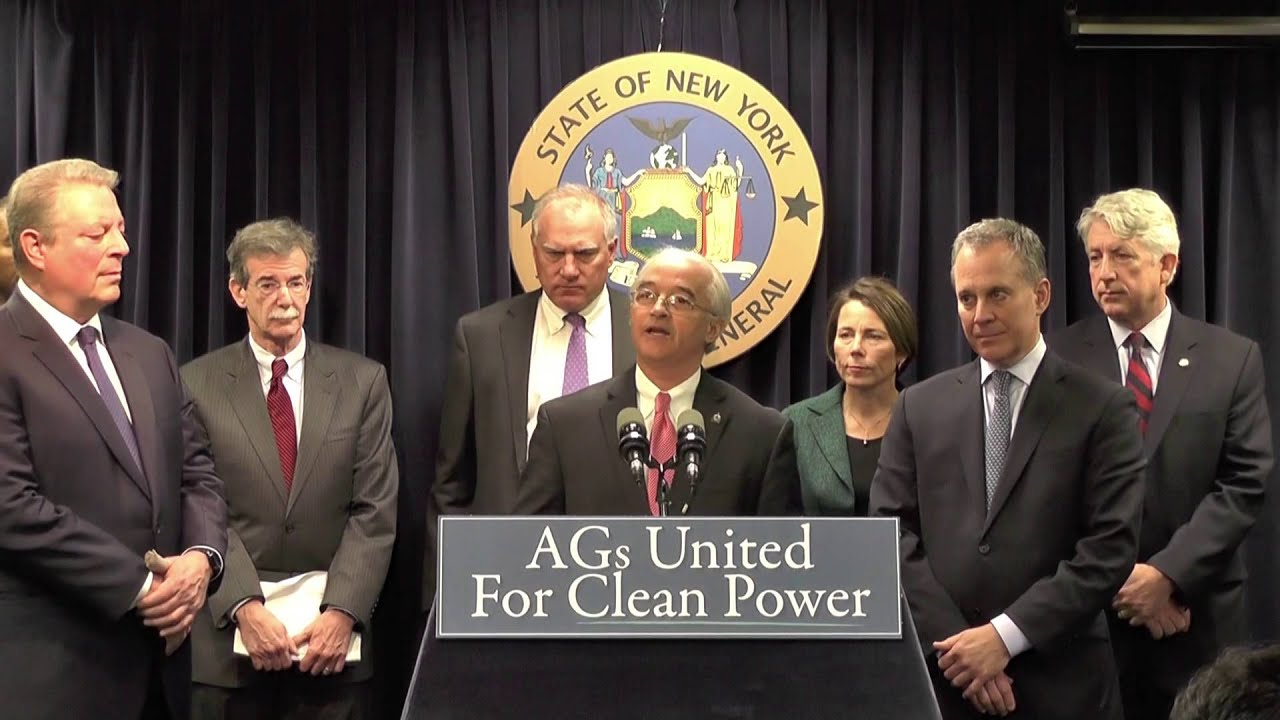 . "The scope of the problem we are facing, the size of the corporate entities and their alliances, the trade associations and other groups, is massive and it requires a multistate effort."
The coalition has been supported by former vice president Al Gore, who remarked that Exxon and other climate change denial lobbyists "are likely now, finally, at long last, to be held to account."
Each state's laws and investigative authorities are different, but through their joint probes, the attorneys general hope to create a nexus between Exxon's alleged deception and the damages that have been inflicted upon consumers.
What kinds of documents would Exxon have to hand over according to the subpoena?
According to Attorney General Walker's subpoena, Exxon is required to submit documents sent from or received by Exxon regarding climate change and its impacts; communications regarding the likelihood that Exxon products played a role in climate change; studies, research, and reviews published by Exxon or any of the third-parties acting on its behalf; information regarding Exxon sales and revenue that would have been impacted by acting on climate change; and meetings with or funding of third-parties.
If compelled to hand over 100 percent of the requested material, Exxon would be sharing nearly 40 years of memos, emails, studies, speeches, publications, and strategy reports, dating back to January 1, 1977.
Attorney General Walker has also included in his subpoena all communications regarding last year's investigation into Exxon's climate science funding conducted by ICN and the Los Angeles Times.
In his subpoena, what is Attorney General Walker accusing Exxon of having done?
Attorney General Walker has accused Exxon of violating two state laws under the Virgin Islands' anti-racketeering legislation called the "Baby RICO" statute.
As presented in the subpoena, Exxon is suspected to have engaged in, or be engaging in, "conduct misrepresenting its knowledge of the likelihood that its products and activities have contributed and are continuing to contribute to Climate Change" in order to defraud the government and consumers by obtaining money under false pretenses and conspiring to do so.
The "Baby RICO" statute that Walker has invoked was adopted by the Virgin Islands and other states and territories after Congress enacted the Racketeer Influenced and Corrupt Organizations Act (RICO) in 1970, which it created to try Mafia enterprises as a whole, rather than singular cases of lesser criminal associates. What the federal law allows prosecutors to do is build cases from lots of broader evidence.
The Virgin Islands' RICO statute, while not identical to the federal law that preceded it, can potentially be even more broad sweeping. In order for federal prosecutors to use the RICO Act, they must first prove reasonable suspicion that patterns of racketeering activity exist, and that the defendant obtained money through false pretenses.
Last year, New York Attorney General Eric Schneiderman also issued a subpoena for similar documents—with which Exxon has complied—but did so using the state's powerful securities fraud law called the Martin Act. Some legal experts believe that Attorney General Schneiderman is in a much better position to subpoena Exxon for evidence than Walker and other attorneys general in the coalition.
"I don't think the Virgin Island statutes are nearly as comprehensive. They don't speak directly to the subpoena power given to the attorney general of New York. I have some doubts about what the Virgin Islands attorney general is doing," Pat Parenteau, a professor of environmental law at the Vermont Law School, told me.
According to ICN, this marks the first time "a prosecutor has cited racketeering law to probe Exxon over its longtime denial of climate change and its products' role in it."
Several influential prosecutors, and even Al Gore, have encouraged the Department of Justice (DOJ) to launch an investigation into Exxon over potential violations of the RICO Act.
How is Exxon using existing laws to push back against Attorney General Walker?
Exxon is not about to hand over thousands of potentially confidential documents without a legal fight. In their lawsuit against Walker and the Washington, DC firm that issued the subpoena, Exxon alleges the request for information violates its constitutional rights.
The corporation's complaint, which was filed in its homebase of Texas, accuses Walker of infringing on its First Amendment right to freedom of speech by asking it to participate in the national discussion around its alleged fraud by deception. Exxon is allowed to make this claim because of the Supreme Court's 2010 ruling in favor of corporate personhood. Invoking the First Amendment may sit well in Texas, and an early ruling that Walker's subpoena is baseless due to an infringement of corporate free speech would be an undue win for Exxon, according to Parenteau.
Exxon has also cited the Fifth Amendment in its suit, which exists to protect people from being forced to incriminate themselves but does not generally apply to corporations, and would likely not be a persuasive defense against Walker's subpoena.
Additionally, the corporation claims the probe requests documents that extend past a five-year statute of limitations. While the statute of limitations in territories such as the Virgin Islands is more nuanced than it is in US states, if upheld, it could drastically curtail the volume of potential evidence that Exxon is required to submit.
Walker's subpoena, the lawsuit also alleges, "constitutes an abuse of process, in violation of common law," because the documents requested, Exxon's lawyers claim, appear to target individuals who hold policy viewpoints that stand in direct opposition to those supported by the attorney general.
"The First Amendment does not shield any company from being investigated for fraud," said Walker in a statement.
What this complaint suggests is that Exxon is posturing itself for future inquiries into its alleged knowledge of anthropogenic climate change and fraudulent behavior. While the corporation may be forced to comply with Walker's subpoena,it could still be years before any battle with Exxon escalates to a lawsuit. The risk in pushing too hard, said Parenteau, would be courts ruling in Exxon's favor over misuse of criminal law or political retaliation.
Will the documents subpoenaed by state attorneys general become public?
When, and whether or not, the Exxon documents acquired through current and future subpoenas become available to the public depends entirely on how the offices of the attorneys general negotiate their exchange. Some pieces of evidence may very well be confidential under the Privacy Act or heavily redacted, but Exxon can be expected to hand over material with the stipulation that it never becomes public.
Has this type of large-scale, corporate investigation ever happened before?
The main reason why legislators and environmentalists have encouraged the DOJ to use the RICO Act against Exxon is because the powerful law was previously invoked to bring down the tobacco industry in the 1990s.
In the United States v. Philip Morris, the DOJ successfully sued the country's most influential tobacco companies over fraudulent and unlawful conduct. The companies were held liable for violating RICO by deliberately concealing the health risks of smoking and marketing their products to the public.
"In the tobacco case, people were harmed by false beliefs propagated by the companies and were tricked into dangerous behavior," **former state attorney general Sen. Sheldon Whitehouse** told ICN. "In the case of climate change, there is the general harm, the damage that carbon is wreaking, and the cost to the government of flooding, wildfires and other disasters."
But if the case against Exxon is anything like the one involving the tobacco industry, it would also require strong bipartisan support among a class of politicians who have strong ties to the oil industry.[WHY?]
Ultimately, there are various legal options that prosecutors could pursue to venture deeper into Exxon's decades of darkness. Investigators have only just begun to dig, but look at how much they've been able to uncover so far.
- TAGGED:
- TECH
- MOTHERBOARD
- GLOBAL WARMING
- FOSSIL FUELS
- EXXON
- EXXONMOBIL
- VIRGIN ISLANDS
- ATTORNEY GENERAL
- TOBACCO INDUSTRY
- MOTHERBOARD SHOW
- RICO ACT
- RACKETEERING
- SUBPOENA
==
:{:{
}:}:
No person shall be held to answer for a capital, or otherwise infamous crime, unless on a presentment or indictment of a Grand Jury, except in cases arising in the land or naval forces, or in the Militia, when in actual service in time of War or public danger; nor shall any person be subject for the same offence to be twice put in jeopardy of life or limb;nor shall be compelled in any criminal case to be a witness against himself, nor be deprived of life, liberty, or property, without due process of law; nor shall private property be taken for public use, without just compensation.[1]
:{
}:
Takings: This power is limited in the Fifth Amendment to the United States Constitution, and extends to the states under the Due Process Clause of the Fourteenth Amendment. (TheFifth Amendment prohibits the **federal government** from taking property for public use without "just compensation," which American courts have interpreted in the usual case to mean "**fair market value**".) This prohibition is deemed incorporated in the Due Process Clause of the Fourteenth Amendment (which bars state governments from depriving people of their property without due process of law.)
==
===
regulatory takings under nafta much worse tpp
https://kpfa.org/episode/letters-and-politics-august-29-**2016/**
stiglitz
===
===
By Phil Mattera, Dirt Diggers Digest
At the headquarters of Reynolds American (parent of R.J. Reynolds Tobacco) in North Carolina and the Virginia headquarters of Altria (parent of Philip Morris USA) time is apparently running backwards. The two companies just filed a lawsuit in DC federal court that reads like it was written in 1995, not 2015.
The target of the suit (15-CV-00544) is the U.S. Food and Drug Administration, which the companies apparently have forgotten was given authority by Congress in 2009 to regulate tobacco marketing, including the introduction of new products. That law came after years of vociferous opposition by Big Tobacco.
What has the companies up in arms is an FDA guidance document issued in March concerning review requirements for packaging changes. The agency takes the position that certain modifications in background color, logo and descriptors can be significant enough to trigger the stricter rules regarding new products.
Presenting themselves as victims of government overreach, the companies argue that their First Amendment rights are being violated: "FDA's unlawful actions already have harmed Plaintiffs and threaten greater harms in the future by restricting Plaintiffs' ability to modify their product labels without FDA preauthorization and by chilling and restricting protected speech."
Although the case does not involve the federal warning labels that have been required for decades, it makes the puzzling argument that the FDA guidelines also violate the industry's Fifth Amendment rights against self-incrimination.
While it is not unusual for big business to assert free speech rights to oppose regulations, this position is particularly galling when it comes from the tobacco industry. These are the companies, after all, that for decades concealed and denied the hazards of smoking, asserting it was their right to "believe" their products were non-addictive and did not cause cancer despite the mountain of evidence to the contrary. Their dishonest claims were made all the more fraudulent when documents came to light indicating that firms such as Brown & Williamson (now part of Reynolds American) knew about the dangers at least as far back as the early 1960s.
The issue of control over tobacco packaging was already fought, and the industry lost. In 2006 a federal court, finding that the industry had caused "an immeasurable amount of suffering,"ordered it stop labeling cigarettes with designations such as low tar, light and natural that gave the misleading impression that they were safe.
Tobacco companies began using techniques such as package coloring to get around the restriction. In 2010 a New York Times article on the practice quoted Prof. Gregory Connolly of the Harvard School of Public Health as saying the industry was "circumventing the law." He added: "They're using color coding to perpetuate one of the biggest public health myths into the next century."
At the heart of the new case is the tension between public policies designed to discourage tobacco use and the continued existence of an industry which has to attract customers to survive. The industry's lawsuit, with its assertion of free speech rights, proceeds from the assumption that producing and selling tobacco products is a legitimate activity. A more appropriate premise might be that tobacco is a public health menace that should be controlled as tightly as possible until the last smoker has kicked the habit and the companies can shut down.
Big Tobacco would do well to stop wrapping itself in the Bill of Rights and acknowledge that it is lucky it is still allowed to sell its deadly products at all.
(Note: This piece draws from my new Corporate Rap Sheets on Reynolds American and Altria.) 4/15
===
===
IRATE
Pennsylvania Coal v. Mahon, 260 U.S. 393 (1922)
In Mahon, the U.S. Supreme Court held that the rights written into the general mining deeds
acquired by Pennsylvania Coal Company (PCC) in 1889 constituted a “property” of the
corporation, and that this property was protected against an arbitrary “taking” by the state.
Enacting the 1921 statute amounted to the “taking” of certain corporate property rights by the
state of Pennsylvania (PA), without just compensation, because it required the coal company to
take necessary precautions such that subsidence of the mines would not occur.
Issue: Is a corporate regulatory law, enacted by a state to protect its citizens and environment,
a taking that must be compensated?
Rule: The Fifth Amendment states that “[N]or shall private property betaken for public use
without just compensation.” Does this clause apply to corporations exactly as to persons?
Application: Petitioner Mahon purchased a home in Scranton, PA, in the early 20th century. A
clause buried in his title deed contained a general right by PCC to mine coal under Mahon’s
property. That clause also made PCC blameless should subsidence or collapse of the surface
property occur as a result of subsurface mining. When a mine collapsed, Mohan's home was
damaged.
The PA legislature had enacted a statute in 1921 that forbade any mining operation from
causing subsidence of surface land, with certain exceptions. The Court stated that Mahon was
bound by the provisions of his title deed, which transferred all risk of subsidence due to
subsurface mining to him, the owner, leaving the mining company blameless. The court found
the provision of the 1921 Pennsylvania law unconstitutional, as it failed to adequately
compensate any mining corporation for its loss of property rights. Those rights were written
into the general mining deeds acquired by PCC in 1889. The mining company could not be held
liable for any damage to surface homes due to subsurface mining. That would be an illegal
“taking” of property without compensation.
Transformation: The ability of a corporation to acquire general property rights, including
those acquired decades earlier, and to preserve those rights against subsequent state
regulatory action, was upheld under this decision. A corporation that acquired a general
subsurface mining deed in the nineteenth century would hold it essentially forever, binding
future surface property owners to it, and could profit from it.
Effect: A state is powerless to regulate corporate damage to third parties unless the
corporation is suitably compensated for the effect the regulation has on the corporation.
Ancient mining laws, in particular, are upheld regardless of their deleterious effect on the
present citizens and their properties. In effect, a corporation is protected under the Fifth
Amendment against an arbitrary "taking" of its property, however and whenever those property
rights were acquired.
Fictional Representational Story: My name is Mary. I purchased a home in a coal region of
PA. My home began to subside, requiring expensive repairs to the structure. I discovered that a
coal company has been mining under my property, and that a large section of the mine had
collapsed. I discovered a clause in my title papers that permits subsurface mining under my
property, and that the mining company must be held blameless for any surface damage caused
by the mine. This is in spite of a state statute forbidding any coal company from causing such
damage, whether or not a general property deed protects the coal company. Under this
Supreme Court ruling, I am unable to recover the cost of repairs to my home from the mining
company. I've lost my home to subsidence of the land.
Written by: William Barrett Disclaimer: For educational purpose only.
===
Since 2013, State Department whistleblower Peter Van Buren has been covering our new world of constricting freedoms in what he’s termed “Post-Constitutional America” for TomDispatch. With this look at the government’s newfound “right” to kill an American citizen without due process, he completes a three-part series on the shredding of the Bill of Rights, the previous two parts having focused on the First Amendmentand the Fourth Amendment. Tom
Dead Is Dead
Drone-Killing the Fifth Amendment
You can't get more serious about protecting the people from their government than the Fifth Amendment to the Constitution, specifically in its most critical clause: "No person shall be... deprived of life, liberty, or property, without due process of law." In 2011, the White House ordered the drone-killing of American citizen Anwar al-Awlaki without trial. It claimed this was a legal act it is prepared to repeat as necessary. Given the Fifth Amendment, how exactly was this justified? Thanks to a much contested, recently released but significantly redacted -- about one-third of the text is missing -- Justice Department white paper providing the basis for that extrajudicial killing, we finally know: the president in Post-Constitutional America is now officially judge, jury, and executioner.
Due Process in Constitutional America
Looking back on the violations of justice that characterized British rule in pre-Constitutional America, it is easy to see the Founders' intent in creating the Fifth Amendment. A government's ability to inflict harm on its people, whether by taking their lives, imprisoning them, or confiscating their property, was to be checked by due process.
Due process is the only requirement of government that is stated twice in the Constitution, signaling its importance. The Fifth Amendment imposed the due process requirement on the federal government, while the Fourteenth Amendment did the same for the states. Both offer a crucial promise to the people that fair procedures will remain available to challenge government actions. The broader concept of due process goes all the way back to the thirteenth-century Magna Carta.
Due process, as refined over the years by the Supreme Court, came to take two forms in Constitutional America. The first wasprocedural due process: people threatened by government actions that might potentially take away life, liberty, or possessions would have the right to defend themselves from a power that sought, whether for good reasons or bad, to deprive them of something important. American citizens were guaranteed their proverbial “day in court.”
The second type, substantive due process, was codified in 1938 to protect those rights so fundamental that they are implicit in liberty itself, even when not spelled out explicitly in the Constitution. Had the concept been in place at the time, a ready example would have been slavery. Though not specifically prohibited by the Constitution, it was on its face an affront to democracy. No court process could possibly have made slavery fair. The same held, for instance, for the “right” to an education, to have children, and so forth. Substantive due process is often invoked by supporters of same-sex unions, who assert that there is a fundamental right to marry. The meaning is crystal clear: there is an inherent, moral sense of “due process” applicable to government actions against any citizen and it cannot be done away with legally. Any law that attempts to interfere with such rights is inherently unconstitutional.
===