Indiana
---
merri ok
SEE GERRY 4
supermajority? gut eco law clint woods braun
state legis a pow?
midwest flipped 2018? indiana some evil outlier? pence? charter devos, anti-union, voter suppression, swing state, ALEC, duke, edison...
bak 1 24
ggl 6 26
Search Assist
Indiana's General Assembly has had Republican supermajorities in both chambers since 2010, with Republicans holding 70 of 100 House seats and 40 of 50 Senate seats as of 2024, allowing them to override gubernatorial vetoes and pass legislation without Democratic support.
 idsnews.com
 Wikipedia
-=-=
-=-=
-=-=
AN 9 26
In the last weeks of August, a valley in the Himalayas and a post-industrial city in the U.S. Midwest found tragic commonality. In Gary, Indiana, a powerful “derecho,” a fast-moving band of damaging thunderstorms, tore across Lake Michigan producing straight-line winds as high as 110 mph. The widespread destruction left tens of thousands of peoplewithout electricity for over two weeks, bringing global relief organizations like World Central Kitchen to the area for the first time. In Nepal, an enormous 2,000 foot wide chunk of glacier ice sheared off a mountain and plunged to the river 7,000 feet below, tearing everyone off the mountainside with it, killing over 1,000 people.
Scientists agree that both catastrophes were caused by the rise in global temperatures.
Eight thousand miles apart, as historically and culturally distinct as two areas can be, both Nepal and Gary emerged as pawns in the same oligarchs’ game of chicken: Can big oil squeeze another decade of ROI on their sunk equipment costsbefore the earth’s post-industrial temperature increases by 3.6°F (2°C)? Scientists have warned since the 1970s that an increase of 2°C will be the tipping point beyond which life on earth will change irreversibly, yet the same game of chicken persists. Fossil fuel profits have continued to soar despite the warnings— now tipping $3,000 a second— with the costs of climate change projected to hit $38 ***T***rillion annually.
The inhabitants of Gary and Nepal, like millions of people living in Miami, New Orleans, Houston, Asheville, Jakarta, Delhi, Lagos, and thousands of cities, towns, and rural communities around the world are sitting pawns in a deadly game they didn’t sign up for. No one other than industry titans, fossil fuel investors, and the politicians whose campaigns they bankrolled signed up for what is happening.
Gary’s steel still runs on coal, but it doesn’t have to
I used to live in Gary; full disclosure I ran for U.S. Congress in 2020, primarily to address climate change, and got my ass kicked. Although Gary is known as a post-industrialist steel mill town with an outsized carbon footprint, Gary is also home to rare and unexpected natural habitats and exceptional beauty. The sand dunes, lagoons, and oak savannahs are as pristine as they were when Potawatomi and Miami tribes lived there.
I ran for Congress with climate change urgency most residents weren’t happy to hear. Although Gary’s steel manufacturing relies on coke and coal to fuel blast furnaces, churning out 10 million metric tons of carbon every year, those furnaces could be converted to run on hydrogen produced via electrolysis powered by solar or wind, replacing coke as the reducing and heating agent. The steel could then be melted in an electric arc furnace (EAF). The whole process would produce water vapor instead of CO2 as a byproduct, which would save the steelworkers’ and the planet’s lungs.
Renewable-hydrogen steel plants also benefit from price stability, since sunlight and wind aren’t subject to the kind of volatility Trump is spreading throughout the Middle East. Early movers like Sweden’s HYBRIT project and Boston Metalhave proven that as the costs of renewable electricity keep falling, green steel will become not just cleaner but genuinely cheaper to produce at scale. This is especially true in areas with abundant solar or wind resources, and Gary is rich in both vacant land for solar and onshore winds from Lake Michigan. The only downside of converting to green steelmaking, outside the initial cost that will convert to profit in 10 years, would likely be to the local utility monopoly known as NIPSCO.
India also still burns coal, but Nepal does not
In the climate karma department, Nepal is as close to innocent as any emerging nation can be. Nepal contributes less than 0.1% of global greenhouse gas emissions despite bearing a disproportionate share of climate destruction. Nepal’s power grid is 95% supplied by clean hydropower, which is also supplemented by solar. Unlike neighboring India, the world’s third worst contributor to climate change after China and the US, Nepal does not operate coal-fired power plants.
In Nepal, traditional biomass including firewood and agricultural residue provide over 60% of overall primary energy. Biomass sources are the primary energy supply used for residential purposes including heating and cooking.
Despite their best efforts to burn clean fuel, the threat of renewed flooding still threatens Nepal, as scientists warn that debris and dammed up river channels could burst any day without warning, with over a thousand people still missing from the last event, including hundreds of foreign tourists.
Will we keep tuning out the obvious?
Every hurricane, flood, fire, disappearing habitat and river, and every sinking costal region, hastens big oil’s game of chicken toward its conclusion, one way or another. In the U.S., will the fossil-fuel aligned Supreme Court majority allow corporations to continue to destroy with no legal accountability? In India, will Prime Minister Modi continue to talk about climate justice, even as his policies create the opposite?
When my climate-focused run for office ended, a Chicago Tribune Metro editor asked if I wanted to write for them. I kept writing climate policy papers, why not use them to try to do some good? But I learned from the campaign that while many Americans are somewhat concerned about climate change, most don’t want to think about it.
Six years, hundreds of columns, and a climate justice TedTalk later, an editor from a different national paper told me that climate change, as a topic, remains unpopular.
People tune out climate change because the human brain has evolved to react to immediate, visible threats rather than slow-moving, abstract problems. The lack of personal urgency converts it to a future problem, while fossil-fuel backed organizations blame “nature” for their own malfeasance. Contemplating what’s happening to the planet also causes cognitive dissonance: it requires acknowledging uncomfortable truths about modern lifestyles, which leads to more psychological numbing, and emotional shutdown instead of action.
Maybe this psychological numbing is the earth’s kindness, her way of anesthetizing us while she reduces our number. And maybe sending up a {vindictive anti-science}_ imbecile, a grotesque sadist hellbent on destroying everything— _{the planet}, world {peace}, and the {rule of law}— is just nature’s way of thinning the herd.
Sabrina Haake is a political analyst and 25+ year federal trial attorney specializing in 1st and 14th A defense. She writes the free Substack, The Haake Take.
state level decap
The bill that turned IDEM into an empty shell
SB 277, or “the IDEM agency bill,” should have sailed through both chambers of the general assembly during the 2026 session. In many ways, the bill was a state-level replica of what the Trump administration has been doing to the federal Environmental Protection Agency, the policy equivalent of red meat served up in a red state.
Instead, SB 277 barely squeaked into law. On February 24, Pierce’s colleagues in the House passed the bill by just 8 votes; on February 25, the Senate passed it by 5. And, as the Indiana Capital Chronicle reported, even a margin of 5 wasn’t easy to achieve. “On the last vote on the night in the Senate,” the Chronicle said, the running tally on the vote board for Senate Bill 277 was 22 for and 25 against. To save the GOP bill, “four Republicans changed their no votes to yes, giving it a 26-21 victory.”
This is the story of how SB277 came to be, and how a handful of dedicated advocates and a few thousand engaged Hoosiers nearly derailed Governor Braun’s bid to make himself the chief deregulator in the Midwest.
How SB 277 Became Law
Early meetings with Commissioner Clint Woods
:{Organizations comprising Indiana’s environmental coalition, including HEC, met with Indiana Department of Environmental Management (IDEM) Commissioner Clint Woods twice after his appointment by Governor Braun in early 2025. Woods also made himself available for an individual meeting with HEC. During these meetings, the only mention of any upcoming environmental legislative initiatives were references to “cleaning up” outdated references and duplication in Title 13, the section of Indiana Code governing IDEM.
Woods gave no hint that substantive changes to Title 13 were in the works. In fact, as HEC discovered during the 2026 legislative session, the only people invited to contribute to the legislative effort that ultimately became SB 277 were a small, select group of industry representatives. Commissioner Woods chose not to involve any members of the Senate Environmental Affairs Committee, except the Chair, and did not consult with the Ranking Minority Member of that committee. Environmental advocates and the general public were entirely excluded from the process.}:
What we expected
Based on periodic agency internal reviews and on our meetings with the Commissioner, HEC anticipated a 2026 IDEM agency bill primarily comprised of ministerial “clean up” of outdated code citations and references to long-changed federal administrative code, along with some shuffling of duties among IDEM divisions. And, while SB 277 offered much of what we had expected to see, it offered much, much more that we had not.
What was delivered
Late in the day on Thursday, January 8, 2026 – just hours before the January 9 deadline for Senators to introduce new bills – SB 277 was filed; all 176 pages of the bill became publicly available on the Indiana General Assembly (IGA) website and SB 277 was immediately set for its first and only hearing in the Senate Committee on Environmental Affairs at 9:30 a.m., Monday, January 12. Instead of a brief, ministerial clean-up bill, SB 277 proposed dozens of substantive changes to Title 13, every one of which could have serious consequences for all Hoosiers.
And HEC had a single business day (and a weekend) to digest and analyze it.
Since the Chair was the only member of the Environmental Affairs Committee (as far as we know) to have a copy of SB 277 prior to its filing on January 8, there was no meaningful opportunity for other committee members to draft amendments to be offered during the January 12 hearing. HEC was among a number of allied organizations to testify against the bill’s glaring and substantive changes to air water and land protections during that hearing. In our testimony, we noted that SB 277, as introduced:
- Mandated that IDEM consider whether rules and regulations are “more burdensome” to polluters, not people;
- Eliminated the long-existing requirement that state agencies consider the full environmental impacts of state actions by consulting with IDEM and by preparing impact statements;
- Eliminated IDEM oversight on any aspect of water, air or land use associated with nuclear energy generation;
- Forfeited agency review of plans for permitting sanitary sewers or public water mains if those plans are drawn by a professional engineer;
- Eliminated a successful pollution prevention program aimed at helping industry avoid polluting discharges in the first place;
- Concentrated power in the Governor and appointed agency commissioner while diluting citizen participation, requirements to provide notice of agency actions, and the right to appeal some agency actions, including the agency’s failure to act;
- Changed over 40 mandatory requirements for IDEM and its rules board to discretionary only (“shall” changed to “may”), including:
- The Commissioner “may” bring a lawsuit to stop an “imminent and substantial endangerment”;
- The Environmental Rules Board is no longer required to consider existing air and water quality or the public’s right to a clean environment when making rules;
- The Commission may now issue a permit to an applicant that owes tax payments to the State, or who has already been determined to be of bad character with respect to prior permitted activities.
Nevertheless, SB 277 passed out of the Senate Committee on Environmental Affairs on a party line vote, 5-3.
On January 22, the bill made a brief stop in the Senate Appropriations Committee, where it once again passed on a party line vote, 9-4, with minor amendments. The bill was debated on the Senate floor on January 28 and 29, with only one non-substantive amendment accepted. The first full Senate vote was close, 29-19, with 9 Republican senators joining all 10 Senate Democrats in voting against the bill.
Dealings in the House
As the Senate Committee on Environmental Affairs had done, the House Committee on Environmental Affairs gave SB 277 a single hearing, on February 11. During this hearing, the committee chair introduced an unexpected amendment to the bill to effectively prohibit IDEM from regulating thousands of PFAS, or “forever chemicals,” by narrowly defining the subset of PFAS-related compounds that would be subject to IDEM control. The amendment also prohibited IDEM from considering scientific findings made by EPA with respect to risk assessments of toxic substances. Concerns and amendments from the committee’s minority members were not considered, and SB 277 passed out of the House Committee on Environmental Affairs, 6-5.
Multiple House members made heroic efforts to amend or defeat SB 277 during its second reading on the House floor on February 23. In all, twelve amendments that HEC supported were offered; only two were accepted, resulting in slight improvements to the bill. SB 277’s House sponsor offered an amendment that prevailed, but it removed only part of the offending PFAS and risk language that he introduced into the bill in his committee. The bill passed the full House on February 24 by a vote of 53-45. Fifteen majority members voted to defeat the bill.
HEC and the Coalition nearly defeat the bill
Beginning on January 8 and continuing through the final vote on SB 277, HEC and coalition members Indiana Conservation Voters, Earth Charter Indiana, Conservation Law Center, Save the Dunes, Citizens Action Coalition and Sierra Club Indiana Chapter, made monumental efforts to educate legislators and advocate against passage of the bill. Tim Maloney (retired HEC Policy Director), League of Women Voters, Indiana Wildlife Federation and Stand for Health Freedom all offered important assists. In the end, 12 majority senators were convinced to vote against SB 277, for a final vote of 25-21. Four others majority senators initially voted against the bill, but switched their vote under pressure from leadership while the voting board was held open for a rare and extended period. Had those four held firm, our coalition would have defeated SB 277, 21-25.
These factors influenced the result
HEC was part of a strong and coordinated team across many environmental and conservation organizations, and we worked effectively with the MAHA movement (Stand for Health Freedom) because of the negative impact SB 277 will have on individual Hoosiers’ health. HEC also garnered early majority support, conducted excellent grassroots messaging and action, and worked relentlessly against the bill over the session’s eight weeks. Yet, the technical and legal complexity of this legislation, together with the short time frame for consideration, made our opposition more difficult. Ultimately, SB 277 was pushed by the Governor and his fast-talking IDEM Commissioner in a compressed legislative session where many other important bills also had to be considered.
As Senator Glick said in urging her colleagues to defeat the bill, cautioning against moving too fast with loss of significant protections, “This is our environment. This is the world we live in and the one we’re going to pass on to the next generation…This is the air we breathe, and the water we drink, and the land we share.” This simple but powerful message was sadly lost on many of Indiana’s leaders, including Governor Braun, who signed the bill into law on March 5.
HEC supporters sent more than 3,000 messages opposing SB 277 to their Indiana Representatives and/or Senators, joining the efforts of our coalition to sound the alarm on this bill early and often while providing sound scientific and legal analysis. Our combined efforts resulted in some improvements to the bill – and a growing awareness that, together, we can make a difference for Indiana. With the help of more thoughtful and forward-thinking Hoosiers, HEC and its supporters will continue bringing our message to the Statehouse with increasing power to prevail.
---
an 4 26
Over the course of President Donald Trump’s two terms, he has endeavored to assert himself as the final say across GOP electoral races large and small. While he has often been successful at forcing his party’s candidates to bend to his will, in a race for the Indiana state Senate, Trump’s efforts to push one Republican out in favor of another have one conservative candidate accusing the White House of “threatening” behavior.
The Indiana state elections drew Trump’s attention after several sitting lawmakers opposed his redistricting plan last year. As a result, the White House has now thrown its support behind candidate Brenda Wilson in hopes of unseating state Senator Greg Goode, who voted against redistricting.
The administration became concerned, however, that Republican candidate Alexandra Wilson — no relation to the other candidate — would confuse and divide the vote because she has the same last name. As a result, reports NBC, the White House began leveraging wide-ranging tactics to pressure Alexandra Wilson out of the race, from offering a job to threatening personal attacks.
It started with a barrage of phone calls from three White House aides, including political director Matt Brasseaux, deputy chief of staff James Blair, and Midwest regional political director Marshall Moreau. These were followed by calls and texts from Indiana Lieutenant Governor Micah Beckwith, Governor Mike Braun’s chief of staffJoshua Kelley and a staffer for a Republican activist group.
In the first call with Brasseaux, the White House political director attempted to cajole Wilson into accepting a job in exchange for dropping out, offering her an administrative role. She declined.
“I had a hard time not feeling insulted the entire call,” she later explained. “The admin position — I have a career, my job — that was a fraction of what I make a year.” She also felt like Brasseaux didn’t take her assertion that there were genuine local issues she’d like to address seriously.
The calls from the aforementioned figures kept coming all day, the last from Lieutenant Governor Beckwith, who later told NBC, “I just said I don’t know if you guys really thought this one through, because this probably could end poorly for this woman.”
The next morning, the pressure campaign ramped up with a string of calls and texts. “They were very, very pushy,” Wilson said.
That evening, she received a call from Deputy Chief of Staff James Blair, who noted that he was on a plane with Secretary of State Marco Rubio, before making veiled threats to reveal charges she’d faced at the age of 19 for resisting arrest (Wilson is now 34) and her husband’s DUI.
“I just wanted to talk about that brass-tacks reality that I think is going to be really ugly,” Blair warned.
“I was a child. I made a mistake,” Wilson explained about the charge, which had been resolved with a plea deal, then was later expunged from her record. “It was right after my mother passed away suddenly. I made a poor choice. Everybody makes mistakes. I have been a law-abiding citizen since then.”
When Wilson concluded the call, which she says was “a little threatening,” she made it plain that she had no plans to drop out of the race.
The next day, which was the last day candidates were allowed to quit, a local conservative attorney filed a petition with the state Election Commission to disqualify Wilson, alleging that her candidacy was a “trick” to hand the race to the Democrats. He argued that she wasn’t eligible to run due to her felony arrest at 19, even though it had been pleaded down to a misdemeanor and eventually removed from her record. After a series of deadlocked votes by the Commission, Wilson was ultimately allowed to remain on the ballot, though the attorney says he plans on appealing the decision.
“I have been accused of dirty tricks, political dirty tricks,” said Wilson. “This is exactly what is a political dirty trick. I’m a legitimate candidate with concerns for my district that would like to represent my district, and I have every right to be involved as anybody else on the ballot.”
Pesticide use and cancer risk rise together across America’s heartland - Investigate Midwest
A direct correlation can be difficult to determine, as cancer development times can range from months to decades. Overlaying cancer rates onto a map, however, highlights the nation’s top crop and vegetable growing regions, where pesticide use is highest.
The Midwestern states of Iowa, Illinois, Nebraska and Missouri — leading corn-growing states — had the highest rates, while rates were also high in California and Florida, high fruit-growing states.
OKLA PREEMPT LAW FAIL?
---}:
---
AN 2 26
'Good citizenship': Indiana GOP bill pushes marriage before kids lessons
---
redistr vote not even close, many threats 12 25
RWW
12/12/2025
by
- Jane C. Timm @ NBC News: Indiana Senate rejects GOP-drawn congressional map in a major rebuke of Trump
Trump and national Republicans pushed Indiana lawmakers for new district lines that could have allowed the party to gain two seats in next year’s midterms.
- Michael Luciano @ Mediaite: Indiana Lt. Gov. Confirms Trump Threatened Entire State if It Didn’t Redraw Congressional Map
Indiana Lt. Gov. Micah Beckwith (R) said the Trump administration threatened the state if the Republican-controlled legislature failed to gerrymander its congressional map.
- Steve Benen @ The Maddow Blog: Trump’s pardon for Colorado’s Tina Peters suffers from one fatal flaw
Presidents can’t pardon individuals convicted of state crimes. Whether Trump understands that isn’t entirely clear.
- Leigh Kimmins @ The Daily Beast: Marjorie Taylor Greene Plots Major Move to Make Fresh MAGA Chaos
The Trump-bashing congresswoman is said to be quietly trying to stage a revolt against House Speaker Mike Johnson.
- Tracy Simmons @ Religion News Service: Christ Church at 50: How Doug Wilson pushed Christian nationalism to the center
The pastor, celebrating 50 years in his pulpit, has never had more influence than he does under the current presidential administration.
- David Badash @ The New Civil Rights Movement: ‘Positively Authoritarian’: White House Tweets and Deletes ‘Naughty List’ of Journalists
The White House appears to have tweeted then deleted a “Naughty List” of journalists, including top news reporters and outlets, in an act that is being described as “positively authoritarian” by one legal expert.
---
mma
retaliation enforcer?
12/12/25
---
---
AN 12 25
A "band of stubborn Indiana state Senate Republicans" are poised to threaten what Politico calls President Donald Trump's "mid-cycle redistrictingscheme" this week.
Indiana Republicans will meet Monday to decide on a map, passed Friday by the Indiana House, "that supporters say would all but guarantee a 9-0 Republican congressional delegation and would be in effect for next year’s pivotal midterm elections," Politico reports.
"Senate President Pro Tempore Rodric Bray, who — along with roughly half his 40-member Republican majority — has resisted a four-month White House pressure campaign to redraw the congressional lines," Politico explains.
Present maps give the GOP a 7-2 advantage, but there's a problem as Trump's influence has waned within the ranks of Indiana's Republican state legislators, they note.
“The MAGA movement hasn’t permeated down to the state legislative level,” according to an Indiana Republican allied with Trump’s redistricting mission.
“Some people think Trumpworld is bluffing or doesn’t have any juice left and this will just go away if the state Senate rejects the maps,” the anonymous Republican tells Politico.
“The reality is that will only be the start of a long and brutal campaign to purge the state of anyone who opposed Trump on this issue. And there will likely be collateral damage that hurts even those who supported Trump.”
The pressure campaign has been intense, they report, but, according to Mike Murphy, a former Republican member of the Indiana House of Representatives, it may backfire.
"These guys and ladies are under intense, 24-hour-a-day pressure and I don’t know if they can withstand it, ultimately — we will see,” Murphy tells Politico.
“I feel badly for them and their families, primarily. They came to be public servants, and instead they are pawns in really what I consider to be Trump’s strategy to avoid a third impeachment and potentially set himself up a third term," Murphy adds.
---
---
an 12 25
Politico reports a group of Trump-aligned super PACs are working to oust Indiana Republicans who have opposed flagrant mid-decade redistricting giving Republicans a boost in preserving their House majority.
Andrew Kolvet, spokesperson for Turning Point, told POLITICO that the group would partner with other aligned PACs to dedicate an “eight-figure spend” to “primary people that are standing in the way of the president’s agenda.”
“We look at Indiana as a test case and a cautionary tale, potentially one or the other, it’s their choice,” said Kolvet. “This is a super high priority, and we’re going to be working with the local, grassroots to make sure their voices heard and their priorities are not steamrolled by an out-of-touch elected class.”
Politico reports Indiana state House Republicans released a draft congressional map earlier this week that would flip the state's congressional map from a Republican advantage of 7-to-2 to 9-to-0. But the effort has faced resistance from some of the state’s Republicans, including Senate President Pro Tem Rodric Bray, who remains opposed to the plan.
Other opposition comes from state senator Michael Bohacek (R), who announced he would not be supporting Trump's mid-decade redistricting plan after he called Minnesota Gov. Tim Walz (D) a slur. The Republican lawmaker said on his official Facebook page that as a parent of a child with Down Syndrome, he couldn't endorse Trump's plan due to his use of the word.
Despite Republicans having a 40-10 supermajority in the chamber, it has repeatedly rejected Trump’s calls — including by recent vote to adjourn. Around the same time that was happening in mid-November.
Some Indiana Republicans are already getting threats of violence from MAGA elements angered that they are opposing the power grab, with nearly a dozen state lawmakers reporting that they have been the victims of SWAT or doxing attempts.
Read the Politico report at this link.
---
an 11 25
President Donald Trump has publicly singled out one of the most senior Republican lawmakers in Indiana for failing to win over enough votes to support Trump's mid-decade redistricting proposal.
In a Monday post to his Truth Social platform, Trump called Indiana Senate president pro tempore Rodric D. Bray "a Complete and Total RINO [Republican in Name Only]" for his recent statement that "there are not enough votes" to redraw U.S. House of Representatives districts ahead of the next Census. He wrote in a subsequent post that he would support a primary challenger against Bray and anyone who supported him.
"Republicans must be TOUGH and SMART if we are going to WIN the Midterms," Trump wrote in his signature style of oddly placed capital letters. "The Rod Brays of Politics are WEAK and PATHETIC. I wish he cared about saving our Country as much as Democrats care about destroying it."
Indiana Gov. Mike Braun (R) later wrote on his official X account that he had a call with Trump, and encouraged Hoosier State lawmakers to not give up on mid-decade redistricting. Braun defended the plan by saying new maps were necessary "to ensure the MAGA agenda is successful in Congress."
"Indiana’s State Legislators must show up for work and take a public vote for fair maps to counter the gerrymandering in California and Illinois. But the Indiana State Senate is hiding behind closed doors and refusing to even bring redistricting to a vote," Braun tweeted. "Hoosiers deserve to know where their legislators stand and expect them to show up for work, not walk out and hide in the dark."
Braun's statement is misleading, as California and Illinois' redistricting measures were done in direct response to Republican redistricting in Texas and elsewhere. California's new maps – which were only put in place after Golden State voters approved a redistricting ballot initiative earlier this month — would likely give Democrats five new seats. Texas' maps are expected to tilt five Democratic seats toward Republicans. Ohio Republicans' redistricting map creates two likely new Republican seats, though Democrats are now more competitive in one GOP district. North Carolina Republicans are also likely to give the GOP one more U.S. House seat after their mid-decade redistricting effort.
Bray insisted last week that Republicans didn't have enough support in the Indiana state senate, even though the GOP controls 40 of 50 seats in the chamber. This means there are more than a 16 members of his own party who are willing to vote with the senate's 10 Democratic members against new redistricting maps.
---
---
omg rww
06/18/2025
by
Indiana’s far-right Christian nationalist Lt. Gov. Micah Beckwith posted a new episode of his "Jesus, Sex, and Politics" podcast in which he doubled down on his warning that Pride Month is "the rainbow beast" and "a state-corporate-pagan alliance to reprogram society."
For nearly an hour, Beckwith and his co-host Nathan Peternel railed against Pride Month and the LGBTQ agenda in general, which Beckwith called "demonic."
"If you've ever studied the origins of, just the history of the LGBTQ movement throughout ancient history and all the way up to today, this is the same demonic spirit that basically just keeps coming back again," Beckwith said. "Back in ancient Israel, there was a goddess, her name was Ishtar, and she was the goddess of transgenderism, a gender-warping goddess. She was a homosexual goddess. Men would give themselves over to lustful acts with other men, women the same, pedophilia, everything like that. They would warp their genders. All those things. Same things that we're seeing today in the LGBTQ movement."
"It's really interesting when you study it because she was always celebrated in the month of Tamar Beckwith presumably meant the month of [Tammuz], which is our month of June, the exact same time," Beckwith claimed. "And she was represented by rainbows in her eyes. Anytime you saw her, you'd see rainbows. And it's like, wow, this is the same demonic playbook just playing out all over again."
---
---}:
omg
an 4 25
kff
Overcome by worries, Lynette Isbell dialed a mental health hotline in April 2022. She wanted to talk to someone about her midlife troubles: divorce, an empty nest, and the demands of caring for aging parents with dementia.
“I did not want to keep burdening my family and friends with my problems,” Isbell said.
But she didn’t find the sympathetic ear she was hoping for on the other end. Frustrated, she hung up. Little did she know ending that call would set off events she would regret.
Police arrived at her home in Terre Haute, Indiana, handcuffed her, and had her committed to a hospital, records show, resulting in more than $12,000 in hospital charges.
“The whole thing was an absolute, utter, traumatic nightmare,” she said.
Isbell’s call for help represented the need for a new approach to crisis calls just as the nation was readying to flip the switch to a revamped response system for mental health. Using just three digits — 988 — people could call or text for help from anywhere at any time starting in July 2022. Federal officials viewed the launch of 988 “as the linchpin” to reenvision the mental health crisis system. The idea was to reduce the reliance on police and the burden on emergency rooms, while eliminating the stigma of seeking help.
But recent federal funding and staffing cuts undermine the future of the 988 program and threaten to erase progress made in Indiana and elsewhere, mental health advocates said.
The Trump administration cut staffing at the Substance Abuse and Mental Health Services Administration, the federal office that oversees 988, in recent weeks. It also ended $1 billion of its grants that a number of states relied on this year to help fund their 988 systems, said Stephanie Pasternak, state affairs director of the National Alliance on Mental Illness. While a judge temporarily paused grant cutsfor 23 states that contested them, the trims to other states — including Indiana — have moved forward.
Between the SAMHSA cuts andpotential reductions to Medicaid, another crucial funding stream for these services, Pasternak and others are concerned about what this means for 988’s future.
Any disruption to federal funding streams is “gravely impactful,” said Zoe Frantz, CEO of the Indiana Council of Community Mental Health Centers. “We have put a lot of time, talent, and treasure — from the state to providers — in trying to build the system,” Frantz said. “We can’t go back.”
After Isbell hung up her call, a member of the Suicide Prevention Hotline, the crisis line formerly available, phoned the Vigo County Sheriff’s Office and told a dispatcher Isbell was “thinking of committing suicide,” according to the sheriff’s report obtained by KFF Health News.
Years later, Isbell maintains she never said this. “I’ve never been actively suicidal.”
But two officers drove to Isbell’s home.
When they arrived, Isbell was sitting on her back porch on a sunny day with trees just starting to bud. The officer’s report alleged she admitted to thinking about driving her car into a tree, wanting doctor-assisted suicide, and fantasizing about a semitruck hitting her.
She contends active suicidal ideation with a plan is different than the overwhelmed feelings she had that day.
“It was like a childhood game of telephone, only not at all funny,” she said. What she said became distorted and left her no recourse.
The officers walked her to a squad car, where they handcuffed her before transporting her to Terre Haute Regional Hospital, according to dashcam video obtained from a public records request. Neighbors watched as she was taken away.
“I don’t know why I needed to be handcuffed,” she said. “It was demoralizing.”
The Vigo County Sheriff’s Office did not respond to requests for comment about Isbell’s case.
Isbell said being hospitalized against her wishes humiliated her and forced her to battle confusing medical bills for months. An itemized bill shows the hospital charged $12,772 for her overnight stay. After insurance, Isbell was on the hook for roughly $2,800. By comparison, a one-night stay in the presidential suite at the new Terre Haute Casino Resort is $2,471. Terre Haute Regional Hospital spokesperson Ann Marie Foote said Isbell’s bill was “discounted down” to $1,400.
“Our highest priority is always the safety and well-being of patients,” Foote said.
According to Isbell’s medical records, doctors there said “she was very stressed” and “just wanted to speak to someone” and reiterated “she was not suicidal.” They said her anxiety “is increased and made worse by being in here.”
She had “anxiety” and a “depressed mood,” and, according to medical records signed by a psychiatrist there, “she does not meet current criteria for involuntary hospitalization.” She was discharged the next day.
Upset by how she was treated, she contacted 988, the sheriff’s office, and the hospital.
In response to KFF Health News’ questions about Isbell’s experience, Michele Holtkamp, a spokesperson at the time for Indiana’s Family and Social Services Administration, said that before the launch of 988, “the state did not have oversight of individual crisis lines and how they responded.”
After 988 began, Isbell received a follow-up email from an executive with Mental Health America, introducing her to the director of Indiana’s 988 hotline, Kara Biro.
“I shared your story with her and we agree that we would love to get you to help with a training video,” wrote Brandi Christiansen, CEO of Mental Health America-Wabash Valley Region. She explained it would provide workers an opportunity to understand the real-life implications an “outcall can have on a human being.” The video has yet to happen, Isbell said.
The sheriff’s department also asked for her input to improve the process, she said.
Isbell saw those as signs of a turnaround. For mental health leaders in Indiana, 988 represented a “springboard to transform and build” a new response system, according to a 2022 Indiana Behavioral Health Commission report. Too often, the report said, Indiana’s “ineffective and inefficient” system had relied heavily on police and emergency rooms.
Before 988, the state hotline also relied almost entirely on volunteers, complicating efforts to standardize responses, said Jay Chaudhary, a former director of Indiana’s Division of Mental Health and Addiction, who led the state’s transition to 988.
“When somebody makes the really brave step to seek help with mental health care, that system better be ready to catch them,” he said.
Today, Indiana ranks among the 10 states with the highest 988 answer rates, a sign it can handle the demand, said Laurel Stine, chief advocacy and policy officer with the American Foundation for Suicide Prevention.
In Indiana, behavioral health professionals now lead the response via mobile crisis teams, not law enforcement, such as the officers who handcuffed Isbell.
As of July, mobile crisis teams were available to 4.8 million people living in 65 of Indiana’s 92 counties, reaching roughly 71% of residents, according to a 2024 report from the behavioral health commission. In the first half of last year, mobile crisis teams were dispatched 3,080 times for help. Law enforcement officers were involved in about 1% of those cases and roughly 10% resulted in a trip to the emergency room, according to the report.
Similar efforts have occurred nationwide since the 2022 launch. The 988 hotline received 4.8 million calls, texts, and chats during its first year, which is roughly nine times a minute, according to Substance Abuse and Mental Health Services Administration data.
But the federal government has terminated numerous grants earmarked for Indiana and other states to tackle mental health and substance use issues. Still, SAMHSA spokesperson Danielle Bennett said the 988 hotline is a “critical function” and that the federal government “will never compromise” protecting people experiencing a crisis. The hotline, Bennett said, “continues daily, life-saving work.”
The Indiana agency tasked with overseeing 988 had more than $98 million in SAMHSA grants but received 73% of that as of March 24, when the grants were terminated, according to a government list of cuts. That leaves Indiana $26 million short.
Some federal grants were passed through to local organizations, including one group that received grant money for “mobile crisis units,” according to an online grant summary. In a statement, Indiana Family and Social Services Administration spokesperson James Vaughn confirmed it received notice of the terminated SAMHSA grants but declined to provide details other than to say it is “working to minimize the impact to Hoosiers.”
Isbell hopes the 988 option doesn’t disappear for those who need a hand, not handcuffs.
She dealt with the fallout of that fateful call for a long time. After more than a year, she said, she paid the $1,400 bill to put the ordeal behind her.
---
--=
alternet
It's not just social media that's giving violent white supremacists a pass
Thom Hartmann January 11, 2025
— The fossil fuel industry is apparently paying off Republicans — in a practice legalized by Republicans on the Supreme Court — to make sure Congress never passes legislation to hold them accountable for all the death and destruction they’ve caused by lying about climate change for the past 50 years. }:
Here, for example, are the biggest recipients of their largesse, according to OpenSecrets:
Romney, Mitt (R-UT) $8,291,262; Cornyn, John (R-TX) $4,678,062; Cruz, Ted (R-TX) $4,138,421; McConnell, Mitch (R-KY) $2,852,107; McCarthy, Kevin (R-CA) $2,581,832; Hutchison, Kay Bailey (R-TX) $2,332,021; Inhofe, James M (R-OK) $2,320,139; Pearce, Steve (R-NM) $2,236,714; Barton, Joe (R-TX) $2,211,987; Brady, Kevin (R-TX) $2,087,396; Scalise, Steve (R-LA) $1,847,013; Murkowski, Lisa (R-AK) $1,792,602.
If you haven’t yet noticed the trend, just check out the party affiliation of each…}:
— Convicted Felon Trump now has the “Scarlet F”: Our first felon President. There was a time that many of us remember when America — for all our faults, history, and stupid international meddling — was seen around the world as a beacon of morality and the staunchest defender of democratic values. Now, we’re the laughingstock — or the terror — of the developed world, since a grifting adjudicated sexual abuser, Putin lackey, and chronic liar is about to become president again. Alexander Hamilton warned us, but our media was far too busy fluffing Trump’s ego and sanewashing his BS to remind us that our first Secretary of the Treasury and the main author of the Federalist Papers wrote, in 1792:
“Those then, who resist a confirmation of public order, are the true Artificers of monarchy... When a man unprincipled in private life, desperate in his fortune, bold in his temper, possessed of considerable talents, having the advantage of military habits—despotic in his ordinary demeanour—known to have scoffed in private at the principles of liberty—when such a man is seen to mount the hobby horse of popularity—to join in the cry of danger to liberty—to take every opportunity of embarrassing the General Government & bringing it under suspicion—to flatter and fall in with all the non sense of the zealots of the day
It may justly be suspected that his object is to throw things into confusion that he may ‘ride the storm and direct the whirlwind.’” (Emphasis added)}:
And “directing the whirlwind” of racial hate, fear, and bigotry — as I regularly point out here on Hartmann Report— is exactly what Trump thinks he can do to reverse the Civil Rights movement and the New Deal (I’m skeptical he can pull it off). The Founders — and FDR and LBJ — must be rolling in their graves…
— It's not just social media that's giving violent white supremacists a pass... Without telling us, so far as I can tell, Bloomberg is reporting that the FBI (and the DHS more generally) stopped seriously monitoring and infiltrating violent white supremacist groups two years ago, around the time they were being trashed for such investigations by sedition-, Putin-, and Trump-loving Republicans in the House. The pressure seems to have worked.
“In 2022, DHS closed its Disinformation Governance Board, designed to offer best practices in countering viral conspiracies,” reports Bloomberg, adding that, “DHS also recently shuttered a unit that swept the internet for threatening materials in public posts, social media messages and online forums…”
Putin’s internet trolls, operating with huge budgets and the resources of the Russian state behind them, have since become a major force on the top social media sites, and both X and Meta are no longer suppressing their lies and attacks on democracy. Is it fossil fuel billionaires or social media billionaires who are the greatest threat to the future of world peace and democracy? Hard to choose…
— Greedy insurer interrupts cancer surgery in shocking mid-procedure call... Dr. Elisabeth Potter was in the middle of surgery on a breast cancer patient when a nurse ran into the operating theater to say that UnitedHealthcare was on the phone demanding to speak with her. She interrupted the surgery, leaving the unconscious patient whose chest was cut open on the table, to take the call. Here’s her story in her own words, as she told it on Instagram and later confirmed with Newsweek:
“So, I scrubbed out of my case and I called UnitedHealthcare, and the gentleman said he needed some information about her. Wanted to know her diagnosis and whether her inpatient stay should be justified. And I was like, ‘Do you understand this? She's asleep right now and she has breast cancer?’ And the gentleman said, ‘Actually, I don’t — that’s a different department that would know that information.’ And I was like, ‘Well, she does need to stay overnight tonight, and you have all the information with you because I got approval for this surgery, and I need to go back and be with my patient now.’ But, yeah, it’s out of control. Insurance is out of control. I have no other words.”
I can think of a few words: Parasitic, thief, malefic, heinous, flagitious, depraved, monstrous, mephistophelean, godless, loathsome, psychopathic, cruel, sadistic, maleficient, and vile for a start… Feel free to add your nouns or adjectives in the comments below.
— Indiana Republicans want to threaten rape victims with felonies if they try to get an abortion. Over at her brilliant “Abortion Every Day” substack newsletter, Jessica Valenti tells us that Indiana State Senator Mike Young has proposed legislation that would subject a woman in that state to 2.5 years in prison if she were to claim rape to get an abortion (about the only way to get an abortion in Indiana, unless your life is in danger) and then can’t subsequently prove to the satisfaction of the state’s GOP that she was actually raped.}:
The bill also makes it a crime to possess the abortion drug mifepristone, evoking the possibility of midnight raids with Indiana police kicking in the doors of women who Indiana Republicans think may have purchased the drug from an online telehealth physician. Freedumb!!}:
— Wondering why Trump is on a jeremiad against Panama? Some suggest his rant was timed to coincide with Jimmy Carter’s funeral to give rightwing media an excuse to trash Carter’s signing the Panama Canal Treaty that Nixon first started negotiating. But consider this story from Newsweek titled “Trump Organization Accused of Tax Evasion in Panama.” Just like the way he scammed New York State out of tax dollars (for which he was adjudicated and sentenced last year) his failed hotel in Panama hadn’t been paying its taxes either. Trump’s involved in a huge lawsuit down their right now, and some speculate that toppling the Panamanian government might work out well for his personal interests. Keep an eye on this one!
— James Carville suggests Jeff Bezos is trying to buy Trump via Melania. Amazon has just announced that they’re going to spend $40 million on a documentary about Melania Trump, who got her legal status in the US with a “genius visa” that’s typically reserved for the world’s top scientists and Nobel Prize winners (there are only around 3,000 issued every year). Carville, who was himself the subject of a recent Netflix documentary, implies that this number stinks of a payoff:
“This is something I’m going to claim some expertise in, the subject of documentaries because I’ve been the subject of two and I’ve been the subject of a recent one… You can produce a world class documentary for $2 million. I know it. You couldn’t spend $40 million on a documentary if you tried 10 times harder to do it, so where’s the money going? Well, we know where the money is going.”
Why? Well, the Federal Trade Commission (FTC) and 17 state attorneys general are suing Amazon for allegedly maintaining a monopoly through anticompetitive practices, and Bezos apparently hates unions and might want help stopping them in his warehouses…
— Crazy Alert! Greenlanders really hate Trump, so Don Jr. had to hire homeless people to make it look like somebody was welcoming him. Danish Radio (which once loaned me a studio for two weeks to do my show: great people!) is reporting that after having Greenlanders give him the finger in the airport and post “Yankee go home” on Facebook, Don Jr. had to hire a few local “homeless and socially disadvantaged” people to pretend to be Trump supporters for his recent stunt visiting that country. As one local, Tom Amtof of the town of Nuuk, told DR News: “All they have to do is put on a cap and be in the Trump staff’s videos. They are being bribed, and it is deeply distasteful.” Yeah, distasteful. Again, there are other words…
NOW READ: Trump and his minions attempt to make America small, stupid and mean
===
---
classic escalator:
---
Right-wing media launched a migrant witch hunt in rural Indiana
Hate groups, a local politician, and the Heritage Foundation tried to take advantage of the misinformation-fueled panic
Written by Olivia Little
Published 12/05/24 MMA
Months after the Trump campaign’s flagrant lies about Haitian immigrants in Springfield, Ohio, went viral, right-wing media continue to fuel fear of Haitian migration. In Indiana, a small city was the focus of a misinformation-fueled migrant witch hunt led by right-wing media that emboldened hate groups and is now being used as a case study to justify anti-immigrant policies.
Logansport is a rural city with a population of about 18,000 residents. In mid-September, Kayla Blakeslee, a right-wing talk radio host based out of Fort Wayne, Indiana, posted on Facebook screenshots of emails that claimed “20,000 plus Haitian immigrants” were “dropped off” in Logansport over the last six months. Blakeslee wrote, “Is Logansport, IN the new Springfield, OH???”
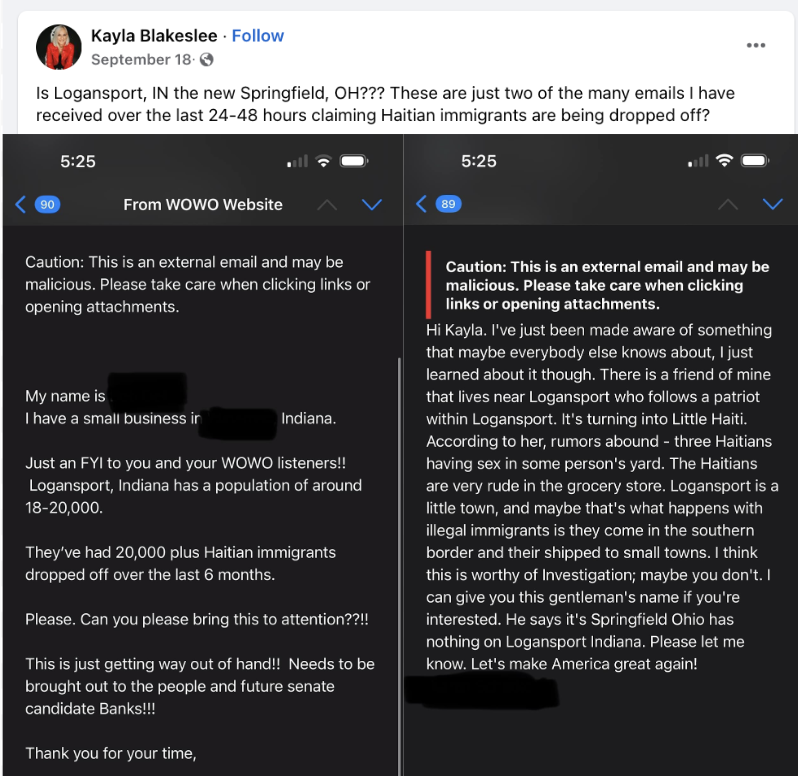
Blakeslee’s factually inaccuratepost — the mayor said the numbers originated from a social media satire page — was the first snowball in an avalanche of misinformation and hate that spread about Haitian migrants in Logansport.
Logansport's mayor acknowledged that there is an increased immigrant population, but noted that the community has been diverse for “a very long time.” According to census data, Logansport has about a 30 percent Latino population.
Story spreads through the right-wing ecosystem
Central Indiana’s Fox affiliate picked up the story on October 10, with the headline “Logansport officials say immigrant population growth is unsustainable.”
The report pointed to “strain on schools,” first quoting a county health department administrator who said she didn’t “think our school system can sustain what they are doing right now.” The district’s superintendent, the actual authority on the district’s capacity to handle new immigrant students, was optimistic, saying, “We can handle it.”
The report also pointed to strain on a local hospital because of increased births and emergency room visits, but the hospital responded by issuing a statement pointing in part to shuttered obstetrics departments at other area hospitals as a cause of increased births at Logansport Memorial Hospital.
Right-wing X account Libs of TikTok quickly shared the accompanying video segment.
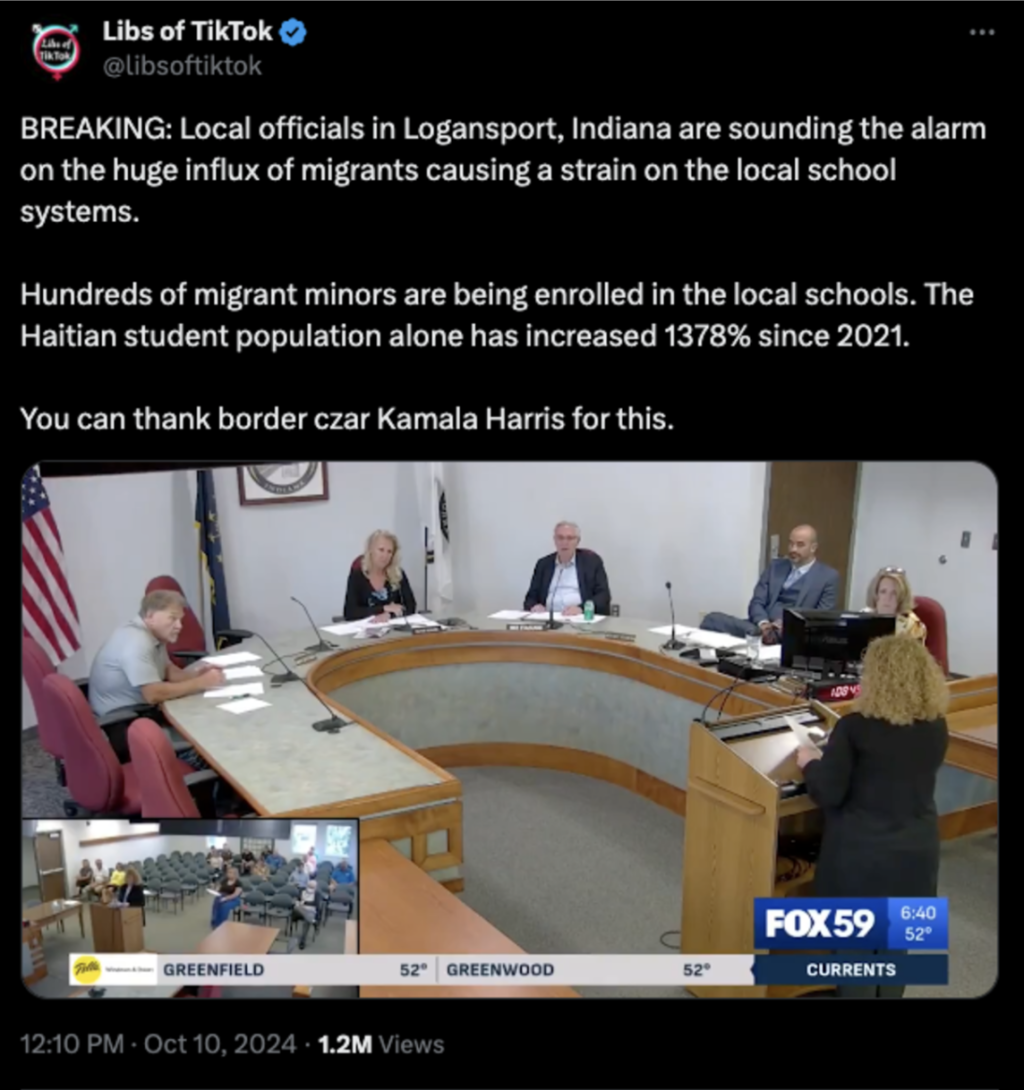
A slew of other right-wing X accounts then amplified the story, including RNC Research and Jack Posobiec.
The day after the Fox affiliate’s report came out, Indiana’s now-newly elected lieutenant governor, Micah Beckwith, posted false claims about Logansport’s migrant population, including a conspiracy theory that a “money trail” was responsible for “DUMPING double a town’s population in unassimilated migrants.” Beckwith also cited Blakeslee’s coverage of the story.
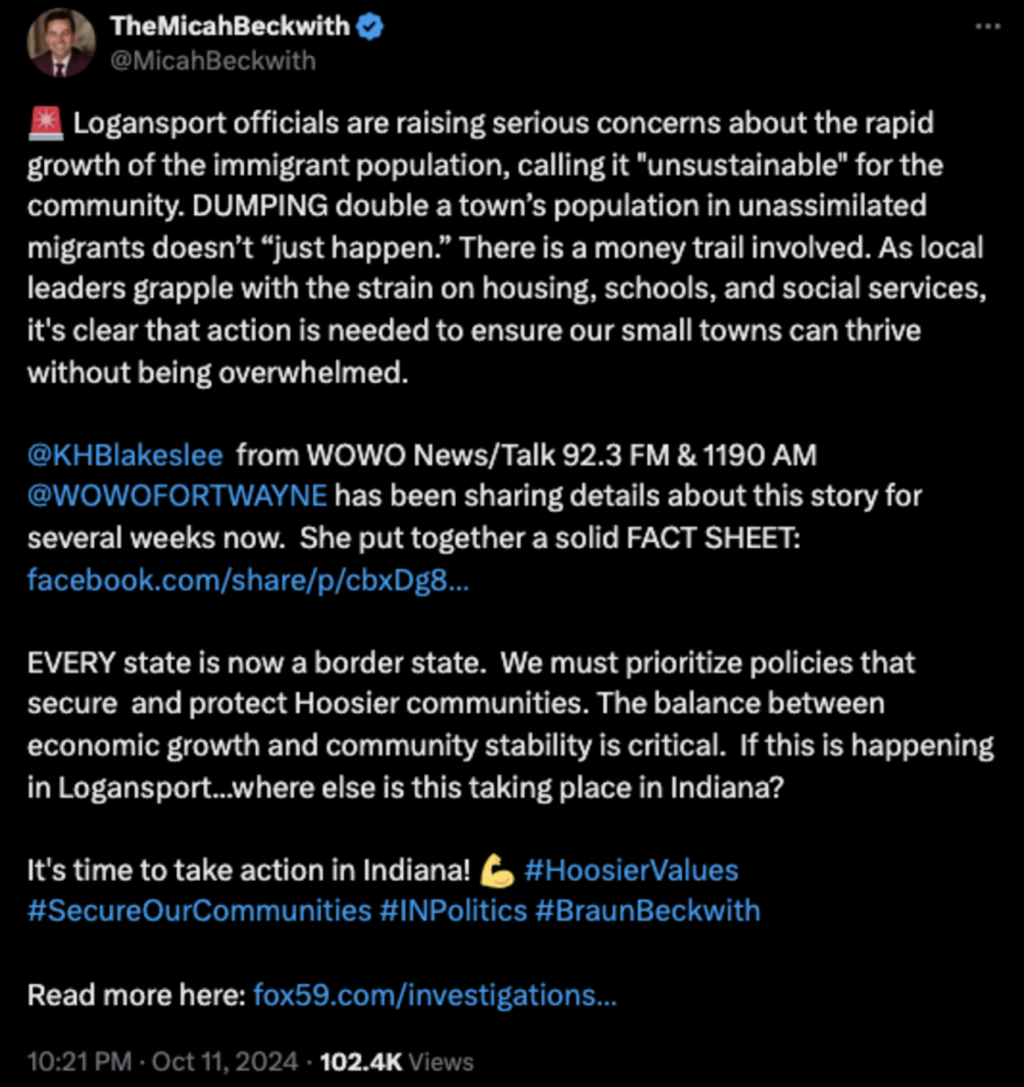
On October 14, Breitbart published a story about Haitians in Logansport, claiming that the town has been “targeted by the Biden regime” and that “Biden has dumped thousands of Haitians there.”
On October 16, Fox News’ Fox & Friends hosted a segment about Logansport’s “migrant influx” and The New York Post spotlighted the segment in a separate report.
The following day, Blakeslee interviewed Beckwith, who described the increased Haitian population as “an invasion” and argued that Logansport officials should deport legal Haitian immigrants.
Newsmax aired a segment about Logansport’s “immigrant influx” on October 19.
Education quickly became the focal point of the manufactured migrant crisis, even though the district’s superintendent stated that the system can handle the additional students.
The New York Post published two pieces attacking migrant students in Logansport, claiming in an editorial that migrants are “robbing Logansport kids of an education” and in a news report that “kids are being pushed out of schools.”
On the same day, the Daily Mail published a piece about the “tiny Midwestern town where ‘explosion’ of Haitian migrants is overwhelming schools,” writing that “locals … say students are being muscled out of public schools by an influx of thousands of foreign newcomers.” The Daily Mail quoted a retired teacher, who said that “the native born are now a minority in the local school system.”
The next day, Fox News’ America Reports hosted a segment about Logansport, which Libs of TikTok later posted on X.
Hate groups take advantage
On October 23, Logansport’s local newspaper, the Pharos-Tribune, reported that stickers recruiting for white nationalist hate group Patriot Front were found in the city.
Around the same time, at least one Logansport resident received a flyer from the “Trinity White Knights of the Ku Klux Klan” reading “3RD WORLD IMMIGRANTS BRING 3RD WORLD CONSEQUENCES.”

Springfield residents faced a similar situation when hate groups swarmed the city after false claims about Haitian immigrants there went viral.
Indiana’s AG calls for investigation, and the Heritage Foundation uses Logansport to support anti-immigrant policies
Indiana Attorney General Todd Rokita responded by launching an investigation into the local health department, school system, and a Tysons Food plant (Logansport’s largest employer), seeking information about supposed human trafficking and other issues.
Rokita said the investigation is “focused on the coordinated efforts among international and local nonprofit ‘refugee resettlement’ organizations and employers, like Tyson Foods, to bring large numbers of migrants to Indiana.”
On November 19, the Heritage Foundation published commentary about Logansport, using the city to claim rural American towns are struggling due to an influx of immigrants.
Heritage proposed that Indiana and other states should “pass legislation prohibiting business licenses for organizations involved in facilitating illegal migration” and “prohibit the use of any state and local taxes from funding immigration [lawyers] and NGOs providing legal representation for aliens.”
President-elect Donald Trump has been emboldened by anti-migrant misinformation, threatening mass deportation and promising to end Temporary Protective Status, a program that allows people from select countries, including Haiti, to live and work in the United States. Ending TPS would likely force family separations and negatively impact communities, like Logansport, where TPS holders have lived and been employed for years.
---
---
On Tuesday, October 29, Indiana Republican Larry L. Savage Jr. was arrested on theft charges for allegedly stealing or destroying voting ballots.
Savage, now 51, was among the Republicans who, earlier this year, sought the GOP nomination in his U.S. House district.
The alleged theft, according to Kansas City Star reporter Mike Stunson, occurred during a test of voting equipment in Madison Country, Indiana on October 3.
READ MORE:'Hurts the consumer': Companies planning substantial price hikes in anticipation of Trump tariffs
"The charges follow the testing of election equipment in Madison County as part of the Voting System Technical Oversight Program, according to an October 29 state police news release," Stunson reports. "People invited to attend the public test, which included Savage, a precinct committeeman, run pre-marked ballots through the machines to make sure they are properly working and counting votes correctly….. The testing was livestreamed online, and the footage showed Savage fold up two of the ballots and put them in his pocket, authorities said."
Savage, according to Stunson, "is also heard whispering to a Republican auditor candidate about the count of the ballots being wrong, according to court documents obtained by the Indianapolis Star."
"State police said they later found the missing ballots in Savage's vehicle," Stunson reports. "Savage told an investigator he took the ballots because he was told they weren't real, but the surveillance footage showed a woman overseeing the test telling attendees that they were 'live election ballots,' according to the Indianapolis Star."
Madison County prosecutor Rodney Cummings told Indianapolis' WISH-TV, "The ballots weren't there because he took them himself. He creates a controversy that never existed in an effort to undermine confidence in our election process.”
READ MORE:Ocasio-Cortez warns Trump NYC rally was primer for taking power 'by force'
*Read the Kansas City Star's full report at this link.
an 10 24
---
Olivia Little @ Media Matters: Indiana’s lieutenant prophet
Indiana’s GOP lieutenant governor nominee has spent years livestreaming his so-called prophecies and wild political ramblings.
---
an 1 24
twt
Indiana Rep. Jim Lucas shows high school students his gun during a conversation Tuesday at the Moms Demand Action Advocacy Day. Video provided by a student who recorded the interaction. See the full 10 minute video and our story at http://TheStatehouseFile.com
During a conversation with a group of high school student advocates against gun violence Wednesday, a state Republican representative thought showing them his gun would discourage their efforts.
IndyStar reports, Rep. Jim Lucas "struck up a conversation with the students, which resulted in a discussion about gun laws and school shootings, according to The Statehouse File."
The video shared to X/Twitter by The Statehouse File shows Lucas flashing his gun holster, then disregarding the concern of one student who said, "nothing about that makes me feel safe." The GOP leader replied, "those are feelings, I’m talking facts."
According to a CBS4Indy report, state Democrats released a statement following the incident, saying, "Indiana Republicans seemingly have enough time to belittle and intimidate high school students in between passing laws defunding the police, expanding child labor, and helping the gun lobby get off in court.
This supermajority puts the interests of the gun lobby over those of our local governments, and even the safety of Hoosier students. It’s wrong, and it’s time to check their power at the ballot box in November. Indiana Republicans say laws can’t stop gun violence. They have no plan to stop gun violence because they do not believe it is possible. We all deserve an Indiana where students – and everyone in our communities – feel safe and gun-owning Hoosiers can do so safely and responsibly."}:
CBS4Indy notes, "The exchange between Lucas and students comes after a bill that would expand the right to carry firearms into the state capitol was passed by the Senate Corrections Committee, and now heads to the House."
Last June, Lucas was arrested for driving under the influence, crashing his truck and ultimately fleeing the scene, according to WRTV. The GOP lawmaker accepted a plea deal to avoid jail time.
---
Indiana GOP targets LGBTQ Hoosiers with sweeping rewrite of state laws - Alternet.org
---
https://www.alternet.org/indiana-court-gop-abortion-ban/
---
Indiana Rep. Banks facing 'insurrection' ballot challenge
By TOM DAVIES, Associated Press - 5h ago
Provided by Associated Press
INDIANAPOLIS (AP) — An Indiana congressman who was rejected by House Speaker Nancy Pelosi as the top Republican for the committee investigating last year’s U.S. Capitol insurrection is fending off an effort to remove his name from this year's election ballot.
The challenge to Rep. Jim Banks’ candidacy is at least the second across the country against a Republican House member citing a portion of a post-Civil War amendment to the U.S. Constitution pertaining to insurrections against the United States.
Banks, an outspoken supporter of former President Donald Trump and leader of the influential Republican Study Committee, has denounced the ballot challenge as frivolous.
It was filed by a long-shot Democratic candidate for Banks’ congressional seat and likely has little chance of success when it goes before the state election commission on Friday, a former longtime commission member said.
A similar challenge is pending against North Carolina Rep. Madison Cawthorn, who spoke at the rally supporting Trump before the Jan. 6, 2021, Capitol riot that interrupted the certification of President Joe Biden’s victory.
The Indiana challenge petition filed by Democrat Aaron Calkins claims Banks is ineligible to be a candidate because of a “violation of the 14th Amendment supporting an insurrection.” The filing with the state election commission didn’t include additional information supporting the claim against Banks and Calkins didn’t return a telephone message from The Associated Press seeking comment.
The 14th Amendment says no one can serve in Congress “who, having previously taken an oath, as a member of Congress ... to support the Constitution of the United States, shall have engaged in insurrection or rebellion against the same.”
---
---
an 920
how a mask mandate might hurt the re-election chances of Indiana's Republican governor
September 27, 2020
The Associated Press recently reported that Indiana conservatives who are furious with Republican Gov. Eric Holcomb over his statewide mask mandate are cottoning to Libertarian Donald Rainwater as an alternative, which could make this fall's otherwise...
---
---
Indiana Bill Would Make it Harder to Close Coal Plants
:{:{BY: DAN GEARINO}:
If the bill passes, Indiana would become the third in the U.S. to pass a law aimed at combating market forces that make renewables and natural gas cheaper than coal. Read More}:
==
https://www.alternet.org/2020/01/a-hyperconservative-state-attorney-general-wants-unprecedented-control-over-local-prosecutions/
no lnx
A hyperconservative state attorney general wants unprecedented control over local prosecutions
Written by Filter January 31, 2020
by Rory Fleming
One might think Indiana has better things to do than police marijuana. According to US News and World Reports rankings, the state has the third-worst environmental quality, the 11th worst healthcare system, and the 14th worst roads and highways in the US. Until 2019, more people had been moving away from the state than moving to it for years.
But that’s not the way Republican Attorney General Curtis Hill sees things. He is supporting a bill introduced by Indiana State Senator Mike Young that would permit the AG to take over cases from county prosecutors when he believes there is a general declination policy for a certain charge—even when it’s a case of “don’t ask, don’t tell.”
The legislation is reportedly a reaction to new Marion County (Indianapolis) Prosecutor Ryan Mears’ declaration that he will no longer prosecute marijuana possession cases. Such a sweeping law would be the first in the nation, with prior attempts to rein in prosecutors being limited to specific cases and counties (like Philadelphia’s gun cases).
According to AG Hill’s spokeswoman Parvani Stover, his support is a result of a more general reaction to announced non-prosecution policies by chief local prosecutors around the country, like Rachael Rollins in Boston and Chesa Boudin in San Francisco. National pushback against reform prosecutors has recently been embodied by US Attorney General William Barr’s new presidential criminal justice commission and its woeful composition.
The Indiana Prosecuting Attorneys Association (IPAA) is one of the most conservative in the nation, and that says a lot.It published a shocking letter back in 2017, declaring “ both medicinal and recreational marijuana legalization are wrong for Indiana” and that medical marijuana is, in their profoundly non-medical opinions, “not medicine.”
But even the IPAA is not standing for this attack on its legal mandate to utilize prosecutorial discretion, according to WIBC reporter Eric Berman. In an argument at the Indiana Senate’s Corrections and Criminal Law Committee hearing on January 28, the IPAA described discretion as “essential” to carrying out its duties. In this instance, the IPAA seems to be prioritizing principle over its political persuasions.
In contrast, after Aramis Ayala, the chief prosecutor of Orlando, Florida, announced in 2017 that she would never seek the death penalty, the Florida Prosecuting Attorneys Association (FPAA) showed its willingness to get decidedly wishy-washy regarding uses of prosecutorial discretion that its members happen to dislike. (In fact, the association’s chief lobbyist Buddy Jacobs, who narrowly avoided white collar crime convictions twice, was so desperate to swiftly decry Ayala’s move that he plagiarized a private defense attorney’s blog in writing a friend-of-the-court brief to the Florida Supreme Court on the issue.)
People who keep track of legislative assaults on prosecutorial discretion should not be surprised if Indiana’s bill passes anyway, however. Attorney General Hill remains an influential and hyperconservative presence in Indiana’s state government (despite being credibly accused of sexually assaulting several women at the height of the #MeToo movement). The bill passed the aforementioned Committee by a 6-3 vote, with only one Republican joining the Democrats in dissent.
If the bill does indeed become law, law professors and criminal justice scholars ought to track how the Attorney General uses this newfound power. Giving the AG the ability to snatch cases away from local court systems on the mere suspicion of a non-declination policy, especially given the dearth of charging decision data from virtually every single county prosecutor office nationwide, would be a worrying departure.
==
Who's Missing?
But can the United States fight climate change with only half the states engaged? America's Pledge stresses that, yes, it has the potential. The states, cities, businesses and other institutions in its coalition represent 68 percent of U.S. GDP, 68 percent of the population, and 51 percent of U.S. greenhouse gas emissions.
But the most carbon-intensive economies in the U.S. are still not part of the fight.
Sixty-five percent of the remaining U.S. coal power capacity, for example, is located in the 25 states that arenot part of America's Pledge, led by Texas, Indiana and Kentucky. The America's Pledge analysis found that the U.S. could still make progress without the help of these states. It calculated that if just a handful of the states that have already shown some willingness to act adopted stronger policies, like those set by climate leaders like California, the U.S. could cut emissions up to 37 percent by 2030, even if the most carbon-intensive states and the federal government refuse to act. But that's not where the U.S. needs to be if it hopes to reach net zero emissions by mid-century, as the science says is necessary to stave off climate change's worst ravages.
"None of the states who are climate leaders would say that what they're doing is enough," said Arroyo. "But you've got to start to do what you can do, and prove the concept that you can do this without breaking the bank, and in fact you can do it while growing your economy, creating jobs and enhancing the quality of life."
RMI's Frisch said the real lesson of the state and local climate effort so far in the United States is that it is essential, but not sufficient.
"The states are the reason for the progress that we've had so far," she said. "And their effort will still be fundamental going ahead. But we can't get where we need to be without the federal government, and the federal government can't do it without the states. We need to have both."
---
---
The Clean Energy Jobs Act that was introduced Thursday would move Illinois to 100 percent renewable energy by 2050 and make the state a national leader in clean energy and climate action.
Clean Energy
The bill (SB2132) would rapidly ramp up renewable energy in Illinois towards the 100 percent target by 2050, starting with a target of generating 45 percent of our electricity from renewable sources — and none from fossil fuels — by 2030. That rapid expansion of clean energy would place Illinois at the forefront of job growth, investments, customer savings and health benefits from renewable energy.
The bill would also grow the Illinois Solar for All Program by as much as 500 percent, expand cost-saving energy efficiency programs, and help us plan our electric grid in ways that avoid unnecessary costs and take advantage of increasingly cheap renewable energy.
Clean Transportation
Putting more renewables on the electric grid also makes it easier to clean up our transportation sector, which is now the largest source of carbon pollution in Illinois. Although electric vehiclesalreadypollute less than gasoline-powered vehicles, as the electricity we use to charge those vehicles gets cleaner, we can reduce pollution even more. At the same time, electric vehiclespaired with smart charging technologies can help our electric grid run more efficiently. The Clean Energy Jobs Act aims to take advantage of these opportunities while removing the equivalent of one million gasoline-powered vehicles off the road.
New incentives and infrastructure to support electric vehicles would help spur this process, including support for "light duty" electric vehicles like cars and trucks, which can save drivers money and create 70 percent less pollution than similar gas-powered vehicles. It would also include incentives to transition towards electric medium- and heavy-duty vehicles, which is critical in part because many of today's heavy-duty vehicles run on diesel and cause serious health problems for people in communities with heavy truck traffic. The bill also pairs electric vehicle incentives with smart charging programs to ensure that electric vehicles can charge at "off-peak" hours (such as late at night) when electricity is relatively cheap, plentiful and clean. Finally: in addition to expanding electric vehicles, Illinois should expand non-motorized transportation options like walking, biking and mass transit, which could be included in a capital bill.
Jobs and Equity
The transition to a clean energy economy promises benefits to our health (as we saw in 2016), our climate and our pocketbooks. It also creates jobs: Illinois is already home to nearly 120,000 clean energy jobs. Statewide, about one in every 50 workers is in the clean energy sector. In rural Illinois, clean energy already employs twice as many people as fossil fuels, and those jobs are growing at 5 percent a year even as the total number of jobs in rural areas has declined. The massive expansion of renewable energy envisioned in this bill would grow those impressive numbers even further.
But the benefits of our energy transition must be equitably distributed, and the jobs it creates must be good-paying and accessible. The transition must prioritize economic opportunity for people of color, people who live in environmental justice communities, and workers impacted by the transition away from fossil fuels.
The Clean Energy Jobs Act centers these priorities through Clean Energy Empowerment Zones, which allocate economic development resources to communities impacted by the transition away from fossil fuels, and the creation of Clean Jobs Workforce Hubs. These hubs are workforce development pipelines that begin with recruitment conducted in partnership with community groups, unions and others, and which prioritize recruiting people of color, people from marginalized communities, and displaced fossil fuel workers. They include training programs with stipends to help trainees meet living expenses, transportation, child care, and other needs while they develop their skills. Renewable energy developers will be incentivized to hire diverse workers, including graduates of these training programs.
What's Next for the Clean Energy Jobs Act
The Clean Energy Jobs Act was developed with the input of people all over Illinois, in nearly 70 public discussions across rural, urban and suburban communities, from Chicago to Carbondale, with participants of all ages and racial backgrounds.
With a newly-elected governor who supports 100 percent renewable energy, recent national polls showing that 85 percent of registered voters want to move their states entirely to renewable energy by 2050, and the ambitious Clean Energy Jobs Act gathering sponsors in the legislature, Illinois is poised to be a model for clean energy leadership — not just in the Midwest, but in the world.
Beyond the numbers and the policy details, that would mean cleaner air and water, more jobs, healthier people and a livable world for our kids.
RELATED ARTICLES AROUND THE WEB
- Illinois ›
- 3 Midwestern States :(style="background-color:#ffff66ff"):}::{That Refuse to Abandon the Renewable ... ›
- Ambitious Plan Solidifies Illinois as Renewable Energy Leader ... ›
- Illinois Renewable Energy Association ›
---
Most of us have a growing sense that something’s deeply wrong with the way that digital data is used to track and monitor us. But most of us don’t realize that the poorest among us are particularly vulnerable. Virginia Eubanks argues that such data is used to criminalize and turn the poor away from public resources to which they are entitled.
Resources:
Virginia Eubanks, Automating Inequality: How High-Tech Tools Profile, Police, and Punish the Poor St. Martin’s Press, 2018
https://kpfa.org/episode/against-the-grain-july-18-2018/
partner attacked, hurt, ER bills, days later told had no coverage, no start date (a new policy) not married, painkillers, red flag for insurance fraud, suspend.
mitch daniels (pence mentor) billion? $ contract to automate snap b/c public sector workers make decison, thus collusions: church indianapolis fake acc'ts anecdote, ibm
sever connection to person, aplly online (1/2 have PC) call ctr i mill failure to cooperate in est'b eligibility 7-14 days, ppl in hosp w/ cancer missed appt
---
==
https://www.ecowatch.com/rooftop-solar-state-policies-2563502732.html
Ten of the nation's sunniest states get a failing grade for policies that actively block, or don't encourage, rooftop-solar development, according to Throwing Shade, a new report from the Center for Biological Diversity.
Alabama, Florida, Georgia, Indiana, Louisiana, Oklahoma, Tennessee, Texas, Virginia and Wisconsin account for more than 33 percent of the total rooftop-solar potential of small buildings in the contiguous U.S. but less than 8 percent of net generation in 2017. All of them get an "F" in today's report.
"Instead of leading us out of the climate crisis, these sunny states are casting a long shadow across our potential for rooftop solar," said Greer Ryan, a renewable energy and research specialist with the Center for Biological Diversity and author of the report. "The Trump administration certainly isn't going to fix our climate, so it's vital that these states step up."
...
===
---
'Blocking the Sun': New Report Documents Efforts to Undermine Rooftop Solar
While nearly 9 in 10 Americans support the development of more solar energy, electric utilities and fossil fuel-backed special interests are trying to hold off the inevitable renewable-energy future by promoting policies that would make rooftop solar harder to obtain.
A new report released Thursday by Environment America Research & Policy Center documents 20 entities, across 12 states, who sought to roll back key policies driving solar power over the past year.
"It's completely clear that Americans want more solar power, for the good of our environment, our health and our local economies," said Bret Fanshaw, solar program coordinator with Environment America and report co-author. "We cannot allow for a narrow set of interests to block the ability of everyday citizens to tap into clean and renewable solar power on the roofs of our homes and businesses."
Fueled by strong public policies, solar energy is growing by leaps and bounds, with enough solar capacity installed in the U.S. to power 1 in 14 American homes. The American public has demanded solar power because it is clean and increasingly affordable, with costs down two-thirds over the past decade.
The "Blocking the Sun" report shows, however, that electric utilities and special interests are actively undermining access to solar energy across the country.
According to a Frontier Group analysis of the most recent N.C. Clean Energy Technology Center '50 States of Solar' report, at least 90 policy actions in U.S. states could affect the growth of rooftop solar generation as of mid-2017. They include limits on net metering or new utility fees that make solar power less affordable.
"We're seeing a continued, concerted effort to knock down some of the best solar policies out there by some of the most powerful state utilities and fossil fuel actors" said Hye-Jin Kim, policy associate at Frontier Group and report co-author. "We've done this study three years in a row, and despite overwhelming public approval of solar power, the industry attacks on pro-solar policies continue."
Often operating in dense regulatory proceedings, electric utilities like Duke Energy, Rocky Mountain Power and Arizona Public Service have urged state officials to lower credits to solar users,add special charges to rooftop solar owners and force customers into rate plans that would reduce the benefits rooftop solar can provide on your electricity bill.
Efforts by electric utilities to stall solar progress have been coupled with, and in some cases, orchestrated by, fossil fuel front groups such as the Consumer Energy Alliance and utility trade groups such as the Edison Electric Institute.
In many cases, it's working.The Indiana Energy Association, an industry group, successfully lobbied on behalf of the state's biggest electric utilities to phase out Indiana's key rooftop solar program this year, replacing it instead with a new policy that limits compensation for generating rooftop power.
The Trump administration has appointed allies of the electric utilities and fossil fuel companies to key positions within the Department of Energy and other federal agencies. Those appointees are making a concerted effort to undermine solar power at the national level. Studies put forth by Energy Sec. Rick Perry question the value of rooftop solar and attempt to justify support for coal and nuclear plants over renewable energy.
The "Blocking the Sun" report recommends state and national decision-makers resist utility and fossil fuel industry attempts to reduce the economic viability of distributed solar energy, and reject policies to limit the use of this clean, renewable and increasingly economical source of power.
"To meet our major environmental challenges and reach 100 percent renewable energy, we must harness the power of the sun on exponentially more rooftops across America," said Fanshaw. "The people want this to happen—it's up to our public officials to stand up to powerful interests and make going solar easier, not harder."
==
--
http://www.alternet.org/election-2016/mike-pence-loves-alec-and-keeps-pushing-public-school-privatization-despite-lousy
... Pence is a hardcore right-winger playing the long game, especially when it comes to privatizing public schools.
It’s not just that the Republican vice-presidential nominee and Indiana governor last weekend told a roomful of deregulation-obsessed executives and lobbyists in Indianapolis, “You are the model for Washington, D.C., after this election. You really are.”
The nation is “at a fork in the road,” Pence said at the American Legislative Exchange Council’s annual meeting, referring not only to who would be president for the next four years but who would control the Supreme Court for the “next 40 years.”
The choice is “whether we will have justices appointed to the Supreme Court, as my partner in this endeavor is committed to doing, that reflect the brilliance and the greatness and the principles of the late justice Antonin Scalia,” he said. “So I would say to all of you, for the sake of the rule of law, for the sake of the sanctity of life, for the sake of our Second Amendment and all of our God-given liberties, we must ensure that the next president making appointments to the Supreme Court of the United States of America is President Donald Trump.”
Pence was no stranger to the stage of ALEC, a corporate-funded behemoth that drafts bills and finds right-wing lawmakers to carry them. He’s been an ALECfixture for years, touting deregulation, privatization and extreme social conservatism. But he’s best-known for a personal focus on supplantingtraditional public education, notably embracing taxpayer-funded vouchers so parents can send kids to K-12 private schools and aggressively expanding privately run charter public schools.
As is typical at ALEC, Pence praised enterprise and deregulation, and said a Trump administration would result in "empowering states with resources and flexibility.” But a closer look at his Indiana record of privatizing education, where the ALEC model has been in play, has shown it to be a brazen and failed experiment.
Charter School and Voucher Problems
A recent National Public Radio profile of Pence’s education record noted that he has been one of the leading governors pushing K-12 privatization. “Under Gov. Pence, the growth in the number of charter schools and the use of private school vouchers have exploded,” it said. “After the voucher program survived a state Supreme Court challenge in 2013, it's grown into one of the largest in the country. Pence helped to do that by advocating to expand the program to include middle-income, not just low-income families, and also by removing the cap on how many students qualify.”
Yet this May, when WTHR, Indianapolis’ NBC-TV affiliate, looked at the charter school experiment, itfound that “nearly half of the state's 76 charter schools are doing poorly or failing.” The scores were based on the state’s new accountability standards.
In one example, reporters quoted sources from Indiana Science Academy West who said, "Nothing is taught... nothing is learned,” and cited "unlicensed teachers,” high staff turnover and a textbook shortage. But under Indiana law, itnoted, “Those [charters] failing year after year, not only get a second chance but can fail six consecutive years before the state steps in.”
That investigative report was not unique, but it is quite a counterpoint to the rhetoric from Pence and the K-12 privatization movement that traditional schools are failing and that charters and vouchers are the answer.
At ALEC, the education agenda also includes tax credits to send children to private schools, impeding and dismantling labor unions, andcreating new state agencies to overrule locally elected school boards and communities. Soon after Pence gave a keynote at a 2013 ALEC summit, the group published its annual “Report Card on American Education.”
Pence wrote the 2014 report’s introduction, boasting, “We enacted the most ambitious school choice program in the country in 2011. Last year, nearly 20,000 low-income Hoosiers used vouchers, or what we call Choice Scholarships, to attend the school of their choice—a 500 percent increase from the year before. This year the number of applications has grown to nearly 30,000. In addition to the School Choice Scholarships, more than 35,000 Indiana students are attending public charter schools across our state.”
:{:{}:
But Indiana’s record on vouchers has been problematic. A May 2016 Brookings Institution report on vouchers in Indiana and Louisiana slammed the programs. In both states, “research… has found that public school students that received vouchers to attend private schools subsequently scored lower on reading and math tests compared to similar students that remained in public schools. The magnitudes of the negative impacts were large.”}:
Moreover, traditional public schools were doing a better job than voucher counterparts when it came to educating poorer students. “It is at least plausible that Louisiana and Indiana public schools have surpassed their private schools (for low-income students),” Brookings said.
Nonetheless, this year Pence is spending more money on vouchers than his state legislature appropriated, underscoring his zealotry as a pro-privatization ideologue.
Protecting Investors, Not Students
Meanwhile, under Pence the state has gone out of its way to keep failing charters from closing. Like many states that have granted the industry wide license, under Pence the various players in his state’s charter sector—a mix of private and public institutions—don’t want to close failing schools but instead look for new managers to run the schools and new regulators to sign off.
One Indiana public radio station, WFYI, called this tactic “authorizer shopping.” The highest-profile example was Thea Bowman Leadership Academy in Gary, Indiana, where problems ranged from low student test scores to deep governance issues, such as high staff turnover, not satisfying federal education standards and no terms for charter board members.
As WFYI reported this year, in 2013 seven “chronically failing schools were denied reauthorization from Ball State [University, their founding sponsor], yet three of the schools were granted new charters from a different authorizer to remain open.” That led the legislature to pass a law to require the state Board of Education to approve any such reprieve, a policy thatsounds like state accountability but in practice minimizes input from locally elected school boards. The state Board approved it in June.
But the negative impacts of these privatization experiments go beyond vouchers and charter schools. Diverting millions of taxpayer dollars to private, often religious schools takes resources away from traditional public schools. Pence, additionally, has created new state low-interest loans to benefit charters, and his last state budget included a new $1,500-per-student allocation to charters for non-academic expenses. His GOP majority legislature scaled it back to $500 per student.
According to the Washington Post, the cumulative negative impacts of privatization have created a shortage of qualified public school teachers in Indiana. “What’s going on? Pretty much the same thing as in Arizona, Kansas and other states where teachers are fleeing:a combination of under-resourced schools, the loss of job protections, unfair teacher evaluation methods, an increase in the amount of mandated standardized testing and the loss of professional autonomy,” the Post's education blogger wrote last year.
“According to the Indianapolis Star, the Republican chairmen of the House and Senate education committees have asked General Assembly leaders to approve having the legislative education study committee review what is causing the drop and how the state could respond,” the Post continued. “For one thing, they can look in the mirror.The Republican leadership of the state—including Gov. Mike Pence—showed their respect for teachers by working very hard this year to strip power from Indiana Superintendent of Public Instruction Glenda Ritz, a veteran educator who won election to the post in 2012 (by defeating Tony Bennett, the incumbent who was a protege of former Florida governor Jeb Bush). Oh, by the way, she is a Democrat.”
The pattern under Pence continues. Under the state’s new public school funding formula, richer school districts will get more money and poorer districts less,another education blogger noted. WaPo's education blogger summed it up like this: “For 2015-17, the state legislature gave less funding to urban schools and more to charter schools and private schools that accept students with vouchers.”
In other words, while Pence preaches privatization as the cure-all for K-12 education, his state's traditional school system is being undermined and supplanted, and the privateers' gains are the public's losses.
:{:{In recent years, Pence has been a featured speaker at libertarian forums to promote this agenda; audiences love the rhetoric but pay little attention to the resulting reality on the ground.}::{ Before Pence was named Trump's running mate, he attended a Republican Governors Association luncheon at David Koch's mansionin Florida with "about 60 wealthy backers.” And since joining the ticket, he was a "featured guest" at the Koch brothers network's semiannual libertarian donor retreat in Colorado.}:
}:
Which means Pence has become perhaps the nation's top evangelist for ALEC and education privateers across America.
==
Indiana: At least $2.2 million was awarded to charters that either closed or never opened. In addition, emails obtained by CMD through a public records request to Gov. Pence's office found troubling examples of how the private charter sector, notably for-profit chain Charter Schools USA, influences on policy-making.
==
nrdc toxic 20 states: Kentucky, Indiana, Georgia, Texas, Virginia, South Carolina, Alabama and Mississippi-- supported a resolution by Sen. James Inhofe, to limit mercury and other air emissions
---
center, which would be built next to the city's airport, is being touted as a job-creator and a source of revenue.
Gary mayor Karen Freeman-Wilson estimated that the facility would generate $1 million in annual property taxes. “I can use that,” she noted.
Councilwoman Linda Barnes-Caldwell agreed, saying, “I think it is a wonderful idea. It will bring revenue to the city and jobs. And I think it is an ideal location.”
GEO Group has long come under fire for practices within its facilities as well as its profiteering off of the criminal justice system. From 2008 to 2012, CEO George C. Zoley had a compensation of $22,315,704. Because the company largely contracts with the government, almost all of this money came from American taxpayers.
The Private Corrections Working Group notes that GEO has faced hundred of lawsuits over conditions within its facilities, with scores being settled before reaching trial. As Brendan Fischer notes, research has shown that “assaults on guards by inmates were 49 percent more frequent in private prisons than in government-run prisons. The same study revealed that assaults on fellow inmates were 65 percent more frequent in for-profit/private prisons.”
GEO has steadily expanded its operations due to its close political connections. It has close ties to Sen. Marco Rubio (R-FL), who has in the past employed several staffers tied to GEO, including a chief of staff who co-founded the same lobbying firm employed by GEO.
Some local residents are concerned. Tom Dubois of Concerned Citizens of Hobart, who opposes such detention facilities, said, “It's a moral issue as well as an economic one.”
Gary's unemployment rate has been persistently high, and it has been described by some of its residents as a “ghost town.” In 2011, Gary had to close its main library due to budget cutbacks. Building an economy and tax base based on detaining migrants is probably not the ideal strategy, but in an America where so much of the Midwest has been deindustrialized and left in decay, it's the sort of perverse idea that makes sense to local leaders.
==
94% electricity from coal
http://www.sourcewatch.org/index.php?title=Indiana_and_coal
---
Environmental assessment
In April 2007, Santee Cooper initiated the Environmental Impact Statement process on the plants. On October 9, 2007, the state Department of Health and Environmental Control (DEHC) issued a draft Prevention of Significant Deterioration permit for the project, provoking an October 25 protest by several environmental groups in Columbia.[2] On November 8, a Pamplico hearing on the DHEC permit was attended by dozens of project opponents – as well as by hundreds of Santee Cooper, Alcoa, and Nucor employees, who were brought in on a chartered bus.[3] On December 6, a group of local physicians protested outside the DHEC office in Florence, demanding that DHEC test Pee Dee River residents for mercury poisoning before the permit is approved; on December 14, a DHEC spokesperson stated that DHEC had not yet decided whether to follow up on the physicians’ requests.[4]
On December 7, the U.S. Department of the Interior requested that the project be put on hold, pending an analysis of the damage that the plant would cause to the Cape Romain National Wildlife Refuge. The DHEC extended the public comments period on the draft permit until January 22, 2008.[5]
---
Indiana Workers Stand against the ALEC Agenda and the Anti-Labor Bill Called the "Right to Work" (for Less)
Submitted by Lisa Graves on January 5, 2012 - 8:20am
Thousands of Indiana workers rallied outside, and inside, their state capitol on Wednesday to speak out against Governor Mitch Daniels' renewed effort to force through so-called "right to work" legislation designed to undermine labor unions and workers' rights protected by collective bargaining.
One Victory for Democracy--Restored Access to the Indiana Capitol
 A worker's sign reads: "I already have the right to work! I don't need your permission."Workers won a victory Wednesday when the Governor rescinded new restrictions that had been created to limit the rights of Indiana citizens to freely access their state capitol building. Prior to last year's protests, citizens in Indiana, Wisconsin, and other states had long enjoyed easy access to their state houses to express their views on legislation, but in Indiana as with Wisconsin and other states, partisan political leaders imposed supposedly "safety-based" restrictions to limit citizens exercising their freedoms of assembly and speech. On Wednesday, faced with thick lines of constituents winding down the streets of the capitol, the state lifted the low cap on the number of people who could enter the building where legislation is being pushed to restrict worker rights.
The Battle Against another Anti-Labor Bill with "ALEC" Corporate DNA
Thousands of taxpayers arrived from across the state, along with a small number of counter-protesters, in response to the announcement that the Indiana legislative leaders were planning to push through a so-called "right to work" bill, which has been called the "right to work for less" bill by opponents.
This bill is no native born Hoosier idea. It tracks key provisions of "model" legislation secretly voted on by corporations and politicians on a task force of the American Legislative Exchange Counsel (ALEC).
 Although ALEC calls itself the largest organization of state legislators, it is bankrolled by some of the biggest global corporations in the world, such as Koch Industries, Exxon Mobil, and other companies from outside of Indiana. About 99% of the funding for ALEC's operations come from corporations and sources other than legislative dues, which are $50 per year. ALEC legislators often introduce legislation, voted on behind closed doors by ALEC corporations and politicians, cleansed of any reference to the fact that the bills were pre-approved and pre-voted on by corporations. The current corporate co-chair for Indiana is the North Carolina-based Duke Energy Company, which is tasked by ALEC with raising money from corporations for "scholarships" for ALEC politicians to attend vacation conventions at fancy resorts with schmooze and booze events with corporate lobbyists.
Duke Energy came under fire last year in Indiana for trying to pass off onto customers hundreds of millions in over-budget costs for the Edwardsport Plant in Knox County. That coal gasification plant has gone so far over budget, to the tune of a billion dollars, that the state of Indiana has been looking into whether there was fraud or concealment. Duke has also been called out for paying no net taxes between 2008 and 2010 on over $5 billion in pre-tax profits, according to the Corporate Tax Dodgers Report of the Citizens for Tax Justice (which is uploaded below).
Duke's state co-chair for ALEC is Senator Jim Buck of Kokomo, who also sits on ALEC's Board of Directors, which approves "model" legislation in every area of the law. He is the co-chair of the ALEC Tax Task Force, which has previously opposed taxes on windfall profits of global energy companies and sought to eliminate combined reporting for corporations, thus making it easier for companies to use gimmicks to hide profits out of state.
State Rep. David Wolkins of Winona Lake is also an ALEC statewide co-chair, along with Senator Buck and Duke Energy. He is also the co-chair of ALEC's Energy Task Force, and in 2011 ALEC named him a "State Legislator of the Year" for advancing ALEC's vision. (In some prior years, legislators receiving this designation also received cash "awards," although it is not certain if Wolkins did.)
Indiana is now playing a central role in ALEC's agenda. The Chairman of ALEC's Public Sector Board this year is Representative David Frizzell of Indianapolis, who has also been a member of ALEC's Health Task Force. In all, at least 17 Indiana representatives and five state senators are members of ALEC Task Forces, along with an unknown number of other legislators who do not have these known leadership roles with ALEC corporate partners. Representative Richard McClain of Logansport, who introduced H.B. 1104, the latest version of "Right to Work" introduced in the state, is also a member of the ALEC Tax Task Force, along with Senator Buck.
How Close Is HB 1104 to the Bill Voted on by ALEC Corporations?
The Indiana bill, which was introduced on the first day of the legislative session this year, contains provisions very similar to the ALEC "model" bill. The Center for Media and Democracy (CMD), which publishes PRWatch, analyzed and exposed over 800 ALEC-approved bills or resolutions last year, including the "Right to Work Act." The Indiana bill, HB 1104, has key operative language that echoes the ALEC bill at CMD's ALECexposed.org. (A mark-up of the model Right to Work Act is also available below, along with a copy of HB 1104, with terminology in common highlighted on the Indiana version.)
 Workers in Indiana Opposing HB 1104Both "Right to Work" bills would make it a crime to violate the bills' bar on a union requiring a worker to pay dues when the worker's rights are protected by a union-negotiated collective bargaining agreement. Both bills would require state prosecutors to investigate violations and enforce the criminalization of dues collection that has historically protected against free-riders taking advantage of the benefits and rights negotiated by union representatives without paying any dues. And, both bills also authorize civil lawsuits for violating the new rules, if enacted, including damages, injunctive relief, and attorney's fees, "in addition to any other remedies and penalties." Protesters in Indiana and elsewhere have objected to such "punitive" legislation and consider this to be part of a "War on Workers."
Although the ALEC bill and the Indiana bill have some minor differences in the setting forth of these provisions, these three core elements of "Right to Work" legislation are substantively the same and have the same effect. The only major substantive difference is that the new Indiana bill would impose these restrictions as a "pilot program" rather than state-wide immediately, unlike the ALEC bill. In the view of CMD, the bills' core operative terms and requirements are sufficiently similar to say that the Indiana bill shares ALEC DNA, even though it is not identical in its layout or in every detail.
 Key Components of RTW according to ALECThe common operative components are not surprising because the ALEC "model" legislation for "Right to Work" was approved by ALEC corporations and politicians through one its task forces well over a decade ago. Its core components--criminalization, mandatory criminal enforcement, and civil liability--have been proposed in dozens of states, although they have not passed everywhere proposed. The so-called "Right to Work" agenda has also been pressed by long-time ALEC member, the Right to Work Committee, and the corporations that underwrite anti-labor legislation across the country.
In fact, one of ALEC's first agenda items after its founding in the mid-1970s was advancing the "Right to Work" agenda, as documented in the image below. Both ALEC and the Right to Work Committee also trumpeted the passage of the extremely controversial Idaho "Right to Work" legislation in 1985. At the time, an ALEC Board Member--the Speaker of the Idaho House of Representatives Tim Stivers--was instrumental in the adoption of the bill in his state and even defied a court order against its adoption, after the bill had been vetoed by the governor and challenged in court. The Idaho law is virtually identical to the ALEC model bill, and it has the same core provisions of criminal and civil liability and mandatory prosecution for violating the bar on union dues collection from free-riders, as does the Indiana bill.
 Clipped from ALEC's history in report available in the Tobacco Library
Criminalizing Union Dues Collection, even in Parts of Indiana?
Unless opponents of the bill continue to deny the legislature the quorum needed to pass the bill or secure additional allies, Governor Daniels may sign into law this punitive bill that essentially reverses over 60 years of protections for unions and the workers they represent. Indiana has a deep tradition of trade union activities in the state that have sought to protect working families from corporate abuses and unfair practices. Governor Daniels, who served as an advisor to President Ronald Reagan, was working for Senator Lugar when the President rebuked the Polish Soviet era regime for its criminalization of the Solidarity union activities, noting that "the right to belong to a free trade union" is "one of the most elemental human rights."
In rallying in Indianapolis, workers are seeking to have their voices heard on these rights in the halls of power. They are asking that their lives and experiences be respected and not simply ignored by the majority in the legislature who have received indoctrination against labor rights in ALEC workshops and from corporate lobbyists with virtually unlimited access to their representatives. They are asking their elected representatives to stand with the 99% and not the 1%.
Some proponents of the long-standing ALEC "Right to Work" agenda continue to cite studies making unreliable claims about the economic impact of such laws, studies that are almost always funded by corporate CEOS, their foundations, or companies that oppose "unionism" as an ideological matter. Meanwhile, numerous careful analyses have documented the claimed benefits and the actual consequences of such laws and have found the quite natural result of weakened unions to be diminished wages and benefits for workers.
Even some conservatives have objected to how such laws interfere with private contracts between employers and employees, because "[m]andating that employees should have the 'right' to work outside of those contracts is unfair to employers, unions, and individuals. Anyone considering themselves ideologically libertarian, or even a believer in small government and laissez-faire capitalism, should oppose "Right to Work" laws on the grounds that any employer should have the right and freedom to enter into labor contracts with whomever they wish." Even a "pilot" program would interfere with private contracts and unsettle negotiated agreements while setting a precedent for weakening this "essential human right" statewide. Indiana workers are asking their representatives not to take any actions that will further depress the wages of workers and harm working families struggling to make ends meet by embracing the siren song of the ALEC "Right to Work" agenda.
---
Lisa Graves is the Executive Director of the Center for Media and Democracy, which publishes PRWatch.org, SourceWatch.org, and BanksterUSA.org. Our latest investigation is ALECexposed.org. She previously served as Deputy Assistant Attorney General in the Office of Legal Policy at the U.S. Department of Justice and as Chief Counsel for Nominations for the U.S. Senate Judiciary Committee, among other leadership posts. CMD does not accept grants from for-profit corporations or government agencies.
---
Indiana Legislators Connected To ALEC
Many ALEC members are lawmakers. Indiana House Education Committee Chair Robert Behning’s resumé boasts of having held leadership positions within the group. And several organizations reported on Indiana State Superintendent Tony Bennett’s keynote address at a ALEC convention in Phoenix, AZ earlier this year. At the same conference, Indiana State Representative Dave Frizzell was appointed national chairman of the organization. The Evansville Courier Journal has a specific list of other Indiana legislators either working on or leading ALEC task forces.
State Sen. Jim Buck, R-Kokomo, meanwhile, chairs ALEC’s tax and fiscal policy committee. State Rep. David Wolkins, R-Winona Lake, chairs its energy, environment and agriculture committee.
In all, nine of the 150 members of the Indiana General Assembly attended the summit. About 20 more Indiana Republican legislators are members of ALEC but did not attend.