UNION
see union 2 for more recent
See Defund the Left, includes all worker eg pay (worker safety is sep category)
SEE INEQUALITY
SEE REAGAN
SEE THOM
---
---
AN 725
NO LNX
Here's the real reason Republicans hate the middle class
U.S. Senator Lindsey Graham (R-SC) looks on, on the day he meets with German Chancellor Friedrich Merz along with other Senators, on Capitol Hill, in Washington, D.C., U.S., June 5, 2025. REUTERS/Nathan Howard
Thom Hartmann July 02, 2025
A Pew poll published last week finds that 59 percent of Americans say the GOP’s “Big Beautiful Bill” that cuts taxes for billionaires and raises them for working-class people — and was passed by the Senate on Tuesday — “would hurt lower-income people and 51 percent think it would hurt middle-income people.”
And they’re right. According to the nonpartisan Congressional Budget Office, the bill will measurably reduce the income and spending power of low- and middle-income people while giving a ~$4 trillion gift to the morbidly rich.
Americans have figured this out: according to a Fox “News” poll published last week and reported by Newsweek:
“Only 38 percent favored the bill, while 59 percent opposed it, a 21-point gap against the bill. About half of all voters believed the legislation would be detrimental to their families, and just a quarter thought it would deliver any benefit.”
So, why would Republicans want to further reduce the size and wealth of America’s middle class?
Turns out, there are two good reasons that answer that question.
The first and simplest is that ever since five corrupt Republicans on the Supreme Court made it legal for billionaires and big corporations to bribe politicians, the GOP has done the bidding of the morbidly rich to the exclusion of everybody else.
And there’s considerable truth to that argument. The Court opened that door with their Buckley and Bellotti decisions in the late 1970s, laying the foundation for Ronald Reagan’s war against unions and working people and his so-called “Reagan Revolution” on behalf of the wealthy.
As Justice Ketanji Brown Jackson pointed out in the Diamond Alternative Energy v EPA case that was decided on June 20 and made it easier for the fossil fuel industry to challenge environmental regulations:
“This case gives fodder to the unfortunate perception that moneyed interests enjoy an easier road to relief in this Court than ordinary citizens. … Our ruling will no doubt aid future attempts by the fuel industry to attack the Clean Air Act. … I worry that the fuel industry’s gain comes at a reputational cost for this Court, which is already viewed by many as being overly sympathetic to corporate interests. …“For some, this silence will only harden their sense that the Court softens its certiorari standards when evaluating petitions from moneyed interests, looking past the jurisdictional defects or other vehicle problems that would typically doom petitions from other parties. This Court’s simultaneous aversion to hearing cases involving the potential vindication of the rights of less powerful litigants — workers, criminal defendants, and the condemned, among others — will further fortify that impression. …
“The Court’s remarkably lenient approach to standing in this case contrasts starkly with the stern stance it has taken in cases concerning the rights of ordinary citizens. … The Constitution does not distinguish between plaintiffs whose claims are backed by the Chamber of Commerce and those who seek to vindicate their rights to fair housing, desegregated schools, or privacy. But if someone reviewing our case law harbored doubts about that proposition, today’s decision will do little to dissuade them.”
But while it’s true that Republicans have been naked toadies for rich people and big corporations for a century, there’s a larger reason why Trump and the GOP are working so hard to immiserate and impoverish working class Americans.
That reason has to do with something called “modernization theory.”
Back in 1959, one of the inventors of modernization theory, Seymour Martin Lipset, famously wrote:
“The more well-to-do a nation, the greater the chances that it will sustain democracy.”
Lipset argued that industrialization led to unions and higher wages, which in turn funded higher-education opportunities and urbanization, which both grew a larger middle class. As people’s material conditions improved, Lipset noted, their focus shifted from survival issues like food and shelter to more aspirational elements like democratic values, civil and human rights, representation in government, and the rule of law.
In other words, the wealthier the middle class becomes, the more it will demand a vibrant democracy and a government that represents its interests.
On the other hand — and here is the GOP‘s real goal — if you can do away with or diminish the wealth and political power of the middle class, you can more easily loot the government and act exclusively in the interest of the morbidly rich.
As Barrington Moore noted in his book Social Origins of Dictatorship and Democracy: “No bourgeois [middle class], no democracy.”
In 2003, researchers Carles Boix and Susan Stokes found strong evidence that wealthier countries are more likely to be democracies, and once established, democracies are far more stable in richer nations. Similarly, in their bookEconomic Origins of Dictatorship and Democracy", Daron Acemoglu and James Robinson prove that when economic growth empowers new classes (especially the middle class), those groups will demand political reforms.
Using examples including South Korea, Taiwan, Eastern Europe, and Tunisia, multiple cross-national studies using World Bank income data and Freedom House democracy scores show a strong correlation between per capita income and democratic governance; as people become wealthier they more vigorously demand a small-d democratic political system.
This happens because middle class people have economic security, giving them the time and energy to demand their rights; want property protections, honest courts, education, and fair governance; and typically have relied on meritocratic systems (education, hard work) to achieve their status instead of using corruption or inherited wealth and privilege.
By 1981, the American middle class was at its peak because of a 74 percent top personal income tax bracket, a 50 percent top corporate income tax rate, a strong and healthy social safety net, cheap healthcare (because hospitals and insurance companies were required to be nonprofits in most states), and free or near-free college.
Democracy was also arguably at its peak; for the previous 40+ years Congress had passed, one after the other, bills that primarily benefitted average working people and the middle class. Voting was easy, women and minorities were empowered, and we led the world in education and innovation.
This is not, however, what many wealthy oligarchs want, particularly those who become politically active.
Instead of democracy, they want government to protect their wealth and privilege to the exclusion of “the rabble.”
Instead of paying the cost of a government large enough to guarantee the emergence and sustenance of a middle class, they want tax cuts and subsidies for their businesses. Instead of rights for average people, they want police and courts that will, as Justice Jackson noted, focus instead on their unique wants and needs.
When Reagan came into office in 1981 about a third of American workers had good union jobs, meaning that about two-thirds of all American families lived good middle-class lives on a single paycheck (because the union jobs established the wage and benefits floor for non-union employers who had to compete with them for workers).
That was the year the GOP declared war on working-class people because, in the estimation of the Nixon- and Reagan-era Republicans, our democracy had gotten out of hand.
Workers were demanding good pay and benefits; women, racial, and gender minorities were demanding equal rights; and students demanded an end to the war in Vietnam.
Conservative thinkers like Russell Kirk and William F. Buckley saw these demands as symptoms of a “cultural decay” caused by working class people having more wealth and leisure time than they were “intellectually and culturally capable of handling.”
So, in 1981 the GOP set about dismantling the American middle class with their so-called Reagan Revolution.
The result is that today only about 45 percent of Americans are in the middle class, and it takes two jobs to establish that same lifestyle; since Reagan took office fully $50 trillion has been transferred from the homes, savings, and retirement accounts of working class people into the money bins of the top 1 percent.
As the social scientists cited above found, when the middle class shrinks below a certain threshold its demands for democracy are replaced by populist demands for, essentially, revenge.
“Who did this to us?” is the battle cry, and the GOP’s ready answer — first emerging in the 1980s with Rush Limbaugh, going on steroids in the 1990s with Fox “News,” and pounded on by Donald Trump ever since he first came down that escalator in 2015 — is, “It’s the immigrants, Black people, uppity women, college students and professors, and the union bosses.”
MAGA — particularly its white racist base — bought it hook, line, and sinker, leading us to a massive tax-cut bill, court decisions that screw working people and the environment, and an explosion in hate crimes and politically inspired violence.
The bottom line is that the GOP opposes democracy because it interferes with and complicates their very well paid efforts to suck up to — and legislate on behalf of — the morbidly rich. And they disdain the middle class (but love the uneducated poor) because the larger the middle class the louder come the demands for fairness in the distribution of the common wealth and democracy.
So, the next time somebody asks you why Republicans hate the middle class, let them know that, “It’s the democracy, stupid!”
NOW READ: The 'cracks' are showing: Behind the battle for who leads the GOP when Trump is gone
---
---
NO LNX
Behind the 60-year Republican plot to destroy American democracy
Activist Phyllis Schafly wearing a "Stop ERA" badge, demonstrating with other women against the Equal Rights Amendment in front of the White House, Washington, D.C..
Thom Hartmann April 27, 2025
In a Daily Take here on Hartmann Report, I mentioned Russell Kirk and the origins of today’s hard right GOP. A few people replied with, “Who’s that?” and similar questions; others were incredulous that Republicans actually believed the middle class created by FDR’s New Deal was a bad thing. So, here’s the backstory to what I mentioned.
I was thirteen years old in 1964 when my dad, a Republican activist, gave me a copy of John Stormer’s book “None Dare Call It Treason.” The Goldwater campaign had sent it to him, and its claim that the State Department was filled with communists intent on handing America over to the USSR had his friends buzzing.
Ironically, Stormer’s book and the movement it ignited within the GOP is largely responsible for that party today standing on the precipice of fully endorsing fascism as an alternative to democracy in the US.
And it was started by morbidly rich men (it was all men back then) who wanted to use the threat of a “communist menace” to gut the union movement to increase their own corporate profits and CEO pay.
The founding premise of the modern conservative movement tracks back a generation before Stormer’s book to a Republican thought leader named Russell Kirk. He laid it out in his 1951 book The Conservative Mind: From Burke to Eliot, as I detail in The Hidden History of American Oligarchy.
Kirk argued that the middle class was becoming a threat to America; without clearly defined classes and power structures — essentially without the morbidly rich in complete control of everything — he worried that society would devolve into chaos.
The opening chapter of his book was about Edmund Burke, the Irish conservative who wrote, in 1790, that hairdressers and candlemakers should not be allowed to run for political office or even to vote:
“The occupation of a hairdresser or of a working tallow-chandler cannot be a matter of honor to any person — to say nothing of a number of other more servile employments. Such descriptions of men ought not to suffer oppression from the state; but the state suffers oppression if such as they, either individually or collectively, are permitted to rule. In this you think you are combating prejudice, but you are at war with nature...”
Kirk and his followers essentially predicted in 1951 that if today’s “hairdressers and working tallow-chandlers” — college students, women, working-class people, and people of color — ever got even close to social and political power at the same level as wealthy white men, there would essentially be a communist revolution in the US, handing us over to Stalin and his Politburo.
(Keep in mind, this was when racial segregation was legal and brutally enforced, the voting age was 21, campuses were almost entirely all-male, both abortion and birth control were illegal in most states, and women couldn’t open checking accounts or get credit cards without a husband’s, brother’s, or father’s signature.)
Throughout the 1950s, Kirk and his warnings of the dangers of an activist middle-class developed a small following; the most prominent of his proponents were William F. Buckley Jr. and Barry Goldwater. Most Republicans, though, considered him a crackpot.
But when the birth-control pill was legalized in 1961 and the Vietnam War heated up a few years later, those marginalized groups Kirk had warned his wealthy white male followers about began to rise up in protest.
Kids were burning draft cards, women were burning bras, and Martin Luther King Jr. was leading a movement for racial justice that the white power structure blamed for American cities burning. Gay liberation was also having a moment.
Meanwhile, the Arab Oil Embargoes of the 1970s had lit the flame of inflation, and unionized workers were striking all over America for wage increases to keep up with the rising cost of living.
Wealthy white conservatives freaked out as the morbidly rich promoted the idea that America was experiencing a “moral decline” that could only be fixed by ending the union movement and other “liberal” causes that shared the union movements’ populist goals.
They became convinced that they were seeing Kirk’s prophecy play out in real time on their television screens every night: the “communists” — those uppity racial minorities, women who’d forgotten their “rightful place in society,” students who objected to Vietnam, unionized workers, and gender minorities — were on the verge of “taking over” America.
These five movements all hitting America at the same time got the attention of conservatives and Republicans who had previously ignored or even ridiculed Kirk back in the 1950s. Suddenly, America’s most powerful and well-known conservative commentators (like William F. Buckley Jr.) were telling Republicans that Russell Kirk was, indeed, a prophet.
They’d finally found a politically acceptable “hook” to destroy the wealth of working-class people and transfer trillions into their own money bins: fear of communism and a prophesied social decay caused by an activist middle class.
The Republican/Conservative “solution” to the “crisis” these five movements represented was put into place in 1981 when Ronald Reagan was sworn into office: the explicit goal of the morbidly rich white men funding the so-called Reagan Revolution was to take the middle class down a peg to end the protests of the ’60s and ’70s, restore “social stability,” and increase corporate profitability.
Their plan was to declare war on labor unions so wages could slide back down again, end free college across the nation so students would live in fear rather than be willing to protest, and increase the penalties Nixon had already put on drugs so they could use those laws against their scapegoats, particularly the hippy antiwar protesters and Black people demanding an end to police killings. They also wanted to outlaw abortion, to put women “back in their place.”
Thus, Reagan massively cut taxes on rich people and raised taxes on working-class people 11 times. For example, he put income taxes on Social Security and unemployment payments, and put in a mechanism to track and tax tips income, all of which had previously been tax-free but were exclusively needed and used by middle-class people.
He ended the tax deductibility of credit-card, car-loan, and student-debt interest, overwhelmingly claimed by working-class people. At the same time, he cut the top tax bracket for millionaires and billionaires from 74% to 25%. (There were only a handful of billionaires in America then, in large part because of previous tax policies; today’s democracy-destroying explosion of billionaires followed Reagan’s, Bush’s, and Trump’s massive tax cuts on the rich.)
Reagan declared war on labor unions, crushed PATCO in less than a week, and over the next decade the result of his war on labor was that union membership went from about a third of the American workforce when he came into office to around 10% at the end of the Reagan/Bush presidencies. It’s just now beginning to recover from its low of 6% of the private workforce.
He and Bush also husbanded the moribund 1947 General Agreement on Tariffs and Trades (GATT, which let Clinton help create the WTO) and negotiated NAFTA, which Clinton signed and thus opened a floodgate for American companies to move manufacturing overseas, leaving American workers underemployed while radically cutting corporate labor costs and union membership.
And, sure enough, Reagan’s War on Labor cut average inflation-adjusted minimum and median wages by more, over a couple of decades, than anybody had seen since the Republican Great Depression of the 1920s and ’30s.
The billionaire’s investment in taking the middle-class down a peg was paying off by orders of magnitude.
Had Reagan not destroyed the nation’s unions, the median American income today would be well over $100,000 a year, minimum-wage households would have a family income of $86,000, and a single wage-earner would still be able to buy a house, a car, send the kids to college, and have a decent retirement (as my dad did, working a union job for 35 years in a tool-and-die shop).
Instead, CEOs today keep all that money for themselves and their investors.
And Reagan’s War on Colleges jacked up the cost of education so high that an entire generation is today saddled with more than $1.5 trillion in student debt: as predicted, many aren’t willing to jeopardize it all by “acting up” on campuses.
The key to selling this campaign of impoverishment to the American people to help out the billionaire class was the idea that the US shouldn’t protect the rights of workers, subsidize education, grant women equal rights, or enforce Civil Rights laws because, conservatives said, all of those things were aspects of “socialism.” And if America embraced socialism, we may as well be ruled by the Soviet Union.
As Reagan told us in his first inaugural, government “socialist” programs were not the solution to our problems, but instead were the problem itself.
He ridiculed the formerly-noble idea of service to one’s country and joked that there were really no good people left in government because if they were smart or competent they’d be working in the private sector for a lot more money.
He even told us that the nine most frightening words in the English language were, “I’m from the government, and I’m here to help.”
Following Lewis Powell’s 1971 memo, throughout the 1970s and 1980s Republican billionaires built a massive infrastructure of think tanks and media outlets to promote and amplify Reagan’s message that government supports of any sort for poor or working-class people were simply gateway drugs to socialism and, inevitably, communism.
It so completely swept America that by the 1990s even President Bill Clinton was saying things like, “The era of big government is over,” and “This is the end of welfare as we know it.” Limbaugh, Hannity and other right-wing radio talkers were getting millions a year in subsidies from billionaire-funded groups like the Heritage Foundation. Billionaire-owned Fox “News” today carries on the tradition.
It had been a pretty good scam for the billionaires who owned the GOP and wanted, back in the 1950s, to stop the union movement that was forcing them to share their profits with their workers.
First, they terrified Americans about communism and socialism, then convinced about half of us that those things came straight out of “liberal” social and economic movements.
Unions, feminism, acceptance of the queer community, civil rights, minimum wage increases, and even regulation of corporate behavior would, they told us, all lead to Soviet-style tyranny.
So, to save America from herself, Reagan gutted the American middle class, transferring over $50 trillion in wealth from working class people into the money bins of the morbidly rich.
By 2016, Americans were starting to figure out that they’d been screwed — and that Hillary Clinton’s husband had been in on it by continuing Reagan’s policies and doubling-down on free trade — and were loudly demanding change.
Into this maelstrom walked Donald Trump, proclaiming himself the savior of the country. In the GOP primary he pointed out how corrupt his opponents were, particularly Jeb Bush and Marco Rubio, and destroyed them, one after the other.
For the general election in 2016, he changed his tune and ran on what was traditionally a Democratic platform, saying he was going to bring jobs home, end so-called “free trade” policies [TPP], raise taxes on the rich so much that “my friends won’t talk to me anymore,” and make sure every American had free or low-cost healthcare and access to an affordable college education.
They were all lies — something Trump had become adept at during his business career — but they worked and sucked in disaffected workers who knew they’d been screwed but weren’t sure who did it to them or why.
So here we are.
We have an open fascist and apparent friend of authoritarian Russia as president after being convicted by a jury of his peers on 34 felony charges, having previously been adjudicated as responsible for sexual abuse (the judge called it “rape”) and fraud.
He’s putting into place people and policies that could turn America into an authoritarian nation like Russia or Hungary, and apparently wants to re-align the United States away from NATO and the EU and toward Russia, China, Iran, and North Korea.
We are literally facing the authoritarian future that John Stormer was warning us about back in 1964. Only instead of “communists” in the State Department, it’s a billionaire president with the avowed goal of ending union rights and locking up or using the Army with live ammunition against those who protest his policies.
And it all tracks back to wealthy conservatives funding a project in the 1960s to scare Americans about socialism and communism so they could stop the union-fueled growth of wages that were cutting into their profits.
Perhaps none dare call it treason. But I do.
NOW READ: The man-babies of MAGA never grew up because they never had to
---
==
new
https://www.c-span.org/video/?466960-1/after-words-steven-greenhouse
after Words with Steven Greenhouse
Steven Greenhouse talked about his book, Beaten Down, Worked Up: The Past, Present, and Future of American Labor, on the challenges facing American workers. He was interviewed by Representative Andy Levin (D-MI).
==
https://www.alternet.org/2019/12/its-a-wonderful-life-for-bankers/
no lnx
‘It’s a Wonderful Life’… for bankers
Written by Christopher W. Shaw / Common Dreams December 27, 2019
Christmas movies provide a yearly opportunity to imagine a more caring society. Among the favorites that are watched year after year, It’s a Wonderful Life stands out for stressing the importance of banking to such a society. The film’s hero George Bailey is an honest and generous Main Street banker who has helped struggling working people achieve their dreams of homeownership. Yet Bailey is on the brink of committing suicide before discovering just how much his life has meant to the local community. On this fateful night, an alternative future is revealed in which Bailey never existed, and his beloved hometown of Bedford Falls has fallen into the clutches of the greedy Henry Potter, owner of the town’s largest bank and a man who cares nothing for the public welfare. Without Bailey to finance the hopes and aspirations of his neighbors, Potter has created an unrecognizable town that is defined by corruption, slum housing, pawn shops, and seedy bars.
While we often consign the subject of finance to bankers, the annual tradition of watching It’s a Wonderful Life serves as an unexpected reminder of just how much power finance exerts over all of our lives. The figures of Bailey and Potter represent contrasting models for how banking can be conducted. Bailey’s bank is an asset to Bedford Falls, while Potter’s bank exploits the community. Bailey’s bank provides depositors with safety and makes affordable loans available to working people, while Potter’s bank focuses solely on benefiting its owner. Potter will fund only those projects that produce the most profit for himself, and he has no regard for the impact his decisions have on others.
It’s a Wonderful Life may be fiction, yet its release in 1946 registered a half-century long struggle to make banking democratic. During the Gilded Age, when working people thought of bankers they envisioned Henry Potter. Americans were more likely to see J. P. Morgan as a personification of greed than to honor his business achievements. Such economic disasters as the Panic of 1907 and the Great Depression exposed the banking system’s flaws, inspiring everyday Americans to engage in regular discussions of financial policy and proposed banking reforms. All too frequently, small depositors lost their life’s savings in bank failures that resulted from mismanagement and even fraud. And banks typically declined to extend the affordable small loans necessary for homeownership and operating farms.
For decades, working people sought to have the national government make banks safer and loans more accessible. Labor union and farm organization meetingsroutinely backed these reforms. The residents of one Nebraska town declared their support for federal farm loans “at a low rate of interest.” Among the voices that promoted the idea that government should guarantee bank deposits was the Chicago Federation of Labor, which insisted such a program would be “comprehensive and effective.” Meanwhile, bankers vehemently opposed these policy proposals as government overreach.
Amid the severe economic crisis and banking meltdown of the early 1930s—when thousands of banks failed—grassroots agitation for financial reform produced mailbags filled with letters and telegrams demanding government action. In response to the constituent mail piling up on Capitol Hill and at the White House, President Franklin D. Roosevelt’s New Deal reformed the banking system so that it better served ordinary citizens. Roosevelt signed a law creating the Federal Deposit Insurance Corporation (FDIC) to protect bank depositors. The New Deal also introduced important measures that provided farmers and homeowners with reliable supplies of low-cost credit.
Thanks to New Deal financial reform, by the 1940s bankers started looking less like Henry Potter and more like George Bailey. Grassroots engagement with financial issues had made banking more humane. For the first time in American history, bank failures became rare events. Farmers benefited from easier access to credit and homeownership would rise significantly. Once achieved, however, ordinary citizens started to take this reformed financial order for granted. Working people began to neglect financial issues following World War II, leaving an opening forindustry lobbyiststo direct banking policy. By the close of the twentieth century, deregulation had allowed the Potters of the banking world to resume their former practices. The economic crisis of 2008 led many Americans to consider the degree that their nation has come to look less like Bedford Falls and more like Pottersville. When voters cheer on Bernie Sanders and Elizabeth Warren for criticizing Wall Street, it’s a call to bring back George Bailey.
Christopher W. Shaw is the author of Money, Power, and the People: The American Struggle to Make Banking Democratic (University of Chicago Press, 2019). Follow him on Twitter: @chris_w_shaw.
==
https://theconversation.com/martin-luther-king-jr-union-man-110004
==
behind the mask of chivlry nancy mclean yale stanley fascism is set of strategies, not an ideology
kkk said union jewsih polt (to integrate?)
unions connect us across race; fascism sep via race or gender.
https://kpfa.org/episode/letters-and-politics-december-11-2018/
1st came for soc, then trade unionists...
alone econ anxiety, cvan't trust fellow citizens lok for fak ID hannah arendt
at last loyalty to fuhrer is ult ID
==
---
https://en.wikipedia.org/wiki/Mohawk_Valley_formula
The Mohawk Valley formula is a plan for strikebreaking purportedly written by the president of the Remington Rand company James Rand, Jr. around the time of the Remington Rand strike at Ilion, New York in 1936/37.
The plan includes discrediting union leaders, frightening the public with the threat of violence, using local police and vigilantes to intimidate strikers, forming associations of "loyal employees" to influence public debate, fortifying workplaces, employing large numbers of replacement workers, and threatening to close the plant if work is not resumed.[1][2]
The authenticity of the written plan has never been clearly established. Although it was allegedly published in the **National Association of Manufacturers** Labor Relations Bulletin, no original copy has been found, nor does NAM list it among its pamphlets from that era.[...
^....^
=
http://www.smithsonianmag.com/science-nature/black-lung-disease-deadlier-than-ever-before-180963303/
...Michael “Flip” Wilson had a very different journey into coal than McCool. The first coal miner in his family, Wilson entered the mines when he was 18 years old. It was 1974, and he was seeking his fortune in what was then a booming industry in Kentucky.
Wilson spent 41 years toiling down dark, winding tunnels in search of coal seams—layers of valuable fuel sandwiched between rock. For most of that time he operated what’s known as the “continuous miner,” a machine that carves away the mine’s walls and breaks apart massive seams into bite-sized hunks. Unlike McCool, however, he rarely used a facemask.
The masks were burdensome, he says. Dust would collect over the filters, clogging them up and requiring frequent changes. “You just couldn’t breathe through them,” he says. So Wilson foraged ahead with the continuous miner, clouds of inky black dust billowing in its wake.
Three years ago, Wilson was diagnosed with black lung. Not using a facemask may certainly be one way that coal dust found its way into his lungs. But Wilson is also among a new generation of miners working without the safety net of mine unionization, which research suggests helps protect workers from unsafe conditions and company dishonesty.
Miners at non-union mines often don't report safety violations for fear of losing their jobs, Addington explains. Dust, in particular, has faded to the background. “Miners are more likely to put up with excessive dust because it doesn’t threaten them and the bigger stir that they cause the more likely they are to lose their job,” says Addington, who also files lawsuits against companies for unjust treatment of workers who speak up. “It’s much more difficult for miners to complain about excessive dust than other safety and heath issues at a coal mine.”
“I always did what the coal company wanted me to do, if it was right or if it was wrong,” Wilson recalls. “I should have known better, but at the time I needed the job.”
Armstrong Coal did not respond to repeated requests for comment.
Unions became popular among miners during the late 1800s, with today’s largest organization, the United Mine Workers of America (UMWA), founded in 1890. The UMWA has been instrumental in improving conditions for miners, from shorter work hours to safer working conditions. It was also a driving force in drawing attention to the issue of respiratory disease during the early 1900s, a time when “strenuous denial of the existence or extent” of black lung was still rampant, according to a 1991 article in the American Journal of Public Health.
Measuring the effects these unions have had on overall mine safety has been difficult, in part due to confounding factors like mine size and the fact that unionized mines tend to report more injuries than non-unionized ones. But a Stanford Law School study published in the journal Industrial and Labor Relations Review in 2013 found that unionization had resulted in a “substantial and significant decline” in both fatalities and traumatic injuries.
Today, however, mine unions have declined along with mining jobs. Union representation has fallen by over 50 percent in the last decades—from 14 percent in 1997 to just 6 percent in 2016. In Kentucky, where some of the highest rates of black lung are being reported, the last unionized mine shuttered its doors in 2015.
Experts reason that longer work days may also contribute to the current surge in black lung. Fewer breaks give workers less time to flush their lungs with clean air, says Cohen, which can rid their lungs of particulate that has not yet taken root. Wilson estimates that he worked an average of 70 to 80 hours per week while at Armstrong Coal. “A lot of the time I would come in on day shift,” he says. “I worked 10 [or] 11 hours that day, then I would go home and sleep three or four hours. And then I'll go back on third shift.”
There’s yet another reason for the rise. Many researchers believe the disease’s new intensity stems in part from the size of the coal seams being mined. These days, coal companies have plundered most of the thick seams of pure coal and now seek thinner and thinner veins. That means miners are taking out more rock along with the coal using heavy machinery. As a result, the clouds of black dust have grown increasingly muddled with silica, a much more potent lung irritant.
Coal mine dust isn’t just coal; it’s a mix of coal, silica and other elements like iron. Silica’s toxicity comes from a variety of chemical properties, including electrostatic charge—the same force that makes your hair stand on end when rubbed with a balloon—and what is known as “reactive oxygen species” (ROS). When these highly reactive particles make their way deep into the respiratory system, they can lance the lung cells, resulting in a flood of damaging enzymes that harm the tissue.
:{...
}:
==
==
IN AN ARTICLE WE RECENTLY PUBLISHED TO COMMON DREAMS, WE DISCUSS A SPECIFIC FORM OF JUDICIAL ACTIVISM CALLEDLOCHNERIZING, WHICH IS WHEN JUDGES OVERTURN DEMOCRATICALLY ENACTED LEGISLATION -- LEGISLATION OFTEN PASSED TO PROTECT WORKERS’ RIGHTS.
WHEN IT COMES DOWN TO BRASS TACKS, UNIONS ARE IN THE SAME POSITION AS THE REST OF US AND SHOULD BE A VITAL PART OF THE MOVEMENT TO PASS THE WE THE PEOPLE AMENDMENT.
==
http://inthesetimes.com/working/entry/7035/the_folly_of_right_to_work_legislation/
Studies show the laws have no effect on economic development, but are associated with lower wages, lower union membership
Labor groups have continued to mount pressure against Republican-led efforts to roll back collective bargaining rights. While much of the focus has centered on collective bargaining, many elected leaders have been expressing support for the “right to work” law as another legislative measure to curb labor’s influence in the workplace.
On Tuesday, Sen. Jim DeMint, joined by seven other Republican senators, **introduced** the "National Right to Work Act" as a way to reportedly boost the economy and raise wages.
The “right to work” legislation has been at the crux of the conflict in Indiana, where labor supporters are expected to gather this week to continue their protests against the assault on public-sector unions. Although the measure in Indiana has reportedly been withdrawn for now, the proposal has seemingly extended beyond the Heartland as other elected leaders are now considering the idea in their own state.
“Right to work” laws prohibit contracts that require workers to pay for union representation fees. In the United States, unions are mandated to represent workers in a bargaining unit for all workers. But “right to work” outlaws union fees for non-union workers within a union shop who still enjoy the benefits of collective representation.
Critics have pointed out that “right to work” is the latest Republican effort to trim union finances, and to a greater extent, their campaign contributions toward Democratic officials. It isn’t a coincidence that states with "right to work" laws have lower union membership rates either. Dean Baker, Co-Director of the Center for Economic and Policy Research, says the law is also a way to hinder labor’s survival. He writes:
The outcome is obvious; unions will have a much more difficult time staying in place, as many workers will take advantage of the opportunity to get all the benefits of union representation without paying for them. The unions that do survive will be much weaker if the government forces the union to represent people who don't have to pay for its services.
Recently, Indiana has been the most notable supporter of the legislation in their efforts to join the 22 states - mostly in the South and Southwest - that currently have “right to work” laws. In Indiana, the House committee voted in favor of sending the bill to the House even though Republican Governor Mitch Daniels backed off his support at the moment since it could hamper other proposals. But elected leaders in Missouri, Maine and even historically union-strong states like Pennsylvania have also expressed a desire to pass the bill.
Many of these state officials have supported the bill because it would apparently address budget concerns, spur businesses and create jobs. Several studies have found otherwise.
When it comes to attracting businesses, reports have shown that “right to work” laws have little effect. Instead, states with “right to work” laws have no impact on economic growth or employment, according to research by Lonnie Stevans, Professor of Information Technology and Quantitative Methods at Hofstra University.
The 2009 study compared “right to work” states with those that don’t have the law. It found that states' right to work laws “yield little or no gain in employment and real economic growth,” according to the text excerpt provided by American Rights At Work, a workers' rights advocacy group.
More recent studies have found similar conclusions. In a recent briefing paper by the Economic Policy Institute, the nonprofit think-tank examined the case of Oklahomawhich, in 2001, became the most recent state to adopt the law. The study said Oklahoma enacted the bill to draw manufacturing jobs, which had increased for a decade prior to the “right to work” bill. But employment in this sector fell after the state implemented the legislation, suggesting that the law’s impact on jobs was almost nil. The report also adds that the legislation did not have any positive impact on employment either:
The RTW law in Oklahoma did not buffer it from the country’s employment crisis in 2001-2003 or the Great Recession, either. Compared to the six states that border it, Oklahoma was no better off in terms of its unemployment rate or its rate of job growth in 2010 than it was in 2000, prior to enactment of its RTW law.
Finally, the number of out-of-state businesses opening plants in Oklahoma decreased following the adoption of RTW. Furthermore, more than 160 Oklahoma employers have announced mass layoffs and 100 facilities have closed since RTW was enacted.
This proposal might be gaining steam, but it doesn’t benefit workers in almost any sense. Wages are roughly $5,000 lower for all employees in "right to work" states, according to the AFL-CIO. The Economic Policy Institute estimates that wages are 3.2 percent lower in "right to work" states than states that aren't.
This is just another tactic promoted by Republicans looking to reduce the bargaining and financial power of unions. For workers, job prospects with the so-called “right to work” aren’t as rosy as they might seem.
ABOUT THIS AUTHOR
Akito Yoshikane is a freelance writer based in Chicago. He can be reached at akitoyoshikane [at] gmail.com
More by Akito Yoshikane
- Without More Jobs, Further Global Unrest Looms: ILO
- LA Car Wash Workers Sign Industry’s First Union Contract
- Locked-Out American Crystal Workers to Meet With Co.—This Time With Federal Help
- Two-Tier System Remains in UAW Deal with Ford
- Occupy Wall Street Spotlights Precarious State of Youth
Recent Working ITT Stories
- ‘From Bean to Cup,’ Starbucks Labor Action Heats Up
- How Big Banks Shortchange Their Workers
- Unions Furious with Illinois Democrats Over Pension Cuts
- Spy vs. Spy at Walmart
- Wait for Medical Relief Drags on for Last of Ground Zero Victims
What the Union Fight is Really About: Defunding the Left
The GOP's new three-part plan to starve the Dems.
By Kevin Drum | Fri Mar. 25, 2011 2:04 PM PDT
When Wisconsin Gov. Scott Walker took on [1] his state's public-sector unions last January, it seemed to require no explanation. Republicans are sympathetic to corporate interests and opposed to organized labor, and challenging public-sector workers' pay and benefits appeared to be just one more skirmish in a longstanding ideological battle.
But Walker went one crucial step further. He deliberately sparked a dangerous, months-long war by proposing to end the public-sector unions' collective bargaining rights entirely. Why take that risk?
Here's why: Politics in the United States is a game played on multiple levels, and ideology is only the first. Walker was playing on a second, deeper level, where the issues are secondary. Here, the goal is not so much to advance one party's agenda, but to actively undermine the infrastructure that allows the opposing party to exist at all. And on this level, one of America's two political parties routinely outplays the other: Defunding the left [2] is a longtime goal of the smartest and savviest Republican strategists, and they've pursued it for decades.
The old-school version of this tactic began in the '70s and '80s with the right's campaign to undermine private-sector unions, traditionally one of the Democratic Party's biggest sources of funding and campaign support. In the early '70s, a newly aggressive and politicized Chamber of Commerce [3], joined by newcomers like the Business Roundtable [4] and a new breed of "union avoidance" consultants (PDF [5]), took advantage of divisions on the left and the decline of manufacturing industries to block labor reforms and gut rules against union-busting. All this made it nearly impossible to organize new workplaces in the growing service sector, which led to unions' long, steady decline: Since 1970, private-sector union membership has dropped from 29 percent [6] of the workforce to less than 7 percent [7]. And with that decline, the Democratic Party has lost a major source of its funding.
Organized labor wasn't the right's only target. In the late '80s and early '90s, Republican strategists approached the NAACP [8] with offers of free mapping software to help [9] them create majority-minority congressional districts that would be more likely to elect black and Hispanic members of Congress. But this tactic, dubbed "Project Ratfuck [10]" by one of its chief architects, had nothing to do with increasing minority representation. Rather, it was designed to pack lots of liberal-leaning minority voters into a single district, leaving the surrounding districts as easy pickings for Republican challengers.
A similar dynamic fueled [11] thetort-reformpush of the mid-'90s. This one was a twofer: Tort-lawyer bashing had always been a reliable applause line for Republican politicians, but in 1994 conservativeur-strategist Grover Norquist pointed out [12] that the big losers in tort reform are trial lawyers, and trial lawyers contribute huge amounts of money [13] to the Democratic Party. "The political implications of defunding the trial lawyers would be staggering," he wrote. After that, the tort-reform movement exploded.
You can think of this triumvirate—unions, minority redistricting, and tort reform—as Defunding 1.0. And most of it hasn't stopped: Republicans are still battling private-sector unions and pressing for tort reform. But private-sector unions have mostly been beaten, and tort reform has turned out to be a tough nut to crack. So the GOP has moved on to Defunding 2.0, with a brand new trio of pet projects.
The Brennan Center has been tracking the issue for years, and its conclusion is clear: Actualvoter fraud is virtually nonexistent.
One of the prime obsessions of the conservative movement over the past decade has been passage of voter-ID laws at the state level (PDF [14]). This is not because Republicans think citizens should have to identify themselves to government authorities and Democrats don't. Nor is it because the United States has seen a wave of voter fraud recently. The Brennan Center for Justice [15] has been tracking cases of electoral fraud diligently for years, and its conclusion is clear: Actual voter fraud is virtually nonexistent. In case after case where fraud has been alleged, the number of verified episodes amounts to no more than a tiny handful, typically less than one-thousandth of 1 percent of the votes cast.
This makes perfect sense. Retail voter fraud, in which someone tries to vote under a fake name, is hard to pull off and invites serious penalties. It's almost inconceivable that anyone would try to do it on a large enough scale to swing an election. So why has voter fraud become a cause célèbre among conservatives? Here's a clue: In 2007, a University of Washington study found that among whites, the middle-aged, and the middle income, about 90 percent of registered voters had access to a picture ID as required by a new voter law in Indiana (PDF [16]). Among blacks, the young, and low-income residents, the number was just 80 percent. These are among the most loyal Democratic Party demographics [17] in the country. A law that makes it harder for them to vote makes it harder for Democrats to win elections.
Yet the Supreme Court—even though it acknowledged that actual voter fraud is vanishingly rare (PDF [18])—upheld Indiana's law in 2008. By 2009, a dozen states had introduced (PDF [19]) new voter-ID laws, and conservatives had a second target in their crosshairs: ACORN[20], much of whose work involved running voter-registration drives targeting poor and minority citizens. ACORN had long been a bête noire of the right, and so when conservative activist Andrew Breitbart released James O'Keefe's video sting purporting to show [21] ACORN staffers advising a flamboyantly dressed pimp on how to run a child prostitution ring, the right-wing noise machine went ballistic. The videos turned out to have been deceptively edited [22] (among other things, O'Keefe never wore his pimp costume when talking to ACORN), but the damage was done: A few ACORN staffers had indeed acted badly, Congress passed a law defunding the group, and ACORN disbanded. (O'Keefe has since moved on to attacking NPR [23]; see "Pimps, Lies, and Videotape [24].")
Despite Walker's protestations, the Wisconsin fight had little to do with its budget and everything to do with crushing a pillar of support for the Democrats.
Most recently, of course, a third target has appeared front and center in the battle to defund the left: public-sector unions, the only sector of organized labor still thriving. New Jersey governor and presidential almost-hopeful Chris Christie was one of the first to gain notoriety for taking them on, but by February, the spotlight had turned to Wisconsin.
That fight, despite Walker's protestations, had almost nothing to do with the state's budget deficit and everything to do with decimating a pillar of Democratic Party support. Longtime DC reporter Howard Fineman explained [25] theraw math: Republicans had hoped to take away as many as 20 governorships from the Democrats in the 2010 elections, but in the end they only won 12. Why? "Well," reports Fineman, "according to postgame analysis by GOP strategists, the power and money of public-employee unions was the reason.'We are never going to win most of these states until we can do something about those unions,' one key operative said at a Washington dinner in November."
In a similar vein, New York Times statistician Nate Silver analyzed [26] recent election polls and concluded that even in their current emaciated state, union households overall voted Democratic in big enough numbers to add about two percentage points to Democratic vote totals in the 2008 election. And in terms of raw dollars, three public-sector unions (AFSCME [27] and the two main teachers' unions, the NEA [28] and the AFT [29]) were among the top five donors to Democratic candidates [30] in the 2010 election cycle—and that doesn't include individual union members.
"If we win this battle," the leader of Wisconsin's GOP-controlled Senate predicted, Obama is going to have a "much more difficult time getting elected and winning the state."
Put it all together—the funds public-sector unions provide to Democrats, the votes they bring, and the doorbell-ringing and phone-banking they do—and it becomes obvious why Republicans want to cripple them. The Wisconsin Senate's Republican majority leader made it [31] crystal clear. "If we win this battle, and the money is not there under the auspices of the unions," he said, "certainly what you're going to find is President Obama is going to have a...much more difficult time getting elected and winning the state of Wisconsin."
There's nothing illegal about the right's efforts to defund the left. As they say, politics ain't beanbag. But the left is fighting with one hand tied behind its back if it doesn't understand exactly what's going on and doesn't make sure that the public understands it, too.Unlike the fights over funding for NPR [32] or Planned Parenthood [33], these aren't just—or even mainly—fights over liberal versus conservative priorities or principles, regardless of how often the right likes to portray them that way. They're really fights over raw, naked power, with Republicans trying to permanently tilt the political playing field and restore their Bush-era dream of a permanent majority.
Public opinion can change in these fights, as it eventually did in Wisconsin. But that happens only when the public understands just how ugly and partisan the battle actually is.
Source URL: http://www.motherjones.com/politics/2011/04/scott-walker-defunding-democratic-donors
==
unions: 47-73 wages rose, creating a middle class 88, but many strikes in 50's; co wd progandize, fire organizers or move plants (mex too expenseive b/c of tariffs for a while). SSec made for higher employe ?taxes but weakened hold on workers.
=
who rules:
UNIONS 198- corps orig ok w/ craft unions b/c small; in 20's stronger and busted unions; in 1933 30 hr week, so corps wanted NRA as alternative; for ok, labor got collective bargaining; corp knew they had to go for it, and assumed their ringer unions wd work; NRA failed but ppl read sect 7a as pres want you to join a union. corps? also hoped new NLRBd wd side w/ them, as Sen Wagner a pal, but when he said rules shd be law w/ fines, they turned on plan. Hired goons, stockpiled weapons and talked to rw vigilante groups 201 cf Auerbach 1966 Labor and Liberty) Sen Comm on civil liberties subpoenna's papers and found this out
So Demo sided w/ right to pass Taft-Hartley limits on labor, and kept them even after left won in 48. Lost more ground thru courts and bills 1959, 61 and 1967 203 tenn sen filibuster '78, never recovered.
again 221- on strikes broken up by army or goons 1880-1936 [nowhere in world has so much force been deployed ~ labor?!. after win in 1936 fdr and govs in MI and Penn refused to send troops (to defend pvt property) 2 party system built into op sys, so no labor party in US
struct and economic power, plus policy planning network prevent organized pubic opinion on specific issues that wd create change; hard to have coherent alternative msg 211
http://www.propublica.org/article/the-expendables-how-the-temps-who-power-corporate-giants-are-getting-crushe
==
Twenty-nine days ago, ProPublica launched a Kickstarter campaign to raise money to hire an intern to help us investigate unpaid internships – an issue that has regained national attention with a flurry of new lawsuitsfollowing a key ruling against Fox Searchlight Pictures.
Move to Amend’s We the People Amendment clearly states that artificial entities (organizations created by government) have no inherent rights under our Constitution. That's the level playing field we need to ensure our right to self-governance.
Many "artificial entities" do good work -- including unions, non-profits, and even lots of corporations. But when it comes to our Constitution, only human beings should be recognized as having inalienable rights.
But you might be asking, what about those unions? Well...
A Federal Appeals Court recently overturned a law requiring employers to post information informing workers of their rights, ruling that such a law was a violation of the corporation’s right NOT to speak under the First Amendment.
So, according to the Court: The free speech of corporations trumps the free speech of organized Labor.What about the union's "free speech"? Or a worker's right to free speech in the workplace?
Many people don't realize that unions don't currently enjoy the same legal rights as large corporations, and when push comes to shove, the courts consistently side with big corporations over workers’ rights.
In an article we recently published to Common Dreams, we discuss a specific form of judicial activism called Lochnerizing, which is when judges overturn democratically enacted legislation -- legislation often passed to protect workers’ rights.
When it comes down to brass tacks, unions are in the same position as the rest of us and should be a vital part of the movement to pass the We the People Amendment.Until we make clear that only people have Constitutional rights, all protections we put in place to protect workers (or to protect small business, or community welfare, or the environment) will be in jeopardy of being overturned in court by a company with deep enough pockets to change our laws.
We ask that you read our article, like it and share it so that more people join the discussion. Please take a few moments to post a comment and tell us what you think -- and don't forget to invite everyone to sign our petition and join the movement to amend!
In solidarity,
Roman Collins & Laura Bonham
For the Move to Amend Coalition
PS -- Join us this week on **Move to Amend Reports**. Our guest will be Richard Monje, a longtime union organizer and newest member of Move to Amend's National Leadership Team.
Move to Amend Reports airs live every Thursday at 5pm Pacific / 8pm Eastern -- tune in at http://blogtalkradio.com/movetoamend.
==
In the latest shameful chapter of their war on workers, House Republicans passed the Orwellian-named “Working Families Flexibility Act,” which gives business owners the flexibility of not paying hourly workers a higher wage for overtime work. 5/13
Seems like the major attackes on unions have been in Michigan, Wisconsin and (Indiana?) Some very nasty and expensive supreme ct races there to support attack on unions?
--
Forced arbitration is now so ubiquitous that many of us have submitted to it whether we know it or not.
But we do not have to give in to this corporate assault on our basic rights.
The Arbitration Fairness Act would put an end to forced arbitration clauses and restore our right to decide how to pursue disputes with powerful corporations.
Here's more on lobbyist / top Romney advisor Jim Talent:
- In June, Stephanie Harnett, a senior associate at Talent's firm Mercury, was caught posing as a reporter and spying on labor organizers at a Walmart warehouse. At the time, Mercury represented Walmart. After the spying was disclosed, Mercury fired Harnett and claimed it didn't authorize her actions. Walmart then cut ties with Mercury.
==
see CA prop 32 and dark money
tim scott;
Proposed a bill to cut off food stamps for entire families if one member went on strike. One of the most anti-union members of Congress, Scott proposed a bill two months after entering Congress in 2011 to kick families off food stamps if one adult were participating in a strike. Scott’s legislation made no exception for children or other dependents.
From 1960 to 2000 the percentage of workers in the United States belonging to a labor union fell from 30% to 13%, almost all of that decline being in the private sector.[40] This is despite an increase in workers expressing an interest in belonging to unions since the early 1980s. (In 2005, more than half of unionized private-sector workers said they wanted a union in their workplace, up from around 30% in 1984.[41]) And also despite the fact that in US neighbor Canada, where the structure of the economy and pro or anti-union sentiment among worker's is very similar, unionization stayed steady. Canadian law, for example, allows for card certification and first-contract arbitrations (both features of the Employee Free Choice Act currently promoted by labor unions in the United States). It also bans permanent striker replacements, and imposes strong limits on employer propaganda." [36] [42] According to one source -- Winner-Take-All Politics: How Washington Made the Rich Richer--and Turned Its Back on the Middle Class, Jacob S. Hacker and Paul Pierson -- a change in the political climate in Washington DC starting in the late 1970s "sidelined" the National Labor Relations Act (NLRA). Much more aggressive and effective business lobbying meant "few real limits on ... vigorous antiunion activities. ... Reported violations of the NLRA skyrocketed ion the late 1970s and early 1980s. Meanwhile, strike rates plummeted, and many of the strikes that did occur were acts of desperation rather than indicators of union muscle." [43]
According to David Bacon, "Modern unionbusting" employs company-dominated organizations in the workplace to forestall organizing drives.[44]
History of labor legislation
Railway Labor Act, 1926
The Railway Labor Act[45][46] of 1926 was the first major piece of labor legislation passed by Congress. The RLA was amended in 1936 to expand from railroads and cover the emerging airline industry. At UPS, the mechanics, dispatchers, and pilots are the labor groups that are covered by the RLA. It was enacted because Railroad management wanted to keep the trains moving by putting an end to ��wildcat” strikes. Railroad workers wanted to make sure they had an opportunity to organize, be recognized as the exclusive bargaining agent in dealing with a company, negotiate new agreements and enforce existing ones. Under the RLA, agreements do not have expiration dates; instead they have amendable dates which are indicated within the agreement.
Wagner Act, 1935
The National Labor Relations Act (NLRA),[47] often referred to as the Wagner Act, was passed by Congress July 5, 1935. It established the right to organize unions. The Wagner Act was the most important labor law in American history and earned the nickname "labor's bill of rights." It forbade employers from engaging in five types of labor practices: interfering with or restraining employees exercising their right to organize and bargain collectively; attempting to dominate or influence a labor union; refusing to bargain collectively and in "good faith" with unions representing their employees; and, finally, encouraging or discouraging union membership through any special conditions of employment or through discrimination against union or non-union members in hiring. Before the law, employers had liberty to spy upon, question, punish, blacklist, and fire union members. In the 1930s workers began to organize in large numbers. A great wave of work stoppages in 1933 and 1934 included citywide general strikes and factory occupations by workers. Hostile skirmishes erupted between workers bent on organizing unions, and the police and hired security squads backing the interests of factory owners who hated unionizing. Some historians maintain that Congress enacted the NLRA primarily to help stave off even more serious — potentially revolutionary �� labor unrest. Arriving at a time when organized labor had nearly lost faith in Roosevelt, the Wagner Act required employers to acknowledge labor unions that were favored by a majority of their work forces. The Act established the National Labor Relations Board (NLRB), with oversight over union elections and unfair labor practices by employers.[48]
Taft-Hartley Act, 1947
The Taft-Hartley Act[49] was a major revision of the National Labor Relations Act of 1935 (the Wagner Act) and represented the first major revision of a New Deal act passed by a post-war Congress. In the mid-term elections of 1946, the Republican Party won control of the upcoming Eightieth Congress, gaining majorities in both houses for the first time since 1931. On June 23, 1947, the Republican-controlled Congress passed, over President Truman's veto, the Labor-Management Relations Act of 1947. The Taft-Hartley Act was vehemently denounced by union officials, who dubbed it a "slave labor" bill and twenty-eight Democratic members of Congress declared it a "new guarantee of industrial slavery."
| “ | Management always had the upper hand, of course; they had never lost it. But thanks to Taft-Hartley, the bosses could once again wage their war with near impunity. | ” |
Martin J. Levitt, 1993, Confessions of a Union Buster[50]
Taft-Hartley Act established unfair labor practices which can be charged against unions and employers. It allows specific "employer rights" which broadens an employer's arsenal during union organizing drives. It bans the closed shop, in which union membership is a precondition of employment at an organized workplace. It encouraged state "right to work" laws which prohibit mandatory union dues. It perpetuated red baiting. It gave management new weapons, while restricting fundamental union activities. For a time, Taft-Hartley instituted anti-communist loyalty oaths for union officers.[50]
Presidents have invoked the Taft-Hartley Act thirty-five times in attempts to halt work stoppages in labor disputes. All but two of those attempts were successful.
https://en.wikipedia.org/wiki/History_of_union_busting_in_the_United_States
david bacon kpfa 12/15 refers to david chron (sp?) hist: union busting came out of reconstruction, 3 parts: no closed shop, no commie leaders (later?) and____, all enshrined in taft-H, scotus tossed anti commie
The Right-Wing Network Behind the War on Unions
Inspired by Ronald Reagan and funded by the right's richest donors, a web of free-market think tanks has fueled the nationwide attack on workers' rights.
By Andy Kroll | Sun Apr. 24, 2011 11:01 PM PDT
[Click here to watch Kroll [1] discuss the following story on MSNBC's "The Ed Show."]
From New Hampshire [2] to Alaska [3], Republican lawmakers are waging war [4] on organized labor. They're pushing bills [5] to curb, if not eliminate[6], collective bargaining for public workers; make it harder [7] for unions to collect member dues; and, in some states, allow workers [8] to opt out of joining unions entirely but still enjoy union-won benefits. All told, it's one of the largest assaults [9] on American unions in recent history.
Behind the onslaught is a well-funded network of conservative think tanks that you've probably never heard of. Conceived by the same conservative ideologues who helped found the Heritage Foundation, the State Policy Network (SPN) [10] is a little-known umbrella group with deep ties to the national conservative movement. Its mission [11] is simple: to back a constellation of state-level think tanks [12] loosely modeled after Heritage that promote free-market principles and rail against unions, regulation, and tax increases. By blasting out policy recommendations and shaping lawmakers' positions through briefings and private meetings, these think tanks cultivate cozy relationships with GOP politicians. And there's a long tradition of revolving door relationships between SPN staffers and state governments. While they bill themselves as independent think tanks, SPN's members frequently gather to swap ideas. "We're all comrades in arms," the network's board chairman told [13] the National Review in 2007.
Occasionally, SPN think tanks boast of their clout. Such was the case when the Tennessee Center for Policy Research bragged on its website [14]recently that it "leads the charge against teachers' union" and "laid the groundwork" for the bills now in the Tennessee legislature to restrict, and possibly eradicate, bargaining for public school teachers. More often, though, the fingerprints of SPN's members are less apparent.
Founded in 1992 [15] by businessman and Reagan administration insider Thomas Roe,who also served [16] on the Heritage Foundation's board of trustees for two decades—the group has grown to include 59 "freedom centers," or affiliated think tanks, in all 50 states. SPN's board includes [17]officials from Heritage and right-wing charities such as the Adolph Coors and Jacqueline Hume foundations. Likewise, its deep-pocketed donorsinclude [18] all the usual heavy-hitting conservative benefactors: the Ruth and Lovett Peters Foundation, which funds the Cato Institute and Heritage; the Castle Rock Foundation, a charity started with money from the conservative Coors Foundation; and the Bradley Foundation, a $540 million charity devoted to funding conservative causes. SPN uses their contributions to dole out [19] annual grants to member groups, ranging from a few thousand dollars to $260,000, according to 2009 records.
According to SPN's website, Roe launched the conservative network "at the urging" [15] of President Reagan himself as a way to shape state-level policy just as Heritage has influenced federal policy. Surveying the political landscape today, Roe's and Reagan's idea couldn't have been more prescient. More than a dozen states are currently considering legislation weakening the clout of organized labor. In many of those states, SPN think tanks have been pushing for similar prescriptions for years via "research" papers, policy recommendations, and talking points that are widely distributed to lawmakers.
In Iowa, Republican Gov. Terry Branstad cited [20] research (flawed, it turned out [21]) by SPN's Public Interest Institute [22] in his January 2011 budget address to justify curbing the state's collective bargaining law for public workers. (Last month, the GOP-controlled Iowa House passed a bill limiting bargaining rights, but the measure died [23] in the Democratic-controlled Senate.)
In Michigan, as *Mother Jones* previously reported [24], the Mackinac Center for Public Policy, an SPN member, published a list [25] of four policy recommendations that would give unelected "emergency managers" more power to go into municipalities and wipe out union contracts and fire local elected officials, all in the name of repairing broken budgets. All four ended up [26] in Governor Rick Snyder's "financial martial law," as one GOP lawmaker described it. The bill was signed into law [27] in March.
The Nevada Policy Research Institute (NPRI) has for more than a decade bashed the Silver State's efforts to pass collective bargaining laws and accused unions of trying to "monopolize the public sector." [28] In March, Nevada Republicans, citing [29] NPRI data, introduced a bill of their own [30]to weaken bargaining rights. There, as in other states considering similar measures, GOP lawmakers called on [31] an SPN staffer to testify on the bill, which he did favorably.
In California, where a Republican lawmaker introduced a bill [32] in February to repeal collective bargaining on retirement benefits for public workers, the Pacific Research Institute (PRI) has churned out a steady stream of reports and op-eds claiming [33] that teachers unions use collective bargaining to "neuter school board authority, protect bad teachers, restrict principals, emphasize seniority over performance, and limit teacher evaluation and accountability." That is, bargaining is to blame for just about everything that's gone wrong. A 2003 PRI paper recommended that policymakers "streamline or repeal" collective bargaining for teachers.
When SPN think tanks are not providing conservative lawmakers with ammo, they're providing them with cover as they take on organized labor. In Wisconsin, as Republican Gov. Scott Walker weathered criticism and sinking approval ratings for his anti-union "repair" bill, the MacIver Institute [34]and Wisconsin Policy Research Institute [35], both SPN members, rushed to his defense. MacIver lauded [36] Walker's controversial bill as a "step in taming the behemoth" of big government caused by public-sector unions. Meanwhile, a staffer for the Wisconsin Policy Research Institute (and former Wisconsin legislative aide) defended [37] Walker's bill in an error-riddled [38] New York Times op-ed as "fiscally modest, but politically bold." As tens of thousands poured into the streets of Madison to oppose Walker's bill, MacIver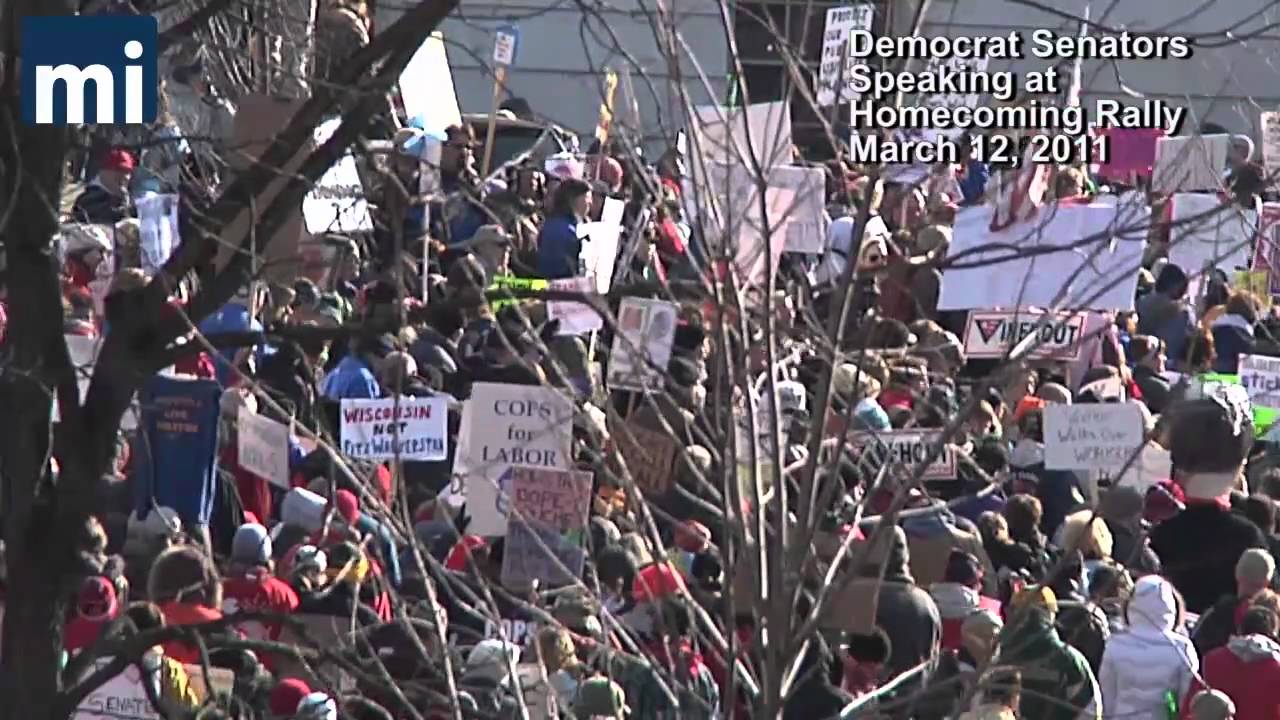 [39] that dismissed the pro-labor protesters as radicalized communists and socialists.
More recently, the Oklahoma Council of Public Affairs, another SPN member, urged lawmakers [40] to "follow Wisconsin's lead" and curb collective bargaining rights for public workers, and the GOP-controlled state Senate voted to do so soon after. Republican Gov. Mary Fallin is expected [41] to sign the repeal into law.
SPN think tanks do more than merely pepper politicians with briefings and a barrage of policy recommendations; they also serve as a farm team for the GOP. Reps. Jeff Flake (R-Ariz.) and Mike Pence (R-Ind.) and former Rep. Tom Tancredo (R-Colo.) all ran SPN think tanks [13] before entering Congress. Following his election in 1994, Massachusetts Gov. William Weld, a Republican, "hired almost everybody" (PDF [42]) out of SPN's Pioneer Institute in Massachusetts, according to an SPN official.
In Michigan, the GOP and Mackinac Center have been particularly close. Before serving as Michigan's governor, Republican John Engler helped found the center [43] in the late 1980s, and the two-term governor would go on to implement many of Mackinac's recommendations. (Engler and the think tank did, however, disagree on a few issues.) In 1995, Engler also appointed [44] Joseph Olson, Mackinac's long-time board chairman, to oversee Michigan's insurance commission. "The Mackinac Center has been tied at the hip with the Republican Party establishment for years," a spokesman for the Michigan Education Association says.
The SPN revolving door spins both ways. Brooke Rollins, president and CEO of the Texas Public Policy Foundation (TPPF), previously served [45] as Republican Gov. Rick Perry's deputy general counsel and the head of Perry's policy division, overseeing the administration's work on everything from health care and education to criminal justice. Jeff Judson, who led the TPPF before Rollins, did stints [46] in the offices of Sen. John Tower and Rep. Tom DeLay, as well as in the George H.W. Bush administration's Department of Energy. Forest Thigpen, president of the Mississippi Center for Public Policy, is a former aide [47] in the DC office of Sen. Thad Cochran (R-Miss.).
Tracie Sharp, SPN's president, told Mother Jones in an email that member think tanks "set their own policy agendas" and "have always been fiercely independent." But those on the other side of the fight see the think tanks as part of a broader effort. "This is not a grassroots movement to eliminate collective bargaining," says Al Mance, executive director of the Tennessee Education Association, the state's largest teachers union. "This is a national movement, and it's funded by all the conservative moneyed interests."
Source URL: http://www.motherjones.com/politics/2011/04/state-policy-network-union-bargaining
Links:
[1] http://motherjones.com/mojo/2011/04/andy-kroll-msnbc-state-policy-network
[2] http://articles.boston.com/2011-04-22/news/29463799_1_union-fees-public-sector-unions-union-benefit
[3] http://www.huffingtonpost.com/2011/03/22/alaska-union-bill-would-r_n_838908.html
[4] http://motherjones.com/mojo/2011/02/whats-happening-wisconsin-explained
[5] http://www.reuters.com/article/2011/03/09/us-states-unions-idUSTRE72802320110309
[6] http://nashvillecitypaper.com/content/city-news/harwell-wants-bill-repeal-teachers-union-collective-bargaining-rights-modified
[7] http://saintpetersblog.com/2011/02/sen-thrasher-would-curb-use-of-union-dues-for-politics/
[8] http://www.reuters.com/article/2011/03/15/us-missouri-unions-idUSTRE72E8L120110315
[9] http://www.guardian.co.uk/commentisfree/cifamerica/2011/apr/20/us-unions-wisconsin
[10] http://www.spn.org/
[11] http://www.spn.org/about/
[12] http://www.spn.org/directory/organizations.asp
[13] http://www.heymiller.com/2009/09/fifty-flowers-bloom/
[14] http://www.tennesseepolicy.org/2011/02/tcpr-leads-charge-against-teachers-union/
[15] http://www.spn.org/about/default.asp
[16] http://www.seekgod.ca/cnp.r.htm#roe
[17] http://www.spn.org/about/spn-leadership-team
[18] http://mediamattersaction.org/transparency/organization/State_Policy_Network/funders
[19] http://mediamattersaction.org/transparency/organization/State_Policy_Network/grants
[20] http://www.iptv.org/iowapress/story.cfm/story/1907/bud_20110127_budget_address
[21] http://www.insideriowa.com/index.cfm?nodeID=18006&audienceID=1&action=display&newsID=11634
[22] http://www.limitedgovernment.org/
[23] http://washingtonindependent.com/106392/iowa-collective-bargaining-bill-doa-in-senate
[24] http://motherjones.com/politics/2011/03/michigan-snyder-mackinac-center
[25] http://www.mackinac.org/14290
[26] http://www.mackinac.org/14756
[27] http://www.mlive.com/politics/index.ssf/2011/03/gov_snyder_signs_controversial.html
[28] http://www.npri.org/publications/unions-another-attempt-to-monopolize-the-public-sector
[29] http://www.rgj.com/article/20110412/NEWS11/110412039/State-Sen-Michael-Roberson-collective-bargaining-system-bankrupting-Nevada
[30] http://www.leg.state.nv.us/Session/76th2011/Reports/HistListBills.cfm?DoctypeID=2
[31] http://www.writeonnevada.com/2011/04/senate-legislative-operations-and.html
[32] http://articles.sfgate.com/2011-02-22/news/28621012_1_pension-reform-gop-bill-public-retirement-system
[33] http://www.pacificresearch.org/press/teacher-unions-and-collective-bargaining
[34] http://maciverinstitute.com/
[35] http://www.wpri.org/pages/about.html
[36] http://maciverinstitute.com/2011/02/union-negotiated-work-rules-for-public-employees-cost-taxpayers-dearly/
[37] http://www.nytimes.com/roomfordebate/2011/02/18/the-first-blow-against-public-employees/wisconsins-governor-is-fiscally-modest-politically-bold
[38] http://www.tax.com/taxcom/taxblog.nsf/Permalink/UBEN-8EDJYS
[39] http://www.youtube.com/watch?v=erBn4xNygPY
[40] http://www.ocpathink.org/articles/971
[41] http://www.reuters.com/article/2011/04/19/us-unions-oklahoma-idUSTRE73I6EE20110419
[42] http://www.google.com/url?sa=t&source=web&cd=1&ved=0CBUQFjAA&url=http%3A%2F%2Fwww.publiceye.org%2Fmagazine%2Fv13n2-3%2FPE_V13_N2-3.pdf&rct=j&q=public%20eye%20takin%20it%20to%20the%20states&ei=3-e0TbuUPIi2tgebsvzpDg&usg=AFQjCNF2uxdcE9kNcNIV7lL0j7qFns2M9w&cad=rja
[43] http://www2.metrotimes.com/OLDWEB/johnengler/002.html
[44] http://www.mackinac.org/bio.aspx?ID=13
[45] http://www.texaspolicy.com/staff_member.php?staff_id=7
[46] http://www.jeffjudson.com/bio.html
[47] http://www.mspolicy.org/about/view_staff.php?entryID=22
http://www.motherjones.com/print/110486
As concerned workers come together across Michigan in protest, partisan politicians are poised to make one of the strongholds for America's blue-collar worker rights into a so-called "Right to Work" (RTW) state -- in accordance with the ALEC [10] blueprint to change to state laws at the behest of some of the biggest corporations in the world. Yet, 42 corporations, including General Motors, have distanced themselves from ALEC this year after ALEC's role in controversial and divisive legislation was exposed.
RTW -- Brought Home to You by ALEC (and the Kochs, of course)
At issue is a bill spearheaded by ALEC legislators so beholden to their corporate benefactors that they think it's legitimate to vote in secret as equals with corporate lobbyists on model bills like RTW through ALEC "task forces," as the Center for Media and Democracy's PRWatch/ALECexposed [10] has previously reported. [11] Key provisions of the Michigan RTW bills (for instance, HB 4054 [12]) are taken almost verbatim from the ALEC template. [13]
That agenda is part of a corporate wish list of Charles and David Koch, the oil billionaires who have spent millions trying to popularize extremist ideas and move them from the fringes into binding law. David Koch's group of political operatives known as "Americans for Prosperity" (AFP) -- which I call "Americans for Greed" -- is backing the divisive legislation in Michigan.
RTW -- Brought to You by Vengeful Partisans and Very Lame Ducks
But the bill rushed through the statehouse for the governor to sign is also poisonous political payback in a state where President Barack Obama beat Mitt Romney by almost 10% of the vote (nearly half a million votes), despite millions spent by the Kochs and other billionaires in campaign donations as well as dark money operations to get Romney in the White House and to get laws changes to their liking.
Michigan was a landslide loss for Republicans, who also lost seats in the state legislature in Lansing, a loss which will take effect when the next class of legislators is sworn in this January.
The get-out-the-vote (GOTV) effort in Michigan was built on workers banding together to knock on doors, make phone calls, and get people to the polls on election day. Volunteers from organized labor unions were not the only ones working to get people to vote. AFP and others backing Republicans knocked on doors too, and Romney won the vote of 50,000 more Michiganians than John McCain did in 2008, but fell far short of winning the state's 16 electoral votes.
When the dust settled from last month's election, a vindictive and diminished majority in the state legislature decided to push through a bill to weaken not just American workers' power to negotiate effectively with corporate managers but also to weaken organized workers as a political force at the ballot box.
It's a sour, petty, reprehensible maneuver.
It's especially arrogant to push it through at the last minute of a "lame duck" legislature whose authority is about to expire, and it is especially deceptive to do so after Governor Rick Snyder assured voters [14] he would not pursue RTW in the state.
RTW -- Whose Prosperity? The Kochs ....
It's also a calculated move that demonstrates a palpable disdain for the will of the people in a state whose prosperity was built on private sector manufacturing jobs, with wages and benefits negotiated by labor unions. Those were good paying jobs that gave hard-working families financial security and a real chance to achieve the American dream and help their children have opportunities to be better off than their parents started off.
But those were the glory days before David Koch's prior group of operatives, dubbed "Citizens for a Sound Economy" (CSE) and his allies at the U.S. Chamber of Commerce, started pushing hard in the 1980s for trade agreements that forced American workers to compete with third world wages and that shipped jobs overseas. And, it was before Koch's CSE launched the inside-the-beltway push in D.C. in the late 1980s to repeal the Depression Era Glass-Steagall protections against banks speculating in the stock market, a repeal that made the Wall Street stock market crash of 2008 possible, if not inevitable. (Koch Industries also lobbied against the modest Dodd-Frank reforms of derivatives trading in the 2009-2010 congressional session.)
 (source: International Forum on Globalization)
Koch-backed ideas like these -- along with passing RTW, privatizing Social Security, thwarting efforts to address climate change -- have been very good for the Kochs. Some have already benefitted the Kochs' operations, including their speculation on oil prices and trading of oil derivatives [15]. Such investments have helped make these two billionaires even richer. Since the Wall Street meltdown began in 2008, "the Kochs have exponentially increased their wealth by 58% while median family net worth dropped 40%," according to the research [16] of the International Forum on Globalization.
RTW -- Less Pay, More Job Insecurity
But, such policies are very bad for ordinary Americans.
Wages for workers are lower in RTW states.
People who work in states that have bought the economic snake oil [17], like RTW, sold by the Koch-fueled hucksters from ALEC, along with their buddies at stink tanks like the Mackinac Center, make less than Americans in states that have not embraced this backward thinking.
It should come as no surprise that when private sector unions are weakened that this weakens the negotiating power of unions and also weakens the competitive wages offered by companies that are not unionized.
RTW is like a receding tide that lowers all boats.
Almost 75 years ago, Congress passed the National Labor Relations Act (NLRA) to help protect American workers' rights to organize and negotiate the terms of employment with corporations, helping to level the playing field between powerful corporations and individual workers with little leverage to get better wages, benefits, and working conditions. The NLRA specifically authorized the contracts collectively negotiated by labor unions to require all workers benefitting from the contract to pay dues to the union that negotiated the contract, a fair procedure called a "union security agreement" that helps protect against freeloading and also keep a union's power to enforce the contract strong.
RTW -- Bringing Some of the Worst of the South to the Northern Refuge
 But in 1947, Congress under pressure from corporations amended that law to allow states to opt out of those procedures through what proponents call RTW laws. Other than the heart of the old confederacy -- which enacted RTW laws in the same period that states were trying to suppress the civil rights movement, which included many unions acting in solidarity -- most of the states in the country have not adopted RTW.
In fact, only three states have passed RTW in the past 25 years (Idaho in 1995, Oklahoma in 2001, and Indiana in 2012); the 20 other states that passed such legislation largely make up the deep south and a red swath west of the Mississippi. The 2012 presidential election map of "red" states looks strikingly close to the RTW map.
But the vast majority of blue states, like Michigan, have not embraced the long-standing ALEC agenda item of RTW. And, Oklahoma's experience over the past decade since the law passed has not been a poster child for higher wages and economic security for families.
http://www.prwatch.org/print/11902
"right to work" MI, WI, 22 states
kpfa mitch 12/11/12 someone fired ea 30 min for trying to unionize mark brenner? Labor Notes
CA money launder http://www.mercurynews.com/elections/ci_21932215/fppc-releases-names-donors-who-made-secret-11
koch prop 32 anti Union BS
===
http://www.projectcensored.org/top-stories/articles/21-conservatives-attack-us-post-office-to-break-the-union-and-privatize-postal-services/
http://www.projectcensored.org/top-stories/articles/20-stealing-from-public-education-to-feed-the-prison-industrial-complex/
Here's more on lobbyist / top Romney advisor Jim Talent:
- In June, Stephanie Harnett, a senior associate at Talent's firm Mercury, was caught posing as a reporter and spying on labor organizers at a Walmart warehouse. At the time, Mercury represented Walmart. After the spying was disclosed, Mercury fired Harnett and claimed it didn't authorize her actions. Walmart then cut ties with Mercury.
==
history of pacs:
On the surface, the 1970s did not look like an auspicious time to
try to undo the ban on the use of corporate political donations. In fact,
corporate donations had a particularly bad image at the time after revelations
during the Watergate scandal that numerous businesses had
doled out money to President Nixon from secret political slush funds. In
one notorious incident, the chairman of Archer Daniels Midland had
walked into the White House and handed the President’s personal secretary
an envelope stuffed with a thousand $100 bills. Eventually, twelve
corporations were shown to have donated $750,000 in cash to Nixon.
Given public outrage over such activities, it was unlikely that the
Tillman Act ban on corporate contributions to candidates would be revoked.
A more sophisticated avenue would have to be developed.
That avenue arrived from an improbable source: the labor movement.
After the Taft-Hartley Act of 1947 had banned labor unions from
contributing to federal candidates, labor unions had invented the political
action committee. PACs had allowed unions to get around the ban
THE REVOLT OF THE BOSSES 175
on union political contributions by encouraging their members to donate
on an individual basis to a union-sponsored PAC, which in turn made
contributions to candidates. But even after PACs were legalized for
corporations by the Federal Election Campaign Act in 1971 and 1974,
corporations found them of little use because the law allowed them to
solicit stockholders but not employees.
In 1975 the legal status of PACs was finally addressed by the Federal
Election Commission in a little-known 1975 decision known as the
SUN-PAC ruling. Not only did SUN-PAC give the green light to corporate
PACs, it also gave corporations permission to solicit contributions
from their employees and to use their own treasury funds to manage
their PACs.
Prior to the SUN-PAC ruling, the use of PACs had depended on
the rare stockholder who happened to have a high degree of interest in
the political agenda of the company. After the ruling, corporations were
freed to “work” their own employees for contributions. In the mid-
1980s, researchers at the University of Massachusetts and the University
of Maryland began a series of anonymous interviews inside corporations
about how PAC money is raised. The results were revealing. At
some companies, the researchers found no attempt to pressure employees
to contribute to the company PAC. At other companies, the official
stance was ��no pressure” but the methods used involved meetings where
employees were repeatedly solicited by their bosses. A typical pattern
was for the head of government relations, one of the firm’s lobbyists,
and the supervisor( gangs of america )...
The Palmer raids are a well-known chapter in American history, as
are other major events such as the Ludlow massacre (21 people killed),
the Homestead Strike (13 killed), the Lattimer Massacre (19 killed), the
Great Steel Strike (20 killed), and the 1877 Railroad Strike (90 killed).
The conventional telling of American history depicts those events as
battles in an honorable war, in which Labor gamely battled Capital until
Capital grudgingly agreed to give Labor a seat at the negotiating table.
But a more complete reading of labor history tells a different story,
one of divergent fates. One wing of the labor movement, represented by
Samuel Gompers and the American Federation of Labor, defines itself
more narrowly and conservatively, and consequently risks far less repression.
It survives. The other wing of the movement, represented by
such organizations as the Knights of Labor and the IWW, seeks to fundamentally
confront the basic tenets of corporate power. This branch is
suppressed, not in epic battles but through a countless series of small,
ugly incidents: organizers harassed, imprisoned on specious charges;
police joining cause with company goon squads; Wobblies forced to run
the gauntlet between vigilantes armed with clubs, forced to stand all
night in jail cells up to their knees in freezing water; agricultural workers
beaten and shot; organizers excluded by injunction from entire mining
districts. According to labor historians Philip Taft and Philip Ross, a
“grossly underestimated” count of casualties in labor unrest from 1873
to 1937 is 700 killed and thousands seriously injured, mostly in small,
little-known incidents. To be involved in the radical wing of the labor
movement is to be considered, by definition, as subversive, as reflected
in the sentencing statement of one judge: “I find you, Joyce, to the
president of the union, and you, Malony, to be secretary, and therefore I
sentence you to one year’s imprisonment.” 253
Surveying the entire period from 1873 to 1937, one historian concluded
that “American labor suffered governmental repression that was
probably as severe or more severe than that suffered by any labor
movement in any other Western industrialized democracy.”
==
In March, 2010, two months after the Citizens United ruling, the D.C. Circuit Court of Appeals legalized unlimited donations to partisan PACs. The case, known as SpeechNow, was brought by David Keating, the executive director of the Club for Growth, an anti-tax group.
That year, Politico named Larry McCarthy the “Attack Ads’ Go-To Guy,” noting that he was one of the largest beneficiaries of the spending spree resulting from the campaign-finance rulings. F.E.C. records for the fall of 2010 show that four organizations whose funders are secret���the American Future Fund, Americans for Job Security, the U.S. Chamber of Commerce, and the Rove-founded group Crossroads G.P.S.—together spent nearly seventy million dollars on campaign ads. Of that sum, eighteen million was spent on commissioning, then airing, ads from McCarthy’s firm.
U.S. Supreme Court Deals Blow to Unions, Shows Preference for Corporate "Rights"
by Brendan Fischer [1] — July 3, 2012 - 8:28am
- Topics: Corporations [2], Democracy [3], Labor [4], Politics [5]
A little-noticed U.S. Supreme Court decision from June 21 has dealt a blow to public sector unions and demonstrated the conservative majority's preferential treatment for corporate "rights." The decision in Knox v. SEIU could have an impact on future election cycles.
The Court's broadly-drafted opinion [6] establishes new burdens for unions to raise resources for certain political activities. The ruling, which has been described as an "activist decision" because it dealt with issues not before the court, is written is such a way that it could also threaten unions' ability to raise any political funds, or even raise money for their very existence. Because unions are one of the few counter-weights to corporate spending in elections, diminishing union political power will increase relative corporate influence over politics.
Perhaps most importantly, when compared with other recent Supreme Court decisions, it becomes clear that the conservative majority is laying out a double-standard for how corporations and unions can be involved in the political process.
Court Makes New Law, Requiring "Opt-In" for Certain Union Fees
Unions have an obligation to represent all employees in a bargaining unit, regardless of whether an individual employee chooses to join the union. To avoid non-union employees reaping the benefits of this representation without paying the costs -- thereby "free-riding" on the dues paid by the other employees -- non-union members can be required to pay their fair share of the collective bargaining expenses.
However, employees are not required to pay for the union's political activities. Many years ago the U.S. Supreme Court crafted a rule giving employees a right to opt-out of funding the union's political expenses, such as campaign activities. According to the rule, unions are supposed to annually notify employees about the year's expected expenses and give dissenting employees an opportunity to "opt-out" and not pay for the political and other costs not related to bargaining.
In this case, the SEIU issued an "emergency" dues increase, not anticipated in the annual notice, to raise funds for fighting anti-worker initiatives on the ballot in California. It did not provide dissenting nonunion employees an opportunity to opt-out of paying for the political expenses, and a handful of these employees sued. A lower court required the SEIU to send a new notice and the union refunded the expenses to non-members who requested it.
Seven justices agreed that prior to the SEIU deducting dues from nonmembers, it should have sent an additional notice about the political expenses and provided an opportunity for nonmembers to not fund the activities. But the five conservative justices went further, and like they did in Citizens United, addressed an issue that was not before the court to establish new law. Justice Alito, writing for the majority, said that unions can only assess a dues increase like this one if employees affirmatively choose to opt-in, departing from the long-standing principle that opting-out of paying for political expenses was constitutionally sufficient. This creates new bureaucratic burdens for unions to raise funds for political activity.
What's more, the majority opinion's language suggested that the "opt-in" requirement might apply to all mandatory dues arrangements, which could potentially end the requirement that non-union employees be required to pay the costs of union representation. This would essentially create nationwide "Right to Work" standards. And that would be a massive blow to public sector unions.
Additionally, even though Citizens United opened the door for both corporations and unions to spend more freely on elections, the Knox decision will likely mean that unions will have fewer resources with which to do so. As John Nichols notes in The Nation [7] this impact could compel labor to get serious about a constitutional amendment to overturn Citizens United.
But there's more.
Preferential Option for Corporations
Harvard Law Professor Benjamin Sachs notes [8] that "the Court's concern for avoiding compelled funding of union political speech stands in stark contrast to the lack of concern for compelled funding of corporate political speech."
In Citizens United, the court ruled that corporations (and unions) have a First Amendment right to fund independent political expenditures from their general treasuries. If individual shareholders disagree with the way a corporation is funding political attack ads or bankrolling front groups, they have no right to opt-out and ask that their investments not be used for those purposes. Unions must get this permission. And corporations certainly have no obligation to ask shareholders (who are officially the corporation's owners) to opt-in, and give affirmative permission for their ownership shares in the corporation to be used for political activities. The Court in Knox signaled that unions might have to get this permission.
"To put it simply," Sachs writes, "the law gives employees the right to opt out of funding union political speech, but shareholders get no right to opt out of funding corporate political speech. This kind of differential treatment of political speakers is inconsistent with the American ideal of treating political speakers equally."
"Taking seriously the arguments in Knox and the Court's other cases about compelled political speech and association means extending these principles beyond the union context and to the corporate one," he said.
There have been some legislative efforts to make this a reality. Sen. Bob Menendez (D-NJ) and Rep. Mike Capuano (D-MA) have introduced the Shareholder Protection Act [9], which would require shareholder approval for a company's expenditures in the coming year, that the company's board of directors vote on political expenditures over $50,000, and to make the vote public within 48 hours.
Erwin Chemerinsky, Dean and Distinguished Professor of Law at the University of California-Irvine School of Law, supports [10] similar legislation on the state level. "A state can adopt a law which says that neither a corporation nor a union can spend money on political activities without the consent of the individuals. If the Supreme Court is going to require opt-in for unions, it seems only fair and appropriate that the same be required for corporate political spending," he writes.
But in the wake of successful attacks on public sector unions in Wisconsin, Indiana, Florida and elsewhere, and with a network of right-wing institutions like the American Legislative Exchange Council [11] (ALEC) pushing an anti-union message, passing legislation that is "fair and appropriate" may still be a long way off.
Center for Media and Democracy • 520 University Avenue, Suite 260 • Madison, Wisconsin 53703
http://www.prwatch.org/print/11606
public unions are defenders of the commons: schools, retirement funds big enough to affect corp behavior?
anti-union:
How the Supreme Court's 'Knox v. SEIU' Decision Could Dismantle Union Security Around the Country
In Knox v. Service Employees International Union, the Supreme Court suggests that the First Amendment is for corporations, not working people and unions.
June 24, 2012 |
The Supreme Court struck at the rights of workers with the blade of the First Amendment on June 21, when it made a decision that will restrict unions’ ability to spend on elections, and could open the way for passage and court approval of a national, union-weakening, so-called "right to work" law.
The curious case of Knox v. Service Employees International Union (SEIU) Local 1000—in which the high court decided to throw "judicial restraint" to the wind and go beyond the questions posed in the appeals court to rule against the union���portends nothing good for workers. Knox restricts how unions can get money for political uses from public sector workers in a unionized shop who refuse to join the union (Garrett Epps over at the American Prospect has a great description of the particulars in the case.)
Even as unions in the private sector have seen their memberships dwindle to around 6 percent of the workforce, public sector unions (in places where they are still recognized) have remained relatively strong because they have been allowed to collect some money—albeit less than the full union-dues amount—from workers who do not want to belong to the union. The public sector union contract has to cover all the workers in the agency, not just card-carrying members-- and all the workers benefit from the resultant pay raises, health benefits, pensions and other goodies. So non-members are expected to contribute something to the direct cost of negotiations. (Workers who don’t support the union shouldn’t get to enjoy the better pay and working conditions that their union colleagues fought for, but employers haven’t historically been willing to pay people less for NOT being union members. They much prefer to bribe, cajole and threaten workers to reject the union.).
America's political-economy is caught in a vicious cycle, with concentrated wealth at the top leading to outsized political power.
For a generation, America's political-economy has been gripped in a vicious cycle. Those at the top of the economic pile have taken an ever-growing share of the nation's income, and then leveraged that haul into ever-greater political power, which they have in turn used to rewrite the rules of “the market” in their favor. Wash, rinse and repeat.
It's the result of years of institutional investments by the corporate Right to advance a reactionary legal regime in America's courts. In the process, the richest Americans now have their hands in both our legislative and judicial branches, while working America has become a voiceless stepping stone.
“The more pernicious effect of economic inequality comes indirectly through its impact on political inequality,” says MIT economist Daron Acemoglu, co-author of Why Nations Fail. In an interview with Think Progress, Acemoglu explained what he called, “a general pattern throughout history”:
When economic inequality increases, the people who have become economically more powerful will often attempt to use that power in order to gain even more political power. And once they are able to monopolize political power, they will start using that for changing the rules in their favor.
This dynamic is best understood in the realm of electoral politics. In a study of something that most people already consider to be obvious, Larry Bartels, a political scientist at Princeton, examined lawmakers' responsiveness to the interests of various constituents by income, and concluded:
In almost every instance, senators appear to be considerably more responsive to the opinions of affluent constituents than to the opinions of middle-class constituents, while the opinions of constituents in the bottom third of the income distribution have no apparent statistical effect on their senators’ roll call votes (PDF).
Or consider ALEC, an organization funded by major corporations that writes laws that, among other things, curtail workers' rights to organize and disenfranchises the poor, elderly and people of color. It then lobbies state lawmakers to pass its “model legislation,” and sweetens the deal with junkets – all-expenses-paid vacations at posh hotels for legislators and their families ��� where they can rub shoulders with the titans of industry.
Look at the fruit that union-busting bears for the wealthiest Americans:


Another way the wealthiest Americans have rigged the rules so more of the national income flows upward may be just as consequential, but less well understood. A 30-year campaign to push America's courts sharply to the right has borne abundant fruit for those in the top 1 percent.
��
SOUTH:
Guillory says, “Southerners themselves too often buy into the ��laziness’ narrative.” But it has very little basis in truth: “Southerners work hard. You know, people worked in fields, in small factories in the heat. Southern states used to attract industry by advertising relatively inexpensive labor but people who would work hard and work independently.”
This linked to a long and troubled history of violent labor suppression in the South that has resulted in some of the worst working conditions in the country – and contributed to the region’s never-ending poverty. Indeed, Southern states often attracted industry based on the fact that they had crushed working-class activism in ways that ultimately produced a pliable – and fearful – labor force. During the 1940s, Jacob Remes, founding member of the Southern Labor Studies Association and assistant professor of public affairs at the State University of New York Empire State College, tells AlterNet, interracial civil rights activism sometimes combined the causes of racial justice and labor rights. But labor organizing was violently put down. People were killed, and both race and Red panic were used as wedges to divide white and black workers. Over time, says Remes, national labor rights activists sometimes gave up on organizing the South, and Southern workers were cowed into poor working conditions and low wages. Just as corporations have moved jobs overseas for cheaper labor, northern industry first came to the South because labor costs had risen in the north, and corporations – like the textile industry that ultimately landed in North Carolina – needed a cheaper labor force....
http://www.alternetorg/story/154794/5_big_media_stereotypes_about_the_south_%28and_the_real_story_behind_them%29?page=entire
http://www.sourcewatch.org/index.php?title=Center_for_Union_Facts
��
The Center for Union Facts is a secretive front group for individuals and industries opposed to union activities. It is part of lobbyist Rick Berman's family of front groups including the Employment Policies Institute. The domain name www.unionfacts.com was registered to Berman & Co. in May 2005.
Contents[hide] |
Campaigns
Video ads by the Center for Union Facts portray union organizers as thugs who invade workers' homes to intimidate them into joining.
In May 2006 the Center for Union Facts, launched its first TV ad campaign. The 30-second spot, running on Fox News and local markets, has "actors posing as workers" saying "sarcastically what they 'love' about unions," like paying dues, union leaders' "fat-cat lifestyles," and discrimination against minorities. The ad campaign cost $3 million, which was raised "from companies, foundations and individuals that Mr. Berman won't identify." [1]
The group planned to film another TV ad in June 2006. Labor and economics professor Harley Shaiken said the effort "to create an anti-union atmosphere" more generally, as opposed to business-funded ads against a particular union organizing drive or strike, "is a new wrinkle." An AFL-CIO spokesperson called the ad's accusations "unfounded and outrageous." [2]
In June 2007, the group campaigned heavily against the Employee Free Choice Act, legislation which "would give employees at a workplace the right to unionize as soon as a majority signed cards saying they wanted to do so." The Center for Union Facts has spent "$500,000 on newspaper and broadcast advertisements this week alone," reported the New York Times on June 20, 2007. [3] The group's print ads for the campaign compared union leaders to Ugandan dictator Idi Amin and Iranian president Mahmoud Ahmadinejad, calling the bill a "scheme to eliminate workers' right to a secret ballot." [4]
The Center for Union Facts is behind the billboards with the web site TeachersUnionExposed.com which have been put up around Newark, New Jersey[5].
In August 2008, the group's "political arm," the Employee Freedom Action Committee, ramped up its campaign agains the Employee Free Choice Act (EFCA). It launched a $30 million campaign, including radio, television, print and online ads and "a substantial grassroots organizing effort." The group's anti-EFCA ads were slated to run in Maine, New Hampshire, Mississippi, Kentucky, Louisiana, Colorado, Oregon and Minnesota. At the same time, the Coalition for a Democratic Workplace, which is comprised of "virtually hundreds of businesses, chambers of commerce and trade associations," was also spending millions to defeat the bill. "The folks behind the ad campaign fear that if Sen. Barack Obama, an Employee Free Choice Act sponsor, is elected president and power shifts to the Democrats in the Senate, the bill will become law," according to a New Hampshire paper. [1]
Personnel
- Rick Berman, Executive Director. [6]
The contact person on the initial media release is Sarah Longwell who has worked in public relations for Rick Berman at his Employment Policies Institute as well as for the Intercollegiate Studies Institute and its Collegiate Network.
Funding
United Press International noted that "the group's spokesman refused to release the names of its donors or say where its funding came from." [7]
Berman told Bloomberg reporter Kim Bowman that he had raised "about $2.5 million from companies, trade organizations and individuals, whom he declined to identify." [8]
Sarah Longwell, a spokeswoman for the Center for Union Facts, echoed Berman's groups standard claim for secrecy on who funds their front groups. "The reason we don't disclose supporters is because unions have a long history of targeting anyone who opposes them, whether it be in a threatening way or by lodging campaigns against them," she told Detroit Free Press. [9]
The paper reported that while Wal-Mart Stores denied funding the group it stated that "it has a relationship in which it exchanges union information with Berman, the group's head." [10]
��
Contact details
The Center for Union Facts
PO Box 27455
Washington, DC 20038
Phone: 202-463-7106
Email: Sarah Longwell (longwell AT unionfacts.com)
Web: http://www.unionfacts.com
Articles and resources
��
Related SourceWatch articles
- Bob McAdam
- Lee Culpepper
- ActivistCash.com
- American Beverage Institute
- A Visit to the ActivistCash.Com Web Site
- Berman & Co.
- Center for Consumer Freedom
- Employee Free Choice Act
- Employment Policies Institute
- Employment Roundtable
- FishScam.com
- LaborPains.org
References
- ↑ Deborah Mcdermott, "Groups lodge anti-union campaign: Employee Free Choice Act the subject of ads," Seacoast Online (New Hampshire), August 17, 2008.
External resources
- "The Center for Union Facts Launches Multimillion-Dollar Campaign and Comprehensive Website to Expose", Media Release, January 10, 2006.
- The Center for Union Facts, "The Center for Union Facts Positions Huge Dinosaur Outside AFL-CIO", News Release, February 13, 2006.
- "Union Facts Calls on Wal-Mart to Begin Funding Education Campaign", Media Release, May 27, 2006.
- Citizens for Responsibility and Ethics in Washington (CREW)'s web site, www.BermanExposed.org
External articles
- "Anti-union group launches media campaign",United Press International, February 13, 2006
- Amy Joyce, "Full-Page Ads Launch Anti-Union Drive - Lobbyist Aims to Show Labor Groups to be 'Duplicitous'", Washington Post, February 14, 2006.
- Steven Greenhouse, "Group Starts Anti-Union Campaign", New York Times, February 14, 2006.
- Kim Chapman, "New group launches anti-union drive", Seattle Post Intelligencer, February 14, 2006. (This is a syndicated Bloomberg story).
- Kris Maher, "Taking on the AFL-CIO", "Incident Report", Wall Street Journal, February 13, 2006.
- Kortney Stringer, "Antiunion ad campaign in Detroit's face today", Detroit Free Press, May 24, 2006.
- WakeUpWalMart.com, "New Evidence Shows Wal-Mart Working Closely With Right Wing Attack Group, Says WakeUpWalMart.com", Media Release, May 26, 2006.
- Marcus Kabel, "Wal-Mart denies funding anti-union ads", Businessweek, May 26, 2006. (This is an Associated Press story).
- American Rights at Work, "Center for Union Facts", Profile, accessed June 2011.
- American Rights at Work, "Who Is Rick Berman?", accessed June 2011.
- Steven Greenhouse, "Clash Nears in the Senate on Legislation Helping Unions Organize," New York Times, June 20, 2007.
- Michael P., "Metro Center Advertising - Front Groups ," blog "Infosnack Headquarters," September 24, 2008.
Categories: Front groups portal | Front groups | Labor | Consumer fronts | Web fronts
The one truly stunning ad on Super Bowl night was a moving two-minute Chrysler commercial featuring actor Clint Eastwood. Aired at halftime, the ad hailed the renewal of the American automobile industry and featured images of union firefighters and factory workers.
At the 50-second point in the ad, images from last year's mass pro-union protests in Madison were featured.
But something was missing: union signs.
The images from Madison were taken from a historic video by Matt Wisniewski, a Madison photographer whose chronicling of the protests drew international attention and praise. Wisniewski's work went viral, and was even featured in a video by rocker Tom Morello.
---
older entry:
Union Busting: The Real Call from the Koch Brothers 2/25/11
This week, Americans for Prosperity -- a right-wing political powerhouse funded by the billionaire Koch brothers -- started running anti-union TV ads in Wisconsin. The allege that Wisconsin's public workers, protesting Gov. Scott Walker's attempt to dismantle their right to unionize, "walked off their jobs, abandoning our children." The ads ask, "Who decides Wisconsin's future? Voters or government unions?" Unsurprisingly, the TV spots don't go into detail about who paid for them -- viewers might be less likely to trust faux-populist rhetoric if they knew it came straight from the mouth of a corporate front group run by a pair of billionaires.
The story of the year since Citizens United v. FEC may be perfectly crystallized in the fight that Wisconsin Gov. Scott Walker is waging against his state's public employee unions. Organizations like Americans for Prosperity spent millions of dollars in 2010 running misleading ads bashing health care reform, progressives, immigrants, and American Muslims in order to elect politicians who would stand up for the interests of big business. Now those interests are working hard, and spending a little extra money, to make sure they collect on their investments.
------
1/20/12
mojo
http://motherjones.com/politics/2011/04/scott-walker-defunding-democratic-donors
...
What the Union Fight is Really About: Defunding the Left
The GOP's new three-part plan to starve the Dems.
—By Kevin Drum
| Fri Mar. 25, 2011 1:04 PM PDT
146
When Wisconsin Gov. Scott Walker took on his state's public-sector unions last January, it seemed to require no explanation. Republicans are sympathetic to corporate interests and opposed to organized labor, and challenging public-sector workers' pay and benefits appeared to be just one more skirmish in a longstanding ideological battle.
But Walker went one crucial step further. He deliberately sparked a dangerous, months-long war by proposing to end the public-sector unions' collective bargaining rights entirely. Why take that risk?
Here's why: Politics in the United States is a game played on multiple levels, and ideology is only the first. Walker was playing on a second, deeper level, where the issues are secondary. Here, the goal is not so much to advance one party's agenda, but to actively undermine the infrastructure that allows the opposing party to exist at all. And on this level, one of America's two political parties routinely outplays the other: Defunding the left is a longtime goal of the smartest and savviest Republican strategists, and they've pursued it for decades.
The old-school version of this tactic began in the '70s and '80s with the right's campaign to undermine private-sector unions, traditionally one of the Democratic Party's biggest sources of funding and campaign support. In the early '70s, a newly aggressive and politicized Chamber of Commerce, joined by newcomers like the Business Roundtable and a new breed of "union avoidance" consultants (PDF), took advantage of divisions on the left and the decline of manufacturing industries to block labor reforms and gut rules against union-busting. All this made it nearly impossible to organize new workplaces in the growing service sector, which led to unions' long, steady decline: Since 1970, private-sector union membership has dropped from 29 percent of the workforce to less than 7 percent. And with that decline, the Democratic Party has lost a major source of its funding.
Organized labor wasn't the right's only target. In the late '80s and early '90s, Republican strategists approached the NAACP with offers of free mapping software to help them create majority-minority congressional districts that would be more likely to elect black and Hispanic members of Congress. But this tactic, dubbed "Project Ratfuck" by one of its chief architects, had nothing to do with increasing minority representation. Rather, it was designed to pack lots of liberal-leaning minority voters into a single district, leaving the surrounding districts as easy pickings for Republican challengers.
...
Most recently, of course, a third target has appeared front and center in the battle to defund the left: public-sector unions, the only sector of organized labor still thriving. New Jersey governor and presidential almost-hopeful Chris Christie was one of the first to gain notoriety for taking them on, but by February, the spotlight had turned to Wisconsin.
That fight, despite Walker's protestations, had almost nothing to do with the state's budget deficit and everything to do with decimating a pillar of Democratic Party support. Longtime DC reporter Howard Fineman explained the raw math: Republicans had hoped to take away as many as 20 governorships from the Democrats in the 2010 elections, but in the end they only won 12. Why? "Well," reports Fineman, "according to postgame analysis by GOP strategists, the power and money of public-employee unions was the reason. 'We are never going to win most of these states until we can do something about those unions,' one key operative said at a Washington dinner in November."
In a similar vein, New York Times statistician Nate Silver analyzed recent election polls and concluded that even in their current emaciated state, union households overall voted Democratic in big enough numbers to add about two percentage points to Democratic vote totals in the 2008 election. And in terms of raw dollars, three public-sector unions (AFSCME and the two main teachers' unions, the NEA and the AFT) were among the top five donors to Democratic candidates in the 2010 election cycle—and that doesn't include individual union members.
Put it all together—the funds public-sector unions provide to Democrats, the votes they bring, and the doorbell-ringing and phone-banking they do—and it becomes obvious why Republicans want to cripple them. The Wisconsin Senate's Republican majority leader made it crystal clear. "If we win this battle, and the money is not there under the auspices of the unions," he said, "certainly what you're going to find is President Obama is going to have a...much more difficult time getting elected and winning the state of Wisconsin."
There's nothing illegal about the right's efforts to defund the left. As they say, politics ain't beanbag. But the left is fighting with one hand tied behind its back if it doesn't understand exactly what's going on and doesn't make sure that the public understands it, too. Unlike the fights over funding for NPR or Planned Parenthood, these aren't just—or even mainly—fights over liberal versus conservative priorities or principles, regardless of how often the right likes to portray them that way. They're really fights over raw, naked power, with Republicans trying to permanently tilt the political playing field and restore their Bush-era dream of a permanent majority.
Public opinion can change in these fights, as it eventually did in Wisconsin. But that happens only when the public understands just how ugly and partisan the battle actually is.
Kevin Drum
Political Blogger
----
Ohio Voters Reject Kasich Anti-Union Bill
Submitted by Mary Bottari on November 9, 2011 - 9:57am
181:{Share:(style="cursor:pointer"):}:
Ohio voters dealt a severe blow to the agenda of Governor John Kasich and other anti-union governors by voting to overturn Senate Bill 5 (SB5) by a 61 to 32 percent margin. SB5 was a law championed by Kasich that would severely limit collective bargaining rights for public employees and targets public employee wages and benefits as a means to balance the state's budget.
After the bill passed the legislature in March, unions and their supporters swung into action and submitted 915,246 certified signatures required to place the issue on the ballot for a statewide referendum. Ohio law allows for this type of "veto referendum," but does not allow for the recall of governors. Over 3,497,000 ballots were cast in the referendum vote -- and it appears to have passed with substantial Republican support.
The months that led up to the election garnered national attention as a fight against right-wing governors who were not only anti-union, but were fundamentally anti-government -- using the economic downturn to shrink and transform state governments.
A chastened Kasich struck a conciliatory note on election night: "It requires me to take a deep breath and to spend some time reflecting on what happened here."
http://www.bluegreenalliance.org/about_us/organizations fights GW
| MOTHER JONES | August 5, 2011 |
THIS WEEK IN THE BLOGOSPHERE
Why Unions Matter: The Numbers
A few months ago I wrote a piece for the magazine arguing that the decline in unionization over the past three decades has been a key factor of the decline of the American left over the same period. But it's a hard case to prove because there are so many moving parts to it. So I was intrigued earlier this week when my colleague Josh Harkinson linked to a new study that attempts to quantify the effects of unionization on income inequality using a rigorous regression analysis of census data.
jh http://motherjones.com/mojo/2011/07/strong-link-found-between-decline-unions-and-rise-income-inequality
union911
http://www.happychild.org.uk/acc/tpr/features/0110mmap.htm
Takada, Aya. “Wagyu Ranchers Defy Evacuation Orders as Radiation Threatens Japan’s Farms.” Bloomberg.com May 2, 2011. http://www.bloomberg.com/news/2011-05-01/wagyu-farmers-defy-evacuation-order-as-radiation-threatens-crop.html 324
Ross, J. "On the Importance of Our Connections to Food" from ''Original Instructions: Indigenous Teachings for a Sustainable Future''. Rochester, VT: Bear & Company, 2008. 403
“If you qualify for classroom accommodations because of a disability, please get an Accommodation Authorization from the Disability Resource Center (DRC) and submit it to me in person outside of class (e.g., office hours) within the first two weeks of the quarter. Contact DRC at 459-2089 (voice), 459-4806 (TTY), or http://drc.ucsc.edu/ for more information on the requirements and/or process.”
8:33 AM 9/17/2011
unrelated grist: For nearly 30 years, when asked by Gallup to prioritize, Americans put the environment ahead of the economy. The widest spread came in the early 1990s, when some 71 percent of respondents favored the environment, even at the risk of curbing economic growth, while 20 percent thought the economy should come first, even if it meant the environment would suffer.
there is power in a union philip dray doubleday 2010
��
Nelson Lictenstein says in eur where there were strong centalized gov't before corps topopk hold, in US corps had est'b economic pwr before there was string gov to oppose (?) intro p 8
the right to property and to rubn a biz seen as sacred, so courts routinely opposed labor . unions a "scandal" b/c solidarity is p 8
corps, NA< CoC learned to use fear of foreigners to beat unions (ironic b/c the conspioracy was actually the ciprs, RR, gov and cops (and mil) p8
labor made mistakes too; not supporting women and ppl of color, buting into cold war rhet, corrpution and "mimicking arrogance of big biz" 8-9
ch 1 lowell miracle
ch 2 Lincoln supported right to strike, supported him in civil war 70 after war, 8 hr effort
molly maguire 88 maybe mythic, sometime anti brit, imported to US
Pinkerton a scot barrel-maker started as cop by cvatching rr conductors skimming; claimned to have hrard of assass plot, believed b/c lincoln also from illin (hired by mclellan). listened to Gowen and sent agent to infiltrate MM masny convicted one guy put handprint on jial wall and said it wd remain as sign of innocense(covered in 1930's p99
��
pres hayes cousin killed in train wreck 160 kia 106
gt strike 1877
anarchism p 132 Johann Most
Peter Kroptkin said all creatures can self-organize in response to nat conds, and free of gov will contine to 134
mccormick reaper, haymarket assembly about to adjourn, bomb thrown at cops 7 kia, 67 badly hurt 4 workers kia, 50 hurt ��quick trial, so emotions high, defense had little input on jurors; they told that thery could be found guilty even if no phys evidence 153 less than hr delib; cop siad lynching of protesters ok 154 state sup ct oked verdict, us scots refused to hear Wilde shaw engels etc suppoprted Gov brokered a compro mise; if recant and ok'd by McC and Marshall Field (PO's by strike, got barrqcks built to ctr strikees)etc, commute to life; 2 went for it, 5 refused 157. circus guy offered 100K for corpse of Lingg (sic) ansd promsed to return in good shape when done.
gompers 160-
ch 4 pullman 1894 fed troops under ordrs to stop train of protesters going to DC, shoot to kill if nec. prev yr biggest economic depr to date "or "most precipitous" anyway 168 led to some urban reforms
1889 Carnegie steel tried to beat labor at Homestead, but beat by organizing, fought off scabs and dicks. Carnegie said sympathetic stuff about scabs, but went on vacation when trouble came. A good mgr killed in accident, Henry Clay Frick took over, millionaire in own right, and brutish. built fort around plant 9w/ gun holes barbed wire etc, and a barge of Pinks, repelled by gunfire but evebntually caved (as with mines in coerdalene0 b/c corps got goos at tactics 9scabs soldiers technology etc ) 175 Berkman tried to kill Frick (lover of Goldman) Good PR to distract from Homestead, bad PR for labor (radical infiltration) 180
Pullman p-type "Pioneer' used for lincoln funeral may 65 chicago to springfield. Pullman bought Corliss engine, displayed in glass (working)
"armies" and "indistirals' began marching to DC (from Montanna, rasfted down MIssouri River0 Jack London joined; Amb Beirce put doen "pick-pocket civilization" that robbed poor 194 "war on tramps" b/c of exxag stories
DEBS 202- paspr said dr treated for alcoholism 203 but headlines worse; Mob in control, war, meat famine, chic at the mercy of incediary's torch ; RR co's also united to beat strike. Injunction under Sherman Act (for stopping mail?) fe b/c made to curp power of corps, not unions 204-5 (could arrest leaders with nop real proof of wrongdoing)
Gov Altgeld good guy, pal of Darrow, who told him to free remnaining haymarkey convicts, big blowback but still had tough guy Cleaveland as prez 209 , sent 2k troops to RR strrike, july 10 arrested debs and 3 lts for obstr mail abnd interstate commerce (tho order was to let mail thru, rr co's actually prevented by arranging cars?) 200 strikers jauled, along w/ 200 rioters. gen miles "broke back of strike"; gagging leaders
Pullman rep hurt by strike, tho he won (abd had lavish junkets for press on rollut of new model) 221 coffin lined in led, set in concrete, covered by asphalt, w/ heavy iron bars on top 222
Debs radicalized and supported Polulist Peiople's party, read soclaist lit in jail.
sum: labot tactics gotten better, but trumped by courts plus military 225
1880-1900 progressisim chruch based social gospel rejected social darwinism; virtue no longer solitary and pvt, but actions of corps, ct and gov mattered
SOCIALISM
1900 8 for lang, 5 english daily ppr, 262 engl weekly (Ks 1/2 mil circ) 228 by 1912 over 1k elected socialists 56 mayors. Debs got 6% pres vote 1912 (1920 mil votes tho in jail). even some ceo got progressive ideas (nat cash reg JH patterson in Dayton OH
cw post not nice to labor, anti coddle
Also influential Fred W Taylor ?! but sci mamgt came from disciple Lous B Brandeis, fut SCOtus. a fair day's work cd be determined sci, not thru haggle 232. in conressional testimony, irked by labor symp q, he used "profane shop lang' was w/ lects at Harvard, they had to be striken 233
Marcus Alonzo Hanna sen of OH and head of RNC was camp mgr for McKinley 1896, 1st sleck moderen camp 235 "Dollar Mark" hus nickname; got JPM to help settle coal strike to help 1900 election (assassinated by anarchist 1901)
Closed shop essentuial to bargaining, but demomized by NAM open = "freedom"
TR 1st to sit in on bargaining; block Hanna, sent E Root sec war to talk to JPM
sevweral ct loss by labor leading to wwi, tho states and congress had some wins for labor esp child labor after Mo Jones 251 joinerd Coxley's army. at 73 good press; put kids in cages on Coney Is and marcheds them to TR house from Penn (kid strikers) he refused to meet 253 by 1912 38 states anto child labor, but not really done till 41 scotus uphold 1938 law 254
gompers got Clayton antitrust act that negated sherman ~ unions 1914, Magna carta, but reversed agian w/ 1921 scotus Duplex printing (strikes could be stiopped by injunction again) 255
Wilson labor Commission "radical" blueprint for New Deal, pro union as ctr wt
garment workers, Triangle one juror said act of god, girls not so smart, so panic" but genl outrage. cil suit paid 75$ per death
1880-1910 10-15k kia /yr 1880 alone, 8k trainmen kia, mines 6k/yr Pitts settl mills 300 kia/yr 2k hurt 276 mfg kept inspectors out, helped by pols who wanted to keep facts from moving 276
Frances perkins saw triagle fire, big spakrk/boost to Progressivsm;, worked at Hull Hse, her mentor Florence Keyyey, quaker //Uppie ; Hamilton 1st woman fac harv med school, took on st'd oilof NJ [antitrust ploy) on lead in gas 283 and dupont
Big Bill Haywood IWW (not like ARU, confed of RR incl pullman mfger) or AFL, a federstion of trade unions, IWW would be everyone regasrdless of skill or race . wobblies liked to tweak reg union orgs. Bill" i dispise the laws...We are the Revolution" 287
ID Gov willey sent nat'l g to mine strike, his AG said overwhelming force needed to crush, gatling gun small howitzer to shell the woods 289-90 undermartial law 600 rounded up, layers, barbers anyone sympathetic, in summer, meager rationsm, several suicides ,led to WFM 290 1906 ID gov Steunenberg killed by bomb, pretty good on labor but asked for fed troops and got some blacks. Haywood (legend is brothel) and others grabbed in Denver and brought to trial in ID. yr in jail waiting, 250K$ def fund, darrow. debs and others did not do much w/ IWW, instead socialist politics
In Montana, iww jailed for talking, so a bunch flooded in to overwhlm the jails, worked (pounded on door after long day of organizing for a bed and a meal (rancjers came in to watch) 299
Eliz Flynn
LAT bomb oct 1 1910, 21 kia Harrison Gray otis, anti union, civil wat vet called house bivoac and lat blgd a fortress medieval 302 darrow and Linc Stefens defended.
San Deigo trad freee speech zone shut down, IWW formed free sp league, Trib said protesters shd be "shot down or hanged" 304 Goldman fled, reitman tarred, branded, another guy almost beaten to death 304 union learnd that thery cd win if there was law, but vigilantes wd beat them
Lawrence (KS?) strike fire hose to freeze, women kids jabbed with bayonet; one 18yo boy accidently killed by one after snowballs led to gunfire, no charges as just doing duty. but labor leaders arrested for inciting violence 9not at scense? 312 Bill raised $ fro strikers; rg flynn and sanger evac stiker kids met by 5k in NYC some 7-8yo lokked like 4 yo; bad PR so later loads of kids blocked , mom jailed. Some blamed problem on too many foreigners (unfort echo of french revo no god, no master led to ez PR ctr
Patterson police chief said you have the rights but we have the power 326
JD Rockefeller jr Colorado Fuel and Iron co feudal control" is colo in Am?" jrnlst
john reed 1914 said not revol, not lawbreakers, just wanted boss to obey law 335
jr knew lwrtttle about indistry, had never visited colo? said he'd shut down before worker const right infinged 9by union) Gov said Constit not in foce b/c co owned mine, houses etc picked cops and judges. many killed in accidents, but co to vblame only 1x, imported arms, dics, armorted car w/ machine gun and spotlightThe Death Spl" later inq called "imported assassins" 336
9/23 deadline to go back to work; Mo Jones said stay tough. tent city dubbed "White City" after fair, hiyt by light and machine gun fired in air at night 337 Gov refused nat gard on expense gds, but later sent; greeted warmly by strikers as peacekeepers from goons, but soon went on raids looking for guns, beat a guy till crawled home; some scabs defected when found they'd been lied to. Strikers wives ridden down and jabbed after embarred guy fell of horse and thought they were laughing at him--Mo Jones Riot 339
during peace talks, firing broke out, machine gun brought in, troops looted and burned camp; union leader hit in head w/ rifle butt and sot 3 times in back while fleeing; after massacre, 10 days fightimng.
��
Colo Women's peace league forced gov to get fed troops. no one prosecuted for massacre; rr crew said militiamen torched tents and fired at women and kids trying to use train for cover for escape.
Uppie led protests at JDR office, ans org a pr fatfinding tour; pres wilso listened to widows while he held baby; jdr fled to cty house in Hudson vly, pursued by uppie; protesters arrested (pvt security dics and patriots0 3 guys killed making a bomb
JDR made reforms, only to find they were already colo law but evaded by cfi. Poison Ivy " sent weekly dispatched from colo rehashing attacks on mojo, "bloodthirsty agitators" 347 propsed co union.
Jow Hill 1914 murder trial; ex cop botched robbery/ shot attacker; hill said shot over woman he would not name, refused lawyer initially?; pres w tried ��2xto get gov to stay but no2x, firing squad
Don't waste any time mourning, organize!" 352
Since 1912, iww more regualr union than revo, but sided w/ russioan workers, and kerensky made a deal w/ germans, so got seen as pro-german
Phelps dodge AZ cu mine pledge to shut before unionize; mach gun forced deportation 2k miners and wives in 24 boxcars, taken 180 mi in NM, dropped w/o food or water told killed if returned 358 ct ruled illegal, but dismissed the case
IWW organizer Little, F kidnapped, beaten dragged by car then hanged (in packet envelope w/ joe hill ashes) Butte Mo
Biz told WW IWW would interfere w/ war, so investigqtion by Covington
1917 espionage act crime to nake false roports that cd interfere w/ war, recruit ment etc. Sed act 1918 crime to use profane lang about govt Const or mil 360. Immig act built on anarchist exclus law post mckinly assess
Big Bill decided to coop w/ C comm, but raid took 5 toms, incl spitoons?! 165 IWW arrested, put in same cells as haymkt guys. flynn tried to sep herslf. prosec case weak, conspracy and dislyoal teachings; judge disallowed pres indistrial comm rept, as well as anything about tough worker conds. after 4 mo trial, one hopur delib;35 5 yrs, 33 tyen, 15 to 20 yrs inc big bill. dray says tril not about alleged crimes but only to shatter union that was too scary, too american actually
after wwi, worry about trible if vet cd not get jobs 9so blacks fired
Seattle gen strike, dock workers refused to load guns for russia 370 ik soldier w/ mach gun and grnades, 2k special depuities incl u dub students 371 anyone taking over city function "will be shot on sight" offices raided, 38 iww arrested
Debs convicted under Esp Act for sp against ww1. NY state and Lusk Comm looking into impending dictatorship of proles, so labor called the seattle strike off after 5 days
1919 19 mail bombs to jpm, jdr, Palmer, Holmes etc also bomb at AG palmer (quaker raised) home, blew out the windows of neighbor fdr, who also found body part of bomber, no group ID'd 375 led to jeh
Boston cops underpaid and had to buy uniforms 9rats ate leather) used as errand boys for casual graft 9eg free food) strike gov coolidge opposed, saifd no right to strike agaist public safety ever/ pres w called strike crime ~ civ 381 bolshies
palmer went after "labor radicals' ; adfter ww1 good labor climate ended; "freedom" used to oppse closed shop agAIN
jdr PRO LABOR, BUT BLOCKED BY FRICK AND GARY IN WW TALKS 385
Martial law in steel strike towns, woman goong to complain about spec dep who killed a miner shot dead, rules "justifiable hom" 386 in Gary IN
1919 int'l soc went for revo, led to split in US (Reed Comm labor Party0 an Debs kept Soc party.
1914-9 strikes almost 3x, members 2.7 to 4.2 mill 391 WW stroke, so no restraint on Palmer
JE HOOVER supported authority, religion and sex repression, so Goldman whore and witch combo. ex Libr of Congress, into cataloging 392 kept tabs on 60K
Palmer raids in a doz cities (buff pol cf said too bad we can't shoot them 393 Tenn sen said penal col on Guam
Union of Russ workers mostly a cultural org, so of 650 arested 39 held; goldman and berkman deported. 1920 10k detained. total finding 4 iron balls (disolved into rust?) NY leg expelled 5 Soc, move opposed by teddy's son.
Gov mailled confist radical lit to suspects then arrested when picked up 400
Judge rules membership in CP or CLP grounds to deport; judge anderson found that gov't actually operating some part of CP 401 JEH pissed and investigated him; then ltr found in which jeh told informers to set up radical mtgs to make it easier to grab during raid. last gasp was big may day scare
Frankfurter and other judges (4 harv) wrote pamplet w/ help of ACLU on illgal practices w affidavits of bad treatment by prisoners (eg no rx); jeh warned, so investigated the judges to discredit 402 palmer and jeh uncooperative congr witnesses, heatings confirmed pamplet; plamer blamed jeh
Coolodg, hero of cop strike gets VP nod then pres
Pressure on IWW lightned, but too late, semed outmoded, and CP drew ppl away 405
��
Sacco ahd helped Lawrence strike, vanzetti found anarchist pal dwead 14 floor below doj bldg, held 8 weeks incommunicade for palmer house bomb investigation; while organizing protest, 2 arrested for robberies and shooting, cause celb led to 6 year fight to save, but executed 1927.
c8 8
h hoover predicts end of poverty 1928
boom in 20's some corp largesse, but a number of ct losses in 20's
FDR 415- polio from scout camp 1921
NRA relulated wages and prices
��
F Perkins clothes looked like designed by dept of std's " but progressive, trusted by fdr
��
Lwesi UMW pres, NIRA sect 7a not fought, but seen as fdr wants you to join 421 (CP organizing helped. nat'l labor bd had limited power
west coast dock strike rr spikes vs vomit gas , 2 strikers killed 1st troops since 1906 quake, papers called civil war' ansd "commmunisdt -led insurrection " 431 perkins cooled fdr; eded afteerr 4 days and arbit
CIO smartest on trends ansd passed AFL (thet had split)
Sen Wagner pushed thru much new deal laws wpa, ccc, soc sec, PO's on evasions on 7a; collective barg made work democratic; fdr cool at 1st b/c thot not needed.
scotus blocked new deal on eg agric; after landslide (and attempt to pack ct) a couple changed sides 456
Fisjer strike 1st big sit down; judge ordered out, but found he had 200K$ GM stock; goc refused to send troops. cops attacked w/ tear gas, vs slinshots 1.5 lb hinges, repulsed; 2nd try gas blew back on cops, fited into crowd (13 woundded) 464 44 days, partial victory that laid fdn
Ford hired ex boxer H 477arry Bennett for "Service Dept" comb of dracula and jeh, pvt army and spies, henry ford health declining (pal of edison, chl goodyear, wright bros, so into self made vs collective) 478
Ballte of overpass pix PO henry so pulled ads; city of dearborn outlawd handing out borchure, 1k arrested! 1937 480 sen la follettte comm looked into corp acts: 2500 into spying and trickery; 4k , some pinkertons hired at cost of 10 mil 1933-6; 93 unions infiltrated GM biggest client of Pink.
GM worried it spies stealing co secrets it hired 2nd then 3rd tier 481
also spied; beth steel, pen rr, warner bros, walgreen's 481 spies entrapped workers; one promoted to union vp natiojal. Pink and Baldwin-Felts pledged to quite corp spy, but Bennett kept on more
��
Edsel say union inevitable, but henry stubborn, wife won him over
ch 9 tex rep hattom sumners said wwii strikers shd get electric chair 488
smith-connally (seen by many as punishing Lewis) vetod by fdr, overridden. esponse was labor PAC, goal to reelect fdr, but also publ;ic works, houses for vets, subsidized rx 490 fdr propsed a 2nd bill of rights that wd include labor demic, but died.
S-C expired 1947; scotus win ~ labor
conservative ctr to wagner and new deal in gen'l was taft-hartley; no 2ndary boycotts, no political dnations etc; written by lawyers at NAM and CoC 497. senat argued unions created stability on biz and society; lewis called it 1st thrust of fascism; truman veto overridden, but it did not lead to new deal rollback as intended 499 steelworkers got co paid for pension and health care; Beth caved on pension
South hostile to unions so Operation Dixie (cd have been start of CRM?)
Sadly afl-cio helped in covert ops in foreign groups 515 (cover ass during red period?) Gompers encouraged unions ~ bloshie nad socialistic; in org w/ mussolinui (but affil of L of N) 517 ex commie Lovestone cold warrior worked w/ CIA? meany and j peter grace am inst for free labor dev 523 which worked on guat coup (replic in brit guiana, dom rep and chile Allende; us fdns used by cia to laUNDER $ TO JAY lOVESTONE GROUPS ; one 1964 paper art'l , but not investigated till 70's and then cd not even verify he was real? 525 well who he was and what he did.
post wwii, corruption parly b/c attacked on all sides, members h=gave brass pass 526 Kefauver Comm on labor racketting/mafia rfk On the Waterfront meany and walter reuther fixed problems, led to backing jfk? teamstert backed rmn
Goldwatr said UAW bigger threat than sputnikon comm, baided R bros McLellan
ch 10 new deal was about public works, but Gt Soc about indiv empwrment thru ed job tqining , community pgms (for action?) 552
Farmworkers not in Wagner Act and SS b/c so pols blocked 553 CA had big farms b/c of land grants mex, and gilded age RR land grabs; gropus of labor roated thru 9and out0 and local pol owned by agribiz (only // cotton plantations and coalfields)
��
happy poor; no sense in paying b/c these lighthearted boys will just drink it; ratehr die than bathe; had to crush any union b/c fruit wd rot
IWW blamed for riot in Wheatland 1933 when Durst Ranch advertized for many more workers than needed to drive dwn $ 554 DA deputy and 2 workers killed (goons); 2 IWW guys got life sentneces for murder 555
��
Commie affil union (also affil of CIO) late 30's; growers did Assoc Farmers of CA vigilantes used KKK tactics all to stop it 555 invest blamed United cannery union; assoc farmers ~ Grapes of Wrath
Bracero WWII (both min wage and go home parts ignored) 556
Saul Alinsky inspitred Community Service Org, joined by Chavez (fam lost land in GD). settled in San Jose (Sal si puedes) go if you can! dad hurt cd not work in fields; served in WW2 CC did lived in Delano
growers used tractor dust, fired guns in air and doused w/ pesticides 559 injunction so particular the word huelga illegal fot strikers 559
devout cath, into Lib Theology; gandhian tactic new (labor sometimes used violence, and wd react to it) 560 W reuther and sen rfk impressed LBJ and Meany close (thus war?) ufw model for orging ppl trad excluded nurses, janitors etc 571 UAW not close to Meany b/c of Lovestone/CIA [also viet nam to keep suppplies flowing from docks]; when labor back peace, meany accuses of being Hanoi puppts 9losing it) teamsters and JBS march w/ burn hanoi not flag sign 575 hard hat assaunts may 1970
��
CRM...mlk
Big union siphoned off $ for CRM (SDS came out of 30's industr democ, 1962 MI UAW summer camp 573 race riots 1967 spread to unexpected n cities
GOP tried to woo MC/workers w/ OSHA 1970, // to envir acts: wilderness 64, NEPA 69, CAA 1970; whole earth picture, silent spr, unsafe at any sp, smog, mercury...pop bomb, zpg, bucky, walden 600 sand cty
Looney Gas Scare 1920's A Ham Harv Med Sch ~ lead in gas vs dupont, GM and std oil. news stories of dupont workers getting crazy and sick led to hearings; pb seen as "gift from God" for acceleration and bigger cars 602
Tough to work on labor in tough econ times; Union carbide water diversion Tunnel of Death silicosis, beatn back into tunnel before dust cleared from explosion, warned not to talk 30C /hr; worker told mom to get autopsy so get something from co 602; congr found later almost 500kia, 1500 sick (lawsuit got 80-250 blk, 250-1K whites 603 (some never got b/c state statute of ltd ran out). Sec Perkins called for more invesitigation of the disease, but ind came back w/ Industrial Health Fdn to provide "experts" ~ injury claims 604
Labor dept said states wd have to adhere to fed safety guidelines 9proved to work?) on defense contacts (CoC and Nat'l Safety Council objected). 1965 Public Health Serv said new chem every 20 min, many carinogens 605 said we need more worker protection; black lung and uranium get attn. CoC knew regs coming, so wanted it from GOP, so backed OSHA (but not fully funded, so inspections lag0 608-9
Silkwood
ch 11 RR 1st to destroy a union
1927 mgm co union acad of mot pict arts ans sci (oscars), ltd talent agent; 1933 wage cut led to SAG --> afl; rr on sag negot team, and disliked commie intansigent; also thot stalin wanted to run movies for propa. 619 bro Neil (abd hpper ansd Parsons gossips) recruited by FBI; bro warned RR to get out of suspect pro fdr group; rr became informant T-10, 1947 Huac but not name names 619 GE talk 8 yrs, A Time for Choosing" New Right brewing since 1952 taft defeat (ike)-->schlafly, welch, 1964 none dare call it t barry G [[rr big break was nom speech?]
��
patco: 8% retired for rx reasons (Corson rept backed claims?) only fed union to back RR 1980; rr priased polish ship workers solidarity (wrote nice ltr to patco?) but appt piper ceo FAA, unionbuster 626 sec of trans lewis hired anti labor law firm morgan, lewis and bockius; all advisors anti labor, no moderator as shultz for rmn 626 patco officials arrested; public support for rr on this 70/30 NAM piggybacked w/ union free campaign. airlines liked strike b/c gave them time/cover to cut low return routes ; other unions by law cd not support. punitive action no unemployment, housing sunsides etc (sorta like Danbury hatters 1908 when fines led to lost houses etc) RR sold patco bust as law and order issue; liked to tout his union days, but he made 150k/yr and was snitch. started shift $ MC to rich and from entitlement to mil.
250K ppl rally for labor solidarity; RR avoid press conf b/c did not like to move from simple gen'l. patco strike cost 30 bill, 10 yrs of turmoil, no real improvement 640-1 but hobbled labor for decades (5 yrs later new union had same gripes)
carter cd not do much w/ conservatives blocking (even demos), bush 41, eh, BC trade agreements hurt, curtailed welfare. but did sign exec order that no fed contract to co's w/ scabs 653
Hormel and catepillar setbacks? ups/teamster win?
studnets ~ swatshops Russell Athletc co 11/09
today union members 1/5 of 1950's, now 12.3%; gov 37%, pvt 7.2% 659
Transnat corps contrl 3/4 world trade, 150 mil workers
pension and retirement health care going away (1st was Am ex 1975, common on 1920's) --> new deal; airlines and beth steel dumped pensions on gov pgm PBGC; 401k don't work well, esp when you buy bunch of own co stock that tanks.
[car worker bene now vilified] but co gave them in lieu of short term wage rise when biz good 664 unions dumb to oppose CAFE (but looks good compared to CoC rec'd) 665 UAW big pull b/c ohio/Mi always battlegd, swing voters. B2 got backing, uaw lobbied BC hard ~ cafe, he punted to "next gen" cars taks force, then 94 takeover killed.
US labor has to outreach, but hobbled by shady past, USAID anti union training? 670
historically, labor effors have ripled out into women;'s rights, CRM, educ
hoffa suspected vic of mafia hit 1975
green jobs ~ to job killer rhet
rwhist2
UNIONS 198- corps orig ok w/ craft unions b/c small; in 20's stronger and busted unions; in 1933 30 hr week, so corps wanted NRA as alternative; for ok, labor got collective bargaining; corp knew they had to go for it, and assumedtheir ringer unions wd work; NRA failed byut ppl read 7a as pres want you to join a union. also hoped new NLRBd wd side w/ them, as Sen Wagner a pal, but when he said rules shd be law w/ fines, they turned on plan. Hired goons, stockpiled wapons and talked to rw vigilante groups 201 Auerbach 1966 Labor and Liberty) Sen Comm on civil liberties subpoenna's papers and found this out
So Demo sided w/ right to pass Taft-Hartley limits on labor, and kept therm even after left won in 48. Lost more gd thru courts and bills 59, 61 and 1967 203 tenn sen filibuster '78, never recovered.
again 221- on strikes broken up by army or goons 1880-1936 [nowhere in world has so much force been deployed ~ labor?!. after win in 36 fdr and govs in MI and Penn refused to send troops (to defend pvt property) 2 party system built into op sys, so no labor aprty in US
from rove bk?
UNION
made tougher reporting req (could cost 1 bil) 5k under order, but only 120 nt'l 162-3
yet DOL did not go after walmart for 85 violation of child labor (allowed to useangerous machinery)
3 prong strategy to undemine unions 163, budget for enforecement cut. Not a conspiracy, tactic announced by Grover 164
one year break gone, so endless campaign to keep union? 165
1 mo in office g2 igns 4 exec orders anti-u 165 (atc not gov't function) chao said wd work, but days later exec order; unions uted for minor stuff at same time worldcom and Enron free ride 167
afl-cio breaks up on campaigns, 53 mil lose overtime 169
The Right Wing Attack on the American Labor Movement [80], (alternate [81]) Joanne Ricca, Wisconsin State AFL-CIO, August, 2002
"This report documents the development of the New Right, its ideology and its strategy. In particular, it explains how the Right exploits single issues and manipulates religious faith to direct workers into voting for candidates who are a threat to their economic interests. Hopefully, this summary can serve as a framework for a larger, continuing discussion on how to challenge and defeat the Right."
worker safety
Across America, people are dying for work. It's not because they're unemployed. It's because they work for corporations that don't care if they die.
��
Every day, 12 workers die on the job in America -- often because a corporation has defied regulations or ignored standard safety procedures. Many more die prematurely from work exposure to toxic materials.
If corporations are people, as Mitt Romney and the Republican majority on the Supreme Court claim, then their privileges as humans come with the responsibility to act humanely. Corporate-people must fulfill their obligations to workers and communities. Profit can't be their sole raison d'etre. That's not how it is with flesh-and-blood people. If it were, then society would condone profit-motivated murder, like killing a parent for insurance money. Now that they're people, corporations have an even greater duty to prevent deaths on the job. And if they don't, they must be held accountable in criminal court the same way a money-grubbing son would be if he murdered his parents for the life insurance.
Workplace explosions get all the attention. Three that occurred two years ago next month killed 47 workers. Within 18 days, seven died at the Tesoro refinery in Anacortes, Wash.; 29 in Massey Energy's Upper Big Branch mine in West Virginia and 11 on the BP Deepwater Horizon rig in the Gulf of Mexico.
Writing about industrial homicide in the *American Criminal Law Review* last year, Jane F. Barrett, an associate professor at the University of Maryland School of Law and director of its environmental law clinic, said of these explosions:
"In all of these cases, safety procedures were bypassed or standard operating procedures were ignored due to pressures on plant personnel to save time and/or money."
There it is -- the profit factor. Making money trumping worker survival. Occasionally, people accept risk when personal gain is held out as a possibility. But in the workplace, corporations take the gains while imposing the risks on workers. Barrett put it this way:
"And in all cases, the brunt of the consequences was borne by those who did not share in the economic rewards of the corporate non-compliance (with regulations)."
In 4,500 such instances each year, the worker's death is quick and the cause obvious. In many more cases, however, the deaths are slower, and the reason -- workplace exposure to toxic substances -- less evident. Workplace exposure causes more than 40,000 premature deaths annually from conditions like cancer and neurological disease.
Beryllium, primarily used in weapons production, is one of those deadly substances. It causes a lung disorder called chronic beryllium disease (CBD). It is so toxic that no safe level has ever been established. Finally, this year, decades after studies established the inadequacy of the 60-year-old "taxi cab standard" that the Occupational Safety and Health Administration (OSHA) used for worker exposure to beryllium, a more stringent level may be set. The exposure level suggested in February by my union, the United Steelworkers, and Materion Brush, the only U.S. producer of pure beryllium metal, is 90 percent lower than the current limit.
The taxi standard was set by two scientists riding in the back of a cab in New York in 1948 as concern rose about CBD suffered by workers using beryllium and by residents of surrounding communities. Over decades, industry executives concerned about compliance costs and government officials who feared slowed weapons productionobstructed imposition of stricter exposure limits.Former U.S. Secretary of Energy Bill Richardson admitted it in 2000, telling a reporter:
"Priority one was production of nuclear weapons. . .[the] last priority was the safety and health of the workers that build these weapons."
That's treating workers like collateral damage. It's not human. Or humane.
Similarly, mining industry officials delayed publication of two studies establishing a connection between deadly lung cancer and exposure to heavy diesel exhaust in mines. In an attempt to suppress the information that could lead to costly regulations protecting workers, the industry began challenging the research in 1996. With litigation and other measures, the mining industry succeeded repeatedly in postponing publication until this month.
Sustaining deadly exposure to improve profit margins -- that's not humane.
As it stands now, corporate-people who commit industrial homicide are cited and fined. This is not effective. Over the past decade, the federal government repeatedly fined BP tens of millions for violations, including the highest fine in OSHA for an explosion at its Texas City refinery in 2005 that killed 15 workers and injured 170. That didn't change BP's behavior. Five years later, the explosion of BP's Deepwater Horizon rig killed 11 workers and seriously injured 17.
Similarly, Massey had been cited and fined for years for flagrant and chronic mine safety violations. In 2006, two miners suffocated while trying to escape a fire in a Massey mine. Four years later, 29 workers died in Massey's Upper Big Branch mine.
The only way to make a difference is to hold accountable those executives and managers who are the actual flesh-and-blood of corporate-people, the executives and managers who determine corporate culture, who decide to violate standards and risk workers' lives in exchange for profits. Professor Barrett, in her law review article, described how it could work:
"Personal accountability, which creates a risk to an individual that he might go to jail as a result of decisions he makes, can change behavior and drive deterrence."
A real threat of prison time would focus the CEO mind on worker safety.
Barrett recommends a Seaman's Manslaughter Law to protect land-based workers. The Seaman's law criminalized misconduct and negligence by ship operators that led to the death of sailors or passengers. Those convicted, including corporate executives who ran the shipping businesses and condoned the recklessness, faced 10 years in prison.
The authors of this law had it right. Corporate-people -- that is boards of directors, CEOs, managers and supervisors -- who believe their own freedom is at stake will be far less inclined to gamble with workers' lives to save a buck.
Lucy Parsons: ‘Shoot them or stab them’
February 15, 2011

Lucy Parsons
Lucy Parsons is the Haymarket Square widow who internationalized the struggle for the eight-hour day and whose work led to the May Day rallies held around the world, except in the U.S., to celebrate International Workers Day. I have known about Lucy Parsons most of my adult life but have read little of what she actually said. This is probably because the Chicago police and FBI burned all of her papers and books.
Lucy was born – probably enslaved – in the Oklahoma territory and married to Albert Parsons, a former Confederate soldier, who became a radical labor organizer. I was stunned to learn she didn’t die until 1942 and is buried near the Haymarket martyrs in Chicago. The lesson, in my mind, from the lives of this remarkable couple is that one of the first benefits to all workers that resulted from the ending of slavery, and even though it took much more struggle, was the instituting of the eight-hour day.
Numerous books on the contributions and achievements of African American women rarely if ever mention Lucy Parsons. Charlayne Huntger-Gault, Florence Griffiths Joyner, Shirley Chisholm – all worthies of course – but never ever Lucy Parsons. Who hasn’t been impacted by the legalizing and enforcement of the eight-hour day?
��