DAPL 2 Standing Rock
see primary for older
819 bak
==
omg
pension plan / crony capitaLISM ukraine scandal an ASSET?!
Rick Perry Rejoins Pipeline Company Energy Transfer’s Board of Directors
Former U.S. Energy Secretary Rick Perry has rejoined the board of the company that oversees Energy Transfer Partners, one of the biggest pipeline operators in the United States. The company, owned by billionaire Kelcy Warren, is best known for its Dakota Access crude oil pipeline, the construction of which drew months of massive resistance led by the Standing Rock Sioux and other Native American nations. Perry had previously served as a director of Energy Transfer Partners before stepping down in 2016 as the corporation faced backlash over the Dakota Access pipeline
==
==
CALPERS DIVEST
omg NB Tswan peddled continued threat after dapl to keep $ flowing
https://www.washingtonexaminer.com/warnings-of-eco-terrorism-mass-casualties-at-new-okla-tenn-oil-pipeline
OPINION: WASHINGTON SECRETS
Warnings of eco-terrorism, 'mass casualties' at new Okla-Tenn oil pipeline
by Paul Bedard
| April 18, 2017 02:13 PM
[odd pix, scary? Dakota Access pipeline opponents burn structures in their main protest camp in southern North Dakota near Cannon Ball, N.D., on Wednesday, Feb. 22, 2017, as authorities prepare to shut down the camp in advance of spring flooding season. (AP Photo/James MacPherson)
Just months removed from the violence and attacks on police by environmental extremists fighting the Dakota Access Pipeline,state and federal officials are warning of similar, potentially catastrophic, attacks against another new pipeline between Oklahoma and Tennessee that enters service in the fall.
A report from the Department of Homeland Security, and Arkansas, Tennessee, and Oklahoma, warns of attacks from eco-terrorists to anti-government militia on the Diamond Pipeline project.
"Law enforcement are assessing what environmental extremists did to disrupt Dakota Access Pipeline – Molotov cocktails, rocks, arson, roadblocks, chaining themselves to equipment,improvised explosive devices, etc – and seeing many of the same activities potentially happening around Diamond pipeline," according to a police representative.
[map pipe route]
The 11-page "field analysis report," stamped "Unclassfied//For Official Use Only," said that there are no pending threats to the $900 million, 440-mile pipeline under construction, but that the potential is very real.
"While the Diamond Pipeline project has not seen the same level of disruption as the Dakota Access Pipeline (DAPL), we are concerned that negative perceptions about enforcement efforts against DAPL opponents could inspire like-minded individuals to seek out reprisal violence against similar targets, including the Diamond Pipeline," said the report, provided to Secrets.
Some peaceful protests have already occurred.
The report revealed that five oil pipelines crossing the U.S.-Canada border were shutdown in October, and it provided photographic evidence of the arson and sabotage of the Dakota Access Pipeline.
Police are keen consumers of the report because it was sheriffs and local cops that felt the brunt of the pressure at Dakota, sometimes getting in violent clashes with protesters.
According to the report, "Pipeline construction projects frequently arouse concerns about environmental and land-use issues. While most opposition activity related to pipeline construction remains nonviolent and lawful protest activity, some violent extremists may take advantage of lawful gatherings to attempt to threaten, incite, or commit violent acts against public safety officers or facility staff."
The biggest concerns cited in the report:
— "DHS and the authoring fusion centersassess the most likely potential domestic terrorist threat to the Diamond Pipeline construction project or associated entities is from environmental rights extremists motivated by resentment over perceived environmental destruction."
— "We assess that the second most likely potential domestic terrorist threat to the Diamond Pipelineor associated entities—including law enforcement and private contract security guards—is from militia extremists opposed to government enforcement of eminent domain policies."
— "We assess that potential attacks against the Diamond Pipeline or related entities would most likely be simple and designed to damage physical infrastructure or equipment by sabotage or arson. Previous attacks against pipelines or related targets have included assaults on law enforcement, private contract security guards, or construction personnel."[where? Fallin gun?]
— "We assess the primary potential threat of violence against the Diamond Pipeline and related entities is from lone offenders who adhere to environmental rights extremist beliefs and believe violence is justified against such projectsdue to their perceived harm to the environment. Previous incidents involvinglone offenders committing violent acts against targets associated with similar energy projects suggest that the pipeline and associated entities could be attractive targets for an attack by lone [wolf?] environmental rights extremists."
— "Militia extremists have engaged in armed standoffs, threats, and disrupted IED plots targeting law enforcement entities perceived to be enforcers of oppressive government land-use policies, according to media reporting. Although their capabilities vary, some militia extremists have well-rehearsed paramilitary skills, as well as access to and proficiency using firearms and explosives. As a result, successful violent attacks have the potential to cause mass casualties."
Paul Bedard, the Washington Examiner's"Washington Secrets" columnist, can be contacted at pbedard@washingtonexaminer.com
==
energy in depth
primary on WSJ, FTI, frack?
not technically a trade front gp like api, but look at all mjr players
wash exam bedard quotes dhs rept but does not link to it (i can find nowhere online) also cited by EID (nope, eid links to WT)
DEPARTMENT OF HOMELAND SECURITY WARNS OF ECO-TERRORISM THREATS ON PIPELINE
BY NICOLE JACOBS APR. 19, 2017 1
The Department of Homeland Security (DHS) has issued a new report warning that the $900 million Diamond Pipeline — which will carry crude oil from Cushing, Okla., to a refinery in Memphis, Tenn. — could be the target of eco-terrorism attackssimilar to those against the Dakota Access Pipeline (DAPL). The DHS report explains,
“DHS and the authoring fusion centers assess the most likely potential domestic terrorist threat to the Diamond Pipeline construction project or associated entities is from environmental rights extremists motivated by resentment over perceived environmental destruction.” (emphasis added)
The report also states,
“While most opposition activity related to pipeline construction remains nonviolent and lawful protest activity, some violent extremists may take advantage of lawful gatherings to attempt to threaten, incite, or commit violent acts against public safety officers or facility staff.”
As EID recently explained, #NoDAPL-style protest camps have been set up in multiple states to oppose pipeline and oil and natural gas infrastructure projects. Many of the same #NoDAPL protesters who left behind big environmental messes and added to already burdened municipal budgets that taxpayers are forced to pay for in North Dakota are now traveling to these copycat camps.
A #NoDAPL camp in North Dakota. Source: NPR
DHS acknowledged in the report that the agency “is concerned negative perceptions about enforcement against DAPL opponents could inspire likeminded individuals to seek out reprisal violence against similar targets” and that these attacks would “likely be simple and designed to damage physical infrastructure or equipment by sabotage or arson” targeting “law enforcement, private contract security guards, or construction personnel,” as was the case in previous attacks against pipelines.
The DHS report explains that “environmental rights extremists have a long history of using arson attacks to inflict economic damage and disrupt projects or infrastructure they believe present a danger to the environment.” The multiple arson attacks against DAPL detailed in the report are listed below.
- “On 1 August 2016, unknown individual(s) set fires in Iowa’s Jasper County targeting heavy machinery at three construction sites associated with DAPL, resulting in over $1 million in damages to equipment, including a bulldozer and a track hoe, according to media reporting. According to media reports citing local law enforcement, the fires damaged the vehicles’ engine and cab compartments, likely resulting in a total loss of the equipment. There have been no arrests or claims of responsibility for the attacks, which were the first local criminal incidents related to the project.”
- “On 15 October 2016, unknown individual(s) committed a fourth arson against DAPL construction equipment in Jasper County, according to local news reports. According to media reporting citing local law enforcement, there have been no arrests. The attack occurred in the same area as one of the August arsons and involved similar tactics, possibly suggesting it was related to the earlier arsons. The arson resulted in over $2 million worth of damage. In both the August and October attacks, the targets’ proximity and relationship with DAPL, and the tactics, techniques, and procedures used suggest this incident was plausibly carried out by environmental right extremists. “ (emphasis added)[kyle's girlfriend said mercs torched vehicles?]
The report explains that although other methods such as homemade bombs or improvised explosive devices (IED) are not frequently used in attacks against pipelines, these types of weapons were recovered from #NoDAPL camps. From North Dakota’s *Valley News*:
“Law enforcement say they are investigating the use of homemade explosives at a Dakota Access Pipeline (DAPL) protest. They have recovered weapons and are investigating whether or not they are related to injuries a female protester suffered.”
…
“Law Enforcement received information that protesters were using one-pound propane cylinders as explosives and the North Dakota Bureau of Criminal Investigation with support from Federal Bureau of Alcohol, Tobacco and Firearms recovered three of these propane canisters from the site of the explosion.
Investigators also collected rocks and glassjarsconsistent with the design of Molotov cocktails that were used as weapons against law enforcement.” (emphasis added)
https://www.valleynewslive.com/content/news/Propane-cylinders-recovered-at-explosion-site-of-DAPL-protest-402544435.html
Homemade explosive device recovered from #NoDAPL camp. Source: *Valley News*
While this report focuses specifically on one pipeline, its cautionary message can be applied to any of the projects currently facing opposition from extremists involved in the Keep It In The Ground movement (KIITG), who have a goal to stop all fossil fuel development by any means necessary. Whether or not these copycat camps leave a path of environmental destruction like they did in North Dakota or are successful in harming local contractors’ equipment with their well-documented tactics remains to be seen.
There are some certainties in the wake of what occurred in North Dakota, however: there will be extremists among the peaceful protesters and the local communities in their path will carry the financial burden of all of the protesters’ actions.
TAGS:
Department of Homeland Security, Diamond Pipeline, eco-terrorism, Energy In Depth, nodapl, pipelines
==
ref
https://www.valleynewslive.com/content/news/Propane-cylinders-recovered-at-explosion-site-of-DAPL-protest-402544435.html
Propane cylinders recovered at explosion site of DAPL protest

Posted: Tue 6:10 PM, Nov 22, 2016 |
Updated: Tue 6:13 PM, Nov 22, 2016
:{:{
}:}:
odd no byline?]
:{:{
}:}:
MORTON COUNTY, N.D. (Valley News Live) – Law enforcement say they are investigating the use of homemade explosives at a Dakota Access Pipeline (DAPL) protest. They have recovered weaponsand are investigating whether or not they are related to injuries a female protester suffered.
Law enforcement say around 3:00 a.m. November 21, protester activity had de-escalated near the Backwater Bridge, but they noticed two males and a female using a barricade to hide their activity.
Officials say they gave repeated orders for the three people to come out from behind the barricade and they attempted to force them out with “less than lethal” bean bags and sponge rounds. It was then the officers noticed the protesters approach and roll multiple metallic cylinder objects.
“The subjects were given opportunities to retreat back, but it became obvious that they were tampering with the vehicle or planting a device,” said Highway Patrol Lieutenant Tom Iverson. “Their strange mannerisms led law enforcement to believe they were there for a purpose with a calculated effort to either cause harm or breach the line.”
Lt. Iverson says after the cylinders were rolled, law enforcement witnessed an explosion. Several protesters ran to the area, pulled a female from under the vehicle, and fled the scene.
Law Enforcement received information that protesters were using one-pound propane cylinders as explosives and the North Dakota Bureau of Criminal Investigation with support from Federal Bureau of Alcohol, Tobacco and Firearms recovered three of these propane canisters from the site of the explosion.
Investigators also collected rocks and glass jars consistent with the design of Molotov cocktails that were used as weapons against law enforcement.
Meantime, a news conference and vigil were held in Minneapolis on Tuesday. In a news release from the American Indian Movement (AIM), they say Sophia Wilansky, 21, of New York, was hit in the arm with a concussion grenade and she was airlifted to Hennepin County Medical Center in Minneapolis.
Wilansky underwent surgery Monday, and is currently in recovery.
"This latest escalation in excessive police force and violence against peaceful water protectors just shows what the state is willing to do to protect the interests of oil companies. A young woman almost lost her arm today so that Energy Transfer Partners can build their dangerous pipeline on Indigenous lands," said Alex Lundberg, of Minneapolis, and a friend of Wilansky.
Lt. Iverson says they are investigating whether or not the explosives mentioned above are linked to a woman who claims to have suffered injuries at a protest.
“We are aware of the information about the woman on social media who has claimed she sustained injuries to her arm due to law enforcement tactics. The injuries sustained are inconsistent with any resources utilized by law enforcement and are not a direct result of any tools or weapons used by law enforcement,”said Iverson. “This incident remains under investigation by the North Dakota BCI and ATF. Additional details will be released as the investigation progresses.”
Law enforcement also address the use of water on protesters, saying the fire department trucks were initially brought in to put out several fire set by protesters. They made the following statement about the use of water:
“Law enforcement used CS gas to control the protestors but wind conditions caused it to be ineffective.Law Enforcement commanders had to assess the violent acts of protestors and determine how to maintain the safety of officers. Those commanders made the decision to use water and warned the protestors repeatedly that water would be used and gave them opportunity to disperse.
Instead of dispersing, agitators yelled at law enforcement, “Hit me! Hit me!” and many were running directly toward the water. The water was used once protesters attempted to tow away the remaining burned truck and comments being yelled by protesters included, “We are willing to die for this,” and “We get paid for this.” The protesters were also taunting officers saying, “You are outnumbered.” This led law enforcement to believe the protesters were preparing to overrun the barricade [made of? put there when/ why?]
on the north side of the bridge. Because of this threat and that other law enforcement tactics were not effective, water was the chosen less-than-lethal tool to use to hold back protesters.”
omfg
STAND DOWN
National Guard Pulls Missile Launchers Away From Standing Rock Protesters
A day after The Daily Beast reported heavy-duty weapons were brought to the Dakota Access Pipeline sight, they’ve been removed—for now.
David Axe
01.18.176:05 PM ET
https://www.thedailybeast.com/national-guard-pulls-missile-launchers-away-from-standing-rock-protesters
North Dakota National Guard is withdrawing the two unloaded missile launchers it had stationed near the Dakota Access Pipeline construction site in order to “observe” peaceful protestors, which The Daily Beast first reported on Tuesday.
“Its removal demonstrates our commitment to deescalating any tensions its presence may have caused,” Guard spokesman William Prokopyk said in a statement.
Two Avengers launchers, Humvee trucks with rotating turrets that can be armed with guns and eight Stinger surface-to-air missiles, were deployed a day after protestors from the nearby Standing Rock Indian Reservation had spotted one of them deployed on private landoverlooking a pipeline work site.
Several of the protestors were arrested for trespassing.
The U.S. Army Corps of Engineers denied Dakota Access, LLC an easement to extend its pipeline under Lake Oahe, which lies on federal land and borders Standing Rock. Dakota Access has vowed to continue building the 1,200-mile oil pipeline, most likely on private land in Morton County.
Jon Ziegler, a self-described “citizen journalist” covering the Standing Rock movement, described the Avenger as an “anti-drone missile system.”
On Oct. 23, 2016, the Morton CountySheriff’s Department announced it had shot down an activist’s drone after it had approached a police helicopter “in a threatening manner” —an accusation the drone’s operator denied.
But Prokopyk said Army Guardsmen—who have deployed alongside local police to guard the pipeline—were using the unloaded Avengers strictly as observation platforms. The Avengers boast sophisticated night-vision equipment that many other Guard vehicles lack.
“It was employed for over a month in a passive role to observe areas within Morton County where numerous incidences of criminal trespass and mischief have occurred,” Prokopyk said of the pair of Avengers.
“In the same vein as when we used unarmed Blackhawk helicopters to put out a fire near the protest camp in October of 2016, the unarmed Avenger was used in an observation only role to support public safety in southern Morton County.”
Not only were the Avengers not armed while stationed near the work site—there aren’t even any missiles for the vehicles anywhere in North Dakota, Prokopyk explained. “All munitions are strictly controlled by the United States Army.”
Prokopyk denied that authorities sent in the Avengers in order to intimidate anti-pipeline activists.
“If they were placed to intimidate anyone, it wouldn’t have taken a month for someone to notice them.”
The North Dakota Guard selected the Avengers for the “observation” mission not only because of the launchers’ night-vision equipment, but also owing to their enclosed, heated cabins, Prokopyk said. Taking into account wind chill, winter temperatures in North Dakota can dip below negative 40 degrees.
Having withdrawn the Avengers, Guardsmen will continue monitoring protestors using handheld night-vision equipment, Prokopyk said.
“Good thing we’re in a heat wave,” he added. “It’s almost 30 degrees!”
==
3 yr anniv
https://kpfa.org/episode/letters-and-politics-april-1-2019/
npr
https://www.npr.org/2019/03/06/700013728/our-history-is-the-future-puts-standing-rock-in-broader-native-american-story
Modern Indigenous American history is a history of resistance. It's often assumed that Indigenous resistance to white settlers and enterprisers is often considered an act of self-defense, when it was — and is — also a battle between starkly different value systems.
For the Oceti Sakowin, or Sioux Nation, resistance is not just based on a claim to land that invaders have sought to usurp and exploit; it's also about what "land" means. In Our History Is The Future,Nick Estes poignantly describes an idea of what land means from an Indigenous perspective:
"During the last ice age, massive glaciers carved up the land. After the ice retreated, it left rolling hills and tunneling valleys that became buffalo roads, where herds that once blackened the plains traveled during seasonal migrations to and from water. The buffalo followed the stars, and the people followed the buffalo."
In this scene, land means interconnectedness, humility before the sublime rhythms of the earth.
The book's primary purpose is to situate the resistance to the Dakota Access pipeline (DAPL) at Standing Rock in the broader story of Indigenous American resistance (specifically Indigenous people of the central plains) to land incursion and dispossession. And Estes succeeds more often than not throughout the book by balancing an emphatic but accessible tone with academic (but not too academic) scrupulousness.
He writes about Indigenous forms of resistance that resorted to force when necessary, and negotiation and the courts when possible, even if, in the end, all often proved futile. For the people of Standing Rock and Indigenous people more broadly, DAPL was yet another violation of sovereignty by outsiders with an entirely different notion of what land means. To white settlers and enterprisers by and large, land meant power and property and corresponding violence in the service of wealth, resulting in the widespread annihilation of Indigenous peoples and their cultures.
The book also provides specific historical context for notions of land and property that animated white settlers and enterprisers. Former Supreme Court Chief Justice John Marshall articulated the precarious status of Native Americans in the 1823 decision, Johnson vs. M'Intosh. Estes relates that "Indigenous people, [Marshall] ruled, only possessed 'occupancy' rights, meaning their lands could be taken by powers that 'discovered' them: 'The Doctrine of Discovery'." To unpack this decision, Estes cites Onondaga international jurist Tonya Gonnella Frichner, who argues that the "newly formed United States needed to manufacture an American Indian political identity and concept of Indian land that would open the way for the United States in its westward colonial expansion."
Estes deserves praise for having written a very well-paced, highly detailed, morally urgent book in which he keeps his eye trained on the profound injustice he catalogs, condemns, and portrays, really, as beyond immediate redress. Although he traces Indigenous resistance back to the first white settlers, his focus is particularly sharp in his recounting the resistance at Standing Rock, the central form of opposition around which the book makes its case. At Standing Rock, and in the history of Oceti Sakowin resistance, existential threat has permeated a broader struggle of ideas, it should be said, not sought out by Indigenous people, but, rather, thrust upon them.
Again, it comes down to what "land" means. Tasunka Witko, also known as Crazy Horse, once said "my land is where my dead lie buried." And Estes echoes this sentiment and its betrayal in the context of Standing Rock:
"Because Native people remain barriers to capitalist development, their bodies needed to be removed — both from beneathand atopthe soil — and therefore eliminating their rightful relationship withthe land."
For instance, the changing of the course of the DAPL by the Army Corps of Engineers was an early perceived affront to the dignity of Standing Rock's land and people. The Army Corps planned to shift the pipeline's course from upriver of the capital of North Dakota, Bismarck, to upriver of the Standing Rock Reservation, or Sioux County, where 47 percent of the population lives in poverty. Estes writes:
"In its environmental analysis, the Army Corps had concluded that the Bismarck path crossed a 'high consequence area', which meant that the spill would have an adverse effect. Not once did it mention Standing Rock, for which a spill half a mile upriver was of no consequence to the Army Corps."
In August of 2018, AP reported that in "its initial analysis of the Missouri River crossing that skirts the northern edge of the Standing Rock Reservation along the North Dakota-South Dakota border, the Corps studied the mostly white demographics in a half-mile (0.8-kilometer) radius, which the agency maintained is standard. But if the Corps had gone another 88 yards (80 meters) — not quite the length of a football field — the study would have included the reservation." There's a clear disparity of concern here, one could argue, and it's exceedingly hard to characterize it as a mere oversight concerning vulnerable people and their land.
The protests at Standing Rock eventually developed into a full-fledged city of sorts, with Indigenous people not just from the plains states, but from all over. It was an Indigenous utopia of resistance. Estes describes it as such:
"All one had to do was walk through the camp to witness that dream. Flag Row — a half-mile procession of more than 300 Indigenous national flags that lined each side of the road — cut through the heart of the camp. Starting at the north gate, where new arrivals checked in with camp security, it was the 'main drag' of the 'Indian city' — the tenth-largest city in North Dakota at its peak. Alcohol and drugs were strictly prohibited. Media were required to report to the media tent. No photographs of children, or of anyone, were permitted without consent. Nor was the recording of prayers or ceremonies."
This was not only a protest; this was a community of collective resistance and cooperation pitched against the forces of greed and exploitation. And it was, in Estes' words, "Indigenous generosity — so often exploited as a weakness — that held the camp together."
Our History Is The Futurepoints a way forward, with solidarity and without sentimentality, to an idea of Indigenous land alive with ancestry and renewal. Standing Rock is the model for the present, bound to the past, to reckon with the future.
Now, as the Trump Administration has reauthorized not only the Dakota Access pipeline but also the Keystone XL pipeline, Indigenous people, their water, their lives, are once more under direct threat — their land once again imperiled by forces more concerned with the land's uses than its meaning.
Though the resistance at Standing Rock is very recent history, it is also the future.
nick estes kpfa event mod dunbar-oriz 3/19?
Our History Is the Future: Standing Rock Versus the Dakota Access Pipeline, and the Long Tradition of Indigenous Resistance
https://www.amazon.com/Our-History-Future-Indigenous-Resistance/dp/1786636727
==
RICO!
U.S. judge on Tuesday dismissed the most serious claims in a lawsuit brought by a Canadian logging company that accused Greenpeace and another advocacy group of running a criminal enterprise to damage the company.
The case, and a similar one filed later by the developer of the Dakota Access oil pipeline, had gained the attention of civil liberties and environmental advocacy organizations who warned it could set a dangerous precedent if it were allowed to proceed.
These groups argued that the lawsuit, filed by Resolute Forest Products, aimed to silence legitimate advocacy by characterizing the basic elements of activists' campaign work as a criminal conspiracy.
By invoking the Racketeer Influenced and Corrupt Organizations Act, or RICO, a federal conspiracy law that was devised to ensnare mobsters, the lawsuit threatened the defendants with a lengthy and complex legal battle and potentially hundreds of millions of dollars in damages. "
"The judge's decision to throw out the abusive racketeering charges is a positive development and a win for advocacy," said Tom Wetterer, general counsel for Greenpeace USA, in a statement. "From day one, it was clear Resolute intended to bully legitimate advocacy organizations and forest defenders by abusing laws designed to curtail the mafia."
While U.S. District Judge Jon S. Tigar dismissed the racketeering claims, he also ruled that defamation and unfair competition claims against Greenpeace could continue. All of the claims again the other organization, Stand.earth, were dropped.
This was the second time Tigar has ruled in the case. In 2017, he dismissed the entire lawsuit but allowed Resolute to refile the allegations in a more focused complaint.
The environmental groups had been campaigning against Resolute for years, arguing that its logging practices were particularly damaging. The lawsuit grew out of statements Greenpeace made in which it erroneously said Resolute was logging in a particular protected forest. Greenpeace later retracted the statements. The judge ruled the defamation case over this question could proceed.
Michael Bowe, a lawyer representing Resolute, welcomed that development.
"We are pleased that the Court has correctly held that Resolute has properly alleged defamation and unfair competition claims and we will be proceeding aggressively through discovery to trial," Bowe said.
In the Dakota Access case, a federal judge in North Dakota dismissed the racketeering case against some defendants, but the charges against Greenpeace are still pending. Wetterer said he's optimistic that Tuesday's ruling in federal court in California will deal a blow to those claims.
PUBLISHED UNDER:
==
tear gas started as WWI weapon kpfa book 1848 commune? fr 1st to use in ww1.
https://kpfa.org/episode/letters-and-politics-november-26-2018/
anna feigenbaum bournemouth u UK
1920's mil org gav mfg to pals; combined systems inc; safari world?
arab spring?
dancing ballerina to reduce throw back; rapid deliver mult rounds, even by drone.
water cannon sprays gas
infographics at http://riotid.com/
black diamond outdoor gear, on bd of whitney 1%er
SIX MONTHS AFTER SIGNING ON AS PRESIDENT of Mountain Hardwear, John Walbrecht is making another big move to a company that has seenits share of struggles recently: Black Diamond.
Walbrecht, who announced his resignation yesterday, is known in the industry as a brand-builder, and a fixer. When he joined Mountain Hardwear in March, his goal was “to shake things up and bring the company back to its alpine roots,” he told SNEWS.
condor non-lethal brazil mfg
chinese sells to cty undersanction
french co to fmr colonies
==
https://truthout.org/articles/democracy-should-not-be-suppressed-by-tear-gas/
Tear Gas: From the Battlefields of World War I to the Streets of Today,Anna Feigenbaum traces the toxic history of how tear gas became a police weapon. Get the book with a contribution to Truthout.
The use of tear gas to disperse protests has become all too common an occurrence. Anna Feigenbaum explores the history of tear gas, which started out as a military weapon before migrating over to police use. The following is a Truthout interview with Feigenbaum about her research.
Mark Karlin: How did you come to focus on tear gas as the subject of a book?
Anna Feigenbaum: While I’ve been packing handkerchiefs and lemons in my backpack to go to protests for over two decades, the idea to write a book about the history of tear gas actually came from the archives. Back in 2012, I was looking for photographs to use in my first co-authored book on the history of protest camps.
I kept coming across smoke-filled images. A newspaper clipping from the 1932 eviction of the Bonus Army protest encampment in Washington D.C.struck me. While I knew tear gas was heavily used in the 1960s, I had never questioned how old it really was, or where it came from. That night I stayed up for hours Googling “tear gas.” By morning, I’d sent a book proposal out to a handful of publishers. I became determined to answer a seemingly simple question: How did it become normal to police people with poison gas?
Anna Feigenbaum.
As the name suggests, tear gas is most often associated with making people’s eyes stream with tears. But tear gas actually effects many parts of the body, and can cause vomiting, digestive problems, respiratory problems, skin irritation and burns. In severe cases it can contribute to asphyxiation and heart attacks. It has also been linked to miscarriages and higher rates of cancer.
I became determined to answer a seemingly simple question: How did it become normal to police people with poison gas?
In addition, a major cause of injuries from tear gas comes from ammunition canisters striking people, particularly on the head. Since the earliest “peacetime” uses of tear gas, there has been a steady stream of reports of lost eyes, cranial damage and deaths due to direct hits from tear-gas canisters. Another way that tear-gas canisters or grenades cause harm is through their pyrotechnic devices or flammable components. For the tear-gas chemical compound to heat and disperse, other substances must be present. The use of these incendiary forms of tear gas has caused damaging and sometimes lethal fires in homes, vehicles and agricultural fields.
Of course, as with all weapons, there are different scales of violence used in deployments of tear gas. If I toss a tear gas grenade on the ground in front of a crowd where there are clear exit points (as protocol suggests), it is less likely that someone will die than if I lob that same grenade into a car or a prison cell or a subway station. Likewise, if I shoot you in the foot you are less likely to die than if I shoot you in the head. However, this does not mean that the bullet shot into your foot is a “humanitarian agent” and one shot into your head is a violent weapon.
What has been the military use of tear gas?
The first use of tear gases in war was during World War I. Trench warfare had caused a stalemate and new tactics were needed to get people out of trenches so that other forms of gas or artillery fire could be used on them. During the Vietnam War, tear gas was used to ‘smoke’ people out of the bunkers they were hiding in, again in order either hit them with a stronger form of gas, artillery fire or a bomb.These kinds of military uses are the reasons why these weapons are banned from warfare under the Chemical Weapons Convention. And yet, this convention contains an exemption clause that allows riot control agents to be used against civilians by law enforcement officers.
How did tear gas come to be used to disperse protests?
While troops were still returning home from the frontlines of World War I, active and retired military officers began lobbying to keep chemical weapons development afloat during peacetime. General Amos Fries, Chief of the Chemical Warfare Services through much of the 1920s, enlisted fellow WWI veterans, now working as lawyers and businessmen, to reach out to the press and help create a commercial market for war gases. They used newspaper and magazine articles to promote the benefits of tear gas for “isolating the individual from the mob spirit.” Learning from wartime experiences, they knew that tear gas could both demoralize and disperse a crowd, without firing live ammunition. The ephemerality of tear gas, they advertised, would prove better for police-public relations. Rather than leaving traces of blood and bruises, tear gas could evaporate from the scene. Taking these messages on the road, early tear gas salesman targeted factory owners and colonial administrators, traveling around with demonstration suitcases containing tear gas canisters and promises of a quick solution to social unrest.
Who profits from the use of tear gas?
The United States is the largest supplier of the world’s less lethal weapons, home to Combined Systems Inc, Safariland Group, and Sabre Red pepper sprays, among other major distributors. But the transnational trade in tear gas spans six continents. Rio-based Condor Nonlethal Technologies is the largest company of its kind in Latin America, exporting through international sales offices around the world. Rheinmetall Denel, a venture between Germany and South Africa, uses its military insights to bridge law enforcement markets. In France, SAE Alsetex and Verney Carron profit from sales both domestically and abroad. Operating from South Korea, C.N.O. Tech is one of several South Korean companies that sells less lethal weapons including tear gas and foam rounds. And Norinco in China is also growing on the scene, recently making headlines for its sales to the repressive regime in Venezuela.
What are some strategies that can be employed to try and stop the use of tear gas to halt protests?
From making DIY gas masks and eyewash-remedy infographics to filing lawsuits against the city for excessive use of force, there are myriad ways to resist the abusive use of tear gas against people protesting. Campaign actions can be targeted at the international policy level or around a local police department’s policies or trainings. Citizens can call for their governments to halt or embargo shipments, putting pressure on politicians to intervene when weapons are being sent to repressive regimes. In addition, arms expos, SWAT trainings and tactical conferences are all sites for intervention. As are the corporate manufacturing plants of riot control weaponry and the wealthy elites that profit off of protest.
Right now we are launching a Dump the Diamond campaign that calls on climbers and climbing gyms to boycott Black Diamond products. The executive chairman of the company’s holding group also runs the Safariland Group — one of the largest police equipment suppliers in the world, whose products are frequently used against peaceful protesters and disenfranchised people.
We also run a project called Riot ID that helps people identify, monitor and record the use of riot control agents against civilians. Making accurate identifications of less lethals can help people medically respond to the effects of exposure and injury, monitor human rights violations, challenge use of force abuses, and identify the manufacturer and country of origin of these devices. The project is a collaboration between researchers from Bournemouth University, Birmingham University and Omega Research Foundation, with Minute Works graphic design. We now also have infographics on the specific harms of tear gases and impact munitions. And this summer we are working on a board game version of these materials as part of the United Nation’s Education 4 Justice program.
PROGRESSIVE PICK
Insightful books, DVDs, and other products hand-picked weekly by Truthout staff. By purchasing a Progressive Pick you are supporting Truthout's non-profit mission.
Tear Gas: From the Battlefields of WWI to the Streets of Today
Anna Feigenbaum traces the toxic history of how tear gas became a police weapon.
==
Safariland, LLC is a United-States-based major designer and manufacturer of equipment for sporting, military, law enforcement, investigation and public safety personnel, formerly a division of BAE Systems, Inc. a subsidiary of the United Kingdom-based defence and aerospace company BAE Systems PLC. In late 2016 the company was the target of various protests after its "less lethal" munitions products, sold under the Defense Technology brand, were used during the highly publicized resistance to the Dakota Access Pipeline in North Dakota.
History
The company was founded in Sierra Madre, California in 1964 by Neale Perkins, following his father's request for a custom holster. He named his new company after the African safaris he and his father took together.[1]
In 1996, American Body Armor and its shareholders joined forces to form Armor Holdings, a diversified holding company with three manufacturing sites. Over 11 years, Armor Holdings acquired various brands in the law enforcement industry, including Safariland.[2]
In July 2007, BAE Systems acquired Armor Holdings, forming the BAE Systems Products Group of which Safariland was a part. In August 2008, its products were launched under the name Safariland.[3]
In May 2012, BAE Systems announced that Safariland would be sold to an acquisition vehicle affiliated with Kanders & Co., Inc.; sale was finalized at the end of July 2012 for US$124 million.[4]
In December 2015, Safariland acquired Atlantic Tactical, the largest Law Enforcement equipment distributor in the northeastern United States. Safariland went on to make other acquisitions in the distribution channel starting in January 2016 with Lawmen's, headquartered in Raleigh, NC and followed in March 2016 with the purchase of United Uniforms in western New York.[5]
Products
Safariland manufacturers a wide array of products in the law enforcement space, but only markets a small number of them under the Safariland brand name. The majority of products are sold under other brand names that were acquired when the company became a part of Armor Holdings.
Products includes holsters, duty gear and restraints under the Safariland and Bianchi brands. Body armor is sold under the American Body Armor, Second Chance, SAVVY and PROTECH brands. Brands of firearms accessories and cleaning kits are B-Square, SpeedFeed, Kleen-Bore and BreakFree. Protective gear, such as riot helmets, shields and protective police gloves, and sold under the Hatch and Monadnock brands.[6]
Less lethal munitions and chemical OC, CN and CS sprays and foams are sold under the Defense Technology brand. A field narcotics testing line of products is produced under the NIK Public Safety and ODV brands, as well as consumable supplies for forensics and investigation personnel under the Forensics Source and Projectina brands.[7]
References
- Smith, K. (1966). "Safariland Holsters". American Rifleman. National Rifle Association: 101.
- Barnett, Cynthia (October 1, 2012). "Safariland". Florida Trend – via HighBeam Research (subscription required).
- "Warren Kanders to Buy Safariland from BAE Systems". Manufacturing Close Up – via HighBeam Research (subscription required). August 2, 2012.
- Clinton, Michael (July 30, 2012). "Safariland sale finalized for $124 million". Jacksonville Business Journal. Retrieved October 25, 2012.
- "Safariland makes major East Coast acquisition". Biz Journal. Retrieved 30 December 2015.
- Wagner, Scott W. (22 October 2009). Own the Night: Selection and Use of Tactical Lights and Laser Sights. Iola, Wisconsin: Gun Digest Books. p. 97. ISBN 1-4402-0371-7.
- Laska, Paul (April 1, 2008). "Shot Show 2008: a report for the forensic and technical investigator". Law Enforcement Technology – via HighBeam Research (subscription required).
External links
==
pipelines
on October 16, JPMorgan Chase, Wells Fargo, Crédit Agricole and 91 other global banks met in Washington, DC, to :{revise the Equator Principles:(style="background-color:#ffff66;"):}:, industry-led due diligence standards meant to prevent banks from supporting environmentally and socially harmful projects.
On the very same day, in a bitter irony, many of those same banks**:{re-upped their support for :(style="background-color:#ffffff;"):}::{Enbridge,:(style="background-color:#ffff66;"):}:**:{ the Canadian company behind the Line 3 tar sands pipeline, which tramples Indigenous rights:(style="background-color:#ffffff;"):}: and is flatly incompatible with the goals of the Paris climate agreement. They did so just days after the publication of a landmark United Nations report showing the desperate urgency of taking concrete steps to tackle the climate crisis. It’s as if the banks wanted to supply their own headline example of exactly why the Equator Principles are broken and in dire need of repair.
The current round of soul-searching around the Equator Principles dates back to the Dakota Access Pipeline (DAPL) and the Indigenous-led campaign calling out the banks behind the project. DAPL was a crisis for those banks, and it was a scandal for the Equator Principles Association. How did such an obviously flawed project pass muster?
In response to activist pressure, in 2017, the Equator Principles Association agreed to a revision process, including examining how the principles deal with the internationally accepted standard that projects cannot be built unless directly impacted Indigenous communities give their free, prior and informed consent. The Equator Principles currently ignore these principles in rich countries like the US — and ignore climate impacts everywhere.
It’s astonishing that the banks were discussing those revisions on exactly the same day that many of them reaffirmed their support for Enbridge, when the Line 3 pipeline — the company’s largest new investment — is in danger of becoming DAPL 2.0.In a clear echo of DAPL, Enbridge has failed to secure the free, prior and informed consent of Indigenous communities impacted by Line 3: three Ojibwe tribes in the Minnesota portion of the pipeline’s proposed path remain staunchly opposed. There’s been a steady and growing drumbeat of Indigenous-led legal and direct action, up to and including peaceful civil disobedience.
Of course, all this comes on the heels of the historic report recently released by the Intergovernmental Panel on Climate Change that describes food shortages, growing wildfires and massive coral reef destruction by 2040 unless we take immediate action to curb greenhouse gas emissions.
We urgently need to stop expanding and start phasing out fossil fuels to have any chance of meeting the goals of the Paris climate agreement. Flying in the face of these facts, the Line 3 pipeline would increase extraction and burning of tar sands, one of the dirtiest forms of oil. Enbridge is a company going in exactly the wrong direction: Last year, it even sold off a huge wind farm to free up capital to build Line 3.
JPMorgan Chase, Wells Fargo and Crédit Agricole are the lead banks behind two key Enbridge credit facilities, loans that act like giant credit cards for Enbridge to use as it pleases. :{They are crucial for Enbridge’s ability to build :(style="background-color:#ffffff;"):}:**Line 3**. When these loans are set to mature, banks have a choice: They can let them expire, or they can renew their support. One of Enbridge’s credit facilities was renewed recently, with another scheduled for renewal in December. At the beginning of October, Minnesota-based Native rights group Honor the Earth and a coalition of Indigenous and environmental organizations sent a letter to those three banks laying out the case against Line 3 and calling on them not to renew their support.
Because Enbridge is funding Line 3 from its general corporate coffers, the pipeline illustrates another fundamental shortcoming of the Equator Principles: Since the standards only cover direct finance for projects, Line 3 is outside of their scope, despite the project’s clear impacts on Indigenous rights and the climate. This is a litmus test for the current revision of the Equator Principles, which should cover projects like Line 3 if they’re going to be worth anything. As a start for companies sponsoring harmful projects, the Equator Principles evaluation should be triggered when these companies are up for credit renewals as well.
But JPMorgan Chase, Wells Fargo and Crédit Agricole can’t hide behind the revision of the Equator Principles. They should immediately end their support for Line 3 by dropping their financing for Enbridge, so long as the company is pushing forward this destructive project. The December credit renewal will serve as another test. This time they should make sure they pass it.
This article was produced by Earth | Food | Life, a project of the Independent Media Institute, and originally published by Truthout
==
links to cointelpro
https://www.aljazeera.com/indepth/opinion/2017/06/criminalising-standing-rock-environmental-activism-170619090436488.html
==
sacbee but // cal watchdog?
The State Worker
Chronicling civil-service life for California state workers
THE STATE WORKER
Before CalPERS can save the world, public workers want it to save their pensions
BY ADAM ASHTON
aashton@sacbee.com
July 17, 2017 11:30 AM
Updated July 18, 2017 08:39 AM
Police Lt. Jim Auckmakes a regular 400-mile trip to Sacramento delivering a message to the state’s biggest public pension fund.
He says his department can’t hire more cops in part because investment misses at CalPERS require cities like his to chip in more taxpayer money for public employee pensions.
That’s why he’s been urging the California Public Employees’ Retirement System at its monthly meetings to resist a recent wave of appeals for it to divest from politically unpopular industries, such as fossil fuels and firearms.
“We cannot afford to lose funding for law enforcement officers in exchange for a socially responsible investment policy,” Auck, treasurer of the Corona Police Officers Association, told the CalPERS’ Board of Administration at a May meeting.
His recent appearances at CalPERS meetings are signs that some law enforcement and labor organizations are speaking up against proposals that would force the retirement fund to withdraw its investments from specific industries.
The International Union of Operating Engineers, which represents some 12,000 state maintenance workers, is another organization urging CalPERS to focus on making money.
“It’s time for CalPERS to re-evaluate their investment strategies and focus more on improving their investment returns and less on ‘socially responsible’ investments,” said Steve Crouch, its director of public employees.
Opponents to divestment say those decisions are costly. CalPERS has missed about $8 billion in potential earnings because of its divestment choices dating back to the 1980s, according to a February report by Wilshire Associates.
That matters because both CalPERS and the California State Teachers’ Retirement System are badly underfunded, with each holding assets worth about two-thirds of what they’d need if they had to pay all of the benefits they owe immediately. If the funds don’t catch up, taxpayers eventually could be forced to make up the difference.
“The CalPERS board has a fiduciary responsibility to the membership to deliver the best returns possible,” Auck said. “While we don’t necessarily promote tobacco or some of the issues that they’re divesting from, they’re legal. Whatever is delivering the return they need, that’s where they need to put our money.”
Calls for divestment at CalPERS are not new to the fund. It pulled out of South African investments in 1986 as a statement against apartheid. It sold its tobacco stocks in 2000.
But the pace of divestment requests has increased recently.
In 2015, the Legislature approved a bill calling on CalPERS and CalSTRS to reconsider their coal investments. CalSTRS subsequently divested from coal; CalPERS next month is expected to release its decision.
The most prominent proposal this year would have compelled CalPERS to divest from companies that do business with the Dakota Access Pipeline, the controversial 1,200-mile pipeline opposed by the Standing Rock Sioux tribe in South Dakota. Assemblyman Ash Kalra, D-San Jose, later modified his bill to require CalPERS to publish a report on its pipeline-related investments.
Another bill would force CalPERS to cut its investments in Turkey. One more would have triggered divestment from businesses that work on the Trump administration’s proposedborder wall.
RELATED STORIES FROM SACRAMENTO BEE
CalPERS beats earnings target for first time in three years
CalPERS beats earnings target for first time in three years
CalPERS just lost a lawsuit at the U.S. Supreme Court. That decision will cost Californians
CalPERS just lost a lawsuit at the U.S. Supreme Court. That decision will cost Californians
Those proposals all have passionate supporters.
Dozens of Dakota Access Pipeline opponents packed CalPERS’ February meeting, where they implored the board to shed its investments in the pipeline’s builder. Many of them were retired public workers and teachers, who viewed global warming as a greater threat to their retirement security than CalPERS’ unfunded pension obligations.
“You have my permission to divest,” retired teacher Martha Dragovich, 74, told CalPERS in February.
Some major labor organizations also favor divestment.
State government’s largest union, Service Employees International Local 1000, is one of them. Theresa Taylor, one of the local’s vice presidents, is a member of the CalPERS Board of Administration.
Local President Yvonne Walker said she’d support divestment from fossil fuels in general.
“We all understand the need to make profitable investments but fossil fuels pose a threat to everyone. We’ve learned this lesson before – placing dollars over principles is one of the key factors in today’s income inequality. We can’t change the past, but let’s make the right decisions for our future,” she said in a written statement.
CalPERS has sent its lobbyist to the Capitol repeatedly this year to argue against divestment. The pension fund contends that banning certain investments increases risk for the overall fund and diminishes its voice on corporate boards as a shareholder.
CalPERS has been nudging companies to disclose climate risks with shareholder votes this year, including major oil producers like Exxon Mobil and Chevron. It advertises those votes to demonstrate its impact on social and environmental issues.
State Controller Betty Yee, who has a seat on both CalPERS and CalSTRS, has made that case at public meetings where activists press the funds to divest from fossil fuels. But she joined CalSTRS last month in voting to cut its last investments in foreign coal companies.
“I consider divestment proposals on a case-by-case basis and CalSTRS’ divestment from non-U.S. thermal coal was clear-cut because the holdings were minimal, returns inadequate, and liabilities and risks significant,” she said. “With a fiduciary responsibility to keep retirement benefits funded, I believe full divestment from fossil fuels is not yet feasible. Even as we depend less and less on fossil fuels, the sheer volume of energy and magnitude of pension assets that need to be replaced is still too big.”
Most of the state’s unions have been trying to convey their worries about divestment while maintaining relationships with the Democratic leaders behind the proposals. Senate President Pro Tem President Kevin DeLeon, D-Los Angeles, backed the 2015 coal divestment bill, for instance.
:{
}:
Unions held back on Kalra’s Dakota Access Pipeline bill until he rewrote it in a way that did not force divestment. The new version, which simply requires disclosure of pipeline-related investments, cleared a Senate committee last week with endorsements from the powerful California Teachers Association and the state’s largest firefighter union, California Professional Firefighters.
California Professional Firefighters spokeswoman Carrol Wills said the union usually does not take positions on divestment proposals.
“We think the practice of direct engagement, currently employed by CalPERS and CalSTRS, is the appropriate way to effect change without sacrificing its fiduciary responsibility to act in the best interests of beneficiaries and employers,” she said.
Members of Auck’s police union in Corona of Riverside County plan to keep showing up at CalPERS meetings. Auck, 60, said officers followed news about the divestment proposals and decided to dip into their union funds to pay for the travel, worrying that CalPERS would hear only from people who favor divestment.
The department has about 30 fewer positions for sworn police officers than it had a decade ago, he said. The city expects to pay more money to CalPERS every year for pensions since the fund in December voted to lower its investment rate forecast, a decision that requires governments to kick in more money up front for their workers. That leaves Corona less room to bring back some of those law enforcement jobs, Auck said.
“We’ve lost billions of dollars because of divestment. That’s billions of dollars we could have had. Maybe we’d still have these same issues, but we don’t know that,” he said.
no lnx
==
https://www.yesmagazine.org/planet/water-protectors-take-action-to-keep-pipeline-out-of-black-and-indigenous-communities-20180814
bayou
https://www.ecowatch.com/bayou-bridge-pipeline-louisiana-2566981602.html
Louisiana State Court Declares Bayou Bridge Pipeline Permit Illegal
A Louisiana judge recently ruled that the state regulators violated guidelines when it issued Energy Transfer Partners' controversial Bayou Bridge pipeline a coastal use permit.
The permit was issued for the last 18-mile stretch of the fracked oil pipeline that would have run through the riverside town of St. James Parish, where dozens of refineries and industrial facilities are already fueling a public health crisis in the mostly African-American community.
The proposed 162-mile Bayou Bridge pipeline would connect the contentious Dakota Access Pipeline to the Gulf of Mexico.
As noted by the Bridge the Gulf Project, the judge ruled that the permit granted by the state's Department of Natural Resources (DNR) was illegal because it did not take into consideration the impacts the project would have on the town.
In his April 30 decision, made public on Monday, 23rd Judicial District Court Judge Alvin Turner Jr. held, "Once constructed, this pipeline has the potential to impact some of Louisiana's most coveted and ecologically sensitive areas such as the Atchafalaya Basin, as well as other wetlands through Louisiana."
He also wrote, "the permit application does not include an emergency response plan nor does it address potential spills that may occur after construction once the pipeline is operational."
Among other decisions, the court ordered DNR to require the pipeline builders "to develop effective environmental protection and emergency or contingency plans relative to evacuations in the event of a spill or other disaster."
The plaintiffs include St. James residents, H.E.L.P. association, the Gulf Restoration Network, the Atchafalaya Basinkeeper and Bold Louisiana. They were represented by the Tulane Environmental Law Clinic.
"Here in St. James, we are in desperate need for an evacuation plan that will allow us to get out fast when something spills or explodes," said Genevieve Butler, resident of St. James and petitioner in the lawsuit, in a statement received by EcoWatch.
"More facilities keep coming, and each one puts us at more risk, but none of them want to do anything about our situation. Well, now Bayou Bridge has to step up. I hope all the others see this ruling as a sign that they have to give our community the protection we deserve."
Pastor Harry Joseph of Mt. Triumph Baptist Church and another petitioner added, "It seems like the state agency didn't think too much about the people who live here when it was giving Bayou Bridge this permit, and neither did Bayou Bridge. So we went to court, to somebody who we felt would listen to us, and he did."
...
==
https://www.alternet.org/environment/former-senator-exposed-major-conflict-interest-over-pipeline-approval
From Dakota Access to Keystone to Atlantic Coast, there has been no shortage of controversies over major proposed oil and gas pipelines in recent years. We can add the Bayou Bridge Pipeline to this list.
Energy Transfer Partners and Phillips 66’s Bayou Bridge Pipeline is a proposed connection to ETP’s Bakken Pipeline network that will ship between 280,000 and 480,000 barrels of crude oil per day through southern Louisiana’s bayous and wetlands to petroleum refineries in Lake Charles.
The pipeline is facing committed resistance, both from environmental activists concerned about climate change and the impact of inevitable pipeline leaks and accidents on the environmentally sensitive Atchafalaya Basin, as well as from the communities of people whose homes and ways of life are threatened by the project.
On the other side are the oil and gas corporations that stand to profit from building the pipeline, the banks seeking interest payments on loans to oil and gas companies, and the politicians and academics dependent on oil and gas industry largesse for their careers.
PAI’s latest report, "The Power Behind the Pipelines: Bayou Bridge Pipeline," examines the interests pushing Bayou Bridge despite the substantial public opposition.
Former Senator Mary Landrieu working for ETP and key environmental regulator
The most shocking find in our investigation was that Mary Landrieu, the former Democratic senator from Louisiana, has been working as a consultant for Energy Transfer Partners touting the pipeline in public testimony and in print media at the same time as she is registered as a lobbyist for the Louisiana Coastal Protection and Restoration Authority, which needed to approve Bayou Bridge before the project could move forward.
It is not entirely clear whether Landrieu is being paid by Energy Transfer Partners, and if so, how much. She is not registered to lobby on behalf of ETP at the state or federal level, however, the former senator identified herself as a consultant for the firm in an article endorsing the pipeline and reportedly told protesters that “she would support the project even if she wasn’t working for the company.”
At the same time, Landrieu is registered to represent the Louisiana Coastal Protection and Restoration Authority, one of the final remaining regulatory agencies to approve of Bayou Bridge, to the federal government.
These dual roles—working both for an environmental regulator and an energy company with a project that must be approved by the regulator—pose an extraordinary conflict of interest.
Landrieu is a powerful politician who served in the US Senate for 18 years and whose family is heavily involved in Louisiana politics. During her time there, she received more than $1.7 million from the oil and gas industry, including $41,400 from Energy Transfer Partners. Her formidable connections and conflicting positions raise questions of whether she may be influencing CPRA on behalf of ETP.
map]
Our other most notable finding was that two banks—US Bank and DNB Capital—that had pledged they would stop financing ETP’s Dakota Access Pipeline after public pressure on them to do so were lending to the companies behind Bayou Bridge.
In the case of US Bank, after Food & Water Watch’s Hugh MacMillan revealed the banks financing Dakota Access spurred a pressure campaign that included a banner drop at a Minnesota Vikings game at US Bank Stadium, the bank announced to great accolades that it would cease “project financing for the construction of oil or natural gas pipelines.”
Crucially, US Bank did not pledge to stop lending to the companies building pipelines but merely pledged to stop financing individual projects. This distinction is academic, however, since corporate debt is, in fact, financing pipeline construction. In its most recent annual report, Energy Transfer Equity, ETP’s parent company, said that ETP’s credit facility would provide “temporary financing for growth projects,” which includes Bayou Bridge.
In December 2017, eight months after their announcement US Bank joined other banks in two new agreements to lend up to $5 billion to Energy Transfer Partners, the main company behind Dakota Access and the majority owner of Bayou Bridge. US Bank is also party to credit agreements to lend up to $5.75 billion to Phillips 66.
DNB Capital, a Norwegian bank which had been a member of credit agreements with Energy Transfer Equity and both Energy Transfer Partners and Sunoco Logistics Partners before their merger, announced that it would sell off its loans to Energy Transfer Partners “to signal how important it is that the affected indigenous population is involved and that their opinions are heard in these types of projects.”
However, DNB Capital remains party to credit agreements with Phillips 66, which is a 25 percent owner of Dakota Access and a 40 owner of Bayou Bridge.
The banks’ announcements about pulling financing from Dakota Access show that public pressure campaigns like Mazaska Talks have had an impact, however, the fact they are still finding ways to finance pipeline construction that threatens the environment and the sovereignty of indigenous people shows that the promise of oil profits still has major allure.
map of banks
...
For more information on the power behind Bayou Bridge Pipeline—including other politicians backing the pipeline, the major investors like Blackstone and Berkshire Hathaway invested in the companies behind it, and the significant conflicts of interest at Louisiana State University which published a report touting the pipeline—see the full report, available at the Public Accountability Initiative website.
==
rebut dapl bs champagne (https://www.sheriffs.org/blog/Presidents-Podium-Dakota-Access-Pipeline ?)
http://bridgethegulfproject.org/blog/2016/letter-st-charles-parish-sheriff-greg-champagne-response-comments-about-standing-rock
December 2, 2016
Sheriff Greg Champagne
President, National Sheriffs’ Association
St. Charles Parish Sheriff
15025 River Rd.
Hahnville, LA 70057
Dear Sir,
We write to you today concerning your recounting of your recent visit to North Dakota, published on November 27 to the WWLTV website, as President of the National Sheriff’s Association.
We too have been to Standing Rock, yet our experiences appear to have been very different than yours. While there, and at adjacent resistance camps, we have seen and participated in only prayerful ceremony and actions - all of which included prayers for yourself, the other officers and the families of all involved.
If you are looking as to who has engaged in acts of war, sir, it might be best to see who came for one. A simple Internet search will produce countless images of unarmed Water Protectors being confronted by military-grade weaponry pointed at them by law enforcement.
The several key points that you left out of your assessment require bearing to the public in a way that travels beyond your extreme bias and obvious misunderstanding of both the issue and of the local Louisiana landscape as well.
For instance, you neglected to mention that the Army Corps of Engineers – a U.S. federal agency under the Department of Defense – has ordered a halt to any construction of the Dakota Access Pipeline under the Missouri River until a deeper environmental review can be completed.
Additionally, in your response, you infer that it is only the Missouri River where water protectors have their concern. I assure you, strong opposition to this pipeline can be found all along the route, particularly at the Mississippi River as well.
With reference to your assertion that the Standing Rock Sioux Tribe has no claim to the lands that the Dakota Access Pipeline disturbs, you show a complete and utter disregard to both history and the Constitution of the United States, which openly declares that treaty law is the law of the land.
Under the 1868 Fort Laramie Treaty between the U.S. and the Great Sioux Nation, Article 11, the tribe not only retains off-reservation hunting rights to the area, but also under article 12, “no cession of land would be valid unless approved by three-fourths of the adult males.” Yet, in an act of continuing land theft, the U.S. government has never obtained that consent, an issue the U.S. Supreme Court has addressed, stating, "A more ripe and rank case of dishonorable dealings will never, in all probability, be found in our history."
You also mentioned sacred sites and burial grounds in your writings, yet you failed to discuss the fact that on September 3 of this year, only hours after Standing Rock Sioux legal representation filed evidence in court that documented a culturally significant site in direct line of the pipeline route, Energy Transfer sent bulldozers to destroy the location. Paid company mercenaries - armed with dogs and pepper spray - were used to shield this egregious and cowardly act, which ended with peaceful protectors being assaulted and bitten.
It is funny to us how you can, as you say, photograph and document “at least half a million dollars in damage to bulldozers and excavators,” yet not one department or DAPL security force has been able to snap a photo of the alleged Molotov cocktails or “various missiles, such as rocks and logs” being thrown.
Nor have you - or any rancher or department - been able to produce a single photo or physical evidence of even one carcass of any so-called “dozen of buffalo” you claim have been killed by protecters. A person would think after 200 years or so, these false allegations would change or evolve in some way.
Regarding your claim that the tribe did not participate or engage in discussions much earlier in the process of approving DAPL, your rumination is unfounded. The Standing Rock Sioux Tribal Council went on record back in 2012, and again in 2014, as standing in opposition to this pipeline crossing the Missouri River.
So you see, sir, the argument has always been about the water and protecting it for the millions of Americans who depend upon it for drinking and thus for life.
Yet of all the ignorant and misguided remarks in your accounting, I take the most extreme offense to the false idea and narrative that the environment and people of the state in which you and I both reside have not suffered largely, due to the disproportionate number of pipelines below our feet.
By your assertion, the opposition to the pipeline “is not reasonably based upon legitimate environmental concerns,” yet since 2010, there have been over 3,300 leaks or ruptures of crude oil or other hazardous liquids from pipelines in the United States. These incidents have not only released toxic chemicals into soil, water, and air, but have also killed 80 people, injured 389 more, and collectively cost $2.8 billion in damages.
Louisiana is not excluded from these pipeline disasters. Since 1996, there have been 391 significant pipeline spills or leaks in Louisiana, spilling 216,166 barrels of hazardous liquids, including crude oil, refined petroleum products, propane, ethane, etc. In just crude oil alone, there were 208 reported leaks or spills, resulting in 124,861 barrels released.
The most recent oil spill from a pipeline in Louisiana was last September, in which over 5,300 gallons of crude oil was discharged, and 200 birds were oiled.
In late July of this year, there were three pipeline spills in ten days. These are not uncommon incidents. In fact, the National Response Center receives approximately 1,500 oil spill notifications for Louisiana each year. This represents approximately 20 percent of all spills occurring in the United States.
Supplementary to your concern for our “energy independence,” it might be noted that Dakota Access parent company Energy Transfer is also building the Bayou Bridge Pipeline here in Louisiana.
The Bayou Bridge Pipeline that will cross 11 parishes in our state, displace 600 acres of wetlands, cross 700 bodies of water, and endanger life and livelihoods of fisherfolk in the Atchafalaya Basin. The end point for this sister pipeline to Dakota Access is being constructed with the singular goal of Energy Transfer and its partners receiving opportunity for the best refining cost for their product, before exporting through our ports to foreign countries across the globe. Both the Dakota Access and the Bayou Bridge Pipelines are for the profit of this corporation only.
However, we will agree with you on one thing with regard to your report. “Facts do not weigh in favor” of the tribe or the water protectors, or the State of Louisiana - but only when you refuse to see them.
Further, we stand with you when you say that it is “time for everyone to move on in reference to the Dakota Access Pipeline and stop putting further strain on the citizens and law enforcement officers.”
It is time to end both the Dakota Access and the Bayou Bridge pipelines.
#NoDAPL #NoBayouBridge #WaterisLife
Sincerely,
Monique Verdin
Citizen of the United Houma Nation
Cherri Foytlin
Louisiana Resident
State Director of Bold Louisiana
===
graphic pix injuries, sophia. vid
Standing Rock Trapped, Hundreds Injured At Backwater Bridge
NOVEMBER 21, 2016 / CS HAGEN / 0 COMMENTS
One woman’s arm nearly blown off, activists report, authorities receive no verified reports of injuries
By C.S. Hagen
BACKWATER BRIDGE – An all-night battle at Backwater Bridge between police and Standing Rock activists left hundreds injured, according to camp medics.
:{
}:
Morton County Sheriff’s Department has reported it planned to remove a blockade on Highway 1806, but has done nothing for three weeks, Tara Houska, national campaigns director for Honor the Earth, said. Instead, when activists attempted to move the blockade, they were met with potentially deadly force.
“They did say they were going to remove the blockade because it’s a huge public health concern that blocks the major highway going to the Standing Rock Sioux reservation, but still have not moved it,” Houska said. “So the camp went up to move it, and this was their response.”
:{
}:
Standing Rock Sioux Tribe Chairman Dave Archambault II said the blockade is unnecessary, and condemned Morton County’s responses. “What water protecters wanted to do was open up that access, they started to move a vehicle that was burned off that bridge andlaw enforcement came with some aggression that we haven’t seen before,” Archambault said.
“They need to be held accountable, that’s not happening in this case because it feels like law enforcement is taking orders from Dakota Access Pipeline and Energy Transfer Partners.”
:{
}:
Law enforcement used high-powered water cannons in sub-freezing weather, teargas, pepper spray, concussion grenades, and shot rubber bullets, according to live video feeds made available by Kevin Gilbertt. A new line ofrazor wire and angled hedgehogs, iron traps to impede movement, were stretched along the front line.Activists used prayer and traditional ceremonies to oppose the Dakota Access Pipeline, according to activists, but police reports say activists hurled stones and burning logs.
:{
}:
“These are lethal weapons now,” Archambault said. “We have wounds where people got shot in the face with projectiles or whatever they’re using. That is a lethal act. They’re putting people’s lives at risk now.”
Law enforcement in padded riot gear faced the stones, burning logs, and rocks fired by slingshots, and one officer was reportedly injured after being hit in the head with a rock, according to Morton County Sheriff’s Department. Approximately a dozen fires were set near Backwater Bridge and Turtle Hill, according to press releases.
Activists made fires for warmth after being hosed down with cold water, and not acts of civil disobedience, according to activists. According to Gilbertt’s video feed – watched by more than 2 million people – activists extinguished grass fires caused by exploding tear gas canisters and concussion grenades. A total of 20 people were taken to hospital emergency rooms, two elders were treated for injuries, more than 160 people were treated for blunt force trauma, hypothermia, and the effects of tear gas, according to Houska. One person lost consciousness andCPR was used to resuscitate the injured person.
“We found an incredibly brutalized response by police to try and clear a public road,” Tara Houska said. “There are photos coming out right now of a woman who had her arm nearly blown off her body. It looks like live ammunition.”
(Graphic) Injured woman with arm nearly blown off (face blurred to protect identity of victim) - photo provided by Keven Gilbertt
Morton County Sheriff’s Department said Monday morning that no reports “can be verified of protesters that were injured.”
Some activists sang “Love Will Find A Way” and danced while being hosed in sub-freezing temperatures. Others ran for the gas canisters, belching smoke, and threw them to the sides. Teargas fired over the activists’ line and water sprayed directly into the crowd’s front trapped hundreds on Backwater Bridge. Some involved passed out, others vomited; reports were also made public about people urinating in their clothing because of the effects from pepper spray and tear gas, according to activist reports.
“I watched them use high pressure hoses to soak the crowd in 27 degree weather,” activist Evan Ulibarri from California said. “I also witnessed a beautiful human I had met the day before get shot in the face with a rubber bullet. Blood oozing from the gash in her face, all while she cared about helping me deal with the effect of tear gas burning my lungs and face. I saw women and children, innocent, peaceful, trapped, attacked, and hurt.”
front-lines-at-standing-rock-video-footage
Teargas irritates the mucous membranes of the eyes, nose, mouth, and lungs. The burning effects begin about 30 seconds after inhalation, can cause difficulty breathing, chest pain, excessive saliva, and skin irritation. Many activists who were hit described the sensation as an uncontrollable release of fluids from the eyes, nose, and mouth, making one blind.
“Law enforcement is currently involved in ongoing riots on Backwater Bridge, north of the protest camp in Morton County,” Morton County Sheriff’s Department reported. “Protesters in mass amounts, estimated to be around 400, are on the bridge and attempting to breach the bridge to go north on Highway 1806.”
Pictures of injuries stemming from Sunday nights activities - photo provided by Steve Gross
Morton County Sheriff’s Department reported the action was “very aggressive,” and that activists engaged in organized tactical movement attempting to flank and attack law enforcement’s western line. By 8:30 p.m., one person was arrested, which raises the total number of activists arrested to 489. “In order to keep protesters from crossing the bridge, law enforcement have utilized less-than-lethal means, including launching CS gas.”
The fight began at approximately 6 p.m. Sunday when activists hauled the wreckage of a truck off Backwater Bridge. One burned-out vehicle, which was placed by law enforcement on Backwater Bridge on October 27, remains, according to activists.
“It’s starting to cause a grave concern for everybody,” Archambault said. “They’re starting to use water cannons in temperatures that are below freezing. These water cannons were used, Morton County Sheriff’s said, to put out fires. We have reports as well as video where the water cannons were used directly on human beings, and this is with temperatures below freezing.”
By mid morning Monday, the fight was ongoing. Neither side gained any ground. “There aren’t any violent interactions going on right now, but the police are all there,” Houska said.
Officials deem Backwater Bridge unsafe for travel. The Indigenous Environmental Network has condemned Morton County’s inaction for not clearing Highway 1806, adding 30 minutes to travel time to and from the camps to the nearest hospital.
“North Dakota Department of Transportation has closed the Backwater Bridge due to damage caused after protesters set numerous fires on the bridge October 27,” Morton County Sheriff’s Department reported. “In addition, the U.S. Army Corps of Engineers has requested Morton County to prevent protesters from trespassing on USACE land north of the camp.”
Archambault said reports Backwater Bridge is damaged are not true,and an excuse for law enforcement to block Highway 1806.
Since October 27 when law enforcement evacuated the northern Treaty Camp, repeated attempts have been made by activists to reach Dakota Access Pipeline’s drill pad, surrounded by ditches and a 15-foot tall HESCO bastion topped with razor wire, less than a mile north of Oceti Sakowin, or the Seven Council Fires camp. The drill pad sits less than a quarter of a mile from the Missouri River.Horizontal drilling equipment has arrived, according todrone footagereleased by media outlet Digital Smoke Signals. A promise the company made two weeks ago that workers would begin drilling under the Missouri River at Lake Oahe has reached its deadline.
[pix Woman hit in head by “less-than-lethal” ammunition – photo provided by Steve Gross
The U.S. Army Corps of Engineers has still not issued the easement needed for Dakota Access Pipeline to dig under the river.North Dakota Highway Patrol has stated that if Dakota Access Pipeline begins drilling without the proper permits, workers will be arrested, and construction will be shut down.
“I don’t know if they’re actually boring, but it wouldn’t surprise me,” Archambault said. “I do know they told the Army Corps of Engineers that they’re going to start drilling whether or not they have the easement. It’s very possible they are drilling right now.”
The Standing Rock Medic & Healer Council called upon Morton County Sheriff’s Department to “immediately stop the potentially lethal use” of force late Sunday night.
“The physicians and tribal healers with the Standing Rock Medical & Healer Council call for the immediate cessation of use of water cannons on people who are outdoors in 28F ambient weather with no means of active rewarming in these conditions. As medical professionals, we are concerned for the real risk of loss of life due to severe hypothermia under these conditions.”
North Dakota Human Rights Coalition organizer Berry Nelson said he is appalled at Sunday night’s violence.
“I think from the very beginning this has been over militarized, in my opinion,” Nelson said. “I just feel that the level of response for all practical purposes appeared to be peaceful protest, some civil disobedience, there’s no question about that, but the level of response, the escalation has occurred up to this point almost exclusively on the authority’s side.”
Police are not the ones who should be held responsible for the escalation in militarization and violence at Standing Rock.
“I keep saying I don’t think it’s the people on the ground responsible, it’s the people making decisions at the top that should be held responsible for this escalation. They also have it within their means to do something, to go down and talk this through and deescalate the situation, and they consistently refuse to do that. And that shows a lack of leadership, and it’s unconscionable.”
One-sided discrepancies exist, Nelson said, in media reports, in police reports, and with state leaders.
Concerning police reports, Nelson said it wasn’t only activists starting fires. “The discrepancy that I’ve seen in the reporting is that police were saying protesters were starting fires, and I see in the other reports that police launched flares that started the fires.”
The North Dakota Human Rights Coalition is in contact with Amnesty International asking for more on-the-ground observers. Additionally, Nelson believes state legislature and leadership are ignoring native input.
Another example pertains to the next “Eggs & Issues” meeting set for early December and organized by the Fargo, West Fargo, and Moorhead Chamber of Commerce, when Lieutenant Governor Drew Wrigley, Public Service Commissioner Julie Fedorchak, and Cass County Sheriff Paul Laney plan to discuss the Dakota Access Pipeline.
“They have no native representation on that panel,” Nelson said. “We’ve called on them to reconsider how they’re presenting this issue to business leaders here in the community. We’ve heard nothing in response to that. They’re having Drew Wrigley, Julie Fedorchak, and Paul Laney to present the whole story.
“I think it’s indicative 500 years of history, there isn’t more – well, there is growing national outrage, but it really hasn’t gotten legs until recently as well – it’s just really indicative of how we’ve treated indigenous people since their beginning.”
Chamber President and CEO Craig Whitney said the Chamber meeting is for informational purposes only, and that the Chamber long ago publicized its position for supporting pipelines.
“We’re still working on this, I think this has kind of taken a bizarre turn or twist, because this was never an event for a discussion on talking about whether or not we should have a pipeline or should not have a pipeline,” Whitney said. “It’s a discussion to let people know, from the lieutenant governor and the state’s point what really is going on out there.
“People have kind of twisted this to say that somebody should have a native present to debate if we should have a pipeline or not.” The meeting is not to arrange policy, but to inform the public about “what is really going on” at Standing Rock.
The monthly event is set for Tuesday, December 6 at 7:30 a.m., and is sponsored by companies such as Wells Fargo, Sanford Health, Xcel Energy, Cornerstone Bank, Bremer Bank, and costs USD 30 in advance, and USD 45 at the door.
http://www.cshagen.com/standing-rock-trapped-hundreds-injured-at-backwater-bridge/
live video water cannon, LRAD sound cannon, mace , tear gas
https://www.nytimes.com/2017/06/01/nyregion/sound-cannon-protest-lawsuit-long-range-acoustic-device.html
no pix links
Noise as a Weapon? Police Use of Sound Cannons Questioned
By COLIN MOYNIHAN
JUNE 1, 2017
A police officer with a Long Range Acoustic Device at a protest in Times Square. The use of such devices against protesters in 2014 is at issue in a federal lawsuit accusing the Police Department of excessive force. Credit John Minchillo/Associated Press]
The bulky black squares have been seen at protests in New York for years, sometimes hoisted on the shoulder of a police officer. Though they resemble heavy-duty speakers of the sort used to make announcements at high school football games, they are actually powerful sound cannons known as Long Range Acoustic Devices, or LRADs.
The police have often used LRADs to issue commands in an extra-loud voice. But the devices also have what the manufacturer calls a “deterrent” function. That was used during protests in Midtown Manhattan after a Staten Island grand jury declined to indict a police officer who had placed Eric Garner in a chokehold, killing him.
About 1 a.m. on Dec. 5, 2014, the police used a model called the 100X to emit a series of sharp, piercing beeps directed at people who in some cases were less than 10 feet away.Soon afterward, six of those who were nearby at the time and said they had developed migraines, sinus pain, dizziness, facial pressure and ringing in their ears filed a lawsuitchallenging the police’s use of the device.
On Wednesday, a federal judge ruled that the sound it emitted could be considered a form of force.
The use of the device “as a projector of powerfully amplified sound is no different than other tools in law enforcement’s arsenal that have the potential to be used either safely or harmfully, one example being distraction devices — items like stun grenade, flash bang, or concussion grenades,” Judge Robert Sweet of Federal District Court in Manhattan wrote, adding, “It can be plausibly inferred that the use of a high-powered sound magnifier in ‘close proximity’ to plaintiffs was not appropriate.”
Judge Sweet dismissed the plaintiffs’ claims against William J. Bratton, who was the police commissioner at the time of the episode, and agreed with the argument by lawyers for New York City that the use of the device did not violate First and Fourth Amendment rights.
RELATED COVERAGE
Concerns Raised Over Shrill Device New York Police Used During Garner Protests DEC. 12, 2014
But Judge Sweet’s finding that the plaintiffs had a “cognizable claim” that their 14th Amendment rights had been violated, by an excessive use of force, means that their suit against the city and two members of the Police Department’s Disorder Control Unit can proceed.
“This is a decision that we are very proud of that we think has national significance,” Gideon O. Oliver, one of the lawyers for the plaintiffs, said, at a news conference on Thursday outside federal court in Lower Manhattan. “And it puts police departments on notice that they can no longer treat LRADs as glorified bullhorns.”
A Police Department spokesman did not respond to a request for comment on the ruling.
A spokesman for the city’s Law Department said by email: “The Long Range Acoustic Device is an effective and safe communication tool. We are reviewing the decision and evaluating our next steps.”
The device was developed in part as a response to a terrorist attack on a Navy destroyer, the U.S.S. Cole, off the coast of Yemen in 2000. It is capable of emitting sound bursts loud enough to repel potential attackers.
The Police Department first bought two of the devices in 2004, when the Republican National Convention was held in New York.The device’s shrill deterrent function was first employed by the police in Pittsburgh in 2009 during protests against Group of 20 meetings, resulting in a lawsuit that was settled without a ruling on whether the sound qualified as a form of force.
In a briefing written in 2010, the Disorder Control Unit said the device could produce a “piercing sound” that could “cause damage to someone’s hearing and may be painful.”
The model at issue in the lawsuit can be heard up to 600 meters (almost 2,000 feet) away, Judge Sweet wrote, and can produce a maximum continuous output of 136 decibels at a distance of one meter. The judge also wrote that when it was used during the 2014 protest, “the N.Y.P.D. did not have written policies and training materials in place for police officers using LRAD devices in the field.”
At one point during the protests, Judge Sweet wrote, “unidentified protesters threw objects, likely glass bottles,” while the police were making arrests. He added that the situation appeared to be “broadly in control.”
Two officers used one of the acoustic devices to order protesters onto sidewalks, but they also “employed the deterrent tone between fifteen to twenty times over a span of three minutes and at a rate that was ‘almost continuously,’” the judge wrote, adding that at points the officers used the device within 10 feet of the plaintiffs and angled it toward them.
One plaintiff in the case, Shay Horse, a photographer, said on Thursday that the sound that night was earsplitting and seemingly without respite.
“This is a sound version of a fire hose,” he said. “It’s like a noise flamethrower.”
11/11/16
pop resistance
Departments Cite Personal and Public Objections that Make Police Activities in Standing Rock “Inappropriate”
Standing Rock, North Dakota(TFC)—Widespread outrage over both the construction of the Dakota Access Pipeline and violent police crackdowns rages on. That outrage is spreading even to police agencies now returning from deployment to the reservation. Two departments have already refused to return, citing personal and public objections. As if that wasn’t enough, an army of sympathizers is re-purposing social media to combat police efforts in Standing Rock.
Minnesota’s Hennepin County Sheriff’s Department is among that group. Lawmakers, according to MPR News, found police activities in Standing Rock “inappropriate”. It’s to the point where they’re considering rewriting legislation to avoid future deployments to incidents like the pipeline resistance.
Police officials, of course, declined to comment on their return from North Dakota or their feelings on what’s happening there. It’s also made the task of rebuilding trust with the community an even loftier uphill battle. “I do not support Sheriff Stanek’s decision to send his deputies to North Dakota”, says LT. Governor Tina Smith, “nor did we approve his decision to begin with. I do not have any control over the Sheriff’s actions, which I think were wrong, and I believe he should bring his deputies home if he hasn’t already.”
Smith’s comments split the state’s government, however, and she was targeted. Minnesota State Rep. Tony Cornish condemned Smith for prioritizing “the rights of protesters over the needs of law enforcement”, saying she should apologize to the cops.
Sheriffs from Wisconsin’s Dane County were more empathetic, pulling out and refusing to return. According to the Bismarck Tribune, Sheriff Dave Mahoney made the decision after a “wide cross-section of the community” decried the deployment. “All share the opinion that our deputies should not be involved in this situation”, says Mahoney. Dane County’s deputies were deployed to Standing Rock for around a week. Sources report Dane County wasn’t involved in recent arrests, a string of which scooped up an alderwoman from Madison Wisconsin.
Ald. Rebecca Kemble traveled to North Dakota as a “legal observer”, filming and participating in prayer ceremonies. When Morton County officers–if they cans till be called that–grabbed and arrested her for engaging in a riot. According to Kemble, no riot was happening. Other Wisconsin departments have been recalled, with at least one staying behind for a more couple weeks.
Many other citizens have been charged for trespassing and participating in non-existent riots, including journalists.One of the most renowned reporters who’s faced DAPL (Dakota Access Pipeline)-related charges was Amy Goodman of Democracy Now.Goodman’s team filmed dog attacks by DAPL contractors who lacked proper K9 licenses. The contractors have also been accused of unethical surveillance, intimidation, and sabotaging the movement by attempting to make authorities believe the protesters have finally turned violent.
Other journalists, including documentarian Deia Schlosberg, face decades in prison for filming climate activists at a separate oil project. Journalists from the independent outlet Unicorn Riot, who recently reported use of a sound cannon on water protectors, have also been arrested.
Thousands of opponents to the pipeline have flooded Standing Rock to repel construction and police brutality. More still have taken to the internet, spreading information in the form of writing, video, photography, and art. Among the renegade tactics is using Facebook to “check-in” at Standing Rock. According the Guardian, over a million people–even people I know–have joined the action.
It began with a Facebook post, disclosing that Morton County sheriffs are allegedly usingFacebook check-ins to track protesters. “Checking in”–whether you’re at a friend’s, restaurant, or escalating resistance–pinpoints your location to a tee. Once you check in, a notification is sent out to, yes, your friends, but theoretically anyone who’s capable of watching. It’s yet another tool in the bag of tricks authorities have deployed against civilians, and are likely utilizing in Standing Rock.
Some detractors have dismissed the social media action as a waste of time. An editor at The Fifth Column challenged these in a Facebook post, narrating a debate on the subject he’d had. Editor Justin King pointed out that even if the check-in’s wasted two minutes of time, multiplied by hundreds of thousands, that equates to two months of wasted police work. Now imagine how ineffective the surveillance may be with millions continuously checking.
Morton County Sheriff’s, Guardian reports, called claims of police surveillance misguided “rumors”. Morton County, by their own account, isn’t “monitoring Facebook check-ins for the protest camp or any location for that matter.” Before you trust them, consider that Facebook access for water protectors was reported as “blocked’ during a military-style raid on a camp.
–Data Collection Nationwide–
Other police departments are similarly sketchy when pressured to speak on their surveillance technologies. Wisconsin’s Milwaukee PD hid the use of cell site simulators, or Stingrays, from courts for months.Stingrays mimic cellphone towers, thus tricking phones into providing all manner of user information and data.
Nearby, the Wauwatosa Police Department, despite having admitting to “collecting and analyzing cell phone data” in its public reports, denied ever even coming close to a Stingray. It took the department 5 weeks to respond to that open records request, which is considered unusually long. It remains unknown how Wauwatosa PD, which has been blasted for lack of transparency before, collects cell phone data.
–The Hand’s Fingers In Open Rebellion–
In addition to the general retreat of departments, two officers have already turned in their badges in support of the protesters. North Dakota water protector Redhawk, MintPress reports, disclosed the revelation. The individual also pointed out “you can see it in some of them, that they do not support the police actions.” “Some are waking up”, they continued, “we must keep reminding them that they are welcome to put down their weapons and badge and take a stand against the pipeline as well.” Hints of shame could be seen in the faces of officers who confronted protesters as they blocked them from prayer grounds. As the protesters condemned officers, some of whom looked down or off to the horizon in shame.
The modern era of internet and technology gifts us with a plethora of ways to express ourselves, and help one another. Standing Rock is quickly becoming a stand out of that fact. Citizens, journalists, and activists are all using the internet to achieve their own goals. Whether that be spreading information being blocked, tracking police movements, sending food and rations or just voicing opinions. Standing Rock’s resistance is spreading globally, with protests occurring in Europe and elsewhere. As long as construction doesn’t stop, the movement won’t rest.
Related Posts:
- #NoDAPL Vow to Stay All Winter, File Lawsuit Against Police October 31, 2016
- #NoDAPL: What You Can Do To Help October 30, 2016
- War Crimes Committed Against #NoDAPL Resisters November 3, 2016
- Newsletter: Solidarity With #NoDAPL Strengthens All Of Us October 30, 2016
- Nov 15 #NoDAPL Day Of Action At Army Corps Of Engineers November 4, 2016
==
http://hpr1.com/index.php/feature/news/battle-for-backwater-bridge-ends-peacefully/
==
“BATTLE” FOR BACKWATER BRIDGEENDS PEACEFULLY
by HPR Contributor | Contact | NEWS | October 29th, 2016
By C.S. Hagen
:{
}:
CANNON BALL – The battle for Backwater Bridge erupted hours after law enforcement cleared “Treaty Camp,” arresting 142 people and pushing activists back two miles making room for Dakota Access Pipeline construction. Two Dakota Access trucks and one vehicle were set on fire near the bridge; an electronic billboard sat charred between them making the road impassable.
“It was a very active and tense evening as law enforcement worked through the evening to clear protesters from the north camp,” Morton County Sheriff’s Department reported in a press release.
The conflict lasted all night Thursday and by mid-morning Friday tensions were high, activists reported. They were tired, hungry, frustrated, and feeling trapped as DAPL construction crews hurriedly plowed the earth toward the three-mile easement. Between the activists and the DAPL construction crews, at least 10 Humvees, two bearcats, and hundreds of police formed a roadblock.
“You’re on treaty land,” an activist said to the law enforcement line.
“You are not peaceful,” an officer said through a megaphone. “Look behind you at the DAPL truck.”
“You are not peaceful,” activists said back.
The conversation, yelled back and forth, became taunts.
“Why do you hide behind your bandanas?” the officer asked.
:{
}:
“Because of the pepper spray you use on us,” an activist said. “You aren’t tough. You are disobeying natural law.”
:{
}:
Smudging ceremonies began. Activists moved particleboard shields into a line north of the bridge. Law enforcement used DAPL workers to begin stringing razor wire across their cement barricade, but stopped, citing the situation was becoming dangerous.
“Drop your guns and come here and fight like men,” an activist said.
Law enforcement said they saw weapons; activists said it was an agitator. One white person was seen sitting in the back of a pickup truck holding a broken toy gun with batteries before the vehicle sped south.
“You must move south,” the officer said. “Everyone, you must understand your decision, if you continue to move forward we will be forced to move you back. Does everyone understand that?”
[Law enforcement closing in - photo by C.S. Hagen
The activists whooped in response, and moved the line forward three steps. Hundreds of law enforcement took formation and began marching downward toward the bridge. Snipers protruding from Humvee tops pointed weapons at the activists. The officer on the megaphone issued a final warning.
And then, a Standing Rock elder, white hair, dressed in a running suit, pipe in hand, stepped between the activists and the police. His sudden appearance quieted both sides.
[Elder Miles Allard of Standing Rock approaches police line to negotiate - photo by C.S. Hagen
“We went to ceremony, the medicine people told us, the spirits told us the only way we can win this thing is through prayer and non-violence,” the elder, Miles Allard, owner of the Camp of the Sacred Stone land, said. “We have to be respectful to these people.”
“They need to be respectful to us,” an activist said.
:{
}:
“That’s true,” Allard said. “Listen, one heart, one mind, one spirit, is what they told us. You’re doing your job by standing here, be non-violent please. The spirits told us we will not win if we do this with violence. The violence comes from them; we have to be able to be brave enough and strong enough in prayer to resist that.
“I talk to you because I love you all, I love this water, that’s what we’re here for, the Mni Wiconi. We stand in solidarity. But we cannot create violence, if we do we’re going to lose.”
An eagle flew overhead and the activists cheered. Police beckoned Allard to their line to parley. He negotiated a deal where both sides could back away, personal property from the Treaty Camp returned to activists, and the county could clear the highway. Treaty Camp was built on land tribal council members reclaimed under their own eminent domain declaration, and on private land formerly owned by Cannon Ball Ranch and sold to Dakota Access LLC on September 23, according to Morton County Sheriff’s Department.
Although the activists were still effectively trapped at Backwater Bridge as they could not proceed to the DAPL construction pathway two miles north, Allard said the deal did not deter their determination to stop the “black snake.”
“It has no effect at all, we’re just opening up the highway, our determination, our drive, our prayers to save our river, our Missouri River,” Allard said. “I told them we will never back down from that because that’s life and death to us. Our water is very important to us, we cannot live, nothing can live, without water, let alone those that are in the water, the animals that go there, the insects, the land if it gets polluted. My major concern was nobody needed to get hurt here.
[Backwater Bridge - photos by C.S. Hagen
“I’ve never before stepped up, because I always pray in the background. That’s my job. I was concerned when I heard what was going on… so I came up here to talk to the people and that’s what I did.”
The decision disappointed some within the activist’s crowd, who had spent the night running, defending themselves and other activists. According to some who were present, activists at times counted coup with law enforcement. Counting coup is a winning prestige tradition against an enemy where the most prestigious acts included touching an enemy warrior with the hand and escaping unharmed.
:{
}:
One DAPL security employee [KT] armed with an automatic AR-15 was surrounded by activists and then arrested by the Bureau of Indian Affairsafter he attempted to drive into the main camp, Dallas Goldtooth said. Goldtooth is a campaign organizer for the Indigenous Environmental Network.
He said he was pepper sprayed on Thursday. Tribal leaders from across the United States were arrested, he said. “They were rounded up and arrested. It was really, really chaotic… Dakota Access is still trying to move ahead with construction.”
:{
}:
Noah Morris, a front line medic, said more than 50 people were treated for pepper spray on Thursday. Twelve people sufferedblunt-force injuries from nightsticks and percussion grenades, and another activist had a Taser barb imbedded in his cheek.
Law enforcement also targeted medics on Thursday, Morris said.
“They arrested two of our medics, forcibly removed myself and my partner by hitting us from the back of our medical vehicle, and the driver was pulled out while the car was still in drive and arrested. So any reports of restraint on behalf of law enforcement from medics’ perspective were completely false and those folks came as instigators, those folks are the problem, they caused the problem.”
:{
}:
Law enforcement also used “stingballs,” he said, projectiles the size of tennis balls used mostly in prison uprisings, packed with hard rubber pellets. When detonated the projectiles release a “large bang” and send pellets in 360 degrees, hitting and stinging anyone nearby. “They were using their whole arsenal of “less-than-lethal” weapons, Morris said.
One woman fired multiple shots at police officers,[red fawn?] and two officers received minor injuries after being hit by logs and debris, Morton County Sheriff’s Department reported. At leastnine vehicles plus construction equipment were torched,sixty activists’ vehicles were impounded, and seven activists usedsleeping dragons to attach themselves to DAPL equipment. Most activists arrested were charged with conspiracy to endanger by fire/explosion, engaging in a riot, and maintaining a public nuisance. Those arrested for using sleeping dragons were arrested for reckless endangerment. Since August 10, 411 people have been arrested with charges related to resisting the Dakota Access Pipeline, according to Morton County Sheriff's Department.
:{
}:
The arrests included one elder was taken while praying in a sweat lodge, Harold Frazier, chairman of the Cheyenne River Sioux Tribe said. He met with President Obama this week and said he “was a little disappointed” with the results.
“There are no weapons on our side,” Goldtooth said. “The only things we had were our bodies and prayer. At a moment that police were pushing us south, a herd of bison came running over the hills, stampeding, and everyone was ‘wooh,’ letting it out.” Several hundred bison stampeded behind the police line, creating panic, and spurred on by activists on horseback. Police helicopters swooped low, scaring the buffalo away, and the horsemen escaped, Goldtooth said.
The armed DAPL security employee was in his vehicle driving toward main camp whenactivists smashed his car off the roadand tracked him into a nearby pond within sight of the main camp. The Bureau of Indian Affairs arrived and arrested the DAPL worker. The incident is under investigation by the Morton County Sheriff’s Department.
“This is just another part of 500 years of colonization and aggression that is predicated upon our oppression,” Goldtooth said. “The question I have to ask… is what’s it going to take for you to take accountability for your law enforcement officers? We’ve seen the lengths they’re willing to go support and back up a multi-billion dollar oil company in the face of peaceful protesters and protectors. We ask for prayers, we ask for thoughts, we ask for guided action from each and every one of you to help us stop this pipeline.”
“We request individuals here to protest the Dakota Access Pipeline to remain at the Seven Councils Fire Camp if they wish to continue lawful and peaceful activities,” Morton County Sheriff Kyle Kirchmeier said in a press release. “We thank also the Standing Rock tribal members and members of the Seven Council Fires Camp for assisting with de-escalating the situation at the Backwater Bridge.”
The north camp, or the Treaty Camp, was turned over to the Morton County Sheriff’s Department.
“There were things that were wrong,” Standing Rock Sioux Tribe Chairman Dave Archambault II said.
“It seems that Energy Transfer Partners is getting protection. We’re standing up for water, and not just for us, we’re standing up for water for everybody. We have the state officials supporting oil protection, we have elected state officials accepting contributions from oil companies. We have police who are militarized… we have unions who are trying to say we’re trying to take jobs away from them.
:{
}:
“Look at Trump who has direct interest in Dakota Access. This is a powerful conglomerate. And what do we have? Who are we? All we have is support, all we have is unity, all we have is our prayers. And it’s strong. We still have a chance. Everyone can still benefit, and everyone can still be happy. It can be done, and everyone will be happy.”
Energy Transfer Partners, the parent company of Dakota Access LLC run by oil tycoonKelcy Warren, is being sued for illegally using dogs that attacked people, and for buying land [Cannon Ball Ranch] they should not have, Archambault said. Archambault also said that the individual arrested by the Bureau of Indian Affairs was an infiltrator, sent by Energy Transfer Partners, and that they have proof he was an employee of Energy Transfer Partners. “These agitators are put there for a reason, to make us look like villains… He had an assault rifle, and he fired it. We are not villains. This is the type of company everyone is protecting. What is driving this company is money and greed.”
:{
}:
Frazier added that he will be seeking charges of attempted murder against the infiltrator as there is video of the individual pointing a weapon at activists. Additionally, when asked for information about the individual he was told he would have to follow regular information protocol.
The U.S. Department of Justice has been to Standing Rock, and will assist in negotiation, according to Archambault. “But no matter how much we come together the company continues to construct… and everyone is protecting them. So they want us to sit down and talk while this company continues construction, and that’s difficult.
“This is not about protectors, not about state law enforcement, it’s about this company. It’s a bad company. Nobody should be protecting this company. We all should be focused on what we can do to protect water, and if we don’t do that, life is no more.”
==
During recent legislative processes, oil companies have frequently opposed changes, and continue to do so stating the “crackdown” is too expensive and that the timing is bad – oil price decline has caused steep inactivity in drilling in North Dakota.No oil companies stepped forward to oppose the “interested party” amendment, according to Commission records.
North Dakota, the second-biggest oil producing state in the U.S., and among the ten largest oil patches in the world, has historically been lackadaisical about instituting stricter regulations. A spirit of leniency toward oil companies has been fostered in North Dakota, analysts said. Criticism over lowering fines for oil and saltwater spills has mounted. In January 2016 the Commission agreed to scrutinize the issues, but behind closed doors.
Some of the state’s top politicians are chairmen or members of regulating agencies governing big oil and Native American interests. Additionally, big oil supports the political campaigns of Governor Dalrymple, Senator John Hoeven, Senator Heidi Heitkamp, and Rep. Kevin Cramer, making their voices, according to some, tainted.
- Congressman Kevin Cramer, R-N.D., is a member of the House Energy and Commerce Committee,where some of the biggest legislative battles regarding oil regulation are fought. Cramer is also a member of the Subcommittee on Oversight and Investigations (Energy and Commerce), and a member of the Subcommittee on Environment and the Economy, and has served on the North Dakota Indian Affairs Committee. Cramer’s largest campaign contributor is the oil and gas sector with a total of USD 138,500, Xcel Energy contributed USD 12,000, and Tesoro Corp. contributed USD 11,000.
- Senator John Hoeven,R-N.D., is on the United States Senate Committee on Energy and Natural Resources, and also a member of the U.S. Senate Committee on Indian Affairs. Hoeven is a member of the Subcommittee on Energy, the Subcommittee on Energy and Water Development, Subcommittee on Public Lands, Forests, and Mining, and the Subcommittee on Rural Development and Energy. Hoeven’s largest campaign contributor is the oil and gas sector with a total of USD 327,963, including Continental Resources, Inc. and its CEO, Harold Hamm, who collectively donated USD 18,200. ExxonMobil contributed USD 10,000, and Whiting Petroleum Corporation contributed USD 2,750. Energy Transfer Partnersdonated USD 5,000 to Hoeven’s 2016 campaign.
- Governor Jack Dalrymple, R-N.D., a long-time advocate of oil interests, chairman of the Commission, is also the chairman of the North Dakota Indian Affairs Commission. The top supporter of Dalrymple’s most recent campaign is the oil and gas sector with USD 467,290 in donations, and Hamm personally donated USD 20,000, while Hess Corporation’s CEO John Hess gave USD 25,000.
- Senator Heidi Heitkampis a ranking member of the Subcommittee on Rural Development and Energy, and a member of the U.S. Senate Committee on Indian Affairs. The tenth-ranking supporter for Heitkamp’s campaign is the energy and natural resource sector, according to Vote Smart, and the oil and gas sector is the third-largest contributor to Heitkamp’s 2016 campaign, with a total of USD 258,379, according to Open Secrets. Hess Corp donated USD 19,600, BP contributed USD 17,750, Continental Resources, Inc. donated USD 17,500, American Petroleum Institute donated USD 13,250, and Xcel Energy donated USD 13,000.
- Chase Iron Eyes has raised USD 82,127 in 2016, running as the challenger for District 1 as a Democrat. Iron Eyes has no support from oil and gas or energy and natural resources sectors, and his largest contributing sector is casinos and gambling. Ho-Chunk Nation is top supporter with a donation of USD 5,400.
- Kelcy Warren, the main force behind the Dakota Access Pipeline, founder of Energy Transfer Partners, is worth USD 7.3 billion, according to Bloomberg, Dakota Access Pipeline quietly purchased 6,000 acres last week of private ranch land near to Camp of the Sacred Stone – the historic Cannon Ball Ranch, which begs the question of how the purchase was made possible. Energy Transfer Partners donated USD 304,200 in 2016 and USD 581,300 in 2014 to political campaigns.
- Harold Hamm, Bakken fracking mogul and Continental Resources CEO, long-time financial supporter of North Dakota’s politicians, and worth approximately USD 13.8 billion, according to Forbes, is currently the campaign energy advisor to Republican presidential candidate Donald Trump, and is acandidate for energy secretaryof the United States if Trump is elected in 2016.
- Top national recipients of support from Continental Resources, Inc. 2016
- 3rd Place: Heidi Heitkamp – USD 11,300
- 4th Place: Donald Trump – USD 10,928
- 5th Place: John Hoeven – USD 10,200
- 14th Place: Kevin Cramer – USD 5,000
- In 2014, Continental Resources donated USD 6,200 to Heidi Heitkamp, and USD 3,500 to Kevin Cramer
- Top national recipients of support from Hess Corp. 2016
- 2nd Place: John Hoeven – USD 20,800
- 8th Place: Kevin Cramer – USD 10,000
- 19th Place: Heidi Heitkamp – USD 3,500
- In 2014, Hess Corp donated USD 15,600 to Heidi Heitkamp and USD 2,600 to Kevin Cramer
- Top national recipients of support from BP 2016
- 5th Place: Heidi Heitkamp – USD 15,700
- 100th Place: John Hoeven – USD 1,000
- In 2014, BP donated USD 2,000 to both Heidi Heitkamp and John Hoeven
- Top national recipients of support from Energy Transfer Partners 2016
- 6th Place: John Hoeven – USD 5,000
- In 2014, Energy Transfer Partners donated USD 1,500 to both Kevin Cramer and Heidi Heitkamp
==
emac:
States which have recently deployed personnel to North Dakota include Wisconsin, Indiana, South Dakota, Minnesota, Wyoming, and Nebraska, according to an October 23 press release from the Morton County Sheriff’s Department.
vlad
https://www.dailykos.com/stories/2017/3/1/1638549/-Trump-s-push-for-American-Steel-to-be-used-for-DAPL-and-KXL-pipe-will-profit-company-w-Putin-ties
==
11/21/16
...
It was the most tense conflict between law enforcement and opponents of the 1,168-mile crude oil pipeline in weeks, and led to at least 26 serious injuries among protesters, according to a camp medical group, and one officer was reportedly hit in the head with a rock.
The use of water to repel the protesters has come under criticism from people who say it made dozens hypothermic, but law enforcement defended its use Monday as “the best option we had.”
Morton County Sheriff Kyle Kirchmeier, who said police used fire hoses not water cannons as reported by numerous protesters, said water is not normally used by his department as a method to disperse a crowd. He said field commanders on scene who made the decision to use fire hoses on protesters considered the effect the water would have on people in the cold temperatures.
“We’re just not going to let people, protesters, in large groups, come and threaten officers,” he said.
Mandan Police Chief Jason Ziegler added, “It was effective. Wasn’t it?” when asked whether the use of force was necessary to keep officers safe. Law enforcement would consider using water again, he said.
Kirchmeier said local law enforcement has begun getting federal aid in the form of Customs and Border Patrol officers.
Protesters have voiced concerns that a leak in the pipeline would contaminate the Missouri River and Angela Bibens, an attorney who works at the camp, did not miss the irony that people protesting about protecting water were being repelled with it.
“It’s using our medicine as a weapon against us to inflict pain and suffering,” she said. “I am appalled by Morton County’s utter lack of regard for the sanctity of human life.”
Bibens said her team was taking statements throughout the day in preparation for a potential lawsuit alleging police brutality. Amnesty International said Monday they would send human rights observes to the pipeline protests, for their fourth visit since August.
Treating injuries
Michael Knudsen, a member of the Standing Rock Medic and Healer Council, was giving medical treatment at the front line of the protest on Sunday night. He said people were suffering mostly from hypothermia, as well as blunt trauma from the rubber bullets and tear gas contamination.
He said the medics started campfires to warm people, handed out emergency blankets and organized warmer, “winterized” beds in camp for cold people to sleep.
“This was a disaster zone yesterday,” Knudsen said.
Knudsen said ambulances from Standing Rock, Cheyenne River, Kidder and Morton counties were present.
According to a release from the medic and healer council, 300 people in total were injured in some form. At least 26 seriously injured people had to be evacuated by ambulance to three area hospitals, according to the release.
...
==
TIMELINE
no links pix map
Key Moments In The Dakota Access Pipeline Fight
February 22, 20174:28 PM ET
REBECCA HERSHER
People protesting the Dakota Access Pipeline demonstrate at the Standing Rock Sioux Reservation in North Dakota on Thanksgiving Day 2016.
Cassi Alexandra for NPR
The Dakota Access Pipeline's route takes it over four states and nearly 1,200 miles, from the Bakken oil fields in northwestern North Dakota through South Dakota, Iowa and down to a terminal in Illinois.
But one Missouri River crossing just north of the Standing Rock Sioux Reservation in North Dakota has become the focal point of a fight over how the pipeline's route was analyzed and approved by the federal government.
In legal challenges and public demonstrations, members of the tribe and their supporters have argued that they were not adequately consulted about the route. Running the pipeline under a Missouri River reservoir called Lake Oahe, member say, would jeopardize the primary water source for the reservation, and construction would further damage sacred sites near the lake, violating tribal treaty rights.
After more than six months of legal wrangling, the Trump administration reversed a decision by the Obama administration and announced it is allowing the pipeline company, Energy Transfer Partners, to drill under Lake Oahe and finish building the last section of the pipeline.
Here are some key moments in the fight over the Dakota Access Pipeline.
This story has developed over many months, and this timeline captures only a portion of the newsworthy developments that have occurred, focusing largely on legal and policy decisions.
Dec. 2015 - Jan. 2016
The U.S. Army Corps of Engineers for the Omaha District publishes a draft of its plan to approve the Dakota Access Pipeline route under the Missouri River.
The Corps opened the plan up to public comments, including comments on environmental and cultural impacts.
April 2016
The U.S. Army Corps of Engineers office determines that no historic properties will be affected by the pipeline crossing.
A letter from the Corps' senior field archaeologist for the project lists five "recorded cultural sites" within the area that could be affected by construction of the pipeline, and more than 30 others that are thought to be within a 1-mile radius.
Army Approves Dakota Access Pipeline Route, Paving Way For The Project's Completion
THE TWO-WAY
Army Approves Dakota Access Pipeline Route, Paving Way For The Project's Completion
The letter supports the determination that "no historic properties will be subject to effect," by the crossing under Lake Oahe, and notes that the Standing Rock Sioux has requested further archaeological survey of the area.
June 2016
The U.S. government's Advisory Council on Historic Preservation disputes the Corps determination in a letter to the assistant secretary of the Army, citing the need for cooperation with tribal leaders to identify areas of concern to them.
In the letter, the advisory council director asks the Corps to justify its decision.
July 25, 2016
The U.S. Army Corps of Engineers approves the portion of the Dakota Access Pipeline route that crosses the Missouri River at the Lake Oahe reservoir. The crossing is on Army Corps-controlled land.
The 1,261-page report announcing the approval said of the public review process: "No significant comments remain unresolved."
The Omaha district commander, Col. John Henderson, wrote, "I have evaluated the anticipated environmental, economic, cultural, and social effects, and any cumulative effects" of the river crossing and found it is "not injurious to the public interest."
Aug. 4, 2016
The Standing Rock Sioux Tribe sues the U.S. Army Corps of Engineers. The tribe alleged that the Corps had failed to adequately consult tribe members before approving the pipeline, and had violated the National Historic Preservation Act when it "effectively authorized construction of the vast majority of the pipeline in and around federally regulated waters without any provision to ensure against destruction to culturally important sites."
"There is a high risk that culturally and historically significant sites will be damaged or destroyed in the absence of an injunction," the tribe wrote in its court filing.
In August 2016, demonstrators rally near the Standing Rock Sioux Reservation. That same month, a subsidiary of the company building the pipeline, accused protesters of halting construction activities.
Aug. 15, 2016
Dakota Access LLC, a subsidiary of the pipeline company Energy Transfer Partners, countersues leaders of the Standing Rock Sioux, alleging that protesters near the Lake Oahe river crossing have "halted construction activities" that had been scheduled to begin five days earlier.
"On Wednesday August 10, 2016, representatives of Dakota Access arrived at the Construction Site and were met with resistance by approximately 15 to 30 individuals ... who were protesting the construction of the Pipeline. By the afternoon, the number of individuals protesting at the Construction Site increased to approximately 100," the company wrote.
:{
}:
AUG 19 gov declare state of emergency?]
Native American protesters and their supporters approach construction crews during a demonstration against work being done for the Dakota Access Pipeline near Cannon Ball, N.D., on Sept. 3, 2016.
Sept. 3, 2016
The Standing Rock Sioux Tribe issues a statement saying Energy Transfer Partners demolished an area that contained "significant Native artifacts and sacred sites" when construction crews bulldozed a two-mile-long area near the Lake Oahe river crossing and north of the Standing Rock Sioux Reservation.
"I surveyed this land and we confirmed multiple graves and specific prayer sites," the tribe's historic preservation officer, Tim Mentz, said in the statement. "Portions, and possibly complete sites, have been taken out entirely."
N.D. Pipeline Protester: 'It's About Our Rights As Native People'
And protests in North Dakota turned violent when private security guards clashed with some protesters.
As reporter Amy Sisk of the public radio collaboration Inside Energy said in an NPR Live discussion on Facebook, "What happened is some protesters who've been camped out near this construction area broke through a fence to access this construction site and were met with some private security guards and guard dogs hired by the pipeline company. ... Law enforcement says the protesters attacked the security guards and the dogs." She added that demonstrators said thedogs "actually bit some of the protesters."
Demonstrators march from an encampment on the banks of the Cannonball River to a nearby construction site for the Dakota Access Pipeline to perform a daily prayer ceremony in September 2016.
Sept. 6, 2016
U.S. District Judge James Boasbergtemporarily halts constructionon the portion of the Dakota Access Pipeline that crosses the Missouri River at Lake Oahe, pending a full decision on the tribe's earlier lawsuit against the Army Corps.
Sept. 8, 2016
North Dakota Gov. Jack Dalrymple activates the North Dakota National Guard to assist local law enforcement that had been monitoring demonstrations. In early December, a spokesperson for the guard told NPR that more than 500 National Guard members were on active duty and that multiple buses and military vehicles had been used to "aid law enforcement."
Protesters (left) wade into the Cannonball River as others (right) pray and hold flags while marching across a wooden pedestrian bridge across a creek north of the main protest camp near the Standing Rock Sioux Reservation.
Sept. 9, 2016
U.S. District Judge James Boasberg denies the Standing Rock Sioux's request to stop construction. In his decision, he writes that "the United States' relationship with the Indian tribes has been contentious and tragic." But he went on to say that the Army Corps "likely complied" with its obligation to consult the tribe, adding that the tribe "has not shown it will suffer injury that would be prevented by any injunction the Court could issue."
But the Justice Department, the Department of the Army and the Interior Departmentannounced that construction on Army Corps-controlled land near the Lake Oahe river crossing should not proceed — and asked that the pipeline company honor the request — pending further evaluation and consultation with the tribe.
oct 4 mil raid on camp http://thefifthcolumnnews.com/2016/10/dakota-access-black-out-praying-protesters-raid-by-military-style-police-facebook-access-blocked2/
Oct. 12, 2016
Energy Transfer Partners proceeds with construction despite the request by the three federal agencies that itvoluntarily halt activities near the Lake Oahe river crossing. The Morton County Sheriff arrests 27 peopledemonstrating at the site.
Oct. 24, 2016
The chairman of the Standing Rock Sioux, Dave Archambault II, sends a letter to then-U.S. Attorney General Loretta Lynch requesting an investigation "to protect civil rights" of protesters, citing the "overallmilitarization of law enforcement response."
:{
}:
[“BATTLE” FOR BACKWATER BRIDGEENDS PEACEFULLY
| October 29th, 2016 posted hagen
:{
}:
Nov. 2, 2016
Then-President Obama says in an interview that the U.S Army Corps of Engineers is "examining whether there are ways to reroute this pipeline in a way. So we're going to let it play out for several more weeks and determine whether or not this can be resolved in a way that I think is properly attentive to the traditions of the first Americans."
Nov. 21, 2016 [protestors try to move burned out vehicles from bridge?]
Law enforcement uses tear gas and sprays water at crowds of demonstrators as the temperature drop below freezing, reports Amy Sisk of Inside Energy.
Nov. 25, 2016
The U.S. Army Corps of Engineers tells protesters to leave some encampments on federal land by Dec. 5, and North Dakota Gov. Jack Dalrymple follows up with an evacuation order for the area, citing "harsh weather." Nonetheless, many people stay.
:{
}:
:{
}:
Military veterans protesting the pipeline stand opposite police guarding a bridge at the edge of the Standing Rock Sioux Reservation on Dec. 1, 2016.
Scott Olson/Getty Images
Oceti Sakowin Camp occupied by protesters can be seen in the distance on Dec. 4, 2016.
12/1 vets at backwater bridge?
Dec. 4, 2016
The Army Corps halts construction of the Dakota Access Pipeline and says it intends to issue an environmental impact statement with "full public input and analysis" before it approves the river crossing at Lake Oahe.
:{
}:
On December 4th, the US Army ruled that the Dakota Access Pipeline, planned to run underneath the Standing Rock Sioux Tribe’s water source, would not be allowed to cross the Missouri River. In the wake of the decision, community leaders and authorities encouraged protesters — who prefer to be called water protectors — to claim their victory, and disband. Yet many still remain, camping on the river’s edge, worried that the pipeline operator might ignore the order to halt construction. They point to a concrete and razor-wire barricade that has become a focal point for the community here as a sign that their fight is not yet won.
The county sheriff’s department erected the barricade at the end of October, ostensibly because the Backwater Bridge had been damaged by fires during protests against the pipeline. The roadblock is now nearly two months old, and it continues to choke travel in and out of the reservation and protest camps. The state has started taking steps to remove it, but it could be at least another month before the barricade is taken down. That means another month of delays and detours on snow-slicked roads as people travel from the camps to get supplies, or reach hospitals.The barricade stands on the Backwater Bridge between the Standing Rock Sioux Reservation and Bismarck, the capital of North Dakota and the closest big city. Massive concrete blocks typically used to wall off lanes of traffic span the bridge’s northern end, linked with razor wire and lit by floodlights. More blocks run lengthwise down the the snow-covered bridge, askew where a white car plowed into them. The car is still there....https://www.theverge.com/2016/12/22/14064412/police-barricade-oil-dapl-protest-nodapl-north-dakota-access-pipeline
:{
}:
Jan. 18, 2017
The Army publishes a notice in the Federal Register saying it is preparing the environmental impact statement and soliciting public comments until Feb. 20, 2017, on whether to grant the easement necessary to cross under Lake Oahe.
Jan. 24, 2017
President Trump signs an executive memorandum instructing the Army to expedite the review and approval process for the unbuilt section of the Dakota Access Pipeline.
Jan. 31, 2017
The Army says it has been directed to expedite the review process for the easement request, and that "the Assistant Secretary for the Army Civil Works will make a decision on the pipeline once a full review and analysis is completed in accordance with the [president's] directive."
Feb. 7, 2017
The U.S. Army Corps of Engineers grants the easement allowing the Dakota Access Pipelineto cross under the Missouri River at Lake Oahe, north of the Standing Rock Sioux Reservation.The Corps also issues a memo saying it intends to terminate the public comment period and rescind its notice of intent to prepare an environmental impact assessment.
:{
}:
The pipeline company immediately began construction near the crossing under Lake Oahe.
Feb. 9, 2017
The Cheyenne River Sioux tribe asks the U.S. District Court to issue a restraining order to block construction of the final piece of the pipeline. The Standing Rock Sioux Tribe officially joins the request a few days later. Both reservations get their water downstream of the Lake Oahe crossing.
Feb. 13, 2017
U.S. District Judge James Boasberg denies the tribes' joint motion, noting that oil is not yet flowing under the reservoir. In his decision, Boasberg requires Dakota Access LLC to update the court on Feb. 21, "and every Monday thereafter as to the likely date that oil will begin to flow beneath Lake Oahe."
Feb. 15, 2017
The Standing Rock Sioux Tribe and Cheyenne River Sioux tribe request a summary judgement against both the Army Corps and Dakota Access LLC, a subsidiary of the pipeline company.
The plaintiffs cite tribal land rights under the 1868 Ft. Laramie Treaty and argue that the Corps decision to grant the easement was "arbitrary, capricious, and contrary to law."
Feb. 17, 2017
The Corps formally terminates its environmental review in a notice published in the Federal Register.
Feb. 22, 2017
North Dakota Gov. Doug Burgum [Dary quit?]sets this date as a deadline for the remaining protesters to leave an encampment on federal land near the area of the pipeline company's construction site.
March 7, 2017
U.S. District Judge James Boasberg denies the motionby the Standing Rock Sioux and Cheyenne River Sioux tribes for a preliminary injunction against the pipeline company.
:{
}:
In his decision, Boasberg explains that he believes the tribes will be unlikely to prevail in their lawsuit at this point, and denies their request to either halt construction on the pipeline, or stop oil from flowing through it once it is complete.
:{
}:
The previously filed motion for summary judgement is still outstanding.
https://en.wikipedia.org/wiki/Dakota_Access_Pipeline
The Dakota Access Pipeline (DAPL) or Bakken pipeline is a 1,172-mile-long (1,886 km) underground oil pipeline in the United States. It begins in the Bakken shale oil fields in northwest North Dakota and continues through South Dakota and Iowa to theoil tank farm near Patoka, Illinois. Together with the Energy Transfer Crude Oil Pipelinefrom Patoka to Nederland, Texas, it forms the Bakken system.
The $3.78 billion project was announced to the public in June 2014, and informational hearings for landowners took place between August 2014 and January 2015.[3] Dakota Access, LLC, a subsidiary of Energy Transfer Partners, L.P., started constructing the pipeline in June 2016. Its minor partners are Phillips 66, Enbridge, and Marathon Petroleum. The pipeline was completed by April and first oil was delivered on May 14, 2017.[4] The pipeline became commercially operational on June 1, 2017.[5][6]
The pipeline has been controversial regarding its impact on the environment. A number of Native Americans in Iowa and the Dakotas have opposed the pipeline, including the Meskwaki and several Sioux tribal nations, under the assertion that the pipeline would threaten sacred burial grounds as well as the quality of water in the area. A protest at the pipeline site in North Dakota, near the Standing Rock Indian Reservation, has drawn international attention.
- :{1:(style="display:table-cell;padding-left:0px;padding-right:0.5em"):}::{Description:(style="display:table-cell"):}:
- :{2:(style="display:table-cell;padding-left:0px;padding-right:0.5em"):}::{Purpose:(style="display:table-cell"):}:
- :{3:(style="display:table-cell;padding-left:0px;padding-right:0.5em"):}::{Ownership:(style="display:table-cell"):}:
- :{4:(style="display:table-cell;padding-left:0px;padding-right:0.5em"):}::{Financing:(style="display:table-cell"):}:
- :{5:(style="display:table-cell;padding-left:0px;padding-right:0.5em"):}::{Route:(style="display:table-cell"):}:
- :{6:(style="display:table-cell;padding-left:0px;padding-right:0.5em"):}::{History:(style="display:table-cell"):}:
- :{6.1:(style="display:table-cell;padding-left:0px;padding-right:0.5em"):}::{Planning, 2014-2016:(style="display:table-cell"):}:
- :{6.2:(style="display:table-cell;padding-left:0px;padding-right:0.5em"):}::{Construction, 2016-2017:(style="display:table-cell"):}:
- :{6.3:(style="display:table-cell;padding-left:0px;padding-right:0.5em"):}::{Operation:(style="display:table-cell"):}:
- :{7:(style="display:table-cell;padding-left:0px;padding-right:0.5em"):}::{Federal agencies permissions:(style="display:table-cell"):}:
- :{8:(style="display:table-cell;padding-left:0px;padding-right:0.5em"):}::{Concerns:(style="display:table-cell"):}:
- :{8.1:(style="display:table-cell;padding-left:0px;padding-right:0.5em"):}::{Health and environment:(style="display:table-cell"):}:
- :{8.2:(style="display:table-cell;padding-left:0px;padding-right:0.5em"):}::{Disturbance of land:(style="display:table-cell"):}:
- :{8.3:(style="display:table-cell;padding-left:0px;padding-right:0.5em"):}::{Eminent domain:(style="display:table-cell"):}:
- :{8.4:(style="display:table-cell;padding-left:0px;padding-right:0.5em"):}::{Tribal opposition:(style="display:table-cell"):}:
- :{8.5:(style="display:table-cell;padding-left:0px;padding-right:0.5em"):}::{Archaeological surveys:(style="display:table-cell"):}:
- :{8.6:(style="display:table-cell;padding-left:0px;padding-right:0.5em"):}::{Political ties:(style="display:table-cell"):}:
- :{9:(style="display:table-cell;padding-left:0px;padding-right:0.5em"):}::{Protests:(style="display:table-cell"):}:
- :{10:(style="display:table-cell;padding-left:0px;padding-right:0.5em"):}::{See also:(style="display:table-cell"):}:
- :{11:(style="display:table-cell;padding-left:0px;padding-right:0.5em"):}::{References:(style="display:table-cell"):}:
- :{12:(style="display:table-cell;padding-left:0px;padding-right:0.5em"):}::{External links:(style="display:table-cell"):}:
Description
The pipeline, which initially was described by local media as the Bakken pipeline, has a permanent easement of 50 feet (15 m) and a construction right-of-way of up to 150 feet (46 m). The 30-inch (760 mm) diameter pipeline is at least 48 inches (1.2 m) underground from the top of the pipe or 2 feet (0.61 m) below any drain tiles.[7]
The pipeline is planned to carry 470,000 barrels per day (75,000 m3/d) of crude oil "based on contractual commitments to date".[8] The capacity may be increased up to 570,000 barrels per day (91,000 m3/d).[9]
The company estimated the pipeline would cost $3.78 billion, of which $1.4 billion would be invested in the North Dakota portion, $820 million in the South Dakota portion, $1.04 billion in the Iowa portion, and $516 million in the Illinois portion.[9] Of this, $189 million would be paid to landowners.
Energy Transfer Partners has estimated that the pipeline would create up to 40 permanent jobs and 8,200 to 12,000 temporary jobs, of which between 12 and 15 permanent jobs and from 2,000 to 4,000 temporary jobs will be in Iowa. The $1.35 billion capital investment in Iowa was projected to generate $33 million sales tax in Iowa during construction and $30 million property tax in 2017.[10] According to the Des Moines Register, Energy Transfer hired "Strategic Economics Group" in West Des Moines to prepare this analysis.[11] Dave Swenson, an Iowa State University economics professor, said that "a strong fraction of work will accumulate to out-of-state employers who will bring in their skilled labor and then subcontract what they can along the way" to local concerns.[12]
Purpose
:{
Evaluating which is best for the cost of transport and human and environmental safety is difficult and involves a variety of factors. Rail offers greater flexibility and adaptability and has had fewer spill volume per Billion-Ton-Miles, but costs significantly more than pipeline transportation and, similar to pipeline, still requires additional investment.}:[16]The ETP desires the pipeline to provide an outlet for oil to be transferred across the country and then sold to international countries and corporations.[citation needed] Dakota Access, LLC's planning applications argued that the pipeline improves the overall safety to the public, would help the US to attain energy independence, and is a more reliable method of transport to refineries than rail or road. Proponents have argued that the pipeline will free up railroads, which will allow farmers to ship more Midwest grain.[13] About 70% of Bakken oil is transported by rail because of pipeline limitations.[14] As of July 2014 Bakken shale oil was transported through nine Iowa counties exclusively via three freight trainsper week.[15] As of June 2014, 32 trains per week carrying Bakken oil traveled through Jo Daviess County in northwestern Illinois.[14]
Ownership
Dakota Access, LLC, owns 75% of the pipeline while Phillips 66 owns a 25% stake.[17] Energy Transfer Partners LP and Sunoco Logistic Partners LP owns together 51% and MarEn Bakken Company, the joint venture of Enbridge (75%) and Marathon Petroleum, owns 49% of the Dakota Access, LLC. It gives the following indirect stakes in the pipeline:
- Energy Transfer Partners LP and Sunoco Logistic Partners LP together – 38.2%
- Enbridge – 27.6%[18]
- Phillips 66 – 25%[17]
- Marathon Petroleum – 9.2%[18]
Energy Transfer Partners and Sunoco Logistic Partners, both subsidiaries of Energy Transfer Equity LP, has announced their merger.[19]
Bakken Holdings Company and Phillips 66 also co-own another part of the Bakken system, the Energy Transfer Crude Oil Pipeline which runs from Patoka to storage terminals in **Nederland, Texas**.[20][17]
Financing
The pipeline project costs $3.78 billion, of which $2.5 billion has been financed by loans, while the rest of the capital would be raised by the sale of a 49% stake in Dakota Access, LLC (36.8% indirect stake in the pipeline) to Enbridge and Marathon Petroleum.[21] The loans have been provided by a group of 17 banks, including Citibank, Wells Fargo, BNP Paribas, SunTrust, Royal Bank of Scotland, Bank of Tokyo-Mitsubishi, Mizuho Bank, TD Securities, ABN AMRO Capital, ING Bank, DNB ASA, ICBC, SMBC Nikko Securities and Société Générale.[22]
Due to protests against the pipeline, the Norwegian bank DNB ASA announced in November 2016 to use its position as a lender of over $342 million credit "to encourage a more constructive process to find solutions to the conflict that has arisen."[23][24] In February 2017, Seattle, Washington's city council unanimously voted to not renew its contract with Wells Fargo "in a move that cites the bank's role as a lender to the Dakota Access Pipeline project as well as its "creation of millions of bogus accounts" and saying the bidding process for its next banking partner will involve "social responsibility." The City Council in Davis, California, took a similar action voting unanimously to find a new bank to handle its accounts by the end of 2017.[25] In March 2017, ING sold its stake in the loan, while retaining a potential risk in case of non-payment under the loan.[26][27]
Route

Map of Bakken wells in the Dakotas
The pipeline route runs from the northwestern North DakotaBakken and Three Forks sites. It starts in Stanley, North Dakota, and travels in a southeastward direction to end at the oil tank farm near Patoka, Illinois.[20] It crosses 50 counties in four states.[28]
In North Dakota, the 346-mile (557 km) route traverses seven counties.[9] The project consists of 143 miles (230 km) of oil gathering pipelines and 200 miles (322 km) of larger transmission pipeline. The route starts with a terminal in the Stanley area, and runs west with five more terminals in Ramberg Station, Epping, Trenton, Watford City and Johnsons Corner before becoming a transmission line going through Williston, the Watford City area, south of Bismarck, and crossing the Missouri River again north of Cannon Ball.[29] It also includes six tank farm locations, one electric pump station.[9]
In the early stages of route planning, it was proposed laying the pipeline 10 miles (16 km) northeast of Bismarck, North Dakota.[30][31] The Bismarck route was 11 miles (18 km) longer and was rejected by on the basis its potential threat to Bismarck's water supply. It was rejected by the United States Army Corps of Engineers (USACE) in an early environmental assessment before submitting a request to the North Dakota Public Service Commission (NDPSC) for a permit.[31][32] This decision was described by some activists like Jesse Jackson as environmental racism.[32] The change of the route put the pipeline into the existing pipeline corridor parallel to the already existing Northern Border Pipeline, a natural gas pipeline built in 1982.[32][33][34] The Dakota Access pipeline selected a "nearly identical route" and planned to cross the Missouri River near the same point.[33] The plans call for the pipeline to be directionally bored so that it will not come in contact with the Missouri River. It is planned to be "as deep as 90 feet (27.4 m)" below the riverbed.[35][36] The pipeline does not cross the Sioux land but by a point it is only about 500 feet (150 m) from the Standing Rock reservation.[34]
In South Dakota, the pipeline travels 274 miles (441 km) through 12 counties: Campbell, McPherson, Edmunds, Faulk and Spink.[37] The system includes one electric pump station.[9]
In Illinois, the 177-mile (285 km) route traverses 12 counties.[9]In Iowa, the pipeline extends about 347 miles (558 km) diagonally through 18 Iowa counties: Lyon, Sioux, O'Brien, Cherokee, Buena Vista Sac, Calhoun, Webster, Boone, Story(which will have a pumping station), Polk, Jasper, Mahaska Keokuk, Wapello, Jefferson, Van Buren, and Lee.[citation needed] The system includes one electric pump station.[9]
History
==
up to 9 states?
North Dakota Governor Jack Dalrymple
600 East Boulevard Avenue
Bismarck, ND 58505-0100
701 – 328 – 2200
Morton County Sheriff Kyle Kirchmeier
205 1st Ave NW
Mandan, ND 58554
701 – 667 – 3330
kyle.kirchmeier@mortonnd.org
NORTH DAKOTA
:{Beulah Police Department:(style="box-sizing:border-box;font-weight:700"):}:
701 – 873 – 5252
beulahpd@westriv.com
:{City of Bismarck Police Department:(style="box-sizing:border-box;font-weight:700"):}:
701 – 223 – 1212
:{Dickinson Police Department:(style="box-sizing:border-box;font-weight:700"):}:
701 – 456 – 7759
:{City of Fargo Police Department:(style="box-sizing:border-box;font-weight:700"):}:
701 – 241 – 1437
:{Hazen Police Department:(style="box-sizing:border-box;font-weight:700"):}:
701 – 748 – 2414
:{Jamestown Police Department:(style="box-sizing:border-box;font-weight:700"):}:
701 – 252 – 2414
Chief Jason J. Ziegler 701 – 667 – 3250
:{City of Minot Police Department:(style="box-sizing:border-box;font-weight:700"):}:
Chief of Police Jason Olson
701 – 857 – 4715
jason.olson@minotnd.org
:{Steele Police Department:(style="box-sizing:border-box;font-weight:700"):}:
701 – 475 – 2700
:{Grand Forks Police Department:(style="box-sizing:border-box;font-weight:700"):}:
701 – 787 – 8000
:{Williston Police Department:(style="box-sizing:border-box;font-weight:700"):}:
701 – 577 – 1212
Chief of Police James Lokken
lokken@ci.williston.nd.us
:{Rolla City Police:(style="box-sizing:border-box;font-weight:700"):}:
701 – 477 – 5623
:{West Fargo Police Department:(style="box-sizing:border-box;font-weight:700"):}:
701 – 433 – 5500
:{Wishek City Police Department:(style="box-sizing:border-box;font-weight:700"):}:
701 – 452 – 2469
:{Watford City Police Department:(style="box-sizing:border-box;font-weight:700"):}:
701 – 842 – 2280
701 – 444 – 2400
:{City of Grafton Police Department:(style="box-sizing:border-box;font-weight:700"):}:
Chief of Police Anthony Dumas
701 – 352 – 1411
tgdumas@nd.gov
701 – 222 – 6551
Sheriff Paul D. Laney
701 – 241 – 5800
:{Dunn County Sheriff’s Department:(style="box-sizing:border-box;font-weight:700"):}:
701 – 573 – 4449
Emmons County Sheriff’s Office
701 – 254 – 4411
:{McKenzie County Sheriff’s Office:(style="box-sizing:border-box;font-weight:700"):}:
701 – 444 – 3654
:{McLean County Sheriff’s Office:(style="box-sizing:border-box;font-weight:700"):}:
Sheriff Jerry Kerzmann
701 – 462 – 8103
jkerzmann@nd.gov
:{Mercer County Sheriff’s Office:(style="box-sizing:border-box;font-weight:700"):}:
701 – 745 – 3333
:{Stark County Sheriff’s Department:(style="box-sizing:border-box;font-weight:700"):}:
Sheriff Terry Oestreich
701 – 456 – 7610
Stutsman County Sheriff’s Office
701 – 252 – 9000
:{Ward County Sheriff’s Department:(style="box-sizing:border-box;font-weight:700"):}:
Sheriff Steve Kukowski
701 – 857 – 6500
:{Williams County Sheriff’s Office:(style="box-sizing:border-box;font-weight:700"):}:
Sheriff Scott Busching
Williams County Law Enforcement
701 – 577 – 7700
Grand Forks County Sheriff’s Department
701 – 780 – 8280
:{Divide County Sheriff’s Department:(style="box-sizing:border-box;font-weight:700"):}:
Sheriff Lauren W. Throntveit
701 – 965 – 6461
:{Kidder County Sheriff’s Department:(style="box-sizing:border-box;font-weight:700"):}:
Sheriff Brandt Weisenburger
701 – 475 – 2422
:{Grant County Sheriff:(style="box-sizing:border-box;font-weight:700"):}:
[no phone listed]
106 2nd Ave. NE
Carson, ND 58529
:{Bowman County Sheriff’s Office:(style="box-sizing:border-box;font-weight:700"):}:
701 – 523 – 5421
:{Benson County Sheriff’s Department:(style="box-sizing:border-box;font-weight:700"):}:
Sheriff Steven Rohrer
701 – 473 – 5357
srohrer@nd.gov
:{Burke County Sheriff’s Department:(style="box-sizing:border-box;font-weight:700"):}:
Sheriff Jeremy Grohs
701 – 377 – 2311
:{McIntosh County Sheriff’s Office:(style="box-sizing:border-box;font-weight:700"):}:
701 – 288 – 5140 [ext. 7]
:{Barnes County Sheriff’s Office:(style="box-sizing:border-box;font-weight:700"):}:
Sheriff Randy McClaflin
701 – 845 – 8530
:{Bottineau County Sheriff Department:(style="box-sizing:border-box;font-weight:700"):}:
Sheriff Steve Watson
701 – 228 – 6720
steve.watson@co.bottineau.nd.us
:{Logan County Sheriff’s Department:(style="box-sizing:border-box;font-weight:700"):}:
Sheriff Andrew Bartholomaus
701 – 754 – 2495
abartholomaus@nd.gov
:{Traill County Sheriff’s Department:(style="box-sizing:border-box;font-weight:700"):}:
Sheriff Steve Hunt
701 – 636 – 4510
SOUTH DAKOTA
:{Pennington County Sheriff’s Office:(style="box-sizing:border-box;font-weight:700"):}:
Sheriff Kevin Thom
605 – 394 – 6113
:{South Dakota Highway Patrol:(style="box-sizing:border-box;font-weight:700"):}:
Division Headquarters
605 – 773 – 3105
LOUISIANA
St. Charles Parish Sheriff’s Office [champagne?] LOPITO? just visit? roadshow?
985 – 783 – 6237
WISCONSIN
Wisconsin State Patrol
Superintendent J.D. Lind
Colonel Charles R. Teasdale
844 – 847 – 1234
Sheriff David J. Mahoney NAS trump mtg
608 – 284 – 6800 [main number]
:{St. Croix County Sheriff’s Office:(style="box-sizing:border-box;font-weight:700"):}:
Sheriff John Shilts
715 – 381 – 4320
:{Rock County Sheriff’s Office:(style="box-sizing:border-box;font-weight:700"):}:
Sheriff Robert D. Spoden
608 – 757 – 7948
:{Marathon County Sheriff’s Office:(style="box-sizing:border-box;font-weight:700"):}:
Sheriff Scott Parks
715 – 261 – 1200
MINNESOTA
Sheriff Richard W. Stanek NAS trump mtg
612 – 348 – 3744
:{Anoka County Sheriff’s Office:(style="box-sizing:border-box;font-weight:700"):}:
Sheriff James Stuart
763 – 323 – 5000
:{Washington County Sheriff’s Office:(style="box-sizing:border-box;font-weight:700"):}:
Sheriff William M. Hutton
651 – 439 – 9381
WYOMING
:{Wyoming Highway Patrol:(style="box-sizing:border-box;font-weight:700"):}:
307 – 777 – 4301
Sheriff Danny Glick NAS trump mtg?
301 – 633 – 4700
Nebraska
:{Nebraska State Patrol:(style="box-sizing:border-box;font-weight:700"):}:
402 – 471 – 4545
INDIANA
Sheriff John Buncich NAS? convicted of corruption
219 – 755 – 3333
:{Schererville Police Department:(style="box-sizing:border-box;font-weight:700"):}:
219 – 322 – 5000
:{Hammond Police Department:(style="box-sizing:border-box;font-weight:700"):}:
Chief of Police John D Doughty
219 – 852 – 2900
:{Griffith Police Department:(style="box-sizing:border-box;font-weight:700"):}:
219 – 924 – 7503
:{Michigan City Police Department:(style="box-sizing:border-box;font-weight:700"):}:
219 – 874 – 3221
:{Munster Police Department:(style="box-sizing:border-box;font-weight:700"):}:
Chief of Police Steve Scheckel
219 – 836 – 6655
877 – 463 – 6367
317 – 232 – 4200
:{Marion County Sheriff’s Office:(style="box-sizing:border-box;font-weight:700"):}:
Sheriff John R. Layton
317 – 327 – 1700
Brookville Police Department
765 – 647 – 4178
:{Porter County Sheriff’s Department:(style="box-sizing:border-box;font-weight:700"):}:
219 – 477 – 3000
:{LaPorte County Sheriff’s Office:(style="box-sizing:border-box;font-weight:700"):}:
800 – 548 – 5374
219 – 326 – 7700
:{Jasper County Sheriff’s Department:(style="box-sizing:border-box;font-weight:700"):}:
219 – 866 – 4950
:{Newton County Sheriff’s Office:(style="box-sizing:border-box;font-weight:700"):}:
Sheriff Thomas VanVleet
219 – 474 – 3331
OHIO
:{Ohio State Highway Patrol:(style="box-sizing:border-box;font-weight:700"):}:
[no non-emergency phone number provided]
wwwohp@dps.ohio.gov
Source:
http://thefreethoughtproject.com
==
2x?
DAPL Security Leak Shows Coordinated Surveillance and Repression of Water Protectors
MAY 29, 2017
Bismarck, ND – Leaked documents created by military intelligence contractor TigerSwan, recently obtained and published by The Intercept, provide a previously unseen look inside the operations taken by Dakota Access Pipeline (DAPL) security contractors against the #NoDAPL movement. TigerSwan was contracted to coordinate DAPL security operations in September 2016. The extensive coordinating role of a private nonprofit, the National Sheriffs Association, also turns up in the documents.
TigerSwan, founded by Delta Force veteran Jim Reese, first worked for the State Department doing counter-terrorism operations in Afghanistan. Reese has formerly advised Blackwater, the disgraced paramilitary firm whose employees gunned down seventeen Iraqi civilians in the 2007 Nisour Square Massacre.
The leaked DAPL security documents show a vast, interstate private surveillance network aimed at identifying, tracking, profiling, and repressing anyone affiliated with the #NoDAPL movement.Emails also show that TigerSwan has never been licensed to operate as a private security company in North Dakota,despite doing so for nearly the entire span of the #NoDAPL movement.
The emails, briefings, and situation reports show a high level of coordination between TigerSwan and local and state law enforcement in North Dakota, with DAPL security employees often providing intelligence or directing law enforcement’s response to pipeline opponents. TigerSwan records also show pipeline security working directly with the ‘Intel Group’ – a collection of federal, state, and local law enforcement working to collect information to identify and prosecute people allegedly involved in #NoDAPL direct actions.
As Shadowproof reported earlier this month, this “Intel Group” is also directly tied to the aggressive federal prosecutions of several water protectors on serious felony charges, including the extremely rare charge of “Federal Civil Disorder.”
“The FBI, Bureau of Indian Affairs, U.S. Marshal’s Service, and the U.S. Attorney’s Office for North Dakota—coordinated with state and local police as part of an inter-agency “intelligence group” that monitored Standing Rock protests in real-time, with a focus on ferreting out “instigators” and “leaders of the movement”.” – Shadowproof,The Federal Government is Trying To Imprison These Six Water Protectors
TigerSwan provided direct assistance to the US government “Intel Group” by directly forwarding them photo and video they collected at #NoDAPL demonstrations as well as providing them with access to a live helicopter video feed during their daily flyovers of water protector encampments.
[pixcamp snow]
One Intel Group email thread from November 20, 2016 (published in part two of the Intercept’s reporting on the TigerSwan leaks) shows personnel from various local, state, and federal agencies monitoring livestreams and social media postings from the incident that came to be known by some water protectors as “the Battle of Backwater Bridge.” One of the emails mentions Unicorn Riot by name, in which assistant U.S. Deputy Marc Nordquist comments on the presence of our reporters on the scene that night.

Screenshot from Intel Group Email Thread 2016-11-10
Many of the reports also show DAPL security and/or law enforcement closely monitoring peaceful, legal events, such as fundraiser concerts and permitted first amendment rallies, as opportunities to conduct surveillance and gather personal information on activists.TigerSwan repeatedly sought out anti-DAPL events and gatherings in Illinois, where the pipeline ends, despite no direct actions against the pipeline ever having occurred there.
One TigerSwan report-back from a #NoDAPL protest at an Army Corps of Engineers office in Chicago signs off with the assurance that “manifestation of the anti-DAPL sentiment will continue to be monitored closely.” The same report also demonstrates TigerSwan’s heavy use of Open Source Intelligence (or ‘OSINT’) gathered via social media, at one point referring to analysts “data mining” the personal information of Chicago-area people who signed up to attend a pro-Standing Rock event on Facebook.
In addition to gathering information on individual “persons of interest,” part of TigerSwan’s stated mission is to protect DAPL’s reputation. Many of the leaked documents show concern with both the public’s perception of the pipeline as well as efforts by water protectors and journalists to uncover information about DAPL security contractors. Online content monitored and forwarded by TigerSwan included the hashtag #NoDAPL on Twitter, a DeSmogBlog investigation into TigerSwan’s past work for BP, as well as the Facebook page Bakken Pipeline Resistance.
TigerSwan is also closely involved with the National Sheriffs Association, a little-known nonprofit organization that played a large role in coordinating security operations to protect the Dakota Access Pipeline from Indigenous resistance.
.:{@:(style="background-color:#ffffff;"):}::{NationalSheriff:(style="background-color:#ffcc66;"):}: thanks for the follow, good to be part of the team
 :(style="position:absolute;display:inline-block;top:0px;left:0px;width:36px;height:36px;overflow:hidden;border-radius:4px"):}::{TigerSwan:(style="font-weight:700"):}: @TigerSwan
:{:{:(style="position:relative;top:1px;display:inline-block"):}:
[
Nat Sheriffs' Assoc. :{
✔
}:@NationalSheriff](https://twitter.com/NationalSheriff)
}:
proud to have you guys!
- :{1:(style="display:inline-block;vertical-align:text-bottom"):}::{1 Reply:(style="position:absolute !important;overflow:hidden !important;width:1px !important;height:1px !important;padding:0px !important;border:0px !important;clip:rect(1px 1px 1px 1px) !important"):}:
- :{1:(style="display:inline-block;vertical-align:text-bottom"):}::{1 Retweet:(style="position:absolute !important;overflow:hidden !important;width:1px !important;height:1px !important;padding:0px !important;border:0px !important;clip:rect(1px 1px 1px 1px) !important"):}:
- :{1:(style="display:inline-block;vertical-align:text-bottom"):}::{1 like:(style="position:absolute !important;overflow:hidden !important;width:1px !important;height:1px !important;padding:0px !important;border:0px !important;clip:rect(1px 1px 1px 1px) !important"):}:
North Dakota law enforcement faced a staffing shortage almost as soon as the #NoDAPL movement kicked off, and was only able to successfully midwife the pipeline to completion with the assistance of hundreds of out-of-state law enforcement officers. This process of importing police from other states was legally done under the Emergency Management Assistance Compact (EMAC), but on the informal, personal, day-to-day level, much of the coordination and messaging for the multi-state DAPL police operation was carried out by the National Sheriffs Association.
The National Sheriffs Association (NSA), a private group made up of publicly elected sheriffs, sent a letter in October 2016 to the Department of Justice demonizing #NoDAPL water protectors as violent drug users and :{asking for increased federal support to the Morton County Sheriff:(style="background-color:#ffff66;"):}::{.:(style="background-color:#ffffff;"):}:
Hennepin County Sheriff Rich Stanek, based in Minneapolis, is currently the “3rd Vice President” of the National Sheriffs’ Association. The sheriffs deputies he controls were critical components of the large police attack on the Oceti Sakowin Treaty Camp on October 27, 2016 [VIDEO] with the approval of the Minnesota Department of Public Safety. Unicorn Riot documented that the deputies had removed their otherwise standard nameplates during the attack. On October 28th a rally at Minneapolis City Hall compelled NSA vice president Stanek to withdraw his forces.
A slide from a TigerSwan ‘Shared Daily Intelligence Update’ for October 16, 2016 cites PR work done on DAPL’s behalf by the Sheriff’s Association.

A leaked recording of a December 2016 Energy Transfer Partners (ETP) board meeting features ETP COO Matthew Ramsey boasting of their company’s collaboration with the National Sheriffs Association to work against the #NoDAPL movement.
TigerSwan is listed on the National Sheriffs Association website as a corporate sponsor.
(Unicorn Riot has repeatedly tried to contact representatives of the National Sheriffs Association since October 2016, and as of this writing we have not received any response.)
The cozy relationship between TigerSwan and the National Sheriffs Association fits into a well-documented pattern of oil and gas interests working hand in hand with law enforcement to conduct counterinsurgency campaigns against indigenous peoples and environmentalists who oppose fossil fuel projects.
A TigerSwan report entitled ‘DAPL SITREP 034’, dated October 16, 2016 applauds the recent increase in bail amounts for those arrested at DAPL construction in Lee County, Iowa, speculating that a financial deterrent “may impede protestors from risking arrest due to the high cost to be released from bail.” (We reported on the increase in penalties for #NoDAPL related charges in Lee County, Iowa at that time last October.)
TigerSwan also laments that law enforcement in other Iowa counties “are not supportive of DAPL Security’s mission” and complains of the local sheriff’s “reluctance to arrest or cite trespassing individuals.” They then outline a plan to shift Iowa county sheriffs into taking a harsher, more repressive approach to #NoDAPL protests:
“We need to work closer with Calhoun, Boone, and Webster county [law enforcement] to ensure future protestors will at least be fined, if not arrested…Alternatively, we could request Lee County LE speak to other counties about tactics that are working.”
TigerSwan’s militarized approach to surveilling, disrupting, and encouraging prosecution of water protectors echoes past use of counterinsurgency techniques by fossil fuel corporations against their opponents. Similar to some of the TigerSwan materials is a 2010 strategy presentation made by the private intelligence firm **Stratfor**for Canadian oil giant Suncor,published by Wikileaks after an Anonymous hack in 2011. The power point presentation describes how to better control environmental movements by dividing them into categories such as ‘Idealists’, ‘Realists’, ‘Opportunists’, and ‘Radicals’ – with one of the main goals being to isolate the ‘radicals’.
In some of the leaked reports published by The Intercept, TigerSwan analysts seem to favor a similar ‘divide and conquer’ tactic as they discuss encouraging infighting between different factions of water protectors. One of the authors speculates about encouraging conflict between native and non-native people in the camps, and also states that exploiting “rifts between peaceful & violent elements is critical in our effort to delegitimize the anti-DAPL movement.”
Identifying and neutralizing the radicals, or ‘agitators’ within the #NoDAPL encampments was a stated goal of local and state police, the National Guard, as well as TigerSwan intelligence personnel.
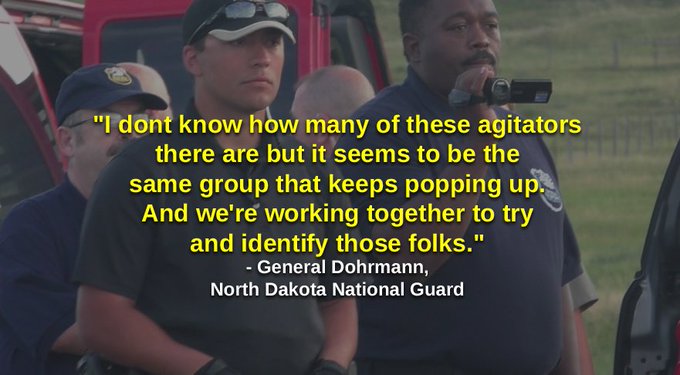
:{:{:(style="position:relative;top:1px;display:inline-block"):}:
}:
General says North Dakota National Guard working with law enforcement to identify "agitators" at #NoDAPL protests.
- :{38:(style="display:inline-block;vertical-align:text-bottom"):}::{38 Replies:(style="position:absolute !important;overflow:hidden !important;width:1px !important;height:1px !important;padding:0px !important;border:0px !important;clip:rect(1px 1px 1px 1px) !important"):}:
- :{215:(style="display:inline-block;vertical-align:text-bottom"):}::{215 Retweets:(style="position:absolute !important;overflow:hidden !important;width:1px !important;height:1px !important;padding:0px !important;border:0px !important;clip:rect(1px 1px 1px 1px) !important"):}:
- :{105:(style="display:inline-block;vertical-align:text-bottom"):}::{105 likes:(style="position:absolute !important;overflow:hidden !important;width:1px !important;height:1px !important;padding:0px !important;border:0px !important;clip:rect(1px 1px 1px 1px) !important"):}:
 :(style="position:absolute;display:inline-block;top:0px;left:0px;width:36px;height:36px;overflow:hidden;border-radius:4px"):}::{Unicorn Riot:(style="font-weight:700"):}: @UR_Ninja

In the documents published by The Intercept, state, local, and federal agencies, as well as TigerSwan, express concern withRed Warrior Camp somehow controlling the larger body of water protectors. The reports and emails also repeatedly claim that Cody Hall, former media spokesperson for Red Warrior Camp, was somehow acting as a mastermind or ringleader. A recurring theme is uncovering what perceived leadership (or “Command and Control”) is responsible for direct actions that stopped pipeline construction.
TigerSwan analysts appear to be unfamiliar with the decentralized organizing models favored by modern direct action movements, and seem to seek out information that fits into an assumed militaristic, hierarchical structure.

TIgerSwan did not respond to The Intercept’s request for comment on the initial story with which the leaked DAPL security documents were published, and has not yet publicly responded to the leaks.
TigerSwan’s Twitter feed – which seems to mostly be used by founder Jim Reese as a personal account – is generally free of any mention of the Dakota Access Pipeline, except for a retweet of a pro-DAPL editorial in the Wall Street Journal written by North Dakota US Rep. Kevin Cramer in December 2016. TigerSwan also retweeted a link to a December 2016 internet radio broadcast from the right-wing outlet The Blaze, in which Jim Reese expresses his admiration for DAPL employees and North Dakota law enforcement and criticizes water protectors as misguided.
“I think people have really forgotten what they’re protesting… I think there are a lot of people who really don’t know the facts…Our frustration now has been with the veterans that have come up over the last several weeks…I’m just not really sure what they’re coming for…we’re seeing people saying “we just coming for a fight because we wanna fight” and i’m just not sure where in our constitution that’s where our protests are because we come ’cause we wanna fight.” – *Jim Reese on*The Buck Sexton Show*, December 5, 2016*
Tom Goldtooth of the Indigenous Environmental Network (IEN) responded to the TigerSwan revelations in a statement published on Saturday:
“The usage of counterterrorism tactics upon our No DAPL movement is not only extremely disturbing, but feeds into a historical narrative of oppression that Indigenous Peoples and People of Color have dealt with for generations. Many of our brothers and sisters incarcerated across the country for their activism are political prisoners as a result of such disruptive tactics used by companies like TigerSwan.
This reminds us of the 1970s, during the Red Power American Indian Movement, where the FBI’s counterintelligence program sought to criminalize our Indigenous organizers and spiritual leaders. However, we will not let such repressive efforts dissuade us from our moral and spiritual obligation to protect the sacred integrity of Mother Earth. We will continue to speak up for the dignity and rights of our Indigenous peoples, and we will resist any attempts to diminish that directive.” – *Tom Goldtooth, Indigenous Environmental Network*
Since The Intercept published their exposé featuring several leaked TigerSwan reports, the @TigerSwan twitter handle retweeted a tweet calling the firm “modern day Pinkertons” – a reference to the Pinkerton Detective Agency, known for violent and sometimes deadly attacks carried out against the labor movement the early 1900’s on behalf of corporate employers. It is unclear if the retweet was done in irony.
https://www.unicornriot.ninja/2017/sheriffs-association-secretly-waged-information-war-nodapl-movement/
no link pix
Sheriffs’ Association Secretly Waged “Information War” on #NoDAPL Movement
JULY 24, 2017
Morton County, ND – A new investigation by DeSmog and Muckrock reveals the behind-the-scenes role played by the National Sheriffs’ Association (NSA) in crafting narratives for law enforcement tasked with protecting the Dakota Access Pipeline (DAPL) from resistance by indigenous peoples and their allies.
Emails obtained through public records requests show the Sheriffs’ Association contracted PR firms Off The Record Strategies and Delve to create a media strategy for law enforcement in North Dakota, as well as researching ways to discredit and disrupt the movement which sought to stop the pipeline. At times, this involved drafting pro-DAPL talking points which were then sent directly to North Dakota law enforcement officials, who often repeated them word for word.
Leaked documents from pipeline security contractor TigerSwan had previously shown how the Sheriffs’ Association, a private organization operating with no public accountability or oversight, directly aided private military contractors in pushing pro-DAPL messaging as well as providing on-the-ground support. The National Sheriffs’ Association also played a key role in bringing out-of-state law enforcement to North Dakota under the Emergency Management Assistance Compact (EMAC). Their website lists TigerSwan as one of their corporate sponsors.
A Webinar hosted by the Sheriffs’ Association on May 7 of this year, featuresCass County Sheriff Paul Laneysharing his history of the events surrounding the resistance to DAPL. His presentation, delivered to an audience of law enforcement from across the country, presents a tactical and strategic analysis of police and military efforts to end direct actions against DAPL and close the water protectors’ camps. Laney worked closely with the Morton County Sheriff and personally coordinated most law enforcement actions throughout months of direct actions, mass arrests, and contested pipeline construction. He also sits on the board of the National Sheriffs’ Association.
The Webinar, entitled “Protest on the Prairie: Law Enforcement Response and Lessons Learned” took place on May 7, 2017, and is publicly available in the National Sheriffs’ Association Adobe Connect portal. We have reproduced a copy of it in full, which you can watch below:
Morton County, ND – A new investigation by DeSmog and Muckrock reveals the behind-the-scenes role played by the National Sheriffs’ Association (NSA) in crafting narratives for law enforcement tasked with protecting the Dakota Access Pipeline (DAPL) from resistance by indigenous peoples and their allies.
LINKS: Emails obtained through public records requests show the Sheriffs’ Association contracted PR firms Off The Record Strategies and Delve to create a media strategy for law enforcement in North Dakota, as well as researching ways to discredit and disrupt the movement which sought to stop the pipeline. At times, this involved drafting pro-DAPL talking points which were then sent directly to North Dakota law enforcement officials, who often repeated them word for word.
Leaked documents from pipeline security contractor TigerSwan had previously shown how the Sheriffs’ Association, a private organization operating with no public accountability or oversight, directly aided private military contractors in pushing pro-DAPL messaging as well as providing on-the-ground support. The National Sheriffs’ Association also played a key role in bringing out-of-state law enforcement to North Dakota under the Emergency Management Assistance Compact (EMAC). Their website lists TigerSwan as one of their corporate sponsors.
A Webinar hosted by the Sheriffs’ Association on May 7 of this year, features Cass County Sheriff Paul Laney sharing his history of the events surrounding the resistance to DAPL. His presentation, delivered to an audience of law enforcement from across the country, presents a tactical and strategic analysis of police and military efforts to end direct actions against DAPL and close the water protectors’ camps. Laney worked closely with the Morton County Sheriff and personally coordinated most law enforcement actions throughout months of direct actions, mass arrests, and contested pipeline construction. He also sits on the board of the National Sheriffs’ Association.
The Webinar, entitled “Protest on the Prairie: Law Enforcement Response and Lessons Learned” took place on May 7, 2017, and is publicly available in the National Sheriffs’ Association Adobe Connect portal. We have reproduced a copy of it in full, which you can watch below:]
Follow
Unicorn Riot @UR_Ninja
National Sheriffs Association coordinating emergency management assistance compacts to crush movements like #NoDAPL https://www.unicornriot.ninja/?p=17321
11:48 AM - Jul 24, 2017
5 5 Replies 118 118 Retweets 57 57 likes
Twitter Ads info and privacy
North Dakota law enforcement, together with the National Sheriffs’ Association, is now presenting the tactics used by police at Standing Rock as a model to be applied nationwide. Various heavy-handed approaches to pipeline opponents are recommended, with an emphasis on combating protesters in the media – an effort at times explicitly called a “media war” or “information war.”
Versions of this talk continue to be presented as training to law enforcement audiences, with presenters sometimes including Morton County Sheriff Kyle Kirchmeier and pipeline security mercenaries from TigerSwan.
View image on TwitterView image on Twitter
Follow
Nat Sheriffs' Assoc. ? @NationalSheriff
Join @CassNDSheriff Paul Laney and his amazing staff as they talk about how they dealt with #DAPL protests. Rm A13. #Sheriffs2017
12:36 PM - Jun 28, 2017 · Reno, NV
1 1 Reply 4 4 Retweets 5 5 likes
In April of this year, officials from the Sheriffs’ Association met with Nebraska’s Attorney General to discuss potential protests against the Keystone XL pipeline. Kirchmeier has also advised officials from South Dakota and Nebraska.
In his presentation, Laney stressed the importance of departments training in advance in Mobile Field Force (riot police) tactics, as well as creating “cut teams” with the know-how to disable lockbox devices used by water protectors to attach themselves to equipment.
Click here to see the complete Federal Emergency Management Agency’s (FEMA) mobile field force (riot police) training module given to North Dakota police for #NoDAPL
Police try to cut through a lockbox used by a water protector to attach themselves to DAPL machinery. August 31, 2016
The cut teams used in North Dakota were put together by Mandan Police Chief Jason Ziegler, who Laney said had experience in the matter from his previous work at the Osceola County Sheriff in Florida.
Other “lessons learned,” presented as advice to law enforcement nationwide for dealing with pipeline protests, include officers not wearing names or badge numbers and being allowed to hide their faces.
Another recommended tactic is “disruption of protester travel” – closing public roads to vehicles suspected of involvement in a demonstration or direct action.
Laney repeatedly stressed his emphasis on identifying “agitators” and repeatedly blamed a “hostile militant element” of “six hundred people or so” for confrontations that occurred in North Dakota. Two such elements explicitly named by Laney were “the eco-terrorist groups out of the pacific northwest” and “the Oglala Red Warrior group.”
The other presenter in the Webinar was Mark Pfiefle of Off The Record Strategies. Pfiefle formerly worked for the George W. Bush administration to coordinate public relations responses to criticism of the Iraq war. Pfiefle celebrated the Morton County Sheriff’s series of “Know The Truth” YouTube videos as a media victory, saying the $40,000 budget for the PR videos (described by one reporter as ‘gonzo propaganda’) was a good investment as it proved its “worth to the brand of the state.”
Towards the end of his presentation, Pfiefle reiterated that both himself and the National Sheriffs’ Association will continue to be available to any law enforcement agency seeking to neutralize opposition to a pipeline in their area.
“Consider us a resource of the National Sheriff’s Association. This is not the end of our activities to help and support law enforcement in areas where the pipelines could be under protest attack in the next days, months and years.” – Mark Pfiefle, Off The Record Strategies
Sheriff Laney’s presentation, which is disseminated as educational content to sworn law enforcement officers, repeated several unfounded allegations as well as numerous claims proven to be false.
Sheriff Laney stated “we knew there were weapons in the camp” to support his characterization of water protectors as armed and dangerous, when in fact, after the main pipeline resistance camp was evicted on February 22, Morton County Sheriff Kyle Kirchmeier said no weapons were found.
He also repeated Morton County’s claim that a media drone was flown directly at a helicopter in an attempt to crash it. Witness testimony to support this claim has repeatedly fallen short in court and felony cases against two different drone pilots have recently been dismissed. He also repeated unproven allegations that a helicopter was attacked with a “bow and arrow.”
When describing the October 27, 2016 incident involving DAPL security contractor Kyle Thompson, Laney said Thompson was ‘abducted’ by water protectors and that Bureau of Indian Affairs (BIA) “was able to get in there and rescue him.” What Laney chose not to mention was that BIA officers had actually arrived to arrest Thompson after he pointed an assault rifle at several unarmed civilians.
While denying the use of water cannons on Backwater Bridge on November 20 (“There’s not a single water cannon in the state of North Dakota”) Laney admitted that fire hoses were used on the crowd and that their use was “effective.” He also claimed that Sophia Wilansky, who nearly lost her arm in an explosion on the night of November 20, was responsible for her own injuries by allegedly rigging an IED, saying “you can see the damage she did to her arm” when showing a picture of Wilansky being transported by medics from the scene.
Eyewitnesses say officers atop an armored vehicle on Backwater Bridge threw a grenade at Sophia as she was running away from rubber bullets being shot from the police barricade.Laney then went on to claim that water protectors had been mass-producing ‘propane bombs’ to attack officers’ families in their homes. No charges against Wilansky, or any person, have been filed to substantiate these allegations. Propane camping cylinders, the alleged explosive materials, are known as being very difficult to ignite. Laney also mistakenly referred to Sophia Wilansky as “Sarah.”
A common thread between all of Laney’s remarks was a doubling-down on a pro-pipeline law enforcement narrative as well as an insistence that water protectors were misguided, and were spreading lies about the pipeline and actions by police.
“People were answering the call. They believed these social media stories that we were abusing people, and that the pipeline was this evil thing that was crossing native land and going through areas that were sacramental to the tribes and the water source was going to be destroyed. And none of that was true.” – Paul Laney, Cass County Sheriff & National Sheriffs’ Association board member
During the Sheriffs’ Association yearly conference last month, Paul Laney was awarded the NSA President’s Award for his role in putting down the #NoDAPL movement. A video recently posted to Facebook announcing the award celebrates Sheriff Laney as a hero and refers to water protectors as “obnoxious” and denounces “biased news stories” about police. (The Sheriffs’ Association has historically been very anti-protest and helped coordinate brutal crackdowns on civil rights and anti-war demonstrations in Berkeley, CA in the 1960s and 70s.)
While public outrage against police violence in North Dakota still simmers, and class action lawsuits are still underway, the right-wing bend of law enforcement subculture means that policies and practices in pipeline policing will likely remain unchanged. As the Sheriffs’ Association continues to plan for repressing future anti-pipeline unrest, Laney’s 17-point “DAPL Lessons Learned” appears poised to become an informal law enforcement doctrine to be applied anywhere in America that the oil industry calls on police to put down popular resistance.
Unicorn Riot has repeatedly tried to contact representatives of the National Sheriffs’ Association throughout the course of our reporting on the #NoDAPL movement; to this date we have not received any response.
Below is Unicorn Riot's coverage of the [#NoDAPL] anti-Dakota Access Pipeline struggle from early summer 2016 to present:March - May 2016
- March 29th, “Tribal Citizens Prepare to Blockade Bakken Oil Pipeline“.
- April 3rd, “Tribal Citizens Build Camp in Path of Oil Pipeline“.
- May 5th, “Sacred Stone Camp Resists Dakota Access Pipeline“.
- May 27th, “Dakota Access Pipeline Blockade Enters 2nd Month“.
August 2016
- After covering the camp in the spring of 2016, Unicorn Riot returned to Standing Rock Reservation on Wednesday, August 10th, when Standing Rock tribal members and allies blocked the entrance to the Dakota Access Pipeline construction site.
- On Thursday, August 11th, a dozen or so people were arrested blocking the construction site entrances.
- Day 3, Friday, the fight to protect land & water intensified around the construction sites of the Dakota Access Pipeline.
- On the 4th day, the pipeline resistance encampment swelled and prepared for more action.
- Monday, August 15th, land defenders stormed the construction site halting construction, and the next day construction was halted as well.
- August 17th saw State Police begin checkpoints, roadblocks, and psyops as protesters united to defend water.
- August 24th, camps prepared as Federal injunction hearing looms.
- Camps Organize to Stay as Injunction Postponed.
- On August 31st, Non-Violent Direct Action Stopped DAPL Construction for Over 6 Hours.
September 2016
- September 6, indigenous water protectors swarmed Dakota Access Pipeline site, stopped work
- September 7, Uŋpa Nuŋpa was interviewed about ongoing #noDAPL actions
- North Dakota highway patrol refused to release email correspondence with Energy Transfer Partners
- September 8, ND National Guard took over Dakota Access Pipeline checkpoints
- Friday, September 9, US Govt. overruled federal judge and requested pipeline construction halted at Lake Oahe
- Meanwhile, cultural activities continued at #NoDAPL camps despite more arrests/warrants
- September 13, 20 were arrested during #NoDAPL lockdown, including 2 Unicorn Riot journalists
- September 14, direct actions continued against Dakota Access Pipeline while legal repression intensified
- On September 16 a federal judge dissolved the unconstitutional temporary restraining order Dakota Access, LLC had filed against Stranding Rock tribal members
- September 19, as solidarity protests spread nationwide, the federal appeals court ordered construction temporarily stop on Dakota Access segment as Solidarity Protests Spread Nationwide
- September 21, #NoDAPL noise demo demanded freedom for jailed water protector Olowan Martinez
- September 22, water protectors disrupted the annual meeting of the North Dakota Petroleum Council
- September 25, water protectors planted trees on DAPL construction site
- In Iowa on September 26, a non-violent direct action from the Mississippi Stand camp stopped DAPL construction for the day
- September 26, a caravan of water protectors stopped work at DAPL site
- September 27, militarized police arrested 23 water protectors in DAPL work stoppage
- September 29, a #NoDAPL solidarity action took place at MN Enbridge office
October 2016
- October 3rd-4th saw the "Toxic Tour," Governor debate disruption, and water protectors attend their court arraignment
- October 4, we learned North Dakota Governor Dalrymple's email inbox was full of support for #NoDAPL
- October 5, Buffer Zone Holds as Caravans Continue to Disrupt DAPL – New Felony Charges
- October 7, 6 Arrested in Iowa #NoDAPL Action, Including Unicorn Riot Journalist
- October 8, Iowa Water Protectors Blockade DAPL Drill Site Twice in 24 Hours
- October 9, Federal Appeals Court Rules to Allow DAPL Construction
- October 10, 27 Arrests After Water Protectors Pray at DAPL Site on Indigenous People's Day
- October 12, Lockdown Stops DAPL Construction in Iowa, 3 Arrested, Including Unicorn Riot Journalist
- October 14, Emails Show North Dakota Budget Bureaucracy Behind #NoDAPL Policing
- October 16, Direct Actions Continue to Stop DAPL Construction in Iowa and North Dakota
- October 17, Four Unicorn Riot Journalists Face Charges For Covering #NoDAPL
- October 17, Water Protectors Blockade Highway in Bismarck, Some Charges Dropped
- October 20, As DAPL Construction Advances, Water Protectors Continue Direct Action
- October 22, Water Protectors’ Prayer Walk Ends up with 127 Arrests, Including Unicorn Riot Journalist
- October 23, Law Enforcement Attack Private Drone as Water Protectors Erect Blockade & New Winter Camp
- October 24, Mississippi Stand Blockades Iowa DAPL Drill Waste Site, Drilling Stops
- October 25, Records Release: Morton County’s Law Enforcement Mutual Aid Assistance Agreement
- Hundreds Flood Minneapolis City Hall to Demand Local Sheriff Withdraw from North Dakota
- October 26, Tensions Rise as Pipeline Construction Nears #NoDAPL Blockade
- October 27, Police and Military Attack Oceti Sakowin Treaty Camp
November 2016
- November 1, #NoDAPL Solidarity Rally & Sit-In in Minneapolis Prods Sheriff into Removing Deputies
- November 1, DAPL Resistance Continues Despite Advancing Construction
- November 2, Police Attack Water Protectors Defending Sacred Sites
- November 5, DAPL Construction Nears US Army Corps Land While Still Lacking Permits
- November 6, Water Protectors Attempt to Reclaim Sacred Burial Site, Demonstrate in Cemetery
- November 8, Dakota Access Announces Plan to Drill Under Missouri River Within Weeks
- November 11, Dakota Access Pipeline Work Stopped As Water Protectors Storm Site; 30+ Arrested
- November 14, #NoDAPL Water Protectors March on ND State Capitol after Caravan Disrupts Construction
- November 14, Mississippi Stand Goes Inside Pipeline and Shuts Down DAPL Construction
- November 14, Army Corps Delays DAPL Easement
- November 15, "No More Stolen Sisters" Demonstration Blockades DAPL Man Camp; 25+ Arrests
- November 16, Despite Army Corps Statement, DAPL Moves Horizontal Drill to Missouri River Crossing
- November 17, Demonstration in Bismarck-Mandan, Cass County Deputies Beat Man Bloody
- November 20, Police Attack Unarmed Water Protectors w/ Rubber Bullets, Tear Gas, and Water Cannons; 300+ injured
- November 21, Land Defense & Water Protection Actions Ripple Across Turtle Island
- November 22, Hundreds Target U.S. Army Corps Building in St. Paul w #NoDAPL Message
- November 22, Anonymous DDOS Munitions Vendor After Sheriffs Attack #NoDAPL
- November 22, #NoDAPL Water Protector Faces Possible Loss Of Her Arm After Police Attack
- November 24, Water Protectors Bridge onto Turtle Island; Mandan Thanksgiving Street Feast
- November 25, U.S. Army Corps of Engineers Announces Intent to Close Oceti Sakowin #NoDAPL Camp
- November 29, Excessive Force Lawsuit Filed Against Morton County Sheriff for November 20 Bridge Assault
December 2016
- December 1, Direct Action Continues To Disrupt Dakota Access Pipeline Construction in Iowa
- December 3, Divest from DAPL; Three Wells Fargo Locations Targeted in Minneapolis, Eight People Locked Down and Two Arrested
- December 4, Army Corps Denies Dakota Access Pipeline Easement
- December 8, Veterans Apologize for Genocide & March to Backwater Bridge in Blizzard
- December 8, Nebraska Supplied State Troopers, Surveillance Aircraft to North Dakota Under EMAC
- December 12, #DivestFromDAPL Action Disrupts Wells Fargo Branch Grand Opening, Doors Secured with Bike Locks
- December 19, First Water Protector Trials Set for January as Another ND Pipeline Leaks
January 2017
- January 2, Massive #DivestFromDAPL Banner Unfurled During Vikings Game at US Bank Stadium
- January 5, Interview: Water Protector who Scaled Vikings Stadium to Drop “US Bank DIVEST #NoDAPL” Banner
- January 15, Indigenous-Led Pipeline Resistance Camps Spread Across the USA
- January 24, Hundreds of Minnesotans Protest, Take to the Streets on Trump’s Inauguration
- January 25, Trump Pushes Forward DAPL & KXL Pipeline Approvals; Resistance Continues
- January 30, Denver Joins Global Prayer Action to #DefundDAPL
February 2017
- February 7, Army Corps Grants Easement as Repression Continues at Standing Rock
- February 17, Eviction Threats Loom as Hundreds Remain at #NoDAPL Camps
- February 22, Militarized Force Executes Eviction of Main #NoDAPL Encampment
- February 23, North Dakota Dismantles #NoDAPL Oceti Camp
- February 27, Three Unicorn Riot Journalists Face Trial This Week From DAPL Coverage
March 2017
- March 2, Three Unicorn Riot Journalists Have #NoDAPL Arrest Charges Dropped
- March 11, Rise With Standing Rock: Native Nations March on Denver
- March 22, Dakota Access Pipeline Sabotaged in Several States, Authorities Claim
April 2017
- April 5, One Year Sacred Stone Celebration
- April 16, North Dakota Sheriff Advising South Dakota and Nebraska on Keystone XL
- April 16, North Dakota Sheriff Advising South Dakota and Nebraska on Keystone XL
May 2017
- May 10, Dakota Access Pipeline Spills at South Dakota Pump Station
- May 29, DAPL Security Leak Shows Coordinated Surveillance and Repression of Water Protectors
June 2017
- June 1, Dakota Access Pipeline Begins Commercial Operations
- June 14, Federal Judge Says Dakota Access Pipeline Environmental Review Was Inadequate