john christy bak
Ala state climatologist!
called out by grijalva
1120 bak html coincidence
---
OMFG
note temp
MMA 7 25
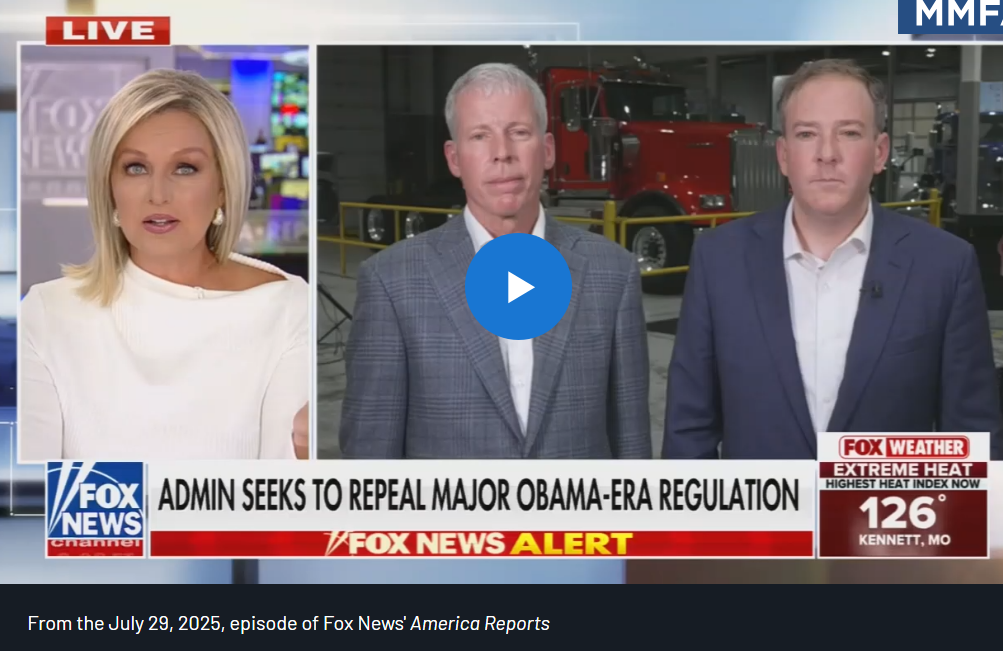
Fox News’ America Reports hosted Environmental Protection Agency Administrator Lee Zeldin and Energy Secretary Chris Wright to discuss the Trump administration's proposal to repeal the EPA’s 2009 endangerment finding, which affirmed that greenhouse gases endanger public health and welfare and which has served as the legal foundation for regulating emissions under the Clean Air Act.
Zeldin and Wright used the appearance to frame the repeal as a return to scientific integrity and regulatory restraint, ignoring the harms that this repeal would have on vulnerable communities. Fox anchor Sandra Smith did not challenge the claims and made no mention of the public health implications or regulatory consequences of revoking the finding. The exchange typified Fox’s pattern of amplifying Trump administration narratives about climate and energy while downplaying their real-world impacts.
Video
Citation
From the July 29, 2025, episode of Fox News' America Reports
The segment typified Fox’s role in obscuring the consequences of climate deregulation
During their appearance, Zeldin and Wright were not pressed on the public health, environmental, or legal implications of the proposal to reverse the endangerment finding. Instead, the host framed the discussion around economic themes and legal processes, asking whether repeal would make it easier to “undo a lot more of the Biden-Obama era climate rules.” Viewers heard nothing about the policy’s real-world impacts, but they did hear climate advocates characterized as ideological or extreme. Zeldin referred to them as “climate zealots,” while Wright framed the repeal as a return to “rationalism” — signaling to Fox’s audience that those who defend public protections are unserious.
This approach mirrors Fox’s longstanding pattern of covering regulatory actions through the lens of efficiency, growth, and personal freedom, while sidelining the communities most affected by the Trump administration's harmful actions. The result is a consistent minimization of climate risk and a distorted narrative in which climate and environmental outcomes are treated primarily as a political liability rather than a public necessity.
By allowing unchallenged repetition of misleading claims, and by omitting the central consequences of the policy under discussion, Fox News once again advanced a message strategy that serves to normalize and obscure the dismantling of basic climate and environmental protections.
Zeldin and Wright advanced a series of unsupported or misleading claims
During their appearance on the July 29 episode of Fox News' America Reports, Zeldin and Wright made a series of unsupported or misleading claims about the endangerment finding and what its repeal would mean for Americans.
Zeldin, for example, asserted that repealing the endangerment finding would yield “$1 trillion in savings”—a figure with no grounding in published EPA analyses or historical regulatory assessments. In contrast, EPA data has consistently shown that rules issued under the endangerment finding and the broader Clean Air Act generate substantial net benefits.
The agency’s Second Prospective Study of the Clean Air Act found that “the central benefits estimate exceeds costs by a factor of more than 30 to one," with most benefits stemming from reduced mortality linked to particulate pollution. By 2020, Clean Air Act programs were projected to prevent over 230,000 premature deaths, as well as millions of asthma attacks, heart attacks, and lost workdays annually.
More recently, the EPA’s Regulatory Impact Analysis for vehicle greenhouse gas standards projected net societal benefits of $272.7 billion between 2022 and 2050, with annualized gains of more than $14 billion, driven by fuel savings, reduced emissions, and avoidance of climate damages. These figures underscore that, far from being a financial burden, regulations grounded in the endangerment finding generate substantial and enduring public and economic value.
Similarly, Wright’s claim that the repeal reflects a return to scientific rigor collapses under scrutiny, relying on a report authored by a small group of contrarian scientists, including Steven Koonin and John Christy, who reject the well-established conclusion that greenhouse gas emissions from human activity are driving global warming and endangering public health. Their views stand in opposition to the broader scientific community, which includes the consensus positions of federal agencies such as the National Aeronautics and Space Administration and the National Oceanic and Atmospheric Administration, as well as the Fifth National Climate Assessment, which was produced by the U.S. Global Change Research Program.
Beyond economic distortions and scientific misrepresentation, Zeldin and Wright also ignored the far-reaching legal consequences of repeal — including for the fossil fuel industry itself.
As Grist reported, rescinding the endangerment finding would not only eliminate the federal government’s core authority to regulate greenhouse gases, it could also expose fossil fuel companies to a wave of climate liability lawsuits previously blocked by federal preemption. Some industry groups have reportedly urged the administration not to proceed, warning that repeal could unravel their legal defenses and leave them vulnerable to a patchwork of state regulations and courtroom challenges.
Fox viewers heard nothing about how repeal would harm the very communities most at risk
Zeldin and Wright also failed to mention what rescinding the endangerment finding would mean for public health, environmental protection, or the EPA’s ability to respond to pollution that threatens the air we breathe, the water we rely on, and the land we depend on to live and work. Viewers were not told that the standards targeted for repeal are central to reducing industrial emissions that worsen heat, flooding, and wildfire risk — or that dismantling these protections would increase illness, displacement, and hardship for older adults, children, low-income households, and rural communities, including many in Fox’s own audience.
---
REF
E AND E POL
Meet the scientists Trump could tap to undermine climate regulations
:{By Scott Waldman, Zack Colman | 03/19/2025 :
Some downplay the threat of global warming. Others question the efficacy of climate policy. All could be of interest to the new administration.
EPA Administrator Lee Zeldin has made it his mission to destroy what he calls the “holy grail” of U.S. climate policy.
But President Donald Trump’s EPA chief can’t do it alone. To smash the holy grail, Zeldin needs help from a rare kind of scientist — the kind who believes climate change isn’t that bad or might even be good for humanity.
Those scientists aren’t easy to find. The overwhelming scientific consensus is that the burning of fossil fuels is heating up Earth, and the planet’s rapid change is putting people at risk for a wide range of calamities — from more extreme storms to rising sea levels to more intense heat waves.
Those threats underpin what’s known as the “endangerment finding” — Zeldin’s holy grail. The 2009 declaration by EPA made clear that greenhouse gases like carbon dioxide are the root cause of climate change, and that EPA has the authority to regulate them under the Clean Air Act because they can harm human health.
The endangerment finding has empowered EPA to establish landmark climate regulations, including limits on the emissions produced by cars or power plants. Rolling back these regulations — and the endangerment finding itself — would require an attack on the climate science that serves as their foundation.
Enter the climate naysayers.
The Trump administration is looking to recruit scientists who could cast doubt on climate science or climate policy, or who view global warming as either a small inconvenience or a boon to humankind.
Once selected, these scientists could add their perspective to a bedrock climate report that comes out every few years, known as the National Climate Assessment. Their contributions to the report, in turn, could be cited as evidence in future efforts to undermine the endangerment finding — all of which would make it easier to quash climate regulations.
The scientists even could help author a second endangerment finding. A Trump-era endangerment finding might, for example, selectively highlight areas of doubt in climate science or tout the perceived benefits of global warming.
To do that, a Trump-approved body of climate findings would center around future scenarios based on lower carbon scenarios than the world is currently experiencing.
It also could emphasize less severe climate trajectories than those envisioned in the original finding, said Roger Pielke Jr., a nonresident fellow at the American Enterprise Institute, a conservative think tank.
“Being able to tease out signals of human-caused climate change in extreme weather — which everybody cares about — are going to be much more challenging with a lower emissions trajectory than a higher one,” said Pielke Jr., who is not involved in any of the efforts and has questioned how scientists can link human-driven warming to specific extreme weather events.
There is a relatively small pool of researchers who could — or would be willing to — engage in such an effort because it would misrepresent decades of climate science by the world’s top science agencies.
“It’s a very small group of people. It’s the same people who have been there for the last 20 years,” said Andrew Dessler, a climate scientist at Texas A&M University. “It’s this endlessly recycled group of people who have been making the same arguments that are unable to convince anybody in the scientific community.”
The White House has not announced its plan yet nor the researchers who might be involved, and it did not respond to a request for comment.
In a statement, an EPA spokesperson said that as “part of this reconsideration process, EPA will leverage the expertise of the White House Budget Office, including the Office of Information and Regulatory Affairs, White House Office of Science and Technology Policy, National Oceanic and Atmospheric Administration, and other relevant agencies.”
Here are some of the scientists who have spent years downplaying climate risks or criticizing climate regulations, and could be tapped by the Trump administration to help Zeldin destroy the “holy grail” of U.S. climate policy.
David Legates
David Legates (second from right) appears at a 2016 event in Washington. | Kris Connor/AFP via Getty Images MORANO
Legates likely would be a key leader. He has worked with Office of Management and Budget Director Russ Vought on a series of proposals to tear down NOAA and to recruit industry and think tank researchers that oppose climate rules to write a government science report.
The two men authored a key chapter outlining their plans in the Project 2025 conservative policy playbook.
Legates, who was the former state climatologist for Delaware until he was asked to step down, served as a top NOAA official in Trump’s first term. He was also detailed to the Office of Science and Technology Policy, but was later removed from that position after attempting to publish a series of research memos that distorted climate science.
For years, Legates has turned a partisan lens to research, claiming that climate change will benefit humanity while climate policy will hurt people. He is affiliated with the Cornwall Alliance, a group of conservative Christian scholars “dedicated to educating the public and policymakers about Biblical earth stewardship.”
Legates declined to comment for this story.
Steve Kooni
Koonin, a New York University physicist and former top scientist at BP, has long pushed to conduct a “red team, blue team” review of climate science, which would pit two groups of scientists against each other to debate a scientific report, such as the National Climate Assessment.
One group would defend the report while the other would highlight its alleged scientific weaknesses. Koonin worked on putting together the effort during the first Trump administration, but the project was eventually scuttled by the White House because some officials were concerned about Trump’s reelection chances.
Koonin said he would prefer to take on the latest report from the Intergovernmental Panel on Climate Change to highlight areas of doubt.
“Anything that I can do to help make the science more transparent, you know, that’s been my goal, and remains my goal, for a long time,” he said.
Richard Lindzen
The retired Massachusetts Institute of Technology atmospheric scientist told POLITICO that he would “of course” help the Trump administration challenge the endangerment finding. Lindzen was dismayed that the red team, blue team exercise to publicly debate established climate science never took off during Trump’s first term.
A longtime critic of accepted climate science, Lindzen applauded Zeldin for calling “bullshit” on a “fake issue” of the severity of rising temperatures. But he acknowledged there may be little upside given how much the scientific community has supported the conclusion that human activity is driving climate change, even if he disagrees with it.
Lindzen argued the courts may offer the most direct route, where he said EPA should argue there “was never any evidence in the first place” to suggest greenhouse gases meet a legally defined standard of dangerous.
“I have no idea what they’re going to do,” he said. “But I think it’s pretty obvious when Trump is running on the issue of ‘Drill, baby drill,’ that he is not going to pay any attention to what is claimed to be the science.”
Ryan Maue
Maue has not had any communication with the Trump administration about serving in any science advisory or agency role, he wrote in a text message. But the libertarian meteorologist would be a natural fit: He served at NOAA and the Office of Science and Technology Policy in Trump’s first term.
Maue agrees that humans are warming the planet, but he has pushed back against stringent government policies to rein in greenhouse gases.
He has often used his large social media following on X to dispute the connections between climate change and specific extreme weather events. He has repeatedly cautioned that the world is not following the worst-case scenario climate trajectory, calling it “highly implausible” — a view that could align with Trump administration thinking to emphasize less dire forecasts.
Judith Curry
Curry said she would help the Trump administration reconsider the endangerment finding if she could work from home, but noted there’s been no outreach from Trump’s team.
The Georgia Tech professor emerita argued the original endangerment finding was “politically driven,” and that its reliance on worst-case climate scenarios compelled more drastic policy than necessary. Despite U.S. greenhouse gas reductions falling 17 percent below 2005 levels, the nation is still off-track of the U.S. share of reductions needed to stabilize global temperatures.
An additional 2 to 3 degrees Fahrenheit of warming by 2100 — which is aligned with current trajectories — “isn’t a big deal because it’s what we’ve seen over the last 100 years, and we’re doing just fine,” said Curry, who is now president of consulting firm Climate Forecast Applications Network.
Scientists have said such increases have brought and would bring massive biodiversity loss, more intense extreme weather events, deadlier heat waves and economic harm through natural disaster damage, lost labor productivity, food insecurity and deteriorating health.
While Curry said there are “plenty of reasons not to like fossil fuels” and that clean energy investment is needed, she claimed “policy isn’t going to help here.” An endangerment finding that reflected less severe consequences for failing to deal with climate change “takes away the urgency for doing all of this” through government policy, she said.
John Christy
Christy is a climate scientist at the University of Alabama in Huntsville and a former lead IPCC author. He has questioned whether humans are driving the observed warming trends in recent decades — something the world’s top science agencies have long confirmed.
He opposed the endangerment finding in 2009 and has questioned the climate models on which it was based in congressional testimony. He is also a longtime proponent of applying a red team, blue team exercise to climate science.
Christy said he believed he could identify weaknesses in the first endangerment finding and that he could use research from the last 15 years to further his argument if the Trump administration pursued a second endangerment finding.
“I would like to see a very clear demonstration that climate models are not capable of telling us about the future of climate to the level of the CO2 forcing that is occurring in the atmosphere,” he said.
In fact, climate scientists have tested the models on which they rely and have found a notable amount of accuracy, particularly the latest versions, which are far more sophisticated than the models of the past.
Will Happer
Happer was part of Trump’s National Security Council in the first term, who mostly worked on classified military projects. He is a professor emeritus of physics at Princeton University, though not a climate scientist.
Happer is one of the few scientists who have given Trump a briefing on climate research, though his views are not supported by the world’s leading science agencies. Happer has long cast doubt on the role humans play in driving global warming and has been a vociferous opponent of climate policy.
In Trump’s first term, Happer worked on the effort to conduct an adversarial review of climate science with Koonin. After that effort was torpedoed by White House officials, Trump told Happer that he wanted to bring him back for a red team, blue team effort in his second term. Trump even discussed a potential nationally televised science “debate,” Happer told POLITICO.
“If I see an opportunity to help, I will,” Happer said. “I think it’s long overdue.”
---
roy sp
shots Fired into the Christy/Spencer Building at UAH
April 24th, 2017 by Roy W. Spencer, Ph. D.
A total of seven shots were fired into our National Space Science and Technology Center (NSSTC) building here at UAH over the weekend.
All bullets hit the 4th floor, which is where John Christy’s office is (my office is in another part of the building).
Given that this was Earth Day weekend, with a March for Science passing right past our building on Saturday afternoon, I think this is more than coincidence. When some people cannot argue facts, they resort to violence to get their way. It doesn’t matter that we don’t “deny global warming”; the fact we disagree with its seriousness and the level of human involvment in warming is enough to send some radicals into a tizzy.
Our street is fairly quiet, so I doubt the shots were fired during Saturday’s march here. It was probably late night Saturday or Sunday for the shooter to have a chance of being unnoticed.
Maybe the “March For Science” should have been called the “March To Silence”.
Campus and city police say they believe the shots were fired from a passing car, based upon the angle of entry into one of the offices. Shell casings were recovered outside. The closest distance a passing car would have been is 70 yards away.
This is a developing story. I have no other details.
UPDATE: Local news reports that UAH police have classified this as a “random shooting”. So, the seven Belgian 5.7 millimeter bullets which hit windows and bricks around John Christy’s office from 70 yards awaywere apparently deemed to be “random” occurrence. (Despite my personal defense training, I probably would have struggled to get that tight a “random” cluster with a semi-automatic pistol.) Nothing to see here, move along.
---
Update on Possible Ecoterror Attack at UAH
April 26th, 2017 by Roy W. Spencer, Ph. D.
Ecoterrorism. Eco-terrorism is defined by the Federal Bureau of Investigation as “the use or threatened use of violence of a criminal nature against people or property by an environmentally oriented, subnational group for environmental-political reasons, or aimed at an audience beyond the target, often of a symbolic nature.” -Wikipedia
It appears that at least some people are beginning to take the shots fired into the side of our building a little more seriously.
By way of clarification, the March for Science here on Saturday did not pass right by our building, but started farther down our street. (As I’ve said before, the shots would not have been fired during the march. The expensive “boutique” FN Five-seven [5.7 mm] gun used has a loud report — everyone would have noticed.)
Also, there seems to be some disagreement whether all shots hit John Christy’s floor (4th floor of the NSSTC). UAH Chief of Staff Ray Garner has been quoted in this AL.com story that a few shots hit the third floor. I did not see those when surveying the outside; each floor has about 5 ft of window at the top, and 3 ft of siding below the window. Some of the bullets hit the siding below the window. Below the 4th floor would then be 5 feet of window on the third floor, and no third floor windows were hit that I could tell.
But it doesn’t really matter. The bullets all hit near John Christy’s office.
In fact, these details miss the big picture of this event. Even if: (1) the bullets had hit the other end of the building, (2) on the first floor, (3) it didn’t happen on Earth Day weekend, and (4) there was no March for Science that weekend, I would still consider 7 shots fired into our building a probable act of ecoterrorism.
I am not surprised this happened at all.
For the last 25 years our science has been viewed as standing in the way of efforts to institute a carbon tax or otherwise reduce carbon dioxide emissions. The amount of money involved in such changes in energy policy easily run into the hundreds of billions of dollars… more likely trillions.
When I was at NASA, my boss was personally told by Al Gore that Gore blamed our satellite temperature dataset for the failure of carbon tax legislation to pass.
So why am I not surprised that our building was shot up?
Because people have been killed for much less reason than hundreds of billions of dollars.
This is why the FBI needs to get involved in this case, if they haven’t already. Ecoterrorism is a federal crime. There were federal employees in the building at the time the shots were fired into the building.
The original media reports that the event was a “random shooting” were, in my opinion, irresponsible. As far as I know, there were no questions asked of us, like “Do you know why someone might have intentionally shot into your building?”
Well, hell, yes I know why. And I’m a little surprised it didn’t happen sooner.
John and I have testified in congress many times on our work. John has been particularly effective in his testimony over the years. While I believe the shots were a “message” to us, I don’t think John or I are that worried for our personal safety. Whoever did this is most likely not going to approach us and physically threaten us in person. Instead, we mostly just get hate mail. Nevertheless, just in case I took personal defense training with firearms years ago.
I doubt that the perps will ever be identified. But if UAH employees want to have a sense of safety, it is not helpful for such an event to be deemed a “random shooting” within only six hours of it being reported, and the public told it won’t be investigated any further. Last evening, the UAH police sent out emails to everyone on campus asking for any additional information related to the shooting, and correcting their previous statement that no one was in the building during the shooting (NWS employees are here 24/7). The FBI needs to also be involved in this, sending a message that if anyone tries to do this again, there might be consequences.
The parents of students considering attending UAH would expect no less.
CLARIFICATION: I didn’t mean to imply the motive for the shooting was necessarily financial, although the perps could have been paid to do what someone else was afraid to do on their own. It’s more likely they are religiously motivated, hoping to Save the Earth. Of course, the evidence that more carbon dioxide in the atmosphere is good for life on Earth is not part of their religion.
---
you'd think they wd be pretty careful/sure given
Three people were killed and three others wounded in a shooting at the University of Alabama in Huntsville (UAH) in Huntsville, Alabama, on February 12, 2010. During a routine meeting of the biology department attended by approximately 12 people, Amy Bishop, a biology professor at the university, stood up and began shooting those closest to her with a Ruger P95 handgun.
Amici Curiae Brief on CO2 case
Amici Curiae Brief of Climatologists and Scientists Sallie Baliunas, John R. Christy, Chris De Freitas, David Legates, Anthony Lupo, Patrick Michaels, Joel Schwartz, and Roy W. Spencer in Support of Respondents. by CEI Staff October 24, 2006http://www.cei.org/gencon/030,05572.cfm
Amicus brief written by Competitive Enterprise Institute
IN THE SUPREME COURT OF THE UNITED STATES COMMONWEALTH OF MASSACHUSETTS, et al., Petitioners, v. U.S. ENVIRONMENTAL PROTECTION AGENCY, et al., Respondents. On Writ of Certiorari to the United States Court of Appeals for the District of Columbia Circuit AMICI CURIAE BRIEF OF CLIMATOLOGISTS AND SCIENTISTS SALLIE BALIUNAS, JOHN R. CHRISTY, CHRIS DE FREITAS, DAVID LEGATES, ANTHONY LUPO, PATRICK MICHAELS, JOEL SCHWARTZ, AND ROY W. SPENCER IN SUPPORT OF RESPONDENTS SAM KAZMAN* HANS BADER CHRISTOPHER C. HORNER COMPETITIVE ENTERPRISE INSTITUTE 1001 Connecticut Ave., NW, #1250 Washington, D.C. 20036 (202) 331-2265 *Counsel of Recordhttp://www.cei.org/pdf/5572.pdf
==
https://insideclimatenews.org/news/02112020/john-christy-alabama-climate-contrarian/
=?
https://insideclimatenews.org/news/3010**2020**/john-christy-alabama-climate-contrarian
As the Trump administration went about weakening vehicle fuel economy standards earlier this year, the climatologist John Christy made his own calculations of how the change would affect Earth's climate.
His conclusion: Not at all.
In ananalysis he put together for the Environmental Protection Agency's elite board of outside science advisors, of which he was a member, Christy argued that Earth's climate simply wasn't that sensitive to changes in carbon dioxide. So neither the weakened federal standards, nor California's tougher standards, which the Administration repealed as part of its rollback, would make any difference.
"My analysis showed that it doesn't make a difference which rule you pick," Christy, a professor and interim dean of the College of Science at the University of Alabama in Huntsville, said in an interview. "You can have the California rule for the whole country or California accept the rest of the country's rule and the amount of carbon emissions are so tiny relative to the world, it's not going to make a difference in whatever the climate is going to do."
It's an assertion that flies in the face of mainstream science. But it is right in line with the argument that Christy has been making for 30 years, drawing on his pioneering—but hotly disputed—work on satellite temperature readings. He has argued before Congress and elsewhere that the Earth is not heating as quickly as climate models predict, and that society should not make the costly decision to curb fossil fuel consumption based on what he often describes as the "murky" science of climate change.
christy is perhaps the most prominent of a group of climate science outsiders who have become insiders in the Trump era. He has gained a seat on the EPA's Science Advisory Board, and won a $1.5 million Department of Energy grant for his research into the contrarian notion that the Earth's climate is relatively insensitive to carbon emissions. Recently, the Trump White House offered Christy the job of chief scientist at the National Oceanic and Atmospheric Administration, but he turned it down and the post went to another scientist.
Christy's ascent to the center of influence is an example of how the Trump administration has weaponized contrarian science to deny climate change. Scientists like Christy are especially useful to Trump, allowing the president to convey the misleading message that there is a serious dispute in the scientific community over whether the Earth is experiencing dangerous warming in response to the increasing carbon dioxide levels in the atmosphere.
Although Christy's data have been corrected repeatedly and his conclusions contradicted time and again by other climate scientists, the administration has given him new clout. That platform and support may prove important in the long court battles ahead over the administration's retreat from climate policies such as the fuel economy standards. The Trump administration can argue that it followed the recommendations of science advisers like Christy to counter legal challenges by states and environmental groups who argue that the rollbacks have been "arbitrary or capricious," the legal test the courts apply to decide if a regulation should be overturned. The fossil fuel industry, which already has used Christy's work to cast doubt on the science of climate change, can add his new U.S. government-funded research to its case for slowing down climate action.
Michael Mann, a climate researcher at Penn State University, said he likes Christy, and considers him a friend, but that his statements don't match up with the actual evidence about climate change.
"John has gone on to play a contrarian role in general when it comes to the science and impacts of climate change, often downplaying the threat in a way that is not true to the actual scientific evidence," Mann said. "I wish he wouldn't do that."
An Evangelist for Fossil Fuels
Born in Fresno, Christy describes himself as a life-long weather nerd, and recalls obsessing over cloud patterns as a teenager and using the programming language Fortran to generate his own weather forecasts while still in high school in the late 1960s.
He is 69 now, with a wiry frame, a slightly bushy mustache and a quick, bounding gait. An ultra-marathon runner, he looks 69 going on 50, and still keeps in his office volumes of weather recordings dating back to his time as a teenager in California.
After earning an undergraduate degree in math at Cal-State Fresno in 1973, Christy packed his bags for Nyeri, Kenya, where he spent two years as a Christian missionary.
It was a seven-day a week job, teaching physics and math at a Baptist high school, that stretched from 7 a.m. until lights out at 10 p.m. and included cleaning and other chores on weekends.
During his missionary days, Christy said, he saw firsthand what the world looked like without easy access to energy. He believes that limiting carbon emissions in the United States would be ineffective in stopping climate change and that keeping developing nations from benefiting from what fossil fuels provide would be downright immoral.
Sitting at a small conference table in his fourth floor office at the university, Christy's eyes light up while explaining his work, a professor in the thrall of lecturing on his favorite topic.
"There's no question that carbon-based energy has made for longer, better lives," Christy said. "You know, I lived in Africa for a while and without energy, life is brutal and short. And I wish these environmentalists would go live in a country like that for a while and understand that, understand why they are going full bore on energy production."
[pix: John Christy, a professor of atmospheric science at the University of Alabama in Huntsville and Alabama's state climatologist, was recently named to the U.S. Environmental Protection Agency's Science Advisory Board. Credit: Joe Songer/AL.COM
In Christy's view, renewables like wind and solar are insufficient for the kind of energy production needed in the modern world.
"I try to tell people about why there's just not enough energy there," he said. "I can stand in the sunlight. It doesn't bother me at all. If the wind is blowing, doesn't bother me at all. That tells you right there, it has very little energy.
"But if I stood inside the boiler of a natural gas or coal fired power plant, I'd be incinerated. That's where the energy is."
Climate scientists who advocate a transition to cleaner energy say they are not arguing that poor nations should be left behind. Christy "is saying there's only one path to development and the way we did it 300 years ago is the way you have to do it today." said Texas Tech University climate scientist Katharine Hayhoe, who hosts the PBS Series "Global Weirding." And, she added, "We just know that that's not true."
"It's like saying you need Model T Fords first before you can have electric cars, or you need a party line telephone first before you can have a cell phone," Hayhoe said. "Poor countries are already leapfrogging right over fossil fuels."
Atmospheric scientist Kevin Trenberth, a former teacher of Christy's, came to part ways with him over his science and views."He believes that any increase in the price of fossil fuels will hurt the ability of poor Africans to develop," Trenberth said in an email. "What he has totally failed to include or comprehend is that climate change hurts Africa as much or more than any other region (perhaps except Australia) because of drought and floods.
"Certainly his heart is in the right place, with great empathy for the Africans he was with," Trenberth said, "but his brain is not."
From Pastor to Teacher
Arriving back in the United States, Christy pursued a religious vocation. He earned a Master's in Divinity from Golden Gate Baptist Theological Seminary and, in 1975, married Alice "Babs" Joslin, a fellow missionary who taught English at the high school when they both were in Africa.
The couple moved to Yankton, South Dakota,on the Missouri River, where Christy served as the founding pastor of the Grace Baptist Church. Money was in short supply, so he began teaching, first at Yankton College and then at the University of South Dakota. He found that he loved it, especially teaching math and science, and took a leap of faith, uprooting his family and entering graduate school at 31.
"My wife must have thought I was crazy, because we were just barely making it in South Dakota, and I'm going down to be a graduate student for five years with two kids in Illinois," Christy said.
christy pursued a Master's degree and then a Ph.D. in atmospheric science at the University of Illinois. One of his professors was Trenberth, who was then doing pioneering research on the interaction between the atmosphere and the oceans. When Christy embarked on a doctoral dissertation on the redistribution of atmospheric mass associated with extreme events, Trenberth became Christy's Ph.D. adviser.
"He came to me late after serving as a missionary in Africa," Trenberth recalled in an email. "His skills were rusty but he did OK work on his thesis." Christy's wife, Babs, even worked for a time for Trenberth as an administrative assistant. "So we had close ties once," Trenberth said.
The connection did not last. Trenberth moved to the U.S. National Center for Atmospheric Research in Boulder, Colorado, in 1984, and went on to become one of the world's leading experts in climate change science and modeling. Christy, who finished his doctorate at 36, embarked on a career devoted to trying to prove the climate modelers wrong.
In 1987, he accepted a job at the University of Alabama in Huntsville, one of the nation's largest research and technology centers and the home of the National Aeronautics and Space Administration's Marshall Flight Center, and set off on a 30-year roller coaster ride through the climate science community.
Christy's Innovation: Satellite Temperature Reading
In Huntsville, Christy began working with a NASA scientist, Roy Spencer. Spencer shared Christy's religious orientation—he has written aboutrejecting the science of evolution in favor of the creationist theory known as intelligent design, and described himself as a "Bible-believing scientist"—and Christy's skepticism over an issue that by the late 1980s was creating an upheaval in atmospheric science: climate change.
In one of their first paperstogether, published in the prestigious journal Science, Christy and Spencer raised questions about the global temperature record, arguing that thermometers on Earth's surface were too few, too spread out, too subject to human error and too affected by urban heat to be trusted to create a reliable record.
Drawing on Spencer's expertise from the space program, they worked together on a new method of charting temperatures, using instruments on weather satellites that had been aloft since 1978. Christy and Spencer argued that these orbiters, which circle Earth at its poles 14 times per day, could scan the entire planet and take readings at different layers of the atmosphere.
Together, they developed a technique for measuring temperatures from space—no easy feat, because there's no such thing as space-based thermometers. They calculated temperature readings from microwave radiation signals emitted by oxygen molecules at different altitudes, and captured by sensors aboard the spacecraft. It was considered a breakthrough, and earned the pair NASA's Medal for Exceptional Scientific Achievement in 1991.
In the wider world, Christy and Spencer were also getting attention—not for their technique, but for what they said it revealed. They reported that their new measurements showed that there had been no discernible climate change over the last decade. "Satellites Find No Sign of Global Warming in the 80s," said the headline on an Associated Press story carried in The New York Times. "Some experts say the earth is beginning to warm as a result of carbon dioxide and other gases dumped into the atmosphere over the last 150 years of industrial civilization," the story said. But the first space-based measurements showed only a slight temperature increase in the northern hemisphere and a slight decrease in the southern hemisphere.
"The net effect for the globe is basically zero,'' Christy was quoted as saying.
He added, in a 1993 interview, referring to the heat in urban areas from blacktop roads, "What we may be witnessing is the asphalt effect rather than the greenhouse effect."
As Christy and Spencer updated their data over time, the temperatures they recorded diverged even more from the surface temperature record. By 1995,their data indicated that the planet was, in fact, cooling, not warming.
The doubt they raised about global warming, amplified by the fossil fuel industry and other foes of climate action, has been long-lasting. Their science has not been quite as durable.
The Relentless Refutation of Christy's Science
Over time, studies uncovered layer upon layer of flaws in Christy's analysis, with his old dissertation advisor, Trenberth, chief among his early critics.
Trenberth and others showed that space-based temperature reading—far from being a precision science—involved applying complex mathematical formulas to adjust for the vagaries of satellites themselves. Satellites drift east and west, their orbits decay, they retire altogether, with new satellites taking their place. Each anomaly could skew the temperature readings in a different way.
In 1997, Trenberth and a colleague at the National Center for Atmospheric Research showed that abrupt "downward jumps" in Christy and Spencer's temperature readings coincided with changes from old satellites to new satellites, accounting for their "cooling" finding. Climate scientist Andrew Dessler of Texas A&M has explained it this way: "Suppose you are trying to watch your weight, but your scale breaks and a month passes before you buy a new one," he said. "If the new scale says you are two pounds heavier than your last reading on the old scale, does this mean you have gained two pounds? Or does the new scale just read two pounds heavier than the old one?"
A team from the California research firm Remote Sensing Systems(RSS) showed in 1998 that satellites lose altitude over time, at a rate that varies year-to-year, depending on solar activity. Christy and Spencer, the RSS team showed, failed to account for how their angle of observation changed with this orbital decay.
Although Christy and Spencer had developed "an extremely valuable air temperature record," the RSS scientists said, the satellites "were originally designed with meteorological objectives in mind, and their ability to measure very small climate variations is limited." RSS would soon begin putting together its own satellite temperature data set, obtaining consistently different results from those of Christy and Spencer.
In 2004, scientists at the University of Washingtonpublished evidence that Christy and Spencer's readings of what was purported to be the lower atmosphere—the troposphere—were being polluted by the cooler upper atmosphere, the stratosphere. The following year, the same team in Washington showed that Christy and Spencer's temperature plots were biased by the satellites' east-west drift.
Christy and Spencer responded to the critiques by adjusting their calculations, and by 1998,they had backed off their cooling finding, reporting a global warming trend apparent in their data, albeit a slight one. At one point, Christy introduced an algebraic error into his orbital drift re-calculations, making it look like the lower atmosphere warmed at night and cooled during the day. Christythen corrected that error, thanking the RSS scientists who pointed it out in a letter to Science magazine.
Christy and Spencer have insisted that with that one exception, they were not correcting errors but making the kind of improvements that have been made in all temperature records over time. "In the 25+ years that John Christy and I have pioneered the methods that others now use, we made only one 'error,'" Spencer wrote in a 2019 blog post.
Christy said his critics are unfairly attempting to use that single error to discredit his entire body of work.
He said critics ask themselves, '"How can we dismiss John Christy's science?'" and then answer, "'Well, we can talk about that time when his satellite data was found to have an error.'"
He added, "Even though it was 15 years ago and it was corrected."
Judith Curry, a climatologist who also has questioned climate models and is seen as a contrarian, says that Christy has done the kind of careful data analysis that is key to understanding past climate variability and change.
"John Christy's work was seminal in applying satellite data to interpreting global atmospheric temperature variability," said Curry, the former chair of the School of Earth and Atmospheric Sciences at the Georgia Institute of Technology, in an email. "In addition to satellite data, Christy has done some very careful and important analysis of historical weather/climate data for the U.S. in interpreting the variability and change. He has also conducted important research on evaluating the simulations of global climate models."
But mainstream climate scientists who have analyzed the work of Christy and Spencer say the problem is more profound than a single mistake.
"The history of the UAH tropospheric temperature data sets is a history of serious scientific error," said Benjamin Santer, a climate researcher at Lawrence Livermore National Laboratory, referring to the University of Alabama in Huntsville. "Most of the serious errors in UAH temperature data have been detected by other research groups, not by UAH scientists."
Embraced by Industry, a Rift With Climate Scientists
While the debate was raging over Christy's work in the scientific community, he was accumulating a following in the fossil fuel industry and the U.S. Congress.
"Sensitive satellite measurements have shown no warming since the late 1970s," said then-ExxonMobil chief executive Lee Raymond ina speechon the eve of the 1997 Kyoto climate talks. "In fact, the earth is cooler today than it was 20 years ago."
In 2001, ExxonMobil's chief lobbyist successfully recommended that President George W. Bush's administration choose Christy to review the submissions of the U.S. team contributing to the Intergovernmental Panel on Climate Change's Third Assessment Report, an assignment that helped burnish his scientific credentials.
Christy became a frequent witness on Capitol Hill. He has testified before Congress some 20 times, typically at the invitation of Republican lawmakers looking to cast doubt on the science of human-caused climate change. When asked about warming, Republican Texas Senator Ted Cruz**frequently invokes**the superiority of Christy's satellite data, which shows no such trend.
[pix; Weather records show data recorded by Alabamians that date back to the late 1800s. Credit: Joe Songer/AL.com
Christy is adamant that he does not take money from fossil fuel companies, saying, "No one would take me seriously," if he were on Big Oil's payroll. But a wide array of Libertarian activists and groups that receive industry funding have promoted the work of Christy and Spencer, including the Western Fuels Association's Greening Earth Society, the think tank the Heartland Institute, and the Competitive Enterprise Institute.
Christy's argument has shifted from the early days of his work, when he challenged the notion that global warming was taking place. Since at least 2007, he has acknowledged that the Earth is warming, but not as quickly as the climate models predict. A team from NASA, the University of California, Berkeley, and Massachusetts Institute of Technology recently published a studyshowing that global sea-surface temperatures were well in line with climate models. But Christy, Spencer and others who rely on their work often display a chart that plots their satellite readings against those of the climate models that show no such agreement. It has become iconic among those who challenge climate science.
Although the chart itself has not been published, it is based on a 2007, peer-reviewed paper, of which Christy was a co-author.That paper, too, became a lightning rod for criticism. Other researchers said that if Christy had included the full range of uncertainty in both his own data and in the climate models, the projections and observations would have been shown to overlap. And in a paper published in 2008, a team of scientists from 12 institutions found that Christy and his colleagues did not account for the effect on their temperature readings of natural non-climate factors like El Niños and La Niñas.
That team was led by Santer, who had won a MacArthur "genius" award for his work identifying the man-made causes of global warming, and who had become an especially harsh critic. Santer said he believes that Christy is more interested in proving his satellite data is correct than getting to the bottom of what is happening with the climate.
"Most of the scientists I've met in my career have genuine interest in advancing scientific understanding," Santer said in an email. "In my opinion, Prof. John Christy does not."
Santer was harsher in private, as became clear in 2009 when a hacker broke into a server in the United Kingdom, retrieved thousands of emails exchanged among climate scientists and posted them on the Internet.
"John Christy has made a scientific career out of being wrong," Santer wrote to colleagues in a 2008 email. "He's not even a third-rate scientist."
To Christy, the so-called "Climategate" emails provided evidence of his unfair treatment.
To this day, Christy keeps taped to his office door a reminder of the disparagement—a crude photo illustration that one of the climate scientists circulated, depicting Christy along with other prominent critics of climate science, trapped on a disappearing iceberg at the North Pole.
A caption on the iceberg illustration has the chorus of skeptics saying, "Global warming is a hoax," while Christy, kneeling at the water's edge, chimes in with "Satellite readings show continued cooling," and a pensive polar bear stands on its hind legs, looking on.
"They even started calling us deniers, which has a Holocaust reference to it, and it's just really offensive and derogatory, denigrating,"Christy said. "We don't deny climate change. We don't deny that there's extra CO2 in the atmosphere. We don't deny that it has an effect on climate. We are trying to find out how much."
Christy, Spencer and a few other stalwart contrarians remain apart from the rest of the scientific community, where a consensus on the danger of anthropogenic greenhouse gas emissions has grown, a result not only of the temperature data, but of evidence like the retreat of sea ice, the loss of glaciers, the amount of snow cover, ocean heat content, the change in the chemistry of oceans, the paleoclimate record, the migration of species, the stress on ecosystems and other lines of evidence.
"I don't think it is tenable anymore for him to argue that there is any inconsistency between the satellite data and all of the other datasets that demonstrate the warming of the surface and atmosphere," said Mann, the Penn State climate researcher. "There just isn't."
However, when the Trump administration began to implement its agenda to dismantle federal policy on climate change, Christy's work gained new prominence and a new source of support.
In Trump's Washington, Christy's Star Rose
Before the 2016 election, Christy lamented the lack of federal funding for his work.
"Contrarian proposals, such as one I might write, that want to, say, look rigorously and test climate models against reality or to test various ideas about how natural variability causes these changes, are rarely, if ever, funded," he said at a December 2015 Congressional hearing.
Spencer had expressed similar frustration on his blog: "We scientists who still believe that climate change can also be naturally forced have been virtually cut out of funding," he wrote in 2013.
But in September 2018, Trump's Department of Energy announced that Christy and Spencer's team had been selected for a three-year, $1.5 million grant to develop a new method of determining how the Earth's climate is responding to greenhouse gases. In a press release, the UAH team said they thought their approach would be "more accurate than current methods."
The research will use Christy's satellite measurements, which generally record cooler temperatures than those recorded by other groups studying the same satellite readings. Christy said he would combine those with measured snowfall amounts in three Pacific coast states to find how much human-generated carbon dioxide emissions have impacted the climate.
In an interview, Christy said the results of his research could be "part of the evidence that can be used, say in court, to say the Obama administration's actions and regulations on climate change were based upon inferior information."
In 2019, the Trump administration gave Christy an even greater show of support, when he was selected to serve on EPA's Science Advisory Board, a 45-member panel of outside scientists who are meant to provide input on major agency initiatives. The EPA often points to the advice of its Science Advisory Board when it writes new regulations, in order to counter the inevitable legal challenges the agency faces over its major actions.
Christy's appointment was part of a dramatic overhaul of the advisory board under Trump's two EPA administrators, Scott Pruitt and Andrew Wheeler. Pruitt created an unusually large number of openings on the board by instituting a new rule, barring scientists who received EPA grants from serving as board members. (Because Christy's grant came from the Department of Energy, not EPA, he was not barred by the conflicts policy.)
The EPA announced in August that EPA grant recipients would no longer be barred from the board, after two federal judgesruled that the policy was illegal. Christy's three-year term continues through 2022.
Earlier this year, Christy provided input to the Science Advisory Board as it considered the Trump rollback of fuel economy standards and the withdrawal of California's authority to set its own standard, which was tougher than the federal regulation. The weakening of passenger vehicle standards is expected to havethe largest greenhouse gas impact of any of Trump's anti-climate moves, resulting in the release of more than one gigaton of additional carbon into the Earth's atmosphere by 2035—the equivalent of one current year's worth of transportation emissions from the European Union.
But in a memo to the advisory board, Christy said whatever rule the Administration adopted, it would have no measurable impact on the climate.
"Consequently," he wrote, "it seems to me, one should take the pathway that leads to healthy economic development, especially for the more financially-constrained citizens of our country."
The board included Christy's perspective in a footnote: "Some members of the Board noted that the direct impact on global temperatures would be very small," they said.
Christy's advice may prove important because the administration, after finalizing its rollbackof fuel economy standards in March, is now in federal court defending the move against lawsuits by California and other states, as well as environmental groups. Part of the Trump administration's legal argument is that the California standards have no impact. "They do not meaningfully reduce the overall U.S. contribution of greenhouse-gas emissions to the world inventory of such emissions," the Trump administration said in its brief in September.
Gretchen Goldman, research director of the Union of Concerned Scientists' Center for Science and Democracy, said that the appointment and funding that the Trump administration gave Christy will have an impact long beyond Trump's term in office. "Historically, the scientists on these advisory committees were not chosen for their policy views," she said. "But the Trump administration has treated these like political positions, putting in people who were friendlier to their agenda. And by elevating people like Dr. Christy, they hope to get more of an appearance of scientific backing for their policy positions, even when those positions don't enjoy broad support from the scientific community."
At Home in Alabama
Christy continues to have plenty on his plate in Huntsville, where he is director of the university's Earth Systems Science Center and interim dean of the College of Sciences, with its more than 1,700 undergraduate and graduate students.
Since 2000, Christy has also served as Alabama's state climatologist, an office with $850,000 a year of state funding, through the University of Alabama System budget. (For comparison, the entire Alabama Department of Environmental Management, which polices industrial pollution in Alabama, received only $575,000 in direct state funding in 2019.)
In addition to working to improve weather monitoring capabilities in the state, and keeping records of climate conditions in Alabama, some dating back to the 1800s, Christy said he also plays a role in the state's economic development. Although the details of that work are confidential, he said, he was able to allay the fears of a manufacturer who was considering expanding by assuring the company that tornado risk was low.
Christy is also still active in his church, First Baptist in Huntsville, occasionally leading discussion groups about the intersection of science and religion. Huntsville, known as the Rocket City because of the NASA center, has a huge, per capita quotient of engineers and scientists, even in its Southern Baptist Bible study groups.
Christy met his second wife in the church choir, after Babs—a locally beloved figure in her own right—died of cancer in 2014.
"I know that John is a man of faith and that his faith informs his view that we must do all we can to help our fellow human beings," Mann said. "The best way he could do that is by being more objective in his framing of climate change risk."
Christy is undeterred. He has run 18, 31-mile marathons, including one that became 34 miles after he got lost on a mountainous course, and he has a shelf full of trophies.
It's not in his nature to give up, he says.
"I finished every [race] I started, so that's kind of a little bit of indication maybe when I get a bee in my bonnet about the accuracy of what climate science is doing," Christy said, "I might not let go."
exxon knew
as he wrapped up nine years as the federal government's chief scientist for global warming research, Michael MacCracken lashed out at ExxonMobil for opposing the advance of climate science.
His own great-grandfather, he told the Exxon board, had been John D. Rockefeller's legal counsel a century earlier. "What I rather imagine he would say is that you are on the wrong side of history, and you need to find a way to change your position," he wrote.
Addressed to chairman Lee Raymond on the letterhead of the United States Global Change Research Program, :{his:(style="background-color:#ffff66;"):}::{ September 2002 letter:(style="background-color:#ffcc66;"):}: was not just forceful, but unusually personal.
No wonder: in the opening days of the oil-friendly Bush-Cheney administration, Exxon's chief lobbyist had written the new head of the White House environmental council demanding that MacCracken be fired for "political and scientific bias."
Exxon was also attacking other officials in the U.S. government and at the UN's Intergovernmental Panel on Climate Change (IPCC), MacCracken wrote, interfering with their work behind the scenes and distorting it in public.
Exxon wanted scientists who disputed the mainstream science on climate change to oversee Washington's work with the IPCC, the authoritative body that defines the scientific consensus on global warming, documents written by an Exxon lobbyist and one of its scientists show. The company persuaded the White House to block the reappointment of the IPCC chairman,[ROBERT ----] a World Bank scientist. Exxon's top climate researcher, Brian Flannery, was pushing the White House for a wholesale revision of federal climate science. The company wanted a new strategy to focus on the uncertainties.
MacCracken had a long history of collaboration with Exxon researchers. He knew that during the 1970s and 1980s, well before the general public understood the risks of global warming, the company's researchers had worked at the cutting edge of climate change science. He had edited and even co-authored some of their reports. So he found it galling that Exxon was now leading a concerted effort to sow confusionabout fossil fuels, carbon dioxide and the greenhouse effect."To call ExxonMobil's position out of the mainstream is thus a gross understatement," MacCracken wrote. "To be in opposition to the key scientific findings is rather appalling for such an established and scientific organization."
Exxon had turned a colleague into its enemy.
It was a vivid example of Exxon's undermining of mainstream science and embrace of denial and misinformation, which became most pronounced after President George W. Bush took office. The campaign climaxed when Bush pulled out of the Kyoto Protocol in 2001.Taking the U.S. out of the international climate change treaty was Exxon's key goal, and the reason for its persistent emphasis on the uncertainty of climate science.
This in-depth series by InsideClimate News has explored Exxon's early engagement with climate research more than 35 years ago – and its subsequent use of scientific uncertainty as a shield against forceful action on global warming. The series is based on Exxon documents, interviews, and other evidence from an eight-month investigation.
"What happened was an incredible disconnect in people trained in physical science and engineering," recalled Martin Hoffert, a New York University professor who collaborated with Exxon's team as its early computer modeling confirmed the emerging scientific consensus on global warming. "It's an untold story of how we got to the point where climate change has become a threat to the world."
The Uncertainty Agenda
As the Bush-Cheney administration arrived in the White House in 2001, ExxonMobil (NYSE: XOM) now had partners for a climate uncertainty strategy.
Just weeks after Bush was sworn in, Exxon's top lobbyist Randy Randol sent the White House a memo complaining that "Clinton/Gore carry-overs with aggressive agendas" were still playing a role at the IPCC as it prepared its next assessment of the climate science consensus.
MacCracken and three colleagues should be replaced, or at least kept out of "any decisional activities," he wrote. Meanwhile, U.S. input to the IPCC should be delayed.
Further, two scientists highly critical of the prevailing consensus should be enlisted: John Christy of the University of Alabama should take the science lead and Richard Lindzen of MIT should review U.S. submissions to the IPCC.
orig?
the great failure of the climate models
by Patrick Michaels and Caleb Stewart Rossiter
| August 25, 2019
https://www.washingtonexaminer.com/opinion/op-eds/the-great-failure-of-the-climate-models
computer models of the climate are at the heart of calls to ban the cheap, reliable energy[COAL] that powers our thriving economy and promotes healthier, longer lives. For decades, these models have projected dramatic warming from small, fossil-fueled increases in atmospheric concentrations of carbon dioxide, with catastrophic consequences.
Yet, the real-world data aren’t cooperating. They show only slight warming, mostly at night and in winter. According to the United Nations' Intergovernmental Panel on Climate Change, there has been no systematic increase in the frequency of extreme weather events, and the ongoing rise in sea level that began with the end of the ice age continues with no great increase in magnitude. The constancy of land-based records is obvious in data from the National Oceanic and Atmospheric Administration.
Should we trust these computer models of doom?Let’s find out by comparing the actual temperatures since 1979 with what the 32 families of climate models used in the latest U.N. report on climate science predicted they would be.
Atmospheric scientist John Christy developed a global temperature record of the lower atmosphere using highly accurate satellite soundings. NASA honored him for this achievement, and he was an author for a previous edition of the U.N. report. He told a House Science Committee hearing in March 2017 that the U.N. climate models have failed badly.
Christy compared the average model projections since 1979 to the most reliable observations — those made by satellites and weather balloons over the vast tropics. The result? In the upper levels of the lower atmosphere, the models predicted seven times as much warming as has been observed. Overprediction also occurred at all other levels. Christy recently concluded that, on average, the projected heating by the models is three times what has been observed.
This is a critical error. Getting the tropical climate right is essential to understanding climate worldwide. Most of the atmospheric moisture originates in the tropical ocean, and the difference between surface and upper atmospheric temperature determines how much of the moisture rises into the atmosphere. That’s important. Most of Earth’s agriculture is dependent upon the transfer of moisture from the tropics to temperate regions.
Christy is not looking at surface temperatures, as measured by thermometers at weather stations. Instead, he is looking at temperatures measured from calibrated thermistors carried by weather balloons and data from satellites. Why didn’t he simply look down here, where we all live? Because the records of the surface temperatures have been badly compromised.
Globally averaged thermometers show two periods of warming since 1900: a half-degree from natural causes in the first half of the 20th century, before there was an increase in industrial carbon dioxide that was enough to produce it, and another half-degree in the last quarter of the century.
The latest U.N. science compendium asserts that the latter half-degree is at least half manmade. But the thermometer records showed that the warming stopped from 2000 to 2014. Until they didn’t. In two of the four global surface series, data were adjusted in two ways that wiped out the “pause” that had been observed.
The first adjustment changed how the temperature of the ocean surface is calculated, by replacing satellite data with drifting buoys and temperatures in ships’ water intake. The size of the ship determines how deep the intake tube is, and steel ships warm up tremendously under sunny, hot conditions. The buoy temperatures, which are measured by precise electronic thermistors, were adjusted upwards to match the questionable ship data. Given that the buoy network became more extensive during the pause, that’s guaranteed to put some artificial warming in the data.
The second big adjustment was over the Arctic Ocean, where there aren’t any weather stations. In this revision, temperatures were estimated from nearby land stations. This runs afoul of basic physics.
Even in warm summers, there’s plenty of ice over much of the Arctic Ocean. Now, for example, when the sea ice is nearing its annual minimum, it still extends part way down Greenland’s east coast. As long as the ice-water mix is well-stirred (like a glass of ice water), the surface temperature stays at the freezing point until all the ice melts. So, extending land readings over the Arctic Ocean adds nonexistent warming to the record.
Further, both global and United States data have been frequently adjusted. There is nothing scientifically wrong with adjusting data to correct for changes in the way temperatures are observed and for changes in the thermometers. But each serial adjustment has tended to make the early years colder, which increases the warming trend. That’s wildly improbable.
In addition, thermometers are housed in standardized instrument shelters, which are to be kept a specified shade of white. Shelters in poorer countries are not repainted as often, and darker stations absorb more of the sun’s energy. It’s no surprise that**poor tropical countries show the largest warming from this effect**.
All this is to say that the weather balloon and satellite temperatures used in Christy’s testimony are the best data we have, and they show that the U.N.’s climate models just aren’t ready for prime time.
==
==
https://www.desmogblog.com/john-christy
John R. Christy
Credentials
- Ph.D. Atmospheric Science, University of Illinois (1987). [1]
- M.S., Atmospheric Science, University of Illinois, (1984). [1]
- M.Div. Golden Gate Baptist Theological Seminary (1978). [1]
- B.A., Mathematics California State University, Fresno (1973). [1]
Background
John R. Christy is a professor of Atmospheric Science and Director of the Earth System Science Center of the University of Alabama in Huntsville. Christy has been Alabama State Climatologist since November, 2000. [2],[3], [4]
Christy is associated with climate change skeptic Roy Spencer, who is is best known for jointly developing a satellite temperature record. Christy also collaborated with Spencer on a George C. Marshall Institute Roundtable discussion on climate change in April 2006. Christy noted that the two of them had been described as “swimming upstream against the climate change debate.” [2],[5]
John Christy hastestified on numerous occasions against the mainstream scientific views on man-made climate change including testimony before the House Energy and Commerce Committee, House Committee on Government Reform, House Ways and Means Committee, and others. [6], [7], [8]
Stance on Climate Change
November, 2007
Christy wrote in *The Wall Street Journal*:
“I'm sure the majority (but not all) of my IPCC colleagues cringe when I say this, but I see neither the developing catastrophe nor the smoking gun proving that human activity is to blame for most of the warming we see.”[9]
Key Quotes
February, 2016
“The real world is not going along with rapid warming. The models need to go back to the drawing board.” [10]
June, 2015
“[W]e are not morally bad people for taking carbon and turning it into the energy that offers life to humanity in a world that would otherwise be brutal (think of life before modernity). On the contrary, we are good people for doing so.” [11]
April, 2015
“Carbon dioxide makes things grow. The world used to have five times as much carbon dioxide as it does now. Plants love this stuff. It creates more food. CO2 is not the problem … There is absolutely no question that carbon energy provides with longer and better lives. There is no question about that.” [12]
August, 2013
“I was at the table with three Europeans, and we were having lunch. And they were talking about their role as lead authors. And they were talking about how they were trying to make the report so dramatic that the United States would just have to sign that Kyoto Protocol.” [13]
February, 2013
“If you choose to make regulations about carbon dioxide, that’s OK. You as a state can do that; you have a right to do it. But it’s not going to do anything about the climate. And it’s going to cost, there’s no doubt about that.” [14]
March, 2011
“…it is fairly well agreed that the surface temperature will rise about 1°C as a modest response to a doubling of atmospheric CO2 if the rest of the component processes of the climate system remain independent of this response.”[15]
May, 2009
“As far as the AGU, I thought that was a fine statement because it did not put forth a magnitude of the warming. We just said that human effects have a warming influence, and that's certainly true. There was nothing about disaster or catastrophe. In fact, I was very upset about the latest AGU statement [in 2007]. It was about alarmist as you can get.”[16]
February, 2009
“We utilize energy from carbon, not because we are bad people, but because it is the affordable foundation on which the profound improvements in our standard of living have been achieved – our progress in health and welfare.” [17]
December, 2003
In a 2003 interview with the*San Francisco Chronicle*, Christy describes himself as ” a strong critic of scientists who make catastrophic predictions of huge increases in global temperatures and tremendous rises in sea levels.”[18]
Christy also added:
“It is scientifically inconceivable that after changing forests into cities, turning millions of acres into farmland, putting massive quantities of soot and dust into the atmosphere and sending quantities of greenhouse gases into the air, that the natural course of climate change hasn't been increased in the past century.” [18]
Key Deeds
May, 2017
John Abraham, a professor of thermal science, writes at The Guardianabout additional errors identified in Roy Spencer and John Christy's temperature estimates. According to Abraham, Spencer and Christy's claims that troposphere and stratosphere temperatures have not been rising are wrong: [44]
“They errantly include stratosphere temperatures in their lower atmosphere readings; and they have incorrect temperature calibration on the satellites,” Abraham writes. [44]
He also points to a recent paper that had questioned Christy and Spencer's decision to use preliminary data in their congressional testimony while it was still in the peer review stage: [44]
“At present, the UAH v6 (most recent Christy/Spencer data) results are preliminary and a fifth revision has now been released as v6beta5 (Spencer 2016). The release of the UAH version 6 products before publication is unusual, and Spencer recently stated that a manuscript has been submitted for a peer-reviewed publication. While some may find it scientifically inappropriate to utilize UAH v6b6 data before publication, these data have already been presented in testimony during congressional hearings before both the U.S. House and Senate and have also appeared on websites and in public print articles,” Abraham quotes the January 207 paper. [44]
Abraham adds, “let’s not be deluded into thinking these satellites are more accurate than thermometers (as some people suggest).” [44]
March 29, 2017
John Christy was a witness in a house committee hearing titled “Climate Science: Assumptions, Policy Implications, and the Scientific Method” chaired by Lamar Smith. The hearing also featuring testimony fromJudith Curry, Michael Mann, andRoger Pielke, Jr. DeSmog reportedthat the House Committee on Science, Space and Technology hearings “have officially turned into theater to stage climate science denial,” noting that Michael Mann was the only witness on the committee to represent the 97% consensus view that humans cause climate change. [41], [42]
[vid congr testi]
Officially, the hearing was organized to “examine the scientific method and process as it relates to climate change” and “focus on the underlying science that helps inform policy decisions.”[42]
Rep. Suzanne Bonamici, a Democrat from Oregon, noted from the outset that “The witness panel does not really represent the vast majority of climate scientists.” For an accurate representation of the science, she said to “Visualize 96 more climate scientists that agree with the mainstream consensus. […] For a balanced panel we’d need 96 more Dr. Manns.” [41]
The Global Warming Policy Foundation (GWPF) published thewritten testimonies by Curry, Christy, Mann, and Pielke online. [43]
February 2, 2016
John R. Christy testified at a Congressional hearing, where he claims that climate change models should not be trusted. [19]
“I would not trust model projections on which all policy is based here because they just don't match facts,” said Christy. “The message here is very simple – the theory does not match the observations as measured independently by both satellites and balloons.” [19]
When asked about extreme weather events, Christy also downplays the influence of man-made climate change:
“There's a little bit of hyperbole in things that people see changing right now,” Christy said. “They've always changed, I suspect.” [19]
Christy offers the following summary in his fullwritten testimony (PDF) is also available. below. [10]
“The messages of the two points outlined in the extract above are: (1) the claims about increases in frequency and intensity of extreme events are generally not supported by actual observations and, (2) official information about climate science is largely controlled by agencies through (a) funding choices for research and (b) by the carefully selected (i.e. biased) authorship of reports such as the EPA Endangerment Finding and the National Climate Assessment."
[vid]
December 8, 2015
Set to coincide with the Paris COP21 (Conference of the Parties), John Christy testified at a hearing of the Subcommittee on Space, Science, and Competitiveness convened by U.S. Sen. Ted Cruz (R-Texas) titled “Data or Dogma? Promoting Open Inquiry in the Debate over the Magnitude of Human Impact on Earth’s Climate.” [20]
Christy suggests that a climate “Red Team” be developed which would “produce an assessment that expresses legitimate, alternative hypotheses” for climate change. John Christy's full testimony document is available here (PDF). [21]
According to the event description, the hearing will focus on “the ongoing debate over climate science, the impact of federal funding on the objectivity of climate research, and the ways in which political pressure can suppress opposing viewpoints in the field of climate science.” [20]
Other listed witnesses include:
- Dr. :{Judith Curry:(style="background-color:#ffff66;"):}:
- Dr. William Happer
- Mr. Mark Steyn
- Dr. David Titley(Rear Admiral, USN (ret.)
June, 2015
In response to the release of Pope Francis's Encyclical on the Environment, John R. Christy published an opinion piece suggesting that burning fossil fuels is actually a good thing: [11]
“[W]e are not morally bad people for taking carbon and turning it into the energy that offers life to humanity in a world that would otherwise be brutal (think of life before modernity). On the contrary, we are good people for doing so,” Christy said. [11]
Christy concludes that carbon becomes a “positive moral imperative to consider.” [11]
April, 2015
John Christy and Roy Spencer were the subject of an interview with Alabama.com. According to The Guardian,which describes the interview as “revealing,” Christy offers an innacurate response on the 97% consensus on human-caused global warming: [12],[22]
“The American Meteorological Society did their survey and they specifically asked the question, Is man the dominate controller of climate over the last 50 years? Only 52 percent said yes. That is not a consensus at all in science … Roy and I have both made the statement that we are in the 97 percent because we believe in some (man-made) effect.” [22]
While Spencer and Christy claim to be part of the 97%, The Guardian argues that they are now:
“Spencer and Christy each authored five papers captured in our climate science literature survey. Among those papers, we classified one of Spencer’s and two of Christy’s as minimizing or rejecting the human influence on global warming, and the others as not taking a position on the issue.
That makes both of them authors of the less than 3% of peer-reviewed climate science papers rejecting the consensus on human-caused global warming. This is an indisputable fact – the 97% consensus figure is based on our team’s categorization of the scientific literature, and we put their research outside the 97% consensus.” [22]
Below are some other notable quotes pulled from the Alabama.com interview, including Spencer and Christy's take on government agencies and fossil fuel interests:
“NASA, NOAA, EPA, DOE, those are agencies. Agency leaders are appointed by the government, by the current administration. They do not represent objective independent scientific organizations,” Christy said. “They can’t. They are appointed by the head. They try. People who come out with different views in their organizations are found to be squashed. There is an agenda in those agencies … There are skeptics in NASA and NOAA, a good number. But they are quiet. They know in this administration, they don’t speak out. [22]
Discussing fossil fuels, Christy repeats the common denier argument that more CO2 will boost plant growth:
“Carbon dioxide makes things grow. The world used to have five times as much carbon dioxide as it does now. Plants love this stuff. It creates more food. CO2 is not the problem … There is absolutely no question that carbon energy provides with longer and better lives. There is no question about that.” [22]
December 11, 2013
John Christy joined climate change denierRoger Pielke Jr. to testify before the US Congress Committee on Science, Space, and Technology, chaired by Lamar Smith. After their testimony, Chairman Smith summarized that “The fact is there is little evidence that climate change causes extreme weather events.” [23]
According toThe Guardian,“ Unfortunately, like many such hearings, the purpose of the event appeared to be more about reinforcing preconceived notions than educating committee members. This was made clear by a simple examination of the invited witnesses.” Christy's opening statement was a often-used climate denier myth: “As the global temperature failed to warm over the past 15 years…” [24]
February 14, 2012
Christy released a study that claimed snowfall in the Sierra Nevada has remained consistent for 130 years,with no noticeable effect from climate change. [25]
James Taylor of the Heartland Institutepenned a *Forbes* article where he claimed that Christy's findings “refute frequent assertions by global warming alarmists that global warming is adversely affecting Sierra Nevada snowfall and snowpack.” The climate change skeptic blog Watts Up With That also publicized the story. [26]
When asked about the reaction to his paper, Christy said “In general, it depends on what religion you have. If you believe Man is doing horrible things to the planet, then you can’t believe this report. If you believe the other way, then this is a chapter in your bible.”
David Pearce, one of John Christy's colleagues, feels that Christy has gone beyond the data in his study, and that Christy is making claims in the media that have not been backed up by the study itself. Pearce adds that it “is unfortunate because peer-review is the process that filters out unsupported personal opinion from what is backed by evidence.”[27]
March 8, 2011
John R. Christy testified (PDF) at a hearing hosted by the Energy and Power Subcommittee to discuss “Climate Science and EPA's Greenhouse Gas Regulations.” [6], [7], [8]
Christy concluded that “if the country deems it necessary to de-carbonize civilization's main energy sources, sound and indeed compelling reasons beyond human-induced climate change need to be offered. Climate change alone is a weak leg on which to stand for such a massive undertaking.” [6]
February 25, 2009
Testified (PDF) before the House Ways and Means Committee at the “Hearing on Scientific Objectives for Climate Change Legislation.” [28],[29]
The American Geosciences Institute offers a summary of Christy's testimony:
“Dr. John Christy was skeptical whether there was any way for the U.S. to make detectable changes in global warming. He feared that the scale of carbon emissions is 'simply too enormous,' and the only possible solution is to start a large nuclear energy campaign. According to Christy, 'The actions being considered to “stop global warming” will have an imperceptible impact on whatever the climate will do, while making energy more expensive, and thus have a negative impact on the economy as a whole'.” [29]
One source responded to Christy's testimony, concluding that “John Christy has added to the science of atmospheric modeling, but he has undercut his credibility by making claims far exceeding his data and by ignoring findings that disagree with his arguments. Then he sins by distorting his testimony for a purely political agenda.” [30]
May 2, 2007
Appeared on the Glenn Beck Special, “Exposed: The Climate of Fear.” Other prominent climate skeptics featured in the film included: [31]
- Tim Ball,
- Patrick Michaels,
- Patrick Moore,
- Chris Horner,
- Bjorn Lomborg,
- George Taylor,
- David Legates,
- and Roy Spencer.
March 8, 2007
Christy appeared in *The Great Global Warming Swindle* documentary. [32]
The Great Global Warming Swindle also starred fellow skeptics:
- Tim Ball, Roy Spencer,
- Fred Singer,
- Pat Michaels,
- Nir Shaviv,
- Nigel Lawson,
- Ian Clark,
- Piers Corbyn,
- Philip Stott,
- Paul Reiter,
- Richard Lindzen,
- Patrick Moore,
- Patrick Michaels,
- Syun-Ichi Akasofu,
- Fred Singer,
- Paul Driessen, and others.
July 27, 2006
John R. Christy testified (PDF) at a hearing hosted by the House Committee on Energy and Commerce on the subject of “Questions Surrounding the 'Hockey Stick' Temperature Studies: Implications for Climate Change Assessments Part II.” [33], [34]
Christy cites his previous studies that concluded “greenhouse gases are increasing in concentration is clearly true and therefore the radiation budget of the atmosphere will be altered. In response, the surface temperature should rise due to this additional forcing. In our observational work however, we have not been able to show clear support for the manner or magnitude of this response as has been depicted by the present set of climate models (Christy, 2002, Christy et al. 2006a, Christy and Norris 2006, Christy et al. 2006b).” [33]
July 20, 2006
Testified before the House Committee on Government Reform in a Hearing titled “Climate Change: Understanding the Degree of the Problem.” [34]
April 17, 2006
John Christy and Roy Spencer presented at the George C. Marshall Institute's Washington Roundtable on Science and Public Policy to discuss “Satellite Temperature Data” (PDF). [5]
According to the event moderator William O'Keefe, Spencer and Christy “pioneered the work in satellite measurements of the earth’s temperature.”
“Someone described Roy and me as “swimming upstream against the climate change debate',” Christy said in his introduction. “I corrected him on the air and said we are not swimming upstream; we are just swimming downstream a lot more slowly than everyone else. I reminded him that those who swim the fastest downstream always end up getting to the money and the media first.”
The presentation was followed with a Q&A session with Spencer and Christy. Christy argues that it would not be possible to measure the benefits of any carbon-dioxide-reducing regulations, as “ the scientific answer is you cannot detect the effect of such a regulation. Except perhaps in economic indicators, where you might see some downturn. But in terms of the climate, we could not detect such an effect.” [5]
“I showed some evidence that humans are causing warming in the surface measurements that we have, but it is not the greenhouse relation,” Christy said. “Are we going to return the Central Valley to a desert? Are we going to tell all the people in Africa they cannot burn wood anymore? Well, we could if we gave them coal-fired electricity, I suppose, which would be better for the environment because their forests are being destroyed. The habitat for the wild animals is going away because these people are chopping down the forests to survive.” [5]
August 12, 2005
According to a New York Times article, John Christy along with fellow skeptic Roy Spencer admitted they made a mistake in their satellite data research that they said demonstrated a cooling in the troposphere (the earth's lowest layer of atmosphere). It turned out that the exact opposite was occurring and the troposphere was getting warmer. [35]
“These papers should lay to rest once and for all the claims by John Christy and other global warming skeptics that a disagreement between tropospheric and surface temperature trends means that there are problems with surface temperature records or with climate models,” said Alan Robock, a meteorologist at Rutgers University. [35]
July 28, 2003
John Christy was a co-author of the Independent Institute report “New Perspectives in Climate Change: What the EPA Isn't Telling Us” that criticized the EPA's 2001 Climate Action Report. [36]
Other authors of the report included S. Fred Singer, Robert E. Davis, David R. Legates, and Wendy M. Novicoff. The report accused The IPCC's 2001 assessment on climate change of being “misleading, inaccurate, unreliable, or simply wrong.” [36]
December 12, 2003
Spoke at an event hosted by the Cato Institute titled “Global Warming: The State of the Debate.” [37]
According tot he Cato Institute, the event summarizes “what is known about the science and economics surrounding greenhouse gas concentrations and abatement. Moreover, it tackles squarely what is perhaps the most relevant policy issue at the moment—the potential costs and benefits involved in dealing with scientific uncertainty.”
Affiliations
- Heartland Institute — “Expert.” [38]
- Cato Institute — Speaker at a Cato-sponsored event on global warming. [37]
- :{Competetive Enterprise Institute (CEI):(style="font-weight:700"):}: — “Contributor.” [39]
- Independent Institute — On Institute's “Panel on Global Warming.”[40]
Publications
Some sample publications (not a complete list) by John R. Christy below:
- Christy, J.R. “When was the hottest summer? A state climatologist struggles for an answer.” Bull. Amer. Meteor. Soc., 83, 723-734. 2002.
- Christy, J.R. and R.W. Spencer. “Correcting temperature data sets.” Science, 310, 972. 2005.
- Christy, J.R., W.B. Norris, K. Redmond and K.P. Gallo. “Methodology and results of calculating Central California surface temperature trends: Evidence of human-induced climate change.” J. Climate, 19, 548-563. 2006.
- Christy, J.R. and W.B. Norris. “Satellite and VIZ radiosondes intercomparison for diagnosis of non-climatic influences.” J. Atmos. Oc. Tech. 2006
- Christy, J.R., W.B. Norris, R.W. Spencer and J.J. Hnilo. “Tropospheric temperature change since 1979 from tropical radiosonde and satellite measurements.” J. Geophys. Res.2006.
- S. Fred Singer, John R. Christy, Robert E. Davis, David R. Legates, Wendy M. Novicoff. “New Perspectives on Climate Change: What the EPA Isn't Telling Us.” The Independent Institute.
- “Satellite Temperature Data.” George C. Marshall Institute. Transcript from the Marshall Institute's Washington Roundtable on Science and Public Policy. April 17, 2006.
Resources
- “About John: Education,” University of Alabama in Huntsville. Archive.is URL: https://archive.is/dfpXh
- “About John,” University of Alabama in Huntsville. Archive.is URL:https://archive.is/f4FU0
- “Contact Us,” Earth System Science Center. Archived November 15, 2012. Archived .pdf on file at Desmog.
- “About Us,” The Alabama State Climatologist. Accessed September 15, 2016. Archive.is URL: https://archive.is/8i4u4
- John Christy and Roy Spencer.“WASHINGTON ROUNDTABLE ON SCIENCE & PUBLIC POLICY: Satellite Temperature Data” (PDF), George C. Marshall Institute, April 17, 2006. Archived .pdf on file at Desmog.
- “Written Statement of John R. Christy The University of Alabama in Huntsville Subcommittee on Energy and Power Committee on Energy and Commerce 8 March 2011” (PDF), The Energy and Commerce Committee, Subcommittee on Energy and Power, March 8, 2011. Archived .pdf on file at Desmog.
- Chris Mooney. “So Now They Call in the Scientists?”Desmog, March 7, 2011.
- “Climate Science and EPA's Greenhouse Gas Regulations,” House Energy & Commerce Committee, March 8, 2011. Archived March 16, 2011. Archive.is URL: https://archive.is/QOFTA
- “My Nobel moment.” November 1, 2007. The Wall Street Journal. Archived .pdf on file at Desmog. Archive.is URL: https://archive.is/Qb9nu
- “Testimony of John R. Christy University of Alabama in Huntsville” (PDF), U.S. House Committee on Science, Space &Technology Feb 2, 2016. Archived .pdf on file at Desmog.
- John R. Christy. “Alabama climatologist Dr. John Christy questions Pope's take on climate change: guest opinion,” Alabama Local News, June 22, 2015. Archived July 3, 2015. Archive.is URL: https://archive.is/4LD36
- “7 questions with John Christy and Roy Spencer: Climate change skeptics for 25 years,” Alabama.com, April 1, 2015. Archived September 16, 2016. Archive.is URL: https://archive.is/WxjXu
- “UN Scientists Who Have Turned on UNIPCC Man-Made Climate Fears - A Climate Depot Flashback Report,”Climate Depot, August 21, 2013. Archive.is URL: https://archive.is/OOZPl
- Nikki Wentling. “Legislature considering delays in renewable energy standards,”Lawrence Journal World, February 5, 2013. Archive.is URL: https://archive.is/wM1zc
- John R. Christy's testimony (PDF) to the Subcommittee Energy and Power on March 8, 2011. Archived .pdf on file at Desmog.
- Jon Birger. “What if global-warming fears are overblown?”Fortune Magazine, May 14, 2009. Archived September 16, 2016. Archive.is URL: https://archive.is/1fxEV
- Written testimony (PDF) of John R. Christy at the House Ways and Means Committee, February 25, 2009. Archived .pdf on file at Desmog.
- David Perlman. “Earth warming at faster pace, say top science group's leaders / Statement by American Geophysical Union's council warns temperature change is real and human-caused,” SFGate, December 18, 2003. Archived September 16, 2016. Archive.is URL: https://archive.is/eYn4F
- Paul Gatis. “Climate expert John Christy to Congress: 'I would not trust model projections',” Alabama.com, February 3, 2016. Archived September 16, 2016. Archive.is URL:https://archive.is/YmKK0
- “Data or Dogma? Promoting Open Inquiry in the Debate over the Magnitude of Human Impact on Earth’s Climateer,”U.S. Senate Committee on Commerce, Science, & Transportation. Archived December 4, 2015. Archive.is URL: https://archive.is/9SbTE
- “Testimony of John R. Christy” (PDF), U.S. Senate Committee on Commerce, Science, & Transportation Subcommittee on Space, Science and Competitiveness, Dec 8 2015. Archived .pdfon file at DeSmogBlog.
- Dana Nuccitelli. “A revealing interview with top contrarian climate scientists,” The Guardian, April 6, 2015. Archive.is URL: https://archive.is/4K22h
- (Press Release). “Little Evidence Linking Climate Change to Extreme Weather Events,” Committee on Science, Space, and Technology, December 11, 2013. Archived December 30, 2013. Archive.is URL: https://archive.is/oBSQV
- Dana Nuccitelli. “Republicans in Congress got the testimony they wanted to keep playing climate Russian roulette,” The Guardian, December 26, 2013. Archive.is URL: https://archive.is/geX5X
- Peter Fimrite. “Study: Sierra snowfall consistent over 130 years,” San Francisco Chronicle, February 15, 2012. Archive.is URL: https://archive.is/Vfdae
- James Taylor. “Dear Global Warming Alarmists: We're Still Waiting for Declining Snowfall,” Forbes, February 29, 2012. Archive.is URL: https://archive.is/q8vDK
- Mark Robison. “News analysis: Does Sierra snow study buck fears of warming?,” Reno Gazette-Journal, April 7, 2012. Republished by Lake Tahoe News (Original no longer available online). Archived September 15, 2016. Archive.is URL: https://archive.is/f8a7n
- “House Ways and Means Committee 25 February 2009 Written Testimony John R. Christy, University of Alabama in Huntsville,” House Ways and Means Committee, February 25, 2009. Archived .pdf on file at Desmog.
- “Summary of Hearings on Climate Change (12/7/10),” American Geosciences Institute, December 7, 2010. Archive.is URL: https://archive.is/UwlBh
- “UAH's John Christy's US House Ways & Means Committee testimony… examined,” Citizens' Challenge, January 8, 2011. Archive.is URL: https://archive.is/bHBqV
- “Exposed: The Climate of Fear,” CNN.com, 2007. Archived video on file at Desmog. Archive.is URL: https://archive.is/X4oYk
 ,” YouTube Video uploaded by user Apollo, April 2, 2014. Archived video on file at Desmog.
- Testimony of John R. Christy, Ph.D. (PDF), House Committee on Energy and Commerce Subcommittee on Oversight and Investigations, July 27, 2006. Archived .pdf on file at Desmog.
- “Summary of Hearings on Climate Change (12-8-06),” American Geosciences Institute, December 8, 2006. Archive.is URL: https://archive.is/5ju6Z
- Andrew C. Revkin. “Errors Cited in Assessing Climate Data,” The New York Times, August 12, 2005. Archive.is URL: https://archive.is/zfd3D
- S. Fred Singer, John R. Christy, Robert E. Davis, David R. Legates, Wendy M. Novicoff. “New Perspectives on Climate Change: What the EPA Isn't Telling Us,” (PDF), The Independent Institute,July 2003. Archived .pdf on file at Desmog.
- “Global Warming: The State of the Debate,” Cato Institute. Archived June 15, 2006. Archive.is URL:https://archive.is/9snGF
- “John Christy,” The Heartland Institute. Archived September 15, 2016. Archive.is URL: https://archive.is/3z4HO
- “Dr. John R. Christy,” Competitive Enterprise Institute. Archived September 16, 2016. Archive.is URL: https://archive.is/hkHq8
- “Nation’s Leading Global Warming Experts Unveil New Findings on Climate Change” (Press Release), The Independent Institute, July 28, 2003. Archive.is URL: https://archive.is/cxft2
- “Climate Science: Assumptions, Policy Implications, and the Scientific Method,” House Committee on Science, Space, & Technology, March 29, 2017. Archived March 31, 2017. Archived .mp4 on file at DeSmog.
- Ben Jervey. “House Science Committee Hearing Pits Three Fringe Climate Deniers Against Mainstream Climate Scientist Michael Mann,” DeSmog, March 29, 2017.
- “CLIMATE SCIENCE: Assumptions, policy implications, and the scientific method” (PDF), Global Warming Policy Foundation (Report 24). Archived .pdf on file at DeSmog.
- John Abraham. “More errors identified in contrarian climate scientists' temperature estimates,” The Guardian, May 11, 2017. Archived May 12, 2017. Archive.is URL: https://archive.is/2bqE3
Other Resources
Related Posts
- House Science Committee Hearing Pits Three Fringe Climate Deniers Against Mainstream Climate Scientist Michael Mann
- Major Climate Science Denial Groups Offer to Hide Fossil Fuel Funding, Greenpeace Investigation Finds
- Skeptics Prefer Pal Review Over Peer Review: Chris de Freitas, Pat Michaels And Their Pals, 1997-2003
- The Daily Show Notes Irony of Koch-Funded Study Affirming Global Warming is Real
- Urban Heat Island – Favorite Skeptic Myth Debunked Again, This Time By Koch-Funded Science
TAGS:
Competetive Enterprise Institute
==
https://en.wikipedia.org/wiki/John_Christy
John Raymond Christy is a climate scientist at the University of Alabama in Huntsville (UAH) whose chief interests are satellite remote sensing of global climate and global climate change. He is best known, jointly with Roy Spencer, for the first successful development of a satellite temperature record.[1]
Contents
- :{1:(style="display:table-cell;padding-left:0px;padding-right:0.5em"):}::{Early life and education:(style="display:table-cell"):}:
- :{2:(style="display:table-cell;padding-left:0px;padding-right:0.5em"):}::{Career:(style="display:table-cell"):}:
- :{3:(style="display:table-cell;padding-left:0px;padding-right:0.5em"):}::{Views:(style="display:table-cell"):}:
- :{4:(style="display:table-cell;padding-left:0px;padding-right:0.5em"):}::{Awards:(style="display:table-cell"):}:
- :{5:(style="display:table-cell;padding-left:0px;padding-right:0.5em"):}::{See also:(style="display:table-cell"):}:
- :{6:(style="display:table-cell;padding-left:0px;padding-right:0.5em"):}::{Selected publications:(style="display:table-cell"):}:
- :{7:(style="display:table-cell;padding-left:0px;padding-right:0.5em"):}::{References:(style="display:table-cell"):}:
- :{8:(style="display:table-cell;padding-left:0px;padding-right:0.5em"):}::{External links:(style="display:table-cell"):}:
Early life and education
A native of Fresno, California, Christy became interested in the weather when he was a child. He became curious why the weather in the San Joaquin Valley was so different from that of the Sierra Mountains. He has recalled that "I built my first climate datasets when I was 12, using a mechanical pencil, graph paper, and long-division (no calculators back then.) I've been a climate nerd ever since."[2] He received a B.A. in Mathematics from California State University, Fresno in 1973, and an M.S. and Ph.D. in Atmospheric Sciences from the University of Illinois in 1984 and 1987.[1] His doctoral thesis was titled, An investigation of the general circulation associated with extreme anomalies in hemispheric mean atmospheric mass.[3]
Prior to his scientific career, Christy taught physics and chemistry as a missionary teacher in Nyeri, Kenya from 1973 to 1975. After earning a Master of Divinity degree from Golden Gate Baptist Seminary in 1978 he served four years as a bivocational mission-pastor in Vermillion, South Dakota, where he also taught college math.[1]
Career
He is the Distinguished Professor of Atmospheric Science and Director of the Earth System Science Center at the University of Alabama in Huntsville. He was appointed Alabama's state climatologist in 2000. For his development of a global temperature data set from satellites he was awarded NASA's Medal for Exceptional Scientific Achievement, and the American Meteorological Society's "Special Award."[1] In 2002, Christy was elected Fellow of the American Meteorological Society.[4]
Since 1989 Christy, along with Roy Spencer, has maintained an atmospheric temperature record derived from satellite microwave sounding unit measurements, commonly called the "UAH" record (see also satellite temperature record). This was once quite controversial: From the beginning of the satellite record in late 1978 into 1998 it showed a net global cooling trend, although ground measurements and instruments carried aloft by balloons showed warming in many areas. Part of the cooling trend seen by the satellites can be attributed to several years of cooler than normal temperatures and cooling caused by the eruption of the Mount Pinatubovolcano. Part of the discrepancy between the surface and atmospheric trends was resolved over a period of several years as Christy, Spencer and others identified several factors, including orbital drift and decay, that caused a net cooling bias in the data collected by the satellite instruments.[5][6] Since the data correction of August 1998 (and the major La Niña Pacific Ocean warming event of the same year), data collected by satellite instruments has shown an average global warming trend in the atmosphere. From November 1978 through March 2011, Earth's atmosphere has warmed at an average rate of about 0.14 C per decade, according to the UAHuntsville satellite record.
Christy was a lead author of a section of the 2001 report by the IPCC[7] and the U.S. CCSP report Temperature Trends in the Lower Atmosphere – Understanding and Reconciling Differences.[5] Christy also signed the 2003 American Geophysical Union statement on climate change.[8]
Christy has also performed detailed reconstruction of surface temperature for Central California. He found that recorded temperature changes there were consistent with an altered surface environment caused by increased irrigation for agriculture, which changed "a high-albedo desert into a darker, moister, vegetated plain."[9]
Views
In a 2003 interview with National Public Radio about the 2003 American Geophysical Union (AGU) statement, he said he is "a strong critic of scientists who make catastrophic predictions of huge increases in global temperatures and tremendous rises in sea levels". He added, though, that "it is scientifically inconceivable that after changing forests into cities, turning millions of acres into irrigated farmland, putting massive quantities of soot and dust into the air, and putting extra greenhouse gases into the air, that the natural course of climate has not changed in some way."[8]
In a 2009 interview with Fortune Magazine about signing the 2003 American Geophysical Union (AGU) statement, he said: "As far as the AGU, I thought that was a fine statement because it did not put forth a magnitude of the warming. We just said that human effects have a warming influence, and that's certainly true. There was nothing about disaster or catastrophe. In fact, I was very upset about the latest AGU statement [in 2007]. It was about alarmist as you can get."[10]
In a 2007 editorial in the Wall Street Journal, he wrote: "I'm sure the majority (but not all) of my IPCC colleagues cringe when I say this, but I see neither the developing catastrophe nor the smoking gun proving that human activity is to blame for most of the warming we see."[11]
In a 2007 ruling in a trial relating to automobile emission regulation in Vermont, U.S. District Court Chief Judge William K. Sessions wrote, "Plaintiffs’ own expert, Dr. Christy, agrees with the IPCC’s [2001] assessment that in the light of new evidence and taking into account remaining uncertainties, most of the observed warming over the last fifty years is likely to have been due to the increase in GHG concentrations." [12] What Christy said in his testimony was, "You know, it's a statement that has lots of qualifications in it, so it's hard to disagree with." and "You saw me pause a long time because — this was six years ago. And the question was about what I thought six years ago." When then asked if he presently agreed with that IPCC assessment Christy responded, "As I answered here, because of the qualifications in that statement, I don't have significant concerns."[13]
In a 2009 written testimony to the U.S. House Ways and Means Committee, he wrote: "From my analysis, the actions being considered to 'stop global warming' will have an imperceptible impact on whatever the climate will do, while making energy more expensive, and thus have a negative impact on the economy as a whole. We have found that climate models and popular surface temperature data sets overstate the changes in the real atmosphere and that actual changes are not alarming."[14]
In 2014, Christy and his UAH colleague Richard McNider wrote a commentary piece in the Wall Street Journal, arguing that climate models projected temperatures consistently higher than real-world satellite and balloon data. The authors also pointed to past instances where scientific consensus turned out to be incorrect.[15]
Awards
- 1991: NASA Exceptional Scientific Achievement Medal (with Roy Spencer).[16]
- 1996: AMS Special Award "for developing a global, precise record of Earth's temperature from operational polar-orbiting satellites, fundamentally advancing our ability to monitor climate" (with Roy Spencer).[16]
See also
- Roy Spencer (scientist)
- UAH satellite temperature dataset
- List of scientists opposing the mainstream scientific assessment of global warming
Selected publications
Articles
- Christy, John R. (November 1, 2007). "My Nobel Moment". The Wall Street Journal.
- Christy, John R. (November 13, 2007). "No consensus on IPCC's level of ignorance". BBC News.
Peer-Reviewed Papers
- Spencer, Roy W.; Christy, John R. (1990). "Precise Monitoring of Global Temperature Trends from Satellites". Science. 247 (4950): 1558–1562. Bibcode:1990Sci...247.1558S. doi:10.1126/science.247.4950.1558. PMID 17782811.
- Dutton, Ellsworth G.; Christy, John R. (1992). "Solar radiative forcing at selected locations and evidence for global lower tropospheric cooling following the eruptions of El Chichon and Pinatubo". Geophysical Research Letters. 19 (23): 2313–2316. Bibcode:1992GeoRL..19.2313D. doi:10.1029/92GL02495.
- Christy, John R.; Spencer, Roy W.; Braswell, William D. (1999). "MSU Tropospheric Temperatures: Dataset Construction and Radiosonde Comparisons". Journal of Atmospheric and Oceanic Technology. 17 (9): 1153–1170. Bibcode:2000JAtOT..17.1153C. doi:10.1175/1520-0426(2000)017<1153:MTTDCA>2.0.CO;2.
- Christy, John R.; Spencer, Roy W.; Norris, William B.; Braswella, William D.; Parker, David E. (2003). "Error Estimates of Version 5.0 of MSU–AMSU Bulk Atmospheric Temperatures". Journal of Atmospheric and Oceanic Technology. 20 (5): 613–629. Bibcode:2003JAtOT..20..613C. doi:10.1175/1520-0426(2003)20<613:EEOVOM>2.0.CO;2.
- Douglass, David H.; Christy, John R.; Pearson, Benjamin D.; Singer, S. Fred (2008). "A comparison of tropical temperature trends with model predictions". International Journal of Climatology. 28 (13): 1693–1701. Bibcode:2008IJCli..28.1693D. doi:10.1002/joc.1651.
- Douglass, David H.; Christy, John R. (2009). "Limits on CO2 Forcing From Recent Temperature Data of Earth". Energy & Environment. 20 (1–2): 177–189. arXiv:0809.0581. Bibcode:2008arXiv0809.0581D. doi:10.1260/095830509787689277. Archived from the original on 2013-01-28.
- Christy, John R.; Herman, Benjamin; Pielke Sr., Roger; et al. (2010). "What Do Observational Datasets Say About Modeled Tropospheric Temperature Trends Since 1979?". Remote Sensing. 2 (9): 2148–2169. Bibcode:2010RemS....2.2148C. doi:10.3390/rs2092148.
==
Watts Up With That?
The world's most viewed site on global warming and climate change
Home
About
Climate FAIL Files
Climategate
Reference Pages
Submit story
Tips and Notes
Test
Alabama’s State Climatologist John Christy Debunks This Month’s Climate Hysterics
Anthony Watts /August 16, 2018
WRITTEN BY JEREMY BEAMAN
There is one particular word that Dr. John Christy turns to frequently for describing climate science: murky.
Dr. John Christy at his office at the University of Alabama, Huntsville.
It’s a point of view foundational to his own research, and a message underpinning each of his twenty appearances before various congressional committees.
“It’s encouraging because they wouldn’t invite you back unless your message was compelling and not only compelling but accurate,” Christy, Alabama’s state climatologist, told Yellowhammer News in an interview.
Christy, whose day job involves doing research and teaching as the Distinguished Professor of Atmospheric Science at the University of Alabama in Huntsville(UAH), has gained notoriety over the years for dissenting from mainstream climate scientists and policymakers who argue that climate change is anthropogenic, or man-made, and that something must be done to stop it.
A “working-stiff” scientist
Dissent has gained for Christy the characterization as a “climate change skeptic” or “denier,” as critics refer to him, but he himself rejects those terms.
“I’m a working-stiff atmospheric scientist,” he said, “as opposed to those who support modeling efforts, those who use datasets that other people create and analyze them, but they don’t build them themselves.”
According to Christy, the result of fewer “working-stiff” scientists contributing to the prevailing climate debate is more frequent misuses of data.
“They’re not aware of what goes into it,” Christy said, referring to the data.
“Here we have a science that’s so dominated by personalities that claim the science is settled, yet when you walk up to them and say prove it, they can’t,” he said.
Christy spoke at length about what can be proven and what cannot in his self-described “murky” field, referring often to principles of the scientific method.
“You cannot prove extra greenhouse gases have done anything to the weather,” he said, responding to claims made by many scientists that more greenhouse gases have caused extreme weather patterns to intensify.
“We do not have an experiment that we can repeat and do,” he said.
Christy outlined another problem with attempts to implicate greenhouse gases: a failure to account for things countering trapping effects.
“We know that the extra greenhouse gases should warm the planet,” he said. “The weak part of that theory though is that when you add more greenhouse gases that trap heat, things happen that let it escape as well, and so not as much is trapped as climate models show.”
Economics of climate policy
Though his scientific arguments are primary, Christy also frequently discusses in interviews and testimonies the economic consequences of proposed climate change mitigation policy via carbon reduction.
“Every single person uses energy, carbon energy, and relies on carbon-based energy,” Christy said. “None of our medical advances, none of our technological advances, none of our progress would have happened in the last hundred years without energy derived from carbon.”
Christy contrasts that reality within the modern, developed world with the world he saw working as a missionary teacher in impoverished Africa during the 1970s.
“The energy source was wood chopped from the forest, the energy transmission system was the backs of women and girls hauling wood an average of three miles each day, the energy use system was burning the wood in an open fire indoors for heat and light,” Christy told members of the House Committee on Energy in 2006.
Broad availability to affordable energy enriches countries, Christy said, praising carbon.
“It is not evil. It is the stuff of life. It is plant food,” he said.
What about the fires and heat waves?
According to the National Interagency Fire Center, fires were burning in fifteen states as of Tuesday, August 14.
Alaska reported seventeen fires, Arizona reported eleven, both Oregon and Colorado reported ten, and California reported nine.
Much of the news media’s discussion about these fires over the past few weeks has established a correlation between the many fires and anthropogenic climate change, a correlation that Dr. Christy rejects.
Christy argues that exacerbating fires out west, particularly in California, results from human mismanagement. Such states have enacted strict management practices that disallow low-level fires from burning, he said.
“If you don’t let the low-intensity fires burn, that fuel builds up year after year,” Christy said. “Now once a fire gets going and it gets going enough, it has so much fuel that we can’t put it out.”
“In that sense, you could say that fires today are more intense, but it’s because of human management practices, not because mother nature has done something,” Christy said.
Data from the Fire Center indicates that the number of wildfires has been decreasing since the 1970s overall, though acreage burned has increased significantly.
As for the heat, Christy said there’s nothing abnormal going on in the United States.
“Heat waves have always happened,” he said. “Our most serious heatwaves were in the 1930’s. We have not matched those at all.”
Christy continued, “It is only a perception that is being built by the media that these are dramatic worst-ever heat wave kind of things but when we look at the numbers, and all science is numbers, we find that there were periods that were hotter, hotter for longer periods in the past, so it’s very hard to say that this was influenced by human effects when you go back before there could have been human effects and there’s the same or worse kind of events.”
Though Christy didn’t deny that the last three years have been the hottest ever recorded globally, he doesn’t concede that the changes are attributable to anything other than the climate’s usual and historical erraticism.
h/t to Climate Change Dispatch Read more at Yellow Hammer
==
https://www.al.com/news/huntsville/index.ssf/2015/04/7_questions_with_john_christy.html
7 questions with John Christy and Roy Spencer: Climate change skeptics for 25 years
Updated April 1, 2015 at 8:10 AM; Posted April 1, 2015 at 8:07 AM
16
Gallery: John Christy and Roy Spencer Reflect On 25 Years Of Climate Study
By Paul Gattis pgattis@al.com
A chart put together by John Christy, director of the Earth System Science Center at the University of Alabama in Huntsville, that reflects how the temperature satellite data (the green line) contrasts with temperature models.
The silver anniversary of Roy Spencer's career-defining moment arrived with no expectation in March. He didn't realize it until someone mentioned it to him.
For John Christy, he had no idea that a discovery announced in 1990 would not only still resonate 25 years later but would be at the center of a raging debate.
The date was March 29, 1990. That was the day - though unbeknownst to either Christy or Spencer - they publicly became climate change skeptics.
The scientists at the University of Alabama in Huntsville are known throughout the environmental community as being skeptical that climate change (or global warming) will have a catastrophic effect on the earth. The crux of the matter is that their research, using satellite data to measure temperatures in the atmosphere, disagrees with climate models they say that overstates the earth's warming.
"We are in the minority, there's no question about that," Christy said.
Yes, they agree, that there is climate change. Yes, they agree, humans play a role in that climate change. No, they agree, it's not a catastrophic event.
"We had no clue at that time, 25 years ago, we would be in the center of a huge controversy almost 25 years to the day with congressional investigations, the secretary of state, the vice president telling us we don't even believe in gravity," Christy said. "Who would have thought that 25 years ago?"
Still, they carry on - comfortable in their research and data that has remained true to their findings 25 years ago.
What Christy and Spencer (who then worked for NASA at Marshall Space Flight Center just down the street from UAH) announced at that press conference on March 29, 1990, was that their study of temperature data from satellites indicated the world was not warming as much as was believed.
These days, such an opinion is ridiculed from President Obama on down.
"I think we knew it was going to be an important new way of monitoring the climate," Spencer said. "But you just never know if something like that is going to have legs scientifically. Whether somebody will come up with a new way of doing it better in two years.
"Looking back, I'm kind of surprised this is still the leading way of doing this. Really our only competitors in the field have the same answer we do, very close to the same answer."
AL.com recently sat down with Christy and Spencer for extended interviews as the anniversary approached. Here are excerpts of those conversations:
AL.com: So how did this research get started?
Spencer: John came here to work on a different project. It wasn't too long after he came here that we were at a meeting -- I think it was in New Hampshire -- and we were discussing things over lunch. And the subject came up, Hey, don't we have satellites? Jim Hansen (a climate scientist who sounded perhaps the first alarm about climate change in the 1980s) had just done his testimony for Al Gore in Congress. That's sort of when global warming became public knowledge, when Hansen testified. We were discussing, Don't we have something better than the thermometer data to monitor global temperatures? (UAH scientist) Dick McNider said, 'What about the microwave sounders we have on the weather satellites? We got back to Huntsville and we started looking at how we could get all that data."
AL.com: President Obama recently said that Republicans are going to have to change their opinions on the dangers of climate change. Is this a partisan issue?
Christy: Numbers are numbers. That's what we produced. Those aren't Republican numbers or Democratic numbers. Those are numbers. Those are observations from real satellites. Roy and I were the pioneers. We discovered how to do this with satellites before anyone else did. You can see this very strongly in the administration. Secretary of State John Kerry comes out and says it's like denying gravity.The attack on skeptics was ramped up in the past month. It was a very orchestrated plan having the congressional investigation (by U.S. Rep. Raul Grijalva, D-Arizona).
AL.com: How do you respond to the perception that 97 percent of scientists agree on climate change? (The Wall Street Journal in 2013 reported on the "myth" of the 97 percent).
View image on Twitter
View image on Twitter
Barack Obama
?
@BarackObama
This shouldn't be a debate. #ActOnClimate
3,132
12:06 PM - Mar 31, 2015
2,928 people are talking about this
Christy: The impression people make with that statement is that 97 percent of scientists agree with my view of climate change, which typically is one of catastrophic change. So if a Senate hearing or the president or vice president says 97 percent of the scientists agree with me, that's not true.The American Meteorological Society did their survey and they specifically asked the question, Is man the dominate controller of climate over the last 50 years? Only 52 percent said yes. That is not a consensus at all in science.
Then when you look at the core of that question, the core is do you believe that man has some influence on the climate. I don't know anyone who would say no to that. Who are the 3 percent who didn't agree with that? Roy and I have both made the statement that we are in the 97 percent because we believe in some (man-made) effect. It wasn't quantified and it wasn't this dangerous thing. That wasn't part of the question.
Spencer: Whoever came up with that, it was very powerful. It was a good idea. It was very misleading, but it was a good idea. There are different ways people handle that. I use the angle that based on the way they come up with the 97 percent, John and I could be considered part of the 97 percent. This is where things get all muddy. They call us global warming deniers. It's a great soundbite except what do we exactly deny? Or the science is settled. OK, what science is settled? You never hear the specifics.
"That's the great thing about politics. People throw out these platitudes and you could read into them whatever you want. It's so generic or non-specific in the thing that they're saying that you can interpret it anyway you want. You turn it into your own thing because you fill in the details. So being a global warming denier, the truth is we don't know global warming. The science is settled? Well, some of it is. Adding CO2 to the atmosphere probably adds some warming. The science on that is pretty solid. But then the devil's in the details. How much warming does it actually cause? It makes a huge difference.
AL.com: When you hear about the catastrophic effects of climate change, data from reputable organizations such as National Oceanic and Atmospheric Administration (NOAA) or NASA is frequently cited. How do you respond to that?
Christy: NASA, NOAA, EPA, DOE, those are agencies. Agency leaders are appointed by the government, by the current administration. They do not represent objective independent scientific organizations. They can't. They are appointed by the head. They try. People who come out with different views in their organizations are found to be squashed. There is an agenda in those agencies, so it does not surprise me when they go full bore on something like climate change. They are marching to the drum of the administration. It's always been that way. But this administration has been extremely opaque. When you try to go provide information to EPA like these pictures, they will just dismiss it. They will come up with their findings and will not provide you with background for information so that you will know they made a scientific finding.
There are skeptics in NASA and NOAA, a good number. But they are quiet. They know in this administration, they don't speak out.
Spencer: I know that they're not unbiased. Most of them probably really do believe we're destroying the earth. When I talk to scientists who should be objective over a beer at the end of the day, I will argue with them and their final position will always be, 'Yeah, but we need to get away from fossil fuels anyway.' Where did that come from? Are you an expert in alternative energy sources and what they cost? How many poor people are you going to hurt? How many more people are you going to make poor through energy poverty because they are paying five to 10 times as much for their energy?
These guys in government are not unbiased and they have pressures from above. Those organizations, NASA and NOAA, they are part of the executive branch. So the White House has some influence over what direction they go. The heads are political appointees so you have political influence from the top down on scientists. And that's a problem.
AL.com: What about the value of renewable energy sources?
Christy: I am for any energy source that is affordable and doesn't destroy the environment. If carbon dioxide was a poisonous gas, I'd be against it. Carbon dioxide makes things grow. The world used to have five times as much carbon dioxide as it does now. Plants love this stuff. It creates more food. CO2 is not the problem.
Why would you go to wind energy that is so much more expensive or solar? The point here is that if it's not economically sustainable, it's not sustainable. And you have to have an energy plan that's sustainable, that people can afford. Right now, wind and solar, you can't afford. And so the only wind and solar that exists is because of huge government subsidies. I'm not against renewables or any other source of energy. Can we afford it? Solar and wind are so low density that it takes acres and square miles to do anything. And that's not environmentally smart.
There is absolutely no question that carbon energy provides with longer and better lives. There is no question about that. Anyway scientific way you toss that. Any scientific way you toss that question, you come out that people live better and longer lives. And to suppress, to me, is immoral.
AL.com: Why is your research using satellite data a more effective way of measuring climate change than surface temperature? After all, humans live on the surface, not in the upper atmosphere.
Christy: Carbon dioxide is a greenhouse gas. When you put more of it in the atmosphere, the radiation budget will respond appropriately. It's just that what we found with the real data is that the way the earth responds is to shed a lot of that heat, not keep it in, which climate models do. So I'd rather base policy on observations than on climate models.
Where is the biggest response to greenhouse gases? It's in the atmosphere, not on the surface. So if you want to measure the response and say that's the greenhouse gas response, you would look in the atmosphere. That's precisely where satellites measure it. So the scientific to how does the world respond is found here. The response of the climate system is stronger in the atmosphere than on the surface.
AL.com: What's it like to be labeled as a "denier" of the dangers of climate change?
Spencer: I don't mind being defined that way. I've done other research that I've published and I always get a little pushback on, Why are you dabbling in that? You're supposed to be in global temperature monitoring. Because of us doing the satellite temperature dataset, people expect that's all we can do. And they pigeonhole you and expect you to stay in that.
I've come to terms with and accepted that this is the most important thing probably I'll be known for. I have to keep doing it, which I don't mind. On the positive side, I could have just been an average researcher who never did anything of note. So I feel blessed to be in the position that I'm in.
==
8/17
As noted at the end of that quote, the latest research finds evidence that the hot spot is there, but measuring temperature profiles in the atmosphere is a challenge.
To summarize:
White paper claim #1: The endangerment finding depends on the existence of the hot spot.
Verdict: False. The document only briefly mentions the hot spot.
White paper claim#2: The hot spot is a key fingerprint of human-caused global warming.
Verdict: False. According to atmospheric physics, the hot spot should result from global warming, regardless of its cause.
White paper claim #3: The hot spot doesn’t exist.
Verdict: False. It probably does exist, although it’s difficult to measure.
In short, the best case this group of contrarian scientists could make against the endangerment finding is a physically-incorrect strawman that ignores the latest research, as well as 99.9% of the scientific evidence summarized in the endangerment finding.
It’s no wonder Scott Pruitt doesn’t want to waste his time tilting at this windmill.
ref
PRESS RELEASE:
Abridged Research Report Second Edition, April 2017
A just released peer reviewed Climate Science Research Report has proven that it is all but certain that EPA’s basic claim that CO2 is a pollutant is totally false.
All research was done pro bono ICECAP NOTE: as has been the case with the numerous comment filings, letters, editorials, research reports and Amici briefs to the DC Circuit Court and SCOTUS. The team of scientists, economists and climatologists are not in for profit but we truly care about our environment and its inhabitants. We apply the seemingly forgotten scientific method and utilize rigorous statistical analysis techniques to determine the validity of politically driven claims, frivolously accepted and used to justify policies that force those who can least afford it to ride the Green Express Train to Energy Poverty.
....
Invalidating the EPA’s Endangerment Finding
Authors’ Comments on their Two Research Reports:
On the Existence of a “Tropical Hot Spot” & The Validity of EPA’s CO2 Endangerment Finding, Abridged Research Report, August 2016, and
On the Existence of a “Tropical Hot Spot” & The Validity of EPA’s CO2 Endangerment Finding, Abridged Research Report, April 2017, Second Edition
On April 29, 2017, TWTW stated the following:
“Revised Paper by Wallace, Christy, and D’Aleo: In his testimony, Christy discusses the simple statistical model used in the August {2016} paper by Wallace, Christy, and D’Aleo. At the time of Christy’s testimony, the paper was undergoing revision and made stronger {Emphasis Added}. The paper has been reviewed by several experts in relevant sciences and statistics.”
==
===
http://www.ecowatch.com/lamar-smith-climate-science-2336435692.html
Climate Deniers' Big Day on Capitol Hill
No one thought that Lamar "my career has been funded by fossil fuels" Smith was going to put on an unbiased hearing on climate science. After all, the minority Democrats on Smith's House Committee on Science, Space, & Technology published a report this month, Much Ado About Nothing, which details Smith's "crusade to attempt to undermine and invalidate" Tom Karl's pause-buster study. (Yet Smith still can't get NOAA's name right)!
Although little was said about Karl, Wednesday's House Science Committee hearing with Drs. Michael Mann, John Christy, Judith Curry and Roger Pielke Jr. was a quite a circus. Which is exactly why someone who's been through Smith's nonsense, Dr. David Titley, wrote for the Washington Post that scientists should boycott these biased hearings.
That would be nice, if that meant that Smith would stop holding them. But since he shows no sign of slowing his inquisition, someone needs to show up to set the record straight and push back on all the denial packed into the hearing like so many clowns in a tiny car.
And that's exactly what Dr. Mann did, successfully walking the tight-rope between correcting other witnesses and coming off as a jerk. Most notably and most clearly getting under Smith's skin, Mann cited a recent Science Magazine articledescribing Smith's comments at the Heartland conference. Mann read the killer quote about how Smith "acknowledged that the committee is now a tool to advance his political agenda rather than a forum to examine important issues facing the U.S. research community."
In response,Lamar Smith, the esteemed media critic who cited the Daily Mail's bogus Bates story, who has written for Breitbart and said that people should get their news directly from Trump, claimed that Science Magazine is "not known as an objective magazine." As Emily Atkin of the New Republic aptly put it, "The fact that the chairman of the House Science committee doesn't consider that source 'objective' is ACTUALLY MIND BLOWING."
Smith, with pie on his face, also demonstrated his media savvy by citing the never-correct editorial page of the Wall Street Journal on heat records. This opinion is about as solid as cotton candy and has been contradicted by the paper's own reporting.
[img]
Speaking of dumb Wall Street Journal opinions, Mann also did a nice job of calling out Pielke's hypocrisy for
Also needing correction was John Christy, who trotted out his error-laden graph of models and observations. Again, Mann highlighted the foolishness of his fellow witnesses by pointing out how others have corrected Christy many times on the satellite record vs. the thermometer record. And more importantly, he cited the recent research that totally debunks Christy's false contention that models overestimate warming.
And then there's Judith Curry who, true to form, was there to talk about uncertainty (inappropriately). Again Mann was prepared, pointing out that uncertainty is actually a reason to take stronger action sooner. Uncertainty cuts both ways: while Curry and the GOP would have you believe maybe warming won't be so bad, it could actually be much worse than we fear.
Curry also bristled at being referred to as a "climate science denier" in Mann's written testimony. That's silly: She's teamed up with the Kochs, questioned the validity of the endangerment finding and said in her opening statement that it's time to "make the debate about climate change great again." So it is safe to say that "Judith Curry is absolutely a climate denier."
And she proved it in the hearing, denying the science and claiming we don't know how much is human versus natural. In 2014, NASA's Gavin Schmidt laid out the case for Curry that our best estimate is that humans are causing 110 percent of warming. (It's more than 100 percent because natural forces and particulate pollution cause cooling, which CO2 is overcoming to cause warming).
Curry also questioned ocean acidification science, in a way that Brian Kahn noted "is way out of step with most ocean scientists" that he's talked with.
Other odds and ends that made an appearance include the 1998 documents showing Big Oil's plan to inject uncertainty into the climate debate, the long-debunked 70s cooling myth and Smith's tired denial of the consensus.
So like any good circus, there were plenty of clowns, people lion, tired grr-causing myths and bear-ly believable statements.
Oh my.
Here's the full hearing:
===
mann bk: de F Christy complained to U va (--> USAToday Op-ed)
made bones on diff between satellite ad surface temps (--> meme) based on calc error
he would only share part of his CODE; wegman said he could not share his b/c classified (navy intel)
===
1 J.R. Christy 11 Dec 2013 House Committee on Science ...
*:{:{www.eenews.net/.../document_pm_04...}:
-
}:*
http://www.skepticalscience.com/examining-christys-skepticism.html
Examining Dr. John Christy's Global Warming Skepticism
Posted on 12 June 2011 by dana1981
 By far the three most prominent and most frequently referenced climate scientists who are "skeptical" of the dangers of human-caused global warming are Dr. Richard Lindzen of MIT, and Drs. Roy Spencer and John Christy of the University of Alabama at Huntsville (UAH). These are not your typical unqualified "skeptics", like so many others (i.e.computer programmers, politicians, and former political consultants). No, these are genuine climate scientists who receive government research grants, publish peer-reviewed studies, and have not received any funding from fossil fuel companies in recent years. Thus their arguments are well worth examining. Is there scientific validity to their skepticism?
This question is of particular importance since they have recently received so much media attention. Dr. John Christy, for example, has recently testified before U.S. Congress, appeared on an Australian radio talk show, and on a Canadian radio show. In these appearances, he advised his audiences that there is a great deal of uncertainty regarding man-made global warming, and that we need not take significant steps to reduce humangreenhouse gas emissions. This advice directly contradicts the findings of the vast majority of Dr. Christy's peers, most recently by the Australian :{Climate:(style="border-bottom:#004440;"):}: Commission, which concluded that we know beyond a reasonable doubt that humans are the primary cause of the current global warming, and it is critical that we immediately implement policies to reduce global greenhouse gas emissions.
We recently examined the scientific arguments of Dr. Richard Lindzen, and found that his arguments do present a mostly consistent alternative to the man-made global warming theory. Essentially Dr. Lindzen argues that the climate is not very sensitive to increases in atmospheric greenhouse gases, and the warming we've observed is mainly due to theinternal variability of the climate system. However, we also found that Dr. Lindzen's alternative hypothesis is little more than a flimsy house of cards, with each scientifically faulty argument built upon several other faulty arguments. In fact every single one of his arguments has turned out to be inconsistent with the observational evidence. So what about Dr. Christy - does he present a consistent alternative hypothesis to the man-made global warming theory which is more scientifically accurate than Dr. Lindzen's?
No, as it turns out, we find that Dr. Christy's arguments create a similar, but less sophisticated alternative in comparison to Dr. Lindzen's. The foundation of Dr. Christy's arguments is that despite over four decades of climate science research, we still do not understand the workings of the global :{climate:(style="border-bottom:#004440;"):}: much better than we did in 1970, and that as a result, we are "jumping to conclusions" in blaming recent global warming on human activities. However, contrary to Dr. Christy's uncertainty exaggerations, the human influence on the recent global warming is one of the aspects which climate scientists are most certain about.
However, once he sows the seeds of doubt into the minds of his audience, Dr. Christy proceeds to argue, similar to Dr. Lindzen, that recent warming could simply be due to the:{internal variability:(style="border-bottom:#004440;"):}: of the global :{climate:(style="border-bottom:#004440;"):}:. Dr. Christy argues that this is a plausible alternative explanation to man-made global warming because "we", as he puts it, are finding that the climate is not sensitive to greenhouse gases, and he claims that observational data is not consistent with :{climate model:(style="border-bottom:#004440;"):}: predictions. Thus, Dr. Christy concludes, reducing :{greenhouse gas:(style="border-bottom:#004440;"):}: emissions will have little impact on the :{climate:(style="border-bottom:#004440;"):}:.
As you can see, this is a very similar alternative hypothesis to that put forth by Dr. Lindzen. In fact, when Dr. Christy says "we" are finding that the climate is insensitive togreenhouse gases, he refers exclusively to studies by Dr. Lindzen and Dr. Spencer. Virtually all other climate science research has found that the :{climate:(style="border-bottom:#004440;"):}: is indeed quite sensitive to :{greenhouse gas:(style="border-bottom:#004440;"):}:es, and the work of Dr. Lindzen and Dr. Spencer concluding otherwise contains numerous errors. And as with Dr. Lindzen's alternative hypothesis, every single one of Dr. Christy's arguments is directly contradicted by the observational data (as illustrated in the links above).
Thus unfortunately we once again find that even the arguments by climate scientist "skeptics" that we need not worry about global warming or greenhouse gas emissions are scientifically unsound. There's an important distinction to be made here: human-caused global warming is a robust scientific theory which is supported by a vast body of evidence and has withstood extreme scientific scrutiny for many decades. The alternative hypotheses like that of Dr. Christy, on the other hand, have quickly been falsified by ongoing scientific research.
Additionally, another critical point which Dr. Christy neglects is that even aside fromclimate change, our carbon emissions are also causing :{ocean acidification:(style="border-bottom:#004440;"):}: (another major environmental problem which we refer to as "global warming's evil twin"), and there are numerous other issues with our continued reliance on fossil fuels (i.e. peak oil, air pollution, reliance on foreign energy sources, etc.). It's unfortunate that Dr. Christy and his two "skeptic" colleagues continue to present this misleading and scientifically unsound information to the general public and policymakers, because the more we listen to them and the longer we wait, the worse the consequences will be.
:{:{:{**NOTE:** As you can see from yet another of John Cook's snazzy buttons at the top of this post, we have launched a comprehensive Christy Crocks page very similar to:(style="box-sizing:inherit"):}::(style="box-sizing:inherit"):}::(style="box-sizing:inherit"):}:Monckton Myths and Lindzen Illusions. We hope people will make use of these resources to respond when these "skeptics" are referenced. The short URL for the Christy Crocks page is http://sks.to/christy
==
gelbspan:
Exxon, Exx Off
If the administration's energy plan was covered with the fingerprints of the country's biggest coal company, its climate policies appear to have been directly dictated by the planet's largest oil company.
Just weeks after Bush assumed office, ExxonMobil official Randy Randol sent a memo to the White House, which was subsequently obtained by the Natural Resources Defense Council through a series of Freedom of Information Act requests. The memo cited a quote from Robert Watson, chair of the U.N. Intergovernmental Panel on Climate Change: "The United States is way off meeting its targets. A country like China has done more, in my opinion, than a country like the United States to move forward in economic development while remaining environmentally sensitive." Clearly, Watson's assertion did not sit well with the memo's authors, who went on to ask: "Can Watson Be Replaced Now At the Request of the United States?"
ExxonMobil recommended that the Bush administration remove Watson, along with two officials instrumental in producing the U.S. National Assessment on Climate Change, an EPA document that the White House would seek to eviscerate in the spring of 2003. In their place, the oil giant recommended appointing longtime climate "skeptics" John Christy and Richard Lindzen.
Ultimately, the Bush administration did scuttle Watson's reappointment. But, apparently fearing a major backlash, it decided not to back such vocal contrarians as Christy and Lindzen.
8/1 senate testimony:
The three scientists invited to testify before the panel also trod well-worn paths. Climate scientist Christopher Field, director of the Department of Global Ecology of the Carnegie Institution for Science at Stanford University in Palo Alto, California, emphasized the scientific consensus that global temperatures are rising and that climate change is likely to contribute to extreme weather events. Ocean scientist James McCarthy of HarvardUniversity discussed recent evidence from the oceans that climate change is occurring, including rising water temperatures. Both were invited by Democrats.
It was the researcher invited by panelRepublicans, however, who got the most attention. Climatologist John Christyof the University of Alabama, Huntsville, emphasized that it was not scientifically defensible to tie the recent droughts or specific extreme weather events to climate change, and highlighted the limitations of historical temperature records. Recent headlines linking heat waves to climate change "were not based on science," he said. "It is more accurate to say this is what Mother Nature looks like, because even worse events have happened in the past. … The real truth is that we don't know enough about the climate to predict events like this."
Christy said his own studies suggest there is little that U.S. policymakers could realistically do to curb climate change, and he counseled against regulation that might increase energy costs. "I suspect there will be some negative economic consequences if energy costs rise," he said.
Boxer challenged the reliability of some of the research Christy cited in his remarks, prompting him to concede that one study he mentioned had not been published. And when Boxer asked whether he doubted the peer-reviewed papers cited by a recent study of climate change in California, the exchange got testy: "I bet they didn't include my peer-reviewed papers," Christy said, alluding to his views that some scientists have been marginalized by "establishment" climate scientists and IPCC.
What Christy didn't get to discuss was his proposed solution to that perceived problem, which he outlined in his written testimony. He calls on Congress to take 5% to 10% of the funds that the United States gives to IPCC (which have averaged about $3 million annually over the last decade) and dedicate it to "a group of well-credentialed scientists to produce an assessment that expresses legitimate, alternative hypotheses that have been (in their view) marginalized, misrepresented or ignored in previous IPCC reports (and thus EPA and National Climate Assessments). Such activities are often called 'Red Team' reports and are widely used in government and industry." Red teams, he writes, could provide "a parallel, scientifically-based assessment regarding the state of climate science which addresses issues which here-to-for [sic] have been un- or under-represented."
GP
Professor and Director, Atmospheric Science Department, University of Alabama at Huntsville
Alabama State Climatologist. Lead Author, 2001 IPCC TAR.
While he now acknowledges that global warming is real and the human contribution is significant, Christy has been a long-time skeptic who previously argued that satellite climate data do not show a trend toward global warming, and even show cooling in some areas. His findings have been widely disputed. Christy now asserts that global warming will have beneficial effects on the planet and that increased CO2 emissions from human activities are a net positive.
Christy was a contributing writer to "Global Warming and Other Eco-Myths," published by Competitive Enterprise Institute in 2002. He spoke at a June 1998 briefing for congressional staff and media, which was sponsored by the Cooler Heads Coalition.
PhD University of Illinois, 1987, Atmospheric Science M.S. University of Illinois, 1984, Atmospheric Science M.Div. Golden Gate Baptist Theological Seminary, 1978 B.A. California State University, Fresno, 1973, Mathematics
KEY DEEDS
17 May, 2000
Testified before Sen. John McCain and the Senate Commerce Committee that there wasn't sufficient evidence of global warming to warrant taking action to reduce emissions.
Source: Transcript, John Christy's testimony before Senate Commerce Committee 5/17/00
8 March, 2007
Appeared in documentary "The Great Global Warming Swindle"
Source: The Great Global Warming Swindle (Documentary)
28 July, 2003
Co-author of Indpendent Institute report "New Perspectives in Climate Change: What the EPA Isn't Telling Us" criticizing the EPA's 2001 Climate Action Report.
Source: Independent Institute report 2003
2 May, 2007
Appeared in Glenn Beck May 2, 2007 special "Exposed: The Climate of Fear"
Source: CNN, Glenn Beck special "Exposed: The Climate of Fear," May 2, 2007
KEY EVENTS
Global Warming: The State of the Debate
http://www.cato.org/events/gw031212.html
The relationship of John Christy to the event: Speaker
ORGANIZATIONS
**Competitive Enterprise Institute**
Source: CEI website, 3/04
Source: Cato Institute website 4/04
Source: Independent Institute Press Release 7/28/03
**George C. Marshall Institute**
Source: Marshall Institute Website (2006)
Source: Heartland Institute - HeartlandGlobalWarming.org
SOURCES
CEI website, 3/04http://www.cei.org
Cato Institute website 4/04http://www.cato.org
Transcript, John Christy's testimony before Senate Commerce Committee 5/17/00Independent Institute Press Release 7/28/03http://www.independent.org/tii/content/press_rel/press_030728.html
Marshall Institute Website (2006)
Christy and Spencer authored a report using "satellite microwave data beginning in 1979, which showed little or no warming above the surface."http://www.marshall.org/article.php?id=415
The Great Global Warming Swindle (Documentary)http://www.channel4.com/science/microsites/G/great_global_warming_swindle/index.html
Independent Institute report 2003http://www.independent.org/publications/policy_reports/detail.asp?type=full&id=5
Heartland Institute - HeartlandGlobalWarming.orghttp://www.globalwarmingheartland.org/
CNN, Glenn Beck special "Exposed: The Climate of Fear," May 2, 2007http://www.cnn.com/CNN/Programs/beck.climateoffear/
John Christy, professor of atmospheric science and director of the Earth System Science Center at the University of Alabama in Huntsville, contributor to several IPCCsaid in a 2009 Energy and Environment paper with David Douglass: "...the data show a small underlying positive trend that is consistent with CO2 climate forcing with no-feedback. ... The global warming hypothesis states that there are positive feedback processes leading to gains g that are larger than 1, perhaps as large as 3 or 4. However, recent studies suggest that the values of g is much smaller."[51] Also in a 2009 opinion piece: "...I see neither the developing catastrophe nor the smoking gun proving that human activity is to blame for most of the warming we see. Rather, I see a reliance on climate models (useful but never "proof") and the coincidence that changes in carbon dioxide and global temperatures have loose similarity over time."[52]