McKitrick, Ross m&m
---
NO MERRI
In 2025, with John Christy, Judith Curry, Steven E. Koonin, and Roy Spencer, McKitrick was a member of the United States Department of Energy's Climate Working Group and a co-author of its A Critical Review of Impacts of Greenhouse Gas Emissions on the U.S. Climate (23 July 2025)[7]
see M&m bak mcintyre mining 616
---
4 26 EDIT WAR? Ross McKitrick - Wikipedia
Ross McKitrick (born 1965) is a Canadian economist specializing in environmental economics and policy analysis. He is a professor of economics at the University of Guelph, and a senior fellow of the Fraser Institute.
McKitrick has authored works about environmental economics and ones denying the scientific consensus on climate change,[1] including co-authoring the book Taken by Storm: The Troubled Science, Policy and Politics of Global Warming, published in 2002. He is the author of Economic Analysis of Environmental Policy, published by the University of Toronto Press.
Biography
McKitrick gained his doctorate in economics in 1996[2] from the University of British Columbia, and in the same year was appointed assistant professor in the Department of Economics at the University of Guelph, Ontario. In 2001 he received an associate professorship and has been a full professor since December 2008. He has also been a senior fellow of the Fraser Institute since 2002. He is a member of the academic advisory board of the Global Warming Policy Foundation.
Writing
McKitrick has authored works about environmental economics and ones denying climate science.[3][4] With Christopher Essex he co-authored the 2002 Taken by Storm: The Troubled Science, Policy and Politics of Global Warming, a book that was a runner-up for the Donner Prize.[5] McKitrick was involved in disputing hockey stick graph temperature reconstructions.[6]
In 2025, with John Christy, Judith Curry, Steven E. Koonin, and Roy Spencer, McKitrick was a member of the United States Department of Energy's Climate Working Group and a co-author of its A Critical Review of Impacts of Greenhouse Gas Emissions on the U.S. Climate (23 July 2025)[7]
---
GONE A WHILE? TEAM ZELDIN
UP FOR AG? OMG AT HEARTLAND CONF 4 26 2024?
MOJO GUK
Lee Zeldin, the administrator of the US Environmental Protection Agency (EPA), gave the keynote speech at a conference on Wednesday morning, one which was hosted by a prominent climate-denying think tank that previously compared those concerned about the climate crisis to the Unabomber on billboard posters in 2012.
“No longer are we going to rely on bad, flawed assumptions instead of accurate, present-day facts, without apology or regret,” Zeldin said at the Heartland Institute’s conference on climate change in Washington, DC, referring to well-established climate science.
Zeldin has been widely criticized by climate experts. Last month, more than 160 environmental and public health organizations called for him to resign or be fired, saying no EPA administrator in history “has so brazenly betrayed the agency’s core mission.”
In his speech, Zeldin poked fun at the media for calling him “controversial” for not “following blind obedience to whatever the dire, doom and gloom position of the day is from John Kerry or Al Gore or AOC”—referring to the congresswoman Alexandria Ocasio-Cortez. “It’s controversial that we won’t sign up for the script that the world is imminently about to end,” he said.
He derided previous administrations’ heeding of climate scientists’ warnings about the dangers of greenhouse gas emissions, and for ignoring “what’s good and necessary about carbon dioxide for the life of the planet.”
“What happened for years and decades in this country is that the elite, the ruling class, the people who would run the agencies, the people who have decided that they are in charge of the science, the politicians, the biggest grifters: there would be a cabal that would decide exactly which model is the chosen model, which methodology is the higher methodology,” he said. “And if all of you in this room, if any of you in this room dare to challenge any of that, well shame on you.”
“Carbon dioxide, which is required for life on Earth…is not a pollutant and never was.”
Ahead of Zeldin’s Wednesday-morning speech at the Heartland conference, Environmental Defense Fund Action put up posters around Hotel Washington critiquing the EPA administrator’s participation and saying climate denial does not improve Americans’ lives. “Lee Zeldin is executing on the playbook of denial written by the Heartland Institute,” Joanna Slaney, a vice-president of the Environmental Defense Fund, said.
The Heartland Institute has accepted money from big oil companies including Shell and ExxonMobil, and from the Mercers, a family of Republican mega-donors. The thinktank was a contributor to Project 2025, the far-right policy blueprint for Trump’s second administration.
The Heartland Institute rejects the scientific consensus that the climate crisis is real, human-caused and urgent. Since the early 2000s, it has been a leading promoter of climate doubt, even branding climate science as “fake news.”
Experts agree that carbon dioxide and other greenhouse gases are warming the planet, resulting in dangerous increases in temperatures and in the intensity and frequency of extreme weather events. Scientists have long warned that the world must quickly phase out fossil fuels in order to preserve a livable climate.
Donald Trump has repeatedly dismissed the climate crisis as a “hoax” and dismissed environmental policies as a “scam.” And under Zeldin, the EPA has exempted polluting facilities from regulations, shuttered climate and environmental research offices, and shrunk its workforce. It has also rolled back dozens of environmental and climate protections.
“What we are doing in the last 14 months is no surprise,” Zeldin said in his speech. “It is what I pledged during my confirmation hearing, and it is what the American public voted for when they put Donald J Trump back in office. And thank God they did.”
:{:{The EPA administrator also spoke about his most controversial environmental rollback: the shredding of the legal finding underpinning virtually all US climate regulations, known as the “endangerment finding.” Scientists and other experts widely condemned the repeal, but the Heartland Institute has celebrated it.}:
“Carbon dioxide, which is required for life on Earth and happens to result from every single bit of human and animal activity on the planet, is not a pollutant and never was,” Anthony Watts, a senior fellow at the thinktank, said in a February statement praising the repeal.
References to the rollback were met with cheers at the conference in Washington on Wednesday morning, and Zeldin expressed “admiration” for the Heartland Institute’s advocacy against the endangerment finding in his speech.
Craig Rucker, the president of CFACT—a right-wing group which complains about“climate exaggeration,” introduced Zeldin at the conference as a “friend of sound science [and] climate realism, a real rock star.”
Another panel at Wednesday’s conference convened the authors of a contentious Department of Energy report that was written to back up the repeal of the endangerment finding. The publication was derided by climate scientists as making a “mockery of science,” and was not used in the justification for the final repeal of the finding. “While the world warned, a lot of things improved and got better, and continues to do so,” said Ross McKitrick, an author of the report, at the conference.
Another report author, Judith Curry—a climatologist who rails against climate “alarmism”—criticized the “monolithic consensus” on climate science that is “presented to the world.” Though the US government disbanded the group which produced the controversial report on the endangerment finding, Curry said the authors were currently reviewing comments on the report and preparing a new version to release this year.
Earlier on Wednesday morning, the Heartland Institute’s president, James Taylor, kicked off the conference with a rousing speech in which he invoked the debunked climate myth that increased carbon emissions are good for plants: “Restoring CO2 and restoring warmth to our world is…a restoration to more ideal conditions,” he said.
“The truth is clear: there is no climate crisis,” said Taylor. “The science is very clear.”
---
off bs https://www.rossmckitrick.com/cv-talks-bio-etc.html
LONG BIO:
Professor McKitrick holds a BA in economics from Queen's University, and an MA and Ph.D. in economics from the University of British Columbia. He was appointed Assistant Professor in the Department of Economics at the University of Guelph in 1996, Associate Professor in 2001 and Full Professor in 2009. He is also a Senior Fellow of the Fraser Institute and a member of the Academic Advisory Panel of the Global Warming Policy Foundation.
:{His main areas of specialization are environmental economics and climate econometrics. His economics research has appeared in such outlets as The Journal of Environmental Economics and Management, Economic Modeling, The Canadian Journal of Economics, Empirical Economics, The Energy Journal, and Environmental and Resource Economics. His physical science research has appeared in journals such as Journal of Geophysical Research, Geophysical Research Letters, Climatic Change,Climate Dynamicsand *Proceedings of the National Academy of Sciences
He is the author of the advanced textbook Economic Analysis of Environmental Policy, published by the University of Toronto Press in 2010. Professor McKitrick has made invited academic presentations around the world, and he has testified before the US Congress and Committees of the Canadian House of Commons and Senate.
Professor McKitrick is widely-cited in Canada and around the world as an expert on global warming and environmental policy issues. He has been interviewed by Time, The New York Times, The Wall Street Journal, The National Post, The Globe and Mail, the CBC, BBC, ITV, Fox News, Bloomberg, Global TV, CTV, and others. His commentaries have appeared in many newspapers and magazines, including Newsweekand the Financial Post. His research has been discussed in such places as Nature, Science, The Economist, Natuurwetenschap&Techniek, The National Post, The Globe and Mailand in a front page article in the The Wall Street Journal (Feb 14 2005).
My Google Scholar Profile is here.
My Erdos Number is 3.
Recent and current talks:
2026
- February 5: Civitas Institute, University of Texas at Austin
2025
- March 20: MacDonald Laurier Institute, Ottawa ON
- March 27: Heterodox Academy, Wilfrid Laurier University, Waterloo ON
- May 13: Heritage Foundation, Washington DC
- October 20: Commons Environment Committee, Ottawa ON
2024
- May 31: Canadian Economics Association, Toronto ON
- May 29: Association of Environmental and Resource Economics, Washington DC
- July 6: Doctors for Disaster Preparedness: El Paso, TX
- November 24: Southern Economics Association, Washing DC
- December 11: Electricity Market Surveillance Authority, Calgary AB
2023
- June 1: Canadian Economics Association, Winnipeg
- May 3: Canadian International Council, Montreal
- May 1: Rotary Club, Brampton ON
- February 6: Heartland International Climate Conference, Miami FL
2022
- November 8: Pacific Energy Innovation Association, Vancouver BC (virtual)
2021
- October 11: Heartland International Climate Conference (virtual)
- August 26: Fifth Conference on Econometric Models of Climate Change, University of Victoria BC (virtual)
- June 27: European Association of Environment and Resource Economists, Berlin (virtual)
- June 21: House of Commons Standing Committee on Natural Resources, Ottawa (virtual)
- June 17: Probus Mississauga (virtual)
- June 7: International Association of Energy Economists (virtual)
- May 27: Society for Environmental Law and Economics (virtual)
- May 11: Rotary Club, Calgary (virtual)
- May 10: Irish Climate Science Forum, Dublin (virtual)
- May 5: Fraser Institute Student Seminar, Vancouver BC (virtual)
---
GGL NO LNX 4 26
Ross McKitrick
Wikipedia
https://en.wikipedia.org › wiki › Ross_McKitrick
Ross McKitrick (born 1965) is a Canadian economist specializing in environmental economics and policy analysis.Read more
ross mckitrick from en.wikipedia.org
Ross McKitrick
University of Guelph
https://www.uoguelph.ca › profile › ross-mckitrick
Dr. Ross McKitrick is a professor in the Department of Economics and Finance specializing in environmental economics. His research focuses on environmental ...Read more
ross mckitrick from www.uoguelph.ca
Ross McKitrick
Fraser Institute
https://www.fraserinstitute.org › profile › ross-mckitrick
Ross R. McKitrick is a Professor of Economics at the University of Guelph and a Senior Fellow of the Fraser Institute. He is the author of Economic Analysis ...Read more
ross mckitrick from www.fraserinstitute.org
Ross McKitrick
Google Scholar
https://scholar.google.com › citations
Professor of Economics, University of Guelph - Cited by 3841 - Environmental Economics - Climate Change
Ross McKitrick (@RossMcKitrick) / Posts / X
X · RossMcKitrick
9.9K+ followers
Ross McKitrick (@RossMcKitrick) - Posts - Professor of Economics at the University of Guelph | X (formerly Twitter)
Ross McKitrick – The McKi 'trick'
OSS Foundation
https://ossfoundation.org › global-warming › myths › ro...
Ross McKitrick is a Canadian economist at the University of Guelph in Ontario. He also a Senior Fellow of the Fraser Institute, a Canadian free-market public ...Read more
Ross McKitrick – The McKi ‘trick’
Rebuttal to Ross McKitrick, an economics professor sowing the seeds of doubt regarding human caused climate change and global warming? Much like John Coleman, McKitrick uses red herrings and appeals to your ‘the living the good life’ theme in order to say the climate scientists are wrong and that they can’t really prove anything. Like others, he uses facts out of context to support his unsubstantiated opinions.

*Ross McKitrick
Ross McKitrick is a Canadian economist at the University of Guelph in Ontario. He also a Senior Fellow of the Fraser Institute, a Canadian free-market public policy lobbyist organization.
The Hockey Stick Controversy
Ross McKitrick, along with Stephen McIntyre both attacked the math and modeling of the ‘Mann, Bradley, Hughes, Hockey Stick. Consequently, the MBH 1999 became probably the most peer reviewed science paper in history.
The end results were that the adjustments McIntyre and McKitrick suggested were statistically insignificant and did not degrade the meaning of the MBH 1999 paper.
In the global warming denialist world, many claimed that McIntyre and McKitrick were right and the IPCC removed the Hockey Stick from their assessments. This is not true.
The Hockey Stick MBH 1999 was added to the aggregate models (click here and note MBH 1999 in upper left hand corner of IPCC graph from AR4 report.).

The McKitrick Carbon Tax (A Paper Tiger Proposal)
Ross McKitrick is proposing a carbon tax that will raise the price of carbon after the planet warms. Of course this is absurd due to the problems of thermal inertia in the climate problem. This is similar to the red herring/straw man approach of Bjorn Lomborg.
By placing the application of the solution after the problem manifests, on a scaling progression, we commit economies to progressively higher costs as meaningful solutions become less and less unaffordable. Eventually, meaningful solutions become unaffordable in his solution.
The economic costs of coping with global warming increase exponentially. Tackling the problem after the fact would be a disastrous approach. In fact, it is reasonable to say that if we adopted the plan Ross McKitrick is proposing, the monetary economic system itself, combined with resource economics in relation to supporting human infrastructure, will fail.
The McKi ‘trick’
One graph that Ross McKitrick has presented (on his web site) circumstantially and further supported by ‘some data’ as specified by Joe D’Aleo, from icecap.us, the notion that stations dropped out in Russia caused some sort of change in the temperature record?. The graph is interesting because it uses some real temperature data and then misrepresents the temperature by increasing the representation numbers as a calculation based on a change in the number of sampling points. Does that sound confusing? It should. Because in reality, it makes no sense at all in relation to the temperature record.

Source: https://www.uoguelph.ca/~rmckitri/research/nvst.html
If the McKitrick solution (see above carbon tax proposal) is as misleading as this graph (any reasonable assessment shows that it is), then one would be wise to avoid advice from this source.
“The data Joe obtained were put into 3 categories, urban, suburban and rural. In the spreadsheet I used to generate the graph I construct the average temperature as weighted by the number of stations in each group.”
Of course this means the chart results don’t show the real global mean temperature (GMT), but rather the result of the calculation, which has nothing to do with the actual temperature. Denialist web sites are using the chart to say it proves global warming is a result of a change in the number of stations taking temperature readings. This is a false assumption.
The global mean temperature did not change as one might be led to believe the graph indicates.
Note: It does not seem McKitrick ever claimed the graph was a temperature graph. But that is part of the deceptive nature of the method. Ambiguity and lack of specificity allow the rumor to grow in the fertile ground of paranoia.
But, McKitrick never stated that it did, or did not, represent temperature. That’s the McKi ‘trick’. All he has to do is present the facts out of context, and then allow others to misinterpret the data. In other words some people simply believe what they think they are seeing, even though it has nothing to do with the reality of the temperature record.
Summary
Ross McKitrick continues to use out of context assertions and opinion to delay the imposition of effective, or meaningful legislation that would reduce the risk of human caused global warming: Including a tax he is proposing that attempts to address the preventability of higher costs by saying we should try to prevent the problem after it occurs. While this logic is completely absurd, it is effectively what he is proposing. Bizarre, but true.
The known reality of global warming combined with associated costs due to infrastructure immobility and expected resource scarcity issues, render McKitrick’s opinion not only irrelevant, but immoral. He seems completely ignorant of the economic reality that is now in process.
The irony is that he thinks he understands economics. Unfortunately McKitrick seems to have missed an important point of economics:
the thrifty and efficient use of material resources : frugality in expenditures
Source: https://www.merriam-webster.com/dictionary/economy
When one is discussing economic sustainability one must consider current and future costs simultaneously. This is apparently not a consideration of Ross McKitrick as he myopically ignores relevant understanding to favor his biased views.
It is not about how to exploit resources to the point of depletion or demise, but rather the thrifty and efficient use of material resources in a sustainable manner. In fact the definition of economy includes the balance of systems and methods. Allowing exploitation of a resource to our own detriment and cost is not economics, but rather the opposite: the destruction of economic capacity.
Links
- https://en.wikipedia.org/wiki/Ross_McKitrick
- https://www.sourcewatch.org/index.php?title=Ross_McKitrick
Related content[Station Drop Out](https://ossfoundation.org/projects/environment/global-warming/myths/station-drop-out "Many in the denialist camp like to talk about the fact that many temperature reading stations were taken out, and that is why the temperature readings showed global warming. But in reality, this is "Pure disinformation". According to Gavin Schmidt (NASA/GISS) "You can do the same analysis with only stations that remained and it makes no difference."")The Hockey Stick Controversy
Document Actions
Filed under: wiki, Global Warming Myths, Climate Change, Myths, Global Warming Facts, Rebuttal, Denialist
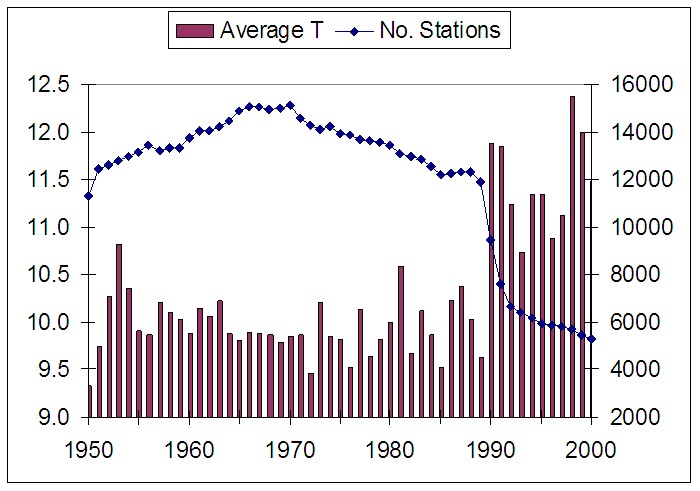
*Source: https://www.uoguelph.ca/~rmckitri/research/nvst.html*
If the McKitrick solution (see above carbon tax proposal) is as misleading as this graph (any reasonable assessment shows that it is), then one would be wise to avoid advice from this source.
“The data Joe obtained were put into 3 categories, urban, suburban and rural. In the spreadsheet I used to generate the graph I construct the average temperature as weighted by the number of stations in each group.”
Of course this means the chart results don’t show the real global mean temperature (GMT), but rather the result of the calculation, which has nothing to do with the actual temperature. Denialist web sites are using the chart to say it proves global warming is a result of a change in the number of stations taking temperature readings. This is a false assumption.
The global mean temperature did not change as one might be led to believe the graph indicates.
Note: It does not seem McKitrick ever claimed the graph was a temperature graph. But that is part of the deceptive nature of the method. Ambiguity and lack of specificity allow the rumor to grow in the fertile ground of paranoia.
But, McKitrick never stated that it did, or did not, represent temperature. That’s the McKi ‘trick’. All he has to do is present the facts out of context, and then allow others to misinterpret the data. In other words some people simply believe what they think they are seeing, even though it has nothing to do with the reality of the temperature record.
Summary
Ross McKitrick continues to use out of context assertions and opinion to delay the imposition of effective, or meaningful legislation that would reduce the risk of human caused global warming: Including a tax he is proposing that attempts to address the preventability of higher costs by saying we should try to prevent the problem after it occurs. While this logic is completely absurd, it is effectively what he is proposing. Bizarre, but true.
The known reality of global warming combined with associated costs due to infrastructure immobility and expected resource scarcity issues, render McKitrick’s opinion not only irrelevant, but immoral. He seems completely ignorant of the economic reality that is now in process.
The irony is that he thinks he understands economics. Unfortunately McKitrick seems to have missed an important point of economics:
the thrifty and efficient use of material resources : frugality in expenditures
Source: https://www.merriam-webster.com/dictionary/economy
When one is discussing economic sustainability one must consider current and future costs simultaneously. This is apparently not a consideration of Ross McKitrick as he myopically ignores relevant understanding to favor his biased views.
It is not about how to exploit resources to the point of depletion or demise, but rather the thrifty and efficient use of material resources in a sustainable manner. In fact the definition of economy includes the balance of systems and methods. Allowing exploitation of a resource to our own detriment and cost is not economics, but rather the opposite: the destruction of economic capacity.
Links
- https://en.wikipedia.org/wiki/Ross_McKitrick
- https://www.sourcewatch.org/index.php?title=Ross_McKitrick
Related content[Station Drop Out](https://ossfoundation.org/projects/environment/global-warming/myths/station-drop-out "Many in the denialist camp like to talk about the fact that many temperature reading stations were taken out, and that is why the temperature readings showed global warming. But in reality, this is "Pure disinformation". According to Gavin Schmidt (NASA/GISS) "You can do the same analysis with only stations that remained and it makes no difference."")The Hockey Stick Controversy
Document Actions
Filed under: wiki, Global Warming Myths, Climate Change, Myths, Global Warming Facts, Rebuttal, Denialist
Amazon.com
https://www.amazon.com › stores › author
Follow Ross McKitrick and explore their bibliography from Amazon's Ross McKitrick Author Page.
Latest posts from Ross McKitrick
COMMENTARY: Carney’s Industrial Carbon Tax Comes With Real Cost to Canadians
1 week ago
Ross McKitrick
EnergyNow
Carney’s industrial carbon tax comes with real cost to Canadians
2 weeks ago
Ross McKitrick
Fraser Institute
STUDY: Estimated Impacts of a $170 Industrial Carbon Price in Alberta and Canada
2 weeks ago
Elmira Aliakbari, Ross McKitrick, Joel Emes
EnergyNow
My op-ed in today's Financial Post explaining our new work on the costs of the federal Industrial Carbon Tax plan
financialpost.com/opini…
10+ likes ·
2 weeks ago
RossMcKitrick
X
Opinion: Carney’s Industrial Carbon Tax imposes real costs on Canadians
2 weeks ago
Ross McKitrick
Financial Post
Estimated Impacts of a $170 Industrial Carbon Price in Alberta and Canada
2 weeks ago
Ross McKitrick, Milagros Palacios, Elmira Aliakbari
Fraser Institute
Industrial Carbon Tax is far from costless
It's always difficult to tell from one week to the next whether Ottawa is more concerned that fuel supplies are tight and prices too high,...
.
2 weeks ago
PressReader
COMMENTARY: Carney Practises the Illusion of EV Mandate Repeal
1 month ago
Ross McKitrick
EnergyNow
Carney practises the illusion of EV mandate repeal
1 month ago
Ross McKitrick
Fraser Institute
Opinion: Carney practises the illusion of EV mandate repeal
Feb 13, 2026
Ross McKitrick
Financial Post
Ross McKitrick
Cato Institute
https://www.cato.org › People
Ross McKitrick is a Professor of Economics and CBE Chair in Sustainable Commerce at the University of Guelph, where he specializes in environmental economics.Read more
CV, talks, bio, etc. - Ross McKitrick
rossmckitrick.com
https://www.rossmckitrick.com › cv-talks-bio-etc
SHORT BIO: Ross McKitrick is a Professor of Economics at the University of Guelph where he specializes in environmental economics and climate change.Read more
Ross McKitrick
DeSmog
https://www.desmog.com › Database Entries
Ross McKitrick is an Associate Professor of Economics at the University of Guelph. McKitrick is also a senior fellow at the Fraser Institute.Read more
ross mckitrick from www.desmog.com
Books
Taken by Storm
2002
A Critical Review of Impacts of Greenhouse Gas Emissions on the U.S. Climate
2025
Economic Analysis of Environmental Policy
2011
A breath of fresh Air: The state of environmental policy in Canada
2008
The Kyoto Protocol: Canada's Risky Rush to Judgment
2002
The Canada-U.S. Free Trade Agreement: An Annotated Bibliography of Selected Literature
1989
People also search for
---
... part two of Friends of Science Society's 18th Annual Event online will feature American author Marc Morano with "Green New Deal: The Great Regret".
:{:{:{==}:
SPONSORED [sm font] no lnxNew Yorker Magazine Has a Moral Obligation to Open the Climate Debate Before COP26, says Friends of Science SocietyBy Friends of Science Society Sep 29, 2021 Updated Sep 29, 2021 Comments CALGARY, Alberta, Sept. 29, 2021 /PRNewswire-PRWeb/ -- In response to the Sept. 27, 2021, interview in The New Yorker with Swedish climate activist Andreas Malm }:}:
who advocates for 'intelligent sabotage' of critical infrastructure that underpins modern society,
The New Yorker is morally obliged to interview Swedish climate scientists like Hans Jelbring to calm the dangerous rhetoric of Malm before the November 2021 COP26 climate conference,
says Friends of Science Society. As discussed in the LA Review of Books of Jan. 2021, Malm's case is that humanity faces a 'hellscape' earth, and thus rather than march in the streets,
climate activists should sabotage equipment of energy developers and providers.Friends of Science says extremist rhetoric from Malm and groups like Extinction Rebellion exist because of the lack of media coverage of rational, dissenting, scientific views on climate change.The promotion of climate hysteria by Columbia Journalism Review's "Covering Climate Now" project exacerbates the public fears, where some 400 media outlets preach climate catastrophe to an audience of 2 billion people. This one-sided coverage and intentional polarization has now created a danger for society itself with media giving a profile to people like Malm. Local Trending News]A sober reading of the ~4,000-page United Nations IPCC AR6 report released last month, mentions 'climate emergency' and 'climate crisis' only once on a page about media coverage.
The alarming 'hockey stick' graph that appears in the IPCC Summary for Policy Makers (that makes it seem as if now is the hottest time ever) does not appear in the scientific document
as explained in this Friends of Science video – obviously an effort to manipulate policymakers and the media. The 'hockey stick' data set has been deconstructed by Steve McIntyre of Climate Audit.Roger Pielke, Jr.explains that this IPCC report has abandoned the view of a 'hellscape' future for humanity associated with a scenario known as RCP 8.5
and contrary to Malm's claim that wildfires and floods are evidence of climate change, Pielke, Jr.'s review shows the scientific report of the IPCC does not see any such trends. Pielke, Jr. and colleague Justin Ritchie have shown in a peer-reviewed study that most catastrophic thinking on climate has stemmed from persistent use of the RCP8.5 scenario 'as if business-as-usual' when it is implausible. These scenarios were only meant for climate research and not for policy making. Malm's claims about wildfires as evidence of climate change are misinformed, as Friends of Science Society explained last year to a SLATE journalist in this post and video.
Likewise, this year's alarming heat that occurred coincident to the tragic Lytton, BC fire can be understood by atmospheric conditions, as explained by Jean van Vliet and Brigitte van Vliet-Lanoie.Friends of Science Society calls on The New Yorker to be responsible and open up the debate on climate science with qualified scholars holding dissenting views
such as Swedish scientist Gösta Petterson (author of "Falskt Alarm/False Alarm" – his work promoted in English by Elsa Widding),
or any of the scientists and scholars of CLINTEL, the climate intelligence organization of over 900 signatory scientists and scholars who state there is no climate emergency.The CLINTEL World Climate Declaration can be read here.CLINTEL's president, Dr. Guus Berkhout, will be the first speaker at Friends of Science Society's 18th Annual Event, online, this Saturday, October 2, 2021, at 10 a.m. MDT/12 p.m. EDT .
Dr. Berkhout will present "Climate Science: Let the Data Speak" and will show how the actual data does not support the 'hellscape' fears and rhetoric of activists like Malm. On Oct. 6, 2021, at 7 p.m. MDT/9 p.m. EDT, part two of Friends of Science Society's 18th Annual Event online will feature American author Marc Morano with "Green New Deal: The Great Regret". There will be live Q&A following each presentation. Both events are free to the public. About Friends of Science Society is an independent group of earth, atmospheric and solar scientists, engineers, and citizens that is celebrating its 19th year of offering climate science insights.
After a thorough review of a broad spectrum of literature on climate change, Friends of Science Society has concluded that the sun is the main driver of climate change, not carbon dioxide (CO2).Friends of Science Society P.O. Box 23167, Mission P.O.Calgary, AlbertaCanada T2S 3B1 Toll-free Telephone: 1-888-789-9597 Web: friendsofscience.org E-mail: contact(at)friendsofscience(dot)org Web: climatechange101.ca Media Contact Michelle Stirling, Friends of Science Society, 8887899597, media@friendsofscience.org Twitter SOURCE Friends of Science Society
---
---
420
Steve McIntyre & Ross McKitrick
Steve McIntyre is the founder of Climate Audit,another of the initial websites to receive a link to the hacked emails. McIntyre’s background is in the mining industry, having worked as an officer or director of numerous companies.
Ross McKitrick is a close colleague of McIntyre, and an economics professor in Guelph, Ontario, as well as aSenior Fellow at the Koch-fundedFraser Institute.
Before the leak, McIntyre had spent years filing or coordinating dozens of Freedom of Information requests to climate scientists at East Anglia, with the pace escalating significantly in the months leading up to the leak.
McIntyre and McKitrick have regularly co-authored papers and were given an award by the Competitive Enterprise Institute for their work on Climategate.
Watts wrote at the time:
“Much of Climategate involves research initially called into doubt by the analysis of Stephen McIntyre and Ross McKitrick. The scientists involved in the scandal saw McIntyre and McKitrick as major threats to global warming orthodoxy and to their own credibility. Consequently, they are mentioned more than 150 times in the ClimateGate e-mails.”
Both McIntyre and McKitrick have spoken at Heartland Institute conferences since Climategate. In a Heartland podcast earlier this year hosted by Anthony Watts, McKitrick claimed that increasing carbon dioxide levels in the atmosphere could provide a net benefit to agriculture.
===}:
https://www.desmogblog.com/2019/08/11/heartland-deniers-deflated-climate-reality
Climate science deniers are becoming desperate as their numbers diminish in the face of incontrovertible evidence that human-caused global warming is putting our future at risk. Although most people with basic education, common sense, and a lack of financial interest in the fossil fuel industry accept what scientists worldwide have proven through decades of research, some media outlets continue to publish inconsistent, incoherent opinions of people who reject climate science.
Over the past few weeks, Canada's Postmedia chain has run columns denying or downplaying the seriousness of climate change by Fraser Institute senior fellow Ross McKitrick, defeated politician Joe Oliver, and fossil fuel executive and Fraser Institute board member Gwyn Morgan, who is also former chair of scandal-plagued SNC-Lavalin.
McKitrick, an economist, has also signed the Cornwall Alliance Evangelical Declaration on Global Warming, which says, in part, “We believe Earth and its ecosystems — created by God's intelligent design and infinite power and sustained by His faithful providences — are robust, resilient, self-regulating, and self-correcting, admirably suited for human flourishing, and displaying His glory. Earth's climate system is no exception.” Other prominent deniers, including Roy Spencer and David Legates, have also signed.
South of the border, the Heartland Institute, a leading U.S. denial organization with ties to Canadian organizations such as the misnamed International Climate Science Coalition, still holds its annual denial fest.But even that organization is feeling hard times in the face of evidence—similar to the proof that made it walk back its previous support for the tobacco industry to the point that its members now admit smoking is bad but defend vapingand other “smokeless” tobacco-industry products.
Heartland's 13th International Conference on Climate Change — held at the Washington, D.C., Trump International Hotel — was down from three days to one. It once attracted more than 50 sponsors, but this year drew just 16 — and one was fake! Fossil fuel companies have also cut funding, realizing that denial is not an effective way to gain social licence. Attendance was limited to a couple hundred mostly older white men.
As usual, the conference speakers' reasons for denying climate science were all over the map.
Some simply rejected all evidence. According to British eccentric Christopher Monckton, who has no scientific credentials, droughts, wildfires and hurricanes are decreasing; sea levels are falling, not rising; and rising carbon dioxide emissions are improving life on Earth!
Others argued that CO2 levels aren't rising, while some claimed the planet is cooling. In other words, the arguments were mostly easily debunked, contradictory nonsense in service of the most profitable and polluting industry in human history.
You'd think Heartland would be riding high under a government that shares its antiscience views. But even holding the conference in a Trump hotel blocks from the White House didn't gain it the profile organizers would have liked. Tom Harris, a discredited Canadian fossil fuel promoter who works with Heartland and the International Climate Science Coalition, penned a sad article with fellow denier, Heartland “science director,” and convicted criminal Jay Lehr, crying: “No one from the Trump administration will be in attendance,” which, they whined, is “a huge loss since ICCC-13 will reveal that neither science nor economics back up the climate scare.”
Lehr, a groundwater hydrologist by training, also worked for the Advancement of Sound Science Coalition, an organization founded by Phillip Morris and by PR firm APCO Worldwide to cast doubt on the scientific evidence regarding harms caused by tobacco. Harris also worked for APCO Worldwide.
It's getting harder for anyone to deny the reality staring us in the face. Those who continue to spread doubt and confusion about climate science are starting to look even more ridiculous with their many conflicting, insubstantial arguments.
Even some prominent deniers have come around. Political consultant Frank Luntz — who once advised the U.S. government to cast doubt on scientific certainty around climate change and to use the term “climate change” rather than “global warming” because it sounds less scary — now says, “I was wrong in 2001.” In recent testimony before the U.S. Senate, Luntz said: “Rising sea levels, melting ice caps, tornadoes, and hurricanes more ferocious than ever. It is happening.”
Yes, it is happening. And it's time for deniers to accept evidence and reason or get the hell out of the way.
==
2x?
We continue our DeSmog UKepic history series with the sceptics’ endless search for any evidence that Mann had manipulated science in producing his hockey stick graph.
The climate deniers' hunt for any shred of evidence that Michael Mann had manipulated science in producing his hockey stick graph went unabated, and in the mid-2000s started to interest the media.
Ross McKitrick, senior fellow at Vancouver-based libertarian think tank the Fraser Institute, his collaborator, Steve McIntyre, a mining executiveand author of the sceptic blog Climate Audit, and a senator named Joe Barton were unrelenting in their pursuit.
Their strategy was to find any mathematical or methodological flaws in the hockey stick graph, despite the fact the main findings of the study had been replicated by independent scientists and Mann was moving on to other research.
McKitrick was accused of living in a glass house when the computer scientist Tim Lambert discovered he had, in fact, mixed up degrees and radians in a study he claimed proved climate change was not caused by humans.
Science Journals
McIntyre and McKitrick submitted a paper to Nature in January 2004 but the respected peer-reviewed journal refused to publish their critique.
So instead, the two published the article online along with correspondence between themselves, the journal and Mann. And, in February the following year their paper was accepted and published by Geophysical Research Letters.
At last, they had a major breakthrough to celebrate: the first time a “real science journal” had lent credence to a sceptic attack on the hockey stick.
The paper was picked up by Antonio Regalado at the Wall Street Journal which ran an attention-grabbing front page storywith a cartoon illustration on Valentine's Day 2005 presenting McIntyre, the minerals consultant, as a David successfully delivering a knockout blow to the Goliath of climate science.
Mann later complained: “The major deficiency in Regalado’s article was that it conveyed the highly misleading impression that McIntyre had invalidated our work. He hadn’t.”
Barton's Inspiration
The splash did, however, catch the eye of Joe Barton, the Republican member of the House of Representatives for Texas and a Tea Party supporter.
McIntyre’s work had inspired Barton, the chair of the House Committee on Energy and Commerce, to investigate Mann, and the following June, he wrote to the scientist and demanded the raw data behind the hockey stick.
“Questions have been raised,” the letter stated, “about the significance of methodological flaws and data errors in your studies of the historical records of temperatures and climate change.”
A similar letter was also sent to Dr Rajendra Pachauri, chair of the UN Intergovernmental Panel on Climate Change (IPCC). Mann handed over the data, but this did nothing to stop Barton’s charge.
The following month, McIntyre’s paper attacking Mann was being championed by dean of deniers Senator Jim Inhofe, chairman of the Senate Committee on Environment and Public Works.
Industry Influence
Environmentalists were furious that the attack on Mann gained significant attention in the media and in American democratic institutions. They pointed to the fact McIntyre was a mining consultant who worked closely with the energy industry and who had served as a former president of Northwest Exploration Co Ltd, and as a “strategic advisor” to the same oil and gas exploration company after it became CGX Energy.
They also pointed to the huge financial contributions from oil that the men had enjoyed.
Barton, for example, received $426,000 from electricity companies and a further $247,600 from the gas and oil industry during the same period, according to the Centre for Responsive Politics' analysis of published campaign funds.
Years later, McIntyre said: “I had no idea that there would be any interest in my work, and the fact that some people have found it interesting, I find very flattering.”
Next time, theDeSmog UKepic history series will introduce you to an environmental journalist who later took money from ExxonMobil, placing blame on consumers rather than fossil fuels for causing climate change.
TAGS:
---
Ross McKitrick is a senior fellow at the Exxon funded Fraser institute and on the academic advisory board of the Global Warming Policy Foundation - funders unknown.
bs: http://www.thegwpf.org/
==
http://www.greenpeace.org.uk/media/press-releases/exposed-academics-hire-agree-not-disclose-fossil-fuel-funding-20151208
EXPOSED: ACADEMICS-FOR-HIRE AGREE NOT TO DISCLOSE FOSSIL FUEL FUNDING
Last edited 8 December 2015
Leading climate sceptic who agreed to suggestion of secret Middle East oil cash is set to speak at Ted Cruz Senate hearing today
8 December, 2015
A Greenpeace undercover investigation has exposed how fossil fuel companies can secretly pay academics at leading American universities to write research that sows doubt about climate science and promotes the companies’ commercial interests.
Posing as representatives of oil and coal companies, reporters from Greenpeace UK asked academics from Princeton and Penn State to write papers promoting the benefits of CO2 and the use of coal in developing countries.
The Professors agreed to write the reports and said they did not need to disclose the source of the funding.
Citing industry-funded documents - including testimony to state hearings and newspaper articles - Professor Frank Clemente of Penn State said: “In none of these cases is the sponsor identified. All my work is published as an independent scholar.”
The leading climate-sceptic academic, Professor William Happer, agreed to write a report for a Middle Eastern oil company and to allow the firm to keep the source of the funding secret.
Happer is due to appear this afternoon as a star witness in US Senate hearings called by Republican Presidential candidate Ted Cruz.
In emails to reporters he also revealed Peabody energy paid thousands of dollars for him to testify at a separate state hearing, with the money going to a climate-sceptic think-tank.
The investigation also found:
- US coal giant Peabody Energy paid tens of thousands of dollars to an academic who produced coal-friendly research and provided testimony at state and federal climate hearings, the amount of which was never revealed.
- The Donors Trust, an organisation that has been described as the “dark money ATM” of the US conservative movement, confirmed in a taped conversation with an undercover reporter that it could anonymously channel money from a Middle Eastern oil and gas company to US climate sceptic organisations.
- Princeton professor William Happer laid out details of an unofficial peer review process run by the Global Warming Policy Foundation (GWPF), a UK climate sceptic think tank, and said he could ask to put an oil funded report through a similar review process after admitting that it would struggle to be published in an academic journal.
- A recent report by the GWPF that had been through the same unofficial review process, was promoted as “thoroughly peer-reviewed” by influential columnist Matt Ridley -a senior figure in the organisation.
:{:{:{The full story and all the documents have been published on[*http://energydesk.greenpeace.org/}:
The findings echo the case of Willie Soon, a prominent academic exposed in a New York Times investigation as having accepted donations from fossil fuel companies and anonymous donors in return for producing climate-sceptic scientific papers.
Reporters approached the academics claiming to be representatives of unnamed fossil fuel companies looking to commission ‘independent’ research.
Professor Frank Clemente, a sociologist from Penn State university, was asked if he could produce a report “to counter damaging research linking coal to premature deaths (in particular the WHO’s figure that 3.7 million people die per year from fossil fuel pollution)”. He said that this was within his skill set; that he could be quoted using his university job title; and that it would cost around $15,000 for an 8-10 page paper
Asked whether he would need to declare the source of the money, Professor Clemente said: “There is no requirement to declare source funding in the US.” He then shared examples of a testimony and an op-ed, explaining: “Note that in none of these cases is the sponsor identified. All my work is published as an independent scholar.”
Clemente also disclosed that for another report on “the Global Value of Coal” he was paid $50,000 by Peabody Energy - the sponsorship was mentioned in the small print of the paper, but the amount has not been disclosed until now.
The academics’ willingness to conceal the source of funding contrasts strongly with the ethics of journals such as Science, which states in its submission requirements that research “should be accompanied by clear disclosures from all authors of their affiliations, funding sources, or financial holdings that might raise questions about possible sources of bias”
The investigation has also revealed a system by which foreign oil and gas companies can anonymously fund US climate-sceptic scientists and organisations.
When asked to ensure that the commissioning of the report could not be traced back to the Middle East oil and gas company, Professor Happer contacted his fellow CO2 Coalition board member, Bill O’Keefe, a former Exxon lobbyist. He suggested channelling it through the Donors Trust, a controversial organisation that has previously been called the“Dark Money ATM” of the US conservative movement.
When investigators asked Peter Lipsett of the Donors Trust, if the Trust would accept money from an oil and gas company based in the Middle East, he replied that, although the Trust would like the cash to come from a US bank account, “we can take it from a foreign body, just we have to be extra cautious with that.”
Professor Happer, who sits on the GWPF’sAcademic Advisory Council, was also asked by undercover reporters if he could put the industry-funded report through the same peer review process as previous GWPF reports claimed to have been “thoroughly peer reviewed”. Happer explained that this process had consisted of members of the Advisory Council and other selected scientists reviewing the work, rather than presenting it to an academic journal.
:{:{:{}:
He added: “I would be glad to ask for a similar review for the first drafts of anything I write for your client. Unless we decide to submit the piece to a regular journal, with all the complications of delay, possibly quixotic editors and reviewers that is the best we can do, and I think it would be fine to call it a peer review.}:}:
GWPF’s “peer review” process was used for a recent GWPF report on the benefits of carbon dioxide. According to Dr Indur Goklany, the author of the report, he was initially encouraged to write it by the journalist_{ Matt Ridley, who }is{ also a }_GWPF academic advisor. That report was then promoted by Ridley, who claimed in his Times column that the paper had been “thoroughly peer reviewed”.
Commenting on the investigation, Greenpeace UK executive director John Sauven said:
“This investigation exposes a network of academics-for-hire and a back channel that lets fossil fuel companies secretly influence the climate debate while keeping their fingerprints off. Our research reveals that professors at prestigious universities can be sponsored by foreign fossil fuel companies to write reports that sow doubt about climate change, and that those professors will keep that funding secret from the public. The question now is very simple. Down the years, how many scientific reports that sowed public doubt on climate change were actually funded by oil, coal and gas companies? This investigation shows how they do it, now we need to know when and where they did it. It’s time for the sceptics to come clean.”
He added:
“Lord Lawson’s Global Warming Policy Foundation (GWPF) has serious questions to answer. Does it condone a member of its academic council agreeing to be secretly sponsored to write a report by a group purporting to be from a Middle Eastern oil company? Have reports by senior figures in Lawson’s foundation been secretly paid for by the fossil fuel industry? Would they have agreed to Professor Happer’s suggestion that the ‘oil-funded’ report be put through a 'similar review' process to the GWPF's own ‘peer-review’ process? Does it accept that the foundation’s so-called ‘peer review’ process is flawed, given Professor Happer’s revelations about how it operated on an earlier report? And does the foundation stand by its academic advisor, Viscount Ridley, who described that earlier report as ‘thoroughly peer-reviewed’?”
ENDS
:{:{:{:{Article tagged as:}::{Climate Deniers, Climate Skeptics, Investigation, Republican Party, Ted Cruz}::{}:
==
===
http://www.desmog.uk/2016/01/06/climate-denying-gwpf-academic-chairman-ross-mckitrick-resigns
Climate denier Professor Ross McKitrick has resigned as chairman of the academic advisory council of Lord Lawson’s Global Warming Policy Foundation (GWPF), according to a statement released by the charity.
The senior fellow of the ExxonMobil- and Koch-funded Fraser Institute in Canada told DeSmog UK he had informed Lord Lawson at the GWPF in September that he intended to stand down citing increased work commitments.
The academic confirmed his stepping down had nothing to do with the high-profile investigative sting by Greenpeace last month which raised serious concerns about the council’s claims to conduct peer reviews of its publications.
McKitrick said: “I decided [to step down] late last summer, because of other commitments I had. And so, I notified them at the beginning of September that I would be leaving at the end of December.”
Asked about the GWPF's peer review claims, he said: “I am confident the process was as described and I don’t have any further comment to make to you other than what was released before Christmas.”
Hockey Stick
McKitrick is something of a hero in climate denial circles for recruiting Steve McIntyre to the cause and collaborating on a decade-long attack on Professor Michael Mann and the hockey stick graph, which climaxed with the Climategate hacking.
DeSmog UK emailed the GWPF on 8 December, 2015, hours after Greenpeace published its agenda-setting investigation.
We asked then whether McKitrick would be asked to resign in light of the charity’s academic publications apparently being sold out to an oil and gas man.
Dr Benny Peiser, the former part-time sports anthologist and director of the GWPF, said then: “I’m afraid Greenpeace has got it wrong.”
Peer Review
An undercover investigator from Greenpeace called and exchanged emails with Professor Will Happer - a member of theGWPF advisory council - posing as a Middle East oil and gas company representative.
During the exchange, Happer discussed producing a report praising CO2 that which would then be passed through theGWPF’s “peer review” process.
He explained this was significantly easier than trying to publish in a journal. He also asked that any fee be paid to another climate denial charity.
The scandal made the front page in Britain and France during the COP21 climate conference in Paris. The Charity Commission has confirmed it will consider the Greenpeace evidence as part of an ongoing inquiry into the GWPF.
Adam Levy, from the respected Nature journal, told openDemocracy a report described as peer reviewed by the GWPF had not gone through the process in any meaningful way“The review process received by this paper is not what would generally be described as peer–review. I have not encountered other instances of similar publications being cited as peer–reviewed in either academia, or science journalism,” he said...=
hmmn, but rw protest of billbd:
http://www.thenewamerican.com/tech/environment/item/11276-climate-change-billboard-stirs-controversy
...
The Chicago-based non-profit think tank is an outspoken pundit of climate-change skepticism. But its billboard prompted U.S. Representative James Sensenbrenner (R-Wis.) to rethink his scheduled speaking appearance at the Heartland Institute's upcoming International Conference on Climate Change. His press secretary told the Washington Post, "Congressman Sensenbrenner will not participate in the upcoming Climate Change Conference if the Heartland Institute decides to continue this ad campaign."
Author Donna Laframboise announced she will not attend the conference as planned. She recently published a book exposing fraud in the UN Intergovernmental Panel on Climate Change but says her association with Heartland has now harmed her reputation. She complains she has been unwittingly and "publicly linked to an organization that thinks it's OK to equate people concerned about climate change with psychopaths."
Sunday's Guardian reported the London-based drinks company, Diageo, which owns brands such as Guinness and Smirnoff, has pulled funding for Heartland. According to a corporate spokesman, however, "Diageo's only association with the Heartland Institute was limited to a small contribution made two years ago specifically related to an excise tax issue." No other Heartland contributors have announced plans to end their support.
Environmental economist Ross McKitrick fired off a letter Friday to Heartland Institute President Joe Bast. "You cannot simultaneously say that you want to promote a debate while equating the other side to terrorists and mass murderers," he wrote. McKitrick said Bast responded immediately and agreed to pull the message.
Though the campaign is discontinued, Bast refused to apologize. Instead, he defended it, saying, "This billboard was deliberately provocative, an attempt to turn the tables on the climate alarmists by using their own tactics but with the opposite message." He said those on his side of the climate debate are "subjected to the most uncivil name-calling and disparagement you can possibly imagine from climate alarmists." Bast referenced such incidents as a 2010 congressional hearing when U.S. Senator Bernie Sanders (D-Vt.) made modest headlines comparing climate-change skeptics to Nazi deniers....
==
==
desmog uk
:{:{DeSmog :{UK}:*will endeavour to publish profiles of the back-room influencers who have promoted climate denial in Britain and around the world each Tuesday. Today we begin with Ned Flanders. Sorry, Ross McKitrick. And his Celtic carol band. Seriously.
“Dude is a shoo-in for Ned Flanders from The Simpsons.” Well, at least according to one student’s view on Rate my Professors of Ross McKitrick, economics professor at Guelph University in Ontario, Canada.
“He teaches environmental economics in a very right wing perspective. He really teaches you his point of view and not much of the course material,” reads another review from this October.
McKitrick has been a professor at the university since 1996, but his “right wing perspective” on climate change extends well beyond the campus and the some 115,000 people residing in Guelph, where he lives with his wife and two children.
No Convincing Evidence
In a very ‘Ned Flanders’ fashion, the professor – who has been known to don a sweater-vest or two – endorsed “An Evangelical Declaration on Global Warming” issued in 2009 by the conservative Christian public policy group, the Cornwall Alliance.
The Declaration states that “there is no convincing scientific evidence that human contribution to greenhouse gases is causing dangerous global warming”. It also denies that carbon dioxide is a pollutant and that renewable energy can replace fossil fuels.
McKitrick also co-authored the Alliance’s 2006 “A Call to Truth, Prudence, and Protection of the Poor: An Evangelical Response to Global Warming”, the predecessor to “A Renewed Call to Truth, Prudence, and Protection of the Poor” upon which the 2009 Declaration is based.
Cooler Heads
But this was not the first time he called climate science into question. It was during the early 2000s that McKitrick would solidify his position as a key player in stimulating climate denial.
It all began in 2001, when McKitrick participated in a briefing attacking the UNIntergovernmental Panel on Climate Change (IPCC) and the Kyoto Protocol. The briefing was sponsored by the Cooler Heads Coalition, a climate denial organisation run by theKoch-funded Competitive Enterprises Institute (CEI).
McKitrick is known for being staunchly anti-Kyoto. Writing in Canada’s centre-right newspaper, The National Post, in February 2002, he states: “If global warming is going to happen, Kyoto will do nothing whatsoever to prevent it or even slow it down. Why are we still considering it?”
It was at this time that he became a Senior Fellow of the Fraser Institute, a libertarian think tank based in Vancouver, British Columbia. The Institute is partly funded by theAtlas Economic Research Foundation – one of Antony Fisher’s neoliberal think tanks.
Coincidentally, 2002 was the same year that McKitrick released Taken By Storm, co-authored by fellow climate sceptic Christopher Essex. A press conference to promote the book was organised shortly after, in 2003, by McKitrick and Essex with the Cooler Heads Coalition; unsurprisingly, copies were provided “with compliments” by the CEI.
The Hockey Stick
This was also the fateful year that McKitrick met fellow Canadian and climate scepticSteve McIntyre, who lives about an hour’s drive from Guelph. McKitrick, who was already plugged into the fossil fuel-funded PR world, would help McIntyre finalise his analysis of Michael Mann’s hockey stick graph.
Their hockey stick critique claimed there were ‘fundamental flaws’ with the graph used by the IPCC to show that the ‘90s was the hottest decade of the century; they argued that the way the data is handled ensures that whatever data gets input, it will always produce a hockey stick shape.
The critique would go on to form the basis of McIntyre’s quest to debunk Mann on his sceptic blog, Climate Audit, and later inspire an unknown individual to hack into the emails of the University of East Anglia in 2009 and steal emails and data shared between the world’s leading global warming scientists.
The hockey stick critique was first published in 2003 by Energy & Environment, a journal which avoids standard peer review. McIntyre and McKitrick also tried, without success, to get their findings published in the highly regarded Nature magazine. But finally, in 2005, they managed to publish their second critique – and only peer-reviewed work – on the hockey stick in Geophysical Research Letters.
Powerful PR
Initially, their papers received very little attention outside climate-sceptic circles. But thanks to a powerful PR campaign and strategic timing ahead of the COP 9 climate talks in Milan, their unsubstantiated criticisms landed on the front page of the National Post and the Wall Street Journal.
Off the back of the first paper,the two were invited to Washington for a briefing arranged by the George C. Marshall Institute and the CEI, both free market think tanks funded by ExxonMobil and other oil interests. While in Washington, they met with Republican Senator and staunch climate denier James Inhofe, who has called climate change “the greatest hoax ever perpetrated on the American people”.
Following their critique in Geophysical Research Letters, the ‘M&M duo’ were flown to Washington once again for a second briefing with the Marshall Institute and the CEI.
McKitrick’s travels would also take him overseas. He happened to be in London in November 2009 at the private free market Buckingham University. This meant he was on hand should Lord Lawson have needed assistance in launching his climate denying charity, the Global Warming Policy Foundation (GWPF).
And it also meant, entirely fortuitously, that he was in England when Climategate broke. The criminal hacking of private emails sent by the world’s leading climate scientists was spun as ‘smoking gun’ evidence of attacks that McKitrick and other oil-promoted sceptics had been making for years.
The GWPF has praised McKitrick for being “instrumental in exposing the fatal flaws of the so-called Hockey Stick”. Curiously, McKitrick didn’t blog on climategate. He did confirm that he had been questioned by police during a Canadian senate committee hearing in December 2011.
New Endeavours
In the years following the scandal, McKitrick – a member of the GWPF’s academic advisory council since 2010 and chairman as of 1 January this year – would submita 49-page reportto the GWPF calling for ‘radical reform’ of the IPCC. He has also gone on to become a regular speaker at the Koch-connected Heartland Institute’s annual International Conference on Climate Change.
Clearly, McKitrick’s work at the centre of the hockey stick ‘controversy’ cleared the way for many new endeavours to blossom.
Not only did it help forge the path for the debunked climategate, but it also inspired McKitrick’s love of Celtic music and eventually led to him start a band, The Wild Oats, where he plays the bagpipes, penny whistle and bodhrán, an Irish frame drum.
“I did find that music was a great way of staying sane,” McKitrick recently told the local*Guelph Mercury* newspaper. “It’s just a great way of relaxing with people and doing something fun. I found it a great diversion from all the controversies at work.”
The band’s two albums, featuring Christmas carols and “beloved hymn tunes … [that] come alive in their alter ego as reels, jigs, waltzes and airs”, would surely have prime-time’s Ned Flanders jumping and jiving: “Hi-diddly-ho-ho-ho let’s have a sing-a-long-a-roony folks!”
==
sw:
The Global Warming Policy Foundation (GWPF) is a United Kingdom group opposing action to mitigate climate change. Founded by Nigel Lawson,[1], it is a registered educational charity "deeply concerned about the costs and other implications of many of the policies currently being advocated" to mitigate global warming.[2]. Although founder Lawson claims to accept that anthropogenic global warming is occurring, his acceptance is unconvincing[3]; the group's banner image sports a short-term temperature graph to appear as though the world is not warming.
Contents |
Start Up
The GWPF was founded, curiously, at the same time as the climategate emails were released on the University of Tomsk's server. At the time of it's foundation the average age of it's trustees was 74. Chairman Nigel Lawson stated "We will certainly be actively involved in monitoring what is being said, in correcting errors where the are errors. The only thing we will not be actively engaged in is what are the causes of the temperature changes on the planet: how much is CO2, how much is solar radiation, how much is cosmic rays. We won't be getting into all that."[4]
Funding
The Global Warming Policy Foundation does not reveal where its funding comes from. [5] In their first years accounts they say "the soil we till is highly controversial, and anyone who puts their head above the parapet has to be prepared to endure a degree of public vilification. For that reason we offer all our donors the protection of anonymity." [6] The accounts show the extent to which the secretive Foundation is funded by anonymous donors, compared with income from membership fees. Its total income for the period up to 31 July 2010 was £503,302, of which only £8,168 came from membership contributions. The foundation charges a minimum annual membership fee of £100.[7]
Charitable Status
The GWPF is a registered charity (Number 1131448), which gives it certain tax advantages. It's charitable objectives are stated as: "To advance the public understanding of global warming and of it's possible consequences, and also of the measures taken or proposed to be taken in response to it, including by means of the dissemination of the results of the study of and research into (a) the sciences relevant to global warming (b) it's impact upon the environment economies and society (c) and the above mentioned measures."[8]
Location
The GWPF is located at 1 Carlton House Terrace, London, in a room rented from the Institute of Materials, Minerals and Mining.[1]
Personnel
In November 2009, the GWPF listed:
Director
- Benny Peiser, Director; a social anthropologist.[9]
- Sir James Spooner is Honourary Treasurer
Board of Trustees
The Board of Trustees includes:[10]
- Lord Barnett
- Peter R. Forster (the Bishop of Chester)
- Lord Donoughue
- Lord Fellowes
- Martin Jacomb
- Lord Lawson (Chairman)
- Henri Lepage
- Baroness Nicholson
- Lord Turnbull
Academic Advisory Council
The Academic Advisory Council includes [11], [12], [13]
- Adrian Berry, Viscount Camrose
- Samuel Brittan
- Ian Byatt
- Freeman Dyson
- Christian Gerondeau
- William Happer
- David Henderson
- Terence Kealey
- Anthony Kelly
- Richard Lindzen
- Alan Peacock
- Ian Plimer
- Gwyn Prins
- Paul Reiter
- Philip Stott
- Richard Tol
- David Whitehouse
- Matt Ridley
- Hal Lewis
- Ross McKitrick.
- Vincent Courtillot
Actions
In an op-ed announcing the GWPF launch and hopefully predicting failure of the December 2009 United Nations climate change conference in Copenhagen, Nigel Lawson called for a high-level independent inquiry into the content of the emails stolen from the University of East Anglia's Climatic Research Unit.[14]
When the three British Government enquiries into the CRU email saga were completed Dr Benny Peiser of the Global Warming Policy Foundation immediately announced it would to stir the issue up once more. [13] Andrew Montford was commisioned to write an "enquiry" into the climategate emails claims and was paid £3000 for his efforts. The results were released in September 2010 The choice of Montford was ironic given the serious inaccuracies in his book, The Hockey Stick Illusion [15]. Furthermore the Global Warming Policy Foundation's own funding is mired in controversy whilst it enjoys charitable status , yet Montford himself is critical of what he calls 'fake charities'. [16] In his "enquiry" Montford criticized the official enquiries for not including known skeptics on their panels. This is a distortion of the truth however, since the Parliamentary Enquiry at the least included Graham Stringer Labour MP for Blackley and Broughton , a man who has consistently voted very strongly against laws to stop climate change . [17] [18] Montford knows this and records a cosy chat with Stringer on his blog[19]
Articles and resources
References
- ↑ 1.0 1.1 The voices of climate change sceptics. guardian.co.uk. Retrieved on 2009-11-24.
- ↑ Launched today!. www.thegwpf.org. Retrieved on 2009-11-24.
- ↑ Strip away the figleaf and reveal naysayers. timesonline.co.uk. Retrieved on 2009-11-24. “Lord Lawson’s acceptance of the science turns out, on close scrutiny, to be considerably less than half-hearted.”
- ↑ "[1]"
- ↑ [2]
- ↑ "Page 4 [3]"
- ↑ "[4]"
- ↑ "[5]"
- ↑ Dr Benny Peiser. www.thegwpf.org. Retrieved on 2009-11-24.
- ↑ Board of Trustees. www.thegwpf.org. Retrieved on 2009-11-24.
- ↑ "[6]"
- ↑ Academic Advisory Council. www.thegwpf.org. Retrieved on 2009-11-24.
- ↑ "[7]"
- ↑ Copenhagen will fail – and quite right too. timesonline.co.uk. Retrieved on 2009-11-24.
- ↑ " [8]"
- ↑ "[9]"
- ↑ "[10]"
- ↑ "[11]"
- ↑ "[12]"
Related SourceWatch articles
External resources
External articles
- GWPF calls for transparency but refuses to make public its donors
- Lawson and the think-tank bent on hijacking global warming debate http://www.independent.co.uk/news/science/lawson-and-the-thinktank-bent-on-hijacking-global-warming-debate-1833142.html
October 27 2010
Financial Post Op-Ed Spins Familiar Tale of Climate Change Denial
The recent op-ed piece in Canada's Financial Post by Czech President Václav Klaus is more than a little infuriating. Klaus, an economist by trade with no background in climate science, has become a favourite skeptic for hire at the Heritage Foundation and other right-wing libertarian think tanks.
Klaus is a vocal skeptic on the topic of global warming. His 2007 book argues that global warming is akin to a new religion or ideology that threatens to undermine freedom and the world's economic and social order. At a 2007 speech at the Cato Institute, he argued that, "Environmentalism should belong in the social sciences" along with other "isms" such as communism, feminism, and liberalism. He went on to argue that, "environmentalism is a religion" and a "modern counterpart of communism" that seeks to change people's habits and economic systems.
At his 2009 keynote address at the International Conference of Climate Change (a.k.a. Denial-a-Palooza), he maintained that environmental activists don’t necessarily care about temperature, or carbon dioxide, rather they care about rent seeking and political profit. In an increasingly familiar trope, he argued that the climate change movement has become popularized because it gives politicians an excuse to exert more control over society.
Klaus delivered a keynote speech at last week'sGlobal Warming Policy Foundation Inaugural Annual Lecture in London. According to his address, "Global warming in the last 150 years was modest and future warming and its consequences will not be dangerous or catastrophic. It doesn't look like a threat we should respond to," he said.
He argued that the empirical evidence of anthropogenic climate change is riddled with mistakes in methodology and modelling, and suggested out of hand that we have entered a period of global cooling.
Klaus openly denounced credible scientific institutions including the UK's Royal Society that releaseda recent reportexplaining the science of climate change in layman's terms, in response to confusion campaigns attacking the overwhelming scientific consensus. In Klaus' words, "I am not impressed by heavily biased British scientific institutions".
Maybe he was just offended that they didn't invite him to speak and he instead had to speak at the GWPF?
The main takeaway from his address was that the threat of climate change is akin to the threat of communism. In the closing of his op-ed piece, he uses the eerily familiar anti-Big Government vs. environment argument in stating that, "Our interest is, or should be, a free, democratic and prosperous society. That is the reason why we have to stand up against all attempts to undermine it. We should be prepared to adapt to all kinds of future climate changes (including cooling), but we should never accept losing our freedom."
Sounds familiar. No wonder these right-wing think tanks like him so much.
Financial Post readers, upon first glance, might assume that the Global Warming Policy Foundation is a credible climate organization, but Sourcewatch's digging has revealed that the GWPF is a registered UK 'charity' with links to right-wing libertarian climate change deniers.
According to the Charity Commission, the GWPF's mandate is to "advance the public understanding of global warming and of its possible consequences, and also of the measures taken or proposed to be taken in response to it".
It looks like they're more interested in sowing seeds of doubt than in disseminating knowledge. GWPF's director is none other than the Heartland Institute's Benny Peiser, climate change denier extraordinaire. Other members include Canada's Ross McKitrick of the Fraser Institute.
If the Financial Post had bothered to check up on Klaus' credentials (or lack thereof) on issues of climate, or looked into the shadowy UK "charity" funding the whole enterprise, they might have realized that the credentials of both on issues of climate are lacking. When will the Financial Post stop giving credence to climate change deniers and show some journalistic integrity?
Tags: astroturf Benny Peiser climate change denier Desmogger Emma Pullman financial post global warming policy foundation Heartland Institute heritage foundation National Post ross mckitrick Vaclav Klaus
Steve McIntyre and Ross McKitrick, part 2: The story behind the Barton-Whitfield investigation and the Wegman Panel
Posted on :{February 8, 2010:(style="border:0px;font-style:inherit;margin:0px;outline:0px;padding:0px;vertical-align:baseline"):}: | 155 Comments
[Updated Feb. 8: (editing and extension of summary and document list update)]
Perhaps the most disturbing episode in the “hockey stick” controversy was the investigation of climate scientists by the U.S. House Energy and Commerce Committee under Republican representatives Joe Barton and Ed Whitfield, and a subsequent report for that same committee by an “independent” panel led by George Mason University statistics professor Edward Wegman. In light of various renewed “skeptic” allegations of scientific misconduct against Michael Mann and Phil Jones, and my recent revelation of possible plagiarism and other questionable scholarship in the Wegman report, a complete review of the events of 2005-2006 would seem to be in order.
In short, the Energy and Commerce Committee refused the offer of a proper scientific review from the National Academy of Sciences in favour of an investigative process that was ad hoc, biased and unscientific. And the report resulting from that process is tainted with highly questionable scholarship.
I can now fill in important gaps in the timelines of the initial investigation and the Wegman panel. But more importantly my review has led to some startling conclusions:
- Not only was the original Barton-Whitfield investigation (in the form of intimidating letters) inspired by the allegations of “climate science auditor” Steve McIntyre, but the defining impetus seems to have been a little known Cooler Heads Coalition-Marshall Institute sponsored presentation by McIntyre and sidekick economist Ross McKitrick in Washington barely a month beforehand.
- Energy and Commerce Committee Republican staffer Peter Spencer played a key but hitherto undisclosed role in the investigation and the subsequent Wegman panel report, and apparently acted as the main source and gatekeeper of climate science information for the panel.
- Steve McIntyre was in communication with the Wegman panel, at least concerning technical questions around replication of his work. The full extent of McIntyre’s communications or meetings with Spencer or other staffers, as well as Wegman panelists, is still unknown. However, the record shows there were at least two intriguing opportunities for face-to-face meetings in Washington during the Wegman panel’s mandate.
All this, along with new information about the circumstances of the Wegman panel’s formation and mandate, raises serious doubts about the supposed independence of the Wegman panel.
In my last post, I laid out some inconvenient facts about McIntyre’s fellow travellers on his way to taking his place in the pantheon of climate skeptics. As noted there, McIntyre (and McKitrick) had achieved some measure of fame with their lionization by the Wall Street Journal in early 2005. In the received wisdom about the subsequent Barton-Whitfield investigation, Antonio Regalado’s front page article is seen as its prime impetus.
However, although the WSJ undoubtedly raised awareness of McIntyre’s work, there are compelling reasons to consider that explanation incomplete. The letters are considerably more detailed and raise additional issues from those discussed in the WSJ article. Did something happen in the four-month gap between the time the article appeared in February 2005 and the issuance of the Barton-Whitfield letters in late June 2005?
M&M go to Washington – again
A careful search of McIntyre’s blog ClimateAudit provided at least part of the answer to both concerns, as seen in this brief post from May 7, 2005:
Ross McKitrick and I will be making two presentations in Washington on May 11 sponsored by Cooler Heads Coalition/George Marshall Institute: 12.20 at the National Press Club and 3 pm somewhere on Capitol Hill.
This was to be the duo’s second trip for the Washington think tanks; the first had taken place in November 2003, as discussed inM&M, part 1.
The afternoon Capitol Hill meeting remains somewhat mysterious, but M&M’s presentation and the Press Club discussion transcript are both available. Once again, Jeff Keuter of the Marshall Institute and Myron Ebell of the Competitive Enterprise Institute were on hand with an effusive welcome; Ebell noted that McKitrick had appeared more often for such presentations than anyone else.
In his portion of the Press Club discussion, McIntyre laid out his complaints concerning access to Mann’s data and computer code, as previously aired inAntonio Regalado’s Wall Street Journal article.
But he also had some new issues to raise. Presaging Wegman’s later “social network” analysis, McIntyre expanded his comments to the whole “hockey team” and laid out a list of studies he claimed could not be considered “independent” because of overlapping authorship (p. 17). (He also boasted that he thought taking on the team was an “even match”).
McIntyre went on to complain that the IPCC had failed to do “due diligence” in “checking” the data or constituent studies and claimed that the National Science Foundation, funder of much of Mann’s work, had failed to enforce disclosure rules that, in McIntyre’s opinion, compelled Mann to release his computer code.
McIntyre also presented some dubious technical analysis, purporting to show various techniques of “cherrypicking” among paleoclimatologists, and even spliced the UAH satellite temperature data onto the Moberg reconstruction to show that recent temperatures were not much warmer than the medieval warm period and that recent trends were modest (remember this was early 2005, before application of important corrections later that year).
As for the genesis of his interest in the “hockey stick”, McIntyre compared it to a mining promotion. This echoed his invocation of the Bre-X scandal in the WSJ article. But then he went even further.
There is no magic bullet for it, but it is astonishing to me how little due diligence there is in this, compared to the due diligence in a prospectus or any kind of public offering of stock, even by cruddy little mining companies. Peer reviewers merely give advice to the editor as to whether a paper should be published.
This betrays an utter lack of comprehension of how science actually works. But McIntyre was not done – he even invoked the Enron scandal and described his “epiphany” of a simlar lack of due diligence in climate science.
Epiphany indeed. It so happened that the Investigations and Oversight Subcommittee of the U.S. House of Representatives Energy and Commerce Committee had investigated one aspect of the Enron scandal in 2002. But the Enron comparison was perhaps unnecessary, as that same Subcommittee had looked at climate issues once before, as we shall see.
In any event, with McIntyre’s analysis in hand and with the impetus of the May 2005 roundtable, committee chair “Smokey” Joe Barton and subcommittee chair Ed Whitfield swung into action. They tapped staffer Peter Spencer to help organize an investigation of “hockey stick” authors Michael Mann, Raymond Bradley and Malcolm Hughes, and to serve as committee contact.
Spencer, a staffer attached to the Republican cohort of the Energy and Commerce Committee, was an obvious choice. Under previous chairman Billy Tauzin, he had been instrumental in organizing an Oversight and Investigations subcommittee hearing on the use of climate models in the U.S. National Assessmentin 2002. That session heard from a “balanced” panel of five scientists that included climate science critics Patrick Michaels and Roger Pielke, Sr. (Spencer has kept up his interest in climate science; he accepted atrip to the 2009 Heartland InstituteInternational Conference on Climate Changein New York, with Barton’s approval).
The Barton investigation began with a set of detailed letters of inquiry sent to the three authors, Mann, Bradley and Hughes, that focused not only on data and computer code, but details of funding and past research associations. The letter sent to Mann asked for details on all research and funding thereof. A couple of specific requests invoked Regalado’s Wall Street Journal article and the Energy and Environment article, but in line with McIntyre’s more recent concerns, Mann was also asked to elucidate his IPCC role.
Again, following McIntyre’s newly raised concerns, letters were also sent toRajenda Pachauri, IPCC chair, and Arden Bement, director of the National Science Foundation.
Each letter to the scientists started out identically:
Questions have been raised, according to a February 14, 2005 article in The Wall Street Journal, about the significance of methodological flaws and data errors in your studies of the historical record of temperatures and climate change.
Here’s how McIntyre announced the letters on his website:
Several people have drawn attention to letters from the U.S. House of Representatives Energy and Commerce Committee to Mann, Bradley, Hughes, the director of the U.S. National Science Foundation and the chairman of the IPCC, which were posted up at the Committee website on Friday here.
The letters refer to the Wall Street Journal [this would presumably be the article of Feb. 14, 2005, in which Mann said that he would not be "intimidated" into releasing his algorithm, rather than the recent editorial], as well as to our articles.
The only hint that McIntyre has ever given of any contact with Barton’s committee staff was in Paul Thacker’s analysis of the WSJ article, published inEnvironmental Science and Technology.
McIntyre says that after he was profiled in the Wall Street Journal, he received a phone call from the congressional staff of Rep. Barton. ”They wanted to know if I had spoken to the Wall Street Journal and if the article was true,” McIntyre tells ES&T.
Even here, McIntyre appeared to be suggesting that his only role was the confirmation of the WSJ article contents. But McIntyre has never mentioned the May 11 sessions, a notable departure from his usual practice of breathlessly blogging about every trip in glorious detail. Indeed, everyone involved appears to have gone to great pains to cover up the full story behind the Barton investigation, and the role of McKitrick and McIntyre’s sponsors, the Competitive Enterprise Institute and the Marshall Institute.
Everyone, that is, except CEI head Myron Ebell, who openly boasted at the time to the BBC:
Myron Ebell, of the Competitiveness Enterprise Institute and a prominent global warming sceptic, told BBC News: “We’ve always wanted to get the science on trial,” and “we would like to figure out a way to get this into a court of law,” adding “this could work.”
That same article quotes shocked reaction from scientists. Raymond Bradley, thought the letters were meant to “undermine confidence in the IPCC,” while paleoclimatologist Thomas Crowley discerned a “more general intent to intimidate climate researchers.”
On July 15, 2005, National Academy of Sciences president Ralph Ciccerone sent Barton a letter that noted scientists’ concerns along with a better way forward:
A Congressional investigation, based on the authority of the House Commerce Committee is probably not the best way to resolve a scientific issue, and a focus on individual scientists can be intimidating.
If the House Commerce Committee would like to have additional information regarding the state of scientific knowledge in the area of research being conducted by Drs. Mann, Hughes, and Bradley, the National Academy of Sciences would be willing to create an independent expert panel (according to our standard rigorous study process) to assess the state of scientific knowledge in this area, or perhaps one of the professional scientific societies could take on this task for you.
But, as Thacker noted, there was no interest from Barton:
Attempting to resolve the issue, The National Research Council [operational arm of the joint National Academies] has even offered to perform an independent review of the controversy for Barton. Bill Colglazier, the council’s executive director, declares, ”It was a sincere good-faith offer, but [the congressman] didn’t seem too positive on this”.
At the same time, Representative Sherwood Boehlert, chairman of the House Science Committee, issued an opening salvo in what was to become a running war between the two committees. He expressed his “strenuous objections” to Barton’s “misguided and illegitimate investigation,” and stated that Barton’s unprecedented approach raised “the specter of politicians opening investigations against any scientist who reaches a conclusion that makes the political elite uncomfortable.”
Nevertheless, Mann and the others all furnished formal detailed replies to Barton (you can read them, along with other reaction from scientists, at theRealClimate post “Scientists respond to Barton”).
And then, on the surface at least, things became very quiet and were not to heat up until 2006, with its duel of competing reports and hearings. The Science Committee hearings (and National Academy of Sciences report) would come in March 2006, while Barton shot back with a report by a panel led by Edward Wegman and his own set of hearings in July 2006.
An “independent” panel
When I first started re-examining the Wegman report, I was struck by the paucity of information about its mandate, formation and operation. The report itself seemed to describe a highly informal process, to put it mildly.
The Chairman of the House Committee on Energy and Commerce along with Chairman of the Subcommittee of Oversight and Investigations have been interested in discovering whether or not the criticisms of Mann et al. are valid and if so, what are the implications. To this end, Committee staff asked for advice as to the validity of the complaints of McIntyre and McKitrick [MM] and related implications. Dr. Wegman formed an ad hoc Committee (Drs. Edward J. Wegman – George Mason University, David W. Scott – Rice University, and Yasmin H. Said – The Johns Hopkins University). The Committee was organized with our own initiative as a pro bono committee. [p. 2]
Although there appeared to be no official information beyond this, I wondered if the reference to Barton’s staff might hold a clue to missing details. I had discovered Peter Spencer’s involvement by noticing his name as the contact in the Barton-Whitfield letters; now, I decided to see if there might be evidence of his involvement in the Wegman panel. And that’s how I found a hithertounnoticed 2007 symposium presentation by Wegman co-panelist (and protege) Yasmin Said, which was considerably more forthcoming. Said gave crucial – and in my opinion, shocking – details about the inception and process of the Wegman panel. The presentation has since been removed from the GMU website, but [it is available here.]
Here’s Said on the background of the Wegman panel:
Dr. Edward Wegman was approached by Dr. Jerry Coffey on 1 September 2005 concerning possible testimony in Congress about a statistical issue associated with paleoclimate reconstruction.
– This approach was based on independent recommendations from Dr. Fritz Scheuren, ASA 100th President and from the National Academy of Science where Dr. Wegman chaired CATS.
It turns out that go-between Coffey is a statistical expert who worked in government for most of his career. Wegman and Coffey have likely known each other a long time; they are both active members of the Washington branch of the American Statistical Society.
But Coffey is also a dyed-in-the-wool “Tea Party” Republican and gun nut, as his page at the Republican Party Virginia Network makes clear. A recent comment for the Virginia Republican Defenders of the Second Amendment group reads:
The place for ammunition shoppers to be Saturday was the Gun Show at the Showplace in Richmond. Everybody had ammunition and there were even some bargains.
Said left unexplained the supposed “recommendations” and their context. Were these recommendations made in the specific context of a study on paleoclimatology? Did Coffey ask for these recommendations or did someone else?
Also unexplained was the necessity of a preliminary approach to Wegman by a third party. But Coffey’s qualifications for the job are evident in comments at PersonalLiberty.com, with his reference to the “Gore global warming boondoggle” and his recommendations of climate science reading material:
My favorite short read on global warming is Lawrence Solomon’s “The Deniers.” I particularly enjoyed the chapter on Ed Wegman since I had a ringside seat when Ed’s analysis got started. Others [sic] books you might enjoy are the last couple by Patrick Michaels; Fred Singer and Dennis Avery on the 1500 year cycle; and [Roy] Spencer’s latest.
Said goes on:
After the initial contact, Dr. Wegman received materials and a visit from Congressional Staffer Peter Spencer.
Peter Spencer explained that the House Committee on Oversight and Investigations was interested in understanding whether the criticism of the paleoclimate temperature reconstruction
published by Dr. Michael Mann and his associates was meritorious.
• This curve was used in the 2001 Intergovernmental Panel on Climate Change (IPCC) to reinforce concerns about global warming.
• There had been some criticism of the statistical methodology, but this was not being taken seriously within the climate change community.
– Because of the public policy implications, the House Committee wanted an independent expert opinion.
• Dr. Wegman was asked if he would be willing to take on this task and would he form a small team to look into the issue.
• He agreed and recruited Dr. David W. Scott and me as well as one other participant, who later dropped out.
• We were warned that we should be prepared for criticism and that we should have thick skins.
• Peter Spencer began sending us a daunting amount of material for us to review over the next 9 months. [Emphasis added]:{
}:
So there you have it. This supposedly “independent” panel began with a sounding out by a rabid Republican partisan and convinced climate “skeptic”. And Wegman agreed to a process that not only excluded climate scientists, but also involved Peter Spencer as a key conduit and gatekeeper providing climate science documentation and commentary. And all this was done by a House committee that had refused to even acknowledge the offer of a proper scientific review from the National Academy of Sciences.
Nevertheless, Said insisted that the approach of the panel was one of an “honest broker” (where have I heard that one before?) and that it had an “unbiased perspective.” She admitted that none of her team had “any real expertise in paleoclimate reconstruction, but were arguably pretty good statisticians.” As if that could repair the lack of domain knowledge, so painfully obvious in the panel’s report.
Said also opined that the panelists saw themselves as “referees” in the “hockey game,” which she characterized as a “debate” going on in “weblogs.” Well, certainly one side of the debate was; the other (scientific) side was also producing more and more corroborating and refining evidence with each passing year. But maybe Spencer was not passing that along.
Perhaps the most unintentionally humorous statement (among many others) was this:
[Mann's] main adversaries were Steve McIntyre and Ross McKitrick, both Canadian citizens, who were usually unkindly referred to as the “Canadians.”
Gee, thanks for that. I didn’t know my nationality considered a term of opprobrium in Washington, DC.
The conduct of the Wegman panel also casts doubt on their independence and impartiality.
We have been to Michael Mann’s University of Virginia website and downloaded the materials there. Unfortunately, we did not find adequate material to reproduce the MBH98 materials.
We have been able to reproduce the results of McIntyre and McKitrick (2005b). While at first the McIntyre code was specific to the file structure of his computer, with his assistance we were able to run the code on our own machines and reproduce and extend some of his results.
By all accounts, Wegman did not even bother to contact Mann, and yet worked directly with McIntyre in order to “reproduce” his results.
Hail, hail the gang’s all here
The extent of McIntyre’s communication with the Wegman panel, or indeed with Peter Spencer and other Republican staffers, is not known (although it should certainly be ascertained). However, it is worth noting that on at least two occasions all of the principals were together at events in the Washington area.
The U.S. Climate Change Program workshop in November 2005 was one such meeting. The list of participants includes both McIntyre and staffer Spencer. George Mason University was well represented; Wegman and Said were only two of several professors from that institution. Another George Mason-connected personage was none other than climate skeptic and Science & Environment Policy Project head Fred Singer, who was Distinguished Research Professor at George Mason’s Institute for Humane Studies from 1994 on. (Indeed, theInstitute is only one of 40 libertarian research centres and affiliates hosted at George Mason).
Also present were two staffers from the U.S. House Committee on Science and Technology, Christopher King and James Paul. Perhaps, then, this is the occasion where word of the Wegman panel first got out. Be that as it may, in that same month Science Committee chair Sherwood Boehlert requested that the National Academy of Science review the matter. This led to the comprehensive National Academy of Sciences report *Surface Temperature Reconstructions for the Last 2,000 Years* by a distinguished panel led by Gerald North.
That led to competing sets of hearings in 2006 – and another “hail-hail-the-gang’s-all-here” moment in Washington at the Science Committee hearings. That was reported by a ClimateAudit fan in a post that is the only one ever to mention Peter Spencer.
First of all, having followed the global warming controversy for the last five years, I was thrilled to meet many of the heavyweight skeptics: Fred Singer, Myron Ebell, Willie Soon, John Christy, Steve and Ross. I also enjoyed chatting with various staffers from the hill (Peter Spencer – House Energy & Commerce Committee …)
The subsequent House Energy and Commerce Committee hearings in July 2006 provided another round in the political debate. As related in the Government Accountability Project reportRedacting the Science of ClimateChange p. 62, See full 1.5 MB [PDF]:
According to Lauren Morello of the Environment and Energy Daily, the hearing was scheduled for a time when the committee knew that Mann could not attend. [Environment and Energy Daily (July 20, 2006)]
All these various indications of a biased process and the apparent role of Peter Spencer, entirely support Sherwood Boehlert’s characterization of the Barton investigation as “misguided and illegitimate.” And this new information may go some way towards resolving some of the enduring mysteries about the whole affair.
For one thing, new light is cast on a key Wegman et al section on tree-ring proxies I discussed in Wegman and Rapp on Tree-Rings: A Divergence Problem, part 1. There I showed that the section was largely derived, without attribution, from “hockey stick” co-author Raymond Bradley’s paleoclimatology text book, but with significant errors and distortions interspersed in the text (see also this side-by-side comparison of the two texts).
Ascertaining the exact process whereby this occurred may require close questioning of the responsible author, along with careful examination of earlier drafts. But it is also clear that all documentation supplied by Spencer, whether or not included the Wegman bibliography, should be identified and then carefully checked and reviewed. It may well be that one of these contains a previously undiscovered main intermediate antecedent for the section in question.
And to come full circle, one of the entries in Wegman’s bibliography turns out to be none other than McIntyre and McKitrick’s May 2005 presentation. Although McIntyre is not cited, it is reasonable to infer that McIntyre’s discussion of co-authorship in climate science may have inspired Wegman’s social network analysis. (A bizarre footnote: for some reason, Wegman’s bibliographic entry lists the incorrect date of September 7, not May 11).
In coming months, I’ll examine in detail various aspects of the Wegman Report, its antecedents (whether attributed or not), and update other developments.
Meanwhile, there is now ample evidence to suggest that the so-called climate science “auditors” and “investigators,” along with their hidden sponsors, should themselves be thoroughly investigated. And high time too.
[Updated Feb. 8: (editing and extension of summary and document list update)]
Key documents:
The Hockey Stick Debate: Lessons in Disclosure and Due Diligence, Stephen McIntyre and Ross McKitrick, Marshall Institute, May 11, 2005. Presentation:[PDF, Roundtable transcript: PDF]
Ad Hoc Committee Report on the ‘Hockey Stick’ Global Climate Reconstruction, Edward J. Wegman, David W. Scott and Yasmin H. Said. [PDF]
Experiences with Congressional Testimony: Statistics and The Hockey Stick,Yasmin Said, September, 2007. [PDF]
Wegman-Bradley Tree Ring Comparison [PDF]
RELATED
Contrarian scholarship: Revisiting the Wegman reportIn "Climate science disinformation"
Wegman and Said on social networks: More dubious scholarshipIn "Climate science disinformation"
David Ritson speaks outIn "Climate science disinformation"
This entry was posted in Climate science disinformation and tagged Competitive Enterprise Institute, Ed Whitfield, Edward Wegman, Joe Barton, Marsall Institute, Michael Mann, Peter Spencer, Ross McKitrick, Steve McIntyre, Yasmin Said. Bookmark the permalink.
}: