mass v epa c02
*:{===
NO MERRI
ENDANGERMENT?
2 25 includes all efforts to dereg GHG see zeldin
ROBERTS DISSENTED
this node originally just referred to the case in which mass sued b43 to do its job? [recall no assessment ]
but has expanded to take in any effort to block its effectiveness, but see also epa and epa2
and later Clean Power Plan
CHEVRON DOCTRINE?
===
---
OMFG
note temp
MMA 7 25
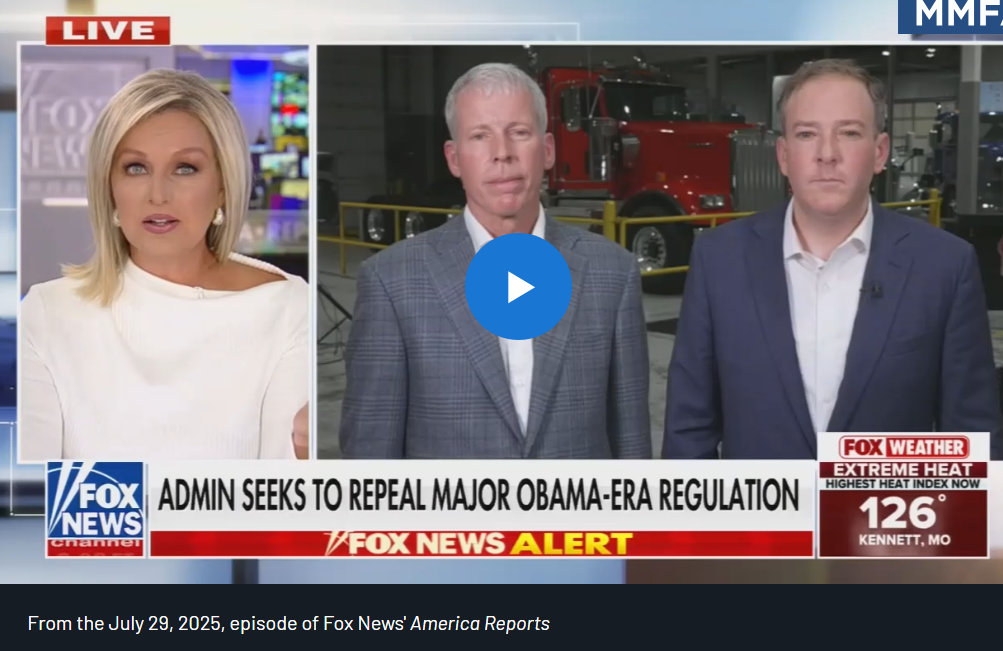
Fox News’ America Reports hosted Environmental Protection Agency Administrator Lee Zeldin and Energy Secretary Chris Wright to discuss the Trump administration's proposal to repeal the EPA’s 2009 endangerment finding, which affirmed that greenhouse gases endanger public health and welfare and which has served as the legal foundation for regulating emissions under the Clean Air Act.
Zeldin and Wright used the appearance to frame the repeal as a return to scientific integrity and regulatory restraint, ignoring the harms that this repeal would have on vulnerable communities. Fox anchor Sandra Smith did not challenge the claims and made no mention of the public health implications or regulatory consequences of revoking the finding. The exchange typified Fox’s pattern of amplifying Trump administration narratives about climate and energy while downplaying their real-world impacts.
Video
Citation
From the July 29, 2025, episode of Fox News' America Reports
The segment typified Fox’s role in obscuring the consequences of climate deregulation
During their appearance, Zeldin and Wright were not pressed on the public health, environmental, or legal implications of the proposal to reverse the endangerment finding. Instead, the host framed the discussion around economic themes and legal processes, asking whether repeal would make it easier to “undo a lot more of the Biden-Obama era climate rules.” Viewers heard nothing about the policy’s real-world impacts, but they did hear climate advocates characterized as ideological or extreme. Zeldin referred to them as “climate zealots,” while Wright framed the repeal as a return to “rationalism” — signaling to Fox’s audience that those who defend public protections are unserious.
This approach mirrors Fox’s longstanding pattern of covering regulatory actions through the lens of efficiency, growth, and personal freedom, while sidelining the communities most affected by the Trump administration's harmful actions. The result is a consistent minimization of climate risk and a distorted narrative in which climate and environmental outcomes are treated primarily as a political liability rather than a public necessity.
By allowing unchallenged repetition of misleading claims, and by omitting the central consequences of the policy under discussion, Fox News once again advanced a message strategy that serves to normalize and obscure the dismantling of basic climate and environmental protections.
Zeldin and Wright advanced a series of unsupported or misleading claims
During their appearance on the July 29 episode of Fox News' America Reports, Zeldin and Wright made a series of unsupported or misleading claims about the endangerment finding and what its repeal would mean for Americans.
Zeldin, for example, asserted that repealing the endangerment finding would yield “$1 trillion in savings”—a figure with no grounding in published EPA analyses or historical regulatory assessments. In contrast, EPA data has consistently shown that rules issued under the endangerment finding and the broader Clean Air Act generate substantial net benefits.
The agency’s Second Prospective Study of the Clean Air Act found that “the central benefits estimate exceeds costs by a factor of more than 30 to one," with most benefits stemming from reduced mortality linked to particulate pollution. By 2020, Clean Air Act programs were projected to prevent over 230,000 premature deaths, as well as millions of asthma attacks, heart attacks, and lost workdays annually.
More recently, the EPA’s Regulatory Impact Analysis for vehicle greenhouse gas standards projected net societal benefits of $272.7 billion between 2022 and 2050, with annualized gains of more than $14 billion, driven by fuel savings, reduced emissions, and avoidance of climate damages. These figures underscore that, far from being a financial burden, regulations grounded in the endangerment finding generate substantial and enduring public and economic value.
Similarly, Wright’s claim that the repeal reflects a return to scientific rigor collapses under scrutiny, relying on a report authored by a small group of contrarian scientists, including Steven Koonin and John Christy, who reject the well-established conclusion that greenhouse gas emissions from human activity are driving global warming and endangering public health. Their views stand in opposition to the broader scientific community, which includes the consensus positions of federal agencies such as the National Aeronautics and Space Administration and the National Oceanic and Atmospheric Administration, as well as the Fifth National Climate Assessment, which was produced by the U.S. Global Change Research Program.
Beyond economic distortions and scientific misrepresentation, Zeldin and Wright also ignored the far-reaching legal consequences of repeal — including for the fossil fuel industry itself.
As Grist reported, rescinding the endangerment finding would not only eliminate the federal government’s core authority to regulate greenhouse gases, it could also expose fossil fuel companies to a wave of climate liability lawsuits previously blocked by federal preemption. Some industry groups have reportedly urged the administration not to proceed, warning that repeal could unravel their legal defenses and leave them vulnerable to a patchwork of state regulations and courtroom challenges.
Fox viewers heard nothing about how repeal would harm the very communities most at risk
Zeldin and Wright also failed to mention what rescinding the endangerment finding would mean for public health, environmental protection, or the EPA’s ability to respond to pollution that threatens the air we breathe, the water we rely on, and the land we depend on to live and work. Viewers were not told that the standards targeted for repeal are central to reducing industrial emissions that worsen heat, flooding, and wildfire risk — or that dismantling these protections would increase illness, displacement, and hardship for older adults, children, low-income households, and rural communities, including many in Fox’s own audience.
REF 1
epa-endangerment-finding-repeal-proposal
NO LNX
In Game-Changing Climate Rollback, E.P.A. Aims to Kill a Bedrock Scientific Finding
The proposal is President Trump’s most consequential step yet to derail federal climate efforts and appears to represent a shift toward outright denial of the scientific consensus.
By Maxine Joselow and Lisa Friedman
Reporting from Washington
July 29, 2025
Lee Zeldin, the administrator of the Environmental Protection Agency, said on Tuesday the Trump administration would revoke the scientific determination that underpins the government’s legal authority to combat climate change.
Speaking at a truck dealership in Indianapolis, Mr. Zeldin said the E.P.A. planned to rescind the 2009 declaration, known as the endangerment finding, which concluded that planet-warming greenhouse gases pose a threat to public health. The Obama and Biden administrations used that determination to set strict limits on greenhouse gas emissions from cars, power plants and other industrial sources of pollution.
“The proposal would, if finalized, amount to the largest deregulatory action in the history of the United States,” Mr. Zeldin said. He said the proposal would also erase limits on greenhouse gas emissions from cars and trucks on the nation’s roads.
Without the endangerment finding, the E.P.A. would be left with no authority under the Clean Air Act to regulate the greenhouse gas emissions that are accumulating in the atmosphere from the burning of fossil fuels.
The proposal is President Trump’s most consequential step yet to derail federal climate efforts. It marks a notable shift in the administration’s position from one that had downplayed the threat of global warming to one that essentially flatly denies the overwhelming scientific evidence of climate change.
It would not only reverse current regulations, but, if the move is upheld in court, it could make it significantly harder for future administrations to rein in climate pollution from the burning of coal, oil and gas.
Without the United States working to reduce emissions, it becomes far tougher for the world to collectively prevent average global temperatures from rising by more than 1.5 degrees Celsius, or 2.7 degrees Fahrenheit, above preindustrial levels. That is the threshold beyond which climate scientists say there is significantly greater risk from increasingly destructive storms, droughts, wildfires and heat waves, as well as from species extinction.
In recent weeks, the Trump administration has also moved to scrap restrictions on pollution from power plants, halt key measurements of greenhouse gases in the atmosphere and delay approvals of wind and solar energy projects on federal lands.
“Today’s E.P.A. announcement ignores the blindingly obvious reality of the climate crisis and sidelines the E.P.A.’s own scientists and lawyers in favor of the interests and profits of the fossil fuel industry,” former Vice President Al Gore said in a statement.
To justify the proposal, the E.P.A. cited a report that the Energy Department commissioned from five scientists known for their rejection of the overwhelming scientific consensus on climate change, namely that it is being driven by the burning of fossil fuels, which releases greenhouse gases into the atmosphere.
The New York Times first reported that the Energy Department had hired these scientists, including Steven E. Koonin, a physicist and author of a best-selling book that calls climate science “unsettled,” and John Christy, an atmospheric scientist who doubts the extent to which human activity has caused global warming.
In their report, the scientists criticized the computer models used to predict climate change, saying they tend to overestimate warming. They also wrote that carbon dioxide, the most prevalent greenhouse gas in the atmosphere, has positive effects by helping plants grow and increasing agricultural productivity. And they asserted that overall, government climate regulations have a limited effect on global temperature rise.
The E.P.A. echoed this last argument in the proposed rule, saying greenhouse gases from cars on American roads do not contribute significantly to climate change because they are a small share of global emissions. Reducing these emissions to zero “would not have a scientifically measurable impact” on global climate trends or on public health and welfare, the agency said. Instead, the agency said, climate regulations are what pose the true threat to public health and welfare, because they increase the price of new vehicles and leave fewer choices for car buyers.
Many environmental activists and lawyers criticized those arguments, noting that transportation is the largest source of greenhouse gases in the United States. If the U.S. motor vehicle sector were a country, it would be the fourth-largest emitter of greenhouse gases in the world, according to the E.P.A.’s own data.
“If vehicle emissions don’t pass muster as a contribution to climate change, it’s hard to imagine what would,” said Dena Adler, a senior attorney at the Institute for Policy Integrity at New York University School of Law.
Dan Becker, who leads transportation policy for the Center for Biological Diversity, an environmental group, called the E.P.A. proposal a “cynical one-two punch” that will lead to more gasoline-burning vehicles on the road and fewer tools to reduce tailpipe pollution. He said that the auto-emissions rules being rescinded were projected to prevent 7 billion metric tons of emissions from entering the atmosphere while saving the average American driver about $6,000 in fuel and maintenance over the lifetime of vehicles built under the standards.
“The E.P.A. is revoking the biggest single step any nation has taken to save oil, save consumers money at the pump and combat global warming,” Mr. Becker said.
The administration’s plan has its backers. Daren Bakst, who directs the Center for Energy and Environment at the Competitive Enterprise Institute, a free-market research organization, said, “It is unreasonable to claim that pollutants contribute to endangerment if emissions are de minimis.”
Mike Braun, the governor of Indiana, said at the event in Indianapolis that the Biden administration’s vehicle emissions rules had burdened the auto industry in the state. “As a lifelong entrepreneur for 37 years actually in the automotive business, I think I know a thing or two about it, and you can count on Indiana being for common sense and reining in government,” he said.
John Bozzella, chief executive of the Alliance for Automotive Innovation, a lobbying group for most major carmakers, said in a statement that he was still reviewing the E.P.A.’s announcement. “At the same time, there’s no question the vehicle emissions regulations finalized under the previous administration aren’t achievable and should be revised to reflect current market conditions, to keep the auto industry in America competitive,” he said.
While the Chamber of Commerce and fossil fuel groups had fought the endangerment finding when it was first written, none have been clamoring in recent years for its reversal. This year Marty Durbin, who leads the chamber’s energy institute, called the finding “settled law” and said his group, which is a major business lobbying organization, was not seeking its repeal.
“I’m not aware of anyone in industry who has been pushing for it,” said Jeffrey Holmstead, an energy attorney with the law firm Bracewell who served in the E.P.A. during the administration of the first President George Bush and, later, that of President George W. Bush.
The plan to eliminate the endangerment finding showcases the political evolution of Mr. Zeldin, who for years took moderate positions on climate change and other environmental issues.
A former congressman from a coastal community on Long Island that is struggling with rising sea levels linked to global warming, Mr. Zeldin once joined a bipartisan caucus to address climate change. In 2019 he broke with fellow Republicans to vote against an amendment that would have prohibited the E.P.A. from reducing greenhouse gas emissions.
An ally of Mr. Trump who prominently defended him during House impeachment hearings, Mr. Zeldin moved to the right on energy and other issues during his unsuccessful bid for governor of New York in 2022. Just weeks after his nomination to lead the E.P.A., Mr. Zeldin declared that he would be “driving a dagger through the heart of climate-change religion” by repealing regulations on greenhouse gas emissions
“There are people who, in the name of climate change, are willing to bankrupt the country,” Mr. Zeldin said on the conservative podcast “Ruthless” earlier on Tuesday. One of the co-hosts of the program called the endangerment finding “the left’s tent pole to begin the whole climate grift,” to which Mr. Zeldin agreed.
The proposed repeal of the endangerment finding is all but certain to draw legal challenges, and David Doniger, a senior attorney at the Natural Resources Defense Council, an environmental group, said he expected that it would eventually be struck down in court. He noted that climate science has advanced significantly since 2009, when the finding was issued.
After the proposal is published in the Federal Register, the E.P.A. will solicit comments from the public for 45 days, Mr. Zeldin said. The agency will then finalize the rule, most likely in the next year.
Maxine Joselow reports on climate policy for The Times.
Lisa Friedman is a Times reporter who writes about how governments are addressing climate change and the effects of those policies on communities.
A version of this article appears in print on July 30, 2025, Section A, Page 1 of the New York edition with the headline: E.P.A. To Retract Bedrock Finding On Climate Crisis. Order Reprints
---
REF ALSO NYT
Trump Hires Scientists Who Doubt the Consensus on Climate Change
The three scientists joined the administration after it dismissed hundreds of experts who were assessing how global warming is affecting the country.
Steven E. Koonin, dressed in a dark suit and yellow tie, gestures as he speaks while sitting on a stage.
Steven E. Koonin, a physicist and author, was hired by the Energy Department. He previously worked as a physicist at New York University, as a scientist for the oil and gas company BP and as an under secretary at the Energy Department during the Obama administration.Credit...Aaron M. Sprecher/Bloomberg
By Maxine Joselow
Reporting from Washington
July 8, 2025
The Energy Department has hired at least three scientists who are well-known for their rejection of the overwhelming scientific consensus on climate change, according to records reviewed by The New York Times.
The scientists are listed in the Energy Department’s internal email system as current employees of the agency, the records show. They are Steven E. Koonin, a physicist and author of a best-selling book that calls climate science “unsettled”; John Christy, an atmospheric scientist who doubts the extent to which human activity has caused global warming; and Roy Spencer, a meteorologist who believes that clouds have had a greater influence on warming than humans have.
Their hiring comes after the Trump administration dismissed hundreds of scientists and experts who had been compiling the federal government’s flagship report on how climate change is affecting the country. The administration has also systematically removed mentions of climate change from government websites while slashing federal funding for research on global warming.
In addition, Trump officials have been recruiting scientists to help them repeal the 2009 “endangerment finding,” which determined that greenhouse gases pose a threat to public health and welfare, and which now underpins much of the government’s legal authority to slow global warming, according to two people briefed on the matter who spoke on the condition of anonymity because they were not authorized to comment publicly.
It was not immediately clear what the three scientists were working on or whether they were being paid. Representatives for Dr. Koonin, Dr. Spencer and the Energy Department did not respond to requests for comment.
In a brief phone interview and follow-up email, Dr. Christy said he was not working on the endangerment finding nor collecting a government salary. He declined to comment further.
A vast majority of scientists around the world agree that human activities — primarily the burning of fossil fuels such as oil, gas and coal — are dangerously heating the Earth. That has increased the frequency and intensity of heat waves, droughts and colossal bursts of rain like the storm that caused the deadly flooding now devastating central Texas.
A small minority of scientists, however, rejects this consensus. Dr. Koonin, who has said he is a friend of Energy Secretary Chris Wright, has been one of the loudest critics.
During President Trump’s first term, Dr. Koonin proposed that the Environmental Protection Agency conduct a “red-team, blue-team” exercise to challenge mainstream climate science. A “red team” of climate skeptics would critique major scientific reports on global warming, and a “blue team” of climate scientists would then rebut these claims. At the time, mainstream climate scientists said the proposal would make a mockery of scientific research and create a platform for marginal views that had already been disproved in the normal course of scientific debate.
Image
Roy Spencer, in a dark suit, blue shirt and tie, holds a microphone in one hand and points to a projection on a screen with the other hand.
Roy Spencer, a former NASA scientist and researcher at the University of Alabama, in 2012. He has argued that while human activity has caused some warming, its influence has been smaller than that of natural variations in global cloud cover.
Scott Pruitt, the E.P.A. administrator at the time, told coal industry executives that he planned to conduct the exercise. But John F. Kelly, then the White House chief of staff, ultimately blocked the effort.
Now, Dr. Koonin is listed as a “special government employee” in the Energy Department’s internal email system, the records show. Federal law says special government employees are executive branch appointees named to “perform important, but limited, services to the government, with or without compensation, for a period not to exceed 130 days” during a one-year period. Elon Musk had that classification when he began Mr. Trump’s cost cutting initiative, the so-called Department of Government Efficiency.
Dr. Koonin also serves as a fellow at the Hoover Institution, a conservative-leaning research organization on Stanford University’s campus. He previously worked as a physicist at New York University, a scientist for the oil and gas company BP and an under secretary at the Energy Department during the Obama administration.
In his 2021 book, “Unsettled: What Climate Science Tells Us, What It Doesn’t and Why It Matters,” Dr. Koonin argued that while the planet was warming and human activities had played a role, the scientific consensus was not as certain or as dire as it was frequently portrayed.
In a phone interview in November, Dr. Koonin said that the book had made an impression on Mr. Wright, who ran the oil and gas company Liberty Energy before he was confirmed as energy secretary in February.
“He reached out when I wrote the book and said, ‘This is great,’” Dr. Koonin recalled. “He asked me to come talk to his company at one point — it was a couple years ago — and we got to know each other.”
He added, “Chris and I have talked quite a bit over the last couple years, and I think he is well aligned with what I wrote in the book.”
Dr. Spencer, a research scientist at the University of Alabama in Huntsville, also has a connection to Mr. Wright. In a report published last year by Liberty Energy, Mr. Wright cited atmospheric temperature records that Dr. Spencer had collected. (The overall report, titled “Bettering Human Lives,” made the case that fossil fuels were “essential” to solving global poverty, a claim that some experts have called misleading.)
In addition to his role at the University of Alabama, Dr. Spencer is a policy adviser at the Heartland Institute, a conservative group that rejects mainstream climate science. He previously served as a scientist at NASA and as a visiting fellow at the Heritage Foundation, a right-wing group responsible for creating Project 2025, a conservative blueprint for the new administration.
Dr. Spencer has argued that while human activity has caused some warming, its influence has been smaller than that of natural variations in global cloud cover. While some of Dr. Spencer’s past work has been funded by the government, he has accused federal climate researchers of being biased because they receive taxpayer money.
“The popular opinion that government-funded research is unbiased must be considered quite naïve,” he wrote in his 2010 book “The Great Global Warming Blunder: How Mother Nature Fooled the World’s Top Climate Scientists.”
Image
John Christy, dressed in khaki shorts, sneakers and a blue polo shirt, sits on a chair in front of a large wall map of the world.
:{John Christy, an atmospheric scientist who doubts that human activity has caused global warming, in 2014
Dr. Christy has worked closely with Dr. Spencer to maintain atmospheric temperature records at the University of Alabama. He has also served as Alabama’s state climatologist since 2000. A vocal critic of climate models, he championed the “red-team, blue-team” exercise and served on an E.P.A. scientific advisory board during the first Trump administration.
When asked about his Energy Department role in a brief phone interview, Dr. Christy said he was an “unpaid person who’s available to them if they need it.”
Michael Mann, a climate scientist at the University of Pennsylvania, expressed alarm that the Energy Department had hired the three scientists.
“What this says is that the administration has no respect for the actual science, which overwhelmingly points in the direction of a growing crisis as we continue to warm the planet through fossil-fuel burning, the consequences of which we’ve seen play out in recent weeks in the form of deadly heat domes and floods here in the U.S.,” Dr. Mann wrote in an email.
Dr. Mann added that the Trump administration appeared to have fired hundreds of “actual government science experts” and replaced them with “a small number of reliable foot soldiers.”
Andrew Dessler, a climate scientist at Texas A&M University, said it would be troubling if these three scientists were involved in repealing the 2009 endangerment finding, which cleared the way for the government to regulate the planet-warming gases emitted by cars, power plants and other industrial sources.
On his first day back in the White House, Mr. Trump signed an executive order that charged the E.P.A. with reviewing the “legality and continuing applicability of” the endangerment finding. And last week, the agency sent a proposal to reconsider the finding to the White House budget office, a first step in repealing it.
An E.P.A. spokesman, Mike Bastasch, declined to comment on the proposal before its public release.
Brad Plumer contributed reporting from Washington.
Maxine Joselow reports on climate policy for The Times.
A version of this article appears in print on July 9, 2025, Section A, Page 16 of the New York edition with the headline: Energy Department Hires Skeptics of Climate Change
===
---
===
Marc Morano
Weekly update ⋅ February 28, 2025
EPA: Scrap Conclusion That Greenhouse Gases Endanger Public - TT -
Transport Topics
“This is the holy grail of the climate agenda,” said Marc Morano, who runs the climate-skeptic website ClimateDepot.com. “If you want to ...
Trump’s top environmental regulator is recommending the U.S. government scrap its formal conclusion that greenhouse gases endanger the public, a move that would sweep away the legal foundation for regulations limiting planet-warming pollution from power plants, automobiles and oil wells.
In private recommendations to Trump, Environmental Protection Agency Administrator Lee Zeldin has urged a rewrite of the so-called endangerment finding, setting the stage for a potentially sweeping attack on federal climate regulations. The recommendations were described by people familiar with the matter who asked not to be identified because the assessment isn’t public.
The president has frequently criticized what he calls the “green new scam,” referring to government policies fighting climate change and promoting emission-free energy. Trump hasn’t formally endorsed the plan outlined by Zeldin, and it’s unclear if he will embrace it. But if he does, the effort would dovetail with priorities such as building more power plants and abolishing incentives for electric vehicle sales. And it would be consistent with recent Trump administration moves to retreat from work on climate change, including preventing a U.S. official from attending a scientific meeting on the issue in China.
“This is the holy grail of the climate agenda,” said Marc Morano, who runs the climate-skeptic website ClimateDepot.com. “If you want to permanently cripple the United States climate agenda you have to go at the heart of it. This is the heart of it: the endangerment finding.”
Image

Zeldin
Zeldin delivered his recommendations to Trump a month after the president tasked the EPA with determining the “legality and continuing applicability” of the endangerment finding as part of a Jan. 20 executive order.
The EPA said Feb. 26 in an emailed statement that it was “in compliance” with the president’s executive order mandate for the agency to submit recommendations on the legality and continuing applicability of the 2009 endangerment finding. The Washington Post earlier reported on Zeldin’s recommendations.
MORE ON EPA: EPA Takes First Step to Block CARB Clean Trucks Rule
Energy businesses and some Trump allies are divided over the wisdom of a frontal attack on the endangerment finding. Some are concerned the effort would siphon time and manpower from other regulatory priorities, including rewriting Biden-era rules governing power plant and automobile pollution. It could take years for the EPA to go through a required rulemaking process to unwind the endangerment finding, and even then, it might not survive inevitable legal challenges.
Energy companies also have warned that doing away with the endangerment finding, and the federal climate regulations it supports, could revive public nuisance lawsuits against oil producers and power plant operators. Under a 2010 Supreme Court decision, federal climate regulation under the Clean Air Act has effectively precluded those claims.
At issue is the EPA’s 2009 conclusion that carbon dioxide, methane and four other greenhouse gases threaten the public health and welfare of current and future generations. The EPA was effectively compelled to assess the matter after the Supreme Court in 2007 affirmed the agency’s authority to regulate greenhouse gases as air pollutants under the Clean Air Act. At that point, it was up to the EPA to determine whether greenhouse gases constituted a threat that should be regulated.
But critics argue Congress designed the Clean Air Act to regulate localized pollutants, not those with widespread, global effects, and some have been pushing for repeal of the endangerment finding ever since. A policy blueprint drafted by conservative groups and Trump loyalists known as Project 2025 recommended addressing the endangerment finding.
A reversal generally would require the EPA to gather fresh evidence to support an opposing conclusion: that greenhouse gases aren’t a threat at all. Environmentalists argue that would fly in the face of a growing scientific body of evidence that greenhouse gas emissions are the primary driver of climate change.
Want more news? Listen to today's daily briefing above or go here for more info
“There is a lot of shocking stuff happening now, but to completely deny climate change and any federal obligation to control the pollution that’s driving it would be shocking and irresponsible,” said David Doniger, senior attorney with the Natural Resources Defense Council.
Environmental advocates contend it also would be illegal.
“Climate pollution is air pollution, and it is fueling a crisis,” said Margie Alt, director of the Climate Action Campaign. “There is no scientific basis — none — to claim otherwise.”
More Content About:
ghg, Environmental Protection Agency
British Petroleum To Roll Back Their Green Energy Goals | News Radio 1200 WOAI - iHeart
News Radio 1200 WOAI - iHeart
Marc Morano with the Climate Depot says this move reflects a simple fact of the energy industry. Green energy just isn't a money maker. He said ...
Trump admin plans to 'permanently cripple' climate protections in single blow: report
Raw Story
"This is the holy grail of the climate agenda," prominent climate change denier Marc Morano told the outlet. "If you want to permanently cripple ...
Trump's Environmental Protection Agency administrator, Lee Zeldin, is reportedly pursuing plans that would wipe away most federal climate change rules with a single move.
According to Bloomberg, the EPA considered scrapping "its formal conclusion that greenhouse gases endanger the public, a move that would sweep away the legal foundation for regulations limiting planet-warming pollution from power plants, automobiles and oil wells."
The EPA would rewrite the so-called endangerment finding at the heart of most climate change rules if Zeldin has his way, sources told Bloomberg.
ALSO READ:'Gotta be kidding': Jim Jordan scrambles as he's confronted over Musk 'double standard'
Trump has frequently referred to the rules as the "green new scam," but it was unclear if he had signed on to the plan.
"This is the holy grail of the climate agenda," prominent climate change denier Marc Morano told the outlet. "If you want to permanently cripple the United States climate agenda you have to go at the heart of it. This is the heart of it: the endangerment finding."
From building new power plants to eliminating incentives for electric vehicles, most climate change initiatives could quickly be reprioritized if Zeldin has his way.
==
11/18
https://www.nature.com/articles/d41586-018-07214-2
A landmark climate-change lawsuit brought by young people against the US government can proceed, the Supreme Court said on 2 November. The case, Juliana v. United States, had been scheduled to begin trial on 29 October in Eugene, Oregon, in a federal district court. But those plans were scrapped last month after President Donald Trump's administration asked the Supreme Court to intervene and dismiss the case.
The plaintiffs, who include 21 people ranging in age from 11 to 22, allege that the government has violated theirconstitutional rights to life, liberty and propertyby failing to prevent dangerous climate change. They are asking the district court to order the federal government to prepare a plan that will ensure the level of carbon dioxide in the atmosphere falls below 350 parts per million by 2100, down from an average of 405 parts per million in 2017.
By contrast, theUS Department of Justice argues that “there is no right to ‘a climate system capable of sustaining human life’” — as the Juliana plaintiffs assert.
Although the Supreme Court has now denied the Trump administration's request to the dismiss the case, the path ahead is unclear. In its 2 November order, the Supreme Court suggested that a federal appeals court should consider the administration's arguments before any trial starts in the Oregon district court.
Lawyers for the young people said they would push the district court to reschedule the trial next week.
“The youth of our nation won an important decision today from the Supreme Court that shows even the most powerful government in the world must follow the rules and process of litigation in our democracy,” said Julia Olson, co-counsel for the plaintiffs, in a statement reacting to the Supreme Court decision.
A new generation
Although climate change is a global problem, lawyers around the world have brought climate-change-related lawsuits against local and national governments and corporations since the late 1980s. These suits have generally sought to force the sort of aggressive action against climate change that has been tough to achieve through political means.
Many of the cases have failed, but in 2015, a citizen’s group called the Urgenda Foundation won a historic victory against the Dutch government. The judge in that case ordered the Netherlands to cut its greenhouse-gas emissions to at least 25% below 1990 levels by 2020, citing the possibility of climate-related damages to “current and future generations of Dutch nationals” and the government’s “duty of care … to prevent hazardous climate change”. A Dutch appeals courtupheld the verdict last month.
Over the past few years, the Dutch case has emerged as a model for climate lawsuits in other countries, says Gillian Lobo, a lawyer who specializes in climate-change-related cases at ClientEarth in London. More recently, she says, the Juliana lawsuit has inspired its own copycats — some of which have progressed further than Juliana itself. “It is a global phenomenon,” Lobo says.
One case modelled on the Juliana lawsuit has already produced a striking victory. In January, 25 young people sued the Colombian government for their right to a healthy environment, in a case called Demanda Generaciones Futuras v. Minambiente.
The Colombian Supreme Court found in the plaintiffs’ favour in April. Not only did it order the government to take steps to reduce deforestation and climate change, it also ruled that the Colombian Amazon rainforest is “a subject of rights” that is entitled to “protection, conservation, maintenance and restoration”.
Fuzzy future
The young plaintiffs in the Juliana case allege that they have already suffered harm as a result of climate change. Seventeen-year-old Jaime and her family left their home on the Navajo Nation Reservation in Cameron, Arizona, in 2011 because the natural springs on which they depended for water were drying up.Fifteen-year-old Jayden’s home in Louisiana was severely damaged by flooding in 2016, and 19-year-old Vic’s school in White Plains, New York, closed temporarily in 2012 after Hurricane Sandy hit.
US climate hawks hope that the Juliana plaintiffs will ultimately prevail, but President Donald Trump’s administration is mounting a multipronged defence. The Justice Department denies that the district court in Oregon has jurisdiction over the broad sweep of federal policies at issue, and that the rights to life, liberty and property set out in the Fifth Amendment to the Constitution translate into the right to a stable climate.
In any case, the department argues, no meaningful redress is possible, given that drastically reducing emissions in the United States might not move the needle on climate change much if other countries’ greenhouse-gas output grows. This echoes the argument made in 2007 by the Supreme Court's chief justice, John Roberts, when he dissented from the court’s decision in a pivotal climate case, Massachusetts vs. Environmental Protection Agency. The court’s ruling, which Roberts protested, forced the agency to regulate carbon emissions as a pollutant.
Andrea Rodgers, co-counsel for the Julianaplaintiffs, says that the Trump administration hasn’t challenged the fact that humans are changing the climate. “They haven’t presented experts to contest what our scientists are saying about ice melt or sea-level rise or terrestrial impacts or how climate change happens or ocean acidification,” she says.
To win, Rodgers says, “we have to show that the United States government is liable, but also that there is a remedy that the judge can order”. The United States has seen its greenhouse-gas emissions drop in recent years, as the country shifts its energy mix away from coal and towards renewable sources, but as of 2016, it remains the second-largest emitter after China.
James Hansen, a climatologist at Columbia University in New York City and a long-time climate activist, is an expert witness in the case — but he is also a plaintiff, representing “future generations” not yet born. (His 20-year-old granddaughter, Sophie Kivlehan, is also a plaintiff.)
Hansen has been fighting for action on climate change since he first testified on the subject before the US Senate in 1988. He says that if the Julianaplaintiffs lose their case, he will simply try another way. “We need to win as soon as possible,” Hansen says, “but if we lose, we don’t give up — we come back with a stronger case.”
Nature 563, 163-164 (2018)
doi: 10.1038/d41586-018-07214-2
==
===
620 icn
How Massachusetts v. EPA Forced the U.S. Government to Take On Climate Change
BY SAM EVANS-BROWN, NEW HAMPSHIRE PUBLIC RADIO
==
818
nola 818 why worry?
When climate science deniers and fossil fuel evangelists met Tuesday in New Orleans for the Heartland Institute's second "America First" conference on U.S. energy, they had every reason to celebrate the unprecedented influence they enjoy in the Trump administration.
Instead, they found plenty of reasons for dread.
With carbon tax proposals floating, climate lawsuits advancing, big corporations embracing the need for action and states and cities getting into the act, many of those gathered grappled with the reality that a fossil future was not secure—despite a largely pliant White House and Congress.
Contrarian scientists, policy professionals and lawyers affiliated with conservative interests contemplated the spread of the climate action agenda as if it were a malignancy. While speakers at the live-streamed sessions universally praised President Donald Trump and his regulatory rollbacks, the overwhelming diagnosis was that more aggressive policy surgery was needed.
High on their list of targets was the Environmental Protection Agency's finding that greenhouse gases are a danger to human health and welfare. That determination, affirmed by the Supreme Court, is what empowers the agency to regulate global warming pollution.
But the acting EPA administrator, Andrew Wheeler, has said he considers the endangerment finding "settled law" and does not wish to revisit it.
"Complete nonsense," said Atlanta lawyer Harry Macdougald,who was part of the legal team that unsuccessfully challenged the endangerment finding in court during the Obama administration. "It is a direct threat to the president's energy dominance agenda. And the next Democratic administration—and there will be one—will turn the screws."
Corporations 'Jumping on Climate Change'
...
==
https://www.exposedbycmd.org/2017/12/07/alec-hires-former-koch-staffer-lead-energy-task-force
The Koch-funded American Legislative Exchange Council (ALEC) has hired Grant Kidwell, a former analyst from two major Koch-backed groups–Americans for Prosperity and the Charles Koch Institute–to lead its Energy, Environment and Agriculture (EEA) task force, a position that has been left vacant since July.
Funded by numerous fossil-fuel companies, ALEC and its EEA task force has a long history of passing “model bills” undermining environmental protections and opposing policies to combat climate change. The task force is made up of numerous corporate lobbyists and their trade groups that stand to benefit from measures weakening environmental protections: including Koch Industries, Exxon Mobil, Peabody Energy, the Edison Electric Institute, American Fuel & Petrochemical Manufacturers (AFPM), the American Gas Association.
Kidwell’s first week at ALEC comes as the group holds its States and Nation Policy Summit, currently taking place in Nashville, Tennessee. Among the measures being discussed is a resolution urging theEPA to scrap the 2009 endangerment finding for greenhouse gases, which formed the legal basis for the federal government to regulate greenhouse gas pollution.According E&E News, the fossil-fuel funded Heartland Institute is rumored to be behind the resolution.
Before Kidwell’s appointment, Kenneth Stein who now works for the Koch-backed Institute for Energy Research, briefly served as the task force director from April to July 2017. John Eick, who now works for AFPM, previously led the task force from 2012-2017. Todd Wynn, who now works at the Department of Interior and previously worked at the Edison Electric Institute, was Director from 2011 to 2013.
This story was originally published in Documented here.
Amici Curiae Brief on CO2 case
Amici Curiae Brief of Climatologists and Scientists Sallie Baliunas, John R. Christy, Chris De Freitas, David Legates, Anthony Lupo, Patrick Michaels, Joel Schwartz, and Roy W. Spencer in Support of Respondents. by CEI Staff October 24, 2006http://www.cei.org/gencon/030,05572.cfm
Amicus brief written by Competitive Enterprise Institute
IN THE SUPREME COURT OF THE UNITED STATES COMMONWEALTH OF MASSACHUSETTS, et al., Petitioners, v. U.S. ENVIRONMENTAL PROTECTION AGENCY, et al., Respondents. On Writ of Certiorari to the United States Court of Appeals for the District of Columbia Circuit AMICI CURIAE BRIEF OF CLIMATOLOGISTS AND SCIENTISTS SALLIE BALIUNAS, JOHN R. CHRISTY, CHRIS DE FREITAS, DAVID LEGATES, ANTHONY LUPO, PATRICK MICHAELS, JOEL SCHWARTZ, AND ROY W. SPENCER IN SUPPORT OF RESPONDENTS SAM KAZMAN* HANS BADER CHRISTOPHER C. HORNER COMPETITIVE ENTERPRISE INSTITUTE 1001 Connecticut Ave., NW, #1250 Washington, D.C. 20036 (202) 331-2265 *Counsel of Recordhttp://www.cei.org/pdf/5572.pdf
==
http://www.globalpossibilities.org/is-the-epas-landmark-endangerment-finding-now-itself-imperiled/
2009 endangerment?
Donald Trump has called climate change a “hoax” and said he plans to unburden American industries from Obama-era requirements to limit emissions of carbon dioxide and the other greenhouse gases causing the planet to warm.
In the crosshairs of his agenda — according to written statements the Trump campaign made shortly before the Nov. 8 election — is a 2009 determination by the U.S. Environmental Protection Agency that greenhouse gases are dangerous to human health and security, a ruling that serves as the foundation for the EPA’s efforts to curb climate-damaging emissions and that affects its governing of everything from automobile exhaust to power plants to refrigerators.
But overturning that rule — known as the “endangerment finding” — might prove difficult, if not impossible, to accomplish with anything like the simple administrative stroke of the pen, according to legal experts.
“Attempting to overturn the endangerment finding would be like running toward a machine gun,” said Michael Gerrard, director of the Sabin Center for Climate Change Law at Columbia University. “Scientific support was very strong when it was issued in 2009; it has become much stronger since then.”
The rule represented the direct evolution of a 2007 decision by the U.S. Supreme Court, one that determined that the EPA not only had the authority to regulate climate gases as pollutants under the federal Clean Air Act, but was obligated to do so. The court directed the EPA to examine the scientific evidence and determine if greenhouse gases posed a threat to the public.
The EPA did that — examining everything from the potential for more damaging hurricanes, to death rates due to ozone and heat exposure, to deadly exposure to pathogens — and concluded in unambiguous terms that there was “compelling” reason to believe the gases threaten the health of Americans, and that the threat would get worse.
The agency’s conclusion rested on thousands of pages of peer-reviewed research, from the Intergovernmental Panel on Climate Change, from the U.S. Global Climate Research Program, and from the National Research Council. The agency wrote its rules and subjected them to public criticism. The public submitted voluminous comments, all of which were reviewed by the EPA before it issued a final rule.
The original rule-writing process alone took 14 months, (or 10 years if you count the arguments leading up to the 2007 Supreme Court fight). After its completion, The American Chemistry Council and other groups petitioned the U.S. Court of Appeals in the District of Columbia to review the validity of the finding. In 2012, that court upheld the EPA’s endangerment rule, finding that the agency’s interpretation of its authority and of its obligation to regulate carbon dioxide “is unambiguously correct.”
In order to effectively eliminate the rule now, one former EPA attorney told ProPublica, the Trump administration would likely have to reargue the original decision, including the merits of the scientific evidence, and then build on it.
Per the Supreme Court’s 2007 decision, the new administration would have to use existing evidence to prove no risk is posed by climate gases. Then it would have to explain how new information that has emerged since 2009 — a period including the hottest years on record, some of the biggest storms and driest droughts, and destabilizing mass human migration — demonstrate how the EPA erred in its 2009 conclusion.
It’s a steep hill to climb, and, as Gerrard points out, would inevitably lead to a fresh wave of lawsuits both against the EPA and against polluters directly in courts across the country.
In the meantime, the EPA remains obligated to enforce the climate-related rules on record.
There is, however, another option, but not one the Trump administration can execute alone: Congress could render the Supreme Court’s 2007 decision moot by passing new legislation amending the Clean Air Act itself — changing the landmark 1970 environmental law so as to explicitly exclude its oversight of carbon dioxide, methane and the pollutants known to be driving climate change.
Such a step would inevitably invite filibuster resistance not only among Democrats, but among Republicans concerned about climate risks, said Gerrard.
David Goldston, director of public affairs at the Natural Resources Defense Council, said Trump and other Republicans may try and chip away at environmental enforcement or regulations that are based on the finding, but not likely the finding itself.
“There’s a reason why, despite all the ideological gnashing of teeth for 20 years at least, that Republicans haven’t actually been able to touch the Clean Air Act successfully,” Goldston said. “It passed by a wide bipartisan margin, and it turns out, it’s almost like an article of faith with the public.”
==
wiki mass v epa 2007
Parties:{:(style="margin-right:0px;margin-left:0px"):}:[edit:{]}:
The petitioners were the states of California, Connecticut, Illinois, Maine, Massachusetts, New Jersey, New Mexico, New York, Oregon, Rhode Island, Vermont and Washington, the cities of New York, Baltimore, and Washington, D.C., the territory of **American Samoa**, and the organizations Center for Biological Diversity, Center for Food Safety, Conservation Law Foundation, Environmental Advocates, Environmental Defense, Friends of the Earth, Greenpeace, International Center for Technology Assessment, National Environmental Trust, Natural Resources Defense Council, Sierra Club, Union of Concerned Scientists, and the U.S. Public Interest Research Group. James Milkey of the Massachusetts Attorney General's Office represented the petitioners in oral arguments before the U.S. Supreme Court.[3]
Respondents were the Environmental Protection Agency, the Alliance of Automobile Manufacturers, National Automobile Dealers Association, Engine Manufacturers Association, Truck Manufacturers Association, CO2 Litigation Group, Utility Air Regulatory Group, and the states of Michigan, Alaska, Idaho, Kansas, Nebraska, North Dakota, Ohio, South Dakota, Texas, and Utah.
==
http://www.forbes.com/sites/larrybell/2013/02/17/epas-secret-and-costly-sue-and-settle-collusion-with-environmental-organizations/
bell bs
"Sue and Settle “ practices, sometimes referred to as “friendly lawsuits”, are cozy deals through which far-left radical environmental groups file lawsuits against federal agencies wherein court-ordered “consent decrees” are issued based upon a prearranged settlement agreement they collaboratively craft together in advance behind closed doors. Then, rather than allowing the entire process to play out, the agency being sued settles the lawsuit by agreeing to move forward with the requested action they and the litigants both want.
In other words, the agency throws the case, somewhat like Bre’r Rabbit agreeing to be thrown into a favorite brier-patch. A big difference however, is that in this case, Farmer McGregor andMr. Rabbit were partners in the scam from the beginning. It’s the unwary American public that actually does get caught in the thorns.
While the environmental group is given a seat at the table, outsiders who are most impacted are excluded, with no opportunity to object to the settlements. Accordingly, both the litigants and the defendant agency, operating in coffee bars and friendly courtroom shadows, avoid the harsh outside glare of oversight. No public notice about the settlement is released until the agreement is filed in court…after the damage has been done.
On top of all that, we taxpayers, including those impacted regulatory victims, are put on the hook for legal fees of both colluding parties.According to a 2011 GAO report, this amounted to millions of dollars awarded to environmental organizations for EPA litigations between 1995 and 2010. Three “Big Green” groups received 41% of this payback: Earthjustice, $4,655,425 (30%); the Sierra Club, $966,687; and the Natural Resources Defense Council, $252,004. Most of this was paid to environmental attorneys in connection to lawsuits filed under the Clean Air Act, followed next by the Clean Water Act.
In addition, the Department of Justice forked over at least $43 million of our money defending EPA in court between 1998 and 2010. This didn’t include money spent by EPA for their legal costs in connection with those rip-offs, since EPA doesn’t keep track of their attorney’s time on a case-by-case basis.
While researching various broken government regulatory processes, the U.S. Chamber of Commerce discovered many new rulemakings and unreasonable permitting delays which appeared to have resulted from such consent decrees in which the EPA agreed to bind itself to issue new regulations on a specific timetable; i.e., “We can tell Congress the court made us do it.”
The Chamber concluded that such Sue and Settle rulemaking is responsible for many of EPA’s “most controversial, economically significant regulations that have plagued the business community for the past few years”. Included are regulations on power plants, refineries, mining operations, cement plants, chemical manufacturers, and a host of other industries. One of the most successful Sue and Settle strategies they cited“… has been on an issue few in Washington or around the nation are paying attention to: regional haze requirements under the Clean Air Act.”
The Chamber’s study author, William Yeatman, Assistant Director for Energy and Environment at the Competitive Enterprise Institute (CEI), emphasizes that EPA’s abuse of its Regional Haze authority forces states to relinquish their authority and accept EPA’s far more expensive plans, thereby increasing consumer utility charges. He concluded that: “… no state is immune from having its rightful Regional Haze authority trampled by EPA at profound costs for virtually nonexistent benefits.”
Having conducted eight state case studies, Yeatman found that:
- In Arizona, EPA’s Regional Haze regulation threatens to increase the cost of water, forcing the state to spend an additional $90.2 million per year to implement the federal regulation.
- In Montana, EPA’s proposed Regional Haze controls are nearly 250% more expensive than what that agency’s standing rules presume to be “cost-effective” for compliance,
- In 2011, the EPA disregarded New Mexico’s Regional Haze plan, instead imposing a federal plan that requires nearly $840 million more in capital costs…potentially raising average annual household utility bills by $120.
- Although North Dakota is one of only 12 states that achieves all of EPA’s air quality standards for public health, it would not be able to achieve EPA’s Regional Haze goals for visibility even by shutting down all industry. The EPA plan would also cost the state an additional $13 million per year,
- Refusing to approve Oklahoma’s Regional Haze plan, the EPA’s plan would cost the state $282 million annually.
- In Wyoming, the EPA proposed a federal implementation plan that would cost almost $96 million per year more than the state’s plan.
- Minnesota is subject to back-to-back Regional Haze regulations, whereby EPA is claiming authority to regulate regional haze twice in succession at its Sherburne County generating plant.
- EPA’s proposed plan would cost Nebraska nearly $24 million per year to achieve invisible “benefits”.
Louisiana Senator David Vitter (R-LA), the new ranking member of the Senate Environment and Public Works Committee, plans to investigate this Sue and Settle practice, “using all available tools to bring to light this often abused path to regulatory influence”. For starters, he asked his Louisiana Attorney General Buddy Caldwell to join with AGs of 13 other states who filed a Freedom of Information Act (FOIA) request with EPA on August 10, 2012, asking for any and all correspondence between EPA and a list of 80 environmental, labor union and public interest organizations that have been party to litigation since the start of the Obama administration.
Unfortunately, getting federal agencies to comply with formal FOIA requests isn’t proving to be easy. And to make matters worse, there is evidence that top bureaucrats have even used private e-mail accounts and aliases to cover culpability tracks.
For example, Senator Vitter, along with Representative Darrell Issa (R-Calif.) who heads the House Oversight and Government Reform Committee, recently sent a letter to James Martin, EPA’s Region 8 administrator, warning him: “The use of personal, non-official e-mail accounts raises concerns that you could be attempting to insulate this and other e-mail correspondence from a Freedom of Information Act request. Moreover, your actions may also constitute violation of the Federal Records Act”…evading congressional oversight of federal agencies.
One of those private e-mails at issue involved an exchange between Martin and Vickie Patton, the General Counsel for the Environmental Defense Fund, regarding an arranged meeting with him. Patton wrote: “Hi Jim, Next Monday or Tuesday December 12/13 at 9am depending on which is best for you.” Responding, Martin replied: “January 13 at 9:00 am works for me if it works for you. (Lost your original note-is that the date and time you proposed?” Vitter and Issa have confirmed that the meeting did, in fact, take place at the EPA regional office.
Several Martin e-mails were released by EPA as the result of a FOIA lawsuit lodged by Christopher Horner of the Competitive Enterprise Institute. Horner’s efforts also revealed evidence that former EPA Administrator Lisa Jackson was conducting official agency business under cover of the alias name “Richard Windsor”, and CEI also sued EPA seeking e-mails concerning the EPA’s behind-the-scenes regulatory war on coal plants. Horner’s new book, The Liberal War on Transparency,discusses this and other tricks.
Suspicions abound that the exposure of Jackson’s undercover communications had much to do with her departure decision shortly afterwards. Senator Vitter commented: “I think this e-mail issue clearly spurred Lisa Jackson’s resignation. But it’s much broader than her. It’s about a culture of hiding an extreme agendafrom Americans because it can’t be sustained in public debate.”
CEI issued a statement that agreed with Vitter’s perspective, commenting: “We also believe the timing was no accident. She claims to have told President Obama shortly after his re-election she planned to leave in early 2013, but her announcement went public just days after the Justice Department agreed- as a result of a lawsuit filed by CEI- to begin producing 12,000 e-mails from her ‘Richard Windsor’ account.”
On January 28, 2013, on behalf of the American Tradition institute (ATI) Horner also sued in the Federal District Court of Washington, D.C. to compel EPA to end its eight-month stonewall of two FOIA requests regarding its “uncomfortably close ties at great taxpayer expense” with the American Lung Association(ALA), and the Sierra Club. Both of these organizations lobby for stringent regulatory legislation the EPA wants, while at the same time, receiving agency funding. ALA has received $20,405,655 from EPA over the past 10 years, and has run campaigns against politicians who challenge its policies. An ALA billboard ad in Michigan targeted House Energy and Commerce Committee Chairman Fred Upton, featuring a child with an oxygen mask over her face. The text read: “Rep. Fred Upton, protect our kids’ health. Don’t weaken the Clean Air Act.”
According to the ATI complaint, “The Sierra Club employs a similar model and has close working relationships with Agency officials.” This charge refers most particularly to a recent incidence where Sierra hired disgraced EPA Region 6 Administrator Al Armendariz. He left EPA shortly after a videotape revealed him acknowledging his “philosophy of enforcement” as being akin to random crucifixions used to keep subjects suitably respectful and “really easy to manage for the next few years.” Armendariz has pledged to continue to help Sierra (and, presumably, EPA) fight the coal industry.
:{Senator Vitter’s office has informed me that there are ongoing investigations regarding a known revolving door of environmentalists and agencies, as well as Equal Action to Justice Actrecovery money flowing to these groups post-settlement. In other words, the litigating groups are getting paid to sue both at the front end and tail end as well.
In an affidavit, ATI informed the court that one of the two specialists EPA assigned to handle the CEI’s FOIA requests admitted that a supervisor instructed her and a colleague to perform no work on them. Then: “Following this, EPA constructed a cul de sac of }:refusing to perform a search of responsive records until ATI agreed to pay estimated fees…which by law non-profits typically do not pay under FOIA…but which EPA then refused to provide.”
Quite certainly, EPA is not the only federal agency to engage in secret Sue and Settle deals with crony environmental lobbying organizations. In a January letter to his Attorney General Buddy Caldwell, Senator Vitter wrote: “The collusion between federal bureaucrats and the organizations entering consent agreements under a shroud of secrecy represents the antithesis of a transparent government, and your participation in the FOIA request [filed by 13 other states’ AGs] will help Louisianans understand the process by which these settlements were reached.” Caldwell subsequently agreed to the Senator’s request.
Vitter highlighted a recent example where theFish and Wildlife Service (USFWS), under management of the Department of Interior, entered an agreement with the Center for Biological Diversity involving new rules for endangered species …a deal that could impact private property owners across the South who lack financial resources necessary to fight a legal challenge from that massive federal agency.
In a massive 2011 settlement of a lawsuit filed by environmental groups, FWS promised to address more than 250 candidate species it had previously found warranting protection under the Endangered Species Act (ESA) but were precluded from listing due to a backlog. As part of a behind-closed-door agreement, USFWS also pledged to review hundreds more species proposed for listing. One of these is the “lesser prairie chicken”, a Sue and Settle determination which would thwart economic development and give Washington politicos power to control private lands in five states: New Mexico, Texas, Kansas, Colorado and Oklahoma.
As New Mexico Congressman Steve Pearce said: “The Endangered Species Act is one of the most heavy-handed unbending laws we have…it gives bureaucrats the power to destroy entire economies with hardly a second thought.” Congressman Tim Huelskamp (R-KS) summed up concerns of his constituents, saying: “Amid historic drought in the Great Plains, the last thing we need is another federal agency intruding into the lives and private property rights of Americans. In this case, we are talking about a bird that is populous enough that we can still hunt them in Kansas. This is not about preservation of a species; it’s about federal control of private landowners and limiting the ability to develop and grow rural America. Bureaucrats are becoming an invasive species in America’s heartland.”
Noting that this ESA-based Sue and Settle ruling presents a problem for private landowners throughout the country, Senator Vitter is also encouraging the inclusion of USWFS(which was not originally included) in the multi-state AG FOIA collusion investigation. Recognizing that the path forward towards obtaining disclosure will be difficult, Vitter added that he was: “Warily confident that both EPA and USFWS will shun all efforts to open the doors on these practices, the negotiations, and the communications between agency staff and outside groups regarding Sue and Settle agreements.”
Considering that our top law enforcement official, Attorney General Eric Holder, has been cited for Contempt of Congress in withholding requested communications regarding the DOJ’s own “Fast and Furious” debacle, there can be no lingering doubt that Senator Vitter’s unfortunate prediction will prove right. Sadly, and alarmingly, this all falls far short of what would logically be expected from that “most transparent administration in history” we were promised.
===
*summary http://www.streetlaw.org/document/141***
---
The Chamber of Commerce vs. Climate Science
The business lobby's challenge to carbon regulations probably won't convince a court of law. The court of public opinion is another matter.
By Kate Sheppard
| Mon Mar. 1,2010
LAWSUIT
William Kovacs, the US Chamber of Commerce's vice president of environment, technology and regulatory affairs, last year famously called for a "Scopes monkey trial of the 21st century" on climate change. Kovacs was referencing the lightning-rod 1925 court case that made it illegal to teach anything other than divine creation in Tennessee public schools—and he wanted a similar public hearing in which climate science would be put on the stand. The remark drew plenty of bad press, and Kovacs soon recanted his "inappropriate" analogy. But it looks like the chamber is angling for that monkey trial after all, by way of a lawsuit it's filed against the Environmental Protection Agency that could be the first wave of a big-business assault on greenhouse gas regulations.
At issue is a scientific finding issued by the EPA last year concluding that greenhouse gases are a threat to human health,due to the lower air quality, extreme weather events, and heat waves caused by rising temperatures. The chamber announced its intent to sue the EPA last month in an attempt to have the endangerment finding, as it's known, tossed out. The big-business lobby has been joined by a collection of trade groups like the American Farm Bureau Federation, theAmerican Petroleum Institute, the National Association of Manufacturers, and the National Mining Association; free-market think tanks such as FreedomWorks and the Competitive Enterprise Institute; and the attorneys general of Texas, Alabama, and Virginia.
Legally, the chamber and its allies don't have much of a case. In the 2007 case Massachusetts v. EPA, the Supreme Court found that greenhouse gases could be covered under the Clean Air Act if they are determined to threaten human health. Their ruling required the EPA to investigate whether carbon emissions did in fact pose a health risk. After the agency's scientists reached that conclusion, the EPA was automatically required to regulate the sources of greenhouse gases—otherwise the agency would be breaking the law. And because the EPA's directive is based on a scientific assessment, not a policy preference, it will be extremely hard to overturn, said Michael Gerrard, director of the Center for Climate Change Law at Columbia Law School. "These petitions are a real long-shot," he said. "The appellate courts tend to give a large degree of deference to the technical judgments of expert agencies, especially when they are based like this one is on voluminous studies." In addition, the EPA won't actually enforce regulations on the biggest emitters, like power plants and refineries, until 2011. That means the plaintiffs can't prove they've suffered any harm from the EPA's decision, said John Pendergrass, senior attorney at the Environmental Law Institute, who described the lawsuits challenging the endangerment finding as "premature."
So if the odds of this gambit succeeding are so low, then why is the chamber gearing up for a costly lost cause? The goal of the suit "is political obfuscation," argues Bill Snape, senior counsel at the Center for Biological Diversity. That is, the chamber's critics believe that the business lobby group hopes to once again muddy the public understanding of climate change by seeking a high-profile forum in which it can argue that the science isn't settled."This is part of a media and political strategy. It's not a legal strategy," said David Bookbinder, chief climate counsel at Sierra Club, which has intervened in support of the EPA, along with several other environmental groups and 16 states, many of them litigants in the case that originally prompted the agency's action.
The EPA's opponents couldn't have chosen a better time to argue that the science of global warming is still up for debate, thanks to the recent "ClimateGate" emails scandal, and the revelation that an Intergovernmental Panel on Climate Change report contained flawed data. In reality, the emails released in the so-called ClimateGate flap showed climate scientists behaving unprofessionally over dissenting views, but nothing in the messages discounted the underlying science of climate change, which has been reaffirmed by thousands of peer-reviewed studies from scientists around the world. And although the IPCC's errors have raised questions about the timing and severity of specific anticipated climate events, they have not altered the overwhelming body of evidence and widespread scientific consensus that the planet is warming due to the burning of fossil fuels. Nevertheless, a number of the legal challenges to the EPA seek to exploit these controversies for maximum PR advantage.
Texas Gov. Rick Perry, for instance, claimed in a press conference announcing his state's suit that the finding is "based on the tainted data of an agenda-driven international panel." Virginia Attorney General Ken Cuccinelli II accused the agency of introducing "job-destroying regulations based on unverifiable and unrepeatable so-called science." And the challenge from the Competitive Enterprise Institute, FreedomWorks, and other free-market groups alleges that the hacked emails scandal "has severely undermined EPA's alleged justification for regulating carbon dioxide."
For its part, the chamber claims that it's not attacking the EPA's scientific assessment. Yet its announcement of the lawsuit did just that—charging that the agency failed to perform "careful analysis of all available data and options" before releasing the "flawed" finding. And in its public comments submitted in advance of the release of the endangerment finding last year, the chamber also disputed the science of climate change, suggesting, among other things, that rising temperatures might actually be beneficial for humans, and that any resulting problems could be addressed by the increased use of air conditioners.
The barrage of lawsuits against the EPA comes as an increasing number of lawmakers in Congress from both parties are moving to attempt to block the agency from cracking down on greenhouse gas emissions. Leading the charge is Sen. Lisa Murkowski (R-Alaska), who, with the help of industry lobbyists, has filed a resolution of disapproval that, if signed into law, would nullify the endangerment finding.This rarely used parliamentary maneuver already has 40 cosponsors, including Democratic Sens. Blanche Lincoln (Ark.), Ben Nelson (Neb.), and Mary Landrieu (La.). A bipartisan trio of representatives introduced the same measure in the House in late February.
While EPA administrator Lisa Jackson has pushed back the enforcement of regulations on the largest emissions sources until 2011, she also has made it clear that rules are coming, whether the EPA's adversaries like it or not. "The law of the land found that greenhouse gases are pollutants, and they ordered EPA to make a determination," Jackson told the Senate Environment and Public Works Committee in late February. "I believe I have no choice but to follow the law." But even if the attempts to block the agency ultimately fail, the lawsuits have given opponents of regulation another platform to attack the science and delay action on climate change further. Says Snape of the Center for Biological Diversity, "If the goal of these lawsuits is to muck up the works, well, unfortunately they're getting a little bit of traction."
http://motherjones.com/politics/2010/02/chamber-commerce-vs-climate-science
Chamber of Commerce Climate Civil War Continues
Apple Quits Chamber of Commerce
Another Company Quits Chamber of Commerce Over Climate Position
Fact-Checking the US Chamber of Commerce
America's most overblown business lobby, busted.
lawsuit
But that's not the U.S. Chamber of Commerce. The U.S. Chamber is a hard-right ideological operation, which provides massive funding to conservative Republicans, including the new GOP majority in Wisconsin. If you want a sense of just how far right: Glenn Beck held a telethon on their behalf, and donated $10,000 of his money. "They are us," he said -- and an executive of the chamber called in to thank him. The U.S. Chamber of Commerce spent more money lobbying in 2009 than the next five biggest players combined; they spent more money on politics than either the Republican or Democratic National Committees. They're the biggest elephant in the jungle.
Despite their claim to represent three million American businesses, more than half their budget comes from just 16 companies. They don't have to identify them, but it's pretty easy to guess who they might be, since the chamber has devoted much of its time to thwarting any effort to control carbon emissions. For instance, they filed a brief with the EPA demanding they not fight global warming because "populations can acclimatize to warmer climates via a range of behavioral, physiological, and technological adaptations."
http://www.huffingtonpost.com/bill-mckibben/koch-brothers-the-us-cham_b_834462.html
mckibben
n klein:This is where the intersection between hard-right ideology and climate denial gets truly dangerous. It’s not simply that these “cool dudes” deny climate science because it threatens to upend their dominance-based worldview. It is that their dominance-based worldview provides them with the intellectual tools to write off huge swaths of humanity in the developing world. Recognizing the threat posed by this empathy-exterminating mindset is a matter of great urgency, because climate change will test our moral character like little before. The US Chamber of Commerce, in its bid to prevent the Environmental Protection Agency from regulating carbon emissions, argued in a petition that in the event of global warming, “populations can acclimatize to warmer climates via a range of behavioral, physiological, and technological adaptations.” These adaptations are what I worry about most. [ AC?
==
DC appeals court ruling will prove difficult to overturn, largely ignored by conservatives
Posted on July 23,2012by Brian Angliss under Environment & Nature, Politics, Law & Government [**Comments:** none ]
Part five of a series.
On June 26, 2012, the DC Circuit Court of Appeals ruled that the Environmental Protection Agency’s (EPA’s) greenhouse gas regulations were in accordance with the Clean Air Act and the Supreme Court’s 2007 *Massachusetts v. EPA* ruling. But more than that, the appeals court so strongly worded their opinion, and based it so firmly in long established court precedents and the Supreme Court’s own ruling that it will be very difficult to overturn. These facts were largely ignored by the Attorneys General of the states of Texas and Virginia, and the vast majority of prominent conservative think tanks and conservative media outlets simply ignored the ruling altogether.
The Court’s opinion is very strongly grounded in existing precedent. The court relied on many old precedents that have guided court decisions regarding the Clean Air Act since its inception in 1970. Full story »
===
The Chamber of Commerce vs. Climate Science
The business lobby's challenge to carbon regulations probably won't convince a court of law. The court of public opinion is another matter.
—By Kate Sheppard
| Mon Mar. 1, 2010 2:30 AM PST
...
Legally, the chamber and its allies don't have much of a case. In the 2007 case Massachusetts v. EPA, the Supreme Court found that greenhouse gases could be covered under the Clean Air Act if they are determined to threaten human health. Their ruling required the EPA to investigate whether carbon emissions did in fact pose a health risk. After the agency's scientists reached that conclusion, the EPA was automatically required to regulate the sources of greenhouse gases—otherwise the agency would be breaking the law. And because the EPA's directive is based on a scientific assessment, not a policy preference, it will be extremely hard to overturn, said Michael Gerrard, director of the Center for Climate Change Law at Columbia Law School. "These petitions are a real long-shot," he said. "The appellate courts tend to give a large degree of deference to the technical judgments of expert agencies, especially when they are based like this one is on voluminous studies." In addition, the EPA won't actually enforce regulations on the biggest emitters, like power plants and refineries, until 2011. That means the plaintiffs can't prove they've suffered any harm from the EPA's decision, said John Pendergrass, senior attorney at the Environmental Law Institute, who described the lawsuits challenging the endangerment finding as "premature."
So if the odds of this gambit succeeding are so low, then why is the chamber gearing up for a costly lost cause? The goal of the suit "is political obfuscation," argues Bill Snape, senior counsel at the Center for Biological Diversity....
http://motherjones.com/politics/2010/02/chamber-commerce-vs-climate-science
===
http://communityrights.org/PDFs/MassBriefs/merits%20resp%20CO2%20group.pdf
RUSSELL S. FRYE FRYE LAW PLLC
3050 K Street, N.W. Suite 400 Washington, DC 20007 Telephone: (202) 572-8267 Counsel of Record
INTRODUCTORY STATEMENT
The CO2 Litigation Group,which intervened below in
support of Respondents Environmental Protection Agency,
et al. (“EPA”), is an informal group whose members are all
trade associations or other organizations representing
businesses that would be affected by regulation of emissions
of carbon dioxide (“CO2”) and other substances
believed by many to contribute to global climate change
(“greenhouse gases”). These organizations represent a
broad spectrum of U.S. business and industry. Each
organization has among its members businesses that burn
fossil fuel and other organic matter (such as wood), which
unavoidably generates CO2. In addition, in some cases the
organization’s members also are involved in: the production
or marketing of fuels, both for motor vehicles and for
boilers and other “stationary sources”; the manufacture or
marketing of fuel-burning equipment; the use of oil or
natural gas as a raw material for the manufacture of other
chemicals; the oxidation of carbon as a process chemical
(as in steelmaking); or business activities dependent on
the public’s use of fossil-fuel-burning vehicles (such as
highway construction and operation of convenience
stores).1
The organizations comprising CO2 Litigation Group
are: the American Chemistry Council, the American Forest
& Paper Association, the American Iron and SteelInstitute,
the American Petroleum Institute, the American
Road & Transportation Builders Association, theBusiness
Roundtable, the Chamber of Commerceof the United
1
For brevity, this brief sometimes refers to “CO2 Litigation Group”
to mean the members of the trade associations or other organizations
that in turn comprise CO2 Litigation Group.
2
States of America, the National Association of Convenience
Stores, the National Association of Manufacturers, the
National Petrochemical and Refiners Association, the
Portland Cement Association, the Society of Independent
Gasoline Marketers of America, the Specialty Steel Industry
of North America, and the Steel Manufacturers Association.
The CO2 Litigation Group’s members believe that
global climate change is a highly complex phenomenon,
and that many of the statements in Petitioners’ brief (and
the briefs of many of the amici curiae) about its extent and
causes are oversimplified and overstate the certainty of its
potential future course and effects. The CO2 Litigation
Group’s members do agree, however, that the potential for
global climate change and the possible role of anthropogenic
emission sources in global climate change are important
public concerns that warrant ongoing research and
consideration by the government of the United States (as
well as the governments of other countries and transnational
bodies). In fact, many of the CO2 Litigation Group’s
members already are taking steps to reduce atmospheric
loading of CO2 and other greenhouse gases from their
activities, through voluntary measures such as improving
energy efficiency or providing “carbon sinks” where CO2 is
removed from or kept out of the atmosphere (known as
“carbon sequestration”).
===
http://en.wikipedia.org/wiki/Massachusetts_v._Environmental_Protection_Agency
Massachusetts v. Environmental Protection Agency, 549 U.S. 497 (2007),[1] is a U.S. Supreme Court case decided5-4 in which twelve states and several cities of the United States brought suit against the United States Environmental Protection Agency (EPA) to force that federal agency to regulate carbon dioxide and other greenhouse gases as pollutants.
Contents[hide] |
[edit] Background
Section 202(a)(1) of the Clean Air Act (CAA), 42 U.S.C. § 7521(a)(1), requires the EPA to set emission standards for "any air pollutant" from motor vehicles or motor vehicle engines "which in his judgment cause[s], or contribute[s] to, air pollution which may reasonably be anticipated to endanger public health or welfare."
In 2003, the EPA made two determinations:[2]
- The EPA lacked authority under the Clean Air Act to regulate carbon dioxide and other greenhouse gases (GHGs) for climate change purposes.
- Even if the EPA did have such authority, it would decline to set GHG emissions standards for vehicles.
[edit] Parties
The petitioners were the states of California, Connecticut, Illinois, Maine, Massachusetts, New Jersey, New Mexico, New York, Oregon, Rhode Island, Vermont and Washington, the cities of New York, Baltimore, and Washington, D.C., the territory of American Samoa, and the organizations Center for Biological Diversity, Center for Food Safety, Conservation Law Foundation, Environmental Advocates, Environmental Defense, Friends of the Earth, Greenpeace, International Center for Technology Assessment, National Environmental Trust, Natural Resources Defense Council, Sierra Club, Union of Concerned Scientists, and U.S. Public Interest Research Group.
Respondents were the Environmental Protection Agency, the Alliance of Automobile Manufacturers, National Automobile Dealers Association, Engine Manufacturers Association, Truck Manufacturers Association, CO2 Litigation Group,Utility Air Regulatory Group, and the states of Michigan, Alaska, Idaho, Kansas, Nebraska, North Dakota, Ohio, South Dakota, Texas, and Utah.
[edit] Appeals court
The U.S. Court of Appeals for the District of Columbia Circuit decided on September 13, 2005, to uphold the decision of the EPA.[3] However, the reasoning among the appellate judges for coming to the majority conclusion was sharply at odds.
The lower court was sharply divided on whether the petitioners had "standing," a personalized injury creating a right to use the courts (instead of the Congress) to obtain government action. One of the three judges found no standing while a second of three postponed a factual decision for any later trial. Despite having granted certiorari, the Supreme Court could have revisited that question in order to dodge a difficult decision and dismiss for lack of standing. Yet, once certiorari has been granted, such a reversal is rare.
[edit] Granting of certiorari
The U.S. Supreme Court has discretion whether to consider an appeal of most types of cases appealed to it, including cases of this type. On June 26, 2006, the Supreme Court granted a writ of certiorari to award an appeal.[4] The time from granting of the certiorari to oral argument in this case was unusually swift. Because so few cases are granted an appeal, this tends to indicate unusual interest in the case by the Supreme Court, particularly where an issue has not previously been a persistent topic of disagreement among the lower Federal courts. (A Court tradition, known as the rule of four, says that at least four of the Court's nine Justices must vote in favor of granting certiorari.)
[edit] Issues
- Whether the petitioners had standing
- Whether carbon dioxide is an "air pollutant" causing "air pollution" as defined by the Clean Air Act. If carbon dioxide is not an air pollutant causing air pollution, then the EPA has no authority under the Clean Air Act to regulate carbon dioxide emissions. If the CAA governs carbon dioxide, the EPA Administrator could decide not to regulate carbon dioxide, but only consistent with the terms of the CAA.
- Whether the EPA Administrator may decline to issue emission standards for motor vehicles on the basis of policy considerations not enumerated in section 202(a)(1).
[edit] Arguments
The Petitioners argued that the definition in the CAA is so broad that carbon dioxide must be counted as air pollution. They claimed that the question was controlled by the words of the statute, so that factual debate was immaterial. Furthermore, the Petitioners filed substantial scientific evidence that the toxicity of carbon dioxide results from high concentrations and that alleged causation of global warming transforms the gas into a pollutant.
If the statutory definition of the CAA includes carbon dioxide, then the Federal courts would have no discretion to reach any other conclusion. The definition contained in the statute, not evidence or opinion, would control the outcome.
The Petitioners asserted that the EPA Administrator's decision not to regulate carbon dioxide and other greenhouse gases violated the terms of the CAA. Thus, the Supreme Court also considered whether the reasons given by the EPA were valid reasons within the CAA statute for the EPA Administrator to decide not to regulate carbon dioxide. The EPA argued that the Administrator has the discretion under the CAA to decide not to regulate.
The EPA Administrator argued that other actions are already being taken to increase fuel efficiency of automobiles and that (as of 2003) scientific investigation was still under way. Thus, the EPA Administrator decided not to regulate "at this time".
This case has become notable because of a widespread perception that the truth or falsehood of theories of global warming will be decided by the courts. While this could eventually occur in later proceedings, the questions before the U.S. Supreme Court here were much more narrow, and legal in nature.
One of several reasons that the EPA Administrator declined to regulate carbon dioxide is uncertainty about whether man-made carbon dioxide emissions cause global warming. This has attracted great attention to the case. However, the Supreme Court only decided whether the Administrator's reason is a valid reason within the CAA. The Supreme Court did not explicitly decide if it is true or untrue that man-made carbon dioxide emissions cause global warming, although high-profile comments by Justices during oral argument are likely to affect the public debate.
The Petitioners argued that scientific uncertainty is not a valid basis for the EPA Administrator to decline to regulate. The question before the High Court "was not whether the causation is true or untrue," but whether it is a valid reason for the Administrator to not regulate a pollutant.
[edit] Decision
[edit] Stevens' opinion for the Court
First, the petitioners were found to have standing.[5] Justice Stevens reasoned that the states had a particularly strong interest in the standing analysis.[6] The majority cited Justice Holmes' opinion in Georgia v. Tennessee Copper Co.:
"The case has been argued largely as if it were one between two private parties; but it is not. The very elements that would be relied upon in a suit between fellow-citizens as a ground for equitable relief are wanting here. The State owns very little of the territory alleged to be affected, and the damage to it capable of estimate in money, possibly, at least, is small. This is a suit by a State for an injury to it in its capacity of quasi-sovereign. In that capacity the State has an interest independent of and behind the titles of its citizens, in all the earth and air within its domain. It has the last word as to whether its mountains shall be stripped of their forests and its inhabitants shall breathe pure air."[7]
Second, the Court held that the Clean Air Act gives the United States Environmental Protection Agency (EPA) the authority to regulate tailpipe emissions of greenhouse gases. The Clean Air Act provides:
“The Administrator shall by regulation prescribe (and from time to time revise) in accordance with the provisions of this section, standards applicable to the emission of any air pollutant from any class or classes of new motor vehicles or new motor vehicle engines, which in his judgment cause, or contribute to, air pollution which may reasonably be anticipated to endanger public health or welfare.” [8]
The Act defines "air pollutant" as "any air pollution agent or combination of such agents, including any physical, chemical, biological, radioactive . . . substance or matter which is emitted into or otherwise enters the ambient air".[9] The majority report commented that "greenhouse gases fit well within the Clean Air Act’s capacious definition of air pollutant"[10]
Finally, the Court remanded the case to the EPA, requiring the agency to review its contention that it has discretion in regulating carbon dioxide and other greenhouse gas emissions. The Court found the current rationale for not regulating to be inadequate and required the agency to articulate a reasonable basis in order to avoid regulation.
[edit] Roberts' dissent
Chief Justice Roberts authored a dissenting opinion. First, the dissent condemns the majority's "special solicitude" conferred to Massachusetts as having no basis in Supreme Court cases dealing with standing. The dissent compares the majority opinion to "the previous high-water mark of diluted standing requirements," United States v. SCRAP (1973). Roberts then argues that the alleged injury (i.e., Massachusetts' loss of land because of rising sea levels) is too speculative and without adequate scientific support. The dissent also finds that even if there is a possibility that the state may lose some land because of global warming, the effect of obliging the EPA to enforce automobile emissions is hypothetical at best. According to Roberts, there is not a traceable causal connection between the EPA’s refusal to enforce emission standards and petitioners' injuries. Finally, the dissent maintains that redressability of the injuries is even more problematic given that countries such as India and China are responsible for the majority of the greenhouse-gas emissions. The Chief Justice concludes by accusing the majority of lending the Court as a convenient forum for policy debate and of transgressing the limited role afforded to the Supreme Court by the U.S. Constitution.
[edit] Scalia's dissent
First, Justice Scalia found that the Court has no jurisdiction to decide the case because petitioners lack standing. In his estimation, that is the end of the inquiry. However, since the majority saw fit to find standing, his dissent continued.
The main question is, "Does anything require the Administrator to make a 'judgment' whenever a petition for rulemaking is filed?" Justice Scalia sees the Court's answer to this unequivocally as yes, but with no authority to back it. He backs this assertion by explaining that the "statute says nothing at all about the reasons for which the Administrator may defer making a judgment"—the permissible reasons for deciding not to grapple with the issue at the present time. Scalia saw no basis in law for the Court's imposed limitation.
In response to the Court's statement that, "If the scientific uncertainty is so profound that it precludes EPA from making a reasoned judgment as to whether greenhouse gases contribute to global warming, EPA must say so," Scalia responds that EPA has done precisely that, in the form of the National Research Council panel that researched climate-change science.
Resting the heart of his dissent on the Court's abdication of applying *Chevron* deference, he closes with the notion that no matter how important the policy issue in question, the Court should defer to the more experienced and reasoned judgment of the agency.
[edit] Remand
On remand, EPA found that six greenhouse gases “in the atmosphere may reasonably be anticipated both to endanger public health and to endanger public welfare.” On February 16, 2010, the states ofAlabama, Texas and Virginia sought judicial review of EPA's determination in the United States Court of Appeals for the DC Circuit.
[edit] See also
- Standing (law)
- Global warming
- Effects of global warming
- International Panel on Climate Change - Fourth Assessment Report
- List of United States Supreme Court cases, volume 549
- List of United States Supreme Court cases
[edit] Further reading
- Suing the Tobacco and Lead Pigment Industries: Government Litigation as Public Health Prescription by Donald G. Gifford. Ann Arbor, University of Michigan Press, 2010. ISBN 978-0-472-11714-7
[edit] Notes
- ^ Text of Opinion
- ^ United States Environmental Protection Agency Office of Public Affairs (2003-08-23). "EPA Denies Petition to Regulate Greenhouse Gas Emissions from Motor Vehicles". Press release. http://yosemite.epa.gov/opa/admpress.nsf/fb36d84bf0a1390c8525701c005e4918/694c8f3b7c16ff6085256d900065fdad!OpenDocument. Retrieved 2010-08-12.
- ^ Appeals Court decision
- ^ Questions presented
- ^ Massachusetts v. EPA, 549 U.S. at 526.
- ^ Id. at 518-20.
- ^ Georgia v. Tennessee Copper Co., 206 U.S. 230, 237 (1907).
- ^ Clean Air Act, 42 U.S.C. § 7521(a)(1).
- ^ Id. at 7602(g)
- ^ Massachusetts v. EPA, 549 U.S. at 528-29.
[edit] External links
 Works related to Massachusetts v. Environmental Protection Agency at Wikisource
- Text of Massachusetts v. Environmental Protection Agency, 549 U.S. 497 (2007) is available from: · Findlaw · Cornell LII

- CRS Report (public domain—may be copied verbatim into article with citations)
- *New York Times* article of April 2, 2007 relating to decision
- Transcript of Oral Arguments
- Briefs and oral arguments from Oyez
- Bloomberg report of 6/26/2006
Grist commentryhttp://www.grist.org/article/breaking-supreme-court-rules-against-bush-admin-in-global-warming-case
NAM/Industry Brief *in* Coalition for *Responsible Regulation*
epa suit 2011
IN THE UNITED STATES COURT OF APPEALS
FOR THE DISTRICT OF COLUMBIA CIRCUIT
COALITION FOR RESPONSIBLE REGULATION, INC., ET AL.,
Petitioners,
V.
UNITED STATES ENVIRONMENTAL PROTECTION AGENCY,
LISA P. JACKSON, ADMINISTRATOR, AND
THE NATIONAL HIGHWAY TRAFFIC SAFETY ADMINISTRATION,
Respondents.
On Petitions for Review of Light-Duty Vehicle Greenhouse Gas Emission
Standards and Corporate Average Fuel Economy Standards;
Final Rule, 75 Fed. Reg. 25,324 (May 7,2010)
JOINT OPENING BRIEF OF NON-STATE PETITIONERS
AND SUPPORTING INTERVENORS
John P. Elwood
VINSON & ELKINS LLP
2200 Pennsylvania Ave. NW
Washington, D.C. 20037
(202) 639-6500
Counsel for Coalition
for Responsible Regulation, Inc., et al.
Eric Groten
VINSON & ELKINS LLP
2801 Via Fortuna, Suite 100
Austin, TX 78746-7568
(512) 542-8709
Counsel for Coalition
for Responsible Regulation, Inc., et al.
DATED: June 3, 2011
Patrick R. Day, P.C.
HOLLAND & HART LLP
2515 Warren Ave., Suite 450
Cheyenne, WY 82001
(307) 778-4209
Counsel for Coalition
for Responsible Regulation, Inc., et al.
Paul D. Phillips
HOLLAND & HART LLP
555 17th Street, Suite 3200
Denver, CO 80202-3979
(303) 295-8131
Counsel for Coalition
for Responsible Regulation, Inc., et al.
John A. Bryson
HOLLAND & HART, LLP
975 F Street NW
Washington, D.C. 20004
(202) 393-6500
Counsel for Coalition
for Responsible Regulation, Inc., et al.
James A. Holtkamp
HOLLAND & HART LLP
60 E. South Temple, Suite 2000
Salt Lake City, UT 84111
(801) 799-5800
Counsel for Coalition
for Responsible Regulation, Inc., et al.
Shannon L. Goessling
SOUTHEASTERN LEGAL
FOUNDATION, INC.
2255 Sewell Mill Road, Suite 320
Marietta, GA 30062
(770) 977-2131
Counsel for Southeastern Legal Foundation,
Inc., et al., and Intervenors Langdale Farms,
LLC, et al..
Edward A. Kazmarek
KAZMAREK GEIGER
& LASETER LLP
One Securities Center
3490 Piedmont Road NE, Suite 350
Atlanta, GA 30305
(404) 812-0840
Counsel for Southeastern Legal Foundation,
Inc., et al., and Intervenors Langdale Farms,
LLC, et al..
Harry W. MacDougald
CALDWELL & WATSON LLP
Two Ravinia Drive, Suite 1600
Atlanta, GA 30346
(404) 843-1956
Counsel for Southeastern Legal Foundation,
Inc., et al., and Intervenors Langdale Farms,
LLC, et al..
Chet M. Thompson
CROWELL & MORING LLP
1001 Pennsylvania Ave. NW
Washington, D.C. 20004
(202) 624-2500
Counsel for American Iron and Steel Institute
and Gerdau Ameristeel US Inc.
USCA Case #10-1092 Document #1311526 Filed: 06/03/2011 Page 2 of 232
Sam Kazman
Hans Bader
COMPETITIVE ENTERPRISE
INSTITUTE
1899 L Street NW, 12th Floor
Washington, D.C. 20036
(202) 331-2265
Counsel for Competitive Enterprise
Institute, FreedomWorks, and Science
and Environmental Policy Project
Neal J. Cabral
McGUIREWOODS LLP
Washington Square
1050 Connecticut Ave. NW, Suite 1200
Washington, D.C. 20036
(202) 857-1700
Counsel for Ohio Coal Association
Gordon R. Alphonso
McGUIREWOODS LLP
The Proscenium
1170 Peachtree St. NW, Suite 2100
Atlanta, GA 30309
(404) 443-5500
Counsel for Ohio Coal Association
Scott C. Oostdyk
McGUIREWOODS LLP
One James Center
901 East Cary Street
Richmond, VA 23219
(804) 775-1000
Counsel for Ohio Coal Association
Richard P. Hutchison
LANDMARK LEGAL
FOUNDATION
3100 Broadway, Suite 1210
Kansas City, MO 64111
(816) 931-5559
Counsel for Mark Levin and
Landmark Legal Foundation
Ronald J. Tenpas
Michael W. Steinberg
Levi McAllister
MORGAN, LEWIS & BOCKIUS LLP
1111 Pennsylvania Ave., NW
Washington, D.C. 20004
(202) 739-5145
Counsel for Energy-Intensive Manufacturers’
Working Group on Greenhouse Gas Regulation
USCA Case #10-1092 Document #1311526 Filed: 06/03/2011 Page 3 of 232
John J. McMackin, Jr.
WILLIAMS & JENSEN, PLLC
701 8th Street, NW, Suite 500
Washington, D.C. 20001
(202) 659-8201
Counsel for Energy-Intensive Manufacturers’
Working Group on Greenhouse Gas Regulation
F. William Brownell
Norman W. Fichthorn
Henry V. Nickel
Allison D. Wood
HUNTON & WILLIAMS LLP
1900 K Street NW
Washington, D.C. 20006
(202) 955-1500
Counsel for Utility Air Regulatory Group
Robin S. Conrad
Sheldon Gilbert
NATIONAL CHAMBER
LITIGATION CENTER, INC.
1615 H Street NW
Washington, D.C. 20062
(202) 463-5337
Counsel for Chamber of Commerce
of the United States of America
Ashley C. Parrish
Cynthia A.M. Stroman
KING & SPALDING LLP
1700 Pennsylvania Ave. NW
Washington, D.C. 20006
(202) 737-0500
Counsel for Portland Cement Association
and Chamber of Commerce of the
United States of America
Katie Sweeney
NATIONAL MINING ASSOCIATION
101 Constitution Ave. NW
Suite 500 East
Washington, D.C. 20001
Counsel for National Mining Association
Peter Glaser
Mark E. Nagle
TROUTMAN SANDERS LLP
401 9th Street NW, Suite 1000
Washington, D.C. 20004
(202) 274-2998
Counsel for National Mining Association
USCA Case #10-1092 Document #1311526 Filed: 06/03/2011 Page 4 of 232
Alexander C. Schoch
Mary L. Frontczak
PEABODY ENERGY COMPANY
701 Market Street, 6th Floor
St. Louis, MO 63101
Counsel for Peabody Energy Company
Peter Glaser
Mark E. Nagle
TROUTMAN SANDERS LLP
401 9th Street NW, Suite 1000
Washington, D.C. 20004
(202) 274-2998
Counsel for Peabody Energy Company
Ellen Steen
Danielle Quist
AMERICAN FARM BUREAU
FEDERATION
600 Maryland Ave. SW, Suite 1000
Washington, D.C. 22024
Counsel for American Farm Bureau Federation
Peter Glaser
Mark E. Nagle
TROUTMAN SANDERS LLP
401 9th Street NW, Suite 1000
Washington, D.C. 20004
(202) 274-2998
Counsel for American Farm Bureau Federation
Timothy K. Webster
Roger R. Martella
SIDLEY AUSTIN LLP
1501 K Street NW
Washington, D.C. 20005
(202) 736-8000
Counsel for the
National Association of Manufacturers, et al.
Charles H. Knauss
Shannon S. Broome
BINGHAM MCCUTCHEN LLP
2020 K Street, NW
Washington, D.C. 20006
(202) 373-6000
Counsel for the
National Association of Manufacturers, et al.
Matthew G. Paulson
BAKER BOTTS LLP
98 San Jacinto Boulevard
1500 San Jacinto Center
Austin, TX 78701
(512) 322-2500
Counsel for the
National Association of Manufacturers, et al.
USCA Case #10-1092 Document #1311526 Filed: 06/03/2011 Page 5 of 232
Of Counsel:
Quentin Riegel
NATIONAL ASSOCIATION
OF MANUFACTURERS
1331 Pennsylvania Ave. NW, Suite 600
Washington, D.C. 20004-1790
(202) 637-3000
Counsel for the
National Association of Manufacturers
Harry Moy Ng
Michele Marie Schoeppe
AMERICAN
PETROLEUM INSTITUTE
1220 L Street NW
Washington, D.C. 20005-4070
(202) 682-8251
Counsel for American Petroleum Institute
Elizabeth Gaudio
NATIONAL FEDERATION OF
INDEPENDENT BUSINESS
1201 F Street NW, Suite 200
Washington, D.C. 20004
(202) 406-4443
Counsel for the
National Federation of Independent Business
Gregory M. Scott
NATIONAL PETROCHEMICAL
AND REFINERS ASSOCIATION
1667 K Street NW, Suite 700
Washington, D.C. 20006
(202) 457-0480
Counsel for National Petrochemical
and Refiners Association
Thomas J. Ward
Amy C. Chai
NATIONAL ASSOCIATION OF
HOME BUILDERS
1201 15th Street NW
Washington, D.C. 20005
(202) 266-8200
Counsel for
National Association of Home Builders
USCA Case #10-1092 Document #1311526 Filed: 06/03/2011 Page 6 of 232
CERTIFICATE AS TO PARTIES,
RULINGS, AND RELATED CASES
Pursuant to Circuit Rule 28(a)(1), Non-State Petitioners and Supporting
Intervenors state as follows:
The Court’s Order of March 22, 2011 (Doc. No. 1299440) rejected petitioners’
briefing proposal and required these 67 parties, representing a variety of interests, to
file joint briefing subject to a combined word limit, and does not otherwise provide
for separate argument where those interests may diverge. Any given argument
presented or incorporated in this brief should not be construed as necessarily
representing the views of each of these parties.
Parties and Amici
PETITIONERS:
Case No. 10-1092: Coalition for Responsible Regulation, Inc.; Industrial
Minerals Association–North America; National Cattlemen’s Beef Association; Great
Northern Project Development, L.P.; Rosebud Mining Company; Alpha Natural
Resources, Inc.
Case No. 10-1094:Southeastern Legal Foundation, Inc.; John Linder
(U.S. Representative) (GA-7th);DanaRohrabacher(U.S. Representative) (CA-46th);
John Shimkus (U.S. Representative) (IL-19th); Phil Gingrey (U.S. Representative)
(GA-11th); Lynn Westmoreland (U.S. Representative) (GA-3rd); Tom Price (U.S.
Representative) (GA-6th); Paul Broun (U.S. Representative) (GA-10th); Steve King
(U.S. Representative) (IA-5th); Nathan Deal (U.S. Representative) (GA-9th); Jack
Kingston (U.S. Representative) (GA-1st); Michele Bachmann (U.S. Representative)
(MN-6th); Kevin Brady (U.S. Representative) (TX-8th); John Shadegg (U.S.
Representative) (AZ-3rd); Dan Burton (U.S. Representative) (IN-5th); The Langdale
Company; Langdale Forest Products Company; Georgia Motor Trucking Association,
Inc.; Collins Industries, Inc.; Collins Trucking Company, Inc.; Kennesaw
Transportation, Inc.; J&M Tank Lines, Inc.; Southeast Trailer Mart, Inc.; Georgia
Agribusiness Council, Inc.
Case No. 10-1134: American Iron & Steel Institute
Case No. 10-1143: Competitive Enterprise Institute; FreedomWorks;
The Science and Environmental Policy Project
Case No. 10-1144: Ohio Coal Association
Case No. 10-1152: Mark Levin and Landmark Legal Foundation
Case No. 10-1156: Gerdau Ameristeel US Inc.
Case No. 10-1158: Energy-Intensive Manufacturers’ Working Group on
Greenhouse Gas Regulation
Case No. 10-1159: Portland Cement Association
Case No. 10-1160: Chamber of Commerce of the United States of
America
Case No. 10-1161: Utility Air Regulatory Group
Case No. 10-1162: National Mining Association
Case No. 10-1163: Peabody Energy Company
Case No. 10-1164: American Farm Bureau Federation
Case No. 10-1166: National Association of Manufacturers; American
Frozen Food Institute; American Petroleum Institute; Brick Industry Association;
Corn Refiners Association; Glass Packaging Institute; Michigan Manufacturers
Association; Mississippi Manufacturers Association; National Association of Home
Builders; National Federation of Independent Business; National Oilseed Processors
Association; National Petrochemical and Refiners Association; Specialty Steel
Industry of North America; Tennessee Chamber of Commerce & Industry; West
Virginia Manufacturers Association; Wisconsin Manufacturers & Commerce
Case No. 10-1182:State of Texas; Governor Rick Perry (TX); Attorney
General GregAbbott(TX); Texas Commission on Environmental Quality; Texas
Agriculture Commission; Texas Public Utilities Commission; Texas Railroad
Commission; Texas General Land Office; State of Alabama; State of South Carolina;
State of South Dakota; State of Nebraska; State of North Dakota; Commonwealth of
Virginia;Haley Barbour, Governor of the State of Mississippi