Cynefin Mapping: CPTED Interventions
- Cynefin Framework helps to makes sense of the real world and how to act in it
- Critical to understand the context of a specific problem and determine the appropriate response
- When applied to the field of Crime Prevention Through Environmental Design (CPTED), Cynefin offers valuable insights into improving safety and security in communities
- All communities are complex adaptive systems (CAS)
- Safety is an emergent property of a CAS
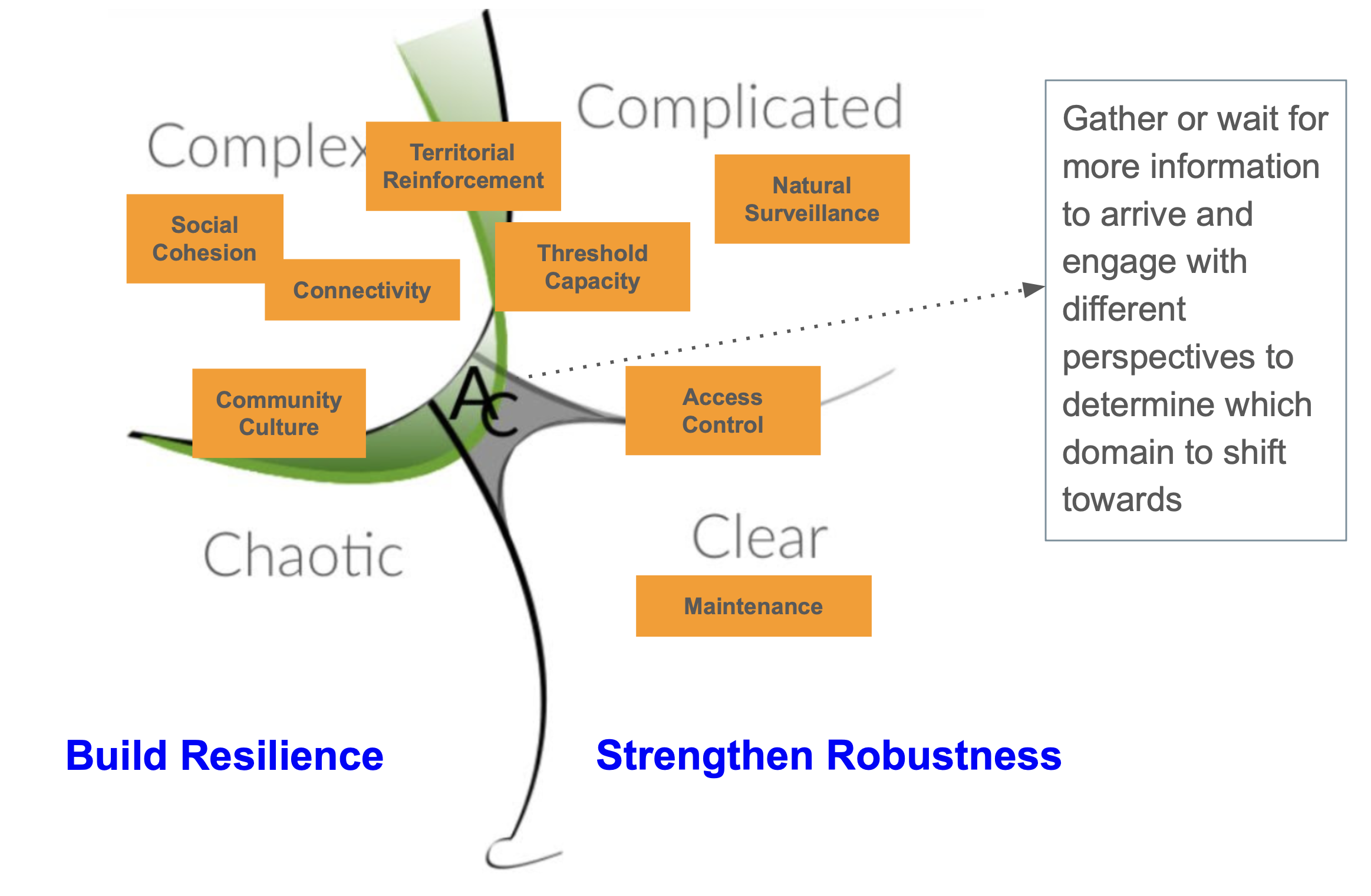
| CPTED Principle | Cynefin Domain | Rationale |
|---|---|---|
| Natural Surveillance | Complicated | Expert-driven design logic applying predictable cause-effect relationships |
| Access Control | Clear → Complicated | Simple barriers (locks, gates) are Clear; Multi-layered access configurations are Complicated |
| Territorial Reinforcement | Complicated → Liminal | Design cues signal ownership; interacts with emergent social dynamics |
| Maintenance | Clear | Best practices and work rules as fixed constraints manage upkeep of spaces |
| Social Cohesion | Complex | Emerges through trust, interaction, and shared narratives; not engineered |
| Community Culture | Complex → Liminal | Emergent identity shaped by interactions and meaning; shallow dive into Liminal to disrupt outdated culture paradigms, beliefs |
| Threshold Capacity | Complicated → Liminal | Expert use of governing constraints to manage spatial dynamics; if thresholds are breached, shifts to Complex to understand why |
| Connectivity | Complex | Ownership and stewardship emerge through lived experience and distributed decision-making |
Clear Domain (Sense-Categorize-Respond)
- Routine physical work such as grass cutting, changing broken lighting fixtures or the installation of new security cameras
- Activities follow best practices and are well documented with clear, predictable outcomes
Complicated Domain (Sense-Analyze-Respond)
- Complicated problems require expert analysis, such as understanding the underlying causes of crime in a specific area
- Solutions may involve consulting with criminologists or urban planners to develop tailored strategies based on data and expertise
- Domain where a business case is developed with idealistic future state, linear roadmap, milestones, targets KPIs, causal assumptions (e.g., visibility deters crime)
Liminal State between Complicated/Complex
- When a complicated territorial structure shows signs of malperformance, move into liminal zone to find out why from stakeholders
- Probe to learn what has changed and discuss possible solutions
- Take the time to avoid premature convergence before returning to Complicated and implementing new solution
Complex Domain (Probe-Sense-Respond)
- Complex problems involve social dynamics that are not easily addressed through straightforward interventions
- Building social cohesion and connections requires iterative processes, experimentation, and community engagement
- Narrative data collected as stories monitor progress
Liminal State between Complex/Chaotic
- Diversity is key for a healthy vibrant culture but new arrivals may feel unwelcomed due to language barriers, racial bias or ignorance, etc.
- Ice-breaking events are conducted in liminal to help shake loose old paradigms, beliefs
- By opening minds in a positive way, solutions may emerge over time as the community learns and adapts together
Chaotic Domain (Act-Sense-Respond)
- In chaotic situations such as a civil riot, gun battle between rival gangs in a neighbourhood, immediate action is necessary to restore order
- This could involve deploying law enforcement or executing emergency preparedness plans to stabilize the situation
- Once order is restored, efforts can shift to understanding the underlying issues and applying more sustainable solutions.
- This domain represents uncertainty about a sense of direction and where to head next
- Consists of 2 states of uncertainty
- Confused: Not knowing that you are confused
- Aporetic: Acknowledging you are confused and assessing the next right thing to do
- Domain entry from:
- Chaotic
- Act of stabilizing a situation is basically moving into this domain
- Clear
- Confused because problem encountered cannot be solved by following given rules and practices
- Complicated
- Experts tasked to resolve problem are unable to find a solution and don’t know what to do next
- Complex
- Aporetic to assess gathering of more information or patiently awaiting for arrival of new information
- Engaging with various perspectives to determine the appropriate course of action
- Chaotic
Benefits of the Cynefin Framework in CPTED
- Overarching CPTED strategy to improve safety and security in communities
- Strengthen Robustness
- Informed by CPTED 1st Generation principles
- Actions that take place in the Clear and Complicated side of Cynefin
- Use "Mechanic" methods and tools
- Build Resilience
- Informed by CPTED 2nd Generation principles
- Actions that take place in the Complex and Chaotic side of Cynefin
- Use "Gardener" methods and tools
- Strengthen Robustness
- Contextual Understanding
- By situating problems in the correct domain, Cynefin helps practitioners understand the context of safety issues
- Identify suitable domain problem-solving method (S-C-R, S-A-R, P-S-R, A-S-R)
- Encouraging Innovation
- Complex domain methods and tools available to safe-to-fail experimentation, exaptive discovery
- Complexity science enables innovative solutions to social problems to emerge
- Improved Decision-Making
- Clear guidance on navigating uncertainty allows for better decision-making in dynamic environments
- Action Research oriented
- Cynefin supports Learn by Doing (Praxis)
- Action forms are available to design interventions for each domain