Traffic Stop Example
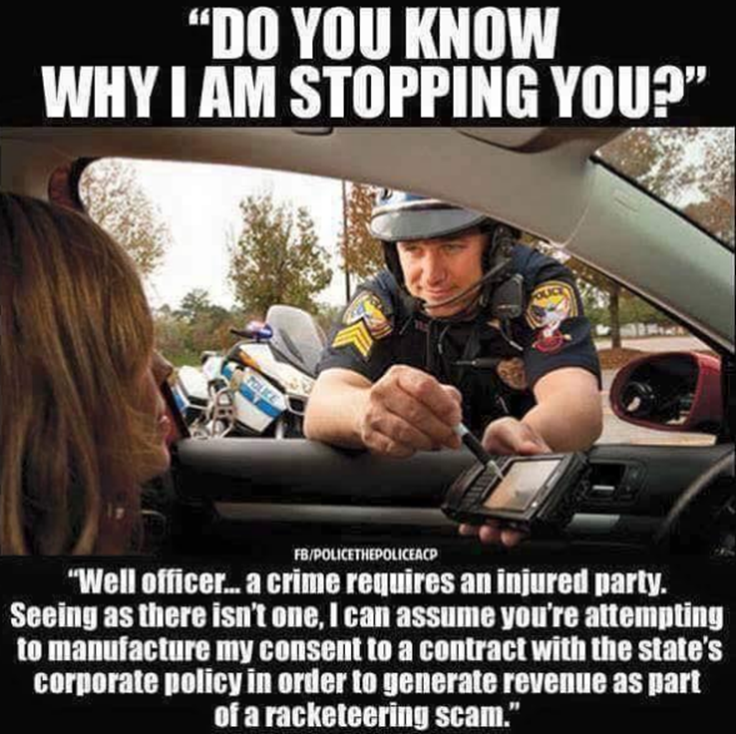
If a police officer orders you to get out of your car, do you have to comply?
The answer, settled in a 1977 U.S. Supreme Court case known as Pennsylvania vs. Mimms, is yes The Fourth Amendment to the U.S. Constitution protects individuals from unreasonable searches and seizures by the government. This means that to initiate a traffic stop in New York, police officers must have probable cause to believe that the driver has committed a traffic violation or another offense.
In the 1977 case, the U.S. Supreme Court ruled that police officers may order an individual out of their vehicle during a traffic stop because the person has already been lawfully detained ― albeit briefly. The court ruled that the officers' command would not violate the Fourth Amendment. It called such orders a minimal intrusion to the individual's personal liberty ― "a mere inconvenience" ― compared to the added safety it affords an officer.
"The driver is being asked to expose to view very little more of his person than is already exposed," the decision said. "The police have already lawfully decided that the person shall be briefly detained; the only question is whether he shall spend that period sitting in the driver's seat of his car or standing alongside it."
Do police have to give you a reason for a traffic stop?
While police must have probable cause to initiate a traffic stop, in New York and most places there are no laws that require them to immediately tell you why you were pulled over.
When driving a car and you have a driver’s license you don’t have any issues at law, you only have issues of procedure. The policeman has to obey the law, the standards and procedures, whether civil or criminal and whether civil rights or natural inalienable rights apply.
In some states traffic offenses are not criminal but are called infractions. The infraction can be used against you because you have a driver’s license which is a commercial contract, in interstate commerce affecting the public interest becomes under the police powers and summary proceedings. Just like a tax payer goes into the tax court because its a summary proceeding.
When you get into that court you don’t need a jury. You just need a clerk to collect the money.
If you’re in a state that doesn’t have the infraction law yet and it may be a criminal matter (a misdemeanor) it comes under the rules of criminal procedure not civil procedure.
The following is an example of an interaction between a police officer and a free man exercising his right to travel (no licenses etc.), it deals with issues at law:
You’re driving 80 mph in a 50 mph speed zone, the policeman stops you saying he wants to see your registration, driver’s license
and proof of insurance.
Response: “Gee officer, why do you want to see that? What gives you the authority to make these kinds of demands upon me?”
Officer: “Are you trying to be smart with me?
Response: “I’m asking you what is your probable cause for making this intrusion into my private life”
Officer: “You were driving 80mph down the road and I want to see your driver’s license, registration and proof of insurance.”
Response: “Oh, let me ask you a question officer, are you making this stop pursuant to Terry or the Miranda rule?”
Officer goes back to make a call saying “I’ve got one of those constitutionalists here and he won’t give me his license and won’t cooperate.” He returns and asks, “Sir, do you have a driver’s license?”
Response: “I’m not sure I want to answer since it could be an incriminating question in a criminal investigation, is this a civil or a criminal matter?”
Officer “Criminal”
Response “So you’re in the process of making an interrogation pursuant to a routine traffic stop which is a custodial interrogation, is that your position officer?”
(conversation can break down when using language so you may have to use: “what did you stop me for?”)
“You’re making allegations here, is this civil or criminal so I know what kind of jeopardy I’m in as to whether or not I want to answer your question.”
Officer: “Sir I’m going to write you a ticket for speeding and being an uncooperative citizen, resisting and delaying an officer, no driver’s license, no registration, no proof of insurance and I may have to arrest you and take you to jail.”
Response: “Ok, let me see if I understand this correctly, you’re telling me that the probable cause for making this 4th Amendment / Search and Seizure intrusion is I was exceeding the speed limit, is that your position?”
If the officer says “You know what I’m stopping you for!”
Response: “ I don’t know what kind of agreements you have with insurance companies, traffic courts, and your legislature pursuant to using the road. I know what my common law rights are, I’m not really sure I know what these contractual specific performances are.”
If the officer is somewhat literate:
Response, “Let me simplify this for you officer. At this time I want to put the exclusionary rule into force. I don’t want to answer any questions and I demand all of my rights at all times, including my right to time. I waive none of my rights at any time for any cause or reason. That includes my right to counsel of my choice pursuant to the Miranda doctrine and I demand a counsel present during all stages of this interrogation. Are you prepared to move forward with an in-custody interrogation at this time?”
At this point he is probably going to go back to talk to his field commander and in some places, at this point there will also be several police cars coming.
He returns with another officer who starts making demands upon you, tell you they’re going to take you to jail,
Response: “Let me ask you a question, before you take me to jail, will you willingly and knowingly violate my civil and constitutional rights? Are you doing this maliciously?”
He’ll deny that.
Response “Sir, I just wanted to know if you were going to. Because under [Idaho] law this man told me his probable cause was speeding and pursuant to Title 49, section 1109 you cannot take me to jail, if you’re going to arrest me you have to take me to a magistrate and I demand that you take me to a magistrate in the event that you feel it necessary to arrest me It says “Except for drunk driving, manslaughter, hit and run and two or three other felony type crimes where there is a corpus delicti you cannot take me to jail but must take me to a magistrate, are you going to do that?.”
A policeman can quote regulations and statutes but doesn’t know or understand law but he can look up section 1109 in his book.
Officer, “Look all we want to do is give you a ticket.”
Response: “Oh, this man tells me I’m guilty of 5 or 6 offenses, I don’t even know how many. All I know is I was driving down the street and this man came up behind me and he’s been harassing me now for about 15 minutes and I’m getting tired of this. Are you his supervisor?”
Officer: “Yeah, I’m the field commander.”
Response: “Let’s see if we can get some facts here, you’re field commander Jones (writing this down) and your badge number is 7214 (he starts going around to all the policemen and takes down their badge numbers, car numbers and names). Now he’s gathering evidence.
Each is now a material witness and you want them in court for two reasons: 1- you’re going to demand a probable cause hearing in some states they are held incognito, [ex parte and you can’t be there, that’s the first due process of law that’s violated as you are denied the right to face your accusers in front of a judge. They always find probable cause, no proof, no evidence, no witnesses, they just haul you into court. They can do that if you have a driver’s license (but in this case they don’t know if he has one, when asked he doesn’t tell the officer if he has one or not.) Rule #1 of a pro se litigant, keep your mouth shut. and you can hold a conversation without telling them anything.
“Let me see if I understand you, I asked if this was a custodial interogation and I don’t think you told me. Am I free to leave?
Officer, “No.”
Response: “Field commander Jones says I’m not free to leave. Are you going to ask me questions?”
Officer, “Well just enough to fill out the tickets.”
Response: “You’re going to ask me for what?”
Officer: “Are you going to identify yourself?”
Response, “I don’t know, what relevance does it have who I am? You could prosecute me as John Doe, is there some reason you want me to identify myself?
Officer: “Yeah, if you don’t, we’re going to arrest you.”
Response: “Oh, well in that case I don’t think I’ll identify myself. I’m interpreting that as a threat and a violation of my constitutional rights pursuant to Brown vs Texas, I don’t think I have to identify myself. Are you going to arrest me and take me to a magistrate or are you going to arrest me and take me to jail?”
If going to jail , “What are the charges?”
Officer: “Speeding, resisting arrest...”
Response: “What do you mean by resisting arrest?
Officer: “No, you’re not resisting arrest but you’re obstructing and delaying an officer.”
Response: “Excuse me sir, would you explain that to me?”
Now they probably don’t want to talk to you and will either arrest you and take you to jail or say “If you’ll just identify yourself and agree to appear in court I’ll just give you a ticket.” And he starts writing out the ticket, “What’s your name?”
Response, “You’re going to arrest me if I don’t tell you my name, isn’t that what you told me?
Officer: “That’s right, if you fail to identify yourself I’m going to arrest you.”
Response, “My name is George Gordon.”
Officer: “Now where do you live Mr. Gordon?”
Response: “Are you going to arrest me if I don’t tell you where I live?”
Officer: “If you don’t cooperate I’m going to arrest you.”
Response: “Ok, 12015 N. Rose St., now I’ve identified myself and told you where I live.”
Officer: “What’s your date of birth?”
Response: “Are you going to get me a birthday cake?”
Officer: “You are really getting on my nerves.”
Response: “If I’m bothering you, you are excused and have my permission to leave. You do not have to stay here.”
While you’re there talking to the police, make sure you’re gaining information. You want admissions and to talk in front of his fellow officers, your witnesses, so when you get into the courtroom you put this other officer on the stand and the conversation goes like this:
“On the occasion of Feb 5 did you observe the defender on the corner of Liberty and 5th?”
”Yes, I did.”
“And what did you observe?”
“Well, I observed Field officer Commander Smedley over here giving him a ticket.”
“Did Field officer Commander Smedly ask him to give his name?”
“Yeah”
“And did Mr. Gordon ask him if he was going to do something terrible and awful to him if he didn’t give it?”
“Yeah, he said he would arrest him.”
“Do you always arrest people who won’t give you their names?”
“Oh, yes, we always do.”
Now where have you got him? In violation of Title 49 section 1109. Its with that transcript of that trial that you use as the evidence for the complaint that you’re going to the federal court with.
The “scene of the crime” is important, at the scene of the crime you aren’t the victim, you’re the interrogator , you’re there gaining evidence. When the policeman is wondering whether to take you to jail, you can help him along a little bit.
“If you take me to jail you’ll be in the process of committing a crime. Did you want to commit that crime? Or did you want to back off and get some legal counsel first? (you are telling him he has a right to legal counsel, per Miranda, you can tell the policeman he has the right to be silent, that anything he says can and will be held against him in a court of law - just the police must site Miranda, so should you every time you have a confrontation with government officials.)
You must seize control. A salesman is taught that he has to maintain control of the conversation and direct the operation. That’s all the policeman is is a salesman and you’re a customer. He’s in contact with the public and his job requires he make 4 or more of those contacts a shift. Sometimes traffic cops are out giving tickets because they need to rack up points...whether you were in violation or not. It isn’t because these people are heinous criminals, they are just called criminals so they can go through the criminal justice system to make money for the traffic court.
Traffic cops are there to protect the claims window of the insurance industry. That’s a private police force there to enforce private contractual law paid for by the public.