Police Powers
Powers delegated to an agent from the court of the sovereign, charging him with a duty to serve the warrants, and execute the writs and orders of the court by the use of threat, duress, coercion, or force. Presumably, such tactics may only be used against a belligerent upon whom a lawful warrant has been served. See:Feudum. In practice: an unlawful occupation.
Videos
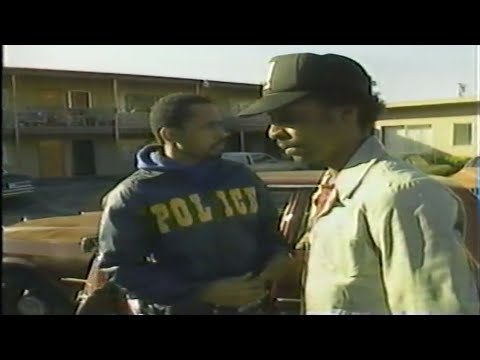
We the people (police powers, 1988)
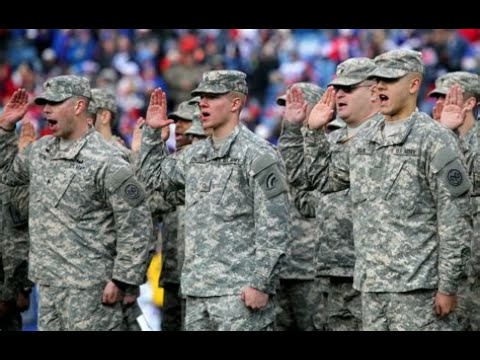
Police powers:
Police Powers Are Supposed to Reside With the States
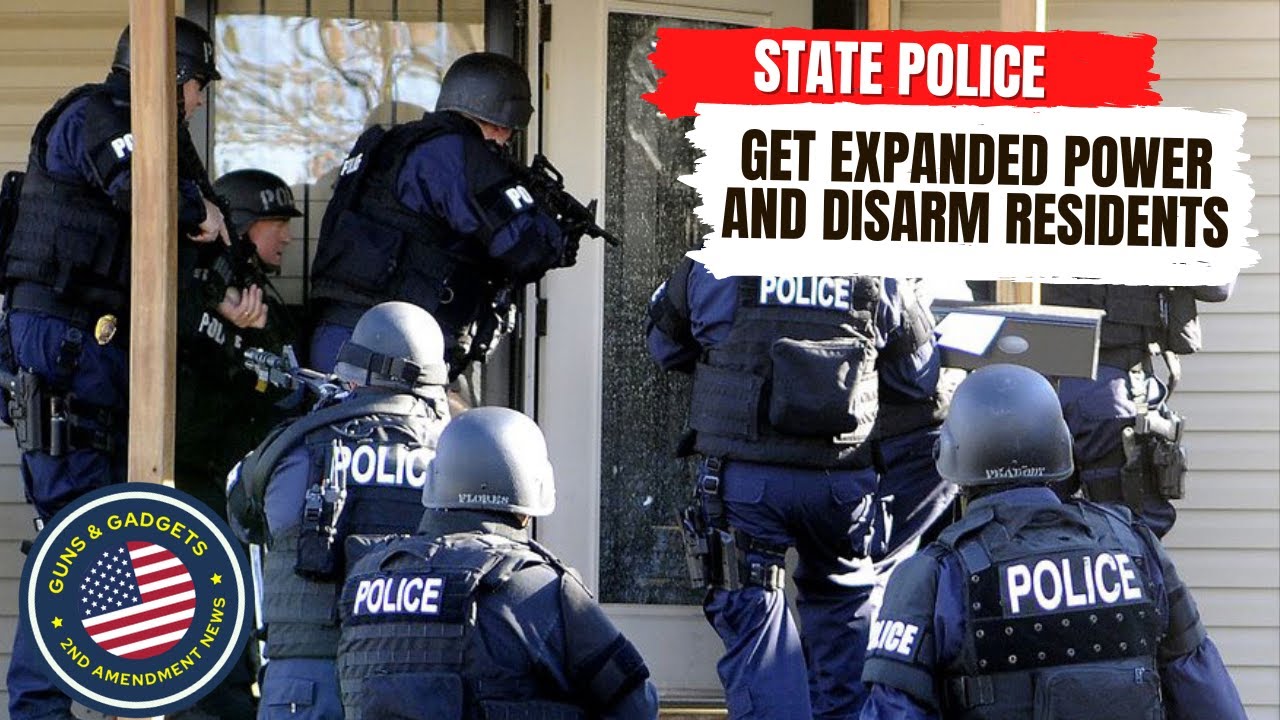
State Police Get Expanded Power & Disarm Residents
Youtube Channel: Audit the Audit
Sort out the who and what and the right and wrong of police interactions! Join us as we explore the laws, regulations, and violations showcased in first amendment audits, police interactions, and legislation.
Tricks used to gain consent and joinder, ALL CAPS WORDS, Police harassment
When confronted with a warrant, a man dealing with a code enforcement Officer
You Need No ID! Should You Carry Your ID?
Black’s Law Dictionary, 4th Edition:
*The power vested in a state to establish laws and ordinances for the regulation and enforcement of its police as above defined. The power vested in the legislature to make, ordain, and establish all manner of wholesome and reasonable laws, statutes, and ordinances, either with penalties or without, not repugnant to the constitution, as they shall judge to be for the good and welfare of the common wealth, and of the subjects of the same. Corn. v.Alger, 7 Cush. (Mass.) 85.
An authority conferred by the American constitutional system upon the individual states, through which they are enabled to establish a special department of police; adopt such regulations as tend to prevent the commission of fraud, violence, or other offenses against the state; aid in the arrest of criminals; and secure generally the comfort, health, and prosperity of the state, by preserving the public order, preventing a conflict of rights in the common intercourse of the citizens, and insuring to each an uninterrupted enjoyment of all the privileges conferred upon him by the laws of his country. Lalor, Pol. Enc. s. v.*
The power of the State to place restraints on personal freedom and property rights of persons for the protection of the pubic safety, health and morals or the promotion of public convenience and general propriety. The police power is subject to limitations of the federal and state constitutions, and especially to the requirements of Due Process of Law. Police power is the exercise of sovereign right of the government to promote order, safety, security, health, morals and general welfare within constitutional limitations is an essential attribute.
Benjamin Franklin, who in the 1780’s feared the consequences of masses of former slaves unleashed on American society, recommended that a special “branch of our national police” supervise emancipated slaves.
“A committee of inspection” would “superintend the morals, general conduct, and ordinary situation of Free Negroes.” “A committee of Guardians” would find “children and young people” apprenticeships so that they might learn trades; this committee had the “right of guardianship over the persons bound.”
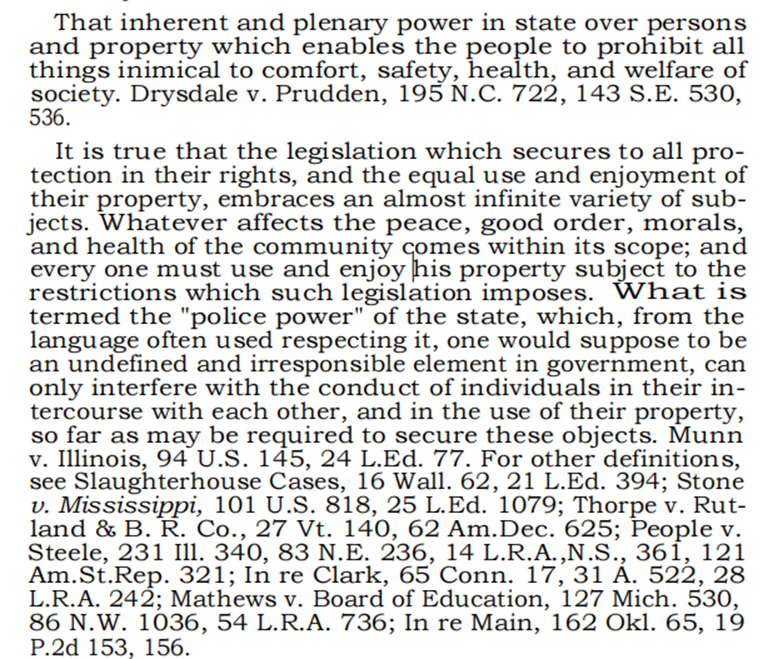
Police powers are the fundamental ability of a government to enact laws to coerce its citizenry for the public good, although the term eludes an exact definition. The term does not directly relate to the common connotation of police as officers charged with maintaining public order, but rather to broad governmental regulatory power. *Berman v. Parker*, a 1954 U.S. Supreme Court case, stated that “[p]ublic safety, public health, morality, peace and quiet, law and order. . . are some of the more conspicuous examples of the traditional application of the police power”; while recognizing that “[a]n attempt to define [police power’s] reach or trace its outer limits is fruitless.”
The division of police power in the United States is delineated in the Tenth Amendment, which states that “[t]he powers not delegated to the United States by the Constitution, nor prohibited by it to the states, are reserved to the states respectively, or to the people.” That is, in the United States, the federal government does not hold a general police power but may only act where the Constitution enumerates a power. It is the states, then, who hold the general police power. This is a central tenet to the system of federalism, which the U.S. Constitution embodies.
A state’s regulatory power, therefore, is incredibly broad and is limited predominantly by the state constitution, powers which the federal government holds exclusively, the Takings Clause and the incorporation of fundamental federal rights through the Fourteenth Amendment. In a striking example of the exercise of police power, in 1850, in *American Print Works v*. *Lawrence*, the New Jersey Supreme Court held that “a particular officer is authorized to destroy buildings where he shall judge it necessary to prevent the spread of a conflagration. . . [and that] it is a sufficient justification for the destruction of goods contained in such building, for which no compensation is provided.” In 1872, in the *Slaughterhouse Cases*, the U.S. Supreme Court upheld a New Orleans law which required slaughterhouses to move to the outer skirts of the city to maintain the cleanliness and health of the city as a valid exercise of police power. A 1854 Vermont Supreme Court case, *Thorpe v. Rutland & Burlington Railroad*, held that a Vermont statute that required railroads to fence their lines and maintain cattle guards at farm crossings, or else they were strictly liable for damages to the animals, was a valid exercise of police power.
Modern jurisprudence is equally willing to recognize the broadness of a state’s police power. For example, a 2019 California Supreme Court case, *T-Mobile, LLC v. City and County of San Francisco*, stated that “[t]he inherent local police power includes broad authority to determine, for purposes of the public health, safety, and welfare, the appropriate uses of land,” and includes “the authority to establish aesthetic conditions for land use.” A 2014 Supreme Court of Massachusetts case, *Abdow v. Attorney General*, declared that a state’s police power is so fundamental that “the Legislature cannot surrender its broad authority to regulate matters within its core police power,” and that this includes “the regulation of gambling and the prerogative to ban forms of gambling that previously had been legal.”
Many think they have rights when they don’t, this has to due with the police powers that pre-dated the Constitution. Police powers can come into play and supersede what people sometimes think are constitutional rights, which are in fact, not. For example, the policeman searches your car and you have a driver’s license - you’ve entered into a voluntary regulated enterprise. That is not a rights issue but a contract issue since a driver’s license is used as a contract.
Don’t sign anything including a notification of a trial date. “I don’t want to sign anything unless I have my counsel present to go over it.” The judge has presented a legal document, if you don’t sign it he may say he’s going to hold you in contempt of court.
A response, “If you hold me in contempt of court what are you going to do to me?”
‘I’m going to sentence you to 5 days in jail.”
“Ok,if I don’t sign this document you are going to put me in jail for 5 days. Is that your position Sir?
“Yes it is”
“Ok, then I’m going to sign this” And you sign it adding, signed under duress, threat and coercion
Under the Miranda doctrine, signing anything under threat, duress and coercion makes it null and void. Now the judge has a trial date and you don’t have to appear, if you don’t appear and he throws you in jail, now he’s compelled you to sign something against your will and over your objection - now you’ve got him under a Title 42 lawsuit.
If the policeman won’t voluntarily violate your rights, how can you help him a bit, ask him some questions. You’ve got a judge who’s nasty, doesn’t understand rights or law, help him a little bit. With a policeman, “If I don’t sign this ticket what are you going to do to me?” He says, “I’m going to take you to jail.” You can reply, “Don’t get upset, let me see if I understand your position, you’re going to do something terrible and awful to me if I don’t sign this ticket, right?” Sign it with under duress, threat coercion, now he has violated your rights. Useful to have a witness or two.
Most times you won’t file a suit, but when encountering a very truculent officer prone to violating people’s rights a lawsuit may be worthwhile.