Civil Law
From Bouvier’s Law Dictionary:

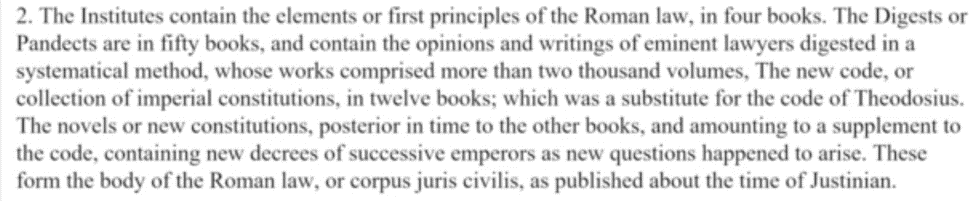


THE ENACTMENTS OF JUSTINIAN.THE DIGEST OR PANDECTS.
- 1. Concerning justice and law.
- 2. Concerning the origin of law and of all magistrates, together with a succession of jurists.
- 3. Concerning statutes, decrees of the Senate, and long established customs.
- 4. Concerning the constitutions of the Emperors.
- 5. Concerning the condition of men.
- 6. Concerning those who are their own masters, and those that are under the control of others.
- 7. Concerning adoptions and emancipations (..)
- 8. Concerning the division and nature of things.
- 9. Concerning Senators.
- 10. Concerning the Office of Consul.
- 11. Concerning the Office of Praetorian Prefect.
- 12. Concerning the Office of Prefect of the City.
- 13. Concerning the Office of Quaestor.
- 14. Concerning the Office of the Praetors.
- 15. Concerning the Office of Prefect of the night watch.
- 16. Concerning the Office of Proconsul, and his Deputy.
- 17. Concerning the Office of Augustal Prefect.
- 18. Concerning the Office of Governor.
- 19. Concerning the Office of the Imperial Steward or accountant.
- 20. Concerning the Office of Juridicus.
- 21. Concerning the Office of him to whom jurisdiction is delegated.
- 22. Concerning the Office of assessors.
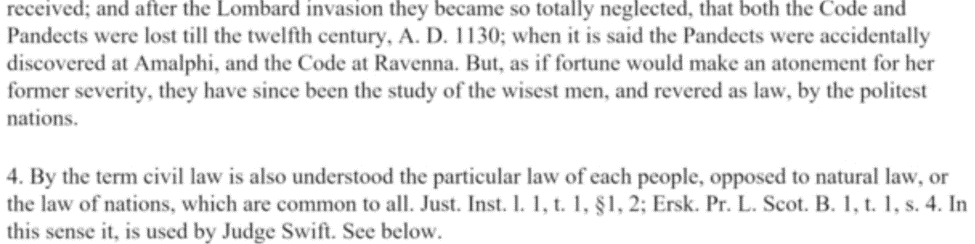
The Roman Civil Law was reinstated by the Reconstruction Act of 1871. The UNITED STATES CODE (U.S.C.) was brought forth in 1881. The Roman Civil law was lost in 600A.D., then rediscovered in 1130. They tried to re-implement this Roman Civil law (the Code) where the king is the sovereign. By statutory act of England in 1881, they extended the High Court of Admiralty of England over here. Basically converting us back into a monarchy. The purpose of Article IV - States, Citizenship, New States, section 4 of the Constitution was put in place to prevent even one state from becoming a monarchy and it is the remedy and relief that we have the right to demand.
Capitis Diminution (meaning the diminishing of status through use of capitalization). In Roman law. A diminishing or abridgement of personality; a loss or curtailment of a man’s status or aggregate of legal attributes and qualifications. – Black’s Law, 4th Ed., 1968 . Under Roman Civil Law status is everything. Under common law status is nothing.
When a judge fails to grant relief when it is demanded he just lost all immunity.
Civil Law is NOT American Common Law. The Rules Enabling Act of 1934 granted the Supreme Court the ability to make it’s own rules. The first thing they did was to combine Equity and Common Law to form Civil Law. Its unconstitutional but they got away with it because We The People are ignorant.
Statutory civil law is law for government, NOT for private men and women.
- Civil statutory law is the means of regulating and controlling your PUBLIC conduct.
- The foundation of the civil statutory law is the requirement for consent
- The civil statutory law implements what is called “the social compact”
- All “compacts” are contracts or agreements
- To be the subject of the “social compact”, you have to volunteer
- Those who volunteer are called “citizens” if they were born in the country and “residents” if they were born in another country and calling themselves a “citizen” or “resident” on a government form.
Those who are not party to the Civil Law
- The act of consenting is called “choosing a Domicile / Domiciled or residence” within a specific jurisdiction or venue.
- The act of consenting to the civil law and becoming a statutory “citizen” or “resident” is a First Amendment choice of political association that no one can compel you to make. Why? Because in doing so you are contracting with a group of people called “the state” to join the state. Governments are established to protect your right to contract. Inherent in every right is the right NOT to engage in an activity. If you have a right to contract, you also have a protected right NOT to contract under the 1st Amendment / Religion, Speech, Press, Assembly, Petition and under the Constitution, Article 1, Section 10.
- Those who don’t consent to the social compact or the civil law are called “nonresidents” or “transient foreigners”.
- Those who are “nonresidents” are still protected by the constitution and the common law, but may not avail themselves of the “benefits and privileges” of the civil law. In this sense the civil law behaves as a “protection franchise”, you have to join the franchise by calling yourself a citizen or resident before you can enjoy the benefits of the franchise. Consonant with joining is the obligation to allegiance and paying for the protection you are getting.
What others say about this:
- These basic concepts behind the civil law are not unique or new
- The concept of domicile is behind them all.
- Most legal neophytes and freedom fighters misunderstand these concepts by making the following false statements:
- That ALL law is voluntary, both CIVIL and CRIMINAL
- That CRIMINAL law is voluntary. It is NOT
- That you can unvolunteer without changing your behavior.
- That they can have any kind of “resident ID” such as a driver license and yet NOT be a statutory “person”, “individual”, or “citizen”. The “walk” has to match the “talk”.
Defending Against Government Administrative Claims
- If any public servant asserts that they are entitled to your services or property under civil law, the burden of proof remains on THEM to produce legal evidence that:
- You consented in writing in a manner that YOU and not THEY defined.
- You had the legal capacity to consent at the time you consented.
- You were either domiciled within the exclusive jurisdiction of the government in question at the time you consented or acted, or you were representing an entity that was so domiciled under Federal Rule of Civil Procedure 17(b)
- If they cannot meet the above burden of proof, they are engaging in a Bill of Attainder, and a violation of the Fifth Amendment Takings Clause
- An example of representing an entity domiciled on federal territory would be “public officers”, who represent the government of the “United States”
- The “United States” is a federal corporation
- They are “officers” of said corporation
- They are therefore the ONLY “person” under 26 U.S.C. 6671(b) and 26 U.S.C. 7343
- They are acting in a representative capacity on behalf of the public trust under Federal Rule of Civil Procedure 17(b)
All of the information returns that get filed against “taxpayers” are filed against those lawfully engaged in a “trade or business” which is the functions of a public office as defined in 26 U.S.C. 7701 (a)26 . They cannot regulate private conduct so they must make you look like something they have jurisdiction over, which is a public officer in the government.
One prevents inequality by ensuring that they:
- Expressly reserve all their rights pursuant to UCC 1-308.
- Expressly refuse to waive sovereign immunity under the Long-arm Statutes of their state and the federal Foreign Sovereign Immunities Act, 2 U.S.C. Chapter 97
- Do not claim statutory “citizen” status. Statutory “citizens” cannot be foreign sovereigns.
- Insist that the government can’t have sovereign immunity unless they can. We the People can’t delegate authority to the government that they themselves do not ALSO individually possess.
- Define all terms on government franchise forms to exclude government civil jurisdiction and withdraw consent to the offered franchise.
- Deny “purposeful availment” of any government “benefit” and classify all payments from the government to be “gifts”, just like the government does to them. See 31 U.S.C. 321 (d)
- Quit any and every franchise and fill their administrative record with forms necessary to remove consent.
Everything the government does has to originate with your consent in a civil sphere. In a civil context they must always procure your consent and must always trace every effort to enforce the civil law back to some form of consent.