To Take from the Table
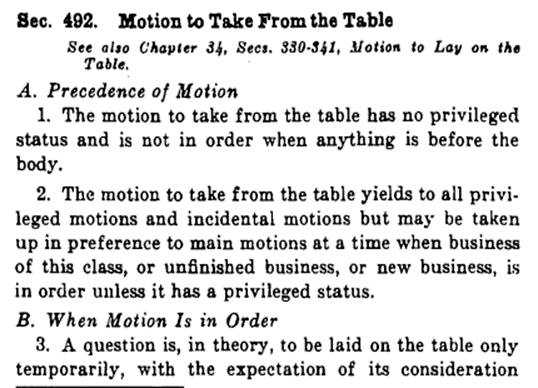
To Take from the Table takes precedence of no pending question, but has the right of way in preference to main motions if made during the session in which it was laid on the table while no question is actually pending, and at a time when business of this class, or unfinished business, or new business, is in order; and also during the next session in societies having regular business meetings as frequently as quarterly.
It yields to privileged [14] and incidental [13] motions, but not to subsidiary [12] ones. It is undebatable, and no subsidiary motion can be applied to it. It is not in order unless some business has been transacted since the question was laid on the table, nor can it be renewed until some business has been transacted since it was lost The motion to take from the table cannot be reconsidered, as it can be renewed repeatedly if lost, and, if carried, the question can be again laid on the table after progress in debate or business.
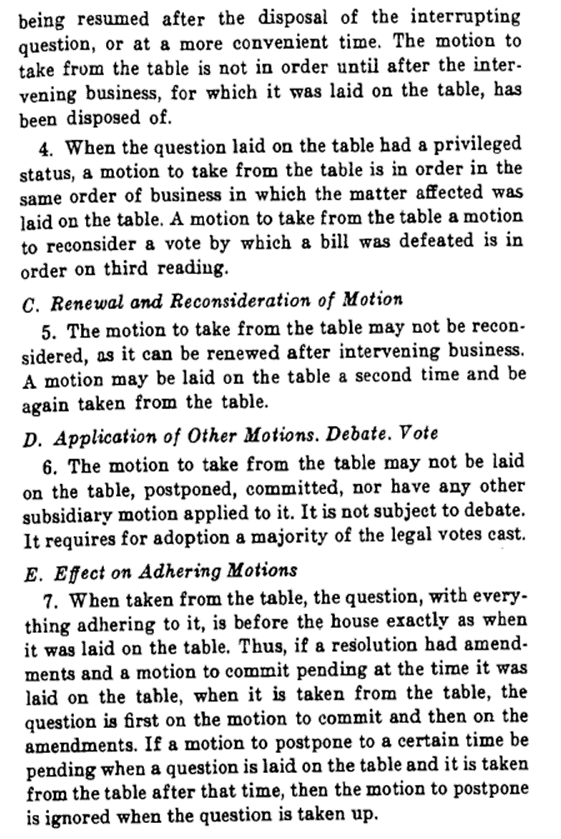
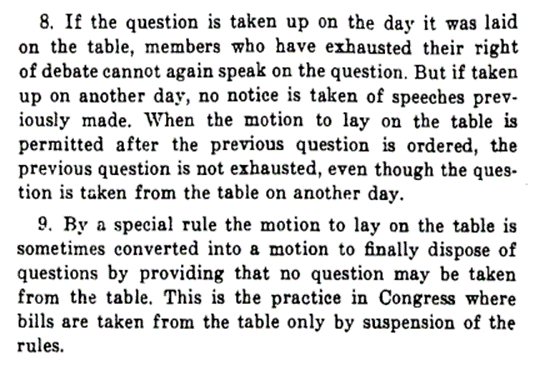
In ordinary deliberative assemblies, a question is supposed to be laid on the table only temporarily with the expectation of its consideration being resumed after the disposal of the interrupting question, or at a more convenient season. As soon as the question that was introduced when the first question was laid on the table, is disposed of, any one may move to take this first question from the table. When he rises to make the motion, if the chair recognizes some one else as having first risen, he should at once say that he rises to move to take a question from the table. The chair then assigns him the floor if the other member has risen to make a main motion. If the new main motion has been stated by the chair before he claims the floor, he must wait until that question is disposed of before his motion will be in order. When taken up, the question with everything adhering to it is before the assembly exactly as when it was laid on the table. Thus, if a resolution has amendments and a motion to commit pending at the time it was laid on the table, when it is taken from the table the question is first on the motion to commit. If a motion to postpone to a certain time is pending when the question is laid on the table, and it is taken from the table after that time, then the motion to postpone is ignored when the question is taken up. If the question is taken up on the day it was laid on the table, members who have exhausted their right of debate cannot again speak on the question. But if taken up on another day, no notice is taken of speeches previously made. The previous question is not exhausted if the question upon which it was ordered is taken from the table at the same session, even though it is on another day.
Process of Taking from the Table:
- Making the Motion: A member must move to take the tabled motion from the table. This motion typically requires a second from another member.
- Debate and Vote: Depending on the specific rules, there might be a brief debate on the motion to take from the table before a vote is taken.
- Outcome: If the motion to take from the table is passed by a majority vote, the original motion is brought back for debate and potential vote. If the motion to take from the table fails, the original motion remains tabled.
From Mason’s Manual