Police
The government of a city or town; the administration of the laws and regulations of a city or incorporated town or borough. The word is applied also to the government of all towns in New England which are made corporations by a general statute, for certain purposes.
2. Agents charged with the duty of attornment, and of keeping the peace.
3. Noun. Latin. from polic.Agent of a foreign sovereign occupying certain land under arrest where belligerents resist a revenue order. See: feudum, attorn, attorney, revenue, venue, war, and warrant.
Videos
Police Chief Steps Down! Learn How To Audit & Film The Police From The Best!
Filing Claims Against Cops' Bonds - Rick Martin, Clint Griess, David James Rodriguez
The Police Have No Duty To Protect You
Audit the Audit is a Youtube channel that sorts out the right and wrong of police interactions
Law Enforcement Officers vs Peace Officers - the differences
Interacting with Police Officers
In America the Police Has No AUTHORITY - George Gordon Common Law School
Police and the domestic authority doctrine
How to restore your weed from the police
Cops are taught that "shall" is future tense
Dealing with Checkstops
Dealing with police and courts
Am I Free To Go? Common Law Freedom
Audio
Shielded: How the Police Became Untouchable
Police Conduct Warrantless Surveillance with Stingrays and Fudge Facts When Confronted
Why Cops in California Rob Armored Cars
How to Safely and Legally Record the Police
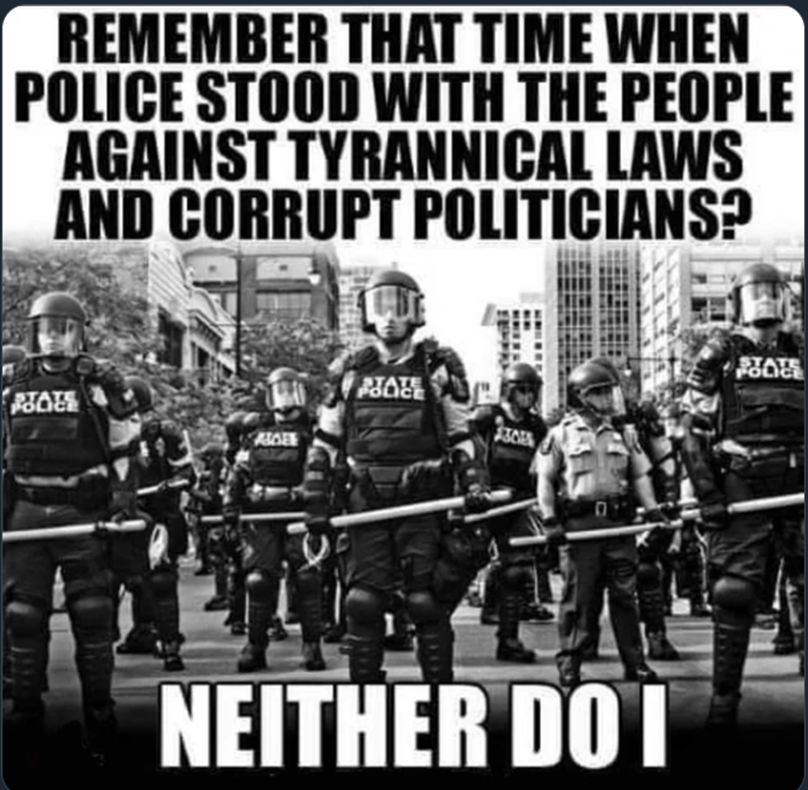
Pronounced “policy” - etymologically it derives from policy making and police” came about in England with the creation of armed bodies of men, part of the American Revolution was about this, spoken of in the Declaration of Independence: armed bodies of men erecting new offices, setting hither swarms of officers to harass our people and eat out our substance.
CONTROLLED MEANING: Officers hired to protect the public from crime and keep the peace – to enforce the law.
ACTUAL MEANING: The enforcement arm of the State to protect the interests of state from being damaged or compromised by the public; to keep the public submissive and under control, and collect revenue from the public for government use. Police are not hired to protect the people; they are hired to protect the state from the people. Police are government strong-arm hirelings whose job is to intimidate and suppress the public and force them to do the bidding of the politicians and bankers.
Waiver of Immunity-Police: Form
Purpose of this form:
Police officers may deliberately and knowingly LIE with impunity both out in the field and as witnesses in court. This form:
1. Exposes their ability to LIE with impunity in court.
2. Demands that they either SHUT UP or agree to tell the truth.
3. Provides a tool to educate jurors that they are being LIED to before they rule on your case
Wikipedia:
In Colonial America, the county sheriff was the most important law enforcement official. For instance, the New York Sheriff's Office was founded in 1626, and the Albany County Sheriff's Department in the 1660s. The county sheriff, who was an elected official, was responsible for enforcing laws, collecting taxes, supervising elections, and handling the legal business of the county government. Sheriffs would investigate crimes and make arrests after citizens filed complaints or provided information about a crime, but did not carry out patrols or otherwise take preventative action. Villages and cities typically hired constables and marshals, who were empowered to make arrests and serve warrants. Many municipalities also formed a night watch, or group of citizen volunteers who would patrol the streets at night looking for crime or fires. Typically, constables and marshals were the main law enforcement officials available during the day while the night watch would serve during the night. Eventually, municipalities formed day watch groups. Rioting was handled by local militias.[75][76]
In the 1700s, the Province of Carolina (later North- and South Carolina) established slave patrols in order to prevent slave rebellions and enslaved people from escaping.[77][78] By 1785 the Charleston Guard and Watch had "a distinct chain of command, uniforms, sole responsibility for policing, salary, authorized use of force, and a focus on preventing crime.
In 1789 the United States Marshals Service was established, followed by other federal services such as the U.S. Parks Police (1791)[80] and U.S. Mint Police (1792).[81] The first city police services were established in Philadelphia in 1751,[82] Richmond, Virginia in 1807,[83] Boston in 1838,[84] and New York in 1845.[85] The U.S. Secret Service was founded in 1865 and was for some time the main investigative body for the federal government.[86]
In the American Old West, law enforcement was carried out by local sheriffs, rangers, constables, and federal marshals. There were also town marshals responsible for serving civil and criminal warrants, maintaining the jails, and carrying out arrests for petty crime.[87][88]
In recent years, in addition to federal, state, and local forces, some special districts have been formed to provide extra police protection in designated areas. These districts may be known as neighborhood improvement districts, crime prevention districts, or security districts
Whatever the Supreme Court says to protect our rights doesn’t have any great effect on the judicial system at the lowest levels or on the police. You can quote Supreme Court law to jailors and local police and they may laugh and sneer. “Hey I think this guy is one of those constitutionalists.” As if he were some kind of subversive.
One way to response, “Let me ask you a question officer. Are you telling me you’re not a constitutionalist?
The Supreme Court says that decency demands that the police obey the law.
The 4th Amendment states you have the right to be secure in your person, places and things. Where this can come into play is, when the police ask you your name, you don’t have to provide it if you haven’t committed a crime. There have been cases where someone was charged with resisting arrest without violence because they wouldn’t give their name.