Elsass, R
---
oops see strategy group and variant, nasty boys
NOEM YOHO CORRUPT
ATWATER BOSSIE
FIRSTENERGY OHIO FUCKERY
CRUZ RUBIO
YASS SUSQUEHANAH
SEAN DIFFY
---
gq
Men of the Year 30
Culture
The Most Powerful Man in the GOP (And You’ve Never Heard Of Him)
Ever wonder where congressmen come from? No? Well, that’s great news for Rex Elsass, who’s built nearly 50 of them from scratch while turning himself into the most powerful Republican operative you’ve never heard of. Jason Zengerle gets a rare look inside the wildest political-strategy shop in America—and discovers the secrets to manufacturing a Tea Party rock star.
By Jason Zengerle
February 17, 2016
One morning last summer, Jim Banks—an Indiana state senator who dreams of becoming a congressman—woke before dawn and set off on the three-hour drive from Fort Wayne to Columbus, Ohio. He was going to see the wizard. He was going to see Rex Elsass.
Elsass is the founder and CEO of the benignly named Strategy Group for Media, a political consulting firm with a knack for launching a certain sort of politician—and a track record of recent success that has turned Elsass into one of the richest, not to mention most controversial, operatives in Republican politics.
While you've likely never heard of him, chances are good you know his clients. Name a conservative firebrand and Elsass has likely been on his or her payroll. Ted Cruz, Rand Paul, Michele Bachmann, Newt Gingrich—he's worked with all of them, as well as a slew of Republican agitators who aren't yet household names but are doing everything in their power to change that. Elsass now counts more than 60 members of Congress on his client roster, many of whom belong to the rebellious Freedom Caucus that last fall hounded the Speaker of the House, John Boehner, into early retirement. This year, while most eyes are fixed on the presidential race, he's quietly obsessing over the Republicans' control of Congress, guiding the fortunes of 15 first-time candidates whom he hopes will join his small army already wreaking havoc in Washington.
Rex Elsass is the founder of The Strategy Group for Media which runs a political strategy business as well as a production facility for the production of political and public service adds. He was photographed on January 9, 2012 at the Gooding House. (Chris Russell/Dispatch Photo)THE COLUMBUS DISPATCH
Not surprisingly, Elsass's electoral success has made for a lucrative business, as the fleet of late-model Mercedes sitting outside his firm's headquarters attests. During the 2014 elections, the Strategy Group grossed more than $150 million—a figure that would be stunning even if the firm was located in the Beltway and not out among the mega-churches and big-box stores of exurban Columbus.
On this morning, Jim Banks pulled his Chevy Malibu alongside those luxury sedans in front of the tastefully restored 19th-century mansion out of which Elsass's firm operates. The Gooding House—named for the prominent Ohio family that once owned it—today features state-of-the-art television production facilities, sure, but also a chef who serves meals in a wainscoted dining room that, with the help of Elsass's historical preservationist, was decorated to resemble the White House, right down to the china. The intended effect of all this stagecraft seems transparent enough: If an ambitious state legislator from flyover country isn't dreaming impossibly big before he meets Rex Elsass, he will be afterward.
Read More
Ted Cruz: The Distinguished Wacko Bird from Texas
Banks was cooling his heels in the Gooding House's conference room when Elsass barged in with a couple of his lieutenants. Elsass is a large man made less large by a couple of lap-band surgeries, so that he now resembles a two-day-old balloon—both bloated and deflated at once. His personality, however, is impervious to shrinkage. (In Rand Paul's recent presidential-debate prep, Elsass played the part of Donald Trump.) He was wearing a royal blue suit with blue alligator shoes and a gold Rolex. His voice was just as loud as his wardrobe. "How are you, man?" Elsass bellowed as he enveloped Banks in a bear hug. The candidate flinched with every one of Elsass's vigorous backslaps. The consultants quickly got down to business.
"We're not gonna break you down and build you back up like in Hoosiers," Brian Berry, the Strategy Group's chief creative officer, told Banks. "We're gonna help you maybe adjust some things."
"You've got raw talent," Elsass reassured his new client-cum-pupil.
Indeed, the 36-year-old Banks does have the résumé of a Tea Party winner: He's got the most conservative voting record in the Indiana senate and last year finished an eight-month deployment to Afghanistan as a member of the Navy Reserve. (With a future campaign commercial in mind, Elsass had shrewdly dispatched a cameraman to capture Banks's homecoming.) But as Banks sat across a long table from the Strategy Group brain trust, sipping from a Starbucks cup, he seemed to realize there still was a lot to learn.
Elsass and his team had drawn up a battle plan that would focus on selling Banks in three phases: (1) “Here's who I am.” (2) “Here's what I believe.” (3) “Here's why I'm the best choice.” It sounded simple enough, but to execute it properly, Berry warned, the state senator would have to "throw out the normal models of political campaigns that you've been involved in."
For one, Banks, who had been the president of the College Republicans at Indiana University, needed to get a lot less wonky. "You don't need to impress people with your intellect," Elsass told him. "Smart is overrated."
Berry offered a pointer: "When you're speaking to anybody, always be reminding yourself that many of these people have never been to college."
And rather than talking about issues, Banks needed to talk about problems. "People have problems," Berry said. "Your job is to solve them."
For example, Elsass and his team had done some thinking about Banks's district and zeroed in on a medical-device tax as a problem that needed some solving. The region is home to several medical-device manufacturers, and so appealing to employees of those companies made good sense. As for a voter who wasn't in that line of work or didn't much care about this corporate tax? Well, with a slight fiddle to his stump speech, the consultants explained, Banks could broaden his appeal. They told him to ask audience members to raise their hands if they had an artificial hip or a pacemaker—“That allows you to be interactive,” Elsass explained.
They proffered another tip to improve the candidate's stump speech: Enlist a local businessman to tally up all the taxes he pays, and then make a habit of rattling them off on the trail. The specificity would be impressive. "Get a restaurateur," Berry advised, "because they pay, like, 20 different taxes and fees."
Of course, Banks's military service could also be handy, especially with female voters. "A lot of people say women don't like the martial stuff and guns," Berry explained, "but when they see ISIS cutting heads off, what you did over there directly connects to what they're feeling: security for their family."
Banks nodded at all of this. His eyes were wide and attentive. Working on a campaign, Elsass often says, "is like marrying someone for a year"; the consultant's job is not to be just the candidate's spouse but also his "psychologist, best friend, and truth-teller." For Banks to be elected to Congress, Elsass now explained, he needed to allow himself to be "vulnerable" and "transparent" and to let the political Svengalis into every nook and cranny of his life. For one thing, that would allow them to guard against Banks's vulnerabilities. "Our moral imperative to you and obligation is to protect your reputation," Elsass said. But even more crucially, it would give the strategists what they needed to captivate voters' imagination. "You're all we have to sell," Elsass told Banks, "to create a transformative experience for people to see the best of themselves."
Berry recalled a previous congressional election where the team had worked its magic, creating just such a transformative experience with an ad that featured black-and-white footage of the candidate as a child, unearthed from his parents' house. "He'd go into stores and people would stop him and do lines from that ad," Berry said. Banks smiled at the story, perhaps envisioning the ad that would one day elicit the same result for him.
"So," Elsass said, "we need to get into your parents' basement."
With his flashy wardrobe and frequent invocation of a higher power, Elsass can seem less like a political operative than a prosperity-gospel preacher. Indeed, he regards his job as a righteous calling. "When we work for a candidate," Elsass said one morning from behind his desk, which was empty save for a bronze sculpture of David slaying Goliath, "we're going to work passionately, as though we're working unto the Lord, because that's also the way we please God—by using our God-given gifts to be a blessing to those people that God gives us to serve."
Above the entrance to the Strategy Group's headquarters, Elsass has stenciled a verse from First Thessalonians—a bit of Scripture his 50 employees pass en route to the company-wide Bible study held every Monday morning. Elsass claims there's no "faith litmus test" for a politician to become a client, but most of them are evangelicals like himself. "Rex believes in the same things I do," Curt Clawson, a Florida Republican congressman and Elsass client, told me. "He doesn't mind saying a prayer before the meal." As for the fact that he's never had an atheist for a client, well, Elsass jokes, "I've never seen that atheism polled well."
Of course, Elsass's faith hasn't always kept him on the high road. As a young operative working for the Ohio Republican Party in the early 1990s, he was part of a group of dirty tricksters known as "the nasty boys" who heckled Democratic candidates at rallies and were reputed to have left a dead cat on the porch of the State House Speaker (an accusation Elsass vehemently denies). Even today, his attack ads rank among the most vicious in the business—Ohioans still talk about the spot he ran in 2000 against a Supreme Court justice that implied she took bribes—and he'll stop at nothing to make them. Once, he found himself up against a former client and cut a particularly brutal ad that relied on old, unflattering footage shot by Elsass back when he was working for the guy.
Should a client lack the stomach for such tactics, or find a line of attack particularly unchristian, Elsass isn't above invoking divine justification. In 2012, when Mike Pence, then an Indiana congressman, was running for governor, Elsass dissuaded him from turning the other cheek to an opponent's negative ads by telling Pence he had a spiritual duty to return fire. "Your opponent is hostile to the vision of Jesus Christ," Elsass told Pence, according to a person familiar with that campaign's internal deliberations. "It's the Christian thing to run these ads."
Yet, for all the attention the negative ads earn him, Elsass's real genius may be for the heartwarming spots, the fluffy ads known in the business as the "introductory ad." These have garnered Elsass and his team more than 200 Pollies—the industry equivalent of the Oscars, if you can believe such a thing exists, given out by the American Association of Political Consultants. "The most exciting thing we do is the first time we get to introduce a candidate to the electorate," Elsass said.
Sometimes the trick lies in reintroducing the candidate. When Sean Duffy ran for Congress in Wisconsin in 2010, his claim to fame was his stint as a bro on MTV's Real World: Boston. Elsass wanted to refashion his image, but he didn't rely on Duffy's post–Real World career as a district attorney. Rather, he used Duffy's inauspicious penchant for lumberjack competitions. Elsass cut an introductory ad that featured Duffy scaling a towering piece of timber and then chopping off the top while declaring, "I'll bring the ax to Washington."
"The Democrats tried to use reality TV against me, and what Rex helped us do was inoculate ourselves against the attack by showing I'm all Wisconsin," Duffy told me. The lumberjack spot so thoroughly rebranded the reality star that Duffy, now in his third term in Congress, still reaps its benefits. "If I walk in a parade with a non-flannel shirt, I get some recognition," Duffy says, "but if I walk that same parade route with a flannel shirt, everyone in the Wausau media market knows who I am."
Perhaps the most legendary example of Elsass's ability to turn a negative situation into a positive one helped get Rand Paul elected to the Senate in 2010. Despite his congressman father, Paul was a little-known eye doctor and a long-shot candidate. When his opponent, Jack Conway, ran an ad attacking him for a college prank—an incident involving a bong, an unappreciative coed, and a fictitious deity called Aqua Buddha that was originally uncovered by GQ—Elsass sprang into action. Within 24 hours, he'd cut a response for Paul that portrayed him, rather than the coed, as the victim. "We were able to redefine it as Conway attacking Rand's religion," Elsass recalls. "Conway never got up off the mat."
Elsass is always on the lookout for similar opportunities. During a brainstorming session with Jim Banks, he considered a line of attack—one that seemed to be gaining steam on the Internet—that Banks was an opportunist who'd signed up for the Navy Reserve to further his political career. After all, it was only a couple of weeks after Banks had returned from Afghanistan that he'd announced his run for Congress. "Let me just say I will pay somebody to attack you on that basis," Elsass told Banks. "The boomerang will be phenomenal."
Despite his success, Elsass's reputation among many of his fellow consultants is, well, dirt. "Unscrupulous," "two-faced," and "Elmer Gantry–ish" are just some of the adjectives applied to Elsass by his brethren. "We are not all like Rex," says one prominent Republican strategist. "He gives every other political consultant a bad name."
Part of Elsass's image trouble stems from his outsize personality. In addition to loving the Lord, Elsass loves Cuban cigars and a nice Burgundy. And while most operatives meet their clients in jeans, Elsass strolls in wearing bespoke suits, frequently having arrived on the jet his firm, until very recently, owned. Elsass doesn't just manage the brands of his clients; he spends an inordinate amount of time on his own, scattering small examples of grandiosity where he can. He dubbed his satellite office in Washington, D.C.—a multimillion-dollar Capitol Hill row house—Eastgate, a nod to the East Gate of Jerusalem, which he's visited with Mike Huckabee and through which he believes Christ will make his return. The stable where he keeps his horses he christened Blackjack, in honor of the work he did on a pro-gambling initiative that helped to finance its purchase.
The lavish simulacrum of success can prove alluring—and not just to clients. Cloistered far from the political hive of Washington, the young men—and, with a handful of exceptions, it's all young men—who come to work at the Strategy Group tend to be graduates of small Midwestern Christian colleges; before that, some were homeschooled. Their Bible studies are paired with happy hours, held by Elsass in a room with a generously stocked bar and orange felt pool table. (Elsass jokes that attendance at the Bible studies is "expected" but that the happy hours are "mandatory.")
Elsass provides his employees with Tag Heuer watches as well as suits from the 1812 Society—the custom men's clothing line he also happens to own. Keys to the luxury sedans out front are distributed as bonuses. Similarly, Elsass helps with the down payments and mortgages for his top employees' homes. Throw in the lavish business travel, with occasional side trips to Elsass's vacation home in Park City, Utah, and working at the Strategy Group becomes less a job than a lifestyle worth aspiring to. "Rex wanted you to believe you weren't just working and creating success for him, he preached about this idea that you were working and doing well for God," says Nick Everhart, a former Strategy Group employee. "It was easy to get swept up in it all and let it become the center of your world."
Videos from each Republican: (From Left) Curt Clawson, Sean Duffy, Mike Pence
The downside of that dynamic was made clear in 2013 when the Strategy Group nearly imploded after Everhart, who'd started as Elsass's personal assistant and rose to become the firm's president, was fired during an internal power struggle. Everhart lost his job—as well as his car and house—and last fall he also lost a measure of his freedom, receiving two years’ probation and 50 hours of community service for illegally trying to retrieve information from his Strategy Group computer after his dismissal. Everhart attributes his prosecution to a personal vendetta. "Rex wasted a lot of time, money, and energy to try to personally destroy me," he says. Elsass, for his part, says he was heartbroken by Everhart's "incredible betrayal" but that he only "cooperated with the prosecutors" and didn't seek for Everhart to be punished.
Rival Republican consultants have delighted in the tawdry drama of the Elsass-Everhart saga, which was chronicled in a series of BuzzFeed articles by McKay Coppins. But their real beef isn't about his business, it's about his politics. After all, those crusading candidates he enables are the ones driving the GOP to the fringes.
When he first began, Elsass's attraction to angry, upstart candidates was a matter of necessity more than strategy. Long excluded from the clubby D.C. political-consulting world—partly because of his personality, partly because of his Ohio location—Elsass signed outsiders like himself: state legislators and disgruntled small businessmen with dreams of going to Washington. Then, of course, the GOP started to change, and by 2010 there was big business for a consultant specializing in anti-establishment types. That first year of the Tea Party wave, the Strategy Group grossed over $100 million—and it put 17 of its clients into Congress, seven of whom had never previously held elected office.
When it comes to rookie candidates, a consultant like Elsass can have an impact that lasts decades, according to new political-science research. "Most first-time candidates are blank slates in a lot of areas and get briefed up as they prepare to run," says Dartmouth political scientist Brendan Nyhan, who's studied the industry. "The consultant can convince the candidate that a position is a smart strategic move and that it's consistent with his values and philosophy." And once a first-time candidate gets elected, Nyhan says, he tends to vote the way he campaigned. "The idea that politicians are flip-flopping all the time isn't accurate," he says.
Though his headquarters are out in Ohio, Elsass had the interior designed to evoke the grandeur of the White House—even copying the presidential china.
:{Which may be why so many of Elsass's fellow GOP consultants hate him: Because once his clients get to Congress, they tend to remain angry outsiders, repeatedly defying their own party's leadership on everything from raising the debt ceiling to supporting disaster relief. During one such intra-party struggle a few years ago, then House Speaker John Boehner complained to Elsass, "A lot of your guys are on the bad list."
Of course, Boehner is no longer in the business of keeping such lists. Last September, he was pushed into resigning after five leaders of the House's rebellious Freedom Caucus privately told him they were about to launch a fight to remove him as Speaker. Three of the five rebel leaders were put in Congress with Elsass's help. And those rebellious Tea Partiers cast a pall not just over the GOP leadership but over the entire GOP caucus in the House. As the former Democratic Congressman Barney Frank once complained to me about the impact the Tea Party had on House Republicans, "Half of them are Michele Bachmann. The other half are afraid of losing a primary to Michele Bachmann."}:
On occasion an Elsass client can divide the GOP without even winning a seat in Washington. Such was the case with Todd Akin, who ran in 2012 to become a senator from Missouri. Akin, you might recall, scored a surprising primary victory and then bungled his candidacy during a television appearance in which he theorized that women can't get pregnant from "legitimate rape." The gaffe became national news and in the days that followed it, Akin, who'd left his home in St. Louis to hole up in Ohio at the Gooding House, fielded calls from Republican heavies like Mitt Romney and Karl Rove trying to convince him to drop out of the race. Elsass served as their intermediary.
But he also strengthened the resolve of his client, telling Akin that he wouldn't abandon him if he decided to stay in the race. "Rex was steadfast times a hundred," Akin told me. "He was loyal and true. He wanted me to stand up for what I thought was right when the Republicans were wanting to make deals and do anything to get me to drop out."
In the end, Akin didn't drop out, Elsass continued to make his ads, and the GOP failed to win the Senate seat. Some Republicans are still bitter about what they consider Elsass's political malpractice. "I think he thought this would be some great turnaround and that the legend of Rex Elsass would only grow after he got Todd elected to the Senate," says Rob Jesmer, who was the executive director of the Senate Republicans' campaign arm at the time. "This whole idea that God was telling him what to do. Did God tell him to screw us?"
Of course, Elsass's clients don't view the Akin episode that way. "When people abandoned him, Rex would not abandon his client," says Andy Barr, a Kentucky congressman whom Elsass helped get elected to the House in 2012. "His number one focus is doing what's right for his clients, not necessarily what's in the best interests of his non-clients on the Republican side of the ballot."
After Jim Banks's tutorial wrapped up, he stayed put as a cameraman began peppering him with tactically humanizing questions. ("What were the holidays like for you as a kid?" "What's your greatest hope for your daughters?") Elsass and his team would review the tape later and use it as the basis for their introductory ad. "If we can't get something powerful in 30 seconds out of a half hour, either you ought not run or we ought not produce TV," Elsass told Banks.
But before they could make the ad, Banks was going to need to find money to pay for it. A winning campaign for Indiana's Third District will likely cost between $500,000 and $1 million. Over lunch, Banks had conceded that fund-raising wasn't going well. "There's nothing there to be had," Banks said. "Maybe a $500 check here and there." Elsass promised to shake the trees with some of his deep-pocketed friends in the conservative movement. "I'll talk to Bossie today," he said, referring to David Bossie, the head of Citizens United, the powerful right-wing political group. "I think there's probably a lot more we can do to try to drive some fund-raising."
The silver lining for Banks was that if he managed to win the Republican primary in May, his money troubles would be over. Since he was running for an open seat in a heavily Republican district, the primary was the whole ball game. And once Banks won, he wouldn't need to do much to stay in Congress. "There's two ways to leave a seat like that," Elsass said. "In a zipper bag or you run for higher office."
But while that could be good news for Banks, it's not necessarily great for Elsass. After all, his "guys" aren't in much need of Elsass's pricey services once they're ensconced in safe seats. Which is why, much to his detractors' dismay, Elsass is forever looking for the next Cruz. The next Bachmann. The next Banks. Locating angry new souls eager to gum up the works in Washington isn't just an ideological imperative for Elsass—it's a financial one. "The most profitable campaign is the first campaign," Elsass explained with a grin. "Our whole business is new business."
Related Stories for GQ
---
9 2020
AHF's Filings with Secretary of State Show Payments to "Tea Party Rock Star" Maker*
SACRAMENTO, Calif.--(BUSINESS WIRE)--An out-of-state political campaign firm specializing in media buying for right-wing clients, including President Donald Trump, is being paid by Michael Weinstein's AIDS Healthcare Foundation (AHF) to promote Proposition 21, the anti-housing ballot measure, according to new filings with the California Secretary of State's office.
"While trying to peddle Proposition 21 as a measure that benefits working families, Michael Weinstein and AHF are quietly funneling unknown amounts to political consultants working to re-elect Donald Trump and promote conservative causes," said Steven Maviglio of Californians for Responsible Housing, the opponents of the measure. "This is shameful hypocrisy. It should cause anyone associated with Weinstein's campaign to immediately rebuke their support."
According to the filings, AHF has engaged The Strategy Group Company for campaign services to promote Proposition 21. The Delaware, Ohio political strategy firm boasts this quote from Fox News on its website: "Their client list reads like a ‘Who's Who’ of GOP lawmakers."
Included on that client list are President Donald Trump, Vice President Mike Pence, as well as conservative GOP U.S. Senators Ted Cruz, Marco Rubio and Rand Paul. Also noted as clients are Ohio Right to Life, the American Petroleum Institute, and Texans for Lawsuit Reform.
The firm also has worked on ballot initiatives to reject health care access in Ohio, an independent redistricting commission for the Buckeye state, and to elect anti-choice, anti-union judges in nearly a dozen states.
The Strategy Group Company is run by Rex Elsass, who GQ magazine described as "The Most Powerful Man in the GOP" and a "Tea Party Rock Star" maker. The article notes: "Elsass provides his employees with Tag Heuer watches as well as suits from the 1812 Society—the custom men's clothing line he also happens to own. Keys to the luxury sedans out front are distributed as bonuses. Similarly, Elsass helps with the down payments and mortgages for his top employees' homes."
This is not the first time Weinstein has partnered with The Strategy Group Company and its ad-buying subsidiary, Strategic Media Placement. In 2016 and 2017, AHF engaged the Republican consultants to promote "Ohio Taxpayers for Lower Drug Prices," an Ohio ballot initiative on prescription drugs. It paid the two companies, $12.2 million for "media" and "teleforum" services. The measure was defeated.
In the 2019-2020 election cycle, Strategic Media Placement worked for Trump Republicans, according to the Federal Election Commission database. Its clients are running on platforms that include "No gun control policies,” "Finish the Wall," and that climate change is a "Hoax." They also include Trump loyalists Eric Brakey ("Trump is far and away the best president I've seen in my lifetime.") and Matt Laughridge (who is quoted as saying Trump "has been the single most successful presidency in history").
To date, more than 99 percent of the $16.7 million in contributions to Proposition 21 have come from Weinstein's AHF. The FPPC is currently probing the organization for failing to fully disclose its expenditures against housing legislation. Earlier this year, Senator Ben Hueso (D-San Diego) called on the California Attorney General to investigate AHF's use of nonprofit funds for political purposes.
| Ad paid for by No on Prop 21: Californians for Responsible Housing, a coalition of seniors, veterans, affordable housing advocates, labor & social justice organizations, sponsored by California Apartment Association._ |
|---|
| _Committee major funding from:_ |
| Essex Property Trust and Affiliated Entities |
| Equity Residential |
| AvalonBay Communities |
| _Funding details at: http://www.fppc.ca.gov_ |
bb 2014
Democrats Attack Rand Paul for Criticizing Obama's Planned Executive Amnesty
Matthew Boyle22 Aug 2014

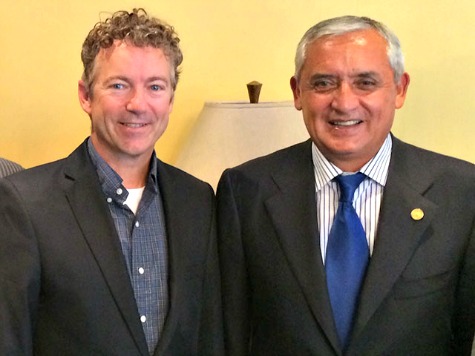
National Democrats are attacking Sen. Rand Paul (R-KY) for criticizing President Barack Obama’s immigration policies in a meeting with Guatemalan president Otto Perez Molina.
Paul visited Guatemala on an aid mission in which he performed–with a team of doctors from the John A. Moran Eye Center–upwards of a hundred surgeries to remove cataracts from blind Guatemalans with no access to the needed medical care.
Democrats have worked to frame the trip as political, sending out two press releases attacking the current GOP frontrunner in 2016 polling about the trip.
“Rand Paul has made a big deal of his trip to Guatemala, where he is doing some much needed aid work to underserved communities,” Michael Czin, the communications director for the Democratic Party, said in a memorandum distributed by the Democratic National Committee (DNC). “While everyone should commend Paul for his aid work, it’s unfortunate he turned a trip organized by a well-respected eye center into a crass campaign photo op.”
The Democrats cite the fact that Breitbart News, the Washington Post, NBC News, Christian Broadcasting Network, and the National Review sent reporters to Guatemala to report on Paul’s aid mission there, and how several political figures like Citizens United’s David Bossie, GOP ad-makers Rex Elsass and Rick Tyler, a Citizens United film crew, and Paul’s chief of staff Doug Stafford were there, as well. Also cited were comments Paul made in an interview with Breitbart News to argue that the trip was “political.”...
...The Strategy Group for Media: $103,000
The Strategy Group for Media, an Ohio-based company that has been described as “one of the country’s largest political media firms,” received $103,000 from election-denying secretary of state candidates in 2022: $76,000 from Diego Morales of Indiana, $22,000 from Dominic Rapini of Connecticut, and $5,000 from Kristina Karamo of Michigan.
Rex Elsass is the founder and chairman of the board of the Strategy Group for Media, and he’s no stranger to scandal. Elsass urged then-Rep. Todd Akin (R-MO) to stay in his 2012 U.S. Senate race after Akin’s offensive comments about “legitimate rape,” and Elsass was once called “a ringleader of a GOP dirty-tricks group labeled the ‘nasty boys’” by the Columbus Dispatch.
...
Prosecutors say Householder hatched bribery scheme at Washington steakhouse. He says he spent the weekend with family
By Andrew J. Tobias, Jake Zuckerman cleveland.com (TNS)
Updated March 2, 2023
CINCINNATI — Ex-Ohio House Speaker Larry Householder testified Wednesday that he didn’t attend a trio of high-dollar dinners in Washington, D.C. with FirstEnergy executives in January 2017, contradicting the testimony of a former top political aide and disputing other versions of the story prosecutors have presented to jurors during his corruption trial.
Householder said instead that he spent the week of ex-President Donald Trump’s inauguration largely with his family, attending concerts, political banquets and private dinners. He said he only ran into Chuck Jones, the then-CEO of FirstEnergy, a couple of times in passing, including at the home of Rex Elsass, a top GOP political strategist, and then again in the lobby of his hotel.
The testimony is flatly at odds with what Jeff Longsteth told jurors last week. Longstreth, who has cut a plea deal as part of the case, told jurors last week that he and Householder discussed what eventually became a deal to pass priority legislation for FirstEnergy in exchange for tens of millions of dollars in political contributions.
Prosecutors have used the exchange and the imagery it conveys — a politician flying on a corporate jet to Washington, D.C., to hatch a corrupt bribery scheme over steaks — as a key part of their narrative of the complex case. They’ve previously introduced evidence of the dinners, in the form of corporate expense reports and receipts from FirstEnergy that list Householder and Jones as among the attendees.
Householder said Wednesday he hadn’t seen the receipts until the trial, and reaffirmed he wasn’t there.
“No,” he said several times.
Prosecutors said that FirstEnergy, while seeking a bailout for two Ohio nuclear plants owned by former subsidiary FirstEnergy Solutions , paid $60 million in bribes to Generation Now, a nonprofit Householder secretly controlled in exchange for his help passing the bill.
But on Wednesday, Householder said he didn’t direct the spending, vendors, or contributions of Generation Now. He said that power belonged to Longstreth, the signatory on the account.
The money helped Householder defeat a rival Republican candidate, then-House Speaker Ryan Smith, who didn’t support the bailout. Householder then pushed for the law’s passage in 2019 and with help of his co-defendant, Matt Borges, and others, defended it against a repeal attempt. The nonprofit covered the costs. Prosecutors say its operators used its funds to pay themselves hundreds of thousands of dollars as well.
Householder’s lawyers called two witnesses on Wednesday. In the morning, Bob Klaffky, a prominent Columbus lobbyist, disputed testimony from Juan Cespedes, another lobbyist who’s pleaded guilty in the case and is cooperating with prosecutors.
Cespedes has told jurors that Klaffky had given a $400,000 check to Householder during an October 2018 meeting in which FirstEnergy Solutions’ representatives emphasized their need for a bailout. Klaffky testified that an FES executive, David Griffing, actually gave Householder the check, although he said he generally didn’t remember the meeting well.
But the most notable witness testimony from Wednesday came from Householder, who let loose a full press of folksy appeal and self-assuredness from the witness stand. He struggled, perhaps in jest, to recall how many years he has been married to his “pizza addict” wife, Taundra, who sat in the courtroom watching. He cackled loudly when asked about a claim from another alleged conspirator, the late lobbyist Neil Clark, who unwittingly told undercover FBI agents he served as Householder’s “proxy” with Generation Now. He showed jurors a picture of his son near the stage at a Trace Adkins concert in Washington D.C. that he said he took.
He spent time trying to get jurors to disbelieve Longstreth, who in his testimony had portrayed Householder as an exacting, all-knowledgeable and hands-on boss.
In 2018, Longstreth had helped orchestrate Householder’s campaign for speaker, which involved recruiting friendly candidates and helping them defeat Smith’s allies in that year’s Republican primary election.
But on Wednesday, Householder described delegating a lot of the responsibility for his campaign to Longstreth and Megan Fitzmartin, who worked for Longstreth and who also previously testified in the case.
He also contradicted testimony offered by Rep. Dave Greenspan, a Westlake Republican who in 2019 voted against House Bill 6, the bailout legislation. Greenspan claimed Clark threatened him on Householder’s behalf regarding his no-vote on HB6; that Householder nixed other legislation Greenspan was working on at the time; and that Householder’s lieutenant, Longstreth, dispatched an intermediary asking Greenspan to delete his texts with Householder regarding HB6.
Householder denied any inolvement on each of those three points.
“I absolutely did not threaten him,” Householder said.
Another anecdote helps illustrate the difference between Longstreth and Householder’s respective testimonies. Longstreth described to jurors a phrase — “casket carriers” — that Longstreth said meant to convey the significance Householder placed on loyalty.
“I understood it to mean a loyal team around him that would be with him until his death and to lower the casket in the ground,” Longstreth said.
But Householder said he had a different interpretation of the term, saying it reflected his desire to not make any more enemies than he already had throughout his lengthy political career.
“When you get to be the age that I am, you’re not looking for any more enemies. And if you’re in politics, there’s probably going to be enough people throwing mud at you when your casket goes by,” he said. “In other words, I don’t want enemies, I want friends. I didn’t come back [re-enter politics] to make more enemies.”
And rather than what Longstreth said, that Householder prized loyalty above all when looking for legislative candidates, Householder said he looked for independent thinkers who pay attention.
“You get a much better debate,” Householder said.
Householder’s attorneys say they expect he will testify for about another hour on Thursday morning. From there, Householder faces his true crucible: answering questions from federal prosecutors who have now spent years trying to put him behind bars.
Borges will have the opportunity to question Householder as well.After that, Borges may testify in his own defense, his lawyers said. If he does not, they likely will rest their case.
On his way out out of the courtroom Wednesday, Borges said when asked whether he may testify despite any potential legal risks: “Whatever you see tomorrow, know that it was my choice.”
===
Published 2:34 PM PST, March 1, 2023
CINCINNATI (AP) — Former Republican Ohio House Speaker Larry Householder directly contradicted FBI testimony in his corruption trial Wednesday, taking the stand for the first time to deny attending a series of swanky dinners in Washington, D.C. where prosecutors have alleged he and executives of Akron-based FirstEnergy Corp. hatched a $60 million bribery scheme in 2017.
Householder, 63, looked relaxed and confident during his first day of testimony, setting the stage by describing his lifetime lived in a single rural Ohio county, his early political-underdog days and his rising path to become speaker. His wife of 38 years, Taundra, sat facing him from the gallery.
The trial is in its fifth week before a jury and U.S. District Court Judge Timothy Black in Cincinnati.
Householder and Matt Borges, 50, a lobbyist and former Ohio Republican Party chair, have been charged with conspiracy to participate in a racketeering enterprise involving bribery and money laundering. Federal prosecutors allege Householder controlled a scheme, secretly funded by FirstEnergy, to elect allies, win the speakership, pass a $1 billion nuclear plant bailout and that Borges sought to bribe an operative for inside information on the referendum to overturn it. Both have pleaded not guilty and maintain their innocence. Each faces up to 20 years in prison if convicted.
Householder told jurors that he invented the strategy of recruiting large numbers of like-minded Republican House candidates and setting up expensive operations to help them all get elected at once, requiring the raising of large sums of money. But he denied demanding loyalty oaths from his recruits or extracting promises to vote a certain way.
“I really looked for people who are independent-minded,” he said.
Three of Householder’s former caucus members testified last week that he pressured them to vote for the bill, and texts were presented in which Householder appeared to express anger at disloyalty.
Associate Jeff Longstreth, among four other individuals and a dark money group charged in the scheme, had testified for the prosecution that Householder wanted “casket carriers,” people so loyal they would carry his casket on the day of his funeral. Householder told jurors “casket carriers” were just friends, and that a long-time politician like him doesn’t need anymore enemies.
In another denial of previous allegations, Householder said he never granted Statehouse superlobbyist Neil Clark, a co-defendent who died by suicide in 2021, a “proxy” to act on his behalf. The former speaker guffawed at the suggestion.
“I don’t give up my right to speak for myself,” he said.
Clark was taped describing himself as Householder’s “proxy” while speaking to two undercover FBI agents posing as developers. He went on to describe in detail Householder’s use of dark money groups to conceal campaign contributions. Householder’s attorneys have said Clark exaggerated.
Perhaps the day’s most striking exchange was when Householder described his trip to Republican President Donald Trump’s inauguration in January 2017. He recounted flying to Washington on a FirstEnergy plane, then outlined his weekend activities in detail — photo opportunities, cocktail parties, balls, parades, a concert with his son and pizza with a wife “addicted” to it.
Missing from the account were several dinners, which earlier documents had shown were arranged by Longstreth, head of the dark money Generation Now, to involve then-FirstEnergy CEO Chuck Jones, Vice President Michael Dowling and others. Householder said he had not attended any such dinners. He said he saw Jones on the plane flights to and from the inaugural, and then throughout the weekend only at a “packed” house party hosted by media consultant Rex Elsass and perhaps once more in passing. Asked if he attended the dinners, Householder simply said, “No” or “I was not.”
Earlier in the trial, FBI Agent Blane Wetzel had walked through internal documents from both Generation Now and FirstEnergy, phone records, emails and other documents indicating Jones, Dowling and Householder were part of a party of eight that met three times in D.C. over Trump’s inaugural weekend.
It was about two weeks later that Longstreth opened a bank account for Generation Now, through which FirstEnergy admitted in an agreement to avoid prosecution to pushing millions of bribes aimed at getting the bailout bill passed. The same day, Longstreth emailed Dowling “wiring instructions” for FirstEnergy to put money in the account. Regular $250,000 began flowing.
Longstreth and Generation Now have pleaded guilty to their parts in the bribery scheme, as has a third individual, Juan Cespedes, who testified last week. Clark had pleaded not guilty.
Cross-examination of Householder had not yet begun at day’s end Wednesday.
Earlier in the day, Statehouse lobbyist Robert Klaffky testified to being present at a meeting where a $400,000 check from his client, FirstEnergy Solutions, was given to Householder in an envelope. Klaffky said he could not remember what was said at the meeting, but that he was certain he had not witnessed pay-to-play.
Klaffky said he was already a Householder insider and adviser before taking on FirstEnergy Solutions, a subsidiary that owned the two nuclear plants, as a client — and wanting him to win the speakership.
Borges’ attorney, Karl Schneider, said he expected his client also to take the stand.

Smyth covers government and politics from Columbus, Ohio, for The Associated Press. She was part of the AP team honored as a finalist for the 2025 Pulitzer Prize in breaking news.
==
2019
https://energynews.us/2019/09/23/midwest/whos-behind-the-chinese-conspiracy-ads-against-ohios-nuclear-referendum/}:
ohio law lets political action groups keep funders secret during drive to let voters get a say on nuclear subsidies.
The video ad starts like a horror film trailer.
“They” are “coming for our energy jobs. The Chinese government is quietly invading our American electric grid.”
Troops march in Tiananmen Square and Chinese President Xi Jinping appears as the announcer’s deep voice speaks.
“Don’t sign the petition allowing China to control Ohio’s power.”
The ads have circulated in recent weeks along with a massive print and mail campaign, all attempting to undercut a potential referendum on FirstEnergy power plant subsidies.
The ads imply that signing the petition would give voters’ personal information to the Chinese government — a conspiracy theory that has been substantially debunked.
Yet questions remain about where the money is coming from to fund both the petition drive for a public vote on FirstEnergy’s subsidies and the inflammatory campaign against it by a group called Ohioans for Energy Security.
“The group operates largely in the shadows in terms of their funding,” Dave Anderson, policy and communications manager for the Energy and Policy Institute, said ofOhioans for Energy Security.
Here’s what’s known so far — and what’s not known.
Ohioans for Energy Security is aggressively campaigning against a petition effort to put the state’s nuclear bailout law to a public vote.
The ads aim to prevent a referendum on a new law, House Bill 6, which will add charges to electric customers’ bills to subsidize nuclear and coal plants while gutting the state’s clean energy standards.
Ohio lawmakers passed the law in July, and a group called Ohioans Against Corporate Bailouts began working on a referendum initiative soon after. Ohioans’ right to seek a referendum on legislation is guaranteed by Article II of the state’s Constitution.
On Aug. 30, the group got a go-ahead from the Ohio secretary of state to start collecting signatures for the referendum petition. Supporters need to collect approximately 266,000 signatures to get the issue on the ballot next year.
Even before that approval came, Ohioans for Energy Security began its aggressive ads aiming to keep voters from getting a say on the bill’s coal and nuclear bailouts.
And less than a week later, FirstEnergy’s bankrupt generation subsidiary, FirstEnergy Solutions, filed a lawsuit asking the Ohio Supreme Court to stop the referendum petition effort. FirstEnergy Solutions stands to lose roughly $900 million in subsidies for its nuclear plants if voters eventually reject HB 6.
Ohio campaign finance laws let Ohioans for Energy Security keep its funding sources secret during the petition drive.
It’s not clear who’s behind Ohioans for Energy Security, and the group isn’t required to disclose the funders for any of its anti-referendum ads during the petition drive. The group has filed incorporation papers with the Ohio Secretary of State, which serve to limit its legal liability under state law.
Those papers, filed on July 30, show attorney Donald Brey as the sole “authorized representative.” Patrick Pickett signed on behalf of statutory agent IW Agent, LLC. Pickett and Brey are both partners at the Isaac Wiles law firm in Columbus, which shares its business address with IW Agent.
The group’s lawyers won’t answer questions about its funding.
Brey, Pickett and their partner Mark Weaver did not answer the Energy News Network’s questions about who pays for the firm’s services for Ohioans for Energy Security. The lawyers likewise declined to identify the officers, directors and shareholders of the corporation.
The firm’s lawyers “cannot ethically discuss information within the attorney-client privilege,” Weaver replied via email.
“We have not and do not represent FirstEnergy,” Weaver also said. “We do represent a wide range of political action committees and non-profit organizations that are independent associations with First Amendment freedom of speech rights.”
Weaver’s email did not make any statement about whether it had represented FirstEnergy Solutions. People and companies have also sometimes paid for attorney fees or expert expenses in legal matters where a lawyer technically represents other individuals or entities.
The firm had acted as outside counsel for the Office of the Ohio Consumers’ Counsel in a case seeking refunds forunlawful overcharges by FirstEnergy utilities for renewable energy credits that they had bought from their affiliate, FirstEnergy Solutions. That past representation “presents no legal ethics issues with respect to our current representation of any political action committee or non-profit organization,” Weaver said.
Public records reveal associations between the anti-referendum group’s spokesperson and another group with connections to FirstEnergy Solutions.
Public relations for Ohioans for Energy Security are being handled by Carlo LoParoat LoParo Public Relations in Columbus. LoParo did not respond to questions from Energy News Network about the identity of the funders for Ohioans for Energy Security and his client contacts for that organization.
LoParo has also acted as spokesperson for the Ohio Clean Energy Jobs Alliance. The group’s website describes it as a “coalition of Ohio community leaders and organizations committed to preserving the jobs, economic benefits, carbon-free energy and electricity grid reliability” of nuclear energy. The group ran ads in favor of the nuclear and coal subsidy bill, House Bill 6, when it was pending in the legislature.
“Powered by FirstEnergy Solutions,” says a note at the bottom of the alliance’s home page, though it does not provide details about what that means.
LoParo has told the Energy and Policy Institute that the Dewey Square Group lobbying firm had acted “on behalf of FES [FirstEnergy Solutions] and the Ohio Clean Energy Jobs Alliance to advocate for keeping the state’s nuclear plants open.” Andbankruptcycase filings show charges byconsultants for FirstEnergy Solutions supporting the launch of the alliance and coordinating with it.
Documents obtained by the Energy and Policy Institute through public records requests also show that a consultant for FirstEnergy Solutions provided “draft testimony” on HB 6 to public officials from Summit County, which is listed on an alliance website as a coalition supporter.
Employee “contests” also took place at FirstEnergy Solutions’ Davis-Besse and Perry nuclear power plants last winter to sign up employees for the alliance’s “employee ambassador” program. And several FirstEnergy Solutions’ employees were featured in an allianc .
VID]
At least two FirstEnergy Solutions’ employees from that video also appear in an August 2019video ad from Ohioans for Energy Security. NeitherMatt Messenger norLindsay Humble are identified as FirstEnergy Solutions employees in the August ad, however.
FirstEnergy Solutions won’t say if it’s funding Ohioans for Energy Security.
“Please refer to FES’s statement and lawsuit on the referendum,” spokesperson Angela Pruitt responded to Anderson when he asked whether FirstEnergy Solutions was funding Ohioans for Energy Security and why company employees were in the ad. Neither document answers the questions.
What emerges is an apparent close working relationship between FirstEnergy’s generation subsidiary, its employees and its consultants with both the Alliance and Ohioans for Energy Security. However, conclusive answers about who funds and directs Ohioans for Energy Security’s activities remain hidden.
Ohioans for Energy Security used one of the same contractors that Generation Now used for its ads pushing for passage of the nuclear subsidy bill.
A Federal Communications Commission filing posted by OpenSecrets.org shows that Strategic Media Placement arranged to air the anti-referendum ad for Ohioans for Energy Security. Strategic Media Placement also arranged to air ads from Generation Now, a pro-subsidy group that pushed for passage of the nuclear subsidy bill. FirstEnergy Solutions employees Messenger and Humble also appeared in at least one of the group’s ads.
Generation Now is also reported to have made substantial “dark money” contributions to elect Ohio Speaker of the House Larry Householder and others sympathetic to nuclear subsidies. At least one donor to that group is the International Union of Operating Engineers, Local 18, based in Cleveland. Some of the union’s members likely work at FirstEnergy Solutions plants.
It’s unclear who else is funding Generation Now. The union’s $295,000 in 2019 spending for the group is less than a sixth of the more than $1.9 million the group reportedly spent on ads supporting HB 6. The group is not required to disclose its funders.
The group has been paying people to hover near folks seeking to collect signatures for the referendum petition. Those “field staffers” are sometimes referred to as “blockers,” because their presence can discourage voters from listening to those who seek to explain a referendum.
Referendum supporters’ funding is also a secret, but may be revealed later.
“The funders of the TV ads, direct mail and blocking against the issue have no obligation to disclose their funders or expenditures,” said Gene Pierce, spokesperson for Ohioans Against Corporate Bailouts, which is trying to get the referendum on the ballot. “Ohio law only requires disclosure of such expenses once the issue is qualified to the ballot and only on expenses incurred after such qualification.”
The referendum initiative group’s corporate filing with the Secretary of State also reveals only its attorney,David R. Langdon of West Chester, Ohio, as its authorized agent for incorporation and statutory agent. Pierce said the group’s funders “will be revealed, as required by Ohio law, 30 days after” petitions are filed next month. The group needs to collect approximately 266,000 voters’ signatures.
Bill Siderewicz, president of natural gas power plant developer Clean Energy Future, has already beenreported to be a contributing member of Ohioans Against Corporate Bailouts. LoParo hasclaimed that a Chinese bank provided financing for some of that company’s projects.FirstEnergy has received loans from the same bank.
The referendum petition lists David J. Eckert, Trevor J. Vessels and Brandon Sean Lynaugh as the three committee members who represent the group. Eckert is a “campaign manager/general consultant,” Pierce said. LinkedIn shows that the other two work in public relations fields.
“I expect voters will see that our donors,” Pierce said, “reflect a wide range of residential and commercial interests who are all negatively impacted by this legislation.”
ABOUT KATHIANN M. KOWALSKI
Kathi is the author of 25 books and more than 600 articles, and writes often on science and policy issues. In addition to her journalism career, Kathi is an alumna of Harvard Law School and has spent 15 years practicing law. She is a member of the Society of Environmental Journalists and the National Association of Science Writers. Kathi covers the state of Ohio.
:{===
---
no lnx many, video
https://www.energyandpolicy.org/ohioans-for-energy-security/
Watchdog exposing the attacks on renewable energy and countering misinformation by fossil fuel interests
Reports
Close
Southern Company CEO Tom Fanning on CNBC
NextSouthern Company’s “Low to No Carbon” Pledge Misleads Investors, Public
Explore Menu
CoalFirstEnergyOhio Clean Energy Jobs Alliance
Who’s behind Ohioans for Energy Security’s ad campaign to scare voters?
Dave Anderson • August 28, 2019
Ohioans for Energy Security, a new entity blanketing Ohio with a wave of television ads defending the bailout of FirstEnergy Solutions, is brought to you by the same people who campaigned for the controversial bailout plan.
The group formed last month in Ohio as a for-profit Limited Liability Corporation. It just launched a $1 million ad campaign designed to scare voters away from signing petitions toplace a referendum on House Bill 6 on the 2020 ballot. The bill in question, passed by the Ohio General Assembly and signed by Governor Mike DeWine in July, will force Ohio consumers to pay to bail out uncompetitive nuclear and coal plants in Ohio. It also rolls back Ohio’s life-and-money saving clean energy standards, which helped to support 112,000 jobs in the Buckeye State.
“In the coming weeks, don’t give your information to the Chinese government,” Ohioans for Energy Security tells visitors to its website. “Don’t sign their petitionallowing China control over Ohio.”
Ohioans for Energy Security’s website tells voters to call its hotline to report petition gatherers. Petition signatures for statewide referendums are submitted to the Ohio Secretary of State and Attorney General, not the Chinese government.
Ohioans for Energy Security points to several reports that the Industrial and Commercial Bank of China has been among the banks that financed several new gas projects in Ohio developed by Clean Energy Future, a company that opposed HB 6.
The Columbus Dispatch reviewed those reports and concluded that “the group behind the commercial offered no evidence that such a plot exists.” It didn’t find “any evidence that the Chinese government intends to play a role in the possible repeal of House Bill 6.”
The Cleveland Scene writes that the group’s “bonkers” first ad “continues with even less tenuous grasps on the issues surrounding HB 6.”
Ohioans for Energy Security doesn’t mention that the broad-based opposition to HB 6 includes consumer advocates, environmentalists, free market groups, health experts, and manufacturers, as a quick review of opponent testimony on the bill will show.
The pro-bailout group also doesn’t mention Securities and Exchange Commission filings that show the Industrial and Commercial Bank of China has committed many millions of dollars to FirstEnergy Corp., the parent company that spawned FES.A March 2018 declaration by Charles Moore, FES’s chief restructuring officer, also included the Industrial and Commercial Bank of China on a list of “interest parties and significant creditors” in FES’s bankruptcy case, under the subheading “Banks, Lenders, UCC Lien.”
Ohioans for Energy Security is led by the spokesperson for another pro-bailout group backed by FirstEnergy Solutions
Carlo Loparo is listed as the president of Ohioans for Energy Security on political issue ad disclosures on file with the Federal Communications Commission. Loparo also serves as the group’s public spokesperson.
Loparo is also the spokesperson for the Ohio Clean Energy Jobs Alliance (OCEJA), a coalition “powered by FirstEnergy Solutions” that launched last fall with the help of the utility’s outside lobbyists and public relations consultants, and campaigned in support of HB 6.
Loparo is the president of the Columbus-based Loparo Public Relations, and boasts 25 years of experience in “media relations, strategic message development and crisis communications,” according to his firm’s website.
Amy Natoce, the vice president of Loparo Public Relations, was the political director for Dave Yost’s successful campaign for Ohio Attorney General. Yost will soon decide on whether to approve of revised summary language for the referendum petition, a first step toward getting the referendum on the ballot in 2020. Attorneys representing FES and Generation Now, Inc., a dark money group that spent millions on ads supporting HB 6, have been targeting Yost’s office with letters opposing the effort to put the issue on the ballot.
Ohioans for Energy Security’s first ad uses stock footage, features employees of FirstEnergy Solutions
“Don’t sign your name to a plan that kills Ohio jobs, harms Ohio communities, and endangers our energy independence,” Ohioans for Energy Security’s first ad tells viewers as stoic headshots of several individuals flash on screen.
The ad doesn’t identify those individuals, but at least three of the individuals appear to be recycled from stock footage that had previously been used in a 2017 Ohio ballot initiative ad around prescription drug prices.
Image from 2017 prescription drug ballot initiative ad
Image from 2017 prescription drug ballot initiative ad
Image from 2019 Ohioans for Energy Security ad
Image from 2019 Ohioans for Energy Security ad
Image from 2017 prescription drug ballot initiative ad
Image from 2017 prescription drug ballot initiative ad
Image from 2019 Ohioans for a Secure Energy Future ad
Image from 2019 Ohioans for Energy Security ad
The 2017 ad which used the same stock photos, called “Step Forward,” no longer appears online, though Ballotpedia references it in a database of ads from the 2017 prescription drug initiative campaign. A copy was provided to the Energy and Policy Institute.
That 2017 ad was funded by “Ohio Taxpayers for Lower Drug Prices,” which employedRex Elsass, a Republican operative and the owner of Strategic Group for Media.
Some of Ohioans for Energy Security’s ad contracts on file with the FCC name as the buyer Strategic Media Placement, also owned by Elsass. The same firm made ad buys for Generation Now.
The Ohionans for Energy Security ad also includes several employees of FirstEnergy Solutions who also appeared in earlier ads supporting HB 6, produced by the dark money group Generation Now, Inc. Some also appeared in videos produced by the FES-backed Ohio Clean Energy Jobs Alliance.
A screenshot of a Generation Now Facebook ad featuring Matt Messenger, who the ad did not not disclose is a project manager at FES’s Perry nuclear power plant.
Ohioans for Energy Security first ad features a similar image of Messenger, without disclosing his name or employer
Back in June, the Energy and Policy Institute asked a spokesperson for FES at Sitrick and Company why the utility’s employees were appearing in Generation Now’s ads, and if it was funding the group’s efforts. The spokesperson said he would “be happy to look into this and get back to you,” but then never responded with any further information.
A monthly fee statement filed in FES’s bankruptcy case later revealed that Sitrick & Company staff discussed EPI’s inquiry with “D. Griffing” and the “Dewey Square” team. David Griffing is the vice president of government affairs for FES. The Dewey Square Groupis a lobbying firm that has received nearly $800,000 for its work on FES’s bailout campaigns in Ohio and Pennsylvania, which included work on the launch and operations of the Ohio Clean Energy Jobs Alliance.
Excerpt from Sitrick & Company’s filing in FES’s bankruptcy case discussing EPI’s inquiry regarding FES employees working with Generation Now
Links to Generation Now’s ad firm and a pro-Householder PAC backed by Murray Energy
The server for the group’s website – www.ohioansforenergysecurity.com – also hosts the websites of Elsass’s Strategy Group Company and Front Porch Strategies.
It also hosts a site – LarryHouseholderFightsforus.com – supporting Ohio’s Republican House Speaker Larry Householder, whose rise to the speakership was backed by FirstEnergy and Generation Now. Householder then led the drive to pass HB 6. The pro-Householder site is paid for by the Michigan-based Hardworking Americans Committee, which spent over $450,000 on ads opposing Householder’s Republican primary opponent Kevin Black in 2018.
Federal Elections Commission data shows the Hardworking Americans Committee received $50,000 in 2018 from the PAC of Murray Energy, a coal producer that stands to benefit from HB 6.
The Hardworking Americans also received $50,000 that year from Political Education Patterns, the PAC for the Cleveland-based International Union of Operating Engineers Local 18. IUOE Local 18 doled out $295,000 to Generation Now in 2018 and 2019, according to FEC data. Mark A. Totman, the union’s VP, serves as one of Governor Dewine’s appointees to the Public Utilities Commission of Ohio Nominating Council, where he represents organized labor.
Updated at 7:30 ET on Aug. 28, 2019 to include information about Ohioans for Energy Security’s use of stock footage in its ad.
Posted in: Coal, FirstEnergy, Ohio Clean Energy Jobs Alliance Tagged in: carlo loparo, coal bailout, firstenergy solutions, generation now inc, hb 6, larry householder, loparo public relations, nuclear bailout, ohio clean energy jobs alliance, ohio secretary of state, ohioans for energy security, rex elsass
Posted by Dave Anderson
Dave Anderson is the policy and communications manager for the Energy and Policy Institute. Dave has been working at the nexus of clean energy and public policy since 2008. Prior to joining the Energy and Policy Institute, he was an outreach coordinator for the climate and energy program at the Union of Concerned Scientists. He is also an alumnus of the Sierra Club and the Alliance for Climate Protection (now the Climate Reality Project). Dave’s research has helped to spur public scrutiny of political attacks on clean energy and climate science by powerful special interests, such as ExxonMobil and the American Legislative Exchange Council (ALEC). His work has been cited by major media outlets, such as CBS News and the Wall Street Journal, and he has served as a speaker on panels at national solar industry conferences. Dave holds a MA in Political Science from the University of New Hampshire, where he also received a BA in Humanities.
===
==
Rep. Todd Akin may not be exiting the Missouri Senate race. But he has, apparently, exited the state: According to Politico, the Republican candidate behind the “legitimate rape” boo-boo is shacked up in the Ohio headquarters of his longtime political consultant, adman Rex Elsass.
And therein lies a story.
Elsass, the man Akin chose to helm his challenge to Sen. Claire McCaskill, represents the perfect place for the beleaguered right-winger to turn after having been abandoned by his party. A free agent with a preternatural knack for pissing off fellow Republicans, the Lee Atwater acolyte also possesses the necessary skills for the Akin campaign’s unique challenge: Enabling a guy who has marginalized rape victims to go negative on his female opponent.
Even within the mean-spirited world of political attack dogs, Elsass is known as an unpleasant sort, a reputation he sealed in the early ’90s. His first major undertaking, a 1990 campaign to unseat the Democratic Ohio House speaker, was so venomous that it unnerved even many of his fellow Republicans. The effort, which Elsass dubbed “Operation Kill The King” painted the speaker as the “conductor of the pay-to-play orchestra” over the public objections of Republicans who had long and collegial relationships with him. After the election, rumors circulated that Elsass and his cohorts had left a dead cat on the victorious speaker’s front porch. A local Democratic consultant dubbed Elsass and his crew the “nasty boys”—and it stuck.
Even Elsass’s mentor, state GOP chair Bob Bennett, recommended him to a colleague with a warning: “You keep the string tight on Rex. In other words, keep an eye on him,” according to a 1993 interview Bennett gave to an Ohio paper. A call to Elsass’s office was not returned.
Still, Elsass was an up-and-comer. His rise only buckled when, as manager of Bernadine Healy’s 1994 U.S. Senate campaign in Ohio, a GOP investigation determined that Elsass or someone under his management had purloined a donor list of some 60,000 names and addresses from the Ohio Republican Party—where Elsass had worked for four-and-a-half years immediately before jumping to the Healy campaign. Though Elsass always disputed the accusations, Healy asked for his resignation; she went on to lose the GOP primary.
Elsass, meanwhile, exiled himself to Alabama to rebuild his reputation. At around the same time, he got religion. In a January interview with the Cleveland Plain Dealer, Elsass recalled this period as one of pious reflection that led him to strive toward a higher ethical standard in his work. He became, he explained, “much more serious about my faith” and discovered “a relationship with Christ.” (Today, he practices as a born-again Christian.)
Two years later, he went to work with Akin–running a campaign that he later called his proudest professional moment. The God-fearing future Senatorial candidatewon a House primary by just 57 votes.
But having returned to Ohio politics, Elsass’s political reputation remained somewhat less than saintly. In 2000, Elsass produced what remains his most infamous spot. It starred a garish, 7-foot-tall plaster of Paris statue, painted gold, of “Lady Justice.” The prop, which would have looked at home in a low-rent attorney’s side-of-the-bus advertisement, cost Elsass $4,000, and Elsass used it in an advertisement that suggested an Ohio Supreme Court justice had been compromised by union bribery. Even as the Ohio Election Commission considered whether to order the spot off the air, Elsass displayed Lady Justice on the front lawn of his suburban Columbus home.
More vitriol followed. Elsass cast his young son in a 2006 attack ad that portrayed ominous figures wresting away the child’s toys and security blanket, a metaphor for the government spending cuts championed by a rival candidate for governor. In 2007, Steve Buehrer, a Congressional primary candidate who had retained Elsass just one year earlier for his state assembly campaign, found himself appearing in ads for his primary opponent—Elsass’s new client. Elsass has cobbled together unflattering outtakes from the ads Buehrer had paid him to produce and transformed them into humiliating attack spots.
None of this—the betrayals, the acrimoniousness—fazed the candidates who sought his help in more high-stakes, nationally prominent races. In recent years, Elsass has worked for Rand Paul’s Senatorial bid and Michele Bachmann’s presidential run. He is the media man on call for Gov. John Kasich’s office. His burgeoning client list is such that by day, Elsass is chauffeured around town in a Cadillac Escalade; after hours, he drives his Bentley.
Having rolled out the welcome mat for his old client, Elsass also spent some of this week rolling out a new, nice-guy vocabulary: He was the one who filmed Akin’s Tuesday apology ad. He’s even spotted a silver lining to Akin’s ongoing ordeal. “As a result of going through this valley and climbing to the peak,” he , “ the reality is he’s just going to be that much stronger.”
*Follow me on Twitter@mtredden
---
Source URL: http://www.tnr.com/blog/plank/106406/meet-rex-elsass-todd-akins-hatchet-man
---
Republicans, meanwhile, have seen the near internal combustion of Rex Elsass’ The Strategy Group for Media, after an ugly legal battle with the firm’s then president Nick Everhart. There are also quieter uncouplings, like Chris Perkins’ solo exit from research firm Wilson Perkins Allen (WPA). His name is still on the firm’s masthead, but Perkins isn’t a part of it.
---
Reid
1993 - 2019
Reid Andrew Elsass, age 26, went to be with his Lord Sunday, June 2, 2019 in Columbus. Born March, 3 1993, in Columbus, to Rex and Laurie (Olson) Elsass, Reid was their first child and a cherished treasure...
---
2024 KTY
:{:{POLITICS & GOVERNMENT}:
:{:{Ousted KY official who championed psychedelic to treat addiction lands similar job in Ohio By Alex Acquisto and Austin Horn Updated February 26, 2024 2:38 PM Gift Article}:
Bryan Hubbard, chair of the Kentucky Opioid Abatement Advisory Commission, has proposed the state use opioid lawsuit settlement money to conduct clinical research into the psychedelic drug, ibogaine, as a potential therapeutic to treat opioid addiction. Alex Acquisto The recently ousted director of Kentucky’s commission charged with distributing opioid lawsuit settlement money, who championed a proposal to invest those funds into researching the efficacy of a psychedelic drug to treat opioid addiction, has accepted a similar role in Ohio. }:
Bryan Hubbard, former executive director of the Kentucky Opioid Abatement Advisory Commission, has signed a contract with the state of Ohio. TOP VIDEOS His job: To help build public-private partnerships for potential projects “related to the treatment of Traumatic Brain Injury, Post-Traumatic Stress Disorder and other related and unrelated mental health and substance use conditions,” according to a spokesperson in the office of Ohio Treasurer Robert Sprague. “In part, the work is set to assist the Treasurer’s office with determining the feasibility of potential solutions with ResultsOHIO and other pay-for-success models,” Brittany Halpin, Prague’s press secretary, said in an email. ResultsOHIO is a state government initiative that uses a combination of public and private funding to pursue “innovative” ways to address Ohio’s “most pressing social and public health challenges,” according to the Treasurer’s website.
Hubbard will be paid $45,000 for his independent contracting services, according to his contract, which was reviewed by the Herald-Leader. The Treasurer’s office has asked him to detail how Ohio can best seek “stakeholder-based coalitions to establish and provide feedback and support, including private and public financial support” for future ResultsOHIO projects to treat traumatic brain injuries, PTSD and addiction that have yielded “results-based solutions.” While working with the state to “deliver novel treatment access and research opportunities for veterans and opioid dependent individuals,” Hubbard told the Herald-Leader, he’s also partnering with the Ohio-based REID Foundation to “create the framework for ibogaine clinical trials in Ohio.”
In a press release last week announcing that partnership, REID Foundation said Hubbard will work to create an “implementation framework that he hopes will lead to the execution of FDA-approved clinical research trials with ibogaine in Ohio for the treatment of opioid dependence.” Hubbard was in the process of similar work in Kentucky as head of the Opioid Abatement Advisory Commission when he was asked to resign in late December by incoming Republican Attorney General Russell Coleman. Coleman appointed Chris Evans, a former chief operating officer for the Drug Enforcement Administration, in Hubbard’s place. The REID Foundation was created by Rex Elsass, who lost his son to addiction in 2019. Elsass is also one of the nation’s premier Republican operatives. In 2016, GQ Magazine dubbed him “The Most Powerful Man in the GOP (And You’ve Never Heard Of Him).”
His political media and consulting firm is called The Strategy Group. Elsass has been close to Kentucky Sen. Rand Paul, serving as a key adviser in Paul’s 2016 bid for president. As senator, Paul has spearheaded efforts into seeking alternative therapies to treat addiction. A donor with close connections to Paul, Jeff Yass, was the primary funder of outside groups that aided former Attorney General Daniel Cameron in his gubernatorial race against Democratic Gov. Andy Beshear. Elsass’ political firm has performed work for those groups. Yass’ investment firm, he became a billionaire through the stock market, also has some interest in biopharmaceutical companies with a focus on psychedelic addiction treatments like Ibogaine. Elsass’ advocacy for ibogaine can be traced back to Hubbard’s time in Kentucky.
Elsass was one of several people who showed up at an Opioid Abatement Advisory Commission meeting to advocate for use of the experimental psychedelic. And while the commission’s work was under way, a former executive assistant at Elsass’ political operation started a group called the Kentucky Ibogaine Initiative. Elsass and the current president of The Strategy Group, Ryan Rodgers, are still listed as directors on the nonprofit’s filing with the Kentucky Secretary of State’s Office. These ties were examined in a Daily Beast story published in the lead-up to Cameron’s race for governor. Created in 2022, the Kentucky commission is charged with doling a portion of the state’s nearly $900 million in opioid lawsuit settlement money to addiction prevention and mitigation efforts. Hubbard was appointed to the commission at the time by Cameron.
Last May, alongside Cameron in a news conference, Hubbard unveiled his idea to pull $42 million of that sum, to be matched in private contributions, to make Kentucky the first state to research ibogaine as a therapeutic for opioid addiction by helping fund and oversee clinical trials with the goal of securing U.S. Food and Drug Administration approval to distribute it widely. Controversial in part because ibogaine is a Schedule 1 drug in the United States, the commission hosted multiple public hearings and listened to several personal ibogaine success stories, but its members never formally voted on the proposal. Evans, the new commission head, has been publicly non-commital about whether he plans to continue Hubbard’s work on ibogaine.
Likewise, Coleman has not said much publicly about his support or opposition to the proposal, but when announcing Evans as Hubbard’s replacement, he remarked, “There’s been a lot of ink spilled on ibogaine. My concern is that we are not focused as intently as we should be on the prevention piece of this.” Roughly a week later, in late December, Hubbard submitted his letter of resignation, implying Coleman forced him to resign. “New leadership has been requested,” Hubbard wrote. Hubbard, in his comments to the Herald-Leader about his new post, said he was “saddened that a lack of courage and vision from (Coleman) has deprived Kentucky of its opportunity to lead the nation in the development of ibogaine’s revolutionary therapeutic potentials. However, I am strongly encouraged that genuine leaders exist across the river to ensure that ibogaine’s promise has an opportunity to be fulfilled for all who may choose to seek it.” Coleman’s office did not respond to emailed questions for this story.}:
Read more at: https://www.kentucky.com/news/politics-government/article283978063.html#storylink=cpy
---
COL DISP
Who is Rex Elsass, the GOP ad maker who designed Larry Householder's attacks?
 Laura A. Bischoff
The Columbus Dispatch
When former Ohio Speaker of the House Larry Householder wanted a “killer” attack ad, he turned to the professionals at The Strategy Group for Media, a nationally known GOP political ad making firm that works out of an historic house in Delaware County.
The Strategy Group founder Rex Elsass and Householder go back more than 20 years to when Elsass crafted ads during Householder's first turn as speaker.
As Householder made his second bid for speaker in 2018 and battled for House Bill 6 in 2019, he relied on Elsass for office space, polling data and ads, according to court records.
Elsass subleased sumptuous office space to Householder, giving him room to plot his return to power away from prying eyes. “Talk to Rex about frosting the glass,” was on a to-do list created by Householder’s top political consultant.
What You Need to Know Corrupt scheme or politics as usual? Trial of ex-Ohio House Speaker Larry Householder begins
Householder and ex-Ohio Republican Party Chairman Matt Borges are on trial in federal court in Cincinnati accused of participating in a pay-to-play scheme that helped Householder win the speakership, pass a $1.3 billion bailout bill for FirstEnergy and its allies and defend that law against a referendum initiative to block it.
Elsass nor his team members have been charged in the historic public corruption case. He did not return messages seeking comment on this story.
Attack ads, polling help
During the thick of the 2018 primary, Householder’s own reelection was in jeopardy when he was statistically tied with his primary opponent, Kevin Black. FirstEnergy dispatched $400,000 through dark money groups to pay for attack ads crafted by The Strategy Group.
"Don't be fooled. Kevin Black, dirty money, dirty politics," the ad voice over says.
The same team pulled together an attack ad against Dayton-area Democrat Dan Foley, who was running against Householder’s hand-picked Republican candidate in November 2018. They ran ads that painted Foley as a drunk driver, even though he was never cited. Foley lost by 137 votes.
When it came time for the Ohio House to pick a speaker in January 2019, Householder needed all of his Republican loyalists, plus 26 Democrats, to win power.
Within a matter of weeks, Householder began pushing House Bill 6, which would provide a $1.3 billion bailout to Akron-based FirstEnergy and its allies. Federal prosecutors allege that Householder traded $61 million in dark money from FirstEnergy for the bailout. Householder and Borges have pleaded not guilty.
Political ads played a major role in pushing legislators to vote for the bill and then fighting a referendum that would've asked voters to weigh in on it.
The Strategy Group was paid by Generation Now, a dark money group funded by FirstEnergy, to produce and place millions of dollars worth of ads.
In a secretly recorded meeting in September 2019, lobbyist Neil Clark told undercover FBI agents that Elsass made a tidy sum off the work, typically charging 15% of the total ad buy as his commission.
In 2019, Householder wanted to punch back against oil and gas interests that he suspected were attacking legislators backing the bill. He turned to The Strategy Group, which created “Seep” – an ad that aimed for a “dark, sinister, threatening feel.”
FirstEnergy Solutions was happy to foot the bill for the ads. “Please tell LH we will glad pay for as many anti fracking ads as he wants,” FES Board Chairman John Kiani said in a text message to FirstEnergy CEO Chuck Jones.
Jones alerted Householder. “Want us to hook them up with Rex?”
Elsass’ team got to work.
“I don’t think they’re ready for it. Rex’s stuff is nasty too,” Borges said to FES lobbyist Juan Cespedes in April 2019 as they prepared to launch the attack ads.
“We have more money than they think” Cespedes replied to Matt Borges. “Who would ever assume a bankrupt company is willing to spend $15M? Lol. What a joke.”
“(Expletive) those guys,” Borges shot back.
The total amount spent on advertising to pass and then defend House Bill 6 isn't publicly available. But in late October 2019, just before the referendum failed to make the ballot, Medium Buying, which tracks ad buys, pegged the television spending at $16.5 million.
Who is Rex Elsass?
Elsass, who founded his company in 1994, has made political ads for U.S. Sen. Rand Paul of Kentucky, former U.S. House Speaker Newt Gingrich, former Ohio Gov. John Kasich, Ohio Attorney General Dave Yost, Ohio Auditor Keith Faber, Ohio Lt. Gov. Jon Husted and scores of other Republicans.
Elsass, who grew up in Mansfield, is a former Ohio Republican Party director.
He was nicknamed one of the “Nasty Boys” during the 1994 U.S. Senate primary that was marred by the unauthorized sharing of a GOP donor list.
In 2000, he crafted attack ads against then sitting Ohio Supreme Court Justice Alice Robie Resnick. The ad showed Lady Justice peeking beneath her blindfolded eyes at piles of campaign cash Resnick supposedly traded for her decisions. The content of the ads were found to be illegal by the Ohio Elections Commission.
As he built his reputation and company, Elsass grabbed national press attention.
A 2013 article in BuzzFeed described him this way: “Elsass is a round, loud, cigar-smoking good 'ol boy with a private jet; a worldview rooted, he'll be quick to tell you, in his Christian faith; and a shameless killer instinct that has turned his company into one of the country's most in-demand political consulting firms.”
GQ Magazine wrote about Elsass in 2016, calling him the “The Most Powerful Man in the GOP (And You’ve Never Heard of Him).
In 2006, Elsass purchased thehistoric Gooding House in Delaware County just off U.S. 23 and finished renovating it. The renovation saved it from razing and it’s now on the National Register of Historic Places.
Elsass, who is divorced, is the father of three sons. His son, Reid, died at age 26 in June 2019. After the loss, Elsass started REID Foundation to combat drug addiction.
---
GGL 11 25
[### Who is Rex Elsass, the GOP ad maker who designed Larry ...

The Columbus Dispatch
https://www.dispatch.com › politics › state › 2023/02/15](https://www.dispatch.com/story/news/politics/state/2023/02/15/when-larry-householder-needed-attack-ads-he-turned-to-rex-elsass/69879086007/)
Feb 15, 2023 — The Strategy Group founder Rex Elsass provided office space, polling data and attack ads to Larry Householder as he mounted his political ...
[### Prosecutors say Householder hatched bribery scheme at ...

Dayton Daily News
https://www.daytondailynews.com › local › prosecutors...](https://www.daytondailynews.com/local/prosecutors-say-householder-hatched-bribery-scheme-at-washington-steakhouse-he-says-he-spent-the-weekend-with-family/WTDMFP4VF5BF7CACYTEGK6PSOM/)
Mar 2, 2023 — Ex-Ohio House Speaker Larry Householder testified Wednesday that he didn't attend a trio of high-dollar dinners in Washington, DC with FirstEnergy executives ...
[### The Strategy Group founder Rex Elsass and Householder go ...

https://www.facebook.com › columbusdispatch › posts](https://www.facebook.com/columbusdispatch/posts/the-strategy-group-founder-rex-elsass-and-householder-go-back-more-than-20-years/10159619130607055/)
The Strategy Group founder Rex Elsass and Householder go back more than 20 years to when Elsass crafted ads during Householder's first turn as speaker.
[### The Most Powerful Man in the GOP (And You've Never ...

GQ
https://www.gq.com › Culture › Ted Cruz](https://www.gq.com/story/rex-elsass-secret-wizard-of-the-far-right)
Feb 17, 2016 — Rex Elsass, who's built nearly 50 of them from scratch while turning himself into the most powerful Republican operative you've never heard of.
[### Bank records reveal more secret payments to Larry ...

Energy and Policy Institute
https://energyandpolicy.org › larry-householder-dark-...](https://energyandpolicy.org/larry-householder-dark-money/)
Mar 29, 2023 — FirstEnergy provided over 90 percent of Generation Now's funding · Other donors from the utility, coal, and gas industries contributed nearly ...
[### Larry Householder denies dinners with FirstEnergy execs

WOSU Public Media
https://www.wosu.org › politics-government › larry-ho...](https://www.wosu.org/politics-government/2023-03-02/larry-householder-denies-dinners-with-firstenergy-execs)
Mar 2, 2023 — Former Republican Ohio House Speaker Larry Householder directly contradicted FBI testimony in his corruption trial Wednesday, ...
[### Inside The Meltdown At America's Most Conservative ...

BuzzFeed News
https://www.buzzfeednews.com › article › mckaycoppins](https://www.buzzfeednews.com/article/mckaycoppins/inside-the-meltdown-at-americas-most-conservative-most-chris)
Jun 3, 2013 — Inside The Meltdown At America's Most Conservative, Most Christian Political Consulting Firm. Rex Elsass built a Republican empire on his faith.
[### This SW Ohio Republican reported Larry Householder to ...

Cincinnati Enquirer
https://www.cincinnati.com › story › news › 2020/07/28](https://www.cincinnati.com/story/news/2020/07/28/clermont-county-republican-reported-larry-householder-fbi/5527541002/)
Jul 28, 2020 — Ohio House candidate Nick Owens listened as soon-to-be House Speaker Larry Householder took credit for a dark-money funded advertisement.
[### Former Ohio House speaker testifies in his own defense at ...

Courthouse News
https://www.courthousenews.com › former-ohio-house-...](https://www.courthousenews.com/former-ohio-house-speaker-testifies-in-his-own-defense-at-federal-bribery-trial/)
Mar 1, 2023 — Larry Householder denied threatening fellow lawmakers to pass a controversial nuclear power plant bailout and portrayed himself as a family man concerned for ...
[### FirstEnergy offshoot gave to dark money group backing ...

Akron Beacon Journal
https://www.beaconjournal.com › politics › 2022/03/21](https://www.beaconjournal.com/story/news/politics/2022/03/21/firstenergy-offshoot-gave-dark-money-group-backing-trumps-policies/7062184001/)
Mar 21, 2022 — A dark money group backing then-President Trump's agenda benefited from FirstEnergy's web of political spending, according to a Maryland ...
People also search for
---
[### Inside The Meltdown At America's Most Conservative ...

BuzzFeed News
https://www.buzzfeednews.com › article › mckaycoppins](https://www.buzzfeednews.com/article/mckaycoppins/inside-the-meltdown-at-americas-most-conservative-most-chris)
Jun 3, 2013 — Rex Elsass grew up in the '60s and '70s in a small Ohio city ... nasty boys," told BuzzFeed Elsass' tactics were nigh Nixonian. "It's ...
[### Ohio political consultant uses deft touch to skewer opponents

The Columbus Dispatch
https://www.dispatch.com › news › politics › 2012/01/23](https://www.dispatch.com/story/news/politics/2012/01/23/ohio-political-consultant-uses-deft/23560873007/)
Jan 23, 2012 — Once a ringleader of a GOP dirty-tricks group labeled the “nasty boys” more than 20 years ago, Elsass has morphed into arguably the premier ...
[### Did Ohio political consultant Rex Elsass send Michele ...

Cleveland.com
https://www.cleveland.com › open › 2013/07 › did_ohio...](https://www.cleveland.com/open/2013/07/did_ohio_political_consultant.html)
Jul 17, 2013 — 17, 2013, 7:02 p.m.. Rex Elsass in 1990, the dawn of his Nasty Boys days.
[### Who is Rex Elsass, the GOP ad maker who designed Larry ...

The Columbus Dispatch
https://www.dispatch.com › politics › state › 2023/02/15](https://www.dispatch.com/story/news/politics/state/2023/02/15/when-larry-householder-needed-attack-ads-he-turned-to-rex-elsass/69879086007/)
Feb 15, 2023 — The Strategy Group founder Rex Elsass provided office space ... Rex's stuff is nasty too,” Borges said to FES lobbyist Juan Cespedes ...
[### Rival tacticians join fight over Ohio casinos

Canton Repository
https://www.cantonrep.com › news › state › 2009/10/13](https://www.cantonrep.com/story/news/state/2009/10/13/rival-tacticians-join-fight-over/42591079007/)
The media strategist for the pro-casino Ohio Jobs & Growth Committee, funded by Penn National and Cleveland Cavaliers owner Dan Gilbert, is Rex Elsass. Elsass, ...
[### Ohio Special Election Has Turned Ugly

Roll Call
https://rollcall.com › 2007/10/31 › ohio-special-election...](https://rollcall.com/2007/10/31/ohio-special-election-has-turned-ugly/)
In fact, the candidates are so close that Latta's media consultant, Rex Elsass, worked for Buehrer's state Senate campaigns — and has the outtake footage to ...
[### Dispute over Ohio anti-casino ad escalates Native American Times
https://nativetimes.com › business › gaming › 2437-disp...](https://nativetimes.com/business/gaming/2437-dispute-over-ohio-anti-casino-ad-escalates)
Sep 27, 2009 — Elsass was a member of the notorious “Nasty Boys” in the 1990s, so-called for the dirty campaign tricks they employed. Two employees of Elsass ...
[### Clermont County races targeted by pro-Householder super ...

Cincinnati Enquirer
https://www.cincinnati.com › story › news › 2020/04/17](https://www.cincinnati.com/story/news/2020/04/17/clermont-county-races-targeted-pro-householder-super-pac/5151236002/)
Apr 17, 2020 — ... nasty one between Householder pick Jean Schmidt, a former U.S. representative, and newcomers Joe Dills and Dillon Blevins. The Ohio ...
[### Akin Consultant Has Advised McKenna, Koster

Seattle Met
https://www.seattlemet.com › news-and-city-life › 2012/08](https://www.seattlemet.com/news-and-city-life/2012/08/akin-consultant-has-advised-mckenna-koster)
Once a ringleader of a GOP dirty-tricks group labeled the “nasty boys” more than 20 years ago, Elsass has morphed into arguably the premier political adman in ...
[### todd akin

Cleveland.com
https://www.cleveland.com › topic › todd-akin](https://www.cleveland.com/topic/todd-akin/index.html)
Rex Elsass in 1990, the dawn of his Nasty Boys days. Tea Party pushes back against Karl Rove. Rove's new Conservative Victory Project is a direct response to ...
People also search for
---
---