Strategy Group
Note many similar names
SEE ELSAss NASTY BOYS
SEE CU
FIRSTENENERGY OHIO CRIMES
SEE 1ST AMEND HIJACK [THIS IS SPARK 4 25]
NOEM MULLIN?
in screenshot of hbo doc?
---
OFF BS
National Republican Senatorial Committee (NRSC)
National Republican Congressional Committee (NRCC)
Republican National Committee (RNC)
American Catholics United for Freedom
American Liberty PAC
American Petroleum Institute (API)
Americans for Honesty on Issues
Americans for Prosperity
CatholicVote
Choose Life Missouri
Citizens United
Club for Growth Action
Coalition for Oklahoma’s Future
Coalition for a Secure Energy Future
College Republican National Committee (CRNC)
Committee to Defend the President
Defending Main Street
Enterprise Washington
Faith Family Freedom Fund
Family Research Council
Jobs First Coalition
Judicial Crisis Network
Let Freedom Ring
Marsy’s Law
Michigan House Republican Campaign Committee (MHRCC)
Morning in America PAC
National Republican Congressional Committee (NRCC)
National Republican Senatorial Committee (NRSC)
Now or Never PAC
Ohio Health Care Association
Ohio Right to Life
Protect Freedom PAC
Rand PAC
Republican Governors Association
Republican Main Street Partnership
Republican National Committee (RNC)
Republican State Leadership Committee (RSLC)
Texans for Lawsuit Reform
The LIBRE Initiative
University of Pittsburgh Medical Center (UPMC)
U.S. Chamber of Commerce
With Honor Action
Women Lead PAC
SEN
John Boozman (AR)
Marco Rubio (FL) (NRSC IE)
Cory Gardner (CO) (NRSC IE)
Rand Paul (KY)
Roy Blunt (MO) (NRSC IE)
Steve Daines (MT)
Richard Burr (NC) (NRSC IE)
Ben Sasse (NE)
Rob Portman (OH) (NRSC IE)
Pat Toomey (PA) (NRSC IE)
Bill Hagerty (TN)
Jim Banks (IN)
Mike Lee (UT)
Ron Johnson (WI) (NRSC IE
STATE HOUSE
Alabama
California
Florida
Georgia
Indiana
Kentucky
Michigan
Minnesota
Missouri
New York
Ohio
Oklahoma
Pennsylvania
South Dakota
Texas
Washington
West Virginia
Wisconsin
HOUSE
Jo Bonner (AL)
Mo Brooks (AL)
Sonny Callahan (AL)
Terry Everett (AL)
Dale Strong (AL)
Doug Lamborn (CO)
Marilyn Musgrave (CO)
Kat Cammack (FL)
Curt Clawson (FL)
Buddy Carter (GA)
Rob Woodall (GA)
Bill Sali (ID)
Rodney Davis (IL)
Jim Banks (IN)
Dan Burton (IN)
David McIntosh (IN)
Mike Pence (IN)
Jackie Walorski (IN)
Rod Blum (IA)
Randy Feenstra (IA)
Tim Huelskamp (KS)
Kevin Yoder (KS)
Thomas Massie (KY)
Andy Barr (KY)
Julia Letlow (LA)
Luke Letlow (LA)
Justin Amash (MI)
Mike Bishop (MI)
Peter Meijer (MI)
Paul Mitchell (MI)
Dave Trott (MI)
Michele Bachmann (MN)
Gregg Harper (MS)
Alan Nunnelee (MS)
Todd Akin (MO)
Ann Wagner (MO)
Steve Daines (MT)
Renee Ellmers (NC)
Virginia Foxx (NC)
George Holding (NC)
Rich Hudson (NC)
Mark Walker (NC)
Frank Lobiondo (NJ)
Yvette Herrell (NM)
Rick Lazio (NY)
Claudia Tenney (NY)
Joe Heck (NV)
Troy Balderson (OH)
John Boehner (OH)
Steve Chabot (OH)
Jim Jordan (OH)
Dave Joyce (OH)
Bob Latta (OH)
Max Miller (OH)
Steve Stivers (OH)
Pat Tiberi (OH)
Mike Turner (OH)
Steve Largent (OK)
Markwayne Mullin (OK)
Ryan Costello (PA)
Mike Fitzpatrick (PA)
Mike Kelly (PA)
Tom Marino (PA)
Scott Perry (PA)
Joe Pitts (PA)
Keith Rothfus (PA)
Lloyd Smucker (PA)
Glenn “GT” Thompson (PA)
Gresham Barrett (SC)
Henry Brown (SC)
Jim DeMint (SC)
Jeff Duncan (SC)
Nancy Mace (SC)
Mick Mulvaney (SC)
Diane Black (TN)
David Davis (TN)
Chuck Fleischmann (TN)
Van Hilleary (TN)
John Rose (TN)
Joe Barton (TX)
Kevin Brady (TX)
John Culberson (TX)
Monica De La Cruz (TX)
Ron Paul (TX)
Ted Poe (TX)
Lamar Smith (TX)
Blake Moore (UT)
Barbara Comstock (VA)
Bob Goodlatte (VA)
Sean Duffy (WI)
Glenn Grothman (WI)
Alex Mooney (WV)
Reid Ribble (WI)
Jim Sensenbrenner (WI)
GOV
Mike Pence (IN)
Mike DeWine (OH)
John Kasich (OH)
Kristi Noem (SD)
Glenn Youngkin (VA)
==
https://energynews.us/2019/09/23/midwest/whos-behind-the-chinese-conspiracy-ads-against-ohios-nuclear-referendum/
ohio law lets political action groups keep funders secret during drive to let voters get a say on nuclear subsidies.
The video ad starts like a horror film trailer.
“They” are “coming for our energy jobs. The Chinese government is quietly invading our American electric grid.”
Troops march in Tiananmen Square and Chinese President Xi Jinping appears as the announcer’s deep voice speaks.
“Don’t sign the petition allowing China to control Ohio’s power.”
The ads have circulated in recent weeks along with a massive print and mail campaign, all attempting to undercut a potential referendum on FirstEnergy power plant subsidies.
The ads imply that signing the petition would give voters’ personal information to the Chinese government — a conspiracy theory that has been substantially debunked.
Yet questions remain about where the money is coming from to fund both the petition drive for a public vote on FirstEnergy’s subsidies and the inflammatory campaign against it by a group called Ohioans for Energy Security.
“The group operates largely in the shadows in terms of their funding,” Dave Anderson, policy and communications manager for the Energy and Policy Institute, said ofOhioans for Energy Security.
Here’s what’s known so far — and what’s not known.
Ohioans for Energy Security is aggressively campaigning against a petition effort to put the state’s nuclear bailout law to a public vote.
The ads aim to prevent a referendum on a new law, House Bill 6, which will add charges to electric customers’ bills to subsidize nuclear and coal plants while gutting the state’s clean energy standards.
Ohio lawmakers passed the law in July, and a group called Ohioans Against Corporate Bailouts began working on a referendum initiative soon after. Ohioans’ right to seek a referendum on legislation is guaranteed by Article II of the state’s Constitution.
On Aug. 30, the group got a go-ahead from the Ohio secretary of state to start collecting signatures for the referendum petition. Supporters need to collect approximately 266,000 signatures to get the issue on the ballot next year.
Even before that approval came, Ohioans for Energy Security began its aggressive ads aiming to keep voters from getting a say on the bill’s coal and nuclear bailouts.
And less than a week later, FirstEnergy’s bankrupt generation subsidiary, FirstEnergy Solutions, filed a lawsuit asking the Ohio Supreme Court to stop the referendum petition effort. FirstEnergy Solutions stands to lose roughly $900 million in subsidies for its nuclear plants if voters eventually reject HB 6.
Ohio campaign finance laws let Ohioans for Energy Security keep its funding sources secret during the petition drive.
It’s not clear who’s behind Ohioans for Energy Security, and the group isn’t required to disclose the funders for any of its anti-referendum ads during the petition drive. The group has filed incorporation papers with the Ohio Secretary of State, which serve to limit its legal liability under state law.
Those papers, filed on July 30, show attorney Donald Brey as the sole “authorized representative.” Patrick Pickett signed on behalf of statutory agent IW Agent, LLC. Pickett and Brey are both partners at the Isaac Wiles law firm in Columbus, which shares its business address with IW Agent.
The group’s lawyers won’t answer questions about its funding.
Brey, Pickett and their partner Mark Weaver did not answer the Energy News Network’s questions about who pays for the firm’s services for Ohioans for Energy Security. The lawyers likewise declined to identify the officers, directors and shareholders of the corporation.
The firm’s lawyers “cannot ethically discuss information within the attorney-client privilege,” Weaver replied via email.
“We have not and do not represent FirstEnergy,” Weaver also said. “We do represent a wide range of political action committees and non-profit organizations that are independent associations with First Amendment freedom of speech rights.”
Weaver’s email did not make any statement about whether it had represented FirstEnergy Solutions. People and companies have also sometimes paid for attorney fees or expert expenses in legal matters where a lawyer technically represents other individuals or entities.
The firm had acted as outside counsel for the Office of the Ohio Consumers’ Counsel in a case seeking refunds forunlawful overcharges by FirstEnergy utilities for renewable energy credits that they had bought from their affiliate, FirstEnergy Solutions. That past representation “presents no legal ethics issues with respect to our current representation of any political action committee or non-profit organization,” Weaver said.
Public records reveal associations between the anti-referendum group’s spokesperson and another group with connections to FirstEnergy Solutions.
Public relations for Ohioans for Energy Security are being handled by Carlo LoParoat LoParo Public Relations in Columbus. LoParo did not respond to questions from Energy News Network about the identity of the funders for Ohioans for Energy Security and his client contacts for that organization.
LoParo has also acted as spokesperson for the Ohio Clean Energy Jobs Alliance. The group’s website describes it as a “coalition of Ohio community leaders and organizations committed to preserving the jobs, economic benefits, carbon-free energy and electricity grid reliability” of nuclear energy. The group ran ads in favor of the nuclear and coal subsidy bill, House Bill 6, when it was pending in the legislature.
“Powered by FirstEnergy Solutions,” says a note at the bottom of the alliance’s home page, though it does not provide details about what that means.
LoParo has told the Energy and Policy Institute that the Dewey Square Group lobbying firm had acted “on behalf of FES [FirstEnergy Solutions] and the Ohio Clean Energy Jobs Alliance to advocate for keeping the state’s nuclear plants open.” Andbankruptcycase filings show charges byconsultants for FirstEnergy Solutions supporting the launch of the alliance and coordinating with it.
Documents obtained by the Energy and Policy Institute through public records requests also show that a consultant for FirstEnergy Solutions provided “draft testimony” on HB 6 to public officials from Summit County, which is listed on an alliance website as a coalition supporter.
Employee “contests” also took place at FirstEnergy Solutions’ Davis-Besse and Perry nuclear power plants last winter to sign up employees for the alliance’s “employee ambassador” program. And several FirstEnergy Solutions’ employees were featured in an allianc VID]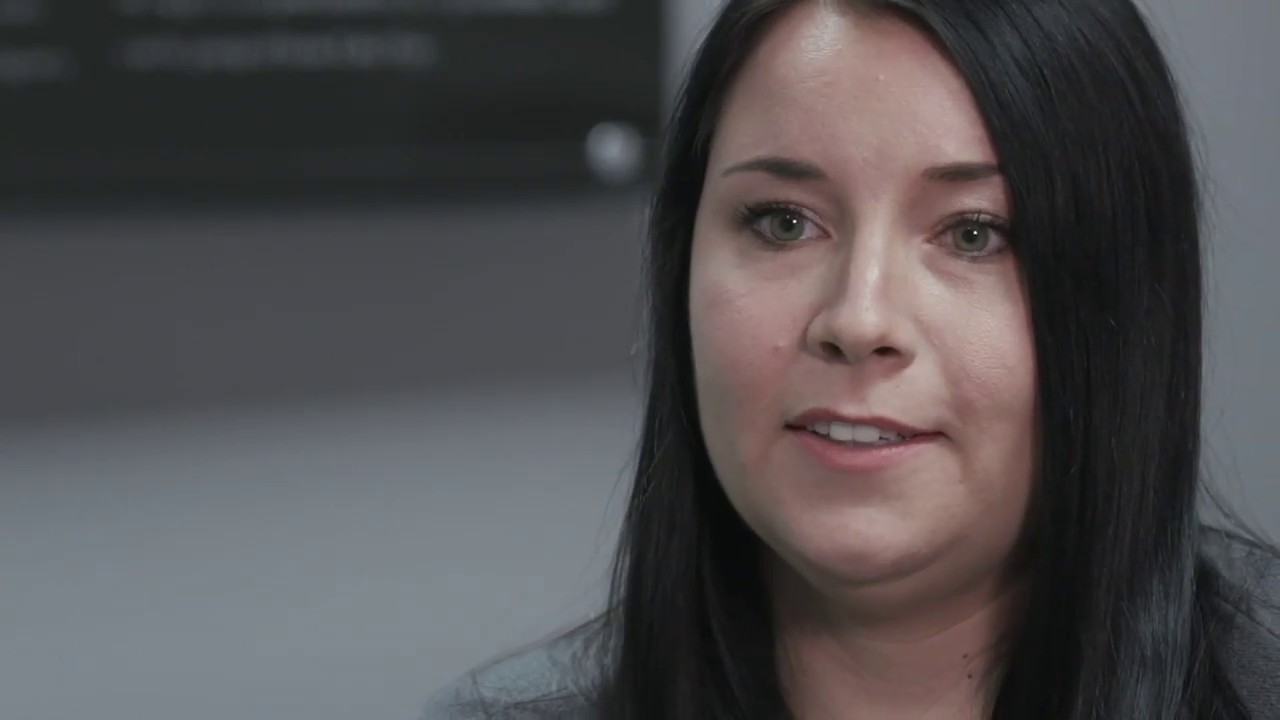 .
At least two FirstEnergy Solutions’ employees from that video also appear in an August 2019video ad from Ohioans for Energy Security. NeitherMatt Messenger norLindsay Humble are identified as FirstEnergy Solutions employees in the August ad, however.
FirstEnergy Solutions won’t say if it’s funding Ohioans for Energy Security.
“Please refer to FES’s statement and lawsuit on the referendum,” spokesperson Angela Pruitt responded to Anderson when he asked whether FirstEnergy Solutions was funding Ohioans for Energy Security and why company employees were in the ad. Neither document answers the questions.
What emerges is an apparent close working relationship between FirstEnergy’s generation subsidiary, its employees and its consultants with both the Alliance and Ohioans for Energy Security. However, conclusive answers about who funds and directs Ohioans for Energy Security’s activities remain hidden.
Ohioans for Energy Security used one of the same contractors that Generation Now used for its ads pushing for passage of the nuclear subsidy bill.
A Federal Communications Commission filing posted by OpenSecrets.org shows that Strategic Media Placement arranged to air the anti-referendum ad for Ohioans for Energy Security. Strategic Media Placement also arranged to air ads from Generation Now, a pro-subsidy group that pushed for passage of the nuclear subsidy bill. FirstEnergy Solutions employees Messenger and Humble also appeared in at least one of the group’s ads.
Generation Now is also reported to have made substantial “dark money” contributions to elect Ohio Speaker of the House Larry Householder and others sympathetic to nuclear subsidies. At least one donor to that group is the International Union of Operating Engineers, Local 18, based in Cleveland. Some of the union’s members likely work at FirstEnergy Solutions plants.
It’s unclear who else is funding Generation Now. The union’s $295,000 in 2019 spending for the group is less than a sixth of the more than $1.9 million the group reportedly spent on ads supporting HB 6. The group is not required to disclose its funders.
The group has been paying people to hover near folks seeking to collect signatures for the referendum petition. Those “field staffers” are sometimes referred to as “blockers,” because their presence can discourage voters from listening to those who seek to explain a referendum.
Referendum supporters’ funding is also a secret, but may be revealed later.
“The funders of the TV ads, direct mail and blocking against the issue have no obligation to disclose their funders or expenditures,” said Gene Pierce, spokesperson for Ohioans Against Corporate Bailouts, which is trying to get the referendum on the ballot. “Ohio law only requires disclosure of such expenses once the issue is qualified to the ballot and only on expenses incurred after such qualification.”
The referendum initiative group’s corporate filing with the Secretary of State also reveals only its attorney,David R. Langdon of West Chester, Ohio, as its authorized agent for incorporation and statutory agent. Pierce said the group’s funders “will be revealed, as required by Ohio law, 30 days after” petitions are filed next month. The group needs to collect approximately 266,000 voters’ signatures.
Bill Siderewicz, president of natural gas power plant developer Clean Energy Future, has already beenreported to be a contributing member of Ohioans Against Corporate Bailouts. LoParo hasclaimed that a Chinese bank provided financing for some of that company’s projects.FirstEnergy has received loans from the same bank.
The referendum petition lists David J. Eckert, Trevor J. Vessels and Brandon Sean Lynaugh as the three committee members who represent the group. Eckert is a “campaign manager/general consultant,” Pierce said. LinkedIn shows that the other two work in public relations fields.
“I expect voters will see that our donors,” Pierce said, “reflect a wide range of residential and commercial interests who are all negatively impacted by this legislation.”
ABOUT KATHIANN M. KOWALSKI
Kathi is the author of 25 books and more than 600 articles, and writes often on science and policy issues. In addition to her journalism career, Kathi is an alumna of Harvard Law School and has spent 15 years practicing law. She is a member of the Society of Environmental Journalists and the National Association of Science Writers. Kathi covers the state of Ohio.
==
---
no lnx many, video
https://www.energyandpolicy.org/ohioans-for-energy-security/
Watchdog exposing the attacks on renewable energy and countering misinformation by fossil fuel interests
Reports
Close
Southern Company CEO Tom Fanning on CNBC
NextSouthern Company’s “Low to No Carbon” Pledge Misleads Investors, Public
Explore Menu
CoalFirstEnergyOhio Clean Energy Jobs Alliance
Who’s behind Ohioans for Energy Security’s ad campaign to scare voters?
Dave Anderson • August 28, 2019
Ohioans for Energy Security, a new entity blanketing Ohio with a wave of television ads defending the bailout of FirstEnergy Solutions, is brought to you by the same people who campaigned for the controversial bailout plan.
The group formed last month in Ohio as a for-profit Limited Liability Corporation. It just launched a $1 million ad campaign designed to scare voters away from signing petitions toplace a referendum on House Bill 6 on the 2020 ballot. The bill in question, passed by the Ohio General Assembly and signed by Governor Mike DeWine in July, will force Ohio consumers to pay to bail out uncompetitive nuclear and coal plants in Ohio. It also rolls back Ohio’s life-and-money saving clean energy standards, which helped to support 112,000 jobs in the Buckeye State.
“In the coming weeks, don’t give your information to the Chinese government,” Ohioans for Energy Security tells visitors to its website. “Don’t sign their petitionallowing China control over Ohio.”
Ohioans for Energy Security’s website tells voters to call its hotline to report petition gatherers. Petition signatures for statewide referendums are submitted to the Ohio Secretary of State and Attorney General, not the Chinese government.
Ohioans for Energy Security points to several reports that the Industrial and Commercial Bank of China has been among the banks that financed several new gas projects in Ohio developed by Clean Energy Future, a company that opposed HB 6.
The Columbus Dispatch reviewed those reports and concluded that “the group behind the commercial offered no evidence that such a plot exists.” It didn’t find “any evidence that the Chinese government intends to play a role in the possible repeal of House Bill 6.”
The Cleveland Scene writes that the group’s “bonkers” first ad “continues with even less tenuous grasps on the issues surrounding HB 6.”
Ohioans for Energy Security doesn’t mention that the broad-based opposition to HB 6 includes consumer advocates, environmentalists, free market groups, health experts, and manufacturers, as a quick review of opponent testimony on the bill will show.
The pro-bailout group also doesn’t mention Securities and Exchange Commission filings that show the Industrial and Commercial Bank of China has committed many millions of dollars to FirstEnergy Corp., the parent company that spawned FES.A March 2018 declaration by Charles Moore, FES’s chief restructuring officer, also included the Industrial and Commercial Bank of China on a list of “interest parties and significant creditors” in FES’s bankruptcy case, under the subheading “Banks, Lenders, UCC Lien.”
Ohioans for Energy Security is led by the spokesperson for another pro-bailout group backed by FirstEnergy Solutions
Carlo Loparo is listed as the president of Ohioans for Energy Security on political issue ad disclosures on file with the Federal Communications Commission. Loparo also serves as the group’s public spokesperson.
Loparo is also the spokesperson for the Ohio Clean Energy Jobs Alliance (OCEJA), a coalition “powered by FirstEnergy Solutions” that launched last fall with the help of the utility’s outside lobbyists and public relations consultants, and campaigned in support of HB 6.
Loparo is the president of the Columbus-based Loparo Public Relations, and boasts 25 years of experience in “media relations, strategic message development and crisis communications,” according to his firm’s website.
Amy Natoce, the vice president of Loparo Public Relations, was the political director for Dave Yost’s successful campaign for Ohio Attorney General. Yost will soon decide on whether to approve of revised summary language for the referendum petition, a first step toward getting the referendum on the ballot in 2020. Attorneys representing FES and Generation Now, Inc., a dark money group that spent millions on ads supporting HB 6, have been targeting Yost’s office with letters opposing the effort to put the issue on the ballot.
Ohioans for Energy Security’s first ad uses stock footage, features employees of FirstEnergy Solutions
“Don’t sign your name to a plan that kills Ohio jobs, harms Ohio communities, and endangers our energy independence,” Ohioans for Energy Security’s first ad tells viewers as stoic headshots of several individuals flash on screen.
The ad doesn’t identify those individuals, but at least three of the individuals appear to be recycled from stock footage that had previously been used in a 2017 Ohio ballot initiative ad around prescription drug prices.
Image from 2017 prescription drug ballot initiative ad
Image from 2017 prescription drug ballot initiative ad
Image from 2019 Ohioans for Energy Security ad
Image from 2019 Ohioans for Energy Security ad
Image from 2017 prescription drug ballot initiative ad
Image from 2017 prescription drug ballot initiative ad
Image from 2019 Ohioans for a Secure Energy Future ad
Image from 2019 Ohioans for Energy Security ad
The 2017 ad which used the same stock photos, called “Step Forward,” no longer appears online, though Ballotpedia references it in a database of ads from the 2017 prescription drug initiative campaign. A copy was provided to the Energy and Policy Institute.
That 2017 ad was funded by “Ohio Taxpayers for Lower Drug Prices,” which employed Rex Elsass, a Republican operative and the owner of Strategic Group for Media.
Some of Ohioans for Energy Security’s ad contracts on file with the FCC name as the buyer Strategic Media Placement, also owned by Elsass. The same firm made ad buys for Generation Now.
The Ohionans for Energy Security ad also includes several employees of FirstEnergy Solutions who also appeared in earlier ads supporting HB 6, produced by the dark money group Generation Now, Inc. Some also appeared in videos produced by the FES-backed Ohio Clean Energy Jobs Alliance.
A screenshot of a Generation Now Facebook ad featuring Matt Messenger, who the ad did not not disclose is a project manager at FES’s Perry nuclear power plant.
Ohioans for Energy Security first ad features a similar image of Messenger, without disclosing his name or employer
Back in June, the Energy and Policy Institute asked a spokesperson for FES at Sitrick and Company why the utility’s employees were appearing in Generation Now’s ads, and if it was funding the group’s efforts. The spokesperson said he would “be happy to look into this and get back to you,” but then never responded with any further information.
A monthly fee statement filed in FES’s bankruptcy case later revealed that Sitrick & Company staff discussed EPI’s inquiry with “D. Griffing” and the “Dewey Square” team. David Griffing is the vice president of government affairs for FES. The Dewey Square Groupis a lobbying firm that has received nearly $800,000 for its work on FES’s bailout campaigns in Ohio and Pennsylvania, which included work on the launch and operations of the Ohio Clean Energy Jobs Alliance.
Excerpt from Sitrick & Company’s filing in FES’s bankruptcy case discussing EPI’s inquiry regarding FES employees working with Generation Now
Links to Generation Now’s ad firm and a pro-Householder PAC backed by Murray Energy
The server for the group’s website – www.ohioansforenergysecurity.com – also hosts the websites of Elsass’s Strategy Group Company and Front Porch Strategies.
It also hosts a site – LarryHouseholderFightsforus.com – supporting Ohio’s Republican House Speaker Larry Householder, whose rise to the speakership was backed by FirstEnergy and Generation Now. Householder then led the drive to pass HB 6. The pro-Householder site is paid for by the Michigan-based Hardworking Americans Committee, which spent over $450,000 on ads opposing Householder’s Republican primary opponent Kevin Black in 2018.
Federal Elections Commission data shows the Hardworking Americans Committee received $50,000 in 2018 from the PAC of Murray Energy, a coal producer that stands to benefit from HB 6.
The Hardworking Americans also received $50,000 that year from Political Education Patterns, the PAC for the Cleveland-based International Union of Operating Engineers Local 18. IUOE Local 18 doled out $295,000 to Generation Now in 2018 and 2019, according to FEC data. Mark A. Totman, the union’s VP, serves as one of Governor Dewine’s appointees to the Public Utilities Commission of Ohio Nominating Council, where he represents organized labor.
Updated at 7:30 ET on Aug. 28, 2019 to include information about Ohioans for Energy Security’s use of stock footage in its ad.
Posted in: Coal, FirstEnergy, Ohio Clean Energy Jobs Alliance Tagged in: carlo loparo, coal bailout, firstenergy solutions, generation now inc, hb 6, larry householder, loparo public relations, nuclear bailout, ohio clean energy jobs alliance, ohio secretary of state, ohioans for energy security, rex elsass
Posted by Dave Anderson
Dave Anderson is the policy and communications manager for the Energy and Policy Institute. Dave has been working at the nexus of clean energy and public policy since 2008. Prior to joining the Energy and Policy Institute, he was an outreach coordinator for the climate and energy program at the Union of Concerned Scientists. He is also an alumnus of the Sierra Club and the Alliance for Climate Protection (now the Climate Reality Project). Dave’s research has helped to spur public scrutiny of political attacks on clean energy and climate science by powerful special interests, such as ExxonMobil and the American Legislative Exchange Council (ALEC). His work has been cited by major media outlets, such as CBS News and the Wall Street Journal, and he has served as a speaker on panels at national solar industry conferences. Dave holds a MA in Political Science from the University of New Hampshire, where he also received a BA in Humanities.
===
==
Brian J. Berry
Brian J. Berry serves as the Director of Citizens United. Berry has been around the horn a time or two and has lots of experience in directing political campaigns. In 1993, Brian directed the successful campaign of Kay Bailey Hutchison, the big-oil candidate from Texas, as well as the primary campaign for George W, Bush’s first run for Governor in 1994.
He is now the head honcho at Strategy Group for Media, a production and promotion media firm that creates campaign ads for right-ring conservatives who they deem “good people.” In 2012, they worked closely with “Restoring America” and the “Freedom Club,” to produce ad campaigns for state, local, and national campaigns.
On Berry’s Board of Directors is none other than Rex Elsass, who presides over the group and lends his advice to several notable candidates, Ron Paul, Newt Gingrich, Michele Bachmann, and Todd Akin, to name a few. As a born-again Christian, he has been labeled as the ring leader of a GOP dirty-tricks group called “The Nasty Boys.” This relationship shouldn’t come as any major surprise as many of the Citizens United group are known to be nothing less than smear-merchants who will stop at nothing when it comes to besmirching the wicked liberals who threaten to gain any seat of power.
In the November, 2012, elections the Strategy Group engaged in more than 300 campaigns across the country and now boast an 80% win rate.They elected seven of 35 freshman members of Congress, (Scott Perry (PA); Keith Rothfus (PA); Thomas Massie (KY); Andy Barr (KY); Steve Daines (MT); Markwayne Mullin (OK) and Ann Wagner (MO). They re-elected more than 25 incumbent members of Congress, defeated two of five incumbent Democrats, and elected one of the four GOP gubernatorial winners.
Their biggest victories, however, were at the state level where they managed to retain majorities in the Ohio State House and Senate, the Wisconsin Assembly, and the Pennsylvania Senate. They flipped the Wisconsin State Senate back to the GOPand made significant gains for Republicans in the Kentucky State House. Additionally, they take the credit for the election of the infamous Supreme Court Justice in Alabama – Justice Roy Moore.
Consequently, Brian J. Berry and his twisted group of slanderous manipulators fit quite well into the deviant and unscrupulous realm of Citizens United.
=
CONTEXT OHIO NUKES
gibney doc hbo mayer 4 25 DARK MONEY GAME
PVT INVESTigators, tried to buy sign collectors and co’s
2 suicides, LH re-elected after scandAL BROKE
DEWINE 5 MILLION?
---
DN
A new set of documentaries directed by Academy Award-winning filmmaker Alex Gibney premieres April 15 and April 16 on HBO. The films in The Dark Money Game series investigate the origins and impacts of campaign finance in the U.S. “Our country is being run by a small group of people who have an enormous amount of money, and they dominate our politics,” says Gibney. “It’s almost as if bribery has become utterly legalized. It’s pay to play. It’s quid pro quo.”
AMY GOODMAN: This is Democracy Now!, democracynow.org. I’m Amy Goodman, with Juan González.
We end today’s show with a new documentary series premiering today on HBO. Alex Gibney is the Academy Award-winning director of the HBO original The Dark Money Game.
NARRATOR: In Mexico, it’s a bite. In China, it’s tea money. In America, it’s called campaign finance.
TYLER FEHRMAN: There’s a whole political world out there that runs on dark money.
JEFFREY WILLIAMS: When elected public officials deal with business interests, corruption and bribery take over.
NARRATOR: Dark money led to the biggest case of political corruption in the history of Ohio.
JEFFREY WILLIAMS: In 2019, there was an investigation involving Matt Borges and Neil Clark. Neil had been one of the most powerful lobbyists in the history of the state.
NEIL CLARK: I’m ready to [bleep] people over.
EMILY GLATFELTER: That recording with Neil Clark and undercovers, those were critical to connect that dotted line.
NEIL CLARK: Every politician’s got to have somebody that is the hitman.
TYLER FEHRMAN: The FBI asked me to essentially spy.
MATT BORGES: You’re not like trying to set me up here, are you? That would be bad for both of us, but it would be worse for you.
TYLER FEHRMAN: And I thought, “What is he going to do?”
JEFFREY WILLIAMS: This was a organized conspiracy on a massive scale. But I fear this case is not a one-off example.
NARRATOR: Dark money has heralded a new era of vast corruption.
JANE MAYER: If corporate America was going to reassert its power, it had to create a counterrevolution and take political power back.
ROBERT SCHENCK: We had a little Bible verse: “The wealth of the wicked is laid up for the righteous.” So, let’s baptize the billionaires’ money.
NARRATOR: The Supreme Court rolled back rules on campaign finance.
RUSS FEINGOLD: Citizens United said corporations can create a super PAC.
NARRATOR: Now corporations could fund elections with unlimited amounts of cash.
JANE MAYER: One way you could look at it is that it’s a fair fight. Another way is that both parties are corrupt.
RUSS FEINGOLD: When it comes to the power of big business, the fix seems to be in.
JANE MAYER: A tiny group of people have bought an inordinate amount of influence.
JAMES BOPP: People with money will always have an advantage. Always.
NARRATOR: Money has a way of changing the rules.
AMY GOODMAN: For more, we’re joined by Alex Gibney, Academy Award-winning director this new two-part series, The Dark Money Game, an HBO original premiering tonight, 15 years after the Citizens United Supreme Court case.
I want to thank you so much for being with us. In these last few minutes, as you feature Jane Mayer, the great New Yorker investigative reporter, her book called Dark Money, talk about what’s critical for people to understand today as your two-part series premieres, The Dark Money Game.
ALEX GIBNEY: I think what’s critical to understand is that our country is being run by a small group of people who have an enormous amount of money, and they dominate our politics. It’s almost as if bribery has become utterly legalized. It’s pay to play. It’s quid pro quo. And unless we stop the system of money in politics, we’re done, because then our lives will simply be ruled by the people who have the most money.
JUAN GONZÁLEZ: And, Alex, how do these films relate to your earlier work, in particular The Crime of the Century on the opioid crisis?
ALEX GIBNEY: Well, it was doing a film on the opioid crisis that made me understand that one of the reasons there was such an anemic response to, literally, the intentional poisoning of America by a few corporations was because so many people in Congress were being paid off to look the other way, to focus on the needs of their donors rather than on the needs of their constituents. So it was that anger that led me to investigate this.
We found an extraordinary story in Ohio that’s literally quid pro quo corruption. And all the people on the FBI wiretap are saying, “It’s good now because of Citizens United.” And then we tried to look back at how we got to this place by looking at the corruption of the Supreme Court. So, you know, and I was inspired, as you say, by the great work of Jane Mayer, who’s in the film.
JUAN GONZÁLEZ: And in terms of what you’re hoping people will do, especially this coming out on the 15th anniversary of the Citizens United case? JANUARY? TRIAL VS ANNOUNCEMENT?
ALEX GIBNEY: Yes. I mean, I hadn’t originally intended for that to be the case, but nothing could be more apt, because Citizens United is the single most damaging decision the Supreme Court has come up with in the last 15 years, because it’s destroyed our democracy. And we need to understand that in order to get our democracy back, we have to reinvigorate our laws, as many states are doing, in order to be able to end this system of, essentially, legalized corruption.
AMY GOODMAN: Alex, we want to stay with you and post online our second part at democracynow.org. Alex Gibney, Academy Award-winning director of the new HBO original series, The Dark Money Game, premiering tonight. I’m Amy Goodman, with Juan González.
--
In Part 2 of our conversation with Academy Award-winning filmmaker Alex Gibney, he discusses in detail his new set of documentaries that premiere April 15 and April 16 on HBO in The Dark Money Game series, which investigate the origins and impacts of campaign finance in the U.S. Building on reporting by Jane Mayer of The New Yorker, in Ohio Confidential, he tracks the corruption case of former Ohio House Speaker Larry Householder, and in Wealth of the Wicked, he looks at the history of campaign financing and what led up to the Citizens United decision of 2010.
AMY GOODMAN: This is Democracy Now!, democracynow.org, The War and Peace Report. I’m Amy Goodman.
We’re continuing Part 2 with our conversation with the Oscar-winning director Alex Gibney. He has a new series out called The Dark Money Game. Alex is the award-winning director of Enron: The Smartest Guys in the Room, Going Clear: Scientology and the Prison of Belief and the Oscar-winning Taxi to the Dark Side. But tonight, HBO is premiering his two-part series. It’s called The Dark Money Game, and it’s divided in two parts. Tonight is Ohio Confidential. This is a clip.
CALLER 1: I kind of like the word “dark.” “Shadowy,” I don’t know what shadowy is.
CALLER 2: I hear what you’re saying now. My problem with the “dark money” is that nobody really knows that that’s an unreported — you know, contributors don’t have to report their names.
CALLER 1: Secret groups that hide —
CALLER 2: Secret groups, secret contributors.
CALLER 1: — that hide behind.
CALLER 2: Right.
CALLER 1: Yeah.
CALLER 2: Right, that’s what I’d rather do, is just make sure that people know that there are secret — secret people who we don’t know that are trying to tell us what to do.
AMY GOODMAN: That’s a clip from The Dark Money Game. It’s actually part one, that’s premiering tonight, and that’s called Ohio Confidential.
So, Alex Gibney, lay it out for us, this incredible two-part series that’s based on the book and the investigative reporting of Jane Mayer called Dark Money.
ALEX GIBNEY: Right. So, I was very much inspired by Jane’s work and always wanted to work with her. And so we had an opportunity to do something, in a way to kind of update what she had done as part of Dark Money, though some of the original reporting is in this.
The Ohio Confidential episode, which is the one that airs tonight, is kind of a jaw-dropping case that nobody’s heard of. It’s one of the biggest political corruption cases in American history, certainly in Ohio’s history. And it revolves around a slush fund that an energy company, FirstEnergy, $60 million slush fund, put into a dark money vehicle that was run by an Ohio politician named Larry Householder. He used it to become speaker of the House in Ohio and then paid back FirstEnergy by jamming through a $1.3 billion subsidy for FirstEnergy that was taken, you know, from Ohio citizens, off the backs of the citizens. So it’s really a jaw-dropping case.
But the interesting thing is that those wiretaps, which are FBI wiretaps, the FBI stumbled into this scheme when they were following a sort of a gambling case and they started to hear these lobbyists talk about this pay-to-play scheme. But they were cackling to each other, because they thought, “This is great. We can legally bribe now because of that great Supreme Court ruling called Citizens United.” So, that’s what attracted me to this particular story, because it has a much broader implication, the idea that they caught these people, but this is the kind of thing, since Citizens United, that’s going on all over the country.
AMY GOODMAN: And what were those recorded conversations that we just listened to?
ALEX GIBNEY: They were literally body wires of FBI informants and also phone wiretaps, obtained by warrant by the FBI. And originally, they were looking into — it was a gambling — it was a gambling matter. I can’t remember now. But as they were looking into that matter, they stumbled upon a number of lobbyists and politicians talking about this scheme, this FirstEnergy scheme, to basically defraud the Ohio public, but also to boost the fortunes of a politician in exchange for a huge payback from the public coffers of Ohio. And they began to investigate it.
And ultimately, Larry Householder, who was the Ohio speaker of the House, was convicted of conspiracy. Now, that’s rare. And it was only because they were so exceedingly brash and stupid that they literally laid out quid pro quo bargains in their conversations, because that’s the one thing you can’t do with — in the wake of the Citizens United decision. You know, you’re supposed to be able to funnel all this money into independent groups called super PACs, and you can keep the money dark by using 501(c)(4)s, which can’t be penetrated by public inquiry. So, but it’s supposed to be independent of the candidate. Well, we all know that that’s a sham, that it’s never independent of the candidate. But in this case, because of the wiretaps, you could hear all of the conspirators talk about how it wasn’t independent at all, and they had literally agreed to a deal.
AMY GOODMAN: So, that’s part one, Ohio Confidential, that’s premiering tonight on HBO. Part two is Wealth of the Wicked. And, of course, in this film, which tracks the history of campaign finance, you’re showing, in both cases, how bribery has been virtually legalized in the United States, this on the 15th anniversary of the Supreme Court decision Citizens United. Elaborate on what you found.
ALEX GIBNEY: Well, we went back, you know, to something called the Powell Memo, which was a memo that was drafted by a future Supreme Court justice named Lewis Powell for the American Chamber of Commerce. And the idea was: How do American corporations get back all this power? There are all these terrible laws that are doing things like protecting citizens from pollution or lung cancer from cigarette smoke, or, you know, any number of other things, and we’ve got to eliminate them. And they embark on a plan.
Over time, we see how that plan turned out. And it turned out, to great effect, with a kind of corruption and packing of the Supreme Court, by joining forces first with evangelical Christians, who were motivated by overturning Roe v. Wade, and then, ultimately, by plying Supreme Court justices with money and friends who, over time, sort of influenced them to take a kind of deregulatory posture. So, you see how it moves and how the court moves, not only to overturn Roe v. Wade, as we know, but also to overturn an enormous legacy of government rules and regulations that were designed to protect us as citizens from corporate abuse.
And maybe the thing that’s most jaw-dropping is, at one point, we look at a Supreme Court decision related to an Ohio — sorry, Indiana mayor, in which he had awarded a contract for garbage trucks to the Peterbilt company, and in return, he got a kickback, and he was convicted of bribery. The Supreme Court overturned it, because, in their wisdom, they said, “Well, wait a minute, he didn’t get the money before. He got the money after. So, that’s called a gratuity.” So, as long as you get the money, you get the bribe after the act, it’s OK. That really was a jaw dropper, because it went as far as anything I’ve ever seen to legalizing bribery.
AMY GOODMAN: So, Jane Mayer’s book Dark Money, the subtitle, The Hidden History of the Billionaires Behind the Rise of the Radical Right, it’s amazing it came out at the beginning of the Trump one presidency. Now we’re almost talking, what, nine, 10 years later, and we’re talking about what many people — who many people call President Trump’s co-president, Elon Musk, the richest man in the world. Your next project is, not surprisingly, on Elon Musk. And if you can talk about how that relates to your current series, The Dark Money Game, and what you’re doing? Give us a sneak peek of this next project.
ALEX GIBNEY: Well, that was a project, strangely enough, that I started about two years ago. And now, now already, the people I’m working with on that have decided I need to expand my brief, because, obviously, the story’s gotten a lot bigger.
But you can see how the Elon Musk story relates to the dark money project, and indeed we allude to it in the dark money films. I mean, in the 2024 campaign, he dropped $288 million into a super PAC to support Trump. And also, he is now the bank that keeps the Republican Party in check, lest, you know, one of — you know, lest three or four people defect from the program that the Trump administration has in mind, because if anybody defects, then Elon Musk will drop $50 million or $100 million into your district and primary you and send you packing. So, they’re all so scared of losing power that they’ll do anything to — including watch the end of American democracy, in order to keep being reelected. So, it’s the money that Musk represents that is directly related to dark money.
The Musk story is much bigger than that, and actually relates to the attempt to destroy truth. That’s really what it’s about. And that is sort of chapter one of the authoritarian playbook. If you can eliminate the distinction between fact and fiction, then you’re free to engage in propaganda, and you’ve eliminated the distinction between right and wrong.
AMY GOODMAN: So, as we wrap up, clearly, the problem is bipartisan.
ALEX GIBNEY: Yes.
AMY GOODMAN: Citizens United, you could say, started this 15 years ago. Do you think united citizens and noncitizens can stop it?
ALEX GIBNEY: Yes, we can. It’s up to us. But we’ve got to scream, and we’ve got to scream pretty loud. You are seeing some attempts to stop the influence of money in politics in states. I live a lot of my time in Maine now, and Maine is very good on that. And a number of other states understand it. You know, we don’t want to live by the rules of oligarchs who create a society that’s good for them but not for us. So, yeah, we’ve got to do a lot of screaming. But we’ve got to get it — we better get working, because things are moving pretty fast in the wrong direction.
AMY GOODMAN: Well, I want to thank you so much for spending this time with us, Alex. Alex Gibney is the Academy Award-winning director of the HBO original The Dark Money Game. It’s in two parts. The first airs tonight on HBO, Ohio Confidential, and Wealth of the Wicked airs on Wednesday night. To see Part 1 of our discussion, go to democracynow.org. I’m Amy Goodman. Thanks so much for joining us.
---
:{:{col dispatch}:
- new two-part HBO documentary, "The Dark Money Game," examines the influence of dark money in politics, focusing on a bribery scandal in Ohio.
- The documentary features interviews with journalists, law enforcement officials, and former Ohio House Speaker Larry Householder, who was sentenced to prison for his role in the scandal.
- Filmmaker Alex Gibney explores how corporate money, funneled through dark money groups, was used to pass a $1 billion nuclear bailout in Ohio.
- The documentary also delves into the influence of the Citizens United Supreme Court decision, which opened the floodgates for dark money in politics.
The words of the late, prolificOhio lobbyist Neil Clark narrate a new HBO documentary from award-winning filmmaker Alex Gibney about dark money's nefarious and pervasive influence on politics from statehouses to the U.S. Supreme Court.
A pay-to-play scandal that unfolded at the Ohio Statehouse and sent a top politico to federal prison is the focus of the first in a two-part series, "The Dark Money Game." The documentaries detail how the Ohio scheme fits into a larger puzzle of political corruption across the nation.
Gibney, whose projects include "The Crime of the Century" and “Enron: The Smartest Guys in the Room," used Clark's recorded conversations with undercover FBI agents and excerpts of the book published after Clark's suicide to explain how the Sicilian superlobbyist justified his role in the state's largest corruption scandal.
The first part of the series, titled "Ohio Confidential," details how Akron-based FirstEnergy spent more than $60 million to fuel former Ohio House Speaker Larry Householder's return to political power, pass a $1 billion nuclear bailout and defend that bailout against a ballot initiative to block it.
The conspirators used corporate money funneled through a series of 501(c)(4) nonprofits, which are often called dark money groups because they aren't legally to disclose their donors.
The film features retired FBI agent Jeff Williams, Assistant U.S. Attorney Emily Glatfelter, former U.S. Attorney David DeVillers, former Ohio Supreme Court Chief Justice Maureen O'Connor, political strategist Tyler Fehrman and statehouse reporter Laura A. Bischoff, who offer insights into how the pay-to-play scheme unfolded. Bischoff covered the case for The Columbus Dispatch, Cincinnati Enquirer, Akron Beacon Journal, Canton Repository and other news outlets in Ohio.
There's a moment in the documentary that shows how Householder first pitched the nuclear bailout bill to reporters. Bischoff asks if FirstEnergy's prolific donations played any role in the bill.
"And he looks at her like, 'Are you crazy?'" Gibney recalled. "When you see somebody lie like that, just lie. Bald-faced lie. You think, wow. It kind of takes your breath away. Because at that moment, he was sitting on the slush fund and knew exactly where the money was coming from. It should tell us all, trust but verify."
The second film, "Wealth of the Wicked," examines how corporate money, the anti-abortion movement, religious leaders and conservative lawyers united to open the floodgates of dark money in politics. The project was inspired by Jane Mayer’s book “Dark Money: The Hidden History of the Billionaires Behind the Rise of the Radical Right."
When can you watch 'Ohio Confidential'?
"Ohio Confidential" debuts at 9 p.m. on Tuesday, April 15. "Wealth of the Wicked" debuts on Wednesday, April 16 at the same time. Both films, which are about two hours long each, will be available to stream on HBO Max on Tuesday, April 15.
Gibney talked about his inspiration for the documentaries and what caught his eye about the Ohio scandal. The conversation was edited for length and clarity.
Q: Why did you want to dig into dark money and its influence?
A: I think it was an emotional reaction to the overturning of Roe v. Wade, the Dobbs decision, and my understanding that there was a lot of money behind it. Suddenly, it seemed like the Supreme Court had done something that was supremely undemocratic because they had kind of rigged the system.
That got me animated and thinking about it. Citizens United, I felt was also one of the most disastrous decisions ever, and for a long time I had been studying money in politics. And I'd always wanted to work on something with my pal, Jane Mayer, who had written that great book, "Dark Money."
(The Court) overturned Dobbs but they were also extremely hardcore in terms of favoring corporate interests over what I would call citizens' interests. And those two things really animated me in wanting to dig into this.
Q: Why did you choose to highlight the Ohio pay-to-play scandal?
A: We were looking for a story in which corruption played a big role, but also one of the things that was interesting to us about that case was that on a lot of the audio tapes, a lot of the conspirators were all chuckling about how Citizens United, it's a get out of jail free card.
Now we can do whatever we want. It just seemed like not only was it a massive corruption scandal based on dark money but also there was this cynicism about Citizens United that it somehow made corruption legal.
There were other issues related to Ohio that had to do with gerrymandering and also supermajorities in the House that were limiting the democratic possibilities of pushing back against corruption, so for all those reasons, it seemed like a good story.
Ohio just seemed like an incredible story. It's also a story that most people in this country have never heard of.
Q: Why use lobbyist Neil Clark as a lens for the story?
A: He's kind of a tragic figure. I don't know that we knew that we were going to necessarily lean so heavily into Neil at the beginning but having read his memoir, posthumously published, and also hearing him so much on the tapes, it began to organically make sense.
It felt also like he was a character, too, who felt that he had become seduced in a way by the idea that Citizens United was giving him permission to do what her ordinarily might not do or would have been nervous to do.
So, for all those reasons, he seemed like a fascinating, important, interesting and tragic figure, also somebody who lost his life over the issue.
*Q: What people, institutions or factors helped to uncover the Ohio scandal that didn't exist in other cases of corruption?
A: (The FBI) They stumbled on the case because they were looking into this (Cincinnati City Council corruption) case. They started to hear whisperings of this case as they were pursuing another case. So, they literally tripped into it.
That, to me, also was intriguing because it shows that the burden in this kind of world where everything is a wink and a nod, the burden on law enforcement is extreme because the law has been so narrowed in terms of how you can prosecute quid pro quo. That only because they were extremely reckless and because the FBI just stumbled into it was there really an investigation that could take off.
Q: The FBI committed substantial resources to this case in Ohio. Do you think that level of resources will be available going forward under a new administration?
A: That's a question for (FBI Director) Kash Patel, but if you're asking my hunch, my hunch would be no. This administration seems to be OK with a certain level of corruption particularly involving money in politics. It was interesting that this administration basically said they were no longer going to prosecute, for example, the Foreign Corrupt Practices Act.
I think that they are likely to look at it more as business as usual, and that's really a terrible thing for all of us. The idea that corruption's OK so long as it's in the service of making a profit. But the people who are losing are us, the citizens.
*Q: When you were looking at the Ohio case, were you surprised that Householder was reelected and Republicans won more seats?
A: I was shocked. It's kind of shocking that when somebody gets caught with their hands in the cookie jar that they're just reelected, that it just becomes 'Oh well, that's just politics.'
It's also, to some extent, a comment on the kind of tribal nature of our politics, which have become so associated with identity. The people vote because 'oh, I'm a Republican so I'm going to vote for the Republican' without any more reckoning about who that individual represents or what he or she has done.
At some basic level, I think most of us, whether you're a Democrat or a Republican, are offended by the idea of bribery and inside deals and corruption. The idea that somebody can pay somebody off to get a result that the rest of us can't get. It's not playing fair.
But there still is a tendency to coalesce around tribal motives, particularly when districts are so gerrymandered that the people in the middle don't really have a voice anymore.
*Q: The documentaries look at the line between bribes and legal campaign contributions. Where is that line, or is it wherever the U.S. Supreme Court decides to set it?
A: I think the line becomes fuzzier and fuzzier and fuzzier every day, and that's the problem.
I think there has been an attempt, particularly by the Supreme Court, to essentially legalize bribery as if to say bribery isn't bribery, it's just speech. I just think that's nonsense, but that's where we're going.
*Q: Particularly in "Wealth of the Wicked," you dive into the influence of religion on politics and politics on religion. Why do you think these have become so intertwined?
A: I was trying to get at the idea that religion obviously has a strong emotional hold on people, and the film isn't anti-religion in the sense that I believe people should believe whatever it is they want to believe.
But when you get to the point where the state begins to favor a certain kind of religion over another or favors religion over people who may not believe, then you've got a problem, and that's not what was intended by the Constitution. You're supposed to have freedom of religion, but the state's not supposed to endorse one.
Because religion, people feel very strongly about it. They fight wars about it. They kill each other over it as we see day in and day out. So if you can harness that politically and people aren't principled about keeping it out of government, then you've got a real problem.
*Q: Is the cat out of the bag on Citizens United, the landmark U.S. Supreme Court decision that allowed unlimited corporate and union spending in politics, or is there a way to clean up (dark money) 501(c)4 nonprofits, this murky stream of corporate funding of politics?
A: Obviously, you have a Supreme Court that's not sympathetic to undoing that.
Even while you have all these massive super PACs, at least we knew Elon Musk dropped$288 million for Donald Trump. But not to know? That really is the fundamental issue at stake for FirstEnergy. If the citizens had known that Larry Householder had gotten $60 million from FirstEnergy to pass a bill that was going to benefit FirstEnergy to the tune of $1.3 billion, I think the result might have been different. I would hope so.
*Q: I finished the second documentary and didn't feel too hopeful about the future of politics. What are you hoping viewers take away from this two-part documentary?
A: Take it back. If there's one single biggest problem in American politics, it's that we've allowed money to take over.
The big moneyed interests have taken over American politics, and that has to be a referendum for people from now on. In other words, I'm not voting for you unless you're going to pledge to take money out of politics because otherwise, you're just going to be another crooked pol who does what your funders want you to do rather than what your voters want you to do.
While I'm pessimistic, I'm also hopeful. There seems to be a sentiment that moneyed interests have taken over our politics in ways that aren't good for most of us. Well, we've got to change that. And that's not a left-right issue, that's a middle class versus the oligarchs issue.
:{*:{State government reporter Jessie Balmert can be reached at jbalmert@gannett.com or @jbalmert on X}:
---
==
wiki 4 25
The Dark Money Game is a 2025 two-part documentary miniseries by acclaimed documentary filmmaker Alex Gibney which explores the use of dark money in United States politics.[1][2]
The miniseries comprises the following films:
- Ohio Confidential - covers the Ohio nuclear bribery scandal
- Wealth of the Wicked - traces the history of campaign finance law in the United States, focusing on the influence of super PACs and religious groups, as well as the fine line between bribes and donations within the political process
References
- Smith, David (April 15, 2025). "'We're on a knife edge': Alex Gibney warns about the dangers of dark money" – via The Guardian.
- Fienberg, Daniel (April 15, 2025). "'The Dark Money Game' Review: Alex Gibney's Two Feature-Length HBO Documentaries Tackle Urgent Issues in Uninspired Ways".
External links
---
---
guk
when the Rev Robert Schenck saw Donald Trump secure the Republican presidential nomination in Cleveland, Ohio, in 2016, he turned to a fellow evangelical and asked: “Are we really going to do this? We’re going to choose this man who’s inimical to everything we believe?” The Christian leader looked at Schenck and replied: “I don’t care how bad he is. He’s going to get us the court we need.’”
[
Dark money: the quixotic quest to clean up US campaign financing
Read more
https://www.theguardian.com/us-news/2022/apr/06/dark-money-campaign-financing-citizens-united)
This anecdote about the devil’s bargain struck between Trump and the religious right is told in The Dark Money Game, director Alex Gibney’s new diptych of documentaries investigating how untraceable political spending has corrupted America’s highest court, corroded its democracy and put oligarchs in charge.
Inspired by Jane Mayer’s book Dark Money: The Hidden History of the Billionaires Behind the Rise of the Radical Right, the two films examine how a supreme court decision in 2010 known as Citizens United enabled corporations and unions to inject unlimited funds into elections, fostering a “pay-to-play” system.
One film, Ohio Confidential, examines a vast bribery scandal in Ohio involving the lobbyist Neil Clark and the alleged manipulation of political outcomes through secret funds. Another, Wealth of the Wicked, analyses the supreme court’s role in opening the floodgates to corporate influence in politics and the subsequent weakening of democratic institutions.
Together they tell a devastating tale of how financial manipulation and legally ambiguous bribery have eroded the foundations of US democracy, empowering Trump and a class of oligarchs in ways that echo dictatorships around the world.
Speaking via Zoom from his home in New Harbor, Maine, Gibney warns: “We’re on a knife edge now, teetering toward authoritarian rule. What it really is is crony capitalism and that’s what unites this administration with [Russia’s Vladimir] Putin, [Hungary’s Viktor] Orbán, [India’s Narendra] Modi and others.
“It’s a sense that government is nothing more than a bunch of traded favours among rich people and that’s the terrifying part because, when you’re only loyal to the capo di tutti capi as opposed to the constitution, suddenly the Department of Justice just becomes the Department of Vigilante Justice.
“The FBI becomes an instrument of revenge, not law and order, and you can see that the regulatory state is being dismantled brick by brick. They’re trying to destroy government, which is what the Powell memo effectively was trying to say way back in the day.”
The “Powell memo” was the work of Lewis Powell, a corporate lawyer from Virginia in the 1950s and 1960s commissioned by the US Chamber of Commerce to devise a strategic plan for reasserting corporate power and a conservative agenda over a political domain perceived as too liberal. One section of his secret blueprint described “exploiting judicial action” as an “area of vast opportunity”.
This vision was realised with the help of the Federalist Society, which cultivated and promoted conservative legal thinkers who adhere to principles such as originalism and textualism. Led by Leonard Leo, the group became a “pipeline” for placing conservative judges on the bench at all levels, including the supreme court.
Its influence was felt in 2010 with the supreme court’s 5-4 ruling in Citizens United v Federal Election Commission, which decided that corporations and unions have the same first amendment rights as individuals when it comes to political speech.
The ruling means that wealthy donors, corporations and special interest groups can spend unlimited cash on any candidate or cause as long as they do not give money directly to the candidate but rather set up so-called independent entities known as super political action committees, or Super Pacs. As The Dark Money Game puts it: “Fifteen years later, fringe groups could bundle billions in secret slush funds to frustrate popular rule.”
Gibney elaborates: “It’s the most bullshit kind of rationale. Anybody with common sense would know that this is a vehicle for corruption because it basically means that you’re giving permission for people to have those kind of wink-and-nod conversations where you know how to convey the meaning, which is: ‘If you give me this money, I’ll do this for you,’ but you don’t have it directly, just have it in a roundabout way.
“It’s like Japanese bunraku theatre, which has nearly life-size puppets, and behind the puppets are these men in black who move the puppets. You actually see them but they sort of disappear into the background.”
Gibney, whose past films include Wise Guy: David Chase and the Sopranos, The Crime of the Century and The Forever Prisoner, also highlights the alliance that formed between big business interests seeking deregulation and social and religious conservatives, particularly on issues such abortion.
He explains: “Big business was like, how do we play the long game so that we can get what we want, which is unfettered, unregulated capitalism? Along the way they realised it’s not very popular to say, ‘We want the right to pollute in your community because it’ll make us more money.’ That’s not a good political campaign slogan.
“They needed a very powerful emotional issue and that was abortion and so they join forces, in a way, with anti-abortion activists and over time engineer a takeover of the supreme court by utilising both money and that religious fervour.”
Gibney’s star witness is Schenck, an evangelical minister and former anti-abortion lobbyist who used to denounce “baby killers”, bring dead foetuses to demonstrations and put his body down in front of abortion clinics. He later had a crisis of conscience, changed his mind and came to support Roe v Wade, the 1973 supreme court ruling that enshrined reproductive rights.
Gibney says: “He talks about how there was this unholy alliance between big business and religious conservatives such as he and they cut a deal, which is you guys need money in order to carry on your crusade and we need your help so that we can make more money and pass some of it on to you by dismantling economic regulations.”
In the film, Schenck explains: “Whenever you talked about government regulation the argument was eventually these same characters who control my business are going to start trying to control your church. So it’s in your best interests that we defang this monster, and that brought a lot of religious conservatives over.
“We have a little aphorism built on a Bible verse: ‘The wealth of the wicked is laid up for the righteous.’ So, yeah, let’s baptise the billionaires’ money. We can do that and it eventually brought together this alliance.”
Schenck describes a carefully orchestrated “Operation Higher Court” to influence supreme court justices. This involved building relationships through social events, the use of “stealth missionaries” (wealthy donors), and catering to their personal and ideological leanings. Religious connections, particularly conservative Catholicism and groups such as Opus Dei, appeared to play a role.
Schenck says the most successful couple he “deployed” were Don and Gayle Wright of Ohio, who built strong relationships with Justices Samuel Alito, Antonin Scalia and Clarence Thomas. “I don’t know all the details. To be candid, I didn’t want to know what they were up to. Whatever it was, our donors were quite pleased. They saw the justices become bolder, more brazen, more confident and they rewarded us and the justices with whom they developed relationships for it.”
The biggest beneficiary has been Thomas, who received donations, luxury gifts and holidays from the Republican mega-donor Harlan Crow. In 2019 Thomas and his wife flew on Crow’s jet to Indonesia for nine days island-hopping on Crow’s yacht, raising concerns about a potential quid pro quo.
Gibney says of the justices: “Over time these are the friends they have. They begin to absorb the point of view of billionaires: we don’t want rules or regulations when it comes to deploying our capital. We want to be able to do whatever it is that we want to do. Then you get to a point where, over time, the supreme court seems to be saying that there should be no rules or regulations when it comes to big money.”
Wealth of the Wicked depicts the scheme to fill supreme court vacancies with conservative justices who would be willing to overturn Roe v Wade. Opponents of abortion rights had paced their faith in past Republicans such as Ronald Reagan only to be constantly disappointed.
The Rev Robert Schenck in The Dark Money Game. Photograph: HBO
However, Leo provided a list of pre-vetted candidates to Trump, who made it public during his election campaign to successfully woo conservative Christian voters who might otherwise have recoiled from his sexual affairs, verbal insults and casual cruelty. The overturning of Roe v Wade in 2022 was the ultimate victory for this decades-long effort. All the justices in the majority had been promoted by Leo and raised Catholic.
Meanwhile Ohio Confidential paints a picture of deep-seated corruption within Ohio’s state government, involving $1bn worth of bribes allegedly funneled through dark money groups that appears to have influenced legislation.
Gibney’s film begins with Neil Clark, a powerful lobbyist known by various nicknames like “Godfather” and “Prince of Darkness”. He was under FBI investigation and found dead in Florida in 2021 with a gunshot wound to the head, ruled a suicide, and wearing a [Ohio governor] Mike DeWine campaign T-shirt.
Clark had been creating video diaries before his death, seemingly intending to reveal the secrets he had kept. He said: “Now I no longer feel the need to keep people’s secrets. Relieved from this career-long burden, it’s time for me to share. And share I will. A Sicilian never forgets.”
The FBI launched an investigation into Clark and others, using undercover agents posing as corrupt businessmen. Wiretaps and body wires captured conversations revealing potentially illegal activities and connections to powerful figures such as the Ohio house speaker, Larry Householder, now serving 20 years in prison for racketeering.
The influx of dark money is shown to have enabled the Republican party’s takeover of state legislatures, including Ohio’s, in 2010. This led to aggressive gerrymandering, redrawing districts that made it almost impossible for Republicans to lose and incentivising politicians to cater to extremes rather than the broad public interest.
As goes Ohio, so goes the nation, Gibney argues. “Ohio is a story of where people actually got caught doing what they do every day in every state, so my presumption would be that this goes on in every state all the time. But because the Feds didn’t happen to stumble into it, we don’t hear about it. As the FBI admitted themselves, it was a case that they stumbled into by accident.”
With a convicted criminal now occupying the Oval Office, and embracing lawlessness daily, such forces can feel overwhelming. As the political consultant David Axelrod told the New York Times newspaper last week, “We’re living in a bizarro world where heroes are being targeted and scoundrels are in a position to target them.”
But a common thread running through both Gibney’s films is bribery. He hopes that will be enough to offend a basic sense of morality. “In a very essential way, most of us think bribery is a deeply immoral act where one person, by crossing somebody’s palms with silver, can get an advantage that the rest of us don’t have. We feel that’s wrong and it is wrong and so now it’s up to us to shout loudly enough so that the rule of law is restored.”
---
[### Who's behind Ohioans for Energy Security's ad campaign ...

Energy and Policy Institute
https://energyandpolicy.org › ohioans-for-energy-secur...](https://energyandpolicy.org/ohioans-for-energy-security/)
Aug 28, 2019 — Ohioans for Energy Security's ads are brought to you by the same people who supported the controversial bailout of FirstEnergy Solutions.
Who’s behind Ohioans for Energy Security’s ad campaign to scare voters?

August 28, 2019
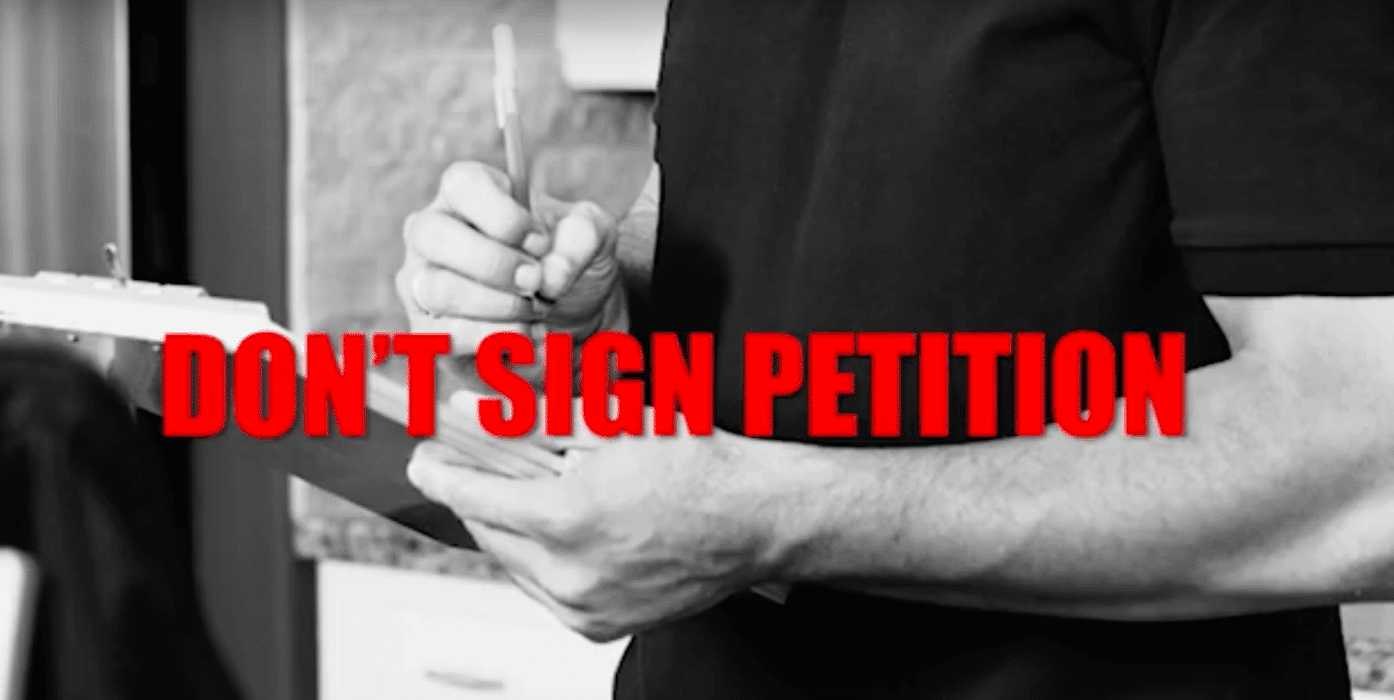
Ohioans for Energy Security, a new entity blanketing Ohio with a wave of television ads defending the bailout of FirstEnergy Solutions, is brought to you by the same people who campaigned for the controversial bailout plan.
The group formed last month in Ohio as a for-profit Limited Liability Corporation. It just launched a $1 million ad campaign designed to scare voters away from signing petitions to place a referendum on House Bill 6 on the 2020 ballot. The bill in question, passed by the Ohio General Assembly and signed by Governor Mike DeWine in July, will force Ohio consumers to pay to bail out uncompetitive nuclear and coal plants in Ohio. It also rolls back Ohio’s life-and-money saving clean energy standards, which helped to support 112,000 jobs in the Buckeye State.
“In the coming weeks, don’t give your information to the Chinese government,” Ohioans for Energy Security tells visitors to its website. “Don’t sign their petition allowing China control over Ohio.”
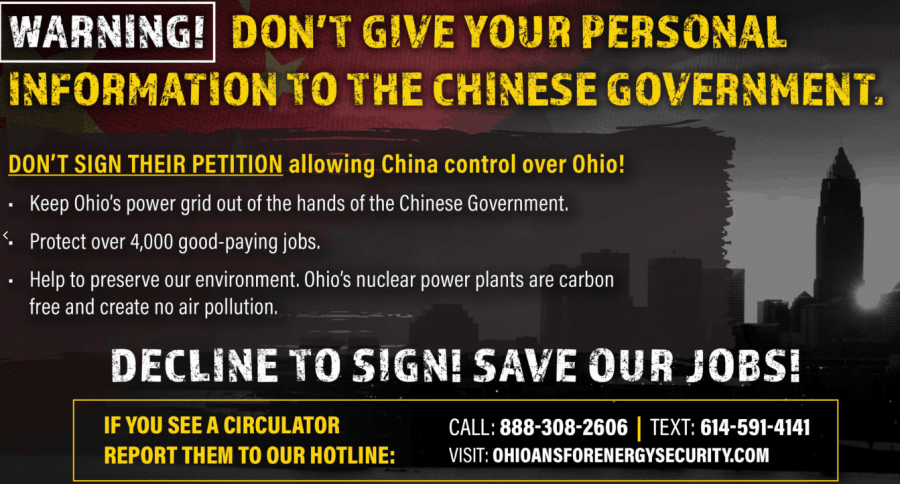
*Ohioans for Energy Security’s website tells voters to call its hotline to report petition gatherers. Petition signatures for statewide referendums aresubmitted to the Ohio Secretary of State and Attorney General, not the Chinese government.
Ohioans for Energy Security points to several reports that the Industrial and Commercial Bank of China has been among the banks that financed several new gas projects in Ohio developed by Clean Energy Future, a company that opposed HB 6.
The Columbus Dispatch reviewed those reports and concluded that “the group behind the commercial offered no evidence that such a plot exists.” It didn’t find “any evidence that the Chinese government intends to play a role in the possible repeal of House Bill 6.”
The Cleveland Scene writes that the group’s “bonkers” first ad “continues with even less tenuous grasps on the issues surrounding HB 6.”
Ohioans for Energy Security doesn’t mention that the broad-based opposition to HB 6 includes consumer advocates, environmentalists, free market groups, health experts, and manufacturers, as a quick review of opponent testimony on the bill will show.
The pro-bailout group also doesn’t mention Securities and Exchange Commission filings that show the Industrial and Commercial Bank of China has committed many millions of dollars to FirstEnergy Corp., the parent company that spawned FES. A March 2018 declaration by Charles Moore, FES’s chief restructuring officer, also included the Industrial and Commercial Bank of China on a list of “interest parties and significant creditors” in FES’s bankruptcy case, under the subheading “Banks, Lenders, UCC Lien.”
One of the Ohioans for Energy Security ads that blanketed Ohio
Ohioans for Energy Security is led by the spokesperson for another pro-bailout group backed by FirstEnergy Solutions
Carlo Loparo is listed as the president of Ohioans for Energy Security on political issue ad disclosures on file with the Federal Communications Commission. Loparo also serves as the group’s public spokesperson.
Loparo is also the spokesperson for the Ohio Clean Energy Jobs Alliance (OCEJA), a coalition “powered by FirstEnergy Solutions” that launched last fall with the help of the utility’s outside lobbyists and public relations consultants, and campaigned in support of HB 6.
Loparo is the president of the Columbus-based Loparo Public Relations, and boasts 25 years of experience in “media relations, strategic message development and crisis communications,” according to his firm’s website.
Amy Natoce, the vice president of Loparo Public Relations, was the political director for Dave Yost’s successful campaign for Ohio Attorney General. Yost will soon decide on whether to approve of revised summary language for the referendum petition, a first step toward getting the referendum on the ballot in 2020. Attorneys representing FES and Generation Now, Inc., a dark money group that spent millions on ads supporting HB 6, have been targeting Yost’s office with letters opposing the effort to put the issue on the ballot.
Ohioans for Energy Security’s first ad uses stock footage, features employees of FirstEnergy Solutions
“Don’t sign your name to a plan that kills Ohio jobs, harms Ohio communities, and endangers our energy independence,” tells viewers as stoic headshots of several individuals flash on screen.
The ad doesn’t identify those individuals, but at least three of the individuals appear to be recycled from stock footage that had previously been used in a 2017 Ohio ballot initiative ad around prescription drug prices.
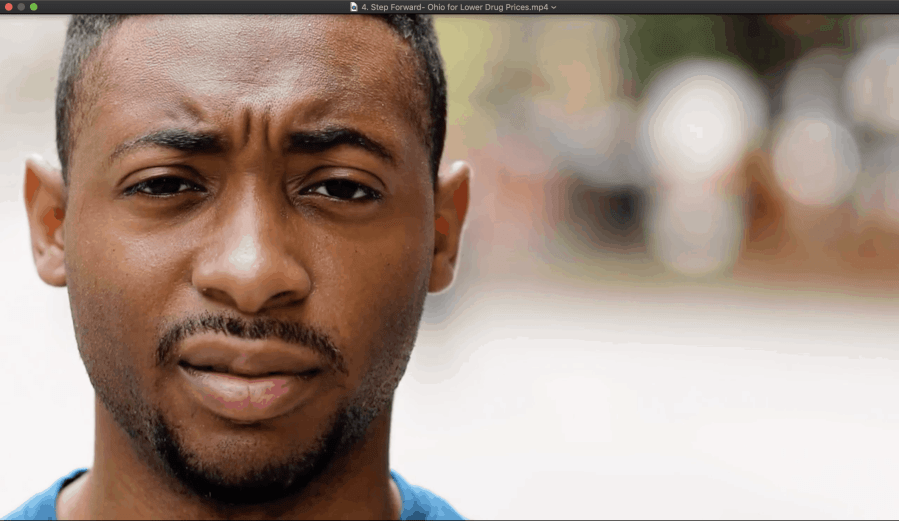 Image from 2017 prescription drug ballot initiative ad
 Image from 2019 Ohioans for Energy Security ad
 Image from 2017 prescription drug ballot initiative ad
 Image from 2019 Ohioans for Energy Security ad
The 2017 ad which used the same stock photos, called “Step Forward,” no longer appears online, though Ballotpedia references it in a database of ads from the 2017 prescription drug initiative campaign. A copy was provided to the Energy and Policy Institute.
That 2017 ad was funded by “Ohio Taxpayers for Lower Drug Prices,” which employed Rex Elsass, a Republican operative and the owner of Strategic Group for Media.
Some of Ohioans for Energy Security’s ad contracts on file with the FCC name as the buyer Strategic Media Placement, also owned by Elsass. The same firm made ad buys for Generation Now.
The Ohionans for Energy Security ad also includes several employees of FirstEnergy Solutions who also appeared in earlier ads supporting HB 6, produced by the dark money group Generation Now, Inc. Some also appeared in produced by the FES-backed Ohio Clean Energy Jobs Alliance.
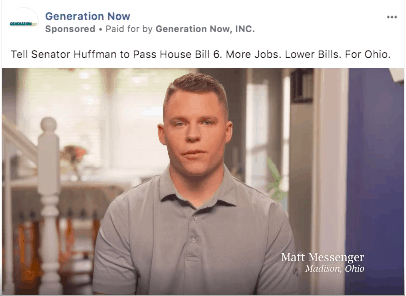
*A screenshot of a Generation Now Facebook ad featuring Matt Messenger, who the ad did not not disclose is a project manager at FES’s Perry nuclear power plant.
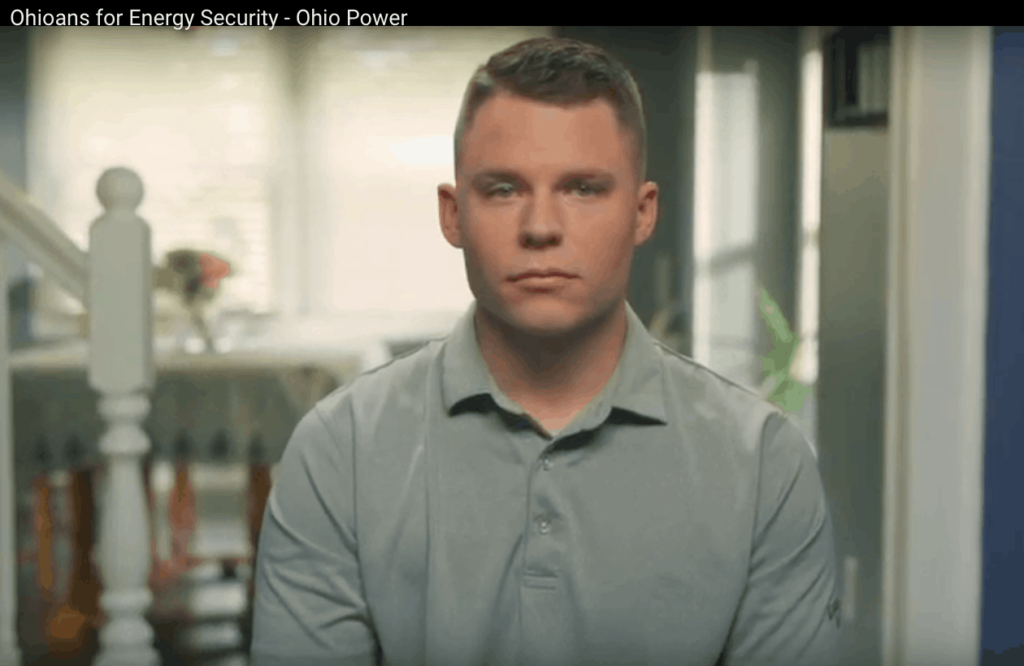
*Ohioans for Energy Security first ad features a similar image of Messenger, without disclosing his name or employer
Back in June, the Energy and Policy Institute asked a spokesperson for FES at Sitrick and Company why the utility’s employees were appearing in Generation Now’s ads, and if it was funding the group’s efforts. The spokesperson said he would “be happy to look into this and get back to you,” but then never responded with any further information.
A monthly fee statement filed in FES’s bankruptcy case later revealed that Sitrick & Company staff discussed EPI’s inquiry with “D. Griffing” and the “Dewey Square” team. David Griffing is the vice president of government affairs for FES. The Dewey Square Group is a lobbying firm that has received nearly $800,000 for its work on FES’s bailout campaigns in Ohio and Pennsylvania, which included work on the launch and operations of the Ohio Clean Energy Jobs Alliance.
 Excerpt from Sitrick & Company’s filing in FES’s bankruptcy case discussing EPI’s inquiry regarding FES employees working with Generation Now
Links to Generation Now’s ad firm and a pro-Householder PAC backed by Murray Energy
The server for the group’s website – www.ohioansforenergysecurity.com – also hosts the websites of Elsass’s Strategy Group Company and Front Porch Strategies.
It also hosts a site – LarryHouseholderFightsforus.com – supporting Ohio’s Republican House Speaker Larry Householder, whose rise to the speakership was backed by FirstEnergy and Generation Now. Householder then led the drive to pass HB 6. The pro-Householder site is paid for by the Michigan-based Hardworking Americans Committee, which spent over $450,000 on ads opposing Householder’s Republican primary opponent Kevin Black in 2018.
Federal Elections Commission data shows the Hardworking Americans Committee received $50,000 in 2018 from the PAC of Murray Energy, a coal producer that stands to benefit from HB 6.
The Hardworking Americans also received $50,000 that year from Political Education Patterns, the PAC for the Cleveland-based International Union of Operating Engineers Local 18. IUOE Local 18 doled out $295,000 to Generation Now in 2018 and 2019, according to FEC data. Mark A. Totman, the union’s VP, serves as one of Governor Dewine’s appointees to the Public Utilities Commission of Ohio Nominating Council, where he represents organized labor.
Updatedat 7:30 ET on Aug. 28, 2019 to include information about Ohioans for Energy Security’s use of stock footage in its ad.
carlo loparocoal bailoutfirstenergy solutionsgeneration now inchb 6larry householderloparo public relationsnuclear bailoutohio clean energy jobs allianceo
---
---
OFF BS 11 25
Logo
Our Team.
Your Team.
Welcome Home.
Headquartered in a 200-year-old inn and stagecoach stop, the history of service continues.
From strategy and messaging, to production and placement, our dedicated professionals know their craft like no one else. Our experience and expertise will give you the advantage to bring home the win.
Executive
Ben Yoho
Ben Yoho
Chief Executive Officer
Ryan Rodgers
Ryan Rodgers
President
Alex Tornero
Alex Tornero
Chief Creative Officer
Scott Donnelly
Scott Donnelly
Chief Financial Officer
Scott Schweitzer
Scott Schweitzer
Chief Operating Officer
Strategy
Billy Grant
Billy Grant
Political Director
Joe King
Joe King
Senior Strategist
Brian Berry
Brian Berry
Chief Strategy Officer
Andy “Big Dog” Ballard
Andy “Big Dog” Ballard
Director of Political Affairs
Krista Carter
Krista Carter
Digital Sales Director
Creative Production
Nathan Slonaker
Nathan Slonaker
Creative Director
Scott Myers
Scott Myers
Vice President of Production & Senior Director of Photography
Mark Trbovich
Mark Trbovich
Senior Vice President of Post Production
Sean Ivory
Sean Ivory
Motion Graphics Designer
Sean Amann
Sean Amann
Audio Editor and Sound Designer
Pat Posani
Pat Posani
Video Editor
Nicholas Bertrand
Nicholas Bertrand
Writer / Producer
Mike Orozco
Mike Orozco
Production Specialist
Jacob Mohr
Jacob Mohr
Writer / Producer
Digital
Kelsey Good
Kelsey Good
Digital Director
Kayleigh Richmond
Kayleigh Richmond
Operations Director
Jelise Guynn
Jelise Guynn
Digital Creative Director
Joe Bartolotta
Joe Bartolotta
Ads Director
Alejandra Zelonka-Cabanillas
Alejandra Zelonka-Cabanillas
Senior Content Manager
Charlie Ballard
Charlie Ballard
Research and Development Director
Elliott Burnett
Elliott Burnett
Website Developer
Marin Vatske
Marin Vatske
Senior Graphic Designer
Spencer Casey
Spencer Casey
Media Buying Strategist
Caleb Villars
Caleb Villars
Digital Strategist
Caleb Slagle
Caleb Slagle
Graphic Designer
Faith Slagle
Faith Slagle
Graphic Designer
Media Placement
Brant Fink
Brant Fink
Vice President of Strategic Media Placement
Anthony Iacovetti
Anthony Iacovetti
Senior Media Buyer
Dylan Harrington
Dylan Harrington
Media Buyer
Dominic Chiappano
Dominic Chiappano
Competitive Strategist
Payton Smith
Payton Smith
Competitive Strategist
International
Dr. NoelleAnne O’Sullivan
Dr. NoelleAnne O’Sullivan
Mohamad Hanif Bin Abdullah
Mohamad Hanif Bin Abdullah
Franco Wandabwa
Franco Wandabwa
Patricio F. Gajardo
Patricio F. Gajardo
Polling & Voter Contact
Brian Osborne
Brian Osborne
Executive Vice President
Jessica Miller
Jessica Miller
Research Analyst
Cheyenne Haines
Cheyenne Haines
Operations Manager
Alissa Stechschulte
Alissa Stechschulte
Senior Operations Specialist
Support
Tonia Tyree
Tonia Tyree
Staff Accountant
Mitch Gwin
Mitch Gwin
IT Manager
Kathy Schweinfurth
Kathy Schweinfurth
Office Administrator
communication is an art
Our
Strategies
Inspire
Triumph
Strengthen
Bring Change
Succeed
Win
Inspire
A national conservative advertising agency lifting America to a brighter future by partnering with candidates and causes to amplify their voice, vote, and victory.
Logo
Success
Services
Storytelling
Specialists
Insights
Contact
Let’s Be Friends
info@tsgco.com
Stay in the loop
Email Address
---
Other Stuff
There’s a new presidential candidate
And he’s from Ohio! Sadly, however — though not unpredictably — he’s a total jackwagon.
His name is Vivek Ramaswamy. He’s a 37 year-old biotech founder turned venture capitalist cut from the J.D. Vance/Peter Thiel cloth who thinks that “wokism” is the greatest problem facing America. Guy even wrote a book about it. But while running a campaign based on culture war crap as a means of taking an office via which one can deliver absolutely everything wealthy/corporate America wants is the Republican Ideal, Ramaswamy does have a couple of things working against him.
The first one: though he was born in Cincinnati, his parents are from India. No respectable pundit will say this out loud and GOP officials will act aghast at the mere suggestion of such a thing, but the fact that Ramaswamy’s skin is brown and he has an Indian name will knock him down several points in most GOP polls and primaries right out of the gate. I’d like to be wrong about that, but the GOP has built its entire retail political appeal around white supremacy and you can’t just turn that on and off. I truly think Republican voters will look askance at him for all the wrong reasons. Which is a shame given how many RIGHT reasons there are to look askance at him!
More troubling, however, is his campaign team. First off:
Ramaswamy boasts a veteran lineup of political consultants advising his bid, including Rex Elsass and Ben Yoho of the Strategy Group . . .
Ohio insiders know who Rex Elsass is. He’s a nihilistic Lee Atwater acolyte whose history as a GOP campaign guy goes back 30+ years. He made national news a decade ago when he ventured outside of Ohio to represent Todd Aiken’s losing Missouri senate race. This is the sort of press he got at the time and, yeah, it’s an accurate take on his reputation in Ohio:
Even within the mean-spirited world of political attack dogs, Elsass is known as an unpleasant sort, a reputation he sealed in the early ’90s. His first major undertaking, a 1990 campaign to unseat the Democratic Ohio House speaker, was so venomous that it unnerved even many of his fellow Republicans. The effort, which Elsass dubbed “Operation Kill The King” painted the speaker as the “conductor of the pay-to-play orchestra” over the public objections of Republicans who had long and collegial relationships with him. After the election, rumors circulated that Elsass and his cohorts had left a dead cat on the victorious speaker’s front porch. A local Democratic consultant dubbed Elsass and his crew the “nasty boys”—and it stuck.
Not that any of that hurt Elsass too badly. He later rebuilt his reputation by being the guy you go to if you’re the sort who wants campaign ads in which you’re wearing camo and holding a rifle while telling viewers that you won’t let Obama/Hillary/Biden/Whoever take their guns after which it’s strongly implied you murdered your critics. In this way he helped mastermind the political comeback of two-time Ohio House Speaker — and my former client — Larry Householder, who is now on trial in the largest political corruption case in Ohio history. And yes, Elsass’ name has come up in testimony because of course it has.
Also:
. . . Gail Gitcho, who served as a top strategist with Herschel Walker's Senate campaign, will be serving as a communications adviser.
Good luck, Vivek. I doubt your campaign survives the first barely-veiled racist swipe from Donald Trump, assuming at least he even shows up on Trump’s radar. If he does, though, you know the nickname Trump gives him will be both horribly bigoted and devastatingly harmful to your campaign.
Meanwhile, in Alaska . . .
---
CLEVELAND, Ohio -- A former employee of an Ohio Republican political consulting firm has been charged with threatening the firm's founder, one of the most well known Republican political consultants in the United States.
Gregg Phelps, 30, of Union County, has pleaded not guilty to a single charge of aggravated menacing, according to Delaware County Municipal Court records. Court records show he is barred from traveling within two miles of Strategy Group for Media, or the home of Rex Elsass, the firm's president and CEO.
A July 12 Delaware County Sheriff's Office incident report, obtained on Friday through a public records request, said a firm employee called 911 after Phelps, a former Strategy group media buyer, made a series of Facebook posts this week threatening Elsass and Strategy Group's current employees.
...
---
GGL 11 25
[### Inside The Meltdown At America's Most Conservative ...

BuzzFeed News
https://www.buzzfeednews.com › article › mckaycoppins](https://www.buzzfeednews.com/article/mckaycoppins/inside-the-meltdown-at-americas-most-conservative-most-chris)
Jun 3, 2013 — Rex Elsass grew up in the '60s and '70s in a small Ohio city ... nasty boys," told BuzzFeed Elsass' tactics were nigh Nixonian. "It's ...
[### Ohio political consultant uses deft touch to skewer opponents

The Columbus Dispatch
https://www.dispatch.com › news › politics › 2012/01/23](https://www.dispatch.com/story/news/politics/2012/01/23/ohio-political-consultant-uses-deft/23560873007/)
Jan 23, 2012 — Once a ringleader of a GOP dirty-tricks group labeled the “nasty boys” more than 20 years ago, Elsass has morphed into arguably the premier ...
[### Did Ohio political consultant Rex Elsass send Michele ...

Cleveland.com
https://www.cleveland.com › open › 2013/07 › did_ohio...](https://www.cleveland.com/open/2013/07/did_ohio_political_consultant.html)
Jul 17, 2013 — 17, 2013, 7:02 p.m.. Rex Elsass in 1990, the dawn of his Nasty Boys days.
[### Who is Rex Elsass, the GOP ad maker who designed Larry ...

The Columbus Dispatch
https://www.dispatch.com › politics › state › 2023/02/15](https://www.dispatch.com/story/news/politics/state/2023/02/15/when-larry-householder-needed-attack-ads-he-turned-to-rex-elsass/69879086007/)
Feb 15, 2023 — The Strategy Group founder Rex Elsass provided office space ... Rex's stuff is nasty too,” Borges said to FES lobbyist Juan Cespedes ...
[### Rival tacticians join fight over Ohio casinos

Canton Repository
https://www.cantonrep.com › news › state › 2009/10/13](https://www.cantonrep.com/story/news/state/2009/10/13/rival-tacticians-join-fight-over/42591079007/)
The media strategist for the pro-casino Ohio Jobs & Growth Committee, funded by Penn National and Cleveland Cavaliers owner Dan Gilbert, is Rex Elsass. Elsass, ...
[### Ohio Special Election Has Turned Ugly

Roll Call
https://rollcall.com › 2007/10/31 › ohio-special-election...](https://rollcall.com/2007/10/31/ohio-special-election-has-turned-ugly/)
In fact, the candidates are so close that Latta's media consultant, Rex Elsass, worked for Buehrer's state Senate campaigns — and has the outtake footage to ...
[### Dispute over Ohio anti-casino ad escalates Native American Times
https://nativetimes.com › business › gaming › 2437-disp...](https://nativetimes.com/business/gaming/2437-dispute-over-ohio-anti-casino-ad-escalates)
Sep 27, 2009 — Elsass was a member of the notorious “Nasty Boys” in the 1990s, so-called for the dirty campaign tricks they employed. Two employees of Elsass ...
[### Clermont County races targeted by pro-Householder super ...

Cincinnati Enquirer
https://www.cincinnati.com › story › news › 2020/04/17](https://www.cincinnati.com/story/news/2020/04/17/clermont-county-races-targeted-pro-householder-super-pac/5151236002/)
Apr 17, 2020 — ... nasty one between Householder pick Jean Schmidt, a former U.S. representative, and newcomers Joe Dills and Dillon Blevins. The Ohio ...
[### Akin Consultant Has Advised McKenna, Koster

Seattle Met
https://www.seattlemet.com › news-and-city-life › 2012/08](https://www.seattlemet.com/news-and-city-life/2012/08/akin-consultant-has-advised-mckenna-koster)
Once a ringleader of a GOP dirty-tricks group labeled the “nasty boys” more than 20 years ago, Elsass has morphed into arguably the premier political adman in ...
[### todd akin

Cleveland.com
https://www.cleveland.com › topic › todd-akin](https://www.cleveland.com/topic/todd-akin/index.html)
Rex Elsass in 1990, the dawn of his Nasty Boys days. Tea Party pushes back against Karl Rove. Rove's new Conservative Victory Project is a direct response to ...
People also search for
---