Const Convention 2
===
primary ALEC, Koch, Mercer
SEE MARK MECKLER
see conv of states org [cnp)
SEE PROJECT 2025
TUCKER HEGSETH
oops 2x see main for older
omfg koch and mercer?!
===
5 25 RWW
Meckler reports that he was "in Washington D.C. meeting with a bunch of folks last week" and is optimistic that "there is an appetite growing" among Republican legislators to support an Article V Convention of States to propose amendments to the Constitution.
:{
Geoff Dembicki @ DeSmog: Trump Megadonor Tim Dunn Has a Plan More Extreme Than Project 2025
The Texas fracking billionaire wants to rewrite the U.S. Constitution to advance climate denial and other far-right priorities.
ref
for months top Democrats have fixated on Project 2025, the radical blueprint of policy and personnel recommendations for a Donald Trump administration published by The Heritage Foundation and its allies, with Kamala Harris’ campaign calling it “a sweeping takeover of the federal government.”
But one of Trump’s most prominent donors, the Texas fracking billionaire and pastor Tim Dunn, has for years been backing what critics refer to as a conservative Christian Nationalist plan for America. Some experts in right-wing politics think it has the potential to be more extreme than Project 2025.
Dunn is among the top 10 individual donors to the Trump campaign, having contributed $5 million through his fracking company CrownQuest Operating to a Super PAC called Make America Great Again. He is also director of a political nonprofit known as the Convention of States, which is leading an effort to rewrite the U.S. Constitution in ways that it says would “limit the power and jurisdiction of the federal government.” The Bible, according to Dunn, “should profoundly affect” politics.
The group has the backing of conservative media superstars including Fox News anchor Sean Hannity and Daily Wire co-founder Ben Shapiro; religious right leaders such as Focus on the Family founder James Dobson and Wallbuilders founder David Barton; political operatives like Vivek Ramaswamy and Turning Point USA founder Charlie Kirk; Florida Governor Ron DeSantis and Republican Congressmember Rand Paul; and the Heritage Foundation’s Kevin Roberts, one of the lead architects of Project 2025.
Among the Convention of States’ priorities is to “resist top down planning by our federal government” when it comes to limiting the fossil fuels at the heart of the climate emergency. It describes global heating as a “hoax,” erroneously stating on its website that “the claim that 97% of scientists agree that climate change is man-made is patently false.”
Dismissal of the climate emergency is also central to Project 2025, which calls for a Republican administration to aggressively advance climate obstruction along with a cavalcade of other conservative policies, including a national ban on medication abortion. Project 2025’s proponents would do so by taking a “dictatorial view of the presidential powers,” explained Peter Montgomery, research director at the progressive nonprofit organization People for the American Way. They’re advising Trump to replace thousands of career government employees with political appointees and concentrate decision-making power in the White House.
But Dunn’s plan for a theocratic petrostate goes one step further. “The Convention of States wants to put that vision into the Constitution,” Montgomery told DeSmog. As unlikely as that scenario might seem, he argues that this project goes far beyond mere political rhetoric or posturing.
Dunn has a long track record of successfully backing far-right policies and state representatives in his home state of Texas. He and his allies are now reportedly looking to take that strategy national. “They’re spending a lot of money organizing in states and they’ve got a long-term plan,” Montgomery claimed. “They are deadly serious.”
DeSmog sent a list of questions to the Convention of States and to Dunn via his nonprofit Citizens for Self-Governance but didn’t receive a response.
‘Politics and religion’
Dunn is currently one of the richest people in Texas, having amassed a net worth of $2.2 billion through his family fracking company CrownQuest, which pumps 140,000 barrels of oil per day from the Permian basin in West Texas.
New houses for sale next to an active oilfield in Midland, Texas. May 26, 2020. Credit: Justin Hamel for DeSmog
In addition to running one of the country’s biggest privately-owned oil companies, Dunn is a pastor in Midland, the Texas oil town where he lives along with five of his six grown children on a 20-acre compound. He believes that “politics and religion are inseparable,” telling a Convention of States gathering in 2022 that “you can’t have one without the other.”
Dunn and his wife have reportedly given $29 million since 2000 to conservative candidates and PACs in Texas, making him one of the state’s top political donors. He works closely with Farris Wilks, a fellow Texas fracking billionaire who is a co-owner of The Daily Wire, the right-wing media outlet whose stars include Jordan Peterson and Ben Shapiro. Dunn and Wilks recently put $6.8 million into a new PAC called Texans United for a Conservative Majority, whose logo depicts Austin’s Capitol building with a Christian cross on top.
Though Dunn’s political base is in Texas, he’s involved with groups that have a national focus. Tax forms show that for over two decades he’s been on the board of a conservative think tank called the Texas Public Policy Foundation, which has received millions of dollars from charities linked to the Koch brothers and as recently as 2015 was disputing whether humans cause climate change.
And in 2015, the Convention of States filed its first tax form with Dunn listed as a board member. A key goal is to make the U.S. a more explicitly Christian nation. “When we started the Convention of States — and I was there at the beginning — I knew we had to have a spiritual revival, a Great Awakening and a political restoration for our country to come back to its roots,” Dunn said while addressing a summit for the group.
The Convention of States pushes a conservative economic agenda, advocating against the thousands of regulations created by an “out-of-control Washington.” The group wants to remove “federal interference” from the oil and gas industry, claiming that fracking “can only be a good thing for our living conditions and geopolitical considerations” and arguing that any attempt to ban fossil fuels “is both impossible to achieve and dangerous to attempt.”
This fusion of religion and economic libertarianism “is supported by people on the corporate right, and people on the Christian right,” Montgomery said. It aims to impose that agenda on Americans by altering the country’s foundational documents. “They are very committed to rewriting the U.S. Constitution,” he said.
Allies in the Trump Campaign
The process by which Dunn and his allies hope to do that is called an Article V convention. Their goal is to convince 34 U.S. state legislatures to pass resolutions supporting a constitutional convention. That is the threshold required for Congress to take up the matter. If 38 states then approve the proposed amendment, it becomes part of the Constitution.
Numerous groups since the 1960s have mounted Article V campaigns on issues including abortion bans and federal fiscal restrictions, yet none have been successful. The Convention of States claims to be working “across every legislative district in the nation,” saying that 19 states “have successfully passed the Convention of States Resolution.”
The group gained a powerful potential supporter this summer when Trump named as his running mate Ohio Senator JD Vance, a major recipient of oil and gas donations who previously endorsed the project. “Super excited we have a vice presidential candidate that is an official supporter of the Convention of States,” the group’s president Mark Meckler said in a video in July.
Dunn himself is attempting to make inroads with powerful Republicans. He’s given $250,000 to High Plains PAC, which is supporting the re-election of Senator John Borrasso in Wyoming, currently the top Republican on the Senate Committee on Energy and Natural Resources.
Dunn’s poured $2 million into the Jefferson Rising Fund, which is supporting the Senate bid of Trump ally Kari Lake in Arizona and advocating against Democratic Senate contenders in states such as Wisconsin, Montana, and Nevada.
The Texas fracking billionaire has become a central behind-the-scenes figure in a constellation of Trump-aligned nonprofits. Dunn is on the board of directors of the America First Policy Institute. That group is co-sponsoring the Courage Tour led by Christian right influencer and Trump ally Lance Wallnau, which is holding a series of rallies in swing states. The Courage Tour recently partnered for an event with vice presidential candidate Vance.
Dunn is reportedly a significant funder of the conservative nonprofit Center for Renewing America, as well as the Conservative Partnership Institute. All this could help give Dunn policy leverage should Trump win the presidential election. “He’s definitely seeking a national impact,” Montgomery said.
A second Trump administration could be useful to Dunn’s business interests. He signed a deal late last year to sell a major part of his fracking company CrownQuest to Occidental Petroleum for $12.4 billion, a transaction in which he’s set to personally collect almost $2.2 billion. Less than a month later, Dunn donated $5 million to Trump.
Occidental CEO Vicki Hollub complained last spring during a Houston fundraiser with Trump that federal regulators were delaying the sale. According to sources quoted in the Washington Post, Trump voiced his dismay, saying, “Can you just wait a few months?”
===
===
an 8 24
alternet-NO LNX
A mysterious group of Republicans is secretly rewriting the Constitution
building during day
:
Thom HartmannAugust 30, 2024
Republicans have pulled off a coup against an entire branch of government, and nobody seems to have noticed. But if you pay attention, it’s shocking.
Sometimes you can learn as much from attending to what Republicans suddenly stop saying as from what they are talking about. In this case, it’s their half-century-long obsession with convening a constitutional convention to rewrite the US Constitution. Under Article V of our Constitution, when two-thirds of the states formally call for a “con-con” to rewrite our nation’s founding document, it officially comes into being.
They can then make small changes like enshrining the right of billionaires and corporations to bribe judges and politicians, or insert the doctrine of corporate personhood into the document, or simply throw the whole thing out and start over. Many on the right are hoping to insert a national ban on abortion into a new constitution; others want to end the right of women to vote, do away with all antidiscrimination laws, outlaw labor unions, or return the selection of senators to the states.
So far, 19 Republican-controlled states have signed on to a call for for a convention under Article V. The project, heavily funded by rightwing billionaires, even has its own website: conventionofstates.com. Consider just a sampling of recent GOP supporters of the project:
— Senator Marco Rubio: “One of the things I’m going to do on my first day in office is I will put the prestige and power of the presidency behind a constitutional convention of the states.”
— Governor Greg Abbott: “We need a Convention of States to restore the rule of law in America.”
— Governor Ron DeSantis: “An Article V Convention of States is the best way to bring power back to the states and the people.”
— Congressman Jodey Arrington: “We need to go back to our founding document, back to our Constitution, and put the restraints on Congress that our founders intended.”
— Senator Ted Cruz: “An Article V Convention of States is a powerful tool given to us by the Founders to rein in the federal government.”
— Senator Rand Paul: “I’m a big fan of the Convention of States project. I think it’s the solution to Washington’s overreach.”
But over the past year, Republicans have suddenly fallen silent on the issue. Project 2025, for example, the all-encompassing wish-list for the GOP and its billionaire owners, lacks even one single mention of a constitutional convention.
Why would this be?
The simple and obvious answer is that Republicans are rewriting the Constitution right now, this year and last, through their proxies among the six corrupt Republicans on the US Supreme Court.
Having succeeded in seizing the Court, the GOP has been able to relax about their plan to call a convention. So far, just in the past two years, Republicans on the Court have taken an ax to the Constitution. They have:
— Turned presidents who are inclined to break the law into kings or monarchs who are no longer accountable to police, courts, or juries, essentially rewriting Article II, Section 2 of the Constitution.
— Ended the constitutional rights of women to their own bodies, ignoring or rewriting the 1st, 4th, 9th, and 14th Amendments to the Constitution.
— Gutted the power of federal agencies to protect consumers and our environment, essentially rewriting Article I, Section 7 of the Constitution.
— Fully legalized the bribery of politicians so long as the bribes are paid after the deed is done (making it a “tip”) rather than before (which the Court said would still be a bribe) overriding multiple constitutional prohibitions on bribery.
— Overturned parts of the 14th Amendment to the Constitution and the Voting Rights Act to legalize racially discriminatory gerrymandering where it benefits Republicans.
— Rewritten the Second Amendment and legalized bump stocks to put functionally fully-automatic weapons of war on our streets.
And, it appears, they’re just getting warmed up. Next year could see an end to gay marriage, contraception for single people, the abortion pill, the right to possess pornography (which they get to define) or read “banned” books, any meaningful regulation of billionaire-owned social media, further gutting of union rights, and the insertion of religion into schools nationwide…among other things.
Given how radical and willing they are to overturn established law, constitutional doctrine, and to create new law or constitutional doctrine out of thin air, it’s easy to see why Republicans would shift their efforts away from trying to rewrite the Constitution and toward supporting their shills on the Court.
This has not gone unnoticed by President Biden and his Democratic colleagues. Last month, when the six corrupt Republicans on the Supreme Court ruled that presidents can commit crimes without consequences if they call them “official acts,” President Biden spoke out with an uncharacteristic ferocity:
“This decision today has continued the Court’s attack in recent years on a wide range of long-established legal principles in our nation, from gutting voting rights and civil rights to taking away a woman’s right to choose to today’s decision that undermines the rule of law of this nation.”
Two weeks later, The Washington Post reported:
“President Biden is finalizing plans to endorse major changes to the Supreme Court in the coming weeks, including proposals for legislation to establish term limits for the justices and an enforceable ethics code, according to two people briefed on the plans.”
With Vice President Harris having replaced President Biden at the top of the Democratic ticket, and the House still under the control of extremist Republicans under Mike Johnson, it appears that President Biden’s Supreme Court agenda has receded into the background.
But Vice President Harris and Governor Walz should be (and almost certainly are) putting considerable attention and work into how to restrain the Supreme Court from doing further violence to our constitutional system of government once they’re in office.
It must be, in fact, their first order of business, for two major reasons.
The first is that several of the rulings by Republicans on the Court have had the effect of amplifying and solidifying Republican control over the nation. By single-handedly overturning the voting rights act and legalizing bribery by billionaires, they’ve created a political imbalance that fails to represent the people of our country and instead just does what their favorite billionaires and giant corporations want.
As Michael Moore reports, multiple polls have found in recent years:
— 90% of Americans want stronger gun control laws
— 89% want an end to partisan and racial gerrymandering
— 84% want free pre-kindergarten
— 79% want the morbidly rich and corporations to pay their damn taxes
— 76% want a higher minimum wage
— 73% want an end to student debt and free college
— 72% want action on the climate crisis and money out of politics
— 71% want an end to union-busting
— 70% want marijuana legalized nationwide
— 69% want to maintain gay marriage and abortion rights
— 65% want to end the electoral college and put term limits on SCOTUS justices
None of these things are happening because of the Republican lock on the Supreme Court, the third and unelected branch of government which is today only beholden to whichever billionaire offers individual members the best gifts, goodies, and expensive vacations.
Had the actual winners of the national vote become president in 2000 and 2016, the only Republican on the Court today would be Clarence Thomas, and America would be a very different nation.
Instead, we’ve had two illegitimate Republican presidents who essentially packed the Court. Sandra Day O’Connor was clear about why she cast the tie-breaking vote to hand the presidency to Bush in 2000: she told friends she didn’t want her replacement to be chosen by Al Gore. And, of course, Trump would never have become president without help from Vladimir Putin.
These Republicans on the Supreme Court, five of the six appointed by presidents who lost the national vote, are the main reason why Americans can’t have nice things — from a national healthcare system to free college to a functioning democracy that does what the majority of its citizens want — like every other democracy in the world.
The second reason Harris and Walz should be preparing to act immediately after they’re sworn into office on January 20th of next year (G-d willing!) is that a president’s power is at its peak the moment she takes office. After that, it’s largely downhill, as opposition politicians and the press pile on and even members of their own party begin to highlight cracks in the new administration’s policy chops.
This is why FDR, LBJ, Reagan, Obama, and Bidenall got so much done in their first 100 days. If they hadn’t started out with their top and most controversial priorities, they never would have been able to get to them.
And, because the cancer at the heart of our democracy is currently centered in the Supreme Court, it’s why President Harris and Governor Walt must focus their energy and political capital on taking on this out-of-control Supreme Court’s power as soon as they take office.
===
---
March 22, 2024 rww
- North Carolina’s GOP gubernatorial nominee Mark Robinson will be speaking at an event in June organized by broadcaster Jason Whitlock, who recently dedicated an entire episode to platforming a virulent antisemite.
- Speaking of antisemites, Ali Alexander cheers on Candace Owens for being fired from The Daily Wire because of her increasingly strident antisemitism: “Thank you for loving America and our Lord Jesus Christ!”
- Still speaking of antisemites, Ryan Dawson declares that “the Jewish God is the Devil”: “Moses was a genocidal maniac. Lott was incestuous. Elijah murdered children. These men did not serve God. They served the Devil.”
- Convention of States brags that the organization is “capitalizing on [our] feud with Right Wing Watch.” We are in a feud? That is news to us.
- Finally, Rep. Lauren Boebert says that she got involved in politics because “God made it very clear that there were important conversations taking place at tables that I needed to be sat at.”
---
an 12 23 no lnx
The GOP's dangerous plan to rewrite the Constitution
:
Thom Hartmann
December 15, 2023
One of the right’s favorite fever dreams over the years has been to gut the US Constitution of many of its checks and balances and officially turn America into a legal oligarchy with a strongman presidency, nearly bulletproof legal immunity for the morbidly rich, and full personhood for corporations.
As of this month, it’s no longer just a dream.
The American Legislative Exchange Council (ALEC) completed their winter “National Policy Summit” get-together in Scottsdale, Arizona last week with Speaker Mike Johnson as its keynote speaker. This is the group that’s brought “Stand Your Ground” and voter suppression “model legislation” to Red states across America and, for fifty years now, has been bringing together corporate lobbyists and Republican state-level politicians to make state after state more corporate- and billionaire-friendly.
At this recent meeting they rolled out a new strategy to convene a Constitutional Convention, so they can finally remake America in their own image: they’re going to try to get the six corrupt Republicans on the Supreme Court — who all have direct or indirect ties back to ALEC, its related/affiliated organizations, and/or its funders — to go along with it.
Former Wisconsin Senator Russ Feingold (now a professor of law and president of the American Constitution Society) is not prone to hyperbole; he’s always been a thoughtful and measured speaker and writer. So, it’s worth taking him seriously when he recently said of MAGA Mike Johnson:
“It is alarming to have a speaker of the House who supports the extremist Convention of States movement, which is striving to radically rewrite the U.S. Constitution.”
— Imagine if most public schools in the country closed and were replaced by for-profit charter and private academies — often racially segregated and only serving families who could afford their tuition — because the Constitution forbade state-level compulsory education laws and taxpayer funding for education (at all levels).
— Imagine if the U.S. Constitution required the EPA, FDA, USDA, DOT, Department of Education, and Department of Labor to shut down. All union protections are dead, there are no more federal workplace safety standards, and even child-labor laws are struck down, along with an end to the national minimum wage and the income tax, both individual and corporate.
— Imagine that the new billionaire-written Constitution makes it illegal for the federal government to protect you from big polluters, big banks, and even big food and pharma — all are free to rip you off or poison you all they want, and your only remedy is in state courts and legislatures — because the Constitution now prevents Congress from doing anything about any of it. The federal government can no longer even enforce voting or civil rights laws.
— Imagine if Citizens United and its position that political bribery is merely a First Amendment exercise of “free speech” were put into the US Constitution so it can never be overturned by Congress or a future court, meaning that whichever political candidates have the backing of the wealthiest donors pretty much win every election for the rest of American history.
— Imagine if the free and independent press protections of the First Amendment are gone and, like in today’s Hungary and Russia, politicians can sue anybody who writes anything about them for defamation or slander, effectively putting any kind of opposition media or even honest news operations out of business.
— Imagine, to add injury to insult, that the federal government has shut down Social Security, Medicare, and Medicaid, because all of these programs (along with food stamps, Pell grants, housing supports, and any programs that help the middle class, the less fortunate, or disabled) are “beyond the reach” of what the federal government can do because they’re now unconstitutional.
Morbidly rich billionaires and the groups they fund are working to rewrite our Constitution to do all this and more.
They want to provide corporations and the rich with more and more protections and benefits while chopping away at anything smelling of “socialism” like Social Security, child labor laws, or inheritance, income, and wealth taxes.
The Constitution provides for three ways to change or amend itself. The first is that Congress can propose a constitutional amendment, pass it with a supermajority in both houses, and have three-quarters of the states ratify it. This is the way it’s been done for every one of the existing 27 amendments.
The second strategy is done by using Article V of the Constitution and driving the process up from the states. The easiest way to do this is for three-quarters of the states to legislatively approve (with simple majority votes in the legislatures of each state) an amendment, in which case Congress is unnecessary and upon ratification by the 38th state, it becomes a permanent amendment to the Constitution.
While this strategy has never been used, it’s one process many of the good-government groups like Move To Amend and Public Citizen are pushing for a “Corporations are not people, and money is not speech” amendment to reverse Citizens United.
The third — and incredibly dangerous — strategy to amend the Constitution is to simply call a “Convention of the States,” again using Article V, and open the entire document itself up to rewriting and tinkering.
This third strategy is the one ALEC was pushing this month. If they can pull it off in the states (where it’s cheaper to buy politicians), then Congress, state governors, the president, and even the courts would have no say over it. And ALEC has spent the past 50 years becoming a major — some would say controlling — factor in Republican-controlled state legislatures.
Their barrier has been that it takes 34 states to call for a convention, and there have never been that many states call for one at the same time since the founding of our republic. However, as was pointed out at ALEC last week, every state except Hawaii has — at one time or another, starting with Virginia in 1788 — passed a resolution proposing a constitutional convention (there have been 400 such resolutions since the founding of our nation).
While most of history’s resolutions for a convention have been specific to one issue or another (New York’s 1789 resolution called for a Bill of Rights to be added to the Constitution, for example, something that Congress and the states did in 1791), a half-dozen were simply calls for a convention without specifics. These are sometimes referred to as “generic” convention resolutions.
The theory pushed at ALEC, first rolled out three years ago at an ALEC workshop by conservative activist David Biddulph but now apparently fully endorsed, is to combine the existing 28 Red state resolutions along with the six “generic” ones (going all the way back to 1789) to hit the magic number of 34 states to open the convention.
The key to the strategy is to get it before the Supreme Court and let the billionaire-owned Republican justices do ALEC’s work for it by ruling that those old resolutions are still valid, even though the people who proposed and passed them are all long dead.
Utah Republican State Rep. Ken Ivory told ALEC lawmakers it was imperative to get the issue before the Supreme Court:
“Please join us in the state of Utah as we look into the legal mechanisms that we have under the Constitution… to [get the Court to] declare that Congress must count the [old] applications. … And if, as we believe, we’ve already achieved 34 applications to Congress for a fiscal responsibility convention, call [it]… and hold a Convention of States.”
If their plan works, these Republican toadies of the billionaires who fund and own them will rewrite our Constitution and state governors, the US Congress, and the President will have no say whatsoever in the process. Only state legislatures are necessary for rewriting the Constitution and then ratifying their own work, according to Article V of the Constitution, and governors can’t veto their actions.
Much like the many cases that have suddenly burst onto the scene and then been used by the six corrupt Republicans on the Court to alter American law and take away citizens’ rights, this one could move quickly. Now that the ALEC meeting is over, expect to see states begin putting together the lawsuits or other legal actions necessary to get this proposal before the Court.
Alexander Hamilton was prescient: in the last sentence of Federalist 85, he warns us of efforts to re-write or replace our Constitution:
“I dread the more the consequences of new attempts, because I know that powerful individuals, in this and in other States, are enemies to a general national government in every possible shape.”
Common Cause and the Center for Media and Democracy have been at the forefront of sounding the alarm and I’ve hot-linked their names to their most recent articles about the work they’re doing to try to stop the billionaire machine devoted to rewriting our Constitution.
Please check them out, get on their mailing lists, and spread the word. This is one of those things that Republicans on the Court could use to seemingly spring out of nowhere and bring down our
---
===
https://www.exposedbycmd.org/2023/05/23/alec-is-using-wolf-pac-to-help-the-right-rewrite-the-constitution/
yikes cmd y mail
in spearheading far-right efforts to rewrite the U.S. Constitution, the American Legislative Exchange Council (ALEC) is increasingly counting on an unexpected ally: a campaign finance reform group founded during the Occupy Wall Street protests more than a decade ago.
ALEC, a pay-to-play operation in which state legislators and corporate lobbyists meet behind closed doors to advance a right-wing agenda, has long advocated for an Article V constitutional convention in order to win a balanced budget amendment and radically curtail federal powers.
Given ALEC’s blunt efforts to restrict voting rights, quash organized labor, gut environmental regulations, and promote the Big Lie of 2020 election fraud, association with the organization is considered politically radioactive for liberal Democrats, let alone those further to the Left.
Yet one progressive organization seems to have missed the memo.
Wolf-PAC, a group focused on overturning the Supreme Court’s 2010:{**Citizens United**}: decision that opened the door to unlimited corporate spending on elections, has been pressing for a constitutional convention since its founding in 2011. And although the group’s sole goal is curtailing corporate political spending, in recent years it has joined ALEC’s Article V gatherings, collaborated with ALEC allies on delegate selection issues, and testified alongside right-wing groups seeking a constitutional convention at state legislative hearings.
“We want an army to fight for an amendment to declare corporations are not people,” founder Cenk Uygur } :{:{ in establishing Wolf-PAC during the 2011 Occupy Wall }::{Street protests at New York’s Zuccotti Park. }:
Instead, Wolf-PAC has chosen to team up with the nation’s biggest corporate lobby group to pursue its goal—and is helping to advance ALEC’s right-wing plans for revising the Constitution in the process.
The Road to a Convention is Paved with Fuzzy Math
Despite their disparate goals, ALEC and Wolf-PAC are pursuing the same agenda, attempting to get 34 states to submit convention resolutions in order to trigger an Article V constitutional convention.
Although all 27 constitutional amendments passed since the document was first ratified in 1788 have been initiated by Congress, Article V of the Constitution lays out an alternate procedure for proposing amendments: convening a constitutional convention, which requires two-thirds of state legislatures (currently 34) to pass convention resolutions. Both methods, whether initiated by Congress or through the states, require amendments to be ratified by three-fourths of the states before becoming part of the Constitution.
The push to get 34 states to request a constitutional convention has been slow going for Wolf-PAC. Only California, Illinois, New Jersey, Rhode Island, and Vermont have passed its resolutions so far, and the group hasn’t scored any new victories since 2016. Two of those states have since walked back their Wolf-PAC resolutions—New Jersey in December 2021 and Illinois in April 2022—when their legislatures voted to rescind all past state calls for a constitutional convention (a setback Wolf-PAC only partially acknowledges on its progress map).
It’s not just Wolf-PAC that has faced defeat on this front. David Super, a Georgetown legal scholar who closely follows the issue, points out that “the momentum is in the other direction: over the past few years, five [additional] states (Colorado, Delaware, Maryland, Nevada, and New Mexico) have rescinded Article V applications submitted decades earlier.”
In response, conservative proponents of a convention have proposed increasingly more eccentric accounting methods to accelerate states’ calls for a convention.
In the summer of 2020, constitutional convention advocates led by anti-labor firebrand and former Republican governor of Wisconsin Scott Walker and conservative activist David Biddulph, co-founder of ALEC’s Balanced Budget Amendment Task Force, embraced a new legal strategy aimed at forcing a convention by counting a half dozen historic “plenary” (or generic) convention resolutions in order to reach the 34 states needed.
Critics such as the progressive group Common Cause refer to this as the “fuzzy math theory,” pointing out that this accounting method incorporates arcane resolutions that have remained on the books even though the issues in question have become moot—such as New York State’s call from 1789 that sought a convention in order to draft a Bill of Rights.
Despite Wolf-PAC denying that it favors aggregating convention calls in this way, right-wing groups are happily lining up its proposed campaign finance reform resolutions alongside ones proposed by the right-wing group Convention of States Action (COSA), founded by Tea Party organizer Mark Meckler.
Path to Reform, an ALEC-affiliated coalition that organizes pro-convention gatherings called Academy of States, specifically counts Wolf-PAC’s three remaining convention resolutions in a handful of scenarios that they say could help them reach the 34-state threshold. At an Academy presentation last July, Path to Reform’s Director of Education Vickie Deppe argued that Wolf-PAC’s three convention resolutions can be counted with 19 COSA resolutions because they all address issues of money in politics.
:{“The Convention of States Project application includes fiscal controls and placing limits on the federal government,” Deppe said in a related } :{ called }:Fact Check: Article V Convention in less than 24 months?:{ “These are concepts that could certainly be brought to bear on the problem of money in politics.” By adding together Wolf-PAC and COSA applications, along with a handful of generic resolutions, Deppe claims that Wolf-PAC already has convention calls from 30 states.}:
Strange Bedfellows
This unusual partnership between Wolf-PAC and right-wing groups has only strengthened since December 2021, when the Center for Media and Democracy (CMD) first revealed that the group was participating in one of ALEC’s Academy sessions.
[doc: co-Sponsors of this innovative event include ALEC, AMAC, American Promise, Bill of Financial Responsibilities, Path to Reform,Reason Foundation, State Legislatures Article V Caucus, US Term Limits, Vote Americans’ Prosperity First Amendment and Wolf-PAC.]
:{At the July 2022 session— known as Academy 3.0 and held in Denver—Wolf-PAC’s National Counsel Samuel Fieldman }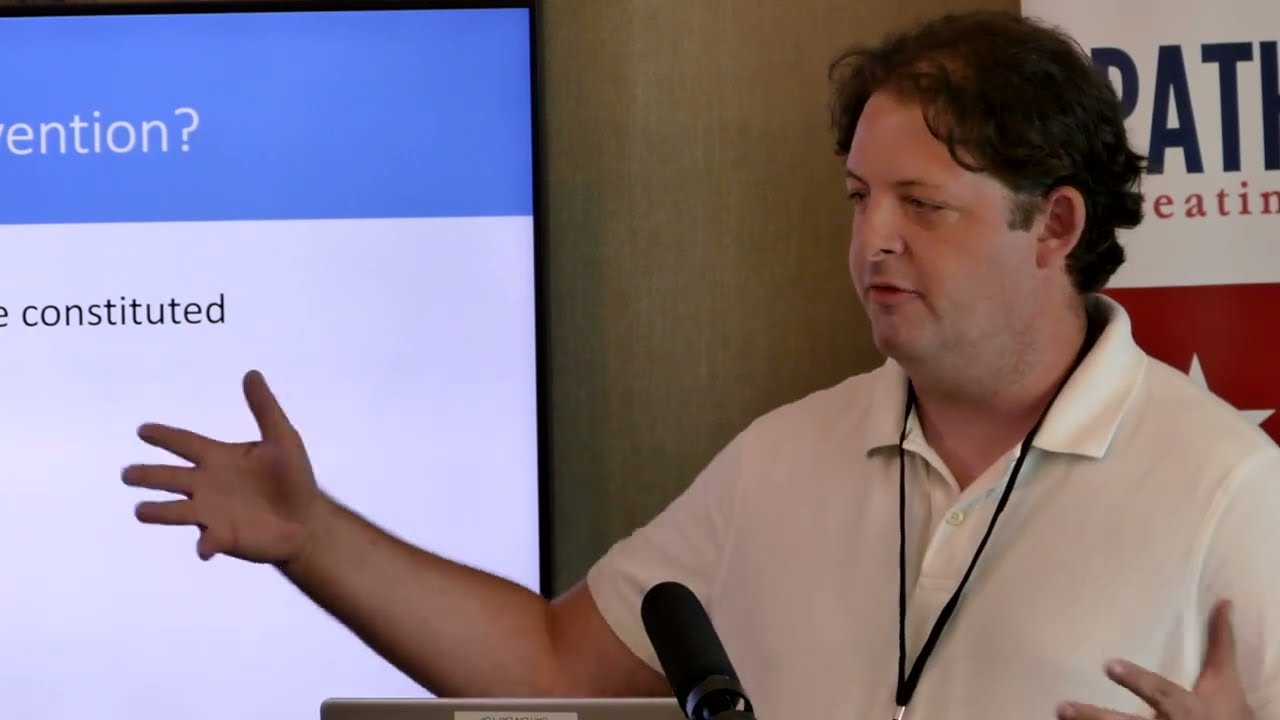 :{ on possible procedures for convention delegate selection, an issue ALEC is also trying to address through state legislation. }:
“Feedback on the presentations was overwhelmingly positive,” according to a recap email from Path to Reform and the State Legislators Article V Caucus, “thanks to the efforts [of] Sam Fieldman of Wolf-PAC,” among others.
In his presentation, Fieldman cited ALEC’s 2011Article V Handbook by Rob Natelson—a conservative constitutional theorist whose work underpins the fuzzy-math theory of convention applications—though later in the session he noted that he doesn’t agree with everything Natelson argues.
Wolf-PAC’s inclusion in the Academy of States infuriated the far-right leaders of COSA, as CMD has previously reported. Meckler, who believes Citizens United was “one of the greatest free-speech decisions in American history,” considers collaborating with Wolf-PAC to be “extraordinarily dangerous” and refused to engage in a previous Academy presentation due to their presence along with other “leftists.”
Yet distinctions between the groups are becoming increasingly muddled. In addition to attending the ALEC-sponsored Academies, Wolf-PAC members have been teaming up with a former COSA staffer to push convention legislation in various states.
In New Hampshire, former Wolf-PAC volunteer-turned-state Representative Jodi Newell (D-4) has introduced a procedural bill (HB 392) specifying that, should a constitutional convention ever be called, delegates would be elected by popular vote, not appointed by the state legislature. Both Fieldman from Wolf-PAC and Ken Quinn, a former regional director for the Convention of States effort and current regional director of U.S. Term Limits, testified in favor of the bill.
And although Wolf-PAC testified as neutral in a New Hampshire hearing on COSA’s convention application, the testimony had the effect of normalizing the work and claims of Michael Farris, one of the original founders of the Convention of States Project and former president of Alliance Defending Freedom, a conservative Christian hate group.
Wolf-PAC built upon Farris’s testimony, which proffered the “theoretical tools” that would limit a convention, by offering the “practical tools” that would work hand-in-hand with them.
U.S. Term Limits (USTL), which advocates for term limits at all levels of government, was founded by **Eric O’Keefe**, a right-wing operative with deep ties to the Koch political network who also co-founded Citizens for Self Governance (CSG), the parent group of COSA, where he sits on the board.
Wolf-PAC currently has applications for a constitutional convention pending in three states: Oregon (HJM 1), Washington (SJM 8002), and Maine (SJR 705). Only the Maine resolution—a joint product of Wolf-PAC and USTL that advocates for amendments addressing congressional term limits as well as political spending—specifies that the application “may not be aggregated with any other applications on any other subject.” The wording of the Oregon resolution indicates that the application only “intends” to be aggregated with those on a similar subject.
Big Picture
Legal experts note that there is nothing in the Constitution that limits the scope of a constitutional convention once called. They warn that a runaway convention could generate major changes to the balance of power between states and the federal government, and may end up undermining many rights and protections currently afforded under federal law. Scores of progressive and good-government organizations, including CMD, have joined together to oppose an Article V convention on those grounds.
After ALEC and its allies spent more than a decade arguing that fears of a runaway convention are baseless, it adopted a model No Runaway Article V Conventions Act in December 2021 to try to quell those fears. Wolf-PAC’s Fieldman teamed up with ALEC’s Biddulph at the Academy 2.0 that month to present on the bill, which would limit the types of amendments delegates could introduce at a convention to those that were included in its initial application.
Either way, any constitutional convention under the rules envisioned by ALEC and COSA would make it virtually impossible for Wolf-PAC’s anti-Citizens United amendment to succeed.
Most of the constitutional convention measures passed in recent years specify that each state would give legislative leaders the power to handpick its delegates and would get one vote, regardless of size, according to CMD’s research report titled *Convention of State Politicians*. Under those rules, Republicans would have “control over a nearly three-fifths supermajority of state delegations, enabling red states representing only a third of the U.S. population to determine what amendments get sent out to the states for ratification,” the report found.
Audio obtained by CMD confirms that this is the Right’s strategy. At an ALEC event, former Pennsylvania senator and current COS Senior Advisor Rick Santorum stated that, “We have the opportunity as a result of that to have a supermajority, even though…we may not even be in an absolute majority when it comes to the people who agree with us.”
“I think we are on the cusp of a supermajority moment,” Meckler added. To emphasize that progressives will have no say at a contemporary constitutional convention, Meckler pointed out that Tories had no role in the crafting of the Constitution and that Confederates had no choice in the adoption of post-Civil War amendments.
Wittingly or unwittingly, Wolf-PAC’s collaboration with ALEC helps right-wing dark money groups move closer to that objective. According to internal ALEC documents obtained by CMD, the organization is pushing for a constitutional convention as soon as summer 2024.
---
ref
:{
}:
The undersigned organizations strongly urge state legislatures to oppose efforts to pass a resolution to call for a constitutional convention. We also strongly urge state legislatures to rescind any application for an Article V constitutional convention in order to protect all Americans’ constitutional rights and privileges from being put at risk and up for grabs.
National organizations:
African American Health Alliance
African American Ministers In Action
AFSCME Retirees
Alliance for Justice
American Federation of Labor and Congress of Industrial Organizations (AFL–CIO)
American Federation of State, County and Municipal Employees (AFSCME)
American-Arab Anti-Discrimination Committee
Americans for Democratic Action (ADA)
Asian and Pacific Islander American Vote
Bend the Arc Jewish Action
Brennan Center for Justice
Campaign Legal Center
Center for American Progress
Center for Community Change
Center for Law and Social Policy (CLASP)
Center for Media and Democracy
Center for Medicare Advocacy
Center for Popular Democracy
Center on Budget and Policy Priorities
Children’s Defense Fund
Citizens for Responsibility and Ethics in Washington (CREW)
Coalition on Human Needs
Common Cause
Communications Workers of America (CWA)
Community Advocates Public Policy Institute
Daily Kos
Democracy 21
Democracy For America
Dream Defenders
Earthjustice
Eclectablog
Economic Policy Institute
EMILY’s List
Every Voice
Fair Elections Center
Faith in Public Life
Family Values at Work
Food Research & Action Center (FRAC)
Franciscan Action Network
Greenpeace USA
International Association of Fire Fighters
Jobs With Justice
Leadership Conference on Civil and Human Rights
League of Women Voters of the United States
Main Street Alliance
Mi Familia Vota
NAACP
National Asian Pacific American Families Against Substance Abuse
National Association of Social Workers
National Council of Asian Pacific Americans
National Council of Jewish Women
National Council of La Raza Action Fund
National Disability Institute
National Disability Rights Network
National Education Association (NEA)
National Employment Law Project (NELP)
National Fair Housing Alliance
National Korean American Service & Education Consortium (NAKASEC)
National Partnership for Women & Families
National WIC Association
National Women’s Law Center
People Demanding Action
People For the American Way
ProgressNow
Service Employees International Union (SEIU)
Sierra Club
Sisters of Charity of Nazareth Congregational Leadership
Social Security Works
State Innovation Exchange
The Arc of the United States
The Forum for Youth Investment
The Public Interest
The Voting Rights Institute
UNITE HERE
United Food and Commercial Workers (UFCW)
Voice for Adoption
VoteVets Action Fund
Women’s Voices Women Vote Action Fund
Working America
State and local organizations:
Alabama
Fair Housing Center of Northern Alabama
Alaska
Alaska AFL-CIO
Arkansas
OMNI Center for Peace, Justice & Ecology
Arizona
AFSCME 2960
AFSCME Retirees Chapter 97
Arizona Advocacy Network
Phoenix Day
Southwest Fair Housing Council
California
California Common Cause
City of Chino Housing Division
Courage Campaign
Fair Housing Advocates of Northern California
Colorado
ACLU of Colorado
America Votes Colorado
Colorado AFL-CIO
Colorado Common Cause
Colorado Ethics Watch
Colorado Fiscal Institute
Colorado People’s Alliance
Colorado Sierra Club
Colorado WINS
New Era Colorado
League of Women Voters of Colorado
ProgressNow Colorado
SEIU Colorado
Connecticut
Common Cause Connecticut
Connecticut Fair Housing Center, Inc.
Planned Parenthood of Southern New England
Holy Family Home and Shelter, Inc
Delaware
Common Cause Delaware
Florida
Common Cause Florida
Faith in Florida
Florida Consumer Action Network
Progress Florida
Georgia
9to5 Georgia Chapter
Black Voters Matter Fund
Common Cause Georgia
Georgia Coalition for the People’s Agenda
Georgia STAND-UP
League of Women Voters of Georgia
Partnership for Southern Equity
Hawaii
Americans for Democratic Action Hawaii
Hawaii Alliance for Progressive Action
Hawaii Appleseed Center for Law & Economic Justice
Hawaii Government Employees Association
Common Cause Hawaii
League of Women Voters of Hawaii
League of Women Voters of Honolulu
League of Women Voters Hawaii Island
Life of the Land
Idaho
ACLU of Idaho
Better Idaho
Idaho AFL-CIO
Illinois
Common Cause Illinois
Oak Park River Forest Food Pantry
Project IRENE
Indiana
Common Cause Indiana
Fair Housing Center of Central Indiana
Iowa
AFSCME Iowa Council 61
Congregation of the Humility of Mary
Iowa AFL-CIO
Kansas
Kansas AFL-CIO
Kentucky
Common Cause Kentucky
Jefferson County Teachers’ Association
Kentucky AFL-CIO
Kentucky Center for Economic Policy
UFCW Local 227
Louisiana
Greater New Orleans Fair Housing Action Center
Maine
Disability Rights Maine
Maine AFL-CIO
Maryland
ACE-AFSCME Local 2250
AFSCME Council 3
AFSCME Council 67
Baltimore Neighborhoods, Inc.
Benedictine Sisters of Baltimore
Common Cause Maryland
Disability Rights Maryland
League of Women Voters of Maryland
Maryland Center on Economic Policy
Public Justice Center
The Xaverian Brothers
Massachusetts
Massachusetts AFL-CIO
Michigan
Common Cause Michigan
Fair Housing Center of West Michigan
Progress Michigan
Minnesota
Alliance of Chicanos, Hispanics and Latin Americans (Rochester, MN)
Common Cause Minnesota
Indivisible Minnesota Local
League of Women Voters of Minnesota
Minnesota AFL-CIO
Minnesota Citizens for Clean Elections
TakeAction Minnesota
Women & Advocates Minnesota
Mississippi
Common Cause Mississippi
Mississippi AFL-CIO
Missouri
Vision for Children at Risk
Montana
Montana AFL-CIO
Nebraska
Common Cause Nebraska
Nebraskans for Civic Reform
New Hampshire
New Hampshire AFL-CIO
New Jersey
CWA Local 1081
New Jersey Association of Mental Health and Addiction Agencies, Inc.
Monarch Housing Associates
New Mexico
ACLU of New Mexico
AFSCME Council 18
Common Cause New Mexico
League of Women Voters of New Mexico
New Mexico Hospital Workers Union (1199NM)
New York
CNY Fair Housing, Inc
Common Cause New York
Disabled in Action of Greater Syracuse Inc.
Long Island Housing Services, Inc.
Schenectady Inner City Ministry
Solidarity Committee of the Capital District
Nevada
AFSCME 4041
AFSCME Nevada Retirees
Battle Born Progress
Culinary Workers’ Union Local 226
Let Nevadans Vote coalition
Nevada AFL-CIO
Nevada Conservation League
Nevada State Education Association (NSEA)
SEIU Nevada 1107
North Carolina
Common Cause North Carolina
Disability Rights North Carolina
Independent Living Resources (Durham, NC)
North Dakota
North Dakota AFL-CIO
Ohio
Cleveland Nonviolence Network
Common Cause Ohio
Equality Ohio
Ohio Voice
ProgressOhio
Toledo Fair Housing Center
Toledo Area Jobs with Justice
Oklahoma
Oklahoma AFL-CIO
Oklahoma Policy Institute
Oregon
Common Cause Oregon
Disability Rights Oregon
Pennsylvania
Bhutanese Community Association of Pittsburgh
Common Cause Pennsylvania
Community at Holy Family Manor (Pittsburgh, PA)
Just Harvest (Pittsburgh, PA)
Rhode Island
Common Cause Rhode Island
South Carolina
South Carolina AFL-CIO
South Dakota
South Dakota AFL-CIO
Tennessee
Common Cause Tennessee
Nashville CARES
Texas
Clean Elections Texas
Common Cause Texas
Harlingen Community Development Corporation
Utah
Tabitha’s Way
Vermont
Downstreet Housing & Community Development
P.S., A Partnership
Virginia
The Commonwealth Institute
Virginia AFL-CIO
Virginia Civic Engagement Table
Washington
Conscious Talk Radio
Washington AFL-CIO
Washington Community Action Network
Fuse Washington
Wisconsin
Access to Independence, Inc. (Madison, WI)
AFSCME Council 32
AFSCME Retirees Chapter 32
Citizen Action of Wisconsin
Common Cause Wisconsin
End Domestic Abuse Wisconsin
Grandparents United for Madison Public Schools
Independence First
League of Women Voters of Wisconsin
Madison-area Urban Ministry
Metropolitan Milwaukee Fair Housing Council
Midstate Independent Living Consultants
One Wisconsin Now
Options for Independent Living Inc (Green Bay, WI)
School Sisters of Saint Francis (Milwaukee, WI)
Survival Coalition of Disability Organization of Wisconsin
The Arc Wisconsin
Wisconsin AFL-CIO
Wisconsin Aging Advocacy Network
Wisconsin Coalition of Independent Living Centers,
Wisconsin Community Action Program Association
Wisconsin Council on Children and Families
Wisconsin Democracy Campaign
Wisconsin Faith Voices for Justice
Wisconsin Voices
National Association of Social Workers, WI Chapter
Dominicans of Sinsinawa – Leadership Council
West Virginia
West Virginia Citizen Action Group
Wyoming
Wyoming AFL-CIO
This statement was released in April 2017 and the list of signers was updated in March 2019 zzz ===
mta post --> mark levin vos BS
===
see tucker 4 anno
https://www.mediamatters.org/tucker-carlson/tucker-carlson-embraces-fringe-convention-states-movement
Carlson embraces fringe Convention of States movement
01/19/23
no lnx vid
fox News’ Tucker Carlson embraced a fringe idea for amending the Constitution known as the Convention of States, joining a growing list of right-wing media personalities who have been supportive of the movement.
Carlson’s comments came during an hour-long interview with former Tea Party activist and Convention of States Action president Mark Meckler, on Fox Nation’s streaming subscriber-only show Tucker Carlson Today. Meckler and his organization are the driving force behind the movement, which seeks to advance a far-right agenda by bypassing the traditional processes for amending the Constitution.
The Constitution has been amended 27 times, always by securing two-thirds support in both chambers of Congress as a first step. Article V of the Constitution provides for another option, though, in which two-thirds of state legislatures call for a convention to consider and put forward amendments. In both cases, any proposed amendment would then need to be ratified by three-fourths of the states. Meckler and his organization want to use the second, never-before-used method as a way of fundamentally transforming the federal government.
In theory, any kind of amendment could come out of a convention like the one envisioned by Meckler. In practice, virtually everybody pushing for this unlikely process are right-wing activists with a conservative agenda aimed at limiting progressive elements of the federal government. In that way, the push for a convention of states resembles rhetoric around states’ rights – nominally colorblind rhetoric that is in fact deeply hostile to civil rights and other progressive issues. The Convention of States Project’s parent organization, Citizens for Self-Governance, for example, donated $10,000 to America First Legal, an anti-civil rights legal group headed by former Trump adviser and white nationalist Stephen Miller.
What Meckler was proposing would elevate “the voice of ordinary people,” Carlson said. “It's a much more small d-democratic way of governance.” Over the course of the interview, he treated opposition to the idea – whether from Sen. Mitch McConnell (R-KY) or the Sierra Club – as absurd on its face, and an example of bad faith or faulty reasoning.
“I think anybody who's watched the last hour is certainly impressed by the way you've thought about this,” Carlson said near the end of the interview. “I personally am for it, thanks to you.”
Video
Citation From the January 17, 2023, edition of Fox Nation's Tucker Carlson Today
Most of Meckler’s policy proposals are boilerplate conservatism collected under the umbrella of so-called smaller government. But in the conversation with Carlson, he also espoused the much stranger view that direct election of U.S. senators – the law of the land thanks to the 17th amendment – was a mistake.
Meckler explained that “the 17th Amendment whereby we decided to directly elect senators instead of having them appointed by the states” was partly responsible for breaking the “structure” that the Constitution’s framers had envisioned.
“When we started electing senators, senators get their power from D.C.,” Meckler said later in the interview. “Prior to the 17th Amendment, senators are appointed by state legislatures, and that means the power of the Senate is in the states. And once they're elected, now their power base is in D.C., they serve their D.C. masters.”
Meckler isn’t the only conservative attempting to radically shift power towards state legislatures. A group of MAGA and Trump-aligned lawyers, including top coup architect John Eastman, have advanced an intellectually dubious doctrine called the independent state legislature theory, which would “give state legislatures wide authority to gerrymander electoral maps and pass voter suppression laws” according to the Brennan Center, a think tank that advocates for expanding voting rights.
Carlson joins right-wing media figures like former Trump adviser Steve Bannon and Fox News’ Mark Levin, who have also promoted Meckler’s movement. After speaking with Meckler in September, Bannon closed the interview by saying, “Taking down the administrative state; got to hit it from every angle.” Bannon has been pushing that line since at least 2017, when he told the audience at CPAC that his goal was the “deconstruction of the administrative state.”
Levin has been a supporter of the idea since at least 2013, when he published a book called The Liberty Amendments, which proposed a lot of the same ideas Meckler has put forward and coincided with the launch of his group. Several conservative pundits and politicians subsequently signed on to the idea as well, including Sean Hannity, Glenn Beck, Hugh Hewitt, as well as Sen. Marco Rubio (R-FL).
Meckler is deeply embedded in the conservative movement. He spoke at a transphobic rally last October that was attended by white supremacists and Proud Boys, as reported by LGBTQ Nation. Just months earlier, he was at CPAC – of which Convention of States Actions was a sponsor – fantasizing about which federal agencies to abolish. “How about we get rid of the Department of Education?” Meckler asked the audience, as reported in The New Republic. “How about we get rid of the EPA?”
Balanced budget, term limits, and the return of states' rights
Meckler’s goals extend beyond destroying federal agencies, though that is a central tenet of his philosophy. In his conversation with Carlson, Meckler expounded what he believed the top priorities of a convention of states should be.
Video
Citation From the January 17, 2023, edition of Fox Nation's Tucker Carlson Today
“The first subject is anything that would impose fiscal restraints on the federal government,” Meckler said. “So I mentioned a balanced budget amendment, things like tax caps, spending caps maybe tied to population plus inflation.”
Conservatives frequently talk about the need for a balanced budget amendment, usually based on the faulty analogy that the federal government operates like a family budget. Indeed, research from the Center on Budget and Policy Priorities, a progressive think tank, shows that a balanced budget amendment could be disastrous for the country, threatening Social Security and other welfare programs. But for conservative activists like Meckler, weakening the social safety net through austerity politics is likely a feature, not a bug, of the proposal.
“Second is anything that would impose term limits,” Meckler continued. Crucially, he doesn’t only want to impose term limits on elected officials and Supreme Court justices, but also on career civil servants. “How about on the bureaucracy, on the deep state, on staffers?” he asked. “These are the people really running Washington, D.C., and they shouldn't be there for 30 years. It was never intended to be a permanent career for people.”
“And that would prevent a Fauci from happening?” Carlson asked later, referencing Anthony Fauci, the former director of the National Institute of Allergy and Infectious Diseases.
“Absolutely,” Meckler responded.
Term limits for Congress is an increasingly popular idea on the right that some liberals, like Rep. Ro Khanna (D-CA), have also embraced. The case for term-limiting Supreme Court justices is far stronger than for imposing them on Congress, which risks further empowering lobbyists and accelerating the revolving door between public and private sector influence. There is considerable political science research that shows terms limits for Congress would likely exacerbate many of the problems the policy seeks to solve.
Meckler’s suggestion that career staffers should be barred from public service after a set amount of years is far more radical, but fits entirely inside the broader conservative goal of weakening progressive elements of the federal government. What Meckler is pushing here is just an updated version of Grover Norquists’s goal of making government small enough to “drown it in a bathtub,” or Bannon’s obsession with destroying the administrative state.
The effect of forcing out long-serving public employees would almost certainly shift even more power to the private sector, as elected officials and their staffs would be forced to outsource institutional knowledge to outside lobbying firms and think tanks. Like many conservative activists, Meckler offers lip service to decry the influence of lobbyists, but has deep ties to the Koch brothers, the Mercer family, and other major financiers on the right.
Carlson and Meckler’s singling out of Fauci, who right-wing media have chosen as the avatar of pandemic policies they oppose, echoes a recent moment from an episode of Bannon’s War Room podcast, guest hosted by Rep. Matt Gaetz (R-FL). Gaetz and 19 other hardliners blocked Rep. Kevin McCarthy’s (R-CA) bid for Speaker of the House until he offered concessions to the far-right faction, including reinstating something called the Holman Rule. That provision would allow any member to target the funding of any individual civil servant.
“If we'd have had this tool, we would have obviously directed it at Anthony Fauci,” Gaetz told Russ Vought, of the Center for Renewing America, a conservative think tank closely aligned with former President Donald Trump.
Meckler’s third and final stated goal for a potential convention is to pass “anything that would impose scope and jurisdiction restraints on the federal government,” he said. “And what that means fundamentally is going back to something like the enumerated powers.” He added later that the federal government was “never supposed to be involved in education or energy or health care or food production, agriculture, all of this stuff.”
There are two complementary ways to understand this proposal. At its most basic level, Meckler is channeling some sort of libertarian instinct here, with all of the obvious flaws that come with that political philosophy. Underneath that surface-level rhetoric is a more pernicious return to the rhetoric of states rights, a racist dog whistle that for decades allowed conservatives to mask their opposition to civil rights and progressive government policies as a principled small government philosophy.
There are very real criticisms to be made of the U.S. Constitution, which has many counter-majoritarian aspects built into it. There’s a strong case to be made that the Constitution is actually an impediment to building a more progressive, just, and small-d democratic society. That’s not what Meckler and his movement are about. The vision of the country they’re putting forward is a regressive one, oriented around states’ rights and all the racist implications that come with it
---
===
"con con"
12 22 mail
this year, CMD exposed how the American Legislative Exchange Council (ALEC) and right-wing groups like Convention of State Action are spending close to $25 million annually to push their stealth plan to rewrite the U.S. Constitution in order to lock in minority control and cripple the ability of the federal government to protect our rights, regulate big corporations, and deal with climate change.
Their goal? Forcing Congress to convene a constitutional convention that gives GOP leaders supermajority control over any amendments that get sent out to the states for ratification. And CMD released a report this year, “Convention of State Politicians,” documenting how voters would have zero say in the process.
But you don’t have to take my word for it.
CMD obtained audio from an ALEC meeting where former Pennsylvania Senator Rick Santorum actually said, “We have the opportunity, [through a constitutional convention], to have a supermajority, even though we may not even be in an absolute majority when it comes to the people who agree with us.”
===
==
artl 5 convention feingold
https://www.acslaw.org/projects/article-v/
Overview
Article V of the U.S. Constitution provides two avenues for amending the Constitution. One of those avenues – an Article V Convention – has never before been used, in part because it could put the entire Constitution on the chopping block. Factions of the far Right, however, are now actively working to orchestrate such a convention, with the goal of radically rewriting the U.S. Constitution to achieve partisan outcomes. If the outcomes of a mock convention held by factions of the Right in 2016 are any indication, an Article V Convention could see amendments aimed at disassembling modern government and the century-old New Deal consensus, returning the country to the troubling, splintered times when the federal government could do little to provide for national welfare or defense. This could include amendments to repeal the federal income tax, to require onerous supermajorities akin to the filibuster to raise other taxes, and to enable state legislatures to nullify federal laws and regulations. Given current political dynamics, it’s easy to also imagine amendments to ban abortion and enshrine extreme interpretations of the 2nd Amendment. ACS is actively educating the public about the dangers of this radical effort and the potential for it to send this country into a constitutional crisis even more dire than January 6th.
Publications
The Constitution in Jeopardy: An Unprecedented Effort to Rewrite Our Fundamental Law and What We Can Do About It
by Russ Feingold and Peter Prindiville
Over the last two decades, a fringe plan to call a convention under the Constitution’s amendment mechanism—the nation’s first ever—has inched through statehouses. Delegates, like those in Philadelphia two centuries ago, would exercise nearly unlimited authority to draft changes to our fundamental law, potentially altering anything from voting and free speech rights to regulatory and foreign policy powers. Such a watershed moment would present great danger, and for some, great power.
In this important book, Feingold and Prindiville distill extensive legal and historical research and examine the grave risks inherent in this effort. But they also consider the role of constitutional amendment in modern life. Though many focus solely on judicial and electoral avenues for change, such an approach is at odds with a cornerstone ideal of the Founding: that the People make constitutional law, directly. In an era defined by faction and rejection of long-held norms, The Constitution in Jeopardy examines the nature of constitutional change and asks urgent questions about what American democracy is, and should be.
In the News
The New York Times: A Second Constitutional Convention? Some Republicans Want to Force One
September 4, 2022
The Guardian: Ruling the US supreme court isn’t enough. The right wants to amend the constitution
September 19, 2022
Audio
Broken Law Podcast
Episode 68: The Constitution Is In Jeopardy
Twitter Space
Twitter Space: The Constitution in Jeopardy w/Russ Feingold and Peter Prindiville
American Constitution Society Podcasts · Twitter Space: The Constitution in Jeopardy w/Russ Feingold and Peter Prindiville
Recent Events
NOVEMBER 2, 2022
Conversation with ACS President Russ Feingold on “The Constitution in Jeopardy: An Unprecedented Effort to Rewrite Our Fundamental Law and What We Can Do about It”
4:30 PM – 5:30 PM, Eastern Time
Barrister’s Hall, Boston, Massachusetts
OCTOBER 11, 2022
ACS Philadelphia: The Constitution In Jeopardy with Russ Feingold and Peter Prindiville
12:30 – 1:30 PM, Eastern Time
Head House Books, Philadelphia, PA
OCTOBER 3, 2022
American Constitution Society Presents: A Conversation with Senator Feingold
12:15 – 1:20 PM, Central Time
University of Chicago Law School, Chicago, IL
===
===
an ah 9 22
Altering the U.S. Constitution in any way is always an uphill climb. For many years, liberal and progressive critics of the Electoral College have been calling for it to be abolished — only to be reminded by other liberals and progressives that doing so would mean changing the Constitution.
Meanwhile, on the far right, some MAGA Republicans have been calling for a full-fledged constitutional convention. That idea is by no means universally loved among conservatives. But in an article published by The Bulwark on September 12, author James M. Banner Jr. emphasizes that such a convention is not outside the realm of possibility if enough GOP-dominated state legislatures sign on.
“Radical conservative activists are working with Republican state legislators to trigger an extraordinary special convention to rewrite the Constitution of the United States,” Banner warns. “The possibility of it actually happening is real enough that everyone needs to pay attention — fast.”
READ MORE: **‘Clear and present threat to democracy’: GOP ex-defense secretary wants Donald Trump prosecuted**
Banner notes that outspoken opponents of such a convention can be found on both the left and the right.
“In a sense, this is old news,” Banner observes. “According to a New York Times article published over the Labor Day weekend, ‘Elements on the right have, for years, been waging a quiet but concerted campaign’ to force an amendatory convention. Likewise, organizations in the political center and on the moderate left — including Common Cause, the League of Women Voters, the Sierra Club, and the AFL-CIO — have long followed the progress of the scheme and tried to alert the public to its grave dangers. So have authoritative voices from both sides of the ideological spectrum, including late Supreme Court justices Arthur Goldberg, Warren Burger, and Antonin Scalia and such prominent constitutional law scholars as Laurence Tribe and Walter Olson.”
Banner adds, “Even a few unimpeachably conservative groups have published criticisms of the idea, as the Heritage Foundation did in a 2011 blog post noting ‘the lack of precedent, extensive unknowns, and considerable risks’ of such a convention.”
The author points out that an “aim” of Convention of States Action and other proponents of a constitutional convention is to “organize state legislatures…. under Article V of the Constitution.” Article V, Banner writes, “authorizes two-thirds of the state legislatures — that’s 34 today — to summon a convention to propose amendments to the nation’s fundamental law.”
“As with amendments proposed the traditional way, three-quarters of the states — 38 today — would then have to ratify the proposed alterations in order for them to become part of the Constitution,” Banner explains. “Amendments can be proposed piecemeal and accepted or rejected by the states in such a manner that few or none may end up being adopted. But the greatest danger is that there’s nothing in Article V that prevents an amendatory convention from following the example of the 1787 convention in Philadelphia, which became a runaway convention by simply assuming its freedom to propose a substitute for the very frame of government, the Articles of Confederation, under which it convened. Can we imagine anything as authoritative, carefully considered, and acceptable to the people of 38 states emerging from a runaway convention today?”
Banner warns that the “push for an Article V convention” has “immense potential for lasting harm.”
“A convention might be railroaded by one side,” according to Banner. “Depending on the method settled on for representation, it’s possible that the gathering could be so dominated by one party that the rules might be rigged — or, even if not rigged, open to charges of being rigged, as we’re no strangers to accusations of ‘fake news’ and ‘alternate truths’ — so that its legitimacy would be compromised from the start…. Everyone should be frightened to the core about the damage that even the run-up to such a convention would do to the body politic.”
Banner continues, “Any who write off the possibility or fail to take its proponents seriously assume responsibility for the disaster that’s likely to ensue should the proponents of an Article V convention succeed in setting one in motion. If that happens, the extraordinary American experiment in the self-government of an open society that has endured for over 230 years will be in never-before-experienced peril.”
---
ref
radical conservative activists are working with Republican state legislators to trigger an extraordinary special convention to rewrite the Constitution of the United States. The possibility of it actually happening is real enough that everyone needs to pay attention—fast.
In a sense, this is old news: According to a *New York Times* article published over the Labor Day weekend, “Elements on the right have for years been waging a quiet but concerted campaign” to force an amendatory convention. Likewise, organizations in the political center and on the moderate left—including Common Cause, the League of Women Voters, the Sierra Club, and the AFL-CIO—have long followed the progress of the scheme and tried to alert the public to its grave dangers. So have authoritative voices from both sides of the ideological spectrum, including late Supreme Court justices Arthur Goldberg, Warren Burger, and Antonin Scalia and such prominent constitutional law scholars as Laurence Tribe and Walter Olson. Even a few unimpeachably conservative groups have published criticisms of the idea, as the Heritage Foundation did in a 2011 blog post noting “the lack of precedent, extensive unknowns, and considerable risks” of such a convention.
While a handful of figures on the left have called for a convention, it’s mostly wealthy right-wing funders who have, largely and purposefully out of sight, bankrolled the organized effort to foist one upon the country. A group called Convention of States Action—originally launched as a project of the conservative group Citizens for Self-Governance—has over the last dozen years received large grants from the Mercer family and funders in the Koch network. The Koch-network-backed American Legislative Exchange Council (ALEC) has likewise been pushing for a gathering to amend the Constitution.
The aim of these efforts is to organize state legislatures, in some of which these right-wing funders wield outsized influence, to call a convention as provided for under Article V of the Constitution. This article authorizes two-thirds of the state legislatures (that’s 34 today) to summon a convention to propose amendments to the nation’s fundamental law. As with amendments proposed the traditional way, three-quarters of the states (38 today) would then have to ratify the proposed alterations in order for them to become part of the Constitution.
Amendments can be proposed piecemeal and accepted or rejected by the states in such a manner that few or none may end up being adopted. But the greatest danger is that there’s nothing in Article V that prevents an amendatory convention from following the example of the 1787 convention in Philadelphia, which became a runaway convention by simply assuming its freedom to propose a substitute for the very frame of government, the Articles of Confederation, under which it convened. Can we imagine anything as authoritative, carefully considered, and acceptable to the people of 38 states emerging from a runaway convention today?
Making the emergence of anything suitable from an Article V convention, whether runaway or not, even less likely is that the entire process for the authorization and functioning of a convention is under dispute. And reaching agreement on the process would be a matter of unprecedented constitutional contention among the states, Congress, and the federal courts. Crucially in this regard, the number of states whose legislatures have fully and legally called for an Article V convention remains uncertain. It could be as high as 29. In July, as the Times reported, a Republican member of the House of Representatives introduced legislation calling on the National Archives to provide Congress with a report on all state legislative actions pertaining to an Article V convention—actions approving such a call as well as actions that have rescinded previous resolutions of approval. Similar legislation introduced in previous years went nowhere, but that could change if it seems that the 34-state threshold is getting nearer.
in recent years, many Republicans, even those not usually of radical temperament, have amply demonstrated their eagerness to reject the norms of constitutional government for the sake of power. Witness the January 6th insurrection and all that led up to it. The push for an Article V convention is another of these chaotic, norm-denying efforts. And this one has immense potential for lasting harm.
While conservative activists, state-level Republicans, and megadonors have been serious about this project for years, Democrats have largely looked away, yawned, and left raising the alarm to good-government groups. Why are those groups raising the alarm, and what’s at stake? If realized, the scheme would threaten the geopolitical integrity of the United States as well as Americans’ unparalleled, historic, continuing experiment in democratic representative government.
One Democrat trying to sound the alarm is Russ Feingold, the former three-term senator from Wisconsin.In a timely new book, *The Constitution in Jeopardy*, Feingold and coauthor Peter Prindiville note that “hard-right activists have seized upon the seemingly arcane constitutional convention mechanism for two reasons”:
First, some argue that state legislatures—not the voters—would select convention delegates. Second, some also argue that at a convention each state would get one vote, making the convention radically more malapportioned than the Congress or the Electoral College (California’s 39.5 million citizens would have the same representation and vote as Wyoming’s 579,000). Neither of these two claims is a settled matter of law, and each has been the subject of intense debate among constitutional scholars for generations. Yet convention proponents embrace the uncertainty and praise its potential. Even if their extreme policies are rebuffed in Congress and at the polls, it is possible that activists might be able to use the amendment mechanism to foist their agenda on an unwitting majority.
The Constitution of the United States isn’t a perfect document. From its 1788 ratification, it has revealed its many flaws. One of its principal imperfections is the difficulty of amending it. But while that’s made our frame of government frustratingly rigid, it has also made it unusually stable. Once we exclude the original ten amendments known as the Bill of Rights, it has been amended only 17 times—on average roughly only once every 13 and a half years—since 1790.
By comparison, our sister republic France has by various means adopted and then tossed out, depending what you count, upwards of 15 formal written constitutional documents since 1789 and in the process—overlooking directorates, consulates, empires, and monarchies—created a series of republics of which the current Fifth French Republic is the most recent. As in so many other ways, the United States is exceptional among nations. It’s still governed by its original constitution, and its regime remains that of the First American Republic.
Yet there’s nothing sacred about the Constitution. Its origins always giving us pause, they should serve as a warning about all such efforts. The Framers were representatives of the agricultural and commercial gentry, all white males and many of those slaveholders; and the document they agreed on in Philadelphia, however extraordinary it has proved even with its imperfections, represented the politics, thought, and convictions of gentlemen of the particular social status they occupied. Through its few amendments, especially the Civil War-era Thirteenth, Fourteenth, and Fifteenth, we’ve rid ourselves, at least formally, of the most outrageous features of the original document—those protective of slavery and government by white males only. But other of its provisions, especially those that give each state equal representation in the Senate and provide for our unique Electoral College, have prevented, many would say, the full blossoming of a democracy in which every citizen’s vote would equal that of every other and the majority of voters of the entire nation would decide presidential elections.
It’s not irrational to suppose that a second constitutional convention composed of women as well as men, people whose families came from outside northern Europe, LGBT citizens, and people poor as well as rich and of all walks of life would write and send to the states for ratification a different document than the one that now orders our public affairs.
But would that constitution be better than the one we have? Would the kind of bargain that, in order to gain constitutional protection for abortion, would have to retain the Second Amendment be acceptable to state ratifying conventions whose members wanted also to curb gun rights? Would securing a provision to assure a balanced Supreme Court membership be worth reciprocally accepting a balanced budget provision, especially given the funds that would pour into convention candidates’ pockets from wealthy people and corporations to secure a balanced budget requirement?
And who would be our George Washington, our James Madison, our Alexander Hamilton? To be sure, those men had and still have detractors, and they differed, often sharply, among themselves. Even so, because they by and large came from similar backgrounds, were beneficiaries of similar educations, and enjoyed the same social standing, they more or less understood each other’s ideas, shared a common eighteenth-century Western worldview, and could thus come with decent comity to accept the constitution that remains in force.
But today? Who would serve as convention president, Newt Gingrich or Elizabeth Warren? Who’d be our James Madison—would it be one of the talking heads among cable-news favorites to argue gravely about constitutional matters, or would Judge Judy take the job? And who’d fill Alexander Hamilton’s shoes: Elon Musk or Bernie Sanders? Where would we look for our latter-day Ben Franklins—of course of different hues, sexual inclinations, occupations, residencies, and net worth!—to play Old Wisdom to the delegates?
However delicious may be the parlor game of imagining its cast of characters, it’s not hard to imagine a convention not even reaching consensus on small matters, let alone big ones. Alternatively and worse, a convention might be railroaded by one side: Depending on the method settled on for representation, it’s possible that the gathering could be so dominated by one party that the rules might be rigged—or, even if not rigged, open to charges of being rigged, as we’re no strangers to accusations of “fake news” and “alternate truths”—so that its legitimacy would be compromised from the start. There’s also the danger of rigged rules allowing what Feingold and Prindiville call the danger of “renegade delegations” eventuating in a runaway convention.
And if a convention’s rules were challenged in court, what would protect us against the members of the Supreme Court intervening in a way that further undermined the legitimacy of both the convention and the Court—especially if some of the alterations to the Constitution under consideration were to touch on the Court itself?
Finally there’s danger even in a convention that fizzles out. Imagine an effort to call a convention that nears the 34-state threshold but doesn’t quite reach it. Or a sham convention—a gathering of delegations that has not met the threshold for legitimacy but assembles regardless and attempts to fudge the question of legitimacy. Or a legitimate convention that deadlocks and fails to recommend constitutional amendments. Or a convention that proposes amendments which then fall short of ratification. Many other complications can be imagined. But one conclusion is inescapable: Any intensive push to cross the constitutional finish line for an Article V convention has the potential to create huge new tears in the nation’s constitutional fabric.
---
:{
}:As Edmund Burke long ago tried to teach us, stability as well as adjustment is necessary in a political regime just as it is in society. It’s probably better to live with the constitutional defects we know than the ones, unknown to us now, that would inevitably find their way unanticipated into a new frame of government. But more important is the fact that if a comparatively homogeneous group of men had difficulty coming to agreement on a constitution that, with some alteration, has withstood over 230 years of political experience and change, how much better at the job would be a gathering representing the fractious, brittle, at-each-others’-throats political and social realities of today’s United States?
The question yields its answer. Everyone should be frightened to the core about the damage that even the run-up to such a convention would do to the body politic. Any who write off the possibility or fail to take its proponents seriously assume responsibility for the disaster that’s likely to ensue should the proponents of an Article V convention succeed in setting one in motion. If that happens, the extraordinary American experiment in the self-government of an open society that has endured for over 230 years will be in never-before-experienced peril.
===
https://www.alternet.org/2022/08/right-wing/
the next step for the right-wing is a plot to change the U.S. Constitution to make it significantly more conservative by creating a Constitutional Convention among red states.
Article V in the US Constitution allows for two methods of amending the document. They can gather a two-thirds majority of Congress to propose an amendment and have it ratified by three-fourths of the states. The other option is having two-thirds of U.S. states call a constitutional convention and passing and ratifying amendments.
Business Insider reported about the effort encouraged by former Sen. Rick Santorum (R-PA), who was kicked out of office in 2006 by nearly 18 points. But that loss doesn't mean that he can't force his will on the rest of the country.
Speaking at the Dec. 2021 American Legislative Exchange Council (ALEC) policy summit, Santorum explained that he and his allies want to remake the U.S. into a solidly conservative nation.
"You take this grenade and you pull the pin, you've got a live piece of ammo in your hands," Santorum explained in audio captured by the Center for Media and Democracy. "34 states — if every Republican legislator votes for this, we have a constitutional convention."
Insider conducted interviews with a dozen people involved in the constitutional convention movement, revealing just how well-funded it is, partially through cryptocurrency.
"This isn't an exercise, either. State lawmakers are invited to huddle in Denver starting on Sunday to learn more about the inner workings of a possibleconstitutional convention at Academy of States 3.0, the third installment of a boot camp preparing state lawmakers 'in anticipation of an imminent Article V Convention,'" said the report.
The conservatives aim to change the constitution so that it would eliminate national education requirements, making it harder for any territory to garner statehood, eliminate many federal environmental standards, and make it difficult or impossible for someone like Anthony Fauci to ever work for decades within the government.
While Santorum is one of the supporters, the others are strong MAGA activists like Gov. Ron DeSantis (R-FL), John Eastman and Fox network hosts Sean Hannity and Mark Levin.
"It's the most extraordinary thing in my career that I've ever been a part of," Eastman said in a video published by the simulation group. "The process actually works."
The constitutional convention activists are meeting on Sunday, ahead of the National Conference of State Legislatures national meeting.
"The group boldly forecasts that a new constitutional convention could take place in 24 months and quotes former President Barack Obama in emphasizing, 'You can't change Washington from the inside,'" said the report.
Even if it doesn't happen in the next two years, it's something that these leaders are pressing forward.
Read the full revelations in Insider's deeply researched piece.
https://www.businessinsider.com/constitutional-convention-conservatives-republicans-constitution-supreme-court-2022-7
===
yikes no lnx
HOME POLITICS
Republicans' next big play is to 'scare the hell out of Washington' by rewriting the Constitution. And they're willing to play the long game to win.
Grace Panetta and Brent D. Griffiths Jul 31, 2022,
Conservatives' next big play is an unprecedented rewrite of the Constitution.
The conservative movement isn't done reshaping the Constitution from the ground up.
Conservatives are now pushing an unprecedented convention to re-write the US bedrock text since 1788.
So far, 19 GOP states have joined a rapidly-growing conservative movement to call a new convention.
As former Republican senator Rick Santorum addressed Republican lawmakers gathered in San Diego at the American Legislative Exchange Council policy summit, he detailed a plan to fundamentally remake the United States.
It would become a conservative nation.
And the transformation, Santorum said, culminates with an unprecedented event: a first-of-its-kind convention to rewrite the Constitution.
"You take this grenade and you pull the pin, you've got a live piece of ammo in your hands," Santorum, a two-time GOP presidential candidate and former CNN commentator, explained in audio of his remarks obtained by the left-leaning watchdog group the Center for Media and Democracy and shared with Insider. "34 states — if every Republican legislator votes for this, we have a constitutional convention."
The December 2021 ALEC meeting represents a flashpoint in a movement spearheaded by powerful conservative interests, some of whom are tied to Trumpworld and share many of Trump's goals, to alter the nation's bedrock legal text since 1788. It's an effort that has largely taken place out of public view.
But interviews with a dozen people involved in the constitutional convention movement, along with documents and audio recordings reviewed by Insider, reveal a sprawling, well-funded — at least partly by cryptocurrency — and impassioned campaign taking root across multiple states.
Notably fueling them: success.
Anti-abortion protesters wear shirts that read "I am the Pro-Life Generation" as they demonstrate in front of the U.S. Supreme Court, Wednesday, Dec. 1, 2021, in Washington,
Conservatives played the long game for decades to secure a supermajority on the Supreme Court. Andrew Harnik/AP
During an extraordinary few weeks in June, the Supreme Court's three new Trump appointees powered the reversal of Roe v. Wade. They fortified gun rights and bolstered religious freedoms. Future presidents now have less power to confront the climate crisis. Each win is the product of a steady, and in some cases, decades-long quest by conservatives to bend the arc of history rightward.
This isn't an exercise, either. State lawmakers are invited to huddle in Denver starting on Sunday to learn more about the inner workings of a possible constitutional convention at Academy of States 3.0, the third installment of a boot camp preparing state lawmakers "in anticipation of an imminent Article V Convention."
Rob Natelson, a constitutional scholar and senior fellow at theIndependence Institute who closely studies Article V of the Constitution, predicted to Insider there's a 50% chance that the United States will witness a constitutional convention in the next five years. Whether it happens, he said, is highly dependent on Republicans' success winning state legislatures during the 2022 midterm elections.
But not everyone in the conservative constitutional convention movement believes such a gathering is so imminent. It will likely take years more work to reach their goal, if they ever do.At minimum, Republicans will need to flip several Democratic-controlled state legislatures and convince remaining GOP holdouts of the necessity for a convention.
But during the past several decades, they've made progress. Lately, a lot.
And now, they have a plan.
Conservatives are pushing a never-before-tested convention
Article V to the US Constitution provides two ways to amend the nation's organizing document — the most difficult, but most dramatic way to alter American society's very foundation.
The first is for a two-thirds majority of Congress to propose an amendment, with three-fourths of states ratifying it. This is how all 27 of the current amendments to the Constitution were added, but it's a path that today is largely blocked because of intractable partisan divisions. No American under 30 has experienced the nation amending the Constitution in his or her lifetime.
The second method — never before accomplished — involves two-thirds of US states to call a convention. The power to call for a convention belongs solely to state legislatures, who would pass and ratify amendments without a governor's signature, Congress' intervention, or any input from the president.
Some states have tried and tried — without result — to prompt a constitutional convention. They've together issued hundreds of pro-convention resolutions or calls over 200 years to reroute constitutional amendment powers away from Washington. What's new now is the ever-evolving power coupling of a corporation-backed ideological juggernaut led by ALEC, a nonprofit organization with close ties to large tobacco and drug companies, and a determined Republican Party increasingly dominating many of the nation's 50 statehouses.
If they were successful, a constitutional convention led by conservatives could trigger sweeping changes to the Constitution.
Their goals include gutting federal environmental standards, nixing nationwide education requirements, and creating an incredibly high threshold for Washington, DC, or a territory to earn statehood. Some would like to make it difficult, if not impossible, for someone — National Institute of Allergy and Infectious Diseases Director Anthony Fauci, for example — to work for decades within the federal government.
Former President Donald Trump, close to announcing a campaign for a second term in office, would find much to love about the convention movement.
He's argued that Article II gave him sweeping presidential powers akin to Richard Nixon's famous declaration that "when the president does it, that means that it is not illegal." Trump also attempted to claim that he could unilaterally end birthright citizenship (he could not) and repeatedly argued the White House didn't have to comply with congressional subpoenas.
Some of President Donald Trump's current and former close allies are pushing a Constitutional convention. Alex Brandon/AP
The planks of the Convention of States' movement — such as term limits for federal bureaucrats in addition to members of Congress — stand to attract acolytes of Trumpism savoring the means to MAGA-fy the Constitution, and therefore, the nation.
In fact, it already has. Constitutional convention boosters include many of Trump's current and former allies, including conservative legal scholar John Eastman, Florida Gov. Ron DeSantis, and Fox News personalities like Sean Hannity and Mark Levin.
Eastman, who recently had his phone seized by federal agents investigating Trump's attempts to overturn the 2020 presidential election results, attended a 2016 mock convention hosted by the Convention of States.
"It's the most extraordinary thing in my career that I've ever been a part of," Eastman said in a video produced by the convention simulation organizers. "The process actually works."
Six years later, the Academy of States 3.0 is taking place Sunday ahead of the National Conference of State Legislatures' 2022 summit in Denver. On its website, the group boldly forecasts that a new constitutional convention could take place in 24 months and quotes former President Barack Obama in emphasizing, "You can't change Washington from the inside."
"It's a heavy lift, but it's not out of reach," Arn Pearson, the Center for Media and Democracy's executive director and a close watcher of the convention movement, told Insider. "I think it's a real threat."
Conservative activists are playing the long game
Conservatives have embraced the political long game in achieving their most prized policy goals, like the overturning of Roe v. Wade — and the movement to call a convention may be no different.
"For the last 25 years, people in the pro-life movement did the blocking and tackling necessary for this day to come," Santorum said at the December 2021 ALEC summit. "No one five years ago would have said that Roe vs Wade would be overturned. No one in this room."
gracepanetta · Mark Meckler & Rick Santorum at 2021 ALEC summit
The GOP spent decades investing in control of state legislatures through well-funded and resourced groups like the Republican State Leadership Committee, which has spent tens of millions over the last few decades locking down GOP control of state legislatures, statewide offices, and judgeships.
Those sustained investments have secured GOP dominance in state legislatures for a generation — and guarantee the GOP would also have the upper hand in a convention.
A new report by the Center for Media and Democracy first shared with Insider finds that Republicans would control at least 27 and up to 31 out of 50 delegations to a convention, based on delegate selection processes in applications passed thus far.
That's still a tad short of what would ultimately be needed to make any changes: two-thirds of the state legislatures are needed to call a convention and three-fourths must vote to ratify any amendments. Notably, governors, Congress, and the White House have no role in this specific process.
But the movement's most devoted supporters, like Santorum, say they are in for the long haul — and they argue that changing the Constitution is a goal existential to America's existence that looms larger than a single election cycle.
"Yeah, we'll have a good election. But the movement is inextricable. Why? Because every institution in America is against us," Santorum said, invoking the founders and their vision of federalism. "I say to you, as Republican state legislators, that you actually have the key."
[South Carolina Sen. Chip Campsen, R-Isle of Palms, left, and Rep. Bill Taylor, R-Aiken, right, listen to a senator speaking online during a conference committee hearing on Wednesday, June 15, 2022, in Columbia, S.C.
South Carolina state Rep. Bill Taylor, R-Aiken, right, told Insider a convention would "scare the living hell" out of Washington. AP Photo/Jeffrey Collins
Activists also say that with Congress sharply divided, a convention would send an unmistakable message to Washington that lawmakers need to change their way — or be prepared to get run over.
"The states have sort of lost their voice, and all we can do now is beg from the cheap seats and say, 'Hey, don't do that," said state Rep. Bill Taylor of South Carolina, who led his state's push to pass a call for a convention.
Faced with a Washington dominated by Democrats, many conservatives want to unleash a force to put the nation's Capitol on notice.
"The idea of states coming together is going to scare the living hell out of Washington," Taylor told Insider. "They are going to be terrified of the states."
The right isn't alone in pursuing a convention. On the left, Cenk Uygur, a progressive commentator, founded Wolf PAC in the wake of the Supreme Court's landmark 2010 decision in Citizens United v. Federal Election Commission that accelerated an era of big-money politics. Five Democratic states passed Wolf PAC's call for a campaign finance reform-focused convention: California, New Jersey, Illinois, Vermont, and Rhode Island.
Uygur's organization is pressing forward even as Illinois and New Jersey rescinded their calls out of fear of a conservative-dominated convention. Wolf PAC's early momentum also spooked some on the right, an illustration of the unusual alliances on both sides of the movement. In 2012, the Republican National Committee went so far as to pass a resolution formally opposing the convention movement.
But now in 2022, convention proponents have political winds at their backs.
"The movement right now seems to be gaining steam. And what's interesting is it seems to be gaining steam on both left and right," Karla Jones, senior director of international relations and federalism at ALEC, told Insider. "The feeling that Washington, DC, has become a cause for the nation's problems rather than a solution … is becoming universal on both sides of the aisle."
In this Nov. 3, 2010 file photo, Tea Party Patriots co-founders Mark Meckler, right, and Jenny Beth Martin, take part in a news conference at the National Press Club in Washington
Tea Party Patriots co-founder Mark Meckler, pictured here in 2010, now leads the Convention of States movement.
A convention is gaining momentum but still far away
So far, 19 GOP-controlled states, including four in 2022 alone (Nebraska, South Carolina, West Virginia, and Wisconsin), have passed applications and calls for a constitutional convention under the model pushed by the conservative nonprofit group Convention of States, an offshoot of Citizens for Self Governance.
Because of their efforts, "it's the first time any of these applications have had this much movement in quite some time," Viki Harrison, director of Constitutional Convention and Protecting Dissent Programs at Common Cause, told Insider. She called the passage of four new convention calls in states including South Carolina "a brutal loss."
Citizens for Self Governance and Convention of States, led by former Tea Party activist and ex-Parler CEO Mark Meckler, are relatively newer and well-funded players on the scene with connections to wealthy and powerful conservative interests.
Tax filings obtained by the Center for Media and Democracy reveal the groups, which are not required to disclose their donors, have received millions from the Koch-connected DonorsTrust, the Mercer family, and groups linked to powerful conservative lawyerLeonard Leo.A 2020 internal audit of Convention of States obtained by the group revealed that a$1.3 million donation made in Bitcoinmade up 16% of the group's budget in 2019. Two donations totaling $2.5 million accounted for 36% of the group's 2020 budget.
While the various offshoots of the movement may have momentum on their side, they don't yet have the math to get to 34 states, as would be necessary to call a convention. Some are skeptical they ever will, no matter how well Republicans do at the polls in 2022 and beyond.
US Senator Ted Cruz (L) speaks with commentator Mark Levin during a discussion of the Constitution during the Conservative Political Action Conference (CPAC) at National Harbor, Maryland, February 23, 2017.
Senator Ted Cruz, left, told Insider the convention movement could pressure Congress to amend the Constitution themselves. Mike Theiler/AFP via Getty Images
"It's clear to everybody working on this that the convention proponents have no honest path to 34 states," David Super, a professor, and constitutional law expert at Georgetown University Law Center, told Insider. "They've reached their limit."
But several convention organizers and supporters say they don't even need a convention to change the Constitution. They point to how fed-up states pushed for a convention to directly elect US senators after the Senate, for years, refused to consider resolutions calling for direct election. The 17th amendment, ratified in 1912, is a testament to that strategy.
More than a century later, one prominent Republican sees history — at least procedurally — repeating itself.
"What is most likely is that as we move closer to a convention of the states that at the last minute, Congress will blink and pass the underlying amendments. That's what history shows us is likely to happen," GOP Sen. Ted Cruz of Texas, a former presidential candidate who is eyeing another run in 2024, told Insider.
Cruz, who is himself pushing a term-limits amendment, also did not express definitive support for a convention.
A convention of states would be the first of its kind since the original Constitutional convention in Philadelphia in 1787. DeAgostini/Getty Images
The fear of a 'runaway' convention looms large in the debate
Because the states have never called a convention under Article V since the Constitution's creation, the exact mechanics are the subject of intense debates between legal scholars and activists
The prospect of a free-for-all convention has scared lawmakers away from other historic efforts to rewrite the nation's Constitution, fearing that a debate on imposing term limits or a balanced budget could quickly morph into a full-fledged redesigning of gun, abortion, religious, or free speech rights.
Right-wing organizations such as the John Birch Society oppose a convention out of fear that it could open the door to weakening constitutional rights.
So does Rep. Andy Biggs of Arizona, a staunch Trump defender who wrote an entire book, "The Con of the Con-Con," about the dangers of conventions.
"In states where you would have expected this to pass because they have Republican leadership, they're firmly on our side because they're scared about losing guns," Harrison said.
Natelson, who has published numerous writings and academic articles on Article V, charged that people who fear a runaway convention "don't know what they're talking about" and GOP legislatures that have resisted calling a convention out of those worries "have been sold a bill of goods."
"Those academics who go before the legislature and say things like, 'we don't know anything about the process, it could be a runaway convention' without exception, are people who have never published any scholarship on the subject," he said.
And advocates for a constitutional convention have pushed narrow visions for a convention that they say would bind future delegates from passing extreme amendments. Natelson argued that not a single convention of colonies, compact of states, or simulated convention held since the nation's founding has "run away" from its mandate.
John Eastman with Rudy
John Eastman, seen here alongside Rudy Giuliani, attended a Convention of States simulation in 2016. Jim Bourg
At the Convention of the States' 2016 mock convention in Williamsburg, Virginia, delegates, including Eastman, voted out six amendments, including a proposal that would eviscerate the 16th Amendment, which grants Congress the ability to impose an income tax.
The resolution the group is pushing would limit a convention to amendments that "impose fiscal restraints on the federal government, limit its power and jurisdiction, and impose term limits on its officials and members of Congress."
But limiting "the power and jurisdiction" of the federal government is an expansive mandate that could encompass virtually anything and enable delegates to pass extreme amendments while technically staying within the bounds of the convention.
"I defy you to name a Constitutional amendment that you might want that I couldn't characterize as one of the three things in the Convention of States," Super said. "You want to repeal the 14th Amendment Equal Protection Clause? That's limiting the power of the federal government to interfere with state laws. Almost anything you want, you can characterize as one of those things."
Convention of States invokes hot-button issues like abortion on its website. Meg Kinnard/AP
'A brilliant strategy for controlling a political agenda'
Recent blog posts on the Convention of States' website explicitly reference the need for a convention to limit federal overreach on abortion, guns, and immigration.
"The Supreme Court has said that amending the Constitution is a political question in which the federal courts cannot get involved," Super said. "The president has no role at all in the process. And the whole point of the convention route is to sideline Congress. So Congress can't overrule the convention … there's no one to intervene. There's no one to stop a convention from doing whatever they want to do."
States have the flexibility to caveat their calls for a convention, and some have included penalties to keep delegates in line. Indiana and Florida have even made it a felony for convention delegates to defy the legislature's intent, measures they passed alongside their pro-convention resolutions.
Super, however, said that criminal penalties punishing rogue delegates are not "constitutional" or "enforceable" because of the Supreme Court's 2000 ruling in Bush v. Gore that their home state's laws don't bind state officers performing national duties.
Legal constraints aside, Natelson argued that a runaway convention could only happen in "horse and buggy times" with minimal communication between delegates and legislatures, and would be "practically impossible" in 2022, a world driven by a 24-hour news cycle and instant methods of communication like calling and texting.
"They're going to be under the glare of publicity, and everybody's going to be watching every minute," Natelson said.
A convention in the 21st century would take place in the ecosystem of social media and the 24-hour news cycle. J. Scott Applewhite/AP
The framers also added a second buffer to the process. Conventions or Congress can propose a constitutional amendment, but three-fourths of the state legislatures, 38, need to ratify it into the Constitution, a process that is also not subject to a governor or president's veto.
Conservatives and liberals alike say this requirement would doom hyperpartisan or plain loony amendments.
"The convention has way more safeguards than Congress itself," Nick Tomouldies, executive director of US Term Limits, a group pushing for a convention solely focused on imposing congressional term limits, told Insider. "Controversial issues like taxes and guns and abortion need not apply, because you're never going to get through that gauntlet."
But Pearson countered that a convention just passing a polarizing amendment would allow conservatives to play the long game and "dominate the political debate in the country for the next decade" with contentious ratification battles in the states.
"It's a brilliant strategy for controlling a political agenda for quite some time," he said.
The Convention of States movement is 'the full package'
Behind closed doors, Meckler, Santorum, and Natelson pitched a convention to GOP lawmakers gathered at a December 2021 ALEC workshop as a way for ordinary citizens to force sweeping changes to every facet of government.
"We would be aiming at the Deep State and potentially the federal judiciary as well," Meckler told lawmakers in the closed-door session, a recording of which was obtained by the Center for Media and Democracy and shared with Insider.
gracepanetta · "Leftist Plot or Plan to Save America” workshop at ALEC's December 2021 policy summit
Meckler argued in the session that a convention focused on only term limits, which he criticized as "dangerous," or only a balanced budget amendment, wouldn't be enough to rein in the federal government — or to mobilize enough people behind the convention movement.
"We have to be able to showpeople that they have a chance to get their hands around the throat of the federal government and put it back in the Constitutional box," he said in the audio obtained by the Center for Media and Democracy. "None of the individual efforts do that. The only thing that provides the narrative that drives 5 million people to participate in Convention of States … is the full package."
[A protester sporting a message on her protective mask and holding the U.S. Constitution poster, sends a message to Gov. Newsom while joining thousands of protesters at the intersection of Main Street and Pacific Coast Highway in the``March to Open California'' to call on Gov. Newsom to re-open the beaches and relax the state's stay-at-home orders under COVID-19 in Huntington Beach, CA, on May 1, 2020
Convention of States wants to seize on conservatives' discontent and anger with their government.
Moments later, Meckler said his effort could be judged by its "enemies," railing against a slew of "leftist" advocacy groups who oppose a convention.
"It's everyleftistgroup in America, radical leftistgroup in America that stands for, I would argue, the destruction of America, the destruction of babies in the womb, the destruction of life itself," he said. "They hate America, they want to destroy America, and they're against Convention of States."
Santorum also assured lawmakers that conservative interests would be strongly represented in a one-vote-per-state convention due to the outsize influence of lower-population states, saying, "we have the opportunity, as a result of that, to have a supermajority, even though…we may not even be in an absolute majority when it comes to the people who we agree with."
The conservative movement isn't resting on the laurels of its victories in the Supreme Court arena but is aggressively pioneering new frontiers to reshape every aspect of American law and society.
And while a no-holds-barred Constitution convention may seem far-off, the ideological fervor driving the convention movement and the ambitious aims of its proponents guarantee it won't be going away anytime soon.
"This is the opportunity the founders gave you, state legislators. They gave you the power to fix this country," Santorum told lawmakers gathered at the 2021 ALEC meeting, his voice booming. "With all due respect, how dare you not try? How dare you, in the face of what's going on in this country?"
KEEP READING
More: Constitution Politics BI
lnx:
https://www.businessinsider.com/constitutional-convention-conservatives-republicans-constitution-supreme-court-2022-7
simulation: COSAction (conventionofstates.com)
vids:
We know you are anxious to see the complete results, and we appreciate your patience. As an independent assembly, the statement about the final results from the Convention must come from the body, and not our organization. We will circulate it on behalf of the Convention.
Here's a quick preview. The Convention passed amendment proposals on the following six ideas:
- The public debt shall not be increased except upon a recorded vote of two-thirds of each house of Congress.
- Term limits on Congress
- Limiting federal overreach by returning the Commerce Clause to its original meaning
- Limiting the power of federal regulations by giving an easy congressional override
- Require a super majority for federal taxes and repeal the 16th Amendment [fed income tax?]
- Give the states (by a 3/5ths vote) the power to abrogate any federal law, regulation or executive order.
The events at Williamsburg will be remembered as a turning point in history. The spirit of liberty and self government has been reignited." Michael Farris - Co-Founder, Convention of States Project.
---
not complete but most links
biz insider
common cause : ConCon-Opposition-Letter-March-2019.pdf (commoncause.org)
A convention is gaining momentum but still far away
So far, 19 GOP-controlled states, including four in 2022 alone (Nebraska, South Carolina, West Virginia, and Wisconsin), have passed applications and calls for a constitutional convention under the model pushed by the conservative nonprofit group Convention of States, an offshoot of Citizens for Self Governance.
because of their efforts, "it's the first time any of these applications have had this much movement in quite some time," Viki Harrison, director of Constitutional Convention and Protecting Dissent Programs at Common Cause, told Insider. She called the passage of four new convention calls in states including South Carolina "a brutal loss."
Citizens for Self Governance and Convention of States, led by former Tea Party activist and ex-Parler CEO Mark Meckler, are relatively newer and well-funded players on the scene with connections to wealthy and powerful conservative interests.
Tax filings obtained by the Center for Media and Democracy reveal the groups, which are not required to disclose their donors, have received millions from the Koch-connected DonorsTrust, the Mercer family, and groups linked to powerful conservative lawyer Leonard Leo. A 2020 internal audit of Convention of States obtained by the group revealed that a $1.3 million donation made in Bitcoin made up 16% of the group's budget in 2019. Two donations totaling $2.5 million accounted for 36% of the group's 2020 budget....
so does Rep. Andy Biggs of Arizona, a staunch Trump defender who wrote an entire book, "The Con of the Con-Con," about the dangers of conventions.
"In states where you would have expected this to pass because they have Republican leadership, they're firmly on our side because they're scared about losing guns," Harrison said.
Natelson, who has published numerous writings and academic articles on Article V, charged that people who fear a runaway convention "don't know what they're talking about" and GOP legislatures that have resisted calling a convention out of those worries "have been sold a bill of goods."
"Those academics who go before the legislature and say things like, 'we don't know anything about the process, it could be a runaway convention' without exception, are people who have never published any scholarship on the subject," he said....
at the Convention of the States' 2016 mock convention in Williamsburg, Virginia, delegates, including Eastman, voted out six amendments, including a proposal that would eviscerate the 16th Amendment, which grants Congress the ability to impose an income tax.
The resolution the group is pushing would limit a convention to amendments that "impose fiscal restraints on the federal government, limit its power and jurisdiction, and impose term limits on its officials and members of Congress."
But limiting "the power and jurisdiction" of the federal government is an expansive mandate that could encompass virtually anything and enable delegates to pass extreme amendments while technically staying within the bounds of the convention....
Recent blog posts on the Convention of States' website explicitly reference the need for a convention to limit federal overreach on abortion, guns, and immigration.
"The Supreme Court has said that amending the Constitution is a political question in which the federal courts cannot get involved," Super said. "The president has no role at all in the process. And the whole point of the convention route is to sideline Congress. So Congress can't overrule the convention … there's no one to intervene. There's no one to stop a convention from doing whatever they want to do."
States have the flexibility to caveat their calls for a convention, and some have included penalties to keep delegates in line. Indiana and Florida have even made it a felony for convention delegates to defy the legislature's intent, measures they passed alongside their pro-convention resolutions....
Behind closed doors, Meckler, Santorum, and Natelson pitched a convention to GOP lawmakers gathered at a December 2021 ALEC workshop as a way for ordinary citizens to force sweeping changes to every facet of government.
"We would be aiming at the Deep State and potentially the federal judiciary as well," Meckler told lawmakers in the closed-door session, a recording of which was obtained by the Center for Media and Democracy and shared with Insider. ...
moments later, Meckler said his effort could be judged by its "enemies," railing against a slew of "leftist" advocacy groups who oppose a convention.
"It's every leftist group in America, radical leftist group in America that stands for, I would argue, the destruction of America, the destruction of babies in the womb, the destruction of life itself," he said. "They hate America, they want to destroy America, and they're against Convention of States."
Santorum also assured lawmakers that conservative interests would be strongly represented in a one-vote-per-state convention due to the outsize influence of lower-population states, saying, "we have the opportunity, as a result of that, to have a supermajority, even though…we may not even be in an absolute majority when it comes to the people who we agree with."....
===
===
Special Program to Work on Radical Rewrite of U.S. Constitution
ALEC is extending its conference well into the evening on Friday this year to hold an "interactive academy" on rewriting the U.S. Constitution. Attendees will "learn how an Article V amendments convention will actually play out," and "cast their ballots to decide which ideas to pursue," an invite obtained by CMD details.
One of the goals of the tutorial appears to be to convince lawmakers that a runaway convention can be prevented, despite expert opinions that this is impossible.
"Once you have the convention, it is subject to nobody's control," Georgetown University Law Professor David Super told the AP. "It makes its own agenda. It makes its own voting rules that decides how long it lasts and how far it goes."
At the 2020 Annual Meeting, former Wisconsin Governor Scott Walker (R) detailed a legal strategy to force a convention to rewrite the nation's founding document even though at the time only 28 of 34 states needed had resolutions calling for one pending.
Former State Rep. Ken Ivory (R-UT) will moderate the event, whileU.S. Rep. Yvette Herrell,Prof. Robert Natelson, David Biddulph, former U.S. Comptroller General David Walker, and Dr. Barry Poulson will present.
ALEC is already pushing constitutional convention calls for a balanced budget amendment and sweeping new limits on federal powers, but meeting attendees will also have the opportunity to consider a newly proposed convention call for a package of tax and fiscal reforms, including "abolishing the existing Internal Revenue Code," called the Application Under Article V of the U.S. Constitution to Propose an Amendment to Require Fiscal Limitations and Accountability for the Legislative and Executive Branches of the National Government.
The model application also seeks to combine the states that pass it with other balanced budget amendment convention calls in an attempt to reach the 34 states needed to convene a constitutional convention.
Protecting Fossil Fuel Interests and Other Climate Harming Measures
ALEC politicians will once again consider model bills to protect fossil fuel interests and polluters.
Meeting attendees will debate a number of policies framed around ending "energy discrimination."The radical Energy Discrimination Elimination Act would punish financial institutions and other companies that cease to do business with fossil fuel companies by barring the state from investing in them and denying them state business. The policy also includes an anti-boycott measure which prohibits government contractors from boycotting energy companies, even asking for "written verification" from companies stating that they "will not boycott energy companies during the term of the contract."
This model, as well as the Affordable, Abundant, Reliable Electricity Act, which seeks to protect all energy producers in the name of maintaining a reliable electrical grid, are being lobbied for by Randy Eminger, executive director of the Energy Policy Network, an email obtained by CMD details.
An advocate for "clean coal," Eminger describes his mission at Energy Policy Network as, "to support the continued use of coal-fueled power," in the email, and notes that "four other comrades from the industry" will be at the ALEC conference as well.
In keeping with ALEC's climate-denial history and pay-to-play work for fossil fuel giants, ALEC lawmakers will also vote on resolutions to oppose any government action to reduce carbon dioxide emissions, and oppose any restrictions on the use of fossil fuels to produce electricity.
Indeed, ALEC is even proposing a model bill, the Safeguarding Greenhouse Gas Regulatory Authority Act, to bar any state agency from regulating greenhouse gas emissions or entering into any regional compact without "specific legislative authorization.”
The Resolution Urging States to Establish**Electric Vehicle** Charging Stations as a Competitive Market Free From Utility Commission Regulation urges state utility commissions to forbid "regulated utilities from using electric customer funds to build its own fleet of electric charging stations," thereby removing crucial funds to expand the infrastructure a larger fleet of electric cars will need in the future. This will have the intended consequence of forcing people to continue driving gas-guzzling vehicles for longer than necessary.
ALEC is also introducing another preemption model bill around plastics, the Act to Establish Statewide Uniformity for Essential Plastic Regulations. Spun as a policy to ensure "essential" plastic products are available, the proposed bill would bar municipalities from banning or taxing plastic food wrappers and plastic water bottles. The measure follows a 2015 American City County Exchange (an ALEC offshoot) resolution that calls on local government not to regulate many single-use products,including, "reusable bags, disposable bags, boxes, cups, and bottles that are made of cloth, paper, plastic, extruded polystyrene, or similar materials."
Regulating Big Tech?
...
===
libtard massie: Massie describes himself as a constitutional conservative. He believes in intellectual property and thinks it is necessary for incentivizing innovation. Massie has remarked that this is one of the areas where he is not a libertarian.[156]
Massie spoke at the John Birch Society’s 60th anniversary celebration. He talked about government corruption and spoke out against the advisability of an Article V Convention to amend the Constitution.[157][158]
===
300 pp bk mention koch network
“Since We Are Greatly Outnumbered”: Why and How the Koch Network Uses Disinformation to Thwart Democracy Nancy MacLean
...The program offers a case study in corporate propaganda. In its bid to convince listeners that the American way of life depends on the free market – and that any move toward social democracy presents a threat – the show dramatizes argumentative and rhetorical procedures that continue to shape American political culture.
Chapter 5 by Nancy MacLean examines an important source of the strategic disinformation now rife in American public life: the Koch network of extreme right donors, allied organizations, and academic grantees. She argues that these architects of the radical transformation of our institutions and legal system have adopted the tactic of disinformation in the knowledge that the hard-core libertarian agenda was extremely unpopular, and therefore required stealth to succeed.
The chapter tells the story of how Charles Koch and his inner circle, having determined in the 1970s that changes significant enough to enable a “constitutional revolution” (in the words of the political economist James McGill Buchanan) would be needed to protect capitalism from democracy, then went about experimenting to make this a reality. In the 1980s, they first incubated ideas for misleading the public to move their agenda forward, as shown by the strategy for Social Security privatization that Buchanan recommended to Koch’s Cato Institute, and by the operations of Citizens for a Sound Economy, the network’s first astroturf – or fake grassroots – organizing effort.
Subsequent practices of active disinformation by this network, for a project that could not succeed by persuasion and organizing alone, become more comprehensible when understood as driven by a mix of messianic dogma and self-interest. Later cases include tobacco “scholarship” for hire by Buchanan’s colleagues at George Mason University to deter the public health campaign against smoking; climate science denial to stop action on global warming; promotion of the myth of mass voter fraud to leverage racism to restrict the electorate; assurances of the benefits of an Article V Constitutional Convention, restricted to a few pre-announced changes; and the use of concocted memes of violent mobs requiring restraint, in order to win passage of new legislation to criminalize protest, particularly against the fossil fuel industry.
===
===
10/21 no sign that CC approves
Stopping an Article V Convention of States - Common Causehttps://www.commoncause.org › our-work › article-v-c...
Under Article V of the Constitution, Congress is required to convene a constitutional convention if two-thirds of state legislatures (34 states) call for one.
COMMON CAUSE OPPOSES AN ARTICLE V ...https://www.commoncause.org › sites › Con-ConPDF
CONVENTION. THE CALL FOR A FEDERAL CONSTITUTIONAL CONVENTION UNDER ARTICLE V OF THE U.S.. CONSTITUTION IS BOTH DANGEROUS AND A REAL THREAT TO OUR DEMOCRACY.
2 pages
U.S. Constitution Threatened as Article V Convention ...https://www.commoncause.org › Resources
Mar 21, 2018 — A well-funded, highly coordinated national effort is underway to call a constitutional convention, under Article V of the U.S. Constitution.
People also ask
What were the 3 major issues at the Constitutional Convention?
What was the major cause of dispute at the Constitutional Convention?
What were the 3 major issues at the Constitutional Convention quizlet?
What were the five major compromises at the Constitutional Convention?
Feedback
Article V Convention Archives - Common Causehttps://www.commoncause.org › campaigns › article-v-...
“The First Amendment, the 14th Amendment, the 15th Amendment,” said Jay Riestenberg of Common Cause, a liberal group that campaigns against the calling of a ...
Guard Against an Article V Constitutional Conventionhttps://www.commoncause.org › nebraska › our-work
Though we are committed to a constitutional amendment to reverse Citizens United and permit sensible limits on political spending, we believe a convention under ...
Common Cause, other organizations urge Georgia Senate to ...https://www.commoncause.org › Home › Media Center
Dec 3, 2020 — Should they succeed, this would be the first constitutional convention since the original convention in 1787 — all constitutional amendments ...
https://www.commoncause.org/georgia/press-release/common-cause-other-organizations-urge-georgia-senate-to-turn-down-call-for-constitutional-convention/
Citizens Stand Up For Constitutional Rights, Block Dangerous ...https://www.commoncause.org › democracy-wire › acti...
Sep 2, 2018 — In Virginia, a committee in the state Senate voted against a proposed call for an Article V convention for a balanced budget amendment, one of ...
Constitutional Rights and Public Interest Groups Oppose Calls ...https://www.commoncause.org › uploads › 2019/03PDF
Mar 28, 2019 — Calling a new constitutional convention under Article V of the U.S. Constitution is a threat to every. American's constitutional rights and ...
6 pages
https://www.commoncause.org/wp-content/uploads/2019/03/ConCon-Opposition-Letter-March-2019.pdf
Reform Groups Strongly Oppose Constitutional Conventionhttps://www.commoncause.org › Media Center
Mar 2, 2016 — Statement by the Brennan Center, Center for Media and Democracy, Common Cause, CREW, Democracy 21 and People For the American Way.
Convention to propose amendments to the United Stateshttps://en.wikipedia.org › wiki › Convention_to_propos...
A convention to propose amendments to the United States Constitution, also called an Article V Convention or amendatory convention, applied for by ...
===
mark meckler (tea party origin)
:{
}:
wapo no lnx
Politics
The anti-quarantine protests seem spontaneous. But behind the scenes, a powerful network is helping.
Protests with honking horns, anti-shutdown signs and angry Americans continued in Maryland, Texas and Wisconsin on April 18. (The Washington Post)]
By
Isaac Stanley-Becker
and
Tony Romm
April 22, 2020
The ads on Facebook sounded populist and passionate: “The people are rising up against these insane shutdowns,” they said. “We’re fighting back to demand that our elected officials reopen America.”
But the posts, funded by an initiative called Convention of States, were not the product of a grass-roots uprising alone. Instead, they represented one salvo in a wide-ranging and well-
financed conservative campaign to undermine restrictions that medical experts say are necessary to contain the coronavirus — but that protesters call overkill and whose economic fallout could damage President Trump’s political prospects.
A network of right-leaning individuals and groups, aided by nimble online outfits, has helped incubate the fervor erupting in state capitals across the country. The activism is often organic and the frustration deeply felt, but it is also being amplified, and in some cases coordinated, by longtime conservative activists, whose robust operations were initially set up with help from Republican megadonors.
Protesters assemble near the Texas State Capitol during a recent demonstration April 18 in Austin.
]
The Convention of States project launched in 2015 with a high-dollar donation from the family foundation of Robert Mercer, a billionaire hedge fund manager and Republican patron. It boasts past support from two members of the Trump administration — Ken Cuccinelli, acting director of U.S. Citizenship and Immigration Services, and Ben Carson, secretary of housing and urban development.
:{
}:
It also trumpets a prior endorsement from Ron DeSantis, the Republican governor of Floridaand a close Trump ally who is pursuing an aggressive plan to reopen his state’s economy. A spokesman for Carson declined to comment. Cuccinelli and DeSantis did not respond to requests for comment.
The initiative, aimed at curtailing federal power, is now leveraging its sweeping national network and digital arsenal to help stitch together scattered demonstrations across the country, making opposition to stay-at-home orders appear more widespread than is suggested by polling.
“We’re providing a digital platform for people to plan and communicate about what they’re doing,” said Eric O’Keefe, board president of Citizens for Self-Governance, the parent organization of the Convention of States project.
A longtime associate of the conservative activist Koch family, O’Keefe helped manage David Koch’s 1980 bid for the White House when he served as the No. 2 on the Libertarian ticket.
“To shut down our rural counties because of what’s going on in New York City, or in some sense Milwaukee, is draconian,” saidO’Keefe, who lives in Wisconsin.
Polls suggest most Americans support local directives encouraging them to stay at home as covid-19, the disease caused by the new coronavirus, ravages the country, killing more than 44,000 people in the United States so far. Public health officials, including epidemiologists advising Trump’s White House, agree that sweeping restrictions represent the most effective mitigation strategy in the absence of a vaccine, which could be more than a year away.
White House aides, outside groups launch effort to reopen economy
Still, some activists insist that states should lift controls on commercial activity and public assembly, citing the effects of mass closures on businesses. They have been encouraged at times by Trump, whose attorney general, William P. Barr, said in an interview with radio host Hugh Hewitt on Tuesday that the Justice Department would consider supporting lawsuits against restrictions that go “too far.”
Further afield, the protests have been encouraged by some of the president’s allies outside the White House, including Stephen Moore,once considered for a top post at the Federal Reserve.
The swelling frustration on the right coincides with major policy changes in some states, especially those with Republican governors. Georgia, South Carolina and Tennessee have begun relaxing their restrictions in recent days after bowing to pressure and imposing far-reaching guidelines.
The protests are reminiscent in some ways of the tea party movement and the demonstrations against the Affordable Care Act that erupted in 2010, which also involved a mix of homegrown activism and shrewd behind-the-scenes funding.
For the Convention of States, public health is an unusual focus.It was founded to push for a convention that would add a balanced-budget amendment to the Constitution. That same anti-government impulse is now animating the group’s campaign against coronavirus precautions.
“Heavy-handed government orders that interfere with our most basic liberties will do more harm than good,” read its Facebook ads, which had been viewed as many as 36,000 times as of Tuesday evening.
Asking for a $5 donation “to support our fight,” the paid posts are part of an online blitz called “Open the States,” which also includes newly created websites, a data-collecting petition and an ominous video about the economic effects of the lockdown.
The group’s president, Mark Meckler, said his aim was to act as a “clearinghouse where these guys can all find each other” — a role he learned as co-founder of the Tea Party Patriots. FreedomWorks, a libertarian advocacy group also active in the tea party movement, is seeking to play a similar function, creating an online calendar of protests.
“The major need back in 2009 was no different than it is today — some easy centralizing point to list events, to allow people to communicate with each other,” he said.
Meckler, who draws a salary of about $250,000 from the Convention of States parent group, a tax-exempt nonprofit organization, according to filings with the Internal Revenue Service, hailed the “spontaneous citizen groups self-organizing on the Internet and protesting what they perceive to be government overreach.”
So far, the protests against stay-at-home orders in states including Washington and Pennsylvania have captured headlines and drawn rebukes from some governors and epidemiologists. Experts say a sudden, widespread reopening of the country is likely to worsen the outbreak, overwhelming hospitals and killing tens of thousands.
The protesters so far have not aimed their ire at Trump, though it is his administration’s experts whose guidelines underlie many of the states’ actions.
Trump’s public comments — including his recent tweets calling for supporters to “liberate” states including Michigan, a coronavirus hot spot — have catalyzed some of the broader public reaction. Following those tweets, tens of thousands of people joined Facebook groups calling for protests in states including Pennsylvania and Ohio, where the efforts are coordinated by a trio of brothers who typically focus their efforts on fighting gun control.
Pro-gun activists using Facebook groups to push anti-quarantine protests
In recent days, conservatives have set their sights on Wisconsin, where a few dozen protesters turned out at the Capitol to air their frustrations with Gov. Tony Evers, a Democrat, after he extended his state’s stay-at-home order until late May. Ahead of the demonstration, Moore, the Trump ally, revealed on a live stream that he was “working with a group” in the state with the goal of trying “to shut down the capital.”
Moore, who served as a Trump campaign adviser in 2016, said he had located a big donor to aid in the effort, though he never elaborated. “I told him about this, and he said, ‘Steve, I promise to pay the bail and legal fees for anyone who gets arrested,’?” Moore said in the video. He likened his quest to the civil rights movement, adding, “We need to be the Rosa Parks here and protest against these government injustices.”
Moore, who has also worked at the right-leaning Heritage Foundation, did not respond to a request for comment.
In Michigan, among those organizing “Operation Gridlock” was Meshawn Maddock, who sits on the Trump campaign’s advisory board and is a prominent figure in the “Women for Trump” coalition. Funds to promote the demonstrations on Facebook came from the Michigan Freedom Fund, which is headed by Greg McNeilly, a longtime adviser to the family of Education Secretary Betsy DeVos.
McNeilly said the money used to advance the anti-quarantine protests came from “grass-roots fundraising efforts” and had “nothing to do with any DeVos work.”
Many of the seemingly scattered, spontaneous outbursts of citizen activism reflect deeply interwoven networks of conservative and libertarian nonprofit organizations. One of the most vocal groups opposing the lockdown in Texas is an Austin-based conservative think tank called the Texas Public Policy Foundation, which also hails the demonstrations nationwide.
“Some Americans are angry,” its director wrote in an op-ed promoted on Facebook and placed in the local media, telling readers in Texas about the achievements of protesters in Michigan.
The board vice chairman of the Texas Public Policy Foundation, oil executive Tim Dunn, is also a founding board member of the group promoting the Convention of States initiative. And the foundation’s former president, Brooke Rollins, now works as an assistant to Trump in the Office of American Innovation.
Neither Dunn nor Rollins responded to requests for comment.
The John Hancock Committee for the States — the name used in IRS filings by the group behind the Convention of States — gave more than $100,000 to the Texas Public Policy Foundation in 2011.
The Convention of States project, meanwhile, has received backing from DonorsTrust, a tax-exempt financial conduit for right-wing causes that does not disclose its contributors. The same fund has helped bankroll theIdaho Freedom Foundation,which is encouraging protests of a stay-at-home order imposed by the state’s Republican governor, Brad Little.
“Disobey Idaho,” say its Facebook ads, which use an image of the “Join or Die” snake woodcut emblematic of the Revolutionary War and later adopted by the tea party movement.
In 2014, the year before it launched theConvention of States initiative, Citizens for Self-Governance received $500,000 from the Mercer Family Foundation,a donation Meckler said helped jump-start the campaign. Mercer declined to comment.
While groups and individual activists associated with the Koch brothers have boosted this far-flung network, Emily Seidel, the chief executive of the Koch-backed Americans for Prosperity advocacy group, sought to distance the organization from the protest activity, which she said was “not the best way” to “get people back to work.”
“Instead, we are working directly with policymakers, to bring business leaders and public health officials together to help develop standards to safely reopen the economy without jeopardizing public health,” Seidel said.
But others see linkages to groups pushing anti-quarantine uprisings.
“The involvement of the Koch institutional apparatus in groups supporting these protests is clear to me,” said Robert J. Brulle, a sociologist at Drexel University whose research has focused on climate lobbying. “The presence of allies on the board usually means that they are deeply engaged in the organization and most likely a funder.”
Brulle said the blowback against the coronavirus precautions carries echoes of efforts to deny climate change, both of which rely on hostility toward government action.
“These are extreme right-wing efforts to delegitimize government,” he said. “It’s an anti-government crusade.”
===
===
https://www.alternet.org/2021/04/constitutional-convention/
Paul Krugman, liberal economist and long-time columnist for the New York Times, has argued that Republicans have long since ceased to view Democrats as the loyal opposition — and that they don't believe that Democrats even have "the right to govern." Journalist Travis Waldron, in an article published by HuffPost this week, examines the type of changes that far-right Republicans would make to the U.S. Constitution if a constitutional convention were to come about. And according to Waldron, "The project to overhaul the Constitution is much closer to fruition than most people realize."
"Since 2014, the Convention of States Project and other conservative groups, including the American Legislative Exchange Council (ALEC), have helped persuade lawmakers in 15 states to pass resolutions that call for a new constitutional convention," Waldron explains. "Led by a prominent right-wing activist ― former Tea Party Patriots founder Mark Meckler, who is also the current acting CEO of Parler, a social media platform popular on the right ― the Convention of States Project has spread the gospel of a convention to an increasingly radical audience.This year, lawmakers proposed 42 Convention of States resolutions in at least**24 new states**, according to the Center for Media and Democracy, which has long monitored the convention push."
Article V of the U.S. Constitution allows a constitutional convention to be called if two-thirds of the states called for one, which means that34 states would be needed.
Dave Super, a law professor at Georgetown University in Washington, D.C., believes that a constitutional convention is a strong possibility if Republicans perform well in the 2022 midterms.
Super told HuffPost, "I think if (Republicans) win the midterm elections, if they take the House and Senate, they will try to call an Article V convention immediately. It's not a foregone conclusion that the simple Republican majority would get there, but if they get big majorities, I think they'll try."
Some civil libertarians, Waldron warns, fear the type of changes far-right Republicans would make to the U.S. Constitution if a constitutional convention were held.
According to Waldron, "Opponents…. see a far more nefarious plot: a master class in astroturfing that could open the entire document up to a radical rewrite meant to serve the right-wing corporate interests that already dominate our politics, especially at the state level. The convention, they argue, could lead to the demolition of everything from the social safety net and environmental protections to civil rights laws. Or maybe even the Constitution itself."
Both liberals and right-wing libertarians who spoke to HuffPost are worried about what Republicans would do at a constitutional convention.
Jay Riestenberg of the liberal group Common Cause told HuffPost, "The 1st Amendment, the 14th Amendment, the 15th Amendment — any civil rights, any constitutional protection in the Constitution could be up for grabs in this constitutional convention." And Walter Olson, a senior fellow at the libertarian Cato Institute, told HuffPost, "We shouldn't want to go down that road, especially now that we've just had an experience of how dangerous and unpleasant it is to get close to a constitutional legitimacy crisis."
Although the Cato Instituteis quite conservative on economic issues, the libertarian think tank has been highly critical of the more authoritarian ideas pushed by some Republicans and social conservatives.
Waldron notes that because an "an Article V convention has never been called," the "legal limits haven't yet been meaningfully tested."
Some liberals like the idea of a constitutional convention, but Super fears that if one were held, it would be the far-right — not liberals or progressives — calling the shots.
Super told HuffPost, "My fears are basically that the oil and gas industry makes sure that we can ever have cap-and-trade or a carbon tax, and makes it very easy for a single friendly administration to give them irrevocable rights to public lands that the Takings Clause would prevent anyone from ever taking from them — so basically, crippling environmental enforcement."
FROM YOUR SITE ARTICLES
- Constitutional law expert makes the case for Trump to resign — but ... ›
- Mike Flynn joins chorus of right-wingers demanding new election ... ›
- 'Everybody shouldn't be voting.': Arizona Republicans wage war on ... ›
RELATED ARTICLES AROUND THE WEB
- The Constitutional Convention - Teaching American History ›
- Constitutional Convention | History & Compromises | Britannica ›
- Constitutional Convention (United States) - Wikipedia ›
==
https://urbanmilwaukee.com/2020/07/15/data-wonk-why-wisconsin-u-s-failed-against-covid-19/
no lnx
DATA WONK
Why Wisconsin, U.S. Failed Against COVID-19
Conservative network, including key state operatives, quietly fought solutions other advanced countries pursued.
By Bruce Thompson - Jul 15th, 2020 01:28 pm
COVID-19 continues to surge in the United States, as the chart below shows. The bars show the number of new cases reported each day, based on data compiled by the New York Times. The dotted line shows the 7-day moving averages of new cases.
New COVID-19 Cases in US.
graf]
The first case of COVID-19 in the U.S. was reported on January 21. Over the next month, a total of 30 new cases were reported, an average of one a day. But then exponential growth kicked in. By March 21 new cases were appearing at the rate of 6,500 a day and increasing at the rate of 2,000 per day. Unfortunately, the United States government wasted the weeks between January 21 and early March and was caught without sufficient supplies of all types.
Other advanced countries have been much more successful in controlling the spread of the virus. When adjusted for population size, the daily number of new American cases is about 18.6 per 100,000 population, by far the highest of any advanced country. The equivalent number for Canada is 0.58. The United Kingdom’s current rate is around .8 new cases per 100,000, the highest in Europe. New Zealand reports a rate of 0.02.
The first peak in the above chart of US cases is mainly due to the explosion of cases in populous northeast states like New York and New Jersey. The current rapid growth in cases, on the other hand, is mainly concentrated in Southern and Western states. This can be seen in the next chart, which shows the daily new cases per 100,000 people in “red states” and “blue states.” Red states are those, including Wisconsin, that were won by Donald Trump in the 2016 presidential election. The District of Columbia is included among the blue states.
Daily New Cases per 100,000 Persons--Trump vs Clinton States
graf]
While the blue states as a group are adding cases at a far lower rate than the red states, both groups are failing by international standards.
The problem, I think, was the apparent decision by President Trump and those who follow him to politicize the pandemic and to prioritize reopening the economy over controlling the disease. This was shown early on by his repeated claims that the disease would just “disappear.” Logically, then, there was little need to prepare for a disappearing disease.
After briefly acknowledging that a lockdown was needed, Trump turned back to promising that churches could reopen by Easter. There followed a series of protests against the lockdowns in several states, including Michigan, North Carolina and Wisconsin.
A New York Times article on April 21 described Trump allies fighting the lockdowns under the title, The Quiet Hand of Conservative Groups in the Anti-Lockdown Protests. Among the groups mentioned in this article are FreedomWorks, Tea Party Patriots, and the American Legislative Exchange Council (ALEC).
One of the players mentioned is Stephen Moore, a coauthor of ALEC’s annual “Rich State Poor State” report that rates states for “business-friendliness” and whom the Trump administration once considered for a top post at the Federal Reserve. According to the article, he
was communicating with a group of local activists in Wisconsin involved in organizing a protest at the State Capitol set for Friday. On a conservative YouTube program … , Mr. Moore said he had “one big donor in Wisconsin” who had pledged financial support for the protesters, telling him, ‘Steve, I promise, I will pay the bail and legal fees of anyone who gets arrested.”
The article also mentioned a “law firm that advises the Trump Organization,” Milwaukee-based Michael Best & Friedrich, as representing members of a new protest group in North Carolina.
The following day, the Washington Post published an article under the title: The anti-quarantine protests seem spontaneous. But behind the scenes, a powerful network is helping.
The article described a series of Facebook ads that sounded “populist and passionate”:
The posts, funded by an initiative called Convention of States, were not the product of a grass-roots uprising alone. Instead, they represented one salvo in a wide-ranging and well-financed conservative campaign to undermine restrictions that medical experts say are necessary to contain the coronavirus …
The Convention of States project launched in 2015 with a high-dollar donation from the family foundation of Robert Mercer, a billionaire hedge fund manager and Republican patron.
The article mentioned a pair of Wisconsin connections:
In recent days, conservatives have set their sights on Wisconsin, where a few dozen protesters turned out at the Capitol to air their frustrations with Gov. Tony Evers, a Democrat, after he extended his state’s stay-at-home order until late May.
Another Wisconsin connection was Eric O’Keefe. O’Keefe took a lead in fighting Wisconsin’s John Doe investigation of coordination between Scott Walker and various supposedly independent conservative organizations.
More recently, demands for reopening seem to have morphed into opposition to the use of masks. This seems odd because, if anything, widespread use of masks would likely make some reopenings more feasible by reducing the probability that a person with COVID-19 before symptoms appear will infect others. (Here are some discussions of masks from the Mayo Clinic, Las Vegas Sun, Health Affairs study, Examine.com, and Masks for all).
Was the United States ready to be reopened? Before getting to the individual states, let’s take a look at the United States as a whole. One common standard for reopening is that the number of cases has made a statistically significant decline over a two-week period. As is clear from the first graph in this column, American cases are far from declining and have increased since the beginning of June.
The US as a whole also fails a second standard: that the number of new cases per day should be sufficiently small, generally defined as be 4 per 100,000 population. Instead, as mentioned earlier, the United States currently has over 16 new cases per 100,000. Note that this standard is doable, as demonstrated by Canada, European countries, and advanced nations on the Pacific Rim.
What about the red and blue states shown in the second chart? It is clear that many of the blue states, having been hard hit early in the pandemic, are doing a better job of keeping the virus in check than the average red state. However, better is not good enough. The blue state cases are rising from a base—10 per 100,000 people—which is already too large.
What, then, about Wisconsin? The chart below shows the number of new COVID-19 cases each day in Wisconsin. Since the Wisconsin Supreme Court ruled against the governor, the daily numbers have more than doubled.
New COVID-19 Cases in Wisconsin.
New COVID-19 Cases in Wisconsin.
Although some of this increase in reported cases may reflect increased testing in the weeks following the court’s decision, since early June testing has drifted down, as shown in the graph below, based on data from the Covid Tracking Project. Thus, the reported gain starting in June is real, not an artifact of increased testing.
Testing for COVID-19 in Wisconsin.
Testing for COVID-19 in Wisconsin.
This conclusion is supported by the next chart showing that percentage of positive tests has been increasing in recent weeks. If a higher proportion of the tests find COVID-19, the logical conclusion is that more COVID-19 is out there. This also means Wisconsin fails a third standard, that the percentage of positive tests should be under 5 percent.
Percent of Wisconsin Tests Positive.
Percent of Wisconsin Tests Positive.
If present trends continue, and in the absence of a vaccination or effective leadership, the future of Wisconsin and much of the United States is bleak. Next week, I plan to explore the forms that leadership might take.
===
==
320
radical Resolution Calling for a Constitutional Rewrite Passes Wisconsin Assembly
By :{David Armiak}: | February 25th, 2020 at 10:24 AM (CST)
If passed, Wisconsin would become the 16th state to back right-wing efforts to call for a constitutional convention to propose sweeping amendments to the Constitution to curtail the powers of the federal government.
==
https://www.exposedbycmd.org/2019/08/23/convention-states-fires-up-base-for-push-to-rewrite-u-s-constitution
david a cmd
Convention of States Action (COS) kicked off its first “Leadership Summit” in Colonial Williamsburg, Virginia today. COS, a project of Mark Meckler and Eric O’Keefe’s Citizens for Self-Governance, claims that “hundreds” of activists, state directors, and coordinators from all 50 states will attend to get inspired and learn strategies for passing COS resolutions in the states calling for a constitutional convention to rewrite the U.S. Constitution.
Fifteen states have passed the group’s applications so far, with 17 more states considering the resolution this year, according to COS. Wisconsin recently introduced a COS resolution, which would bump the number up to 18.
A constitutional convention has never been held since the Constitution was adopted, and COS will need 34 states to file applications in order for it to occur. If that happens, COS plans to move an array of sweeping amendments to redefine key parts of the Constitution and radically weaken the federal government.
COS has ties to the American Legislative Exchange Council (ALEC), the National Rifle Association, the right-wing militia group Three Percenters, and the Christian nationalist group WallBuilders.
More than 200 civil rights and public interest groups, including the Center for Media and Democracy (CMD), signed a letter last year denouncing such constitutional convention calls as “a threat to every American’s constitutional rights and civil liberties.”
Right-Wing Extremists to Speak
Fox News anchorPete Hegseth, from Trump’s beloved Fox & Friends,addressed the crowd this morning, telling them that the Left hates the Constitution, the founding fathers understood that the word of “Jesus Christ our savior” is the guiding force for our country, and that there “is no other freedom-loving bastion in the world that values the individual with God-endowed rights.”
And, referencing the Three Percenters likely in attendance, Hegseth said, “it has always been the one percent or two percent or three percent of people that get it, that are willing to buck the comfiness of their moment and the established norms that everyone is comfortable with, willing to be defiant, willing to stand — be accused of being radical about things that are not radical at all.”
Recently, Hegseth has made some radical comments himself, saying that Congresswoman Rashida Tlaib (MI-D) has a “Hamas agenda,” implying that she works with a U.S. designated terrorist organization.
Hegseth has also publicly defended Secretary of Education Betsy DeVos’s brother Erik Prince’s Blackwater contractors, who were convicted of murdering Iraqi citizens, and has called climate change a “religion” that Democrats use to “control” people.
David Barton warmed up the crowd with a history lecture on the Constitution’s basis in fixed moral standards based on natural law and scripture, and drew applause with his claim that the federal government has “emasculated the states.”
A Christian nationalist with strong anti-LGBT views. Barton once said,
“There’s a passage that I love in Romans 1. … [I]t talks about homosexuality and it says that they will receive in their bodies the penalties of their behavior. … The Bible [is] right every time … and that’s why AIDS has been something they haven’t discovered a cure for or a vaccine for. … And that goes to what God says, ‘Hey you’re going to bear in your body the consequences of this homosexual behavior.'”
Barton founded the group WallBuilders, which has worked with Focus on the Family and the Family Policy Alliance to influence judicial elections and selection rules in states across the country, the Center for Media and Democracy detailed.
WallBuilders also works with the Congressional Prayer Caucus Foundation to push out Christian-Right model legislation in the mold of ALEC to state lawmakers under the name Project Blitz.
Also in line to speak at the Summit is one of the NRA’s top attorneys, Charles Cooper. Cooper will speak on, “The Real Threat to Gun Rights.” In an email to COS activists, Cooper is quoted as saying:
“The real threat to our constitutional rights today is posed not by an Article V Convention of States, but by an out-of-control federal government, exercising powers that it does not have and abusing powers that it does.”
COS materials in recent years have argued that a constitutional convention could be used to rewrite the Second Amendment in order to make it Supreme-Court-proof.
Others on the agenda to speak include founding board member Eric O’Keefe, former professor Rob Natelson, former U.S. Senator and COS Senior Advisor Tom Coburn, and the right-wing author of Liberty Amendments Mark Levin.
But the stars of the summit are likely to be the actors COS will have play the founding fathers Patrick Henry, James Madison, and George Washington.
Stay tuned to ExposedbyCMD.org for more on the right-wing’s effort to rewrite the Constitution.
===
8/16 ?
===
Scott Walker won’t go away.
The former Republican governor of Wisconsin, once seen as a leading presidential contender before his short-lived 2016 campaign flamed out, appears poised for a political comeback, only months after he was ousted as the Badger State’s top executive in last fall’s midterm elections. Walker announced this week that he is re-entering the political fray with a series of new endeavors aimed at strengthening the Republican Party and promoting conservative policies nationwide.
On the same day that a Wisconsin judge ruled against Walker and Republican legislators — who tried to strip power from the incoming Democratic governor and attorney general during a lame-duck session late last year — Walker announced that he will be the chief fundraiser for a Republican group dedicated to protecting partisan gerrymandering across the country. The group will focus on drawing maps for Congress and state legislatures.
“There is not nearly the level of intensity right of center as there’s been on the far left,” Walker told Politico, admitting that his new job is a direct response to Democratic efforts to fight partisan gerrymandering. “I know firsthand the impact the other side’s efforts can have on this,” he said.
After years of Republican dominance, Wisconsin staged close to a clean sweep last fall. Democrat Tony Evers defeated Walker, and voters also re-elected Sen. Tammy Baldwin and a Democratic secretary of state, along with voting in a new Democratic attorney general. But even as Democratic candidates for the state assembly garnered 54 percent of the popular vote, Republicans held enough seats to control 66 percent of the legislature due to extreme gerrymandering. That didn’t save Walker, and Evers, the new governor, has proposed a nonpartisan redistricting process in his new budget. Walker now appears to blame national Democrats for his political misfortune.
“Barack Obama and Eric Holder want to gerrymander Democrats into permanent control, so we are working to ensure that our side has the organization and resources to combat their efforts,” Walker said in a statement.
Holder, who was Obama’s first attorney general, has overseen a national effort to redistrict gerrymandered districts across the country. Last year his group helped liberals in Wisconsin sue Walker to force him to schedule special elections for two open seats in the state legislature. Holder’s group, the National Democratic Redistricting Committee, is back in the Badger State this year for an upcoming race for the Wisconsin supreme court.
“We’re not here to gerrymander for Democrats,” Holder said at a stop in Milwaukee last week. “I just want to have a fair process and I’m confident that if we have a fair process, Republicans, conservatives, will not do as well as progressives, as Democrats in a fair fight.”
Litigation over Wisconsin’s maps began in 2011, the year Walker signed off on them as governor. By all accounts they are among the most extreme in political history. His new effort to stave off nonpartisan redistricting commissions comes as the GOP prepares for the 2020 census, after which politicians will redraw congressional and state legislative district maps. Walker’s group, the National Republican Redistricting Trust, plans to raise $35 million to fight court battles over political maps.
Before he left office in January, Walker signed three controversial bills to limit Evers’ powers as governor and pushed through 82 appointments to various state boards and commissions. These lame-duck moves were immediately challenged in court and a Wisconsin judge ruled on Thursday that the entire session had been unconstitutional. The GOP had attempted to prevent newly empowered Democrats from withdrawing from a multistate challenge to the Affordable Care Act. The law signed by Walker also stripped the state’s attorney general of discretion and gave the legislature powers usually and exclusively reserved for the attorney general. After the judge’s Thursday ruling, Evers withdrew Walker’s 82 appointments the next day. It was an ignominious end to Walker’s comeback week.
On Monday, Walker garnered profiles in major publications for his other new job when the Center for State-Led National Debt Solutions, a nonprofit established by a former tech executive in 2015, announced the former Wisconsin governor as its new chairman. The group advocates for the so-called Article V movement, a push for an unprecedented national convention to amend the U.S. Constitution to require a balanced budget amendment. In 1995, a proposed amendment passed the U.S. House of Representatives but failed by one vote in the Senate.
Under Walker, Wisconsin became the 27th state to pass a resolution in support of an Article V convention— named for the article of the U.S. Constitution that allows such a process. According to the Constitution, two-thirds of the states must request such a convention for one to occur and three-fourths of states must vote to ratify any amendment. Walker has been tasked with convincing six other states to follow suit.
“This is really going to have to be state driven,” Walker told the Washington Post this week. He said he plans to “elevate” the issue during the 2020 presidential election and intends to campaign for the issue in states like South Carolina, Virginia and Minnesota this year.
Walker, who often boasts that he balanced Wisconsin’s budget every year in office, drastically cut public school funding — including to the University of Wisconsin system — to do so. Since coming into office, however, President Trump has overseen a major increase in both the national debt and deficit, as Republicans passed a massive corporate tax cut without making significant cuts in government spending.
So Walker’s most recent push could set him up as a credible outsider equipped to take on profligate spending by Republicans in the Trump era, as the Washington Post’s James Hohman noted.
“Common-sense conservative ideas are making a comeback and they are turning our states around,” Walker said to announce his new weekly column in the conservative Washington Examiner. As the Post reported, Walker’s also signed with a speaker’s bureau and is eyeing an opportunity to guest-host a news-talk AM radio show in Milwaukee. He’s running for something; we just don’t know what
Walker told the Post that he might be interested in running for governor again, or perhaps for the U.S. Senate seat that Sen. Ron Johnson, a Republican, has hinted he will vacate in 2022.
“I would defer to him,” Walker said. “If he chose to run again, I wouldn’t run.”
With Robert Mueller’s report now complete (if not yet released to the public), Republicans may soon start seriously looking around for a conservative challenger, either to run against Trump or succeed him. Don’t count Scott Walker out just yet.
==
AN 119
Really. Is the Constitution still relevant in American life? Are we, in fact, a democracy 230 years after our founding by 18th century Enlightenment thinkers? If the sunshine of free and open speech is the best disinfectant for corruption and an informed, universally enabled electorate, it appears that this nation has been operating under a permanent fog for the last 30 years.
Drifting Away from Democracy
The framers of the Constitution never envisioned the rise of political parties but they certainly have been with us from the very beginning. Over the last two centuries the constant struggle for power and political control has ebbed and flowed, waxed and waned. In the modern age, say, since around 1870 or so, the two major parties have been arm wrestling each other for the reins of leadership. Executive power changed hands every couple of presidential terms but the Congress, where true power resides, was pretty much Republican turf from the end of the Civil War to 1932, around 60 years.
Similarly, in 1932, when an exhausted electorate was thrown into the maw of the worst of several previous depressions, bank panics and recessions dating back to the end of the Civil War, they flipped the entire government into Democratic hands and the New Deal. The Democrats and FDR enacted dozens of laws intended to rectify the lack of control over the unfettered capitalism of the previous 65 years. The New Deal created Social Security and all the “alphabet regulators” which, for the period from 1945 to pretty much the present did much to advance the growth of a middle class which, with its buying power, created the richest most powerful economy in human history. A liberal Supreme Court advanced human rights of all kinds, not the least of them being how the individual and the government deal with each other.
While all this was going on, conservatives, led by Big Business, chaffed at having to obey rules which restricted what they could and could not do, and of course the taxes they should pay. Sometimes they were remarkably successful (e.g., in credit card and banking regulations and periodic drops in tax rates). The U.S Chamber of Commerce and the National Association of Manufacturers, for example, worked long and diligently on behalf of their clientele.
The seminal moment—when the tides began turn against the New Deal of Roosevelt and Truman, and later the Kennedy and Johnson administrations—was a 1971 memorandum to the United States Chamber of Commerce entitled,“Attack on the American Free Enterprise System,” written by Louis F. Powell, Jr. (Later to elevated to the Supreme Court by Richard Nixon). It outlined a bold new strategy for Big Business to re-take political power, all done without the Democrats even knowing it was happening. At the time of its writing, Powell was a corporate lawyer representing, among others, the tobacco industry. Two months after he wrote this piece, he was nominated to the Supreme Court.
Powell was a highly regarded Virginia lawyer, a sometime lobbyist for the tobacco industry, and virulent anti-Socialist/anti-Communist; he believed that the nation was inevitably slipping into socialism, starting, of course, with Social Security.
The Powell Memo,as it came to be known, had an immediate and long term effect on the conservative movement. It essentially galvanized an entire sector of political power and has successfully persisted down to the present day. Powell suggested that getting control of mass media was Job No. 1 of Big Business. (:{Note:}::{ Sinclair Broadcasting, a highly conservative broadcast company, is currently attempting to capture about 74% of the local television news viewers}::{ in the United States at this moment.}:)
Powell believed that regulating any form of business activity was anathema to the nation’s true interests. The Citizens United decision (2011) by the Supreme Court was the culmination and realization of Powell’s view that (in the words of Calvin Coolidge) “the business of the nation is business.” The myth was now made flesh in a decision of the court. Personhood and all the rights of citizenship in the United States was now finally and absolutely bestowed on corporations: the right to free speech and even more importantly, the notion that money is speech, now gave corporations and business enormous access with it’s massive financial strength to both members of Congress and influence in elections. The decision was quickly reinforced by the court’s Western Tradition Partnership, Inc. vs. Montana (2011 in which the state of Montana was prevented from capping corporate money in influencing elections.
There are two ways to view the reality of the changes in how we govern ourselves. Either we are irretrievably drifting into a kind of stratified democracy, where, Orwell-like, “some are more equal than others” or we must repair our democracy to where rules are made to ensure that no citizen has more political clout than other citizens.
What do we want to be when we grow up?
We have evolved from a small, insignificant country clinging to the Atlantic seaboard and run by a small number of propertied and educated white men holding a lot of black slaves to do the grunt work, to a colossus of 325 million souls comprising a 20 trillion dollar economy. Every comparison between then and now is impossible to fathom. Yet we still operate under the same document, as revered as Moses’ tablets. We argue interminably as to how what those framers wrote pertains to life in the 21st century. Yet the notion—the question—of whether we really are a democracy is valid.
- The state of Wyoming with a population of around 600,000, has the same number of senators as California, with a population of nearly 40 million. A senator from a state comprising barely one percent of the population of the United States (Kentucky) has gummed up the entire legislative process for the other 99% of Americans.
- The impact of money, as shown in the preceding section, has become rampant and poisonous to the electoral process.
- The American citizens of Puerto Rico have virtually no (voting) representation in Congress yet pay the same income and other federal taxes as the rest of the country. This used to be called “taxation without representation.”
- The right to vote is not universally given by states, as we have seen in the South middle of the country. Suppression of the vote abounds in some states, as we saw notoriously in North Carolina and Florida in 2018.
- Gerrymandering of congressional districts is rampant, freezing out the impact of the votes of some to the benefit of others.
- If America was a democracy, Hillary Clinton and Al Gore would have been elected president.
- Large states are penalized by capping the number of Representatives at 435.
- 53 Republican Senators in the new (2018) Senate majority will represent only 47.8 percent of the population of the 50 states. This does not account for U.S. territories like Puerto Rico, Guam, the other Pacific Islands.
- The Electoral College, that constitutional anachronism, has four times elected a president who couldn’t achieve even a plurality of the electorate, most recently in 2016.
Our present Constitution, of course, provides for the calling of a Constitution Convention (if two thirds of state legislatures call for one). The irony is that it is the most conservative Americans who are now calling for one. Their goals are to pare down the power of the federal government, not rationalize it. Moreover, in calling for such an event we would likely wind up with a “runaway convention” in which years long fighting between one faction or another would achieve, practically speaking, nothing at all, inasmuch as three quarters of the states must ratify any new Constitution.
And so, here we are, prisoners of a flawed, 18th century document in need of updating, correcting evolving iniquities. Maybe what is needed a true conversation about the efficacy of 50 sovereign states acting as one to the benefit of all in this century.
===
https://www.exposedbycmd.org/2018/08/13/alec-in-disarray
It took about 10 minutes for a picture of Ronald Reagan to emerge on the screen at the opening ALEC lunch event I attended after my arrival in New Orleans for the 45th ALEC conference. I never did see a picture of President Donald Trump. As the hot mess of the Trump presidency unfolds, ALEC is struggling to both embrace the major things they love about him (deregulation, tax cuts for the wealthy), while keeping a healthy distance from the chaos and corruption engulfing his presidency.
Trump certainly wasn’t ALEC’s first choice. Or second. Or third. During his campaign, Trump never came to kiss the golden ALEC ring, like ALEC acolytes Scott Walker and Mike Pence. As corruption charges continued to emerge against prominent Republicans, and the trial of Paul Manafort waged on, I didn’t hear one attendee legislator extoll the virtues of a Trump presidency. In fact, I heard almost nothing about Trump at all from the actual attendees.But the speakers and presenters were more representative of the Trump administration than last year.
Elaine Chow, the Secretary of Transportation came in and tried to give a speech but the ballroom lunch, sponsored by Marathon Petroleum, was so loud you could barely hear her. She did extoll the need to repeal California’s ability to set fuel emissions standards in favor of a weaker federal standard. Former Texas Policy Institute director Brooke Rollins, now a key Trump advisor, was next. She repeated the oft cited metaphor of Trump “draining the swamp” with the islands that emerge being the states, the “great laboratories of innovation.” Except Elaine Chow had just moments before argued to repeal a state’s right to set fuel emission standards.
And this revealed a major, continuing tension of ALEC. They want state’s rights, except when they don’t.The same contradiction is evident with their struggle with local control–sometimes they like it, sometimes they don’t. The defining factor is whether these levels of government promote the far-right ALEC agenda. It is getting harder and harder for ALEC to ignore these internal contradictions.
And there are visible cracks in ALEC world. Collectively, this was the messiest and least disciplined ALEC conference I have attended since 2013. In the energy task force, presentations were all over the place. A natural gas and electricity supplier went off script by openly discussing the billions in subsidies the oil and gas industry receives. There was silence in the crowded task force room, filled with fossil fuel producers and lobbyists.
Though some continued to insist that clean coal was possible and renewables unreliable and expensive, new ALEC members from renewable energy companies gave a compelling pitch about the declining price and high demand in the private market for wind and solar, especially in red, rural communities. After one of the renewable energy presenters mentioned that the wind energy sector was working with Congress to phase out subsidies (not something we would ever see from the fossil fuel industries), a skeptical executive asked if they would help get rid of states’ Renewable Portfolio Standards. The renewable energy guys had the perfect answer–it was up to the states. Remember, the laboratories of democracy? ALEC’s hostility to renewable energy and other green energy policies prompted infighting between industries and high-level departures, most recently by ALEC funder and board member ExxonMobil.
In the Health and Human Services task force, the Goldwater Institute and Buckeye Foundation were in a tizzy because the Affordable Care Act (ACA) was still in existence and the left seemed to win that war, at least for now. How could it be, they moaned, when Republicans are in charge of EVERYTHING? They whined that the “debacle of last year was horrible” and that Congress wouldn’t touch another repeal with a 10-foot poll. So, 100 conservative groups came together to propose an alternative plan that guts the ACA, again. But the list was messy and confusing, and even the presenters seemed doubtful their plan would ever succeed.
But the biggest disaster I have ever seen at an ALEC conference was on a panel about the Convention of States (COS) project. COS is mobilizing in states to call an Article V Constitutional Convention for the purposes of amending the federal constitution by passing a balanced budget amendment, term-limits for federal judges, and who knows what else. One of the key speakers was right-wing provocateur David Horowitz, who has been described by the Southern Poverty Law Center as “one of America’s most dangerous hatemongers” for his virulent anti-Islamic and anti-immigrant websites and speeches. After converting from being a Marxist decades ago, Horowitz now runs his own right-wing think tank, bankrolled to the tune of $3.4 million by the Milwaukee-based Bradley Foundation, according to the Center for Media and Democracy. Horowitz gained recent fame as a key mentor of Trump advisor Stephen Miller, the “the architect” of Trump’s family separation policy according to the Atlantic.
Horowitz gave two inflammatory speeches. Over breakfast he claimed that “at the K-12 level, school curricula have been turned over to racist organizations like Black Lives Matter and terrorist organizations like the Muslim Brotherhood.” Later he commended Trump for not retreating after calling Rosie O’Donnell a “big fat pig.” Regarding Trump, Horowitz commented “so this guy showed what you can do if you have confidence and you are always on the offensive, which he always is.”
Horowitz’s other allegation is that “the left’s attitude towards the Constitution is they hate it.”
As justification that Democrats hate the Constitution Horowitz stated:
You know, one of the really vicious things about the left is how they attack the founding principles of this country. I’ve heard this from Democratic leaders, I remember Al Gore saying it, they say it all the time, that the Constitution is, you know, designed by slaveowners and it regards blacks as three-fifths of a human being. Well actually the word black, white, male, female those words do not exist in the Constitution. The whole identity politics is anti-Constitution.
Horowitz’s beef is that the South wanted to treat slaves as full human beings for population purposes so they would “count” towards congressional representation. The North, however, insisted on curtailing a more powerful South by counting slaves as three-fifths of a human. Of course, Horowitz ignores the fundamental fact that slavery was a barbaric Southern system, initially tolerated by the North and protected by the founding fathers in the U.S. Constitution who prioritized preserving the nation over treating people of color like human beings.
I have sat through many ALEC conferences. At times I have wanted to scream, tear my hair out, stomp away, or run away. I don’t hide who I am, but I don’t announce it with a megaphone. I am quiet. I am respectful. I am there to observe. I am there to plan the resistance to the harmful ALEC agenda that has swept, and continues to sweep, into my state and our country and erode our democracy. But at this moment, I couldn’t write about it, tweet about it, Facebook about it, and then sit there in it. I rose to the microphone and waited my turn. To my objection to the “big fat pig” comment, Horowitz replied “She is a big fat pig.” To my objection to Horowitz commending the South for wanting to treat slaves as full humans while perpetuating the barbaric institution of slavery, I was told by the panel moderator and COS director I had simply “misunderstood.”
ALEC is moving into dangerous territory. Despite the formidable infrastructure they have built over 45 years, their control of 33 state legislatures and their hordes of corporate cash that perpetually grease their wheels, the organization seems to be increasingly in disarray and in an identity crisis. While simultaneously distancing themselves from the chaos and corruption of President Trump, the reality is that they need him, and his hate-mongering, to further the foundation of their right-wing agenda–gutting the ACA and federal conservation standards, repealing workers’ rights, pushing down wages and privatizing public education.
And so the Horowitz’s of the world, who ALEC at least publicly has kept at a distance during my tenure, are now becoming part of the ALEC universe. Are ALEC supporters, including their corporate funders, willing to embrace this hate-mongering to continue to advance their corporate agenda?
Read more on ALEC’s agenda in NOLA and the bills being debated, here.
==
==
CMD: his year our open records requests exposed infighting between competing "con con" factions and cast doubt on ALEC's claim that it has 28 of the 34 states needed to convene a convention.
===
http://www.exposedbycmd.org/2017/07/23/the-alec-swampland
by ct
Though ALEC has an uneasy relationship with President Trump, they haven’t hesitated in adopting his “drain the swamp” rhetoric when extolling their plans to amend the federal constitution, repeal workers’ rights or gut social safety net programs. Trump keeps filling his “swamp” with cronies, political insiders and the corporate lobbyists that also populate the ALEC swamp.
One of these lobbyists, working for the behemoth Chinese online retailer Alibaba, asked me to communicate information about his company to my (presumably male) boss. When I replied that I am a legislator, he looked me up and down incredulously until I replied “They let women be legislators now.” He didn’t speak to me again.
Experiencing ALEC is like diving into a swamp inhabited by creatures of the past. ALEC pushes policies that take us back to a federal government sitting on the sidelines while people suffered and starved, drank contaminated water and sustained injuries at work with no recourse. They are still lamenting the 1965 law that created the Medicaid and Medicare programs, as this, according to Avik Roy of the conservative Foundation for Research on Equal Opportunity, was the “real government takeover of health care.”
So ALEC is trying to backdoor these rollbacks by calling for a first ever Article V constitutional convention to cut federal spending and limit federal authority. ALEC’s Article V constitutional convention push is really a hissy fit of the far right. They are angry at their inability to persuade Congressional Republicans to gut critical, popular social safety net programs and direct the resulting savings towards massive tax cuts for their corporate buddies and wealthy friends. And ALEC members, as indicated in the Health Taskforce, are besides themselves about Congress’ seeming inability to repeal the Affordable Care Act and shrink Medicaid, which they called for yesterday in two unanimously adopted resolutions.
ALEC’s real goal is preventing the federal government from providing health care and most other things in the first place. And they are working diligently, with the Balance Budget Amendment Taskforce (BBAT) and the Convention of States (COS), to do just that by corralling 34 states to call for an Article V Constitutional Convention.
But divisions have emerged, a rarity in ALEC land. The BBAT wants a convention to adopt amendments specifically requiring a federal balance budget. They believe that 27 states out of the 34 needed, have already passed resolutions calling for such a constitutional convention.
The Convention of States (COS) project, launched at the 2013 annual ALEC conference by tea partier Mark Meckler,aims at a broader constitutional convention to pass amendments to institute term limits, and in general, limit the spending and authority of the federal government. Twelve states have passed resolutions calling for this type of constitutional convention.
I couldn’t help but compare Meckler’s talk this week to his 2013 presentation at my first ALEC conference, as he has since been buffed, shined and suited up. His message is no longer about leading a revolution, but rather restoring the constitution. He concludes with the same hard sell for state legislators to embrace our front-line role in defending liberty and “be who the founders expected you to be.” And Meckler’s solution if legislators don’t go along? “Tell your colleagues they are willing dupes for George Soros and the radical left.”
When asked by a Michigan legislator why COS doesn’t just join the BBAT and get that done first, the divisions between the two efforts emerged, something rarely seen in ALEC land. The COS folks believe that the authority of the federal government is the disease which must be cured, and the spending is but a symptom.
A representative from Pennsylvania added the latest rallying cry to the effort—repealing the 17th Amendment to the U.S. Constitution and allowing state legislatures to once again choose U.S. Senators. Meckler responded that it’s more politically feasible to advance a constitutional amendment that U.S. Senators will be controlled by state legislatures.
In the meantime, the next stop for this entire effort is Arizona, where that state legislature has called for a September Convention of States. When I asked Arizona Rep. Don Shooter about this gathering, he stated that they intend to pass federal constitutional amendments they will ask Congress to consider. Though he knows Congress won’t act, that underscores the point.
Let’s hope the public won’t go along with this ALEC act which could substantially harm millions of individuals and families throughout our country.
===
==
http://fusion.kinja.com/koch-brothers-former-right-hand-mans-new-gig-helping-r-1796032402
Congratulations are in order for Jim DeMint: Saying that his move signals a “new mission” for the Tea Party, the former senator has gone from presiding over one of the most well-funded institutions in the dark-money ecosystem to advising one of the most radical. DeMint, the Republican who retired from the Senate in 2013 to run the Heritage Foundation has beennamed a “senior advisor” to the Convention of States Project—a nationwide effortbacked by billionaires like the Kochs and the Mercers to revise the United States Constitution without the approval of Congress.
A hero to Tea Party Republicans, DeMint was already perceived to have led Heritage away from its policy-oriented beginnings, and according to Politico, his continued support for Trump drove a wedge between him and the Heritage Foundation’s board of directors. They voted early last month to remove DeMint as president of the organization amid a broader debate in the conservative establishment over what posture to take towards an increasingly volatile Trump administration. Various activist groups have sought to amend the constitution on specific points through an Article V convention before, but few have been as well-funded or as ideologically driven as theConvention of States Project, steeped in evangelical Christianity and backed by millions of dollars in dark money. Between 2011 and 2015, the group’s budget more than tripled to $5.7 million—buoyed by donations from the Mercer Family Foundation and various donor-advised funds linked to the Koch brothers. (Eric O’Keefe, a longtime Koch operative, co-founded the Convention of States Project’s parent organization, Citizens for Self Governance, and serves as chairman of its board of directors.) Two thirds of state legislatures (so, 34) must pass resolutions petitioning Congress to hold an Article V convention in order to make it happen; so far,12 have passed the Convention of States application.
“Convention of States is a much more radical approach to a constitutional convention” than earlier efforts, Arn Pearson, General Counsel at the Center for Media and Democracy, told Fusion. “Their budget has increased dramatically. This is their effort to push the state agenda as far as they can while they hold peak power.”
One Convention of States lobbyist (a member of the Utah legislature in his spare time) lauded Texas governor and Article V proponent Greg Abbott’s plan for several proposed amendments, including one that would prohibit Congress from regulating activity that occurs wholly within a single state—a proposal that would effectively negate what little remains of progress made during the New Deal and the Civil Rights eras. “I see these guys as the new Confederacy,” Pearson said. “They want to have it so that states are no longer bound by federal law. They want the ability to opt out.”
“People are disgusted with Washington,” DeMint told *USA Today*. “They are ready to move power back closer to home.” A fitting cause for the gentleman from South Carolina—although, actually, the preferred terminology these days isn’t “states’ rights” but “local control.
==
==
4/17
http://www.alternet.org/right-wing/march-toward-constitutional-convention-slows-crawl
The slow and steady march of conservatives to have states call for a constitutional convention seemed poised, after the November elections, to take major steps forward.
After all, Republicans emerged from the elections with control of both houses of state legislatures in 32 states and governor’s offices in 34 states, and having “trifectas” in 23 states. Democrats, by contrast, have legislative control in only 13 states, governors in 16, and full executive and legislative control in only six.
Since the days of Ronald Reagan, conservatives have hoped to win enough support to call a convention vested with the authority to amend and potentially remake the Constitution to their specifications. Their efforts commenced in the 1970s, in the wake of California’s enactment of Proposition 13, with their campaign for a balanced budget amendment and a constitutional convention to enact it. Article V of the Constitution creates this alternative means of amending the Constitution if two-thirds of the states (that is, today, 34 of them) issue a call for such a convention. A number of Republican state legislatures did just that in the 1970s, but the effort then slowed until the GOP won control of a large number of states in the 2010 election. Today, the total number of states that have open “applications” for a constitutional convention is 28, though that total includes states that passed such resolutions nearly 40 years ago.
Since the GOP’s 2010 victories, a number of right-wing power brokers have revved up the campaign for a constitutional convention. In just the past three years, the effort has received major funding from both the Koch Brothers’ Donors Capital and Robert and Rebekah Mercer. It has won organizational support from ALEC (the business-backed consortium that promotes right-wing legislation at the state level) and Citizens for Self-Government, the organization headed by former Tea Party founder Mark Meckler. Former Oklahoma Senator Tom Coburn has been pursuing the convention as his holy grail.
There are currently seven states with Republican control of their legislatures that have not passed a call for a constitutional convention: Wisconsin, Montana, Idaho, Minnesota, Kentucky, South Carolina, and Virginia. (Three of those states have Democratic governors, but legislative calls for a constitutional convention aren’t subject to gubernatorial vetoes.) This alarming or alluring math has caught the attention of advocates as well as opponents of the convention, and in recent weeks there’s been a flurry of convention resolution activity.
On March 13, Arizona adopted the call for a constitutional convention without any specific issue references. Sponsored by Majority Whip Kelly Townsend and State Senator John Kavanagh, and promoted by Citizens for Self-Governance, HCR 2010 passed on a vote of 16–14.
Just two days later, however, on March 15, New Mexico rescinded its call,which legislators had adopted back in 1979. The New Mexico rescission, according to Viki Harrison, director ofCommon Cause New Mexico, came about as a result of a strong coalition effort with both labor and community organizations leading the way, coupled with new Democratic legislative leadership, particularly House Speaker Brian Egolf, who authored the bill, and Senate President Peter Wirth.
On April 4, the Maryland legislature, on a House vote of 93–47, joined the Maryland Senate in rescinding all previous calls for a constitutional convention. On the same day, the Vermont Senate rescinded its call (which now goes to the House), as did the Nevada Senate.
In three other states, legislative activity remains possible. A potential addition to the states calling for the convention is Wisconsin. Governor Scott Walker and his pliant majorities seem likely to add this to their string of ALEC-certified notches. But there is strong opposition from editorial boards and grassroots organizations, and Senate President Scott Fitzgerald has publicly expressed skepticism.
However, the other two likely state actions are the rescissions in Vermont and Nevada. If Nevada, New Mexico, Maryland, and Vermont all rescind their votes this year, in addition to Delaware’s 2016 decision to rescind its call, this would be a major setback to the advocates for the convention.
One reason why a number of progressive organizations have been paying close attention to this issue is their conviction that such a convention could take away fundamental constitutional rights—both minority and majority—that Americans have long enjoyed. Opponents of the convention argue that once called, there is no way it could be held in check or its powers proscribed.
The convention would raise a host of basic questions for which there are no clear answers. First, how do we even tell when the requisite number of states have passed the call, since some did so 40 years ago, and the wording and issue bases of the applications vary significantly? How would delegates be allocated by states—equally, like the Senate, or proportionally, like the House? How would they be selected? Would there be any regulations on how much money would be spent to influence the outcome? Are there any limits to what could be discussed? Would the convention be confined to amending the constitution, or could it scrap it altogether and start anew, which is, of course, what happened the only other time such a convention was called, in 1787?
Karen Hobert Flynn, president of Common Cause, one of the key organizations opposing the calls, says: “There is nothing to prevent a convention from being expanded to issues not raised in the original petitions calling the convention. Simply put, an Article V convention could lead to a constitutional crisis where everyone’s rights and liberties are on the auction block.”
One wrinkle in the debate is that a very small but vocal wing of the campaign-finance reform movement passionately favors calling an Article V convention, in order to repeal the Citizens United decision and clarify that unlimited campaign spending is not constitutionally protected free speech. These advocates have had some success as well. Five states, including California, Illinois, Vermont, New Jersey, and Rhode Island (which are not included in the 28), have passed calls with this explicit purpose. They argue that the convention can be limited to this topic, that there is precedent for orderly conventions at the state level, and that the ratification process would ensure that awful things won’t be written into the Constitution. But perhaps most significantly, they argue that things are so awful now with our democracy that there is really nothing to lose.
One exchange last year between Flynn and Ryan Clayton of Wolf PAC, a campaign-finance outfit strongly supporting a constitutional convention, at a conference of the State Information Exchange, was illustrative. In so many words, Flynn argued that such a convention would be tantamount to being asked to take medicine where there have been no clinical trials, no idea of its effectiveness, and not a clue about potential damaging side effects. Would you ask your mother to do this? Clayton replied: If my mother were dying from incurable cancer, of course I would; why wouldn’t I try anything?
If the number of states calling for the convention even gets close to 34, it’s a certainty that the court cases dealing with the myriad uncertainties about the convention would take years to resolve. But if this year’s likely legislative outcomes hold, and are a predictor of the future, the advocates for a constitutional convention of any kind and for any reason may have to wait an even longer time for those endgames to begin. On this issue, thanks to persistent organizing, the word on the street—that the 2016 election results in the states foretold disaster for opponents of the convention—turned out to be fake news.
===
http://www.exposedbycmd.org/2017/03/23/kochs-bankroll-movement-rewrite-constitution/
==
As Long as ALEC Is Amending the Constitution. . .
As CMD has previously detailed, one of ALEC's top priorities in recent years has been calling to amend the U.S. Constitution with a balanced budget requirement. Such an amendment would straitjacket the federal government's ability to respond to crises, opportunities, and economic downturns.
Now that the movement may be getting close to the numbers needed to call a constitutional convention under Article V. One estimate counted 28 states of the required 34 having passed resolutions. It looks like ALEC's "Federalism and International Relations" Task Force is piling on to make the most of the opportunity.
Two proposed "model bills" aim to guarantee technicalities don't derail the effort.
The "Article V Records Transparency Act" would enlist the U.S. Archivist to keep track of convention calls. Another model bill conveniently combines and unifies three of ALEC's previous Article V policies.
A presentation on a "Congressional Term Limits Amendment" underscores the potential dangers of the Article V strategy that some have expressed. That's because it appears thatany change could be made to the Constitution during a convention (just as the entire Articles of Confederation were scrapped at the last Constitutional Convention in 1787).
It's clear that some proponents see it as an opportunity to tack on a wishlist of right-wing policies without oversight or accountability, based on pre-selecting who gets a vote at such a convention.
An Updated ALEC Agenda for Big Pharma and "Home Sharing"
---