ALEC 5
===
44 TAGS?! INCL LEO
NO MERRI
SEE LEONARD ~ CLIMATE LAWSUIT AFTER KILLING ESG
see lisa nelson CNP
see voter suppression
big in trump coup
see const convention
bad code 11 21 40 tags 4 22
15 tags 819 caPT BAK/421 bak2
7/17 six mos into age of trump
alec 5 // trump and koch!
recall alec warning from cronon
html substantially harm}:
see alec V
note 5 nodes
see alec alums
see alec sum
toss dems when ID’d
SEE ACTIVIST SUPPRESSION CRITICAL INFRA ECO-TERROR
BAK 2X
===
2023 was the busiest year in the anti-ESG (environmental, social, and governance investing) trend in the states, with 26 of the 48 total anti-ESG laws passed that year in 31 states. AFP, along with other heavily Koch-funded groups like the Texas Public Policy Foundation (TPPF), the Heritage Foundation, and the American Legislative Exchange Council, led a state and federal crusade against “ESG” risk assessments in investing as a means of shielding the fossil fuel industry from accountability for the investment risks posed by climate change and pollution.
---
AN PP 4 26
Across the country, Republican-led state legislatures are passing a slate of laws that effectively shield oil and gas companies from legal claims that they are responsible for the destruction and mounting toll caused by climate change. Fifteen laws have either been passed or are currently being debated in 11 states. Together, they threaten to remove long-standing tools for the public to hold corporations accountable.
A ProPublica investigation has found that most of these bills are part of a coordinated effort, orchestrated by a constellation of groups that share staff or have funding ties to the prominent conservative activist Leonard Leo, who is credited with placing conservative justices on the U.S. Supreme Court. These groups have drafted state legislation, planned its dissemination and engaged a well-connected lobbying firm to get them signed into law.
The effort is unfolding as courts are weighing more than 30 significant lawsuits by states, counties and municipalities accusing fossil fuel companies of misrepresenting the risks their products posed to consumers and seeking to recoup the costs of disasters and other climate impacts like wildfire losses or coastal flooding that their products helped cause. A goal of the legislation is to block these cases from going forward and prevent new ones from being filed.
The strategy to establish state laws that will make it all but impossible to sue oil and gas companies was laid out in detail by a group of lobbyists and political operatives in December, during a panel presentation at the annual States and Nation Policy Summit of the American Legislative Exchange Council — the influential organization that brings together state lawmakers, corporate leaders and conservative activists to draft and promote legislation.
During the session, one of the panelists, Will Hild, the executive director of a nonprofit called Consumers’ Research, described the climate cases as a liberal effort to use the judicial system to exact a new tax on energy companies in the form of civil judgments. Another panelist, Oramel H. Skinner, the former solicitor general for Arizona and the executive director of the nonprofit Alliance for Consumers, warned that those judgments will trickle down to make citizens’ lives less affordable and ultimately make many of their choices — whether to own pickup trucks or purchase a side of beef — illegal.
ProPublica reviewed an audio recording of the event obtained by the nonpartisan watchdog group Documented.
Hild and Skinner had come to the session with a ready-made fix: a set of pre-written bills and plenty of funding.
Consumers’ Research and the Alliance for Consumers are both funded by organizations connected to Leo. ProPublica examined lobbying records across 25 states, federal tax disclosures for more than a dozen organizations and notes from other closed-door strategy sessions among ALEC members and found that several Leo-supported groups are part of a national strategy to give legal immunity to companies for their climate emissions.
Since 2021, Leo has been deploying a $1.6 billion gift through a series of nonprofits and other organizations that obscure the source and the recipients of donations — so-called dark money groups. Much of that money has been routed through a nonprofit judicial advocacy group Leo founded — now called The 85 Fund — which both receives and disseminates Leo’s funding. Many of these nonprofits are increasingly focused on issues related to climate change.
The panel session’s moderator, Michael Thompson, is a senior vice president at CRC Advisors, Leo’s for-profit Virginia-based political and corporate consulting firm. He also sits on ALEC’s Private Enterprise Advisory Council. Hild’s organization, Consumers’ Research, received more than 65% of its funding in 2024 through a dark money group called Donors Trust. The 85 Fund contributed more than $67 million to Donors Trust in 2024. Consumers’ Research also works closely with — and contracted more than $670,000 of work in 2024 to — CRC Advisors. Another panelist, Paul N. Watkins, was a legal fellow at Consumers’ Research. According to tax filings, his law firm received more than $2.2 million in 2024 from the group. As recently as 2024, Skinner was also counsel for Leo’s 85 Fund, according to the nonprofit’s tax filings.
= POWELL MEMO BS
“For decades, the left has leveraged immense resources to capture the institutions that shape our society — the legal system, universities, medical and scientific bodies, the entertainment industry, and our biggest corporations,” Leo wrote to ProPublica in a text message. “That takeover resulted in a radically woke culture that does not reflect the will of the American people, or the pillars of limited constitutional government that made our country great. That is why our enterprise supports organizations that are committed to crushing liberal dominance and restoring balance in the institutions that shape society.”
At the ALEC session, Skinner presented a model bill that would effectively bar cities and towns from bringing public nuisance lawsuits against corporations and others when the issue is a broad public harm like climate change. In several cases, plaintiffs have argued that the impacts of climate change — the buckling of a road from extreme swings in temperature, for example — are a “nuisance” caused by fossil fuel companies.
Nuisance claims are common in the American legal system, giving individuals, companies or communities a way to sue when someone else’s actions damage their property, degrade the health or safety of the environment around them or interfere with their rights. Under these laws, parties can ask for financial compensation or seek court orders to remedy problems, such as pollution. Skinner, however, argues that nuisance laws should only be used to address local, easily fixable problems, like excessive noise from a bar. His bill would curtail the use of public nuisance suits in climate cases by limiting liability for manufacturers and other businesses and giving state attorneys general the sole authority to bring them.
“Think really hard about every lever you have in your states to shut off the ability for this woke lawfare machine to churn,” Skinner told the audience. “The left’s goal is to reshape society around you using the courtroom.”
The second draft law, called the Energy Freedom Act, was produced by the policy nonprofit associated with Hild’s organization. It would, among many provisions, shield businesses from liability related to emissions of greenhouse gases if those releases did not violate the federal Clean Air Act.
Critics of the bills say they subvert the rights of local communities. They send the message that “you can pollute with impunity,” said Carly Phillips, a senior scientist with the Union of Concerned Scientists. “It’s really a thumb in the eye of places that are affected by climate change.”
The push to block climate suits across the states comes as several of the cases against the oil industry approach, or have already entered, the perilous legal phases of discovery, when plaintiffs will have the opportunity to seek confidential industry documents and depose oil executives. The stakes for oil companies are enormous. By some estimates more than $10 trillion in damages can be attributed to U.S. emissions.
:{:{There’s a reason why state and local governments have increasingly brought these suits. The frequency and cost of climate-influenced disasters, including severe storms, drought and flooding, continues to mount — between $350 billion and $450 billion in each of the last three years — stretching government budgets.}:
Significantly, the science that makes it possible to attribute how much any one disaster was influenced by climate change has steadily advanced. To cite one example, the March heat waves across the U.S. would have been virtually impossible without the emissions that have caused climate change, according to the European science group World Weather Attribution, and were about four times as likely to happen as they were a decade ago.}:
Boulder, Colorado, is among the places facing increasing droughts, more extreme precipitation and larger wildfires — all of which are significantly propelled by climate change linked to the emissions from the use of fossil fuels. The state has estimated the costs of these perils will run into the many hundreds of millions of dollars. In 2018, Boulder County sued Exxon Mobil and the Canadian oil company Suncor Energy, accusing the companies of “intentional, reckless and negligent conduct.”
Among its claims, the county alleged the oil companies engaged in a conspiracy to mislead the public and violated consumer protection rules by mischaracterizing the dangers of their products. They accused the oil companies of creating a public nuisance by altering the environment and leaving the county to pay to abate growing hazards such as the flooding that tests roads and bridges. Exxon Mobil and Suncor Energy have never filed a response in Colorado but asked for the case to be dismissed.
Ever since, the lawsuit has been mired in a dispute over whether Colorado courts were the correct venue, with the state Supreme Court ultimately ruling last May that they were. Suncor filed to the U.S. Supreme Court to reconsider, and this fall it will weigh the company’s petition asking whether federal environmental law preempts the state law.
:{:{The high-profile national court case is just one facet in an increasingly tense fight over liability for the fossil fuel industry. In January, the American Petroleum Institute, the largest fossil fuel industry group in the United States, said fighting the climate liability lawsuits was one of its top priorities in 2026. Lobbying records for the group from last year show that it advocated for legislation to protect oil producers from climate lawsuits at the state level. }:
The Trump administration; other industry groups, including the Chamber of Commerce; and several of the nonprofit advocacy groups associated with Leo have argued that state courts are the wrong venue for claims that ultimately concern emissions that drift widely across borders, and they wish to see other cases moved or dismissed. They say that because the federal government already has the authority to regulate those emissions, the federal courts, not the states, should hear the claims.}:
In an interview, Hild told ProPublica that he sees the suits as an illegitimate effort to enact policy through the courts and to “regulate the entire U.S. economy from a single state.”
In an email, Skinner wrote: “Our effort is not one focused on climate change. But it is true that left-wing activists and their dark money donors have put vast sums of money and years of groundwork into pushing a coast-to-coast campaign of climate-focused public nuisance lawsuits.”
Neither Watkins nor Thompson responded to requests for comment.
When Skinner and Hild finished their presentation at ALEC they made a QR code available to download the language of the model bills and directed the audience to a woman named Catherine Gunsalus, who was in the back of the room. She would be able to answer any questions, they said.
Gunsalus until recently worked for the Heritage Action Fund, the political and lobbying arm of the Heritage Foundation, the Trump-aligned think tank that is most recently known for promoting the Project 2025 agenda. Records show that Gunsalus has also lobbied in collaboration with another Leo-affiliated group, Americans for Public Trust.
In April 2025, she formed a lobbying firm called Varidon Strategies and began registering in states almost immediately afterward, according to records. By mid-summer, Varidon was representing Alliance for Consumers Action Fund; Consumers’ Research; The Honest Election Project, an affiliate of The 85 Fund; as well as other Leo entities in 25 states. In the majority of those filings, Varidon used an email address at the domain of Holtzman Vogel, a Virginia-based law firm that is often retained by Leo’s organizations.
Gunsalus did not reply to a detailed list of questions.
In the four months since the ALEC summit, there has been substantial activity in the states where Varidon has registered. On Jan. 5, representatives in Missouri introduced the loosely related Eliminate Criminal Profiteering Act, which could stop revenues flowing to law firms from settlements in the sort of nuisance suits often used in climate cases. Two days later, legislators took up the Public Nuisance Reform Act, which proposes narrowing the definition of what could be considered a nuisance.
That same month, similar bills were introduced in Indiana, Oklahoma and Tennessee. In February, eight more followed in Oklahoma, Iowa, South Carolina, Utah, Louisiana and Kansas. Skinner, who is registered to lobby in Kansas, was invited to testify in a hearing about that state’s bill and launched a new “End the Lawfare” website targeting the “left-wing” agenda. As of April 2, versions of the model legislation offered at the ALEC meeting have been introduced across 11 states altogether. In Utah, the governor has signed two related bills into law, and in Tennessee and Indiana, bills are awaiting their governors’ signature.
The more states there are with some sort of waiver in place, the narrower the pathway for cities and states to seek redress as environmental conditions worsen, and the costs continue to rise. Hild and Skinner and the Leo network’s bills also serve another purpose: teeing up a conflict that pits states against one another, a conflict that only the Supreme Court or Congress can finally resolve.
As Hild put it at the ALEC gathering, “This is economic civil war.”
---
AP Published 7:16 AM PDT, September 29, 2021
DES MOINES, Iowa (AP) — As conservative political groups mobilize to ban in schools what they call critical race theory, one prominent backer of Republican causes and candidates is notably absent.
Leaders in the network built by the billionaire Koch family say they oppose government bans over teaching about race and history in schools. While they note they don’t agree with the ideas at the center of the fight, they argue the government bans, now enacted in 11 states, stifle debate essential to democracy.
“Using government to ban ideas, even those we disagree with, is also counter to core American principles — the principles that help drive social progress,” said Evan Feinberg, executive director of the Koch-affiliated Stand Together Foundation.
That position is in line with the network’s long-held libertarian streak. But it has sparked fresh charges of hypocrisy from the megadonor’s critics. After spending years pouring money into conservative groups, the Koch groups cannot distance themselves from the movement it helped build, they argue.
“They have this nice position they want to tout from a P.R. standpoint. But their money has gone to these groups that have the opposite effect on that agenda,” said Lisa Graves, board president for the liberal watchdog group Center for Media and Democracy.
The Koch organization first went public with its position last spring, as state lawmakers and conservative groups began passing legislation that bans from classrooms specific concepts, including the idea that racism is systemic in society and the U.S. legal system.
The efforts were prompted in part by backlash to The 1619 Project, a New York Times Magazine initiative aimed at rethinking the role of slavery in the nation’s history and development.
In a letter published in The Chronicle of Higher Education in May, Charlie Ruger, the Charles Koch Foundation’s vice president of philanthropy, described Republicans’ push to ban these concepts from schools as a gag on free expression.
“Both learning and research require openness to new ideas and the ability to argue productively,” Ruger wrote. “That requires standing against censorship.”
The Koch political behemoth — a multibillion-dollar umbrella of foundations and a political action committee — was built by brothers Charles and David Koch out of the family’s Kansas-based business empire during the 1980s and 1990s. Though David Koch died in 2018, the network has continued to pour hundreds of millions of dollars into organizations and politics that push for small government, lower taxes, deregulation, free speech, academic freedom and a conservative judiciary.
The organization’s opposition to the race and education bans has not kept the groups it has long supported out of the fight. In Wisconsin, parents seeking to recall school board members have received help this year from the Koch-supported Wisconsin Institute for Liberty and Law. The Milwaukee law firm received $310,000 from the Charles Koch Foundation for five years through 2019, the last year with public records available and before critical race theory flared as a GOP rallying point. The money was in the form of grants that were aimed at protecting free speech on college campuses, a Koch spokesman said.
The foundation and the Charles Koch Institute also contributed over the same period about $75,000 to State Policy Network, a conservative think tank that has promoted the bans. However, the grants, also before the 2021 wave of legislation, helped sponsor an annual meeting, an internship and a panel discussion on business, the Koch spokesman said.
Among the most prominent drivers behind the legislative bans was another Koch-backed group, the American Legislative Exchange Council. The Chicago-based conservative policymaking group provides model legislation for conservative lawmakers and has promoted measures to ban critical race theory in schools this year.
Stand Together and its related groups contributed $2.7 million to ALEC between 2015 and 2019.
None of it was targeted for limiting schools’ curriculum on history and race, and was awarded before the issue became a Republican priority, Stand Together spokesman Bill Riggs said.
In 2020, ALEC continued to receive money from two Koch foundations, donations that were earmarked for trade, regulatory and fiscal policy, as well as advocating free speech and providing scholarships, Riggs said.
Riggs did not disclose the 2020 total given. Only contributions through 2019 are searchable through publicly available tax documents. Contributions for 2020 won’t be available to the public until mid-November.
Riggs accused Koch critics of a “misinformation game” that suggests the network is secretly supporting a policy it does not. He noted Koch groups give to a broad spectrum of organizations that align with some of its founders’ values, if not all of their views.
The Charles Koch Foundation contributed to the Democratic-leaning Brookings Institution in 2018 and 2019 on issues related to foreign policy, Riggs said. Last year, the Koch network helped create Heal America, a faith-based program aimed at fighting “racial injustice with love and redemption,” according to its website. Dallas Mavericks owner Mark Cuban and television commentator Van Jones, a Democrat, have both participated in events.
Riggs declined to say whether the Koch network would refuse to contribute to groups supporting bans on teaching critical race theory, such as ALEC, noting it prescribes in grant agreements the purpose of the money. He also declined to say whether they would rethink support for political candidates who also back the policy.
The Koch-backed political action committee Americans for Prosperity Action spent at least $9.7 million backing North Carolina Republican Thom Tillis in his tough campaign for reelection to the Senate last year, according to Federal Election Commission reports.
Tillis was prominent sponsor of a measure this year to prohibit using of federal money to teach the 1619 Project in elementary, middle and high school. The bill has not advanced in the Democratic-controlled Senate.
Endorsements by Americans for Prosperity Action are based on several factors including voting records, statements, how they lead on lead on key issues, “as well as how they distinguish themselves as leaders capable of bringing people together to drive solutions,” Riggs said.
“But there is no single litmus test issue. We recognize no one is going to agree on everything,” he said.
Beaumont covers national politics for The Associated Press. He is based in Des Moines, Iowa.
---
rww
12/04/2025
by
- Jason Rapert's National Association of Christian Lawmakers is basically the Christian nationalist version of the American Legislative Exchange Council, so it seems fitting that Rapert was invited to lead a devotion during a recent ALEC meeting.
- Nick Fuentes insists that he is not an antisemite, but we have multiple clips that suggest otherwise.
- It is clear that North Dakota state Rep. Nico Rios is a groyper.
- Elijah Schaffer revealed that far-right QAnon conspiracy theorist Anna Perez is the producer of the "DC Dive" program that airs on his network.
- Shane Vaughn declares that conservatives cannot believe Candace Owens' conspiracy theories about the assassination of Charlie Kirk and still support President Donald Trump: "If you believe Candace… then you believe Donald Trump either allowed it, ignored it, or orchestrated the environment for it."
- Finally, warning people not to listen to conspiracy theorists like Owens, Ryan Helfenbein said that "if someone has been consistently wrong, if their theories collapse, if they show no humility, turn it off and move on." Helfenbein does not, of course, apply that same standard to Trump.
---
---
RWW
07/28/2025
by
Heritage Foundation President Kevin Roberts urged right-wing state legislators this month to “de-charter” liberal capital cities and replace them with “state municipal districts.”
In a speech to a gathering of the American Legislative Exchange Council in Indianapolis, Roberts asserted, “We are in the second American Revolution,” which he explained by saying “we are renewing sovereignty and self-governance and faith in fellow man.”
Roberts showed no apparent recognition of the glaring inconsistency between his declared support for “sovereignty and self-governance” and his demonstrated contempt for the democratic choices made by voters in cities who disagree with Heritage’s agenda.
"When we have cities like Austin, or Nashville, or other capital cities whose local government is not representative of the will of the people, de-charter them and establish them as state municipal districts in the name of common sense,” he urged.
Roberts called Austin, Texas his “adopted home town” and described it as “a once-great place that has been taken over by Marxists.”
Roberts’ justification for this brazen attack on democratic self-governance? He claimed that the biggest threat to the Trump-Vance agenda, which is essentially the Project 2025 agenda promoted by Roberts and Heritage, is “that there are government entities that illegitimately are imposing something other than the American dream on their people.”
Roberts promised the legislators that Heritage would provide “air cover” if they made this virtual declaration of war against their own capital cities.
Roberts’ recommendation was part of a ten-point policy agenda he urged the state legislators to adopt. Among his other recommendations:
- Roll back environmental regulations—“nonsense from the Green New Scam”—that he said are contributing to a crisis in affordable housing;
- End subsidies and preferential treatment for “fickle energy resources.” (He said nothing about the subsidies enjoyed by fossil-fuel industries);
- Force every local law enforcement agency to sign cooperation agreements with ICE’s 287 (g) program;
- Replace SAT and ACT tests with the Classic Learning Test, which is promoted by right-wing culture warriors like Christopher Rufo and favored by conservative Christian schools and homeschoolers; the test was approved for statewide use in Florida in 2023.
The Heritage Foundation is a deep-pocketed think tank that has spent 50+ years shifting the Republican Party to the right and making America less free, less fair, and less safe. It was the sponsor of Project 2025, which Trump falsely disavowed during his 2024 campaign before aggressively implementing its recommendations since taking power this year, putting the country on a fast road to fascism. The American Legislative Exchange Council functions as a sort of matchmaker between corporate lobbyists and right-wing interests and state legislators eager to do their destructive bidding.
---
cmd da 12 24
With less than two months until Trump begins his second term, the American Legislative Exchange Council (ALEC) is meeting in Washington, D.C., this week for its annual States and Nation Policy Summit. ALEC state politicians, corporate lobbyists, and right-wing operatives are gathering at the four-star Grand Hyatt Washington to discuss and vote on model policies and resolutions to further climate delayism and preserve the use of fossil fuels, alter state election codes, protect purveyors of misinformation, privatize education, and push their extremist agenda in other ways.
U.S. Representatives Cathy McMorris Rodgers (WA-R) and Ron Estes (KS-R), Trump’s pick to co-lead the Department of Government Efficiency (DOGE) Vivek Ramaswamy, Univision CEO Daniel Alegre:{, insurrectionist Cleta Mitchell:(style="background-color:#ff8000"):}:, and GOP pollster Scott Rasmussen are all scheduled to speak at the summit.
Following the summit, attendees are invited to stay on for the 2024 ALEC International Freedom Academy, which focuses on “Defending the States and Supporting Israel,” according to an invitation obtained by the Center for Media and Democracy (CMD). There, lawmakers will learn how to “defend their states” against China and “address the spike in campus anti-Semitism without sacrificing free speech.”
A number of model bills and resolutions circulated at the meeting this week target China. The Act Relating to Prohibited Applications on Government-Issued Devices and An Act Restraining State and Local Governmental Use of Mobile or Online Software Applications and Electronic Devices Under Control of a Foreign Adversary could both be used to ban the use of TikTok and other Chinese apps, software, and websites on government devices.
The sweeping Model Policy to Protect Select US Land from Ownership by America’s Foreign Adversaries would prevent entities controlled or owned by “foreign adversaries” — defined as China, Iran, and North Korea — from owning land in the U.S. Foreign nationals from those countries would have to submit “security notices” to a State Homeland Security Council for approval and would be banned from owning farmland or property near “critical infrastructure.” . Even single-family homes bought or inherited by people from the covered countries would require “prior written notice of approval” from the Security Council for property above an unspecified amount of acreage. Properties that fail to pass this hurdle would be taken by eminent domain.
ALEC will again look to work with lawmakers at the academy to restrict the right to protest, this time targeting anti-war student protesters demanding that Israel halt its collective punishment of the Palestinian and Lebanese people.
Last summer, ALEC adopted two related model bills, an Act to Prohibit Anti-Semitism in State K–20 Educational Institutions and an Act to Adopt the International Holocaust Remembrance Alliance (IHRA) Working Definition of Anti-Semitism.
The first bill states that, “The Working Definition of Anti-Semitism adopted by the International Holocaust Alliance (IHRA) that contains contemporary examples of anti-semitism may also be used to identify anti-semitism.”
Opponents fear that relying on this definition — which references “hatred towards Jews” that may be manifested rhetorically or physically and includes certain types of criticism of Israel — will expose anti-war and humanitarian activists to possible prosecution or charges of hate crimes for simply speaking out against Israel’s war in Gaza or its occupation of Palestine.
The second model bill would officially adopt the IHRA definition. ALEC, along with representatives from the Israeli government and the Heritage Foundation, has been pushing state lawmakers to adopt the IHRA definition since as early as 2021.
For decades, ALEC has operated as a pay-to-play group that brings together corporate lobbyists and state lawmakers to vote as equals on model policies that advance corporate interests at the state level, but in recent years it has also advanced the interests of foreign governments such as Israel and Taiwan.
ALEC annual meeting materials from 2022 obtained and reviewed by CMD revealed a menu of opportunities for sponsors to purchase access to lawmakers at ALEC’s annual conferences, including buying “special” pre- and post-conference meetings for an unspecified price. ALEC keeps its funders and sponsors of meeting sessions secret.
Sponsors of ALEC’s 2024 summit include the Only Citizens Vote Coalition, Altria, Consumers’ Research, Honest Elections Project, PhRMA, Stand Together Trust, and the State Financial Officers Foundation, according to a list obtained by CMD.
Chairman
* Institute for Justice
- Leadership Institute
- Only Citizens Vote Coalition
- Patient Rights Advocates
- Save Our States
Vice Chairman
- Altria
- Arnold Ventures
- Casey Family Programs
- Consumers’ Research
- Honest Elections Project
- PhRMA
- Stand Together Trust
- State Financial Officers Foundation
- Texans for Clean Water
- Yes. Every Kid.
Director
- Combat Antisemitism Movement
Trustee
- DailyPay
Related Article: ALEC Maps Out Right-Wing Legislative Agenda for 2025 in DC
Climate Delayism and Fights Over Public Lands and Water
Numerous model policies, resolutions, and statements that will likely accelerate the unfolding climate emergency will be considered at the meeting this week. Many of them center around climate delayism or the “systematic and coordinated strategy to bring about unwarranted concern regarding a wide range of climate actions for the purpose of slowing down or indefinitely suspending those actions.”
The Utility Scale Solar Plants – Preserving Environment Open Spaces and Fairness Act would place restrictions on the development of solar farms out of purported concern for ecosystems, farmland, and endangered species. ALEC has advocated for “Congress to amend the Endangered Species Act upon its re-authorization to require a stronger role for the states and a stronger consideration of the social and economic consequences” in a model resolution last amended in 2013.
ALEC’s Tenth Amendment Resolution introduced this week would allow states to declare “tenth amendment sanctuary” counties within their borders that refuse to adhere to certain federal regulations, a move that would likely cue up legal fights with the federal government.
The resolution argues that the Tenth Amendment of the Constitution places power in the hands of the states over everything from education to water management — anything not explicitly included in the federal government’s enumerated powers. For this model, it states that “the board affirms it will not enforce against any citizen any Federal law that unconstitutionally infringes upon the right of People of ___ County to keep and use their non-navigable Water.”
On a related note, ALEC is holding a roundtable on the *Utah v. United States* case now before the U.S. Supreme Court.Utah is challenging the perpetual federal retention of unappropriated public lands within its borders, arguing that doing so is unconstitutional.
The roundtable description states that, “Experts from western states and the Federalist Society expert whose BYU Law Review article provided the basis for Utah’s action will lead a robust discussion on the suit and how federal mismanagement has exacted both an economic and environmental cost preventing states from maximizing their economic potential and contributing to devastating wildfire seasons year after year in the American West.”
A couple of other model bills circulated this week would ensure the continued use of fossil fuels. The Energy Choice Resolution, Natural Gas would have counties express their support for the use of propane and natural gas in new residential and commercial buildings.
The Statement of Principles on Housing argues for government “flexibility” on choosing heating systems and appliances to ensure that people have affordable housing choices. “Too many state and even local governments are seeking to come inside your home or business to require standards that restrict your choice of heating systems, appliances and energy efficiency methods (from insulation, to windows, to sprinkler systems),” the policy states.
Another model, the Resolution in Support of Recycling, argues against bans and mandates on packaging materials in favor of “market-driven incentives that promote sustainable packaging design and reduce waste.” ALEC passed a model policy in 2015 that would prevent local or municipal governments from prohibiting, taxing, or regulating the use or sale of single-use plastic.
Finally, ALEC meeting attendees will again have the opportunity to attend a workshop on “woke capitalism” — this one called “Battles Won, War Continues: The Left, ESG and State Policy.”
Since the summer of 2021, CMD has repeatedly documented ALEC’s consideration and promotion of multiple model bills punishing companies and public entities that embrace environmental, social, and governance factors (ESG) in their business and investing practices.
Consumers’ Research Executive Director Will Hild is now a regular speaker at ALEC meetings since the group became a major sponsor, and ALEC has, in turn, promoted his attacks against ESG.
At ALEC’s annual meetings, Hild presents the Consumer Champion Award to state lawmakers for passing anti-ESG legislation. The 2024 award went to Arkansas State Representative Mindy McAlindon (R) and the 2023 award went to Texas State Senator Bryan Hughes (R).
Voter Suppression Strategizing Continues
While no voter suppression models are on the table this week, ALEC summit participants will still have opportunities to strategize on restricting voting in the name of “election integrity.”
Attendees will discuss the topic at a breakout breakfast as well as at a workshop on “Restoring Voter Confidence in Elections” that will “focus on key principles of election integrity that can improve state election codes.”
Prior to the summit, ALEC lawmakers had the opportunity to attend an “Honest Elections Project Academy” at the beginning of the week, as a 2024 ALEC Academies calendar obtained by CMD indicates.
Honest Elections Project, the group ALEC partnered with fore its voting agenda, is a dark money operation formed in February 2020 to push for voting restrictions and spread baseless and dangerous claims about election fraud that laid the groundwork for Trump’s attempt to overturn the election. It is a project of The 85 Fund, the legal name for the Judicial Education Project, a group linked to Leonard Leo that played a central role in Trump’s effort to pack the Supreme Court and the entire federal judiciary with right-wing judges.
An Honest Elections Project Academy was also held prior to ALEC’s annual meeting last summer.
Public Dollars for Private Education
ALEC has a long history of promoting school privatization schemes, from backing Education Savings Accounts (ESAs), or universal, tax-funded school vouchers, to drafting this year’s Microschool Education Act, which would give home-based or microschool entities of 100 or fewer students the same rights as private and charter schools.
This week, ALEC politicians will consider the Education Tax-Credit Act. The bill would give parents sending their kids to private schools a tax credit on their income taxes equal to the average base educational aid provided by the state.
In the workshop “How Education Marketplaces Drive Quality and Cost Efficiency,” meeting attendees will hear how “market-driven education is also delivering cost savings,” and why “to maintain a dynamic market, [lawmakers] must avoid imposing price controls.”
ALEC lawmakers will also discuss the Standardized Testing Choice Act, which would add the Classic Learning Test (CLT) administered by Classic Learning Initiatives to the ACT and SAT tests required for admission to most universities and colleges.
Already used in Florida and by the University of New Mexico, the CLT puts greater “emphasis on the Western canon and Christian thought.” In April, the Iowa Board of Regents recommended not approving the CLT as a requirement for admissions.
Protecting Vehicles of Misinformation
ALEC state lawmakers will also consider the Statement of Principles on News Censorship this week, which argues that any attempt to identify misinformation or disinformation “is an inherently political determination that chills free speech” and that “government has a First Amendment obligation not to engage in such censorship or otherwise support organizations engaged in such activities.”
Misinformation and disinformation campaigns by foreign or domestic actors left unchecked will make it more difficult for public health officials to keep citizens safe, for environmentalists to move policies that address the unfolding climate emergency, or for election administrators to ensure the integrity of voting systems, among a host of other challenges.
ALEC apparently agrees with former Trump aide Kellyanne Conway that false claims are “alternative facts.” It states in its model that the “private sector is already leading on this issue” with features like “community notes” on social media platforms. However, the American public disagrees.
“A national survey commissioned by the media reform group Free Press found that 79 percent of people polled worry the information they are seeing online is ‘false, fake, or a deliberate attempt to confuse,’” Truthoutreported in June.
A 2021 University of Chicago and Associated Press-NORC Center for Public Affairs Research poll found that “almost all Americans see the spread of misinformation as a problem, and significant majorities believe social media users, social media companies, and U.S. politicians are responsible for spreading misinformation.”
Other New Drafts Up for Consideration:
- By-Right Housing Development Act
- Defend the Guard Act
- Dental Access Model Act
- Efficiency in Permitting, Licensing, and Certification Processes Act
- Entrepreneurial Freedom Restoration Act
- E-Verify Requirement Act
- Internet Free Speech Act
- Internet Safety Resource Act
- Limiting Student Use of Cell Phones in K–12 Classrooms
- Live Event Ticketing Consumer Protection & Reform Act
- Model Domestic Material Circularity Act
- Model Policy to Regulate the Use of the Colorimetric Presumptive Field Drug Test
- Pharmacy and Patient Protection Act
- Ratepayer Protection from Large Electricity Users Model Policy
- Resolution Ensuring Consumer Freedom and Promoting Innovations in Protein
- Resolution in Support of Farming and Energy Production
- Resolution on Enhancing Data on Crime and Clearance Rates
- Resolution to Oppose the People’s Republic of China’s (PRC’s) Misuse of United Nations Resolution 2758 to Delegitimize Taiwan and Exclude Taiwan from International Organizations
- Statement of Principles on Broadband Internet Access Service Non-Regulation
- Statement of Principles on Establishing an Interstate Compact Regarding Competitively Bid Transmission Projects
- Statement of Principles on the Gig Economy (and Home Sharing)
- Ten Guiding Principles for Consideration of Grants
- The Safe Harbor from Excessive Exactions Act
- Third-Party Challenges to Development Permits
---
an 12 24
Milwaukee State Rep. Ryan Clancy readily admits he was the odd one out last week at a Washington, D.C., meeting of the American Legislative Exchange Council (ALEC).
ALEC, a nonprofit that brings together state lawmakers and corporations and drafts model legislation, describes its point of view as “dedicated to the principles of limited government, free markets and federalism.” It has produced state policies embraced almost solely by Republicans — drafted with input from corporate members of the organization.
Clancy is neither a Republican politician nor a corporate official. “To the best of my knowledge, I would be the only Democrat — and almost certainly the only socialist” at the States & Nation Policy Summit ALEC held Tuesday through Thursday, Clancy said in an interview. But as a state legislator, he was technically welcome at the event.
On the last day, however, Clancy was summarily kicked out and told his registration would be withdrawn and the fee refunded. While declining to explain how, an ALEC spokesman said Clancy was being “disruptive” — something Clancy categorically denies.
Attending an ALEC event was important to him, said Clancy, who is just wrapping up his first term in the Assembly after being elected in 2022. He wanted to see the process by which ALEC drafts model legislation and distributes bill proposals through its member lawmakers to statehouses around the country.
Clancy said that in his first term in Madison he has seen a lot of legislation circulate that originated in ALEC proposals. Those included more than a dozen bills putting restrictions on trans and nonbinary people, such as preventing gender affirming medical care for people under 18, he said.
“My oldest child is trans,” Clancy said in an interview. “It was just horrific to have to bring together the community to push back on those. But it was also good to know about them in advance.”
Clancy said the anti-trans legislation points to priorities that he believes ALEC has beyond the talking points it makes about individual liberty, free markets and limited government.
“Even more economic-seeming policy discussions were often peppered with anti-trans and anti-DEI comments behind the scenes,” Clancy said.
While his attendance was cut short, he said, his time at the session offered a preview of ALEC-inspired legislation that he expects to see in the coming session of the state Legislature, and an opportunity for his fellow Democratic lawmakers to “figure out how we can push back on that.”
Democratic tradition
When Clancy joined ALEC and signed up to attend last week’s policy summit, he was following a tradition among Wisconsin Democrats in the state Legislature, who have long viewed the organization with suspicion.
The first Democrat to decide to attend ALEC sessions wasthen-state Rep. Mark Pocan, who began attending the meetings two decades ago, before he became a member of Congress. He was succeeded by Democratic Rep. Chris Taylor, who has since left the Legislature when Gov. Tony Evers appointed her to Dane County circuit court, before her election to the Wisconsin Court of Appeals.
Most recently in 2023, Reps. Kristina Shelton (D-Green Bay) and Francesca Hong (D-Madison)attended an ALEC annual meeting in Florida.
ALEC has its lawmaker members join two task forces, and Clancy, a former Milwaukee Public Schools teacher, chose education and the environment.
In the education task force, Clancy caught a discussion about legislation that would give families who home-school their children or enroll them in private schools a tax credit to offset the taxes they pay to support public schools.
“They were looking at it as fairness because [those families] shouldn’t have to pay for public schools and also pay for homeschooling or a private school as well,” he said.
As proposed, the tax credit would be non-refundable — meaning that a taxpayer would only collect up to the amount of their tax liability.
“What that means is if you are fairly well off, like middle class or rich, and you have a big tax liability at the end of the year, you’d get that back,” Clancy said. A lower-income family with a lower tax liability wouldn’t get as much, even if their school expenses were just as high.
He said another lawmaker suggested that in the name of fairness, the tax credit should be made refundable — paying the balance of the credit amount in cash to someone whose tax liability was less than the credit’s full value.
The lawmaker presenting the proposal rejected the suggestion, saying that “it was not supposed to be, quote, a wealth redistribution program,” Clancy said. The lawmaker called that “a bright line and she absolutely would never support that.”
Recycling — conservative or ‘woke’?
At the environmental task force session he attended, the principal topic was recycling — a subject that provoked conflicting opinions.
One participant advocating incentives for recycling disposable cans and bottles instead of sending them to landfills declared, “Conservation is conservative,” according to Clancy. “And then you have other people very angry about this saying no … recycling is ‘woke.’”
Still others countered in defense of recycling aluminum in particular, making the argument that “communist China is going to continue to get a leg up because we import aluminum from communist China all the time,” Clancy said.
Those arguments revolved around a model bill that would establish a deposit-based recycling system operated by the beverage industry rather than the state, with the deposit funds that consumers don’t collect staying with the industry, offsetting the costs for recycling initiatives and for marketing the system to consumers. “This would be a handout to corporations,” Clancy said.
Clancy said that throughout the meetings he kept his own reactions to the proposals to himself and listened to other lawmakers as they discussed the issues. He took notes and photographed information slides with his phone, something that he said he saw many other participants doing.
But he said he never spoke up during any of the presentations, raised questions or publicly engaged presenters or other participants.
“The extent of my behavior in both the task forces and the workshops was sitting there taking notes, holding up the [phone] camera and getting pictures of what was going on, just like all of the other participants who were not told to leave for that same behavior,” Clancy said.
Kicked out of the meeting
In the midst of the last session he attended on Thursday, however, a hotel security staff member came to him and escorted him from the room. Outside he was told that his registration had been withdrawn.
Clancy, who recorded the exchange with the security staff member, asked why he was being thrown out. The security staffer deferred the answer to ALEC officials, but Clancy said he’s never been told what violations he was accused of.
When registering, Clancy said he was directed to a code of conduct that ALEC has posted directed to media covering the event, but that he has seen no other such list of rules for participants. In any event, he said, he took pains to not draw attention to himself.
“I have recordings of all the things that I was in, and you can hear me not asking questions,” Clancy said. “That’s really difficult for me,” he added. “I mean, to be in those spaces, to hear them saying those things, and not to say what the hell is wrong with you people was an act of will on my part, and I succeeded. I managed not to say any of the things that a reasonable person would say in that situation, because I didn’t want to be, you know, accused of disrupting or anything else.”
Clancy questioned an unnamed ALEC representative whether he was being thrown out because he’d been identified as a Democrat or a socialist. He suggested that in doing so the organization would be running afoul of its 501(c)(3) tax-exemption and IRS rules under which “they can’t give undue influence to inside members of their group and exclude people based on partisan things.”
In response to the Wisconsin Examiner’s inquiry, ALEC’s communications director, Lars Dalseide, replied in an email message.
“All are welcome at ALEC events, where all attendees are asked to abide by our long-standing code of conduct. One that ensures a welcoming and productive experience for everyone in attendance. Sadly, the individual in question failed to adhere to these guidelines. On the final day of the conference, after several complaints, he was asked to leave,” Dalseide said.
In a subsequent email, Dalseide declined to clarify what actions of Clancy’s constituted conduct violations.
“We don’t release those kinds of details to the press,” he said. “If we did, then every speaker, member, and guest wouldn’t feel comfortable speaking freely at our events.”
While Dalseide said that attendees were reminded of the code of conduct at each session, Clancy denied that.
“They did not ever make reminders of any code of conduct at the beginning of any session, nor did I ever make a single comment or ask a question within any of them,” Clancy said. “I still don’t know what rules they’re accusing me of violating, or why speakers wouldn’t feel comfortable speaking if they knew the rules for attendees.”
Dalseide also relayed an additional statement from Leah Vukmir, a former Wisconsin state senator and former ALEC National Chair:
“The Wisconsin Socialist Party has been sending people to disrupt ALEC meetings for years, so it’s no surprise that the newest member of the Wisconsin Socialist Party would try to cause trouble at this year’s event. As a former National Chairman, I can attest to the fact that ALEC has always welcomed all views as long as individuals conduct themselves in a mature, professional manner.”
Clancy said he is a Democratic Party member and that, while he also identifies politically as a socialist, he is not a member of any Wisconsin Socialist Party, nor had he heard of any past actions by socialist-aligned groups to disrupt ALEC events.
Rep. Pocan was reached through his Congressional office and asked if during his years of attending ALEC he recalled any socialist groups attending or engaging in disruptive behavior.
“Nope,” Pocan replied in a text message.
Wisconsin Examiner is part of States Newsroom, a nonprofit news network supported by grants and a coalition of donors as a 501c(3) public charity. Wisconsin Examiner maintains editorial independence. Contact Editor Ruth Conniff for questions: info@wisconsinexaminer.com. Follow Wisconsin Examiner on Facebook and X.
---
thom 7 24 an
alternet- no lnx see thom 3 bak for anno
Home | Behind the GOP's radical agenda to penalize 'sinners'
Thom Hartmann July 06, 2024
Donald Trump, the Republican Party, and Project 2025 have some very specific plans for nationally resetting the legal status of half the American population, and they’re using religion and “sin” to justify their bizarre imposition of 18th century values.
They explicitly want to reverse the status of women’s legal, workplace, marital, and social equality and return to a time when biblical law dictated that men ran everything from the household to business to governance and law.
One key to women being able to play leadership and workplace roles has been their ability to regulate their own fertility, from access to birth control, the morning-after pill, and abortion.
By enforcing the Comstock Act — which is still on the books, as Clarence Thomas, Sam Alito, and numerous other Republicans keep reminding us — they will be able to ban the shipment of anything, from drugs to surgical devices, that can be used to produce an abortion. This could even end most hospital-based abortions by essentially outlawing the equipment needed to perform them.
As Project 2025 proclaims on p. 594 of their Mandate for Leadership for the next Republican administration:
:{“Announcing a Campaign to Enforce Criminal Prohibitions in 18 U.S. Code §§ 1461 and 1462 [the Comstock Act] Against Providers and Distributors of Abortion Pills That Use the Mail. Federal law [the Comstock Act] prohibits mailing ‘[e]very article, instrument, substance, drug, medicine, or thing which is advertised or described in a manner calculated to lead another to use or apply it for producing abortion.’
Following the Supreme Court’s decision in Dobbs, there is now no federal prohibition on the enforcement of this statute. The Department of Justice in the next conservative Administration should therefore announce its intent to enforce federal law….”}:
The second key is to give men the power to challenge women who want a divorce. As Senator JD Vance said in 2021:
“One of the great tricks that I think the sexual revolution pulled on the American populace” is the idea that “these marriages were fundamentally, you know, they were maybe even violent, but certainly they were unhappy, and so getting rid of them and making it easier for people to shift spouses like they change their underwear, that’s going to make people happier in the long term”.
Republican legislators in Louisiana, Oklahoma, Nebraska, and Texas have already proposed eliminating no-fault divorce in those states, and the trend is picking up steam among GOP politicians nationwide.
Multiple Project 2025 partners, including the powerful and influential American Legislative Exchange Council (ALEC), which has helped introduce thousands of pieces of state and federal legislation, are explicit about this goal, as Media Matters for America noted:
“The American Legislative Exchange Council proposed a piece of legislation dubbed the “Marriage Contract Act,” which would have eliminated no-fault divorce. [Center for Media and Democracy, ALEC Exposed, 2/13/17]”
The consequences could be dramatic and deadly for women, as The Guardian recently explained:
“Between 1976 and 1985, states that passed the [no-fault divorce] laws saw their domestic violence rates against men and women fall by about 30%; the number of women murdered by an intimate partner declined by 10%; and female suicide rates declined by 8 to 16%.”
Republicans nationwide are calling for a reversal of the women’s rights movement dating all the way back to Abagail Adams’ imploring her husband John to “remember the ladies” at the Constitutional Convention of 1787 through today, and are not shy about it.
For example, Federal District Judge Michael Kacsmaryk, 46, was appointed to the federal bench by Donald Trump. A Republican activist and religious fundamentalist, he’s said that “so-called marriage equality” has put America “on a road to potential tyranny” and reflects a “complete abuse of rule of law principles.”
As The Washington Post noted, Kacsmaryk has argued that:
“The sexual revolution ushered in a world where an individual is ‘an autonomous blob of Silly Putty unconstrained by nature or biology’ and where ‘marriage, sexuality, gender identity and even the unborn child must yield to the erotic desires of liberated adults.’”
Kacsmaryk, the judge who tried to outlaw mifepristone nationally (which the Supreme Court will almost certainly decide on next year) is part of a substantial movement within the GOP to use religion to roll back the rights and status of women.
Because their “beliefs” are grounded in their religion and they believe that women who get abortions or use some types of birth control (IUDs, morning-after pills, etc.) are committing the ultimate sin, murder, they want to see these sinning women suffer for their “crimes.”
Like people who love the death penalty (and in two states now state legislators have called for the death penalty for women who get abortions), they want to be able to torture them and watch them suffer; they want them to experience humiliation, and feel mortification for their sin of rejecting a pregnancy initiated by a man who was ordained by their god to be their master and the head of their household.
Torturing women for religious reasons is nothing new for American theological zealots.
Louise and I used to live just a short drive from Dover, New Hampshire, the fourth-largest city in the state, near the Maine border and the Atlantic seacoast. Generations ago, rightwing politicians and preachers were enforcing social control, much like the GOP’s forced birthers are trying to do today.
John Greenleaf Whittier’s poem “How the Women Went from Dover” tells the tale of three young women who dared to challenge that day’s most powerful religious men, that early generation of the people driving the most extreme parts of what today has morphed into the forced birth movement.
Whittier’s poem begins:
The tossing spray of Cocheco’s fall
Hardened to ice on its rocky wall,
As through Dover town in the chill, gray dawn,
Three women passed, at the cart-tail drawn!
The three women were Anne Coleman, Mary Tomkins, and Alice Ambrose, and their crime was adhering to and promoting female-tolerant Quaker beliefs in a rabidly rightwing town.
This so enraged the minister of Dover’s Congregational church, John Reyner, that he and church elder Reverend Hatevil Nutter (yes, that was his real name) lobbied the crown magistrate, Captain Richard Walderne, to have them punished for their challenge to Reyner’s and Nutter’s authority.
It was a bitter New England winter when Walderne complied, ordering the three women stripped naked and tied to the back of a horse-drawn cart by their wrists, then dragged through town while receiving ten lashes each.
As Whittier wrote:
Bared to the waist, for the north wind’s grip
And keener sting of the constable’s whip,
The blood that followed each hissing blow
Froze as it sprinkled the winter snow.
A local man, George Bishop, wrote at the time what he witnessed:
“Deputy Waldron caused these women to be stripped naked from the middle upwards, and tied to a cart, and after a while cruelly whipped them, whilst the priest stood and looked and laughed at it.”
It was a start, from Reverend Reyner’s point of view, but hardly enough to scare the women of the entire region from which he drew his congregation. So, he got the young women’s punishment extended to 11 nearby towns over 80 miles of snow-covered roads, all following the same routine.
So into the forest they held their way,
By winding river and frost-rimmed bay,
Over wind-swept hills that felt the beat
Of the winter sea at their icy feet.
The next town was Hampton, where the constable decided that just baring them above the waist wasn’t enough. As Sewall’s History of the Quakers records:
“So he stripped them, and then stood trembling whip in hand, and so he did the execution. Then he carried them to Salisbury through the dirt and the snow half the leg deep; and here they were whipped again.”
As Whittier wrote in his poem:
Once more the torturing whip was swung,
Once more keen lashes the bare flesh stung.
“Oh, spare! they are bleeding!” a little maid cried,
And covered her face the sight to hide.
Whipping, beating, stoning, hanging, nailing, being pilloried (publicly clamped to a post through neck and wrist holes, often naked and sometimes for days at a time), dragging, burning, branding, and dozens of other techniques were employed by religious and government authorities in the early American colonies to enforce religious thought and behavior, particularly against women.
As Whittier wrote:
If her cry from the whipping-post and jail
Pierced sharp as the Kenite’s driven nail,
O woman, at ease in these happier days,
Forbear to judge of thy sister’s ways!
For the entirety of “civilized” human history — in country after country, culture after culture, religion after religion — crusaders for Zeus, Ra, Thor, Odin, Aphrodite, Venus, JHWH, Shiva, Rama, Krishna, Jesus, Quetzalcoatl, Mohamed, Ceridwen, Xpiacoc, Ishtar, and Amen (among hundreds of others) have, at various times, punished, tortured, and even killed women who refused to acknowledge their male gods and the rules of their patriarchal religious and political systems.
— Adherents to radical Islam from Saudi Arabia to Afghanistan to The Philippines today require women to cover most all of their bodies, and delight in publicly whipping and even beheading females who won’t comply.
— Fundamentalist Hindus in India today burn women to death if they’ve defied religious authorities or the patriarchs of their families.
— For over 1000 years, Christian fundamentalists have — as Whittier documents — tortured, hung, impaled, and burned to death women who defied their male ministers’ religious mandates.
What we’re seeing today in these attempts to regulate women’s behavior by the GOP is a simple extension of religious fundamentalism and patriarchy that goes back as far as ancient Samaria.
This lust for domination is really about wielding political power under the guise of religion.
Again, this is nothing new. It’s an ancient story that keeps echoing through history and Trump, the GOP, and Project 2025 are committed to reviving.
Here in America today, it’s part of a larger war on “uppity women,” non-whites, non-fundamentalist-Christian people, and gender minorities.
Which is why it’s so clear that bringing back enforcement of the Comstock Act via Project 2025 is not about the safety of women. It’s not even about reducing the number of abortions.
It’s about control, power, and their assertion that an angry Christian god has told them they are uniquely suited to interpret his scripture in a political context. They, and they alone, can choose to embrace the punitive parts of Christianity and ignore the empathetic and loving parts of it.
Those sadists want to shame women who’ve rejected their religious beliefs and gone on to get abortions, seek divorces, or participate in the workplace or government. Who have defied their religiously-justified patriarchal political authority.
They want to publicly humiliate women, harass them, and teach them a lesson about who’s really in charge.
And, if the adjudicated rapist Donald Trump takes the White House this fall, they’ll be able to gleefully do it — like Reverend Nutter — under the sanction and protection of the law.
NOW READ: How to end all Trump prosecutions
---
---
an 12 23 no lnx
The GOP's dangerous plan to rewrite the Constitution
:
Thom Hartmann
December 15, 2023
One of the right’s favorite fever dreams over the years has been to gut the US Constitution of many of its checks and balances and officially turn America into a legal oligarchy with a strongman presidency, nearly bulletproof legal immunity for the morbidly rich, and full personhood for corporations.
As of this month, it’s no longer just a dream.
The American Legislative Exchange Council (ALEC) completed their winter “National Policy Summit” get-together in Scottsdale, Arizona last week with Speaker Mike Johnson as its keynote speaker. This is the group that’s brought “Stand Your Ground” and voter suppression “model legislation” to Red states across America and, for fifty years now, has been bringing together corporate lobbyists and Republican state-level politicians to make state after state more corporate- and billionaire-friendly.
At this recent meeting they rolled out a new strategy to convene a Constitutional Convention, so they can finally remake America in their own image: they’re going to try to get the six corrupt Republicans on the Supreme Court — who all have direct or indirect ties back to ALEC, its related/affiliated organizations, and/or its funders — to go along with it.
Former Wisconsin Senator Russ Feingold (now a professor of law and president of the American Constitution Society) is not prone to hyperbole; he’s always been a thoughtful and measured speaker and writer. So, it’s worth taking him seriously when he recently said of MAGA Mike Johnson:
“It is alarming to have a speaker of the House who supports the extremist Convention of States movement, which is striving to radically rewrite the U.S. Constitution.”
— Imagine if most public schools in the country closed and were replaced by for-profit charter and private academies — often racially segregated and only serving families who could afford their tuition — because the Constitution forbade state-level compulsory education laws and taxpayer funding for education (at all levels).
— Imagine if the U.S. Constitution required the EPA, FDA, USDA, DOT, Department of Education, and Department of Labor to shut down. All union protections are dead, there are no more federal workplace safety standards, and even child-labor laws are struck down, along with an end to the national minimum wage and the income tax, both individual and corporate.
— Imagine that the new billionaire-written Constitution makes it illegal for the federal government to protect you from big polluters, big banks, and even big food and pharma — all are free to rip you off or poison you all they want, and your only remedy is in state courts and legislatures — because the Constitution now prevents Congress from doing anything about any of it. The federal government can no longer even enforce voting or civil rights laws.
— Imagine if Citizens United and its position that political bribery is merely a First Amendment exercise of “free speech” were put into the US Constitution so it can never be overturned by Congress or a future court, meaning that whichever political candidates have the backing of the wealthiest donors pretty much win every election for the rest of American history.
— Imagine if the free and independent press protections of the First Amendment are gone and, like in today’s Hungary and Russia, politicians can sue anybody who writes anything about them for defamation or slander, effectively putting any kind of opposition media or even honest news operations out of business.
— Imagine, to add injury to insult, that the federal government has shut down Social Security, Medicare, and Medicaid, because all of these programs (along with food stamps, Pell grants, housing supports, and any programs that help the middle class, the less fortunate, or disabled) are “beyond the reach” of what the federal government can do because they’re now unconstitutional.
Morbidly rich billionaires and the groups they fund are working to rewrite our Constitution to do all this and more.
They want to provide corporations and the rich with more and more protections and benefits while chopping away at anything smelling of “socialism” like Social Security, child labor laws, or inheritance, income, and wealth taxes.
The Constitution provides for three ways to change or amend itself. The first is that Congress can propose a constitutional amendment, pass it with a supermajority in both houses, and have three-quarters of the states ratify it. This is the way it’s been done for every one of the existing 27 amendments.
The second strategy is done by using Article V of the Constitution and driving the process up from the states. The easiest way to do this is for three-quarters of the states to legislatively approve (with simple majority votes in the legislatures of each state) an amendment, in which case Congress is unnecessary and upon ratification by the 38th state, it becomes a permanent amendment to the Constitution.
While this strategy has never been used, it’s one process many of the good-government groups like Move To Amend and Public Citizen are pushing for a “Corporations are not people, and money is not speech” amendment to reverse Citizens United.
The third — and incredibly dangerous — strategy to amend the Constitution is to simply call a “Convention of the States,” again using Article V, and open the entire document itself up to rewriting and tinkering.
This third strategy is the one ALEC was pushing this month. If they can pull it off in the states (where it’s cheaper to buy politicians), then Congress, state governors, the president, and even the courts would have no say over it. And ALEC has spent the past 50 years becoming a major — some would say controlling — factor in Republican-controlled state legislatures.
Their barrier has been that it takes 34 states to call for a convention, and there have never been that many states call for one at the same time since the founding of our republic. However, as was pointed out at ALEC last week, every state except Hawaii has — at one time or another, starting with Virginia in 1788 — passed a resolution proposing a constitutional convention (there have been 400 such resolutions since the founding of our nation).
While most of history’s resolutions for a convention have been specific to one issue or another (New York’s 1789 resolution called for a Bill of Rights to be added to the Constitution, for example, something that Congress and the states did in 1791), a half-dozen were simply calls for a convention without specifics. These are sometimes referred to as “generic” convention resolutions.
The theory pushed at ALEC, first rolled out three years ago at an ALEC workshop by conservative activist David Biddulph but now apparently fully endorsed, is to combine the existing 28 Red state resolutions along with the six “generic” ones (going all the way back to 1789) to hit the magic number of 34 states to open the convention.
The key to the strategy is to get it before the Supreme Court and let the billionaire-owned Republican justices do ALEC’s work for it by ruling that those old resolutions are still valid, even though the people who proposed and passed them are all long dead.
Utah Republican State Rep. Ken Ivory told ALEC lawmakers it was imperative to get the issue before the Supreme Court:
“Please join us in the state of Utah as we look into the legal mechanisms that we have under the Constitution… to [get the Court to] declare that Congress must count the [old] applications. … And if, as we believe, we’ve already achieved 34 applications to Congress for a fiscal responsibility convention, call [it]… and hold a Convention of States.”
If their plan works, these Republican toadies of the billionaires who fund and own them will rewrite our Constitution and state governors, the US Congress, and the President will have no say whatsoever in the process. Only state legislatures are necessary for rewriting the Constitution and then ratifying their own work, according to Article V of the Constitution, and governors can’t veto their actions.
Much like the many cases that have suddenly burst onto the scene and then been used by the six corrupt Republicans on the Court to alter American law and take away citizens’ rights, this one could move quickly. Now that the ALEC meeting is over, expect to see states begin putting together the lawsuits or other legal actions necessary to get this proposal before the Court.
Alexander Hamilton was prescient: in the last sentence of Federalist 85, he warns us of efforts to re-write or replace our Constitution:
“I dread the more the consequences of new attempts, because I know that powerful individuals, in this and in other States, are enemies to a general national government in every possible shape.”
Common Cause and the Center for Media and Democracy have been at the forefront of sounding the alarm and I’ve hot-linked their names to their most recent articles about the work they’re doing to try to stop the billionaire machine devoted to rewriting our Constitution.
Please check them out, get on their mailing lists, and spread the word. This is one of those things that Republicans on the Court could use to seemingly spring out of nowhere and bring down our
---
===
https://truthout.org/articles/documents-from-open-records-lawsuit-further-undermine-claims-that-alec-is-legislator-driven/
new documents released as a result of the Center for Media and Democracy’s open records lawsuit against American Legislative Exchange Council (ALEC) vice-chair Senator Leah Vukmir provide more evidence that lobbyists and special interest groups are calling the shots within ALEC, undermining that group’s latest PR spin that it is a “legislator-driven” organization.
}:
The previously-undisclosed records from ALEC’s Spring 2013 meeting show a Florida-based State Policy Network lobbying group instructing Senator Vukmir and other legislators to introduce a “model” resolution for legislators to thwart Medicaid expansion in their state, and even writing an entire “script” for legislators to parrot in the ALEC task force meeting — contradicting ALEC’s claims to reporters last year that only legislators propose model policy, and demonstrating that such claims are merely a talking point.
CMD long suspected Vukmir had records pertaining to the Medicaid resolution, and her initial failure to disclose them helped prompt CMD’s lawsuit. It also motivated CMD to continue pursuing the case even after Senator Vukmir tried to claim immunity from any suit to enforce the open records law.
Throughout last year Senator Vukmir repeatedly claimed in statements to the press that she had “produced all records subject to [the] open records request” that gave rise to CMD’s case. However, as part of the settlement (where Vukmir agreed to pay $2,500 in damages), she not only released records pertaining to the Medicaid resolution, but also more than 100 pages of other documents that had been withheld.
Read the documents here.
“Lobbying Group Pulling Legislators’ Strings”
At ALEC’s Spring Task Force Summit a year ago, Vukmir and other board members voted to approve a policy that only legislators — and not lobbyists — can introduce model bills or resolutions, part of ALEC’s effort to re-brand itself as a “legislator-driven organization.”
But at the same meeting, Vukmir and other legislators agreed to introduce a model resolution under the direction of a lobbying group.
In advance of the Task Force Summit, Christie Herrera, vice-president of policy at the Florida-based SPN affiliate Foundation for Government Accountability, asked Vukmir to sponsor a resolution opposing Medicaid expansion. She sent Vukmir a draft of the resolution, but acknowledged “it may be tweaked a bit, based on SPN member suggestions.”
Herrera then wrote to Vukmir and other legislators thanking them for sponsoring the resolution, and providing specific instructions about what to say.
“Each of you will need to introduce the bill,” Herrera wrote. “As such I have written opening remarks that are also attached to this e-mail.”
The remarks were more than mere talking points. Herrera wrote an entire script for legislators to parrot. She wrote that “ALEC had a (ridiculous) concern that the task force debate would be ‘one-sided,’ so I have focused each of your remarks on addressing at least one pro-expansion talking point” — yet all the remarks ultimately urged the corporate lobbyists and legislators in attendance to adopt the resolution.
Herrera told Oklahoma Senator Kim David to say, “I have spoken to many constituents about whether our state should expand Medicaid.” She told Arizona Senator Nancy Barto to claim that in her state, “we’ve already experimented with Medicaid expansion, to disastrous results.” Herrera told Missouri Representative Sue Allen to repeat the line, “My cosponsors and I hope that this resolution can serve as a template for other lawmakers who choose to oppose Medicaid expansion with a formal resolution.”
Vukmir did not plan to attend the task force meeting where the resolution was considered, but other records show her sending a text message asking how it went. Herrera responded: “Passed unanimously. Great job Madame Sponsor!”
Even the Wisconsin State Journal said that the docs show the “lobbying group pulling legislators strings.”
Additional Evidence of ALEC Bill Tracking
Other records describe task force leaders reporting to the ALEC board about the introduction and passage of ALEC model legislation in state legislatures — despite ALEC’s recent claims that it doesn’t track its model bills as they are adopted in states across the country.
ALEC told Bloomberg News in 2012 that they don’t track the introduction and adoption of ALEC model bills. Last year, when Brookings Institute fellow Molly Jackman was researching ALEC, its staff told her ALEC doesn’t track its legislation. ALEC and its staff took to twitter in late 2013 to repeat the claim, publicly, that “we don’t track our model policies.”
As CMD’s Nick Surgey wrote in January, ALEC’s public denials about its obvious bill tracking activities may signal an IRS investigation into the group. Bill tracking adds to the evidence that ALEC is engaged in lobbying, which ALEC is supposed to keep to a minimum to preserve its 501(c)(3) charitable status; ALEC has repeatedly told the IRS that it engages in zero lobbying. CMD, Common Cause, Voters Legislative Transparency Project, and Clergy Voice have filed complaints with the IRS challenging ALEC’s charitable status for, among other things, engaging in excessive lobbying.
Herrera, the Foundation for Government Accountability vice-president of policy who gave Vukmir the anti-Medicaid expansion resolution, previously worked as director of ALEC’s Health and Human Services task force, where she urged the introduction of ALEC legislation in states like Wisconsin and in states across the country to support legislation to repeal or block the Affordable Care Act.
Accusations Are Not “Unfounded” if True
Senator Vukmir’s release of the records last week was the culmination of an 11 month legal battle. CMD filed suit against Vukmir in May of 2013 after suspecting that she had not released all records pertaining to ALEC’s Spring meeting. CMD’s Research Director, Nick Surgey, had sought Vukmir’s text messages related to ALEC’s spring meeting. In response, the state Senator divulged one set of text messages with Herrera discussing the sponsorship of the resolution — yet claimed she had no emails or other records pertaining to the meeting. Because of that exchange and because Vukmir is on the National Board of ALEC and attended the meeting, CMD was convinced that she had withheld records responsive to our request.
Senator Vukmir publicly insisted that she had no records in her possession, and then tried to throw up every possible roadblock to CMD’s lawsuit: her staff berated and chased a process server who tried serving her with court documents, and then, with the backing of Attorney General J.B. Van Hollen’s office, she made an unprecedented claim that she was entirely immune from lawsuit, based on a novel reading of the Wisconsin Constitution. If her legal theory were upheld, it would undermine the public records law, because legislators could never be held accountable for their failure to comply with their open records responsibilities.
After extensive briefing on the subject of the state constitution’s legislative privilege, hundreds of hours of legal work, and significant media attention, it turns out that CMD was right: Senator Vukmir had failed to disclose over a hundred pages of public records.
Despite the settlement and award of damages to CMD for Vukmir’s failure to disclose the documents earlier,ALEC spokesman Bill Meierling told the press the suit was a “yearlong witch hunt based on unfounded accusations.”
However, as the evidence demonstrates, ALEC’s spin again rings false. Accusations aren’t “unfounded” if they turn out to be true, and filing a lawsuit to enforce and defend state open government laws is hardly a “witch hunt.”
Read the documents here.
huffpo
Top ALEC Leader Has A U.S. Senate Seat In Her Sights
Leah Vukmir helped lead the business-friendly American Legislative Exchange Council of state legislators. Now she’s the Wisconsin GOP’s nominee for Senate.
Kevin Robillard
Sep 17, 2018,
Wisconsin GOP state Sen. Leah Vukmir, now her party's nominee against Democratic U.S. Sen. Tammy Baldwin, was once ALEC's national chairwoman.
Hundreds of Republican state legislators are already members of the American Legislative Exchange Council, a Koch network-backed conservative nonprofit that has played a major role in pushing laws restricting voting rights, rolling back regulations, pushing ‘Stand Your Ground’ laws, privatizing prisons and sabotaging Obamacare over the past decade.
But one of the group’s top leaders might soon reach a higher level: The U.S. Senate.
Wisconsin state Sen. Leah Vukmir, who is the GOP nominee to challenge Democratic Sen. Tammy Baldwin in November, isn’t running from her ties to ALEC ― as the group is known for short ― on the campaign trail. Her ties to the group run too deep: She’s been a member since 2004 and a board member since 2013. She also served as the group’s national chairwoman in 2016 and won an award for “legislator of the year” in 2009.
A HuffPost review of Vukmir’s legislative record since 2011 found she had introduced, co-sponsored or authored 24 different pieces of legislation that seem to draw directly from ALEC model policies. The bills allowed nursing homes to conceal records of neglect and abuse, barred labor requirements for public works projects, waded into wars over free speech on college campuses and required legislative approval to expand Medicaid under the Affordable Care Act.
And in return, Vukmir has collected about $40,000 worth of donations to her federal and state campaigns from ALEC or its corporate partners, including a $1,000 check from ALEC’s CEO in 2017.
“I’ve been involved in a national organization called ALEC ― American Legislative Exchange Council. I embrace it even though the left likes to call it a big Koch brothers conspiracy organization,” Vukmir said last year during a meeting with a group of College Republicans. At a meeting of the Kenosha County GOP a few months earlier, Vukmir described ALEC as “an organization that stands for everything I’ve ever campaigned on from day one when I campaigned to be a member of the State Assembly.”
Baldwin, the most progressive of the 10 Democrats representing states won by President Donald Trump in 2016, has a steady lead in the contest, according to political prognosticators and public polling. The Democratic Senatorial Campaign Committee and the National Republican Senatorial Committee have not spent any money in the contest, although groups backed by the Koch network have continued to target Baldwin.
ALEC, which is funded by a slew of major corporations like Pfizer, FedEx and T-Mobile, is best-known for bringing together major companies and Republican state legislators to write “model policies” for state legislatures to adopt. (The group claims to be bipartisan, but its known leadership is almost entirely members of the GOP.) But Vukmir’s ascendancy and her potential election would mark the latest display of how ties to ALEC can help GOP legislators advance their careers.
Baldwin’s allies are planning to make Vukmir’s ties to the nonprofit a central part of their fall campaign, and her campaign has already released two television ads on Vukmir’s ties to the group.
“Wisconsin’s U.S. Senate race is about who will put Wisconsin first, and Leah Vukmir has spent her past 16 years in Madison working for her corporate special interest backers and legislating ALEC’s agenda at the expense of Wisconsin families,” said Brad Bainum, a spokesman for the Wisconsin Democratic Party. “It’s clear that Leah Vukmir is not on Wisconsin’s side.”
Vukmir’s campaign responded by noting Baldwin has also taken donations from executives and companies with ties to ALEC.
“Sen. Baldwin has taken over $20,000 this election cycle from companies or employees with ties to ALEC,” said Jess Ward, Vukmir’s campaign manager. “This is what Wisconsinites hate about swampy Washington politicians like Sen. Baldwin.”
While ALEC has existed since the 1970s, liberal skepticism of the group peaked during the Obama era, as Republicans locked out of power on the federal level turned to the states. Democrats and progressives have blamed ALEC for things like the spread of laws cracking down on illegal immigration and strict voter identification requirements. Republicans including former EPA Administrator Scott Pruit, Arizona Reps. Debbie Lesko and Andy Biggs and Georgia Rep. Doug Collins were members of the group while serving in state legislatures.
https://documented.net/investigations/exclusive-documented-obtains-recording-of-3-hour-long-voter-suppression-strategy-session-hosted-by-alec
==
aha: note pattern, any time mod kicks in ctr-attack]
speed date for corps and pols, but also promote COI cf utah state rep coleman? charter schools
Common Cause Northern California Organizer Helen Grieco, right, speaks up about ALEC's actions towards climate change at Google headquarters, on Feb. 18, 2014. They are protesting Google's financial funding of the American Legislative Exchange Council (ALEC) because of ALEC's actions toward climate change
same paper same day?!
https://www.azmirror.com/2022/05/20/emails-show-ginni-thomas-asked-gop-lawmaker-shawnna-bolick-for-help-overturning-bidens-arizona-win/
dillon
the prominent wives of a U.S. Supreme Court justice and an Arizona Supreme Court justice were involved in an attempt to overturn the 2020 election.
Ginni Thomas, the conservative activist and wife of U.S. Supreme Court Justice Clarence Thomas, tried in the days after the election to convince two Republican state legislators to help her overturn Joe Biden’s victory in Arizona and instead award the state’s presidential electors to Donald Trump.
One of the legislators Thomas emailed was state Rep. Shawnna Bolick, a Phoenix Republican who is now running for Arizona Secretary of State. The Bolicks and Thomases are close:Bolick’s husband, Arizona Supreme Court Justice Clint Bolick,is :{a longtime friend of Clarence Thomas:(style="box-sizing:border-box"):}:, and the U.S. Supreme Court Justice is:{godfather to Bolick’s son:(style="box-sizing:border-box"):}:.
Thomas also emailed House Speaker Rusty Bowers,who repeatedly told Trump and others in his orbit in the weeks after the 2020 election that he would not help in their efforts to overturn the results. Bolick, on the other hand, sponsored a bill just a few weeks later that would...
“Article II of the United States Constitution gives you an awesome responsibility: to choose our state’s Electors,” Thomas wrote in a Nov. 9 email to Bolick, the Post reported. “Please take action to ensure that a clean slate of Electors is chosen.”
Records show Bolick responded by directing Thomas to refer any complaints of fraud to the attorney general. Less than two months later, Bolick sponsored House Bill 2720, a wide-ranging election bill that included a provision giving the state legislature sweeping authority to disregard voters’ choice for president. In a key provision, the measure would have given lawmakers the power to “revoke the secretary of state’s issuance or certification of a presidential elector’s certificate of election” by a majority vote at any point before the president is inaugurated.
Bolick at the time protested that critics were twisting her bill’s intent, which she said was an effort to make the process more bipartisan and call the legislature into a special session.
Bolick declined to comment for this story, but pointed the Arizona Mirror to a statement she posted to Twitter that attacks the media.
“The dishonest media wants to distract attention from election fraud & our efforts to secure elections. Let’s cut through the conjecture & put this to bed,” she wrote. Bolick also singled out local journalists for sharing the Washington Post story or other stories on the emails.
If Bolick wins her four-way Republican primary in August and then defeats her Democratic opponent, as the state’s chief elections official she would be tasked with certifying all election results for both the 2024 and 2026 elections.
Bolick also was named as a chair for a working group created by the American Legislative Exchange Council, an organization that crafts model legislation for state legislatures to pass similar laws.The working group –– where Bolick served as chair leading up to the 2020 election –– partnered with GOP election attorneys, including Cleta Mitchell, one of the:{most prominent figures involved:(style="box-sizing:border-box"):}: in Trump’s attempts to overturn the election results.
Their objective, :{according to reporting by :(style="box-sizing:border-box"):}:*:{Documented:(style="box-sizing:border-box"):}:*, was to start a letter campaign, emailing secretaries of state “questioning the validity of an election.” The effort sought to engage state legislators nationwide and allow them “to kind of exercise their political muscle” by raising unfounded questions about the election.
ALEC CEO Lisa Nelson told the group during one of its meetings, “obviously we all want President Trump to win and win the national vote. But it’s very clear from all the comments and all the suggestions up front that really when it comes down to is the states and the state legislators.”
Bolick told the ArizonaMirror she did not attend that meeting in question.
In addition to Mitchell, the group worked alongside :{Hans Von Spakovsky:(style="box-sizing:border-box"):}:, an attorney for the Heritage Foundation, which crafts election legislation for states and has :{bragged about its voter suppression efforts in the past:(style="box-sizing:border-box"):}:. Trump named Von Spakovsky, who has for decades :{falsely claimed:(style="box-sizing:border-box"):}: there is widespread voter fraud among Democrats, to the Presidential Advisory Commission on Election Integrity.
omg
https://www.prwatch.org/news/2021/08/13747/alec%E2%80%99s-annual-meeting-queues-fights-over-federal-powers-fossil-fuels-big-tech
the American Legislative Exchange Council (ALEC) is holding its first post-Trump in-person meeting this week in Salt Lake City, Utah at the five-star Grand America Hotel.
While Trump is no longer in office, ALEC members still wearing their MAGA hats can participate in Trump-themed trainings such as, "Achieving and Using Political Power: How You Implement an America First Agenda," and "Writing the History of the Future: Messaging Strategies to Reclaim States' Power & American Exceptionalism."
The Annual Meeting kicked off on Monday with an "exclusive, invitation-only academy" for state lawmakers with the dark money voter suppression group the Honest Elections Project, where ALEC politicians were "to discuss the implementation of new election legislation" with three secretaries of state, among other "fun and educational" events, the Center for Media and Democracy (CMD) reported.
The Annual Meeting will provide a platform for a number of high-profile Trump loyalists. Florida Governor Ron DeSantis (R), former Secretary of Energy Rick Perry (R), U.S. Senator Mike Lee (R), Fox News contributor Jason Chaffetz, and ALEC's favorite economists Stephen Moore and Art Laffer are all scheduled to speak.
Rewriting our nation's founding document, protecting the interests of fossil fuels, fighting President Biden, regulating Big Tech, weakening unions, and undermining public education are all on the agenda.
Special Program to Work on Radical Rewrite of U.S. Constitution
ALEC is extending its conference well into the evening on Friday this year to hold an "interactive academy" on rewriting the U.S. Constitution. Attendees will "learn how an Article V amendments convention will actually play out," and "cast their ballots to decide which ideas to pursue," an invite obtained by CMD details.
One of the goals of the tutorial appears to be to convince lawmakers that a runaway convention can be prevented, despite expert opinions that this is impossible.
"Once you have the convention, it is subject to nobody's control," Georgetown University Law Professor David Super told the AP. "It makes its own agenda. It makes its own voting rules that decides how long it lasts and how far it goes."
At the 2020 Annual Meeting, former Wisconsin Governor Scott Walker (R) detailed a legal strategy to force a convention to rewrite the nation's founding document even though at the time only 28 of 34 states needed had resolutions calling for one pending.
Former State Rep. Ken Ivory (R-UT) will moderate the event, whileU.S. Rep. Yvette Herrell,Prof. Robert Natelson, David Biddulph, former U.S. Comptroller General David Walker, and Dr. Barry Poulson will present.
ALEC is already pushing constitutional convention calls for a balanced budget amendment and sweeping new limits on federal powers, but meeting attendees will also have the opportunity to consider a newly proposed convention call for a package of tax and fiscal reforms, including "abolishing the existing Internal Revenue Code," called the Application Under Article V of the U.S. Constitution to Propose an Amendment to Require Fiscal Limitations and Accountability for the Legislative and Executive Branches of the National Government.
The model application also seeks to combine the states that pass it with other balanced budget amendment convention calls in an attempt to reach the 34 states needed to convene a constitutional convention.
Protecting Fossil Fuel Interests and Other Climate Harming Measures
ALEC politicians will once again consider model bills to protect fossil fuel interests and polluters.
Meeting attendees will debate a number of policies framed around ending "energy discrimination."The radical Energy Discrimination Elimination Act would punish financial institutions and other companies that cease to do business with fossil fuel companies by barring the state from investing in them and denying them state business. The policy also includes an anti-boycott measure which prohibits government contractors from boycotting energy companies, even asking for "written verification" from companies stating that they "will not boycott energy companies during the term of the contract."
This model, as well as the Affordable, Abundant, Reliable Electricity Act, which seeks to protect all energy producers in the name of maintaining a reliable electrical grid, are being lobbied for by Randy Eminger, executive director of the Energy Policy Network, an email obtained by CMD details.
An advocate for "clean coal," Eminger describes his mission at Energy Policy Network as, "to support the continued use of coal-fueled power," in the email, and notes that "four other comrades from the industry" will be at the ALEC conference as well.
In keeping with ALEC's climate-denial history and pay-to-play work for fossil fuel giants, ALEC lawmakers will also vote on resolutions to oppose any government action to reduce carbon dioxide emissions, and oppose any restrictions on the use of fossil fuels to produce electricity.
Indeed, ALEC is even proposing a model bill, the Safeguarding Greenhouse Gas Regulatory Authority Act, to bar any state agency from regulating greenhouse gas emissions or entering into any regional compact without "specific legislative authorization.”
The Resolution Urging States to Establish**Electric Vehicle** Charging Stations as a Competitive Market Free From Utility Commission Regulation urges state utility commissions to forbid "regulated utilities from using electric customer funds to build its own fleet of electric charging stations," thereby removing crucial funds to expand the infrastructure a larger fleet of electric cars will need in the future. This will have the intended consequence of forcing people to continue driving gas-guzzling vehicles for longer than necessary.
ALEC is also introducing another preemption model bill around plastics, the Act to Establish Statewide Uniformity for Essential Plastic Regulations. Spun as a policy to ensure "essential" plastic products are available, the proposed bill would bar municipalities from banning or taxing plastic food wrappers and plastic water bottles. The measure follows a 2015 American City County Exchange (an ALEC offshoot) resolution that calls on local government not to regulate many single-use products,including, "reusable bags, disposable bags, boxes, cups, and bottles that are made of cloth, paper, plastic, extruded polystyrene, or similar materials."
Regulating Big Tech?
Despite claiming to be for free markets, and in a move to satisfy the MAGA crowd at ALEC, a resolution and a number of discussions will take place at the meeting on regulating Big Tech.
The Resolution in Support of State Governments Upholding Free Speech on the Internet follows along the same line of Trump's suit against Facebook, Twitter, and Google over their supposed censoring and violation of his First Amendment rights. The resolution states, "American Legislative Exchange Council members support state legislatures protecting free speech on the Internet and implementing targeted, effective measures to prevent any public or private entity from censoring, blocking, or restricting free speech on the Internet or social media platforms for any reason other than sexual obscenity or excessive violence."
Workshops titled, "Tech Talk: Content Moderation on Social Media Platforms," and "Taxing Tech: Will State Regulation Harm Consumers and Raise Prices?" are scheduled, as well as larger discussions titled, "Should Big Tech Be Regulated?" and "Free Markets or Government Regulation of Big Tech?"
Prohibiting Public Sector Union Collective Bargaining
ALEC has fought long and hard to decimate unions, so it no surprise that it is asking members to consider the Fair and Accountable Public Sector Authority Act. In what can only be understood as a massive attack on working people and the wages, benefits, and workplace conditions obtained through collective bargaining, ALEC's model bill prohibits public employers from recognizing unions and from collective bargaining with unions.
The model bill goes further than ALEC's Comprehensive :{Public Employee Freedom :(style="background-color:#ffff66;"):}:Act, which would prohibit public employers from requiring workers in a bargaining unit to join the union or pay dues, and allow individual workers to bargain independently with their employer.
Taking the Culture War to Public Schools
Yesterday, CMD reported on ALEC's role in the promoting state legislation designed to restrict what can be taught about history and race in the public schools.
At the meeting this week, ALEC politicians will debate the American Civics and History Act. In the name of promoting civics, the bill would force public schools to make all social science teaching materials available online; require "state or local Board[s] of Education to approve instructional materials prior to first use"; require public school students to take courses on U.S. history, civics, and state government; and make high school students take a civics test similar to the one used for new citizens.
The model also states that "No public school shall direct or otherwise compel a teacher or student to personally affirm, adopt, or adhere to any belief relating to a current event or currently controversial issue," and "controversial issue" is vaguely defined to encompass just about anything.
Meeting attendees will also tackle topics including "Free Speech in Higher Education," "Parental Rights and Curriculum Transparency," and "Alternative Teacher Certification."
China and Taiwan
Following ALEC's presentation of its International Pioneer Award to Taiwan's President Tsai Ing-wen at the 2020 States & Nation Policy Summit in December, it is again wading into the politics around China and Taiwan.
ALEC members will debate the Resolution to Prioritize Strengthening the U.S.-Taiwan Partnership to Enhance Global Supply Chain Security and Resilience with a goal of enhancing "global supply chain security for both sovereign democracies," and hear from Taiwanese Ambassador H.E. Bi-khim Hsiao.
Discussions regarding Taiwan's neighbor, China, strike a different tone. Attendees will participate in discussions titled, "US-China Relations: BFF (Friends) or BFF (Foes)," "The Future of China's Rise and What It Means to American Democracy," or "Chinese Influence Operations at the Sub-National Level: Spotting and Stopping Malign Influence in Your Backyard." In addition, there is a workshop on "Will China Overtake the US Economically?"
Fighting the Biden Agenda
ALEC is putting forth a number of proposed measures aimed at blocking the President's agenda and queuing up a 10thAmendment legal battle between federal and state government powers.
The radical Executive Order Review Process Act would establish a state mechanism to review Presidential executive orders to determine if they are unconstitutional. If a state attorney general decides one is, all state agencies and local governments would be barred from implementing or enforcing the executive order if it relates to "a pandemic or other public health emergency; the regulation of natural resources; the regulation of the agriculture industry; the regulation of land use; or the regulation of the financial sector through the imposition of environmental, social, or governance standards."
The bill appears to be a product of ALEC's new Functional Federalism Working Group. The working group's leader, former Utah state Rep. Ken Ivory, in a late February meeting "floated three potential ways for state lawmakers to present a united front against the Biden agenda: nullification, or passing state legislation to invalidate federal actions that states believe are unconstitutional; the initiation of a constitutional convention that would pass amendments giving states more power; and the passage of non-binding resolutions reaffirming the U.S. Constitution’s Tenth Amendment, which declares that powers not explicitly granted to the federal government belong to the states, in state legislatures," Grist reported
ALEC is also targeting Biden's aid to the states as part of the American Rescue Plan Act (ARPA), which made available $350 billion in state and local recovery funds. ALEC's Statement of Principles on ARPA Aid to State Governments and Resolution Urging Congress to Let States Cut Taxes both recommend how the money should be spent.
Dinner with Christian Right Activists
ALEC usually provides a venue at its meeting for allies to reach its legislative members, and this meeting is no different.
On Thursday, the Christian Right Family Research Councilis holding a "Values Action Dinner" at the hotel to promote anti-trans legislation in the states "to save adolescents from experimentation."
The legislation is likely based on Arkansas's SAVE Adolescents from Experimentation Act (SAFE Act), which was enacted in April after a veto override and bans gender-affirming medical treatments and hormone therapies for transgender youth. The bill's primary sponsor, Rep. Robin Lundstrom, will be a featured speaker at the dinner. Following a suit filed by the American Civil Liberties Union, the SAFE Act was temporarily blocked by a federal judge last week.
Other Christian Right groups ALEC has provided space for at its meetings in the past include: Alliance Defending Freedom, National Association of Christian Lawmakers, and the National Pro-Life Women's Caucus, a project of Susan B. Anthony List.
Other new model policies to be introduced at the annual meeting include:
- Association Health Insurance Standard Model Act
- Associate Physician Act
- Confidential Reporting Act
- Hospital and Nursing Home Visitation Act
- Hydrogen Tax Incentives Act
- Niche-Beauty Services Opportunity Act
- Pharmacy and Pharmacy Patient Protection Act
- Resolution in Support of a Criminal Justice Ombudsman Program
- Resolution on Environmental and Economic Stewardship
- **Resolution Supporting the Preservation of the Existing Nuclear Fleet** and Deployment of Advanced Nuclear Technologies
- Resolution Urging Congress and POTUS to Evacuate and Protect Interpreters, their Families, and Other Afghan Nationals Who Assisted US and NATO Forces Before US Withdrawal from Afghanistan
- Safe Compounding Act
- Safeguard the Right-to-Try Cutting-Edge Medicine Act
not much coberage
moline fla
An organization backed by major corporations gave state legislators, including at least two from Florida, campaign software worth thousands of dollars in violation of state campaign-finance law, according to complaints filed by three progressive organizations.
The alleged gifts from the American Legislative Exchange Council, which Gov. Ron DeSantis addressed last week in Salt Lake City, amount to illegal in-kind campaign contributions, according to the Center for Media and Democracy (CMD), Common Cause, and the Alliance for a Better Utah.
Recipients in Florida include, but might not be limited to, Republicans Rep. Spencer Roach and Rep. Jason Fischer, according to a complaint filed with the Florida Elections Commission. Roach is an attorney and represents part of Lee County in the Legislature. He is listed as vice chair of the Public Integrity & Elections Committee in the state House. Fischer represents part of Duval County.
It’s hard to know the exact number of Florida legislators who may be involved because ALEC doesn’t release its membership list, the organizations said.
“ALEC keeps its membership list secret — they don’t publish it,” said David Armiak, research director for CMD, during a telephone interview.
A separate whistleblower complaint filed with the Internal Revenue Service alleges the software transfer to ALEC’s predominantly GOP membership evidences broader campaign-related activity in violation of ALEC’s tax-exempt status as a nonprofit.
“Voters deserve to know who is buying influence with their elected officials, and that is exactly what ALEC is doing in providing this software to legislators,” Karen Hobert Flynn, president of Common Cause, said in a written statement.
“This is sophisticated software worth thousands of dollars that aids the reelection efforts of these legislators, and the legislators know that. This isn’t buying a legislator a cup of coffee to bend their ear about your bill. These are valuable in-kind contributions, plain and simple,” she said.
“ALEC has abused its tax-exempt status for a decade or more,” said Eric Havian, an attorney for CMD. “I can only hope that we have not become too accustomed to fraud in plain sight, and that the IRS will finally take action to stop taxpayers from subsidizing ALEC’s partisan electioneering and lobbying.”
Fischer and Roach have yet to reply to requests for comment.
The progressive organizations have filed similar complaints in 14 other states, asking government watchdogs to investigate and if possible identify other lawmakers who received the software.
ALEC, backed by some of the country’s biggest corporations, gathers state lawmakers for workshops and distributes model legislation for introduction in statehouses. Recent examples would ban state limits on greenhouse gas emissions to fight climate change and an “Energy Discrimination Elimination Act,” forbidding discouragement of fossil fuels.
“While ALEC publicly emphasizes the ‘constituent research and engagement’ benefits of the [software] service, the voter database and management software provided by ALEC is clearly designed to help ALEC legislators win reelection,” the elections complaint alleges.
ALEC has claimed the software, “ALEC CARE,” developed by GOP affiliated consultancy VoterGravity, would normally cost $3,000 but distributed it as a “member benefit,” the complaint adds.
“Voter Gravity explicitly markets the software as a ‘powerful’ tool for political campaigns from ‘an approved mobile app vendor for the Republican National Committee and fully integrated with the RNC’s database,” the complaint says.
Florida law defines a campaign contribution as “a gift, subscription, conveyance, deposit, loan, payment, or distribution of money or anything of value, including contributions in kind having an attributable monetary value in any form, made for the purpose of influencing the results of an election or making an electioneering communication.”
The law limits contributions to $1,000 per legislative candidate. Persons knowingly making or accepting gifts worth above that amount are guilty of a first-degree misdemeanor, punishable by up to one year imprisonment. Corporate violators face fines of as much as $10,000 and could love their right to do business in Florida.
“Provision of the voter management software to support election campaigns constitutes an illegal in-kind campaign contribution by ALEC whether or not ALEC members ultimately used it for their campaigns,” the complaint alleges.
“ALEC’s disclaimers and transparent repackaging of a powerful campaign tool as “constituent communications” do nothing to reduce its campaign value.”
The IRS complaint identifies the whistleblower as “a current legislative member of ALEC,” identified in the document as “Legislator,” calling this person “a classic insider” appalled at what ALEC was doing.
The software log-in page states that the tools can’t be used for a political campaigns, but “many of its features can have no other plausible use,” the document says.
“The software came preloaded with individual-level voting information, including voter history and political party ideology; views on ‘hot button’ electoral issues like taxation and gun control; income and donor status; metrics like ‘Turnout Score’ and Republican National Committee voter identification numbers; and numerous other data points exceedingly helpful for a re-election campaign but largely irrelevant to ‘constituent service,’” the complaint says.
“Moreover, Legislator noted that CARE’s analytical and dashboard tools were also primarily campaign related and not particularly useful for constituent service, tracking elements like ‘Identified Supporters,’ ‘Door Knocks,’ ‘Walklist Stats,’ and ‘Phone Bank Stats,’” it says.
“ALEC CARE is a brazen scheme to help ALEC’s overwhelmingly Republican members win reelection,” Arn Pearson, CMD’s executive director, said in a written statement.
“The fact that ALEC’s constituent management program typically costs ‘thousands of dollars,’ but it is being provided free of charge to selected legislators, would constitute a contribution to the legislator,” Marcus Owens, former director of the Exempt Organizations Division of the Internal Revenue Service, told CMD.
“The fact that there may well be sub rosa links, meaning secret, between databases created by the management program and organizations engaged in partisan political activity suggests another potential electioneering event,” Owens said.
evil not wrong:
Shareholder Activism
Much of the Nathan Cummings Foundation’s shareholder activism focuses on pushing energy companies and electric utilities to disclose information about their activities, especially disclosures related to lobbying and industry advocacy efforts that would normally be confidential.[13] [14] Examples include:
After a 2014 Duke Energy coal ash spill in North Carolina, the NCF led a group of investors that included state treasurers and union pension funds to pressure Duke into publicly disclosing its related lobbying, advocacy and political spending. [15]
In 2016, an NCF-led coalition forced a shareholder vote at electric utility FirstEnergy on a non-binding resolution asking the company to publicly report all its government and grassroots lobbying and expenses, including the amounts it contributed to organizations such as the American Legislative Exchange Council. [16]
In 2017, a group of investors led by the NCF passed a nonbinding resolution at Occidental Petroleum’s annual meeting asking the company to predict what future risks it could face under a specific global warming outcome scenario. [17]
The NCF also engages in other forms of shareholder activism, such as resolutions designed to force companies to meet racial and gender quotas in their slates of proposed board candidates. [18] [19]
drilled
fines boost $150,000 but 10x for organizing (not even on site) 1.5 mil$
treas state...front montana
witchita regional CoC = koch
BP, exxon, API, trade groups; koch reg to lobby ark and alabama...
https://drillednews.com/another-line-3-battleground-free-speech/...
">We’ve covered the ongoing, fossil fuel-backed push to criminalize protest before. In 2017, Oklahoma passed the first of these bills, specifically citing the Standing Rock protest of the Dakota Access Pipeline in North Dakota. ThenAmerican Fuel and Petrochemicals Manufacturers (AFPM), the trade group for refineries and petrochemical facilities, crafted sample legislation based on the Oklahoma bill, and pushed the American Legal Exchange Council (ALEC) to adopt it. In 2020 , the Covid-19 pandemic slowed things down a bit, but in 2021 things are speeding up. In January, Ohio passed a bill that’s been debated for years, bringing the total number of states with so-called “critical infrastructure laws”in place to 14....
what’s defined as critical infrastructure varies a bit from state to state, but pipelines are always included; penalties range, too, but across the board these laws increase both the criminal and financial penalties of protest, potentially landing protestors in jail for years with fines up to $150,000. It’s worth noting that all of these states have trespassing and property damage laws already, it’s not as though those things have been going unpunished; the new laws merely make the consequences much tougher. They also add penalties for organizers and organizing entities.
In Montana, for example, a proposed bill would fine organizations up to a million dollars for being involved in protest....All of which comes into play in Minnesota, where the fight against Line 3is underway. There are currently six bills under consideration in the state, packaged into four legislative packages. If any of them pass, not only could protestors be facing stiffer penalties but also the organizations involved, most of them led by Native women, could find themselves slapped with large fines too.
In this interview, researcher Connor Gibson walks us through the origin of these laws, why they’re picking up steam, and what to expect this year...There’s only one state this year that really has a high profile pipeline protest going on, that’s Minnesota.<...>PBS News Hour: 30 years ago this week, the line three pipeline in northern Minnesota ruptured, spilling one point seven million gallons of crude oil into a frozen river near Grand Rapids, Minnesota. If the river had not been frozen, the oil could have seeped into the Mississippi River and contaminated drinking water for millions. Downstream protests have been ongoing to stop construction, rerouting a section of the line three pipeline, which could impact indigenous communities and local waterways.
Amy Westervelt: Hello and welcome to Drilled, I’m Amy Westervelt. You might have heard recently about the...Line 3 pipeline project in Minnesota. Some people are calling it the next Standing Rock because it’s been at the center of protests for years, particularly from indigenous tribes in the area. Activist and author Winona LaDuke has been involved in that fight for seven years. Here she is talking to PBS news about it earlier this month.<...Winona LaDuke: I’m a grandmother, you know, and we’re standing out there. I have six charges against me for this pipeline. And there’s a bunch of us that are facing charges for, you know, trying to be a water protector.
PBS News Hour:LaDuke and others have been part of this seven year fight opposing the project throughout the state and federal review processes....It is the largest tar sands pipeline in the world. This pipeline is the equivalent of 50 new coal fired power plants. So, you know, if you’re trying to save the planet, this is not the way to do it....Amy Westervelt: I couldn’t get to Minnesota myself. I’m not vaccinated yet, so I don’t want to impose myself on the community. Plus I have kids. But also this is one of those stories where I want to hear from local, and particularly Native journalists. I did want to see, though, whether the evolving Line 3 story dovetailed at all with something else I’ve been tracking: fossil fuel-backed anti-protest bills.
I’ve written about this a few times. A bunch of other journalists have done some great reporting on it as well. There’s some good stuff in Huff Post and The Intercept. I’ll drop some links in the show notes for those of you who want to read more.<...These bills have been passed in 14 statesnow and proposed in about half the states in the country. They differ a little bit from state to state, but in general they increase the fines and jail time associated with trespassing dramatically. They often bump trespassing up from a misdemeanor to a felony. And they seem to be specifically targeting organizers and the organizations they work with, with steep penalties for organizing or training activists who then trespass.
So even if the organizer isn’t there at the protest, they can still be charged.And it turns out there are six—six—anti-protest bills making their way through the Minnesota state legislature right now. Some of them are bundled together, so it amounts to four different legislative packages. But still, that’s a lot. And it’s important because on top of cracking down on pipeline protests, there’s growing concern that these bills will be used to quell other sorts of protests, too. And remember, Minnesota was ground zero for last summer’s Black Lives Matter protests in the days after police murdered George Floyd....to talk about Minnesota’s proposals, where these laws came from in general and how they’re moving through the country right now, I asked researcher Connor Gibson to join me.
He’s been keeping tabs on these bills really since they started to pick up steam in the wake of the Standing Rock protests. That conversation coming up right after this quick break...it seems like all of a sudden the pace has picked up again, but I don’t know if that’s just like a feeling or if that’s actually what happened. So I’m curious to see what you’ve seen on that fron...Connor Gibson: Yes, it is the case that the fossil fuel infrastructure, anti protest bills are currently gaining steam in the 2021 legislative sessions of many states. I think the main difference between this year and last year is last year the pandemic really just messed up the strategy. We still saw plenty of bills and laws passed in twenty twenty. But I think it’s it was reduced by the impact of the pandemic, the confusion and cancelations and delays that caused the state legislature. So I suspect what we’re seeing in twenty twenty one is a lot of what companies intended to do last year. They just weren’t able to do as much as quickly as they would have liked. But that said, bills still passed into law during the pandemic in West Virginia and Kentucky.
And this year we’re seeing more states continue the trend, including some states that failed to pass bills last year, like Illinois, like Alabama. And there’s only one state this year that really has high profile pipeline protests going on, that’s Minnesota, with the Line 3 revamp being done by Enbridge and being hastened along by many other players in the oil industry, so that makes the situation a little bit more relevant and urgent in Minnesota than in other states. I can’t tell you why Arkansas cares so much; its big pipeline resistance kind of happened a couple of years ago with the Diamond Pipeline,...Amy Westervelt: Connor, did that come into play in Oklahoma, too? Is it the same pipeline, the Diamond pipeline?...Amy Westervelt: Yep, it was. I checked. So in early 2017, local newspapers in Arkansas and Oklahoma were reporting that tribes, mostly in Oklahoma, did not approve of the Diamond Pipeline and that several Indigenous activists plan to protest it. There was a lot of hand-wringing about whether this would be the “next Standing Rock.” I’m noticing a theme here. In February 2017, Oklahoma Representative Scott Biggs proposed the anti protest bill that the rest would be based on. Here’s a bit of tape from that session. The person you’ll hear pushing Biggs for answers is Representative Cory Williams...">
Rep Scott Biggs: This issue has definitely risen to the level of concern here in Oklahoma, giving our state status as an oil producer, energy producer and what’s going on in other states. So we took what happened or what bill we passed last year with the critical infrastructure bill regarding flying drones over refineries or Cushing or places like that. And we’ve now expanded that to provide some greater protection for those those critical infrastructures that are necessary for the state to operate. So the proposed committee sub basically lines out. Trespassing helps defines what critical infrastructure is and provides for some enhanced penalties for damage caused by trespassing...
Rep Cory Williams: Thank you, Mr. Chairman. When I was looking through some of the definitions on this, and I am. A lot of them I can see, but a couple of them, I thought, well, that’s pretty open ended if we wanted to prosecute it just as railroad tracks. That’s that’s pretty open ended thing to consider to be critical infrastructure that would have this enhanced penalty along with it. I mean, I understand like a power generation facility and substations and things like that. I guess my question is twofold. Do you think that in a couple of these definitions might be a little bit open ended and allow some abusive prosecution? And then secondly, can you tell can you elaborate more on you said that this has risen to the level of a need. Can you describe the incident that there are incidents that have brought to the forefront?...Rep Scott Biggs: Answer your questions, number one. Absolutely not. I do not believe the prosecutors are abusive in their discretion and their role and their function to protect the state. I know you disagree with me on that. And we have for four years.
But no, they’re not abusive in their discretion. No, I do not disagree, you know, agree with you that these definitions are open ended. I believe that if you have an issue with the rail industry, I’m pretty sure the rail industry could demonstrate how they’re vital to Oklahoma. You know, there in Cushing, just south of your district, is extremely vital. The oil gas industry for all the rail pumping in this crude oil, because the pipelines have been protesting, the pipelines have been built. So now they’re using rail to move that oil, to move those products into our state....
Amy Westervelt: The Oklahoma bill was pointed to as the one that all the other bills were modeled after, but not without some help from the fossil fuel industry. In fact, industry reps were there the day Oklahoma’s bill was introduced. Ready to answer questions...Rep Cory Williams: in your last response, I didn’t actually hear you elaborate on the incidents. It was it just the pipeline incident or I don’t think they did damage to property, but obviously There,...I’m pretty sure they did a whole lot of damage to property in North Dakota....Yes, please join if you want to learn more. We actually have a meeting here at four o’clock today with some individuals from North Dakota that are here to talk to us, talk to the industry about what they’re having to deal with, the aftermath of those protesters up there as four o’clock and McBryde as sponsoring that open meeting to the public. But, yes, that is the main reason behind this.
Amy Westervelt: So there’s a bit of background on the origins of these bills. Now back to my conversation with Connor for more.
Amy Westervelt: OK, so actually maybe I’ll have you back up a little bit and give folks a brief sort of history of these bills that, you know, they sort of started to appear with the Oklahoma bill shortly after Standing Rock, and very much were a reaction to that protest.
Connor Gibson: Sure thing. I’m actually going to take us way back in time to September 11th, 2001, terrible day in world history when the World Trade Centers went down and the Pentagon was attacked and the country was in a state of fear and confusion and very much ready to accept some draconian government restrictions in the name of our national security and not having to live through anything like that. Again, there were some industries that were starting to have this kind of conversation and the first more coherent discussion that I saw about critical infrastructure. And upping penalties for people that are trespassing on it or near it or certainly damaging any of the equipment, those conversations, as far as I can tell, were starting to happen in two thousand three, two thousand four. There was a law that was passed in Louisiana, Act one fifty seven, that set in motion the idea that there would be heightened penalties for trespassing on critical infrastructure sites. I don’t think oil pipelines were included efforts in that Louisiana law. They added that in twenty fifteen.
But at that point, some companies, including oil companies, started talking about this. And there is a group that’s similar to ALEC, but not nearly as captured and partisan called the Council of State Governments.It is a bipartisan consortium of state legislators. They do produce some model legislation in a way that’s similar to ALEC. But in addition to working in ways that are much more broad than Alec does a bunch of different kinds of legislative trainings and working groups on various issues, the Council of State Governments produced a a report that was financed by BP and others that embellished upon some of this. And then I couldn’t really tell you what happens between twenty six 2006] and twenty fifteen. As far as my research went, there didn’t seem to be any major events, but twenty fifteen. And this is before standing rock and before the Dakota Access Pipeline was being hotly protested, Louisiana started updating that critical infrastructure law that it had passed in 2004.
Amy Westervelt: Interesting.
Connor Gibson: And. It wasn’t until 2017 the end of the year, December, that the American Legislative Exchange Council ended up creating a model bill, which is just to say that there were some states starting to field test different avenues with which to restrict oil and gas.Protesters specifically including Alabama, including Michigan, including Washington, they just hadn’t taken coherent shape in terms of this play that we’re seeing now where it’s felony level penalties for people who are committing nonviolent acts of trespass, coupled with compounded fines and jail sentences, often for organizations or individuals who are found to be affiliated with those protesters. They don’t have to have trespass themselves. They don’t have to have damaged anything themselves. If they’re affiliated with somebody that did they wind up being charged in the first state to pass both of those things in a pretty clear and coherent way with Oklahoma in 2017. And that’s usually where the story starts in terms of people that are following and talking about the issue.
But I do think it’s important to know that it didn’t just explode randomly or not so randomly, but in reaction to standing rock, there was activity happening in a lot of these states leading up to that point. And in twenty seventeen things really became codified into the strategy that we’ve seen. It was later that year the American Legislative Exchange Council passed its model bill internally within itself at a meeting in December of that year. And there’s really there was some excellent reporting that was done that actually has really helped inform and understand how this trend took off. There was a letter that was written to the legislators who participated in that specific ALEC meeting in December 2017.
They had not yet approved this critical infrastructure felony law template law yet. And the American Chemistry Council, which is chemical manufacturers, lobbyists, and theEdison Electric Institute, which is electric utility lobbyists and the American Fuel and Petrochemical Manufacturers, which is the refinery companies, in addition to Marathon Petroleum and the American Gas Association, which is gas utility companies, they all signed a letter to ALEC’s legislators and said, please make a model bill out of this, do it at this meeting, do it in the next few days. And they listed a bunch of reasons justifying why a law was needed. One of the examples used was the valve turners, a nonviolent protest that occurred in order to stop the development of the Keystone XL pipeline and and the the valve turners example was the only example that was used by these lobbyists to justify these laws that didn’t have to do actually with oil industry, ex employees or people suffering from serious incidents of mental illness, committing acts of sabotage against U.S. infrastructure.
So much like we’re seeing with the Capitol riots, where George Floyd gets murdered by police, a bunch of time goes by. Republicans theorize about ways to punish the people who are reacting in outrage to the murder of black and brown people in this country by police officers. Then the Capitol riots happen. A bunch of white supremacists stormed the Capitol and now we’re going to be passing riot laws to go after Black people, essentially for the sins committed by white nationalists.
This trend in the oil and gas industry struck me as starkly similar there, justifying going after environmental protesters who are largely nonviolent, committing acts of civil disobedience in order to stop the fossil fuel buildout and blaming them with behavior that actually was had nothing to do with environmental activism. Some of the tribal groups in Montana who protested the bill that is currently making its way through that legislature a terrible, terrible bill, maximum sentence of 30 years in prison, max, fines of one point five million dollars.
If you linked to somebody who was arrested under those offenses, it’s an individual protester in Montana would be subject to a max fine of one hundred and fifty thousand dollars, which is atrocious. That is way bigger than most of these states. The penalties in these states, which are draconian enough, tends to cap around like twenty or twenty five thousand dollars. Montana has upping it to one hundred and fifty thousand, but times ten if you are found to be a supporter of a protester arrested. And of course, Keystone XL cuts through at least one of the reservations in Montana. And I believe that’s the Flathead Tribal Reservation, the LAS. The bill was protested in committee by a lot of different indigenous peoples from different tribal nations and different native organizations, non-profits in Montana, and they were all concerned not only about the ongoing fight over Keystone XL, but just once the laws on the books, who knows what it will be used to punish people for in regard to any future infrastructure project that qualified for critical infrastructure.
Amy Westervelt: And it’s quite broad, right? The definition of critical infrastructure.
Connor Gibson: Yes. And I would have to look at Montana’s definitions again, because all of the states are a little bit different. But roughly following the trend that was set forth by the state of Oklahoma and by the American Legislative Exchange Council is model bill. It includes utility infrastructure, electric transmission lines. It includes pipelines of all kinds. That includes water infrastructure. Some of them include dams. The Louisiana leveeswas attempted to be added to the definitions last year, which failed gas compressor stations, refineries, export terminals. Pretty much everything you can think of that is dirty energy infrastructure qualifies as critical under this bill. Right.
Amy Westervelt: Right. I do wonder how much some of these laws could be used to tamp down on various other types of protests like the Black Lives Matter protests, some new research done, and I’m not sure if it’s out there yet or not around some groups that have been looking at what Gibson Dunn has done in response, both to indigenous tribes in Ecuador suing Chevron and to the standing rock protests against their client energy transfer partners and using RICO. I definitely hear echoes of in these in these anti protest laws, especially the recent ones where they’re going after the quote unquote organizers there.
Connor Gibson: It…the plot thickens, Amy, because in the bill that’s currently being considered in Kansas and it has already passed theSenate in Kansas, it actually has a hearing in the House tomorrow, which is March 17th. That bill includes a RICO provisionand what I believe is the first overlap between corporations using racketeering, anti mafia laws to go after their critics or attorneys representing plaintiffs that inconvenience them or whatever it might be, an anti protest, the fossil fuel anti protest laws specifically, I believe RICO is also starting to creep into the broader trend of riot redefinition and protesting laws where you find the lowest common the common denominator way to accuse somebody of rioting and then you get to charge them with very, very serious felonies. And if some of these states succeed, potentially racketeering implication, as well as if civil disobedience is organized crime.
Amy Westervelt: In very simple terms, that is the attempt that’s underway: it’s to redefine civil disobedience as organized crime. And people should know that the RICO laws were created to to deal with the mob.
Connor Gibson: Yeah, I’m sorry. Just like the more extreme. And I don’t even want to use that word because there’s no explosions or violence or threats involved. But like an activist cutting a fence or throwing a carpet over the razor wire and trespassing or even shutting off a pipeline valve, I’m sorry. That’s not like walking into somebody’s store and breaking their kneecaps for not paying their dues that month or even nearly as threatening about that.
Amy Westervelt: Do you have a count of how many states have enacted these laws and then how many are sort of in play right now?
Connor Gibson: I do. OK,there are a total of 14 states that have so far passed the fossil fuel infrastructure, anti protest bills since twenty seventeen. The most recent one was in 2021 two thousand twenty one. But the the fight actually started years previous, and that’s Ohio. They just passed a law in January. That bill carried over from the previous year. After that, we’ve seen bills pop up in Minnesota for a grand total of six bills. I don’t know, they’re just really disorganized or what. Some of them are concurrent. So it’s really it’s basically four legislative packages in Minnesota in the form of six bills.
Amy Westervelt: That’s really interesting to me in the context of the Line 3 protests right now. Is there any sense that like the number of proposals or the movement on them recently is connected to some sort of reaction to that protest?
Connor Gibson: That’s a great question. I’m going to say my gut tells me yes, because in 2018 there was only one bill. In 2019 there were two bills. And I believe they were they might have been concurrent.And then 2020 there were also two bills. And then suddenly this year are six. There’s also there’s a little bit of difference between some of them. Some of the bills are more focused on the felonies for the individuals, including the loophole that you’re trespassing on a fossil fuel infrastructure facility with the intent to impede or inhibit or and another bill with the intent to disrupt the operation.
I’m going to go ahead and say a aggressive prosecutor would slap me with a felony charge if I was sitting in front of a road because that would impede or inhibit the operation of the facility or disrupt the operation. So that’s like that’s where the loophole is. You’re right. They frame this as if it’s about property damage, as if it’s about violence. Guess what? All of that’s already illegal everywhere it has been. Right.All of this nation’s recent history and all of the state’s recent history. You can’t hurt people. You can’t blow stuff up. You can’t damage property, you can’t trespass. There are laws on the books to deal with those things. So what these bills really aimed to change, then the mills to the Minnesota bills illustrated well is that there is a loophole put in there that if you’re disrupting or interrupting the facility in some minor way, you’re on the hook for the same level felony offense that is normally reserved for somebody who is abusing or hurting another human being.
Amy Westervelt: Yeah, I think that’s a that’s a good way to put it. And an important thing for people to understand that it’s not like in the absence of these bills, there has just been a blanket permissiveness for trespassing and property rights.
Activists protesting you know, the people at Standing Rock in addition to getting blasted by the cops, water cannons and freezing cold temperatures and attacked by dogs and having their arms blown off by concussion grenades and stuff like that, like the people who are arrested, like trespassing in those situations. They do without having to get charged with things. And they do end up having to fight that out in court. And I know that for skeptics of like kind of protest culture and this like perhaps what’s seen as a really self-righteous liberalism to stand up for what’s right, that really irks some people. But I don’t think they think about how the people who engage in acts of civil disobedience really have a lot of shit to deal with after that happens. Or I’ll use myself as an example. Right. Like people are annoyed that somebody like me, this college educated white kid like goes and protest the Keystone XL pipeline in 2011 at the White House, which I did, there was a mass civil disobedience. We all got arrested. We went to jail.
We didn’t have to go to a cell. We just had to pay our hundred dollars and forfeit and we got to leave, you know, but in many of these situations, that is not what happens. You go to jail, you get held, you get out, you have to talk with lawyers. You have to show up for court hearings. Several months to several years of your life is potentially disrupted. Even if you don’t end up going to prison or paying thousands of dollars in fines, you would lose a lot of time and you lose a lot of money in order to take that principled stand. So it’s not just a bunch of spoiled kids that don’t have to deal with any consequence. And they’re really abusing, you know, major loopholes in our legal system. They are accepting those consequences. Right. Or the kind of higher calling and saying no more fossil fuel infrastructure is not OK. More oil spills are not OK, more disruption to the sovereignty of indigenous nations. Treaties we have violated over and over and over again is not OK.
Amy Westervelt: [00:27:22] OK, so you were saying there’s Minnesota, there’s four different legislative packages that are kind of in play in Minnesota.
Connor Gibson: Right. And they’re all aimed in differing ways that felonies for individual violators as well as going after people affiliated with them as well. So you don’t even necessarily have to commit the crimes. And this is so if you’re a Sierra Club or a Greenpeace or any other organization, maybe the American Civil Liberties Union and you’re you’ve been on email threads with these activists, it raises the question, are you liable for the crimes they commit? Like a fool I met could go do something like spray paint, a piece of equipment.
And, you know, that just strikes me as exceptionally unfair that I can possibly held be held to account for that thing that I didn’t give permission to be affiliated with and I wouldn’t have recommended and yadda, yadda. So that’s a big problem with in Kansas. There is a similar bill, as I believe I said earlier, that is part. Out of one of the legislative chambers and it has a hearing tomorrow, there are some groups locally opposing it, Kansas Interfaith Action as testified against the bill, the Kansas Sierra Club has testified against the bill and showing up against them, of course, is the American fuel and petrochemical manufacturers, as well as the Wichita Regional Chamber. I’m going to go ahead and guess much means Koch Industries and Cessna. I don’t know who else in Wichita is a particularly large company. And I’m going to go ahead and guess that Cessna doesn’t care about this law. And the lobbyist did mention we’ve heard a lot from our members about this one. And I was like, yeah, I bet I can tell you which one.
Of the other bills, there’s one in Montana. That law is being supported again by trade associations that represent many of the usual suspects, TransCanada, Enbridge, Exxon Mobil. It’s the but it’s being done through groups that are not quite so, obviously. So in Montana, one of the groups that is supporting the anti protest law is called the Treasure State Resource Association of Montana State Resource Association, it turns out, represents oil and gas companies, among among others. I saw the American Chemistry Council is in there. Enbridge andExxon Mobilare members in Montana Petroleum Association, also supporting the bill in Montana. And I believe it’s pretty much the same oil companies that are the members of the Montana Petroleum Association as well. The other states that are considering bills, Alabama and Arkansas. In Alabama, that bill has not yet moved. Arkansas’s bill has passed in the House and it’s working its way through the Senate. I could not tell you in either of those states who is advocating for it. If those states disclose that information, I haven’t been able to find it. They certainly don’t disclose it. And lobbying registrations, although I can’t say that Coke KOCH] is registered to lobby in both of those states. I noticed.
And then the the kind of outlier, the state that I’m afraid will take a little too much interest for some of the wrong reasons is Illinois because a Democrat is sponsoring the bill in Illinois, and that has been the situation in Illinois since the beginning. So in Illinois as well as Wisconsin, there has been a. A different strategy than has been used in most other states, and that is the oil industry appeals to local trade unions, to the messaging in their hands. This is exactly what happened in Wisconsin. I’m not sure about Illinois. The American Petroleum Institute put messaging and talking points into the hands of the local trade unions who then lobbied Democrats in the legislature and championed the law that passed in Wisconsin and Illinois.
I suspect the trend is similar because just in the last 36 hours, in addition to Enbridge and theAmerican Petroleum Institute and some Illinois based lobbying organizations, there are a lot of trade unions that have just signed on in support of the bill in Illinois. They’re supposed to be hearing today. And I heard that this bill was taken out of the calendar for discussion. I don’t I don’t know why I don’t have more details, but, yeah, it means I have no idea what direction the bill is heading towards. I don’t know if that indicates some sort of conflict or stall or if it’s just a there was some procedural reason why they delayed. But I would keep my eyes out for Illinois. They tried to pass a law in twenty nineteen. It went through one of the legislative chambers, but not the other. And and I’m sure they’re going to try and fight like hell again this year to get a law on the books, because this is a third year in the row that they’ve they’ve tried pushing bills in Illinois.
Amy Westervelt: Hmm. That’s interesting.
Okay thank you so much for spending spending this time with me.
:{
}:
===
guk
...In another radio segment, Mitchell said that last September she told Trump and his chief of staff, Mark Meadows, there was a “massive effort to steal the election”.
More recently, Mitchell told the AP that she and Trump have been in contact “fairly frequently”, but declined to provide details.
Meanwhile, other right leaning groups with which Mitchell has had good ties are engaged in campaigns that seem to overlap those of FreedomWorks and CPI to limit voting rights.
For example, Mitchell told the AP: “I’ve been working with state legislatures for several years to get them to pay attention to what I call the political process.”
To be sure, Mitchell prior to the election served as outside counsel and helped coordinate a major voting law initiative for the American Legislative Exchange Council (Alec), an influential group of conservative state legislators which promotes model bills for states. Alec has reportedly been increasingly active this year in pushing its ideas for changing voting laws.
Known as well connected in conservative big money circles, Mitchell also serves on the board of the deep pocketed Lynde & Harry Bradley Foundation, a top donor to many rightwing groups including Alec to which it gave $750,000 dollars in 2020, records show.
Further, Mitchell has attended meetings of the famously secretive Council for National Policy, an influential rightwing group that boasts top donors, evangelical leaders and prominent conservatives like FreedomWorks’ Brandon.
At a CNP national meeting in mid November one panel featured Mitchell, Christian Adams the president of the Public Interest Legal Foundation (Pilf), and other lawyers discussing “Election results and legal battles: What now?”
Mitchell, who also chairs Pilf, which received $300,000 in 2020 from the Bradley foundation, has indicated it could get active in the legal battles over the new Georgia law....
an “Academy” for state lawmakers on voter suppression strategies run by the American Legislative Exchange Council (ALEC) in July featured a veritable who’s who of the right-wing leaders behind this year’s disinformation campaign about voter fraud and assaults on voting rights across the country, documents obtained by the Center for Media and Democracy (CMD) show.
While the July 26-28 session was ostensibly led by the dark money group :{Honest Elections Project:(style="box-sizing:inherit"):}:, it was organized, hosted, and bankrolled by :{ALEC:(style="box-sizing:inherit"):}:, despite repeated claims by its CEO, Lisa Nelson, that the group does not work on voting issues.
Nelson provided the formal welcome at the conference’s opening session, ALEC staff organized turnout, and ALEC provided two nights of accommodations at the five-star Grand America Hotel, five meals, and a $450 travel reimbursement for attendees. ALEC’s annual meeting was held at the same hotel immediately after the Academy.
An :{invite:(style="box-sizing:inherit"):}: published by CMD in July stated that “13 legislators from across the country” would be in attendance, but the materials acquired by CMD do not include an attendance list.
Rather than email materials to ALEC lawmakers that may be subject to open records laws, ALEC distributed hard copies of the agenda at registration along with a “zip drive containing a resources document and a one-pager on your state’s election policies,” according to an email from Sarah Wall, ALEC’s manager of legislative outreach and coalitions, obtained by CMD. Wall’s email also lists Michael Bowman, president of ALEC Action, as a key contact for the event.
Nelson tipped her hand about ALEC’s voter suppression subterfuge in May at a meeting of the far-right Council for National Policy. of the event obtained by CMD shows Nelson speaking frankly about ALEC’s work on voting and revealing its plans to outsource model policy on the controversial topic to avert the spotlight. “We don’t have model policy. We will be developing that at the Honest Elections Project [Academy], through them,” Nelson said.
Honest Elections Project, the group ALEC chose to carry the ball on its voting agenda, is a dark money operation formed in February 2020 to push for voting restrictions and spread :{baseless and dangerous claims:(style="box-sizing:inherit"):}: about election fraud, laying the groundwork for Trump’s attempt to overturn the election. It is a project of The :{85 Fund:(style="box-sizing:inherit"):}:, the new legal name for the Judicial Education Project, a group linked to :{Leonard Leo:(style="box-sizing:inherit"):}: that played a central role in Trump’s effort to pack the federal judiciary with right-wing judges.
Speakers at the Academy featured many of the key strategists and leaders on the Right spreading misinformation around voter fraud, promoting Trump’s lies around the 2020 election, and pushing sweeping new voting restrictions.
Indiana Attorney General Todd Rokita gave the keynote address. A :{proponent:(style="box-sizing:inherit"):}: of Trump’s Big Lie that the election was stolen, Rokita recently :{testified:(style="box-sizing:inherit"):}: in front of the U.S. Senate against strengthening the federal Voting Rights Act.
Rokita was one of only four state attorneys general to not sign a National Association of Attorneys General :{letter:(style="box-sizing:inherit"):}: condemning the Jan. 6 violent insurrection at the U.S. Capitol, and is a member of the :{Republican Attorneys General Association:(style="box-sizing:inherit"):}: (RAGA). RAGA was a :{member:(style="box-sizing:inherit"):}: of the “March to Save America” coalition that organized the Jan. 6 rally, and its policy arm, :{Rule of Law Defense Fund:(style="box-sizing:inherit"):}:, sent out robocalls urging supporters to “:{march to the Capitol building and call on Congress to stop the steal:(style="box-sizing:inherit"):}:.”
Agenda Focused on Election Legislation
Most of the Academy sessions focused on legislation, giving legislators a chance to discuss bills to restrict voting that have already been introduced and passed in their states this year and hear from Republican-aligned leaders about what more they think needs to be done.
By the timeALEC held its voter suppression Academy in July, 18 states had already passed :{30 laws:(style="box-sizing:inherit"):}: this year making it harder to vote, according to the Brennan Center for Justice.
The Honest Elections Project’s Executive Director Jason Snead, who worked with ALEC to organize the event, laid out “priorities for election integrity across the states” and polling results in a breakfast session and appeared on another panel on how to “shore up” legislative control over election processes with Jason Torchinsky and Lee Goodman.
The Honest Elections Project has aggressively promoted a radical legal theory called the “:{independent state legislatures doctrine:(style="box-sizing:inherit"):}:,” which holds that state courts don’t have the authority to review state election laws and would empower heavily gerrymandered state legislatures to determine election outcomes.
Republican legislators have already introduced and passed bills in 2021 “interfering with nonpartisan local election administration and consolidating power to administer and determine elections results themselves,” the Voting Rights Lab :{reported:(style="box-sizing:inherit"):}:.
Snead is a former senior policy analyst with the Heritage Foundation where he developed its Election Fraud Database, which the Brennan Center for Justice says “:{grossly exaggerated:(style="box-sizing:inherit"):}:” the extent of voter fraud.
Torchinsky is general counsel for the National Republican Redistricting Trust and has been defending ALEC against CMD’s state :{complaints:(style="box-sizing:inherit"):}: alleging that ALEC illegally gave sophisticated voter management campaign software linked to the Republican National Committee to its legislative members.
Goodman is an elections attorney and a former Republican chairman and commissioner of the Federal Election Commission (FEC) between 2013 and 2018.
Jessica Anderson, the executive director of Heritage Action, and Ken Blackwell, executive director of the :{MAGA voter suppression center:(style="box-sizing:inherit"):}: at America First Policy Instituteled another legislative session on “securing absentee ballots.”
Anderson :{bragged to Heritage donors:(style="box-sizing:inherit"):}: in April that policies, “severely restricting mail ballot drop boxes” and “preventing election officials from sending absentee ballot request forms to voters” were among recommendations Heritage gave Georgia for its massive voter suppression bill.
Blackwell’s Center for Election Integrity recently published a “Top 25 Common-Sense State Election Integrity Reforms” fact sheet that includes these Heritage recommendations alongside other extreme voter suppression wish-list items, such as eliminating no-excuse absentee ballots and requiring an affidavit for absentee applications.
Blackwell also moderated a panel at the Academy with state legislators “discussing election challenges they’ve faced in their own states.”
Another panel over breakfast covered “things to consider with implementation of laws” related to election day voter registration, “election observer protections,” and organizing seniors to work the polls. Chairman of the U.S. Election Assistance Commission Donald Palmer, a Trump appointee, and :{Cleta Mitchell:(style="box-sizing:inherit"):}:, chair of the Conservative Partnership Institute’s Election Integrity Network, led the session.
Mitchell is a Big Lie fueler and Trump legal advisor who lost her job at Foley & Lardner following news that she participated in a January call in which Trump asked Georgia election officials to “find” enough votes to make him the winner of the state’s electoral votes.
“On Dec. 30, Cleta Mitchell wrote to White House Chief of Staff Mark Meadows and offered to send some 1,800 pages of documents purporting to support claims of election fraud,” The Washington Post Magazine:{reported:(style="box-sizing:inherit"):}:. Meadows is now a colleague of Mitchell’s at the Conservative Partnership Institute.
Three Republican secretaries of state, Tennessee’s Tre Hargett, Kentucky’s Michael Adams, and West Virginia’s Mac Warner, spoke on a panel about “what policies the states need to employ to make it easier to vote and harder to cheat.”
“Easier to vote and harder to cheat” has been a favored talking point of Republicans in recent years.
All three are active in the :{R**epublican Secretaries of State Committee**:(style="box-sizing:inherit"):}:(RSSC), with Hargett serving as chair and Adams as vice chair. Republican secretaries of state produced a report on “:{Best Practices for Making It Easier to Vote and Harder to Cheat:(style="box-sizing:inherit"):}:” for the Republican State Leadership Committee, obtained by CMD.
The RSSC holds monthly calls that Commissioner Palmer often attends. Secretary Warner and Palmer also participated in an “off-the-record” Election University session on June 21 as part of the U.S. House GOP’s “Faith in Elections Project,” as first :{reported:(style="box-sizing:inherit"):}: by CMD.
ALEC Lawmakers Consider Litigation
ALEC’s Academy featured two panels on litigation. The first dealt with “anticipating challenges to the Voting Rights Act in Arizona,” legal challenges mounted by Democratic voting rights attorney Marc Elias, and redistricting fights, and was led by with Republican lawyers Torchinsky, Michael Thielen, and Brian Barnes.
Thielen is the executive director of the Republican National Lawyers Association and served on the national board of Lawyers for Trump in 2020. Barnes was involved in legal challenges to changes in voting procedures in North Carolina and Pennsylvania last fall.
Goodman and Utah’s former Solicitor General Tyler Green led the second panel on “operationalizing litigation challenges.” Noted in the description of the panel are “ways to challenge the scope of litigation attacks on new election integrity legislation (defense) as well as advance the ball on election integrity (offense).”
As of Oct. 3, “at least 43 voting cases have been filed in 12 states, and Georgia and Texas lead the way with ten new lawsuits each in 2021,” the Brennan Center :{reports:(style="box-sizing:inherit"):}:.
Training Sessions on “the Left”
Two trainings focused on “the Left” filled out the remaining agenda at the ALEC Academy. Hans von Spakovsky, senior legal fellow and manager of the Heritage Foundation’s “Election Reform Initiative,” and Ken Cuccinelli, former Trump staffer and chairman of the Election Transparency Initiative, led a session focused on “the Left’s attack on our election system” through “state-level attacks on election integrity legislation” and HR 1, the sweeping voting rights and campaign reform bill pending in Congress.
Spakovsky, who was appointed by Trump to his :{ill-fated:(style="box-sizing:inherit"):}: Presidential Advisory Committee on Election Integrity, has been a major mouthpiece of the :{voter fraud myth:(style="box-sizing:inherit"):}: from the Right for well over a decade.
President of the :{Capital Research Center:(style="box-sizing:inherit"):}: Scott Walter gave the keynote for a “Mapping the Left Lunch.” Walter and CRC received funding from the Bradley Foundation :{to develop:(style="box-sizing:inherit"):}: an “Online Encyclopedia of the Left,” inspired by CMD’s SourceWatch, called “Influence Watch.” The site was “constructed in partnership with Berman and Company,” run by PR spin doctor Richard Berman, and in collaboration with ALEC.
Arn Pearson contributed to this report.
About David Armiak
David Armiak is research director with the Center for Media and Democracy. David joined CMD in 2015, has conducted extensive investigations on dark money, corporate corruption, and right-wing networks, and is responsible for filing and analyzing hundreds of public records requests every year. David has a strong research interest in social movements and political power, and has delivered many talks on the subject. He has a Bachelor's degree in philosophy and anthropology from Boston University and a Master's degree in Anthropology from the University of Wisconsin-Madison.
SW
https://www.sourcewatch.org/index.php/EPA's_Regulatory_Trainwreck
EPA's Regulatory Trainwreck is a campaign of the American Legislative Exchange Council aimed at rolling back and dismantling environmental regulation.[1] If the campaign is successful, it would benefit many of ALEC's corporate members
Presentations
On December 2, 2010, at ALEC's States and Nation Policy Summit, Peter Glaser of Troutman Sanders LLP law firm and Harry Alford of the National Black Chamber of Commerce led a workshop called "EPA's Regulatory Assault: Higher Prices, Fewer Jobs, and Less Energy."[2] Presentations were as follows:
- Peter Glaser, Troutman Sanders LLP: "The EPA’s Regulatory Cascade: What Can State Legislatures Do?"[3] (View it here.)
- Paul Cicio, Industrial Energy Consumers of America: "EPA Regulations – Higher Costs and Uncertainty on Manufacturing Competitiveness and Jobs"[4]
- Harry Alford, National Black Chamber of Commerce: "The Impact on Minority Owned Businesses"[5] (View it here.)
Bills and Resolutions Proposed and Passed
A number of states have taken action in favor of ALEC's position on the environment and environmental regulation. ALEC's website lists the following bills and resolutions:[6]
- Alabama House Joint Resolution 197 (adopted 4/14/11)
- Alaska House Joint Resolution 22
- Florida House Memorial 1375
- Florida Senate Resolution 1260
- Illinois House Resolution 265
- Illinois Senate Resolution 171
- Indiana House Resolution 13 (adopted 1/24/11)[7]
- Indiana Senate Resolution 39 (adopted 4/5/11)
- Iowa House Resolution 52 (adopted 5/6/11)
- Iowa House Study Bill 61
- Kansas House Resolution 6008 (adopted 3/28/11)
- Kentucky Senate Resolution 116 (adopted 3/3/11)
- Kentucky House Concurrent Resolution 126
- Michigan House Resolution 19 (adopted 3/2/11)
- Michigan Senate Resolution 10 (adopted 2/24/11)
- Minnesota Senate File 322
- Missouri House Concurrent Resolution 42 (adopted 5/11/11)
- Missouri Senate Concurrent Resolution 13
- Montana Senate Joint Resolution 10 (adopted 4/1/11)
- North Dakota House Concurrent Resolution 3028 (adopted 3/28/11)
- Ohio House Concurrent Resolution 15
- Oklahoma Senate Concurrent Resolution 13
- Pennsylvania House Resolution 87 (adopted 5/3/11)
- Pennsylvania House Resolution 233
- Texas House Concurrent Resolution 66
- Texas Senate Concurrent Resolution 20
- Utah House Joint Resolution 19 (adopted 3/2/11)
- Virginia Senate Resolution 29
- Virginia House Resolution 72 (adopted 2/23/11)
- Wyoming Senate Joint Resolution 6 (adopted 2/18/11)
Organizations Joining the Campaign
After ALEC launched the campaign to brand the EPA's regulation of greenhouse gases as a trainwreck, other organizations joined on board. These includeFreedomWorks, the Tea Party group funded by the Koch brothers, and the National Cattlemen's Beef Association. In July 2011, FreedomWorkstold its members:[8]
"Behind the scenes, while Washington and the United States focus on the debt crisis, President Obama’s EPA has been quietly implementing one of the most radical and costly policies of his administration. Ever since the failure of cap-and-trade, the administration has turned to the EPA to carry out its radical environmental agenda. Immediately after the 2010 election Obama was quoted saying “Cap-and-trade was just one way of skinning the cat; it was not the only way.” The EPA is in the process of completing and finalizing 30 major regulations and 170 major policy rules that would impose hundreds of billions of dollars of compliance costs on the economy, killing jobs and threatening the economic recovery. Because of the disastrous affects that the EPA’s new regulations will have on the already struggling economy, many have taken to calling the administration’s aggressive stance the “EPA train wreck.”"
The National Cattlemen's Beef Association created a YouTube video with a train-themed song of rhyming regulations, adding their own agricultural spin on the campaign by lumping in the USDA's GIPSA Rule, a rule aimed at creating a fair environment for competition, with the EPA's environmental regulation.[9]
Articles and Resources
Sourcewatch resources
- American Legislative Exchange Council
- "EPA's Regulatory Trainwreck: Strategies for State Legislators," American Legislative Exchange Council, 2011.
- FreedomWorks
- National Cattlemen's Beef Association
References
- ↑ EPA's Regulatory Trainwreck website, Accessed July 17, 2011.
- ↑ EPA's Regulatory Trainwreck, Accessed July 17, 2011.
- ↑ Peter Glaser, "The EPA’s Regulatory Cascade: What Can State Legislatures Do?," Presented December 2, 2010.
- ↑ Paul Cicio, "EPA Regulations – Higher Costs and Uncertainty on Manufacturing Competitiveness and Jobs," Presented December 2, 2010.
- ↑ Harry Alford, "The Impact on Minority Owned Businesses," Presented December 2, 2010.
- ↑ Legislation to Consider, Accessed July 17, 2011.
- ↑ Indiana House Resolution 13
- ↑ End of the Line, Accessed July 26, 2011.
- ↑ [Regulatory Trainwreck Video, AgWired, July 20, 2011, Accessed July 26, 2011.
External resources
- EPA's Regulatory Trainwreck website
- Stop the Trainwreck
- Regulatory Trainwreck Video, AgWired, July 20, 2011.
External Articles
sw
consumers for Smart Solar is a utility front group designed to confuse voters, advance pro fossil fuel policies, and protect monopolistic utilities. Consumers for Smart Solar is also backed by out-of-state groups funded by the Koch brothers like 60 Plus Association.
- :{:{Leaked Audio Shows How Consumers for Smart Solar Deceived Public Over 2016 Florida's Amendment 1:(style="display:table-cell"):}::(style="display:table-cell;padding-left:0px;padding-right:0.5em"):}:
- :{2:(style="display:table-cell;padding-left:0px;padding-right:0.5em"):}::{Funding and Ties to the Koch Brothers:(style="display:table-cell"):}:
- :{2.1:(style="display:table-cell;padding-left:0px;padding-right:0.5em"):}::{Electric Utility Companies Funding to Consumers for Smart Solar:^[3]^:(style="display:table-cell"):}:
- :{2.2:(style="display:table-cell;padding-left:0px;padding-right:0.5em"):}::{Outside Group Funding to Consumers for Smart Solar::(style="display:table-cell"):}:
- :{3:(style="display:table-cell;padding-left:0px;padding-right:0.5em"):}::{Political Contributions:(style="display:table-cell"):}:
- :{4:(style="display:table-cell;padding-left:0px;padding-right:0.5em"):}::{Petition Controversies:(style="display:table-cell"):}:
- :{5:(style="display:table-cell;padding-left:0px;padding-right:0.5em"):}::{Organizational Leadership:(style="display:table-cell"):}:
- :{6:(style="display:table-cell;padding-left:0px;padding-right:0.5em"):}::{Related Articles:(style="display:table-cell"):}:
- :{7:(style="display:table-cell;padding-left:0px;padding-right:0.5em"):}::{Resources:(style="display:table-cell"):}:
Leaked Audio Shows How Consumers for Smart Solar Deceived Public Over 2016 Florida's Amendment 1
Leaked audio offers new evidence that Florida utilities and their allies have sought to deceive the public into believing that the utility-funded Amendment 1 ballot initiative is pro-solar.
Two energy industry watchdog organizations, the Center for Media and Democracy (publisher of Sourcewatch) and the Energy and Policy Institute, obtained the audio recording, which captures a James Madison Institute (JMI), a Florida-based think tank and member of the national State Policy Network (SPN), staff person boasting that it and other Amendment 1 backers successfully misled the public into believing Amendment 1 is pro-solar. You can access the article and audio tapes on the Sourcewatch sister site: ExposedbyCMD.org.
The controversy was covered in a series of articles in the Miami Herald here and here.
Funding and Ties to the Koch Brothers
Funding information for Consumers for Smart Solar is taken from monthly disclosure filings with the Florida Department of State Division of Elections. These numbers are taken from the monthly disclosure statements from July 2015 to October 2015.[1]
An analysis of campaign finance data reviewed by the Center for Media and Democracy and the Energy and Policy Institute revealed Consumers for Smart Solar received more than $1,916,000 from outside groups, including some that have ties to the Koch brothers, and $1,863,715 from Florida utilities.[2]
Electric Utility Companies Funding to Consumers for Smart Solar:[3]
- Duke Energy – $355,000
- Florida Power and Light Company – $595,000
- Gulf Power Company – $380,000
- Tampa Electric Company – $556,000
- Powersouth Energy Cooperative – $30,000
Outside Group Funding to Consumers for Smart Solar:
- National Black Chamber of Commerce (NBCC) – $100,000
- NBCC President and CEO Harry Alford wrote in an op-ed in the New Pittsburgh Courier that he was recently asked if the NBCC receives money from fossil fuel companies, he wrote, "That is a 'no brainer.' Of course we do – it is only natural."[4] Alford has testified before the U.S. Congress at least 16 times, claiming that solar power and alternative energy initiatives have a disproportionately negative economic impact on minority business owners.[5] The U.S. Black Chambers describes this claim as misleading.[6]
- Since 1998, ExxonMobil has given $800,000 to NBCC.[7] Since 2011, Edison Electric Institute, the utility industry trade association, has given $25,000 to NBCC.[8] Sponsors from NBCC's 2015 Annual Meeting included Southern Company's Gulf Power, Koch Industries, Koch Industries subsidiary Georgia-Pacific, Chevron, and the American Chemistry Council.[9] According to tax filings, President Harry C. Alford and his wife are the only key employees in the organization.[10]
- NBCC's funding is not transparent.
- 60 Plus Association – $500,000
- Since 2010, the 60 Plus Association has received at least $34 million from organizations financially backed by the Koch brothers, including at least $15.7 million from Freedom Partners.[11] The 60 Plus Association has also received at least $258,000 from the American Petroleum Institute since 2008.[12] In 2013, Arizona's largest utility, APS, secretly funded the 60 Plus Association, who then ran ads opposing home solar. This funding was exposed by the Arizona Republic.[13]
- The 60 Plus Association's funding is not transparent.
- Energy and Social Justice Project – $15,000
- Energy Equity Alliance – $1,000
- Both Energy and Social Justice Project and Energy Equity Alliance are connected to Net Communications, a public relations firm run by Julia Johnson, a former Public Service Commissioner who was paid nearly $400,000 in 2014 to serve on the boards of two major utility companies. Net Communications has been retained for public relations campaigns by the utility industry and worked for ExxonMobil.[14] The Energy and Social Justice Project's website was registered by David Honig, who was the Executive Director of the Minority Media and Telecommunications Council, and is also a founder of Energy Equity Alliance.[15] Joe Gibbons, the Chairman of Energy Equity Alliance, makes around $60,000 a year as a "public policy advisor" for Akerman LLP, a Miami-based power-broker law firm. Previous Akerman clients include Florida utilities, including the local powerhouse Florida Power & Light.[16]
- Funding for these organizations is not transparent.
- Partnership for Affordable Clean Energy (PACE) – $126,000
- PACE is directly linked to Matrix, LLC, an opposition and lobbying firm that provides political consulting. Matrix paid PACE Director Lance Brown's salary in 2009 and 2010, while he was also employed by PACE.[17] PACE is further funded by dark money groups such as Partnership for Alabama Leadership (PAL) and Vote Alabama. These two groups are connected to Southern Company's Alabama Power through Matrix, LLC. Mike Fields, the head of PAL, is on retainer has a consultant to Alabama Power.[18][19]
- PACE's funding is not transparent.
- Florida State Hispanic Chamber of Commerce – $50,000
- Trustees of the Florida State Hispanic Chamber of Commerce include Sabal Trail Transmission, LLC, a joint-venture of Spectra Energy Partners, NextEra Energy, Inc., and Duke Energy.[20] The Florida State Hispanic Chamber of Commerce is also a member of DC-based, ]]National Association of Manufacturers]]-based Partnership for a Better Energy Future. Southern Company, the Georgia-based parent company of Gulf Power, is represented on their board of directors.[21][22]
- Florida State Hispanic Chamber of Commerce's funding is not transparent.
- Florida Faith and Freedom Coalition Inc – $150,000
- This organization is the Florida affiliate of the national Faith and Freedom Coalition.[23] Faith and Freedom Coalition President Ralph Reed runs Century Strategies, which has worked for multiple, large energy concerns.[24] Reed announced the formation of the Faith and Freedom Coalition at a rally sponsored by the Koch-funded Americans for Prosperity.[25]
- Florida Faith and Freedom Coalition's funding is not transparent.
- Florida Council for Safe Communities – $20,000
- Florida Council for Safe Communities recently hired McGuireWoods LLP to represent their petition ot the Florida Supreme Court against the original pro-solar ballot initiative.[26] McGuireWoods LLP's clients in the past two years have included America's Natural Gas Alliance, Dominion Resources, Duke Energy, Energy Future Holdings, ExxonMobil, Southern Company, American Petroleum Institute, and Xcel Energy.[27]
- The Florida Council for Safe Communities' funding is not transparent.
- Floridians for Government Accountability – $61,750
- Floridians for Government Accountability is a non-profit run by Florida public relations firm Front Line Strategies, LLC.[28] Front Line Strategies' recent clients includes Florida Attorney General Pam Bondi, a major opponent of the pro-solar ballot initiative.[29] Jim Hart, the President of Floridians for Government Accountability, is a former Duke Energy executive.[30]
- Floridians for Government Accountability's funding is not transparent.
- Let's Preserve the American Dream – $500,000
- In its September 2015 filing, Consumers for Smart Solar reported a $200,000 contribution from Let's Preserve the American Dream PAC, but Ryan Tyson, Executive Director of the PAC, said this was a mistake and that the contribution was actually from the 501(c)(4) group with the same name, formally named Associated Industries for America's Future. The filing has been updated and the amount was changed to a total of $500,000.[31][32][33] The 501(c)(4) organization does not need to disclose its funding, but the PAC does and has received $10,000 from Florida Power and Light in June 2015, $5,000 from Floridians United for our Children in February 2015, and $6,000 from Floridians for a Stronger Democracy.[34]
- The leadership of Let's Preserve the American Dream, Tom Feeney, President, and Ryan Tyson, Executive Director, are also President and Vice President of Associated Industries of Florida.[35] The Associated Industries of Florida Political Action Committee has received a total of $156,500 from Florida Power and Light in 2015, a group which has itself received $50,000 from [Duke Energy] in February 2015 and $100,000 from Florida Power and Light.[36]
- Hispanic Council for Reform and Educational Options – $50,000
- The Hispanic Council for Reform and Educational Options is a non-profit that received $50,000 in funding from the Jaquelin Hume Foundation, which also supports numerous right-wing organizations, including the State Policy Network and several of its think tanks, the American Legislative Exchange Council and the Heartland Institute.[37] They are also listed under the State Policy Network's "education reform resources."[38]
- The Hispanic Council for Reform and Educational Options' funding is not transparent.
- Checks and Balances for Economic Growth – $289,965
- Checks and Balances for Economic Growth is a 501(c)(3) organization based in Washington DC, and was previously named the Institute for Science and Politics, Inc from 2004 to 2007.[39][40][41] They ran television ads in Ohio in 2012 attacking Senator Sherrod Brown and President Barack Obama, claiming they were harming coal mining jobs through regulation.[42]
- The original incorporators of the Institute for Science and Politics Inc were Alan Dye, Douglas MacDonald, and Heidi Abegg from law firm Webster, Chamberlain, and Bean, a firm specialising in non-profit law that has advised fossil-fuel funded clients such as the Heritage Foundation and the American Legislative Exchange Council.[43][44]
- Checks and Balances for Economic Growth's funding is not transparent.
Political Contributions
Florida utility companies have traditionally fought pro-solar energy legislation by giving nearly $12 million in campaign contributions to Florida elected officials, included a reported $1.1 million to Governor Rick Scott's 2014 re-election campaign.[45]
Petition Controversies
Petition gatherers for both proposed solar-energy constitutional amendments in Florida are hired, mostly through third-party contractors.[46] Consumers for Smart Solar offers petition gatherers more money per signature, using their huge financial backing from Florida utility companies and organizations with ties to energy giants like Koch Industries.[47] While the Floridians for Solar Choice amendment currently has more signatures, Consumers for Smart Solar is trying to catch up by paying petition gatherers to prioritize their petition over the Floridians for Solar Choice petition.[48]
Organizational Leadership
Co-Chairman Dick Batchelor: "Dick Batchelor is a former Democratic member of the Florida House of Representatives with more than 35 years of business and public affairs experience in Central Florida. He is one of the youngest individuals ever to serve in the Florida House of Representatives (1974-1982), where he served as chairman of the Auditing Committee, the Health and Rehabilitative Services Committee and the House Energy Committee. Additionally, Dick served on the Southeast Regional Low-Level Radioactive Waste Compact Commission, which was created by Congress in 1980 to allow states to responsibly dispose of their low-level radioactive waste." [49]
Co-Chairman Jim Kallinger: "Jim Kallinger is an inventor, small business owner, and former Republican member of the Florida House of Representatives from Central Florida. In the Legislature, he served as Chairman of the Business Regulation Committee and as Vice Chair of the Select Committee on Constitutional Amendments."[49]
Coalition Member Screven Watson: "Screven Watson is a former Executive Director of the Florida Democratic Party with an extensive background in public policy at the state and local levels for over two decades."[49]
Coalition Member Billie Tucker: "Billie Tucker is a Florida Tea Party leader and Chairman and CEO of the Grassroots Victory Tour, a non-profit dedicated to the preservation and promotion of America’s founding principles."[49]
Coalition Member Julio A. Fuentes: "Julio A. Fuentes is President & CEO of the Florida State Hispanic Chamber of Commerce (FSHCC). He founded the chamber in 2000 in response to the tremendous growth of Florida’s Hispanic population. Today, the chamber has grown to 38 chapters and supports a network of over 80,000 minority-owned businesses."[49]
Coalition Member Matt Carter: "Matt Carter is a former Public Service Commission Chairman and current member of the governing board of the state university system."[49]
Related Articles
- Nick Surgey, Koch Group Dumps Half Million Dollars in Florida Anti-Solar Campaign, PRWatch.org, November 13, 2015.
- Nick Surgey, Solar Fight in Florida Heats Up with Mysterious Donor, PRWatch.org, November 9, 2015.
- Jamie Corey, Koch Brothers Backing Misleading Anti-Solar Campaign in Florida, PRWatch.org, September 29, 2015.
Resources
...
ppl's action doc
DACA
According to a recent study, providing a pathway to citizenship for DACA recipients, TPS-eligible individuals,
and undocumented essential workers could boost U.S. gross domestic product by a cumulative $1.5 trillion
over 10 years and create over 400,000 new jobs.177 The study finds that this would increase wages for all
workers, not just the wages of undocumented workers, by an average of $600 a year.
Corporate Pushback
Today, Immigration and Customs Enforcement’s (ICE) detention system is overwhelmingly outsourced to
for-profit prison companies.178 The two largest private prison companies (CoreCivic and GEO Group) made
a combined $1.3 billion in 2019.179 GEO Group, in particular, has been a multimillion-dollar beneficiary of
harsh anti-immigration policies for years. They have aggressively lobbied to secure contracts and influence
the nation's immigration policy.180 GEO Group spent $1,390,000 on lobbying in 2020.181 CoreCivic spent
$1,750,000.182 CoreCivic received $225 million in funding from ICE to manage immigrant detention facilities
in 2018.183
But it’s not just private prisons lobbying against
immigration reform. Many of the largest corporations in the U.S. play a role as well. Altria Group/
Philip Morris, Koch Industries/Flint Hills, State
Farm and UPS—just to name a few—all sit on
the American Legislative Exchange Council’s
private enterprise board, which has a history of
supporting anti-immigrant legislation.184...
drilled
fines boost $150,000 but 10x for orfanizing (not even on site) 1.5 mil$
treas state...front montana
witchita regional CoC = koch
BP, exxon, API, trade groups; koch reg to lobby ark and alabama
https://drillednews.com/another-line-3-battleground-free-speech/
We’ve covered the ongoing, fossil fuel-backed push to criminalize protest before. In 2017, Oklahoma passed the first of these bills, specifically citing the Standing Rock protest of the Dakota Access Pipeline in North Dakota. Then American Fuel and Petrochemicals Manufacturers (AFPM), the trade group for refineries and petrochemical facilities, crafted sample legislation based on the Oklahoma bill, and pushed the American Legal Exchange Council (ALEC) to adopt it. In 2020 , the Covid-19 pandemic slowed things down a bit, but in 2021 things are speeding up. In January, Ohio passed a bill that’s been debated for years, bringing the total number of states with so-called “critical infrastructure laws” in place to 14.
What’s defined as critical infrastructure varies a bit from state to state, but pipelines are always included; penalties range, too, but across the board these laws increase both the criminal and financial penalties of protest, potentially landing protestors in jail for years with fines up to $150,000. It’s worth noting that all of these states have trespassing and property damage laws already, it’s not as though those things have been going unpunished; the new laws merely make the consequences much tougher. They also add penalties for organizers and organizing entities. In Montana, for example, a proposed bill would fine organizations up to a million dollars for being involved in protest.
All of which comes into play in Minnesota, where the fight against Line 3 is underway. There are currently six bills under consideration in the state, packaged into four legislative packages.If any of them pass, not only could protestors be facing stiffer penalties but also the organizations involved, most of them led by Native women, could find themselves slapped with large fines too.
In this interview, researcher Connor Gibson walks us through the origin of these laws, why they’re picking up steam, and what to expect this year.
[audio]
Connor Gibson: There’s only one state this year that really has a high profile pipeline protest going on, that’s Minnesota.
PBS News Hour: 30 years ago this week, the line three pipeline in northern Minnesota ruptured, spilling one point seven million gallons of crude oil into a frozen river near Grand Rapids, Minnesota. If the river had not been frozen, the oil could have seeped into the Mississippi River and contaminated drinking water for millions. Downstream protests have been ongoing to stop construction, rerouting a section of the line three pipeline, which could impact indigenous communities and local waterways.
Amy Westervelt: Hello and welcome to Drilled, I’m Amy Westervelt. You might have heard recently about the Line 3 pipeline project in Minnesota. Some people are calling it the next Standing Rock because it’s been at the center of protests for years, particularly from indigenous tribes in the area. Activist and author Winona LaDuke has been involved in that fight for seven years. Here she is talking to PBS news about it earlier this month.
Winona LaDuke: I’m a grandmother, you know, and we’re standing out there. I have six charges against me for this pipeline. And there’s a bunch of us that are facing charges for, you know, trying to be a water protector.
PBS News Hour: LaDuke and others have been part of this seven year fight opposing the project throughout the state and federal review processes.
Winona LaDuke: It is the largest tar sands pipeline in the world. This pipeline is the equivalent of 50 new coal fired power plants. So, you know, if you’re trying to save the planet, this is not the way to do it.
Amy Westervelt: I couldn’t get to Minnesota myself. I’m not vaccinated yet, so I don’t want to impose myself on the community. Plus I have kids. But also this is one of those stories where I want to hear from local, and particularly Native journalists. I did want to see, though, whether the evolving Line 3 story dovetailed at all with something else I’ve been tracking: fossil fuel-backed anti-protest bills. I’ve written about this a few times. A bunch of other journalists have done some great reporting on it as well. There’s some good stuff in Huff Post and The Intercept. I’ll drop some links in the show notes for those of you who want to read more.
These bills have been passed in 14 states now and proposed in about half the states in the country. They differ a little bit from state to state, but in general they increase the fines and jail time associated with trespassing dramatically. They often bump trespassing up from a misdemeanor to a felony. And they seem to be specifically targeting organizers and the organizations they work with, with steep penalties for organizing or training activists who then trespass. So even if the organizer isn’t there at the protest, they can still be charged.
And it turns out there are six—six—anti-protest bills making their way through the Minnesota state legislature right now. Some of them are bundled together, so it amounts to four different legislative packages. But still, that’s a lot. And it’s important because on top of cracking down on pipeline protests, there’s growing concern that these bills will be used to quell other sorts of protests, too. And remember, Minnesota was ground zero for last summer’s Black Lives Matter protests in the days after police murdered George Floyd.
To talk about Minnesota’s proposals, where these laws came from in general and how they’re moving through the country right now, I asked researcher Connor Gibson to join me. He’s been keeping tabs on these bills really since they started to pick up steam in the wake of the Standing Rock protests. That conversation coming up right after this quick break.
Amy Westervelt: It seems like all of a sudden the pace has picked up again, but I don’t know if that’s just like a feeling or if that’s actually what happened. So I’m curious to see what you’ve seen on that front.
Connor Gibson: Yes, it is the case that the fossil fuel infrastructure, anti protest bills are currently gaining steam in the 2021 legislative sessions of many states. I think the main difference between this year and last year is last year the pandemic really just messed up the strategy. We still saw plenty of bills and laws passed in twenty twenty. But I think it’s it was reduced by the impact of the pandemic, the confusion and cancelations and delays that caused the state legislature. So I suspect what we’re seeing in twenty twenty one is a lot of what companies intended to do last year. They just weren’t able to do as much as quickly as they would have liked. But that said, bills still passed into law during the pandemic in West Virginia and Kentucky. And this year we’re seeing more states continue the trend, including some states that failed to pass bills last year, like Illinois, like Alabama. And there’s only one state this year that really has high profile pipeline protests going on, that’s Minnesota, with the Line 3 revamp being done by Enbridge and being hastened along by many other players in the oil industry, so that makes the situation a little bit more relevant and urgent in Minnesota than in other states. I can’t tell you why Arkansas cares so much; its big pipeline resistance kind of happened a couple of years ago with the Diamond Pipeline, right.
Amy Westervelt: Connor, did that come into play in Oklahoma, too? Is it the same pipeline, the Diamond pipeline?
Connor Gibson: I want to say yes.
Amy Westervelt: Yep, it was. I checked. So in early 2017, local newspapers in Arkansas and Oklahoma were reporting that tribes, mostly in Oklahoma, did not approve of the Diamond Pipeline and that several Indigenous activists plan to protest it. There was a lot of hand-wringing about whether this would be the “next Standing Rock.” I’m noticing a theme here. In February 2017,Oklahoma Representative Scott Biggs proposed the anti protest billthat the rest would be based on. Here’s a bit of tape from that session. The person you’ll hear pushing Biggs for answers is Representative Cory Williams.
Rep Scott Biggs: This issue has definitely risen to the level of concern here in Oklahoma, giving our state status as an oil producer, energy producer and what’s going on in other states. So we took what happened or what bill we passed last year with the critical infrastructure bill regarding flying drones over refineries or Cushing or places like that. And we’ve now expanded that to provide some greater protection for those those critical infrastructures that are necessary for the state to operate. So the proposed committee sub basically lines out. Trespassing helps defines what critical infrastructure is and provides for some enhanced penalties for damage caused by trespassing.
Rep Cory Williams: Thank you, Mr. Chairman. When I was looking through some of the definitions on this, and I am. A lot of them I can see, but a couple of them, I thought, well, that’s pretty open ended if we wanted to prosecute it just as railroad tracks. That’s that’s pretty open ended thing to consider to be critical infrastructure that would have this enhanced penalty along with it. I mean, I understand like a power generation facility and substations and things like that. I guess my question is twofold. Do you think that in a couple of these definitions might be a little bit open ended and allow some abusive prosecution? And then secondly, can you tell can you elaborate more on you said that this has risen to the level of a need. Can you describe the incident that there are incidents that have brought to the forefront?
Rep Scott Biggs: Answer your questions, number one. Absolutely not. I do not believe the prosecutors are abusive in their discretion and their role and their function to protect the state. I know you disagree with me on that. And we have for four years. But no, they’re not abusive in their discretion. No, I do not disagree, you know, agree with you that these definitions are open ended. I believe that if you have an issue with the rail industry, I’m pretty sure the rail industry could demonstrate how they’re vital to Oklahoma. You know, there in Cushing, just south of your district, is extremely vital. The oil gas industry for all the rail pumping in this crude oil, because the pipelines have been protesting, the pipelines have been built. So now they’re using rail to move that oil, to move those products into our state.
Amy Westervelt: The Oklahoma bill was pointed to as the one that all the other bills were modeled after, but not without some help from the fossil fuel industry. In fact, industry reps were there the day Oklahoma’s bill was introduced. Ready to answer questions
Rep Cory Williams: in your last response, I didn’t actually hear you elaborate on the incidents. It was it just the pipeline incident or I don’t think they did damage to property, but obviously There,
I’m pretty sure they did a whole lot of damage to property in North Dakota.
Is that.
Yes, please join if you want to learn more. We actually have a meeting here at four o’clock today with some individuals from North Dakota that are here to talk to us, talk to the industry about what they’re having to deal with, the aftermath of those protesters up there as four o’clock and McBryde as sponsoring that open meeting to the public. But, yes, that is the main reason behind this.
Amy Westervelt: So there’s a bit of background on the origins of these bills. Now back to my conversation with Connor for more.
Amy Westervelt: OK, so actually maybe I’ll have you back up a little bit and give folks a brief sort of history of these bills that, you know, they sort of started to appear with the Oklahoma bill shortly after Standing Rock, and very much were a reaction to that protest.
Connor Gibson: Sure thing. I’m actually going to take us way back in time toSeptember 11th, 2001, terrible day in world history when the World Trade Centers went down and the Pentagon was attacked and the country was in a state of fear and confusion and very much ready to accept some draconian government restrictions in the name of our national security and not having to live through anything like that. Again, there were some industries that were starting to have this kind of conversation and the first more coherent discussion that I saw about critical infrastructure. And upping penalties for people that are trespassing on it or near it or certainly damaging any of the equipment, those conversations, as far as I can tell, were starting to happen in two thousand three, two thousand four. There was a law that was passed in Louisiana, Act one fifty seven, that set in motion the idea that there would be heightened penalties for trespassing on critical infrastructure sites. I don’t think oil pipelines were included efforts in that Louisiana law. They added that in twenty fifteen.
But at that point, some companies, including oil companies, started talking about this. And there is a group that’s similar to ALEC, but not nearly as captured and partizan called the Council of State Governments. It is a bipartisan consortium of state legislators. They do produce some model legislation in a way that’s similar to ALEC. But in addition to working in ways that are much more broad than Alec does a bunch of different kinds of legislative trainings and working groups on various issues, the Council of State Governments produced a a report that was financed by BP and others that embellished upon some of this. And then I couldn’t really tell you what happens between twenty six 2006] and twenty fifteen. As far as my research went, there didn’t seem to be any major events, but twenty fifteen. And this is before standing rock and before the Dakota Access Pipeline was being hotly protested, Louisiana started updating that critical infrastructure law that it had passed in 2004.
Amy Westervelt: Interesting.
Connor Gibson: And. It wasn’t until 2017 the end of the year, December, that the American Legislative Exchange Council ended up creating a model bill, which is just to say that there were some states starting to field test different avenues with which to restrict oil and gas. Protesters specifically including Alabama, including Michigan, including Washington, they just hadn’t taken coherent shape in terms of this play that we’re seeing now where it’s felony level penalties for people who are committing nonviolent acts of trespass, coupled with compounded fines and jail sentences, often for organizations or individuals who are found to be affiliated with those protesters. They don’t have to have trespass themselves. They don’t have to have damaged anything themselves. If they’re affiliated with somebody that did they wind up being charged in the first state to pass both of those things in a pretty clear and coherent way with Oklahoma in 2017. And that’s usually where the story starts in terms of people that are following and talking about the issue.
But I do think it’s important to know that it didn’t just explode randomly or not so randomly, but in reaction to standing rock, there was activity happening in a lot of these states leading up to that point. And in twenty seventeen things really became codified into the strategy that we’ve seen. It was later that year the American Legislative Exchange Council passed its model bill internally within itself at a meeting in December of that year. And there’s really there was some excellent reporting that was done that actually has really helped inform and understand how this trend took off. There was a letter that was written to the legislators who participated in that specific ALEC meeting in December 2017.
They had not yet approved this critical infrastructure felony law template law yet. And the American Chemistry Council, which is chemical manufacturers, lobbyists, and the Edison Electric Institute, which is electric utility lobbyists and theAmerican Fuel and Petrochemical Manufacturers, which is the refinery companies, in addition to Marathon Petroleum and the American Gas Association, which is gas utility companies, they all signed a letter to ALEC’s legislatorsand said, please make a model bill out of this, do it at this meeting, do it in the next few days. And they listed a bunch of reasons justifying why a law was needed. One of the examples used was the valve turners, a nonviolent protest that occurred in order to stop the development of the Keystone XL pipeline and and the the valve turners example was the only example that was used by these lobbyists to justify these laws that didn’t have to do actually with oil industry, ex employees or people suffering from serious incidents of mental illness, committing acts of sabotage against U.S. infrastructure. So much like we’re seeing with the Capitol riots, where George Floyd gets murdered by police, a bunch of time goes by. Republicans theorize about ways to punish the people who are reacting in outrage to the murder of black and brown people in this country by police officers. Then the Capitol riots happen. A bunch of white supremacists stormed the Capitol and now we’re going to be passing riot laws to go after Black people, essentially for the sins committed by white nationalists.
This trend in the oil and gas industry struck me as starkly similar there, justifying going after environmental protesters who are largely nonviolent, committing acts of civil disobedience in order to stop the fossil fuel buildout and blaming them with behavior that actually was had nothing to do with environmental activism.Some of the tribal groups in Montana who protested the bill that is currently making its way through that legislature a terrible, terrible bill, maximum sentence of 30 years in prison, max, fines of one point five million dollars. If you linked to somebody who was arrested under those offenses, it’s an individual protester in Montana would be subject to a max fine of one hundred and fifty thousand dollars, which is atrocious. That is way bigger than most of these states. The penalties in these states, which are draconian enough, tends to cap around like twenty or twenty five thousand dollars. Montana has upping it to one hundred and fifty thousand, but times ten if you are found to be a supporter of a protester arrested. And of course, Keystone XL cuts through at least one of the reservations in Montana. And I believe that’s the Flathead Tribal Reservation, the LAS. The bill was protested in committee by a lot of different indigenous peoples from different tribal nations and different native organizations, non-profits in Montana, and they were all concerned not only about the ongoing fight over Keystone XL, but just once the laws on the books, who knows what it will be used to punish people for in regard to any future infrastructure project that qualified for critical infrastructure.
Amy Westervelt: And it’s quite broad, right? The definition of critical infrastructure.
Connor Gibson: Yes. And I would have to look at Montana’s definitions again, because all of the states are a little bit different. But roughly following the trend that was set forth by the state of Oklahoma and by the American Legislative Exchange Council is model bill.It includes utility infrastructure, electric transmission lines. It includes pipelines of all kinds. That includes water infrastructure. Some of them include dams. The Louisiana levees was attempted to be added to the definitions last year, which failed gas compressor stations, refineries, export terminals. Pretty much everything you can think of that is dirty energy infrastructure qualifies as critical under this bill. Right.
Amy Westervelt: Right. I do wonder how much some of these laws could be used to tamp down on various other types of protests like the Black Lives Matter protests, some new research done, and I’m not sure if it’s out there yet or not around some groups that have been looking at what Gibson Dunn has done in response, both to indigenous tribes in Ecuador suing Chevron and to the standing rock protests against their client energy transfer partners and using RICO. I definitely hear echoes of in these in these anti protest laws, especially the recent ones where they’re going after the quote unquote organizers there.
Connor Gibson: It…the plot thickens, Amy, because in the bill that’s currently being considered in Kansas and it has already passed the Senate in Kansas, it actually has a hearing in the House tomorrow, which is March 17th. That bill includes a RICO provision and what I believe is the first overlap between corporations using racketeering, anti mafia laws to go after their critics or attorneys representing plaintiffs that inconvenience them or whatever it might be, an anti protest, the fossil fuel anti protest laws specifically, I believe RICO is also starting to creep into the broader trend of riot redefinition and protesting laws where you find the lowest common the common denominator way to accuse somebody of rioting and then you get to charge them with very, very serious felonies. And if some of these states succeed, potentially racketeering implication, as well as if civil disobedience is organized crime.
Amy Westervelt: In very simple terms, that is the attempt that’s underway: it’s to redefine civil disobedience as organized crime. And people should know that the RICO laws were created to to deal with the mob.
Connor Gibson: Yeah, I’m sorry. Just like the more extreme. And I don’t even want to use that word because there’s no explosions or violence or threats involved. But like an activist cutting a fence or throwing a carpet over the razor wire and trespassing or even shutting off a pipeline valve, I’m sorry. That’s not like walking into somebody’s store and breaking their kneecaps for not paying their dues that month or even nearly as threatening about that.
Amy Westervelt: Do you have a count of how many states have enacted these laws and then how many are sort of in play right now?
Connor Gibson: I do. OK, there are a total of 14 states that have so far passed the fossil fuel infrastructure, anti protest bills since twenty seventeen. The most recent one was in two thousand twenty one. But the the fight actually started years previous, and that’s Ohio. They just passed a law in January. That bill carried over from the previous year. After that, we’ve seen bills pop up in Minnesota for a grand total of six bills. I don’t know, they’re just really disorganized or what. Some of them are concurrent. So it’s really it’s basically four legislative packages in Minnesota in the form of six bills.
Amy Westervelt: That’s really interesting to me in the context of the Line 3 protests right now. Is there any sense that like the number of proposals or the movement on them recently is connected to some sort of reaction to that protest?
Connor Gibson: That’s a great question. I’m going to say my gut tells me yes, because in 2018 there was only one bill. In 2019 there were two bills. And I believe they were they might have been concurrent. And then 2020 there were also two bills. And then suddenly this year are six. There’s also there’s a little bit of difference between some of them. Some of the bills are more focused on the felonies for the individuals, including the loophole that you’re trespassing on a fossil fuel infrastructure facility with the intent to impede or inhibit or and another bill with the intent to disrupt the operation. I’m going to go ahead and say a aggressive prosecutor would slap me with a felony charge if I was sitting in front of a road because that would impede or inhibit the operation of the facility or disrupt the operation. So that’s like that’s where the loophole is. You’re right. They frame this as if it’s about property damage, as if it’s about violence. Guess what? All of that’s already illegal everywhere it has been. Right. All of this nation’s recent history and all of the state’s recent history. You can’t hurt people. You can’t blow stuff up. You can’t damage property, you can’t trespass. There are laws on the books to deal with those things. So what these bills really aimed to change, then the mills to the Minnesota bills illustrated well is that there is a loophole put in there that if you’re disrupting or interrupting the facility in some minor way, you’re on the hook for the same level felony offense that is normally reserved for somebody who is abusing or hurting another human being.
Amy Westervelt: Yeah, I think that’s a that’s a good way to put it. And an important thing for people to understand that it’s not like in the absence of these bills, there has just been a blanket permissiveness for trespassing and property rights.
Activists protesting you know, the people at Standing Rock in addition to getting blasted by the cops, water cannons and freezing cold temperatures and attacked by dogs and having their arms blown off by concussion grenades and stuff like that, like the people who are arrested, like trespassing in those situations. They do without having to get charged with things. And they do end up having to fight that out in court. And I know that for skeptics of like kind of protest culture and this like perhaps what’s seen as a really self-righteous liberalism to stand up for what’s right, that really irks some people. But I don’t think they think about how the people who engage in acts of civil disobedience really have a lot of shit to deal with after that happens. Or I’ll use myself as an example. Right. Like people are annoyed that somebody like me, this college educated white kid like goes and protest the Keystone XL pipeline in 2011 at the White House, which I did, there was a mass civil disobedience. We all got arrested. We went to jail.
We didn’t have to go to a cell. We just had to pay our hundred dollars and forfeit and we got to leave, you know, but in many of these situations, that is not what happens. You go to jail, you get held, you get out, you have to talk with lawyers. You have to show up for court hearings. Several months to several years of your life is potentially disrupted. Even if you don’t end up going to prison or paying thousands of dollars in fines, you would lose a lot of time and you lose a lot of money in order to take that principled stand. So it’s not just a bunch of spoiled kids that don’t have to deal with any consequence. And they’re really abusing, you know, major loopholes in our legal system. They are accepting those consequences. Right. Or the kind of higher calling and saying no more fossil fuel infrastructure is not OK. More oil spills are not OK, more disruption to the sovereignty of indigenous nations. Treaties we have violated over and over and over again is not OK.
Amy Westervelt: [00:27:22] OK, so you were saying there’s Minnesota, there’s four different legislative packages that are kind of in play in Minnesota.
Connor Gibson: Right. And they’re all aimed in differing ways that felonies for individual violators as well as going after people affiliated with them as well. So you don’t even necessarily have to commit the crimes. And this is so if you’re a Sierra Club or a Greenpeace or any other organization, maybe the American Civil Liberties Union and you’re you’ve been on email threads with these activists, it raises the question, are you liable for the crimes they commit? Like a fool I met could go do something like spray paint, a piece of equipment. And, you know, that just strikes me as exceptionally unfair that I can possibly held be held to account for that thing that I didn’t give permission to be affiliated with and I wouldn’t have recommended and yadda, yadda. So that’s a big problem with in Kansas. There is a similar bill, as I believe I said earlier, that is part. Out of one of the legislative chambers and it has a hearing tomorrow, there are some groups locally opposing it, Kansas Interfaith Action as testified against the bill, the Kansas Sierra Club has testified against the bill and showing up against them, of course, is the American fuel and petrochemical manufacturers, as well as the Wichita Regional Chamber. I’m going to go ahead and guess much means Koch Industries and Cessna. I don’t know who else in Wichita is a particularly large company. And I’m going to go ahead and guess that Cessna doesn’t care about this law. And the lobbyist did mention we’ve heard a lot from our members about this one. And I was like, yeah, I bet I can tell you which one.
Of the other bills, there’s one in Montana. That law is being supported again by trade associations that represent many of the usual suspects, TransCanada, Enbridge, Exxon Mobil. It’s the but it’s being done through groups that are not quite so, obviously. So in Montana, one of the groups that is supporting the anti protest law is called the Treasure State Resource Association of Montana State Resource Association, it turns out, represents oil and gas companies, among among others. I saw the American Chemistry Council is in there. Enbridge and Exxon Mobil are members in Montana Petroleum Association, also supporting the bill in Montana. And I believe it’s pretty much the same oil companies that are the members of the Montana Petroleum Association as well. The other states that are considering bills, Alabama and Arkansas. In Alabama, that bill has not yet moved. Arkansas’s bill has passed in the House and it’s working its way through the Senate. I could not tell you in either of those states who is advocating for it. If those states disclose that information, I haven’t been able to find it. They certainly don’t disclose it. And lobbying registrations, although I can’t say that Coke is registered to lobby in both of those states. I noticed.
And then the the kind of outlier, the state that I’m afraid will take a little too much interest for some of the wrong reasons is Illinois because a Democrat is sponsoring the bill in Illinois, and that has been the situation in Illinois since the beginning. So in Illinois as well as Wisconsin, there has been a. A different strategy than has been used in most other states, and that is the oil industry appeals to local trade unions, to the messaging in their hands. This is exactly what happened in Wisconsin. I’m not sure about Illinois. The American Petroleum Institute put messaging and talking points into the hands of the local trade unions who then lobbied Democrats in the legislature and championed the law that passed in Wisconsin and Illinois.
I suspect the trend is similar because just in the last 36 hours, in addition to Enbridge and the American Petroleum Institute and some Illinois based lobbying organizations, there are a lot of trade unions that have just signed on in support of the bill in Illinois. They’re supposed to be hearing today. And I heard that this bill was taken out of the calendar for discussion. I don’t I don’t know why I don’t have more details, but, yeah, it means I have no idea what direction the bill is heading towards. I don’t know if that indicates some sort of conflict or stall or if it’s just a there was some procedural reason why they delayed. But I would keep my eyes out for Illinois. They tried to pass a law in twenty nineteen. It went through one of the legislative chambers, but not the other. And and I’m sure they’re going to try and fight like hell again this year to get a law on the books, because this is a third year in the row that they’ve they’ve tried pushing bills in Illinois.
Amy Westervelt: Hmm. That’s interesting.
Okay thank you so much for spending spending this time with me.
:{:{:{
}:}:}:
===
:{:{:{
California Legislators with ALEC Ties
Assembly
None
Senate
None
Former Representatives
- Rep. Dan Logue (R-3)[1]
- Former Speaker and Anaheim Mayor Curt Pringle. [2]
- Former Rep./Sen. Ray Haynes (R-66) (Senate Minority Whip), former ALEC Chairman in 2000[3][4]
- Former Rep. Ross Johnson, chaired CA Fair Political Practices Commission, 2007-2010 [2]
- Former Rep. Howard Kaloogian (R-74), former ALEC State Chair[3]
- Former Rep. Rod Pacheco (R-64) (Assembly Minority Leader), listed in "1999 ALEC Leaders in the States" by ALEC[3]
- Former Rep. Matthew Harper (R-74)[5]
Former Senators
Sen. Steve Knight (R-21), ALEC member according to July 2013 email to constituent[6]
- Former Sen. John Benoit (R-37)[1]
- Former Sen. Minority Leader Dennis Hollingsworth[7]; Energy, Environment and Agriculture Task Force[8]
- Former Sen. Bill Leonard, Member CA State Board of Equalization, 2003-2010 [2]
- Sen. Joel Anderson (R-36),[1] State Chairman,[7][9] Communications and Technology Task Force member[10] and 2011 ALEC State Legislator of the Year[11]
Reference
}:}:}:
===
:{:{:{
}:}:}:
:{:{:{
Why Did Google Support ALEC, One of the Most Controversial ...
https://www.businessinsider.com › Tech Insider › Politics
Sep 22, 2014 — Last October, Google (and Facebook, too) joined ALEC, a group that has initiatives to give tax cuts to tobacco companies, privatize schools and ...
}:}:}:
:{
Google Leaves ALEC - IAFF
}:
https://www.iaff.org › blog › google-leaves-alec
:{
}:
Google Leaves ALEC ... After coming under fire for its membership in the American Legislative Exchange Council (ALEC), Google announced this week it has ...
:{
5 Tech Companies That NO LONGER Fund ALEC
}:
https://www.commoncause.org › democracy-wire › 5-te...
:{
}:
Sep 23, 2014 — In the last month, tech giants Google and Microsoft have cut ties with the American Legislative Exchange Council (ALEC), a secretive corporate ...
:{
BP and Google leave Alec: are companies finally taking ...
}:
https://www.theguardian.com › mar › bp-google-alec-e...
:{
}:
Mar 25, 2015 — BP and Google have both cut ties with Alec. Does this exodus mean climate change is finally a top business priority?
:{
Google Chairman: Giving Money To ALEC Was A 'Mistake ...
}:
https://www.huffpost.com › entry › google-alec-fundin...
:{
}:
Sep 22, 2014 — Google Chairman: Giving Money To ALEC Was A 'Mistake' [UPDATED] ... Google executive chairman Eric Schmidt said on Monday that his ...
:{
American Legislative Exchange Council - Wikipedia
https://en.wikipedia.org › wiki › American_Legislative_...
Multiple companies cited environmental concerns as a point of contention with the organization. Google Executive Chairman Eric Schmidt remarked that ALEC ...
List of members of the American Legislative Exchange ...
https://en.wikipedia.org › wiki › List_of_members_of_t...
ALEC's vision statement is "A nonpartisan membership association for conservative state lawmakers who shared a common belief in limited government, free ...
Google v. Oracle - American Legislative Exchange Council
https://www.alec.org › tag › google-v-oracle
ALEC Files Amicus Brief in Google v. Oracle Supreme Court Case. Earlier today, the American Legislative Exchange Council filed a brief, amicus curiae, in the ...
State Legislators Send Letter to Google - American Legislative ...
https://www.alec.org › press-release › google-letter
Sep 24, 2014 — 234 Legislators Send Letter to Google: “Your calculated departure from ALEC is based on misinformation from climate activists”. See Full Letter ...
:{Google: :(style="background-color:#ffffff;"):}::{Take the Dump ALEC Challenge! | Forecast the Facts:(style="background-color:#ffff66;"):}:
https://act.forecastthefacts.org › sign › google_stop_fun...
Sign the Petition. The following petition will be delivered to Google CEO Larry Page: Immediately cease financing the American Legislative Exchange Council ...
}:
===
1220 alec watch
:{
}:
Until CMD obtained secret audio and blew the whistle, the far-Right Council for National Policy was working with the Trump campaign and White House on a plan to parade pro-Trump doctors on TV to paper over Trump’s incompetent handling of the pandemic and push for a fast reopening.
:{
}:
Additionally, documents obtained by CMD showed how the American Legislative Exchange Council (ALEC), a corporate lobby front group, played a leading role in the right-wing campaign to force a rapid reopening of the economy last summer against the advice of public health experts—with disastrous consequences. CMD even unearthed an ALEC sign-on letter praising Florida Gov. Ron Desantis for reopening Florida early—but they pulled it when Florida became the worst pandemic hot spot in the country as a result of the early reopening.
===
aLEC’s Pennsylvania Leaders Lobby to Overturn 2020 Election Results in Last-Minute Effort
By David Armiak and Arn Pearson | December 8th, 2020 at 8:18 AM (CST)
The Pennsylvania state chairs of the American Legislative Exchange Council are leading a GOP effort to overturn the state’s presidential election results when Congress convenes in January to certify the Electoral College’s election of Joe Biden and Kamala Harris.
===
https://www.exposedbycmd.org/2020/07/23/alec-2020-annual-meeting-attendees-sponsors-revealed
:{
}:
daVE a
:{
}:
the American Legislative Exchange Council‘s (ALEC) annual meeting continues this week online with workshops on rewriting the U.S. Constitution, reopening schools amidst the COVID-19 pandemic, and school privatization. The meeting was originally scheduled to be held in Orlando, but was moved online with cases of COVID-19 surging in the Sunshine State.
ALEC does not disclose its members and donors and keeps the attendees to its meetings secret. A list of the 2020 Annual Meeting attendees and sponsors was obtained by the Center for Media and Democracy (CMD) and is being made publicly available below.
The list was missing some titles and institutions so CMD staff added them where possible. In addition, location information was added so that researchers can pull out state attendees. The list is likely not complete, as some speakers such as Rep. Phil King (R-TX) and Fair Lines America‘s Adam Kincaid are not listed.
Also, ALEC is offering a $50 workshop pass for this week, according to an email from ALEC CEO Lisa Nelson reviewed by CMD, so those taking up her offer will not be on this list.
In all, the list shows just 50 state lawmakers and their staff as in attendance, meaning legislators are outnumbered four to one by lobbyists and representatives of right-wing groups.
Charles Koch’s political network is well represented at the Annual Meeting with 20 staffers identified. Nine attended from Koch’s astroturf group Americans for Prosperity, eight from the Koch-founded and funded Mercatus Center at George Mason University, and one each from the Charles Koch Institute, the Cato Institute, and “Yes. Every Kid.”
Trump and the federal government again sent attendees to the Annual Meeting. In addition to Labor Secretary Eugene Scalia and Brooke Rollins,Assistant to the U.S. President for Strategic Initiatives, Justin Faulb, Legal Advisor for the Federal Communications Commission (FCC); Sayre Swarztrauber, Policy Advisor for the FCC; Lynn Johnson, Assistant Secretary for Administration for Children and Families in the U.S. Department of Health & Human Services; and Steven Winberg, Assistant Secretary for Fossil Fuel Energy in the U.S. Department of Energy.
Below is the full list of attendees in searchable form.: list doc shook [
:{
}:
Name Title Institution Location
Lautigar, Rachel Turning Point USA Arizona
Rogers, Mackenzie Turning Point USA Arizona
VandenNieuwenhof, Nicholas Enterprise Director Turning Point USA Arizona
Young, Logan Turning Point USA Arizona]
| Murphy, John | Senior Vice President for International Policy | U.S. Chamber of Commerce | Washington, D.C. |
|---|---|---|---|
| Myers, Dr. Currie | Senior Visiting Fellow | Texas Public Policy Foundation | Texas |
| Armstrong, Sara | Vice President and Managing Director | U.S. Chamber of Commerce | Washington, D.C. |
|---|---|---|---|
| Brown, Kristine | Senior Government Affairs Director | The Kansas Chamber of Commerce | Kansas |
| Murphy, John | Senior Vice President for International Policy | U.S. Chamber of Commerce | Washington, D.C. |
| Skelo, Lana | Senior Director of State Legislative Affairs | U.S. Chamber of Commerce | Washington, D.C. |
2020 Annual Meeting Sponsors
The sponsors of ALEC’s 2020 Annual Meeting are disclosed below according to funding level with “Chairman” being the top and “Trustee” the lowest.
Chairman Level
- First Rule
- NetChoice
- Rubin, Turnbull, and Associates
Vice Chairman Level
- Cigar Association of America
- EdChoice
- Foundation for Government Accountability
- K12, Inc.
- Mackinac Center
- Pacific Legal Foundation
- PhRMA
Director Level
- American Federation for Children
- Lilly
Trustee Level
- Florida East Coast Industries
==
421 grab, out of date?
https://en.wikipedia.org/wiki/List_of_members_of_the_American_Legislative_Exchange_Council
:{
}:
American Legislative Exchange Council, otherwise known by the acronym ALEC, is a non-profit 501(c) political organization established in 1973 in Chicago.[1] The legislative members are state and federal legislators. It is a forum to allow the members to write model laws and discuss legislative language with other members. ALEC meetings are an opportunity for the corporate and non-profit leaders to meet and provide feedback to legislators. Member legislators can then use these model bills as templates for their own bills.
ALEC's vision statement is "A nonpartisan membership association for conservative state lawmakers who shared a common belief in limited government, free markets, federalism, and individual liberty. Their vision and initiative resulted in the creation of a voluntary membership association for people who believed that government closest to the people was fundamentally more effective, more just, and a better guarantor of freedom than the distant, bloated federal government in Washington, D.C."[2]
ALEC keeps its membership, activities and communications confidential.[3] This list includes members whose identity primarily has become known through internal documents revealed to Common Cause and by research by members of the press.
This is a dynamic list and may never be able to satisfy particular standards for completeness. You can help by adding missing items with reliable sources.
:{
Contents
}:
- :{1:(style="display:table-cell;padding-left:0px;padding-right:0.5em"):}::{Board of Scholars:(style="display:table-cell"):}:
- :{2:(style="display:table-cell;padding-left:0px;padding-right:0.5em"):}::{Board of directors:(style="display:table-cell"):}:
- :{3:(style="display:table-cell;padding-left:0px;padding-right:0.5em"):}::{Private enterprise board:(style="display:table-cell"):}:
- :{4:(style="display:table-cell;padding-left:0px;padding-right:0.5em"):}::{State chairs:(style="display:table-cell"):}:
- :{5:(style="display:table-cell;padding-left:0px;padding-right:0.5em"):}::{Task force members:(style="display:table-cell"):}:
- :{6:(style="display:table-cell;padding-left:0px;padding-right:0.5em"):}::{Contributing authors:(style="display:table-cell"):}:
- :{7:(style="display:table-cell;padding-left:0px;padding-right:0.5em"):}::{Corporate and non-profit members:(style="display:table-cell"):}:
- :{8:(style="display:table-cell;padding-left:0px;padding-right:0.5em"):}::{Legislative members:(style="display:table-cell"):}:
- :{9:(style="display:table-cell;padding-left:0px;padding-right:0.5em"):}::{See also:(style="display:table-cell"):}:
- :{10:(style="display:table-cell;padding-left:0px;padding-right:0.5em"):}::{References:(style="display:table-cell"):}:
- :{11:(style="display:table-cell;padding-left:0px;padding-right:0.5em"):}::{External links:(style="display:table-cell"):}:
Board of Scholars
The ALEC Board of Scholars is composed of the following:[4]
- Arthur Laffer, founder and chairman of Laffer Associates, an economic research and consulting firm
- Victor Schwartz, partner in the Washington office of the Kansas City-based law firm Shook, Hardy & Bacon, LLP, and chair of its Public Policy Group.
- Richard Vedder, Distinguished Professor of Economics at Ohio University in Athens, Ohio
- Bob Williams, founder and senior fellow of the Freedom Foundation (Washington), a public policy organization in Olympia, Washington.
Board of directors
As of December 2017, the ALEC board of directors is composed of the following:[5]
| Name | Party affiliation | State | ALEC National Chair | State Senator. Jim Buck[6] | Republican | Indiana | Board Members | State Sen. Wayne Niederhauser | Republican | Utah | State Rep. Jason Saine | Republican | North Carolina | State Sen. Debbie Lesko | Republican | Arizona | State Sen. Leah Vukmir | Republican | Wisconsin | State Sen. Joel C. Anderson | Republican | California | State Del. Kathy Byron | Republican | Virginia | State Rep. Alan Clemmons | Republican | South Carolina | State Sen. Andre E. Cushing, III | Republican | Maine | Speaker Gary L. Daniels | Republican | New Hampshire |
Board in 2013
The ALEC board of directors is composed of the following:[7]
| Name | Party affiliation | State | 2013 ALEC National Chair | State Rep. John Piscopo | Republican | Connecticut | First Vice Chair | State Rep. Linda Upmeyer | Republican | Iowa | Second Vice Chair | State Rep. Phil King | Republican | Texas | Treasurer | State Sen. Leah Vukmir | Republican | Wisconsin | Secretary | State Rep. Liston Barfield | Republican | South Carolina | Chairs Emeritus | State Rep. Harold Brubaker | Republican | North Carolina | State Rep. Tom Craddick | Republican | Texas | State Rep. Noble Ellington | Republican | Louisiana |
Private enterprise board
The ALEC private enterprise board is composed of the following corporate leaders:[8]
| Person | Company | Title | Sector | Status |
|---|---|---|---|---|
| William Carmichael | American Bail Coalition | Vice Chair | Bail Bonds | Active |
| Sandra Oliver | Bayer | Vice Chairman | Pharmaceutical | Active |
| John Del Giorno | GlaxoSmithKline | Vice Chairman | Pharmaceutical | Active |
| David Powers | Reynolds American | Treasurer | Tobacco | Active |
| Lisa A. Sano Blocker | Energy Future Holdings | Board Member | Energy/Oil | Active |
| Jeffrey Bond | PhRMA | Board Member | Pharmaceutical | Active |
| Robert Jones | Pfizer Inc. | Board Member | Pharmaceutical | Active |
| Kenneth Lane | Diageo | Board Member | Alcoholic Beverages | Active |
| Pat Thomas | United Parcel Service | Board Member | Shipping | Active |
| Kelly Mader | Peabody Energy | Board Member | Energy/Oil | Active |
| Mike Morgan | Koch Companies Public Sector, LLC | Board Member | Timber/Oil/Chemicals | Active |
| Daniel Smith | Altria | Board Member | Tobacco | Active |
| Cynthia Bergman | ExxonMobil | Board Member | Energy/Oil | Active |
| Roland Spies | State Farm Insurance | Board Member | Insurance | Active |
State chairs
ALEC state chairs from state legislatures are:[9]
| State | Leaders (Party) | Alabama | Terri Collins (R) | Greg Reed (R) | Alaska | Wes Keller (R) | Arizona | Debbie Lesko (R) | Arkansas | Eddie Joe Williams (R) | Nate Bell (R) | California | Joel Anderson (R) | Colorado | Bill Cadman (R) | Lori Saine (R) | Connecticut | Whit Betts (R) | Delaware | Colin Bonini (R) | Florida | John Wood (R) | Kelli Stargel (R) | Georgia | Bruce Williamson (R) | Judson Hill (R) | Hawaii | Gene Ward (R) | Gene Ward (R) |
Task force members
ALEC presently has 9 task forces to "commission research, publish papers, convene workshops, issue alerts, and serve as clearinghouses of information on free market policies in the states." Each task force is co-chaired by one state legislator (termed "public") and one corporate representative(termed "private"), but Private Co-Chairs have veto power over final decisions of their task force. The primary goal of these task forces is to develop model policies for the country. "The centerpiece to the Task Forces is ALEC's model legislation. To date, ALEC has considered, written, and approved hundreds of model bills, resolutions, and policy statements."[10]
- Civil Justice
- Lance Kinzer, R, Kansas representative
- Victor Schwartz, representing Shook, Hardy & Bacon[11]
- Commerce, Insurance, and Economic Development
- Dawn Pettengill, R, Iowa representative
- Emory Wilkerson, representing State Farm Insurance[12]
- Communications and Technology
- Blair Thoreson, R, North Dakota representative
- Bartlett Cleland, representing the Institute for Policy Innovation[13]
- Education and Workforce Development
- Howard Stephenson, R, Utah senator
- Jonathan Butcher, representing Goldwater Institute[14]
- Energy, Environment, and Agriculture
- Thomas Lockhart, R, Wyoming representative
- Paul Loeffelman, representing American Electric Power[15]
- Health and Human Services
- Judson Hill, R, Georgia senator
- Marianne Eterno, representing Guarantee Trust Life Insurance Company[16]
- International Relations
- Tim Moffitt, R, North Carolina representative
- Brandie Davis, representing Philip Morris International[17]
- International Delegates
- Senator Cory Bernardi, Australia
- MEP Adam Bielan, Poland
- MEP Martin Callanan, United Kingdom
- MEP Philip Claeys, Belgium
- MP David Darchiashvili, Georgia
- MEP Niranjan Deva, United Kingdom
- MEP Christofer Fjellner, Sweden
- MEP Daniel Hannan, United Kingdom
- MP Chris Heaton-Harris, United Kingdom
- MEP Roger Helmer, United Kingdom
- Assemblywoman Ayesha Javed, Pakistan
- MEP Syed Kamall, United Kingdom
- MEP Michal Kaminski, Poland
- MEP Miroslaw Piotrowski, Poland
- MEP Ivo Strejcek, Czech Republic
- MEP Konrad Szymanski, Poland[18]
- Justice Performance Project
- Christopher B. Shank, R, Maryland senator
- Stacie Rumenap, representing Stop Child Predators[19]
- Tax and Fiscal Policy
- Ken Weyler, R, New Hampshire representative
- Amanda Klump, representing Altria[20]
Contributing authors
- Dr. Matthew Ladner, Nevada Policy Research Institute[21]
- Dan Lips, Goldwater Institute[21]
- Dr. Vicki E. (Murray) Alger, Vicki Murray & Associates LLC[22]
Corporate and non-profit members
- Allergan[23]
- Altria (formerly known as Philip Morris)[7]
- American Bail Coalition[7]
- American Bankers Association[citation needed]
- American Council of Life Insurers[24]
- American Insurance Association[24]
- American Legal Financial Association[25]
- American Petroleum Institute[26]
- American Tort Reform Association[25]
- Americans for Tax Reform[27]
- Amoco[26]
- Anheuser-Busch[citation needed]
- Association for Competitive Technology[27]
- AstraZeneca[23]
- Bayer[7][23]
- BNSF Railway[25]
- Bristol-Myers Squibb[23]
- Cato Institute [27]
- Celgene[23]
- Center for Competitive Politics[28][29]
- Center for Digital Media Freedom[27]
- Centerpoint360[7]
- CenturyLink[23]
- Charter Communications[27]
- Cintra[citation needed]
- Citizens in Charge Foundation[28]
- Civil Justice Reform Group[25]
- Community Financial Services Association[citation needed]
- Con-way[citation needed]
- ConocoPhillips[23]
- Corrections Corporation of America[30]
- Coventry Health Care[citation needed]
- Crown Cork and Seal Company[25]
- CTIA – The Wireless Association[27]
- DCI Group[27]
- Diageo[7][23]
- DirecTV[27]
- Dow Chemical[23]
- DuPont[23]
- Eli Lilly[23]
- Enterprise Holdings
- Entertainment Software Association[23]
- Entergy[25]
- ExxonMobil[7][23]
- Fadem & Associates[29]
- Federalist Society[25]
- FedEx[23]
- Foundation for Excellence in Education[31]
- Free State Foundation[27]
- Genentech[23]
- Geo Group (formerly known as Wackenhut)[30]
- Georgia Pacific[25]
- GlaxoSmithKline[7][23]
- Heartland Institute[32][33]
- Higher Education Research/Policy Center
- Institute for Justice[29]
- Institute for Legal Reform[25]
- Institute for Policy Innovation[27]
- International Franchise Association[citation needed]
- James Madison Institute[31]
- Justice Fellowship[29]
- Kansas City Power and Light[34]
- Koch Industries[7][23][25]
- Lawyers for Civil Justice[25]
- Macquarie Capital[citation needed]
- Management and Training Corporation[30]
- McLeod County Farmers Union[29][failed verification]
- MV VeriSol[citation needed]
- National Association of Mutual Insurance Companies[25]
- National Beer Wholesalers Association[28]
- National Cable and Telecommunications Association[27]
- National Coalition for Safer Roads[29][failed verification]
- National Federation of Independent Business[25]
- National Pawnbrokers Association[28]
- National Popular Vote[29]
- National Rifle Association[23]
- NetChoice[27]
- News Corporation (parent company of Twentieth Century Fox, Wall Street Journal and Fox News)[27]
- Novartis[23]
- Orchid Cellmark[29]
- Pacific Research Institute[25]
- Pfizer[7][23]
- PhRMA[7]
- Pickle Consulting Group[25]
- Pioneer Institute[31]
- Progress and Freedom Foundation[27]
- Property Casualty Insurers[25]
- Reason Foundation[27]
- Reckitt Benckiser Pharmaceuticals[29]
- Sanofi Aventis[23]
- Satellite Broadcasting and Communications Association[27]
- Schering Plough[23]
- Serlin Hale[29][failed verification]
- Sprint Nextel[27]
- State Farm Insurance[7]
- State Policy Network[27]
- Stop Child Predators[28]
- Taser International[25]
- Thomson Reuters[35]
- Time Warner[35]
- United Health[31]
- United Parcel Service[7][23]
- US Chamber of Commerce[25]
- VISA USA[citation needed]
- Wine Institute[citation needed]
- Wireless Generation[31]
- Wise Carter Child & Caraway[27]
- Xcel Energy[31][36]
Legislative members
american Legislative Exchange Council Backs Trump on Confederate Monuments, Policing
by Don Wiener | July 16th, 2020
The corporate lobby group has reentered the culture wars by siding with Trump on race issues eight years after retreating because of public backlash against its “Stand Your Ground” and voter ID bills.
==
https://www.exposedbycmd.org/2020/07/02/koch-backed-groups-fight-to-block-ohio-covid-19-bailouts-despite-crushing-pandemic-deficits
In early May, Ohio Gov. Mike DeWine announced $775 million in state budget cuts, including $210 million from Medicaid and $355 million from education programs. The state amassed a large deficit as tax revenues took a nose dive because of the coronavirus’s effects on Ohioans’ economic activity. Ohio’s 2020-21 projected budget shortfall is at $2.4 billion.
Ohio municipalities are also struggling, and mayors say they need federal aid. A Brookings Institution report published on March 31 predicted that, due to reliance on tax revenue, the region hit the hardest economically by the COVID-19 crisis would be the Heartland, and four out of the five hardest-hit cities in the U.S. would be in Ohio—Columbus (hit the worst), Cincinnati, Toledo, and Cleveland.
Columbus is $41.5 million short of its 2020 budget and has cut $26 million worth of expenses. Cincinnati has budget shortfalls of $15 million in 2020 and an estimated $91 million in 2021, one-quarter of the city’s budget that year. The city furloughed 1,700 workers in March. Toledo could face a shortfall of up to $50 million, and it put 300 city employees on temporary emergency leave starting in April. Cuyahoga County, which includes Cleveland, faces a $76 million loss in revenue.
But despite the mounting pandemic-induced fiscal crisis, Koch-funded groups like Americans for Prosperity Ohio and the American Legislative Exchange Council (ALEC) are lobbying hard to block any relief from the federal government. Americans for Prosperity wants state and local governments to sort out their huge budget deficits on their own, citing “chronic structural fiscal problems” and claiming that officials have “spent lavishly, borrowed excessively, and ignored looming pension debt.”
The Koch-backed groups appear to be taking advantage of the crisis to advance their ideological goals and further undermine public education and public employee unions.
Collectively, U.S. state budgets will endure budget shortfalls totaling $615 billion over the 2020-22 fiscal years, according to the Center on Budget and Policy Priorities, and local government deficits will total billions more. States possess only $75 billion in their rainy day funds.
Congress is considering a new relief package, which may include funds to bail out struggling state and local governments. But the Ohio branch of Americans for Prosperity (AFP), not satisfied with the significant state cuts, wants to prevent federal aid from helping the state or its local governments from squaring their budgets.
The Koch-funded advocacy group, which has always fought against government spending, taxes, and regulation, has been campaigning against a provision of the HEROES Act, which passed the House on May 15 and includes nearly $1 trillion to help state and local governments close budget holes. The bill is stalled in the Senate.
The national AFP has run ads on Facebook and Instagram decrying the state and local bailout provisions of the HEROES Act and urging people to sign an anti-bailout letter. AFP Ohio has posted a number of videos of Ohioans opposing the bailouts, is urging people to contact Ohio’s senators to urge them to vote against a bailout, and has also posted a link to an anti-bailout letter.
As of April 29, the mayor of Lancaster, Ohio had laid off 18 firefighters and 15 police officers because of a budget crunch. But a letter written by AFP encourages people to “tell the state governors and local communities to STOP exploiting their firefighters, teachers and other state workers to justify these bailouts.”
Dayton Mayor Nan Whaley said budget cuts will be steep if the city doesn’t get federal help. Basic city services will face “drastic” cuts, she said.
Gov. DeWine’s cuts include a $300 million loss for Ohio’s K-12 public schools, and 20 school districts are losing $304 per pupil. Franklin County, home to Columbus, will lose $32.6 million in school funding, or 4 percent of its budget.
According to AFP, state and local governments have made irresponsible spending decisions in the past, so, during a once-in-a-century economic crisis, taxpayers shouldn’t bail them out.
The group’s “Federal Budget Assistance for State and Local Government” report says that instead of receiving bailouts, state and local governments should use their so-called “rainy day” funds and cut spending.
Americans for Prosperity is largely funded by the Stand Together Chamber of Commerce, a dark-money trade group founded by Charles Koch and his political network. Koch’s enormous wealth—his current net worth is $50.7 billion—comes from Koch Industries, his private, industrial conglomerate. According to its website, Koch Industries employs 860 people in Ohio through its companies Georgia-Pacific, Infor, Koch, and Koch Engineered Solutions.
Over the years, Koch Industries has received $527 million in state and local subsidies, including in Ohio, where pulp and paper product company Georgia-Pacific received over $1 million in 1994, according to Good Jobs First. That’s on top of $9 million in federal grants and tax credits.
AFP isn’t the only Koch-backed group campaigning against a federal bailout of state and local governments.
In May 12 letter, the conservative American Legislative Exchange Council (ALEC), a pay-to-play operation that writes model state legislation with the help of corporate lobbyists, urged federal politicians not to bail out the states, claiming that such a bailout “would be harmful to taxpayers, federalism, and ultimately the states themselves.”
Three Ohio legislators—Reps. George Lang (R-West Chester), Thomas Brinkman (R-Cincinnati), and Scott Wiggam (R-Wayne County)—signed the ALEC letter along with AFP Ohio’s director, Micah Derry.
In 2002, the Cincinnati Post dubbed Brinkman, who represents parts of Cincinnati, “Dr. No,” meaning “no taxes for men and no rights for women,” according to a Wikipedia citation. In 2018, Brinkman was the only dissenter in a House vote to end the tax on women’s hygiene products.
Leaders from dozens of right-wing groups, including a number directly funded by the Charles Koch Foundation, signed a May 8 letter from the Conservative Action Project that urged Congress to reject state and local bailouts. The Conservative Action Project is an arm of the secretive, right-wing Council for National Policy, which helped coordinate protests of the coronavirus-caused lockdowns.
Signatories include former Ohio Congressman Bob McEwen, who is executive director of the Council for National Policy; Khadine Ritter, President of the Eagle Forum of Ohio; Jessica Anderson, executive director of Heritage Action for America; Lisa Nelson, CEO of ALEC; James Martin, founder of the 60 Plus Association; Charlie Copeland, president of the Intercollegiate Studies Institute; and Morton Blackwell, president of the Leadership Institute.
==
ALEC Economist Denies Red State Coronavirus Surge Just Hours Before Texas Governor Warns About Spike in Hospitalization
By Arn Pearson and Don Wiener | June 23rd, 2020 at 3:57 PM (CDT)
Stephen Moore, the leading economist for the corporate lobby front group that has pushed for a rapid reopening of the economy and COVID-19 immunity for employers, denied there’s a growing health crisis in the South and West as the same day Texas Gov. Greg Abbott held a press conference to deal with spiking cases and hospitalizations in Texas.
https://hightowerlowdown.org/article/new-corporate-protection-laws-are-stomping-on-our-most-basic-rights/
New corporate-protection laws are stomping on our most basic rights
as British playwright and political agitator George Bernard Shaw noted, “You don’t make progress by standing on guard, but by attacking, and getting well-hammered yourself.”
That certainly has been true of US progressives. We never could advance our people’s “small-d” democratic goals by idly hoping the established powers will do it for us. After all, they’re the ones doing it to us–imposing plutocratic rule to increase their fortunes at our expense. Rather, it is audacious American rebels who’ve incrementally advanced our democratic possibilities by defying the repressive laws of the authoritarian order.
In fact, Protest is us! And it ain’t beanbag. The history of US democracy is the story of fed-up, gutsy people engaged in wave after wave of confrontation with haughty corporate, political, and social powers that forcibly suppress our democratic will. Because of that suppression, effective public protest is not for the meek. By its nature, it is disobedient, passionate, aggressive, disruptive, and sometimes bloody. That’s the price of progress.
Indeed, there would be no USA if outraged colonials had merely sent missives to King George saying, Please stop doing these bad things to us. Consider a historic protest we now celebrate as a glorious, seminal moment in our opposition to British autocracy: the Boston Tea Party. In 1773, Sam Adams and an audacious band of Massachusetts rebels clambered aboard three British East India Company trading ships moored in Boston Harbor. Rebelling against an English decree giving that corporation monopoly power over tea imports to America, Adams and other “Sons of Liberty” illegally trespassed on the corporate property, seized its cargo of 342 chests of tea, and hurled them into the harbor.
It was an act of constructive destruction and iconic defiance of plutocratic authority, which rallied public support and helped spark the American Revolution. Most significantly, it set an ethical standard for legitimate protest in our country that for generations since has guided abolitionists, suffragists, unionists, populists, immigrants, feminists, environmentalists, and other democracy activists. Protest is fully ingrained in the American character.
Suspending the right to protest
["Two wrongs don't make a right, but three left turns do." --Jim Hightower]
Add to America’s panorama of momentous protests another dramatic action: On September 12, 2019, a team of bold environmental advocates literally put their lives on the line to confront the global crisis of industrially induced climate change. You might not have heard about it, for their protest was barely noticed by the purveyors of mass media, who were busy chasing the latest nonsensical tweets of the artful dodger in the White House. Yet it certainly ranks as a captivating, and still unfolding, story of principled dissent.
:{
}:
The action involved 22 Greenpeace USA activists from 13 states and the District of Columbia. Using static lines attached to a huge bridge, 11 of the activists suspended themselves 150 feet above the Houston Ship Channel and shut down Big Oil’s largest US outlet for climate-destroying petrochemicals. The dangling protesters closed the channel, halting oil tankers owned by the likes of the Exxon and Shell et al. that move 700,000 barrels of oil every day from the second-largest refinery complex in the US. Some 18 hours passed before, as reported by KHOU-TV news, an over-the-top cluster of police power–including riot-clad sheriff officers, FBI agents, members of the Coast Guard, local fire departments, and the Texas Department of Transportation–was able to arrest the activists.
There is an even deeper story, however, for the action brought to light an especially devious effort by establishment autocrats to repress our people’s fundamental freedom to dissent against corporate abuse. Soon after their arrests, the intrepid climate defenders found themselves suspended in an even more precarious way: Their First Amendment freedoms of speech and assembly were subverted by a new, little-known law passed at the behest of the very same corporate powers they had dared to protest.
ALEC attacks
Unbeknownst to the general public (and still largely undiscovered by national media), oil giants and other multinational corporations have quietly colluded with the legislators and governors they’ve purchased. Together, they’ve rammed through a series of autocratic state laws criminalizing our right to protest at sites they imperiously designated “critical infrastructure.” Encompassed in the sweeping lockdown inherent in this often-specious designation are public demonstrations that the sneaky new laws defined as “criminal interference.” In fact, the thing they interfere with is the hallowed pursuit of profits by myriad corporate scoundrels including frackers, mine operators, pipeline builders, chemical plants, refineries, electrical utilities, TV facilities, and factory farms. (Yes, a corporate hog factory is now designated “critical infrastructure”!)
Legalized thuggery
It’s bad enough that corporate giants can buy laws that suppress our democratic rights, but now they’re doubling down on their assertion of autocratic authority by literally renting public police forces to rough up and arrest protesters.
You could’ve seen corporatized policein action last fall in Louisiana. Earlier that year, Texas-based Energy Transfer Partners (ETP) had pushed Pelican State lawmakers to enact ALEC’s corporate infrastructure protections scheme. Turning protest into a felony crime was of urgent interest to ETP, for it had planned to ram a huge crude-oil pipeline through the fragile ecosystem of Atchafalaya Basin, over objections by environmentalists and residents.
Sure enough, when protest happened, St. Martin Parish sheriff’s officers moved in to attack, pepper spray, and choke the demonstrators. But, in fact, they weren’t actually functioning as public authorities. Yes, they came from the sheriff’s office, but they were among 58 deputies who’d been leased out to Energy Transfer Partners to enforce corporate law.They wore official law-enforcement uniforms, used taxpayer-issued weapons and tech equipment, presented themselves as public officers of the law, and arrested and jailed legitimate protestors in the name of the state. But, far from serving as agents of The People, these corrupted officers (a fourth of the sheriff’s entire force of deputies) were paid and directed by the corporation. They were taking ETP payments and perverting their public responsibilities into the private enforcement interests of the pipeline profiteer.
As rebels showed at the founding of our nation, when corporate powers autocratically twist the law to subvert the people’s basic rights, they can expect righteous revolution from the majorities they oppress.
The new laws punish such protest harshly. The Greenpeace activists, along with 20 others also arrested, now face felony charges, years in prison, and a permanent criminal record for violating Texas law by “interrupting” Big Oil’s operations–peacefully, for a few hours. So rather than protecting our fragile environment and Constitutional rights, America’s power elites are fabricating “property right” laws to protect corporate profiteers … from us!
These protest prohibitions have already been enacted by corporate-hugging politicos in Indiana, Iowa, Louisiana, Missouri, North Dakota, Oklahoma, South Dakota, Tennessee, and Texas–and they’re presently being pushed in Colorado, Minnesota, Pennsylvania, and Wisconsin, with more expected in state legislatures during the 2020 sessions.When did We The People–in those states or anywhere else–vote to outlaw peaceful public protest against corporate excesses? When did we demand that lawmakers make it a felony crime for you and me to assemble at corporate sites to object boisterously, creatively, and effectively against profiteers who’re running roughshod over our values, livelihoods, environment, and … well, our lives? Of course, the answer is: Never. This is lawmaking by sneak attack, with craven, for-sale governors and legislators repressing The People’s rights without informing us, much less seeking our consent. King George III would be proud.
Who initiated these anti-democratic laws? Corporate lobbyists, that’s who.They’ve been working through ALEC, the secretive American Legislative Exchange Council that convenes closed-door tete-a-tete sessions conjoining its corporate members in a nationwide network of whorish state lawmakers willing to turn tricks for them. In January 2018, one of ALEC’s mating sessions produced a model bill called the “Critical Infrastructure Protection Act,” which would effectively sledgehammer peaceful protestors accused of corporate wrongdoing as though they were terrorists. Suddenly, virtually identical versions of ALEC’s pre-fab bill were introduced by its bawdy house legislators across the country.
To give cover to this self-serving repression, the corporate crowd has cooked up a public safety hoax. Colluding with the Trump regime, the FBI, unscrupulous media players like Sean Hannity, and ALEC itself, they’ve been running a fear-mongering campaign, claiming with hyperbolic fervor that hordes of eco-radicals are roving the land, intent on destroying America’s corporate infrastructure. This alliance cites–as a prime example of “destructive trespassers” interfering with corporate operations–the Standing Rock Sioux tribe’s courageous standoff last year against the Dakota Access Pipeline that was being shoved through their sacred lands. Never mind that the pipeline corporation was the actual trespasser, the plutocratic screechers insist the poor profiteers must be protected by extraordinary anti-protest measures.
The Koch brothers even wrapped themselves in the cynical claim that they are concerned about “the safety of those exercising their right to demonstrate.” Because the protesters could get hurt, clucked a Koch lobbyist, criminal laws are needed to keep them from protesting. And, as ALEC was shopping its bill from state to state, it issued a bogeyman letter from fossil fuel giants urging lawmakers around the country to curtail the “growing and disturbing trend” of enviro-extremists attacking infrastructure. To buff its case, ALEC listed five such assaults. One involved a mild-mannered guy who merely cranked shut a pipeline valve in North Dakota, temporarily stopping the flow of toxic tar sands oil through the Keystone Pipeline. The other four cases were simply examples of incompetent vandalism by individuals who had mental health issues or were company insiders with workplace grievances.
["The issue isn't just jobs. Even slaves had jobs. The issue is wages." --Jim Hightower]
These corporate protection laws are nothing but fraudulent scare tactics. Their backers say they’re necessary to prevent violence and vandalism. But wait! Stiff laws are already on the books against those crimes. And wait again! Those arrested in September’s Greenpeace protest committed no violence or vandalism.
The Texas hustle
In the last 25 years, the Lone Star State has become a protracted experiment in bad government, with top officials routinely kowtowing to corporate money–the people be damned. Thus, for a clear example of how today’s swarm of anti-democratic “critical infrastructure” laws came to infest our nation, look to Texas.
Note that no gubernatorial or legislative candidates in Texas have run on, or even mentioned, the absurd notion that We The People should be forced to surrender any of our Constitutional rights in deference to corporate supremacy. Nonetheless, shortly after the 2019 legislative session convened–BAM!–two ALEC acolytes, a GOP state senator named Brian Birdwell and a state rep named Chris Paddie, dropped that group’s corporate-written anti-protest bomb on both houses of the Texas Lege.
[?? DO SOMETHING ??
As right-wing state legislatures attempt to shred our Constitutional right to peacefully protest, we citizens have a duty to resist. For more about these anti-democratic trends and how to fight back, check out:
Greenpeace is a leader in the global struggle to reverse climate insanity. One of its projects, Polluter Watch, monitors the latest egregious actions of the fossil fuel industry.
The Justice Collaborative works to “reform the components of our criminal justice system that are costly, counterproductive, and cruel.” Sign up for its info-packed email newsletter at theappeal.org.
The good folks at The Center for Media and Democracy do us all a great service by tracking the insidious corporate dirty work of the American Legislative Exchange Council. CMD’s website, ALEC Exposed, reveals the “model bills” pushed by ALEC to advance corporate interests at the expense of the common good.]
Then came Greg Abbott, the notorious corporate-coddling governor, pushing the bill with a vengeance. And why not? Greg’s top donors are–surprise!–oil and gas corporations that pumped more than $10 million into his 2018 election bid. His 2019 legislative push was made in cahoots with Chevron, Exxon Mobil, Koch Industries, Shell, Valero, and other petro-powers that unleashed a lobbying barrage on legislators, successfully pressuring them (and effectively bribing many with the implied promise of future donations) to put corporate interest over the public interest.
The repressive Texas law took effect on September 1, 2019. Just 11 days later it was used to slap harsh felony charges on the Greenpeace protesters and others arrested for “interfering” with the movement of oil tankers. One politician who’s already getting grief from constituents for her despicable rush to lash the petrochemical protesters with severe felony charges is Houston district attorney, Kim Ogg. Elected in 2016 as a “bold” criminal justice reformer, she promised to reduce harsh, unfair sentencing and stop excessive bail for minor offenders.
In this case, Ogg violated both pledges. She grabbed Abbott’s brand-spanking-new “Save Big Oil” law to brand the participants as dangerous criminals. The DA is now demanding that all 31protesters be punished by lengthy state imprisonment for what clearly was a non-violent, peaceful exercise of their rights. She also asked that the court set bail for at least one of the defendants at the unconscionable level of “no lower than $100,000,” citing unsubstantiated “millions of dollars” in losses to the oil economy. Her claim of economic impact is wholly inappropriate to the bail process–intended simply to make sure defendants show up for trial. Rather, it is an outrageous attempt to impose punishment without a trial.
And here’s yet another twist: Early this year, following several oil refinery fires and spills of industry waste into the ship channel, DA Ogg was granted county funding to hire four new prosecutors and four support staffers specifically to handle crimes of environmental pollution. Now she’s prosecuting people who protest the polluters. What might be behind Ogg’s prosecutorial zealotry? Call me cynical, but I’m guessing that $70,000 in campaign cash from major oil industry donors–and her reasonable expectation of more to come for her re-election bid next year–could be persuasive motivators.
This story, however, is far bigger than one wayward DA and one bunch of right-wing state officials cracking down on public dissent. The lesson here is that repressive laws don’t just sit there on the books, they metastasize. Bad actors disseminate and use them to perpetrate enormous harm to good people and to democracy itself. This bad new law–written in the dark by self-serving, destructive corporate elites and hastily enacted by corrupt officials funded by those elites–is rapidly spreading across the country, with little public awareness. Overly ambitious and/or unscrupulous lawmakers and prosecutors everywhere are seizing it to imprison legitimate protesters and chill everyone’s willingness to assert our First Amendment rights. It is a direct assault on democracy by a voracious corporate plutocracy.
Going all in
And yet, I’m betting on democracy–because of the American people’s innate, Sam-Adams-style rebelliousness. I think of champions like Cherri Foytlin down in southwest Louisiana’s Atchafalaya Basin swamp, along the final leg of the Dakota Access Pipeline that carries oil fracked in North Dakota to a Louisiana refinery and then shipment, primarily, to China. Last year, Foytlin and others tried to stop Energy Transfer Partners–a notorious, out-of-state profiteer–from crisscrossing this beautiful and life-sustaining wetland with the polluting pipeline. She and other activists spent weeks in “sky pod” platforms they had built 35 feet in the air, tied to native cypress trees. Even though the private landowner had OKed the pods, authorities arrested the protesters in August and September for “trespassing.”
It was the first use in the nation of ALEC’s democracy-repressing ban on interfering with “critical infrastructure.” A Dine (Navajo) and Latinx who is part of the Indigenous Women’s Council of L’eau Est La Vie, Foytlin, a could face five years in prison. But don’t think that’s going to intimidate her. As she says, “They think that by upping the punishment they’re going to keep people from protesting. But what will happen is we’re going to do things that are more worth getting the felony [charge]. Because now, if we’re going to jail, then damn it, we’re going to go all in.”
==
https://www.alternet.org/2020/01/project-blitz-is-producing-model-legislation-for-christian-nationalists
no lnx
Project Blitz is producing model legislation for Christian Nationalists
Written by Nancy LeTourneau / Washington Monthly January 24, 2020
You may have heard about legislation passed recently in Tennessee and other states which allows adoption agencies to discriminate against gay couples or families with whom they have religious objections. The fact that bills like that are being considered and passed by red states is no coincidence. They are the product of an organized effort being led by Project Blitz.
The first thing to know about Project Blitz is that it was launched in 2015 by the Congressional Prayer Caucus Foundation, the National Legal Foundation, and Wallbuilders. The latter is an organization founded by David Barton, the Republican operative and discredited historian who rejects the separation of church and state, claiming that the United States was founded as a Christian nation.
This project seems to have maintained a low profile until Fred Clarkson, who has been studying the Christian right for decades, came across their 116-page manual of model legislation in early 2018. As Clarkson explains, Project Blitz is to Christian nationalists what the American Legislative Exchange Council (ALEC) was to big business.
Many of the bills on [the Christian right] agenda are making news; some have passed key legislative committees or whole state legislative chambers, and some have already been signed into law. But what reporters, activists, and most legislators don’t realize is that many of these bills draw from an unusual package of 20 model bills included in a report assembled by a coalition of Christian Right groups for an initiative they call “Project Blitz.”
The bills are seemingly unrelated and range widely in content—from requiring public schools to display the national motto, “In God We Trust” (IGWT); to legalizing discrimination against LGBTQ people; to religious exemptions regarding women’s reproductive health. The model bills, the legislative strategy and the talking points reflect the theocratic vision that’s animated a meaningful portion of the Christian Right for some time. In the context of Project Blitz’s 116-page playbook, however, they also reveal a sophisticated level of coordination and strategizing that echoes the American Legislative Exchange Council (ALEC), which infamously networks probusiness state legislators, drafts sample legislation, and shares legislative ideas and strategies.
According to an analysis by Americans United for Separation of Church and State, state legislatures considered 74 bills that echoed model legislation from the Project Blitz handbook in 2018.
The strategy for this effort is built on dividing model legislation into three categories, depending on how much opposition each bill is expected to receive.
The first category, intended to appear the most innocuous, included bills to promote “In God We Trust” license plates (now offered in at least 20 states) and the display of the “In God We Trust” motto in public schools. (Some version of the display legislation has passed in at least 10 states.) The next batch of bills centered on emphasizing “Christian heritage” and “the importance of the Bible in history” to promote the notion that the U.S. is a Christian nation. The third category, which organizers noted might be “the most hotly contested,” sought to empower licensed professionals to deny health care and other services based on religious beliefs and to enable adoption agencies to reject adoptive families on religious grounds. (At least 10 states have laws that allow discrimination by child welfare agencies, most of which have been passed since Project Blitz launched in 2015.)
That is a veritable “slippery slope” approach to undermining the separation of church and state. Most people wouldn’t find it terribly objectionable to display the national motto in public schools—even though it wasn’t adopted until 1956 in response to the “red scare” of “godless communism.” But doing so opens the door to promoting religion in public institutions and paving the way for legislation in the second category.
Of course, the ultimate aim of these efforts is to arrive at legislation in the third category. Knowing that the courts will reject arguments based on “biblical principles,” Project Blitz advises a strategy that is even more offensive.
To this end, they claim that their model public policy resolutions “rely heavily on the research that demonstrates the deleterious physical and mental health effects of same-sex intercourse and gender identity ‘transformation’.”… In support of this, Project Blitz offers data they suggest shows that LGBTQ people tend to be diseased, dysfunctional or both—and that they pose a threat to children and to society.
Given that any so-called “data” they present is bogus, we need to name that kind of thing for what it is: unadulterated homophobia.
As we saw with ALEC, the best disinfectant against an initiative like this is to shine a spotlight on what is happening. Unfortunately, there still 12 states with GOP trifectas—where the Republicans control both houses of the legislature and the governorship. That is where this initiative is likely to be the most effective.
==
==
Gerrymandering, Elections, School Privatization, and More on the Agenda as ALEC meets in Arizona
==
1219
ALEC to Host “Free Speech Dinner” with Anti-LGBT Group in Arizona
https://ccrjustice.org/home/press-center/press-releases/new-report-details-impact-secretive-american-legislative-exchange
New Report Details Impact of Secretive American Legislative Exchange Council on Communities of Color
Contact: press@ccrjustice.org
December 3, 2019, Phoenix, Arizona – Today, a coalition of human rights organizations released an in-depth report about the role of the secretive American Legislative Exchange Council (ALEC) in the adoption of state laws that disproportionately harm communities of color. “ALEC Attacks: How evangelicals and corporations captured state lawmaking to safeguard white supremacy and corporate power” traces the establishment of the organization by evangelical conservative activists in the 1970s to counter advances made by the civil rights movement, through to the transformation of ALEC in the early 1990s to be a more stridently pro-corporate lobbying organization.
The report details how ALEC’s corporate, conservative, and state lawmaker members have come together to promote the adoption of some of the most infamous state laws of the past two decades, which continue to affect communities of color today. In particular, the report includes in-depth discussions of Stand Your Ground laws, Voter ID laws, laws that punish participation in the Boycott, Divestment, and Sanctions movement for Palestinian rights, and laws that punish protests against so-called “critical infrastructure” such as oil and gas pipelines. ALEC will hold its annual States and Nation Policy Summit in Scottsdale, Arizona, beginning tomorrow and running through Friday.
“ALEC is a leading example of how corporations and conservatives capture lawmaking processes to undertake the everyday maintenance of America’s racist and pro-corporate political system,” said Dominic Renfrey, Advocacy Program Manager at the Center for Constitutional Rights. “Far from being content with 46 years of circumventing democracy by providing pay-to-play private access to lawmakers for its corporate and conservative members, ALEC is still brazenly attacking the movements that dare to advance human rights and protect the environment.”
“ALEC Attacks” describes the process by which corporate executives and conservative activists pay membership fees to meet regularly in private with conservative lawmakers to develop draft laws that serve the interests of ALEC’s members, which are then introduced in state legislatures around the country. The negative impacts arising from these laws are often felt by people of color. For example, through ALEC, lawmakers worked closely with members of the National Rifle Association (NRA) to enact Stand Your Ground laws in several states. The report discusses the infamous case of 17-year-old Black teenager Trayvon Martin, killed in Florida gated community by George Zimmerman—who was then acquitted of the murder because of Florida’s Stand Your Ground law. The report cites studies indicating that the rates of homicide by firearm have increased in states with Stand Your Ground laws, and that acquittal rates on the basis of those laws exacerbate racial disparities in findings of “justifiable” homicide.
Similarly, “ALEC Attacks” documents how ALEC has been instrumental in enacting strict Voter ID laws, that tighten voting requirements and disproportionately impact Black and Latinx people. In one case a North Carolina court found its state Voter ID law was enacted with discriminatory intent and “target(s) African Americans with almost surgical precision.”
“The story of ALEC is the story of a white supremacist political and economic elite harnessing their control of the means of government to perpetuate their own power,” said Rachel Gilmer, Co-Executive Director of Dream Defenders, which is based in Florida. “Maintaining this system by necessity requires maintaining economic and political control over the lives of Black, brown, immigrant, and poor people, and the murder of Trayvon and many others like him is a symptom of this situation.”
ALEC members have referred to the international Boycott, Divestment, and Sanctions Movement in support of Palestinian rights as “economic terrorism” and supported the proliferation of state laws that prohibit public entities from doing business with entities that boycott Israel. The report describes Palestinian-Americans who have been unable to continue job contracts or participate in school events because of the anti-boycott laws.
“ALEC's legislative attacks on advocacy for Palestinian rights are one part of its racist, reactionary agenda, and should concern all who are working for social justice in the U.S.” said Dima Khalidi, founder and director of Palestine Legal. “But the movement for Palestinian rights continues to grow, in part because of the connections it is building with other communities targeted by ALEC's legislative repression.”
The report also documents ALEC’s role in the adoption of a spate of “critical infrastructure” laws in several states that have been enacted by conservative lawmakers in response to protests by Indigenous water protectors, and their allies, against the Dakota Access Pipeline that was built through Standing Rock Sioux territory in North Dakota. “Critical infrastructure” laws heighten criminal penalties for water protectors protesting against oil and gas infrastructure development. Indigenous and non-indigenous activists, as well as at least one journalist, have been arrested under critical infrastructure laws and face lengthy prison terms if they are convicted.
“While Indigenous Water Protectors and Land Defenders have been organizing to prepare for the struggle to stop fossil fuel infrastructure development on the ground, so have energy corporations been hard at work passing ALEC-sponsored critical infrastructure legislation to criminalize our people,” said Melanie Yazzie, a founding member of The Red Nation. “The Red Nation calls upon all people of good conscience to take action and stop ALEC-sponsored critical infrastructure bills in your state. Indigenous people will not be the only casualty of these laws. So, too, will the water we drink and the air we breathe. Dismantling ALEC is a crucial step. Start by reading this report.”
The American Legislative Exchange Council (ALEC) brings together corporate executives, conservative activists, and state lawmakers to craft model legislation that ALEC lawmakers then introduce in state legislatures around the country. Hundreds of corporations and conservative think tanks with non-profit charitable status are members, along with thousands of politicians. The organization’s membership list is secret. Corporate executives reportedly pay tens of thousands of dollars to ALEC for private access to lawmakers at ALEC meetings. Each year hundreds of ALEC model bills become state law.
“ALEC Attacks: How evangelicals and corporations captured state lawmaking to safeguard white supremacy and corporate power” was authored by Center for Constitutional Rights, Dream Defenders, The Red Nation, US Campaign for Palestinian Rights and Palestine Legal.
Read the report at http://www.alecattacks.org/.
The Center for Constitutional Rights works with communities under threat to fight for justice and liberation through litigation, advocacy, and strategic communications. Since 1966, the Center for Constitutional Rights has taken on oppressive systems of power, including structural racism, gender oppression, economic inequity, and governmental overreach. Learn more at ccrjustice.org.
==
DEM
Wisconsin’s Democratic Governor Tony Evers has signed a bill making it a felony to trespass on the grounds of an oil or gas pipeline.Critics say the bill was inspired by ALEC — the American Legislative Exchange Council — and pushed through the Wisconsin legislature by the American Petroleum Institute.Opponents of the law include members of the Bad River Band of Lake Superior Chippewa, whose reservation is crossed by the Enbridge Line 5 tar sands oil pipeline. The tribe’s chair, Mike Wiggins, said, “Over and over, we’ve seen peaceful, nonviolent protests met with militarization, threats of violence and actual violence from some of these corporate mechanisms.”
TOPICS:
==
cmd 919
Election Manipulators Use ALEC To Push Their Partisan Power Grabs Against Voters
The American Legislative Exchange Council (ALEC) is up to it again: promoting new ways to restrict political representation and under one of the central foundations of American democracy.
by Jay Riestenberg | Aug 20, 2019
==
cmd grab 819
ALEC Fails to Denounce Dangerous and Racist Views of Its Leaders and Members By Scott Zimmerman — White nationalist statements and ties draw fire from many within GOP, but not ALEC. It has been a banner week for extremist politicians linked to the American Legislative Exchange Council (ALEC). ALEC’s Washington State Chair, Rep. Matt Shea, promoted and maintained close ties to an extremist group training children and young men for battle in a “Biblical warfare” while schooling them in the “biblical teachings” of racist preacher John Weaver, according to a new exposé lnx ] published by The Guardian. The revelations come just weeks after the Washington House hired an outside firm to investigate whether Shea has engaged in, planned, or promoted political violence. And ALEC alumni and Iowa congressman Steve King pondered Wednesday whether there would “be any population of the world left” without rape and incest. Rep. King was stripped of his committee posts in Congress earlier this year after questioning why white supremacy should be considered offensive. Despite ALEC’s claim that it “does not condone hate speech of any kind,” the pay-to-play influence group has ignored calls for it to remove Shea from his ALEC leadership position, and has done nothing to repudiate the extremist statements of Shea, King, or other radical right-wing ALEC legislators. ALEC Leader Repeatedly Echoes White Supremacists ALEC does not disclose how its “State Chairs” are selected, but according to its 46th annual meeting agenda, they serve as leaders to their state’s delegation, receive special training, and are invited to exclusive events. Rep. Shea (R-Spokane) has been listed as an ALEC State Chair since July 29, 2017. In November of 2018, The Seattle Times reported that Spokane County Sheriff Ozzie Knezovich had referred Shea to the Federal Bureau of Investigation for circulating a manifesto advocating a U.S. holy war that Knezovich described as a “‘how to’ manual consistent with the ideology and operating philosophy of the Christian Identity/Aryan Nations movement and the Redoubt movement of the 1990s.” Shea’s “Biblical Basis for War” calls for the killing of all males who do not agree to “obey” biblical law. The radical agenda Shea circulated included a stop to all abortions, an end to same sex marriage, an end to idolatry, an end to communism, and replacing America’s current justice system with Biblical law. As a result, Shea lost his leadership role within the Washington state Republican Caucus, and many donors cut ties with him. ALEC, however, kept him in his position as State Chair. In addition to the “Biblical Basis for War,” The Guardian reported in April of 2019 that Shea had engaged in conversationsabout “carrying out surveillance, ‘psyops’ and even violent attacks against his perceived political enemies.” Shea also authored legislation to create “a separate and independent state” in “the eastern portion of Washington” called “Liberty.” A presentation Shea gave titled According to Dave Neiwert, author of the book “Alt-America: The Rise of the Radical Right in Trump’s America,” there has been a dedicated effort to try to get white supremacists to move to the Northwest to create an all-white ethnostate there. The demographics of the proposed State of Liberty would have significantly less racial diversity than the rest of the state. ALEC Legislator of the Week Led Dangerous White Supremacist Group When the Corvallis Advocate reported that Oregon Rep. Mike Nearman was listed as the vice president of Oregonians for Immigration Control (OFIC), he denied it. OFIC has been described by the Southern Poverty Law Center (SPLC) and local news organizations as a hate group that “has links to influential white nationalist eugenicist John Tanton.” The Daily Beast later confirmed that Nearman was “very definitely” the vice president of the organization “some time after early March 2017.” An ALEC member, Nearman was selected as the “ALEC-FreedomWorks Legislator of the Week” in July of 2017. Nearman may not work for OFIC any longer, but he still participates in the group’s events, including an OFIC lunch on March 26, 2019. Nearman now has a position as “the state director of theanti-union Freedom Foundation,” according to the *Salem Reporter*. The Freedom Foundation is an affiliate of ALEC’s sister organization, the State Policy Network, a right-wing web of “think tanks” in 49 states that is often called upon to provide the academic legitimacy for ALEC model bills as they are introduced. Registered ALEC Member Opined that There Aren’t “Enough White Kids” Former Arizona representative and ALEC member David Stringer stirred controversy last year when he gave a speech complaining that “there aren’t enough white kids to go around” to integrate Arizona’s schools and that immigration is an “existential threat” to Arizona. Josselyn Berry, of ProgressNow Arizona, said that Stringer’s comments were “racist and paranoid” as well as “fear mongering and hateful.” Furthermore, a local news outlet The Arizona Republican Party Chairman at the time, Jonathan Lines, and ALEC-tied Gov. Doug Ducey both called for Stringer to resign in response to his statements, but ALEC made no comment. In November 2018, Stringer was back at it, telling a group of university students that, unlike European immigrants, “African-Americans and other racial groups don’t … blend in.” That prompted the Arizona Anti-Defamation League to question Stringer’s fitness for office, and the incoming Minority Whip, Reginald Bolding, said censure and removal should be on the table. Stringer was ultimately forced to resign from office by Republican leaders in March 2019 after his undisclosed 1983 conviction for child sex abuse came to light. Dues-Paying ALEC Member Blamed Mass Shootings on Minority Group and Democrats Earlier this month, ALEC member Ohio Rep. Candice Keller blamed mass shootings on transgender people, “drag queen advocates,” “homosexual marriage,” immigration policies, and “disrespect to law enforcement,” for which she credited former President Barack Obama. Ohio Republican Party Chairman Jane Timken denounced Keller’s comments as “shocking and utterly unjustifiable” and called for her to resign, as did Butler County Sheriff Richard Jones. Jones tweeted “Candice Keller should resign at once. Shame shame.” ALEC has not spoken out on the controversy. In 2017, Keller spoke on a “white power advocate’s” radio show. Her appearance can be found on the ‘Resolution Radio’ website, where images for the show state, “Our white culture is beautiful!” “‘Diversity’ is a code word for white genocide,” and David Lane’s infamous white supremacist slogan, “We must secure the existence of our race and a future for white children. Because the beauty of the Aryan women must not perish from the earth.” Keller paid ALEC for a two-year legislative membership in 2017. ALEC’s Uncomfortable Relationship with Hate Speech When the Center for Media and Democracy (CMD) and a broad coalition of 78 organizations urged ALEC’s corporate funders to cut ties with the bill mill following inflammatory comments by hatemonger David Horowitz at last year’s Annual Meeting, ALEC took steps to distance itself from his radical views. ALEC stated that it does “not share the perspective” Horowitz expressed at its 45th annual meeting, despite the fact thatHorowitz received a glowing introduction and called ALEC’s CEO Lisa Nelson Telecom giants and longtime ALEC backers Verizon, AT&T, and [— The American Legislative Exchange Council (ALEC) meets this week in Austin, the capital of the Lone Star State, for its 46th Annual Meeting at the posh JW Marriott hotel.... Texas seems a logical and timely venue choice for ALEC to build those networks, as it has a supersized influence in the state,](https://www.exposedbycmd.org/2019/05/28/comcast-latest-telecommunications-company-drop-alec/...ALEC%20Doubles%20Down%20on%20Trump,%20Corporate%20Agenda%20at%20Annual%20Meeting%20in%20Texas...David%20Armiak) according to a |


ALEC is keeping conference speakers secret this time around, but here is what they have disclosed for their Austin agenda so far.
Gearing up for Gerrymandering
Now that the Supreme Court has kicked the door wide open for partisan gerrymandering, ALEC will also make sure its GOP legislative members are prepared to redraw their districts in the most favorable way come 2021.
In its June decision in Rucho v. Common Cause, the U.S. Supreme Court’s 5-4 conservative majority held that partisan redistricting, no matter how extreme, cannot be controlled by the courts. “Of all the times to abandon the Court’s duty to declare the law, this was not the one,” lamented Justice Elena Kagan in an emotional dissent from the bench, noting that the ruling imperils “free and fair elections.”
However, the ruling fits nicely with ALEC’s Resolution Reaffirming the Right of State Legislatures to Determine Electoral Districts, adopted in September 2018, which called on the courts to stay out of the way and give state legislatures a free hand to set district lines.
ALEC is offering two workshops on the practice at its Austin summit: What is Redistricting and Why Must We Do It? and How to Survive Redistricting.
By “survive,” ALEC apparently means hold on to power despite a changing electorate. ALEC will bring in attorneys and legislators with “extensive experience” in past gerrymandering efforts and litigation to coach attendees on the process.
In the last redistricting cycle, Republicans led by political strategists like Karl Rove executed their REDMAP gerrymandering plan to lock in control of three quarters of state legislative chambers and the U.S. House despite a close split between Democratic and Republican voters.
“What’s scary is not that ALEC is holding these panels for redistricting but they are likely gearing up for the next round of gerrymandering unbound by any fear that the Supreme Court would rein in partisan gerrymandering,” said Kathay Feng, Common Cause’s national redistricting director.
Protecting the Electoral College…and Trump
Never a big fan of the popular vote, ALEC adopted a resolution last year calling for repeal of the 17th Amendment allowing voters to choose their U.S. senators and handing that power back to gerrymandered legislatures.
This year, ALEC members will consider a Draft Statement of Principles for Presidential Elections defending the electoral college system that got Trump elected in 2016 despite losing the popular contest to Hillary Clinton by almost three million votes.
ALEC was hesitant to back candidate Donald Trump that year, but jumped to embrace him once elected.ALEC CEO Lisa Nelson wrote in a letter to funders and members after the 2016 election that the Trump administration had “the potential to be an ALEC administration. It is full of the people and ideas we have advanced since 1973…. Now is our time. And ALEC is ready.”
ALEC’s draft policy statement opposes the National Popular Vote (NPV) campaign which, if successful, would award electoral college votes to the winner of the popular vote. The group will host a workshop at its Austin summit, National Popular Vote Interstate Compact – An Act of Federalism or the End of States as We Know Them, to debate whether it poses “an existential threat to federalism.”
Sixteen states possessing 196 electoral votes have passed NPV bills to date, but they will not go into effect until states totaling 270 electoral votes (a majority of the 538 total electoral votes) have adopted similar measures.
ALEC’s draft statement argues that “the current Electoral College system best preserves our two-party system and prevents the fracture of America’s political structure.”
Union Busting
ALEC continues its all-out assault on public sector unions with its proposed Prohibition on Paid Union Activity (Release Time) by Public Employees Ordinance. The model ordinance from ALEC’s local government offshoot, the American City County Exchange (ACCE), would make it difficult to investigate potential grievances, meet with employers for collective bargaining, or enforce a collective bargaining agreement because union members would lose pay for doing so during work hours.
Earlier this year, CMD uncovered ALEC’s Public Sector Union Legislative Toolkit, which provides a menu of bills aimed at further weakening unions in the wake of the U.S. Supreme Court’s controversial Janus v. AFSCME decision in 2018.
ALEC corporations and legislators will discuss undisclosed “Public Sector Union Policy” at its Task Force on Commerce, Insurance and Economic Development meeting on Thursday, and members will hear a talk on anti-union “Litigation and Opt-Out” developments in the misnamed Worker Freedom Reform Meeting.
Privatizing Education
It is no secret that ALEC and Trump’s Secretary of Education Betsy DeVos are fond of each other. After assuming office on a 50-50 confirmation vote in the Senate, with the tie broken by Vice President Mike Pence, DeVos was the featured speaker at the 2017 ALEC Annual Meeting.
The DeVos groups American Federation for Children (AFC) and Alliance for School Choice, along with private sector board member K12 Inc., have long been the drivers of ALEC’s school privatization agenda in the states, and now DeVos wants to create a national “scholarship” to fund private and religious schools.
ALEC’s Task Force on Education and Workforce Development will meet behind closed doors on Thursday to consider a draft Resolution Supporting the Principle of Education Freedom Scholarships to support DeVos’ controversial plan to expand vouchers at the federal level. Although DeVos has said that the scholarships will not take money from public schools, the plan resembles many of the voucher systems rolled out in states across the country, which have resulted in decreased funding for public education. If adopted, taxpayers will be on the hook for the $5 billion in lost revenue from the new tax credits.
For those meeting attendees feeling jaded about school privatization efforts spun as “school choice,” ALEC will also hold a workshop to win them back, called Do Conservatives Really Support School Choice? The workshop features privatization advocates Robert Enlow, the president ofEdChoice,Leah Vukmir, ALEC’s 2016 National Chair and current vice president of state affairs for the National Taxpayers Union, and Carlin Yoder, a former Indiana state senator and Christian school headmaster turned lobbyist.
Vukmir tried to privatize virtually all facets of education in Wisconsin, and education issues became a big factor in her 2018 U.S. Senate race against Tammy Baldwin. Vukmir lost that race to Baldwin by more than 11 points.
Favoring Fossil Fuels, Opposing a Green New Deal
With Peabody Energy, the U.S. Chamber of Commerce, and Koch Industries still sitting on ALEC’s Private Enterprise Advisory Council, the Resolution Supporting Freedom in Energy Policy rejecting U.S. Sen. Edward Markey and Rep. Alexandria Ocasio-Cortez’s Green New Deal should not come as a surprise.
Markey and Ocasio-Cortez introduced the bold plan to address the climate crisis by transitioning the U.S. to 100 percent renewable, zero-emission energy sources within 10 years, and it does not sit well with ALEC’s fossil fuel industry backers.
ALEC’s proposed resolution, which will be discussed in a closed-door session on Friday, denounces the Green New Deal as “socialist” and “un-American,” and calls instead for an “American Clean Energy policy” that is “technology neutral” and “doesn’t pick winners and losers in the economy.”
However, ALEC seems to pick fossil fuel producers over renewables with its proposed Motor Fuel Tax Reduction Act. The model bill raises registration fees “on passenger cars, noncommercial motor vehicles, and commercial cars and trucks,” and then gives drivers a prepaid card that effectively exempts them from motor fuel taxes. This will have the intended consequence of lowering overall taxes for gas guzzling vehicles, while raising taxes on electric and hybrid vehicles.
ALEC’s Energy Subcommittee will also meet to discuss the Economic and Societal Impact of Fracking and the Environment Subcommittee will discuss Federal and State Chemical Regulation: PFAS. Fracking and PFAS have both been implicated as major health hazards and threats to our nation’s groundwater supply.
ALEC members also have the option of attending workshops on Sunshine Showdown: The Net Metering Debate across America and Federal Energy and Environmental Regulations Impacting the States.
ALEC Takes on Border Crisis
The Trump administration has faced strong public backlash for calling the flood of Latin American refugees at the southern boarder an “invasion,” separating immigrant families, and the inhumane conditions inside immigrant detention camps.
After taking its legislative board members on a “confidential border tour” on Monday, August 12 by Chinook helicopter and boat, ALEC’s Task Force on Homeland Security Session will have three discussions on border security behind closed doors: “What Is the Problem, How Does it Impact States?”; “Updated from the U.S. Department of Homeland Security; What States Can Do to Help the Federal Government Measure the Impact of the Border Security Crisis”; and “What Makes Good State Policy?”
ACCE, will also take up the issue of sanctuary cities in the workshop Federalism v. Local Control: Localities that Defy Federal Law. Here members will discuss the legality of the “surge of localities refusing to cooperate with federal law enforcement agencies.”
Taking on Female Genital Mutilation and Cannabis
,...
Everything Is Bigger in Texas, Including ALEC’s Influence By Scott Zimmerman — Texas tops chart for number of ALEC legislators, with 59 politicians tied to corporate bill mill, the local delegation might be the largest delegation at this week’s meeting. |
New Report Documents Pervasive Influence of ALEC in Texas By ExposedByCMD Admin — As corporate lobbyists and legislators prepare to gather in Austin, CMD and Common Cause release a report detailing the pay-to-play group’s firm grip on Texas politics. |
BREAKING: ALEC Plans “Confidential” Helicopter Border Tour in Texas for Board Members By ExposedByCMD Admin — Two biggest private prison companies backing ALEC get millions in ICE contracts to run controversial immigrant detention camps, raising questions about who is paying for the tour and why. |
**Comcast Is Latest Telecommunications Company to Drop ALEC**
ByDavid Armiak — The news of Comcast’s departure was made public in a U.S. Securities and Exchange Commission filing calling for increased lobbying disclosure by Comcast.
==
new 519
ALEC Teams up with Anti-LGBT Alliance Defending Freedom to Promote So-Called “Campus Free Speech” Bills
By David Armiak — The noted hate group is also a dues-paying member of ALEC, CMD has found.
==
cmd
Stephen Moore, Trump’s recent appointment to the Federal Reserve Board, has served as the American Legislative Exchange Council’s (ALEC) leading voice for austerity and anti-labor policies for over a decade.
ALEC is a pay-to-play operation where legislators and corporate lobbyists meet behind closed doors to establish policies on issues that affect our lives, such as the environment, energy policy, and workers’ issues. Moore currently serves on ALEC’s “Private Enterprise Advisory Council” and the Board of Scholars. Since at least 2009, Moore has regularly attended the meetings where corporations script state policy.
Moore’s most well-known work with ALEC, “Rich States, Poor States” (RSPS), is one of the flagship documents supporting a conservative agenda in the states. For twelve years, Moore has co-authored the report, which serves as ALEC’s state scorecard for Koch-backed policies aimed at reducing taxes on the wealthy and corporations and suppressing wages.
ALEC’s RSPS report “provides a recipe for economic inequality, wage suppression, and stagnant incomes,” as well as for austerity for public infrastructure and education systems which “are the true foundations of long term economic growth and shared prosperity,” wrote economist Peter Fisher in a joint Good Jobs First and Iowa Policy Project report.
Moore now faces confirmation by the US Senate, which is expected to be a turbulent process, as he is widely considered unqualified to hold a position that would make him one of America’s most powerful officials for economic policy.
Ties to The American Legislative Exchange Council
Moore has spoken at ALEC conferences every year since at least 2013. He was a featured speaker at ALEC’s ; a keynote speaker at the
 ; he “talked ideas and policy” at the
 ; he had a “terrific time with dedicated state legislators” at an ALEC event in 2016; was on an ALEC panel in 2017 and promoted coal at the 2018 ALEC conference and answered questions about RSPS on a panel.
ALEC Moore is one of the “most well-respected free-market economists in America,” while Moore states “it is a great privilege” to be associated with ALEC. “Don’t you just know we are doing the right thing at ALEC, when we have these lunatics protesting against what we are doing?” Moore once said, presumably speaking of the multiple workers’ rights and environmental rights groups that protested the in Scottsdale, Arizona.
Moore’s speaking engagements have predominantly focused on RSPS, which ALEC calls its “economic outlook of states.” Moore is frequently called to ALEC meetings to discuss the yearly report he and his co-authors — ALEC Chief Economist Jonathan Williams and Reagan-alum economist Dr. Arthur B. Laffer — research together.
Expert Reviews of Rich States, Poor States
ALEC’s flagship report has been derided by experts as “silly,” “highly misleading,” and the “gold standard in bogus economic policy claims.” As the Center for Media and Democracy (CMD) reported in 2015, RSPC “slaps a fresh coat of paint on the flawed fiscal and economic austerity policies favored by the group and its corporate patrons.”
Menzie Chinn, an economist at the University of Wisconsin-Madison, reviewed ALEC’s RSPS reports and concluded that the data did not back-up ALEC’s claims. The “bottom line,” according to Chinn’s findings, is that the ALEC rankings are “not correlated with real [gross state product] growth, either short term or media term.”
Chinn told CMD that the conclusions of the 2015 econometric assessment are still likely true today and that he agrees with the conclusions of Good Jobs First and the Iowa Policy Project in their 2012 report on ALEC’s deeply flawed methodology. According to that report, “Selling Snake Oil to the States,” ALEC’s RSPS “consistently ignores decades of published research making broad, unsubstantiated claims and often using anecdotes or spurious two-factor correlations that fail to control for obviously relevant factors.” RSPS relies on a “methodologically primitive analysis that any student taking Statistics 101 would be taught to avoid,” the report concluded.
Moore often uses migration numbers as people “voting with their feet” as evidence for their economic policy preferences. But Chinn says that this method of analysis is fraught as it does not control for many factors at play. Marshall Steinbaum, a fellow at the Roosevelt Institute, called Moore’s premise of people moving from blue states to red states  .”
RSPS “embodies the policy agenda that ALEC pushes to state legislators” according to the Iowa Policy Project’s “Grading of the States.” That site was created by Fisher, an economist who is currently the Research Director at Iowa Policy Project, to cover business climate rankings. Grading of the States says despite ALEC’s claims that “these policies promote economic growth and prosperity, the evidence shows otherwise.”
Kansas is one data point of the evidence Grading of the States mentions. As CMD reported in 2016, ALEC-backed policies in Kansas have resulted in a widening of the income inequality gap “by shifting income to the state’s wealthiest taxpayers and corporations, while suppressing wages and cutting services for the middle class, low-income children, and veterans.”
Moore’s Background
Despite praise from ALEC claiming “no one is more qualified than Stephen Moore for this position,” Stephen Moore would be alone on the Federal Reserve Board as the only member without a doctorate degree. Moore has never worked within academia. And, as pointed out by Chinn, Moore has never been published in a peer-reviewed journal.
Instead, Moore has climbed the ranks within conservative think-tanks and political groups. He founded Club for Growth, and has worked as a senior fellow at the Cato Institute, a visiting fellow at the Heritage Foundation, a senior economic contributor at FreedomWorks, a board member of the Donors Capital Fund, a research director for President Ronald Reagan’s Commission on Privatization, and with many other right-wing organizations.
“Stephen Moore is little more than a fairly inept polemicist. I’ve never seen anything written by him that could be construed as ‘research’ in an academic/policy sense,” Chinn told CMD. Pointing at his lack of a doctorate in the field, Chinn opined, “perhaps he has an excuse, given his limited economics training,” but Moore’s “use of incorrect or outdated data suggests deeper issues.”
Economists Say Moore Is Not Qualified
Moore “is a terrible, horrible, no good, very bad pick. He hasn’t gotten a thing right in twenty years,” Justin Wolfers, an economics professor at the University of Michigan, tweeted.
Wolfers is not alone. Greg Mankiw, a Harvard professor who was chairman of the White House Council of Economic Advisers under George W. Bush and is considered a “leading Republican economist,” said Moore “does not have the intellectual gravitas for this important job.”
Moore himself said, “I’m kind of new to this game, frankly, so I’m going to be on a steep learning curve myself about how the Fed operates, how the Federal Reserve makes its decisions,” according to Bloomberg. “It’s hard for me to say even what my role will be there, assuming I get confirmed.”
Trump also recently appointed “former pizza magnate turned failed Republican presidential candidate” Herman Cain to the Fed. However, according to ABC News, Cain is expected to withdraw his name from consideration in the coming days after four GOP senators indicated they would not vote to confirm him. The next step in the confirmation process is vetting from the Senate Committee on Banking, chaired by Idaho Republican Mike Crapo.
==
==
https://www.exposedbycmd.org/2019/03/18/cmd-continues-throw-spotlight-legislators-heralded-secret-group/
American Legislative Exchange Council (ALEC) seems to have stopped recognizing its rising stars with its “Legislator of the Week” award, switching instead to a monthly award.
ALEC meetings provide venues for global corporations and state politicians to vote behind closed doors to try to rewrite state laws that govern your rights. These so-called “model bills” reach into almost every area of American life and often directly benefit huge corporations.
Started a few years ago, the “Legislator of the Week” award recognized the group’s leaders on right-wing legislation written with corporate representatives, and affecting health care, environment, education and many other issues.
“Legislator of the Week” Recognition Did Not Go Well
CMD has frequently found ALEC’s award recipients notable for their extreme positions, questionable ethics, or poor judgment.
Consider the ALEC state legislator of the week the Center for Media and Democracy (CMD) wrote about who likened homosexual behavior to psychopathic behavior. Or read about the ALEC female legislator who opposes gender pay equality in her state, despite that state having the largest gender earnings gap of all states.
Another honoree, and ALEC’s 2018 national chair, was shown to take the “pay” in a “pay-to-play” scheme to buy almost $20,000 of personal clothing.
In late 2017, CMD wrote about ALEC’s Legislator of the Year award going to a legislator who tried to carry a gun onto an airplane.
ALEC Tries “Legislator of the Month”
After a five-month hiatus in recognizing its leaders, ALEC’s first honoree of the month is Utah’s ALEC state chair: Representative Kim Coleman.
ALEC gave the award on March 8, 2019, just ten days after KUTV’s investigative report on February 26, 2019 exposed state legislators with ties to charter schools, who also regulate charter schools.
Kim Coleman is the founder of Monticello Academies, a charter in West Valley City, Utah. CMD found that her husband, Joel, is also a trustee of the school and serves as its board secretary. The latest IRS filings publicly available of the charter school do not show Joel Coleman drawing a salary from Monticello.
ALEC again has given its award to a legislator of some renown in their own state. Coleman has unsuccessfully brought lawsuits against the state board that regulates charters for removing her as executive director of the school.
“During Coleman’s tenure as the school’s director, parents complained she did not provide required special education services at the school … and had created an environment in which special education services were not provided as required by law.” Coleman lost in the lower court and the verdict was upheld by a Utah state appeals court. The charter school, meaning the Utah taxpayer, covered some of Coleman’s legal expenses.
Still Tied to Charter
Kim Coleman, though no longer on the board of the charter school along with her husband, is now executive director of Monticello Academy Properties, the non-profit entity that provides management services.
She was appointed to that board as executive director, presumably by, among others, her husband who is the principal officer, between July 1, 2016 and June 30, 2017, according to the group’s latest available tax filing. She is not on earlier tax filingsof this non-profit.
That same tax return shows her claiming she works 20 hours a week but does not receive a salary. CMD is not suggesting any wrongdoing but the Utah State Charter School Board, in removing her as executive director of the school, may not know that Coleman became the executive director of the property management company connected to the school.
CMD will make sure the Utah State Charter School Board is made aware that Representative Coleman is still involved in the school, even if she no longer determines the curriculum. Without ALEC naming Coleman as its “Legislator of the Month,” CMD would have never known of the controversy surrounding not only an ALEC legislator, but ALEC’s state chair for Utah.
CMD looks forward to next month’s award.
https://insideclimatenews.org/news/28032019/pipeline-protest-crackdown-state-law-legislation-south-dakota-conspirators-riot-boosting
This story was updated with a lawsuit filed March 28 over the South Dakota law.
Bills to clamp down on pipeline protests have spread to at least nine new states this year, part of an industry-backed push that began two years ago to heighten penalties for activists who try to block fossil fuel infrastructure projects.
Several of the bills also allow prosecutors to go after people or organizations as "conspirators" or "riot boosters" for merely supporting or coordinating with others who violate the law.
Civil liberties advocates argue that these vague and far-reaching provisions risk violating free speech protections under the First Amendment, and they have already started launching legal challenges.
The latest government move came on Wednesday in South Dakota—one of the states the planned Keystone XL pipeline is slated to cross—when Republican Gov. Kristi Noem signed a law that enables state and local governments, as well as "third parties," to seek civil damages from people or organizations that engage in "riot boosting."
Lawmakers in North Dakota, a hub of oil and gas development, also passed a bill this week that stiffens penalties for anyone who interferes with the construction or operation of pipelines and other "critical infrastructure." Once the Senate approves some minor changes, it heads to Republican Gov. Doug Burgum, who has not said whether he will sign it.
The North Dakota bill was based on a law that was enacted in Oklahoma in 2017 and then circulated by the industry-backed American Legislative Exchange Council (ALEC).Versions of that legislation have now been introduced in at least 15 states, three of which have enacted it: Oklahoma, Louisiana and Iowa. A version of the bill passed the Indiana legislature this week, too, though the Senate there must also approve some amendments before sending it to the governor.
While the details vary from state to state, the bills generally increase penalties for trespassing on or tampering with a range of facilities, including pipelines, oil storage tanks, railroads and utility infrastructure. Several of them, including North Dakota's, also include language assigning higher penalties—up to $1 million in some cases—for any group found to be a conspirator in violating the law.
The South Dakota law is different. Rather than imposing new penalties for interfering in pipeline construction, the bill enables state or local governments—or a third party working with government—to seek compensation from anyone who engages in "riot boosting," which includes encouraging or directing someone to engage in a riot, defined by the state as the use of force or violence by three or more people acting together.
Someone can qualify as a "riot booster" even if they reside out of state and act indirectly "through any employee, agent or subsidiary." Anyone found liable would be responsible for three times the ordinary penalty.
The bill was introduced at the end of the legislative session and approved over the course of four days, with only one hearing.
Environmental and civil liberties advocates, as well as many Native American tribes, say the bills are an attempt to stifle legitimate protest by creating harsh penalties for minor infractions and by trying to scare off advocacy groups. An organization that holds a nonviolence training, for example, might be targeted under the law if attendees are later part of a protest that ends in a clash with private security forces or police.
"'Riot boosting' is an unusual and new term. You might be asking yourself what that means, and I think protesters will too," said Vera Eidelman, an attorney with the American Civil Liberties Unionwho has tracked the bills. "I think it poses a unique threat to speech and appears to be targeted at protests. It uses words like 'encouraging' and 'advising' that are very broad and refer to a category of protected speech."
On Thursday, the ACLU sued South Dakota officials in federal court on behalf of indigenous and environmental groups, arguing that the new law and two related statutes violate the Constitution by suppressing free speech and failing to describe what actions could qualify as violations. In a statement, the group said "such vague and broad language invites arbitrary enforcement, will chill protected speech, and will result in indiscriminate targeting of peaceful organizers."
Industry-Backed Group's 'Model Legislation'
The legislation is part of a wave of state bills introduced across the country since President Donald Trump's election in response to high-profile protests like those against the Dakota Access Pipeline on the Standing Rock Reservation in North Dakota in 2016 and 2017.
Oklahoma state Rep. Scott Biggs said he was responding to those protests when he introduced a bill in 2017 to impose harsh penalties on people or groups who interfere with "critical infrastructure." After ALEC adopted the bill as model legislation, versions quickly spread across several states with active pipeline projects.
The bills' supporters have said they make it easier for prosecutors to go after protesters or vandals who violate the law, and that they do not target free speech.
Advocates have pointed out that the actions in question—trespassing, vandalism—are already covered by existing laws. Instead, they say, the aim of the bills is to intimidate protesters who draw attention to their concerns through civil disobedience, including minor infractions like blocking the gates of construction sites. Advocates say these protests are part of a long tradition of American civil disobedience dating back to the Boston Tea Party.
"Even where these bills are simply introduced, even if they do not move, even if they do not become law, they have potential to chill free speech and curtail activism," said Maggie Ellinger-Locke, a staff attorney with Greenpeace. "We're hearing from people on the frontlines of activism in these states that these bills frighten them."
Pipeline Companies Register Their Support
Energy companies and associations have supported the bills and have continued to push the legislation this year, according to documents compiled by Greenpeace.
TransCanada, the Canadian company behind the Keystone XL pipeline, registered its support for the bill this year in Missouri along with the American Fuel and Petrochemical Manufacturers and other industry groups. In Illinois, TransCanada was joined by Enbridge and Energy Transfer, two other leading pipeline developers, as well as the American Petroleum Institute.
Sen. Janne Myrdal, who sponsored the North Dakota bill this year and is a member of ALEC's energy task force,did not respond to requests for comment. But she told the Associated Press that she introduced the bill in response to a protester who in 2016 broke into a control site for the existing Keystone pipeline that cuts through the state and manually closed one of the valves.
"There was frustration from law enforcement and residents that there wasn't enough teeth in current law to go after these people and the organizations that support them," she said.[pix]
The protester, Michael Foster, was convicted and sentenced to three years in prison, though two of those years were suspended. He ended up serving about half a year.
In South Dakota, Gov. Noem'soffice did not answer emailed questions about TransCanada's role in drafting the bill, but Noem said in February that she had met with representatives of the company to discuss her legislative package, which also includes a bill that requires pipeline developers to contribute to a fund that would help pay for government costs associated with construction.
"I fully support the freedoms of speech and assembly, but we must also have clear expectations and the rule of law," Noem said in a statement issued Wednesday. "My pipeline bills make clear that we will not let rioters control our economic development."
Terry Cunha, a spokesman for TransCanada, said in an email that "we appreciate the efforts of Governor Noem and her administration to help advance Keystone XL construction and other pipelines," adding that "any legislation that deters unlawful activities and encourages the advancement of critical infrastructure projects is a positive step."
Is It Stifling Dissent?
Some activists say the bills are part of a wider effort by the oil and gas industry and its allies in government—through lawsuits, public relations campaigns and legislation—to paint protesters as criminals and even terrorists.
"All of these things I think incorrectly mischaracterize protesters and respond to a powerful pushback against pipelines and other protests, not by trying to engage on the issues but by trying to stifle dissent," Eidelman said. "I think this is really part of a broader trend."
Last year, the ACLU sued the federal government, accusing several agencies of withholding documents detailing preparations for the potential construction of the Keystone XL pipeline. The group had submitted records requests seeking information about the preparations, and the documents that did emerge, mostly from state agencies, showed that law enforcement agencies were conducting trainings for potential protests. The ACLU said the activities risked treating activists as criminals even before protests broke out. State officials have said they are simply doing their jobs.
In January, The Intercept reported on similar concerns in Minnesota, where police had been preparing for a year and a half for protests against Enbridge's proposed Line 3 pipeline expansion project by identifying groups opposed to construction and monitoring some activists.
The ACLU and other civil liberties groups said they are continuing to evaluate the state bills and considering whether they may challenge them as unconstitutional. So far,Louisiana is the only state where protesters have been arrested under the new laws. Bill Quigley, a lawyer who is representing several of the activists, said prosecutors have two years to press charges and have yet to do so.
PUBLISHED UNDER:
==
==
mary b cmd 3/19
Record-breaking heat last summer, inspired-15-year-old Greta Thunberg to pack a water bottle, a book, and a snack and take a stand outside the Swedish parliament with a handmade sign “School Strike for Climate.” By January 2019, school strikes were spreading across Europe and some 70,000 teens hit the streets to demand action in Brussels, where the EU Parliament meets.
At the World Economic Forum in Switzerland in January, Thunberg addressed some of the most powerful people on earthwith a stark message. “Adults keep saying we owe it to the young people, to give them hope,” Thunberg said, “But I don’t want your hope… I want you to panic. I want you to act as if the house is on fire, because it is.”
Thurberg was inspired by the March 14, 2018 mass mobilization and national school walkout organized by the Parkland students in Florida to protest gun violence.
Now the inspiration is coming back across the Atlantic, and European teens will soon be joined by a mobilization of American high school students who will demand action from one of the world’s worst polluters, the United States of America.
Countering the Trump Agenda
These young people are paying attention. A 2018 landmark report from the United Nations’ scientific panel on climate change says that we need to transform the world economy at a speed and scale that has “no documented historic precedent.”
In the United States, an insurgent movement is pushing a Green New Deal onto the agenda of a reluctant Congress. The term is reminiscent of President Franklin Delano Roosevelt’s original New Deal in the 1930s and the massive mobilization it took to transform a shaky U.S. economy into global powerhouse ready to take on the Nazis. New York Rep. Alexandria Ocasio-Cortez and other proponents of the Green New Deal know it can be done again, with a focus on infrastructure investment, good jobs and equity.
But the barriers to change are enormous. The Trump administration is headed in exactly the wrong direction, pulling out of the Paris Climate Accords, putting a halt to Obama’s Clean Power Plan, accelerating fossil fuel exports and giving the thumbs up to giant oil and gas pipelines.
And Trump has appointed a passel of climate change deniers and fossil fuel lobbyists to key positions in his administration. These include Andrew Wheeler, the Administrator of the Environmental Protection Agency (EPA), who was formerly an energy lobbyist and vice president of the Washington Coal Club; David Bernhardt, acting Secretary of the Interior and a former industry lobbyist whose clients included the Independent Petroleum Association of America; as well as leading climate change deniers John Christy, a member of the EPA’s Scientific Advisory Board, and William Happer, who will lead the Presidential Committee on Climate Security.
Countering the Koch Agenda
If battling the president is not a big enough task for American youth, they are taking on the fossil fuel industry and institutions in the states that are actually trying to turn back the clock on the progress states have already made on climate.
According to the University of Massachusetts Political Economy Research Institute (PERI), Koch Industries is among America’s top toxic polluters. It has many subsidiaries, operating in oil and gas exploration, pipelines and refining, in chemical and fertilizer production, cattle and game ranching, timber and paper products, electronics, industrial glass, and various consumer products.
According to Greenpeace, Koch Industries has spent over $127 million funding climate denial groups. One of them is the American Legislative Exchange Council (ALEC) , which produces cookie-cutter “model bills” that are rolled out in state legislatures all across America. ALEC’s position on climate is so extreme, even ExxonMobil dropped the group last year.
ALEC bills:
* Repeal renewable energy standards
* Increase fees for home solar
* End govt. support for electric cars (but not fossil fuels)
* Attack Obama’s Clean Power Plan
* Attack emissions standards for cars
* Oppose carbon tax on pollution
* Support fossil fuel extraction from federal lands
* Support fracking, coal, crude oil exports
* Increase penalties on climate protesters
In their desperation, the Koch-ALEC crowd thinks that by increasing penalties on pipeline protesters and silencing campus protest, they can stop the future, but they cannot.
...
==
nyt
12/18 attack cafe
“With oil scarcity no longer a concern,” Americans should be given a “choice in vehicles that best fit their needs,” read a draft of a letter that Marathon helped to circulate to members of Congress over the summer. Official correspondence later sent to regulators by more than a dozen lawmakers included phrases or sentences from the industry talking points, and the Trump administration’s proposed rules incorporate similar logic.
The industry had reason to urge the rollback of higher fuel efficiency standards proposed by former President Barack Obama. A quarter of the world’s oil is used to power cars, and less-thirsty vehicles mean lower gasoline sales.
In recent months, Marathon Petroleum also teamed up with the American Legislative Exchange Council, a secretive policy group financed by corporations as well as the Koch network, to draft legislation for states supporting the industry’s position. Its proposed resolution, dated Sept. 18, describes current fuel-efficiency rules as “a relic of a disproven narrative of resource scarcity” and says “unelected bureaucrats” shouldn’t dictate the cars Americans drive.
A separate industry campaign on Facebook, covertly run by an oil-industry lobby representing Exxon Mobil, Chevron, Phillips 66 and other oil giants, urged people to write to regulators to support the rollback.
The Facebook ads linked to a website with a picture of a grinning Mr. Obama. It asked, “Would YOU buy a used car from this man?” The site appears to have been so effective that a quarter of the 12,000 public comments received by the Department of Transportation can be traced to the petition, according to a Times analysis.
...
AT&T, the biggest telecommunications company in the world, has followed in the footsteps of Verizon and dropped its membership with ALEC (the American Legislative Exchange Council) over its hosting of hate speech last summer.
My takeaway? Exposing ALEC works!
:{
:{
113 corporations worth trillions in market value have now dumped ALEC since we launched ALEC Exposed in 2012.
}::{
}:
And exposing ALEC is only possible with your support.
:{
While ALEC has been a tool of the Kochs and big business pay-to-play operations for decades, it has recently veered into alarming far-right territory, denying climate science, embracing racists, and using hatemongers like David Horowitz to whip up alt-right support for rewriting the U.S. Constitution.
}::{
}::{
CMD blew the whistle on Horowitz's wild anti-Islamic accusations at ALEC's annual meeting in August and joined 78 civil rights and reform groups in a letter of protest calling on ALEC's corporate patrons to stop funding ALEC extremism.
}::{
}::{
And earlier this month CMD exposed that Rep. Matt Shea, who was reported to the FBI for circulating a manual on how to wage a violent Christian holy war in the United States, is the chair of ALEC in Washington State. ALEC still has not removed Shea from his position.
}::{
}::{
AT&T's departure is the third major blow to ALEC this year, following Exxon-Mobil's decision to ditch ALEC in July.
}:}:
https://medium.com/lobby99/trump-sets-up-alec-administration-e6d00be457d2
Nearly half of President-elect Donald Trump’s cabinet picks, as well as Vice President-elect Mike Pence, have ties to an ultra-conservative group that writes laws to benefit its corporate paymasters.
The American Legislative Exchange Council (ALEC) writes “model legislation” used as the basis for often-controversial state laws, including voter ID and “school choice” bills. It also has written a host of measures favorable to corporations, including deregulation, anti-minimum-wage and right-to-work legislation. Its corporate funders include billionaire brothers Charles and David Koch, ExxonMobil, PhRMA, UPS, AT&T and Pfizer.
While the group focuses on state (and, recently, local) government, it has made inroads at the federal level as well. Some of its alumni in Congress have pushed a constitutional amendment to balance the federal budget, and one of them led efforts to “reform” the U.S. Postal Service.
Now, ALEC finds itself in the heart of the White House.
Seven of the 15 cabinet nominees and two of the five cabinet-level nominees so far have been members of ALEC or spoken at the group’s events. The cabinet-level post of chair of the Council of Economic Advisers remain to be filled.
“In view of the incoming presidential administration’s focus on rolling power back to the states and the sheer number of ALEC alumni in the new administration, ALEC is the organization best positioned to bring policy experts and business leaders together for open and substantive discussions,” ALEC CEO Lisa Nelson said in a statement.
The nominations could as easily have come from some of Trump’s Republican primary opponents, such as former ALEC members Scott Walker, Marco Rubio and John Kasich. Trump, though, was not at the top of ALEC’s wish list.
When Republican pollster Frank Luntz asked attendees at ALEC’s annual meeting in 2015 how many were supporting Trump, the crowd responded with — silence. One booth at the conference even included a Trump piñata.

This was, after all, the candidate who had vowed to “drain the swamp” of Washington lobbyists, many of whom are fixtures at ALEC events.
Trump proclaimed himself the only Republican candidate to refuse to cut Medicare, Medicaid and Social Security. ALEC has proposed privatizing Medicare, Medicaid and Social Security. He labeled the Trans-Pacific Partnership trade deal, which ALEC supports, a disaster. He lashed out at banks (notably Goldman Sachs) and multinational corporations on the campaign trail.
In reality, Trump’s administration will be packed with billionaires, former Goldman Sachs bankers and those tied to ALEC’s corporate and legislative wings.
Trump’s nominee for secretary of state, Rex Tillerson, has worked his entire career at ExxonMobil, becoming CEO in 2006. The company gave more than $1.7 million to ALEC from 1998 to 2014, and has a representative on the organization’s corporate board.
ALEC argues that “global climate change is inevitable,” opposes government mandates that “limit or dictate energy choices,” and encourages the expansion of access to North American fossil fuel reserves. The organization also opposes the Environmental Protection Agency’s Clean Power Plan.
Political advocacy group Common Cause released hundreds of documents this year illustrating how Exxon used ALEC to push the company’s legislative goals on issues including cap-and-trade, fracking, the Keystone XL Pipeline, and the Clean Power Plan.
Exxon continued to fund ALEC for eight years after it pledged to stop funding climate denial, according to the Guardian.
Oklahoma Attorney General Scott Pruitt, Trump’s pick for administrator of the EPA, is a former state senator and ALEC member. Pruitt has sued the EPA over the Clean Power Plan. In his LinkedIn profile, Pruitt claims to be “a leading advocate against the EPA’s activist agenda.”
Labor secretary nominee Andrew Puzder is a board member of the International Franchise Association, which advocates for laws and policies favorable to the industry. It also is an ALEC member.
The IFA has pushed to delay the employer mandate of the Affordable Care Act and repeal the provision requiring businesses to provide health insurance for employees working an average of 30 hours a week. The organization unsuccessfully sued Seattle in 2014 to try to block the city from treating franchises as large businesses under its new $15-an-hour minimum-wage law.
ALEC has called for the repeal of the Affordable Care Act and is opposed to minimum-wage increases.
ALEC has adopted a policy backed by the IFA, stating that franchising is a contractual business relationship, not an employment relationship. The policy is an effort to ensure that large franchise corporations such as McDonald’s and Puzder’s own Carl’s Jr. are not held liable for the labor practices of their franchisees.
Tom Price, the nominee for secretary of health and human services, is an ALEC alumnus. He has introduced legislation to repeal and replace the Affordable Care Act and supports privatizing Medicare, mirroring ALEC’s positions.
Price also is a member of the Association of American Physicians and Surgeons, a medical group whose statement of principles “declares that it is ‘evil’ and ‘immoral’ for physicians to participate in Medicare and Medicaid.”
The Wall Street Journal reported last month that Price had “traded more than $300,000 in shares of health-related companies over the past four years while sponsoring and advocating legislation that potentially could affect those companies’ stocks.”
Betsy DeVos, the education secretary nominee, is chair of the American Federation for Children, a dark-money group that supports school voucher programs and charter schools nationwide, funneling donations from undisclosed sources to candidates who support school privatization, mostly at the state level. AFC is an ALEC member, and has worked with the group to draft model legislation.
South Carolina Gov. Nikki Haley, Trump’s UN ambassador nominee, is a former ALEC member. She has pushed ALEC-sponsored legislation including school voucher programs, voter ID laws, and a bill allowing law enforcement to check the immigration status of any person who is arrested or stopped, modeled on an infamous Arizona law. She signed into law a measure to block a boycott movement against some Israeli companies. About a dozen other states have enacted similar laws — a policy backed by ALEC’s national chair.
Trump’s pick for energy secretary, former Texas Gov. Rick Perry, was a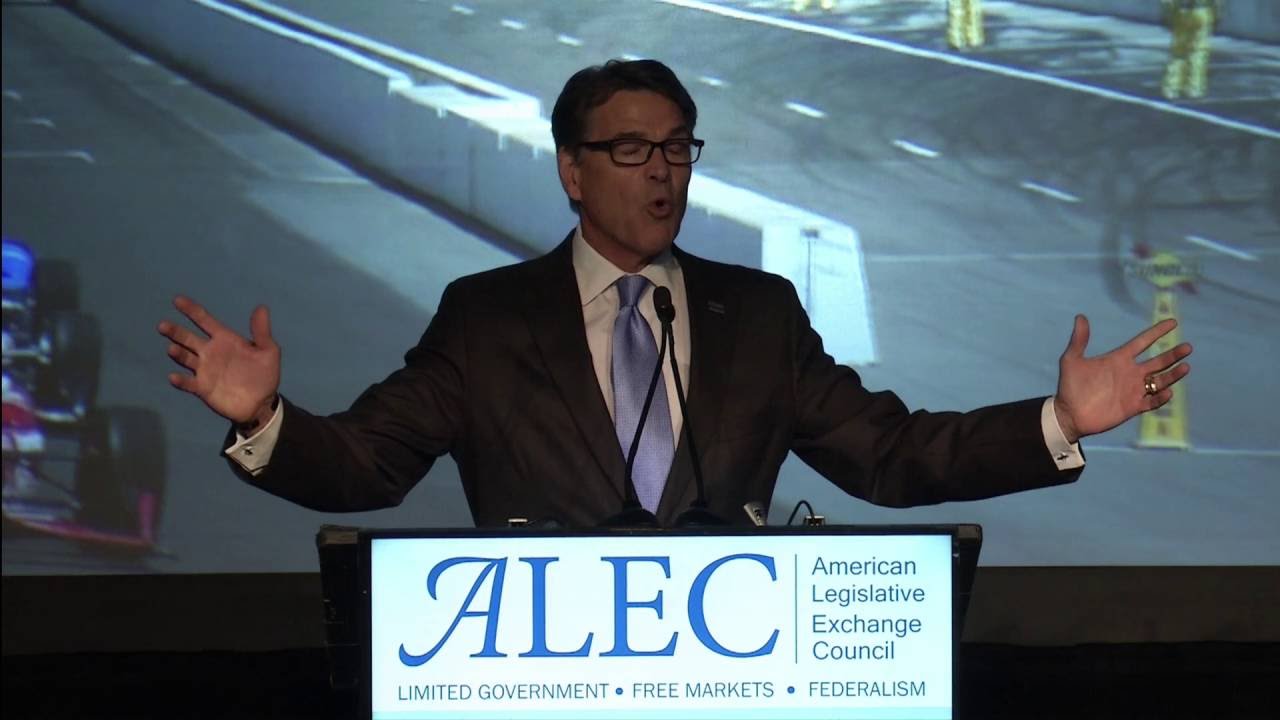 at ALEC’s annual conference in July. A 2011 analysis by ThinkProgress found that 10 of then-governor Perry’s initiatives “mirror ALEC model legislation or policy recommendations from ALEC’s state affiliate.”
Pence, who wrote the introduction to ALEC’s annual “Report Card on American Education” in 2014, also spoke at the group’s July conference. His education policies as governor of Indiana matched those of ALEC and DeVos, including funding for charter schools and vouchers. He appointed a former ALEC director to his cabinet, and once sent an email urging legislators to join the group.
“I was for ALEC before it was cool,”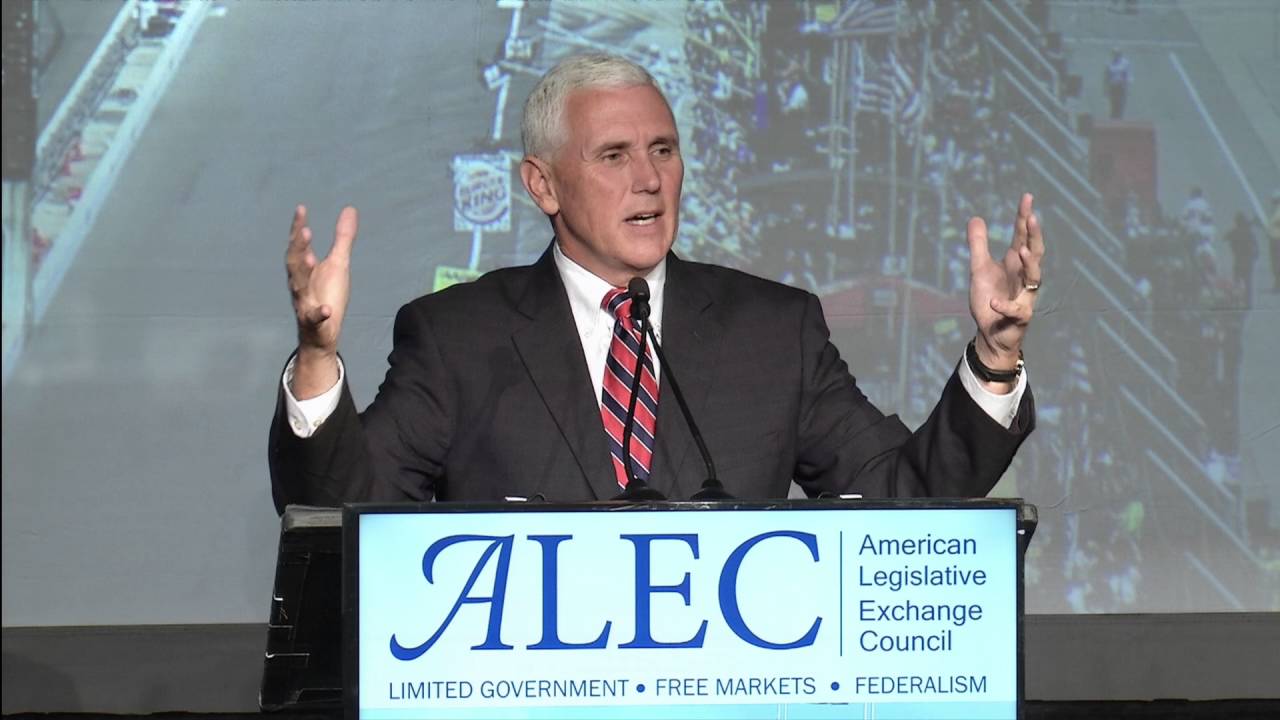 .
Transportation secretary nominee Elaine Chao spoke at the ALEC annual meeting back in 2002, when she was secretary of labor. Chao was a distinguished fellow with the Heritage Foundation, another group funded by organizations connected to the Koch brothers, before and after her time as labor secretary. Paul Weyrich, who co-founded the Heritage Foundation, also co-founded ALEC.
Ben Carson, nominated for secretary of housing and urban development, at an ALEC meeting last year, calling for deregulation, school choice, a balanced-budget amendment, and changing the mission of the EPA so it would work with businesses to exploit natural resources.
At least 12 others appointed to top positions in the administration also have connections to ALEC or the Koch brothers, and share many of ALEC’s goals.
Kellyanne Conway, who will serve as counselor to the president,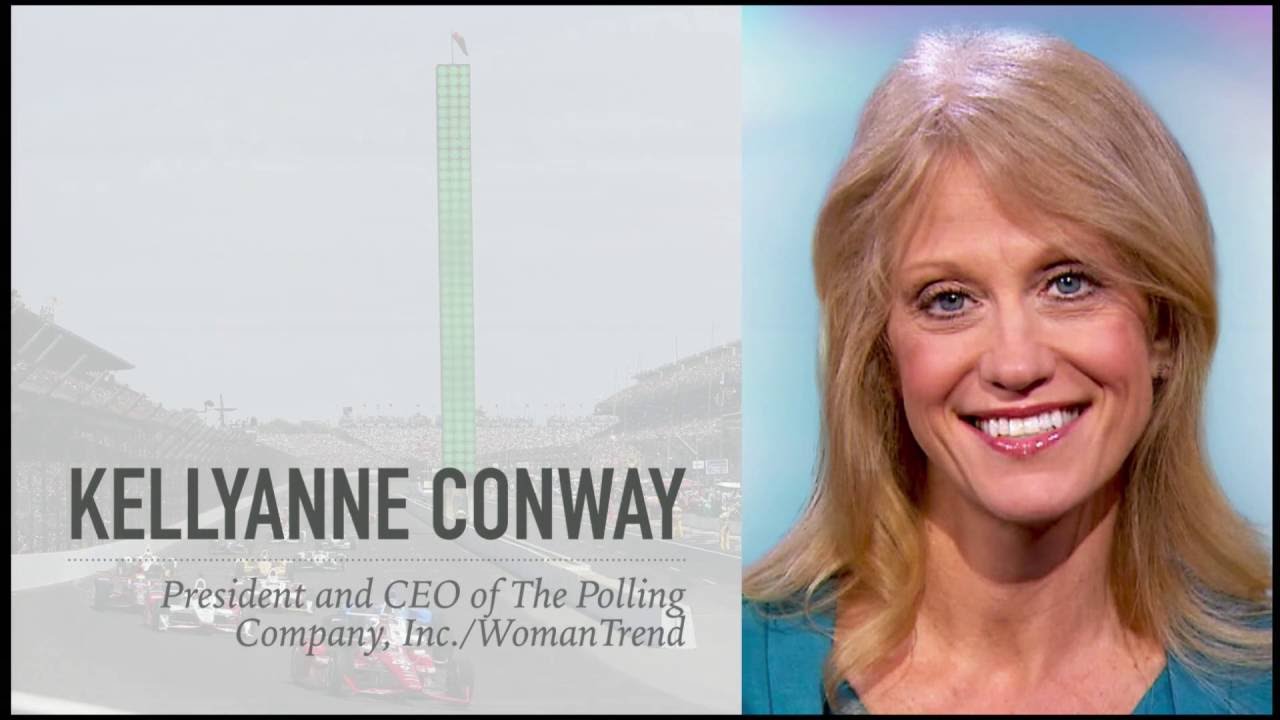 at the ALEC annual meeting in July. Conway, a former pollster and senior adviser for Pence, worked for a super PAC supporting Sen. Ted Cruz’s presidential campaign before switching to Trump. Cruz is a longtime ALEC supporter.
Rep. Mick Mulvaney, Trump’s nominee to be director of the Office of Management and Budget, served in the South Carolina Legislature from 2007 to 2011, when he was elected to the U.S. House of Representatives.
Koch Industries has donated $31,000 to Mulvaney’s campaigns. The Club for Growth, whose funders include the Koch network, has been his top donor, giving $85,580. Club for Growth was a sponsor of ALEC’s annual conferencethis year.

Mulvaney has called for a balanced-budget amendment. He has questioned climate science, referring to “baseless claims regarding global warming,” and wants to make it easier for companies to access domestic oil, natural gas and coal. He has called for eliminating the capital gains tax and lowering tax rates for businesses.
Marc Short, a longtime Pence adviser, has been tapped by Trump as director of legislative affairs for the White House. Short was the Koch brothers’ top political adviser as president of Freedom Partners, the Kochs’ political arm, from 2013 until he joined Rubio’s presidential campaign in February.
Trump’s White House Counsel, Donald McGahn II, was lawyer to scandal-plagued former House Majority Leader Tom DeLay, a Texas Republican who was convicted of money laundering to bypass state campaign finance laws barring corporate contributions during the 2002 election. The conviction later was overturned by the Texas Court of Appeals.
Following the 2002 election, Republicans took control of the Texas Legislature for the first time in modern history, allowing them to gerrymander congressional districts and send more Republicans to the U.S. House of Representatives.
DeLay is an ALEC alumnus.
Later, serving on the Federal Election Commission, McGahn refused to enforce campaign finance laws. In private practice, McGahn has represented Freedom Partners, testifying on behalf of the group at an FEC hearing last year.
Reince Priebus, Trump’s chief of staff, served as chairman of the Wisconsin Republican Party from 2007 to 2011, leading the party to success in the 2010 elections. Priebus’ longtime friend Scott Walker was elected governor, and Republicans took control of the state Assembly and Senate.
Walker, a former ALEC member, was heavily funded by the Koch brothers, ALEC corporate members and other conservative groups. He went on to propose a budget bill that eliminated public employee collective-bargaining rights except for wages, reflecting ALEC’s anti-union policies.
In all, the Republican-controlled Legislature introduced 32 bills in 2011–12that reflected ALEC model legislation, 19 of which became law.
Mike Pompeo, nominee for CIA director, is a member of the tea party movement who was elected to represent Kansas’ 4th Congressional District with the financial backing and endorsement of the Koch brothers.
Pompeo has argued that climate science “needs to continue to develop” and opposed the EPA’s greenhouse gas regulations and Clean Power Plan. A lifetime National Rifle Association member, he opposes gun-control legislation. The NRA is a member of ALEC, which has written model legislation opposing gun-control efforts.
Koch Industries is Pompeo’s top campaign donor, giving $375,000. Club for Growth has donated more than $64,000.
Attorney general nominee Jeff Sessions and interior secretary nominee Ryan Zinke also have received contributions from Koch Industries.
Sessions is skeptical of climate science, and voted to bar the EPA from regulating greenhouse gas emissions. He voted against the Affordable Care Act, and supported efforts to de-fund it.
Zinke, who has received more than $345,000 in campaign contributions from the oil and gas industry, has flip-flopped on climate science, supported the Keystone XL Pipeline, limited the president’s ability to protect public lands by declaring them national monuments, and weakened protections from endangered species. The League of Conservation Voters has given him a lifetime score of 3 percent. Zinke supports a balanced-budget amendment.
Former Georgia Gov. Sonny Perdue is Trump’s nominee for agriculture secretary. As governor, Perdue signed into law measures based on ALEC model legislation, including the nation’s second voter ID law and what ALEC co-founder Paul Weyrich described as “the most expansive school-choice program in the nation.”
ALEC praised Perdue for appointing special counsel to join other states in challenging the Affordable Care Act.
Billionaire Wilbur Ross, nominee for commerce secretary, is a friend of David Koch’s. Another billionaire, Todd Ricketts, is Trump’s pick for deputy commerce secretary. Ricketts, the co-owner of the Chicago Cubs, and his wife Sylvie Lègére have served on the National Council of the American Enterprise Institute, one of the oldest conservative think tanks.
AEI has received financial backing from charities related to the Koch brothers, ExxonMobil and the DeVos family. The Guardian newspaper listed AEI among the top recipients of donations from conservatives “to groups spreading disinformation about climate science.”
Two other Trump nominees, Puzder and Linda McMahon, have served on AEI’s National Council. Education secretary nominee DeVos serves on AEI’s board of trustees, along with former vice president Dick Cheney. Former U.S. ambassador to the United Nations John Bolton was an AEI senior fellow.
ALEC also has ideological soul mates in the Republican congressional leadership, which will control the legislative agenda for at least the next two years.
Senate Majority Leader Mitch McConnell has supported ALEC’s efforts to block the EPA’s Clean Power Plan, and has said he doesn’t know if climate change is a real problem.
He has taken numerous positions that match those of ALEC, including opposing the McCain-Feingold campaign finance reforms; voting against the Affordable Care Act and calling for its repeal; opposing increasing the minimum wage and extending unemployment benefits; introducing a balanced-budget amendment; opposing collective-bargaining rights for public employees; and supporting a national right-to-work law.
McConnell is married to Elaine Chao, Trump’s nominee for transportation secretary.
House Speaker Paul Ryan, a friend of fellow Wisconsinite Priebus, has long pushed a budget in lockstep with ALEC’s goals, including tax cuts for the rich and Medicare privatization.
Koch Industries is one of Ryan’s top five donors. Ryan at ALEC’s States and Nation Policy Summit in 2013. He is a devotee of far-right author Ayn Rand, requiring staffers to read her best-selling novel “Atlas Shrugged.”
Ryan, McConnell and other Republican leaders are pushing an agenda that has been pursued for years by ALEC, one that benefits corporations and the wealthy at the expense of the vast majority of Americans. Judging by Trump’s cabinet selections, he will do little to stand in their way.
==
ALEC a liability!
https://www.exposedbycmd.org/2018/11/14/how-tammy-baldwin-target-of-14-million-in-outside-spending-sent-the-koch-brothers-and-their-minions-packing
Senator Tammy Baldwin took to the stage for her victory speech on November 6th with Pat Benatar’s “Hit Me With Your Best Shot,” blasting.
Baldwin, the top target of early Koch Brothers attack ads, won big in the state of Wisconsin, crushing her opponent Republican State Senator Leah Vukmir by 11 points. She also garnered 150,000 votes more than Tony Evers, the Democratic nominee for governor who beat Scott Walker by 31,000 votes. This, in a state that had elected Walker three times and gave Trump the 23,000 votes he needed to capture Wisconsin and the White House.
By February, Baldwin had already been the target of $4.5 million in ads from just one Koch front group, Concerned Veterans of America, claiming she dropped the ball on the over-prescription of opioids at the Tomah veteran’s clinic, which resulted in the death of a U.S. Marine. The group ladled on another $1.5 million in July, claiming that she important committee meetings. Other ads by the Koch’s Americans for Prosperity and Freedom Partners groups attacked Baldwin over taxes and for “rigging the system against us.”
Baldwin used these early attacks to raise money to respond, and respond she did. The parents and wife of a veteran quickly came to her defense in an ad that effectively put an end to the issue, and Baldwin moved early to define her opponent as a servant of special interests.
Baldwin Ads Used Vukmir’s ALEC Ties to Define Her
Baldwin was the first candidate in a high-profile race that used the American Legislative Exchange Council (ALEC) to effectively frame her opponent as doing the bidding of corporate special interests. The ads capitalize on Leah Vukmir’s long association with the corporate bill mill, where she moved from treasurer to vice president to national chair by 2016. In 2017, she was given an “Iron Lady” award from ALEC, likening the ambitious Vukmir to GOP icon Margaret Thatcher....
jim h
Is it possible to get public policies out of our political system that benefit common people rather than moneyed elites?
Yes! We the people can bypass corporate-purchased lawmakers and write the laws ourselves. In 26 states and numerous cities, grassroots people can put statutes and constitutional amendments on the ballot through a citizens initiative process, that in this era of plutocratic rule, has become a major avenue for achieving progressive change.
For example, on November 6, voters in Albuquerque, Baltimore, and Denver will be offered new forms of small-dollar, public financing of elections to counter secret, unlimited donations by corporations. A South Dakota measure would ban corporate donations to candidates and political parties and bar “gifts” from lobbyists to elected officials. To stop incumbents from hand picking their voters by gerrymandering their districts, people in Colorado, Michigan, Missouri, and Utah will have a chance to turn redistricting over to independent, non-partisan commissions – and other various reforms to democratize voting are proposed in Florida, Michigan, Nevada, Maryland, South Dakota, and Massachusetts.
Ballot measures have proven so successful that corporate front groups have begun proposing deceptively worded initiatives that – get this – would forestall citizens from putting initiatives on the ballot. So far this year, initiatives to stop or restrict initiatives have been filed in Maineand South Dakota to curtail people’s access to this process of direct democracy. Also, ALEC, the secretive, Koch-funded anti-democracy group, has generated bills in six state legislatures essentially to keep citizen initiatives off the ballot.
Corporate elites are so afraid of democracy that they’re actually trying to outlaw it! To help protect direct democracy, go to: ballot.org.
==
https://www.exposedbycmd.org/2018/09/26/alec-flaunts-trump-ties-while-celebrateing-its-45th-anniversary-potuss-dc-hotel
dave a
The American Legislative Exchange Council (ALEC) will celebrate its 45th anniversary at Trump International Hotel tonight, fitting as the Trump administration maintains close ties to the corporate bill mill.
Tickets for the event are a whopping $500 a piece, about the same rate for one night at the hotel. Alternatively, state delegations can get a lobbyist to sponsor a table for $10,000.
The Wall Street Journal‘s Kimberley Strassel will serve as the “Mistress of Ceremonies,” but the rest of the program has not been announced. With the Trump International Hotel being just over a mile away from the White House, it is likely one of the many with ALEC ties in the administration will be there.
Lisa Nelson, CEO of ALEC, was giddy after Trump was elected, telling members and funders that the Trump administration, “does have the potential to be an ALEC administration. It is full of the people and ideas we’ve advanced since 1973… Now is our time. And ALEC is ready.”
And ALEC has been helpful to Trump. ALEC member legislators led the fight on eliminating the state and local tax deduction (SALT), a key component of Trump’s massive tax break for the wealthy and corporations. More recently, 308 state legislators, in partnership with ALEC, sent a letter of support for Judge Brett Kavanaugh to Senators, calling him “the single most qualified person in the country to serve on the Supreme Court.”
While some ALEC alumni — most prominently former EPA Administrator Scott Pruitt — have been dropped from Team Trump, many others have hung on.
The ALEC Vice President
“I can say I was for ALEC before it was cool,” Vice President Mike Pence once at an ALEC meeting. And just after Trump nominated him to be his VP, Pence made another speech at an ALEC meeting.
As Governor of Indiana, Pence lobbied for ALEC to state legislators:
As a governor, I cannot say enough how important ALEC is in my state and across the nation. Indiana is fortunate to have many of our legislators as members of ALEC.
I am writing today to ask you to consider membership in one of the nation’s leading policy organizations, the American Legislative Exchange Council (ALEC).
The ALEC Administration
Many who have remained with Trump since he was elected have ties to ALEC.
Ambassador to the United Nations Nikki Haley is an ALEC alumna. She pushed many ALEC model bills as Governor of South Carolina and state representative, including voter ID laws and school vouchers.
Secretary of Energy Rick Perry made passing ALEC model bills a priority when Governor of Texas, marking some as “emergency” legislation, and has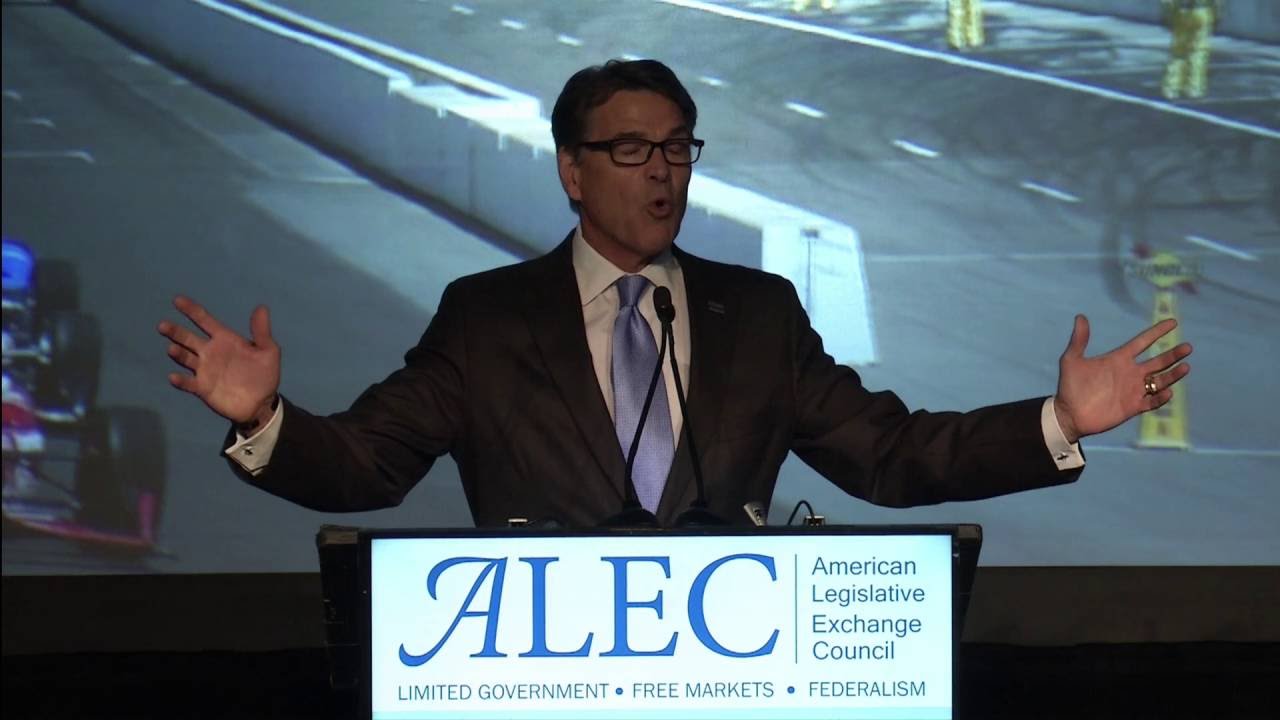 at ALEC meetings. ALEC has a profile of Perry up on its website. This morning, Perry welcomed ALEC to the White House and spoke to the ALEC delegation about “American energy dominance.”
Secretary of Education Betsy DeVos is a long time funder of ALEC and shares its goal of privatizing education. DeVos headlined the 2017 ALEC Annual Meeting and stated in a speech that, “The President has said that this administration will reduce the federal footprint in education, and he signed an executive order this past April instructing our Department to review every regulation that might obstruct parents, teachers, communities and states from best-serving their students.”
Secretary of Agriculture Sonny Perdue has long been a friend of ALEC. As Governor of Georgia, he passed the nation’s second voter ID law based on an ALEC model bill. Perdue also rolled out one of the most expansive school privatization programs at the time in 2008. ALEC also praised Perdue for challenging the Affordable Care Act.
Others in the Trump administration have spoken at ALEC meetings as well, including Secretary of Housing and Urban Development, Counselor to the President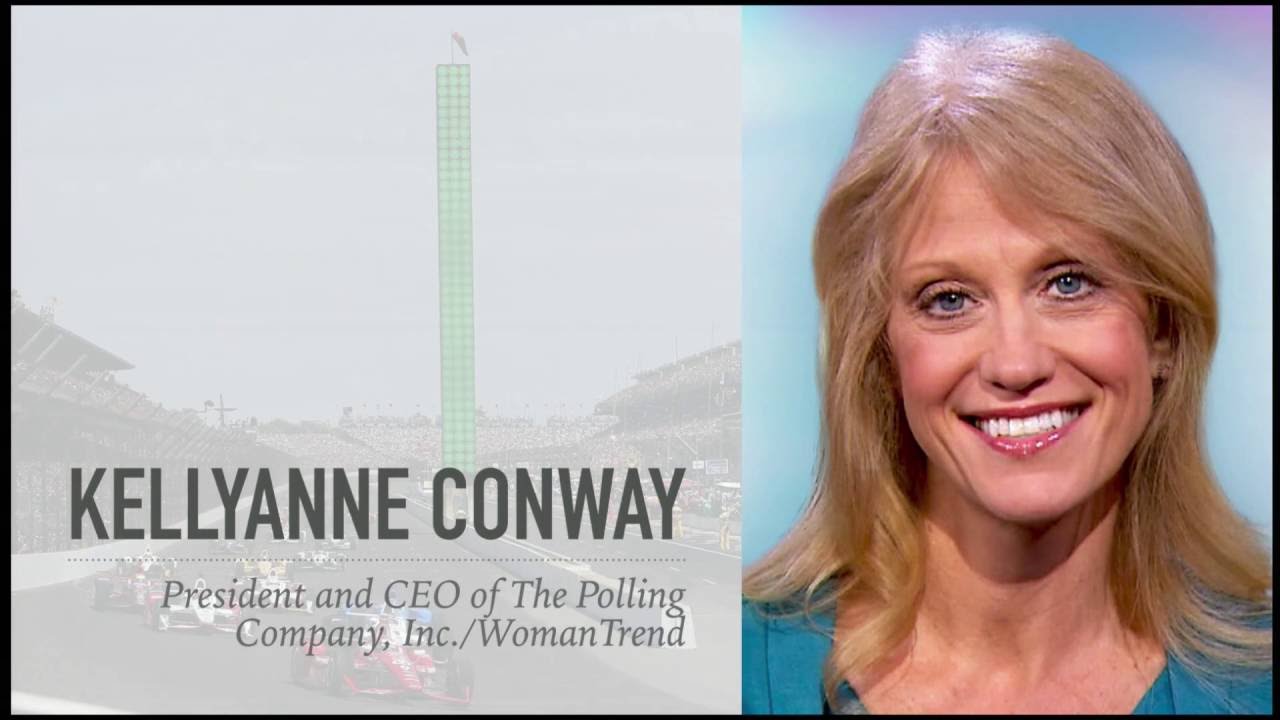 , Secretary of Labor Alex Acosta in 2017, Health and Human Services Secretary Alex Azar in 2018, and Department of Transportation Secretary Elaine Chao in 2018.
==
OMG NOLA
https://www.exposedbycmd.org/2018/08/13/alec-in-disarray
It took about 10 minutes for a picture of Ronald Reagan to emerge on the screen at the opening ALEC lunch event I attended after my arrival in New Orleans for the 45th ALEC conference. I never did see a picture of President Donald Trump. As the hot mess of the Trump presidency unfolds, ALEC is struggling to both embrace the major things they love about him (deregulation, tax cuts for the wealthy), while keeping a healthy distance from the chaos and corruption engulfing his presidency.
Trump certainly wasn’t ALEC’s first choice. Or second. Or third. During his campaign, Trump never came to kiss the golden ALEC ring, like ALEC acolytes Scott Walker and Mike Pence. As corruption charges continued to emerge against prominent Republicans, and the trial of Paul Manafort waged on, I didn’t hear one attendee legislator extoll the virtues of a Trump presidency. In fact, I heard almost nothing about Trump at all from the actual attendees.But the speakers and presenters were more representative of the Trump administration than last year.
Elaine Chow, the Secretary of Transportation came in and tried to give a speech but the ballroom lunch, sponsored by Marathon Petroleum, was so loud you could barely hear her. She did extoll the need to repeal California’s ability to set fuel emissions standards in favor of a weaker federal standard. Former Texas Policy Institute director Brooke Rollins, now a key Trump advisor, was next. She repeated the oft cited metaphor of Trump “draining the swamp” with the islands that emerge being the states, the “great laboratories of innovation.” Except Elaine Chow had just moments before argued to repeal a state’s right to set fuel emission standards.
And this revealed a major, continuing tension of ALEC. They want state’s rights, except when they don’t.The same contradiction is evident with their struggle with local control–sometimes they like it, sometimes they don’t. The defining factor is whether these levels of government promote the far-right ALEC agenda. It is getting harder and harder for ALEC to ignore these internal contradictions.
And there are visible cracks in ALEC world. Collectively, this was the messiest and least disciplined ALEC conference I have attended since 2013. In the energy task force, presentations were all over the place. A natural gas and electricity supplier went off script by openly discussing the billions in subsidies the oil and gas industry receives. There was silence in the crowded task force room, filled with fossil fuel producers and lobbyists.
Though some continued to insist that clean coal was possible and renewables unreliable and expensive, new ALEC members from renewable energy companies gave a compelling pitch about the declining price and high demand in the private market for wind and solar, especially in red, rural communities. After one of the renewable energy presenters mentioned that the wind energy sector was working with Congress to phase out subsidies (not something we would ever see from the fossil fuel industries), a skeptical executive asked if they would help get rid of states’ Renewable Portfolio Standards. The renewable energy guys had the perfect answer–it was up to the states. Remember, the laboratories of democracy? ALEC’s hostility to renewable energy and other green energy policies prompted infighting between industries and high-level departures, most recently by ALEC funder and board member ExxonMobil.
In the Health and Human Services task force, the Goldwater Institute and Buckeye Foundation were in a tizzy because the Affordable Care Act (ACA) was still in existence and the left seemed to win that war, at least for now. How could it be, they moaned, when Republicans are in charge of EVERYTHING? They whined that the “debacle of last year was horrible” and that Congress wouldn’t touch another repeal with a 10-foot poll. So, 100 conservative groups came together to propose an alternative plan that guts the ACA, again. But the list was messy and confusing, and even the presenters seemed doubtful their plan would ever succeed.
But the biggest disaster I have ever seen at an ALEC conference was on a panel about the Convention of States (COS) project. COS is mobilizing in states to call an Article V Constitutional Convention for the purposes of amending the federal constitution by passing a balanced budget amendment, term-limits for federal judges, and who knows what else. One of the key speakers was right-wing provocateur David Horowitz, who has been described by the Southern Poverty Law Center as “one of America’s most dangerous hatemongers” for his virulent anti-Islamic and anti-immigrant websites and speeches. After converting from being a Marxist decades ago, Horowitz now runs his own right-wing think tank, bankrolled to the tune of $3.4 million by the Milwaukee-based Bradley Foundation, according to the Center for Media and Democracy. Horowitz gained recent fame as a key mentor of Trump advisor Stephen Miller, the “the architect” of Trump’s family separation policy according to the Atlantic.
Horowitz gave two inflammatory speeches. Over breakfast he claimed that “at the K-12 level, school curricula have been turned over to racist organizations like Black Lives Matter and terrorist organizations like the Muslim Brotherhood.” Later he commended Trump for not retreating after calling Rosie O’Donnell a “big fat pig.” Regarding Trump, Horowitz commented “so this guy showed what you can do if you have confidence and you are always on the offensive, which he always is.”
Horowitz’s other allegation is that “the left’s attitude towards the Constitution is they hate it.”
As justification that Democrats hate the Constitution Horowitz stated:
You know, one of the really vicious things about the left is how they attack the founding principles of this country. I’ve heard this from Democratic leaders, I remember Al Gore saying it, they say it all the time, that the Constitution is, you know, designed by slaveowners and it regards blacks as three-fifths of a human being. Well actually the word black, white, male, female those words do not exist in the Constitution. The whole identity politics is anti-Constitution.
Horowitz’s beef is that the South wanted to treat slaves as full human beings for population purposes so they would “count” towards congressional representation. The North, however, insisted on curtailing a more powerful South by counting slaves as three-fifths of a human. Of course, Horowitz ignores the fundamental fact that slavery was a barbaric Southern system, initially tolerated by the North and protected by the founding fathers in the U.S. Constitution who prioritized preserving the nation over treating people of color like human beings.
I have sat through many ALEC conferences. At times I have wanted to scream, tear my hair out, stomp away, or run away. I don’t hide who I am, but I don’t announce it with a megaphone. I am quiet. I am respectful. I am there to observe. I am there to plan the resistance to the harmful ALEC agenda that has swept, and continues to sweep, into my state and our country and erode our democracy. But at this moment, I couldn’t write about it, tweet about it, Facebook about it, and then sit there in it. I rose to the microphone and waited my turn. To my objection to the “big fat pig” comment, Horowitz replied “She is a big fat pig.” To my objection to Horowitz commending the South for wanting to treat slaves as full humans while perpetuating the barbaric institution of slavery, I was told by the panel moderator and COS director I had simply “misunderstood.”
ALEC is moving into dangerous territory. Despite the formidable infrastructure they have built over 45 years, their control of 33 state legislatures and their hordes of corporate cash that perpetually grease their wheels, the organization seems to be increasingly in disarray and in an identity crisis. While simultaneously distancing themselves from the chaos and corruption of President Trump, the reality is that they need him, and his hate-mongering, to further the foundation of their right-wing agenda–gutting the ACA and federal conservation standards, repealing workers’ rights, pushing down wages and privatizing public education.
And so the Horowitz’s of the world, who ALEC at least publicly has kept at a distance during my tenure, are now becoming part of the ALEC universe. Are ALEC supporters, including their corporate funders, willing to embrace this hate-mongering to continue to advance their corporate agenda?
Read more on ALEC’s agenda in NOLA and the bills being debated, here.
==
ref
When the American Legislative Exchange Council (ALEC) convenes its 45th annual meeting of legislators and corporate lobbyists at the swank Hilton New Orleans Riverside hotel on August 8, it will serve up a veritable banquet of union-busting, gerrymandering, pro-fossil fuel, and school privatization proposals for lawmakers to take back home.
Welcoming the ALEC crowd will be Jason Saine, a North Carolina Representative and ALEC’s National Chairman. Earlier this year, CMD reported that Saine used $19,000 from his campaign kitty to order custom-tailored suits.
Other keynote speakers will include Secretary of Transportation Elaine L. Chao, Secretary of Health and Human Services Alex Azar, Louisiana Governor John Bel Edwards, and White House Special Assistant in the Office of American Innovation Brooke Rollins. Rollins was an aide to former governor Rick Perry, who is now Secretary of Energy.
ALEC’s menu of policy proposals at the New Orleans conference includes:
RIGHT TO GERRYMANDER RESOLUTION
With citizens turning to the courts and ballot box in a growing number of states to clamp down on hyper-partisan “gerrymandering” schemes, ALEC members will instead be voting on a resolution to defend the right of politicians to keep hand-picking their voters.
Gerrymandering is the practice of manipulating electoral district boundaries to favor the party in power and minimize the ability of opposing parties or disfavored racial and ethnic constituencies to elect candidates of their choice.
The resolution, entitled “Draft Resolution Reaffirming the Right of State Legislatures to Determine Electoral Districts,” asserts the legislative branch’s “sovereignty” over redistricting and states that the “intervention of state supreme courts to redistrict congressional district maps violates the fundamental right of the residents of a state to republican self-government.”
What has ALEC’s knickers in a twist? In Pennsylvania, Republicans drew such a gerrymandered map in 2011 that it resulted in an astonishing 13-5 congressional district advantage in a state where Democrats won five straight presidential elections. The Pennsylvania Supreme Court intervened to ensure that new maps follow the traditional redistricting criteria of compactness, contiguity, and equality of population. In a blow to the Pennsylvania GOP, the U.S. Supreme Court declined to strike down the more balanced maps created by the court.
Other cases on similar grounds have made their way to the nation’s highest court this year from Wisconsin, Maryland, and North Carolina. But the Supreme Court has so far declined to set clear rules limiting this type of voter manipulation.
With the Court failing to act, voting rights advocates are pushing hard for reforms. A quarter of U.S. states have already given non-partisan commissions full or partial authority to draw legislative districts, and with initiatives on the ballot this fall in Colorado, Michigan, Missouri, and Utah, more states may join them soon.
JANUS V. AFSCME VICTORY LAP
ALEC has invited Mark Janus, plaintiff in the Janus v. AFSCMEcase recently decided by the U.S. Supreme Court, to be a keynote speaker.ALEC, along with the State Policy Network (SPN) and the Kochs’ Americans for Prosperity, are key institutions in a multi-pronged strategy to dismantle public sector unions through the courts and state legislatures across the country. CMD’s reporting on this topic in February received national recognition.
Mark Janus was a public worker in Illinois whom groups put forward as a plaintiff in the case after the actual plaintiff, billionaire Republican Governor Bruce Rauner–who had vowed to dismantle unions for partisan political advantage–was found to not have standing. Rauner’s case was originally filed and promoted by two SPN groups in the state, the Illinois Policy Institute and its offshoot, the Liberty Justice Center.
In May 2018, the U.S. Supreme Court used the ginned-up case to strike down agency fees and make it harder for public sector unions to operate. Shortly thereafter, Janus left public employment to take a job at the Illinois Policy Institute.
“As we celebrate 45 years of ALEC, we meet to create solutions for the future,” ALEC CEO Lisa B. Nelson said in a press release about the meeting. But one of the first bills on the ALEC agenda has been on the corporate wish list for a very long time. ALEC’s latest union-busting bill, which would force unions to hold recertification elections every other year, has long been pushed by anti-union PR man Richard Berman and others.
Under the proposed measure, unions would have to get the votes of a majority of all members–not just those showing up to vote–in order to retain their right to represent workers in a bargaining unit.That punitive standard is far more restrictive than anything used in corporate governance or U.S. elections. (Imagine a bill forcing the unseating of corporate directors if the majority of all shareholders, not just those casting ballots, did not vote for management–or a similar standard for politicians.)
Richard Berman’s PR firm, Berman & Company,operates a network of industry front groups and attack-dog web sites that work to counteract minimum wage campaigns, keep wages low for restaurant workers, block paid sick leave laws, and maintain barriers to workplace organizing. Berman, along with U.S. Senator Orin Hatch (R-UT), has pushed a similar decertification bill in Congress, called the “Employee Rights Act.”
In an audio recording obtained by CMD, Berman boasted about his obsession with unions and his attack on their efforts to raise the minimum wage for American workers: “I get up every morning and I try and figure out how to screw with the labor unions,” Berman said.
KEEPING DOWN PAY AND BENEFITS IN THE GIG ECONOMY
ALEC will also be considering a “Uniform Worker Classification Act” that promotes short-term contracts and freelance work over permanent jobs. The resolution focuses on “uniform standards for determining who is an employee and who is an independent contractor,” but is designed to establish a very broad definition of independent contractor that lets employers off the hook for the rights and benefits enjoyed by traditional employees and prevents union organizing. Misclassifying workers is a classic corporate strategy for short-shrifting employees and has been the subject of much litigation.
While companies such as Uber, Lyft, and TaskRabbit are changing the job market, they typically generate low-paying jobs with few or no benefits. The tenuous relationship between employers and employees in many of these jobs raises a passel of legal issues. Are these contract employees subject to the same wage and hour laws? Are these contract employees eligible for unemployment benefits, job training, workman’s compensation, and other worker protections?
In New York, the state has taken steps to regulate the industry after six professional drivers killed themselves, and drivers for-hire and taxi drivers say they are not making enough to pay their bills or support their families.New York’s Unemployment Insurance Appeal Board recently ruled that Uber and Lyft drivers are formal employees of the company, and Seattle recently gave Uber and Lyft drivers the right to organize a union. The model bill being considered at ALEC would attempt to fend off such regulation by lowering the bar for whom corporations can consider a contract employee. note pattern, any time mod kicks in ctr-attack]
The NetChoice trade association represents e-commerce employers such as Lyft and Airbnb at ALEC and is likely responsible for this bill. The National Employment Law Project has a handy fact sheeton why this is such an important issue.
PROTECTING FOSSIL FUEL INDUSTRY WITH BILLS UNDERMINING ELECTRIC CARS, FUEL ECONOMY STANDARDS
ALEC will debate a “Resolution Regarding Subsidies and Mandates for Energy Vehicles and Fuels.”
The measure expresses opposition to “all federal, state, and local efforts to compel consumers to subsidize any and all vehicles, energy, fuels, and fueling infrastructure.” Oil Change International tried to put a price tag on U.S. oil and gas subsidies and pegged them at about $20 billion per year.
At face value, it sounds like ALEC is considering taking a bold new stand against fossil fuel companies such as Koch Industries, Peabody Energy, and others that have long underwritten its work. Could ALEC be objecting to the millions in subsidies that Koch Industries receives from federal, state, and local governments (some $430 million and counting according to Good Jobs First)? Does this explain why ExxonMobil decided to dump ALEC earlier this year?
But something about the wording of the resolution, especially the language condemning “agreements in which costs to construct and operate fueling infrastructure are socialized” and an “infrastructure that will likely be used by a small minority of consumers,” suggests that they are only talking about electric vehicles.
As CMD has reported, the Kochs have long opposed electric vehicles, public transportation, renewable energy, and other clean energy initiatives, and this resolution appears to be more of the same
Another ALEC draft bill Resolution in Support of the Reconsideration of Corporate Average Fuel Economy (CAFE) Standards attacks the Corporate Average Fuel Economy or CAFE standards imposed by the federal government and the state of California as “a relic of a disproven narrative of resource scarcity” left over from the 1970s.
The resolution ignores the fact that fuel economy standards have cleared the deadly smog from Los Angeles and other American cities, improving the environment and the health of residents, especially those suffering from asthma. Plus, fuel economy is an very important factor to many car buyers who want to save money at the pump, which is why they enjoy broad bipartisan support. The fact that U.S. cars lag behind foreign cars on fuel economy has long disadvantaged U.S. car makers. The Trump administration announced last week that it would try to roll back federal fuel standards and preempt the state of California from issuing separate standards. The Trump administration has little regard for the fact that tailpipe emissions are one of the largest sources of global warming pollution in the United States.
In taking a stand against renewables and clean energy, ALEC is not just out of touch with the world, it is out of touch with its own base. Prominent GOP pollsters have shown that 72 percent of conservative Republicans want to accelerate the development of clean energy to reduce pollution and create jobs. A solid majority of 54 percent believe the world’s climate is changing and that mankind plays a role in the change.
Also under consideration for the August meeting is the “Driving Automation System Uniformity Act,” which would bar localities from regulating driverless vehicles, continuing ALEC’s love affair with preempting local democracy. ALEC members have fought to preempt living wage campaigns, plastic bag bans, and paid sick leave ordinances across America. At this meeting, ALEC will also be reviewing a 2012 policy calling for the preemption of local food and nutrition policy.
SUBSIDIZING PRIVATE SCHOOLS FOR FAMILIES IN LOW-INCOME AREAS
Over the years, ALEC has worked hand-in-hand with the DeVos family’s group, American Federation for Children, to advance a “cash for kids” model of school privatization, including dozens of bills promoting school vouchers. For decades, ALEC billed vouchers as a civil rights ticket for low-income kids, but then ALEC’s “Education Savings Account Act” created a “universal” system that siphons off public education dollars to private school parents of any income level. Now ALEC is debating a new bill, the “Economic Development Zone ESA Act,” to require the state to pay the equivalent of public school aid toward any private school for students who live in majority low-income economic development zones. Given the cost of a private school education, the likely effect would be to subsidize the ability of middle- and upper-income families in economically distressed areas to pull their kids out of public school.
A RESOLUTION ON SCHOOL VIOLENCE MISSES THE MARK
ALEC’s proposed “Statement of Principles on School Safety and Security” begins with the bold statement, “The American Legislative Exchange Council recognizes the presence of violence everyday in America’s schools,” and states that “evil, mental illness and alienation are clearly factors.”
What follows is a 1,600-word statement chock-full of platitudes and non sequiturs that mentions guns only once and gun control not at all.
While ALEC is a big fan of preempting local control, in this instance the draft proposal states that “[a]ll decisions regarding school safety and security should be made by local authorities.” ALEC is happy to turn over the issue to localities because it knows that local authorities in 43 states are already preempted from regulating firearms.
There are many other items on ALEC’s agenda for the New Orleans meeting including the following draft bills:
:{The Open Financial Statement Act:(style="box-sizing:inherit;font-weight:700"):}:
Model Policy on Risk Algorithms and Artificial Intelligence in Criminal Justice
Criminal Justice Data Transparency Model
Resolution in Support of Establishing Efficient and Fair Criminal Law Discovery Practices
Draft Executive Branch Transparency in Testimony Act
Draft Executive Branch Public Advocacy and Transparency Act
Draft Resolution in Support of the Taiwan Travel Act
Draft :{Victims of Communism Memorial Day :(style="background-color:#ffff66;"):}:Resolution
Administrative Procedures Act [beware stealth boring name]
Draft Reforming How Federal Grants Are Provided to the State
https://www.exposedbycmd.org/2018/08/08/common-cause-exposes-alec-influence-louisiana
ALEC is registered as a tax-exempt charitable organization and claims not to spend any money on lobbying. But according to a new report from Common Cause, a national nonpartisan government reform group, a number of ALEC-backed and -drafted bills have been introduced and enacted by ALEC-affiliated legislators in Baton Rouge in recent years.
“:{ALEC in Louisiana:(style="box-sizing:inherit"):}:” uncovers the power that “the secretive special interest lobbying group” has already utilized in the southern state. According to the report, nearly 50 members of the Louisiana Senate and House of Representatives have ties to ALEC.[ now gov john bel edwards ?] Common Cause found that legislative language in Louisiana is commonly copied and pasted from the ALEC “model bills,” making the group’s influence “extremely prominent.”
“Shining a light on ALEC’s undemocratic and secretive operations helps voters know who is really calling the shots in their state legislature,” said Karen Hobert Flynn, president of Common Cause. “ALEC’s history of rigging the rules against everyday Louisianans on behalf of their corporate funders is not how democracy is supposed to work.”
ALEC is a powerful corporate-funded pay-to-play organization that brings lawmakers, lobbyists, and other groups in the Koch’s influence machine together to vote side-by-side on bills that legislators then take back and introduce in their home states, usually without any public disclosure of their source. The Center for Media and Democracy teamed up with Common Cause in 2012 to file an IRS whistleblower complaint against ALEC, charging the group with tax fraud and massively underreporting its lobbying activity.
This week’s ALEC annual meeting is chock full of union-busting, gerrymandering, fossil fuel promoting, and school privatizing legislation that benefits the economic interests of ALEC’s patrons.
While the exact issues the Louisiana bills address are varied, the bills fulfill ALEC’s admitted purpose, “to strengthen relationships between ‘business leaders’ and legislators” and “satisfy corporate needs,” according to Common Cause.
For instance, HB 727, was introduced by dues-paying ALEC member, Sen. Joseph H. Major Thibaut, Jr. Thibaut’s bill shares text with an ALEC model bill, “The Critical Infrastructure Protection Act.” It was signed into law in May of this year amidst growing local opposition to the construction of the Bayou Bridge pipeline, which will bring fracked oil from North Dakota to Louisiana’s Gulf Coast.
Senate Bill 364, intended to deal with recent conflicts over controversial speakers on college campuses, is based on ALEC’s “Forming Open And Robust University Minds (Forum) Act.” In June, Louisiana Governor John Bel Edwards signed the act into law, after vetoing a similar bill last year.
With ALEC’s assistance, similar bills have been pushed and enacted around the country at the behest of the right-wing Goldwater Institute and State Policy Network. The American Association of University Professors has criticized the legislation’s approach as “a political agenda masquerading behind ‘free speech'” and objects to its “preference for punishment as a means for ending protests and disruptions that obstruct free speech.”
Meg Logue, a 350 New Orleans activist, told Common Cause that, through ALEC, “our legislators jeopardize our democracy by bending toward the priorities of corporations while undermining the peoples’ right to self-determination and justice.”
==
https://www.exposedbycmd.org/2018/07/12/alec-extreme-exxon-long-term-alec-board-member-dumps-alec-climate-denial-policy
armiak mb
ExxonMobil, the largest oil and gas company in the world, will not renew its membership in the American Legislative Exchange Council (ALEC) after a split within the corporate lobbying group over how to address climate change, Bloomberg reported earlier today.
Exxon’s exit follows a disagreement over a resolution introduced in December by the Heartland Institute, a Chicago-based think tank that denies climate change, that would have asked the federal government to reconsider its findings that greenhouse gasses are harmful to human health.
The EPA did its spadework and laid out the scientific foundation of the endangerment findings in over 200 pages of technical documentation in 2009. Former EPA Administrator Scott Pruitt failed to reconsider those findings, much to the disappointment of the Koch crowd.
Although large companies like Ford, Google, Microsoft, Coca-Cola and many others have cut ties with ALEC, few have given and supported ALEC as much as Exxon has. Exxon was listed as a “major contributor” to ALEC as far back as 1981 and has given ALEC millions over the years to promote its corporate agenda. Exxon has also consistently served on ALEC’s Private Enterprise Board.
REACTION TO THE ANNOUNCEMENT
“This is a major loss for ALEC. It’s not just the financial support that Exxon provides, which has been significant over the years. This also represents a growing split between oil and gas majors that are increasingly concerned about their public image, and groups like ALEC that still regularly promote debates about climate science on their agenda,” said Nick Surgey, co-director of Documented.
“Exxon’s departure should send a strong message to ALEC that it’s extreme agenda and undemocratic, secretive operations have no place in American politics,” said Jay Riestenberg, campaigns & media strategist at Common Cause.
“It’s very significant when a giant of the fossil fuels world thinks that ALEC ‘s denial of the existence of climate change is intolerable. I hope that other responsible corporations that are still members of ALEC will follow suit,” said Wisconsin State Rep. Chris Taylor, who has attended ALEC events and written about its climate denial positions.
With regard to ALEC and the Koch brothers’ hostility to renewable energy and public transportation, Taylor said, “Their positions belong in the dinosaur age. We need to be investing in transit and renewables, and they just keep throwing up road block after road block.”
“Other major oil companies, including BP, Royal Dutch Shell and ConocoPhillips, left ALEC years ago. It’s about time ExxonMobil finally did, too,” said Kathy Mulvey, fossil fuel accountability campaign director at the Union of Concerned Scientists, in a formal statement. “But the company has a lot more to do to set things straight.” Exxon continues to fund the U.S. Chamber of Commerce and the National Association of Manufacturers, both of which continue to do battle with groups and regulators attempting to address climate change, Mulvey said.
EXXON USED ALEC TO PROMOTE CLIMATE CHANGE DENIAL FOR DECADES
In October 2016, the Center for Media and Democracy (CMD) and Common Cause filed additional evidence for their 2012 IRS whistleblower complaint against ALEC detailing how Exxon had pumped $1.7 million into the front group “to promote the oil giant’s climate denial policies and legislative agenda, in gross violation of ALEC’s 501(c)(3) charitable status.”
ALEC claims to spend zero dollars on lobbying but the complaint showed that Exxon had deliberately used ALEC over two decades as its lobbying arm to advance its position on cap-and-trade policies, the Keystone Pipeline, the Obama Clean Power Plan, and fracking.
CMD brought this concern to the attention of the Senate Committee on Foreign Relations in January 2017 when ExxonMobil’s former CEO, Rex Tillerson, was nominated to be President Trump’s Secretary of State.
“For years, Exxon used ALEC as a key asset in a fossil fuel industry campaign to sow uncertainty about climate science, undermine international climate treaties and block legislation to reduce emissions,” said Arn Pearson, executive director of the Center for Media and Democracy, who drafted the 2016 IRS complaint. “And New York and other states have been investigating Exxon for its role in hiding evidence of its climate impact from shareholders and the public. So it is ironic that ALEC’s anti-science stance has apparently become too extreme even for Exxon.”
Exxon did not respond to CMD requests for comment.
==
==
https://www.exposedbycmd.org/2018/06/19/alec-deadly-asbestos-agenda-benefits-koch-industries
The American Legislative Exchange Council (ALEC) named Missouri Republican state Rep. Bruce DeGroot as a “Legislator of the Week” in June.
Why is ALEC so fond of DeGroot? Because he has cheerfully championed ALEC legislation to restrict the right of terminally ill, asbestos victims to sue over mesothelioma. In doing so, DeGroot is helping the many U.S. companies, including ALEC funders Koch Industries and Nationwide Mutual Insurance Company, that have asbestos-related liability.
NATIONWIDE, NOT ON YOUR SIDE
Mesothelioma is an aggressive type of lung cancer caused by exposure to asbestos. Even though the dangers of deadly asbestos have been known for over 100 years, industry worked hard to bury evidence that workers were being harmed by asbestos exposure. Three thousand people are diagnosed each year with mesothelioma in the United States and most die within a year or two. Most victims are public servants, veterans, firefighters, even teachers exposed to asbestos in schools.
In addition to being an ALEC politician, Degroot is an attorney for an insurance defense firm, Brown & James, which represents dozens of insurers who, in turn, have as clients companies responsible for mesothelioma-related claims. One of the firm’s clients is Nationwide. Sources tell the Center for Media and Democracy (CMD) that Nationwide was actively pushing the bill in Missouri, although it was not publicly listed as a supporter of the bill.
In many states, a legislator who introduced a bill benefitting his firm’s clients could face ethics charges or worse. In Missouri, “it is unseemly, to say the least, and one of the reasons we need ethics reform in this state,” said deputy director Sharon Geuea Jones of the Missouri Association of Trial Lawyers.
Nationwide has long been a corporate sponsor of ALEC. In 2014 and 2015, for example, Nationwide incurred asbestos-related losses of $148 million and $98 million respectively, giving it one of the largest asbestos liabilities of any insurer for those years, according to Casualty Actuaries of Greater New York.
ALEC PROTECTIONS FOR ASBESTOS COMPANIES
At ALEC, corporate lobbyists and politicians vote as equals behind closed doors on “model” bills that advance corporate interests over consumers’ interests. DeGroot’s bill, HB 1645 or “The Asbestos Transparency Act,” bears a striking similarity to ALEC’s “Asbestos Claims Transparency Act.” The Missouri House passed the bill in March, but the Senate has yet to take action.
The bill would force victims of asbestos to search out bankrupt companies that made asbestos, not just companies still in business. The problem for the injured is that many companies that made asbestos or had asbestos products have sought bankruptcy protection and are now in trusts. These trusts are more difficult to sue, their assets are harder to determine, and the victims often die before their case is heard. The bill would also limit the time victims have to bring a case after diagnosis, even though it takes more time to prepare for a suit against bankrupt companies.
DeGroot can’t say enough about how awesome ALEC’s cookie-cutter corporate legislation is. “ALEC and ALEC model policy are a great resource. ALEC was able to put me in touch with an expert who was willing to travel to Missouri to testify in support of one of the bills I filed, Asbestos Transparency Trust,” DeGroot said in an ALEC interview.
That “expert” was Mark Behrens, a partner of the Kansas City law firm Shook, Hardy & Bacon. The firm has a national reputation for representing deadly industries like Big Tobacco. Behrens travels around the country lobbying on behalf of ALEC’s many asbestos bills, but tells the public that he is representing other clients like the U.S. Chamber Institute for Legal Reform.
EMOTIONAL FLOOR DEBATE
A cheerful DeGroot opened floor debate saying inaccurately that the bill simply stopped “double dipping” by asbestos victims, but the issue quickly turned emotional.
The first legislator to speak was Republican Rep. Steve Cookson, who is suffering from liver cancer. “I have been up here for eight years and most bills that we talk about are about protecting somebody’s money.… This bill is designed to protect out of state companies and insurance companies.”
Cookson went on to say that in the past he had been supportive of some tort reform bills. “I reflect back now, and you know I have a personal situation going on right here. I think a lot more about life and death. I would ask you, did you ever contemplate the way you want to die?” he asked of DeGroot.
“Well that is a bit personal,” responded DeGroot with a nervous laugh.
“Well, so do you want to die a slow death where you lay there in the bed and suffocate to death?” asked Cookson.
“I wouldn’t like that, no,” said Degroot.
Cookson went on to say that for the time he had left in the legislature, he wanted to make sure he was on the side of those “laying in the hospital for a long long time suffering, surrounded by their families…. I can’t bring myself to be in support of anything that would compromise a person’s ability to be made whole, and their family to be made whole because they had to leave this world in a horrible fashion in an abbreviated time they would have been expected to live.”
The ALEC bill offered by DeGroot would mean that many victims would not live to see their day in court. As one opposing legislator, Rep. Jay Barnes explained, “the best evidence in an asbestos case is the plaintiff, and when they die, that goes away.”
Similar bills based on the ALEC model have passed in 15 states: Ohio, Oklahoma, Wisconsin, West Virginia, Arizona, Texas, Utah, Tennessee, South Dakota, North Dakota, Iowa, Mississippi, Michigan, Kansas, and North Carolina.
KOCH INDUSTRIES LIMITS ITS EXPOSURE TO MESOTHELIOMA LAWSUITS
Koch Industries is the largest privately held company in America, with multiple subsidiary firms. When Koch acquired the paper company Georgia-Pacific LLC in 2007, it also became responsible for Bestwall LLC, which up until 1977 made a joint compound that contained asbestos. And because mesothelioma symptoms only appear after 10 to 50 years, Koch knew that when it purchased Georgia-Pacific, it also became responsible for thousands of asbestos lawsuits.
Koch Industries is a big financial supporter of ALEC and has served on the ALEC private enterprise board for many years, including in 2007 when the ALEC board approved the Asbestos Claims Transparency Act. Subsequently, in 2017, Koch Industries put Bestwall into bankruptcy to limit its exposure to mesothelioma lawsuits.
An affiliate of Koch’s Georgia-Pacific, Bestwall, joined “scores of U.S. manufacturers that have filed for bankruptcy due to asbestos litigation, and comes as the U.S. Congress mulls a bill that plaintiffs’ lawyers say would discourage asbestos claims,” wrote *Reuters*. The misnamed FACT Act is supported by ALEC, the U.S. Chamber of Commerce, and companies with billions of dollars of liability for asbestos claims, including Koch Industries.
Koch now argues that Bestwall was only a minor user of asbestos, but construction workers were exposed to multiple sources of asbestos, and since many of the responsible parties no longer exist, victims’ lawyers are forced to sue more than one company.
Koch complains it is spending $160 million a year defending its subsidiary against asbestos lawsuits. It could have set up a trust fund from the beginning when it acquired Bestwall to pay victims with that money instead of fighting every lawsuit, and is now slowing the process by putting the company into bankruptcy.
Americans for Tax Fairness estimates that the Kochs will get $1.4 billion from the Jobs and Tax Cut Act of 2017, money that could be used to pay asbestos victims before they die.
Instead, Koch and its allies are working hard to pass laws that run out the clock.
==
https://www.exposedbycmd.org/2018/05/07/take-money-run-trump-tax-cuts-boost-earnings-alec-corps-layoff-workers
Nine major publicly traded corporations that are funders of the American Legislative Exchange Council (ALEC) just reported earnings from the first quarter of 2018. Trump’s recent massive corporate tax cuts were sold as a job creation mechanism, but rather than creating jobs, all nine companies reported layoffs that have recently taken place or are planned for 2018.
At ALEC, global corporations and state politicians vote behind closed doors to rewrite state laws that govern your rights. These so-called “model bills” reach into almost every area of American life and often directly benefit the corporations writing or voting on the legislation.
The federal Tax Cuts and Jobs Act of 2017 — pushed hard by the Koch Caucus in Congress — lowered the federal income tax rate from 35 percent to 21 percent, and the Trump Administration promised that the cuts would cause corporations to invest, expand, and hire new workers, as well as pay bonuses or increase wages.
The Center for Media and Democracy’s analysis of nine companies that are major players in ALEC shows that, even with the tax cut, those corporations have laid off or will lay off employees. Comcast, for example, said it will save $128 million from the tax cut and announced 500 layoffs. Caterpillar reported that it will pay 9 percent less in income taxes, but also announced it is closing facilities.
Eli Lilly reported that it lowered its corporate income tax rate by almost one-third, but announced 3,500 layoffs at the end of 2017, layoffs that are still taking place. Energy companies are expected to be major beneficiaries of the tax cut, but two ALEC energy companies, Chevron and Marathon Petroleum, reported large tax savings as well as layoffs for the year.
The Center for Media and Democracy did not cherry-pick companies to find those that announced both tax savings and layoffs. Excluded were coal companies, for example, such as ALEC members Dominion Resources and Peabody Energy, which are downsizing as coal sales continue to decline. Nor did CMD choose companies that saved money on income taxes because they lost money. The nine companies analyzed below all made large profits.
What the companies did with the profits was a corporate choice. In most cases companies bought back shares, a practice that then increases the earnings per share and the dividends paid to shareholders. The boards of these companies vote for the share repurchases, and directors that own large numbers of shares greatly benefit from this repurchasing.
Warren Buffett’s Berkshire Hathaway has already made an extra $29 billion from the tax cut. Most of that is because his companies boosted dividends by repurchasing shares. Berkshire Hathaway owns the Burlington Northern Santa Fe Railroad, an ALEC company.
CMD has written that ALEC member corporations laid off 12,000 workers in 2017.
Hundreds of billions of dollars in tax savings has not slowed the firings. And economist Dean Baker tells us the firms are failing to invest these tax dollars to expand their operations as promised.
Chevron:Chevron, like most oil companies, greatly benefited from the tax cut. Its earnings have grown, and it has credited the tax cut as one reason for the increase.
So far, Chevron has announced 300 layoffs for this year.
The layoffs are partly due to a decision by the company to repurchase shares, thus boosting the earnings per share for wealthy shareholders. “There’s still little evidence that the corporate tax benefits are finding their way to employees,” the Houston Chronicle reports.
Marathon: Marathon Petroleum increased its earnings in the first quarter and its income taxes declined by almost half. The company, based in Houston, made share repurchases of $1.33 billion, which, like Chevron, reflects a decision to increase dividends rather than expand operations and hiring (or invest in renewable energy).
The Houston Chroniclesays that, “Houston energy companies have reported at least $20 billion in tax benefits from the recently enacted tax overhaul, but whatever savings the firms realize will likely go to well-heeled investors rather than support the local economy through hiring, pay raises and expansions.”
Despite a tax-cut benefit and increased earnings Marathon has announced layoffs of employees.
Comcast:According to a company press release,”1st quarter 2018 net income attributable to Comcast Corporation includes a $128 million net income tax benefit because of federal tax legislation enacted in 2018.”
Before Christmas Comcast laid off 500 salespeople, even though it anticipated a tax savings in the first quarter 2018.
Verizon:Verizon paid $1.39 billion in income taxes in the first quarter 2018, compared to $1.63 billion for the comparable period in 2017. It is not known, based on data provided by the company, how much of that tax savings of $241 million is a result of the new tax cut bill, but Verizon earned substantially more in this year’s first quarter; the taxes should otherwise have been higher, not lower. Company earnings in the first quarter were 23 percent higher than the first three months of 2017.
Verizon is closing some of it calling centers, resulting in the layoff of 3,000 employees.
Pfizer:Pfizer reported a quarterly earnings increase of 23 percent from one year ago, thanks in part to a much lower 2018 tax rate.
Pfizer has abandoned efforts to find drugs related to treating Alzheimer’s and is set to lay off 300 employees.
Times Warner: The company paid substantially lower income taxes in the first quarter 2018 versus first quarter 2017. The company does not report how much was from the tax cut legislation or other factors, except to say it benefited from the cut. In the first quarter of 2018, Times Warner increased its revenue by $261 million and its profit by 15 percent.
Times Warner has announced layoffs at many of its properties, including CNN and Turner Broadcasting, but larger layoffs are expected if its merger with AT&T is approved by a case pending in federal court.
Eli Lilly:Pharmaceutical firm Eli Lilly, a sponsor of ALEC’s 2017 membership meeting, laid off 3,500 workers in the fourth quarter of 2017 (2,300 of whom took a buyout).
In its press release announcing its first quarter 2018 earnings, Lilly told investors, “The effective tax rate was 15.9 percent in the first quarter of 2018, compared with 21.2 percent in the first quarter of 2017. The lower effective tax rate for the first quarter of 2018 was primarily due to U.S. tax reform enacted in December 2017…”
Caterpillar:Caterpillar reported an income tax decline of 9 percent in the first quarter 2018 relative to the same period in 2017.
Caterpillar is expected to close some facilities, with an estimate of 800 layoffs.
Altria:Tobacco giant Altria reported a 30 percent increase in earnings per share for the first quarter 2018 relative to the same period one year ago. The company says, “[I]n the first quarter we benefited from a lower tax rate as a result of Federal income tax reform, something for which we long advocated.” Altria repurchased $513 million in shares.
Altria has announced layoffs in Virginia.
==
KOCH
https://www.exposedbycmd.org/2018/04/23/alec-task-forces-gather-grand-rapids
The American Legislative Exchange Council (ALEC) will hold its annual Spring Task Force Summit on April 27 at the Amway Grand Plaza in Grand Rapids, Michigan.
There is no word yet on whether Secretary of Education Betsy DeVos, a Michigander married to Amway heir Richard DeVos, will be joining the gathering at the swank four-star hotel as ALEC legislators and corporate lobbyists vote on cookie-cutter bills behind closed doors. ALEC has long embraced DeVos and her school privatization agenda, even though the failure of the charter school system she helped create in Michigan has been the topic of devastating reports in the *New York Times* and 60 Minutes.
Further education privatization is on the agenda in Grand Rapids along with measures to please fossil fuel companies, marijuana companies, and more.
CATERING TO FOSSIL FUEL FUNDERS
While over 100 mainstream American companies have fled the controversial organization, a 2017 Annual Meeting registration list shows that ALEC is still chock full of fossil fuel companies.
Peabody Energy and Koch Industries serve on ALEC’s Private Enterprise Advisory Council and ExxonMobil, Chevron, Duke Energy, Marathon Petroleum, the Edison Electric Institute, American Fuel & Petrochemical Manufacturers, American Gas Association, the Nuclear Energy Institute, and the National Rural Electric Cooperative Association are ALEC members.
One piece of priority legislation for the companies is ALEC’s Critical Infrastructure Protection Act. The bill, a punitive measure designed to frighten protestors with stiff penalties and discourage large-scale demonstrations like the Dakota Access Pipeline protests,was adopted by ALEC’s Energy, Environment and Agriculture Task Force in 2017. Similar bills have been signed into law in Oklahoma and Iowa and introduced in Louisiana, Minnesota, Missouri, and Ohio. Wyoming’s bill passed the legislature but was vetoed by Gov. Matt Mead.
“Over the last couple of years, we’ve seen a number of powerful examples of people publicly coming together to raise their voices and push for change—from water protectors and their allies challenging pipeline construction near Standing Rock and elsewhere, to racial justice advocates taking to the streets to protest police shooting deaths,” said Vera Eidelman, Legal Fellow with the ACLU’s Speech, Privacy, and Technology Project. “And yet, rather than respond to the protesters’ substantive messages…many elected representatives are instead introducing bills that would label them ‘terrorists’ or ‘saboteurs,’ chill their speech, and discourage others from associating with them.”
In Michigan, ALEC politicians will be asked to vote on new bills that advance the interests of the industry, including the Resolution Supporting States Ability to Permit andRegulate Oil and Gas Development on Federal Lands within their Borders and the Gas Tax Transparency Act.
The oil and gas permitting bill is the latest from ALEC in its push to hand over America’s public lands to the fossil fuel companies that started almost 20 years ago. The latest resolution calls on Trump and Congress to hand over the power to regulate and permit fossil fuel development on public lands to the states, where the industry has its greatest power and influence over government.
The Gas Tax Transparency Act requires fuel tax stickers to be placed on gas pumps detailing state and federal taxes to promote “transparency.” ALEC hopes that voters will be up in arms about the taxes and will pressure their representatives to lower them.
ALEC is for transparency only when it aids their benefactors. The organization is better known for its efforts to undermine reporting when it comes to campaigns and elections. ALEC is aggressively pushing a model resolution designed to stop states and municipalities from requiring dark-money groups that spend millions to influence elections to disclose their donors, and has launched the misnamed Center to Protect Free Speech to lobby for it.
GREENWASHING CHARTER SCHOOLS
Ironically, while the ALEC energy task force is working hard to advance the polluter agenda, the ALEC education task force will discuss an education bill that promotes itself as a means to crack down on air pollution. The Environmentally Sustainable Charter School Admissions Act gives enrollment preference in charter schools to children who live near the school or if a parent works near the school in order to reduce traffic congestion and air pollution.
ALEC has worked hand-in-hand with the DeVos group, American Federation for Children to advance a “cash for kids” model of school privatization including dozens of bills promoting school vouchers. For decades, ALEC billed vouchers as a civil rights ticket for low-income kids, but then ALEC’s Education Savings Account Act created a “universal” system that siphons off public education dollars to private school parents of any income. Now ALEC is entertaining a new bill, the Economic Development Zone ESA Act, to give preference to kids who live within economic development zones.
A series of recent studies have shown poor results for voucher programs. For instance, a major study of Louisiana’s voucher program found that public elementary school students who started at the 50th percentile in math and then used a voucher to transfer to a private school dropped, on average, to the 26th percentile in just one school year. Martin West, a professor at the Harvard Graduate School of Education, said the negative effects in Louisiana were “as large as any I’ve seen” in the history of American education research.
The Amendments to the Great Schools Tax Credit Program Act would amend an earlier ALEC bill to correct a drafting error that apparently resulted in some corporations getting a tax benefit more than the amount of a scholarship donation.
MARIJUANA MONOPOLIES
In a rather surprising move, ALEC will be considering a legislative proposal for a Closed-Loop Payment Processing System for Marijuana Taxation and Sales. The bill would require a State Treasurer to devise a financial system that will put it in charge of processing all marijuana financial transactions in the state. Yes, it is true that some states are having issues processing medical marijuana related payments, but a state-sponsored financial monopoly? The whole idea seems counter to ALEC’s usual stance on “free” markets.
The impetus for this bill may be from the fact that the multi billion-dollar cannabis industry is struggling to find financial partners with cannabis still being illegal at the federal level. The 2017 ALEC Annual Meeting in Denver saw a number of marijuana entities join up, including Weedmaps, a “Chairman Level” sponsor, the Marijuana Policy Project, and Republicans Against Marijuana Prohibition.
EMBRACING TRUMPISM
In the era of Trump, the Koch machine, including ALEC, has fully embraced Trumpism. Shortly after the November 2016 election, ALEC’s Executive Director Lisa Nelson told funders and members that she was thrilled to report that the Trump administration “does have the potential to be an ALEC administration. It is full of the people and ideas we’ve advanced since 1973…Now is our time. And ALEC is ready.” Since then over 40 Koch political operatives have signed on to work for the the Trump White House and administration, according to a recent report by Public Citizen.
This week, as ALEC meets in Michigan, the Koch takeover of the administration will be the topic of floor speeches in the U.S. Senate and educational events. The Intercept exposed the Koch political network’s secret laundry list of policy changes that it has pursued and won the administration, including the federal tax overhaul giving massive tax breaks for corporations and the rich that will balloon the deficit.
Resources: The list of ALEC legislative members can be accessed here and the list of ALEC corporate funders can be accessed here. Follow @ALECexposed. DAVID ARMIAK
random sample
ALEC LEGISLATOR OF THE WEEK: HOMOSEXUALS AND PSYCHOPATHIC KILLERS “IT’S A BEHAVIOR THING”
By Don Wiener
|
April 9th, 2018
at 9:51 AM (CDT)
ALEC’S BEST AND BRIGHTEST
One “Legislator of the Week” and now national chair of ALEC, Republican state representative Jason Saine, gained notoriety in his home state of North Carolina for taking $20,000 in campaign money from the telecommunications industry, supporting its legislation, and using that money to buy himself a new wardrobe.
State Representative Brian Greene, a Utah Republican, and an ALEC “Legislator of the Week” said, during a legislative hearing on the state’s sexual assault statutes: “If an individual has sex with their wife while she is unconscious … a prosecutor could then charge that spouse with rape, theoretically. That makes sense in a first date scenario, but to me, not where people have a history of years of sexual activity.”
ALEC has other awards for those who carry legislation for big corporations. Colorado Republican Lori Saine, no relation to the above Jason, was arrested in December for trying to bring a loaded semi-automatic gun through Denver airport security.
Saine was charged with a sixth-degree felony. If convicted, she could face up to 18 months in jail and a fine of up to $100,000. Saine already was a “Legislator of the Week,” but the day following her arrest ALEC also gave her their award as “Public Sector State Chair of the Year.”
SEXUAL PREFERENCE AND PSYCHOPATHIC KILLERS, “IT’S IS A BEHAVIOR THING”
Then there is Indiana Republican Rep. Woody Burton, the chair of the Commerce, Insurance, and Economic Development Taskforce, who was named the ALEC/FreedomWorks “legislator of the week” in March.
Burton had this to say when discussing LGBT rights at a town hall meeting:
“You can’t control it sometimes. I understand that. If someone’s a psychopathic killer, it’s a behavior thing. They can’t help it. OK? Somebody’s a homosexual, maybe it’s a genetic thing. Maybe it’s not. They can’t help it. But it’s still a behavioral thing.”
Burton then tried to walk back the comparison.
“When I talk about behavioral things, I want to stress that I’m not comparing gays to…people that are psychotic…I was trying to explain behavior is a thing that people have and sometimes they can control it and sometimes they can’t.”
Another Burton gem? “If I pass a law that says transgenders and homosexuals are covered under the civil rights laws, then does it say anywhere that fat white people are covered?” he said at the town hall.
If in politics, as in life, you are known by the company you keep, then the corporate members of ALEC, companies such as UPS, Eli Lilly, State Farm, and Comcast — and their customers — may want to take note.
These are the “legislative leaders” of ALEC — the best and the brightest — that are underwritten by their corporate membership dues.
https://www.desmogblog.com/2018/04/06/bayou-bridge-protesters-arrested-louisiana-advances-bill-toughening-penalties-pipeline-protests
no linx many
Bayou Bridge Protesters Arrested as Louisiana Advances Bill Toughening Penalties for Pipeline Protests
By Julie Dermansky • Friday, April 6, 2018 - 16:29
Protester chained to a barrel in the road
On Thursday, April 5, opponents of the Bayou Bridge pipeline attempted to shut down its construction by blocking an industrial supply company’s facility in Iowa, Louisiana, just outside of Lake Charles on the same day a bill spelling out harsher penalties for pipeline protesters was advanced to committee during the Louisiana legislative session.
For about two hours starting at 6:30 a.m., roughly 20 protesters blocked the entrance to Yak Mat, an industrial yard that supplies access mats used to create temporary roadways at pipeline construction sites and enable trucks to pass through muddy areas. The site is close to the starting point of the Bayou Bridge pipeline, which spans south Louisiana from Lake Charles, near the Texas border, to St. James, along the Mississippi River. The pipeline is the tail end of Energy Transfer Partners’ Dakota Access pipeline network, which begins in North Dakota.
Renate Heurich, locked to a barrel, being rolled out of the entrance to the Yat Mat lot in Iowa, Louisiana, during a protest against the Bayou Bridge pipeline.
Louisiana joins several states, including Wyoming, Iowa, Pennsylvania, and Ohio, in introducing a bill specifically making the types of protests increasingly common at oil and gas pipeline construction sites criminal acts with harsher penalties.This latest proposed legislation parallels an anti-protest law that passed in Oklahoma in May 2017. Protests against the Dakota Access pipeline were cited as the inspiration for these “critical infrastructure” bills, which liken the actions of pipeline protesters to “terrorist activities.”
Shortly after police arrived on Thursday, the protesters dispersed, except two New Orleans residents, both educators. Renate Heurich and Susan Prevost chained themselves into barrels fastened to the ground at the entrance to the mat supply yard. Both women started the day in crawfish costumes to emphasis the oil pipeline’s threat to the wild crawfish habitat in the Atchafalaya Basin, a National Heritage Area which the pipeline is being built through, despite an ongoing legal challenge.
Law enforcement at the anti-pipeline protest
Law enforcement officers waiting to move in on the protesters in Iowa, Louisiana. There were more members of law enforcement at the protest than protesters.
Protester dressed as a crawfish
One of the Bayou Bridge pipeline protesters, dressed as an iconic Louisiana crawfish, in Iowa, Louisiana.
Prevost stressed the importance of protecting Louisiana’s heritage. She worries that an oil spill in the basin will mean that future generations of local Louisianans won’t know the joys of traditional crawfish boils. A spill in the basin could decimate the wild crawfish population. “Can Louisiana really afford the Bayou Bridge pipeline from the company that has the worst record on pipeline accidents?” Prevost asked me the night before the protest.
Heurich, a founding member of 350 New Orleans, believes it is imperative to take a stand against climate change. She believes direct actions against the pipeline are necessary because tremendous public outcry against the permitting of new fossil fuel projects and ongoing legal challenges against the pipeline have not succeeded in stopping its construction.
“Six Democratic New Orleans city council members recently voted in favor of a new gas plant and Democratic governor John Bel Edwards still won’t acknowledge man’s role in climate change,” she said, “but they all know humans are responsible for climate change. I don’t believe they’re dumb. It is absolutely about the money.”
Anti-pipeline protester Renate Heurich
Renate Heurich, a retired teacher and member of 350 New Orleans, protesting against the Bayou Bridge pipeline in Iowa, Louisiana.
A large group of law enforcement officers and protesters at the site of the demonstration
Protesters move back when police move in and tell them to disperse. All but the two who remained in the barrels complied.
Heurich also wants to protect Louisianans from the pollution oil and gas industry sites produce which sicken many people in fenceline communities, like St. James, a small town where the Bayou Bridge pipeline will end. She told me that people she knows are already dying of illnesses associated with toxic emissions from industrial sites in the area, including Keith Hunter, a retired carpenter, whom she met at an anti-pipeline meeting in St. James. Others she met a year ago in St. James have been diagnosed with cancer.
After sheriff’s deputies managed to move Heurich’s barrel out of the way, operations were able to resume. The deputies offered Heurich and Prevost a deal: If they unlocked themselves on their own, they would be charged withfelony trespass, but avoid being taken to jail.Heurich unlocked herself, while Prevost remained in her barrel until noon, deciding to unlock herself after two trucks passed dangerously close to her.
Truck loaded with mats passes next to protester chained to a barrel in the road
Truck loaded with mats returning to the yard passing dangerously close to Susan Prevost who was locked into a barrel fastened into the ground.
Susan Prevost removes herself from the barrel she chained herself to
After conferring with a lawyer, Susan Prevost removes herself from a barrel she attached herself to in order to block work on the Bayou Bridge pipeline.
Susan Prevost is led away by two police officers
Susan Prevost being led away by police after her arrest during a protest against the Bayou Bridge pipeline.
Cherri Foytlin, one of the founders of the anti-pipeline L’eau Est La Vie Camp (Water Is Life), was also arrested after live-streaming the demonstration for over an hour at the end of the driveway, which she thought was a public road. “I complied with what the officers told me,” she wrote in an email. When the police came after her, others from the camp pleaded with the officers to let her go, explaining she hadn’t heard them tell her to get off the driveway.
Another activist who took part in the protest was accused of stealing a car. All were released later the same afternoon but face charges.
Cherri Foytlin in the back of a police car
Cherri Foytlin, in the back of a police car being taken to jail for trespassing during a protest against the Bayou Bridge pipeline.
Protester escorted by two officers
Protester being taken away.
Heurich found it ironic that their direct action took place hours before the state legislature advanced to committee the bill HB 727, which would strengthen punishments against pipeline protesters. She said the attorney for the Louisiana Mid-Continent Oil and Gas Association, who reportedly helped draft the bill, sat next to its lead sponsor during the session. “The oil and gas industry writes a law to protect its interest, in order to keep Louisiana a sacrifice zone while at the same time taking away our First Amendment right to protest its actions,” she said in dismay, “and our legislators support it.”
Louisiana law already prohibits trespassing at sites known as “critical infrastructure,” including power plants, oil refineries, chemical plants, water treatment facilities, and natural gas terminals. House Bill 727 adds pipelines and their construction areas to the list of critical infrastructure sites, a move in reaction to growing pipeline protests nationwide.
HB 727 is based on a model bill produced by the conservative, corporate-funded American Legislative Exchange Council (ALEC).“But it is ALEC-plus” Pam Spees, a lawyer for the Center for Constitutional Rights, which is representing a coalition of groups against the Bayou Bridge pipeline in a variety of legal challenges, said. “People not involved in an action, who don’t protest, damage, or injure anything or anybody, can still be held accountable for being associated with activists.”
The bill increases the penalties for any damage to or interference with pipeline and other critical infrastructure sites. Sentences range from one to 15 years in prison with a $10,000 fine or six to 20 years plus a $25,000 fine if the damage could threaten human life or disrupt site operations. In addition, this state bill criminalizes “conspiracy to commit trespass.” Anyone involved with organizing a protest like the one on April 5 could face a year in prison. And anyone connected to an action that involves damaging the infrastructure couldend up with a prison sentence of 20 years and fines of up to $250,000 if a judge rules that they are part of a conspiracy that threatens life or the operation of critical infrastructure.
“The language concerning conspiracy is worrisome,” Spees told me during the protest in Iowa. “The conspiracy provision makes it possible for law enforcement to arrest people before they have actually done anything wrong, even if they are just planning a nonviolent protest.” After Thursday’s protest, Spees traveled to the jail to help make sure everyone arrested during the demonstration was released.
Along with a handful of others, Meg Louge, a member of 350 New Orleans, spoke out against HB 727 at the state capitol in Baton Rouge. Many of them objected to the proposed law because existing trespass laws are already in place. Some argued during Thursday’s legislative session that the new law is meant to quash dissent against oil and gas pipelines. “The representatives who spoke in favor of the bill cited the protests in North Dakota a couple of times and how they don’t want Louisiana to ever have a ‘Standing Rock’ type situation,” Louge said.
Though Louge was not pleased the bill was moved to committee, she said that she was glad that Rep. Valarie Hodges, one of the bill’s sponsors, agreed to amend the conspiracy language during the session, before the bill is voted on in committee.
While Thursday’s pipeline protest didn’t go as planned, Heurich was not discouraged. “Today’s action was a success,” she said during a call. “One of our goals is to get the word out that climate change is a huge issue and that there is real opposition in Louisiana.”
==
==
https://www.ecowatch.com/koch-pipelines-dakota-keystone-2540819277.html
Koch Network Took Credit for Dakota Access, Keystone XL and REINS Act, Leaked Memo Shows
:{:{
By Steve Horn
A leaked memorandum published by The Intercept and Documented Investigations shows that a Koch Industries' donors network, known as the Seminar Network, has taken credit for Donald Trump approving the permits for both the Dakota Access and Keystone XL pipelines during the first months of his presidency.
The memo also applauded efforts by the Koch network's Americans for Prosperity (AFP) chapter in Wisconsin to pass a deregulatory measure there known as the REINS Act. The Seminar Network, which meets secretly twice a year, is made up ofdonors who give at least $100,000 toward Koch-led political and philanthropic efforts.
Koch Industries has a business interest in both pipelines, though their approval has not been something its funded network has widely discussed. Quietly, though, Koch has advocated for the pair of pipelines in regulatory hearings in both Iowa for Dakota Access—as previously reported by DeSmog—as well as in Canada, as reported in 2012 by InsideClimate News.
The REINS (Regulations from the Executive in Need of Scrutiny) Act, which GOP officials have been pushing in Congress since Obama's first term, passed as state law in Wisconsin in 2017. The law, long considered crown jewel legislation by the Koch front group AFP, gives legislative bodies full veto authority over regulations proposed by executive agencies. Conservative groups in Wisconsin already are using the law to sue the top state public education officer.
"State legislatures, particularly in states with a strong Network presence, have also made significant progress toward removing harmful and unnecessary regulations. For example, Wisconsin this year went so far as to enact the nation's first REINS Act, which will require legislative approval of any issued regulation that has an impact above a certain cost threshold," reads the Koch Seminar Network document.
The American Legislative Exchange Council, a corporate-funded group of mostly Republican Party state legislators, has a REINS Act model resolution on the books, which supports the federal version of this legislation. In 2017, six states introduced pro-REINS Act resolutions: Kansas, Montana, Missouri, Georgia, Ohio and South Carolina. ALEC—which brings corporate lobbyists and state legislators together at annual meetings for networking, seminars and voting on what it dubs "model policies" —maintains close connections with the Koch network.
Koch, KXL, DAPL Business Ties
Koch Industries also owns assets in a tar sands reservoir located in Alberta, Canada, both in the form of lease holdings for land and as a company with a drilling interest. For the latter, Koch owns Koch Oil Sands Operating, which has a drilling interest in both the Gemini and Muskwa tar sands fields in Alberta.
It also owns 1-2 million acres' worth of land (the exact number is contested) in the tar sands for prospective future leasing, according to a 2013 report published by the International Forum on Globalization. Keystone XL, the pipeline owned by TransCanada and approved by Trump and his U.S. Department of State in March 2017, would bring around 500,000 currently-booked barrels per day of tar sands oil from Alberta to Cushing, Oklahoma, where the pipeline connects with TransCanada's Gulf Coast Pipeline.
Gulf Coast, which was approved by President Barack Obama in a 2012 election season executive order, sends the tar sands bitumen down to Port Arthur, Texas, where the substance is refined into products and then sent to market.
[map]
Koch Industries even nearly testified at a 2012 hearing in support of its development of tar sands, before backing out after signing confidentiality agreements with impacted landowners. Much of the tar sands extracted in Alberta is refined at Koch's refinery in Pine Bend, Minnesota, which is owned by its subsidiary Flint Hills Resources and is the top refiner of tar sands in the U.S. at 223,000 barrels per day, as of 2013.
For Dakota Access, Koch also quietly came out in support of the pipeline via its front group, the 60 Plus Association, which purports to be a conservative alternative to the American Association of Retired Persons for seniors. Through intermediary groups, 60 Plus had received tens of millions of dollars from the Koch network.
Koch Industries has a direct tie to Dakota Access, through a storage terminal part-owned by its subsidiary Flint Resources and located in North Dakota's Bakken Shale basin. As DeSmog previously reported, this terminal, called the COLT Hub, feeds oil into the Dakota Access pipeline.
Back in 2015 when the pipeline was hotly contested in Iowa, a representative for 60 Plus testified on behalf of Dakota Access in front of the Iowa Utilities Board.
"The Dakota Access Pipeline Project is important to seniors for several reasons. High energy prices are disproportionately impacting America's low and fixed-income senior citizens today—citizens that often have limited financial resources with which to meet their needs," the 60 Plus representative testified in September 2015. "By helping the United States to better capitalize upon its growing domestic energy resources—and affordably transport these resources to market—the Dakota Access Pipeline will help to foster stability within energy markets nationwide, and improve the availability of affordable American produced crude oil."
60 Plus also began lobbying and campaigning on behalf of the Dakota Access as the protest movement grew against the pipeline at the Standing Rock Sioux Reservation in North Dakota. Around the same time those protests began in September 2016, 60 Plus deployed its chairman, Jim Martin, to begin lobbying Congressabout Dakota Access. Martin also wrote an opinion piece that month supporting the pipeline for the publication Morning Consult.
"Whether it's heating or cooling your home or putting gas in your car, the cheaper the energy, the more economically stable your checkbook will be," wrote Martin. "The 60 Plus Association's 5.5 million members know this all too well. This is why as an organization that champions free enterprise and who have championed energy issues for seniors before, we strongly support the Dakota Access pipeline."
'Whole New Level'
In the 2018 election cycle, the Koch network plans to spend up to $400 million to keep the Republican majority in Congress and GOP control over statehouses nationwide.
"We've made more progress in the last five years than I had in the last 50," Charles Koch, one of the infamous petrochemical billionaire Koch brothers, said in January at a private Seminar Network meeting held in Indian Wells, California. "The capabilities we have now can take us to a whole new level."
}:}:
new? bk 1% solution
The One Percent Solution: How Corporations Are Remaking America One State at a Time 1st Edition
Gordon Lafer is Associate Professor at the Labor Education and Research Center at the University of Oregon& https://www.eenews.net/stories/1060066527
*:{
}:*
ALEC's conservative wing says the organization — which convenes corporations, think tanks and legislators — is capitulating to left-of-center interests to regain funders after an exodus of corporate titans like Google LLC and Royal Dutch Shell PLC over the organization's climate change positions. Others, however, contend that the conversation on climate has shifted away from hard-liners, with a growing number of Republicans and conservatives embracing clean technology and climate science, according to several of the group's members.
"I think the attention they got on energy and environmental issues was so intense that that's where they focused on their outreach with the center-left," said Paul Blair, director of strategic initiatives with Americans for Tax Reform and a member of ALEC."You can't pass the laugh test with going center-left on tax issues. To me, you can't pass the laugh test with me by going center-left on energy and environment issues. But they apparently think they can."
It's a fight that reflects the broader conservative debate over climate change and the direction of the Republican Party during the Trump administration.
And it will soon come to a head, as ALEC members prepare to vote on a measure that takes aim at U.S. EPA's endangerment finding on greenhouse gases. The Obama-era finding is a compilation of scientific evidence that forms the legal basis for EPA greenhouse gas regulations. It's despised by many conservatives.
ALEC's Energy, Environment and Agriculture Task Force is slated to vote on a draft resolutionat a meeting in Nashville, Tenn., next month that calls "upon the Environmental Protection Agency to withdraw the 2009 endangerment finding for carbon dioxide and other greenhouse gases and conduct a new rulemaking on this issue."
If ALEC ultimately adopts the resolution, it will serve as a model resolution for state and federal lawmakers to express their disdain for the EPA finding. The vote will put big businesses and trade groups that sit on the ALEC task force on the spot regarding whether the endangerment finding is worth investigating.
"Robust debate comes from stakeholders engaging from a variety of perspectives. And that is precisely what's happening here," said ALEC spokesman Bill Meierling. He noted that the draft resolution could be amended or changed when the task force meets in Nashville.
The tug of war at ALEC mirrors the fight between voices skeptical of mainstream climate science — like the nonprofit Heartland Institute — and groups that are more moderate on climate change, like the U.S. Chamber of Commerce.
Heartland is rumored to be behind the endangerment resolution, with former North Dakota state Rep. Bette Grande (R) — who now freelances for Heartland and participates in ALEC matters — thought to have drafted it and handed off the language to a state lawmaker and ALEC member.
Heartland did not respond to a request for comment.
Heartland and its allies have pushed EPA Administrator Scott Pruitt to take on the endangerment finding, which the EPA chief has been reluctant to pursue. Corporate America, meanwhile, largely supported staying in the Paris climate agreement and retaining the Clean Power Plan — an Obama administration rule to curb power plant emissions — but ultimately lost those battles to far-right groups, though some hope Trump will ultimately remain in the global climate pact.
Bellwether moment?
The endangerment finding vote may serve as a bellwether for where ALEC stands on climate change.
Is ALEC part and parcel of a conservative movement that has questioned climate change and the policy responses to it? Or does it operate among the wider atmosphere of reputation-conscious corporations and even some moderates who have opposed the Trump administration on climate change?
But that calculation also belies a more fundamental point about ALEC — while it has a reputation as a far-right group advancing industry interests, it's also a member-driven organization. If ALEC is shifting on climate and energy, it's largely because its members have, too.
"If there were some grand conspiracy, I'd know about it, and there isn't," said Eli Lehrer, president of the free-market think tank R Street Institute, which supports a carbon tax. "To the extent things have changed, it's because opinions have changed."
At its core, ALEC is an organization about free markets and limited government. Thus, its members also have railed against and helped craft bills to roll back President Obama's climate and environmental measures, many of which were federal regulations, and local incentives for clean energy. At the same time, though, the group has come under fire for taking cash from fossil fuel companies threatened by the advance of clean energy while often neglecting to mention subsidies and incentives that legacy energy sources enjoy.
Longtime ALEC watchdogs view the endangerment finding draft resolution as an attempt by its conservative members to reorient the organization to its roots after several rudderless years on energy and environment matters. Part of that is a response to the Trump administration, said Nick Surgey, director of Documented, an organization that tracks the influence of corporations on public policy.
"This is a reflection of an organization that has shifted itself more into the mainstream of climate change in terms of rhetoric in the last three to four years," Surgey said. "Now they've got almost everything they want from Scott Pruitt and the EPA, and they have to justify their existence to their funders. And it seems like they're allying themselves with the more radical of the funders."
The cohesion between ALEC and the Trump administration is evident to ALEC CEO Lisa Nelson. She sent a congratulatory email to its members on Jan. 30 to celebrate the new administration, saying, "This administration does have the potential to be an ALEC administration. It is full of the people and ideas we've advanced since 1973."
But conservatives familiar with ALEC said they're concerned that the organization has gravitated to satisfying interests that aren't committed to the free-market principles upon which the group was created. They said that dynamic is most apparent in the energy and environment space.
"When it comes to the policies of the organization, ALEC does have strong positions on issues that are consistent with the free market," Blair said. "The issue is if they are planning to upend those principles to fundraise in the future."
They worry that ALEC is trying to plug a funding gap following thehigh-profile exits of Google, BP PLC, Enterprise Rent-A-Car, Royal Dutch Shell PLC and others, all of which blamed the organization's stance on climate change for their departure. Those companies left largely over pressure from shareholders who were spurred into action after activist groups harped on ALEC funding streams. The conservative billionaire industrialist Koch brothers are big donors; Exxon Mobil Corp., a member of the Energy, Environment and Agriculture Task Force, is also a major funder.
Conservatives revolt
ALEC's conservative members saw warning signs recently when feathers were ruffled over what they said in the past would have been a fairly easy decision.
The energy task force couldn't agree to move on a resolution that opposed property assessed clean energy, or PACE — a financing mechanism to fund clean energy or energy efficiency upgrades. Conservatives were worried about exposing taxpayers to losses, since municipal bonds underwrote many of the projects.
But many of ALEC's members also have PACE interests. One conservative source said those groups backing PACE angled to kill the resolution and criticized ALEC for trying to appease such funders. Rockwood Group CEO Scott Zajac, whose investment firm operates in the PACE world, was particularly vocal in opposing the resolution within ALEC, the source said.
Others, though, noted that's just how the energy space is these days — corporations are on board with clean energy. Rejecting mainstream climate science or trying to stymie growth of energy sources that compete with ALEC's old guard of coal, natural gas and oil companies doesn't fly anymore.
The PACE resolution foundered over much acrimony in ALEC's July meeting and was forbidden to ever return as a discussion point. That result has generated revolt from some of the more dogmatic conservatives.
"I'm concerned that there has been an effort more recently to try and table what in the past would have been considered straightforward proposals based on free-market principles," said Tom Pyle, president of the conservative energy think tank Institute for Energy Research. "That's what ALEC is supposed to be advancing."
That effort, though, is minor compared with the endangerment finding, which is a lightning rod in climate policy circles.
Publicly traded companies on the Energy, Environment and Agriculture Task Force are getting calls about the upcoming vote on the draft endangerment finding resolution, according to a source familiar with the situation. Companies on that task force include Exxon Mobil, Pfizer Inc. and United Parcel Service Inc.
"We have not received calls on it to my knowledge, but either way it is not an issue we would support," UPS spokeswoman Kara Ross said in an email. "As one of the leaders in sustainable and transparent logistics, our position on climate change is clear."
Aside from Exxon Mobil, Pfizer and UPS, the task force also includes lobby group heavyweights such as the Edison Electric Institute, American Fuel & Petrochemical Manufacturers, National Rural Electric Cooperative Association and American Gas Association.
E&E News contacted all those members. EEI, AGA, AFPM, Pfizer and Exxon Mobil did not respond to requests for comment. NRECA said it didn't want to challenge the endangerment finding because it supports "inside the fence" carbon emissions regulations on power plants to replace the Clean Power Plan, which Pruitt formally moved to repeal last month.
"Challenging the endangerment finding would lead to a different result, which we think would be unwise," spokesman Dan Riedinger said in an email.
==
===
Two sessions at a summit this week for one of the country’s most powerful conservative groups will focus on voting, something civil rights groups and voting advocates are alarmed by and say could signal the group’s renewed interest in restrictive voting policies.
:{
}:
The focus on voting from the American Legislative Exchange Council (ALEC) is significant because the group disbanded its Public Safety and Elections Task Force in 2012 following significant pressure from civil rights groups. Beginning in 2009, the task force helped draft model legislation for states to impose voter ID requirements that critics say makes it more difficult for people to vote.
:{
}:
ALEC is an association of about 2,000 state lawmakers with close ties to big business and conservative groups. ALEC produces model legislation on conservative issues that lawmakers can then introduce in their respective statehouses. Among the model measures ALEC backed is the controversial “stand your ground law” and legislation that limit the ability of localities to raise the minimum wage.
:{
}:
An ALEC spokeswoman said in 2012 the organization was ending the task force to focus more on economic issues. But at a policy summit this week, the group will hold two panels focused on voting issues, setting off alarm bells among activists.
:{
}:
“After a lot of controversy over voter ID, ALEC disbanded its task force that dealt with democracy issues and purported to be out of the business of mucking around with voting laws,” said Arn Pearson, general counsel for the Center for Media and Democracy, a group that closely follows ALEC. “This is the first time we’re seeing them come back in on it.”
:{
}:
One of the panels will be a “voter integrity workshop,” in which election experts will “discuss important voting policies and legislation in the states to improve the integrity of elections, the accuracy and security of state voter registration rolls, and new ways to verify the eligibility of voters.” The panel will also discuss “policy concerns” regarding automatic voter registration, a reform with bipartisan support advocates believe can add millions of Americans to the voting rolls.
:{
}:
A different panel will focus on redistricting as states gear up for the next round of redrawing electoral maps in 2021. The workshop will focus on “significant legal changes from the past decade; a rundown of ongoing litigation, ballot measures, and legislation; what apportionment might look like after the 2020 census and what challenges that will present.” The workshop will also look at what “groups are doing to address the multi-front campaign to shift the redistricting landscape – and find new “rights” in the Constitution.” The workshop will be led by a group called Fair Lines America, a group Pearson said he had never heard of and doesn’t appear to have an online presence.
:{
}:
The panel comes as the Supreme Court is considering a case out of Wisconsin that could, for the first time, set a standard for when gerrymandering can go too far to benefit one political party.
:{
}:
Jay Riestenberg, who closely follows ALEC for Common Cause, a public interest watchdog, said only a few states had adopted voter ID measures before ALEC took an interest in the issue in 2009. When it got out of the business of dealing with voter laws in 2012, he said, they only did so after successfully spreading voter ID laws to dozens of states. Thirty-four states have measures requiring voters to show some kind of identification at the polls.
:{
}:
Bill Meierling, an ALEC spokesman, said the group “does not work on or maintain policy election issues.”
:{
}:
“Workshops are part of the ALEC meeting and can cover a range of issues that may or may not be related to ALEC policy/work,” he said in an email.
:{
}:
Pearson said he was skeptical the panel’s were purely informational.
:{
}:
“ALEC is a pay-to-play outfit. Member organizations pay to sponsor events and workshops. Typically if something is showing up on the agenda it’s because somebody wants to push it,” he said.
“ALEC has been a very anti-democratic organization since its founding. It brings corporate lobbyists and state legislators behind closed doors to trade these so-called model bills,” Riestenberg said. “They’re kind of opposed to the very idea of representative democracy, and so when they have panels about voting and what they call voter fraud or voter integrity, it kind of raises red flags given their history on the issue and their kind of anti-democratic structure.”
:{
}:
Riestenberg said he was surprised ALEC did not post the names of speakers on the panel, something he said it had done in years past. ALEC officials did not respond to a question about who would be speaking on the panels.
:{
}:
The panels also have increased significance amid President Donald Trump’s allegations of widespread voter fraud and a commission he created in May to investigate it. Led by Vice President Mike Pence and Kansas Secretary of State Kris Kobach (R), members of the panel have favored voter ID, proof of citizenship laws and forcing states to more aggressively purge their voter rolls.
:{
}:
J. Christian Adams, a member of the Trump voter fraud probe, said in a statement he would be participating in the ALEC panel about election integrity. Adams has sued jurisdictions to try and force them to more aggressively purge their voting rolls and has said the Department of Justice is not doing enough to make sure states are maintaining accurate rolls.
:{
}:
Critics say the commission is an effort to weaken confidence in the U.S. election system and to lay the groundwork for more restrictive voting policies. Several studies and investigations have found voter fraud is not a widespread issue.
:{
}:
“There was evidence that ALEC was behind the spate of strict voter ID laws that started to be enacted throughout the country and have been found to have a voter suppressive impact,” said Ezra Rosenberg, co-director of the voting rights project at the Lawyers’ Committee for Civil Rights Under Law, one of the groups suing Trump’s voter fraud commission. “Given the present environment with the Pence/Kobach commission moving toward voter purges, we do fear that this could begin another era of suppressive voter laws.”
:{
}:
Trump’s commission has temporarily paused as it faces multiple lawsuits. Riestenberg said ALEC could be working to continue the commission’s work.
:{
}:
“I kind of expected this to be the next wave. The Pence/Kobach commission is caught up in lawsuits. They’re trying to figure out what’s their next move. I think ALEC and other state level advocacy groups on the conservative side are their venue to actually push their agenda since they can’t do it through the commission.”
==
==
Huffington Post | Published: 12/6/2017
An ALEC spokeswoman said in 2012 the organization was ending the task force to focus more on economic issues. But at a policy summit this week, the group will hold two panels focused on voting issues, setting off alarm bells among activists.
“After a lot of controversy over voter ID, ALEC disbanded its task force that dealt with democracy issues and purported to be out of the business of mucking around with voting laws,” said Arn Pearson, general counsel for the Center for Media and Democracy, a group that closely follows ALEC. “This is the first time we’re seeing them come back in on it.”
:{
}:
:{
}:
:{
}:
:{
}:
:{
}:
:{
}:
:{
}:
:{
}:
==
Colorado State Representative Lori Saine (R-63) arrived a little later than expected to this week’s American Legislative Exchange Council (ALEC) States & Nation Policy Summit in Nashville, but she had a great excuse.
Saine was arrested Wednesday at the Denver International Airport for trying to bring a loaded semi-automatic handgun through security.
Saine was charged with a sixth-degree felony. If convicted, she could face up to 18 months in jail and a fine of up to $100,000.
It is unclear why Saine tried to sneak a loaded gun onto a plane. Firearms are only allowed on planes if they are unloaded and properly stored in checked baggage.
ALEC apparently did not find Saine’s actions disturbing, as it went on to award her the Public Sector State Chair of the Year award on Thursday anyway. The award is given to State Chairs to recognize them for their work with ALEC members in promoting ALEC’s extremist agenda.
ALEC and FreedomWorks, a right-wing group instrumental in the Tea Party movement, also awarded Saine the “Legislator of the **Week”** award in March.
FreedomWorks praised Saine again yesterday on Twitter, “Colorado Representative @lorisaine fights for lower taxes, especially on small businesses. Thank you, Rep. Saine!”
For a number of years, the gun industry’s lobbying arm, the National Rifle Association (NRA), co-chaired ALEC’s Task Force on Public Safety and Elections, which has since been disbanded after public controversy concerning the shooting of Trayvon Martin and ALEC’s backing of radical “stand your ground” laws.
ALEC pushes a wide range of pro-gun bills around the country and opposes of gun safety measures. Currently, ALEC’s executive assistant to CEO Lisa Nelson, Sarah Spaulding, is a former legislative assistant for the NRA, and the corporate pay-to-play group’s public affairs staffer, Ashley Varner, previously worked as an NRA media spokesperson for eight years.
==
https://www.exposedbycmd.org/2017/12/07/alec-hires-former-koch-staffer-lead-energy-task-force
:{
}:
The Koch-funded American Legislative Exchange Council (ALEC) has hired Grant Kidwell, a former analyst from two major Koch-backed groups–Americans for Prosperity and the Charles Koch Institute–to lead its Energy, Environment and Agriculture (EEA) task force, a position that has been left vacant since July.
Funded by numerous fossil-fuel companies, ALEC and its EEA task force has a long history of passing “model bills” undermining environmental protections and opposing policies to combat climate change. The task force is made up of numerous corporate lobbyists and their trade groups that stand to benefit from measures weakening environmental protections: including Koch Industries, Exxon Mobil, Peabody Energy, the Edison Electric Institute, American Fuel & Petrochemical Manufacturers (AFPM), the American Gas Association.
Kidwell’s first week at ALEC comes as the group holds its States and Nation Policy Summit, currently taking place in Nashville, Tennessee. Among the measures being discussed is a resolution urging theEPA to scrap the 2009 endangerment finding for greenhouse gases, which formed the legal basis for the federal government to regulate greenhouse gas pollution.According E&E News, the fossil-fuel funded Heartland Institute is rumored to be behind the resolution.
Before Kidwell’s appointment, Kenneth Stein who now works for the Koch-backed Institute for Energy Research, briefly served as the task force director from April to July 2017. John Eick, who now works for AFPM, previously led the task force from 2012-2017. Todd Wynn, who now works at the Department of Interior and previously worked at the Edison Electric Institute, was Director from 2011 to 2013.
This story was originally published in Documented here.
===
American Legislative Exchange Council (ALEC) -- an organization where corporations and politicians vote on legislation to enact across the nation -- will be holding its 45th anniversary gala at the Trump International Hotel in Washington, D.C.
==
part of choke hold series icn
https://insideclimatenews.org/news/29102017/renewable-energy-ohio-rps-law-fossil-fuel-political-donations-coal
COLUMBUS, Ohio—On March 30, Bill Seitz, a charismatic Republican, took to the floor of the Ohio House to make a case for gutting a 2008 law designed to speed the adoption of solar and wind as significant sources of electricity in the state. The law, he warned, "is like something out of the 5-Year Plan playbook of Joseph Stalin." Adopting a corny Russian accent, he said, "Vee vill have 25,000 trucks on the Volga by 1944!'"
Nine years before, Seitz and his colleagues, Republicans and Democrats alike, had voted overwhelmingly for the measure he now compared to the work of a Communist dictator. It made Ohio the 25th state to embrace requirements and inducements to lure utilities away from coal, a major contributor of the gases fueling global climate change. Studies suggested the law would help create green energy jobs and boost the Ohio economy—and it has.
Now, Seitz said, it was obsolete. Natural gas, rapidly displacing coal, was the resource Ohio ought to foster, he said. He also argued the law gives an unfair advantage to wind and solar when the state's last nuclear plant is fighting for its life. Most important, Seitz insisted, the government had no business telling anyone what kind of energy to buy. By the time he was done, he had secured a veto-proof majority to undo key parts of the law.
What happened to turn lawmakers so decisively against a statute they'd adopted 93-to-1 less than a decade ago?
The answers begin with the 2008 financial crisis, which hit Ohio hard and greatly depressed energy demand, and they include the shale gas boom, which benefited Ohio producers and made coal uncompetitive.
:{
}:
But there's more to the story, too.
As fossil fuel interests mobilized at the national level to fight proposals to mitigate climate change that would undercut their profits, they made Ohio a priority for fighting clean energy policy at the state level. Beginning in earnest in 2011, a network of coal companies, utilities, think tanks, nonprofit foundations and political action committees coalesced to roll back Ohio's alternative energy initiatives.
Industry-supported think tanks provided highly questionable research purporting to show big job losses. An industry group claiming to represent consumers—and accused of using fraudulent tactics before regulatory agencies—advised Seitz's staff on how to water down the definition of alternative energy. And industry sources donated to the campaigns of state politicians, like Seitz, who've kept the repeal-and-replace bills coming, even after Republican Gov. John Kasich vetoed a similar effort.
This network includes Americans for Prosperity, a foundation funded by the energy magnates Charles and David H. Koch; the Heritage Foundation, a Washington-based advocacy group known for its criticism of climate change science; and the American Legislative Exchange Council(ALEC), another conservative nonprofit in Washington with Koch ties that frequently spoon-feeds draft legislation to state politicians.
Seitz is on ALEC's national board of directors, but he bristles at the suggestion that he relies on the council for guidance. "ALEC doesn't drive me," he told InsideClimate News. "If anything I drive ALEC." Either way, in 2012, ALEC adopted an "Electricity Freedom Act" that reads like a declaration of war against the kind of energy rules on the books in Ohio and calls for the effort to reject them that Seitz leads.
The Rise of Clean Energy Scare Studies
Once a major coal producer, Ohio has a lesser-known history with fuel-free electricity. In the winter of 1887-88, Charles F. Brush constructed the world's first electricity-generating wind turbine on a 60-foot iron mast behind his Cleveland mansion. Brush held more than 50 patents, and his company joined with several others to form General Electric. In 1984, physicist Harold McMaster first demonstrated in his Toledo basement the potential for thin, non-silicon-based films to capture the sun's energy. Glasstech, now called First Solar, has led the conversion of Toledo into a solar manufacturing hub. The University of Toledo trains engineers for the many photovoltaic companies in the region, and, in 2007, it added the Wright Center for Photovoltaics Innovation and Commercialization to transfer what's in its labs to nearby factories.
...
"Ohio has a legitimate claim to being a leader in renewable energy, which is what makes the effort to stymie renewables here all the more ironic," said Bill Spratley, former executive director of Green Energy Ohio, an advocacy organization in Columbus. He said if the Seitz bill became law, "we might end up supplying everyone else with these wonderful technologies while we don't get to benefit from them ourselves."
Spratley testified against Seitz's bill. He noted that there are roughly 80 companies making parts for wind power systems in Ohio and scores of engineers and sales representatives installing solar, "and those jobs aren't going anywhere," he said. "Those are local jobs."
Ten years ago, more Ohio politicians embraced Spratley's message. In 2007-08, as the "Energy, Jobs and Progress" plan made its way toward law, energy demand was strong, prices were expected to remain high, and awareness of coal's contribution to climate change had peaked. The law committed Ohio to cutting energy consumption by 22 percent by 2025 and diversifying sources so that 12.5 percent of its electricity would come from alternative energy sources—geothermal, biomass, wind, solar.
In 2011, the former American Tradition Institute, now the Energy and Environment Legal Institute, commissioned an analysis of the economic impacts of Ohio's energy standards. Based in Washington, the EELI receives funding from Peabody Energy and Arch Coal, the two largest suppliers of coal in the United States. The Beacon Hill Institute, then an affiliate of Boston's Suffolk University and a frequent publisher of papers critical of climate-related policies, undertook the study.Demand and prices fell with the recession and the shale gas boom, but the promise of more jobs and less global warming continued to resonate. Or it did until studies started showing up that warned that the law would do more harm than good.
In its report, Beacon Hill forecast that the Ohio energy standards would result in the loss of 9,750 jobs, wipe out $1.1 billion in disposable income every year, and force Ohioans to pay $8.6 billion more for electricity in 2025. The authors, among them BHI's executive director, David G. Tuerck, reached this conclusion based on an economic model that ignored the rapidly declining cost of electricity generated by wind and solar. Beacon Hill later lost its Suffolk University affiliation because, a university spokesman told The Boston Globe, its research lacked rigor and tended to reach conclusions sought by its underwriters.
...
no link below, many
:{
}:
Cost claim and rebuttal.
On April 13, 2011, ALEC sent the Beacon report to all its members in the Ohio legislature, warning that the energy rules were "a blueprint for economic misery."
:{
}:
RPS cost claim and savings rebuttal.
Citing the study, state Sen. Kris Jordan introduced a bill five months later to repeal the alternative energy standards. The measure didn't make it out of committee, but Jordan, Seitz and others kept at it, until, in 2014, they managed to secure a two-year freeze on meeting the annual benchmarks established under the 2008 law.
:{
}:
Cost claim and rebuttal
More scare studies followed.In 2015, the Institute of Political Economy at Utah State University published a paper suggesting Ohio's energy rules would kill off 29,000 jobs. Last spring, theBuckeye Institute,a free-market think tank across the street from the Ohio Statehouse in Columbus, modeled four economic scenarios; the rosiest estimated that the renewable and energy efficiency standards would cost Ohio 6,800 jobs and $806 million in GDP by 2026.
:{
}:
RPS jobs claim and rebuttal.
"Those studies are completely bogus," said Terrence O'Donnell, a lawyer representing renewable energy developers at Dickinson Wright, a Columbus law practice. "The Utah one is the most ridiculous, because it blames everything that happened to the economy during the recession on the renewable portfolio standards. It's laughable. There's not one policy maker I know of who still refers to it." The Buckeye Institute, he added, assesses "a fictitious Ohio law, not the one on the books." For example, the Buckeye economists assume "that the cost containment provisions in the law simply won't kick in if prices for renewable energy rise. But they don't say why." And the price of solar electricity hasn't just fallen a little bit; it's less than half of what it was three years ago.
:{
}:
Several other studies have concluded that Ohio's energy rules have, on the contrary, created jobs and improved the economy.One, published by Ohio State University's Center for Resilience, found that in 2012 alone, the law stimulated a modest .04 percent, or $160 million, in GDP growth statewide. According to the Ohio Environmental Council (OEC), the state added more than 2,300 renewable energy projects and 25,000 clean energy jobs since 2009. Not minus 29,000 jobs, but plus 25,000 jobs, and not based on a model, but on payroll and labor statistics.
:{
}:
Renewable Portfolio Standards, State by State
Trish Demeter, the OEC's managing director of energy, said the 2008 law benefits the state in another way. Its energy efficiency provisions are saving money. For every dollar invested in efficiency, she said, "Ohio ratepayers are saving between $1.10 and $4.20 on their utility bills, depending on what kind of consumer they are." She said this data came from actual receipts, not models, and had been reviewed by the Ohio Consumers Council and the American Council for an Energy-Efficient Economy (ACEEE).
So whose numbers are right? On behalf of Gov. Kasich's office, Matt Cox, a Ph.D. from MIT and founder of Greenlink, a consulting practice in Atlanta, modeled three scenarios to try to determine if Ohio's energy rules were too aggressive. Overall, Cox found that the rules generated more jobs, more GDP and, in time, lowered electrical bills.
:{
}:
Ohio State Rep. Bill Seitz
Seitz told InsideClimate News that Cox ought not to have factored public health impacts of air pollution into his study. Cox responded, "How can you do a cost-benefit analysis and not factor in a cost that is borne, not by the utility, but by everyone else?"
Dave Anderson is policy and communications manager for the Energy & Policy Institute, a watchdog group headquartered in San Francisco. He and his team note that all three of the organizations behind the Ohio scare studies—Beacon Hill, Utah State and Buckeye—have received donations from the Koch brothers or their affiliates. For example, the Buckeye Institute receives funding from the Koch-backed Donors Capital Fund and Claude R. Lambe Charitable Foundations, as well as directly from the Charles G. Koch Charitable Foundation.
:{
}:
Passionate Opposition to Wind Power
The bill that froze Ohio's energy rules in 2014 also created an Energy Mandates Study Committee to determine whose numbers were best and what to do next.
To staff the committee, Seitz turned to Sam Randazzo, general counsel for a consortium of electricity purchasers large and small called the Industrial Energy Users of Ohio. Randazzo has been deeply involved in shaping Ohio's energy policy for five decades and, like Seitz, opposes the 2008 standards.
On Aug. 8, 2016, as the freeze neared expiration and the EMSC was due with its findings, Seitz wrote to 10 utility, gas and coal lobbyists, as well as Randazzo, that "we should be meeting as a small group to figure out what that report is going to say." (The watchdog group EPI obtained this email through a public records request.)
The EMSC counted 12 elected officials, among them Seitz, as members. These 12 collectively received $830,000 in campaign contributions from utilities, oil and gas interests, and coal mining companies, according to an investigation by the National Institute on Money in State Politics. Contributions from electric utilities to Seitz more than tripled after he began trying to dismantle the state's renewable energy standards.
:{
}:
Following the Money
Randazzo disputed any notion that the committee was stacked by the fossil fuel industry. "This was a legislatively appointed body with representation by both Republicans and Democrats," he said. And, it was "absolutely open to all stakeholder positions."
In an interview, Seitz was blunt about whose interests he was looking out for. "Coal is moribund and crowded out by natural gas. If there's anyone I should have an affinity for it's the natural gas guys. ... The old saying is, you dance with who brung you to the dance. In Ohio, natural gas is who brung us to the dance."
Seitz despises wind turbines, and his dedication to rolling back Ohio's energy standards stems in part from his passionate opposition to wind power. In fact, the only reason he voted for the standards back in 2008, he said, was a promise by the Senate president that he could write the language on turbines. Over time, Seitz has been behind restrictions that have wiped out any large new projects. "There will be no wind farms!" he said, with satisfaction.
Turbines, Seitz said, take up too much room, don't work when the wind doesn't blow, and are not a good fit for his district, in the far corner of the state where it borders Indiana and Kentucky. His neighbors love spending time in their yards and don't want any turbines wrecking their "view sheds," or chopping up bats and birds, he said. And it doesn't help matters that "it seems to be a cabal of urban millennials who love wind [power] and want to inflict the damage on rural landscapes—stick it out there in the country where all the bumpkins can't do anything about it. That's not very nice. So I'm not a big fan of wind."
:{
}:
Gov. John Kasich
The final Energy Mandates Study Committee report was a gift to incumbent utilities and gas and coal interests. It recommended an indefinite extension of the freeze on renewable standards and more or less mirrored a bill Kasich vetoed on Dec. 22, 2016, saying the measure could undermine the state's improved business climate and prevent businesses and homeowners from saving money by saving energy.
Undeterred by Kasich's veto, HB 114, the bill that passed on March 30, contains much of the EMSC wishlist.
Seitz's staff also received advice from the Consumer Energy Allianceon expanding the definition of what counts as an alternative form of energy. The CEA is comprised of few consumers, operates out of HBW Resources, a Washington-based lobbying firm, and is backed by major oil and gas companies, such as Chevron, ExxonMobil, Marathon, Shell and Norway's Statoil. It's a lobbying group that has been challenged before the Federal Energy Regulatory Commission for submitting public comment letters from individuals who later said in sworn statements that they never signed them. The CEA withdrew a petition in Wisconsin after a local reporter found that some people who signed it actually opposed the utility rate changes CEA was pushing.
:{
}:
Seitz laughed at the notion that he is the face of a well-funded industry campaign. "As I've made clear 20 times, I find mandates philosophically obnoxious," he said. "Look, I'm an antitrust lawyer by background and training. Antitrust lawyers tend to favor competition and not be a big fan of monopolies, and tend to believe that government interference ought to be kept to a minimum."
:{
}:
His bill is now in the state Senate, where it may face an uphill fight. John Fortney, spokesman for the Republican majority caucus and Senate President Larry Obhof, said any legislation will have to be a compromise acceptable to both houses and Kasich. Kasich's office did not respond to repeated requests for an interview.
:{
}:
Andrew Kear, an assistant professor of political science and environment and sustainability at Bowling Green State University, said HB 114 can't survive without substantial changes. He said any measure will have to recognize that renewable energy is an economic driver in parts of the state. "They have to get beyond the false dichotomy that it's environment versus economy," he said.
==
==
http://www.alternet.org/news-amp-politics/these-corporations-have-biggest-influence-climate-policy
:{
}:
For better or worse, corporations have a major influence on climate change policy. Just look at Koch Industries, a multinational conglomerate owned by conservative billionaires Charles and David Koch that has contributed hundreds of millions to federal candidates and lobbying over the last 25 years.
The "Corporate Carbon Policy Footprint," a new analysis from U.K. nonprofit InfluenceMap, now ranks Koch Industries as the company with the strongest opposition to the Paris climate agreement and most intensely lobbies against policies in line with the landmark global accord.
The InfluenceMap scoring system does not measure a company's actual greenhouse gas emissions. Rather, it measures "the extent to which a corporation is supporting or obstructing the climate policy process."
For the InfluenceMap report, researchers analyzed more than "30,000 pieces of evidence" on 250 global companies and 50 major trade associations on their lobbying records, advertising, public relations and sponsored research, according to Bloomberg.
The research group gave the Wichita-based company an "F" grade for its anti-climate actions:
"Koch Industries appears to be actively opposing almost all areas of climate legislation. In 2014 in the US, they were reportedly active in their opposition to a carbon tax, funding politicians and campaigns to oppose the tax. Similarly, in 2014 they appear to have opposed the U.S. EPA Clean Power Plan in consultation and through direct engagement with policy makers, and boasted about their success in blocking the US Cap and Trade Scheme in 2010. Additionally, they appear to be opposing measures to transition to a low carbon economy, advocating against renewable energy subsidies, and funding groups that have opposed energy efficiency standards, the repeal of fossil fuel subsidies and the need for action on climate change. They seem to be exceptionally active in opposing renewable energy standards across the U.S. Both the organization and its CEO, Charles Koch, appear to have questioned climate change science, and have reportedly funded climate denial. Senior executives are active in both the National Association of Manufacturers and ALEC, which also appear to be resisting climate change related regulations and policies."
On the opposite end of the spectrum, Silicon Valley tech giant Apple was ranked highest on the list and has an A+ for its support of climate change action and its positive engagement with a number of climate change policy areas.
Here are the report's key findings:
- 35 of the 50 most influential are actively lobbying against climate policy. They include companies in the fossil fuel value chain (ExxonMobil, Valero Energy, Chevron), energy intensive companies (BASF, ArcelorMittal, Bayer, Dow Chemical and Solvay) and electric utilities with large amounts of coal generating capacity (Southern Company, Duke Energy and American Electric Power).
- Also in this group of 35 influential companies holding back climate policy are four powerful automotive manufacturers (Fiat Chrysler, Ford, BMW and Daimler). The research found the companies lobbying to delay or dilute efficiency and CO2 emissions standards and procedures both in Europe and North America. Depending on region, passenger vehicle emissions account for 12% or more of all greenhouse gas emissions.
- On the other side, 15 of the 50 most influential are pushing for an ambitious climate policy agenda, favoring renewable power and electric vehicles. They include signatories to the RE100 initiative committing to buying 100% renewable power (Apple, Ikea, Unilever, Coca Cola and Nestle) as well as power sector companies (SSE, Enel, EDF, Iberdrola and National Grid) who are shifting their business models towards low carbon electricity generation.
"The data shows the climate policy agenda, in terms of corporate influencing, is being driven by a small number of massive global corporations," Dylan Tanner, InfluenceMap executive director, said in a statement. "It also shows a group of powerful of companies in the tech, consumer goods and utilities sectors increasingly pushing for policy to implement the Paris Agreement."
InfluenceMap also ranked "influencers" or powerful trade associations that actively lobby against climate policies. A number of trade associations received an "F" grade, but here are the bottom five: U.S. Chamber of Commerce; American Petroleum Institute; American Coalition for Clean Coal Electricity; National Mining Association; and the American Legislative Exchange Council.
Check out the full list here.
:{
}:
==
===
mike davis says tee'd up trump win:
:{:{
}:}:
In the Midwest the2010 Tea Party victories brought a new generation of feral Republicans to power, many of them groomed by far-rightthink tanks such as Indiana’s Policy Review Foundation (once headed by Mike Pence), Michigan’s Mackinac Center, Wisconsin’s MacIver Institute, and Minnesota’s Center of the American Experiment, all of them spoiling for a fight to the death with the region’s public-sector unions and progressive big-city governments. Coordinating through the State Policy Network(sixty-five conservative think tanks) and the American Legislative Exchange Council, they launched campaigns to destroy public-sector bargaining rights, defund unions through right-to-work laws, and privatize public education through vouchers.
They focused in other words on increasing their structural and legal advantages in ways that Democrats would find difficult, even impossible to roll back. Unions and students, of course, conducted an epic resistance in Wisconsin but were unable to recall Scott Walker, in large part because of the lackluster character of the Democratic candidate. In Ohio the unions were more successful and repealed right-to-work by referendum, but in Indiana, Michigan and West Virginia, Republican majorities rammed through right-to-work and in Michigan, a Mackinac Center-inspired receivership for Detroit’s schools.
https://www.jacobinmag.com/2017/02/the-great-god-trump-and-the-white-working-class
===
===
http://www.exposedbycmd.org/2017/07/20/big-coal-burns-bright-alec-conference
:{
}:
...But Big Coal, which drives ALEC’s energy and anti-environmental model policies, is burning bright for him now. The fracking industries and king coal producers Noble Energy and ARCO dominated the first day of the 44th ALEC conference. The terms “clean coal” and “clean fossil fuels,” oxymorons if I ever heard one, were uttered so many times by the gas and oil industry that I lost count. And dirty coal dominated the day, with the gas and oil industry, including ExxonMobil, paying tens of thousands of dollars to host the first lunch and an entire afternoon of workshops.
The big coal producers can barely contain their glee at the gutting of environmental policies rolling out of the White House. At the opening lunch, Noble Energy executive Chip Rimer extolled that the “oil and gas industry is an example of what good policies can do.”
At the afternoon workshops paying homage to fossil fuels, a Colorado State Senator exclaimed how “great” it is to see the federal government shifting back to fossil fuels. Yikes. A Colorado Commissioner talked about burdensome, “purely political” state regulations while simultaneously bemoaning that some of her constituents are living surrounded by intrusive sound barriers erected by the fracking industry. Exactly whose rights are being infringed upon?
A gas and oil representative lamented that all the public hears about is when something goes wrong, like the “Firestone event.” Turns out the “Firestone event” was a deadly house explosion that recently occurred in Firestone, Colorado where two people were killed. The conflagration was caused when a well owned by Anadarko Petroleum was still attached to an abandoned, leaking gas line. Anadarko, a big fracking company, is a sponsor of the ALEC conference. What a nuisance that the public remembers such an event and that the state would step in to require additional safety precautions!
Renewable energy technologies are the enemy at ALEC. The Colorado Senator stated that renewable energies can’t even be considered an industry because of the subsidies needed and because “we can’t afford charities.” Totally ignored are the massive public subsidies handed out to the gas and oil industry. Even one of the presenters had to remind the audience that the fracking industry had received billions of dollars in public subsidies. You could hear a pin drop in response.
And on the docket today is the consideration by the Commerce, Insurance and Economic Development Task Force of a model policy resolution condemning Property-Assessed Clean Energy (PACE) programs, pushed by Americans for Tax Reform. PACE programs allow property owners to receive low-cost commercial loans to finance energy efficiency and renewable energy projects with long-term repayment options.
Sigh. So much for the free market.
Learn more about what’s on the agenda at this ALEC conference at ExposedbyCMD.org.
==
http://www.exposedbycmd.org/2017/07/23/the-alec-swampland
:{
}:
by ct
:{
}:
Though ALEC has an uneasy relationship with President Trump, they haven’t hesitated in adopting his “drain the swamp” rhetoric when extolling their plans to amend the federal constitution, repeal workers’ rights or gut social safety net programs. Trump keeps filling his “swamp” with cronies, political insiders and the corporate lobbyists that also populate the ALEC swamp.
One of these lobbyists, working for the behemoth Chinese online retailer Alibaba, asked me to communicate information about his company to my (presumably male) boss. When I replied that I am a legislator, he looked me up and down incredulously until I replied “They let women be legislators now.” He didn’t speak to me again.
Experiencing ALEC is like diving into a swamp inhabited by creatures of the past. ALEC pushes policies that take us back to a federal government sitting on the sidelines while people suffered and starved, drank contaminated water and sustained injuries at work with no recourse. They are still lamenting the 1965 law that created the Medicaid and Medicare programs, as this, according to Avik Roy of the conservative Foundation for Research on Equal Opportunity, was the “real government takeover of health care.”
So ALEC is trying to backdoor these rollbacks by calling for a first ever Article V constitutional convention to cut federal spending and limit federal authority. ALEC’s Article V constitutional convention push is really a hissy fit of the far right. They are angry at their inability to persuade Congressional Republicans to gut critical, popular social safety net programs and direct the resulting savings towards massive tax cuts for their corporate buddies and wealthy friends. And ALEC members, as indicated in the Health Taskforce, are besides themselves about Congress’ seeming inability to repeal the Affordable Care Act and shrink Medicaid, which they called for yesterday in two unanimously adopted resolutions.
ALEC’s real goal is preventing the federal government from providing health care and most other things in the first place. And they are working diligently, with the Balance Budget Amendment Taskforce (BBAT) and the Convention of States (COS), to do just that by corralling 34 states to call for an Article V Constitutional Convention.
But divisions have emerged, a rarity in ALEC land. The BBAT wants a convention to adopt amendments specifically requiring a federal balance budget. They believe that 27 states out of the 34 needed, have already passed resolutions calling for such a constitutional convention.
The Convention of States (COS) project, launched at the 2013 annual ALEC conference by tea partier Mark Meckler,aims at a broader constitutional convention to pass amendments to institute term limits, and in general, limit the spending and authority of the federal government. Twelve states have passed resolutions calling for this type of constitutional convention.
I couldn’t help but compare Meckler’s talk this week to his 2013 presentation at my first ALEC conference, as he has since been buffed, shined and suited up. His message is no longer about leading a revolution, but rather restoring the constitution. He concludes with the same hard sell for state legislators to embrace our front-line role in defending liberty and “be who the founders expected you to be.” And Meckler’s solution if legislators don’t go along? “Tell your colleagues they are willing dupes for George Soros and the radical left.”
When asked by a Michigan legislator why COS doesn’t just join the BBAT and get that done first, the divisions between the two efforts emerged, something rarely seen in ALEC land. The COS folks believe that the authority of the federal government is the disease which must be cured, and the spending is but a symptom.
A representative from Pennsylvania added the latest rallying cry to the effort—repealing the 17th Amendment to the U.S. Constitution and allowing state legislatures to once again choose U.S. Senators. Meckler responded that it’s more politically feasible to advance a constitutional amendment that U.S. Senators will be controlled by state legislatures.
In the meantime, the next stop for this entire effort is Arizona, where that state legislature has called for a September Convention of States. When I asked Arizona Rep. Don Shooter about this gathering, he stated that they intend to pass federal constitutional amendments they will ask Congress to consider. Though he knows Congress won’t act, that underscores the point.
Let’s hope the public won’t go along with this ALEC act which could substantially harm millions of individuals and families throughout our country.
===