Free Speech for Ppl fsfp
2025 am oversight
SEE SCHIFF CITS OVER CORPS AMEND
see bonifaz
SEE SPEECHNOW MAINE PROP LESSIG
see ron fein
tamara piety [fs4ppl lawyer roster]
see summer lee
---
FS4PPL
Posted on July 16, 2025
On July 15, 2025, a magistrate judge of the U.S. District Court of Maine granted a permanent injunction to block a Maine state law that would end independent expenditure political action committees that can receive unlimited contributions (super PACs) in Maine. The law—arising out of a 2024 ballot measure that passed with overwhelming support of Maine voters—places no restrictions on expenditures, but does establish a $5,000 annual limit on contributions to super PACs. Maine voters recognized that unlimited contributions to super PACs create significant risk that candidates and contributors can and will engage in behind-the-scenes quid pro quo corruption by funneling payments through super PACs.
Unlimited contributions also create the appearance of corruption, thereby undermining the legitimacy of our democracy. The law was immediately challenged by two super PACs. The magistrate judge, misapplying Supreme Court precedent, dismissing fifteen years of history, and without the benefit of a full trial, has granted a permanent injunction that blocks the law from going into effect. This ruling prevents Maine voters from protecting their elections from quid pro quo corruption.
Maine voters should be applauded for their thoughtful, constitutional efforts to protect our democracy. Free Speech For People (FSFP) will continue to support this law through the appeals that will come.
Background
In its 2010 decision in Citizens United v. FEC, the Supreme Court held that limits on independent expenditures—expenditures made to support a candidate without coordination with that candidate—are unconstitutional. The ruling did not address contributions; indeed, in Citizens United and in cases since then, the Supreme Court has continued to distinguish between limits on political expenditures and limits on contributions, granting more protections to expenditures than contributions and subjecting contributions to a lesser standard of scrutiny.
A few months after Citizens United, a lower court ruling, SpeechNow v. FEC, created super PACs by striking down a federal law that limited contributions to independent expenditure committees, now known as super PACs. It improperly collapsed the Supreme Court’s two-tiered system of analysis and concluded that because independent expenditure limits are unconstitutional, so too are contributions to super PACs. The decision was wrongly decided, never reviewed by the Supreme Court, and not binding precedent in Maine. Now—just fifteen years later—super PACs dominate Maine and U.S. elections, pour billions of dollars into our elections, have created powerful incentives for candidates and super PAC funders to engage in corrupt quid pro quo agreements, and have created such an appearance of corruption that it undermines voters’ faith in our elections and our democracy.
In recognition of these risks, in November 2024, 75% of Maine voters passed Ballot Question 1, which prohibited annual contributions above $5,000 to independent expenditure PACs. Two Maine super PACs, Dinner Table Action and For Our Future, immediately sued to block the law. The parties—defendant officials of the Maine Commission on Governmental Ethics and Election Practices, nonpartisan intervenor EqualCitizens and other intervenor-defendants, and the plaintiff super PACs agreed to forgo an evidentiary hearing and to hold only oral argument on the merits of the case. The magistrate judge has now blocked the law from going into effect.
The Magistrate Judge Misapplied the Law and Misunderstands Super PACs._
- _Candidates and contributors can enter into quid pro quo agreements without involving the super PAC_. The court claimed that contributions to independent expenditures “are one step further removed from the candidate” than the super PACs themselves, so “the logic of Citizens United dictates that the danger of corruption is smaller still.” The court’s rationale here wholly misunderstands the logic of Citizens United, which is concerned not with removal but with the purported independence of independent expenditures from candidates. The Supreme Court reasoned that because independent expenditures, by definition, cannot be coordinated with candidates, they therefore cannot give rise to corrupt quid pro quo agreements between a candidate and the entity that makes the expenditures. This logic does not apply to super PAC contributors. As Free Speech For People discussed in its amicus brief, super PACs create opportunities and incentives for candidates and contributors to engage in quid pro quo agreements.
- _Contributions and expenditures are not subject to the same analysis._ The Supreme Court uses a bifurcated system of analysis that both differentiates between contributions and expenditures, and subjects contribution limits to lesser standards of review than expenditure limits. Though the magistrate judge recognizes this, she relies almost wholly on non-binding lower court rulings that wrongly collapse the two and insists that Citizens United“forecloses limits on contributions” to super PACs. It does not. Citizens United only analyzes a law that limits expenditures. It said nothing about contributions.
- _The lived experience of Maine voters should be considered when assessing whether unlimited super PAC contributions create the appearance of corruption._ Maine voters understand how super PACs operate and why they create an appearance of corruption. Voters have spent fifteen years voting under a system increasingly dominated by megadonors funneling massive contributions through super PACs and receiving favor from our elected officials. Their experience and perspective should not be so casually dismissed in any analysis of the “appearance of corruption” inquiry.
- _The disclosure portion of the law is constitutional._ By striking down this reasonable disclosure law, the court further and unnecessarily hamstrings Maine’s efforts to protect its elections from corruption.
_Maine Voters Deserve Better._
Maine voters got it right. FSFP will continue to defend this law and support all efforts to appeal this decision.
Read the decision here.
Read FSFP’s amicus brief in support of the law here.
---
YAHOO MAIL 11 25
We just won a historic legal victory, together with our partner, the League of Women Voters, and our co-counsel, to defend voters from AI-generated deception and voter intimidation.
A federal court in New Hampshire has ruled in favor of our clients in LWVNH v. Kramer, the first major voter-intimidation case involving AI deepfakes. The ruling:
Confirms violations of the Voting Rights Act and state election laws;
Awards damages to the voters harmed; and
Permanently bars the defendant from using AI-generated robocalls to intimidate voters in any future U.S. election.
This is a major win, not just for New Hampshire, but for democracy nationwide.
---}:
September 17, 2025
NEWS: Sen. Schiff, Reps. Neguse, McGovern, and Lee Introduce Constitutional Amendment to Overturn Citizens United
On Constitution Day, lawmakers resume push to ensure Congress and states can set reasonable limitations on political spending and influence by corporations on U.S. elections
Washington, D.C. — Today, U.S. Senator Adam Schiff (D-Calif.) and U.S. Representatives Joe Neguse (D-Colo.-02), Jim McGovern (D-Mass.-02), and Summer Lee (D-Pa.-12) introduced the Citizens Over Corporations Amendment, a proposed amendment to the U.S. Constitution that would overturn Citizens United v. FECand limit corporate influence and spending in American politics.
“The Supreme Court’s decision in Citizens United opened the door for corporations to pour billions of dollars of dark money into elections. This anonymous and unrestricted spending cripples transparency in the political process and weakens our democracy. Our amendment will keep big money out of politics and restore power where it should belong — with the American people,” said Senator Schiff.
“The time to confront political corruption and clean up government is now,” said Congressman Neguse.“The Citizens Over Corporations Amendment works to renew people’s faith in our democracy by ensuring transparency through campaign finance reform and preventing unrestrained spending and dark money in elections.”
“Elon Musk poured millions into electing Donald Trump and then used the influence he bought to fire federal workers, dismantle USAID, and strip health care from millions,” said Congressman McGovern. “Citizens United gives billionaires like Musk even more power to rig the system for the well-off and well-connected. That’s not a democracy—it’s an auction. I’m proud to support the Citizens Over Corporations Amendment, which will overturn Citizens United, get big money out of politics, and put power back where it belongs—in the hands of the people.”
“Some say the beginning of the collapse of our democracy was when the Supreme Court ruled in favor of Citizens United, giving the green light to corporations and billionaires to pour hundreds of millions into our elections and drown out the voices of everyday people. At the root of why we cannot make progress on so many urgent policies is a system where money speaks louder than people. The Citizens Over Corporations Amendment is about changing that. It is about putting power back where it belongs, with the people, so we can build a government that works for all of us, not just the wealthy few and their corporate interests,”said Congresswoman Lee.
Senator Schiff has introduced his constitutional amendment in the U.S. House of Representatives to overturn Citizens Unitedsince 2013 and has been a strong proponent of fixing America’s broken campaign finance system since he was first elected in 2000, after a race that was at the time the most expensive in the history of the House of Representatives. The first bill he cosponsored in Congress was the bipartisan McCain-Feingold Act to regulate the financing of political campaigns, which was later passed and signed into law.
The proposed Constitutional amendment will:
- Make clear the Constitution does not restrict the ability of Congress or states to set reasonable, viewpoint-neutral limitations on the raising and spending of money by candidates and others to influence elections
- Distinguishes between natural persons, corporations, or other artificial entities, including by allowing Congress or the State to prohibit such entities from spending money to influence elections
- Allow public financing of campaigns when states choose to enact such laws, which can restrict the influence of corporate or private wealth = public fund election
- Take further steps to protect the freedom of the press in the case of future campaign finance-related legislation
Earlier today, Senator Schiff and lawmakers rallied for Constitution Day to underscore the need to protect our democracy and curb influence by special interests on American politics. At the rally, Schiff highlighted his proposed amendment reversing the 2010 Supreme Court ruling that ended restrictions on corporate campaign spending, eliminating decades of legal precedent.
The Senator’s full remarks at the rally can be viewed.Schiff’s remarks can be downloaded here.
The bill is co-sponsored by U.S. Senators Jeanne Shaheen (D-N.H), Angus King (I-Maine), Peter Welch (D-Vt.), Sheldon Whitehouse (D-R.I.), Andy Kim (D-N.J.), and Cory Booker (D-N.J.).
The bill is endorsed by Citizens for Responsibility and Ethics in Washington, Democracy Defenders Action, Public Citizen, End Citizens United, People for the American Way, Common Cause, and Free Speech For People.
“Since the Supreme Court’s decision in Citizens United v FEC 15 years ago, unlimited and untraceable money has flowed from the pockets of corporations and the ultra-wealthy into political campaigns”,said Stuart McPhail, Director of Campaign Finance Litigation, Citizens for Responsibility and Ethics in Washington (CREW). “In the 2024 federal election cycle alone, over $2.7 billion was funneled through super PACs to various political campaigns. This dark money corrodes our democracy by allowing corporations and billionaires to hide their identities while greatly influencing elections and policy. CREW is proud to endorse the constitutional amendment introduced by Senator Schiff and Representatives Neguse, McGovern, and Lee to overturn Citizens United and ensure that the voices of average citizens are not drowned out by moneyed interests.”
“Democracy Defenders Action wholeheartedly endorses Sen. Adam Schiff and Reps. Joe Neguse, Jim McGovern, and Summer Lee’s constitutional amendment to overturn Citizens United,” said Virginia Canter, Ethics and Anticorruption Chief Counsel and Director, Democracy Defenders Action. “This crucial step will ensure that all Americans, not just the super-rich and corporations, have an equal voice in our elections–and true representation in our democracy.”
“Citizens United has turned our democracy into a government that serves the ultra-wealthy. Political spending by billionaires has surged an astonishing 160-fold since the 2010 Supreme Court decision, and working families are paying the price like never before as self-enriching politicians bankroll tax breaks for their biggest donors. Senator Schiff’s amendment is a bold and commonsense step to reclaim government for the people. We applaud his leadership to challenge the billionaire class, fight corruption in Washington, and get Big Money out of politics,” said Tiffany Muller, President, End Citizens United.
“Citizens United destroyed our nation’s safeguards against the undue influence of money in politics. For 15 years now, dark money has flowed freely, allowing the rich and powerful even more influence over our elections. This amendment is essential to preventing that continuing assault on the integrity of our elections. People For the American Way is proud to support this amendment as we work toward building a democracy truly of, by, and for the people,” said Svante Myrick, President, People For the American Way.
“The vast majority of Americans want the real voices of real people to matter more than the money that corporations and the super-rich funnel into our political system. The devastating Citizens United decision 15 years ago dramatically altered the landscape of our politics—unleashing a flood of cash and deepening the outrage that regular people feel at the inequities baked into our democracy. We must overturn this decision. Senator Schiff, and Reps. Joe Neguse, Jim McGovern, and Summer Lee have remained focused and continue pushing for a constitutional amendment to do just that. Public Citizen strongly supports their efforts,” said Lisa Gilbert, Co-President, Public Citizen.
A fact sheet on the legislation can be foundhere.
Full text of the bill is availablehere.
---
email 8 25
join Rep. Summer Lee and Free Speech For People via livestream on Wednesday, August 27, for “The Many Over the Money: A Roundtable on Money in Politics.” Together, we’ll dive into the movement to abolish super PACs, amend the Constitution to overturn Citizens United, and curb foreign-influenced corporate spending in elections. This event is happening in Pittsburgh, but you can tune in live virtually!
The Many Over the Money: A Roundtable on Money in Politics
with Rep. Summer Lee and Free Speech For People
Wednesday, August 27
6:30 - 8:00 pm
You must RSVP to attend. A livestream link will be provided upon RSVP.
RSVP HERE
Rep. Summer Lee has introduced a bill, HR 2352, that would ABOLISH super PAC spending in federal elections, severely curtailing the corrupting influence that billionaires and corporations exert in our political process. The bill places a $5,000 per calendar year limit on contributions to super PACs, effectively abolishing them.
For 15 years, super PACs have given billionaires, corporations, and other wealthy interests a backdoor to pour unlimited money into our elections. These unlimited contributions to super PACs, often totaling millions of dollars during federal elections, present the threat of corruption and the appearance of corruption in the political process. Further, super PACs have the power to shape elections, and candidates’ ability to direct massive contributions to super PACs can make or break campaigns.
Our democracy is meant to work by and for we, the people. This legislation would mark a major step forward in our fight for a republic where every voice and every vote counts.
signing on at impeach again.org the petition with nearly 1 million
WOMAN MARCH FS4PPL IMPEACH EVENT 7 25
6 25
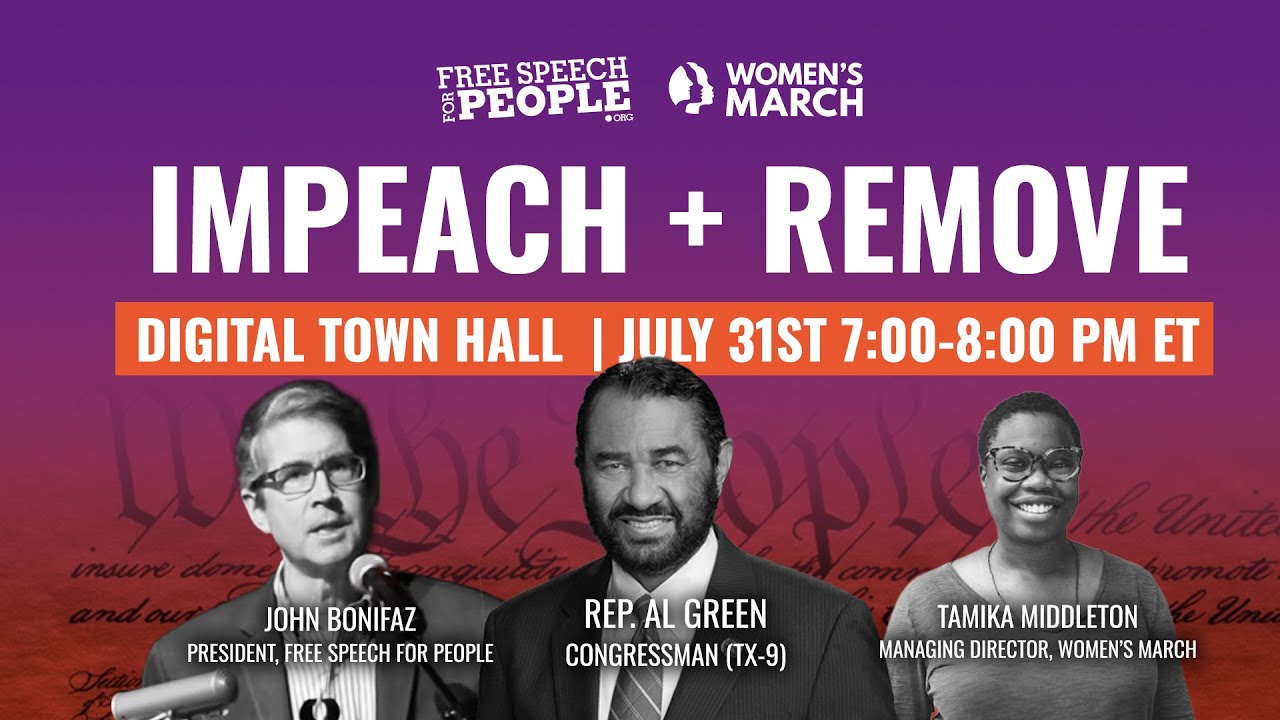
Join us for adigital town hallTOMORROW, June 3, about the movement to impeach and remove President Donald Trump from office, featuring Congressman Al Green of Texas.
---
Join us for adigital town hallTOMORROW, June 3, about the movement to impeach and remove President Donald Trump from office, featuring Congressman Al Green of Texas. 625
---
suing Pete Hegseth, Marco Rubio, Tulsi Gabbard, and other Trump admin officials for using a group chat on Signal to plan military operations.
---
LI
857-523-0242 (Mobile)
===
am oversight
Email: info@americanoversight.org
Phone: (202) 869-5246
Address: American Oversight, 1030 15th St. NW, B255, Washington, D.C. 20005
---
2x?
Posted on December 10, 2018
Today is the fifteenth anniversary of the U.S. Supreme Court’s decision in McConnell v. Federal Election Commission, a case that points to a future that could have been.
The case
The case was born out of the Bipartisan Campaign Reform Act of 2002, also known as McCain-Feingold after its two Senate sponsors, John McCain (R-Ariz.) and Russ Feingold (D-Wisc.). Working together for a seven-year period against considerable opposition from interest groups, these two senators and their House counterparts, Reps. Chris Shays (R-Conn.) and Marty Meehan (D-Mass.), fought to update the federal campaign finance law, which had barely been updated since 1974, to reflect new realities. The law was far from a perfect solution, as it was hamstrung not only by the politics of the day but also by the Supreme Court’s 1976 precedent Buckley v. Valeo, but still, it was the most meaningful federal reform in a generation.
In the House, a bipartisan majority voted the bill in over the objections of the speaker; in the Senate, it overcame a filibuster with 60 votes. President Bush signed it into law in 2002. Shortly afterwards, a motley crew of special interests and opponents of reform, ranging from the California Democratic Party to Sen. Mitch McConnell (R-Ky.), challenged it in court as unconstitutional. They claimed that it was unconstitutional.
And then something happened that, by today’s standards, would be remarkable: the U.S. Supreme Court upheld almost all of it. The case did not produce a single majority opinion covering all the issues, so it is complex to read, but overall, a coalition of justices appointed by different presidents from both parties upheld nearly all of the challenged provisions of the law. The Court broke no new ground; for example, it adhered to Buckley‘s insistence that campaign finance laws could only be justified on the basis of “corruption” rather than, for example, the principle of political equality. But the Court found that the particular reforms in the McCain-Feingold law were, in fact, justified as protecting against corruption or the appearance of corruption.
Fifteen years later
McConnell is in many ways a symbol of a lost future. After a change in composition of the Court, in 2010 (just seven years after the decision), the Court’s infamous Citizens United v. FECdecision overruled key parts of McConnell. The 2014 McCutcheon v. FECwas a further retrenchment. Some parts of McConnellsurvive, but its key principles no longer enjoy majority support on the Court.
To be clear, the McCain-Feingold bill was no panacea; it solved some very specific problems of the 1990s, while not even attempting to address broader political inequalities. But a Supreme Court jurisprudence that built precedent from the McConnelldecision would have been better than one that tore it down with Citizens United.
How do we move forward? First, there are many “low-hanging fruit” reforms, such as public financing of elections, that can be pursued without running afoul even of the Supreme Court’s current cramped jurisprudence. Second, we can pursue innovative litigation and legislation designed to cut back on Citizens Unitedand its progeny in specific areas where there is still room for progress at the Supreme Court, such as fighting super PACs and foreign money (whether directly or “laundered” through corporate political spending). And third, we can work to pass a constitutional amendment to go further than even McConnelldid, and overturn not just Citizens Unitedbut Buckleyas well, and work towards the promise of political equality for all.
---
---
4 25 email
Representative Summer Lee has introduced landmark legislation that would place a $5,000 per calendar year limit on contributions to super PACs in federal elections, effectively abolishing them. We worked closely with Representative Lee’s office in drafting this legislation. By passing it, we bring ourselves one step closer to a democracy of, by, and for the people.
---
---
Law and democracy
As a public interest lawyer, my expertise includes strategic democracy litigation, the U.S. Constitution, campaign finance, voting rights, and environmental law.
Previously, I served for a decade as the Legal Director at Free Speech For People, and before that at the U.S. Environmental Protection Agency.
Some highlights from the past few years are below; see my LinkedIn page for more.
"Ron Fein, you are literally on the front lines of saving our democracy*" - MSNBC (Jason Johnson)
"His knowledge of case law seemed encyclopedic*" - The New Yorker (Sue Halpern)
"Communist...scumbag lawyer*" - Marjorie Taylor Greene
In the news
The 'Chilling' Trump Plan That Could Pave The Way For Authoritarianism - Huffington Post, June 11, 2024
How much does it cost DeSantis to travel from one place to another? Florida won't tell you - USA Today, May 20, 2024
Removing Trump - MSNBC (appearance on All in with Chris Hayes, guest host Jason Johnson), Dec. 27, 2023
A High-Risk Legal Effort to Keep Trump Off the Ballot - New Yorker, Nov. 9, 2023
Minnesota trial to remove Trump from 2024 election ballot begins - NBC News, Nov. 2, 2023
Appellate argument in constitutional challenge to candidacy of Donald Trump (courtroom video) - Nov. 2, 2023
Effort to disqualify Trump from WH gains traction - MSNBC (appearance on Deadline: White House with Nicolle Wallace), Aug. 31, 2023
14th Amendment, Section 3: A new legal battle against Trump takes shape - ABC News, Aug. 25, 2023
This issue could knock Trump off ballots nationwide. Get ready for it to dominate primary season - L.A. Times, Aug. 18, 2023
1870s racism echoes through Trump and Colorado cases - Colorado Newsline, Aug. 3, 2023
Trump team prepares to fight efforts to block him from ballots over Jan. 6 - Washington Post, Apr. 18, 2023
Limits on super PACs stump top Massachusetts court - Courthouse News Service, Feb. 6, 2023
A Long-Shot Push to Bar Trump in 2024 as an “Insurrectionist” - N.Y. Times, Sept. 7, 2022
Opening argument in constitutional challenge to candidacy of Rep. Marjorie Taylor Greene (courtroom video) - C-SPAN, Apr. 22, 2022
What Marjorie Taylor Greene will be asked when she testifies under oath - MSNBC (appearance on All In with Chris Hayes, guest host Ayman Mohyeldin), Apr. 20, 2022
 - CNN (appearance on New Day with Brianna Keilar), Feb. 10, 2022
 - CNN (appearance on Erin Burnett Out Front), Jan. 27, 2022
Cawthorn Challenge Raises the Question: Who is an “Insurrectionist”? - N.Y. Times, Jan. 25, 2022
How Jan. 6 Gave the 14th Amendment New Life - N.Y. Times, Jan. 19, 2022
 - CNN (appearance on CNN Newsroom with Victor Blackwell & Alisyn Camerota), Jan. 14, 2022
Op-eds
Merrick Garland Has Abandoned Prosecuting Trump’s Pre-2020 Crimes - JURIST, Jan. 6, 2023 (with John Bonifaz & Ben Clements)
Voting Rights Under Threat - BillMoyers.com, Mar. 18, 2021 (with John Bonifaz & Ben Clements)
Impeachment or not, the Justice Department must investigate Trump - L.A. Times, Jan. 13, 2021 (with Sarah Chayes & Ben Clements)
Impeach Trump again—and bar him from future office - Boston Globe, Jan. 5, 2021 (with John Bonifaz & Ben Clements)
The public has a right to hear Stormy Daniels, Mr. President - Wash. Post, Mar. 23, 2018 (with Laurence Tribe)
Equifax deserves the corporate death penalty - WIRED, Oct. 20, 2017
Donald Trump Abused Pardon Power When He Freed Joe Arpaio - TIME, Oct. 3, 2017 (with John Dean)
Books and book chapters
Fixing the Supreme Court’s Mistake: The Case for the Twenty-Eighth Amendment - in Democracy by the People: Reforming Campaign Finance in America (Eugene Mazo & Timothy Kuhner, eds., Cambridge Univ. Press 2019)
The Constitution Demands It: The Case for the Impeachment of Donald Trump (with John Bonifaz & Ben Clements) (Melville House Publishing 2018)
---
brian email 11 24
This election cycle, our democracy has been staggered by blow after blow. We cannot pretend otherwise; to do so would be to accept that this hamstrung system is the one with which we must live. It is not and we do not accept that it is. We will keep fighting for our democracy.
So we face the facts. We know Donald Trump, twice impeached and responsible for inciting an insurrection when he lost the 2020 election, was declared the President-Elect following the 2024 election. We know that he is disqualified to hold this office under the Insurrectionist Disqualification Clause of the U.S. Constitution, but was permitted to remain on the ballot because of a corrupt and broken Supreme Court. We know that he infused his campaign with violent, racist rhetoric that to at least some of his supporters is a feature, not a bug.
We know that Trump and Harris raised a combined $2.7 billion, with more than $1 billion coming from super PACs and other sources outside of their official campaigns. We know that for all federal elections, outside expenditures exceeded $4.5 billion, shattering previous records set in 2020. We also know that the majority of that spending came from super PACs.
We know that, in the shadow of Trump’s repeated threats against a free press, billionaire-owned newspapers refused to endorse a candidate over the opposition of staff. We know that social media platforms are flooded with disinformation and that our access to the words of others—whether they be friends, journalists, or anyone else—is subject to the whims of algorithms designed to maximize profit over truth.
We know that Trump—currently facing multiple federal criminal charges for interfering with the 2020 election and stealing classified documents—is unlikely to be prosecuted while he holds office, and that the Supreme Court has granted him immunity for crimes arising from his “official acts.” We know that he was in violation of the emoluments clause when he took office in 2017 and is poised to remain in violation of the emoluments clause when he takes office again in 2025.
We know that our judicial branch is mired in corruption and partisan scandals that have been uncovered not by official investigation but by journalists—all without consequence. We know that the Supreme Court and lower courts across the country continue to render decisions that erode voting rights and anti-corruption laws.
Big money in politics does not and cannot coexist with political equality. Free speech should not be a zero-sum game. But in the hands of oligarchs and the politicians and judges who rely on them, that is what it has become. Where money has been given the status of speech and corporations the status of people, where our mechanisms of sharing speech and knowledge is shaped by profit maximization, then some voices can and do silence others. This is dangerous on its face, and it is particularly dangerous where, as we see now in our country, powerful voices are targeting marginalized and vulnerable communities. They do so in order to foment racist, violent support for their causes, to intimidate those who oppose them, and to make it seem as if silence in the face of oppression is the safest course.
It is not. It may be the safest course for billionaire newspaper owners and profit-maximizing social media companies, but it is not the safest course for the people of this country or for the United States. We know this. We know that our democracy will not be saved by accepting its billionaire/corporate capture as fait accompli. And we know that there are elected officials, judges, grassroots organizers, journalists, lawyers, institutions, and ordinary people all across the nation who remain committed to our democracy—including those voters in Maine who overwhelmingly voted to abolish super PACs in elections in their state.
With this knowledge—the good and the bad—Free Speech For People remains committed to its ongoing fight to protect our democracy and our elections for people and not corporations and to lift up the promise of political equality for all. We will continue to demand accountability from our judges and our elected officials, including the President. We will carry on our work to challenge big money in politics and unchecked corporate power, and we will celebrate every step that moves us closer to an equitable, just, democratic society.
===
---
---
:{:{6 24 reintro raskin kickass}:
:{:{We’ve witnessed money from corporations with significant foreign ownership flowing into our elections, circumventing direct bans on foreign influence enshrined in federal law. Citizens United created a massive loophole for foreign interests to acquire stakes in U.S. corporations and then use that leverage to influence or control the corporation’s political activity, including campaign contributions, contributions to super PACs, and independent expenditures. Across the country, companies like Amazon and Airbnb, which have partial foreign ownership, have used their money to influence the outcome of elections and to advance political agendas in their favor.}:
:{:{Their new bill would bar corporations with significant foreign ownership from contributing to candidates, parties, or committees (including super PACs) or from engaging in their direct election spending. Free Speech For People was instrumental in drafting and helping to pass this model legislation in Minnesota, San Jose, California, and Seattle, Washington.}:
:{:{Now more than ever, we must do all we can to restore faith and confidence in our democracy. By banning multinational corporations from pouring unlimited sums of money into our elections, we are upholding the letter of the law and getting us one step closer to a democracy that is truly by and for the people.}:
Sign if you agree: It’s time to end foreign-influenced corporate spending in U.S. elections.
:{:{Thank you!}:
:{:{– Free Speech For People}:
:{:{---}:
:{:{oct 2023}:
:{:{Free Speech For People is honored to receive a new grant award from Craig Newmark Philanthropies. The funds from the award will go towards our work to challenge corruption, secure free and fair elections...}:
:{:{Craig Newmark Philanthropies works to protect the values that America aspires to: fairness, opportunity, and respect. We are grateful to receive this critical support from Craig Newmark Philanthropies and to work together to strengthen our democratic process.}:
With this support, Free Speech For People will carry out the following key initiatives:
- Challenging foreign influence in elections:Free Speech For People has researched, drafted, and fought for state and local legislation to fight political spending by foreign-influenced corporations. In 2023, Minnesota became the first state to enact our model legislation to prohibit foreign-influenced corporations from spending money in elections. Similar legislation is being consider in California, Hawaii, Massachusetts, New York, and Washington. Click here to learn more!
- Fighting for free and fair elections:Free Speech For People has taken legal actions in multiple states to challenge voter intimidation, as well as laws that seek to suppress and disenfranchise voters. Our ongoing work to protect the right to vote has already yielded major victories in Minnesota, Texas and other states. Click here to learn more!
- Advancing new Democracy Amendments:We have drafted and are now advancing a series of constitutional amendments including the Free and Fair Elections Amendment to end big money dominance of our elections; the Right to Vote Amendment; an amendment to abolish the Electoral College; and the Equal Rights Amendment. Click here to learn more!
- Holding elected officials accountable to Section 3 of the 14th Amendment to the Constitution:Free Speech For People has launched a campaign calling on state election officials across the country to uphold Section 3 of the 14th Amendment of the U.S. Constitution, which disqualifies all insurrectionists who engaged in the January 6, 2021 insurrection from holding future public office. In support of this campaign, we have filed a series of legal challenges against former president Donald Trump in multiple states and continue to build a grassroots movement in support of holding him accountable to the Constitution.
Thank you to Craig Newmark Philanthropies for this generous support of Free Speech For People’s work to ensure all people have an equal voice and an equal vote in our democracy!
---
y mail 6 23
Today, U.S. Representative Jim McGovern introduced the Free and Fair Elections Amendment, which would overturn Citizens United and reclaim our democracy. In doing so, it would uphold the fundamental promise of political equality for all. And unlike other amendments that would merely allow Congress to pass federal campaign finance legislation (which it might not do) for federal elections, the Free and Fair Elections Amendment directly imposes these key elements in the amendment itself without any further action from Congress.
---
raw story 10 24
Voting rights groups are sounding the alarm about anonymous text messages allegedly sent to college students in Wisconsin, threatening them with prison if they vote, according to CNN.
"The unsolicited text, sent from at least one 262- number to cell phones of people in their early 20s on University of Wisconsin campuses and elsewhere, says: 'WARNING: Violating WI Statutes 12.13 & 6.18 may result in fines up to $10,000 or 3.5 years in prison. Don’t vote in a state where you’re not eligible,'" reported Katelyn Polantz.
Those statutes prohibit someone from voting by mail in a Wisconsin election if they have moved out of Wisconsin. They do not apply to students who moved to Wisconsin for school.
Voting rights groups fear that students could be intimidated out of voting by the message, with Free Speech for People's Courtney Hostetler warning, “It’s trying to convince students living in Wisconsin they don’t have a right to vote there.”
ALSO READ:Busted: Armed man arrested at rally tied to Trump's 'secretary of retribution'
The groups have sent a report about this incident in a letter to Attorney General Merrick Garland and Wisconsin Attorney General Josh Kaul, urging them to investigate the matter.
Lying to voters about election procedures with the intent to trick or intimidate them out of voting is a crime, and cases of this sort have resulted in convictions in recent history.
Doug Mackey, a far-right social media influencer who went by the name "Ricky Vaughn," was jailed over a 2016 scheme to misinform Black voters that they could cast ballots for Hillary Clinton by text message. And a the pro-Trump duo of Jacob Wohl and Jack Burkman agreed to pay $1.25 million in penalties over an illegal robocall scheme that falsely warned Black voters in the Midwest that voting could re-activate outstanding warrants and debt collection against them.
===
---
CA 4 23 raskin
Across the country, companies with significant foreign ownership, like Amazon, Uber, DoorDash, and Airbnb, have used their money to influence the outcome of elections and to advance political agendas in their favor.
We deserve a democracy by and for the people of California, not multinational corporations. I urge you to vote AB 83 out of the suspense file.
---
4 23 y mail
BREAKING: Minnesota has just become the first state in the nation to pass legislation prohibiting foreign-influenced corporations from spending money in elections. The bill now moves to the Governor’s desk who has pledged to sign it into law.
The Democracy for the People Act includes a provision that prohibits multinational corporations from spending money directly or giving it to a super PAC or other entity to spend in Minnesota state or local elections.
We know this is just the beginning. This legislation, based on the model we successfully passed in Seattle, is already under consideration in Hawaii, California, Washington, New York, and Massachusetts, as well as the U.S. House of Representatives.
---
y mail 2 23
federal judge in Colorado has just ruled that the leaders of the United States Election Integrity Plan (USEIP), an extremist organization with ties to QAnon and the January 6 insurrection, cannot escape a trial in our lawsuit seeking to stop their illegal voter intimidation campaign in Colorado. USEIP has been conducting a door-to-door campaign of intimidation at voters’ homes, in which its agents (sometimes armed) question voters about their method of voting, interrogate them about so-called fraudulent ballots, levy baseless accusations of fraud against voters, and take photographs of voters’ homes to store in a database.
The defendants tried to prevent the case from going to trial by filing multiple motions, and even countersuing the voting rights organizations that Free Speech For People represents in this lawsuit (the NAACP of Colorado, League of Women Voters of Colorado, and Mi Familia Vota) for defamation and abuse of process.
But their tactics failed.
On January 23, 2023, the court dismissed the defendants’ defamation and abuse of process counterclaims. Then on January 31, the court denied their motion for judgment on the pleadings and, with one minor exception, their motion for summary judgment, allowing all claims to proceed against the individual leaders of USEIP.
With the counterclaims dismissed and the court agreeing that the core voter intimidation claims may proceed, our case is now on its way to trial. But for us to win this case, we’re going to need all the help we can get.
---
8 22
In the aftermath of the Civil War, the United States enacted Section 3 of the 14th Amendment to bar any individual who has taken an oath to defend the U.S. Constitution and then engages in insurrection against the United States from holding any future public office. Following the seditious attack on the Capitol on January 6, 2021, Free Speech For People has led the fight in the courts to uphold Section 3 of the 14th Amendment and ensure that state election officials abide by the U.S. Constitution and bar insurrections from the ballot.
In the process, we have scored two significant court victories that create critical precedent for applying the Insurrectionist Disqualification Clause to Donald Trump, the insurrectionist-in-chief, should he decide to run for president again. In our 14.3 challenge in North Carolina to Rep. Madison Cawthorn, the U.S. Court of Appeals for the Fourth Circuit issued a ruling making clear that Section 3 of the 14th Amendment can be applied to January 6th insurrectionists who previously took an oath of office and now seek to attain public office again. The federal appeals court stated that the 1872 Amnesty Act, which provided amnesty for ex-Confederates and was cited as a defense in the Cawthorn case, does not shield the January 6th insurrectionists from the consequences of their actions under the Fourteenth Amendment, and provides no basis to block state proceedings seeking to exclude insurrectionists from the ballot.
Meanwhile, in Georgia, Federal District Court Judge Amy Totenberg denied Representative Marjorie Taylor Greene’s attempt to block a challenge, brought by Georgia voters, to her candidacy under Section 3 of the 14th Amendment. As a result, Representative Greene became the first Member of Congress in the nation’s history to be forced to answer questions under oath about her role in an insurrection.
We’ve just argued in front of the US Court of Appeals for the Eleventh Circuit that Judge Totenberg’s ruling was justified, and now we’re awaiting a ruling.
Thanks to our work, we have established in two separate court cases that voters have the right to challenge a candidate’s eligibility based on Section 3 of the 14th Amendment. We will continue to fight to ensure that chief election officials across the country follow the mandate of this critical constitutional provision designed to protect our republic.
---
4 22
Free Speech For People just filed, on behalf of Arizona voters, lawsuits challenging the candidacies of Paul Gosar, Andy Biggs, & Mark Finchem
---
---
https://talkingpointsmemo.com/news/madison-cawthorn-lawyer-cites-confederate-amnesty-act-to-defend-reps-job-capitol-insurrection
a lawyer for Rep. Madison Cawthorn (R-NC) cited an 1872 congressional action granting amnesty to Confederate soldiers to defend his own client’s eligibility for office.
The argument from Cawthorn lawyer James Bopp Jr. came in response to a legal effort to have Cawthorn declared ineligible for office because he allegedly “encouraged, and upon reasonable suspicion helped aid, the insurrection” on Jan. 6.
The legal challenge, from a group of North Carolina voters backed by the organization Free Speech For People, alleges that Cawthorn violated the third section of the 14th Amendment, which states, “No Person shall be a […] Representative in Congress […] who, having previously taken an oath, as a member of Congress […] to support the Constitution of the United States, shall have engaged in insurrection or rebellion against the same.”
On the phone with TPM Wednesday, Bopp said “there are substantial constitutional defenses, which include the fact that Congress passed the 1872 Amnesty Act, which removed all persons whatsoever from the disability under Section 3 as a result of engaging in an insurrection or rebellion."
tho the Amnesty Act applied at the time to Confederate soldiers who fought in the Civil War, nothing in the law prevented it from being applied in the future, Bopp argued.
“There’s nothing in the Amnesty Act that says it’s only applicable to the Civil War, and it was very broad in its terms,” he said.
Ron Fein, legal director for Free Speech For People, told TPM in a statement that “Mr. Bopp’s argument is contradicted by history and common sense.”
“In the congressional debates leading up to the 14th amendment, Congress considered but rejected a draft of section 3 that only applied to ‘the late insurrection,’ i.e., the Civil War; in other words, Congress explicitly wrote section 3 to apply to future insurrections,” Fein said. “In the entire public and congressional debate leading to the 1872 amnesty, no one ever mentioned Mr. Bopp’s idea of future amnesty for insurrectionists who hadn’t even been born yet.”
“If Congress had intended through the 1872 amnesty to enact a de facto repeal of a constitutional amendment that it had just passed, you would have expected someone to have mentioned this at the time,” he added. Bopp first commented about the Amnesty Act to The New York Times Tuesday.
A Bid To Disqualify Right-Wing Reps
Free Speech for People has made no secret of the fact that it plans on challenging the eligibility of other members of Congress.
But North Carolina law is especially useful for challengers of Cawthorn’s eligibility: It puts the burden on candidates to demonstrate, “by a preponderance of the evidence of the record as a whole that he or she is qualified to be a candidate for the office.” (For now, the challenge to Cawthorn’s eligibility has been delayed by the legal fight over redistricting in the state.)
The challengers noted that Cawthorn was reportedly in touch with event planners behind the Jan. 6 White House rally, which preceded the attack on Congress. He also encouraged attendees at one December 2020 speech to “lightly threaten” their congressional representatives. Two days before the Capitol attack, he tweeted that the fate of the country hinged “on the actions of a solitary few.”
“Get ready, the fate of a nation rests on our shoulders, yours and mine,” Cawthorn wrote. “Let’s show Washington that our backbones are made of steel and titanium. It’s time to fight.”
On Jan. 6 itself, Cawthorn spoke to the crowd at the White House event that preceded the riot.
“The Democrats, with all the fraud they have done this election, the Republicans, hiding and not fighting, they are trying to silence your voice,” he said, after observing that “this crowd has some fight.”
After the attack began, but before insurrectionists breached the Capitol building itself, Cawthorn tweeted, “I’m fighting a battle for our Constitution on the house floor with other patriots. The battle is on the house floor, not in the streets of D.C.”
Insurrectionist Under Law?
Bopp argued to TPM that these actions did not amount to partaking in an insurrection. The 14th Amendment’s use of “engaged” to define participation in an insurrection did not apply here, he said.
He accused Cawthorn’s challengers of “weaponizing” what occurred on Jan. 6 “to subvert our democracy by preventing qualified people from running for office.”
“It wasn’t an insurrection, it wasn’t a rebellion by any sensible definition of those words, and Cawthorn was on the floor of Congress when it occurred doing his official duties, so he wasn’t ‘engaged’ in any of it,” he said.
The challenge may be a bit of a longshot, as several legal observers have acknowledged, but it could also force Cawthorn to speak more about what role he had, if any, in organizing some part of the Jan. 6 event schedule.
“If it turns out that there are proper procedures lawfully being employed that result in a deposition, he’ll deal with that when that occurs,” Bopp said. But, he added, “I seriously doubt that we’ll get to that point.”
---
https://freespeechforpeople.org/why-personhood-matters-professor-tamara-piety-to-truthout/
posted on June 10, 2015
Why Personhood Matters: Professor Tamara Piety to Truthout
Professor Tamara Piety, whom we are honored to have on our Legal Advisory Committee at Free Speech For People, tells it like it is in this must-read Truthout piece on why corporate personhood matters. Read the full piece, here.
Some excerpts below:
“Yes, corporations are made up of people, but that doesn’t tell us which of these people count for purposes of constitutional rights when, as in Hobby Lobby, the rights of the various people in the corporation are in conflict. And describing corporate speech as a public “benefit” is a stretch when the speech in question (for example, tobacco advertising) may harm the public.”
“We condemn discrimination against people because it offends human dignity. By contrast, concern for human dignity does not require us to treat all businesses alike: to the contrary, hard experience teaches us that some businesses – drugs, banks, securities, common carriers – require more regulation than others. The tax code “discriminates” between for-profit and charitable organizations without offending anyone’s dignity. Yet the Supreme Court’s new “corporate civil rights movement” obscures that fact.”
“Voters do not need to be legal sophisticates to know that something is wrong when corporations have more rights than people do.”
---
8 22
---
LEGAL ADVISORY COMMITTEE
ALBERT ALSCHULER
Professor Emeritus Of Law And Criminology, University Of Chicago Law School
LAWRENCE ANDERSON
Montana Trial Attorney And Member Of The Board Of Governors Of The American Association Of Justice
DAVID CIEPLEY
Laurance S. Rockefeller Visiting Faculty Fellow, Princeton University, Associate Professor Of Political Science, University Of Denver
JOHN COATES
Professor Of Law, Harvard Law School
JAMES EXUM, JR.
Former Chief Justice Of The North Carolina Supreme Court
CAROLINE FREDERICKSON
President, American Constitution Society
ELLEN P. GOODMAN
Professor Of Law, Rutgers School Of Law
LISA GRAVES
Co-Director, Documented
DANIEL GREENWOOD
Professor Of Law, Hofstra Law School
THOMAS JOO
Professor Of Law, University Of California, Davis, School Of Law
LIZ KENNEDY
Director Of Democracy And Government Reform At TheCenter For American Progress
ROBERT KERR
Edith Kinney Gaylord Presidential Professor, University Of Oklahoma
CYRUS MEHRI
Founding Partner, Mehri & Skalet, PLLC.
ROBERT A.G. MONKS
Author, Founder, Lens Governance Advisors
JAMES NELSON
Former Justice Of The Montana Supreme Court
EVA PATERSON
Co-Founder And President, Equal Justice Society
PETER PEASE
Founder, Law Offices Of Peter Pease
KATIE REDFORD
Executive Director, The Equation Campaign
BERTRALL ROSS
Assistant Professor Of Law, University Of California At Berkeley School Of Law
CATHERINE ROSS
Professor Of Law, George Washington University Law School
DALE RUBIN
Professor Of Law, Appalachian School Of Law
STEVEN SHIFFRIN
Professor Of Law, Cornell University Law School
JAMES GUSTAVE SPETH
Senior Fellow, Vermont Law School
JENNIFER TAUB
Professor Of Law, Western New England Law School
GERALD TORRES
Professor Of Environmental Justice And Professor Of Law, Yale Law School
---
---
619 80 MOC impeach
==
820
Next week, our team will be in court for the voters of Pennsylvania, challenging dangerous election practices that threaten the health and safety of voters and undermine the constitutional right to vote. African American and Latino citizens, who have historically struggled for the right to participate equally in our democracy, have been disproportionately affected by the ongoing COVID-19 pandemic, making the risks of voting in an overcrowded polling place particularly severe and disparate for these populations. That’s why Free Speech For People, on behalf of the Pennsylvania State Conference of the NAACP, has sued Secretary of the Commonwealth Kathy Boockvar to challenge numerous unsafe and unequal election practices that violate the Pennsylvania Constitution’s guarantees of free and fair elections and equal protection of the law.
But this case is bigger than Pennsylvania. Last month, the Trump campaign and the RNC filed amotion to intervenein this case. They, along with the National Republican Congressional Committee and the Republican Party of Pennsylvania, seek to oppose the Pennsylvania NAACP in this case and to block the remedies requested to help ensure a safe and secure election in Pennsylvania this November.
---
719
From Free Speech for People:An amicus brief recently submitted in Lieu v. FEC includes peer-reviewed research demonstrating that large contributions to Super PACs create an appearance of corruption. Their research consisted of two “vignette-based experiments” in which people were recruited to serve as mock jurors and determine whether various campaign finance fact patterns met the standard for quid pro quo corruption under federal bribery statutes. Read more.
==
---
we filed our opening brief in the U.S. Court of Appeals for the D.C. Circuit in Lieu v. FEC.
This was an important step on the path to getting the court to review the notorious SpeechNow v. FEC decision for the first time since 2010 -- and potentially overturn it.
Here’s the back story: SpeechNow.org v. FEC was the case that originally unleashed super PACs on our democracy. For nearly a decade, the SpeechNowruling has allowed big money donors to evade federal campaign contribution limits and further corrupt our political process.
Many scholars and constitutional law experts said that the ruling was legally erroneous at the time, and U.S. Supreme Court Chief Justice Roberts has even given signals that suggest he would be willing to sustain limits on contributions to super PACs.
Lieu v. FECis our opportunity. Filed in federal district court on behalf of a bipartisan coalition of Members of Congress and 2016 congressional candidates, the case seeks the reversal of the SpeechNow.org v. FEC ruling. And yesterday’s opening brief pushes it along on its journey!
==
John C. Bonifaz (born 22, June 1966, in Wilmington, DE) is an Amherst-based attorney and political activist specializing in constitutional law and voting rights. He is the president and co-founder of Free Speech for People.[1] He is also the founder of the National Voting Rights Institute and a former candidate for Massachusetts Secretary of the Commonwealth. In 1999, he received a MacArthur Fellowship, popularly known as the "genius award."[2]
Contents
- 1Constitutional challenge and hearings on 2003 invasion of Iraq
- 2National Voting Rights Institute
- 3Massachusetts Clean Elections Law
- 4Campaign for Secretary
- 5Free Speech for People
- 6Background
- 7References
- 8External links
Constitutional challenge and hearings on 2003 invasion of Iraq
In February and March 2003, Mr. Bonifaz served as lead counsel for a coalition of US soldiers, parents of US soldiers, and members of Congress in John Doe I v. President Bush, a constitutional challenge to President Bush's authority to wage war against Iraq absent a congressional declaration of war or equivalent action. He argued that the President's planned first-strike invasion of Iraq violated the War Powers Clause of the US Constitution.[3] The lawsuit was initially dismissed in February 2003 and in March 2003 the dismissal was upheld on appeal. Regarding the initial dismissal, Attorney Bonifaz said "They're not supposed to sideline ... Courts cannot shirk from responsibility when it looks like a political battle."[4] Regarding the affirmation of the dismissal, the appeals court held "... the text of the October Resolution itself spells out justifications for a war and frames itself as an 'authorization' of such a war." ^[5]
Bonifaz wrote the 2004 book Warrior-King: The Case for Impeaching George W. Bush,[6] which chronicles that case and its meaning for the United States Constitution. The book argues that the Iraq War was illegal.
In the aftermath of the release of the Downing Street Memo in 2005, Bonifaz co-founded After Downing Street and wrote a memo to Congressman John Conyers of Michigan, the Ranking Democrat on the House Judiciary Committee, urging him to introduce a Resolution of Inquiry directing the House Judiciary Committee to launch a formal investigation into whether sufficient grounds exist for the House to impeach President George W. Bush. Bonifaz participated in a discussion with former CIA Analyst Ray McGovern led by Rep. Conyers, advocating Bush's impeachment for misrepresenting the case for the Iraq war.[7][8]
National Voting Rights Institute
Bonifaz is also the founder of the National Voting Rights Institute (NVRI), where he most recently served as general counsel. In 2006, NVRI formed a partnership with Demos (US think tank), and as of January 1, 2007, Bonifaz signed on as Senior Legal Fellow with Demos. Founded in 1994, NVRI serves as a prominent legal and public education center dedicated to protecting the right of all citizens to vote and to participate in the electoral process on an equal and meaningful basis.
For his work with NVRI, he is a 1999 recipient of a MacArthur Foundation Fellowship, also known as a "genius" award. In awarding the five-year fellowship, the John D. and Catherine T. MacArthur Foundation stated:
Bonifaz, a public interest lawyer, uses innovative litigation to reexamine campaign finance reform arguments typically debated on first amendment grounds. Through the National Voting Rights Institute, an organization he founded, Bonifaz recasts the legal arguments to focus on fourteenth amendment protections, challenging the relationship between money and politics.
Massachusetts Clean Elections Law
In 2002, the Massachusetts legislature declined to fund the clean elections law, a public financing measure passed by voters in 1998. Bonifaz and the NVRI sued Massachusetts on behalf of Warren Tolman, a candidate for governor who had qualified for public financing and was not receiving the money. The Massachusetts Supreme Judicial Court ruled that the legislature must fund a law passed by the voters that it has not repealed.[9] When the legislature persisted in not releasing the necessary funds to pay Tolman and other candidates, Bonifaz went to court again, and secured a ruling allowing his coalition to force the sale of state property.[10][11] The legislature repealed the clean elections law after the 2002 elections.
Campaign for Secretary
In 2006, John Bonifaz ran for the Democratic nomination to be Secretary of the Commonwealth of Massachusetts in 2006 against incumbent William F. Galvin. He declared his candidacy on December 1, 2005,[12]before it was known whether Galvin would run for re-election or for governor. Galvin won the primary election, which was held on September 19, 2006.
During the campaign, Bonifaz was linked to the Green Party by his opponent, because he voted for Green Party presidential candidate Ralph Nader in Massachusetts in 2000, and because he received a campaign contribution from Jill Stein, the Green-Rainbow Party candidate for secretary of state. Jill Stein was one of the clients he represented in the Clean Elections lawsuit, and other clients from that case donated to his campaign, including Warren Tolman, a Democratic candidate for governor in 2002. After unenrolling from the Democratic Party prior to the 2000 election, Bonifaz later re-registered as a Democrat and has never been registered as a Green.[13][14]
Bonifaz's campaign focused on election reform, promoting clean elections, same day registration, voting rights for minorities, and opposition to privately owned voting machines with proprietary software.
Free Speech for People
Following the Citizens United decision, Bonifaz co-founded Free Speech for People with Jeff Clements. "Free Speech For People is a national non-partisan campaign working to restore democracy to the people and to return corporations to their place as economic rather than political entities," to quote the organization's website. Bonifaz and Free Speech for People advocate for a new constitutional amendment to clarify that the Bill of Rights applies to people, not corporations.
Background
Bonifaz has also litigated international human rights and environmental law cases, and, with his father Cristobal Bonifaz, has litigated against Chevron Corporation regarding pollution in the Lago Agrio oil field in the Ecuadorian Amazon. (Cristobal Bonifaz is a native of Ecuador.)
Bonifaz's great-grandfather was Neptalí Bonifaz, who was briefly president of Ecuador in 1931.[15]
A graduate of Brown University in 1987 and Harvard Law School cum laude in 1992, Bonifaz is married to Lissa Pierce Bonifaz. Lissa holds a doctorate in bilingual education.
References
- ^ "Free Speech For People Staff". www.FreeSpeechForPeople.org. Retrieved 9 February 2015.
- ^ Biography at After Downing Street
- ^ CNN report on anti war lawsuit
- ^ The Crimson article
- ^ The Modern Tribune article on Doe v Bush
- ^ Warrior-King: The Case for Impeaching George W. Bush, (NationBooks-NY, 2004, foreword by Rep. John Conyers, Jr.) ISBN 1-56025-606-0
- ^ Bonifaz's testimony at the June 16, 2005 hearings convened by Rep. Conyers
- ^ Bonifaz's March 22, 2005 memo urging Rep. John Conyers to introduce a Resolution of Inquiry on Iraq
- ^ "National Voting Rights Institute press release" (PDF). Archived from the original (PDF) on 2007-09-29. Retrieved 2006-05-20.
- ^ Clean Money Repo Men
- ^ "Legal Victory for Clean Elections in Massachusetts" (PDF). Archived from the original (PDF) on 2007-09-29. Retrieved 2006-05-20.
- ^ John Bonifaz candidacy declaration
- ^ Galvin primary battle article
- ^ *Romney's packed -- and unpacked -- a lot in 2006" article*
- ^ The Dubious Lawsuit against Chevron in Ecuador - Part 1
External links
- Free Speech for People
- John Bonifaz for Secretary of State 2006 campaign web site
- John Bonifaz campaign videos (posted by the campaign)
- National Voting Rights Institute
- After Downing Street
- The Wealth Primary
Authority control  |
|
- 1966 births
- Living people
- Brown University alumni
- Harvard Law School alumni
- MacArthur Fellows
- Massachusetts lawyers
- People from Amherst, Massachusetts
==
Free Speech For People Legal Advocacy Program mailing address:
634 Commonwealth Ave. #209
Newton, MA 02459
Free Speech For People Legal Advocacy Program by phone, please call: 617-244-0234
Ron Fein 4/15 good
Hi - pleased to hear from you, and keep up the good work.
Our co-founder, Jeff Clements, speaks widely on this, but he was just in SF in February: https://acslaw.secure.force.com/rsvp?id=a0YG0000007sL3zMAE
I don’t have any plans to be in the Bay Area anytime soon, but I’ll see if I can think of anyone who’s local there who might be good. I’m not sure about Steve Mayer - you’re welcome to try, but the nature of his involvement in the Prop 49 brief was limited to the question of whether ballot measures can contain advisory questions, not the topic of corporate constitutional rights. I honestly have no idea what his thoughts are on that.
In the meantime, just tell these lawyers “associational standing - see NAACP v. Alabama ex rel Patterson.” It’s a decision from before the widespread expansion of corporate constitutional rights that’s strikingly similar to the Planned Parenthood hypo. The Supreme Court held that the NAACP couldn’t raise any constitutional claims of its own against the state’s demand for its membership lists, but it could assert claims on behalf of its members, whose freedom of association was jeopardized by the state’s order. This logic wouldn’t apply to most for-profit corporations: Exxon shareholders aren’t “associating” when they buy Exxon stock.
april 23
==
==
http://freespeechforpeople.org/
superpacs
https://freespeechforpeople.org/speechnow-v-fec-case-created-super-pacs-challenge/
SpeechNow v. FEC – The Case that Created Super PACs, and Our Challenge
Posted on January 27 2018 by Ron Fein
January 27 marks the eighth anniversary of oral argument in the case that created super PACs. Contrary to popular belief, super PACs were not created by the Supreme Court in Citizens United,but rather by a subsequent lower court decision called SpeechNow v. FEC,argued on January 27, 2010 (just six days after the Citizens Uniteddecision).
As we explained in 2015, there are significant cracks in the legal foundation that created super PACs, and several converging developments in election law, constitutional law and even criminal law suggest the end may be in sight.
As a matter of practical reality, empirical research shows that top donors to super PACs are generally the same people as top donors to candidates and political parties, with ample opportunities to exchange super PAC contributions for political favors in a quid pro quo corruption scheme, whether or not the super PAC “coordinates” its media purchases with the campaign. In fact, a federal judge recently went out of his way to reaffirm in a criminal bribery case that contributions to super PACs can be part of bribes, notwithstanding Citizens United, although he found that the particular facts of that case didn’t support a bribery charge.
As a matter of legal doctrine, as explained in a forthcoming article by a group of pre-eminent constitutional scholars, SpeechNowsimply misapplied Citizens United: “In Citizens United the Supreme Court struck down limits on a political group’s expenditureswhile the issue in SpeechNow was the validity of limiting contributions to a political group.” That distinction between limits on expenditures versus limits on contributions is critical because since Buckley v. Valeo, the Supreme Court has recognized different standards of scrutiny for limits on contributions and limits on expenditures. Unfortunately, then-Attorney General Eric Holder decided not to appeal SpeechNowto the Supreme Court, on the (clearly mistaken in retrospect) theory that the SpeechNowdecision would “affect only a small subset of federally regulated contributions.” Now, there’s good reason to think that Chief Justice Roberts and/or Justice Kennedy would be willing to overrule SpeechNoweven if they are not prepared to retreat on Citizens United.
So how do we do it? Learn more about Lieu v.FEC, our federal lawsuit challenging SpeechNow(covered here in the Washington Post), and about our legislative efforts in St. Petersburg, Florida, Massachusetts, and elsewhere to challenge super PACs.
ron fein and Jeff Clements
john bonifaz
https://freespeechforpeople.org/author/ron-fein/
southern sheriff pp hypo:
Free Speech For People Legal Advocacy Program mailing address:
634 Commonwealth Ave. #209
Newton, MA 02459
Free Speech For People Legal Advocacy Program by phone, please call: 617-244-0234
Ron Fein 4/15 good
Hi - pleased to hear from you, and keep up the good work.
Our co-founder, Jeff Clements, speaks widely on this, but he was just in SF in February: https://acslaw.secure.force.com/rsvp?id=a0YG0000007sL3zMAE
I don’t have any plans to be in the Bay Area anytime soon, but I’ll see if I can think of anyone who’s local there who might be good. I’m not sure about Steve Mayer - you’re welcome to try, but the nature of his involvement in the Prop 49 brief was limited to the question of whether ballot measures can contain advisory questions, not the topic of corporate constitutional rights. I honestly have no idea what his thoughts are on that.
In the meantime, just tell these lawyers “associational standing - see NAACP v. Alabama ex rel Patterson.” It’s a decision from before the widespread expansion of corporate constitutional rights that’s strikingly similar to the Planned Parenthood hypo. The Supreme Court held that the NAACP couldn’t raise any constitutional claims of its own against the state’s demand for its membership lists, but it could assert claims on behalf of its members, whosefreedom of association was jeopardized by the state’s order.This logic wouldn’t apply to most for-profit corporations: Exxon shareholders aren’t “associating” when they buy Exxon stock.
april 23
==
ref reurters
‘Living wage’ law is unconstitutional – if you ask lobbyists
By Ron Fein October 6, 2014
Demonstrators rally to raise the hourly minimum wage to $15 for fast-food workers at City Hall in Seattle
Industry trade groups are now challenging Seattle’s new minimum wage law as unconstitutional. They claim the city’s $15 an hour rate violates the 14th Amendment. Passed just after the Civil War to ensure equal rights for the newly freed slaves, that amendment says no state may “deny to any person . . . the equal protection of the laws.”
:{
}:
According to the industry lawsuit, the minimum wage law violates this Equal Protection Clause because it phases in the higher wage at a different schedule for franchised companies than for small local businesses.
:{
}:
But the trade groups’ argument twists the real intent of the 14th Amendment. Its drafters had a special interest in whether workers could earn “fair, living wages,” our research has revealed. That phrase was often used by Senator Jacob Howard, a staunch Republican who served as the 14th Amendment’s Senate floor manager in 1866.
:{
}:
During congressional hearings, Howard repeatedly asked witnesses whether employers were paying the newly freed slaves “fair, living wages.”
:{
}:
Howard had reason to emphasize this point. Even before the Civil War ended, the Union Army was deeply concerned about whether freedmen were receiving fair wages. An 1865 Army work plan, for example, instructed officers to assist freedmen in obtaining “fair wages for their labor.”
Sometimes it was a struggle to achieve this. When employers in two recalcitrant South Carolina counties persisted in underpaying the freedmen, one Army general contemplated moving those counties’ entire freed population to areas that would pay them “fair wages.” By 1866, a special military unit established to assist freedmen during the post-Civil War Reconstruction had resorted to distributing standard labor contracts, with fixed labor rates, that would promote “prosperous relations between capital and labor” and be “satisfactory to the freedmen.”
Many Americans viewed “fair, living wages” as an integral part of the struggle from slavery to full citizenship. The influential abolitionist editor Horace Greeley — famous for his 1865 editorial that advised “Go West, young man” — wrote a widely reprinted open letter to “the Colored People of North Carolina” on September 14, 1865. He urged them to take immediate steps to demand “fair, living wages” as part of their larger struggle for equal rights.
So when members of the special congressional committee asked whether freedmen could earn fair or living wages, they understood the issue as intimately connected with the equality that the 14th Amendment ultimately enshrined.
That wasn’t the only concern behind the 14th Amendment, of course. But, unlike protection of the economic advantages that franchised businesses have over small local businesses, it was part of the 14th Amendment’s overall goals.
Given how important obtaining “fair, living wages” was to the 14th Amendment’s authors, industry lawyers have no basis to argue that the Equal Protection Clause protects the companies, rather than the workers. But it’s not surprising. Ever since the 14th Amendment was passed, corporate lawyers have tried to leverage it to strike down laws like Seattle’s.
:{
}:
In 1938, a frustrated Supreme Court justice complained that of the cases in the court in which the 14th Amendment was applied during the first 50 years after its adoption, “less than one-half of 1 percent invoked it in protection of the negro race, and more than 50 percent asked that its benefits be extended to corporations.”
Just this year, the Equal Protection Clause has been invoked on behalf of coal companies and multinational agribusiness conglomerates.
We need to put a stop to this unfounded constitutional argument. The businesses had their opportunity to make their case to the city of Seattle — and they lost. They shouldn’t be allowed to run to court under the banner of the 14th Amendment.
When Abraham Lincoln was just a rookie congressman, he wrote that securing “to each laborer the whole product of his labor, or as nearly as possible, is a most worthy object of any good government.” That’s what Seattle’s law does. Sixteen years after Lincoln wrote that, he vowed at Gettysburg to preserve a “government of the people, by the people, [and] for the people.” That’s what the industry’s lawsuit threatens.
The congressmen of Reconstruction sought to carry forward Lincoln’s legacy with the 14th Amendment. Their vision of full equality is not yet realized. But if they could see what Seattle is trying to achieve, they would be proud.
http://blogs.reuters.com/great-debate/2014/10/06/the-fight-for-living-wages-is-for-workers-not-corporations/
==
recount 2016
...
no link
Friday is the deadline for requesting a recount in Wisconsin, where Trump’s winning margin stands at 0.7%. In Pennsylvania, where his margin is 1.2%, the deadline falls on Monday. In Michigan, where the Trump lead is currently just 0.3%, the deadline is Wednesday 30 November.
The Guardian previously disclosed that a loose coalition of academics and activists concerned about the election’s security is preparing to deliver a report detailing its concerns to congressional committee chairs and federal authorities early next week, according to two people involved.
“I’m interested in verifying the vote,” said Dr Barbara Simons, an adviser to the US election assistance commission and expert on electronic voting. “We need to have post-election ballot audits.” Simons is understood to have contributed analysis to the effort but declined to characterise the precise nature of her involvement.
A second group of analysts, led by the National Voting Rights Institute founder John Bonifaz and Professor Alex Halderman, the director of the University of Michigan’s center for computer security and society, is also taking part in the push for a review.
In a blogpost on Wednesday, Halderman said paper ballots and voting equipment should be examined in Wisconsin, Michigan and Pennsylvania. “Unfortunately, nobody is ever going to examine that evidence unless candidates in those states act now, in the next several days, to petition for recounts,” he said.
Clinton’s defeat to Donald Trump followed the release by US intelligence agencies of public assessments that Russian hackers were behind intrusions into regional electoral computer systems and the theft of emails from Democratic officials before the election.
Curiosity about Wisconsin has centred on apparently disproportionate wins that were racked up by Trump in counties using electronic voting compared with those that used only paper ballots....
==
==
8/16
the St. Petersburg City Council is considering a proposed ordinance that would abolish super PACs and limit foreign corporate money in local elections. But the city cannot do it alone—that is why we are reaching out to our supporters across the country to help St. Petersburg with this important initiative.
If St. Petersburg passes this ordinance, which we introduced on July 21^st, and then faces a legal challenge, this could be the case that ends super PACs altogether and rolls back Citizens United.
prop 49, see below
http://freespeechforpeople.org/cms/assets/uploads/2015/08/FSFP_HJTA-Brief.pdf
- 2 -
by causing the document(s) listed above to be served by hand on the
person(s) at the address(es) set forth below.
Thomas W. Hiltachk
Bell McAndrews and Hiltachk LLP
455 Capitol Mall, Suite 600
Sacramento, CA
Howard Jarvis Taxpayers
Association, Petitioner
Jon Coupal, Petitioner
Lowell Finley
Office of the Secretary of State
1500 Eleventh Street
Sacramento, CA
Debra Bowen
,
Respondent
Diane Frances Boyer-Vine
Office of the Legislative Counsel
925 L Street, Suite 900
Sacramento, CA
Fredric D. Woocher
Strumwasser and Woocher LLP
10940 Wilshire Boulevard, Suite 2000
Los Angeles, CA
Legislature of the State of
California, Real Party in
Interest
Elizabeth Bonnie Wydra
Constitutional Accountability Ctr
1200 18th St NW, Suite 501
Washington, DC
Constitution Accountability
Center, Amicus curiae
- 3 -
Michael B. Salerno
Univeristy of California Hastings
College of Law
198 McAllister Street, #214
San Francisco, CA
Steven George Bonorris
University of California Hastings
College of the Law
198 McAllister Street, #214
San Francisco, CA
Nedda Black
University of California Hastings
College of the Law
198 McAllister Street, Suite 214
San Francisco, CA
The Center for S
tate and
Local Government Law,
Amicus curiae
--
The case, brought forward by the Howard Jarvis Taxpayers Associaton against the State, claims that the ballot is an illegitimate use of legislative power. We disagree.
At the beginning of this year, we filed an amicus briefwith our partners—MOVI, California Clean Money Campaign, CALPIRG, Common Cause California and Courage Campaign—arguing that a provision in the California Constitution provides the people with the right to “instruct their representatives”, a theme common throughout today’s arguments.
Our brief explains that the history of this provision, and of the contemporaneous practice of the California Legislature, demonstrates that it was intended to allow questions like Proposition 49. This is important not only in California, but also in other states that have similar constitutional provisions. As the people express their will through the ballot, the growing support for a constitutional amendment will become impossible to ignore.
==
Tamara Piety, Professor of Law, University of Tulsa College of Law
Tamara Piety is the Phyllis Hurley Frey Professor of Law at the University of Tulsa College of Law. She is a nationally recognized legal scholar writing about the legal treatment of commercial and corporate speech. She is the author, among other works, of the book, Brandishing the First Amendment (2012 University of Michigan Press), and *Against Freedom of Commercial Expression*, Cardozo Law Review, Vol. 28, 2008. In 2003, Professor Piety contributed an amicus brief for the Sierra Club in the Nike v. Kasky case and she has published and presented extensively on the issue of commercial and corporate speech. In 2009, she was invited to be a panelist before the Federal Trade Commission on the question of the regulation of marketing junk food to children. In 2011, she debated James Bopp, Jr. about the consequences of the Supreme Court’s 2010 decision in Citizens United that significantly expanded the scope of corporate participation in the political process. Professor Piety earned her bachelor’s degree in economics from Florida International University in 1985; her J.D., magna cum laude, from the University of Miami School of Law in 1991; and her LL.M. from Harvard Law School in 2000. She served as judicial clerk for the Honorable Peter T. Fay on the United States Court of Appeals for the Eleventh Circuit and as an interim clerk for the Honorable Irving L. Goldberg on the United States Court of Appeals for the Fifth Circuit. Back to top.
:{
}:
===
whoohoo
http://freespeechforpeople.org/node/841
Vermont has largely prevailed in its defense of Act 120, its recently-passed law requiring the labeling of food produced with genetic engineering. The law requires food sold in Vermont that was produced with genetic engineering to be labeled “produced with genetic engineering." Major agribusiness and industrial food manufacturers and processors challenged the law in federal district court with a variety of claims, including that it violates their First Amendment rights by forcing them to “speak” against their will. Free Speech For People filed an amicus briefin the case, as did the Vermont Public Interest Research Group, the Center for Food Safety, and the Vermont Community Law Center.
On Monday, April 27, Chief Judge Christina Reiss issued an 84-page opinion rejecting nearly all of industry’s claims. She readily disposed of industry’s claims that a food labeling law was “political speech” or discriminated against corporate “viewpoints,” instead finding that the law is an ordinary product labeling requirement. And as for the Grocery Manufacturers Association’s discrimination claims, the judge dryly noted that the corporate plaintiffs "are not a politically unpopular group that has been subjected to purposeful and unconstitutional discrimination.”
While some of the trade groups’ claims will proceed to trial, the judge completely denied industry's request to block implementation of the law while trial is pending. And the judge specifically found that, based on the information presented so far, the “compelled speech” claim (on which Free Speech For People’s amicus brief focused) is not likely to succeed at trial.
On the ruling, Legal Director Ron Fein explained, "Overall, this decision is a significant victory for the people of Vermont, who have the right to know what’s in their food so that they can make informed decisions. The decision is also a line in the sand against encroaching corporate First Amendment challenges to disclosure and labeling laws. Of course, higher courts might step in to save industry’s bacon. But in Vermont, industrial food manufacturing corporations just got a lesson in people power."
Free Speech For People thanks Vermont attorney Anthony Iarrapino for assistance with our amicus brief.
Download the Order on Motions [PDF]
By Jeff Clements July 25, 2014
http://www.usnews.com/opinion/articles/2014/07/25/pass-the-28th-amendment-to-ensure-corporations-are-not-people
James Madison and the founding generation of Americans viewed the concentration of wealth and power as the greatest threat to constitutional self-government. Today, their fear is our reality. As a result, we see a broken government responsive only to the largest corporations and privileged few. We see ordinary Americans sidelined as spectators to a big money political game. We see formidable national and global challenges exacerbated by politicians operating in a systemically corrupted system.
The Supreme Court’s series of misguided 5-4 rulings such as Citizens United v. FEC has created special rights for “things,”such as money and corporations, while constricting the right of all people to be heard, to an equal vote, to representation and participation in self-government. And while billions of dollars of special interest money, often secret, flood our political process and corrupt our government, corporations from Hobby Lobby to Monsanto to Peabody Energy increasingly deploy the new “corporate veto” in the courts to skirt even the most basic public laws.
We can despair and give up on a government of, for and by the people. Or we can do what virtually every generation of Americans before us has done when we fall short of our promise of self-government – we can renew democracy with our power to amend the Constitution.
[SEE: Political Cartoons]
Constitutional amendments have always come in waves, beginning immediately after the Constitutional Convention in 1787. The convention was only able to win approval of the Constitution by the exercise of the amendment power of the people and the states. In the first four years of our new republic, Americans deployed the process required by Article V – approval by two-thirds of Congress and ratification by three-quarters of the states – to add the first 10 amendments, the Bill of Rights, to the Constitution. For good measure, Americans added the 11th Amendment in 1795, overturning a Supreme Court decision empowering private bondholders to haul states into federal court.
The next wave of Article V amendments came amid the tumult of the Civil War, with the 13th, 14th and 15th Amendments to end slavery, and to ensure equal protection, due process and voting rights for all, regardless of race. Three amendments in five years, and the broken promise of the American republic renewed.
At the turn of the 20th century, when concentrations of wealth and corporate power threatened liberty and self-government, Americans turned again to Article V. Three amendments between 1913 and 1920 (the 16th, 17th and 19th) reversed the Supreme Court’s decision striking down the federal income tax, ended the appointment of senators in favor of election by the people in the states, and secured the right to vote and participate in government, regardless of gender.
This pattern in times of economic, social, global and cultural shifts happens again and again, most recently with the adoption of four amendments in 10 years between 1961 and 1971. Three of these amendments better secured equality of voting and representation, with the prohibition of the “poll taxes” that had kept many citizens from the ballot, the expansion of representation to Americans in the District of Columbia, and the securing of equal voting rights for men and women over 18 years old.
[MORE: Cartoons about Congress]
Article V’s Constitutional amendment process has proved to be exactly the kind of tool of a sovereign, free people that the framers of the Constitution had in mind. It is our indispensable lever of self-government when grave threats to the promise of liberty and honest, effective self-government no longer can be ignored.
The 28th Amendment to overturn Citizens United and secure equal voting and participation for all Americans is picking up steam in Congress. The Senate will hold a floor vote this fall on an amendment resolution that already has 48 co-sponsors. More than 100 members of the House introduced a similar resolution on July 15, 2014. This did not begin in Congress, though, nor was the amendment hatched up as a partisan talking point at election time. Instead, Congress began to act only after millions of Americans – Republicans, Democrats and independents – said enough is enough.
Over the last four years, in hundreds of cities and towns, and 16 states, Americans have come together to propose and pass 28th Amendment resolutions by overwhelming, cross-partisan margins. In Montana, for example, on the day in November 2012 that President Obama lost the state by 10 percentage points, 75 percent of Montana voters approved a 28th Amendment ballot initiative.
The American promise is simple: Human beings are endowed with equal, fundamental rights. We safeguard those rights by establishing government accountable to all the people, with limitations and balances to prevent the kind of systemic corruption we now see before us. It’s time again to turn to the great American tool of self-government: our power to amend the Constitution to restore that promise. endit
:{
}:
===
http://freespeechforpeople.org/initiatives
:{
}:
conflict minerals
:{
}:
:{Grocery Manufacturers Association, et. al. v. William H. Sorrell, Attorney General of Vermont
Free Speech For People has filed an amicus brief before the federal district court in Vermont in defense of Vermont’s recently-passed law requiring the labeling of food produced with genetic engineering. The law requires food sold in Vermont that was produced with genetic engineering to be labeled “produced with genetic engineering.”}:
Major agribusiness and industrial food manufacturers and processors, represented by the Grocery Manufacturers Association, the Snack Food Association, the International Dairy Foods Association, and the National Association of Manufacturers, have challenged the law under the First Amendment, claiming that it forces them to “speak” against their will.
Our brief sets forth fundamental First Amendment principles, and argues that food labeling requirements do not merit the full protection of the First Amendment. The First Amendment was designed to protect democratic participation in self-government and promote individual autonomy of expression, not to exempt commercial vendors from labeling requirements. In fact, Vermont’s law promotes First Amendment values by giving Vermonters accurate and useful information that enables them to exercise their autonomy by making informed purchasing decisions.
:{
}:
=
Syngenta Seeds v. County of Kaua‘i
Free Speech For People has filed an amicus brief before the US District Court for the District of Hawaii in the case of Syngenta Seeds v. County of Kaua‘i, arguing that agribusiness corporations do not have a constitutional right, under the U.S. Constitution’s Equal Protection Clause, to flout a law requiring disclosure of pesticides and genetically-engineered crops used on the island of Kaua‘i.
The companies are challenging a local law requiring commercial agricultural producers using more than a minimum pesticide threshold to disclose the pesticide and genetically-modified organisms that they use, and to maintain a pesticide buffer zone near any home, school, day care center, or similar facility. The companies claim that this ordinance violates the Constitution’s Equal Protection Clause, and support their theory by citing Supreme Court case law protecting gay and lesbian people, people with intellectual disabilities, and undocumented immigrant children.
Free Speech For People’s amicus brief argues that the Equal Protection Clause—which was passed after the Civil War, to protect the rights of the newly-freed slaves—does not prevent local communities from adopting agricultural regulations. Furthermore, the companies’ reference to Supreme Court precedent involving vulnerable minorities threatens to dilute the protections of the Equal Protection Clause and endanger those who need it the most. Co-signers are the Equal Justice Society, National Center for Lesbian Rights, and EarthRights International.
Free Speech For People amicus brief in *Syngenta Seeds v. County of Kaua‘i*
=
:{
}:
FEIN
:{
}:
:{
}:
Free Speech For People | 505 West 38th Street | Unit A4 | Austin, TX 78705 | contact@freespeechforpeople.org
https://tui.1ittlecup.com/ronfein
:{
}:
John C. Coates @jciv (Cambridge, MA)
Professor of Law and Economics, Harvard Law School
recent study claims that "corporations have begun to displace individuals as direct beneficiaries of the First Amendment." Its author joins HuffPost Live to discuss his findings and explain what they mean for free speech
:{
}:
http://live.huffingtonpost.com/r/segment/first-amendment-corporations-problems/5510363002a760ec7b000620
:{
}:
altlantic corp 1st amed grab https://tui.1ittlecup.com/ronfein/status/583373794959589376?p=v
:{
}:
:{
}:
==
:{
}:
http://freespeechforpeople.org/node/814
:{
}:
Submitted by Bri Holmes on Mon, 02/02/2015 - 20:17
Free Speech For People, along with MOVI, California Clean Money Campaign, CALPIRG, Common Cause California and Courage Campaign, has filed an amicus brief before the California Supreme Court in defense of California Proposition 49, also known as the Overturn Citizens United Act. And, a big thank you to Money Out Voters In for all of its leadership in sponsoring Prop 49 and in building this movement in California. We are honored to support MOVI’s work in this case.
The California Legislature passed a law (SB 1272) placing an advisory question on the ballot asking voters if the Congress of the United States and the California Legislature shall overturn the Citizens United ruling, to allow full regulation or limitation of campaign contributions and spending. In a preliminary ruling in summer 2014, the California Supreme Court ruled that the ballot measure was likely to violate the California Constitution, which the majority claimed, does not allow such an “advisory” measure as a permissible means to exercise legislative power. The Howard Jarvis Taxpayers Association filed suit claiming a legislatively-referred advisory question is an illegitimate use of the ballot and that ballots cannot be used for lawmaking.
Our brief (filed by San Francisco lawyer Steven Mayer of Arnold & Porter) focuses on a provision in the California Constitution providing that the people have a right to “instruct their representatives.” The history of this provision, and of the contemporaneous practice of the California Legislature, demonstrates that it was intended to allow questions like Proposition 49. This is important not only in California, but also in other states that have similar constitutional provisions. As the people express their will through the ballot, the growing support for a constitutional amendment will become impossible to ignore.
Last week, Congressman Ted Lieu shared a letter to the California Supreme Court echoing support for our joint efforts to put Proposition 49 back on the ballot for the people of California to vote on. The full text is availablehere.
===
http://www.arnoldporter.com/professionals.cfm?u=StevenLMayer&action=view&id=6007
:{
}:
tel: +1 415.471.3163
Steven.Mayer@aporter.com
:{
}:
- JD, Order of the Coif, University of California, Berkeley School of Law (Boalt Hall), 1974
- Yale Law School, 1971-72
- BA, summa cum laude, with highest honors, Oberlin College, 1970
:{Business Litigation
}:
Steven Mayer is a Senior Counsel in the firm's Business Litigation practice group, focusing his practice on appellate litigation and representing public entities. He is a Certified Specialist in Appellate Law certified by the State Bar of California Board of Legal Specialization.
Mr. Mayer has lectured to the Bar Association of San Francisco on new developments in appellate practice and is a past Chairman of the BASF Appellate Practice Section. He is currently President of the California Academy of Appellate Lawyers and is a member of the American Academy of Appellate Lawyers.
In 1974, he served as Staff Attorney at the United States Court of Appeals for the Ninth Circuit. In 1975, he became the Assistant Supervising Staff Attorney, which he held until he joined Howard Rice in November, 1975.
Mr. Mayer is currently listed in The Best Lawyers in America in the field of Appellate Law. He has been recognized as a Northern California Super Lawyer from 2004 through 2014.
Business Litigation Representative Matters
- City of Los Angeles v. County of Kern, — Cal. 4th — (2014) (obtained unanimous decision upholding minority interpretation of federal statute governing the refilling in state court of claims dismissed without prejudice by federal court)
- Advertise.com, Inc. v. AOL Advertising, Inc., 616 F.3d 974 (9th Cir. 2010) (reversed preliminary injunction enjoining use of trademark on ground that mark was generic and therefore unprotected)
- City of Los Angeles v. County of Kern, 581 F.3d 841 (9th Cir. 2009) (in-state plaintiffs had no prudential standing to challenge county ordinance under Commerce Clause)
- Berry v. County of Sonoma, 30 F.3d 1174 (9th Cir. 1994) (County did not violate FLSA in refusing to pay overtime to on-call employees)
- Hernandez v. City of Hanford, 41 Cal. 4th 279 (2007) (successful defense of municipal zoning ordinance against Equal Protection challenge)
- County of Riverside v. Superior Court, 30 Cal. 4th 278 (2003) (successfully challenged binding arbitration statute in California Supreme Court)
- Hill v. NCAA, 7 Cal. 4th 1 (1994) (challenged drug testing program on behalf of Stanford University in California Supreme Court)
- Hansen v. City of San Buenaventura, 42 Cal. 3d 1172 (1986) (successfully defended a municipality's right to profit from utility sales to non-residents)
- ITT World Communications v. City and County of San Francisco, 37 Cal. 3d 859 (1985) (successfully contended that Proposition 13 does not apply to public utility property)
- Sims v. California Department of Corrections and Rehabilitation, 216 Cal. App. 4th 1059 (2013) (successfully invalidated regulations adopted to implement capital punishment, established standards for determining what constitutes compliance with rule-making requirements of state Administrative Procedures Act, and obtained holding that Act requires judicial review for fiscal impact and clarity)
- Totten v. Board of Supervisors, 139 Cal. App. 4th 826 (2006) (successfully contended that initiative setting county budgetary priorities was unconstitutional)
- Maples v. Kern County Assessment Appeals Board, 103 Cal. App. 4th 172 (2002) (successfully challenged multimillion dollar reduction in value of oil field)
- Howard Jarvis Taxpayer Association v. City of Riverside, 73 Cal. App. 4th 679 (1999) (successfully defeated challenge under Proposition 218 to municipal street light assessment)
- Schabarum v. California Legislature, 60 Cal. App. 4th 1205 (1998) (successfully represented Legislative Counsel in litigation challenging legality of its appropriations)
- Kern County Farm Bureau v. County of Kern, 19 Cal. App. 4th 1416 (1993) (successfully defended assessment against challenge based on Proposition 13)
- City of Westminster v. County of Orange, 204 Cal. App. 3d 623 (1988) (successfully challenged initiative provision requiring referenda on tax increases)
- Rhee v. El Camino Hospital District, 201 Cal. App. 3d 477 (1988) (successfully defended hospital in challenge to denial of surgical privileges)
- Kahn v. Superior Court, 188 Cal. App. 3d 752 (1987) (established privilege for confidential academic peer review communications)
- San Bernardino Community Hospital v. Meeks, 185 Cal. App. 3d 457 (1986) (successfully defended client and attorney against motion for $4 million in sanctions)
==
https://www.linkedin.com/in/peterschurman
:{
}:
Versatile, values-based executive with more than twenty years of experience leading campaigns and developing organizations from concept to impact in nationwide markets. Founding Executive Director at MoveOn.org; Yale MBA.
:{
}:
Mentored various nonprofit groups and startups in the basics of effective online communication and fundraising. Emphasis on creating streamlined, turnkey user experiences. Clients included: Clinton Foundation, Sierra Club, Vote Solar, Yes on 87, J Street, Earth Day Network, Iraq & Afghanistan Veterans of America, Verified Voting, and Diaspora.
==