Hawaii
---
SEE CLIMATE LAWSUITS 3
SEE MONTANA PLAN 4 26
blue state? good on guns and pesticides juliana OCT
816 capt
---
climate lawsuit Exxon DCI hacker amit forlit
---
mta 10 26
Signed into law on May 14, 2026, Act 11 uses the state’s authority over corporations and other artificial entities to remove their power to spend money influencing elections and ballot measures. The law is scheduled to take effect July 1, 2027. It targets corporate political spending rather than eliminating all money from elections.
For Move to Amend, this fight raises a fundamental question: Who governs—the people, or the artificial entities our laws create?
What Hawaiʻi’s law does
The approach begins with a straightforward principle: corporations exist because laws create them. Those laws grant privileges, including limited liability, and define the powers corporations may exercise.
Hawaiʻi’s legislature asserts that those powers should not include spending money to support or oppose candidates, political parties, political committees, or ballot measures. The legislation distinguishes the powers granted to artificial entities from the speech, petition, and association rights of human beings. It also includes exceptions for bona fide news coverage, commentary, and editorials, and provisions allowing qualifying political committees to operate.
Known as the Corporate Power Reset, this strategy seeks to address corporate election spending through the laws that define corporations themselves. Its supporters argue that states can withdraw political spending powers without directly overturning Citizens United. Whether courts accept that distinction is now being tested.
Who is challenging it?
The Grassroot Institute of Hawaii, represented by the Institute for Free Speech, filed its challenge in June. The U.S. Chamber of Commerce filed a separate lawsuit on September 24. Both seek to block the law.
The Chamber argues that Act 11 violates First Amendment protections for corporations and other organizations and conflicts with Supreme Court precedent. Hawaiʻi’s defense centers on its authority to define corporate powers.
At an October 13 hearing, U.S. District Judge Leslie Kobayashi expressed skepticism toward the state’s arguments and indicated that she viewed the law as restricting political speech. She did not issue a ruling at the hearing, taking the competing motions under advisement. The law has not been struck down by that hearing.
Why this matters beyond Hawaiʻi
Move to Amend supports efforts to challenge corporate political power at the state level. Organizing around corporate powers can educate communities, build coalitions, and put a basic democratic principle into practice: the people should determine the privileges of the entities their laws create.
But the lawsuits also expose the constitutional obstacle confronting that work. When corporations invoke constitutional rights to resist public control, communities must defend their decisions within a legal framework that grants artificial entities protections intended for people.
That is why state action and constitutional change belong together.
Overturning Citizens United alone is not enough. Move to Amend’s goal reaches beyond one decision: ending corporate constitutional rights and the treatment of money spent influencing elections as protected speech.
-=-=
5 25
Hawaii is poised to become the first state to use its long-dormant legal authority to drain corporate money from its elections.
14 states looking to CAP
---
---
HAWAII MONTANA 4 21 26 ~ cu
---
---
desmog
An Israeli private investigator wanted by U.S. authorities for allegedly carrying out a hack-and-leak operation commissioned on behalf of ExxonMobil is fighting against his extradition to a Brooklyn, NY, detention center.
During a packed hearing last week at London’s Westminster Magistrates’ Court attended by DeSmog, lawyers for Amit Forlit used a legal strategy that one climate accountability advocate is referring to as “bizarre.”
The defense is arguing that Forlit, who is accused of being hired by the Washington D.C.-based public relations and lobbying firm DCI Group to illegally hack into the emails of environmental activists and others involved with climate change litigation against Exxon, shouldn’t be extradited on the grounds that the charges against him are politically motivated.
Last Wednesday was the first time Exxon and DCI were officially named in connection with the allegations – part of the defense’s claim that Forlit is “a form of collateral damage” in the legal pursuit of ExxonMobil.
To support his case, Forlit’s lawyers sought to present evidence from “expert” witness Scott Walter, president of a conservative U.S. think tank called the Capital Research Center (CRC) that for years publicly argued that the science of climate change is faulty and uncertain – including publishing a post last year disputing that “climate change” is “settled science.”
In his affidavit, Walter claimed that current efforts to hold ExxonMobil accountable in court for lying to the public about the dangers of climate change are at their core a political project connected to the U.S. Democratic Party.
Forlit is facing up to 45 years in prison for allegedly carrying out cyberattacks and hacking against groups and individuals involved with efforts to file lawsuits against ExxonMobil for misleading the public over the impact of burning fossil fuels on the earth’s climate, and spearheading public communications efforts to undermine the science.
Drawing on Walter’s affidavit, Forlit’s UK-based lawyer Rachel Scott stated in court, “we submit that these lawsuits are politically motivated.”
“It’s a bizarre strategy,” said Kert Davies, director of special investigations at the nonprofit Center of Climate Integrity, which has been involved with climate litigation. “Trying to claim that this guy is facing political persecution when, in fact, he was allegedly paid large sums of money to execute a massive hacking operation aimed at hundreds of employees at environmental nonprofit organizations and even those people’s spouses and kids.” Davies was one of the 128 individuals targeted by the hackers.
‘Opinion presented as fact’
On a grey January day, journalists packed into the London courtroom gallery where prosecutors representing the U.S. Department of Justice argued that Forlit should be extradited to New York. Upon his extradition, Forlit faces a federal indictment charging him “with three offences consisting of conspiracy to commit computer hacking, conspiracy to commit wire fraud, and wire fraud,” according to prosecution documents. “The maximum sentences are five, 20, and 20 years’ imprisonment, respectively.” The indictment has not been made public.
Wearing casual trousers and a blue shirt, Forlit watched from the side of the courtroom as lawyers argued about the political implications of his case. Acting on behalf of U.S. authorities, lawyer Adam Payter, with the firm 6KBW, took aim at the affidavit from CRC’s Walter, calling it “opinion presented as fact” and arguing that it was “inadmissible” as evidence.
Payter presented written material from the CRC’s website claiming that “environmentalist groups” and others are attempting to “undermine Americans’ freedoms.” The lawyer pointed out that CRC has on multiple occasions professed skepticism about human-caused climate change and advocated against solutions to the crisis by publishing a newsletter titled “Green Watch,” which outlines these positions. Payter then informed the court that, according to publicly available filings, Walter’s group has previously received funding from ExxonMobil – a conflict of interest Walter did not disclose in his affidavit.
In a blow to Forlit’s defense, District Judge John McGarva ruled that Walter’s affidavit could not be admitted as evidence.
Contrary to the defense’s claims that the charges against Forlit are politically motivated, Forlit “has been sought to be prosecuted for straight-forward criminal allegations that he orchestrated the hacking of persons for money,” the prosecution argued in a legal document submitted to the court.
“That Forlit, as the alleged orchestrator of a hacking scheme designed to politicise Climate Change Litigation,” should claim that he cannot be extradited and prosecuted because this Climate Change Litigation is politicised, “may be thought ironic,” stated Payter in a written submission to the court.
While the judge dismissed Walter’s statement, he agreed to consider supplementary reports and other material provided by Walter. This supplementary material included a report by Christopher Horner a former senior fellow with the Competitive Enterprise Institute (CEI), another group whose representatives have historically expressed climate skeptic viewpoints. According to publicly available data, CEI received at least $2.1 million in funding from ExxonMobil between 1997 and 2006. In 2018, when CEI published Horner’s report, five of CEI’s eleven board members had links to groups funded by present or historic players in the fossil fuel industry.
In court, Payter stated that he would like to add further context on CEI on the final day of the hearing scheduled next month.
Paid $16 million
The allegations against Forlit come from a Department of Justice investigation started in 2018. According to federal investigators, Forlit was the leader of several Israeli-based intelligence-gathering firms that specialized in “offensive and defensive cyber capabilities, including computer intrusions.”
In a court filing, Payter alleged that Forlit’s firms were paid $16 million between 2013 and 2018 by a Washington, D.C. lobbying firm, which, in turn, was acting on behalf of one of the world’s biggest oil companies, a company based in Irving, Texas, that wanted to undermine groups connected to climate litigation.
Scott, the lawyer representing Forlit, filed papers that named the names that Payter, the U.S.government’s lawyer, did not; she wrote that the hacking effort “is alleged to have been commissioned by DCI Group, a lobbying firm representing ExxonMobil…”
Some of the specific hacking initiatives were led by another Israeli private investigator named Aviram Azari, who oversaw hackers in India who in turn illegally accessed the electronic accounts of environmental campaigners. Azari was arrested in 2019, and sentencedto 80 months’ imprisonment after pleading guilty to computer hacking, identity theft, and wire fraud. (Azari’s sentence incorporated lengthy time in pre-sentence custody, and on January 3, he was released from prison and briefly transferred to the custody of U.S. Immigration and Customs Enforcement, after which he was sent to Israel.)
Prosecutors contend that DCI provided the hacked documents to Exxon and selected media outlets, including the Wall Street Journal. Exxon has used the allegedly stolen materials – which include a proposed legal strategy against the company – in its defense against ongoing climate litigation in Hawaii.
Both ExxonMobil and DCI have previously stated that they were not involved in the hacking operation.
Forlit was arrested in April 2024 under an Interpol Red Notice at London’s Heathrow Airport as he was attempting to board a flight to Israel. He was released on bail, forced to surrender his passport and make a security payment of £200,000 ($257,370).
The allegations in this case suggest oil and gas producers are willing to go to extreme lengths to discredit their environmental opponents, explained Robert Brulle,visiting research professor of environment and society at Brown University.
“The climate change countermovement is a sophisticated effort, involving multiple organizations engaging in a wide variety of strategies to obstruct climate mitigation efforts and to maintain business as usual,” he wrote in an email to DeSmog. “Climate litigation represents a threat to the business model of fossil fuel corporations, and so opposition to it is a core part of their efforts.”
The hearing will continue in early February.
*Rebecca John is a research fellow at the Climate Investigations Center founded by Kert Davies, who is mentioned in this story.
---
---
the Supreme Court this morning denied oil majors’ petition to review a Hawai`i Supreme Court decision rejecting the companies’ efforts to stop a climate lawsuit filed against them by the City and County of Honolulu, putting the case back on track to become the first of its kind to reach a jury trial.
The one-line order denying the petition is a major blow to fossil fuel defendants battling cases brought by state and local governments across the country. The lawsuits argue ExxonMobil, Chevron, Shell, BP, and other oil and gas companies spent decades deceiving the public about the dangers their products would cause in order to stall action to address the climate crisis. Many of those cases, like Honolulu’s, are seeking to recover some of the skyrocketing costs of adapting to and rebuilding after worsening climate disasters, including wildfires, heat waves, hurricanes, and floods.
If the Supreme Court had agreed to hear Big Oil’s argument, it likely would have created major hurdles and delays for communities fighting to go to trial. “That sound you hear is a huge exhale from the plaintiffs’ side of these cases,” said Pat Parenteau, an environmental law professor and senior fellow at Vermont Law School. “A grant of review would have frozen the cases for a year or more and could have resulted in a death blow ruling. Now they can move more quickly to trial.”
The Hawai`i Supreme Court had thrown out oil companies’ motions to dismiss Honolulu’s case, positioning it to be one of the first climate deception lawsuits to reach trial and, as a case that could help determine who pays for the costs of climate disasters wrecking havoc on communities, “the most important climate case in the United States,” according to former Hawai‘i Supreme Court Justice Michael Wilson. The defendants, including Exxon, Shell, Sunoco, and others, had asked the Supreme Court to consider its arguments to dismiss the case, primarily arguing that it was preempted by the federal Clean Air Act.
In a December brief encouraging the justices to toss Big Oil’s petition, the Department of Justice sided with the Hawai`i Supreme Court on the grounds that “the Clean Air Act does not categorically preempt [Honolulu’s] claims,” which “target only the [fossil fuel] products’ deceptive marketing.” In other words, the lawsuit isn’t trying to set limits on Big Oil’s emissions — it’s seeking to make them help pay for climate damages Honolulu says these companies knowingly caused and lied about.
The Supreme Court’s order today “should not be surprising given the Court’s long-standing respect for federalism,” said Robert Percival, a law professor and director of the University of Maryland’s environmental law program. “These are state tort cases that the Supreme Court has no business getting involved in despite the oil companies’ desperate attempts to get the Court to quash all climate litigation.”
The companies’ petition was bolstered by an “unprecedented” pressure campaign, run by initiatives of far-right billionaire Leonard Leo that are possibly tied to defendant Chevron (according to reporting by the Guardian), urging the justices to take up the industry’s request. Another petition to the Supreme Court by Republican state attorneys general, which asks the justices to intervene in states’ climate deception cases against Big Oil under different grounds, is still pending.
The denial is the fourth time since 2023 that the justices have rejected an appeal from Big Oil in similar cases, though it is the first time on the question of whether federal law preempts the state law under which the climate deception lawsuits are brought. Fossil fuel defendants spent years trying to move cases like Honolulu’s, which were filed in state court under state law, to federal court – and despite being repeatedly denied, the companies continued to seek review from the Supreme Court. Parenteau cautioned that “this is not the last word from the Supreme Court on the preemption issue that is at the heart of the oil companies’ argument.”
The Supreme Court’s order is likely to have implications for climate deception lawsuits across the country. The same preemption issue Big Oil raised in Honolulu will be the subject of arguments heard by the Colorado Supreme Court next month in oil companies’ appeal of a lawsuit brought by the City and County of Boulder. Fossil fuel defendants’ motions to dismiss another lawsuit brought by Maui County, where more than 100 people were killed in the devastating 2023 wildfires on Lahaina, have been on hold pending the decision in Honolulu.
In light of the Supreme Court’s order, Honolulu’s case can now move into full discovery, a pre-trial stage where both parties can seek additional evidence that would be relevant to the case. A consumer protection lawsuit that Massachusetts brought against Exxon is currently in discovery.
“This is a significant day for the people of Honolulu and the rule of law,” Ben Sullivan, executive director and chief resilience officer at the City and County of Honolulu's Office of Climate Change, Sustainability, and Resiliency, said in a statement. “This landmark decision upholds our right to enforce Hawaii laws in Hawaii courts, ensuring the protection of Hawai`i taxpayers and communities from the immense costs and consequences of the climate crisis caused by the defendants’ misconduct.”
The order comes as communities across Los Angeles County still face raging wildfires that have taken more than 20 lives, destroyed countless homes and entire neighborhoods, and are estimated to become one of the costliest climate disasters in U.S. history. The state of California has its own climate deception lawsuit against Big Oil seeking to recover climate costs.
The Supreme Court’s order “will allow the cases to build a powerful record of evidence on the damages caused by [oil companies’] deception,” said Parenteau. “Imagine how a jury in Los Angeles might view that evidence today.”
---
Thanks for reading ExxonKnews!
---
an 12 24
In February 2024, the Hawaii Supreme Court was highly critical of views on the Second Amendment expressed by the U.S. Supreme Court's far-right justices. And two of those justices, Clarence Thomas and Samuel Alito, expressed their indignation in an opinion released on Monday, December 9.
According to Slate legal expert Mark Joseph Stern, "It now appears the critique has gotten under some justices' skin. In an opinion on Monday, Justice Clarence Thomas, joined by Justice Samuel Alito, railed against the Hawaii Supreme Court's top-to-bottom evisceration of his own gun-rights opinions. But Thomas and Alito protest too much: Their grousing is pure projection, accusing the Hawaii Supreme Court of committing the same sins at the heart of their own Second Amendment rulings."
Stern continues, "Given an opening to defend their Second Amendment views, the conservative justices whiffed — and, in their anger, fabricated a new rule that would make it even easier for law-breaking citizens to challenge gun regulations. It has never been more apparent that, as the Hawaii Supreme Court charged, SCOTUS' gun enthusiasts are making it up as they go along."
In February, the Hawaii Supreme Court described the High Court's right wing as extreme ideologues where the Second Amendment is concerned.
The case that "set off the clash," according to Stern, was Hawaii v. Wilson — which, Stern argues, "should not be a difficult one."
"Christopher Wilson, the defendant, allegedly trespassed on someone else's property while carrying a loaded gun in his waistband," Stern explains. "Hawaii requires residents to obtain a permit to own a handgun; Wilson didn't have one. The state also requires a license for concealed carry; Wilson didn't have that either. Prosecutors charged him with criminal trespass and gun charges stemming from his possession of an illegal firearm and ammunition. Wilson contested the charges, arguing that they violated his rights under the Second Amendment."
Stern adds, "He also claimed that the charges ran afoul of a provision of the Hawaii Constitution that uses the exact same words as the Second Amendment. The Hawaii Supreme Court rejected Wilson’s arguments. It began by refusing to interpret the Hawaii Constitution in line with SCOTUS’s interpretation of the Second Amendment, which prohibits any gun restriction that isn’t rooted in the nation's 'history and tradition.'"
READ MORE:['No guardrails': How Trump could weaponize the DOJ to intimidate Congress and media]
*Mark Joseph Stern's full article for Slate is available at this link.
===
OCT win Montana and HI
ymail 6 24 no lnx tbl
We’re excited to share the news that youth plaintiffs in Navahine v. Hawaiʻi Department of Transportation have secured a historic victory!
Thirteen years in the making, Navahine v. Hawaiʻi Department of Transportation is the first settlement in a constitutional climate case bringing systemic decarbonization of a state transportation system.
Yesterday, in a joint press conference with Hawaiʻi Governor Josh Green and Department of Transportation (HDOT) Director Edwin Sniffen, youth plaintiffs and their attorneys announced the groundbreaking settlement agreement, recognizing children’s constitutional rights to a life-sustaining climate and mobilizing the Hawaiʻi Department of Transportation (HDOT) to plan and implement transformative changes to fully decarbonize Hawaiʻi’s economy and transportation system by 2045!
Youth plaintiff Navahine with Governor Josh Green
Youth plaintiff Navahine speaks at press conference with Governor Josh Green.
My Voice. My Rights. Our Future. pix
This is Huge!
Navahine v. Hawaiʻi Department of Transportation is the world’s first, youth-led constitutional climate case addressing climate pollution from the transportation sector. Thirteen youth from across the Hawaiian Islands brought the case in June 2022, asserting their rights to a safe and healthy climate and asking the Hawaiʻi state government to join with them, taking necessary actions to meet the climate emergency and enable Hawaiʻi’s paradigm shift to a climate-safe, zero emissions transportation system. Many of the Navahine plaintiffs are Native Hawaiian youth who are already experiencing climate change harms like sea level rise, drought, floods, and fires, which have threatened their lives and their ability to perpetuate cultural practices.
In the settlement agreement, HDOT and defendants have agreed to take all actions necessary to achieve Zero Emissions no later than 2045 for ground transportation, sea, and interisland air transportation, including:
Establishing a Greenhouse Gas Reduction Plan within one year of the Agreement, laying the foundation and roadmap to fully decarbonize Hawaiʻi’s transportation system within the next 20 years, and offering a replicable model for transportation systems around the world.
Reforming the Department of Transportation’s budgeting and programming to prioritize the decarbonization of transportation.
Creating a new leadership unit that will be responsible for ensuring new policies are implemented, and benchmarks and targets are met in the time required to meet greenhouse gas emission reduction goals.
Providing youth with a seat at the table, requiring HDOT to keep Navahine plaintiffs informed, providing them with opportunities to provide feedback and input into shaping policies, and establishing a volunteer youth council to advise on HDOT’s commitments in the years to come.
The Court will continue to hold jurisdiction to ensure all terms of the agreement are met.
The Navahine Settlement Agreement is unparalleled in its nature, scope, and length in terms of an implementation plan to achieve greenhouse gas emission reductions, anywhere. The transportation sector is the largest source of emissions in the US, and the third largest globally. By reforming its transportation system, Hawai’i will be a model for governments across the country and around the world.
My Voice. My Rights. Our Future. pix
Navahine grows from more than a decade of work by 169 plaintiffs represented by Our Children’s Trust nationally, and globally to get the Court engaged in recognizing and protecting youth climate rights. Nine years ago, Juliana v. United States transformed the judicial landscape by recognizing, for the first time, that youth hold rights to a stable climate system that protects human life and liberty. Inspired by Juliana, the Hawai’i Supreme Court similarly recognized a constitutional right to a life-sustaining climate system under state law, setting the stage for yesterday’s win.
The case, built on 13 years of work by Our Children’s Trust, marks a pivotal moment in the fight for climate justice, made possible in collaboration with the community of Hawai’i, our local partners at Earthjustice, and with the backing of people like you. Our collective triumph validates the rights of youth in Hawai’i and paves the way for actionable solutions for current and future generations, inspiring a renewed commitment to protecting our planet.
===
===
ymail 4 24
our best attempt at visually depicting a shadowy pollution-laden effort to influence U.S. courts. Look, we’re not illustrators, OK?
At the Society of Environmental Journalists conference this year, we heard about a promising legal case that experts believe actually has a real shot at holding the fossil fuel industry accountable for climate change.
City & County of Honolulu v. Sunoco LPis the first climate liability lawsuit against fossil fuel companies to be greenlit for trial, expected later this year. In it, Honolulu accuses several oil and gas giants of misleading its citizens about the environmental consequences of fossil fuels for decades, and seeks financial compensation for past, present, and future damages to the region.
As a trial comes closer, however, we learned that the lawsuit is facing more and more serious obstacles. Most notably, last week, a plethora of fossil fuel-funded groups–including the American Petroleum Institute–filed petitions asking the U.S. Supreme Court to step in and stop the trial from moving forward.
In addition, a whopping 20 Republican state attorneys generalalso filed a petition asking the Supreme Court to do the same. So it’s not just industry groups: nearly half of the country’s chief legal officers are asking the nation’s top court to intervene in a local government’s climate lawsuit.
How did this happen? If you only read Fox, or other conservative news, you’d likely believe that these state attorneys general were acting on behalf of their citizens, out of deep legal concern they all just so happened to share.
But this is not the whole story. In reality, the state AG petition is part of the organized effort by the fossil fuel industry to kill all formal efforts to hold corporations accountable for the climate crisis—both in the litigation space, and beyond.
RAGA: A legal group fueled by oil and gas
To understand how these 20 state attorneys general are connected to the fossil fuel industry, you first must understand The Republican Attorneys General Association, known as RAGA.
“RAGA is a pay to play group,” says Lisa Graves, the executive director of the watchdog group True North Research. “It was created to allow industries to wash money into RAGA, which RAGA then uses to fuel the election campaigns and ambitions of AGs.”
RAGA’s name is not on the Hawaii brief, and beyond its official X account posting a news story about it, it has not publicly admitted its involvement. But the self-described group of “conservative fighters,” which includes 28 Republican attorneys general among its members, has endorsed every single attorney general involved.
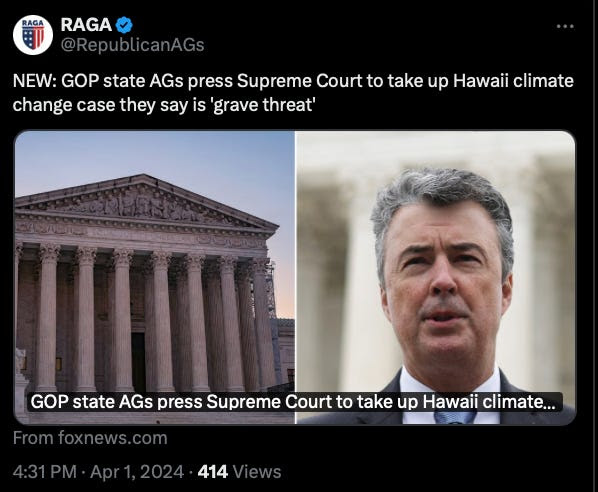 ||
A screenshot of RAGA’s post about the Hawaii case brief. Source: X
According to research by HEATED and the Center for Media and Democracy, all 20 state attorneys general that signed the amicus brief are not only featured on RAGA’s website, but many were elected with RAGA’s help.
The lead counsel for the amicus brief, Alabama attorney general Steve Marshall, was the organization’s chair in 2023. Three attorneys general have served on RAGA’s executive committee (Indiana, Mississippi, and Utah), and five have been chairs or vice chairs (Alabama, Georgia, Montana, South Carolina, and Utah).
At least six AGs won their elections with the support and funding of RAGA, including the attorneys general from Oklahoma, Missouri, Kentucky, Louisiana, Iowa, and Idaho. In a statement last year, RAGA celebrated “a 100 percent success rate for RAGA in the 2023 election cycle.” This included the election of Louisiana AG Liz Murrill, which the organization supported with “a substantial, statewide paid advertising campaign.”
“These AGs, their political futures are underwritten by RAGA,” Graves said. “And who underwrites RAGA? The fossil fuel industry, along with Leonard Leo.”
RAGA did not respond to our requests for comment; when HEATED called executive director Pete Bisbee, he said he doesn’t speak to journalists, referred us to a spokesperson, and hung up. (Bisbee has previously been under fire leading the organization that paid for robocalls encouraging former President Trump supporters to protest the election results at the Capitol on Jan 6.)
But public statements, donations, and recordings of private meetings reveal RAGA’s deep ties to the fossil fuel industry. In 2023 alone, RAGA received more than $15 million in donations, and more than $1 million of those contributions came from the fossil fuel industry, according to HEATED’s analysis of IRS tax forms. Over the last decade, RAGA has accepted more than $10 million from fossil fuel companies, electric utilities, and industry trade groups.
Among RAGA’s donors are Koch Industries, Exxon, Chevron, ConocoPhillips, the American Petroleum Institute, and American Fuel and Petrochemical Manufacturers (AFPM)—and these donors have pushed AGs to adopt an aggressive anti-climate strategy.
How RAGA connects fossil fuel companies to AGs
To connect AGs with the priorities of donors, RAGA offers different tiers of access for different amounts of donations. “It’s not technically money laundering, but it has that appearance,” Graves said.
RAGA members who pay annual fees of $25,000 can help shape the organization’s legal strategy via “online RAGA briefing rooms,” for example. And members who pay more than $125,000 are given access to private meetings with attorney generals and invitations to in-person events with them, according to documents obtained by*The New York Times* in 2014.
In 2016, the Center for Media and Democracy obtained audio from one of those events. Titled “Climate Change Debate: How Speech is Being Stifled,” the session included former Alabama attorney general Luther Strange; AFPM president Chet Thompson;and noted fossil-funded climate denier Myron Ebell.
Together, they talked about the importance of protecting ExxonMobil from lawsuits like Honolulu’s. “We’re facing a coordinated campaign to demonize, weaken and try to destroy the industry,” Thompson said.
But Thompson also said stopping climate liability lawsuits would not be enough to protect the fossil fuel industry. What the industry really needed, he said, was protection from nearly all federal environmental regulation.
What followed was years of litigation led by Republican attorneys general against every environmental regulation worrying Thompson, and more.
RAGA’s goal: industry capture of the U.S. legal system
In 2021, 20 AGs sued the EPA to block its power plant emissions rules, which Thompson specifically called out in the panel. West Virginia v. EPAultimately went to the Supreme Court, whose ruling significantly decreased the EPA’s authority to regulate emissions.
In 2023, 25 Republican AGs sued the Department of Labor over retirement funds that considered ESG factors, including fossil fuel divestment. Thompson had called out divestment in the panel, too.
In 2024, 10 Republican attorneys general, all members of RAGA, sued the SEC over its climate disclosure rules, which Thompson also called out in the session.
RAGA members have also brought lawsuits fighting the Clean Water Act, limits on vehicle emissions, and the LNG exports pause—all while being paid by the industries that profit from pollution.
But the suits brought by RAGA members aren’t limited to the federal government. They’re also trying to stop localities like Honolulu from trying climate liability cases in state courts. RAGA, and the corporations it defends, want these cases tried in federal courts, where Republican-appointed federal judges are more likely to rule in the fossil fuel industry’s favor.
In fact, the same funders who helped appoint ultra-conservative judges to federal courts also donate to RAGA. Among RAGA’s top donors is the dark money group The Concord Fund, which is affiliated with the Federalist Society’s co-chairman Leonard Leo. Leo is credited with playing moving the federal court system to the right, and was instrumental in appointing multiple conservative justices to the U.S. Supreme Court, including Justices Alito, Roberts, Gorsuch, Kavanaugh, and Coney Barrett.
That network of industry influence has purchased the current anti-regulatory legal environment—and RAGA plays an essential role. "These AGs are willing to let the planet burn as they continue to take funding through RAGA from this industry," Graves said.
Former Hawaii Supreme Court Justice Michael Wilson went one step further in describing the effect of RAGA in fighting climate change.
“The AGs are violating their public duty to protect the future of their citizenry,” he said. “This partisan political use of the rule of law is what has caused the judicial branch of government to descend to its lowest level of public approval in recorded history.”
Further reading:
- The Low-Key Republican Officials Quietly Dismantling All of Our Rights. Slate, April 2024
Key quote: ”This agenda to use the Supreme Court to strip us of our rights, to use the court to make it harder for us to deal with climate change, to use the court to roll back reproductive rights, gay marriage, and more. These are all part and parcel of Leo’s agenda and these attorneys general are on that agenda.”
- These Attorneys General Are Defending the Fossil Fuel Industry, Not Their States. The Equation, March 2023
Key quote: “According to the nonpartisan National Association of Attorneys General, a state attorney general’s job is to represent the public interest—not private, special interests—by, among other things, ‘enforcing federal and state environmental laws.’ Attorneys general in the five states most vulnerable to climate change, however, are doing the exact opposite: Instead of defending their constituents, they are defending the fossil fuel industry.”
- Lobbyists, Bearing Gifts, Pursue Attorneys General. The New York Times, October 2014
Key quote: “But success did not come in court or at a negotiating table. Instead, it came at the opulent Loews Santa Monica Beach Hotel in California, with its panoramic ocean views, where more than a dozen state attorneys general had gathered last year for cocktails, dinners and fund-raisers organized by the Democratic Attorneys General Association.”
---
===
---
---
y mail 11 23 exxonnnewS
climate lawsuit filed by the City and County of Honolulu that could make oil and gas majors pay billions of dollars in damages for deceiving the public about their products’ role in climate change is now positioned to be the first of its kind to go to trial, following a ruling from the Hawai‘i Supreme Court. Legal experts say that Honolulu’s case could set a precedent for similar climate lawsuits filed by dozens of U.S. communities and make history as the first time fossil fuel companies would have to face the evidence of a decades-long industry campaign of climate deception in court.
The unanimous ruling, written by Hawai‘i Supreme Court Chief Justice Mark E. Recktenwald, upheld a lower court ruling that rejected two key arguments the oil companies made in an effort to dismiss the case. The court’s decision means that the case can now enter into full discovery — the phase during which plaintiffs can collect more evidence to prove their case — and a state court can finally set a date for the case to go to trial.
“This is now the most important climate case in the United States,” said former Hawai‘i Supreme Court Justice Michael Wilson, who retired earlier this year after a decade on the state’s highest court. “Now the Hawai‘i Supreme Court has allowed a jury of twelve Hawai’i citizens to decide whether lies by the oil companies created large scale billion dollar damage to our county and city of Honolulu.”
The city and county’s lawsuit charges ExxonMobil, Chevron, Shell, and BP and other oil giants with orchestrating “sophisticated disinformation campaigns to cast doubt on the science, causes, and effects of global warming,” thus delaying climate action for decades. The complaint argues that the companies violated state common laws like public nuisance, failure to warn, and trespass — and that their conduct left Honolulu facing floods, storms, heat waves, wildfires, rising seas, and other climate disasters that have cost billions of dollars in destruction and repairs. Now, plaintiffs contend, Big Oil should help foot the bill for the damage.
But the oil and gas industry has bitterly disputed the case, first attempting to move it out of state court, and, when that failed, filing motions to have it dismissed entirely. Along the way, a pro-fossil fuel industry group even launched a PR blitz in right wing media against Recktenwald, the state's Republican-appointed Chief Justice, accusing him of bias for giving a presentation through the nonprofit Environmental Law Institute that sought "to educate fellow judges about the basic science they need to adjudicate the climate litigation over which they preside." (Oil company lawyers, including one involved in Honolulu’s case, are also involved in ELI. One law professor said the attack on Recktenwald was “grasping at straws.”)
In August, just after nearly a hundred people were killed in the devastating wildfires on Maui, which has filed a nearly identical lawsuit that is also moving through state courts, Hawai‘i’s Supreme Court heard Big Oil’s arguments to dismiss Honolulu’s case. The companies argued that state law could not address the global issue of climate change — and that federal law preempted Honolulu’s claims under the Clean Air Act.
Ted Boutrous, a lawyer for Chevron, told the court that Honolulu was “seeking to impose damages based on the actions of millions and billions of people around the world. They’re going to put all the consequences of that on these companies.”
This week’s decision thoroughly debunked those arguments. “We agree with [Honolulu city and county] Plaintiffs,” wrote Chief Justice Recktenwald. “This suit does not seek to regulate emissions and does not seek damages for interstate emissions… Because this is a traditional tort case alleging [oil company] Defendants misled consumers and should have warned them about the dangers of using their products, Defendants’ arguments fail.”
Big Oil’s “big problem”
The ruling makes clear that “our courts are united in their view” of the case, said Denise Antolini, a retired University of Hawai‘i law professor who has submitted legal briefs in support of the lawsuit. “The cases use traditional tort law to tackle a very large problem, which is the deceptive climate marketing and campaigns of Big Oil.”
A ruling in the case could have significant implications for other climate cases across the country, said Richard Wallsgrove, a Professor of Law and Environmental Law Program Co-Director at the University of Hawai‘i.
“Big Oil’s argument is, ‘the problem is so big that we no longer have responsibility for that problem,’” Wallsgrove said. “But there have to be ramifications. These municipal climate cases’ core legal theory is, [oil companies] created a big problem and they lied about it. The Hawai‘i Supreme Court’s opinion is saying that if somebody violates the law, courts are the place where that should get adjudicated.”
The case has been in a limited form of discovery, but it can now move into a comprehensive phase where the city and county can request documents and depose key representatives from the oil companies. That next stage “will bring to light the lies and the campaign of Big Oil’s climate denial, and that’s what they’re deathly afraid of — of that story seeing the light of day,” Antolini said.
The path ahead
Of the dozens of climate accountability cases working their way through U.S. courts, Honolulu’s is now one of two — along with a Massachusetts consumer fraud case against ExxonMobil — that is positioned to receive a 2024 trial date.
Honolulu still needs to prevail against one more Big Oil motion to dismiss its case. Chevron has invoked an anti-SLAPP law from California, where the company is headquartered, that’s intended to protect individuals and whistleblowers from lawsuits meant to silence their free speech. Honolulu’s lawsuit, Chevron contends, violates that law and Chevron’s First Amendment rights because its climate denial was actually protected free speech.
That motion is moving through a separate appeals process — but if you ask Antolini, it has a “snowball’s chance in hell” of preventing the case from moving forward. “Anti-SLAPP protections are really important, but they don’t protect Big Oil,” she said.
“A groundbreaking decision of hope”
Wilson said Honolulu’s case is now “set up to be a major achievement for the jurisdictions around the state that are victims of fossil fuel burning that’s being done as a result of misrepresentations made by the oil companies … There will be a price tag put on the knowing poisoning of the atmosphere.”
“The procedure of this case shows how young people, future generations, and the citizens of the city and county of Honolulu can have hope that the oil companies that increase greenhouse gas emissions and are more profitable than they’ve ever been will have to go to trial,” he said. “This is a groundbreaking decision of hope.”
---
maui sues too?
may 2023
honolulu has lost more than 5 miles of its famous beaches to sea level rise and storm surges. Sunny-day flooding during high tides makes many city roads impassable, and water mains for the public drinking water system are corroding from saltwater because of sea level rise.}:
The damage has left the city and county spending millions of dollars on repairs and infrastructure to try to adapt to the rising risks.
Future costs will almost certainly be higher. More than US$19 billion in property value, at today’s dollars, is at risk by 2100 from projected sea level rise, driven by greenhouse gas emissions largely from the burning of fossil fuels. Elsewhere in Honolulu County, which covers all of Oahu, many coastal communities will be cut off or uninhabitable.
Unwilling to have their taxpayers bear the full brunt of these costs, the city and county sued Sunoco LP, Exxon Mobil Corp. and other big oil companies in 2020.
Their case – one of more than two dozen involving U.S. cities, counties and states suing the oil industry over climate change – just got a break from the U.S. Supreme Court. That has significantly increased their odds of succeeding.
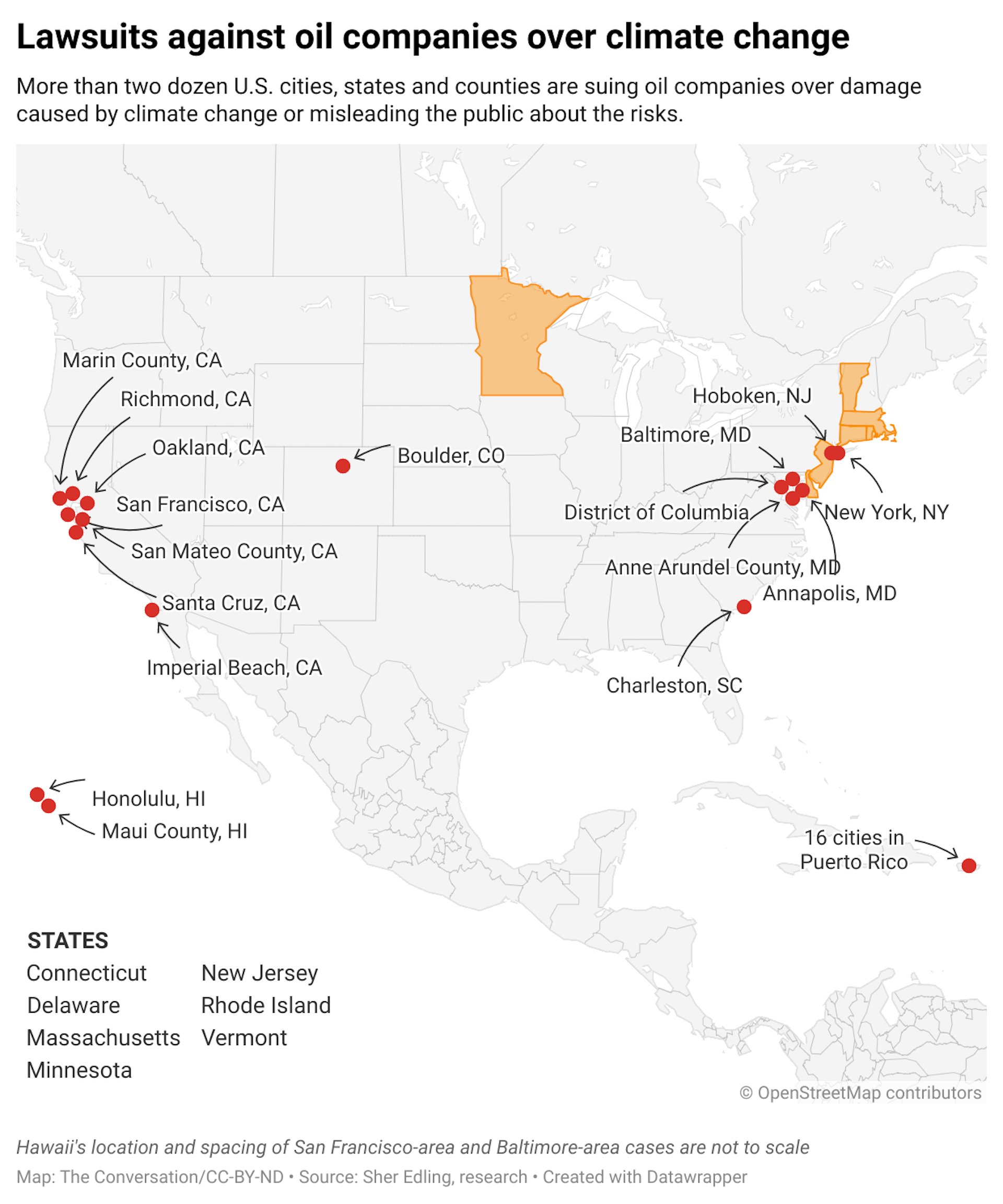
Suing over the cost of climate change
At stake in all of these cases is who pays for the staggering cost of a changing climate.
Local and state governments that are suing want to hold the major oil companies responsible for the costs of responding to disasters that scientists are increasingly able to attribute to climate disruption and tie back to the fossil fuel industry. Several of the plaintiffs accuse the companies of lying to the public about their products’ risks in violation of state or local consumer protection laws that prohibit false advertising.
IFrame Content nice map
The governments in the Honolulu case allege that the oil companies “are directly responsible” for a substantial rise in carbon dioxide emissions that have been driving climate change. They say the companies should contribute their fair share to defray some of the costs.
The gist of Honolulu’s complaint is that the big oil companies have known for decades that their products cause climate change, yet their public statements continued to sow doubts about what was known, and they failed to warn their customers, investors and the public about the dangers posed by their products.
Were it not for this deception, the lawsuit says, the city and county would not be facing mounting costs of abating the damage from climate change.
Importantly, the complaint is based on state – not federal – law. It alleges that the defendants have violated established common law rules long recognized by the courts involving nuisance, failure to warn and trespass.
The city and county want the companies to help fund climate adaptation measures – everything from building seawalls and raising buildings to buying flood-prone properties and restoring beaches and dunes.
Supreme Court could have killed these cases
Not surprisingly, the oil companies have thrown their vast legal resources into fighting these cases.
On April 24, however, they lost one of their most powerful arguments.
The U.S. Supreme Court declined to hear challenges in the Hawaii case and four others involving the seemingly technical question of which court should hear these cases: state or federal.
The oil companies had “removed” the cases from state court to federal court, arguing that damage lawsuits for climate change go beyond the limits of state law and are governed by federal law.
That theory would have derailed all five cases – because there is no federal common law for greenhouse gases.
The court made that position clear in 2011 in American Electric Power Co. v. Connecticut. Several state and local governments had sued five major power companies for violating the federal common law of interstate nuisance and asked for a court order forcing these companies to reduce their emissions. The Supreme Court refused, holding that the federal Clean Air Act displaced federal common law for these gases.
In Native Village of Kivalina v. Exxon Mobil Corp., a federal court of appeals extended that holding to also bar claims for monetary damages based on federal common law.

Several coastal communities, including in Honolulu County, facing increasing erosion want oil companies to help pay for protective infrastructure. AP Photo/Audrey McAvoy
To avoid this fate, Honolulu and the other plaintiffs focused on violations of state law, not federal law. Without exception, the federal courts of appeals sided with them and sent the cases back to state court.
What happens next?
The Honolulu case leads the pack at this point.
In 2022, the 1st Circuit Court in Hawaii denied the oil companies’ motion to dismiss the case based on the argument that the Clean Air Act also preempts state common law. This could open the door for discovery to begin sometime this year.
In discovery, senior corporate officers – perhaps including former Exxon Mobil CEO Rex Tillerson, who was secretary of state under Donald Trump – will be required to answer questions under oath about what the companies knew about climate change versus what they disclosed to the public.

In 2019, former Exxon Mobil CEO Rex Tillerson testified in a securities fraud lawsuit brought by the New York attorney general’s office. The judge ruled in Exxon’s favor. AP Photo/Seth Wenig
Evidence from Exxon documents, described in a recent study by science historians Naomi Oreskes and Geoffrey Supran, shows that the company’s own scientists “knew as much as academic and government scientists knew” about climate change going back decades. But instead of communicating what they knew, “Exxon worked to deny it,” Supran and Oreskes write. The company overemphasized uncertainties and cast doubt on climate models.
This is the kind of evidence that could sway a jury. The standard of proof in a civil case like Honolulu’s is “preponderance of the evidence,” which roughly translates to 51%. Ten of the 12 jurors must agree on a verdict.
Any verdict likely would be appealed, perhaps all the way to the U.S. Supreme Court, and it could be years before the Honolulu case is resolved.
Lawsuits don’t begin to cover the damage
It is unlikely that even substantial verdicts in these cases will come close to covering the full costs of damage from climate change.
According to the National Oceanic and Atmospheric Administration, in 2022 alone the U.S. sustained 18 weather and climate disasters that each exceeded $1 billion in damage. Together, they cost over $165 billion.
But for many of the communities most at risk from these disasters, every penny counts. We believe establishing the oil companies’ responsibility may also discourage further investments in fossil fuel production by banks and brokerage houses already nervous about the financial risks of climate disruption.
- Climate change
- Adaptation
- Erosion
- New York
- Consumer protection
- Extreme weather
- US Supreme Court
- Climate science
- ExxonMobil
- Coastal erosion
- Hawaii
- Minnesota
- US courts
- Baltimore
- Civil law
- Fossil fuel industry
- Big Oil
- Lawsuits
- Nuisance laws
- Climate change law
- Civil lawsuits
- storm damage
- Climate misinformation
- Extreme storms
---
---
mma 8 23 no lnx
Fox News' Jeanine Pirro blames “green energy” for the Maui fire devastation
Pirro: “It's not about global warming and it's not about climate change”
WRITTEN BY MEDIA MATTERS STAFF
PUBLISHED 08/29/23
Video
CitationFrom the August 29, 2023, edition of Fox News' The Five
DANA PERINO(CO-HOST): Immediately, it's almost as ifany issue, if you don't want to deal with accountability, you just say "climate change."
JEANINE PIRRO (CO-HOST): Yeah. Well, I think I've said this before. In the winter, it's all about COVID. In the summer, it's all about climate change. Okay? And we just need to put more money into it. I heard today, the president's going to ask for more money for COVID. I mean, so here we go again.
But look. If what Maisie -- Horono -- if what Maisie Senator Horono says is true -- $300 billion to fight climate change -- how come this kind of thing is happening?
Alright, the Inflation Reduction Act was all about a giveaway to the green energy companies. In the end, it's not about global warming and it's not about climate change. It's about negligence. Pure and simple. It's about ineptitude. It's about an area that didn't keep up with what was going on because they were trying to get to the green energy next step.
And so, they were too busy working on green energy. They ignored the obligation of the current situation. They didn't fill the water reservoir, okay? They didn't turn off the power lines when they got a warning that there would be high winds coming. Andthey failed to follow protocol to shut down the live power lines.
And so what we've got now is the power lines are igniting dry grass and bush and people died as a result of it. And they didn't even send off the sirens. The guy said he was worried people that would run toward the fires if they turned the sirens off.
It's about an excuse. We live in a world that's all about excuses, that is blocked in terms of ideology. It's all tribalism. You're on this side, or you're on this side. Facts are irrelevant.
---
8 23
https://www.alternet.org/maui-wildfires/
---
http://redgreenandblue.org/2022/03/04/historic-first-hawaii-court-oks-climate-lawsuit-big-oil/
---
==
https://www.ecowatch.com/hawaii-hurricane-lane-flooding-2599467495.html
Although Hawaii avoided a direct hit by Hurricane Lane, which weakened to a tropical storm over the weekend, areas of the Big Island were inundated with waist-deep water and flash flooding.
Mountain View, located on the east side of the island, received a preliminary total of 51.53 inches of rain from Aug. 22-26—the third highest storm total rainfall from a tropical cyclone in the U.S. since 1950, according to the National Weather Service.
The highest total is the 60.58 inches of rain dumped on Nederland, Texas during Hurricane Harvey last year. The second highest—and the highest tropical cyclone storm total rainfall in Hawaii—is the 52.00 inches measured at Kanalohuluhulu Ranger Station during Hurricane Hiki in 1950.
Authorities rescued 39 people from floodwaters on Friday and Saturday, the Associated Press reported. No storm-related deaths have been reported.
The heavy downpour triggered , caused a road to collapse in Haiku and rendered the neighborhood inaccessible, and even opened up sinkholes.
Lane also dropped 36.76 inches of rain on Hilo Airport, the wettest four-day period ever observed at Hilo, with records dating back to 1949. Hilo also saw 15.00 inches of rain on Aug. 24, the fifth wettest calendar day on record.
"It was almost biblical proportions," state senator Kai Kahele, who represents the town of Hilo, told NBC News.
The National Weather Service lifted all remaining tropical storm warnings and watch advisories for the state on Sunday.
As Lane drifted away, Tropical Storm Miriam developed in the eastern Pacific Ocean, about 2000 miles east of the Hawaiian islands. But "Miriam is not expected to threaten any landmass," said AccuWeather Hurricane Expert Dan Kottlowski.
...
---
==
5/18
Hawaii Becomes First State in the U.S. to Ban the Toxic Pesticide, Chlorpyrifos
Tuesday Hawaii made history, as it became the first state in the U.S. to ban the pesticide chlorpyrifos, a highly toxic neurotoxin that causes significant damage to brain development in children. The pesticide's detrimental health effects led the U.S. Environmental Protection Agency (EPA) under the Obama administration to propose banning all of its agricultural uses, but the Pruitt-led EPA under the current administration reversed this pledge. The bill, SB3095, is a significant first step in protecting public health from pesticide harms for the State of Hawaii. In addition to banning chlorpyrifos, SB3095 requires all users of Restricted Use Pesticides (RUPs) to report usage of these pesticides, and mandates minimum 100-foot no-spray zones for RUPs around schools during school hours.
---
https://www.ecowatch.com/carbon-farming-2457937143.html
A handful of states around the country have begun to recognize the importance of carbon farming as an expedient tool to fight climate change. What's carbon farming? Eric Toensmeier, author of The Carbon Farming Solution, describes it as "a suite of crops and agricultural practices that sequester carbon in the soil and in perennial vegetation like trees." If carbon farming were widely implemented, it could return billions of tons of carbon from the atmosphere—where there's currently too much, to the soil where there's too little.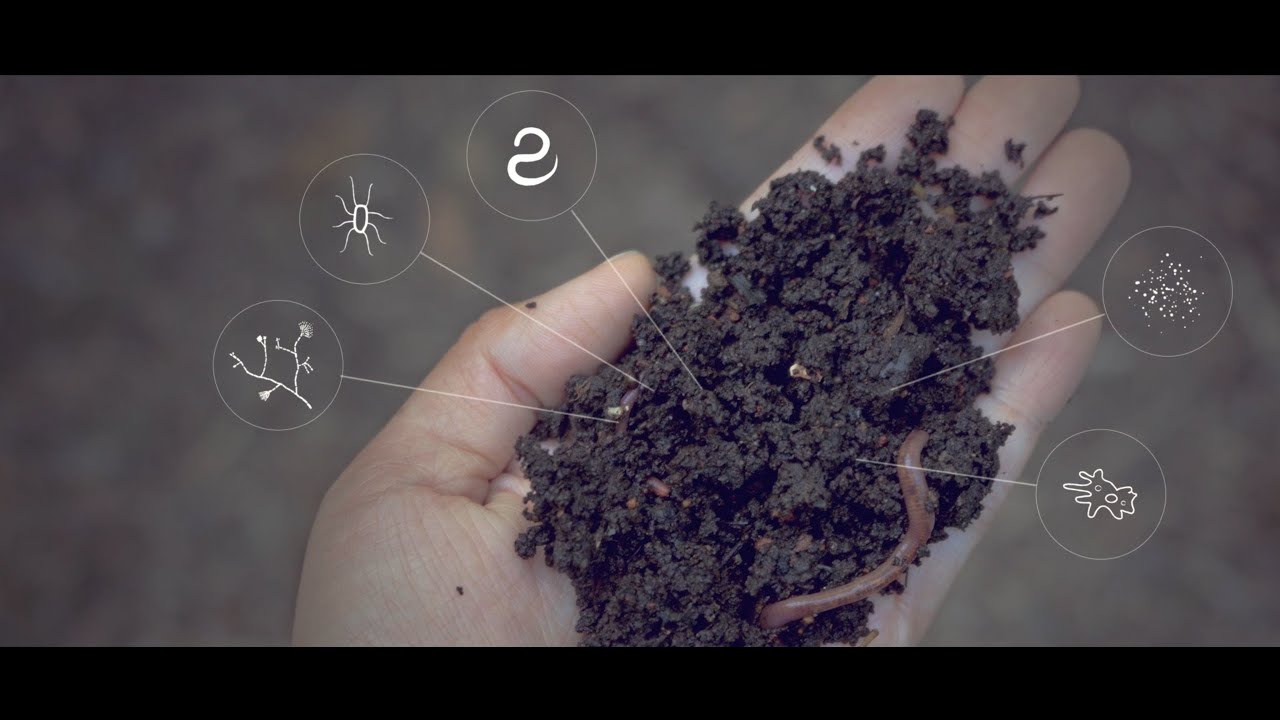 , i.e. soil carbon, becomes a resource that increases food, water and climate security.
Last month, Hawaii became the first state in the nation to pass legislation officially supporting the Paris climate agreement, just days after President Trump announced he was pulling the U.S. out of the global agreement. One of the two landmark laws signed in Hawai'i was an act creating the Carbon Farming Task Force. Written and championed by Hawai'i Center for Food Safety, along with the Sierra Club of Hawaiʻi and Surfrider Foundation O'ahu Chapter, the task force went into effect July 1 and will develop incentives for Hawai'i's farmers and ranchers to improve the resilience of their lands by increasing the soil's carbon content.
University of Hawai'i assistant professor of agricultural ecosystem ecology, Rebecca Ryals, believes "Hawai'i's Carbon Farming Task Force is a critically important first step toward finding local solutions to global climate change, and soil carbon farming strategies should be emphasized in its incentive programs."
Hawai'i is just one of a growing number of states preparing to protect rural livelihoods from the threats posed by climate change by tapping into the multiple benefits of carbon farming. Here are five others:
1.In May, Marylandestablished the Maryland Healthy Soils Program introduced by Delegate Dana Stein. Stein's legislation (HB 1063) passed unanimously in the Senate and had the support of both the Maryland Farm Bureau and the soil and climate communities (including thousands of Center for Food Safety members who responded to our action alert in support of the bill). The act, as approved by Gov. Larry Hogan, requires the Maryland Department of Agriculture to provide incentives including research, education and technical assistance contributing to healthy soils.
2. Massachusetts is right behind Maryland. "An Act to Promote Healthy Soils" (No.3713) presented by Paul A. Schmid III, would establish a fund for education and training for those engaged in agriculture that regenerates soil health. Indicators of healthy soil include levels of carbon, rates of water infiltration and biological activity.
3.Meanwhile, in New York, Assemblywoman Didi Barrett introduced A3281, a first-of-its-kind bill to use a tax credit model for farmers who maximize carbon sequestration potential on their land. Although the bill did not pass this past year, Barrett was able to incorporate the Carbon Farming Act into the state budget which is providing $50,000 to study incentives for carbon farming tax credits, grants and other programs.
4. In California the Department of Food and Agriculture has appropriated $7.5 million from the Greenhouse Gas Reduction Fund to develop and administer incentive and demonstration programs as part of the state's Healthy Soils Program, actively supported by the California Climate and Agriculture Network, a coalition that includes Center for Food Safety. The objective of the demonstration projects is to monitor and demonstrate to California farmers and ranchers that "specific management practices sequester carbon, improve soil health and reduce atmospheric greenhouse gases." The program includes a variety of practices such as mulching, cover crops, compost application, hedgerow planting and buffer strips.
5. Finally, in Vermont, after making a successful transition from conventional to regenerative agriculture on their farm, Jesse and Cally McDougall initiated legislation in 2016 to help other farmers transition. Reintroduced in 2017 as S.43 by Vermont State Sen. Brian Campion, the bill:
Proposes to require the Secretary of Natural Resources to establish a regenerative soils program whose purposes include increasing the carbon sequestration capability of Vermont soils, reducing the amount of sediment and waste entering the waters of the state, and promoting cost-effective and healthy soil management practices.
While the Vermont bill did not pass this year, Jesse McDougall reports that "it wasn't killed either" and will be taken up again next session. According to this self-described carbon farmer, "There is much interest and energy for it here in Vermont. I think this bill (or a new regenerative bill) has a strong chance next year."
We expect that McDougall is right. While each state will incentivize soil health differently depending on geography, needs and capacity, there's a strong chance that many more states will get proactive about regenerating the health of their soil and harnessing the potential of carbon farming. With this kind of interest, and momentum generated by public gatherings like the upcoming Soil not Oil conference in September, it won't be long before policies to incentivize carbon farming spread across the nation.
==
EPA reaches agreement with Syngenta for farmworker safety ...
https://www.epa.gov/.../epa-reaches-agreement-syngenta-farmworker-safety-violations...
1.
Feb 12, 2018 - ... LLC, to resolve violations of federal pesticide regulations at its farm in Kekaha, Kauai. Under the settlement, Syngenta Seeds, a subsidiary of ...---[:{ ## :{News Releases from }::{Region 09}:
EPA reaches agreement with Syngenta for farmworker safety violations on Kauai
02/12/2018
](https://webcache.googleusercontent.com/search?q=cache:o7t_pW9FYW8J:https://www.epa.gov/newsreleases/epa-reaches-agreement-syngenta-farmworker-safety-violations-kauai+&cd=19&hl=en&ct=clnk&gl=us)}:
Dean Higuchi (higuchi.dean@epa.gov)
808-541-2711
HONOLULU – The U.S. Environmental Protection Agency announced an agreement today with Syngenta Seeds, LLC, to resolve violations of federal pesticide regulations at its farm in Kekaha, Kauai.
Under the settlement, Syngenta Seeds, a subsidiary of Syngenta AG, will spend $400,000 on eleven worker protection training sessions for growers in Hawaii, Guam, and the Northern Mariana Islands. Syngenta will develop a curriculum and training materials tailored to local growers who face pesticide compliance challenges related to language, literacy, geographic and cultural factors.
Syngenta will also develop compliance kits for use at these trainings and for wider distribution in the agricultural community in English and four other languages commonly spoken by growers and farmworkers in the training locations – Mandarin, Korean, Tagalog, and Ilocano. Syngenta will make the kits available to the public by posting the materials online for three years after the trainings are complete. Syngenta will pay a civil penalty of $150,000 as part of the settlement.
“Reducing pesticide exposure for the millions of farmworkers who cultivate our food is a high priority for EPA,” said Alexis Strauss, EPA’s Acting Regional Administrator for the Pacific Southwest. “This settlement will bring to Hawaii and Pacific Island growers much-needed training to protect agricultural workers.”
In matters referred to EPA by the Hawaii Department of Agriculture, EPA found that in two separate incidents at its Kekaha farm, Syngenta failed to notify workers verbally and with signage to avoid fields recently treated with pesticides, resulting in exposure and hospitalization of workers. In addition, EPA found Syngenta failed to provide both adequate decontamination supplies on-site and prompt transportation to a medical facility for exposed workers.
Restricted-use pesticides are not available for use by the general public because of high toxicity and potential to injure applicators and bystanders and to adversely affect the environment.
For more information on EPA’s action today: https://www.epa.gov/hi/syngenta-seeds-llc-consent-agreement-and-final-order
For more information on pesticide Worker Protection Standard visit: https://www.epa.gov/pesticide-worker-safety/agricultural-worker-protection-standard-wps
==https://www.courthousenews.com/ninth-circuit-deals-blow-to-gmo-pesticide-bans-across-hawaii/
Ninth Circuit Deals Blow to GMO & Pesticide Bans Across Hawaii
November 23, 2016NICHOLAS FILLMORE
HONOLULU (CN) – Purveyors of genetically modified crops and pesticides in Hawaii won four separate victories in the Ninth Circuit this past week, involving county bans on genetically modified crops and spraying near residential areas, hospitals and schools.
A three-judge panel of the Ninth Circuit affirmed a lower court ruling against bans of genetically engineered crops on Maui and the Big Island and restrictions on pesticide spraying on Kauai, finding the bans and restrictions are preempted by state law.
Lawyers for conservation groups had argued the counties were simply exercising valid police powers set aside by the state.
The Kauai County Council enacted Ordinance 960 in 2013, after the Waimea Canyon Middle School was twice evacuated and about 60 students were hospitalized with flu-like symptoms in 2006 and 2008.
The ordinance created no-spray buffer zones near schools and other buildings where people live, work, or receive medical care.
But the Ninth Circuit panel found that Ordinance 960 is impliedly preempted by the Hawaii Pesticides Law. In the cases of Maui and the Big Island’s bans on genetically engineered crops, the same panel found that federal law controlled.
Earthjustice attorney Paul Achitoff, who represented Kauai County through intervenors Kauai Kamika Ho’opono, Surfrider Foundation and the Pesticide Action Network of North America at the panel’s hearing in Honolulu this past June, lamented the rulings.
“I respect the court, but they were mistaken,” he said. “It’s unfortunate that an unfamiliar court that doesn’t understand Hawaii’s constitution ruled. The matter should have been referred to the state Supreme Court.”
The panel in the Maui appeal rejected sending the case to the Hawaii Supreme Court by upholding a federal judge’s decision not to do so.
Achitoff continued, “Did the state intend to preclude the county? The same reasoning would apply to a county passing an ordinance to cut down albizia trees that fall over in storms.”
At the June hearing, Achitoff had noted the state’s hands-off attitude toward previous legislation.
“Eight years ago, the county passed laws against [transgenic] coffee and taro,” he told the panel. “The state Department of Agriculture didn’t object. Nobody objected. The state has never objected.”
Achitoff said in a phone interview that the Ninth Circuit ruled the state has the ability to make rules. But he said state regulators have only been protecting the interests of GMO industries by “letting them plant where they want to plant and do what they want to do.”
He added, “If students were getting sick at Punahou (a prep school on Oahu), something would be happening. But this is just some middle school in Waimea.”
Now that the “dust has cleared” in the wake of the rulings that commercial crops are governed by the state – and field trials by the feds – conservation groups hope to target their efforts more effectively.
Earthjustice still has several lawsuits in court, as well as a petition with the U.S. Environmental Protection Agency. And the Hawaii Center for Food Safety said in a recent email that the group “must pivot our energy back toward the Legislature.”
A petition currently circulating that advocates for pesticide disclosure and spray buffer zones claims that there are 27 fields in Hawaii located within a mile of fields where companies like Monsanto and Dow spray restricted-use chemicals.
Monsanto, Dow, Pioneer-DuPont, BASF, and Syngenta each have massive operations in the state that together occupy tens of thousands of acres of former sugar and pineapple plantations.
The four interrelated Ninth Circuit decisions are: Syngenta Seeds v. County of Kauai, Robert Ito Farm v. County of Maui, Alika Atay v. County of Maui, and Hawai’i Papaya Industry v. County of Hawaii.
In all four cases, the panel included Chief Circuit Judge Sidney Thomas and Circuit Judges Consuelo Callahan and Mary Murguia.
http://www.alternet.org/food/local-governments-can-prohibit-ge-crops-says-us-court-appeals
U.S. Court of Appeals for the Ninth Circuit issued its decisions Friday on whether federal and Hawai'i state laws preempt Hawai'i counties' authority to regulate genetically engineered (GE) crops and pesticide use. Of significance to state and local communities throughout the U.S., the Ninth Circuit ruled that federal law—specifically,the Plant Protection Act—does not prohibit states and counties from passing local laws to regulate and ban commercially-grown GE crops.
"Today's decision to allow states and counties to ban or regulate GE crops is an important victory for GE-free seed sanctuaries and small communities and farmers around the country," George Kimbrell, senior attorney for the Center for Food Safety, said.
In granting its decision the court recognized potential harm to farmers and environment from the widespread planting of GE crops, asserting, "the cultivation and testing of GE plants raise several well-documented concerns." Notably, the court affirmed, "transgenic contamination has previously caused significant economic impacts on farmers of conventional, non-GE crops."
The court acknowledged as well that "the cultivation of GE crops also may raise environmental concerns, such as harm to beneficial plants and animals caused by the increased use of pesticides sometimes associated with testing and growing GE crops, the proliferation of 'superweeds' and other pests resistant to pesticides, and the reduction of biodiversity." The court went on to declare: "The regulation of commercialized crops, both of GE and traditional varieties, remains within the authority of state and local governments."
At the same time, however, the court ruled that under Hawai'i law, counties and municipalities do not have the authority to regulate GE crops (as some in other states do), and that Hawai'i state law places such authority in the hands of the State alone.
"We're disappointed that the court misinterpreted Hawai'i law and concluded the Hawai'i legislature decided Hawai'i counties lack any such authority," Earthjustice attorney Paul Achitoff said. "The legislature did not, and the decision leaves Hawai'i unprotected from the harms the Ninth Circuit acknowledged. We believe that when Hawai'i's state courts have an opportunity, they will reject the Ninth Circuit's conclusion on this point and allow Hawai'i's people to protect themselves, since the State certainly hasn't protected them."
The court also ruled that the U.S. Department of Agriculture (USDA) alone has the authority to regulate field trials and experimental GE crops; neither states nor local governments can ban or approve. This is particularly troubling to communities in Hawai'i, since the many field trials and associated pesticide use in Hawai'i poses significant risks to local citizens and the environment
"We are extremely disappointed with the ruling that some experimental GE field trials can only be regulated by USDA, and are considering all legal options. Most importantly, we continue to stand and fight with the people of Hawaiʻi against these chemical companies," Kimbrell said.
Attorneys with Center for Food Safety and Earthjustice, who represented local residents, conservation groups, and Hawai'i County in the proceedings, are analyzing the full scope of the court's decisions and will be considering options that would protect Hawai'i's people, farms and the environment.
"As a mother and a resident of Kekaha, Kauaʻi, I will continue to stand up and protect my family and my community," said Malia Kahale'ina Chun, a mother, educator and Native Hawaiian cultural practitioner. "It is our responsibility to insure that our keiki have access to clean air, clean water and to 'āina that sustains them."
==
==
https://movetoamend.org/corporate-rule-examples
Corporations Sue Hawaiian Government and Attempt to Overturn Laws They Say Violate Their Constitutional Rights
“This place has been taken away by the sugar cane industry and the pineapple industry a long time ago. We all know that.” —
Corporations are suing Hawai’i and Kauai Counties for violating corporate constitutional “rights” after both counties passed two restrictive ordinances on genetically modified crops (GMOs).[[i]](https://movetoamend.org/corporate-rule-examples#_edn1) Last year two ordinances, 960 (on Kauai) and 13-121 (on Hawaii Island), passed with widespread support from island residents. The laws were drafted out of concern for the massive amount of pesticide spraying that is necessary for maintaining the GMO crops and for the “GMO drift” that contaminates non-GMO crops. Supporters organized through local grassroots groups like, Stop Poisoning Paradise, and shared their stories via testimonials on the website.
"As an organic farm inspector, I have seen first-hand beekeepers in the State lose their ability to sell certified organic honey because their forage areas have been compromised by neighboring GMO fields." — Louisa Wooton of Kauai Kunana Dairy
"As a small business that relies on both local fruit and honey products and a strong visitor economy, I will be marching with other business owners in strong support of Bill 2491. Visitors who come into my store are in disbelief about pesticide use on the island, and many people have continued to email me about their concerns even after leaving the island." — Stephanie Krieger, owner of Nani Moon Meadery
“We need full disclosure to study the impacts these chemicals are having on our soil, water and wildlife." — Dr. Carl Berg of Surfrider Foundation
The suit to overturn Ordinance 13-121 on Hawaii Island is brought by theBiotechnology Industry Organizationalong with theCattlemen’s Council, the Hawai’i Floriculture, the Nursery Association, and others. A similar suit was brought against Kauai County Ordinance 960 by DuPont’s Pioneer Hi-Bred International, Inc. along with other biotech companies.[[ii]](https://movetoamend.org/corporate-rule-examples#_edn2)
The corporations argue that the laws violate their corporate constitutional “rights”; including their “right” to grow GMOs and the right to engage in commerce. They also argue that local municipalities have no right to pass such laws because state and federal laws override local laws. In one article, a spokesperson for DuPont Pioneer, a plaintiff in the suit against Kauai, is quoted on that point, “As we have maintained from the outset,” she said, “the state and federal government already have comprehensive regulation of pesticides and GMOs and the County of Kauai has no power to regulate in these areas.” [[iii]](https://movetoamend.org/corporate-rule-examples#_edn3)
Hawaii Island, Kauai, and communities across the country that pass laws to protect their communities are running into the same problem: they don't have the legal authority to say "no.” The rights asserted by the corporations represent a corporate structure of law that is in inherent conflict with democracy and our fundamental right of local, community self-government.[[iv]](https://movetoamend.org/corporate-rule-examples#_edn4) Until the false legal doctrine of corporate constitutional rights is addressed, corporations will continue to use the constitution to take rights away from the people.
Fight-Back
Two local, grassroots groups are fighting back against this pressure by the biotech industry.
- SHAKA Movement (Sustainable Hawaiian Agriculture for the Keiki and the ‘Aina) is a self-organized grassroots movement of and for the people of the Hawaiian Islands. At this juncture, SHAKA is putting its resources into a voter initiative in Maui County to restrict GMOs, they are not (as of yet) challenging the basic structure of law regarding corporate rights.
- Stop Poisoning Paradise does community education, organizing, and builds a support network for the community concerns.
Notes
[[i]](https://movetoamend.org/corporate-rule-examples#_ednref1) Why the People of the Big Island Can’t Ban GMOs Without Challenging Corporate “Rights”
[[ii]](https://movetoamend.org/corporate-rule-examples#_ednref2) Federal judge declares new Kauai GMO, pesticide law invalid
[[iii]](https://movetoamend.org/corporate-rule-examples#_ednref3) Federal judge declares new Kauai GMO, pesticide law invalid
[[iv]](https://movetoamend.org/corporate-rule-examples#_ednref4) Why the People of the Big Island Can’t Ban GMOs Without Challenging Corporate “Rights”
==
USRTK:
http://usrtk.org/gmo/what-bill-gates-isnt-saying-about-gmos/
Is Gates right?
Another video released the same week as Gates’ WSJ interview provides a different perspective.
The short film by the Center for Food Safety describes how the state of Hawaii, which hosts more open-air fields of experimental genetically engineered crops than any other state, has become contaminated with high volumes of toxic pesticides.
The film and report explain that five multinational agrichemical companies run 97% of GE field tests on Hawaii, and the large majority of the crops are engineered to survive herbicides. According to the video:
“With so many GE field tests in such a small state, many people in Hawaii live, work and go to school near intensively sprayed test sites. Pesticides often drift so it’s no wonder that children and school and entire communities are getting sick. To make matters even worse, in most cases, these companies are not even required to disclose what they’re spraying.”
If the Center for Food Safety is right, that’s a big problem. Both these stories can’t be right at the same time, can they?
Facts on the ground
Following the thread of the Gates’ narrative, one would expect the agricultural fields of Hawaii – the leading testing grounds for genetically engineered crops in the U.S. – to be bustling with low-pesticide, climate-resilient, vitamin-enhanced crops.
Instead, the large majority of GMO crops being grown on Hawaii and in the US are herbicide-tolerant crops that are driving up the use of glyphosate, the main ingredient in Monsanto’s Roundup and a chemical the World Health Organization’s cancer experts classify as “probably carcinogenic to humans.”
In the 20 years since Monsanto introduced “Roundup Ready” GMO corn and soy, glyphosate use has increased 15-fold and it is now “the most heavily-used agricultural chemical in the history of the world”, reported Douglas Main in Newsweek.
The heavy herbicide use has accelerated weed resistance on millions of acres of farmland. To deal with this problem, Monsanto is rolling out new genetically engineered soybeans designed to survive a combination of weed-killing chemicals, glyphosate and dicamba. EPA has yet to approve the new herbicide mix.
But Dow Chemical just got the green light from a federal judge for its new weed-killer combo of 2,4D and glyphosate, called Enlist Duo, designed for Dow’s Enlist GMO seeds. EPA tossed aside its own safety data to approve Enlist Duo, reported Patricia Callahan in Chicago Tribune.
The agency then reversed course and asked the court to vacate its own approval – a request the judge denied without giving reason.
All of this raises questions about the claims Bill Gates made in his Wall Street Journal interview about thorough safety procedures and reduced use of pesticides.
Concerns grow in Hawaii, Argentina, Iowa
Instead of bustling with promising new types of resilient adaptive GMO crops, Hawaii is bustling with grassroots efforts to protect communities from pesticide drift, require chemical companies to disclose the pesticides they are using, and restrict GMO crop-growing in areas near schools and nursing homes.
Schools near farms in Kauai have been evacuated due to pesticide drift, and doctors in Hawaii say they are observing increases in birth defects and other illnesses they suspect may be related to pesticides, reported Christopher Pala in the Guardian and The Ecologist.
According to the American Academy of Pediatrics, prenatal and early-life pesticide exposures are linked to childhood cancers, decreased cognitive function, behavioral problems and birth defects.
In Argentina – the world’s third largest producer of GMO crops – doctors are also raising concerns about higher than average rates of cancer and birth defects they suspect are related to pesticides, reported Michael Warren in The Associated Press....
Why is Cornell University hosting a GMO propaganda campaign? And why is Gates Foundation funding it?
---
hawaii
http://www.alternet.org/environment/more-100-monsanto-employees-crashed-my-presentation-ge-crops-and-pesticides
On October 14, I presented the findings of the Center for Food Safety's Pesticides in Paradise [3] report on the island of Moloka‘i in Hawai'i. At around 5:45 PM, about 15 minutes before the presentation was going to start, more than 100 Monsanto employees, all dressed in neon yellow shirts, arrived.
As I stared at the long line of workers, men and women of all colors and ages and sizes, entering the building, there was a moment when I wanted to walk away. I walked to the bathroom and sat with my face in my hands. I am not brave enough for this confrontation. I am not the right person to deliver this message. I am not strong enough for the yelling and fighting that will likely ensue. Deep breaths. Air punches.
I re-entered the main hall, now crowded with community members, workers. The island is so small that I already recognized faces from the four days I had spent here. My team gave me half horrified, half encouraging looks as I paced the front of the hall. With a few deep breaths and a nod from the few friends we had in the audience, I began. [4].
The presentation walks the audience through data on pesticides and genetically engineered crops in Hawai‘i and the medical literature that examines the human health and environmental impacts of pesticide exposure[5], on pregnant women, children, and farm workers, who are particularly vulnerable to adverse health effects.
And herein lies the greatest challenge of that night and the greatest opportunity. Although seemingly there to intimidate me and oppose our message, these 100+ people are the most at risk from the growing GE seed industry in our state.
Workers exposed to restricted use pesticides have higher rates of chronic diseases such as bladder and colon cancer[[i]](http://www.centerforfoodsafety.org/blog/4098/last-week-on-molokai#_edn1) [6], Non-Hodgkin’s lymphoma[[ii]](http://www.centerforfoodsafety.org/blog/4098/last-week-on-molokai#_edn2) [7],[[iii]](http://www.centerforfoodsafety.org/blog/4098/last-week-on-molokai#_edn3) [8],[[iv]](http://www.centerforfoodsafety.org/blog/4098/last-week-on-molokai#_edn4) [9],[[v]](http://www.centerforfoodsafety.org/blog/4098/last-week-on-molokai#_edn5) [10], Parkinson’s disease[[vi]](http://www.centerforfoodsafety.org/blog/4098/last-week-on-molokai#_edn6) [11],[[vii]](http://www.centerforfoodsafety.org/blog/4098/last-week-on-molokai#_edn7) [12],[[viii]](http://www.centerforfoodsafety.org/blog/4098/last-week-on-molokai#_edn8) [13] ,[[ix]](http://www.centerforfoodsafety.org/blog/4098/last-week-on-molokai#_edn9)[14], and depression[[x]](http://www.centerforfoodsafety.org/blog/4098/last-week-on-molokai#_edn10) [15] ,[[xi]](http://www.centerforfoodsafety.org/blog/4098/last-week-on-molokai#_edn11) [16],[[xii]](http://www.centerforfoodsafety.org/blog/4098/last-week-on-molokai#_edn12) [17]. Children who live in and around agricultural operations like those owned by Monsanto and Dow are vulnerable to chronic, low-level exposure to restricted used pesticides that drift from GE test fields on a weekly basis. In utero and early life, children are at a risk of neurodevelopmental disabilities like autism and ADHD[[xiii]](http://www.centerforfoodsafety.org/blog/4098/last-week-on-molokai#_edn13) [18],[[xiv]](http://www.centerforfoodsafety.org/blog/4098/last-week-on-molokai#_edn14) [19],[[xv]](http://www.centerforfoodsafety.org/blog/4098/last-week-on-molokai#_edn15) [20],[[xvi]](http://www.centerforfoodsafety.org/blog/4098/last-week-on-molokai#_edn16) [21], leukemia[[xvii]](http://www.centerforfoodsafety.org/blog/4098/last-week-on-molokai#_edn17) [22],[[xviii]](http://www.centerforfoodsafety.org/blog/4098/last-week-on-molokai#_edn18) [23],[[xix]](http://www.centerforfoodsafety.org/blog/4098/last-week-on-molokai#_edn19) [24], and asthma[[xx]](http://www.centerforfoodsafety.org/blog/4098/last-week-on-molokai#_edn20)[25],[[xxi]](http://www.centerforfoodsafety.org/blog/4098/last-week-on-molokai#_edn21) [26],[[xxii]](http://www.centerforfoodsafety.org/blog/4098/last-week-on-molokai#_edn22) [27].
Monsanto protest in Hawaii, April 17, 2010 (image: Alexis Baden-Meyer/Flickr [28])
Communicating the very real risks posed by this industry to the workers and their families, implicating their employers in these dangerous practices, is difficult... but necessary. As I walked through the information, some in the audience shook their heads. Some looked confused. Others seemed as though they were prepping for battle, taking notes and referencing a packet I would come to learn was a briefing paper provided by Monsanto. [29]
But, there were 20 or so audience members, in their bright yellow Monsanto shirts, who leaned in. Eyes wide, chin on hands. Listening. Absorbing. Many were elders who have seen what large agricultural companies can do to communities. Others were women concerned about their children and their husbands.
By the time I had wrapped up the presentation, the agitation in the room was palpable. The company spokespeople had their time on stage, rallying the crowd to cheers of opposition, repeatedly asserting that the information we were sharing was false.... "These are the real experts on pesticides," said Robert Stevenson, president of the Molokai Chamber of Commerce gesturing to the Monsanto workers. "No one knows agriculture and pesticides more than the people of Moloka‘i."
I couldn’t stop thinking about those 20 or so workers who leaned in. Those eyes that widened as we talked about developmental delays in children, and higher cancer rates in agricultural workers. I wondered, as I saw the executives shift uncomfortably in their seats, if they regretted inviting their workers. Did they realize that seeds were planted? That we will continue to water these seeds and that this is how transformation grows?
Transgenic papaya test field in Puna, Hawaii. Yellow plants are nontransgenic papaya; plants on right are transgenic ‘Rainbow’ papaya. (image: S. Ferreira/USDA [30])
As we cleaned up the hall, Robert Stevenson approached me. He thanked me for coming over and offered a word of warning. "I hope you remember, next time you come to Moloka‘i, that this is what our community thinks about your work and this is where we stand."
I responded, "I understand, Robert, that what we're sharing is not popular and that conversations like these are hard. But I'm not here because I think what I'm doing is popular. I'm here because I think what we are fighting for is right. Whether you like it or not, the demand for greater pesticide regulations, for disclosure and buffer zones, for the protection of families and workers, is not going anywhere... What we are asking for is absolutely reasonable. I'm here to have hard conversations like this until the protections for workers and families are not a debate — but a hard-won reality."
Nights like this are the real decision-making moments when you are engaged in the hard work of advocacy and community organizing: when you stare goliath in the face, in all his shifting forms, and you connect to the deepest reservoirs of passion, commitment and courage that exist within you to stand up and speak hard truths.
I'm certainly not the first person in our community to stand up in the face of overwhelming opposition. In fact, I take inspiration from all the people I work with who channel this courage in their families, amongst friends and co-workers, everyday. But standing up and speaking out [31] is important. It’s what is going to ensure the health and safety of our communities for generations to come.
--------------------------------------
References:
[[i]](http://www.centerforfoodsafety.org/blog/4098/last-week-on-molokai#_ednref1) [32] Koutros S, Lynch CF, Ma X, Lee W J, Hoppin JA, Christensen CH, Andreotti G, Freeman LB, Rusiecki JA, Hou L, Sandler DP, Alavanja MCR (2009) Heterocyclic aromatic amine pesticide use and human cancer risk: Results from the U.S. Agricultural Health Study. International Journal of Cancer 124(5): 1206-1212.
[[ii]](http://www.centerforfoodsafety.org/blog/4098/last-week-on-molokai#_ednref2) [33] Zahm SH, Weisenburger DD, Babbitt PA, Saal RC, Vaught JB, Cantor KP, Blair A (1990) A case-control study of non-Hodgkin’s lymphoma and the herbicide 2,4-dichlorophenoxyacetic acid (2,4-D) in eastern Nebraska. Epidemiology 1: 349–356.
[[iii]](http://www.centerforfoodsafety.org/blog/4098/last-week-on-molokai#_ednref3) [34] Blair A, Zahm SH (1995) Agricultural exposures and cancer. Environmental Health Perspective 103(supplement 8): 205–208.
[[iv]](http://www.centerforfoodsafety.org/blog/4098/last-week-on-molokai#_ednref4) [35] De Roos AJ, Zahm SH, Cantor KP, Weisendburger DD, Holmes FF, Burmeister LF Blair A (2003) Integrative assessment of multiple pesticides as risk factors for non-Hodgkin’s lymphoma among men. Journal of Occupational Medicine 60(11): e11. http://www.ncbi [36]. nlm.nih.gov/pmc/articles/PMC1740618/ .
[[v]](http://www.centerforfoodsafety.org/blog/4098/last-week-on-molokai#_ednref5) [37] Schinasi L, Leon ME (2014) Non-Hodgkin lymphoma and occupational exposure to agricultural pesticide chemical groups and active ingredients: a systematic review and meta-analysis. International Journal of Environmental Public Health 11(4): 4449-4527.
[[vi]](http://www.centerforfoodsafety.org/blog/4098/last-week-on-molokai#_ednref6) [38] Brown TP, Rumsby PC, Capleton AC, Rushton L, Levy LS (2006) Pesticides and Parkinson’s Disease – Is There a Link?. Environmental Health Perspectives 114(2): 156- 164.
[[vii]](http://www.centerforfoodsafety.org/blog/4098/last-week-on-molokai#_ednref7) [39] Priyadarshi A, Khuder SA, Schaub EA, Shrivastavas S (2000) A meta-analysis of Parkinson’s disease and exposure to pesticides. Neurotoxicology 21(4): 435-40.
[[viii]](http://www.centerforfoodsafety.org/blog/4098/last-week-on-molokai#_ednref8) [40] Brighina L, Frigerio R, Schneider NK, Lesnick TG, de Andrade M, Cunningham JM, Farrer MJ, Lincoln SJ, Checkoway H, Rocca WA, Maraganore DM (2008) Alphasynuclein, pesticides, and Parkinson disease: A case–control study. Neurology 70(16 pt 2): 1461–1469.
[[ix]](http://www.centerforfoodsafety.org/blog/4098/last-week-on-molokai#_ednref9) [41] Tanner CM, Ross GW, Jewell SA, Hauser RA Jankovic J, Factor SA, Bressman S, Deligtisch A, Marras C, Lyons KE, Bhudhikanok GS, Roucoux DF, Meng C, Abbott RD, Langston JW (2009) Occupation and risk of Parkinsonism: A multicenter case–control study. Archives of Neurology 66(9): 1106–1113.
[[x]](http://www.centerforfoodsafety.org/blog/4098/last-week-on-molokai#_ednref10) [42] Beseler CL, Stallones L (2008). A cohort study of pesticide poisoning and depression in Colorado farm residents. Annals Epidemiology 18:768–774.
[[xi]](http://www.centerforfoodsafety.org/blog/4098/last-week-on-molokai#_ednref11) [43] Weisskopf MG, Moisan F, Tzourio C, Rathouz PJ Elbaz A (2013) Pesticide exposure and depression among agricultural workers in France. American Journal of Epidemiology 178(7): 1051-8.
[[xii]](http://www.centerforfoodsafety.org/blog/4098/last-week-on-molokai#_ednref12) [44] Beard JD, Umabach DM, Hoppin JA, Richards M, Alavanja MCR, Blair A, Sandler DP, Kamel F (2014) Pesticide exposure and depression among male private pesticide applicators in the Agricultural Health Study. Environmental Health Perspectives 122(9): 984-991.
[[xiii]](http://www.centerforfoodsafety.org/blog/4098/last-week-on-molokai#_ednref13) [45] Rauh VA, Garfinkel R, Perera FP, Andrews HF, Hoepner L, Barr DB, Whitehead R, Tang D, Whyatt R (2006) Impact of prenatal chlorpyrifos exposure on neurodevelopment in the first 3 years of life among inner-city children. Pediatric 118(6): e1845-e1859. www. pediatrics. org/cgi/content/full/118/6/e1845.
[[xiv]](http://www.centerforfoodsafety.org/blog/4098/last-week-on-molokai#_ednref14) [46] Roberts EM, English PB, Grether JK, Windham GC, Somberg L, Wolf C (2007) Maternal Residence near Agricultural Pesticide Applications and Autism Spectrum Disorder among Children in the California Central Valley. Environmental Health Perspectives 115(10): 1482-1489.
[[xv]](http://www.centerforfoodsafety.org/blog/4098/last-week-on-molokai#_ednref15) [47] Eskenazi B, Marks AR, Bradman A, Harley K, Barr DB, Johnson C, Morga N, Jewell NP(2007) Organophosphate pesticide exposure and neurodevelopment in young Mexican-American children. Environmental Health Perspectives 115(5): 792–798.
[[xvi]](http://www.centerforfoodsafety.org/blog/4098/last-week-on-molokai#_ednref16) [48] Bouchard MF, Chevrier J, Harley KG, Kogut K, Vedar M, Calderon N, Trujilo C, Johnson C, Bradman A, Barr DB, Eskenazi B (2011) Prenatal exposure to organophosphate pesticides and IQ in 7-year-old children. Environmental Health Perspective 119(8): 1189–1195.
[[xvii]](http://www.centerforfoodsafety.org/blog/4098/last-week-on-molokai#_ednref17) [49] Infante-Rivard C, Labuda D, Krajinovic M, Sinnett D (1999) Risk of childhood leukemia associated with exposure to pesticides and with gene polymorphisms. Epidemiology 10(5): 481-487.
[[xviii]](http://www.centerforfoodsafety.org/blog/4098/last-week-on-molokai#_ednref18) [50] Roberts JR, Karr CJ (2012) Pesticide Exposure in Children. Council on Environmental Health. Pediatrics 130(6): e1757-e1763. http://pediatrics.aappublications.org/content/130/6/e1757.full.html [51].
[[xix]](http://www.centerforfoodsafety.org/blog/4098/last-week-on-molokai#_ednref19) [52] Monge P, Wesseling C, Guardado J, Lundberg I, Ahlbom A, Cantor KP, Weiderpass E, Partanen T (2007) Parental occupational exposure to pesticides and the risk of childhood leukemia in Costa Rica. Scandinavian Journal Work Environmental Health 33(4): 293-303.
[[xx]](http://www.centerforfoodsafety.org/blog/4098/last-week-on-molokai#_ednref20) [53] Hoppin JA, Umbach DM, London SJ, Alavanja MCR, Sandler DP (2002) Chemical predictors of wheeze among farmer pesticide applicators in the Agricultural Health Study. American Journal of Respiratory and Critical Care Medicine 165: 683-689.
[[xxi]](http://www.centerforfoodsafety.org/blog/4098/last-week-on-molokai#_ednref21) [54] Salam MT, Li YF, Langholz B, Gilliland FD, Children’s Health Study (2004) Early life environmental risk factors for asthma: findings from the Children’s Health Study. Environmental Health Perspective 112(6): 760–765.
[[xxii]](http://www.centerforfoodsafety.org/blog/4098/last-week-on-molokai#_ednref22) [55] Strina A, Barreto ML, Cooper PH, Rodrigues LC (2014) Risk factors for non-atopic asthma/wheeze in children and adolescents: a systematic review. Emerging Themes in Epidemiology 11(5). http://www.ete-online.com/content/11/1/5 [56].
===
==
entine
http://www.geneticliteracyproject.org/2014/01/02/indy-hawaii-study-downplays-atrazine-dangers-shows-flaws-in-kauai-bill/
vs
https://www.facebook.com/gmofreekauai/posts/635938106426329
HCIA (Hawaii Crop Improvement Association),the PR entity that encompasses Monsanto,BASF, Syngenta, Dupont (that has bought Pioneer),and DOW, with the objective to fight Hawaii residents atempts to protect themselves from the chemical and pesticide experimentation taking place next to their homes
==
815
http://www.alternet.org/food/pesticides-paradise-hawaiis-spike-birth-defects-puts-focus-gm-crops
==
Syngenta Seeds v. County of Kaua‘i
Free Speech For People has filed an amicus brief before the US District Court for the District of Hawaii in the case of Syngenta Seeds v. County of Kaua‘i, arguing that agribusiness corporations do not have a constitutional right, under the U.S. Constitution’s Equal Protection Clause, to flout a law requiring disclosure of pesticides and genetically-engineered crops used on the island of Kaua‘i.
The companies are challenging a local law requiring commercial agricultural producers using more than a minimum pesticide threshold to disclose the pesticide and genetically-modified organisms that they use, and to maintain a pesticide buffer zone near any home, school, day care center, or similar facility. The companies claim that this ordinance violates the Constitution’s Equal Protection Clause, and support their theory by citing Supreme Court case law protecting gay and lesbian people, people with intellectual disabilities, and undocumented immigrant children.
Free Speech For People’s amicus brief argues that the Equal Protection Clause—which was passed after the Civil War, to protect the rights of the newly-freed slaves—does not prevent local communities from adopting agricultural regulations. Furthermore, the companies’ reference to Supreme Court precedent involving vulnerable minorities threatens to dilute the protections of the Equal Protection Clause and endanger those who need it the most. Co-signers are the Equal Justice Society, National Center for Lesbian Rights, and EarthRights International.
Free Speech For People amicus brief in Syngenta Seeds v. County of Kaua‘i
---
http://www.huffingtonpost.com/2014/08/28/climate-change-study-hawaii_n_5731956.html
==
gov abercrombie $60K monsanto
http://www.progressive.org/news/2014/06/187735/pesticide-and-gmo-companies-spend-big-hawaii
:{*:{}:
*}:
Hawai'i has become "ground zero" in the controversy over genetically modified (GMO) crops and pesticides. With the seed crop industry (including conventional as well as GMO crops) reaping $146.3 million a year in sales resulting from its activities in Hawai'i, the out-of-state pesticide and GMO firms Syngenta, Monsanto, DuPont Pioneer, Dow Chemical, BASF, and Bayer CropScience have brought substantial sums of corporate cash into the state's relatively small political arena.
Chemical Conglomerates Retaliate Against Local Democratic Control
These "Big 6" pesticide and GMO firms are active on the islands in a big way, making use of the three to four annual growing seasons to develop new GMO seeds more quickly. The development of new GMOs by these pesticide and seed conglomerates goes hand-in-hand with heavy pesticide use in some of the islands' experimental crop fields, new data show.
Kaua'i County -- consisting primarily of the island of Kaua'i, known as Hawai'i's "Garden Isle" and home to Waimea Canyon State Park -- passed a law in November 2013 that requires disclosure of pesticide use and GMO crops sewn by growers and created buffer zones around schools, parks, medical facilities, and private residences. The law is set to go into effect in August 2014.
Hawai'i County banned GMOs altogether in November 2013, and a Maui County initiative to ban GMOs recently obtained enough citizen signatures to be placed on the November 2014 ballot.
Since experiencing these setbacks, the big agricultural firms have retaliated in a big way.
Syngenta, DuPont Pioneer, Agrigenetics (doing business as Dow AgroSciences), and BASF have sued Kaua'i to block its law.
Monsanto, Bayer, Syngenta, DuPont Pioneer, and several associated trade groups spent over $50,000 lobbying the state legislature from January through April 2014, as legislators considered bills to override the county laws, according to data from the Hawaii State Ethics Commission (as reported through June 6, 2014) analyzed by the Center for Media and Democracy/Progressive Inc. (CMD).
Of these, the Hawai'i Crop Improvement Association (whose members include Dow AgroScience, Monsanto, Pioneer Hi-Bred International, Syngenta, and BASF) had the highest expenditures at $10,800; the powerful national trade association the American Chemistry Council (whose members include BASF, Bayer, Dow, and DuPont) and Syngenta each spent $10,000; and Monsanto spent $8,982.
Big Ag Money Moves to the Ballot
Islanders will vote in a primary election for state legislators, governor, and U.S. Congressmembers August 9. Voters will also make initial choices between candidates for mayor and county council seats on Kaua'i and Maui as well as county council seats on Hawai'i.
The big agricultural corporations Monsanto, Syngenta, Dow, DuPont, and Bayer, associated trade groups, and their lobbyists and employees contributed over $700,000 to state and county candidates from November 2006 through December 2013, according to a new CMD analysis of Hawaii Campaign Spending Commission data. Initial campaign finance reports for what is shaping up to be an expensive political battle this year are not yet released.
Monsanto was the top donor, with its PAC contributing $115,500.
Lobbyists -- several of whom have multiple clients besides big ag. interests -- and their spouses contributed over $550,000.
Top recipients of this special interest largesse include:
- Governor Neil Abercrombie, a well-known and popular liberal Democrat, who received over $60,000;
- Sen. Clayton Hee (D-23), who passed GMO labeling out of committee as chair, but who also sponsored SB 3058 -- one of the bills referred to as Hawai'i's "Monsanto Protection Act" -- and who received $20,850;
- former Honolulu Mayor and Independent gubernatorial candidate Mufi Hannemann, who received over $60,000;
- Honolulu Mayor Kirk Caldwell, who received over $19,000; Sen. Rosalyn Baker (D-6), who received over $18,000;
- Honolulu City Councilman J. Ikaika Anderson, who received over $17,000;
- Rep. Kyle Yamashita (D-12), who received over $17,000;
- Sen. Clarence Nishihara (D-17), who received $16,893;
- Sen. Josh Green (D-3), who received $16,892; and
- Sen. Sen. Michelle Kidani (D-18), who received over $15,000.
Contributing lobbyists include:
- John H. Radcliffe of Capitol Consultants of Hawaii, a "super lobbyist" for the American Chemistry Council and Monsanto, among other clients, who with his wife and his other lobbying firm Radcliffe and Associates contributed $243,718;
- George A. "Red" Morris of Capitol Consultants of Hawaii, who lobbies for the American Chemistry Council, Grocery Manufacturers Association, and Monsanto, among other clients, and with his wife contributed $237,492;
- Richard Brian Tsujimura of Imanaka Kudo & Fujimoto, who lobbies for the national trade association Biotechnology Industry Organization, among other clients, and contributed $15,350;
- Alicia Maluafiti of Lo'ihi Communications, who lobbies for the Hawaii Crop Improvement Association, Biotechnology Industry Organization, and CropLife America, among other clients, and with her late husband contributed $18,300; and
- Frederick Perlak, who lobbies for Monsanto and with his wife contributed $18,300.
Big Ag Political Funders Have Ties to ALEC
Of the "Big 6" chemical and seed companies and their trade associations lobbying and/or contributing to political candidates in Hawai'i, Bayer, Dow, CropLife America (a pesticide and agricultural chemical trade association), and the American Chemistry Council have ties to the American Legislative Exchange Council (ALEC).
ALEC approved a "model" bill in 2013 for states to override the ability of counties and cities to democratically determine how they will regulate GMOs at the local and regional level, as CMD has reported.
Bayer was listed as the ALEC corporate co-chair of the states of Massachusetts, Nevada, Pennsylvania, South Dakota, and Texas as of 2011; has sponsored several ALEC meetings; has been listed as a member of the Civil Justice and Health and Human Services task forces; and was a member of ALEC's Private Enterprise Board through 2012.
Dow Chemical has been listed as a member of ALEC's Energy, Environment, and Agriculture Task Force and has sponsored at least one ALEC meeting.
CropLife America has been listed as a member of ALEC's Energy, Environment, and Agriculture Task Force and co-chaired its "Agriculture Subcommittee." This subcommittee adopted Oregon's bill overriding local control over GMO regulation as an official "model" bill in 2013 while CropLife's Jeff Case was its co-chair, as CMD has reported.
The American Chemistry Council has also been listed as a member of ALEC's Energy, Environment, and Agriculture Task Force and has sponsored at least one ALEC meeting.
Chemical Company Tactics Inspire More "Democracy in Action"
Barbara Polk, Chair of Common Cause Hawaii -- a state branch of the non-partisan, grassroots organization that strives for open, honest, and accountable government -- told CMD, "The influx of big money and threat of unlimited 'independent expenditures' have resulted in politicians statewide increasingly placing the interests of corporations over the interests of citizens. Politicians are forced to consider the likelihood of facing well-funded opposition and attack ads in the next election if they don't toe the corporate line."
Ashley Lukens, Program Director of the Hawaii Center for Food Safety -- a state office of the environmental advocacy organization that opposes the use of GMOs and harmful pesticides -- adds, "The impact of this corporate cash on local politics is not just that representatives are pressured to vote based on donations to their campaigns. Rather this cash has been strategically spent to create a mirage of confusion and disagreement around very mainstream issues like pesticide disclosure and GMO labeling."
According to a national poll by Consumer Reports released this week, 92 percent of U.S. consumers think that GMO food should be labeled before it is sold and meet long-term safety standards set by the government.
"Standing up for something as conservative as transparency around chemical use in Hawa'ii is treated as though it is radical," Lukens continued. "This radicalizing of dissent simply serves to silence the majority of the public and keep them from participating publicly in the civic process."
But despite this anti-democratic pressure, Kaua'i County Councilmember and former state legislator Gary Hooser (D), who co-authored the county's 2013 ordinance requiring disclosure of GMOs planted and pesticides used as well as buffer zones, calls Kaua'i "ground zero" not just for the testing of GMO crops, but also for "democracy in action."
Hooser, who is up for reelection himself this year, told CMD, "A lot of people never involved in politics, activism, or advocacy are getting involved because the big money interests are so in your face. There are candidates running on our side who never thought they’d be running, inspired by the companies' poisoning of our community and control of our government."
---
This article is part of "What The Fork!?! Corporations and Democracy," a collaborative media effort investigating corporate control of our democracy and our dinner plates. The articles and radio segments are the combined work of Making Contact, The Progressive, the Center for Media and Democracy (publisher of ALECexposed.org), and Food Democracy Now, along with reporting from Earth Island Journal, Grist, and Cascadia Times. Reporting has been made possible in part by a generous grant from the Voqal Fund. Read stories and more at wtfcorporations.com, and follow #wtfcorps and #BigAg on Twitter and Facebook.
- See more at: http://www.progressive.org/news/2014/06/187735/pesticide-and-gmo-companies-spend-big-hawaii#sthash.kfFKA8aK.dpuf
==
Big solar, to displace diesel? generators
===
Hawaii Gov. Abercrombie Wants Big Island to Embrace Geothermal
Stephens Media Hawaii
==
These "Big 6" pesticide and GMO firms are active on the islands in a big way, making use of the three to four annual growing seasons to develop new GMO seeds more quickly. The development of new GMOs by these pesticide and seed conglomerates goes hand-in-hand with heavy pesticide use in some of the islands' experimental crop fields, new data show.
Kaua'i County -- consisting primarily of the island of Kaua'i, known as Hawai'i's "Garden Isle" and home to Waimea Canyon State Park -- passed alaw in November 2013 that requires disclosure of pesticide use and GMO crops sewn by growers and created buffer zones around schools, parks, medical facilities, and private residences. The law is set to go into effect in August 2014.
Hawai'i County banned GMOs altogether in November 2013, and a Maui County initiative to ban GMOs recentlyobtained enough citizen signatures to be placed on the November 2014 ballot.
Since experiencing these setbacks, the big agricultural firms have retaliated in a big way.
Syngenta, DuPont Pioneer, Agrigenetics (doing business as Dow AgroSciences), and BASF have sued Kaua'i to block its law.
Monsanto, Bayer, Syngenta, DuPont Pioneer, and several associated trade groups spent over $50,000 lobbying the state legislature from January through April 2014, as legislators considered bills to override the county laws, according to data from the Hawaii State Ethics Commission (as reported through June 6, 2014) analyzed by the Center for Media and Democracy/Progressive Inc. (CMD).
Of these, the Hawai'i Crop Improvement Association (whose members include Dow AgroScience, Monsanto, Pioneer Hi-Bred International, Syngenta, and BASF) had the highest expenditures at $10,800; the powerful national trade association the American Chemistry Council (whose members include BASF, Bayer, Dow, and DuPont) and Syngenta each spent $10,000; and Monsanto spent $8,982.
Big Ag Money Moves to the Ballot
:{*:{}:
*}:
===
Kamehameha I (Hawaiian pronunciation: [kəmehəˈmɛhə]; c. 1758 – May 8, 1819), also known as Kamehameha the Great, conquered the Hawaiian Islands and formally established the Kingdom of Hawaiʻi in 1810. By developing alliances with the major Pacific colonial powers, Kamehameha preserved Hawaiʻi's independence under his rule. Kamehameha is remembered for theKānāwai Māmalahoe, the "Law of the Splintered Paddle", which protects human rights of non-combatants in times of battle. Kamehameha's full Hawaiian name is Kalani Paiʻea Wohi o Kaleikini Kealiʻikui Kamehameha o ʻIolani i Kaiwikapu kauʻi Ka Liholiho Kūnuiākea.
Contents
- 1 Legendary birth
- 2 Naha Stone
- 3 Unification of Hawaii
- 4 King of Hawaii
- 5 Later life
- 6 Honors
- 7 Family
- 8 References
- 9 Bibliography
- 10 External links
Legendary birth
Although there is some debate as to the precise year of his birth, Hawaiian legend claimed that a great king would one day unite the islands, and that the sign of his birth would be a comet. Halley's Comet was visible from Hawaiʻi in 1758 and it is likely Kamehameha was born shortly after its appearance. Traditional chants indicate he was born in the month of ikuwa (winter) or around November. According to Hawaiian historians Samuel Kamakau[1]:66–69 and later Abraham Fornander[2]:136, Kamehameha was born in 1736, but this date has been widely contested by earlier Hawaiian historians such as James Jackson Jarves, eyewitness observations on the age of the king from contemporary sources, and modern historical consensus.[3][4][5] He was known as Paiʻea, which means "hard-shelled crab".[6] His father by blood was Keōua. His mother was Chiefess Kekūʻiapoiwa of the Kohala district on the island of Hawaiʻi.
Keōua was the great-grandson of Keaweʻīkekahialiʻiokamoku, who had once ruled a large portion of the island of Hawaiʻi. When Keaweʻīkekahialiʻiokamoku died, war broke out over succession between his sons, Kalani Kama Keʻeaumoku Nui andKalaninuiʻamamao, and a rival chief, Alapaʻinuiakauaua. Alapaʻi emerged victorious over the two brothers, and their orphan sons (including Kamehameha's father) were absorbed into his clan. Other accounts indicate that he was son of the king of MauiKahekili II. This occurrence is common in ancient Hawaiian society and such children were called aliʻi poʻolua, double-headed chiefs, with two fathers.
Alapaʻinui, who was the present king of Hawaiʻi at that time, was angry when the kahuna (priest) told him that the child born would become "the slayer of chiefs", and he had, according to custom, two houses built that day, one for the child that would be hunted and killed and the other of the kahuna's. Kaha, who was one of Alapaʻi's kahunas and was knowledgeable of the prophecy and the killing, went to Kekuʻiapoiwa and told her to give the child to Naeʻole, who was a famous runner of chiefs (kūkini), and he ran from Kokoiki to Pali Hulaʻana at ʻĀwini, the third valley from Waipiʻo where he was raised by the chiefess Kahaʻōpulani (who by some accounts was the sister of Naeʻole and a cousin of Kekuʻiapoiwa) along with her own daughter Kuakāne.[7] They raised Paiʻea for the first few years of his life. Five years after his birth, Alapaʻi, perhaps remorseful of his actions, invited the child back to live with his family. There under the guidance of his kumu(teacher), Kekūhaupiʻo, he learned the ways of court diplomacy and war. His father, thought to have been poisoned or prayed to death by Alapaʻi, died a few years later. Kekūhaupiʻo remained a faithful and trusted advisor to Paiʻea until the accidental death of the loyal kahu during a sham battle.
Another story says the name Paiʻea was given to Kamehameha after he first distinguished himself as a warrior in a battle between Maui and Hawaiʻi island in 1775–1779,[1]:84, by saving his teacher's, Kekūhaupiʻo's, life, by blocking a blow from a pāhoa (dagger).
Paiʻea is said to have had a dour disposition, and acquired the name he is best known for today: Ka mehameha, from the Hawaiian language for "the lonely one".[8] The name "Kamehameha" was given to Paiʻea by Alapaʻi after he was brought into his court, Paiʻea was given that name because, for most of his childhood life, he lived in solitude atʻĀwini.
Naha Stone
- Legend has it that the man who moves the stone would be the one to unite the islands. Many have tried and failed to get the stone to move from its original spot and those who have tried were of high ranking ‘’naha’’ blood line. Kamehameha was of the nīʻaupiʻodescent and Ululani (high-ranking chiefess of Hilo) believed Kamehameha was not worthy of attempting to move the stone. Kamehameha ignored all negativity and in the end, not only had he moved the stone but legend says the stone had been overturned. Kamehameha went on to unite the islands through a series of hard fought battles.[9]*
Unification of Hawaii
When Alapaʻi died, his position was succeeded by his son Keaweʻōpala. Kalaniʻōpuʻu, challenged his rule, and was backed by his nephew Kamehameha. In fierce fighting at Kealakekua Bay, Keaweʻōpala was slain and Kalaniʻōpuʻu claimed victory. For his loyal service to his uncle, Kamehameha was made Kalaniʻōpuʻu's aide.
In 1779, Kamehameha again traveled with Kalaniʻōpuʻu to Kealakekua Bay. This time he, among other young chiefs accompanying their senior chief, met with Captain James Cook. Cook was perhaps mistaken by some Native Hawaiians to be Lono, the Hawaiian god of fertility. During Kamehameha's first contact with non-Hawaiians, he may have stayed aboard Cook's ship, theHMS Resolution, for at least one night.
Hawaii Island
Raised in the royal court of his uncle Kalaniʻōpuʻu, Kamehameha achieved prominence in 1782, upon Kalaniʻōpuʻu's death. While the kingship was inherited by Kalaniʻōpuʻu's son Kīwalaʻō, Kamehameha was given a prominent religious position, guardianship of the Hawaiian god of war, Kūkāʻilimoku, as well as the district of Waipiʻo valley. There was already hatred between the two cousins, caused when Kamehameha presented a slain aliʻi's body to the gods instead of to Kīwalaʻō. When a group of chiefs from the Kona district offered to back Kamehameha against Kīwalaʻō, he accepted eagerly. The five Kona chiefs supporting Kamehameha were: Keʻeaumoku Pāpaʻiahiahi(Kamehameha's father-in-law), Keaweaheulu Kaluaʻāpana (Kamehameha's uncle), Kekūhaupiʻo (Kamehameha's warrior teacher), Kameʻeiamoku and Kamanawa (twin uncles of Kamehameha). Kīwalaʻō was soon defeated in the battle of Mokuʻōhai, and Kamehameha took control of the districts of Kohala, Kona, and Hamakua on the island of Hawaiʻi.[10]
Kamehameha then moved against the district of Puna in 1790 deposing Chief Keawemaʻuhili. Keōua Kūʻahuʻula, exiled to his home in Kaʻū, took advantage of Kamehameha's absence and led an uprising. When Kamehameha returned with his army to put down the rebellion, Keōua fled past the Kilauea volcano, which erupted and killed nearly a third of his warriors from poisonous gas.[11]
Questioning a kahuna on how best to go about securing the rest of the island, Kamehameha resolved to construct a temple (heiau) to Kūkaʻilimoku, as well as lay an aliʻi's body on it.
When the Puʻukoholā Heiau was completed in 1791, Kamehameha invited Keōua to meet with him. Keōua may have been dispirited by his recent losses. He may have mutilated himself before landing so as to make himself an imperfect sacrificial victim. As he stepped on shore, one of Kamehameha's chiefs threw a spear at him. By some accounts he dodged it, but was then cut down by musket fire. Caught by surprise, Keōua's bodyguards were killed. With Keōua dead, and his supporters captured or slain, Kamehameha became King of Hawaiʻi island.[11]
Maui and Oahu
Kamehameha's dreams included far more than the island of Hawaiʻi; with the counsel of his favorite wife Kaʻahumanu, who became one of Hawaiʻi's most powerful figures, he set about planning to conquer the rest of the Hawaiian Islands. Help came from British and American traders, who sold guns and ammunition to Kamehameha. Two westerners who lived on Hawaiʻi island, Isaac Davis and John Young, became advisers of Kamehameha and trained his troops in the use of firearms.
With his new army, Kamehameha felt confident enough to move on the neighboring islands of Maui and Oʻahu, already weakened by a war of succession that had broken out between King Kahekili II's son and brother. Kamehameha may or may not have known that his rival, King Kalanikūpule, also possessed firearms, and was planning a move against him when the aliʻi nui of Hawaiʻi invaded those islands.
In 1795, Kamehameha set sail with an armada of 960 war canoes and 10,000 soldiers. He quickly secured the lightly defended islands of Maui and Molokaʻi at the Battle of Kawela. The army moved on the island of Oʻahu, landing his troops at Waiʻalae and Waikīkī. What Kamehameha did not know was that one of his commanders, a high-ranking aliʻi named Kaʻiana, had defected to Kalanikūpule. Kaʻiana assisted in the cutting of notches into the Nuʻuanu Pali mountain ridge; these notches, like those on acastle turret, would serve as gunports for Kalanikūpule's cannon.[11]
Main article: Battle of Nuʻuanu
In a series of skirmishes, Kamehameha's forces were able to push back Kalanikūpule's men until the latter was cornered on the Pali Lookout. While Kamehameha moved on the Pali, his troops took heavy fire from the cannon. In desperation, he assigned two divisions of his best warriors to climb to the Pali to attack the cannons from behind; they surprised Kalanikūpule's gunners and took control of the weapons. With the loss of their guns, Kalanikūpule's troops fell into disarray and were cornered by Kamehameha's still-organized troops. A fierce battle ensued, with Kamehameha's forces forming an enclosing wall. By using their traditional Hawaiian spears, as well as muskets and cannon, they were able to kill most of Kalanikūpule's forces. Over 400 men were forced off the Pali's cliff, a drop of 1,000 feet. Kaʻiana was killed during the action; Kalanikūpule was captured some time later and sacrificed to Kūkāʻilimoku.
Kamehameha wanted not only to conquer the islands but to win the hearts of the people. After the victory at Nuʻuanu, Kamehameha showed his true leadership qualities. He not only cared for his own warriors but for the warriors of his opposition. He helped replenish the island of Oʻahu by repairing ‘‘kalo’’ patches and planting more sweet potatoes.[12]
Kauai
Kamehameha was now ruler of all the Hawaiian Islands from Oʻahu to the east, but the western islands of Kauaʻi and Niʻihau continued to elude him. Using Honolulu as a base, he had a forty-ton ship built. When he attempted to invade the western islands in 1796, Kaʻiana's brother Nāmākeha led a rebellion on Hawaiʻi island against his rule, and Kamehameha was forced to return and put down the insurrection.[13] After his first failed attempt, Kamehameha commissioned the mass construction of a fleet of war canoes called Peleleu, from the forests of Hilo and Puna. The project lasted from 1796 to 1801, and was superintended by the kahuna kālai waʻa, Kahaʻōpio Hūhā. During this time, a triple hull canoe (pūkolu), presumably the first of its kind in the islands, was built and named Kaenakāne, though it proved ineffective.
In 1803 he tried again, but this time, disease broke out among his warriors; Kamehameha himself fell ill, though he later recovered. During this time, Kamehameha was amassing the largest armada Hawaiʻi had ever seen – foreign-built schooners and massive war canoes, armed with cannon and carrying his vast army. Kaumualiʻi, aliʻi nui of Kauaʻi, watched as Kamehameha built up his invading force and decided he would have a better chance in negotiation than battle. He may also have been influenced by foreign merchants, who saw the continuing feud between Kamehameha and Kaumualiʻi as bad for the sandalwood trade.
In 1810, Kaumualiʻi became a vassal of Kamehameha, who therefore emerged as the sole sovereign of the unified Hawaiian islands.[14]
King of Hawaii
:{*:{}:
In fact, the Kingdom of Hawaiʻi that Kamehameha established retained its independence, except for a five-month British occupation in 1843, until it was annexed by the United States in 1898. It was this legacy that earned Kamehameha the epithet "Napoleon of the Pacific"[11] (Napoleona o ka Pākīpika in the Hawaiian language).As king, Kamehameha took several steps to ensure that the islands remained a united realm even after his death. He unified the legal system and he used the products he collected in taxes to promote trade with Europe and the United States. Kamehameha did not allow non-Hawaiians to own land; they would not be able to until the Great Māhele of 1848. This edict ensured the islands' independence even while many of the other islands of the Pacific succumbed to the colonial powers.*}:
Kamehameha also instituted the Māmalahoe Kānāwai, the Law of the Splintered Paddle. Its origins derived from before the unification of the Island of Hawaiʻi, in 1782, when Kamehameha, during a raid, caught his foot in a rock. Two local fishermen, fearful of the great warrior, hit Kamehameha hard on the head with a large paddle, which actually broke the paddle. Kamehameha was stunned and left for dead, allowing the fisherman and his companion to escape. Twelve years later, the same fisherman was brought before Kamehameha for punishment. King Kamehameha instead blamed himself for attacking innocent people, gave the fisherman gifts of land and set them free. He declared the new law, "Let every elderly person, woman, and child lie by the roadside in safety". This law, which provided for the safety of noncombatants in wartime, is estimated to have saved thousands of lives during Kamehameha's campaigns. It became the first written law of the Kingdom of Hawaiʻi, was included in the state constitution,[15] and has influenced many subsequent humanitarian laws of war.[16]
Although he ended human sacrifice, Kamehameha was a devout follower of the Hawaiian religion and Hawaiian traditions (such as Lua). He believed so strongly in his religion and culture that he would execute his subjects for breaches of the strict rules called kapu. Although he entertained Christians, he did not appear to take them seriously.
Kamehameha would be lucky to have visitors from other countries such as John Young, Isaac Davis, and George Vancouver. Young and Davis became advisors to Kamehameha and provided him with advanced weapons that helped in combat. Kamehameha was also a religious king and the holder of the war god Kukaʻ ilimoku. Vancouver noticed that Kamehameha would worship his gods and wooden images in heiau and he wanted to spread the religion in England to Hawaiʻi. The reason missionaries were not sent to Hawaiʻi from Great Britain is because Kamehameha told Vancouver that the gods he worshiped were his gods with ‘‘mana’’ and through these gods, Kamehameha became supreme ruler over all of the islands. Witnessing the devotion Kamehameha had, Vancouver decided not to send missionaries from England.[17]
Later life
After about 1812, Kamehameha spent his time at Kamakahonu, a compound he built in Kailua-Kona.[18] It is now the site of King Kamehameha's Beach Hotel, the starting and finishing points of the Ironman World Championship Triathlon.
As the custom of the time, he took several wives and had many children, although he would outlive about half of them.[19]
Final Resting Place
When Kamehameha died May 8, 1819, his body was hidden by his trusted friends, Hoapili and Hoʻolulu, in the ancient custom called hūnākele (literally, "to hide in secret"). The mana, or power of a person, was considered to be sacred. As per the ancient custom, his body was buried hidden because of his mana. His final resting place remains unknown. At one point in his reign Kamehameha III asked that Hoapili show him where his father's bones were buried, but on the way there Hoapili knew that they were being followed, so he turned around.[20] King David Kalākaua had also once attempted to search for Kamehameha's lost bones, and he found a man named Kapalu, who supposedly knew where Kamehameha's bones were buried, Kapalu said that the cave that houses Kamehameha's bones was called Kahikuokamoku (sometimes called Kahiku Okalani), this cave is supposedly located in the Kaloko-Honokōhau complex. Kalākaua found two bundles of bones, one supposedly belonging to Kamehameha and the other claimed to be the bones of ʻUmi-a-Liloa. Kalākaua had the bones taken to Oʻahu in the February of 1888, then, years later, Dr. Louis Sullivan of the American Museum of Natural History, examined both sets of bones, and concluded that neither set was of Kamehameha.[21] Though, there is a theory that Kalākaua actually found Kamehameha's bones, but kept his discovery secret. According to the curator of the Royal Mausoleum of Hawaiʻi, a direct descendant of Hoapili and Hoʻolulu, Kamehameha's bones are concealed in a cave off the coast of Kona on the island of Hawaiʻi located right off the shore of the old residence of ʻUmi-a-Liloa, which is supposedly in the hands of the QLCC (Queen Liliʻuokalani Children's Center) Trust.
Honors
:{* Five major statues exist, where each of the statues varies slightly from each other in details such as having different weaponry, gilding or painting::{}:
Main article: Kamehameha StatueStatues*}:
- The original cast: the ship, bound for Honolulu on which it was being shipped from Europe sank off the Falkland Islands but in 1912 the original was salvaged, repaired and erected in Kapaʻau on the Big Island of Hawaiʻi;
- A replacement statue was erected in his honor by King Kalākaua in 1883 at Aliʻiōlani Haleʻi's judicial system in Honolulu;
- One is located in Hilo, Hawaiʻi at the north end of the Wailoa River State Recreation Area, where it enjoys a view of Hilo Bay;
- One of smaller size is located in an outdoor Polynesian shopping center, across from the Monte Carlo Resort and Casino on the Las Vegas Strip in Nevada; and
- One in the National Statuary Hall Collection at the United States Capitol as a representation of the State of Hawaiʻi. This is located in the New Visitors Center in the Capitol.
- One is located outside Sam's Anchor Inn Family Restaurant in Okinawa, Japan.
Other legacy
- In 1865 King Kamehameha V created the Royal Order of Kamehameha I society and Royal Order of Kamehameha I decoration in his honor.[22]
- In 1871 Kamehameha V decreed a holiday, Kamehameha Day, in his honor. This holiday is still celebrated annually on June 11.
- Kamehameha Schools were founded in the will of Bernice Pauahi Bishop, at the time of her death in 1884 the heir of the Kamehameha estate. Her intention was to bring education and thus hope for a future to the rapidly declining number of native Hawaiians. The first school opened in 1887.
- The Kamehameha Wave, an iconic energy technique in the Dragon Ball franchise and the signature move of the protagonist Goku, along with some members for his family and allies, was named in honor of Kamehameha the Great.
- The defences of the entrance to Pearl Harbor were named Fort Kamehameha in 1909.[23]
- A C-17 Globemaster III, P-153, was named the "Spirit of Kamehameha", while a Benjamin Franklin class submarine, launched in 1965 and decommissioned in 2002, was christened the USS *Kamehameha.*
- Kamehameha I appears on the state quarter coin of Hawaii[24]
- The PC game Civilization V includes Kamehameha as a downloadable leader to play as.
- Kamehameha I appears on the 1975 Hawaii license plate and the rainbow signifies his unification of the islands.
IV
On September 11, 1859 he shot his secretary Henry A. Neilson, who died two years later.[9] Wyllie sponsored a fancy dress ball in 1860. Even the Catholic bishop came, dressed as a bishop. Kamehameha IV's father Kekūanāoʻa came in Scottish highland dress, music was provided by German musicians, and the food by a French chef. Emma came as the earth goddess Cybele. The conservative American missionaries did not approve, especially of the dancing.[4]
In August 1861 he issued a declaration of neutrality in the American Civil War.[10]
Resisting American influence
At the time of Alexander's assumption to the throne, the American population in the Hawaiian islands continued to grow and exert economic and political pressure in the Kingdom. Alexander worried that the United States of America would make a move to conquer his nation; an annexation treaty was proposed in Kamehameha III's reign. He strongly felt that annexation would mean the end of the monarchy and the Hawaiian people. Liholiho instead wanted a reciprocity treaty, involving trade and taxes, between the United States and Hawaii. He was not successful. In an effort to balance the amount of influence exerted by American interests, Alexander began a campaign to limit Hawaii's dependence on American trade and commerce. He sought deals with the British and other Europeangovernments, but his reign did not survive long enough to make them.
In 1862 he translated the Book of Common Prayer into the Hawaiian language.[11]
===
http://en.wikipedia.org/wiki/Kamehameha_V
Kamehameha V (1830–1872), born as Lot Kapuāiwa, reigned as monarch of the Kingdom of Hawaiʻi from 1863 to 1872. His motto was "Onipa`a": immovable, firm, steadfast or determined; he worked diligently for his people and kingdom and was described as the last great traditional chief.[2] His full Hawaiian name prior to his succession was Lota Liholiho Kapuāiwa Kalanimakua Kalanikupuapaikalaninui Aliʻiolani Kalani-a-Kekūanaōʻa.[2][3]
Contents
- 1 Early life
- 2 Career
- 3 A new constitution and new laws
- 4 Growth in travel to Hawaiʻi
- 5 Building projects under Kamehameha V's reign
- 6 Choosing an heir to the Hawaiian throne
- 7 Legacy
- 8 References
- 9 Further reading
- 10 External links
...It was planned that he would be Hoapili's heir as Governor of Maui, although this never happened.[7] Since King Kamehameha III declared him eligible for the throne, he was educated at the Royal School like his cousins and siblings. He was betrothed to Bernice Pauahi at birth, but she chose to marry American Charles Reed Bishop instead. Lot and Bernice did not remain friends for the rest of his life.
After leaving school, he traveled abroad with his brother Alexander Liholiho. With the supervision of their guardian Dr. Judd, Lot and his brother sailed to San Francisco in September 1849. After their tour of California, they continued on to Panama, Jamaica, New York and Washington, D.C.They toured Europe and met with various heads of state including French president Louis Napoleon, British prince consortAlbert, and US President Zachary Taylor and Vice President Millard Fillmore.
Career
Kalākaua, born David Laʻamea Kamanakapuʻu Mahinulani Nalaiaehuokalani Lumialani Kalākaua[2] and sometimes called The Merrie Monarch (November 16, 1836 – January 20, 1891), was the last reigning king of the Kingdom of Hawaiʻi. He reigned from February 12, 1874 until his death in San Francisco, California, on January 20, 1891.
Contents
- 1 Early life
- 2 1872 election
- 3 Reign as King
- 4 Later years and death
- 5 Legacy
- 6 Ancestry
- 7 References
- 8 Further reading
- 9 External links
Early life
- When Kalākaua was four, he returned to Oʻahu to live with his biological parents and to begin his education at the Chiefs' Children's School. At the school, Kalākaua became fluent in English and the Hawaiian language. He began studying law at the age of 16. His various government positions, however, prevented him from fully completing his legal training. Instead, by 1856, the young Hawaiian was a major on the staff of King Kamehameha IV. He had also led a political organization known as the Young Hawaiians; the group's motto was "Hawaii for the Hawaiians." In addition to his military duties, Kalākaua served in the Department of the Interior and, in 1863, was appointed postmaster general.Kalākaua was the second surviving son of his father High Chief Caesar Kaluaiku Kapaʻakeaand his mother High Chiefess Analea Keohokālole. He was the older brother of Moses,James Kaliokalani, Lydia Kamakaʻeha, Anna Kaʻiulani, Kaʻiminaʻauao, Kinini, Miriam Likelike, and William Pitt Leleiohoku II.[2] His name Kalākaua translates into "The Day [of] Battle" and refers to the unequal treaty imposed by British Captain Lord Edward Russell of the Actaeon on Kamehameha III on the day of his birth.[3][4] Although he was promised inhānai to Kuini Liliha, Kaʻahumanu II gave him to the High Chiefess Haʻaheo Kaniu and her husband Keaweamahi Kinimaka instead.[5] Haʻaheo died in 1843; she bequeathed all her properties to him.[6] His guardianship was entrusted in his hānai father, who was a chief of lesser rank; he took Kalākaua to live in Lāhainā. Kinimaka would later marry Pai, a subordinate Tahitian chiefess, who treated Kalākaua as her own until the birth of her own son.[5][7]*
1872 election
King Kamehameha V, the last monarch of the Kamehameha dynasty, died on December 12, 1872 without naming a successor to the throne. Under the Kingdom's constitution, if the King did not appoint a successor, a new king would be appointed by the legislature.
There were several candidates for the Hawaiian throne. However, the contest was centered on the two high-ranking aliʻi, or chiefs: William C. Lunalilo and Kalākaua. Lunalilo was more popular, partially because he was a higher-ranking chief than Kalākaua and was the immediate cousin of the Kamehameha V. Lunalilo was also the more liberal of the two—he promised to amend the constitution to give the people a greater voice in the government. Many[who?] believed that the government should simply declare Lunalilo as the king. Lunalilo, however, refused to allow this to be done and insisted that everyone in the kingdom should take part in an election for the office of the king.
Kalākaua published a proclamation written in a Hawaiian poetic style. Here is an excerpt:
*"O my people! My countrymen of old! Arise! This is the voice!"
"Ho! all ye tribes! Ho! my own ancient people! The people who took hold and built up the Kingdom of Kamehameha."
"Arise! This is the voice."
"Let me direct you, my people! Do nothing contrary to the law or against the peace of the Kingdom."
"Do not go and vote."
"Do not be led by the foreigners; they had no part in our hardships, in gaining the country. Do not be led by their false teachings."*
Kalākaua was much more conservative than his opponent, Lunalilo. At the time, foreigners dominated the Hawaiian government. Kalākaua promised to put native Hawaiians back into the Kingdom's government. He also promised to amend the Kingdom's constitution.
On January 1, 1873, a popular election was held for the office of King of Hawaii. Lunalilo won with an overwhelming majority. The next day, the legislature confirmed the popular vote and elected Lunalilo unanimously. Kalākaua conceded.
Reign as King
*Kalākaua began his reign with a tour of the Hawaiian islands. This improved his popularity. In December 1874, Kalākaua sent representatives to the United States to negotiate a reciprocity treaty to help end a depression that was ongoing in Hawaiʻi. In November, Kalākaua traveled to Washington, D.C. to meet President Ulysses S. Grant. An agreement was reached and the treaty was signed on January 30, 1875. The treaty allowed certain Hawaiian goods, mainly sugar and rice, to be admitted into the United States tax-free.
Upon ascending the throne, Kalākaua named his brother, William Pitt Leleiohoku, as his heir, putting an end to the era of elected kings in Hawaiʻi.Lunalilo died on February 3, 1874, and Kalākaua was elected to replace him, supported by the legislature although many of the populace, mainly the native Hawaiian and British subjects in the Kingdom, preferred Queen Dowager Emma, who stood against him.*
During the early part of Kalākaua's reign, the king made full use of his power to appoint and dismisscabinets. King Kalākaua believed in the hereditary right of the aliʻi to rule. Kalākaua continually dismissed cabinets and appointed new ones. This drew criticism from people of the "Missionary Party" who wanted to reform Hawaiian government based on the model of the United Kingdom's constitutional monarchy where the monarch had very little real power over the government but had a position of great dignity and was the head of state. The party believed the legislature should control the cabinet ministers rather than the king. This struggle continued throughout Kalākaua's reign.
:{*:{}:
Kalākaua also built ʻIolani Palace, the only royal palace that exists on American soil today, at a cost of $300,000—a sum unheard of at the time. Many of the furnishings in the palace were ordered by Kalākaua while he was in Europe.In 1881, King Kalākaua left Hawaiʻi on a trip around the world to study the matter of immigration and to improve foreign relations. He also wanted to study how other rulers ruled. In his absence, his sister and heir, Princess Liliʻuokalani, ruled as regent (Prince Leleiohoku, the former heir, had died in 1877). The King first traveled to San Francisco where he was given a royal welcome. Then he sailed to the Empire of Japan where he met with the Meiji Emperor. He continued through Qing Dynasty China, Siam under King Chulalongkorn (Rama V), Burma,British Raj India, Egypt, Italy, Belgium, the German Empire, Austria-Hungary, the French Third Republic, Spain, Portugal, theUnited Kingdom of Great Britain and Ireland, and back through the United States before returning to Hawaiʻi. During this trip, he met with many other crowned heads of state, including Pope Leo XIII, Umberto I of Italy, Tewfik, Viceroy of Egypt, William I of Germany, Rama V of Siam, U.S. President Chester A. Arthur, and Queen Victoria. In this, he became the first king to travel around the world.[8] William N. Armstrong, who was a member of the King's Cabinet and accompanied His Majesty on the circumnavigation,[9] documented the trip in Around the World With a King.[10]*}:
:{*:{}:
King Kalākaua is said to have wanted to build a Polynesian Empire. In 1886, legislature granted the government $30,000 ($779,000 today) for the formation of a Polynesian confederation. The King sent representatives to Sāmoa, where Malietoa Laupepa agreed to a confederation between the two kingdoms. This confederation did not last very long, however, since King Kalākaua lost power the next year to the Bayonet Constitution, and thus a reformist party came into power that ended the alliance.Kalākaua decided to erect the Kamehameha Statue in recognition of Kamehameha I, the first king of the whole Hawaiian Islands. The original statue was lost when the ship carrying it sank near the Falkland Islands, so a replacement was ordered and unveiled by the king in 1883. The original statue was later salvaged, repaired and sent to Hawaii in 1912. A third statue was erected in 1969 and is currently the only statue in the United States Capitol that commemorates a native Hawaiian.*}:
By 1887, the Missionary party had grown very frustrated with Kalākaua. They blamed him for the Kingdom's growing debt and accused him of being a spendthrift. Some foreigners wanted to force King Kalākaua to abdicate and put his sister Liliʻuokalani onto the throne, while others wanted to end the monarchy altogether and annex the islands to the United States. The people who favored annexation formed a group called the Hawaiian League. In 1887, members of the League armed with guns assembled together. The members of the league forced him at gun point to sign the new constitution.
[ ](http://en.wikipedia.org/wiki/File:Kalakaua_dust_%26_scratches.jpg "Enlarge")
This new constitution, nicknamed the Bayonet Constitution of 1887, removed much of the King's executive power and deprived most native Hawaiians of their voting rights. 75% of ethnic Hawaiians could not vote at all, because of the gender, literacy, property, and age requirements.
With the new requirements, ethnic Hawaiians now amounted to about two-thirds of the electorate for representatives and about one-third of the electorate for Nobles. The rest of the voters were male residents of European or American ancestry.
While historically voting rights were not granted to all citizens in the Kingdom, not unlike other countries at the time, the new constitution served to greatly disenfranchise the native Hawaiians and consolidated a major power shift. It even inserted a provision that allowed non-Hawaiian citizens to vote. Moreover, the legislature was now able to override a veto by the King, and the King was no longer allowed to take action without approval of the cabinet. The House of Nobles, the house of legislature appointed by the King, was to be elected.
A counter-revolution, led by Robert Wilcox, aimed at restoring the King's power. It failed.
Later years and death
By 1890, the King's health began to fail. Under the advice of his physician, he traveled to San Francisco. His health continued to worsen, and he died on January 20, 1891 at the Palace Hotel in San Francisco. His final words were, "Aue, he kanaka au, eia i loko o ke kukonukonu o ka maʻi!," or "Alas, I am a man who is seriously ill." The more popular quote "Tell my people I tried" attributed as his last words was actually invented by novelist Eugene Burns in his 1952 biography of Kalākaua, The last king of Paradise.[11] Shortly before his death his voice was recorded on a phonograph cylinder, which is now in the Bernice P. Bishop Museum.[12]
His remains were returned to Honolulu aboard the American cruiser USS Charleston (C-2). Because he and his wife, Queen Kapiʻolani, did not have any children, Kalākaua's sister, Liliʻuokalani, succeeded him to the Hawaiian throne.
Legacy
:{*:{}:
He befriended American inventor Thomas Edison, with whom he discussed the lightbulb, which he later used to light up ʻIolani Palace. Also an inventor, Kalakaua invented an improved double screw and an improved bottle stopper and cover in 1872 he proposed a new type of fish ram in 1875.[13] He even proposed to build a torpedo-proof vessel in 1872. He wrote to Emperor Pedro II of Brazil on September 19, 1872 for funds to build such a vessel. Dom Pedro was interested in the young Kalākaua, but not enough to invest money in his invention. Kalākaua then wrote to Queen Victoria.[14]King Kalākaua earned the nickname "the Merrie Monarch," because of his love of joyful elements of life. This was a reference to the nickname of the pleasure-loving Charles II of England. During his reign, hula was revived, after having been banned in 1830 by Queen Ka'ahumanu after she had converted to Christianity. Today, his name lives on in the Merrie Monarch Festival, a hula festival named in his honor. He is also known to have revived the Hawaiian martial art, Lua, and surfing. He and his brother and sisters were known as the "Royal Fours" for their musical talents. He wrote Hawaiʻi Ponoʻī, which is the state song of Hawaii today. King Kalākaua's ardent support of the then newly introduced ukulele as a Hawaiian instrument led to its becoming symbolic of Hawaii and Hawaiian culture.[citation ^needed]*}:
In Waikīkī, "Kalākaua Avenue" the main avenue of Waikīkī, was named after Kalākaua.
In 2003, the historic former federal building was renamed the King David Kalakaua Building after being purchased by the state and renovated.[15]
A Hawaiian song about Kalākaua can be heard in the Disney movie "Lilo & Stitch", it is heard when Lilo is introduced in the movie. The song is a poetic praise of the beloved king. The song's title is "He Mele No Lilo".[16]
=
Liliʻuokalani (Hawaiian pronunciation: [liliˌʔuokəˈlɐni]; September 2, 1838 – November 11, 1917), born Lydia Liliʻu Loloku Walania Wewehi Kamakaʻeha, was the last monarch and only queen regnant of the Kingdom of Hawaii. She was also known as Lydia Kamakaʻeha Pākī, with the chosen royal name of Liliʻuokalani, and her married name was Lydia K. Dominis.
Contents
- 1 Early life
- 2 Marriage
- 3 Crown Princess
- 4 Reign
- 5 Overthrow of the Hawaiian Kingdom
- 6 Abdication
- 7 Compositions
- 8 In popular culture
- 9 Ancestry
- 10 Namesakes
- 11 See also
- 12 Footnotes and citations
- 13 Bibliography
- 14 External links
Early life
r youth.
Liliʻuokalani was born on September 2, 1838 to the High Chieftess Analea Keohokālole and High Chief Caesar Kaluaiku Kapaʻakea. In accordance with the Hawaiian tradition of hānai, she was adopted at birth by Abner Pākī and his wife Laura Kōnia. Liliʻuokalani’s childhood years were spent studying and playing with her foster sister Bernice Pauahi, the Pākīs' natural daughter.
The Premier Elizabeth Kīnaʻu had developed an eye infection at the time of Liliʻu's birth. She gave her the names Liliʻu (smarting[1]), Loloku (tearful[2]), Walania (a burning pain[3]), and Kamakaʻeha (sore eyes). Liliʻu's brother changed it when he named her Crown Princess, calling her Liliʻuokalani, "the smarting of the royal ones".[4]
Liliʻuokalani received her education at the Chiefs' Children's School (later known as the Royal School), and became fluent in English. She attended the school with her two older brothersJames Kaliokalani and David Kalākaua. Liliʻuokalani was one of 15 children.
Marriage
:{*:{}:
Although Liliʻuokalani's named successor was her niece Princess Kaʻiulani (1875–99), Kaʻiulani predeceased her. Liliʻuokalani had three hānaichildren: Lydia Kaʻonohiponiponiokalani Aholo; Kaiponohea ʻAeʻa, the son of a retainer; and John Aimoku Dominis, her husband's illegitimate son.[5]On September 16, 1862, Liliʻuokalani married John Owen Dominis, who became Governor ofOʻahu and Maui. Her marriage to Dominis was an unhappy match. He was unfaithful to her and had many affairs, a fact that family friend and royal physician Georges Phillipe Trousseau tried to hide from her, but in 1882 Dr. Trousseau had to inform her that one of her household retainers was pregnant with her husband's son. Liliʻuokalani first reaction was to attempt to claim the child as her own, and making him in line to the throne, to spare her husband the embarrassment. She understood this was illegal and would undermine the integrity of the monarchy, but she wanted to protect her husband.[5]*}:
Crown Princess
In 1874, Lunalilo, who was elected to succeed Kamehameha V to the Hawaiian throne, died and left no heir to succeed to the throne. In the election that followed, Liliʻu's brother, David Kalākaua, ran against Emma, the widowed Queen of Kamehameha IV. Liliʻuokalani sided with her family on the issue and when her brother was declared king, bitterness developed between Emma and the Kalākaua family.[6]:40–41, ^45–49

Liliʻuokalani was created Crown Princess in 1877.
Upon his accession, Kalākaua gave royal titles and styles to his surviving siblings, his sisters, Princess Liliʻu and Princess Likelike, and his brother William Pitt Leleiohoku, making him Crown Prince and heir to the Hawaiian throne as Kalākaua had no children of his own. Leleiohoku died in 1877, leaving no one to succeed him.[6]:50Hawaiʻi did not follow European monarchies in setting a line of succession; heirs had to be lawfully begotten or chosen and approved by the legislature. Leleiohoku's hānai mother Princess Ruth Keʻelikōlani demanded that she be named heir as successor to her son's right, but Kalākaua wanted to keep the throne within his own immediate family and chose from his two remaining sisters. At noon on April 10, 1877, the sounds of the cannons were heard announcing Liliʻu as the newly designated heir apparent to the throne of Hawaiʻi.[6]:53 From that point on, she was referred to as "Crown Princess" with the name Liliʻuokalani, given to her by her brother, who thought her birth name was not regal enough for her future role as queen of Hawaiʻi. One of her first acts as Crown Princess was to tour the island of Oʻahu with her husband, sister, and brother-in-law.[6]:54–60
In April 1887, Kalākaua sent a delegation to attend the Golden Jubilee of Queen Victoria in London. While on the trip, she learned of the Bayonet Constitution that Kalākaua had been forced, under the threat of death, to sign. She was so upset that she canceled a tour of the rest of Europe and returned to Hawaiʻi at once.[7]
Reign
Liliʻuokalani inherited the throne from her brother Kalākaua on January 29, 1891.[8] Shortly after ascending the throne, petitions from her people began to be received through the two major political parties of the time, Hui Kala'aina and the National Reform Party. Believing she had the support of her cabinet and that to ignore such a general request from her people would be against the popular will, she moved to abrogate the existing 1887 Bayonet Constitution,[9] by drafting a new constitution that would restore the veto power to the monarchy and voting rights to economically disenfranchised native Hawaiians and Asians.[10] The effort to draft a new constitution never came to fruition, and it preceded the U.S. invasion, occupation and overthrow of the Hawaiian Kingdom government.
Threatened by the queen's proposed new constitution, American and European businessmen and residents organized to depose Liliʻuokalani, asserting that the queen had "virtually abdicated" by refusing to support the 1887 Constitution. Business interests within the Kingdom were also upset about what they viewed as "poor governance" of the Kingdom, as well as the U.S. removal of foreign tariffs in the sugar trade due to the McKinley Tariff. The tariff eliminated the favored status of Hawaiian sugar guaranteed by the Reciprocity Treaty of 1875. American and Europeans actively sought annexation to the United States so that their business might enjoy the same sugar bounties as domestic producers. In addition to these concerns, Lili'uokalani believed that American businessmen, like Charles R. Bishop, expressed an anxiety concerning a female head of state.[11][page ^needed]
Overthrow of the Hawaiian Kingdom

Queen Liliʻuokalani.
Main article: Overthrow of the Hawaiian Kingdom
On January 14, 1893, a group composed of Americans and Europeans formed a Committee of Safety seeking to overthrow the Hawaiian Kingdom, depose the Queen, and seek annexation to the United States. As the coup d'état was unfolding on January 17 the Committee of Safety expressed concern for the safety and property of American citizens. In response, United States Government Minister John L. Stevens summoned a company of US Marines from the USS *Boston and two companies of U.S. Navy sailors to take up positions at the U.S. Legation, Consulate, and Arion Hall. On the afternoon of January 16, 1893, 162 sailors and U.S. Marinesaboard the USS *Boston* in Honolulu Harbor came ashore under orders of neutrality. Historian William Russ has noted that the presence of these troops, ostensibly to enforce neutrality and prevent violence, effectively made it impossible for the monarchy to protect itself.[12]*
The Queen was deposed on January 17, 1893, and temporarily relinquished her throne to "the superior military forces of the United States".[13][page needed] She had hoped the United States, like Great Britain earlier in Hawaiian history, would restore Hawaii's sovereignty to the rightful holder.
Queen Liliʻuokalani issued the following statement yielding her authority to the United States Government rather than to the Provisional Government:
I, Liliʻuokalani, by the Grace of God and under the constitution of the Hawaiian Kingdom, Queen, do hereby solemnly protest against any and all acts done against myself and the constitutional government of the Hawaiian Kingdom by certain persons claiming to have established a Provisional Government of and for this Kingdom. That I yield to the superior force of the United States of America, whose Minister Plenipotentiary, His Excellency John L Stevens, has caused United States troops to be landed at Honolulu and declared that he would support the said Provisional Government. Now, to avoid any collision of armed forces and perhaps loss of life, I do, under this protest, and impelled by said forces, yield my authority until such time as the Government of the United States shall, upon the facts being presented to it, undo the action of its representative and reinstate me in the authority which I claim as the constitutional sovereign of the Hawaiian Islands.
— Queen Liliʻuokalani, Jan 17, 1893[14]
- The administration of Grover Cleveland commissioned the Blount Report, and based on its findings, concluded that the overthrow of Liliʻuokalani was illegal, and that U.S. Minister Stevens and American military troops had acted inappropriately in support of those who carried out the overthrow. On November 16, 1893, Cleveland proposed to return the throne back to her if she granted amnesty to everyone responsible. She initially refused, and it was controversially reported that she said she would have them beheaded — she denied that accusation, but admitted that she intended them to suffer the punishment of banishment.[15] With this development, then-President Grover Cleveland sent the issue to the United States Congress. She later changed her position on the issue of punishment for the conspirators, and on December 18, 1893 US Minister Willis demanded her reinstatement by the Provisional Government. The Provisional Government refused. Congress responded to Cleveland's referral with a US Senate investigation that resulted in the Morgan Report on February 26, 1894. The Morgan Report found all parties (including Minister Stevens), with the exception of the queen, "not guilty" from any responsibility for the overthrow.[16] The accuracy and impartiality of both the Blount and Morgan reports have been questioned by partisans on both sides of the historical debate over the events of 1893.[12][17][18][19][20]A provisional government, composed of European and American businessmen, was then instituted until annexation with the United States could be achieved. On February 1, 1893, the US Minister (ambassador) to Hawaii proclaimed Hawaii a protectorate of the United States.*
On July 4, 1894, the Republic of Hawaiʻi was proclaimed and Sanford B. Dole, one of the first people who originally called on the institution of the monarchy to be abolished, became President. The Republic of Hawaiʻi was recognized by the United States government as a protectorate, although Walter Q. Gresham, Cleveland's Secretary of State, remained antagonistic towards the new government.[21]
Abdication
Liliʻuokalani was arrested on January 16, 1895, several days after the failed 1895 Counter-Revolution in Hawaii led by Robert William Wilcox, when firearms were found at the base of Diamond Head Crater. She denied any knowledge at her trial, defended by former attorney general Paul Neumann. She was sentenced to five years of hard labor in prison by a military tribunal and fined $5,000, but the sentence was commuted to imprisonment in an upstairs bedroom of ʻIolani Palace, where she composed songs including The Queen's Prayer (Ke Aloha o Ka Haku) and began work on her memoirs.
During her imprisonment, she abdicated her throne in return for the release (and commutation of the death sentences) of her jailed supporters, including Minister Joseph Nawahi, Prince Kawananakoa, Robert Wilcox, and Prince Jonah Kuhio.[citation ^needed]
:{*:{}:
Following her release, she was placed under house arrest for a year and in 1896, the Republic of Hawaiʻi gave her a full pardon and restored her civil rights.[23]Before ascending the throne, for fourteen years, or since the date of my proclamation as heir apparent, my official title had been simply Liliuokalani. Thus I was proclaimed both Princess Royal and Queen. Thus it is recorded in the archives of the government to this day. The Provisional Government nor any other had enacted any change in my name. All my official acts, as well as my private letters, were issued over the signature of Liliuokalani. But when my jailers required me to sign ("Liliuokalani Dominis,") I did as they commanded. Their motive in this as in other actions was plainly to humiliate me before my people and before the world. I saw in a moment, what they did not, that, even were I not complying under the most severe and exacting duress, by this demand they had overreached themselves. There is not, and never was, within the range of my knowledge, any such a person as Liliuokalani Dominis.*}:
—Queen Liliuokalani, "Hawaii's Story By Hawaii's Queen"[22]
She then made several trips to the United States to protest against the annexation by the United States and attended the inauguration of US President McKinley with a Republic of Hawaiʻi passport personally issued to "Liliʻuokalani of Hawaiʻi" by President Dole.[24]
In 1898, Hawaiʻi became an incorporated territory of the United States during the Spanish American Warand took control of the 1,200,000 acres (4,900 km2) of land that formerly was held in trust by the monarchy and known as "Crown Land". This later would become the source of the "Ceded Lands" issue in Hawaiʻi.
In 1900, the US Congress passed the Hawaiʻi Organic Act establishing a government for the Territory of Hawaii.
From 1905 to 1907, the Queen entered claims against the U.S. totaling $450,000 for property and other losses, claiming personal ownership of the crown lands, but was unsuccessful. The territorial legislature of Hawaii finally voted her an annual pension of $4,000 and permitted her to receive the income from a sugar plantation of 6,000 acres (24 km²), which was the private property of her late brother before his election as king.
In 1910, Liliʻuokalani brought an unsuccessful lawsuit against the United States seeking compensation under the Fifth Amendment for the loss of the Hawaiian crown land.
The Queen was also remembered for her support of Buddhist and Shinto priests in Hawaiʻi and became one of the first Native Hawaiians to attend a Vesak Day (Buddha's Birthday) celebration of May 19, 1901 at the Honwangji mission. Her attendance in the celebration had helped Buddhism and Shintoism gain acceptance into Hawaiʻi's society and prevented the possible banning of those two religions by the Territorial government. Her presence was also widely reported in Chinese and Japanese newspapers throughout the world and earned her the respect of many Japanese people both in Hawaiʻi and in Japan itself.[25]
She lived in Washington Place until her death in 1917 due to complications from a stroke. She was 79. She received a state funeral due to her status as a former head of state.
Upon her death, Liliʻuokalani dictated in her will that all of her possessions and properties be sold and the money raised would go to the Queen Liliʻuokalani Children's Trust to help orphaned and indigent children. The Queen Liliʻuokalani Trust Fund still exists today.
===
big five: http://en.wikipedia.org/wiki/Castle_%26_Cooke standard fruit, Dole, sold island to larry ellison
Standard Fruit Company (now Dole Food Company) was established in the United States in 1924 by the Vaccaro brothers. Its forerunner was started in 1899, whenSicilian immigrants Joseph, Luca and Felix Vaccaro, together with Salvador D'Antoni, began importing bananas to New Orleans from La Ceiba, Honduras. By 1915 the business had grown so large that it bought most of the ice factories in New Orleans, in order to refrigerate its banana ships, leading to its president Joseph Vaccaro becoming known as the "Ice King".
Along with the United Fruit Company, Standard Fruit played a significant role in the governments of Honduras and other Central American countries, which became known as "banana republics" because of the highly favorable treatment the fruit companies were given.
In 1926, the company changed its name from Standard Fruit Company to Standard Fruit & Steamship Company. Between 1964 and 1968, the company was acquired by the Castle & Cooke Corporation, which also acquired James Dole's Hawaiian Pineapple Company (HAPCO) around the same time. In 1991, Castle & Cooke was renamedDole Food Company. Castle & Cooke Inc, a real estate company, was spun off in 1995 and, following a 2000 management buyout, is now privately held.
---
Joseph Vaccaro was born in Contessa Entellina, Sicily in 1855 and came to the US in 1867. Felix and Lucca Vaccaro joined him later. Their sister, Maria Vaccaro married Salvador D'Antoni and the Vaccaro brothers and D'Antoni pooled their resources and began importing bananas and fresh produce from La Ceiba, Honduras in 1899. They imported coconuts first from Honduras, then later bananas. They incorporated as the Vaccaro Bros. and Co. in 1906. They began operating steamships and cultivating fruit crops. By 1915, they rivaled United Fruit in the banana trade in New Orleans. During World War I the two companies were competing for ice to refrigerate the ships. The Vaccaro brothers were able to trump the competition by buying all the ice houses in New Orleans and Joseph Vaccaro became known as the "Ice King". They were able to expand quickly after the war by buying surplus ships at a discount. In 1924, the company's name was changed to Standard Fruit Company and in 1926 to Standard Fruit and Steamship Company. By 1935, 35 ships were in operation.
Further reading
Thomas L. Karnes, "Tropical Enterprise: The Standard Fruit & Steamship Company in Latin America", Baton Rouge: Louisiana State University Press, 1978