Outsourcing globalization
THOM 3 AN 1 25
...It’s not about immigrants taking jobs from working-class Americans.
After “reforming” our immigration laws in 1986, Ronald Reagan stopped enforcing the laws against wealthy white employers hiring people who are here without documentation (even though those employers were — and are — committing a crime by hiring undocumented workers).
As a result, entire industries like construction and meatpacking that once provided good union jobs have been de-unionized, their former American-citizen union employees replaced by low-wage workers without documentation.
And when the spotlight gets shined on those industries, Republicans are more than happy to put poor, hard-working brown people in jail, but there’s no way they’re ever going to go after wealthy white employers. The Trump administration, for example, kicked off the midterm election year of 2018 by raiding over ninety 7-Eleven stores, hauling off undocumented Hispanic people for the cameras they invited to the arrests. Not a single employer went to jail, although they were the ones who initiated the “crime.”
Republican politicians don’t give a damn about your job, particularly when they can find somebody else to do it cheaper, although they do have to put on a little show from time to time to keep the racists happy.
In fact, now they are fighting to bring more workers into the country who will do tech coding and be waiters at Trump’s gaudy golf motels.
It’s not about putting America or Americans “first.”
Reagan and Bush the Elder negotiated NAFTA and revived the General Agreement on Tariffs and Trade (GATT) so businesses could offshore entire factories. Since the Reagan administration instituted neoliberalism in 1981, over 60,000 factories have left America, taking along with them at least 15 million jobs.
Donald Trump’s rewrite of NAFTA even gave American companies a huge new tax break if they’d move their factories from America to Mexico.
At the end of the day, all Republican politicians care about is money. Greed is their principle animating force, and what binds them to their morbidly rich donors.
...
an 10 24
Whistleblower slams Trump Media for outsourcing jobs abroad as betrayal of 'America First'
===
---
1 24 an robt reich says overemphasized?
when I was a boy, my father sold dresses and blouses to the wives of factory workers. As the wages of those workers rose through the 1950s, my father earned enough to expand his business to a second shop in another factory town not far away. We were by no means rich, but he earned enough to put us in the middle class.
For three decades after World War II, the average hourly compensation of American workers rose in lockstep with the nation’s productivity gains. In other words, as workers produced more value, they got more pay.
It was a virtuous cycle, from which our family and tens of millions of others benefited: The economy grew, and the middle class expanded. Its purchasing power rose, causing the economy to grow faster. This fueled new investments and innovations that further enriched and enlarged the middle class.
But then, beginning in the late 1970s, the virtuous cycle came to a halt.
While productivity gains continued much as before and the economy continued to grow, wages began to flatten. Starting in the early 1980s, the median household’s income stopped growing altogether, when adjusted for inflation.
Today, the median household is earning just a bit more than it did in 1979, 45 years ago (adjusted for inflation).
If you’re a non-supervisory worker who relies on an hourly wage — still the vast majority of workers — you’re earning no more than you earned in 1969. Job security also declined.
So, despite an economy that’s far larger and more productive than it was 40 or 50 years ago, the typical American worker has gone nowhere.
The standard explanation attributes this to neutral “market forces,” especially globalization and technological innovations that have made many working Americans less competitive.
While surely important, the standard explanation can’t account for much of what’s happened. It doesn’t explain why the transformation occurred so suddenly, over a relatively small number of years. Nor why other advanced economies facing similar forces didn’t succumb to them. Nor why so much of the nation’s income and wealth have gone to the top.
America’s middle class has shrunk because of its declining bargaining power — orchestrated and directed by America’s oligarchy. The economic gains that would otherwise have gone to the middle class went instead to the moneyed interests at the top. Let me explain.
1. The financialization of the economy
Before the 1980s (as I noted in our discussion about the decline of the common good), large corporations were in effect owned by all their stakeholders, who were assumed to have legitimate claims on them.
As early as 1914, the popular columnist and public philosopher Walter Lippmann called on America’s corporate executives to be stewards of America. “The men connected with [the large corporation] cannot escape the fact that they are expected to act increasingly like public officials …. Big businessmen who are at all intelligent recognize this. They are talking more and more about their ‘responsibilities,’ and their ‘stewardship.’”
This vision of corporate governance came to be widely accepted by the end of World War II. Frank Abrams, chairman of Standard Oil of New Jersey, declared in a 1951 address that typified what other chief executives were saying at the time:
*“The job of management is to maintain an equitable and working balance among the claims of the various directly affected interest groups … stockholders, employees, customers, and the public at large. Business managers are gaining professional status partly because they see in their work the basic responsibilities [to the public] that other professional men have long recognized as theirs.”
Pulp and paper executive J.D. Zellerbach told Timemagazine that “[t]he majority of Americans support private enterprise, not as a God-given right but as the best practical means of conducting business in a free society … . They regard business management as a stewardship, and they expect it to operate the economy as a public trust for the benefit of all the people.”
But a radically different vision of corporate ownership emerged in the late 1970s and early 1980s. It came from corporate “raiders” who mounted hostile takeovers with high-yield junk bonds.
The raiders used leveraged buyouts and undertook proxy fights against the “industrial statesmen” who, in their view, were depriving shareholders of the wealth that properly belonged to them.
The raiders assumed shareholders were the only legitimate owners of the corporation and that the only valid purpose of the corporation was to maximize shareholder returns.
This transformation did not happen by accident. It was a product of changes in laws governing corporations and of financial markets — changes that were promoted by the monied interests, America’s oligarchs.
In 1974, at the urging of pension funds, insurance companies, and Wall Street, Congress enacted the Employee Retirement Income Security Act. Before then, the giant portfolios of pension funds and insurance companies could be invested in only high-grade corporate and government bonds. Legally, it was their fiduciary obligation.
The 1974 Act changed that, allowing pension funds and insurance companies to invest in the stock market — thereby making a huge pool of capital available to Wall Street.
In 1982, another large pool of capital became available when Congress allowed savings and loan banks — the bedrocks of local home mortgage markets — to invest their deposits in a wide range of financial products, including junk bonds and other risky ventures promising high returns.
The convenient fact that the government insured savings and loan deposits against losses made these investments all the more tempting (and ultimately cost taxpayers some $124 billion when many of the banks went bust).
Meanwhile, the Reagan administration loosened other banking and financial regulations and simultaneously cut the enforcement staff at the Securities and Exchange Commission.
All this made it possible for corporate raiders to get the capital and the regulatory approvals they needed to mount unfriendly takeovers.
During the whole of the 1970s, there had been only 13 hostile takeovers LBO of companies valued at $1 billion or more. During the 1980s, there were 150.
Even where raids did not occur, CEOs felt pressured to maximize shareholder returns for fear their firms might otherwise be targeted. Hence, they began to see their primary role as driving up share prices.
The easiest and most direct way for CEOs to accomplish this feat was to cut costs — especially payrolls, which constitute most firms’ largest single expense.
Accordingly, the corporate statesmen of the 1950s and 1960s were replaced by the corporate butchers of the 1980s and 1990s, whose nearly exclusive focus was to “cut out the fat” and “cut to the bone.”
When Jack Welch took the helm of GE in 1981, the company was valued by the stock market at less than $14 billion. When he retired in 2001, it was worth about $400 billion. Welch accomplished this largely by cutting payrolls.
Before his tenure, most GE employees had spent their entire careers with the company. But between 1981 and 1985, a quarter of them — 100,000 in all — lost their jobs, earning Welsh the moniker “neutron Jack.” Even when times were good, Welch encouraged his senior managers to replace 10 percent of their subordinates every year in order to keep GE competitive.
Other CEOs tried to outdo even Welch. As CEO of Scott Paper, “Chainsaw” Al Dunlap laid off 11,000 workers, including 71 percent of headquarters staff. Wall Street was impressed, and the company’s stock soared.
When Dunlap moved to Sunbeam in 1997, he promptly laid off half of Sunbeam’s 12,000 employees. (Unfortunately for Chainsaw Al, he was caught cooking Sunbeam’s books; the SEC sued him for fraud, and he settled for $500,000, agreeing never again to serve as an officer or director of any publicly held company.)
In consequence of this change in the purpose of the American corporation, share prices soared, as did the compensation packages of CEOs. The results have been touted as “efficient” because resources theoretically have been shifted to “higher and better uses.”
But the human costs of this transformation have been huge. Millions of workers have lost jobs and wages. Many communities have been abandoned.
Nor have the efficiency benefits been widely shared.
As corporations have steadily weakened their workers’ bargaining power, the link between productivity and workers’ income has been severed.
Almost all the gains from growth have gone to the top. As noted, the average worker today is no better off than his or her equivalent 40 years ago, adjusted for inflation. Most are less economically secure.
Not incidentally, few own any shares of stock.
The richest 1 percent of Americans now own 52 percent of all the shares of stock owned by Americans. The richest 10 percent, 93 percent. The nation’s economic gains, once distributed broadly to the working and middle class — have been siphoned to the top.
2. Globaloney
Wages have also been suppressed because workers who are worried about keeping their jobs have accepted lower pay, relative to the economy’s productivity gains, than they did 40 years ago.
Here again, political decisions steered by the nation’s oligarchy have played a significant role. Some of the prevailing job insecurity is the result of trade agreements that invited American companies to outsource jobs abroad.
The conventional view equating “free trade” with the “free market” — in contrast to government “protectionism” — is wrong.
Just as all nations’ markets reflect political decisions about how they should be organized, so-called “free trade” agreements entail complex negotiations about how different market systems are integrated.
Within these negotiations, the interests of large corporations and Wall Street, to fully protect the value of their intellectual property and financial assets, have repeatedly trumped the interests of average working Americans to protect the value of their labor.
3. The Fed and inflation
When the Federal Reserve raises interest rates and Congress opts for austerity to reduce federal budget deficits — two policies favored by the oligarchy — the resulting unemployment also undermines the bargaining power of average workers.
Higher unemployment keeps wages low. This means higher corporate profits, leading to higher returns for shareholders.
The high inflation after the pandemic was driven in part by supply shortages and a major government stimulus. But it was also driven by monopolistic corporations using the excuse of inflation to raise their prices.
The Fed, however, believed that a root cause of inflation was wage growth, and it set out to slow the economy and loosen the labor market by raising interest rates. Here, too, the strategy was consistent with the views of the moneyed interests and was pushed by them.
4. The risk-shift to workers
Public policies that emerged during the New Deal and World War II placed most of the risks of economic change on large corporations rather than workers — through Social Security, worker’s compensation, 40-hour workweeks with time-and-a-half for overtime, and employer-provided health benefits (wartime price controls encouraged such tax-free benefits as substitutes for wage increases).
By the 1950s and 1960s, a majority of the employees of large companies remained with the companies for life. Their paychecks rose steadily with seniority, productivity, the cost of living, and corporate profits. When they retired, they received generous corporate pensions.
But after the junk-bond and takeover mania of the 1980s, that relationship broke down.
Even full-time workers who have put in decades with a company can now find themselves without a job overnight — with no severance pay, no help finding another job, no health insurance, and little or no pension.
Nearly one out of every five working Americans is now in a part-time job. Many are temporary workers, freelancers, independent contractors, or consultants, whose incomes and work schedules vary from week to week or even day to day. Two-thirds of American workers are living paycheck to paycheck.
The risk of getting old without a pension is rising.
In 1980, more than 80 percent of large and medium-sized firms gave their workers “defined-benefit” pensions that guaranteed them a fixed amount of money every month after they retired.
Now, fewer than 10 percent of companies provide their workers defined-benefit pensions. Instead, they offer “defined contribution” plans whose risks have been shifted to the workers. When the stock market tanks, as it did in 2008 and then again in 2020, their 401(k) plans tank along with it.
A quarter of all workers with so-called “matching” defined-benefit plans get no match because they don’t earn enough to contribute to them.
Meanwhile, the risk of a sudden loss of income continues to rise. Even before the crash of 2008, the Panel Study of Income Dynamics at the University of Michigan found that over any given two-yearstretch, about halfof all families experienced some decline in income.
Those downturns have become progressively larger. In the 1970s, the typical drop was about 25 percent. By late 1990s, it was 40 percent. By the mid-2000s, family incomes rose and fell twice as much as they did in the mid-1970s, on average.
Workers who are economically insecure are not in a position to demand higher wages. They are driven more by fear than by opportunity.
This is another central reality of American capitalism as organized by those with the political power to make it so.
5. The demise of labor unions
Fifty years ago, when General Motors was the largest employer in America, the typical GM worker earned $35 an hour in today’s dollars.
Today, America’s largest employer is Walmart, and the typical entry-level Walmart worker earns about $11 an hour.
This doesn’t mean the typical GM employee a half-century ago was “worth” four times what the typical Walmart employee today is worth. The GM worker was not better educated or motivated than today’s Walmart worker.
The real difference is that GM workers a half-century ago had a strong union behind them that summoned the collective bargaining power of all autoworkers to get a substantial share of company revenues for its members.
Because more than a third of workers across America then belonged to a labor union, the bargains those unions struck with employers raised the wages and benefits of non-unionized workers as well. Non-union firms knew they would be unionized if they did not come close to matching the union contracts.
Today’s Walmart workers do not have a union to negotiate a better deal. They are on their own. Because only 6 percent of today’s private-sector workers are unionized, most employers across America have no incentive to match union contracts. This puts unionizedfirms at a competitive disadvantage.
The result has been a race to the bottom.
Some argue that the decline of American unions is simply the result of “market forces.” But other nations have been subject to many of the same “market forces” and continue to have strong unions. In Sweden, 90 percent of workers in the private sector are unionized. These unions continue to provide their middle classes sufficient bargaining power to command a significant share of economic growth — a much larger share than that received by the middle class in the United States.
Why the difference? Look to politics and the allocation of power.
***
The National Labor Relations Act of 1935 guaranteed American workers the right to organize into unions and imposed on employers the legal responsibility to bargain with them.
As unions gained economic power in the late 1930s and 1940s, they gained greater. political power and wielded it to further enlarge the bargaining clout of American workers. After the legendary Treaty of Detroit in 1950, when Big Business and Big Labor agreed to share productivity gains in exchange for labor peace, the rate of unionization increased dramatically, as did wages and benefits.
Which is why, by the mid-1950s, almost a third of all American employees in the private sector of the economy belonged to a union, and why the median wage increased in tandem with productivity growth.
But starting in the late 1970s, the process went into reverse. Union membership began to decline, as did the economic and political power of unions, along with the bargaining clout of most workers.
The reasons for the decline involved the changes I’ve already noted — globalization, labor-replacing technologies, and a shift in the purpose of the corporation to maximizing shareholder returns.
But the decline of labor unions was also the consequence of political and legal decisions demanded by the monied interests.
When the Taft-Hartley Act of 1947 allowed states to enact “right-to-work” laws, workers who did not pay dues got a free ride off of those who did, thereby undermining the incentive for anyone to join a union in the first place.
Until the 1980s, such laws had minimal effect because they were enacted in southern and western states. Most industries remained in the north.
But as corporations came under increasing pressure to show high returns and cut labor costs, many CEOs found “right-to-work” states more alluring. Even the old heartland industrial states of Indiana and Michigan have enacted “right-to-work” laws.
CEOs whose corporations had high percentages of unionized workers moved, or threatened to move, to “right-to-work” states.
Additionally, Reagan’s notorious firing of the nation’s air traffic controllers for going on strike (which he had a right to do because they had no right to strike) signaled to the nation’s large employers that America had embarked on a different era of labor relations.
Workers who inhabited the local service economy — retail, restaurants, custodial, hotels, elder and child care, hospitals, transportation — faced a different challenge. Their jobs were in less danger of disappearing, because they couldn’t be outsourced abroad and most would not be automated. In fact, the number of local service jobs in America has continued to grow.
But because so many workers expelled from the older industrialized economy had no choice but to seek local service jobs, service-sector employers easily found people willing to work for low wages, few benefits, and little chance of advancement.
Walmart and major fast-food chains, such as Starbucks, have been aggressively anti-union. They’ve blocked union votes, fired workers who tried to organize, refused to enter into contract negotiations, and intimidated others into rejecting the union — all in violation of the National Labor Relations Act.
A succession of Democratic presidents have promised legislation streamlining the process for forming unions and increasing penalties on employers who violate the law, but nothing has come of these promises. (President Biden has been the first to strengthen the National Labor Relations Board and encourage it to enforce the law.)
The result of all this has been a steady decline in the percentage of private-sector workers who are unionized. Despite the jolt of labor activism in 2023, that percentage continues to drop.
The decline parallels the declining share of total income going to the middle class.
Take a look:

6. Summary
The underlying problem is that average working Americans have steadily lost the bargaining power to receive as large a portion of the economy’s gains as they received in the first three decades after World War II. As a result, instead of the middle class growing, it has shrunk.
To attribute this to the impersonal workings of the “free market” is to ignore how the market has been reorganized since the 1980s. America’s oligarchs — the moneyed interests — have spearheaded this reorganization in order to receive a steadily larger share of the nation’s economic gains. As those gains have risen, so has the oligarchy’s power to accumulate even more.
But it doesn’t have to be this way. Next week we’ll look at whether — and how — countervailingpower can be restored so that more of America’s poor and working class can ascend into the middle class once again.
*Robert Reich is a professor at Berkeley and was secretary of labor under Bill Clinton. You can find his writing at https://robertreich.substack.com/.*
---
cmd portal actually on pvtiz
https://www.sourcewatch.org/index.php/Portal:Outsourcing_America_Exposed
an 6 23
https://www.alternet.org/senate-hopeful-low-cost-countries/
david McCormick, the former chief executive officer of the world's largest hedge fund, revealed in a March interview with Politico that he is weighing a run for the Republican nomination in Pennsylvania for the United States Senate in 2024.
"I believe that our political system always will self-correct," McCormick, who was defeated in the 2022 GOP Senate primary by failed candidate Mehmet Oz, told Politico. "We're in such a moment of self-correction in my opinion, and that's what I'm trying to do, is support that with the agenda here around educating our people and confronting China and securing America."
The Associated Press noted in April 2022 that "McCormick and his wife estimated the value of their assets between $116 million and $289 million, including a valuable stake in Bridgewater Associates."
READ MORE: 'Objectively Amazing': Economists cheer 'extraordinarily robust' jobs report
This week, Heartland Signal revealed that part of McCormick's massive net worth came from his experience consulting corporations on how to ship American jobs overseas.
"From 2001 to 2004,McCormick was the chief executive officer of a global software company called FreeMarkets. The company described its operations as a resource to help other businesses 'lower costs, reduce risks and increase profitability,'" Heartland Signal reported. "When FreeMarkets was purchased by Ariba in 2004, McCormick stayed and became the president of Ariba while FreeMarkets’ many services carried over, which included 'procurement outsourcing.'"
During McCormick's tenure as CEO, Ariba "released a guide for 'Low-Cost Country Sourcing,' which lays out strategies for businesses to cut costs and save money via shipping jobs overseas. The company also had a specific page on its website that outlined its strategy for 'low-cost country sourcing.' One of these 'low-cost countries' was India, which McCormick called an important location for country sourcing," Heartland Signal explained.
According to Heartland Signal, McCormick defended his work in 2004, stating that "big multinational companies are interested in doing business in India and, being in the business of spend management, we help them to work out what they buy and who they buy from. Services like the low-cost country sourcing program are a key differentiator for Ariba, as they enable it to offer complete spend management solutions to customers.
....
https://www.alternet.org/2020/11/us-economy/
an 1120
The rich are getting richer and everyone else is getting poorer. That is exactly the plaN
the reason everybody is so angst-ridden about the economy is because we all have the wrong idea about what it is supposed to do and how it's supposed to work.
Most of us have a quaint, 19th century idea about free markets and all that up-by-the-bootstraps Horatio Alger stuff. You know, work hard, play by the rules, keep your nose clean, and you'll do well. That is certainly the cultural myth our society bathes us in. but that's not how things actually work. It's the dissonance between how we imagine things work and how they really work that causes our perplexity and angst, and rage. It is also that dissonance that has been so deftly manipulated by Donald Trump and given rise to Trumpism.
Forty years ago, around 1980, the uber-wealthy decided they wanted to get their money out of the economy. There was too much political turmoil (Vietnam, Watergate), too much economic turbulence (Arab oil embargos, stagflation), and too high of a cost of production (high wages, environmental and labor protections).
They wanted to take their money somewhere where they could pay people 1/20th what they paid here (less than $1 an hour), where there were no environmental or labor laws, where the workforce was plentiful, hungry, and docile, and where politicians could be bought cheap.
so, they engineered a controlled demolition of the U.S. economy. The plan had two elements.
In the first part, they began systematically de-industrializing what had been the mightiest economy in the history of the world—the same economy that had almost single-handedly won World War II, the greatest industrial enterprise ever undertaken. They dismantled tens of thousands of factories, creating what became known as the "Rust Belt." They literally sent factory designs to east Asia, rebuilt them, and when they were ready to go, flipped the switch, shut down here, and opened up there. The consequences were devastating.
Tens of millions of white, working-class factory workers were put out of work, losing their high-paying jobs. Forever. With nothing to replace them. Major cities became hollowed out hulks of a once-glorious industrial past, bywords for decline. Think Detroit, Pittsburgh, Cleveland, Cincinnati, Milwaukee, Buffalo, Toledo, and more. The data tell the story.
In 1980, manufacturing accounted for about 22% of the U.S. economy. By 2012, just 30 years later, it contributed only 12%, an astonishingly rapid decline in historical terms, effectively a controlled demolition. The U.S. trade deficit, where we buy more from other countries than we sell, went from $19 billion in 1980—pretty close to a rounding error—to what looks to be almost $1 trillion this year. That is money that is sent directly out of the country to buy other countries' goods. $1 trillion.
The second element of the controlled demolition of the economy was that the U.S. embarked on a plan to shift massive shares of U.S. income and wealth from the working and middle classes to the already wealthy. This is what was called "supply side economics." It was Ronald Reagan's signature economic policy when he ran for president in 1980.
The mythical story was that if we all gave more of our money to the already wealthy, they would invest it for us and the resulting economic boom would more than pay back the transfer, even after taxes and inflation. It sounded too good to be true. It was.
Taxes on the highest income brackets were lowered from 71% to 38%, essentially cut in half. Importantly, there was no requirement that the beneficiaries actually invest their new-found gains in the U.S. So, they didn't. They invested them in the those east-Asian countries that were the beneficiaries of the deindustrialization discussed above.
What happened?
In the first full year under Reagan's plan, the economy shrunk by 2.1%, the greatest shrinkage since the Great Depression. Factory workers were out of work, so they weren't paying taxes. And, because the wealthy were paying so much fewer taxes, the government didn't have enough income to cover its expenses. It had to make up the difference by borrowing. That is what is called a "budget deficit."
Jimmy Carter's last budget deficit was $78 billion. Reagan's first full-year budget deficit, after his supply side tax cuts were put in place, was $128 billion, a 64% increase. The next year, 1983, the deficit exploded again, to $208 billion, another 63% increase. By 1992, when Reagan's vice president, George H.W. Bush finished office, the deficits were running $300 billion a year.
Of course, annual deficits accumulate into the national debt. When Reagan took office in 1981, the national debt (the accumulation of all the annual deficits since the country began) was $1 trillion. In 1993, just 12 years later, when George H.W. Bush left office, it was $4 trillion. Think about that.
Over 204 years, paying off the costs of the American Revolution, the War of 1812, the Civil War, building out the entire continent, fighting World War I, surviving the Great Depression, fighting and winning World War II, and winning the better part of the Cold War, the country only had to borrow $1 trillion. Then, in the next 12 years, years of peace and prosperity, that debt quadrupled, to $4 trillion.
These deficits and this debt benefit the very wealthy, because it is they who fund them, who loan the money to the government, at interest, that it has to borrow because it can't pay its bills from the taxes it's no longer bringing in. As with the deindustrializing of the economy, this was exactly the plan: to benefit the wealthiest people in the world.
Today, average working-class wages, adjusted for taxes and inflation, are the same as they were in the 1970s. For a stark comparison, average incomes in China are up more than 10 FOLD over the same period. This is why the U.S. has massive civil tension among its people and record distrust of the government while the people of China are ferociously loyal to their government.
The annual trade deficit—that money we ship out of the country to buy things we don't make anymore—is on track to exceed $1 trillion this year. That's $1 trillion taken straight off the top of what would otherwise be available national income, and shipped abroad. The national debt has exploded beyond belief, to over $27 trillion. This year's increment, the annual budget deficit, will exceed $4 trillion. That's four times as much as was incurred in the first 204 years of the country, combined. This is not a picture of economic vibrancy.
For the past forty years, the government has had to run average budget deficits of $675 billion a year just to keep the holes in the economy plugged. Otherwise, it would have fallen into recession, or depression. And the borrowing is going vertical.
This is a tremendous boon to the very wealthy because, as mentioned above, it is they who loan the government all that money. And importantly, they do so at higher interest rates because when anything is in higher demand, in this case, borrowed money, its price goes up. The price of borrowed money is the interest rate. But wait, it gets better—or worse—depending on whether you are a borrower or a lender.
Higher interest rates in one part of the economy mean higher rates in all of the economy, because the pool of loanable funds is essentially the same pool for all. That means that when budget deficits rise, the interest rates on mortgages, credit cards, automobiles, student loans—anything bought on borrowed money—goes up, too. This is a stealth way for the government to transfer still more money to the already wealthy, but with the appearance that it's an arms-length private transaction, between borrowers and lenders, involving interest rates.
What does all of this add up to?
For the four decades between 1940 and 1980, the share of national income that went to the top 10% of income earners was remarkably stable, around 34%. This included those decades that are generally regarded as "the golden age of capitalism"
But in the four decades since 1980, the share of the same top 10% has skyrocketed to 47%, a breathtaking upward shift in national income to those who are already the richest. The upward distribution of wealth over the same period is actually even greater.
It's a cliché, but like so many cliches, it is grounded in reality. The rich are getting richer and everyone else is getting poorer. That is exactly the plan, and the plan is working exactly as intended. In fact, it is accelerating, as every new crisis becomes a new pretext for ladling more and more and more of the nation's wealth into the coffers of the already wealthy.
Inequality is reaching feudal proportions, where very few own almost everything, and everyone else is crushed under the wheel of engineered destitution. This directly degrades democracy, because since it costs so much to run for office, office seekers pay attention to those who can write big checks. Have you written a $50,000 check to an office seeker lately? No? Again, that is exactly the plan. They don't want to hear from you because you can't help fund their expensive campaigns. But write a big check and you'd be amazed at how fast the doors fly open.
Two last, quick words on the politics of this all. Donald Trump has been stunningly successful for the very wealthy which is part of the reason they have backed him. He passed massive tax cuts that accelerated the upward transfer of wealth. But that is actually the lesser part of what makes him so valuable to the wealthy.
The far greater part is that he has re-directed the rage of the dispossessed, downwardly-mobile working class from the economic system that has caused their distress—those intentional policies mentioned above—to the altogether bogus factor of race. This has shielded the wealthy from being held accountable for having engineered and built an economy that has intentionally shafted the vast majority of its own citizens.
The mainstream media has been altogether complicit in this deception, focusing, laser-like, on the racist dimensions of Trump's issuances, but almost never on the much more legitimate economic origins of his base's rage. This is perfectly understandable because the mainstream media is owned by the very wealthy. They use it to condition cultural awareness of vital issues in ways that benefit them, like when they laundered the idiocy of supply side economics as some kind of divination come down from the mountain on stone tablets that would save the country.
The second political point is that we would be worse than naïve, even worse than stupid if we imagine that Joe Biden is going to do anything at all about this. We would be deceitful. Biden is one of the doyens, the stewards, the consiglieres of the neo-liberal order described here. He has spent almost five decades servicing the interests of the very wealthy who put him in power and kept him there and recalled him to service when it became apparent that Trump's utility had been exhausted. They didn't use to call him "The Senator from MasterCard" for nothing.
Biden is already discovering that there's not enough in the coffer to afford the kind of stimulus needed to simply feed people, to keep them housed, to help small businesses stay alive, to help schools reopen. But watch, he'll find plenty of money for weapons makers, for the Federal Reserve to buy the garbage debt of over-leveraged corporations, money for hospital chains and pharmaceutical companies, and for banks, and for all the members of the neo-feudal aristocracy that he helped build and who are our new masters.
The economy is working exactly as it is intended to work, the way it has been designed to work, to benefit the wealthy and to crush everybody else. The problem for the mass of the rest of us is that we didn't get the memo.
https://thehill.com/opinion/national-security/497093-republicans-blasting-china-forget-that-the-gop-enabled-beijings
5/20
a deadly pandemic wreaks havoc in an election year, Republicans are leveling relentless attacks against China. To be sure, Beijing’s initial response to the coronavirus outbreak was littered with errors, egregious injustices and conspiracy-mongering.
But the GOP’s tough talk on China – which, ironically, also strays into conspiracy theory territory – marks the culmination of a particularly stark turnaround. After all, Republicans eagerly enabled China’s meteoric ascent from a sleepy, insular country to the world’s second-largest economy.
Time for a quick history lesson. Throughout the 20th century, China was a poor, agricultural country. In 1978, sweeping economic reforms set China on a path of rapid urbanization. The mass migration of millions of people from China’s rural hinterlands to mega-cities changed the country at a stunning pace.
Indeed, in the span of a few short decades, a vast pool of inexpensive, newly-urbanized labor transformed China from an impoverished, rural economy into a manufacturing juggernaut.
But China’s enormous capacity to build and make things on the cheap needed an equally massive market to buy its products. Enter Republicans and corporate America who, along with a handful of “centrist” Democrats, eagerly handed an enormous strategic gift to Beijing.
Beginning in 2000, China’s economic growth began to skyrocket. Beyond its entry into the World Trade Organization, much of China’s rapid expansion over the last two decades can be traced to a single act of Congress.

In a seminal vote, the United States normalized trade with Beijing, opening the floodgates to the mass outsourcing of well-paying American manufacturing jobs to China. Indeed, the astounding, post-2000 decline in U.S. manufacturing employment fits neatly with a surge in cheap Chinese imports around the same time.
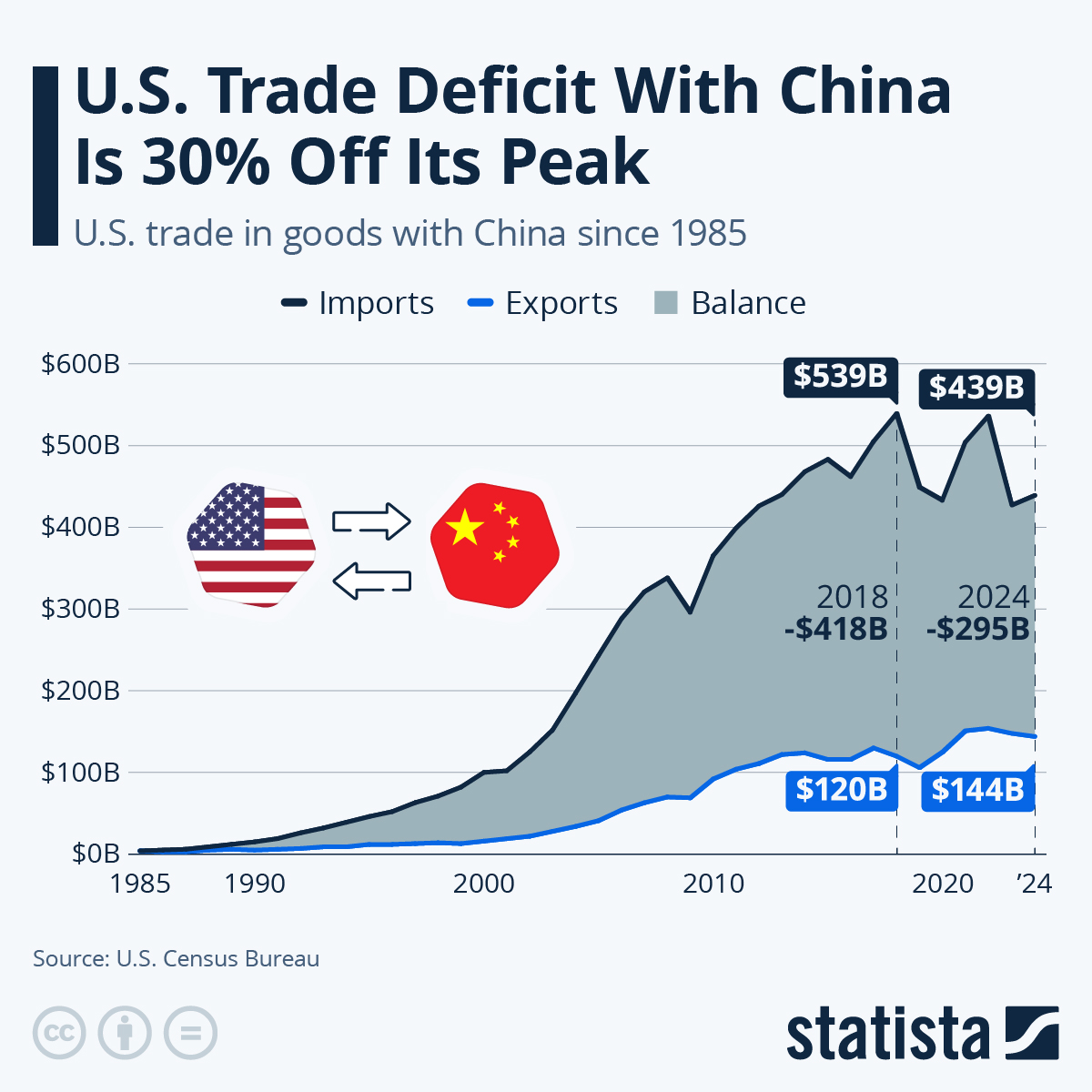
A whopping 75 percent of House Republicans voted in favor of shipping American jobs to China. Democrats, wary of the myriad economic, environmental and labor repercussions of normalizing trade with China, rebuked a “centrist” president and voted against the measure by a two-to-three margin.

A year later, George W. Bush formalized Congress’s vote, granting preferential trade status to China.
Republicans, in short, enabled Beijing’s astounding economic and military rise by swapping millions of good-paying American jobs for cheap Chinese imports. But the GOP’s overwhelming vote in favor of unfettered trade with China came at a staggering cost.
Beginning in the 2000s, the United States witnessed an alarming increase in so-called “deaths of despair.” Driven largely by opioid overdoses, alcohol abuse and suicide, white, blue-collar Americans – Trump’s base – began dying at shocking rates. While an increasing mortality rate is unheard of in first-world countries, several studies have directly linked trade-inflicted manufacturing job losses to the opioid-fueled “deaths of despair” devastating America.

In other words, the GOP’s eagerness to inflate corporate and shareholder profit via cheap, overseas labor has decimated countless American families and communities. But this did not start with Republicans’ vote to normalize trade with China. NAFTA, for example, was negotiated by the first Bush administration, passed Congress with overwhelming GOP support and fulfilled Ronald Reagan’s “vision.”
More broadly, four decades of post-Reagan Republican ideology have gutted America’s middle class. As the United States confronts a historic pandemic, startling images of miles upon miles of cars – each representing an American family – awaiting supplies at overwhelmed food banks expose this dangerous and depressing reality.
- [Trump slams China, WHO for COVID-19 spread at virtual United Nations...
- Trump blasts China on coronavirus in UN speech
Such visceral scenes of poverty – unheard of among the United States’s first-world allies – should be equally unfathomable in a country with America’s immense wealth and capacity for broadly-shared prosperity. Mass food insecurity is not the hallmark of a great nation.
Ultimately, the flaws in China’s early response to this devastating pandemic must be thoroughly investigated. But instead of distracting Americans to protect a failed president, Republicans would be wise to reflect on the immensely damaging long-term repercussions of their ideology and policies. A healthy dose of moral, patriotic soul-searching is long overdue.
Marik von Rennenkampff served as an analyst with the U.S. Department of State’s Bureau of International Security and Nonproliferation, as well as an Obama administration appointee at the U.S. Department of Defense. Follow him on Twitter @MvonRen.
==
https://thehill.com/opinion/national-security/497093-republicans-blasting-china-forget-that-the-gop-enabled-beijings
ref
just free mkt BS or corps wanted?
https://www.uschamber.com/press-release/facts-over-fear-win-china-pntr-debate
facts Over Fear Win China PNTR Debate
Tuesday, May 23, 2000
WASHINGTON, D.C. – United States Chamber of Commerce President Thomas Donohue called today's bipartisan House vote granting permanent normal trade relations (PNTR) to China "a victory of fact over fear and a historic win for the American economy and our national security.
"The truth about free trade won today," said Donohue. "PNTR opens China's markets for American products, businesses and farmers, and creates jobs for workers here at home. Once Congress focused on the facts, no amount of union pressure to isolate this country could defeat the fact that this trade deal with China is in America's best interest.
"American business and workers – from the new economy to the old and the small to the large – clearly recognized the significance of this vote," he said. "As co-chair of theBusiness Coalition for U.S. – China Trade, we worked with a broad based group of supporters, from the grassroots to the Congress, to overcome an all-out blitz of misinformation by union leaders and their allies."
This was a bipartisan victory, Donohue concluded, and he commended members of Congress from both sides of the aisle, for many of whom "this was a particularly tough vote, given the tremendous pressure from the opponents of free trade."
The Chamber has actively supported the China trade deal by mobilizing a massive grassroots effort in 66 congressional districts, beginning over a year before the vote. In addition, 20 lobbyists fanned out across Capitol Hill organizing over 400 congressional meetings and more than 30 Chamber field staffers organized numerous events in targeted congressional districts.
"This vote recognizes that the China trade agreement is overwhelmingly in our favor. China's concessions are its price of admission to the WTO," said Donohue. "The choice was clear: embrace and benefit from China as a trading partner, or stick our heads in the sand and hope they go away. Congress made the right choice today."
The U.S. Chamber of Commerce is the world's largest business federation representing more than three million businesses and organizations of every size, sector and region.
how close WTO MFN coupled to outsrc?
https://carnegieendowment.org/2000/03/20/why-rush-to-favor-china-pub-236
robert kagan wkly std
Clinton was right when he said last Wednesday that the decision to grant China permanent most-favored-nation trading status will have a historic significance equal to Richard Nixon's opening to China and Jimmy Carter's normalization of relations. But if that's true, why is the president rushing Congress to make a hasty decision, with almost no time to consider the merits and consequences of this momentous step?
There are a whole host of good reasons to slow things down. Many members don't even know what's in the trade deal the United States struck with China last November. Meanwhile, the Europeans are negotiating their own agreement with China and probably won't complete negotiations for several months. The administration argues that there's no reason to wait and see if the Europeans get a better deal than our own negotiators, since American businesses will benefit anyway. What the administration doesn't point out is that rapid passage of permanent trade status by Congress will strengthen the Chinese hand and weaken the European negotiating position. It would be better for Congress to to wait and give the Europeans maximum leverage to extract concessions from Beijing.
Then there is the problem of implementation. In any trade deal, the devil is in the details. This is especially true in China's case, because Beijing has a miserable record of implementing the deals it strikes. (The United States is still trying to get China to abide by the agreement it signed on intellectual property rights almost a decade ago.) We won't know the terms of implementation until China reaches an agreement with the WTO much later this year.
By far the most important reason to delay any vote, however, concerns China's recent threats to attack Taiwan if that government does not move more rapidly toward reunification. President Clinton seems to believe that America's very first official response to a Chinese threat of war should be to give Beijing the largest economic gift we have to offer: permanent, low-tariff access to our markets. What kind of signal could that possibly send to Jiang Zemin and his military chiefs? Threaten war against an American ally and a democracy, and the first thing Washington does is lavish gifts upon you. Extreme belligerence, they would have to conclude, is good for business. (Incidentally, guess what two words never appear in last Friday's Wall Street Journal editorial supporting President Clinton's rush to favor China: Taiwan and democracy.)
Some responsible Democrats see what a disaster it would be to approve China's trade status so soon after Chinese threats against Taiwan. Congressman Jack Murtha, an influential centrist Democrat, has informed his colleagues that, in light of Beijing's recent behavior, he will not support permanent MFN for China this year, even though he consistently supported annual renewal of MFN in the past. "It is not in our national security interest," Murtha declared, "to condone and reward grossly irresponsible conduct." Meanwhile, some Republican senators are considering linking any vote on permanent MFN to passage of the Taiwan Security Enhancement Act. The House approved the Taiwan measure overwhelmingly. At the very least, the Senate should pass the Taiwan legislation before it even considers voting on permanent MFN for China. If we want to avoid tempting Beijing into future aggressive actions against Taiwan, the United States must convince the Beijing government now that belligerence carries a real price.
And what are the good reasons to rush through a vote? There aren't any. The president's demand for a hasty decision is purely about politics. Clinton held off making his pitch for permanent MFN until Al Gore had sewn up the Democratic party's nomination, thereby minimizing the pressure that could be brought to bear on the vice president by his big labor allies. With the primaries out of the way, Clinton now wants Congress to rush approval through before the general election campaign goes into full swing, calculating that election-year politics will dim chances of passage.
To put it another way, the White House and the Republican leadership in both houses want to get this thing done before the American electorate gets a chance to look at it. The big corporations want to use their big money to frighten members of Congress into supporting permanent MFN before those members have a chance to hear from their constituents. Polls show that a large majority of Americans oppose China's entry into the World Trade Organization and oppose granting China permanent trade relations. In fact, they don't much like China, period. The White House wants to make sure that this overwhelming public opinion does not influence congressional deliberations. That's one reason the administration has kept secret the terms of the WTO deal it reached with China last November. Keeping the public in the dark was also the hallmark of Henry Kissinger's and Jimmy Carter's China diplomacy in the 1970s.
Of course, there's another reason to rush through a vote in Congress: Bill Clinton's "legacy". The truth is, Congress can just as easily vote on China's permanent trade status next year. After all, China can't even become a WTO member until it cuts its deals with the Europeans and completes negotiations with the WTO authorities on the terms of implementation. In short, it is almost inconceivable that China could join the WTO much before the end of the year. American business will not lose out if the vote is delayed. Therefore, it makes no practical difference whether Congress votes this year or next. Except to Bill Clinton, who wants to leave a trade deal with China as one of his presidential legacies. We can understand why some Democratic leaders in Congress would find this a compelling reason to vote quickly. Why do Republicans?
ref
wsj hmmn
https://www.wsj.com/articles/how-the-china-shock-deep-and-swift-spurred-the-rise-of-trump-1470929543
Bob Davis and Jon Hilsenrath
Aug. 11, 2016 11:32 am ET
HICKORY, N.C.—In the late 1990s, this furniture-making hub seemed sheltered from the disruptive forces of globalization. Laid-off steelworkers from West Virginia, Tennessee and beyond streamed here for new jobs building beds, tables and chairs for American homes. The unemployment rate fell below 2%.
These days, Hickory is still suffering from a series of economic shocks, none more powerful than China’s rise as an export power. The invasion of imported furniture drove factories out of business, erased thousands of jobs and...
==
https://www.marketwatch.com/story/china-really-is-to-blame-for-millions-of-lost-us-manufacturing-jobs-new-study-finds-2018-05-14
5/18
npr?
millions of Americans who lost manufacturing jobs during the 2000s have long ”known” China was to blame, not robots. And many helped elect Donald Trump as president because of his insistence that China was at fault.
Evidently many academics who’ve studied the issue are finally drawing the same conclusion.
For years economists have viewed the increased role of automation in the computer age as the chief culprit for some 6 million lost jobs from 1999 to 2010 — one-third of all U.S. manufacturing employment. Firms adopted new technologies to boost production, the thinking goes, and put workers out of the job in the process. Plants could make more stuff with fewer people.

In the past several years fresh thinking by economists such as David Autor of MIT has challenged that view. The latest research to poke holes in the theory of automation-is-to-blame is from Susan Houseman of the Upjohn Institute.
Read:The epic mistake about manufacturing that’s cost Americans millions of jobs
Academic research tends to be dry and complicated, but Houseman’s findings boil down to this: The government for decades has vastly overestimated the growth of productivity in the American manufacturing sector. It’s been growing no faster, really, than the rest of the economy.
Read:Trump extends lifeline to sanctioned Chinese tech company ZTE
What that means is, the adoption of technology is not the chief reason why millions of working-class Americans lost their jobs in a vast region stretching from the mouth of the Mississippi river to the shores of the Great Lakes. Nor was it inevitable.
Autor and now Houseman contend the introduction of China into the global trading system is root cause of the job losses.
Put another way, President Bill Clinton and political leaders who succeeded him accepted the risk that the U.S. would suffer short-term economic harm from opening the U.S. to Chinese exports in hopes of long-run gains of a more stable China.
No longer needing to worry about U.S. tariffs, the Chinese took full advantage. Low Chinese wages and a cheap Chinese currency US:CNYUSD:{:(style="box-sizing:inherit;-webkit-tap-highlight-color:rgba(0, 0, 0, 0);margin:0px;padding:0px;border:0px;font-style:inherit;font-variant:inherit;font-weight:inherit;font-stretch:inherit;vertical-align:baseline"):}: — at a time when the dollar US:DXY:{:(style="box-sizing:inherit;-webkit-tap-highlight-color:rgba(0, 0, 0, 0);margin:0px;padding:0px;border:0px;font-style:inherit;font-variant:inherit;font-weight:inherit;font-stretch:inherit;vertical-align:baseline"):}: was strong — gave China several huge advantages. Companies shuttered operations in the U.S., moved to China and eventually set up research hubs overseas in another blow to the America’s economic leadership.
The cost to the U.S. is still being tallied up.
For one thing, it left countless families devastated and deprived many areas in the middle of the country of a good fountain of economic opportunity. Manufacturing jobs have long been a great source of economic mobility for less educated Americans. Those who lost their jobs had to fall back on menial, less well-paying work.
Most recently, some of the states that lost the most from the hollowing out of the manufacturing sector paved the way for the 2016 election of Trump and the huge political upheaval in Washington that is still ongoing. Trump better understood what blue-collar workers were thinking and who they blamed.
Read:Trump administration braces for criticism from U.S. companies over China tariffs
Economists are not thrilled with Trump’s protectionist-leaning approach to trade and not every expert accepts the idea that China is mostly to blame for problems in the so-called Rust Belt. Yet the growing recognition of the tradeoffs of free trade might compel American lawmaker to craft policies more suited to helping American workers, Autor and others argue.
http://economics.mit.edu/files/9811
u chic?
Import Competition and the Great US Employment Sag of the 2000s Author(s): Daron Acemoglu, David Autor, David Dorn, Gordon H. Hanson, and Brendan Price Source: Journal of Labor Economics, Vol. 34, No. S1 (Part 2, January 2016), pp. S141-S198 Published by: The University of Chicago Press on behalf of the Society of Labor Economists and the NORC at the University of Chicago Stable URL: http://www.jstor.org/stable/10.1086/682384 . Accessed: 18/12/2015 07:23
ref dems wary
nyt
China: Communism at 50
U.S.-China Relations, special report from the Asia Society
WASHINGTON, April 17 -- In a setback for the Clinton administration, the House Democratic leader, Richard A. Gephardt, intends to oppose granting China permanent normal trading privileges, several people familiar with his decision said today.
For months, Mr. Gephardt refused to say how he would vote, hesitating to worsen divisions among Democrats on the issue and jeopardize his greater goal of reclaiming the House this fall and becoming speaker.
He is expected to announce on Wednesday in St. Louis, his hometown, that alternatives to Congress's annual review of China's trading status fall short of giving lawmakers enough leverage over Beijing's behavior on human rights, religious tolerance and the environment.
The timing of the expected announcement is important, since the House began a two-week recess today, and during their time at home, undecided lawmakers will be the target of intense lobbying and advertising campaigns from both sides.
The Democratic leader is also expected to tell his rank-and-file to vote their consciences and the best interests of their districts. That would free some of them to vote for the pact, strengthening them in campaigns against pro-trade Republicans this fall.
Both sides say the House vote, scheduled for the week of May 22, is too close to call. The Senate is considered certain to back the change.
The vote on China's trade status will determine to what degree America benefits from China's expected entry into the World Trade Organization.
Mr. Gephardt's decision is a victory for the coalition of labor, environmental and human rights groups, and their allies on Capitol Hill, who oppose the measure as an undeserved reward to a repressive regime.
"I never had any doubt that Dick would come down on the right side of the issue, where his heart is," said Representative Peter A. DeFazio, an Oregon Democrat who opposes permanent normal trade status for China.
It also complicates President Clinton's efforts to rally dozens of uncommitted Democrats to support one of his most important remaining foreign policy goals. Given Mr. Gephardt's stature, his position could give wavering Democrats political cover to vote no on the agreement, which is an important step in China's entry into the World Trade Organization.
"Obviously, we're disappointed and wished he were able to be for this," Commerce Secretary William Daley, Mr. Clinton's point man on the vote, said in a telephone interview. "But we'll continue to make the case with Democrats and Republicans that this is good for national security and our overall world leadership position."
On Friday, Mr. Daley suffered an embarrassment when he was forced to cancel a trip with both Democratic and Republican lawmakers to China when most of the dozen invited legislators opted for various reasons to pull out.
Mr. Gephardt's decision is not surprising.
On virtually every nettlesome trade issue of the Clinton administration, Mr. Gephardt has joined the opposing charge, calling for tougher labor, environmental and human rights standards. He opposed the 1993 North American Free Trade Agreement, which Mr. Clinton won, and the bill to give the President special authority to negotiate trade accords, which Mr. Clinton lost.
Over the years, Mr. Gephardt has voted against granting China normal trading status in the annual review. He is a staunch ally of organized labor, which is aggressively fighting the measure to give China the same permanent lower tariffs the United States gives most every other country.
Republicans never took Mr. Gephardt's silence seriously. The No. 2 House Democrat, David E. Bonior of Michigan, is leading the attack against the measure, but top House Republicans, especially Dick Armey of Texas, the majority leader, have always lumped Mr. Gephardt in with its foes.
Trade policy has long played in important role in defining Mr. Gephardt's political agenda.
The centerpiece of his failed 1988 presidential campaign was a measure that would have forced retaliation against nations that gained large trade surpluses with the United States through unfair means.
Mr. Gephardt has recently intensified his courtship of corporate America, especially high-tech companies, to dispel his label as a traditional, old-style Democrat. But many trade advocates said it would have been unfathomable for Mr. Gephardt to switch his trade stripes so quickly.
"We anticipated this, and the fact Dick is not making this a litmus test is very important to all of us," said Representative Robert T. Matsui of California, the top Democratic vote-counter in favor of the measure.
Clearly, the significance of the China vote has weighed on Mr. Gephardt. Last month, he said he was trying to broker a compromise with the administration, labor unions, business groups and House Democrats.
Such an alternative, he said, would include "a methodical way" to ensure that China abides by its treaties, a mechanism to evaluate its human rights record and a code of conduct for American companies doing business in China.
It would also permit the United States to impose sanctions against China if it violated the agreement, as long as the penalties were consistent with the World Trade Organization rules.
But some critics questioned Mr. Gephardt's commitment to finding a third way. He has been dismissive of a popular effort along those lines by Representative Sander M. Levin of Michigan, one of the uncommitted Democrats.
920 ggl outsource global US manufacturing bill legislation
https://www.propublica.org/article/trump-vowed-to-punish-companies-that-moved-jobs-overseas-is-congress-rewarding-them
two weeks before the presidential election, Donald Trump flew into a faded textile town in North Carolina and riled up the crowd over one of his campaign’s signature promises: bringing back the jobs that businesses had shipped overseas.
“They wouldn’t be doing it if I was president,” Trump said to cheers. “Believe me, when they say, ‘We want to send our product’ — whatever the hell they make — ‘We want to send our product back into the United States,’ I’d say, ‘We’d love to have your product — 35 percent tax. Let’s see if you move.’”
He ticked off a list of companies that had closed factories in the state, calling attention to Leviton Manufacturing, a maker of light switches and electrical outlets found in homes and offices around the world, including Trump’s real-estate properties.
“I buy a lot of Leviton switches,” Trump said. “I’m not buying ’em anymore.”
Fast-forward 18 months. Leviton now stands to benefit from a bill that would eliminate the taxes the company pays to import an outlet it makes in China — not, as Trump vowed, raise them.
The bill’s supporters say it will get rid of punishing tariffs on raw materials and components that are critical to American manufacturing. But that’s not all it does. Tucked into the legislation are tariff waivers like the one Leviton requested, which exempt hundreds of finished consumer products — from microwaves to pillows to fishing rods — that used to be made in America.
Leviton qualified through a little-known provision that allows for waivers on finished products so long as there are no competing U.S. manufacturers. But Leviton wasn’t required to disclose that one of the reasons the outlets are no longer made in America is that the company shut down four U.S. factories between 2005 and 2013, laying off more than 1,000 workers and shifting the work to Mexico and China.
“The whole thing kind of stinks,” said Tom Kiefer, a toolmaker who lost his job of 21 years when the company’s Warwick, Rhode Island, factory closed. “It’s not made here because they sent it to China.”
The legislation, known as the Miscellaneous Tariff Bill Act, is emblematic of the contradiction at the heart of the country’s trade policy: Congressional Republicans and many Democrats who support the bill want to ease the tariff burden on corporations — no matter where they make their products — even as the Republican president promises to punish companies that don’t manufacture in the U.S.
The Trump administration has not commented publicly on the bill, which passed the House in January and is awaiting approval by the Senate. His aides have so far sent mixed signals, sending a letter to congressional staff expressing concerns only to later withdraw it. Their reticence runs contrary to the president’s very vocal opinions about trade. Trump resurrected the issue from a policy backwater and has shaken the global economic order this year with new tariffs on solar panels, washing machines, steel and aluminum. Taking aim at China, he recently threatened to slap tariffs on hundreds of its exports in retaliation for the country’s technology policies.
For now, the policy split in Washington means that later this spring, around the same time that Trump could impose tariffs on hundreds of products from China, Congress is expected to hand him a bill asking him to do the exact opposite — reduce or eliminate import taxes on finished products, including more than 400 from China.
Here’s just one bewildering example: The current bill would lower tariffs on electric delivery vans from China just nine years after the Obama administration spent billions of dollars to try to build an electric-vehicle industry in the United States. Meanwhile, Trump’s top trade representative has specifically — and publicly — vowed to raise import fees on China’s electric vehicles.
Many companies, including Leviton, are effectively asking for tax breaks on the same products that they used to make domestically, but that are now made overseas. Granting companies such waivers amounts to a reward for shifting jobs to other countries, some workers and U.S. manufacturers say, and only encourages others to follow.
To find companies seeking tax breaks after closing U.S. factories, ProPublica compared the 1,662 waiver requests in the bill to Labor Department data on workers who’ve lost their jobs due to international trade. The analysis found that the companies requesting waivers on finished goods have eliminated an estimated 175,000 jobs due to outsourcing and competition from foreign imports since 1975, when the Labor Department began keeping track. Measuring it a different way, the industries impacted by the bill have especially seen manufacturing leave the U.S. — with more than 150,000 jobs lost in the last decade alone.
Among those pressing the government to lower the tariffs on their foreign-produced goods are a slate of corporations many consumers view as quintessentially American. Whirlpool, Caterpillar [swiss scam?] , PetSmart and the Gap all submitted petitions to the U.S. International Trade Commission, saying the import taxes on certain kitchen appliances, clothing, pet supplies and equipment are unnecessary, even if they used to be made domestically.
The fitness-equipment company Nautilus, for example, is seeking waivers for its Bowflex TreadClimber and other cardio machines, which it now imports from China. In 2008, Nautilus closed the Tulsa, Oklahoma, factory where it used to make these machines, laid off 150 people and moved production to China and Taiwan.
The cosmetics manufacturer Revlon closed its tweezer and nail-clipper factory in Irvington, New Jersey, in 2007 after 50 years. Now, it’s asking Congress to drop the duties it pays to import tweezers, nail clippers and manicure/pedicure sets from China and South Korea.
In 2012, Rubbermaid left Wooster, Ohio, the town where it was founded 90 years before and formerly manufactured many products. Now, the company wants tariffs lifted on plastic lids for food containers made in China and Malaysia. (A Revlon representative said the “majority of functions” performed in New Jersey moved to North Carolina and that its application for tariff relief complied with the law. Neither Nautilus nor Rubbermaid responded to calls or emails about their waiver applications.)
“The whole idea of miscellaneous tariff bills is the bill should be for U.S. manufacturing — not retailers and importers,” said Democratic Senator Sherrod Brown of Ohio. “The exemptions here have really undermined the intent of Congress. Congress needs to look at this again.”
Wayne County Rubber now occupies the original Rubbermaid building in Wooster, Ohio. In 2012, Rubbermaid left the town where it was founded nearly 100 years ago and once manufactured many products. (Ty Wright for ProPublica)
Supporters of the consumer-product waivers in the bill say it helps U.S. companies stay in business, even if they’ve moved parts of their operations to another country. “Everybody wants to make trade the boogeyman,” said Nicole Bivens Collinson, a lobbyist and former trade negotiator whose firm handled several requests. “Many times, it’s only because companies have been able to source some goods overseas that they’ve been able to maintain U.S. manufacturing.”
The National Association of Manufacturers, which has been the biggest proponent of the bill, declined to comment. But in a blog post, it defended the inclusion of finished products, saying that eliminating the tariffs would lower prices for American consumers. Other supporters note that the waivers last only three years and the rules cap the government’s financial loss on any one item.
Kadee Sprinkle sits in the parking lot of the Everything Rubbermaid store in downtown Wooster, Ohio. The store is the one of the last local remnants of the company, which started as the Wooster Rubber Company in 1920. (Ty Wright for ProPublica)
While those claims are true, lifting those tariffs can still mean big tax breaks for some companies. For example, Bayer, the German pharmaceutical and agricultural company, requested suspensions on more than 100 products in the bill, including aspirin. That means that it and other importers of those products would see $100 million in savings over three years — more than a third of it on items Bayer described as finished products, a ProPublica analysis found. Amazon didn’t request any waivers itself, but is listed as a likely beneficiary on $50 million worth of tariff reductions because it also imports the items.
Some small manufacturers have objected to their competitors’ waiver requests, saying they still make the products in the United States. Others, like the trade association for U.S. textile manufacturers, have argued that including finished products weakens the U.S. negotiating position by lowering trade barriers with other countries without concessions, such as requiring countries to open up their markets or raise their labor and environmental standards.
For Leviton, moving production overseas was perhaps an inevitable transition for a 112-year-old company whose timeline intertwines with America’s industrial history. The company took off by manufacturing a lamp holder for Thomas Edison’s light bulb and later made beaded chains for the dog tags soldiers wore in World War II.
Leviton declined to make executives available for interviews or to answer specific questions. In a statement, it said, “We are committed to doing all we can to keep jobs here in the U.S. and only operate elsewhere to remain competitive, protect our overall business and serve the best interest of our customers.”
[A vacant lot lined with an old barbed wire fence marks the spot of the old Leviton factory in Warwick, Rhode Island. Leviton is asking Congress to eliminate the tariffs on a type of electrical outlet it now makes in China. (Steven G. Smith for ProPublica)
When Leviton shut down its factory in Warwick, it left a hole — which turned into a literal one. A few years after the company left town, a developer demolished the iconic 19th century redbrick mill that housed Leviton’s main building. The company had been there since 1939 and many workers could count several generations of relatives who had passed through.
“You had whole families working there,” Kiefer said. His father worked as a mechanic for nearly 50 years until the warehouse closed in 2010. When his father was out with a back injury, his mother took his place, working “mother hours” so she could see the kids off to school and be home when they returned. Kiefer’s sister worked there. So did his brother-in-law, an aunt and two uncles.
Before Trump turned tariffs into a cudgel, they served various purposes, first generating revenue for the federal government before the income-tax system and later protecting domestic industries from foreign competition. Generally, unless a country is part of a separate free-trade agreement like the North American Free Trade Agreement, importers must pay a tax on products and materials they bring into the United States.
The current fees were set through various international negotiations over the past few decades that left U.S. tariffs relatively low compared with those of other countries. In exchange, American companies are able to sell their products overseas, even if they have to pay a higher tariff to do so. As a side benefit, leaders often hope that war is less likely among countries that do business together.
Many Americans blame low trade barriers for the loss of blue-collar jobs, but there is competing evidence. Light trucks, which have far higher tariffs than cars, are mostly made in North America. But high import taxes on sneakers have done little to prevent footwear companies from manufacturing in Asia.
Miscellaneous tariff bills were designed decades ago to help American manufacturers compete against foreign companies by dropping fees on imported chemicals, minerals and other necessary components that weren’t available domestically. But as global trade grew in the late 1990s and 2000s, the bills began to include finished consumer products that had no U.S. competitors.
About 750 of the 1,662 products included in the current bill are identified as finished goods, a ProPublica analysis found. (The National Association of Manufacturers says that only about 400 are finished products but declined to explain its numbers.) As recently as 2004, similar tariff bills contained only a few dozen.
[Haisam Hussein, special to ProPublica
Past bills granted waivers more informally. Companies and industry groups simply submitted requests to members of Congress, who reviewed them with government experts and inserted them into trade bills. But after House Republicans adopted a ban on earmarks in 2010, some lawmakers worried that the process could be seen as doling out special favors. As a result, a renewal of past tariff suspensions languished and no new ones were granted, costing businesses $750 million a year, according to the manufacturers’ association.
In 2016, Congress created a more transparent system, requiring companies to file petitions with the International Trade Commission, an independent federal agency that provides expertise on trade to legislators and policymakers. The commission reviews the requests and makes recommendations to Congress, based in part on whether there is any relevant domestic manufacturing.
Many companies fit the original legislative intent of easing taxes on foreign components that are critical to manufacturing final products in the U.S. Lasko Products of Pennsylvania, for example, is the last remaining U.S. manufacturer of electric pedestal and desktop fans, but it imports the fans’ motors from China.
At a congressional hearing last fall, the company’s chief operating officer, Ed McAssey, said Lasko employs 638 workers who assemble the fans at its factories in Tennessee and Texas, earning an average of $16 an hour. The company used to make the motors domestically but couldn’t compete with cheaper foreign manufacturers. The tariff relief, McAssey said, “enables us to compete with suppliers in China who do not incur the costs of livable wages, health insurance and retirement contributions that we provide our employees.”
The bill’s supporters often trot out such textbook examples of small to midsize U.S. manufacturers that waivers help to compete. But they rarely mention the multinational corporations like Mattel — or retailers, such as the Home Shopping Network — that are also seeking tariff breaks on products that require no American manufacturing.
Inside the 500-page bill are tariff reductions for hundreds of such items: baby strollers, hiking boots, pimiento-stuffed olives, boxing gloves, coffee makers, toasters, plastic spoons and forks, sparklers and party poppers, nicotine gum, pet toys, pajamas, reusable grocery bags, leather belts, sweaters, glass vases, basketballs, unicycles, yoga mats and vertical waffle makers.
“This is not what I ever thought the miscellaneous tariff bills were intended to do,” said Jennifer Hillman, a Georgetown University professor who worked on past bills as a Democratic congressional aide and served on the trade commission. “It’s supposed to benefit domestic companies that are manufacturing in the United States.”
Dan Ikenson of the libertarian Cato Institute, however, said that there’s good reason to get rid of tariffs on finished products as well as component parts.
“You see an old textile mill in South Carolina with a rusty gate and a rusty chain around it and you see the blight in the town, you think this is the cost of trade liberalization,” Ikenson said. But what’s not seen, he said, are the jobs created by the extra money people have to spend because they pay less for imported clothes.
Indeed, in supporting the waiver requests, companies made little attempt to justify them as creating American manufacturing jobs. For its request to eliminate import fees on microwaves, Whirlpool wrote, “This product supports U.S. marketing and distribution jobs and complements U.S.-assembled cooking products.” When the owner of Ann Taylor stores requested a tariff suspension for women’s hats, the headwear company Dorfman Pacific submitted a public comment in support, noting that “hats offer an extra layer of protection against skin cancer and premature aging.”
The International Trade Commission did reject hundreds of requests from companies to include products in the bill after finding that doing so would harm U.S. manufacturers. And Congress culled the list further, removing items such as air conditioners, which would have been controversial after Trump made a big deal of stopping Carrier Corporation from moving a factory to Mexico.
But whether the companies’ decisions to close their own factories helped them qualify for the waivers was not part of the review — or perhaps even known to lawmakers.
ProPublica analyzed the trade commission’s database of approved requests against data from the Labor Department’s Trade Adjustment Assistance program, which provides financial help and job training to workers who lose their jobs due to increased foreign imports and outsourcing. In calculating job losses, ProPublica excluded companies seeking waivers for components and focused solely on finished products. Because the trade database identifies products while the labor data uses industries, it’s not clear in every case if workers were making the exact same products or only similar products. But through additional reporting, several companies stood out.
Nautilus’ factory in Tulsa got its start churning out StairMasters during the fitness craze of the 1980s. The company had bought StairMaster out of bankruptcy, and by 2007, it appeared stable. The local press reported that business was so good that Nautilus was adding an assembly line and even bringing back jobs from overseas.
But just over a year later, Nautilus announced it was closing the factory. According to Labor Department records, 178 workers were affected as the company shifted some production to China and Taiwan. At the time, many companies still made fitness equipment in the U.S. But the trade-assistance data shows a cascade of layoffs followed Nautilus’ decision, as other companies like Core Industries and Icon Health & Fitness also closed their factories, affecting an additional 2,000 workers.
Rick Haselton, who helped design the TreadClimber, on which Nautilus is now seeking lower tariffs, said companies should face a penalty for moving manufacturing outside the U.S. “It helps them do their job a little cheaper,” he said. “But all these jobs like I was in — that was what I depended on. That was my bread and butter, my livelihood.”
Rick Haselton was on the team that helped design the TreadClimber for the Nautilus fitness company before it closed its Tulsa, Oklahoma, factory in 2008. Now, Nautilus is seeking to lower the tariffs it pays to import the TreadClimber from China. (Brandi Simons for ProPublica)
The bill also seems to sacrifice high-tech manufacturing like electric vehicles. In 2010, Smith Electric Vehicles received a $30 million federal stimulus grant to build battery-powered trucks in Kansas City, Missouri. At the time, then-President Barack Obama toured the factory, telling workers they were “building the economy of America’s future.” But Smith suspended production at the end of 2013 and, in 2015, formed a joint venture with Chinese investors called Nohm.
The company has asked Congress to eliminate the 25 percent tariff on electric commercial vehicles like the ones it makes in China. The trade commission approved the petition but balked at a full waiver, agreeing to only slightly reduce the duties. (No one at the company, which is now called Chanje, returned calls or emails seeking comment.)
Lawmakers asked almost no questions about the finished products included in the bill at a sparsely attended congressional hearing last fall. Representative Ron Kind, a Democrat from Wisconsin, summed up the mood in the room when he said, “This is kind of a boring hearing because it’s not that controversial.”
The bill passed the full House 402-0. It was widely expected to be attached to the omnibus spending bill that passed Congress in March, but was left out as the Trump administration expressed concern about the number of imports from China.
Republican and Democratic congressional aides said the bill is still moving forward, as senators work through some of the line items.
Brown, for example, said in an interview that he managed to remove electric vehicles from the Senate version of the bill, but the amendments have not yet been made public.
When Tom Kiefer walked into the Leviton factory shortly after graduating high school in 1984, the plant hummed with 1,800 workers, many of them with little advanced education, assembling electrical outlets, light switches and lamp holders largely by hand.
He joined an apprenticeship program training new hires as toolmakers to help design the machines that would eventually automate most of the lines. At the time, the business manager of the union local had a slogan: “Automation is our salvation.”
But in the late 1980s, a few years before NAFTA was signed, Leviton opened a factory in Tijuana, Mexico.
“That’s when they started sending stuff to Mexico,” said Kiefer, 51, as he sat near the carousel in the Warwick Mall food court with his father, Tom Kiefer Sr., and another former toolmaker, Nick Izzi, at the end of March.
“When we were building the automated machines, they were sending them out one at a time,” said Izzi, 55, “making us think that they were just sending them to the other plants.”
https://www.alternet.org/2020/09/the-u-s-is-a-mess-and-trumps-core-supporters-could-make-it-much-worse/
the United States is in a mess.
COVID-19 is raging out of control in many areas of the country. Black Lives Matter protests are disrupting cities, in some cases themselves disrupted by counter-protesters. Debates over gun control continue across the country, tornadoes, hurricanes and wildfires seem to increase in numbers and size each year.
Could matters get worse? Yes, they could, in large measure due to Donald Trump’s core supporters. who are these people and why is it possible, indeed likely, that they will make the situation worse?
The 20 per cent or soof Americans who follow Trump no matter what, as opposed to the other 20 plus per cent who vote for him as a Republican or because they believe he’ll cut their taxes, are largely the forgotten, the ignored, the disrespected.
In the early 20th century, those in the southern and western United States resented the federal government, largely controlled by politicians from the northeastern reaches of the country.
The West was underpopulated and felt ignored; the South was angry over the loss of the Civil War, the harsh terms of Reconstruction and the end of slavery, which had fuelled the southern economy.
The West, especially California and Texas, is now an economic powerhouse, and no longer feels ignored. In the South, however, there is still a degree of resentment that southern views are not reflected in national policies. Trump has been trying to amplify this resentment with his defence of statues of Confederate heroes and of keeping the names of Confederate officers on military bases.
Evangelical Christians
Trump’s followers are a diverse alliance. Southerners who feel ignored are just one faction within a broad alliance of citizens who feel that the national government does not serve them. One other easily identifiable group are evangelical Christians.
Non-Americans tend not to realize the scope of evangelical Christianity in the United States and are often puzzled by the many references to God in speeches by politicians, especially federal politicians.
These are references to the idea that Americans are God’s chosen people. This is, however, not a homogeneous group, despite media generalizations. Not all are anti-abortion and anti-gay, but many have a sense that America is sliding backwards morally.
That explains why a segment of the movement supports a president who is almost certainly a serial adulterer — his speeches and his actions correspond with their concerns.
Trump was the first president to attend the annual March for Life this past January, and supporters also welcomed his appointment of social conservatives to the Supreme Court, bringing it closer, they believe, to overturning Roe vs. Wade, which legalized abortion.
Xenophobes, the economically disadvantaged
Another segment of hard-core supporters feel strongly that America is under attack by foreigners, including Central Americans crossing the southern border. They also falsely believe the Chinese sent COVID-19 to kill Americans.
Sixty years ago, these supporters would have been in the “my country right or wrong” camp supporting American involvement in the Vietnam War. They believe they are supporting traditional American values, free enterprise, hard work and white society against destructive change.
For these supporters, Trump promised the wall along the southern border to keep out “rapists,” talks often about “the Chinese virus” and says kind things about counter-protesters, even excusing the actions of the young man, Kyle Rittenhouse, accused of killing two people at a Black Lives Matter demonstration in Wisconsin.
A sizeable segment of Trump supporters, and the ones who often get the most attention, are the economically abandoned. When Trump was elected, some in the media were quick to dismiss his supporters as lacking education, and therefore unable to grasp that Trump lied, embellished the truth and stoked bigotry.
That’s unfair on several levels.
For one, as corporations move their manufacturing offshore and the U.S. economy relies more on high-tech jobs, the less educated have lost their jobs, whether in the coal mines of West Virginia or the industrial areas of the Midwest.
Understandably, they’re attracted to a president who slapped tariffs on foreign countries, including China and Canada, in the hopes manufacturing jobs will return to America.
Not surprisingly, people who believe they’ve watched the American dream of “work hard and you will succeed” vanish have lost patience with politicians on Capitol Hill who seem only to care about power. And so they’ve turned to a populist, someone who seems to understand. A lot of them don’t care about Trump’s lies; they only care that he talks about their problems.
And not all of those suffering economically are manufacturing or industrial workers service with poor education. There are middle-income earners who have been hurt by the flight of industry, which resulted in regional downturns in the economy.
The news industry
Fifty years ago, a sizeable portion of the American population would tune in every evening to the nightly news on one of three networks and listen to a trusted anchor deliver the news. Now many choose either CNN or Fox, throwbacks in many ways to newspapers of the 19th century that supported one political party and framed the news to favour that party.
Not surprisingly, this approach reinforces existing views of what is going on in the United States. The traditional networks have lost the large audiences of earlier years andlocal news in most markets has become infotainment.
Many people, even those who didn’t bother watching news in past, now get a quick fix from the internet, the source of much of the “fake news” that Trump claims the mainstream media circulate, but really originates in the minds of internet fraudsters.
How many times, for example, have we heard that COVID-19 is a Chinese biological weapon, sent to destroy the American population?
Can we blame lack of education for Trump support when even well-educated individuals have their views of the world reinforced by what they see on the internet or on a cable news channel?
Throw in a number of militant supporters of small government and lower taxes, and you have the hard-core Trump supporters.
Violence a real possibility
Many who identify with these different groups may fall into more than one category; for instance, evangelical Christians who are angry about the de-industrialization of America.
Why are Trump supporters likely to make the situation worse this election?
The answer should be obvious. When a group feels that something critical has been denied them for a long time, its members will protest. If the protest still does not bring about change, some or all will resort to violence to try to force change.
Among the staunch Trump supporters are those who will merely vote for him, those who will demonstrate for him — something Trump encourages — and those who willuse violence in order to ensure the re-election of the man they see as their only potential saviour. Violence is a real possibility as the campaign progresses.
Should Trump lose to Joe Biden, the new president must quickly show sympathy towards the economic issues embodied in the pro-Trump movement and empathy towards the more contentious goals of Trump’s supporters, or it is almost certain the violence will escalate.
Ron Stagg, Professor of History, Ryerson University
==
5/20
https://www.alternet.org/2020/05/robert-reich-breaks-down-the-sham-of-corporate-social-responsibility
last August, the Business Roundtable – an association of CEOs of America’s biggest corporations – announced with great fanfare a “fundamental commitment to all of our stakeholders” and not just their shareholders.
They said “investing in employees, delivering value to customers, and supporting outside communities“ is now at the forefront of their business goals — not maximizing profits.
Baloney. Corporate social responsibility is a sham.
One Business Roundtable director is Mary Barra, CEO of General Motors. Just weeks after making the Roundtable commitment, and despite GM’s hefty profits and large tax breaks,Barra rejected workers’ demands that GM raise their wages and stop outsourcing their jobs.Earlier in the year GM shut its giant assembly plant in Lordstown, Ohio.
Nearly 50,000 GM workers then staged the longest auto strike in 50 years. They won a few wage gains but didn’t save any jobs. Barra was paid $22 million last year. How’s that for corporate social responsibility?
Another prominent CEO who made the phony Business Roundtable commitment was AT&T’s Randall Stephenson, who promised to use the billions in savings from the Trump tax cut to invest in the company’s broadband network and create at least 7,000 new jobs.
Instead, even before the coronavirus pandemic,AT&T cut more than 23,000 jobs and demanded that employees train lower-wage foreign workers to replace them....
==
https://www.alternet.org/2020/04/how-the-pandemic-pulled-back-the-curtain-on-the-flawed-global-economic-system/
no lnx
How the pandemic pulled back the curtain on the flawed global economic system
Written by Marshall Auerback, Jan Ritch-Frel April 2, 2020
When the wealthiest country in the world is unable to produce basic medical gear to cope with a rampaging pandemic, it is dealing with a strategic vulnerability by depending on multinational supply chains to produce manufactured goods. Absent sufficient redundancies and physical reserves of resources, “just-in-time” lean supply systems can’t cope with sudden disruptions. The global pandemic of 2020 is a case in point.
This pandemic continues to unfold, but it will serve as the D-Day equivalent of a new predominating economic model for the world, and which in many ways was beginning to take shape before COVID-19. At its core, developed and mixed market economies will factor in the health risk and growing military cost of sustaining international supply chains against investing in high-tech production closer to their markets, and increasingly export their goods to the rest of the world.
Dozens of economies that developed in the past 50 years by enmeshing themselves in the international supply chain on the basis of their labor price advantage will find themselves increasingly cut out of the new process. The contest for global power will increasingly pivot to the extraction and refinement of minerals and component materials that are critical to sustaining the high-tech economy model, away from carbon energy resources. We will be hearing much more about “national stockpiling” and “strategic reserves” beyond oil in the months and years ahead.
Not only has COVID-19 exposed potential health risks and costs involved (as globalized trade routes become vectors of contagion), but the champions of the offshoring phenomenon increasingly resort to myths and misconceptions that are irrelevant to a 21st-century economy. They are as obsolete as spending trillions annually on managing the supply and price of Middle East oil, which American foreign policy figures, including Martin Indyk, are beginning to openly say “isn’t worth it.”
Before we get into the details on thefuture economy, let’s quickly review how the U.S. saw a massive decline in its industrial capacity. Bad ideas and pernicious orthodoxies grew like barnacles over the decades on what was once the world’s leading manufacturer. First was the idea that offshoring is essential to preserving profitability. Often this assertion has been more apparent than real. As far as profitability goes, many companies have made choices to move manufacturing offshore despite continuing domestic profits on home shores. For example,the five North American plants that General Motors (GM) shut down in 2019 were still profitable, but the company, which had received a government bailout in 2009, chose to refocus on the higher-margin operations in China.
Of course, capitalism controlled by bankers and speculators gives free rein to companies to make profits on how they see fit.The consequences are that for decades, Detroit’s “Big Three” automakers have consistently underperformed their German and Japanese counterparts because of their decision to embrace a Wall Street-driven culture that has prioritized short-term quarterly earnings, massive dividend payouts and unprecedented spending on stock repurchases over productive investment in innovation. And as GM’s 2019 experience illustrates, the resultant profits did not go to spur domestic reinvestment, which in turn creates domestic employment, but abroad to expand China’s manufacturing base. GM is but one example of the hundreds of major corporate actors that have denuded the country’s industrial ecosystem, creating gaps in the U.S. workforce and shortages of vital skilled labor.
There are also multiple examples of companies acquiring smaller innovative companies “solely to discontinue the target’s innovation projects and preempt future competition,” according to researchers Colleen Cunningham, from London Business School, and Florian Ederer and Song Ma, both from Yale. A particularly poignant example of these “killer acquisitions,” given today’s ongoing ventilator shortage, is Covidien’s attempted 2012 purchase of California-based Newport Medical Instruments, a smaller competing medical device company that had secured a contract from the federal government in 2010 to produce up to40,000 mobile ventilators.But as David Dayen of The American Prospect observed, the purported rationale for the acquisition was bogus: It had nothing to do with expanding Covidien’s product base and everything to do with destroying a competitor whose product “could cut into its existing profits.”
For years, the political economist Seymour Melman argued that companies that embraced the soft option of downsizing/offshoring labor would ultimately create grave production weaknesses in the U.S. economy and stifle innovation. Higher domestic wages, by contrast, would induce competent managers to compensate by using and investing in more and better machinery, which in turn would lead to a virtuous cycle of production: higher profits, which can lead to higher wages, leading to better machinery and organization of work.
While American companies may think they are improving their individual competitiveness in the short term by shifting operations to low-cost labor economies, the current pandemic illustrates that they collectively undermined America’s (and their own) competitiveness over the long haul.
Intuitively, Melman’s forecasts make sense. A modern manufacturing “ecosystem” makes it much easier to redeploy and pivot to new priorities when there are shortages in vital areas. China, for example, has a sufficiently deep and robust industrial infrastructure to adjust production lines quickly, even as the U.S. continues to struggle with ventilator shortages. And in Germany, a flagship company likeSiemens, for example, announced that it is “making its Additive Manufacturing (AM) Network along with its 3D printers, available to the global medical community to speed design and production of medical components … to enable faster and less complicated production of spare parts for machines like ventilators.”
The Next Economy
A combination of existing technologies and capacities that are already in business application and on the rise will enable the new era of production and global economic overhaul and develop in motion with Melman’s thinking. These include artificial intelligence computing, automated manufacturing and increasingly universal and portable manufacturing equipment, innovations in energy production and storage, high-speed data transfer, and nanotechnology. Some of these technologies are mature, profitable and business-ready. Others are still in an early phase but will be seen as more economically viable or worthy of state investment and subsidy in light of a growing awareness among policy planners that the consequences of running global supply chains are potentially more expensive.
All of these technologies are revolutionary. Their concomitant rise will create a new economic era dominated by the countries that fully integrate them into their economies:
AI computing has the capacity to introduce game-changing efficiencies in the production process, quality control in terms of production and blueprints for new models of production and consumption. It can handle huge volumes of administration and management of automated systems. This industry is estimated to be growing at an annual rate of over 45 percent.
Automated manufacturing can be expensive and requires skilled labor to maintain, but it can produce goods at precision levels beyond what people can make, as well as at increasing volumes. 3D manufacturing is a universalizing process: one machine capable of producing a dizzying number of products that already competes with some products from global supply chains. Many companies are locating back in deindustrialized New York and other U.S. cities on the back of 3D manufacturing.
Recent major advances in energy production—from solar and wind to geothermal and energy storage—are the holy grail of non-carbon energy sources, permitting solar and wind industries to compete on a 24-hour basis with carbon-based fuels, giving more weight for policy planners to minimize fuel imports and revisit dormant energy alternatives.
High-speed data transfer—enabled through satellites and huge server farms—is necessary for the multi-location management and logistical coordination of the segments of the new supply chain: the means of information transfer and the capacity of one hand to know what the other is doing.
The rise of nanotechnology—the capacity to engage in precision design and manufacture at a molecular scale—presents humanity with a new frontier of materials and products that have capabilities beyond what we currently know in terms of materials, products, medicines and much more. Products ranging from glass to suntan lotion are already vastly enhanced by nanotechnology production. Qualities of human-made materials such as those designed for fireproofing, bulletproofing, insulation and space travel are in the midst of being revolutionized. Medicines can be deployed through nanotechnology at the molecular level, vastly improving their effectiveness.
The collective strength of these technologies will diminish the appeal of finding cheaper labor outside a country’s borders or common market—and the costs they entail. Countries that are advanced along these lines and have access to the minerals required to engage in this form of production will prosper, plugging into their existing consumer market and building up a head of steam that will eventually lead to a new chain of international exports and imports. These trend lines will accelerate the decline of brick-and-mortar retail and service industries.
Export-led economies that grew on the back of a labor price advantage will find themselves in a role reversal of having the option of importing better goods from the markets they once exported to or paying intellectual property (IP) licensing fees to produce them domestically. The geopolitical advantages that went with offering a developing country a labor role in a global supply chain will be replaced with discounts on IP licenses or imports.
The past phases of industrialization saw an ongoing contest among wealthy countries for control of petroleum, minerals and shipping lanes, using all their available powers to obtain them. The historical pattern is that residents of the resource-rich and undeveloped countries suffer far more than prosper in the mineral extraction and export process to wealthy markets. Barring a major shift in attitudes to wealth distribution or successful political resistance to exploitation, the pattern will likely continue, with the wealthy countries’ preoccupations pivoting increasingly from carbon energy resources to the components of the new economy: cobalt, lithium and rare metals. Resources that sustain the present and future economies, like iron, copper and gold, will continue to retain their strategic value.
Much of Europe and Asian countries like China, South Korea and Japan are poised for the transition. Based on their traditions of rigid state-driven capitalism, these nations instinctively grasp how state capacity and direction can help drive further industrial development. It remains to be seen if the U.S. is fully capable of it. That is unlikely, if the prevailing neoliberal ideology persists, limiting the role of the U.S. government to be, at best, a neutral umpire that sustains efficient, rent-free markets able to supervise the delivery of an increasingly narrow set of public goods (as opposed to an active participant in industrial policy).
The U.S., with thousands of advanced research institutions, is certainly capable of the next stage of economic development. It has a developed market and a partial manufacturing base. But it also has a long history of wage-avoidance for its workforces and an utterly dysfunctional political process.You need nation-state competence and highly skilled labor in this new world, as well as a willingness to expand ownership and dividend models to workers and the governments that funded the research for this advanced economy.
The coronavirus pandemic will force the U.S. and other countries to stop making distinctions between low-tech business (supposedly fine to offshore) versus high value-added industry. Not only can production lines be altered to cope with shortages (as China is doing), but there is often a continuum in the industrial ecosystem.
Consider the case of surgical masks. Even though their production is ostensibly a low-tech commodified business, the critical inner filtration layer of a mask, which allows the wearer to breathe while reducing the inflow of possible infectious particles, is a high-end business: Costing “upward of [$4.23 million] apiece, the machine that creates this fabric melts down plastic material and blows it out in strands, like cotton candy, into flat sheets of melt-blown fabric for face masks and other filtration products. A similar line of machines can create a related kind of fabric, called spun-bond fabric, also used in face masks and in medical protection suits worn by health-care workers,” according to a report carried by National Public Radio.
The point is that there is a continuum. One creates the demand for the other.Eliminate one industry and another potentially dies, much like a biological ecosystem. We now know that when forests are cut down, at some point if the surviving forest is too small, the whole ecosystem collapses. The ecosystem has to be large enough to encompass all of the niches that make it work.
If the machine tool industry is allocated in one country, the textile industry in another, the steel industry in another, the whole thing becomes much more delicate and inefficient, depending on a greater range of variables to succeed. Crucially, the speed with which innovations can ricochet around the system decreases significantly. When Japanese auto manufacturers have access to Japanese machine tool makers, they can get at the machine tool advances before GM and Ford. Proximity becomes a competitive advantage.
All of which helps to explain why the distinction between offshoring hardware while retaining software is not only fatuous but damaging to long-term economic welfare.
Offshoring left the U.S. unprepared for COVID-19. It has also occasioned a widespread reassessment of globalization: What was once seen as the heretical refuge of economic nationalists has now become respectable again. Even without this pandemic, the foundations of America’s economic model were failing and becoming rapidly obsolete.
The question is: As the world moves to a post-carbon future,can the U.S. economy take away the primacy of rent-extracting sectors like finance, insurance and real estate; Hollywood films, smartphone apps, or increasingly irrelevant sectors like oil and natural gas exports, and join the leaders of the pack? Or is coronavirus merely the pandemic that presages a more terminal disease?
Marshall Auerback is a market analyst and commentator. Jan Ritch-Frel is the executive director of the Independent Media Institute.
This article was produced by Economy for All, a project of the Independent Media Institute.
==
==
When auto plants shutter, opioid deaths skyrocket1219 an
==
aha: fail b/c simplistic linear short term transaction model applied to a complex system
https://www.alternet.org/2019/12/how-trumps-trade-war-hurt-the-very-individuals-it-was-supposed-to-help/
no lnx
How Trump’s trade war hurt the very individuals it was supposed to help
Written by Sarah Toce / Salon December 30, 2019
President Donald Trump’s trade war raised prices for consumers and hurt the manufacturing industry,according to a report from economists on the Federal Reserve Board.
“The first comprehensive estimates” of the trade war’s effect on American manufacturers show that the tariffs have hurt the industry more than they helped, wrote Aaron Flaaen and Justin Pierce, two senior economists at the Federal Reserve’s Industrial Output Section.
“We find that U.S. manufacturing industries more exposed to tariff increases experience relative reductions in employment as a positive effect from import protection is offset by larger negative effects from rising input costs and retaliatory tariffs,” the report said.
In short, the economists concluded that the tariffs gave a “small boost” to manufacturers, which was “offset by larger drags from the effects” of rising costs and retaliatory tariffs.
Mother Jones summarized the main findings in a handy chart:
The report looked at a wide range of effects on the impacted sectors. In some cases, the tariffs were simply contradictory. While import tariffs may have helped protect some manufacturers from foreign competitors, tariffs on imported materials have increased costs for those same companies. Retaliatory tariffs imposed by China and other countries in response to the U.S. tariffs further “put U.S. firms at a disadvantage in those markets,” Flaaen and Pierce wrote.
As a result, manufacturing employment fell, and consumer prices increased. The economists acknowledged that their analysis only examined short-term trends, while long-term trends could show different effects. Trump has argued that the tariffs provide leverage for ongoing trade negotiations, but extensive data thus far shows that his trade war has devastated manufacturers, farmers and other industries.
The economists cited extensive existing research showing that “the majority of U.S. tariff increases are absorbed by U.S. retailers” and are almost entirely passed on to consumers in price increases. Some studies have found that American companies which engaged in trade with China saw “lower stock returns and higher default risk.” The report also acknowledged the political implications of the trade war, citing a study which concluded that it could “explain a shift in voting away from Republican House candidates in the 2018 election.”
The report follows months of extensive reporting on the ongoing manufacturing recession. It confirms what thousands of manufacturing firms have been saying for months: Tariffs are having the opposite effect of what the president claimed.
“There’s been a lot of anecdotal evidence about how tariffs are behind the manufacturing slump. Now the Federal Reserve proves it, finding that the trade war is hurting the sector it was ostensibly supposed to help,” ProPublica reporter Lydia DePillis tweeted. “The [White House] would say that it takes a while for supply chains to adjust, and manufacturers will recover as they find alternative input sources. Also theoretically, mounting pressure will eventually force the Chinese to knuckle under in a way that will rebalance global trade. Given that we haven’t yet seen the text of the Phase One trade deal with China that’s supposed to be signed imminently, that promise remains … theoretical.”
But the economists did not only find that the trade war is failing to help manufacturers. Their research suggests that tariffs simply do not work in any economy that relies on global supply chains.
“Our results suggest that the traditional use of trade policy as a tool for the protection and promotion of domestic manufacturing is complicated by the presence of globally interconnnected supply chains,” Flaaen and Pierce wrote. “While the potential for both tit-for-tat retaliation on import protection and input-output effects on the domestic economy have long been recognized by trade economists, empirical evidence documenting these channels in the context of an advanced economy has been limited.”
Igor Derysh is a New York-based political writer whose work has appeared in the Los Angeles Times, Chicago Tribune, Boston Herald and Baltimore Sun.
==
==
https://www.alternet.org/2019/12/trump-turns-back-on-workers-as-companies-force-employees-to-train-their-cheaper-foreign-replacements-report/
no lnx
Trump turns back on workers as companies force employees to train their cheaper foreign replacements: report
.
Written by Tom Boggioni / Raw Story December 29, 2019
President Donald Trump’s claims that he is bringing jobs back to America are being called nothing more than hot air in a report stating U.S. companies are instead forcing their employees to train their foreign replacements and they will be out of a job once the training is over.
According to a report at Axios, “Opponents of job outsourcing are making a holiday-season appeal to President Trump: Stop U.S. companies from forcing American workers to train the very same cheaper foreign laborers who will soon replace them.”
The reports states: “AT&T is poised to send thousands into the new year hunting for new jobs after assigning them to train their own foreign replacements, according to conversations with current and former workers and documents obtained by Axios,” adding, “Many have worked for the company for over a decade. They aren’t being offered severance or early retirement, and may not easily find a comparable job elsewhere with similar pay.”
According to Sara Blackwell, a lawyer who represents displaced Americans workers, “American workers are tired of waiting for President Trump to do something on this issue. They’ve gone from great hope in President Trump’s administration, to great discouragement.”
Focusing on AT&T, the report continues, “Despite receiving a $3 billion tax cut last year, AT&T announced new and expanded alliances with big outsourcing companies to replace workers with foreign or cheaper domestic talent. Like many major U.S. companies, AT&T has been shifting jobs for years now — but 2019 was especially noteworthy, as workers claimed that as many as 3,000 finance jobs were being outsourced to Accenture. AT&T denied the 3,000 figure, but declined to provide Axios with its own number.”
Speaking with numerous AT&T workers, many acknowledged they will soon be out of a job, stating they were told “they were needed for a ‘knowledge transfer” — then tapped to train people on work visas or overseas who would replace them.”
That, in turn, changed their plans for the immediate future.
“Folks aren’t going on vacation, they’re cutting back on their Christmas shopping,” one employee confided. “If you know that you’re going to be losing your job, you don’t want to spend the money.”
Axios reports they asked for a comment from the White House of the job transfers and were rebuffed.
You can read more here.
==
No, China didn’t steal our jobs. Corporate America gave them away
Trump's trade war points the finger in the wrong direction.…
an 519
==
An industrialized global food supply chain threatens human health – here’s how to improve it
Robyn Metcalfe, University of Texas at Austin
Globalization is making it harder to identify and trace outbreaks of foodborne illness. Technology can help, but consumers may also have to rethink their food choices....
https://www.alternet.org/rise-robots-how-trump-and-republicans-betrayed-their-base-voters
Trump’s formula for his unfortunate electoral victory in 2016 relied almost exclusively on persuading rural American voters in the so-called “heartland” that their economic decline was due not to any fault of corporate, late-stage capitalism but to fact that their jobs were being “stolen” by people with darker skin than themselves. By scapegoating Latinos and Hispanics in particular, and by employing familiar Republican stereotypes against African-Americans, Trump succeeded in eking out the election against a polarizing female Democratic candidate by mobilizing rural “working class’” Americans, mostly white and male, to vote for him out of a sense of race-based grievance.
In an article for the New York Times, Thomas Edsall shows how Trump and the Republicans almost immediately betrayed that rural voting base with their massive tax giveaway to corporations in 2016, creating a tax incentive bonanza that encouraged and accelerated the pace of automation and the implementation of robots, now displacing thousands of relatively low-skilled workers in largely Trump-voting areas of the country. Another articleby Eduardo Porter (also written this week for the Times) highlights the root causes behind the seemingly intractable problem of rural poverty in this country, and offers some clues on how we as Democrats might reclaim many of those rural voters without compromising Democratic values on issues of racial inclusion and equality.
If for nothing else, last month’s elections were remarkable for the fact that virtually no Republicans highlighted their singular achievement, a massive tax giveaway to corporate America. One obvious reason for that is that few Americans making less than mid-six figure incomes saw any benefit to themselves from this tax cut. But the other reason was even more damning, if less noticeable: buried in this gargantuan payoff to reward the CEO donors in boardrooms who supported their campaigns, Republicans deliberately provided a huge incentive for corporations to eliminate the very jobs that their rural voters needed to survive.
Donald Trump’s $1.5 trillion tax cut has increased incentives to replace workers with robots, contradicting his campaign promise to restore well-paying manufacturing jobs in the nation’s heartland.
The Trump tax bill permits “U.S. corporations to expense their capital investment, through 2022. So, if a U.S. corporation buys a robot for $100 thousand, it can deduct the $100 thousand immediately to calculate its U.S. taxable income, rather than recover the $100 thousand over the life of the robot, as under prior law,” Steven M. Rosenthal, a senior fellow at the Urban Institute and a specialist in tax policy, wrote me by email.
The sheer appeal to corporations of taking advantage of an immediate tax deduction by investing in automation cannot be understated. The biggest liability corporations face is the high cost of paying their workers. Robots do not need health benefits and “sick time”—they need only to be programmed and oiled on occasion. They do not require wage “increases” because they do not require any wages to begin with. So a tax incentive to automate was immediately hailed by corporate America as a win-win. And the impact has for the most part fallen in those industries that typically employ the same type of non-college educated—usually male--workers (semi-skilled assemblers, machinists, material handlers, welders) who voted in droves for Donald Trump.
Edsall quotes Jeffrey Sachs, a professor of Economics at Columbia:
The demographic group most hindered by the rise of automation, Sachs wrote, “has been the proverbial white male with less than a college degree and living in rural and semirural areas.”
Sachs believes that
[T]he next wave of job losses will be in basic business services (wholesale and retail trade, warehousing and transport) which will mean another hit for workers with relatively lower educational attainment.
Edsall also cites and quotes extensively from a recent study out of MIT that shows the Trump-voting swaths of the South and Midwest have a far higher concentration of robot-dependent industries than other areas of the country.
But the Trump tax cut did more than just encourage automated replacement of workers in Trump country—it encouraged industries to move out of the country altogether:
The 2017 Trump tax cut not only boosted incentives for corporations to replace workers with robots, it has also created incentives for American companies to move production overseas, even as it directed resources toward “**opportunity zones**” in what the Trump administration defines as “neglected and underserved communities” — incidentally providing a bounty of lucrative grants, guarantees and breaks for real estate developers.
Many in the Democratic Party frankly feel like these voters in Trump country are getting exactly what they deserve for supporting Trump and his cast on enabling charlatans in the GOP. And there is undoubtedly some appeal in schadenfreude,that sense of pleasure that people derive from others’ misfortune, particularly if it is viewed as deserved. But the racism that drove Trump voters to the polls didn’t arise in a vacuum. It was packaged, stoked and fed to them as an easy opportunity to assign blame to what they felt as a real problem, the plain fact that American business industries are not offering livable jobs in rural areas any more.
...
==
https://www.alternet.org/news-amp-politics/harley-davidson-moving-some-production-overseas-and-it-blamed-trade-war-trump
https://www.c-span.org/video/?446055-9/author-discussion-war
JUNE 10, 2018
Author Discussion on War
Journalist Monte Reel reported on the U-2 spy plane program of the Cold War-era and Cam Simpson recounted the capture and killing of defense contractors working for the U.S., during the Iraq War.
brotherhood of spies U2
https://www.barnesandnoble.com/w/the-girl-from-kathmandu-cam-simpson/1126699090?ean=9780062449719
shocking story of the massacre of a group of Nepalese men working as Defense contractors for the United States Government during the Iraq War, and the widow who dedicated her life to finding justice for her husband and the other victims—a riveting tale of courageous heroes, corporate war profiteers, international business, exploitation, trafficking, and human rights in the age of global capitalism that reveals how modern power truly works.
In August of 2004, twelve men left their village in Nepal for jobs at a five-star luxury hotel in Amman, Jordan. They had no idea that they had actually been hired for sub-contract work on an American military base in Iraq. But fate took an even darker turn when the dozen men were kidnapped and murdered by Islamic extremists. Their gruesome deaths were captured in one of the first graphic execution videos disseminated on the web—the largest massacre of contractors during the war. Compounding the tragedy, their deaths received little notice.
==
south-south biz boosts ghg
https://www.ecowatch.com/new-phase-of-globalization-2568824216.html
==
we may need sep nodes; outsourcing is just about jobs race to the bottom
global elite 1% inequality meme highjacked by trump/bannon
Trump faux populist bring factories back; but agenda 21 JBS psycho bs
bannon mission is to boost alt R in europe brexit
==
==
https://www.ft.com/content/3b73068a-d1ed-11e6-b06b-680c49b4b4c0
https://www.c-span.org/video/?424764-2/age-anger
Age Anger | Video | C-SPAN.org
https://www.c-span.org/video/?424764-2/age-anger
1.
'Age Of Anger' Chronicles Rise Of Populist Backlash : NPR
www.npr.org/2017/02/15/.../age-of-anger-chronicles-rise-of-populist-backlash
Feb 15, 2017 - NPR's Kelly McEvers speaks with Pankaj Mishra, author of Age of Anger, about the relationship between populist movements and governments ...
Missing: booktv
Age of Anger by Pankaj Mishra, reviewed. - Slate
www.slate.com/articles/arts/books/.../age_of_anger_by_pankaj_mishra_reviewed.html
1.
...
Mishra, a columnist at Bloomberg Viewand the New York Times Book Review, wants to remind Westerners of our own painful, violent transition to modernity and to emphasize that much of the turmoil in the developing world is a symptom of the same ordeal. Contrary to the assertions of those pundits who evoke “a worldwide clash of civilizations in which Islam is pitted against the West, and religion against reason,” we are witnessing—in the chaos, conflict, and alarming extremism around the globe—a replay of our own history.
It’s a history we’ve chosen to erase from our collective memory, replacing it with a delusional cover story about the “peaceful convergence” of Western nations on “a benevolent Enlightenment tradition of rationalism, humanism, and liberal democracy.” But in reality, Mishra points out, “the history of modernization is largely one of carnage and bedlam.”
...
The observation that militant Islamic fundamentalism is a modern phenomenon is not new; the popular historian Karen Armstrong has repeatedly written, most memorably in 2000’sThe Battle for God: Fundamentalism in Judaism, Christianity, and Islam, that fundamentalism arises in reaction to a rapidly changing world. Without that vertiginous change, it wouldn’t occur.
But in Age of Anger,Mishra further points out theresemblance between jihadis and lone-wolf terrorists such as Timothy McVeigh (who described “science” as his religion) and Orlando nightclub shooter Omar Mateen.The same roiling passions that drive such young men have also fueled, Mishra argues, the rise of nationalist demagogues in India, Turkey, and Thailand. Most tellingly, the whole lot harkens back, with often eerie similarities, to the revolutionaries and revanchists that harrowed Europe in the 19th and early 20th centuries.
This is a framework that pushes aside conventional, familiar divisions of left and right to focus on the profound sense of dislocation and alienation that spawned (and still spawns) movements ranging from fascism to anarchism to nihilism. All of these responses are animated by an upsurge in“ressentiment,” which Mishra defines as “an existential resentment of other people’s being, caused by an intense mix of envy and sense of humiliation and powerlessness.” No Westerner can read that description in 2017 and not think of the election of Donald Trump and a campaign that seemed defined far less by what the candidates advocated than by who voters hated most. Not only is the rest of the world undergoing a bone-rattling allergic reaction to modernity, but America continues to reel from it as well.
==
http://www.dallasnews.com/arts/books/2017/02/03/age-of-anger-pankaj-mishra-review
...
In Rousseau's ongoing quarrels with the emerging spirit of modernity, Mishra finds the roots of a seething and now transnational ressentiment, a toxic cocktail of envy, humiliation and powerlessness that fuels the rage of populists and terrorists worldwide. (Nietzsche, Mishra notes, called the battle between Voltaire and Rousseau "the unfinished problem of civilization.")
Just as Rousseau felt alienated from the cosmopolitan Paris salons in which Voltaire ruled, today's apostles of anger — including not just Islamic radicals but, Mishra says, Indian politicians, Brexiteers and American-bred terrorists like Timothy McVeigh — confront and condemn a world in which "the modern promise of equality collides with massive disparities of power, education, status and property ownership."
While he in no way justifies violence and terror, Mishra has the courage to pose deeply disturbing questions: What if al-Qaeda and ISIS, for all their savagery, are inevitable products of a world order in which the forces of individualism and self-seeking global capitalism are destroying older, settled ways of being without delivering a better life for millions?
Those forces, set in motion by the Enlightenment, the growth of secular science and the Industrial Revolution, have now generated a backlash whose power many Western governments have yet to comprehend. Political life in advanced nations has become "clamorous with unlimited demands for individual freedoms and satisfactions." As once-comforting structures of religious faith, family ties and local traditions weaken and fade away, the naked individual can feel abandoned in a perplexing new world. Such dilemmas make the strongman rhetoric of a Donald Trump ("I alone can fix it") alluring to many.
==
'Age Of Anger' Chronicles Rise Of Populist Backlash : NPR
www.npr.org/2017/02/15/.../age-of-anger-chronicles-rise-of-populist-backlash
Feb 15, 2017 - NPR's Kelly McEvers speaks with Pankaj Mishra, author of Age of Anger, about the relationship between populist movements and governments ...
Missing: booktv mcveigh supermax
Age of Anger by Pankaj Mishra, reviewed. - Slate
www.slate.com/articles/arts/books/.../age_of_anger_by_pankaj_mishra_reviewed.html
1.
Age of Anger by Pankaj Mishra — in the danger zone - Financial Times
https://www.ft.com/content/3b73068a-d1ed-11e6-b06b-680c49b4b4c0
1.
see flipside h1 visa worker permits
wolff berk kpfa 2/17 : cap'l recession 4-6 years?
outsrc, and bring in cheap labor eg restaurant and farms that can't
http://www.alternet.org/local-peace-economy/how-globalization-impacts-american-dream
==
robt r
The Increasing Irrelevance of Corporate Nationality
“You shouldn’t get to call yourself an American company only when you want a handout from the American taxpayers,” President Obama saidThursday.
He was referring to American corporations now busily acquiring foreign companies in order to become non-American, thereby reducing their U.S. tax bill.
But the President might as well have been talking about all large American multinationals.
Only about a fifth of IBM’s worldwide employees are American, for example, and only 40 percent of GE’s. Most of Caterpillar’s recent hires and investments have been made outside the US.
In fact, since 2000, almost every big American multinational corporation has created more jobs outside the United States than inside. If you add in their foreign sub-contractors, the foreign total is even higher.
At the same time, though, many foreign-based companies have been creating jobs in the United States. They now employ around 6 millionAmericans, and account for almost 20 percent of U.S. exports. Even a household brand like Anheuser-Busch, the nation’s best-selling beer maker, employing thousands of Americans, is foreign (part of Belgian-based beer giant InBev).
Meanwhile, foreign investors are buying an increasing number of shares in American corporations, and American investors are buying up foreign stocks.
Who’s us? Who’s them?
Increasingly, corporate nationality is whatever a corporation decides it is.
So instead of worrying about who’s American and who’s not, here’s a better idea: Create incentives for any global company to do what we’d like it to do in the United States.
For example, “American” corporations get generous tax credits and subsidies for research and development, courtesy of American taxpayers.
But in reducing these corporations’ costs of R&D in the United States, those tax credits and subsidies can end up providing extra money for them to do more R&D abroad.
3M is building research centers overseas at a faster clip than it’s expanding them in America. Its CEO explained this was “in preparation for a world where the West is no longer the dominant manufacturing power.”
3M is hardly alone. Since the early 2000s, most of the growth in the number of R&D workers employed by U.S.-based multinational companies have been in their foreign operations, according to the National Science Board, the policy-making arm of the National Science Foundation.
It would make more sense to limit R&D tax credits and subsidies to additional R&D done in the U.S. over and above current levels – and give them to any global corporation increasing its R&D in America, regardless of the company’s nationality.
Or consider Ex-Im Bank subsidies – a topic of hot debate in Washington these days. These subsidies are intended to boost exports of American corporations from the United States.
Tea Party Republicans call them “corporate welfare,” and Chamber-of-Commerce Republicans call them sensible investments. But regardless, they’re going to “American” multinationals that are making things all over the world.
That means any subsidy that boosts their export earnings in the United States indirectly subsidizes their investments abroad – including, very possibly, their exports from foreign nations.
GE, a major Ex-Im Bank beneficiary, has been teaming up with China to produce a new jetliner there that will compete with Boeing for global business. (Boeing, not incidentally, is another Ex-Im beneficiary). In fact, GE is giving its Chinese partner the same leading-edge avionics technologies operating Boeing’s 787 Dreamliner.
Caterpillar, another Ex-Im Bank beneficiary, is providing engine funnels and hydraulics to Chinese firms that eventually will be exporting large moving equipment from China. Presumably they’ll be competing in global markets with Caterpillar itself.
Rather than subsidize “American” exporters, it makes more sense to subsidize any global company – to the extent it’s adding to its exports from the United States.
Which brings us back to American companies that are morphing into foreign companies in order to lower their U.S. tax bill.
“I don’t care if it’s legal,” said the President. “It’s wrong.”
It’s just as wrong for American corporations to hide their profits abroad – which many are doing simply by setting up foreign subsidiaries in low-tax jurisdictions, and then making it seem as if the foreign subsidiary is earning the money.
Caterpillar, for example, saved $2.4 billion between 2000 and 2012 by funneling its global parts business through a Swiss subsidiary (a ruse so audacious that one of its tax consultants warned Caterpillar executives to “get ready to do some dancing” when called before Congress to justify it).
And what about American corporations that avoid U.S. taxes by never bringing home what they legitimately earn abroad – a sum now estimated to be in the order of $1.6 trillion?
Rather than focus on the newly-fashionable tax-avoidance strategy of changing corporate nationality, it makes more sense to tax any global corporation on all income earned in the United States (with high penalties for shifting that income abroad), and no longer tax “American” corporations on revenues earned outside America. Most other nations already follow this principle.
In other words, let’s stop worrying about whether big global corporations are “American.” We can’t win that game. Focus instead on what we want global corporations of whatever nationality to do in America, and on how we can get them to do it.
http://robertreich.org/#.U9aCPllX2ZE.twitter
http://www.sourcewatch.org/index.php/Portal:Outsourcing_America_Exposed
somewhere i read where b2 admin wrote tax codes to encourage?
On August 6 the City Council of the City of Palo Alto, California passed an ordinance which makes it a crime to sleep in your car. This represents yet another attempt to criminalize poverty and homelessness in this country. If you are found sleeping in your car (which you own) you will be fined up to $1000 (which you probably do not have because you are homeless) or sentenced to jail (in a state with an overcrowding of prisons so bad that the US Supreme Court has ordered it to release inmates).
My mother was homeless and lived in her car for quite some time. Before she was able to obtain a vehicle she was on the streets. She was robbed in broad daylight while trying to get some sleep on the beach, she came to me with blisters as big as rocks on her arms from sun exposure, and she could not get good enough sleep to enable her to even attempt to try and get out of her situation. If people cannot sleep in her cars, where can they sleep? They will get tickets for sleeping on the concrete or in parks as well. Where can they go??
==
outsourcing (or offshoring) is a bigger contributor to unemployment in the U.S. than laziness.
Since 2000, U.S. multinationals have cut 2.9 million jobs here while increasing employment overseas by 2.4 million. This is likely just the tip of the iceberg as multinational corporations account for only about 20 percent of the labor force.
When was the last time you saw a front-page headline about outsourcing?

Click to enlarge.
Source: Wall Street Journal via Think Progress.
outsourcing jobs:
‘U.S.’ Chamber Of Commerce Funded By Top Offshoring Companies
While it tells the American public it cares about American jobs, the U.S. Chamber of Commerce actually works to send jobs overseas on behalf of its corporate members, which include some of Asia’s top offshoring companies. Its secretly-funded $75 million political ad campaign attacks the “anti-jobs record” of Sen. Barbara Boxer (D-CA), Jerry Brown (D-CA), Richard Blumenthal (D-CT), Alexi Giannoulias (D-IL), Rep. Dina Titus (D-NV), and others.
s ThinkProgress previously noted, the Chamber has repeatedly sent out issue alerts attacking Democratic efforts to encourage businesses to hire locally rather than outsource to foreign counties. The Chamber has also bitterly fought Democrats for opposing unfettered free trade deals. The Chamber’s anti-American jobs agenda serves not only the profit-seeking of right-wing corporate executives in the United States, but also works to send jobs overseas to the following outsourcing companies, who are some of the dozens of**foreign corporations**that pay member dues to the Chamber of Commerce’s 501c(6) account, which is used to fund its political ads:
– InfoSys, Bangalore, India (at least $15,000 in annual member dues): “Infosys is the ‘Best Outsourcing Partner’ according to the Waters Rankings for the third consecutive year.”
– KPIT Cummins, Pune, India ($7,500): “Strategic global networking, together with industry-proven practices & processes, give KPIT Cummins a cutting edge in the realm of outsourcing.”
– Patni Americas, Mumbai, India ($15,000): “Patni, the world leader in IT outsourcing and business process outsourcing provides offshore software development, global sourcing, custom software development, and a vast array of product engineering and IT services to companies worldwide.”
– NIIT Technologies, Delhi, India ($15,000): “[L]eadership in the area of outsourcing.”
– QuEST Global, Singapore ($7,500): “QuEST is a leader in the engineering services outsourcing (ESO) space.”
– Rolta, Mumbai, India ($7,500): “Rolta’s global footprint and track record along with its capable off-shoring model gives it a unique positioning in this large market.”
– SKP Crossborder Consulting, Mumbai, India ($7,500): “SKP’s core outsourcing practice is managed out of a fully equipped, spacious premises based in Pune with access to facilities in Mumbai, Hyderabad, Delhi and Bangalore.”
– Tata Group, Mumbai, India ($15,000): “[W]orld-class solutions in outsourcing – business process outsourcing, application outsourcing, infrastructure outsourcing.”
– Wipro, Bangalore, India ($15,000): “India’s biggest destination for U.S. offshoring.”
In its “American Free Enterprise” campaign, the Chamber says that there is no “greater or more important” policy challenge “than creating the 20 million jobs needed in the next decade to replace the jobs lost in the current recession and to meet the needs of America’s growing workforce.” Perhaps the Chamber should actually start working toward that goal of creating jobs in America, instead of promoting the offshoring agenda of its foreign sponsors.