2017 tax cut voodoo
see voodoo main
see 2 santas
see supply side BS
promote primary as ad war big in 2018
no raise in wages or re-investment, stock buyback (repatriate $?)
cut kids rx CHIP to pay for!
who was spkr? ryan
mcconn staffers and others rev dr to cash in on windfall bonanza eg brendan dunn akin gump
bak 120
===
---
---
GGL 6 26
OFF BS 2017 VOODOO
The Peterson Foundation's analysis of the 2017 TCJA includes the following key points:
- Massive Cost to the Deficit: At the time of its enactment, the Joint Committee on Taxation (JCT) estimated that the TCJA would add roughly ($1.4) trillion to the federal deficit over a 10-year period. [1]
- Corporate Tax Reduction: The 2017 bill lowered the corporate statutory tax rate from (35\%) to (21\%). The Peterson Foundation closely monitors this, noting that despite short-term drops in revenues, corporate collections eventually returned to pre-TCJA levels due to an expanded tax base. [1, 2]
- The Expiring Provisions & The "Fiscal Cliff": The 2017 bill intentionally included an expiration date (December 31, 2025) for most of the individual tax provisions to limit the fiscal damage. The Peterson Foundation projects that extending all of these temporary tax cuts would add roughly ($4) trillion to ($4.6) trillion to the deficit over the subsequent decade. [1, 2]
VS REALITY:
Un)intended consequences? The impact of the 2017 tax cuts and jobs act on shareholder wealth
Ivalina Kalcheva ^a, James M. Plečnik ^b, Hai Tran ^b, Jason Turkiela ^c
Show more
Journal of Banking & Finance
Date: September 2020
Article: 105860
Volume: Volume 118
Abstract
We study the stock market reactions to the Tax Cuts and Jobs Act (TCJA), the most significant structural U.S. tax reform in over 30 years. In line with the stated intent of TCJA proponents, we find that the Act benefited highly taxed firms. However, the Act hindered firms with international operations as well as firms with high interest expense and tax losses. Counter to claims that the TCJA would quickly spur economic growth, we find that financially constrained and high growth opportunity firms did not benefit. Rather, market participants anticipate that most of the TCJA's benefits will be passed on to shareholders via higher corporate payouts. We confirm these market expectations by documenting that firms did increase payouts via repurchases after the TCJA, but did not increase their corporate investments.
---
===
an 1 25
A right-wing advocacy group founded by the billionaire Koch brothers announced Monday the launch of a $20 million campaign to promote an extension of the 2017 Trump-GOP tax cuts, which disproportionately benefited the rich and large corporations.
[vid]
But in a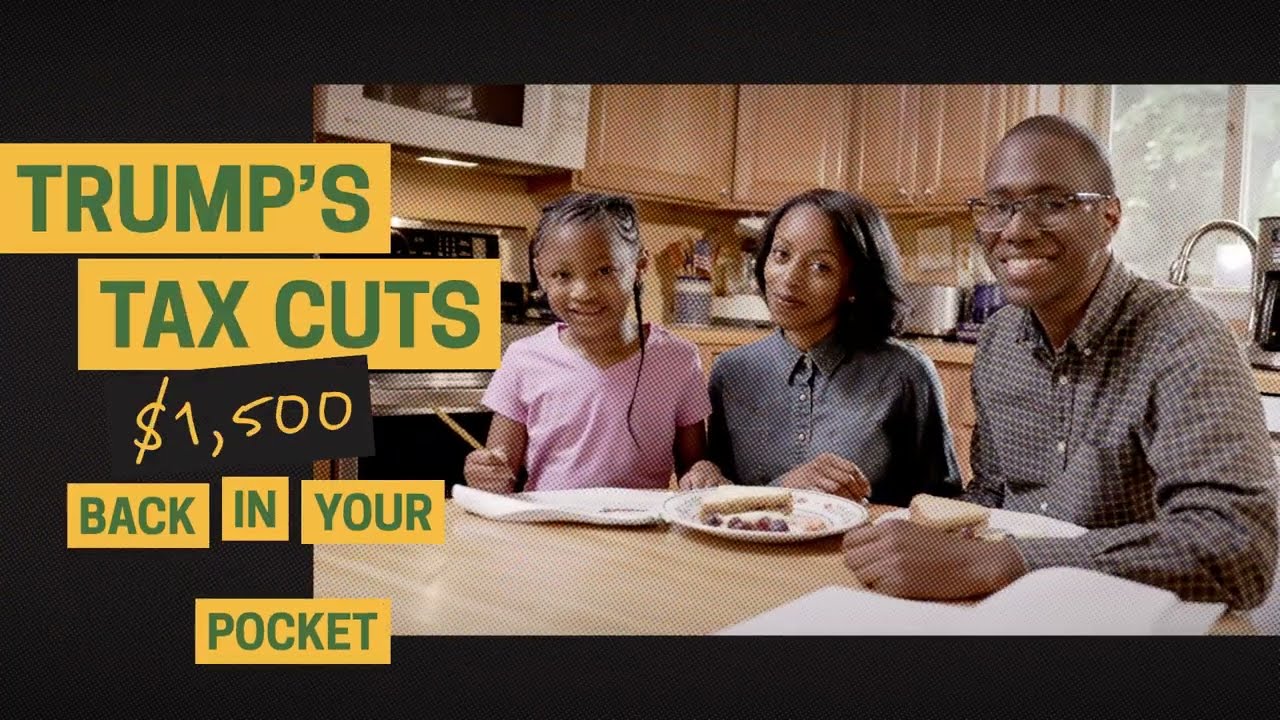 that debuted over the weekend, Americans for Prosperity (AFP) characterizes the 2017 Tax Cuts and Jobs Act as a boon to "hardworking Americans" and small businesses—and warns that allowing provisions of the law to expire at the end of this year as scheduled would be disastrous for the working class.
"This year, Congress is facing a countdown to a crisis that threatens family budgets nationwide," Ross Connolly, AFP's regional state director, said in a statement Monday. "We are proud to partner with the incoming Trump administration to protect prosperity and ensure that Congress acts."
AFP is a 501(c)(4) organization that describes itself as a "grassroots" movement despite being launched by Charles Koch and his late brother, David—two of the most notorious right-wing billionaire in U.S. politics.
The group said its new 50-state campaign represents "the largest effort by a conservative organization" to support President-elect Donald Trump's legislative agenda as he prepares to take office next week. The campaign, according to AFP, will include "over 1,000 meetings" at congressional offices, "in-district events" with activists and lawmakers, and "roundtables with job creators."
The campaign aims to "reach millions of voters on the phone and at their doorsteps," AFP said.
"The Trump tax giveaways passed in 2017 did not help working-class Americans. In fact, the top 1% of corporations received almost all of the benefits."
AFP's description of the impacts of the 2017 tax law flies in the face of resounding evidence showing that wealthy Americans—not ordinary workers—were the chief beneficiaries and are poised to reap most of the rewards once again if Trump and the Republican-controlled Congress extend the measure's soon-to-expire provisions.
"Americans for Prosperity is spending $20 million on a new ad campaign that champions the 2017 Trump tax law as a win for working families," Morris Pearl, chair of the Patriotic Millionaires, told Common Dreams. "But don't be fooled: What this Koch-backed group is really only after is protecting tax cuts for wealthy people like me."
"I'm in favor of tax relief for working people, but not yet another huge and unnecessary windfall for America's rich," Pearl added. "If Congress wants to help working families, they should make tax rates on labor income the same as tax rates on profits made by investors."
AFP is one of a number of right-wing, corporate-tied organizations pushing for an extension of the Trump tax cuts, which Republicans are planning to fund by slashing Medicaid, federal nutrition assistance, and other key programs.
The progressive watchdog group Accountable.US noted in a recent analysis that one of the groups pushing for an extension of the 2017 law is Advancing American Freedom, an organization "run by corporate consultants, lobbyists, lawyers, and executives, including former Trump administration officials who were directly responsible for the TCJA."
Accountable also observes that Club for Growth, a group funded by wealthy conservatives, "has pushed a deeper corporate tax cut plan as an 'opening salvo' in the current tax debate."
"The billionaire funders of the group's action arm have benefited enormously from the TCJA, saving hundreds of millions of dollars from a single obscure tax break for pass-through entities," the watchdog added.
In response to AFP's new nationwide campaign, Accountable.US executive director Tony Carrk told Common Dreams that "a glitzy ad campaign from a far-right organization won't change the fact that the Trump administration and Republican-controlled Congress are paying for giveaways to billionaires, wealthy tax cheats, and price-gouging corporations by cutting critical services for working families, like Medicaid and SNAP."
"The Trump tax giveaways passed in 2017 did not help working-class Americans," said Carrk. "In fact, the top 1% of corporations received almost all of the benefits."
Watch the ad below:
an 1 25
GOP proposes repealing Biden’s student debt relief to fund new tax cuts for the rich
===
an 12 24
The Tax Cuts and Jobs Act, a set of tax cuts Donald Trump signed into law during his first term as president, will expire on Dec. 31, 2024. As Trump and Republicans prepare to negotiate new tax cuts in 2025, it’s worth gleaning lessons from the president-elect’s first set of cuts.
The 2017 cuts were the most extensive revision to the Internal Revenue Code since the Ronald Reagan administration. The changes it imposed range from the tax that corporations pay on their foreign income to limits on the deductions individuals can take for their state and local tax payments.
Trump promised middle-class benefits at the time, but in practice more than 80% of the cuts went to corporations, tax partnerships and high-net-worth individuals. The cost to the U.S. deficit was huge − a total increase of US$1.9 trillion from 2018 to 2028, according to estimates from the Congressional Budget Office. The tax advantage to the middle class was small.
Advantages for Black Americans were smaller still. As a scholar of race and U.S. income taxation, I have analyzed the impact of Trump’s tax cuts. I found that the law has disadvantaged middle-income, low-income and Black taxpayers in several ways.
Cuts worsened disparities
These results are not new. They were present nearly 30 years ago when my colleague William Whitford and I used U.S. Census Bureau data to show that Black taxpayers paid more federal taxes than white taxpayers with the same income. In large part that’s because the legacy of slavery, Jim Crow and structural racism keeps Black people from owning homes.
The federal income tax is full of advantages for home ownership that many Black taxpayers are unable to reach. These benefits include the ability to deduct home mortgage interest and local property taxes, and the right to avoid taxes on up to $500,000 of profit on the sale of a home.
It’s harder for middle-class Black people to get a mortgage than it is for low-income white people. This is true even when Black Americans with high credit scores are compared with white Americans with low credit scores.
When Black people do get mortgages, they are charged higher rates than their white counterparts.
It’s harder for middle-class Black people to get a mortgage than it is for low-income white people. MoMo Productions/Getty Images
Trump did not create these problems. But instead of closing these income and race disparities, his 2017 tax cuts made them worse.
Black taxpayers paid higher taxes than white taxpayers who matched them in income, employment, marriage and other significant factors.
Broken promises, broken trust
Fairness is an article of faith in American tax policy. A fair tax structure means that those earning similar incomes should pay similar taxes and stipulates that taxes should not increase income or wealth disparities.
Trump’s tax cuts contradict both principles.
Proponents of Trump’s cuts argued the corporate rate cut would trickle down to all Americans. This is a foundational belief of “supply side” economics, a philosophy that President Ronald Reagan made popular in the 1980s.
From the Reagan administration on, every tax cut for the rich has skewed to the wealthy.
Just like prior “trickle down” plans, Trump’s corporate tax cuts did not produce higher wages or increased household income. Instead, corporations used their extra cash to pay dividends to their shareholders and bonuses to their executives.
Over that same period, the bottom 90% of wage earners saw no gains in their real wages. Meanwhile, the AFL-CIO, a labor group, estimates that 51% of the corporate tax cuts went to business owners and 10% went to the top five highest-paid senior executives in each company. Fully 38% went to the top 10% of wage earners.
In other words, the income gap between wealthy Americans and everyone else has gotten much wider under Trump’s tax regime.
Stock market inequality
Trump’s tax cuts also increased income and wealth disparities by race because those corporate tax savings have gone primarily to wealthy shareholders rather than spreading throughout the population.
The reasons are simple. In the U.S., shareholders are mostly corporations, pension funds and wealthy individuals. And wealthy people in the U.S. are almost invariably white.
**Sixty-six percent of white families own stocks, while less than 40% of Black families and less than 30% of Hispanic families do. Even when comparing Black and white families with the same income, the race gap in stock ownership remains.
These disparities stem from the same historical disadvantages that result in lower Black homeownership rates. Until the Civil War, virtually no Black person could own property or enter into a contract. After the Civil War, Black codes – laws that specifically controlled and oppressed Black people – forced free Black Americans to work as farmers or servants.
State prohibitions on Black people owning property, and public and private theft of Black-owned land, kept Black Americans from accumulating wealth.

A woman protests outside Trump Tower over the Trump administration’s proposed tax cut on Nov. 30, 2017, in New York City. Spencer Platt/Getty Images
Health care hit
That said, the Trump tax cuts hurt low-income taxpayers of all races.
One way they did so was by abolishing the individual mandate requiring all Americans to have basic health insurance. The Affordable Care Act, passed under President Barack Obama, launched new, government-subsidized health plans and penalized people for not having health insurance.
Department of the Treasury data shows almost 50 million Americans were covered by the Affordable Care Act since 2014. After the individual mandate was revoked, between 3 million and 13 million fewer people purchased health insurance in 2020.
Ending the mandate triggered a large drop in health insurance coverage, and research shows it was primarily lower-income people who stopped buying subsidized insurance from the Obamacare exchanges. These are the same people who are the most vulnerable to financial disaster from unpaid medical bills.
Going without insurance hurt all low-income Americans. But studies suggest the drop in Black Americans’ coverage under Trump’s plan outpaced that of white Americans. The rate of uninsured Black Americans rose from 10.7% in 2016 to 11.5% in 2018, following the mandate’s repeal.
The consumer price index conundrum
The Trump tax cuts also altered how the Internal Revenue Service calculates inflation adjustments for over 60 different provisions. These include the earned income tax credit and the child tax credit – both of which provide cash to low-wage workers – and the wages that must pay Social Security taxes.
Previously, the IRS used the consumer price index for urban consumers, which tracks rising prices by comparing the cost of the same goods as they rise or fall, to calculate inflation. The government then used that inflation number to adjust Social Security payments and earned income tax credit eligibility. It used the same figure to set the amount of income that is taxed at a given rate.
The Trump tax cuts ordered the IRS to calculate inflation adjustments using the chained consumer price index for urban consumers instead.
The difference between these two indexes is that the second one assumes people substitute cheaper goods as prices rise. For example, the chained consumer price index assumes shoppers will buy pork instead of beef if beef prices go up, easing the impact of inflation on a family’s overall grocery prices.
The IRS makes smaller inflation adjustments based on that assumption. But low-income neighborhoods have less access to the kind of budget-friendly options envisioned by the chained consumer price index.
And since even middle-class Black people are more likely than poor white people to live in low-income neighborhoods, Black taxpayers have been hit harder by rising prices.
What cost $1 in 2018 now costs $1.26. That’s a painful hike that Black families are less able to avoid.
The imminent expiration of the Trump tax cuts gives the upcoming GOP-led Congress the opportunity to undertake a thorough reevaluation of their effects. By prioritizing policies that address the well-known disparities exacerbated by these recent tax changes, lawmakers can work toward a fairer tax system that helps all Americans.
Beverly Moran, Professor Emerita of Law, Vanderbilt University
---
---
an 12 24
Trump and his GOP allies are determined to extend the corporate tax cuts that were enacted in2017 during his first term.
Many Republicans have been downplaying the effect that doing so would have on the United States' federal deficit.
But according to Washington Post opinion columnist Catherine Rampell, they are ignoring the math involved.
:{READ MORE:'Only high-income nation without it': DC insider explains why Americans are so miserable
Rampell, in her December 10 column, argues, "The GOP's first order of business: getting rid of math. The fractious Republican Party can agree on few things these days. But one of them is near-unanimous frustration with the pesky laws of arithmetic. That cutting future taxes would reduce future tax revenue, for instance, perpetually aggrieves them."
Republicans who favor extending the corporate tax cuts, according to Rampell, are ignoring how much it will increase the federal deficit.
"A large chunk of the 2017 Trump tax cuts expires next year, and extending these provisions will be extremely expensive," . "That's why Republicans scheduled them to sunset in the first place: to lower the price tag.Rampell explains The Congressional Budget Office, the legislature’s official scorekeeper, estimates a full extension would add more than $4 trillion to the federal debt over the next decade."
The Post columnist adds, "That's true even after considering any potential growth effects on the U.S. economy. It might also understate the full cost of GOP tax plans, since it doesn't include Trump's other pricey promises: slashing corporate taxes, eliminating taxes on Social Security, overtime and tips. Those would add trillions more in red ink — awkward for a party that fancies itself fiscally responsible."
READ MORE:Experts: Mass deportation will hurt at least one red state's economy
*Catherine Rampell's full Washington Post column is available at this link (subscription required)
---
---
an 12 24
Trump and his GOP allies are determined to extend the corporate tax cuts that were enacted in2017 during his first term.
Many Republicans have been downplaying the effect that doing so would have on the United States' federal deficit.
But according to Washington Post opinion columnist Catherine Rampell, they are ignoring the math involved.
:{READ MORE:'Only high-income nation without it': DC insider explains why Americans are so miserable
Rampell, in her December 10 column, argues, "The GOP's first order of business: getting rid of math. The fractious Republican Party can agree on few things these days. But one of them is near-unanimous frustration with the pesky laws of arithmetic. That cutting future taxes would reduce future tax revenue, for instance, perpetually aggrieves them."
Republicans who favor extending the corporate tax cuts, according to Rampell, are ignoring how much it will increase the federal deficit.
"A large chunk of the 2017 Trump tax cuts expires next year, and extending these provisions will be extremely expensive," Rampell explains. "That's why Republicans scheduled them to sunset in the first place: to lower the price tag. The Congressional Budget Office, the legislature’s official scorekeeper, estimates a full extension would add more than $4 trillion to the federal debt over the next decade."
The Post columnist adds, "That's true even after considering any potential growth effects on the U.S. economy. It might also understate the full cost of GOP tax plans, since it doesn't include Trump's other pricey promises: slashing corporate taxes, eliminating taxes on Social Security, overtime and tips. Those would add trillions more in red ink — awkward for a party that fancies itself fiscally responsible."
READ MORE:Experts: Mass deportation will hurt at least one red state's economy
*Catherine Rampell's full Washington Post column is available at this link (subscription required)
---
---
no lnx
:{alternet
US plutocrats $276 billion richer since Trump win—and the GOP wants to give them even more
Elon Musk attends the America First Policy Institute (AFPI) gala at Mar-A-Lago in Palm Beach, Florida, U.S., November 14, 2024. REUTERS/Carlos Barria
Jake Johnson and Common Dreams November 22, 2024
An analysis released Wednesday showed that the United States' 815 billionaires have seen their combined wealth surge by roughly $280 billion since Donald Trump's victory in the 2024 presidential election earlier this month, a finding that came as Republicans continued to lay the groundwork for another massive tax giveaway for the rich.
Citing Forbes data, Americans for Tax Fairness (ATF) noted that the collective net worth of the nation's billionaires jumped $276 billion between November 4—the day before Election Day—and November 12. Elon Musk, the world's wealthiest man and a Trump confidant, accounted for 20% of the total billionaire wealth surge, with his net worth growing by $57 billion in just a week.
ATF found that U.S. billionaire wealth is now at an all-time high of $6.7 trillion—a fact that hasn't deterred Republican lawmakers from pursuing additional tax cuts for the wealthiest Americans, which they want to pay for in part by slashing Medicaid and federal nutrition assistance.
"Among the tax handouts the GOP hopes to offer America's plutocrats is a weakening or elimination of the estate tax, the federal government's only curb on dynastic wealth," ATF noted. "As proof of the party's intent, the new Republican majority in the U.S. Senate has chosen as its next leader the chamber's main champion of estate-tax repeal, John Thune (R-S.D.)."
The group observed that scrapping the estate tax would save billionaire households an estimated $2.7 trillion while depriving "working Americans of the exact same amount of funding for vital public services like Medicare, childcare, education, and housing."
Since the highly regressive 2017 Trump-GOP tax cut that Republicans are looking to extend and expand, U.S. billionaire wealth has risen by $3.8 trillion—over 131%—according to ATF.
"Instead of addressing the nation's growing economic inequality and the growing shortfall in federal revenue, President Trump and congressional Republicans plan to make the situation even worse by enacting a new tax cut package that gives billionaires tax breaks on the backs of working people," the group said Wednesday. "This Republican tax plan will start with extending all the expiring provisions in the 2017 Trump law—which alone will balloon the federal debt by $5 trillion over the next decade—but will likely include new handouts to the very wealthy, such as elimination of the estate tax."
During a hearing on Wednesday, Sen. Elizabeth Warren (D-Mass.) voiced similar concerns about the Trump-GOP tax agenda, which also includes cutting the statutory corporate tax rate from 21% to 15%.
"President-elect Trump has proposed making every single 2017 tax cut for the wealthy permanent," Warren said during the Senate hearing. "In fact, he plans to go further by cutting the corporate tax rate even more, so that giant corporations making record profits off struggling Americans can shovel even more cash to their rich executives and shareholders."
"The tax fight is starting now, and every person in the United States, every person in the Senate, needs to show the American people what side we stand on," said Warren. "Will we sign our names to more giveaways to President-elect Trump's billionaire buddies, or will we fight for tax fairness for the American people?"
---
---
AN 11 24
Although coverage of the 2024 election was dominated by the economy, taxes didn’t get much attention in the run-up to the vote. That’s a bit of a surprise, since 2025 will be a major year for America’s tax system – in fact, the fate of the most significant tax reform in three decades hangs in the balance.
*That would be the Tax Cuts and Jobs Act, which Congress passed during President-elect Donald Trump’s first term in office in 2017. If lawmakers don’t take action, the whole package is set to expire at the end of next year. Western Governors University School of Business tax expert Jim Franklin explains what might be in store for the act, and for taxpayers.
What do the election results mean for Republicans’ ability to advance their tax agenda?
We know there will be a Republican president, and it appears the Republican Party will have the majority in both chambers of Congress. That means Republicans will be able to pass a tax bill along party lines, similar to how Democrats passed the Inflation Reduction Act using budget reconciliation.
This would allow Republicans to pass key policies with a simple majority. The Republican majority is narrow, so it will be interesting to see how the leaders unify their constituent groups.
Republicans have traditionally supported lower tax rates for businesses and individuals, as well as tax incentives to help boost economic activity.
What’s next for the Tax Cuts and Jobs Act?
Currently, the act is set to expire at the end of 2025, but Trump and Republicans favor renewing many of its provisions.
The nonpartisan Congressional Budget Office in May 2024 estimated that extending the act would cost the government US$4.6 trillion, and there’s a split within the party, with one bloc of congressional Republicans calling for a full extension and another asking for the balancing of tax policy and annual federal deficits.
Republicans are likely to fight to keep key components in place, including the higher standard deduction, reduced corporate tax rates, individual rate cuts and an increased estate tax exemption.
There’s even talk of lowering the corporate tax rate further, possibly to 15% for domestic production, which would be a significant move.
What other tax measures are Republicans considering?
Trump mentioned a variety of tax relief ideas on the campaign trail, including exempting tips, Social Security benefits and overtime pay from income taxes, and creating an itemized deduction for auto loan interest.
However, Republicans aren’t entirely unified on tax policy. Some deficit hawks are concerned about revenue losses, so there could be internal pushback on all these points. The real question is whether there will be enough opposition within the party to alter or block certain proposals.
But I expect many parts of the act to be renewed, and we may see some additions. For example, there’s been a lot of pressure around increasing the state and local tax deduction cap, also known as SALT, which has bipartisan support in states with higher state income taxes like New York, California and Illinois. It will be interesting to see if that gains any traction. There’s a lot of pressure among representatives, both Republicans and Democrats, to gain some relief in that area.
Where will they find revenue?
Good question. Observers are indicating that Republicans are likely to look at cutting green energy subsidies from the 2022 Inflation Reduction Act. These could be eliminated to help balance out the cost of their new tax proposals.
Another area to watch is tariffs. There’s talk of raising tariffs on Chinese goods — potentially up to 60% — and even imposing a universal tariff on all U.S. imports at a 20% rate. It will be interesting to see how this plays out. Will it be more targeted? For example, will there be continued tariffs on select imports such as automotive imports from China to protect the U.S. electric vehicle market?
What will you be watching between now and Tax Day?
One factor will be Trump’s cabinet appointments. Whoever he nominates for Treasury secretary, for instance, could have a big influence. They can help shape what the tax bill looks like. Another key factor will be who ends up on the congressional tax committees. The composition of key committees will affect the direction of policy and the specific details.
What do you think will happen with tariffs?
Tariffs are unpredictable: They could be applied broadly, or more selectively. It could be similar to the way that Trump and his first administration placed some tariffs on steel, aluminum and solar panels. Interestingly, many of the tariffs were retained by the Biden administration.
Blanket tariffs could slow down the economy, so there is always a risk. Tariffs impact inflation because they affect the cost of imported goods, which would likely reduce consumers’ purchasing power. Domestic political pressure will play a role, as higher tariffs could raise prices on many goods that are imported, including essential products like medications.
Do you have advice for people struggling to keep up with the latest tax news?
Observers often take every policy suggestion on the campaign trail literally — exempting tips, Social Security benefits, overtime pay, etc. — as if all these proposals will pass exactly as stated. But the details matter, and policies are rarely implemented without adjustments. So it’s wise to read beyond the headlines.
Jim Franklin, Director of Academic Programs, Western Governors University School of Business
This article is republished from The Conversation under a Creative Commons license. Read the original article.
---
===
an 10 24
Economist Paul Krugman argues in a Monday, October 28 New York Times column that Donald Trump's "biggest, potentially most consequential con has been political: portraying himself as a different kind of Republican, an ally of working Americans."
Krugman submits that "Americans correctly remember Trump’s prepandemic economy as an era of strong job growth and rising wages — largely, I’d argue, because Republicans in Congress opened the fiscal spigots after austerity during the Obama years slowed recovery from the 2008 financial crisis."
However, "Many also implicitly discount or memory-hole the high unemployment of Trump’s final year in office. And they’re still frustrated about higher prices, the consequence of the inflation surge of 2021-22 — even though this surge was a global pandemic phenomenon, and wages adjusted for inflation are now higher than they were right before the Covid-19 pandemic."

The Nobel laureate emphasized, "What relatively few people realize, I believe, is that if he wins next week, Trump’s anti-worker agenda will be much broader than anything he managed to do in 2017-21."
Noting that during his years as a business mogul, Krugman recalls that Trump "left behind a trail of investors who lost money in failed ventures even as he profited, students who paid thousands for worthless courses, unpaid contractors and more."
Additionally, "Even amid his current presidential campaign he has been hawking overpriced gold sneakers and Trump Bibles printed in China," Krugman continues.
The longtime economist emphasizes:
*[Trump's] 2017 tax cut strongly favored high-income Americans. Now he wants to make that tax cut, many of whose provisions will expire in 2025, permanent. He has also floated the idea of a further large cut in corporate taxes (much of which could, by the way, ultimately benefit foreign investors).
*As president, Trump tried to push through deep cuts in Medicaid, although he didn’t succeed. And while he says that he won’t cut Social Security and Medicare, his policy proposals would undermine these programs’ financial foundations.
READ MORE:[Why 'voters consistently say they trust Trump' with the economy than Harris: expert
"So, no, Trump isn’t a friend to working-class Americans; quite the opposite," Krugman concludes.
*Krugman's full column is available at this link (subscription required).
----
an 10 24
One pillar of Vice President Kamala Harris' economic platform is to increase taxes on the wealthiest Americans, calling on billionaires to "pay their fair share" of federal taxes. Now, the chairman of the House of Representatives committee overseeing taxes is crying foul.
On Wednesday, Rep. Jason Smith (R-Missouri), who chairs the powerful House Ways and Means Committee, complained about Harris' plan to Fox Business host Maria Bartiromo. In the clip journalist Aaron Rupar posted to X (formerly Twitter), Smith defended the historically low tax rates of the richest Americans and called the vice president "ridiculous" for suggesting they should be increased.
"What's so ridiculous is for her statement to say that the rich should pay their fair share," Smith said. "It's just a talking point that she throws out there... Her policies are absolutely atrocious."
READ MORE:'Absurd!' US billionaires pay lower tax rate than working class for first time
However, Harris' argument that U.S. billionaires aren't paying historically low tax rates is backed up by hard data. Earlier this year, French economist Gabriel Zucman wrote in the New York Times that the wealthiest Americans paid just 23% of their income in taxes in 2018. Previously, the top 1% of Americans paid more than 56% of their income in taxes in 1960, and taxes still took up 52.7% of their incomes in 1970.
After Ronald Reagan's inauguration in 1981, the richest saw their tax rates drop precipitously, paying just over 35% of their incomes by the time Reagan left office in 1989. This trend continued after George W. Bush signed new tax cuts benefiting the rich into law in the early 2000s. Barack Obama extended those tax cuts in 2010, and Donald Trump signed even larger tax cuts into law in 2017. By 2018, the bottom half of U.S. income earners paid approximately 24% of their income in taxes, while billionaires paid an even lower rate. Zucman explained that the primary reason for this is that in the United States, work is taxed at a higher rate than assets.
"[W]hile most of us live off our salaries, tycoons like Jeff Bezos live off their wealth," Zucman wrote. "In 2019, when Mr. Bezos was still Amazon’s chief executive, he took home an annual salary of just $81,840. But he owns roughly 10percent of the company, which made a profit of $30 billion in 2023."
"If Amazon gave its profits back to shareholders as dividends, which are subject to income tax, Mr. [Jeff] Bezos would face a hefty tax bill. But Amazon does not pay dividends to its shareholders... Instead, the companies keep their profits and reinvest them, making their shareholders even wealthier," he continued. "Unless Mr. Bezos, Warren Buffett or Elon Musk sell their stock, their taxable income is relatively minuscule. But they can still make eye-popping purchases by borrowing against their assets. Mr. Musk, for example, used his shares in Tesla as collateral to rustle up around $13 billion in tax-free loans to put toward his acquisition of Twitter."
READ MORE:(Opinion) Behind the GOP's new plan to enrich the super-rich — again
This is where the tax plans of the two major parties' presidential nominees come into focus. While Harris is aiming for generating more revenue from assets held by the richest in her call for higher taxes on unrealized capital gains over $100 million, Trump is campaigning on renewing his tax cuts from 2017, which overwhelmingly benefited the rich.
If Trump were to succeed in renewing the tax cuts — which are due to sunset next year — it would amount to a cost of roughly $10 trillion over the next decade. CNN reports that Harris' plan to tax unrealized capital gains on the roughly 10,660 Americans who have net worths of nine figures or more "could be used to pay for social spending programs, like helping families pay for child care or down-payment help for first-time homebuyers."
---
===
CNBC's Joe Kernen tries to credit the strong economy to Trump's 2017 corporate tax giveaway
09/30/24 mma
===
mma 8 24
News outlets reported that Vice President Kamala Harris proposed raising the corporate tax rate to 28% if she wins the presidency this November, partially rolling back the Trump-era tax cuts that slashed corporate taxes.
Even though corporate tax revenue plummeted in response to the Trump tax cuts, and American corporations are undertaxed relative to other developed economies in the OECD, conservative media began assailing Harris’ policy with false claims of immediate and “massive layoffs” and higher inflation.
As the Center on Budget and Policy Priorities has explained, Trump’s 2017 tax cut was skewed to the richest Americans, and the corporate tax cut even moreso, with the bottom 90% of workers gaining nothing from the corporate tax rate cut, while corporate executives earning nearly $1 million a year got an average $50,000 earnings boost. A leading reason that Trump's corporate tax changes benefited the wealthy was the imposition of a flat tax of 21% to replace what had been a graduated rate system, ranging from 15% to 35%.
And thanks to Trump’s tax cuts, even as corporate profits went up during most of his presidency, corporate tax revenue dropped until the pandemic and the years after. Corporate tax revenue as a share of the economy remains near historic lows at under 2% of gross domestic product, and it’s also near historic lows as a share of federal tax revenue. :{
Meanwhile, the Organisation for Economic Co-operations and Development (OECD) average showed corporate tax revenue in 2020 at just over 15% of total tax revenue, and 3% of GDP, showing that U.S. corporations have a very light tax burden in comparison. In 2023, the Institute of Taxation and Economic Policy estimated that raising the corporate tax rate to 28% would raise more than $1.3 trillion in revenue over 10 years.
Yet conservative media reacted to Harris’ proposal with hyperbolic doom and gloom. Citing an analysis from the Tax Foundation, Fox News personalities claimed that raising the corporate tax rate would lead to “massive layoffs” “right off the bat.” Yet the Tax Foundation’s analysis projected a loss of only 128,000 “full-time equivalent jobs” by 2034. This is a drop in the bucket of the millions of jobs projected to be created over the course of a decade. Other conservatives claimed that raising the corporate tax rate would be inflationary; in reality, tax increases are broadly considered deflationary.
- Fox Business’ Jackie DeAngelis falsely claimed that if Harris “raises the corporate tax rate to 28%, almost 150,000 people right off the bat are going to lose their jobs.” DeAngelis added: “Ultimately the corporations aren't these big, bad evil entities.” Fox News, *Fox & Friends*, [8/20/24]
- Fox & Friends co-host Lawrence Jones claimed that “you’re gonna have massive layoffs” if Harris raises the corporate tax rate to 28%. Co-host Brian Kilmeade defended the Trump-era rate, saying, “Corporations have people in it,” and claiming that it would make the U.S. uncompetitive with European countries with lower corporate tax rates. Fox News, *Fox & Friends*, [8/20/24]
- Fox Business host Charles Payne: Harris wants to “go to war with corporate America.” Payne then proclaimed Harris will “make the lives of workers harsher,” adding that “there will be fewer jobs.” Fox News, *The Faulkner Focus*, [8/20/24]
* Wash. Times columnist and Trump campaign staffer Tim Murtaugh: “She wants to tax job creators at a higher rate than Chinese communists do.” Murtaugh added: “Who do you think will pay for the tax increase? Do you suppose maybe it’s passed on to consumers like always? Harris is dangerous.” Twitter/X, [8/20/24]
- Fox contributor Jason Chaffetz: “Do you think a 30% increase in the corporate tax rate will increase the cost of your life? Yes, it will. Everything will cost more. That’s VP Harris’ plan. Believe her.” Twitter/X, [8/20/24]
- Right-wing commentator Bill Mitchell: Raising the corporate tax rate is inflationary. Mitchell posted that “corporations will pass costs onto consumers.” Twitter/X, [8/20/24]
related
08/15/24
08/09/24
08/02/24
===
AN 4 24 COMMON DREAms
as House Republicans prepare for Donald Trump's possible White House return by plotting to expand the billionaire and corporate tax cuts that were the cornerstone of the former president's first administration, congressional Democrats and advocates for working Americans warned Thursday that a second Trump term would bring more of the same inequality-exacerbating policies.
The GOP-controlled House Ways and Means Committee held a hearing Thursday on "expanding the success" of the 2017 Tax Cuts and Jobs Act (TCJA)—widely derided by opponents as the "GOP Tax Scam." Republican committee members couched a policy that the Center for Popular Democracy said "delivered big benefits to the rich and corporations but nearly none for working families" as "relief to help hardworking American families."
Rep. Richard Neal (D-Mass.), the committee's ranking member, pushed back during Thursday's hearing, noting that "in the last three decades, Republicans have skyrocketed the deficit with trillions in tax cuts for billionaires and big corporations, always with the same result: the top 1% benefits while nothing trickles down for workers."
Neal continued:
In 2017, Ways and Means Democrats saw the GOP corporate tax giveaway for what it was: a scam. We knew that their Tax Scam would disproportionately benefit the wealthy and well-connected. We knew that it wouldn't pay for itself. We knew that big corporations, not their workers, would feel the most benefit. Six years since the GOP Tax Scam was signed into law, we've been proven right on every count. It didn't pay for itself, it didn't increase revenue, and it didn't increase wages.
A recent study whose authors included [Joint Committee on Taxation] economists—let that sink in—found that ALL of the corporate gains from TCJA went to shareholders and high-paid executives, with absolutely nothing flowing to workers. Fifty-six percent of the tax cuts enriched shareholders, and the remaining 44% lined the pockets of execs. Zero percent went to workers. ZERO!
"There are 20 years of data showing trickle-down economics doesn't work, yet today will still be a whole lot of revisionist history and wishful thinking on the singular largest failure of fiscal policy in recent memory," Neal added. "If workers and the middle class are actually your priorities, putting them ahead of big corporations and billionaires is the only way."
Rep. Don Beyer (D-Va.)—who also sits on the committee—agreed, asserting on social media that "the Trump tax cuts were a huge 'success' if you were a billionaire or an executive at a large corporation. They made out like bandits, with a huge amount of the benefits from the GOP tax law going to the wealthiest. Now Republicans want to give the superrich even more tax cuts."
Trump is open about this. At an exclusive fundraiser at his Mar-a-Lago resort in Florida last week, he shouted out his "rich as hell" supporters, telling them, "We're gonna give you tax cuts, we're gonna pay off our debt."
That's the same debt that soared by around $8 trillion during Trump's term—largely as a result of his tax cuts. Meanwhile, U.S. billionaires have collectively gotten $2.2 trillion richer since the GOP tax cuts took effect.
With many provisions of the TCJA set to expire at the end of 2025, progressives are underscoring what's at stake in this November's elections.
"Today the American people got a preview of what's in store for them next year if the Trump Tax Scam expires under conservative leadership," Groundwork Collaborative executive director Lindsay Owens said following the House hearing. "The conservative playbook for the 2025 tax fight is coming into focus, and we can be sure it includes more giveaways for the wealthy and corporations."
ealthy and corporations."
---
jake j commn dr an 1 24
two new reports published Tuesday by the Roosevelt Institute argue that robust corporate taxation is key to creating a strong economy and improving the well-being of families and children—objectives that have been undermined in the decades since the Reagan era by regressive tax cuts enacted on the false premise that benefits would "trickle down" to the rest of society.
The first report, A Mapping of the Full Potential of U.S. Corporate Taxation to Enhance Child and Family Well-Being, examines what the authors describe as the understudied notion that "increasing corporate taxation will necessarily help children and families by providing additional revenue for essential public services."
That perspective runs counter to what the Roosevelt Institute's second report calls "a 'cut-to-grow' mentality" that rose to prominence in the 1970s and was enthusiastically embraced by the administration of President Ronald Reagan.
"Under this view, the thinking went, it was necessary to reduce the corporate tax rate to grow the economy—and that this growth would allow gains to eventually 'trickle down' from the rich shareholders to the middle class," the report states. "During this time, the corporate tax rate was gradually reduced to 35% before it was dramatically cut to 21% in 2017. These cuts resulted in corporate tax revenues falling to less than 10% of total federal revenues."
"Perhaps more than any other, President Ronald Reagan leveraged mounting backlash to taxation and government spending to dramatically reduce both, regardless of the consequences to American families," the report observes.
"Corporate tax policy since Reagan has been driven by the trickle-down economics narrative that cutting the taxes on 'job creators' will benefit less wealthy U.S. taxpayers."
The decades-long decline in corporate tax rates has severely undermined the federal government's ability to finance critical public goods, from education to childcare.
"Since regressive corporate tax cuts don't significantly increase earnings for working families (through either wage or employment increases), but they do reduce the government's ability to fund family income and care supports, childcare costs—which are already rising—can become a relatively more expensive line item in working parents' household budgets," reads the Roosevelt Institute's first report, authored by Emily DiVito and Niko Lusiani.
"When they can't afford childcare," they added, "parents face the difficult choice of having to cut costs in other places—often on the basic necessities that allow children to thrive, like food, clothing, and enrichment activities—or taking on additional caregiving duties themselves."
At the state and local levels, DiVito and Lusiani noted, "corporations' successful efforts to avoid their full property tax liability devastate public school budgets."
DiVito, deputy director for the corporate power program at the Roosevelt Institute, said Tuesday that "we have a false idea in the U.S. that corporate tax policy is unrelated to equitable social reforms."
"However, strong corporate tax policy is vital to all aspects of a thriving economy," she argued. "And the failing to reimagine a more ambitious and comprehensive use of corporate tax policy prevents us from achieving a more equitable, sustainable, and democratic economy and society for all families."
The new reports come a week after a bipartisan pair of House and Senate negotiators announced a deal to expand the child tax credit (CTC) for three years in exchange for a series of corporate tax cuts. The American Prospect's David Dayen estimated that "in the time period when all the tax credits are actually in place, the business tax changes are five times more costly than the CTC changes."
"Who knows if this deal can pass in time to take effect in the upcoming 2023 tax season, if ever. Sen. Mike Crapo (R-Idaho), the ranking Republican on the Senate Finance Committee, is already asking for changes to make it even more generous to businesses. That's in part a function of the dissembling that there is 'parity' in the deal. The truth is that this is not an equal trade. And it may extend that inequity well into the future."
That warning is in line with the Roosevelt Institute's new research, which argues that a corporate tax code generous to big business fuels inequality by "benefiting capital interests (i.e., business owners, partners, and shareholders) at the expense of workers and their families."
"When corporations enjoy low taxes on their profits, they face a trade-off for how to otherwise disperse them: make investments in the workforce and productive capacity (e.g., raise wages, hire more workers, and/or upgrade buildings, equipment, or technology) or distribute them to shareholders (i.e., pay out dividends and buy back stock to inflate prices). Data shows that executives typically choose the latter."
Reuven S. Avi-Yonah, a professor of law at the University of Michigan and the lead author of the new report on "cut to grow" ideology, said in a statement that "corporate tax policy since Reagan has been driven by the trickle-down economics narrative that cutting the taxes on 'job creators' will benefit less wealthy U.S. taxpayers."
"Such an idea is often offered in tandem with the notion that this is the only way tax policy can help American families," said Avi-Yonah. "But this just isn't true. In fact, this false 'cut-to-grow' narrative has made it very difficult to argue for a more expansive, progressive vision of corporate tax reform—contributing to a decades-long stalemate in efforts toward real comprehensive corporate tax reform."
"Now is the time," he added, "to reverse this trend with a more historically grounded support of the corporate tax."
---
thom 12 23 an
— How Trump screwed working people to pay for his tax cuts for the rich... When Republicans were putting together Trump’s massive tax cut for himself and his billionaire buddies back in 2017, they wanted to squeeze an additional few billion out of average working people to pay for some of Trump’s billionaire tax cuts. So they ended, from 2017 to 2025, the deductability of “personal casualty” losses: things like money lost to scams, or homes destroyed by weirding weather. The result has been a wave of middle class people being wiped out after being scammed out of their life savings because now they can no longer deduct those stolen funds from their tax obligations but instead have to pay taxes on them as if they’d “stolen” the money themselves.
10 23 an comm dr
U.S. Treasury Department on Friday released new figures related to the 2023 budget that showed a troubling drop in the nation's tax revenue compared to GDP—a measure which fell to 16.5% despite a growing economy—and an annual deficit increase that essentially doubled from the previous year.
"After record U.S. government spending in 2020 and 2021" due to programs related to the economic fallout from the Covid-19 crisis, the Washington Postreports, "the deficit dropped from close to $3 trillion to close to $1 trillion in 2022. But rather than continue to fall to its pre-pandemic levels, the deficit unexpectedly jumped this year to roughly $2 trillion."
While much of the reporting on the Treasury figures painted a picture of various and overlapping dynamics to explain the surge in the deficit—including higher payments on debt due to interest rates, tax filing waivers related to extreme weather events, the impact of a student loan forgiveness program that was later rescinded, or a dip in capital gains receipts—progressive tax experts say none of those complexities should act to shield what's at the heart of a budget that brings in less than it spends: tax giveaways to the rich.
Bobby Kogan, senior director for federal budget policy at the Center for American Progress, has argued repeatedly that growing deficits in recent years have a clear and singular chief cause: Republican tax cuts that benefit mostly the wealthy and profitable corporations.
In response to the Treasury figures released Friday, Kogan said that "roughly 75%" of the surge in the deficit and the debt ratio, the amount of federal debt relative to the overall size of the economy, was due to revenue decreases resulting from GOP-approved tax cuts over recent decades. "Of the remaining 25%," he said, "more than half" was higher interest payments on the debt related to Federal Reserve policy.
"We have a revenue problem, due to tax cuts," said Kogan, pointing to the major tax laws enacted under the administrations of George W. Bush and Donald Trump. "The Bush and Trump tax cuts broke our modern tax structure. Revenue is significantly lower and no longer grows much with the economy." And he offered this visualization about a growing debt ratio:
"The point I want to make again and again and again is that, relative to the last time CBO was projecting stable debt/GDP, spending is down, not up," Kogan said in a tweet Friday night. "It's lower revenue that's 100% responsible for the change in debt projections. If you take away nothing else, leave with this point."
In his tweet, Kogan offered the following chart to show recent and projected levels of both federal revenue and spending relative to gross domestic product (GDP):
In a detailed analysis produced in March, Kogan explained that, "If not for the Bush tax cuts and their extensions—as well as the Trump tax cuts—revenues would be on track to keep pace with spending indefinitely, and the debt ratio (debt as a percentage of the economy) would be declining. Instead, these tax cuts have added $10 trillion to the debt since their enactment and are responsible for 57 percent of the increase in the debt ratio since 2001, and more than 90 percent of the increase in the debt ratio if the one-time costs of bills responding to COVID-19 and the Great Recession are excluded."
On Friday, the office of Sen. Sheldon Whitehouse (D-R.I.) cited those same numbers in a press release responding to the Treasury's new report.
"Tax giveaways for the wealthy are continuing to starve the federal government of needed revenue: those passed by former Presidents Trump and Bush have added $10 trillion to the debt and account for 57 percent of the increase in the debt-to-GDP ratio since 2001," read the statement. "If not for those tax cuts, U.S. debt would be declining as a share of the economy."
Whitehouse, who chairs the Senate Budget Committee, said the dip in federal revenue and growth in the overall deficit both have the same primary cause: GOP fealty to the wealthy individuals and powerful corporations that bankroll their campaigns.
"In their blind loyalty to their mega-donors, Republicans' fixation on giant tax cuts for billionaires has created a revenue problem that is driving up our national debt," Whitehouse said Friday night. "Even as federal spending fell over the last year relative to the size of the economy, the deficit increased because Republicans have rigged the tax code so that big corporations and the wealthy can avoid paying their fair share."
Offering a solution, Whitehouse said, "Fixing our corrupted tax code and cracking down on wealthy tax cheats would help bring down the deficit. It would also ensure teachers and firefighters don't pay higher tax rates than billionaires, level the playing field for small businesses, and promote a stronger economy for all."
None of the latest figures—those showing that tax cuts have injured revenues and therefore spiked deficits and increased debt—should be a surprise.
In 2018, shortly after the Trump tax cuts were signed into law, a Congressional Budget Office (CBo) report predicted precisely this result: that revenues would plummet; annual deficits would grow; and not even the promise of economic growth made by Republicans to justify the giveaway would be enough to make up the difference in the budget.
"The CBO's latest report exposes the scam behind the rosy rhetoric from Republicans that their tax bill would pay for itself," Sen. Chuck Schumer (D-N.Y.), and now Senate Majority Leader, said at the time.
"Republicans racked up the national debt by giving tax breaks to their billionaire buddies, and now they want everyone else to pay for them."
In its 2018 report, the CBO predicted the deficit would rise to $804 billion by the end of that fiscal year. Now, for all the empty promises and howling from the GOP and their allied deficit hawks, the economic prescription they forced through Congress has resulted in an annual deficit of more than double that, all while demanding the nation's poorest and most vulnerable pay the price by demanding key social programs—including food aid, education budgets, unemployment benefits, and housing assistance—be slashed.
Meanwhile, the GOP majority in the U.S. House—with or without a Speaker currently holding the gavel—still has plans to extend the Trump tax cuts if given half a chance. In May, a CBO analysis of that pending legislation found that such an extension would add an additional $3.5 trillion to the national debt.
"Republicans racked up the national debt by giving tax breaks to their billionaire buddies, and now they want everyone else to pay for them," Sen. Whitehouse said at the time. "It is one of life's great enigmas that Republicans can keep a straight face while they simultaneously cite the deficit to extort massive spending cuts to critical programs and support a bill that would blow up deficits to extend trillions in tax cuts for the people who need them the least."
- We need to stop the GOP's Big Pharma rip off ›
- Dear Republicans: We tried it your way and it doesn't work - Alternet ... ›
- When will Republican voters wake up to their own oppression ... ›
- The shutdown is the two Santa Clauses scam rearing its ugly head again ›
- For the next time some idiot tries to tell you the GOP is 'The Party of ... ›
- Federal budget expert: Blame Bush and Trump tax cuts for the US revenue problem - Alternet.org ›
RELATED ARTICLES AROUND THE WEB
- ICYMI: Center for American Progress: Republican Tax Cuts are ... ›
- If Not for Republican Policies, the Federal Government Would Be ... ›
- Federal Tax Cuts in the Bush, Obama, and Trump Years – ITEP ›
- Extending Trump Tax Cuts Would Add $3.5 Trillion to the Deficit ... ›
- Tax Cuts Are Primarily Responsible for the Increasing Debt Ratio ... ›
---
---
an 3 23 new rep
During former President Donald Trump's four years in the White House, most Republicans didn't have a lot to say about the United States' federal deficit. But after President Joe Biden was inaugurated in January 2021, liberal economist and New York Times columnist Paul Krugman predicted that the GOP would magically rediscover fiscal conservatism. Sure enough, many Republicans have attacked Biden as a tax-and-spend Democrat, overlooking the effect that the GOP-sponsoredTax Cuts and Jobs Act of 2017 — a major tax cut for the wealthy and large corporations — had on the federal deficit.
Critics of the Tax Cuts and Jobs Act have argued that while it dramatically reduced corporate taxes and made the rich richer, it didn't help the middle class — and that in some states, it became, in effect, a tax hike for the middle class by taking away various deductions that middle class taxpayers had been relying on.
One of Biden's Republican critics has been Grover Norquist, the 66-year-old founder of Americans for Tax Reform. Journalist Michael Tomasky examines Norquist's influence on GOP tax policy in an article published by The New Republic on March 13, emphasizing that he has been a key contributor to higher federal deficits in the U.S.
READ MORE:Economist Paul Krugman tears down right-wing arguments that Social Security and Medicare are doom
"Grover Norquist has been running Americans for Tax Reform since the Reagan era," Tomasky explains. "It was back then, in 1986, that he came up with what I must confess has been an effective — if ruinous — idea: the Taxpayer Protection Pledge that his organization asks political candidates to sign…. Norquist's pledge has done more to destroy policymaking and derail the normal horse-trading of the legislative process than any other single development of the era."
Tomasky notes that since 1990, Republicans in Congress "have not voted for a single tax increase." But the journalist stresses that Republicans in state legislatures are less likely to sign Norquist's Taxpayer Protection Pledge because they "live in the real world."
"It’s only in the fantasyland of Washington that Republicans can be so insanely irresponsible," Tomasky argues. "And make no mistake: It is the Republicans who are fiscally irresponsible. Consider these deficit numbers. Jimmy Carter left office with a deficit of $74 billion, which made conservatives apoplectic. Reagan doubled it. (President George) Bush, Sr. nearly doubled it again. (President Bill) Clinton wiped it all away and left the country with a $236 billion surplus."
Tomasky continues, "(President George W.) Bush, Jr. wiped out the surplus and tacked on $460 billion in deficits — that is, adding those two figures, he finished nearly $700 billion in the red. (President Barack) Obama increased the deficit by about $125 billion after inheriting the biggest financial crisis in 80 years, helped along, again, by Republican-led deregulation. Trump increased the deficit by — wanna guess? Try $2.6 trillion. In sum, in the last half-century, Democratic presidents have actually reduced the deficit, because of the numbers under Clinton, while Republican presidents have increased it by something greater than $3.5 trillion. It’s not even close as to which party is more fiscally sound."
---
---
https://www.alternet.org/2022/05/trump-raised-the-federal-deficit-more-than-either-obama-or-bush-conservative-economist/
an 5 22
sixteen months into Joe Biden’s presidency, Republican strategists are doing something they did during Barack Obama’s eight years in the White House: promoting the GOP as the party of fiscal responsibility. But those Republican deficit hawks didn’t do a lot of complaining when Donald Trump was president and the United States’ federal deficit was rapidly increasing. And according to a new report by conservative economist Brian Riedl, Trump did more to increase the deficit than either Obama or the U.S. president who preceded him, George W. Bush.
Riedl’s report, titled “Trump’s Fiscal Legacy: A Comprehensive Overview of Spending, Taxes, and Deficits,” was released on May 12. And he discusses his findings in an op-ed published by the Daily Beast over Memorial Day Weekend on Sunday, May 29.
“Donald Trump’s final tab is in,” explains Riedl, who served as lead research fellow on federal budget and spending policy for the Heritage Foundation from 2001-2011. “Legislation and executive actions signed by former President Trump added $7.8 trillion in ten-year budget deficits. When accounting for non-legislative budget savings, the total projected budget deficits expanded by $3.9 trillion over the decade. These figures appear in my new report, ‘Trump’s Fiscal Legacy: A Comprehensive Overview of Spending, Taxes, and Deficits,’ which analyzes Congressional Budget Office data.”
Riedl notes that his report “begins with the ten-year, 2017-2027, budget baseline that Trump inherited in January 2017” and “then measures all subsequent changes to those ten-year estimates that occurred during his presidency.”
“When President Trump was inaugurated, the CBO projected $10 trillion in deficits over the 2017-2027 decade,” Riedl explains. “By the time Trump left office, CBO’s estimate had grown to $13.9 trillion. Reducing deficits from the $10 trillion projection should have been easy. During Trump’s presidency, faster-than-expected economic growth raised the ten-year revenue projections by $1.3 trillion, and lower-than-expected interest rates shaved the ten-year interest cost projections by $2.6 trillion.”
Riedl continues, “That’s $3.9 trillion in automatic budget savings without lifting a finger. Instead of building on those savings, the president helped enact $7.8 trillion in new initiatives, flipping his total fiscal imprint to a $3.9 trillion net cost.”
Riedl also criticizes Democratic lawmakers in his op-ed, writing that although they “understandably decried the Trump deficits,” they “share much of the responsibility.” But when Riedl makes a Trump/Obama/Bush comparison, he emphasizes that Trump did the most to increase the United States’ federal deficit.
“From a fiscal responsibility point of view, President Trump’s record compares poorly to his predecessors,” the former Heritage Foundation researcher writes.“Using the same methodology, former President Barack Obama added $5 trillion in legislative costs over a decade, while former President George W. Bush added $6.9 trillion.”
Riedl continues, “Not only did Trump sign more ten-year debt into law than his immediate predecessors, he also did it in just a single four-year presidential term, compared to his predecessors’ eight years in the Oval Office…. There is no dispute that President Trump left the federal budget outlook in poor shape. He departed the White House with the largest peacetime budget deficit in American history, and a national debt exceeding 100% of the economy for the first time since World War II.”
---
---
AHA SYSTEMIC ANALYSIS:
tax dodge -->amplifying feedback inequality /polarization --> instability --> crisis; violent crime spike b/c covid disruption, social isolation [robbery not up?] BBB redicing inequality and gives us ability to invest in ourselves
an 4 22
Whenever progressive Democrats talk about billionaires, it’s in the soft tones of fairness. Men like Warren Buffet and Elon Musk, we are told, should pay proportionally what normal non-billionaire people pay. The debate is steeped in the inoffensive language of “their fair share.”
The debate is backwards.
Instead of starting with “their fair share,” we should start with a question fundamental to every democracy that’s existed, to wit:
Should billionaires exist?
Should their influence be legal?
Billionaires are not just very obscenely rich. With their wealth comes planetary power.Their decisions affect billions and billions of people, who in turn have no say on whether those decisions should be made.
Why should a democratic republic such as America, which claims to hold power to account – which must hold power to account to survive as a democratic republic – tolerate the existence of billionaires.
We should ask.
We should also awaken to the truth.
We are accountable to them.
Billionaires tolerate the American people and their belief that they are the ultimate sovereigns. It serves their interests for the American people to believe they are more powerful than they actually are.
Are we accountable to them?
Yes.
The American tax code has long been designed to ensure that unaccountable planetary power wins when it’s heads, wins when it’s tails. A democratic republic allowing the existence of such a powerful parasitic class is a democratic republic surviving rather than thriving.
That’s why the debate is backwards.
A debate among progressive Democrats over the question of whether the very obscenely rich should pay their fair share has been settled before it started. It’s a debate the very obscenely rich already win.
We should instead recognize the very real danger billionaires pose to our republic. We should assess how much risk we’re willing to tolerate. How much should be legal, how much illegal? Only then should “their fair share” come into play. It’s fairness as a hedge against systemic risk.
It’s fairness so the people may be free.
To learn more about our tax code, and how upside down, backwards and prolapsed it is, I talked to Amy Hanauer. She’s the director of the Institute on Taxation and Economic Policy. She said that, “We do not have to accept a false message of scarcity. Billionaires and big corporations grew much more profitable even in a pandemic.
“We can pay for a better country.”
What is it that normal people should understand about the United States tax code that most normal people do not?
Taxes are essential to providing us with things we need, as families, as communities and as a planet. We can use the tax code to make sure everyone has good schools, to make sure working-class kids can afford college, to have resources to construct affordable housing. [BUFFER: DEBT IS ANTI-BUFFER]
But we can also use the tax code to have the resources necessary for the transition to a clean energy economy, to address racial and economic inequity and to make sure public employees are well-paid.
There are ways to raise revenue that raise resources from rich people and corporations. But unfortunately, the US does far too little to make sure that wealthy people and corporations pay their fair share.
My colleagues at the Institute on Taxation and Economic Policy did a report last year. It found that 55 profitable Fortune 500 corporations paid absolutely nothing in federal corporate income tax in 2020.
Zero.
A whole bunch of other big profitable corporations paid more than zero but less than half the corporate rate (21 percent).
The big economic legislation that passed the House last year, the Build Back Better Act, addressed this by putting in place a 15 percent minimum corporate tax for the very largest and most profitable corporations. Unfortunately, that bill is stalled in the Senate.
Letting corporations or the very wealthy pay less than their fair share is a choice. It's not a choice that most people agree with. It's also not a choice that most other wealthy democracies make.
In 2019, the most recent year for which data are available, the US collected revenue equal to 25 percent of its gross domestic product(25 percent of its total economic output). Most OECD countries collect more than 34 percent. Only a handful of OECD countries collect less revenue as a share of their economies than the United States. They are all small: Costa Rica, Turkey, Ireland, Chile, Columbia and Mexico.
What can the Treasury do about tax avoidance on its own?
First, to address the enormous problems with our tax code, we need legislation. Things the administration can do without Congress are not a substitute for passing tax reform, which Senator Manchin has said he wants to pass, which Senator Schumer wants to pass, which the House has passed, and which President Biden wants to pass. And not incidentally, which is incredibly popular with the American people.
That said, there are things that the Biden administration will have to do whether the Congress passes something or not.
The Trump administration expanded tax breaks for corporations far beyond what the 2017 law allowed. These regulatory excesses gave corporations and the rich even larger tax breaks than the law did.
Many corporations have admitted they used the expansive interpretation from the Trump Treasury to get bigger breaks.
A second big thing is that when corporations publish their financial disclosures, they are required to list tax breaks they think the IRS is likely to deny. But we found that big companies keep billions in breaks that they had admitted would not withstand scrutiny, simply since the clock runs out before the underfunded IRS has time to investigate.
The IRS should direct more resources to dealing with that.
Another important option is that we don't always know exactly how corporations are avoiding taxes. The IRS could require companies to disclose that. This would help us identify how to make the law better able to address tax avoidance.
So much of the tax code burdens people who work. Shouldn't the tax code burden the people who own and collect rents?
Yes.
One of the big problems with our tax code is that we have a special,lower rate on income from capital gains (which you get when you sell an expensive asset, like stocks or a house, at a higher price than what you paid for it.)
It doesn't make sense to tax earnings from wealth at a lower rate than earnings from work.
But even worse is that the wealthiest people can accumulate wealth without selling their assets, and then can pass that wealth onto their heirs at the new value without anyone ever paying taxes on it.
This is called "stepped-up basis.”
The Biden administration included a fix to that in the BBB plan.But after a heavy lobbying effort led by moneyed interests, the provision was removed before the House committee sent the bill to the floor.
The reforms that did pass the House would raise a lot of revenue and raise them from the wealthiest people and corporations. But long term, we should also go back and revisit these good ideas.
Can you talk about the alleged link between low tax and high growth? That was a very potent argument in the past. Now?
The United States had its strongest decades of economic growth at a time when our tax rates were much higher than today.And that's not surprising. Things that led to high growth required public spending.
In the middle of the 20th century, we put a lot of national resources into helping people become much more educated.
Rates of high school and college completion rose in part because of more spending on K-12 schools, of Pell grants that help regular people pay for college and of state funding to public universities.
We also put resources into improving our national infrastructure, like the interstate. That helped companies get products out to market.
Both of these investments made us much more productive.
Today, we have different imperatives to make our economy more productive but we have nevertheless been underinvesting.
We need to put resources into greening our economy, which would reduce the pace of climate change but also make us more resilient in the face of climate disasters, which are going to be with us.
And we have let inequality – both economic and racial – skyrocket. The result is that many working-class people of all races are left behind.
Addressing both of those things will take public resources but will make us much more economically competitive in the long term.
Did all that growth cause inflation in the 1970s?
Inflation is complicated.
But a lot of rising costs as a result of current inflation could be managed by passing BBB, which would reduce the cost of childcare and health care, two of the biggest costs families face.
Explain please.
For most people, housing, childcare and healthcare are among their biggest costs. BBB has spending that would address all of those, making them more affordable. If we could hold down costs for those items, that would do a lot to keep inflation in check.
We are a very wealthy country.
We do not have to accept a false message of scarcity. Billionaires and big corporations grew much more profitable even in a pandemic.
We can pay for a better country. We have the resources.
We can afford to make college affordable. We can invest in our little kids so their parents can work. And we can and must invest to take on climate chaos. None of us will be protected from it if we don't.
---
---
https://www.alternet.org/2021/05/mcconnell-destroy-gop/?rs=182
no lnx
Why Mitch McConnell is about to destroy the GOP
Thom Hartmann and Independent Media Institute May 05, 2021
Nobody's asking, "Why?"
Just like he did with the Covid rescue bill a few months ago, Senate Minority Leader Mitch McConnell just said that there will not be one single Republican vote in support of President Joe Biden's infrastructure plan.
Why would McConnell do this?
Why would he give away any bargaining leverage the GOP might have?
Why would he essentially encourage Democrats to make the legislation as expansive, effective and popular as possible? And then let them get all the credit for it?
After all, now that the Democrats know there's no possibility of any Republican votes, there's no need for them to negotiate with any GOP senators. There's no need for Democrats to worry about their Republican colleagues' feelings, thoughts, concerns or even ask their opinions.
That simple reality has been noted by a number of commentators.
But nobody is asking the bigger question: "Why would a professional, lifelong politician and master tactician like Mitch McConnell make such a huge mistake?"
I believe the answer is that McConnell does not think he's making a mistake. He thinks he's right. He thinks he's going to win.
I believe he has completely deluded himself. He has bought his own BS. And it won't be the first time senior Republican leadership has done this and then destroyed the GOP in the process.
This is a guy, after all, who spent decades proclaiming Reaganomics and supply-side economics.
He's probably asserted a thousand times that when taxes on rich people are cut and government spending goes down, good things will happen to the American economy. He's repeatedly assured his voters that when unions are destroyed the working class prospers.
He's embraced and endorsed 40 years of de-funding and ignoring America's infrastructure, even to the point of frustrating Trump's own infrastructure plan attempts. Over and over again, when proposed by Clinton and Obama, McConnell has suggested that rebuilding our country at the expense of taxing rich people would create an economic disaster.
For most Americans, forty years of experience with these theories that McConnell's been promoting have proven that they're largely crackpot BS. They're fantasies sold to the American public by billionaires and the think-tanks they fund, amplified by right-wing radio and media, to keep the billionaire's taxes down, their companies deregulated and unions out of their workplaces.
But they've been sold so aggressively — from the efforts in the 1950s, 1960s and 1970s by people like Hayek, von Misis and Milton Friedman, to Ronald Reagan and the institutional Republican party from 1980 to this day — that many Republicans actually do believe them.
Particularly multimillionaires — who hang out with billionaires — like McConnell.
And McConnell's is not alone in this belief, even among significant Republican figures.
I regularly invite conservatives on my radio/TV program to defend propositions like those above, and there are several who I've come to know personally, and I know for a fact, that they actually believe these things.
Reaganomics hasn't worked out, they say, because it hasn't really been tried.
There's been too much government spending clouding things. Taxes have never really been low enough. There's never been a true libertarian experiment in America.
If we want to see if these theories actually work, they say, first we have to do away with Social Security, Medicare, unemployment insurance, food stamps, public schools, public health departments and the whole plethora of government-supported institutions. Those things, they say, have so muddled up and distorted our economic systems that partial measures like partial deregulation and occasional tax cuts promoted by Republicans over the last 40 years haven't had the success that they could have had in a "pure free-market economy."
These people, who I know personally, are not saying what they're saying because their paychecks depend upon it (although that is true of a few others that I know and have met in the media). They're saying it because they believe it.
They studied it in college from Econ professors whose chairs were funded by right-wing billionaires and conservative foundations. They've read it over and over again in conservative books and magazines, and on conservative websites. They've been hearing it preached from the highest towers of conservatism their entire lives.
If Mitch McConnell is at all like them, he believes it's true, too. He believes that rebuilding America using tax dollars from people earning over $400,000 a year will produce a disaster. He's internalized that message.
Another clue that Mitch McConnell and many of his Republican colleagues actually believe this stuff was revealed at last weekend's Utah Republican party meeting, where Mitt Romney was booed.
It's another sign that the ideology has taken deep hold and spread in the party. It's become more important than the good of the party itself, as happened in 1964.
If Mitch McConnell is a true believer, he may well be in the "true believer mold" of Barry Goldwater.
If so, this is the second time this has happened in the Republican party in my lifetime. And it may presage the exact same kind of disaster that Barry Goldwater brought down upon the party in 1964.
I was only 13 at the time, but I remember watching the 1964 Republican convention with my dad when Nelson Rockefeller got up and gave a speech calling for moderation, compromise and a commitment to do what was best for the nation.
Referring to Goldwater and the right-wing true-believers who followed him, much like Mitt Romney referred to Trump and MAGAs, Rockefeller said, "These extremists feed off fear, hate and terror. They encourage disunity." He was booed off the stage, as you can see in this short clip.
Nelson Rockefeller denounces Republican "extremists" at the 1964 Republican National Convention
youtu.be]
Then Barry Goldwater stepped up to the microphone and loudly proclaimed:
"I would remind you that extremism in the defense of liberty is no vice! And let me remind you also that moderation in the pursuit of justice is no virtue!!"
Barry Goldwater: Extremism In The Defence of Liberty Is No Vice
youtu.be]
He brought down the house. The standing ovation lasted for minutes. They really believed him.
Prior to Goldwater's 1964 candidacy, the Republican party of Dwight Eisenhower had been a pretty moderate place (including VP Nixon's 1960 race against JFK).
Eisenhower advocated unionization and bragged about how many new union members had joined during his presidency. In 1956, when he ran for reelection, he highlighted how he'd helped increase the number of people on Social Security.
In his farewell address he prayed — literally prayed (14:55 on the recording) — for world peace, in the same speech he used to warn us about the Military-Industrial Complex.
Eisenhower Farewell Address (Best Quality) - 'Military Industrial Complex' WARNING
youtu.be]
But then the True Believers took over the GOP — to this day.
Goldwater went on to lose to LBJ in a massive landslide, and McConnell may well be leading his own party in a very similar direction.
Goldwater believed what he was saying. I've read both his autobiographies and there's no doubt in my mind.
I can't say that I am as much of a student of Mitch McConnell as I was of Barry Goldwater back in 1964 when, along with my dad, I went door to door for him in that presidential campaign.
But the first possible and most rational explanation for Mitch McConnell openly stating in advance that there will not be a single Republican vote for Biden's plan is that McConnell thinks if Biden's plan passes it will create a disaster.
He thinks that inflation will spike, the national debt will lead to some terrible national default, and/or the stock market along with the entire economy will go in the tank.
After all, that's what he's been preaching for 40 years. How hard is it to imagine that he's come to believe his own sales pitch?
Sadly, for Mitch, all the empirical evidence indicates that his belief is just as misplaced as were Goldwater's fears of communists in the State Department and the viability of using nuclear weapons in Vietnam.
The Republican party tried a very similar shtick back in 1920, when Warren Harding was elected President on a platform of dropping the 91% top tax rate down to 25%, deregulating industry and privatizing most government functions. He won that election, and kept those promises.
It led to the "Roaring Twenties" — a time when the very rich got very much richer and working people got screwed — and then straight to the stock market crash of 1929 and what was called for a generation the "Republican Great Depression."
Perhaps McConnell doesn't know the history. Perhaps he thinks that era was an anomaly, or an incomplete experiment, or there were other factors that caused the crash.
Or, if you've read this far, there's one other possibility worth considering. Perhaps McConnell's trying to implode the party to purge it of Trump.
It's pretty far out, but maybe he's letting folks trash Romney and Cheney and the rational few left in the party so it'll fall so low in the 2022 election that Trump will be discredited and purged from the party himself.
That possibility, though, is a stretch. It still appears that the only reasonable explanation for Mitch McConnell refusing in advance to go along with anything Biden is proposing that might help America is that he truly believes that, at the end of the day, Biden's plans will be a disaster and he wants to have no part of them.
He's wrong, but — in either case — he's certainly not lacking in conviction.
Thom Hartmann is a talk-show host and the author of The Hidden History of American Oligarchy and more than 30 other books in print. He is a writing fellow at the Independent Media Institute and his writings are archived at hartmannreport.com.
This article was produced by Economy for All, a project of the Independent Media Institute.
---
https://www.alternet.org/2020/11/republicans-planted-a-time-bomb-in-their-2017-tax-cut-bill-that-will-actually-raise-most-peoples-taxes-nobel-economist/
==
https://www.alternet.org/2020/09/radical-republicans-ramrodded-a-law-through-congress-and-you-guessed-it-the-rich-made-out-like-bandits/
the first data showing how all Americans are faring under Donald Trump reveals the poor and working classes sinking slightly, the middle-class treading water, the upper-middle-class growing, and the richest among us luxuriating in rising rivers of greenbacks.
More than half of Americans had to make ends meet in 2018 on less money than in 2016, my analysis of new income and tax data shows.
The nearly 87 million taxpayers making less than $50,000 had to get by in 2018 on $307 less per household than in 2016, the year before Trump took office, my analysis shows.
That 57% of American households were better off under Obama contradicts Trump’s often-repeated claim that he had created the best economy ever until the pandemic.
trump policies help the prosperous and rich including half a million rich people who are not even filing tax returns yet are not being pursued as tax cheats.
The worsened economic situation for more than half of Americans contradicts Trump’s frequent claims that he is the champion of the “forgotten man” and his vow that “every decision” on taxes “will be made to benefit American workers and American families.”
These figures come from my annual analysis of IRS data known as Table 1.4. The income figures are pre-tax money that must be reported on tax returns. I adjusted the 2016 data to reflect inflation of 4.1% between 2016 and 2018 (slightly more than 2% a year).
This is the first data on the first full year when Trump was president. It also is the first year that the Radical Republican tax system overhaul, passed in December 2017, took effect. The Trump tax law, the most significant tax policy change since 1986, was passed without a single public hearing or a single Democratic vote.
High Income Households Multiply
Trump policies overwhelmingly favor the top 7% of Americans, my analysis shows. And, oh, do they benefit!
Trump policies help the prosperous and rich, the data reveal, including half a million rich people who are not even filing tax returns yet are not being pursued as tax cheats, a separate report shows.
The number of households enjoying incomes of $200,000 or more soared by more than 20%. The number of taxpayers making $10 million or more soared 37% to a record 22,112 households.
Who Saves on Taxes
The Trump/Republican tax savings were highly concentrated up the income ladder with hardly any tax savings going to the working poor and only a smidgen to the middle class.
Those making $50,000 to $100,000 for example, paid just three-fourths of one percentage point less of their incomes to our federal government. People making $2 million to $2.5 million saw their effective tax rate fall by about three times that much.
Now let’s compare two groups, those making $50,000 to $100,000 and those declaring $500,000 to $1 million. The second group averaged nine times as much income as the first group in 2018.
Under the Trump tax law, the first group’s annual income taxes declined on average by $143, while the second group’s tax reduction averaged $17,800.
Put another way, a group that made nine times as much money enjoyed about 125 times as much in income tax savings, thanks to Trump and Congressional Republicans.
This disparity helps explain Trump’s support among money-conscious high-income Americans. But given the tiny tax benefits for the vast majority of Americans, along with cuts in government services, its surprising that he enjoys significant support among people making less than $200,000—except that none of the biggest news organizations do the kind of analysis you are reading, at least not since I left The New York Times a dozen years ago. Instead, the major news organizations quote Trump’s claims and others’ challenges without citing details.
Understating Incomes
The figures I cite here understate actual incomes at the top for two reasons. One is that loopholes and Congressional favors allow many rich and superrich Americans to report much less income than they actually enjoy. Often they get to defer for years or decades reporting income earned today.
Second, with Trump’s support Congress has cut IRS staffing so deeply that it cannot even pursue growing armies of rich people who have stopped filing tax returns. The sharp decline in IRS auditing means tax cheating—always a low-risk crime—has become much less risky.
Trump Ignores Rich Tax Cheats
In the three years ending in 2016, the IRS identified 879,415 high-income Americans who did not even bother to file a tax return. These tax cheats owed an estimated $45.7 billion in taxes, the Treasury Inspector General for Tax Administration reported May 29.
Under Trump more than half a million cases of high-income Americans who didn’t file a tax return “will likely not be pursued,” the Inspector General wrote.
One of the Koch brothers was under IRS criminal investigation until Trump assumed office and the service abruptly dropped the case. DCReport’s five-part series last year showed, from a thousand pages of documents, that William Ingraham Koch, who lives one door away from Mar-a-Lago, is collecting more than $100 million a year without paying income taxes.
Borrowing to Help the Rich
Trump’s tax law will require at least $1.5 trillion in added federal debt because it falls far short of paying for itself through increased economic growth even without the pandemic. Most of the tax savings were showered on rich Americans and the corporations they control. Most of the negative effects will fall on the middle class and poor Americans in the form of Trump’s efforts to reduce government services.
The 2017 income tax law caused only a slight decline in the share of adjusted gross income that Americans paid to Uncle Sam, known as the effective tax rate. Adjusted gross income is the last line on the front page of your tax return and is in the measure used in my analysis.
The overall effective tax rate slipped from 14.7% under Obama to 14.2% under Trump.
Curious Anomaly
In what might seem at first blush a curious development, Americans making more than $10 million received a below-average cut in their effective tax rate. The effective tax rate for these 22,000 households declined by less than half of a percent.
The reason for that smaller-than-average decline is that these super-rich Americans depend less on paychecks and much more on capital gains and dividends that have long been taxed at lower rates than paycheck earnings.
My analysis of the new tax data also shows a sharp shift away from income from work and toward income from investments, a trend which bodes poorly for working people but very nicely for those who control businesses, invest in stocks, and have other sources of income from capital.
Overall the share of American income from wages and salaries fell significantly, from almost 71% in 2016 to less than 68% in 2018.
Meanwhile, if you look just at the slice of the American income pie derived from business ownership and investments, it expanded by nearly one-tenth in two years. Income from such investments is highly concentrated among the richest Americans.
Infuriating Fact
There’s one more enlightening and perhaps infuriating detail I sussed from the IRS data.
The number of households making $1 million or more but paying no income taxes soared 41% under the new Trump tax law. Under Obama, there were just 394 such households. With Trump, this grew to 556 households making on average $3.5 million without contributing one cent to our government.
Again, Trump seems to have forgotten all about the Forgotten Man. But he’s busy doing all he can to help the rich, then stick you with their tax bills.
==
---
is this why continue to try to kill aca in middle of pandemic when poor white rural ppl need rx? mos before elextion?! Okla approved narrowly medicaid expansion?!
https://www.alternet.org/2020/07/of-course-theres-a-massive-tax-cut-for-the-super-rich-included-in-trumps-obamacare-lawsuit/
There’s a dollop of cream on top of the shit sandwich that is the Trump-backed lawsuit in front of the Supreme Court to overturn the Affordable Care Act (ACA). That’s of course the big sweetener for the people who matter most to Republicans: the Uber Rich. It’s not just taking health care away from the plebes, as satisfying as that would be for Republicans.No, it has to come with a hefty tax cut for the wealthiest—and of course it does.
The highest income 0.1% of households—those making more than $3 million annually—will get tax cuts to the tune of $198,000 if the law is completely overturned, the Tax Policy Center estimates. Now, $200,000 to someone making more than $3 million is more or less couch change, but you can bet they won’t turn it down. It’s not just the richest among us who gain. Those making over $1 million a year would see about $42,000 back in tax cuts. The total loss of revenue should the law be overturned would be about $30 billion in 2020. That itself would pay for Medicaid coverage for more than 4 million people, just for some perspective. (By the way, if the law goes down, Medicaid expansion goes with it.)
The taxes involved are mostly on high earners in their Medicare taxes. The ACA has a a 0.9% tax on earnings over $250,000 for couples ($200,000 for single filers), with the revenue going to the Medicare Trust Fund. So the repeal would also destabilize Medicare, which is a side bonus for Republicans. The law imposed a larger, 3.8% tax on unearned income (capital gains, dividends, taxable interest, and royalties) for couples with incomes over $250,000 ($200,000 for single filers). The loss of various other revenue generators in the law—a $2.8 billion annual fee on pharmaceutical companies, limits on contributions to medical Flexible Spending Accounts, and the ACA employer mandate requiring large employers to provide health care to workers—all contribute to the overall losses.
Which means, as the Center on Budget and Policy Priorities (CBPP) spells out, a decision by the Supreme Court to destroy the law (and at least part of the intent of Trump and the Republican attorneys general pushing the case) would “transfer billions of dollars each year from low- and moderate-income people (who would lose subsidized health coverage) to high-income households and corporations (which would receive large tax cuts).” They calculated those numbers all the way down the tax rates, with the vast majority of Americans who make less than $250,000 getting $100 or less. The people at the very top, those in the top 1%, would get more than two-thirds of the total cuts. They could spend all that money on their gold-plated health care.
the CBPP also points out that the end of Obamacare would result in even wider health and income gaps for people of color, citing an Urban Institute analysis from before the coronavirus pandemic. It projects that the loss of the law “would cause nearly 1 in 10 non-elderly Black people, and 1 in 10 Hispanic people, to lose coverage, compared to about 1 in 16 white people.” In addition, the tax cuts “would flow disproportionately to white households, which are three times likelier than Black or Hispanic households to be in the top 1 percent of the income scale.”
That, of course, is baked into the entire calculation behind getting rid of Obamacare. Racism is a component of pretty much everything Republicans do.
==
---
doh: IT'S A SUBSIDY
https://www.alternet.org/2020/03/heres-why-the-coronavirus-crisis-is-an-opportunity-to-overcome-oligarchy-robert-reich/
no lnx
Here’s why the coronavirus crisis is an opportunity to overcome oligarchy: Robert Reich
Written by Robert Reich / Robert Reich's Blog March 29, 2020
The coronavirus has starkly revealed what most of us already knew: The concentration of wealth in America has created a a health care system in which the wealthy can buy care others can’t.
It’s also created an education system in which the super-rich can buy admission to college for their children, a political system in which they can buy Congress and the presidency, and a justice system in which they can buy their way out of jail.
Almost everyone else has been hurled into a dystopia of bureaucratic arbitrariness, corporate indifference, and the legal and financial sinkholes that have become hallmarks of modern American life.
The system is rigged. But we can fix it.
Today, the great divide in American politics isn’t between right and left. The underlying contest is between a small minority who have gained power over the system, and the vast majority who have little or none.
Forget politics as you’ve come to see it — as contests between Democrats and Republicans. The real divide is between democracy and oligarchy.
The market has been organized to serve the wealthy. Since 1980, the percentage of the nation’s wealth owned by the richest four hundred Americans has quadrupled (from less than 1 percent to 3.5 percent) while the share owned by the entire bottom half of America has dropped to 1.3 percent.
The three wealthiest Americans own as much as the entire bottom half of the population. Big corporations, CEOs, and a handful of extremely rich people have vastly more influence on public policy than the average American. Wealth and power have become one and the same.
As the oligarchs tighten their hold over our system, they have lambasted efforts to rein in their greed as “socialism”, which, to them, means getting something for doing nothing.
But “getting something for doing nothing” seems to better describe the handouts being given to large corporations and their CEOs.
General Motors, for example, has received $600 million in federal contracts and $500 million in tax breaks since Donald Trump took office. Much of this “corporate welfare” has gone to executives, including CEO Mary Barra, who raked in almost $22 million in compensation in 2018 alone. GM employees, on the other hand, have faced over 14,000 layoffs and the closing of three assembly plants and two component factories.
And now, in the midst of a pandemic, big corporations are getting $500 billion from taxpayers.
Our system, it turns out, does practice one form of socialism — socialism for the rich. Everyone else is subject to harsh capitalism.
Socialism for the rich means people at the top are not held accountable. Harsh capitalism for the many, means most Americans are at risk for events over which they have no control, and have no safety nets to catch them if they fall.
Among those who are particularly complicit in rigging the system are the CEOs of America’s corporate behemoths.
Take Jamie Dimon, the CEO of JPMorgan Chase, whose net worth is $1.4 billion. He comes as close as anyone to embodying the American system as it functions today.
Dimon describes himself as “a patriot before I’m the CEO of JPMorgan.”
He brags about the corporate philanthropy of his bank, but it’s a drop in the bucket compared to his company’s net income, which in 2018 was $30.7 billion — roughly one hundred times the size of his company’s investment program for America’s poor cities.
Much of JP Morgan’s income gain in 2018 came from savings from the giant Republican tax cut enacted at the end of 2017 — a tax cut that Dimon intensively lobbied Congress for.
Dimon doesn’t acknowledge the inconsistencies between his self-image as “patriot first” and his role as CEO of America’s largest bank. He doesn’t understand how he has hijacked the system.
Perhaps he should read my new book.
To understand how the system has been hijacked, we must understand how it went from being accountable to all stakeholders — not just stockholders but also workers, consumers, and citizens in the communities where companies are headquartered and do business — to intensely shareholder-focused capitalism.
In the post-WWII era, American capitalism assumed that large corporations had responsibilities to all their stakeholders. CEOs of that era saw themselves as “corporate statesmen” responsible for the common good.
But by the 1980s, shareholder capitalism (which focuses on maximizing profits) replaced stakeholder capitalism. That was largely due to the corporate raiders — ultra-rich investors who hollowed-out once-thriving companies and left workers to fend for themselves.
Billionaire investor Carl Icahn, for example, targeted major companies like Texaco and Nabisco by acquiring enough shares of their stock to force major changes that increased their stock value — such as suppressing wages, fighting unions, laying off workers, abandoning communities for cheaper labor elsewhere, and taking on debt — and then selling his shares for a fat profit. In 1985, after winning control of Trans World Airlines, he loaded the airline with more than $500 million in debt, stripped it of its assets, and pocketed nearly $500 million in profits.
As a result of the hostile takeovers mounted by Icahn and other raiders, a wholly different understanding about the purpose of the corporation emerged.
Even the threat of hostile takeovers forced CEOs to fall in line by maximizing shareholder profits over all else. The corporate statesmen of previous decades became the corporate butchers of the 1980s and 1990s, whose nearly exclusive focus was to “cut out the fat” and make their companies “lean and mean.”
As power increased for the wealthy and large corporations at the top, it shifted in exactly the opposite direction for workers. In the mid-1950s, 35 percent of all private-sector workers in the United States were unionized. Today, 6.4 percent of them are.
The wave of hostile takeovers pushed employers to raise profits and share prices by cutting payroll costs and crushing unions, which led to a redistribution of income and wealth from workers to the richest 1 percent. Corporations have fired workers who try to organize and have mounted campaigns against union votes. All the while, corporations have been relocating to states with few labor protections and so-called “right-to-work” laws that weaken workers’ ability to join unions.
Power is a zero-sum game. People gain it only when others lose it. The connection between the economy and power is critical. As power has concentrated in the hands of a few, those few have grabbed nearly all the economic gains for themselves.
The oligarchy has triumphed because no one has paid attention to the system as a whole — to the shifts from stakeholder to shareholder capitalism, from strong unions to giant corporations with few labor protections, and from regulated to unchecked finance.
As power has shifted to large corporations, workers have been left to fend for themselves. Most Americans developed 3 key coping mechanisms to keep afloat.
The first mechanism was women entering the paid workforce. Starting in the late 1970s, women went into paid work in record numbers, in large part to prop up family incomes, as the wages of male workers stagnated or declined.
Then, by the late 1990s, even two incomes wasn’t enough to keep many families above water, causing them to turn to the next coping mechanism: working longer hours. By the mid-2000s a growing number of people took on two or three jobs, often demanding 50 hours or more per week.
Once the second coping mechanism was exhausted, workers turned to their last option: drawing down savings and borrowing to the hilt. The only way Americans could keep consuming was to go deeper into debt. By 2007, household debt had exploded, with the typical American household owing 138 percent of its after-tax income. Home mortgage debt soared as housing values continued to rise. Consumers refinanced their homes with even larger mortgages and used their homes as collateral for additional loans.
This last coping mechanism came to an abrupt end in 2008 when the debt bubbles burst, causing the financial crisis. Only then did Americans begin to realize what had happened to them, and to the system as a whole. That’s when our politics began to turn ugly.
So what do we do about it? The answer is found in politics and rooted in power.
The way to overcome oligarchy is for the rest of us to join together and form a multiracial, multiethnic coalition of working-class, poor and middle-class Americans fighting for democracy.
This agenda is neither “right” nor “left.” It is the bedrock for everything America must do.
The oligarchy understands that a “divide-and-conquer” strategy gives them more room to get what they want without opposition. Lucky for them, Trump is a pro at pitting native-born Americans against immigrants, the working class against the poor, white people against people of color. His goal is cynicism, disruption, and division. Trump and the oligarchy behind him have been able to rig the system and then whip around to complain loudly that the system is rigged.
But history shows that oligarchies cannot hold on to power forever. They are inherently unstable. When a vast majority of people come to view an oligarchy as illegitimate and an obstacle to their wellbeing, oligarchies become vulnerable.
As bad as it looks right now, the great strength of this country is our resilience. We bounce back. We have before. We will again.
In order for real change to occur — in order to reverse the vicious cycle in which we now find ourselves — the locus of power in the system will have to change.
The challenge we face is large and complex, but we are well suited for the fight ahead. Together, we will dismantle the oligarchy. Together, we will fix the system.
==
===
here’s how Trump is grifting the pandemic to give the rich another big tax cut
David Cay Johnston / DC Report, Raw StoryMarch 12, 2020
Using the coronavirus as his excuse, Donald Trump is working to give the highest-paid American workers a valuable tax break, while tossing crumbs to the middle class and the working poor.
no lnx
Here’s how Trump is grifting the pandemic to give the rich another big tax cut
Official White House Photo by Joyce N. Boghosian
Written by David Cay Johnston / DC Report, Raw Story March 12, 2020
Using the coronavirus as his excuse, Donald Trump is working to give the highest-paid American workers a valuable tax break, while tossing crumbs to the middle class and the working poor.
On the night when Congress was told that between 70 million and 150 million of the 330 million of us are likely to become infected Trump’s mind turned to tax cuts.
Testimony by Dr. Brian Monahan, the official Congressional and Supreme Court physician, implies that coronavirus will kill a huge number of people.
If only 0.7% of those infected die it will mean the end for almost half a million Americans, assuming that only 70 million become infected. If 150 million get the disease and the death rate is the 3.4% estimated by the World Health Organization director-general then more than five million Americans will succumb to the virus.
To put that in perspective, about 2.9 million Americans die annually, according to the Centers for Disease Control and Prevention. That means at best we can expect 3.4 million deaths in the next year and perhaps as many as 8 million deaths.
Trump’s tax cut proposal came just days after his ridiculous assertions that when America had only 15 confirmed coronavirus cases the umber would quickly fall and with warmer weather the pathogen would lose its deadly power.
Instead, in his Wednesday night address about the “foreign virus” COVID-19, Trump talked about tax cuts, commerce and a loophole-rich European travel ban that exempts the two European countries where he has properties.
The Tax Cut Solution
While Trump gave no details, we can anticipate what Trump will propose—and Congressional Republicans will demand because of the payroll tax cut of 2011, which I analyzed extensively at the time.
A suspension of the Social Security wage tax and the Medicare tax is planned, Trump aides speaking on background told White House.
Crumbs for the Working Poor
Here’s my analysis, based on the most detailed wage data for 2018 from an annual federal report on every penny of wages earned by American workers:
A full-time worker making the federal minimum wage of $7.25 an hour would save $93 a month.
A worker paid $55,000 a year would save $350 a month. Only one in four workers earns that much or more.
Workers at the threshold of the top 5%, those paid $137,200, would each save more than $850 a month.
Most of the top 5% are two-income couples. That means many affluent households will save at least $1,700 a month. That’s more than the gross pay of a full-time minimum wage worker, who grosses just $1,220 a month.
Why ‘At Least’ Matters
The phrase “at least” in the previous paragraph is important because of a major difference in which wages are levied by the twin payroll taxes for pensions and medical care for the old and disabled plus widows and orphans.
The Social Security tax rate is 6.2% of wages. But it applies only to the first $137,200 of wages.
The 1.45% Medicare tax applies to all wages. In 2018 there were 8.5 million workers who made more than $140,000. The top 211 workers averaged $95.7 million that year.
If the Medicare tax is suspended, the top 5% of workers will save close to $3 billion a month. Those 211 workers at the very top will each save $115,700 per month.
What Happened Last Time
We’ve seen this game played before.
Barack Obama took office in 2009 as jobs were dying at the rate of 750,000 a month. The Democrats who controlled Congress approved Obama’s Making Work Pay Credit. It was limited to the bottom 97% of workers. It also applied to the disabled and retirees even if they had no wages.
Later research showed the tax credit was a smart move because people promptly spent it, helping increase the demand side of the economy which had collapsed in the Great Recession. Increasing demand stoked economic recovery.
But in 2011, when Republicans took control of Congress, they demanded that all workers benefit. They also cut the disabled and retired from the tax credit.
The switch from Obama’s Making Work Pay tax break to the Republican payroll tax reduction effectively raised taxes on 51 million households by an average of $134 each, the Tax Policy Center estimated at the time.
Highly Paid Workers Benefitted Most
At the same time, couples in well-paid jobs who had been denied Obama’s Make work Pay tax credit saved more than $8,000 over two years.
So, watch closely for the contours of the Trump payroll tax cut so you know just how heavily it tilts to favor the best-off Americans. Keep in mind that cutting payroll taxes won’t do anything for those who lose their jobs because of the coronavirus.
Then ask yourself whether saving the most highly paid American workers nearly $3 billion a month is fair, needed or smart.
---
==
voodoo
https://www.alternet.org/2020/02/trumps-plan-to-unveil-next-round-of-tax-scam-just-before-2020-election-slammed-as-another-political-ploy/
no lnx
Trump’s plan to unveil next round of ‘tax scam’ just before 2020 election slammed as ‘another political ploy’
President Donald J. Trump hosts a tax reform industry and business leaders meeting | October 31, 2017 (Official White House Photo by Shealah Craighead)
Written by Jessica Corbett / Common Dreams February 14, 2020
The Tax March movement responded critically on Friday after National Economic Council Director Larry Kudlow revealed that President Donald Trump has instructed him to unveil the second round of what opponents call the GOP “tax scam” ahead of the presidential election in November.
“Announcing an ambiguous set of so-called middle-class tax cuts just ahead of the November election is yet another political ploy,” Tax March executive director Maura Quint declared in a statement.
“We know the truth: the first punch of the Trump tax scam brought higher taxes on working people to pay for the massive giveaways to billionaires and corporations,” she said. “And now, to top it all off, Trump is trying to land a second punch to our pocketbooks. The only promise Trump is fulfilling with this second round of tax cuts is his commitment to enrich the rich at the expense of working people.”
When Trump signed the Tax Cuts and Jobs Act (TCJA) into law in December 2017, he told reporters at the White House that “corporations are literally going wild over this, I think even beyond my expectations,” shortly after touting the legislation as “a bill for the middle class.”
The TCJA slashed the corporate tax rate from 35% to 21% and included various other permanent benefits for companies and wealthy Americans. Although the legislation also included tax cuts for families and individuals, those benefits are set to expire after 2025.“And once the individual tax rates revert to their former levels, a stingier inflation gauge would raise taxes for most households,” CBS News noted in 2017.
Fox Business reported Friday that the next round of the administration’s tax agenda is “a middle-class tax cut plan,” and that Kudlow said the president recently told him to “get it out by September,” just two months before Trump will face off with the Democratic Party’s presidential nominee.
According to Fox Business:
“It’ll come out sometime in September,” Kudlow told Fox Business‘ Maria Bartiromo.
The administration, he said, will likely use the Office of Management and Budget Director Russell Vought’s $1.4 trillion budget request to craft the package and make tax cuts permanent.
Kudlow said the administration plans to give the middle class a 10% tax cut in addition to strengthening and making permanent “some of the other tax cuts.”
Chye-Ching Huang, senior director of economic policy at the Center on Budget and Policy Priorities, tweeted Friday that reporting on Kudlow’s comments was “yet another occasion for a reminder that the 2017 tax law was costly, tilted to the top, and invites tax gaming by the wealthy.”
Chye-Ching Huang
@dashching
Yet another rumor of the Trump Administration working on "tax cuts 2.0" https://thehill.com/policy/finance/domestic-taxes/483087-kudlow-new-tax-cuts-will-probably-come-out-sometime-in …
Yet another occasion for a reminder that the 2017 tax law was costly, tilted to the top, & invites tax gaming by the wealthy -- & all attempts at "2.0" since then shares those flaws: https://twitter.com/dashching/status/1194368530088693760 …
Kudlow: New tax cuts will 'probably come out sometime in September'
National Economic Council Director Larry Kudlow on Friday said that the White House hopes to introduce new middle-class tax cuts by the fall.
thehill.com
Chye-Ching Huang
@dashching
All of these things are pretty much just like the others, tax policy edition.
2017 tax law: tilted to the well-off.https://www.cbpp.org/research/federal-tax/2017-tax-law-tilted-toward-wealthy-and-corporations …
Tax March’s Quint said Friday that “if Trump had wanted to help the middle-class, he would have done so already. Instead, he continues to push tax giveaways to the wealthy and major corporations while also proposing massive cuts to services that everyday Americans pay into and depend upon.”
As Common Dreams reported Monday, just two days after promising that the White House “will not be touching your Social Security or Medicare,” Trump unveiled a budget blueprint for 2021 that calls for doing exactly that. Critics condemned the president’s proposal to cut hundreds of billions of dollars from those and other programs as “savage” and “shameful.”
In a floor speech this week, Sen. Sherrod Brown (D-Ohio) tied Trump’s proposed safety net cuts to the administration’s “tax scam” for corporations and the wealthy.
Sherrod Brown
@SenSherrodBrown
President Trump’s budget is his blueprint for how he wants to pay for his #GOPTaxScam - cutting Medicare, Medicaid, and Social Security.
Embedded video
---
==
https://www.alternet.org/2020/01/republican-lawmakers-personally-made-millions-from-their-giant-tax-cut-report/
no lnx
Republican lawmakers personally made millions from their giant tax cut: report
Written by Alex Henderson January 24, 2020
Although the Tax Cuts and Jobs Act of 2017 did precious little to reduce the tax burden of middle-class Americans, it has been great for millionaires. And according to Peter Cary of the Center for Public Integrity, that includes many of the Republican senators and House members who rammed it through Congress.
Discussing the Center’s analysis of the 2017 law in an article for Vox this week, Cary explains: “Cutting tax rates for companies like Apple and hundreds of other stocks they own was one of many ways Republican lawmakers enriched themselves after they passed the tax law…. Democrats also stood to gain from the tax bill, though not one voted for it. All but 12 Republicans voted for the tax bill.”
After the Tax Cuts and Jobs Act was passed, Cary explains, stock shares increased in price. Dividends were raised — and many of the Republicans in Congress who voted for the law just happened to own stock in the companies that paid higher dividends.
“When the price of Apple stock hit a then-record high in October 2018,” Cary observes, “among the shareholders counting their gains were 43 Republicans in Congress, who collectively owned as much as $1.5 million worth of the tech giant’s shares.”
One of the Republicans who has benefited from owning Apple shares is Sen. David Purdue of Georgia.
Cary notes, “Perdue is one of the wealthiest senators, with a net worth of $15.8 million — $14 million of which is in stocks, according to Roll Call. In 2018, with his wife, Perdue owned $100,000 to $250,000 in Apple stock, he reported. The couple sold some of it and received annual dividends and capital gains that year between $15,000 and $50,000.”
Cary goes on to explain that “net corporate dividends reached a new high in 2018 of more than $1.3 trillion, nearly 6% more than the previous year…. Bigger dividends put even more money in the pockets of stockholders.”
Liberal economists like Paul Krugman (a long-time New York Times columnist) and Robert Reich (who served as secretary of labor under President Bill Clinton) have been highly critical of the Tax Cuts and Jobs Act, arguing that it ignored the needs of the American middle class. Cary, similarly, stresses that the “benefits” of the law — which reduced the corporate tax rate in the U.S. from 35% to 21% — “mainly went to the rich, as the wealthiest 10% of Americans own 84% of all stocks.
“The ten richest Republicans in Congress in 2017 who voted for the tax bill held more than $731 million in assets — almost two-thirds of which were in stocks, bonds, mutual funds, and other instruments, according to Roll Call’s semiannual assessment of Congress’ wealth,” Cary reports.
Cary wraps up his article with a quote from Craig Holman of the watchdog group Public Citizen. Holman said of millionaires in Congress, “They are passing tax laws and legislation that disproportionately favors the wealthy class, and that means they personally benefit from this type of legislation. And from what we’ve seen — especially from the Tax Cuts And Jobs Act of 2017 — that tax bill clearly favored the very wealthy over the rest of Americans, and that means it favored Congress over the rest of America.”
==
npr mktwatch trump guy kudlow claims tax cut paid for itself, BS goes back to RR, deficit always goes up
https://www.marketplace.org/2019/07/11/how-tax-cuts-get-paid-for/
a year and a half ago, Congress passed one of the biggest tax cuts in history. Speaking at a CNBC event this week, Larry Kudlow, President Donald Trump’s chief economic adviser, said this:
“I would argue strongly that the corporate tax cut has already been paid for and roughly two-thirds of the overall tax cut has been paid for.”
Back when the Republican tax plan was moving through Congress, proponents said it would “pay for itself.” We know it takes time for changes in the tax code to work their way through the economy, but we wanted to dig into that phrase “paid for.”
“So the thing about ‘paid for’ is that you’ve taken a verb ‘pay’ and you’ve gotten rid of all of the arguments,” said Jessica Rett, an associate professor of linguistics from UCLA. “We’re used to it in a sentence like, ‘Kai paid Jessica $10 for the beer.’ … When you say, ‘Kai paid Jessica $10 for the beer,’ you know exactly how much, and who is doing the paying, and who is receiving the paying. But if I just say, “The beer was paid for,” you just interpret the sentence as meaning, ‘OK, well, the beer was the thing that was paid for, and I’m just gonna have to assume that someone paid someone some amount,” she said.
Let’s take another look at what Larry Kudlow said:
“I would argue strongly that the corporate tax cut has already been paid for and roughly two-thirds of the overall tax cut has been paid for.”
In this case, “because there’s so many arguments missing, you’re not giving me any information about who’s paying for what. We tend to interpret it as meaning something like it’s self-funded,” Rett said.
So are these tax cuts being “paid for” like someone paying for a beer?
“These tax cuts are not being — I’m afraid to use the words now after this linguist — but they’re not being ‘paid for,'” said Howard Gleckman, senior fellow at the Tax Policy Center in Washington, D.C. “There’s simply no evidence that the tax cut paid for itself or even paid for two-thirds of itself.”
The broader question though, is who pays for tax cuts?
The Tax Cuts and Jobs Act included some provisions that lowered taxes and some that raised taxes. Gleckman said if you look at the net effect, you find that it reduced taxes by around $1.5 trillion. That means to “pay for” the tax cuts, someone has to pay the government $1.5 trillion.
“The only way you’re going to get this money, the only way you’re going to, if you will, ‘pay for’ this bill is through economic growth, which hasn’t happened, or through borrowing,” Gleckman said. “And if you borrow the money, you’ll eventually have to pay it back. And the people who are going to pay it back are going to be future generations who are going to pay higher taxes or receive fewer government benefits. That’s all there is.”
There is still a lot we do not know about the long-term impact of this tax law, but there is some historical context that’s helpful here. President Ronald Reagan cut taxes in 1981, and President George W. Bush cut taxes in 2001.
“Every time, the proponents of those tax cuts argued that they would pay for themselves, and every time, the deficit went up after the tax cuts were enacted and in fact went up a lot,” Gleckman said.
So the next time you hear someone say a tax cut will “pay for itself” or that a tax cut has been “paid for,” come on back to marketplace.org and read this again.
==
AHA OMG interaction matthew
https://yyy.theguardian.com/global-development/2020/jan/22/wealth-gap-widening-for-more-than-70-per-cent-of-global-population-researchers-find
guk
Inequality and development
Wealth gap widening for more than 70% of global population, researchers find
Policymakers urged to act on climate and bridge digital divide as study shows soaring inequality is affecting millions
Sam Phan
Wed 22 Jan 2020 07.46 EST
Social and economic disparities have soared even in countries such as Argentina, Brazil and Mexico, where inequality had been falling in recent decades, found the World Social Report.
If nothing is done to address the problem, the prosperity and development of millions of people could be damaged.
“If we don’t act now, the entrenched inequalities that are already there will worsen,” said Elliott Harris, chief economist and assistant secretary general for economic development in the UN Department of Economic and Social Affairs.
But he added: “What is changing now is that there is a greater awareness that this inequality is having consequences and [causing] social upheavals. It’s something we’ve known for some time, but it hasn’t gotten the recognition.”
The report said that while international inequality has declined in relative terms, the absolute gap between the average incomes of people living in high- and low-income countries has doubled since 1990.
Rising inequalities are benefiting the wealthiest. Top income tax rates have fallen in all countries, which have made tax systems less progressive. In wealthier countries, the top income-tax rates have dropped from 66% in 1981 to 43% in 2018.
The income gap has been exacerbated by the climate crisis. The report estimates that the gap between the richest and poorest 10% of the global population is 25% larger than it would be in a world without global warming.
The UN said better use of technology, tackling the climate crisis and improved management of migration and urbanisation could help reduce the inequalities, a target of the UN global goals.
Climate, inequality, hunger: which global problems would you fix first?
Read more
Almost 87% of people living in wealthy countries have internet access compared with 19% in the least developed countries, creating a digital divide that will increasingly marginalise low-skilled workers, said the report.
It added that the impact of the climate crisis threatened to reverse progress on reducing inequality, as the communities most affected by the impact of global heating will find it increasingly hard to escape poverty.
A transition towards greener economies could help combat inequality, said the researchers. Although millions of lower-skilled jobs in carbon-intensive industries will be lost, carefully designed adaptation strategies could create 24m new jobs, they predicted.
Meanwhile, better urban planning and city management could improve the lives of more than 1 billion people who currently live in slums, often with little access to decent sanitation, clean water or energy.
Better migration policies and lower transaction costs for family remittances would also allow millions of people to pursue better opportunities and improve their lives, added the report.
“It is difficult to address inequality, but it can be successfully reduced. We need to agree on the need and the policy, and then address it,” said Harris.
“This is not [our] destiny. If we act now through policy, we can deliver better outcomes.”
==
==
https://www.alternet.org/2020/01/treasury-department-inspector-general-opens-probe-into-abuse-of-the-trump-tax-cut-law/
no lnx
Treasury Department inspector general opens probe into abuse of the Trump tax cut law
Written by Justin Elliott / ProPublica January 16, 2020
The Treasury Department’s inspector general is looking into the opportunity zone program following stories by ProPublica and The New York Times about how the tax break meant to help the poor had been manipulated by billionaires.
The development, which was first reported by NBC News, comes after three congressional Democrats wrote to Treasury’s inspector general in October asking for the probe and citing the ProPublica and Times stories.
“We are conducting an inquiry, and expect to complete our work and respond to the Congressional requesters in early spring,” Deputy Inspector General Richard Delmar said in a statement.
The opportunity zone program, passed as part of the 2017 Trump tax overhaul, offers tax breaks to investors who put money into specially designated areas. While it was pitched as a way to help struggling neighborhoods, ProPublica and others have documented how the process has appeared to benefit billionaires with investments in areas that should not have qualified. In other cases, governors have granted the tax break to their political donors and, in some cases, themselves or their families.
Sen. Cory Booker, an architect of the program, along with Reps. Emanuel Cleaver and Ron Kind, asked the inspector general to do a “complete review” of areas picked for the opportunity zone tax break to see if they were truly eligible.The October letter also asked the inspector general to collect all correspondence between Treasury, White House officials and outside interests about the process.
The inspector general said that once the inquiry is complete it plans to publicly post its response to the congressional Democrats.
Do you have access to information about opportunity zones that should be public? Email justin@propublica.org. Here’s how to send tips and documents to ProPublica securely.
---
https://www.alternet.org/2020/01/i-made-a-lot-of-bankers-look-very-good-trump-lets-the-mask-slip-as-wall-street-titans-get-32-billion-tax-windfall/
no lnx
‘I made a lot of bankers look very good’: Trump lets the mask slip as Wall Street titans get $32 billion tax windfall
Written by Jon Queally / Common Dreams January 17, 2020
“I made a lot of bankers look very good,” President Donald Trump boasted this week just before it was reported Thursday that the nation’s six largest banks alone have received an estimated $32 billion windfall thanks to Republican tax cuts.
The figures were generated by Bloomberg News after reviewing the 2019 profits earnings of JPMorgan Chase, Bank of America, Citigroup, Wells Fargo, Goldman Sachs, and Morgan Stanley.
By looking at the banks’ earnings in relation to effective tax rates that dropped from 20% to 18% last year—and comparing that to the 30% average they paid prior to the tax cut bill passed by Republicans and signed by Trump at the end of 2017—the analysis showed just how well the Wall Street giants have fared even as they cut back their work forces approximately 1,200 people over the same time period.
“The tax savings have spurred the banks to record profit,” Bloomberg‘s Yalman Onaran reported. “The six firms posted $120 billion in net income for 2019, inching past 2018’s mark. They had never surpassed $100 billion before the tax cuts.”
Joe Weisenthal
@TheStalwart
EXCLUSIVE calculation from Bloomberg...
Trump's tax cuts have allowed the 6 biggest banks in America to save $32 billion. https://www.bloomberg.com/news/articles/2020-01-16/trump-tax-cut-hands-32-billion-windfall-to-america-s-top-banks?srnd=premium … via @Yalman_Onaran
Morris Pearl, chair of Patriotic Millionaires, which advocates for higher taxes on the wealthy and large corporations, said the latest figures only further prove what critics of the Republican tax giveaway knew and predicted since it was first proposed—that it was a gift to big banks and a scam perpetrated against Trump by regular people.
“The Trump administration touted that the average American was going to get $4,000 from their signature tax legislation,” Pearl told Common Dreams. “If you average six bank executives getting $32 billion while millions of people get $0, maybe that does average to $4000 per person. It’s still reprehensible and fiscally irresponsible that just six banks got a $32 billion windfall while ordinary Americans are struggling.”
On social media, his group broke the numbers down by bank:
Patriotic Millionaires
@PatrioticMills
Big banks savings from #GOPTaxScam
JPMorgan
2018: $3.7 billion
2019: $5 billion
Bank of America
2018: $3.4 bn
2019: $4 bn
Wells Fargo
2018: $3 bn
2019: $3.3 bn
Citi
2018: $1.7 bn
2019: $2.8 bn
Morgan Stanley
2018: $1 bn
2019: $1.4 bn
Goldman Sachs
2018: $1.2 bn
2019: $1 bn
“It looks like Trump just let the six largest banks ‘get away with murder’ something he promised he wouldn’t do as president,” said Warren Gunnels, senior advisor to Bernie Sanders, in response to the reporting. “We need to break up these big banks and tax Wall Street to cancel all student debt.”
Warren Gunnels@GunnelsWarren
It looks like Trump just let the 6 largest banks "get away with murder" something he promised he wouldn't do as president.
We need to break up these big banks & tax Wall Street to cancel all student debt.
That's exactly what #PresidentSanders will do. https://www.bloomberg.com/news/articles/2020-01-16/trump-tax-cut-hands-32-billion-windfall-to-america-s-top-banks …
Trump Tax Cut Hands $32 Billion Windfall to America’s Top Banks
Savings for the top six U.S. banks from President Donald Trump’s signature tax overhaul accelerated last year, now topping $32 billion as the lenders curbed new borrowing, pared jobs and ramped up...
bloomberg.com
Trump’s comments about his role in the bankers’ bonanza were made Wednesday when he gathered with top financial executives at the White House to celebrate a trade deal with China.
“They just announced earnings and they were incredible,” Trump said to Mary Erdoes, who heads asset and wealth management for nation’s largest bank, JPMorgan Chase. As American Banker reports, Trump then asked Erdoes “for reciprocation” in the form of a thank you from the bank.
“They were very substantial,” Trump said to Erdoes of the tax savings and profits. “Will you say, ‘Thank you, Mr. President,’ at least, huh?”
==
==
https://www.alternet.org/2020/01/giant-megabanks-have-saved-billions-of-dollars-thanks-to-gop-tax-cuts-but-have-been-cutting-not-adding-jobs-report/
no lnx
Giant megabanks have saved billions of dollars thanks to GOP tax cuts — but have been cutting, not adding, jobs: report
Written by Alex Henderson January 17, 2020
In late 2008 — when George W. Bush was in the final months of his presidency and the Great Recession was accelerating — the term “too big to fail” was used to describe megabanks that were pleading for bailout money. But many of the megabanks that feared for their survival during the 2008 crash not only survived; they grew even larger. And journalist Dino Rabouin, in an article published by Axios on January 17, reports that for two years in a row, megabanks have been saving billions of dollars thanks to the GOP’s Tax Cuts and Jobs Act of 2017.
Drawing on data from Bloomberg News, Rabouin notes that the GOP tax law “helped power the biggest U.S. banks to record profits for the second straight year.” Yet “struggling workers,” according to Rabouin, are not the main beneficiaries.
“The tax cut was sold as a way to revitalize hiring and spending by American companies to boost the economy and help struggling workers,” Rabouin observes, “but the windfall is largely staying with banks and their shareholders…. Rather than use the money to hire a bonanza of workers or invest in big new capital projects or equipment, the banks used it largely to buy back stock and pad their balance sheets.”
Rabouin notes that “JPMorgan, Bank of America, Citigroup, Wells Fargo, Goldman Sachs and Morgan Stanley announced earnings this week showing they saved $18 billion in 2019, and their average effective tax rate fell to 18% from 20%. Banks had previously paid effective tax rates of around 30%, Bloomberg found.”
But despite all the money they saved in taxes, megabanks haven’t been increasing the size of their workforce. Rabouin writes, “The big banks have actually shed jobs since passage of the tax cut law, collectively reducing their workforce by 1200 people since 2017, Bloomberg reported.”
==
==
1/3
Under Trump’s tax bill, workers pay higher rates than corporations
Nearly 400 profitable Fortune 500 companies paid an effective rate…
https://www.alternet.org/2020/01/under-trumps-tax-bill-workers-pay-higher-rates-than-corporations
==
https://www.alternet.org/2019/12/trump-turns-back-on-workers-as-companies-force-employees-to-train-their-cheaper-foreign-replacements-report/
no lnx
Trump turns back on workers as companies force employees to train their cheaper foreign replacements: report
.
Written by Tom Boggioni / Raw Story December 29, 2019
President Donald Trump’s claims that he is bringing jobs back to America are being called nothing more than hot air in a report stating U.S. companies are instead forcing their employees to train their foreign replacements and they will be out of a job once the training is over.
According to a report at Axios, “Opponents of job outsourcing are making a holiday-season appeal to President Trump: Stop U.S. companies from forcing American workers to train the very same cheaper foreign laborers who will soon replace them.”
The reports states: “AT&T is poised to send thousands into the new year hunting for new jobs after assigning them to train their own foreign replacements, according to conversations with current and former workers and documents obtained by Axios,” adding, “Many have worked for the company for over a decade. They aren’t being offered severance or early retirement, and may not easily find a comparable job elsewhere with similar pay.”
According to Sara Blackwell, a lawyer who represents displaced Americans workers, “American workers are tired of waiting for President Trump to do something on this issue. They’ve gone from great hope in President Trump’s administration, to great discouragement.”
Focusing on AT&T, the report continues, “Despite receiving a $3 billion tax cut last year, AT&T announced new and expanded alliances with big outsourcing companies to replace workers with foreign or cheaper domestic talent. Like many major U.S. companies, AT&T has been shifting jobs for years now — but 2019 was especially noteworthy, as workers claimed that as many as 3,000 finance jobs were being outsourced to Accenture. AT&T denied the 3,000 figure, but declined to provide Axios with its own number.”
Speaking with numerous AT&T workers, many acknowledged they will soon be out of a job, stating they were told “they were needed for a ‘knowledge transfer” — then tapped to train people on work visas or overseas who would replace them.”
That, in turn, changed their plans for the immediate future.
“Folks aren’t going on vacation, they’re cutting back on their Christmas shopping,” one employee confided. “If you know that you’re going to be losing your job, you don’t want to spend the money.”
Axios reports they asked for a comment from the White House of the job transfers and were rebuffed.
You can read more here.
---
---
https://www.alternet.org/2019/12/a-mammoth-fraud-trumps-tax-cuts-were-a-giant-bust-heres-how-democrats-need-to-use-it-against-him/
no lnx
‘A mammoth fraud’: Trump’s tax cuts were a giant bust — here’s how Democrats need to use it against him
President Donald J. Trump addresses his remarks Saturday, Dec. 21, 2019, at Turning Point USA’s 5th annual Student Action Summit at the Palm Beach County Convention Center in West Palm Beach, Fla. (Official White House Photo by Shealah Craighead)
Written by Cody Fenwick December 23, 2019
President Donald Trump is preparing to run for re-election by citing the strength of the American economy. But while most Americans do feel relatively at ease with the state of the economy, Trump’s major signature legislation that was supposed to trigger an economic boom — the 2017 tax cuts — is turning out to be a bust. And if Democrats want to undermine Trump’s message on the economy, they would be wise to focus on this massive failure.
Trump signed the Tax Cuts and Jobs Act two years ago now, prompting reflection on how it measures up to the promises made.
The diagnosis is not pretty for the GOP.
Writing for the columnist Chicago Tribune, Steve Chapman recently declared the tax cuts “a mammoth fraud.”
“The 2017 bill cut individual and corporate tax rates, raised the standard deduction, limited deductions for state and local taxes and allowed businesses to immediately write off outlays for new equipment, among other provisions. We were told it would propel economic growth to new heights, unleash a flood of capital investment, turbocharge job creation and boost wages,” he wrote. “But two years later, the evidence of failure is undeniable. Almost every promise made has been a promise broken.”
Catherine Rampbell, an economics writer for the Washington Post, agreed.
Trump, Senate Majority Leader Mitch McConnell, and other defenders of the package made numerous promises for the bill at the time it was passed. Trump said it could help the economy reach a nearly unprecedented 6 percent growth rate. McConnell said the new law would actually raise government revenues, despite the fact that it cut tax rates. It was supposed to prompt a surge in business investment spending. The White House said it would actually “increase average household income in the United States by, very conservatively, $4,000 annually.”
None of this has happened. Growth in 2019 has been a little over 2 percent — in line with, and even a little under, recent trends. The deficit is rising, in part because of the tax cuts and in part because of spending increases Trump has signed into law.
And Rampbell noted that “business investment has shrunk each of the past two quarters,” and “inflation-adjusted wages are rising at about the same year-over-year pace as they were in the couple of years before Trump took office.”
So what does this mean for the 2020 election?
As Vox’s Matt Yglesias argued recently, I don’t think it’s wise for Democrats to pretend that the economy is doing poorly when it isn’t. Polls suggest that most voters just won’t agree, so they may undermine their own case by claiming the economy is worse than it is. It would be worthwhile to point out, as Rampbell does, that “the president always gets too much credit when the economy is good and too much blame when the economy is bad. The president frankly doesn’t have that much control over big macro trends.”
But they should focus on the broken promises. Americans don’t feel like they got the huge tax cut that the Republicans promised. They surely noticed that they’re not suddenly taking home $4,000 more a year. And most Americans think that rich people aren’t paying enough in taxes.
So instead of talking about whether we’re living through a good economy, Democrats should argue that the economy is fair. Sen. Bernie Sanders (I-VT) and Sen. Elizabeth Warren (D-MA) have both focused on this question in their presidential campaigns. They can use the question of the economy’s fairness to slam the Republicans’ continued focus on tax cuts for the wealthy. They could also point out, too, that Trump promised a massive tax cut for everyone before the 2018 midterm elections — a promise he quickly abandoned.
Focusing on the ways in which the economy is unfair — and the ways in which GOP governance makes it even more unfair — could be a winning issue for Democrats. This is especially true if they run on extremely popular ideas like a wealth tax, which is anathema to Republicans And these issues can easily be tied to Trump’s personal corruption: his spending of government funds at his properties, his violations of the emoluments clauses, the Ukraine scandal that has led to his impeachment. All of these narratives feed back into the same central narrative of a fundamental unfairness in society, of powerful people getting more than they deserve, and how Republicans make it worse.
---
https://www.alternet.org/2019/12/huge-corporations-paid-just-11-3-percent-tax-rate-thanks-to-trump-and-the-republicans-what-did-you-pay/
no lnx
Huge corporations paid just 11.3 percent tax rate thanks to Trump and the Republicans. What did you pay?
Written by Laura Clawson / Daily Kos December 17, 2019
The Trump-Republican tax law is having the intended effect—if you understand that enriching massively wealthy corporations was always the intended effect. Hundreds of profitable corporations paid an average corporate income tax of 11.3%, just over half of the greatly reduced corporate tax rate—and many paid zero, or got money back from the government.
The Institute on Taxation and Economic Policy (ITEP) looked at Fortune 500 companies, identifying 379 of them “that were profitable in 2018 and that provided enough information to calculate effective federal income tax rates, which is the share of 2018 pretax profits they paid in federal income taxes in that year.” Those 379 big companies had an overall 11.3% average tax rate, but 91 paid nothing, and 56 paid less than 5%. We’ve heard a lot about how Amazon paid nothing—and in fact got a rebate—on $10.8 billion in profits, but it’s not the only one. Halliburton, Chevron, and IBM also paid no corporate income tax.
”Video game maker Activision Blizzard had $447 million in profits but received a tax rebate of $243 million, resulting in an effective tax rate of -54.4 percent,” The Washington Post reports. “The company went on to shed 800 jobs in the early weeks of 2019.”
ITEP notes that, in lowering the corporate tax rate, lawmakers could have also eliminated loopholes to ensure that companies did pay the reduced rate. But “Instead, the new law introduced many new breaks and loopholes, though it eliminated some old ones.” That’s how you lower the rate from 35% to 21% and end up with top corporations paying just 11.3% on average—the lowest rate ITEP has found since it started keeping track of this in 1984. This has a massive effect on the U.S. budget, with corporate taxes as a share of federal revenue plunging to just 1%.
This is the world the Republicans want. Democrats are running to make these enormously profitable companies pay their fair share.
---
==
... five straight years before Ryan took over, deficits had declined. By the time he gave his self-satisfied farewell, they’d increased by $343 billion— a product of Ryan’s tax breaks for corporations and millionaires, which will cost $2 trillion over the next decade...
thanks to the very deficit he created, Ryan then left office warning that Congress needed to cut — you guessed it — Medicare and Social Security. (No doubt he’s still stinging from his 2017 failure to throw 24 million Americans off their health care — a feat of pure sociopathy he actually said he’d been dreaming about since he “was drinking out of kegs.”)
Ryan was never a serious thinker and he didn’t care about debt. He was a frat bro from a wealthy family who read a lot of Ayn Rand, a writer who called it “a disease” to do anything good for “the primordial savages” who made up “the collective” — i.e., the public....
---
Two years of Republican government has been an incompetent circus — and even worse than we expected
Heather Digby Parton / SalonDecember 24, 2018
So long, Republican Congress, and good riddance.
no lnx
Two years of Republican government has been an incompetent circus — and even worse than we expected
Written by Heather Digby Parton / Salon December 24, 2018
Poor Paul Ryan. The golden boy of the Ayn Rand crowd was once assumed to be a future president, or at least one of the great statesmen of the Republican Party. He was considered a rarity among Republican pols — a policy wonk with the polish and personality of Ronald Reagan. (I know that sounds crazy, but people really did think that.)
When Barack Obama came into office he saw Ryan as a partner in reducing the federal deficit and the White House went out of its way to feature him prominently in various domestic policy "summits" that were held in the early months of that administration. Obama's opinion changed after he tried to negotiate with Ryan and his cohorts in the House Republican leadership, but it took years for the political media to see Ryan for what he really was: a callow ideologue without much character when the chips were down.
Paul Krugman had his number back in 2010:
Mr. Ryan has become the Republican Party’s poster child for new ideas thanks to his "Roadmap for America’s Future,” a plan for a major overhaul of federal spending and taxes. News media coverage has been overwhelmingly favorable; on Monday, The Washington Post put a glowing profile of Mr. Ryan on its front page, portraying him as the G.O.P.’s fiscal conscience. He’s often described with phrases like “intellectually audacious.”
But it’s the audacity of dopes. Mr. Ryan isn’t offering fresh food for thought; he’s serving up leftovers from the 1990s, drenched in flimflam sauce.
But oh, did they love those blue, blue eyes of his.
Ryan never wanted to be House speaker. He wanted to be president. But when John Boehner was finally forced out by the Freedom Caucus and his heir apparent, Kevin McCarthy, tanked his chances with loose talk about using the Benghazi hearings to hurt Hillary Clinton's presidential campaign, Ryan was the only person all Republicans could agree on. He reluctantly signed on. And in doing that he ended up signing his political death warrant.
Ryan's performance as speaker showed him to be feckless, hypocritical and weak in just about every way. He couldn't control his crazies on the one hand and couldn't deal effectively with the crazy in the White House on the other. He ended up being a yes-man for an unfit president who didn't even understand how the three branches of government work. Krugman nailed it again this year upon word of Ryan's retirement. Commenting on the media's surprise, even now, that Ryan and his cohorts have blown the deficit up to unprecedented proportions and happily enabled Donald Trump, Krugman wrote:
[T]he principles they claimed to have never had anything to do with their actual goals. In particular, Republicans haven’t abandoned their concerns about budget deficits, because they never cared about deficits; they only faked concern as an excuse to cut social programs.
And if you ask why Ryan never took a stand against Trumpian corruption, why he never showed any concern about Trump’s authoritarian tendencies, what ever made you think he would take such a stand? Again, if you look at Ryan’s actions, not the character he played to gullible audiences, he has never shown himself willing to sacrifice anything he wants — not one dime — on behalf of his professed principles. Why on earth would you expect him to stick his neck out to defend the rule of law?
Surprise. Paul Ryan is just another partisan hack. Still, I don't think even I expected him to be as terrible at the job as he has been. As he takes his farewell tour, which President Trump generously stepped all over with his silly government shutdown, it pays to recall just what a disaster he has been and the rubble he leaves in his wake.
First, let's recall that when Boehner saw the writing on the wall, he at least made a deal to keep the government open and raise the spending limit for two years as a parting gift to the American people. Granted, he wasn't negotiating with an insane president, but he did have the insane Freedom Caucus in the House, allied with the meddling Ted Cruz in the Senate at the time. He spent every last chit trying to calm things down on his way out the door. Ryan's just rolled along with all of Trump's lurching about on the budget and the wall and is leaving in the midst of total chaos.
We have finally reached the end of this two-year period of total Republican control of the government. It's important to look at what they did when they had it. They managed to pack the courts with unfit, inexperienced extremists in the mold of the man who nominated them. No matter how few people agree with their agenda or vote for them in the future, they will have a strong influence through the extremist right-wing judiciary they have installed in lifetime positions. That's one mission they actually accomplished. Of course, that had nothing to do with Paul Ryan.
They managed to get tax cuts for the wealthy and corporations, their Holy Grail, enacted. That was just a generous gift to their big donors, no strings attached and no expectation that it would benefit average Americans. It hasn't.
They just passed a criminal justice reform package that was backed by the Koch brothers and other big-money libertarian types, one suspects just in time to help a spate of rich white guys heading off to jail. (Presidential son-in-law Jared Kushner pushed this through having lived through his father's incarceration for fraud. What a family.)
They couldn't get Obamacare repealed, although Trump's minions have been working overtime to sabotage it from within. They didn't get Trump's wall. The national debt has exploded and the president is on the verge of being impeached. That's quite a record.
But don't worry. This will work out just fine for them. It's just a more extreme version of what they always do. They wreck the economy and destroy all faith in government. Then when the Democrats win as a result of their malfeasance, they stand on the sidelines and wail about fiscal responsibility and demand that Democrats cut services for average people. Like clockwork, rich media celebrities will undoubtedly stroke their chins and sagely advise the people to "grow up" and "take their medicine" by giving up things like health care and retirement security.
Look for Paul Ryan to be batting those baby blues and wringing his hands on TV over debt and deficits any day now. It's a beautiful scam and it's been working for decades. If you didn't know better you'd almost think they planned it this way.
---
==
https://www.alternet.org/2019/11/gop-tax-scam-2-0-warnings-as-trump-pushes-another-round-of-tax-cuts-ahead-of-presidential-election
==
seems to be a trend here :(
tax cut is failing spectacularly as the GOP’s predictions go down in flames
“A treasury secretary who can’t count needs to be held accountable.” That was the message progressive advocacy group Americans for Tax Fairness (AFT) directed at Steve Mnuchin Friday, marking the…
---
https://www.alternet.org/2019/09/trump-administration-seeks-to-unleash-a-pillage-of-arctic-refuge-but-indigenous-groups-vow-to-fight-it/
no lnx
Trump administration seeks to unleash a pillage of Arctic Refuge — but indigenous groups vow to fight it
Written by Andrea Germanos / Common Dreams September 13, 2019
Indigenous leaders vowed Thursday to protect their Alaskan lands from fossil fuel exploitation after the Trump administration moved closer to allowing drilling along the Coastal Plain of the Arctic National Wildlife Refuge—a move the House just tried to block.
“The Gwich’in are protectors,” said Bernadette Demientieff, executive director of the Gwich’in Steering Committee, “and we will not give up.”
The pledge from the Gwich’in—who call the coastal plain “the sacred place where life begins”—came in response to the Final Environmental Impact Statement (FEIS) for oil and gas leasing, which was released Thursday by the Bureau of Land Management.
The announcement, said Interior Secretary David Bernhardt in a press statement, represents “a big step to carry out the clear mandate we received from Congress to develop and implement a leasing program for the Coastal Plain,” referring to Sen. Lisa Murkowski’s (R-Alaska) provision in the “tax scam” of 2017requiring the sales for drilling rights in the area. Bernhardt is a former fossil fuel lobbyist.
In the new analysis, the administration, as The Washington Post reported, chose “the most aggressive development option for an area long closed to drilling.”
“The FEIS unlawfully opens the entire coastal plain to leasing,” wrote NRDC staff attorney Garett Rose. “It fails to even consider an approach that minimizes damage to the refuge’s unique environment, violating our bedrock environmental review law.”
But that choice came to “no one’s surprise,” according to Adam Kolton, executive director of Alaska Wilderness League, who said the Trump administration was “not even pretending that this is about restraint or meaningful protection.”
“With an eye on developing the entirety of the fragile coastal plain,” Kolton continued, “the administration has been riding roughshod over science, silencing dissent, and shutting out entire indigenous communities.”
Demientieff, whose community has highlighted the potential catastrophe the exploitation could unleash on the calving and nursery grounds for the Porcupine caribou herd, also criticized the FEIS for disrespecting “the Gwich’in Nation and all people in the Arctic and world who suffer the impacts of climate change and nonstop exploitation, while formally scratching the backs of those who seek to desecrate land and dishonor human rights to fill their pockets.”
The FEIS, as The Hill noted, is “one of the final steps before leases can be sold,” as bidding may begin after 30 days.
The timing of the release of the environmental impact statement also raised the eyebrows of Kolton, who noted that it came “literally hours” after the Democratic-controlled House voted 225-193 to block the mandate for the ANWR drilling.
Passage of that bill was welcomed by its author, by Rep. Jared Huffman (D-Calif.), who said the measure “reflects a very simple proposition: there are some places too wild, too important, too unique to be spoiled by oil and gas development.”
Huffman praised lawmakers voting in favor of the measure for “protecting not just the beating biological heart of the largest wildlife refuge in the United States, but the Indigenous people who depend on this sacred, natural landscape.”
The vote was also celebrated by Indigenous and environmental groups.
Alex Taurel, head of League of Conservation Voters’ Conservation Program, called the vote “a resounding victory for the Gwich’in people, their sacred traditions, and the invaluable wildlife of the majestic Arctic National Wildlife Refuge.”
“The majority of people in the U.S. oppose oil and gas drilling in the Arctic Refuge—we will continue to stand up against special interest big polluters as long as it takes,” said Taurel, urging the Senate to follow suit.
Democratic Senators including Ed Markey (Mass.) and Michael Bennet (Colo.)took to social media this week to ramp support for their legislation to block the ANWR drilling—though its fate is likely doomed in the Republican-controlled chamber.
Ed Markey
?
@SenMarkey
We can’t let the Arctic Refuge, one of the last pristine wildernesses in America, be permanently destroyed by oil and gas drilling. That’s why today, we’re intro'ing the Arctic Refuge Protection Act to designate this delicate region as wilderness and prevent all future drilling.
Embedded video
---
==
https://www.alternet.org/2019/09/report-reveals-that-like-everything-else-about-gop-tax-scam-program-purported-to-help-the-poor-really-just-another-handout-to-the-rich/
no lnx
Report reveals that ‘like everything else’ about GOP tax scam, program purported to help the poor really ‘just another handout to the rich’
Written by Jessica Corbett / Common Dreams September 2, 2019
Urban policy experts along with progressive groups and politicians responded with outrage to a New York Times report published Saturday that detailed how the Trump administration’s “signature plan” to help low-income communities across the United States with a multibillion-dollar tax break has “fueled a wave of developments financed by and built for the wealthiest Americans.”
The tax break was part of the legislation critics dubbed the GOP tax scam, which Republicans forced through Congress and President Donald Trump signed into law in December of 2017. Linking to the new report, the progressive advocacy organizationMoveOn tweeted, “Like everything else about the GOP’s 2017 tax scam, a program supposedly meant to benefit poor communities is just another handout to the rich.”
According to the Times:
Among the early beneficiaries of the tax incentive are billionaire financiers like Leon Cooperman and business magnates like Sidney Kohl—andMr. Trump’s family members and advisers.
Former Gov. Chris Christie of New Jersey; Richard LeFrak, a New York real estate titan who is close to the president; Anthony Scaramucci, a former White House aide who recently had a falling out with Mr. Trump; and the family of Jared Kushner, Mr. Trump’s son-in-law and senior adviser, all are looking to profit from what is shaping up to be a once-in-a-generation bonanza for elite investors.
The purpose of the program, as the Times explained, “was to coax investors to pump cash into poor neighborhoods” by allowing them “to sell stocks or other investments and delay capital gains taxes for years—as long as they plow the proceeds into projects in federally certified opportunity zones.”
However, instead of low-income communities reaping the benefits of such investments, “billions of untaxed investment profits are beginning to pour into high-end apartment buildings and hotels, storage facilities that employ only a handful of workers, and student housing in bustling college towns, among other projects,” the Times reported.
Though the report sparked immediate criticism of the program, Yonah Freemark, a doctoral candidate in MIT’s Department of Urban Studies and Planning, noted on Twitter that “we always knew that this was going to happen—it’s how the bill was written.”
Yonah Freemark
?
@yfreemark
Trump's "opportunity zone" tax break—supposedly meant to improve low-income neighborhoods—has actually resulted in luxury development in wealthy communities. But we always knew that this was going to happen—it's how the bill was written. https://www.nytimes.com/2019/08/31/business/tax-opportunity-zones.html …
Work on a parking garage next to the Preston, a luxury apartment development in a new opportunity zone in Houston.
Among those who highlighted the report were 2020 Democratic presidential primary candidates Bill de Blasio, mayor of New York City, and Sen. Bernie Sanders (I-Vt.).
“President Trump has many critics,” tweeted Sanders. “But as a con artist, he is a talent of the highest caliber.”
Bernie Sanders
?
@SenSanders
Even the part of Trump’s tax scam supposedly for low-income neighborhoods is a massive tax avoidance scheme for the ultra-rich.
President Trump has many critics. But as a con artist, he is a talent of the highest caliber. https://twitter.com/EricLiptonNYT/status/1167765126340128768 …
Eric Lipton
?
@EricLiptonNYT
How @realDonaldTrump's signature initiative to help poor communities is fueling a once-in-a-generation bonanza for the wealthiest Americans — including Trump's family and advisers. with @JesseDrucker https://www.nytimes.com/2019/08/31/business/tax-opportunity-zones.html …
3,347
8:29 AM - Sep 1, 2019
Twitter Ads info and privacy
1,061 people are talking about this
Bernie Sanders
?
@SenSanders
Even the part of Trump’s tax scam supposedly for low-income neighborhoods is a massive tax avoidance scheme for the ultra-rich.
President Trump has many critics. But as a con artist, he is a talent of the highest caliber. https://twitter.com/EricLiptonNYT/status/1167765126340128768 …
Eric Lipton
?
@EricLiptonNYT
How @realDonaldTrump's signature initiative to help poor communities is fueling a once-in-a-generation bonanza for the wealthiest Americans — including Trump's family and advisers. with @JesseDrucker https://www.nytimes.com/2019/08/31/business/tax-opportunity-zones.html …
---
looks like a trend
https://www.alternet.org/2019/08/trumps-tax-cut-was-even-worse-than-we-thought/
no lnx
Trump’s tax cut was even worse than we thought
Written by Cody Fenwick August 22, 2019
From the moment it was proposed, the Republicans’ 2017 tax cut law was criticized for benefiting corporations and wealthy Americans. doing comparatively little for low-income Americans, and needlessly blowing a hole in the federal deficit.
About a year and a half since its passage, the criticisms are looking apt. And none of the supposed benefits promised by Republicans — moderate and extremist alike — have materialized. No boom in business investment, no supercharged wages, and no phenomenal jobs growth.
In fact, as new data from the Bureau of Labor Statistics reveal, the Tax Cuts and Jobs Act appears to have done even less on the “jobs” side of the equation than we previously thought.
This week the bureau announced that it has revised its estimates for the state of U.S. employment in 2018 downward by about 500,000 jobs. That doesn’t mean people had jobs and lost them — it just reflects the fact that statistical analysis usually involves a margin of error, and in this case the bureau overestimated the number of jobs added to the economy in the past year. An error of 500,000 is relatively large for a revision, but not unheard of, and it doesn’t suggest any egregious mistakes or nefarious dealings.
It does mean, however, that the United States in 2018 averaged about 200,000 new jobs a month, down from an estimated 223,000 jobs. The economy was secretly slumping, but it wasn’t quite as strong as we thought.
And while normally this wouldn’t mean a whole lot, it does have serious implications for the Tax Cuts and Jobs Act. Despite its myriad problems, one of the positive claims you could credibly make about the law is that it provided a temporary boost to the economy shortly after it was enacted. This would be a real benefit to the workers who got a hired or got raises because of this boost, even if the size and broader effects of the tax cut still made it regrettable.
But the new data reveals that even this supposed, temporary boost — a “sugar high,” some called it — appears to have been largely illusory.
This comes on top of the recent revelation that, despite prior reports, the economy didn’t grow at a rate of 3 percent in 2018, as President Donald Trump had boasted. The Wall Street Journal reported:
Mr. Trump has touted the prior estimates of economic and job growth in 2018 as a sign that his economic policies—including a 2017 tax cut—were giving the economy a boost after years of lackluster growth. The revised figures show his goal of 3% growth wasn’t achieved in 2018 and that the tax overhaul may have had a smaller short-term impact than his administration previously thought.
Meanwhile, the tax cut is projected to add an estimated $1.5 trillion to the debt over the next decade, despite the fact the Republicans promised it would pay for itself. More recent budget negotiations have also led to an even greater projected deficit in the coming years. While the deficit itself is not necessarily a problem, Republicans will no doubt use it as a bludgeon and a scare tactic as soon as Democrats hold the White House once again. And spending borrowed money on pointless tax cuts while truly needy Americans go wanting exposes the United States as a country that has clearly lost its way.
==
benefits foreigners
https://www.alternet.org/2019/07/paul-krugman-pulls-back-the-curtain-on-trump-shipping-billions-of-taxpayer-dollars-to-foreign-investors/
As he explained, “Basically, shareholders, who have received increased dividends and seen a lot of capital gains as corporations use their windfall not to invest, but to buy back their own stocks. And a big share of these gains to shareholders has gone to foreigners.”
Pointing out the global economy that exists now “in which wealthy investors normally own assets in many countries,” Krugman pointed out that “Overall, foreigners own about 35 percent of the equity in corporations subject to U.S. taxes. And as a result, foreign investors have received around 35 percent of the benefits of the tax cut. As I said, that’s more than $40 billion a year.”
Then he cut to the chase.
“Trump’s giveaway to foreign investors isn’t going to make or break us, although it’s probably enough to ensure that the tax cut will be, overall, a net drain on economic growth,” he wrote. “Still, even in America, $40 billion here, $40 billion there, and eventually you’re talking about real money. Furthermore, it does seem worth pointing out that even as Trump boasts about taking money away from foreigners, his actual policies are doing exactly the opposite.”...
---
AN 719
The numbers are definitively in: Trump’s tax cuts were an economic dudMarshall Auerback / Independent Media Institute
---
asn 916
Kerry Eleveld / Daily KosJune 26, 2019
The nonpartisan Congressional Budget Office released a new report Tuesday warning that the federal debt could reach “unprecedented levels,” sparking what it frames as a “fiscal crisis” unless laws are changed to change…
==
==
619 an
Corporations paid $91 billion less in taxes under GOP tax code overhaul: report
Alex Henderson
==
519 an
Garbage’ GOP tax cuts didn’t benefit the economy — according to the Congressional Research Service
"It's done nothing to raise wages and flown right into…
==
From Bernie Sanders to Elizabeth Warren to Kirsten Gillibrand to … lots of others, Democratic candidates in 2020 seem to have plans to lower the cost of education and make it possible for more Americans to attend college without drowning under a mountain of debt. Democrats recognize that education is critical to obtaining a good job, and that the cost of education in 2019 means that students are often saddled with loans that can not only erase the benefits of that education for years, but take those new college graduates out of the market for homes, or restrict their ability to move. In short, high costs for college not only means misery for graduates, it harms American companies at every level by depriving them both of workers and consumers.
So, naturally, Donald Trump is making it worse.
While Trump’s tax break for billionaires is just that—a plan that awards Trump himself tens of millions in tax breaks and means that some of the largest, most profitable companies in the country pay no tax at all—it punishes working class and middle class students. As The New York Times reports, students attending college on scholarships or financial aid packages are being taxed at a rate higher than Trump pays on his eight-figure income, with rates going up to 37%. That means that some of the students who most needed the money the most, but who made it into college on academic or athletic scholarships, or those who assembled an aid package that let them barely climb over the cost hurdle … are finding their mailboxes full with bills from the IRS. And, unlike Trump, they can’t get away with ignoring tax law.
Somehow, when they were crowing about this tax plan, Republicans failed to brag about how it was going to sock low income and middle class students for tens of thousands so that billionaires and corporate CEO’s could take home maximum benefits. It it seems like skimming from students wouldn’t make much of a difference, this isn’t just a slap on a few. This Trump tax hits about 1.3 million undergraduates and 15,000 grad students. And that’s not all. This “mistake” by Trump and the Republicans in designing their tax plan, is also taxing tribal funds paid to Native Americankids to help them get an education … or simply to live. That’s quite a mistake.
But was it a mistake? The reason all these students are being hit is because the Republican law didn’t just include the special “kiddie tax” rate that was originally established to punish wealthy parents who tried to avoid taxes by hiding money under the names of small children, it expandedthat tax. The new law increased the age limit from 14 to 23 and removed language that limited the application of the tax. That makes punishing low income and middle class students seem a lot less like an accident, and more like a plan.
Democratic Representative Elaine Luria is leading an effort to roll back the expanded “kiddie tax.” Republicans may claim that the fact that low income students are finding financial aid packages taxed at the same rate as the maximum paid by wealthy toddlers whose parents try to hide a few million under their blankets is a mistake—just something they overlooked in their headlong rush to express mail trillions to the wealthiest people in the world—but somehow getting them to agree to fix this mistake is “not far along.”
https://www.alternet.org/2019/05/mistake-in-republican-tax-plan-taxes-1-3-million-scholarship-students-more-than-millionaires/
‘Mistake’ in Republican tax plan taxes 1.3 million scholarship students more than millionaires
Fr
The barrage of blaming has persuaded; workers believe they deserve censure. And that’s a big part of the reason they’re unhappy. If only, they think, they could work harder and longer and better, they would get ahead. They bear the shame. They don’t blame the system: the Supreme Court, the Congress, the president. And yet, it is the system, the American system, that has conspired to crush them.
Yeah, yeah, yeah, unemployment is low and the stock market is high. But skyrocketing stocks benefit only the top 10 percent of wealthy Americans who own 84 percent of stocks. And while more people are employed now than during the Great Recession, the vast majority of Americans haven’t had a real raise since 1979.
It’s bad out there for American workers. Last month, their ranking dropped for the third year running in the World Happiness Report, produced by the Sustainable Development Solutions Network, a UN initiative.
These sad statistics reinforce those in a report released two years ago by two university professors. Reviewing data from the General Social Survey, administered routinely nationally, the professors found Americans’ assessment of their own happiness and family finances has, unambiguously, declined in recent years.
But if Americans would just work harder, everything would be dandy, right?
No. Not right. Americans work really, really hard. A third of Americans work a side hustle, driving an Uber or selling crafts on Etsy. American workers take fewer vacation days. They get 14, but typically take only 10. The highest number of workers in five years report they don’t expect to take a vacation at all this year. And Americans work longer hours than their counterparts in other countries.
Americans labor 137 more hours per year than Japanese workers, 260 more than Brits, and 499 more than the French, according to the International Labor Organization.
And the longer hours aren’t because American workers are laggards on the job. They’re very productive. The U.S. Bureau of Labor Statistics calculates that the average American worker’s productivity has increased 400 percent since 1950.
If pay had kept pace with productivity, as it did in the three decades after the end of World War II, American workers would be making 400 percent more. But they’re not. Their wages have flatlined for four decades, adjusting for inflation.
That means stress. Forty percent of workers say they don’t have $400 for an unexpected expense. Twenty percent can’t pay all of their monthly bills. More than a quarter of adults skipped needed medical care last year because they couldn’t afford it. A quarter of adults have no retirement savings.
If only Americans would work harder. And longer. And better.
Despite right-wing attempts to pound that into Americans’ heads, it’s not the solution. Americans clearly are working harder and longer and better. The solution is to change the system, which is stacked against workers.
Workers are bearing on their backs tax breaks that benefited only the rich and corporations. They’re bearing overtime pay rules and minimum wage rates that haven’t been updated in more than a decade. They’re weighted down by U.S. Supreme Court decisions that hobbled unionization efforts and kneecapped workers’ rights to file class-action lawsuits. They’re struggling under U.S. Department of Labor rules defining them as independent contractors instead of staff members. They live in fear as corporations threaten to offshore their jobs—with the assistance of federal tax breaks.
Last year, the right-wing majority on the U.S. Supreme Court handed a win to corporatists trying to obliterate workers’ right to organize and collectively bargain for better wages and conditions. The court ruled that public sector workers who choose not to join unions don’t have to pay a small fee to cover the cost of services that federal law requires the unions provide to them. This bankrupts labor unions. And there’s no doubt that right-wingers are gunning for private sector unions next.
This kind of relentless attack on labor unions since 1945 has withered membership. As it shrank, wages for both union and nonunion workers did too.
Also last year, the Supreme Court ruled that corporations can deny workers access to class-action arbitration. This compels workers, whom corporations forced to sign agreements to arbitrate rather than litigate, into individual arbitration cases, for which each worker must hire his or her own lawyer. Then, just last week, the right-wing majority on the court further curtailed workers’ rights to class-action suits.
In a minority opinion, Justice Ruth Bader Ginsburg wrote that the court in recent years has routinely deployed the law to deny to employees and consumers “effective relief against powerful economic entities.”
No matter how hard Americans work, the right-wing majority on the Supreme Court has hobbled them in an already lopsided contest with gigantic corporations.
The administrative branch is no better. Just last week, the Trump Labor Department issued an advisory that workers for a gig-economy company are independent contractors, not employees. As a result, the workers, who clean homes after getting assignments on an app, will not qualify for federal minimum wage (low as it is) or overtime pay. Also, the corporation will not have to pay Social Security taxes for them. Though the decision was specific to one company, experts say it will affect the designation for other gig workers, such as drivers for Uber and Lyft.
Also, the Labor Department has proposed a stingy increase in the overtime pay threshold—that is, the salary amount under which corporations must pay workers time and a half for overtime. The current threshold of $23,660 has not been raised since 2004. The Obama administration had proposed doubling it to $47,476. But now, the Trump Labor Department has cut that back to $35,308. That means 8.2 million workers who would have benefited from the larger salary cap now will not be eligible for mandatory overtime pay.
It doesn’t matter how hard they work; they aren’t going to get the time-and-a-half pay they deserve.
Just like the administration and the Supreme Court, right-wingers in Congress grovel before corporations and the rich. Look at the tax break they gave one percenters in 2017. Corporations got the biggest cut in history, their rate sledgehammered down from 35 percent to 21 percent. The rich reap by far the largest benefit from those tax cuts through 2027, according to an analysis by the Tax Policy Center. And by then, 53 percent of Americans—that is, workers, not rich people—will pay more than they did in 2017 because tax breaks for workers expire.
The White House Council of Economic Advisers predicted the corporate tax cut would put an extra $4,000 in every worker’s pocket. They swore that corporations would use some of their tax cut money to hand out raises and bonuses to workers. That never happened. Workers got a measly 6 percent of corporations’ tax savings. In the first quarter after the tax cut took effect, workers on average received a big fat extra $6.21 in their paychecks, for an annual total of a whopping $233. Corporations spent their tax breaks on stock buybacks, a record $1 trillion worth, raising stock prices, which put more money in the pockets of rich CEOs and shareholders.
That’s continuing this year. Workers are never going to see that $4,000.
No wonder they’re unhappy. The system is working against them.
Leo W. Gerard is the international president of the United Steelworkers Union (USW).
This article was produced by the Independent Media Institute.
==
==
https://www.cnbc.com/2019/04/26/chevrons-share-buyback-increase-depends-on-battle-for-anadarko.html
bid war with occidental
--
IRS punish blue, also will send migrant prisoners to sanct city/state, we say yes pls
https://www.alternet.org/2019/04/trump-and-republicans-weaponized-the-tax-code-to-punish-blue-states-cnn-analyst/
On Monday’s edition of CNN’s “New Day,” political analyst John Avlon laid bare the way that President Donald Trump and the GOP have politicized the federal tax code.
“Whether you see your taxes go up or down will depend on whether you live in a red state or blue state, and that’s by design,” said Avlon. “First, a little history. December 22nd, 2017, that’s when President Trump’s tax plan was signed into law. Kind of a Christmas gift to corporations and red state residents. Passed entirely along party lines … it slashed the amount of state and local taxes you could deduct to $10,000, it limited the mortgage interest deduction and that’s where the representation of the tax code became evident.”
“According to data from H&R block, among states where refunds went up this year the top ten are all red states,” said Avlon. “Among states where tax refunds went down, you guessed it, the top ten are all blue states. Notice a pattern?”
“It’s no surprise in areas where most Americans live, it costs more to buy a house, and guess who is more likely to need a mortgage, again, red states deduct while new states are stuck,” Avlon continued. “This has become known as the blue state triple whammie because Trump’s tax code has made it more expensive to buy a home, more expensive to own a home and harder to sell your home.”
“But guess who does even better under Trump’s tax code, Trump’s own c_{ommercial real estate industry, }_the same industry which Jared Kushner’s company bought a white elephant of a building at a record price right before the market crashed and is still worth around $3 million and paid little or no federal income taxes or at least seven years,” Avlon added.
“President Nixon said never make taxation popular, but we can make it fair,” said Avlon. “With the politically weaponized tax code that punishes blue states, President Trump seems to have failed at both and that’s your reality check.”
Watch below:
==
==
https://www.commondreams.org/news/2019/04/11/bolstered-trump-tax-scam-number-us-corporations-paying-not-dime-federal-taxes
no pix (famous post card for tax return]
no lnx
Bolstered by Trump Tax Scam, Number of US Corporations Paying 'Not a Dime' in Federal Taxes Doubled in 2018
"Corporations zeroing out their tax bills or paying single-digit federal tax rates mean a substantial loss in federal revenue. Calls to cut critical programs and services in the wake of these corporate tax cuts are absolutely connected."
byEoin Higgins, staff writer
17 Comments
In 2017, House Ways and Means Committee Chairman Kevin Brady (R-Tex.), joined by House Speaker Paul D. Ryan (R-Wis), right, holds a proposed "postcard tax filing form" as they unveiled the GOP’s far-reaching tax overhaul bill. (Photo: J. Scott Applewhite/AP) [intuit lobby killed free tax prep/simpl, support grover]
A new analysis out Thursday shows that tax policy under the Trump administration is benefitting large corporations to such a degree that twice as many large companies will pay nothing in federal taxes for 2018 compared to previous years.
The report by the Institute on Taxation and Economic Policy, which comes less than a week before tax day in the United States on April 15, found that 60 companies—including Amazon, Netflix, Activision Blizzard, General Motors, and IBM—used "a diverse array of legal tax breaks" to bring their federal tax liability to zero.
"For years, corporations have manipulated the system to avoid paying taxes, and it's clear that the 2017 tax law did nothing to change this," said Matthew Gardner, a senior fellow at ITEP and lead author of the report.
See the complete list of U.S. companies which paid "not a dime" in federal taxes last year here.
"In many cases, American taxpayers are subsidizing THEM," writer David Beard noted on Twitter.
As IETP said in a statement announcing the study's results:
The tax-avoiding corporations are some of the most profitable, recognizable companies in the world, and they represent a variety of industries, including technology, energy and gas, financial services, aviation, pharmaceutical and manufacturing. Earlier this year, ITEP reported Netflix and Amazon paid no federal taxes. Other companies on this list include Chevron, Delta Airlines, Eli Lilly, General Motors, Gannett, Goodyear Tire and Rubber, Halliburton, IBM, Jetblue Airways, Principal Financial, Salesforce.com, US Steel, and Whirlpool.
These companies avoided taxes by employing a variety of legal tax breaks. Accelerated depreciation allows companies to write off the cost of their investments much faster than these investments wear out. This break accounted for hundreds of millions in tax write-offs. Chevron alone, for example, reported $290 million in accelerated depreciation, and Halliburton reported $320 million.
According to the institute, U.S. lawmakers "interested in enacting true tax reform should critically assess the costs of each of existing tax break—including those discussed in this report—and take steps to ensure that profitable corporations pay their fair share of U.S. taxes."
:{:{}:
}:
One of those lawmakers is Sen. Elizabeth Warren (D-Mass.)—a Democratic presidential candidate for the 2020 election—who on Thursday released her Real Corporate Profits Tax bill. The proposed legislation would impose a flat 7 percent tax on American corporations with profits over $100 million,as Common Dreams reported.
"Some of the biggest corporations in the country make huge profits but pay zero federal corporate income taxes on those profits," Warren said in a Medium post explaining the bill.
Gardner explained to the Center for Public Integrity and NBC News that the Trump tax cuts in 2017—which dropped the corporate tax rate from 35% to 21%—are the main driver behind both the reduction in corporate taxes for 2018 and the increase in companies paying nothing.
"The specter of big corporations avoiding all income taxes on billions in profits sends a strong and corrosive signal to Americans," said Gardner, "that the tax system is stacked against them, in favor of corporations and the wealthiest Americans."
Still, the money has to go somewhere. Adam Smith, a campaign finance advocate, had an idea of where that he shared on Twitter.
"I wonder how many lobbyists these companies pay for each year," said Smith.
What's clear to Gardner is that the loss of federal revenue is not without far-reaching repercussions.
"We cannot pretend that corporate tax avoidance has no cost," said Gardner. "Corporations zeroing out their tax bills or paying single-digit federal tax rates mean a substantial loss in federal revenue. Calls to cut critical programs and services in the wake of these corporate tax cuts are absolutely connected."
---
3/19 stumble on some bs scam jammed in unrelated? ANWR murkowski
==
Trump’s hand-picked Federal Reserve chairman and White House economic advisers admitted this week that the Republican tax cuts are failing to deliver the economic growth the president promised.
Trump repeatedly claimed that the Republicans’ $1.5 trillion tax cut primarily aimed at corporations and the rich would pay for itself with annual economic growth above 3 percent. Trump went as far as to claiming the cuts might lead to a GDP growth of 6 percent.
Trump’s White House Council of Economic Advisers (CEA) released an analysis in 2017 showing that slashing corporate taxes by 15 percent would lead to GDP growth of 3 to 5 percent.
On Tuesday, the CEA released a revised report showing that the economic gains will fall far short of their initial forecast.
According to the CEA, growth is projected to slow to 2.5 percent by 2022 and then decline to 2 percent by 2026. Even that estimate is rosy, according to most economists, the Washington Post reports, who expect projected growth to fall to 2 percent well before 2026.
The CEA numbers are more optimistic than those of independent economists because the White House must assume that all of Trump’s policy proposals will be implemented, the New York Times reports, including his improbable call to make individual tax cuts permanent, an infrastructure package Trump has stopped mentioning, and a rollback of regulations that states themselves would have to implement, which is not under the control of the federal government.
The CEA estimate predicts a strong 3.2 percent growth in 2019, but that number was contradicted by Federal Reserve chair Jerome Powell on Wednesday.
Powell said in a news conference that GDP growth is slower than expected and the Fed now projects 2.1 percent growth in 2019, well below the White House estimate, and just 1.9 percent growth in 2020.
Kevin Hassett, Trump’s top economic adviser, told the Post that the analysis was wrong because the administration was able to achieve 3.1 percent growth over the last year.
“Everyone said we wouldn’t get 3.1 percent,” Hassett said. “We’re relying on the same analysis because nothing has come up which suggests to us it’s not going to happen.”
Marc Goldwein, senior policy director at the Committee for a Responsible Federal Budget, rejected Hassett’s claim.
The CEA numbers are more optimistic than those of independent economists because the White House must assume that all of Trump’s policy proposals will be implemented, the New York Times reports, including his improbable call to make individual tax cuts permanent, an infrastructure package Trump has stopped mentioning, and a rollback of regulations that states themselves would have to implement, which is not under the control of the federal government.
The CEA estimate predicts a strong 3.2 percent growth in 2019, but that number was contradicted by Federal Reserve chair Jerome Powell on Wednesday.
Powell said in a news conference that GDP growth is slower than expected and the Fed now projects 2.1 percent growth in 2019, well below the White House estimate, and just 1.9 percent growth in 2020.
Powell said that consumer spending and business investment “suggest that growth is slowing somewhat more than expected.” As a result, the Fed is not expected to raise interest rates at all this year over concerns about the slowed growth.
Kevin Hassett, Trump’s top economic adviser, told the Post that the analysis was wrong because the administration was able to achieve 3.1 percent growth over the last year.
“Everyone said we wouldn’t get 3.1 percent,” Hassett said. “We’re relying on the same analysis because nothing has come up which suggests to us it’s not going to happen.”
Marc Goldwein, senior policy director at the Committee for a Responsible Federal Budget, rejected Hassett’s claim.
---
https://www.congress.gov/bill/115th-congress/house-bill/1
https://en.wikipedia.org/wiki/Tax_Cuts_and_Jobs_Act_of_2017
Act to provide for reconciliation pursuant to titles II and V of the concurrent resolution on the budget for fiscal year 2018,[2] Pub.L. 115–97, is a congressional revenue act originally introduced in Congress as the Tax Cuts and Jobs Act (TCJA),[3][4] that amended the Internal Revenue Code of 1986. Major elements of the changes include reducing tax rates for businesses and individuals; a personal tax simplification by increasing the standard deduction and family tax credits, but eliminating personal exemptions and making it less beneficial to itemize deductions; limiting deductions for state and local income taxes (SALT) and property taxes; further limiting the mortgage interest deduction; reducing the alternative minimum tax for individuals and eliminating it for corporations; reducing the number of estates impacted by the estate tax; and repealing the individual mandate of the Affordable Care Act (ACA).[5][6]
The Act is based on tax reform advocated by congressional Republicans and the Trump administration. The nonpartisan Congressional Budget Office (CBO) reported that under the Act individuals and pass-through entities like partnerships and S corporations would receive about $1,125 billion in net benefits (i.e. net tax cuts offset by reduced healthcare subsidies) over 10 years, while corporations would receive around $320 billion in benefits. The CBO estimates that implementing the Act would add an estimated $2.289 trillion to the national debt over ten years,[7] or about $1.891 trillion after taking into account macroeconomic feedback effects, in addition to the $9.8 trillion increase forecast under the current policy baseline and existing $20 trillion national debt.[8]
The individual and pass-through tax cuts fade over time and become net tax increases starting in 2027 while the corporate tax cuts are permanent. This enabled the Senate to pass the bill with only 51 votes, without the need to defeat a filibuster, under the budget reconciliation process.[9] The House passed the penultimate version of the bill on December 19, 2017, though for Senate procedural reasons small changes were needed and a revote was held in the House.[10]The Senate passed the final version on December 20 in a 51–48 vote and that final version was passed by the House of Representatives on that same day. The bill was signed into law by President Donald Trump on December 22, 2017. Most of the changes introduced by the bill went into effect on January 1, 2018, and did not affect 2017 taxes.[11]
Critics in the media, think tanks and academia assailed the law, mainly based on forecasts of its adverse impact (e.g., higher budget deficit,[12] higher trade deficit,[13] greater income inequality,[14][15] lower healthcare coverage and higher healthcare costs),[16] disproportionate impact on certain states and professions[17][18] and the misrepresentations made by its advocates.[19][20] Some of the reforms passed by the Republicans have become controversial within key states, particularly the $10,000 cap on state and local tax deductibility, and are being challenged in federal court.[21] Initially, Americans disapproved of the law, but February 2019, 42.4% of Americans disapproved of the law with 42.4% approved, according to the RealClearPolitics recent poll average.[22]
- 1Plan elements
- 2Impact
- 3Objections
- 4Averted concerns
- 5Legislative history
- 6Support and opposition
- 7Follow-on bills
- 8See also
- 9Notes
- 10References
- 11External links
Plan element
...
Arctic National Wildlife Refuge drilling
The Act contains provisions that would open 1.5 million acres in the Arctic National Wildlife Refuge to oil and gas drilling.[74][75] This major push to include this provision in the tax bill came fromRepublican SenatorLisa Murkowski.[76][77][78] The move is part of the long-running Arctic Refuge drilling controversy; Republicans had attempted to allow drilling in ANWR almost 50 times.[77] Opening the Arctic Refuge to drilling "unleashed a torrent of opposition from conservationists and scientists."[78] Democrats[76][77] and environmentalist groups such as the Wilderness Society criticized the Republican effort.[77]
...
Notable supporters
Leading Republicans supported the bill, including President Donald Trump and Vice President Mike Pence, and Republicans in Congress, such as:[188]
- Paul Ryan, Speaker of the United States House of Representatives (R-WI)
- Kevin Brady, United States Congressman (R–TX)
- Mitch McConnell, Senate Majority Leader, United States Senator (R–KY)
- Kevin McCarthy, House Majority Leader (R–CA)[189]
The House passed the bill on a mostly-party line vote of 227–205. Not a single Democrat voted for the bill, while 13 Republicans voted against it.[166]
In the Senate, Republicans "eager for a major legislative achievement after the Affordable Care Act debacle ... have generally been enthusiastic about the tax overhaul."[190]
A number of Republican senators who initially expressed trepidation over the bill, including Ron Johnson of Wisconsin, Susan Collins of Maine, and Steve Daines of Montana, ultimately voted for the Senate bill.[191][192]
The Senate passed the bill, with amendments, on a mostly-party line vote of 51–49. Every Democrat voted against the bill, while every Republican voted for it, with the single exception of Senator Bob Corker of Tennessee.[193]
Republican supporters of the tax bill characterized it as a simplification of the tax code. While some elements of the legislation would simplify the tax code, other provisions would add additional complexity.[194] For most Americans, the process for filing taxes under the Republican legislation would be similar to what it is today.[194]
Notable opponents
Democrats oppose the legislation, viewing it as a giveaway to corporations and high earners at the expense of the middle class.[195] Every House Democrat voted against the bill when it came to the House floor; they were joined by 13 Republicans who voted against it.[166]
The top congressional Democrats—Senate Minority Leader Chuck Schumer of New York and House Minority Leader Nancy Pelosi—strongly oppose the bill. Schumer said of the bill that "The more it's in sunlight, the more it stinks."[196] Pelosi said the legislation was "designed to plunder the middle class to put into the pockets of the wealthiest 1 percent more money. ... It raises taxes on the middle class, millions of middle-class families across the country, borrows trillions from the future, from our children and grandchildren's futures to give tax cuts to the wealthiest and encourages corporations to ship jobs overseas."[197]
The 13 House Republicans who voted against the bill were mostly from New York, New Jersey, and California, and were opposed to the bill's elimination of the state and local income tax deduction in the bill, which benefits those states.[198]
Billionaire and former Mayor of New York Michael Bloomberg called this tax bill an "economically indefensible blunder" arguing that companies would not invest more because of the tax cuts : "Corporations are sitting on a record amount of cash reserves: nearly $2.3 trillion. That figure has been climbing steadily since the recession ended in 2009, and it's now double what it was in 2001. The reason CEOs aren't investing more of their liquid assets has little to do with the tax rate."[199]
Bill Gates and Warren Buffett also thought that Trump's tax cut would not help businesses.[200] In a CNBC interview, Buffett even said: "I don't need a tax cut in a society with so much inequality".[201]
In a letter made public on the November 12th, 2017, more than 400 millionaires and billionaires (which include George Soros and Steven Rockefeller) asked Congress to reject the Republican tax plan. They note that it would disproportionately benefit the wealthy, while adding at least $1.5 trillion in tax cuts to the current national debt. This deficit "would leave us unable to meet our country's current needs and restrict us in advancing any future investments," the letter continues.[202][203][204]
The Economist has also been critical of the tax cut and its lack of long-term vision : "The expiry of tax cuts for individuals is a ticking time-bomb in the tax code. It will explode just as America approaches a budget crisis, driven by rising spending on health care and pensions for the elderly. This gap will probably eventually be plugged by a combination of tax rises and spending cuts. But by cutting taxes now, Republicans have moved the starting point for any future negotiations.".[205]
The Financial Times argued that this bill was "built for plutocrats" as it would mainly benefit very high income households ("45 per cent of the tax reductions in 2027 would go to households with incomes above $500,000 - fewer than 1 per cent of filers"). It concluded by stating : "The US the world once knew is drowning in a tide of unconscionable and apparently unlimited greed. We are all now doomed to live with the unhappy consequences.".[206]
The Editorial Board of The New York Times vigorously opposed the bill : "This bill is bad enough. No less revolting is the dishonest and sneaky way it was written.".[207] In an article published in August 2018, it noted that none of the benefits that the GOP promised had been delivered. Corporate investments did not increase, real wages were down and corporate tax revenue plummeted. The article ended with the following statement : "Today, many Republicans seem to realize that the tax cut has become a political liability. Even they realize that it doesn’t do any of what they promised.".[208]
Editorial Boards of major US newspapers including USA Today,[209] The Washington Post,[210] The Los Angeles Times,[211] The San Francisco Chronicle[212] and The Boston Globe[213] also opposed the bill.
Views of economists
While there is no clear consensus among academic economists as to whether the tax plan would benefit the economy to the degree that Trump administration predicted, there is a consensus that it will widen public deficits and economic inequality.[214][215][216]
In a survey conducted by the University of Chicago's Initiative on Global Markets, 37 out of 38 economists interviewed stated that they thought the Act would cause a rapid increase in the national debt. The one dissenting economist later changed his mind.[217] Conversely, only one economist (Stanford's Darrell Duffie) out of the 38 agreed with the statement: "If the US enacts a tax bill similar to those currently moving through the House and Senate—and assuming no other changes in tax or spending policy—US GDP will be substantially higher a decade from now than under the status quo".[218]
Four winners of the Nobel Prize in Economics have spoken out against the legislation: Joseph Stiglitz,[219] Paul Krugman,[20][220] Richard Thaler,[221] and Angus Deaton.[222]
Princeton economist Alan Blinder, who served as Vice Chair of the Federal Reserve System from 1994 to 1996, argued, in an article published by The Wall Street Journal, that "almost everything was wrong" with the Trump Tax Cut and that "it blew a large hole in the federal deficit".[223]
A group of 137 economists signed an open letter expressing support for the bill; the letter was touted by President Trump, House Speaker Paul Ryan and the Senate Finance Committee as support for the legislation among economists;[224] the letter was criticized by left-liberal publications that cited independent research which contradicted some of its claims and alleged that it contained signatories who did not exist.[225][226] A group of nine economists (largely from the Reagan and Bush administrations) wrote a letter which estimated 3 percent growth from the reduction in the corporate tax rate within a decade; the letter was challenged by Harvardeconomists Larry Summers and Jason Furman (both of whom served in the Obama administration), and the nine economists appeared to back off from their original claims.[227]
Political significance
In November 2017, Senator Lindsey Graham (R–SC) said that "financial contributions will stop" flowing to the Republican Party if tax reform is unable to be passed.[228] This echoed comments by Representative Chris Collins (R–NY), who said, "My donors are basically saying 'get it done or don't ever call me again.'"[229]
...
==
Republicans’ tax cuts for the rich ballooned the national debt by $1 trillion — now they say it’s a ‘threat to national security’
Republicans’ tax cuts for the rich ballooned the national debt by $1 trillion. Now they want to slash spending.
==
https://www.alternet.org/2019/02/trump-biographer-details-how-the-presidents-disastrous-republican-tax-cut-rigged-the-economy-against-average-americans/
Trump’s tax cut for the rich and the corporations they control is turning out to be a bust for the American economy.
It will burden taxpayers with at least $1.5 trillion more federal debt because, instead of boosting tax revenues through increased economic activity as promised; it has caused a sharp drop in revenue.
In addition, millions of residents of blue states are about to get hit with big federal income tax increases while many American expatriates who own businesses overseas are also facing unexpected new tax bills, especially if they prudently saved for old age under the systems of the countries where they now reside.
A host of economic indicators shows the 2017 Tax Cuts and Jobs Actfailed to achieve its key promise, a major increase in investments by business that would create more jobs. This is exactly the result that many, including those of us at DCReport, predicted.
The economy is slowing down despite the promise that the Trump-Radical Republican tax cut would spur massive new investment.
We call the 2017 tax law the Trump-Radical Republican tax law because not one Democrat voted for the bill in the House or Senate. It was also passed without a single public hearing. It is a terrible law that benefits the richest among us at the expense of the many—and it needs to be fixed.
The Trump-Radical Republican tax law not only cut the corporate tax rate from 35% of profits to 21%. It also allowed corporations to immediately deduct 100% of capital expenditures instead of writing them off on their tax returns over periods from three years to decades.
This kind of corporate tax timing trick has been employed several times since the John F. Kennedy administration in 1962. The effect each time was to create a brief surge in corporate investment, called capital expenditures, followed by a slump.
Looked at over a period of several years, total capital investment was unchanged.
The evidence today shows the economy is slowing down after expanding since early in former President Barack Obama’s first term despite the promise that the Trump-Radical Republican tax cut would spur massive new investment.
The National Association for Business Economics found this month that the Trump-Radical Republican tax law has failed to increase business investment and activity.
NABE president, Kevin Swift, who is chief economist for then American Chemistry Council, said that 84% of business economists it surveyed agreed that “one year after its passage the 2017 Tax Cuts and Jobs Act has not caused their firms to change hiring or investment plans.”
There’s no reason to expect an increase going forward. Rather, economic growth appears to be slowing.
The association said that a majority of those it surveyed in January don’t expect a recession this year. However, fewer members expect robust economic growth in 2019.
It also noted a slowdown in the growth of profit margins as well as rising costs for materials, both signs of an economic expansion that is running out of fuel to keep going.
Manufacturing activity has grown for 116 consecutive months, the last 23 of them under Trump, the Institute for Supply Management’s latest report showed.
But institute reports also showed a sharp slowdown as 2018 ended despite the Trump-Radical Republican tax cut favors for business. In December, the institute’s Purchasing Managers Index (PMI) stood at 54.1, down sharply from 59.3 in November.
Much more worrisome was an 11-point decline in the index for future orders, which fell in December from 62.1 to 51.1. That suggests economic growth will slow, perhaps even stall, later this year.
Expect some contraction in consumer spending in the first half of this year as many prosperous Americans get hit with much bigger than expected income tax bills.
Thanks to the Trump-Radical Republican tax cut, millions of families in California, Connecticut, Maryland, Massachusetts, New Jersey, New York, Virginia and other high-tax states will owe thousands to tens of thousands of dollars more in federal income tax for 2018 even if their income was unchanged from 2017.
That is because individuals can deduct no more than $10,000 in state and local taxes, known as SALT, on the tax returns due this spring, and most homeowners will no longer be able to deduct mortgage interest.
The number of taxpayers who will be eligible to itemize deductions is expected to fall from about one in three to just one in 20.
The taxpayers most affected live in Democratic-leaning blue states, which also happen to be those with better paying jobs. Had the Trump-Radical Republican tax cut bill been examined in public hearings, the public would have known about its partisan provisions, something the framers of our Constitution warned against and which they tried to prevent with the uniformity clause in Article I, Section 8, Clause 1 of our Constitution, which says taxes should be uniform across the country.
In addition, many American expatriates are being hit hard by Trump and Congress because their tax-deferred retirement savings plans in some countries are now treated as immediately taxable by the United States. That’s because the law did not distinguish between profits siphoned out of the United States by companies like Apple and the normal course of business for many expatriates complying with the laws where they now live.
Congress taxes Americans and American-based corporations on their worldwide income. Other major countries tax people only on income earned within their boundaries.
Similarly, the equity built up in enterprises such as medical practices is treated as immediately taxable under the Trump-Radical Republican tax law. These consequences illustrate a key reason that tax law should not be drafted in secret and voted on without public hearings.
Had Congress held public hearings the tax problems created for American expatriate professionals and business owner differences in the tax rules of other countries could have been spotted and then prevented or minimized.
Now that the Democrats control the House, which our Constitution requires be the origination point for all tax laws, hearings could be held to ameliorate or even eliminate these problems.
==
https://www.alternet.org/2019/02/how-the-gops-giant-tax-reform-con-was-designed-to-trick-american-voters-and-is-now-backfiring-spectacularly/
'
cody f
Even as the Republican Party pushed the Tax Cuts and Jobs Act through Congress in December 2017, critics were pointing out that it was filled with tricks and gimmicks meant to obscure the fact that it was a massive giveaway to corporations and the wealthy.
Now that the act has been law for more than and a year, the extent of its deception is coming into focus.
Writing for Vox, Matt Yglesias explained that the online furor from many supporters of President Donald Trump now filing their taxes appears to be a direct result of some accounting chicanery from the IRS designed to make the law more popular.
While the law did generally lower tax rates for most Americans — and then set them to spike after the 10-year mark — it didn’t lower most workers’ obligation by all that much. So instead of leveling with the American people and explaining that the purpose of the tax bill was never to provided much relief for typical people, the administration appears to have tried to tweak the IRS’s withholding guidelines to make it look like taxpayers got a bigger cut than they actually did.
They could do this because the IRS collects taxes throughout the year from most workers through their employers. For most people, it collects more money than taxpayers will ultimately owe — which is why so many Americans get refunds from the IRS during tax season, rather than having to pay the government money. In what seems to be an attempt to bolster the tax law in the eyes of voters, the IRS reduced the amount of taxes withheld from workers’ weekly paychecks throughout 2018, with an unfortunate result. Now that people are paying their taxes, they’re getting smaller refunds than they expected or owing the government more money than they had anticipated.
“If this was intended to give Republicans a boost in the midterms it obviously didn’t work, in part because the once-a-year tax filing process is a lot more salient than the biweekly process of automatic withholding,” wrote Yglesias. “In fact, they are now facing a backlash from an angry public that includes millions of people who were expecting tax refunds that they are now not going to get.”
There may be good reasons to adjust the amount the IRS withholds from taxpayers’ paychecks, but to do it on top of a significant change to the rate structures seems to be a deliberate attempt to invite confusion.
And Brad Setser, a former deputy assistant secretary in the Treasury Department, explained in the New York Times Wednesday thatwhile American workers are getting less than they had hoped for from tax reform, corporations are running away with even more than they were promised.
He pointed out that the tax bill’s corporate rate cuts were promoted as a tool to reduce the incentive for companies to move operations offshore. In fact, it has done the opposite, he argued:
"The White House argued they wanted a system that “encourages companies to stay in America, grow in America, spend in America, and hire in America.” Yet the bill [Trump] signed into law includes a sweetheart deal that allows companies that shift their profits abroad to pay tax at a rate well below the already-reduced corporate income tax — an incentive shift that completely contradicts his stated goal.
Why would any multinational corporation pay America’s 21 percent tax rate when it could pay the new “global minimum” rate of 10.5 percent on profits shifted to tax havens, particularly when there are few restrictions on how money can be moved around a company and its foreign subsidiaries?
He added: “Overall, the Tax Cuts and Jobs Act amounted to a technocratic sleight of hand — a scheme set to shift an even greater share of the federal tax burden onto the shoulders of American families.”
It’s not clear how much Trump knew about this — despite his claims to the contrary, he seems to have a thin grasp on tax policy. But, Setser argued, his advisers and those working on Capitol Hill must have known what the result of the plan would be. They left open gaping loopholes that allow corporations to get away with exactly the kind of behavior Trump pledged to end.
On top of the deception about the effect on personal tax rates, this trickery will also leave many Americans let down by the administration. Trump promised to bring a flood of business investment from overseas, but it’s not happening. The overhyped Foxconn factory plan in Wisconsin is turning out to be a bust. The president promised the end to all the corporate practices Americans hate, but if anything, these behaviors have accelerated. While some will believe Trump when he says the sky is green, eventually, economic reality catches up with the voting public.
---
https://www.alternet.org/news-amp-politics/steve-mnuchin-donald-trump-middle-class-tax-cut-real-thing
During the midterms, President Donald Trump stunned some political commentators with off-the-cuff promises that a middle class tax cut "of about 10 percent" was on its way. But this talk died down pretty quickly after the election was over.
Now, according to Bloomberg News, Treasury Secretary Steve Mnuchin completely refused to discuss the matter while talking about his priority of fixing the 2017 GOP tax cut bill going into the next year:
Mnuchin said he’s hoping to work with Congress on “some minor technical corrections” to the law, such as a drafting error that denies retailers and restaurants a tax break when they make renovations. He downplayed the prospect of the middle-class tax cut that Trump campaigned on in the days leading up to the midterm elections.
“I’m not going to comment on whether it is a real thing or not a real thing,” Mnuchin said in a roundtable interview Tuesday at Bloomberg’s Washington office. “I’m saying for the moment we have other things we’re focused on.”
Mnuchin's answer essentially confirmed what many people had expected: the middle class tax cut was not, in fact, a real thing, but just a bunch of empty words Trump threw around in the hope it would help his party keep the House.
Nonetheless, Mnuchin's actual hope of fixing the real tax cut bill is a fool's errand. The law, in addition to being riddled with mistakes, is wildly unpopular, and its main accomplishment is an explosion of stock buybacks that is now outpacing normal business spending, while the middle class who were promised they would get the meat and potatoes were left to dry as 83 percent of the cuts went to the top 1 percent of earners.
The public is by now depressingly used to Trump making up outlandish lies and abandoning them the next day. But the truly craven nature of this last-ditch attempt to manipulate the electorate should not pass unremarked on.
==
---
https://www.alternet.org/rise-robots-how-trump-and-republicans-betrayed-their-base-voters
Trump’s formula for his unfortunate electoral victory in 2016 relied almost exclusively on persuading rural American voters in the so-called “heartland” that their economic decline was due not to any fault of corporate, late-stage capitalism but to fact that their jobs were being “stolen” by people with darker skin than themselves. By scapegoating Latinos and Hispanics in particular, and by employing familiar Republican stereotypes against African-Americans, Trump succeeded in eking out the election against a polarizing female Democratic candidate by mobilizing rural “working class’” Americans, mostly white and male, to vote for him out of a sense of race-based grievance.
In an articlefor the New York Times, Thomas Edsall shows how Trump and the Republicans almost immediately betrayed that rural voting base with their massive tax giveaway to corporations in 2016, creating a tax incentive bonanza that encouraged and accelerated the pace of automation and the implementation of robots, now displacing thousands of relatively low-skilled workers in largely Trump-voting areas of the country. Another articleby Eduardo Porter (also written this week for the Times) highlights the root causes behind the seemingly intractable problem of rural poverty in this country, and offers some clues on how we as Democrats might reclaim many of those rural voters without compromising Democratic values on issues of racial inclusion and equality.
If for nothing else, last month’s elections were remarkable for the fact that virtually no Republicans highlighted their singular achievement, a massive tax giveaway to corporate America. One obvious reason for that is that few Americans making less than mid-six figure incomes saw any benefit to themselves from this tax cut. But the other reason was even more damning, if less noticeable: buried in this gargantuan payoff to reward the CEO donors in boardrooms who supported their campaigns, Republicans deliberately provided a huge incentive for corporations to eliminate the very jobs that their rural voters needed to survive.
Donald Trump’s $1.5 trillion tax cut has increased incentives to replace workers with robots, contradicting his campaign promise to restore well-paying manufacturing jobs in the nation’s heartland.
The Trump tax bill permits “U.S. corporations to expense their capital investment, through 2022. So, if a U.S. corporation buys a robot for $100 thousand, it can deduct the $100 thousand immediately to calculate its U.S. taxable income, rather than recover the $100 thousand over the life of the robot, as under prior law,” Steven M. Rosenthal, a senior fellow at the Urban Institute and a specialist in tax policy, wrote me by email.
The sheer appeal to corporations of taking advantage of an immediate tax deduction by investing in automation cannot be understated. The biggest liability corporations face is the high cost of paying their workers. Robots do not need health benefits and “sick time”—they need only to be programmed and oiled on occasion. They do not require wage “increases” because they do not require any wages to begin with. So a tax incentive to automate was immediately hailed by corporate America as a win-win. And the impact has for the most part fallen in those industries that typically employ the same type of non-college educated—usually male--workers (semi-skilled assemblers, machinists, material handlers, welders) who voted in droves for Donald Trump.
Edsall quotes Jeffrey Sachs, a professor of Economics at Columbia:
The demographic group most hindered by the rise of automation, Sachs wrote, “has been the proverbial white male with less than a college degree and living in rural and semirural areas.”
Sachs believes that
[T]he next wave of job losses will be in basic business services (wholesale and retail trade, warehousing and transport) which will mean another hit for workers with relatively lower educational attainment.
Edsall also cites and quotes extensively from a recent study out of MIT that shows the Trump-voting swaths of the South and Midwest have a far higher concentration of robot-dependent industries than other areas of the country.
But the Trump tax cut did more than just encourage automated replacement of workers in Trump country—it encouraged industries to move out of the country altogether:
The 2017 Trump tax cut not only boosted incentives for corporations to replace workers with robots, it has also created incentives for American companies to move production overseas, even as it directed resources toward “opportunity zones” in what the Trump administration defines as “neglected and underserved communities” — incidentally providing a bounty of lucrative grants, guarantees and breaks for real estate developers.
Many in the Democratic Party frankly feel like these voters in Trump country are getting exactly what they deserve for supporting Trump and his cast on enabling charlatans in the GOP. And there is undoubtedly some appeal in schadenfreude,that sense of pleasure that people derive from others’ misfortune, particularly if it is viewed as deserved. But the racism that drove Trump voters to the polls didn’t arise in a vacuum. It was packaged, stoked and fed to them as an easy opportunity to assign blame to what they felt as a real problem, the plain fact that American business industries are not offering livable jobs in rural areas any more.
...
==
https://www.alternet.org/nation-transfixed-kavanaugh-monstrosity-house-gop-votes-give-rich-another-3-trillion-tax-cuts
With the nation's attention rightly transfixed by the Senate GOP's monstrous efforts to ram through a Supreme Court nominee who has been credibly accused by multiple women of sexual assault,House Republicans on Friday voted overwhelmingly to approve another $3 trillion in tax cuts for the wealthiest Americans just weeks before the November midterms.
"In less than a year, House Republicans have handed out trillions of tax cuts for the wealthy and big corporations. Now, middle class families are on the hook for higher healthcare costs, and Medicare and Social Security on the chopping block."
—Rep. Richard Neal
"Today the GOP doubled down on last year's giveaway to the donor class known as the Tax Cuts and Jobs Act," Morris Pearl, chair of the Patriotic Millionaires, said in a statement following the 220-191 vote. "Tax Cuts 2.0 gives nearly $3 trillion to the wealthiest Americans, and will become yet another excuse for Republicans to slash Medicare and Social Security."
"In less than a year, House Republicans have handed out trillions of tax cuts for the wealthy and big corporations," added Rep. Richard Neal (D-Mass.), ranking member of the House Ways and Means Committee. "Now, middle class families are on the hook for higher healthcare costs, and Medicare and Social Security on the chopping block."
Three Democrats—Reps. Conor Lamb (Penn.), Jacky Rosen (Nev.), and Kyrsten Sinema (Ariz.)—voted for the GOP-crafted measure, which would permanently extend the individual tax cuts under the current Republican tax law.
According to the an analysis by the nonpartisan Tax Policy Center (TPC), the House GOP's measure—which progressive critics have denounced as "Tax Scam 2.0"—would send the vast majority of benefits to the very top.
"The richest one percent of filers would see an average tax cut of $40,000, while those in the middle 20 percent of earners would see an average cut of $980," the Washington Post noted in a summary of TPC's findings.
"The American people are already paying too high a price for the GOP's blatant disregard for our families and our economy," Ryan Thomas of the Not One Penny coalition said in a statement on Friday. "This is yet another shameful tax law that would swindle working families and siphon even more funding from the programs that help our communities thrive—all in order to give more tax breaks to millionaires and billionaires and wealthy corporations."
"Today's vote is yet another call for us to end the culture of corruption endemic in the Republican Party," Thomas concluded. "The GOP believes they can continue to put the wants of the wealthiest people and corporations above the needs of the American people—but the American people are watching and we will hold them accountable."
---
https://www.alternet.org/news-amp-politics/poll-gop-tax-scam-benefits-wealthy
matt chap
Supreme Court vacancy, once presumed to be a political winner for midterm season by Republicans, is currently blowing up in their faces. But there is another massive scheme Republicans executed in the hope it would bolster their prospects in November which has also turned out to be a failure: the GOP tax scam.
According to Bloomberg, aninternal poll commisioned by the Republican National Committee found some sobering numbers for the tax cut bill, which was signed by President Donald Trump last December:
By a 2-to-1 margin -- 61 percent to 30 percent -- respondents said the law benefits “large corporations and rich Americans” over “middle class families,” according to the survey, which was completed on Sept. 2 by the GOP firm Public Opinion Strategies and obtained by Bloomberg News.
The result was fueled by self-identified independent voters who said by a 36-point margin that large corporations and rich Americans benefit more from the tax law -- a result that was even more lopsided among Democrats. Republican voters said by a 38-point margin that the middle class benefits more.
The report's top-line conclusion: "Voters are evenly divided on the Tax Cuts and Jobs Act ... but, we’ve lost the messaging battle on the issue."
This news comes as the GOP is moving to push a second round of regressive tax cuts, which Trump believes will turn out his base.
Republicans initially sold the tax cut bill, which deeply slashed corporate taxes, created a special exemption for "pass-through" entities, ended the individual health insurance mandate, and cut individual income tax rates while also ending exemptions used by the poor, as a boon to working families.But in reality, the top 1 percent of Americans saw 83 percent of the tax cuts.
And between the corporate rate cut and a one-time tax on overseas profits that was supposed to persuade corporations to invest profits at home,companies are engaging in an explosion of stock buybacks and CEO bonuses— in fact, buybacks are outpacing normal business spending for the first time in 10 years, as corporate executives are cashing in. Far from creating jobs or raising worker pay as Republicans promised, some companies, like Kimberly-Clark, have even used their tax cuts to pay the cost of laying off employees.
To top it all off, the law is riddled with drafting errors and mistakes due to the haste with which it was passed, and experts say that tens of millions of taxpayers are expected to owe the IRS extra money next year due to accidental underwithholding.
This would be a tough policy to defend even with disciplined, competent messaging, but Republicans have managed to turn the public against them even further with their accidental honesty.
During passage of the bill, Sen. Chuck Grassley (R-IA) said it was reasonable the tax cut would mostly benefit the rich because the poor just spend all their money on "booze or women or movies," and Rep. Chris Collins (R-NY) made it clear the voters' opinion of the bill was irrelevant because his rich campaign donors were telling him "Get it done or don't ever call me again." After it was passed, House Speaker Paul Ryan boasted that the bill was a success because a secretary in Pennsylvania gained an extra $1.50 a week in take-home pay. And some other Republicans just openly celebrated that the bill put more money in their own pockets, withRep. Vern Buchanan (R-FL) buying amultimillion-dollar luxury yacht on the same day he voted to pass the bill.
Initially, Republicans tried to use Democrats' votes against the tax bill in attack ads. But these ads were very quickly pulled as it was clear voters didn't want to hear it, and soon Democrats were winning elections by attacking Republicans for voting *for* it.
Ultimately, the GOP tax scam has been such a disaster that it threatens to derail the entire economic strategy Republicans have been pursuing for decades. The bill was such a brazen giveaway to the wealthy that it broke the American voting public's automatic love of tax cuts. In losing the messaging battle, Republicans finally got voters to pay attention to the emptiness of their fiscal agenda — and they could end up paying a steep price.
==
aha note nexus: cf max profit: kochs are being forced to go against their principles b/c of the dna max profit but also "structural" forces, eg it is cheaper and easier (eg to poison workers) overseas: race to the bottom
https://www.exposedbycmd.org/2018/08/14/koch-subsidiary-invista-build-1-billion-new-plant-china
don w
The Center for Media and Democracy (CMD) has previously reported on Koch Industries’ foray into China with its investment in SINA Corp, a leading Chinese tech company. Now comes the announcement by the fiber company INVISTA, a wholly owned Koch subsidiary since 2004, that it will spend $1 billion to build a facility in China to manufacture a chemical used in the production of nylon.
The new infusion of Koch cash into China comes in addition to more than $600 million INVISTA has invested in China over the past five years.
Koch Industries certainly has the money. The Tax Cuts and Jobs Act of 2017, which slashed tax rates for corporations and the wealthy, is expected to provide the Kochs, as individuals and as partners in Koch Industries, with a windfall of as much as $1.4 billion per year.
Meanwhile, Koch subsidiaries in the United States have announced hundreds of layoffs this year.
---
oc register op ed
By GROVER NORQUIST and PATRICK M. GLEASON | Orange County Register
PUBLISHED: November 25, 2017 at 9:00 pm | UPDATED: November 25, 2017 at 9:13 pm
The U.S. House of Representatives approved a desperately needed overhaul of the federal tax code two weeks ago and the Senate will vote on its version this week. Many California officials have been critical of the effort, including some prominent Republicans. Critics’ main point of contention is that scrapping the state and local tax deduction, which is a key feature of both the House and Senate versions of tax reform, willdisproportionately harm California.
Not only is this criticism wrong, the conventional wisdom it’s based on has it backwards. Americans who live in high income tax states like California will actually be among the biggest winners from tax reform that, as the pending federal legislation does, ends the SALT deduction and does so in order to facilitate broad-based rate reduction that provides tax relief to households of all income levels.
This criticism of SALT’s repeal is misdirected. For it is the swamp in Sacramento, not the one in Washington, where complaints about how costly the Golden State is should be directed. The federal government, especially a federal government that is $20 trillion in debt, has no business subsidizing the high-spending, high-tax ways of bloated state governments like those in New York, New Jersey, Illinois and California. Same goes for the cities of Chicago, New York, Los Angeles and San Francisco.
Repeal of SALT in exchange for lower income tax rates is a great deal for California
The SALT deduction, which most taxpayers don’t benefit from because approximately 70 percent of Americans do not even itemize, is a federal subsidy that drives state and local taxes higher than they otherwise would be. Its repeal will benefit California taxpayers in particular, since they contend with one of the highest state tax burdens in the nation, by eliminating the current bias against state and local tax reduction.
[Reforming California’s auto emission standards will bring relief to working poor]
If the federal government stops covering up the true cost of state and local government, another benefit will come from that. Different people will be elected to office in cities and states where politicians find their overspending no longer subsidized by taxpayers in other, less costly states.
If there are two Americans who both make the same amount of money per year, why should one of those taxpayers have a lower federal tax bill than the other due merely to the fact that they have decided to live in a state or city with a more expensive and wasteful government. Critics of repealing the SALT deduction never provide a good explanation for that because there isn’t one.
By eliminating this federal tax deduction that causes state and local politicians to tax and spend more than they otherwise would — and doing so to facilitate income tax rate reduction for individuals, families and businesses — the GOP tax reform legislation working its way to final passage is a win-win for California taxpayers.
The Republican tax reform plan will make California more globally competitive
Federal tax reform recently passed by the House and now being considered in the Senate will turbocharge the U.S. economy, and the Golden State economy in particular. It’s not only the likes of Texas, Florida, Arizona and North Carolina that California must fiercely compete with for investment, new businesses and jobs. As the world’s sixth largest economy, California competes not just with other states, but with the largest nations on the planet — nations that have been busy cutting their corporate income tax rates in recent years.
Countries throughout Europe and other continents have reduced their corporate tax rates in recent years, with the worldwide top average corporate tax rate dropping from 30 percent in 2003 to 22.5 percent this year. China’s corporate rate now stands at 25 percent, Great Britain’s sits at 18 percent. Canada levies a 15 percent rate and Ireland boasts a 12.5 percent corporate rate.
France assesses a corporate rate of 33 percent, which is still more competitive than the U.S. rate paid by California-based employers, but that’s a low bar to clear given the American corporate rate is the highest in the developed world.
French President Emmanuel Macron has proposed cutting his country’s corporate rate to 25 percent. At 35 percent, the U.S. corporate tax is more than 10 percentage points higher than the average rate for members of the Organization for Economic Cooperation and Development. Simply put, the tax status quo in the U.S. greatly disadvantages California businesses.
The reduction in the corporate tax rate from 35 to 20 percent, the end to double taxation of profits already taxed abroad, along with a move from costly and convoluted depreciation schedules to full and immediate expensing for business investment, will make California far more competitive internationally than it currently is, and much more attractive to global investment.
Members of the California congressional delegation who voted for the House tax reform bill — which includes Reps. Kevin McCarthy, R-Bakersfield; Devin Nunes, R-Tulare; Mimi Walters, R-Laguna Beach; Steve Knight, R-Antelope Valley; Ken Calvert, R-Corona; Ed Royce, R-Fullerton; Doug LaMalfa, R-Richvale; Paul Cook, R-Yucca Valley; Jeff Denham, R-Turlock; David Valadao, R-Hanford, and Duncan D. Hunter, R-Alpine — should be commended for voting in the best interests of their constituents.
Unfortunately, Southern California Congressmen Darrell Issa, R-Vista, and Dana Rohrabacher, R-Costa Mesa, voted against this historic and desperately needed tax code overhaul. Fortunately, they will have an opportunity to reconsider and do the right thing when they get a chance to vote for final passage. A holiday season change of heart from Reps. Issa and Rohrabacher would be a great gift for California taxpayers, just as Ebenezer Scrooge’s was for the Cratchit family and the Grinch’s was for the citizens of Whoville.
Grover Norquist is president of Americans for Tax Reform. Patrick M. Gleason is Americans for Tax Reform director of state affairs.
---
SALT rich ppl don't use/care
does texas pay or get fed net?
http://thehill.com/homenews/senate/357912-senate-gop-we-are-unified-on-controversial-tax-policy-change
==
2/18
ith midterm elections on the horizon and congressional majorities up for grabs, outside groups have jumped at the opportunity to control messaging on tax reform — the one piece of major legislation passed by Congress in 2017.
Corry Bliss, executive director of conservative group American Action Network(AAN), said selling the landmark legislation to voters should be Republicans’ top priority in the coming months.
“Every member of the Republican Party should be spending all of their time selling the tax plan,” Bliss told The Washington Post. “Everything else is a waste of time and money.”
Conservative groups have done their best to corner the market on tax messaging based on pure volume and size of expenditures, but liberal groups too have asserted themselves since the Tax Cuts and Jobs Act’s enactment in late December.
On Jan. 2, the liberal coalition Tax March released TV ads in 23 Republican-held congressional districts — 14 of which Hillary Clinton carried in 2016 — admonishing representatives for their support of a bill they claim “raises taxes on 36 million middle class families.” Tax March has promised to double its spending from last year to $10 million on the issue in 2018 as a part of its Not One Penny campaign.
Not to be outdone, AAN launched its own ads the next day in 23 districts, thanking Republican representatives who voted for the bill, which ads published on their YouTube page claim “will save a typical family more than $2,000.” AAN, which pumped millions of dollars into the bill’s passage, plans to spend another $10 million defending it.
Republican megadonors Charles and DavidKoch are promising the financial support of their powerful political machine. Four Koch-funded groups —Freedom Partners, Americans for Prosperity, The Libre Initiative, and General Opportunity — have already announced their intentions.
According to a release on the Freedom Partners website, the four groups “will be participating in a full scale nationwide education campaign” to “demonstrate the tremendous benefits of pro-growth tax reform and show how this plan is directly helping Americans improve their lives.”
The Kochs have promised to spend up to $400 million on the looming midterm election, CNBC reported recently. That’s roughly 60 percent more than they said they dedicated to the 2016 cycle when they focused on down-ballot races instead of throwing their support behind Donald Trump.
The brothers, whose organizations spent $20 million in support of the tax bill’s passage last year, announced at a recent donor summit that they will allocate another $20 million to promote its perceived benefits to an electorate that remains skeptical.
According to the results of a Pew Research survey released last week, just 37 percent of Americans approve of the tax bill compared to 46 percent who disapprove. It also found that 29 percent of adults believe the overhaul will have “mostly positive” effects on themselves and their families in the coming years compared to 27 percent who anticipate “mostly negative” effects.
In a number of critical districts, it’s not just middle class voters who are concerned with the implications of the overhaul. Wealthier households in more affluent districts will be hit with the downsizing of key tax breaks such as the mortgage interest and state and local tax deductions (SALT).
Graeme Boushey, political science professor at the University of California Irvine in the state’s 45th District, said this poses an interesting dilemma for some Republicans.
“For many Republican voters, this has been an objective — something they’ve desired for a very long time,” Boushey said. “But it’s intermingled with the concern that they will be personally injured by the bill.”
Republican congresswoman Mimi Waters, who represents the 45th District, voted in favor of the bill. Boushey said that, in defending Waters’s vote, GOP tax messaging in the district will have to appeal to voters’ belief that the overhaul will benefit the country at large.
According to the Pew survey, 35 percent of adults expect the overhaul to have “mostly positive” effects on the country at large compared to 40 percent who anticipate “mostly negative” effects.
Landmark legislation is oftentimes mired by unfavorable public perceptions. The Affordable Care Act, which passed in 2010, was largely unpopular during President Obama’s tenure. It has enjoyed its highest levels of support only since Obama left office, in the wake of Republican attempts to repeal it.
Boushey said there are striking political parallels between the passage of the Affordable Care Act — commonly known as Obamacare — and the passage of the Tax Cuts and Jobs Act. He cited the pressure placed on both parties to enact landmark legislation on ideological principles when in control of the White House and both chambers of Congress.
“This is very similar to the Democrats’ ACA vote,” Boushey said. “Once in 40 years, you get a chance with unified government to enact a sacred cow for the party — pass tax reform here. I think for some of these representatives, there’s a consequences-be-damned attitude to it, even if they know it’s going to cost them in their election.”
Republicans drastically outspent Democrats on healthcare messaging after the passage of Obamacare — using it as a valuable piece of political propaganda even in 2016 when many congressional leaders were elected on promises of repeal and replace. Sensing the potential for a Democratic wave election this year that could threaten congressional majorities, Republicans cannot afford to let the Tax Cuts and Jobs Act follow the same trajectory.
With millions being poured into TV ads, some groups are resorting to more out-of-the-box methods of messaging. The Job Creators Network is embarking on a nationwide bus tour to sing the praises of the bill, and Democratic leaders are hosting teach-ins to convey its perceived pitfalls to constituents.
==
==
U.S. Chamber of Commerce wants us to be excited about how much the Trump tax cut will save the typical American on a utility bill. Get out your coffee cup because that’s about how much it’s going to save you, the price of a cup of coffee.
This story first appeared at DC Report.
In addition, the chamber thinks this might be the biggest way that typical citizens will get direct help from the tax cut. So just that cup of coffee? That’s it? Suddenly that cup looks even smaller.
How do taxes affect utilities? Because any utility that is regulated and has seen expenses go down, because they’re paying less in taxes. That savings should be passed on to the consumer.
How does that come out to a cup of coffee? My state of Arizona serves as an average example. Take the total projected tax savings for regulated utilities in the state, which the chamber puts at $765 million over five years, divide by years, and by population, times typical members per household, comes to a little over $4 per household per month. That number is confirmed in the Policy Analysis which they released listing the details. It finds a household might save as much as just over $7 per month, or, depending on the state, down to less than a buck and a half. For a typical two-earner household, $4 might buy each bread-winner one cup of coffee.
The chamber sent out the policy analysis to share this exciting news. I spoke with Christopher Guith, senior vice president of the Chamber’s Global Energy Institute,to verify the details. One of the first things Guith pointed out: “In many cases, the average American will benefit as much, if not more, from the utility rate reduction than they will from the tax cuts themselves, at least directly.”
How does he conclude that? Because the tax cuts were largely to business taxes and other taxes such as the inheritance tax, not cuts that would benefit typical individuals. Some of the cuts were to income tax, but many wage earners pay little income tax or, for low-earners, no income tax.
It’s also worth noting that the cuts to income tax were heavily weighted to the top, so if you’re the typical lower-half wage earner you won’t see much. And, of course, those cuts are scheduled to end in a few years anyway, while the business cuts are permanent.
I hate to engage in “gotcha” journalism but the chamber having put out this paper, it needed some analysis, and what else can be said but that they want us to be excited about these few dollars a month? I spoke to Guith in part to see what the response was to my asking for confirmation about such a small amount and he confirmed those numbers are correct.
To be fair, a good part of what the paper is about and what Guith wanted to convey is that this money then expands somewhat. The $765 million savings in Arizona, for instance, over five years could go to investment and possibly create jobs and end up being a somewhat bigger benefit to the state. He estimates it would expand another 25% to over $1 billion in impact and could create 2,411 jobs.
Guith seems to be an entirely sincere and knowledgeable person. He’s absolutely right that the savings will be a boost to the economy and it could create some jobs. He noted that this parallels what he understood to be the main focus of the tax cuts, particularly the lower business tax and the tax breaks given to companies bringing overseas cash back to the United States. That focus was to boost capital, to increase funds available for investment, to grow the economy.
There is some truth in all of that, but a whole lot of off-target policy, waste and disregard for typical Americans while benefiting the top.
For instance, did America need help coming up with capital for expansion? When corporate profits were continuing to reach new highs? When corporate cash-on-hand was also setting records? When stock buybacks (basically when a company has so much cash it doesn’t know what to do with it other than to give a bunch of it to investors) had grown to unusually high levels?
And all of that corporate cash “parked” overseas? Can you imagine that these big corporations would actually let huge amounts of wealth just sit idle? It is not sitting idle. It can be used for corporate expansion overseas and it can be invested in anything other than the company here without being repatriated and taxed. In fact, almost all of it already was invested here in Treasury bills and similar investments. If these companies were starving for capital it might be a consideration. As it is, not hardly.
And what has happened to a great deal of the money saved from tax cuts and the money repatriated? Has it gone to making jobs? Some, but mostly just to keep up with the continuing recovery. A lot of it has gone to those stock buybacks and generally just fattening up the top.
If you wanted to boost the economy of a state like Arizona by $750 million why would you do it in a way that’s going to send a lot of it to industrial energy users (as their analysis points out) and hope that someday some of it eventually trickles down to the typical citizen? Those 2,411 potential jobs? There’s no reason to expect that money will go to jobs when the pattern has instead been that fattening of the top.
Along those lines, I asked Guith if it wouldn’t have been better, rather than giving such huge cuts to corporations and the top, to make that huge cut in payroll taxes instead? He’s right that a lot of people don’t pay much in income taxes, because they don’t make enough, but payroll taxes have grown to rival the size of income taxes. Now, most working people pay more in payroll tax than income tax. A cut to the payroll tax, without any reduction in the wage-earner’s eventual Social Security and Medicare benefits, would be an immediate boost directly to people, all working people. They wouldn’t even have to wait for tax season; it would be in the paychecks immediately.
Even conservatives, such as the National Review and the American Enterprise Institute, recognize that a payroll tax cut would boost the economy more and sooner than what was done. We’re not short of capital, we’re short of demand. Short of money in the hands of people who need to spend it on things they’ve been putting off, which would create an immediate need for more products and services, which would create jobs, boosting the economy generally and, from the bottom up, spreading the boost broadly across typical Americans.
Guith said that he works in the energy field and doesn’t know enough about general tax policy to speak to that.
The U.S. Chamber of Commerce wants us to be excited about our cups of coffee, and that’s not spin or exaggeration, that’s confirmed by them. It’s in their paper. They want us to be excited about that, and they’re sticking to it.
So? Are you excited? Or would a more accurate word be, agitated?
dcreport
==
AN
henever progressives want the government to spend money on programs — universal health care, parental leave — Republicans consistently denounce the plans as too costly. But when Republicans want to spend money on ridiculous and unnecessary ideas like massive tax cuts for businesses or a "space force," somehow the expense is no longer an issue.
And under President Donald Trump, Republicans have completely abandoned the pretense that they are concerned about increasing government debt — despite using the issue to hamper President Barack Obama's efforts to recover from the 2008 financial crisis.
In a new op-ed on Friday, conservative writer Jennifer Rubin with the Washington Post denounced the party's utter hypocrisy on government spending.
"Let’s remember Republicans promised — swore up and down — that the cuts would pay for themselves," she wrote. "This was categorically false, obviously so at the time. Sens. Mitch McConnell (R-Ky.), Susan Collins (R-Maine) and others who made this ludicrous assertion should be held accountable — and voted out of office."
She notes that a new Congressional Budget Office report shows that under GOP policies, "the debt is mushrooming."
And there's no surprise about why: "Congress shrunk revenue while spending is expanding."
And yet, despite these obvious facts, the Trump administration is considering even more tax cuts for the people who need them the least.
"There is an argument to be had as to what the ideal level of taxes should be, balancing the needs of a dynamic society with the genuine need for public expenditures," Rubin wrote. "But one thing is clear: The 2017 tax cuts were fiscally disastrous and should not be repeated."
==
In February, a Politico survey found that only 37% of employed Americans had seen an increase in their paychecks since the GOP’s Tax Cuts and Jobs Act of 2017 went into effect—while 53% had not experienced any change. The Tax Cuts and Jobs Act was a huge gift to corporations, whose rates were reduced from 35% to 21%. But while that change is permanent, the law’s increased standard deduction for average workers is only temporary. As economist Robert Reich noted, the Tax Cuts and Jobs Act is great for the 1% but a cruel joke for most Americans. And when they go to the polls in November, anti-Trump voters are likely to remember the way in which the bill was rammed through Congress.
---
http://www.tomdispatch.com/post/176455/tomgram%3A_nomi_prins%2C_the_disrupter-in-chief/
==
as...Trump and corporate media outlets on Friday enthusiastically touted new GDP figures showing that the U.S. economy grew by 4.1 percent in the second quarter of 2018, many economists and progressive commentators were quick to counter the glowing headlines by pointing out that corporations and the rich are feasting on most of the growth while workers see their wages fall.
"What the president won't talk about is that there is slow—and even negative—growth in real wages adjusted for inflation. So if GDP is rising, but wages [are] falling, the money is going to the top,"Timothy McBride, a health economist at Washington University in St. Louis, noted in response to Trump's celebratory speech on the White House lawn on Friday.
"You can't eat GDP," writer Dante Atkins added on Twitter. "GDP doesn't pay the bills." As Jared Bernstein, senior fellow at the Center on Budget and Policy Priorities, observed in an analysis of the Commerce Department's new numbers for the Washington Post, "in our era of high economic inequality, GDP should definitely not be taken as a signal of broad well-being. For that, we have to look at not just how 'the economy' is doing, but how all the people in the economy are doing."
GDP growth could be 5%, 10% or 30%, but if wages for most people aren't growing, then what's the point?
— Michael Linden (@MichaelSLinden) July 27, 2018
On Twitter, Bernstein pointed out that—even in the midst of steadily rising growth, record-breaking corporate profits, and lofty promises from Trump and GOP lawmakers—most workers are not seeing a noticable boost in their paychecks.
"Any administration would tout a strong GDP report like today's, but if it's not reaching workers' paychecks, which it isn't, then cease the applause and get to work on policy to reconnect growth to much more broadly-share prosperity," he said.
News this week that the Republican Party is quickly moving ahead with their "tax cuts 2.0" plan—which would double-down on tax cuts for the rich and corporations—seems to suggest that Trump and the GOP are wholly uninterested in working to ensure that economic growth is distributed equitably.
While GDP growth may not be a good measure of workers' well-being, it is a good indication that the wealthiest Americans are seeing their incomes climb, given that most of America's economic growth in recent years—particularly after the 2008 Wall Street crash—has been hoarded by the top one percent."The new line from Republicans in Congress is that Americans are 'better off' because of last year's tax cut, so we have to extend it," Morris Pearl, a former managing director at Blackrock and chair of Patriotic Millionaires, said in a statement. "Well, some Americans are better off—people like me who are wealthy enough to not need work—but most Americans are still struggling."
In an analysis of recent economic trends on Thursday, New York Times columnist Thomas Edsall highlighted the "continued failure of wages to advance, despite job growth, while corporate profits shoot up to record levels."
Edsall then pointed to a striking chart, which shows that the share of profits going to labor has declined sharply since the early 2000s:
Far from reversing this trend and boosting the incomes of workers—as Trump claimed in front of the White House on Friday—the GOP's $1.5 trillion tax cut package has so far produced overall wage decline.
"While wages have risen by 12.9 percent overall since 2006, wages adjusted for inflation (so-called 'real wages') have actually fallen by 9.3 percent," notes Vox's Emily Stewart. "And between the first and second quarters of 2018 — after the tax cuts were enacted—real wages fell by 1.8 percent
.
==
daily signal?
otential Political Fallout
James Pinkerton, a policy veteran in the administrations of Presidents Ronald Reagan and George H.W. Bush, helped lead a coalition supporting passage of the Tax Cuts and Jobs Act. In a phone interview with The Daily Signal, Pinkerton said the Not One Penny campaign could complicate the election strategy of “more moderate, establishment Democrats” who are ambitious to take back the House in November.
“There’s always a tension between ideologues and moderates,” Pinkerton said. “But it’s especially acute this time around with the Democrats.”
The “progressive, ideological base” of the Democratic Party is the motivating factor behind the anti-tax cut campaign, he said.
“Institutional Democrats are in a quandary because the base is demanding an absolute rejection of Trump,” Pinkerton told The Daily Signal, adding:
This puts institutional Democrats, the more moderate, establishment types, in a difficult spot because they have to be careful about trying to destroy something that seems to be working. We are looking at a bit of a replay of the 2016 primary race between Hillary Clinton and Bernie Sanders.
Since the tax cuts went into effect, the U.S. economy has grown at a steady clip and unemployment has fallen.
Trump has talked abouta second round of tax cuts to further reduce the corporate tax and provide more relief to middle-class Americans.
“Self-described moderate Democrats do not want to be associated with the absolute hatred of Trump, like the kind that Robert De Niroshowed at the Tony Awards,” Pinkerton said. “But the ideological base is devoted to the hatred of Trump, and that makes it difficult for Democrats who are actually on the ballot.”
Citing the late Massachusetts Democrat and former House speaker, he added: “Tip O’Neill may have been right that all politics is local and you win district by district, but ideology tends to be national.”
Kevin Mooney has contributed several reports to publications of the Capital Research Center, whose work is cited in this article.
---
GOP Lawmaker Spent Millions on a Luxury Yacht Just as He Was Voting for the Massive Republican Tax Cut
Maybe he thought nobody would notice.
By Cody Fenwick / AlterNet July 11, 2018, 4:05 PM GMT
---
https://www.alternet.org/news-amp-politics/tax-cut-utterly-failing-deliver-paul-krugman-warns-trumps-economic-policy-could
---
https://www.alternet.org/where-did-tax-benefits-trump-promised-average-americans-go-straight-big-oil-big-pharma-and-their
Any tax cuts working families received this year after the Republican Party pushed through its tax law have likely been canceled out by higher costs of gas, healthcare, and other necessities, according to Americans for Tax Fairness (AFT), due to President Donald Trump's policies.
The average American family is paying $420 more per year for fuel than they did before Trump entered office in January 2017, the group said this week, while Trump's changes to the Affordable Care Act (ACA) will cost middle class households an average of $2,000 more in healthcare costs than they paid previously.
While traveling around the country selling their tax proposal, Republicans including Trump and House Speaker Paul Ryan (R-Wis.) promised an average tax cutof $1,182 for the average American family—far less than the rising costs of necessities. As AFT executive director Frank Clemente noted, the wealthiest Americans are enjoying a $51,000 tax cut this year alone while working families see little benefit to the so-called Tax Cuts and Jobs Act.
"American families are seeing this tax cut law for what it is—a scam," said Clemente in a statement. "It's a handout to the wealthy and big corporations while many of us will see little or nothing, especially when rising gas prices and higher health insurance premiums are factored in."
Seventeen major oil and gas companies are saving $25 billion on their taxes this year, and four of the largest will get tax cuts of $15 billion over the next decade, according to AFT.
Public Citizen has also tied rising gas prices to a number of Trump's policies, including his withdrawal from the Iran nuclear deal against the advice of international leaders, which promptly sent oil prices skyrocketing to their highest levels since 2014.
Trump's proposed plan to roll back clean car standards—which saved Americans nearly $60 billion in gas costs—and his decision to export U.S. oil instead of encouraging companies to sell it domestically, have also contributed to sticker shock.
According to ATF:"Because of Trump's costly policies, there will be fireworks for oil company profits this July Fourth at the expense of American consumers," said Tyson Slocum, director of Public Citizen's Energy Program.
Gas prices aren’t the only rising household expense facing working families. Health insurance premiums are headed up too due in part to Trump’s attacks on the Affordable Care Act (ACA). The Trump-GOP tax law did away with a key provision of the ACA requiring people to buy insurance or pay a penalty. The resulting $314 billion in reduced health care costs (p. 2) is being used to partially pay for tax cuts mostly for the wealthy and corporations, such as prescription drug firms and health insurers.
The Congressional Budget Office estimates that this change will cause premiums for ACA family plans to increase 10% a year for the foreseeable future, or nearly $2,000 a year. It will also cause 13 million people to lose health care coverage by 2025.
[...]
Besides giving huge tax cuts to the wealthy, the Trump-GOP tax law is giving a gusher of tax breaks to big oil companies and prescription drug companies. Seventeen oil and gas companies already received one-time tax cut benefits of $25 billion this year, and four of the biggest oil companies are estimated to be getting a tax cut of $15 billion over the next decade. America’s top 10 drug companies are saving $76 billion in taxes on their $500 billion in profits stashed offshore, as they rake in record profits and continue to price gouge customers and public health programs
.
"Lawmakers need to declare their independence from President Trump and Republican leaders in Congress by joining the effort to repeal the tax cuts for the wealthy and big corporations," Clemente said. "If they don't, the real fireworks will be at the polls this November, as voters will express their anger at politicians who favor Big Oil and drug companies over working families."
---
desmog: frack big ponzie schme, saved just in time? by voodoo: EOG and
Continental Resources is another of the shale companies being heralded as a good investment in 2018. Continental is run by Harold Hamm who was an advisor to the Trump campaign and has taken the title of “Shale King”that once belonged to Aubrey McClendon. Hamm’s net worth is estimated at over $13 billion.
Thanks to the new tax law, Continental took home an extra $700 million because its effective tax rate for 2017 was negative 406 percent.
==
reynolds lobbied for and big benefit, see am 1st priorities parscale
==
https://www.alternet.org/holy-grail-republican-tax-cuts-about-paul-ryans-parting-gift-rich
==
https://www.alternet.org/economy/wheres-4000-raise-gop-promised-workers
When Republicans in Congress passed a big, fat tax break bill in December, they insisted it meant American workers would be singing “Happy Days Are Here Again” all the way to the bank.
The payoff from the tax cut would be raises totaling $4,000 to $9,000, the President’s Council of Economic Advisers assured workers.
But something bad happened to workers on their way to the repository. They never got that money.In fact, their real wages declined because of higher inflation. At the same time, the amount workers had to pay in interest on loans for cars and credit cards increased. And, to top it off, Republicans threatened to make workers pay for the tax break with cuts to Social Security, Medicare and Medicaid.
So now, workers across America are wondering, “Where’s that raise?”
It’s nowhere to be found.
The U.S. Bureau of Labor Statistics reported this week that wages for production and nonsupervisory workers decreased by 0.1 percent from May 2017 to May 2018 when inflation is factored in. The compensation for all workers together, including supervisors, rose an underwhelming 0.1 percent from April 2018 to May 2018.
That’s not what congressional Republicans promised workers. They said corporations, which got the biggest, fattest tax cuts of all, would use that extra money to increase wages.
Most of the money went to stock buybacks, which enrich corporate executives and wealthy stockholders because they have the effect of raising stock values. Corporations set an all-time record for buybacks in the first quarter of this year. They bought $178 billion of their own shares, up by more than 42 percent from the first quarter in 2017.Some workers got one-time bonuses and an even smaller number received raises. But not many. The group Americans for Tax Fairness estimates it’s 4.3 percent of all U.S. workers.
The New York Times story about this record breaker describes the phenomena this way: “Companies buy back their shares when they believe they have nothing better to do with their money than to return capital to shareholders.” So despite promises from the GOP and the President’s Council of Economic Advisers, corporations believed further enriching their own executives and shareholders was a much better way to use the money than increasing workers’ wages—wages that have been stagnant for decades. ... In 1981, S&P 500 companies spent about 2 percent of profits on buybacks.
But after 1982, when the Reagan administration legalized stock buybacks, the connection between wages and productivity ended as corporate executives focused all of their efforts on increasing share value. Last year, the S&P 500 companies spent 50 percent of profits on buybacks and 41 percent on dividends to stockholders. That left a pittance—9 percent. Corporations socked away some or all of that in overseas tax havens. Their workers, whose labor produced that profit, got virtually nothing.
Workers can be excused for not noticing that big, fat tax cut in their paychecks. Those who earn less than $25,000 a year, that is those in the lowest fifth of income brackets, will get a tax cut this year totaling $60. That’s just about a dollar a week.CEOs’ self-centered focus on stock buybacks is a big part of the reason Republicans’ promised raise is illusory. But it’s not just the raise. The tax cut itself is a sham.
For those in the middle-income quintile earning between $49,000 and $86,000 a year, the average tax cut is $900. That’s $17 a week—the cost of a large pizza and a Coke. Hardly earth-shattering.
By contrast, the top 1 percent of taxpayers, those with incomes above $733,000 a year, will get a tax cut averaging $51,000. That’s $980 a week. So every week this year, Uncle Sam will hand the nation’s richest a tax benefit that is $80 more than the entire amount that the middle-income worker will get in a year.
Workers across America are wondering, “Where’s that big, beautiful tax break?”
While they’re searching, workers will have to pay more for cars and homes and credit card debt. That’s because the Federal Reserve increased the cost of borrowing this week for the second time this year and promised two more hikes before year’s end.
Fed officials said they did it because the tax break and additional federal spending have heated up the economy. It’s hot for corporations, alright, but not for workers.
And the real cost to workers hasn’t yet hit. The GOP’s tax cut will add $1 trillion to the national debt. Even before passing the tax cut legislation, Republican leaders like Speaker of the House Paul Ryan began saying that workers would have to pay those costs in the form of cuts to cherished safety net programs—that is, Social Security, Medicare and Medicaid.
And they’re not kidding. They already tried to slash funding for food stamps, the program that feeds the poor.
And now, incredibly, Republicans are planning a second round of tax cuts.They say they want to make that $17-a-week tax break for the middle class permanent. As it is now, that tax cut disappears in 2025, while the massive break Republicans gave corporations is permanent. In addition, Republicans want to slash the capital gains tax. This, again, is a tax cut for the rich.
Now, it’s not as if workers haven’t benefited at all under the current administration. Jared Bernstein, a senior fellow at the Center for Budget and Policy Priorities and former chief economic adviser to Vice President Joe Biden, estimates that the real hourly pay of middle-class workers has risen 0.4 percent over the past 18 months of Republican control of Congress and the White House.
At that rate, Bernstein figures, it will take 28 years for a worker to get that promised $4,000 pay bump.
So before Republicans start trying to reward rich people again for being rich, they need to answer one question:
Where’s that $4,000 pay raise promised to the middle class?
---
https://boingboing.net/2017/12/28/corrections-corporation-of-ame.html
see guard uk link
The new GOP tax plan slashes the taxes on real estate investment trusts (REITS) by a quarter, dropping the rate from 39.6% down to 29.6% -- a move that will put tens of millions of dollars in the pockets of investors in America's notorious private prisons.
Companies like Corecivic (formerly Corrections Corporation of America/CCA) and Geo Group are structured as REITS, a tax-dodge that has already made the companies millions -- Corecivic was able to lower its effective tax rate from 36% to 3% by restructuring as a REIT, and now that rate is going down by 25%.
The Trump administration reversed the Obama ban on the use of private prison contractors, and has also stepped up the use of private prisons to detain migrants awaiting immigration hearings.
Oregon Democratic senator Ron Wyden, a ranking member on the finance committee, has called the use of the reit structure by prisons “unfair” and “unjust”. In 2016, after being pressed by Enlace, he introduced legislation to end such practices. The bill was reintroduced this year but it has yet to make it out of committee and is not likely to do so any time soon.
A CoreCivic representative told the Guardian that, in their view, “there are far more pressing matters for Congress to pursue” than the reit tax classifications. The Geo Group added they are “treated exactly the same as other real estate investment trusts without any special tax treatments or loopholes.” The point that activists make, though, is that treating prisons as real estate is a loophole.
==
https://petitions.moveon.org/sign/no-tax-breaks-for-private 2013?
==
ceo pay
https://www.alternet.org/shocker-tax-cuts-hand-ceos-admit-they-wont-invest-record-profits-worker-wage-hikes
==
trump 5/18
https://www.alternet.org/noam-chomsky-donald-trump-and-me-first-doctrine
Trump's sudden cancellation of the upcoming denuclearization summit with North Korean leader Kim Jong Un is just the latest example of Trump's wildly erratic approach to foreign policy.
While Trump's domestic policies seem to be guided by clear objectives -- increasing corporate profits, undoing every policy made by the Obama administration, and appeasing Trump's anti-immigrant base -- the imperatives driving US foreign policy under Trump remain something of a mystery.
In this exclusive interview, renowned linguist and public intellectual Noam Chomsky sheds light on the realities and dangers of foreign relations in the age of "gangster capitalism" and the decline of the US as a superpower.
Polychroniou: Noam, Donald Trump rose to power with "America First" as the key slogan of his election campaign. However, looking at what his administration has done so far on both the domestic and international front, it is hard to see how his policies are contributing to the well-being and security of the United States. With that in mind, can you decode for us what Trump's "America First" policy may be about with regard to international relations?
Noam Chomsky: It is only natural to expect that policies will be designed for the benefit of the designers and their actual -- not pretended -- constituency, and that the well-being and security of the society will be incidental. And that is what we commonly discover. We might recall, for example, the frank comments on the Monroe Doctrine by Woodrow Wilson's Secretary of State, Robert Lansing: "In its advocacy of the Monroe Doctrine the United States considers its own interests. The integrity of other American nations is an incident, not an end. While this may seem based on selfishness alone, the author of the Doctrine had no higher or more generous motive in its declaration." The observation generalizes in international affairs, and much the same logic holds within the society.
There is nothing essentially new about "America First," and "America" does not mean America, but rather the designers and their actual constituency.
In Trumpian lingo, "America First" means "me first" and damn the consequences for the country or the world.
A typical illustration is the policy achievement of which the Trump-Ryan-McConnell administration is most proud: the tax bill -- what Joseph Stiglitz accurately called "The US Donor Relief Act of 2017." It contributes very directly to the well-being of their actual constituency: private wealth and corporate power. It benefits the actual constituency indirectly by the standard Republican technique (since Reagan) of blowing up the deficit as a pretext for undermining social programs, which are the Republicans' next targets. The bill is thus of real benefit to its actual constituency and severely harms the general population.
... israel, korea
==
---
https://www.exposedbycmd.org/2018/05/15/koch-tied-firm-conducts-mass-layoffs-after-trump-tax-cut-bill
last year,
Koch Industries was the second largest, privately held company in the United States. This year it will be the largest; with its acquisition of glassmaker, Guardian Industries, its revenue will surpass agricultural giant Cargill for the number one spot.
Trump’s first year in office has been marked by almost a complete lack of major legislation. The exception was the Tax Cuts and Jobs Act of 2017, the massive corporate tax bill sold to the public as a job creation measure. The bill permanently dropped the corporate tax rate from 35 to 21 percent and temporarily implemented modest tax relief for the middle class.
The Koch brothers made securing the massive tax cuts for themselves and their corporation their top priority for their sprawling political network in 2017, as internal documents revealed. The Kochs’ Americans for Prosperity astroturf group lobbied hard for the bill and spent some $20 million on ads spinning the bill and pressuring recalcitrant politicians.
Tim Phillips, president of Americans for Prosperity, said the tax plan is “about to ignite a new era of growth, and we’re going to make sure that Americans understand how they and their community stand to benefit.”
But as the Center for Media and Democracy reported last week, many companies simply pocketed the cash. Instead of creating jobs, they created layoffs. CMD detailed nine American Legislative Exchange Council (ALEC) companies that implemented layoffs, and ALEC’s private sector board chair, Koch Industries, is no exception.
RAKING IN THE KOCH CASH, LAYING OFF MORE WORKERS
Koch Industries is a privately held company, but it is expected to rake in between $1 billion and $1.4 billion a year due to the tax cuts.
Last year, the Koch brothers made a $650 million investment in Meredith Corp. to help the publishing giant complete its purchase of Time magazine. Now Meredith is announcing the layoff of 1,200 employees for 2018, with cuts at Time, Sports Illustrated, Money, and other subsidiaries, along with closing its office center in Tampa, laying off 500 employees.
Other Koch subsidiaries have announced layoffs as well:
- In November, already knowing there would be some tax cuts, Koch announced that its Georgia-Pacific facility in Camas, Washington, operating for 134 years, would close with the loss of 300 jobs. Koch bought the paper and pulp company in 2005.
- In April, Koch announced it would cut 25 jobs from its gypsum plant in Marysville, Kansas. A Koch spokesperson, Julie Davis, who apparently got to keep her job, said, “This is no reflection on the employees. When the market improves we’d certainly encourage those folks to come back.” She did not say when that would happen.
- Koch Industries has its own commodities trading company, and it has announced layoffs in that subsidiary.
- Invista, Koch’s fiber company, laid off 52 employees at its Athens, Georgia, plant ten days before Congress passed the tax cut bill.
The estimated $1 billion in tax cuts for Koch this year surely could have covered the cost of keeping some of these workers as the company goes through a temporary downturn in sales of some of its products.
---
---