working lower class
916 belated disambig
see WORKER PAY BENE generic/gen’l node 8 25
SEE SOCIAL SAFETY NET
see poverty, homeless
MINIMUM WAGE
SEE UNION
see worker safety WORKER PAY BENE
see layoff mfg
see pseudo-populism /good old boy GOP BS robt reich hard hat riot
bernie eliz progressive AOC
SEE PRECARIATE 10 25
---
?green new deal
---
-=-=
CONTEXT
AN 8 26
Republicans appear to be realizing that President Donald Trump's claims that "affordability" is a "con job" aren't winning messages for the GOP as the November 3 election nears.
Writing for The New Republic on Tuesday, Alex Thomas explained that for years, critics have claimed that Republican economic policies aren't working for the vast majority of Americans. Some have gone so far as to claim that it's outright hollowing out the middle class.
Vice President JD Vance appeared on Joe Rogan's show, where he complained that Republicans allowed Wall Street to turn “every asset of modern life” into a profit machine. So, homes, jobs, health care and basic stability are being treated as investments for the wealthy rather than necessities for working families. Vance explained that this was the reason so many younger Americans are open to socialism. The GOP has spent generations championing deregulation, tax cuts for the wealthy, union-busting and free trade. When big banks and mortgage companies were caught making risky financial decisions and companies collapsed, the government swooped in to bail them out. The victims of the banks were not similarly rescued.
Republican Sen. Josh Hawley (Mo.) has criticized his party over corporate giveaways and drastic cuts to social programs. Sen. Bernie Moreno (R-Ohio) supports restrictions on investors buying up homes all over the U.S. Even Secretary of State Marco Rubio acknowledged that "free and unfettered trade at the expense of our national economy has shrunk the middle class and left the working class in crisis."
Thomas argued that these statements aren't merely minor changes in rhetoric. He believes that they amount to a growing recognition that the old Republican economic model failed millions of Americans.
In a way, Thomas wrote, Republicans are the dog that caught the car. Meanwhile, Donald Trump's economic policies trend toward being a "dedicated transactionalist." He has "stacked up a Jenga tower of economic policies that are largely short-sighted. Not the sort of ideas you would use to rebuild a party platform that has failed, let alone revive a crumbling economy," Thomas wrote.
Calling Trump's economic policies "zaney," at least "as much as they can be coherently understood," Thomas called it a sharp reversal of the Republican doctrine.
Then there is the party’s biggest obstacle: its donors. Vance may talk about restoring worker power and rebuilding private-sector unions, but he will need the billionaire backers when it's time to begin collecting his own campaign war chest.
Vance may compare AI to the Industrial Revolution, but that was also a period that created huge fortunes while workers fought for basic rights. The difference this time is that the industrialists are already in control, the labor movement is weaker and the Republican Party is still dependent on the billionaires who stand to benefit most, Thomas closed.
-=-=
---
AN 6 26 HHMN COLBY IHS KOCHSUCKER
Since 2016, when Donald Trump shattered the Democrats’ blue wall by winning working-class voters across the Midwest, a cottage industry has sprung up on the left dedicated to answering a single question: How can Democrats win back the working class?
The answers come in different forms. Sometimes it is veteran Vermont Sen. Bernie Sanders – barnstorming red districts, railing against oligarchy and corporate greed.
Or it’s Connecticut Sen. Chris Murphy, who after the 2024 election declared, “Democrats must reclaim our identity as the party of the working class.”
Or the answer comes from a new generation of candidates – tattooed veterans, mechanics, bartenders – whose biography is supposed to do the political work that policy has not.
Graham Platner, the Maine Senate candidate who has become the left’s latest blue-collar savior, put the theory in its most unguarded form.
“We are in a form of class war,” he says. “And if the Democratic Party is going to have a future with working people, it needs to pick the side of working people.”
How does he define the working class? “Essentially everybody who isn’t making all their money on an immense amount of wealth.”
The theory is all the same: Somewhere out there is a latent working-class majority, held together by shared economic grievances, waiting to be politically reassembled to vote for Democrats. The New Deal did it – Democrats can do it again.
I’m a political scientist who has written extensively about rural and working-class communities. I believe it is an open question whether these reformist Democrats are really interested in understanding working-class voters on their own terms. Because working-class voters, as they tell us themselves, are not simply waiting to be activated by the right program, the right messenger, the right phrase. “Fight the oligarchy” probably isn’t going to do it.
Working-class voters have a worldview. For 50 years, it has been growing less compatible with the Democratic Party’s – not because working-class voters changed, but because Democrats did.
Working-class identity
Since the early 1950s, the American National Election Studies has asked respondents whether they think of themselves as members of the working class. This article uses my analysis of that data.
While a larger proportion of the electorate has obtained a college degree and household incomes have risen, the share of Americans who consider themselves working class has remained remarkably stable: roughly 35% of voters for the past 70 years, 38% in 2024.
Working-class identity is something more durable and culturally grounded than a description of who isn’t a billionaire. It is a specific way of looking at the world.
There are conventional ways to define the working class, but they often miss how people understand their own place in society. In the 2024 American National Election Studies, for example, 21% of those who identify as working class have a college degree, only 5% belong to a private-sector union, and 37% own stocks. Conversely, most Americans without a college degree do not identify as working class.
Working-class voters have never been a predominantly Democratic group – not even at the height of the New Deal coalition. Based on the American National Election Studies self-report measure, the working-class share of the Democratic coalition peaked around 56% in 1960 and has fallen more or less continuously since, sitting at just about 30% today.
Meanwhile, the share of working-class voters who identify as Democrats has been declining for half a century: A majority did so in 1958, but not since.
Working-class voters have not become Republicans. Only in 2020 and 2024 – the first time in the survey’s history – did more working-class voters identify as Republican than Democrat, and even then by narrow margins.
The data shows a working class that is politically homeless: estranged from the Democrats, not captured by the Republicans, stuck in the middle with diminishing attachment to either party.
Economic abandonment
So what drove them out?
A segment of the progressive left has a ready answer: Democrats abandoned working-class voters economically – on trade, wages and industrial policy. Working-class voters responded rationally. Fix the economics and the coalition comes back.
Trade is where the argument is strongest. In 1988, roughly 74% of both Democrats and working-class voters groups favored limits on imports to protect American jobs.
By 2024, only 26% of Democrats favored limits, while a majority – 54% – of working-class voters continued to do so.
Unlike most Democrats, many working-class communities do not see globalization in their interest. Running alongside the trade gap is a widening divide over values that no tariffs can fix.
What fairness requires
In 1984, Democrats and working-class voters broadly agreed that treating people more equally would mean fewer social problems. A divergence opened after 2008 and accelerated after 2016, with Democrats now 28 points more likely than working-class voters to think we should worry more about equality.
In 1986, half of mainstream Democrats and a slightly smaller percentage of working-class voters agreed with the idea that Black Americans don’t succeed because they don’t try hard enough. By 2024, Democratic agreement had collapsed to 13%. Working-class voters declined too, but to 32%.
The gap that opened between them is not primarily a story about rising working-class racial resentment. It is a story about the Democratic Party’s rapid post-2008 shift toward a worldview that places far greater explanatory weight on structural barriers and far less on individual effort and personal responsibility.
Working-class voters, who historically have understood their own lives through a framework of hard work and earned reward, did not shift so dramatically.
Alignment becomes division
On cultural questions, the pattern persists: Working-class voters did not move right in reactionary revolt. Democrats moved left.
In 1986, similar levels of Democrats and working-class voters agreed with the statement “This country would have many fewer problems if there were more emphasis on traditional family ties.” By 2024 a 25-point gap emerged.
On whether religion is an important part of their life: a near-zero gap through the early 1990s, but 17 points by 2024. On abortion, a 3-point gap in 1980 became 30 points in 2024. Regarding whether immigration levels should be increased, the two groups were virtually identical in 2000 – around 8% support – but by 2020 Democrats were at 48%, working-class voters at 24%.
But even where working-class voters nominally agree with a Democratic policy goal, they don’t trust the institution being asked to deliver it – a distrust decades in the making.
How the ‘system’ plays
In 1958, working-class voters and Democrats were within 5 points of each other on whether government wastes a lot of tax money. By 2024 that gap reached 27 points – not because working-class voters lurched toward anti-government extremism, but because mainstream Democrats became dramatically more trusting of government as an instrument of social change.
Working-class voters are 17 points more likely than Democrats to say people like them have no say in what government does. In 2024, 88% of working-class voters and 75% of Democrats said government is run by a few big interests. Both groups agree the system is captured.
Yet the Democratic policy response, invariably, is to expand the system.
On support for expanding government – from healthcare to jobs to environmental programs – Democrats and working-class voters have diverged dramatically since the 1980s. By 2024, there were approval gaps of between 20 and 30 points on providing government health insurance, environmental spending and a guaranteed jobs program.
On every major plank of the progressive economic agenda, Democrats are now substantially to the left of the workers they claim to champion.
Not all class war
Working-class voters have been telling pollsters for 60 years that the political system doesn’t hear them. Democrats, over the same period, have grown more comfortable with the institutions working-class voters have increasingly less faith in.
This distrust is the accumulated residue of specific experiences: deindustrialization that happened on government’s watch, trade deals that economists endorsed and workers paid for, a 2008 financial crisis response that saved the banks and foreclosed on their homes, an opioid epidemic that regulators missed entirely.
To be fair, this is precisely what the new crop of reform candidates say they want to fix. The argument that the right candidate can move the needle is not crazy. Candidate quality matters. Personal trust can substitute for institutional trust, at least at the margins.
But economic grievance politics is a very small slice of what working-class voters are telling us. The data documents a comprehensive, decades-long divergence in how working-class voters and mainstream Democrats understand fairness, government, personal responsibility and social change.
Reducing that to class war jams working-class voters into a prefabricated progressive agenda rather than taking seriously what they are actually saying.
Nicholas Jacobs, Goldfarb Family Distinguished Chair in American Government, Colby College; Institute for Humane Studies
This article is republished from The Conversation under a Creative Commons license. Read the original article.
---
Republican Jim Crow Homeless Bill Brings Back Convict Leasing
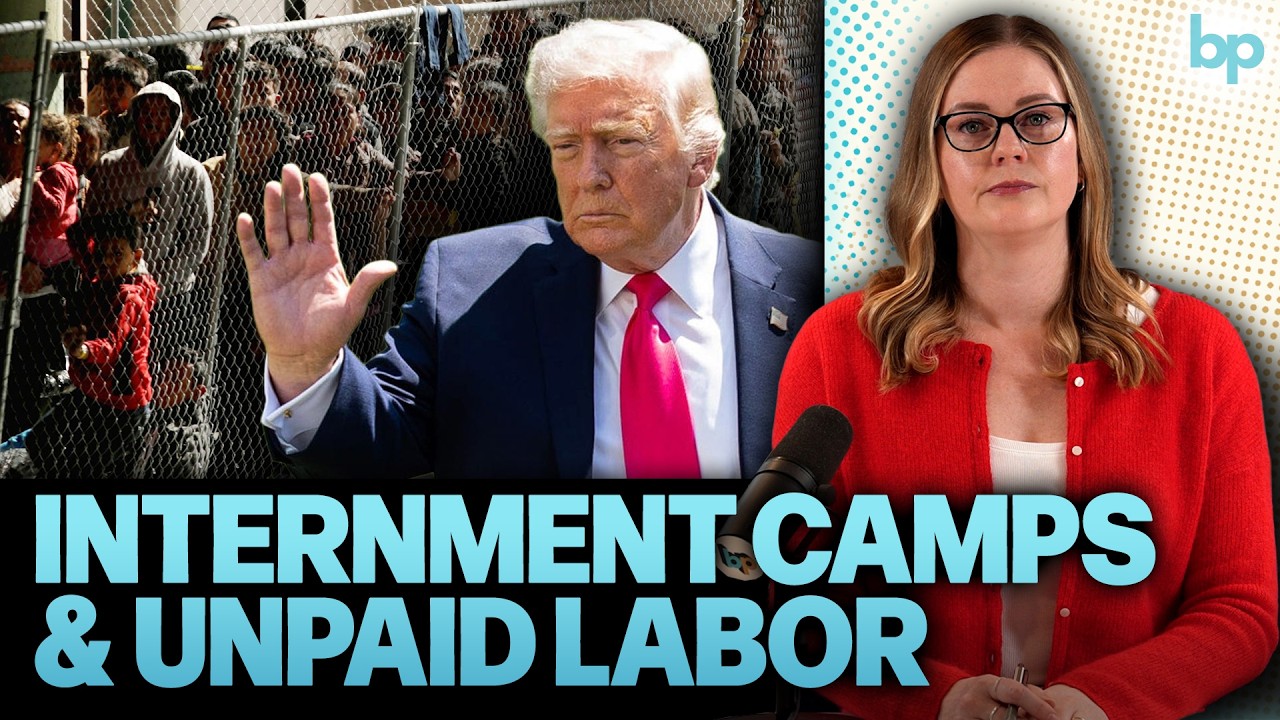
Brittany Page discusses Louisiana's HB 211, a new bill on its way to the Senate after passing the House, that criminalizes homelessness, creates internment camps, and authorizes mandated treatment that homeless individuals can pay for through unpaid forced labor. Brittany details how the Trump Administration and the Republican Party at large have been pushing bills like this across the country in an effort to criminalize poverty and homelessness, and what we can do collectively to fight the injustice.
HARD LABOR 1- 2 YRS
---
an 12 25
Washington Monthly writer Anne Kim reports the president and former star of “The Apprentice” vowed to “reach and surpass 1 million new active apprentices,” before surrendering his commitment to funding cuts, grant cancellations, and layoffs.
Trump directed the Department of Labor to deliver his commitment to surpass 1 million new active apprentices within 120 days in an April executive order, but Kim reports that deadline has passed, “with no evidence of progress or even a plan to reach the one-million apprenticeship milestone.”
“Instead, drastic layoffs, funding cuts, and a purge of ‘DEI’-related initiatives have sabotaged the emerging apprenticeship movement. Growth in apprenticeships is at its slowest in years, far more sluggish than during Joe Biden’s administration or even [Trump’s] first term,” said Kim.
“I don’t see them getting to 1 million apprentices till 2032,” Former Department of Labor senior staffer Nick Beadle told Kim.
The number of new apprentices has grown by only about 3 percent so far, according to Zach Boren, Senior Vice President of Apprenticeships for America and the former chief of registered apprenticeship and policy for the Department of Labor.
“We’ve got a White House that has really good talking points on apprenticeship, but no road map,” Boren said.
“One major problem: the gutting of the DOL’s Office of Apprenticeships, first by Elon Musk’s DOGE initiative, and then by the exodus of key staff,” said Kim. “There’s literally no one available to write a plan, let alone implement it.”
The office lost its national director and several division chiefs, and staffing levels are down by as much as 30 percent, according to Boren. The website for the national office lists just three people, all of them designated as working in an “acting” capacity.
“The Department of Labor, and especially the Office of Apprenticeship, are running on fumes,” said Boren.
The Trump administration has also paused or canceled grants for apprenticeship programs and apprenticeship research, which means fewer resources for recruiting and preparing candidates, helping employers and community colleges launch programs, or evaluating their effectiveness.
In fact, at least $30 million in funding appropriated by Congress last year was never spent and has expired, said Beadle.
Meanwhile, Trump’s executive order “Ending Radical and Wasteful DEI Programs,” has purged websites, data, and programs perceived to promote diversity. And the administration canceled dozens of grants under the Women in Apprenticeship and Nontraditional Occupations (WANTO) program established in 1992 by President George H.W. Bush.
“Much as he did on his show, Trump seems to favor a particular kind of apprentice,” said Kim, pointing to a recent Department of Labor social media campaign featuring what’s “presumably Trump’s ideal: a blond, broad-shouldered, AI-generated Aryan avatar ripped straight from the manosphere, with a chiseled jaw and a cleft chin.”
Historians say the style of the DOL posts evoke “historical government propaganda, including posters from New Deal-era America and fascist Europe,” but Kim said propaganda is probably the most Trump’s commitment to apprenticeships will amount to.
“Like so many of his promises to his working-class base, ‘one million apprenticeships’ will likely prove hollow,” Kim said.
Read the Washington Monthly report at this link
---
REALLY GOOD ANALYSIS
AN 10 25
A grim-faced President Donald J. Trump looks out at the reader, under the headline “LAW AND ORDER.” Graffiti pictured in the corner of the White House Facebook post reads “Death to ICE.” Beneath that, a photo of protesters, choking on tear gas. And underneath it all, a smaller headline: “President Trump Deploys 2,000 National Guard After ICE Agents Attacked, No Mercy for Lawless Riots and Looters.”
The official communication from the White House appeared on Facebook in June 2025, after Trump sent in troops to quell protests against Immigration and Customs Enforcement agents in Los Angeles. Visually, it is melodramatic, almost campy, resembling a TV promotion.
The post is not an outlier.
In the Trump administration, White House social media posts often blur the lines between politics and entertainment, and between reality and illusion.
The White House has released AI images of Trump as the Pope, as Superman and as a Star Wars Jedi, ready to do battle with “Radical Left Lunatics” who would bring “Murderers, Drug Lords … & well-known MS-13 Gang Members” into the country.
Most recently, on the weekend of the No Kings protests, both Trump and the White House released a video of the president wearing a crown and piloting a fighter jet, from which he dispenses feces onto a crowd of protesters below.
Underpinning it all is a calculated political strategy: an appeal to Trump’s political base – largely white, working-class, rural or small-town, evangelical and culturally conservative.
As scholars who study communication in politics and the media, we believe the White House’s rhetoric and style is part of a broader global change often found in countries experiencing increased polarization and democratic backsliding.
White House style
In the past, national leaders generally favored a professional tone, whether on social or traditional media. Their language was neutral and polished, laced with political jargon.
While populist political communication has become more common along with the proliferation of social media, the communication norms are further altered in Trump White House social media posts.
They are partisan, theatrical and exaggerated. Their tone is almost circuslike. The process of governing is portrayed as a reality TV show, in which political roles are performed with little regard for real-world consequences. Vivid color schemes and stylized imagery convert political messaging into visual spectacle. The language is colloquial, down-to-earth.
Just as other influencers in a variety of domains might create an emotional bond by tailoring social media messages, content, products and services to the needs and likes of individual customers, the White House tailors its content to the beliefs, language and worldview of Trump’s political base.
In doing so, the White House echoes a broad, growing trend in political communication, portraying Trump as “a champion of the people” and using direct and informal communication that appeals to fear and resentment.
Trump White House social media makes no effort to promote social unity or constructive dialogue, or reduce polarization – and often heightens it. Undocumented immigrants, for example, are often portrayed as inherently evil. White House social media amplifies dramatic, emotionally charged content.
In one video, Trump recites a poem about a kind woman who takes in a snake, a stand-in for an immigrant who in reality is a dangerous serpent. “Instead of saying thanks, that snake gave her a vicious bite,” Trump recites.
Talking to the base
While some scholars have called the White House social media style “amateurish,” that hasn’t resulted in change.
The lack of response to negative feedback is partially explained by the strategic goal of these communications: to appeal to the frustrations of Trump’s deeply disaffected political base, which seems to revel in the White House social media style.
Scholars identify a large number of these voters as “the precariat,” a group whose once-stable, union-protected jobs have been outsourced or replaced with low-wage, insecure service work. These workers, many former Democrats, can no longer count on a regular paycheck, benefits or work they can identify with.
As a result, they are more likely to support political candidates whom they believe will respond to their economic instability.
In addition, many of these voters blame a breakdown in what they perceive as the racial pecking order for a loss of social status, especially when compared with more highly educated workers. Many of these workers distrust the media and other elite institutions they feel have failed them. Research shows that they are highly receptive to messages that confirm their grievances and that many regard Trump as their champion.
Trump and the White House social media play to this audience.
On social media, the president is free to violate norms that anger his critics but have little effect on his supporters, who view the current political system as flawed. One example: A White House Valentine’s Day communication that said “Roses are red, violets are blue, come here illegally, and we’ll deport you.”
In addition, Trump and the White House social media use the president’s status as a celebrity, coupled with comedy and spectacle, to immunize the administration from fallout, even among some of its critics.
Trump’s exaggerated gestures, over-the-top language, his lampooning of opponents and his use of caricature to ridicule whole categories of people – including Democrats, the disabled, Muslims, Mexicans and women – is read by his political base as a playful and entertaining take down of political correctness. It may form a sturdy pillar of his support.
But prioritizing entertainment over facts has long-term significance.
Trump’s communication strategies are already setting a global precedent, encouraging other politicians to adopt similar theatrical and polarizing tactics that distort or deny facts.
These methods may energize some audiences but risk alienating others. Informed political engagement is reduced, and democratic backsliding is increasingly a reality.
Although the communication style of the White House is playful and irreverent, it has a serious goal: the diffusion of ideological messages whose intent is to create a sense of strength and righteousness among its supporters.
In simple terms, this is propaganda designed to persuade citizens that the government is strong, its enemies evil and that fellow citizens – “real Americans” – think the same way.
Scholars observe that the White House projection of the often comical images of authority echoes the visual style of authoritarian governments. Both seek to be seen as in control of the social and political order and thereby to discourage dissent.
The chief difference between the two is that in a deeply polarized democracy such as the U.S., citizens interpret these displays of authority in sharply different ways: They build opposition among Trump opponents but support among supporters.
The rising intolerance that results erodes social cohesion, undermines support for democratic norms and weakens trust in institutions. And that opens the door to democratic backsliding.
Andrew Rojecki, Professor of Communication, University of Illinois Chicago and Tanja Aitamurto, Associate Professor of Communication, *University of Illinois Chicago
This article is republished from The Conversation under a Creative Commons license. Read the original article.
---
---
an 12 25
*Newsweek*reportsthat blue collar jobs are collapsing under President Donald Trump as the labor market in 2025 "takes a decidedly white-collar tone" driven by artificial intelligence.
"AI has already been cited in many of the mass reductions announced by Amazon and other corporations in recent weeks," writes Hugh Cameron.
"But for all the hand-wringing over the potentially ill-fated employees of Silicon Valley and Wall Street, a quieter crisis appears to be unfolding for the U.S.'s blue-collar employees, despite the pledges and efforts of the current administration to foster a renaissance in marquee industries such as construction and manufacturing," he adds.
The delayed September jobs report corroborates this, showing "an encouraging uptick in overall hiring but no pause in blue-collar employment's long-term decline," Cameron writes.
Of the five areas of employment considered blue collar — manufacturing, mining and logging, transportation and warehousing, utilities, and construction — only construction saw an increase in employment, he notes.
That said, construction's 19,000-job gain was also "insufficient to offset the monthly loss of 25,300 jobs in transportation or manufacturing shedding a further 6,000," he writes.
"Year-over-year changes show that annual payroll declines have accelerated since January — albeit continuing a long-term trend—and have pushed blue-collar job growth into negative territory for the first time since the pandemic," Cameron explains.
Heidi Shierholz, chief economist for the Department of Labor during President Barack Obama's tenure, tells Newsweek there is "undeniably a deterioration in employment conditions for the U.S.'s blue-collar workers."
"Between April and September, goods-producing industries (manufacturing, construction, logging, mining), lost 72,000 jobs, with most of those losses (58,000) in manufacturing," she says.
Shierholz also says that "the services sector — which falls partially under the blue-collar umbrella — is 'limping along' thanks solely to gains in health care."
David Dorn, a labor market expert at the University of Zurich, says construction is particularly vulnerable to negative growth despite that slight uptick in employment.
"This sector is highly sensitive to broader economic deceleration, and increasingly restrictive immigration policies under the current U.S. administration are likely constraining labor supply," he says.
And while Dorn says it's hard to "isolate" the direct effects of Trump's tariffs on employment, he says he doubts "whether these had 'generated any sustained gains' in jobs."
Dean Baker, a co-founder of the Center for Economic and Policy Research, goes further and says "tariffs have been largely to blame for the uncertainty and 'overall weakness in demand' that has driven cautious hiring across blue-collar sectors," Newsweek reports.
"Companies are reluctant to invest in a context where they have no idea whattariffs will be in placesix months from now, much less three to five years from now," he says.
Baker also says that while manufacturing's gradual decline as a share of total employment has "been the case for more than 50 years," as labor demand shifted toward health care, education and other roles within the more service-focused economy, the president isn't trying to fix it either.
"Trump is doing nothing to address these issues," Baker says.
------
an 12 25
*Newsweek*reportsthat blue collar jobs are collapsing under President Donald Trump as the labor market in 2025 "takes a decidedly white-collar tone" driven by artificial intelligence.
"AI has already been cited in many of the mass reductions announced by Amazon and other corporations in recent weeks," writes Hugh Cameron.
"But for all the hand-wringing over the potentially ill-fated employees of Silicon Valley and Wall Street, a quieter crisis appears to be unfolding for the U.S.'s blue-collar employees, despite the pledges and efforts of the current administration to foster a renaissance in marquee industries such as construction and manufacturing," he adds.
The delayed September jobs report corroborates this, showing "an encouraging uptick in overall hiring but no pause in blue-collar employment's long-term decline," Cameron writes.
Of the five areas of employment considered blue collar — manufacturing, mining and logging, transportation and warehousing, utilities, and construction — only construction saw an increase in employment, he notes.
That said, construction's 19,000-job gain was also "insufficient to offset the monthly loss of 25,300 jobs in transportation or manufacturing shedding a further 6,000," he writes.
"Year-over-year changes show that annual payroll declines have accelerated since January — albeit continuing a long-term trend—and have pushed blue-collar job growth into negative territory for the first time since the pandemic," Cameron explains.
Heidi Shierholz, chief economist for the Department of Labor during President Barack Obama's tenure, tells Newsweek there is "undeniably a deterioration in employment conditions for the U.S.'s blue-collar workers."
"Between April and September, goods-producing industries (manufacturing, construction, logging, mining), lost 72,000 jobs, with most of those losses (58,000) in manufacturing," she says.
Shierholz also says that "the services sector — which falls partially under the blue-collar umbrella — is 'limping along' thanks solely to gains in health care."
David Dorn, a labor market expert at the University of Zurich, says construction is particularly vulnerable to negative growth despite that slight uptick in employment.
"This sector is highly sensitive to broader economic deceleration, and increasingly restrictive immigration policies under the current U.S. administration are likely constraining labor supply," he says.
And while Dorn says it's hard to "isolate" the direct effects of Trump's tariffs on employment, he says he doubts "whether these had 'generated any sustained gains' in jobs."
Dean Baker, a co-founder of the Center for Economic and Policy Research, goes further and says "tariffs have been largely to blame for the uncertainty and 'overall weakness in demand' that has driven cautious hiring across blue-collar sectors," Newsweek reports.
"Companies are reluctant to invest in a context where they have no idea whattariffs will be in placesix months from now, much less three to five years from now," he says.
Baker also says that while manufacturing's gradual decline as a share of total employment has "been the case for more than 50 years," as labor demand shifted toward health care, education and other roles within the more service-focused economy, the president isn't trying to fix it either.
"Trump is doing nothing to address these issues," Baker says.
---
---}:
an 9 25
The huge Labor Day banner outside the Labor Department building with Trump’s picture and the words “American Workers First” depicts one of Donald’s most disgusting lies.
With multiple factual examples, Steve Greenhouse, former labor reporter for the New York Times, provides proof that Trump is the most brazenly “anti-worker” president in U.S. history. With his Big Vicious and Ugly Bill, barely passed by his fawning GOP in Congress, and dozens of illegal Executive Orders, he is smashing the American Worker beyond the avarice of the cruelest Plutocrat.
Quoting liberally from his Labor Day article in The Guardian, I urge labor union leaders and rank-and-file union members to absorb its contents. This article could make American labor angry enough to mount an unstoppable movement to tell Trump, “You’re Fired,” and fire up enough convinced or electorally scared lawmakers in Congress to impeach and remove Trump from office.
The aggregated madness from this failed gambling czar, wholly devoid of empathy, compassion, truth, while betraying his own voters and his oath of office, follows:
- Trump put corporate interests first by “often cutting [workers’] pay or making their jobs more dangerous.” This includes gutting regulations that protect miners from a debilitating, often deadly lung disease. He fired the chair of the top labor watchdog – The National Labor Relations Board, whose now stalled mission is to “protect workers from corporations’ illegal anti-union tactics.” Then “Trump stripped one million federal workers of their right to bargain collectively and tore up their union contracts.”
- “Trump has hurt construction workers by shutting down major wind turbine projects and ending Biden-era subsidies that encourage construction of factories that make renewable-energy products.”
- Trump is pressing to end “minimum wage and overtime protections for 3.7 million home-care and domestic workers,” and has already ended a “Biden plan to prevent employers from paying disabled workers less than the $7.25-an-hour federal minimum wage.” Trump adamantly opposes raising this frozen minimum wage for 25 million workers who would benefit from a $15 federal minimum wage. He ended a “requirement that federal contractors pay their workers at least $17.75 an hour.”
- Tariffs and reckless, wholesale deportations are “pushing up prices and slowing economic growth.” His big tax cut for the super-rich is being paid for by “millions of working families by cutting food assistance and causing many to lose health coverage” (from Medicaid). As for deportation, it is “undermining their employers’ businesses,” and I might add closing down some of them and impairing farmers from harvesting their crops.
- “In her annual State of the Unions address, AFL-CIO president [Liz] Schuler said: ‘We want cheaper groceries, and we get tanks on our streets. We want more affordable healthcare, and we get 16 million Americans about to be kicked off their coverage.’”
- Trump is swinging an axe to end worker safety protections, cutting OSHA staff and pushing those still working at OSHA to weaken all kinds of essential safety and health protections, ranging from coal miners to workers under extreme heat, to reducing fines for violating safety rules, and much more. He “froze enforcement of a Biden-era regulation that protects miners from silicosis, a serious lung disease.” “…a major killer among coal miners.”
- The Economic Policy Institute (EPI) “forecasts that Trump’s effort to deport 1 million immigrants a year will result in 5.9 million lost jobs after four years: 3.3 million fewer employed immigrants and 2.6 million fewer employed US-born workers. ‘If you don’t have immigrant roofers and framers, you’re not building houses, and that means electricians and plumbers lose their jobs.’ ‘Plus, you lose the consumer spending from those workers,’” and tens of billions of withheld tax revenues annually, one might add.
The list of anti-worker cruelty goes on. Tyrant Trump always says, “This is only the beginning.” He acts like an imperious dictator because that is what he is, imposing burdens and pain on the American people – in red and blue states alike. The six rogue Supreme Court Injustices, who thus far know no limits, are enabling the madman in the White House. Before his sleazy conversion, JD Vance called Trump “America’s Hitler.” UNFORTUNATELY, THE WORST IS YET TO COME, MUCH WORSE!
The flip side of Trump’s feverish repression of worker rights, remedies, and existing protections is that there is no chance of reforming anti-union laws, such as the notorious Taft-Hartley Law of 1947, with Trump and his congressional cronies in power.
Readers may well ask why all these attacks on workers didn’t lead unions and their allies to launch a COMPACT FOR AMERICAN WORKERS and insist that the feeble, corporate-conflicted Democratic Party adopt it authentically and replace their stagnant leadership with new, vigorous leaders. That is what they should have done right after their disastrous loss to Trump, the serial law violator, abuser of women, corrupter, daily, delusionary falsehood teller, shredder of the Constitution, greedy, egomaniacal, and seriously dangerous personality.
There is still one Labor Day before the 2026 midterm elections. Can Unions and the Democratic Party save our Republic from the rampaging daily Trump outlawry and viciousness (he is now invading American cities while wrecking our country)? It should be easy, just based on his failed record. (See my letter of August 27, 2024, to Liz Shuler).
As the economy worsens amidst the chaos, consumer prices rise, unemployment rises, and Trump behaves more like Captain Queeg (the fictional, cruel, and crazy skipper in the film, The Caine Mutiny), voters for Trump are starting to ask, “Did We Vote for This?” Non-voters, in turn, should resolve to head for the polls and reject what Trump is doing. The people who are the sovereign in our Constitution must start acting like they have power.
---
---}:
no lnx
Republicans and the biggest political con of the last century
Thom Hartmann May 24, 2025
Neal deGrasse Tyson makes a very relevant point this week:
“If a foreign adversary snuck into our Federal budget and cut science research and education the way we’re cutting it ourselves — strategically undermining America’s long-term health, wealth, and security — we would likely consider it an act of war.”
Donald Trump’s administration just said you can’t get the Covid vaccine unless you’re over 65 or sick, setting up America for more death and disease. As Noah Berlatsky notes in his great Substack newsletter:
“This is the latest effort by Trump to try to kick start a major US pandemic and degrade the health and welfare of the country. Trump as also rolled back food testing, including testing for bacteria in infant formula. He’s made major cuts at the FAA, leading to fears for airline safety—and a number of dramatic airline safety failures already may be related to the destruction of capacity. Cuts at the NOAA may diminish the ability to warn about dangerous weather events. The Republican proposals for Medicaid cuts are likely to lead to tens of thousands of deaths. And of course Trump’s senseless tariffs are increasing inflation, destroying jobs, and could still easily end us in a recession.“
But why? What the hell is going on here?
Almost two-thirds of us Americans can’t afford the basic necessities of life, according to a new report from the Ludwig Institute for Shared Economic Prosperity (LISEP) reported by CBS News. They point out that if unemployment numbers included the underemployed and those stuck in “poverty-wage jobs,” it would be around 24%, not the 4.2% recently reported, leading to an acknowledgement of a widespread misery that’s largely hidden by the way we currently calculate unemployment.
Income for the bottom 60% of Americans, for example, actually declined by 4% in the years 2001 to 2023 while costs — particularly for healthcare, housing, food, and education (college tuition, for example, is up 122% since 2001) — have exploded.
Before the pandemic, half of all homes on the market were affordable to a family earning $75,000 a year; today it’s only one out of five houses that such a family could afford to purchase.
The initial result of this post-Reagan Revolution economy was to kneecap the middle class and working class; now Republicans are using the same strategy they employed to destroy our middle class to dismantle our nation’s government and its core functions to leave us vulnerable to the predation of foreign nations, vulture capitalists, and the morbidly rich.
And nobody’s sure why.
The history of how we got here is shocking. And the place it’s taking us — gutting government functions while handing our role in the world over to China and Russia — is downright scandalous.
At first, it was simply a political strategy to claim the mantle of Santa Claus from the Democrats by “gifting” America with tax breaks. Then it became a program to force Dems to kill off their own social programs by driving up the national debt. And now it’s being used to disassemble the American government itself, abandoning what’s left of the middle class while handing America’s dominant role in the world to China and Russia.
You could call it treason, except that it’s become so normalized and institutionalized that most Americans wouldn’t even understand the reason for the label.
Republican policy weirdness that brought us to this moment began around the national debt in 1981.
The U.S. was significantly in debt following our Revolutionary War, the Civil War, World War I, and World War II. Following the philosophy that a large national debt should only exist during a time of national emergency, in each case, after the end of each war, we began a serious effort to pay down that debt.
Andrew Jackson finished paying off the entire debt from the Revolutionary War in the 1830s. We’d largely paid off the debt from the Civil War by the end of the 19th century, and, as the Treasury Department notes on its debt history site, our “government ended the century with its finances in very good order.”
We paid the national debt for WWI down to a mere $17 billion by the time the Republican Great Depression hit, but between the cost of the New Deal and World War II, we entered the post-WWII era in 1946 with a debt equal to 106% of GDP, a ratio we hit again in 2015.
Republicans and Democrats quickly united around the idea of paying off our national debt in the post-war years, driving it down to a mere $800 billion ($0.8 trillion) between 1945 and 1981 when Reagan came into office.
And then, following Jude Wanniski’s “Two Santas” plan, the GOP embarked on an experiment that had never been intentionally tried in the U.S. or any other developed country in world history: drive up the national debt as high as possible with massive tax breaks for the very richest among us.
Reagan did this for two reasons:
— First, deficit spending with trillions in borrowed money (he ran the debt up to $2.4 trillion in a mere 8 years) stimulates the economy, so people thought Reagan had produced good times. (Give me a $2 trillion credit card, and I’ll show you what it looks like to live large, too!)
— Second, the rising debt gave Republicans the perfect excuse to follow Wanniski’s advice to force the Democrats to “shoot their Santa [of programs like Social Security and Medicaid] in the face.” Whenever a Republican is in the White House, Wanniski argued, Republicans should run up the debt as hard and fast as possible, so when a Democrat is in the White House they can squeal about “the debt our children will inherit! Oh, the humanity!”
The GOP has stuck to this strategy for 44 years now, running up $36 trillion in debt (and our entire Gross Domestic Product was a mere $27.7 trillion last year) and now, finally, we’ve reached the point where this unsustainable debt is not only costing us a trillion dollars a year in debt service (interest payments) but has led to a downgrade of our nation’s credit score.
At first, the main effect of the Two Santas strategy was merely to make the morbidly rich among us fabulously richer, while extracting much of that wealth from the homes, retirement plans, and savings of the middle class. It was, quite simply, a planned and successful transfer of roughly $50 trillion into the money bins of the rich, almost all of it coming out of the hides and lives of the rest of us.
When Reagan came into office in 1981, about two-thirds of Americans were solidly middle class with a single paycheck being able to buy a home, a car, raise a family, put the kids through school, and provide for a decent retirement.
Today, that same standard of living requires a bit more than two full-time jobs, and only about 47% of us are in the middle class (with two wage earners instead of just one in 1981).
“‘The middle class has been declining — we just haven't recognized it fully,’ LISEP Chairman Gene Ludwig told CBS MoneyWatch. ‘It’s really dangerous because it’s the kind of thing that leads to social unrest, and it’s not fair. The American dream is not that it’s given to you — it’s that if you work hard, you have a chance to get ahead and achieve the things in life that you want to achieve. It’s not living in a tent, not having to steal.”
But now Trump, Musk, Vance, and congressional Republicans — having first crushed the American middle class — are doing everything they can to destroy America’s preeminent position in the world along with our social safety net.
— Instead of investing in education and science, they’re making it harder for students to get an education.
— Instead of promoting democracy around the world, they’re embracing murderous dictators while broadcasting rightwing neofascist propaganda on Voice of America.
— Instead of lifting up Americans by helping our veterans and providing food, healthcare, and shelter to the poor and disabled, they’re gutting the VA and the social safety net.
As a result, today nearly half of American children (45% or 34 million kids) rely on food and medical programs that are now targeted by “Christian” Mike Johnson’s House Republicans in their Big Brutal Bill providing trillions in tax breaks to billionaires. The proposed cuts to SNAP (food stamps) and Medicaid, for example, would be the largest in the history of the U.S.
Reagan’s Two Santas strategy has done serious harm to America, collapsing the economic futures of two entire generations.
And now they’re going after our government itself.
But, why? Nobody’s sure.
— Did Vladimir Putin, Xi Jinping, or both tell Trump and/or Elon Musk to destroy America?
— Are our country’s billionaires so psychopathically greedy that they’re willing to sell us all out for another few billion dollars in tax breaks?
— Do Trump’s allies believe that if they can impoverish Americans we’ll be more willing to go along with their authoritarian agenda the way Germans did after being immiserated by the Republican Great Depression of the 1930s?
— Are they following the “Dark Enlightenment” philosophers of Silicon Valley who argue that democracy is outdated and “we need to get over our dictator phobia” and let the tech giants run the country?
Nobody knows for sure. Nobody can really explain it.
Republicans are aren’t even pretending anymore; they’re not even bothering to proclaim BS like “trickle down” or the “need to support the job creators.“
Most distressing, there’s virtually no discussion of any of this in the mainstream press.
— The Two Santas strategy is easily documented, but never mentioned.
— The explosion of our national debt is all over economists’ websites, but when the American media mentions it, it’s always in the context of Democrats needing to “reduce spending” rather than the fact that virtually 100% of our debt today was put there exclusively by Reagan, Bush, and Trump tax cuts and Bush’s two illegal wars.
— Nobody, it seems, is speculating about why Trump and Musk would want to kill off USAID or kneecap the FAA and the National Weather Service. Qui bono (who benefits?) other than Putin and Xi? The savings are a drop in the billionaire’s bucket; there must be a larger agenda than just funding tax cuts for billionaires.
— And, they’re now holding their votes in the middle of the night; I think we all know what they are hiding and the credulous press is letting pass.
I don’t know why Republicans have been so enthusiastic about first destroying the American middle class and now our government itself, but the consequences have driven the explosion of rightwing anger, racism, and misogyny that’s been sweeping the nation since Trump’s appearance on the scene in 2015.
And now they’re threatening our position in the world, as well as possibly leading us all into a third world war.
Why do you think this is happening?
NOW READ: 'Trump's tactics are in fact communist': Former Tea Party congressman busts MAGA for what it is
---
---
note trump turned latinos against migrants bc of handouts
---
AN 5 25
The Wall Street Journal reportsmany Americans may not care to adopt the kind of factory work President Donald Trump’s is pledging to bring back to the U.S.
“The jobs are tiring, feature hazards not found at desk jobs and are tough to fill. Once workers are recruited, it can be difficult to get them to stay,” reports WSJ. “… The work represents the type of gritty, physically demanding labor … Trump envisions will recast the U.S. as the manufacturing powerhouse it once was.”
READ MORE: A dangerous new lie is being peddled by Trump’s toadies
The Wall Street Journal reports the U.S. already has nearly half a million unfilled manufacturing jobs, according to the U.S. Labor Department. A 2025 National Association of Manufacturers survey also shows nearly half of manufacturing companies say their biggest challenge is recruitment and retention in jobs with rigid hours, hard work, and risk of significant physical injury. Additionally, the pay is 7.8% lower on average than the private sector, according to the Bureau of Labor Statistics, following a decline in union representation.
“A lot of people say they wouldn’t work in a place like this because of how hard it is,” said Quaker City Castings employee Zachary Puchajda, who is a metal caster.
Carolyn Lee, president of the Manufacturing Institute, a nonprofit focused on workforce development for the sector, told WSJ that the significant labor shortage makes scaling up production a challenge.
Quaker City Castings President Dave Lordi told reporters his company saw a brief 25% surge in orders after Trump announced tariffs, but he would need to add a second work shift. This, say analysts, would not be easy without manufacturers adding better pay and schedule flexibility, among other things that Americans have come to expect from work. Plus, many of the incentives it would require to coax Americans into factories could drive up purchase prices for U.S. factory-made goods. American-made Viking stoves already cost more than $5,000 for a low end model, and those are made in Greenwood, Mississippi, which is known for its record low cost of living.
Lee says the U.S. manufacturing industry is nowhere near the level of evolution it needs to be to engage growth.
READ MORE:'Betrayed': Alarm sounded as GOP 'plotted behind closed doors to hurt even more families'
“You can’t just plop a factory down and hope people will miraculously appear,” Lee said.
Read the full Wall Street Journal report here.
---
---
NOTE CASACADE EFFECT
AN 2 25
'Diseases of despair': Rural Americans don’t live as long as those in cities - Alternet.org
Rural Americans – particularly men – are expected to live significantly shorter, less healthy lives than their urban counterparts, according to our research, recently published in the Journal of Rural Health.
We found that a 60-year-old man living in a rural area is expected on average to live two fewer years than an urban man. For women, the rural-urban gap is six months.
A key reason is worse rates among rural people for smoking, obesity and chronic conditions such as high blood pressure and heart disease. These conditions are condemning millions to disability and shortened lives.
What’s more, these same people live in areas where medical care is evaporating. Living in rural areas, with their relatively sparse populations, often means a shortage of doctors, longer travel distances for medical care and inadequate investments in public health, driven partly by declines in economic opportunities.
Our team arrived at these findings by using a simulation called the Future Elderly Model. With that, we were able to simulate the future life course of Americans currently age 60 living in either an urban or rural area.
The model is based on relationships observed in 20 years of data from the Health and Retirement Study, an ongoing survey that follows people from age 51 through the rest of their lives. Specifically, the model showed how long these Americans might live, the expected quality of their future years, and how certain changes in lifestyle would affect the results.
We describe the conditions that drive our results as “diseases of despair,” building off the landmark work of pioneering researchers who coined the now widely used term “deaths of despair.” They documented rising mortality among Americans without a college degree and related these deaths to declines in social and economic prospects.
The main causes of deaths of despair – drug overdoses, liver disease and suicide – have also been called “diseases of despair.” But the conditions we study, such as heart disease, could similarly be influenced by social and economic prospects. And they can profoundly reduce quality of life.
We also found that if rural education levels were as high as in urban areas, this would eliminate almost half of the rural-urban life-expectancy gap. Our data shows 65% of urban 60-year-olds were educated beyond high school, compared with 53% of rural residents the same age.
One possible reason for the difference is that getting a bachelor’s degree may make a person more able or willing to follow scientific recommendations – and more likely to work out for 150 minutes a week or eat their veggies as their doctor advises them to. Rural communities are increasingly hampered by their lack of access to health care.
Why it matters
The gap between urban and rural health outcomes has widened over recent decades. Yet the problem goes beyond disparities between urban and rural health: It also splits down some of the party lines and social divides that separate U.S. citizens, such as education and lifestyle.
Scholarship on the decline of rural America suggests that people living outside larger cities are resentful of the economic forces that may have eroded their economic power. The interplay between these forces and the health conditions we study are less appreciated.
Economic circumstances can contribute to health outcomes. For example, increased stress and sedentary lifestyle due to joblessness can contribute to chronic health issues such as cardiovascular disease. Declines in economic prospects due to automation and trade liberalization are linked to increases in mortality.
But health can also have a strong influence on economic outcomes. Hospitalizations cause high medical costs, loss of work and earnings, and increases in bankruptcy. The onset of chronic disease and disability can lead to long-lasting declines in income. Even health events experienced early in childhood can have economic consequences decades later.
In tandem, these health and economic trends might reinforce each other and help fuel inequality between rural and urban areas that produces a profoundly different quality of life.
What still isn’t known
It should be noted that our results, like many studies, are describing outcomes on average; the rural population is not a monolith. In fact, some of the most physically active and healthy people we know live in rural areas.
Just how much your location affects your health is an ongoing area of research. But as researchers begin to understand more, we can come up with strategies to promote health among all Americans, regardless of where they live.
*:{The Research Brief is a short take on interesting academic work.
Elizabeth Currid-Halkett, James Irvine Chair in Urban and Regional Planning and Professor of Public Policy, University of Southern California; Bryan Tysinger, Assistant Professor of Health Policy and Management, University of Southern California, and Jack Chapel, Postdoctoral Scholar in Economics, University of Southern California
This article is republished from The Conversation under a Creative Commons license. Read the original article.
---
an 12 24
Current chair of the Wisconsin Democratic Party Ben Wikler on Sunday officially threw his hat in the ring to take over the national party, leading with a promise to put the working class at the center of its organizing efforts following a crushing defeat to Donald Trump's far-right Republicans in November's election.
"If we're going to take on Trump, Republican extremists, and move our country forward, the Democratic Party needs to be stronger," Wikler said in a statement. "I'm running for Chair of the Democratic National Committee to unite the party, fight everywhere, and win."
With the term of current Democratic National Committee chair Jaime Harrison expiring in the new year, Wikler said his focus will be on lifting up the needs of working-class people, improving communication strategies, and running a more aggressive political operation.
"The soul of the Democratic Party is the fight for working people," Wikler said. "Ours is the party that built the middle class, that won breakthroughs on civil rights, women's rights, workers' rights, freedom and opportunity for all—and has so much more to do."
Wikler, who got his start in state-level politics in his home state and later played a leading role at the national progressive advocacy group MoveOn, notes that while Trump and the Republicans made gains across the board against Democrats in the 2024 election, the swing was much less in Wisconsin where Wikler has rebuilt the party over recent years, taking back majorities in the state legislature and other key fights.
"What has made a difference in Wisconsin," he said, "can make a difference everywhere. We need a nationwide permanent campaign."
In an interview with the New York Times published Sunday, Wikler acknowledged that a significant explanation about the Democratic loss of the presidential race—as well as Republican's winning control of both chambers of Congress—was that too many voters simply don't believe Democrats take their economic concerns seriously or think the party is capable of addressing them.
"It's clear from this election that there are many voters, especially those hardest hit by rising prices, those who experienced the pandemic-era financial support slipping away, who voted primarily on the economy," he said. "We’ve seen in the United States and worldwide if you have to break pills in half to be able to afford your groceries, that is going to be the top-of-mind issue when you go to the ballot box."
The Democratic Party can win, Wikler argued, "when voters know that we're the ones fighting for them against those who will seek to rip them off to add an extra billion dollars to their bank account."
Calling Wikler a "party builder," The Nation's political correspondent John Nichols, also a Wisconsin native, said Wikler joins "an increasingly crowded list of contenders for the post, including Minnesota DFL chair Ken Martin, former Maryland Gov. Martin O’Malley and New York state Sen. James Skoufis."
In response to the announcement, former labor secretary Robert Reich gave his endorsement to Wikler in a Sunday blog post, calling him someone who "can turn the Democratic Party into a party that's once again on the side of the little guy."
With the Democratic Party in the midst of deep soul-searching following Vice President Kamala Harris' devastating defeat to Trump, progressives have called for a major rethink. Sen. Bernie Sanders (I-Vt.), who ran for the Democratic Party's presidential nomination both in 2016 and 2020 as a challenge to its corporate leanings, said last week that getting big money out of politics should be a top priority for the party's leadership going forward.
"If the Democratic Party is to become a democratic party, the first job of a new DNC Chair is to get super-PAC money out of Democratic primaries," Sanders said. "AIPAC and other billionaire-funded super-PACS cannot be allowed to select Democratic candidates."
Former Ohio state senator Nina Turner, a close Sanders' ally, said the same on Sunday, shortly after Wikler's announcement. "Every candidate running for DNC Chair must commit to getting dark money and corporate money out of the Party. Period," tweeted Turner.
Sanders, Turner, and other progressive voices have been adamant that without a real strategy to win back working-class families, the Democrats are lost.
Randi Weingarten, union president of the American Federation of Teachers, said Wikler "understands how to organize and communicate."
Reich embraced Wikler's call for a new, bolder organizing strategy as well as his record in Wisconsin. "Wikler organized and mobilized voters in a state that Republicans had rigged to ensure total dominance and control. Ben unrigged that system," Reich wrote. "He turned Wisconsin into a year-round organizing and fundraising powerhouse, winning seven of the last 10 statewide elections since he took over."
Reich also explained why it's important that someone like Wikler be the replacement for the outgoing Harrison, a former lobbyist and a staunch ally of the corporate wing of the Democratic Party establishment.
"For years, the Democratic National Committee has been little more than a fundraising machine, which means it's been tilted toward sources of big money—billionaires, big corporations, and Wall Street," argued Reich. "That's precisely the problem. That's why the DNC cut Bernie Sanders off at the knees when he ran against Hillary Clinton in 2016. That's why starting in the 1980s the Party began turning its back on the working class."
"There's no way the Party can speak for the majority of working people in America," concluded Reich, "when it's reluctant to bite the hands that feed it."
===
an 12 24
The United States is currently displaying several characteristics that have historically been seen by empires in decline, according to one social scientist.
Peter Turchin is one of the pioneers of "cliodynamics," which is the field of study concerning statistical analysis of historical dynamics of societies around the world. In a recent essay for the Guardian, Turchin wrote that he and his fellow researchers have noticed the U.S. having three key traits in common with past global hegemons just before a period of decline. Those three factors are "popular immiseration, elite overproduction and state breakdown."
Turchin explained that "popular immiseration" describes a breakdown of the social contract between workers, the private sector and the public sector, which he said began after the Republican assault in the New Deal that happened around the time former President Ronald Reagan took power. He noted that as "the power of unions was undermined," taxes on the richest Americans were "cut back," which was followed by stagnating wages and a decline in life expectancy.
READ MORE:['Not good enough anymore': Union leader explains why Dems lost economic argument to Trump
"With the incomes of workers effectively stuck, the fruits of economic growth were reaped by the elites instead. A perverse 'wealth pump' came into being, siphoning money from the poor and channelling it to the rich," he wrote. "In many ways, the last four decades call to mind what happened in the United States between 1870 and 1900 – the time of railroad fortunes and robber barons. If the postwar period was a golden age of broad-based prosperity, after 1980 we could be said to have entered a Second Gilded Age."
The second trait, which Turchin called "elite overproduction," involves a growing population of the "uber-rich," (which he defined as "those with fortunes greater than $10 million") and their influence in the public sphere. He noted that when adjusting for inflation, this population grew by tenfold over the last four decades. This has led to rich elites either running for office, like President-elect Donald Trump, or funding candidates for office, like many billionaires have done in recent cycles. He also pointed out that "counter-elites" will emerge who oppose the existing political establishment.
"The more members of this elite class there are, the more aspirants for political power a society contains," he wrote. "By the 2010s the social pyramid in the US had grown exceptionally top-heavy: there were too many wannabe leaders and moguls competing for a fixed number of positions in the upper echelons of politics and business."
"As battles between the ruling elites and counter-elites heat up, the norms governing public discourse unravel and trust in institutions declines," he continued. "The result is a loss of civic cohesiveness and sense of national cooperation – without which states quickly rot from within."
READ MORE:[Watch: JD Vance booed by room full of firefighters as he calls himself 'pro-worker'
Finally, Turchin opined that "state breakdown" will inevitably follow popular immiseration and elite overproduction. He argued that Democrats' loss in the November election "represents one battle in an ongoing revolutionary war," but that the goal of the new order is "far from assured" given that "opponents are pretty well entrenched in the bureaucracy and can effectively resist change."
"Popular discontent in the US has been building up for more than four decades. Many years of real prosperity would be needed to persuade the public that the country is back on the right track," he wrote. "So, for now, we can expect a lasting age of discord. Let’s hope that it won’t spill over into a hot civil war."
Click here to read Turchin's full essay in the Guardian.
READ MORE:['A corporate CEO's dream': Labor unions blast Trump-Vance ticket
---
---
an 11 24
The results of last week's U.S. elections were cataclysmic for the Democratic Party, which lost control of the White House and Senate as the Republicans gained a trifecta, but economic justice advocates on Wednesday said that for many working people, the fight for a better standard of living and a political system that places people over Wall Street profits remains the same.
United Auto Workers (UAW) president Shawn Fain acknowledged in aletter to membersthat while the election outcome was not one that "our union advocated for, and it's not the outcome a majority of our members voted for, our mission remains the same."
"We must raise the standard of living for our members and the entire working class through unity, solidarity, and working-class power," said Fain. "No matter who is in the White House."
Noting that "in a democracy, the four most important words are: The People Have Spoken," Fain suggested that the Democratic Party did not convince a key constituency—working people, including an estimated78% of Americans who live paycheck-to-paycheck—that it represents their interests, and as a result handed the presidential victory to President-elect Donald Trump.
While the UAW endorsed Vice President Kamala Harris and Fain campaigned with her, he said, "for us, this was never about party or personality. As we have said consistently, both parties share blame for the one-sided class war that corporate America has waged on our union, and on working-class Americans for decades."
Trump ran an openly xenophobic campaign, but won the support of low-income voters from a range of ethnic backgrounds as he demonized undocumented immigrants and made outlandish, racist claims about Ohio residents from Haiti, sticking to his longtime narrative that immigration—not corporate greed—is to blame for the country's housing crisis, economic inequality, and stagnant wages.
"The task for the Democrats is what it should have been all along: remaking the party into the party of the bottom 90%... the party that rejects Elon Musk and the entire American oligarchy."
As numerous progressives have pointed outsince the election, the Biden administration has introduced a host of pro-worker policies and Harris unveiled numerous economic justice proposals during her brief campaign—but her decision to campaignwith billionaire businessman Mark Cuban and unveil a more Wall Street-friendly tax proposal have been criticized moves that highlighted the Democratic Party's close ties to rich donors and muddied her message to working families.
With the Democratic Party still taking part in the "one-sided class war" referenced by Fain, the UAW leader said that the union "stand[s] today where we stood last week."
"We stand for bringing back American jobs," said Fain. "We stand for taking on corporations that break their promises to American workers. And we stand against the same things we've always stood against. We will never support the destruction of the union movement. We will never support efforts to divide and conquer the working class by nationality, race, and gender. We will never support handouts to the ultra-wealthy or paying for it by cutting crucial federal investments."
"We are unafraid to confront any politician who takes actions that harm the working class, our communities, and our unions," he said.
Fain's comments came as progressive lawmakers including Sens. Bernie Sanders (I-Vt.) and Elizabeth Warren (D-Mass.) spoke at an event titled Delivering for the Working Class.
While the caucus is set to be in the minority in the House and Senate for at least the next two years, the senators used the event to rally Democratic leaders to "learn the right lessons" from Trump's victory.
As Democrats decide who they answer to, Warren asked, "Is it going to be a handful of billionaires? We know what kind of policy they want to set. Or are we going to show voters that Democrats are the ones who are willing to unrig this economy?"
Sanders suggested that Fain's rallying of the UAW's more than 400,000 members will also be a key to fighting Trump's agenda, including Republicans' plans to make cutsto Social Security and Medicare and hislikely reversalof Biden's pro-worker policies.
"The antidote to enormous economic and political power on the part of the few is mass organizing at the grassroots level among working people—to stand up and fight for an economy that works for all," said Sanders.
Just after the election last week, Sanders became one of the first members of the Democratic caucus to release a statementon the party's major losses, driving home the same message he has repeated during his decades in public service: "It should come as no great surprise that a Democratic Party which has abandoned working-class people would find that the working class has abandoned them."
On MSNBC on Wednesday, Rep. Pramila Jayapal (D-Wash.), the chair of the Congressional Progressive Caucus, said the election results in several red states proved that many of Trump's supporters prioritized working class issues.
"Voters actually want the populist, popular ideas that we have been pushing at the Progressive Caucus, certainly, for quite some time," said Jayapal. "They went to the ballot in three states that voted for Donald Trump... and they voted for a higher minimum wage, they voted for paid sick leave."
Voters in Alaska and Missouriapproved ballot measures requiring a higher minimum wage and demanding that employers provide paid sick leave; Nebraska voters also supported a measure allowing workers to earn paid sick leave.
Former Labor Secretary Robert Reich on Thursday also took a close look at voting figures, writing at his Substack newsletter that the election didn't deliver "a very big mandate" to Trump as the president-elect claimed, or even "a 'red shift' to Trump and the Republicans."
"It was a blue abandonment," he wrote. "We now know that 9 million fewer votes were cast nationwide in 2024 than in 2020. Trump got about a million more votes than he did in 2020 (700,000 of them in the seven battleground states). That's no big deal... The biggest takeaway is that Biden's 9 million votes disappeared... So what happened to the 9 million?"
Reich posited that 9 million potential voters refused to vote for Trump, but also didn't turn out for the Democratic Party because they were left thinking, "They don't give a damn about me."
"The task for the Democrats is what it should have been all along: remaking the party into the party of the bottom 90%—the party of people who don'tlive off stocks and bonds, of people who are not CEOs or billionaires like Mark Cuban, the party that rejects Elon Musk and the entire American oligarchy," he wrote. "Instead, the Democratic Party must be the party of average working people whose wages have gone nowhere and whose jobs are less secure."
He continued:
Blue-collar private-sector workers earned more on average in 1972, after adjusting for inflation, than they are earning now in 2024. This means today's blue-collar workers are on average earning lessin real dollars than their grandparents earned 52 years ago.
Yet the American economy is far larger than it was 52 years ago. Where did the additional money go? To the top. So what's the Democrats' task? To restructure the economy toward more widely shared prosperity.
In his statement on Wednesday, Fain said the lives and daily struggles of many working class voters are unchanged after the election.
"Today, our members clock in to the same jobs they clocked into last week," said Fain. "You face the same threats—corporate greed, Wall Street predators, and a political system that ignores us. And we are driven by the same force, as outlined in our UAW Constitution generations ago: 'The hope of the worker in advancing society toward the ultimate goal of social and economic justice.'"
Fain urged union members to get involved in "political action on every level of government, in every state, in every sector has an impact on every contract, every organizing drive, and every standard we win as a union," while Sanders implored the Democratic Party to urgently "determine which side it is on in the great economic struggle of our times."
"It needs to provide a clear vision as to what it stands for," wrote Sanders in a Boston Globe op-ed on Tuesday. "Either you stand with the powerful oligarchy of our country, or you stand with the working class. You can't represent both."
NOW READ:It's time for Democrats to declare class warfarethom FDR
---
---
AN 1 24 BUT REBOOT
Editor's note: *On the day after Trump's suprising victory over Hillary Clinton, we've resurfaced Robert Reich's killer essay explaining why the working class doesn't vote for Democrats anymore.
Why did the white working class abandon the Democrats?
The conventional answer is Republicans skillfully played the race card.
In the wake of the Civil Rights Act, segregationists like Alabama Governor George C. Wallace led southern whites out of the Democratic Party.
Later, Republicans charged Democrats with coddling black “welfare queens,“ being soft on black crime (“Willie Horton”), and trying to give jobs to less-qualified blacks over more-qualified whites (the battle over affirmative action).
The bigotry now spewing forth from Donald Trump and several of his Republican rivals is an extension of this old race card, now applied to Mexicans and Muslims – with much the same effect on the white working class voters, who don’t trust Democrats to be as “tough.”
All true, but this isn't the whole story. Democrats also abandoned the white working class.
Democrats have occupied the White House for sixteen of the last 24 years, and in that time scored some important victories for working families – the Affordable Care Act, an expanded Earned Income Tax Credit, and the Family and Medical Leave Act, for example.
But they’ve done nothing to change the vicious cycle of wealth and power that has rigged the economy for the benefit of those at the top, and undermined the working class. In some respects, Democrats have been complicit in it.
Both Bill Clinton and Barack Obama ardently pushed for free trade agreements, for example, without providing the millions of blue-collar workers who thereby lost their jobs any means of getting new ones that paid at least as well.
They also stood by as corporations hammered trade unions, the backbone of the white working class. Clinton and Obama failed to reform labor laws to impose meaningful penalties on companies that violated them, or enable workers to form unions with a simple up-or-down votes.
I was there. In 1992, Bill Clinton promised such reform but once elected didn’t want to spend political capital on it. In 2008, Barack Obama made the same promise (remember the Employee Free Choice Act?) but never acted on it.
Partly as a result, union membership sank from 22 percent of all workers when Bill Clinton was elected president to fewer than 12 percent today, and the working class lost bargaining leverage to get a share of the economy’s gains.
In addition, the Obama administration protected Wall Street from the consequences of the Street’s gambling addiction through a giant taxpayer-funded bailout, but let millions of underwater homeowners drown.
Both Clinton and Obama also allowed antitrust enforcement to ossify – with the result that large corporations have grown farlarger, and major industries more concentrated.
Finally, they turned their backs on campaign finance reform. In 2008, Obama was the first presidential nominee since Richard Nixon to reject public financing in his primary and general-election campaigns. And he never followed up on his reelection campaign promise to pursue a constitutional amendment overturning “Citizens United v. FEC,” the 2010 Supreme Court opinion opening the floodgates to big money in politics.
What happens when you combine freer trade, shrinking unions, Wall Street bailouts, growing corporate market power, and the abandonment of campaign finance reform?
You shift political and economic power to the wealthy, and you shaft the working class.
Why haven’t Democrats sought to reverse this power shift? True, they faced increasingly hostile Republican congresses. But they controlled both houses of Congress in the first two years of both Clinton’s and Obama’s administrations.
In part, it’s because Democrats bought the snake oil of the “suburban swing voter” – so-called “soccer moms” in the 1990s and affluent politically-independent professionals in the 2000s – who supposedly determine electoral outcomes.
Meanwhile, as early as the 1980s they began drinking from the same campaign funding trough as the Republicans – big corporations, Wall Street, and the very wealthy.
“Business has to deal with us whether they like it or not, because we’re the majority,” crowed Democratic representative Tony Coelho, head of the Democratic Congressional Campaign Committee in the 1980s when Democrats assumed they’d continue to run the House for years.
Coelho’s Democrats soon achieved a rough parity with Republicans in contributions from corporate and Wall Street campaign coffers, but the deal proved a Faustian bargain as Democrats become financially dependent on big corporations and the Street.
Nothing in politics is ever final. Democrats could still win back the white working class – putting together a huge coalition of the working class and poor, of whites, blacks, and Latinos, of everyone who has been shafted by the shift in wealth and power to the top.
This would give Democrats the political clout to restructure the economy – rather than merely enact palliatives that papered over the increasing concentration of wealth and power in America.
But to do this Democrats would have to stop obsessing over upper-income suburban swing voters, and end their financial dependence on big corporations, Wall Street, and the wealthy.
Will they? That’s one of the biggest political unknowns in 2016 and beyond.
---
---
an kos 2 23
The GOP continues to sling whatever trash they’ve got at President Joe Biden in the wake of his historic trip to Kyiv, Ukraine, and his total dunking on them about the debt ceiling, Social Security, and Medicare. They’re taking their talking points from Tucker Carlson, keeping up the narrative Biden is responsible for the toxic train derailment in East Palestine, Ohio, because he hates white people.
Here’s the repugnant Sen. Josh Hawley doubling down on that, and throwing in some antisemitism for the heck of it: “My message to congressional Republican: you can either be the party of Ukraine & globalists or you can be the party of East Palestine & the working people of American.”
[twt w tukr]
Let’s talk about the working Americans of East Palestine, Ohio, and who is really helping them. The population of the town is 4,761 as of the 2020 census. It’s in Columbiana County, population 101,877 in 2020. In 2021, the last year statistics are available from, there were 32,077 people in the county who were enrolled in Medicaid, the joint federal/state funded health insurance program for low-income individuals and families.
So, yeah, that’s about a third of the population of the county—the smallest geographical area for whichMedicaid data is available. Ohio as a whole saw a nearly 28% hike in Medicaid and CHIP enrollments during the pandemic. (CHIP is the program for children’s health.)
More than 7,500 households in Columbiana County were receiving Supplemental Nutrition Assistance, or food stamps, in November 2022. That’s 14,407 people, including 5,421 children.
This is not a prosperous place. The median household income for the county was $49,265 in 2021, the latest figures available. That’s $12,997 lower than the median Ohio household income and $20,452 less than the U.S. median household income. The minimum wage in Ohio is $10.10/hour, $5.05 for tipped employees.
At the same time, though, the unemployment rate for the county is just 4.3%, all of which means that there are a lot of working people in this place who are living in or very nearly in poverty. And yes, you hardly need to ask: Those people voted for Trump in 2020, 72% to 27% for Biden. They’re probably now lining up in diners all through the county to be interviewed by New York Times reporters.
These are the very programs the GOP always wants to destroy, the programs that truly help working people. Medicaid, food assistance—they’re all on the chopping block as far as the GOP is concerned, and always have been.
This isn’t about Ukraine, and it sure as hell isn’t about the working people of East Palestine, Ohio—where were any of them when Trump was deregulating the rails and making this kind of disaster almost inevitable? Oh, that’s right, supporting an insurrection against the government.
---
---
an 2 23 MOFO where are these # coming from?
United States Representative Matt Gaetz (R-Florida) told right-wing commentator Steve Bannon on Saturday that he would back efforts to slash spending toward the Supplemental Nutrition Assistance Program (SNAP) as a substitute for cuts to Social Security and Medicare. Nearly half of those Americans who benefit from SNAP are children.
"I just don't understand why we're a country that pays people who could go to work, not to. And when I go..." Gaetz began.
:{:{"How big a deal is that? Does that come away with the emergency measures coming off or is it deeper?" Bannon interrupted to ask.}:
}:
"Oh, considerably deeper. And by the way, it pays you on both sides of the ledger, right? If you impose work requirements on all means-tested entitlement programs for working-age people, not for the disabled, not for seniors, but for working-age people, it's a trillion dollars in savings during the ten-year budget window," Gaetz said on War Room.
"This is in Medicaid and other..." Bannon interjected.
"This is in Medicaid and in food stamps," Gaetz stated.
"...in food stamps. Discretionary spending," Bannon added.
READ MORE: Letter from 30 of Matt Gaetz’s classmates 'denounced' him as 'the antithesis of a citizen lawyer'
"Yeah. The biggest chunks are from the Obamacare Medicaid expansion to able-bodied adults and to the SNAP program. It's over 400 billion to SNAP," the congressman continued.
"So Social Security and Medicare are off the table. But you're saying taking Medicaid and other aspects of discretion?" Bannon wondered.
"Well look, if it was Matt Gaetz, I think that we do need reforms to Social Security and Medicare. I understand politically enough people have said that's off the table," Gaetz mused.
"But that can come later," Bannon added.
"By the way, Medicaid should not be a sacred cow.And so it hasn't been," said Gaetz. "You notice people and talk about Medicaid the same way they're talking about Social Security, right? So with Medicaid, I think there's a lot of meat on the bone for savings. In SNAP, you can get over 400 billion in savings."
Watch below or at this link.
---
===
:{:{}:
}:
12 22 an
:{:{}:
}:
omg 10% up for DoD, many x more $
:{:{}:
}:
Joe Biden and the Democrats are desperately trying to salvage the Child Tax Credit expansion, which pulled millions of children out of poverty.
Reducing child poverty is especially beneficial to families in red states, where poverty is most entrenched. Yet opposition to the expansion has come from Republicans and from red-state Democratic Senator Joe Manchin of West Virginia.
Pundits and Republicans often claim that Democrats are out of touch with the working class and need to cater more to rural red-state voters. Yet it is red state politicians who are working tirelessly to impoverish children in their own states. In this, as in many things, the GOP is not the party fighting for red states. It’s the party fighting to immiserate them.
READ MORE: 'Absurd but also dangerous': WaPo Editorial Board torches Ron DeSantis' war on COVID-19 vaccines
A most hopeful policy
As I’ve said before in the Editorial Board, the Child Tax Credit — or Social Security for children — was one of Biden’s most successful and hopeful policies.
The Child Tax Credit (CTC) was instituted in 1997 in limited form. But the American Rescue Plan Act of 2021 turned the program into what was essentially a sweeping basic-income provision for poor families with children.
Annual payments increased from $2,000 to $3,600 per child under 6 and $3,000 per child ages 6-17. A loophole excluding parents with the lowest incomes was closed. And checks were sent monthly, rather than at the end of the year in a lump sum.
READ MORE: Trans rights, anti-trans laws, and the American imagination
The program only lasted for six months. But in that brief time, child poverty cratered. Food insufficiency went down by a quarter. Three million children were kept out of poverty for each month the program continued.
Then the CTC ran out and could not be renewed because of opposition from Manchin and the GOP. Quickly, 3.7 million children fell back into poverty.
Manchin’s opposition is especially painful because West Virginia has the fourth-highest child poverty rate in the nation; 23.1 percent of children live below the poverty line.
Mississippi has the worst poverty rate for children at 27.6 percent. Louisiana is second with 26.3 percent. Others in the top 10 are Alabama, Kentucky, Arkansas, South Carolina and Tennessee. The only blue state on the list is New Mexico, in third place at 25.6 percent.
Reducing child poverty is obviously good in itself. But there is reason to believe that the policy had strong additional benefits, especially in red states where child poverty is most entrenched.
The libertarian Niskanen Center projected that the expanded credit could increase consumer spending by $27 billion since families who received the money were not in a position to save it, but would quickly spend it on necessities. They estimated state and local tax revenues would rise by $1.9 billion.
The consumer spending boost would be greatest overall in large states like Texas, Florida and California. But the states that would benefit most proportionally were those with the lowest average incomes like Mississippi, Arkansas, and Idaho.
More like excuses
Despite the fact that red states would likely see disproportionate benefits, Republicans are still opposing the CTC while Democrats are attempting to find some way to renew it.
House Appropriations Chair Rosa DeLauro, a Connecticut Democrat, said that Democrats were trying to include the CTC in a bill intended to make it easier for businesses to get a tax write-off for research and development expenses.
Meanwhile, Biden has indicated a willingness to negotiate with Manchin, who has insisted he would block the CTC program unless it has work and income requirements.
Manchin says he’s worried the CTC will lead people to stop working and will encourage laziness. But it’s not clear why we should punish children because of the behavior of their parents. And in any case, there’s no evidence that the CTC reduced employment among those who received it.
On the contrary, employment declined after the CTC was withdrawn, possibly because parents could no longer afford to pay for childcare or lost access to transportation.
Manchin and Republicans have also expressed concerns about the possible inflationary effects of CTC. This is a case, though, where we know that the neediest people — children in poverty — are substantially helped by the policy. An increase in inflation seems like a small price to pay for pulling children out of poverty.
And if spending is a concern, we could couple the CTC with a tax on the wealthy in order to ensure revenue neutrality.
Republican objections sound less like reasons backed by evidence or strong moral principle, and more like excuses.
The politics of cruelty
We have a program that is proven to quickly lift millions of children out of poverty with virtually no downside. Why are people from states with the worst child poverty problems determined to kill that program?
The question answers itself.
Republican politicians have long devoted themselves to entrenching poverty and crushing those in need in their own states.
They oppose the CTC for the same reason that they have fought to prevent Medicaid expansion under the ACA, contributing to rural hospital closures and exacerbating the covid health crisis.
They oppose it for the same reason that they have repealed abortion rights, even though denying women abortion access impoverishes them and their children.
Manchin’s determination to keep children of West Virginia in poverty is in line with the longstanding and successful Republican effort to keep the people of Mississippi, Louisiana, West Virginia and other red states poor, ill and desperate.
Republicans claim to speak for authentic rural America. But the policies they promote very deliberately keep rural people and their children in desperate circumstances.
The people in power in red states keep hold of it by enforcing a brutal hierarchy. Poor people, women and Black people must be constantly crushed and humiliated to keep Manchin and his GOP cronies in office.
The politics of cruelty have a stronghold, and Republicans are not likely to lose power in Mississippi anytime soon.
But we should be clear that their politics are not based on some sort of true understanding of the needs of working people. They’re built on refusing to help those who need help in their state, and on forcing children into poverty.
===
---
blue collar , don't go to ctr //chris H: trumpism here to stay; pseudo-pop support anyone who SEEMS to care for them
https://www.alternet.org/2020/11/trump-evangelicals
---
==
guys generally angry for a while at loss of status [but anger by ppl more generally to McC for no aid bill covid 3?]
https://www.alternet.org/2020/08/columnist-explains-how-the-rnc-dressed-up-the-fury-smoldering-at-the-center-of-the-populist-republican-party/
alex h
during the 2020 Republican National Convention last week, it was painfully clear that President Donald Trump was emphasizing white grievance along with fear-mongering. Some of the speakers tried to soften Trump’s image and show empathy, including First Lady Melania Trump and White House Senior Adviser Ivanka Trump (the president’s daughter). But journalist David Ignatius, in his Washington Post column, stresses that Trumpism continues to be a very bitter and angry ideology.
Republicans, Ignatius writes, “dressed up their rage in prettier colors at this year’s convention.”
“Speakers from First Lady Melania Trump to Vice President Pence tried to make the GOP sound like a party of healing and tolerance,” Ignatius explains. “But smoldering at the center of the populist Republican Party, there’s still the bright orange ball of fury that is Donald Trump — wounded and angry and promising white men in his trademark, code-worded slogan that he’s going to ‘Make America Great Again.’”
The United States, Ignatius stresses, is a very “wounded” country in the Trump era. But he applauds former Vice President Joe Biden, the 2020 Democratic presidential nominee, for calling out Trump’s racism as well as violence at protests. And he warns that Trumpian rage is as strong now as it was four years ago.
"When historians try to understand what happened to the United States in these years, they will study what spawned the Trump spasm of rage,” Ignatius argues. “Perhaps the most striking demographic change in the years preceding his election was the catastrophic decline in the health, income and cohesion of white men without college educations. That group voted 64% for Trump in 2016, making it one of his largest voting blocs, according to the Pew Research Center. The best account of this white collapse is ‘Deaths of Despairand the Future of Capitalism,’ published this year by economists Anne Case and Angus Deaton.”
Research by Case and Deaton showed how high suicide rates have become, in recent years, among whites who lack a college degree. And Ignatius cites “the loss of income and respect for working-class white men” as one of the things that fuels the anger and bitterness of Trumpism.
“For white men without a college degree,” Ignatius explains, “their ‘median earnings lost 13% of their purchasing power between 1979 and 2017,’ even as per capita national income rose 85%, write Case and Deaton….A freewheeling democracy that prizes individualism is our great American gift. But it’s also why we need good leaders so badly — to hold together and avoid the abyss of social disintegration.
---
---
an 420 scalia jr
---
---
an 420
no lnx
Here’s why conservatives really oppose federal aid for the ‘undeserving’
Written by Daniel Schultz / Religion Dispatches March 31, 2020
There is a singular and profound question that tugs at the sleeve of even the most sober analyst pondering the federal response to coronavirus. To wit, what the hell is it with these people? Although he’s since backed off the proposal Michael Gerson couldn’t figure out why Trump would decide to re-open the nation on Easter:
To be sacrilegious requires some recognition of what is actually sacred — a type of knowledge Trump has never displayed. To him, choosing Easter must have been like selecting Independence Day or Arbor Day or Groundhog Day — a useful date on which to hang a ploy.
Likewise, Paul Waldman is baffled by Lindsey Graham’s attacks on nurses: “You know, the ones who right now are risking their lives to treat coronavirus patients, and are in some cases forced to wear trash bags because their hospitals have run out of protective gear.”
John Stoehr is equally befuddled by Graham, who was joined by Rick Scott, Tom Scott, and Ben Sasse in attacking the third coronavirus relief bill because it had the audacity to toss in a measly $600 extra in unemployment compensation. John has a theory about conservative ideology behind the senators’ performative opposition:
That interpretation is this: The rich can be trusted with public money, but not so everyone else. It’s OK to give Boeing tens of billions of dollars in relief aid. It’s OK to give corporations access to unlimited and cheap money from the Federal Reserve. But it’s not OK to give normal people an extra $600 a week, people who are at the same time being coaxed by billionaires into going back to work even at the risk of death.
It goes almost without saying that there’s more than a little connection between conservative economic ideology and conservative racial ideology. Part of the performance in modern conservatism is opposition to the undeserving receiving federal largesse, with “undeserving” being more or less explicitly defined by skin tone, depending on who’s talking at the moment.
It’s possible to read the senators’ rear-guard action as nothing more than an attempt to signal to the Trump-hoodooed base that their white bona fides were all in place, despite their inability to limit the bill’s direct relief to white working-class domestic automobile-driving Red Man chewers. You can’t win ’em all, sometimes you gotta help those big city folks too, you know.
As deep as the scar of racism runs in American society, though, there’s something even deeper at work here. Stoehr is right to point out the economic hierarchicalism that pervades this attitude. Somewhere along the way, Republicans went from Reagan’s belief that maybe the government should step off the necks of the wealthy a little, to Trump’s brag that he could shoot someone on Fifth Avenue and get away with it, to the more up-to-date proclamation that the economy should reopen to save the stock market, even if it meant potentially hundreds of thousands of deaths. Some of them really seem to believe that rich people are better than everybody else.
I suppose the “to be fair” part of this is to say that Congressional Republicans believe it’s important to fuel industries that employ thousands directly or provide the economic underpinnings of those who do, but this is a paper-thin rationalization. The trade-off for taking care of average working people was always going to be shoveling large stacks of cash at the rich. It doesn’t take much to work that out.
But where does the instinct for class warfare come from? I think Stoehr is right to frame his argument in religious terms: heavenly import, sacrilege, faith and ideology, which is faith’s steely cousin.
A number of years ago, I was chatting with the theologian Walter Brueggemann’s then-wife Mary on a Sunday morning. She told me she’d been bemoaning some bit of racial egregiousness or another to her husband, and asked him why he thought people had to be this way. “There are two kinds of people in the world,” he replied. “Those who don’t see an order to the universe, and those who really want to see one.”
:{:{}:
}:
That’s about the size of it. Some people just want to know the names of all those they’re better than, to paraphrase a singer. And some of them, like the current occupant of the Oval Office, see the world as a profoundly zero-sum game: either you’re on top, or you’re a loser. There are no alternatives.
This kind of domination play runs counter to the stated teachings of most of the religions Americans subscribe to, but let’s not kid ourselves. You can find elements of social and economic hierarchalism in all the major faiths, despite their loving concern for the neighbor. For as long as humans have pondered God or gods, there have been those who have been willing to invoke the sacred to justify their position at the top of the social heap.
In fact, as Brueggemann points out in his most famous book, faith in a god who doesn’t guarantee the social order is forever an anomaly. This is where religion turns the corner into ideology, just at the cusp of moving from gratitude for the blessings one has received to thinking the less fortunate deserve to be that way.
I’ll leave it to readers to decide if this is a necessary development of faith, or a form of idolatry. The truly interesting thing about it is how naked it is. Graham, the two Scotts, and Sasse have simply abandoned anything but the thinnest fig leaf of moral justification, and a mighty incoherent fig leaf at that. It’s as if the good Lord found them in the garden chomping away on an apple and without bothering to stop chewing they responded, “Buzz off, old man. We’re worried about our donor base.”
What is wrong with these people? God knows.
==
---
https://www.alternet.org/2020/02/how-trump-betrayed-his-promise-to-protect-and-fight-for-american-workers/
no lnx
How Trump betrayed his promise to protect and fight for American workers
Written by Lawrence Wittner / History News Network February 24, 2020
Campaigning for the presidency in 2016, Donald Trump promised that, if he was elected, “American worker[s] will finally have a president who will protect them and fight for them.”
Has he kept this promise?
When it comes to protecting workers’ health and safety, his administration has been a disaster. Once in office, Trump packed the leadership of U.S. regulatory agencies with pro-corporate zealots, leading to predictable results. They repealed an Occupational Safety and Health Administration (OSHA) rule requiring employers to keep accurate records of injuries, repealed a rule requiring that federal contractors follow safety and labor laws, and withdrew an OSHA policy allowing workers to participate in OSHA inspections. In addition, as the AFL-CIO noted, the Trump administration targeted job safety rules for toxic chemicals, mine examinations, and child labor protections for destruction. It also sharply reduced the number of OSHA inspectors. As of 2019, only 875 were enforcing health and safety regulations nationwide?the lowest level in the agency’s half-century of operation.
Meanwhile, although Trump bragged in June 2019 that the wages of American workers “are rising at the fastest rate in many decades,” this claim is far from the truth. In fact, wages rose faster only a few years before, under his predecessor. Furthermore, an examination of what economists call “real wages”?wages offset by inflation?reveals that they have remained remarkably stagnant during the Trump era. As the U.S. Bureau of Labor Statistics later reported, “real” average weekly earnings of American workers rose during 2019 by just one-tenth of 1 percent.
The wage stagnation of the Trump era is particularly hard on America’s vast number of low-paid workers. According to a study by the Brookings Institution appearing in late 2019, 44 percent of U.S. workers (53 million Americans) were employed in low-wage jobs that paid median wages of $18,000 a year. The writers of the report concluded that “nearly half of all workers earn wages that are not enough, on their own, to promote economic security.” Moreover, as data gathered by the Bureau of Labor Statistics indicates, the percentage of low-wage workers has grown dramatically. Naturally, many of these workers have been forced, by economic necessity, to work two?and sometimes three?jobs to survive.
The Trump administration bears considerable responsibility for this impoverishment of American workers. It has consistently opposed raising the starvation-level federal minimum wage of $7.25 an hour, set in 2009. Indeed, Trump opposes establishing any federal wage minimum, and his GOP minions have blocked a minimum wage increase passed in 2019 by the Democratic-controlled House from being introduced in the Senate. In addition, the Trump administration stymied a scheduled pay raise for federal workers and gutted Obama administration rules that made millions of Americans eligible to receive overtime pay for their overtime work.
Trump has also championed measures to deprive American workers of major healthcare and pension benefits that they have funded through their tax payments. Although, during his 2015-16 campaign, Trump promised never to cut Social Security, Medicare, and Medicaid, he has repeatedly sought to do so. On February 8, 2020, he again insisted that his new federal budget “will not be touching your Social Security or Medicare.” But, only two days later, Trump unveiled a budget that called for cutting Medicare by half a trillion dollars, Medicaid by $900 billion, and Social Security by $24 billion.
The Trump administration has also been waging an assault upon labor unions,which provide the major organizational muscle defending the rights of America’s workers. Thanks to Trump’s anti-labor appointments to the National Labor Relations Board (NLRB), an agency established in the 1930s to guarantee fair treatment for workers and their unions, it has become ever more difficult for unions to operate. The NLRB has issued rulings constraining how and where workers can organize and protest, gerrymandering bargaining units to the benefit of employers, permitting corporations to fire workers in retaliation for union activity, and narrowing the right to strike. Given the NLRB’s pro-corporate bias, even existing labor organizations?such as unions comprised of graduate student workers?are now being threatened with loss of collective bargaining rights.
In recent decades, as an unrelenting corporate attack has crippled unions in the private sector, big business, the wealthy, and their rightwing allies in public office have turned to destroying the lingering strength of public sector unions. Working toward this goal, they have promoted “right-to-work” laws on the state and national level. These laws, by eliminating the obligation of workers to pay for the union representation they receive, encourage the emergence of millions of “free riders” and, thereby, provide an effective way to undermine unions. Shortly after Trump’s inauguration, House Republicans introduced the National Right to Work Act and, within days, the White House announced the new president’s support for “right-to-work” laws.
Although anti-union forces never managed to push the National Right to Work Act through Congress, they did secure an important victory. After they brought the “right-to-work” case of Janus v. AFSCMEbefore the Supreme Court, Trump’s Justice Department joined the case with an anti-union brief. Then, thanks to Trump’s appointment of Neil Gorsuch, a rightwing ideologue, to the Supreme Court, the court issued a 5-4 ruling, overturning precedent and declaring that workers could refuse to pay dues to public sector unions representing them.
In the aftermath of this decision, public sector unions worked vigorously?and, in most cases, successfully?to convince workers to pay dues voluntarily. But their membership did decline. Consequently, despite opinion polls showing that about half of America’s non-unionized workers want to join a union, the Janus decision and the other anti-labor measures of the Trump administration have combined to reduce union membership in the United States to a record low of 10.3 percent.
As a New York Times editorial concluded, Trump, as president, has sent “a clear message to American workers: You’re on your own.”
==
---
https://www.alternet.org/2020/02/he-was-lying-nobel-laureate-paul-krugman-breaks-down-trumps-anti-working-class-agenda/
no lnx
‘He was lying’: Nobel laureate Paul Krugman breaks down Trump’s anti-working class agenda
Written by Alex Henderson February 11, 2020
When President Donald Trump defeated Democratic nominee Hillary Clinton in the 2016 presidential election, some Democrats hoped that he would at least have a Nixonian streak on economics: President Richard Nixon, as right-wing as he was, favored universal health care and supported elements of the New Deal and the Great Society. But Trump, for all his pseudo-populist rhetoric, has gone out of his way to attack the United States’ social safety net — and liberal economist Paul Krugman, in his New York Times column, emphasizes that Trump hasn’t delivered on his economic promises of 2016.
“One thing many people forget about the 2016 election is that as a candidate, Donald Trump promised to be a different kind of Republican,” Krugman recalls. “Unlike the mainstream of his party, he declared, he would raise taxes on the rich and wouldn’t cut programs like Social Security, Medicare and Medicaid that ordinary Americans rely on. At the same time, he would invest large sums in rebuilding America’s infrastructure. He was lying.”
The Tax Cuts and Jobs Act of 2017, Krugman notes, “was absolutely standard modern Republicanism: huge tax cuts for corporations, plus tax breaks that overwhelmingly benefited the wealthy” — and Trump “came very close to passing a health care ‘reform’ that would have imposed savage cuts on Medicaid, eliminated protections for those with pre-existing conditions and taken away health insurance from more than 30 million Americans.”
“Trump in practice, as opposed to Trump in pretense, has turned out to be every bit as committed to trickle-down economics as Republicans in Congress have been for decades,” writes @PaulKrugman https://t.co/UNVsP6b0eo
— New York Times Opinion (@nytopinion) February 11, 2020
On February 10, Krugman adds, Trump released a federal budget that proposes “the same reverse Robin-Hoodism as in previous budgets: taking from the poor and middle class while giving to the rich.”
“Trump in practice, as opposed to Trump in pretense, has turned out to be every bit as committed to trickle-down economics as Republicans in Congress have been for decades,” Krugman stresses. “People often say that Trump has captured the GOP, which is true as far as things like rule of law and support for democracy are concerned. But it’s equally true that the GOP has captured Trump when it comes to domestic policy.”
Krugman notes that the GOP has been quite hypocritical where deficits are concerned: although former House Speaker Paul Ryan claimed to be a deficit hawk, the GOP of 2020 could care less how much Trump increases the United States’ federal deficit.
Trump “certainly doesn’t feel any empathy for less fortunate Americans, or actually anyone,” Krugman observes. “So, he was happy to make what amounts to an implicit deal with the Republican establishment: you get to implement your usual policy agenda, and I get a free pass on my corruption and abuse of power.”
Krugman concludes his column on a depression note, fearing that Democrats will “blow” the 2020 presidential election by demanding economic purity tests.
“Democrats took the House in 2018 largely because of the popular backlash against his attempt to destroy Obamacare,” Krugman asserts. “But there’s a real danger that Democrats will blow the election by making it a referendum on ambitious ideas like so-called Medicare for all that are unlikely to become reality, rather than on Trump’s ongoing efforts to destroy programs Americans love.”
==
==
https://www.c-span.org/video/?466960-1/after-words-steven-greenhouse
after Words with Steven Greenhouse
Steven Greenhouse talked about his book, Beaten Down, Worked Up: The Past, Present, and Future of American Labor, on the challenges facing American workers. He was interviewed by Representative Andy Levin (D-MI).
---
https://www.alternet.org/2019/08/why-so-many-working-class-americans-feel-politics-is-pointless/
no lnx
Why so many working class Americans feel politics is pointless
Written by Nick Lehr, The Conversation August 5, 2019
In sociologist Jennifer Silva’s first book, “Coming Up Short,” she interviewed working-class young adults in Lowell, Mass., and Richmond, Virginia.
Most had a tough time earning decent wages. Many felt like they were in a perpetual state of limbo, unable to reach the traditional markers of adulthood: job, marriage, house, and kids. But Silva was surprised to learn that many blamed themselves for their situations and believed that relying on others could only result in disappointment.
After the book was published, it bothered Silva that she never pressed her subjects further on their politics to see how they might be connected to their worldview.
Now, in a new book, “We’re Still Here: Pain and Politics in the Heart of America,” she has made working-class politics her focus.
Beginning in May 2015, Silva started conducting interviews in a once-thriving coal town in central Pennsylvania, which she calls “Coal Brook.” The timing was prescient: A month after she began her research, Donald Trump descended the escalator at Trump Tower and announced his candidacy for president.
Silva spent over a year interviewing townspeople. She gained their trust, forged relationships, and spent time in their homes and at community meetings. After years of declining prospects under both political parties, some of the townspeople she interviewed were drawn to Trump’s anti-establishment message. But for most, their politics had devolved into an abyss of cynicism that couldn’t even be penetrated by a politician who promised to “fix” everything.
In an interview, which has been edited for length and clarity, Silva describes a community that is racially diverse, hardworking and politically aware. But its residents are also deeply distrustful and shoulder immense amounts of pain and alienation.
Can you talk a little bit about what inspired you to study working-class Americans?
I was the first person in my family to graduate from college, and I experienced some self-doubt and discomfort when I tried to integrate into the world of academia.
In my position between two worlds – growing up with more working-class roots, and then building a professional middle-class life – I would cringe whenever I saw upper middle-class people treat working-class people with casual condescension or indifference. It sometimes seemed like the very colleagues who most loudly proclaimed their commitment to social justice were the ones treating the administrative assistant like their personal secretary or complaining about the cost of their housekeeper. It made me really skeptical of whether people’s stated political beliefs were even a good predictor of how they treat people with less power and status.
What was the hardest part of the research?
Getting people to open up to me. I wasn’t from the area. This is the kind of place where if you knock on someone’s door, they’re not going to let you in. I started off talking to white people. I’d go to football games and addiction meetings to try to meet people, and I was able to get to be known as “so-and-so’s friend.” Then I realized I wanted to have a non-white group in my book, because there’s been an increase in Latino and black people in the area. So I had to find out how to get this population to trust me, because the white population and the minority population don’t overlap very much.
You spent months conducting interviews. Then the election happened, and Trump won. All of a sudden, there was a lot of interest in the very sort of community you had just spent time in. What’s your take on the ensuing media coverage of these small towns?
It seemed like there was one dominant story: older white men, angry and in pain, were feeling bad about not having jobs and blaming racial minorities or foreigners.
And an element of that certainly emerged in my research. But the overall picture was just so much more complex. One of the things that was very striking to me was how much distrust there was. Among everyone I interviewed – white, Latino, and black – there was a fierce distrust and hatred of politicians, a suspicion that politicians and big business were basically working together to take away the American Dream. Everyone was very critical of inequality.
So it wasn’t this idea of “dumb white people voting for billionaires because they don’t understand it’s against their interests.” Almost everyone was aware that the system is rigged against poor people. They blamed politicians for refusing to raise wages to a level people can live on. Many wanted higher taxes to support education. I heard a lot of that, across all of the different groups, and I didn’t read a lot of that in the articles about these communities.
You interviewed 108 people and only 37 of them actually voted, with 26 voting for Trump. Of the 41 black or Latino people you spoke with, only four voted. So to me, one of the major stories wasn’t necessarily support for Trump. It was a refusal to participate in politics altogether.
Two-thirds of the sample were nonvoters. They knew the election was happening but they just viewed political participation as pointless. They thought of it as a joke. And they said, “Look at what’s happened in my lifetime, it doesn’t really matter who’s been president.”
One of the critiques I heard a lot was that everything’s about money now. If you have money, your life is good. You can buy anything. But if you don’t have money, the system is stacked against you. I heard that from old white men. I heard that from young black women. And it was interesting, because it’s not untrue, right? If you kill someone and you’re rich you’re more likely to get off.
So I think for them it was almost like, “Well, if we participate, we’re just playing along and pretending. But we’re not naive. We know already that politicians are bought off by corporations. No one actually cares about us.”
There’s that great story in the book where you showed up to an interview wearing your “I voted” sticker.
He laughed at me! Like, “Why would you vote? Are you crazy?”
And yet of those who voted, Trump did emerge as the clear favorite.
Well, Trump and Bernie Sanders. But Sanders wasn’t an option in the end. The general take on Trump was, “We like Trump’s personality, we like his aggressiveness, we like how he doesn’t care about the rules.” And then they liked Bernie Sanders for his authenticity and his heart. But for many who even ended up voting for Trump, they still didn’t think it would matter if they voted.
Where does this disillusionment come from?
There’s a sense of betrayal by a number of social institutions – education, the workplace, the military – all of these things that they thought they could trust, but, for one reason or another, ended up disappointing them.
So they turned inward. No one was really looking for external collective strategies changing the world. Many wanted to simply prove that they didn’t have to rely on other people. There was this sense that any kind of redemption is only going to come out of your own efforts. And then you’ll see some blame other people who don’t seem to support themselves.
Before and after the 2016 election, J.D. Vance, with the publication of his memoir, “Hillbilly Elegy,” was held up in the mainstream media as an oracle for dispossessed rural Americans. But in your book, you vehemently disagree with his worldview.
Vance seemed to look at other people in his community and think that the reason they weresuffering was because of their own choices – that they weren’t really strong enough to face the truth about themselves, that they had to stop blaming the government and corporations and actually take responsibility.
And that just wasn’t the story that I heard. I heard a lot of self-blame and a lot of people who wanted to take responsibility for their own fate. There was a lot of soul searching and a lot of pain. Vance makes it seem like everyone just needs to be like him – a lone hero who escapes his difficult past on his own. It’s not that simple or easy.
Can the pain people feel be used as a bridge to bring people together? That’s how I end my book. And I saw signs of it. Families suffering from addiction were coming together and wondering, how can we change the ways that doctors prescribe medicine? Or how can we challenge pharmaceutical companies to stop making these medications that get our children addicted? Can we get the police to stop arresting addicts instead of helping them?
That sounds like the stirrings of political mobilization. But what’s the biggest obstacle that’s preventing working class voters from organizing en masse?
I think that it’s the absence of what you could call “mediating institutions.” The people in my book have a lot of critical and smart ideas. But they don’t have a lot of ways to actually connect their individual voices. So they don’t have a church group or a club that they would join that would then give them political tools or a louder voice. And I don’t even know if they would join one if these did exist, because of their distrust of institutions. So it just ends up being turned inward rather than outward.
Within academia, what are some of the most common misconceptions you encounter when it comes to working-class politics?
I have heard some liberal academics talk about how self-defeating and misinformed working-class white people are. They seem to believe that if these people just knew the facts, they would change their votes immediately. Or they dismiss all working-class white people as angry and racist.
The working-class people I met were oftenradically critical of inequality and deeply skeptical about whether we live in a meritocracy. It was important to me to show that the people in my book of all races are creative and thoughtful – that they arrive at their positions by piecing together their histories and experiences in meaningful ways.
Sometimes these ways are destructive and divisive, and sometimes they have the potential to be transformative and healing.
Nick Lehr, Arts + Culture Editor, The Conversation
==
https://www.alternet.org/2019/06/noam-chomsky-democrats-may-have-handed-trump-the-2020-election/
As Attorney General William Barr releases Robert Mueller’s long-anticipated report into Russian interference in the 2016 election, we speak with world-renowned political dissident, linguist and author Noam Chomsky about what he sees as the political perils of “Russiagate.”
AMY GOODMAN: Can you share your analysis of President Trump? You have lived through so many presidents. Explain President Trump to us and assess the massive response to him.
NOAM CHOMSKY: Well, Trump is—you know, I think there are a number of illusions about Trump. If you take a look at the Trump phenomenon, it’s not very surprising. Think back for the last 10 or 15 years over Republican Party primaries, and remember what happened during the primaries. Each primary, when some candidate rose from the base, they were so outlandish that the Republican establishment tried to crush them and succeeded in doing it—Michele Bachmann, Herman Cain, Rick Santorum. Anyone who was coming out of the base was totally unacceptable to the establishment. The change in 2016 is they couldn’t crush him.
But the interesting question is: Why was this happening?Why, in election after election, was the voting base producing a candidate utterly intolerable to the establishment? And the answer to that is—if you think about that, the answer is not very hard to discover. During the—since the 1970s, during this neoliberal period, both of the political parties have shifted to the right. The Democrats, by the 1970s, had pretty much abandoned the working class. I mean, the last gasp of more or less progressive Democratic Party legislative proposals was the Humphrey-Hawkins Full Employment Act in 1978, which Carter watered down so that it had no teeth, just became voluntary. But the Democrats had pretty much abandoned the working class.They became pretty much what used to be called moderate Republicans. Meanwhile, the Republicans shifted so far to the right that they went completely off the spectrum. Two of the leading political analysts of the American Enterprise Institute, Thomas Mann, Norman Ornstein, about five or 10 years ago, described the Republican Party as what they called a “radical insurgency” that has abandoned parliamentary politics.
Well, why did that happen? It happened because the Republicans face a difficult problem. They have a primary constituency, a real constituency: extreme wealth and corporate power. That’s who they have to serve. That’s their constituency. You can’t get votes that way, so you have to do something else to get votes. What do you do to get votes? This was begun by Richard Nixon with the Southern strategy: try to pick up racists in the South. The mid-1970s, Paul Weyrich, one of the Republican strategists, hit on a brilliant idea. Northern Catholics voted Democratic, tended to vote Democratic, a lot of them working-class. The Republicans could pick up that vote by pretending—crucially, “pretending”—to be opposed to abortion. By the same pretense, they could pick up the evangelical vote. Those are big votes—evangelicals, northern Catholics. Notice the word “pretense.” It’s crucial. You go back to the 1960s, every leading Republican figure was strongly, what we call now, pro-choice. The Republican Party position was—that’s Ronald Reagan, George H.W. Bush, all the leadership—their position was: Abortion is not the government’s business; it’s private business—government has nothing to say about it. They turned almost on a dime in order to try to pick up a voting base on what are called cultural issues. Same with gun rights. Gun rights become a matter of holy writ because you can pick up part of the population that way. In fact, what they’ve done is put together a coalition of voters based on issues that are basically, you know, tolerable to the establishment, but they don’t like it. OK? And they’ve got to hold that, those two constituencies, together. The real constituency of wealth and corporate power, they’re taken care of by the actual legislation.
So, if you look at the legislation under Trump, it’s just lavish gifts to the wealth and the corporate sector—the tax bill, the deregulation, you know, every case in point. That’s kind of the job of Mitch McConnell and Paul Ryan, those guys. They serve the real constituency.Meanwhile, Trump has to maintain the voting constituency, with one outrageous position after another that appeals to some sector of the voting base. And he’s doing it very skillfully. As just as a political manipulation, it’s skillful. Work for the rich and the powerful, shaft everybody else, but get their votes—that’s not an easy trick. And he’s carrying it off.
...
==
https://www.alternet.org/2019/06/heres-how-u-s-poverty-statistics-ignore-millions-of-struggling-americans/
no lnx
Here’s how US poverty statistics ignore millions of struggling Americans
Here’s how US poverty statistics ignore millions of struggling Americans
written by The Conversation June 25, 2019
Sophie Mitra, Fordham University and Debra Brucker, University of New Hampshire
Who counts as poor in the U.S. today?
Measuring the share of the population that experiences poverty is important to understanding and monitoring how the country’s economy is doing. It also informs the administration of safety net programs, such as Medicaid and food stamps.
Poverty is measured in the U.S. in two ways – but both focus on a lack of income. Currently, those who may have some income but lack other key necessities, like health insurance and access to quality education, are invisible in official poverty data.
Other countries, like Colombia and Mexico, as well as international organizations like the United Nations Development Program, are ahead of the U.S. when it comes to considering the many dimensions of poverty.
Measuring by income alone
The first way that the U.S. monitors poverty is through the official poverty measure. This compares a family’s pre-tax income to a threshold. For instance, in 2017, a family of four was considered poor if their pre-tax income fell below about US$26,000.
Using this measure, in 2017, 12.3% of the U.S. population, or 39.7 million people, were in poverty.
The second, newer measure is the Supplemental Poverty Measure. This is an income-based measure that reflects more comprehensively the resources and needs of families, adjusted to geographic differences in housing costs. It adjusts after-tax income by adding resources, such as food stamps, and taking away essential expenditures, such as medical out-of-pocket and childcare expenses.
According to this measure, in 2017, 13.9% of the population, or 44.9 million people, were poor.
However, people who are not deemed “poor” by these measures may still be struggling and disadvantaged in many ways. The experience of poverty is not exclusively about income.
Say a family of four has an income of US$50,000 and two employed adults but does not have health insurance. One child becomes chronically ill, and the family incurs high out-of-pocket medical expenses, defaults on their mortgage and gets evicted from their home.
This family’s sudden multiple deprivations are currently invisible to policymakers, analysts and journalists looking only at income poverty.
Measuring as multiple deprivations
In a April 2016 study, we applied a multidimensional measure of poverty to the U.S.
Using this method, called the Alkire-Foster measure, we looked at five different types of deprivation: income level below the official poverty threshold; poor health; education below a high school level; unemployment for at least the last week; and insecurity due to a lack of health insurance.
We considered individuals or families with two or more deprivations to be poor. Our example family above has at least two deprivations: poor health due to a chronic illness, as well as economic insecurity due lack of health insurance.
Using data from the Current Population Survey, a survey collected by the U.S. Census Bureau, our study found that, in addition to the 40 million Americans who are income-poor, another 5%, or 16 million people, experience at least two deprivations.
Not low-income, but struggling
In May, the U.S. Census Bureau published a report exploring a new multidimensional poverty measure which uses the American Community Survey.
Their measure incorporates more and somewhat different dimensions compared to our study: economic security, education, housing quality, neighborhood quality and standard of living.
Report Advertisement
Strikingly, like in our study, the Census Bureau study found that about 5% of the population, or 16 million Americans, experienced multidimensional poverty in 2017, but are not income-poor.
In other words, according to both studies, 16 million Americans are struggling, yet they do not show up on poverty monitoring radar screens and may not be eligible for assistance programs.
Trends over time can look different through this multidimensional lens. We found that, from 2013 to 2016, both the income poverty rate and the multidimensional poverty rate decreased significantly. However, in 2017, the decline in multidimensional poverty stalled due to a rise in the share of Americans without health insurance, while income poverty continued to go down, albeit at a slower rate.
Moving forward
While there is no magic bullet for poverty, we feel that it certainly cannot be addressed only through raising wages or increasing the number of jobs.
As the United Nations Special Rapporteur on extreme poverty and human rights noted during his 2017 visit to the U.S., “There are indispensable ingredients for a set of policies designed to eliminate poverty. They include: democratic decision-making, full employment policies, social protection for the vulnerable, a fair and effective justice system, gender and racial equality and respect for human dignity, responsible fiscal policies, and environmental justice.”
A lack of income is not the whole story about poverty. We believe that the Census Bureau and other U.S. organizations that play a role in poverty reduction should adopt a multidimensional measure of poverty, in addition to existing income-based measures. It will provide a comprehensive tool to monitor and address Americans’ disadvantages.
[ Deep knowledge, daily. Sign up for The Conversation’s newsletter. ]The Conversation
Sophie Mitra, Professor of Economics, Fordham University and Debra Brucker, Research Associate Professor at Institute on Disability, University of New Hampshire
This article is republished from The Conversation under a Creative Commons license. Read the original article.
==
https://www.alternet.org/2019/06/professor-of-history-explains-how-the-1979-levittown-riots-were-a-precursor-to-the-white-working-class-embrace-of-trump/
no lnx
Professor of history explains how the 1979 Levittown riots were a precursor to the white working class’ embrace of Trump
written by Alex Henderson June 25, 2019
The right-wing media have tried to give the impression that riots and civil unrest are limited to communities of color, but history doesn’t bear that out at all. In 1979, white residents of the Philadelphia suburb of Levittown, Pennsylvania rioted over gas prices — and communications professor Leonard Steinhorn, in a June 24 op-ed for the Washington Post, explains why those riots were a precursor to the white working class angst that President Donald Trump has been encouraging in the late 2010s.
Back in 1979, when Jimmy Carter was president, the U.S. was suffering from a gas crisis. And Levittown, which was predominantly white and known for segregation, was hit hard.[yellow vests?]
“The immediate cause of the riots was gas rationing and shortages, soaring pump prices and lines of people waiting hours to secure a few gallons,” Steinhorn recalls. “Independent truckers battered by the high cost of diesel were holding wildcat strikes across the nation, and on June 23, about 20 converged on Levittown, leaning on their air horns and tying up traffic.”
In much of Philadelphia Proper, it’s easy to function without a car. But mass transit is limited in the Philly suburbs, and Steinhorn describes the Levittown rioters as “angry white suburbanites whose lifestyles and livelihoods depended on cheap and plentiful gas.”
The truckers, Steinhorn explains, “merely catalyzed the fury” that gave way to the Levittown riots.
“Dozens were hospitalized, nearly 200 were arrested,a post office was vandalized, gas stations were looted, abandoned cars and furniture were set afire — and police and firefighters were pelted with rocks, cans, beer bottles and firecrackers,” Steinhorn explains, adding that police said they would have arrested as many as 500 people but didn’t have the manpower.
Steinhorn goes on to stress, however, that the Levittown riots weren’t just about gas, but rather, “reflected a deeper unease brewing among working-class whites.” Levittown, according to Steinhorn, represented the American Dream for working-class white suburbanites in the 1950s — and when that dream was threatened, violence was the result.
The communications professor notes that while working class whites “didn’t necessarily embrace ideological conservatism” in 1979 or 1980, they “would come to epitomize the political phenomenon known as Reagan Democrats.”
“Ronald Reagan understood the power of this grievance, much the way Richard Nixon had a decade before,” Steinhorn writes, adding that in 2016, Trump had a similar appeal. And he concludes his op-ed by noting the similarity between the rage in Levittown 40 years ago and the anger of Trump voters.
“When Donald Trump appealed to ‘forgotten Americans’ at his 2016 convention and declared ‘I am your voice,’ he was channeling the same rage, indignation, grievance and identity that roiled the streets of Levittown and continued to pulsate through white-working-class America over the next four decades,” Steinhorn asserts. “Just as for Reagan, a pledge to ‘make America great again’ bonded Trump to these voters. He may not know much, if anything, about the Levittown gas riots, but his campaign and presidency sprang from the same cultural and political sources that powered the only American riot in the Summer of 1979.”
==