Fang, Lee
---
format fail, see bak
see sorkin
NIGER INNIS
ATLAS NETWORK
KOCH
HORNER
---
have to defend xian life bloodbath like never before ; to horse bit; JC lead slaughtyer on horse w sword;
Why evangelicals influence US foreign policy in the Middle East | EP1 | Witness Documentary
phil king tx had tkt: called to arrenge interv, sec threw out this is tex we do not want anti anything anti israel 24 min i will report you to fbi; for what? --> 0
Phil King (Texas politician) - Wikipedia
burchett
Cast
Arik Ascherman
Self - Rabbi
Lauren Boebert
Lauren Boebert
Self - Republican Rep., Colorado
Gary Burd
Self - Pastor, Mission M25 Ministry
Ralph Drollinger
Ralph Drollinger
Self - Capitol Ministries
Mohammed el Kurd
Self
Lee Fang
Self - Reporter, The Intercept
Diana Hagee
Self - Chief of Staff, John Hagee's Television Ministry(as Diana Castro Hagee)
Sandra Hagee
Self - Leader of the CUFI Action Fund
Robert Jeffress
Robert Jeffress
Self(as Pastor Robert Jeffress)
Benjamin Netanyahu
Benjamin Netanyahu
Self - Prime Minister of Israel(archive footage)
Mike Pompeo
Mike Pompeo
Self - U.S. Secretary of State 2016 - 2020
Francis Schaeffer
Self
Pete Sessions
Pete Sessions
Self - Republican Rep., Texas
Fayrouz Sharqawi
Self
Donald Trump
Donald Trump
Self - 45th President of the United States(archive footage)
Michael L. Weinstein
Self
Lawrence Wilkerson
Lawrence Wilkerson
Self

---
lee fang
Exclusive: David Koch Refuses To Answer Questions About *Citizens United*, Secret Right-Wing Meetings
By Lee Fang on Jan 10, 2011 at 4:20 pm
*This is Part 3 of a three-part installment of ThinkProgress’ interview with David Koch. Watch Part 1 here and Part 2 here.
Last week, ThinkProgress conducted an impromptu interview with David Koch — one of the richest men in America, co-owner of the conglomerate Koch Industries, and a top financier of right-wing front groups — after we found him leaving the swearing-in ceremony for Speaker John Boehner (R-OH). In the first part of the interview, Koch said that he “admire[s]” the Tea Party movement, and that “the rank and file are just normal people like us.” In the second part, Koch denied the existence of climate change and shrugged when asked if carbon pollution causes global warming. Koch Industries, which owns a coal shipping company, several of the country’s largest oil refineries and pipeline networks, and several fertilizer plants and factories, is a major contributor to climate change and funds much of the climate change-denying propaganda machine.
Throughout the interview, Tim Phillips — an “astroturf” lobbyist who is now president of Koch’s Americans for Prosperity front group — tried to push ThinkProgress’ Scott Keyes away and yelled into the camera Keyes was holding. Phillips also continually yelled and tried to physically block us, even though Koch himself never objected to speaking with us. Regardless of Phillips’ interference, we asked Koch about the Citizens United Supreme Court decision, the landmark case that eliminated one hundred years of campaign finance law by allowing unlimited corporate money in elections. The subject appeared to cause discomfort with Koch, who looked down once he realized what we were talking about. He later walked away when asked about his secret election planning meeting held last June with other corporate and right-wing leaders to plan the 2010 election:
FANG: What do you think of Citizens United? Has it helped your influence?
KOCH: Citizens United?
FANG: The Supreme Court decision.
KOCH: Oh.. Hm…[...]
FANG: I know you had a meeting last summer with Glenn Beck and several other conservatives. Could you tell the public what you discussed at that meeting?
Watch it:
:{:{Koch has long sought to expand his influence and the influence of other right-wing plutocrats by funding groups that have chipped away at campaign finance laws and disclosure laws for decades. When the Supreme Court took up the Citizens United case, Koch-funded front groups filed a series of amicus briefs arguing that unlimited corporate money in politics is protected by the First Amendment. }:
For example, the Cato Institute, founded and financed by the Koch brothers, submitted a brief that called for “unfettered” corporate “speech” and the Institute for Justice, founded and financed by David’s brother Charles, submitted a brief claiming that campaign finance laws prohibiting unlimited corporate money “trump the First Amendment.” Koch-funded groups later lobbied aggressively to oppose efforts to provide transparency for the new tidal wave of corporate spending.}:
As ThinkProgress has covered extensively, the Citizens United case opened the floodgates for corporate money. Corporations funneled hundreds of millions of dollars into nonprofit groups to anonymously run attack ads against Democrats last fall. Koch’s own Americans for Prosperity group ran $40 million dollars in direct attacks, but also hired over 80 operatives to orchestrate pro-Republican Tea Parties across the country.
:{:{The Koch-elected Republican Congress and Koch-orchestrated Tea Party is well documented, but Koch’s relationship with the Supreme Court is more mysterious. As ThinkProgress reported, the Koch brothers have convened secret meetings for years with corporate leaders and right-wing partisans. }:
We obtained a memo detailing the last meeting, in June of 2010, which was attended by executives from the U.S. Chamber of Commerce, Glenn Beck, and a large group of businessmen (including major hedge fund managers, the CEO of Bechtel, oil billionaire Phil Anschutz, and others). The memo also indicated that Justices Clarence Thomas and Antonin Scalia have been featured at Koch meetings in the past. Scalia and Thomas, who maintains a close working relationship with Koch-funded front groups, of course supported the Citizens United decision.}:
In the first interview we published with Koch, he was excited about doing more political work. “We’re going to do more too in the next couple of years,” he boasted about Americans for Prosperity. Americans for Prosperity has led the way in whipping up paranoid right-wing Tea Parties and purchasing partisan attack ads on television. If the post-Citizens United midterm elections were any indication of the future, Koch’s influence will only grow.
---
pt2
exclusive: Tea Party Billionaire David Koch Denies Climate Change, Shrugs Off His Carbon Pollution
By Lee Fang on Jan 7, 2011
*This is Part 2 of a three-part installment of ThinkProgress’ interview with David Koch. Watch Part 1 here.
This week, ThinkProgress conducted an impromptu interview with David Koch — one of the richest men in America, co-owner of the conglomerate Koch Industries, and a top financier of right-wing front groups — after we found him leaving the swearing-in ceremony for Speaker John Boehner (R-OH). In the first part of the interview, Koch said that he “admire[s]” the Tea Party movement, and that “the rank and file are just normal people like us.” As ThinkProgress has detailed, Koch operatives orchestrated the first anti-Obama Tea Party protests, channeled Tea Party groups into increasing the Koch’s personal wealth, and organized Tea Parties for Republican campaigns and lobbying drives.
When we tried to speak to Koch — who never said he did not want to talk to us — his employee Tim Phillips, president of Koch’s Americans for Prosperity, tried to push ThinkProgress’ Scott Keyes away and yelled into the camera Keyes was holding. Phillips is a prolific “astroturf” lobbyist who has worked for Jack Abramoff’s forced-abortion sweatshop clients, Enron, and had a hand in an anti-Semitic campaign against Rep. Eric Cantor’s (R-VA) first bid for Congress. Despite Phillips’ distractions, Koch answered several of our questions about climate science and global warming.
Asked why Koch’s Americans for Prosperity focuses so much on denying climate change, Koch said it was because “regulating CO2 excessively … really damage[s] the economy.” Koch however was hesitant to answer if he himself believes in climate change. He eventually denied anthropogenic global warming by giving a standard climate denier response: “Climate does fluctuate. It goes from hot to cold. We have ice ages.” However, he simply shrugged when asked if carbon pollution — like the carbon pollution Koch Industries heavily contributes to — affects climate change:
FANG: Why does Americans for Prosperity focus so much on the science of climate change? I’m just curious why they spread so much information that denies the existence of climate, of global warming?
KOCH: Well… I think it’s uh, regulating CO2 excessively is going to put — uh really damage the economy.
FANG: Do you believe in climate change yourself? [...] Do you believe in climate change yourself, Mr. Koch?
KOCH: Climate does fluctuate. It goes from hot to cold. We have ice ages.
FANG: But do you believe carbon pollution affects climate change? [Koch shrugs]
Watch it:
It is doubtful that Koch, who was educated at MIT, seriously believes that climate simply “fluctuate[s]” from “hot to cold” (although the exhibit Koch funded at the Smithsonian perpetuates this lie). Rather, Koch understands that his entire business model depends on denying the greatest threat facing the planet.
:{:{Koch Industries — the largest private corporation in America — thrives on emitting carbon pollution and other forms of pollution for free. Much of Koch Industries’ $120 billion-a-year revenues are derived from burning fossil fuels: oil refineries and pipelines, chemical plants, fertilizer plants, manufacturing factories, and the shipping of coal. Moreover, Koch Industries owns Georgia Pacific, one of the largest timber companies, so Koch also contributes to global warming by decreasing the world’s carbon sink capacity. }:
The National Academy of Sciences, the US Global Change Research Program, and the Intergovernmental Panel on Climate Change have all come to the same conclusion: “that carbon dioxide emissions from fossil fuel use and the loss of carbon-sink capacity in heavily timbered forests are increasing temperatures and making oceans more acidic.” Corporate documents revealed by ThinkProgress show that Koch Industries explicitly targeted laws to reduce carbon emissions as a threat to Koch’s bottom line.}:
To boost their profits, Koch is the largest funder of climate change denying organizations and media outlets in the world. For example, Koch bankrolls denier groups like the CATO Institute, Fraser Institute, Foundation for Research on Economics and the Environment, the Manhattan Institute, the Marshall Institute, the Competitive Enterprise Institute, the State Policy Network, and dozens of others. Not only have Koch fronts instructed Tea Party groups to kill national legislation to address climate change, but Koch groups have been instrumental in pushing climate change-believers out of the Republican Party. As the Wonk Room’s Brad Johnson has detailed, the vast majority of new Republicans in Congress are “climate zombies.” Koch Industries is so fervently anti-climate science that it recently filed a lawsuit claiming that a belief in global warming damages its reputation.
Koch’s active role in Republican politics and multifaceted propaganda campaigns are almost always tied to Koch Industries’ business interests. Koch’s assistance to then-Sen. Bob Dole (R-KS) resulted in special legislation to exempt Koch from prosecution regarding an oil spill, and Koch’s efforts to elect President Bush were rewarded with a virtual pardon of charges related to Koch’s release of carcinogenic chemicals in Texas. Koch groups also worked to derail international climate negotiations in Copenhagen, and Koch-funded groups helped spread the myth that hacked e-mails from the University of East Anglia Climatic Research Unit somehow disputed the scientific consensus on climate change.
Of course, Koch’s current war on climate science is not new. As we first reported, Koch’s current campaign to distort the public’s understanding of global warming is a continuation of its campaign in 1990 to spread skepticism about acid rain. However, Koch’s hidden role in the climate denying machine is beginning to unravel.
---
Part 1 of a three-part installment of ThinkProgress’ interview with David Koch.*
Yesterday, David Koch — one of the richest men in America, co-owner of the conglomerate Koch Industries, and a top financier of right-wing front groups — attended the swearing-in ceremony for Speaker John Boehner (R-OH) and also hosted a party for the new Republican majority he helped bankroll.
Perhaps no one has been more aggressive in exposing Koch’s activities than ThinkProgress. We first reported in April 2009 that Americans for Prosperity, the front group founded and chaired by Koch since 1984, helped orchestrate many of the first Tea Party rallies and anti-Obama protests. ThinkProgess also unearthed a memo detailing how Koch convened a meeting of executives from Wall Street and the oil industry — along with hate talker Glenn Beck and the U.S. Chamber of Commerce — to plan how to win the November elections for Republicans in 2010.
Yesterday, ThinkProgress came face-to-face with David Koch, so we seized the opportunity to conduct an impromptu interview. We ran into him outside of the Capitol, where he was chatting with one of the freshmen lawmakers he helped elect, Rep. Frank Guinta (R-NH), as well as Tim Phillips, a longtime “astroturf” lobbyist and former Jack Abramoff associate now hired by Koch to lead his Americans for Prosperity front group. Koch told ThinkProgress that he expects the new Republican Congress to “cut the hell out of spending, balance the budget, reduce regulations, and support business.” Asked about the Tea Party movement, Koch cautioned that there are some extremists (indeed, Koch-funded Tea Party events have featured signs comparing health reform to the Holocaust). However, Koch said he “admire[s]” the Tea Party movement, saying that “the rank and file are just normal people like us”:
TP: Hi sir, I’m Lee Fang. I’m with the blog ThinkProgress. I’m just asking what you’re expecting from the new Congress under Speaker Boehner?
KOCH: Well, cut the hell out of spending, balance the budget, reduce regulations, and uh, support business.
PHILLIPS: Hey David, Lee here is a good blogger on the left, we’re glad to have him–
TP: Just a quick interview. Are you proud of what Americans for Prosperity has achieved this year?
KOCH: You bet I am, man oh’ man. We’re going to do more too in the next couple of years, you know.
TP: What are you planning on doing. What are your goals?
KOCH: I just told you what we hope the Congress will do and AFP is going to support that.
[...]
TP: I’m curious to know, Mr. Koch, are you proud of what the Tea Party movement and what they’ve achieved in the past years–
KOCH: Yeah. There are some extremists there, but the rank and file are just normal people like us. And I admire them. It’s probably the best grassroots uprising since 1776 in my opinion.
Watch it:
It’s interesting that Koch, who inherited his wealth from his father’s oil company and is now worth $21.5 billion dollars, considers himself just another “normal” Tea Party member. Despite the myth that the Tea Party represents some kind of “spontaneous” uprising of middle class voters, many of the drivers of the movement come from America’s wealthy elite. Millionaire Steve Forbes and corporate lobbyist Dick Armey own the other significant Tea Party organizing group, FreedomWorks. Cliff Asness, a wealthy hedge fund manager who attended several Republican planning meetings and Koch’s secret meeting last June, considers himself a card-carrying member of the Tea Party movement.
Despite the Tea Party veneer, Koch and other wealthy businessmen have a self-interested reason to invest in anti-government movements and Republican politicians. Koch funneled large amounts of donations into electing George Bush in 2000 (even sending Koch-linked lobbyists to help disrupt the Florida recount). At the time, Koch Industries faced 97-count federal indictment charging it with concealing illegal releases of 91 metric tons of benzene, known to cause leukemia, from its refinery in Corpus Christi, Texas. When Bush took office, his Justice Department dropped 88 of the charges and settled the case for a small amount of money. As the Wall Street Journal reported, Koch front groups largely dictated Bush’s environmental regulatory policy and Koch lobbyists gained appointments to key environmental regulatory position in the administration.
Although Bush is gone, Koch still flexes his muscle over major policy issues in the Obama era. Americans for Prosperity, leveraging its large budget and over 80 campaign operatives, coordinated Tea Party protests to kill clean energy reform (Koch Industries is a major oil company and is still one of the worst polluters in America), pass tax cuts for the rich, and to slow down financial reform (Koch Industries is also very active in the unregulated derivatives market). Koch’s vast network of front groups are also credited with successfully distorting the public’s understanding of climate change.
---
2X? atlas-network-alejandro-chafuen-libertarian-think-tank-latin-america-brazil
NO LNX GFX
phere of Influence: How American Libertarians Are Remaking Latin American Politics
The Atlas Network has spent decades building up libertarian institutions across Latin America. Now the work is paying off.
Lee Fang
August 9 2017, 6:00 a.m.
Share
Photo Illustration: The Intercept. AP Photo
For Alejandro Chafuen, the gathering this spring at the Brick Hotel in Buenos Aires was as much a homecoming as it was a victory lap. Chafuen, a lanky Argentine-American, had spent his adult life working to undermine left-wing social movements and governments in South and Central America, and boost a business-friendly version of libertarianism instead.
It was a lonely battle for decades, but not lately. Chafuen was among friends at the 2017 Latin America Liberty Forum. The international meeting of libertarian activists was sponsored by the Atlas Economic Research Foundation, a leadership-training nonprofit now known simply as the Atlas Network, which Chafuen has led since 1991. At the Brick Hotel, Chafuen was reveling in recent victories; his years of work were starting to pay off, thanks to political and economic circumstances — but also because of the network of activists Chafuen has been working for so long to cultivate.
Over the past 10 years, leftist governments have used “money to buy votes, to redistribute,” said Chafuen, seated comfortably in the lobby. But the recent drop in commodity prices, coupled with corruption scandals, has given an opportunity for Atlas Network groups to spring into action. “When there is an opening, you have a crisis, and there is some demand for change, you have people who are trained to push for certain policies,” Chafuen noted, paraphrasing the late Milton Friedman. “And in our case, we tend to favor to private solutions to public problems.”
Chafuen pointed to numerous Atlas-affiliated leaders now in the spotlight: ministers in the new conservative government in Argentina, senators in Bolivia, and the leaders of the Free Brazil Movement that took down Dilma Rousseff’s presidency, where Chafuen’s network sprang to life before his very eyes.
“In Brazil, I have been in the street demonstrations, and I’m like, ‘Hey, this guy I met when he was 17, 18 — he is up there on the bus leading this. This is crazy!’” Chafuen said, excitedly. Those in Atlas’s orbit were no less excited to run into Chafuen in Buenos Aires. Activists from various countries stopped Chafuen intermittently to sing his praises as he walked through the hotel. For many, Chafuen, from his perch at Atlas, has served as a mentor, fiscal sponsor, and guiding beacon for a new political paradigm in their country.
Ousted Honduras' President Manuel Zelaya, left, looks down inside a car on his way to the airport where he will board a flight to Nicaragua on the outskirts of San Jose, Sunday, June 28, 2009. Soldiers seized Honduras' national palace and sent the President Zelaya into exile in Costa Rica on Sunday, hours before a disputed constitutional referendum. Zelaya, an ally of Venezuelan President Hugo Chavez, said he was victim of a coup. Honduras' Congress sworn in Sunday congressional leader Roberto Micheletti as the country's new President. (AP Photo/Kent Gilbert)Ousted Honduran President Manuel Zelaya, left, looks down inside a car on the outskirts of San Jose on his way to the airport to board a flight to Nicaragua, June 28, 2009. Photo: Kent Gilbert/AP
A rightward shift is afoot in Latin American politics. Triumphant socialist governments had once swept the region for much of the 21st century – from Argentina’s Cristina Fernández de Kirchner to land reform populist Manuel Zelaya in Honduras – championing new programs for the poor, nationalizing businesses, and challenging U.S. dominance in hemispheric affairs.
In recent years, however, leftist leaders have fallen one after another, sometimes in spectacular fashion. Zelaya was led from the presidential palace in his pajamas in a military coup; in Argentina, a real-estate baron swept to the presidency and Kirchner was indicted for corruption; and in Brazil, the ruling Workers’ Party, facing a growing corruption scandal and a mass protest movement, was swept out of office via impeachment over charges of budget chicanery.
This shift might appear as part of a larger regional rebalancing, merely economic circumstances taking hold. And yet the Atlas Network seems ever-present, a common thread nudging political developments along.
The story of the Atlas Network and its profound impact on ideology and political power has never been fully told. But business filings and records from three continents, along with interviews with libertarian leaders across the hemisphere, reveal the scope of its influential history. The libertarian network, which has reshaped political power in country after country, has also operated as a quiet extension of U.S. foreign policy, with Atlas-associated think tanks receiving quiet funding from the State Department and the National Endowment for Democracy, a critical arm of American soft power.
Though recent investigations have shed light on the role of powerful conservative billionaires, such as the Koch brothers, in developing a business-friendly version of libertarian thought, the Atlas Network, which receives funding from Koch foundations, has recreated methods honed in the Western world for developing countries.
The network is expansive, currently boasting loose partnerships with 450 think tanks around the world. Atlas says it dispensed over $5 million to its partners in 2016 alone.
Over the years, Atlas and its affiliated charitable foundations have provided hundreds of grants to conservative and free-market think tanks in Latin America, including the libertarian network that supported the Free Brazil Movement and organizations behind a libertarian push in Argentina, including Fundación Pensar, the Atlas think tank that merged with the political party formed by Mauricio Macri, a businessman who now leads the country. The leaders of the Free Brazil Movement and the founder of Fundación Eléutera in Honduras, an influential post-coup neoliberal think tank, have received financial support from Atlas, and are among the next generation of political operatives that have gone through Atlas’s training seminars.
The Atlas Network spans dozens of other think tanks across the region, including prominent groups supporting right-wing forces behind the unfolding anti-government movement in Venezuela and the campaign of Sebastián Piñera, the right-of-center candidate leading the polls for this year’s presidential election in Chile.
FILE - In this Dec. 2, 2015 file photo, people demonstrate against the government as they take part in protest in favor of impeaching Brazil's President Dilma Rousseff, in front of the National Congress, in Brasilia, Brazil. The country has seen a vicious circle of ballooning crises over the past year. Major scandals, some of which are connected to Rousseff, have combined with tanking commodity prices to deliver blows to the powerhouse economy, including credit-rating downgrades, a sharp currency devaluation and 10-percent annual inflation. (AP Photo/Eraldo Peres, File)People demonstrate in favor of impeaching Brazil’s President Dilma Rousseff in front of the National Congress in Brasilia, Brazil, Dec. 2, 2015. Photo: Eraldo Peres/AP
Nowhere has the Atlas method been better encapsulated than in a newly formed network of Brazilian free-market think tanks. Recently formed institutes worked together to foment anger at socialist policies, with some cultivating academic centers, while others work to train activists and maintain a constant war in the Brazilian media against leftist ideas.
The effort to focus anger solely at the left paid dividends last year for the Brazilian right. The millennial activists of the Free Brazil Movement, many of them trained in political organizing in the U.S., led a mass movement to channel public anger over a vast corruption scandal against Dilma, the left-of-center president popularly known by her first name. The scandal, nicknamed Operação Lava Jato, or Operation Car Wash, is a still-unfolding tale of bribery involving leading politicians from all of Brazil’s major political parties, including the right-wing and center-right parties. But the social media-savvy Free Brazil Movement, known by its Portuguese initials, MBL, managed to direct the bulk of outrage squarely at Dilma, demanding her ousting and an end to the welfare-centric policies of her Workers’ Party.
The uprising, which has drawn comparisons to the tea party movement, especially considering the quiet support from local industrial conglomerates and a new conspiracy-minded network of far-right media voices, ended 13 years of rule by the Workers’ Party by removing Dilma from office through impeachment in 2016.
The landscape that MBL sprang from is a new development in Brazil. There were perhaps three active libertarian think tanks 10 years ago, said Helio Beltrão, a former hedge fund executive who now leads Instituto Mises, a nonprofit named after the libertarian philosopher, Ludwig von Mises. Now, he said, with the support of Atlas, there are close to 30 such institutes active in Brazil, all working collaboratively, along with groups, such as Students for Liberty and MBL.
“It’s like a soccer team. Defense is the academia. The forward guys are the politicians. We’ve scored a few goals,” he said, referring to Dilma’s impeachment. The midfield, he said, are the “cultural guys” that shape public opinion.
Beltrão explained that the think tank network is hoping to privatize the national post office in Brazil, calling it “low-hanging fruit” that could lead to a larger wave of free-market reforms. Many of the conservative parties in Brazil embraced libertarian campaigners when they showed they could mobilize hundreds of thousands of people to protest against Dilma, but haven’t yet adopted the fundamentals of supply-side theory.
Fernando Schüler, an academic and columnist associated with Instituto Millenium, another Atlas think tank in Brazil, made the case another way.
“Brazil has 17,000 unions paid by public money, one day of salary per year goes to unions, completely controlled by the left,” said Schüler. The only way to reverse the socialist trend has been to out-maneuver them. “With technology, people could by themselves participate, organize at low cost — WhatsApp, Facebook, YouTube, using networks, a kind of public manifestation,” he continued, explaining the way libertarian organizers mobilized a protest movement against left-leaning politicians.
Organizers against Dilma had created a daily barrage of YouTube videos mocking the Worker’s Party government, along with an interactive scoreboard to encourage citizens to lobby their legislators to support impeachment.
Schüler noted that the Free Brazil Movement and his own think tank receive financial support from local industrial trade groups, but the movement had succeeded in part because it is not identified with the incumbent political parties, most of which the general public views with suspicion. He argued that the only way to radically reshape society and reverse popular sentiment in support of the welfare state was to wage a permanent cultural war to confront left intellectuals and the media.
maxresdefault-1502212171Fernando Schüler. Photo: Screen shot from YouTube
One of the founders of Schüler’s Instituto Millenium think tank, Brazilian blogger Rodrigo Constantino, has polarized Brazilian politics with hyperpartisan rhetoric. Constantino, who has been called the “Breitbart of Brazil” for his conspiratorial views and acidic right-wing commentary, chairs yet another Atlas think tank, Instituto Liberal. He sees the Brazilian left’s every move as a veiled attempt at subverting democracy, from the use of the color red in the country’s World Cup logo to the Bolsa Família cash assistance program to poor families.
Constantino is credited with popularizing a narrative that Worker’s Party supporters are limousine liberals, wealthy hypocrites that flock to socialism to claim the moral high ground while snubbing the working classes they claim to represent.
The Breitbartization of public discourse is but one of the many ways the Atlas network has subtly influenced political debate.
“It’s a very paternalistic state. It’s crazy. It’s a lot of state control, and that’s the long-term challenge,” said Schüler, adding that despite recent victories, libertarians had a long way to go in Brazil. He hoped to copy the model of Margaret Thatcher, who relied on a network of libertarian think tanks to push unpopular reforms. “This pension system is absurd. I would privatize all education,” Schüler, rattling off a litany of changes he would make to society, from defunding labor unions to repealing the law that makes voting compulsory.
Yet the only way to make all that possible, he added, would be to build a network of politically active nonprofits all waging separate battles to push the same libertarian goals. The existing model — the constellation of right-wing think tanks in Washington, D.C., supported by powerful endowments — is the only path forward for Brazil, Schüler said.
Atlas, for its part, is busy doing just that. It gives grants for new think tanks, provides courses on political management and public relations, sponsors networking events around the world, and, in recent years, has devoted special resources to prodding libertarians to influence public opinion through social media and online videos.
An annual competition encourages Atlas’s network to produce viral YouTube videos promoting laissez-faire ideas and ridiculing proponents of the welfare state. James O’Keefe, the provocateur famous for needling Democrats with his undercover videos, has appeared before Atlas to explain his methods. Producers from a Wisconsin group that worked to create online videos to discredit teacher protests against Gov. Scott Walker’s law busting public sector unions have also provided instructions for Atlas’s training sessions.
Caracas, Distrito Federal, Venezuela, South AmericaCrowd members burn a puppet of Venezuelan President Hugo Chávez at Plaza Altamira in protest against the government. Photo: Lonely Planet Images/Getty Images
Among its other exploits of late, Atlas has played a role in a Latin American nation roiled by the region’s most acute political and humanitarian crisis: Venezuela. Records obtained through the Freedom of Information Act by author and activist Eva Golinger, as well as State Department cables disclosed by whistleblower Chelsea Manning, reveal U.S. policymakers’ sophisticated effort to use Atlas think tanks in a long-running campaign to destabilize the reign of Venezuelan leader Hugo Chávez.
As early as 1998, Cedice Libertad, Atlas’s flagship think tank in Caracas, Venezuela’s capital, received regular financial support from the Center for International Private Enterprise. In one grant letter, NED funds marked for Cedice are listed to help advocate “a change in government.” The director of Cedice was among the signatories of the controversy “Carmona Decree” supporting the short-lived military coup against Chávez in 2002.
A 2006 cable laid out a strategy from U.S. Ambassador William Brownfield for funding politically active nonprofits in Venezuela: “1) Strengthening democratic institutions, 2) penetrating Chávez’s political base, 3) dividing Chavismo, 4) protecting vital U.S. business, and 5) isolating Chávez internationally.”
In Venezula’s current crisis, Cedice has promoted the recent spate of protests against President Nicholás Maduro, Chávez’s embattled successor. Cedice is closely affiliated with opposition figure María Corina Machado, one of the leaders of the massive anti-government street demonstrations in recent months. Machado has publicly recognized Atlas for its work. In a videotape message delivered to the group in 2014, she said, “Thank you to the Atlas Network, to all freedom fighters.”
Venezuelan opposition leader María Corina Machado has recognized Atlas for its work: “Thank you to the Atlas Network, to all freedom fighters,” she said in 2014.
At the Atlas Network’s Latin American Liberty Forum in Buenos Aires, young leaders buzzed back and forth, sharing ideas on how to defeat socialism at every level, from pitched battles on college campuses to mobilizing an entire country to embrace impeachment.
Think tank “entrepreneurs” from Peru, the Dominican Republic, and Honduras competed in a format along the lines of “Shark Tank,” an America reality show where start-up businesses pitch to a panel of wealthy, ruthless investors. Instead of seeking investments from a panel of venture capitalists, however, the think tank leaders pitched policy marketing ideas for a contest that awarded $5,000. In another session, strategies were debated for attracting industry support to back economic reforms. In another room, political operatives debated arguments “lovers of liberty” can use to respond to the global rise of populism to “redirect the sense of injustice many feel” toward free-market goals.
One young leader from CADAL, a think tank in Buenos Aires, presented on an idea to rank each Argentine province using what he called an “economic liberty index,” which would use the level of taxation and regulation as the main criteria to generate buzz for free-market reforms. The idea is consciously modeled on similar strategies from the U.S., including the Heritage Foundation’s “Index of Economic Freedom,” which measures countries based on criteria that includes tax policies and regulatory barriers to business formation.
Think tanks are traditionally associated with independent institutes formed to develop unconventional solutions. But the Atlas model focuses less on developing genuinely new policy proposals, and more on establishing political organizations that carry the credibility of academic institutions, making them an effective organ for winning hearts and minds.
Free-market ideas — such as slashing taxes on the wealthy; whittling down the public sector and placing it under the control of private operators; and liberalized trade rules and restrictions on labor unions — have always struggled with a perception problem. Proponents of this vision have found that voters tend to view such ideas as a vehicle for serving society’s upper crust. Rebranding economic libertarianism as a public interest ideology has required elaborate strategies for mass persuasion.
But the Atlas model now spreading rapidly through Latin America is based on a method perfected by decades of struggle in the U.S. and the U.K., as libertarians worked to stem the tide of the surging post-war welfare state.
Map of Atlas group locations in South America.Map of Atlas group locations in South America. Map: The Intercept
Antony Fisher, a British entrepreneur and the founder of the Atlas Network, pioneered the sale of libertarian economics to the broader public. The tack was simple: Fisher made it his mission to, in the words of an associate, “litter the world with free-market think tanks.”
The basis for Fisher’s ideals came from Friedrich Hayek, a forbearer of modern thought on limited government. In 1946, after reading the Reader’s Digest version of Hayek’s seminal book, “The Road to Serfdom,” Fisher sought a meeting with the Austrian economist in London. As recounted by his close colleague John Blundell, Fisher suggested Hayek enter politics. But Hayek demurred, replying that a bottom-up focus on shifting the public discourse could better shape society.
Meanwhile, in the U.S., another free-market ideologue, Leonard Read, was entertaining similar notions after leading the U.S. Chamber of Commerce’s Los Angeles branch into bruising battles with organized labor. To counter the growth of the welfare state, a more elaborate response would be necessary to shape popular debates around the direction of society, without the visible link to corporate interests.
Fisher was propelled forward by a fateful visit to Read’s newly formed nonprofit, the Foundation for Economic Education, in New York, which was founded to help sponsor and promote the ideas of free-market intellectuals. There, libertarian economist F.A. Harper, at the time working at FEE, advised Fisher on methods for creating his own nonprofit in the U.K.
During the trip, Fisher also traveled with Harper to Cornell University to observe the latest animal industry breakthrough of battery cages, marveling at the sight of 15,000 chickens housed in a single building. Fisher was inspired to bring the innovation home with him. His factory, Buxted Chickens, grew rapidly and made Fisher a substantial fortune in the process. Some of those profits went into the other goal fostered during his New York trip: In 1955, Fisher founded the Institute of Economic Affairs.
IEA helped popularize the once-obscure set of economists loosely affiliated with Hayek’s ideas. The institute was a place to showcase opposition to British society’s growing welfare state, connecting journalists to free-market academics and disseminating critiques on a regular basis through opinion columns, radio interviews, and conferences.
Businesses provided the bulk of funding to IEA, as leading British industrial and banking giants — from Barclays to BP — pitched in with annual contributions. According to “Making Thatcher’s Britain,” by historians Ben Jackson and Robert Saunders, one shipping magnate remarked that, since universities were providing ammunition for the unions, the IEA was an important source of bullets for business.
As the economic slowdown and rising inflation of the 1970s shook the foundations of British society, Tory politicians gravitated more and more to the IEA to provide an alternative vision — and IEA obliged with accessible issue briefs and talking points politicians could use to bring free-market concepts to the public. The Atlas Network proudly proclaims that the IEA “laid the intellectual groundwork for what later became the Thatcher Revolution of the 1980s.” IEA staff provided speechwriting for Margaret Thatcher; supplemented her campaign with policy papers on topics as varied as labor unions and price controls; and provided a response to her critics in the mass media. In a letter to Fisher after her 1979 victory, Thatcher wrote that the IEA created “the climate of opinion which made our victory possible.”
“There’s no doubt there’s been enormous progress in Britain, the Institute of Economic Affairs, which Antony Fisher set up, made an enormous difference,” Milton Friedman once said. “It made possible Margaret Thatcher. It made possible not her election as prime minister but the policies that she was able to follow. And the same thing in this country, the developing thought along these lines made possible Ronald Reagan and the policies he was able to follow.”
IEA had come full circle. Hayek set up an invitation-only group of free-market economists called the Mont Pelerin Society. One of its members, Ed Feulner, helped found the conservative Washington think tank the Heritage Foundation, drawing on IEA’s work for inspiration. Another Mont Pelerin member, Ed Crane, founded the Cato Institute, the most prominent libertarian think tank in the U.S.
Austrian-British economist and political philosopher Friedrich Hayek (1899 - 1992) with a class of students at the London School of Economics, 1948. (Photo by Paul Popper/Popperfoto/Getty Images)Austrian-British economist and political philosopher Friedrich Hayek with a class of students at the London School of Economics, 1948. Photo: Paul Popper/Popperfoto/Getty Images
In 1981, Fisher, who had settled in San Francisco, set out to develop the Atlas Economic Research Foundation at the urging of Hayek. Fisher had used his success with IEA to court corporate donors to help establish a string of smaller, sometimes regional think tanks in New York, Canada, California, and Texas, among other places. With Atlas, though, the scale for Fisher’s free-market think tank project would now be global: a nonprofit dedicated to continuing his work of establishing libertarian beachheads in every country of the world. “The more institutes established throughout the world,” Fisher declared, “the more opportunity to tackle diverse problems begging for resolution.”
Fisher began to fundraise, pitching corporate donors with the help of letters from Hayek, Thatcher, and Friedman, including an urgent call for donors to help reproduce the success of IEA through Atlas. Hayek wrote that the IEA model “ought to be used to create similar institutes all over the world.” He added, “It would be money well spent if large sums could be made available for such a concerted effort.”
The proposal was sent to a list of high-level executives and soon, money began pouring in from corporate coffers and Republican mega-donors, including Richard Mellon Scaife. Companies, such as Pfizer, Procter & Gamble, and Shell, all gave to Atlas. But their influence would need to remain cloaked for the project to work, Fisher contended. “To influence public opinion, it is necessary to avoid any suggestion of vested interest or intent to indoctrinate,” Fisher noted in a proposal outlining the purpose of Atlas. Fisher added that IEA’s success hinged on the perception that it was academic and impartial.
Atlas grew rapidly. By 1985, the network featured 27 institutions in 17 countries, including nonprofits in Italy, Mexico, Australia, and Peru.
And the timing could not have been better: Atlas’s international expansion came just as the Reagan administration was doubling down on an aggressive foreign policy, hoping to beat back leftist governments abroad.
While in public, Atlas declared that it received no government funding (Fisher belittled foreign aid as just another “bribe” used to distort market forces), records show the network quietly worked to channel government money to its growing list of international partners.
In one 1982 letter from the International Communication Agency, a small federal agency devoted to promote U.S. interests overseas, a bureaucrat at the Office of Private Sector Programs wrote to Fisher, in response to an inquiry about acquiring federal grants. The bureaucrat said he was barred from giving “directly to foreign organizations,” but could cosponsor “conferences or exchanges with organizations” hosted by groups like Atlas. He encouraged Fisher to send over a proposal. The letter, sent one year after Atlas’s founding, was the first indication that the network would become a covert partner to U.S. foreign policy interests.
Memos and other records from Fisher show that, by 1986, Atlas had helped schedule meetings with business executives to direct U.S. funds to its network of think tanks. In one instance, an official from the U.S. Agency for International Development, the principal foreign aid arm of the federal government, recommended that the head of Coca-Cola’s subsidiary in Panama work with Atlas to set up an IEA-style affiliate think tank there. Atlas’ partners also drew funding from the coffers of the National Endowment for Democracy, a government-charted nonprofit, founded in 1983, that is funded largely by the State Department and USAID to build U.S.-friendly political institutions in the developing world.
Alejandro Chafuen, of the Atlas Economic Research Foundation, back right, shakes hands with Rafael Alonzo, of Venezuela's Freedom Center for Economic Studies, CEDICE, left, as Peruvian writer Mario Vargas Llosa applauds during the opening of the "Freedom and Democracy" international forum in Caracas, Thursday, May 28, 2009.(AP Photo/Ariana Cubillos)Alejandro Chafuen, of the Atlas Economic Research Foundation, back right, shakes hands with Rafael Alonzo, of Venezuela’s Freedom Center for Economic Studies, CEDICE, left, as Peruvian writer Mario Vargas Llosa applauds during the opening of the “Freedom and Democracy” international forum in Caracas, May 28, 2009. Photo: Ariana Cubillos/AP
With corporate and U.S. government funding pouring in, Atlas took another fortuitous turn in 1985 with the arrival of Alejandro Chafuen. Linda Whetstone, Fisher’s daughter, remembered in a tribute that, in 1985, a young Chafuen, then living in Oakland, showed up to Atlas’s San Francisco office “and was willing to work for nothing.”
The Buenos Aires-born Chafuen hailed from what he described as “an anti-Peronist family.” They were wealthy and, though raised in an era of incredible turmoil in Argentina, Chafuen lived a life of relative privilege. He spent his teenage years playing tennis, dreaming of becoming a professional athlete.
Chafuen credits his youthful ideological path to his appetite for devouring libertarian texts, from Ayn Rand to booklets published by FEE, the Leonard Read group that had originally inspired Fisher. After studying at Grove City College, a deeply conservative Christian liberal arts school in Pennsylvania, where he served as the president of the student libertarian club, Chafuen returned to his home country. The military had stepped in, claiming a threat from communist revolutionaries. Thousands of students and activists would be tortured and killed in the crackdown on left-wing dissent following the coup d’etat.
Chafuen remembers the time in a mostly positive light, later writing that the military had acted out of necessity to prevent a communist “takeover of the country.” While pursuing a teaching career, Chafuen encountered “totalitarians of every style” within academic life. After the military coup, he wrote that he noticed that his professors became “gentler,” despite their differences with him.
In other Latin American countries, too, libertarianism was finding a receptive audience among military governments. In Chile, after the military swept out the democratically elected government of Salvador Allende, Mont Pelerin Society economists quickly flocked to the country, setting the stage for widespread libertarian reforms, including the privatization of industry and the country’s pension system. Throughout the region, under the watch of right-wing military leaders that had seized power, libertarian economic policies began to take root.
For his part, Chafuen’s ideological zeal was on display as early as 1979, when he published an essay for FEE titled “War Without End.” He described the horrors of leftist terror, “like the Charles Manson family, or in regimental strength, like the guerilla troops in the Middle East, Africa, and South America.” There was a need, he wrote, for the “forces of individual freedom and private property” to fight back.
His enthusiasm garnered attention. In 1980, at age 26, Chafuen was invited to become the youngest member of the Mont Pelerin Society. He traveled to Stanford, an opportunity that put him in direct contact with Read, Hayek, and other leading libertarians. Within five years, Chafuen had married an American and was living in Oakland. He began reaching out to Mont Pelerin members in the Bay Area, including Fisher.
Throughout the region, under the watch of right-wing military leaders that had seized power, libertarian economic policies began to take root.
According to Atlas’s board meeting notes, Fisher told his colleagues he had made a $500 ex gratia Christmas payment that year to Chafuen, and hoped to hire the young economist full-time to develop Atlas think tanks in Latin America. The following year, Chafuen organized the first Atlas summit of Latin American think tanks in Jamaica.
Chafuen understood the Atlas model well and worked diligently to expand the network, helping to launch think tanks in Africa and Europe, though focusing his efforts in Latin America. Describing how to attract donors, Chafuen once noted in a lecture that donors cannot appear to pay for public surveys because the polls would lose credibility. “Pfizer Inc. would not sponsor surveys on health issues nor would Exxon pay for surveys on environmental issues,” Chafuen noted. Libertarian think tanks, such as the ones in Atlas’s network, however, could not only present the same survey with more credibility, but do so in a way that garnered coverage in the local media.
“Journalists are very much attracted by whatever is new and easy to report,” Chafuen said. The press is less interested in quoting libertarian philosophers, he contended, but when a think tank produced a survey people would listen. “And donors also see this,” he added.
In 1991, three years after Fisher died, Chafuen took the helm of Atlas and would have the opportunity to speak to donors with authority about Atlas’s work. He quickly began to rack up corporate sponsors to push company-specific goals through the network. Philip Morris contributed regular grants to Atlas, including a $50,000 contribution to the group in 1994, which was disclosed years later through litigation. Records show that the tobacco giant viewed Atlas as an ally for working on international litigation issues.
Journalists in Chile, however, found out that Atlas-backed think tanks had worked to quietly lobby against smoking regulations without disclosing their funding from tobacco companies, a strategy similar think tanks repeated across the globe.
Corporate giants, such as ExxonMobil and MasterCard, were among Atlas’s donors. But the group also attracted leading figures in libertarianism, such as the foundations associated with investor John Templeton and the billionaire brothers Charles and David Koch, which lavished Atlas and its affiliates with regular contributions.
Chafuen’s fundraising prowess extended to the growing number of wealthy conservative foundations that were beginning to flourish. He was a founding member of Donors Trust, a secretive donor-advised fund that has doled out over $400 million to libertarian nonprofits, including members of the Atlas Network. He also serves as a trustee to the Chase Foundation of Virginia, which was founded by a Mont Pelerin Society member and similarly sends cash to Atlas think tanks.
Another wellspring of money came from the American government. Initially, the National Endowment for Democracy encountered difficulty setting up U.S.-friendly political nonprofits. Gerardo Bongiovanni, the president of Fundación Libertad, an Atlas think tank in Rosario, Argentina, noted during a lecture with Chafuen that the early seed money from NED’s grant partner, the Center for International Private Enterprise, totaled $1 million between 1985 and 1987. The think tanks that received those initial grants quickly folded, Bongiovanni said, citing lack of management training.
Atlas, however, managed to turn U.S. taxpayer money coming through the NED and Center for International Private Enterprise into an important source of funding for its growing network. The funding vehicles provided money to help boost Atlas think tanks in Eastern Europe, following the fall of the Soviet Union, and, later, to promote U.S. interests in the Middle East. Among the recipients of the Center for International Private Enterprise’s cash is Cedice Libertad, the group thanked by Venezuelan opposition leader María Corina Machado.
WASHINGTON, DC - JUNE 09: White House Deputy Assistant To The President Sebastian Gorka participates in a television interview outside the White House West Wing June 9, 2017 in Washington, DC. A former national security editor for Breitbart, Gorka has hard-line stands on Islam and terrorism and past involvement in right-wing Hungarian politics. (Photo by Chip Somodevilla/Getty Images)Sebastian Gorka, White House deputy assistant to the president, participates in a television interview outside the West Wing on June 9, 2017, in Washington, D.C. Photo: Chip Somodevilla/Getty Images
At the Brick Hotel in Buenos Aires, Chafuen reflected on the last three decades. Fisher “would be overall pleased, and he would not believe how much our network grew,” Chafuen said, noting that perhaps the Atlas founder would not have expected the level of direct political engagement the group is involved in.
Chafuen lit up when U.S. President Donald Trump came up, offering praise for the president’s appointees. And why not? The Trump administration is littered with alumni of Atlas-related groups and friends of the network. Sebastian Gorka, Trump’s Islamophobic counterterrorism adviser, once led an Atlas-backed think tank in Hungary. Vice President Mike Pence has attended an Atlas event and spoken highly of the group. Education Secretary Betsy DeVos and Chafuen were close through their leadership roles at the Acton Institute, a Michigan think tank that develops religious arguments in favor of libertarian policies — which now maintains an affiliate in Brazil, the Centro Interdisciplinar de Ética e Economia Personalista.
Perhaps Chafuen’s most prized figure in the administration, however, is Judy Shelton, an economist and senior fellow at the Atlas Network. After Trump’s victory, Shelton was made the chair of the NED. She previously served as an adviser to the Trump campaign and transition effort. Chafuen beamed when he talked about it. “There you have the Atlas people being the chair of the National Endowment for Democracy,” he said.
Before ending the interview, Chafuen intimated that there was more to come: more think tanks, more efforts to overturn leftist governments, and more Atlas devotees and alumni elevated to the highest levels of government the world over. “The work is ongoing,” he said.
Later, Chafuen appeared at the gala for the Latin America Liberty Forum. Along with a panel of Atlas experts, he discussed the need to ramp up libertarian opposition movements in Ecuador and Venezuela.
Listen to reporter Lee Fang discuss his investigation of the Atlas Network on our podcast Intercepted:
Danielle Mackey contributed research to this story.
GGL 11 25
[### Lee Fang

Wikipedia
https://en.wikipedia.org › wiki › Lee_Fang](https://en.wikipedia.org/wiki/Lee_Fang)
Lee Hu Fang (born October 31, 1986) is an American journalist. He was previously an investigative reporter at The Intercept.
[### Lee Fang (@lhfang) / Posts / X

X · lhfang
334.1K+ followers](https://x.com/lhfang?lang=en)
Lee Fang (@lhfang) - Posts - Independent Journalist. Reporting primarily on Substack via leefang.com Contact email on my websit... | X (formerly Twitter)

[### Lee Fang

The Intercept
https://theintercept.com › staff › leefang](https://theintercept.com/staff/leefang/)
Lee Fang is a journalist with a longstanding interest in how public policy is influenced by organized interest groups and money. He was the first to uncover ...

Latest posts from Lee Fang
Jacob Frey winning reelection as Minneapolis mayor on a platform of public safety and building housing shows Dems are moving clearly away from the days of peak woke. Frey defeated opponent Omar Fateh, who backed dismantling the city’s police department.
200+ likes ·
22 hours ago
[

lhfang
X](https://x.com/lhfang?ref_src=twsrc%5Egoogle%7Ctwcamp%5Eserp%7Ctwgr%5Eauthor)
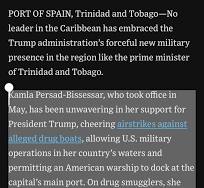
Interesting subplot in the march to war with Venezuela. The ultra pro-Trump, pro-war prime minister of Trinidad and Tobago hosting US troops is South Asian desi descent and named Kamala.
40+ likes ·
2 days ago
[

lhfang
X](https://x.com/lhfang?ref_src=twsrc%5Egoogle%7Ctwcamp%5Eserp%7Ctwgr%5Eauthor)
[
s://x.com/lhfang/status/1984426381628063753?ref_src=twsrc%5Egoogle%7Ctwcamp%5Eserp%7Ctwgr%5Etweet)
Happy Halloween 🎃
190+ likes ·
5 days ago
[

lhfang
X](https://x.com/lhfang?ref_src=twsrc%5Egoogle%7Ctwcamp%5Eserp%7Ctwgr%5Eauthor)
What was the point of the last decade of China constraints when Trump is moving to reverse it all and give away America's most advanced chips? Despite all the anti-China rhetoric, most hawks seem pretty silent. www.reuters.com/world/c…
170+ likes ·
1 week ago
[

lhfang
X](https://x.com/lhfang?ref_src=twsrc%5Egoogle%7Ctwcamp%5Eserp%7Ctwgr%5Eauthor)
In the modern era, those without money or lobbyists could still assert their voice against an abusive, corrupt power elite with a general strike. But as robots and AI-fueled tools replace all our jobs, worker strikes will become meaningless.
120+ likes ·
2 weeks ago
[

lhfang
X](https://x.com/lhfang?ref_src=twsrc%5Egoogle%7Ctwcamp%5Eserp%7Ctwgr%5Eauthor)
We're at a moment where social media is lowering society's collective cognitive abilities while AI becomes more capable of replacing our jobs. And simultaneously bribery is now more normalized than ever, meaning the clique of tech elite lord over us in every way.
260+ likes ·
2 weeks ago
[

lhfang
X](https://x.com/lhfang?ref_src=twsrc%5Egoogle%7Ctwcamp%5Eserp%7Ctwgr%5Eauthor)
In Egypt, the military dictatorship permeates everything. All contracts operate on a bribery basis, 'dear leader' messages thanking the gov are everywhere, everything revolves around leader worship, fear and quid pro quo. Much of the third world operates this way.
160+ likes ·
2 weeks ago
[

lhfang
X](https://x.com/lhfang?ref_src=twsrc%5Egoogle%7Ctwcamp%5Eserp%7Ctwgr%5Eauthor)
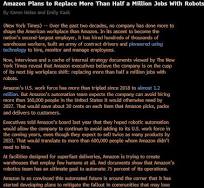
Amazon, as they plan to replace 500k jobs with AI-powered robots, instructed its team to avoid using the term AI and to instead use “advanced technology” or “cobot”
50+ likes ·
2 weeks ago
[

lhfang
X](https://x.com/lhfang?ref_src=twsrc%5Egoogle%7Ctwcamp%5Eserp%7Ctwgr%5Eauthor)
The whole Graham Platner kerfuffle is a good reminder that American classism is rigidly policed through political correctness. If anything, his Reddit posts make him sound like a normal person, something that makes him more electable in this environment.
740+ likes ·
2 weeks ago
[

lhfang
X](https://x.com/lhfang?ref_src=twsrc%5Egoogle%7Ctwcamp%5Eserp%7Ctwgr%5Eauthor)
I grew up watching Bill Maher and have always appreciated him, even when I disagree with his commentary. Maher takes down dogmatic beliefs and political inconsistencies like no other. But his Israel advocacy is getting absurd. He rightfully mocks every organized religion's sacred
2K+ likes ·
3 weeks ago
[

lhfang
X](https://x.com/lhfang?ref_src=twsrc%5Egoogle%7Ctwcamp%5Eserp%7Ctwgr%5Eauthor)
[### Lee Fang | Substack

Lee Fang | Substack
https://www.leefang.com](https://www.leefang.com/)
Investigations and observations about the public interest. Click to read Lee Fang, a Substack publication with tens of thousands of subscribers.
People also ask
What happened to Lee Fang?
[### Lee Fang

Anderson Center at Tower View
https://www.andersoncenter.org › lee-fang](https://www.andersoncenter.org/lee-fang/)
Based in San Francisco, Lee Fang is an investigative reporter at The Intercept who has worked for the last fifteen years reporting on a diverse range of ...
[### Lee Fang

The Nation
https://www.thenation.com › Authors](https://www.thenation.com/authors/lee-fang/)
Lee Fang is a reporting fellow with The Investigative Fund at The Nation Institute. He covers money in politics, conservative movements and lobbying.
[### Lee Fang

UnHerd
https://unherd.com › author › lee-fang](https://unherd.com/author/lee-fang/)
Lee Fang is an investigative journalist and Contributing Editor at UnHerd. Read his Substack here. Why Trump has gone soft on immigration.
[### Lee Fang

The New Press
https://thenewpress.org › Authors](https://thenewpress.org/authors/lee-fang/)
Lee Fang is an investigative journalist at The Intercept and was previously a reporting fellow at The Nation Institute and a contributing writer at The Nation.
[### Lee Fang on the Importance of Journalism - Part 1

YouTube · FIRE
1K+ views · 1 year ago](https://www.youtube.com/shorts/Ht5siALGwTw)
Independent journalist Lee Fang* discusses independent journalism and holding officials accountable and his reporting during The Twitter ...
---
https://theintercept.com/2020/05/08/coronavirus-republicans-bank-deregulation-loans/
lee f
rEPUBLICAN LAWMAKERS and finance industry lobbyists are using the coronavirus pandemic to press regulators into rapidly waiving financial safeguards for community banks.
And so far, banking regulators have obliged, lifting rules imposed after the 2008 crisis that limit risk-taking and require banks to undergo more strenuous audits.
But experts are warning that the deregulatory blitz, sold as a fix to stimulate business by encouraging more lending, raises the potential for a flood of small bank failures, potentially lengthening economic woes and risking the need for future bank bailouts.
In a recent academic paper, Kress observed that out of the 489 banks that failed and were resolved by the federal government from 2008-2013, all but nine were community banks. The failures of community banks during this period cost taxpayers nearly $50 billion. In contrast to the bailouts of large Wall Street banks, which were eventually paid back with interest to the federal government, the small bank bailouts only incurred significant costs.The flurry of advocacy began in March just as the imminent threat of the pandemic seized headlines. That month, several GOP lawmakers contacted regulators at the Federal Reserve and the Federal Deposit Insurance Corporation to urge officials to adjust the threshold at which community banks may qualify for exemption from all risk-based capital requirements.
“We strongly urge you to use the full measure of discretion afforded by Congress to maximize capital simplification and regulatory relief for the greatest number of community banks,” wrote Rep. Denver Riggleman, R-Va., in a letter signed by eight other House Republicans, obtained via a Freedom of Information Act request by The Intercept. In addition to Riggleman, the letter was signed by Reps. Scott Tipton, R-Colo.; Bill Huizenga, R-Mich.; Ann Wagner, R-Mo.; Frank Lucas, R-Okla.; David Kustoff, R-Tenn.; Barry Loudermilk, R-Ga.; John Rose, R-Tenn.; and Blaine Luetkemeyer, R-Mo.
The letter asked that the Federal Reserve and FDIC lower the Community Bank Leverage Ratio from 9 percent to 8 percent, a move that would qualify about 400 banks for special exemption from scrutiny over the level of risk taken on by a bank. The lower leverage ratio, the lawmakers argued, would “support credit in thousands more communities across the country.”
Ordinarily, a complete revision of federal regulation would require months of deliberation, an open comment period, and an agency justification backed by evidence. But the Covid-19 emergency short circuited the process, and within weeks, the leverage ratio was lowered.
The demands in the congressional letter were slipped into the CARES Act, the $2.2 trillion bailout legislation.The legislation waived a number of regulations on banks, from accounting standards to loan limits, and temporarily lowered the Community Bank Leverage Ratio to 8 percent through the duration of the public health crisis.
Banks must maintain a certain risk-based capital requirement, meaning banks with riskier assets must have higher levels of capital to contain potential losses. Bank stability is also measured by a leverage ratio, which is simply the percentage of capital held of total bank assets.
Lowering the Community Bank Leverage Ratio means hundreds of banks can hold onto less capital while avoiding standards that restrict the types of risk they take on.
“The industry and regulators love to use jargon and impenetrable language but the leverage ratio is nothing but a capital buffer that a bank has to have to absorb losses itself so it won’t have to be bailed out by taxpayers,” said Dennis Kelleher, president of the financial reform group Better Markets.
“It would really turn logic on its head to now say the banks should not have to comply with those other rules and they should get a lower leverage ratio,” added Kelleher.
“The whole idea of lowering capital requirements to respond to a pandemic is wrong,” said Jeremy Kress, an assistant law professor at the University of Michigan School of Business.
Kress noted that while public attention was focused largely on “too big to fail” mega-banks, hundreds of community banks failed during the crisis that started with the 2008 financial collapse.
The failure of small banks during the last crisis also created a cascading effect of economic damage, as small businesses and entrepreneurs around the country were cut off from credit, driving one of the slowest economic recoveries in U.S. history, Kress argues.
If the current pandemic leads to a wave of defaults, more community bank failures could be on the horizon. The deregulatory push to reduce capital requirements could hasten the level of bank failures, said Kress, exacerbating the current economic crisis.
“When we see a bunch of small institutions failing simultaneously,” said Kress, “that leaves a lot of communities and small businesses and individuals without needed access to credit.”
“The efforts that we are seeing today to weaken the Community Bank Leverage Ratio is only going to make the community banking sector more fragile and increase the likelihood of another collapse of small banks,” he added.
The leeway for regulators to exempt the community banks from risk-related assessments came from special authority granted by the Economic Growth, Regulatory Relief, and Consumer Protection Act, a law passed in 2018, the largest bank deregulation measure ushered in by Trump.
The measure removed proprietary trading restrictions from banks with $10 billion or less in assets imposed by the so-called Volcker Rule following the 2008 crisis. It also instituted the Community Bank Leverage Ratio rule, allowing small banks to skirt regulatory standards known as Basel III capital rules if they maintain a leverage ratio between 8 and 10 percent. The FDIC set the rate at 9 percent following the law.
The Congressional Budget Office, the independent body that analyzes legislation, suggested at the time that the deregulatory push would threaten the stability of community banks, which would likely use the exemption to chase higher returns by taking on more volatile loans and securities. The CBO noted that even a Community Bank Leverage Ratio of 9 percent could raise FDIC costs by increasing the probability of bank failures and FDIC bailouts.
After winning passage of the 2018 law, the industry went to work lowering the Community Bank Leverage Ratio well before the pandemic. Over the last year, representatives from the Mortgage Bankers Associations and the Independent Community Bankers Association, have pressed for the 8 percent standard, a push that was renewed in recent months, lobbying disclosures show.
Rep. Jodey Arrington, R-Texas, a former FDIC official under President George W. Bush, was one of the lawmakers pushing to loosen the standard.
In a separate letter to bank regulators, Arrington asked for “ample time” for community banks to comply with the new 8 percent Community Bank Leverage Ratio and for the change to be made permanent. “Furthermore,” the congressman wrote, “in order to maintain long-term economic growth, the CBLR should be maintained at the minimum eight percent threshold, allowed by P.L. 115-174, beyond the COVID-19 pandemic.”
The Texas lawmaker dismissed concerns that reducing regulations could raise the risk of bank failures.
“Relaxing regulations in a reasonable way including lowering reserve requirements by 1% for community banks during the immediate crisis as well as our longer term economic recovery will provide greater access to much-needed capital for small businesses, which, in turn, will help keep people employed and strengthen our overall recovery efforts,” said Arrington in a statement to The Intercept.
“Lenders of all sizes will certainly have an increase in risk to their loan portfolios; however, banks have an incentive to operate responsibly in order to stay solvent and community banks who operate on a thinner margin need some targeted relief to continue serving rural communities like mine,” the lawmaker added.
Bank industry advocates have long argued that capital requirements have curbed lending. But banking industry watchdogs have pointed out that a growing body of empirical research shows the exact opposite and that well-capitalized banks make more loans and more high-quality loans.
Research from the Bank for International Settlements found that “higher bank capital is associated with greater lending.” Morris Goldstein, a former fellow at the Peterson Institute for International Economics, in a review of economic literature, similarly found that “better capitalized banks lend more, not less, than weakly capitalized ones.”
Still, community banks have won a series of deregulatory measures in part by leveraging their relative popularity in contrast to the big banks. Despite the economic risks of lifting bank rules, small banks have been at the tip of the spear in weakening financial safeguards.
“Everybody loves community banks, right?” said Kress. “They’re the most sympathetic industry in Congress because every member has a community bank in their district. They do a lot of residential and small business lending, they sponsor your kids’ kickball team, they seem far removed from the financial engineering of Wall Street.” “Community banks, motherhood, and apple pie,” chuckled Kelleher.
The lofty reputation held by community banks, however, has concealed the danger they pose to the economic system.
“The bank industry pushes in a lot of different ways,” Kelleher noted. “They do it directly against the regulators, they do it indirectly through their legislative allies. It’s really pretty sad how many are using the pandemic as nothing but a pretext for their deregulation agenda that they’ve been asking for for years.
”
---
==
REPORTER’S NOTE
Behind Big Pesticide’s Playbook
The introduction three decades ago of a new class of insecticides called neonicotinoids — derived from nicotine — dazzled farmers: It promised insect-killing efficiency with precision application. Before long, neonics became one of the most widely used insecticides, applied to agricultural crops, ornamental trees, and home gardens in every corner of the globe.
Problems began almost immediately. Neonicotinoids have been blamed for killing bees. But while the European Union moved to ban the insecticide, little has been done in the U.S.
What’s different here? Industry lobbying documents and emails obtained by The Intercept show a vast strategy by the pesticide industry to influence academics, beekeepers, and regulators, and divert attention away from the potential harm caused by pesticides and push the public into focusing only on other factors that could harm bees and other insects.
As a result, the pesticide industry has largely prevailed and continues to reap massive profits. Revenue has doubled over the past decade; the global neonic industry generated $4.42 billion in 2018. And in the meantime, the effects are being seen in massive die-offs of several insect species; the poison is even reaching birds and potentially large mammals. Certain species are nearing extinction.
==
https://cpj.org/blog/2018/02/weinstein-blackcube-surveillance-claim-exposes-agg.php
Weinstein-BlackCube surveillance claim exposes aggressive tactics to kill a story
By Avi Asher-Schapiro/CPJ US Correspondenton February 7, 2018
Those with deep pockets can go to great lengths to push back against journalism they find objectionable. Billionaire Peter Thiel deployed a team of lawyers in a move that bankrupted the news site Gawkerin 2016--and last month President Donald Trump's lawyers tried to block the publication of an unflattering book. But there's another, much less public, arena where the wealthy can combat unflattering reporting: the world of subterfuge-for-hire, where private investigators work to undermine a story before it's even made public.
In late 2017, the public was privy to a rare glimpse inside this world. Ronan Farrow, in a New Yorker exposé, reported that movie mogul HarveyWeinstein's lawyers at Boies Schiller Flexnerhad enlisted a team of private investigators to push back against reporting into dozens of sexual assault and rape allegations against their client. One of the private investigation firms,BlackCube--an outfit staffed with former agents of the Israeli intelligence service, Mossad--was ordered in a contract obtained by The New Yorker to "completely stop the publication" of an article critical of Weinstein. BlackCube ultimately failed. But, Farrow's report found, journalists investigating Weinstein at The New Yorker, The New York Times, and New Yorkmagazine, and their sources, were approached by undercover agents with fabricated backstories, as part of an elaborate effort to keep Weinstein's alleged sexual misconduct secret.
Weinstein's spokespeople have denied the allegations against him and rejected claims that he tried to "suppress" any journalism. BlackCube has repeatedly insisted that it "applies high moral standards" to all of its work, and in an interview a member of its advisory board expressed regret for its relationship with Weinstein.
While there are no laws against lying to a reporter or their sources, or conducting public surveillance of or pushing embarrassing information about a journalist--as long as that behavior doesn't veer into libel or slander--the Weinstein story raised questions about how far some will go to kill a negative story--and what, if any, ethical and legal guardrails exist to protect journalists
Of course, the use of underhanded tactics to derail a reporter is nothing new. Bethany McLean, a business reporter who broke the Enron story in 2001, recalls receiving multiple phone calls from individuals who said they were potential sources. These calls, she told CPJ, amounted to sloppy sting operations: those on the other line would try to lure her into admitting she wanted to financially benefit from her own reporting--McLean said she assumed she was being taped.
For most reporters, however, pushback usually comes in the form of aggressive public relations firms or, on occasion, threatening letters from their subjects' lawyers. Weathering an undercover operation has not typically been part of a journalists' job description. George Freeman said that in nearly 30 years as a lawyer for The New York Times, he "can barely think of an example" of these tactics. He is now executive director of the independent advisory group the Media Law Resource Center. "Unfortunately, it's becoming less rare in the last couple years," he told CPJ. "And that's what's scary about it"
Subjects of journalistic scrutiny are, of course, entitled to defend themselves. And for those with the resources to do so, there are plenty of techniques that reporters with whom CPJ spoke said they have come to expect, including compiling publicly available information that could reveal a reporter's conflicts of interest, or a dossier of past reporting mistakes.
The Weinstein story revealed a more aggressive toolbox apparently used by private investigators: the impersonation of sources and hiring reporters as agents. Other cases involve deploying aggressive surveillance, and smearing sources or reporters by spreading potentially damaging personal information.
Before Weinstein, another high-profile case alleging attempts to suppress reporting focused on Roger Ailes, the founder of Fox News. Ailes' biographer Gabriel Sherman, citing sources inside Fox, alleged that the executive used a portion of Fox's budget to pay for a "Black Room," where PR and surveillances operations against Ailes' perceived enemies--including reporters--were coordinated.
Ailes, who died in May, denied the allegations at the time. On the record, Fox executives insisted to Sherman that they had no knowledge of company money being spent on surveillance or online attacks against reporters.
But, Sherman said, sources inside of Fox told him a different story. "From my own reporting, inside Fox, I know Ailes had hired private investigators to have me surveilled," Sherman told CPJ. "It adds a level of psychological intimidation, if you know your subject has goons out there looking for you." Sherman recalled one particularly chilling incident while he was working on his biography of Ailes: he and his wife noticed a black SUV lurking outside a cabin they were renting--when they tried to approach the car, it peeled out and raced away.
Beyond laws against stalking, assault, and fraud, there's little to prevent the rich and powerful from deploying such tactics to suppress reporting they don't approve of, said Philip Segal, the founder of Charles Griffin Intelligence, a private investigations firm. Segal is an expert on investigative ethics and gives ethics seminars to state bar associations.
He said he believes private investigators should follow strict ethical guidelines and refrain from impersonation tactics. Investigators should not, he said, pay other journalists to gather intelligence for them, unless those reporters are prepared to broadcast that they are not working in their capacity as a reporter.
Getting a clear picture of the scope and breadth of these aggressive private investigations is difficult. "Out of a thousand cases, I'd say one or two involved a reporter," Randy Torgerson, the president of the United States Association of Professional Investigators, an organization with over 600 members, told CPJ.
And, when a reporter is the apparent victim of such an operation, it can be difficult to definitively trace the source. In the BlackCube case, Farrow was able to publish a copy of the firm's contract with Weinstein. But more often than not, obtaining such a document is not possible, leaving reporters with a mixture of circumstantial evidence, suspicion, and the assurances of their own sources.
Lee Fang, an investigative journalist at the Intercept, who has reported for a number of outlets about the sprawling political network funded by the conservative Koch brothers, said he suspects operatives working for the Kochs hacked his private account on the image hosting site Photobucket and circulated an image of him smoking marijuana as a teenager.
The image published by the conservative website the Washington Free Beacon, in a post titled "High Times at The Intercept" that mocked the publication's decision to hire Fang, was taken from a password protected account, Fang said. The Free Beacon was co-founded by Michael Goldfarb, who previously worked as a crisis communications consultant for the Kochs.
Fang told CPJ he can't definitively prove who was behind the hack, but said that his reporting had been flagged by pro-Koch Brothers operatives before, including on a now-defunct website, KochFacts.com, that listed journalists writing critically on the Kochs' political activities.
"There's a healthy return on investment for intimidating reporters," Fang told CPJ. "It can go a long way, editors can be skittish, and all you have in this business is your reputation."
The Free Beacon did not respond to CPJ's request for comment on how it obtained the images.
In her book Dark Money, an investigation into the Koch's political network, New Yorker staff writer Jane Mayer alleged that the brothers retained New York City Police Commissioner-turned private investigator Howard Safir to delve into her past. Mayer wrote that sources told herGoldfarb was involved in that work. She said she also discovered that a dossier erroneously accusing her of plagiarism was passed around conservative D.C. media circles--a reporter with the conservative Daily Caller website even contacted her editors at The New Yorker, accusing her of plagiarism. She was able to quickly refute the allegations before they were made public.
The Koch Brothers have called Mayer's reporting inaccurate, but did not directly refute the accusations when contacted by The New York Times in 2016. Safir did not respond to CPJ's request for comment.
This kind of treatment can be particularly chilling for reporters without the institutional backing of a major publication. Roddy Boyd, the president of the Southern Investigative Reporting Foundation, says that last year he was lured to London with a job offer, only to be pumped for information about his reporting on an insurance company AmTrust. "It was really shady," he told CPJ. "It makes you wonder; what won't they do."
Some investigative campaigns however, have run into legal trouble. Back in 2006, the California Attorney General found that private investigators hired by Hewlett Packard to trace leaks to the press had targeted the phone records of nine journalists. Hewlett Packard's general counsel resigned and a court sentenced one of the investigators to three months in jail for identity theft.
In the wake of the Weinstein scandal, his lawyer David Boies expressed some regret. He said that he did not select the private investigators that Weinstein hired, or direct their work--although his signature appears on the BlackCube contract. "It was not thought through," Boies wrote in a public statement explaining his decision to facilitate Weinstein and BlackCube's relationship. "And it was a mistake. I take responsibility for that." There's no indication he or BlackCube broke any laws or will face any censure (although, The New York Times reported that BlackCube lacked the proper license to do business in New York).
[EDITOR'S NOTE: David Boieschaired CPJ's annual International Press Freedom Awards in 2012. He and his law firm, Boies Schiller Flexner, have both donated to CPJ.]
Still, lawyers who retain private investigators are bound by a fairly strict code of professional ethics. According to the American Bar Association's model rules for ethics, lawyers cannot engage in impersonation or false representation. They are also required to oversee the work of private investigators they may retain--and can be held responsible for ethical breaches of subcontractors.
"There's no question the rules of professional conduct govern lawyers in all the lawyers' activities on behalf of the client, and that certainly would include retaining a third party to work in the client's interest," Dennis A. Rendleman, the ethics counsel in the Center for Professional Responsibility at the American Bar Association, told CPJ. "The lawyer has an obligation to supervise and make sure that's done in accordance with the model rules in each licensing jurisdiction. Getting positive press could be part of their job. But that needs to be done in accordance with the rules."
In New York, Attorney Grievance Committees are charged with enforcing these ethical guidelines and disciplining lawyers. These committees, and similar mechanisms in other states, could provide a route to pushback against aggressive investigators--or at least, the lawyers who employ them. "To the degree that law firms are involved in this, you may try to use the bar disciplinary system to rein in lawyers who are involved in such activity," said Kathleen Clark, an ethics expert and law professor at the University of Washington Law School.
The committee charged with overseeing lawyers in Manhattan declined to comment to CPJ on any potential investigation into Weinstein's lawyers, or speak on the record about any past instances of lawyers facing discipline for their work with private investigators.
---
Avi Asher-Schapiro is CPJ's research associate for North America. He is a former staffer at VICE News, International Business Times, and Tribune Media, and an independent investigative reporter who has published in outlets including The Atlantic, The Intercept, and The New York Times.
==
In August, The Intercept revealed that Alpha Natural Resources, one of the largest coal mining companies in America, has been secretly financing think tanks and political organizations that deny climate change. One of the people they funded, attorney Chris Horner, is well known for hounding climate scientists across the country.
The payments were exposed in the firm’s bankruptcy filings last month.
On Monday, when I asked Kevin Crutchfield, the chief executive officer of Alpha Natural Resources, about his company’s support for Horner and his aggressive investigations of climate scientists, he was unapologetic.
“It should come as no surprise to you that we support those with like-minded philosophies,” Crutchfield said.
We spoke briefly at the Southern States Energy Board, an energy conferenced hosted at The Greenbrier resort in West Virginia.
“Everything we have to disclose, it’s on our restructuring website,” Crutchfield added, referring to the website that helps manage Alpha Natural Resource’s bankruptcy proceedings. He added, “The other thing I’d like to say is that the amount of political contributions pale in the amount of charitable contributions we’ve made over the years.”
As we reported, Alpha Natural Resources has funded a wide array of political groups that have helped the coal industry beat back environmental regulations, including the American Enterprise Institute, the American Legislative Exchange Council, the Heartland Institute, and the U.S. Chamber of Commerce. The filings also showed that the firm helped finance the Kentucky Opportunity Coalition, a dark money group that was set up to provide undisclosed campaign support to the reelection effort of Sen. Mitch McConnell, R-Ky., in his race last year.
The bankruptcy filings named recipients of Alpha Natural Resources’ money, but did not provide dollar amounts for the contributions. I asked Crutchfield how much he has given to Horner and other groups that work to deny the existence of manmade climate change.
“I don’t know the numbers. We believe in transparency,” he retorted, and began walking away.
I asked if he believes that the burning of fossil fuels contributes to climate change. “It doesn’t matter what I believe because the bus has left the station seems like,” Crutchfield said, smiling. By then, a group of men with earpieces surrounded the Alpha Natural Resources CEO, blocking me from asking any more questions.
==
Lee Fang is a journalist with a longstanding interest in how public policy is influenced by organized interest groups and money. He was the first to uncover and detail the role of the billionaire Koch brothers in financing the Tea Party movement. His interviews and research on the Koch brothers have been featured on HBO’s “The Newsroom,” the documentaries “Merchants of Doubt” and “Citizen Koch,” as well as in multiple media outlets. He was an investigative blogger for ThinkProgress (2009-2011) and then a fellow at the Investigative Fund of the Nation Institute and contributing writer for The Nation.
In 2012, he co-founded RepublicReport.org, a blog to cover political corruption that syndicates content with TheNation.com, Salon, National Memo, BillMoyers.com, TruthOut, and other media outlets. His work has been published by VICE, The Baffler, The Boston Globe, the San Francisco Chronicle, The Progressive, NPR, In These Times, and The Huffington Post. His first book, “The Machine: A Field Guide to the Resurgent Right,” published by The New Press, explores how the conservative right rebuilt the Republican Party and its political clout in the aftermath of President Obama’s 2008 election victory. He is based in San Francisco.
==
The Machine. A Field Guide to the Resurgent Right. Lee Fang
new press 2013
https://books.google.com/books?id=fwsw28t2wocC&dq=inauthor:%22Lee+Fang%22&source=gbs_navlinks_s
fangmachine 6/7/2015
2008 gop brand low; Mccain had PO'd evals in past; also old schism evals and libertarians;
EIC after hartmann
mark meckler lawyer herbalife
FWs mage TP listserv 10 AFP htland talking pts; training by kch Leadership Inst p 10
TP patriots went to CNP mtg, looked like all the others, but press called them indep 11
TP meme old, smokers rights, (nadr /norquist?) BM astroturf CART 1992, PM 2m$ to CSE expose so cancelled?
1995 jack guthrie worldcom tob farmers 18
dick A flat tax TP meme 1997 Tauzin
TTP $ from Howie rich, kochs; nired ed crane camp mgr -->cato; eric o'keefe term limits 23
CSE, N caro, armey uses cse for corp lobbying 24, split to FW
pvt SocS; oil, BP, irving for offshore drill; life insur dereg;
SAM AA 26- E O'k , koch, oil bankers use Donors trust
eric odom
malkin 31 santelli, wrong on mkts, but still bloviating
AIG bailed out, bonus to execs, left and unions protest, but rush ~
cinci TP claimed stimulus killed jobs
beck 912
TCOT twitter 37
GOA, SPN neo-nazi support/horn in on TP 39
Porter N astrot ~ ACA rx co
API 100K$ FW --> TP 40
gov perry, vitter ; mark kirk assass BO bn/c of tax rise 41
bozell post-mort: norquist, vig, creative resp, perkins, fedsoc, blackwell, regnery tyrrell am spect, go after rinos, fake populism? old rmn new rt, had built rwi 45
creap resp mueller w rick scott on aca 46
bozell MRC ~ BO socialism
newt says CoC ally of evals 46
norquist weds mtgs ATR $ luander for jack a
weyrich lunch inhofe, gohmert, cooch 59
heritage hub, bloggers, townhall bought by salem
becky norton dunlop cartridge box if not ballot box 67
CNP la haye, blackwater big donor 69(met w. dick c, rummy, paul bremer
Conserv Action pjt: feulner, mirror Sharon Stmt, dunlop, GOA, Galen, ned ryun,
vs aca, disclose, fin reform 73
Weaver Terrace Gp post CU: pol dir CoC; Stenen law coc--> gps; malek; noble koch
CoC backup when astroturf busted, CoC would start neg ads 77
coc // party in amt $
ch3 koch war BO
dupont, lib league, minute men etc Am legion, thought about kkk 84 but dems tied al landon to "economic royalists", cellophane league b/c see thru it cf bk Invisible Hands by kim Phillips-Fein new deal to RR;
dupont fail b/c lacked coherent intellectual framework, so coors and scaife built one 84 but no direct challenge to prez till kochs;
kochs took out demo maj 2010, won on climate, labor almost ACA, engr TP shellacking 85 BO caved on extending b2 tax cuts and estate tax
koch/fox paint BO socialist (no cellophane ~)
kochs combined all approaches eg norquist, CoC, BB&T bank ayn rand;
Fink after Phil roundtable wanted Hayek model: raw mat'l --> consumer products 87
50M koch $ ~ agw, 35 groups 88 gentry two hats industries and fdn 89
confs amplify devos, anschutz, blackstone schwartman 89
venable Tx textbooks
chls CNP
academia: fund depts, mercatus 14 of 23 regulatory axed; susan dudley; chls river pay to play academia eg exxon report 92 Brown U florida state u
fred, JBS, NAM rebooted Mccarthyism 97 bozell ghost write goldwater
fred pal of textile Milliken, roger
fluoridation
say free market but B2 strategic oil reserve (ussr) stole 300m ga nat am, dole and newt covered 112
timber, coal power plants, pipeline, chemicals, fertilizers, ethanol, financial products [CDS? yup 113 1st derivative, crude, koch exec 1986; lobbied against BO reform] 2009 110B$ revenue 2010 each bro 21B$ 106
koch boost sanford and demint
carlton the wealthy eco-hypocrite 110 make $ on saving the planet; actually CBO says BO policies wd lower cost energy
effective ~ BO b/c 30 yrs of organizing
CSE ~ BTU
koch 300m tons co2/yr 114; went after state cap and trade 114 used TP and lobbyists
VA Rick Boucher backed clean energy, so ~ Morgan Griffith ended 28 yr career 115 bill passed house not senate: IER, hrtlnd, gmu heritage
koch funded spanish study bogus, climategate, bus tour (3-4, free food, visa gift cards] EPA "carbon cops" regulate churches, refrig, air you breathe, hosted TP events 116.
ark sen blanche lincoln gut clean air act; gop house 2011 one of 1st act to cut epa CAA enforcement 117
CA ab 32, pac res; NH out of rggi
2008 JMcc and BO agree on age, but by 2011 1/2 gop congress deniers (inglis , castle primaried) ; mark kirk 180 on W-M to stay 118.
1 mo into new congress, epa $ to enforce koch co2 cut 119
themis voter data
before swear in of 112th, david chat with boehner; lobbyist met with new chair energy and commerce =?
ch 4 reform hits wall at k str
tom perrielo bogus ltrs 125 naac, sr, AAU women; bonner; WM watered house, killed senate
outside lobbying (only register if spend more than 20% talking directly to lawmakers, so astroturf not covered 126
bernays set up front for Mack truck for interstate hwy 127
TP astro by pol ops become fronts for corps eg salt; pol ops are hubs in rwi, energized by ~BO ad hoc swarm on single issue/bill
PR Qorvis staff henretty posed as news reporter and interviewed college rep on student debt (fun to track down to check on hoist]
lots of astro pose as merely ideological eg cut tax limit gov't but rentable sg Freedomworks army front for BP post spill 129.
CDR --> cornwall
tim phillips 131 goodlatte ralph reed, century stray xian; rec by rove led to 1st big gig: enron 380K$ for energy dereg --> energy crisis /recession 201 DAVIS?! 132 note 15 Public citizen blind faith see blindfaith.txt http://www.citizen.org/cmep/article_redirect.cfm?ID=7104 see below davis and reed got stuff in NYT
phillips marians island sweatshop forced abortions, w/ abramoff indian scams 133 w/ grover launder $?
chambliss, sonny perdue, black bastard dtr ~ Mcc 134; hot air, tour, save my ballot tour joe the p; reg reality tour bouncy castles, food ~Clean air act 135 so god in 2010 expande 2012 tip pt on agw w/ pledge; met bloggers: if doubt on sci we win 136
ACA: see toxic sludge bk: rush jail ppl and bankrupt usa; harry & l: diss Moore as entertainer; APCO
Creative Concepts rick scott HCA, w/ APCO 3.8M$ 2009 142 CoC 10m$; industry 107M$ neg ads
1/2 AMA for ACA 1st x, so bogus CPPR, DCI; porter novelli ...
ch 5 social media
instead of change ideas post 2008 loss, gop improved info delivery via soc med (already had direct mail radio etc)
heritage and nat rev --> Townhall //drudge msg coordination 154 precursor TCC aei James Glassman w/ DCI (laster GWB Inst in dallas
rt had media dominance, but got lazy after kerry win; edelman peer-to peer (3rd party spin?) IN imp form of info; 2008 edelman study of BO online efforts by Krempasky --> REDstate (mirror daily kos) later boosted TP 157 TPM broke AG fire
tpm instant fact check McC
bozell at CNP decried left gains (MRC made media left meme myth ; google wikipedia and FB said leftists
Ning illusion of open democ platform; TPP fed info by FWs; FWs and iol paid Odom 167
ypucut scam .017%
porter Novelli videogames ~ aca; OcO hooter certificates 168
Fleishman Hill mirror BO online 169
CoC paid google to redirect fang query to ~ www 169
scott brown teddy seat Am Fut Fund, twitter spam vs Martha Coakley 171
geo allen r va media tracker dem --> Macaca 173 rising star; McC shaky vid seems authentic vs slick media 173
scripted rants at town halls led dems to not run for re-election, some videos, some were stealth staffers eg etheridge
perrileo dirty tricks, followed by Marchi AFP 176
daily caller 2010 tucker carlson mirror huffpo: news, invest jrnl, ent and pol gossip; Martosko oppos res for Berman 177 Blaze, PJ (anti muslim, pro-Israel ) escalator: afp ~ clAA--> pj made news pkg (VNR/fake news? 179
ning->fake tweet -->pjtv videos -->dailyc/blaze --> viral vid, digg bury correction 180.
C ent complex: pol and poker; running reality tv of cands; right to laugh; jackpot justice (class action)tory; stakelbeck on terror ~ muslim 180-1.
ed snider ceo comcast ~ dems on gulf war 2
fox, ailes, rush; cato forum nra fam res cncl; ailes Am talking --> msnbc 1996; fox news boost when favored by b2 admin 186
movies: Mot Pict Inst (Fdn for indiv rights in educ staffers 2005) rob Pfaltzgraff 187) the Cartel --> wait for superman, vonnegut bergson; eliz koch on mpi bd; pac res, CEI w/ MPI, also Horowitz/ The D Film Inst blames BC for 911 (aborts mission to get Osama, aired by ABC as docudrama 188-9, busted , so tfi lower profile; horo also matchmaker of rw to stars eg Braveheart producer Steve McEveety,
// Movieguide Ted Baehr xian (templeton fdn funds awards) converted jewish produces 189
MGM remake Red Dawn ~chinese; kalifornistan jason apuzzo praised by malkin, boosted 24 creators surnow and manny coto 191 ; pal of rush into to ailes led to Daily show mirror 191; the n The Kennedy's for History channel: doz sex scene but not cuban crisis (waves of sec serv msg to have sex in pool) 191
ex GS now media bak) Stephen Bannon Libertas films 9 free office sp to Breitbart) 191 w/ Phil A on Narnia; fire from heartland gop women bachmann coulter and TP loesch
CU Bossie: hype: the Obama effect; buch with newt: john paul II;
rightnetwork via Verizon cabe
rupert pays 11$ per viewer on local cable, opposite of biz model
bannon/phil: The Hope and the change ( bo) 2016 Obama's Am 194-5
---
ch 5 states
big loss 2008 fed so shift to state level; already had fair no of gov and legis, plus bunch of rw fronts built over decades; ~ BO, and his win fuelled 197; no new ideas, but footsoldiers for rw agenda; would localize msg ~ eg ACA
muscle to go on offense: immigration AZ, unions 198
SPN 1992 (BC) planned by defunct Madison group: Th Roe (heritage) So Caro Policy Cncl eg vouchers, ~ grn regs; go between local conserv eg Family Policy Cncl // Dobson evangelicals and nat'l rw ctrs 199/
mid 90's 37 spn, // Heritage Mandate (plan plus staffers) so new gov or legislature (often part time latter) had ready made plan and ppl 200 really gop but kinda look nonpart; have boilerplate to ward off pseudo/stinktank charge: IRS bless, we don't take bribes, advance "civil society" 201 so ironically confirms rubberstamp
DCI entwines
SPN funded Pelican, ~ dem 4k$ conf of mayors and inaug, burt silent on jindal 45K$ tax for helo campaign trips 202; Laffer, Vitter, james o'keefe
now 58 tanks, every state: CA official pac res, but affiliate Claremont, horowitz, indep inst oakland, Reason, prometheus 203
SPN media savvy, so connect to local media, (90's colo independent inst had cable news show, and VT ethan a inst had regular npr op ed) has radio shows (web? sirius?), bogs, podcast 205.
now oppos res masked as jrnl: Jason Stverak, pres frkln ctr, ex N Dak gop honcho), stealth camp for SAM (erick O'k w/ h rich $) 206
Bill McMorris invest jrnl at fkl ctr, Robt Novak fellowship from Phillips 2 L to pay him 206
sph put up 75K for alaska reporter gig; Wayne Hoffman ID challenged to find bias 207
Illinois Statehouse News denied creds b/c wd not disclose $, couple others states deny also;
scam phantom district on stimulus zip code error; but drudge, politico then ABC 208 (then weeks on Fox)
rep Mary fallin denounced; // fnk ctr w/ McCain and Coburn did report, but either not stim, or mischaracterized eg WNBA facility was tribal community ctr w/ no for-profit anything 208.
b/c real reporters laid off, easy to grab for cred; eg Mackinac created mich Transparency Cter [fe] then hired local nbc kathy hoekstra eg on film tax credit for m moore 209; OC reg --? pac res CalWatchDog; pres soc prof jrnl --> tenn ctr pol res [gore hit?]; assoc of am phys and surgeons ~ ACA but not shown nuts: BO covert hypnosis to get ppl to rally, medicare ~ const; cited alex jones VBO cia spy 209
local news desperate: in WI 18 pprs syndicates the franklin front 210
FC pledge to build out; partner w/ Nat Rev on battlegnd elections (in 2014?); expand training.
70's lobbyists from 100 co/trade gps State Gov Affairs Cncl, funded Cncl state gov, pro biz but not radical enough, so ALEC, fdr Weyrich, differs from spn in that it actually writes legis; 2k members; corps pay up to 50K/yr; into 1/k/yr, 20% pass 212
min wage, net neutral; big funder of climate/ grn pwr; PIC: Laurie Shanblum CCA, mtg w/ Russell Pearce AZ state sen, wrote SB 1070 (show yr papers; but you can tell by shoes 214; AZ has 3 CCA jails, want to grow more;
Pershing Sq cp investor; Jan Brewer hired CCA top lobbyist and camp chr; dep COS; 2/3 1070 co-spon either alec member or at conf where written; 30 got $ during debate; Mgt & Training Corp; clone 1070 tried in penn, ok, tenn, colo, fla; TP boost.
gop wants rx care across state lines, so biz can flee to least consumer protection (//credit card [utah?] 216
ban lawsuit of hmo
10 states w/ gop gain 2010, voter restrictions 217
2010 gerrymander (had org/strategy custom made?]
rove and gillespie polled, found ppl receptive to overpaid teachers arg "new fed bureaucratic elite" 219 SPN?SAM posted public worker salaries (foia bomb where not easy to get); helped kasich gut collective barg; // Koch fight Back WI, walker 40K koch $, tim phillips stumped; spn/mciver bogus studies support gt unions, NYT oped; claimed tcher got 2z avg pvt wage or 100K actually 50 222
3 ez fix for budget, but walker cut taxes; public empl had already offered concessions, so goal was to kill union 223; mciver had war room ~ union; partnered w. Franklin news bur; hired local reporter and gop staffer; made VNR; Drew Ryun opps res bloggers: said bbq union in ret for votes; local da said bogus 224.
2012 looked like big demo win, but gerrymander so only 10 of 23 seats needed to have any power 226; conv wisdom is that gop $ wasted, but actually prevented dem sweep 227; big GOTV TP ginned eg by AFP (telemkt mogl lend infra?); right after election, went after Kay hagen for 2014 by oil co;
2012 record corp profits; ceo 3500x avg worker; avg family lost 40% wealth in Gt Rec; foreclosures, domestic vil etc riples
occupy ridiculed in press and smashed by cops and survelll state; 230 endit
===
===
alec new orleans video http://thinkprogress.org/politics/2011/08/05/288405/alec-security-attacks-thinkprogress/?mobile=nc**
public affairs official Raegan Weber denies siccing
===
http://www.thenation.com/blogs/lee-fang
---
Center for Am Freedom
In May 2012, PRWeek reported that ALEC had hired the notorious global PR firm Edelman. Edelman is the firm of choice for big tobacco, big oil, and big pharma, all key sponsors of ALEC. ALEC also held a special meeting asking right-wing bloggers, such as the Breitbart operation,for help in "a very aggressive campaign to really spread the word about what we actually do," as CMD has reported.
An "aggressive campaign" is clearly underway.
ALEC's note to legislators claims that CMD's "top investigative reporter" has a "lengthy criminal background." It links to a attack-piece published by a newly created entity called The Washington Free Beacon (WFB), the online publication of the self-proclaimed "conservative advocacy group" the Center for American Freedom.
In that piece, recent college grad CJ Ciaramella focuses on Beau Hodai, a freelance reporter who has written for the Center for Media and Democracy, In These Times, Prison Legal News, Extra! (a publication of Fairness and Accuracy in Reporting), and the investigative news publication he founded, DBA Press.
Beau has been researching and reporting on ALEC since late 2009. His reporting has detailed the relationship between ALEC and private prison contractors in the dissemination of bills based on Arizona's SB 1070, and has identified ALEC as one of the key forces behind attempts to destroy public employee unions and privatize public services.
Notably, the WFB attack job does not find any material errors in any of Beau's extensively documented reports on ALEC, but focuses on misdemeanor court records. It dwells on the fact that his legal first name is Mohamad. Beau has been nicknamed "Beau" since birth. (It is worth noting that "CJ" is not Ciaramella's legal first name but the nickname he uses instead of "Carl.")
Beau recently stirred the pot with a special report detailing corruption in the Ohio General Assembly based on public records that raise questions as to whether the state's elected officials in ALEC are complying with Ohio's ethics laws regarding gifts.
Interestingly enough, Beau learned that exactly one week following the publication of the Ohio ALEC corruption story, a private investigation firm requested court records concerning a past arrest. Allegations from those same court records emerged as the centerpiece of the WFB attack article.
The Washington Free Beacon's "Aerial Hunting Operation"
WFB's Matthew Continetti (who previously was an opinion editor at the right-wing Weekly Standard, where he remains a contributing editor) outlined the WFB's strategy as part of its recent launch:
"What would happen if the media wolf pack suddenly had to worry about an aerial hunting operation? You are about to find out. The Washington Free Beacon is here to enter the arena of combat journalism. [...] At the Beacon, we follow only one commandment: Do unto them."
And this is the team ALEC is using to attempt to discredit CMD as an "attack-dog"?
This is not the first such piece to come out of WFB. In the past few months, Ciaramella has written three pieces personally attacking reporters and activists working to expose ALEC. In addition to the piece on Beau, he published a similar attack on Color of Change staffer Gabriel Rey-Goodlatte, as well as The Nation reporter Lee Fang. Fang has also written for Think Progress (blog of the Center for American Progress) and Republic Report, and who has reported critically on ALEC over the past year. Color of Change has been instrumental in the call for ALEC corporate members to sever ties with the organization.
The latest piece also takes a shot at George Soros by attempting to link Beau to the philanthropist through PRWatch. But CMD openly discloses on its website that the past grant it received from the Open Society Institute was focused on homeland security, not ALEC. Notably, neither the WFB nor CAF disclose to the public which corporations, organizations, or individuals bankroll their operations or smear campaigns.
The People Behind the "Center for American Freedom"
WFB is a creature of the Center for American Freedom (CAF), which was incorporated in Washington, D.C., on August 18, 2011, as a not-for-profit corporation. According to District of Columbia Department of Consumer and Regulatory Affairs (DCRA) records, CAF has two active trade names: "Free Bacon" [sic] and "Washington Free Beacon," both of which were formally effected in March 2012.
DCRA records list the names of two founding CAF "governors," Michael Goldfarb and Aaron Harison.
Harison, currently CAF's president, previously served as director of communications for the Republican National Committee (RNC). Harison is joined at CAF by former RNC acting director of communications, and current CAF research director, Tim Killeen.
Harison is also the former executive director of Keep America Safe, an operation co-founded in 2009 by Dick Cheney's daughter, Liz Cheney. William Kristol, the founder and editor of the neoconservative Weekly Standard, is a founding board member of Keep America Safe. Kristol is currently listed as a board member of CAF, and is the former executive director of the Project for the New American Century (PNAC), a neocon "think tank" that had strong ties to the American Enterprise Institute.
Michael Goldfarb, CAF's chairman, has reportedly worked as an advisor to Keep America Safe and the militaristic Emergency Committee for Israel. (Kristol is also a board member for the Emergency Committee for Israel). Goldfarb is also listed as a contributing editor to Weekly Standard.
:{In addition, Goldfarb is a partner in the lobby/PR firm, :{Orion Strategies:(style="background-color:#ffff66ff"):}: LLC. Not surprisingly, given Goldfarb and Kristol's warmongering predilections, Orion has lobbied on issues of arms sales and foreign relations for very special interests like defense contractors and foreign governments.}:
While these ties may explain some of the content on the WFB, what does any of this have to do with its efforts to defend ALEC by attacking its critics?
According to Politico, right-wing financiers Charles and David Koch also employ the services of Orion Strategies and, as CMD has documented, Koch Industries and/or the Koch family fortune have helped fund ALEC and numerous ALEC private sector members that help operationalize the brothers' ideological and financial agenda. There is no indication that the Kochs asked WFB to jump to the defense of ALEC. However, the right wing has been howling that the press and progressive groups have been too persuasive in exposing ALEC and in making the case about how ALEC helps make the corporate wish list into law through its members and operations.
---
www.amazon.com › ... › Political Parties
-
www.eclectablog.com/.../interview-lee-fang-talks-about-his-book-the-ma...
-
www.eclectablog.com/.../book-review-lee-fangs-the-machine-a-field-gui...
-
themachinebook.com/
-
====gen opportunity vs obamacare 50 mil$ vs aca since 2009; tells young ppl they will be healthier if they don't sign up (scary gyno ads)https://www.youtube.com/watch?v=a3A6vXYuTgU==http://www.amazon.com/The-Machine-Field-Guide-Resurgent/dp/1595586393pt 2 https://www.youtube.com/watch?v=1dySJF4iRdsno pt 2? Published on May 6, 2013
For Conversation With Great Minds I'm joined by Lee Fang.
2013hartmann interview video https://www.youtube.com/watch?v=u1TVvUcj3FQafter RR fail, dixiecrats gone, not just dem big margins but progressive, so RT rebooted populism, CTT plus new media: TP 2009 various fronts led to 2010 wave, gerrymandered; evangelical and social conservative hed been foot soldiers for corp gop, frayed relations. libertairians and __ playing with populist movement (tP metaphor, 1993 tobacco lobby use to fight clinton tax to pay for rx reform, but can't do it as philip morris, so organized rallies, did not catch on; 1997 dick armey corp lobbyists want to replace progreeive tax w/ flat tax; laughed at; kock CSEcon--> _ tried TP 2003-4 MIch , NCarolina; 2007-8 sam adams populists by millionaires just handed out $ to do stuntsBO rolled his populist social media to derc, did not jail banksters and gave up populist approachNOTE: This is part one of a two-part post on Lee Fang’s new book “The Machine: A Field Guide to the Resurgent Right”. My interview with Lee Fang can be found HERE.This past week, journalist Lee Fang’s new book The Machine: A Field Guide to the Resurgent Right was released. Fang is a reporting fellow with the Investigative Fund at The Nation Institute and a contributing writer at The Nation and the book represents the culmination of several years of researching and writing about the intersection of conservative politics with corporate influence on our government. The book is, at its core, a history book, showing us how America arrived at a place where a relatively small number of wealthy individuals and corporate entities have shaped the national dialog, our elections, national policy, and even the laws of our land to their own benefit, privatizing wealth while socializing risk.The first chapter of The Machine is the most comprehensive overview of the history of the Tea Party that I have seen to date. Tracing its history back to the 90s when Big Tobacco manipulated populist sentiment against President Clinton’s proposal to tax cigarettes to pay for health insurance reform, Fang shows how some smart investments by a handful of millionaires and billionaires have created a powerful political force in this country.The tobacco industry demonstrated that the Tea Party could be used to induce regular Americans to find common cause with corporate interests, and [Dick] Armey’s stunts showed willingness from the Republican Party to embrace the concept as their own. However, the nuts and bolts of how to create a self-perpetuating antigovernment Tea Party were designed primarily by three wealthy libertarians: real estate magnate Howie Rich and the billionaire owners of Koch Industries, Charles and David Koch.Lee FangBut the book is about far more than the Tea Party and shows how “holistic” the Kochs and others have been in their effort to further their corporatist agenda and each chapter details a different part of the overall strategy. From message coordination to pitting progressive groups against each other and from a full-scale new media campaign to changing the face of politics at the state level, the conservative right as a front for corporate interests has covered all of their bases including some you may not have thought about. Lee Fang, however, pulls back to curtains to reveal the full scope of their decades-long effort.The success the right has had is largely a reflection of their ability to coordinate their strategically chosen messages across a wide variety of communications platforms. No group has been more effective at this than the Heritage Foundation and, as Fang shows, they remain the “center of conservatism”:By supplying policy ideas, hosting an endless array of conservative experts to testify on behalf of legislation, as well as other services, Heritage has become what many correctly call the “most influential conservative think tank.”Much of Heritage’s decisive influence, however, must be measured by its primary — if underrecognized — role in coordinating the conservative movement and thereby setting the strategy for advancing cohesive right-wing ideals. Heritage sets the agenda for state-level conservative think tanks through the State Policy Network umbrella group, and its affiliated “Resource Bank” conference, while also providing assistance for right-wing think tanks internationally through its partnership with the Atlas Economic Research Foundation. During the Obama presidency, Heritage took an even more aggressive stance, pulling together the key elements of the conservative coalition to fight progressives at every opportunity.Fang also lays out how the U.S. Supreme Court’s Citizens United decision has played so effectively into the hands of the corporatist conservative machine. After honing the coordination of their network of groups for decades, they were in a perfect position to exploit the impact of Citizens United which let the genie out of the bottle with respect to corporate influence of our elections and national discourse:In a drab office space at New York Avenue and 14th Street, just around the corner from the White House, elements of the Bush White House constructed a network of nonprofits dedicated to seizing power. This effort was not about restoring small government or changing America’s cultural fabric. It was a cold, calculated project to seize tens of millions in anonymous corporate money and use it to clobber their enemies with deceptive advertisements. Unlike the ideological right, these men—some of them lobbyists, most of them experienced partisans—had one and only conviction: defeating Democrats.The informal network, called the Weaver Terrace Group, named after the street where Karl Rove convened meetings at his home, came together because of the Citizens United ruling. On January 21, 2010, the Supreme Court, in a 5-4 decision, eliminated nearly a century of campaign finance law by allowing corporations and unions to spend unlim- ited amounts on electioneering. It was the second ruling in a row, after F.E.C. v. Wisconsin Right to Life, which allowed corporate-funded “issue-ads” to be run near election season, to open the floodgates to big business influence.That spring, as Democrats toiled over health reform, jobs measures, and the financial overhaul known as Dodd-Frank, the Republican planners got to work. Citizens United provided an opportunity, but why would any corporation risk the public backlash of directly backing a candidate or cause? The idea, therefore, was floated to take advantage of the decision by developing a sprawling network of nonprofit organizations to funnel corporate cash into campaign commercials. The nonprofit organizations would simply be brands to conceal the true financiers of the advertisements. As Democrats continued their push for reforms, these GOP lobbyists and ad- makers would solicit funds from the companies that faced new regulations or taxes.Fang’s work reveals how corporatists like the Koch brothers use both conservatives and liberals to advance their goals saying, “Essentially, Koch will fund both conservatives and liberals when it comes to social policy. Because for them, social initiatives are more often a Trojan horse for imposing their radical economic views.”He also shows how pervasive corporate money, much of which goes undisclosed, is in our elections, an influence that has exploded since the Citizens United Supreme Court decision:The massive gains for Republicans in the midterm elections were the direct result of a permanent campaign financed by Koch, from the Tea Party, to constant media distortions, to the elevation of hundreds of Republican candidates. It’s impossible to truly quantify the amount of political money Koch infused in the first two years of the Obama administration. Koch’s charitable foundations provide a clue, but the true extent may never be known. Direct corporate donations from Koch Industries through fronts like the Independent Women’s Forum and Americans for Prosperity never have to be disclosed. {…}Rather than appeal to the public directly, lobbying interests often set up what are known as “third-party authorities” to deliver a message. Again, corporations pursuing public policy through front groups is not considered lobbying by law. As such, front group–led campaigns not only confuse the public, but face very few disclosure requirements.Perhaps one of the most insidious and effective efforts to beat progressives was the manipulation of social media and public websites. In The Machine, Fang notes how links to progressive articles on websites like Reddit were suppressed through well-coordinated actions. Additionally, sales of progressive books were hampered by a concerted and intentional effort by an army of operatives who gave poor reviews on websites like Amazon.com:The manipulation of “open” platforms should be expected and is difficult to prevent. But right-wing operatives streamlined the process. The well-funded front group American Majority hosted 395 training sessions in 2009 and 2010 to teach Tea Party and Republican volunteers how to abuse open platforms like Twitter to spread the conservative cause—usually by spam attacks on Democrats. Austin James, a trainer with American Majority, taught a session on “guerrilla warfare” against liberals at a retreat in Pittsburgh. One technique he recommended was to go on Amazon and for “every Obama book” he told attendees to rate it down with one star (the lowest rating). “I mean, 80 percent of the books that I view and put stars on online, I never read, people. That’s just how it works,” he said.Beginning in 2009, my colleagues and I noted that Think- Progress stories no longer appeared on popular websites like Digg and Reddit, sites where users submit and comment on the best content on the web. ThinkProgress, where I blogged, had been wildly popular on both sites for years. In August of 2010, AlterNet revealed a massive conspiracy by a small cabal of Digg users to systematically “bury” news content from liberal sources like Talking Points Memo, the Atlantic Monthly, the Huffington Post, and my own site, ThinkProgress. A secret list of Digg users called “DiggPatriots” had worked for over a year to coordinate their efforts. It was never clear if the group was acting on its own or working with an established GOP consulting firm or other entity.Finally, Fang shows in The Machine how well-coordinated efforts at the state level have helped to kneecap public employee unions, further the drive to use tax money to fund private/charter schools, and generally funnel tax money into the coffers of corporations:Most state governments, unlike the federal government, require balanced budgets. A confrontation was brewing, and groups like the U.S. Chamber of Commerce preferred that public servants—not businesses—feel the pain. If conservatives could convince the public to blame both state and federal budget woes on public employee salaries or pensions, then the problem could be solved by axing workers and their benefits instead of raising taxes on businesses or the rich.This state-level approach is described in even greater detail in his follow-up piece for The Nation titled “The Right Leans In”.The Machine should serve as a warning to the progressive movement in the United States. Through his exhaustive and well-documented reporting, Lee Fang has given us a clear look at our political adversaries. No matter where you turn, the influence of corporate America on our country and our government is there to be found in some form or another. What Republicans have done in Michigan since the 2010 midterm election is a nearly a case study in the pervasiveness of this impact. From the leverage exerted by money from the wealthy conservative DeVos family to the impact on the news we read from the State Policy Network affiliate Mackinac Center for Public Policy and from the crushing of unions by new Republican-advanced laws to fact that Michigan has more private for-profit schools than any other state in the country, Michigan has been on the front lines of the war on progressives that is detailed in The Machine.Fang offers little in the way of answers to this and the progressive response is something that is clearly tepid at this point in the game. With corporations seeking to further their agenda, it’s Republicans who will have access to the nearly bottomless pile of money they have to offer. Nonetheless, Fang’s work will be an important element in understanding what we’re up against and, without that knowledge, we will never be successful.==
Cloud of controversy trails left-wing blogger Fang to new mag

Lee Fang
July 31, 2012 5:00 am
One of the Nation magazine’s newest hires, Lee Fang, is a far-left Democratic operative with a history of publishing error-riddled and misleading reports.
As Fang (pronounced like bong) begins his stint at the historic left-wing publication, questions still surround a series of half-baked reports that were filed during his time as a writer for the Center For American Progress Action Fund’s Think Progress blog, and for the Republic Report. Both organizations advocate for greater transparency in politics, even as neither fully discloses its donors.
Historian and author Ronald Radosh noted that the Nation, which is one of America’s oldest publications, has often been plagued by scandal.
“The Nation’s whole history is one big scandal—support for the Soviet Union for decades,” Radosh said. “And of course, support for Cuba, [Hugo] Chavez and Venezuela, the Sandinistas, etc.”
The Nation also received criticism for hiring the late Alexander Cockburn, a journalist and author who was reprimanded by Jewish leaders for his anti-Semitism, Radosh noted.
In its obituary for Cockburn, the New York Times noted he once wrote a column “drastically revising downward the number of deaths attributable to Stalin.”
Fang, a 2009 graduate of the University of Maryland’s Government and Politics program, first got hooked on politics as president of UMD’s College Democrats chapter (see photo above).
Before that, Fang also interned for former Rep. Stephanie Tubbs Jones (D., Ohio) and served as a researcher at Progressive Accountability, an opposition research group jointly formed by the far-left Center for American Progress Action Fund (CAPAF) and Media Matters Action Network (MMAN).
Lee Fang
As an investigative blogger for CAPAF’s Think Progress blog, Fang took a hit for secretly coordinating his coverage with Democrat-aligned special interest groups. Fang continued his questionable reporting methods after joining the Republic Report alongside convicted felon Jack Abramoff soon after his release from prison.[intersting mirroring, presumably this is part of JA mea culpa tour]
Fang has written extensively about conservative billionaire businessmen Charles and David Koch, portraying them as nefarious GOP puppet masters—a charge that even “some liberals reject as an overly simplistic caricature,” according to Politico.
While investigating the Koch brothers on Think Progress’ behalf, “Fang attended a meeting with representatives from [the Democrat-aligned] Common Cause, Greenpeace, Public Citizen and the Service Employees International Union at SEIU headquarters to figure out how to make the most of the sudden focus on the Kochs,” according to an April 2011 Politico report.
“Meeting participants have continued to trade research about the Kochs and strategize via a Koch-related email listserv and a rolling series of conference calls,” Politico reported.
Asked about CAPAF’s refusal to distribute the names of those who fund it, Fang explained the difference on a conference call organized by Common Cause:
“It’s fundamentally different when you have wealthy individuals that want to donate to a worthy cause, and the Koch brothers and some of their cohorts that are funding groups that are essentially just advancing their self interests and their lobbying interests,” Fang said.
Fang later narced on Politico “for not writing that his side of political debates is morally right.”
In April 2011, Fang accused the Koch brothers of “manipulating the oil market,” though his claims were later debunked. The article remains uncorrected.
Several months later, another Fang report was exposed as false.
Fang had claimed that a former Goldman Sachs employee who worked for Rep. Darrell Issa (R., Calif.) on the House Oversight Committee had changed his name to hide his past at the financial giant.
The staffer later told Talking Points Memo that “he and his sister switched their names a few years back to respect the last wish of his grandfather to carry on his mother’s family name.”
Think Progress was forced to “update” Fang’s story five times in a series of attempts to explain why it was standing by the erroneous report.
Liberals have also criticized Fang’s work.
Salon writer Glenn Greenwald took Fang to task Monday for defending calls to stop the restaurant Chick-fil-A from opening restaurants merely because its owner holds political views anathema to progressives.
Greenwald dissected Fang’s arguments point-by-point to show how they were false and misleading.
Fang left CAPAF in late 2011. At that time, the organization was engulfed in a scandal over its writers’ promotion of anti-Semitic conspiracy theories. (Fang was not involved.) The scandal forced several writers to resign from the blog.
Soon after, Fang joined the Republic Report, an online news site published by the non-profit United Republic, a campaign finance reform special-interest group that seeks to get “big money” out of politics.
The group initially refused to reveal its donors, but capitulated to mounting pressure earlier this month when it released the names of its top five contributors.
Fang finally joined the Nation last week, where he will get in the weeds of “money in politics, conservative movements and lobbying.”
---
Who Funds the Fund Watchers?
Pro-transparency liberal group United Republic won’t disclose donors


BY: CJ Ciaramella
May 17, 2012 5:00 am
The progressive non-profit advocacy group United Republic, which is dedicated to rooting out “big money in politics,” has failed to disclose its big-money donors despite numerous promises to do so.
The Center for Competitive Politics (CCP), which opposes restrictions on political speech, said United Republic should be more open if it wants to fulfill its stated purpose.
“It’s a bit ironic,” said CCP president David Keating in an interview with theFree Beacon. “If they’re doing that, then they should be willing to disclose their donors.”
United Republic launched in November. The organization comprises a coalition of groups, such as Dylan Ratigan’s “Get Money Out,” that sharethe “goal of ending the domination of Big Money over the political process.” Disgraced lobbyist Jack Abramoff joined the organization in February and now writes for its blog, Republic Report.
United Republic claims it “is funded by hundreds of individual donors and foundations, big and small, who understand that nearly every issue Americans care about is held hostage by well-financed special interests.”
United Republic’s first-year budget is somewhere between $5 million and $10 million, according to National Journal.
The identities of the special interests bankrolling United Republic are unknown.
Many non-profit advocacy groups that engage in political activity do not disclose their donors. United Republic is different, however, because it regularly promises to disclose.
The Fund for the Republic, United Republic’s 501(c)(3) arm, states on its website: “Because we advocate for transparency in political spending, we ask that our own donors be transparent as well. While we don’t post donors’ names publicly, we like to provide them upon request.”
United Republic did not return numerous requests by the Free Beaconfor information about its donors, however.
The organization has been dragging its feet for months. Two United Republic staffers confronted a staffer for the Media Research Center (MRC) in March and accused the MRC of being connected to ALEC. However, when asked who funds United Republic and its website Republic Report, Lee Fang hedged.
The following is a transcript of the encounter:
MRC’S DAN JOSEPH: What group did you say you were with?
UR’S LEE FANG: Republic Report.
JOSEPH: And who are you guys funded by?
FANG: We’re going to be disclosing our donors soon. We just launched.
JOSEPH: Off the top of your head, who are you funded by?
FANG: We are going to disclose soon.
JOSEPH: Can you tell me, like, maybe two of your donors?
FANG: We’ll reveal…
JOSEPH: Wait a minute … you just gave me guff for 10 minutes that I didn’t know who my donors were, and you’re sitting here and you can’t name a single donor?
FANG: But we are going to disclose!
On March 30, Fang wrote on Twitter: “We’re posting our donors next week.”
The group has yet to do so.
United Republic has not been transparent in other ways, as well.
Salon published two pieces by Fang in January and February that attacked the wife of Rep. Buck McKeon (R., Calif.) for accepting campaign contributions from lobbyists. It also published an op-ed on campaign finance reform by Lawrence Lessig, a Harvard law professor whose group Rootstrikers is part of United Republic.
Yet in none of these instances was Fang or Lessig identified as being on United Republic’s payroll. Fang was identified only as “an investigative journalist in the Bay area.”
Salon did not respond to a request for comment on why it did not disclose this information.
The transparency record of United Republic co-founder and CEO, liberal activist Josh Silver, is also questionable. The Daily Caller reported in 2010 that the Free Press—a media reform organization Silver previously led—had failed to disclose numerous meetings with the FCC in its direct lobbying reports.
When asked if Silver attended a confab in Miami last week hosted by the Democracy Alliance, a coalition of some of the most powerful progressive groups in the country, a United Republic staffer said he would have to check because Silver “keeps his calendar kind of quiet.”
In a follow-up interview, the staffer said he could not confirm Silver’s appearance and referred a Washington Free Beacon reporter to the voicemail of a second United Republic official.
That official did not return multiple requests for comment.
This entry was posted in Media, Progressive Movement and tagged Center for Competitive Politics, corruption, Democracy Alliance, Funding, George Soros, Jack Abramoff, United Republic. Bookmark the permalink.