CORRUPT 3
estb 525 wtf crypto bondi disbands doj, SEC, trump fires IG’s
MERRI OK
see tag
SEE FASCISM KAKI-
see crypto-currency made more than all real est ever?! GENIUS CLARITY ACT
SEE WORLD LIBERTY FIN WITKOFF JR
see trump, kids, real estate arabs KUSHNER SOV WEALTH FUND --> IRAN 3 WAR
SEE CRONY CAP’LISM MUSK STARLINK TARIFF KLEPTO
russian olig mining
SEE IG FIRED WWW MEMORY 1025
SEE GRIFT2ND GEN NEPO
SEE B3 OIL CORPS BRIBERY
SEE PARDON TRUMP FAKE ELECTORS ED FUCKING MARTIN habba
kimberly guilfoyle
SEE TRANSPARENCY ~
see thom 3 ~ legum pop info
see LEWANDOWSKY NOEM
BAK 826
---
100K$ FIXER LOBBY 1026
-=-=
-=-=
an 10 26
President Donald Trump's corruption is reaching a state of critical mass, a political analyst warned on Wednesday — and the fact that this pattern exists is having profound consequences in terms of Americans' trust in their government.
"A now-former ambassador [Kimberly Guilfoyle] who asked for $100,000 to cover her credit card debt from a man she was helping lobby the administration — and repeatedly urged the man not to leave a paper trail, according to texts obtained by the Wall Street Journal," CNN's Aaron Blake wrote on Wednesday while listing the major corruption scandals that have rocked Trump's administration over the past few weeks. "Her lawyers have denied the allegations."
Blake added, "The Department of Homeland Security buying multiple airplanes from a donor to the outgoing secretary at apparently inflated prices. The former secretary and current secretary have pointed to one another for the purchases." He continued with "a Russian oligarch paying hundreds of thousands of dollars for parts of Donald Trump Jr.’s wedding celebration. Trump Jr.’s wife downplayed the idea that there was anything amiss with the arrangement, but the oligarch later said Trump Jr. had refunded the money."
Blake then mentioned "a mysterious alleged multimillion-dollar transfer from a wealthy Turkish investor that one Trump ally (who recently married the investor) claims another Trump ally misallocated, according to reports in Axios and the Times. More on that complicated mess below" as well as "that same first Trump ally, married to the Turkish investor, accepting a job that would pay her $50 million even as she served as a top adviser in Trump’s Justice Department — shortly before the billionaire Venezuelan banker who hired her got a pardon he had been seeking. She denied any role in the pardon."
He later brought up even more scandals, writing that "these aren’t the only remarkable and eye-catching developments for those looking out for corruption over the last two years, of course. Trump has made more than $1 billion off cryptocurrency. He’s repeatedly promoted companies shortly after buying their stock, according to a CNN investigation. His social media company is allowing Wall Street firms to pay for quicker access to market-moving posts. And he accepted a jet as a gift from Qatar to use as Air Force One; it is supposed to be transferred to his presidential library."
As a consequence, "a Gallup poll recently showed a record-high 89 percent of Americans said corruption was widespread in the US government." A similar 88 percent were found by Fox News to be either "extremely" or "very" concerned about government corruption. Going through other polls, Blake found an unbroken pattern of Americans believing the government is corrupt and Trump is a big part of the problem — although they're skeptical that Democrats would make things better.
Blake is not alone in noticing that Trump's corruption is having political consequences. Earlier in October, The Bulwark's economist Catherine Rampell wrote that "Donald Trump is robbing Americans blind, and even Republicans are starting to notice. You may recall that back in March, there were some suspiciously timed, uncannily lucrative oil and stock trades. About fifteen minutes before Trump abruptly announced he was retracting some threats against Iran, billions of dollars’ worth of contracts were placed on bets that oil prices would fall and the S&P 500 would jump. And those lucky bastards turned out to be right!"
Robert Reich, who served as Secretary of Labor under former President Bill Clinton, wrote earlier in October that "Trump’s war on Iran is causing Americans to spend almost 50 percent more on gas than before the war, on average. And the diesel fuel needed to transport almost everything else we buy now averages more than $6.00 a gallon, which is also being passed on to consumers. These price increases due to Trump’s war tell only half the story. The other half is the political corruption at the root of the war — enriching Trump’s friends and family."
Speaking to AlterNet in September, polling expert Kyle Kondik of Sabato's Crystal Ball provided more detail about the historical context in which Trump is grappling with these corruption scandals.
"It's primarily the president's weak approval rating combined with the usual difficulty that the presidential party has in a midterm," Kondik told AlterNet. "I also think there may be even more for voters to react to in 2026 compared to even 2018, because Trump has acted as more of an imperial president and there is more dissatisfaction both with the economy as well as the president's foreign policy choices."
-=-=
an 10 26
Trump admin launches 'unusual' investigation into one of their own
On Thursday, it was revealed that the Trump administration has launched an "unusual" investigation into the conduct of one of its own. According to the Wall Street Journal, a new Department of Justice inquiry into former Homeland Security advisor Corey Lewandowski is one of the first second-term investigations into a figure so close to President Donald Trump.
As the Journal explains, "The Justice Department is examining allegations that Corey Lewandowski profited off his top position at the Department of Homeland Security, people familiar with the matter said. The inquiry is based on a referral from the DHS inspector general, which shared its findings about Lewandowski’s tenure at the department in recent days." Lewandowski served as the top adviser to then-Homeland Security Secretary Kristi Noem, but the pair -- widely rumored to be romantically involved -- were fired from the department in March, following increasingly embarrassing revelations about the infighting at the agency and their spending decisions.
According to the Journal, "While at the department, Lewandowski appeared to try to use his vast influence for personal financial gain, including asking several countries in the Middle East to hire him on the side to assist with visa issues and other matters, The Wall Street Journal has previously reported. He or close associates signed off on nearly all department spending decisions for amounts exceeding $100,000, giving Lewandowski visibility into the array of contractors DHS worked with, and the ability to hold the contracts up." He has previously denied seeking foreign contracts while in government or playing a role in approving DHS contracts.
Over the course of Trump's second term, Justice Department officials have mainly focused on trying -- and often failing -- to build cases against Trump’s political adversaries, frequently dropping cases involving people with ties to the administration. "More broadly," writes the Journal, "the Justice Department has curtailed efforts to pursue cases of fraud and corruption against public officials, amid criticism from Trump and others in the administration who say such prosecutions weaponize the justice system for political ends. A unit that focused on such investigations is down to two prosecutors, after roughly two dozen others left the department or were transferred to other roles."
But the administration may be forced to act in this case, as investigators with the DHS inspector general’s office found evidence in July that Lewandowski may have been involved in improperly awarding government contracts. As a result, the office has for months been weighing a criminal referral to the Justice Department.
According to insiders, the investigators looked into many of the contracts the department signed during Noem’s tenure and were surprised at how involved Lewandowski was in the contracting process. He personally signed specific contracts despite not technically serving as a full-time U.S. government official. "Lewandowski served as Trump’s first campaign manager in 2016 and has maintained a close relationship over the years with the president, who valued his loyalty," explains the Journal. "Lewandowski has told people close to him he expects the president would pardon him in the event of a criminal case."
-=-=
-=-=
an 10 26
Trump’s reported $1 billion pitch to oil executives is a massive corruption that has been overlooked, according to a new analysis that accuses politicians and the media of ignoring an alleged pay-to-play arrangement that has delivered major benefits to the fossil fuel industry.
Writing in The New Republic on Monday, climate journalist Mark Hertsgaard said Trump’s pre-2024 election promises to oil executives are getting too little attention now that his administration is pursuing the industry’s agenda.
Hertsgaard described it as “one of the most overt and consequential examples of Trump’s pay-to-play behavior.”
According to a Washington Post report, the pay-to-play call to action occurred during dinner at Mar-a-Lago in April 2024, where Trump privately urged oil executives to raise $1 billion for his presidential campaign.
Trump reportedly called the proposed arrangement a good “deal,” offering tax breaks and fewer regulations in return once he got back to office.
Trump promised to reverse President Joe Biden’s pause on new liquefied natural gas export permits, expand oil drilling in Alaska and the Gulf of Mexico, and roll back emissions regulations. The Post later reported that Trump also offered to ease federal scrutiny of oil industry mergers.
Hertsgaard argued that Trump has since delivered on those promises, and pointed out how fossil industry players are raking in billions as a result.
A Brennan Center for Justice analysis found that oil and gas interests gave at least $75 million to Trump's 2024 campaign as well as affiliated PACs. Oil money also went to Trump’s political operation when he got back to the White House. The reported numbers is far below the $1 billion Trump reportedly wanted from the oil executives, but what they donated has gotten them numerous benefits from the administration.
Trump’s signature legislative package delivered $18 billion in tax incentives to fossil fuel companies, according to the Brennan Center. His administration also reversed the LNG permitting pause and rolled back the greenhouse gas emission rules.
Hertsgaard questioned why the Democrats and the media have paid little attention despite numerous polls pointing to voters' concerns about corruption.
A September Economist/YouGov poll found that 53 percent of respondents described Trump as “corrupt,” while 23 percent called him “honest.” A Fox News poll also found that 60% of respondents are extremely concerned about corruption in the Trump administration.
The columnist argued that journalists should follow the money from the campaign donation requests to the Trump administration decisions
The $1 billion figure points to solicitation rather than requests fulfilled. However, Hertsgaard’s central argument is that the oil industry-friendly policies Trump has enacted following the request should be looked at more closely.
ref
With the U.S. midterm elections less than three weeks away, is it any surprise that corruption has emerged as voters’ top concern? “Corrupt” was the adjective most often chosen when registered voters were asked for a single word to describe President Donald Trump, according to a survey conducted in September by The Economist and the market research firm YouGov, with 53 percent of respondents calling Trump “corrupt” and only 23 percent saying he is “honest.” A Pew Research Center poll in early October found that nearly seven in 10 (69 percent) of Americans are “not confident” that Trump keeps his business interests separate from his presidential decisions.
Americans can thank diligent investigative reporting for alerting them to much of the self-dealing by Trump, his family, and aides. For example, The Washington Post has reported that Trump’s sons, Don Jr. and Eric, were investors in 15 companies that “collectively generated at least $3.2 billion in direct government business since the sons invested and an additional $3.1 billion in future contract options.” On Tuesday, in a rare retreat, the White House asked Kimberly Guilfoyle to resign as U.S. ambassador to Greece after a Wall Street Journal investigation revealed that Guilfoyle promised political favors to a Trump donor if he would quietly pay off her $100,000 American Express credit card bill.
Throughout the history of modern polling, voters have usually ranked the economy (or its proxies, such as “the cost of living”) as their top issue. Now, linking corruption with the cost of living, “Democrats Are Making Corruption Messaging a Pocketbook Issue,” a recent Politico headline declared. The Democrats’ claim, The New York Times reported, “is that rampant corruption in Congress and the administration is directly costing average citizens who are paying more for necessities like groceries, gas, and medicine.”
Both Democrats and the press, however, so far, are overlooking one of the most overt and consequential examples of Trump’s pay-to-play behavior. On May 24, 2024, Josh Dawsey and Maxine Joselow of The Washington Post published a blockbuster exposé, reporting that Trump privately told a group of oil company CEOs they should donate $1 billion to his 2024 presidential campaign. It would be a good “deal” for the industry, Trump reportedly said, because of the tax and regulation benefits they would receive if he returned to the Oval Office.
Specifically, Trump reportedly said he would reverse the Biden administration’s pause on new liquefied natural gas, or LNG, export permits, approve more drilling for oil in the Gulf of Mexico and Alaska, and roll back environmental regulations the industry didn’t like, including electric vehicle purchasing mandates and vehicle emissions limits. Dawsey and Joselow then published a follow-up, reporting that Trump also promised to soften Federal Trade Commission scrutiny of industry mergers and acquisitions.
Two and a half years later, his administration has delivered on each of these promises and then some. The Brennan Center has published a well-documented summary of Trump’s assault on climate policy—including his administration’s repeal of the “endangerment finding,” which granted the federal government the authority to regulate greenhouse gas emissions—that connects the dots between Trump’s actions and the many billions of dollars the oil industry has reaped as a result, including many millions of dollars benefiting oil executives as individuals.
What makes all this relevant to the midterm elections—beyond the fact that the leader of the Republican Party is directly implicated—is that many of Trump’s accomplishments were only possible because of rubber-stamp support from Republicans in Congress. Now those same Republicans must face the voters. How will they explain themselves?
To be clear, Democrats don’t get a pass here; corruption has been part of politics forever, and one of the press’s central obligations is to expose and hold its perpetrators to account, whoever they may be. That requires following the facts where they lead. But it also requires challenging the practice, still common among old-school newsrooms, of false equivalence—of portraying both sides as equally culpable for a given transgression for fear that an accurate portrayal would look like “taking sides.” If most of the facts point in one direction, our reporting should have the integrity and courage to say so.
Most voters don’t have access to directly question candidates seeking their votes. It’s our job as journalists to ask questions on their behalf so they can make informed decisions about their leaders.
Corruption is understandably a hot issue these days. Meanwhile, new scientific analysis from the nonprofit Climate Central shows that every congressional district in the country is hotter than it was in 1970, thanks to climate change. No surprise, then, that polling also shows that the vast majority of people want their government to take stronger climate action. Journalism that connects those dots—accurately and fairly, and without pulling any punches—is a true public service.
-=-=
-=-=
AN 10 26
Trump's secret White House ballroom donor list has leaked, revealing that some of the $333 million comes from companies with lucrative government business interests and a $2.5 million pledge by the daughter of a banker who Trump later pardoned.
Internal fundraising records obtained by *The Washington Post* identify 67 donations over $10,000 and show at least $77 million came from donors who requested to stay anonymous. The report says the money was funneled through a nonprofit into a White House account controlled by the president.
One of the more controversial names on the list is Isabela Herrera, who is the daughter of international banker Julio Herrera Velutini. Her father was indicted in 2022 for allegedly helping finance a Puerto Rican governor's campaign in exchange for getting rid of a regulator investigating his bank.
Following Trump's 2024 presidential campaign victory, the Post’s expose revealed that Isabela Herrera gave $3.5 million to a Trump-aligned political committee. In September 2025, she also pledged $2.5 million to the ballroom fund and paid the first installment of $835,000 the following month.
Shortly after the donation, in August 2025, prosecutors had reduced her father's bribery case charges to a misdemeanor through a plea deal. Trump then pardoned him in January 2026, four months after his daughter's ballroom donor pledge.
The reporting does not establish a specific link to the ballroom donation influencing the pardon.
Apple and Nvidia each committed $25 million, as did billionaire Charles Ergen and the Adelson family. Nvidia sought anonymity for its contribution, even though it publicly supported the project.
Ergen put up his $25 million once federal regulators had closed an inquiry into his firm, the telecommunications company EchoStar. In the case of Rocket Companies, a subsidiary put forward a $10 million pledge some weeks after one of its big acquisitions was given the nod by a federal agency, per the documents. Rocket has said there is no link between the gift and the government’s sanction.
The Post found that about half of the funds raised come from companies or executives tied to federal contracts during Trump's second term.
White House spokesman Davis Ingle defended the donors and said the administration would hunt down the leakers. He described allegations of conflicts of interest as baseless and added that the contributors are “a wide array of great American companies and generous individuals.”
Despite Trump’s claim that he will also help fund the project, his name did not appear on the list.
The $333 million in pledges is far below his initial target of $400 million. Furthermore, the cost of building the larger East Wing project has soared to $600 million.
=-==
-=-=
FLAMINGO REVO
DISCOVER ISLAND FROM YACHT ROTHSCHILD; NATURE SANCT; VILLAGE GRABBED BY MAFIA
8 26
The Atlantic
The Trump Family Sparks a Revolution in Albania
Jul 23, 2026A luxury development planned by Jared Kushner and Ivanka Trump has spurred anti-corruption protests.

Yahoo Finance
Ivanka Trump 'found' a Mediterranean island. Now a $1.4B resort plan ...
Jun 23, 2026Albanians have started a "flamingo revolution," but there's a long history to Trump and Kushner's development plans.
observer.co.uk
How Ivanka Trump and Jared Kushner sparked the 'Flamingo ...
How Ivanka Trump and Jared Kushner sparked the 'Flamingo revolution' The US president's daughter and his son-in-law are behind a $5bn project that would build on an unspoiled stretch of Albania's coast - but opposition is growing
-=-=
-=-=
AN
Missing $50 million tracks straight to Mar-a-Lago
Thom HartmannOctober 12, 2026
Donald Trump woke up from a nap in the Oval Office this week just in time to remember Vladimir Putin’s birthday. While his own Treasury Secretary was speaking, Trump nodded off at his own event, then perked right up to announce he had a call scheduled to wish his mentor (my word, not his) a happy 74th. By Friday we learned what the birthday boy got. Trump crowed on his Nazi-infested social media site that us taxpayers will buy five million tons of diesel — a deal worth billions to the Kremlin’s deeply troubled war chest — at today’s record-high prices. As a sweetener, a birthday cupcake you could call it, Trump ordered his Treasury Department to suspend sanctions on Russian diesel for the next half-year. And he and little Marco Rubio are going after the International Criminal Court, which has indicted Putin, and are trying to quite literally destroy it. And, shortly, Ka$h Patel will be visiting Moscow.
Bizarrely, this all happened just a few weeks after he signed Lindsey Graham’s Russia sanctions bill. This is the same Putin whose government, US officials have confirmed, is providing Iran with detailed, specific targeting information on American troops, ships, and planes that’s been used to kill our service members. It’s the same Putin Trump’s invited to December’s G20, which he’s holding, corruptly, at his own shabby golf resort motel in Florida. Ukraine, meanwhile, was told no by Trump and Vance (who called it one of his “proudest moments”) when Zelensky asked for Patriot interceptors to stop Russian missiles from daily killing its civilians, a war crime. How much more of this treasonous behavior will the American people, and the congressional Republicans — who swore an oath to the Constitution rather than to Trump — tolerate?
Time magazine interviewed the President of the United States, wrote down twelve things he said, and then had to publish a second article explaining that most of them weren’t true. Raw Story has the rundown. Trump told the reporters he won 86 percent of the popular vote (it was 49.8 percent). He said he’s at 99 percent approval in Israel. He said his convention speech drew 107 million viewers and beat the NFL opener (Nielsen says he had 2.5 million viewers against football’s 25.1 million). He said Iran’s inflation is 300 percent (it’s 83.8) and blamed the American press for the idea that his war would be over in four or five weeks, something he promised in the early days of the war (originally it was going to be “a few weeks”).
Time’s fact-checkers described Trump’s popular vote whopper by gently saying, “He’s conflating two figures.” Conflating is what Grandpa does with the grandkids’ names at Thanksgiving. How much longer will our media continue to tuck his blatant, daily lies into a polite sidebar while the lies themselves get the headline? This has been going on since 2015; no wonder we’re in such deep trouble and our democracy is in such a crisis. Our media needs to grow a damn spine.
Trump’s meme coin buyers have lost 97 percent of their “investments,” so naturally he’s throwing another dinner to sell more of them. As Lisa Needham lays out at Aaron Rupar’s Public Notice, the top 185 holders of $TRUMP will “win” seats at a November 22 gala at his Virginia golf club, complete with a swag bag of Trump cologne, and the four biggest buyers get an 18-karat gold Trump watch. The so-called coin peaked above $73 and now trades around $1.79. Trump is making billions off crypto while the suckers who bought his and Melania’s meme coins were out $3.81 billion by the end of June.
But wait: there’s more! While regular buyers are being told to hold tight for a shot at being invited to this super-special dinner, the coin’s biggest insider wallet has moved tens of millions of dollars’ worth of them into a position to sell. One investor who’s lost $400,000 summed it up, saying, “The grift continues until morale improves.” In fact, there are two kinds of buyers for these “collectible” tokens: suckers and people — including foreigners — wanting to buy influence or pardons from Trump. The Founders had a word for this (emoluments) and so does the criminal code (bribery), and if Republicans in Congress had even the faintest semblance of integrity they would shut the whole grift down tomorrow. Vote!
The bond market, which doesn’t watch Fox “News,” is telling us what it really thinks of Trump’s America. Bloomberg reports that something called the “term premium” — the extra interest investors demand before they’ll lend Uncle Sam money by buying 10-year bonds — has shoved Treasury yields to a 24-year high. As a result, we’re all paying more for mortgages, car loans, and credit cards because America’s lenders (Treasury buyers) don’t trust Trump, Bessent, and the Republicans who control Congress and keep borrowing trillions to give to Trump and his billionaire buddies as tax breaks.
There are energy shocks from Trump’s illegal (and stupid) war on Iran leaving oil stuck above $100 a barrel, as well as a $2 trillion federal deficit just so far this year. This is the end product of 45 years of Reaganomics, decades of GOP lies, and an accumulated $40 trillion in tax breaks for the morbidly rich and giant corporations. We need to tax the morbidly rich like we did when America built the world’s largest middle class, strengthen the social safety net, and stop starting illegal wars that we can’t even afford to pay for.
Somebody seems to have misplaced fifty million dollars, and nobody in Trump’s orbit is in any hurry to find it. A decade ago, Congress set aside money for an America 250 celebration of our anniversary, but Trump ignored that (other than taking the money) and created his own, privatized “Freedom 250” celebration as a new grift to squeeze millions out of major donors like Chevron, United Airlines, and the defense giant RTX.
Now documents uncovered by the watchdog group PEER discovered that the events cost $128 million and at least $114 million of that came from our tax dollars, even though The Wall Street Journal says the “donors” kicked in at least $50 million and (my guess) probably much more. Trump passed out that money to his contractor friends with no competitive bidding whatsoever, and now refuses to say who gave him money, or how much, or even where the money went. Democrats suspect he just turned it into another slush fund for himself and his family; perhaps they should look for piles of cash in the bathrooms at Mar-a-Lago?
The people building artificial intelligence are holding private rehearsals for the day it hurts a whole lot of us. Axios reports that top executives at Anthropic, OpenAI, and other AI companies are gaming out what happens after a catastrophic AI event, “most likely a cyberattack,” that could knock out banking, the internet, or even power and water. Axios reports that industry insiders told them they expect “something big” within the next six to twelve months.
But when Mediaite dug into it, they concluded that this is really more PR planning than anything else; handling the public and political revolt and a panicked Congress. Trump, who is now heavily invested financially in AI, calls the danger a “hoax” and says the industry should just police itself. You know, like tobacco, asbestos, the Pinto, leaded gasoline, Oxycontin and the Sacklers, and the banks in 2008. That’s always worked out so well for America. Even some Republicans think that’s nuts; there’s already a bipartisan bill requiring a kill switch on advanced AI. Pass it now, while the lights are still on.
Having lost at the Supreme Court, Trump has decided to hold his own trial of Lisa Cook at the White House, with his own appointees as the jury. The Supreme Court ruled against him in June when he tried to fire the nation’s first Black female Federal Reserve governor. So this week he signed a memo creating a “committee of inquiry” made up of his economic adviser, his EEOC chairman, and his ethics director, who will decide Cook’s fate.
As the Guardian reports, she’s being summoned to a kangaroo court that will be closed to the public, capped at four hours, and held on November 5, two days after the midterms, when it’s too late to piss off voters. In an administration that fired the Black chairman of the Joint Chiefs and the first woman to lead the Navy, it appears that her race and gender are her real offense. The Senate confirmed her; the Senate should defend her. But don’t count on the Trump lickspittles and cowards (and probably quite a few racists and misogynists) in today’s Republican-run Congress to do squat.
Hypocrisy Alert! The senator who sued new mothers over medical bills as small as $101 apparently doesn’t pay for his own cookies. Holly Thomas, who owns Holly’s Sweet Treats in Hutchinson, Kansas, says Senator Roger Marshall’s campaign took delivery of $678.75 worth of cookies and treats for his 2020 primary watch party and never paid for them. She’s been calling and emailing Marshall — without any response — as she was then a brand-new business owner trying to survive the pandemic. This is the same Senator/Dr. Marshall whose OB-GYN practice, the New York Times found, sued more than 700 of his female patients — many of them low-income people — and charged them 18 percent interest. He even had 81 of them arrested after missing court dates in those cases. He calls that reporting a “hit job.”
At the 18 percent he charged his patients, Holly’s invoice would be north of $1,400 by now. Congress abolished federal debtors’ prisons way back in 1833, and that principle is supposed to work the same way for a working mom with a hospital bill just the same as it does for a senator with a bakery invoice. But this is Republican-run America, where we’ve got one set of rules for the rich and powerful and another for everybody else. Kansans get to settle this particular account on November 3.
Get Thom Hartmann's daily columns on his Substack, Hartmann Report. Click here to join for free.
-=-=

Ars Technica
Taylor Farms' connections to Trump admin spurs probe into
Aug 14, 2026Warren's letter noted other donations to Trump-aligned entities from Taylor Farms and said the contributions totaled into the millions.
As Americans cook their vegetables to at least 158°F to kill a diarrheal parasite that has sickened over 24,000 people and killed two this summer, one US Senator is turning up the heat on Health Secretary Robert F. Kenney Jr. over the government’s “calamitous response” to the record outbreak.
In a letter sent Thursday, Elizabeth Warren (D-Mass.) called the federal response to the Cyclospora outbreak “botched” and “marred by missteps.” She pointedly questioned whether corruption and incompetence within the Trump administration and its clear ties to Taylor Farms—the mammoth produce distributer that sold Mexican-grown iceberg lettuce linked to the outbreak—played a role in the federal government’s failures.
“[P]olitical contributions and direct White House lobbying from Taylor Farms… raise urgent questions about the role this influence-peddling may have played in loosening federal food safety oversight and hampering the federal government’s response to the outbreak,” Warren wrote in the letter.
As Ars Technica has previously reported, Taylor Farms made a $1 million donation to a Trump-backing super PAC, MAGA, Inc, in March 2025. That donation came just days after the Food and Drug Administration announced it was delaying implementing a food traceability rule that would have made it easier to trace and respond to outbreaks, like the Cyclospora outbreak.
Warren’s letter noted other donations to Trump-aligned entities from Taylor Farms and said the contributions totaled into the millions. She further pointed out that Taylor Farms has hired former Trump White House official Trent Morse to lobby on behalf of the company. Morse reportedly brokered a direct call between Taylor Farms and the White House after the FDA had linked the company’s lettuce to the outbreak. In the call, Taylor Farms allegedly made an “urgent plea” to delay a recall of the tainted lettuce.
Clear delay
Warren also noted a significant lingering question about the federal government’s response. Local media outlets reported that Taco Bell restaurants in Michigan and nearby states began pulling iceberg lettuce from their menus as early as July 7. Notices at the restaurant said they were unable to sell the produce “due to a nationwide recall.” But at the time, no recall had been reported by federal agencies.
On July 14, the Centers for Disease Control and Prevention reported the outbreak as being from an “unknown source.” The CDC and the FDA did not identify lettuce at certain Taco Bell locations as a source until July 17. The same day, Taylor Farms issued a recall, and the FDA published the recall notice on July 18. The recall notice did not include details or clear information about how much lettuce was being recalled or where it had been shipped. An FDA report identified this week found that Taco Bell’s parent company received just 2.5 percent of the tainted lettuce, with the rest going elsewhere. Walmart received 46 percent of the recalled cases.
Warren’s letter also questioned confusion about the FDA reporting that Taylor Farms’ lettuce had tested positive for Cyclospora, only to retract the claim the next day, calling it a false positive. Taylor Farms then claimed the FDA had apologized to it, which the FDA quickly denied.
Warren posed a series of questions to Kennedy, including whether Taylor Farms or a Trump political appointee pressed the FDA to reevaluate the test result, leading to the retraction. She is also seeking transcripts, summaries, and notes from communications between federal agencies and Taylor Farms.
“[T]he specter of corruption—and quid pro quo politics—casts a darker shadow” over the outbreak response than simply dangerously bad food safety policies from the Trump administration, Warren wrote.
In a statement to The Hill, a Taylor Farms spokesperson said that the company “acts in the interest of science and consumer health, not politics. We categorically reject suggestions that we attempted to receive or received favorable regulatory treatment due to political contributions or other improper influence. Any such allegations are false.”
A Health Department spokesperson told the outlet that the federal government’s investigations into the outbreak “were not impacted by staffing changes or reductions in force. Political contributions or relationships have no bearing on FDA or CDC outbreak investigations.”
Beth Mole Senior Health Reporter
Beth is Ars Technica’s Senior Health Reporter. Beth has a Ph.D. in microbiology from the University of North Carolina at Chapel Hill and attended the Science Communication program at the University of California, Santa Cruz. She specializes in covering infectious diseases, public health, and microbes.
===
-=-=
RWW 10 26
- Jeff Stein @ The Washington Sun: Want Dinner With the President? Buy His Meme Coin.
The $Trump meme coin is offering buyers a new “exclusive” opportunity to meet the president.
-=-=
===
an 9 26
A very wealthy donor to President Donald Trump scored a deal with a Russian state-owned bank that would normally be off-limits due to sanctions, the International Consortium of Independent Journalists reported.
Konstantin Sokolov is a Russian-American businessman and a major donor to Trump's political groups. In 2025, he gave $11 million to MAGA Inc., the president's super PAC, and also contributed to Trump’s White House ballroom project.
Trump signed off on new sanctions last week. The new sanctions would target Russian officials, financial institutions, energy and defense sectors and oil-shipping networks. It also authorizes tariffs of up to 100 percent on major purchasers of Russian oil and gas, one explainer outlined.
But already, Trump's funder is exempt, according to a Treasury Department decision. Sokolov will be able to buy a major copper mine in Armenia from the Russian state-owned bank.
"The Treasury Department’s Office of Foreign Assets Control, known as OFAC, can grant a license to individuals or companies to complete transactions that would otherwise be prohibited by sanctions," the ICIJ explained. "OFAC states on its website that it may grant a license to do business with sanctioned Russian entities when it is in the interest of the applicant and the U.S. government."
Sokolov's spokesperson confirmed that such approval was given.
Sokolov was also appointed chairman of a new $200 million State Department enterprise fund that will invest in Central Asia and the South Caucasus, which is a strategic geographic region at the border of Eastern Europe and Western Asia. Armenia is expected to benefit. That means Sokolov has two overlapping roles: first, he owns or manages private businesses in Armenia, including the copper mine. Second, Sokolov helps oversee a U.S. government-backed investment fund that may invest in Armenia.
Armenian lawmakers and critics are concerned that the relationship creates a potential conflict of interest by essentially granting Sokolov public or government-supported investment and decision-making in a country where he also has large private financial interests.
Armenia’s National Assemblymember Mesrop Manukyan said when speaking to the ICIJ that Sokolov’s position “create[s] legitimate questions about … the separation between private commercial interest and decisions involving public or government-backed funds.”
Sokolov's spokesperson also claimed there was “no evidential basis” to link Sokolov's donations to Trump and approval by Trump's government. Suggesting otherwise “would be incorrect and wholly misplaced," they added.
While the administration and Sokolov deny any corruption, the report raises legitimate questions about transparency, favoritism and whether private business interests could overlap with Trump's government power.
-=-=
-=-=
an 9 26
Morning Joe aghast Trump is trading more stocks than all of Congress
-=-=
AN 9 26
A new theme is emerging in midterm campaigns: they're talking about rampant corruption in Washington.
The Washington Sun (formerly NOTUS) noticed that campaign ads are starting to pop up on both sides of the aisle, though predominantly among Democratic candidates attacking other lawmakers and the president for corruption.
A few weeks ago, a Gallup poll indicated that while economic issues continue to be top of mind for voters — whether it's the economy, inflation, gas prices, housing affordability or grocery costs — behind those is the concern that the government has become pay-to-play.
In New Hampshire, former Sen. John Sununu (R) is being forced to defend allegations that he's "cashing in" on his Senate seat after he went to work for a lobbying firm as a "senior policy advisor" following his loss in 2008. His opponent alleges that he has been “helping big pharma and big oil make billions, while we pay the price.”
The pro-Sununu crowd then attacked Rep. Chris Pappas, who is married to a former policy lawyer for Amazon. Pappas' husband also registered as a lobbyist 11 years ago and worked for Amazon for four years, until 2019.
It's just one example out of "dozens," the Sun reported.
“We’re seeing more of these kinds of ads than ever before,” said GOP pollster Robert Blizzard. “It’s across every age group, income level, a feeling that they’re getting screwed but the stock market is somehow high, so the frustration with politics-as-usual, the assumed corruption that goes along with that, is at a fever pitch.”
It comes amid reports that President Donald Trump is cashing in on his presidency, making 28,700 stock trades from his inauguration until June 2026. Trump is also raking in cash from his cryptocurrency venture. His sons are buying into companies that are then given lucrative government contracts.
Still, it isn't only Trump that is name-checked in the ads. The ads follow the theme of a politician taking donations from special interest groups and making policies that hurt voters because they're being paid to do so. Meanwhile, all other politicians or watchdogs refuse to call them out.
“Trump, and his corruption, is baked in on everything, which is why the corruption piece is so good,” a one Democratic consultant working with congressional races said. “You can link it directly to the candidates, and not make our ads just be about being anti-Trump.”
A Democratic pollster explained, “They pushed it too far and pushed it past where normal voters are willing to put up with it.”
Strategists are seeing an opening on the issue for the first time because voters are frustrated seeing a corrupt system while they're struggling to get by.
Democratic pollster Angie Kuefler has conducted her own corruption-related research, finding that voters don't merely want Democrats to pledge to stop GOP corruption; they want it across the board.
“As the candidate, you have to make clear that you’re going to take on corruption in both parties, including your own, and then you have to tie that corruption to costs going up for the voter, because what changes voting behavior is demonstrating the impact on them,” she told the Sun. “Tying a bad, corrupt politician to rising costs is a double whammy, one-two punch, that connects to both the problem in politics and to their pain.”
The Sun obtained a research memo on the matter for a Democratic super PAC saying that 52 percent of voters indicate the “most harmful” corruption likely involves “special interests, billionaires … acting within the law” to elect politicians who then owe them.
"A third of those polled said criminal acts by individual politicians were more harmful than the influence of special interests," the report said.
-=-=
RR AN 9 26
Yesterday (September 14) — just two days after Dario Amodei, the chief executive officer of leading AI firm Anthropic, called for “slowing down” the pace of AI development so guardrails could be put in place that would “greatly reduce the risk that something goes seriously wrong” — Trump threw a tantrum:
“The only control or ‘guardrails’ that AI needs is a STRONG AND SMART (High IQ!) PRESIDENT, and the U.S.A. has that, in spades!
In the same post, Trump even hinted that the government might pursue criminal or regulatory penalties against AI companies, such as Amodei’s Anthropic.
“The Trump Administration has stopped AI ‘people’ from doing bad, or potentially bad, ‘things,’ like Dario (Anthropic!), who is now pretending to be a ‘perfect little angel’ — and we will continue to do so!”
Then Trump interrupted a speech being given by Jensen Huang, Nvidia’s chief executive, at a conference in Los Angeles to say — over a speaker — that worries about AI were “a hoax …. Robots are not going to be taking over the world. That’s not going to happen.”
Trump has called AI data centers “the oil of the next 50 years” and says they are delivering wealth and investment to communities in the U.S. In July he insisted that data centers are “Cash Cows,” creating taxes and jobs that “amount to LIQUID GOLD!”
Trump’s rejection of any regulation of AI or its data centers contrasts with the views of many voters. A March Gallup poll showed that nearly half of those surveyed “strongly oppose” the construction of local AI data centers, including almost 40 percent of Republicans.
Yet Trump remains adamant that nothing should be done. “We can put up guardrails, and we can do this and that, but I think you have a lot of negative forces that are bringing it up,” Trump told reporters Sunday while traveling in Ireland. “And they’re bringing up things that won’t happen.”
Why would Trump be so opposed to regulating AI — even in the face of growing public concern, even with midterm elections just around the corner?
It can’t be that he knows very much about AI.
And it can’t be that Trump loves AI because of what it can do. Yes, he’s used it to make fake photos and videos of himself, but that doesn’t explain his adamant refusal to regulate it.
It can’t be that he’s worried about China catching up to or surpassing the U.S. in AI. China has a small fraction of the data centers America has, and China isn’t poised to leapfrog our technological advantage. Besides, even China is considering imposing guardrails on its AI.
So what explains Trump’s absolute refusal to regulate AI? Could it possibly be that he and his family have personal financial stakes in it?
Indeed, Donald Jr. and Eric Trump have invested substantially in American Data Centers, a firm created to support AI cloud computing and AI infrastructure.
They made these investments soon after their father announced a $40 billion investment pledge in U.S.-based data centers from his business partner Hussain Sajwani, unveiled another $500 billion in planned investments in private-sector AI infrastructure, and signed an executive order rolling back Biden-era policies that took a more cautious approach to AI and directed “the development of an AI Action Plan to sustain and enhance America’s AI dominance.”
The Trump sons also hold advisory roles and ownership stakes tied to Dominari Holdings’s American Ventures fund, which targets AI infrastructure, data centers, and cryptocurrency. American Ventures has reportedly raised more than $1 billion across 21 investment vehicles backing companies tied to AI, crypto, drones, nuclear energy, and data centers.
Donald Jr.’s own investment firm, 1789 Capital, is backing emerging technology companies working in AI and defense. The firm has bought shares in some of the most coveted private companies before many went public, including SpaceX, Anduril, Cerebras, and Reflection AI, often by leveraging their political and business connections to secure a stake or help boost the companies’ sales.
The growth of Donald Jr.’s investment firm has been astonishing. Two years ago it managed a few hundred million dollars. It now oversees more than $3 billion. As of June 30, its main investment fund generated returns of roughly 200 percent, according to a person familiar with the firm’s performance. While still early in its investment cycle, those returns eclipse the average returns of about 21 percent from venture capital firms started in 2023, according to PitchBook, a provider of financial data.
Donald Jr. and Eric’s father seems to be turning his attention away from being president — “I’m getting a little bit tired of politics now,” he said a few days ago — toward things that excite him more, such as his ballroom and triumphant arch, as well as making even more money for his family off his presidency.
But as he focuses on making himself and his family wealthier, he’s leaving the rest of us more vulnerable to AI.
One of the first responsibilities of a new Congress, come January, will be to establish guardrails around AI — assuming that by then Trump can no longer control what Congress does, and that January isn’t too late.
Robert Reich is a professor of public policy at Berkeley and former secretary of labor. His writings can be found at https://robertreich.substack.com/.
=-=-=
-=-=
an 9 26
President Donald Trump and his high-ranking officials are engaged in a simultaneous project of spreading far right ideologies worldwide — and raking in billions while doing so.
In an article by The Atlantic's Anne Applebaum on Monday, Americans learned the full extent of Trump's mixing of exporting paranoid politics and turning a profit from Brazil and the United Arab Emirates to threatening longtime democratic allies like Canada and Denmark. She added that the major industries helping Trump do this include oil and gas, rare earth minerals and cryptocurrency.
"American power is no longer deployed solely by trained diplomats and reliable officials, working through state channels. Informal envoys, private companies, online grifters, and hardened ideologues both inside and outside the government matter more," Applebaum wrote. "Unlike their predecessors, these people do not talk about spreading democracy, and don’t want to build long-term relationships. They don’t care about America’s reputation. They are deploying the tools of American diplomacy and government for their own purposes, to promote their own business interests or their own ideological goals, because, suddenly, they can."
She also added that "the clan of predators currently in charge of the U.S. federal government is no different. Wrongly described as 'isolationists,' many of its true believers don’t think of themselves as ordinary Republicans who won an election and will temporarily hold power until the next election. Nor are they mere appendages of Trump. They believe they represent something much greater: the vanguard of a movement that will alter not just America, but the world."
Applebaum contrasted the attitude of Trump supporters with that of Sen. John McCain (R-AZ), who famously said during the 2008 election that his opponent, Sen. Barack Obama (D-IL), was a decent man with whom he happened to disagree.
"Their enemies are existential, and they are international: super-spreaders of a 'wokeness' plague, or proponents of a fictitious 'censorship-industrial complex,' or advocates of 'regulation' that will hamper American business, or self-hating promoters of “mass migration” who want to drown Western civilization in a sea of brown-faced aliens," Applebaum explained. "To maintain their power and defeat these enemies, the predators, like their Bolshevik counterparts, cannot rely on traditional diplomacy, because they don’t trust its practitioners."
She concluded, "Nor do they trust many of the leaders of the democratic states that have long shared the same political and economic values as America. Although the U.S. military and intelligence services continue to cooperate closely with allied governments, the ideologues in and out of the administration are actively seeking to replace them with people and parties who share their disdain for liberal democracy and for what were once considered, at least aspirationally, to be American values. To do so, they need to expand their global influence, manipulate elections in former partner nations, and alter the flows of money and power, especially inside other democracies. Much of the world has always believed America’s defense of democracy to be hypocritical, and that American-led economic integration was self-serving. But now even the people who sincerely believed in the postwar American project are discovering that it no longer exists."
Trump himself has raked in billions since assuming office in his second term, while his sons have netted millions using their foreign policy connections to get involved in matters like investing in tungsten mines. Earlier this month, a Gallup poll found a historically high number of Americans are upset with government corruption, writing that "Americans’ perceptions of government corruption in the U.S. are at their highest level in 20 years, with 89 [percent] of U.S. adults saying it is widespread. That figure is up 10 percentage points from last year and well above readings in the 72 [percent] to 79 [percent] range between 2010 and 2025."
The poll added, "Democrats’ perceptions of government corruption have risen the most sharply since 2024 compared with other party groups. In former President Joe Biden’s final year in office, 57 [percent] of Democrats said corruption was widespread in government; that rose to 76 [percent] in 2025, the first year of President Donald Trump’s second term, and reached 91 [percent] this year. The figure among political independents (90 [percent]) aligns more closely with Democrats’ than with Republicans’ (83 [percent]) and is up 12 points since 2024."
-=-=
NYT 8 26
Aug. 21, 2026,
A private prison company donated $1.4 million to President Trump’s PAC after getting government contracts.
=-=-=
an 8 26
President Donald Trump’s latest effort to seemingly profit off of his office is, according to some online conservative commenters, not merely unethical — it could seriously harm the US economy.
“The most corrupt family in American history,” former Rep. Joe Walsh (R-IL) wrote on X on Sunday. He cited a recent Wall Street Journal report on how a Trump appointee smoothed the path for his family-owned cryptocurrency firm to become an official bank. “And they can be so openly, so obscenely, corrupt because we don’t have a Congress, and because way too many Americans just don’t care. What a damn shame.”
Another conservative, The Bulwark founder Sarah Longwell, posted on X that this demonstrates how they are “the Trump crime family.”
The pair of conservatives were referring to a recent report by The Wall Street Journal's Vicky Ge Huang on how the Trump-controlled government body the Office of the Comptroller of the Currency granted preliminary conditional approval to turn World Liberty Financial into a bank.
“Upon final approval, World Liberty Trust will operate as a federally chartered national trust bank,” Huang wrote. “The charter will allow World Liberty to issue, redeem and safeguard USD1, the dollar-backed stablecoin that World Liberty launched last year. The stablecoin, whose reserves are currently custodied with BitGo, has a market value of about $4 billion.”
Because Trump has already profited immensely from cryptocurrency since starting his second term, the timing of the announcement exacerbates the prevailing impression that he operates with no regard for his myriad conflicts of interest.
“The approval comes as President Trump’s $1.4 billion earnings from his memecoin and crypto ventures have become the biggest roadblock for passing a landmark bill that would create a comprehensive regulatory framework for digital assets,” Huang explained. “The Clarity Act has stalled, driven in part by disagreements over ethics language that would prohibit government officials from profiting off digital assets. The bill is scheduled for a procedural vote on Sept. 15.”
The journalist added, “President Trump and his two sons helped launch World Liberty in late 2024 as a decentralized finance, or DeFi, project that would offer borrowing, lending and trading services. Those features still haven’t become available, but World Liberty now offers borrowing and lending through a partnership with Dolomite.”
Huang continued, “The crypto empire has created a huge chunk of his family’s recent windfalls. In 2025, he earned more than $500 million in proceeds from selling World Liberty’s token, WLFI, and an additional $263 million connected to the sale of equity in World Liberty to a group of investors led by Sheikh Tahnoon bin Zayed al Nahyan, a United Arab Emirates royal.”
Conservatives are not alone in denouncing Trump’s new band. Left-wing commentator Hasan Piker posted on X that “even [Turkish dictator Recep] Erdoğan and [Russian dictator Vladimir] Putin have to hide their corruption,” while Trump and his family “are doing it out in the open and there are still cattle that think he’s the second coming
More succinctly, Mother Jones journalist David Corn wrote that “suckers await.”
-=-=
-=-=
AN 8 26 Trump graduates from petty grift to 'institutional graft': expert
U.S. President Donald Trump's net worth has continued to increase during his second presidency, reaching an estimated $6.5 billion in July (according to Forbes). The Trump-associated, cryptocurrency-oriented World Liberty Financial, which is playing a major role in Trump's profitability, became even more powerful when, on August 15, the Office of the Comptroller of the Currency, approved a back charter for the outfit. And journalist Rick Newman believes that Trump's "grifting" is soaring to a whole new level.
According to ABC News, "The decision marks the first time in U.S. history that a company owned by the sitting president's family has been granted bank status, as Democratic lawmakers express concerns over potential conflicts of interest."
During a Monday morning, August 17 appearance on MS NOW, Pinpoint Press founder Newman — known for his long history of financial reporting for U.S. News & World Report as well as Yahoo Finance — laid out some reasons why he finds it so troubling that World Liberty is being granted bank status.
When MS NOW host Stephanie Ruhle, sounding incredulous, commented, "This is crazy," she got no argument from Newman.
The Pinpoint Press founder told Ruhle and fellow journalist John Harwood (Ruhle's other guest during the segment), "World Bribery Financial, let's call it that. I mean, this is just the next step in Trump's self-enrichment scheme. This is not going to be a bank that holds customer deposits. So, if you're a Trump lover and you really want to put your savings in Trump's bank, you can't do that. Sorry. But what it's going to be able to allow them to do, I think, is sort of graduate from petty graft to institutional graft."
Newman continued, "So, one of the things they will be able to do with this bank is handle deposits for institutions — hedge funds or money firms or anybody else. Foreign institutions, things like that, where they have a lot of connections. They will make more money handling that stuff under the guise of: this is all part of a crypto company. So, here we go."
When Ruhle asked Harwood why major Wall Street CEOs like JPMorgan Chase's Jamie Dimon aren't commenting on Liberty Financial being grated bank status, he responded, "They're all hiding and cowering in the corner because they know Trump is likely to go after them…. He doesn't just make crypto deals to enrich himself, he starts a bank — and he gets himself deeper into the industry."
- YouTube Ruhle
www.youtube.com
--=-=
-=-=
AN 8 26
Former prosecutors piled on President Donald Trump’s efforts to obliterate anti-corruption efforts and destroy policies dedicated to preventing bribery and money laundering in the country.
The Atlantic reports this week “brought the biggest blow yet: The Treasury has obliterated a recent rule to deter devious shell companies, handily reopening the American economy to anyone looking to hide their illicit wealth.”
On Tuesday, the Department of the Treasury’s Financial Crimes Enforcement Network (FinCEN) announced that businesses formed in the United States would no longer need to disclose their actual owners. Worse, it determined that nearly all the data already gathered on such companies would be destroyed.
Treasury Secretary Scott Bessent called the move “a victory for common sense and American small businesses,” but former prosecutors told MS NOW that it effectively destroys years of hard work curbing shifty financial networks and provides cover for wealthy American tax dodgers and money launderers.
“If you look at this sort of small scale fraud, they are now solely pursuing, whether it's against daycares in Minneapolis or food trucks in southern California, I'm willing to bet that if you did another sort of demographic breakdown and analysis, you would find that this is just one more piece of the administration's general preference to go after minorities at the expense of going after people who are actually damaging the country,” former prosecutor Michael Feinberg told MS NOW anchor Nicole Wallace. “The notion that you would go after a daycare or a food truck or something else with a relatively small economic footprint and no tentacles that reach into other criminal organizations while giving a pass to major corporations that might actually be committing large scale fraud, or enabling embezzlement. And money laundering is insane. And I can't find any legitimate motive for it.”
Feinberg added that prosecution of huge, multi-faceted schemes like those cooked up by Enron will be a thing of the past under Trump’s gutted departments.
“That's going to be exponentially more difficult the next time something like that happens, because this department of justice [have] jettisoned literally centuries of cumulative subject matter expertise and experience. You can't just replace a toughened, experienced prosecutor or a seasoned investigator with somebody who just graduated from law school or Quantico.”
Former prosector and DOJ pardon attorney Liz Oyer also pointed out that Trump has walked away from major cases against wealthy individuals by either surrendering investigations or pardoning them entirely. Worse, he’s erasing the money many convicted felons were sentenced to pay back to their financial victims.
“I was a federal public defender for about ten years, and the majority of my clients were low-income people of color, and those people have always experienced the unfairness of the criminal justice system because of disproportionate targeting with prosecutions because of having less resources to defend those cases,” Oyer told Wallace. “This administration has essentially doubled down on those disparities. …Trump does not care one bit about who he is targeting disproportionately and how his prosecution policies affect communities of color, low-income communities, communities with large immigrant populations.”
-=-=
AN 8 26
Trump and his MAGA allies continue to push a far-right legal doctrine known as the "unitary executive theory," arguing that the U.S. Constitution grants presidents maximum executive power. But Harvard University legal scholar Noah Feldman, in an opinion column for Bloomberg News, counters that Trump and MAGA's "maximalist view" of presidential power is not only wrong — it is also a recipe for major corruption.
Feldman emphasizes that while presidents enjoy a certain amount of "executive privilege" under the U.S. Constitution, it is nowhere near as vast as MAGA Republicans are claiming.
"The Trump administration's latest assertions about executive privilege — that it protects the confidentiality of a president's communication with private advisers who aren't part of the government — are like too much else in this White House: politically unprecedented, legally wrong and morally dubious," Feldman writes in his Bloomberg column. "From a legal standpoint, the point of executive privilege is to protect communications that occur within the government, between the president and other public officials. Politically speaking, this is a naked attempt to protect the president from congressional investigation of potentially corrupt deals with his cronies, any of whom who could be called 'advisers' to avoid subpoena."
Never Trump conservative David French, in his New York Times columns and appearances on MS NOW (formerly MSNBC), has a lot to say about Trump and the unitary executive theory. Many Trump critics are complaining that Trump fails to recognize Congress as a "co-equal branch of government," but French goes a step further — arguing that the Constitution's system of checks and balances gives doesn't make Congress co-equal to the president, but gives the federal government's legislative branch even more power than its executive branch.
Feldman, in Bloomberg, urges Congress to fully exercise the legislative powers the Constitution grants them.
"If President Donald Trump invokes this executive privilege in future fights with Congress, as seems likely, the legislative branch cannot fold," the Harvard legal scholar stresses. "It must insist on its rights, bring the issue to court, and force the Supreme Court to reject the claim ... Historically, OLC (the U.S. Office of Office of Legal Counsel) has tended to adopt a maximalist position on presidential power ... But the doctrine of executive privilege has never been extended to conversations between the president and people who were not part of the government."
According to Feldman, Trump and his allies fail to understand "why executive privilege exists in the first place."
"The core idea is that the president should be able to get the advice he needs to run the government from the people who are best suited to provide it," Feldman notes. "Those people are government officials, who take an oath to uphold the Constitution and follow the laws. They are subject to all kinds of conflict-of-interest rules designed to make sure their advice is based on the national interest…. Donald Trump, the most corrupt president of the modern age, is asserting a broad new executive privilege designed to protect precisely corrupt cronyism. Neither Congress nor the courts can let that become the law."
-=-=
-=-=
AN 8 26
Lawsuit filed against Trump's 'blatantly corrupt' Truth Social scheme
100K$ FOR EARLY ACCESS FOR INSIDER TRADING PRED MKT; LOSING USERS 28%?
-=-=
an 826
The 14 massive Trump scandals Democrats are totally ignoring
-=-=
an 8 26
Biden family grift vs. Trump family grift: Let's do the numbers
-=-=
8 AUG 2026
GUK
An American oil company connected to Donald Trump is preparing to sink wells in remote Greenland despite not having received permission from the local authorities.
As the US president renews his threats to claim the vast Arctic territory, materials to prepare for drilling were brought ashore in recent days on Greenland’s eastern coast.
That has prompted Greenland’s government to issue a “strong warning” that no approval had been granted to land the kit. “All future logistical matters must be advised and approved by the mineral resources authority – before they are carried out,” the government said in a statement.
Two days later, Trump made his latest menacing post on Truth Social, showing himself looming over a Greenlandic village.
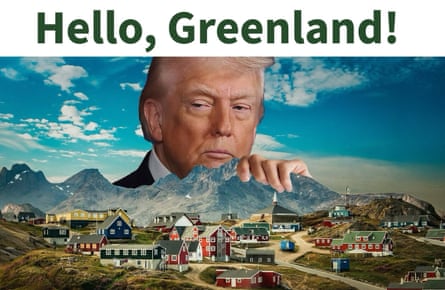
Trump’s Truth Social post. Illustration: truthsocial.com/realDonaldTrump
Executives of Greenland Energy, a Texas company set up last year, have claimed that $1tn of crude may lie beneath the Jameson Land region. They announced plans to spend $60m drilling two wells to find out.
Although Greenland stopped issuing new oil licences in 2021 on environmental grounds, a UK company called 80 Mile had secured exploration rights in Jameson Land. Greenland Energy’s corporate filings say it will take a majority stake in the project in exchange for funding the exploration, though it still needs government permission to proceed.
Licensed to drill? How a Trump-linked Texas oil company is elbowing its way into Greenland
Greenland Energy has retained Phil McGraw, better known as Dr Phil, a prominent rightwing former chatshow host who served on Trump’s religious freedom commission, to make a documentary series that will “capture the mission of these modern-day wildcatters”.
It has also appointed as a director a US navy veteran who is working on Golden Dome, the missile defence plan for which Trump says controlling Greenland is “vital”.
Larry Swets, Greenland Energy’s chair and a big shareholder, appears to enjoy access to Trump’s circle. He has said the oil project is “not related to American annexation”.
After a company representative falsely claimed at a Jameson Land community meeting in June that it had permission to land drilling equipment, Swets said: “Our enthusiasm for the project led us to communicate in a way that created confusion.”
But the next month, local people in the sparsely populated region noticed a tug pulling a barge shorewards and unloading a dozen containers. “The goal was to get the equipment onshore at Nunap Qeqqa [Jameson Land] in connection with planned oil exploration drilling,” the Greenland government’s statement said.
The Danish investigative outlet Danwatch quoted the head of the shipping company as confirming the delivery was for Greenland Energy.
Young arctic foxes in the tundra in Jameson Land. Photograph: Biosphoto/Alamy
Greenland Energy has declined to respond to questions from the Guardian. A letter it sent to shareholders on Thursday said: “Recent high-level meetings between project leadership and Greenlandic regulatory and oversight authorities have been constructive, and we continue to be encouraged by the progress being made toward the remaining approvals required for drilling.” It said that after those discussions, just one well would be drilled to begin with.
As a semi-autonomous territory of Denmark, decisions about Greenland’s natural resources rest with its local elected leaders, who now face a delicate decision. They could grant permission for oil drilling, even though the planned wells appear to fall within a conservation area protected by the Ramsar convention on wetlands. Or they could refuse and, some worry, give Trump a pretext to advance his imperialist agenda.
The Greenland government’s statement said it “would not be proportionate” to demand the equipment be removed. An application for permission remained under processing, it added.
A Greenland Energy representative has said a vessel carrying its 300 shipping containers of drilling equipment is to set sail from Canada on 12 September. Sinking the wells would begin in October.
Jeff Landry, the hard-right Louisiana governor serving as Trump’s Greenland envoy, has said Greenland could be pumping oil next year.
--=-=-
-=-=
GUK
Licensed to drill? How a Trump-linked Texas oil company is elbowing its way into Greenland
Greenland Energy says billions of barrels of crude could lie beneath territory and claims it has permission to bring drilling kit ashore – a claim denied by Nuuk
Thu 9 Jul 2026
On 10 June, a snowy-haired American in his 60s addressed the residents of a remote Greenland hamlet. He was there to tell them about a business venture supported by figures linked to Donald Trump. “So,” Robert Price said via an interpreter, “we have a project to drill for oil here.”
The Texas oil company that Price represents, Greenland Energy, hopes to prove that billions of barrels of crude lie underground by bringing in 300 shipping containers of drilling kit.
“We have the permit to put the equipment on the land,” footage of the gathering in Ittoqqortoormiit shows Price saying. “And then we’ve filed our permits – pending approval – to drill.”
But Greenland’s resources ministry said that contrary to Price’s claim, there were “no actually active permissions for any exploration activity or permissions for preparations for these activities”.
The dispute threatens a showdown between the Trump-linked backers of Greenland Energy and the authorities in the vast, sparsely populated territory. Trump’s lieutenants are using the prospect of an American oil find in Greenland to bolster their case for an American takeover.
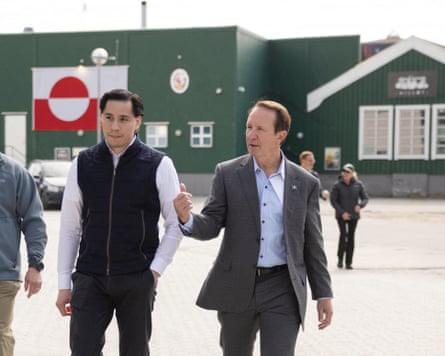
Jeff Landry, right, on a visit to Nuuk in May as Trump’s special envoy to Greenland. Landry said the territory ‘could be exporting 2m barrels of oil a day’. Photograph: Christian Klindt Soelbeck/Ritzau Scanpix/AFP/Getty
The US president’s special envoy to Greenland, the hard-right Louisiana governor, Jeff Landry, returned from a visit in May to declare on Fox News: “We need a deal. Greenland needs a deal. We could be – Greenland could be – exporting 2m barrels of oil a day right now.”
Landry, who says his task is to “make Greenland a part of the US”, added: “We could have those barrels on production within 10 months or so.”
Greenland Energy appears to be the only company making plans to drill in the territory. Despite seemingly not yet having permission, it has chartered an Arctic-going vessel to ferry its equipment 4,000km through icy waters to Greenland’s eastern coast.
Price, an energy industry veteran who has become the public face of the company, said the vessel would depart in two months, on 12 September, with drilling to begin in October. Halliburton, the giant Houston-based contractor once led by the former Republican vice-president Dick Cheney, will run the logistics.
Ever since Trump made his imperial desires for Greenland explicit, US business interests have been gaining footholds in its vast expanses. The ventures range from rare-earth minerals and hydroelectric power to bottling “luxury” spring water.
Greenlanders have watched nervously as Trump has exercised US military power and toyed with doing so in the Danish territory. The day after he sent special forces to snatch the leader of Venezuela, Trump said: “We do need Greenland, absolutely.” Trump cited oil as the reason the US needed to stamp its authority on Venezuela. The US has since extracted oil revenues of about $8bn with scant oversight.
Arriving at this week’s Nato summit in Turkey, Trump renewed his call for the US to wrest control of Greenland from Denmark.
Among those alarmed is Avaaraq Olsen, the mayor of the region that covers the capital, Nuuk, and extends east across Jameson Land, where the oil drilling is planned. She said she was “so afraid” that Americans striking oil could align with Trump’s plans.
“We are like the most peaceful place on Earth,” she said. “And we have always lived in peace and harmony. And suddenly there is all these Americans trying to take over.”
The coast of Jameson Land in north-east Greenland. Greenland Energy has chartered an Arctic-going vessel to ferry its equipment 4,000km through icy waters to Greenland’s eastern coast. Photograph: Biosphoto/Alamy
Licence to drill
Greenland stopped issuing licences to explore for oil in 2021 after 50 years of fruitless drilling. “The environmental consequences of oil exploration and extraction are too great,” a minister said at the time.
But a handful of licences remained valid. They included some covering a chunk of Jameson Land, a region closer to London than to Washington. These licences belong to a company registered in the UK called 80 Mile.
It is those licences that Greenland Energy, formed last year and listed on the Nasdaq stock exchange in New York, is hoping to exploit by putting up $60m to drill two wells in exchange for a majority stake in the project.
Price has claimed that crude worth $1tn (£750bn) could lie beneath Jameson Land. “I believe it’s there,” he said during the meeting in Ittoqqortoormiit, a settlement of 300 people in Jameson Land. “The scientists believe that it’s there. But until we drill these wells, we don’t know.”
The wells are expected to be drilled in an area protected by the global Ramsar Convention to preserve wetlands, which hosts important populations of wildlife including muskoxen. Photograph: Biosphoto/Alamy
The wells are expected to be drilled in an area protected by the global Ramsar Convention to preserve wetlands. David Boertmann, an expert on Greenland’s birds, said the conservation zone hosts important numbers of barnacle geese and pink-footed geese as well as whimbrel, golden plover, Sabine’s gull and snowy owl, plus muskoxen. Oil exploration activities could threaten the birds’ habitat, Boertmann said.
Greenland Energy’s stock market filings make clear that its plans can go ahead only if Greenland’s government grants permission for drilling and for it to take a stake in any oil extraction that follows.
Múte B Egede, Greenland’s minister for mineral resources, said Greenland Energy’s ‘statements to the public do not always reflect the actual situation’. Photograph: Mads Claus Rasmussen/EPA
There are signs that the government may be reluctant to do so. Days after Price’s comments, Greenland’s minister for mineral resources, Múte B Egede, said he could “understand if citizens are concerned” about the project’s connections to Trump.
He added: “Activities cannot be carried out until the necessary permits have been granted. I must say again that the company’s statements to the public do not always reflect the actual situation.”
Greenland Energy declined to respond to questions from the Guardian. But Larry Swets, a financier who is one of Greenland Energy’s biggest shareholders and serves as executive chair, has acknowledged: “Our enthusiasm for the project led us to communicate in a way that created confusion about who is responsible for what in Greenland – and that benefited no one, least of all the local communities closest to the project.”
The tundra of Jameson Land, which includes a conservation zone that is home to a number of bird populations. Photograph: Biosphoto/Alamy
Trump connections
At the Ittoqqortoormiit meeting, one person asked whether Swets had “close relations with Trump”. Price replied: “Not that I know of.”
Social media posts by Swets’s wife appear to show that this year she visited Trump’s Mar-a-Lago club. Swets did not respond to questions about whether he had accompanied his wife to Trump’s Florida residence, which serves as a presidential court away from the White House.
Although Swets has said the oil project is “not related to American annexation”, Greenland Energy’s connections to the US president are growing, as the company amasses an eclectic array of Trump-linked backers.
In April, the Wall Street billionaire Kenneth Griffin bought 9% of Greenland Energy’s shares. Griffin is a Republican mega-donor and, despite criticising the Trumps’ self-enrichment, gave $1m towards the president’s second inauguration.
Then in June, a US Navy veteran, Carol Craig, joined Greenland Energy’s board. Sidus Space, the defence tech company she founded, is working on Trump’s Golden Dome missile defence system. Trump has said that controlling Greenland, home to the US armed forces’ space base at Pituffik, is a “vital” part of the Golden Dome plan.
The same month, Greenland Energy announced a deal with Phil McGraw’s Envoy Media. Better known as Dr Phil, the TV personality’s 20 years hosting a talkshow that spun out of Oprah Winfrey’s show made him a household name in the US.
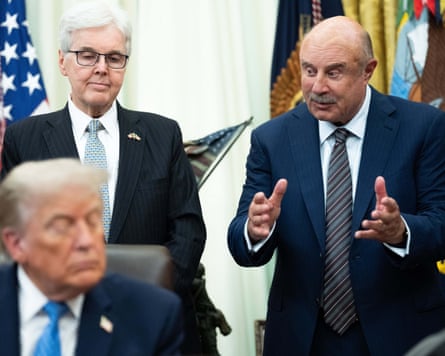
Phil McGraw, right, better known as Dr Phil, is making a documetary series about Greenland Energy. Photograph: Abaca/Shutterstock
McGraw spoke at a Trump rally in 2024. After Trump’s victory, McGraw “embedded” himself with ICE agents enforcing Trump’s immigration crackdown. His latest venture, a documentary series about Greenland Energy, will be broadcast on cable and social media and, according to the company, will “capture the mission of these modern-day wildcatters”.
Discussing the prospect of oil with Swets and Price in a YouTube curtain-raiser, McGraw says: “We’ve heard Trump talk about buying Greenland and everybody laughed, but actually there is some real value to Greenland.”
Days later, McGraw was in the Oval Office with Trump, saying how honoured he was to serve on the president’s Religious Liberty Commission. “Thank you very much, Phil,” Trump said. “I appreciate your support.”
Some Greenland Energy shareholders are hoping the president will show similar appreciation for its Arctic oil exploration. On a dedicated Telegram group, they discuss what might send the company’s stock price higher. Referring to a presidential plug for the company that could make them richer before a drop of oil has been drilled, they are hoping to secure what they are calling a “Trump pump”.
-=-=
RFK2 KRATOM JERRY CASH
-=-=
7 26
WSJ NO LNX
‘The Boss Wants This Money’: Inside Trump’s Unprecedented Fundraising Operation
Meredith O’Rourke, nicknamed ‘princess of darkness,’ carries out president’s desire to wring hundreds of millions from companies for his projects
By
Josh Dawsey
,
Dana Mattioli
,
Annie Linskey
and
Emily Glazer
July 30, 2026
WASHINGTON—Almost every night in the White House, President Trump calls his fundraiser, Meredith O’Rourke, for an update.
Trump asks O’Rourke which companies and donors have cut checks and which haven’t, and for how much. He often asks her to make much larger financial requests than she was planning—for some donors the ask is $5 million, for others it is $50 million. And the president gives her names to call, often including people who have recently met with him, according to people with knowledge of the calls.
“This is very important to the president. He’s asked me to call you and ask you for this donation,” O’Rourke has relayed on phone calls with companies, persistently following up with them. In some calls, she has referred to Trump as the boss, saying “the boss wants this money.” In turn, Trump has called her the “princess of darkness” because she is such a “killer” with donors, according to people who have heard his comments.
SoftBank donated $50 million toward Trump’s presidential library. Apple cut a check for around $25 million toward his White House ballroom project, while Microsoft gave around $10 million and Amazon chipped in around $5 million, according to people familiar with the contributions. Meta Platforms recently gave $10 million to a Trump-aligned political committee, people familiar said, on top of a multimillion donation to the ballroom and a prior $22 million payment to the planned presidential library.
Trump stands out for taking personal control of the fundraising, and no sitting American president has ever raised these amounts for his pet projects. At the same time, companies have paid new attention to the White House as Trump has gotten involved in regulatory decisions that once were made by independent agencies, dramatically shifting the balance of power across Washington.
Trump has been demanding large checks from companies for a range of political and legacy projects—telling executives and lobbyists that their companies should give $25 million or $50 million. He has sometimes offered donors special access.
Aerial view of construction at the White House, with a helipad being built on the South Lawn and a ballroom under construction on the right.
Construction on the helipad and the ballroom at the White House this month. Rahmat Gul/Associated Press
No laws prohibit presidents from raising unlimited sums of money for nonprofits, like the ones used for the ballroom and his presidential library, his super PAC or political issue committees. For most of these types of transactions, public disclosure of donors isn’t required and reporting on spending is infrequent.
All told, the second-term president has raised more than $800 million since returning to office, according to an updated Wall Street Journal analysis.
Some of the money is earmarked for specific projects, including the White House ballroom and the Freedom 250 funds for the nation’s birthday celebrations, but Trump has floated using funds in other ways. The president, at the dinner thanking contributors to the ballroom project, said, “We’ll have money left over, and we’ll use that for something…maybe for the arch or something else that will come.”
Interviews with dozens of donors, executives, lobbyists, Trump advisers and others indicate a staggering fundraising and influence operation, with Trump at the center of it all. The president closely tracks who gives, aides said, repeatedly assigning O’Rourke with big asks that she has told others make her uncomfortable. Danielle Alvarez, an outside spokeswoman for Trump and O’Rourke, said it was “laughable” that O’Rourke had ever been uncomfortable with a request.
Chevron was asked to give $50 million this year. The oil company gave millions, but far less than the requested amount. Several top Washington lobbyists have been asked to raise $50 million or more, including from their clients, for Trump projects.
Meta executives convened a series of calls among themselves to discuss strategy after being repeatedly asked to give money to various Trump funds. The company has donated to the inauguration, the ballroom and two Easter events. About $22 million of Meta’s money went to the library after the social-media company agreed to settle a lawsuit Trump had filed for suspending his accounts.
Meta also wrote a $10 million check to Securing American Greatness, a political committee aligned with Trump that highlights conservative issues such as lowering taxes and reducing crime. Contributions to Securing American Greatness aren’t publicly reported, unlike contributions to super PACs, which disclose donors in regular filings.
When some donors have been put on the phone with Trump after giving millions, they expected to receive thank yous, but instead were asked for more money, people familiar with the calls said. In one case, O’Rourke asked an executive to cut a $1 million check to a Trump entity just days after he’d attended a thank you dinner for a separate multimillion-dollar donation he’d made to the president’s ballroom, according to a person familiar with the exchange.
“Trump is shattering all fundraising paradigms in regards to hitting up corporate America for donations. The scope is mind-bogglingly large,” said Douglas Brinkley, a presidential historian at Rice University. “We used to talk about the Lincoln bedroom being for sale, but this is just a wholesale money trough that’s totally different.” Critics alleged in the 1990s that the Clinton administration allowed overnight stays in the White House’s Lincoln bedroom in exchange for campaign contributions.
Place setting at a dinner for US President Donald Trump, with a name card reading "The President."
A place setting for the White House dinner for ballroom donors in October. andrew caballero-reynolds/Agence France-Presse/Getty Images
In the Rose Garden on a warm April evening, some of the president’s biggest donors mingled with top White House aides and the president. Some of the guests received special tours, including of the Oval Office at night. “Have you ever seen anything like this?” Trump said on the tour, people with knowledge of the event said.
Then one businessman stood up. It was the reclusive billionaire Timothy Mellon, who has donated millions of dollars to Trump causes—even in the form of solid gold, some of the people said. Mellon has contributed more than $100 million to MAGA Inc., Trump’s super PAC.
He gave a toast to the president, several Rose Garden attendees said. He called Trump the “greatest president in my lifetime.” His remarks drew polite applause from the Fortune 100 executives arrayed around him.
At another Rose Garden dinner, Google co-founder Sergey Brin was seen sitting next to White House chief of staff Susie Wiles.
The White House referred requests for comment to Alvarez. She said the president is the “most successful fundraiser in modern political history” and that Trump plans to use the money to “help Republicans win big in the midterms, build an enduring political infrastructure and continue advancing innovative private-sector initiatives.”
“One thing has never changed. President Trump can’t be bought,” she said.
Change from first term
Trump’s stance on fundraising has dramatically changed from when he was first running for president. In 2015, he called political-action committees a “scam” and said he had disavowed them. His team sent letters to unauthorized super PACs that were supporting his election efforts, asking them to return their money to donors. “I am self-funding my campaign and therefore I will not be controlled by the donors, special interests and lobbyists who have corrupted our politics and politicians for far too long,” he said at the time.
Marc Short, Trump’s former director of legislative affairs, said, “One of the things that most rallied his crowds in 2016 was draining the swamp. The crowds would go wild.”
Short and other former administration officials said Trump had little interest in fundraising during his first term. “There definitely wasn’t a corporate shakedown like you see now,” he said, adding that the president during his first term didn’t aggressively seek money from companies with business before the government.
Read more
The Mystery Money Powering Trump’s Second Term
Trump would sometimes berate aides for signing up too many donors to take photos on “click lines” and would leave events as soon as he finished speaking. In the first term, he regularly complained that the money went to entities such as the Republican National Committee that he didn’t control, and viewed it as an obligation.
In 2020, Trump raised money for his re-election campaign but wasn’t notably aggressive about it.
Wiles had to persuade Trump during the 2024 campaign to do fundraising calls. But he embraced big money on the campaign trail, even asking oil executives to give $1 billion at a Mar-a-Lago event in April 2024. At one point, he told donors he wouldn’t have lunch for less than $5 million, according to audio from a 2024 fundraiser reviewed by the Journal.
O’Rourke, a well-known fundraiser in Florida, was part of Trump’s 2016 and 2020 operations. In the 2024 cycle, she was tapped to lead fundraising for the whole campaign. She opted to drive six hours between the Trump campaign headquarters in Palm Beach and her homebase in northwestern Florida instead of flying so she could spend the time on back-to-back calls with donors. Driving also ensured she wouldn’t be out of touch for the hourlong flight, according to people familiar with the campaign.
Eric Trump, Susie Wiles, Steve Witkoff, and Meredith O'Rourke listen at a news conference.
Eric Trump, Susie Wiles, Steve Witkoff and Meredith O'Rourke listened to President-elect Trump speak at Mar-a-Lago on Jan. 7, 2025. Evan Vucci/Associated Press
After the 2024 election, Trump realized how many donors and companies were lining up outside his Mar-a-Lago club to cut multimillion-dollar checks and told O’Rourke to immediately start soliciting donations, advisers said. She was planning to slow down operations. Strike while the iron is hot, Trump told O’Rourke, according to Trump advisers and an account the president has repeatedly given in private settings.
O’Rourke isn’t a government employee, although she is often at Trump’s side in the White House and elsewhere. She sometimes sits in on meetings, including when Trump meets with corporate executives about issues that affect them. O’Rourke also travels with top officials on Air Force One. She often posts photos of herself with Trump, including in the Oval Office, on her social-media accounts and has referred to Trump as a mentor.
At a meeting with tobacco executives in May at Trump’s golf club in Jupiter, Fla., the president promised to do much of what executives wanted on policy related to vaping and the Food and Drug Administration. He also took in millions of dollars in contributions for his political committees. O’Rourke sat in on the meeting. Shortly after the meeting, the FDA lifted restrictions on some flavored vaping products, and the FDA’s chief was gone.
At the time, White House spokesman Kush Desai said, “The only guiding factor behind the Trump administration’s health policymaking is Gold Standard Science. FDA’s regulatory treatment of nicotine pouches and vapes is rooted in recent evidence that has found they can help adults quit smoking.”
O’Rourke was appointed a director at Trump Media & Technology, owner of Truth Social, and named to the board of the National Park Foundation, which oversees the Trump-aligned group that raised money for Freedom 250.
Trump, tapping his real-estate sales roots, has conversations with O’Rourke about how to specifically sell various projects, giving her pointers on how to pitch the library, according to people familiar with the conversations. Trump has told allies that he doesn’t want to struggle to raise money for his library the way Joe Biden has. Plans for the Trump library show a glass-walled skyscraper that is expected to also have a hotel.
“She’s a combination of tough but charming, and she absolutely has the president’s 100% trust and respect,” said Brian Ballard, a top Washington lobbyist who first worked with her in Florida in the 1990s. “She literally is the most talented fundraising professional I’ve dealt with, and I’ve dealt with a ton of them.”
In the spring, even as Republicans were gearing up to raise money for the midterms, O’Rourke began sending out solicitations for a new Trump initiative called the National Garden of American Heroes Foundation. The money will be used to remake a golf course in Washington and build a statue garden.
Candlelight dinners
O’Rourke sends out invites to prominent CEOs and their handlers and lobbyists to attend $1 million-per-head candlelight dinners at the White House or one of Trump’s properties, where guests are given extraordinary access to the president. Many of the events are arranged by industry, such as cryptocurrency or manufacturing.
O’Rourke often attends the dinners and takes notes about what the president promises and what the donor says, and she will filter the notes to other White House officials. Trump will often ask the donors to follow up with O’Rourke, attendees said.
Guests listen to President Donald Trump at a dinner for donors to the White House ballroom.
Guests listened to Trump speak at the ballroom-donor dinner at the White House. John McDonnell/Associated Press
At times, donors with particular agendas have shown up, such as a marijuana CEO pushing for changes in drug laws or the CEO of Pfizer who talked up experimental cancer drugs.
A regular presence at Trump’s dinners are cryptocurrency executives. The president has made more than $1.4 billion from his family’s crypto-related ventures since taking office, his financial disclosures show, and has often told the cryptocurrency crowd how he has made them richer.
The president sits at the center point of a horseshoe-shaped table and often stays for two hours. At Mar-a-Lago, he sometimes gives private tours of the gilded lobby. At an April event at Trump’s winery in Charlottesville, a TV was wheeled in so donors could watch with Trump the progress of astronauts returning to Earth, attendees said.
The president is often solicitous and warm at these fundraisers, asking each CEO to introduce themself. There are regular guests, such as OpenAI’s Sam Altman. Last year, OpenAI co-founder and president Greg Brockman and his wife personally contributed $25 million to Trump’s super PAC.
Trump has surprised donors at how long he will stay and talk. Within 24 hours of launching the war in Iran, he attended a lengthy $1 million-a-plate fundraiser in Florida. Many expected he would cancel, and the event was interrupted at one point for him to learn that Iran’s Supreme Leader Ali Khamenei had been killed. After that, Trump listened to a range of corporate concerns and even engaged in a lengthy back-and-forth with Verizon’s CEO about what kind of cable was best.
Trump also asks lobbyists to set up meetings at his golf clubs and properties. The lunches are often lighthearted, with celebrity athletes stopping by the table. There, he often meets with executives over burgers, before telling the lobbyist later how much the client should give.
“What can I do to help you?” Trump has said at multiple events, according to attendees. “What do you need?” he asked CEOs at a Florida event.
President Trump with John Ratcliffe, Marco Rubio, and Susie Wiles at Mar-a-Lago, overseeing "Operation Epic Fury."
Trump and advisers at Mar-a-Lago on Feb. 28, when the U.S. launched strikes on Iran. Daniel Torok/White House/Getty Images
Senate Democrats have noted that some of the corporate donors have later been the beneficiaries of regulatory changes. “Money well spent! Your company’s millions of dollars in recent investment in President Trump’s political operation appears to have enabled tobacco manufacturers to circumvent federal law and unlawfully sell unauthorized e-cigarettes,” six Democratic senators wrote in a June letter to Altria’s CEO, saying the company contributed to the president’s ballroom and inauguration.
The company responded to the senators, describing policies it said would protect youth and reduce tobacco-related harm and saying it welcomed an opportunity to discuss the issue with legislators at greater length.
Government business
Executives said Trump is one of the most accessible presidents in recent times. In private, they acknowledged that this administration is much more transactional than prior ones. If a company encounters an issue with the federal government that comes to Trump’s attention, he will want to know how much money the company gave, according to a person familiar with the matter. At times he’ll rib the corporate leaders who haven’t met the goals he set, the person said.
Several CEOs and board members said they believe there is a link between their contributions and their access to the president. One chairman of a publicly traded company said that if you give the money, you know you are either checked on a list, or crossed off a list if you don’t.
Some lobbyists said they tell their clients to be noncommittal when Trump asks for a large donation and to say they’ll get back to him and his team. Many of the corporate donors have business before the government, are seeking federal contracts or are lobbying on a range of issues from trade policy to defense policy and appropriations.
Lockheed Martin gave more than $10 million in late 2025 and early 2026 related to America’s 250th anniversary and infrastructure projects in the Washington area, people familiar with the matter said.
A company spokesperson said “Lockheed Martin has a long history of supporting projects in both the Washington, DC, area and across the country.” The spokesperson added that its engagement with the government is guided by compliance standards and follows applicable laws and regulations.
In June, the Pentagon awarded Lockheed a contract worth up to $35 billion to make missiles to replace U.S. stockpiles drawn down by the war with Iran. A few weeks later, Trump revealed that Lockheed had agreed to pay roughly $5 million toward a new helipad he is now building at the White House.
Workers constructing a helipad on the South Lawn of the White House.
Workers assembled the presidential seal on the helipad. Finn Gomez/Getty Images
Freedom 250, the Trump group that organized anniversary celebrations, raised more than $50 million, according to people familiar with the matter, and invited donors and other participants to a wine reception at the White House with Trump in the spring. Social-media platform TikTok gave around $2 million toward Freedom 250, according to people familiar with the matter. Other donors contributing more than $1 million each toward the anniversary included Oracle and ExxonMobil.
When SoftBank CEO Masayoshi Son’s team approached the White House offering support, they were told to give funds to the presidential library. SoftBank gave $50 million to the project, according to people familiar with the matter.
One of Son’s ideas for the space is to use a portion of that money to create an area in the library dedicated to the relationship between the U.S. and Japan, one of the people said.
Trump has taken in money from deep-pocketed companies and their owners through lawsuits or threats of litigation. The president has told his lawyers that he wants bigger payouts from media companies and others he believes have wronged him, according to people familiar with the discussions. ABC News and CBS parent Paramount have reached settlements with the president that included around $15 million each for the Trump library to end lawsuits.
Trump has filed a lawsuit against Dow Jones, the publisher of the Journal, alleging he was defamed by an article about a birthday letter to disgraced financier and sex offender Jeffrey Epstein. A Dow Jones spokesman said, “We have full confidence in the rigor and accuracy of our reporting, and will vigorously defend against any lawsuit.”
Companies have traded notes about what Wall Street analyst Blair Levin calls “The Trump Transaction Tax,” or a payment outside of the cost of normal business. “Another way of saying it,” Levin said, “is simply that we’re replacing the free market with the market for Trump’s affections.”
Donald Trump speaks at a fundraiser for a White House ballroom expansion.
The dinner for ballroom donors was held in the East Room of the White House. Jim LoScalzo – Pool via CNP/Zuma Press
In October, Trump hosted companies and donors that contributed to the ballroom project for a dinner in the White House’s East Room. Standing at a lectern with a model of the planned ballroom next to him, the president recounted the ease of his fundraising.
“So many of you have been really, really generous,” Trump said. “I mean, a couple of you, I was sitting here and saying, ‘Sir, would $25 million be appropriate?’ They said, ‘I’ll take it.’”
He added: “It doesn’t take too many 25s to get it done.”
“Chief executives throughout the history have contributed to making the White House special,” Trump said, “and nothing of this magnitude has been done.”
Copyright ©2026 Dow Jones & Company, Inc. All Rights Reserved. 87990cbe856818d5eddac44c7b1cdeb8
Appeared in the August 1, 2026, print edition as '‘The Boss Wants This Money’: Trump’s Fundraising Operation'.
Josh Dawsey is chief political correspondent for The Wall Street Journal. He began his career at the Journal and re-joined the newspaper in 2025 after working for eight years at The Washington Post. Josh was part of a team of journalists at The Post that won the Pulitzer Prize for Public Service in 2022 and a team that won the 2024 Pulitzer Prize for Public Service. He is the winner of the 2026 Aldo Beckman Award for Excellence in Presidential News Coverage and a two-time recipient of the White House Correspondents Association award for deadline news reporting.
Josh is a lecturer at the Allbritton Journalism Institute and the enthusiastic owner of a rambunctious rescue dog named Pepper.
Follow
Dana Mattioli is a Pulitzer Prize-winning technology investigations and enterprise reporter for The Wall Street Journal in New York. She does deep dives on technology, politics, antirust and other subjects. Prior to this role, she led investigations into Amazon's business practices, market power and antitrust issues. She is the author of the book "The Everything War: Amazon’s Ruthless Quest to Own the World and Remake Corporate Power," which was longlisted as one of the best business books of 2024 by the Financial Times and named a best book of 2024 by Publishers Weekly.
Dana was part of a WSJ team that won the 2025 Pulitzer Prize in National Reporting for coverage of Elon Musk. She was part of a team that was a Pulitzer Prize finalist in 2020 for its investigation into Amazon, and was the winner of the 2021 Gerald Loeb Award for Beat Reporting. In 2021, she received the WERT Prize, an award from the Women’s Economic Round Table that honors excellence in comprehensively reported business journalism, and received a Front Page Award for her Amazon coverage. In 2026, she received the Nellie Bly Award from the Newswomen's Club of New York.
Dana earlier covered mergers & acquisitions, where she and colleagues broke some of the largest deals ever recorded, including Pfizer’s $150 billion deal to buy Allergan. In 2016, she won a Gerald Loeb Award in the breaking news category for coverage of the Dow-DuPont merger. She was a finalist for the 2015 Larry Birger Young Business Journalist Award.
Before covering M&A, she reported on retail companies and produced a string of front-page articles and scoops on the troubles at Kodak and J.C. Penney as well as the M&A exploits of various retailers.
Dana started at the Journal in 2006. She graduated from American University in Washington, D.C., with degrees in journalism and literature.
Follow
Annie Linskey is a White House reporter for The Wall Street Journal, a role she assumed in 2022 after covering national politics for the Washington Post, the Boston Globe and Bloomberg News. Her reporting spans three presidential campaigns, four administrations and four continents. She was part of the team of reporters writing about President Trump’s ties to Jeffery Epstein—a body of work that won the Katharine Graham Award for Courage and Accountability and was a finalist for the 2026 Pulitzer Prize for Public Service. Her reporting on Trump’s efforts to profit from the presidency was recognized with an honorable mention from the Sabew Best in Business Awards.
Prior to that, her reporting on the Biden administration and the president’s decline in office was recognized with the Gerald R. Ford Prize for distinguished reporting on the presidency, the National Press Club’s Lee Walczak Award for political analysis and the New York Press Club’s National Award.
She started her journalism career at the Baltimore Sun more than two decades ago, where she focused on crime and later city and state politics. She also freelanced from Cambodia, covering the Khmer Rouge war crimes trials.
Follow
Emily Glazer is a Pulitzer Prize-winning enterprise reporter focusing on business leaders, power and influence for The Wall Street Journal in New York. Her articles often focus on the intersection of business and politics, CEO succession, board shakeups or regulatory investigations. Emily also contributes to the Journal’s Personal Board of
-=-=
AN 7 26
An eccentric billionaire is accusing President Donald Trump of fraud relating to his family's biggest recent grift scheme, and in an interview with The Intelligencer magazine, further accused the president of "threatening" him to keep quiet.
Intelligencer called Chinese billionaire Justin Sun "one of the richest people in the world, having made his fortune in the no-rules early phase of the crypto industry" in its Monday profile, further detailing how he invested $30 million in the Trump family's crypto firm World Liberty Financial and joined it as an advisor in late 2024. The firm has emerged as the epicenter of the Trump family's cryptocurrency dealings, and, in the wake of numerous shady deals, is now considered its biggest overall financial venture.
As he moved forward with World Liberty Financial, however, Sun came to see the investment as a "colossal mistake," as the firm's promised products never materialized and its various tokens crashed in value, costing investors massive sums of money. In April of this year, he sued the company, "alleging fraud and breach of contract."
"Today, the thing I regret the most is not only that my money got stuck but that my name is on the project,” Sun told the outlet. “I believe many other people also got harmed... I never expected this to happen to me. This is the worst-case scenario."
He added further: “I thought surely these people would not do what they did with such a public profile attached. Looking back, I was wrong about that. Unfortunately, as alleged in the complaint, certain operators leveraged the Trump brand to profit through fraud.”
Sun's suit against World Liberty notably does not name either Trump or his sons, Donald Trump Jr. and Eric Trump, and he claims to remain an "ardent supporter" of the president. He insisted to one source who spoke with the Intelligencer that the suit is not a "political issue," and accused the company of acting "like young punk criminals" and giving the crypto a industry a bad name.
The company, meanwhile, did not sit back in response to Sun's suit.
"On May 4, a couple of weeks after Sun filed his suit, World Liberty sued him for defamation," the report detailed. "Represented by the law firm Clare Locke, which successfully sued Fox News over its 'big lie' coverage following the 2020 election, World Liberty tells a different version of events. Though sections of its accusations are redacted, World Liberty claims in the suit that it froze Sun’s coins to 'protect' itself and its investors from prohibited conduct by Sun. Just before the $WLFI tokens started trading, the company alleges, Sun placed a large bet against them, transferring $300 million 'to fund an aggressive short position.' It also claims Sun made 'straw purchases' on behalf of other investors. Notably, though, World Liberty did not sue Sun for breach of contract or fraud."
Sun dismissed this suit as an effort to silence him.
“I believe that World Liberty is trying to threaten me into silence, but that will not work,” he said. “I stand by the decision to speak out about conduct that I believe was improper and harmful to token holders... I believe the evidence will prove our allegations to be true.”
AN 7 26
Calling him out for an unprecedented level of "shameless corruption and sheer moral repugnance" as he attempts to cash in on his father's office, a new breakdown from MS NOW argued that Donald Trump Jr. just might be the "worst presidential relative ever."
In a piece published Sunday morning, author and commentator Paul Waldman noted that "problematic presidential family members are an American tradition as old as the republic," noting examples like Theodore Roosevelt's hot-headed daughter, Alice, and Jimmy Carter's "colorful buffoon" brother, Billy. Under the second administration of President Donald Trump, however, he argued that his oldest son, Donald Trump Jr., has become the "new standard by which all future misbehavior among presidential offspring should be judged."
While admitting that the younger Trump has not actually committed any crimes, Waldman argued that in an age when anti-corruption rules are so lax, "all that stops Don Jr. from enriching himself at public expense is shame or a sense of morality — and he is clearly possessed of neither." He also, seemingly, has been spurred on by his father's own relentless pursuit of self-enrichment.
"When it comes to grasping for taxpayer money, shameless corruption and sheer moral repugnance, none who came before can hold a candle to Donald Trump Jr.," Waldman wrote. "He has cemented his position as perhaps the most distasteful and ethically compromised presidential relative in American history — and his father isn’t even halfway through his second term."
He continued later: "Don Jr. wasn’t just going to sit by and watch Dad have all the fun. So he has undertaken his own frenzy of dealmaking, all of it seemingly based on the fact that he’s the president’s son. Some of the enterprises are joint ventures with the whole family. There’s World Liberty Financial, a crypto company that has been the vehicle for some of the biggest players looking to give payoffs to the Trumps and get something in return. As an investigative report revealed, the United Arab Emirates’ national security adviser secretly invested half a billion dollars in the company. Not long after, the Trump administration lifted export controls on computer chips the UAE desperately wants to create its own artificial intelligence infrastructure (Commerce Department staff objected to the change, but the White House cites the UAE’s position as a U.S. ally.)"
Donald Trump Jr., alongside his younger brother, Eric Trump, have also found ways to consistently cash in on the U.S. government's increased defense spending. As Waldman described the dynamic, the siblings have made investments in smaller defense companies, "then watch as huge government contracts magically materialize." Another company they are extensively invested in, Kaz Resources, received $1.6 billion in investments from the federal government, and saw the president himself intervene to make sure the company received special access to tungsten mines in Kazakhstan as part of a new deal with the country.
"Don Jr. has always had the air of a man desperate to please his indifferent father," Waldman concluded. "This spring, the president couldn’t even be bothered to attend his son’s wedding. But if he keeps this up, he’ll be able to say, 'See Dad, I’m just as greedy and corrupt as you!' It’s an achievement no presidential relative can match."
an 7 26 grift truth soc
Inside the secret $100K tool giving traders Trump's news first
an 7 26
Since returning to the White House one year and a half ago, Donald Trump has used to the U.S. Department of Justice (DOJ) to target his political foes — from former FBI Director James Comey to New York State Attorney General Letitia James — while pardoning allies, loyalists and supporters, including those connected to the January 6, 2021 attack on the U.S. Capitol Building. According to former Energy Department Director William S. Becker, Trump is creating a two-tiered justice system in which his allies are exempt from all "legal accountability."
"In his second term, Trump is doing more than ignoring legal and ethical constraints on his behavior," Becker argues in a Monday op-ed for The Hill. "He is helping his allies escape legal accountability, too. He has subverted equal justice to create two classes of citizens: one privileged, the other persecuted. The privileged group includes around 1500 supporters who participated in the Capitol riot on January 6, 2021. As president, Trump not only released them from jail and erased most of their criminal records, but he also wants to pay them millions of taxpayer dollars in restitution for the inconvenience of facing justice for trying to overturn a lawful election."
Becker continues, "Trump has also granted pardons to people who have given him political donations and financial favors, as well as to colleagues with whom he has direct financial or political ties. This pay-to-play scheme is wildly unethical, but the Constitution does not limit the president's pardon power. At last count, Trump's pardons had not only deprived victims of justice; they also wiped out nearly $2 billion in court-ordered fines, forfeitures and restitution for victims and taxpayers."
The "privileged group," according to Becker, "apparently includes the 1835 loyalists Trump has appointed to federal jobs as well as his 22 Cabinet-level officers."
"Thus protected, members of his Cabinet have openly lied to Congress and ignored laws," Becker laments. "For example, Acting Attorney General Todd Blanche refuses to comply with the bipartisan law that requires him to release all files related to sex offender Jeffrey Epstein. The withheld files may contain additional references to Trump. They also contain the allegations against the 'Epstein class' — that is, other rich and prominent people who live lives of leisure, lack moral scruples and could have been involved in Epstein's crimes. The Just
an 7 26
Trump's no-bid contract spree is worse than anyone thought —and it's just the beginning
THOM 7 26 AN PENDLETON ACT SLAUGHTER
AN 7 26
One of the Trump family's companies this week unveiled the latest in their long line of moneymaking schemes, and according to the D.C. insiders at Pod Save America, it constitutes "truly one of the most wildly corrupt things that has ever happened."
President Donald Trump, his family and their many business holdings have been doggedly determined to milk as much money as possible out of his second term through an unending parade of schemes and grifts. As Trump himself admitted in a recent interview, he has felt no compunction about profiting off his station after realizing that no one would stop him if he did.
Earlier this week, the Trump Media & Technology Group, which owns Trump's Truth Social platform, announced its intention to sell early access to "market-moving" posts on the platform from some of its "highest-ranking" accounts. The president is by far and away the biggest account on Truth Social, with his continued use of it over other social media sites being essentially the only reason it still exists. In effect, the plan appears to be selling early access to Trump's posts so that banks and traders can take advantage of how they will impact the stock market.
In one of the most recent episodes of the podcast, the former Obama administration officials at Pod Save America dug into the news, calling it an alarming new low for Trump's corrupt second-term pursuits.
"Why don't they just start asking the Treasury to print money for the Trumps?" co-host Jon Favreau, the former head speechwriter for Barack Obama, said. "That is, I don't know why we're going through all of these schemes and this and that. Everything's so complicated. Just go to [Treasury Secretary] Scott Bessent, ask him to start printing money, put it in your pocket, walk away."
The other co-host, former senior Obama comms advisor Dan Pfeiffer, did not mince words with his reaction to the news.
"This is truly one of the most wildly corrupt things that has ever happened," Pfeiffer said. "And that's saying a lot."
Pfeiffer also stressed that, despite the fact that Truth Social is a "stupid platform" that few people outside of political circles pay attention to, Trump's posts there are legitimate presidential statements. In effect, he said, this new plan from the Trump Media & Technology Group would be akin to past presidential administrations giving Wall Street early access to official speeches or press releases.
"Example: president announces a new ceasefire with Iran, you can use that to buy oil futures," Pfeiffer explained. "He says the end of the ceasefire, you can sell your oil futures faster than anyone else because you have paid money to the president to get access to that market-moving information before everyone else in this country."
He further suggested that the move represented an "abuse of power" from Trump, as well as an example of "a high crime and a misdemeanor," referring to the sorts of offenses for which a president could be impeached.
---
kush looking for another 5 bill$
---
an 7 26
Even Trump’s teleprompter operator is doing alleged insider trading
CRM SPLIT
MMA
7 26
...Others on the right have denied, excused, or downplayed Trump’s self-dealing
- Fox host Greg Gutfeld excused Trump's Qatari jet and crypto ventures, saying that Trump was “making billions before and he will make billions after.” Gutfeld said, “He didn't put a gun to anybody's head and took money from them” and questioned, “How much money did the Clintons and the Obamas make after they were president?” [Fox News, The Five, 7/1/26]
- After Fox anchor Bill Hemmer talked about the danger of “investigations” into the Trump family if they “lose control of Congress,” Fox & Friends co-host Brian Kilmeade said, “Both Eric and Don said they have nothing to do with that mining company.” Hemmer immediately clarified that they were discussing the mine in Kazakhstan. [Fox News, Fox & Friends, 7/1/26]
....
---
MOJO
Donald Trump’s network of family businesses—and network of US government deals with those businesses—is mind-bogglingly wide. A *New York Times*investigation reveals his sons’ latest venture: tungsten mining in Kazakhstan.
The US government recently cut a massive mining deal for the critical mineral with the government of Kazakhstan, whose leader recently said Donald Trump was “sent by Heaven.” Trump’s sons Eric and Donald Jr., and Commerce Secretary Howard Lutnick’s sons Brandon and Kyle, are all tied directly or indirectly to the American company, Kaz Resources, that plans to break ground on the tungsten mine. Kaz Resources is also slated to receive at least $1.6 billion in government funding.
Tungsten, a mineral widely used in missile warheads, fighter jets, and computer chips, has become increasingly difficult for the US to access since China put export restrictions on it in 2025. Since then, the Pentagon has selected contractors to build small tungsten refineries on US military bases, while also looking to expand overseas mining—because no onshore mines are currently operational, and likely won’t be for a long time. And those offshore mining deals may mean big money for Trump and Lutnick-affiliated companies: at least 14 different companies affiliated with one or both families are actively working with the federal government on critical mining deals.
The Kazakh deal was signed on November 6th, without disclosing the Trump or Lutnick families’ involvement. Eric Trump, Donald Trump Jr., Brandon Lutnick and Kyle Lutnick were “doing business with partners in a deal that their fathers were negotiating, continuing a pattern of self-enrichment in the second Trump administration that has few precedents in American history,” Paul Sonne and Eric Lipton of theTimes wrote.
“I can see how the optics might be disturbing to some people,” Pini Althaus, the CEO of Kaz Resources, said. “But that’s unfortunate because this company and this project goes way beyond any one president, let alone any family.”
---
---
MPU 7 26 
VULCAN elements, a three year old startup with 30 employees that makes rare earth magnets.
In August 2025, 1789, invested in Vulcan as a part of a $65 million funding round.
Three months later, the Pentagon gave them a $620 million loan.
the push for this loan came directly from Peter Navarro, Trump's senior trade adviser and a close personal friend of Don Jr.
So close that Don Jr visited Navarro in prison and was one of the few people Navarro's latest book was dedicated He's a friend legitimately can't believe that this is happening to him,
One Pentagon employee told ProPublica that the call came, quote, from the white House.
07/07/2026
by
- Eric Lipton and David Yaffe-Bellany @ The New York Times: Nearly a Million Investors Lost a Total of $3.8 Billion on Trump Crypto Coin
A report from a cryptocurrency analytics firm details how those who bought the Trump memecoin have fared, with most retail investors having lost money while sophisticated traders did better.
---
rww 7 26
- Eric Lipton @ The New York Times: Trump’s Moneymaking Run: Unrivaled in Presidential History
The president’s move to open new business ventures, rather than eliminate potential conflicts, defies a long-held tradition.
- Hemant Mehta @ Friendly Atheist: Trump has now made over $1.5 million from his MAGA Bible grift
The "God Bless the USA" Bible has made the president a lot of money. Not bad for a book he's never read.
---
NEW REPT ON CORRUPT
AN 7 26
‘Stinks to high heaven’: Trump’s favorite newspaper sick of his family's corruption - Alternet.org
---
===
KUDLOW LEANED ON DOD TO APPROVE TRUMP KID DRONE DEAL 5 26
---
AN 5 26
President Donald Trump is accused of having a conflict of interest in a Trump Tower he plans on building the capital city of a former Soviet republic.
Planned for the Georgian capital, Tbilisi, the potential Trump Tower is slated to be constructed on land currently part-owned by the son of a leader who was sanctioned by the United States, according to a Monday report by The Guardian. Specifically it is owned by the International Charity Fund Cartu, which is solely owned by Cartu Group JSC. That group is in turn mainly owned (with a 35 percent stake) by Uta Ivanishvili, the eldest son of the oligarch Bidzina Ivanishvili, who is honorary chair of Georgia’s ruling party and regarded as the de facto leader of the Georgian government.
While the younger Ivanishvili is not under sanctions, Trump’s willingness to do business with them constitutes a potential conflict of interest given that he is still serving as president. By contrast the White House has insisted that “neither the president nor his family” have “ever engaged, or will ever engage, in conflicts of interest”.
In addition to the Ivanishvili family, Trump’s business is also going into partnership with other organizations that could create conflicts of interest including the Archi Group, Biograpi Living, Blox Group and Finvest Georgia, alongside the US-based Sapir Organization. Despite the potential for conflicts of interest, there are no US sanctions against any of those other businesses.
If constructed, the new Trump Tower will be built on a plot in the capital of Tbilisi on top of an old Soviet horse-racing track known as the hippodrome.
“The ownership of only a small peripheral portion of that land has been transferred so far to Central Park Avenue LLC,” The Daily Beast reported. “Completion of the sale of the majority of the plot is due to be made on receipt of payment to Cartu of the purchase price.”
This is not Trump’s only controversy in terms of his various construction projects. He is also accused of having an ethical conflict in the construction of his planned Trump presidential library in Miami. According to Dunn’s Overtown Farm, a nonprofit farm and market in Miami co-founded by historian and psychology professor Dr. Marvin Dunn, Florida gave away valuable land to Trump for the library in a way that is allegedly “corrupt.”
“The court filing immediately cited Trump's own expressed disdain for libraries and museums as proof that ‘corruption’ is afoot, the likes of which Benjamin Franklin tried to prevent by insisting on a domestic emoluments clause in the first place,” Law and Crime’s Matt Naham reported at the time. Dunn’s Overtown Farm alleged in the lawsuit that “with its waterfront views and central location in bustling Downtown Miami, the MDC Parcel would likely sell for over $300 million on the open market, according to local real estate experts. But President Trump paid nothing for it.”
The litigation added that the president does not even "believe in building libraries or museums."
---
AN 5 26
President Donald Trump has been engaged in a historic and ruthless level of corruption since his return to the White House last year, and according to numerous ethics experts who spoke with The New Yorker, it will require a level of reform amounting to "radical surgery" in order to prevent future presidents from doing the same thing.
In a piece published Monday, New Yorker staff writer John Cassidy laid out the ever-expanding scope of Trump's corruption in office, including his trading of stocks for companies with business before the U.S. government and, most damningly, his new $1.8 billion DOJ slush fund that would essentially loot the U.S. Treasury of taxpayer funds to line the pockets of the president and his allies.
For the report, Cassidy spoke with Richard Painter, a law professor at the University of Minnesota who also served as the chief ethics lawyer in the White House under George W. Bush, where he notably halted the hiring of a Goldman Sachs executive as Treasury Secretary, due to the conflict-of-interest laws their appointment would violate. When pressed about the current situation with Trump, Painter said that historical parallels were inadequate.
"[Former President Richard] Nixon had his issues, but I don’t think there is anything like this,” Painter said. “The President is specifically precluded from getting any financial favors from the Treasury while in office.”
Cassidy spoke with a variety of other experts in addition to Painter about what sorts of things would need to be done in order to protect the country from having to weather the corruption of a future president similar to Trump, and the answers suggested that vast, sweeping ethics reforms are in order.
"Painter told me that the first task is to make the President and Vice-President subject to the federal conflict-of-interest law, and require them to divest their conflictive assets," Cassidy detailed. "Another obvious and necessary reform is a ban on trading individual stocks, one that applies to Presidents and members of Congress alike."
Passing such a reform would require action from Congress that appears unlikely with Republicans in the majority. The alternative would be to impeach presidents who violate the rules against self-enrichment by the Executive Branch, but as Painter noted, "We already tried that twice and failed."
"Ultimately, then, it comes back to politics, where there are structural problems that run even deeper than Trump," Cassidy added. "In the post-Citizens United world, Presidents—Republican and Democrat alike—sit atop political parties and allied fund-raising entities that can gin up practically unlimited sums, which can be used to crush dissidents. (This month, in Kentucky, Representative Thomas Massie, a Republican willing to criticize Trump, was defeated in what became the most costly House primary on record.) The weight of money shifts the balance of power away from individual members of Congress, insuring that for many of them the default position is submission."
He continued: "What we’ve learned during the past decade is that when the Supreme Court puts democracy up for sale, Congress is utterly beholden to a President, and if that President is a malign actor, the U.S. Constitution is no longer fit for purpose. Trump is ruthlessly exploiting this weakness, but he didn’t create it. Assuming that the Republic does eventually get past him and his grifting, it will need radical surgery, not merely a reset."
---
AN 5 26
Ex-Bush official sounds alarm on Trump's 'open fire hydrant' of grift - Alternet.org
//
The New York Times Editorial Board, in a strongly worded editorial, says “there has never been an example of presidential corruption like this.”
The paper of record is accusing President Donald Trump not only of “presidential corruption,” but also of “political self-dealing,” and “destroying the pillars of American democracy to empower himself.”
At issue is what the Times calls the Trump Justice Department’s “$1.8 billion political slush fund.”
“Ostensibly set up to compensate those who the department claims have ‘suffered weaponization and lawfare,’ it will in fact reward loyalists willing to defy the law and commit violence on behalf of the president,” the editors charge.
They allege that the fund actually encompasses three of Trump’s “most alarming behaviors”: corruption, using the DOJ “as an enforcer to punish his perceived opponents and protect his friends and allies,” and attempting to rewrite history “about the 2020 election and the Jan. 6, 2021, attack on Congress.”
How is Trump destroying pillars of American democracy?
“He claims elections are legitimate only if he wins,” they write. “He uses federal law enforcement to investigate and prosecute his perceived enemies. He purges his party of officials who defy him. He describes members of the other party and civil society as traitors and enemies.” Trump “incentivizes his supporters to break the law on his behalf and rewards them when they do,” and he “directs his allies to change election rules to keep his party in power.”
The agreement to create the fund came after Trump dropped a highly-controversial $10 billion lawsuit which reports say IRS lawyers were intending to contest.
In exchange for dropping the lawsuit, Trump and his supporters would receive “government handouts,” the Times says.
Trump and his family would gain immunity from IRS audits, and his supporters who were allegedly victimized by government lawfare would receive payments.
Times editors note that the fund holds another purpose: encouraging “future lawlessness on Mr. Trump’s behalf.”
“It sends the message that he will use his power not only to shield people who break the law from accountability,” they say, “but also to shower benefits on them. Just as punishment is a deterrent, rewards are an incentive.”
The editors urge Americans to be “cleareyed” about what Trump is actually doing: “taking their money and showering it on criminals.”
---
---
AN 5 26
President Donald Trump’s former adviser Michael Caputo has reportedly filed the first known claim to the new $1.8 billion fund established for supposed victims of lawfare.
“I was the target of the illegal Crossfire Hurricane investigation and our family suffered greatly during that dark era of political weaponization,” Caputo claimed in a letter to the acting attorney general, Todd Blanche, according to a report by CNN.
The fund will be controlled by five members selected by Blanche and one selected with congressional input. The group has not established any guidelines as to who will be paid, but they have not ruled out paying Jan. 6th insurrectionists or agencies directly connected to Trump himself. They also have not explained how they will determine the amounts to be dispersed. The fund itself is controversial because Trump sued his own IRS, reportedly did not permit his Justice Department (which is supposed to defend the IRS from lawsuits) to advocate for the IRS in good faith and then skirted a judge’s order to make sure his suit was legal by having the two agencies he controlled settle without third-party oversight.
The settlement also bars the IRS from ever investigating Trump or his family members for past tax issues. Legal experts agree that there is no precedent for a sitting president pocketing money from his own IRS for himself and those he personally deems to have been wronged by the federal government. Skeptics argue that, despite Trump’s promises to not self-deal or dispense the money for partisan reasons, his past of self-dealing and using federal money to help allies suggests his promises should not be believed.
"Because the Notice does not reference any settlement or include a stipulation of settlement, there is no settlement of record," Judge Kathleen M. Williams, the judge assigned to oversee the case, commented on Monday. When the case had been referred to Williams, she argued that the potential for illegality was so great that she needed to consult legal experts before the parties could continue. Trump quickly rushed to come up with the settlement before Williams’ May 20th deadline.
"Unfathomable levels of corruption,” legal reporter Chris Geidner told Politico, adding that "it's the underscore waiting to fill in the date that really does it for me."
Geidner was referring to the document's date at the top of the page which read "May ___, 2026,” with a “19” later added in.
"New addition just inserted in settlement agreement: a promise that the IRS won't go after Trump, his companies, and his families for unpaid taxes,” legal analyst Harry Litman wrote. “Potential huge additional cost to Treasury -- i.e., us -- all in exchange for, well, nothing, an uncognizable lawsuit."
Another legal expert argued the settlement is an impeachable offense.
"I assumed we would never see the 'settlement agreement,' or whatever you want to call it, but evidently, DOJ went ahead and posted it on its website,” New Mexico civil litigator Owen Barcala posted on Bluesky. “A couple things are interesting if you can steel your mind for the outrage and horror of its general nature.”
After reviewing the various ways in which the settlement is unprecedented and arguably illegal, Barcala concluded that it "must be nice to have figured out the One Neat Trick to avoid Congressional appropriations. Just sue yourself, direct yourself to settle for billions, and agree with yourself that you can put that money wherever you want.”
He concluded, “Entities can also make claims, making it possible that Trump Org could make a claim for the NY litigation. To be eligible for relief, you only have to make a 'legal claim' stating that you were a victim, presumably in some kind of crayon."
Finally Christian Mott, a criminal law expert, argued that the settlement’s language suggests Trump plans on personally drawing from the fund.
"It seems like you'd only do this if you are anticipating that Trump will make a claim," Mott said. "The agreement also appears to allow Trump to continue pursuing his monetary damages claims through the Fund set up in the agreement. See Sec. III.B. So, he has effectively created a more favorable forum for himself, which is a huge benefit given that several of his claims were very weak."
Speaking with this journalist for Salon in 2018, a year which like 2026 included midterm elections, Caputo argued then what Trump supporters are arguing today: That he needs to prevail in the midterm elections in order to avoid being impeached for his alleged crimes.
“I agree with Steve Bannon 100 percent: the mid-term elections are a referendum on the President and a vote for Republican House candidates is a vote to stop a bogus partisan impeachment,” Caputo, who worked as a communications adviser for Trump’s 2016 presidential campaign and later as his assistant Secretary of Health and Human Services, told this reporter at the time. “I understand why some in the White House and official GOP organs may not behind this message — they have many reasons. But I’m not buying it: impeachment will definitely be on the Democrat agenda if they win the House, and this must be stopped. I’m not afraid to talk about this, regardless of where the Washington Republicans consultant class comes down on it.”
---
---
an 5 26
Rarely does President Donald Trump evoke bipartisan applause while delivering a State of the Union address, but he inspired just such a moment last February — when he called out former House Speaker Nancy Pelosi over her husband's history of stock trading.
"As we ensure that all Americans can profit from a rising stock market, let's also make sure that members of Congress cannot corruptly profit from using insider information," said Trump as members of both parties stood to applaud.
While Republicans and Democrats in both houses have long invested in markets, with some banking huge profits from such dubious trades, it is Pelosi who has endured the most flak. Republican members named a bill to restrict congressional stock trades after her: the Preventing Elected Leaders from Owning Securities and Investments, or PELOSI, Act. During that speech, a smirking Trump urged the former speaker to stand up and demanded that Congress "pass the Stop Insider Trading Act without delay."
Yet neither that bill nor any other reform legislation would have stopped the eye-popping orgy of recent stock trades by none other than Trump himself, with thousands of individual market transactions on his account revealed this week in disclosure documents. A new filing with the Office of Government Ethics, released on May 14, showed more than 3,500 specific trades in Trump's name during the first quarter of 2026, with a value between $220 million and $750 million. This represents by far the largest series of securities transactions by a sitting president in American history.
As one observer noted on X, it adds up to 60 trades per day, while he issues executive orders, talks with foreign leaders, shifts tariffs, and gives policy directives that directly affect the value of his holdings.
Former White House ethics counsel Richard Painter told Forbes magazine that he had researched the financial history of every preceding chief executive. "I don't think we've had any president trade in the stock market," he said. Previous presidents had blind trusts with index funds, if they owned any stocks at all.
What outraged ethics experts was not just the volume of Trump's market activity but the obvious overlaps between his actions and policies and the equities that he bought and sold. Although it is impossible to determine exactly how much he may have profited from what looks suspiciously like insider trading — exactly the crime he accused the Pelosis of perpetrating — there can be little doubt that he has made millions.
The Dell Deal
Not long before he delivered that State of the Union slap at Pelosi, Trump bought somewhere between $1 million and $5 million in Dell Computers stock. Then on May 8, less than three months later, he gave a public speech at the White House where he urged "everyone" to "go out and buy Dell," driving the company's stock to an all-time high. Since he bought Dell stock in February, it has gone up a whopping 96%.
Nvidia and Defense Deals
Around the same time, Trump bought a big chunk of Nvidia stock, just before that firm announced a big chip agreement with Meta, and then he purchased still more Nvidia a week before the Commerce Department permitted the sale of the company's chips to Saudi Arabia. Ironically, Nvidia was among the stocks whose purchase by Paul Pelosi provoked Republican outrage; he later sold it before its value rose astronomically.
Trump praising such companies as Palantir and Intel on his social media platform has similarly inflated their stocks after he bought chunks for his account.
The Palantir Pattern
Trump increased his Palantir holdings just as the Pentagon and the Department of Homeland Security were awarding billion-dollar contracts to the company, whose principal shareholder is the fascist-curious, Trump-backing billionaire Peter Thiel. So now the president too can profit from the company's Orwellian surveillance technologies.
Robinhood and Federal Programs
During the same period, Trump invested hundreds of thousands of dollars in Robinhood, the financial technology firm. News reports indicate that those purchases occurred as the Treasury Department named Robinhood as the brokerage and trustee for the federally funded "Trump Accounts" to be set up for American kids. Those children don't stand to earn much, but never mind — Trump will do very well.
The list of sleazy transactions goes on and on, with many more examples no doubt to be unearthed in months to come. The response from the White House and the Trump family echoes their usual "move along, nothing to see here" refrain. Don Jr. recently complained that charges of rampant corruption against his father were "getting old." And it is true that the crooked misconduct dates back to the first Trump administration; it is simply more widespread, more encompassing and more brazen now.
Contradictory Explanations
At least it would be better if the family and the administration flacks could get their stories straight. Eric Trump says his family's stock holdings are exclusively in broad market indexes like the Schwab 1000, a claim belied by Donald Trump's own filings, which show thousands of individual trades. Meanwhile, a White House spokesman told Fortune that all of Trump's assets are in a trust "managed by his children" with no conflicts of interest, another obvious contradiction.
A Pattern of Deception
The Trumps — and the Kushners, and many others associated with the first family — have gaslighted the American public with such bogus "explanations" of their grift-gorging for many years. Everyone in the Trump circle, including Cabinet officers such as Secretary of State Marco Rubio, has long known that the president is a crook. Out of cowardice and personal ambition, and sometimes greed, they have turned away from challenging his self-enrichment. The public, too, has largely ignored Trump's corruption, believing that "both parties do it," and there is plainly some basis for that cynicism.
But the scale of Trump's exploitation of public resources, his incessant stealing with both hands, is exponentially worse than any theft previously perpetrated by Democrats or Republicans. At a time when voters expected this president to look out for their pocketbooks, he does nothing but stuff his own, plundering them and profiting hugely. Polls suggest that they have at last begun to notice — and don't like what they see.
---
---}:
MMA
Newsmax host defends Trump's “weaponization” fund
One senator called the arrangement “a $1.7 billion slush fund for right-wing political violence and subversion”
Written by Media Matters Staff
:{:{Published 05/19/26}:
The New York Times reports:
The Trump administration announced on Monday the creation of a $1.8 billion fund to compensate those who claim they were targeted by the Biden Justice Department and Democrats, forging a pipeline to funnel taxpayer money to President Trump’s allies.
The highly unusual “anti-weaponization” fund was denounced by critics as a slush fund and as a brazen misuse of a once-independent Justice Department to carry out the president’s personal and political agendas.
The announcement provided few details of how the disbursement would work or who would be eligible. But the arrangement raised the possibility that American taxpayers might end up writing checks to those prosecuted for the attack on the Capitol by a pro-Trump mob on Jan. 6, 2021, and others the president has cast as victims of Biden administration actions.
“This is one of the single most corrupt acts in American history,” said Donald K. Sherman, president of Citizens for Responsibility and Ethics in Washington, a nonprofit legal watchdog group that has been critical of the administration.
Sen. Ron Wyden (D-OR) criticized the arrangement as "a $1.7 billion slush fund for right-wing political violence and subversion.”
Senate Finance Committee Ranking Member Ron Wyden (D-OR) issued a statement calling the arrangement the most serious misuse of taxpayer funds by a sitting president. In his statement, Wyden focused specifically on the Anti-Weaponization Fund, including its apparent purpose of compensating third-party claimants for alleged harms unrelated to the IRS data leak claims at the heart of the dismissed lawsuit.
“Regardless of whether Trump filed this lawsuit with a personal payday or a slush fund in mind, he deserves no credit for dropping it,” Wyden said, adding that the fund represented “a stunning act of corruption.” He described it as “a $1.7 billion slush fund for right-wing political violence and subversion” and said that if Trump follows through, “it will be the most brazen theft and abuse of taxpayer dollars by any president in American history.”
:{:{Video}:
Citation
From the May 18, 2026, edition of Newsmax's Carl Higbie: Frontline
CARL HIGBIE (HOST): So the latest freak out from the left is because Trump dropped — he dropped — his $10 billion lawsuit against the IRS in exchange for a $1.776 — 1776 — billion dollar fund set up for truth and justice compensation for people who were victims of Biden's weaponization of government, which there are a lot of.
It's apparently, though, a scam according to Democrats. Keep in mind, Trump and his family will get $0 in exchange for just simply an apology from the IRS and a fund set up for every other person who Biden targeted, but not himself. Kinda like the Trump org when they couldn't get any COVID money whatsoever, but everyone else did. But the left is still freaking out. Wow. Trump's enriching himself off the taxpayers. No. Wrong. But here's a US senator saying it anyway.
...
Hey, Chris — my senator, unfortunately — Trump's not making billions of dollars off the government. In fact, he's not even taking a paycheck. So, technically, you, Chris, are taking more money from the government than he is.
But let me explain why Trump was suing the federal government in the first place. And I'll do it like you're five because clearly you aren't winning any IQ tests recently. See, when the federal government was run by idiots and Democrats like you, Senator Murphy, there was this guy named Charles Littlejohn who used to work for the IRS. He had high level access, who is, by the way, now in jail for five years. And why is that? Well, Carl, I'll tell you. Because he accessed secure lock specific need to know information that were in fact Trump's tax returns. Actually, the whole family's tax returns, about a 100 other people from the Trump organization along with 400,000 other people's tax returns. Then he leaked it to the New York Times and ProPublica. Yeah. He was convicted of that. That's not an opinion. That's a proven fact in court. And under US code 26 7431, it's a $1,000 fine per disclosure.
//
:{:{05/15/26}:
:{:{05/14/26}:
05/13/26
---
---
an 5 26
The Justice Department announced that it was a done deal that they are setting up a fund for President Donald Trump's allies who claim they have been "wronged" by former President Joe Biden's administration.
The decision was signed by acting Attorney General Todd Blanche.
The Justice Department press release reads, "There is legal precedent for such a Fund..."
That excerpt prompted The Atlantic's legal analyst, Quinta Jurecic, to comment, "This press release reads a tad defensive to me."
National security expert Marcy Wheeler pointed out that Blanche is supposed to appear before lawmakers to answer questions this week.
Some legal analysts were skeptical, but others were downright disgusted.
"Acting AG Todd Blanche directly involved," said Lawfare's Roger Parloff.
Other legal and national security analysts questioned some specifics about the new DOJ "policy."
National security lawyer Bradley P. Moss questioned whether the judge would be willing to play ball with Trump after he asked to drop the case.
"I'm going to go out on a limb and say the judge overseeing Trump's IRS case is not going to just let this slide the way he is hoping," Moss wrote on BlueSky.
He later added the fund mentioned in the DOJ release to claim "precedent" is vastly different from the one that Blanche and Trump have developed.
"That fund was crafted as part of a legal settlement that required court approval and directly responded to the legal claims for damages in the lawsuit itself. Trump's slush fund has none of this," Moss wrote.
Law school professor Jon Becker half-joked, "Tired: reparations for slavery Wired: reparations for being prosecuted for committing crimes."
"A slush fund for Trump’s goon squad. Paid for with American tax dollars," said veteran reporter Jim Acosta.
"How many different ways can one president try to spend unappropriated money?" asked lawyer Joe Dudek.
Media Matters for America fellow Matthew Gertz commented, "The president is stealing tax dollars from the public treasury to pay off his criminal cronies."
Lawyer Michael Salerno added, "One has to wonder how much of this the Proud Boys et al are going to receive."
---
---
AN 5 26
Historian’s lawsuit details how Trump’s MAGA library is a giant money-making scheme - Alternet.org
---
---
AN 5 26
Trump is angling to obtain this money as a settlement with the Justice Department he controls in a$10 billion lawsuithe filed by claiming that the agency is responsible for his tax returns being leaked. Now Trump says he will redirect $1.7 billion to a compensation fund for supporters like the nearly 1,600 individuals charged with the Jan. 6 insurrection and agencies connected to Trump himself.
He has promised not to self-deal from funds given to the agencies he controls, and instead says all of the money will go to supporters he claims were persecuted by his predecessor, President Joe Biden.
Trump sued the federal government for $10 billion when his tax returns were leaked in 2019, which revealed that he had paid very little in federal income taxes and suffered a string of undisclosed financial failures. He has also sued the government for $230 million for the 2022 search of his Mar-a-Lago estate over allegedly stealing classified documents and the investigation into his ties to the Russian government.
Experts pointed out that it is impossible for a president to nothave a conflict of interest when suing the government he controls, and that the Justice Department, which is assigned the role of defending agencies like the IRS, cannot be expected to do so when the president will presumably fire or otherwise punish employees there who do not follow his wishes.
“While the settlement is expected to be agreed upon in the coming days, sources caution that the final terms will not be set until they are officially announced,” CNN reported Thursday night. It later noted that “the settlement terms are expected to prohibit Trump from directly receiving payments related to those three legal claims; however, entities associated with Trump are not explicitly barred from filing additional claims, sources said.”
As the libertarian commentator James Bovard recently pointed out in USA Today, if Trump’s original lawsuit had prevailed and he received $10 billion, that would require every American taxpayer to pay him roughly $100 directly. Mathematically this would instead mean every American would have to pay people like the Jan. 6th insurrections an average of $17.
“Roughly 100 million Americans pay federal income taxes annually (not counting people who receive more in earned income tax credits than they pay in income taxes),” Bovard wrote. “A $10 billion settlement divided by 100 million taxpayers works out to about $100 per taxpayer, or $200 per couple.”
He added, “If congressional Democrats are savvy, they would mandate that the payout to Trump be financed by IRS penalty letters sent directly to 100 million taxpayers. To add salt to the wound, citizens could be compelled to send their payments directly to his Mar-a-Lago estate in Florida.”
There are also doubts as to whether Trump will not self-deal if he gets a settlement. As conservative commentator Andrew Egger pointed out, “Trump had been using his personal charity ... to pay his business debts, make political contributions, and buy things for himself.”
U.S. Rep. Jamie Raskin (D-Md.) called the fund a "$1.7B fraud on the American taxpayer to line the pockets of his MAGA political allies ... and turn the federal government into a personal cash machine for his unpopular extremist movement."
---
---
AN 4 26
President Donald Trump's corruption, especially in his second term, is hardly a secret to anyone, but according to a new analysis in the New York Times, it represents a "profound violation" that is worse than almost anyone has imagined so far.
"To say that President Trump is corrupt is to somehow understate the size, scope and magnitude of his corruption," columnist Jamelle Bouie wrote in a piece published Wednesday morning. "It is as if you were to describe a modern thermonuclear device as a 'bomb.' That is true enough, but it is not quite the truth. It does not capture the nature of the thing in full."
As Bouie argued, Trump's level of corruption, which has netted him and his family $4 billion in his second term, is "so vast as to be a new phenomenon in American politics." This includes investments and gifts from "large corporations, foreign nationals and state actors," all blatantly attempting to gain his favor, as well as unprecedented amounts of money made from "branded cryptocurrency assets."
Sheikh Tahnoon bin Zayed Al Nahyan, brother and national security adviser to the president of the United Arab Emirates, "purchased a half-billion dollar stake in the Trump family’s crypto fund, World Liberty Financial, just days before Trump’s second inauguration," by way of the investment fund he controls. Seemingly as a result, the White House later granted the U.A.E. access to advanced AI chips. Changpeng Zhao, founder of the crypto firm Binance, donated software to World Liberty Financial and was successfully able to lobby Trump for a pardon after he was convicted for allowing criminal actors to utilize his service.
"Trump’s various projects — his monuments to himself — also appear to be little more than state-sanctioned opportunities for graft," Bouie wrote. "The president has collected hundreds of millions of dollars from wealthy donors and large corporations for his proposed ballroom, presidential library and triumphal arch. Tens of millions of dollars marked for the library are unaccounted for, according to a report in The New Republic."
Bouie lastly highlighted Trump's new attempt to sue his own IRS, demanding $10 billion in damages "for leaking his tax returns to the public in 2019 and 2020," with lawyers already reportedly in talks for a settlement. The columnist called this move "a profound violation of the spirit of public service — to say nothing of the oath of office," no matter if Trump actually suffered any harm, and argued that it showed "total contempt for the American people."
"With Congress in the hands of a prostrate Republican majority, there is little the opposition can do, at this moment, to strike back at the president’s corruption," Bouie concluded. "But this may not be true for much longer, and when the time comes, Democrats should work to take back his ill-gotten gains and hold his enablers and co-conspirators responsible for their actions. The other option, to look forward, let bygones be bygones and ignore the transgressions of the recent past, is a one-way road to ruin."
---
an 4 26
Critics fiercely appalled as Eric Trump brags about scoring $24 million Pentagon deal - Alternet.org
---
PSW 4 26 CORRUPT
ARAB JUSTIN SUN SUE LIBERTY, DRONE PLUS GOLF MERGER
Apr 22, 2026 Pod Save the World
Tommy and Ben break down another chaotic and consequential week in global affairs. Trump blinks and extends the ceasefire with Iran, but the Strait of Hormuz remains closed as US-Iran negotiations stall. Meanwhile, an internal power struggle between Iran's elected leaders and military is complicating talks, and the human cost for ordinary Iranians continues to mount. In Lebanon, Trump stunned Israeli Prime Minister Bibi Netanyahu by publicly ordering Israel to stop bombing, but the IDF continues to occupy southern Lebanon, and an explosive image of an IDF soldier desecrating a statue of Jesus Christ threatens to erode evangelical support for Israel.
The guys also dig into the sprawling conflicts of interest and corruption plaguing Trump's foreign policy team: Jared Kushner's billion-dollar Gulf slush fund, Don Jr. and Eric Trump’s drone grift, and the Trump family’s foray into the crypto and fusion energy business. Finally, they talk about the historic election results in Hungary and Bulgaria,
Trump’s slow-rolling regime change efforts in Cuba, and reports that FBI Director Kash Patel is such a sloppy drunk that he’s become a threat to national security. Then Tommy is joined by former USAID official Nicholas Enrich to talk about his new book, Into the Wood Chipper: A Whistleblower’s Account of How the Trump Administration Shredded USAID. Preorder Ben’s book All We Say: The Battle for American Identity: A History in 15 Speeches and subscribe to his Substack here.
---
---
// VENEZ OIL $ IN PVT OFFSHORE ACCT?
AN 4 26
In 2025, four major companies — Paramount, ABC, Meta (which includes Facebook, Instagram, WhatsApp, and Threads), and the Elon Musk-owned X, formerly Twitter — agreed to donate millions of dollars to fund Donald Trump's presidential library in Miami. Altogether, the donations totaled at least $63 million for the library, which according to President Trump, could double as a Trump-branded hotel.
Senate Democrats have been probing that $63 million, but according to The New Republic's Greg Sargent, a lot of questions remain unanswered.
"After the companies agreed to these shakedowns — sorry, settlements — the fund created to receive donations was dissolved last September," Sargent explains in an article published on April 20. "Since then, Senate Democrats have been asking: What happened to the money? Now, there's been an important new turn in this saga. The four companies have provided fresh information to Senate Democrats in written responses to their questions. For these Democrats, those responses — obtained by The New Republic — raise more questions than they answer."
Sargent, a former Washington Post columnist, adds, "In these formal replies, all four companies confirmed that they did pledge that money to Trump's library — itself a notable development. More importantly, however, the Democrats say the responses reveal that the money is still largely unaccounted for."
According to Sargent, Sen. Elizabeth Warren (D-Massachusetts) has "taken the lead in tracking this money."
"The companies all settled lawsuits with Trump after his 2024 victory — Paramount for $16 million over a claim of fraudulent editing by CBS; Meta for $25 million, and X for around $10 million over supposed censorship of Trump; and ABC for $15 million over alleged defamation," Sargent reports. "Experts criticized the lawsuits as weak and denounced the settlements as akin to extortion payments. Under those settlements, the companies donated virtually all that money to the library project, totaling at least $63 million. But then the fund where most of that money appeared to be directed — the Donald J. Trump Presidential Library Fund — was dissolved by Florida officials amid the failure to file a required annual report."
Warren is demanding answers about the $63 million.
The liberal senator told Sargent, "Not one of these companies can say with any clarity where their multi-million-dollar donations to Donald Trump's library slush fund are, or where they will go…. Tens of millions of dollars are unaccounted for, and the American people are left completely in the dark."
---
---
an 4 26
no lnx
Trump's son-in-law has a $5 billion problem
:{:{Jared Kushner applauds during U.S. President Donald Trump's State of the Union address in the House Chamber at the U.S. Capitol in Washington, D.C., U.S., February 24, 2026.}:
Thom Hartmann March 20, 2026
There are several clear winners from Trump’s attack on Iran:
— Russia, who can again fund its violence against Ukraine with new oil revenue and now claims its unprovoked attack on that nation is consistent with this new Trump Doctrine;
— Saudi Arabia, which has long hated Iran and lobbied since at least 2008 for the US to attack that country;
— the United Arab Emirates (UAE), which has similarly pushed America to attack Iran since at least 2010;
— the American defense weapons industry, which is making additional billions;
— Don Jr. and Eric, who have taken a big position in a drone-manufacturing business, getting them in on the Pentagon gravy train;
— Donald Trump himself, who’s succeeded in largely pushing Epstein off the front page;
— and Benjamin Netanyahu, who’s called for American strikes against Iran since 1992 and will stay out of prison as long as the war continues.
The losers include:
— The credibility of the United States and the rule of international law;
— the families of 13 dead and 140 injured American soldiers and airmen,
— the families of at least 160 dead Iranian little girls and thousands of other dead civilians in a dozen countries,
— American taxpayers who’re paying for the bombs;
— and future prospects for world peace.
But the biggest winner may be Jared Kushner, who apparently pushed Trump to initiate the war while he’s trying to solicit $5 billion from the same Arab states that have been begging American administrations for decades to attack Iran.
Back on March 5th, I speculated here on Hartmann Report that Kushner and Witkoff had been negotiating with Iran in bad faith, possibly to get the Iranian leadership to meet together in one place so Netanyahu (who used to sleep in Kushner’s bedroom) could kill them all with a missile strike.
Three years earlier, I laid out the backstory of how Kushner allegedly helped MBS take over the Saudi kingdom and was richly rewarded with $2 billion to fund his new investment venture.
Now, The New York Times is reporting that Kushner is back at the Arab trough, trying to pick up an additional $5 billion for his company from the same states that have been begging America to attack Iran for decades.
This represents a massive and apparently corrupt conflict of interest, as Congressman Jamie Raskin and Senator Ron Wyden pointed out when they called for an investigation into Kushner acting as an unregistered foreign agent in violation of the U.S. Foreign Agents Registration Act, or FARA. They wrote:
“This revelation is deeply disturbing, as Mr. Kushner appears to be influencing U.S. foreign policy by acting as a political consultant to the Saudi government while also accepting their money. … Mr. Kushner’s proximity to President Trump and the potential for political interference warrants the appointment of a Special Counsel.”
FCC Chairman Brendan Carr, in a brilliant imitation of Vladimir Putin, is threatening news organizations for their reporting on the War. He seems upset about news stories that Trump may have ignored warnings from his top generals that Iran would close the Strait of Hormuz if we attacked them; those reports appear to be well-sourced.
And it appears it was Kushner who was one of the main cheerleaders for this war, risks to world oil supplies and the possibility of the conflict igniting WWIII be damned.
Trump himself said that Kushner had advised him that Iran was preparing to strike America, something that’s patently impossible; they don’t have any missiles capable of reaching the United States and had just offered to sign a new deal promising never to develop any. Nonetheless, Trump — in an eerie echo of Bush’s lies about Iranian WMD — told America:
“Within a week, [Iran was] going to attack us, 100 percent. They were ready. They had all these missiles, far more than anyone thought, and they were going to attack us.”
Did I mention that Kushner is asking the Saudis and Emiratis for another $5 billion? As Popular Information reported:
“Kushner’s largest investor is the Saudi Arabian government, which provided Kushner with $2 billion in funding in 2021. Each year, Saudi Arabia pays Kushner 1.25% of its investment, $25 million, as a ‘management fee.’ Meaning he has received in excess of $100 million from the Saudi government over the last few years.
“Notably, ‘Saudi Crown Prince Mohammed bin Salman made multiple private phone calls to Trump’ in February, advocating a U.S. attack,’ according to reporting in the Washington Post. Trump’s comments reveal that Kushner used his role in Geneva to push Trump toward the outcome favored by his biggest client. Affinity Partners also received more than $200 million from the UAE. According to CNN, behind the scenes, the UAE was also lobbying Trump to strike Iran.”
Never before in American history have US negotiators had massive personal financial stakes in the outcome of their own negotiations. It’s a clear violation of the Constitution’s and US law’s ban on foreign emoluments, and possibly numerous anti-bribery laws.
With Congress paralyzed by terrified, spineless Republicans refusing to even look into the possibility that billionaire Trump, billionaire Kushner, billionaire Witkoff, and billionaires in the Middle East have thrown America into war just to enrich themselves, the burden has fallen on the American press.
Which has produced the predictable squeals from Carr and the billionaire Murdoch family’s Fox “News” propaganda channel, and from Whiskey Pete Hegseth, giggling about how things are going to change when David Ellison takes over CNN.
Threats notwithstanding, our elected officials need to step up now to defend both the First Amendment, the Emoluments Clause, and the lives of our men and women in uniform.
Even lacking subpoena power, Democratic leadership should convene shadow hearings to investigate this possible double-dealing that’s already killed Americans and threatens to plunge the entire world into flames.
At the very least, they should spend a few weeks holding public, on‑the‑record hearings into whether this Iran war is being steered from Riyadh, Jerusalem, and Kushner’s investment firm instead of the Pentagon.
With their Benghazi spectacle that followed the death of four Americans, Republicans taught us that when our officers and enlisted people die abroad, Congress has a duty to drag every decision‑maker before the cameras; Democrats should apply that same standard now, and ask under oath whether Trump, Kushner, and their billionaire partners are profiting from a war they helped ignite.
---
---
AN --> MSNBC?
Apr. 11, 2026,
By Matt Gertz
Fox News programs that fixated on the international business interests of Hunter Biden, former President Joe Biden’s son, are utterly uninterested in the voluminous conflicts of interest between President Donald Trump and his family members and the Persian Gulf states affected by his strategically disastrous war of choice against Iran.
The president, his eldest sons, Don Jr. and Eric, and his son-in-law, Jared Kushner, are enmeshed in a sprawling set of business deals in Saudi Arabia, the United Arab Emirates, Oman and Qatar. Those deals often involve members of the royal families of those states or the entities they control.
But since just before the beginning of the year, as Trump’s saber-rattling led to U.S. military deployments and became the war launched by American and Israeli forces on Feb. 28, through April 8, Fox’s evening programs that air from 5 p.m. to midnight ET have referenced such Trump family conflicts of interest only twice — both of which were passing mentions, and neither of which came during a discussion of the Iran conflict — according to a Media Matters review of the Nexis transcript database.
No substantive evidence ever emerged that Joe Biden profited from Hunter Biden’s foreign business dealings.
Many of the network’s highest-rated hosts carried out a yearslong obsession with what Fox host Sean Hannity described as the “Biden Crime Family,” mentioning Biden’s son at least 13,440 times over a period of less than 16 months of Biden’s presidency. Their feverish conspiracy theory postulated that Hunter Biden had served as a “bag man” for his father, soaking up money funneled from foreign entities and kicking a share back to Joe Biden, who would then use his elected office to help his son’s business partners.
No substantive evidence ever emerged that Joe Biden profited from Hunter Biden’s foreign business dealings. The dealings in question largely occurred when Joe Biden was a private citizen, and the primary instance the conspiracy theorists have cited as evidence of him taking state action on behalf of one of his son’s clients — that he, as vice president, pushed for the removal of Ukraine’s top prosecutor in order to benefit one of his son’s clients — was manifestly bogus.
But Trump and his family members appear to have adopted influence-dealing on a dramatically larger scale than the Biden family was ever accused of. And the Trumps’ sprawling set of business deals with Gulf state royals and the sovereign wealth funds they control cannot be disentangled from the president’s decision-making in launching and continuing a war of choice against Iran.
Saudi Arabia and the UAE reportedly urged Trump to launch the war against Iran, and both states reportedly pressed the U.S. to protect them by escalating the conflict “until Iran is decisively defeated.” Qatar, meanwhile, traditionally serves as the regional intermediary between the Iranian regime and Western governments, and has pushed for negotiations.
Play
Former MAGA allies push back on Trump as Iran war fractures the rightMarch 25, 2026 / 10:27
Those states aren’t just U.S. allies whose views must be weighed by American leaders — their leaders have spent the past few years enriching the president’s family.
In perhaps the most noxious of the myriad entanglements, Sheikh Tahnoon bin Zayed Al Nahyan — an Abu Dhabi prince known as the “spy sheikh” for his leadership of the UAE’s intelligence service — secretly agreed to buy a huge stake in a crypto company partially owned by the president and his family, paying $500 million in what The Wall Street Journal described as a “hugely profitable” deal for its founders.
The dealing is so egregious that it even raised eyebrows in Trump-friendly circles. “You know what the difference is between the Biden family business and the Trump family business?” Fox News contributor Andrew McCarthy asked in a February piece for National Review. “You’d have to add two digits to the sum of Biden abuses of power, foreign entanglements, and corruption alleged in the report to get near what Trump has raked in just from the UAE.”
But that’s just one of numerous business deals in the Gulf involving the president’s family.
The network’s evening programs have mentioned the Trump family’s myriad Gulf state conflicts just twice since late last year.
The Trump Organization, which the president owns and Eric and Don Jr. oversee, is partnering with a developer who has ties to the Saudi government on a series of Trump-branded real estate projects in Saudi Arabia, the UAE, Qatar and Oman — including a $7 billion development deal financed by the Saudi Arabian Public Investment Fund, whose board of directors is headed by Saudi Crown Prince Mohammed bin Salman.
Kushner’s private equity fund received a $2 billion investment from the Saudi PIF — reportedly forced through by bin Salman over the board’s objection — as well as $200 million from the UAE.
The Qatari royal family gave Trump a $400 million “super luxury Boeing 747-8 jumbo jet” to serve as Air Force One.
The Associated Press reports that Powerus, a Florida-based drone manufacturer partly owned by Don Jr. and Eric, is reportedly “trying to sell” defensive drone interceptors “to Gulf countries while they are under attack by Iran and dependent on the U.S. military led by their father.” (Powerus co-founder Brett Velicovich told the AP that the company “is doing many demos across the Middle East right now” but did not name the specific countries.)
In December 2024, Eric said of potential conflicts of interest, “I have no interaction with Washington, D.C. I want no interaction with Washington, D.C.” Don Jr. denied trading on his father’s name in a May 2025 statement to The New York Times, saying, “It’s laughable that the left-wing media thinks that I should lock myself in a padded room while my father is president and cease doing what I’ve been doing for over 25 years to earn a living and provide for my five children.” In an October 2025 CBS News interview alongside Middle East special envoy Steve Witkoff, Kushner brushed off ethical concerns, saying, “What people call conflicts of interests, Steve and I call experience and trusted relationships that we have throughout the world.” And in November 2025, White House press secretary Karoline Leavitt denied the president and his family are compromised by business interests, insisting it is “frankly ridiculous that anyone in this room would even suggest that President Trump is doing anything for his own benefit.”
For Fox News, their word is apparently sufficient. The network’s evening programs have mentioned the Trump family’s myriad Gulf state conflicts just twice since late last year.
In the first instance, Jessica Tarlov, the Democratic co-host of the panel show “The Five,” raised the issue of “Donald Trump and his family, their corruption” while discussing the president’s poor polling performance during a Feb. 10 segment about the midterm elections.
“This story [Fox contributor] Andy McCarthy is doing a series for the National Review on it,” she said. “All the crypto money that they’re taking in from the [United Arab Emirates] and others is a really big deal.”
Play
Fox News pushing Trump’s Iran war agenda, while support for the war plummetsMarch 25, 2026 / 10:27
The only other Fox News mention of the Trump family’s conflicts of interest in the Gulf that our study found came during a segment on Trump’s planned presidential library-hotel that aired on the network’s flagship, ostensibly straight news broadcast, “Special Report.”
“Guests will be welcomed into the lobby by Air Force One, presumably the Boeing 747 gifted by Qatar,” Fox correspondent Aishah Hasnie said during the March 31 news package.
When an interviewer asked “Special Report” anchor Bret Baier last year if the news media should provide the business dealings of Trump’s sons with the same scrutiny they gave those of Hunter Biden, he replied, “100%.”
“If you’re going to play it one way, you’ve got to play it another way and you’ve got to cover all of those things,” he said.
But that’s not how things have played out on Baier’s network, even with the alleged corruption far more direct, the sums vastly larger and the potential consequences far more dire.

Matt Gertz
Matt Gertz is a senior fellow at Media Matters for America, a progressive research center that monitors the U.S. media. His work focuses on the relationship between Fox News and the Republican Party, media ethics and news coverage of politics and elections.
---
AN 4 26
President Donald Trump's profits from the presidency continue to grow, and so do the funds flowing to his friends and family.
NBC News Miami walked through some of the recent updates on Trump World's profits, which are scoring billions.
“I don’t think there’s any line right now between policy decisions and political calculations and the interest of the Trump family,” said presidential historian Julian Zelizer, from Princeton University.
Trump's conflicts of interest aren't new; they were a concern even before he entered the White House in 2017, when he said he would put his businesses into a "blind trust." It never happened, and he claimed that he knew nothing about the Trump Organization, as his sons were running the business. Indeed, they managed to negotiate
The White House and the Trump Organization claim there are no ethical issues. When Donald Trump Jr. was asked about profits from failed cryptocurrency during a conference, he complained, "Frankly, it’s gotten old."
However, during the first term, the Trump Org. wasn't doing deals in foreign countries. There were minor deals like trademarks in China and shortly after the first term, two Trump advisors were given billions by the Saudi Public Investment Fund (PIF): Jared Kushner, Trump's son-in-law, and Trump's former Treasury secretary, Steve Mnuchin.
In the first year of the second term, the Trump Org. has made deals all over the Middle East, including eight agreements, but not directly with foreign governments.
"But governments in authoritarian and one-party states rarely take a hands-off approach — especially when the business belongs to a sitting president," the report said.
That's particularly the case for the Saudis. Currently, a real estate tycoon with close ties to the royal family is developing a project. It will be a “Trump Plaza” resort on the Red Sea.
In Qatar, for example, Trump not only scored a multi-million-dollar plane that taxpayers retrofitted for him, but a Trump golf club and villa project is currently under development. The company that is part of the operation is owned by the Qatari government. The same thing is happening in Vietnam, where the *New York Times*reported the government took land from farmers to build a Trump resort. The report said that the government violated its own laws to do it. The country’s deputy prime minister signed off on the Trump Org. deal in a ceremony, the AP reported.
Meanwhile, what the countries got in return came from the United States. Qatar got U.S. technology, Vietnam got tariff relief and Saudi Arabia scored fighter jets.
The Trump Organization reinforced that none of its deals are done with foreign governments. The claim is that it is a coincidence that after deals were done in those countries, the government got something it needed.
A year after a deal was struck, it was exposed by the *Wall Street Journal* in January. Before the inauguration, a company linked to the UAE government, run by a member of the royal family, bought $500 million in crypto from Trump's "World Liberty Financial."
Then, another UAE company invested in Binance, an offshore cryptocurrency exchange, with $2 billion in digital currency called stablecoin, which came from the Trumps' World Liberty Financial.
"That allowed the Trump company that received the dollars to put it in safe investments such as bonds or money market funds and keep the tens of millions of dollars in interest for itself," the report said.
Suddenly, the new Trump government reversed restrictions on the UAE's access to U.S. chips. Binance founder Changpeng Zhao got a pardon from Trump, even though he'd pleaded guilty. He maintains that there was no connection between the Trump deals and his pardon.
World Liberty also denies any conflicts of interest.
It's only a portion of the cryptocurrency deals, the report said.
The White House alleged that any suggestion that the moves weren't "ethically sound" is either "ill-informed or malicious." It also falsely claimed that Trump's assets are in a trust managed by his children. While Trump pledged to have a blind trust in 2017, it never happened, a Common Cause investigation showed. In the new administration, Trump put about $4 billion in shares of his media company into a trust. There is no "blind trust" in the new administration either. There is, however, a revocable trust, that covers all of Trump's assets and is run by Donald Trump Jr.
The arguments from the White House "are belied by Trump’s failure to limit the appearance or reality that he is using his power to reward people who help enrich him," said *Mother Jones* in a March report. "Trump continues to benefit from the family companies now run by his sons, and ethics experts note that because Trump has not set up a blind trust, the president can keep track of who is paying or investing in those firms in hopes of influencing him."
NBC said that the Trump Organization claims it is “fully compliant with all applicable ethics and conflicts of interest laws” and added, “the implication that politics has enriched the Trump family is unfounded."
Trump, in January, told *The New York Times* that when it comes to potential conflicts of interest, “I prohibited them from doing business in my first term, and I got absolutely no credit for it. I didn’t have to do that. And it’s really unfair to them."
He added, "I found out that nobody cared, and I’m allowed to."
In January 2026, the Pew Research Center found that 42 percent of Trump voters were confident in his ethics. That said, in January 2025, that number was 55 percent. So, he's fallen 13 percent in a year, NBC cited.
In that same year, Forbes estimates Trump has increased his net worth by 60 percent, to $6.3 billion. Before he entered the White House, the Trump Organization was struggling, the report said.
Meanwhile, Donald Trump Jr. started a private club in the Georgetown neighborhood of Washington, D.C. There is a $500,000 "initiation fee." NBC compared it to the Yellowstone Club in Montana. In that case, members get access to multiple resorts, 50 ski trails and more than a dozen restaurants across an area the size of Manhattan. Don Jr.'s club is in a basement and is called the "Executive Branch."
"Meanwhile, as the two oldest brothers’ new drone company" is asking for Pentagon contracts and other government deals that would ensure the Trump's score taxpayer dollars for their companies. There are already companies with government contracts that one or both of the Trump sons have an ownership stake in. It includes a rocket motor maker, an AI chip supplyer and data analytics company, government records show, according to NBC.
When asked about the potential conflicts of interest, a spokesperson for Don Jr. said he doesn't "interface" with the government on companies in his portfolio. He complained that he shouldn't have to stop "living his life and making a living to provide for his five kids just because his dad is president." He said it "is, quite frankly, a laughable and ridiculous standard."
The report closed by saying, "A new investment firm that the brothers joined as advisers last year has raised $345 million in an initial public offering to buy stakes in U.S. companies designed to help their father revive America’s manufacturing base. After the AP asked Trump’s chief business lawyer about language in a regulatory filing stating the firm would target companies seeking federal grants, tax credits and government contracts, he filed a new document with that language removed."
Commenting on it, the Princeton historian, Zelizer, said that he thinks future presidents will be more restrained or be forced to be more restrained.
“[Trump] has shown politically there is no price to be paid to making money,” he said. “You know you can go there.”
:{:{---}:
AN 4 26
On Thursday morning, President Donald Trump posted a lengthy diatribe against rockstar Bruce Springsteen, calling the singer “boring,” accusing him of having “Trump Derangement Syndrome,” and disparaging his appearance before urging MAGA to “boycott his overpriced concerts, which suck.”
Security expert and Atlantic contributor Tom Nichols had a frank assessment of the president’s post, tweeting, “The President of the United States is an emotionally unstable man with obvious cognitive issues. We are in the middle of a war, he tanked an important speech to the nation, and this is what he's worried about.”
While Trump has attacked Springsteen before, this particular post seems to be in response to statements the singer made onstage Tuesday night during the kickoff of his latest tour.
“While working Americans struggle,” said the Boss, “our president and his family enrich themselves by billions of dollars trading on the people’s office in corruption unmatched in American history.”
He went on to assert that Trump is “destroying the American idea and our reputation around the world,” and that the U.S. is “no longer the land of the free and the home of the brave” but a “reckless, unpredictable, predatory rogue nation. That is this administration’s and this president’s legacy.”
Trump was, unsurprisingly, not happy about Springsteen’s assessment, saying the “Born in the USA” singer “looks like a dried up prune.”
As Nichols pointed out, Trump’s response came the morning after his national address on the war against Iran, which has caused gas prices to skyrocket and disrupted the global economy with no end in sight. The president’s fixation on Springsteen has prompted many to question his priorities.
“We are on the brink of World War III and a global recession, and Trump woke up thinking about Bruce Springsteen,” posted a popular America First account, the owner of which is a two-time Trump voter. “You can’t make this up.”
For his part, Springsteen had something to say about the conflict: “I want to begin tonight with a prayer for our men and women in service overseas. We are here in celebration and defense of our American ideals. The America I love that's been a beacon of hope and liberty around the world, is currently in the hands of a corrupt, incompetent, racist, reckless, and treasonous administration. We ask you to join with us in choosing hope over fear, unity over division, and peace over war.”
---
---
mma
//
Right-wing media accused Trump of “obvious” stock market manipulation | Media Matters for America
---
---
AN
3 26 ....
"GEO Group and several other companies in government contracting have complained to officials in Trump’s inner circle that Lewandowski, as a special government employee, has directly or indirectly stood to personally profit from the DHS contracting process, according to four senior White House officials," the report said, citing a former White House official.
Another top White House official told NBC News that there had been a “dozen” complaints about Lewandowski from at least four companies. All of them cite Lewandowski's involvement in the contracting process and all of them have allegations against the former aide.
---
CANTOR FITZGERALD LUTNICK SEEK TO PROFIT ON TARIFF REFUNDS, BET? 2 26/26 2 SONS RUN KYLE 20 ‘S
---
---
---
AN 3 26
Many prominent U.S. Department of Justice (DOJ) alumni — including former federal prosecutors and MS NOW legal analysts Joyce White Vance and Barbara McQuade — are scathing critics of President Donald Trump and U.S. Attorney General Pam Bondi's criminal justice policies. Trump and Bondi, they argue, are using DOJ as a tool of retribution against political foes and doing things they never would have considered when they were federal prosecutors.
But at the same time, Trump isn't shy about issuing presidential pardons for his allies. On his first night back in the White House, Trump pardoned hundreds of rioters who violently attacked the U.S. Capitol Building on January 6, 2021.
In an article published on March 6, New York Times reporter Kenneth P. Vogel emphasizes that Trump's use of presidential pardons isn't merely a matter of policy — it is an "industry."
According to Vogel, a "lucrative pardon industry" has "emerged around Mr. Trump."
"It is based in part on the proposition that paying the right person to deliver a message tailored to Mr. Trump's politics or grievances is more important than demonstrating remorse or a low likelihood of recidivism," Vogel explains. "A growing number of practitioners promise access in this murky enterprise, but some also may exaggerate their effectiveness to elicit payments from clients desperate to avoid incarceration. Pardon seekers routinely offer to pay as much as $1 million or more, often with bonus payments triggered by a successful outcome, according to lobbying filings and people familiar with the fees."
Vogel continues, "This transactional approach to clemency has been welcomed by white-collar offenders like those serving time at the Otisville camp, a minimum-security facility about 75 miles northwest of Manhattan. Many of its inmates cheered Mr. Trump's election, seeing him as a kindred spirit who shares their grievances about the unfairness of financial crime prosecutions like the one that led to his own conviction, according to four people familiar with conversations at Otisville."
One of Trump's pardons was Joseph Schwartz, who was convicted of federal tax crimes related to nursing homes he owned and sentenced to three years but served only three months.
"Mr. Schwartz had not been shy about sharing the strategy behind his clemency campaign with other inmates," Vogel reports. "So they knew he had paid multiple people to try to get the job done, according to two people familiar with conversations at Otisville. Nearly a million dollars went to right-wing operatives who claimed to have worked with Laura Loomer, a social media provocateur who has the ear of Mr. Trump, to advocate for Mr. Schwartz's release…. The perception that freedom is for sale to affluent offenders like Mr. Schwartz outrages some of his victims, including former employees of his nursing homes who were deprived of health insurance or left scrounging for supplies to care for residents."
One of those ex-employees, Theresa Dante, told the Times, "This man hurt a lot of people. If it's OK for Mr. Schwartz to do this to everybody, then in the future is this going be OK?"
---
---
no lnx
Trump's new hustles demand a day of reckoning
Thom Hartmann March 01, 2026
On Tuesday night in the State of the Union, we watched the most corrupt president (and presidency) in the history of America lie his way through a fascist-friendly speech. He didn’t mention how rich he’s made himself and his kids off the presidency, as he tried to paint in a good light what is, frankly, the most dishonorable, unprincipled, and criminal regime in the history of the free world.
On Tuesday night in the State of the Union, we watched the most corrupt president (and presidency) in the history of America lie his way through a fascist-friendly speech. He didn’t mention how rich he’s made himself and his kids off the presidency, as he tried to paint in a good light what is, frankly, the most dishonorable, unprincipled, and criminal regime in the history of the free world.
Rumors have been flying for years — ever since Rudy Giuliani apparently confessed during Trump’s first term he and Trump were selling pardons for $2 million each and splitting the money — that Trump is at it again, taking what look like bribes for everything from pardons to business deals to regulatory and tariff relief. And the evidence is piling up in ways that are unmistakable.
For example, Judd Legum’s Popular Info news site is reporting that the parent company of crypto.com has made a series of “donations” to Trump’s main SuperPAC, MAGA Inc., amounting to $35 million.
That SuperPAC has already paid tens of millions for Trump’s legal fees, apparently including personal defense lawyers and business deal lawyers, and can hang onto that money to support Trump’s lavish lifestyle once he leaves office.
Shortly after the last donation, as Legum reports:
“25 days later, on February 17, the Trump administration’s Commodities Futures Trading Commission (CFTC), intervened on Crypto.com’s behalf in high-stakes lawsuit in federal court.”
But that’s just the tip of this particular iceberg. Crypto.com also runs prediction markets, the slick new way to get around laws regulating gambling, and recently cut a deal with Trump’s media company (which owns and runs his Truth Social site that’s so badly Nazi-infested and whose majority stockholder is Trump himself) to offer prediction market products through Truth Social or the company that owns it.
Then there’s the report from The New York Times that lays out how the United Arab Emirates (UAE) desperately wanted to buy super-high-tech chips from the US to kick-start their move from being a petrostate into becoming the Silicon Valley of the Middle East. The only problem was that they have a military cooperation agreement with China, and the US was concerned that they’d funnel some of the chips to that country.
So, the UAE “invested” $500 million in Trump’s new crypto scheme. As the Times laid out:
“An investment firm tied to the United Arab Emirates purchased nearly half of the Trump family’s cryptocurrency company last year, making the family business partners with the U.A.E. even as President Trump negotiated foreign policy matters with the Middle Eastern nation …“At the same time that the crypto deal came together, the Emirati government secured an agreement with the Trump administration for the export of hundreds of thousands of advanced chips to power A.I. technology.”
Similarly, after Trump and his son-in-law Jared Kushner backed the Saudi‑UAE blockade of Qatar and defended the crown prince after the Khashoggi killing, the Saudi’s gave Kushner $2 billion to fund his investment firm. No droids in that car!
Not to mention the millions that the Saudi’s gave Trump’s tacky golf motels to put on their LIV Golf Tournaments. Or the millions he makes by forcing the Secret Service to pay to follow him to his golf courses and Mar-a-Lago, along with a regular army of foreign governments and corporations seeking favors, as CREW just exposed.
Or when Ivanka Trump was the “senior White House advisor” as she and her father were managing a trade and tech confrontation with China and that government “gave” her at least 34 Chinese trademarks worth millions.
Immediately thereafter, Trump suddenly reversed course to “save” Chinese telecom giant ZTE and later moved to ease pressure on Huawei via temporary licenses, despite U.S. national‑security warnings. She and her husband reportedly made as much as $640 million during their time exploiting the White House in Trump’s first term.
Trump’s boys are opening Trump-branded hotel/golf deals all over the world in countries that have had contentious relationships with the United States, mostly because of authoritarianism and corruption, with hundreds of millions to billions of dollars flowing into the Trump family’s money bin.
They include: India, Indonesia, Oman, Vietnam, Romania, Bali (Indonesia), Maldives, Qatar, and Saudi Arabia. Or all other the corrupt “deals” making Trump’s two oldest sons mindbogglingly rich that Liz Dye documents.
And, of course, it works both ways. When Pam Bondi was Florida Attorney General, her office opened an investigation on behalf of Floridians who’d been ripped off by Trump’s scam Trump University. Trump had his fake charity — which was later closed down for fraud — write her campaign an illegal $25,000 check and suddenly the investigation vanished.
And then there’s Trump’s pardon pipeline.
Consider Changpeng Zhao, the billionaire founder of Binance. Zhao pleaded guilty to violating U.S. anti-money-laundering laws, agreed to massive financial penalties, but was thrown into prison nonetheless. Not long after, Trump granted him clemency as Binance worked out a $2 billion stablecoin deal anchored in a Trump entity.
Or take Ross Ulbricht, the Silk Road operator serving a life sentence. Ulbricht ran what was allegedly the world’s largest hub for trading in illegal guns, narcotics, and human trafficking. Nonetheless, Trump gave him a pardon, stunning the legal world.
Other recipients have included well-connected political allies and donors, such as former Las Vegas council member Michele Fiore — convicted of wire fraud — whose sentence was vacated despite a jury verdict, and extremist figures like Enrique Tarrio, the leader of the Proud Boys pardoned after participating in the January 6 insurrection.
Even British billionaire Joe Lewis was pardoned for insider-trading convictions, again showing how Trump’s clemency has disproportionately flowed to the wealthy and well-connected.
None of this should surprise Americans; a jury of his peers found Trump’s little personal corporation guilty of felony tax fraud and fined it over a half-billion dollars (which apparently has yet to be paid). And he was personally convicted of 34 felonies involving falsification of business documents in a successful effort to rig the 2016 election by preventing the public from learning of his relationship with Stormy Daniels.
Since his inauguration just 14 months ago, Trump’s personal wealth has increased by an estimated $4 billion. Not bad for a guy who could have been headed to prison if he hadn’t gotten elected president. After all, both Brazil and South Korea just gave their former presidents long prison terms for trying to pull off what Trump tried to do on Jan. 6, 2021.
This is the most corrupt administration in the history of America, with Trump following Vladimir Putin’s formula for becoming wildly rich step-by-step. And somehow Fox “News” and the rightwing echo chamber never seem to report on any of it…
Thom Hartmann is a New York Times best-selling author and SiriusXM talk show host. His Substack can be found here.
---
---
MMA SEE UAE SPY SHEIK CRYPTO
FOX NEWS’ PAST BIDEN CORRUPTION ACCUSATIONS PERFECTLY DESCRIBE THE UAE’S SECRET INVESTMENT IN TRUMP’S CRYPTO BUSINESS
02/05/26
https://www.mediamatters.org/fox-news/fox-news-past-biden-corruption-accusations-perfectly-describe-uaes-secret-investment)}:
---
---
---
---
AN 2 26
Donald Trump is losing support from almost every voting bloc there is as his second term wears on, but according to a new analysis from Thomas Edsall, the richest Americans are sticking by him. These "superrich" donors are now fueling a "Republican financial juggernaut," and they want favors in return.
"Determined to get a piece of the action, the very wealthy are lining up in droves," Edsall wrote in his latest New York Times column. "Despite Trump’s having lost ground in almost every demographic during his second term, one group stands firmly in the president’s camp: the superrich who have their wallets open."
These superrich voters, Edsall explained, are standing by with Trump thanks to his economic policies, which "have reinforced and, in some cases, intensified trends toward the increasing concentration of wealth and income at the highest levels." Citing data from the Federal Reserve, he noted that by the third quarter of last year — months into Trump's second term and right around the time he signed the "One Big Beautiful Bill" — the richest 0.1 percent's share of all the wealth in the U.S. had grown to 14.4 percent, up from 8.6 percent in 1989, while the share for the rest of the richest 1 percent grew to 17.3 from 14.2 percent.
Edsall further broke down how these superrich voters made a striking shift towards overt support for Republicans in the 2024 election. In years prior, the split between donations they made to Republicans and Democrats was closer to even, though the GOP held the edge. Citing data from the Washington Post, Edsall demonstrated just how much they made a rightward shift in 2024.
"Then that pattern abruptly shifted," Edsalld wrote. "Contributions by the very rich to Republicans grew from roughly $300 million in 2022 to just under a billion in 2024, while donations to Democrats fell from roughly $300 million to less than $200 million."
The Post's original report noted that "more than 80 percent of the federal campaign spending by the 100 wealthiest Americans in 2024 went to Republicans." Reporting from OpenSecrets found that one-time Trump ally Elon Musk was the biggest contributor that year, donating nearly $300 million.
By way of contributions to Trump's MAGA Inc. super PAC, the wealthy have continued to flood Trump with more money. The committee currently boasts over $300 million in cash-on-hand, with 90 percent of that amount coming in donations over $1 million. Edsall cited another report from the New York Times earlier this month, which found that the GOP overall has "an unheard-of edge of more than $550 million" over Democrats.
"The wealthy have created what amounts to a Republican financial juggernaut," Edsall wrote.
That level of fundraising around a president like Trump, who has no legal path to running for a third term, seems odd on the surface. However, Edsall observed, these donors are backing Trump in exchange for preferential treatment, including regulatory changes and investments, and favors, such as pardons.
"Evidence of the pervasive corruption is endemic, in the presidential pardons to donors and the well connected, in the regulatory favoritism found at key agencies, in the flow of special interest and foreign investments into the Trump family’s cryptocurrencybusinesses."
===
---}:
AN 2 26
Conservatives, including a former clerk for Republican Supreme Court Justice Antonin Scalia, are attacking President Donald Trump as he sues the government he controls for up to $10 billion… all of which would come out of taxpayers' pockets.
"There is a glaring conflict of interest with Trump being on both sides of the claim," Edward Whelan, a conservative and former lawyer at the Justice Department, told NPR’s Carrie Johnson and Tamara Keith about Trump seeking $230 million over FBI investigations into his ties to Russia and handling of classified documents. "It is outrageous that he and those answering to him would be deciding how the government responds to these extravagant claims."
A White House official admitted to Johnson and Keith on background that “these claims amount to unfinished business for the president.” Meanwhile Rupa Bhattacharyya, a former Justice Department lawyer who specializes in these types of misconduct allegations, said that “some of them are run of the mill, right? Postal vehicles get into traffic accidents, VA doctors have malpractice claims brought against them, people slip and fall in federal buildings." Yet even on those occasions, the most serious cases (such as those involving people who cleaned up after the Sept. 11, 2001 terrorist attack) almost never amount to payouts of more than $10 million.
"Two hundred thirty million dollars would be an order of magnitude [23 times] greater than any administrative settlement the Department has ever agreed to in a Federal Tort Claims Act case," Bhattacharyya told NPR.
Like Whelan, Andrew Egger of the center-right publication The Bulwark is among the conservatives criticizing Trump’s attempt to personally pocket billions of taxpayer dollars. Egger pointed out that Trump allowed X CEO Elon Musk’s Department of Government Efficiency (DOGE) to cut billions in foreign aid to impoverished nations, particularly those that provide food and medical relief, on the grounds that this is best left to charity. Yet Trump is now contradicting that rationalization by saying nobody cares if he takes $10 billion from the IRS “if it goes to a good charity.”
Egger also pointed out that Trump was legally proved to have self-dealt in his previous “charitable” contributions, making it dubious that he would not actually keep the money himself.
“Trump had been using his personal charity, it came to light after a lawsuit from the state of New York, to pay his business debts, make political contributions, and buy things for himself,” Egger wrote.
Trump insists that he deserves the money.
"The IRS wrongly allowed a rogue, politically-motivated employee to leak private and confidential information about President Trump, his family, and the Trump Organization to the New York Times, ProPublica and other left-wing news outlets, which was then illegally released to millions of people,” Trump's private legal team said in a statement to NPR. “President Trump continues to hold those who wrong America and Americans accountable." Trump himself has said that “I've gotta make a deal. I negotiate with myself."
---
---
an 2 26
Revealed: Trump already made plans to personally profit off of airport name change
Trump mocked for 'unhinged tantrum' as 'Trump Station' story shifts again - Alternet.org
---
---}:
mma
These Fox News figures claimed to be deeply concerned with presidential corruption. Now they work for Trump.}:
Written by Matt Gertz
Research contributions from Pete Tsipis, Isabella Corrao, Jane Lee & Helena Hind
Published 02/11/26
“We have a president of the United States who was potentially involved in all of those entanglements with foreign entities,” Defense Secretary Pete Hegseth said, “which could lead to complications or compromise as the president now.”
Hegeth’s comment serves as a searing indictment of his current boss, President Donald Trump, whose “entanglements with foreign entities" deepen with each new investigative report on his family’s sprawling business interests and attempts to cash in on the presidency.
But of course, Hegseth wasn’t talking about the recent Wall Street Journal investigation revealing an apparent quid pro quo in which a Trump family company received a half-billion dollar investment from an Emirati prince days before the president took office, then the Trump administration funneled AI chips to the prince’s firm. The quote is actually from July 2023, and it shows Hegseth using his prior role as Fox News host to denounce then-President Joe Biden.
It is not an overstatement to say that arguing against foreign money influence on the White House was a defining principle for right-wing media during the Biden years. But their arguments were based in fantasy, and the Trump family’s corruption is both much more straightforward and involves sums of money that are larger by orders of magnitude.
Thanks to Trump’s propensity to hire the people he saw on his television, many of those who loudly complained about the purported corruption of the Biden family — and even called for the criminal prosecution of President Biden — are now working within the Trump administration. Meanwhile, the Fox smear machine that once went into overdrive promoting conspiracy theories about presidential corruption has gone quiet.
The Trump family’s corruption is orders of magnitude worse than the Biden allegations
Fox’s effort to turn Hunter Biden’s foreign business interests into a political liability for his father dates to Trump’s first administration, but became an obsession once Joe Biden took office in 2021. While the network’s narratives were never credible — and some even appeared to be the result of a Russian disinformation campaign — the pressure of its all-consuming coverage and its media power within the GOP eventually goaded congressional Republicans into an ill-fated impeachment effort, at which point the whole edifice collapsed.
But the Fox conspiracy-mongering takes on a new light given that some of the people who pushed it now work for a president who embarked on self-enrichment schemes of staggering scale and eye-popping corruption in his first year back in office.
While feverish claims of a “Biden Crime Family” involved a total of less than $7.5 million paid to Biden family members over the years — and nothing to Joe Biden — Trump had already “used the office of the presidency to make at least $1.4 billion,” the editorial board of The New York Times reported on the anniversary of his second inauguration.
Trump and his adult children oversee a sprawling business empire that has grown dramatically since he launched his reelection campaign and includes international real estate deals through the Trump Organization; his social media company and its parent, “which trades like a meme stock”; immense holdings in cryptocurrency; and an array of consulting and venture capital positions held by his sons that have the aroma of influence peddling. These businesses benefit from Trump’s presidency even as they frequently conflict with U.S. policy (by contrast, the right’s core allegation of Joe Biden aiding his son’s foreign business interests involved him carrying out U.S. policy as vice president).
Reporters and researchers who examine the various Trump tentacles are constantly uncovering new scandals and conflicts of interest. But perhaps the most nakedly corrupt involve the Trump family’s crypto company, World Liberty Financial, which was founded shortly before his 2024 election and has since driven a huge increase in his personal wealth. The Wall Street Journal reported last month:
- Sheikh Tahnoon bin Zayed al Nahyan, an Abu Dhabi prince known as the “spy sheikh” for his leadership of the United Arab Emirates’ intelligence service, secretly agreed to purchase 49% of WLF just days before Trump’s January 2025 inauguration for $500 million, in a “hugely profitable” deal for its founders.
- In May, WLF’s CEO “announced that the sheikh’s investment firm, MGX, would use World Liberty’s stablecoin, USD1, to complete its $2 billion investment in [the crypto exchange] Binance,” a move that “rocketed USD1 up the rankings of largest stablecoins, enhancing its financial credibility.”
- Weeks later, the Trump administration approved sales of “around 500,000 of the most advanced AI chips a year” to the UAE, one-fifth of which would go to Tahnoon’s company. Such sales had been sought by Tahnoon but blocked by the Biden administration out of concern that China might acquire the chips, with Tahnoon’s company “of particular concern” due to its “close ties to the sanctioned tech giant Huawei and other Chinese firms.”
- Trump also pardoned Changpeng Zhao, the convicted founder of Binance, following “months of efforts by Zhao to boost” WLF. (Trump has denied even knowing who Zhao is.)
- Tying it all together, Zhao is an Emirati citizen who is “close” to Tahnoon, Binance is based in the UAE and counts Tahnoon as a major investor, and “people close to the royal family urged the Trump administration to pardon Zhao.”
Fox contributor Andrew McCarthy, while accusing the Bidens of “corruptly profiteering off Joe Biden’s political power and influence,” nonetheless noted that the Trumps’ actions were worse by orders of magnitude.
“You know what the difference is between the Biden family business and the Trump family business?” he asked in a Saturday piece for National Review. “You’d have to add two digits to the sum of Biden abuses of power, foreign entanglements, and corruption alleged in the report to get near what Trump has raked in just from the UAE.”
Fox News’ rants about the “Biden crime family” perfectly describe Trumpian corruption
Hegseth is just one of several top Trump administration officials who participated in Fox’s yearslong campaign to turn conspiracy theories about Hunter Biden’s foreign business dealings into a political corruption scandal for his father.
“The real story here though is all of the nasty work that he [Hunter Biden] has done across the world, how much money he has made, and the fact that he was able to make, what, $80,000 a month from Burisma in Ukraine because his dad was the vice president — it calls into question Joe Biden's motives,” Treasury Secretary Sean Duffy said back in 2022, when he was a Fox Business host. “Is Joe Biden looking out for the American people or is Joe Biden looking out for Hunter Biden's interests?”
As a Fox host, Trump-appointed U.S. Attorney Jeanine Pirro railed against “the corruption that was going on in the Biden crime family” and Joe Biden’s purported efforts to “enrich his family.” And when she was asked about whether there was any “comparison” between what the Bidens did and Donald Trump’s businesses receiving millions of dollars from China while he was serving as president, Pirro stressed that there was not.
“Donald Trump wasn't involved in the business once he became president,” she explained. “The bottom line is he had properties. He was entitled to have someone else monitor those properties and make money from those properties.”
For then-Fox contributor Leo Terrell, now a top Justice Department official, Joe Biden was “the meal ticket for the family” who “makes the money for the Biden family,” and the lack of DOJ attention to Hunter Biden’s purported crimes indicated “favorable treatment because his father is in the White House.”
And when Pam Bondi was merely a lawyer and lobbyist who frequently appeared on Fox instead of an attorney general who frequently appeared on Fox, she argued that the foreign business dealings of the president’s son were “a matter of national security” that was “so important” that it required the appointment of a special prosecutor to ensure the Justice Department acted properly in the case.
They called for Biden’s prosecution; now they run the DOJ under Trump
Several Fox pundits who joined the Trump administration — including some who now serve in senior Justice Department posts — even argued at the time that Joe Biden’s actions warranted a criminal probe.
Fox host Sean Hannity asked Bondi — then a frequent Fox guest and now Trump’s attorney general — during an August 2023 segment whether anything would “ultimately happen to Joe and Hunter Biden.” Bondi replied that “when we have a new administration, absolutely Sean, it has to,” adding that a criminal investigation “must be opened” and that the Bidens would be “prosecuted” under a future Trump presidency.
Bondi also stressed in 2022 that if Trump had been president under the same circumstances, he would have “right away, recused himself” and had “a special prosecutor take over.”
Duffy argued that the FBI and Justice Department should be investigating the “shady” dealings to determine whether Joe Biden is “corrupt” and has “made money off of this.” But he claimed that “they won't do a forensic audit because they know that the money goes from foreign countries to Hunter Biden into Joe Biden's pocket.”
“There was a major scandal with this administration and it starts of course with Joe Biden and his involvement with Hunter,” Pirro said in 2023. Citing what she claimed was a ream of evidence that “just goes on and on,” she concluded, “You don't need any more than what we have now to convict them.”
And Terrell claimed in 2023 that an aspect of the pseudoscandal was “sinister and criminal,” adding that the “totality of all the evidence” showed that “the walls have fallen on Joe Biden.” He added that prosecutors were ignoring Hunter Biden’s crimes because if “you prosecute Hunter Biden, you prosecute Joe Biden,” and “everyone knows that the Department of Justice, the FBI is in bed with the Democratic Party and they have weaponized the departments.”
When media ignoring presidential corruption was a sign of “propaganda”
In his piece for National Review, McCarthy wrote, “Now that self-dealing has achieved heights so astronomical that $27 million would barely be a rounding error, Republicans have lost interest.” The same is true of his colleagues at Fox, who barely discussed Trump pardoning Zhao and still have yet to provide substantive coverage of the UAE’s “spy sheikh” purchasing a huge stake in the president’s company.
Why might that be? Hannity asked Pirro a similar question about coverage of the Bidens back in 2023. After she claimed that the Bidens were running an “organized criminal enterprise” in which “Joe Biden is the front man, Hunter Biden is the bag man,” he asked her why “the media” wouldn’t follow up on the story.
“Because they are Democrats,” she replied at the time. “We are now living in a country that is changed. These are crimes not just by the Bidens, these are crimes against America. This is what is going on in this country — and the truth is that they don't care anymore.”
Pirro is now the Trump-appointed U.S. attorney for the District of Columbia.
Some of her colleagues in the Trump administration offered similar critiques of coverage of the Biden family back when they worked at Fox.
“When will the media ramp up their scrutiny of Joe, of Hunter, of these payments, of these associations, of the whistleblowers, of the 1023s, of the WhatsApp messages, of the bank exchanges?” Hegseth asked in 2023. “We only know of this because of the House Republicans for a year and a half. What if the media actually examined it, too?”
The Bidens, Hegseth told Hannity, “are counting on a complicit press, which we’ve almost seen universal besides your show and this channel and a few others willing to dig into all the smoke that’s there.”
That purported lack of coverage, Duffy claimed, ensures that “people don’t look to mainstream media as a news source — they’re a propaganda source.”
MMA //
02/03/26 11:00 AM EST
09/16/25 12:15 PM EDT
01/04/24
---
---}:
AN 2 26
Since returning to the White House, President Donald Trump has accelerated his use of the presidency to enrich himself in unprecedented new ways compared to his first term. A new analysis from The Nation argues it all comes down to his discovery that "nobody cared."
In a piece from Monday, The Nation's Jeet Heer compared the scale of Trump's kickbacks and corruption during his two terms in office and found stark differences. This is not because the president is greedier, as Heer argued that the escalation has been driven by Trump now having the "imagination and connections" to extract wealth from the White House "on a grand scale."
"It’s now clear that, in the grand scheme of things, Trump’s first-term corruption was penny-ante, involving tens of millions of dollars rather than billions," Heer explained. "It’s not that Trump was less greedy; he simply lacked the imagination and connections to realize how the presidency could really be milked on a grand scale."
He continued: "But his four years out of office allowed him to remake his business empire, moving into realms like social media (with Truth Social) and cryptocurrency (with World Liberty Financial, founded in September 2024 with the Trump family owning 75 percent). During these years, the Trump family also deepened its ties to the wealthy elites of Middle Eastern petro-states such as Saudi Arabia, Qatar, and the United Arab Emirates (UAE). These shifts allowed Trump to move from being a relatively small-scale con man to his current position as perhaps the most corrupt elected official in human history."
Heer also highlighted a quote from an interview Trump did last month with the New York Times, in which he, usually "not given to regret," said that he ought to have gotten more for himself business-wise during his first term, and revealed why he now thinks that way.
"I found out that nobody cared. I’m allowed to," Trump told the Times. "You know, George Washington, when he was president… had two desks. He had a business desk and he had a president desk, and he did both. It’s OK to do that."
Heer noted that this alleged anecdote about the first president is one that Trump has been fond of repeating over the years, and that "it won’t shock anyone to find out that it is nonsense." According to a CNN fact-check, while Washington did continue to own and manage land while in office, numerous historians said that the claim about two desks is "baseless."
“It’s an absurd allegation, basically,” Elizabeth Cobbs, a history professor at Texas A&M University and senior fellow at Stanford’s Hoover Institution, told CNN. “Certainly, every one of the founders had personal property that they maintained while they were in office. Whether they kept their materials in a separate desk or not is irrelevant.”
---
AN 2 26
A bombshell Saturday report from the Wall Street Journal revealed that a member of the Abu Dhabi royal family secretly backed a massive $500 million investment into the Trump family’s cryptocurrency venture months before the Trump administration gave the United Arab Emirates access to highly sensitive artificial intelligence chip technology.
According to the Journal’s sources, lieutenants of Abu Dhabi royal Sheikh Tahnoon bin Zayed Al Nahyan signed a deal in early 2025 to buy a 49% stake in World Liberty Financial, the startup founded by members of the Trump family and the family of Trump Middle East envoy Steve Witkoff.
Documents reviewed by the Journal showed that the buyers in the deal agreed to “pay half up front, steering $187 million to Trump family entities,” while “at least $31 million was also slated to flow to entities affiliated with” the Witkoff family.
Weeks after green lighting the investment into the Trump crypto venture, Tahnoon met directly with President Donald Trump and Witkoff in the White House, where he reportedly expressed interest in working with the US on AI-related technology.
Two months after this, the Journal noted, “the administration committed to give the tiny Gulf monarchy access to around 500,000 of the most advanced AI chips a year—enough to build one of the world’s biggest AI data center clusters.”
Tahnoon in the past had tried to get US officials to give the UAE access to the chips, but was rebuffed on concerns that the cutting-edge technology could be passed along to top US geopolitical rival China, wrote the Journal.
Many observers expressed shock at the Journal’s report, with some critics saying that it showed Trump and his associates were engaging in a criminal bribery scheme.
“This was a bribe,” wrote Melanie D’Arrigo, executive director of the Campaign for New York Health, in a social media post. “UAE royals gave the Trump family $500 million, and Trump, in his presidential capacity, gave them access to tightly guarded American AI chips. The most powerful person on the planet, also happens to be the most shamelessly corrupt.”
Jesse Eisinger, reporter and editor at ProPublica, argued that the Abu Dhabi investment into the Trump cypto firm “should rank among the greatest US scandals ever.”
Democratic strategist David Axelrod also said that the scope of the Trump crypto investment scandal was historic in nature.
“In any other time or presidency, this story... would be an earthquake of a scandal,” he wrote. “The size, scope and implications of it are unprecedented and mind-boggling.”
Tommy Vietor, co-host of “Pod Save America,” struggled to wrap his head around the scale of corruption on display.
“How do you add up the cost of corruption this massive?” he wondered. “It’s not just that Trump is selling advanced AI tech to the highest bidder, national security be damned. Its that he’s tapped that doofus Steve Witkoff as an international emissary so his son Zach Witkoff can mop up bribes.”
Former Rep. Tom Malinkowski (D-NJ) warned the Trump and his associates that they could wind up paying a severe price for their deal with the UAE.
“If a future administration finds that such payments to the Trump family were acts of corruption,” he wrote, “these people could be sanctioned under the Global Magnitsky Act, and the assets in the US could potentially be frozen.”
---
11 13 joe nocera the free press good on crypto corruption
---
01/20/2026
by
- Sean James @ Mediaite: Trump Proclaims ‘God Is Very Proud’ of His First Year Back in the White House
The Good Lord is smiling down approvingly at President Donald Trump — according to the president.
- Ashley Parker @ The Atlantic: Trump Exhaustion Syndrome
Among the greatest tricks Donald Trump ever pulled is convincing significant portions of the population that the slow erosion of their rights is not, actually, that big of a deal.
- New York Times: How Trump Has Pocketed $1,408,500,000
One year ago, Donald Trump took an oath to serve the American people. Instead, he has focused on using the presidency to enrich himself.
- Alex DeLuca @ Miami New Times: Miami Club Plays ‘Heil Hitler’ for Right-Wing Influencers
The group was seen throwing up Nazi salutes inside the Miami Beach nightclub.
- Andrew Kordik @ Salon: The revival of Moms for Liberty
After setbacks and scandals, the group's efforts have expanded — and its role in public education is growing.
- Olivia Little @ Media Matters: Nick Fuentes’ Instagram takeover
An army of groypers is spamming Instagram with Fuentes’ content, netting millions of views.
---
AN 1 26
The federal government passed a whole raft of laws in the wake of the 1970s Watergate scandal, aimed at curbing the power of the presidency and imposing widespread ethical reforms, but according to a new analysis from the New York Times, since returning to the White House, Donald Trump has been systemically crushing these laws "as if in a shooting gallery."
The Watergate scandal began in 1972, when reporting uncovered efforts by President Richard Nixon to surveil his Democratic rivals by bugging their National Committee headquarters in Washington, D.C. The scandal bloomed ever bigger over the course of two years, with ever more "revelations of rot in the Nixon administration" coming to light, according to Times reporter Matthew Purdy, ultimately leading to Nixon's resignation in 1974 ahead of an impeachment inquiry.
Fearing that the affair had critically damaged the public's trust in its government, Congress undertook a massive reform campaign, passing a whole host of laws to rein in the presidency. According to Purdy's analysis, "a strain of conservative legal thinking has been aiming to reassert the president’s powers ever since they were curbed in the post-Watergate era," and in Trump's second term, it has found the most success, with the president systematically wrecking laws, norms and positions specifically created in response to Watergate.
"From the opening days of his second term, President Trump took aim at Watergate’s ethical checkpoints as if in a shooting gallery," Purdy wrote, first noting how Trump, "fired 17 inspectors general, a job established in the Watergate era to ferret out waste, fraud and abuse in government."
This move came as Trump and his newly created "DOGE" officeclaimed to be going after waste, fraud and abuse in the federal government.
The firings did not step there, Purdy continued.
"He also fired the head of the Office of Special Counsel, an independent agency created by legislation in 1978 to protect government whistle-blowers," he wrote. "Then he fired the director of the Office of Government Ethics, created around the same time to guard against financial conflicts of interest by top government officials. And he has used the Justice Department and the F.B.I. as political tools, roles they worked to shed after Watergate."
The "raw result" of this approach, despite the "high-minded Constitutional argument" Trump's legal aides put forward for it, has been to empower his use of the presidency to pursue his own personal whims and desires.
"He has removed barriers that might slow his pursuit of a highly personal presidency — punishing opponents and rewarding allies and financial backers while also reaping profits for family businesses that intersect with his powers as president," Purdy explained.
---
---
NERD REICH
On Tuesday, Donald Trump pardoned a convicted drug trafficker who happens to be the former president of Honduras.
There's a Network State angle.
Juan Orlando Hernández, who was convicted of conspiring to smuggle over 400 tons of cocaine into the United States, is the right-wing politician who supported the creation of Prospera, the Network State city on the Honduran island of Roatán.
Hernández, who served two terms as president of Honduras, championed special economic zones where investors could set their own tax, labor and regulatory rules under long-term legal guarantees.
From the *Wall Street Journal
He courted Silicon Valley investors by offering semiautonomous “charter city” zones on the country’s Caribbean coast.
After Hernández left office, his successor started rolling back his illegal reforms, including the special economic zones that he had championed, and which resulted in the creation of Prospera, “a libertarian ‘startup city’ backed by Silicon Valley investors including Peter Thiel and Marc Andreessen.”
Hernández had made special zones known as ZEDEs—where investors could set their own tax, labor and regulatory rules under long-term legal guarantees—a hallmark of his presidency. Foreign backers embraced the idea, selling Próspera as a “Hong Kong of the Caribbean.”
After Castro [Hernández's successor] came into office and rolled back the ZEDE framework, its developers hired Washington lobbyists to pursue an $11 billion arbitration claim against Honduras—amounting to roughly two-thirds of the country’s annual budget.
TheWSJ story reveals that Trump goon Roger Stone explicitly argued pardoning Hernández could “crush socialism and save a freedom city in Honduras,” calling Prospera a project with “major implications for U.S. policy and the future of freedom throughout the world.”
A spokesman for Thiel told the WSJ the billionaire played no role in the pardon. A spokesman for Andreessen did not respond to requests for comment.
Prospera is a flagship project of the Network State cult, which seeks to create billionaire-funded cities around the globe in preparation for an alleged collapse of nation-states in the 21st century. This fact is never mentioned in the WSJ story, in keeping with the mainstream media’s general allergy to acknowledging the existence of the Network State.
But Roger Stone’s decision to refer to Prospera as a “freedom city” is interesting, since Trump has announced plans to build ten so-called freedom cities on federal land in the United States. This confirms that Trump’s call for corporate-run fascist cities is connected to the Network State cult.
Freedom cities = Network State.
Fortunately, Kiera Butler at Mother Jonesunderstands the importance of the Network State connection. She writes:
Próspera is an example of the tech-right concept of the network state, a phrase coined by Silicon Valley venture capitalist Balaji Srinivasan. I wrote about it earlier this year:
In a 2021 essay on his website, Srinivasan laid out his vision for people seeking to build a new utopia or, as he put it, “a fresh start.” Sure, there were conventional ways to do this—forming a new country through revolution or war. But that would be, well, really hard, not to mention unpredictable. A cruise ship or somewhere in space were appealing options, but both presented logistical challenges. Far simpler and more practical was “tech Zionism,” creating an online nation, complete with its own culture, economy, tax structure, and, of course, startup-friendly laws.
Click here to read “Why Did Trump Pardon the Former Honduran President? Follow the Tech Bros” at Mother Jones.
Click here to read “How a Man Convicted of Running a Latin American Narco State Landed a Pardon” in the WSJ(gift link, may require registration)
===
AN 12 25
One of the most notable characteristics of 2025 has been the shamelessness of the billionaire class and the conspicuousness of its corruption.
For many years, whenever I’ve warned that an increasing portion of the nation’s wealth is falling into the hands of an ever-smaller number of people, the moneyed interests have responded: “But that’s just the free market,” or “the free market has decided they deserve it.”
Rubbish. There’s no such thing as a “free market” to begin with. Today’s so-called “free market” is the outcome of political decisions over monopolization, labor organization, private property, finance, trade, taxes, and much more.
Who’s behind these political decisions? Increasingly, the same small number of ultra-rich who have gained disproportionate influence over our politics. They’ve created five ways for themselves to accumulate a billion dollars or more.
1. First, exploit a monopoly.
Does Jeff Bezos deserve his billions because he founded and built Amazon?
No. Amazon is a monopolist with nearly 40 percent of all e-commerce retail sales in America. In addition, Amazon is protected by a slew of patents granted by the U.S. government.
In 2023, the U.S. government — through the Federal Trade Commission and 17 states— charged Amazon with illegally maintaining a monopoly by crushing competition, inflating prices, and harming consumers through anticompetitive practices like punishing sellers who offer lower prices elsewhere. (The trial is currently scheduled to begin in 2027.)
If the government fully enforced anti-monopoly (antitrust) laws and didn’t give Amazon such broad patents, Bezos would be worth far less.
If anti-monopoly laws were enforced, other titans of high tech would be worth far less, too — among them, Elon Musk, Meta’s Mark Zuckerberg, Apple’s Tim Cook, and Oracle’s Larry Ellison.
2. A second way to make more than a billion is to get insider information that’s unavailable to other investors.
Billionaire Steven A. Cohen headed up a hedge fund firm in which, according to a criminal complaint filed by the Justice Department, insider trading was “substantial, pervasive, and on a scale without known precedent in the hedge fund industry.” Nine of Cohen’s present or former employees pleaded guilty or were convicted. Cohen got off with a fine, changed the name of his firm, and apparently is back at the game.
Former billionaire investor Bill Hwang was convicted in late 2024 and sentenced to 18 years for fraud related to the collapse of his Archegos Capital Management. The charges focused on his trading on insider information, market manipulation, and fraud.
The crypto market often experiences sharp volatility linked to policy announcements by the Trump regime. Moments after Trump announced new tariffs on China, one inside trader became $150 million richer from a leveraged short position.
Insider trading is endemic in C-suites. SEC researchers have found that corporate executives are twice as likely to sell their stock on the days following their own stock buyback announcements, when their stock prices soar, as they are in the days leading up to the announcements.
If government cracked down on insider trading, hedge fund mavens and top corporate executives wouldn’t be raking in nearly as much money.
3. A third way to make more than a billion is to buy off politicians who will change the rules of the “free market” in your favor.
The first Trump tax cut has saved Charles Koch and Koch Industries an estimated $1 to $1.4 billion a year, not even counting tax savings on profits stored offshore and a shrunken estate tax. The second Trump tax cut saved the Kochs even more. They and their affiliated groups spent some $20 million lobbying for the Trump tax cut and $550 million seeking to get Trump elected in 2024. Not a bad return on investment.
Elon Musk, the richest person in the world, sank a quarter of a billion dollars into getting Trump elected in 2024 and is on the way to spending as much if not more trying to keep the House and Senate under Republican control. What does Musk get out of it? Lower taxes on himself and his businesses, rollbacks of regulations that limit his profits, and federal contracts that make him even richer.
Trump and his own family have also reaped big rewards by changing the economy’s rules in their favor. By the end of 2025, they had cleared at least $1.2 billion through their crypto investments — whose value has ballooned in large part because of Trump’s decisions to deregulate crypto and encourage its use.
The value of their crypto investments also rose with Trump’s pardon of Changpeng “CZ” Zhao — the billionaire co-founder of the Binance crypto exchange who pleaded guilty to money laundering charges. Binance was closely tied to World Liberty Financial, actively managed by Eric Trump and Donald Trump Jr.
Earlier this year, a state-controlled United Arab Emirates firm bought $100 million of cryptocurrency issued by World Liberty Financial — essentially a huge deposit for World Liberty, which could then generate returns in the tens of millions of dollars each year.
Trump’s wealth soared again in mid-December on news that Trump Media & Technology Group, the publicly traded company whose biggest shareholder is Trump, is merging with TAE Technologies, a privately held fusion technology company. The additional wealth was the consequence of more self-dealing by Trump: His Department of Energy had created an Office of Fusion to support the commercialization of fusion.
The family company of billionaire Commerce Secretary Howard Lutnick has also been making a bundle off political influence. Lutnick’s company helped raise capital for Toby Neugebauer, a billionaire who’s building one of the giant data centers that will power the next generation of AI, banking millions in fees in the process. Lutnick has also been twisting the arms of American allies and dangling policy favors in exchange for investments in U.S. industrial projects that have given his family’s clients access to foreign capital.
If we had tough anti-corruption laws preventing such political payoffs and self-dealing, the Kochs, Musks, Trumps, Lutnicks, and other high-rollers wouldn’t get the spoils of their political influence: tax breaks, regulatory rollbacks, and government subsidies that have enlarged their fortunes.
4. The fourth way to make more than a billion is to extort big investors.
Adam Neumann conned J.P.Morgan, SoftBank, and other investors to sink hundreds of millions into WeWork, an office-sharing startup. Neumann used some of the money to buy buildings he leased back to WeWork and to enjoy a lifestyle that included a $60 million private jet. WeWork never made a nickel of profit.
After Neumann was forced to disclose his personal conflicts of interest, WeWork’s initial public offering fell apart, and the company’s estimated value plummeted. To salvage what they could, investors paid him over $1 billion to exit the board and give up his voting rights. Most other WeWork employees were left holding near-worthless stock options. Thousands were set to be laid off.
A few wealthy fraudsters have been found guilty and forced to disgorge their ill-gotten gains (in 2024, Sam Bankman-Fried, founder of the FTX cryptocurrency exchange, whose net worth reached an estimated $26 billion, was sentenced to 25 years in prison for defrauding customers and investors of nearly $10 billion).
But many have not. If we had tougher anti-fraud laws and better enforcement, Neumann and others like him wouldn’t be billionaires.
5. The fifth way to make more than a billion is to get the money from rich parents or relatives.
A new UBS report finds that a record number — 91 people — became billionaires in 2025 through inheritance. Their total bounty was almost $300 billion.
It’s the beginning of what’s expected to be the largest inter-generational wealth transfer in history, during which heirs will inherit at least $5.9 trillion over the next 15 years.
An estimated 45 percent of all wealth in America is inherited. That’s because, under U.S. tax law — which is itself largely a product of lobbying by the wealthy — the capital gains of one generation are wiped out when those assets are transferred to the next.
As Mitt Romney (remember him?) recently pointed out, had Elon Musk purchased his Tesla stock for, say, $1 billion and held it until his death, and if it were then worth $500 billion, he would never pay the 24 percent federal capital gains tax on the $499 billion profit. Under the current tax code, when Musk’s heirs inherit his stock, the assets will be treated as if the heirs purchased it for $500 billion. So no one will ever pay taxes on the $499 billion capital gain.
If unearned income were treated the same as earned income under the tax code, America’s non-working rich wouldn’t be billionaires. And if capital gains weren’t eliminated at death, many heirs wouldn’t be, either.
The good news is that Americans are becoming increasingly alarmed about the harms billionaires are inflicting on our system. A Harris poll released last month finds that over half of Americans (53 percent) believe that billionaires are threatening democracy.
In addition, a significant 71 percent of Americans believe there should be a wealth tax. And a majority believe there should be a cap on how much wealth a person can accumulate.
These schemes also threaten capitalism itself. The system doesn’t work when monopolies, insider trading, political payoffs, fraud, and large amounts of inherited wealth are rigging it. As the system loses public trust, it begins to unravel.
When and if sane and honest people ever again control the U.S. government, one of the first things they should do is enact a tax on large accumulations of wealth.
Also an end to the current rule that allows all capital gains to be erased when the owners of the capital die, thereby enabling heirs to inherit all the accumulated wealth tax-free.
Not the least, we must get big money out of politics — to end the bribes and corruption that have distorted capitalism for the benefit of a handful of people at the top. (Here’s a way to do it.)
*Robert Reich is a professor of public policy at Berkeley and former secretary of labor. His writings can be found at https://robertreich.substack.com/.*
REF NOV
Several of you responded to my “Sunday thought” yesterday by saying that the first step out of the mess we’re in is to get rid of the Supreme Court’s bonkers Citizens United v. Federal Election Commissiondecision of 2010, which held that corporations are people — entitled to the same First Amendment protection as the rest of us.
Corporate political spending was growing before Citizens United, but the decision opened the floodgates to the unlimited super PAC spending and undisclosed dark money we suffer from today.
Between 2008 and 2024, reported “independent” expenditures by outside groups exploded by more than 28-fold — from $144 million to $4.21 billion. Unreported money also skyrocketed, with dark money groups spending millions influencing the 2024 election.
Most people I talk with assume that the only way to stop corporate and dark money in American politics is either to wait for the Supreme Court to undo Citizens United(we could wait a very long time) or amend the U.S. Constitution (this is extraordinarily difficult).
But there’s another way! I want to tell you about it because there’s a good chance it will work.
It will be on the ballot next November in Montana. Maybe you can get it on the ballot in your state, too.
Here’s the thing: Individual states — either through their legislators or their citizens wielding ballot initiatives — have the authority to limit corporate political activity and dark money spending, because they determine what powers corporations have.
[](https://substackcdn.com/image/fetch/$s_!GaC4!,f_auto,q_auto:good,fl_progressive:steep/https%3A%2F%2Fsubstack-post-media.s3.amazonaws.com%2Fpublic%2Fimages%2F234b7ec1-65cb-470e-822f-132996d71577_3500x2567.jpeg)
In American law, corporations are creatures of state laws. For more than two centuries, the power to define their form, limits, and privilege has belonged only to the states.
In fact, corporations have no powers at all until a state government grants them some. In the 1819 Supreme Court case Trustees of Dartmouth College v. Woodward,Chief Justice John Marshall established that:
“A corporation is an artificial being, invisible, intangible, and existing only in contemplation of law. Being the mere creature of law, it possesses only those properties which the charter of its creation confers upon it, either expressly, or as incidental to its very existence….The objects for which a corporation is created are universally such as the government wishes to promote. They are deemed beneficial to the country; and this benefit constitutes the consideration, and, in most cases, the sole consideration of the grant.”
States don’thaveto grant corporations the power to spend in politics. In fact, they could decidenotto give corporations that power.
This isn’t about corporate rights, as the Supreme Court determined in Citizens United. It’s about corporate powers.
When a state exercises its authority to define corporations as entities without the power to spend in politics, it will no longer be relevant whether corporations have a right to spend in politics — because without the power to do so, the right to do so has no meaning.
Delaware’s corporation code already declines to grant private foundations the power to spend in elections.
Importantly, a state that no longer grants its corporations the power to spend in elections also denies that power to corporations chartered in the other 49 states, if they wish to do business in that state.
All a state would need to do is enact a law with a provision something like this:
“Every corporation operating under the laws of this state has all the corporate powers it held previously,exceptthat nothing in this statute grants or recognizes any power to engage in election activity or ballot-issue activity.”
Sound farfetched? Not at all.
In Montana, local organizers have drafted and submitted a constitutional initiative for voters to consider in 2026 — the first step in a movement built to spread nationwide. It would decline to grant to all corporations the power to spend in elections.
Called the Transparent Election Initiative, it wouldn’t overturn Citizens United — it would negate the consequences of Citizens United. (Click on the link and you’ll get the details.)
The argument is laid out in a paper that the Center for American Progress published several weeks ago. (Kudos to CAP and the paper’s author, Tom Moore, a senior fellow at CAP who previously served as counsel and chief of staff to a longtime member of the Federal Election Commission.)
Note to governors and state legislators: The Citizens United decision is enormously unpopular. Some 75 percent of Americans disapprove of it. But most of your governors and state legislators haven’t realized that you have the authority to make Citizens United irrelevant. My recommendation to you: Use that authority to rid the nation of Citizens United.
Hopefully, Montanans will lead the way.
---
---
AN 12 25
On Sunday, President Donald Trump declared that he will “be involved” in the federal government’s decision on whether to allow the streaming service Netflix to buy mass media and entertainment conglomerate Warner Brothers Discovery. On Monday, Paramount Skydance, another mass media and entertainment conglomerate, announced a hostile takeover bid for WBD — with news soon following that Trump son-in-law Jared Kushner’s private equity firm is part of the Paramount offer.
“Paramount is telling WBD shareholders that it has a smoother path to regulatory approval than does Netflix, and Kushner’s involvement only strengthens that case,” Axios reported. “Paramount is led by David Ellison, whose billionaire father Larry is a major supporter of President Trump.”
Axios added that Kushner’s firm, Affinity Partners, “was not mentioned in Paramount’s press release on Monday morning about its $108 billion bid, nor were participating sovereign wealth funds from Saudi Arabia, Abu Dhabi and Qatar.”
Fortune reported that “Affinity and the other outside financing partners have agreed to forgo any governance rights, which Paramount said means the Committee on Foreign Investment in the United States would have no jurisdiction over the transaction.”
But Axios’ Sarah Fischer wrote on social media: “Ask yourself, why would anyone want to put money into an investment of this caliber and have no governance rights or board seats?”
“Essentially,” she added, “people want to have control/access/political power behind the scenes.”
“Reality is,” Fischer explained, this hostile takeover is a good explanation “of how capitalism/democracy can be exploited for political gain,” with “Paramount essentially betting our open system incentivizes shareholders to take [the] best financial deal even if it means giving soft power” to three sovereign wealth funds, the President, and his son-in-law.
Critics are blasting Kushner’s and Trump’s involvement.
U.S. Senator Elizabeth Warren (D-MA) remarked, “Donald Trump said he’ll ‘be involved in’ deciding if Netflix can buy Warner Bros. Is that an open invite for CEOs to curry favor with Trump in exchange for merger approvals? It should be an independent decision by the Department of Justice based on the law and facts.”
Award-winning journalist Sophia A. Nelson, responding to trump’s remarks, observed: “This is ridiculous. Corrupt. And NOT what a President gets involved in.”
Professor, investor, and marketing executive Adam Cochran wrote: “Trump is talking about him personally being involved in deciding the fate of the Netflix-Warner Brothers deal, and how it’s ‘bad.’ Meanwhile his son-in-law is financing the competing offer. There has truly never been a more corrupt administration in US history!”
Alexander Vindman, former Director of European Affairs for the United States National Security Council (NSC), wrote: “F– NO to another corrupt Trump deal. Nepobaby, Jared’s, involvement would deliver CNN to MAGA.”
NewsNation’s Kurt Bardella, a communications advisor and media relations consultant, asked: “Alexa, what is a ‘conflict-of-interest’?”
---
---
AN 12 25
President Donald Trump is increasingly focused on "cashing in" on his presidency as his second term increasingly "runs out of road," according to a new analysis from an associate editor at *The Independent*.
Writing for a piece published Monday, Sean O'Grady characterized Trump, the oldest person ever elected president, as "an old man in a hurry" seeking to eke as much acclaim and material gain out of the office as he can, before either his second term or his life comes to an end, and also as his influence over politics wanes in his "lame duck" era.
"This is... a president who knows he is running out of time," O'Grady wrote. "Whatever the truth behind reports that his health is failing, he’s nearly 80, his second term will come to an end, and he knows his domestic power is crumbling. He is an old man in a hurry."
Many aspects of Trump's second term can be viewed through this lens, O'Grady argues, from his desire to make Greenland a US territory, to his controversial remodeling of the White House to include a massive ballroom, to his plan to try and convert Gaza into a luxury beachfront resort region. All these plans and impulses, the editor suggests, stem from the fact that Trump is "a real estate guy who enjoys wealth, almost for its own sake," and is driven considerably by "materialism."
"In other words, this is a transactional president who has his eye on commercial opportunities, national and personal," O'Grady wrote. "It may not be a coincidence that his personal envoys in this peace process are another property developer, Steve Witkoff, and his son-in-law, Jared Kushner, both at least as influential in this as Marco Rubio, the secretary of state, who increasingly resembles a hostage. They will know that Trump would like to know what’s in all this for America and for Trump himself."
Trump's stated interest in rebuilding economic opportunities and "strategic stability with Russia" also plays into this, with O'Grady suggesting that the president is willing to pay Vladimir Putin's price for such developments, namely treating Ukraine "more like a US-Russia condominium than a sovereign European state in its own right."
"That may sound like an extreme verdict, but as it’s based on current trends and public remarks, it is a balanced, and frankly terrifying, one," the editor concluded."
---
---
an 12 25
President Donald Trump's eldest son is poised to benefit from a multi-million business deal secured with the Pentagon, The Daily Beast reports.
Vulcan Elements, a "little known startup" backed by Donald Trump Jr. "is slated for a roughly $620 million Defense Department loan under the deal," the *Financial Times* reports.
The recipient of investments from Trump Jr.'s 1798 Capital venture firm, Vulcan is a tiny rare-earths start-up, whose deal with the Defense Department will increase the domestic industrial supply of magnets, they explain.
The president's "persistent confusion about magnets has spurred mockery from his detractors, who have noted that his public comments on the matter are uncannily reminiscent of a 2010 song by Insane Clown Posse, “Miracles,” writes The Daily Beast, "which features rapper Shaggy 2 Dope delivering the immortal lines: 'F—— magnets, how do they work?'"
The loan is part of a wider $1.4 billion investment in the sector, appears to represent the largest ever granted by the Pentagon’s Office of Strategic Capital, and only the latest plushy government deal handed to a company backed by Trump Jr., The Daily Beast explains.
Vulcan is just the latest to profit off of Trump Jr.'s last name.
"Four firms within 1789 Capital’s portfolio, which also holds significant investments in other government contractors like SpaceX and Anduril, have reportedly landed contracts worth a combined $735 million since the MAGA leader assumed office for the second time in January," they note.
"Vulcan Elements’ deal with the Pentagon stands out both for the record-breaking size of the loan, and for the nature of services it will provide under the arrangement," they explain.
Kedric Payne, an ethics attorney, cries foul, telling the Financial Times, "Presidents are expected to avoid even the appearance that they are using their office to financially benefit themselves or their family."
“While we do not know for certain if, or how, the president may have influenced this loan, it falls under the cloud of conflicts of interest we have seen throughout his administration," Payne adds.
---
---
an 11 25
A new report in *The Atlantic* shows that despite President Donald Trump's campaign having ended a year ago, he has not stopped fundraising — and is now sitting on a $2 billion windfall.
"I want you to keep going," Trump told his top fundraiser Meredith O'Rourke the morning after he won his second term, The Atlantic reports.
Trump's second inaugural committee raised $241 million, "about $90 million more than organizers needed to fund the events — and nearly four times as much as Joe Biden had raised for his own inauguration, in 2021. But that was just the beginning," write Michael Scherer and Ashley Parker.
Trump, they write, wanted money for "political operations that many politicians support," but he also wanted it for "technically apolitical causes."
Among those causes, they write, include those that "offered corporations and wealthy individuals a chance to make tax-deductible contributions, including a dramatic White House renovation, the Kennedy Center for the Performing Arts (now under his control), his presidential library and a celebratory Army parade on his birthday."
"By August, Trump estimated that he had collected at least $1.5 billion since the election, more than all the money raised to support his 2024 campaign over two years, including funds raised by supportive independent super PACs," they report.
That amount is now near $2 billion, according to two people who spoke with the authors anonymously.
"Trump has kept careful track of the money coming in, regularly calling O’Rourke late at night for updates," according to the report. "He monitors who is giving, who is not, and the role of lobbyists who bundle donations, those familiar with his efforts told us."
"At times, the actual donation amount is less important to the president than the percentage of the donor’s overall assets. He thanks the most generous benefactors at swanky events at the White House and his clubs," they add.
"Trump and his aides cast donations to his political groups or priorities as acts of patriotism," they write.
Much of this windfall comes from companies or people who have business with the government, they report, including defense contractors, crypto investors and tech companies.
"A select group of companies and executives — Amazon, Lockheed Martin, Coinbase, Palantir CEO Alex Karp — are top donors to multiple Trump projects," they note.
None of this, they say, is normal, and "nothing on this scale was ever attempted by a sitting president prior to Trump."
"And he’s just getting started. He hasn’t stopped,” a third anonymous source tells them, “and I don’t anticipate that we will stop.”
Trump's "relentless fundraising" has alarmed ethics watchdogs, they write, despite Trump advisors saying his donations are merely from those who "support his political agenda."
Media and technology companies that Trump has sued, they report, "have collectively made $85 million in payments to some of his pet projects in order to settle the lawsuits," including Paramount and the parent company of YouTube.
“There are people being asked to do 10-to-25-million-dollar checks for the ballroom, for the inauguration, for the presidential library,” another person familiar with the requests tells The Atlantic. “That spigot is never going to close, ever. This is just the cost of doing business. They will write a multimillion-dollar check to avoid the $2 billion lawsuit. It’s a business decision.”
Trump continues to raise money for his library, and for the midterm elections in 2026, they say, but he is also collecting "funds for a dark-money group, Securing American Greatness," they write.
Trevor Potter, a former Republican chair of the Federal Election Commission (FEC) who now runs the Campaign Legal Center, tells The Atlantic in a statement, "While it is not unusual for lame duck presidents to fundraise for their Libraries, what we are seeing from President Trump in his first year of office is shockingly unprecedented."
“The president’s seemingly insatiable drive for money from corporations and billionaires seeking government favors (or merely hoping to procure protection from Trump attacks on their business interests) sends a clear signal to everyday Americans that their needs come far behind those of the ultrawealthy who are buying access and favor," Potter adds.
The corruption of Donald Trump and his children points to something deeply menacing - Alternet.org
REF 3 2X?
Over the years, much of Donald Trump's wealth came from the real estate activities —from hotels to golf clubs to Mar-a-Lago — associated with the Trump Organization. But in 2021, Trump expanded into tech in a major way with a then-new company: Trump Media & Technology Group (TMTG), headquartered in Sarasota, Florida. Then, in 2024, the crypto marketplace World Liberty Financial became yet another income source for members of the Trump family.
TMTG's tech activities range from Truth Social, Trump's social media platform, to his cryptocurrency-related ventures. Liberal economist Paul Krugman is highly critical of Trump's involvement with crypto, which he considers a house of cards that won't be viable in the long run.
While an October 14 Substack column from Krugman criticized Trump's crypto expansion from a business standpoint, author Jacob Silverman analyzes it from an ethics standpoint in an op-ed published by the New York Times on October 17.
Silverman notes corruption scandals of the past, including Teapot Dome during the 1920s and Watergate during the 1970s — and argues that the potential for "corruption" with Trump's crypto activities is much greater.
"While campaigning, Mr. Trump announced his cryptocurrency venture World Liberty Financial, and, just days before inauguration, his namesake memecoin," Silverman explains. "Anyone can indirectly deliver money to a Trump family entity simply by buying World Liberty's tokens. Mr. Trump and his family have accrued billions of dollars in paper wealth through crypto ventures owned by the president, his sons and family friends. With World Liberty, Trump has created a powerful vehicle for those seeking influence. Anyone — you, me, an Emirati prince — can put money in his pocket by simply buying the tokens the company issues."
Silverman continues, "The key is the convenience factor. For influence peddlers, bags of cash and Swiss bank accounts have been replaced by crypto tokens that can be quickly shuttled between digital wallets and cryptocurrency exchanges. Savvier crypto users — nation-states, hacker groups, money launderers — can use digital 'mixers' and other tools to obfuscate their trail. It's precisely these conveniences that have also made crypto a favored tool of criminal organizations and sanctions evaders."
Trump is the only president in U.S. history who was voted back into office despite two impeachments and four criminal indictments. And Silverman fears the worst where World Liberty is concerned.
"We've never seen anything like this before," Silverman stresses. "You can tick off notorious executive branch scandals — President Ulysses S. Grant’s rogues' gallery of corrupt advisers, Teapot Dome's bribes for oil leases in the Harding Administration, Watergate and the downfall of Richard Nixon — but none of them featured this scale of mixing of personal and government interests, much less the sheer accumulation of profit, of Mr. Trump's multibillion-dollar crypto windfall…. Mr. Trump and his sons' enormous accumulation of crypto wealth appears set to continue throughout his term."
Silverman continues, "There seems to be no upper bound to how much foreign money can be channeled toward him. It's an open door to a form of corruption, at the highest level, that Americans have never had to confront. But we must confront the dark possibilities it presents."
*Jacob Silverman's full New York Times op-ed is available at this link (subscription required).
---
---
1125
'Out of touch': Eric Trump blasted for $500 million Bitcoin brag
---
---
// CORRUPT?
AN 11 25
President Donald Trump went on a Sunday night pardon spree, granting full clemency to at least 77 individuals involved in promoting alternate electors in battleground states after the 2020 election, including former Trump attorneys John Eastman and Rudy Giuliani and former White House Chief of Staff Mark Meadows, according to Axios.
Announced by U.S. Pardon Attorney Ed Martin, the pardons cover potential federal offenses but exclude Trump himself and do not affect ongoing state prosecutions in Georgia, Arizona, and Michigan.
Others who received pardons include attorneys Kenneth Chesebro and Sidney Powell, attorney and Acting Administrator of the Office of Information and Regulatory Affairs at the Office of Management and Budget Jeffrey Clark, and attorney and former Trump strategic advisor Boris Epshteyn.
Legal experts describe the action as largely symbolic, given the absence of federal charges against the recipients, but critics excoriated the pardons on social media.
One wrote on X that this move means the country is "waving goodbye to democracy again."
Chef Courtney Brown wrote that"AmeriKKKa has lost its way! This is an absolute disgrace!"
"The fact that NO ONE will be held to account for conspiring to illegally keep Trump in office is one of the most distressing and infuriating consequences of the 2024 election," posted another critic on X.
An x user by the name of America First Democrat posted, "So basically no one who participated in efforts to illegally overturn the 2020 election can be held accountable? The lawlessness of this administration knows no bounds."
Retired Naval reservist and self-described "JFK Libertarian" David Rouse said, "This only reflects #Trump's total disdain for the #Constitution he swore to "protect, preserve, and defend". Pardoning his accomplices in an attempt to overthrow the 2020 fair election that he lost, makes a mockery of the #Rule_of_Law and endangers us all!"
Tech CEO Simon St-Onge wrote, "When people see injustices, criminals pardoned because they know the leader, they lose faith in the justice system, and take their own defence in to their own hands. That’s a premise for barbarism and violence, and war amongst citizens. We should never tolerate injustice, I pity America, the land of the free is no longer so. It will take years, to make it great again. The USA is alone now, with a few other countries lead by autocratic leaders, demented narcissistic men, like Trump and Putin, devoted to themselves, and themselves alone."
"It's about the political whims of Donald Trump," said MSNBC's justice and intelligence reporter Ken Dilanian.
---
===
no lnx
The corruption of Donald Trump and his children points to something deeply menacing
Donald Trump Jr., Eric Trump and Zach Witkoff, Co-Founder and CEO of World Liberty Financial, react outside the Nasdaq building after ringing the opening bell to celebrate the closing of ALT5’s $1.5 billion offering and adoption of its $WLFI Treasury Strategy at the Nasdaq Market, in New York City, U.S., August 13, 2025. REUTERS/Eduardo Munoz
Thom HartmannOctober 29, 2025
When corruption becomes endemic, democracy dies from the inside out. The Trump family’s grift is teaching America’s elites that power can be bought, just as it is in Putin’s Russia and Orbán’s Hungary, and it’s already distorting our economy.
When I was working for an international relief agency in the early 1980s, I went to Uganda during the war and famine that began when Tanzanian troops invaded to throw out Idi Amin. To get there, I had to pay a $50 bribe to the Ugandan official at their embassy in Nairobi to get my visa.
When I was leaving through the half-destroyed Entebbe airport, three soldiers pointed their automatic weapons at my face and demanded “half” of whatever money I had left before letting me through to the boarding area.
In Haiti, a cabinet-level official tried to solicit a $15,000 bribe from me in exchange for our agency getting permission to operate there (I turned it down). In a remote part of Mexico on a business trip, a police officer drove me off the road to demand $100 or else I’d “spend the night in jail.”
They were all quick, unforgettable lessons in how corruption works: when it becomes the default operating system of a country, it drains not only cash and makes it tough for honest businesspeople to earn a living, but — far more importantly — destroys democracy itself.
That same poison is now spreading here.
The corruption of Donald Trump and his children — the open solicitation of bribes disguised as “investments,” the jet plane, the crypto windfalls, the foreign hotel projects and “licensing fees,” the “donations” and “gifts” that appear tied to pardons, tariffs or regulatory relief — have begun to teach America’s morbidly rich and business leaders that access to our government is now a purchasable commodity.
Remember:
When Apple’s Tim Cook brought a chunk of 24-karat gold to gift Trump, apparently hoping for tariff exceptions?
The long list of corporations that are paying for the Epstein Ballroom, presumably in expectation of better treatment from the Trump regime?
The billions the UAE gave Trump’s kids just before Trump gave them chips they weren’t supposed to have because of national security?
Border czar Tom Homan taking $50,000 in a paper bag from an FBI agent and Trump, Bondi, and Noem laughing it off?
Or headlines like “Close Friend of JD Vance Skirts Normal Channels to Take Over Key Health Research” and “$130M Pentagon Donor Has Ties to Jeffrey Epstein.”
Once that expectation of corruption takes hold, it reshapes an entire economy. It tells corporations, billionaires, and foreign governments alike that the fastest way to win contracts or avoid tariffs and other regulations isn’t through innovation or competition but through flattery, payment, or tribute to Donald, his wife, or his children.
This is exactly what happened in Trump’s role models of Russia and Hungary.
In Russia, researchers estimate roughly 15 to 20 percent of the nation’s entire GDP vanishes each year into the pockets of Vladimir Putin, his oligarchs, and loyal politicians; some analysts put it even higher, approaching a quarter of the economy when you include the broader shadow sector.
In Hungary, corruption is smaller in absolute size but just as corrosive: public contracts are routinely overpriced by 20 percent or more, and a fifth of companies operate not on market principles but on loyalty to Viktor Orbán. The result is predictable: stagnant productivity, collapsing services, and a hollowed-out middle class as the Orbán family becomes fabulously rich.
Corruption functions like a tax, but one that never funds schools or bridges. It rewards obedience and punishes competence. Once leaders and their families start selling favors, the smart business move isn’t to innovate but to curry favor; the fastest path to profit is proximity to power.
Small businesses get crushed because they can’t afford the “entry fee.” Big ones stagnate because every decision runs through political connections. Ordinary people watch their roads crumble, their wages flatten, and their faith in fairness evaporate. The economy quietly re-optimizes itself around bribery instead of merit, and everyone — except the oligarchs — pays.
That’s where America is today. Trump has already normalized the spectacle of CEOs and foreign leaders making pilgrimages to the White House or Mar-a-Lago with million-dollar checks or lavish gifts. His family’s private ventures, from crypto to foreign hotels to golf resorts, are magnets for anyone seeking goodwill from the man with the power to sign their contracts or reduce their tariffs.
And with five corrupt Republicans on the Supreme Court having legalized unlimited political bribery of themselves and politicians through Buckley v. Valeo, First National Bank of Boston v. Bellotti, and Citizens United v. FEC, there’s barely a law left to stop it.
We’ve seen this movie before. In every kleptocracy, every dictatorship throughout history, the leader’s personal enrichment becomes national policy. Regulators are neutered, watchdogs are fired, and the press is bullied into silence through lawsuits, regulation, and oligarchic purchase.
Then come the strong-arm tactics: the intimidation of lawyers, journalists, and opponents under the guise of “law and order.” It’s what Putin did when Alexei Navalny exposed Gazprom’s graft and paid with his life; it’s what Orbán did when he had critics of his corruption prosecuted and bankrupted.
And now, here, attorneys defending protesters are being detained at airports while Trump suspends enforcement of the Foreign Corrupt Practices Act so he, his billionaire buddies, and his family members can profit from foreign deals.
Corruption doesn’t just rot morality; it wrecks economies. When a nation’s leadership is for sale, domestic and foreign corporations start bidding instead of building.
Economists call it “state capture”: private interests rewriting the rules for their own benefit. Studies from the IMF and World Bank show that captured states lose growth, investment, and trust, while inequality soars. In Russia’s case, that loss adds up to hundreds of billions of dollars every year. In Hungary’s, GDP per capita has fallen far behind its once-equal neighbors.
The same dynamic is taking shape here as tax breaks, tariffs, and deregulation are auctioned off to the highest bidders.
For most Americans, this translates into worse schools, fewer jobs, and higher prices. Every time a corporation pays a bribe to secure a contract, it folds that “cost of doing business” into what you and I pay at the store or in taxes. Every time a billionaire buys a loophole or a pardon, the rest of us pick up the tab.
Meanwhile, the honest business owner who refuses to play along loses bids, the worker loses bargaining power, and democracy itself loses credibility. The economy becomes a closed club, guarded by money, loyalty, and fear.
Recovering from this kind of rot isn’t easy, but history shows it can be done.
Countries that have clawed their way back from systemic corruption did it by prosecuting openly corrupt leaders while making the sale of influence difficult and dangerous: forcing transparency in contracts, requiring officials to divest from private holdings, empowering independent prosecutors, protecting whistleblowers, and putting every government transaction online where citizens can see it.
The sunlight approach works because it raises the cost of corruption higher than its payoff.
That’s the crossroads we face now. We can follow Russia and Hungary down the path where 15 to 20 percent of national wealth disappears into private hands each year, or we can defend the idea that government exists to serve the public, not enrich the Trump dynasty.
If we fail, America will cease to be a democracy in any meaningful sense. We’ll become a market; one where laws, tariffs, and justice are just products to be bought and sold by those with the closest access to Trump or his family members.
I’ve seen what that world looks like up close, staring down the barrel of a soldier’s rifle at Entebbe Airport. The stakes aren’t abstract. Corruption is the moment when fear replaces fairness, when power replaces principle, and when Americans become “customers” of their own government instead of citizens.
If we let Trump and his circle finish that transformation, America won’t just resemble Putin’s Russia, it will have become just another tinpot dictatorship with a fabulously rich “royal” entourage and a vast class of the struggling, working poor who can’t afford to spiff the First Family.
an 10 25
---
MMA
National news media outlets nearly silent on potential Trump family self-dealing pharmaceutical scheme
Each of the major cable and broadcast networks buried the potential TrumpRx-BlinkRx conflict of interest
Written by Harrison Ray
Research contributions from Rob Savillo & Tyler Monroe
Published 10/16/25
Major cable and broadcast news outlets seem to have largely ignored a Wall Street Journal report that Donald Trump Jr. stands to potentially benefit financially from a deal between BlinkRx and the government-run TrumpRx pharmaceutical program. Apparently, neither The New York Times or The Washington Post covered the Journal’s findings either.
- On September 30, President Donald Trump announced TrumpRx, a government-run platform scheduled to launch in 2026 that would funnel consumers to drug companies' direct-sale websites — precisely the service BlinkRx announced it could help facilitate in August. Donald Trump Jr. joined the company's board in February of this year, and also serves as a partner of the investment firm 1789 Capital, a “lead investor” in BlinkRx. According to the Wall Street Journal report, before the President's TrumpRx reveal, a BlinkRx representative “told one drug company that BlinkRx could be involved with running the site on behalf of the Centers for Medicare and Medicaid Services.”
According to the Journal, BlinkRx has also organized a summit in December which will facilitate meetings between the country's top drugmakers, feature "'small group meetings' with Treasury Secretary Scott Bessent, Health and Human Services Secretary Robert F. Kennedy Jr., Centers for Medicare and Medicaid Services Administrator Mehmet Oz and Food and Drug Administration Commissioner Marty Makary", and “conclude with a dinner at the Executive Branch, an exclusive new club founded by Trump Jr. and his close friends.”
Tony Carrk, executive director of Accountable.US, explained of the announcement:
After derailing serious initiatives in place to finally let Medicare negotiate cheaper drug prices on some of the most expensive life-saving medicines, the President wants praise for pushing a mail-order scheme that experts say won’t significantly lower costs for patients — but will put more money in his son’s pocket. This is presidential self-dealing at its most craven.
- This story fits a familiar pattern: The Trump family appearing to leverage the power of the presidency for self-dealing. But the story failed to garner much coverage in the national media. From October 7 — when The Wall Street Journal broke the story — through October 13, national TV news media seem to have ignored the apparent self-dealing. The cable networks CNN, Fox News, MSNBC, and Newsmax each seemingly failed to cover the story. All original broadcast episodes of ABC’s Good Morning America, World News Tonight, and This Week; CBS’ Mornings, Evening News, and Face the Nation; and NBC’s Today, Nightly News, and Meet the Press also seemingly ignored the story during the study period.
Both The New York Times and The Washington Post also seem to have ignored the revelation during the study period.
- National news media's muted response to this story suggests outlets view self-dealing involving the president's family as background noise. This kind of potential arrangement is likely problematic and certainly newsworthy — it ought to be covered that way.
- ## Methodology...
---
---
AN 10 25
“Waste, fraud, and abuse.”
It’s President Donald Trump’s battle cry as he dismantles federal agencies, fires hundreds of thousands of employees, and demoralizes the workers who remain. It’s also another of his false flag operations.
Rather than ferreting out corruption, waste, fraud, abuse, and mismanagement in the federal government, Trump has undermined the very professionals who have that job: inspectors general.
The Role of the IGs
In the wake of procurement scandals and President Richard Nixon’s corrupt abuse of executive power for personal ends, Congress passed the Inspector General Act of 1978 to establish formally the duties and responsibilities of the office. Inspectors general pursue their missions with nonpartisan objectives and have a central role in holding government accountable.
Approximately half of the 70-plus inspectors general are appointed by the president, subject to Senate confirmation. They are the only independent offices within federal agencies designed to protect taxpayer money and root out corruption, fraud, waste, and mismanagement. IGs also investigate whistleblowers’ confidential claims.
Over the almost 50 years of their statutory existence, they have saved taxpayers billions of dollars.
Trump’s Escalating War on Independent IGs
For Trump and his allies, independent inspectors general have been a nuisance and worse. Following acquittal in his first impeachment, he replaced IGs for the intelligence community, State Department, Defense Department, Health and Human Services, and Transportation Department.
In his second term, Trump has moved more broadly and more rapidly. Typically, IGs remained in place when new presidents took office, underscoring their nonpartisan roles. But in violation of the statutory 30-day notice and “for cause” requirements for termination, Trump fired 17 of them during the first week of his second term. He had appointed several of them during his first term.
So the next time Trump and his allies say they’re eliminating “waste, fraud, and abuse” in the federal government, remember that Trump is actually doing the opposite: clearing away key guardrails of accountability.
During post-termination interviews with the New York Times, the fired IGs said that their biggest concern was the “chilling effect” that their abrupt, unlawful, and unjustified terminations would have on others. Professor Timothy Snyder calls it “obeying in advance.” The inspectors general used similar language to describe their fears:
“Self-censorship”
“Why would you want to write a report that will get you fired?”
“Installing someone who has more loyalty to one person than to the mission of the office.”
“If you do the work that you’re intended to do and it’s not popular, then you will be punished.”
“Who will speak truth to power?”
The concerns were justified. Trump doesn’t want anyone speaking truth to his power.
On Tuesday, February 11, the inspector general for the United States Agency for International Development (USAID), Paul Martin, issued a report criticizing Trump’s proposed dismantling of that agency and outlining the disastrous consequences. The next day, Trump fired him.
Final Act of Destruction
On September 28, 2025, Trump’s Office of Management and Budget (OMB) announced that effective October 1 it was defunding the Council of the Inspectors General on Integrity and Efficiency. It was a strategic kill shot because the council is the umbrella agency supporting all of the inspectors general offices.
Beginning on October 1, what had been the website for the council stated only:
Due to a lack of apportionment of funds, this website is currently unavailable.
The same line appeared at numerous Office of Inspector General websites, including the Departments of Agriculture, Education, Justice, Interior and Veterans Affairs, and by those of AmeriCorps, Export-Import Bank of the United States, Federal Trade Commission, International Trade Commission, National Archives and Records Administration, Nuclear Regulatory Commission, Office of Personnel Management, Smithsonian Institution, and Treasury Inspector General for Tax Administration.
Contacting the watchdog website for the National Labor Relations Board’s OIG page resulted in a “404 error.” The Architect of the Capitol’s IG page said “Not found”; another new page offered only hotline information and blamed the change on a “funding issue impacting Oversight.gov functions.”
The council also runs Oversight.gov, which houses over 34,000 reports from most of the OIGs, and operates 28 OIG websites that host legally required hotlines for whistleblowers to report suspected cases of government corruption, waste, fraud, abuse, and mismanagement. That site was down too. The council site’s link to the “Inspectors General directory” stated only: “Not Found—the requested URL was not found on this server.”
Not a Funding Issue
But the so-called “lack of funds” asserted on the inoperative council website was not the result of the simultaneous government shutdown. The council’s budget did not require additional congressional authorization.
Rather, the OMB under the leadership of Director Russell Vought decided not to fund it. Vought, a self-described Christian nationalist, was a primary architect of Project 2025—a 900-page blueprint for expanding executive power (“the unitary executive”) and imposing an ultraconservative social vision. During the 2024 campaign, Project 2025 was so toxic that Trump repeatedly disavowed and claimed to know nothing about it; as president, he’s boasting about working with Vought to implement it.
Asked about its defunding decision, the OMB asserted without evidence that it shut down the IGs because they had “become corrupt, partisan, and in some cases, have lied to the public.”
Republicans Are Concerned?!
Even Senate Republicans were outraged. Sens. Susan Collins (R-Maine), the chairwoman of the Appropriations Committee, and Chuck Grassley (R-Iowa) chairman of the Judiciary Committee, called on the White House to release the funding immediately.
So far, it hasn’t.
So the next time Trump and his allies say they’re eliminating “waste, fraud, and abuse” in the federal government, remember that Trump is actually doing the opposite: clearing away key guardrails of accountability.
And remember that when Republicans in Congress say they are “outraged” at some action Trump has taken, don’t expect them to do anything about it.
---
---
RFK2
Calley Means
- Identity: Calley Means is a healthcare reform advocate and a co-founder of the wellness company Truemed.
- Political role: He has served as a special advisor to Robert F. Kennedy Jr. and has been involved in the "Make America Healthy Again" (MAHA) initiative.
- Criticism of the healthcare system: Means is known for criticizing what he sees as a corrupt U.S. healthcare system that profits from treating illness rather than promoting wellness.
Truemed
- Function: Truemed is a telehealth platform that helps users get "Letters of Medical Necessity" (LMNs) from licensed practitioners.
- HSA/FSA use: The LMNs allow customers to use their pre-tax Health Savings Accounts (HSAs) or Flexible Spending Accounts (FSAs) to pay for "proactive health investments" and wellness products that normally wouldn't qualify as medical expenses, such as gym memberships, supplements, and fitness equipment.
---}:
an 9 25
President Donald Trump's so-called American oligarchs—the 1 percent CEO class who voted for him for tax cuts and deregulation—are complaining about getting nothing of the sort and, instead, being on the receiving end of "highly personalized government control," according to The New Republic.
In off-the-record conversations facilitated by The Yale School of Management's Jerry Sonnenfeld, chief executive officers say this isn't what they signed up for when they voted for Trump.
"They claim Trump’s “state-driven capitalism”—which I think is more accurately termed fascist corporatism—offends their sense of patriotism, what they really seem to resent is having routinely to pay Trump tribute, either by enriching him personally or by helping him try to plug the $3 trillion revenue hole he created with his idiot Big Beautiful Bill," writes TNR's Timothy Noah.
These CEOs, who have also privately expressed alarm over the erosion of democracy, want their money back, but it's looking like there are no refunds just yet—only tariffs.
About thosetariffs, seventy-one percent of CEOs say they are killing their businesses, according to a Wall Street Journal poll, and three quarters of them agreed that tariffs are illegal. That same seventy-one percent also agreed that Trump has decimated the independence of the Federal Reserve.
"This is government by shakedown, and they are the mark. Couldn’t happen to a nicer bunch," Noah quips.
But what really burns CEOs most, according to an article Sonnefeld co-wrote with Yale colleague Stephen Henriques in Fortune, is Trump's dipping into the coffers of companies like Intel and Nvidia.
"The Trump administration’s drift toward a quasi-socialist statism, seizing ownership from private shareholders, dictating staffing, and selectively blocking moves into strategic markets based upon politics and kickbacks," they said.
Between Trump's hawking of H-1B Visas at a hefty $100,000 per and hismulti-million dollar gold cardoffering a fast-track to U.S. permanent residency for wealthy foreigners and corporations, "it's only gotten worse" for the CEOs, Noah says.
And then there are the government-built factories, that are allegedly being paid for by the $500 billion investment the administration required Japan to make in July, or what Noah deems as "Trump's factory scheme."
"That’s all well and good, but if Trump were sincerely interested in creating manufacturing jobs he wouldn’t be blocking at every turn the even larger sum allocated under President Joe Biden’s Inflation Reduction Act and Infrastructure Investment and Jobs Act to create green technologies," Noah notes.
Trump's "turnstile on the TikTok sale," in which the alleged buyers could be a host of Trump supporters Larry Ellison, Jeff Yass, William Ford, and or Rupert Murdoch'sfamily, in which the Trump administration expects to collect a fee that The Wall Street Journal says will be in the billions, and the World Liberty Financial deal with the United Arab Emirates in which the" money goes not to the Treasury but to Trump himself, making this the biggest bribery scandal since Teapot Dome," writes Noah, are two more catalysts to CEOs' ire.
The Commerce Department considering imposing an annual tax of up to five percent of a patent’s assessed value on top of the fees already charged for a patent, which can run up to $10,000, is not what Trump promised, either.
"This is different from a Trump proposal to reserve for the United States government some of the proceeds from university patents," Noah explains.
Lastly, the Nippon-U.S. Steel merger, approved by Trump on the condition that the government acquired, free of charge, a “golden share” allowing it to veto certain actions by the new company that affect workers, is yet another match to the oligarchs' fire.
"They struck a bad bargain by allowing Trump to replace the rule of law and the interaction of multiple branches of government with crude and not-always-legal Trump shakedown," Noah says.
"It may take Jerry Sonnenfeld’s CEOs some time to fathom precisely how foolish they were to get behind Trump, but I predict that before this is over, they’ll be asking America why on earth we ever put their guy in the White House."
---
---
AN 9 25
President Donald Trump's border czar Tom Homan is facing backlash following reports released Saturday that revealed he was investigated by the FBI for allegedly accepting a $50,000 cash payment from undercover agents posing as business executives. The investigation, initiated in 2024, was ultimately closed by Trump administration officials earlier this year due to a lack of "credible evidence" of criminal wrongdoing.
Conservative commentator Sarah Longwell sharply reacted to the news, calling the lack of accountability “insane” and saying the scandal is emblematic of broader corruption in the Trump orbit.
During a podcast on The BulwarkSaturday, she argued that the entire “ecosystem around Trump sells influence,” noting that people close to Trump often profit simply by being close, promising to deliver favors or contracts if he wins, regardless of whether they hold formal office. She said it mirrors what she sees as “downstream corruption” from Trump — from countries offering bribes, to premium‑clubs run by his children — and that in Homan’s case, it shows how normalized these kinds of allegations have become.
Longwell noted that Homan has been a controversial figure in the administration.
"If this were just some unnamed member of the Trump administration, people would probably be like, yep, they’re all corrupt. But in this case, this guy is... like one of the biggest villains in the Trump administration."
She continued: "He is the architect of going and yanking people off the streets, of sending people to torture prisons, even when they’re innocent. Like that’s this guy. And so knives will be out forever for this guy. And rightly so. He has been terrible from the beginning. He has never made even an ounce of an attempt to act like he is going to work through the immigration process in sort of a lawful, humane way. He has been clear from the jump he was going to be as inhumane and destructive as possible as he did this. And so it doesn’t strike me one bit that this is not a good person. And that it is the kind of person who was taking old school bribes," she added.
The Bulwark's Tim Miller added that what distinguishes this scandal is its relative simplicity. He said the Homan case, essentially accepting a bag of cash in exchange for promising favors, is the sort of corruption most people can immediately grasp.
Miller contrasted it with more abstract or technical issues like crypto, stablecoins, or AI regulation, which tend to lose people’s attention.
"I do wonder if that the simplicity of it is going to mean that there is a greater firestorm around this than there’s been around the crypto stuff," he added.
---
---
an 9 25
While President Donald Trump just “had the most lucrative year of his life,” his immediate family, saysForbes, made even more money.
“Percentage-wise, members of his immediate family, including sons Eric, Don Jr. and Barron, did even better,” Forbes says.
And while “It’s not that the Trumps are the first to leverage the presidency for profit, Forbes says, pointing to Jimmy Carter’s brother Billy andHunter Biden, “no first family has used the office to make as much money as Donald Trump’s.”
This fortune, Forbesexplains, runs in the hundreds of millions of dollars and comes primarily from crypto.
“Family members who never had significant fortunes of their own — Eric, Don Jr., Barron and Melania — have accumulated tens, then hundreds of millions of dollars,” Forbessays.
“All told, the family (including the president’s son-in-law, Jared Kushner) is now worth an estimated $10 billion, having nearly doubled its net worth since last year’s election."
As for the president himself, Forbes reports, "Trump’s fortune jumped $3 billion in one year," with "His move into crypto account[ing] for $2 billion of that." His total networth is now $7.3 billion. His wife Melania, they say, is now worth over $20 million.
Eric Trump has "made more money on crypto than any of his siblings," with a net worth of $750 million, up from $40 million last year, while brother Donald Jr., " a big player in the anti-woke economy," has seen his fortune rise from an estimated $50 million last year to $500 million today, according to Forbes.
Trump's youngest son, Barron, a 19 year-old college sophomore, is now worth $150 million and, says Forbes, and "has pocketed an estimated $80 million from token sales and still holds an estimated 2.3 billion locked-up tokens, which Forbesheavily discounts because they can’t yet be traded."
But it's Trump's daughter Ivanka and son-in-law Jared Kushner, who have profited the most next to the president, worth $100 million and $1 billion respectively.
"Thanks in part to Affinity’s war chest, plus his 20 percent stake (worth $560 million) in his family’s real estate firm, Kushner Companies, Kushner is now a billionaire," Forbes says.
As for the legality or lack thereof, The New Yorker's David Kirkpatrick told NPR in August, "In general, the remedy that our political system requires of elected officials is that they disclose their outside businesses. And in Trump's defense, he certainly discloses it."
---
AN 9 25
In the midst of the Trump regime’s shameful attempt to attack any and all organizations and institutions that oppose it, we must not and will not back down from holding Trump accountable for his corruption and lawlessness.
Yesterday, the New York Times — which Trump just sued for $15 billion for allegedly defaming him —reported that Steve Witkoff, Trump’s envoy to the Middle East, apparently made a multi-billion dollar deal with Sheikh Tahnoon bin Zayed Al Nahyan, a member of the ultrarich ruling family of the United Arab Emirates who controls $1.5 trillion of the Emiratis’ sovereign wealth.
In return for Sheikh Tahnoon’s investment firm depositing $2 billion into World Liberty Financial, a cryptocurrency start-up founded by the Witkoffs and Trumps, the White House agreed to give the U.A.E. — in particular, a sprawling technology firm controlled by Sheikh Tahnoon —access to hundreds of thousands of the world’s most advanced and scarce computer chips, despite national security concerns that the chips could be shared with China.
This is just the top of the iceberg of Trump’s crypto corruption.
To understand the full extent of it, you need to go back to four days before early voting started in 2024. That’s when Trump and his sons launched the crypto firm, World Liberty Financial.
As soon as Trump won, money started pouring in.
Then, just days before returning to office, Trump launched a separate crypto scheme, selling TRUMP and MELANIA memecoins. Memecoins are a type of cryptocurrency based on an image or online joke.
Within his first six weeks in office, Trump called for a “Crypto Strategic Reserve”— a government backed stockpile of crypto assets, sort of like our oil reserve, but completely pointless. That announcement made crypto prices soar.
So far, the Trump family has made about $3 billion from crypto — with many purchases by foreign buyers. Forbes now estimates that over halfof Trump’s entire net worth is crypto-based.
With Trump acting as both the President of the United States and as his own crypto brand ambassador, it’s hard to tell which job he’s doing at any given moment.
One US company said it explicitly purchased $2 millionof Trump’s meme coins to influence trade policy.
The corruption goes further.
Trump’s pro-crypto SEC chair, Paul Atkins is heavily invested in crypto himself. He’s been lifting financial guardrails in ways that will make it easier for crypto firms (like the Trumps’) to spread into new markets, and going easy on crypto fraud.
Chinese billionaire Justin Sun had been charged with crypto-related fraud before Trump was elected. After Trump’s election, Sun invested more than $115 million into various Trump crypto products. What happened next? Trump’s SEC suddenly stopped prosecuting Sun.
Trump’s SEC also abandoned a lawsuit against Binance, a crypto exchange that had previously pled guilty to money laundering.
This happened just days after Binance started listing a Trump cryptocurrency on its marketplace.
The corruption goes even further.
Trump’s Justice Department even scrapped the National Cryptocurrency Enforcement Team, giving a green-light to all kinds of crypto crime, even though Americans lost $9.3 billion in crypto scams in 2024.
The crypto industry spent big on House and Senate races, on both Republicans and Democrats. Why? So the Senate would pass the so-called GENIUS Act — a regulatory bill that the crypto industry lobbied for. Eighteen Democrats joined with nearly all Republicans to vote yes.
The bill gives a stamp of legitimacy to so-called “stablecoins,” a type of currency that Trump’s World Liberty Financial makes and sells.
Stablecoins claim to be more stable because they’re supposedly tied to the value of other assets that are held as collateral — like the dollar or Treasury securities. But we already saw one collapse just a couple years ago, wiping out some investors’ life savings.
While the bill appropriately bans members of Congress and their families from profiting off stablecoins,it places no such restrictions on the president.
The most dangerous part of the GENIUS Act is how it allows crypto to reach into mainstream financial systems.
All this corruption is bad enough. Worse, it could tank the economy.
The GENIUS Act opens the door to institutions investing more heavily in crypto. It would even let banks and big corporations, like Walmart, Amazon, or Facebook, launch their own digital currencies — potentially thousands of them — all with little oversight.
Trump has also opened the door to letting retirement plan administrators invest 401(k) funds in crypto. That could put your savings at risk even if you never buy any cryptocurrencies.
As we saw during the 2008 financial meltdown, the more the economy becomes entwined with volatile and speculative investments, like crypto, the greater the risk to all of us. The failure of risky bets can have a domino effect.
If a single cryptocurrency began to tank — as crypto has done in the past — investors would likely rush to sell off crypto to get their real money back. This could lead to massive bank runs.
Treasury Secretary Scott Bessent has predicted that under the GENIUS Act, crypto firms could end up holding more than $2 trillion in U.S. treasury bills as collateral. If they had to suddenly liquidate those assets to cover a bank run, the value of U.S. securities could plummet, triggering a global financial crisis.
Crypto has shown no redeeming social value and it poses huge dangers to our economy. Yet Trump is enabling it to worm into the economy because he’s taken huge crypto payoffs that have made him and his family billions of dollars.
NOW READ:'Lucky Loser': Trump's 'psychotic' NYT lawsuit ridiculed by legal experts
*Robert Reich is a professor of public policy at Berkeley and former secretary of labor. His writings can be found at https://robertreich.substack.com/.
---
an 8 25
---
MMA 9 25 SEE CORRUPT 4 UAE
Another massive Trump corruption scandal for right-wing media to bury
How many orders of magnitude worse is Trump’s corruption than various Hunter Biden claims the right said justified his father’s impeachment: An investigation
Written by Matt Gertz
Published 09/16/25
President Donald Trump and his MAGA movement are constantly pushing boundaries and transgressing norms of behavior and discourse. That’s not to say, however, that they find such rules useless: Trump’s media propagandists aggressively call out infractions by his opponents even when he and his allies break those same strictures on a far more expansive scale.
To wit, The New York Times on Monday published an investigation providing new details into “two multibillion-dollar deals” which revolve around Steve Witkoff, simultaneously Trump’s Middle East envoy and his business partner, and Sheikh Tahnoon bin Zayed Al Nahyan, a member of the royal family of the United Arab Emirates. The paper reported of the deals: “One involved a crypto company founded by the Witkoff and the Trump families that benefited both financially. The other involved a sale of valuable computer chips that benefited the Emirates economically.”
According to the Times, “while there is no evidence that one deal was explicitly offered in return for the other, the confluence of the two agreements is itself extraordinary.” The Times further reported:
In May, Mr. Witkoff’s son Zach announced the first of the deals at a conference in Dubai. One of Sheikh Tahnoon’s investment firms would deposit $2 billion into World Liberty Financial, a cryptocurrency start-up founded by the Witkoffs and Trumps.
Two weeks later, the White House agreed to allow the U.A.E. access to hundreds of thousands of the world’s most advanced and scarce computer chips, a crucial tool in the high-stakes race to dominate artificial intelligence. Many of the chips would go to G42, a sprawling technology firm controlled by Sheikh Tahnoon, despite national security concerns that the chips could be shared with China.
…
The first instantly propelled World Liberty into one of the world’s most prominent crypto companies, giving it a revenue stream that could be worth tens of millions of dollars annually.
The second is still pending, with final details under discussion in the White House. But it is poised to be a monumental victory for the Emirates. The Trump administration agreed to exponentially increase the U.A.E.’s access to one of the most important inventions in modern history.
For a sense of the scale of this alleged corruption, it’s worth comparing it to the various allegations that Fox News propagandists like Sean Hannity and Republican politicians like House Oversight Chairman James Comer (R-KY) made during former President Joe Biden’s term as part of their effort to manufacture an impeachable offense from the business dealings of his family members, primarily his son, Hunter.
The $2 billion deposit from the UAE sheikh's investment firm into the crypto company controlled by Trump, his family, and the family of his Middle East envoy, is:
- 100 times the sizeof the $20 million Trumpists typically claimed that “the Bidens” or “the Biden family” received from foreign sources.Even that $20 million figure is a fabrication — according to a Washington Post review, two-thirds of the money actually went to Hunter Biden business partners who were not members of the family; only $7.5 million was collected by Biden family members, most of it by Hunter Biden, and none by Joe Biden.
- 400 times the sizeof the $5 million “bribe” they claimed President Biden received from a Ukrainian oligarch whose company employed Hunter.The Justice Department subsequently alleged that the FBI informant behind that charge had fabricated his story; the informant pleaded guilty to lying to the FBI and a judge sentenced him to six years in prison.
- 8,333 times the sizeof the $240,000 President Biden received from his brother Jim, which was cited as evidence of the president receiving laundered money. In fact, this appeared to be Jim Biden repaying a loan Joe Biden had made to him.
- 483,092 times the sizeof the $4,140 President Biden received from one of his son’s companies, cited by Comer as evidence that “Joe Biden knew & benefitted from his family's business schemes.” In reality, Joe Biden bought a truck for his son’s use at a time when Hunter was battling drug addiction, and Owasco PC, Hunter Biden’s law firm, subsequently made three monthly payments of $1,380 to repay Joe Biden’s initial payments on the vehicle.
It goes without saying that the volume of coverage right-wing media outlets give to these shady deals won’t be proportionate — or even inversely proportionate — to what they provided for those Biden stories. Indeed, when House Democrats issued a report last year showing that China directed millions of dollars straight to Donald Trump’s businesses during Trump’s first term, Hannity promptly excused him and moved on.
Perhaps they’d all care if there were an email in which Witkoff referred to the president as the “big guy.” But probably not.
//
01/04/24 12:35 PM EST
:{:{01/05/24}:
- ### Fox News' failed attempt to use Hunter Biden to gin up an impeachment of his father, by the numbers
04/25/24
---
---
AN 9 25
The New York Times on Monday published a blockbuster report detailing how US President Donald Trump’s administration gave the United Arab Emirates access to high-powered artificial intelligence chips just days after receiving a massive investment in Trump’s cryptocurrency startup.
As the Times report documented, Sheikh Tahnoon bin Zayed Al Nahyan, a member of the United Arab Emirates’ (UAE) ruling family, had one of his investment firms deposit $2 billion into World Liberty Financial, the startup founded by members of the Trump family and the family of Trump Middle East envoy Steve Witkoff.
Just two weeks later, wrote the Times, “the White House agreed to allow the UAE access to hundreds of thousands of the world’s most advanced and scarce computer chips, a crucial tool in the high-stakes race to dominate artificial intelligence,” despite national security concerns about these chips being shared with China.
The Times, which interviewed more than 75 people in its investigation of the deals, did not present direct evidence that the two deals were explicitly linked, and the White House denied any connection between the massive investment in the Trump family’s crypto firm and the decision to grant UAE access to the chips.
However, the paper interviewed three ethics lawyers who said that “the back-to-back deals violate longstanding norms in the United States for political, diplomatic, and private dealmaking among senior officials and their children.”
Other political observers were stunned by the Times’ report.
“If this is true, this is the largest public corruption scandal in the history of the United States and it’s not even close,” commented Ryan Cummings, chief of staff at the Stanford Institute for Economic Policy Research.
US foreign policy journalist Laura Rozen questioned whether Witkoff’s dealings with the UAE and other countries were impacting his ability to do his job in other areas.
“Maybe Witkoff is too busy pushing deals to enrich his and Trump’s families to focus on getting an Israel-Gaza hostage deal over the line, recognizing the Russians are not interested in ending the war on Ukraine, etc.,” she speculated.
Alasdair Phillips-Robins, a fellow in the Technology and International Affairs Program at the Carnegie Endowment for International Peace, marveled at the reporting that Trump’s negotiation team appeared to be willing to grant UAE access to the chips without forcing any major geopolitical tradeoffs.
“This sounds like the world’s weakest negotiation: telling the UAE they’ll get unlimited chips before they’ve agreed to a single concession in return,” he wrote.
Independent journalist Jacob Silverman, who has written extensively on the politics of the US tech industry, remarked that the Trump administration’s actions exposed in the Times report were “impeachable” and smacked of “incredible corruption.”
In addition to his cryptocurrency-related dealings with UAE, Trump has also come under scrutiny for accepting a luxury jet from the government of Qatar that he plans to use for the remainder of his term in office and that will be given to his official presidential library after he leaves the White House.
---
an 8 25
In what Public Citizen called "the greatest corruption in presidential history," US President Donald Trump and his family added $5 billion in cash to their fortunes this Labor Day as his new cryptocurrency was opened to the public market.
The currency, known as WLFI, is owned by World Liberty Financial, a company founded by the president's sons, Donald Trump, Jr., and Eric Trump. A Trump business entity owns 60% of the company and is entitled to 75% of the revenue from coin sales.
As the Wall Street Journal reported Monday:
The trading debut was most likely the biggest financial success for the president's family since the inauguration...WLFI is likely now the Trumps' most valuable asset, exceeding their decades-old property portfolio. While the president's family has continued to pursue property deals around the world since taking office, the fast-moving crypto business has had the biggest early impact.
Crypto is now the dominant source of Trump's wealth. As an investigation by the anti-corruption group Accountable.US found last month, "President Trump's net worth could roughly be $15.9 billion, with about $11.6 billion in uncounted crypto assets," meaning that the digital currencies now make up 73% of his total net worth.
In addition to the tokens owned by World Liberty Financial, it found that two Trump-affiliated companies owned 80% of the $TRUMP meme coin as of May and had collected over $324 million in fees since Trump took office in January.
Meanwhile, Trump Media, which owns his online platform Truth Social, bought $2 billion worth of Bitcoin in July and reserved another $300 million in Bitcoin options.
As America's self-proclaimed "first crypto president," Trump has sought to curb regulations against the volatile financial assets.
In July, Trump signed the GENIUS Act, which purports to establish the US's first regulatory framework for crypto. However, critics noted that the law designated so-called "stablecoins," of which Trump owns many, as "commodities" rather than "securities," allowing them to face much looser oversight.
Though the bill passed with support from over 100 Democrats, Rep. Maxine Waters (Calif.), the ranking Democrat on the House Financial Services Committee, warned that the bill "legitimizes Trump actively building the most corrupt self-dealing crypto environment this country has ever seen."
Rep. Ayanna Pressley (D-Mass.) described Trump's latest $5 billion windfall as "blatantly corrupt and a brazen abuse of power."
"The current occupant of the White House," she said, "is putting personal profit above the people, using his power to illegally line the pockets of his family and billionaire friends while hanging everyday families out to dry by ripping away their healthcare, food assistance, raising the cost of consumer goods, gutting the Consumer Financial Protection Bureau, and more."
While cryptocurrency is often billed as an asset available to everyone that levels the playing field of the finance world, in practice, its ownership is largely concentrated among the wealthiest Americans. According to a Harris poll published in April, nearly half of all crypto owners have a yearly income of over $150,000, putting them in the wealthiest 10% of the country.
"Your family gets higher energy prices and cuts to healthcare. [Trump's] family gets billions," said Rep. Greg Casar (D-Texas), the chair of the Congressional Progressive Caucus. "Corruption, plain and simple."
Sen. Patty Murray (D-Wash), a strong advocate for crypto regulation, said that such blatant profiting from the presidency makes Trump "easily the most corrupt president in our country's history," and emphasized that "Republicans in Congress are not lifting a single finger to exercise basic oversight."
According to data from OpenSecrets, just three crypto industry-backed political action committees (PACs) poured over $133 million into the 2024 election. Though they spent the majority of that money supporting Republicans, nearly 40% of it went to Democrats.
But although all this money helped to buy what Coinbase CEO Brian Armstrong called "America's most pro-crypto Congress ever," according to Reuters, just 3% of legislators in the US House of Representatives and Senate own these assets themselves, including Sens. Dave McCormick (R-Pa.) and Tim Sheehy (R-Mon.), as well as Reps. Nick Begich (R-Ark.) and Mike Collins (R-Ga.).
But Trump's profiteering far exceeds the crypto holdings of every congressperson put together.
"We have only seen the tip of the iceberg when it comes to the damage that this corruption will inflict on the American people," said Bartlett Naylor, a financial reform advocate with Public Citizen. "The impact of attempts by the Trump family and others to buy and sell politics and politicians will continue to ricochet."
---
AN 8 25
Donald Trump isn’t draining any swamp. He’s the embodiment of D.C. corruption. His every move is being dictated by K Street. The irony is that most of the chumps who believe he is “draining the swamp” won’t understand that reference and sure as hell won’t look it up – that’s precisely what K Street is counting on. Having said that, if you’re genuinely interested in learning more about “the swamp” rather than merely parroting a campaign slogan, brothers Brody and Luke Mullins have written a phenomenal book entitled “The Wolves of K Street” that was recently released by Simon & Schuster.
The MAGA movement haplessly takes fraudster bait and consistently fails its own litmus test. Just look at who they anointed as “Dear Leader.” There’s a reason he “loves the poorly educated.”
J. Basil Dannebohm is a writer, speaker, consultant, former Kansas legislator and intelligencer. His website is www.dannebohm.com. Mr. Dannebohm is a member of the Virginia Press Association and the National Society of Newspaper Columnists. He writes from the Washington DC metro in the Commonwealth of Virginia.
---
---
08/28/25
---
---
AN 8 25
“How much is Trump pocketing off the presidency?” That’s the question driving a major new investigation by journalist David D. Kirkpatrick in The New Yorker, which finds that the first family has been leveraging its place atop U.S. politics to rake in billions. According to Kirkpatrick, Donald Trump and his immediate family have made $3.4 billion from his time in the White House, including more than $2.3 billion from various cryptocurrency ventures alone.
“What really surprised me about all this is just how fast they’re making this money. They seem to turn down no opportunity,” says Kirkpatrick. “It really sharpens the question of what a buyer, so to speak, might be getting for that.”
AMY GOODMAN: This is Democracy Now!, democracynow.org, The War and Peace Report. I’m Amy Goodman, with Juan González.
“The Number: How Much Is Trump Pocketing Off the Presidency?” That’s the headline of an exhaustive new investigation published by The New Yorker magazine. In the piece, journalist David Kirkpatrick writes, quote, “Many payments now flowing to Trump, his wife, and his children and their spouses would be unimaginable without his Presidencies: a two-billion-dollar investment from a fund controlled by the Saudi crown prince; a luxury jet from the Emir of Qatar; profits from at least five different ventures peddling crypto; fees from an exclusive club stocked with Cabinet officials and named Executive Branch.”
In March, Forbes estimated that Trump’s net worth had more than doubled over a year to $5 billion. And a few months later, The New York Times estimated Trump’s wealth had grown to $10 billion. But these estimates and others did not attempt to look at how exactly his fortune is growing.
David Kirkpatrick writes, quote, “Although the notion that Trump is making colossal sums off the Presidency has become commonplace, nobody could tell me how much he’s made. … I decided to attempt to tally up just how much Trump and his immediate family have pocketed off his time in the White House,” unquote.
Well, David Kirkpatrick joins us now in our New York studio.
Welcome to Democracy Now! It’s great to have you with us. Explain how you arrived at the number. And what are the — is the period of time that he has made this money?
DAVID KIRKPATRICK: Well, what’s important here is that I’m trying to be fair to the president. I’m not out to get Trump here. I went through and looked at all the sources of income, the income streams flowing into the Trump Organization, the president and his family, and I asked: Is this money that he would have made absent the presidency? Because he’s got hotels, he’s got golf courses. Sometimes people go there just to play golf or rent a hotel room. We’re not talking about that. So, I only wanted to look at money that he has made because he is or has been in the White House. And then I tried to ask, as best I could: What is each one of those things worth? And that’s how I came up with $3.4 billion. And again, I think what I hope will make this report credible, and the reason I urge people to read it, is that it’s — I’ve tried as best I can to be fair. I’ve shown all my work. And people can make their own conclusions.
JUAN GONZÁLEZ: And, David, could you talk about some of the specifics, from the small to the big, for instance, the ubiquitous MAGA hat at Trump rallies? How is — Trump has a private store that sells these? Can you talk about that, and also the family’s investments in crypto?
DAVID KIRKPATRICK: Yeah, the hats. I was quite surprised to realize that in addition to the campaign merchandise sold by his campaign, which all candidates and all presidents do — that’s money that goes into the campaign coffers, that he can’t really touch for personal purposes — the Trump Organization also has its own online store, and they sell all kinds of Trump merchandise that looks very much like its campaign merchandise, but this money flows to Trump and himself — you know, $20, $40 for a pair of flip-flops, a pair of beer koozies, a baseball hat. He’s making, you know, millions of dollars — you know, I forget what the exact number was, but 20 millions of dollars over the last few years — selling this kind of merchandise, which is arguably competing with his own campaign and diverting some of the money that his supporters might think is supporting the MAGA movement and his candidates to his own pocket. That’s the — you know, that’s the small end. Nobody thinks that anybody who’s paying $50 for a baseball hat is actually going to get any influence, you know, over the president in return for that. That’s just a way of making money.
On the other extreme, there’s significant amounts of money flowing into the Trump Organization now through its various or the president’s various crypto enterprises. Some of these, you know, predate his return to the White House, but I tried to look here at the — you know, all the money that they made off of the White House over the course of the two terms and the time in between, when he remained a kind of kingmaker in the Republican Party, so — and most of it has happened during around his second term, you know, shortly before, through his second term. In terms of crypto, you know, should I go through and break down all the ways they’re making money off of crypto?
AMY GOODMAN: Yes.
DAVID KIRKPATRICK: OK, well, here you go. So, first of all, for people who might not be familiar with crypto, all it is, really, is a kind of online ledger or spreadsheet keeping track of who owns what. There’s a number of ways the Trump family has tried to take advantage of this new technology. He started out by selling NFTs, non-fungible tokens, which are basically sort of digital cartoons of himself.
Then he moved on to setting up a company. His family, his sons set up a company called World Liberty Financial. And that’s done a couple things. It sold a kind of token or online certificate that would ostensibly allow somebody to vote on whatever its futures, plans in the crypto business might be. They raised, you know, $550 million selling those tokens, and 75% of that flows to the Trump Organization. Then it went into a new business, selling what’s known as a stablecoin. A stablecoin is basically the online equivalent of a dollar. It’s not really an investment. It’s just a kind of, like, almost a checking account. It’s a way to transfer money here and there, perhaps more efficiently by doing it digitally. For the company, World Liberty Financial, they get to make money off of investing that money in treasuries while it’s out in the world circulating as a stablecoin. So, they go into the stablecoin business. Their first customer is a company owned by the United Arab Emirates that puts up $2 billion to buy stablecoin. While that money is out circulating as stablecoin, they’re going to get about 4% a year on that, I calculate, by investing it in short-term treasuries. So, that’s a couple.
There’s a few others he’s gone into. His memecoin is perhaps the most famous. President Trump, right around the time he was elected, before he was inaugurated, went into this business selling a kind of online novelty, basically just a joke. It’s a kind of digital certificate that just allows you to say, “I paid money to own a little Trump novelty.” That’s it. That’s all it is. There’s nothing to it. And it doesn’t even purport to sort of hold wealth, although you can trade it back and forth. He’s made about $300 million selling those memecoins.
And the last thing is a little bit of kind of a financial engineering that his company, Trump Media & Technology Group, a publicly traded company of which he’s the chairman — a little bit of financial engineering that that company has done. Now, that is the company that owns Truth Social. Truth Social is a very small online platform, social media platform. It doesn’t have much revenue, maybe a million dollars a quarter. It’s never really made a profit. It doesn’t have much chance of ever making a profit. And yet, the stock that owns it, Trump Media & Technology Group, trades at a kind of surprisingly high price. People on Wall Street consider it a meme stock. It trades basically on how people feel about President Trump. And in the last couple months, really in June, that company has done a remarkable thing, which is they have sold — they’ve issued new shares of stock. They’ve sold the stock at their inflated memecoin price, and they’ve taken that money, and they’ve bought bitcoin. They’ve also done the same thing to try to stockpile some cash, but they’ve bought about $2.3 or $2.4 billion worth of bitcoin, and they’ve stockpiled about $760 million worth of cash. So, in the end of last quarter, they said, “Look, we’ve got $3.1 billion of liquid assets on our books.” So, I calculate that since President Trump owns 42% of that company, he has an ownership interest in that $3.1 billion. So, as I was doing this reporting over the last few months there, my calculation of their net worth, of his net worth, bumped by — I shouldn’t say “his net worth” — of the amount of money he’s made off the presidency, jumped up by a billion dollars.
JUAN GONZÁLEZ: Yeah, other members of the family, for instance, Jared Kushner and his daughter, in terms of the investments by foreign government sovereign funds in them, and what that looks like?
DAVID KIRKPATRICK: I think you’re thinking about Jared Kushner’s private equity firm.
JUAN GONZÁLEZ: Yes.
DAVID KIRKPATRICK: So, after he left — after Trump left the White House in 2020, his son, Jared Kushner, who had been in real estate, went into private equity, a new line of work. And he went to the Persian Gulf to solicit money, and he asked the sovereign wealth fund of the United — of Saudi Arabia to invest. Their panel of advisers said, “This is a mistake. He doesn’t have a track record in private equity, only real estate. There could be some public relations problem here. People are going to say this is a payoff to the family of a president.” The crown prince of Saudi Arabia, who controls the public investment fund, overruled that and, nonetheless, invested the $2 billion with Jared Kushner’s private equity firm.
Since then, he’s accumulated as much as $4.8 billion in assets under management, almost all of it from foreign sources, quite a bit of it also from the United Arab Emirates and Qatar. Under standard private equity terms, he would get 2% a year of that money as asset management fees. With Saudi Arabia, it’s a little bit lower. But that is also, I’m counting as, money flowing into the Trump family coffers as a result of their time in the White House.
AMY GOODMAN: Can you tell us, David, about the family? I mean, in the first term, many of them were advisers to President Trump. They were in the White House. They would have to deal with ethics rules. We don’t see that right now. So, I’m wondering how the family business has changed from the first term to the second term. And I also wanted to ask you about — for example, President Trump says he struck a trade agreement with Vietnam. He’ll apply a 20% tariff on Vietnamese imports, down from the 46% he threatened. The reported deal comes just weeks after the Trump Organization broke ground on a $1.5 billion golf course in Vietnam. A few questions there.
DAVID KIRKPATRICK: Yeah, a few questions there. So, during the first term, President Trump, on his way into office, volunteered that he and his family were not going to do any deals overseas, because they didn’t like the way that looked. Right? It raises the specter that some foreign interest, or even foreign government, is going to try to buy favor with the U.S. government by paying Trump and his family privately.
During the second term, the family has said, “We’re not going to do that anymore. We’re no longer going to abstain from those deals.” Donald Trump Jr. has said publicly, “Look, we restrained ourselves last term, and people accused us of profiteering anyway. So we’re not going to lock ourselves in, quote-unquote, 'the proverbial padded room.' We’re just going to go ahead and be businessmen and do as many deals as we can.” And they’ve done quite a few.
Now, again, in my accounting, I’m not including deals which appear to be extensions of the business they were in before he was elected. You know, he had licensed his name for use on four condominium buildings around India before he ever went into the White House. Now there are five more Indian projects. Fine, let’s leave that aside. That’s, more or less, legitimate Trump business.
On the other hand, since late 2022, when he was really the presumptive Republican presidential nominee, he’s had a whole flurry of new deals around the Persian Gulf with one Saudi Arabian company, and that’s in, you know, Oman, the United Arab Emirates, a couple in Saudi Arabia and one in Qatar. And I don’t think there’s any way those would have happened without the presidency. And that adds up to, I would say, you know, guessing as best I can the various income streams involved — that’s more than $100 million right there in terms of its present value.
You mentioned the Vietnam project. That’s another one that I think, you know, would not have unfolded as it has, were he not returning to the White House. That is probably, you know, physically, going to be the largest Trump-branded property in the world. Its planned size is about three times as big as Central Park with 54 holes of golf. It’s very hard to know how much the Trump family is actually going to make out of that property. On his most recent financial disclosure form, he said that the Trump Organization had already received $5 million in initial licensing fees from lending their name to that property. He’s not going to build it. He’s not going to own it. They’re just lending their name and some management services. So, I figure, over 10 years, which is kind of a minimum term for a management or licensing agreement, he’s likely to make at least $50 million, with a present value of about $40 million. Probably it’ll be a lot more than that.
JUAN GONZÁLEZ: And how much of this, in your perspective, is legal or — and also, how much of it is unprecedented for a president?
DAVID KIRKPATRICK: As far as I can tell, it’s all legal. You know, I don’t have any evidence of a quid pro quo. I don’t have any evidence of a specific instance where he has explicitly sold a public favor for personal profit. And the remedy that our laws prescribe for potential conflicts of interest is disclosure. Elected officials disclose what they own and how they’re making money, and the voters or the Congress can decide what’s appropriate or inappropriate. And I guess we’ll have to see how voters feel about that. The other part of your question, I think, was — what again?
JUAN GONZÁLEZ: How much of this is unprecedented for a president?
DAVID KIRKPATRICK: Oh, yeah. Well, a lot of — that’s been widely reported. There’s nothing like this before, right? A lot of presidents make money after they leave, selling books, you know, various other endeavors. But he and his family are making this money while he’s in the White House. And the scale is really quite novel.
AMY GOODMAN: And in the last 10 seconds, you talk about the frenzy.
DAVID KIRKPATRICK: Well, that’s right. What really surprised me about all this is just how fast they’re making this money. They seem to turn down no opportunity. And that’s what makes the questions about a conflict of interest all the more pressing, because I feel like when they are so evidently zealous, so eager to make money, it really sharpens the question of what a buyer, so to speak, might be getting for that.
AMY GOODMAN: David Kirkpatrick, we want to thank you so much for being with us, reporter with The New Yorker. We’ll link to your piece, “The Number: How Much Is Trump Pocketing Off the Presidency?”
Watch the segment below:
===
MMA
August 13, 2025, edition of CNN's Inside Politics
DANA BASH (HOST): This week, the Trump family's crypto firm announced a $1.5 billion dollar digital coin deal, another investment in a venture that's already raked in millions for President Trump and his family. But crypto is just one of many ways the first family is making money: there are merch sales, a meme coin, social media platform, of course, real estate projects in the Middle East. It's a dizzying number of deals that leave a huge question, quote "The number, How much is President Trump pocketing off the presidency?" That is the title of the piece you see there in The New Yorker, where staff writer David Kirkpatrick tried to answer that question. And David joins me now. Thank you so much for being here. Did you get an answer to your question? What is the number?
DAVID KIRKPATRICK (NEW YORKER): I came up with the best answer I could at press time, and it was $3.4 billion dollars. Astonishingly, it's probably gone up since then.
BASH: Okay, so let's break down that eye-popping number. More than $3 billion with a B. Crypto, that's where you identify most of the profits. How much have the president and his family made in crypto, and how?
KIRKPATRICK: Well what's most remarkable is the number of transactions, the number of deals, the number of ways that the family has sought to make money. And I should tell you, when I set out my method here was first look at some stream of income and decide one, Is it coming from the presidency? Does it depend on the presidency? And two, how much are they made out of it? So in that category, Truth Social and the company that holds it, Trump Media and Technology Group, is definitely depending on the presidency.
In the last month, the biggest chunk of what I'm calling their money from crypto has come through Trump Media and Technology Group. It has a stock that is basically a kind of financial indicator of the mood about the president. It's a meme stock in other words — stock trades only on how people feel about the president. But they've taken that meme stock and they've swapped it for cash and Bitcoin. So they have $3.1 billion dollars of cash and Bitcoin on the books. The president holds 42% of that company. His share of that is, you know, more than a billion dollars. So that's a that's a $1 billion bump in his net worth just in the last couple of months.
BASH: Eric and Donald Trump Jr. responded to your reporting about all of this. They were on Fox this morning. I want to play what they said and get your response.
[START CLIP]
ERIC TRUMP: It is infuriating. We had nowhere to go. Capital One stripped 300 bank accounts from me, 300 in the middle of the night. We didn't have a damn choice.
DONALD TRUMP JR: Trump was the only guy that was actually a businessman before that. Are we supposed to stop running our businesses? Are we supposed to stop doing anything? He's not involved in these things. We are running those businesses as we have.
[END CLIP]
BASH: David.
KIRKPATRICK: Well, you know, those are those are points that the families made before in the first part, in a kind of a garbled way, what Eric Trump saying there is that they got into crypto because they feel they were blackballed by the big banks. What he's leaving out is the banks that stopped doing business with the family did so after the attack on the capitol of January 6th, and other banks did step in.
The other point that Don Jr. is making, which is that, you know, they're a business family, they should be able to stay in business. When I went through their income streams, I set aside all the money that's their old business, you know, the hotels, things like the hotel, all the deals that grew out of their old business. Okay, fine. You know, a lot of people might say they should have divested from that, but fine.
But I'm only talking about ways that they're trying to monetize the presidency, ways that in one way or the other, they're trying to cash in specifically on the fact that Donald Trump is in the Oval Office. Nobody's done that before. And that's what's so exceptional here.
BASH: That is such an important distinction. I'm glad that you differentiated between the fact that, as Don Jr. said, he was a businessman. Of course he was. And the businesses he had before he ran for office. And what they have done since.
Speaking of that, there are a lot of big real estate deals that you wrote about. There are smaller ventures as well. Private merch sales. In fact, you point out in your piece, you can buy a $40 MAGA hat here on his official campaign site, which that money goes to the campaign. Or you can buy it via the Trump organization for $55. That money does not go to the campaign. I don't think I realized that you can buy it on Trump or, you know, as part of his business, the clearly political merch.
KIRKPATRICK: Yeah, I was really dumbstruck when I realized that on his financial disclosure forms, disclosing his personal income, he's including sales of what looked like campaign merchandise, the kinds of things that were I, a Trump supporter, I would buy thinking I was supporting the MAGA cause and his candidates. But it's actually going into his own pocket. That's, I'm pretty sure, unprecedented.
You know what readers are going to want to know after they read the article is, you know, all these payments. Is any of them an effort to buy influence, a kind of quid pro quo? And those things are very, very hard to prove. But for me, the takeaway is that given the astonishing rate at which they're making this money, given the obvious zeal to make more money, it does make the question more pressing: If you're making a payment to them, do you have reason to believe that they're going to give you something in return?
BASH: David Kirkpatrick, just fascinating reporting.
---
---
msnbc 8 11? 25 david c johnson 3.4billion?!
scotus said those who sued for emoluments lacked standing?!
===
see zetero interv bedoyan 8 12? 25
msn 3 mos before aug
trump-wants-to-let-price-fixing-oil-execs-off-the-hook
the Trump administration is giving executives a pass for an alleged price-fixing scheme after they contributed millions to the Republican Party this past election, including the Trump campaign and his inauguration fund.
To reward the oil and gas industry for its political loyalty, Donald Trump’s chair of the Federal Trade Commission (FTC), Andrew Ferguson, took the first steps last month to lift regulatory restrictions imposed on a pair of the sector’s preeminent CEOs and Trump backers. The two were placed under consent orders by the Biden administration for colluding with foreign governments to raise oil prices.
In an op-ed this week, Ferguson made it clear that he intends to fulfill the executives’ petitions to the agency requesting this rollback, so they can rejoin the boards of their companies. “I’m asking my colleagues to undo the onerous and illegal consent decrees put in place by my FTC predecessor against oil and gas companies,” he wrote.
Chevron also submitted a petition to the agency after contributing $2 million to Trump’s inauguration fund.
Under Democratic FTC chair Lina Khan, the agency banned Scott Sheffield, CEO of Pioneer Oil, from joining the board of Exxon, which had recently acquired his company. A few months later, the FTC did the same to block Hess Oil CEO John Hess from taking a board position at Chevron after the two firms merged.
The agency took these actions after finding evidence during their merger reviews that Sheffield and Hess had separately colluded with the Organization of the Petroleum Exporting Countries (OPEC) to manage oil production. OPEC is a cartel of producers from the oil-rich Middle East region and Russia that have an outsize impact on the entire global energy market.
According to a trove of documents and communications obtained by the agency, both execs conspired with OPEC leaders to keep oil supply low and raise prices to capitalize on market volatility following Russia’s invasion of Ukraine in 2022. The FTC referred the case to the Department of Justice for a potential criminal complaint, and Democrats on the Senate Budget Committee opened a wider probe into potential collusion across energy markets. The congressional investigation is still ongoing.
Oil and gas heads were incensed that regulators would take action against two of their most esteemed titans of industry. At a campaign fundraiser last year, Trump personally promised irate oil executives that he’d treat them more favorably after several complained specifically about the FTC’s meddling in their merger and acquisition deals, according to theWashington Post.
Shortly after the FTC imposed the consent orders, campaign contributions from Sheffield and Hess, their family members, business associates, and companies started flowing to the Trump campaign.
Sheffield is a longtime rainmaker in Texas GOP politics, spending a total of $4.2 million in federal and state elections since 2020, including contributions from his family members and his company. His son, Bryan Sheffield — who sold his own oil company to his father in 2021 and went to work for him — gave $413,000 to the Republican National Committee for a fund designated to boost the Trump campaign just weeks after his father was put under consent order by the FTC. The younger Sheffield also maxed out individual contributions to the Trump campaign last year.
Sheffield remains on the board of the Williams Companies, a natural gas producer, which gave $25,000 to the RNC fund last year and $500,000 to other GOP spending vehicles.
Hess, a longtime Trump backer, gave a million to Trump’s first inaugural committee through his oil company and was later named to Trump’s Opening the Country Council in 2020 for post-pandemic economic recovery. Trump received $96 million from fossil fuel interests overall last election cycle, one of his top sources of fundraising.
This article was first published by the*Lever*, an award-winning independent investigative newsroom.
---
---
nyc adams quid pro quo //
colbert big fat bribe
the hill
7 25
no lnx
Freedom of the Press Foundation has filed an ethics complaint against Brendan Carr, the chairman of the FCC, arguing the close of ally of President Trump has “engaged in egregious misconduct,” and calling for him to be disbarred.
In the organization’s complaint, filed with the District of Columbia Court of Appeals’ Office of Disciplinary Counsel on Monday, cites Carr’s public statements and actions in the weeks leading up to the agency’s recent approval of the Paramount, Skydance merger.
“Everyone from U.S. senators to CBS employees to a dissenting FCC commissioner has said the settlement appears to have been a bribe to grease the wheels for Carr’s FCC to approve the merger,” the complaint reads. “Even putting Paramount aside, Carr has pursued numerous other frivolous and unconstitutional legal proceedings and threatened more of them in furtherance in his efforts to intimidate broadcast licensees to censor themselves and fall in line with Trump’s agenda.”
The organization’s complaint was first reported in journalist Oliver Darcy’s media newsletter Status.
Carr had in the weeks leading up to the merger publicly blasted CBS News over its coverage of the Trump administration and indicated he believed the “60 Minutes’ interview that sparked a lawsuit against the network from President Trump could hold up FCC approval of the $8 billion deal.
Paramount, CBS’s parent company, earlier this month agreed to pay Trump’s foundation $16 million and its new parent company made several concessions as part of its merger agreement with Skydance.
Carr praised those promises, including the appointing of an ombudsman to monitor CBS coverage for objectivity, in announcing the agency had approved the deal last week, saying “Americans no longer trust the legacy national news media to report fully, accurately, and fairly. It is time for a change.”
“Carr’s actions brazenly violate legal and ethical standards that govern the practice of lawand public officials, undermining the First Amendment, the FCC’s credibility and the laws
he is trusted to administer,” the complaint said. “His abuse of his office to force an unwarranted settlement of a private lawsuit, is shameful and warrants disbarment.”
A representative for the FCC did not respond to a request for comment.
Tags Brendan Carr Donald Trump
---
---
an 7 25 corrupt
'A tool for bribery': Critics warn 'there are no rules' on Trump’s presidential library
---
---}:
AN 7 25
According to Forbes, President Donald Trump's net worth, as of July 2, 2025, is roughly $5.1 billion. Estimates of Trump's net worth vary, but one thing they have in common is showing Trump growing even richer during his second presidency.
In 2024, however, Trump had his share of financial problems — from huge legal bills to massive civil judgements against him.
The New York Times' Russ Buettner, in an article published on July 2, examines the financial challenges Trump faced last year and his ability to overcome them.
READ MORE:'Terrible' Trump White House 'Daddy’s Home' video draws widespread mockery: 'Lost the plot'
"Last spring, even as Donald J. Trump’s march back toward the White House dominated public attention, his finances, largely out of view, faced serious threats," Buettner reports. "His office building in Lower Manhattan generated too little cash to cover its mortgage, with the balance coming due. Many of his golf courses regularly lacked enough players to cover costs."
Buettner continues, "The flow of millions of dollars a year from his stint as a television celebrity had mostly dried up. And a sudden wave of legal judgments threatened to devour all his cash. Then, with his clinching of the Republican nomination, everything began to change."
After he won the 2024 election, the Times journalist notes, his "family business," the Trump Organization, "announced numerous new deals that would financially benefit Mr. Trump directly." And critics view some of those deals as conflicts of interest.
"Most glaringly," Buettner reports. "Mr. Trump is now both a partner in several crypto ventures and, as president, crypto's chief policy regulator, and he has signaled that he wants his administration to have a hands-off approach to digital currencies."
"Today, those moves are seen by Mr. Trump's detractors as a money grab of historic proportions," Buettner continues. "But an analysis by The New York Times of thousands of pages of internal Trump Organization documents filed in one of the legal actions against him suggests a more urgent motivation for Mr. Trump's behavior: a need, rather than simply a desire, for easy money to keep his empire intact."
READ MORE:Trump says he'll 'take a look' at deporting Elon Musk: DOGE 'might have to go back and eat' him
Buettner's reporting is a topic of discussion on X, formerly Twitter.
Criminal defense attorney Scott Greenfield tweeted, "Trump was on the balls of his a—— financially until he was re-elected. Now he's making tons of money by selling access and favors and Trump-branded tchotchkes to fools."
X user Nino Brodin posted, "Contrary to the president’s assertions, records filed in a fraud case against him suggest that his riches were not the product of a steady and strong empire.
Another X user Photogater posted, "I'm hoping he sees prison time for all of this corrupt grift."
READ MORE:Senate Republicans' big ugly bill is even worse than the earlier cruelty passed by the House
*ReadRuss Buettner's full New York Times article at this link (subscription required).
---
}:
ONLY NOT JRL FAIL
TV news barely covered Trump's Big Oil “quid pro quo” last year. Now that it's come to fruition, networks should give the scandal the attention it deserves.
Big Oil lands $1 billion tax break in Trump’s “One Big Beautiful Bill” as EPA staff are to “pause” oil and gas enforcement
Special ProgramsClimate & Energy
Written by Allison Fisher
:{:{Published 06/20/25}:
Last May, The Washington Post published an exclusive story on a dinner at Mar-a-Lago in which Donald Trump promised to reverse then-President Joe Biden's actions on climate change as he asked Big Oil executives to fundraise $1 billion for his presidential campaign, assuring that they would be getting a “deal” due to the “taxation and regulation they would avoid thanks to him.” Reportedly, oil and gas executives did make “significant contributions to the Trump campaign.”
Over a four-day period, MSNBC was the only major TV network to cover the story, which All In host Chris Hayes described as “a political quid pro quo.”
Now, two new stories emerged this week that give more context to the promised “deal” the oil and gas industry is getting under Trump’s second term. National TV networks should inform their audience about how Big Oil is benefitting under Trump.
Bloomberg reported on June 17 that the Senate version of Trump’s “One Big Beautiful Bill” now includes a tax break for the oil and gas industry “estimated to be worth more than $1 billion.”
The provision would allow energy companies subject to a 15% corporate alternative minimum tax to deduct certain drilling costs when calculating their taxable income. Companies including ConocoPhillips, Ovintiv Inc. and Civitas Resources, Inc. lobbied in favor of it.
The change was included in the legislation released Monday by Republicans on the Senate tax writing committee, which would slash tax credits for wind, solar, electric vehicles and hydrogen.
…
Other supporters of the measure, which wasn’t included in the House version of the bill, include the Domestic Energy Producers Alliance, founded by oil billionaire and Trump donor Harold Hamm.
The same legislation would repeal tax credits for the clean power industry, which would threaten more than 800,000 jobs and raise energy prices for consumers.
In fact, clean energy technologies constituted93% of new power generation capacity added to the grid last year alone, and the climate provisions in the Inflation Reduction Actwhich Trump wants repealed, “have spurred the highest levels of factory construction in American history, with more than 400,000 new jobs announced across the country.”
Meanwhile, CNN reported on June 16 that “the Environmental Protection Agency has told staff overseeing the country’s industrialized Midwest — a region plagued by a legacy of pollution — to stop enforcing violations against fossil fuel companies.”
Four sources with knowledge of the situation at the EPA’s Region 5 office, which oversees six Midwestern states, told CNN that enforcement officials were informed that “there is a pause on oil and gas enforcement” at staff meetings.
“That is how our regional management is interpreting signals from the president,” the EPA enforcement staffer said.
Officers stopped being able to issue notices of violation or send information requests to fossil fuel companies suspected of polluting, the sources told CNN. A violation notice is a prerequisite for taking a company to court for alleged violations of environmental laws.
These instructions are on top of other administration efforts to radically reduce safeguards that protect Americans from fossil fuel-related pollution and open up more land for oil and gas drilling.
Earlier this month, for example, the EPA announced plans to eliminate Biden-era regulations limiting the amount of carbon emissions and other pollution released into the atmosphere by fossil fuel-fired power plants. CBS reported the rule the EPA seeks to revoke “is projected to reduce 1.38 billion metric tons of carbon dioxide from entering the atmosphere by 2047, as well as eliminate tens of thousands of tons of other harmful air pollutants that are dangerous to public health” — an amount of pollution “equivalent to driving more than 320 million gas-powered cars for a year, according to an EPA estimate.”
The new CNN report also notes:
An early snapshot of enforcement data from Trump’s start of his second term shows the overall number of EPA enforcement cases initiated or closed across sectors has dropped by 32% compared with the first three months of the Biden administration, according to publicly available EPA data analyzed for CNN by environmental watchdog Environmental Integrity Project. The same data shows nearly 60% fewer cases have been initiated or closed compared with the first three months of Trump’s first term.
Taken together, these reductions in taxes, regulations, and enforcement for the fossil fuel industry are essentially what Trump promised to deliver for Big Oil in exchange for backing his 2024 campaign.
At the time, The Atlantic’s David A. Graham described the proposition as “undeniably scandalous.” Now that these gifts to Big Oil are being delivered, TV networks should inform their audience about the dirty “deal” between Trump and Big Oil playing out at the expense of the booming clean energy industry, our health, and our climate.
//
05/14/24 5:01 PM EDT
05/17/24 2:58 PM EDT
06/23/25
---
---
AN 6? 25
---
an guk 6 25
During his 2016 campaign, Donald Trump insisted that if he defeated Democratic nominee Hillary Clinton, he would maintain a strict separation between his business activities and the White House. And one of MAGA Republicans' talking points is that Trump cares so deeply about the United States that he was willing to step away from his business, put his son Eric Trump in charge of the Trump Organization, and take a hit financially in order to be president and "make American great again."
But in fact, President Trump's net worth has increased substantially since 2016 and continues to increase. Trump, according to his critics, is monetizing his presidency in a wide range of ways,
In an article published on June 16, The Guardian's Ed Pilkington stresses that Trump has even more conflicts of interest during his second presidency than he did during his first.
READ MORE:Trump and the 2020 election: We’re witnessing the rewriting of history in the making
"Trump signaled that he would be a president like no other at the start of his first term, when he became the only occupant of the Oval Office in modern times to refuse to divest his assets by putting them into a blind trust," Pilkington explains. "Though presidents are not bound by conflict-of-interest laws applying to other elected officials, the norm has been for incumbents to set themselves high standards, the archetype being Jimmy Carter's sale of his peanut farm. Trump, by contrast, put his assets in a trust that remained under the control of his family, with him as its sole beneficiary."
The Guardian reporter continues, "He incurred numerous accusations of first-term conflicts of interest, as foreign officials from 20 countries descended on his hotels, while Secret Service agents in Trump’s security detail were made to pay premium rates, pouring at least $10m into his bank account. Such unprecedented disregard for time-honored ethical boundaries was shocking at the time. Now, it looks merely quaint."
During his second term, Pilkington notes, Trump has monetized his presidency with everything from promoting Tesla vehicles to receiving a jet as a gift from the Qatari government.
Sen. Chris Murphy (D-Connecticut) told The Guardian that Trump is operating a "pay-for-play presidency." And Kathleen Clark, a law professor at Washington University in St. Louis, laments that Trump and his allies "have mastered the technique of flooding the zone" by "doing so much so fast that they are overwhelming the ability of ethics groups and institutions to respond."
READ MORE:'We held our ground: CA health clinic describes close encounter with Trump's agents
Clark told The Guardian, "People talk about 'guardrails' and 'norms' and 'conflict of interest,' which is all very relevant. But this is theft and destruction. This is the looting of America."
READ MORE:'Might seem shocking': Analysis outlines how Trump agenda also targets Americans on Medicare
ReadEd Pilkington's full article for The Guardian at this link.}:
---
AN 625
Critics pounce as Trump turns 'official government website' into scheme for 'selling green cards'
---
an comm dr? 6 25
Sen. Elizabeth Warren, the Democrat from Massachusetts, on Tuesday released a report chronicling over 100 examples of "unethical or potentially corrupt actions" that either benefit billionaire Elon Musk or one of his companies and which took place while Musk played a key role in the Trump administration.
According to the report, the past few months have been very profitable for Musk, who officially departed the White House last week. "Since Election Day, Musk's staggering net worth has increased by over $100 billion," the report states.
After spending some $290 million to help elect U.S. President Donald Trump and other Republicans last fall, Musk was tapped by Trump to lead the so-called Department of Government Efficiency, a body tasked with slashing government personnel and spending. DOGE's sweep of government has led, for example, to the hollowing out of the U.S. Agency for International Development and contract cuts at many other agencies.
Last week, Musk announced that he is departing the White House, just ahead of an official May 30 deadline for his departure as a special government employee. That designation allowed the world's richest man to play a key role in the Trump White House without facing Senate confirmation.
During that time, Musk "maintained extensive financial conflicts of interest through his ownership or stake" in several companies, including the electric vehicle company Tesla and his aerospace firm SpaceX, per the report, which was first written up by Rolling Stone.
According to the report, "not every action listed below represents a violation of federal law. In many cases, Musk has violated norms at an astonishing pace." However, "in other cases, Musk has engaged in action that may have violated the statutory prohibition regarding federal employees; participation in particular matters in which a government official has a financial interest, laws against bribery and gratuities, or the regulations prohibiting use of one's government position for private gain."
The report, titled Special Interests Over the Public Interest: Elon Musk's 130 Days in the Trump Administration, sorts the listed actions into 15 main categories, such as "official government time and resources [that] have been spent promoting Musk's businesses." In that first category, the report gives the example of the time that Trump turned the White House lawn into a Tesla showroom.
In a category titled "Musk's parochial interests over the public interest," the report highlights how Musk has appeared to influence Trump's actions toward South Africa, Musk's country of birth.
Musk has been critical of a law passed in South Africa earlier this year, which allows the government to seize land under set circumstances. The law is meant to help rectify the economic exclusion that Black South Africans faced during apartheid. In February, Trump issued an executive order freezing aid to South Africa over the law.
The report also details federal government contracts that Musk's various ventures have either secured or are being considered for. For example, in February, NASA chose SpaceX to provide launch services for a space telescope, a contract worth $100 million. SpaceX is also reportedly being considered to construct part of Trump's "Golden Dome" missile defense shield.
Warren's report also gives instances in which "largely guided by Musk's DOGE, the Trump administration has hamstrung the agencies overseeing Musk's companies, gutting their staff, throwing sand in the gears of their operations, and embedding DOGE staff loyal to Musk." The Consumer Financial Protection Bureau in particular has been a target of DOGE.
---
RS raw 6 25
'Reign of corruption' revealed as Senate Dems share Musk 'dodgy dealings' list
Jennifer Bowers Bahney
:{:{June 3, 2025}:
:{:{Elon Musk is seen with a bruised eye that Musk claimed he received at the hands of his son, X Æ A-12, as he attends a press conference with U.S. President Donald Trump in the Oval Office at the White House in Washington, D.C., U.S., May 30, 2025.}:
Sen. Elizabeth Warren (D-MA) has issued a new report raising questions of "corruption, ethics, and conflicts of interest" perpetuated during Elon Musk's time heading up President Donald Trump's Department of Government Efficiency, according to a preview by Rolling Stone.
The report, titled “Special Interests Over the Public Interest: Elon Musk’s 130 Days in the Trump Administration,” features a list of 130 questionable actions by Musk, his companies, and family members that culminated in a "reign of corruption," according to senior writer Tim Dickinson.
Last week, Trump announced that Musk was leaving his post as "special government employee" to focus more on his businesses, which have taken a hit since he became involved in promoting Trump's MAGA agenda.
"The Warren report is focused on Elon’s use of political power to boost his businesses, or secure special benefits — from regulatory relief to rich new contracts — that favor his fortunes and his family," Dickinson wrote.
ALSO READ: FBI silent as far-right podcaster demands Trump execution and Kash Patel torture
“Not every action listed… represents a violation of federal law,” the report said, instead arguing that “Musk has violated norms at an astonishing pace” while taking actions that are “hurting the American public.”
Rolling Stone previewed the list's 15 categories that include blatant White House promotion of Musk's Tesla electric vehicles, lucrative contracts for SpaceX and Starlink, and a concerted effort by the Trump DOJ to drop up to $2.5 billion in federal penalties against Musk's companies.
The report also claimed that Musk perpetuated an "intimidation campaign" via his X social media business, as well as "weaponizing federal power" and "influence-peddling in Congress."
The report concluded that, far from displaying transparency, "Musk himself has hidden his norms-busting activities behind a veil of secrecy...failing to make public his vast financial holdings, or what if any waivers of federal ethics requirements he may have received."
Read the Rolling Stone article here.
no lnx
===
---}:
AN 6 25
One of President Donald Trump's closest associates is now publicly calling for a Democratic member of the U.S. Senate to be killed over a bill he introduced to rein in "corruption."
In a post to his X account, Trump confidant Roger Stone insisted that Sen. Mark Kelly (D-Ariz.) was compromised by the Chinese Communist Party because of a company he co-founded getting venture capital from a Chinese company. Stone wrote that Kelly should be "charged with treason and if convicted executed, consistent with federal law."
The Daily Beast reported Friday that Stone's remark was in response to Kelly officially submitting a cryptocurrency regulation bill for consideration that would prevent the president, vice president and their families from "issuing, endorsing, or sponsoring crypto assets." Kelly's bill specifically mentioned "memecoins," which is particularly noteworthy as Trump has specifically promoted memecoins named after both himself and First Lady Melania Trump.
READ MORE:'Absolutely alarming': Critics say Trump building 'surveillance weapon' for poor Americans
"Trump is cashing in on his presidency and making millions from his own crypto coins — this is corruption in broad daylight," Kelly tweeted.
The Trump family is also profiting from its crypto company, World Liberty Financial. His middle son Eric recently spoke at a conference in the United Arab Emirates, where the government of Dubai announced a $2 billion investment in cryptocurrency exchange Binance using a new "stablecoin" (a cryptocurrency with a price designed to be at or near $1 for a long period of time) from World Liberty. The deal could result in Trump directly raking in hundreds of millions of dollars.
It isn't just Democratic senators who are uneasy about Trump profiting from various cryptocurrency schemes. Republican Sens. Cynthia Lummis (R-Wyo.) and Lisa Murkowski (R-Alaska) have also gently insisted that it's improper for the president to openly profit from cryptocurrency while in office, with Lummis calling for "regulatory framework" that would address the issue.
Stone was found guilty of lying to Congress about Trump's knowledge of Russian efforts to interfere with the 2016 election, witness tampering and obstruction. Even though he had been sentenced to more than three years in federal prison, Trump pardoned him during his lame-duck period in December of 2020.
READ MORE:'Civil war is coming to the Trump movement': Expert says MAGA could soon tear itself apart
Click here to read the Beast's full report (subscription required).
===
---
AN 5 25
'Soft underbelly': Investigative reporterS detail 'biggest area of corruption for the Trump family'
---
comm dr an 5 25
Monday reporting from the Financial Times that U.S. President Donald Trump's family media company "plans to raise $3 billion to buy cryptocurrencies" sparked a fresh wave of alarm over his administration's policies and potential corruption.
After winning a second term last year, the Republican president transferred his stake in Trump Media & Technology Group (TMTG)—which is behind the Truth Social platform—to a revocable trust overseen by his son Donald Trump Jr.
Citing six unnamed sources, FT reported that TMTG "aims to raise $2 billion in fresh equity and another $1 billion via a convertible bond," and "also plans to launch an exchange-traded fund focused on cryptocurrency."
According to the newspaper:
TMTG said in a statement that "apparently the Financial Times has dumb writers listening to even dumber sources" but did not comment further. Representatives for Donald Trump Jr. did not respond to requests for comment. A White House spokesperson declined to comment.
After Reuters also requested comment on the reporting, the news agency noted, TMTG called both Reuters and FT "fake news."
Responding on social media, Elizabeth Sheppard Sellam, director of the politics and international relations program at the University of Tours in France, said that "the most shocking thing is not the project itself, it is who benefits from it: those close to the president, through an opaque structure, and at the heart of the administration."
"The Trump administration has a very strong pro-crypto policy: favorable taxation, favorable regulation, promotion of investments. And meanwhile, his own family is preparing to raise $3 billion to go all-in on bitcoin," she wrote, highlighting Donald Trump Jr.'s role at TMTG.
Sheppard Sellam also noted that both he and the president's second-eldest son, Eric Trump, are set to speak at the Bitcoin 2025 conference, scheduled to start Tuesday in Las Vegas, Nevada. Other planned speakers include Vice President JD Vance, Trump's "Crypto Czar" David Sacks, and various Republicans in Congress.
"Where does politics end and business begin?" the professor asked. "He is a sitting head of state whose immediate entourage is organizing massive financial operations, with a direct effect on the markets... and on their wallets."
Florian Hollenbach, an economist at the Copenhagen Business School in Denmark, simply said, "So much corruption and all out in the open."
The FT reporting came just days after the president dined with the top investors in his meme coin at his Virginia golf club—an event that drew protesters whose chants included: "America's not for sale," "Lock him up," and "Trump is a traitor."
Since returning to the White House in January, Trump has also generated alarm with his crypto executive order. His administration faced further criticism last month for disbanding a U.S. Department of Justice unit tasked with investigating criminal actors in the digital asset space—a decision laid out in a memo authored by the president's former personal defense attorney.
---
---
AN 5 25
In an article in The New Yorker published Monday, journalist Evan Osnos argued that the Trump administration's "greed" has motivated the United States' "aspiring oligarchs" — as well as their opponents — into action.
"Even seasoned practitioners of Washington pay-to-play have been startled by the new rules for buying influence. In December, a seat at a group dinner at Mar-a-Lago could be had for a million-dollar contribution to MAGA Inc., a super PAC that serves as a war chest for the midterms," Osnos wrote.
According to Osnos, "more recently, one-on-one conversations with the president have become available for five million. The return on investment is uncertain, a government-affairs executive told me: 'What if he’s in a bad mood? You have no clue where the money is eventually going.' Another lobbying veteran described the frank exchange as 'outer-borough Mafia shit.'"
READ MORE:Fed chair calls out Trump’s Harvard attacks during bombshell Princeton speech
The author further noted that after President Donald Trump returned to the White House this winter, his inner circle began shaping a new institution tailored to their ideals.
Among them was his eldest son, Donald Trump Jr., who helped launch an exclusive, invitation-only club called the Executive Branch. Membership requires a hefty initiation fee that can reach up to $500,000. One of the founding members, Silicon Valley investor David Sacks — now the administration’s point person on artificial intelligence and cryptocurrency — described the initiative as an effort to build something fresh, trendy, and aligned with Trump’s vision.
Though the exact location remains undisclosed, Sacks assured that the club would be a safe space for supporters, free from “fake-news reporters” or unfamiliar, untrusted individuals.
The article also mentioned a launch party co-hosted by Sacks "at the Occidental, a venerable restaurant near the White House where political operatives once worked to defuse the Cuban missile crisis over crab cakes and pork chops."
READ MORE:Struggles to 'even finish a sentence': Behind the obvious signs of Trump's growing dementia
The place had designated spaces for V.I.P.s and V.V.I.P.s, and guests included "an extraordinary range of officials from the new administration," per the article.
"Lobbyists from the pharmaceutical and finance industries were pleased to find themselves in close quarters with the Secretary of State, the Attorney General, and the director of National Intelligence, as well as the chairs of the Federal Trade Commission, the Federal Communications Commission, and the Securities and Exchange Commission. One attendee later described it as an improvement over the scene at the Trump International Hotel, which was popular during the first term," the New Yorker piece noted.
But the idea was not received well outside Washington.
Former New Hampshire Governor Chris Sununu, a two-time Trump voter who has sometimes voiced criticism of him, dismissed the club as a “money grab.”
Rep. Marcy Kaptur (D-O.H.) drew a comparison to Nero’s decadence, labeling the club a “grotesque portrait of ruling billionaires.”
READ MORE: ['Graceless soulless ghoul': JD Vance buried over comment about Biden’s cancer diagnosis]
---
nOt AGAINST CORRUPT AS MUCH AS OPTICS? BRAND?
May 22, 2025, edition of The Daily Wire's The Ben Shapiro Show
BEN SHAPIRO (HOST): And meanwhile, in a bit of shock news, apparently Donald Trump Jr is now hinting that he wants to run for president at some point in the future. Here he was yesterday.
...
SHAPIRO: OK. Again, that would be Omeed Malik and Don Jr. sitting at the Qatar Economic Forum in a session that was originally titled Monetizing MAGA. Not a great look. Not a great look. By the way, Tucker Carlson, who was funded by Omeed Malek and Don Junior at 1789 Capital has said, not a particularly good look. He's right about that. It is not, in fact, a good look.
I'm just gonna put it out there right now. No. No. OK. Dynasties are un-American. They are not good. OK. I — George W after George H W was not great for the country. The idea of Michelle Obama for Barack Obama, not great for the country. The idea of Hillary Clinton for Bill Clinton, not great for the country. No.
And we elected Donald Trump for a reason, but connection with President Trump's name does not mean that you should be president of the United States. President Trump ran against dynasties when he opposed Jeb Bush in 2016. This is literally one of his leading gambits, was attacking Jeb Bush for being part of a political dynasty. Why are we — why the American obsession with political dynasties? And that's not a critique of Donald Trump Jr. as a person or as a future politician — that's just a reality that dynasties in American politics are typically bad. Kennedy dynasties, Bush dynasties, none of this is good.
And when you combine that with the fact that many of the organizations that Donald Trump Jr. is connected to are making an enormous amount of money during this period of time when his father is president, which raises awkward questions, certainly, about Trump administration policy ranging from Trump memecoin to World Liberty Financial to gigantic real estate deals in Qatar, none of this is an amazingly good look.
It's — this administration is doing too many important — I'll say it again, this administration is doing too many important things to be bogged down with conversations about how members of the Trump family or the Witkoff family or any of the other families surrounding the administration are making bank while President Trump is president in countries that President Trump is attempting to negotiate with. That is not a good thing. At the very least, it is not a useful thing.
---
an 5 25
President Donald Trump called for an investigation into NBC News and the CEO of its parent company after one of the network’s top reporters pressed him on the Pentagon’s Wednesday afternoon acceptance of a $400 million luxury airliner from Qatar—a gift some legal scholars warn may violate the Constitution without congressional approval.
“The secretary of defense has accepted a Boeing 747 from Qatar in accordance with all federal rules and regulations,” Chief Pentagon spokesman Sean Parnell said in a statement on Wednesday, as The New York Times reported. “The Department of Defense will work to ensure proper security measures and functional-mission requirements are considered for an aircraft used to transport the president of the United States.”
Estimates range as high as one billion dollars for work that would be required to make the luxury jetliner capable of acting as a mission center to not only transport the President but protect them and other top officials in the event of crisis or war.
Experts “said that accepting the 13-year-old jet would likely cost U.S. taxpayers hundreds of millions of dollars over time, noting that refurbishing the commercial plane would exceed its current value of $400 million,” NBC News reported last week. “The project might also not be completed by the end of Trump’s term in 2029, at which time the plane is expected to be handed over to Trump’s presidential library foundation.”
READ MORE: ‘It’s a Nightmare’: Trump’s ‘Beautiful’ Bill Slashes $500B From Medicare, Dems Say
But when confronted with a question about the jet, President Trump appeared combative and visibly angered.
“What are you talking about?” Trump asked NBC News Chief White House Correspondent Peter Alexander during an Oval Office meeting with the President of South Africa. “You know, you ought to get out of here.”
“What does this have to do with the Qatar jet? They’re giving the United States Air Force a jet, okay? And it’s a great thing. We’re talking about a lot of other things. It’s NBC trying to get off the subject of what you just saw. You are a real — You know, you’re a terrible reporter,” Trump charged.
“Number one, you don’t have what it takes to be a reporter. You’re not smart enough, but for you to go into a subject about a jet that was given to the United States Air Force, which is a very nice thing, they also gave $5.1 trillion worth of investment in addition to the jet. Go back, you ought to go back to your studio at NBC because [Comcast CEO] Brian Roberts and the people that run that place, they ought to be investigated.”
“They are so terrible, the way you run that that. And you’re a disgrace. No more questions from you.”
Moments later, the President of South Africa, Cyril Ramaphosa, jokingly remarked, “I’m sorry I don’t have a plane to give you.”
READ MORE: ‘Shameless Liar and Insane Conspiracy Theorist’: RFK Jr. Slammed by Democratic Senator
“I wish you did,” Trump replied, also saying he would accept it.
HuffPost White House correspondent S.V. Dáte remarked: “And there you have it. If Palestinians want their own state, they need to come up with a half billion dollar luxury jet to give Trump. Same with Zelenskyy, if he wants US help.”
Before the announcement that the U.S. has formally accepted the jet, U.S. Rep. Jamie Raskin (D-MD), a former constitutional law professor, wrote: “I’ve introduced an amendment to block Trump from accepting his $400 million Bribe Force One from Qatar, a jumbo global scandal. It’s unconstitutional to take a foreign present ‘of any kind whatever’ from a foreign state, but House Republicans won’t even give me a vote. They don’t give a flying Emolument.”
Critics blasted and mocked the President.
“Someone’s getting testy about his Flying Bribery Palace,” wrote civil liberties and national security journalist Marcy Wheeler.
“Donald Trump has put a ‘for sale’ sign on the White House,” charged U.S. Rep. Brad Sherman (D-CA). “He’s accepting a $400 million jet from Qatar – rubber stamped by AG Pam Bondi, a registered foreign agent for Qatar. He’s accepting $300 million from a company tied to the PRC and TikTok. This is corruption, plain and simple.”
[Bondi is a former registered foreign agent for Qatar.]
Watch the video below or at this link.
---
---
AN 525
Protesters are planning to gather outside U.S. President Donald Trump's Virginia golf club Thursday night as the Republican leader dines inside with the top 220 investors in his meme coin, an event that watchdogs and ethics experts have described as astonishingly corrupt.
The investors, including Chinese crypto billionaire Justin Sun and other moguls, spent nearly $400 million combined to obtain access to the president, who has openly solicited purchases of the crypto token $TRUMP. The top 25 investors in Trump's meme coin, most of whom are anonymous, are slated to receive a VIP White House tour on Friday.
Bitcoin, which Trump once derided as a "scam," surged to a new all-time high ahead of the dinner.
"This dinner is corruption embodied," progressive organizers said ahead of the protests. "Offering special access to the president in exchange for a scheme that enriches the president borders on bribery. America is not for sale!"
"Never has there been a more shameless case of a U.S. president using their power and influence to line their own pockets."
Crypto journalist Eleanor Terrett reported Thursday that there will be no livestream of the dinner, and video gear will not be allowed.
In a social media post earlier this week, Sun—who was facing a Securities and Exchange Commission fraud case before the Trump administration halted it in February—wrote that he is "grateful for the invitation" to the dinner and "excited to connect with everyone, talk crypto, and discuss the future of our industry."
Norm Eisen, co-founder of Citizens for Responsibility and Ethics in Washington, said Thursday that Trump "might as well put up a for sale sign on the White House lawn"—a sentiment that others echoed ahead of the dinner.
"We already know an accused Chinese billionaire fraudster is the #1 holder of $TRUMP coin," said Tony Carrk, executive director of Accountable.US. "If the Trump family refuses to be transparent about who all these top $TRUMP holders are, it raises serious questions about the hidden agendas at play that could cost the American people or threaten our national security."
"Never has there been a more shameless case of a U.S. president using their power and influence to line their own pockets," Carrk added. "While the president wines and dines wealthy insiders from around the world, American working people are pushed further back in line, bracing for higher costs under Trump's regressive tariffs and budget plan."
NOW READ:'Trump's tactics are in fact communist': Former Tea Party congressman busts MAGA for what it is
---
05/20/2025 RWW
by
- Steve Benen @ The Maddow Blog: Kristi Noem flunks an important test on the basic meaning of habeas corpus
The homeland security secretary was asked to define habeas corpus. Her outrageously wrong answer was humiliating — but it was also important.
- Alex Marquardt, Kristen Holmes and Natasha Bertrand @ CNN: Sources contradict Trump narrative about Qatar offering plane as ‘gift’
The Trump administration first approached Qatar to inquire about acquiring a Boeing 747 that could be used as Air Force One by President Donald Trump, four sources familiar with the discussions told CNN. That’s contrary to the narrative from the president that Qatar reached out and offered the jet as a “gift” to him.
- Angry White Men: Andrew Isker Blames Signalgate Scandal On Israel
In March, news broke that then-National Security Adviser Mike Waltz mistakenly added a journalist to a clandestine Signal chat where attack plans were being discussed. Although Waltz eventually resigned, white Christian nationalist Andrew Isker claimed that something more sinister was afoot, and that Israel was likely involved.
- Charisma Madarang @ Rolling Stone: Trump Admin Charges House Democrat After ICE Scrum
Rep. LaMonica McIver called the charges against her “purely political” and said the administration will not stop her from “standing up for what is right”
- John Fea @ Christianity Today: From the Manhattan Elite to MAGA Populism
Today’s overtly political and unapologetically pro-Trump Eric Metaxas was once a winsome voice in New York City’s evangelical intellectual renaissance.
- David J. Bier @ Cato At Liberty: 50+ Venezuelans Imprisoned in El Salvador Came to US Legally, Never Violated Immigration Law
Shortly after the US government illegally and unconstitutionally transported about 240 Venezuelans to be imprisoned in El Salvador’s horrific “terrorism” prison on March 15, CBS News published their names. A subsequent CBS News investigation found that 75 percent of the men on that list had no criminal record in the United States or abroad. Less attention has been paid to the fact that dozens of these men never violated immigration laws either.
---
mma
While defending Trump accepting a luxury jet from Qatar, Newsmax host says “I would definitely criticize Joe Biden if he cut the exact same deal”
05/14/25 9:08 AM EDT
“It needs to stop.” Ben Shapiro calls out Trump's “skeezy stuff” like the crypto scheme and accepting a plane from Qatar.
05/12/25 2:21 PM EDT
On MSNBC's The Weeknight, Angelo Carusone discusses right-wing figures objecting to Trump accepting a $400 million luxury plane from the Qatari royal family
05/13/25 8:18 PM EDT
black and white image of Sean Hannity; clip art microphone; audio wave graphic
Sean Hannity brags about the being aboard Air Force One and attending exclusive meetings while traveling alongside Donald Trump in Saudi Arabia
05/13/25 5:56 PM EDT
Trump, Spain, Portugal
Right-wing media use Iberian Peninsula power outage to justify Trump's energy agenda
05/13/25 12:25 PM EDT
Newsmax guest says Trump accepting a luxury jet from the Qatari royal family is “offensive to people who want to join the movement”
05/13/25 8:50 AM EDT
---
Perhaps bondi she will return to lobbying, where she earned over $100,000 a month lobbying for Qatar. (Conflict of interest, anyone?)
---
AN 525 qatar lux jet trump keep after; trump will visit none of std 3 mil ally on trip
Trump—no stranger to allegations of blatant corruption—faced an onslaught of criticism on Sunday in response to ABC Newsreporting that his administration is preparing to accept "what may be the most valuable gift ever extended to the United States from a foreign government."
Ahead of Trump's trip to Saudi Arabia, Qatar, and the United Arab Emirates, sources told ABC that the administration "is preparing to accept a super luxury Boeing 747-8 jumbo jet from the royal family of Qatar—a gift that is to be available for use by... Trump as the new Air Force One until shortly before he leaves office, at which time ownership of the plane will be transferred to the Trump presidential library foundation."
The unnamed sources also explained that "lawyers for the White House counsel's office and the Department of Justice drafted an analysis for Defense Secretary Pete Hegseth concluding that is legal for the Department of Defense to accept the aircraft as a gift and later turn it over to the Trump library, and that it does not violate laws against bribery or the Constitution's prohibition (the emoluments clause) of any U.S. government official accepting gifts 'from any king, prince, or foreign state.'"
"Even in a presidency defined by grift, this move is shocking. It makes clear that U.S. foreign policy under Donald Trump is up for sale."
ABC's revelations about the $400 million "flying palace" follow The Wall Street Journalreporting earlier this month that "the U.S. government has commissioned L3Harris to overhaul a Boeing 747 formerly used by the Qatari government... into a presidential jet."
The White House, Boeing, and L3Harris declined to comment on the Journal's report. Similarly, on Sunday, the White House, Justice Department, and a spokesperson for the Qatari Embassy did not respond to ABC's inquiries.
However, as The Associated Pressreported Sunday:
Hours after the news, Ali Al-Ansari, Qatar's media attaché, in a statement said, "Reports that a jet is being gifted by Qatar to the United States government during the upcoming visit of President Trump are inaccurate.""The possible transfer of an aircraft for temporary use as Air Force One is currently under consideration between Qatar's Ministry of Defense and the U.S. Department of Defense," the statement said. "But the matter remains under review by the respective legal departments, and no decision has been made."
Amid the uncertainty, a range of people across the internet blasted the supposed plan, slamming it as "indefensible," "incredibly illegal," and "comically corrupt." Some critics pointed out that the reporting comes after the Trump Organization, the Saudi partner DarGlobal, and a company owned by the Qatari government last month reached a deal to build a luxury golf resort in Qatar.
Journalist Mike Rothschild said that "this is spectacularly corrupt, a level of greed and depravity that is breathtaking, even for Trump. Air Force One—the people's plane—is going to be a flying palace donated by Qatar. No American should accept this."
Some critics highlighted security concerns. One legal expert declared, "An emolument and security risk all wrapped up in one!"
Robert Weissman, co-president of the watchdog group Public Citizen, said in a statement that "Trump's plan to accept a luxury plane from Qatar is blatantly unconstitutional, a textbook violation of the emoluments clause. The concern with foreign gifts is that they can sway a president's policy and predilections—and there's little doubt that Qatar wants to gift Trump a 'palace in the sky' for exactly that reason."
Weissman continued:
"The legal counsel who advised that this gift is OK because Trump will take personal control of it (through his library) only after leaving office should resign immediately, in shame and disgrace. The situation is no different than if the Qataris gave $400 million in cash to Trump and told him to keep it under his bed until 2029, when he could spend it freely. Except possibly it's worse, because he will use the plane in the interim, at great cost to the U.S. taxpayer, who will have to upgrade it.Even in a presidency defined by grift, this move is shocking. It makes clear that U.S. foreign policy under Donald Trump is up for sale. The juxtaposition with cancelled foreign aid grants and programs for poor and vulnerable people—cancellations that will cost millions of lives unless reversed—could not be starker or more morally grotesque.
"Is taking a gift from a foreign government this big a bribe or bad judgment? Or just Trump?" Congressman Mark Pocan (D-Wis.) asked on social media. "Wish the MAGA movement cared about ethics in their president."
Congressman Brendan Boyle (D-Pa.) said: "The level of corruption from President Trump and his White House is unlike anything we have ever seen in American history. It is appalling and criminal. Openly taking bribes."
Congressional Progressive Caucus Chair Greg Casar (D-Texas) noted that the reporting comes amid issues at the Federal Aviation Administration (FAA).
"While ordinary Americans' flights are grounded because of problems at the FAA, Trump is taking a $400 million bribe in the form of a 'palace in the sky' from a foreign government," Casar said. "Over and over: He gets paid. Everyone else gets screwed."
NOW READ:This is the only way to defeat the morbidly rich
---
---
:===
trump kids exec branch club huge buy-in 5 25
---
---
AN 5 25
Trump administration officials have reportedly been pressuring countries facing U.S. tariffs to approve satellite internet services offered by Elon Musk's Starlink to help grease trade negotiations, further underscoring the conflicts of interest stemming from the mega-billionaire's proximity to the White House.
The Washington Postreported Wednesday that it obtained "a series of internal government messages" that "reveal how U.S. embassies and the State Department have pushed nations to clear hurdles for U.S. satellite companies, often mentioning Starlink by name."
"The documents do not show that the Trump team has explicitly demanded favors for Starlink in exchange for lower tariffs," the newspaper added. "But they do indicate that Secretary of State Marco Rubio has increasingly instructed officials to push for regulatory approvals for Musk's satellite firm at a moment when the White House is calling for wide-ranging talks on trade."
The Post points specifically to ongoing bilateral trade negotiations between the U.S. and India, where "government officials have sped through approvals of Starlink with the understanding that doing so could help them cement trade deals with the administration."
The Times of Indiareported Wednesday that Starlink, a subsidiary of Musk's SpaceX, "has been issued a Letter of Intent by the Indian government for satcom services."
Lisa Gilbert, co-president of the U.S.-based consumer advocacy group Public Citizen, said in response to the Post's reporting that "the glaring conflict of interest inherent in this pressure to preference a Musk-owned company is disgusting."
"The bottom line here is that tools of trade and government should be utilized for the benefit of the American public, not abused for personal tech bro profiteering," Gilbert added.
Rep. Greg Casar (D-Texas.), chair of the Congressional Progressive Caucus, called the revelations "a huge new scandal."
"Trump and Musk are using tariffs as leverage to get other countries to buy from Musk's companies. Working families pay $4,000+ more a year so Musk gets new deals," Casar wrote on social media. "They get richer. Everyone else gets screwed."
Last month, U.S. President Donald Trumppartially paused the more aggressive tariffs he sought to impose on countries around the world while leaving in place 10% across-the-board import duties, which are already raising costs for American families.
The Post reported Wednesday that "at least two countries have explicitly discussed or moved toward adopting Musk's Starlink as a means of avoiding Trump’s tariffs and negotiating a better trade deal with the United States."
Cambodia, which is facing a potential 49% tariff rate, appears to be one of those countries. The Post obtained a U.S. embassy cable indicating that Cambodian officials have signaled a "desire to help balance our trade relationship by promoting the market entry of leading U.S. companies such as Boeing and Starlink."
"Another cable from April 17 reported that Starlink was pushing for a license to operate in Djibouti," the newspaper reported. "Embassy staffers wrote they would help Starlink as much as they could: 'Post will continue to follow up with Starlink in identifying government officials and facilitating discussions.'"
U.S. Sen. Chris Van Hollen (D-Md.) said the internal cables show "gross corruption." Congressional Democrats are already probing the White House's use of Starlink services.
"Surprise, surprise: another Trump move that directly benefits Elon Musk—the guy who spent $260 million to elect Donald Trump and has been given the keys to the federal government," said Van Hollen. "They are rigging the government for themselves."
---
---
an 525
Donald Trump has raised nearly a billion dollars from his various cryptocurrency schemes, says researcher Molly White. “He is really allowing for bribery and the types of corruption that we’ve never seen in the American presidency,” White says. She lays out how the Trump family profits from cryptocurrency while directly influencing policy and regulations, encouraging the transfer of wealth to the industry despite its “enormous risk of fraud and collapse.”democracynow.org
AMY GOODMAN: Senators Elizabeth Warren and Jeff Merkley are calling for a federal investigation into the Trump family’s cryptocurrency venture, after a fund backed by Abu Dhabi announced it would make a $2 billion investment in crypto exchange Binance using a Trump-branded cryptocoin. The deal could generate hundreds of millions of dollars for the Trump family.
In their letter, Senators Warren and Merkley wrote, quote, “The deal, if completed, would represent a staggering conflict of interest, one that may violate the Constitution and open our government to a startling degree of foreign influence and the potential for a quid pro quo that could endanger national security,” unquote.
Senator Warren also released this video last week blasting the deal.
SEN. ELIZABETH WARREN: The United States is getting ready to bless Donald Trump’s latest grift. A shady Abu Dhabi investment firm just announced it’s going to make a $2 billion business deal with a foreign crypto company called Binance. So, here’s the kicker: Binance and the foreign investment firm are going to use Donald Trump’s stablecoin to finance their transaction, essentially giving Trump a cut of that $2 billion deal. Boy, looks like corruption, smells like corruption. So, yeah, the Senate is going to put a stop to it, right? Wrong. Right now the Senate is getting ready to greenlight the grift by passing the so-called GENIUS Act next week. This is a bill that would make it even easier for the president and his family to profit off their own stablecoin and oversee their own financial company.
AMY GOODMAN: President Trump is headed to the Gulf next week.
In related news, last night, on Monday, President Trump spoke at a crypto and AI innovators’ dinner to raise money for a pro-Trump super PAC. Tickets were one-and-a-half million dollars a plate. The event was held at the president’s golf club in Virginia. The co-host of the dinner was David Sacks, the White House AI and crypto czar. Sacks is a South African-born tech investor who was part of the so-called PayPal Mafia, founding PayPal with Elon Musk and Peter Thiel.
On May 22nd, Trump is also hosting a private gala dinner for the top 220 investors in his meme coin. The dinner will also be held at the Trump National Golf Club. The promotion also offers an ultra-exclusive VIP reception with the president and a tour of the White House for the top 25 $TRUMP meme coin investors. The anti-corruption group CREW, Citizens for Responsibility and Ethics in Washington, called the promotion, quote, “one of the most blatant and appalling instances of selling access to the presidency we’ve ever seen,” they said.
We’re joined now by Molly White, an independent cryptocurrency researcher who runs the Citation Needed newsletter. She recently wrote an article headlined “Trump’s newest grift: Building a cryptocurrency empire while destroying its regulators.”
Molly, welcome to Democracy Now! If you can start off, for folks who aren’t following cryptocurrency that carefully, explain what cryptocurrency is.
MOLLY WHITE: Cryptocurrency is a digital asset. So, it’s an entirely digital form of speculation, essentially, that allows people to speculate on the value of tokens that are, you know, things like bitcoin or Ethereum, and it’s entirely digital. There is no physical representation. There is no physical asset or service backing the tokens.
JUAN GONZÁLEZ: And in your recent piece, Molly, you wrote that “The scope of the Trump family’s cryptocurrency conflicts illustrates a degree of corruption that makes the emoluments concerns of Trump’s first term seem quaint by comparison.” Could you explain?
MOLLY WHITE: Yeah. So, Trump’s crypto ventures are growing, seemingly by the week. It seems like every week something new is announced, whether it’s his World Liberty Financial crypto platform or his $TRUMP meme coin or rumors of a new crypto game that his backers are working on. And so, he is really allowing for bribery and the types of corruption that we’ve never seen in the American presidency. You know, he’s allowing people to send him money. He is profiting directly from the cryptocurrency industry, while he is simultaneous influencing policy, legislation, calling off regulators who previously oversaw the crypto industry, in ways that are benefiting him and his family very directly.
JUAN GONZÁLEZ: And given the fact that cryptocurrency has become sort of the favored money-laundering method of criminals, drug dealers, anybody who wants to hide their money, what is the impact of the growing size of the crypto industry in terms of the financial system?
MOLLY WHITE: Well, it’s definitely concerning. I mean, there is this major potential for criminal activity using cryptocurrencies. We’ve seen it dramatically increase for use in money laundering, as you mention, terrorist financing. Ransomware is primarily these days done with cryptocurrency. And there’s very little in the way of regulations or laws that crack down on that type of activity.
And under the Trump administration, we’ve actually seen what few regulations were in place be pared back. The Securities and Exchange Commission, which previously was, essentially, the primary regulator of the cryptocurrency industry, has been called off the beat. We’ve seen cases against cryptocurrency companies dismissed with prejudice, investigations of crypto companies dropped. We’ve seen the cryptocurrency investigations teams at the SEC and the Department of Justice dismantled. And so, under the Trump administration, I think we are seeing dramatic expansion of the potential for criminal activity within cryptocurrency, as well as the, you know, complete reduction in consumer protections that would allow those who choose to get involved with cryptocurrency to do so without the fear that they are going to be scammed or taken advantage of.
AMY GOODMAN: Molly, how exactly does Trump and his family profit from these crypto ventures? How much money are we talking about? And explain. Trump has a crypto coin. Melania has one. Explain how this works.
MOLLY WHITE: Well, Trump has multiple crypto ventures that are directly enriching him. So, you mentioned there’s the $TRUMP meme coin, which is the token that is themed after him, essentially, and is being currently used as a ticket to this private dinner at his golf course. Melania has a token of her own. And the Trumps make money off of those tokens, both in terms of the trading that’s happening, as well as facilitating the liquidity for those types of tokens.
Then there’s the World Liberty Financial platform, which is a yet-to-be-released crypto platform that is nevertheless selling these World Liberty Financial tokens to interested buyers. Trump makes 75% of the protocol revenues from that project, and he owns a 60% stake in the company. He and his family sort of maintained the illusion that there was an arm’s-length relationship between the project, despite it being entirely themed after Trump, prior to his election and inauguration, but after he was inaugurated, they sort of gave up that facade and obtained a majority stake in the company.
And then, Trump has sort of an endless list of additional crypto ventures. He has his NFT projects. He has sold crypto-themed sneakers. You know, there has been reporting that he is working on a crypto game. His Trump Media & Technology Group, which is the company that is behind the Truth Social platform that he controls, is also getting into crypto with a partnership with Crypto.com to launch crypto ETFs, exchange-traded funds. And there’s also reporting that they are considering launching their own token. So, the list really goes on.
And so far, I think he has raised close to a billion dollars, or he has profited in close to a billion dollars from his combined ventures. That number is only continuing to increase, as there are deals like this stablecoin being used by the United Arab Emirates Investment Fund, and as, you know, multiple new ventures are being launched as we go on.
JUAN GONZÁLEZ: And, of course, the Trump administration has claimed that all of Trump’s investments are in a blind trust, that basically his sons run the company, not him.
MOLLY WHITE: Right, that is the claim, although he’s made varying claims. He’s even claimed not to profit from crypto at all, which is plainly untrue. But I think that, you know, frankly, it is not fair to say that he is divested from crypto ventures when it is controlled by his sons. His sons are profiting, and ultimately he is profiting. You know, he should not be making policy decisions or influencing policy in ways that benefit his family quite, quite plainly. And I don’t think that the claims that he has divested are accurate whatsoever.
AMY GOODMAN: Molly White, can you talk about the latest push by the Senate Democrats? Tell us more about the legislation that they want to change on cryptocurrency pending in Congress. What did the so-called GENIUS Act, a bill backed by the crypto industry, call for?
MOLLY WHITE: So, the GENIUS Act is primarily intended to regulate stablecoins, which are a category of crypto assets that are intended to maintain a peg to some other form of asset. So, we often see dollar stablecoins, which are crypto tokens that are intended to be worth $1 a piece. Those are assets like USDC or Trump’s USD1 stablecoin, which was recently launched. And the GENIUS Act, you know, seeks to install some amount of legislation that would regulate those types of assets.
And this is something that we’ve seen the crypto industry pushing for for quite some time, even prior to the Trump administration. But Trump’s own crypto ventures, including launching his own stablecoin, have recently stalled that legislation, with a number of Senate Democrats speaking up to oppose this bill, as well as those in the House, signaling that, you know, the Trump family financial interests are a major concern for them. The crypto industry has also pushed for a number of changes to this bill that would benefit the industry. And we’re now starting to see Democrats in Congress saying that this bill does not go far enough to prevent national security concerns or even terrorist financing using these stablecoins, which have been used to transfer massive amounts of funds. They are sort of the bedrock of the crypto industry, almost like the poker chips at the casino. Stablecoins are a major venue through which value is transferred in the crypto world. And so, this type of legislation is extremely important to get right.
JUAN GONZÁLEZ: Do we have any sense of who in the United States does this investing in crypto coins? How widespread is it? Or is there a profile of typical people who are buying the coins?
MOLLY WHITE: Well, there are everyday people who are involved in crypto speculation, but we also see major venture capital firms and investment firms getting involved in the crypto world, as well, including a number that have a significant presence in Washington. Andreessen Horowitz, for example, is one of the largest technology venture capital firms. They have significant investments in the cryptocurrency world, and a number of Andreessen Horowitz employees have been installed in various positions at the White House. Marc Andreessen himself was involved in selecting members of the Trump administration, and they were very heavily involved in political campaigning. Then there are figures like David Sacks, who is the AI and crypto czar at the White House. He runs an investment firm that also has crypto investments, some of which he’s not divested from.
So, there are multiple profiles of crypto investors, many of them institutional, but also everyday people who have bought the story that cryptocurrency is a way to get ahead financially, that crypto investments can potentially provide high returns and are worth the enormous risk and volatility that crypto brings with it, and, you know, now the enormous risk of fraud and collapse throughout the crypto industry, as well.
AMY GOODMAN: Molly White, we want to thank you so much for being with us, software engineer, independent cryptocurrency researcher, running the Citation Needed newsletter. We’ll link to your recent piece, “Trump’s newest grift: Building a cryptocurrency empire while destroying its regulators.”
:{:{---}:
an 5 25
Donald Trump insists that he is maintaining a strict distance between his presidency and his business interests, and he maintains that he is avoiding conflicts of interest by letting his son, Eric Trump, handle the Trump Organization.
But in an article published by the New York Times on May 5, journalists Eric Lipton and David Yaffe-Bellany report that during Trump's presidency, his business is making more foreign deals than ever.
The deals, according to Lipton and Yaffe-Bellany, are being orchestrated by Eric Trump and his older brother, Donald Trump Jr.
READ MORE:George Washington would have thrown up
"It is a rush to cash in that involves billions of dollars with few precedents in American history," the Times reporters explain. "A luxury hotel in Dubai. A second high-end residential tower in Jeddah, Saudi Arabia. Two cryptocurrency ventures based in the United States. A new golf course and villa complex in Qatar. And a new private club in Washington. In many cases, these new deals promoted over the last week will personally benefit not only Eric Trump and Donald Trump Jr., but also, President Trump himself."
This "marathon of deal making," according to Lipton and Yaffe-Bellany, "has been so rapid that many elements have drawn limited public attention in the United States, despite most of it being out in the open."
Trump White House spokesperson Anna Kelly told the Times, "The president's assets are in a trust managed by his children. There are no conflicts of interest."
But author Douglas Brinkley, a history professor at Rice University in Houston, said of the Trump family's foreign deals, "There’s nothing like it."
READ MORE:'Fundamentally dishonest': Liz Cheney reemerges to blast Trump and 'personality cult' GOP
*Read the full New York Times article at this link (subscription required).
==
---
see trmp cab for anno
CNN —
Nearly three dozen of President-elect Donald Trump’s picks to serve in his incoming administration donated to his campaign or to the deep-pocketed outside groups that worked to elect him, a CNN analysis of federal campaign records shows.
They range from tech multibillionaire Elon Musk – who has emerged as the single largest, disclosed political donorof the 2024 presidential election – to others close to Trump tapped for key roles throughout government.
In all, eight of his Cabinet picks – led by Linda McMahon, the billionaire wrestling magnate Trump has selected to oversee the Education Department – and their spouses donated more than $37 million combined from their personal accounts to aid Trump, the review found, underscoring the proliferation of ultra-rich Americans now poised to shape US policy in the incoming second Trump administration.
(Two other Cabinet choices, New York Rep. Elise Stefanik and Florida Rep. Mike Waltz, transferred money from their campaign accounts to the pro-Trump effort.)
Musk has not been selected for a formal Cabinet job but is helping guide a new Department of Government Efficiency initiative and has played a pivotal role in the presidential transition – offering his views on job candidates, talking to world leaders and meeting with lawmakers on Capitol Hill as he weighs how to downsize the federal government.
In all, the SpaceX and Tesla chief executive donated more than $277 million to federal elections this cycle, the lion’s share of which – more than $262 million – benefited Trump. Most of Musk’s pro-Trump dollars flowed to a super PAC that the world’s richest man created to help turn out voters on the Republican’s behalf in key swing states.
Outside of self-funded presidential candidates, no individual has donated more to shape federal contests in a single election cycle, said Brendan Glavin, research director of OpenSecrets, a nonpartisan organization that analyzes money in politics.
Trump’s donors “are not just getting these sort of plum ambassadorships on the side,” Glavin said. “Major donors are getting positions that affect policy.”
The CNN analysis researched the more than 90 people that Trump had announced for high-level positions in the administration through Tuesday, which marked five weeks since his election victory. More than 30 of them had donated to his campaign or to one of the leading Trump-aligned outside groups, the review of FEC records found.
“Millions of Americans fed up with failure in the White House and federal government joined President Trump in the movement to restore our nation’s greatness. Some who will work with President Trump are among those millions of people who supported the campaign and helped the President win a decisive electoral victory,” Brian Hughes, a Trump transition team spokesman, said in a statement in response to CNN’s inquiry about donors joining the administration.
The total donations from Trump’s current Cabinet picks marks a surge from Trump’s first term. Five members of his original Cabinet had donated nearly $8 million to his committees or to the major outside groups supporting him, a review of campaign reports shows.
Donations from McMahon, who served as Trump’s SBA administrator in his first White House term, accounted for more than 90% of that total in the 2016 election.
The sums spent to aid Trump in 2024 far exceed the donations that President Joe Biden’s Cabinet members contributed to help him win the White House in 2020, FEC records show.
A dozen members of Biden’s Cabinet reported donations to his campaign or major super PACs involved in the 2020 election, giving less than $100,000 in total.
Billionaires in the administration
Musk’s spending dwarfed that of other supporters.
McMahon was the largest donor among Trump’s Cabinet picks and the second most generous contributor, after Musk, among the administration members announced through Tuesday, the review found.
Most of the $21.2 million she donated went to Make American Great Again, Inc., the main Trump-affiliated super PAC that spent heavily on advertising to aid his campaign.
Other seven-figure donors among Trump’s Cabinet picks include Cantor Fitzgerald chief Howard Lutnick, whom Trump has tapped to serve as Commerce secretary; Scott Bessent, the hedge fund executive Trump has selected to oversee the Treasury Department; and former Georgia Sen. Kelly Loeffler, his choice to head the Small Business Administration.
Loeffler’s husband, Jeff Sprecher, also was a major donor, contributing more than $2 million to the pro-Trump MAGA Inc. super PAC and Trump’s joint fundraising committee.
Sprecher is the CEO of the Intercontinental Exchange, which owns the New York Stock Exchange, and was at Trump’s side when the president-elect rang the opening bell at the exchange Thursday.
In an email, Loeffler’s communication director Caitlin O’Dea said, “Senator Loeffler is proud to be one of President Trump’s strongest supporters for the same reason a historic landslide of Americans voted to put him back in the White House: he will restore American prosperity, security, and opportunity.”
The billionaire embrace marks a turnaround of sorts for Trump, who saw corporate America recoil from him after the violent January 6, 2021, attack on the US Capitol. And he has seen new support from tech leaders who are pushing for fewer regulations from the federal government.
The staggering sums spent by Musk in this year’s election helped Trump close the financial advantage of his Democratic rival, Vice President Kamala Harris, who swiftly raised $1 billion after becoming her party’s standard-bearer in late July.
Super PACs face no limit on the size of donations they can receive or spend, but technically are not allowed coordinate their advertising decisions with the candidates they support.
However, a ruling this year by the FEC granting campaigns the ability to coordinate with outside political action committees on paid canvassing efforts freed up Musk to guide a ground game for Trump.
“The campaign finance system is a joke,” said Fred Wertheimer, who heads the Democracy 21 watchdog group and is a longtime advocate for limits on money in politics. “Musk is the example now of how campaign finance laws have failed.”
He said he worries about government departments led by billionaires who have no “interest in doing the job that the agency was assigned.”
Musk did not respond to inquiries from CNN.
But Tom Davis, a former congressman from Virginia who chaired the House Republicans’ campaign arm for several years, argues “there is nothing inherently wrong about people who made a lot of money wanting to give back through government.”
“The fact that they have contributed shows a degree of loyalty,” he added.
Friends and family
Presidents often reward donors and allies with plum positions – often dispatching them to glamorous, low-conflict posts in Europe or the Caribbean.
Some of Trump’s early picks for ambassadorships follow that pattern and include billionaires who donated to his reelection effort. Among them: Arkansas investor Warren Stephens, named as the US’ envoy to the UK, and Charles Kushner, Trump’s choice for ambassador to France – one of several extended family members or close friends who has been chosen for diplomatic gigs.
Kushner, who donated $2 million to pro-Trump efforts and received a presidential pardon at the end of Trump’s first term, is the father-in-law of Trump’s daughter, Ivanka. Another donor, Tom Barrack, who oversaw the fundraising for Trump’s first inauguration, is his choice as ambassador to Turkey.
And incoming special envoy to the Middle East, real-estate tycoon Steve Witkoff, is a longtime Trump friend and a partner in the cryptocurrency businesses that Trump launched with his sons earlier this year.
He donated $250,000 to a pro-Trump super PAC.
Up next
 The White House billionaires have no idea how Americans live (and don’t seem to care) 4 minute read
==
an 525
President Donald Trump is continuing to blur the lines between the federal government and his private businesses as his family rolls out its latest cryptocurrency project.
The New York Times reported that Trump's son, Eric, recently appeared at a conference in the United Arab Emirates (UAE) alongside Zach Witkoff, who is a co-founder of the Trump family's World Liberty Financial cryptocurrency company. The two announced that the government of Abu Dhabi (the capital city of the UAE) was investing $2 billion into the Binance cryptocurrency exchange — the largest crypto market by volume — using a so-called "stablecoin" (a cryptocurrency designed to have a constant value close to $1) developed by the Trump family's company.
According to the Times, that deal is likely to net the Trump family a profit in the hundreds of millions of dollars. The Times' David Yaffe-Bellany wrote that World Liberty's work has "created conflicts of interest with no precedent in modern U.S. history" given the amount of foreign investors typically barred from making conventional political contributions chipping in large sums of money.
READ MORE:The Emmys take a shot at Trump with an eye-popping nomination
Justin Sun — a Chinese-born billionaire who runs the TRON cryptocurrency exchange — is a top investor in World Liberty. After Trump was elected, he bought $75 million worth of World Liberty's $WLFI coins. That purchase came after the Securities and Exchange Commission (SEC) accused him of manipulating one of TRON's cryptocurrencies. The Times reported that the SEC then asked a judge to pause the investigation into Sun after Trump was reelected last year.
“I just got to thank you for the support, Justin,” Witkoff said during the Dubai conference. “TRON is just an incredible technology, and we’re lucky to be partners with you.”
Some of these investors and companies also have significant baggage in the form of criminal charges and convictions. In 2023, the Binance exchange pleaded guilty to charges that it had knowingly allowed criminals to do business on its platform. Its founder, Changpeng Zhao, is reportedly seeking a presidential pardon from Trump after pleading guilty to money laundering charges and serving a four-month federal prison sentence.
The World Liberty stablecoin is a separate venture from the $TRUMP "memecoin," which grew significantly in market cap after he began his second term. Trump has since offered a private dinner opportunity to some of his biggest memecoin investors.
READ MORE:BUSTED: Audio recording undermines top Republican's sworn denial of threats
---
---