Ben & Jerry
---
---
Ben Cohen: I Was Arrested at Senate Hearing Because I Protested for Justice | Opinion - Newsweek
By Ben Cohen
Co-Founder, Ben & Jerry’s Ice Cream
On Wednesday, I was arrested at the U.S. Capitol while protesting an issue that affects every American, whether they know it or not.
There are so many terrible things going on in the world that it's hard to take them all in, much less respond to them all.
But there are some things that, for one reason or another, affect each of us more deeply.
For me, there are two such attacks on justice, common decency, and what I had thought was the American way that are especially troubling.
The first injustice is local. It's an attack on the health of children living in the poorest communities in our country. I was shaken 10 years ago when I first learned about the lead crisis in Flint, Michigan, and read that more than 100,000 people—many of them children—were being poisoned by the city's water supply.
Now we're hearing about it in Milwaukee.
Lead poisoning is a pervasive problem in our country. And it is continuing. We know how to eliminate it—it's pretty simple. Replace lead pipes. Remove lead paint. But our country refuses to commit the resources to do so.
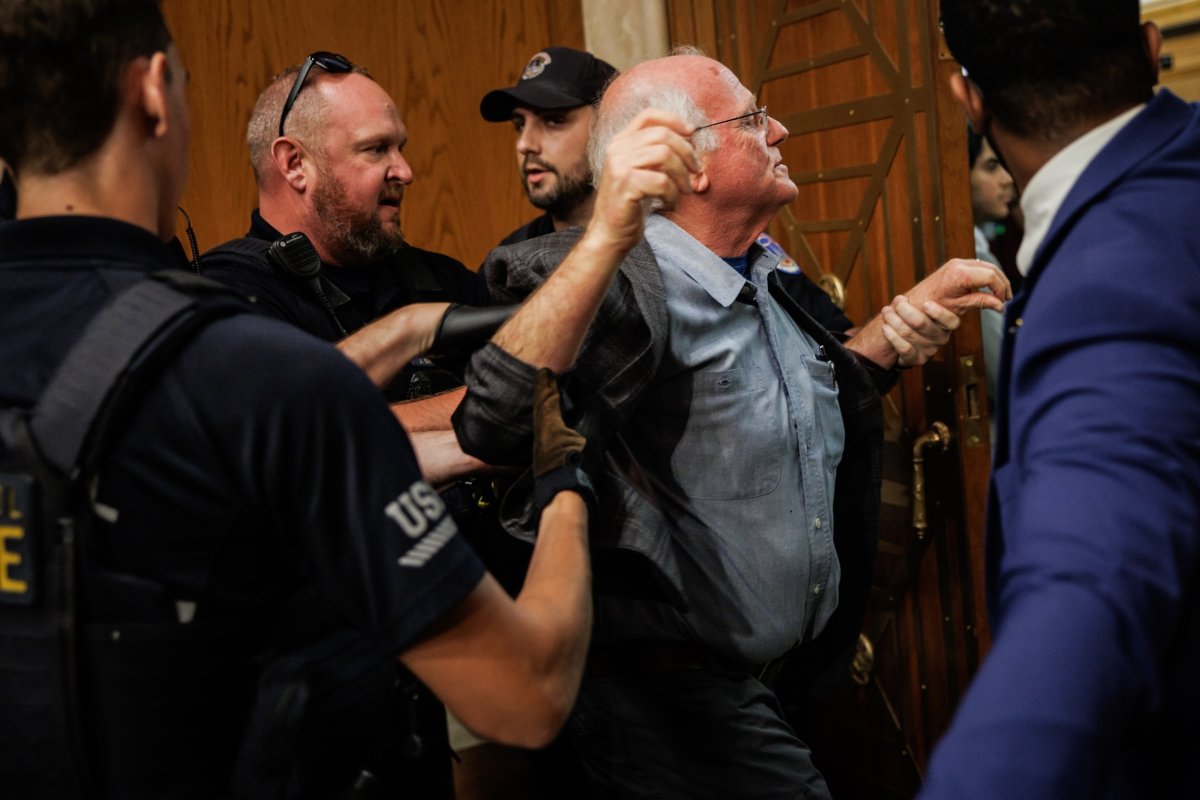
WASHINGTON, DC - MAY 14: Ben Cohen, co-founder of Ben and Jerry's, is detained by U.S. Capitol Police for disrupting proceedings during a hearing with U.S. Secretary of Health and Human Services Robert F. Kennedy... More Samuel Corum
The second injustice is global. It's our government-funded destruction and slaughter of families living in Gaza. Not only is our government funding genocide; it defends that genocide by attacking the basic American value of free speech. Our government is criminalizing the courageous students who have nonviolently protested this inhumanity, which is being done in our name and with our money.
These two things—lead pipes and Gaza—are connected. Every day, our government chooses to buy more bombs instead of replacing lead pipes in America.
It would cost $45 billion to end lead poisoning in the United States and prevent lifelong, irreversible brain damage to children. Some studies show that the cost to solve the problem is far less than the cost of dealing with the long-term effects it will cause.
I know that $45 billion sounds like a lot of money. But it's less than 5 percent of what we spend on the Pentagon every year. And when you realize that we've spent more than $22 billion over the last two years to provide bombs that are being used to slaughter and displace an entire population, it starts to sound like a pretty reasonable trade-off.
But that's not all our government spends money on. We're currently spending $1.5 trillion on a whole new generation of nuclear weapons (that's in addition to our current nuclear arsenal, which already has 50,000 times the explosive power of the Hiroshima bomb). Clearly, we can afford to replace lead pipes.
Meanwhile, Elon Musk's Department of Government Efficiency has been exposed as nothing more than a sham. It worked to destroy many relatively small departments that serve the needs of the American people for a better life—like getting rid of lead pipes that are poisoning communities' drinking water—while increasing the budget for the biggest, most wasteful, most corrupt department in our government, one that accounts for over half of the entire discretionary budget: the Pentagon, formerly known, more correctly, as the Department of War.
I can't witness such extraordinary violence and injustice, call myself an American, and not put my body on the line.
*Ben Cohen co-founded Ben & Jerry's Homemade Holdings and recently launched the "DOGE vs. Blob" contest to expose wasteful Pentagon spending.
---
https://www.alternet.org/progressive-ben-jerrys-founder-ukraine/
---
B&J bk BK // thom fwd annie leonard 300 pp pal ben furman, left of lenin
http://www.proz-x.com/onlinelibrary/files/original/18fa2f662e17f290134a6dd2dd0ea974.pdf
...In September 2009, Vermont made it legal for same-sex couples to marry. Ben & Jerry’s had been a supporter of gay rights since the early 1990s, but Unilever had vetoed an employee proposal to celebrate the state’s civil union law for same-sex couples by releasing a special flavor in 2000. This time was different. The company temporarily renamed its Chubby Hubby flavor “Hubby Hubby,” donated ice cream to the wedding receptions of Vermont’s first same-sex spouses, and publicized the efforts of the national advocacy organization Freedom to Marry.
In the fall of 2009, John Le Boutillier and the board negotiated a five-year plan aimed at “re-radicalizing” the company. The plan called for all the ingredients used by Ben & Jerry’s to be free of genetically modified organisms (GMOs) by the end of 2012. By the end of 2013, all ingredients would also come from farms and processors who were paid fairly and met minimum environmental and social standards...
Political donations from corporations and the ultrawealthy have seriously warped the priorities of governments, said Ben, which is why, in 2012, Ben & Jerry’s launched a campaign called “Get the Dough out of Politics.” The campaign is aimed at passing a constitutional amendment to overturn the Supreme Court’s Citizens United decision and make it clear that corporations do not have constitutional rights. But people have criticized the “Dough” campaign for sending mixed messages.
During the 2012 election cycle, Unilever also contributed $467,100 to a lobbying group aimed at defeating a California referendum that would require the labeling of products that contain genetically modified organisms (GMOs). Unilever did this despite Ben & Jerry’s longstanding position in favor of labeling. The referendum was defeated, and a torrent of corporate money ($46 million against, $9 million for) probably had something to do with it. “Ben & Jerry’s has a heritage of being an edgy, cutting edge company,” said Ben. “It is supposed to do things that haven’t been done before. But the reality is that Ben & Jerry’s is owned by a major corporation that is not particularly edgy.” A nervous chuckle crept into Ben’s delivery as he prepared to make his pitch. “You, as franchisees, are in the middle,” he said. “You’re free—heh, heh, heh—to pretty much do whatever the heck you want. You’re independent operators . . . and when the cat’s away, the mice will play.” The audience leaned forward as Ben described his new organization, Stamp Stampede, which sells rubber stamps designed to print messages on US currency...
Pushing those conversations is the real point of the exercise. Ben & Jerry’s does not take an official position on whether genetically modified organisms (GMOs) are good or bad, for example, although most of its employees probably oppose them. The company’s position is that products containing GMOs should be labeled as such, so that people can learn about the issue and make up their own minds. The “just label it” strategy is also how Ben & Jerry’s fought bovine growth hormone (rBGH). But this time, the stakes are much higher because GMOs are a much bigger, more complicated debate. Most plant scientists say that making genetic modifications to staple crops like corn, rice, and wheat can improve crop yields while decreasing reliance on pesticides and irrigation.
...
Corporations like Unilever oppose GMO labeling because it increases their production costs. Labeling is a go-slow approach, and it reflects the view that big science and big businesses should not be the only ones who get a vote. “All the big food companies are against labeling, including Unilever,” said Jostein. “We’re having a huge fight with them. But we are committed to the consumer’s right to know, and we are not going to go away.” “Social changes depend on transparency,” said Jeff. “The movements against the Vietnam War and for civil rights took off when pictures showed people what war and injustice look like. Once people understand what is actually happening, the grassroots movements can start. The best way for us to encourage systemic change is to engage with the public about these issues and let them make up their own minds.”
...
---
===
https://www.triplepundit.com/story/2015/back-basics-when-ben-jerrys-dropped-rbgh/58011
when two childhood friends, Ben Cohen and Jerry Greenfield, started Ben & Jerry's in 1978, they operated out of a renovated gas station in Burlington, Vermont. This small company with a big personality served up novelty products with witty names, such as Chubby Hubby, Cow Power and Holy Cannoli. Chubby Hubby was later renamed in 'Hubby Hubby,' to voice support for same-sex marriage.
This is just one of many examples of how Ben & Jerry's has created a rich brand personality by standing by its social and environmental values. The company embraces its three-part mission: to make fantastic ice cream, manage for sustainable financial growth and make the world a better place. This triple-bottom line approach to business allowed Ben & Jerry's to become what Brad Edmondson described as "one of the most iconic mission-driven companies in the world" in his book, "Ice Cream Social: The Struggle for the Soul of Ben & Jerry's." The company even occasionally put financial goals below its commitment to food safety.
The fight against rBGH
In 1989, Ben & Jerry's came out in opposition of recombinant bovine growth hormone (rBGH) or recombinant bovine somatotropin (rBST), developed by the agricultural biotech company Monsanto. This genetically engineered hormone is given to cows to increase milk production by up to 30 percent, but sadly it has numerous known negative effects on cows and humans alike.
Cows treated with rBGH show a significant increase in health problems, including a greater risk of lameness, udder infections (commonly treated with antibiotics) and serious animal reproductive problems. Some studies have also linked rBGH to concerning human health effects, including the development of certain tumors and prostate, breast, colorectal and other cancers.
Even though rBGH brought the price of milk down, Ben & Jerry's didn't want any of it.The ice cream men decided to continue to source milk from St. Albans Cooperative, a co-op with 450 family farmers. The ice creamery paid a premium to exclusively purchase milk from farms that took a pledge not to use rBGH. Ben & Jerry's showed its large personality when it took the bold step of not only sourcing milk without rBGH for its own products, but also publicly opposing its approval and use. The company made these decisions because it was the right thing to do, even if it raised the cost of production.
Stealing headlines with a social mission
But the socially-minded dessert makers wanted to have some fun along the way. The company decided to make a splash with its public opposition, too: "Ben & Jerry's launched their rBGH-free label on the same day that Monsanto made rBGH commercially available, and they basically hijacked the story," Brad Edmondson explained. "They gave reporters a quick and easy way to summarize the anti-rBGH discussion. They stuck to that and were very vocal about it, and the coverage was not what Monsanto hoped it would be."
Consumers bought into the branding so this decision did help to boost sales, despite the increased cost of production. But it wasn't all smooth sailing. The Attorney General of Illinois and several other states initially prohibited Ben & Jerry’s from mentioning rBGH on their product labels, which effectively meant the ice cream couldn’t be sold in those states.
:{:{}:
}:
dem On September 15, 2017, Madigan announced she would not seek reelection in 2018.[12][13][14]
In September 2019, Lisa Madigan joined Kirkland & Ellis as litigation partner https://en.wikipedia.org/wiki/Lisa_Madigan
}}But Ben & Jerry’s fought back: they sued and won the right to sell products with the rBGH-free label everywhere. Ben & Jerry's sued the city of Chicago and the state of Illinois, later winning the right to label their products as rBGH-free.
"Ben & Jerry's used their reputation to take a political position that no one else could have taken as effectively," Edmondson said. "It was the use of brand equity to push social change, and it had only had been done a few times before and not on this scale. It was a huge wake-up call to people, and it helped get the socially responsible business movement into gear."
It is consistent with the Ben and Jerry's brand to be vocal and unstoppable when confronting issues the company is passionate about, which likely led to the demise of rBGH sales. By 2007, a mere 17 percent of U.S. cows were treated with rBGH, and the hormone was banned in many countries, including Canada, Japan, Australia and the European Union, showing Monsanto's product was a failure. According to Janice Neitzel, principal of Sustainable Solutions Group and a responsible animal protein consultant, consumer demand is fueling the sales of rBGH-free products.
“For close to a decade, U.S. consumers have said they don’t want growth hormones like rBGH in their milk, as evidenced by the tremendous sales growth of organic milk, which forbids the use of rBGH,” Neitzel said.
New parent company, same long-term sustainability values
Beyond rBGH, Ben & Jerry's food safety story has taken some interesting twists and turns. In 2000, the British-Dutch conglomerate Unilever bought Ben & Jerry's for $326 million, making it a a wholly-owned autonomous subsidiary. However Ben & Jerry's continues to trumpet social causes, even those that conflict with its parent company's position.
For example, Ben & Jerry's supportsVermont's efforts to label genetically modified organisms (GMOs), while its corporate parent does not. The negative PR threat of trying to silence outspoken Ben & Jerry's has allowed the company to maintain its corporate values, despite the difference of opinion.
Now Ben & Jerry's is producing flavors sourced with non-GMO ingredients, and encouraging consumer's right to know with a "labelizing it" campaign. Its sense of humor and values have not faded, and Ben & Jerry's continues to be the poster child for social responsibility, although some activists are skeptical given its corporate parent.
"Ben & Jerry's has recently completed a very extensive and arduous process that get GMOs out of all their ingredients, and there are something like 110 ingredients in their products," Edmondson said. "That was another enormous commitment of resources and time. The effect on the bottom line is debatable, but the effect on the brand is clear."
Ben & Jerry's has led the way as a brand with purpose, showing other companies that it's possible to do the right thing -- even if it isn't always the easiest financial call.
ref
jun 2014
https://www.triplepundit.com/story/2014/big-food-battles-vermont-over-gmo-labeling-law/42906
The recently launched, four-pronged suit against the state of Vermont’s genetically modified organism (GMO)-labeling law comes as no surprise. Last week, a group of the country’s largest grocery organizations filed suit against Vermont for its passage of a law (Act 120) requiring all manufacturers to label those products that contain GMO ingredients.
Big Food four stand up for GMO
The four “Big Food” companies -- the Grocery Manufacturers Association(GMA), the Snack Food Association, the International Dairy Foods Association and the National Association of Manufacturers -- allege that Vermont’s newly minted law contravenes federal law and cites the First and Fourteenth Amendments, the right of free speech and the commerce clause. It also cites the due process clause of the Fifth Amendmentfor Act 120’s “vagueness” in its prohibition of the use of certain words, such as natural, and other descriptors that the Vermont law has deemed confusing to consumers.
The plaintiffs defend their suit based on four counts relating to labeling mandates, alleged marketing restrictions and violations of the commerce clause. They have argued that Act 120 imposes unreasonable requirements on food manufacturing companies, which would be required to amend the labels on thousands of products before the act goes into effect on July 1, 2016.
GMA: The consumer already has the tools
They also assert that the state has acted beyond its capacity and that provisions already exist at the federal level for the consumer to make informed decisions, called the Organic Food Production Act.
“The Act appears not to recognize that the USDA has established the very system that the Act suggests is missing. Under the USDA’s “certified organic” program, food that qualifies for the certified organic label cannot be produced using GE plants or GE derived ingredients,” says the suit. It also suggests thatvoluntary labelingthrough programs like the Non-GMO Project already provides a voluntary method for consumers to select foods that don’t contain GMOs.
The power of commerce
:{:{}:
It’s no surprise that the plaintiffs have hinged this suit on the powers of the federal commerce clause. It’s a popular tactic these days, as North Dakota demonstrated last May with its controversial suit against Minnesota’s New Energy Act. At the same time that Vermont’s GMO-labeling bill was moving through the state legislature last April, another issue was being fought out in Minnesota district court that would virtually upend the state’s efforts to regulate the purchase of “dirty” coal power. Stating that the New Energy Act regulated issues that were under the purview of the federal commerce clause, U.S. District Court Judge Susan Richards Nelson enjoined the state from enforcing parts of the law, effectively stalling some of the boldest efforts made to date to curb carbon emissions by power companies. In effect: Minnesota’s clean energy law conflicted with the Constitution.}:
In both situations, the power of the consumer to decide what is sold within his or her state has been placed at odds with federal agencies which many states say are failing to step up to the demands of their constituents – despite voters’ efforts to get federal laws enacted, first. In the case of GMA et al vs. Vermont, the plaintiffs allege that consumer desires and voting bloc expectations aren’t enough reason to provide manufacturing transparency.
Federal organic laws: A chicken-and-egg story
Interestingly, although the suit mentions the “certified organic” program, it fails to mention that federal organic laws were actually the outgrowth of enforced state regulations in California. This leads to a quandary not unlike the chicken-and-egg story: If states don’t have the right to regulate the foods imported and sold within their borders (except when there are proven safety issues at hand), then why has California been successful in regulating food production through laws enacted by the ballot box? And why did the federal government think it was such a great idea to pattern the majority of its regulations after California’s already-enforced laws?
The suit also doesn't mention the fact that a fair number of states have their own organic certification programs and regulations in force, which the USDA points out, "may also add more restrictive requirements due to specific environmental conditions or the necessity of production and handling practices in that State."
Where's Monsanto?
When this suit was announced, a number of advocacy groups jumped on board to alert consumers that “Monsanto had launched a suit against Vermont." Most publications do, in fact, point out that the suit is being launched by four associations, but few advocacy groups or publications have asked why Monsanto’s name is conspicuously absent from the lawsuit.
While advocacy organizations have worked hard over the past few years to link Monsanto to the GMA, the association has worked just as hard – particularly recently – to limit information about its membership, or whether Monsanto is in fact a voting member.
The list of plaintiffs on a court document such as this speaks volumes about the strength that a suit may have, but it also says a lot about just what those who fund its launch is expecting from the public, and what they may feel could be most vulnerable if consumers really don’t agree with their principles. The fact that the four associations are fighting the good fight for Monsanto’s interest but haven’t mentioned Monsanto’s membership unfortunately may not make it any easier for consumers to swallow the concept of GMO engineering.
And, as the suit has boldly pointed out, American consumers are quite adept at finding ways of moving away from products they don’t trust. With a rising number of countries rejecting or restricting GMO food manufacture and/or imports, clear labeling laws may turn out to be the easiest and least expensive compromise for all sides.
---
notice it's not the Billionaires
https://www.alternet.org/2020/07/83-super-rich-people-urge-us-to-tax-them-more-immediately-substantially-permanently/
comm dr
a group of more than 80 self-described “millionaires for humanity” came together Monday to urge governments across the globe to tax them and other ultra wealthy people to cover the immediate costs of the coronavirus pandemic and to build more equitable, just societies in the long term.
The extremely rich individuals recognize in their joint letter that although they are not on the front lines of this pandemic treating Covid-19 patients or stocking shelves, they do have a lot of money—”money that is desperately needed now and will continue to be needed in the years ahead, as our world recovers from this crisis.”
The takeaway message of the letter is: “Today, we, the undersigned millionaires, ask our governments to raise taxes on people like us. Immediately. Substantially. Permanently.”
Outlining how the pandemic has exposed and exacerbated systemic economic, education, and healthcare issues, the letter asserts that “the problems caused by, and revealed by, Covid-19 can’t be solved with charity, no matter how generous.”
“Government leaders must take the responsibility for raising the funds we need and spending them fairly,” the letter continues. “We can ensure we adequately fund our health systems, schools, and security through a permanent tax increase on the wealthiest people on the planet, people like us.”
The signatories express gratitude for the efforts of those who are risking their lives to take on the crisis and acknowledge that “we do not have to worry about losing our jobs, our homes, or our ability to support our families. We are not fighting on the front lines of this emergency and we are much less likely to be its victims.”
“So please. Tax us. Tax us. Tax us. It is the right choice. It is the only choice,” the letter concludes. “Humanity is more important than our money.”
Over three-quarters of the 83 signatories are based in the United States—including Disney heirs Abigail and Tim Disney, Ben & Jerry’s co-founder Jerry Greenfield, and Patriotic Millionaires chair Morris Pearl—but the list also includes residents of Canada, Denmark, Germany, the Netherlands, New Zealand, and the United Kingdom.
“The Covid-19 crisis has revealed the fragility of our system and shown that no one―rich or poor―is better off in a society with massive inequality and a failing social safety net,” Pearl said in statement Monday. “We must reset our tax structure to one that values the contribution of labor as much as the contribution of capital.”
The letter was circulated by Bridging Ventures, Club of Rome, Human Act, Oxfam International, Patriotic Millionaires, and Tax Justice U.K.ahead of the G20 Finance Ministers and Central Governors meeting, and the Special European Council meeting, which are expected to focus on rebuilding economies affected by the pandemic.
Other signatories include Dr. Mariana Bozesan, a philanthropist recognized as 2019’s European female investor of the year; British screenwriter and director Richard Curtis; Ané Maro and Djaffar Shalchi, the couple behind the Danish organization Human Act; Antonis Schwarz, an activist, philanthropist, and impact investor of Greek-German descent; and Sir Robert Tindall, a businessman and philanthropist in New Zealand.
“Together, we question the concentration of wealth, and demand hands on solutions to create more economically viable societies,” said Shalchi. “Personally, I believe we need a global wealth tax of one percent on the world’s richest people. People like me can afford it, it will do us no harm, and it will have a huge impact.”...
==
==
We Can't Recycle Our Way Out of This Problem': Ben & Jerry's Bans Single-Use Plastics
==
LBO by unilever ~ CSR max profit
https://www.nytimes.com/2015/08/23/business/how-ben-jerrys-social-mission-survived-being-gobbled-up.html
How the Social Mission of Ben & Jerry’s Survived Being Gobbled Up
The New York Times
By David Gelles
Aug. 21, 2015
Big food companies have an endless appetite for smaller brands that make local, organic and socially responsible products. Over the years, Danone acquired Stonyfield Farm yogurt, General Mills bought Annie’s Homegrown and Campbell Soup swallowed up Plum Organics.
Each time such a deal is announced, fans of the target company ask whether its cherished products will be safe under the new owner, or if the integrity will disappear in the belly of the beast.
There is reason for concern. Starbucks acquired La Boulange, a San Francisco bakery chain that made healthful organic breads, in 2012. This year Starbucks announced it was shutting down the bakeries but keeping the brand name alive.
And before it became a case study on how such marriages can succeed, Unilever’s takeover of Ben & Jerry’s got off to a rocky start.
Ben Cohen and Jerry Greenfield founded their gourmet ice creamery in 1978 and were pushing the boundaries of conventional business from the beginning.
Shortly after setting up shop in Burlington, they offered stock to Vermont residents only, hoping “to spread the wealth” in their community. After a national stock offering in 1985, the company set up a foundation and committed to funding it with 7.5 percent of the company’s annual pretax profits.
Mr. Cohen and Mr. Greenfield then devised a three-part mission statement: to make the world’s best ice cream, to run a financially successful company and to “make the world a better place.”
Ben & Jerry’s went to great lengths to fulfill its mission, according to Antony Page and Robert Katz, Indiana University law professors who wrote a paper on the Unilever acquisition. The company sourced from regional organic dairy farms. It used only milk that did not contain artificial growth hormones. It went to court for the right to label its ice cream hormone-free. It developed chemical-free containers. It made fair-trade and organic ingredients priorities. And it reduced its garbage output.
When Unilever, the Anglo-Dutch consumer goods conglomerate, offered to buy the company in 2000 for a rich 25 percent premium, neither Mr. Cohen nor Mr. Greenfield wanted to sell. They worried that Unilever would abandon the progressive aspects of the business and run it as a soulless subsidiary.
But as a public corporation, Ben & Jerry’s had a fiduciary duty to its shareholders. After much hand-wringing, it agreed to a deal with Unilever for $326 million. And despite handsome paydays — Mr. Cohen’s stake was reportedly worth about $40 million, while Mr. Greenfield’s was worth about $10 million — the founders said in a statement that they would have preferred to remain independent.
Very quickly, some of their worst fears were realized.
Ben & Jerry’s had almost never fired an employee, but Unilever, the world’s largest ice cream maker, had manufacturing and supply-chain acumen and wanted synergies. A production plant and a distribution center were shuttered, workers at the two sites were laid off, and sales representatives at headquarters were fired.
“There were redundancies and consolidation,” said Rob Michalak, who has worked for Ben & Jerry’s on and off for 26 years and is now director of social mission. (He met Mr. Greenfield while hitchhiking in 1978.) “That created unease and suspicion.”
Then, shortly after the deal, in an affront to the company’s political sensibilities, Unilever reportedly prevented employees from emblazoning the Ben & Jerry’s logo on a bus driving them to a protest.
Kevin Havelock, president of refreshments at Unilever, likened the takeover to a new marriage. “There was a lot of learning that had to take place,” he said. “Where there have been challenges, we’ve talked them through.”
But today, 15 years after the deal, Mr. Michalak said Ben & Jerry’s remained as mission-driven as ever, and was having a bigger impact than before because of its increased size. (Since the acquisition, Unilever has nearly tripled Ben & Jerry’s revenue and added hundreds of jobs.) And instead of watching Ben & Jerry’s simply disappear into Unilever, Mr. Michalak and his colleagues have pushed their new parent company to become a more progressive multinational.
The recipe for this amicable partnership was written into the acquisition agreement.Unilever, not wanting to squander its purchase, chose to operate Ben & Jerry’s with more autonomy than any of its other subsidiaries. To ensure middle managers did not contaminate the unique culture, Unilever established an “external board” charged with overseeing Ben & Jerry’s culture and social mission.
That board, initially comprising five longtime Ben & Jerry’s supporters, including Mr. Cohen and Mr. Greenfield, has the authority to set aggressive new social impact targets and to push back against Unilever.
The external board still exists. According to the legally binding merger agreement, the board does not report to any authority other than itself, nominates its own members, has the right to sue Unilever and will exist in perpetuity. (Mr. Cohen and Mr. Greenfield, who are no longer on the board, declined to comment for this column.)
Even with the external board in place, a question remained: How many of Ben & Jerry’s ambitious initiatives could a multinational like Unilever reasonably be expected to support?
The answer, it turned out, was most of them. After the initial layoffs, Unilever largely gave Ben & Jerry’s the autonomy to pursue its own agenda, so long as the ice cream kept flowing.
When Mr. Michalak took over the social mission in 2006, he worked with the external board to redouble commitments to local farmers, press for national labeling of genetically modified organisms and set even more ambitious goals for reducing energy consumption and waste.
The company now offers its lowest-paid workers more than twice the national minimum wage. According to its website, it uses only cage-free eggs. And recently, Ben & Jerry’s became a B Corporation, a voluntary certification by a nonprofit group called B Lab designating companies that uphold high social and environmental standards.
Mr. Havelock said Unilever had been inspired by Ben & Jerry’s ambitious social and environmental goals. Unilever has even thought about what it would take to become a B Corporation — a radical consideration for one of the biggest companies in the world — but believes that it’s unfeasible right now.
Protesters occasionally still descend on Ben & Jerry’s. Recently, 120 activists marched outside the flagship store in Burlington demanding better conditions for migrant workers on suppliers’ dairy farms.
But over all, Ben & Jerry’s is proceeding with its activism-infused capitalism, one pint of Chunky Monkey at a time. Indeed, Ben & Jerry’s has even rediscovered its political spirit.
The company supports marriage equality and campaign finance reform. And it recently introduced a flavor, Save Our Swirled, intended to raise awareness about climate change. The label is illustrated with cows perched atop melting icebergs, and Ben & Jerry’s is urging customers to lobby government leaders to embrace clean-energy standards.
“Even before Unilever, the company was always going to the uncomfortable edges of advocacy and activism,” Mr. Michalak said. “We are doing more now on the social mission than we ever have in the company’s history.”
==
http://www.alternet.org/food/only-one-out-11-popular-ben-jerrys-ice-cream-flavors-tested-negative-cancer-causing-herbicide
The Vermont brand has been built on a bucolic image of cows grazing on endless pasture...Ben & Jerry’s ice-cream and other Vermont companies have used this idyllic imagery to sell their products. Gone are the days, however, when most of Vermont’s cows were grazing in spectacularly scenic landscapes. Now a majority of Vermont’s cows are locked up in...‘confined animal feeding operations’ or CAFOs...grazing on concrete with a diet rich in GMO corn and pesticides." — Vermont’s GMO Addiction: Pesticides, Polluted Water and Climate Destruction, Regeneration Vermont
The most important thing we can do today as conscious consumers, farmers and food workers is to regenerate public health, the environment and climate stability. We can do this most readily by moving away from industrial, GMO and factory-farm food toward an organic, pasture-based, soil-regenerative, humane, carbon-sequestering and climate-friendly agriculture system.
What’s standing in the way of this life-or-death transformation? Rampant greenwashing. The proliferation of $90 billion worth of fraudulently labeled or advertised “natural” and “socially responsible” food products in the U.S. confuses even the most well-intentioned of consumers and lures them away from purchasing genuine organic or grass-fed products.
Perhaps no company personifies greenwashing more than Vermont-based Ben & Jerry’s. Ben & Jerry’s history—a startup launched by two affable hippies, from a renovated gas station in Burlington, Vt.,—is legendary. Despite selling out to Unilever [hostile takeover?]in April 2000, the brand’s handlers have preserved its quirky, homespun image, and masterfully convinced consumers that Ben & Jerry’s has never strayed from its mission: “to make the world a better place.”
As the New York Times reports, the Organic Consumers Association recently sent samples of Ben and Jerry’s top-selling ice-cream brands to an independent testing lab for analysis.Ten out of 11 samples tested positive for Roundup (glyphosate and AMPA) herbicide contamination.The results originated from independent lab testing of the following flavors: Peanut Butter Cup, Peanut Butter Cookie, Vanilla (two samples), Cherry Garcia, Phish Food, the Tonight Dough, Half Baked, Chocolate Fudge Brownie, Americone Dream and Chocolate Chip Cookie Dough. Cherry Garcia was the only flavor that tested negative for glyphosate and/or AMPA.
Compare the Ben & Jerry's test results with the results of our testing of organic brands that use organic milk from farms that are actually making the world a better place. Three out of four nationally distributed organic ice cream brands tested negative for Roundup contamination (only Whole Foods' 365 brand was contaminated).
A history of stalling on organic
Twenty-four years ago, anti-GMO food activists, including the Pure Food Campaign (OCA’s predecessor), successfully pressured Ben & Jerry’s and a number of other leading dairies to prohibit the use of America’s first genetically engineered food product,Monsanto’s recombinant Bovine Growth Hormone (rBGH). Now marketed by drug giant Elanco (Eli Lilly), rBGH is linked to increased risk of human breast and colon cancer, a greater use of antibiotics in animal feed, and damage to cows' health.
Several groups, including the OCA, subsequently asked Ben & Jerry’s to move beyond just prohibiting its dairy cows from being injected with rBGH. We asked them to go 100 percent organic, which would have required the company to ban its dairy suppliers from feeding their cows GMO corn and grain, and to use only organic ingredients in its flavors. But even before Ben & Jerry’s was bought out by Unilever, company founder Ben Cohen told Vermont Food activist Michael Colby “that Ben & Jerry’s was not going to transition to organic because it wouldn’t allow them to ‘maximize profits.’“
Since 1994, Ben & Jerry’s, the $1.5-billion-per-year flagship brand of the second-largest multinational food corporation in the world, Unilever (annual sales $60 billion), has cashed in big time on its “rBGH-free” policy, advertising its brand, over and over again, as “all natural,” “GMO-free,” “fair trade,” “climate-just” and “socially responsible.”
Despite repeated calls from consumer groups to stop advertising its ice-cream as “natural” or “all natural,” given that it is derived from cows raised almost exclusively on GMO corn forage (grown with Roundup Ready, neonic- and BT-spliced seeds), laced with non-organic ingredients, sprayed heavily with Roundup and other pesticides, Ben & Jerry’s continues to greenwash and lie. As recently as June 18, 2017, the company described its mission, "To make, distribute and sell the finest quality and euphoric concoctions with a continued commitment to incorporating wholesome, ingredients and promoting business practices that respect the Earth and the Environment."
After more than a decade of dodging consumer, farmer, animal welfare, environmental and farmworker pleas to stop greenwashing and to equitably source its milk from cows grazing on organic pasture, Ben & Jerry’s continues to stall. Instead, Ben & Jerry’s sources its milk from St. Alban’s, a 400-farmer dairy co-op that is increasingly dominated by large factory farm-type dairy operations. To feed their cows, farmers routinely spray tons of pesticides, including Roundup, atrazine and metolachlor, on fields of GMO corn grown from neonic-coated and BT toxin seeds. They also apply tons of soil-killing, climate-disrupting nitrogen fertilizers that pollute Vermont’s streams, rivers and lakes.
Petitions and protests calling for Ben & Jerry’s to stop its suppliers from exploiting farmworkers, confining dairy cows and driving small dairy farmers into bankruptcy, have produced nothing more than vague promises of “respecting the Earth” and supporting rural economic justice.
Vermont activists demand major changes from Ben and Jerry’sEnough is enough. Vermont and national public interest organizations have lost our patience. It’s time for Unilever and Ben & Jerry’s to move beyond greenwashing to decisive action. It’s time for Ben & Jerry’s to announce it will immediately begin transitioning to 100-percent organic. Otherwise conscious consumers have no choice but to launch a national, and if necessary, international protest campaign and boycott.
Regeneration Vermont, a broad-based coalition of consumers and farmers, has repeatedly asked Ben & Jerry’s and Unilever to sign a six-point pledge to go 100-percent organic over a three-year transition period. Here's what the groups want Ben & Jerry's to pledge:
- A transition away from GMO crops and toxic pesticides/fertilizers and toward regenerative organic agricultural methods.
- Fair wages for farmers, including premiums based on regeneration benchmarks and assistance in the transition toward regenerative methods.
- Economic justice for farm workers, fair and livable wages, decent housing and social and cultural dignity.
- Adoption of climate remediation techniques, beginning with an emphasis on healthy soils and cover-cropping for carbon sequestration and erosion control.
- Humane treatment of farm animals, a phase-out of confinement dairies and a transition back to grassland grazing and grass-based feed for ruminants.
- Cleaning up and protecting our watersheds, streams, rivers, ponds, lakes, and groundwater.
Trail of toxins
Recent reports published by Regeneration Vermont reveal that Ben & Jerry’s suppliers, and Vermont and U.S. (non-organic) dairy farmers in general, have gone backward rather than forward over the past 15 years in terms of environmental sustainability, food safety, nutrition, greenhouse gas pollution, water pollution, animal welfare, farmworker justice, and preservation of family farms.
Chemical fertilizer use has almost doubled in Vermont since GMOs began to dominate the market 15 years ago. So much for Monsanto’s claims that GMO crops would reduce the use of toxic pesticides and water- polluting and climate-destabilizing nitrogen fertilizers.
Among Regeneration Vermont’s finding are the following:
- An astounding 97 percent of Vermont’s field corn, the major component of a non-organic dairy cow’s diet, is now GMO (Roundup Ready, Bt-spliced, neonic seeds). This is the highest percentage of any state in the U.S.
- Herbicide use has increased over 100 percent-per-acre in Vermont since Monsanto’s GMO corn came on the market, with recent heavy use of atrazine, metholachlor, simazine, pendimethlin, glyphosate (Roundup), acetochlor, dicamba, and alachlor.
As Regeneration Vermont states in its report:
Regulators have determined that five of these eight most used herbicides [in Vermont] are possible or probable human carcinogens, the remaining three are suspected carcinogens. Seven of the eight are possible or probable endocrine disruptors (the other one is a suspected to be an endocrine disruptor). All eight have been determined by regulators and academics to cause birth or developmental defects and contaminate drinking water and public waters with dangerous chemicals that have long-term persistence. Atrazine, simazine, acetachlor, and alachlor have lost their registration in the EU, and are effectively banned.
The threat of #DirtyDairy and factory farms
Millions of health-minded Americans now understand that cheap, non-organic, genetically engineered, industrial and factory farm food is hazardous. Not only does chemical- and energy-intensive factory farming destroy the environment, destabilize the climate, impoverish rural communities, exploit farm workers, inflict unnecessary cruelty on farm animals, and contaminate the water supply, but the end product itself is inevitably contaminated and inferior in nutritional terms, in this case in comparison to 100% grass-fed and organic milk and dairy.
America’s green-minded consumers understand that industrial agriculture poses a terminal threat to the environment and climate stability. A highly conscious and passionate segment of the population is beginning to understand that converting to non-chemical, non-genetically engineered, energy-efficient, carbon-sequestering organic/regenerative farming practices, and drastically reducing food miles by re-localizing the food chain, are essential preconditions for stabilizing our out-of-control climate and preparing our families and communities for future energy and resource shortages.
A critical mass of the global grassroots—consumers, farmers, activists—now realize that unless we act quickly, global warming and climate chaos will soon severely disrupt industrial agriculture and long-distance food transportation, leading to massive crop failures, food shortages, famine, war, and pestilence. Even more alarming, accelerating levels of greenhouse gases will soon push global warming to a tipping point that will melt the polar icecaps and possibly unleash a cataclysmic discharge of climate-destabilizing methane, now sequestered in the fragile arctic tundra.
Thanks to this growing consumer awareness—and four decades of hard work—the organic community has built up a $50-billion "certified organic" and $5-billion 100% grass-fed food and products sector that prohibits the use of genetic engineering and pesticides. The rapidly expanding organic products sector now constitutes more than 5 percent of total retail grocery sales (and 15 percent of fruits and vegetables), with an annual growth rate of 10-15 percent. Even taking into account a sluggish economy, the organic market, if we eliminate greenwashing and labeling fraud, could conceivably reach a “tipping point” of 20 percent of grocery sales in 2020.
The myth of 'natural' remains a threat
As impressive as this $55 billion organic and grass-fed alternative is, it remains overshadowed by an additional $90 billion in annual spending by consumers on products, such as B&J’s, fraudulently marketed as "natural," “gmo-free,” “free range,” or “sustainable.”
Consumer surveys indicate that the overwhelming majority of Americans believe that “natural” products are “almost organic,” yet at the same time, much cheaper; the majority believes that “all natural” actually means that it is better than organics. Ben & Jerry’s is not the only brand greenwashing its products and impeding the growth of organic, 100% grass-fed and regenerative foods. But it is certainly among the most shameless.
==
prop 59
==
beware entine uk rag;
Ben & Jerry’s was one of the first companies to promote corporate citizenship and sustainability. But the journey has not been easy, as a new book explains
US ice cream maker Ben & Jerry’s was established in the late 1970s. Over the next decade, it developed an ambitious three-part mission: making the world’s best ice cream; supporting progressive causes; and sharing the company’s success with all stakeholders: employees, suppliers, distributors and customers. Founders Ben Cohen and Jerry Greenfield, friends since childhood, set up the company, managed it as it grew and then eventually, reluctantly, sold it to Unilever in 2000.
In extracts from his new book Ice Cream Social: the struggle for the soul of Ben & Jerry’s, Brad Edmondson outlines how Ben and Jerry’s was an early adopter of progressive company social and environmental policies, and why.
From the start, it was important for Ben & Jerry’s that working conditions for employees improved as financial conditions improved. Surveys taken in 1997 and 1998 showed that employees saw the social mission as a critical part of the company’s success. Every employee was awarded both company stock and stock options in 1998, too. As far as linked prosperity goes, Ben & Jerry’s was walking the talk.
In 1997, the board’s social mission committee asked every department head to set social mission goals for the following year. They were ready to take things to a new level. Co-founder Ben Cohen and other board members wanted to integrate the social mission horizontally by adding it to policies in every department, from manufacturing to human resources, operations, waste disposal, franchise operations, philanthropy and finance. They also wanted to integrate the mission vertically by adding social metrics at every stage of the supply chain. This sometimes meant re-engineering the way the product was made.
Chlorine-free paper
One of the company’s projects for 1998 involved shrinking the environmental footprint of the paper it used. Most paper mills in the 1990s used elemental chlorine to bleach their wood pulp from grey to white. The wastewater from this process was laced with several toxic chemicals, including dioxin, an extremely potent carcinogen.
Ben & Jerry’s pint cartons, like many food containers, were made of paper coated with white clay that made them impermeable on the inside and ready to take ink on the outside. The product would be just as appealing to consumers if the containers were made out of coated paper that wasn’t bleached. By eliminating chlorine from the process, this switch would also eliminate a significant amount of dioxin from the waste stream. Cohen was on the board of Greenpeace, and chlorine bleaching was one of the group’s major concerns. But no one had ever made a food container out of unbleached paper before.
The “eco-pint” was unveiled in February 1999 after several years of development. By the end of that year, one-third of Ben & Jerry’s packaging was made out of unbleached paperboard. The company had gone forward with its original plan despite the US government’s approval of a less-polluting alternative in 1998.
A standard-size mill that adopted the new process, using chlorine dioxide as its bleaching agent, would produce between seven and 10 tonnes of organochlorine-laced sludge a day, according to the Worldwatch Institute. This was a big improvement over the 35 tonnes a day produced by elemental chlorine. But the company’s goal was to transform the process, not just to improve it.
Sticking with unbleached paperboard was more expensive. But the company’s goal was to eliminate the use of chlorine bleach to whiten paper. Ben & Jerry’s had been a corporate leader in environmental impact reduction in 1992, when it signed the Ceres principles, and again in 1994, when it added a label certifying that it did not use ingredients produced with bovine growth hormone. The company hoped that with the eco-pint, it might happen again.
Cleaner farms
Ben & Jerry’s also made changes at the other end of the supply chain, launching a long-term effort to reduce the environmental impact of dairies and other livestock farms. Feed, manure and fertilisers are loaded with nitrogen and phosphorus. These chemicals become pollutants when they wash out of agricultural soils in large amounts and end up in rivers and lakes. In 1999, Ben & Jerry’s joined with a grain company, experts at Cornell University and the University of Vermont, its main dairy supplier (the St Albans co-op), and two pilot farms to look for ways toreduce runoffin small, practical ways.
The goal of the dairy initiative was to make a more significant impact by encouraging people to think in broader terms. Ben & Jerry’s had considered and rejected the idea of producing organic ice cream because of its expense, despite its social benefits. Instead of staying out of the discussion, however, the company decided to double down.
They broadened the discussion by committing to something their academic partners called “sustainable agriculture”. This field was almost unknown in 1999. It does not define success in terms of avoiding all synthetic chemicals. Instead, its goal is broader, using farming methods that follow the principles of ecology.
The company’s commitment to job training was also changing. It had set a goal of opening five new PartnerShops, which was its term for ice cream stores that were operated by not-for-profit groups as job training programmes, in 1998, but various barriers and complications kept it from opening any. Even though Ben & Jerry’s opened four shops owned by non-profits in 1999, Liz Bankowski, then director of social mission, was rethinking the whole idea. “The PartnerShops worked best when they trained teenagers,” she says. “The jobs they created weren’t as suitable for a single mother with two kids.”
One problem was that Ben & Jerry’s ice cream stores worked best in places with a lot of upscale foot traffic, and the rent for these places was often expensive. Small not-for-profit groups often couldn’t sustain the substantial effort and resources needed to keep a shop alive. Bankowski decided to start seeking partnerships with local economic development agencies instead.
Ben & Jerry’s also took steps in 1999 to integrate the social mission into its overseas operations. It adopted global operating guidelines aimed at protecting the brand’s image and the three-part mission in other countries. The company said it would look at each country’s human-rights record and take steps to address any issues, and it would also try to express its activism in ways that respected local cultures.
“We tried to imagine how we would translate the mission to other countries back then,” says Helen Jones, then director of brand development, UK and Europe. “We had so few resources that we didn’t really have a chance to test our theories. But we talked about all kinds of things.”
Values council
At the end of 1999, the company tried to tie all these ideas together at a higher level. Senior employees from the international division joined others from marketing, purchasing, public relations, research and development, information systems, finance, human resources, retail operations, sales, environmental, and the Ben & Jerry’s Foundation in an interdepartmental values council, which was charged with reviewing the company’s progress on social initiatives, generating new ideas, and encouraging cross-departmental cooperation. The council’s first quarterly meeting happened in December.
Also in 1999, a national survey found that Ben & Jerry’s was one of the best-regarded companies in the US. The public gave it the fifth-best reputation in the country, which was particularly significant because the top four finishers (Johnson & Johnson, Coca-Cola, Hewlett-Packard, and Intel) were so much larger. Coca-Cola probably spent more on public relations than Ben & Jerry’s spent on salaries.
Ben & Jerry’s was a small company whose impact was huge. In its 1999 annual report, social auditor James Heard wrote: “Ben & Jerry’s most impressive achievement regarding its social mission is the way in which it has institutionalized the company’s values into decision-making. The company’s values are reflected in matters small and large … Social mission objectives are part of every manager’s job, from the chief executive officer on down, and these objectives have also been incorporated into the company’s strategic and operating plans … While the company may sometimes have fallen short in achieving its social mission goals, it demonstrates a commitment to progressive values that few companies can match.”
Heard didn’t know it, but he was writing a sort of eulogy. He submitted his audit in March 2000, just a few weeks before the company was sold to Unilever.
A surviving ethos
Ben & Jerry’s co-founders Ben Cohen and Jerry Greenfield, along with Jeff Furman, director and eventual board chairman, led the company with the idea that business could be a force for progressive social change as well as a machine for making money.
The company became a leader in the movement to make businesses more socially responsible, and the company pursued what it called a “double bottom line” while operating as a publicly traded company from 1984 until 2000. It was among the first companies to adopt policies that are now widely practised, such as paying a living wage, publishing audited reviews of social and environmental performance, and teaming up with not-for-profit organisations, to name a few.
The company took radical, crazy-sounding ideas and proved they could work. It made it easier for other companies to try these ideas. And behind all its efforts was one big idea the company called “linked prosperity”. As the company prospered, it said, all of the employees, suppliers, customers, and other living things that had contributed to its success should prosper as well.
The company’s mission had three parts that were equal and interrelated. It wanted to make the world’s best ice cream, to pursue progressive social change, and to provide fair reward to employees and shareholders alike. Ben & Jerry’s stuck to these principles as it became an international brand with passionately dedicated customers.
But the company eventually grew beyond the managerial abilities of its board, and after years of struggling, the board was forced[ahem/hmmn] to sell the company to Unilever. Cohen walked away from the deal with $41m; Greenfield got$9.5m; and Furman got about $1m. Yet Cohen and Greenfield have also said that losing control of their company was one of the worst experiences of their lives, and they still don’t want to talk about it.
The social mission did survive the sale, however. The founders and the board accepted Unilever’s offer only after negotiating a detailed agreement that guaranteed them a continuing role in the company and gave them legally enforceable powers.
Under the agreement, Unilever is the sole shareholder of Ben & Jerry’s, and it controls the company’s economic and operational decisions. But Ben & Jerry’s also has a separate board of directors that is not controlled by Unilever. This board elects its own members, and it exists in perpetuity. It acts as a watchdog and has the legal authority to block proposals that lessen product quality or the social mission. As sales increase, investment in the social mission must also increase.
Go here for more information about Brad Edmondson and his new book.
==
entine WA attack 1997?
WA CEO Laura Scher is also on the board of Community Products Inc.
(CPI), the company created by Ben Cohen of Ben & Jerry’s to source
Brazil nuts for his ice cream and other “rainforest” products. Working
Assets Funding Service invested $300,000 in CPI debentures in 1989 as
part of a deal that paid WA $30,000 a year with an additional $300,000
bonus when WAFS cashed out in December 1995. During this period, CPI and
Ben & Jerry’s, with Scher’s apparent approval as board member, engaged
in persistent marketing fraud by claiming that Ben & Jerry’s ice cream
contained Brazil nuts sourced directly from a co-op of indigenous Amazon
Indians and that CPI gave 60% of its profits to charity.
It turns out that Ben & Jerry’s sourced ZERO nuts from the co-op and
bought all of its nuts off the commercial markets supplied by Latin
America’s most abusive agri-businesses. Moreover, CPI gives ZERO dollars
to charity today, and has given ZERO to charity since 1992. Previous to
that, CPI gave only 10% of its profits to charity. According to IRS
documents that have been released as part of a fraud case against Ben
Cohen and CPI, approximately $180,000 was given to Working Assets as
part of a marketing contract Peter Barnes (of Working Assets) worked out
with Cohen and Ben & Jerry’s, requiring WA to promote Ben & Jerry’s ice
cream. This was one of the key ingredients to Working Assets brilliant,
and continued, promotional tie-in with Ben & Jerry’s.
Today, CPI is on the verge of bankruptcy, the “rainforest harvest” has
collapsed, and the ill-fated project is blamed for consolidating and
increasing the control of right-wing agri-businesses over the Brazil nut
market. University of Chicago anthropologist Terrence Turner (one of the
world’s leading Amazon experts) calls rainforest harvest projects by Ben
& Jerry’s and Body Shop “Aid Not Trade,” a play on Body Shop’s Trade Not
Aid slogan -- “it’s aid by the exploited Indians in terms of their very
marketable images with almost no trade in return. These companies make
millions in free marketing.”[not online; note slippage to B&J?]
The windfall that WALD has reaped from clever social marketing has
apparently opened its eyes to a similar windfall beckoning in another
explosively lucrative market: buying excess electric capacity as part of
electric industry deregulation, marking it up higher than competitors,
and selling it with a “green” label to idealistic and trusting
customers.
********
==
http://en.wikipedia.org/wiki/Hanna_Rosin
ok
- God's Harvard: A Christian College on a Mission to Save America. Orlando: Harcourt, 2007. ISBN 9780151012626
- The End of Men: And the Rise of Women. New York, New York: Riverhead Books, 2012. ISBN 9781594488047
September, 1995
The New Republic
The Evil Empire: The Scoop on Ben & Jerry's Crunchy Capitalism
by Hanna Rosin
...The two were hanging around the kitchen, and Ben mentioned he was looking for a nut brittle made from something more exotic than peanuts. Clay had the perfect solution: his pet project, Cultural Survival Enterprises, was harvesting nuts and fruits from the Amazon to make preserving the rainforest economically viable. A few days later, they mixed up a batch of vanilla ice cream and native nut brittle in Vermont, and Rainforest Crunch was born. Its label, printed in the company' s cutely lopsided font, read: 'Money from these nuts will help Brazilian forest peoples start a nut-shelling cooperative that they'll own and operate.'
At first it did. But, as nut orders poured in, the struggling Xapuri cooperative collapsed under the demand. Ben and Jerry's ended up buying more than 95 percent of the nuts from commercial suppliers, including one shipment from the Mutran family, a notorious agribusiness that was reported in the Brazilian press to have killed labor organizers. In any case, it was a stretch to call Xapuri 'forest peoples'; they were Portuguese rubber tappers, whose ancestors had arrived at the turn of the century to exploit the Amazon. As for the actual 'forest peoples,' many were none too happy with the project. Indigenous rights leaders complained their troops were being seduced by the lure of dollars, although the sums were paltry. After developing an appetite for Western goods, some of the forest people sold whatever land they owned to buy houses and cars. 'Its concrete help has been minimal, ' a report of the Alliance of Forest Peoples concluded about the mission, 'and the negative repercussions have been enormous.'
Last year, Ben and Jerry's removed 'forest peoples' from the label, though they swear it was not out of contrition but to make room for promotions of their new 'Smooth' line of flavors. Even their own internal social-performance audit, an independent review of their projects that gets published in the annual report, suggested the company's packaging was misleading. But B&J are unrepentant: 'It sounds like real hairsplitting to me,' says Alan Parker, director of social missions. 'Who's to say what's best for indigenous people? If you look at it, we had an intent, and our own objective was met. We never said we bought all our nuts from the cooperative.' Cultural Survival, which has abandoned the project, disagrees: 'It's really become a disingenuous marketing strategy to say if you spend $2.99 you'll help save the rainforest,' says Michelle McKinley, who has redirected the group to small-scale projects with indigenous peoples. 'It makes it seem quick and easy and contributes to a lot of misunderstanding.'...
www.jonentine.com/articles/evil_empire.htm
-
www.jonentine.com/articles/rainforest_chic.htm
-
- :{[:{ October 1995}:
The Globe and Mail Report on Business Magazine
Rain-forest Chic
](https://www.google.com/search?es_sm=122&q=related:www.jonentine.com/articles/rainforest_chic.htm+entine+ben+and+jerry+cohen&tbo=1&sa=X&ei=MlLhU4q4JObisATil4GgDQ&ved=0CCkQHzAB)}:
- ...The view from Amazonia was quite different. Amazon peoples' groups and anthropologists feared opening up this fragile area even to supposedly friendly capitalists. There also is no evidence to support the central premise of the harvest—that nuts could ever approximate the income that natives collect by selling off land rights to miners and foresters.
The anticipated source for Ben & Jerry's nuts—the Xapuri co-operative in the Amazon—never produced the necessary quality or quantity to meet exploding demand. And the description of the Xapuri cooperative as "forest peoples" was odd: The co-op is largely run by ethnic Europeans and mixed-blood rubber tappers who arrived as contract workers at the turn of the century during an earlier wave of rain-forest exploitation.
The harvest soon proved a windfall for the landowners who have long controlled trade in this region. To meet demand, the agency purchasing nuts on Ben & Jerry's behalf, in which Cohen was a partner, was forced to buy from the commercial markets supplied by some of the most notorious, antilabour agribusinesses in Latin America, including the Mutran family, which has been linked in Brazilian press reports with the killings of labor organizers. By the spring of 1994, the Xapuri had cut off all supplies, saying their own harvesting efforts were hopelessly uneconomic. The project has run in the red for the past three years, generating none of the promised charitable contributions to the Amazonians that were to have flowed from sales of Rainforest Crunch. And there is no evidence that the harvest has provided an incentive for forest natives to curtail their auctioning of land, mining and timber rights. "It's really a disingenuous marketing strategy to say if you spend $2.99, you'll help save the rain forest," says Michelle McKinley, executive director of Cultural Survival, which used to run the project for Ben & Jerry's. "We rushed into this project recklessly. We created a fad market overnight and the hard-sell promotions have contributed to a lot of confusion. The harvest just didn't work."
Even Ben & Jerry's latest annual report takes the company to task. "It is a legitimate question," writes environmentalist Paul Hawken, who conducted the audit, "whether representations made on Ben & Jerry's Rainforest Crunch package give an accurate impression to the customer." Hawken quotes sharp criticism from Amazon civil-rights groups, then concludes: "There have been...undesirable consequences which some say were predictable and unavoidable." In the five years since Ben & Jerry's launched Rainforest Crunch, traditional commercial suppliers have provided about 95% of the Brazilian nuts used in making the product....
- ...hawken some of best green are from worst poluters
- ...Many of those solutions originate with Big Business. At a time when affirmative hiring is a popular target of politicians and right-wing talk-show hosts, companies such as Polaroid Corp,. Texaco Inc. and Dow Chemical Co. are more determined than ever to promote women and minorities into higher levels of management, and have done so far more aggressively than most New Age companies.
Even before the Bhopal tragedy, chemical companies were frequent target of environmentalists. Yet the industry's Responsible Care program of scrupulous controls on the manufacture and use of toxic chemicals, largely designed in Canada and adopted by most major North American chemical producers, is an important initiative that other industries are under pressure to emulate.
Big Oil and Canada's Big Five banks are perennial lightening rods for critics in the ecology and consumer-rights movements, and with some justification. But it's two firms drawn from the ranks of Big Oil and banking, Imperial Oil Ltd. and the Royal Bank of Canada, that are spearheading the Imagine campaign to prod all Canadian corporations, which lag U.S. firms in giving, to raise their donations to at least 1% of pretax profits. Imperial gave about $5 million to 600 groups last year alone; the Royal Bank donated $15 million. By comparison, charitable giving during BSI's entire history as a public company totals less than $6 million.
Just as industries long held in poor regard deserve credit for their efforts to improve, high-profile "cause-related" marketers should be viewed with caution. For "socially responsible" business, whether practiced by New Age firms or hulking multinationals, is a land of contradictions.
- Apparel giants Esprit de Corp, Levi Strauss & Co. and The Gap Inc. lavish their employees with progressive benefits, while some of their clothing is manufactured by suppliers that operate sweatshops in countries where human-rights violations are a common occurrence.
- Reebok International Ltd., frequently cited as a progressive employer, has made hopscotch its sourcing credo, moving its manufacturing operations from South Korea and Taiwan to China, Indonesia and Thailand in search of the lowest wages. It also recently paid $12.3 million to settle price-fixing charges in the United States.
Baby boomers now seem less interested in sixties ideals of changing the world than "shopping for a better world"—the title of a popular "green" buying guide. But the inconvenient reality is that it's difficult for consumers to identify the "good guys" even with a scorecard. For instance, which companies are more "ethical" in dealing with the following controversial issues:
- Gillette Co. and Procter & Gamble Co., which spend millions of dollars on safety-testing of their products and have pioneered in research and development into alternative cosmetics, but perform government-required animal tests; or The Body Shop, which has stimulated a useful public debate but relies on tested-on-animals ingredients and has been attacked by former allies in the animal-rights movement for oversimplifying this complex issue for commercial gain.
- Monsanto Co. and DuPont, which have innovative pollution-control practices, yet have been guilty of environmental violations; or Ben & Jerry's, which publishes an annual audit of its corporate conduct, but sometimes ignores its most important conclusions.
- ### Aw, Nuts - Ben & Jerry's Blows The Whistle On Itself The Ice **...
articles.orlandosentinel.com/.../9506090046_1_rainfore...
-
- bloomberg:?
- It's the sort of twist that could only happen at Ben & Jerry's. The company has endeared itself to the ice-cream-eating world by blending hippie and entrepreneurial spirits. It is widely viewed as a leader among
- businesses
 that see helping society as part of their mission.
What other company would admit in an annual report that the number of people ''who often think about quitting'' has doubled to 38 percent in the past two years?
The latest social assessment, which includes the section critical of Rainforest Crunch, was written by responsible-business guru Paul Hawken, author of The Ecology of Commerce.
''It is a legitimate question whether representations made on Ben & Jerry's Rainforest Crunch ice-cream package give an accurate impression to the customer'' by implying aid to indigenous people, the report said.
The report praises other buying programs, including one that purchases coffee from a Mexican cooperative and another that gets apple pie from recovering alcoholics and drug addicts.
Alan Parker, the company's head of investor relations, said the report wouldn't give the company a second thought about its social-performance audits.
''We try to look at what we do and try to make an honest assessment,'' Parker said. ''It's better to acknowledge your mistakes than to have them dragged out.''

Packages of Rainforest Crunch, the 10th-best seller among the company's 16 original-style chunky flavors, no longer make reference to Brazilians. They also no longer contain cooperative-harvested nuts, according to journalist Jon Entine.
Hawken's two pages of writing on Rainforest Crunch cite inquiries by Entine, a former PrimeTime Livetelevision producer. Entine last year wrote an article in Business Ethics magazine accusing another company with a green image - cosmetics company Body Shop - of misleading its franchisees and using synthetic products.
Ben & Jerry's co-founder and chairman, Ben Cohen, resigned from the magazine's advisory board over the article, denouncing it as a ''diatribe.''
When Cohen issued that statement, he knew Entine was working on a piece about Ben & Jerry's, according to Parker. But Parker and Entine agreed that Entine's work on Rainforest Crunch didn't prompt Cohen's action.
''Maybe a little bit,'' Entine said in an interview. ''Ben is not an unethical guy.''
Cohen wasn't available for comment, Parker said.
Entine said Ben & Jerry's is a much more ethical company than Body Shop, whose shares plummeted as consumers stayed away after the bad publicity.
Agreed analyst Feldman: ''These guys aren't trying to pull the wool over anyone's eyes. They're entrepreneurs.''
Entine said the Rainforest Crunch situation has deteriorated beyond what Hawken wrote about.
All of the nuts now used in the ice cream come from commercial suppliers, including some of the most exploitative in Brazil, he said.
Hawken's piece of the annual report calls on Ben & Jerry's to hire a consultant to evaluate its labeling and purchasing practices. Parker said the company hasn't done that yet.
All of the nut candy used in Rainforest Crunch is purchased through Community Products Inc., which is partly owned by Cohen. Community Products has pledged to give 60 percent of its profit to nonprofit groups, and it gave away $550,000 in its first few years. Some of that money went to establish the Brazil nut cooperative.
But Community Products hasn't turned a profit, and therefore hasn't made any grants, in three years.
Between January 1991 and March 1994, the annual report says, all of the nuts produced by the cooperative went into Ben & Jerry's ice cream, but it wasn't able to produce more than 5 percent of the total. The cooperative later ran into financial problems, Parker said. He didn't know if any of its nuts were still being used.
Even though Ben & Jerry's lost money last year and its stock price has fallen to $14.375 from its high of $33.75 in September 1992, it remains committed to its original vision.
Its new chief, Robert Holland Jr., wrote in the annual report that he remains committed to progressive management, including donating 7.5 percent of the company's pretax profit to charity.
Holland, however, brings a wide-ranging, though traditional, management background that the company's hippie founders lacked.
The Rainforest Crunch episode is ''why they hired a CEO,'' said Feldman.
The Messy Reality of 'Socially Responsible Business' by **...
www.mngt.waikato.ac.nz/ejrot/Vol1_1/entine.pdf
-
www.emeraldinsight.com/journals.htm?...
-
by BS Dennis - 1998 - Cited by 25 - Related articles
Fourteen years later, Ben Cohen and Jerry Greenfield moved to Vermont, .... percent of the nuts for Rainforest Crunch from commercial suppliers (Entine, 1995).
articles.baltimoresun.com/.../1995209002_1_ben-jerry-rain-forests-brazi...
-
freezing out ben & jerry - Law Review
lawreview.vermontlaw.edu/files/.../20-Page-Katz-BJ-Book-1-Vol.-35.pdf
-
by A Page - Cited by 27 - Related articles
Feb 20, 2012 - Neither Ben Cohen nor Jerry Greenfield wanted to sell ... Entine, supra note 6, at 1–4. 15. .... Ben Cohen & Jerry Greenfield: Caring Capitalists, ...
www.geneticliteracyproject.org/.../in-shedding-gmos-ben-jerrys-determi...
-
“Ben & Jerry’s won’t include GE ingredients by end of year,” Christian Science Monitor}:
- :{:{:{In shedding GMOs, Ben & Jerry’s determined to ‘stick a finger’ in Monsanto’s eye}::{XiaoZhi Lim | June 20, 2014 | Genetic Literacy Project}::{29}::{10}::{Image via Flickr user Mr.TinDCImage via Flickr user Mr.TinDC}::{For all that ice-cream maker Ben & Jerry’s have been doing lately to support GMO labeling and to remove GMOs from their ice cream, one would think that they’d get a break from anti-GMO activists. Instead, the Organic Consumers Association want to boycott Ben & Jerry’s until the Vermont-based ice-cream maker donates money to GMO labeling campaigns.}::{}:
Some Ben & Jerry’s loyal customers weren’t happy with the transition to GMO-free ice cream either, once they found out that that meant some compromise with popular flavors. But Ben & Jerry’s seem to be willing to put up with all the trouble, and just to protest against Monsanto. From the Organic Consumers Association (OCA):
Please sign the letter below to Ben & Jerry’s co-founders, Ben Cohen and Jerry Greenfield, and social mission activism manager, Chris Miller. Tell them you won’t buy one more lick of ice cream from them until Ben & Jerry’s donates $467,100 to the Washington State ballot initiative and the Vermont Right to Know campaign. It’s bad enough that Ben & Jerry’s offers NO organic ice cream flavors. And that the company hasn’t yet eliminated genetically modified organisms (GMOs) from all of its products. But propping up its “progressive” image by telling consumers the company supports GMO labeling, while refusing to help the campaign out with what it really needs: cold hard cash? C’mon guys, you can do better.
Really? Since Ben & Jerry’s announced its decision to go GMO-free in June 2013, 14 out of 50 flavors are already GMO-free. It also renamed its “iconic” fudge brownie ice-cream flavor, Chocolate Fudge Brownie, to “Food Fight Fudge Brownie” to help promote Vermont’s new GMO labeling law defense fund, although it will only be sold in two locations in Vermont. It plans to donate $1 to the fund for every scoop of the “Food Fight Fudge Brownie” ice cream sold.
“We generally feel that the genetic engineering technology that’s in the marketplace at the moment … only further industrializes agriculture, which we think is a generally bad thing,” said Chris Miller, Ben & Jerry’s activism manager. “We tend to support and like smaller-scale family farms, and small-holder co-ops.”
But the OCA is not satisfied.
The boycott is OCA’s way to blindly punish the Grocers’ Manufacturers Association (GMA), and its member companies, for suing Vermont over the new GMO labeling law. Ben & Jerry’s is not a member of the GMA directly, but its parent company, Unilever, is.
Unilever contributed about half a million dollars to a successful industry effort to defeat a GMO labeling initiative in California two years ago.
“Any company that pays dues to the GMA is by virtue of its membership in the GMA, supporting the GMA’s anti-labeling campaigns, including the campaign against Vermont,” an OCA representative said in a Mother Jones interview.
Ben & Jerry’s Miller said that it doesn’t deserve to be included in OCA’s boycott. While the ice-cream maker is owned by Unilever, it remains independent in its social missions as part of the agreement reached when it agreed to a takeover.
“Ben & Jerry’s has the right to speak out on issues like this and we are happy to do it and I give Unilever a lot of credit for acknowledging that and supporting Ben & Jerry’s independence,” Jerry Greenfield, one of Ben & Jerry’s co-founders, has said.
Going GMO-free has not been a bed of roses either. Ben & Jerry’s new GMO-free products need to be accepted by their loyal customers who are accustomed to their favorites.
When it recently took the “Heath” out of popular flavor Coffee Heath Bar Crunch, a reference to the ingredient Heath Toffee Bars made by Hershey’s, consumers were unhappy and wanted the old flavor back:
Many who posted comments on a Coffee Heath Bar Crunch Facebook page, which is unconnected with the company, pleaded for the return of the old flavor. The only thanks came from people glad they’ll have an easier time sticking to their diet because they are unable to eat the new version, which one commenter described as dry and bitter.
Would Monsanto be impacted by Ben & Jerry’s actions? Not directly, certainly. Before Ben & Jerry’s decided to remove GMOs from its ice cream, about 80 percent of the ice cream was already GMO-free. The GMOs in ice cream come from flavoring ingredients like Hershey’s Heath Toffee Bars and caramel swirl, which typically contain corn syrup. Ben & Jerry’s has no plans to replace the milk used to make its ice cream, which comes from conventional dairy farms that often use genetically engineered corn feed, with organic milk.
For all the trouble the company has gone to to go GMO-free, it claims that safety and health had nothing to do with its decision.
“We’re not scientists,” Miller said in an interview in The Atlantic. “We don’t have a position whether GMOs are good, bad, or otherwise.”
Instead, he described Ben & Jerry’s fight against GMOs as an attempt to “stick a finger” in Monsanto’s eye.
Additional Resources:
“Ben & Jerry unveils non-GMO flavors,” Los Angeles Times“Ben & Jerry’s won’t include GE ingredients by end of year,” Christian Science Monitor}:}:
- ---
- w/ links:
- # In shedding GMOs, Ben & Jerry’s determined to ‘stick a finger’ in Monsanto’s eye
XiaoZhi Lim | June 20, 2014 | Genetic Literacy Project
- For all that ice-cream maker Ben & Jerry’s have been doing lately to support GMO labeling and to remove GMOs from their ice cream, one would think that they’d get a break from anti-GMO activists. Instead, the Organic Consumers Association want to boycott Ben & Jerry’s until the Vermont-based ice-cream maker donates money to GMO labeling campaigns.
Please sign the letter below to Ben & Jerry’s co-founders, Ben Cohen and Jerry Greenfield, and social mission activism manager, Chris Miller. Tell them you won’t buy one more lick of ice cream from them until Ben & Jerry’s donates $467,100 to the Washington State ballot initiative and the Vermont Right to Know campaign. It’s bad enough that Ben & Jerry’s offers NO organic ice cream flavors. And that the company hasn’t yet eliminated genetically modified organisms (GMOs) from all of its products. But propping up its “progressive” image by telling consumers the company supports GMO labeling, while refusing to help the campaign out with what it really needs: cold hard cash? C’mon guys, you can do better.
Really? Since Ben & Jerry’s announced its decision to go GMO-free in June 2013, 14 out of 50 flavors are already GMO-free. It also renamed its “iconic” fudge brownie ice-cream flavor, Chocolate Fudge Brownie, to “Food Fight Fudge Brownie” to help promote Vermont’s new GMO labeling law defense fund, although it will only be sold in two locations in Vermont. It plans to donate $1 to the fund for every scoop of the “Food Fight Fudge Brownie” ice cream sold.
“We generally feel that the genetic engineering technology that’s in the marketplace at the moment … only further industrializes agriculture, which we think is a generally bad thing,” said Chris Miller, Ben & Jerry’s activism manager. “We tend to support and like smaller-scale family farms, and small-holder co-ops.”
But the OCA is not satisfied.
The boycott is OCA’s way to blindly punish the Grocers’ Manufacturers Association (GMA), and its member companies, for suing Vermont over the new GMO labeling law. Ben & Jerry’s is not a member of the GMA directly, but its parent company, Unilever, is.
Unilever contributed about half a million dollars to a successful industry effort to defeat a GMO labeling initiative in California two years ago.
“Any company that pays dues to the GMA is by virtue of its membership in the GMA, supporting the GMA’s anti-labeling campaigns, including the campaign against Vermont,” an OCA representative said in a Mother Jones interview.
Ben & Jerry’s Miller said that it doesn’t deserve to be included in OCA’s boycott. While the ice-cream maker is owned by Unilever, it remains independent in its social missions as part of the agreement reached when it agreed to a takeover.
“Ben & Jerry’s has the right to speak out on issues like this and we are happy to do it and I give Unilever a lot of credit for acknowledging that and supporting Ben & Jerry’s independence,” Jerry Greenfield, one of Ben & Jerry’s co-founders, has said.
Going GMO-free has not been a bed of roses either. Ben & Jerry’s new GMO-free products need to be accepted by their loyal customers who are accustomed to their favorites.
When it recently took the “Heath” out of popular flavor Coffee Heath Bar Crunch, a reference to the ingredient Heath Toffee Bars made by Hershey’s, consumers were unhappy and wanted the old flavor back:
Many who posted comments on a Coffee Heath Bar Crunch Facebook page, which is unconnected with the company, pleaded for the return of the old flavor. The only thanks came from people glad they’ll have an easier time sticking to their diet because they are unable to eat the new version, which one commenter described as dry and bitter.
Would Monsanto be impacted by Ben & Jerry’s actions? Not directly, certainly. Before Ben & Jerry’s decided to remove GMOs from its ice cream, about 80 percent of the ice cream was already GMO-free. The GMOs in ice cream come from flavoring ingredients like Hershey’s Heath Toffee Bars and caramel swirl, which typically contain corn syrup. Ben & Jerry’s has no plans to replace the milk used to make its ice cream, which comes from conventional dairy farms that often use genetically engineered corn feed, with organic milk.
For all the trouble the company has gone to to go GMO-free, it claims that safety and health had nothing to do with its decision.
“We’re not scientists,” Miller said in an interview in The Atlantic. “We don’t have a position whether GMOs are good, bad, or otherwise.”
Instead, he described Ben & Jerry’s fight against GMOs as an attempt to “stick a finger” in Monsanto’s eye.
Additional Resources:
- “Ben & Jerry unveils non-GMO flavors,” Los Angeles Times
- “Ben & Jerry’s won’t include GE ingredients by end of year,” Christian Science Monitor
Ben & Jerry’s parent company, Unilever, spent $467,100 to defeat Proposition 37, the California Right to Know GMO labeling campaign. Now the ice cream company, known for its quirky, hippy founders and its social activism, is hiding behind its [“Get the Dough Out” of politics campaign as an excuse to not contribute money to the Washington State I-522 Ballot Initiative and the Vermont Right to Know GMO labeling campaign.]
- Some Ben & Jerry’s loyal customers weren’t happy with the transition to GMO-free ice cream either, once they found out that that meant some compromise with popular flavors. But Ben & Jerry’s seem to be willing to put up with all the trouble, and just to protest against Monsanto. From the Organic Consumers Association (OCA):
- [
- ==
- ### Ben Cohen (businessman) - Wikipedia, the free encyclopedia
en.wikipedia.org/wiki/BenCohen(businessman)
-
Jump to Ben & Jerry's - [edit]. Around 1977, Ben had decided to go into the food business with his old friend Jerry Greenfield, and in May of the ...
==
hhmn: http://www.ssireview.org/articles/entry/the_truth_about_ben_and_jerrys
===
Ben Cohen [1] is the cofounder of Ben and Jerry's, which since 2000 has been a division of the British-Dutch Unilever conglomerate.
- Emeritus Director, Social Venture Network ^[1]
- Advisor/Director, World Security Institute
- Member, Interfaith Alliance
- Honorary Board, Albert Schweitzer Institute ^[2]
- Founding Member, Slow Money Alliance ^[3]