Newsweek
bought for a dollar? hastings?
vs time one was more liberal?
greenwashes the greenwash?
no merri
:{:{see josh hammer}:
eastman birther BS VP HaRRIS FITTON REBOOT 7 24
theconv bio Randy Simmons – The Conversation
PUNKED KOCHADEMIA
Newsweek: We didn't vet wind power op-ed
By HADAS GOLD
04/22/2015
Newsweek didn’t vet the author of an op-ed piece critical of wind energy who turned out to have ties to oil groups, the magazine’s managing editor told the On Media blog on Wednesday.
The piece by Randy Simmons, published on April 11, questions the true cost of wind power to American taxpayers. And though the original article mentioned that Simmons, in his role as a professor of political economy at Utah State University, receives funding from the U.S. Department of Energy and Strata, a 501 c3 non-profit organization, it failed to mention his connection to the Kochs and Exxon-Mobil.
According to Newsweek managing editor Kira Bindrim, a note was appended to the piece after Media Matters flagged Simmons’ connections. The editor’s note now reads:
“The author of this piece, Randy Simmons, is the Charles G. Koch professor of political economy at Utah State University. He's also a senior fellow at the Koch- and ExxonMobil-funded Property and Environment Research Center. These ties to the oil industry weren't originally disclosed in this piece."
(Simmons told The Washington Post's Erik Wemple he is no longer the Charles G. Koch professor of political economy, though he currently currently supervises a program known at Utah State University as the “Koch Scholars” program.
According to Bindrim, the oped came to Newsweek by way of a syndication relationship with several opinion sites, including the site that originally hosted Simmons’ piece The Conversation.
“Admittedly, we did not do an outside vetting of Simmons, and we are not in the habit of fully fact-checking opinion pieces picked up like this from outside sites. These are aspects of our workflow that we're looking at now,” Bindrim said.
The piece also had several factual errors, which the wind lobby group American Wind Energy Association and others flagged in various online posts. Newsweek then corrected the errors and published a counter-oped, titled “The True Benefits of Wind Power” by Jim Marston, the founding director of the Texas office of Environmental Defense Fund.
*Hadas Gold is a reporter at Politico.
---
GGL 6 26
[### Suspicious relationship between the Koch brothers and ...

ThinkProgress
https://archive.thinkprogress.org › kochs-fund-energy-t...](https://archive.thinkprogress.org/kochs-fund-energy-think-tanks-in-utah-482ab143e66d/)
Aug 17, 2017 — Simmons and the other professors who staff the Koch-funded Institute of Political Economy also hold positions at Strata Policy. Simmons, who ...Read more
[### Newsweek: We didn't vet wind power op-ed

Politico
https://www.politico.com › blogs › media › 2015/04](https://www.politico.com/blogs/media/2015/04/newsweek-we-didnt-vet-wind-power-op-ed-205940)
Apr 22, 2015 — “The author of this piece, Randy Simmons, is the Charles G. Koch professor of political economy at Utah State University. He's also a senior ...Read more
Missing: Institute | Show results with: Institute
---
so lame tho nyt not much better?
no lnx
Daily Caller Opinion Article Urging ‘Violence’ Sparks Backlash
Published
:{Sep 26, 2025
By Mandy Taheri
Politics and Culture Reporter
Newsweek is a Trust Project member
An opinion article titled “Enough Is Enough … I Choose VIOLENCE” on the conservative website The Daily Caller, which was co-founded by Tucker Carlson and Neil Patel 15 years ago, has sparked backlash online.
Screenshots of the piece, written by editor-at-large Geoffrey Ingersoll, have circulated widely on social media, drawing criticism for his outward commentary, such as: “We need to reinstitute a public debt for anti-social and subversive behavior. In my opinion, some of this cost needs to be summary and ultra-violent.”
Newsweek has reached out to Daily Caller Editor-in-Chief Dylan Housman for comment via email on Friday.
Why It Matters
Ingersoll’s words come as political violence has been front and center in the news, with conservative activist Charlie Kirk assassinated on September 10. He was fatally shot during a question-and-answer session at Utah Valley University during his "American Comeback Tour."
News and videos of Kirk's assassination swept quickly through the country, with people immediately mourning him and leaders and prominent figures across the political spectrum condemning the violence. Most of President Donald Trump's Cabinet attended Kirk's memorial in Arizona last weekend, with Vice President JD Vance and Trump speaking onstage.
Kirk’s death comes just months after Minnesota Democratic state Representative Melissa Hortman and her husband were shot and killed in their home.
In his Friday article, Ingersoll said that “in corrupt legal scenarios, where the judges, prosecutors and even police are all a part of a rigged system, what do we do? Choose violence.”
What To Know
“Somewhere deep down inside we’ve always known no one is coming to help us. We need to help ourselves,” Ingersoll wrote.
Ingersoll wrote that there should be a “cost,” a violent one, “for the lies, for taking the American people for granted, for selling them out at every end. For bullying them nonstop. Let’s reinstitute the cost.” He continued, “Moving past the legal ‘violence,’ let’s get to the actual violence, shall we?”
The column touched on what he saw as injustices, such as former FBI Director James Comey’s indictment compared to Steve Bannon’s prison sentence, or the dismissal of a felony assault charge for violence caught on tape. He called for investigations into top Democrats, such as “Ilhan Omar, AOC, Barack Obama, and everyone in Clinton world. Let’s put Biden world through the wringer. I’m freshly out of s.”
He then turned on Republicans, saying: “I also don’t care if Democrats turn around and do the same thing to Republicans. The GOP is full of morally bankrupt, lying elites too. Swamp creatures, profiteers, unpatriotic turncoats, transactional voters in the Senate. Let’s purge them.”
He discouraged conservatives from “looking to peacefully assemble and publicly debate,” telling them they “need to be realistic. Nobody is going to help you. In fact, they’re going to encourage violence.”
Ingersoll then gave an example of how people should hire security that would have “no qualms hospitalizing” people who may assault someone, adding, “I want blood in the streets.”
Housman told The New York Times: “Geoff’s case is that said person should perhaps get punched back, because it’s pretty clear the cops aren’t going to do a damn thing about it," adding, “I don’t think that’s a radical suggestion.” He also said that commentators making the column seem like a call for political violence “is totally dishonest,” adding that The Daily Caller would “never publish someone calling for violence simply over political disagreement.”
What People Are Saying
Jon Favreau, a political commentator and former speechwriter for President Barack Obama, on X on Friday: “The Daily Caller, a right-wing outlet that recently sat down in the Oval with Trump, publishes an editorial explicitly calling for violence. You’re looking into this, right @JDVance?”
Jessica Riedl, a senior fellow at the Manhattan Institute, on X: “No big deal, just a Daily Caller editor openly calling for violence against his political opponents.”
President Donald Trump, during Charlie Kirk’s memorial last weekend: “I hate my opponents and I don’t want the best for them.”
Daniel Drezner, a political commentator and professor at Tufts University, on X: "Really looking forward to @JDVance condemning this without reservation ha ha ha just kidding he won't say a god thing."
Matthew Levitt, political scientist, on X on Friday: "Daily Caller Opinion Column ‘Explicitly’ Calls for Violence."
What Happens Next
Ingersoll ended his column by calling for action: “Disproportionate. Violent. Action. Pain and suffering.”
---
---
see
Josh Hammer, the editor of Newsweek’s increasingly right-wing opinion section and co-author of a note defending the once-respectable news outlet’s racist “birther” smear [eastman] aimed at Democratic vice presidential nominee Kamala Harris, was one of the fairly prominent Twitter users to share the article. Hammer has previously praised Trump’s attacks on institutions like legitimate news organizations, and shared articles making unsubstantiated claims of voter fraud.
---
punked by shill?
04/03/24
4 24 mma
Newsweek, The Washington Post, and two of the largest TV station owners in the US fell prey to a PR campaign by anti-trans activists pushing to expand conservative states’ bans
WRITTEN BY MIA GINGERICH
PUBLISHED 04/03/24
Networks owned by the largest local TV station owners in the U.S., and mainstream outlets including The Washington Post and Newsweek, recently amplified a deeply flawed report by anti-trans activists. The outlets also failed to fact-check its misinformation or provide context for the extremists behind it.
The report was covered widely by anti-trans figures and outlets, and some Republican state legislators are already using the report to call for expanding restrictions on gender-affirming care.
On March 4, anti-woke blogger and former California gubernatorial candidate Michael Shellenberger announced the release of “The WPATH Files,” a collection of leaked forum posts from an internal message board for members of the World Professional Association for Transgender Health. The group is the leading body providing clinical guidance for medical professionals on gender-affirming care, and a frequent target of anti-trans activists.
The report included a loose collection of out-of-context clinical observations paired with inaccurate and editorialized commentary. An independent review from medical news outlet STAT described claims made in the report as false and oversimplified.
Specifically, as discussed by journalist and researcher Erin Reed, the report cites research that comes either from biased sources or is well over a decade old, with newer research refuting the claims. The report makes verifiably false claims about gender-affirming care and the commonality of detransition. Leaked material is inaccurately characterized throughout the report, and at other times, the content was presented without context, allowing readers to misinterpret what was said in the chat logs.
The report was of behind-the-scenes collaboration between Shellenberger and Genspect, an anti-trans activist group that promotes conversion therapy and bans on transition care for adults. The report’s analysis was written by Mia Hughes, who has an extensive history as an anti-trans writer and acted as a spokesperson for an organization that supports conversion therapy for trans youth.
“The WPATH Files” are a part of a larger strategy by anti-trans extremists to push for broad gender-affirming care bans in blue states
Genspect has shadowed WPATH’s annual conference for the past few years, running its own conference in conjunction and promoting its anti-trans rhetoric to WPATH membership.
Last year, Genspect’s conference featured talks from far-right extremists including James Lindsay — who helped popularize on social media the practice of falsely accusing LGBTQ people of “grooming” — alongside mainstay anti-trans activists like Colin Wright and Chloe Cole.
The conference also featured figures more closely associated with other fringe movements targeting established science, such as anti-vaccine activist Heather Heying and Shellenberger, best known for his skepticism and misinformation around climate science.
Shellenberger, whose most recent book San Fransicko targets progressive policy on homelessness with a similar reliance on misleading and inaccurate information, laid out his plan in a speech at that conference (which Genspect has since on YouTube).
“The name of my talk is ‘How WPATH ends,’” Shellenberger began, “and the idea here is that the obstacle is the opportunity, so when we think about the things that are getting in the way of us providing the care that people need rather than the care that they’re getting, let's think of that obstacle as the thing that's going to help us to achieve our goal.”
Shellenberger framed trans identity as one of a series of “foundational woke ideologies” alongside efforts to combat climate change and oppose racism. He also asserted repeatedly that trans identity is a mental illness, that gender-affirming care is comparable to lobotomies (a common right-wing trope), and that gender dysphoria is something that is being created and not “a natural thing.”
Shellenberger stated that he wants to end access to all gender-affirming surgeries and that he wants to use the report to target those “who are running for president, who are governors of major liberal states, because the conservatives, the Republican states, are just sort of — it’s happening,” seemingly referring to the sort of gender-affirming care bans in place in many conservative states.
Video
CitationFrom the first day of Genspect's "A Bigger Picture" conference held in Denver, Colorado, streamed on YouTube on November 4, 2023.
At the conference, Shellenberger also introduced the tool with which he hoped to accomplish these goals: the WPATH Files. He described the “obstacle” to which he alluded at the start of his talk, namely that WPATH’s credibility as a professional association replete with a peer-reviewed journal and scientific literature gave it enough authority for major medical organizations like the American Medical Association and the American Academy of Pediatrics to follow its guidelines on supporting gender-affirming care.
“When WPATH ends,” Shellenberger said, “the basis for these medical mistreatments must come to an end as well.”
Shellenberger said he wants to use his report to earn coverage in news outlets “that think that everybody in this room [at the Genspect conference] is a transphobe,” which he said he hopes will help bring about the end of WPATH and access to gender-affirming care broadly, including by convincing Democrats that gender-affirming care is unscientific — an assertion that goes against a wealth of actual research.
The nation’s largest TV station owner gave the activists behind the report an uncritical platform to push misinformation
Shellenberger’s strategy of targeting outlets outside the far-right appeared to gain some traction, first with NewsNation, which ran an “exclusive” on the report.
NewsNation is the cable network for Nexstar, the largest owner of TV stations in the U.S., covering 68% of households. Launched in 2021, NewsNation billed itself as a supposedly centrist alternative to other cable networks, with Nexstar describing it as “the destination for fact-based, unbiased news.”
Prior to publishing the report on X, Shellenberger gave an interview to NewsNation’s *Elizabeth Vargas Reports
Video
CitationFrom the March 4, 2024, edition of NewsNation's Elizabeth Vargas Reports
During his interview, Shellenberger shifted from calling for an end to all gender-affirming care for trans youth to asserting that “the people that are getting these treatments must understand what’s happening to them,” claiming that “the files show very clearly that that’s not what’s happening.”
Video
CitationFrom the March 4, 2024, edition of NewsNation's Elizabeth Vargas Reports
The show also interviewed Mia Hughes, describing her simply as the “author of the report” but failing to disclose her long track record as an anti-trans writer and activist. Hughes characterized gender-affirming care as causing sterility, a piece of misinformation often repeated by anti-trans campaigners.
The outlet also interviewed Julia Mason, a pediatrician who belongs to the fringe Society for Evidence-Based Gender Medicine. Mason’s group is working to pass anti-trans legislation and its flawed research has been used to justify Texas’ order declaring gender-affirming care child abuse, but the network’s correspondent identified her simply as a “pediatrician in Oregon who has been sounding the alarm on medical transition of minors for years.”
Along with failing to disclose its guests’ background, NewsNation provided no pushback to the claims made in the report or by its authors. The only voice of dissent was a short quote from WPATH President Marci Bowers read by the correspondent at the end of the segment.
This is not the first time Elizabeth Vargas Reports has jumped on shaky claims from biased sources to target trans rights. The show aired similarly uncritical coverage of contested claims about gender-affirming care that were made against a St. Louis hospital last year.
As the report gained traction in other outlets outside the right, coverage failed to provide context or pushback to the Shellenberger’s report
Sinclair, the nation’s fourth largest TV network conglomerate, published an article uncritically quoting the report (with one quote from WPATH) and interviewing Shellenberger through its own program, The National Desk. Sinclair also used its immense roster of local news outlets to distribute the article to websites for local news stations, including affiliates of ABC, CBS, and NBC.
The article ends by focusing on changes WPATH made to its standards of care two years ago, which were widely mischaracterized by right-wing media to attack the organization.
Newsweek also reported on the report, publishing an article titled “Transgender Hormone Drugs Linked to Cancer” — a headline so misleading it prompted condemnation from the National LGBT Cancer Network.
Additionally, Megan McArdle, a columnist for The Washington Post who previously used a biased anti-trans source to call for compromise between the rights of trans youth and the extremists targeting them, dedicated her March 8 column to Shellenberger’s report.
Following coverage of the report, WPATH’s website was the victim of a ransomware attack, and Shellenberger took the opportunity to announce “victory” and claim the organization had removed the latest standards of care from its website, suggesting his report was responsible. He removed his triumphant posts after his claims were shown to be false.
04/03/24
---
mma 1 24
on January 29, Newsweek published an article titled “Biden Military Draft Rumors Swirl After Iran Attacks” despite providing just four social media posts as evidence supporting this alarmist headline.
The article quotes posts to X (formerly Twitter) from former U.S. Ambassador to Germany Richard Grenell (who played a key role in Trump’s efforts to overturn the 2020 election results in Nevada and has spread misinformation online in the past) and from Robert J. O’Neill, a former U.S. Navy SEAL. Both of their posts speculate about the possibility of Biden reinstating the draft.
“Biden means more wars and a possible draft for young U.S. men and women,” wrote Grenell, “Trump means peace deals.”
While the piece finally notes in its 11th paragraph (of 13 in total) that “there has been no confirmation that Biden is interested in a military draft,” it goes on to claim that “a number of other social media users speculated on the idea.” As evidence for this, Newsweek cites two X users whose claims include that “Joe Biden wants a WW3 so the democrats can stay in power” and that “Biden's draft had better include men, women, and all of those letters Biden's America has dreamed up.” (These two posts have garnered a combined 27 likes as of Tuesday afternoon.)
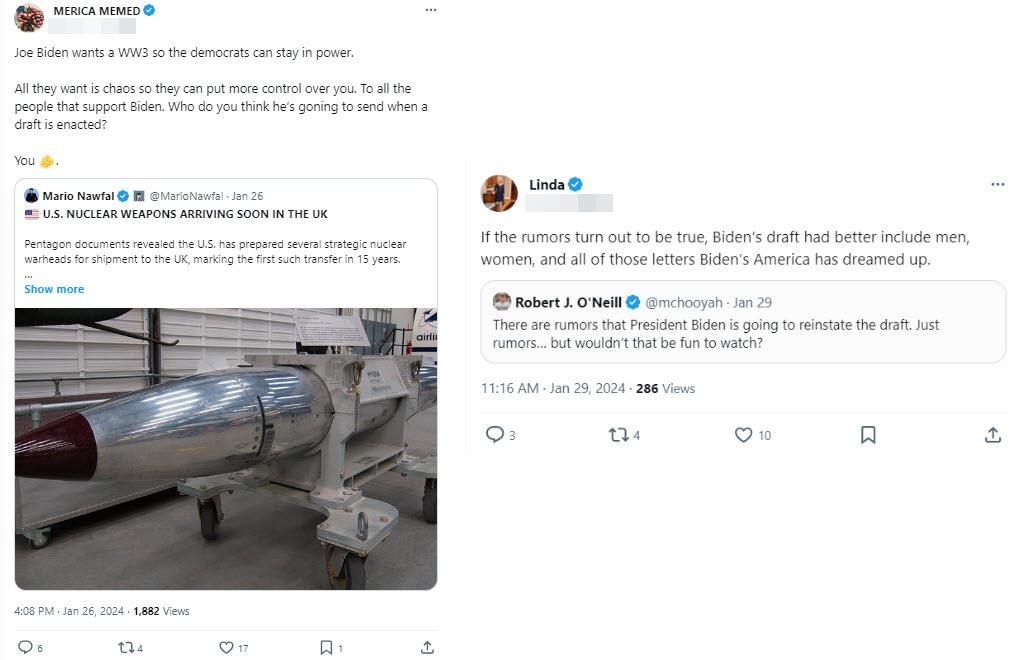
The article was also shared by Arizona state House candidate Nick Kupper in a post to X. He wrote: “I’ve been saying it for a long time now. Biden will start a war & institute a draft this year before the election.”
---
1 24 heated gmail
no lnx pix grf?
Here’s how much Democrats get paid to shill for fossil fuels
Two former Democratic lawmakers made six-figure salaries for falsely promoting methane gas as a climate solution, tax documents seen by HEATED show.
ARIELLE SAMUELSON
JAN 18
In January 2022, only a few years after leaving the elected seat she held for six years, former Democratic Senator Heidi Heitkamp of North Dakota got a new job: convincing climate-concerned liberals to love the fossil fuel industry.
“It’s clear we have an existential threat to the planet,” said Heitkamp, in a December 2022 commercial for the methane gas lobbying group Natural Allies For a Clean Energy Future. “We should be doing everything that we can to help other countries do what we did, which is dramatically reduce our CO2 emissions by using natural gas.”
The ad—titled “Real Talk with Heidi Heitkamp”—was one of a handful of public relations jobs Heitkamp did that year for Natural Allies, some of which she did alongside former Democratic Senator Mary Landrieu of Louisiana. Together, the notoriously moderate Democrats wrote a sponsored article in Politico claiming that “natural gas is accelerating our clean-energy future,” and an op-ed in Newsweek declaring that methane gas can “actually achieve our shared global climate goals faster.” Landrieu also did her own “Real Talk” commercial in March 2022.
For these ads and op-eds, Heitkamp was paid $185,266 and Landrieu was paid $210,690 in 2022, according to IRS 990 tax documents obtained by the Energy and Policy Institute and seen by HEATED. The documents show payments made to Heidi Heitkamp Inc. and to Landrieu’s consulting firm VNF Solutions.
A screenshot of Natural Allies’ 990 tax form from FY2022, showing payments to Landrieu’s consulting firm and Heitkamp. They also show $1 million in payments to Mad Global, a public relations firm that specializes in politics and government, and more than $3.5 million to Omnicom Public Relations Group, a global public relations company.
It’s unclear if these positions represented full-time jobs; both Heitkamp and Landrieu were hired as members of Natural Allies’ “Leadership Council” in early 2022. According to a press release about the hires, the Leadership Council seeks “to bring greater awareness to the foundational role natural gas must play in transitioning to a clean energy future.” Neither Heitkamp nor Landrieu responded to HEATED’s request for comment.
Whatever the case, the numbers are a rare glimpse into the lucrative business of greenwashing the fossil fuel industry. Natural Allies is run and funded entirely by fossil fuel companies, including Williams, TC Energy, Kinder Morgan, National Fuel Gas, Southern Company Gas, and Cheniere Energy.
“It's not every day we get to see the price tag of a former U.S. senator’s advocacy,” said Charlie Spatz, a senior researcher at the Energy and Policy Institute.
Spatz said the numbers also highlight one of the reasons it may be so hard to pass truly effective climate policy in Congress.
“It's sending a message to current Senators that maybe you shouldn't be so harsh on the fossil fuel industry, if they're going to take care of you after you finish,” he said.
A six-figure salary to spread climate misinformation
With each passing year, the science on methane gas pollution and climate change becomes more damning. A recently revised analysis from Robert Warren Howarth, a professor of ecology and environmental biology at Cornell, found that greenhouse gas emissions from liquified methane gas “are larger than those from domestically produced coal, ranging from 18% to 185% greater for the average cruise distance of an [liquified methane gas] tanker.”
At the same time, with each passing year, more and more former Democratic lawmakers are lining up to tout methane gas as “climate-friendly” in exchange for a paycheck from Natural Allies, which is currently running a seven-figure campaign to target young, liberal, and Black and Latino voters “as effectively as we have messaged to the right.”
In addition to Heitkamp and Landrieu, former Philadelphia Mayor Michael Nutter, former Ohio Congressman Tim Ryan, and former Florida Congressman Kendrick Meek all accepted positions with Natural Allies in 2023.
Those former lawmakers’ salaries were not disclosed on Natural Allies’s 2022 tax forms, as they were not yet hired by the organization. And it’s unclear if they will be disclosed on future forms, as the IRS only requires that non-profits disclose the five contractors with the highest salaries over $100,000.
However much they are making, they are spreading messages about methane gas that climate scientists have roundly decried as misleading.
“Their claims are all either extremely vague or disproved with middle-school-level science,” said Kate Marvel, a climate scientist at Project Drawdown, who previously worked at NASA’s Goddard Institute for Space Studies.
“Using natural gas warms the climate. Period, full stop,” said Andrew Dessler, professor of atmospheric sciences at Texas A&M University. “There is no world in which natural gas is a long-term ‘solution’ to the climate problem.”
Natural Allies cites multiple “independent studies” to support its claim that methane gas is the best way to solve the climate crisis. But, as we reported last year, all of those studies were funded at least in part by fossil fuel interests, and none were published in a peer-reviewed journal.
Actual peer-reviewed science with no industry backing has shown the opposite of what Natural Allies claims. According to a 2021 systematic review of the scientific literature on methane gas, increasing investments in the fossil fuel carries a long-term risk of delaying the clean energy transition and worsening the climate crisis. That’s because investing in further natural gas development “could lock-out emerging renewable technologies for extended periods.”
Building new gas pipelines, LNG terminals, and gas-fired power plants “pose a particularly great risk for carbon lock-ins,” scientists wrote this year in the journal Nature Energy.
What Natural Allies is doing is called “solutions denial,” a common form of climate misinformation, as we previously reported:
“It's an absolute tried-and-tested argument within the disinformation playbook to constantly create more interim milestones before we achieve what a real necessary transition looks like,” said [Jennie] King, who works at the Institute for Strategic Dialogue. “So taxpayer money [goes] into creating new dependencies on [fossil fuels], which ultimately in the long term, make it much harder for us to achieve an actual clean energy transition.”
But former Democratic lawmakers and mainstream media are still more than willing to spread the misinformation coming from Natural Allies, so long as Natural Allies is willing to pay for it. Since 2020, Natural Allies has spent $10 million on a national PR campaign targeting Democratic voters, including more than $4 million to place ads in E&E News and Politico newsletters, Axios, Newsweek, Vox, the Wall Street Journal, and across cable news stations, according to reporting from the Guardian and Floodlight.
These campaigns are effective, in part, because it is very difficult to tell who is behind them. Readers of these news outlets may not recognize, as we uncovered last year, that Natural Allies’ ads are a form of fossil fuel industry climate disinformation. And that is the real price of Heitkamp and Landrieu’s sell out: a deception not measured in dollars, but in the degrees threatening our livable climate.
Further reading
Politico and Axios defend running misleading natural gas ads. HEATED, February 2023.
Key quote: “It is not up to us to decide what is factually accurate or what is not factually accurate,” Politico executive vice president Cally Stolbach Baute told HEATED. “We frankly respect our readers enough to be fully transparent with them on our advertising and encourage them to evaluate our journalism on its merit and its accuracy.”
How the gas industry aims to rebrand as ‘clean’ energy to appeal to Black and Latino voters. Floodlight and The Guardian, June 2022.
Key quote: “Success for the natural gas industry will be rooted in whether we can message to the left and the Democratic base of Black and Latino and age 18-34 voters as effectively as we have messaged to the right,” read one early strategy document.
The methane gas industry is trying to codify misinformation into law. HEATED, May 2023.
Key quote: “The phenomenon started in Europe [in 2022], when the European Parliament voted to label certain uses of natural gas as “green.” That meant billions of dollars that were intended to fund climate-friendly projects could legally be used for methane power plants and terminals. Now, industry climate misinformation has also started making its way into U.S. state law—albeit in slightly different ways.”
---
splc
december 11, 2022
Hannah Gais and Michael Edison Hayden
A collection of radical right figures including white nationalists and ultranationalist European leaders gathered in Manhattan for the New York Young Republican Club’s (NYYRC) annual gala Saturday night, where that group’s president declared “total war” on perceived enemies.
“We want to cross the Rubicon. We want total war. We must be prepared to do battle in every arena. In the media. In the courtroom. At the ballot box. And in the streets,” NYYRC president Gavin Wax declared to a room full of supporters at 583 Park Ave., an event venue on New York’s Upper East Side.
“This is the only language the left understands. The language of pure and unadulterated power,” Wax added.
The white nationalists of VDARE snap a selfie with Steve Bannon at the NYYRC gala on Dec. 10. From left to right: Peter Brimelow, Steve Bannon, Lydia Brimelow. (Photo by Michael Edison Hayden)
At the five-hour event, which Hatewatch reporters attended, white nationalists Peter and Lydia Brimelow of VDARE hobnobbed with Steve Bannon, a former Trump adviser and White House official. Donald Trump Jr. was also in attendance.
Republicans publicly lauded members in attendance from an Austrian political party founded by World War II-era Nazi party members. Racist political operative Jack Posobiec shared jokes across a table with Josh Hammer, the opinion editor of Newsweek. Multiple recently elected GOP congresspeople applauded Marjorie Taylor Greene, who told the NYYRC crowd in the event’s closing remarks that the Jan. 6, 2021, attack on the U.S. Capitol would have succeeded if she had planned it and that the insurrectionists would have been armed.
Rep. Marjorie Taylor Greene talks with guests at the NYYRC gala on Dec. 10, 2022 in Manhattan. (Photo by Michael Edison Hayden)
“Then Jan. 6 happened. And next thing you know, I organized the whole thing, along with Steve Bannon,” Greene said, referring to allegations that she had led reconnaissance tours of the Capitol for soon-to-be insurrectionists in the days prior to the violence.
“I will tell you something, if Steve Bannon and I organized that, we would have won,” she said, as attendees erupted in cheers and applause. “Not to mention, it would’ve been armed.”
WHITE NATIONALISTS AND NEOFASCISTS IN THE REPUBLICAN PARTY
Republican speakers repeatedly voiced an anti-democracy, authoritarian ideology, and extremists in the audience cheered wildly. White nationalists such as the Brimelows of VDARE and leaders from extreme far-right European parties like Alternative for Germany (Alternative für Deutschland, AfD), whom German officials placed under surveillance for their ties to extremism, and Austrian Freedom Party (Freiheitliche Partei Österreichs, FPÖ), ate and drank in the same room as newly elected Republican congresspeople, such as Long Island and Queens-based George Santos, Georgia-based Mike Collins and Florida-based Cory Mills.
• MORE NYYRC: Hungarian ambassador attends controversial Republican gathering
Hatewatch reached out to Santos and Mills by email before the event about their willingness to appear in a global collection of radical right, anti-democracy activists. They did not reply. Hatewatch reached out to Collins on Sunday morning but had not received a response at press time.
A STEVE BANNON SELFIE FOR VDARE
Bannon, the former Trump adviser, physically embraced the white nationalist Brimelows at NYYRC, spoke to the couple for several minutes and took a selfie with them. VDARE traffics in the great replacement conspiracy theory and has published defenses of writing a terrorist who gunned down 24 people in an El Paso Wal-Mart in 2019 allegedly authored. Peter Brimelow attended the white supremacist American Renaissance conference in November, whose host has portrayed Black people as being subhuman. The Brimelows publish writing authored by Jason Kessler, who helped organize the deadly 2017 “Unite the Right” rally in Charlottesville, Virginia.
When Hatewatch attempted to speak to Lydia Brimelow after her conversation with Bannon to inquire about it, she walked away. Hatewatch did not get close enough to Bannon to ask him about the encounter with Peter and Lydia Brimelow.
‘PIZZAGATE’ JACK DESCENDS ON NEW YORK CITY
Jack and Tanya Posobiec arrive in New York City by train before the NYYRC meeting in Midtown on Dec. 10. (Photo by Michael Edison Hayden)
Posobiec, a radical right political operative, resides with his wife Tanya Posobiec in Hanover, Maryland. The couple took Amtrak Northeast Regional train 88 into New York’s Penn Station Moynihan Hall on Saturday afternoon to get to the NYYRC gala. Train 88 pulled in at around 3:45 p.m., and a Hatewatch reporter observed Posobiec and his wife deboard and enter New York City.
“Antifa, don’t even think about it tonight,” Posobiec posted to Twitter three hours later, at 6:39 p.m., with the location of the tweet marked Manhattan, New York.
NYYRC gave Posobiec a speaking slot and an Allen W. Dulles award, named after the former head of the CIA. NYYRC said in its December bulletin that the award is given to “an individual who embodies the virulent anti-Marxist spirit of [Dulles].”
Like the Brimelows, Posobiec has a well-documented history of radical-right activism. He to the antigovernment Oath Keepers, fraternized with the Proud Boys, and at least twice, filmed propaganda videos with
 . He is primarily known for pushing the
 , which falsely suggested that Democrats ran a pedophile dungeon in the basement of a Washington, D.C., pizzeria.
Hatewatch spoke with Posobiec around midnight at the NYYRC event and asked him about his involvement in pushing the #StoptheSteal hashtag onto Twitter during the runup to the 2020 election. Although “Stop the Steal” became synonymous with the Jan. 6, 2021, attack on the U.S. Capitol building, Posobiec started tweeting the hashtag from his over-1-million-follower account as early as Sept. 7, 2020, two full months before anyone tallied any votes.
While responding to Hatewatch at NYYRC, Posobiec first attempted to associate the hashtag with Roger Stone and then with Ali Alexander, two of his collaborators. Then he called it “a meme.” He never explained why he abruptly started posting the hashtag in September 2020.
While answering questions, Posobiec grew testy with a Hatewatch reporter and described SPLC as a “domestic terror organization.” Posobiec called that reporter a “scumbag” and a “troll.” After Posobiec’s speaking tone became palpably agitated, a crowd formed and NYYRC executive secretary Viswanag “Vish” Burra escorted both Hatewatch reporters to the exit, physically shoving one of them.
NEWSWEEK FLAUNTS ITS RADICAL-RIGHT CREDENTIALS
Newsweek editor Josh Hammer (in suspenders) texts from table #6, near the front of the stage, at the NYYRC gala on Dec. 10. (Photo by Michael Edison Hayden)
Starting in May 2020, after editor Nancy Cooper and chief content officer Dayan Candappa brought political activist Josh Hammer to run *Newsweek*’s opinion section, the 90-year-old publication has emerged as a hub for opinion pieces authored by radical right activists. Newsweek has published the extremist Posobiec as well as 2020 election-lie pusher Raheem Kassam in recent years, and Hammer has also hosted both of them on his Newsweek-branded podcast. The three men sat together talking and laughing at table #6 during the NYYRC event, near the stage.
Newsweek contributor and disinformation peddler Raheem Kassam texts a selfie to someone at the NYYRC event on Dec. 10. Kassam sat at table #6 with Newsweek editor Josh Hammer and fellow Newsweek contributor Jack Posobiec. (Photo by Michael Edison Hayden)
When QAnon influencer-turned-congressperson Marjorie Taylor Greene took the stage, Hammer stood up and applauded. When she endorsed former President Trump as her 2024 presidential candidate of choice, Posobiec turned to Hammer and grinned. In January, Florida Gov. Ron DeSantis invited Hammer on a tour of his office, and the Florida-based Newsweek editor has since hyped DeSantis as a potential presidential candidate.
“You gonna go up there, Josh?” Posobiec chided Hammer about Greene’s endorsement of Trump, eliciting laughter from the table.
A Hatewatch reporter approached Hammer after Greene’s speech, made an introduction and asked if he knew Peter Brimelow of VDARE.
“He’s right here, right now?” Hammer asked with excitement.
“I didn’t even know he was here!” Hammer said of the infamous white nationalist publisher. “I’m going to say ‘Hi.’ ”
The Hatewatch reporter asked Hammer how he got his job at Newsweek, and the opinion editor abruptly stopped talking. He asked the reporter to identify himself again. When the reporter did, Hammer’s expression slackened. He quickly claimed he did not know Peter Brimelow and left.
‘WHAT’S RACIST ABOUT PROJECT VERITAS?’
Multiple figures associated with Project Veritas, the hard-right propaganda group that engages in sting operations, attended the NYYRC gala. The group’s founder James O’Keefe and Project Veritas board member Matthew Tyrmand hobnobbed with NYYRC guests Saturday.
Legal trouble has entangled Project Veritas in recent months. Former associates sued Project Veritas in August, citing the creation of a “highly sexualized” work environment, which they claim included substance abuse and unpaid labor. (The group has denied these allegations.) In September, a jury in a civil case found that Project Veritas had “violated wiretapping laws and fraudulently misrepresented itself” during a sting operation targeting a group called Democracy Partners. The FBI raided O’Keefe’s home in November 2021 as part of an investigation into the alleged theft of a diary belonging to President Joe Biden’s daughter Ashley. (The group has claimed that they acted lawfully in obtaining the diary.)
Outside of the building on 583 Park Ave., O’Keefe argued with antifascist protesters, according to footage reviewed by Hatewatch. A different, self-described “independent video journalist” posted a series of clips to Twitter at 8:15 p.m., showing O’Keefe asking antifascist protesters on the corner of Park Avenue and 62nd Street, “What’s racist about Project Veritas?”
The same social media user posted a video to Twitter at 9:12 p.m. In it, O’Keefe could be seen standing on the street outside the venue alongside several other men, including Newsweek’s Hammer.
“Would you like to make a tax-deductible donation to Project Veritas?” O’Keefe asked the protesters.
Rudy Giuliani (center) chats with guests alongside radical right activist Lucian Wintrich (left) at the NYYRC gala on Dec. 10. (Photo by Michael Edison Hayden)
Hatewatch observed Project Veritas’s Tyrmand sitting at table #4, the one closest to the center of the stage, alongside Trump-world power players Steve Bannon and former New York City mayor Rudy Giuliani. A recent *New York Times* report named Tyrmand and Bannon as key U.S. figures in an effort to depict Brazil’s November presidential elections as being fraudulent, after voters in that country pushed hard-right favorite Jair Bolsonaro out of office. Tyrmand, who is known for his ties to the global radical right, took the stage and lauded the ultranationalist European leaders in attendance.
“This is an all-star room, and I urge all of you to meet everybody here and continue to spend time together, getting to know each other, so we can fight the battle, arm in arm,” Tyrmand said of the European extremists, including the contingents from Austria and Germany.
ALMOST MIDNIGHT
Donald Trump Jr. addresses the NYYRC gala on Dec. 10 in Manhattan. (Photo by Michael Edison Hayden)
Speakers including Trump Jr. and Greene sought to downplay the Republicans’ failure to secure a so-called “red wave” victory in the 2022 midterms by attacking such familiar right-wing targets as Joe Biden’s son Hunter Biden and LGBTQ+ people.
“The party is in a pretty good spot, but America may not be getting it. We have a party right now that is actually delivering for the American people. But what we don’t have [is] our same people in Washington, who can make those things happen,” Donald Trump Jr. told the crowd after he came on stage.
Greene suggested eliminating Democrat members of House committees in her closing speech, as a way of shifting the tide of power in Washington. She also told the audience it was “almost midnight,” meaning they risked losing their country to perceived enemies.
Greene praised a Project Veritas video focused on LGBTQ+ education published by the group, saying it shows that teachers “pass around dildos, butt plugs and lube.” (The school issued a statement claiming “[Project] Veritas deceptively edited the video with malicious intent.”)
Greene expressed her gratitude to Project Veritas for their work.
“Thank you very much. We appreciate that,” she said to scattered applause.
---
mma
Fox News is rapidly escalating its anti-offshore wind campaign
02/03/23
Fox News' Jesse Watters fails to disguise oil-industry funded group as a grassroots “ocean advocate” organization
01/12/23
Newsweek Falsely Blames Wind Turbines For Whale Beachings
04/04/1
https://www.mediamatters.org/fox-news/newsweeks-batya-ungar-sargon-biden-administration-has-effectively-partnered-cartels-kind
child slave labor
===
yikes newsweek recycles daily sig BS: rooskies green sea change, aggregator?
https://www.newsweek.com/putin-funding-green-groups-discredit-natural-gas-fracking-635052
===
https://www.mediamatters.org/climate-deniers/great-reset-conspiracy-theory-hotbed-climate-denial
ted mac
major climate conferences, such as the upcoming Conferences of the Parties to the United Nations Framework Convention on Climate Change (COP27), are often the subject of right-wing media's ire. During last year's COP26, right-wing media was rife with climate change denial, mockery, and claims that climate action is a ploy to control the citizenry. While we can expect to see these same talking points during COP27 in Egypt from November 6-18, another idea that the right has weaponized and may deploy during the event is the Great Reset conspiracy theory.
Although the concept of a Great Reset has spawned a number of conspiracy theories, the common premise among them all is that a cabal of global elites are conspiring to abolish personal freedoms in order to install a tyrannical, one-world government. According to the Great Reset’s adherents, climate policies (among other issues) are a pretext being used by said global elites to implement this global government.
While conspiracy theories related to the Great Reset as a whole are not new, issues of climate denial associated with the Great Reset have been gaining momentum across right-wing media in recent months, fueled by the global energy crisis and a summer of climate-fueled weather disasters. A key driver of the climate components of the Great Reset conspiracy theory is longtime right-wing media darling and climate denierMarc Morano. Other far-right media personalities including Charlie Kirk, Jack Posobiec, and Peter Swedenhave alluded to or directly referenced the Great Reset conspiracy theory.
At a time when more global dialogue on climate action is crucial in order to avoid the worst effects of climate change, prominent right-wing media figures espousing unhinged Great Reset conspiracies is a worrying prospect.
What is the Great Reset? //agenda 21]
The Great Reset, as envisioned by World Economic Forum founder Klaus Schwab in June 2020, is a plan for what the world should look like after the coronavirus pandemic ends. Schwab stated “the pandemic represents a rare but narrow window of opportunity to reflect, reimagine, and reset our world to create a healthier, more equitable, and more prosperous future.” In essence, the Great Reset asks the question of how to prepare for a more sustainable future, and it promotes more global governmental and corporate cooperation in order to solve the world’s most pressing problems, including poverty, income inequality, and climate change.
A June 2021 BBC deep dive into Great Reset conspiracy theories detailed some of the problems related to the plan. They called it “a vague set of proposals,” before stating that “this lack of clarity, combined with the plan being launched by an influential organisation, provided fertile ground for conspiracy theories to grow.” Among the first and most popular of the Great Reset conspiracy theories dealt with coronavirus. BBC noted, “In this narrative, lockdown restrictions were introduced not to curb the spread of the virus, but to deliberately bring about economic collapse and a socialist world government, albeit run for the benefit of powerful capitalists.”
Indeed, early right-wing criticisms of the Great Reset focused on the idea of a radical transformation of the world economy. In June 2020, Justin Haskins of the libertarian, climate-denying Heartland Institute wrote op-eds insinuating this on both the Fox News and Fox Business websites. Two segments on Fox News’ **The Ingraham Angle** in November 2020 also addressed the idea of an overthrow of the world economy, with host Laura Ingraham stating on November 13, “Well, with the coronavirus, that idea went global. And since last spring, powerful people began to use this pandemic as a way to force radical social and economic change across the continents.”
In his June 2020 Fox Business op-ed, Haskins also pushed the idea that climate policies would be used as a pretext to advance the Great Reset agenda. This idea was also mirrored by former Breitbart writer James Delingpole, who wrote in November 2020 that climate change is “really just a pretext for the kind of globalist takeover now being conducted by our governments.” Fast forward to 2022, and this is one of the main tenets of the Great Reset conspiracy theory.
Key climate denial talking points within the Great Reset conspiracy theory
There are several themes related to climate change within the Great Reset conspiracy theory that have been pushed by right-wing media figures.
“Climate lockdowns are coming”
As the aforementioned BBC deep dive piece noted, adherents to the Great Reset conspiracy theory believe that there are more sinister motives to coronavirus lockdowns than just protecting public health. Now, the theory’s adherents believe the same about climate action. Adherents push the idea that “climate lockdowns” are being planned by world governments in order to set off recessions and rapidly restrict economic growth.
Notorious climate denier Marc Morano was pushing this idea as early as 2020, when he stated on the December 21 edition of Fox News’ Tucker Carlson Tonight that the Biden administration will “go from COVID lockdowns to climate lockdowns.” Morano returned to it on the June 19, 2022, edition of Newsmax’s Gorka Reality Check, where he railed against Green New Deal policies and stated that Bill Gates and George Soros “love this idea of lockdowns. …That is their path to the Great Reset, emergency declaration gives them more power.”
Popular alt-right commentator and Pizzagate conspiracy theorist Jack Posobiec also echoed this line of thinking, tweeting to his more than 1 million followers on September 20 that “Davos launching new push for permanent ‘climate change’ lockdowns: ’The lockdowns aren't for them, the lockdowns are for YOU.’" On the September 21 edition of Newsmax’s Eric Bolling The Balance, host Eric Bolling stated, “The same reasons given for the COVID lockdowns will be the same reasons for creating climate change lockdowns.” He led with this by showing pictures of internment camps, insinuating to his viewers that this is the end goal that climate action will lead to.
“Climate change is about control”
This claim is based on the lie that climate change is a manufactured crisis which wealthy individuals and powerful governments are using to implement policies that police peoples’ movement and ultimately end basic freedoms.
On the July 15 and 16 editions of Fox & Friends, co-host Will Cain made this claim, stating that there’s “protests against the Great Reset” all around the world, and claimed, “All of this goes back to a global plan to attempt to control the climate no matter the cost.”
Bolling also pushed this idea, telling his audience on the September 12 edition of Eric Bolling The Balance that climate change is a hoax being used “in order to make people fear the end of the world and convince us to change everything. They want to control us forever and ever.” (In fact, the entire 16 minutes of his monologue was focused on climate denial.) Speaking about the Great Reset on the September 20 edition of OAN News, climate denier guest Bonner Cohen insinuated that the “environmental movement” recognized that “scaring people to death about ‘climate change’” is a way to control them. He then continued:
Once you control energy, you also control the people who use and need energy. This is a way of forcing them to do exactly what you want to do, and will enable unelected and unaccountable bureaucrats in Washington, D.C., and for that matter, around the world to determine how you spend your life, how you spend your money, how you use your energy to the benefit of a tiny percentage of the population.
Controlling agriculture and meat
Another climate-related tenet of the Great Reset conspiracy theory is the idea that those in power want to control food production and police what people eat.
In reference to the Dutch farmers' protests, The Post Millennial tweeted out a quote from Posobiec on July 7, which said, “The government of the Netherlands perhaps should be listening to their farmers ... instead of listening to the WEF and pushing the Great Reset green agenda upon them.”
In a discussion on general problems facing the U.S. on the September 3 edition of Newsmax’s Wendy Bell Common Sense, right-wing radio host Jeff Kuhner stated, “It's the Great Reset. … Many of these left wing global – they want food shortages. They want energy rationing. They want to break the back of the middle and working class of this country.”
Great Reset conspiracy theorists also imply that people will be forced to eat insects. In July, pseudo-journalist and Holocaust denier Peter Sweden got over 12,000 likes on a tweet saying, “In Belgium there are now talks about an ‘environment tax’ on meat. They want you to eat bugs and be happy. Are you enjoying The Great Reset?”
Dog whistling about the Great Reset
Oftentimes, the term Great Reset won’t be directly referenced, but certain keywords and allusions are used as dog whistles. In September, Peter Sweden and Morano baselessly claimed people will be forced to eat bugs.
Another example comes from right-wing writer Joel Kotkin in Newsweek, who, on September 19, suggested that coronavirus lockdowns are a test run for coming climate lockdowns, and both are “top-down edicts over how people live.”
Fox News star Tucker Carlson also alluded to the Great Reset conspiracy theory on the September 9 edition of Fox News’ The Ingraham Angle. Discussing the energy crisis, Carlson suggested that transitioning away from fossil fuels is about control. He claimed, “Energy is civilization. … People don’t understand how threatening this is and how close we are to being under the complete and total control of people who wish us ill.”
Additionally, if a speaker references “globalists,” Klaus Schwab, Davos, or the World Economic Forum within a climate denial context, that’s generally a sign they are referring to the Great Reset. For example, on the September 9 edition of Newsmax’s Real America, Rep. Marjorie Taylor-Greene (R-GA) suggested that global elites are pushing climate policies to make money at the expense of the poor. She said, “They want the climate crisis to continue because they make money off of it. … They're so disconnected. And they truly are globalists and they're more interested in the World Economic Forum and what Klaus Schwab has to offer.”
Key drivers of the Great Reset conspiracy theory are popular figures within the right-wing media ecosystem
One such narrative-shaper is Morano, a longtime climate denier and frequent Fox News guest who recently wrote a book titled “The Great Reset: Global Elites and the Permanent Lockdown.” In addition to various Newsmax appearances, Morano appeared on two separate OAN shows on September 16 to discuss the Great Reset. In July, his book was promoted on Tucker Carlson Tonight. On October 8, he appeared on Fox News’ Unfiltered with Dan Bongino and said the Great Reset is about “collapsing our energy, food, transportation, and our free speech rights.” He’s also been doing right-wing radio interviews promoting his Great Reset conspiracy theory book.
Hosts on Newsmax are also promoting the Great Reset conspiracy theory.Bolling has devoted several segments to climate denial and the Great Reset in recent months. On the October 13 edition of his program, Bolling lied about President “Joebama” waging a “war on our own oil independence,” and that he is making people “suffer for the Great Reset. Control us for the Great Reset.” He said this all alongside a chyron that stated, “You shall eat no meat.”
Newsmax anchor Rob Schmitt also pushed this idea on the September 29 edition of his show Rob Schmitt Tonight, stating, “In 50 years we will still be burning fossil fuels on this planet. … No person is actually going to gut their quality of life to help John Kerry implement a Great Reset that will do nothing to save the climate and insidious plan that really just rapidly socializes our country and the world, which is what they really want.” Newsmax anchor Chris Salcedo also mentioned the Great Reset on his show on September 15.
Popular alt-right media personalities are also driving much of the Great Reset chatter. One example is Peter Sweden, whose regular tweets about climate denial and the Great Reset receive significant engagement. One tweet, which racked up tens of thousands of likes, stated, “The Great Reset is another word for Global Communism.” Two other tweets with significant engagement also exhibit climate denial and link the Great Reset to “global communism.”
Jack Posobiec is another right-wing figure pushing Great Reset talking points. In September, Turning Point USA (TPUSA) hosted an event in Phoenix called “Defeating the Great Reset.” Notable speakers included Posobiec, Charlie Kirk, and Steve Bannon. The description of the event lied about the WEF’s plan, saying they want people to “own nothing and be happy” (a Reuters fact check from early 2021 disputed this claim). Conference speaker James Lindsey invoked this phrase and insinuated that powerful elites will come after our modes of transportation. Additionally, Charlie Kirk interviewed guest attendee Alex Jones about banning meat, with Jones saying that meat is a “symbol of freedom” and that “globalists” want to ban it.
What’s worse, the September 22 of Kirk’s podcast was entirely devoted to climate denial, using the title “Exposing the Great Climate Change Hoax.” The Great Reset was mentioned multiple times in this episode. He also alluded to climate lockdowns, stating, “How do you stop a virus? You lock down everything. How do you stop climate change? You lock down everything.” He also claimed that dictators use crises “to get their tyranny, their power, their control implemented.” He then called climate change “the next crisis and the perfect one.” He also suggested that the transition to clean energy is all about a transition to more global government and less freedom. Finally, Kirk used violent rhetoric to describe climate activists, noting that the “enviro-fascist movement” is “the greatest threat to civilization.”
Tenets of the Great Reset conspiracy theory have also popped up on Fox News, which is the most-watched cable news network in the United States. In addition to the examples above, the September 7 edition of Tucker Carlson Tonight featured a segment on the growing threat of climate lockdowns. Ingraham also mentioned lockdowns on the October 30 edition of The Ingraham Angle, where she insinuated that the climate crisis, much like the pandemic, is made up, and that it will be an excuse for elites to “extend emergency powers” over the population.
This conspiracy theory will only get worse from here – news outlets should pay attention
Given the growing proliferation of the Great Reset conspiracy theory in right-wing media, it’s worth noting that there are legitimate critiques of the WEF’s vague proposal outside of unhinged conspiracy theories. The BBC deep dive referenced earlier found that the lack of clarity around Schwab’s screed provided fertile breeding ground for conspiracy theories to grow. Writing in The Intercept in late 2020, climate writer Naomi Klein argued that people have a right to be skeptical of wealthy and powerful figures introducing bold new ideas, stating that the Great Reset “is an attempt to create a plausible impression that the huge winners in this system are on the verge of voluntarily setting greed aside to get serious about solving the raging crises that are radically destabilizing our world.” Finally, writer Ivan Wecke argues the real issue with the Great Reset idea is that it gives corporations, and not democratic institutions, more control over our lives.
The lack of clarity around the original Great Reset idea and the real problems associated with it make the right-wing conspiracy theories related to it all the more worrying. Given the threats posed by climate change, we do need to envision a way to create a more sustainable future. Global dialogue on climate action is necessary to do this, and it’s why conferences like the upcoming COP27 are crucial: We need forums to discuss ways to phase out our deadly addiction to fossil fuels and introduce cleaner sources of energy that will allow those at the bottom to live more just and equitable lives.
The right’s Great Reset conspiracy theory flips all of this on its head: By calling climate change a hoax to advance a tyrannical agenda, Great Reset conspiracy adherents are advocating for a future with more fossil fuels which will lead to more devastating climate impacts that will disproportionately affect those at the bottom.
The Cambridge Extinction Rebellion Twitter account did an excellent job of explaining why this conspiracy theory should be taken seriously, noting that adherents “will frame fossil fuels around notions of freedom, claiming pro climate and anti fossil fuel policies harm freedom. They will heavily capitalize on the energy crisis this winter to advance this narrative. It is likely to be persuasive to many.” Given the rapid spread of conspiracy theories like QAnon and the belief that the 2020 presidential election was stolen from Trump, people need to understand the danger behind climate denial and the right-wing Great Reset conspiracy theory. They can start by keeping an eye on it around COP27 discussions.
2x?
http://www.deeppoliticsforum.com/forums/showthread.php?p=13385#post13385
Magda Hassan
11-12-2009,
Newsweek Is Neck Deep in Oil & Conflicts
Submitted by Lisa Graves (http://www.prwatch.org/user/35268) on November 6, 2009 - 12:14am.
http://www.prwatch.org/files/images/BlueDartsOnTarget.jpgTPM Muckraker has exposed (http://tpmmuckraker.talkingpointsmemo.com/2009/11/newsweek_and_oil_lobby_team_up_to_host_climate_cha .php?ref=fpblt) the fact that Newsweek is teaming up with the American Petroleum Institute (http://www.sourcewatch.org/index.php?title=American_Petroleum_Institute) (API (http://www.sourcewatch.org/index.php?title=API)) to host a "briefing" for Members of Congress on climate and energy policy. The briefing is timed to coincide with, surprise, the Senate getting ready to take up climate and energy policy in advance of next month's COP15
(http://www.sourcewatch.org/index.php?title=COP15) world conference on global warming policy.
API (http://www.sourcewatch.org/index.php?title=API)'s Lobbying Is Up and Against Slowing Global Warming (http://www.sourcewatch.org/index.php?title=Global_Warming)
According to TPM, API (http://www.sourcewatch.org/index.php?title=American_Petroleum_Institute) has already spent $3.9 million directly lobbying in the first part of this year, primarily influence "cap-and-trade (http://www.sourcewatch.org/index.php?title=cap-and-trade)" legislation regulating the use of "carbon credits (http://www.sourcewatch.org/index.php?title=carbon_credits)" orpollution emission credits, as well as on the Waxman-Markey (http://www.sourcewatch.org/index.php?title=Waxman-Markey) climate change bill. (During the Bush administration, API (http://www.sourcewatch.org/index.php?title=API) spent only about $3 to $4 million a year on directly lobbying Congress.) But, according to Guidestar, API (http://www.sourcewatch.org/index.php?title=API) (a registered non-profit) has revenues of around $200 million a year, primarily from oil companies, as of the last public report in 2007. And, it spent over $70 million on advertising that year alone.
Surprise: API (http://www.sourcewatch.org/index.php?title=API) Is a Big Advertiser for Newsweek
API (http://www.sourcewatch.org/index.php?title=API) is one of the top advertisers in Newsweek, which has had big cuts in its newsroom due in part to declining ad revenues which totaled $96 million during the first half of this year (the portion attributable to API (http://www.sourcewatch.org/index.php?title=API) is not reported). Newsweek told TPM it had offered its top 20-30 advertisers an opportunity to co-host panels for outreach to legislators, but as TPM noted "most don't have a single issue focus that lends itself to an event in the way the oil lobby does."
Advertiser and Astroturf (http://www.sourcewatch.org/index.php?title=Astroturf) Funder Jack Gerard (http://www.sourcewatch.org/index.php?title=Jack_Gerard), the Father of the "Energy Citizens (http://www.sourcewatch.org/index.php?title=Energy_Citizens)," Gets the Spotlight
http://www.prwatch.org/files/images/cashroots.pngThe Newsweek salon for Members of Congress on climate will feature the API (http://www.sourcewatch.org/index.php?title=API)'s Jack Gerard (http://www.sourcewatch.org/index.php?title=Jack_Gerard), who makes about $2 million a year in salary and deferred compensation for being Big Oil's go-to guy in DC. Gerard, who previously headed the American Chemistry Council (http://www.sourcewatch.org/index.php?title=American_Chemistry_Council), gained new notoriety this summer after Greenpeace (http://www.sourcewatch.org/index.php?title=Greenpeace) publicized a memo, which is attached down below, that he sent to oil companies mapping out a plan to create astroturf (http://www.sourcewatch.org/index.php?title=astroturf), or what I call "cash-roots (http://www.sourcewatch.org/index.php?title=cash-roots)," rallies. I'm sure you remember the slick company-produced signs and t-shirts at these manufactured events whereindustry employees were bused in to "citizen rallies" against anti-global warming legislation, as with the self-declared "energy citizens (http://www.sourcewatch.org/index.php?title=energy_citizens)." As TPM's Zachary Roth noted, Newsweek did report on that as an example of "how astroturfing is taking over local activism."
Newsweek Suddenly Buys into Big Oil Green-Washing (http://www.sourcewatch.org/index.php?title=Green-Washing)
But, as Roth pointed out: "[R]ecently, the magazine has gone easier on the oil industry. In September, Newsweek ran a story by Newsweek International editor Rana Foroohar entitled "Big Oil Goes Green For Real," which infuriated environmentalists by asserting that oil industry investments in alternative energy were no longer just green-washing (http://www.sourcewatch.org/index.php?title=green-washing), but rather were 'the real deal.'"
Newsweek's Selling Out Makes It Worth Less and Less
Despite this, Newsweek said it separates its reporting from its advertising. It is difficult to believe this line is impervious when it publishes puff pieces like the ]]green-washing]] bit, which must have made its big advertiser very happy, and when the magazine lends its name to a briefing by Big Oil for Members of Congress. But, maybe its name is just worth less and less, at least when it comes to its claim of objectivity. Though, I must admit, I've never been a big fan of this periodical, even before these revelations.
So, one question is, as Mike Smith at Change.org(http://globalwarming.change.org/blog/view/why_is_newsweek_lobbying_for_the_oil_industry) put it: "Why Is Newsweek Lobbying for the Oil Industry?" We all know it's for the money, of course. And, we can expect more of this to come, as corporate media looks for new ways to please the advertisers that pay the bills and to appease Wall Street's relentless quest for profits. Just another reason we need to rein in the big corporations and the not-for-profit industry fronts they pass their profits through.
Lisa Graves (http://www.prwatch.org/cmd/bios.php/Lisa_Graves) is the Executive Director of the Center for Media and Democracy (http://www.prwatch.org/) based in Madison, Wisconsin.
http://www.prwatch.org/node/8678
https://www.politico.com/story/2009/07/wapo-cancels-lobbyist-event-024441
no lnx
WaPo cancels lobbyist event
By MICHAEL CALDERONE and MIKE ALLEN 07/02/2009 08:04 AM EDT Updated 07/03/2009 12:50 AM EDT
Washington Post publisher Katharine Weymouth said today she was canceling plans for an exclusive "salon" at her home where for as much as $250,000, the Post offered lobbyists and association executives off-the-record access to "those powerful few" — Obama administration officials, members of Congress, and even the paper’s own reporters and editors.
The astonishing offer was detailed in a flier circulated Wednesday to a health care lobbyist, who provided it to a reporter because the lobbyist said he felt it was a conflict for the paper to charge for access to, as the flier says, its “health care reporting and editorial staff."
With the Post newsroom in an uproar after POLITICO reported the solicitation, Weymouth said in an email to the staff that "a flier went out that was prepared by the Marketing department and was never vetted by me or by the newsroom. Had it been, the flier would have been immediately killed, because it completely misrepresented what we were trying to do."
Weymouth said the paper had planned a series of dinners with participation from the newsroom “but with parameters such that we did not in any way compromise our integrity. Sponsorship of events, like advertising in the newspaper, must be at arm's length and cannot imply control over the content or access to our journalists. At this juncture, we will not be holding the planned July dinner and we will not hold salon dinners involving the newsroom. “
She made it clear however, that The Post, which lost $19.5 million in the first quarter, sees bringing together Washington figures as a future revenue source.“We do believe that there is a viable way to expand our expertise into live conferences and events that simply enhances what we do - cover Washington for Washingtonians and those interested in Washington,” she said. “ And we will begin to do live events in ways that enhance our reputation and in no way call into question our integrity.”
Executive editor Marcus Brauchli was as adamant as Weymouth in denouncing the plan promoted in the flier. “You cannot buy access to a Washington Post journalist,” Brauchli told POLITICO. Brauchli was named on the flier as one of the salon’s "Hosts and Discussion Leaders."
Brauchli said in an interview that he understood the business side of the Post planned on holding dinners on policy and was scheduled to attend the July 21 dinner at Weymouth’s Washington home, but he said he had not seen the material promoting it until today. “The flier, and the description of these things, was not at all consistent with the preliminary conversations the newsroom had,” Brauchli said, adding that it was “absolutely impossible” the newsroom would participate in the kind of event described in the solicitation for the event.
"Underwriting Opportunity: An evening with the right people can alter the debate," says the one-page flier."Underwrite and participate in this intimate and exclusive Washington Post Salon, an off-the-record dinner and discussion at the home of CEO and Publisher Katharine Weymouth. ... Bring your organization’s CEO or executive director literally to the table. Interact with key Obama administration and congressional leaders."
The flier promised the dinner would be held in an intimate setting with no unseemly conflict between participants. “Spirited? Yes. Confrontational? No,” it said. “The relaxed setting in the home of Katharine Weymouth assures it. What is guaranteed is a collegial evening, with Obama administration officials, Congress members, business leaders, advocacy leaders and other select minds typically on the guest list of 20 or less.…
Brauchli emphasized that the newsroom had given specific parameters to the paper’s business staff that he said were apparently not followed. He said that for newsroom staffers to participate, they would have to be able to ask questions and that he would “reserve the right to allow any information or ideas that emerge from an event to shape or inform our coverage.” That directly contradicts the solicitation to potential sponsors, which billed the dinner as “off-the-record.”
“Our mission in the news department is to serve an audience,” Brauchli said, “not serve our sponsors.”
“We do not use the Post’s name or our journalists to gain access to officials or sources for the benefit of non-news purposes,” he continued.
Brauchli said that Post employees on the business side — not the newsroom — would have been responsible for seeking participants for this event. Reporters, he said, would not solicit sources or administration officials. Brauchli said that he did not know who was invited or who accepted.
Ceci Connolly, a Post reporter who covers health care, told POLITICO that she had been told there would be a dinner and that she would be invited. However, Connolly said, she “knew nothing about sponsorships and had not seen any flier or invitation.”
Brauchli declined to comment on whether anyone on the business side would be held responsible for the abortive plan. He said that would be a decision for either Weymouth or Stephen Hills, The Post’s president and general manager.
But regarding future events, Brauchli said: “I would hope that everybody in the Washington Post Company is always sensitive to the importance of the newsroom’s integrity and independence.”
Charles Pelton, The Post business-side employee listed as the event contact, seemed to dispute Brauchli’s version of events.
Pelton was quoted by Post ombudsman Andy Alexanderin an online commentary as saying that newsroom leaders, including Brauchli, had been involved in discussions about the salons and other events.“This was well-developed with the newsroom,” Pelton told Alexander. “What was not developed was the marketing message to potential sponsors.”
According to Alexander, who called the flier a “public relations disaster,” Pelton told him: “There’s no intention to influence or peddle.” “There’s no intention to have a Lincoln Bedroom situation,” referring to charges that President Bill Clinton used invitations to stay at the White House as a way of luring political backing.
Pelton did not return a phone call from POLITICO.
If POLITICO had not reported on the flier this morning, Brauchli said he expects someone would have seen it before the event and, given the obvious ethical issue, it would have been canceled.
Kris Coratti, communications director of Washington Post Media, a division of The Washington Post Company, said the flier “came out of a business division for conferences and events, and the newsroom was unaware of such communication. It went out before it was properly vetted, and this draft does not represent what the company’s vision for these dinners are, which is meant to be an independent, policy-oriented event for newsmakers.
"As written, the newsroom could not participate in an event like this. We do believe there is an opportunity to have a conferences and events business, and that The Post should be leading these conversations in Washington, big or small, while maintaining journalistic integrity. The newsroom will participate where appropriate."
Earlier this morning, Brauchli sent an e-mail entitled “Newsroom Independence” to his staff explaining his position.
"Colleagues,” Brauchli said. “A flier was distributed this week offering an 'underwriting opportunity' for a dinner on health care reform, in which the news department had been asked to participate. The language in the flier and the description of the event preclude our participation.
"We will not participate in events where promises are made that in exchange for money The Post will offer access to newsroom personnel or will refrain from confrontational questioning. Our independence from advertisers or sponsors is inviolable. There is a long tradition of news organizations hosting conferences and events, and we believe The Post, including the newsroom, can do these things in ways that are consistent with our values."
The first "Salon" was to be called "Health-Care Reform: Better or Worse for Americans? The reform and funding debate." More were anticipated, and the flier described the opportunities for participants:
“Offered at $25,000 per sponsor, per Salon. Maximum of two sponsors per Salon. Underwriters’ CEO or Executive Director participates in the discussion. Underwriters appreciatively acknowledged in printed invitations and at the dinner. Annual series sponsorship of 11 Salons offered at $250,000 … Hosts and Discussion Leaders ... Health-care reporting and editorial staff members of The Washington Post ... An exclusive opportunity to participate in the health-care reform debate among the select few who will actually get it done. ... A Washington Post Salon ... July 21, 2009 6:30 p.m. ...
"Washington Post Salons are extensions of The Washington Post brand of journalistic inquiry into the issues, a unique opportunity for stakeholders to hear and be heard," the flier says. "At the core is a critical topic of our day. Dinner and a volley of ideas unfold in an evening of intelligent, news-driven and off-the-record conversation. ... By bringing together those powerful few in business and policy-making who are forwarding, legislating and reporting on the issues, Washington Post Salons give life to the debate. Be at this nexus of business and policy with your underwriting of Washington Post Salons."
White House press secretary Robert Gibbs was asked Thursday in the briefing room if anyone from the White House was invited to attend the salons, and what the policy is for attending such events.
"I don't know if anybody here was," Gibbs said. "I think some people in the administration, writ large, may have been invited. I do not believe, based on what I've been able to check, anyone has accepted the invitations."
Gibbs said that the White House counsel would review such invitations and that they "would likely exceed" what would be considered appropriate.
https://www.alternet.org/2020/12/trump-supreme-court/
no lnx twt
Legal experts mock Trump for getting a 'disgraced white supremacist' to file a 'crazy’ Supreme Court case
David Badash and The New Civil Rights Movement December 09, 2020
Legal experts are having a field day with the latest Supreme Court lawsuit, filed by 17 red states, trying to overturn the election by literally disenfranchising millions upon millions of U.S. citizens.
The case is without merit, legal experts say, but what may be even more embarrassing and ridiculous is President Donald Trump is trying to join the case. To do so, he must petition the Supreme Court, which he just did.
It appears the only attorney Trump could convince to file his motion is a "disgraced white supremacist" who "who thinks Kamala Harris and Marco Rubio are not U.S. citizens."
That attorney is John Eastman, a law professor at Chapman University School of Law.
If the name sounds familiar, it should. Eastman is also the chairman of the National Organization For Marriage (NOM), the far right wing anti-LGBTQ faith-based organization that spent millions of dollars of dark money in a failed attempt to ban same-sex couples from marrying.
Here's Slate's legal expert Mark Joseph Stern, predicting Trump has "lost already."
UC Irvine Professor of Law and Political Science Rick Hasen, who is also an election law expert:
By the way, the claims Eastman is a white supremacist come from a Newsweek op-ed he wrote that was so offensive its editors had to append an apology to it, which read, in part:
This op-ed is being used by some as a tool to perpetuate racism and xenophobia. We apologize. The essay, by John Eastman, was intended to explore a minority legal argument about the definition of who is a "natural-born citizen" in the United States. But to many readers, the essay inevitably conveyed the ugly message that Senator Kamala Harris, a woman of color and the child of immigrants, was somehow not truly American.
Law & Crime's Senior Investigative Reporter & Editor, Adam Klasfeld weighs in:
both sider-ism at its best?
https://www.newsweek.com/who-dr-jane-m-orient-doctor-opposed-mandatory-vaccinations-testify-before-senate-committee-1552734
no lnx
Who is Dr Jane M. Orient? Doctor Opposed to Mandatory Vaccinations to Testify Before Senate Committee
BY SAMANTHA LOCK ON 12/7/20
01:31COVID-19 Update: A Breakdown Of Coronavirus Vaccines In Late Stage Trials
NEWS
CORONAVIRUS
VACCINE
SENATE
Dr Jane M. Orient is executive director of the politically conservative Association of American Physicians and Surgeons.
The 74-year-old Arizona native has been vocal in her criticism over coronavirus vaccines, instead opting to promote "medical freedom" and the anti-malaria drug hydroxychloroquine as an alternative treatment.
Dr. Orient has so far opposed the idea to vaccinate all Americans against the coronavirus, going so far as to call mandatory vaccination "a serious intrusion into individual liberty, autonomy and parental decisions."
"People are sick and dying now, and this will not stop the instant a vaccine is approved and deployed," Orient told Newsweek.
The Columbia University-educated physician has been branded a "conspiracy theorist" and an "anti-vaxxer" by some of her critics—labels of which she denies.
pix
Dr. Jane M. Orient is the executive director of the Association of American Physicians and Surgeons.
THE HEARTLAND INSTITUTE photo cred?!]
More recently, her recent appointment as lead witness at a Senate Homeland Security and Governmental Affairs Committee on early at-home treatment for COVID-19 on Tuesday has elicited criticism from Democrats and others in the medical field.
The Association of American Physicians and Surgeons, of which Dr. Orient heads, strongly opposes federal interference in medical decisions, including mandated vaccines.
The group, founded in 1943 to "protect private medicine", represents just thousands of the nearly one millions physicians practicing across the US.
Government-imposed vaccination would be a "serious intrusion into individual liberty, autonomy, and parental decisions about child-rearing," the AAPS believes, according to a Senate statement on federal vaccine mandates.
"AAPS believes that liberty rights are unalienable," the statement continues. "Patients and parents have the right to refuse vaccination, although potentially contagious persons can be restricted in their movements as needed to protect others against a clear and present danger. Unvaccinated persons with no exposure to a disease and no evidence of a disease are not a clear or present danger."
In the same statement, Dr. Orient noted that the risk to public health threat is the underlying rationale for government policy on mandatory vaccines. "But how much of a threat is required to justify forcing people to accept government-imposed risks?" she asked.
"It seems to me reckless to be pushing people to take risks when you don't know what the risks are," Dr. Orient more recently told the New York Times, adding: "People's rights should be respected. Where is 'my body, my choice' when it comes to this?"
The doctor noted that both the Pfizer and Moderna vaccine use a new scientific method and should be treated with more caution.
"If governmental authorities, imbued with a sense of infallibility, impose their will on everyone, the consequences of a bad choice affect millions," the doctor wrote in an article published in March of last year.
"Trading freedom—and free speech—for supposed security ultimately leads to a loss of both. And if government can dictate what you must inject into your own children, what limits can be placed on its power?"
"Deploying vaccine policeand shutting down debate will erode trust in health authorities and physicians, although more people may get their shots," an article published in May reads. "But such heavy-handed measures will not defeat the enemy—measles and worse diseases." [IT DID DEFEAT THEM IDIOT?!]
Many Republican leaders agree.
"Americans should have the freedom to take the COVID vaccine," Representative Jeff Duncan of South CarolinaDuncan tweeted on Saturday. "Americans should also have the freedom to decline the vaccine."
READ MORE
More Americans Could Die of COVID Today than Were Killed at Pearl Harbor
There Are 101,190 People Currently Hospitalized with COVID-19 Nationwide
55 Percent of NYC Firefighters Say They Won't Take COVID Vaccine: Study
COVID-19 Vaccines are Russia and China Ploys, Wyoming Health Official Says
Fauci's Timeline for When He Thinks America Will Beat COVID
However, Dr. Orient's selection as a lead witness is seen as controversial by many, including federal health officials currently promoting a vaccine as a way to save lives and end a pandemic that has killed more than 281,000 Americans.
It has also prompted harsh criticism from New York Democrat Senator Chuck Schumer.
"At such a crucial time, giving a platform to conspiracy theorists to spread myths and falsehoods about COVID vaccines is downright dangerous and one of the last things Senate Republicans should be doing right now," Schumer said in a statement on Sunday.
An FDA advisory committee is set to meet on Thursday to review data on the safety and efficacy of Pfizer's vaccine candidate. Rollout could begin soon if the agency grants the vaccine emergency authorization.
Dr. Orient will be testifying during Tuesday's hearing on behalf of the Association of American Physicians and Surgeons about the need for early out-patient treatment of COVID.
"Refusing to offer treatment until a patient is severely ill and hospitalized has already caused as many as 100,000 needless deaths," she told Newsweek.
The physician reiterated that a patient's freedom to choose or decline medical treatment has not been abolished by this virus.
"Patients have the right to be fully informed about the vaccine, including the facts that are unknown, such as its potential long-term effects on cancer, birth defects, and impairment of fertility," she said. "At present, it is not even known whether the vaccination prevents contagion as opposed to preventing or mitigating symptoms."
Her testimony will also include a call for government guidelines informing doctors about hydroxychloroquine as a potential treatment for Covid-19 patients, the New York Times reports.
Newsweek has contacted The Association of American Physicians and Surgeons for comment.
jane orient had truly scary op ed ppl that day, incl yoo
random grab, i recog no names, signif?
THE DEBATE
R.R. Reno
Nationalism and Populism Are the GOP's Future
BY R.R. RENO
VS
Charles C.W. Cooke
A Defense of Zombie Conservatism
BY CHARLES C.W. COOKE
OPINION
Abraham Cooper and Johnnie Moore
Nigeria Deserves the U.S.'s Tough Love on Religious Freedom
BY ABRAHAM COOPER AND JOHNNIE MOORE
Michal Cotler-Wunsh
Combating Double Standards Is the Key To Human Rights for All
BY MICHAL COTLER-WUNSH
Jonathan Tobin
Big Tech's Biden Administration Beachhead Is the Real Threat To Liberty
BY JONATHAN TOBIN
Ryan W. Davis
Guns and the Rural Vote
BY RYAN W. DAVIS
Smith and Smith
This Is Not Our First Pandemic
BY SARAH A. MORGAN SMITH AND BRIAN A. SMITH
Mark Joseph
Has a Great Pushback Begun in California?
BY MARK JOSEPH
alexander-je-hinkes
Young Adults Need and Deserve Special Provisions in the Stimulus Bill
BY MATHEW ALEXANDER, JESPER KE AND PHILIP HINKES
https://www.mediamatters.org/fake-news/right-wing-disinformation-about-electoral-fraud-wisconsin-got-its-start-site-disguised
parker m
The march of election-related disinformation continues unabated. On Wednesday, an article published at a website called Milwaukee City Wire falsely claimed that a number of Milwaukee, Wisconsin, wards were reporting more votes than registered voters. Though untrue, the article spread widely across social media among supporters of President Donald Trump in search of evidence to back up baseless claims of widespread voter fraud.
Nothing about the numbers in the article added up. For example, the article claimed that voting ward 274 in Milwaukee was home to 640 registered voters, but received 1,290 votes, a turnout of an impossible 202%. The actual numbers, according to the Milwaukee County Clerk’s office, showed 611 out of 702 registered voters cast ballots.
On Thursday, Wisconsin Elections Commission Administrator Meagan Wolfe addressed this claim during a public briefing:
Every ballot cast in the state of Wisconsin has a paper audit trail. Every voter registration and absentee request is maintained and available during that public process. And to address some of the questions head-on, Wisconsin does not have more votes cast than registered voters. There were no absentee ballots found in the middle of the night. There were lawyers and observers from both parties on site and involved the entire time.
Wisconsin ABC affiliate WISN investigated the claims made in the City Wire article. When reporter Hillary Mintz reached City Wire publisher Brian Timpone,he tried to play it off as an honest mistake. When confronted with the fact that his numbers appeared to be completely invented, he defended the post and said, “The change in the records doesn't change the story's point materially at all.”
Milwaukee City Wire is part of a growing trend in which right-wing propaganda is packaged to look like it’s coming from a legitimate local news source.
The site is one of dozens of locally branded conservative content farm sites run by Timpone’s Metric Media. In October 2019, The New York Times reported on the sudden emergence of a number of Metric Media sites in Michigan in June of that year. Metric Media’s outlets often have anodyne-sounding names like The Kalamazoo Times, Waterford Today, and The Grand Rapids Reporter. If you didn’t know better, you would assume that these were the names of local newspapers -- this is by design.
The Columbia Journalism Review published its own profile of Metric Media and similar companies that December. CJR called these “pink slime” outlets, a reference to the meat byproduct often found in fast food-quality ground beef. The article criticized these entities as “partisan outlets masquerading as local news organizations” and a source of electoral disinformation.
Though the Milwaukee City Wire article was updated with more accurate information after WISN’s investigation, it had already served its purpose as a catalyst for right-wing conspiracy-mongering.
Josh Hammer, the editor of Newsweek’s increasingly right-wing opinion section and co-author of a note defending the once-respectable news outlet’s racist “birther” smear aimed at Democratic vice presidential nominee Kamala Harris, was one of the fairly prominent Twitter users to share the article. Hammer has previously praised Trump’s attacks on institutions like legitimate news organizations, and shared articles making unsubstantiated claims of voter fraud.
Washington Examiner reporter Mike Brest shared the story on his Twitter account. Wall Street Journal columnist Kimberley Strassel shared the story on Twitter, though she would later delete it, explaining that there were “discrepancies” between the fake story she shared and actual data. Unfortunately, other right-wing opportunists regurgitated the fictitious report in their own work, spreading it even further.
Pro-Trump former CNN commentator Jeffrey Lord posted a blog to his personal websitecentered around the story, incorrectly calling the false City Wire numbers “a data graph from the Milwaukee County Clerk,” which it assuredly was not. Fox News host Sean Hannity tweeted multiple links to Lord’s blog.
Another story that cited the City Wire story, written by Michael Anton at American Greatness, was tweeted out by Republican Party national spokesperson Elizabeth Harrington. Marjorie Dannenfelser, the president of the anti-abortion Susan B. Anthony List, tweeted out another version of Anton’s blog post published by the conservative **Claremont Institute** as well as the original City Wire story.
Predictably, dumbest man on the internet Jim Hoft cited the invented data in a post at his Gateway Pundit blog.
This surely won’t be the last time a “pink slime” news outlet is used to launder a narrative into the conservative media ecosystem, but it serves as a case study about how freely disinformation spreads online, leaving readers and reputable journalists to fight it.
820
https://www.alternet.org/2020/08/newsweek-should-disavow-racist-insinuation-that-kamala-harris-is-not-a-citizen/
no lnx pix twt
newsweek should disavow racist insinuation that Kamala Harris is not a citizen
Written by Jim Naureckas / FAIR August 14, 2020
Less than 24 hours after Kamala Harris became the first person of color to be chosen as a vice presidential candidate on a major party ticket, Newsweek ran an op-ed (8/13/20) insinuating that she was not a citizen and therefore ineligible to run.
The piece, by former Clarence Thomas law clerk John Eastman, disregarded almost two centuries of Supreme Court jurisprudence to pretend that there is an actual debate over the phrase “subject to the jurisdiction thereof,” which appears in the 14th Amendment passage that grants automatic citizenship to people born here:
All persons born or naturalized in the United States, and subject to the jurisdiction thereof, are citizens of the United States and of the State wherein they reside.
Newsweek: Some Questions for Kamala Harris About Eligibility
Newsweek (8/12/20) gives a platform to a fringe legal theory that holds Kamala Harris is not actually a US citizen because her parents were immigrants.
Long before the 14th Amendment was passed in 1868, however, the Supreme Court made it clear that children born to residents of the United States were citizens. In Inglis v. Trustees of Sailor’s Snug Harbor, an 1830 case, the Court declared:
Nothing is better settled at the common law than the doctrine that the children even of aliens born in a country while the parents are resident there under the protection of the government and owing a temporary allegiance thereto are subjects by birth.
Generations later, in the 1898 ruling United States v. Wong Kim Ark, the Supreme Court spelled out its understanding of what the 14th Amendment means for citizenship, listing all the categories of people who were not “subject to the jurisdiction” of the US:
The Fourteenth Amendment affirms the ancient and fundamental rule of citizenship by birth within the territory, in the allegiance and under the protection of the country, including all children here born of resident aliens, with the exceptions or qualifications (as old as the rule itself) of children of foreign sovereigns or their ministers, or born on foreign public ships, or of enemies within and during a hostile occupation of part of our territory, and with the single additional exception of children of members of the Indian tribes owing direct allegiance to their several tribes.
(Indigenous Americans were recognized as citizens by Congress in 1924, removing one of the very few exceptions to the birthright citizenship rule.)
Most of a century later, in Plyler v. Doe (1983) the Court reaffirmed that “jurisdiction” is to be understood in “predominantly geographic sense.” The ruling held that “no plausible distinction with respect to 14th Amendment ‘jurisdiction’ can be drawn between resident aliens whose entry into the United States was lawful, and resident aliens whose entry was unlawful.”
In 2018, when President Donald Trump threatened to issue an executive order that he claimed would strip US citizenship from the children of unauthorized immigrants, the Congressional Research Service (11/1/18) summed up the legal situation:
At least since the Supreme Court’s decision in the 1898 case United States v. Wong Kim Ark, the prevailing view has been that all persons born in the United States are constitutionally guaranteed citizenship at birth unless their parents are foreign diplomats, members of occupying foreign forces, or members of Indian tribes…. Because none of these exceptions permits the denial of birthright citizenship based on the alienage of parents who are not diplomats, the case is most often interpreted as barring the federal government from accomplishing such denial through any means other than a constitutional amendment.
Newsweek: Eastman's Newsweek Column Has Nothing to Do With Racist Birtherism
Contrary to Newsweek‘s editors’ note (8/13/20). the column it ran is entirely in the spirit of racist birtherism.
Are there lawyers who believe that the Supreme Court could and should overturn the 122-year-old precedent of Wong Kim Ark and find some new ground for declaring certain US residents not “subject to the jurisdiction” of the United States? Yes, and they are generally regarded as fringe theorists, motivated by a desire to denaturalize millions of US citizens, overwhelmingly people of color, who are every day recognized as full-fledged Americans for purposes of paying taxes, serving on juries, registering to vote—and running for office. That Newsweek chooses to give a platform to this xenophobic legal quackery is dismaying.
Newsweek‘s global editor in chief Nancy Cooper and opinion editor Josh Hammer published an editors’ note (8/13/20) hours after Eastman’s op-ed appeared, saying that “some of our readers have reacted strongly to the op-ed we published by Dr. John Eastman, assuming it to be an attempt to ignite a racist conspiracy theory around Kamala Harris’ candidacy.” The editors assert:
His essay has no connection whatsoever to so-called “birther-ism,” the racist 2008 conspiracy theory aimed at delegitimizing then-candidate Barack Obama by claiming, baselessly, that he was born not in Hawaii but in Kenya. We share our readers’ revulsion at those vile lies.
Eastman’s column, they claim, “is not an attempt to deny facts or to make false claims. No one is questioning Harris’ place of birth or the legitimacy of an obviously valid birth certificate.” But it is an effort, based on the most far-fetched legal speculation, to assert that Harris is literally not an American because her parents were immigrants. It is the exact same impulse that prompted hatemongers like Donald Trump to question Barack Obama’s right to run for office, motivated by the identical racist ugliness.
ACTION ALERT: Please contact Newsweek‘s editors and demand that they retract the op-ed insinuating that Kamala Harris (like millions of other Americans) is not a US citizen.
CONTACT: You can contact Newsweek here or via Twitter: @Newsweek.
==
yoo
bktv hoover inst greatest hits, spouts Heartland BS that energy regulation by gov't will lead to control
globalism in bk title
5/30/20
Yoo olin fellow dark $ bk
| World Health Organization is not salvageable | World Health Organization is not salvageable |
|---|---|
| John Yoo and Robert Delahunty | Newsweek |
| The coronavirus pandemic has revealed how the Chinese Communist Party has corrupted the World Health Organization. | The coronavirus pandemic has revealed how the Chinese Communist Party has corrupted the World Health Organization. |
"cold feet" = norms?
"trolls, conspir.." seattle alt
THE WEB OF CONSPIRACY
History has a pattern.
:{
}:
An advancement in communications technology hands liars the means to lie louder and spread those lies further.Look at the 1830s, when the invention of the steam printing press and other paper-making technologies produced the rise of the “penny press.” Newspapers became cheaper, more independent, more widespread, more competitive, and eager publishers found the power of the 19th-century version of clickbait. The New York-based Sun put out a series of entirely fictional stories that purported that “man-bats” and other exotic creatures were scurrying around on the moon.
Soviet-born British TV producer Peter Pomerantsev, author of This is Not Propaganda: Adventures in the War Against Reality, argues that when tech rips open the floodgates of communication, the bad guys always find a way to exploit it. Dictators quickly harnessed the power of radio. Joseph McCarthy, as a U.S. senator in the ’50s, used television to spread his anti-Communist conspiracy theories.
Yet for decades, the internet was heralded as a new frontier that allowed “citizen journalists” to take on the stodgy media elite.In 1998, the Drudge Report, a right-wing news-aggregating website, broke the Monica Lewinsky scandal when Newsweek got cold feet. In 2004, when Dan Rather and 60 Minutes put out a 1973 memo purporting to show that President George W. Bush had received special treatment while in the Texas Air National Guard, Drudge elevated the conservative bloggers who persuasively argued the memo was a fake written in Microsoft Word.
An “Army of Davids” — as some bloggers dubbed themselves — swarmed to debunk flawed media accounts, trying to counter bias wherever they saw it. The gatekeepers were being overthrown, the drawbridge had been flung open and the villagers could storm the castle.
But the villagers had their own standards for newsworthiness. Drudge also sent his readers to darker corners, where sketchy websites claimed Barack Obama wasn’t an American citizen and Bill Clinton had a secret love child. Drudge even provided fuel for “Pizzagate,” the conspiracy that drove a man in 2016 to fire an AR-15 inside a pizzeria, because the internet told him that they were harboring child sex slaves.
Conspiracy theorists used to spread their gospel through books, newsletters, public access television shows, and by standing on street corners and handing out fliers. But the web gave every community a niche — no matter how fringe — and allowed them to spread their message in only a few keystrokes. On the internet, the corkboard is infinite and the spool of yarn used to connect pictures of shadowy figures never runs out.
The internet, Warzel says, handed fringe figures like Alex Jones of InfoWars a powerful new megaphone.
:{
}:
“He was one of the early pioneers of internet radio and video,” Warzel says. “It was a way to get around the notion that it was hard to sell advertising around some of his kooky ideas.”
An audience of millions repeatedly tuned into Jones’ red-faced rants about 9/11 being an inside job, Obama chemtrails turning frogs gay,and the Sandy Hook shootings being faked. Drudge repeatedly linked to him.
Social media sites only accelerated the spread of misinformation. It’s easier than ever for a single comment, particular an untrue one, to go viral. In ancient times, the opinions of quacks were largely quarantined to a newspaper’s page of letters to the editor.
New York Times reporter Maggie Haberman and racist Twitter randos with names like “@WhiteGenocideTM” are all simmering in the same stew together. Both, after all, get retweeted by the president.
==
==
https://www.**newsweek.com/2017**/12/29/donald-trump-russia-secret-deutsche-bank-753780.html
no lnx many
It sounded like an exhausted parent scolding a tantrum-prone toddler with a penchant for tossing toys from his stroller.In November 2008, Steven Molo, an attorney for Deutsche Bank, wrote a letter to the Supreme Court of New York about one of the company's most troublesome clients. At issue was $640 million that client had borrowed in 2005 to fund construction of a new hotel in Chicago. The client had personally guaranteed the loan, but a few years later, the Great Recession devastated the economy, and he defaulted on his payment, with $330 million outstanding. Deutsche was seeking an immediate $40 million from the client, plus interest, legal fees and costs.The debtor in question: Donald Trump, the future president of the United States.Instead of paying up, the New York real estate mogul countersued, claiming the 2008 crash was a force majeure event—one that Deutsche had helped precipitate. Therefore, he argued, he wasn't obliged to pay back the money. Instead, he claimed Deutsche owed him money—about $3 billion in damages.In response, Molo drew up a withering document, contrasting Trump's frivolous writ with his long career of boasting about how rich he was:
Trump proclaims himself "the archetypal businessman, a deal-maker without peer." Trump has stated in court he is worth billions of dollars. In addition to substantial cash, personal investments and various other tangible assets, he maintains substantial interests in numerous extraordinary properties in New York and around the country.Those assets included hotel projects in seven U.S. cities, as well as in Mexico, the Dominican Republic, Canada, Panama and Dubai, United Arab Emirates, the lawyer noted. There were also casinos and golf courses scattered all over the world.The same day Trump argued that the Great Recession meant he didn't need to pay back his debts, he gave an interview to The Scotsman newspaper. After a two-year fight, he had gotten approval from the Scottish government for a new resort near Balmedie in Aberdeenshire—and he was thrilled. "The world has changed financially, and the banks are all in such trouble," he told the paper, "but the good news is that we are doing very well as a company, and we are in a very, very strong cash position." Trump said he didn't have any exposure to the stock market, had bought the Scottish land for cash and was now well placed to build "the world's greatest golf course." Two weeks later, George Sorial, a Trump Organization executive, assured The Scotsman that the tycoon had a billion dollars earmarked for the course.
If those statements weren't damning enough, Molo's affidavit cited the real estate tycoon's literary works, which summarized his insouciant attitude toward paying back other people's money. Trump, the attorney observed, provided extensive advice on how to do business in his half-dozen or so books. In How to Get Rich, Trump advises readers to use the courts to "be strategically dramatic." In Think Big and Kick Ass in Business and in Life, he boasts of how he "love[s] to crush the other side and take the benefits." Trump's strategy—honed during his terrible financial struggles with lenders during the 1990s—"was to turn it back on the banks…. I figured it was the bank's problem, not mine," Molo quoted him as saying, in connection with unpaid debt.As a result of these maneuvers, by the mid-2000s, U.S. financial institutions had stopped lending to Trump for his building projects. Deutsche was the only one still willing to work with him.
[RELATED STORIES
RTX3LRDU
Mueller May Be Crossing Trump's Red Line
12_05_TrumpDebt
Mueller Demands Trump Bank Details From Deutsche Bank
RTX39IXY
Explaining Kushner, Trump Ties To Deutsche Bank
Trump
Democrats Seek Info on Trump's Deutsche Bank Accounts
GettyImages-884423084]
Trump Denies Russia Collusion—Again and Again
After Trump burned the bank, Deutsche shunned him as well. But Trump soon found a creative way to get off its blacklist—and return to solvency.'Are You Fucking Kidding Me?'Two years after Molo wrote his letter to the court, Trump settled his feud with the German bank. How he did it was bizarre: He paid back Deutsche with a massive lifeline—from Deutsche. Only this time he eschewed its real estate team—which wanted nothing to do with him—and got a loan from its private wealth division. This group typically deals with high-net-worth individuals, not real estate transactions, but in 2010 it not only lent him the money he owed its real estate team but also reportedly gave Trump another $25 million to $50 million in credit.
Deutsche employees in New York were surprised by the bank's decision. When asked whether it was normal to give more money to a customer who was a bad credit risk and liked to sue, one former senior staff member at the bank put it succinctly: "Are you fucking kidding me?"Over the next few years, the money kept rolling in for Trump. He took out two mortgages against a resort in Miami and a $170 million loan to finish his hotel in Washington, D.C. According to Bloomberg, by the time Trump was elected president of the United States in November 2016, he owed Deutsche around $300 million, an unprecedented debt for an incoming president. (His June financial disclosure showed he owes the bank $130 million, which is due in full in 2024.)The loans to Trump weren't the only abnormal behavior at Deutsche. Around the same time he received his new line of credit, thebank was laundering money, according to the New York State Department of Financial Services (DFS). Russian money. Billions of dollars that flowed from Moscow to London, then from London to New York—part of a scheme for which European and American regulators eventually punished the bank.
Was the timing of this illicit operation and the loans to Trump coincidental? Or evidence of something more sinister—a critical chapter in the president's long history of suspicious business deals with Russian and post-Soviet oligarchs? In January, Trump claimed the former, tweeting in his usual bombastic style: "I have nothing to do with Russia—no deals, no loans, no nothing." But the president's refusal to accept the assessment of his intelligence agencies—that Moscow meddled in the 2016 election—has, among other things, fueled suspicions about his ties to Russia.Robert Mueller is now trying to find out the truth about those suspicions. The special counsel is investigating Russian interference—from the hacking of the Democratic National Committee (DNC) to alleged coordination between the Trump campaign and Moscow. So far, his team has charged key Trump campaign officials Paul Manafort and Rick Gates with money laundering, as well as other offenses. He's also gotten two former advisers, Michael Flynn and George Papadopoulos, to plead guilty to lying to the FBI and cooperate with the probe.
Now, however, Mueller appears to be following the money, trying to determine if Trump has a financial connection to Russia—one that might at least partly explain his behavior. In December, the German newspaper Handelsblatt reported that the special counsel's office has subpoenaed Deutsche Bank, demanding data and documents related to people or entities tied to the president and those close to him. The White House says the subpoena doesn't directly pertain to Trump or his family's accounts. But if the president has a dark Russian secret, the German banking giant's money-laundering scandal may be key to finding out what it is.Friends With Kremlin Benefits
The story of how Deutsche became embroiled in the Trump-Russia probe dates back to 2005, when the German lender bought UFG, a boutique investment bank, to acquire an entry point into Moscow. UFG's co-founder and chairman was Charles Ryan, a charming American banker with libertarian views. Ryan's partner was Boris Fyodorov, a finance minister under former Russian President Boris Yeltsin. The bank straddled West and East, and was international and local.
The man behind Deutsche Bank's aggressive expansion was Anshu Jain, its future co-CEO. He persuaded Ryan to stay on and head up Deutsche's new Moscow office, and he came up with a controversial strategy to tap into potentially huge Russian profits:forge relationships with state partners. He wanted, in effect, to become friends with the Kremlin. One way of doing this was to hire people with connections. Among them: Russia's most powerful banker, Andrey Kostin, who had served as a Soviet diplomat in Sydney and London. (Intelligence sources think he was a KGB spy. Like many others who spoke to me for this story, they did so anonymously because they weren't authorized to talk to the press.) In the 1990s, he became head of Vnesheconombank (VEB), a state development institution described by one former CIA analyst as the "Kremlin's cookie jar."
Then Vladimir Putin made Kostin head of Vneshtorgbank (VTB), another state-run bank, after which Kostin expanded it to operate in 19 countries.VTB worked in many countries with minimal oversight, which meant the Kremlin could use it for espionage. In 2005, VTB absorbed two banks traditionally used in Soviet times for spying and shifting currency to Western communist parties. These were the Moscow Narodny Bank, based in London, and Euro-bank, in Paris.
Meanwhile, Jain and Deutsche Bank recruited Kostin's 20-something son, Andrey. In spring of 2007, the young Kostin moved from a posting in London to Deutsche Bank in Moscow.Suddenly, Kostin's son got massive flows of business, a high-level banking source told me. And it appeared his father may have helped: Deutsche did a series of lucrative trades with VTB. According to the source, the German bank's Moscow subsidiary began posting profits of $500 million to $1 billion a year, with VTB generating somewhere between 50 and 80 percent of all revenue.
Jain came up with a controversial strategy to tap into potentially huge Russian profits: forge relationships with state partners. He wanted, in effect, to become friends with the Kremlin.
Other investment banks based in Moscow were chagrined and suspected that Deutsche owed its success to its alliance with Russian state interests. "They were doing some very curious things," says Christopher Barter, the CEO of Goldman Sachs Moscow at the time. "Nobody could make sense of their business. We found the nature and concentration of their business with VTB quite galling. Nobody else could touch VTB."Everyone in Moscow understood that VTB was more than a bank. It had ties to Russian intelligence. Putin's Federal Security Service (FSB) spy chief, Nikolai Patrushev, and his successor, Alexander Bortnikov, both sent their sons to work at VTB. The bank's deputy chief executive, Vasily Titov, chaired the FSB's public council.
VTB may have also had contacts with Trump associates, according to The New York Times. In November 2015, a few months after Trump announced he was running for president, one of his business partners, Felix Sater, wrote an email to Trump lawyer Michael Cohen, saying VTB had agreed to bankroll a Trump Tower Moscow project. Trump signed a letter of intent for the deal. When the project stalled, Cohen tried reaching out to Putin's spokesperson, Dmitri Peskov, to help jump-start it. But it ultimately failed.
Kostin, the VTB banker, says he doesn't know Sater and never had any role in the real estate deal. "We never, ever heard about this case," he told the Times. "It's absolutely wrong information; it's absolutely fake news."During those negotiations, Sater—the son of a Russian mafia boss—saw things differently. "Our boy can become president of the USA and we can engineer it," he wrote to Cohen about the Trump Tower Moscow plans. "I will get all of Putin's team to buy in on this, I will manage this process."
Shady Trades and Endless Vodka Shots
Well before Sater went looking for a deal there, the Russian capital was awash with petrodollars and opportunity. At the start of the new millennium, Moscow was an alluring destination for Western expatriates. Especially for young single males. There were the devushki—long-legged Russian girls, some from Moscow, some newly arrived from the provinces—who were keen to meet foreigners and practice their English. There were the nightclubs, the parties, fueled by toasts and endless vodka shots. And the friendships, always more intense than those at home.But there was a dark side to this new Russia—as one of those attracted by its offer of riches discovered. Tim Wiswell grew up in Old Saybrook, Connecticut, about 100 miles northeast of New York City. He was more of a repatriate than an expat: His father had worked in oil and gas in Russia. When he was 17, Wiswell spent a year at the Anglo-American School in Moscow and then returned to the United States for college. In his mid-20s, Wiswell went back to Moscow and got a job with Alfa, the private bank owned by the oligarch Mikhail Fridman.From there, he moved to Deutsche Bank. By age 29, he was head of Russian equities.
He found a Russian girlfriend—Natalia Makosiy, an art historian whom he met at a Moscow dinner party and later married.In the wake of the 2007-2008 crash, profits from the bank's Russian business plummeted. Traders were now under pressure to increase revenue. But after Wiswell took over around 2009, business was suddenly improving. And Barter suspects that "something nefarious" was going on at Deutsche during that time period.After the crash, Barter says, he was approached by "broker types, not very senior," seeking to do large, unexplained volumes of trades with Goldman Sachs.These were on behalf of major Russian clients. The brokers declined to identify their counterparties. Their names were concealed beneath "shell company after shell company," Barter says, making a due diligence impossible. He turned this business down "in five seconds."The same entities approached Wiswell and company, and got better results. Between 2011 and February 2015, Wiswell presided over a money-laundering scheme run from the equities desk of Deutsche Bank's Moscow office, according to a report from the DFS, and more than $10 billion was shifted from Russia to the West.The method was simple but effective. In Moscow, a Russian client bought blue-chip Russian stocks from Deutsche Bank Moscow in companies like Gazprom or Sberbank. The payments were in rubles. The size of a typical order was $2 million to $3 million. Shortly afterward, a non-Russian "customer" sold exactly the same number of securities to Deutsche Bank in London, paying in dollars.
[Deutsche Bank AG’s regional head office on Wall Street.] Deutsche Bank sued Donald Trump in 2008 for defaulting on a $640 million loan. Deutsche later bailed Trump out through its own private wealth division.
There was no economic logic to these "mirror trades," the DFS report found. The buyers and sellers were ostensibly different, but in reality, one in the same. At least 12 entities used the scheme to surreptitiously convert rubles into dollars. The money was interred in offshore accounts. Those involved moved billions out of one Deutsche location in Moscow to another location in New York through offshore territories such as Cyprus and the British Virgin Islands. There were nearly 6,000 of such transactions, and nobody in New York, London, Frankfurt or any other international financial centers seemed to notice.When outsiders raised concerns—like a European bank, for example—Wiswell swatted them aside. The DFS report said he told the European bank not to worry. Wiswell approved the trades with anonymous Russian clients. He "threatened" and browbeat his colleagues on several occasions, a New York regulator said, according to the report, "when it appeared they had not moved quickly enough to facilitate transactions."
In Moscow, Wiswell's 20-person equities desk was made up of Russians and Americans. One of its duties was to keep clients happy. That might mean extravagant skiing trips and visits to elite nightclubs. One of Wiswell's business (and skiing) partners was Dmitry Perevalov, the owner of a Moscow fund called Lanturno. About seven years ago, for his 40th birthday, Perevalov flew a group of people on a private jet to Mauritius. The jet belonged to the Russian Orthodox Church's most important bishop, Patriarch Kirill of Moscow, but Perevalov chartered it for the occasion. His guests stayed at the luxurious Four Seasons hotel in Anahita, on the east coast of the Indian Ocean island. Some invitees scarcely knew their host, a former bartender. Those who were his friends—including Wiswell—called him Dima.One guest who met Wiswell at the party described him as charismatic and charming, a tall, handsome, all-American guy.
This person also said Wiswell came across as a "major lightweight" in terms of banking and finance. "He had nothing special going for him. I remember him speaking pretty poor Russian. We wondered whether he was doing kosher business."Perevalov flew in a popular performer to crown his birthday celebration—the Russian rapper Timati, who gave a concert. Under a starry sky, guests danced to Timati's hit "Welcome to St. Tropez":Too much money in the bank accountHands in the airMake you scream and shout Drinks, private villas, waterskiing in the lagoon—everything was taken care of. "I was wondering: Who the fuck is paying for all this?" the guest told me. "It was crazy."Lightweight or not, Wiswell was getting rich. While the mirror trades were happening, Wiswell's wife became the owner of two offshore companies—one in the British Virgin Islands, one in Cyprus. In 2015, a counterparty paid $250,000 into her account. This was for "financial consulting." Similar payments, totaling $3.8 million, were made through two companies in Belize. These payments were "undisclosed compensation," the DFS found—"a bribe." Which bank cleared them?
Russia’s most powerful banker, Kostin, had served as a Soviet diplomat in Sydney and London. (Intelligence sources think he was a KGB spy.) Vladimir Putin made Kostin head of state-run VTB Bank, after which Kostin expanded it to operate in 19 countries.
According to journalist Ed Caesar, there were further payments made to the Wiswells. The idea of the money was "to hook you, so you are not going to do unexpected things," one Moscow broker told Caesar in an article published in The New Yorker. These payments were always made in cash and always delivered in a bag.The end of this scheme came in August 2015, when Deutsche Bank suspended Wiswell and then fired him. After that, he disappeared. There were Facebook postings from Southeast Asia and Bali, where the Wiswells went with their two small children. (He is now allegedly back in Moscow.) His lawyer, Ekaterina Dukhina, declined to comment on his case, but in his wrongful-dismissal suit against Deutsche, Wiswell said he was merely the fall guy for the bank's wrongdoing. He also claimed that around 20 colleagues, including two senior managers in London, knew all about the trades.The scandal was a grievous blow to Deutsche Bank's reputation. And an expensive one. About 10 days before Trump's inauguration, the DFS—which has the power to suspend any bank with a branch in New York—fined the bank $475 million. London's Financial Conduct Authority imposed a £163 million ($218 million) penalty. (The Justice Department and the U.S. Attorney's Office in the Southern District of New York are still investigating the bank's role in the scandal.
The bank carried out an internal review, which didn't identify the Russians behind the scheme. It's still unclear who they were or where the billions went. Or where the money came from in the first place.What is clear, however, from the DFS report and conversations with sources in Moscow is that a Kremlin bank, VTB, run by proxies of the FSB, had seemingly captured Deutsche Bank's Moscow outpost. The German bank's London and New York divisions were economic beneficiaries of this arrangement, as they facilitated the illegal flight of capital by some well-connected Kremlin insiders.While this was going on, Deutsche Bank in New York was lending hundreds of millions of dollars to the future American president, a man known to be litigious and a credit risk.My Guardian colleague Nick Hopkins and I wanted to find out if Trump's loans and the money-laundering scandal were connected. But Deutsche Bank stonewalled us; its policy was to say nothing about its clients, including the president.
The Russian Laundromat
In late 2016, that question and others led Hopkins and me to a man now at the center of Mueller's inquiry: Christopher Steele.This was before the world knew he was behind the famous dossier, raw intelligence alleging, among other things, that Russian intelligence had years of compromising information on Trump, some of it sexual in nature. Hopkins knew Steele, but neither of us were aware of what he was sitting on in that dossier.We met on a Thursday afternoon, weeks before Christmas, when London's streets were crowded with shoppers. Steele had agreed to chat over 4 o'clock tea. We tried a café and wine bar called Balls Brothers—and found a tucked-away table. I went to the bar and came back with drinks: beer for Steele, Coke for Nick, pot of tea for me.Steele clearly likes being in the shadows, away from publicity or fuss. In the world of corporate intelligence, the fewer people who know what you are doing, the better. "Have you heard of me?" he asked.I confessed I hadn't.
I knew most of the people in London who were focused on Russia, but not Steele."Good," he said. "That's how I like it."
For the next 45 minutes or so, we asked Steele about Trump's connections to Moscow.He offered helpful hints about following the money but little more.In addition to questions about Deutsche Bank, we inquired about another Russian money-laundering operation, one that involved Putin's cousin Igor. Between 2010 and 2014, Moscow bankers were sending cash out of the country through something called the Global Laundromat—a scheme that cleaned at least $20 billion, according to investigators in Moldova and the Balkans, though the true figure may be much greater.This is how it worked: Shell companies in the United Kingdom "lent" money to one another, at least on paper. Russian businesses underwrote these "loans." Company A would default on paying back Company B. Typically, a Moldovan citizen was involved. The companies would obtain a court judgment in Moldova asking the Russian firms to settle the debt.
And voilà! The Russian businesses would legally transfer hundreds of millions of dollars to a bank in Moldova's capital, Chisinau.From Chisinau, the money went to a bank in Latvia, Trasta Komercbanka. From there, the cash went everywhere, to 92 countries, much of it vanishing offshore.The Latvian bank required a corresponding Western financial institution to process its dollar-denominated transactions.
Most U.S. banks, including JPMorgan Chase, refused to offer banking services to Trasta, given the city of Riga's reputation as a European money-laundering hub. Only two Western banks agreed, according to Moldovan and Latvian investigators. Both were German: Deutsche Bank and Commerzbank. Once again, Deutsche was the entry point for criminal Russian money into the global financial system, the investigators found. (The bank severed its relationship with Trasta shortly before Latvian officials shut down the bank in 2016 for money laundering.) According to the DFS, Deutsche was reluctant to classify Russia as a "high-risk" location for money laundering.
Sergei Gorkov, chairman of Vnesheconombank (VEB Bank), which Andrey Kostin had run and whom Putin had promoted. Gorkov met directly with Jared Kushner in New York.
When Hopkins and I asked Deutsche Bank about the scandal, we were rebuffed. So we talked to current and former Deutsche Bank staff. According to one senior ex-employee, who worked in equities in Asia and New York, the bank's problems went way beyond these scams. The 2008 crash hit Deutsche Bank hard, the employee said. In order to cover up holes in the balance sheet, a few members of staff took part in risky, complex and possibly illegitimate forms of finance.These practices were extensive, the person alleged. They might have involved innovative and opaque ways of getting outside parties to underwrite risky loans, the banker added, using structures to disguise who ultimately are the lenders and the beneficiaries.Such impenetrable structures have led some to wonder whether Deutsche's unusual loans to Trump and its Russian money-laundering schemes were connected.
Adding to the intrigue: the statements of Trump's own children. In May, for instance, golf writer James Dodson said that during an interview more than three years ago, Trump's son Eric boasted that his father's company had access to Russian money. "We don't rely on American banks," Dodson said Trump told him. "We have all the funding we need out of Russia." (Eric Trump later denied he made this claim.) Years earlier, at a real estate conference in 2008, Donald Trump Jr. said, "Russians make up a pretty disproportionate cross-section of a lot of our assets." He later added, "We see a lot of money pouring in from Russia."
In an interview with Prospect magazine, Richard Dearlove, the former head of British secret intelligence service MI6, summed up the suspicions surrounding the alleged connection between Trump, Russia and Deutsche Bank. "What lingers for Trump may be what deals—on what terms—he did after the financial crisis of 2008 to borrow Russian money when others in the West would not lend to him."According to our sources inside Deutsche Bank,Trump's bid to become president made him a politically exposed person, or PEP. Banks scrutinize such individuals carefully because they're often targets for illicit financial schemes.Deutsche reviewed its lending to Trump and his relatives. Its goal was to discover if there was a Russian connection to Trump's loans. The DFS also requested information from the bank about its dealings with Russia. The sources were vague about the review, who carried it out and what its precise conclusions were. But they insist that no trail to Moscow was ever discovered.Other sources suggest the review was cursory, but Deutsche hasn't released any information about it, so there's no way to evaluate either claim. Meanwhile, Trump refuses to release his tax filings, breaking decades of precedent.
Over the past year, U.S. lawmakers such as Maxine Waters, the top Democrat on the House Financial Services Committee, have urged the bank to privately hand over its internal review—along with information about Trump's accounts—but Deutsche declined to do so, citing privacy rules.Now, nearly a year after BuzzFeed published Steele's dossier, the bank is handing records over to Mueller, as the special counsel tries to figure out if there is a connection between the Russian laundromat and the president of the United States.They Went to Jared The special counsel's inquiry could also reach people in Trump's orbit. Many were clients of Deutsche Bank—and also credit risks. Among them is Jared Kushner, Trump's son-in-law, who is trying to salvage a massive—and reportedly imperiled—investment in 666 Fifth Avenue, a prominent piece of Manhattan real estate. His relationship with Deutsche emerged in 2013, when he apparently ordered a flattering profile of Trump's wealth manager, Rosemary Vrablic, by his newspaper, The New York Observer.
In a letter this spring to Bill Woodley, Deutsche Bank's U.S. CEO, Senator Chris Van Hollen expressed concerns about the bank's lending to Kushner, who had a $25 million line of credit with the German institution. In October 2016, it loaned him $285 million. The cash was used to replace an existing loan on the old New York Times building, which Kushner had bought the previous year from Lev Leviev, a businessman from the former Soviet Union.
The bank made the loan at a time when Kremlin representatives were eager to speak to Trump's son-in-law, according to a timeline laid out in Kushner's testimony to Congress. In April, he first met Sergey Kislyak, the Russian ambassador, when Trump gave his foreign policy speech at D.C.'s Mayflower Hotel—just a handshake and pleasantries, Kushner said. Next came a meeting at Trump Tower with Natalia Veselnitskaya, the Moscow lawyer who sat down with Kushner, Manafort and Trump Jr. They talked about dirt on Hillary Clinton and repealing the Magnitsky Act, an Obama-era law that leveled sanctions against Russians accused of human rights abuses.
Then, on November 16, Kislyak got in touch again. By this point, it was clear that Kushner would become senior adviser to the president.There was another Kushner-Kislyak meeting, on December 1 at Trump Tower. Flynn, Trump's adviser, was present too, as Kushner made an unusual proposal: He asked Kislyak if it would be possible to set up a secret and secure communications channel between the Trump transition team and the Kremlin. The purpose, it seems, was to keep their conversations hidden from the outgoing Obama administration and U.S. intelligence. Could this be done, Kushner wondered, by using Russian diplomatic facilities in the United States? The inquiry was staggeringly naïve.
If Kushner or Flynn were to drop by the Russian Embassy, U.S. intelligence would certainly notice.The FBI hadn't bugged that conversation but learned of it when Kislyak reported to his superiors back in Moscow. According to FBI intercepts of those Russian communications, Kislyak was taken aback by Kushner's request. It was unlikely Moscow would allow any American to use its encrypted networks. The Trump transition team said nothing about these secret negotiations. One person who knew the details was so alarmed he sent The Washington Post an anonymous note about it, explaining what had happened.Russia, it seemed, didn't need to expend much effort to get close to Trump's aides.
Kislyak came up with a suggestion of his own, according to Kushner's testimony. Perhaps Kushner would like to meet with another person from Moscow, someone with "a direct relationship" to Putin? During a meeting between Kislyak and Kushner's assistant, Avi Berkowitz, on December 12, they agreed on the details of this meeting. Putin's emissary turned out to be a banker, or, more accurately, a banker-spy. His name was Sergey Gorkov, and he was the head of VEB, the state development bank, which Kostin had run, and whose board Putin had chaired during his four years as prime minister. He had trained in the 1990s at the FSB's academy before joining energy company Yukos and state-run Sberbank. Like VTB, Sberbank was allegedly an arm of the Kremlin. It was the official sponsor of the 2013 Miss Universe contest in Moscow, attended by Trump andhosted by Emin Agalarov, the pop-star son of Aras Agalarov, who worked with Trump to bring the pageant to Russia. Eight days after the contest, Sberbank announced it was lending Agalarov $1.3 billion to finance new projects. One of those under consideration was Trump Tower Moscow. In February 2016, Putin promoted Gorkov to VEB chief.
Deutsche Bank loaned Jared Kushner $285 million to replace an existing loan on the old New York Times building, which Kushner had bought from Lev Leviev, a businessman from the former Soviet Union. The bank made the loan at a time when Kremlin representatives were eager to speak to Trump’s son-in-law.
The bank's mission was to support Moscow's political programs. It provided capital to build facilities at the Sochi Olympics and fund secessionist rebels in eastern Ukraine. These top-down ventures lost money. VEB had large debts. The United States had included VEB, VTB and Sberbank in the sanctions it passed in 2014 after Putin annexed Crimea. And Gorkov's job was to restore the bank's fortunes.Gorkov was well prepared for his meeting with Kushner. He was, after all, a graduate of the Dzerzhinsky Higher School, a KGB training center. He flew in from Moscow bearing gifts. Among them: soil from the town of Novogrudok in northwest Belarus, where Kushner's paternal grandmother grew up. In 1941, the German army arrived, and the town's Jewish inhabitants were rounded up and forced to live and work in an agricultural college. Around half were executed. The survivors dug a tunnel, and in September 1943 they crawled out, fleeing into the forest.This information and much more would have been included in the FSB's Kushner file.
Gorkov's presents were chosen to remind the young Trump adviser of his origins in a part of the world that once belonged to the Soviet Union, and of his spiritual roots. (This subtlety was wasted. In his written testimony to Congress, Kushner said Putin's messenger had given him a "bag of dirt." It came from "Nvgorod," he wrote, spelling his grandmother's birthplace incorrectly.)
This meeting occurred on December 13, and according to Kushner, Gorkov introduced himself and "made some statements about the Russian economy." The banker said he was friendly with Putin, expressed disappointment about the state of U.S.-Russian relations under President Barack Obama and "his hopes for a better relationship" in the future, Kushner told congressional committees.There was no discussion of lifting sanctions, Kushner said. Nor was he offered any commercial deals. Kushner characterized the encounter as brief, meaningless. But there's no official record of what was said in the meeting, so this is hard to verify. After all, it was difficult to discuss the Russian economy without mentioning its depressed state. Gorkov then flew directly from New York to Japan, where Putin was attending a summit. He would likely have reported the details of the meeting then.Kushner's official account to Congress on his dealings with Kremlin representatives is 11 pages long.
It's a flat, sterile document, clearly reviewed by his lawyers. In his version, there was no wrongdoing, just a series of inconsequential meetings during a hectic campaign. Kushner said in written evidence to Congress that he even forgot Kislyak's name. There was no secret channel. Nor did he rely on "Russian funds" to finance his business. In short, a nothing burger with Russian dressing.Despite these protestations, it's clear Russian intelligence found it easy to access Trump's inner circle. Ambassadors, lawyers, bankers...all made their way to Trump Tower in 2016. All were welcomed and listened to. Gorkov was part of them, but the cast also included Kislyak, Veselnitskaya and the Agalarovs and other unknown actors working behind the scenes.
Targeting Kushner was logical. He was soon to become a federal employee. His White House portfolio included tax policy, the military and international affairs. In a protean White House—where anyone could be fired—Kushner's status as the president's son-in-law made him unfireable.
During his meetings with Russians, Kushner apparently said nothing about Moscow's attack on American democracy during the presidential campaign, nothing about hacking the Democratic National Committee or circulating fake news on Facebook, Twitter and other platforms. He also kept his meetings with the Russians secret. So did the Trump administration. In his security clearance form, Kushner didn't mention Gorkov or Kislyak. (Kushner said this was an accident, an administrative error by an underling.)The American public found out about these meetings only because of a steady stream of leaks—leaks that would eventually offer Mueller some important clues.
Ursa Major
Today, the questions Mueller is asking seem to be the same questions that led us to meet with Christopher Steele last year. Namely: Was Trump hiding a connection to Russian money? And if so, was Moscow blackmailing him with that information? And how?On the campaign trail—and well before he became a candidate—Trump's praise of Putin was effusive and unwavering. He called him a strong leader and claimed they'd spoken and gotten along well. His fidelity to Russia's president has continued in the White House, even as he lambasted other world leaders, turned on aides and allies, fired the head of the FBI and publicly humiliated his attorney general. Shunning Putin would have been the savvy political move, but he has refused to do so.
Robert Mueller, then FBI director, testifies during a hearing of the Senate Appropriations Committee’s Commerce, Justice, Science, and Related Agencies Subcommittee on Capitol Hill, on May 16, 2013. Mueller appears to be following the money, trying to determine if Trump has a financial connection to Russia.
Republicans have criticized Steele's dossier because the DNC and Clinton campaign helped pay for it. But the document offers a compelling explanation for the president's unusual behavior vis-à-vis Russia. First, there was Moscow's alleged kompromat operation against Trump going back three decades. If the president had indulged in compromising behavior, whether sexual or otherwise, Putin likely knew of it. Second,there was the cash from Russian oligarchs that went into Trump's real estate ventures—and the prospect of a lucrative deal to build a hotel and tower in Moscow, a project that was still being negotiated as Trump addressed adoring crowds on the campaign trial. Finally, there were the Deutsche Bank loans that rescued Trump after the crash. They had come from a bank that was simultaneously laundering billions of dollars of Russian money. (Though parts of Steele's dossier remain unverified, some of his claims have been substantiated. The former spy told his friends he believes the document is about 70 to 90 percent accurate.)
And then there are the people in the president's inner circle. Wherever you look, there is a link to Russia. His pick for secretary of state? Rex Tillerson, a figure known and trusted in Moscow, and recipient of the country's Order of Friendship. Former national security adviser? Flynn, a beneficiary of undeclared Russian money. Campaign manager? Manafort, longtime confidant to ex–Soviet oligarchs. Foreign policy adviser? Carter Page, whom Russia tried to recruit as a spy. Commerce secretary? Wilbur Ross, an entrepreneur with Russia-connected investments. Personal lawyer? Cohen, who sent emails to Putin's press secretary. Business partner? Sater, who sent Flynn a plan to lift Russian sanctions. And so on.It was almost as if Putin had picked Trump's Cabinet. The U.S. president, of course, did the choosing, but the pattern of all these individuals, and their alignment with Russian interests, forms a constellation. Call it Ursa Major. A big Russian bear Robert Mueller is now hunting—at Deutsche Bank and beyond.
This article was adapted from Collusion: Secret Meetings, Dirty Money, and How Russia Helped Trump Win by Luke Harding
==
==
isikoff punked on bimbogate?
May 3 Julie Hiatt Steele goes on trial on federal charges that could result in her spending thirty-five years in jail. What’s at the heart of her alleged crime? Telling a journalist and independent counsel Kenneth Starr’s grand juries that Kathleen Willey–the Virginia woman who claims she was a victim of an unwanted advance from President Clinton, and who became a key element in Starr’s effort to impeach the President–is a liar.
Since Willey’s allegations came to light in July 1997–when the Internet gossip column Drudge Report said Newsweek reporter Michael Isikoff was “hot on the trail of a woman who claims to have been sexually propositioned by the President on federal property”–Willey, 52, has taken center stage at strategic times in the Clinton drama. Her account has advanced the narrative, heightened the tension and increased suspicion that Clinton’s behavior was worse than the public suspected.
Steele, who says Willey asked her to lie to Newsweek and say Willey had told her about an unwelcome encounter, has been indicted for obstruction of justice and making false statements. She is the only person ever to be indicted in connection with the Monica Lewinsky affair. During the past year Steele, her daughter, her brother, her accountant and her attorney have been summoned before one of Starr’s grand juries. Her telephone records, bank records, tax records and credit history have been subpoenaed. Her friends and neighbors have been questioned by Starr’s investigators. Starr’s staff has gathered so much information that a room in the independent counsel’s office has been labeled the Steele Discovery Room. Steele, 52, says she lost her job because of the publicity, her health has deteriorated and she may lose her home. Even the circumstances of her legal adoption of an infant Romanian orphan have been questioned.
But the story of Kathleen Willey, a former White House volunteer, and her erstwhile friend Julie Hiatt Steele is much more than the story of two women drawn into a political scandal. The story of how these women became crucial players in the independent counsel’s investigation provides graphic detail about the lengths to which Starr and his staff were willing to go in their efforts to find evidence that could impeach the President. It reveals the pressures Starr has brought to bear against ordinary citizens such as Steele, a Virginia woman who has never been involved in politics and whose only connection to his investigation is her consistent refusal under oath to back Willey’s story.
Throughout his investigation to determine whether the President or others lied or obstructed justice in the Paula Jones sexual harassment lawsuit, Starr has handled Willey like an important witness–a Clinton supporter with a dignified demeanor and no apparent ax to grind, who could be brought forward, if necessary, to make the case against the President. Willey is the only person other than Jones who has ever publicly claimed Clinton made an unwanted advance in the workplace, a claim Clinton has emphatically denied. Starr’s prosecutors took time from Clinton’s four-hour grand jury testimony last August to ask Clinton about Willey’s allegations. After sending his impeachment referral to the House last fall, Starr–who has said he never even met Monica Lewinsky–conferred privately with Willey. Shortly before Clinton was impeached, Starr asked House leaders to keep information about Willey secret because disclosure “would jeopardize several ongoing matters.” In January Starr’s prosecutors asked the judge in Steele’s case to require her attorneys to keep much discovery information about Willey confidential to protect their “ongoing investigations.” These investigations include looking into whether anyone–including people connected with the White House–tried to influence Willey’s testimony in the Jones case or to obstruct justice in Starr’s probe.
Willey’s credibility is at the heart of Steele’s indictment and Starr’s related investigations. In court papers filed in Steele’s case, Starr’s prosecutors say Kathleen Willey is a truth-teller. But a Nation investigation, based on well-placed confidential sources, dozens of interviews and a review of thousands of pages of documents, has found evidence–which Starr either knew about or should have known about–that raises serious doubts about Willey’s credibility. This, in turn, raises grave concerns about the integrity of Starr’s probe and whether he abused his power by indicting Steele.
Although a distraught Willey said on 60 Minutes that she considered giving Clinton “a good slap across the face” after the alleged advance, the evidence suggests she was not the victim of an unwanted advance, as she has claimed publicly and under oath, and that she was actively seeking a sexual relationship with the President. The Nation has learned of six people who say Willey told them she was thrilled by an alleged encounter with the President. Starr is aware of at least five of these people. In fact, a knowledgeable source believes Starr’s investigators found only one person, a close friend of Willey’s, who generally supports Willey’s claim that she was upset by an alleged advance. Starr’s key witness, Linda Tripp–who became friends with Willey when they both worked at the White House–told Starr’s grand jury that Willey plotted for months about how to start an affair with Clinton. Willey’s former friend Harolyn Cardozo told the grand jury that Willey speculated she might become the President’s mistress. Another person who knew Willey at the White House, Marlene MacDonald, a former press-office employee, told Starr’s investigators that Willey was attracted to the President and that she had mentioned a welcomed encounter long after the incident allegedly occurred. Given Willey’s statements to her, MacDonald said she found Willey’s 60 Minutes claims unbelievable.
Despite claiming to be a reluctant witness in the Jones case, Willey may have choreographed some events that made her story both public and marketable. Although Willey told 60 Minutes‘s Ed Bradley that she had planned to take her story to her grave, Lynn Nesbit, a top New York agent, confirms that Willey tried to sell her story before it had ever been made public. Records show that Willey called the agency at least two months before the first Newsweek article about her was published.
Furthermore, Willey also appears to have made a number of misleading, evasive or possibly false statements under oath in her January 11, 1998, deposition in the Jones case. A review of papers filed in that case indicates that Willey was not forthcoming in some dealings with two federal judges, repeatedly saying in court documents that she had no relevant information when in fact she had secretly cooperated, through her attorney, with Jones’s lawyers before any aspect of her story had become public. If Starr’s investigators had carefully reviewed documents they had relating to extensive legal actions involving Willey’s efforts to avoid paying a $274,000 debt, they could have seen red flags. The evidence suggests she made a number of misleading and evasive statements under oath during those proceedings.
Despite questions about Willey’s veracity, Starr chose to indict Steele for making false statements and obstructing justice in the Jones case. Starr contends that Steele lied when, at the request of Clinton’s legal team, she signed an affidavit for the Jones case–never actually filed–saying Willey had never told her about an unwelcome advance by the President and that Willey asked her to lie and support this allegation.
The evidence suggests that Starr decided soon after the Lewinsky story broke on January 21, 1998, to believe Willey’s allegations about the President, and that he was so anxious to get her testimony that he gave her an unusual transactional immunity agreement in exchange for her cooperation. Several former prosecutors, including Lawrence Barcella, an assistant US Attorney for sixteen years, say transactional immunity, which grants complete immunity from prosecution, is given rarely and only after establishing a witness is crucial and very credible.
Starr said Willey would not be prosecuted “for any offense arising out of” his investigation, including her deposition in the Jones lawsuit. Willey’s agreement says she was given immunity at her lawyer’s request “out of an abundance of caution and not because you believe you intentionally answered any question incorrectly nor committed any offense.” Starr also promised not to give any incriminating information that might be found to any other jurisdiction. Former federal prosecutors say it is unusual to grant such sweeping immunity unless the witness acknowledges a crime that warrants it.
WHAT STARR KNEW
Willey was given this agreement even though Starr should have known she made what appear to be a number of misleading or evasive statements in the Jones case and even though Starr’s investigators had interviewed Linda Tripp–who undercut Willey’s claims–five times before the agreement was signed on March 6, 1998.
According to FBI interviews, Tripp said Willey not only was lying about an unwanted advance from the President but also had been trying to entice him into a sexual relationship. Tripp said, “Willey described several ways she would pursue the President. Willey would arrange to cover evening social functions where the President would be present” and tried to attract his attention with outfits such as “a particular black dress which accentuated” her cleavage. Tripp says Willey discussed places she and the President might rendezvous. Tripp testified that she saw Willey after her meeting with the President and that Willey “smiled from ear to ear the entire time. She seemed almost shocked, but happy shocked.”
Despite grand jury testimony from Tripp and others who raised doubts about Willey’s credibility, Starr continued to rely on her. Willey’s allegations on 60 Minutes shocked the country, and many members of Congress and the media assumed she would be part of any impeachment referral he might make. But Starr had several problems. Only Clinton and Willey know for sure what happened the afternoon they met, but Starr had evidence damaging to both. Some evidence suggested Clinton may have lied in his Jones deposition and grand jury testimony when he said he had never made a sexual advance to Willey. But Starr also had evidence indicating that Willey–like Monica Lewinsky–was trying to entice the President into an affair, and that if anything happened, she welcomed it. Starr also had another big problem, according to information pieced together by The Nation. He was preparing an impeachment referral on Clinton for lying about a sexual affair, but his investigators had learned Willey lied to them about one of her sexual relationships–an affair reported by Time that suggested Willey could be deceptive and vindictive.
A well-placed source says that last September, Starr’s investigators confronted Willey, who had told them that the March 30, 1998, Time article–which reported that Willey had concocted a scheme to punish her lover by claiming she was pregnant when she wasn’t–was completely false. On September 4 the investigators told Willey that they had interviewed Shaun Docking, the man she had been involved with, and knew Willey had been untruthful with them. Willey acknowledged she had lied to them, but insisted she had been truthful about everything else, including her allegations about Clinton, and offered to take a polygraph test.
On September 9 Willey took a lie detector test, which focused on her allegations about Clinton and Steele. She had serious problems with that test but reportedly passed a second one on September 15. However, experts say that to understand a test’s significance, it is important to know how questions were phrased, their relevance to the investigation and whether the same questions were asked in both tests–information Starr has not made public. In court, one of Steele’s attorneys, Eric Dubelier, a former Starr prosecutor, characterized the polygraph results of one of Starr’s key witnesses as a “substantial” problem. The Nation has learned he was referring to Willey. The magazine has also learned that Willey was never asked the question that would have gotten at the truth of her core allegation: Did the President make an unwelcome sexual advance?
Despite these serious questions about Willey’s veracity, Starr continued to press Steele. Steele’s lead attorney, Nancy Luque, says that in a private meeting on November 9, Starr’s prosecutor David Barger repeatedly pressured Steele to change her story, suggesting she could avoid prosecution if she would simply say Willey had told her something about a sexual advance from Clinton. Any form of corroboration would have satisfied him, Luque believes, as long as Steele would stop saying Willey asked her to lie. (When Steele testified on April 2 of this year about Starr’s tactics at Whitewater defendant Susan McDougal’s trial, she told the jury she felt she could have avoided indictment “by changing my story.”) Steele “left the meeting in tears.”
Four days after that meeting, as House Judiciary Committee Republicans were seeking as much evidence as possible to impeach Clinton, Starr responded to their request to forward his investigative files on Willey, who had not been part of his referral.
One source knowledgeable about Starr’s investigation says Republicans discovered that Starr’s own evidence includes “many witnesses” who found Willey’s 60 Minutes claims of an unwelcome advance “highly dubious given her previous statements to them.” Starr could never have used Willey in an impeachment referral, the source says, because his files paint “a picture that raises enormous questions about Kathleen Willey’s credibility.” But Starr asked the House to keep the files secret, so the public was never told this. Instead, Starr, aided by the press, helped maintain the impression that–after the Lewinsky referral–Willey might be the next shoe to drop.
During this period David Schippers, the chief Republican impeachment investigator, interviewed Willey, acccording to press reports. But plans to call her to testify were reportedly scrapped after strong objections by Starr, who said her appearance could jeopardize his continuing investigation.
During this time, Steele says, Starr’s prosecutors continued pressuring her. When Starr testified during the impeachment hearings on November 19 and was asked by the President’s attorney, David Kendall, whether his investigators had raised questions about Steele’s adoption of a Romanian orphan, Starr became visibly angry. The following day Barger wrote Luque giving her four days to provide reasons why Steele should not be indicted.
On January 7, the day Clinton’s impeachment trial began, Julie Hiatt Steele was indicted. The next day the Associated Press reported that “House Republican officials said consideration was being given to trying to have Kathleen Willey summoned as a witness” in Clinton’s trial. Three days later two House managers, Representatives Asa Hutchinson and Lindsey Graham, met privately with Willey and her attorney. Because Willey had not been part of Starr’s referral, Hutchinson said they decided her allegations “were not clearly related” to the articles of impeachment approved by the House.
Starr’s zealous pursuit of a peripheral figure like Steele has left Washington lawyers mystified. Steele insists she is telling the truth about Willey, but even if she is dissembling, Starr’s own files contain extensive evidence Willey may not have been truthful about many aspects of her story, including her claims about Steele. For example, Steele says Willey called her after a meeting with Newsweek reporter Michael Isikoff and asked Steele to support her story. A knowledgeable source says Willey initially denied making that call, but when Starr’s investigators confronted her with cell-phone records showing she had called Steele, Willey said she didn’t remember.
Although Starr has never stated what Steele’s motive to lie might be, the indictment suggests he’s convinced she was pressured by the White House to contradict Willey. A Washington Post editorial noted the prosecutor’s “impeccable timing,” suggesting the indictment was actually intended to telegraph a message to the senators acting as jurors, as well as to the court of public opinion: If not for Julie Hiatt Steele, Kathleen Willey would be one more reason to convict Clinton.
Starr hasn’t said whether he will call Willey to testify at Steele’s trial. Deputy independent counsel Edward Page says that because of Virginia court and grand jury secrecy rules, Starr’s office will not comment on any aspect of the case. Willey’s attorney, Daniel Gecker, said neither he nor Willey could comment for the record. However, Starr’s prosecutors have indicated they will call at least two witnesses to try to prove that Steele lied when she said Willey never told her Clinton had groped her. But Michael Morchower, a former FBI agent and federal prosecutor who represents one of Starr’s key witnesses, “Jane Doe #1,” said in a recent interview that the case is “about a bunch of gossip among a group of women” whose “chitchat” got twisted.
PURSUING A PRESIDENT
Kathleen Willey got a taste of presidential politics working as a volunteer fundraiser for Clinton’s 1992 presidential campaign. She had been married since 1971 to Edward Willey Jr., son of a legendary Virginia politician, whom she had met when her first marriage was floundering. Ed Jr. was a lawyer who prospered during the early eighties real estate boom. Kathy, a high school graduate, was a onetime flight attendant who had also worked for an insurance company.
After they married, Kathy threw herself into Democratic politics, working many hours as a volunteer. She also gave fundraising parties and helped answer constituents’ letters in Lieutenant Governor Doug Wilder’s office in the late eighties. Wilder, who later became the state’s governor, says he marveled–as did others–at the Willeys’ “very extravagant lifestyle.” They skied in Vail, where they had a condominium, and sent their children to private schools. Kathy wore designer clothes and a Rolex watch and drove expensive cars. P.T. Hastings, a friend of Ed’s, says Ed was “obsessed” with Kathy but having trouble maintaining their lifestyle.
Court records show that in 1993–the year he died–Ed Willey was hundreds of thousands of dollars in debt. The IRS had issued more than $630,000 in liens against him and his professional corporation between 1987 and 1993. As Clinton’s run for President gained momentum in 1992, the Willeys contributed $1,000 each to his campaign. Kathy also gave $2,000 to the Democratic National Committee. After Clinton was elected, Kathy began commuting to Washington, where she volunteered in the White House several days a week, eventually working in the Social Office. Several friends say the White House became the center of her life and that she talked often of getting a paid job and moving to Washington. Hastings says Ed Willey was “devoted” to his wife but “wasn’t happy” about all the time Kathy was spending in Washington.
On November 18, 1993, Ed told her he had “illegally borrowed” more than $274,000 from two clients, Anthony Lanasa and his sister Josephine Abbott, and that he needed her to cosign a note promising to repay the money by November 30, according to a ten-page chronology of events preceding her husband’s death that she submitted to the court during a lawsuit over the unpaid debt. “‘If you don’t sign it, we are all down the tubes,'” Kathy says Ed told her. Willey says in the document that on the Saturday after Thanksgiving, “the family became embroiled in a huge fight” over the money and that the next day “Edward Willey packed a bag and left the house” to stay at the home of one of his clients.
On Monday, November 29, Kathy took the train to Washington and met with Clinton–the meeting where she says she told him she desperately needed a job and he made an unwelcome sexual advance. She returned to her home in a Richmond suburb that evening. Ed was not home, and the next morning his body was found in a rural wooded area; he apparently had shot himself.
During the ensuing five years, in legal proceedings and media interviews, Kathleen Willey has given differing accounts of what happened the day she went to the White House and later that night. In the chronology submitted in court, Willey says she “did not talk with anyone at the White House” about her serious financial problems. She also did not mention seeing the President that day, but she testified in her Jones deposition that she did see Clinton and told him about her financial problems.
She said in the chronology that she returned home, raced to her husband’s office and then called his assistant but couldn’t find Ed. She was “very scared” but then “went to bed.” Willey did not mention Steele in the chronology, but she told Jones’s lawyers she returned home panicked about her “missing” husband and recalls going to Steele’s house. She says she told Steele about the President’s unwelcome advance then. Steele has sworn Willey didn’t come by or tell her about an advance.
Although she did not mention her friends Linda Tripp or Harolyn Cardozo in the chronology, both told Starr that Willey telephoned them that evening and talked at length about how she might advance a sexual relationship with President Clinton. Cardozo, whose testimony is still secret, testified that Willey did not mention that her husband was missing. Cardozo had become friends with Willey when they worked together as volunteers in the White House Social Office. She is married to Michael Cardozo, who once ran Clinton’s legal defense fund. Her father, Nathan Landow, is a prominent Maryland real estate developer and Democratic fundraiser who socialized occasionally with Willey. Cardozo testified that Willey was gushing about her meeting with the President, saying he had given her a big kiss and hug. Cardozo testified that Willey said something like, “If I play my cards right, I could be the next Judith Exner,” a reference to one of President John F. Kennedy’s paramours. Cardozo testified that Willey was speculating about ways she might be able to advance a relationship with Clinton, even wondering whether she could get Hillary Clinton’s schedule so she could ascertain when the First Lady would be away from the White House. Cardozo testified that Willey said in a half-joking way, “We’ve got to get Hillary out of town!”
An FBI summary of Tripp’s interviews states that the women “discussed the significance of the encounter and whether Willey would be a girlfriend of the President…. To Willey, it was not a matter of if another encounter with the President would happen, but when the event would happen.”
Tripp is a controversial figure in Starr’s probe, but he seems to have found her very reliable. She talks extensively about Willey and her motives in her grand jury testimony, but much of it has never been quoted, perhaps because her testimony was difficult to read–it was reproduced in type smaller than a classified ad. Although Tripp confuses the timing of a number of events and conversations in her testimony, her most serious allegations–such as those about the President’s relationship with Lewinsky–have generally proven true.
Tripp told the grand jury that in the days after Ed Willey’s body was found Willey called her “many, many, many times.” Tripp thought Willey “was in some sort of shock…. she didn’t cry, she didn’t dwell or even speak much about Ed. It was more about the President, that, you know, we discussed the fact that this would be enough to spook him for at least a year, that, you know, she can pretty much understand that he would not have anything to do with her on a personal level after this because of the tragedy.”
Willey spent the five years after her husband’s death focusing on several goals. One involved not paying the $274,000 note she had signed promising to reimburse Lanasa and Abbott. Another was shielding her assets from them and other creditors. A third involved pursuing a well-paying job at the White House or with Clinton’s re-election campaign.
When Kathy failed to honor the note, Lanasa and Abbott sued to recover their money. Willey filed numerous motions saying she wasn’t responsible for repaying the debt. Her other strategy was to shift responsibility for the debt. She sued her dead husband’s estate and corporation, alleging malpractice, saying he used “fraud and deceit” to induce her to sign the note, so his insurance carrier should pay it. She sued Lanasa’s attorney, saying he was responsible for her husband’s “conversion” of the $274,000 and was bound by “every moral and legal obligation” to relieve her of any duty to pay the debt. Willey also engaged in delaying tactics–for example, she claimed that her husband had given her no checks in the five months before he died (even though almost $50,000 in checks was sent directly to her account) and that she did not know whether there was a mortgage on the house (even though she signed the monthly check for it). After she repeatedly responded, “I don’t know,” “I don’t recall” or “I don’t remember” during a 1997 legal proceeding, she was warned that she could be held in contempt for withholding information.
As these kinds of tactics dragged out the proceedings, Willey disposed of assets that Lanasa and other creditors might have persuaded the court to confiscate for payment. For example, although she had been named as a beneficiary of her husband’s life insurance policy, Willey went all the way to the Virginia Supreme Court in a successful effort to disclaim her more than $350,000 in benefits, which meant the money did not have to be used to pay her debts. The money then went to her two children, who began to “lend” her money every month for her living expenses.
During these years, Willey kept pushing for employment at the White House. In the spring of 1994 she was given a position as a staff assistant in the White House Counsel’s Office, but it paid only $20,000 and lasted less than a year. Tripp testified that Willey “felt she had earned a political appointment” because she had been a campaign donor and volunteer. Correspondence released by the White House shows that Willey repeatedly pressed Clinton for a paying job. In an October 18, 1994, note, she wrote, “I have invested almost three years with your campaign and administration and am not very willing to depart yet. I would like to be considered for an ambassadorship or a position in an embassy overseas.” Willey later conveyed her ambition to Tom Siebert, the former ambassador to Sweden. Several friends say she saw herself as another Pamela Harriman, the Democratic fundraiser Clinton named ambassador to France. The following year, 1995, Willey kept seeking a paid job in the White House or with the re-election campaign. While she waited, she worked for $7 an hour as a receptionist at a Richmond hair salon and continued her legal fight to avoid paying her debts.
If Clinton thought he needed or wanted to buy Willey’s silence (or reward her for something), there is no question he could have arranged a good job for her. Instead, in 1995 she received nonpaying appointments as a public member of delegations to an international conference for social development in Copenhagen and a biological diversity conference in Jakarta.
In early 1996 she interviewed at the Democratic National Committee for a fundraising job. An e-mail obtained by federal investigators shows that on March 6 Willey sent her attorney, Dan Gecker, a message that said, “I got the job!!!!!!!!!!!! Still not settled on salary. President has to sign off on new budget next week.” She writes that she probably won’t start for a month. “This way I can still say I don’t have a job at the depositions on the 18th,” an apparent reference to her ongoing legal battle over her failure to pay the $274,000 note. But the final salary offer reportedly was only $30,000. She turned it down. Two people who knew her well at the time say Willey was insulted and enraged. A few months later, in July 1996, she wrote Clinton aide Nancy Hernreich to express her anger and disappointment. “I am appalled at the way in which I have been trifled with,” she wrote.
THE ‘RELUCTANT’ WITNESS
But 1997 would prove to be much more eventful for Willey. This is the year her story about the President’s alleged unwanted sexual advance was revealed to the public. 60 Minutes would later report that Willey was dragged unwillingly into the national spotlight. Willey told correspondent Ed Bradley “it was just horrible behavior on the part of the President. And I did not think it was my place to make it public knowledge.”
But the truth is more complicated. Although Willey publicly presented herself as a highly reluctant witness, she and her attorney spent time in 1997 and early 1998 secretly relating differing versions of her alleged sexual encounter with the President to Paula Jones’s attorneys, Newsweek‘s Isikoff, a top literary agency, a book publisher and a supermarket tabloid reporter. She appears to have been engaging in a strategy of public reticence and private deal-making that was successful for several reasons: It allowed Willey to distance herself from Paula Jones’s “cashing in” image and other women–such as Gennifer Flowers–who had publicly declared they had sexual encounters with Clinton and had been dismissed as “bimbos.” It also kept the White House from immediately mounting a counteroffensive to challenge Willey’s credibility. And it enabled her to be identified with another reluctant witness in a high-profile sexual harassment case, Anita Hill, who had won widespread public support and an estimated $1 million book deal after her agonized Congressional testimony about Supreme Court nominee Clarence Thomas.
The stage was set for Willey’s dramatic revelations by an anonymous phone call made to Joseph Cammarata, one of Paula Jones’s attorneys, on January 10, 1997. Cammarata was preparing for the historic Supreme Court argument that her case should go forward while Clinton was in office when his secretary told him an insistent woman was on the phone. Cammarata said in an interview that the woman would not give her name, but told him a story similar to the one Willey later recounted on 60 Minutes. Her story was extremely important because–like Paula Jones–she claimed Clinton had made an unwanted sexual advance in the workplace, Cammarata says. The mystery caller’s story was perfect. It was not only a case of an unwelcome advance but also was recent and had occurred in the White House.
Willey later said in a sworn affidavit that she did not make the call. Cammarata swore he is convinced she did. The woman gave him many obvious leads. She told him she had worked in the White House Social Office and later in the Counsel’s Office and had attended world summits in Indonesia and Copenhagen. She said her husband committed suicide after misappropriating escrow funds and that his death had been discussed in far-right literature as a suspicious Clinton-related death. To save time and money, Cammarata decided to let Newsweek‘s Isikoff “be our investigator.” He gave him the lead because Isikoff had been reporting aggressively on Jones’s case for several years. Isikoff identified the woman as Kathleen Willey, and wrote her on January 31, 1997, saying he would like to meet “for a brief chat.” He reported that she later told him, “The moment I got your letter, I said, ‘Oh, shit.'” But several days later she called him, and “a journalistic dance between aggressive reporter and reluctant source began,” Isikoff says in his new book, Uncovering Clinton.
When they met in February, Willey was “totally noncommittal,” Isikoff said at the convention last June of Investigative Reporters and Editors, Inc. “She wouldn’t confirm that she is the person I was talking about, but the more I pressed and the more vibes I got, I pretty much figured out that she was.” He “pressed her real hard.” She said, “Listen, if you really want to talk to me, you are going to have to do so with my lawyer.” On March 19, Isikoff says, they met at the office of her Richmond attorney, Daniel Gecker, and she told him her story “off the record.” “It was a pretty amazing story,” Isikoff told the investigative reporters. “I mean, this was the first woman I had encountered who could tell me something that Clinton was doing as President, not as the governor of Arkansas.” Even though her account was off the record, she said Steele and Tripp could corroborate her story.
Steele says Willey called her from Gecker’s office, asked her to meet with Isikoff and said she would call in a few minutes to explain why. Steele says Willey later called on her cell phone and asked Steele to back her claim that she had told Steele about the alleged unwelcome advance from the President the day it occurred. A knowledgeable source says that when Willey was interviewed by Starr’s investigators, she denied calling Steele. But when investigators confronted her with her cell-phone records, which showed calls placed to Steele at 4:21 pm and later at 5:21 pm, Willey said she didn’t remember making them. Steele says Willey quickly dictated the details she should tell Isikoff, who was on his way to Steele’s home. Steele says she reluctantly agreed after being assured by Willey and then Isikoff that no story would be published using her remarks.
Several months later, Isikoff called. Because Willey had been subpoenaed, he was writing an article. Steele says she quickly recanted before Newsweek published anything, but Isikoff used her name in his article, reporting that she had told two different stories about Willey. (Isikoff says in his book that perhaps Steele thought her remarks were off the record because Willey’s were.)
Isikoff also visited Tripp a few days after his March 19 interview with Willey. Tripp told Starr’s grand jury she was taken aback when Isikoff came to her Pentagon office in late March 1997 and said Willey claimed she had been sexually harassed by the President and had named Tripp as a contemporaneous corroborator “who can verify everything she says.” She told Isikoff, “That’s absolutely completely inaccurate,” warning him “you’ll be printing something that a source is telling you is completely wrong.” It’s not clear why Willey, who later claimed Tripp is vindictive, thought Tripp would substantiate her story, but the most obvious explanation is that she knew Tripp disliked Clinton.
Tripp testified that she called Willey that night and said, “‘Kathleen, what are you doing?’… She said, ‘You must be mis-remembering, Linda…. Of course it was sexual harassment. I don’t know why you’re now saying that I wanted it.’ I said, ‘Kathleen, because we talked about it for months before it happened, because you chose your outfits, because you positioned yourself, because you flirted, because you looked for every reason to get in. Why are you now saying that this came as a huge surprise, and he assaulted you?'” Tripp testified that in the four years since the alleged incident, Willey seemed to have convinced herself that Clinton had sexually harassed her.
Tripp testified that she told Isikoff “it seems odd to me that you are pursuing this with such vigor,” because Willey’s claim was four years old, and “she didn’t call it sexual harassment at the time.” She told the reporter there was a far “more egregious” situation he could pursue, but she did not give him Monica Lewinsky’s name “until much, much later.”
Two months later, on May 27, 1997, the Supreme Court unanimously ruled that a sitting President can be sued for actions unrelated to his official duties. The Jones case could proceed. Isikoff recalls in his book that he contacted Willey. “‘Do you realize what this means?’ I said to her. ‘Do you realize you’re almost certainly going to get a subpoena?’ ‘I know,'” she said. But she would not agree to go on the record.
At this time, Cammarata didn’t know the name of his mystery caller. He asked Isikoff whether his lead had panned out. Isikoff said yes but that he couldn’t reveal the woman’s identity because he had spoken to her confidentially. Cammarata says the clues the woman had given him were obvious, and within thirty minutes he had her name. Cammarata said in an interview taped last summer that he called Willey at her home in Virginia. She did not answer the phone, and he did not leave a message. He was very surprised the next day when Willey’s attorney, Daniel Gecker, called him back. “I said, ‘How did you get my number?'” Gecker said it had been recorded on Willey’s caller ID. Gecker said Willey might be willing to provide testimony but would want to do so quietly. They began conversations about how to “preserve her testimony” and use her information without issuing a subpoena.
Meanwhile, Isikoff was facing two problems. First, he felt he couldn’t write Willey’s story “as long as she was not willing to talk publicly,” he later told the investigative reporters convention. Second, a disturbing incident had made him uneasy. In early July Tripp told Isikoff that Willey was “two-timing” him. Tripp said Willey had called presidential aide Nancy Hernreich to warn her that Isikoff was “nosing around” and that Willey had been a “victim” of his investigative reporting. She wanted to reassure the White House that she was a friend of the President’s.
Tripp had learned of Willey’s call from Monica Lewinsky, who said Clinton had told her about it. Tripp told Starr’s grand jury that Willey called Hernreich because “she wanted to continue the subterfuge that she was still a loyal friend of the administration, that she would only cooperate under duress; essentially, that she was not an enemy of the administration. But in fact, Kathleen was the one who started the whole thing by…speaking to Mike Isikoff and naming me.” Isikoff reports in his book that he confronted Willey, who admitted making the call. He demanded to know why. “I thought you were angry at the guy because he harassed you,” he told her. “Why are you trying to protect him?” Isikoff reports that Willey said she didn’t know why she warned Hernreich, but she assured him her story was completely true.
Shortly before Isikoff confronted Willey, her story appeared in the Drudge Report. On July 4, 1997, Drudge wrote that Isikoff was “hot on the trail” of a woman claiming Clinton sexually propositioned her in the White House. On July 28 Drudge named Willey.
Cammarata says he was “astonished” by the leaks and upset because they forced him to subpoena Willey. Following the Supreme Court decision that the Jones case could proceed, Jones’s and Clinton’s attorneys apparently began talking secretly about settlement terms. Cammarata says he had planned to keep Willey in his “back pocket” and perhaps use her as a negotiating tool with the President’s attorneys. The leak’s aftermath changed the dynamic of the case, making it more political than legal, Cammarata says. His subpoena gave Newsweek the legitimate news “hook” the magazine needed to publish its first Willey story, in the August 11, 1997, issue. Isikoff finessed his off-the-record agreement with Willey by reporting the contours of her story without quoting her. It was a curious piece of journalism. Two people who Willey said could corroborate her account–Steele and Tripp–undercut it. Willey’s attorney, Gecker, was quoted saying she had “no information relevant to the Paula Jones case,” and that she was “outraged” to be drawn into it–even though Willey had told Isikoff her story in Gecker’s office a few months earlier, and Cammarata says he and Gecker had been talking about Willey’s possible cooperation in the case. Gecker also was quoted saying Willey “had and continues to have a very good relationship with the President.” In the months that followed, Gecker and Willey repeatedly advanced the idea–widely adopted by news media–that Willey was a “reluctant witness.” They began a highly publicized effort to quash the subpoena.
Willey also continued to convey the impression that she wanted to protect the President. Gecker had contacted Bob Bennett, the attorney representing Clinton in the Jones case, before Newsweek published its August 11 article. Bennett provided Gecker with fax numbers of Newsweek editors. On August 1 Gecker wrote Isikoff. He didn’t mention Willey’s interview. He simply said Willey “has made every attempt to eschew publicity,” and he threatened legal action for “invasion of her privacy” if Newsweek published a story about her.
SELLING HER STORY
What the White House apparently didn’t know was that Willey had been working behind the scenes to capitalize on public interest in the Jones case. In early June 1997–just weeks after she met with Isikoff and “reluctantly” told her story “off the record”–Willey telephoned two of the country’s premier New York literary agencies, records obtained by federal investigators show. Lynn Nesbit of Janklow & Nesbit says Willey wanted the firm to represent her on a memoir that would focus in part on what led to her husband’s tragic death and Clinton’s unwelcome grope. Willey said she had never intended to go public with her story, but knew that Newsweek was going to break it, and thought she should explore selling it herself. Willey seemed “desperate” for money, but the agency didn’t think her story warranted a book.
Steele says Willey told her at the time she might write a novel about a White House volunteer who has an affair with the President, who eventually has her husband murdered. Steele says Willey planned to include news articles about Ed’s death in the package she sent to agents.
After the Drudge leak but before Isikoff’s article appeared, Richard Gooding, senior editor for the tabloid Star–which had paid about $150,000 for Gennifer Flowers’s story in 1992–headed for Richmond to pursue the Drudge leak. He says he began talking to Gecker about the financial potential of Willey’s personal story. Gooding says they talked several times during the fall and winter of 1997 and that he had the impression that if Willey decided to sell her story, Star would be in the running.
Meanwhile, Gecker continued working with the President’s attorneys. Their correspondence during several months–obtained by federal investigators–suggests Willey and Clinton are on the same team desperately fighting to keep her out of the Jones case. Bennett’s office even faxed Gecker legal cases he could cite in briefs arguing that Willey should not be part of the case. However, Tripp told the grand jury “Willey really wanted to testify,” and a November 21, 1997, telephone conversation Tripp taped with David Pyke, one of Jones’s new lawyers, suggests that he, too, thought Willey’s reluctance was a ruse. Pyke called Tripp because her adviser, literary agent Lucianne Goldberg, had told him Tripp had information about “a woman that’s having a relationship with Clinton currently.” In the taped conversation, Tripp discusses but does not name Lewinsky. Tripp wants to cooperate, she tells Pyke, but she doesn’t want to appear to be cooperating with the Jones team. Pyke understands. “It could go into a Willey-type theory,” although “that’s drug on two months,” says Pyke, who did not return phone calls seeking comment. Tripp didn’t think her lawyer “would carry it that far.”
About a month earlier, Willey had apparently felt besieged by the press attention and called Nathan Landow, the Democratic insider and father of her friend Harolyn Cardozo. According to one source familiar with Landow’s account, she told him she was distraught about being dragged into the Jones case, invited herself for the weekend, said she was having car trouble and asked him to pay for a charter plane. During her visit at Landow’s Maryland estate, Landow reportedly said something like, “You don’t have to say anything”–but the source says that Landow, who is not close to the Clinton wing of the Democratic Party, was trying to console, not pressure, her. Landow would later regret Willey’s visit, which led Starr to begin investigating whether he had tried to influence her Jones testimony. Willey declined to answer questions about Landow on 60 Minutes, but Newsweek reported that she told the grand jury he repeatedly pressed her about her version of the encounter, a claim Landow has vehemently denied.
During the late summer and fall of 1997, Willey continued submitting documents to the court asking that the Jones subpoena be quashed because she had no relevant information. An analysis of documents that have been made public shows that Willey submitted statements that appear to be less than forthcoming to two federal judges, US District Court Judge Susan Webber Wright, who was overseeing the Jones case in Little Rock, and US District Court Judge Robert Merhige Jr., who oversaw Willey’s arguments to quash the subpoena, and later her deposition, in Richmond. For example, Willey says in an affidavit that she has “never communicated with Ms. Jones” about the lawsuit. But she does not reveal that her attorney had secret discussions with Jones’s lawyer about how she might cooperate. She accuses Paula Jones of being on a “fishing expedition” and also tells the court “Jones’ effort to manufacture a lawsuit and force a deposition based upon tabloid reports and innuendo should go no further.” Referring to Isikoff’s Newsweek article, which was based largely on Willey’s off-the-record interview in her attorney’s office, Willey says the article is “founded upon ‘gossip.'” One of Willey’s briefs states, “Mrs. Willey’s position is straightforward: She has no knowledge and she possesses no information relevant to the issues” in the Jones case. She argues that to allow her “private life to be destroyed because of a single ‘anonymous’ telephone call placed to Ms. Jones’ former counsel by an unidentified stranger is nothing short of outrageous.” Court documents filed by Willey and Jones suggest there’s a question about whether Willey is even the person referred to in the phone call to Cammarata. But there really was no doubt, because through her attorney, Willey had already told the Jones lawyers months earlier that she had a story to tell, and Cammarata says they had discussed ways to “preserve her testimony.”
Willey finally gave her deposition on January 11, 1998. This was just six days before Clinton was deposed in the Jones case, saying he had never made an improper advance to Willey, and ten days before the Monica Lewinsky story broke in major news media. Willey’s attorney had successfully petitioned the court to keep her testimony sealed to preserve her “privacy,” which also preserved her story’s marketability. During her videotaped deposition, Willey’s account of what allegedly happened between her and the President was terse, unemotional and punctuated with “I don’t recall”s and “I don’t remember”s. She seemed tentative, with only a vague recollection of the encounter. For example, she said she couldn’t remember whether Clinton was successful in kissing her. The tone and level of detail differed considerably from the “gripping and microscopic detail” Isikoff says she gave him months before, and the seamy details she would provide to 60 Minutes two months later.
However, there was one moment of high drama. Before Willey testified about Clinton allegedly placing her hand on his genitals, her attorney indicated the information was too sensitive for her to reveal in front of the judge’s law clerks. Judge Merhige deferentially said, “There’s no need for me to be in here,” either. The President’s attorney, Bob Bennett, quickly interjected, “I think Your Honor should be here.” Newsweek reported that during a break, Willey said to Gecker, “It looks like the tango is over.” Gecker asked, “Are you ready to do this?” “I guess so,” she replied. “Now is the time.”
Five days later, on January 16, 1998, a three-judge federal panel gave Starr permission to expand his jurisdiction to investigate whether anyone had suborned perjury, obstructed justice or intimidated witnesses in the Jones case.
ENTER, MONICA
The public learned Monica Lewinsky’s name on January 21 in news reports of Starr’s probe. Gecker moved quickly to see whether Willey could capitalize on the news. Michael Viner, president of New Millennium Media, has said Gecker called that day to explore a book deal for Willey. Viner said in an interview that they talked almost every week until Willey appeared on 60 Minutes in March. Viner says Gecker told him Willey’s story was about a close, personal, affectionate relationship with the President, a man she would never hurt.
Richard Gooding of Star says Gecker also called him on January 21 and said that if Star wanted Willey’s story and personal pictures, his offer would have to be well over $300,000 so that Willey would have money left over after paying her debts. Gooding says he told Gecker that Willey would have to tell “a hell of a story” for that kind of money. On February 6 Gooding says he faxed Gecker an agreement promising to keep her story confidential and suggesting the three of them meet so he could assess her story’s value, but he never received a response.
On February 16 Willey amended her deposition in the Jones case, four days after the deadline. During her deposition, a Jones attorney had asked Willey whether she had discussed her testimony with anyone. After clarifying the question, Willey replied that except for her lawyer, “no.” In her amendment, Willey said, “Nate Landow discussed my testimony with me.” The last-minute change apparently led Starr to begin investigating whether Landow had pressured Willey to change her story. Landow’s attorneys have said the allegation is “categorically false.”
On February 18 the press reported that Starr had subpoenaed Willey. On March 6, Willey was given the unusual immunity agreement. On March 10 she testified before the grand jury, after making a dramatic entrance in a van with members of Starr’s team. On March 15 she presented her explosive story on 60 Minutes, giving the show its highest ratings in three years. Many commentators described her interview as sincere and convincing.
Michael Viner says Gecker called him two days before Willey’s television debut and said she hoped doing 60 Minutes would make her a more valuable commodity. Gecker told one reporter that Willey did 60 Minutes to affirm her credibility, and he told USA Today he hoped to get her millions. Viner made it clear in media interviews after the program aired that Gecker had related a substantially different story about Willey’s involvement with the President than the one Willey had just told the country. Viner assumed he would be contacted by Starr’s investigators to discuss these differences, but says no one ever called.
A comparison of statements Willey made on 60 Minutes with statements she gave in the Jones case and in civil suits in Virginia reveals more than a dozen discrepancies. Many may not seem significant in themselves, but together they suggest she was engaging in repeated evasions or deceptions.For example, in her Jones deposition, Willey said she worked as a legal assistant from about 1984 to 1993. However, in legal documents involving her debts, Willey acknowledged that even though she had received significant sums of money and W-2s from her husband’s law practice, she had never worked in a law office and had never been a paralegal.
Asked during her Jones deposition whether she had asked the White House to keep her “in mind concerning possible federal employment,” Willey answered, “No.” However, letters released by the White House show that she asked Clinton to consider her for various jobs, including an ambassadorship and a position with his re-election campaign. White House records show that after the alleged sexual incident, she called Clinton’s office several times asking to meet with him, and she sent him nine friendly letters, the most recent in November 1996. In one letter she said she was his “number one fan.” Willey also said in her deposition and on 60 Minutes that she had told Clinton about her family financial crisis the day of the alleged advance. But in a 1995 legal document regarding her debts, she said she “did not talk with anyone at the White House” that day about her financial problems.
Willey told the Jones attorneys she couldn’t recall whether she had talked to Tripp about the alleged sexual encounter. But she told Isikoff and 60 Minutes that she had, and Tripp told FBI agents they talked extensively moments after the incident allegedly occurred, again that night and many times in the days that followed.
Willey dismissed Tripp’s statements on 60 Minutes. She countered Tripp’s comment to Newsweek that she looked “joyful” after her meeting with Clinton by saying she uses humor in tense situations. Willey said Tripp was “very upset, very bitter” after Willey was given a job in the White House Counsel’s Office while Tripp was moved to the Pentagon.
Even though Willey had arranged her off-the-record interview that was the basis of the Newsweek story first revealing her allegation, she told Jones’s attorneys that she had told her grown daughter she “did not participate” in the article and that it was “just a lot of garbage.” After the March 15 60 Minutes interview, questions about Willey’s credibility surfaced when the White House released a stack of effusive letters she had sent Clinton. Time reported in its March 30 issue that in 1995 Willey devised a scheme to punish a lover, a soccer coach, for spoiling her Fourth of July plans. Willey reportedly told Shaun Docking that she was pregnant with his twins when she was not, and eventually agreed to an “abortion.” The day the procedure was scheduled, Steele has said, Willey feigned an emotional crisis, telling him she could not terminate her “pregnancy.” A well-placed source says Willey told Starr’s office she had never had a sexual relationship with the coach and acknowledged it only after federal agents interviewed Docking and confronted Willey the first week in September as Starr was preparing his impeachment referral. The source says Willey told investigators she had not been forthcoming because she was embarrassed about the age difference (eighteen years, according to Time) between her and Docking. Willey denied Steele’s claim that Willey had asked Steele to tell Docking she had a miscarriage. Willey then offered to take the controversial polygraph.
STEELE TRAP
In the days after Willey’s appearances before the grand jury and on 60 Minutes, Starr’s focus on Steele intensified. In late January 1998, one of the President’s lawyers had asked Steele whether she would be willing to prepare an affidavit for the Jones case. In the affidavit–which was never submitted to the court–Steele explained that she had lied to Newsweek at Willey’s behest, but that she recanted her statements to the magazine before the first article about the alleged incident was published. A few weeks later, on March 9, 1998, Newsweek ran an article by Isikoff and Evan Thomas challenging Steele’s credibility because she had sold a snapshot of Willey and Clinton to the National Enquirer months earlier. What the story didn’t say is that Isikoff had asked her to give Newsweek the photo. The day after the Newsweek article appeared, Willey testified before the grand jury, and FBI agents interviewed Steele for the independent counsel. They talked to her about why she had changed her story about Willey, why she had signed an affidavit for the President’s attorneys and why she had contacted the National Enquirer.
A week later Willey said on 60 Minutes that she thought Steele changed her story because she had been “pressured.” “I think the White House wanted to try to discredit me, and they found a pawn in her.” Steele says that’s ridiculous–she had recanted seven months earlier, before Newsweek published its first Willey article and Steele’s name became public.
Because Steele and her lawyer believed 60 Minutes and Willey falsely suggested Steele had caved in to White House pressure to change her story, Nancy Luque released Steele’s full affidavit–which had never been public–to correct the record. Luque says Starr’s office was furious and suggested she and Steele were tools of the White House.
In May 1998 Steele received a grand jury subpoena from Starr to testify and produce documents. The independent counsel’s office assured her she was a “witness,” not a “target or a subject of this grand jury investigation.” On June 11 Steele told the grand jury what she had told Newsweek and the FBI: Willey asked her to lie and say she had told her about an unwelcome advance from the President. Steele also testified that she had agreed to provide an affidavit to the President’s attorneys because “I had a moral responsibility to tell the truth.” After her testimony, she publicly apologized to Clinton and his family, saying that although she “did not vote for Mr. Clinton,” she deeply regretted that “my mistakes were used” to harm them. During the summer, Steele received two more grand jury subpoenas and a notice that Starr had changed her status from “witness” to “subject” of a grand jury investigation.
On November 1 a New York Times story focused on questions about Starr’s apparent excesses concerning Steele, “a peripheral figure.” Times columnist Anthony Lewis wrote on November 3 that he thought Starr wanted to “break” Steele because she stood in the way of his objective to “send the House Judiciary Committee another reason to impeach President Clinton: that he lied in denying the pass at Kathleen Willey.”
The next day, Luque wrote Starr questioning the scope of his investigation, stating, “Mrs. Steele is simply not relevant to your investigation, except to the extent she sheds light on Ms. Willey’s credibility.” She expressed concern that associate independent counsels David Barger and Darrell Joseph had engaged in “prosecutorial misconduct.” The letter was hand-delivered to Starr’s office. Four hours later, Barger faxed Luque a letter saying Steele was now a “target” of the investigation. He added, “Do not assume that my failure, at this time, to address your recent personal attacks on me suggests, in any way, that I believe those attacks have merit. They do not.” On November 19 Starr testified at Clinton’s impeachment hearing and was angered by questions about Steele. The next day Barger gave Luque four days to provide evidence why Steele shouldn’t be indicted. This past January 7, the day Clinton’s impeachment trial began, Julie Hiatt Steele was indicted. The Washington Post called the indictment “mystifying” and “disturbing.”
Steele said on Larry King Live that she was “stunned” by the indictment, which she learned about while watching CNN. She told King that she “will continue to believe that…if truth and justice matter,” she will not be convicted. But Steele added a warning: The truth, she said, is that “if this could happen to me, it could happen to anyone.”
==
AN 2016?
http://www.alternet.org/environment/exxon-using-tobaccos-failed-free-speech-defense-decades-deception-climate-change
the past week has seen a barrage of opinion pieces carrying water for the fossil fuel industry, defending against the ongoing fraud investigations. The Washington Post had two pieces, Newsweek had one and the Financial Times had an editorial, in addition to op-eds in a couple of other conservative outlets. Of those six, half were penned by groups funded at least in part by fossil fuel companies.
The arguments are all by and large the same, claiming that the investigations infringe on fossil fuels companies’ right to free speech while steadfastly ignoring the fact that ExxonMobil funded climate denial to protect their business model.Only the Financial Times editorial actually acknowledges the “misleading claims from fossil fuel interests and their allies” but concludes that it is “because the stakes [of the debate] are so high that all arguments must be heard.” While that sounds fair at first Glantz, it quickly sounds silly when applied to a recent example: the tobacco industry’s denial of the fact that its carcinogenic product is addictive.
All but one of the pieces similarly ignored the tobacco industry precedent and the only person who mentioned it was one of the few voices not plugged into the professional denial apparatus.
As for the pros, Newsweek ran a blog post from the Hoover Institution, which rambled on about climate science that’s supposedly still uncertain, lamenting that fair debate is impossible if one side can bring the other to court. Not mentioned is how a fair debate can be possible if one side launches multi-million dollar PR campaigns to mislead the public about the science.
Feds Refer Exxon #Climate Investigation to FBI: https://t.co/MS5BfY7PNp via @EcoWatch pic.twitter.com/mBWybUPmVb
— DeSmogBlog (@DeSmogBlog) March 7, 2016
Heritage’s Hans von Spakovsky’s piece in the Washington Times misses the tobacco precedent, but went all the way back to the Spanish Inquisition for his First Amendment fear mongering. George Will used his column in the Washington Post to offer a lesson on how this campaign is part of a larger progressive strategy to shut down debate. But apparently it’s Will that needs a history lesson, as he uses as evidence a story about a 2013 IRS investigation accusing the agency of targeting conservatives. But that investigation “found no evidence” that the IRS actions were politically motivated. No doubt his column is similarly bereft of evidence.
The Washington Post also gave space to the Competitive Enterprise Institute (CEI)to defend itself by pretending it is being investigated for political dissent, not its years of Exxon funding for climate denial. Worth noting CEI’s careful phrasing about its relationship with Exxon, which CEI says “publicly ended its support for us after 2005.” With Donors Trust and others making it possible to anonymize giving, the key word is “publicly.”
Ironically, despite the admission that its Exxon funding is a perfectly legitimate reason to look into its communications, CEI considers its subpoena to be a fishing expedition. Meanwhile, CEI’s own coal-funded Chris Horner continues to engage in nuisance FOIAs for climate scientists.
Exxon’s defense is a hot topic in denierland, as it advances the narrative that the fossil fuel industry is an embattled population facing government persecution. But here’s a reality check: Before Honduran activist Berta Cáceres was murdered on March 2, she reported receiving 33 death threats after years of intimidation. Instead of investigating a man who had previously bragged about his plans to murder her, authorities claim the prime suspects are two of her fellow activists.
Heartbreaking! @GoldmanPrize Activist Berta Cáceres Murdered in Honduras https://t.co/Zj97cmwQi3 @FoEint @greenpeace pic.twitter.com/tAujvEGtMR
— EcoWatch (@EcoWatch) March 3, 2016
Looks like the fossil fuel industry isn’t the one facing persecution after all.
==
http://www.sourcewatch.org/index.php/Newsweek stub
Newsweek is a weekly newsmagazine published by The Washington Post Company.
- Osborn Elliott - Editor (1961-76)
Respected economists like Brad DeLong and Nobel laureate Paul Krugman noted gross factual inaccuracies in Niall Ferguson'sNewsweek cover story. Newsweek took no responsibility for any inaccuracies though, casually admitting that they don't even fact check the articles they publish. Against a backdrop of shrinking newsrooms and layoffs, I explained how the conservative echo chamber exploits such vulnerabilities: http://mm4a.org/RAlguR
...
Meanwhile,Newsweek's avoidance of fact-checkingis just one example of a larger erosion of journalism, led by shrinking newsrooms, layoffs, and more. The erosion of the structures of journalism in turn fuels a growing lack of credibility for the media in general, and offers an opportunity for the conservative echo chamber to fill the gap. This trend is incredibly hard to reverse, largely because of what Julian Sanchez has labeled epistemic closure.
BLOG ››› December 3, 2009 JAMISON FOSER

Defending Newsweek's global warming panel, which was sponsored by the American Petroleum Institute and featured API president Jack Gerard -- but no representative of environmental groups -- Newsweek director of external relations Mark Block insisted "These events are transparent. They're on the record. ... There's no concern of appearance of impropriety because it's an open and transparent process." Newsweek's Howard Fineman, who moderated the panel, agreed earlier this week: "I see nothing wrong with an open, on-the-record balanceddiscussion like this."
"Open"? "Transparent"? That's interesting, because when a Greenpeace staffer caught up with Gerard after the event and asked him how much API paid for his seat on the panel, Gerard refused to answer.
So: By "balanced discussion," Newsweek means "the panel doesn't include environmental groups, but does include oil lobbyists who pay us" and by "transparent," they mean "but we won't tell you how much they pay us."
Got it.
BLOG ››› December 2, 2009 3:28 PM EST ››› JAMISON FOSER
Newsweek's Howard Fineman responded to controversy over the Newsweek/big oil panel he moderated last night:
Rep. Ed Markey, the chief sponsor of the House cap-and-trade bill and a leading environmental advocate, is a full participant in the open, on-the-record discussion with no control by API over the questions or flow. Dem Sen Byron Dorgan is also participating and will reflect various views in Dem caucus. Rep Fred Upton, who opposed the House bill, will also participate. I see nothing wrong with an open, on-the-record balanced discussion like this. Newsweek has a long tradition of enviro reporting, including our annual green issue.
Seriously? The "discussion" featured the president of the American Petroleum Institute -- which just happens to fund Newsweek -- but no representatives of environmental organizations ... and Howard Fineman calls that a "balanced discussion"?
Apparently to Newsweek, "balance" means "Industry representatives who fund us and--Hey! Look over there!"
BLOG ››› November 9, 2009 12:31 PM EST ››› JAMISON FOSER
The New York Times has a good article spelling out the obvious problems with Newsweek's decision to team up with the American Petroleum Institute for a forum titled "Climate and Energy Policy: Moving?"
Here's the situation in a nutshell: API is paying Newsweek, in exchange for which API president Jack Gerard gets to be the featured participant in a Newsweek forum moderated by Newsweek columnist Howard Fineman. Newsweek says there's nothing wrong with the arrangement, because it is "transparent":
"There's absolutely no conflict of interest, because they're not driving our editorial" content, [Newsweek director of external relations Mark] Block said. "These events are transparent. They're on the record. They're inclusive of media. They're inclusive of people that might disagree. There's no concern of appearance of impropriety because it's an open and transparent process."
That does not, strictly speaking, appear to be true. Take a look at a "V.I.P. Invitation" email Newsweek External Relations Manager Jennifer Slattery sent out about the forum:
The panel discussion will be moderated Howard Fineman, Newsweek National-Affairs Columnist and Senior Washington Correspondent with special guest panelist Jack Gerard, President & Chief Executive Officer of American Petroleum Institute (API). Newsweek is also honored to have forum invitations currently pending confirmation with notable members of the United States House of Representatives and the United States Senate.
No mention of the fact that API paid for Gerard's participation in the event. So much for "an open and transparent process."
And so much for "no concern of appearance of impropriety":
[J]ournalism and ethics experts decried the arrangement.
"You're selling access," said Edward Wasserman, Knight professor of journalism ethics at Washington and Lee University in Lexington, Va. "Newsweek is using its reputation as a great news organization to convene these officeholders to talk about public policy. Then it's renting out a space at the table for one of its customers who would not be at the table if not for giving money to Newsweek."
John Watson, associate professor of communication law and journalism ethics at American University in Washington, agreed.
"You're enticing them to buy these ads to get this thing of value," Watson said.
Newsweek's claims that API's funding doesn't influence its editorial decisions are undermined by the fact that the forum features Gerard -- but doesn't include any representatives of environmental organizations. And, it seems, :{*Newsweek* doesn't have any pans to address that exclusio:(style="background-color:#ffff66;"):}:n:
Asked whether Newsweek planned to invite a representative from an environmental group to the upcoming event, to balance Gerard's appearance, Block said the magazine "would definitely consider that opportunity," if there were a high-profile environmentalist who might be appropriate. But he said that because members of Congress would likely also participate, time constraints might dictate against it.
Yeah, I bet they might.
And I'm sure it's just a coincidence that Newsweek happily publishes global warming deniers like George Will. And its probably just another coincidence that Will's column relies on the work of the American Enterprise Institute, which gets funding from the likes of Exxon Mobil and the Charles G. Koch Charitable Trust.
That's Charles Koch as in Koch Industries, which was once required to pay "the largest civil fine ever imposed on a company under any federal environmental law to resolve claims related to more than 300 oil spills from its pipelines and oil facilities in six states." Or perhaps you know Koch Industries better as the company that got rich in part by stealing oil from Indian reservations and federal lands -- that is, from U.S. Taxpayers. Then they used the money they stole from taxpayers -- that is, from you -- to fund right-wing think-tanks that advocate policies that would help people like Charles Koch at the expense of, well, you. (Koch Industries agreed to pay $25 million in penalties for stealing all that oil.)
Anyway, I'm sure that's all just coincidence.
Oh, and it's probably also a coincidence that Newsweek is owned by the Washington Post Company, and that the Post got caught earlier this year trying to sell off access to its reporters to corporate sponsors.
Greenpeace Demands Answers, Balance in Newsweek’s Pay-to-Play Forum with Big Oil
Media release - November 6, 2009
Greenpeace Executive Director Phil Radford today pressed Newsweek Editor Jon Meacham for answers on the magazine’s financial ties to Big Oil companies and for balance in an upcoming “pay-to-play” forum about climate legislation that currently includes only one panelist, Big Oil’s top lobbyist.
Recent reports from Greenwire and Talking Points Memo detail Newsweek's history of selling advertising packages to the American Petroleum Institute (API) in exchange for the right for co-host "public policy forums" with API President Jack Gerard. This controversy follows in the wake of revelations that Newsweek's sister publication, The Washington Post, organized top-dollar "salons" between corporate lobbyists, top government officials, and Post staff.
In Radford's letter, he demands that Newsweek disclose the total amount of advertising revenue they have received from API this year and how much money the company has made in return for organizing the forums. He also urges Newsweek help provide some balance on their panel by including a leading clean energy advocate such as Carl Pope of the Sierra Club, an independent climate expert such as NASA scientist Jim Hansen, and a prominent spokesperson for the countries most vulnerable to unchecked climate change like President Mohamed Nasheed of the Republic of Maldives.
Newsweek asserts there is a separation between the advertising revenue it has been paid by API and its news operation. However, the forum will be held on December 1st, "moderated" by Newsweek columnist Howard Fineman, part of the magazine's news division.
The full text of Radford's letter is below.
http://www.deeppoliticsforum.com/forums/showthread.php?p=13385#post13385
Magda Hassan
11-12-2009, 12:09 AM
Newsweek Is Neck Deep in Oil & Conflicts
Submitted by Lisa Graves (http://www.prwatch.org/user/35268) on November 6, 2009 - 12:14am.
http://www.prwatch.org/files/images/BlueDartsOnTarget.jpgTPM Muckraker has exposed (http://tpmmuckraker.talkingpointsmemo.com/2009/11/newsweek_and_oil_lobby_team_up_to_host_climate_cha .php?ref=fpblt) the fact that Newsweek is teaming up with the American Petroleum Institute (http://www.sourcewatch.org/index.php?title=American_Petroleum_Institute) (API (http://www.sourcewatch.org/index.php?title=API)) to host a "briefing" for Members of Congress on climate and energy policy. The briefing is timed to coincide with, surprise, the Senate getting ready to take up climate and energy policy in advance of next month's COP15 (http://www.sourcewatch.org/index.php?title=COP15) world conference on global warming policy.
API (http://www.sourcewatch.org/index.php?title=API)'s Lobbying Is Up and Against Slowing Global Warming (http://www.sourcewatch.org/index.php?title=Global_Warming)
According to TPM, API (http://www.sourcewatch.org/index.php?title=American_Petroleum_Institute) has already spent $3.9 million directly lobbying in the first part of this year, primarily influence "cap-and-trade (http://www.sourcewatch.org/index.php?title=cap-and-trade)" legislation regulating the use of "carbon credits (http://www.sourcewatch.org/index.php?title=carbon_credits)" or pollution emission credits, as well as on the Waxman-Markey (http://www.sourcewatch.org/index.php?title=Waxman-Markey) climate change bill. (During the Bush administration, API (http://www.sourcewatch.org/index.php?title=API) spent only about $3 to $4 million a year on directly lobbying Congress.) But, according to Guidestar, API (http://www.sourcewatch.org/index.php?title=API) (a registered non-profit) has revenues of around $200 million a year, primarily from oil companies, as of the last public report in 2007. And, it spent over $70 million on advertising that year alone.
Surprise: API (http://www.sourcewatch.org/index.php?title=API) Is a Big Advertiser for Newsweek
:{
API (http://www.sourcewatch.org/index.php?title=API) is one of the top advertisers in Newsweek,}: which has had big cuts in its newsroom due in part to declining ad revenues which totaled $96 million during the first half of this year (the portion attributable to API (http://www.sourcewatch.org/index.php?title=API) is not reported). Newsweek told TPM it had offered its top 20-30 advertisers an opportunity to co-host panels for outreach to legislators, but as TPM noted "most don't have a single issue focus that lends itself to an event in the way the oil lobby does."
Advertiser and Astroturf (http://www.sourcewatch.org/index.php?title=Astroturf) Funder Jack Gerard (http://www.sourcewatch.org/index.php?title=Jack_Gerard), the Father of the "Energy Citizens (http://www.sourcewatch.org/index.php?title=Energy_Citizens)," Gets the Spotlight
http://www.prwatch.org/files/images/cashroots.pngThe Newsweek salon for Members of Congress on climate will feature the API (http://www.sourcewatch.org/index.php?title=API)'s Jack Gerard (http://www.sourcewatch.org/index.php?title=Jack_Gerard), who makes about $2 million a year in salary and deferred compensation for being Big Oil's go-to guy in DC. Gerard, who previously headed the American Chemistry Council (http://www.sourcewatch.org/index.php?title=American_Chemistry_Council), gained new notoriety this summer after Greenpeace (http://www.sourcewatch.org/index.php?title=Greenpeace) publicized a memo, which is attached down below, that he sent to oil companies mapping out a plan to create astroturf (http://www.sourcewatch.org/index.php?title=astroturf), or what I call "cash-roots (http://www.sourcewatch.org/index.php?title=cash-roots)," rallies. I'm sure you remember the slick company-produced signs and t-shirts at these manufactured events where industry employees were bused in to "citizen rallies" against anti-global warming legislation, as with the self-declared "energy citizens (http://www.sourcewatch.org/index.php?title=energy_citizens)." As TPM's Zachary Roth noted, Newsweek did report on that as an example of "how astroturfing is taking over local activism."
Newsweek Suddenly Buys into Big Oil Green-Washing (http://www.sourcewatch.org/index.php?title=Green-Washing)
But, as Roth pointed out: "[R]ecently, the magazine has gone easier on the oil industry. In September, Newsweek ran a story by Newsweek International editor Rana Foroohar entitled "Big Oil Goes Green For Real," which infuriated environmentalists by asserting that oil industry investments in alternative energy were no longer just green-washing (http://www.sourcewatch.org/index.php?title=green-washing), but rather were 'the real deal.'"
Newsweek's Selling Out Makes It Worth Less and Less
Despite this, Newsweek said it separates its reporting from its advertising. It is difficult to believe this line is impervious when it publishes puff pieces like the ]]green-washing]] bit, which must have made its big advertiser very happy, and when the magazine lends its name to a briefing by Big Oil for Members of Congress. But, maybe its name is just worth less and less, at least when it comes to its claim of objectivity. Though, I must admit, I've never been a big fan of this periodical, even before these revelations.
So, one question is, as Mike Smith at Change.org (http://globalwarming.change.org/blog/view/why_is_newsweek_lobbying_for_the_oil_industry) put it: "Why Is Newsweek Lobbying for the Oil Industry?" We all know it's for the money, of course. And, we can expect more of this to come, as corporate media looks for new ways to please the advertisers that pay the bills and to appease Wall Street's relentless quest for profits. Just another reason we need to rein in the big corporations and the not-for-profit industry fronts they pass their profits through.
Lisa Graves (http://www.prwatch.org/cmd/bios.php/Lisa_Graves) is the Executive Director of the Center for Media and Democracy (http://www.prwatch.org/) based in Madison, Wisconsin.
http://www.prwatch.org/node/8678