HARVARD 2
4 25 target achieved IRS; pending, pound sand
see main for older 818
see affirmative action
ivy league
TRUMP ATTACK IN THE NAME OF ANTI-SEM; irs NUKE
---
WA EXMR
The debate over antisemitism within the right was further inflamed by a series of incidents: a conservative student magazine at Harvard published Nazi-like rhetoric, and leaked messages from Young Republican chapters revealed casual engagement in racist, antisemitic, and violent talk. Vice President JD Vance dismissed these messages as “a stupid joke,” refusing to condemn Carlson’s podcast. Former President Donald Trump, for his part, has not unequivocally disavowed Fuentes, and in 2022 hosted him for dinner at Mar-a-Lago alongside Kanye West, another figure associated with antisemitic remarks.
AI Overview
Harvard's campus conservative magazine,
The Harvard Salient, recently faced significant controversy and suspension after publishing an article that used phrases echoing Nazi rhetoric.
The problematic article, which argued for values rooted in “blood, soil, language, and love of one’s own,” utilized phrases like "blood and soil"—a well-known nationalist slogan used extensively by the Nazis. It also featured a line similar to one from a 1939 Adolf Hitler speech: “France to the French, England to the English, America to the Americans, and Germany to the Germans".
The magazine's editor, Richard Y. Rodgers, stated that the similarity to the Hitler line was not intentional, and that the phrase long predates the Third Reich.
In response to the content, The Harvard Salient's independent alumni board called the material "reprehensible, abusive and demeaning" and voted to suspend the publication, describing the situation as effectively bringing the magazine to an end. The university itself declined to comment on the matter, referring the issue to the magazine's board, as part of a policy of institutional neutrality on political and social matters.
The controversy has reignited debates over free speech and antisemitism on college campuses, with some arguing that while the content was offensive, the university should not censor student publications.
---
TTW
July 16, 2025
Harvard Explores Starting a Hoover-like Think Tank
Here is more from the Wall Street Journal:
*Harvard leaders have discussed creating a program that people briefed on the talks described as a center for conservative scholarship, possibly modeled on Stanford’s Hoover Institution, as the school fights the Trump administration’s accusations that it is too liberal.
*The idea has circulated at the university for several years but gained steam after pro-Palestinian protests began disrupting campus in late 2023. Harvard has discussed the effort with potential donors, people familiar with the matter said. The cost of creating such a center could run somewhere between $500 million and $1 billion, a person familiar with Harvard’s thinking estimated.
The Hoover Institution, which resides on Stanford’s campus and champions free markets and small government, dates back decades. Academic institutes elsewhere devoted to civics, American history and Western civilization began popping up, mostly at public universities in red states, about a decade ago.
Arizona State University launched its School of Civic and Economic Thought and Leadership in 2016. Founding director Paul Carrese said there are now more than a dozen centers on public university campuses and several more at private schools.
*At the University of Florida’s Hamilton School of Classical and Civic Education, University of North Carolina’s School of Civic Life and Leadership and Yale University’s Center for Civic Thought, students read classic texts, apply lessons to current problems and hash out differences in small group discussions.
The Hoover Institution was founded in 1919 and has annual revenues of around $100 million.
---
September 12, 2025, edition of The Megyn Kelly Show
MEGYN KELLY (HOST): This is a leftist narrative about Trump and about Charlie, as his supporter. So I mean, there's just no question this guy was buying the leftist narrative about Charlie and, yes, about Donald Trump. And they said he had become more political in recent years. Now how did that happen? What did he do in recent years? He went to college. Guess what college does? It radicalizes young people. I don't know what happened to this particular man, but that is what college does.
You know, we had Bill Ackman on this program talking about what happened to his daughter who went to Harvard and where they turned her into a Marxist socialist communist, which he was still trying to unwind. This is a liberal New York billionaire. That's what Harvard does to your kid.
It's just, look, I don't know what happened to this kid at the university. I'm just saying if we want to talk about circumstantial evidence on radicalization, there's zero for this kid being MAGA or a Republican or in any way in favor of Donald Trump. There's plenty of him hating Donald Trump.
People are like, oh, you know, he was just a gamer. The fact that he wrote these things on the bullets just show he was nothing but a gamer. Yeah, OK, you missed the part where, again, he wrote them on bullets with which he shot Charlie Kirk. Fuck these people and their revisionism, their unwillingness to see what's obvious.
// mma
ink 7 25
After Columbia University deal, Trump Administration puts the screws on Harvard and other prominent universities.
In the wake of Columbia University’s $220 million settlement with the Trump Administration to restore federal funding, the Administration is now putting pressure on other universities around the country to make similar deals. Vox explains why Columbia’s agreement is a troubling blueprint for higher education as more schools face pressure from the Trump Administration to concede not just money but also federal oversight over programs and admissions that erode academic freedom and autonomy. Columbia also adopted the controversial IHRA definition of ‘antisemitism’ into its antidiscrimination policy, which lists criticism of the Israeli government as ‘antisemitic’ and
---}:
an 7 25
no lnx
One Trump court case will determine whether America will still have a democracy
Sabrina Haake, Raw Story July 26, 2025
Oral arguments were heard this week in Harvard v. Trump’s cross motions for summary judgment. Summary judgment, or “judgment on the papers,” means both sides agree on the facts but disagree on how the law applies to those facts.
Neither Harvard nor the Trump administration dispute that Trump made certain unprecedented written demands to the University, accompanied by unprecedented threats if they refused to comply.
Harvard refused to comply, and sued instead.
Whichever party loses summary judgment will appeal, and the final disposition will likely, eventually, come from the Supreme Court. If the high court’s republican majority further empowers Trump’s edicts under their misguided “unitary executive theory,” our 249 year history of ideological freedoms will come to an end and the nation will yield to Trump’s revenge.
Trump’s pressure campaign against Harvard
The Trump administration, ostensibly seeking to reduce campus antisemitism following widespread protests over Gaza, threatened to withhold billions in federal funding from Harvard, place a lien on University assets, and put academic departments in receivership, unless Harvard agreed to:
Exclusively promote faculty committed to Harvard’s mission and Trump’s viewpoints;
Submit the university to a Trump administration review of “viewpoint diversity;”
Scrutinize any “programs and departments” that might, in Trump’s judgment, fuel ‘antisemitic harassment;’
Submit all faculty to outside review for alleged ‘plagiarism;’
Submit to a comprehensive hiring and review audit conducted by the federal government;
Implement a comprehensive mask ban and suspend anyone who wears a mask;
Report to the federal government on any faculty members who “discriminated against” Jewish or Israeli students;
Screen student applicants to reject those with viewpoints “hostile” to Trump/ Israel’s policies;
Establish outside review for Harvard programs that reflect “ideological capture” ie, programs where classroom messaging does not reflect Trump-supportive dogma;
Diminish the influence of its own professors and faculty over the university; or
Establish “merit based” hiring and admissions policies that pleased the Trump administration.
The oral argument
Oral argument was both testy and basic. The lone DOJ lawyer arguing the motion, Michael Velchik, asserted that the administration “has the power to decide” where it will spend taxpayer money and that, “the government does not want to fund research at institutions that fail to address antisemitism to (the government’s) satisfaction.” According to Velchik, when Harvard refused to go along with Trump’s demands, Trump was free to terminate any and all contracts with the university.
Trump essentially argues that the federal government can terminate or withhold funds under a contract for any reason at all, even if that reason violates free speech, the right of free association, or any other rights protected under First Amendment.
Steven Lehotsky, Harvard’s counsel, countered that Trump’s attempts to control the University, including telling the University what it can teach and how it can teach it, represents Trump’s blatant “and unrepentant” violation of the First Amendment. The Supreme Court has long held viewpoint discrimination to be such a serious violation of the 1st A that it is treated as ‘presumptively unconstitutional.’ Lehotsky argued plainly that, “It’s the constitutional third rail, or it should be, for the government to insist it can engage in viewpoint discrimination.”
Trump has been consistent in his belief that he can punish speech and political conduct he doesn’t like, notwithstanding clear and unequivocal legal precedent to the contrary. He has applied the same strong-arm tactics to boardrooms and corporations, national media outlets, law firms, and, most recently, comedians. If the Roberts court continues to enable him, Trump will extend the same reasoning to imprison or otherwise punish anyone who criticizes him, following the same authoritarian playbook that produced such hits as Nazi Germany, Viktor Orban’s Hungary, and Putin’s Russia.
How does Trump tie withdrawal of medical research funding to the civil rights of Jewish people?
Even if Harvard allowed the expression of antisemitic views on campus—despite a strong Jewish presence among Harvard faculty—there still has to be some nexus, or some connection, between what the government is trying to fix (antisemitism) and the methods it uses to fix it. The judge went to the heart of this concept when she asked Trump’s counsel to explain the relationship between antisemitism and cutting off unrelated cancer research funding, noting that Trump is “not taking away grants from labs that have been antisemitic.”
An amicus brief filed in the case by Jewish scholars also points out that Trump routinely uses “antisemitism” as a ruse to attack freedom of speech, freedom of thought, and freedom of association. As noted in their amici brief, many Jewish scholars reject the notion that being Jewish “requires adherence to a specific conception of Zionism or support for the Israeli government or its policies and practices.”
Judge Burroughs noted that if Trump, or any federal administration, could punish a university without due process simply because they don’t like their politics, or their message, or the substance of their curriculum, the constitutional consequences would be “staggering.”
The outcome of Harvard v. Trump will determine whether we still have a democracy
Harvard v. Trump asks the most fundamental questions one can ask about the relationship between the government and the governed. Under the First Amendment, can the federal government control what is taught in the classroom and what is said on campus at various universities? Can the federal government withhold federal funds if it doesn’t like what it hears, or doesn’t agree with the viewpoints expressed?
If the answer is no, then our Constitution stands. Trump will join a 249 year line-up of presidents who have to grin and bear it when students call them ugly names and protest their policies. Who knows, Trump might even someday learn why the framers made free speech and association the very first amendment to the Constitution.
But if the answer is yes, the First Amendment will fall under the Roberts court, and there’s no reason to believe any other Constitutional protection will stand. Trump will forcibly insert his right-wing ideology onto campuses, boardrooms, and legacy media nationwide. That ideology will serve a madman’s lust for power and revenge, and America’s democracy will cease to exist.
Sabrina Haake is a columnist and 25+ year federal trial attorney specializing in 1st and 14th A defense. Her Substack, The Haake Take, is free.
---
an 6 25
We speak with esteemed historian scholar Ellen Schrecker about the Trump administration’s assault on universities and the crackdown on dissent, a climate of fear and censorship she describes as “worse than McCarthyism.”
“During the McCarthy period, it was attacking only individual professors and only about their sort of extracurricular political activities on the left. … Today, the repression that’s coming out of Washington, D.C., it attacks everything that happens on American campuses,” says Schrecker. “The damage that the Trump administration is doing is absolutely beyond the pale and has never, never been equaled in American life with regard to higher education.”
Schrecker is the author of many books about the McCarthy era, Cold War politics and right-wing attacks on academic freedom. Her recent piece for The Nation is headlined “Worse Than McCarthyism: Universities in the Age of Trump.”democracynow.org
AMY GOODMAN: President Trump’s crackdown on academic institutions in the United States was the focus of protests and commencement speeches this week as universities like Harvard held commencement ceremonies.
The Trump administration has now directed federal agencies to review all remaining contracts with Harvard, after it already canceled nearly $3 billion in federal research grants for the university and moved last week to revoke its ability to enroll international students. Harvard has two separate suits pending against Trump, arguing the moves violate due process, as well as free speech protections under the First Amendment because they target the university’s staff, curriculum and enrollment.
In his address at Harvard’s commencement ceremony Thursday, Stanford University professor, doctor and novelist Abraham Verghese praised the school’s defiance of Trump and spoke to students facing threats of deportation or having their visas revoked.
DR. ABRAHAM VERGHESE: When legal immigrants and others who are lawfully in this country, including so many of your international students, worry about being wrongly detained and even deported, perhaps it’s fitting that you hear from an immigrant like me. Perhaps it’s fitting that you hear from someone who was born in Ethiopia when it was ruled by an emperor, someone who then lived under the harsh military leader who overthrew the emperor, someone who had at least — who had at least one his medical school classmates tortured and disappear. … More than a quarter of the physicians in this country are foreign medical graduates. … So, a part of what makes America great, if I may use that phrase, is that it allows an immigrant like me to blossom here, just as generations of other immigrants and their children have flourished and contributed in every walk of life, working to keep America great.
AMY GOODMAN: That’s the novelist and medical doctor, Ethiopian Indian American, Dr. Abraham Verghese addressing Harvard’s commencement ceremony on Thursday. His latest book, The Covenant of Water.
Meanwhile, down the road in Cambridge, the Indian American class president at MIT, the Massachusetts Institute of Technology, spoke about how MIT’s undergraduate body and Graduate Student Union had voted overwhelmingly to cut ties with Israel. Megha Vemuri wore a red-and-white keffiyeh and said MIT students would never support a genocide, and praised them for continuing to protest despite, quote, “threats, intimidation and suppression coming from all directions, especially,” she said, “your own university officials.”
MEGHA VEMURI: Last spring, MIT’s undergraduate body and Graduate Student Union voted overwhelmingly to cut ties with the genocidal Israeli military. You called for a permanent cease fire in Gaza, and you stood in solidarity with the pro-Palestine activists on campus. You faced threats, intimidation and suppression coming from all directions, especially your own university officials. But you prevailed, because the MIT community that I know would never tolerate a genocide.
Right now while we prepare to graduate and move forward with our lives, there are no universities left in Gaza. We are watching Israel try to wipe Palestine off the face of the Earth, and it is a shame that MIT is a part of it. The Israeli occupation forces are the only foreign military that MIT has research ties with. This means that Israel’s assault on the Palestinian people is not only aided and abetted by our country, but our school. As scientists, engineers, academics and leaders, we have a commitment to support life, support aid efforts and call for an arms embargo and keep demanding now, as alumni, that MIT cuts the ties.
AMY GOODMAN: That was MIT class president Megha Vemuri, now Indian American graduate of MIT.
This comes as Jelani Cobb, the dean of Columbia University’s Graduate School of Journalism — another school facing attacks by the Trump administration — writes for The New Yorker magazine this week about how, quote, “Academic freedom in the United States has found itself periodically under siege.” In his piece headlined “A Tumultuous Spring Semester Finally Comes to a Close,” he describes how he consulted with Ellen Schrecker, a historian and the author of No Ivory Tower: McCarthyism and the Universities, along with other deans at Columbia. They spoke about government repression on college campuses in the 1950s through to the present. Schrecker told him, quote, “I’ve studied McCarthyism’s impact on higher education for 50 years. What’s happening now is worse,” he quoted her saying.
Well, we begin today with Ellen Schrecker in person, joining us in our New York studio. She’s the author of Many Are the Crimes: McCarthyism in America, No Ivory Tower: McCarthyism and the Universities. Schrecker is also the author of The Right to Learn: Resisting the Right-Wing Attack on Academic Freedom. And she just wrote a piece for The Nation headlined “Worse Than McCarthyism: Universities in the Age of Trump.” Schrecker has been active in the American Association of University Professors, AAUP, since the 1990s. I should note she has three degrees from Radcliffe Harvard and formerly taught there. She’s a graduate of Radcliffe 1960.
Ellen Schrecker, welcome to Democracy Now! It’s great to have you with us. As we look at these universities under attack, you’ve studied higher education for over half a century. Let’s talk about what was happening then and what’s happening today.
ELLEN SCHRECKER: OK. The main thing that happened then to universities was that about a hundred faculty members, most of them with tenure, were fired and blacklisted. That happened in every major institution of civil society within the United States. And although the universities pride themselves on academic freedom — whatever that means — they collaborated with the forces of repression through — that were actively imposing a climate of fear and self-censorship throughout American society.
Today, what’s happening is worse, so much worse that we have to really find a new phrase for it. I don’t know what it’ll be. But during the McCarthy period, it was attacking only individual professors and only about their sort of extracurricular political activities on the left, in the past and in the present, then present. Today, the repression that’s coming out of Washington, D.C., it attacks everything that happens on American campuses.
AMY GOODMAN: I’d like you to start off — we have a very young audience. We also have their parents and their grandparents around the world. And I’d like you to start off by talking about who McCarthy is. What do we mean by the McCarthyism of, for example, the 1950s?
ELLEN SCHRECKER: OK, that’s a very good way to start, because McCarthyism, unfortunately, is misnamed. It is not just the career of Senator Joseph McCarthy, who came in onto the stage of history in 1950 after the “ism” that he gave his name to had been really dominating American domestic politics since the late 1940s. ’47 is when the Truman administration imposed a loyalty test, an anti-communist loyalty test, on its employees.
So, if we wanted to name this phenomenon of political repression, anti-communist political repression — and I want to specify that it didn’t attack randomly people on the left, but very specifically people who had some kind of connection, usually in the past, with the communist movement, that during the 1930s and ’40s was the most dynamic force on the left, even though it was a very flawed, very flawed political group. It was nonetheless very influential on the left. And if we wanted to give that political repression of the 1940s and ’50s a name, it should have been Hooverism, after the FBI Director J. Edgar Hoover.
AMY GOODMAN: You know, the movie Good Night and Good Luck, they showed real black-and-white footage of McCarthy, and test audiences thought he was too harsh, unrealistic, not realizing it was actual footage. And now you have Good Night and Good Luck on Broadway, George Clooney starring in it, and it is the financially most successful Broadway show we’ve seen, is going to be now for free on CNN in a few days. But the significance of that, that that — what people feel today was a cartoon character was, in fact, much harsher and sharper than people ever dreamed?
ELLEN SCHRECKER: Yeah, he was beyond the pale, because, like the current president, he had no guardrails, as it were.
AMY GOODMAN: Not to mention Roy Cohn, his sidekick in the hearings, who would later go on to mentor Donald Trump, until, at the very end of his life, Donald Trump rejected him when he was dying of AIDS.
ELLEN SCHRECKER: Exactly. So, there are lots of similarities with the fact that there’s this very aberrant character at the heart, or at the sort of public heart, of this repressive movement. But what we should have known in the '40s and ’50s, and should know now, is it's not just a one-man show. It has been this moment of trying to crack down on dissent, constitutional dissent, free speech, the ability to say what Israel is doing in Gaza is a terrible thing. That is something that has been building up for decades. And that was the same thing during McCarthyism. There was a kind of network of right-wing activists, similar to groups today, like the Heritage Society, that brought us the 2025 Project blueprint for Trump’s attack on the institutions of civil liberties and civil society, that has come to fruition since he entered the White House.
AMY GOODMAN: So, I mean, you speak as a Jewish author, active member of the American Association of University Professors. Would you say that the McCarthyism of yesteryear is the charges that President Trump, with his sidekick Elon Musk giving the “Heil Hitler” salute, charging antisemitism for what he’s doing?
ELLEN SCHRECKER: Antisemitism is a pretext. We know that. Trump has been all his life a racist, clearly befriending these fascist individuals and groups for years. And what we’re seeing is a kind of a melding of Trump’s own right-wing proclivities, reactionary proclivities, pro-fascist proclivities, with a long-term attempt within some pro-Zionist organizations to eliminate all support for Palestinian freedom and Palestinian liberation from American universities, in particular, but from within American society.
AMY GOODMAN: You have, earlier this month, a federal judge, Geoffrey Crawford, ordering the release of Columbia University graduate, Palestinian activist Mohsen Mahdawi from a prison in Vermont. He was picked up by masked, hooded ICE agents at his naturalization interview in Vermont. He was beyond holding a green card. The judge writing in his ruling, quote, “Our nation has seen times like this before, especially during the Red Scare and Palmer Raids of 1919-1920” and during the McCarthy period of the 1950s. And I wanted to take it beyond that. You note that, you know, that we’re not just talking about individual professors anymore. We’re talking about current attacks being much broader. And you write that — this interesting paradox, quote, “despite higher education’s much larger footprint within American society, today the academy is in a much weaker position to resist political intervention.” Why is it weaker?
ELLEN SCHRECKER: It’s weaker for two reasons. One, because the state is stronger. The state does much more with regard to higher education than it did in the 1950s. You know, it supports most important basic scientific research. It regulates things on campus with regard to, shall we say, diversity, equity and inclusion, with trying to ensure that all Americans have a good shot at higher education. That was a push by the federal government. So, you can see that the government is much more involved. It funds student loans. Most smaller universities without huge endowments rely on students who have to get federal loans in order to pay tuitions. So, what he’s doing by withdrawing federal money from higher education is, essentially, threatening to destroy American higher education today.
AMY GOODMAN: I wanted to turn to the clip of Secretary of State Marco Rubio speaking in March following the arrest of the Columbia graduate student, now graduated graduate student, albeit he was in jail in Louisiana when he got his diploma at Columbia, Mahmoud Khalil.
SECRETARY OF STATE MARCO RUBIO: If you tell us, when you apply, “Hi. I’m trying to get into the United States on a student visa. I am a big supporter of Hamas, a murderous, barbaric group that kidnaps children, that rapes teenage girls, that takes hostages, that allows them to die in captivity, that returns more bodies than live hostages,” if you tell us that you are in favor of a group like this, and if you tell us when you apply for your visa, “And by the way, I intend to come to your country as a student and rile up all kinds of anti-Jewish student, antisemitic activities. I intend to shut down your universities,” if you told us all these things when you applied for a visa, we would deny your visa. I hope we would. If you actually end up doing that, once you’re in this country on such a visa, we will revoke it. And if you end up having a green card — not citizenship, but a green card — as a result of that visa while you’re here and those activities, we’re going to kick you out.
AMY GOODMAN: Of course, the Trump administration not proven any of this. And a number of students have been released from prison, with very angry judges talking about “Where are the grounds for these people to be imprisoned?” Mahmoud Khalil has been now imprisoned for three months as his little baby was born here in New York. If you can talk about what this leads to, these kind of harsh attacks, when it comes to speech and when it comes to universities? You were just addressing the deans at Columbia University. Some compare Harvard not fighting — Harvard fighting back against the Trump administration, and Columbia conceding, and the pressure it’s put on its students.
ELLEN SCHRECKER: Yeah, this has been a constant in the history of American higher education to collaborate with political repression. They, universities, do not fight back. They didn’t fight back during the McCarthy period. They’re not — were not fighting back, until this miracle. It really was a miracle, totally unexpected, of the president at Harvard saying, “No, I cannot go along with what you were asking.” And what they were —
AMY GOODMAN: The Jewish president at Harvard, right?
ELLEN SCHRECKER: He’s Jewish, right.
AMY GOODMAN: Alan Garber, who President Trump is accusing of antisemitism.
ELLEN SCHRECKER: Well, of course, we’re all antisemites, as long as we feel that maybe you shouldn’t be killing babies in Gaza every day.
But what we’re seeing is the beginning of a pushback against what Trump is doing, what his entire apparatus of hoodlums, I think, is trying to do to the universities. And that wonderful quote you had from Secretary of State Rubio, when he said, you know, paraphrasing these supposed terrorists, that they wanted to shut down the universities, he’s doing more to shut down the universities than probably anybody else in America at this moment.
AMY GOODMAN: Threatening to revoke the visas of all —
ELLEN SCHRECKER: Exactly.
AMY GOODMAN: — international students. What about the role of your organization, the AAUP, the American Association of University Professors?
ELLEN SCHRECKER: Right. We are a group that is over a hundred years old. And when we were founded, it was a period very much like today, where outsiders, politicians and especially very wealthy businesspeople on boards of trustees, were interfering with what faculty members were saying and doing with regard to — at that point, there was a lot of labor unrest and attempts to create unions. And university professors were sort of saying, “Well, look at the working conditions under which American workers are being oppressed. Let’s do something about industrial accidents and things like that.” Today, we’re seeing that, in every way, the federal government, state legislators interfering with the academic work of university professors. And that is what my organization is trying to do, is to protect the integrity and the educational value of what goes on on American campuses.
AMY GOODMAN: Do you hold out hope, in this last minute we have together?
ELLEN SCHRECKER: Yes, because, unfortunately, we have no model we can follow from McCarthyism, because there was no pushback, but today we’re seeing people marching to commencement at Harvard wearing labels saying, you know, “Enough is enough, President Trump. “We’re seeing huge crowds showing up to welcome Mohsen coming back from Vermont after having been picked up by ICE.
We’re seeing a growing movement within civil society, that has to be maintained, and has to be maintained for years. I mean, the damage that the Trump administration is doing is absolutely beyond the pale and has never, never been equaled in American life with regard to higher education. So, we’ve got to get out there in the trenches and even begin to think some more about: OK, if they’re not paying attention to the judges, if the Supreme Court folds — and let us pray that it does not — what do we have to do?
AMY GOODMAN: We’re going to have to leave it there, Ellen Schrecker, author of Many Are the Crimes: McCarthyism in America, No Ivory Tower: McCarthyism and the Universities, also the author of The Right to Learn: Resisting the Right-Wing Attack on Academic Freedom. We’ll link to your piece in The Nation headlined “Worse Than McCarthyism: Universities in the Age of Trump,” as well as Jelani Cobb’s piece in The New Yorker that extensively quotes you, Ellen Schrecker, at democracynow.org.
---
---
mma
May 29, 2025, edition ofThe Charlie Kirk Show, streamed on Rumble
CHARLIE KIRK (HOST): Let me see if my story is in here. The Wall Street Journal. Let me see. It might be here because it's a great segue way. I actually meant to see — there was a whole story that they did on Harvard, or just that school in Boston. I went to school in Boston. Yeah. You're not fooling anybody. OK? Doesn't have the allure it used to. Trying to find this story here. I think it's here somewhere. Let me see. Anyway, it should be on the front page tomorrow. Front page story.
In the story, which is online, it will soon be printed in the print copy, I am quoted by saying, Charlie, every time he sees President Trump, reminds him to, quote, crush these universities with every power that he has. That is true. That is not fake news. In fact, yesterday, when I was with President Trump — I mean, he was already there. I'm not taking credit for it. But I was certainly affirming it. I said, you need to crush Harvard in its current form. And he says, oh, I am, and I plan to. Make an example out of them.
---
an 5 25
told off by vet,
Fed chair calls out Trump’s Harvard attacks during bombshell Princeton speech
---
an 5 25
On Friday, May 23, President Donald Trump's campaign against Harvard University suffered a setback when U.S. District Judge Allison Burroughs issued a restraining order blocking — at least temporarily — the U.S. Department of Homeland Security (DHS) from revoking Harvard's access to the Student and Exchange Visitor Program, a federal government database that manages foreign students.
In a letter sent to Havard on May 22, Homeland Security Secretary Kristi Noem wrote, "I am writing to inform you that effective immediately, Harvard University’s Student and Exchange Visitor Program certification is revoked."
Noem declared, "Let this serve as a warning to all universities and academic institutions across the country."
READ MORE: 'Opposite of apartheid': Here are 5 bombshell moments from Trump’s meeting with SA president
Judge Burroughs' decision is receiving a lot of reactions on X, formerly Twitter.
Attorney Greg Lukianoff tweeted, "I really want to stress that the government's demand that Harvard turn over five years of footage of protests — not limited to those that got out of control or involved illegal behavior — is one of the more chilling things I've seen in my career. The TRO was the right call. Clearly any such footage would include not just the targeted non-citizens, but a great number of Americans as well. Did you table on behalf of animal rights? Participate in a prayer service for the unborn? Gather at a candlelight vigil, hand out pocket constitutions, protest a speaker? If you care about free speech, no matter what you think of Harvard, we need to care about this."
The conservative group Republicans Against Trump posted, "BREAKING: A federal judge in Boston blocked the Trump administration’s order banning current and future international students from attending Harvard. Judge Allison D. Burroughs issued a temporary restraining order, finding it would cause 'immediate and irreparable injury' to the university. Winning!"
X user Thomas Taistra wrote, "Great! I never perceived Harvard as a particularly liberal school, especially compared to my other alma mater, New York University. At Harvard, I felt that there were always voices on all sides of any issues, as it should be. However, Trump's moronic and self-destructive actions against one of America's and ultimately the world’s greatest universities have acted as a great unifying force for the entire Harvard community. Regardless of their liberal or conservative leanings or stance on the Israeli-Palestinian conflict, all those voices find Trump's illegal takeover attempt unacceptable."
READ MORE:'Crazy to run against me': Republican who voted against megabill defies Trump's threats
Taistra continued, "I am also very pleased to discover that Harvard is not the university of Heidelberg in the 1930s, merely trying to survive. It is actively fighting against this openly fascistic Trump regime. On a final note: I personally loved my time at Harvard, but I would always have admitted that it is one of the most pretentious institutions I had ever seen. That was always a point of conflict for me. However, if you are the one showing up to fight against the barbarians on the gate, I can live with your pretentiousness much better. Fight Fiercely, Harvard!"
The Protecting Kamala Harris account tweeted, "BREAKING: U.S. District Court Judge Allison Burroughs has blocked the Trump Administration from revoking Harvard University's certification to enroll foreign students. RETWEET to thank Judge Burroughs for standing up for our democracy!"
The Boston Globe's Tal Kopan noted, "As the Trump administration escalates its attacks on Harvard by barring it from enrolling foreign students, a reminder of the notable conservatives on its legal team."
READ MORE: 'Couldn't care less if he's upset': Critical number of GOP senators now oppose Trump bill
---
an 5 25
cut off for student enroll?
'This is extortion': Former Harvard president blasts Trump’s act of 'madness'
---
an 5 25 no red marked docs
U.S. Secretary of Education Linda McMahon is facing criticism for a hyper-partisan letter she sent to Harvard University, riddled with grammatical errors and dubious claims.
In the 979-word statement, the Trump administration—through Secretary McMahon—condemned Harvard's admissions policies, staffing decisions, and institutional leadership, and informed the nation’s oldest university, a 388-year-old private Ivy League institution, that it will not receive new federal research grants.
"Harvard is engaging in a systemic pattern of violating federal law. Where do many of these 'students' come from, who are they, how do they get into Harvard, or even into our country—and why is there so much HATE?" Secretary McMahon asked in the opening paragraph of her three-page letter.
"Harvard University has made a mockery of this country's higher education system. It has invited foreign students, who engage in violent behavior and show contempt for the United States of America, to its campus," McMahon claimed.
READ MORE: ‘Where Is Duffy?’: Aviation System in Crisis, Transportation Secretary Blames Biden
"This year Harvard was forced to adopt an embarrassing 'remedial math' program for undergraduates," the Education Secretary declared. "Why is it, we ask, that Harvard has to teach simple and basic mathematics, when it is supposedly so hard to get into this 'acclaimed university'? Who is getting in under such a low standard when others, with fabulous grades and a great understanding of the highest levels of mathematics, are being rejected?"
The Harvard Crimson last September reported that "the Covid-19 pandemic led to gaps in students’ math skills and learning abilities, prompting the need for a new introductory course."
"Much of Harvard's hateful discrimination was revealed, last year," McMahon charged, "by the great work of Congresswoman Elise Stefanik, and her Committee. As if it were trying to embarrass itself even further, Harvard hired failed Mayors Bill De Blasio and Lori Lightfoot, perhaps the worst mayors ever to preside over major cities in our country's history, to supposedly teach 'leadership' at their School of Public Health. This is like hiring the captain of the Titanic to teach navigation to future captains of the sea."
McMahon also took issue with "strongly left-leaning Obama political appointee Penny Pritzker, a Democrat operative," being elected to lead the Harvard Corporation. She described the former Obama Cabinet secretary as "catastrophic and running the institution in a totally chaotic way."
The Education Secretary also blasted Harvard for allegedly failing "to abide by the United States Supreme Court's ruling demanding that it end its racial preferencing [sic]," and for allegedly continuing "to engage in ugly racism in its undergraduate and graduate schools, and even within the Harvard Law Review itself. Our universities should be bastions of merit that reward and celebrate excellence and achievement. They should not be incubators of discrimination that encourage resentment and instill grievance and racism into our wonderful young Americans."
McMahon also demanded Harvard's "cooperation with Law Enforcement, and reporting compliance with the Department of Education, Department of Homeland Security, and other Federal Agencies."
She ended the angry missive in a very Trumpian fashion: "Thank you for your attention to this matter!"
Critics blasted McMahon.
READ MORE: Marjorie Taylor Greene’s Senate Run Just Became Much More Likely
"Did you use A1 to write this," asked investigative reporter Roger Sollenberger, mocking the Education Secretary's embarrassing remarks confusing artificial intelligence (AI) with the popular steak sauce (A1).
"Whoever wrote this is barely literate," declared The Independent's White House correspondent Andrew Feinberg.
"Did a high school kid write this?" asked veterans' activist and podcaster Fred Wellman. "You’re the Secretary of 'Education' and this is a chaotic mess of bad grammar and illiterate rambling. You poked the bear and you’re too stupid to even know it."
Maya Sen, a professor of public policy at the Harvard Kennedy School of Government, wrote:
"Informing a private entity it will no longer be eligible for government contracts in part because a Democrat sits on its board."
She added, "what’s terrible is that the administration had many natural allies in academia - professors who wanted more diversity in thought, fewer regulations governing research funding, higher & consistent academic standards, and better protections of academic speech," and noted: "But not like this!"
"It may be wise for a private institution to have wide ideological diversity in its membership and leadership," She also noted. "But the government may not mandate it, nor make it a requirement for applying for unrelated funding."
Journalist John Harwood wrote simply, "this letter is deranged."
In addition to criticism of the content, some offered red-inked corrections that appear to be major:...
---
---
what set off new retaliation? other colleges follow lead?
an 525
Harvard University pushed back forcefully Friday after President Donald Trump declared in a social media post that "we are going to be taking away Harvard Tax Exempt Status," adding that is "what they deserve."
Trump's comment came just hours after Democratic senators sent a letter demanding a probe into whether the administration is acting illegally by trying to compel the U.S. Internal Revenue Service to yank the university's tax exemption.
Trump's post did not specify whether the IRS, the entity that has the power to remove an organization's tax-exempt status, is opting to remove Harvard's designation. Multiple outlets noted they got no immediate response from the IRS when they asked the agency for comment.
"There is no legal basis to rescind Harvard's tax-exempt status," a university spokesperson said in a statement, according toPolitico. "Such an unprecedented action would endanger our ability to carry out our educational mission."
It is illegal for the president, vice president, or other top officials to request, indirectly or directly, that the IRS audit a particular taxpayer.
Senate Minority Leader Chuck Schumer (D-N.Y.) and multiple other Democratic senators on Friday asked the Acting Treasury Inspector General for Tax Administration (TIGTA) to probe whether the IRS has received illegal pressure from the administration when it comes to Harvard, and to provide information about whether the agency is looking into other entities at the direction of the president or other top officials.
"It is both illegal and unconstitutional for the IRS to take direction from the president to target schools, hospitals, churches, or any other tax-exempt entities as retribution for using their free speech rights," the senators wrote in a letter dated Friday to the Acting TIGTA Heather Hill.
"It is further unconscionable that the IRS would become a weapon of the Trump administration to extort its perceived enemies, but the actions of the president and his operatives have now made this fear a reality. We request that you review whether the president or his allies have taken any step to direct or pressure the IRS to take politically-motivated actions regarding the tax-exempt status of the president's political targets," they continued.
Loss of tax-exempt status, something that would only typically occur after an audit process that allows the university opportunity to defend itself and appeal, would be extremely significantfor the university. Tax-exempt status means the school does not pay federal income tax on charitable contributions to the school and other income. It also means that donations to the school are tax-exempt for those who make them.
Trump mused publicly on April 16 that Harvard should lose its tax-exempt status, after the university's president said the institution would not comply with a list of policy demands from the president, that included, according to the Harvard Crimson, derecognizing pro-Palestine student groups and auditing academic programs for viewpoint diversity. The pushback from Harvard prompted the administration to freeze over $2 billion in federal funding for the school.
That same week, it was reported that the IRS was making plans to revoke Harvard's tax-exempt status.
In response to Trump's bullying tactics, Harvard sued the administration, calling the freeze on funding unlawful and asking the court to restore it.
The tangling between Harvard and the Trump administration is part of a broader wave of scrutiny by the White House on higher education.
---
4 21 wh says list demands an accident?
===
aha in doge coup 2025, trump musk going after any opponent in the way of implementing his agenda/will by doing it IN THE NAME OF, using pretext of, acting in the name of some cherished value like civil rights when he is in fact doing the opposite, dismantling DEI. bad faith jiu jitsu? // projection/rubber glue, self defense? THEY used weaponization/ lawfare against me, so its only fair they should be punished/vanquished by their own bad actions/ taste of own medicine
TRUMP ATTACK HARVARD IN THE NAME OF ANTI-SEM
AN 4 25
An afternoon huddle at the White House revealed a double standard that President Donald Trump does not mind wielding against organizations that cross him.
“In your first term, your attorney general apologized to Tea Party groups targeted by the IRS in the Obama administration,” said one reporter. “Why is it OK for the IRS to change the tax status of Harvard because of a policy disagreement you have with that university?” He added, “If that was wrong why are you considering changing the tax status of Harvard?
“Because I think Harvard is a disgrace,” Trump said. “I think what they did was a disgrace. They’re obviously antisemitic. And all of the sudden they’re starting to behave. But when you see where they—what they were saying, what they were doing — when you see the way they took care of events— when you watch that woman, that horrendous president that ruined the image of Harvard, maybe permanently, in the halls of Congress. When you take a look at what happened there, it was horrific.”
READ MORE: 'Scaring the hell out of' Trump: Senator says new Dem strategy is working
Trump was unclear about the particulars of how Harvard “behaved,” or “what they were saying” and “doing.” And he offered no details on “the way they took care of events,” or seemingly that “woman” who is a “horrendous president.” Alan M. Garber is the current (male) president of Havard who soundly rejected Trump’s demand to jettison diversity programs and accept a political commissar to act as an adjunct of the federal government in Harvard business and education matters.
In the same breath, Trump tried to distance himself from his own recent call to revoke Harvard’s tax-exempt status, however.
“… I’ve looked at—a lot having to do with it—I’m not involved in it,” he added abruptly. “It’s being handled by lawyers. I’ve read about it, just like you did, but tax-exempt status is a privilege and it’s been abused by a lot more than Harvard.”
While personally denying his direct influence in the removal of Harvard’s tax status, Trump also promised he would be directing the IRS to investigate and possibly remove the tax-exempt status of certain non-profits who have angered him, particularly immigrant rights groups and environmental groups. A different reporter asked if he would like to see tax-exempt status removed from, “Immigrant rights groups? Environmental groups?”
READ MORE:['Treasonous fool': JD Vance challenged over 'insane fabrication' about Biden administration
“Could be. Could be. I mean, look, environmental — I have a group named Crew. Crew. Ever hear of it? I think it is c-r-e-w. And they have — the guy who heads Crew — it’s supposed to be a charitable organization, and the only charity they had is going after Donald Trump, so we’re looking at that. We’re looking at a lot of things.”
Trump could possibly be planning to target the non-partisan Citizens for Responsibility and Ethics in Washington (CREW) anti-corruption non-profit, or CREW Land & Water Trust, which is a non-profit land trust in southwest Florida working to preserve the 60,000-acre watershed for water, wildlife and public use. If so, the announcement may not be a surprise coming from an administration seeking to significantly limit the Endangered Species Act's power to preserve wildlife habitats by changing the definition of one word: harm.
Watch the videos below, or by[clicking this link.
===
---
//retaliATION?
AN 4 265
White House columnist Brian Karem wrote in an article published in Salon Thursday that not even former President Donald Trump's closest supporters think he is doing a satisfactory job as president.
"Many believe that Trump is one of his biggest fans, and while Trump fancies himself 'cool,' not even his closest supporters say that of him. The best I’ve heard regarding Trump is he says what he thinks," he wrote.
The author quoted a former member of Congress from the Republican Party, whose name he did not disclose, as saying that Trump was as dangerous as “a monster."
ALSO READ:['Groceries are already outrageous': What Trump voters in South Dakota think of his economic policy
"I was literally sick to my stomach when he said ‘we’ may put homegrown Americans in El Salvadoran jails. Because that statement on top of his refusal to bring back Kilmar Abrego Garcia has me truly scared of what he and his toadies will do," the lawmaker reportedly said.
The article further said, "Does it matter if he is a crazy person in the White House trying to convince you he is not, or is a sane person trying to convince you he is crazy? What matters are the results. Look around. Donald Trump has thumbed his nose at the judiciary, owns Congress, rules by Executive Order, employs DOGE and Elon Musk as hatchet men to destroy the government while ignoring due process and openly, bald-faced lying about what he is doing. Bill Maher said he wouldn’t back off from future criticism of the president, but to those in Trump’s inner circle, it doesn’t matter."
Some other Republicans have expressed similar remarks. Earlier this week, veteran GOP Sen. Lisa Murkowski (R-Alaska) delivered candid responsesto leaders of nonprofit groups in her state, expressing concern over the cuts to federal agencies, programs, and the federal workforce.
“We are all afraid,” she said.
ALSO READ:**'They will not cower': Robert Reich cites 3 institutions defying Trump’s 'threats and demands'**
“It’s quite a statement. But we are in a time and a place where I certainly have not been here before. And I’ll tell ya, I’m oftentimes very anxious myself about using my voice, because retaliation is real. And that’s not right. But that’s what you’ve asked me to do. And so, I’m going to use my voice to the best of my ability," the Alaska lawmaker said.
ALSO READ:**'Bullied into submission': Trump’s 'naked economic incompetence' is now GOP’s greatest liability**
SORTA REF AN 4 25
As some of President Donald Trump's more outspoken critics see it, way too many people are going out of their way to placate him — from law firms to universities to tech CEOs to non-MAGA Republicans. Those people are often accused of going along to get along in the hope that Trump won't target them for retribution.
But liberal economist Robert Reich, in an April 17 opinion column for The Guardian, cites three recent examples of people standing up to Trump: the U.S. Supreme Court, Harvard University and the government of Mainland China.
The High Court upheld a lower court ruling ordering the Trump Administration to "facilitate" the return of Kilmar Abrego Garcia (a Maryland man deported to a prison in El Salvador) to the United States. Harvard University is speaking out against Trump despite his threats to cut off their funding or remove their tax-exempt status. And the Chinese government is pushing back against Trump's steep new tariffs.
READ MORE:['Bullied into submission': Trump’s 'naked economic incompetence' is now GOP’s greatest liability
"It was bound to happen," Reich writes. "Encouraged by the ease with which many big U.S. institutions caved in to their demands, the Trump regime — that is, the small cadre of bottom-feeding fanatics around Donald Trump: JD Vance, Elon Musk, Russell Vought, Stephen Miller and RFK Jr., along with the child king himself — have overreached. They’ve dared China, Harvard and the Supreme Court to blink. But guess what? They’ve met their matches. None of them has blinked, and they won't."
Reich adds, "China not only refused to back down when the Trump regime threatened it with huge tariffs, but also, retaliated with huge tariffs of its own, plus a freeze on the export of rare-earth elements that the U.S.' high-tech and defense industries depend on. Harvard also pointedly defied the regime, issuing a clear rebuke to its attempt to interfere with academic freedom."
Reich predicts that "these three institutions will not back down" or "cower to Trump."
"I suspect the testosterone-poisoned lackeys around King Trump are urging him to hit back even harder, escalating their confrontations with China, Harvard and the Supreme Court," Reich argues. "They view these showdowns as ultimate tests of the regime's strength…. If they defeat China, they have brought the world's other economic powerhouse to its knees! If they defeat Harvard University, they have been victorious over the world's intellectual powerhouse! If they defeat the Supreme Court, they have conquered the entire U.S. government!"
READ MORE:**'That's enough to kill something, right?' House Dems target vulnerable Republicans**
Reich continues, "Win these battles, and no one will ever again doubt the power and resolve of the Trump regime!... They cannot and will not cower. If Trump escalates his wars against them, they’ll become even stronger in the eyes of their supporters and constituents, and much of the world. The American people will see that Trump is actually a blowhard with no real power at all. So if he's smart, Trump will try to de-escalate these three conflicts."
READ MORE:**'You're lying': MSNBC’s Brzezinski debunks right-wing 'Trump TV’s' bogus claims**
*Robert Reich's full column for The Guardian is available at this link.
---==
an 4 25
Many of President Donald Trump's critics are applauding Harvard University for standing up to him, but Harvard is doing so at a cost. Trump is threatening to pull funding from Harvard and taken away their tax-exempt status.
Political differences are often cited as a key reason for Trump's disdain for Harvard, which he considers a bastion of left-wing thought. But the Daily Beast's Michael Daly, in an article published on April 17, cites another reason: an intense feud with the family of Penny Pritzker, the most senior member of Harvard's board of governors.
"Pritzker is also widely viewed as the dominant member of the ultra-wealthy Pritzker family that was Donald Trump’s partner in his first big real estate deal in Manhattan back in 1975," Daly explains. "She has not made a comment about Harvard’s decision to stand up to the Trump Administration, and the university did not reply when the Daily Beast asked about her role. But she must know from her family's experience decades ago what it can ultimately mean to make a deal with Trump."
READ MORE:['Bullied into submission': Trump’s 'naked economic incompetence' is now GOP’s greatest liability
Now 78, Trump was only 29 when the Pritzkers, according to Daly, "entered into a partnership with him."
"After an initial financial success," Daly notes, "the partnership devolved into a prolonged, acrimonious dispute between Trump and Hyatt [Hotels], which was then headed by Jay Pritzker, Penny's uncle ... Trump complained that Hyatt had actually asked him to pay his due share in upgrading the hotel at a time when his dependence on junk bonds and outsized sense of his own brilliance in other projects had left him at the brink of ruin."
Daly adds, "He narrowly escaped and revealed a taste for revenge that has become familiar to many of us in recent days."
Trump filed a lawsuit against the Pritzkers in 1993, claiming they were running "a racketeering enterprise."
Daly quotes Trump as saying of the Pritzker family, "They attacked me when I was down. Now, I'm doing great again, and it’s my turn. I always said, the first time I got back on my feet, the Pritzkers would be the first people I'd go after."
READ MORE:['What's he waiting for?' Official struggles between his own supporters and a demanding Trump
*Read the full Daily Beast article at this link (subscription required).
===
mma
April 17, 2025, edition of Real America's Voice's War Room
STEVE BANNON (HOST): A world on fire as President Trump continues to hammer in every different vertical and take on the institutions of this country to make sure that they are — that the DEI wokeness, anti-American, neo-Marxist — I don't know what we're going to call it, is wringed from them. It's really magnificent. He's breaking the big law firms that run the country. He is breaking these big universities, the Ivy Leagues.
I'm just waiting to go to the Bannon pivot to the public ivies, which is essential, to get to the University of Michigan and the University of Wisconsin in Madison.
And the way he's doing this is cutting off everyone from the public trough. All the pigs feed. What, $9 billion to Harvard, all these people getting billions and billions of your taxpayer money. And guess what taxpayers, middle class, working class taxpayers, they've had it, not interested.
I also think that they got to de-em— It's not about anti-Semitism. That's a big — that's a part of it. In some cases, a big part of it. That's not the reason.
The reason is that these are radically — radical progressive, neo-Marxist faculties and administrations and we have to purge that. Or just go do it — if you want to do it privately, finance it privately, go for it. Harvard, you got $52 billion. I don't even think that counts the business school and the other colleges. I think that's just Harvard College and the university. I don't think the individual — I think the business schools got a $10 billion. I'm not sure they just rolled that up and that's what it is. I think it's bigger. I think Harvard may have $100 billion. And only 1 year ago, 2 years ago, they started using it for letting kids that couldn't afford to go there, go there.
Cut them off. They're not so tough. Law firms are not so tough when you cut them off the federal, off your tax dollars, when you cut it off from the trough. You want to drain the swamps, start by taking the pig trough and draining that. They're not, they're not, they're not so big. They're not big shots anymore.
//
04/10/25 2:52 PM EDT
04/10/25 11:36 AM EDT
04/03/25
---
---
an 4 25
Historian and presidential biographer Jon Meacham says the United States is not a stable and safe environment for scientists and builders anymore, because they can no longer pursue ideas that "may not find favor with" the Republican Party.
He referred to the Trump administration's recent steps to cut funding for the National Institutes of Health (NIH), which will lead to a decline in crucial scientific research, as a "self-inflicted wound" during an appearance on MSNBC's "Morning Joe" on Tuesday.
"I think that's one of the particular tragedies," he said, adding that several things are "unfolding at the moment, but it's a self-inflicted wound and one that may or may not be generational."
ALSO READ:'Unconstitutional usurpation of power': Small businesses sue Trump over 'devastating' tariffs
Meacham, who serves as the Canon Historian of the Washington National Cathedral, said that former Presidents Harry Truman and Dwight D. Eisenhower, who served between the 1940s and 1960s, could not "stand each other," but were still able to agree to invest government resources in research.
"We might not see instant returns on a dollar, but that's what research is," Meacham said, referring to the views held by leaders during the Cold War period.
He added that many supporters of President Donald Trump don't want to "undo" the America that was "built by the institutions, the impulses, the investments."
"I don't think they really voted for that. They voted for this man. And whatever this man does, they're willing to follow," he said.
ALSO READ:The 'war on vaccines has started': Scientists blast 'ridiculous' Trump admin request
The cancellations of NIH-funded scientific projects “tears the long-standing fabric of the government’s contract to pursue medical research that seeks to better the healthspan and lifespan for all Americans”, Francis Collins, a geneticist who led the NIH, based in Bethesda, Maryland, for 12 years, told scientific journal Nature last week.
On Monday, the Trump administration said it would suspend $2.2 billion in multi-year grants and $60 million in multi-year contract funding for Harvard University after the institution indicated it would not comply with the administration's policy requests. Earlier that day, Harvard announced its decision to decline the administration's demands for policy modifications.
ALSO READ:'Bloodbath': Shock as Trump fires thousands at HHS amid outbreaks
Watch the video below or at this link.
---
===
5 24 heated see that for annotations
In July of 2020, Robert Stout, then the head of US policy at BP, wrote an email to his colleague laying out a few updates to the oil company’s relationships with Harvard, Tufts, and Princeton Universities, where BP funded various programs. Stout wrote that Princeton was becoming “increasingly synergistic” with the oil company—“as of course we had planned.”
“If Presidential elections go the way it looks now, I would not be surprised to see some of our friends in senior government policymaking roles as well!” Stout wrote of BP’s counterparts at Princeton.
The “synergistic” nature between Princeton and BP, which has funded the university’s Carbon Mitigation Initiative (CMI) for more than 20 years, is no accident. Big Oil and U.S. universities have long enjoyed a mutually beneficial relationship, as fossil fuel money has flowed to academic centers for decades in exchange for research that advances their objectives, access to policymakers, and civic goodwill. Yet this relationship has for years gone mostly unquestioned by mainstream media and regulators.
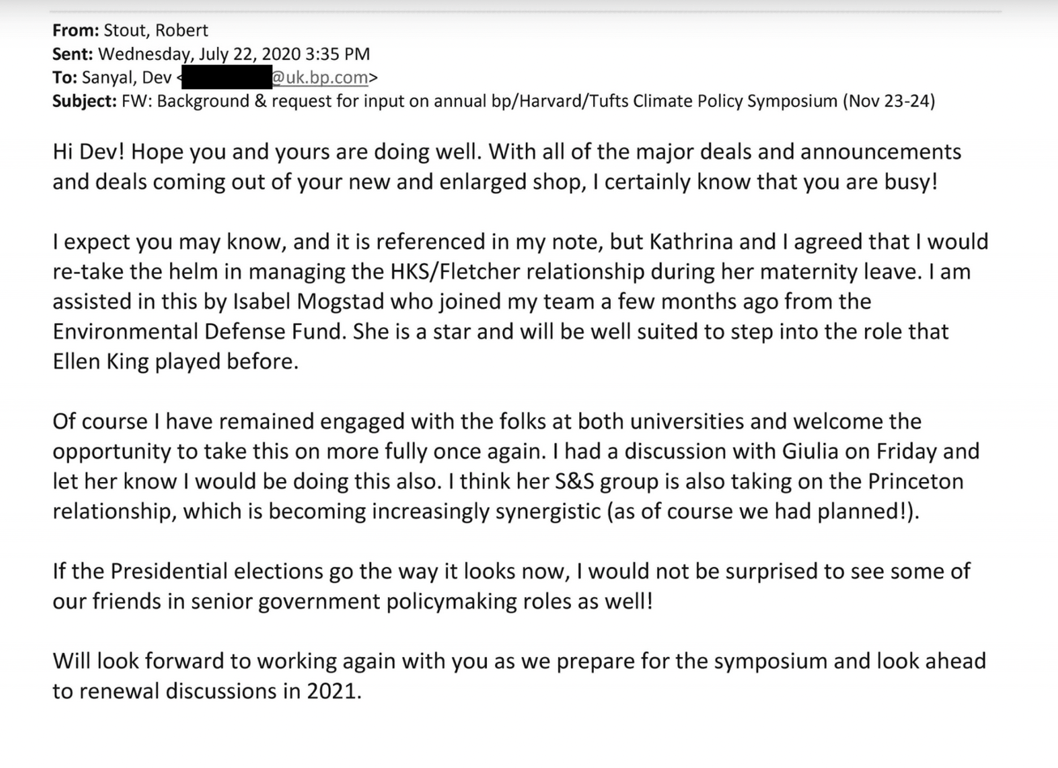
Tomorrow’s Senate Budget Committee hearing—and the wealth of subpoenaed documents and bicameral reportreleased in advance of the hearings—mark the first time the U.S. government is calling out the relationship between academia and Big Oil. As students on campuses across the country revolt against their universities’ financial relationships with companies profiting off the war in Gaza, the hearing comes at a time when U.S. academic powerhouses are already in an uncomfortable spotlight.
What, exactly, is in these documents that illustrate how Big Oil works with academic institutions to launder its image and lay the groundwork for industry-friendly policy? Here are some key takeaways.
New Numbers
In 2023,research from Data for Progress estimated that fossil fuel companies have donated at least $700 millionto 27 US universities over the past decade. Calculating the exact breakdown of these numbers can be an inexact science. Funding streams and financial ties on campus can become complex, and the vast majority of university research centers do not disclose their donors publicly. Even when asked directly to disclose their fossil fuel-backed research donations, only a handful have done so.
:{Previously, only the University of California at Berkeley has provided a complete accounting of its fossil fuel-funded research ($108 million from 2010 to 2020). The new documents put some real numbers on BP’s relationships with Princeton, Tufts, and Harvard. . According to the Senate report, BP funneled between $2.1 and $2.6 million to the Princeton CMI program between 2012 and 2017.
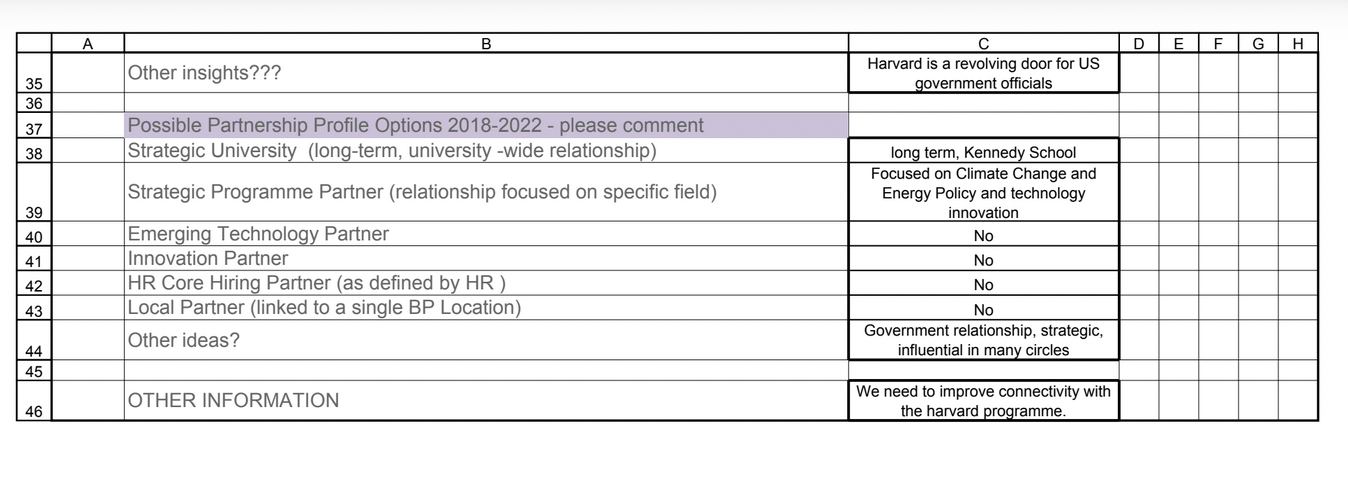
BP also paid $416k to Harvard and $250k to Tufts each year between 2019 and 2021 for partnerships with programs at Tufts’s Fletcher School and Harvard’s Kennedy School. The focus of these grants is worth noting, too: Harvard’s Kennedy School and Tufts’s Fletcher School are both focused explicitly on policy; at Tufts, BP funds the Climate Policy Lab. These donations don’t just give BP a window into what some of the country’s top public policy schools are researching, it also gives them influence and access to future policy makers.On a spreadsheet detailing the value of these grants, for example, it’s noted that “Harvard is a revolving door for U.S. government officials.”}:
“BP is committed to transitioning from an international oil company to an integrated energy company,” the company told Drilled in response to a request for comment. “To do this, we are investing in today’s energy system while helping to build out tomorrow’s.”
While the new documents contain the most information on the relationship between BP and US universities, BP wasn’t alone. Exxon planned between 2016 and 2017 to donate hundreds of thousands of dollars to schools across the country, per the Senate report: “$600,000 to MIT; $325,000 to George Washington University’s Regulatory Studies Center; $175,000 to Indiana University’s School of Public and Environmental Affairs; $140,000 to Stanford University; and $50,000 to the University of Massachusetts Amherst.”
In 2017, Shell announced it would spend $25 million over 5 years on funding Berkeley’s Energy Biosciences Institute. In an email uncovered by the subpoena, Shell wrote it had “plans to ‘embed’ Shell scientists at UCB and likewise invite faculty to spend time at Shell’s research hub to further foster deep collaboration.” (EBI was originally created with a $500 million commitment from BP to develop “a sole focus on biofuels”; Shell acknowledged in the email that it was “taking advantage of the huge sunk costs already borne by BP” in funding the program.)
In late 2020, academics at Princeton gave BP a heads-up on a major study it issued modeling pathways for the U.S. to reach net zero by 2050. In emails revealed by the Senate investigation, one BP staffer noted that BP contributed “just under” $2 million of the study’s funding through its partnership with Princeton. (Whether or not this was an additional expense on top of the regular institutional gift was not made clear.)
“BP supports the High Meadows Environmental Institute’s Carbon Mitigation Initiative with an annual contribution that is completely controlled by Princeton academics,” Princeton told Drilled in an email. “The funder has no involvement in the selection of specific research projects for support, in the execution of the research projects, nor in the presentation of final results. All HMEI research is submitted for peer review by independent, external academic experts.”
Not all oil companies’ relationships with universities were accounted for in the new documents. The Senate report documented that despite public partnerships with universities across the country, Chevron did not “[produce] relevant documents on this subject, even though the scope of the House Oversight Committee’s subpoena covered these documents.”
What Oil Companies Pay For
Importantly, the documents also lay out in clear detail what, exactly, fossil fuel companies expected their university money will be going towards: research that supports their objectives, access to academics and policymakers, and positive public associations with climate solutions.
“Our policy programs at Harvard and Tufts provide BP access to unparalleled expertise at the forefront of research in the areas of climate change science, technology, and policy,” one undated document from Dev Sandyal, then an executive VP at BP, explained to staff. The document sought feedback on the programs within these two universities, which, the note says, has “been an opportunity for [BP] to provide a business perspective to help shape international policy thinking in low carbon energy discussions.”
The 2020 Princeton net zero report is a key example of the company leveraging university research for positive PR. In an email discussing press strategy ahead of the report’s release, Omayma Khan, a BP communications official, wrote to other executives that the study “plays to our aims of helping the world get to net zero.”
“The team that worked on [this report] are already advising Biden’s transition team,” Khan added. In a separate email, Stout wrote that BP would make “a continuing effort to leverage the study with the USG [U.S. government].”
:{Access to staff at these programs—and their relationship to policymakers—was a clear focus for BP in keeping up these relationships as well. Representatives from universities across the country routinely pop up in industry invite lists;:{ BP’s invite list for a private reception at CERAWeek in 2018 included Jason Bordoff, the head of Columbia’s Center on Global Energy Policy, as well as staffers from the Kennedy School, Stanford’s Natural Gas Initiative, and Georgetown University.}:
The same BP document that references Harvard as a “revolving door for U.S. government officials” notes that “Kelly”—referencing Kelly Sims-Gallagher, the Dean of Fletcher School of Law and Diplomacy—is “active in the COP process,” calls her “flexible and accommodating” in her relationships with businesses, and notes that Tufts is “influential in many circles,” including COP and the Clean Energy Ministerial.}:
insert wiki
: List of Fletcher School of Law and Diplomacy alumni
The Fletcher School has over 9,500 alumni living around the world in 140 countries, including hundreds of sitting ambassadors, award-winning journalists and authors, global business executives and leaders of international peacekeeping, humanitarian and security initiatives.[21]
...
Center for International Environment and Resource Policy (CIERP) conducts interdisciplinary and policy-relevant research on pressing environmental issues. endit
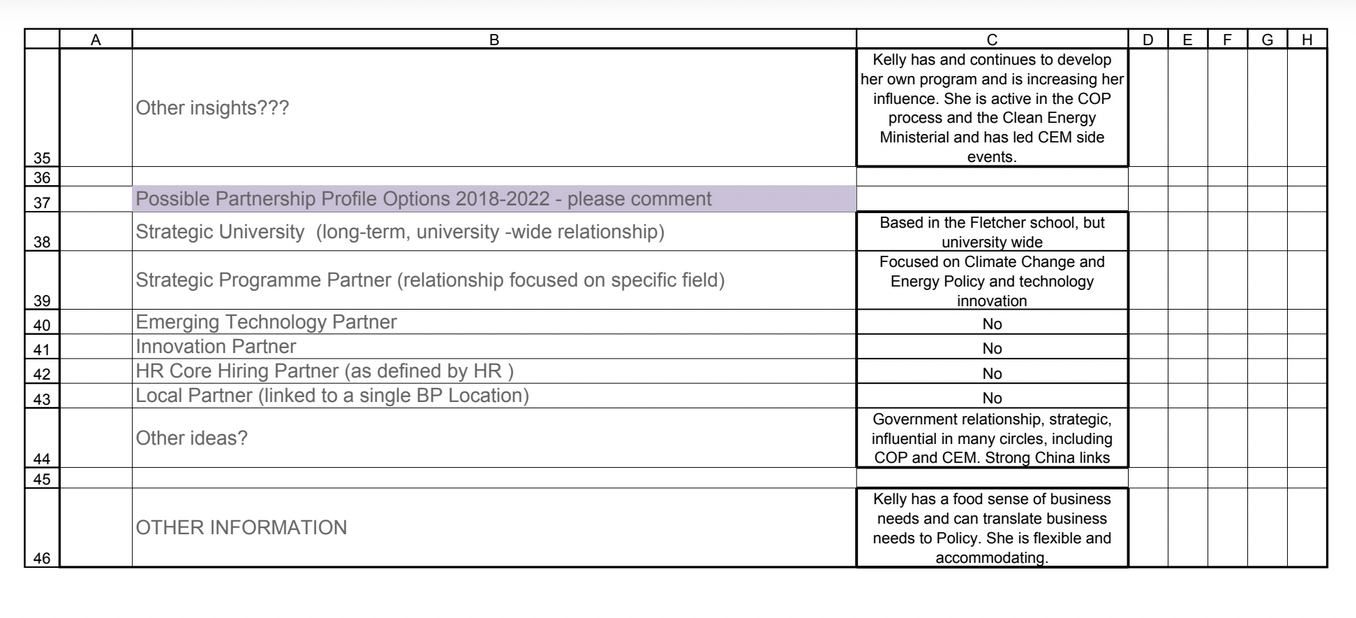
In a 2020 email to high-level BP staff describing the Harvard and Tufts partnerships, Stout writes about how many former Obama administration officials are involved in both programs, calling out their “deep insight, credibility, and influence with US and global policymakers.”
Regardless of the independence of Princeton’s research, BP often discussed leveraging its relationship with Princeton to advance its own priorities. In 2020, a BP VP emailed notes from a call with Stephen Pacala, a researcher at Princeton, where they noted their recommendation of developing an infrastructure program “with an emphasis on CCUS [carbon capture, usage and storage]—building ‘backbone’ of pipelines to transport carbon.” In a 2017 email, Stout called Pacala “a big advocate” for BP making its case for natural gas. BP also used its relationship with Princeton as part of a 2020 presentation to the Rocky Mountain Institute, a nonprofit influential with renewable energy circles, noting how it intended to “advance methane science” through its partnerships.
In one 2018 document, BP also discussed a plan to “advance and protect the role of gas—and BP—in the energy transition” following negative press around methane emissions from natural gas. The plan included proposals to fund whitepapers from researchers at Princeton and Imperial College in London “highlighting [the] role of gas as a friend to renewables.”
Not All Programs Created Equal
Simply buying an association with a top-level university is just the first step in the Big Oil PR playbook. The documents reveal that some oil companies are also constantly reevaluating their relationships with universities to maximize their rates of return.
One spreadsheet included in the tranche of released documents lists meticulous details of each of BP’s partnerships with Tufts, Harvard, and Princeton. The spreadsheet includes ranking the universities’ research programs as aligned with BP’s “strategic priorities”—like the “shift to gas,” “advantaged oil” (an industry term used to describe the most desirable oil to be extracted during the energy transition). The spreadsheet also includes details like the number of graduates hired from each school by BP, the number of visit days or meetings for BP executives, and scoring each academic institution on its “Industrial Relations Strategy Maturity” (all schools scored a “Medium” ranking.)
In notes from a 2016 meeting, BP executives mention that the Harvard “relationship began as the climate policy adjunct to the Princeton CMI technical work;” BP executives discussed how to reduce contributions to a program that had, in their eyes, grown beyond its scope in order to “avoid damaging the Harvard/BP relationship.”
“The CMI discussions are directly relevant to BP, whereas the Harvard/Tufts discussions are directed by the Universities and much less relevant to BP,” the notes read.
“The Fletcher School's Climate Policy Lab received a general support grant from BP which concluded at the end of 2021 and has not been extended,” a spokesperson from Tufts told Drilled in an email. “Throughout the duration of that collaboration, Fletcher's research was conducted autonomously and without any influence from the funding source. We remain committed to conducting rigorous, unbiased research that serves the public interest.”
How Academics “Sharpen Corporate Perspective”
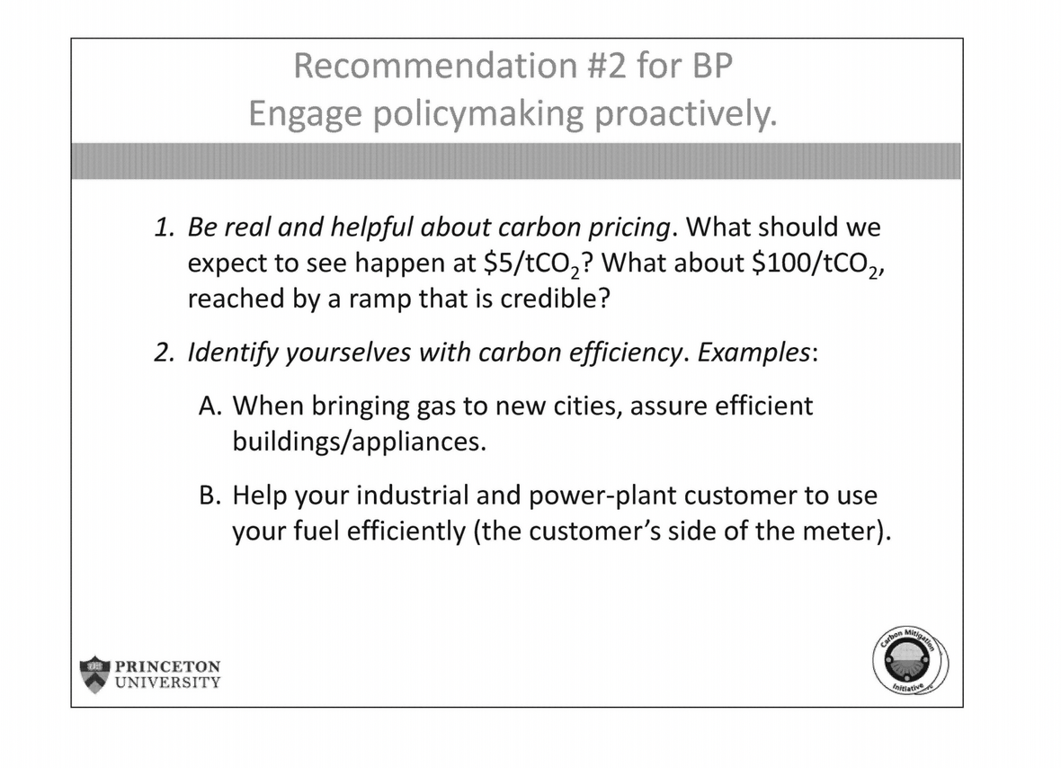
The new documents also show how academic centers helped oil companies refine public messages on climate change. A 2016 presentation to BP by Pacala and Robert Socolow, the co-director of the Carbon Mitigation Initiative at Princeton, included a slide titled “Risks of climate change to BP.”
“Effective climate policies can emerge that discourage fossil fuel consumption, that impose environmental performance standards on production processes, and that subsidize or otherwise promote efficiency and low carbon energy,” the slide reads. In the next slide, Pacala and Socolow point out that “BP benefits when CMI disseminates sound information that supports effective public policy discussions.” The center’s research, the researchers point out, also helps “[sharpen] BP’s corporate perspective on climate change.” Later in the presentation, Pacala and Socolow make a series of recommendations to BP, including to “engage policymaking proactively.”
“Identify yourselves with carbon efficiency,” the slide says.
In July of 2019, staffers from Columbia’s Center on Global Energy Policy, including Jason Bordoff, emailed executives at BP a draft of a chapter on carbon capture, utilization, and storage (CCUS) that would be included in an upcoming report from the National Petroleum Council. Gardiner Hill, then the company’s VP of carbon, emailed back several thoughts.
Hill recommended that the chapter “be clearer and bolder on the role of the USA in the emerging energy transition … Low cost oil and gas create a substantial advantage domestically and internationally for the USA. CCUS extends this considerably as the world transitions to a low carbon energy economy.”
“I’m very conscious of the fact that many will read this report as the oil and gas industry saying let’s do CCUS so we can keep on doing oil and gas as usual,” Bordoff responded. “Need to avoid that perception. We heard that from all the independent academics and think tank types involved with putting this chapter together. …I think the credibility of the report will be enhanced if we err on the side of staying away from claims that sound self-serving for the industry.”
“I understand your point about the perception that the remarks regarding low cost oil and gas may look self serving,” Hill responded. “This was genuinely not my intent. It is good to be reminded how others may perceive this—thank you.”
The National Petroleum Council’s page on the final CCUS reportnotes that of the 300 people tasked with writing the study, “less than 33% are from the oil and natural gas industry.”
What’s Next
The subpoenaed documents, which range from 2015 to 2021, cover an unusual time for oil companies: directly during or after the Exxon Knew investigation, through the Trump years and the early start of the pandemic. As the documents show, oil companies were eager to let the public know that they were working towards climate solutions, moving away from outright denial—while privately pulling the cultural, economic, and political levers of power available to them, including their relationships with universities, to ensure their voices were heard to keep fossil fuels on the table.
Now, many of these companies have reported some of their most profitable earnings to date for the past two years, as the global energy crisis kicked off by Russia’s invasion of Ukraine has jacked up oil prices once more. Many oil majors, including BP, have since walked back on their climate commitments. The Biden administration, meanwhile, proved to be more of an ally to oil and gas companies than a foe, keeping up production levels and carving out advantages for favorite solutions like CCUS and hydrogen. Another potential Trump administration—with its heavy emphasis on American energy independence—would only benefit the industry.
Universities are, similarly, in a much different position than they were during the time of this subpoena. Many have faced divestment campaigns from their student bodies in recent years, with some success for activists. In 2022, Princeton agreed to a partial divestment from fossil fuels—but did not agree to divest funding from programs like CMI. Now, an unexpected new wave of student activism around Palestine is gripping college campuses—and forcing the nation’s attention on where universities’ financial allegiances lie. Perhaps it’s time for these universities’ relationships with Big Oil to help focus that spotlight.
*This is the first of several deep dives into the new documents we’ll be doing here at Drilled, along with coverage of the May 1st hearing. Come back for more throughout the week!
===
HARV BLK WOMan pres resign plag BS insuff cites, not theft of text; stefanik 2 dn 1 to go?
neri-oxman-wife-of-plagiarism-critic-bill-ackman-plagiarized-her-dissertation
---
an 1 24
harvard University President Claudine Gay announced her resignation Tuesday, January 2, following weeks of criticism of her testimony during a December antisemitism on college campuses Capitol Hill hearing, as well as accusations of plagiarism.
The Harvard Crimson reports, "Though Gay initially signaled that she would try to weather the charges of plagiarism, at first defending her scholarship and then making a series of corrections, the steady stream of new allegations — which continued to roll in during the final days of her presidency — only added to doubts about Gay’s fitness to effectively lead Harvard."
A Wednesday, January 3 report from Politico notes conservative activist Christopher Rufo "has been at the forefront of a sprawling campaign to force Gay to resign," and "was in a celebratory mood" after she announced her exit.
Author and editor at The Yale Review, James Surowiecki, took to X (formerly Twitter) to write, I assume Christopher Rufo will now move on and insist that Neal Gorsuch step down from the Supreme Court, given that he plagiarized parts of his 2006 book 'The Future of Assisted Suicide and Euthanasia'" — and he attached a screenshot from a 2017 Politico article, which includes a side-by-side of language from Gorsuch's book and language from a 1984 article in the Indiana Law Journal."
doc
Surowiecki went on to write, "The defenses of Gorsuch's lifting, btw, were remarkably similar to the defenses of Gay's work: it was just 'sloppy,' not 'mendacious' or malicious, and was not serious because while it copied language, it didn't involve the purloining of ideas."
Per Politico's 2017 report, documents provided to the news outlet "show that several passages from the tenth chapter of his 2006 book, 'The Future of Assisted Suicide and Euthanasia,' read nearly verbatim to a 1984article in the Indiana Law Journal. In several other instances in that book and an academic article published in 2000, Gorsuch borrowed from the ideas, quotes and structures of scholarly and legal works without citing them."
According to the report, despite former President Donald Trump's White House at the time denying any "impropriety," there were "six experts on academic integrity contacted independently by POLITICO" who "differed in their assessment of what Gorsuch did, ranging from calling it a clear impropriety to mere sloppiness."
READ MORE: 'Unraveling': GOP rep calling for Ivy League leaders’ resignation mum on Trump’s Nazi rhetoric
---
after-500m-zuckerberg-donation-harvard-university-gutted-its-disinfo-team-studying-facebook
guk 1119
https://yyy.theguardian.com/us-news/2019/nov/23/harvard-yale-football-game-protest-fossil-fuels
---
note hypocrisy on cancel culture BS horrible irony is that silence israel protest BOOSTS genocide in gaza
12 23 an
america’s prestigious universities play a big role in determining who gets into America’s wealthy elite.
A degree from Harvard, Penn, or M.I.T., to take three examples, is a meal ticket to a lucrative job on Wall Street or a corporate law firm and to the richest and most influential people in the land.
But as America becomes increasingly stratified by wealth, those tickets are easily abused.
Universities that give preference in admissions to the children or grandchildren of major donors serve to widen inequality even further.
Universities that allow major donors to influence what is taught or expressed on campus could be seen to suppress ideas that threaten the wealthy — which could chill freedom of expression and fuel social resentment.

Which brings us to the latest imbroglio.
Last Tuesday, the presidents of the University of Pennsylvania, Harvard, and M.I.T. tried to give precise answers to questions from members of Congress about whether their university cultures had encouraged hostility towards Jews — hostility that has surged since Hamas’s October 7 attack on Israel and Israel’s attack on Gaza in response.
In their opening remarks, all three denied it, and repeatedly condemned antisemitism.
Then Elise Stefanik, a Republican representative from New York (and herself a Harvard graduate) asked a yes or no question: would calls for genocide of Jews on campus violate their codes of conduct or harassment policies?
The presidents hedged. “If the speech turns into conduct, yes, it can be harassment,” Penn’s president, M. Elizabeth Magill, a former dean of Stanford Law School, replied in lawyer-like fashion.
“I’m asking if specifically calling for the genocide of Jews — does that constitute bullying or harassment?” Stefanik pressed her point.
“If it is directed and severe or pervasive, it is harassment,” said Magill.
“So the answer is yes?”
“It is a context-dependent decision, congresswoman,” Magill said.
Faced with the same question, Harvard’s president, Claudine Gay, also temporized. “It can be,” she said, “depending on the context.”
The university presidents should have answered unambiguously and unequivocally that calls for genocide of any group are intolerable.
Their failure to do so has fueled a firestorm.
Ross Stevens, a hedge fund manager, said he would withdraw a $100 million gift to Penn. Other wealthy Penn donors called for Magill to resign.
Even prior to the hearing, a campaign had been launched by some of Wall Street’s most powerful figures to oust all three university presidents for failing to adequately condemn Hamas’s October 7 attack on Israel.
The influential board of advisers of Penn’s Wharton School’s, chaired by Marc Rowan of Apollo Global Management, one of the world’s largest private equity firms, called on alumni to withhold donations to Penn.
The billionaire investor Bill Ackman, Harvard alumnus and head of New York hedge fund Pershing Square Capital Management, called for the three university presidents to be fired.
The day after their testimony, Magill and Gay issued statements in efforts to contain the damage.
But on Saturday evening, after an emergency meeting of Penn’s board of trustees, Magill resigned under pressure.
Over the weekend, calls from donors for Harvard’s Claudine Gay to resign grew louder, as prominent donors demanded her ouster, too.
I can well understand the anger and frustration of these donors. In their congressional testimony, the university presidents should have been clearer that their institutions do not tolerate calls for genocide. Period.
But to use their power as major donors to force or seek the ouster of these presidents is almost as repugnant as the failures of these presidents to unambiguously condemn calls for genocide. It endangers the autonomy of America’s universities.
Who’s kidding whom? Those of us who have spent our lifetimes teaching in prestigious universities are well aware of the influence of big donors. The major job of today’s university presidents is to solicit money, and their largest targets are typically denizens of Wall Street.
For the same reason, boards of trustees are packed with wealthy alumni, often from the Street, who routinely veto candidates for university presidentships harboring views they find offensive.
But not until now have major donors so brazenly used their financial influence to hound presidents out of office for failing to come out as clearly as the donors would like on an issue of campus speech or expression.
As a Jew, I cannot help but worry, too, that the actions of these donors will fuel the very antisemitism they claim to oppose — based on the perilous stereotype of wealthy Jewish bankers controlling the world.
*Robert Reich is a professor at Berkeley and was secretary of labor under Bill Clinton. You can find his writing at https://robertreich.substack.com/.*
---
y mail 6 23
New Blog: The American Petroleum Institute Loves Pennsylvania, As Its Lobbying Shows
As one of the top fossil fuel producing states, Pennsylvania is a key focus for the oil and gas industry. In fact, with $1.8 million spent in 2022 alone, the American Petroleum Institute reported spending more money on lobbying in Pennsylvania than in any other state last year. Read more from Aly Shaw at the LittleSis Eyes on the Ties blog.
New Blog: Fossil Fuel Directors’ Ties to University Boards Run Deep
While Harvard professor Jody Freeman’s board seat at ConocoPhillips -- and her lobbying on the company’s behalf -- has been in the headlines, directors from other Big Oil companies and dirty utilities are well-represented on university boards and in other higher ed roles. We mapped out some key ties between the boards of Chevron, Marathon Petroleum, Valero, Southern Company and others to different universities and colleges. Some of the findings may be shocking -- for example, that the chair of the board of trustees of the very liberal Wesleyan University is a Chevron director or that three Chevron directors have prominent roles at USC. These relationships don’t only greenwash oil companies -- they throw into doubt the climate gestures made by universities who give fossil fuel directors governing roles at their institutions. Read our latest blog post here.
==
salon 11 22
"He really is the living embodiment of the Dunning-Kruger effect," a friend responded in a group text over the weekend. We had been sharing stories about the bouts of dumbassery on display, as Elon Musk starts his ill-advised reign of Twitter.And hoo boy, there was plenty to share. Did you see the one about Musk telling software engineers to print out 30 days of code, only to tell them to shred it when he likely realized this exposed how he doesn't know what he's doing? Or how he plans to take a bazooka to the content moderation team, even though doing so will likely send advertisers packing? Or how he thought carrying a sink around was a hilarious joke? Or how he tweeted an asinine conspiracy theory about the Paul Pelosi attack, only to delete it hours later?
None of this should be surprising. From day one, this entire saga has been a story of a man with far more money than brains. After all, this all started when Musk stupidly offered to buy Twitter at a price way over its valuation, for no other reason than a fit of trollish pique. It was only after he realized what a foolish idea it was to set $44 billion on fire that he started coming up with disingenuous excuses to escape the deal, only to discover that it was too late, legally, to back out.
Yet, somehow, much of this still feels surprising. The idea that Musk is "smart" has persisted through years of very public evidence to the contrary. Even now, many of his critics offer pre-emptive caveats that they don't think he's stupid, before explaining why the latest of his endless string of idiotic choices is a bad one. This notion of Musk's intelligence clings to the discourse around him for one simple reason: He is very, very rich.
The myth of the American meritocracy is a stubborn one. Americans can't help but believe that someone as rich as Musk must have something going on for him beyond dumb luck. To imagine otherwise is too unsettling. So many people block out what should be an obvious truth: You probably would have never heard of Elon Musk if he wasn't a white man from a wealthy family that literally owned an emerald mine in South Africa.
To be fair, it's entirely possible that, at one point, Musk wasn't a total birdbrain. His resume suggests there was a time when he was relatively competent at computer science, though there's no reason to think that such skills mean fluency in any other higher-functioning tasks. But regardless of what some IQ test from back in the day might have said about Musk, it's clear that in the past couple of decades, his brain has turned to total mush.
The irony is that the very wealth and privilege that tricks people into thinking he must be a genius likely contributed to the current state of affairs. Being surrounded by nothing but flattery makes it hard to distinguish between thoughts you have that are smart and useful and thoughts you have (such as right-wing conspiracy theories) that are idiotic. Either way, the people in your life — and for Musk, his legions of fanboys on Twitter — are swooning over what a super genius you are. The lack of meaningful feedback would damage most people's capacity for critical thinking. Musk's narcissism renders the diagnosis of his rational capacity terminal.
One can only hope the daily updates on Musk's antics will put some dent into the American myth of meritocracy. But then again, having to endure four years of a Donald Trump presidency didn't seem to make much difference, even as he shared moments of Trumpian wisdom like telling people to inject bleach into their lungs to cure COVID-19 and trying to "correct" a weather map drawn by actual meteorologists because he felt it would better serve his ego for a hurricane to make landfall in Alabama. Trump was elected in no small part because he had convinced large numbers of Americans that he was a successful businessman and therefore smart. In reality, he was a historically terrible businessman whose wealth exists because other rich white guys spent decades bailing him out of his self-inflicted financial woes.
The insidious nature of the meritocratic myth is on full display this week, as the Supreme Court heard arguments in a lawsuit over affirmative action at Harvard University. Unfortunately, polling shows that 63% of Americans oppose universities considering race in their admissions process, naively believing that ending affirmative action means some objective measure of "merit" will be used instead. In reality, the opposite is true: Far from being meritocratic institutions, Ivy League schools are largely devoted to elevating rich white kids at the expense of people who have more talent. As Mark Joseph Stern at Slate explains, "Harvard has a preference for four specific groups of applicants known as ALDC: athletes, legacies, those on the dean's list (frequently because of family donations), and the children of faculty." He continues:
In theory, ALDC preferences are colorblind. In practice, they operate as a massive affirmative action program for white applicants. Over a recent six-year period, 2,200 out of 4,993 admitted white students were ALDC—a figure significantly higher than the overall number of admitted students who are Black (1,392) and Hispanic (1,283). White ALDC students are not overrepresented because they happen to be more qualified; to the contrary, about three-fourths of them would have been rejected without the ALDC boost.
The existing race-based affirmative action program is mostly an attempt to make up for the diversity that is lost giving such a massive advantage to white applicants. And yet, somehow, you hear no complaints from most conservatives about the ALDC preferences. That's because they don't actually want a meritocracy. They want a system where white people can get twice as far while being half as talented. Or where the richest man in the world keeps getting called a genius, even as we can all see — if we're willing to look — that he's just another privilege-addled idiot who lost his capacity for critical thinking many billions of dollars ago.
1019
federal judge rules Harvard can continue to use race as one of its factors in admissions decisions
Vinay Harpalani, The Conversation
https://www.desmogblog.com/2019/01/26/competitive-enterprise-institute-climate-denial-target-nbc-cities-liability-suits
ref
https://www.climateliabilitynews.org/2018/12/12/ucla-law-professor-ann-carlson-cara-horowitz-cei/
Marco Poggio
A conservative think tank with deep ties to the fossil fuel industry has sued UCLA to obtain email correspondence between two UCLA climate law professors and pro-environment individuals involved in climate change litigation.
The lawsuit was filed last month in California Superior Court by the Competitive Enterprise Institute (CEI), a libertarian group that lobbies against limits on greenhouse gas emissions and claims that CO2 is good for the environment. CEI argued the university hasn’t complied with two public record requests made in February and May under the California Public Records Act.
According to the lawsuit, :{Competitive Enterprise Institute v. Regents of the University of California:(style="box-sizing:inherit"):}:*,*the emails show environmental law professors Cara Horowitz and Ann E. Carlson discussed future meetings with others, including staffers from several attorney general offices, to discuss new legal actions against major carbon producers.
The lawsuit mimics the ones filed to obtain email correspondence by several climate scientists, including prominent climatologist Michael Mann of Penn State, which was ended by the Virginia Supreme Court in 2012. Another continues to embroil University of Arizona scientists Jonathan Overpeck and Malcolm Hughes, who were recently ordered to release 13 years of emails demanded by another fossil fuel ally.
“This appears to be yet another effort by hired guns funded by polluting interests to badger, intimidate, and silence scientists whose findings prove inconvenient to those who continue to profit from our dependence on fossil fuels,” Mann said of the suit against UCLA.
Among the emails Horowitz and Carlson have been asked to release are those exchanged with litigators in direct contact with offices of pro-environment attorneys general around the country. That includes former New York Attorney General Eric Schneiderman, who in 2015 began investigating Exxon for possible climate change-related fraud.
Carlson told Climate Liability News that UCLA is working on complying with CEI’s record request, sorting through hundreds of emails.
“I don’t feel intimidated. I don’t have anything to hide,” Carlson said, “I don’t have a problem, so far, with what I’ve been required to turn over.
“I do worry that these tactics, more broadly, are designed to discourage public discourse about important topics, like climate change and who should pay for climate damages.”
Specifically, CEI has asked for correspondence between the two UCLA scholars andShaun Goho, a Harvard lecturer and environmental lawyer with a record of environmental litigation in state and federal court.
Goho said the lawsuit is just an harassment tactic meant to divert the energy and resources of people fighting climate change away from their work.
“I don’t see how academics speaking with government officials about matters of public concern is a conspiracy. It doesn’t seem to make sense to me,” Goho said.
“This lawsuit doesn’t stand alone. It’s really part of a broader campaign by fossil fuels companies and their allies to harass people who are taking action trying to try to address climate change in various ways, whether it’s climate scientists, lawyers or others who are researching legal issues related to climate change and the relationship between climate change and the fossil fuel industry.”
CEI has deep ties to the fossil fuel industry. Exxon was its biggest funder until 2006, when public criticism pushed the company to distance itself from CEI’s climate denial campaigns.
CEI has also sought emails containing the names of other pro-environment lawyers and climate scientists, including Peter Frumhoff, the director of science and policy at the Union of Concerned Scientists,and Sharon Eubanks, one of the attorneys involved in the federal tobacco litigation against Philip Morris.
Additionally, CEI demanded emails regarding two separate events—one held at Harvard and one at UCLA—attended by Carlson and Horowitz and employees of various state attorney general offices, private lawyers,academics and environmental activists, who were set to discuss causes of action against major carbon producers.
“Public records show that Professors Horowitz and Carlson are using their positions at your public university to coordinate with certain activists groups in organizing andpursuing law enforcement and civil investigations and litigation against private opponents of a particular political agenda.We seek correspondence and other records illuminating this use of a public university faculty position and resources,” the request’s text reads.
Frumhoff declined to comment for this story.
Central to the lawsuit are the UCLA and Harvard meetings, in which Carlson, Horowitz and other parties discussed legal actions against polluters.
The “secret meetings” as they were described in some of the emails, were attended byFrumhoff and Matthew Pawa, a lawyer with Hagens Berman, which is involved in several climate liability suits filed by communities against the fossil fuel industry. Those meetings also included staffers from attorney general offices around the country, including those of New York and California.
A CEI representative declined to comment, citing pending litigation, but referred to the organization’s website for a statement concerning the lawsuit.
“This ‘secret meeting’ agenda shows UCLA faculty briefed the attorneys general and prospective donors on potential legal actions they could pursue. Attorneys general are now pursuing the types of investigations urged by UCLA faculty,” Chris Horner, a senior fellow at CEI who signed the petition, wrote in the statement.
“Thisdonor-funded scheme of using law enforcement to pursue a failed political agenda, raises significant constitutional and other legal issues,as well as ethics concerns. With the revelation that this involves the use of public institutions in this mercenary campaign, the public has a right to knowwhat their employees are doingin their name, and on their dime,” Horner’s statement said the statement continues.
In its lawsuit, CEI claimed the subject matter contained in the emails is of “great public interest”and that the university has violated the California Constitution because delays in handing over the records practically meant a refusal to comply with the request.
The lawsuit presents new challenges to law practitioners in the field of environmental litigation, paving the way for an aggressive use of public record access law that some fear would stymie the process of accountability of carbon producers.
“I don’t know exactly where this is all leading. I do think it’s part of a broader campaign to try to divert attention away from oil industry’s own activities and own efforts to try to dissuade the public about the legitimacy and validity of climate science, and I worry about that,” Carlson said.
The use of public record access laws as a tool to hit back critics in the academic world is a fairly recent practice embraced by trade groups of several industries, not just oil and gas, to target opponents.
“Requests can be burdensome on government agencies,” said David Snyder, an expert in California public record access law who directs the First Amendment Coalition, a nonprofit nonpartisan advocacy group that promotes free speech and public access to government information.
The law effectively puts academics in the same position as public officials that might have strong interests in not having their communications disclosed to the public.
“It seems like an odd fit, I acknowledge, for a college professor to sit in the same category as officials at city hall or at the governor’s office,” Snyder said. “Nonetheless, UCLA is a public agency, and employees of that public agency are subject to the public records act.”
A study compiled by the Climate Science Legal Defense Fund, a nonprofit providing legal assistance to researchers, ranked each of the 50 states based on the level of protection from open records laws they grant to scientists working at publicly-funded institutions.
Only three states, Delaware, Maine, and Pennsylvania, exclude some forms of scientific and academic research from their open records laws. Laws in four other states, including Arkansas, Montana, New Mexico and North Carolina, contain no protection for researchers whatsoever. The remaining states guarantee different types of statutory exemption, deliberative process exemption and balancing tests that offer different degrees of protection.
“The breadth and strength of state open records laws and the federal equivalent Freedom of Information Act (FOIA) have made them powerful tools, but have also made them vulnerable to misuse and abuse by groups who try to harass researchers and stifle scientific research they dislike,” the study reads.
The right to exemption from having to turn over documents is often hard to balance with the right to access public records, which is critical to ensure transparency in institutions, Snyder said.
“It’s tricky,” Snyder said. “Under the public records act, by design, government agencies are not allowed to single out the requesters based on the reasons for which they want the records.”
“They can’t say, ‘we’re not gonna give you the records because we know that you espouse these views, because you want to use the records for this purpose,’ that’s expressly forbidden,” Snyder said. “You don’t want the government picking sides.”
==
==
https://www.eenews.net/stories/1060084931
no lnx
Back to E&E News index page.
EPA
Pruitt science plan may block use of major Harvard study
Corbin Hiar, E&E News reporter
Greenwire: Monday, June 18, 2018
Joseph Allen and green building study. Photo credit: @WorldGBC/Twitter]
Harvard University researcher Joseph Allen speaks about the results of a green building study in 2016. @WorldGBC/Twitter
This story was updated June 19 at 2:38 p.m. EDT.
Harvard University is working on an international survey that researchers believe could revolutionize the world's understanding of how buildings affect public health.
There's just one problem: Because of a change to scientific standards proposed by Administrator Scott Pruitt, EPA regulators likely won't be able to use the study's findings to better protect Americans.
"This speaks to the central issue with that regulation," Harvard's Joseph Allen, the principal investigator of the global buildings study said of EPA's regulatory science transparency proposal.
https://insideclimatenews.org/news/15082018/epa-secret-science-rule-opposition-health-environmental-data-public-comments
Arguing that public health and safety are at risk, researchers, health experts and administrators from leading scientific institutions across the nation have joined in opposition to a controversial Trump administration proposal that would restrict the use of science in federal policy making.
As the comment period draws to a close Thursday on a plan to limit the science that the Environmental Protection Agency can use in decision-making, the scientific and academic communities are flooding the agency with letters arguing the proposal would hobble EPA and wreak havoc on research.
"The proposed rule would—for no rational reason—prevent EPA from relying on much of the research that ... public health and environmental exposure researchers have conducted and continue to conduct," said one letter, organized by Harvard University, its health and medical schools and its affiliated hospitals. It was signed by Harvard President Lawrence Bacow and nearly 100 other administrators and researchers—the first time such an array of Harvard's most prestigious faculty have joined in opposition to any EPA proposal, according to former agency officials and observers.
The EPA proposal has long been sought by fossil fuel interests. It could be used to weaken health-based standards for limiting some of the pollution caused by burning coal, oil and natural gas, and ties in with the Trump administration's broad attempt to roll back climate and pollution rules.
But the Harvard letter, drafted by the school's legal experts, lays out a roadmap that opponents surely will rely on to challenge the approach as illegal.
They note that Congress has mandated that EPA use the "best available science" in at least a half dozen separate laws. "The rule will cripple EPA's ability to implement [these environmental laws] and will jeopardize the health and safety of infants, children, and adults in the United States and beyond," they wrote.
The so-called "Strengthening Transparency in Regulatory Science" proposal, also known as the "secret science" rule, would prohibit the EPA from relying on studies where raw data has not been released publicly, perhaps even including information that could reveal the identities and medical records of research subjects.
That could exclude studies where participants were promised confidentiality, including some of the seminal research on environmental health threats—such as the first studies linking small particle soot pollution with increased mortality. One of these was published in 1993 by Harvard scientists.
Broad Opposition, Particularly in Health Care
...
==