ERIK 2
519
bak 420
merri ok
money laUNDER TO INAUG 3 TRUMP ICE MOFO
NOTE ERIK PRINCE TRYING TO GET INTO BIZ W/ BUKELE
see don jr leo? eric trump FLYNN
SEE ISRAEL BIBI
SEE MBZ UAE
RUSSIA TRUMP 3 COLLUSION
Wagner gp?
pardon contractors
ecuador venez
===
trump coup?!
---
---
TOOL: Epstein Graph - Searchable Epstein Document Archive
Zamel
5 mentions3 documents1 emails5 connections
Top Connections
Deripaska(3)mbs(3)](https://epsteingraph.com/people/mbs)[Nader(3)Prinz(3)](https://epsteingraph.com/people/prinz)[Miro(2)HBJ(2)](https://epsteingraph.com/people/hbj)[Kwok(1)Lawtemc(1)](https://epsteingraph.com/people/lawtemc)[Self(1)J (jeevacation@gmail.com)(1)Nikki hale
[EFTA00517065 phone record
Exported iMessage conversation (iMessage archive) from a device showing exchanged messages on 2018-10-09 and 2018-10-10 discussing a proposed final version of a document, negotiation of items, travel locations, and international political topics.](https://epsteingraph.com/documents/EFTA00517065)[EFTA01615404
correspondence
iMessage conversation (2018-10-09 to 2018-10-10) involving Steve Bannon discussing international politics, a potential Nikki Haley primary challenge to Trump, Brazil, and the Khashoggi/Saudi issue.](https://epsteingraph.com/documents/EFTA01615404)[HOUSE_OVERSIGHT_027450 email
Printout of email correspondence dated 2018-10-09 containing short messages referencing multiple countries, several personal names (Zamel, Nader, Prinz, Deripaska), and phrases such as "Fingerprints everywhere" and a list of countries described as "So deeply fucked up."](https://epsteingraph.com/documents/HOUSE_OVERSIGHT_027450)
---
TRMS UNDUE PROCESS BK TRYING FOR DOD PRE-APPROVE LIST VIA MASS DEPORT
MMA 4 26
A group of Trump allies have formed the Mass Deportation Coalition to encourage the administration not to back away from its deportation push. The coalition — which includes the Oversight Project’s Mike Howell, former Blackwater CEO Erik Prince, former Customs and Border Protection Acting Commissioner Mark Morgan, and conservative groups including The Heritage Foundation — released a playbook urging the White House to continue raiding work sites and deporting migrant workers despite pushback from voters. Politico, [4/1/26]
---
JACOBIN LEVER NOV?
IN February, at the start of the Trump administration’s immigration crackdown, news broke that a group of military contractors was circulating a blueprint for mass deportations, to be carried out by private contractors.
Led by Erik Prince, Donald Trump ally and founder of the notorious mercenary firm Blackwater, the group proposed (among other ideas) that Immigration and Customs Enforcement (ICE) create a “skip tracing team” that would send out private contractors to hunt down immigrants targeted for deportation, per reporting at the time by Politico.
Now, there are indications ICE is carrying out those plans.
Last month, the Lever revealed that ICE had signed a $7 million contract with defense contractor SOS International for “skip tracing services.” SOS International, also known as SOSi, has long done business with the federal government, including working with the US military in Afghanistan — and has business ties to one of the military contractors whose name was listed alongside Prince’s in the proposal.
It was the first time, per online federal procurement databases, that an ICE contract description contained the phrase “skip tracing,” a term usually associated with debt collection and bounty hunting. There was little further detail about the services SOSi would provide to Trump’s immigration enforcers.
The contract — with its eerie callback to the Prince deportation blueprint — appears not to be a fluke. Several days later, ICE signed another “skip tracing” contract, this time worth up to $33.5 million, with international debt collector Global Recovery Group LLC.
Then, on Friday, October 31, as the Intercept first reported, ICE’s Enforcement and Removal Operations bureau, the agency’s primary deportation arm, released procurement documents that mapped out new plans to create a bounty-hunting program that would deploy skip tracing methods. Though the documents are preliminary, ICE’s proposed program hews closely to the blueprint drawn up in February by Prince and his cadre of military contractors.
Under the program, private contractors will deploy “all technology systems available” to locate ICE’s targets, the documents say. Contractors would be given a list of ten thousand names at a time and be allowed to ultimately locate “up to 1,000,000” individuals, per the records.
ICE already has plenty of technology at its disposal to identify and track down immigrants, an arsenal that the agency is furtherbuilding out now that it is flush with cash. But the “skip tracing team” appears distinct in that its mandate would include sending out privately contracted bounty hunters to systematically identify immigrants’ residences and workplaces.
The bounty hunting program would include “performance-based incentives” — cash bonuses for vendors who successfully hunt down immigrants for ICE. This cash payout idea appears to be pulled directly from the Prince memo, which suggested that ICE build out a “bounty program which provides a cash reward for each illegal alien held by a state or local law enforcement officer.”
To judge from ICE’s first skip tracing contracts with SOSi and Global Recovery Group LLC, which are together worth over $40 million, the program will prove yet another gold mine for the military contractors clamoring for their cut of the Trump administration’s multibillion-dollar immigration spending blitz. And that makes sense: it was drafted by those same vendors.
From Blackwater to Bounty Hunting
The core message of Prince’s deportation plan was this: If President Donald Trump wanted to carry out his stated goals of mass deportations, he couldn’t do so alone. “The government,” the plan said, “should enlist outside assistance.”
Although Politico did not publish the complete text of the proposal, what has been made public from the document indicates that Prince was making the suggestion as part of the “special entity” 2USV, a group of defense contractors. (An LLC with the same name has been registered in Wyoming, but many details about the project remain unclear.)
The contractors include former Blackwater employees like Bill Mathews, the company’s former vice president, who pleaded guilty to violating firearms records law related to his work at the mercenary firm, as well as Richard Pere, former head of a Blackwater aviation subsidiary. Most of the Blackwater alumni have not been formally associated with the company in years. Blackwater has gone through a series of acquisitions and name changes since Prince sold the firm in 2010; its latest form is the private security conglomerate Constellis, which still operates the flagship Blackwater training center in North Carolina and is now trying to “drive strategic growth” in its border-operations work.
So far, there are no clear ties between Prince’s current business ventures — including Vectus Global, a murky security firm that is sending drones and mercenaries to the Haitian government — and the vendors now inking deals to carry out ICE’s new bounty-hunting program. But at least one other contractor involved in the initial proposal has business ties to the companies that have been tapped to carry out the plans.
Louis Gobern, one of the names listed in the initial Prince memo, is currently the president of Resilient Logistics Services & Solutions, a defense contractor that advertises its work with the Department of Homeland Security and the Department of Defense. The company names SOS International, ICE’s new skip tracing contractor, as an “industry partner,” and both companies have previously worked as subcontractors on the same Customs and Border Protection contract.
SOS International has been vying for Department of Homeland Security contracts in recent months, poaching one of ICE’s top intelligence chiefs, Andre Watson, in August. The company boasted that Watson, who helped run the ICE program targeting students for political speech, would help the contractor “expand its business and deliver capabilities to the federal and state law enforcement agencies.”
When Politico contacted Mathews, one of the former Blackwater executives, about the proposal in February, he claimed he had heard nothing from the Trump administration about moving forward with the bounty hunter program.
“There has been zero show of interest or engagement from the government, and we have no reason to believe there will be,” he said.
If ICE’s recent multimillion-dollar spending spree is any indication, that is changing.
This article was first published by the Lever, an award-winning independent investigative newsroom.
---
DUCK 5 26
- [
rsn.org
Military Contractors Pitch Unprecedented Prison Plan for Detained ...
Apr 16, 2025Erik Prince wants to cut a deal to transport detainees from the US to El Salvador. F ormer Blackwater CEO Erik Prince and a team of defense contractors are pitching the White House on a plan to vastly expand deportations to El Salvador — transporting thousands of immigrants from U.S. holding facilities to a sprawling maximum security prison in Central America. The proposal, exclusively ...
- [
The Lever
https://www.levernews.com › inside-ices-plans-for-a-bounty-hunter-army
Inside ICE's Plans For A Bounty Hunter Army
Nov 6, 2025In February, at the start of the Trump administration's immigration crackdown, news broke that a group of military contractors was circulating a blueprint for mass deportations, to be carried out by private contractors. Led by Erik Prince, Trump ally and founder of the notorious mercenary firm Blackwater, the group proposed (among other ideas) that Immigration and Customs Enforcement (ICE ...

Jacobin
https://jacobin.com › 2025 › 11 › ice-trump-deportations-private-contractors
ICE Is Planning to Build a Bounty Hunter Army - Jacobin
Nov 7, 2025Led by Erik Prince, Donald Trump ally and founder of the notorious mercenary firm Blackwater, the group proposed (among other ideas) that Immigration and Customs Enforcement (ICE) create a "skip tracing team" that would send out private contractors to hunt down immigrants targeted for deportation, per reporting at the time by Politico.
The Independent
Private military contractors linked to Blackwater pitch civilian army ...
Feb 25, 2025The group, which includes former Blackwater founder Erik Prince and former military and law enforcement officials, submitted a 26-page blueprint to Trump advisers before his inauguration ...
POLITICO
Military contractors pitch unprecedented prison plan for detained ...
Apr 11, 2025Former Blackwater CEO Erik Prince and a team of defense contractors are pitching the White House on a plan to vastly expand deportations to El Salvador — transporting thousands of immigrants ...
Portside
https://portside.org › 2025-11-10 › inside-ices-plans-bounty-hunter-army
Inside ICE's Plans for a Bounty Hunter Army | Portside
Nov 10, 2025In February, at the start of the Trump administration's immigration crackdown, news broke that a group of military contractors was circulating a blueprint for mass deportations, to be carried out by private contractors. Led by Erik Prince, Trump ally and founder of the notorious mercenary firm Blackwater, the group proposed (among other ideas) that Immigration and Customs Enforcement (ICE ...
ndlon.org
https://ndlon.org › ndlon-blasts-mass-deportation-proposal-from-ex-blackwater-mercenaries
NDLON Blasts mass-deportation proposal
The group is led by the notorious mercenary Erik Prince and another top official of his company Blackwater, which massacred civilians in Baghdad during the Iraq war. The plan proposes:: Deporting 500,000 people a month for two years. Forming a national posse of 10,000 civilian immigrant hunters.

Colorado Pols
Mass Deportation Plan from Private Military Contractors Includes ...
Feb 25, 2025A group of prominent military contractors, including former Blackwater CEO Erik Prince, has pitched the Trump White House on a proposal to carry out mass deportations through a network of "processing camps" on military bases, a private fleet of 100 planes, and a "small army" of private citizens empowered to make arrests.

NewsBreak
https://www.newsbreak.com › thedailybeast-513346 › 3828734502486-blackwater-founder-erik-prince-pitched-trump-on-dystopian-private-army-and-mass-deportation-camp-plan
Blackwater Founder Erik Prince Pitched Trump on Dystopian Private Army ...
Feb 25, 2025The founder and former CEO of the military contractor Blackwater pitched the White House a plan to deport nearly 500,000 undocumented immigrants per month before the 2026 midterm elections. Erik Prince was part of a group of prominent contractors and former immigration officials who submitted an unsolicited proposal to help make good on President Donald Trump 's signature campaign promise to ...

La Voce di New York
Erik Prince's Idea: "An Army of Private Citizens to Stop Illegal ...
Feb 26, 2025A group of prominent military contractors, led by former Blackwater CEO Erik Prince, has presented the White House with a plan to accelerate mass deportations through the use a network of "temporary camps" on military bases, a private fleet of 100 aircraft and a "small army" of private citizens
---
GGL 3 26
---
AN 3 26
President Donald Trump has campaigned for the past decade on "America First" and promising "no new wars." The breach of that promise may not be a shock to Trump foes, but to his supporters, a new war is not what they were promised.
Monday's Bulwark chat with Sam Stein and Will Sommer noted the MAGA anger bubbling, particularly after American soldiers were killed. As of Monday morning, a fourth American death was announced.
"There is, I think, a pretty significant voice on the right opposed to the war on day two," Sommer said. "And so, where is this headed? You know, if they're talking about four or five weeks, I think there's going to be more and more of that."
Stein noted that longtime defense contractor Erik Prince, who founded Blackwater, which profited heavily during the Iraq War, spoke to Steve Bannon about the war, saying, "I'm not happy about the whole thing. I don't think it was in America's interest."
It's an unusual comment, given Prince has long been a supporter of war and profited handsomely from it.
"It's going to uncork a significant can of worms and chaos and destruction in Iran now. Who takes over? You still have tens, hundreds of thousands of IRGC people that will be positioning to be number two, to be the next rulers of that country. I don't see how this is in keeping with the president's MAGA commitment. I'm disappointed," Prince continued.
Stein called it "mind-blowing."
Sommer joked it was "Aries, the god of war," weighing in, saying, "You know, I'm not so sure about this one."
He thinks that Prince's trepidation is likely because the billionaire is "heavily involved with the Emiratis and folks like that who are kind of caught in the middle here."
The Bannon wing of the GOP tends to prefer isolationism, and he sees it as a waste of political capital. When asked about it by the New York Post, Trump made it clear, "I don't care about the polling."
"I'm just gonna be frank," Bannon said, "if it's gonna be a hard slog, that was not pitched in the 2024 campaign. It just wasn't. We're going to bleed support."
He was speaking to the hawkish Frank Gaffney, Sommer noted. Gaffney agreed with Bannon.
Sommer also pointed out that during the Monday morning press conference hosted by Secretary of Defense Pete Hegseth, the friendly right-wing content creators were asking the same questions the national media was asking: What's the plan? Hegseth made it clear he wasn't going to talk about it.
They went on to discuss the Charlie Kirk angle of Iran, in which he opposed a war, noting that regime change wasn't easy. That said, Kirk also made the argument "in Trump we trust."
It prompted Sommer to say that MAGA is now trying to turn on a dime to say "trust the plan."
"What's the plan?" wondered Stein.
---
AN 3 26
---
INTERCEPT 126
Blackwater Successor Hunts Immigrants for ICE
Sam Biddle
Constellis Holdings, which traces its roots to Erik Prince’s mercenary firm Blackwater, landed an ICE contract as a bounty hunter.
:{:{----}:
---
BRENNAN CTR
Another obscured donor is Quantum Legal Consulting LLC, which gave $1 million. It was initially incorporated as the Athens Project in 2021 by Georgia lawyer Joshua P. Jones then changed its name again to 2HD Consulting LLC in May of this year. While Quantum Legal Consulting was incorporated in Georgia, its address listed in the inauguration filings matches that of the Outside America Foundation, a nonprofit started in 2023 by Jones and Erik Prince, the brother of former Trump Education Secretary Betsy DeVos and founder of the private military company Blackwater.
---
ggl ai 10 25
AI Overview
Erik Prince's connection to Venezuela is primarily tied to his involvement in a controversial security and logistics company called Blackwater Worldwide and his alleged role in a failed 2019 mission in the country, which has been the subject of news reports and investigations. There have been numerous reports of his alleged involvement in security and intelligence operations in Venezuela, though concrete details and official confirmations are scarce.
Prince was reportedly involved in a May 2019 effort to help train a Venezuelan opposition force, according to news reports at the time. The mission was described as being an attempt to help remove Venezuelan President Nicolas Maduro from power.
Prince is also rumored to have been involved in other security and intelligence operations in Venezuela, but the details of these alleged operations are not confirmed. Some reports suggest that Prince and his companies have been involved in security operations in other parts of the world.
Prince has been associated with several security and logistics companies, including Xe Services LLC, which was the successor to Blackwater Worldwide. These companies have been involved in various security operations, including those for the U.S. government and private clients.
It's important to note that many of the reports about Prince's involvement in Venezuela are based on rumors, leaks, and anonymous sources, and there is no concrete public record of his activities in the country.
---
:{:{Published at: 19/09/2024}:
pro maduro?
The right-wing opposition never tires of inventing ways to defraud and manipulate the people.Now they have launched the fraudulent campaign “ Almost Venezuela”, an operation shrouded in shadows and managed by characters such as Joshua P. Jones, a 49-year-old lawyer from Georgia, and the mercenary Erik Prince; both with dark interests and the complicity of the US government to continue attacking the country. This scam is just the continuation of what we already saw with the scammy fundraising raffle for the primary elections and the media concert in Cucuta in 2019.
The nation's Minister of Internal Relations, Justice and Peace, Diosdado Cabello, said this Wednesday, September 11, in his Con El Mazo Dando program that “Almost Venezuela” consists of a façade against Venezuelan democracy.
“Already Almost Venezuela is a façade set up by Erik Prince and the twins Andrés and Alejandro Vera. There are also other people involved that we can't reveal yet. These twins, along with others, defrauded more than 400 million dollars in a pyramid scheme and left thousands of victims without their savings. But a thief who steals from a thief has 100 years of forgiveness. And the twins, in a bad move of fate, also lost some of the stolen money. This is how they came into contact with Erik Prince, who they asked for help in rescuing the stolen money. Prince saw in the twins a criminal potential to raise money quickly and quickly. And that's where the idea of putting the “freedom” of Venezuela as a façade was born,” he said.
The Outside America Foundation (Tax ID 93-3587690), registered with the IRS, is the organization listed on gift receipts. Here's the first inconsistency: this foundation is registered to receive less than $50,000 a year, but now, magically, it's raising hundreds of thousands of dollars. In addition, the most suspicious thing is that the registered address of this “foundation” is simply a residential address: 159 1st Ave N 153, Franklin, TN 37064. An address in a residential building that clearly seeks to hide everything related to the activities of this ghost entity.
Joshua P. Jones, who was a former prosecutor in the United States, is at the head of this organization without any kind of transparency, while Erik Prince, a mercenary known for his military operations in the service of imperialism, is also linked to fundraising. There's no website, no clear mission, no explanation of where the money is going. *All this indicates that we are dealing with another “briefcase foundation” designed to finance criminal acts against our Revolution.
Strangely enough, Iván Simonovis, who at first seemed to be linked to fundraising, has recently disassociated himself from the whole issue, surely realizing the problems that lie ahead because of the irregularities surrounding this operation. Why is someone who at first trusted the “seriousness” of this initiative, now running away? Simple: You know that this scam isn't going to last much longer before being exposed.
The most alarming thing is how the United States government allows gringo citizens and foundations registered in their country, such as the Outside America Foundation, to collect funds to try to overthrow or assassinate a legitimate president. What would happen if a similar campaign were organized in Venezuela to attack the president of the United States?This is the double standard of imperialism: They allow illegal actions against sovereign governments as long as they align with their interests.
And if anyone has questions about fundraising, they can call or write directly to Joshua P. Jones at +1 (703) 994-9682. Ask him where the money is and what he intends to do with it. Don't expect clear answers from someone involved in such a shady plot, though.
This new right-wing scam, like the raffle for the primary elections and the concert in Cúcuta, is just another attempt by the opposition to manipulate and plunder its own people, while continuing to use these tactics to attack the legitimate government of Venezuela.
Mazo News Team
---
48k
[### Outside America Foundation Receipt Sep 17, 2024 | PDF

Scribd
https://www.scribd.com › document › Outside-America...](https://www.scribd.com/document/779246985/Outside-America-Foundation-Receipt-Sep-17-2024)
Sep 17, 2024 — Outside America Foundation. 159 1st Ave N 153. Franklin, TN 37064 josh@outam.org. Tax ID 93-3587690. Official donation receipt. Name Peter Pan ...
---
liar
tppr Josh Jones
off bs
as a former Senior Fellow in Border Security for the Texas Public Policy Foundation, Josh Jones conducted organized crime and security assessments in Mexico, evaluating threats to Texas, other Southwest Border states and the national security interests of the United States.
An 18-year veteran of the U.S. Department of Justice, Jones previously worked on the front lines of transnational criminal organization investigations as a federal prosecutor in Washington, D.C., and San Diego, California. His work took him from Colombian cocoa fields and Guatemalan jungles to the mountains of the Golden Triangle in Mexico, leading to the arrests and prosecutions of some of the most notorious criminal organization leaders in the history of Latin America. Most recently, he served on the Attorney General’s Joint Task Force Vulcan, a task force created to eliminate the threat of MS-13 in the United States. He won numerous national case-of-the-year awards from the Organized Crime Drug Enforcement Task Force, the Department of Homeland Security, the Drug Enforcement Administration, and the High Intensity Drug Trafficking Area program.
Jones is a Georgia native and a graduate of the University of Georgia School of Law, where he served as Editor in Chief of the Georgia Law Review. After leaving the U.S. Attorney’s office for the Southern District of California in 2020, he moved to Texas and founded the Austin Project, LLC, a security and investigations company. He and his wife reside in Austin, Texas.
---
REF
Ecuador partnering with Blackwater founder in divisive nationwide crackdown on crime
By Ana María Cañizares, CNN en Español, and Michael Rios, CNN
Published Wed March 12, 2025
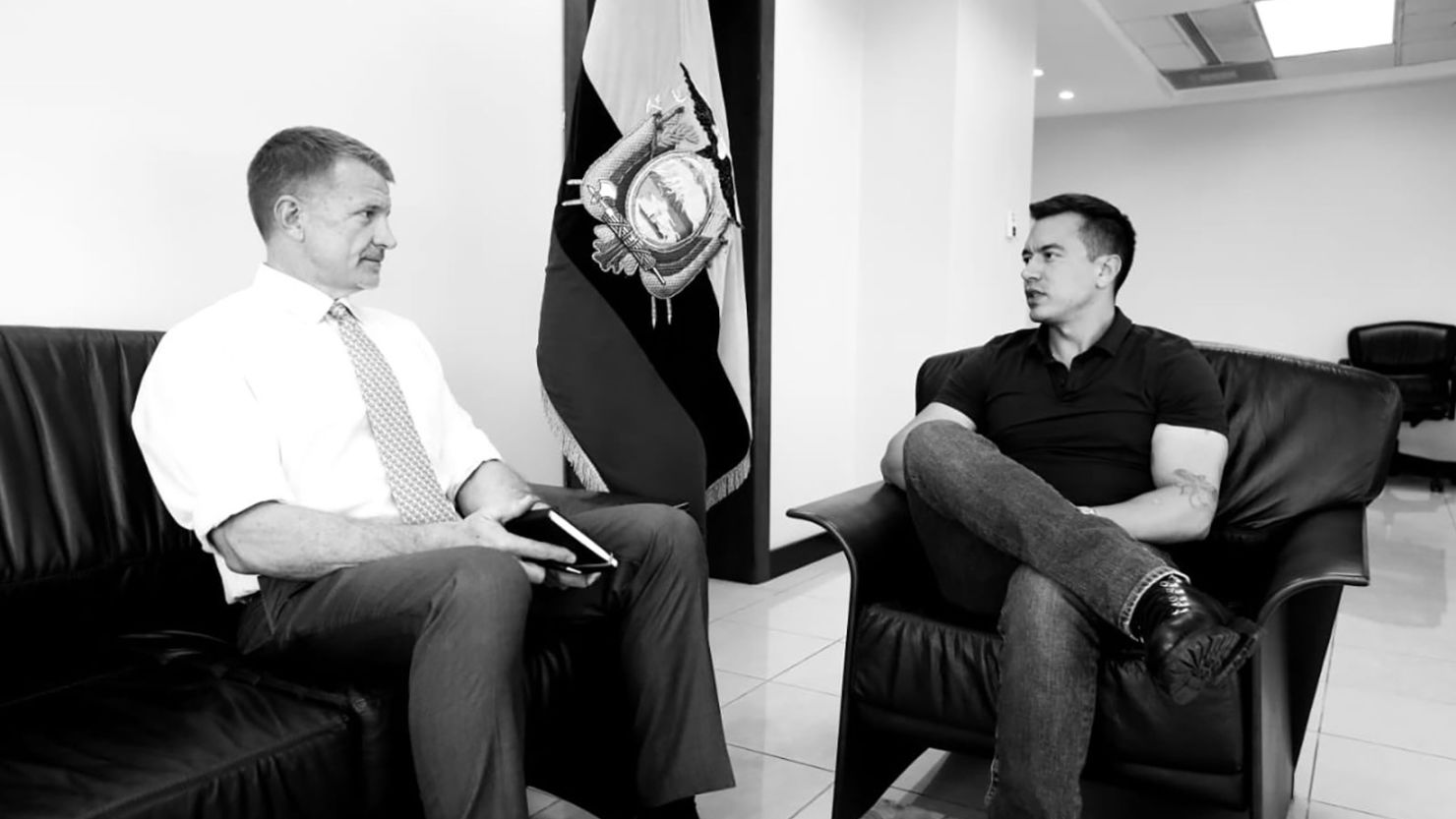
An image of Erik Prince meeting with Ecuadorian President Daniel Noboa shared on Noboa's official X account.
Daniel Noboa/X
CNN —
Ecuadorian President Daniel Noboa has announced a “strategic alliance” to fight organized crime with Erik Prince, the founder of the controversial private defense contractor formerly known as Blackwater.
Noboa, who launched a divisive military operation against criminal groups last year, posted a photo on X and Instagram showing him chatting with Prince at an office with an Ecuadorian flag in the background.
“We have established a strategic alliance to strengthen our capabilities in the fight against narcoterrorism and the protection of our waters from illegal fishing,” Noboa wrote on Tuesday. “There is no truce. There is no retreat. We are moving forward,” he added.
The president did not provide details on the partnership.
CNN has reached out to the Ecuadorian presidency for more information. CNN has also asked the Ministry of Defense for information about the partnership and whether the Armed Forces are aware of or support the move.
CNN also contacted Prince’s office for details about the meeting with Noboa.
Noboa’s announcement has raised eyebrows in Ecuador. Former Army commander Luis Altamirano criticized the partnership, calling it “deplorable” that “they seek to hire the services of a mercenary army.”
[
video
Related videoCNN follows police during drug raid in Ecuador](https://www.cnn.com/2025/03/06/world/video/ecuador-police-raid-drug-gangs-culver-digvid)
“It’s truly deplorable that, under the guise of ‘international cooperation,’ they seek to hire the services of a mercenary army. In the end, the announced ‘special forces’ were a dubious private company. Is this announcement just another smokescreen?” the retired general said on X.
CNN has reached out to Prince’s office for comment.
Prince, who is the brother of US President Donald Trump’s former Education Secretary Betsy DeVos, founded Blackwater, which gained notoriety in 2007 during the Iraq War, when its private contractors opened fire in Baghdad’s Nisour Square, killing 17 Iraqi civilians.
Four contractors were convicted and later pardoned by Trump.
Following the massacre, the company changed its name and Prince sold the firm in 2010. He currently identifies himself on his website as an investor, entrepreneur and leader in military affair reforms.
Prince was a prominent Trump supporter during the 2016 campaign. He spent time around senior transition officials and informally advised the Trump White House on some major foreign policy decisions early in Trump’s first term.
Ecuador’s crime crackdown
In his post announcing the partnership with Prince, Ecuador’s president wrote: “Organized crime has sown fear and believed it can operate with impunity. Their time is up. International aid begins in Ecuador.”
In early 2024, Noboa launched a nationwide crackdown to stop an outburst of gang violence. But the president, who is seeking reelection this year, has insisted that his country needs foreign support to solve the security crisis driven by local criminal groups linked to international drug cartels.
Armoured vehicles are seen during a joint armed forces and national police operation in Duran, Ecuador, on March 6, 2025.
Marcos Pin/AFP/Getty Images
Ecuador has the highest homicide rate in Latin America, with 38.8 per 100,000 inhabitants, according to the most recent report from the organized crime research and analysis center InSight Crime. It is followed by Venezuela, Colombia, Honduras, and Brazil.
The Ecuadorian Ministry of the Interior says the start to the year has been the most violent in the country’s history, with more than 1,000 homicides.
The president said in a radio interview on Monday that Ecuador would receive international assistance and support in the coming days through “special forces abroad” that would arrive in the country to join the fight against organized crime.
Noboa did not specify where this new international support would come from, nor under what mechanisms foreign forces would operate in the country.
---
an 6 25
"What could possibly go wrong?"
That's a questionNew York Times readers sarcastically asked on social media last Wednesday, after the newspaper reported that Erik Prince, founder of the notorious mercenary firm Blackwater and a key ally of U.S. President Donald Trump, is working with Haiti's interim government "to conduct lethal operations against gangs that are terrorizing the nation and threatening to take over its capital."
The newspaper noted that Prince declined to comment, and while Blackwater is now defunct, the former Navy SEAL "owns other private military entities." The reporting is based on unnamed American and Haitian officials and other security experts.
"Haiti's government has hired American contractors, including Mr. Prince, in recent months to work on a secret task force to deploy drones meant to kill gang members," who "have been killing civilians and seizing control of vast areas of territory" in the Caribbean country, the Times detailed.
"Mr. Prince's team has been operating the drones since March, but the authorities have yet to announce the death or capture of a single high-value target," according to the paper. Pierre Espérance, executive director of the National Human Rights Defense Network in Haiti, said the drone attacks have killed more than 200 people.
American journalist Michael Deibert said on social media, "If this story is accurate, on what authority does Haiti's unelected, temporary interim [government] invite foreign forces into the country and by what means—with whose money—do they intend to pay them for their work there?"
The U.S. State Department has poured millions into Haiti's National Police but told the Times it is not paying Prince.
Deibert said that "as someone who has reported on Haiti's armed groups for 25 years, it's hard to overstate how badly wrong bringing in foreign mercenaries, such as those allied with Erik Prince, will likely go given the current security, social, and political dynamics in the country."
Also weighing in on social media, Keanu Heydari, a history Ph.D. candidate at the University of Michigan, said: "A lot's going on here! A majority-Black nation, hollowed out by decades of foreign intervention, 'turning to' a white war profiteer to restore 'order.' That is not about logistics, this is about coloniality."
Heydari continued:
This isn't a story about drones and gangs. It's about how the world has made it structurally impossible for Haiti to govern itself—then offers mercenaries as a "solution." Haiti's sovereignty has been chipped away by debt, coups, U.N. missions, and now private warlords.Why does Erik Prince show up where Black and Brown countries are in crisis? Because the global market rewards violence disguised as security, especially when it's sold by Westerners to postcolonial states. It's racial capitalism in full view.}:
The NYT missed the story: This isn't a desperate government making tough choices. It's a story of empire outsourcing control, where mercenaries profit from the very chaos empire helped produce. Haiti deserves justice, not occupation by other means. DISASTER CAPL?
The Times article follows The Economist's reporting earlier this month that Haiti's interim government, the Transitional Presidential Council, "is so desperate that it is exploring deals with private military contractors. It has been talking to Osprey Global Solutions, a firm based in North Carolina. The founder of Blackwater, Erik Prince, visited Haiti in April to negotiate contracts to provide attack drones and training for an anti-gang task force. The council declined to comment."
In response to that paragraph in the May 7 article, Jake Johnston, director of international research at the Center for Economic and Policy Research and author of Aid State: Elite Panic, Disaster Capitalism, and the Battle to Control Haiti*, also asked, "What could possibly go wrong?"
---
NOTE ERIK PRINCE TRYING TO GET INTO BIZ W/ BUKELE
Effects and Results
At the end of March 2022, Salvadoran security forces announced that they had arrested 576 gang members; since the declaration of the state of exception, more than 83,000 individuals linked to gang structures have been arrested, including gang leaders.[10]
As of December 9, 2024, the Bukele government has totaled 776 non-consecutive days without homicides.[11][12]
10 11 12
- Arias, Diana (6 December 2024). "Régimen de excepción seguirá garantizando la seguridad pública". El Salvador. Diario El Salvador.
- Infobae, Por Newsroom (2024-09-13). "El Gobierno de El Salvador anuncia que el país suma 700 días no consecutivos sin homicidios". infobae (in European Spanish). Retrieved 2024-12-09.
{{cite web}}:|first=has generic name (help) - "Diciembre sigue sin registrar homicidios en todo el país". Diario La Página (in Spanish). 2024-12-09. Retrieved 2024-12-09.
Wikipedia
https://en.wikipedia.org › wiki › State_of_Exception_in_El_Salvador
---
---
like fucking herpes
an 4 25
Former Blackwater CEO Erik Prince and defense contractors are aiming to cash in on deportations to a Central American prison/holding facility.
Prince — the brother of President Donald Trump's former education secretary, Betsy DeVos — hopes his proposal can skirt U.S. immigration laws by designating a section of a sprawling El Salvadoran prison as American territory, Politico reported. Proposed new language claiming “transferring a prisoner to such a facility would not be an Extradition nor a Deportation” raises the specter of deporting U.S. citizens to offsite facilities because "deportation" may only qualify as a "transfer." Politico's Dasha Burns and Myah Ward noted that Prince's proposal "could be a precursor to deporting U.S. citizens" even though the facility is initially only for holding undocumented immigrants.
Trump has already floated plans to deport U.S. citizens.
READ MORE: 'Could be the last one standing': Trump aims to 'illegally remove' head of bipartisan board
The facility, which has already drawn accusations of violence and overcrowding from human rights groups, could receive thousands more immigrants from facilities in the U.S. There is no word on how accessible the expanded Central American prison would be to immigrant defense attorneys and affected families, however.
It is unclear how seriously the White House is considering Prince’s plan.
A shooting incident in Nisour Square left 17 Iraqi citizens dead, allegedly at the hands of four Blackwater guards, nearly two decades ago. Intense government investigations, scrutiny, private security reform and criminal charges ensued. In 2014, an American jury found the Blackwater guards guilty of various criminal charges, from murder to weapons offenses.
Trump pardoned Blackwater contractors jailed for the massacre in 2020.
READ MORE: Outrage as video of Trump bragging about enriching his billionaire pals emerges
The facility is pitched as a holding pen for “criminal illegal aliens,” but the administration has made it clear that the only criminality necessary for arrest and deportation to an offsite prison is being on U.S. soil.
“[B]ecause they illegally broke our nation’s laws, and, therefore, they are criminals, as far as this administration goes,” said Trump Press Secretary Karoline Leavitt in January.
Most immigrants swept up within the last two months do not have criminal records in the United States.
Read the full POLITICO article at this link.
READ MORE: 'Punched the bully in the face': How some Republicans found courage to take on Trump
---
guk no lnx
guk
maga since forever’: mercenary mogul Erik Prince pushes to privatize Trump deportation plans
Notorious Blackwater founder is lobbying allies in White House for private contractors to assist in mass deportations
Ben Makuch
Sun 16 Mar 2025
Silicon Valley has played a sizable part in the early days of Donald Trump’s new administration, but another familiar face in the Maga-verse is beginning to emerge: businessman Erik Prince, often described by his critics as a living “Bond villain”.
Prince is the most famous mercenary of the contemporary era and the founder of the now defunct private military company Blackwater. For a time, it was a prolific privateer in the “war on terror”, racking up millions in US government contracts by providing soldiers of fortune to the CIA, Pentagon and beyond.
Now he is a central figure among a web of other contractors trying to sell Trump advisers on a $25bn deal to privatize the mass deportations of 12 million migrants.
Erik Prince and Daniel Noboa
Ecuador enlists founder of Blackwater private army as ally in ‘war’ on crime
Read more
In an appearance on NewsNation, he immediately tried to temper that his plan had any traction.
“No indications, so far,” said Prince about a federal contract materializing. “Eventually if they’re going to hit those kinds of numbers and scale, they’re going to need additional private sector.”
But the news had people wondering, how is Prince going to factor into the second Trump presidency?
Sean McFate, a professor at Georgetown University who has advised the Pentagon and the CIA, said: “Erik Prince has always been politically connected to Maga, the Maga movement, and that’s going back to 2015.”
Prince, himself a special forces veteran and ex-Navy Seal, is a known business associate of Steve Bannon, the architect of Trump’s first electoral win. Prince even appeared with him last July at a press conference before Bannon surrendered to authorities and began a short prison sentence for defying a congressional subpoena.
“He comes from a wealthy Republican family,” said McFate, who has authored books on the global mercenary industry and is familiar with Prince’s history. “His sister, Betsy DeVos, is the former education secretary, and he’s been a Maga, not just a Maga, he’s been a Steve Bannon, Maga Breitbart Republican, since forever.”
Beginning during the two Bush administrations, Blackwater was a major recipient of Pentagon money flowing into wars in Iraq and Afghanistan. But a massacre in Baghdad at the hands of some of his contractors led to prison sentences, congressional inquiries and blacklistings of the firm.
Years later, Trump would come to the rescue: pardoning all of the Blackwater mercenaries involved in the massacre.
Now, with the current administration, which is doling out free advertising to Elon Musk and other Maga loyalists, Prince has a new and familiar ally in Washington.
“This is a big market time for him,” said McFate. “He’s very quiet when there’s a Democrat in the White House and gets very noisy when a Republican, especially Trump, is in the White House; I expect this to be one of many things he will try to pitch.”
Do you have tips about private military contractors or the world of Erik Prince? Tip us securely here or text Ben Makuch at BenMakuch.90 on Signal.
McFate said Prince is nothing if not an “opportunist” and an “egotist” with a penchant for getting into media cycles.
“If Trump or somebody says ‘That’s an interesting idea,’ he will pump out a PowerPoint slideshow proposing an idea, whether or not he can do it,” he said. Prince also has the ear of Tulsi Gabbard, the director of national intelligence, and was a character witness for her Senate confirmation.
There’s no denying Prince is a relentless pitchman, offering world governments billion-dollar plans to privatize wars or other less expensive espionage activities. For example, he was recently named to the advisory board of the London-based private intelligence firm Vantage Intelligence, which advises “sovereign wealth funds” and other “high-net-worth individuals”.
Post-Blackwater and under new companies, he has proposed missions in Afghanistan, Ukraine, Congo, Libya and, purportedly, Venezuela – a country he often mentions as ripe for overthrow on his podcast, Off Leash. rare earth minerals?
A senior commander in an alliance of former Venezuelan soldiers who defected from the Chavista regime told the Guardian his organization has been asking Prince for help against the country’s current president, Nicolás Maduro.
“We have sent messages to Mr Erik Prince to try to see if we can meet,” said Javier Nieto Quintero, a Florida-based former captain in the Venezuelan military and leader of the Venezuelan dissident organization Carive. “If he wants, we can provide help, support in terms of information, intelligence, or any other area based on the freedom of our country.”
Nieto Quintero, who said Prince has yet to respond, and Carive was used in a failed operation against Maduro in 2020 led by a former Green Beret. In what is notoriously known as the “Bay of Piglets”, six of Nieto Quintero’s men were killed and close to 100 captured, including two former US servicemen recruited for the job who were freed two years ago from a Caracas prison.
Prince’s eye has undoubtedly been focused on Venezuela, a country with vast oil reserves that has long been in the crosshairs of Trump’s retinue. In recent months, Prince has supported a Venezuelan opposition movement called Ya Casi Venezuela, claiming to have raised more than $1m for it over the summer. The Maduro regime is now investigating Prince’s links to the campaign, which it paints as a sort of front for western governments fostering its downfall.
Venezuela has reason to fear Prince and his connections to American spies: the CIA, with a rich history of covert actions in Latin America, was at least aware of a plot to overthrow Maduro’s predecessor Hugo Chávez in 2002.
“We were in contact with Ya Casi Venezuela, but a meeting never took place,” said Nieto Quintero. “We have continued to grow and strengthen our ranks and our doctrine, our plans, our institutional, military, security and defense proposals.”
Prince is officially active in the region. Last week, Ecuador announced it would be partnering with Prince in a “strategic alliance” to reinforce the country’s controversial “war on crime” with his expertise.
Prince did not respond to a request for comment sent through his encrypted cellphone company, Unplugged. Ya Casi Venezuela did not answer numerous emails about its relationship with Prince. As of now, no business deal between the Trump administration and Prince has been signed or publicly disclosed.
But across his career as both a shadowy contractor and a political figure, who just graced the stages of the latest Conservative Political Action Conference (CPAC) to applause and then spoke to Harvard Republicans, the public and private sides of Prince remain somewhat antithetical.
“He likes to be in the news, which makes him a very bad mercenary,” said McFate. “Frankly, most mercenaries I talk to in Africa, the big ones, despise him.”
---
ggl 10 25
[### Erik Prince

Wikipedia
https://en.wikipedia.org › wiki › Erik_Prince](https://en.wikipedia.org/wiki/Erik_Prince)
On December 30, 2019, it was reported that Prince had traveled to Venezuela to meet with a top aide of Nicolas Maduro. Prince has been referred to the ...
[### 'Maga since forever': mercenary mogul Erik Prince pushes ...

The Guardian
https://www.theguardian.com › us-news › mar › erik-pr...](https://www.theguardian.com/us-news/2025/mar/16/erik-prince-trump-immigration-enforcement)
Mar 16, 2025 — In recent months, Prince has supported a Venezuelan opposition movement called Ya Casi Venezuela, claiming to have raised more than $1m for it ...
[### Venezuelans Have a Right to Regain Their Freedom

Cato Institute
https://www.cato.org › blog › venezuelans-have-right-re...](https://www.cato.org/blog/venezuelans-have-right-regain-their-freedom)
Oct 25, 2024 — '” So reported France 24 last month, emphasizing Blackwater founder Erik Prince's involvement in an online campaign called Ya Casi Venezuela ...
“In a telephone call Friday [September 20] with UN Secretary-General Antonio Guterres, Maduro warned about the ‘hiring of mercenaries to invade the country.’” So reported France 24 last month, emphasizing Blackwater founder Erik Prince’s involvement in an online campaign called Ya Casi Venezuela(“We are almost there, Venezuela”), which allegedly aims to raise funds to finance a mercenary force that would enter the country and topple Nicolás Maduro’s socialist regime.
Ya Casi Venezuela’s structure and goals are not yet transparent. Nor is it clear who is behind the campaign. But given Prince’s previous work for the US government, his links to the movement have raised speculation about potential US involvement in the alleged mercenary plan. As per France 24, Washington quickly denied these rumors, especially after the regime’s forces arrested two Americans, among other foreigners, and accused them of plotting to assassinate Maduro.
The story’s Washington angle—and the foreign angle in general—distracts from the main issue in question, which is Maduro’s illegitimacy. In 2017, Maduro nullified the power of the official, opposition-controlled parliament or National Assembly, depriving it of its legitimate power. This year, Maduro stole an election that he lost in a landslide, as recognized by several governments and even the formerly Chavista-friendly Carter Center. The election’s winner, Edmundo González, a 75-year-old former diplomat who is now exiled in Spain, is Venezuela’s legitimate president-elect.
The question, then, is whether Venezuelans would be justified in removing the Maduro regime by force. As I argued recently, other options such as peaceful protests, negotiations with the regime, a palace coup, or diplomatic pressure will most likely be ineffective, as Cuba’s own experience under socialist tyranny can attest. And when it comes to repression in Venezuela and keeping the Maduro regime in place, Cuba runs the show.
Since the Venezuelan citizenry is unarmed, one remaining option to restore a democratic republic is the hiring of an oustide fighting force that would act as an army of liberation. But would a war to free Venezuela be legitimate? To answer, one might turn the question on its head: other than through brute force, how can Maduro remain in power after losing an election by 67 to 30 percent, despite banning the candidacy of the leader of the opposition, María Corina Machado, and not allowing millions of anti-Maduro Venezuelans living abroad to vote?
...
[### How Blackwater Conquered Latin America: Chapter Two

seasonsofcrime.com
https://www.seasonsofcrime.com › ...](https://www.seasonsofcrime.com/p/how-blackwater-conquered-latin-america-d7b)
Jul 31, 2025 — In 2019, Erik Prince offered a private army to remove Nicolás Maduro by force. What followed was one of the most audacious coup proposals in ...
[### Blackwater founder probed by Venezuela over anti-Maduro ...

France 24
https://www.france24.com › Home › Live news](https://www.france24.com/en/live-news/20240924-blackwater-founder-probed-by-venezuela-over-anti-maduro-campaign)
Sep 25, 2024 — Prince, a pioneer of private military operations, gained infamy as the founder of Blackwater -- since renamed Academi -- whose contractors were ...
[### Blackwater founder Erik Prince held secret talks with top ...

Reuters
https://www.reuters.com › article › world › blackwater-...](https://www.reuters.com/article/world/blackwater-founder-erik-prince-held-secret-talks-with-top-venezuelan-official--idUSKBN1YH2BC/)
Dec 13, 2019 — Erik Prince, the controversial private security executive and prominent supporter of US President Donald Trump, made a secret visit to Venezuela last month.
[### Military contractors pitch unprecedented prison plan for ...

Politico
https://www.politico.com › news › 2025/04/11 › militar...](https://www.politico.com/news/2025/04/11/military-contractors-prison-plan-detained-immigrants-erik-prince-00287208)
Apr 11, 2025 — Former Blackwater CEO Erik Prince and a team of defense contractors are pitching the White House on a plan to vastly expand deportations to El Salvador.
[### Blackwater founder's plan for mercenaries in Venezuela

Al Jazeera
https://www.aljazeera.com › News › Juan Guaido](https://www.aljazeera.com/news/2019/4/30/blackwater-founders-plan-for-mercenaries-in-venezuela-report)
Apr 30, 2019 — Erik Prince pitched the offer to US President Donald Trump to help remove Venezuela's Nicolas Maduro, report says.
[### Blackwater founder Erik Prince joins security operation in ...

CNN
https://edition.cnn.com › erik-prince-ecuador-intl-latam](https://edition.cnn.com/2025/04/05/americas/erik-prince-ecuador-intl-latam)
Apr 5, 2025 — Erik Prince, founder of the controversial security contractor formerly known as Blackwater, joined in law enforcement operations on Saturday in Guayaquil.
[### Summoning War Criminals to Venezuela - Medium

Medium · Arturo Dominguez
160+ likes · 2 months ago](https://medium.com/the-antagonist-magazine/summoning-war-criminals-to-venezuela-2dc184e77732)
The recent $50 million bounty the Trump administration put on Nicolas Maduro reeks of war criminal Erik Prince of Blackwater fame.

Member-only story
Summoning War Criminals to Venezuela
The recent $50 million bounty the Trump administration put on Nicolas Maduro reeks of war criminal Erik Prince of Blackwater fame
[ ](https://medium.com/@extremearturo?source=post_page---byline--2dc184e77732
·
Aug 8, 2025

Erik Prince at the 2025 Conservative Political Action Conference (CPAC) in National Harbor, Maryland | Creative Commons | Gage Skidmore
On Thursday, the Department of State (DOS) and the Department of Justice (DOJ) announced that the United States was increasing the reward for Venezuelan President Nicolás Maduro from $25 million to $50 million under the Narcotics Rewards Program (NRP) for information leading to his arrest and/or conviction. The U.S. alleges he violated U.S. narcotics laws.
Last year, after Venezuela’s most recent election, war criminal Erik Prince sought to have the bounty on Maduro increased to $100 million, saying he would lead a violent coup of the Venezuelan government if the Biden administration did so. Prince even recruited Florida Senator Rick Scott and Marco Rubio to lead the efforts to secure the money he was seeking. He even began fundraising from individuals, with no word on where that money is.
Prince became well known after his private military contracting company, Blackwater, committed war crimes in Iraq, and after many of his contractors were executed in the country. His current company, Academi, seems poised to try to overthrow the Venezuelan government. Prince has been salivating at the idea of taking control of the…

While Prince argued that he should be able to invade Venezuela based on last year’s election, it should be noted that in their joint statement, neither State nor the DOJ mentioned the opposition’s data suggesting they won the election. Instead, they only mentioned that Maduro didn’t prove he won. This was the stance State took under Biden after I asked about the opposition’s data not being certified and therefore impossible to validate, the obvious forgeries, and the unsigned tally sheets.
To date, no outlet in the U.S. has been able to authenticate the data provided…
....
---
ggl 4 25
erik prince el salvador blackwater private
Military contractors pitch unprecedented prison plan for ...
Politico
https://www.politico.com › news › 2025/04/11 › militar...
5 days ago — Erik Prince wants to cut a deal to transport detainees from the US to El Salvador.
People also ask
Does Erik Prince still own Blackwater?
How did Erik Prince make his money?
Is Blackwater private?
Who was Erik Prince's wife's nanny?
Feedback
Michigan native Erik Prince proposes deportation plan to El ...
MLive.com
https://www.mlive.com › politics › 2025/04 › michigan...
2 days ago — The former Blackwater CEO's pitch would designate part of El Salvador's prison system as American territory to avoid legal challenges, ...
The return of Erik Prince: How a notorious military ...
CNN
https://www.cnn.com › 2025/03/13 › politics › erik-pri...
Mar 13, 2025 — The former Blackwater CEO was effectively expelled from the first Trump administration, banned from inside the Pentagon and CIA.
Ecuador enlists founder of Blackwater private army as ally ...
The Guardian
https://www.theguardian.com › world › mar › ecuador-...
Mar 12, 2025 — Daniel Noboa, who is seeking re-election as president, announces partnership with Trump supporter Erik Prince.
Military Contractors Propose El Salvador's CECOT Prison ...
La Voce di New York
https://lavocedinewyork.com › news › 2025/04/12 › mi...
4 days ago — With a “Treaty of Cession” transferring a prisoner would not be an extradition or a deportation ... Former Blackwater CEO Erik Prince and a team ...
'Maga since forever': mercenary mogul Erik Prince pushes ...
The Guardian
https://www.theguardian.com › us-news › mar › erik-pr...
Mar 16, 2025 — Notorious Blackwater founder is lobbying allies in White House for private contractors to assist in mass deportations.
MLive.com - The former Blackwater CEO's pitch would...
Facebook · MLive.com
450+ reactions · 2 days ago
The former Blackwater CEO's pitch would designate part of El Salvador's prison system as American territory to avoid legal challenges, ...
Erik Prince
Wikipedia
https://en.wikipedia.org › wiki › Erik_Prince
Erik Dean Prince (born June 6, 1969) is an American businessman, investor, author, and former U.S. Navy SEAL officer, and the founder of the private ...
Edgar Prince · Frontier Services Group · George Nader (businessman)
Missing: salvador | Show results with: salvador
Private Military Companies: Blackwater
Silent Professionals
https://silentprofessionals.org › blackwater
Apply for contract and F/T job opportunities for private security jobs here. Military and Law Enforcement vetearns never pay for access to jobs at Silent ...
Missing: salvador | Show results with: salvador
Erik Prince: Private sector can help with mass deportations
NewsNation
https://www.newsnationnow.com › erik-prince-private-s...
Feb 25, 2025 — Erik Prince, founder of the former security contractor Blackwater, denied proposing a "private army" for mass deportations and instead ...
===
an 5 24
“Off Leash" is not only the name of a podcast started by Erik Prince, former CEO of Blackwater (now part of the security firm Constellis Holdings) and brother of ex-Trump Administration Education Secretary Betsy DeVos. It is also the name of a private far-right group chat Prince hosts via the instant messaging program WhatsApp.
The New Republic's Ken Silverstein describes the group chat in an article published on May 30, noting that former Fox News host Tucker Carlson, GOP activist/organizer Kimberly Guilfoyle (Donald Trump Jr.'s fiancée), Michael Flynn (former national security for the Trump Administration) and House Homeland Security Chairman Mark Green (R-Tennessee) are among the MAGA "cranks" who have been invited to participate.
"Collectively," Silverstein explains, "Off Leash provides an informal virtual gathering place for current and former political officials, national security operatives, activists, journalists, soldiers of fortune, weapons brokers, black bag operators, grifters, convicted criminals, and other elements in the U.S. and global far right…. Prominent figures in the Off Leash crew are well-known for their paleoconservative political views, but the private opinions expressed in the group chat are even more extreme and jarring than we normally see voiced publicly."
READ MORE: 'Back to square 1': Legal expert breaks down jury deliberations in Trump hush money trial
According to Silverstein, his investigation of Off Leash conversations via WhatsApp showed that some of the participants have "chirpily discussed the desirability of clamping down on democracy to deal with their enemies at home and regime change, bombings, assassinations, and covert action to take care of those abroad."
Silverstein reports, "The group's overall bloodlust periodically proved to be too much for a few more judicious individual members, who in almost any other setting, would be considered ultra-conservatives but in the context of Off Leash, sound like hippie peaceniks…. Many other Off Leash participants have also stated that they don't view the group chat as merely a forum to exchange ideas but want it to become a vehicle to put their theories into action."
Silverstein observes that it isn't uncommon for Off Leash participants to advocate "violence."
"On the roster of Off Leash participants," Silverstein points out, "there was one — a poster with the handle of 'S,' whom it took me weeks to identify — who stood out as a particularly dark character. There were some in the group who expressed more unhinged views and others who more casually called for violence against their enemies; what made S distinctive was his dry, bloodless manner and businesslike espousal of a disciplined worldview that was unmistakably fascist."
READ MORE:['Mother Theresa could not beat these charges': Trump not confident about jury deliberations
*Read Ken Silverstein's full report for The New Republic at this link.
===
an ah 6 23
https://www.alternet.org/trump-big-lie-2661170105/
2020 was an incredibly tumultuous year in the United States, from the COVID-19 pandemic to the murder of George Floyd and the unrest that followed to a bitter presidential race. Former President Donald Trump's efforts to overturn the 2020 election results are the focus of two separate criminal investigations: one by the U.S. Department of Justice (DOJ) and special counsel Jack Smith, the other by Fulton County, Georgia District Attorney Fani Willis.
Trump's MAGA supporters were willing to go to great lengths to get him reelected in 2020, including — according to CNN's Kara Scannell — possibly trying to "infiltrate" the Democratic National Committee (DNC) "ahead of the election."...Scannell reports...;Richard Seddon, a former British intelligence official, and Susan Gore, a Republican donor and heiress to the Gore-Tex fortune" in connection with their probe....
READ MORE: https://www.alternet.org/jack-smith-wants-to-go-after-trump-s-good-news-boy-to-crush-his-january-6-defense-legal-expert-2659896037/"...Jack Smith wants to go after Trump's 'good news boy' to crush his January 6 defense: legal expert. "The investigation appears to stem from& https://www.nytimes.com/2021/06/25/us/politics/spies-conservatives-left-political-enemies.html"...a 2021 New York Times article that, citing interviews and documents, detailed 'an undercover operation by conservatives to infiltrate progressive groups, political campaigns, and the offices of Democratic as well as moderate Republican elected officials during the 2020 election cycle,'" https://www.cnn.com/2023/06/08/politics/prosecutors-investigate-efforts-infiltrate-dnc/index.html"..."One of the subpoenas, which was sent in the past two weeks, seeks documents and communications from January 2018 through the present involving numerous limited liability companies and individuals, includingGore; Seddon; Erik Prince, the security contractor and brother to former Education Secretary Betsy DeVos; and James O’Keefe, the former head of Project Veritas."
The CNN reporter adds, "The people familiar with the investigation said prosecutors are looking into whether any campaign finance laws were violated. No one has been accused of any wrongdoing."
Scannell notes that theNew York Times "reported that two operatives trained by Seddon pledged sizable political donations ranging from $1250 to $10,000 to Democratic organizations and candidates."
"Some of the donations gained the operatives, a couple, entry to fundraisers and even a Democratic primary debate in Las Vegas," Scannell explains. "It is not clear where the couple got the money to make the donations. It is illegal to use another person's name to make political donations, and prosecutors have brought numerous so-called straw donor prosecutions in recent years."
READ MORE:Legal experts lay out 4 'significant hurdles' federal prosecutors face in Trump indictment
On June 25, 2021, New York Times journalists Mark Mazzetti and Adam Goldman reported that "conservatives" Beau Maier and Sofia LaRocca attended Democratic events in Las Vegas pretending to be "idealistic Democrats."
Mazzetti and Goldman reported, "During a cocktail reception…. they worked the room of party officials, rainbow donkey pins affixed to their lapels. In fact, much about them was a lie. Mr. Maier and Ms. LaRocca were part of an undercover operation by conservatives to infiltrate progressive groups, political campaigns and the offices of Democratic as well as moderate Republican elected officials during the 2020 election cycle, according to interviews and documents. Using large campaign donations and cover stories, the operatives aimed to gather dirt that could sabotage the reputations of people and organizations considered threats to a hard-right agenda advanced by President Donald J. Trump."
Ultimately, efforts to keep Trump in the White House failed. Now-President Joe Biden won 306 electoral votes and defeated Trump by more than 7 million in the popular vote.
READ MORE: Proud Boys verdict is in: Guilty of seditious conspiracy
CNN's full report is available at this link.
===
===
legal press slapp suppression
yahoomail 4 23
Erik Prince, the billionaire founder of the private security firm formerly known as Blackwater, is making a third attempt at his defamation lawsuit against The Intercept.
We’ve spent over $200,000 on legal fees fighting off this action, on top of the countless hours spent on these cases by our internal legal team.
Make no mistake: We stand by our reporting on Prince 100 percent. As the founder of one of the most powerful private mercenary armies in the world, Erik Prince is absolutely worthy of journalistic inquiry.
===
==
https://www.rollingstone.com/politics/politics-news/ken-starr-dead-1234592249/
no lnx
BONG HITS 4 JESUS
Ken Starr, Who Turned a Blind Eye to Rape and Defended a Sex Trafficker, Dead at 76
The right-wing lawyer was known for probing Bill Clinton’s affair, mishandling sexual assault cases at Baylor, and helping Jeffrey Epstein secure a sweetheart deal
BY JON BLISTEIN
SEPTEMBER 13, 2022
Special Prosecutor Kenneth Starr offers his testimony to the House of Representatives Judicial Committee, in Washington, D.C, on Nov. 19, 1998. DAVID HUME KENNERLY
KENNETH STARR, THE lawyer known for investigating Bill Clinton’s affair with Monica Lewinsky, mishandling sexual assault cases as president of Baylor University, and helping Jeffrey Epstein secure a sweetheart deal, died Tuesday, Sept. 13. He was 76.
Starr’s family confirmed his death, saying he died from complications from surgery at St. Luke’s Medical center in Houston, Texas.
Starr was a stalwart conservative foot soldier throughout his career. He started as a lawyer and was nominated by Ronald Reagan to serve on the U.S. Court of Appeals in 1983, a post he maintained for about six years before resigning. George H.W. Bush later appointed him solicitor general, and he was even briefly in the running to fill a Supreme Court vacancy later taken by David Souter.
Though always lurking around the right wing, Starr really started to rise to prominence in the mid-’90s, when he was tapped to investigate Bill and Hillary Clinton’s alleged involvement in an Arkansas real estate project. Neither Clinton was prosecuted,but Starr’s probe expanded to include an investigation into Paula Jones’ claims of sexual assault against bill Clinton, as well as Clinton’s affair with Lewinsky.
The “Starr Report,” released in Sept. 1998, claimed Clinton lied about about his affair with Lewinsky and cited obstruction of justice, perjury, abuse of power, and more as reasons for impeaching Clinton. The report led to Clinton’s impeachment in the House of Representatives, but he was acquitted on all counts in the Senate.
[RELATED
Ken Starr Now Thinks Impeachment Is... Bad?
Ken Starr
Noah Cyrus Finds Her Own Voice]
After making a name for himself investigating Clinton’s sexual impropriety, Starr returned to his career as a lawyer and found himself involved in a handful of prominent cases. He successfully represented the Juneau, Alaska, school board and principal that suspended a student for unfurling a “Bong Hits 4 Jesus” sign as the Olympic torch passed through the the city. He failed to secure constitutional immunityfor the mercenary firm Blackwater after its contractors slaughtered four unarmed civilians in Fallujah. And he also failed to uphold Prop 8 in California, the ballot measure banning same-sex marriage that was later overturned in the courts.
Despite being busy defending opponents of same-sex marriage and private military contractors, Starr found plenty of ways to return to the world of sexual impropriety. With his plethora of connections to George W. Bush’s administration, Starr joined Jeffrey Epstein’s legal team and played a crucial part in pressuring the Justice Department to drop its sex-trafficking case against the billionaire. For his efforts, Starr helped his client secure the infamous sweetheart deal that landed him in prison for just 18 months and effectively ensured him immunity from future prosecution.
Epstein wasn’t the only alleged child molester Starr tried to help either. In 2013, he wrote a letter of support for Christopher Kloman, just before he was sentenced to 43 years in prison for molesting five girls while teaching at the elite Potomac School in the Sixties and Seventies.
Three years after that, Starr resigned as chancellor of Baylor University, and a professor at its law school, not long after being removed from his post as president. The reason? An investigation found that Starr and other administrators mishandled numerous accusations of sexual assault — including multiple rape allegations — against the school’s football players.
For his final act, the man who made a name for himself trying to take down one president tried to help another stave off the same fate. First as a TV talking head, he argued against impeaching Donald Trump over the Mueller report, claiming it would be “bad for the country.” Starr later joined Trump’s legal team when he was impeached (the first time) for abuse of power and obstruction of justice after he allegedly tried to pressure the Ukrainian government to investigate Joe Biden.
===
===
2 pled guilty
https://en.wikipedia.org/wiki/We_Build_the_Wall
we Build the Wall is an organization soliciting donations to build private sections of the wall along the Mexico–U.S. border. It started as a GoFundMe campaign by United States Air Force veteran Brian Kolfage in December 2018.[2] Kolfage announced the formation of a 501(c)(4) non-profit organization in January 2019.[3] By mid-2020, over $25 million had been raised[4][5] and a 3-mile (4.8 km) section of fence had been built.[6]
Its advisory board includes politicians and activists with a hard-line stance on illegal immigration, including former secretary of state of Kansas Kris Kobach;[7] former congressman Tom Tancredo;[8] Blackwater USA founder Erik Prince; former Milwaukee sheriff David Clarke;[9] and former Trump chief strategist Steve Bannon,[5][10] who is chairman of the board.[11] On December 3, 2019, a Hidalgo County judge ordered the group to temporarily halt all construction due to its plans to build adjacent to the Rio Grande, which a lawyer for the National Butterfly Center argued would create a flooding risk. On January 9, 2020, a federal judge lifted the injunction, allowing construction to resume....
===
===
an 222
erik Prince, an ally to former President Donald Trump and the former CEO of a security firm previously named Blackwater, reportedly helped raise funding for an effort designed to surveil Democratic, progressive and anti-Trump Republican candidates head of the 2018 midterm elections.
On Tuesday, February 8, The New York Times released a report consisting of documents and interviews that detailed Prince's role in the surveillance effort. Prince reportedly conducted a meeting withBritish spy Richard Seddon as they allegedly worked to dig up incriminating information on opposing politicians across multiple states.
Since Seddon previously served as an unofficial advisor to Trump administration advisors, the report sheds light on the connection between the Trump administration and the spy effort.
The report also reveals Susan Gore, founder of the right-wing organization, Wyoming Liberty Group and heir to the Gore-Tex waterproof brand, had become the main financial supporter of the effort.
Per NY Times:
"Mr. Prince took on the role of celebrity pitchman, according to interviews and documents, raising money for Mr. Seddon’s spying operation, which was aimed at gathering dirt that could discredit politicians and activists in several states. After Mr. Prince and Mr. Seddon met in August 2018 with Susan Gore, a Wyoming heiress to the Gore-Tex fortune, Ms. Gore became the project’s main benefactor."
The group reportedly developed a plan to begin their efforts in Gore's home state of Wyoming and eventually expand to more states including Arizona and Colorado.
Former Wyoming lawmaker Marti Halverson also provided the group with a shortlist of specific targets that they'd planned to surveil. Those individuals include: Wyoming Gov. Mark Gordon (R), who is referred to as a RINO; John Cox, who previously served as the director of Wyoming's Department of Workforce Service; and Scott Talbott, the former director of the Wyoming Game and Fish Department.
Read the full report at the Times.
https://sethabramson.substack.com/p/the-trump-brazil-scandal-did-donald
no pix twt with kush jan 8?
Introduction
When Proofpublished a major exposé on the potential involvement of the Brazilian government in the planning of the January 6 insurrection—in the form of significant evidence that the son of the Brazilian president, Eduardo Bolsonaro, as well as many Trump donors with significant ties to Brazil, attended a secretive January 5 meeting at Trump’s private residence at Trump International Hotel—a shrewd Proof reader asked (I here paraphrase), “How would the Brazilians have been able to aid Trump and his political team so close to the day of the insurrection?”
One possible answer is that, as we know from major-media reporting, the Brazilians had been working with Team Trump since early 2019 on weakening Venezuela, even as Trump personal attorney Rudy Giuliani and a gaggle of top Trump advisers (including now-Congressman Pete Sessions of Texas and notorious Trump national security adviser Erik Prince) were secretly negotiating with Venezuela’s government in ways they believed would benefit both themselves and Donald Trump’s political career. This possibility forms the basis of the following article, which includes, as well, a bundle of new evidence suggesting that the January 5 “war council**” involving all of Trump’s top advisers—an event lied about by a number of them—may in fact have involved not just one but two locations, and possibly the President of the United States himself.
{Note: See the national bestseller Proof of Corruption, published by Macmillan in mid-2020, for a whole chapter on the clandestine negotiations between top Trump agents and Maduro’s socialist regime in Venezuela.}:
Sidney Powell and Rudy Giualiani
When Trump legal adviser Sidney Powell, who for weeks had been working alongside Trump’s personal lawyer, Giuliani, announced nearly two months before the January 6 insurrection that she had secret sources in South America who were working with her to uncover smoking-gun evidence of voting-machine manipulation in the 2020 presidential election, the curtain suddenly rose on a large rogues’ gallery of possible Trumpist accomplices in Brazil and Venezuela. Tellingly, Giuliani began to publicly distance former president Trump from Powell the moment Powell began referring to clandestine political operations allegedly under way in South America. So why did Powell’s references to that continent necessitate a public split from the president and his family, when months and even years of QAnon conspiracy theories spilling from Sidney Powell’s lips had failed, apparently, to necessitate that critical political pivot?
According to a report in the New York Times, at a time post-election when Trump was working with Brazilian president Jair Bolsonaro to support dissident elements in Venezuela—particularly on the question of whether Venezuela’s recent elections had been rigged to aid the nation’s current socialist president (unrecognized by the U.S.), Nicolas Maduro—members of Trump’s legal team suddenly gained access to “an affidavit…signed by a former military official from Venezuela about elections there”, as well as evidence (now widely believed to be manufactured) that “elections software company Smartmatic helped the Venezuelan government rig its [recent] elections by switching votes and leaving no trail.”How in the world would an obscure former federal prosecutor from Texas get connected to Venezuelan dissidents? What channels would a private citizen use to get in touch with elements of a hostile foreign governmentnot recognized by the United States, indeed the hostile foreign government Trump had publicly mused about invading? No one knows, and not only wouldn’t Powell say, but per the New York Times she would only show partial screenshots of the evidence in her possession—perhaps concerned that providing entire documents to the media might reveal their provenance.
It is worth repeating here that her legal partner in Trump’s scurrilous post-election lawsuits, Giuliani, presently represents and for some time has represented one of the most powerful—and corrupt—dissidents in Venezuela, Alejandro Betancourt, who is currently a wanted man in the United States, and whose Spanish castle was used by Giuliani as he was secretly trying to rig the 2020 presidential election as part of what is now known as the “Trump-Ukraine scandal.” Moreover, that Sidney Powell’s longtime client Michael Flynn is an Erik Prince associate; that Prince had in December of 2019 held secret talks with both Venezuelan dissidents and representatives of the socialist government of Nicolas Maduro; that Trump had expressed little admiration for Juan Guaidó,implying that he is resigned to a Maduro government in Venezuela;and that Trump had himself ostensibly spent 2019 working with Jair Bolsonaro to undermine Maduro—but only enough to put pressure on Maduro, not to effectuate any significant change in the governance of Venezuela, all point toward a coordinated Trump effort to acquire evidence of election fraud in Venezuela that began with Bolsonaro’s 2019 rise to power in Brazil and coincided with Trump’s own preparations to falsely announce evidence of voter fraud if he lost the 2020 presidential election.
{Note: Keep in mind that Trump and his closest associates have a long history of preparing voter fraud claims well in advance of an election. For instance, it was in mid-2016 that top Trump political adviser Roger Stone launched the so-called “Stop the Steal” movement—doing so many, many months before the 2016 presidential election to poison the well of Americans’ faith in their national elections’ integrity in the event Hillary Clinton was elected.}:
Daniel Beck and Eduardo Bolsonaro
As has just been reported by Revista Fórum in Brazil, it was shortly after Bolsonaro came to power in 2019, after having been elected at the very end of 2018, that the fortunes of certain top Trump allies started to rise in Brazil as part of—according to reports by local media—the newly elected president’s bid to strengthen his ties with Donald Trump.
According to Revista Fórum, a company run by QAnon conspiracy theorist, Txtwire CEO, and January 5 “war council” attendee Daniel Beck—the son of Doyle Beck, a powerful GOP official in the blood-red state of Idaho who may also have been at the war council—“won in December [2019] a bid of [$2,041,700 U.S. dollars] to arm vehicles of the Federal Highway Police (PRF), under the [Bolsonaro] Ministry of Justice.”
Beck’s company, Combat Armor Defense, also won, after Bolsonaro’s election but before he had assumed power, a contract from the Brazilian Ministry of Defense: a more modest $50,000 contract, one that would soon be dwarfed by the one earned after the Bolsonaro administration was in place. Just so, according to Revista Fórumthe Trump-donor-run company only “installed itself in Brazil after the election of Jair Bolsonaro, in 2019. Combat Armor’s headquarters are [now] in Vinhedo, in the interior of São Paulo.” The Brazilian media outlet notes that Beck and his company plan to soon“open a new [facility] in Indaiatuba [in Brazil]”, the clearance for which would likewise have been granted by the Bolsonaro administration prior to the January 6 insurrection in the United States.
Notably, the most powerful member of the Brazilian House from São Paulo is none other than Eduardo Bolsonaro—the son of Jair Bolsonaro and the head of the House Foreign Relations Committeein Brazil. The younger Bolsonaro is, therefore, as important to the future of Daniel Beck’s company as any government official in Brazil with the sole exception of the President of Brazil himself.
It’s under these circumstances that the FBI will undoubtedly be asking the following question: if Daniel Beck was invited, for no reason anyone can fathom, to participate in a twenty-person secret meeting about the January 6 plan-of-attack at Trump’s private residence at Trump International Hotel on January 5—an illicit event that we know included two members of Trump’s family, Donald Trump Jr. and Eric Trump, and concerned the political, legal, financial, professional, and personal future of the then-President of the United States, their father Donald Trump—and if the Brazilian official most significant to the livelihood of the aforementioned Daniel Beck was at that very moment in D.C. meeting with the aforementioned President of the United States and Donald Trump’s other politically active adult child, Ivanka Trump, exactly what are the odds that at some point these two meetings were conjoined via video teleconference or speaker phone?
{Note: I am leaving out of this essay—as it’s a topic worthy of its own article—the longtime and highly controversial links between late Trump donor Sheldon Adelson and special treatment for his casino plans in Brazil. Jair Bolsonaro was working to aid those plans when Adelson died.}:
Charles Herbster and Layne Bangerter
Before the FBI gives a final answer the question above—about the possibility that the now-infamous January 5 “war council” was held simultaneously in two locations—it will first need to wrestle with another, damnably thorny one: why did one of the self-admitted attendees at the January 5 Trump International Hotel meeting, Charles W. Herbster, originally report on Facebook that the meeting was in fact taking place at the White House? For that matter, when Herbster then edited his post to change the location from the White House to Trump International Hotel, why did he delete the name “Rudy Giuliani” from his post but make no other edits? In other words, why did Herbster consider it accurate to say that Giuliani was at the meeting, but not accurate to pin Giuliani’s location during the meeting as Trump International Hotel? Or, in the alternative, why was it deemed important to keep Rudy Giuliani—he of the top-shelf South American connections related to prior Trumpist attempts to steal the 2020 election, and the only person present at the January 5 war council with a professional duty to report out its result to the President of the United States, were the president not to attend himself—out of the January 5 pre-insurrection picture altogether?
We know that there were “call-ins” to the January 5 Trump International Hotel meeting during its run-time, as Stop the Steal organizer Ali Alexander says he spoke to top Trump political adviser and Donald Trump Jr. girlfriend Kimberly Guilfoyle at a time she was in the Trump International Hotel meeting. We also know, as previously reported by Proof, that there were others besides Daniel Beck inside Trump’s private residence at Trump International Hotel who would have good cause to know Eduardo Bolsonaro, including powerful GOP official Layne Bangerter, whose connections to not just Brazil generally but São Paulo specifically go back decades. And we know that Michael Lindell—and possibly, per a January 6 livestream by the MyPillow CEO and former crack addict, Rudy Giuliani, Sidney Powell, and Michael Flynn—were all with Eduardo Bolsonaro at some point on January 5. So how much sense would it make for there to be no January 5 uplink between Donald Trump’s public residence (the White House) and his private residence (Trump International Hotel), at a time when so many interconnected persons were meeting at these two locations to discuss the same topic[pix w 5 ? ppl blurred]
Note: Everything about the above January 5 social media post, made at a time when Daniel Beck couldn’t have known it would be controversial—lending it important indicia of reliability from an investigative standpoint—contradicts recent statements by Senator Tommy Tuberville of Alabama, who claimed his presence at the meeting lasted only five or ten minutes, not “the evening”, and that the topic of discussion was “2022”, not “the elections [of 2020], illegal votes [in 2020], court cases [in 2020], the republics’ [sic] status [in 2020] and what to expect on [Capitol Hill] tomorrow [January 6, 2021].” Proof has asked before and will ask again: having already been caught lying about his presence at the January 5 Trump International Hotel meeting, why would Tuberville continue lying? Who that was present at that meeting—either live or via teleconference uplink—would be worth Tommy Tuberville lying to protect at a moment that he would reasonably believe himself to be under aggressive FBI investigation?}:
Donald Trump and Jair Bolsonaro
It’s worthwhile, now, to return for a moment to the Trump-Bolsonaro relationship.
It’s not just that Trump and Jair Bolsonaro purportedly share the same goals with respect to Venezuela—I say “purportedly” because of the evidence that Trump used Giuliani, Prince, and Sessions to try to strike some sort of murky deal with Maduro that would allow him to remain in power (see Proof of Corruption), though it’s not clear what information or other assets Maduro would have had to provide Trump in return—it’s that Bolsonaro’s particular focus in his dealings with Trump has been on the matter of election integrity, and how the issue of election integrity could be cynically leveraged to undermine (in, one notes, a classic neo-fascist irony) election integrity.
Per a report by WSWS, on the evening of Insurrection Day Jair Bolsonaro declared,
“I followed everything [that was happening at the Capitol]. You know I’m connected to Trump. You know my answer [about whether I think the 2020 election was stolen]. Now, [there have been] a lot of [voter] fraud allegations, a lot of [voter] fraud allegations.”
But Bolsonaro didn’t stop there. In the shadow of an armed insurrection against the U.S. government that had only just ended, he opined about his own recent election: “Mine [my 2018 ‘first-round’ election] was defrauded. I have proof of it. I should have won in the first round.”
On January 7, the day after the insurrection, President Bolsonaro continued railing about election fraud: “What was the problem [in the United States on Insurrection Day]? Lack of trust in the vote. So there, the people voted [in November] and the mail vote was boosted because of the so-called pandemic, and some people voted three or four times. Dead people voted. If we don’t have printed ballots in 2022 [in Brazil], some means to audit the vote, we are going to have a problem worse than in the U.S.”
In view of the foregoing, the FBI must now investigate whether Trump’s legal team—present at the January 5 war council at Trump International Hotel—believed that the Bolsonaros, both father and son, were key allies in getting evidence of “voter fraud” in Venezuelan elections. Such evidence would have been critical to Trump’s publicly confirmed, twelve-part pre-inauguration plan to hold onto the American presidency.
{Note: On Wednesday, March 10, Proof will publish the details of this twelve-part plan, which prominently includes the absolute necessity that Rudy Giuliani and Sidney Powell publicly present new and compelling evidence of voter fraud in the 2020 presidential election in the days immediately following Eduardo Bolsonaro’s visit to the United States.}:
Eduardo Bolsonaro
As much as Eduardo Bolsonaro may have billed his several-day trip to Washington as a “vacation” from his official duties, and as much as he may have attempted to double down on this thin ruse by posting a picture of himself at the White House with Ivanka Trump holding his newborn daughter Georgia Bolsonaro (with his wife, Heloísa Bolsonaro, claiming that the purpose of the trip to the White House was simply to visit “Aunt Ivanka”) all of the available evidence suggests that Bolsonaro did nottravel to Washington 48 hours before an armed insurrection against the United States Capitol and leave Washington 48 hours after an armed insurrection against the United States Capitol—meeting with Trump family members, Trump administration officials, Trump campaign officials, Trump lawyers, and Trump political advisers at various locations throughout his stay—just to take a photo of a family friend holding his baby.
Consider the following facts:
- WSWS reports that Bolsonaro’s trip to the White House was “on the evening of January 5,” meaning that it coincided with the Trump International Hotel war council attended by at least one of Bolsonaro’s key foreign “constituents.”The timing of the meeting—approximately sixteen hours before the most important moment in Donald Trump’s life, given the repercussions he stood to face legally and politically and financially if he lost the White House—is not consistent with a social visit, nor is the simultaneous (and otherwise inexplicable) invitation of two men Eduardo Bolsonaro would have reason to know, Daniel Beck and Layne Bangerter, to Trump’s private residence inside Trump International Hotel.
- Bolsonaro brought the outgoing Brazilian ambassador to the United States with him to the White House on January 5. By bringing Nestor Forster Jr., Brazil’s outgoing ambassador, with him to the White House, Bolsonaro ensured that Trump would spend the last few hours before a potential civil insurrection—one whose potential dangers Trump was already aware of, given the public lies he had already told about going to the Capitol the next day, when in fact he had no intention of doing so—with the two most important diplomats from the nation of Brazil, by January 5 Trump’s most staunch ally in the entire Western Hemisphere. Forster’s presence also gives the lie to Heloísa Bolsonaro’s patently silly “Aunt Ivanka” story. Moreover, given that President Bolsonaro had wanted Eduardo to be his ambassador rather than Forster, and given that Forster was on his way out of his role, and given that (say it with me) Eduardo’s dad is the President of Brazil, the delegation Jair Bolsonaro sent to the White House on January 5 not only had to be received by President Trump himself but could not possibly be seen by Trump and/or his family as having anything less than the full authority of the Bolsonaro administration behind them. Indeed, Eduardo’s social media posts from January 5, while hiding the full scope of his visit to the White House, acknowledged his visit’s significant and indeed undeniable diplomatic import.
- Eduardo Bolsonaro had met with President Trump before, suggesting that it would’ve been a “snub” if Trump had refused to meet with him on January 5. Jair Bolsonaro brought his son with him, rather than his foreign minister, when he met with Trump and Trump’s home in Florida, Mar-A-Lago, in March 2019, less than 90 days after Bolsonaro’s inauguration. It is nearly impossible to conceive of Trump refusing to see Eduardo Bolsonaro when the son of one of his top foreign allies in the world was in the White House. So why didn’t Eduardo Bolsonaro’s social media postings on January 5 acknowledge a visit with the President of the United States? Why, instead, did Bolsonaro—and for that matter his wife—use social media to create the cover story that they were only at the White House to introduce their daughter to “Aunt Ivanka” in her suspiciously-close-to-the-Oval-Office personal office inside the White House? {Note: Trump has a history, documented in the Proof trilogy, of “dropping in” on meetings that aren’t on his schedule in order to meet privately with individuals without having these meetings appear in any records. In one of the most damning examples of this, Trump “dropped in” on a meeting between his lawyers, Paul Manafort, and Manafort’s lawyers by suddenly showing up on speakerphone to tamper with a federal witness—urging Manafort to “stay strong” as the FBI was trying to get him to flip. This event is detailed in the Proof trilogy.}:
- Eduardo Bolsonaro didn’t go to the White House just once during his 120 hours in America—he went at leasttwice. Most don’t realize that not only did Eduardo Bolsonaro travel to the White House, the seat of the Trump administration and Ground Zero for January 6 planning, on the evening of January 5, he also returned to the White House on January 8 to meet with—perhaps among unnamed others—Jared Kushner (see photo below).
- If Tuberville, attending an event at Trump International Hotel with several other senators, was indeed “asked to speak” about the future of the U.S. at an event that was ongoing at one of three times—while Eduardo Bolsonaro was at the White House; while Bolsonaro was meeting with Lindell, who attended the Trump International event; or at some other point when Bolsonaro was in D.C. blocks from where Tuberville was speaking—what would cause Bolsonaro tomisssuch an event?
- It is important to remember that Eduardo Bolsonaro runs Brazil’s House Foreign Relations Committee, had been used by his father as an ambassador to the Trump administration in the past, and was with his nation’s designated ambassador to the U.S. on January 5. What could (at least) three United States senators be talking about on the eve of Joe Biden’s certification as president-elect that Bolsonaro would nothave wanted to and been intended tohear? Why would such a presentation, from at least three members of the upper house of Congress who would help determine America’s future on January 6, be of utility and interest to Txtwire CEO Daniel Beck and a couple of GOP officials from Idaho, but not top Trump ally Eduardo Bolsonaro? Why would Bolsonaro, who is friends with Donald Trump Jr. and Eric Trump and would spend at least some part of his D.C. trip with Michael Lindell (and possibly Lindell’s constant pre-insurrection companions, per Lindell, Giuliani and Powell and Flynn) but then be kept from attending a meeting all six of these people allegedly attended?
Steve Bannon
All of the above is made more troubling by the presence of Steve Bannon as the White House’s top outside political adviser in the days leading up to the insurrection. There is no evidence that Bannon was at Trump International Hotel on January 5, but we do not yet know if he was at the White House or in communication with either the White House or Trump’s private residence at Trump International Hotel on that critical date.
What we do know is that Bannon helped Donald Trump to strategize for January 6—and that Eduardo Bolsonaro is one of Bannon’s closest associates.
As WSWS notes, Eduardo, who may well have met with Trump mere hours before the insurrection, “is a close associate of American fascist ideologue Steve Bannon. As for [Brazilian ambassador Nestor] Forster [Jr., who was with Eduardo Bolsonaro at the White House on January 5], he has worked as a bridge between [Jair] Bolsonaro and Trump loyalists. The conservative dailyEstado de S. Paulorevealed that Forster has fed the Brazilian cabinet…reports from the far-right, pro-Trump media about fraud in the U.S. elections in order to support [Jair] Bolsonaro’s alignment with Trump.”
Not only does this reporting bring both Eduardo Bolsonaro and Nestor Forster deeper into Trump’s inner circle in the hours before the insurrection, it also underscores that when Bolsonaro and Forster went to the White House on January 5 they were focused on the very same thing Donald Trump was: “reports from the far-right, pro-Trump media about fraud in the U.S. elections.”As noted already at Proof, both above and in prior articles, the Bolsonaros’ association with this topic is both a domestic one (i.e., a focus on Bolsonaro’s own claims of election fraud, which would be bolstered if Trump could establish, however fraudulently, that such activity occurs at a high level even in the United States) and an international one (i.e., inasmuch as both Donald Trump and Jair Bolsonaro believe that the key to toppling the regime of a supposed mutual enemy in Venezuela, Nicolas Maduro, was spiriting out of Venezuela evidence that Maduro won his recent elections by fraud—“evidence” that would simultaneously benefit Bolsonaro in his ongoing contestations with Brazil’s northern neighbor, and Trump in his efforts to “prove” that the 2020 presidential election had been stolen from him).
The Typo Heard Round the World
All of which brings us back to Charles Herbster, a Trump administration official on January 5 and yet a man who couldn’t—if we are to credit what he and other Trumpists are implicitly telling us—distinguish between the White House and a Trump hotel. Indeed, whatever the outcome of the ongoing FBI investigation into the White House’s connections to the January 6 insurrection, can anyone identify a more bizarre “typo” by a Trump administration official, or indeed anyone associated with the American government, than a top Trump adviser stating, by accident, that he was at the White House—the White House—when he really wasn’t?
To be clear, there is no evidence that Herbster was at the White House rather than Trump International Hotel on January 5. The question here is what Herbster could have seen or experienced on January 5 that would cause him to accidentally place himself, in a social media post, at the White House. What might cause confusion of this sort? David Bossie, said by Herbster to be a January 5 meeting attendee, tried to convince the Alabama Political Reporter that (in somewhat kinder terms) Herbster is senile, but the facts don’t support it: the wealthy Herbster was not only a Trump administration official on January 5 but an ambitious one, having announced plans to run for the governorship of a (technically) purple state, Nebraska. So rather than asking whether Charles Herbster has lost his memory, perhaps we should be asking a question about another man’s memory: Tommy Tuberville’s. Is the extraordinary fact of the Herbster “typo” at all related to the extraordinary nature of Senator Tuberville’s “confession” to having been at Trump International Hotel—which confession contains within it a slew of new and seemingly unnecessary lies?
{Note: Keep in mind that Herbster didn’t just edit his Facebook post: he posted it, he edited it, he deleted it, and then re-posted it, suggesting that he realized at some point in this sequence of events how explosive it was.}:
It must be emphasized that the notion that the President of the United States’ public residence in D.C. having a ready-to-roll video-conferencing hook-up to his private residence in D.C. is not only not far-fetched, it’s consistent with what we know about security protocols and Trump’s proclivities. Certainly, the president would want and in some cases need ready access to staff at the White House while relaxing at his private residence a few blocks from the Oval Office. And if such a hook-up does exist, it adds nothing to this commonsensical presumption to say that it would be state-of-the-art.
Jared Kushner and Eduardo Bolsonaro
Another unanswered question: why did Eduardo Bolsonaro have to return to the White House less than 72 hours after he left it, on January 8? What business was unfinished?
What we know for certain is that, at a minimum, Bolsonaro met with one of Trump’s top political advisers, Kushner, during his return visit to 1600 Pennsylvania Avenue: twt pix w/ kush]
This is the translation of Eduardo Bolsonaro’s captioning of his meeting with Kushner:
“I was pleased to be received at the White House, albeit quickly, by Jared Kushner, [who was] responsible for so many peace deals in the Middle East. [His] simultaneous approach, based on [a] dialogue between Arabs and Jews, invented a new paradigm [that can] be followed by other world leaders.”
Just as Eduardo Bolsonaro explained his January 5 visit to the White House to meet with a member of the Trump family as a mere friendly visit with “Aunt Ivanka,” here the Trump-liaison son of the President of Brazil, a top Trump ally—again oddly unwilling to say whether he spoke to the President of the United States while he was at the White House—uses a slightly different cover story, assuring his social media followers that his trip to the White House was “quick.” Needless to say, this was and is impossible for his followers on social media to confirm, but Bolsonaro’s seemingly unnecessary editorial remark raises more questions than it answers. If Bolsonaro had already been at the White House less than 72 hours earlier, what communication did he need to have with one of Trump’s top political advisers that couldn’t have occurred via phone? Especially if the interaction was intended to be “quick”?
Second, Bolsonaro’s lauding of Team Trump for simultaneously communicating with both sides of an entrenched divide has echoes of Trump’s apparent foreign policy in South America that cannot be ignored. Is the analagous situation Eduardo Bolsonaro is imagining Trump’s agents simultaneously speaking with the Maduro government and the Venezuelan opposition led by Juan Guaidó? Or is he referring to his father at once reaching out to the both the Trump administration and the incoming Joe Biden administration? We cannot know for certain what Bolsonaro was referring to, but we can say that on January 8 the young Bolsonaro (also known as “bananinha” or “Little Banana” in Brazil) was his country’s de facto ambassador to the United States, meeting with the Trump adviser (perhaps among others) who had acted as his own country’s de facto ambassador to basically every autocratic nation Trump had sought to do illicit business with—Russia, Saudi Arabia, and the UAE, for instance—and then declaring that “other world leaders” should use the clandestine negotiating tactics Kushner had perfected during his time in the White House. While cryptic, this message deserves consideration by federal officials investigating what Bolsonaro was doing in America during the insurrection.
Conclusion
As already noted at Proof, Eduardo Bolsonaro is considered to be one of the most corrupt men in Brazil, with his noteworthy specializations including (a) clandestine negotiations with foreign leaders, (b) working with rough-and-ready paramilitary forces to illegally seize and maintain control of civilian areas, (c) paying middlemen for illicit services, and (d) being a “Trump whisperer” to not just the former president himself but his family and whole inner circle.
It is certainly worth the FBI investigating whether Giuliani’s confidence that he could get smoking-gun evidence of voting irregularities in the ten days after a presumptively delayed joint session of Congress was prompted by his significant contacts in South America, just as the mystery of Daniel Beck’s attendance at the January 5 war council— along with others with ties to the very city represented by Eduardo Bolsonaro—could be explained by the possibility that these two men were at the same meeting on January 5 rather than different ones, and that the President of the United States was also present.
===
===
Vaccine Turns Us Into Mind-Controlled Slaves | SOTN ...
Search domain stateofthenation.costateofthenation.co › ?p=41388
The mRNA vaccine makes your cells manufacture SARS-CoV-2 Spike proteins, which WILL compromise your blood-brain barrier if you take the vaccine. Then, follow-up shots will administer silicon nanowires that will pass through your blood-brain barrier, into your neurons, and be taken up by your cells as though they were an extra organelle.
==
hmn no lnx grfx
https://astutenews.com/2018/06/mapping-erik-princes-private-mercenary-empire/
OPINION
Mapping Erik Prince’s Private Mercenary Empire
June 3, 2018
Erik Prince, the brain behind the infamous private military firm Blackwater, is now in China training security forces.
Prince is partially responsible for modernizing the private army for the post 9/11 world, outsourcing militaries to cheap, specialized labor pools and skirting traditional regulations meant to ensure accountability for armed forces.
His journey from hiring mercenaries to help bolster the U.S. occupation in Iraq to China is long, dizzying and includes stops around the world to train Colombian mercenaries to help make a private army for the U.A.E.and outfitting crop duster planes with missiles to be fired at Armenians.
He has become a global figure, roaming between conflicts zones to sell various governments his expertise on private armies.
To document his journey thus far, Al Bawaba has compiled a partial list of countries/regions in or for which he has done business.
United States
Prince’s trip around the world starts in the United States.
Born in an affluent Michigan family, his family maintained deep ties to the Republican establishment and several conservative, religious organizations like American Values. His sister, Betsy DeVos, married into one of the most influence political families in the Midwest, the DeVos’s, and began helping to run the Republican party machine in Michigan.
That marriage, which tied the Prince and DeVos family together, has given Erik unprecedented political access into the federal government. His list of close allies including Steve Bannon, U.S. President Donald Trump’s former chief strategist. His sister gives him a direct line of access to Trump himself.
Erik became a Navy SEAL and then established his own private military firm in 1997, Blackwater.
Once the U.S. invaded Iraq in 2003, Blackwater received billions in contracts from the U.S. government to help supplement the official mission with private boots on the ground, relatively free from accountability or laws from any particular government.
Iraq
Blackwater’s activities in Iraq are infamous and account for Prince’s self-imposed exile from the United States.
Apart from harassing Iraqi civilians and running them off of roads with their armored personnel carriers, they also indiscriminately gunned down 14 innocent people in Baghdad in 2007, drawing an investigation and heavy criticism from media outlets around the world.
The incident stands as a cautionary tale for when mercenary groups such as Blackwater are able to operate without sufficient legal or logistical oversight. Facing a wave of scrutiny, Prince left Blackwater and the firm changed its name twice (to Xe and then Academi) to escape the heat.
Many thought they had seen the end of Erik Prince, but he resurfaced later at the helm of a different private military company.
U.A.E.
pasted image 1 nyt
A satellite image of the camp in the U.A.E. built to train Prince’s 800-member mercenary battalion ]
In 2011, Erik Prince was appointed by the crown prince of Abu Dhabi to make a secret, private army. For this, he was paid $529 million.
In documents obtained by the New York Times, the mission of this privately commissioned battalion included “intelligence gathering, urban combat, the securing of nuclear and radioactive materials, humanitarian missions and special operations ‘to destroy enemy personnel and equipment,’ and crown-control.
Prince hired Colombians and nationals of other countries thousands of miles away to fill his ranks from two reasons. First, Prince was looking to pay them as little as possible. Second, they weren’t Muslims. Prince surmised that Muslims could not be trusted to kill other Muslims.
A few years later in 2015, Saudi Arabia began its military intervention in Yemen and recruited a host of other Arab nations to join its coalition. Abu Dhabi’s crown prince, business partner to Erik Prince, Sheik Mohamed bin Zayed al-Nahyan, signed up for the cause in order to destroy any creeping Iranian influence in the war-torn nation.
Yemen
Erik Prince and his U.A.E. private military firm helped recruit and train over 1,000 soldiers from Latin American countries. Then, their bodies started appearing on battlefields in Yemen.
A single missile reportedly killed 45 mercenaries from the U.A.E.
Prince’s initial battalion of 800 soldiers had blossomed into almost 2,000 specialized troops hired mostly from Latin America to do the U.A.E.’s business.
Although officials say Erik Prince’s formal business role with the U.A.E. had ended several years before the intervention into Yemen, his corporate blueprint to partially outsource the U.A.E.’s military is doubtlessly still in use.
The U.A.E. keeping and even expanding Prince’s blueprint for a private, outsourced army demonstrates just how influencial he and his mercenary business model has become.
Azerbaijan
pasted image 2
A militarily-modified crop duster, called the T-Bird (LASA Engineering)]
After his stint in the U.A.E., Prince began doing more business with Chinese executives at the Frontier Services Group (FSG), which he heads.
On this new enterprise, Prince said it “is not a patriotic endeavor,” rather, it is intended “to build a great business and make some money doing it.”
Interestingly enough, Prince’s business with FSG took him to Azerbaijan, where he was paid by the government to help it deal with its Armenian problem. Armenians are concentrated into Azerbaijan’s Nagorno-Karabakh region, which seceded from Azerbaijan and formed a semi-recognized, de facto state.
Azerbaijan called on Erik Prince and FSG to help it keep watch on the Nagorno-Karabakh region, also called the Republic of Artsakh. In response. Prince wanted to show the government two crop duster planes meant for agricultural use but refitted for military purposes. The planes were meant to be outfitted with state-of-the-art surveillance technology and were supposedly able to fire missiles.
They never made it to Azerbaijan after an investigation shut the sale down.
This is because the deal may have broken several laws. The Washington Post found that “executives were concerned that the company might be skirting U.S. law — known as International Traffic in Arms Regulations (ITAR) — requiring Americans to obtain special permits before defense-related technology can be transferred to foreign countries.”
In response to this controversial arms trade, all but two Americans on the FSG executive board quit due to concerns that he was not serving U.S. interests. This has freed Prince to deal more closely with the Chinese.
Eastern Africa
FSG’s ‘focus region’ (Frontier Services Group)]
FSG’s public focus is on providing security and logistical help to eastern African countries such as South Sudan, Kenya, Somalia and the DRC.
“When you want logistics done in Africa, you call DHL,” said Sean McFate, a former military contractor in Africa and current expert on mercenaries at the Atlantic Council. “When you want muscle, you call Erik Prince.”
One of FSG’s ventures appears to help oust the extremist militant group, Al Shabaab, from southwest Somalia—an area it has largely controlled for years. “We have brought together strong international business leaders to team-up with talented Somali entrepreneurs to make development in South West Somalia a reality,” an FSG statement reads.
“The project will include an integrated solution of air-land-sea logistics capabilities and advanced security management.”
China
FSG’s headquarters is in Hong Kong, and though it publicly states that its focus is on eastern Africa, FSG is now reported to be doing domestic work on behalf of the Chinese government.
FSG is partially owned by CITIC, a Chinese-government own investment firm. CITIC is slowly taking more and more control of FSG and is reportedly already the dominant shareholder, meaning it has greater power than Prince to determine the company’s vision and business deals.
“The Chinese are gradually taking more control” of the company. CITIC is now playing a larger role as Frontier’s dominant shareholder, said Xin who heads the International Security Defense College that trains security personnel and is overseen by FSG.
“Prince’s share is decreasing. The Chinese are in charge, so it won’t matter.”
One of FSG’s most recent missions has been to train thousands of security personnel in China’s northwest Xinjiang province, where millions of ethnically Turkic Muslims called Uyghurs live.
Uyghurs are routinely targeted by the state due to continuous attempts by some to break away from China and form an independent state.
Thousands of Uyghurs are part of an extremist group called the Turkistan Islamic Party (TIP), whose leaders are hiding in Pakistan and whose members have a heavy presence in Syria fighting against the Syrian regime.
Human Rights Watch accused the Chinese government of “deploying a predictive policing program,” using massive surveillance technology and a web of high-tech surveillance cameras and compulsory data collection.
They’ve also reportedly sent thousands of Uyghurs to Chinese ‘re-education’ camps.
The Mercenary Prince
This list only details a few of Erik Prince’s ventures, and does not include an attempt by Prince to send thousands of mercenaries into Afghanistan and reform the political structure of the entire country to essentially be a colony for the United States.
However, Prince has transformed battlefields everywhere and fundamentally altered the way governments construct security apparatuses.
Iran is heavily reliant on outsourced Afghani mercenaries to be cannon fodder in the war in Syria. Russia is supplementing its own intervention into Syria with mercenaries hired by the state-backed Wagner Group who also sends troops to Ukraine. To beat back the nascent extremist group Boko Haram, Nigeria hired private, Apartheid-era security forces from South Africa to do the job.
Thanks to Erik Prince, outsourcing military and intelligence labor is now the norm.
Currently Prince appears to be under investigation by Special Counsel Robert Mueller, thanks to meetings he had arranged with a close aide to Russia’s President Vladimir Putin, Kirill Dmitriev in the Seychelles Islands, a place its own government explains is “the kind of place where you can have a good time away from the media.” The meeting was allegedley to set up a backchannel between Trump and Russia in order to facilitate clandestine communications.
McFate told Al Bawaba that Prince’s use of mercenaries allows countries to enter into and escalate conflicts without having to report it to their citizens; his tactic gives governments “plausible deniability” to anything that the mercenaries do.
According to Dr. P.J. Brendese, a professor at Johns Hopkins University and expert on democratic accountability, private military firms “have greater independence to exercise their own prerogatives and ‘we the people’ don’t get a say. That’s the most dangerous thing, because they’re profiting–their motivation it not God and country; their motive is money.”
By Ty Joplin
Source: Al Bawaba
===
https://theintercept.com/2016/04/11/blackwater-founder-erik-prince-drive-to-build-private-air-force
see 2020 update below
==
ECHO PAPA EXPOSED
Inside Erik Prince’s Treacherous Drive to Build a Private Air Force
Jeremy Scahill, Matthew ColeJeremy Scahill, Matthew Cole
April 11 2016,
ON A CRISP SATURDAY in November 2014, a black Mercedes SUV pulled onto the tarmac of an Austrian specialty aviation company 30 miles south of Vienna. Employees of the firm, Airborne Technologies, which specialized in designing and equipping small aircraft with wireless surveillance platforms, had been ordered to work that weekend because one of the company’s investors was scheduled to inspect their latest project.
For four months, Airborne’s team had worked nearly nonstop to modify an American-made Thrush 510G crop duster to the exact specifications of an unnamed client. Everything about the project was cloaked in secrecy. The company’s executives would refer to the client only as “Echo Papa,” and instructed employees to use code words to discuss certain modifications made to the plane. Now the employees would learn that Echo Papa also owned more than a quarter of their company.
A fit, handsome man with blond hair and blue eyes got out of the Mercedes and entered Airborne’s hanger. Echo Papa, who was often just called EP, shook hands with a dozen Airborne employees and looked over the plane. “He was the sun, and all the management were planets rotating around him,” said one person present that day.
One of the Thrush 510G being modified at Airborne Technologies’ hangar in Wiener Neustadt, Austria. Prince owns at least 25 percent of the company.]
One of the mechanics soon recognized Echo Papa from news photos — he was Erik Prince, founder of the private security firm Blackwater. Several of the Airborne staff whispered among themselves, astonished that they had been working for America’s best-known mercenary. The secrecy and strange modification requests of the past four months began to make sense. In addition to surveillance and laser-targeting equipment, Airborne had outfitted the plane with bulletproof cockpit windows, an armored engine block, anti-explosive mesh for the fuel tank, and specialized wiring that could control rockets and bombs. The company also installed pods for mounting two high-powered 23 mm machine guns. By this point, the engineers and mechanics were concerned that they had broken several Austrian laws but were advised that everything would be fine as long as they all kept the secret.
echo-papa-roundErik Prince, or “Echo Papa,” the founder of Blackwater and chairman of Frontier Services Group, a publicly traded logistics and aviation company. Photo: Mark Peckmezian]
Prince congratulated everyone for making the plane “rugged” and then left. The plane was due in South Sudan, where it was urgently needed to salvage Prince’s first official contract with his new company, Frontier Services Group. Prince was eager to get the Thrush 510G in the air.
The conversion of crop dusters into light attack aircraft had long been part of Prince’s vision for defeating terrorists and insurgencies in Africa and the Middle East. In Prince’s view, these single-engine fixed-wing planes, retrofitted for war zones, would revolutionize the way small wars were fought. They would also turn a substantial profit. The Thrush in Airborne’s hangar, one of two crop dusters he intended to weaponize, was Prince’s initial step in achieving what one colleague called his “obsession” with building his own private air force.
The story of how Prince secretly plotted to transform the two aircraft for his arsenal of mercenary services is based on interviews with nearly a dozen people who have worked with Prince over the years, including current and former business partners, as well as internal documents, memos, and emails. Over a two-year period, Prince exploited front companies and cutouts, hidden corporate ownership, a meeting with Russian arms dealer Viktor Bout’s weapons supplier, and at least one civil war in an effort to manufacture and ultimately sell his customized armed counterinsurgency aircraft. If he succeeded, Prince would possess two prototypes that would lay the foundation for a low-cost, high-powered air force capable of generating healthy profits while fulfilling his dream of privatized warfare.
FROM THE EARLY DAYS of the war on terror, Prince aggressively built up an aviation wing at Blackwater and supplied aircraft to the CIA and other government agencies. His “little bird” helicopters — with armed commandos hanging from their frames — became a notorious symbol of the U.S. occupation of Iraq. By 2013, after scandals, investigations, and a $42 million settlement with the Justice Department, Blackwater had been broken up, with its pieces renamed and Prince largely excluded from their operations. But his vision of creating a private air force endured.
In early 2014, Prince and Citic Group, China’s largest state-owned investment firm, founded Frontier Services Group, a publicly traded logistics and aviation company based in Hong Kong. FSG offered services such as shipping minerals, chartering flights for executives, and occasional medevacs from remote African locations. Over the past two years, Prince has given interviews and speeches describing his vision of FSG. “This is not a patriotic endeavor of ours,” Prince said of his new company. “We’re here to build a great business and make some money doing it.” China, he said, “has the appetite to take frontier risk, that expeditionary risk of going to those less-certain, less-normal markets and figuring out how to make it happen.” But while he burnished his new image as chairman of a public company, he was secretly overseeing the clandestine attack aircraft program.
Prince exploited front companies, a connection with Viktor Bout’s weapons supplier, and at least one civil war in an effort to sell his customized armed aircraft.
Prince, together with a small group of loyal deputies, hid this effort from the corporate leadership at FSG by means of non-company encrypted email, aliases, and outright deception. When Prince pitched logistics contracts to African governments on behalf of FSG, he and his team simultaneously developed plans for paramilitary contracts with those same governments.
In 2013, when FSG was being created, Prince and his team were already developing a secret blueprint for weaponized crop dusters to target terrorists and assist counterinsurgency operations in Africa. Originally drafted in late 2013, the plan was updated more than 100 times through the end of 2015. The goal was to offer affordable, high-powered air superiority to Prince’s clients that could “break the paradigm of attrition warfare in low intensity conflict.” Prince’s plan predicted strong “global marketability” for the small attack planes.
Read the document: Erik Prince’s blueprint for light attack aircraft.]
The aircraft, which the blueprint suggested could be produced in a manner that would bypass export “restraints,” would be modified to carry both precision-guided munitions as well as simpler weapons systems. But, the plan noted, “Guns, Rockets and Dumb Bombs offer the most cost effective weapon load for the target set/threat environment.” The planes would contain armored cockpits, engines, and airframes, sophisticated reconnaissance equipment similar to that used on drones, as well as night-vision capabilities. The blueprint envisioned targeting groups of insurgents, boats, vehicles, and static positions. According to the plan, the aircraft would have 12 hours of endurance to conduct operations.
The modified light attack aircraft “offers affordable ability [to] raise, train and sustain the capability for the ‘long war’ necessary in Counter Insurgency,” according to the blueprint. But this aspiration was not one that Prince would openly share with the people he was recruiting to build his new public company.
fsg-shipping
BY THE SUMMER of 2013, Prince was already putting together a team to run FSG. Among the recruits was Gregg Smith, an old friend and former Marine, who would eventually become the company’s CEO. Smith was an investment banker who had helped guide Prince through the sale of Blackwater and other entities after the U.S. government began investigating his companies. That July, as they discussed their new venture, Prince and Smith took a trip to the border of Burkina Faso and Niger in West Africa, where Prince was considering investing in a magnesium mine, according to Smith. The men landed at an airstrip controlled by French forces. Niger was a dangerous country with civil unrest and a regional al Qaeda affiliate.
As they surveyed the mine, the two discussed the advantages of adding surveillance cameras to small civilian planes to fly over mining operations or oil fields. Such planes would be useful for alerting mining companies and government forces of a possible attack by insurgents or bandits. “If you’re in a conflict zone and you have an extractive mine, or even oil and gas, you want to know what’s going on around you and that’s not always easy in those types of areas,” said Smith in an interview. “Having the ability to put an aircraft in the sky that has good ISR [intelligence, surveillance, and reconnaissance] capabilities and monitor the radius around you, that’s good stuff.”
Prince used non-company encrypted email, aliases, and outright deception.
Such surveillance aircraft would be relatively inexpensive to operate and could provide what Smith and Prince both believed would be nice profits for their fledgling company, which they agreed should have a fleet of aircraft crisscrossing the African continent. “When we set up the company and had discussions about what FSG would and would not be, we were very clear it would not be a security company, it would not have armed people,” Smith told The Intercept. However, Prince and FSG did contemplate offering intelligence and surveillance services, as well as non-lethal logistical support, in war zones.
Prince was legendary for pushing the risk envelope, particularly when defining what legally constituted military or security services. Those contracts could require licenses and authorization from the U.S. government, and FSG’s new executives strongly doubted they could obtain them with Prince as the company’s chairman.
In February 2014, a month after Prince became chairman of FSG, he authorized the purchase of two Thrush 510G crop dusters made in Albany, Georgia. Each aircraft cost approximately $1 million. Prince told officials at FSG that the purchase was urgent because he had received a green light for a project to support the government of Mali in its battle against a regional al Qaeda affiliate. The plan was to have the planes fitted with aerial surveillance gear with a data link to a ground station, so that the aircraft could provide reconnaissance for forces operating on the ground. Prince claimed that Project Mike, as it was called internally, “was a go and as part of that we were going to be providing the ISR support and we would need those ASAP,” according to a source with direct knowledge of FSG’s inner workings.
scar-pod-cropSCAR Pod on a modified Thrush airplane. Photo obtained by The Intercept
Prince arranged for the planes to be equipped with cameras and other surveillance gear at Airborne Technologies in Austria. Airborne, founded in 2008, is best-known for producing a proprietary device, known as a SCAR Pod, that mounts on small aircraft and enables aerial surveillance cameras to wirelessly deliver live video and other data. In promotional material, Airborne calls it “surveillance out of the box.”
What FSG’s executives did not know at the time was that Prince, through one of his veiled corporate entities, owned 25 percent of Airborne. Dorian Barak, Prince’s personal attorney who handled his investments, brokered Prince’s ownership stake in Airborne in early 2013 and represented Prince on the company’s board. In preparing the deal, Barak suggested that Airborne was open to expanding into the security business with Prince providing “strategic guidance,” contacts, and sales, according to a memo prepared for Prince.
Barak did not respond to a request for comment. Prince did not respond to multiple requests for comment.
serge-durrantChristiaan “Serge” Durrant, a former Australian special forces pilot, ran FSG’s “specialty aviation division.” Photo: LinkedIn]
Prince and his team made plans for the aircraft to be flown from the U.S. directly to Airborne’s hangar at Wiener Neustadt East airport, south of Vienna. The official contract with Airborne was to modify the planes with surveillance equipment, including a Forward Looking Infrared (FLIR) camera similar to those used on U.S. attack and spy drones.
In May 2014, both Thrush planes were flown from the U.S. across the Atlantic Ocean to Airborne’s hangar. Once they arrived in Austria, Prince asserted effective control over the modifications and an ability to make decisions for both FSG and Airborne. The Thrush project was managed by Prince’s longtime associate Christiaan “Serge” Durrant. Prince had enlisted Durrant, a former Australian special forces pilot, to run FSG’s “specialty aviation division.” By that point, Prince was brokering a secret arrangement with executives at Airborne to turn the planes into paramilitary aircraft.
Air_TractorThe Air Tractor crop duster was weaponized by the CIA for use in Colombia in the early 2000s. Photo: Lowvelder
THE IDEA OF arming agricultural planes for attack did not originate with Prince. In the early 2000s, a classified program run by the CIA in Colombia employed a different U.S. crop duster, the Air Tractor. During the day, on a State Department contract, the planes would spray coca fields with herbicide. But the aircraft had been modified with ISR equipment and hardware for mounting weapons, according to a former U.S. official familiar with the program, so that the planes could be used for night bombing missions against FARC rebels and cocaine cartels.
Prince was not involved with that program, but in 2008, he did purchase a Super Tucano, a Brazilian-made light attack aircraft. Prince then leased that plane to the Pentagon as a prototype, and nearly a decade later, the U.S. began providing armed Super Tucanos to Afghanistan’s air force. He also tried pitching a light attack plane to the CIA for close air support in Iraq and Afghanistan, according to two former colleagues of Prince who were involved in the offer.
The planes were cheap, durable, and relatively discreet.
In Prince’s view, according to several sources who worked closely with him for years, his idea had been stolen by the U.S. government and his competitors, one of which has a licensed contract with the government to sell weaponized Thrush planes. But Prince did not abandon his ambitions, and the Thrush modifications he was now coordinating held great promise. The planes were cheap, durable, and relatively discreet.
Months before embarking on the secret work at the Austrian hangar, Prince and his allies at Airborne began strategizing about how to confront a potentially project-ending obstacle: Austrian defense export regulations. They knew the government would view the customized Thrush planes for what they were: militarized aircraft. Austria, which played a central role in starting two world wars, has a firm policy of neutrality and stringent regulations that would apply to the export of an Austrian-manufactured paramilitary aircraft for use in a civil war.
This was not a new challenge for Prince. Through his former Blackwater enterprise, he had acquired extensive experience defying or sidestepping U.S. defense export regulations. In an effort to avoid Austrian and European export laws, Prince looked south to Bulgaria, a nation known for its lax defense export regulations and role as a hub for international arms traffickers. “It’s very difficult to manufacture [such aircraft] in Austria and keep everything quiet,” said a former Airborne employee who worked on the plane. “It’s too risky for them. So the idea was to go to Bulgaria.”
Kristof NaglKristof Nagl, chief financial officer of Airborne Technologies, helped Prince set up a Bulgarian front company. Photo: Airborne Technologies
In May 2014, Kristof Nagl, Airborne’s chief financial officer, wrote to Prince explicitly discussing the creation of a front company in Bulgaria to disguise the production of weapons-readied aircraft. Nagl cited earlier discussions with Prince and Dorian Barak and confirmed for Prince that they were moving forward with “the foundation of” a Bulgarian company named LASA Engineering Ltd. “LASA shall mean light armed surveillance aircraft,” Nagl wrote. In the memo, Nagl described a structure for LASA in which Prince “provides customers and know how.” Airborne, according to Nagl, would acquire Thrush aircraft and do the reconnaissance and surveillance modifications. LASA, however, would “be used for marketing” and “selling of light armed airborne solutions,” though its promotional materials would not directly mention the word Thrush. This omission, Nagl wrote Prince, would be done “according to your wish.”
Under the proposed arrangement, LASA would purchase the Thrush aircraft modified by Airborne directly from the company at its standard price “so all margin will stay as always with” Airborne. The transformation of the planes to light attack aircraft would be laundered in Sofia. LASA would get the necessary export licenses from the Bulgarian government so that the planes could be sold or deployed abroad.
“LASA shall mean light armed surveillance aircraft,” Nagl wrote.
The advantage of the corporate front, according to Nagl, was that they could get “indirect access to potential clients which we have to refuse now and the ‘export risk’ is covered by” the newly formed Bulgarian entity. He also proposed that the partners involved in the deal put up a percentage of the cost of creating LASA, which “will not need any significant investment.”
In response to detailed questions from The Intercept, a lawyer representing Nagl and Airborne claimed that the assertions in this article are “incorrect except for the fact that our client is offering to the market ISR modifications on various aircraft, including Thrush.” He added: “Our client obtained all required export licenses in all past transactions and will keep doing so also in the future.” The lawyer asserted that Nagl and Airborne “strictly follow all relevant and applicable export control laws and regulations.” The firm that sent the letter, Specht & Partner, has also represented Prince in Austria. After the deadline for this article, Airborne’s lawyer sent further comment, writing that the company never manufactured or sold an armed aircraft and “does not hold (directly or indirectly) shares in a company” that did so.
Prince made arrangements to visit Bulgaria in May 2014 for an Airborne meeting and a tour of the Arsenal factory in Kazanlak. Arsenal is the largest arms manufacturer in Bulgaria, and Prince was interested in viewing its line of “aerial weaponry,” including guns, rockets, bombs, and weapons management systems for aircraft, according to an internal document reviewed by The Intercept.
Shawn Matthews, an FSG contractor and former Australian special forces pilot, served as Serge Durrant’s deputy on the Thrush program. Photo: LinkedIn
The next month, according to internal documents, Shawn Matthews, an FSG contractor and former Australian special forces pilot who served as Durrant’s deputy on the Thrush program, went to Bulgaria to meet with Peter Mirchev, a Bulgarian arms dealer who supplied Viktor Bout. (Bout is currently serving a 25-year prison sentence in the U.S. for attempting to sell weapons to the FARC in Colombia.) When an FSG official learned that Matthews had met with Mirchev, he instructed Matthews and Durrant to cease all contact with him. It is not known what Matthews and Mirchev discussed, but the FSG official warned Prince’s men not to pursue arming the Thrush aircraft, saying that it would be a clear violation of U.S. law. Matthews declined to comment on the record. Durrant declined to comment.
According to the former Airborne employee and a second company whistleblower, almost all of the modifications would actually be performed in Austria. By the time the aircraft reached Bulgaria, an engineer could complete a simple installation of hardware. “The final installation of the weapons would be done in Bulgaria,” said the former employee.
arsenal-factory1Arsenal is the largest arms manufacturer in Bulgaria. Prince said he was interested in viewing its line of “aerial weaponry.” Photo: Google Maps
FOR NEARLY TWO decades, Prince has steadily built a labyrinthine network of entities and supply-chain businesses in his quest to provide full-spectrum, “turn-key” military “solutions.” With an ownership stake in Airborne, and a front company in Bulgaria, Prince, aided by his lawyer Dorian Barak, was buying in to and expanding an entire ecosystem of paramilitary services: surveillance, weapons, engineering, and a clandestine apparatus for bypassing national and international defense regulations.
Two common threads emerge when examining many of Prince’s recent military proposals and offshore companies: He owns multiple parts of the supply chains for the deployment of private armed forces to foreign countries; and, since at least 2012, he has failed to implement them.
The plan that Prince and his team devised to weaponize the Thrush crop dusters was an engineering nightmare. Prince’s men treated Airborne’s hangar as their private Frankenstein laboratory where they directed engineers and mechanics in a perilous experiment to transform an agricultural airplane into a jerry-rigged flying tank. And Prince wanted it done fast.
At Prince’s direction, Airborne’s engineers installed bulletproof glass on modified Thrush aircraft. Photo obtained by The Intercept
The Intercept has reviewed dozens of documents relating to the modifications of the Thrush aircraft in Austria. The former Airborne employee, who played a central role in the modifications performed on the Thrush, agreed to speak with The Intercept on the condition of anonymity because of the sensitivity of the program and fears of retaliation by Prince and Airborne.
It was clear almost as soon as the Thrush planes arrived at the hangar outside Vienna that the goal was to create military-grade attack aircraft, according to the former employee. He said that Nagl, Airborne’s chief financial officer, and Wolfgang Grumeth, the firm’s CEO, must have known that the modifications they were performing would likely be prohibited under Austrian regulations. Airborne’s employees, who had worked on sensitive projects for various governments, were led to believe they were engaged in a secret but legitimate contract.
Grumeth did not respond to a request for comment, but Airborne’s attorney stated that the company is “strictly following all Austrian as well as international applicable laws and regulations in connection with their business.”
Work began in Austria on one of the Thrush planes in July 2014. Durrant’s deputy, Shawn Matthews, embedded at the Austrian hangar to oversee the modifications, which Airborne’s employees were instructed to describe using code words such as “aeromagnetic” and “sensor” to replace discussion of weapons.
Inside a hangar in Austria, the Thrush were stripped down and rebuilt as paramilitary aircraft. Photo obtained by The Intercept
The initial modifications involved attaching the SCAR Pod and surveillance camera. In addition to the cameras and other reconnaissance systems, according to the former employee, they installed heavy armor on the plane, replaced the Thrush’s windows with 19 mm thick ballistic glass, and lined the cockpit with Kevlar. They placed special meshing in the fuel tank so that it would not explode if struck by bullets or shrapnel, and attached a camera mount that allowed the surveillance package to be lowered once the plane was aloft so it could be used as a laser platform to assist targeting.
It was already apparent to most of the staff working on the plane that the modifications, requested by a company they knew only as Frontier, were deeply problematic. “It was clear they didn’t care about certification,” the former Airborne employee said, describing the attitude of Prince’s team. “If you make a modification to an aircraft and you do not certify it, then the operation of the aircraft is completely illegal. In Europe, it is very illegal. You are breaking a lot of laws.” He recalled one of Prince’s deputies saying that the aircraft would be used for surveillance operations in Africa and “no one there cares about certifications.” The former employee said he and other personnel working on the Thrush project were told that certification and licensing were the aircraft owner’s problem. The message was: “We do not have a risk as long as everyone keeps quiet.”
46The modified Thrush aircraft had retractable surveillance cameras similar to those installed on U.S. attack drones. Photo obtained by The Intercept
IN AUGUST 2014, a month after Nagl’s communication with Prince about establishing LASA, the company was officially open for business in Sofia — or rather, an entity named LASA filed papers with the Bulgarian government. Prince’s man in Bulgaria was Zachary Botchev, a U.S.-educated businessman whose professional biography states that he created the largest ceramic tile producer in the Balkans and started a jet airline company.
Botchev was an initial investor in Airborne and at one point controlled a third of the company’s stock. Botchev and Nagl had worked together before the founding of Airborne, according to the former employee. “The idea,” he said, was that Botchev would eventually “buy an airfield in Bulgaria and they would weaponize the planes there.”
Botchev did not respond to multiple requests for comment.
In the memo Nagl sent to Prince outlining the plan for establishing LASA, he stated that Botchev would provide local contacts in Bulgaria for export licenses and “products.” He was also tasked with selecting LASA’s managing director. It was Botchev who arranged Prince’s tour of the weapons factory in Bulgaria.
Botchev is a convicted felon with a warrant out for his arrest in the U.S., according to court files. He was found guilty of felony burglary for stealing trade files from an employer in Texas while living in Dallas in the 1990s. Botchev violated the terms of his probation and fled the U.S.
According to LASA’s corporate filings with the Bulgarian government, its official address and phone number are the same as a Bulgarian aviation company, controlled by Botchev, that claims a “close partnership” with Airborne. On LASA’s sparse website, the contact email goes to a sales address for Botchev’s company. LASA’s founding documents and other forms filed with the Bulgarian government do not mention Prince, Airborne, FSG, or the Thrush aircraft. On paper, LASA was established by a consortium of Botchev-linked businesses that shared a handful of common addresses and phone numbers.
lasa-address1One of LASA’s reported offices in Sofia, Bulgaria. Photo: Google Maps
In an email, a lawyer for LASA wrote that the company was “in full compliance to all respective” laws and could not comment on “commercial arrangements.”
Botchev’s associates, who populate a murky network of Bulgarian companies, constitute 100 percent of LASA’s ownership and management. Among the addresses provided to the Bulgarian government by LASA and other Botchev-affiliated companies is a graffiti-covered building in Sofia and an office in a blighted strip mall. In its filings, LASA described its business as engineering in Bulgaria and abroad, obtaining licenses, technology brokering, domestic and foreign trade, “as well as any other commercial activity not prohibited by law.” There was no mention of weaponizing or modifying aircraft.
In September 2014, Durrant told FSG that some of the modifications and testing of the Thrush would need to be performed in Bulgaria, and that he had a deal for LASA to be the vendor. When FSG began vetting LASA, it found almost no publicly available information that would indicate LASA had ever done any business of any kind. The company did not appear to have previous contracts to modify aircraft, nor did it have a factory or staff to perform such work. According to its 2014 financial filings in Bulgaria, LASA paid less than $5,000 in salaries. One FSG officer involved with the review said LASA looked like a “paper company.” Prince and his deputies were “deliberately vague,” the officer said, in explaining the nature of the additional modifications and testing and why it was necessary to hire LASA.
lasa-graffitiIn its filings with the Bulgarian government, LASA listed this graffiti-covered building in Sofia, Bulgaria, as one of its offices. Photo: Google Maps
KRISTOF NAGL INFORMED Airborne’s Thrush team in Austria that September that they would have to work substantial overtime to finish the modifications, according to the former employee and the other whistleblower. People who worked for FSG on the project with Prince described him as running the Thrush program as though FSG were not a public company with a CEO or shareholders, but rather his private enterprise. One described Prince directing Airborne to equip the Thrush with “more toys” without alerting anyone at FSG. “We were very busy with this aircraft,” the former Airborne employee said. “There was no time for thinking, just for work because we had to make a lot of modifications on these aircraft. We were working day and night, Saturday and Sunday nights.”
Prince’s team told Airborne’s engineers they wanted the ability to mount 23 mm Russian machine guns on both sides of the plane. Those guns create a powerful recoil that Airborne’s engineers struggled to offset with complex, additional modifications. They worked around the clock and replaced the airplane’s entire electrical system. As the deadline for the Thrush’s deployment grew near, Prince’s men faced a new challenge: They were unable to purchase pylons, the hardware necessary for mounting bombs and rockets on planes.
thrush-rh3Additional modifications to support machine guns mounted on the Thrush aircraft. Photo obtained by The Intercept]
After failed attempts to acquire them through multiple countries, they conceded defeat. The plane would have to deploy without the pylons. But they instructed Airborne to begin building customized pylons capable of carrying both Russian and NATO munitions that could be added later. According to Prince’s original Thrush blueprint, the aim was to patent a new pylon. Creating such a device was a challenge, but Airborne’s engineers would eventually succeed in building it, according to the former Airborne employee. “It was really an impressive engineering accomplishment,” he said, pointing out that Western and Russian bombs required different mounts. “You could arm those aircraft with any weapons — NATO or Warsaw pact — with the pylons we built. It was kind of incredible.”
In October 2014, Prince finally prevailed in getting FSG to sign a contract to have one of the Thrush aircraft further modified and tested by LASA in Bulgaria, with work set to commence the following spring. “The boss wants this,” one of the people involved with the deal said he was told by Serge Durrant. The boss was Prince, though the exact nature of the additional modifications remained vague.
By that point, Airborne had already attached more than 1,500 pounds of equipment to one of the Thrush planes. The engineers were told that the plane needed to be sent to Africa right away — they had been led to believe the destination was Kenya. Under pressure from Airborne’s management and Prince’s men, the former Airborne employee said they hastily organized a 30-minute test flight in Austria. It was a disaster. “After all these modifications, we had only one test flight. We had no maintenance guy who signed off on it, no paper, just jumping in and flying,” he said. “We found 30 problems and we only had two days to fix the problems because they needed to ferry it to Africa.”
“We are not just doing something risky, we are doing something completely illegal,” said a former Airborne employee.
Despite a range of safety concerns from Airborne’s technicians, a few days later, the heavily modified Thrush took off for Africa. But the pilot had to abort the journey and make a premature landing because of a damaged fuel pump. After the plane was repaired, it was flown to Malta, where a plane spotter snapped a picture of the aircraft. The Thrush, according to its tail number, had been registered in the European mini-state of San Marino. The photo the plane spotter posted on a hobbyist website showed an armored aircraft with a distinctly military appearance and clearly visible drone-style surveillance gear. Eventually the aircraft was flown back to Austria, where Airborne workers would spend three weeks repairing it.
planespotter-thrushAfter this photo of the Thrush aircraft was posted by a plane spotter in Malta, aviation authorities canceled the plane’s registration. Photo: Burmarrad Camenzuli/Flickr
As staff worked on the aircraft one Saturday that November, according to the former Airborne employee, Nagl announced they were expecting a special visitor on-site. Nagl did not name the visitor, the former employee said, but described him as “something like an owner of our company” who was “very important.” The visitor, arriving in the black Mercedes SUV, was the mysterious Echo Papa. “We had no idea who this guy was. When he entered the hangar, I knew his face, but I couldn’t recall his name.” One of his colleagues told him the man was Erik Prince of Blackwater.
The former employee had read about Prince years earlier in the local paper, and he immediately Googled him at a computer in the hangar. “Erik Prince is the co-owner of our company?” he recalled thinking in disgust. That was the moment he realized that the Thrush he helped to modify was not intended for what he and his colleagues considered a legitimate client, “but had been built for Erik Prince stuff.”
The former employee said that learning of Prince’s ownership stake and role in the Thrush program led him to conclude, “We are not just doing something risky, we are doing something completely illegal.” Several Airborne employees would eventually quit over concerns about the project and Prince.
“A private armored plane? It’s for me completely unthinkable to do that.”
By the time Prince toured the hangar that Saturday, the first Thrush was almost completely ready for full weaponization. “Ninety-nine percent of the horrible work had already been done,” said the former Airborne employee. The plane had a retractable camera that could be lowered below the propeller for lasers to support the targeting of bombs and rockets, as well as a wireless data link system that could enable firing munitions remotely, similar to how an armed drone functions. “If I make a military aircraft and it’s delivered to the Swiss or to Germany, I have no problems with that,” the former employee said. “But a private armored plane? It’s for me completely unthinkable to do that.”
thrush-runwayAirborne technicians in Austria work on the surveillance gear attached to one of the Thrush airplanes. Photo obtained by The Intercept
FOR SIX MONTHS, FSG’s executives had heard almost nothing about Project Mike, the Mali job to support a campaign against al Qaeda that Prince cited as the reason to expedite the purchase of the Thrush aircraft in early 2014. That did not surprise the executives. They knew, from his history, that Prince was always looking for the next deal and often merged his aspirational plans with concrete ones. “All these projects that Erik talked about where FSG would participate in them never happened,” said the source with direct knowledge of the company’s inner workings. “Erik was always running around talking about things that could happen, but none of them were happening.”
Then, in the summer of 2014, Prince brought a project to FSG that he believed could serve as a test run for the newly modified Thrush planes and help get the infant company on its feet. It involved South Sudan, where Prince had a long track record dating back to the Blackwater era. Prior to South Sudan’s independence in 2011, Blackwater was fined by the U.S. government for brokering defense services to southern Christian rebels without a State Department license. In 2006, ignoring explicit U.S. government instructions, Blackwater proposed a security contract with forces loyal to rebel leader Salva Kiir, a devout Christian and the future president of an independent South Sudan.
Salva-KiirSalva Kiir, a devout Christian and the president of South Sudan, has a relationship with Erik Prince that’s spanned more than a decade. Photo: AFP
Nearly a decade later, when Prince brokered FSG’s deal, South Sudan was ruled by Kiir, whose trademark cowboy hat was a gift from President George W. Bush. In the summer of 2014, the young, oil-rich country was several months into a civil war that had reduced oil production by a third, and Kiir needed Prince’s support. But, as was the case with many of Prince’s proposals, the services he claimed he was offering stood in stark contrast to his real plan.
FSG, according to the proposal Prince presented to the company, would provide South Sudan’s Ministry of Petroleum and Mining with logistical services to help get the country’s oil fields and refineries back online. The 12-month contract, which company officials said was worth $150 million, called for FSG to operate overflight surveillance of several oil fields in South Sudan, build and supply camps next to the fields, and ferry workers and engineers by helicopter and plane.
Willingness to operate in a civil war reflected the new company’s appetite for risk; FSG recognized an opportunity for profit in parts of the African continent where competitors were afraid to venture. Prince, as chairman and founder of the company, saw himself as opening the door for business on the African “frontier.” But, according to multiple sources, the services FSG understood it would provide to South Sudan never included defense assistance. The company had not applied for, nor did it possess, the required defense export licenses from the U.S. government.
“This is not supporting the army,” Gregg Smith told Bloomberg News in December 2014. “The contract is clearly with the Ministry of Petroleum and Mining to support the oil field services and to make sure the production of oil keeps flowing.”
In Austria, Airborne had already drawn up blueprints detailing how different weapons configurations would affect the Thrush’s fuel consumption and flight times, according to a copy of the plans. The blueprints offered three configuration options: mixed-attack mission, ISR mission, and bomb mission. All of them involved arming the planes with a combination of machine guns, bombs, or rockets.
thrush-blueprint-spreadsheetOne of the configurations developed by Airborne Technologies for weaponizing the Thrush aircraft.
CONTRARY TO WHAT the Airborne employees had been told, the Thrush was not intended for a Kenyan operation. The plane was ultimately flown from Austria to Juba, South Sudan. In the meantime, San Marino aviation authorities had seen the picture of the Thrush posted by the plane spotter and canceled the aircraft’s registration. They informed FSG that the plane did not appear to be the civilian aircraft for which they had issued an operating certificate. Within a few weeks, the Thrush was transported from Juba to an air hangar in another East African nation, where it remains to this day.
By the end of 2014, the South Sudanese government had stopped paying FSG. When FSG executives inquired with the oil ministry, the South Sudanese were evasive, saying they would only speak directly to Prince. “They quit paying and they wouldn’t talk to anyone and they said, ‘You need to have Erik Prince come up here,’” recalled the source with direct knowledge of the company’s operations. “They wouldn’t talk to us, wouldn’t pay us, wouldn’t do anything.”
“They said, ‘You need to have Erik Prince come up here.’”
FSG dispatched personnel to Juba to determine why the contract was falling apart. Although the government wouldn’t tell FSG what the problem was, one South Sudanese official told an FSG employee in the country that Prince had promised to provide the government with attack aircraft. The South Sudanese, according to a person with knowledge of the encounter, were initially confused, and then angry, when the militarized planes never arrived.
“[The South Sudanese] thought they were buying attack aircraft that could go after the rebels in a very serious manner,” said the source knowledgable about FSG’s internal affairs. “Erik had promised things to these guys, capabilities that we didn’t have and that we were never going to have.”
Prince had promised the South Sudan government a foreign mercenary force if it hired FSG to provide logistics and aerial surveillance. Prince did not inform FSG executives of this side deal, claiming he had offered only “monitoring the oil fields, monitoring any activity in and around them, to give the government line of sight so they could keep the oil flowing,” according to the source familiar with internal FSG matters.
“Erik promised them ISR, planes that drop bombs, attack helicopters, medical evacuation capabilities, a strike team, and training for 4,000 soldiers,” said the second person with knowledge of the plan. “The contract was for logistical support and camp building, things to support the oil fields. [Prince] verbally promised the rest.”
In the meantime, one of Prince’s lieutenants, a retired South African special forces officer, began building a proposal for Prince that could be pitched to President Kiir. Code-named Project Iron Fist, the proposal stated that Prince and his colleagues had been “invited” by South Sudan to “design a proposal” for “oil field security training, security intervention and protection support services to the government of South Sudan.”
Read the document: Erik Prince’s Iron Fist proposal.
Prince’s associates explicitly plotted a business structure for the contract that would expose no traceable connection to them, according to a document reviewed by The Intercept. They believed this would enable them to hide violations of U.S. and international defense regulations.
At the time the plan was being prepared, the United Nations Security Council was considering a set of sanctions and an arms embargo against Salva Kiir and his political rival’s armed faction.
Prince’s $300 million proposal to aid Kiir’s forces explicitly called for ground and air assaults, initially to be conducted by a 341-person foreign combat unit. Prince’s forces would conduct “deliberate attacks, raids, [and] ambushes” against “rebel objectives,” to be followed by “continuous medium to high intensity rapid intervention,” which would include “search [and] destroy missions.” Various drafts of the proposal, obtained by The Intercept, reveal meticulous planning, down to the exact number of munitions and specific hand-held radios that would be purchased. Iron Fist called for the acquisition of at least 600 bombs, 3,500 rockets, 7,500 mortars, and more than 30 million rounds of ammunition.
Among the aircraft offered in the plan were two weaponized and surveillance-equipped Thrush planes.
Read the document: Erik Prince’s Iron Fist PowerPoint presentation.
Iron Fist represents — more than any other known document — Erik Prince’s vision of contemporary warfare on the African continent, where the mere presence of an armed crop duster offers an opportunity to defeat a rebellion, terror group, or insurgency. While the proposal’s overt focus was on protecting South Sudan’s oil industry, two people with direct knowledge of Prince’s efforts said his actual intent was to provide a foreign force, loyal to President Kiir, to be used in a civil war fought largely on ethnic and religious lines. Iron Fist promised that the rebels would be “neutralized.” According to one of the people with knowledge of the project, Prince and his team then planned to establish and train a force to defend President Kiir’s agenda. They would also offer “spin-offs” of the original foreign mercenary unit, according to the Iron Fist proposal.
After FSG’s logistics contract fell apart and the government halted its payments to the company, Prince traveled alone to South Sudan several times in early 2015 in an effort to salvage the deal. FSG officials said that Prince never briefed the company on his meetings and they were never given a formal explanation of what they had failed to provide the South Sudanese government. “We never got paid and I made the decision to shut it down,” said Smith.
Slides from Prince’s original plan to weaponize the Thrush 510G.
IN MARCH 2015, Prince traveled to a Central Asian nation where he was pursuing a contract. He floated the idea of using the Thrush for that job, a suggestion shot down by FSG executives concerned about possible violations of U.S. defense export regulations.
By then, the company had already begun exploring the sale of the two Thrush aircraft. After the failure in South Sudan, FSG’s leadership had decided that providing surveillance aircraft would not be part of the company’s future business model. In an effort to assess the value of the planes, in April 2015, FSG began reviewing the costs of the modifications made to its aircraft. In June, Prince told FSG that Airborne was interested in purchasing the aircraft.
From the perspective of FSG’s leadership, the two Thrush aircraft — one stuck in East Africa, the other housed in Airborne’s hangar in Austria — were becoming a nuisance and they wanted to get them off the company’s books. FSG had a preliminary inspection performed on the plane in Africa in an effort to determine its value. Following that inspection, FSG executives were informed that it had been modified beyond the surveillance capabilities they had been briefed on. “We said, ‘Holy crap, maybe we don’t know what we have.’ We never laid eyes on these aircraft physically,” said the source with direct knowledge of FSG’s operations. “Nobody had, except Erik and Serge and the guys” who did the modifications, he added.
“Holy crap, maybe we don’t know what we have.”
When the inspectors reported their findings to FSG, the company understood it had a potentially serious problem with U.S. defense export regulations. The first Thrush, according to the inspection, had hard points on the wing, an armored cockpit, nose armor, ballistic glass, night-vision capabilities, and other paramilitary enhancements.
Afraid that FSG could be in violation of U.S. government regulations, the company turned to legal counsel. They were advised that, to be cautious, FSG should view the plane as a “foreign defense article” — a flying weapon that the company had no license to sell. The lawyers also concluded that even if FSG rightfully owned the modified plane, any U.S. citizen attempting to broker its sale or use by a foreign power could be violating U.S. law. Their legal opinion was that there was a “material risk” that the government would determine that Prince and other FSG staff had engaged in unauthorized brokering. The lawyers were so concerned that they advised the company to consider self-reporting the issue to the government.
FSG began an internal review. Its auditors soon discovered a series of orders and other arrangements that Prince and Durrant had pushed through without fully informing the company of their true purpose. By then, Prince was pressuring FSG to sell the Thrush planes to LASA in Bulgaria. LASA, in turn, would sell them to Prince’s buyer in Central Asia. Documents show Prince wanted to sell the two planes for $16 million. Smith said he became concerned that selling the planes to a company they could find almost no information about in a country renowned for arms trafficking could end badly. Behind the scenes, Prince attempted to pressure an FSG officer reviewing the potential deal to rubber stamp it. He was rebuffed.
Despite FSG’s stated desire to sell the aircraft, Prince, Airborne, and LASA forged ahead with their efforts to complete the weaponization of the second Thrush. Earlier in 2015, Airborne had sent two employees to Ukraine and Bulgaria to visit weapons manufacturers in an effort to assess the hardware that would be necessary to finish the job, according to the former Airborne employee. The Thrush at Airborne’s hangar in Austria, which had been modified in an almost identical manner to the one stranded in Africa, was flown to Bulgaria. “All of the modifications were done in Austria except the mounting of the pylons, which was intended to be done in Bulgaria,” the former employee said.
Behind the scenes, Prince’s men were panicking.
In September 2015, FSG’s board was notified that its plane grounded in East Africa had been modified for weapons and would likely be considered a foreign defense article in the eyes of the U.S. government. A second inspection was ordered, this time to assess the FSG aircraft in Bulgaria. When Prince’s inner circle caught wind of the imminent inspection, they engaged in a conspiracy to thwart the investigators’ efforts and to conceal the true extent of the modifications. According to two inside sources, Prince and his deputies hid the fact that they were preparing the Thrush to be weaponized, with one charging they had “deliberately concealed” the effort.
Behind the scenes, Prince’s men were panicking. Matthews, the Thrush pilot, privately expressed concerns to a colleague that the company’s CEO didn’t seem to understand what was going on, and asked whether the company understood the extent of the modifications. He advocated postponing the inspection of the plane in Bulgaria so they could surreptitiously remove the military equipment. At the time they learned of the inspection, the Thrush had already been equipped for weapons testing. The plane had been retrofitted to a state where “in one week you could have turned this aircraft into a weaponized plane,” according to the former Airborne employee. In advance of the inspection, one of Prince’s deputies described taping over a weapons control panel that had been installed in the cockpit.
When FSG’s inspectors arrived in Bulgaria in late September to examine the Thrush, according to two sources briefed on the report, they found armor on the plane’s frame and nose, laser-targeting equipment, ballistic glass, and an anti-explosive mechanism built in to the fuel tank. They also discovered modifications inside the cockpit for controlling weapons systems and hardware for arming the aircraft with bombs, rockets, and machine guns. The inspectors noted that the Bulgarian facility where the modifications had allegedly taken place did not appear to have the equipment or personnel capable of doing the work.
The discovery sparked an internal battle within FSG. Senior executives accused Prince of placing the company’s executives and officers — including a retired four-star admiral — in legal jeopardy with the U.S. government, with one senior executive alleging that Prince ran “a secret program deep within our organization.”
Smith ordered a full review of the company’s internal communications and computer network to document how and why the planes had been modified, according to three people with direct knowledge of the events. FSG officials found records, including invoices that did not match signed contracts, indicating that Prince and Durrant had secretly authorized approximately $2 million in additional modifications. “There was a concerted effort to downplay the modifications. There’s a difference between modification and weaponization,” said an FSG insider. “Did Gregg Smith know they were being modified? Of course he did. Whether they were weaponized is a different question. That was deliberately kept from senior management.”
thrush-additional-modificationsAirborne technicians work on installing retractable surveillance gear. Photo obtained by The Intercept
LAST OCTOBER, FRONTIER Services Group held its biannual board meeting in Hong Kong. Gregg Smith delivered the results of the internal investigation, which left little doubt that Prince, FSG’s chairman and founder, had used his position in the company to pay for and build the prototype for a private air force.
Prince already knew what he’d face at the meeting. FSG executives had forced his close lieutenant Serge Durrant into an administrative leave based on evidence Durrant had helped direct the unauthorized effort to weaponize the Thrush and then conceal it from the company’s leadership. Prince formally disclosed his partial ownership of Airborne but denied he had any connection to LASA Engineering. The board also learned from Prince for the first time that another of his companies had been paid for construction equipment used to build one of the oil field camps in South Sudan. In addition, Prince disclosed four other entities that he owned or controlled, all of which had received payments from FSG for services.
Smith and the board voted to shut down the specialty aviation division entirely and fired Durrant, Matthews, and several other Prince hires. In all, more than 20 employees were pushed out. The board formally decided to write off the $8 million expenditure of the two Thrush crop dusters and their modifications. The planes would either have the militarized components uninstalled, in an effort to sell them, or the aircraft would be sold for scrap.
The board stripped Prince of any authority over the day-to-day operations of the company.
The board also stripped Prince of any authority over the day-to-day operations of the company. “The Company reiterates its policy not to acquire or modify controlled items” under U.S. defense export regulations, stated a board resolution reviewed by The Intercept. It added that FSG would not “engage in activities that require” U.S. government licenses.
FSG’s growth projections for 2016 were strong, and the company’s executives believed they had successfully put their chairman’s trouble behind them. A final resolution reiterated that FSG’s business was in transportation and logistics — and that any business outside that description required approval from a “high risk” committee headed by FSG’s most prominent board member, retired four-star Adm. William Fallon.
But Prince persisted with unsanctioned activities, including a secret meeting with Chinese intelligence in Beijing and the establishment of a bank account at Bank of China in Macau. By January 2016, executives at FSG had grown increasingly alarmed, and Prince’s efforts in China had become part of an investigation by the U.S. government into his defense-brokering activities. Victoria Toensing, one of Prince’s lawyers, told The Intercept that her client’s Chinese bank account complied with U.S. regulations.
In February, according to multiple people with direct knowledge of the events, FSG representatives traveled to Washington to meet with officials from the Department of Justice. At the meeting, they disclosed evidence pertaining to the modifications of the Thrush aircraft and the attempt to broker a sale in Central Asia, as well as Prince’s meetings in China. Among the officials with whom FSG representatives met were the head of the Justice Department’s National Security Division and a senior prosecutor for export control in its counterespionage section.
airborne-brochureAirborne Technologies brochure featuring the modified Thrush 510G. Photo: Airborne Technologies
None of this seems to have slowed the modified Thrush program. Airborne’s prized American co-owner had indicated that there was great interest from buyers in the Middle East and Africa for the modified Thrush, according to a source with direct knowledge of Airborne’s internal meetings. The future production of 100 to 150 of the planes was mentioned.
In February, Airborne showcased the customized planes at a defense trade show in Singapore. The company also posted on its website an essay written from the perspective of the Thrush aircraft. “I’m characterized by a rugged design in combination with long-range endurance, this makes me reliable and robust during challenging times,” read the essay. “I come along with a steeled body, so I am used to carrying heavy loads without effort. I am able to work under pressure and I stand my ground when others fly at me. All in all I am the perfect workhorse anywhere and in any situation.” A note after the essay referred to the Thrush’s “tank” armor and “ruggedized” frame. “Due to its incredibly robust, durable and reliable design features the Thrush aircraft is ready to use when others reach their limit,” said Wolfgang Grumeth, Airborne’s CEO. On its website, Airborne began actively promoting the sale of modified Thrush aircraft. It featured a photo of one of FSG’s modified planes.
An Austrian lawmaker, who has investigated arms trafficking for years, is in the preliminary stages of what he believes will become a criminal investigation into Prince and Airborne Technologies. Peter Pilz, a member of the Austrian Parliament, says he plans to present a public prosecutor with documentary evidence on the Thrush modifications and the plans to weaponize the aircraft. “We are definitely sure that it is against our laws of neutrality,” Pilz told The Intercept. He said the investigation would also examine possible violations of Austrian defense export regulations. “Prince and all the others are not guilty until there’s been a case and a trial. But this case is strong enough. It’s going to be a criminal case definitely.” Citing Blackwater’s history in Iraq and the “soldier of fortune business,” Pilz said, “It is unacceptable for us to have people like Erik Prince in Austria. We have to make that very clear.”
Airborne’s hangar is a stone’s throw from what was once the Wiener Neustadt aircraft factory, which the Nazis used to manufacture warplanes during World War II. Allied bombers repeatedly targeted the factory and ultimately reduced the entire city of Wiener Neustadt to rubble. “The crucial thing is that a company in Wiener Neustadt is once again building fighter airplanes, while combat airplanes were once the reason why this city was completely destroyed,” said the former Airborne employee. This fact, according to Pilz, will not be lost on the city’s residents. “I think that when people in Wiener Neustadt are informed [about] what’s going on in the area of their city, it will be a major political scandal,” Pilz said.
Kristof Nagl and Wolfgang Grumeth with Wiener Neustadt’s mayor at the groundbreaking ceremony for a new Airborne Technologies facility. Photo: Airborne Technologies
Airborne does not appear concerned. In early March, its executives broke ground on a new facility at Wiener Neustadt airport in Austria. The local mayor was on hand to celebrate, along with Nagl and Grumeth. An Airborne press release announced that the company had recently won “a number of significant orders from international Police and Military forces.” The company predicted unprecedented growth and a substantial expansion of its workforce. Among the structures it intends to build by September is a large hangar to house sensitive projects.
A recent LASA business proposal delivered to a foreign government, reviewed by The Intercept, offered to provide heavily modified, weapons-readied Thrush aircraft. It advertised the capability to equip the planes with missiles, bombs, and machine guns, though it noted that the weapons were not included as part of the specific package. The sales pitch contained multiple photos of a modified Thrush in flight. Its tail number matched the FSG plane grounded in East Africa.
thrush-in-flightThis Thrush aircraft, originally purchased by FSG, is currently grounded at a hangar in East Africa. Photo obtained by The Intercept
IN THE WEEKS preceding FSG’s board meeting in March in Hong Kong, a civil war was raging within the company. On one side stood Smith and Adm. Fallon, on the other, Erik Prince, backed by the board members representing the Chinese government’s stake in the company. As the U.S. leadership of FSG met with government officials and others, several of them had been encouraged to sever business ties with Prince. The government investigation was expanding, they were told, and it could affect FSG’s business.
From the perspective of Smith’s faction, the board meeting in Hong Kong would decide whether the company they had built could be salvaged. In their view, FSG was never intended to venture into the security business. A publicly traded company run by the best-known American mercenary, in their estimation, would not be able to obtain the licenses and permissions from the U.S. government necessary to operate in the private military industry servicing foreign governments. In Hong Kong, there would be a moment of truth: Either Prince would declare a new direction for the company, or Smith and the other Americans Prince had recruited three years earlier would solidify the original FSG mission.
Admiral William Fallon testifies at a Senate Armed ServicesFSG’s most prominent board member, retired Adm. William Fallon. Photo: Bloomberg / Getty Images
In the last days of March, the board gathered at FSG’s offices on the 39th floor of an office building overlooking Kowloon Bay in Hong Kong. FSG’s Chinese board members wasted no time in declaring their allegiance to Prince and a new vision for the company. Prince’s experience and reputation, they said, would assist the company in offering security and training services as well as anti-terrorism consulting for Chinese businesses, according to a former U.S. intelligence official briefed after the meeting.
FSG’s Chinese board members wasted no time in declaring their allegiance to Prince.
The board didn’t even need to vote. Prince, the Chinese government investors, and his allies on the board controlled enough of the company to call the shots. FSG, the Americans were told, had been created to support China’s global economic plan. Logistics and aviation, it seemed, had been a sideshow. The decision was a complete rebuke of the U.S. leadership of FSG, specifically Smith and Adm. Fallon.
Prince had won the battle.
But, with an expanding U.S. government investigation into his activities and a business landscape riddled with burned bridges, a significant question continues to haunt Prince: Will he win the war?
“Brilliant idea — logistics in Africa — Prince has been talking about that for ten years,” said the former U.S. intelligence official, who has worked extensively with Prince. “He could have made money with FSG with his eyes shut. Everybody agrees and he didn’t do it. Why? Because it was going to be boring.”
Update: April 11, 2016
This article has been updated with an additional comment from Airborne’s attorney.
https://www.thenation.com/article/archive/why-blackwater-helping-train-brazils-world-cup-security/
no lnx
In news as shocking as it was unreported in the United States, the Brazilian press revealed earlier this week that Academi—the rebranded private militia once known as Blackwater—has been providing security training for the 2014 World Cup.The notorious company, responsible for the 2011 Nisour Square massacre in Iraq, has been training Brazilian security forces in North Carolina.
Hosting mega-events comes with astronomical costs. This summer’s World Cup in Brazil is the most expensive ever, with a tab so far of $11 billion to $13 billion. These costs promise to catapult even higher as unfinished projects linger long after the soccer fans have returned home, with some estimating the final price tag to crest at $15 billion. In addition to being the most expensive, the World Cup organizers plan to deploy more force than any previous tournament. More than 170,000 security personnel from the military, police and secret service will be on hand, 22 percent more than worked the previous World Cup in South Africa. Now we know that some of these forces will be trained by a private security firm with a dodgy history.
In Rio, the “pacification” of favelas is already hurtling ahead full throttle. Amnesty International described the Pacifying Police Unit’s recent incursion into the Maré complex of favelas as “a military occupation.” The suspicious disappearance of a young man named Amarildo Dias de Souza from his home favela of Rocinha sparked a public outburst and media-led investigation that spurred criminal charges against the neighborhood’s commanding officer and his minions. The security officials sit in prison awaiting trial, accused of torturing De Souza to death and discarding his corpse in the jungle. Not surprisingly, a recent national poll found that less than a quarter of Brazilians trust the police.
The conflation of terrorism and activism is also rampant. Lawmakers in Brazil are angling to use the state of exception that sports mega-events inevitably bring to pass drastic legislation. The Brazilian Congress is contemplating an antiterrorism bill that would impose hefty sentences—fifteen to thirty years in prison—for “causing or inciting widespread terror by threatening or trying to threaten the life, the physical integrity or the health or liberty of a person.” Human-rights groups have clamored that such proposals are overly broad and could be used to squelch all kinds of protest and actions during the World Cup.
For security mavens, Academi’s involvement training Brazilians at its company headquarters in North Carolina may come as no great surprise. After all, Wikileaks revealed in a 2009 cable from the US Embassy in Brasilia that the US government views the crises brought on by hosting sports mega-events as prime occasions to cash in.
After power outages rippled across Brazil in 2009, the US Mission wrote, “The newly heightened concerns about Brazil’s infrastructure as a result of this blackout, combined with the need to address infrastructure challenges in the run-up to the 2014 World Cup and 2016 Olympics, present the United States opportunities for engagement on infrastructure development as well critical infrastructure protection and possibly cyber security.” In short, Brazil’s misery created room for opportunism.
The cable encouraged US government agencies like the Department of Defense and Department of Homeland Security “to explore these opportunities in the near-term.” With Academi’s involvement in Brazil, this type of “opportunity” is taking shape.
The indomitable critic Eduardo Galeano recently said of FIFA, the world’s governing body for football, “There are visible and invisible dictators. The power structure of world football is monarchical. It’s the most secret kingdom in the world.” People across Brazil concur—disgruntlement with Fifa’s arrogance and opacity is widespread. Earlier this month, a poll found, quite remarkably, that in the football-crazy country of Brazil only 48 percent of the population favors hosting this summer’s World Cup, plummeting from 78 percent support in 2008. Meanwhile, 41 percent actively oppose it, up from only 10 percent. Last summer, the 2013 Confederations Cup provided a prime-time dress rehearsal for principled dissent. Almost everyone expects cross-country protests at this summer’s Copa do Mundo.
Under intense public pressure, Rio Mayor Eduardo Paes recently remarked, “We’re not going to build a Bird’s Nest [Stadium] in Rio de Janeiro. If you go to Beijing today, the Bird’s Nest has become a mausoleum to honor wasted public money. We are not going to do this here.” The mayor was right about the perils of white elephants. But another threat lingers: the intensified militarization of public space in the name of protecting the sports spectacle. Now it looks like private security firms like Academi are in on the deal, and that’s unsettling for anyone not under the spell of historical amnesia.
===
===
https://www.alternet.org/2021/09/erik-prince/
Series: The Secret IRS Files
Inside the Tax Records of the .001%
It's well known, at least among tax lawyers and accountants for the ultrawealthy: The estate tax can be easily avoided by exploiting a loophole unwittingly created by Congress three decades ago. By using special trusts, a rarefied group of Americans has taken advantage of this loophole, reducing government revenues and fueling inequality.
There is no way for the public to know who uses these special trusts aside from when they've been disclosed in lawsuits or securities filings. There's also been no way to quantify just how much in estate tax has been lost to them, though, in 2013, the lawyer who pioneered the use of the most common one — known as thegrantor retained annuity trust, or GRAT — estimated they may have cost the U.S. Treasury about $100 billion over the prior 13 years.
As Congress considers cracking down on GRATs and other trusts to help fund President Joe Biden's domestic agenda, a new analysis by ProPublica based on a trove of tax information about thousands of the wealthiest Americans sheds light on just how widespread the use of special trusts to dodge the estate tax has become.
More than half of the nation's 100 richest individuals have used GRATs and other trusts to avoid estate tax, the analysis shows. Among them: former Democratic presidential candidate Michael Bloomberg; Leonard Lauder, the son of cosmetics magnate Estée Lauder; Stephen Schwarzman, a founder of the private equity firm Blackstone; Charles Koch and his late brother, David, the industrialists who have underwritten libertarian causes and funded lobbying efforts to roll back the estate tax; and Laurene Powell Jobs, the widow of Apple founder Steve Jobs.(Powell Jobs' Emerson Collective is among ProPublica's largest donors.)
More than a century ago amid soaring inequality and the rise of stratospherically wealthy families such as the Mellons and Rockefellers, Congress created the estate tax as a way to raise money and clip the fortunes of the rich at death. Lawmakers later added a gift tax as a means of stopping wealthy people from passing their fortunes on to their children and grandchildren before death. Nowadays, 99.9% of Americans never have to worry about these taxes. They only hit individuals passing more than $11.7 million, or couples giving more than $23.4 million, to their heirs. The federal government imposes a roughly 40% levy on amounts above those figures before that wealth is passed on to heirs.
For her part, Powell Jobs has decried as “dangerous for a society" the early 20th century fortunes of the Mellons, Rockefellers and others. “I'm not interested in legacy wealth buildings, and my children know that," she told The New York Times last year. “Steve wasn't interested in that. If I live long enough, it ends with me."
Nonetheless, after the death of her husband in 2011, Powell Jobs used a series of GRATs to pass on around a half a billion dollars, estate-tax-free, to her children, friends and other family, according to the tax records and interviews with her longtime attorney. By using the GRATs, she avoided at least $200 million in estate and gift taxes.
Her attorney, Larry Sonsini, said Powell Jobs did this so that her children would have cash to pay estate taxes when she dies and they inherit “nostalgic and hard assets," such as real estate, art and a yacht. (At 260 feet, Venus is among the larger pleasure ships in the world.) Without the $500 million or so passed through the trusts, he said, Powell Jobs' heirs would have to sell stock that she intends to give to charity to pay her estate tax bill.
Sonsini said Powell Jobs, whose fortune is pegged at $21 billion by Forbes, has already given billions away to charity and paid $2.5 billion in state and federal taxes between 2012 and 2020. “When you look at an estate that may be worth multiple billions, and all the rest is going to charity, and you put it in perspective, what is the problem we're worried about here?" Sonsini asked. “This is not about creating dynasty wealth for these kids."
In a written statement, Powell Jobs said she supports “reforms that make the tax code more fair. Through my work at Emerson Collective and philanthropic commitments, I have dedicated my life and assets to the pursuit of a more just and equitable society."
Others whose special trusts ProPublica identified, including Bloomberg and the Kochs,declined to comment on why they'd set up the trusts or their estate-tax implications. Representatives for Lauder didn't respond to requests to accept questions on his behalf. Schwarzman's spokesperson wrote that he is “one of the largest individual taxpayers in the country and fully complies with all tax rules."
A typical GRAT entails putting assets, like stocks, in a trust that ultimately benefits a person's heirs. The trust pays back an amount equal to what the trust's creator put in plus a modest amount of interest. But any gains on the investments above that amount flow to the heirs free of gift or estate taxes. So if a person puts $100 million worth of stock in a GRAT and the stock rises in value to $130 million, their heirs would receive about $30 million tax-free.
In 1990, Congress accidentally created GRATs when it closed another estate tax loophole that was popular at the time. The IRS challenged the maneuver but lost in court.
“I don't blame the taxpayers who are doing it," said Daniel Hemel, a professor at the University of Chicago Law School. “Congress has virtually invited them to do it. I blame Congress for creating the monster and then failing to stop the monster once it became clear how much of the tax base the GRAT monster would eat up."
Users of the trusts extend well beyond the top of the Forbes rankings, ProPublica's analysis of the confidential IRS files show. Erik Prince, founder of the military contractor Blackwater and himself heir to an auto parts fortune, used the shelter. Fashion designer Calvin Klein has used them, as have “Saturday Night Live" creator Lorne Michaels and media mogul Oprah Winfrey.
“We have paid all taxes due," a spokesperson for Winfrey said. A representative of Klein did not accept questions from ProPublica or respond to messages. A spokesman for Michaels declined to comment.
Prince also did not answer questions. “Hey if you publish private information about me I'll be sure to return the favor," he wrote. “Go ahead and fuck off."
The GRAT has become so ubiquitous in recent decades that high-end tax lawyers consider it a plain vanilla strategy. “This is an off-the-shelf solution," said Michael Kosnitzky, co-leader of the private wealth practice at law firm Pillsbury Winthrop Shaw Pittman. “Almost every wealthy person should have one."
ProPublica's tally almost certainly undercounts the number of Forbes 100 members who use shelters to avoid estate taxes. ProPublica counted only those people whose tax records or public filings explicitly mention GRATs or other trusts commonly used to dodge gift and estate taxes. But a wealthy person can call their trusts whatever they want, leaving plenty of trusts outside of ProPublica's count.
This month, the House and Senate are hammering out proposals to raise revenue to help pay for the Biden administration's plans to expand the social safety net. The legislative blueprint released by House Ways and Means Committee Chairman Richard Neal, D-Mass., would defang GRATs and other trusts, which would still be legal but no longer be as useful for estate tax avoidance. If the provision makes it into law, “it would put a major dent in GRATs," said Bob Lord, an Arizona attorney who specializes in trusts and estates.
Senate Budget Committee Chairman Bernie Sanders, I-Vt., has proposed going further in undercutting estate tax avoidance tools. But the prospect of any reform is uncertain, as Democrats on Capitol Hill struggle to find the votes to pass the package of spending and tax changes.
GRATs are commonly described by tax lawyers as a “heads I win, tails we tie" proposition. If the investment placed in the GRAT soars in value, that increase passes to an heir without being subject to future estate tax. If the investment doesn't go up, the wealthy person can simply try again and again until they succeed, leading many users to have multiple GRATs going at a time....
===
===
salon an 621 bo lnx
former British spy and Republican mega-donor Erik Prince, a founder of the private military contractor Blackwater (now rebranded as "Academi) and brother to former U.S. Education Secretary Betsy DeVos, recruited a motley crew of home-grown American operatives from the conservative group Project Veritas and elsewhere to lead an initiative to infiltrate state-level Democratic party organizations and campaigns, according to a new report.
Prince, alongside the ex-MI6 officer he recruited to head the project, Richard Seddon, also targeted moderate Republican officials and those deemed as insufficiently dedicated to the hardline right-wing agenda favored by former President Donald Trump, The New York Times reported Friday.
The duo were bankrolled by the longtime conservative donor and heiress to the Gore-Tex fortune, Susan Gore, and trained their operatives on a remote Wyoming ranch in areas like the "basics of espionage" and "political sabotage," according to the newspaper.
It remains unclear what level of success they were able to accomplish, though the Times notes Seddon and Prince placed two spies — Beau Maier, the nephew of conservative commentator Glenn Beck, and Sofia LaRocca, deep into Democratic political organizations in Wyoming, Arizona, and Colorado.
But then, at some point, Democratic operatives became suspicious of the story LaRocca was claiming, according to The Times:
Her behavior raised some suspicion. Ms. LaRocca and Mr. Maier lived in Fort Collins, Colo., only about 45 miles from Cheyenne, Wyoming's capital, but their residence prompted some Democrats to ask how they planned to organize a grass-roots campaign to flip the state while living in Colorado. Ms. LaRocca told others she could not rent a home in Cheyenne because she had a dog, an implausible explanation.
Ms. LaRocca had also introduced herself to party officials as Cat Debreau. She eventually told a story about why she later went by the name Sofia LaRocca: She had been the victim of an online stalker, she said, but decided to once again use her original name because the police had told her that her stalker had reformed.
"Her story from the start rang very untrue," said Nina Hebert, who at the time was the digital director for the Wyoming Democratic Party. "The police don't call you and say, 'Hey, your stalker is better.'"
Neither Project Veritas nor its longtime head and frequent Fox News guest James O'Keefe returned a request for comment Friday.
One of the most prominent targets of the operation was Wyoming Gov. Mark Gordon, a Republican who many in Trump's corner viewed as overly moderate and whose candidacy Gore had vigorously opposed.
Maier and LaRocca were also able to install themselves within the Wyoming-based progressive organization, Better Wyoming, which only discovered the plot months later, after they had been well integrated into Better Wyoming operations. Nate Martin, the group's head, told the Times he suspected the idea was to "dig up this information and you sit on it until you really can destroy somebody."
Maier and LaRocca were married last week in Wyoming, according to the report. Glenn Beck delivered a toast at the reception.
FROM YOUR SITE ARTICLES
Why Is a Small Montana Town a Hotbed of Far-Right Activity ... ›
Bill Barr sued by watchdog for records in potential DOJ corruption ... ›
Bombshell NYT report uncovers a right-wing activist plot to go after ... ›
RELATED ARTICLES AROUND THE WEB
Security contractor Erik Prince reportedly recruited ex-spies to help ... ›
New York Times: Erik Prince recruiting former spies to help with ... ›
Erik Prince Recruits Ex-Spies to Help Infiltrate Liberal Groups - The ... ›
===
https://www.alternet.org/2021/04/watchdog-group/ ME
A government watchdog organization on Tuesday filed a lawsuit against the U.S. Department of Justice alleging that the federal executive department violated the government's public records law and failed to disclose non-exempt documents.
According to Law & Crime, the documents focused on a probe into whether or not former President Donald Trump and his longtime ally Erik Prince provided false statements during the Russian investigation.
In the lawsuit, which was filed in the U.S. District Court for the District of Columbia, the watchdog group Citizens for Responsibility and Ethics in Washington (CREW) alleges that "the government had failed to follow the law by not providing responses to its requests for public information concerning the Prince probe and whether it may have been affected by the Blackwater founder's close ties to the Trump administration."
CREW's request within the lawsuit stems from Prince's statement during a House Intelligence Committee hearing that was held back in 2017. At the time, Prince recounted the discussions he had with a Russian banker during their meeting in the Seychelles Islands. Prince was accused of falsifying details about the nature of the meetings which he reportedly described as "chance encounters." according to the publication.
Prince also "allegedly lied by claiming he was not acting as a Trump representative when, in fact, he was being briefed and debriefed before and after the meetings by Trump's camp."
Initially, the case against Prince did not come together. So, in 2020, CREW filed a request under the Freedom of Information Act (FOIA). The watchdog group sought "information regarding whether any DOJ investigation related to Mr. Prince had been influenced by political considerations or by DOJ officials seeking to accommodate President Trump."
In the lawsuit filed on Tuesday, CREW noted that it was pushing back against the "failure of DOJ to respond to a request for documents related to DOJ investigations into Erik Prince and whether those investigations were influenced by political considerations or by DOJ officials seeking to accommodate then-President Trump."
CREW also asked for a federal judge to order the DOJ to expedite the processing and production of proper documentation and award the watchdog group with associated legal fees relative to their efforts to build their case.
FROM YOUR SITE ARTICLES
- Justice Department engaged in improper hiring during Trump's final ... ›
- National security expert: DOJ IG report vindicated reason for FBI's ... ›
- DOJ abruptly drops 'personal revenge' lawsuit against former ... ›
RELATED ARTICLES AROUND THE WEB
- Assessing the DOJ lawsuit against Google ›
- Justice Department Sues Monopolist Google For Violating Antitrust ... ›
- Justice Department Sues Monopolist Google For Violating Antitrust ... ›
===
interned for dana rohrabacher?!
===
https://www.haaretz.com/israel-news/revealed-erik-prince-had-business-ties-with-netanyahus-disgraced-chief-of-staff-1.5627887
===
===
https://theintercept.com/2019/11/05/erik-prince-trump-ukraine-china/
the WALL STREET JOURNAL reported on Tuesday that the Trump administration approached Blackwater founder and Trump shadow adviser Erik Prince about potentially buying a Ukrainian aerospace company that the U.S. government wants to prevent the Chinese government from acquiring. “Motor Sich is a leading maker of helicopter and airplane engines and the U.S. wants to scuttle its pending sale to a group of Chinese companies to keep Beijing from acquiring vital defense technology,” according to the report. “A U.S. government official sought out Mr. Prince in Washington earlier this year. Mr. Prince expressed interest in Motor Sich, as long as the company remained a Ukrainian entity and he could receive its client list, the U.S. official said.” Prince is an interesting choice if the White House wanted to prevent China from acquiring the firm. Prince’s latest venture, Frontier Services Group, is a Hong Kong-based company and largely controlled by the Chinese government’s powerful investment arm.
:{:{}:
}:
This story comes as BuzzFeed News published files from special counsel Robert Mueller’s investigation, including dozens of pages of documents detailing some of Prince’s role during the Trump campaign and transition. These files were produced by the FBI as part of its interviews with former top White House adviser Steve Bannon.
The Intercept’s Jeremy Scahill and Matthew Cole discussed all of these developments.
[audio]
Scahill: Just by way of context, Erik Prince, of course, comes from a really powerful family in the state of Michigan. His sister, Betsy DeVos, is married to Dick DeVos, the heir to the Amway Corp. fortune, which is a multilevel marketing scheme.And those two families merged together and were the premier bank rollers of the radical religious right, as well as the Republican revolution that swept Newt Gingrich and the Contract With America to power in the early and mid-1990s.
Fast-forward past the Blackwater years, and Erik Prince running a mercenary company, to the end of Obama and the 2016 campaign kicking into gear. Erik Prince originally was in the Ted Cruz camp and then started to transition over to Donald Trump. This latest batch of documents that we have been able to read through because of Jason Leopold and BuzzFeed contains some pretty extensive notes and documents frominterviews with Steve Bannon about Erik Prince’s role in the Trump campaign, and then ultimately during the transition period.
And what’s interesting, I think, to note is that Erik Prince’s connection to Trump world is multifaceted. You have the fact that Erik Prince and his family were close to Vice President Mike Pence when he was a member of Congress, and Prince and his mother had raised money for him. They were bundling money and raising money for Donald Trump when they eventually switched over from Ted Cruz to Donald Trump.
And then it gets us to where we are in these documents, where you have Erik Prince via his relationship with Steve Bannon, and the two of them, by Bannon’s admission, had known each other for eight or nine years when the Trump campaign had kicked into gear.
Erik Prince, of course, had been on Steve Bannon’s radio show on Breitbart many times, where he was already openly pitching a return to the glory years of the Phoenix program — the assassination program in Vietnam — and talking about how the U.S. needed to get back into the covert operations game in a very serious way.
And from the initial Bannon descriptions of Prince, it sounds like Erik Prince was coming up to the 14th floor in Trump Tower and essentially just wandering around and pitching ideas to people.
What’s your first assessment, Matthew, of the documents that we’re now reading about Erik Prince’s time wandering around Trump Tower and trying to play a role in the world of Donald Trump?
Related
How Erik Prince Used the Rise of Trump to Make an Improbable Comeback
Matthew Cole: Well, I think it’s pretty clear that Erik’s description of himself and his connection to the Trump administration in his testimony to the House Intelligence Committee during the Russia investigation wildly downplayed his connection. I mean, he described himself under oath as having virtually no connection other than sending unsolicited policy memos and once or twice shaking Donald Trump’s hand at a campaign event. He really, really downplayed his connection.
And I think what we find from the FBI interviews with Bannon is that both before Trump won the election and then after the election, Erik Prince was all over the Trump campaign wherever he could [be]. Much of it was unsolicited, but he was allowed in. And I think what we see is that he starts there to become what — I think the only appropriate term is a “shadow adviser” to, first, the Trump campaign via Bannon and, later, [through] his relationship with Eric Trump and Don Jr. as, I think, hunting buddies.
JS: Well, let me just read that section from the FBI notes: “Bannon knew that Prince would go hunting with Eric Trump and Trump Jr. during the campaign. Prince might have met with Trump Jr. and Bannon remembered one time Trump Jr. may have walked Prince down” to the more secure level.
Let’s also remember that the Trump brothers like going and killing exotic animals or endangered species. Erik Prince and the Trump brothers: hunting buddies. But that doesn’t seem to be the primary connection for Erik Prince at Trump Tower, it may have helped him get in, but he was wandering aroundtalking to the likes of Mike Flynn and Kellyanne Conway and [Sebastian] Gorka and maybe even Mike Pompeo.
MC: Well, I only bring up the sons to your point that it was multifaceted. There were multiple places and ways in which Erik was connecting with the Trump campaign and later with the president-elect in the transition. And one that you forgot is that his wife, Stacy — Erik’s wife, Stacy — is very close to Rebecca Mercer and the Mercers, of course, bankrolled — they are probably the single largest bank rollers of the Trump campaign and their win. And [they] had financed and backed Bannon. But they also had started with supporters of Cruz during the election until it became clear that Trump was going to win.
JS: Well, the Mercers, I think, were the ones that convinced Elsa Prince, Erik’s mother, and the real controller of the money in that family, to — and she was reluctant to do it — to get into Trump camp.
MC: Right. So, I think that what these [FBI] Bannon interviews show is that Erik’s involvement with, first, the campaign and, then, with the transition were quite extensive. What influence he had, that’s a debatable question. But two years ago, you and I reported the story ofErik trying to pitch Trump and the Trump administration on a private CIA that would work only for the director of the CIA and for Donald Trump, the president. And that original plan really snuck through.
They sold that in part to Don Jr. They were talking with everyone. They got meetings with Pompeo. They absolutely had meetings at the White House. But the way in which they got into Donald Trump’s ear on that one was through Don Jr.
So he has proven himself to be quite effective at getting his message across to the president of the United States through multiple avenues. And what these FBI interviews show is that, at least in 2016, he was aggressively working with Bannon to try to help the campaign wherever he could and where we’re at today where he is an informal, a shadow adviser to the White House, of which this administration has more than most, because it’s so unusual and unorthodox. It has many people like that, outside advisers who are unofficial carriers of a message to and from the president.
JS: You know, it is reminiscent in some [ways] of what we understand about how the Nixon White House operated, particularly when you’re talking about covert operations, that you had these shadowy figures, some of whom were part of the Watergate burglars, the “plumbers,” and others who were pitching a million ideas of how they wanted to kill Fidel Castro, invade Cuba, and if even one of their thousand crazy ideas landed, that was considered a victory for them.
In fact, Erik Prince has talked about how his father, who was a legitimately successful businessman, who built up a successful company and was an inventor — how, if one of his ideas out of 10,000 of them hit, that was considered a really solid idea. Erik Prince is now trying to do that in the realm of covert operations. You mentioned the privatized intelligence force that would allow Donald Trump to circumvent the “deep state” campaign against him. But also, Erik Prince’s privatization agenda, mercenaries to solve everything. In one of these memos, policy papers that Erik Prince wrote and then passed on to Bannon hoping it would get to Trump, he wants to privatize the entire Veterans Administration and the health care system for veterans.
MC: Yeah, I don’t think that there is any question that Erik Prince always sees — there’s not a scenario where Prince doesn’t see an opportunity to sell privatization of a known or accepted government function. And it’s for that reason, among others, that he has also had support for years from Dick Cheney, the former vice president under George W. Bush, and Erik, I understand, is still spending a lot of time with Cheney. And Erik Prince has that drive to privatize, to find ways to make a profit for a corporation, and promotes the idea that these proposals are making the government more efficient and saving money for the U.S. taxpayer. It’s mostly smoke and mirrors, but it is certainly their view of the free economy. And the idea that Prince, a former Navy SEAL, a son of a billionaire, would try to pitch the privatization of the VA, and not that the VA doesn’t have an enormous amount of problems, but he’s the ultimate definition of a hammer [to] which every problem looks like a nail. And that’s the service that he’s going to sell you. Like his father, he’d be happy if one of 10,000 works, because all of them provide some opportunity for Erik Prince to make a lot of money.
JS: Yeah. And if you go back and you look at some of the position papers that [Prince] passed along to the campaign on the issue of Syria and Iraq and ISIS, one thing that jumps out is Erik Prince says Iraq and Syria are finished as states and the next president could have a great opportunity to redraw the maps of the Middle East. And he talks about abolishing the Sykes-Picot agreement that Erik Prince, I think, rightly says was a remnant of a colonial agenda of European powers. But his solution is at one point describing Raqqa, the then capital of the ISIS so-called caliphate, he says we should we should unload on them with everything non-nuclear we have, including explosives, artillery, rockets, cluster bombs, et cetera, et cetera. Kill everything in every grid square surrounding the marines, the U.S. Marines are there, while also “flattening Dresden-style their caliphate capital of Raqqa, Syria. Nothing will be as demotivating for their recruiting efforts as well publicized video of total destruction of their forces. As gruesome as that may sound, they think with medieval perspective and you must give them a pounding they will understand.”
MC: You know, Erik’s ideology drives him like few that we’ve ever seen. I mean, he’s a unique American figure who has virtually no military experience — while he did serve and was a young officer in the Navy SEALs, he left after three or four years — [but] he served no time in battle. It’s one of the things that people who know him well always remark [on]: that what drives him more than anything is that the guy never got to fire a weapon on a battlefield. And likewise, he never got to command a unit, he never got to lead anyone into a conflict.
And for whatever reason, that drives him to where he wants to go. And so, he may … He’s not a dumb man. He does rightly point out that that the Sykes agreement was the vestige of a colonial era that divided up a region that had no bearing on the ethnic makeup of that geographic part of the Middle East.
But his solution is lunacy and betrays a total lack of understanding of the dynamics on the ground. That position paper, in fact, I read it closely. And one of the things that’s amazing about it is it really skims over the fact that the disaster in the Middle East that we currently see is being fed largely — not exclusively, but largely — by the war. [With] the U.S. invasion of Iraq in 2003 [and] the removal of Saddam Hussein, Iran saw, for instance, an opportunity to gain influence in the Middle East and to push back against that the Arab world. And instead of talking about a sort of holistic, whole-of-government approach, the international community, [for] how to resolve the crisis in the Middle East, again, here’s the hammer, and the only solution is bomb everyone to smithereens, redraw the map like a new version of a colonial power.
All he’s describing is “well, those guys were the old one, here’s an opportunity for the president to be a new version of the colonial power.” And actually, in the three years that we’ve had President Trump, you can see why a message like that would be appealing to him. That is very appealing to him.
JS: It does seem from just from this first blush look at some of the raw documents from the FBI interviews with Steve Bannon that Erik Prince was not exactly truthful when he testified in front of Congress on these issues. And one of the documents that’s getting the most attention was that Erik Prince wrote another memo that he wanted [presented to] Trump, who he calls “Mr. T,” on Russian election influence issue. And Erik Prince starts this memo by saying, “It’s unclear to me if Russia is directly involved in attempting to influence the U.S. election,” but then he proposes that Donald Trump adopt a line and use it to attack Hillary Clinton by saying if Russia wants to influence the elections, because they know Hillary Clinton, they’re not afraid of her. They would prefer her to be president. And he ends this memo to Trump, Erik Prince does, by saying that Trump could say, “I am largely an unknown. Unknowns carry risk for our opponents.”
MC: You know, that memo to me, that piece of singular piece of advice to me, demonstrates how far off the deep end the people in and around this administration have gone that if you if you really look at that, what Prince has done there is adopt absolutely a Soviet era, Russian propaganda playbook, which is to say, “the cup that you see here on that table is, in fact, no cup at all. You know, don’t believe your lying eyes.”
At that moment in time, in which it was clear that whether there was any connection at all to the Trump campaign, that the Russians had been involved in some effort to influence the election, and again, separating whether or not they were successful, there really was very little question about that at that moment. But even if you were skeptical, the idea that you would take the basic facts, which were that Vladimir Putin and the government of Russia were extremely hostile to her because of her time as secretary of state — I mean, it’s not a disputed fact.
It was just basic things. And to say, “No, what the candidates should do is walk out there and tell the world that the sky that they see above them is, in fact, not blue.” And I was sort of just stunned at the willingness that Erik Prince would go down. And again, he was selling it to the right person, right? I mean, President Trump, both as a candidate and then in office, maybe his singular, most pronounced characteristic is saying things that are just simply untrue. Beginning with, of course, in the first day in office that his inauguration size was the greatest ever. And so, I was just stunned at how much Prince was sort of parroting this, you know, the “Evil Empire’s” playbook as someone who is a professed cold warrior who sort of longs for the era in which we were in a Cold War against the Evil Empire and could do all of these covert actions and paramilitary strikes to defeat the big bad Russian bear.
jS: Also this this week, on Tuesday, the Wall Street Journal published a story saying thatErik Prince is in discussions to purchase a Ukrainian aerospace manufacturer Motor Sich, and that this is a company that the U.S. has been trying to prevent China from buying. John Bolton, when he was national security adviser, and others, trying to pressure the Ukrainian government and this company not to sell to China. What is this about?
MC: Well, it’s not fully clear. It’s actually pretty confusing. I reached out to several of my sources this morning after I read the story, which was fantastic, and one of the immediate things that came back and it’s obvious is that Erik’s company, Frontier Services Group, is a Hong Kong- and Beijing-based Chinese company and the single largest investor in the company is the Chinese central government’s economic arm, theirbank, CITIC. It’s their biggest investment arm.
And so, if FSG were to buy this company, which is one of the things that’s suggested in this article, ultimately China would own it anyway. And so, it’s very confusing. One thing we can see is Erik has an obsession with planes and aviation, and he always has since he was a child, and he has longingly looked at the Russian company Antonov and Russian, Soviet-era aviation hardware and software.
So it’s not totally surprising. It’s just really surprising that the administration sort of urged him to take a look at this company and buy it. I don’t know how it would work. I think it’s clear that there are more questions than there are answers. But if you needed a sign that Erik Prince is — despite what would appear to be having misled the House Intelligence Committee, and for which they sent to the Department of Justice a [criminal] referral — he seems to be in very good standing with this White House even today. And it probably speaks to the fact that, again, he’s a shadow adviser who, when they need a favor, they will turn to. And in exchange, you have to ask yourself what favors the government is doing for Erik Prince.
==
===
no lnx
National Security
Trump’s 2016 campaign chair was a ‘grave counterintelligence threat,’ had repeated contact with Russian intelligence, Senate panel finds
By
Karoun Demirjian and
Ellen Nakashima
August 18, 2020
:{:{}:
}:
President Trump’s 2016 campaign chairman posed a “grave counterintelligence threat” due to his interaction with people close to the Kremlin, according to a bipartisan Senate report released Tuesday that found extensive contacts between key campaign advisers and officials affiliated with Moscow’s government and intelligence services.
:{:{}:
}:
In its report, the Republican-led Senate Intelligence Committee states that Trump’s then-campaign chair Paul Manafort worked with a Russian intelligence officer “on narratives that sought to undermine evidence that Russia interfered in the 2016 U.S. election,” including the idea that purported Ukrainian election interference was of greater concern.
It found that a Russian attorney who met with Manafort, along with the president’s son, Donald Trump Jr., and his son-in-law Jared Kushner at Trump Tower in 2016, had “significant connections” to the Kremlin. The information she offered them was also “part of a broader influence operation targeting the United States that was coordinated, at least in part with elements of the Russian government,” the report stated.
But the panel also concluded that the FBI’s handling of Russian threats to the election was “flawed” and that the bureau gave “unjustified credence” to allegations about Trump’s Russia ties made in a dossier compiled by former British spy Christopher Steele, “based on an incomplete understanding of Steele’s past reporting record.”
Document: Read the Senate Intelligence Committee’s report on Russian interference in the 2016 election]
The Senate Intelligence Committee’s three-and-a-half year investigation stands as Congress’s only bipartisan examination of Russian interference in the 2016 election. The panel, significantly, agreed that the FBI overestimated Steel’s reliability and that Manafort and other aides exposed the campaign to undue Russian influence. But its leaders were noticeably divided along party lines in how they interpreted the report’s significance, and several committee members — including its acting chairman Sen. Marco Rubio (R-Fla.) — endorsed dissenting conclusions about Trump’s own culpability.
The partisan divisions are a sign that the panel’s tome likely will not put to rest the political wrangling over how seriously to treat foreign interference in U.S. democracy as the country heads into its most divisive election in modern history.
“After more than three years of investigation by this Committee, we can now say with no doubt, there was no collusion,” a group of six panel Republicans, including Rubio, wrote in a statementinstead accusing the Democratic Party of coordinating with foreign actors to produce Steele’s dossier.
“In 2016, the Democratic Party, using a series of arm’s length transactions, hired a foreign citizen to seek out dirt on a political opponent, provided by foreign sources,” the Republicans wrote, attacking the FBI for “sloppy work and poor judgment.”
Five Democrat senators — including Kamala D. Harris (D-Calif.), the party’s 2020 vice-presidential nominee — asserted the report “unambiguously shows that members of the Trump Campaign cooperated with Russian efforts to get Trump elected.” Referring specifically to their findings on Manafort, the Democrats wrote, “This is what collusion looks like.”
The intelligence committee’s vice chairman, Sen. Mark R. Warner (D-Va.), who did not sign onto the Democrats’ dissenting views, noted “a breathtaking level of contacts between Trump officials and Russian government operatives that is a very real counterintelligence threat to our elections,” and he encouraged “all Americans to carefully review the documented evidence of the unprecedented and massive intervention campaign waged on behalf of then-candidate Donald Trump by Russians and their operatives and to reach their own independent conclusions.”
The committee’s past chairman Sen. Richard Burr (R-N.C.), who oversaw the bulk of the investigation and also steered clear of the GOP’s dissent, struck a position in the middle.
“One of the Committee’s most important — and overlooked — findings is that much of Russia’s activities weren’t related to producing a specific electoral outcome, but attempted to undermine our faith in the democratic process itself,” he said in a statement. “Their aim is to sow chaos, discord, and distrust. Their efforts are not limited to elections. The threat is ongoing.”
Senate panel told Justice Dept. of suspicions over Trump family members’ Russia testimony
Burr and Warner launched the committee’s probe before Trump’s inauguration in January 2017 and sustained the bipartisan investigation over the following three and a half years, even as other Congressional investigations into the same matter faltered along partisan lines. Since the Senate Intelligence Committee began its probe, former special counsel Robert S. Mueller III also released a 448-page report on Russian interference in the 2016 election — and Trump was impeached and acquitted after Democrats accused him of coercing Ukrainian leaders to interfere in the 2020 election.
Though the committee’s probe covers much of the same turf as Mueller’s investigation, it was different in nature. Mueller was running a criminal probe; the Senate committee was conducting an intelligence investigation — a distinction that helps to explain some of nuanced differences between their conclusions.
The Senate panel’s probe, which was mostly driven by the committee’s bipartisan staff, included more than 200 witnesses and considered evidence relating to Russian disinformation, Trump’s personal, business and campaign contacts with Russians and the transition period following the 2016 election.
:{:{}:
}:
At one point, the document all but concludes that Trump aides were duped and manipulated by Russian interests they were too callow to understand.
“Russian officials, intelligence services, and others” acting in concert with the Kremlin “were capable of exploiting the transition team’s shortcomings,” the report concluded. “Based on the available information, it is possible — and even likely — that they did so.”
The report also presents a damning portrait of the Trump campaign’s hasty move in March 2016 to assemble a foreign policy team, asserting that it had recruited inexperienced people without thoroughly vetting them and thus potentially exposed itself to Russian influence.
“Ultimately,” the committee wrote, “the foreign policy team exposed the Trump Campaign to significant counterintelligence vulnerabilities.”
The committee pointed to Trump campaign aide George Papadopoulos, who attempted to secure a face-to-face meeting between Trump and Russian President Vladimir Putin through “highly suspicious” contacts with people close to the Russian government. Ultimately, investigators concluded, Papadopoulos “was not a witting co-optee of the Russian the Russian intelligence services. The panel also found that while Russia seemed to show an interest in campaign adviser Carter Page, investigators “found no indication that Page had useful Campaign information for the Russian intelligence services to extract, nor meaningful influence for them to exploit.”
The committee did find however that Putin personally directed the 2016 hack-and-leak campaign targeting the Democratic Party, the Democratic Congressional Campaign Committee and the Clinton campaign. The anti-secrecy group WikiLeaks “actively sought and played a key role in the Russian campaign and very likely knew it was assisting a Russian intelligence influence effort,” the report stated, surmising that a Russian military spy agency, known as the GRU, transferred hacked emails to WikiLeaks likely because it offered a more effective platform for publicity than the GRU’s own methods.
Yet investigators could not “reliably determine the extent of authentic, nonpublic knowledge” Trump’s friend Roger Stone had about WikiLeaks’s coming releases and shared with the campaign.
The panel noted that its investigation was hampered by several witnesses’ refusing interviews and to produce documents, citing Fifth Amendment rights that protect against self incrimination. These included Stone, Manafort and Rick Gates, the campaign’s deputy chair at that time. The panel’s request to interview Julian Assange was rebuffed.
The committee also outright accused Blackwater founder and Trump supporter Erik Prince of stonewalling its investigation, saying that it was “hampered by a lack of cooperation” and that his account of a controversial 2017 meeting in the Seychelles alongside a Russian official was “brief and deceptive.”
:{:{}:
}:
The committee previously released other volumes detailing aspects of its inquiry. Those reports focused on U.S. election security, Russia’s use of social media in disinformation campaigns, the Obama administration’s response to the perceived threat in 2016 and the intelligence community’s joint assessment that Russia had interfered in an attempt to tip the scales in Trump’s favor.
Yet the panel’s effort to maintain a bipartisan approach has not saved it from partisan scrutiny. Last year, the panel came under fire from Senate Republicans after issuing a subpoena for Donald Trump Jr. to come in for a second round of testimony.
After his testimony, Trump Jr. was one of several witnesses that the panel referred to the Justice Department for closer scrutiny over discrepancies between their testimony and that of Gates, the ex-deputy campaign chair who was a key witness in Mueller’s probe.
:{:{}:
}:
Earlier this year, Burr stepped aside as panel chairman after coming under scrutiny over stocks he sold in industries hit badly by the coronavirus pandemic. Rubio has been serving as acting chairman in his place.
===
ref
no lnx
National Security
Senate panel told Justice Dept. of suspicions over Trump family members’ Russia testimony
Donald Trump Jr. departs Capitol Hill in June 2019 after meeting privately with members of the Senate Intelligence Committee.]
By
Karoun Demirjian,
Ellen Nakashima and
Matt Zapotosky
August 15, 2020
The Republican and Democratic chairmen of the Senate Intelligence Committee notified federal prosecutors last year of their suspicion that several individuals, including President Trump’s family members and confidants, might have presented misleading testimony in the panel’s investigation of Russian interference in the 2016 election, people familiar with the matter said.
The list of individuals included the president’s son, Donald Trump Jr., and son-in-law, Jared Kushner, whose accounts of their pre-election meeting with a Russian lawyer were contradicted by the president’s former deputy campaign chairman Rick Gates in interviews that were part of the criminal investigation led by special counsel Robert S. Mueller III, these people said. Like others, they spoke on the condition of anonymity to discuss what remains a highly politicized and sensitive matter.
Inside the June 2016 Trump Tower meeting: A droning Russian lawyer and hot pink jeans, but no Clinton dirt]
But the intelligence committee, one person said, reserved its harshest allegations for the president’s former chief strategist, Stephen K. Bannon, former campaign co-chair Sam Clovis and private security contractor Erik Prince, saying it had reason to believe all three had lied to congressional investigators — a potential felony.
The committee’s concerns were detailed in a formal letter sent to the U.S. attorney’s office in Washington, D.C., in June 2019, people familiar with the matter said. Existence of the letter was first reported by the Los Angeles Times late Friday night.
The Senate Intelligence Committee referred several individuals’ testimony to the Justice Department over the course of its 3½ -year probe, citing discrepancies in their accounts, three officials said.
The panel, which has prided itself on having pursued its investigation without the politically charged disruptions that have undermined similar probes undertaken by other congressional committees, already has issued reports affirming that the Russians worked to damage Democrat Hillary Clinton in the 2016 election while bolstering Trump. It is expected to release the final volume of its findings as soon as next week.
The committee’s referrals were signed by then-Chairman Richard Burr (R-N.C.) and Vice Chairman Mark R. Warner (D-Va.), officials said. Some letters went to Mueller, whose investigation focused not only on Russia’s activities in 2016 but also on whether anyone within the Trump campaign conspired with those efforts. Others went to the D.C. U.S. attorney’s office.
It is unclear whether the Justice Department took action on the referrals. Officials there and with the D.C. U.S. attorney’s office declined to comment.
A referral is a tip that Congress suspects a crime was committed but does not by itself spark an investigation, let alone a prosecution. Prosecutors generally view referrals from Congress with suspicion, often seeing them as partisan attempts to embarrass political opponents — although this referral was made with bipartisan agreement. Others fall short of alleging serious legal wrongdoing.
Burr acknowledged in 2018 that the panel had made criminal referrals — and that “in a lot of those cases, those might be tied to lying to us.” At the time, he said the intelligence committee had interviewed more than 200 witnesses. His office declined to comment for this report.
According to the Los Angeles Times, which viewed a copy of the referral letter, the committee told the Justice Department than Bannon may have lied about his interactions with Prince and others regarding a meeting Prince held in the Seychelles with an official close to President Vladimir Putin.Prince had told Mueller’s team that he briefed Bannon on the meeting, which occurred before Trump’s inauguration in early 2017; Bannon denied the conversation took place.
Last year, shortly after a report was released detailing Mueller’s findings, the Democrat-led House Intelligence Committee made a criminal referral to the Justice Department for Prince, accusing him of intentionally misleading the panel during its examination of the 2016 election. The Times article also notes that Clovis was referred for possibly lying about his contacts with a Republican operative spearheading an effort to obtain undisclosed emails from a personal computer server belonging to Clinton.
William Burck, a lawyer for Bannon, declined to comment, saying “it’s impossible to respond to something I’ve never heard about before.”
Victoria Toensing, a lawyer for Clovis,said: “You mean former Chairman Burr, who is under investigation for insider trading, also doesn’t know the legalities of a false statement? Mr. Clovis testified at length before the special counsel’s grand jury and was never charged. After his testimony, we never heard again from the special counsel.”
The Justice Department has been investigating stock sales Burr made before the coronavirus pandemic crashed global markets, and in recent months seized his cellphone and executed a search warrant for his electronic communications. Burr stepped down as committee chairman amid the probe.
Matthew L. Schwartz, a lawyer for Prince, noted that Prince had testified to the House Intelligence Committee in November 2017 and his testimony has been public for years. That committee made a criminal referral in April 2019. “It unsurprisingly went nowhere,” Schwartz said in a statement. “If members of the Senate likewise made a referral — which we don’t know anything about — there would be nothing new for the Department of Justice to consider, nor is there any reason to question the Special Counsel’s decision to credit Mr. Prince and rely on him in drafting its report.”
Democrats examine Erik Prince’s statements on Seychelles meeting
Prince, according to a person familiar with the matter, never testified before the Senate Intelligence Committee, though he provided a copy of his House testimony to that panel.
The letter sent to prosecutors last year was divided into two sections, according to two people familiar with its contents. The first named those suspected of making false statements: Bannon, Clovis and Prince.
Its second section raised concerns about other witnesses whose testimony was contradicted by Gates, though it did not pointedly make a false-statements allegation, people familiar with the letter said. In addition to Trump Jr., that section of the letter also cited Trump’s former communications director Hope Hicks and former campaign chairman Paul Manafort.
Schiff says Donald Trump Jr. refused to answer some questions
Rep. Adam B. Schiff (D-Calif.) said Donald Trump Jr. did not answer some questions in a closed hearing on Dec. 6, 2017. (The Washington Post)
“We are fully confident in the testimony and information provided by Donald J. Trump, Jr.,” said Alan Futerfas, his lawyer. “In our view, this is a non-story.”
Trump Jr. says he’s ‘not at all’ worried about perjury charges
A lawyer for Manafort declined to comment. A representative for Kushner did not immediately respond to requests for comment. Hicks declined to comment immediately, citing a lack of familiarity with the referral.
Trump Jr., Kushner, Hicks and Manafort all either took part in or were involved in strategizing how to speak to the media about a June 2016 meeting at Manhattan’s Trump Tower with Natalia Veselnitskaya, the Russian lawyer promising damaging information about Clinton.
Trump Jr., who first sat for a lengthy interview with the Intelligence Committee investigators in late 2017 and returned under subpoena to speak with the full panel in June 2019, told investigators that he never informed his father about the Trump Tower meeting. But Trump’s former personal lawyer Michael Cohen told investigators working with Mueller that he recalled otherwise.
Cohen told Mueller’s team of being present when Trump Jr. “told his father that a meeting to obtain adverse information about Clinton was going forward,” according to a report detailing the special counsel’s findings. Cohen said he did not remember whether the meeting was connected to Russia, Mueller’s report said. He was later sentenced to three years in prison for, among other crimes, lying to Congress.
Gates, meanwhile, told Mueller’s team that he recalled that in the days before the Trump Tower meeting, Trump Jr. announced at a regular gathering of senior campaign staff and Trump family members that he had a lead on negative information about Clinton’s family foundation, according to the special counsel’s report. Among those present, Gates told Mueller, were Manafort, Hicks and Eric Trump, another of the president’s sons.
Spencer S. Hsu contributed to this report.
Karoun Demirjian
Karoun Demirjian is a national security reporter covering Capitol Hill, where she focuses on defense, foreign affairs, intelligence and policy matters concerning the Justice Department. She was previously a correspondent based in The Post's bureau in Moscow. Follow
Ellen Nakashima
Ellen Nakashima is a two-time Pulitzer Prize-winning reporter covering intelligence and national security matters for The Washington Post. She joined The Post in 1995 and is based in Washington, D.C. Follow
Matt Zapotosky
Matt Zapotosky covers the Justice Department for The Washington Post's national security team. He has previously worked covering the federal courthouse in Alexandria and local law enforcement in Prince George's County and Southern Maryland. Follow
More from The Post
==
==
wapo
Bipartisan leaders of the Senate Intelligence Committee last year notified the Department of Justice that members of President Donald Trump’s family and close circle “might have presented misleading testimony” to the panel during its investigation into Russian interference in the 2016 election, the Washington Post reports.
According to the Post, then-Chairman Richard Burr (R-NC) and Vice Chairman Mark R. Warner (D-VA) referred a list of individuals,including Donald Trump Jr. and Jared Kushner to federal prosecutors after their accounts of a pre-election meeting with Russian lawyer Natalia Veselnitskaya “were contradicted by the president’s former deputy campaign chairman Rick Gates” during former special counsel Robert Mueller’s investigation.
In a separate section, the congressional panel said it had reason to believe Steve Bannon, Erik Prince and former campaign co-chair Sam Clovis “had lied to congressional investigators — a potential felony,” the Post reports.
According to the Los Angeles Times, which first reported on the referrals and viewed a copy of the panel’s letter, the committee believes Bannon may have lied about his knowledge of a meeting Prince held in the Seychelles with a Russian official tied to the Kremlin. Per the Post, “Prince had told Mueller’s team that he briefed Bannon on the meeting, which occurred before Trump’s inauguration in early 2017; Bannon denied the conversation took place.”
==
==
no lnx many
Tech billionaire Peter Thiel is searching for new political allies. He’s found one in Kansas.
A Silicon Valley outsider has spent almost $1 million to reshape a US Senate race in America’s heartland.
By Theodore Schleifer@teddyschleifer Jul 27, 2020,
Kris Kobach on the left and Peter Thiel on the right.
Kris Kobach and Peter Thiel have struck an unlikely alliance. Drew Angerer/Getty Images; Adam Jeffery/NBC/Getty Images]
At his Park Avenue penthouse — 62 floors high and with a sparkling nighttime view of the Manhattan skyline — billionaire Peter Thiel last fall introduced to his friends an immigration hardliner who he would back with over $1 million to try and transform the Republican Party.
The guest of honor was not President Donald Trump. It was Kris Kobach.
Thiel, a California venture capitalist, and Kobach, who is running in Kansas for the Republican nomination for the US Senate, were quite far from Kansas that evening. But the alliance between the two iconoclasts has reshaped the race in that state, giving Kobach a puncher’s chance to beat the GOP establishment — possibly upsetting Republicans’ hopes to hold their Senate majority.
In the months since that fundraiser, Thiel has pumped $850,000 into a super PAC behind Kobach — and that could be just the start if he wins. The investment in Kobach is Thiel’s most significant political bet since he risked his standing in Silicon Valley to support Donald Trump in 2016. And the wisdom of that bet will be tested just next week, when Kobach faces the voters of Kansas in a race that polls show to be tight.
If Kobach is elected, it could give Thiel a loyal ally in the Senate because of how powerful he is proving to be in the race. That alliance becomes all the more key if Trump loses this fall, which would weaken the Washington influence of Thiel, a board member at Facebook and a founder of Palantir, which has deep ties to the government.
Patrick Miller, a political scientist at the University of Kansas who is closely following the primary, told Recode Thiel’s money was “absolutely critical to Kobach being a viable candidate.”
“I don’t want to overstate it and say that Kobach wouldn’t have a campaign without him. But I think the money that that super PAC is putting into the race — primarily through this one rich guy — is absolutely the lifeblood of the pro-Kobach campaign at this moment,” Miller said. “You take that money away and Kobach doesn’t have a lot of campaign left.”
Thiel and Kobach, neither of whom returned requests for comment, are not personally close. Friends of Thiel’s say his support of Kobach hasn’t come up in recent conversations. But Thiel likes to “collect” politicians who he finds well-credentialed and intellectual, particularly those who fight with the elites or the media.
“He has a really strong preference for people who stick their middle finger up to the status quo and conventional wisdom,” said a person familiar with Thiel’s political thinking. “There is nobody who I think was more obviously sticking his middle finger up at conventional wisdom quite like Kris Kobach.”
Both with a zest for the controversial, the litigious, and the troll, Kobach and Thiel have also each collected enemies in their political crusades. They both inveigh against identity politics, the Washington establishment, and a globalism that doesn’t put America first.
Kobach has said Thiel first reached out to him in 2005, which is when Kobach, then a lawyer, began challenging a California state law that gave in-state tuition to undocumented immigrants. A self-professed libertarian, Thiel, who was born overseas and is himself an immigrant, has long had sharply restrictionist views on immigration; back in 2008, he reportedly donated $1 million to NumbersUSA, a hardline immigration group which today is a prominent backer of Kobach’s.
Kobach, as Kansas’s secretary of state from 2011 to 2019, emerged during the ensuing decade as one of the most polarizing figures in national politics, urging the GOP to more seriously investigate voter fraud (of which there is limited evidence) and to crack down on illegal immigration. He had, however, always been seen as a fringe player. That was until Trump arrived.
Kobach has since advised Trump’s administration on implementing a “Muslim registry” that would have specifically tracked immigrants to the US from Muslim-majority countries. He’s also weighed in for the administration on voting issues, wasconsidered for Cabinet posts by a transition committee on which Thiel served, and earned Trump’s endorsement during his unsuccessful bid for governor of Kansas in 2018.
That race was when the Thiel-Kobach bond was tied. Thiel secretly put somewhere between $250,000 and $500,000, delivered in two tranches, into an outside group backing Kobach’s gubernatorial bid, according to a person familiar with the gifts. Some details of Thiel’s stealth donations in that race were previously reported by the Kansas City Star.
For Thiel, the Harvard graduate in Kansas fits in with a new crop of Ivy League-bred, pugilistic Republicans Thiel has cultivated as friends. Despite his proud support for Trump in 2016, Thiel’s influence in Trump’s orbit has faded and he has reportedly soured on the president, not even yet making a donation to his campaign in the 2020 cycle, compared to the over $1 million he spent to back Trump four years ago. Nowadays, Thiel has instead grown closer to rising stars such as Josh Hawley, the Missouri senator who has made a name for himself by fiercely going after Google, which the tech billionaire wants to investigate.
Thiel’s only checks to candidates this cycle have gone to Tom Cotton, another ambitious, Harvard-educated GOP senator, and Kobach. Unlike Hawley, though, Kobach has barely, if ever, weighed in on tech issues.
But part of their alliance can be explained by more personal reasons. A key lubricant binding Thiel to his new candidate is Ann Coulter, the conservative provocateur who last week called Democrats the “antifa party.” She is close with Thiel, and is a Kobach super-fan.
Asked by Recode why she thought Thiel and Kobach felt such a kinship, Coulter took a dig at the GOP establishment and offered that “it might have something to do with Kobach having twice the I.Q. of Mitch McConnell.”
Coulter and Thiel have been fellow rabble-rousers in the conservative movement since at least 2010, when Thiel introduced her to speak to “Homocon,” a conference for gay conservatives held at his apartment. Coulter would even dedicate one of her books to him the following year. The two remain close, attending Hollywood parties together.
It was Coulter who co-hosted that Kobach fundraiser at Thiel’s apartment last fall, an event that brought Kobach before wealthy people like GOP power broker Rebekah Mercer andErik Prince, the founder of the military contracting firm Blackwater.
“You couldn’t turn around last night without stepping on a billionaire,” Coulter said of the Thiel event in one radio interview.
All that billionaire money has drawbacks, though. While there is a history of rich out-of-staters spending big money to influence Kansas politics, Thiel’s involvement poses a vulnerability.
“Kris’s support comes from those who don’t care about the people of Kansas. He is relying solely on help from Democrats, Hollywood, and New York City,” said Eric Pahls, the campaign manager for Rep. Roger Marshall. Marshall, currently a US representative for Kansas, is the main Republican rival Kobach faces in the primary for the Senate seat.
Thiel made the decision to donate to the super PAC, called Free Forever, after meeting with its leadership in New York last year and hearing a pitch on Kobach’s chances and why the Senate race wouldn’t turn out like the governor’s race, according to a source familiar with the matter. The tech billionaire has no direct decision-making power at the super PAC — he is merely briefed on the ads and other content it produces after it’s made. But Thiel is pleased enough that he’s cut at least three successive checks to the group, the most recent for a half-million dollars last month.
The expectation that Thiel will sink in even more money — rumors swirl in Kansas politics about the precise size of Thiel’s budget — has kept rival campaigns on their toes.
The super PAC Thiel is backing has spent more than four times what Kobach’s campaign itself has spent on television and radio ads,according to data shared with Recode by the media tracking firm Medium Buying. The heavy amount of mailers sent by the PAC have run the gamut of attacking Marshall as “anti-American” for being insufficiently tough on immigration, alleging that he voted to fund “Rosie O’Donnell summer camp,” “global warming musicals,” and “transgender plays,” and promising that Kobach will “stop the next Ruth Bader Ginsburg.” Thiel may not be making decisions, but the messaging feels Thiel-esque.
If Kobach wins next week, he’ll have a tough general election on his hands, too. Even more Thiel money would almost certainly be needed.
And if Thiel does donate more in the fall, he will likely end up spending more money on Kobach’s behalf than he had on behalf of his previous bet: Trump.
==
==
https://theintercept.com/2020/04/13/erik-prince-russia-mercenary-wagner-libya-mozambique/
https://theintercept.com/2020/04/13/erik-prince-russia-mercenary-wagner-libya-mozambique/
Wagner officials said they are not interested in working with Prince, three people familiar with their decision told The Intercept.
A lawyer for Prince denied that his client met anyone from Wagner.
The Wagner Group is a semi-private military force that operates in countries or conflicts where the Russian government seeks plausible deniability for its activities. It is often equipped and supported directly by the Russian Ministry of Defense, accordingto reports and experts who track Wagner’s activities. The U.S. State Department website also lists Wagner as an entity connected to the “Defense Sector of the Government of the Russian Federation.” Any business relationship between Prince and Wagner would, in effect, make the influential Trump administration adviser a subcontractor to the Russian military.
In recent years, the Russian government has deployed Wagner to several African countries, Ukraine, and Syria, where the U.S. military killed dozens of Wagner fighters in 2018 after the Russians and their Syrian allies attacked an oil facility that the United States was defending.
“Wagner Group is an instrument of Russian policy. It works under the GRU, which is the Russian military intelligence,” said Sean McFate, a senior fellow at the Atlantic Council and a former military contractor who has written about mercenaries.
A former Navy SEAL who rose to prominence and notoriety as head of the private security firm Blackwater, Prince has been a vocal supporter of President Donald Trump, serving as an unofficial adviser on military and foreign policy issues in Africa, the Middle East, and Afghanistan. Prince was a Trump donor in 2016 and has worked to support the president politically while proposing private military solutions that would benefit his companies financially.
In attempting to do business with Wagner, Prince may also have exposed himself to legal liability. In 2017, the Trump administration sanctioned Wagner, as well as its founder and head Dmitry Utkin, for having “recruited and sent soldiers to fight alongside [Russian-backed] separatists in eastern Ukraine” during the 2014 Russian invasion. The Russian government denied involvement in the invasion, even as its forces occupied and took control of Crimea, also in Ukrainian territory, in violation of international law.
The sanctions prohibit individuals or companies from providing “financial, material, or technological support for, or goods or services to or in support of, any person whose property and interests in property are blocked pursuant to this order.” They also forbid anyone “to have acted or purported to act for or on behalf” of Wagner. The 2017 addition of Wagner to the sanctions list builds on a2014 executive order signed by President Barack Obama.
“In my experience, the act of soliciting from a sanctioned party would indeed be an apparent violation,” said Brian O’Toole, a senior fellow with the Atlantic Council and former senior sanctions official at the Treasury Department. “Whether you make that [legal] case is an entirely separate matter,” he said, adding that pitching business to Wagner “would seem to be a fairly egregious thing to do.”
“The reason why groups like Wagner exist, and the reason why people like Erik Prince [are] succeeding, is that modern war is getting sneakier and mercenaries and groups like Wagner are a great way to get things done in the shadows,” McFate said.When Prince met with Wagner leadership, he was already under federal investigation for violating arms trafficking regulations. The proposal to the Russian firm also raises questions about whether Trump administration officials authorized the meeting or were aware of Prince’s efforts to work with the group.
Early in the Trump administration, Prince proposed privatizing the war in Afghanistan and supplying Trump with a private spy service intended to circumvent the U.S. intelligence community. Neither proposal succeeded, despite having support for some of his ideas from senior administration officials, including Secretary of State Mike Pompeo.
For years, Prince has tried, mostly unsuccessfully, to win military contracts with governments in Africa and the Middle East. Wagner has become an increasingly visible player in the region as Russia’s influence there has grown, allowing the country to operate under the radar at a time when “plausible deniability is more powerful than firepower,” according to McFate, the mercenary expert.
Libya has been divided and in conflict since the U.S. and NATO allies removed longtime dictator Moammar Gadhafi in 2011. The United Nations and most of the international community, including the U.S, recognize the Government of National Accord in the Libyan capital Tripoli as the country’s official leaders. But the eastern portion of the country is led by strongman Khalifa Hifter, who tried last year to take Tripoli. Both sides are backed by foreign powers that have continually violated a U.N. embargo on military support. Turkey and Qatar have supported the GNA, while Russia, the United Arab Emirates, and Egypt have backed Hifter.
Last spring, Hifter’s forces, the Libyan National Army, moved to take Tripoli, but were thwarted within days. Hifter turned to Moscow and Wagner. Americans are prohibited from aiding either side of the conflict without U.S. government authorization.
At the same time, Prince sought to provide a force in Mozambique, where the government has been fighting a small insurgency over the past two years. President Filipe Nyusi of Mozambique flew to Moscow to meet with Russian President Vladimir Putin in August 2019. The countries signed several trade pacts, and Russia agreed to send military aid. Russian military hardware and Russian nationals working for Wagner arrived in Mozambique in September, according to news reports.
After Wagner lost more than a dozen fighters in Mozambique, Prince sent a proposal to the Russian firm offering to supply a ground force as well as aviation-based surveillance, according to documents viewed by The Intercept and a person familiar with Prince’s proposal.
Prince has also served as an adviser to the de facto ruler of the United Arab Emirates, Crown Prince Mohammed bin Zayed, known as MBZ,for more than a decade. Under bin Zayed’s leadership, the UAE, a close regional ally of the U.S., has intervened militarily in several regional wars in the Middle East and Africa. A pariah during the Obama administration, Prince was taken in by the Emirati crown prince and awarded a contract worth hundreds of millions of dollars to create and train a presidential guard for the royal family. He was later removed for mismanagement, among other reasons.
Prince also has ties to China. He is co-chair of Frontier Services Group, a Hong-Kong based logistics company he founded and whose largest investor is the Chinese government. The Intercept has previously reported that the U.S. government has investigated Prince for his ties to China’s intelligence service. The conflicts between Prince’s commercial interests and the goals of the many governments that retain his services have piled up as Prince has tried to sell military and mercenary capabilities around the world. FSG, for example, signed a contract for fishing rights in Mozambique around the same time Prince began exploring defense contracts there. The fishing contract has since been dissolved, according to the company.
“The conflicts of interest are deep and threaten democracy when you have a free agent going between the U.S. and its main power rivals,” said McFate. “It would never clear an intelligence community background check. This is a dangerous thing for any democracy. ==
https://www.commondreams.org/news/2019/08/15/was-murder-says-judge-sentencing-ex-blackwater-guard-life-nisour-square-massacre
https://www.nytimes.com/2017/07/10/world/asia/trump-afghanistan-policy-erik-prince-stephen-feinberg.html
https://www.commondreams.org/news/2017/11/29/absolutely-shocking-federal-prosecutors-use-project-veritas-video-case-against-j20
https://www.alternet.org/2020/03/erik-prince-recruited-ex-spies-to-help-infiltrate-activist-groups-hostile-to-trump-agenda-report/
https://www.instagram.com/p/BQYxRGxByZa/ ranch foto
OMFG
no lnx
Erik Prince recruited ex-spies to help infiltrate activist groups ‘hostile’ to Trump agenda: report
Written by Common Dreams March 8, 2020
An explosive New York Times report revealed Saturday that notorious war profiteer Erik Prince recruited former American and British spies to work with the right-wing group Project Veritas to infiltrate at least one Democratic congressional campaign and organizations “considered hostile” to President Donald Trump’s agenda.
“Secretary DeVos’ brother was directly involved in a spying scheme in her home state against a teachers’ union she’s been hostile with for years. If this doesn’t clear the bar for an immediate Congressional investigation, nothing does.”
—Derek Martin, Allied Progress
Prince is the brother of Education Secretary Betsy DeVos and founder of the mercenary firm Blackwater. Through a spokesperson, he declined the Times‘ request for comment on the piece, which is based on interviews and documents obtained by the newspaper, including internal Project Veritas emails.
“Both Project Veritas and Mr. Prince have ties to President Trump’s aides and family,” the Times noted. “Whether any Trump administration officials or advisers to the president were involved in the operations, even tacitly, is unclear. But the effort is a glimpse of a vigorous private campaign to try to undermine political groups or individuals perceived to be in opposition to Mr. Trump’s agenda.”
The results of the Times‘ investigation were described by readers on social media as “chilling,” “stunning,” and “insane.” Jacobin magazine assistant editor Alex Press declared, “My paranoid fantasies are all true!” In response to a tweet about the reporting, author and activist Naomi Klein simply wrote, “Read.”
The consumer watchdog group Allied Progressresponded with a statement Saturday night, calling on the House Oversight Committee to conduct an immediate investigation into what DeVos knew about Prince’s activities.
“There’s not a lot of dots to connect here,” said Allied Progress director Derek Martin. “Secretary DeVos’ brother was directly involved in a spying scheme in her home state against a teachers’ union she’s been hostile with for years. If this doesn’t clear the bar for an immediate Congressional investigation, nothing does.”
“We already know Secretary DeVos is no friend of public education, but if she gave the go-ahead to enlist former intelligence officers to steal documents from public education advocates that she disagrees with, it steps well beyond policy disagreement and into criminal territory,” Martin added. “If Secretary DeVos was in any way involved, it will confirm that she stops at nothing to undermine public schools.”
According to the Times:
One of the former spies, an ex-MI6 officer named Richard Seddon, helped run a 2017 operation to copy files and record conversations in a Michigan office of the American Federation of Teachers, one of the largest teachers’ unions in the nation. Mr. Seddon directed an undercover operative to secretly tape the union’s local leaders and try to gather information that could be made public to damage the organization, documents show.
Using a different alias the next year, the same undercover operative infiltrated the congressional campaign of Abigail Spanberger, then a former CIA officer who went on to win an important House seat in Virginia as a Democrat. The campaign discovered the operative and fired her.
Both operations were run by Project Veritas, a conservative group that has gained attention using hidden cameras and microphones for sting operations on news organizations, Democratic politicians, and liberal advocacy groups. Mr. Seddon’s role in the teachers’ union operation—detailed in internal Project Veritas emails that have emerged from the discovery process of a court battle between the group and the union—has not previously been reported, nor has Mr. Prince’s role in recruiting Mr. Seddon for the group’s activities.
The Times reported that it is unclear whether Seddon was involved in the Spanberger operation and the former British intelligence officer—who is married to American diplomat Alice Seddon—did not respond to the newspaper’s request for comment.
James O’Keefe of Project Veritas told the Times that his group is a “proud independent news organization” and “no one tells Project Veritas who or what to investigate.” Although he declined to discuss the details of the report, he also claimed that various sources are “providing confidential documents, insights into internal processes, and wearing hidden cameras to expose corruption and misconduct.”
Past targets of Project Veritas have included the nonprofit healthcare organization Planned Parenthood, the political group Disrupt J20, and recently, David Wright, a 20-year veteran political correspondent at ABC News. Project Veritas has also recorded undercover video of a Times editor and approached the Washington Post with a false story about Roy Moore, a Republican Senate candidate in Alabama.
The Project Veritas operative inside AFT Michigan was Liberty University graduate Marisa Jorge, according to the Times. O’Keefe and Seddon used the code name “LibertyU” for Jorge when discussing the operation over email. Jorge, who also reportedly infiltrated the Spanberger campaign by posing as a volunteer, did not respond to the newspaper’s request for comment. The federal lawsuit that AFT Michigan brought against Project Veritas is scheduled to go to trial later this year.
In a statement to the Times, AFT president Randi Weingarten said: “Let’s be clear who the wrongdoer is here: Project Veritas used a fake intern to lie her way into our Michigan office, to steal documents and to spy—and they got caught. We’re just trying to hold them accountable for this industrial espionage.”
Weingarten added on Twitter Saturday, “They didn’t succeed in their attempt to hurt our union but note what the right wing will do to try to eliminate workers’ voice.”
The Intercept co-founder Jeremy Scahill—who released the book Blackwater: The Rise of the World’s Most Powerful Mercenary Army in 2007—wrote on Twitter Saturday that with this piece, the Times “pushes the 2017 story from [The Intercept‘s Matthew Cole]? forward about Erik Prince attempts to infiltrate liberal groups via Project Veritas.”
Last year, Cole published an article for The Intercept titled “The Complete Mercenary: How Erik Prince Used the Rise of Trump to Make an Improbable Comeback.”
Noting that Trump gave Project Veritas thousands of dollars through his foundation and met with O’Keefe shortly after announcing his run for president, Cole reported:
It is unclear if Trump’s support of Project Veritas spurred Prince’s interest in the group, but in late 2015 or early 2016, Prince arranged for O’Keefe and Project Veritas to receive training in intelligence and elicitation techniques from a retired military intelligence operative named Euripides Rubio Jr. According to a former Trump White House official who discussed the Veritas training with Rubio, the former special operative quit after several weeks of training, complaining that the Veritas group wasn’t capable of learning. Rubio did not respond to requests for comment.
In the winter of 2017, Prince arranged for a former British MI6 officer to provide more surveillance and elicitation training for Veritas at his family’s Wyoming ranch, according to a person with direct knowledge of the effort. Prince was trying to turn O’Keefe and his group into domestic spies. For his part, O’Keefe posted photos on Instagram and Twitter from the Prince family ranch of himself holding a handgun with a silencer attached and wearing pseudo-military clothing. He described the ranch as a “classified location” where he was learning “spying and self-defense,” in an effort to make Project Veritas “the next great intelligence agency.”
“Erik was weaponizing a group that had close ties to the Trump White House,” said the former White House official familiar with Prince’s relationship with O’Keefe and Project Veritas.
Cole acknowledged the Times reporting on Twitter Saturday and highlighted a summary of it tweeted by The Atlantic‘s Adam Serwer:
Currently, the Times noted, “Prince is under investigation by the Justice Department over whether he lied to a congressional committee examining Russian interference in the 2016 election, and for possible violations of American export laws.”
Former FBI assistant director and current NBC News national security contributor Frank Figliuzzi shared the Times report on Twitter Saturday and commented that “there are likely numerous criminal violations here.”
===
https://www.nytimes.com/2020/03/07/us/politics/erik-prince-project-veritas.html
no lnx
Erik Prince Recruits Ex-Spies to Help Infiltrate Liberal Groups
Mr. Prince, a contractor close to the Trump administration, contacted veteran spies for operations by Project Veritas, the conservative group known for conducting stings on news organizations and other groups.
Erik Prince, the former head of Blackwater Worldwide and the brother of Education Secretary Betsy DeVos, has at times served as an informal adviser to Trump administration officials.
Erik Prince, the former head of Blackwater Worldwide and the brother of Education Secretary Betsy DeVos, has at times served as an informal adviser to Trump administration officials.Credit...Jeenah Moon/Reuters
Mark MazzettiAdam Goldman
By Mark Mazzetti and Adam Goldman
March 7, 2020
WASHINGTON — Erik Prince, the security contractor with close ties to the Trump administration, has in recent years helped recruit former American and British spies for secretive intelligence-gathering operations that included infiltrating Democratic congressional campaigns, labor organizations and other groups considered hostile to the Trump agenda, according to interviews and documents.
One of the former spies, an ex-MI6 officer named Richard Seddon, helped run a 2017 operation to copy files and record conversations in a Michigan office of the American Federation of Teachers, one of the largest teachers’ unions in the nation. Mr. Seddon directed an undercover operative to secretly tape the union’s local leaders and try to gather information that could be made public to damage the organization, documents show.
Using a different alias the next year, the same undercover operative infiltrated the congressional campaign of Abigail Spanberger, then a former C.I.A. officer who went on to win an important House seat in Virginia as a Democrat. The campaign discovered the operative and fired her.
Both operations were run by Project Veritas, a conservative group that has gained attention using hidden cameras and microphones for sting operations on news organizations, Democratic politicians and liberal advocacy groups. Mr. Seddon’s role in the teachers’ union operation — detailed in internal Project Veritas emails that have emerged from the discovery process of a court battle between the group and the union — has not previously been reported, nor has Mr. Prince’s role in recruiting Mr. Seddon for the group’s activities.
Both Project Veritas and Mr. Prince have ties to President Trump’s aides and family. Whether any Trump administration officials or advisers to the president were involved in the operations, even tacitly, is unclear. But the effort is a glimpse of a vigorous private campaign to try to undermine political groups or individuals perceived to be in opposition to Mr. Trump’s agenda.
Mr. Prince, the former head of Blackwater Worldwide and the brother of Education Secretary Betsy DeVos, has at times served as an informal adviser to Trump administration officials. He worked with the former national security adviser Michael T. Flynn during the presidential transition. In 2017, he met with White House and Pentagon officials to pitch a plan to privatize the Afghan war using contractors in lieu of American troops.Jim Mattis, then the defense secretary, rejected the idea.
Mr. Prince appears to have become interested in using former spies to train Project Veritas operatives in espionage tacticssometime during the 2016 presidential campaign. Reaching out to several intelligence veterans — and occasionally using Mr. Seddon to make the pitch — Mr. Prince said he wanted the Project Veritas employees to learn skills like how to recruit sources and how to conduct clandestine recordings, among other surveillance techniques.
James O’Keefe, the head of Project Veritas, declined to answer detailed questions about Mr. Prince, Mr. Seddon and other topics, but he called his group a “proud independent news organization” that is involved in dozens of investigations. He said that numerous sources were coming to the group “providing confidential documents, insights into internal processes and wearing hidden cameras to expose corruption and misconduct.”
“No one tells Project Veritas who or what to investigate,” he said.
A spokesman for Mr. Prince declined to comment. Emails sent to Mr. Seddon went unanswered.
:{:{}:
}:
Mr. Prince is under investigation by the Justice Department over whether he lied to a congressional committee examining Russian interference in the 2016 election, and for possible violations of American export laws. Last year, the House Intelligence Committee made a criminal referral to the Justice Department about Mr. Prince, saying he lied about the circumstances of his meeting with a Russian banker in the Seychelles in January 2017.
Once a small operation running on a shoestring budget, Project Veritas in recent years has had a surge in donations from both private donors and conservative foundations. According to its latest publicly available tax filing, Project Veritas received $8.6 million in contributions and grants in 2018. Mr. O’Keefe earned about $387,000.
Last year, the group received a $1 million contribution made through the law firm Alston & Bird, a financial document obtained by The New York Times showed. A spokesman for the firm said that Alston & Bird “has never contributed to Project Veritas on its own behalf, nor is it a client of ours.” The spokesman declined to say on whose behalf the contribution was made.
The financial document also listed the names of others who gave much smaller amounts to Project Veritas last year. Several of them confirmed their donations.
The group has also become intertwined with the political activities of Mr. Trump and his family.The Trump Foundation gave $20,000 to Project Veritas in 2015, the year that Mr. Trump began his bid for the presidency. The next year, during a presidential debate with Hillary Clinton, Mr. Trump claimed without substantiation that videos released by Mr. O’Keefe showed that Mrs. Clinton and President Barack Obama had paid people to incite violence at rallies for Mr. Trump.
In a book published in 2018, Mr. O’Keefe wrote that Mr. Trump years earlier had encouraged him to infiltrate Columbia University and obtain Mr. Obama’s records.
Last month, Project Veritas made public secretly recorded video of a longtime ABC News correspondent who was critical of the network’s political coverage and its emphasis on business considerations over journalism. Many conservatives have gleefully pounced on Project Veritas’s disclosures, including one particularly influential voice: Donald Trump Jr., the president’s eldest son.
The website for Mr. O’Keefe’s coming wedding listed Donald Trump Jr. as an invited guest.
Mr. Prince invited Project Veritas operatives — including Mr. O’Keefe — to his family’s Wyoming ranch for training in 2017, The Intercept reported last year. Mr. O’Keefe and others shared social media photos of taking target practice with guns at the ranch, including one post from Mr. O’Keefe saying that with the training, Project Veritas will be “the next great intelligence agency.” Mr. Prince had hired a former MI6 officer to help train the Project Veritas operatives, The Intercept wrote, but it did not identify the officer.
Mr. Seddon regularly updated Mr. O’Keefe about the operation against the Michigan teachers’ union, according to internal Project Veritas emails, where the language of the group’s leaders is marbled with spy jargon.
They used a code name — LibertyU — for their operative inside the organization, Marisa Jorge, who graduated from Liberty University in Virginia, one of the nation’s largest Christian colleges. Mr. Seddon wrote that Ms. Jorge “copied a great many documents from the file room,” and Mr. O’Keefe bragged that the group would be able to get “a ton more access agents inside the educational establishment.”
The emails refer to other operations, including weekly case updates, along with training activities that involved “operational targeting.” Project Veritas redacted specifics about those operations from the messages.
In August 2017, Ms. Jorge wrote to Mr. Seddon that she had managed to record a local union leader talking about Ms. DeVos and other topics.
:{:{}:
}:
“Good stuff,” Mr. Seddon wrote back. “Did you receive the spare camera yet?”
As education secretary, Ms. DeVos has been a vocal critic of teachers’ unions, saying in 2018 that they have a “stranglehold” over politicians at the federal and state levels. She and Mr. Prince grew up in Michigan, where their father made a fortune in the auto parts business.
AFT Michigan sued Project Veritas in federal court, alleging trespassing, eavesdropping and other offenses. The teachers’ union is asking for more than $3 million in damages, accusing the group of being a “vigilante organization which claims to be dedicated to exposing corruption. It is, instead, an entity dedicated to a specific political agenda.”
Project Veritas has said its activities are legal and protected by the First Amendment, and the case is scheduled to go to trial in the fall.
Other Project Veritas employees on the emails include Joe Halderman, an award-winning former television producer who in 2010 pleaded guilty to trying to extort $2 million from the comedian David Letterman. Mr. Halderman was copied on several messages providing updates about the Michigan operation, and in one message, he gave instructions to Ms. Jorge. Project Veritas tax filings list Mr. Halderman as a “project manager.”
Two other employees, Gaz Thomas and Samuel Chamberlain, were also identified in emails and appeared to play important roles in the Michigan operation. Efforts to locate Mr. Thomas were unsuccessful. A man named Samuel Chamberlain who matched the description of the one employed by Mr. O’Keefe denied he worked for Project Veritas. He did not respond to follow-up phone messages or an email.
Last year, Project Veritas submitted a proposed list of witnesses for the trial over the lawsuit. Mr. Chamberlain and Mr. Thomas were on the list. Mr. Seddon was not.
Ms. Jorge, 23, did not respond to email addresses associated with her Liberty University account. In an archived version of her LinkedIn page, Ms. Jorge wrote she had a deep interest in the conservative movement and hoped one day to serve on the Supreme Court after attending law school.
In a YouTube video, Mr. O’Keefe described the lawsuit as “frivolous” and pointed to a portion of the deposition in which David Hecker, the president of AFT Michigan, said that one of the goals of the lawsuit was to “stop Project Veritas from doing the kind of work that it does.”
Randi Weingarten, the president of the American Federation of Teachers, said in a statement: “Let’s be clear who the wrongdoer is here: Project Veritas used a fake intern to lie her way into our Michigan office, to steal documents and to spy — and they got caught. We’re just trying to hold them accountable for this industrial espionage.”
In 2018, Ms. Jorge infiltrated the congressional campaign of Ms. Spanberger, posing as a campaign volunteer. At the time, Ms. Spanberger was running to unseat a sitting Republican congressman in a race both parties considered important for control of the House. Ms. Jorge was eventually exposed and kicked out of the campaign office.
It was unclear whether Mr. Seddon was involved in planning that operation.
Mr. Seddon was a longtime British intelligence officer who served around the world, including in Washington in the years after the attacks of Sept. 11, 2001. He is married to an American diplomat, Alice Seddon, who is serving in the American consulate in Lagos, Nigeria.
Mr. O’Keefe and his group have taken aim at targets over the years including Planned Parenthood, The New York Times, The Washington Post and Democracy Partners, a group that consults with liberal and progressive electoral causes. In 2016, a Project Veritas operative infiltrated Democracy Partners using a fake name and fabricated résumé and made secret recordings of the staff.The year after the sting, Democracy Partners sued Project Veritas, and its lawyers have since deposed Mr. O’Keefe.
:{:{}:
}:
In that deposition, Mr. O’Keefe defended the group’s undercover tactics, saying they were part of a long tradition of investigative journalism going back to muckraking reporters like Upton Sinclair. “I’m not ashamed of the methods that we use or the recordings that we use,” he said.
He was asked whether he had provided any of the group’s secret recordings of Democracy Partners to the Republican National Committee or any member of the Trump family. He said that he did not think so.
In 2010, Mr. O’ Keefe and three others pleaded guilty to a federal misdemeanor after admitting they entered a government building in New Orleans under false pretenses as part of a sting.
Kitty Bennett contributed research.
==
Erik Prince Linked To Spy Infiltration Of Michigan Teachers' Union
March 07, 2020, 12:14 PM
Erik Prince, the Michigan-raised and educated brother of Education Secretary Betsy DeVos and entrepreneur in the field of mercenary warfare, now appears to be involved in domestic espionage.
Erik Prince (Photo: Wikipedia)
The New York Times, in a story posted today, names Prince as the recruiter of high-level spies trained to infiltrate American organizations on behalf of Project Veritas, a conservative group that uses hidden cameras and microphones in sting operations against people it considers enemies, including news media.
One was in Michigan:
One of the former spies, an ex-MI6 officer named Richard Seddon, helped run a 2017 operation to copy files and record conversations in a Michigan office of the American Federation of Teachers, one of the largest teachers’ unions in the nation. Mr. Seddon directed an undercover operative to secretly tape the union’s local leaders and try to gather information that could be made public to damage the organization, documents show.
Seddon's role became public via emails produced during discovery for a lawsuit by the union.
AFT Michigan sued Project Veritas in federal court, alleging trespassing, eavesdropping and other offenses. The teachers’ union is asking for more than $3 million in damages, accusing the group of being a “vigilante organization which claims to be dedicated to exposing corruption. It is, instead, an entity dedicated to a specific political agenda."
Prince is the founder and former CEO of Blackwater Worldwide, a military and mercenary contractor, and ...
... has at times served as an informal adviser to Trump administration officials. He worked with the former national security adviser Michael T. Flynn during the presidential transition. In 2017, he met with White House and Pentagon officials to pitch a plan to privatize the Afghan war using contractors in lieu of American troops. Jim Mattis, then the defense secretary, rejected the idea.
Mr. Prince appears to have become interested in using former spies to train Project Veritas operatives in espionage tactics sometime during the 2016 presidential campaign. Reaching out to several intelligence veterans — and occasionally using Mr. Seddon to make the pitch — Mr. Prince said he wanted the Project Veritas employees to learn skills like how to recruit sources and how to conduct clandestine recordings, among other surveillance techniques.
Prince did not comment, and James O'Keefe, who runs Project Veritas, declined to answer questions as well. The operative in the teachers' union, Marisa Jorge, is described as a graduate of Liberty University in Virginia.
Read more: The New York Times
===
omg
https://theintercept.com/**2020/**02/20/erik-prince-fbi-investigation-trump-barr
FBI Is Investigating Erik Prince for Trying to Weaponize Crop Dusters
Matthew Cole
Attorney General Barr has been criticized for intervening in cases involving Trump associates. Prince’s may be the most politically sensitive of all.
last MAY, SHORTLY after Congress accused Erik Prince of lying under oath and referred criminal charges to the Justice Department, an associate approached the Blackwater founder to offer help and commiserate about Prince’s potential legal jeopardy.
Prince, who once moved to the United Arab Emirates to avoid being caught up in a federal prosecution, immediately dismissed the associate’s concerns. He was untouchable, he bragged, and would face no legal troubles.
“Not under this guy,” Prince said referring to President Donald Trump, according to a person with direct knowledge of the exchange.
Related
Blackwater’s Founder Is Under Investigation for Money Laundering, Ties to Chinese Intel, and Brokering Mercenary Services
That assumption is about to be tested.
Prince, an heir to a billion-dollar fortune who is widely viewed as a shadow adviser to the president, is under federal investigation for his 2015 attempt to modify two American-made crop-dusting planes into attack aircraft — a violation of arms trafficking regulations— two people familiar with the investigation told The Intercept. The planes became part of private military services Prince proposed to sell or use in mercenary operations in Africa and Azerbaijan, as The Intercept has previously reported.
The investigation into the modified crop dusters is one of several ongoing probes targeting Prince. Another focuses on the allegations that he lied to Congress during the House Intelligence Committee’s investigation into Russia’s 2016 presidential election interference; a third concerns a 2017 armed aviation proposal to the UAE, according to the Wall Street Journal.
The investigation of Prince coincides with heightened scrutiny of Attorney General William Barr, who has been heavily criticized for intervening in two other prominent criminal cases involving friends and associates of Trump. The Prince investigations, and decisions about whether or not to charge him, are perhaps the most politically charged of all.
That Prince’s efforts to arm and sell the two American-made crop dusters are part of the FBI’s investigation into his activities has not been previously reported.
The FBI did not respond to a request for comment. A lawyer for Prince also did not respond to a request for comment.
[ pix One of the Thrush 510G aircraft being modified at Airborne Technologies’ hangar in Wiener Neustadt, Austria. Prince owns at least 25 percent of the company.
Photo: Provided to The Intercept]
Prince’s connections to Trump reflect the netherworld of deniability in which he operates: He has no official role with the White House or Trump campaign, but appears to benefit from the association. Prince donated $250,000 to help elect the president and worked to help his campaign dig up dirt on Hillary Clinton, according to the Mueller report. Prince also worked closely with Steve Bannon, then Trump’s campaign manager, trying to shape Trump’s foreign policy and national security positions throughout the campaign.
After the election, Trump appointed Betsy DeVos, Prince’s sister, as his secretary of education. Prince then met with a Russian banker in the Seychelles in an apparent effort to establish a backchannel between the incoming Trump administration and the Russian government, according to the Mueller report. That meeting later became the focus of Prince’s testimony before the House Intelligence Committee. The Mueller report described details of the meeting that appeared to contradict Prince’s sworn testimony and triggered the committee’s criminal referral to the Justice Department.
Prince has also visited the White House several times to pitch privatizing wars in Afghanistan and the Middle East, as well as how to confront Iran, according to two people familiar with Prince’s efforts.
Barr, the nation’s top law enforcement official, has faced extensive criticism for his efforts to oversee cases involving Trump’s advisers and associates. Last week, after career prosecutors requested seven to nine years in prison for Roger Stone, a longtime Trump associate, Trump tweeted his disgust, calling the sentence “a miscarriage of justice.” Stone was convicted of seven felony counts of lying, obstruction of justice, and witness tampering related to a congressional investigation into Russian interference in the 2016 presidential election; the sentence prosecutors had requested was in line with federal guidelines.
A few hours later, Barr overruled his line prosecutors, seeking a lesser prison sentence for Stone. The move led the four career federal lawyers handling the Stone case to quit the prosecution, and one of them resigned from the Justice Department altogether. More than 2,400 former Justice Department employees have since called for Barr’s resignation. On Thursday, a federal judge sentenced Stone to three years and four months in prison.
Barr also appointed a close colleague as U.S. attorney in Washington, D.C., and recently brought in outside federal prosecutors to supervise the work of career government attorneys in several high-profile cases overseen by that office, according tothe Washington Post. Among the cases being reviewed are those involving former Trump national security adviser Michael Flynn and Prince.
Mary McCord, a former senior Justice Department official during the Obama and Trump administrations who now teaches at Georgetown Law School, told The Intercept that Barr had already damaged the department’s ability to investigate politically sensitive criminal cases when he mischaracterized the Mueller Report before it was released publicly. With Barr stepping into the Stone and Flynn cases, whatever outcome the Justice Department announces in the Prince investigations will be subject to criticism about political interference.
“It’s really troublesome, McCord said. “The approach to any case connected to Trump is now fraught given the appearance that the department is a tool for the president to wield in favor of his friends and against his detractors.”
In 2015, Frontier Services Group, a Hong Kong-based logistics company founded by Prince, hired a U.S. law firm to review the company’s legal exposure to violations of U.S. law on weapons sales and the export of defense services to foreign governments and militaries. The attorneys concluded that Prince had likely violated the International Traffic in Arms Regulations, known as ITAR. The legal assessment, which was conducted by King & Spalding, also recommended that the American personnel at FSG report the violations to the Justice Department, which happened a few month later in 2016.
“The potential violations stem principally from conduct of Mr. Prince, a U.S. person,” Frontier Services Group CEO Gregg Smith wrote to the director of the State Department’s Directorate of Defense Trade Controls, which regulates the export of defense articles and services, in a letter obtained by The Intercept.
In 2018, an FSG spokesperson, responding on behalf of the company and Prince, told The Intercept: “Any assertion that FSG or Mr. Prince violated any laws in this matter is categorically false.”
It is unclear why the FBI took more than three years to investigate Prince for the modification of two crop dusters. Prince has long sought to convert the single-engine agricultural aircraft into light attack planes, which he believes can revolutionize how small wars are fought. The two planes, manufactured by Thrush Aircraft in Albany, Georgia, were the first prototypes Prince built in an effort to create a low-cost air force for his vision of privatized warfare.
[pix Inside a hangar in Austria, where the Thrush were stripped down and rebuilt as paramilitary aircraft.
Photo: Provided to The Intercept
Prince has never been charged with a crime in the United States. But his career as a private security entrepreneur has been marked by atrocities like the murder of four Blackwater personnel in Fallujah in April 2004 and the Nisour Square massacre of 2007, both of which gave rise to federal proceedings. A civil lawsuit brought by the families of the American contractors killed in 2004 resulted in a confidential settlement; a federal criminal trial against four Blackwater personnel for murder and manslaughter yielded convictions. In each case, Prince escaped personal liability.
In 2012 Blackwater, under a new corporate name, ownership, and management, entered into a deferred prosecution agreement with federal prosecutors and paid a $42 million fine for a series of weapons trafficking and ITAR-related offenses. Prince admitted no wrongdoing and walked away from U.S. government contracts but eventually lost his ITAR license. Despite that, he has since gone on to provide or offer defense services in at least 10 countries, mostly in Africa and the Middle East, according to documents and people with knowledge of the various plans.
===
https://www.alternet.org/2020/02/critics-of-blackwater-mercenary-erik-prince-fear-ag-barr-will-quash-doj-case-against-him-report/
no lnx
Critics of Blackwater mercenary Erik Prince fear AG Barr will ‘quash’ DOJ case against him: report
Written by Alex Henderson February 12, 2020
U.S. Attorney General William Barr has been consistently protective of President Donald Trump and his allies, and according to Law & Crime reporter Colin Kalmbacher, one of those allies might be Erik Prince — brother of Betsy DeVos (secretary of education in the Trump Administration) and former head of the infamous private security firm Blackwater.
Kalmbacher reports that the U.S. Department of Justice (DOJ) is “reportedly in the 11th hour of its decision-making process on whether to charge professional mercenary Erik Prince with the crime of lying to Congress amid the Russia probe in 2017.” Prince’s critics, Kalmbacher notes, allege that he gave false testimony to the House Intelligence Committee in 2017 “when discussing his meetings with a Russian banker in the Seychelles Islands” earlier that year. Prince described that meeting as a “chance” encounter and told House Intelligence members that he was not acting on Trump’s behalf, but his critics allege that he was.
One of Prince’s most vocal critics is Rep. Adam Schiff, the California Democrat who now chairs the House Intelligence Committee (which was in Republican hands back in 2017 during Prince’s testimony). Schiff alleges that former special counsel Robert Mueller’s final report for the Russia investigation demonstrates that Prince made “false statements” that “hindered the Committee’s ability to fully understand and examine foreign efforts to undermine our political process and national security.”
In a letter to Barr, Schiff asserted, “As the (Mueller) Report makes clear, evidence obtained by the special counsel…. differs materially from Mr. Prince’s testimony, under oath, before the Committee on November 30, 2017. The Report reveals that Mr. Prince’s testimony before the Committee was replete with manifest and substantial falsehoods that materially impaired the Committee’s investigation.”
Schiff added, “In particular, Mr. Prince’s testimony about his January 11, 2017 meeting in the Seychelles with Kirill Dmitriev, the chief executive officer of Russia’s sovereign wealth fund, differs from the (Mueller) Report in (several) material respects.”
But despite Schiff’s allegations against Prince, Kalmbacher reports, the case has “long languished for unclear reasons. And now that prosecutors are getting into position…. to potentially charge Prince, critics of Trump and Barr are largely unconvinced the case will move forward.”
On February 11, Prince critic Harry Litman (a Washington Post writer and former federal prosecutor) tweeted, “Prince plainly lied. We are really getting upriver here.”
Another Prince critic, Dr. Dena Grayson (who ran for Congress as a Democrat) tweeted that the DOJ has been “weighing” charges of lying to Congress against Prince but noted the possibility that “Barr quashes it.”
a little context here too: Prince plainly lied. we are really getting upriver here. https://t.co/fts8iTbka2
— Harry Litman (@harrylitman) February 11, 2020
??DOJ is weighing CRIMINAL charges against @BetsyDeVosED’s brother Erik Prince for arms trafficking & LYING to Congress about his secret #Seychelles meet with a close Putin adviser to establish a secret backchannel with #Russia????.
Until Barr quashes it.??https://t.co/2qMdHVNJjg
— Dr. Dena Grayson (@DrDenaGrayson) February 11, 2020
===
omg wtf?
“Erik Prince, a major Republican donor and founder of controversial security firm Blackwater, has been referred to the U.S. Treasury Department for possible sanctions violations tied to his recent trip to Venezuela for a meeting with a top aide of President Nicolas Maduro,” according to the AP.
WaPo also reported that Rudy Giuliani was involved in a back-channel negotiation with Maduro that would “reopen resource-rich Venezuela to business.” The effort, according to the report, “provides another example of how Giuliani used his private role to insert himself into foreign diplomacy, alarming administration officials confused about whose interests he was representing.”
*****
==
bibi
https://www.haaretz.com/israel-news/revealed-erik-prince-had-business-ties-with-netanyahus-disgraced-chief-of-staff-1.5627887
===
THE COMPLETE MERCENARY
How Erik Prince Used the Rise of Trump to Make an Improbable Comeback
37
Photo illustration: Soohee Cho/The Intercept, Getty Images
Matthew Cole
May 3 2019, 2:00 a.m.
WHEN ERIK PRINCE arrived at the Four Seasons resort in the Seychelles in January 2017 for his now-famous meetings with a Russian banker and UAE ruler Mohammed bin Zayed, he was in the middle of an unexpected comeback.The election of Donald Trump had given the disgraced Blackwater founder a new opportunity to prove himself. After years of trying and failing to peddle a sweeping vision of mercenary warfare around the world, Erik Prince was back in the game.
Bin Zayed had convened a group of close family members and advisers at the luxurious Indian Ocean resort for a grand strategy session in anticipation of the new American administration. On the agenda were discussions of new approaches for dealing with the civil wars in Yemen, Syria, and Libya, the threat of the Islamic State, and the United Arab Emirates’ longstanding rivalry with Iran. Under bin Zayed’s leadership, the UAE had used its oil wealth to become one of the world’s largest arms purchasers and the third largest importer of U.S. weapons. A new American president meant new opportunities for the tiny Gulf nation to exert its outsized military and economic influence in the Gulf region and beyond.
Prince was no stranger to the Emiratis. He had known bin Zayed, the crown prince of Abu Dhabi and de facto ruler of the UAE, since 2009, when he sold the sheikh on creating an elite counterterrorism unit.That deal ended badly for Prince, but Trump’s election had recalibrated his usefulness. As a prominent Trump supporter and close associate of Steve Bannon, not to mention the brother of incoming cabinet member Betsy DeVos, Prince was invited to the meeting as an unofficial adviser to the incoming administration.
Prince’s meeting with a Putin intimate shortly before Trump’s inauguration has drawn intense interest from Congress, the Mueller investigation, and the press.
When Prince joined the Emirati royals and other government officials on a deck overlooking the Indian Ocean, bin Zayed made it clear to everyone there that “Erik was his guy,” said a source close to the Emirati rulers, who was briefed by some of those in attendance. Prince, in bin Zayed’s view, had built and established an elite ground force that bin Zayed had deployed to wars in Syria and Yemen, the first foreign conflicts in his young country’s history. It was because of Prince, bin Zayed said, that the Emiratis had no terrorists in their country. Prince had solved their problem with Somali pirates. “He let his court know that they owed Erik a favor,” the source said.
Part of that favor apparently involved facilitating an introduction to Kirill Dmitriev, CEO of an $8 billion Russian sovereign wealth fund and a close associate of President Vladimir Putin. Prince repeatedly and under oath in testimony to Congress denied that his meeting with Dmitriev had anything to do with the Trump administration, describing it as no more than a chance encounter over a beer.
“We were talking about the endless war and carnage in Iraq and Syria,” Prince told the House Intelligence Committee. “If Franklin Roosevelt can work with Joseph Stalin after the Ukraine terror famine, after killing tens of millions of his own citizens, we can certainly at least cooperate with the Russians in a productive way to defeat the Islamic State.”
[MOSCOW, RUSSIA - OCTOBER 5, 2017: Russian Direct Investment Fund CEO Kirill Dmitriev (C) attends the Russian-Saudi Investment Forum at the Ritz-Carlton Moscow Hotel. Sergei Bobylev/TASS (Photo by Sergei BobylevTASS via Getty Images) Russian Direct Investment Fund CEO Kirill Dmitriev, center, attends the Russian-Saudi Investment Forum at the Ritz-Carlton Moscow Hotel on Oct. 5, 2017. Photo: Sergei Bobylev/TASS via Getty Images]
Although the UAE has been a very good customer of U.S. arms dealers, bin Zayed had grown frustrated with the Obama administration’s refusal to work with Russia to end the war in Syria. Russia was actively courting the UAE, and from bin Zayed’s perspective Russia was a key player that couldn’t be ignored, according to a current and a former U.S. intelligence official. Trump’s public infatuation with Putin and his apparent eagerness to improve relations with Russia gave the UAE a chance to play dealmaker and diminish Iran’s position in the Middle East, starting with the war in Syria.
Prince’s 30-minute meeting with a Putin intimate shortly before Trump’s inauguration has drawn intense interest from Congress, the Mueller investigation, and the press. The Mueller report established that the meeting was a pre-arranged attempt to establish a backchannel between Russia and the incoming Trump administration and has led House Intelligence Committee chair Adam Schiff to make a criminal referral to the Justice Department for perjury. Yet the focus on Russian interference with the 2016 presidential election has deflected scrutiny from what the meeting reveals about Prince’s unique role in the world of covert services.
Blackwater made Prince an infamous symbol of U.S. foreign policy hubris, but America’s most famous mercenary has moved on. Although he continues to dream of deploying his military services in the world’s failed states, and persists in hawking a crackpot scheme of privatizing the U.S. war in Afghanistan, Prince has diversified his portfolio. No longer satisfied with contracting out former special forces operators to the State Department and Pentagon, Prince is now attempting to offer an entire supply chain of warfare and conflict. He wants to be able to skim a profitable cut from each stage of a hostile operation, whether it be overt or covert, foreign or domestic. His offerings range from the traditional mercenary toolkit, military hardware and manpower, to cellphone surveillance technology and malware, to psychological operations and social media manipulation in partnership with shadowy operations like James O’Keefe’s Project Veritas.
This account is based on interviews with more than a dozen of Prince’s former colleagues and peers, as well as court records, emails, and internal documents provided to The Intercept. An examination of Prince’s time working with the UAE in particular reveals suspicious financial transactions at a moment when his personal finances were under stress and his mercenary ventures were failing. The picture that emerges is one of a man desperately trying to avoid U.S. tax and weapons trafficking laws even as he offers military services, without a license, in no fewer than 15 countries around the world.
Prince’s former and current associates describe him as a visionary, a brilliant salesman with remarkable insight into the future of warfare, who is nonetheless so shady and incompetent that he fails at almost every enterprise he attempts. And yet he endures. Prince is thus, in many ways, an emblematic figure for the Trump era.
Suitcases Full of Cash
Prince’s partnership with bin Zayed got underway, fittingly, with a slapstick moment in early 2010, when two of Prince’s men, a veteran of the Canadian special forces and a Lebanese fixer, were ordered by Emirati security officials to meet at an Abu Dhabi intersection. There, a few government employees helped Prince’s men load the trunk of a Chevy Impala with more than half a dozen carry-on suitcases, most worn and with busted wheels. The two drove back to their hotel, Le Méridian, where they unloaded the bags, returned to their room, and summoned their immediate supervisor, a former Navy SEAL who had known Prince in the military, telling the American that they had a problem. Their new company, Reflex Responses, often called R2 for short, was so new it didn’t yet have a bank account or even an office with a safe.
When the former SEAL entered their hotel room, the contents of the suitcases had been largely removed, much of it dumped onto a bed: bricks of new, sequential $100 bills, in $10,000 stacks, each bound by a green and white band. The three men counted each stack, measuring the height to be sure that they all had 100 $100 bills, until they tallied it all: roughly $13 million. For the first two weeks of the program, the hotel room, always occupied by a security guard or a company employee, served as the Reflex Responses vault. Hotel staff were not allowed to clean the room, and by the time R2 opened a bank account and deposited the money, the room was covered in empty whiskey bottles and ashtrays overflowing with cigarette butts.
Prince had arrived in the UAE at a low moment. The Obama administration had made clear in its first months that it would not welcome new Blackwater contracts. The company had become infamous after Blackwater security contractors shot and killed 17 Iraqi civilians and wounded dozens more in Baghdad’s Nisour Square in 2007. By 2010, Prince had changed Blackwater’s name and sold the company, ceasing to work on any U.S. government contracts. As Prince negotiated a settlement with the Justice Department for a series of Blackwater arms trafficking violations, then-CIA DirectorLeon Panetta discovered a secret assassination program involving Blackwater operatives that former Vice President Dick Cheney had hidden from Congress. Prince was bitter, blaming the Obama administration for leaking his CIA role and comparing himself to exposed CIA operative Valerie Plame. Prince couldn’t understand why the American public viewed him as a villain. “He was genuinely upset,” said a former colleague who discussed the public scrutiny of Blackwater. “He kept asking, ‘Why do they hate me?’”
A converted Catholic raised by Christian fundamentalists and the scion of a Midwestern auto-parts fortune would seem to be an unlikely ally to the Muslim crown prince of a tiny, oil-rich Arab kingdom, but from their first meeting in 2009, Prince and bin Zayed hit it off. Almost immediately it was clear they shared common enemies: Islamic militants and, especially, Iran. Prince was introduced to bin Zayed after pitching a two-page schematic of a light attack airplane — an agricultural crop duster modified with surveillance and laser-guided munitions — to the Emirati government as the Blackwater sale to a private equity group was being negotiated. When the Emirati ambassador to the U.S., Yousef Al Otaiba, learned that Prince’s legal problems with the Justice Department would mean that he wouldn’t be able to be involved in building, selling, or brokering armed aircraft, the Emirati government approached another aviation manufacturer to help establish an entire air wing of armored and weaponized crop dusters. In exchange for Prince bowing out of the deal quietly, Otaiba introduced him to bin Zayed explicitly in order to find another role in which he could assist the UAE government.
[pix Saudi Crown Prince Mohammed bin Salman bin Abdulaziz Al Saud (known as MBS, not pictured in this photo) receives Abu Dhabi's Crown Prince Sheikh Mohammed bin Zayed Al Nahyan (known as MBZ) in Jeddah on June 6, 2018. Photo by Balkis Press/Abaca/Sipa USA(Sipa via AP Images) Abu Dhabi’s Crown Prince Sheikh Mohammed bin Zayed Al Nahyan in Jeddah on June 6, 2018. Photo: Balkis Press/Abaca/Sipa via AP]
Bin Zayed was determined to bolster the UAE’s sphere of influence and project power in the Middle East. Despite Prince’s tarnished reputation, bin Zayed saw in him a glimpse of the future. It didn’t hurt that “Erik could sell you your own hat,” according to one former associate. The former SEAL and self-described CIA “asset” saw in bin Zayed a willing buyer who shared his desire to play soldier. Prince sold bin Zayed on the idea of creating a half-billion-dollar program in which he would train, equip, and lead an elite cadre of foreign soldiers called the Security Support Group that would serve as a presidential guard for the Emirati monarchies and help quell any internal unrest. Bin Zayed insisted that Prince use non-Muslim ex-soldiers, according to two senior advisers who helped build the unit, telling him that he did not believe Muslim soldiers could be trusted to kill other Muslims. Eventually, Prince also sold bin Zayed on the creation of an armed aviation wing, a team to protect the Emirates from a weapons of mass destruction attack, and a separate force to combat Somali piracy.
One indication of both Prince and R2’s growing value to bin Zayed was that Prince became a favored foreign policy and military adviser, joining bin Zayed’s inner sanctum. Prince told his colleagues at R2 that bin Zayed, whom Prince often referred to as “the boss,” gave him ownership of two side-by-side villas in Abu Dhabi, which were originally worth $10 million each. The wealthy enclave was built as a luxury community, each villa with a private beach, and quickly housed several foreign embassies. Prince’s neighboring houses sat at the end of a residential peninsula and had expansive views of central Abu Dhabi across a sea channel, a pool, and beachfront in the Persian Gulf. Prince built a dock for his sailboat, which has a Blackwater logo across the port side.
Despite Prince’s tarnished reputation, bin Zayed saw in him a glimpse of the future. The former SEAL and self-described CIA “asset” saw in bin Zayed a willing buyer who shared his desire to play soldier.
The $13 million in the suitcases was an advance on $110 million the UAE gave Prince to get Reflex Responses off the ground. The deal gave Prince and his team a guaranteed 15 percent profit margin on whatever the company spent in addition to salaries. Prince had long tried to own a piece of each part of the foreign conflict supply chain: planes, ships, vehicles, weapons, intelligence, men, and logistics. Reflex Responses gave him a blank check to do just that.
Structurally, Reflex Responses became a model for how Prince masks his involvement in selling or providing military services, which was a necessity given that he’s unlikely to obtain an arms trafficking license under the U.S. State Department’s International Traffic in Arms Regulations (ITAR). Officially, Prince was never an R2 employee. He officially worked for a company called Assurance Management Consultants, which shared a floor in an Abu Dhabi office tower with Reflex, where he oversaw the entire military program. It was Prince who hired and installed Reflex’s senior management, according to people directly involved in the effort. And it was Prince who recruited and hired the subcontractors who fulfilled Reflex’s contractual requirements. Prince flew to South America, where he helped oversee the recruitment of former Colombian soldiers who served as both hired guns and a training cadre for the fledgling Emirati security force.
[prince-permit-1556169193 Erik Prince’s residency visa for the UAE, showing that he was, at the time, employed by Assurance Management Consultancy. Some personal information has been redacted for privacy. Photo: Provided to The Intercept]
Prince’s approach to management created problems almost immediately, issues that would arise again and again in his various projects. In what would become a pattern, Prince’s American colleagues at Reflex were troubled by his directives about ITAR regulations. Prince argued to his lawyers that because Reflex was an Emirati company, working on an Emirati government contract, he was not required to have an ITAR license from the State Department to sell military services. “We’d tell him, ‘No, that’s not how it works. You’re an American,’” said one of Prince’s former colleagues involved in Reflex Responses. “It was stupid, honestly. There was a way to do it legally and make lots of money, but Erik didn’t care. When Erik wakes up in the morning, Erik does whatever he feels like doing. I always assumed that’s how it is when your father is a billionaire.”
In response to a request for comment, a Prince spokesperson stated: “Mr. Prince at all times relied upon the advice of counsel, including both in-house compliance counsel and outside experts, to ensure compliance with ITAR and other laws.”
Prince also hid his financial interest in subcontractors working with R2. Six months into the project, senior executives discovered that Prince had an arrangement with Thor Global, the company that he’d insisted Reflex use to hire the Colombian soldiers. On paper, Thor Global was wholly owned byRobert Owens, a former aide to Oliver North during the Iran-Contra affair, but Prince received a substantial amount of the money R2 paid Thor Global, according to court documents and two former Prince colleagues familiar with the arrangement. “I asked Erik if the crown prince knew he was self-dealing,” said one of the former colleagues. “Erik wouldn’t answer.”
Prince had long tried to own a piece of each part of the foreign conflict supply chain: planes, ships, vehicles, weapons, intelligence, men, and logistics. Reflex Responses gave him a blank check to do just that.
Owens’s involvement and connection to North is not incidental. Prince and North are friends, and Prince has told others over the years that he greatly admires the former Marine officer and Reagan National Security Council staffer, who was convicted on three felony counts during the Iran-Contra scandal. (The convictions were reversed in 1991.)
A former colleague said it took him some time to recognize that Prince generally works to control the entire supply chain of any mercenary or security contract. “Everything he does, he skims,” said the former colleague, who has known Prince for two decades and described how Prince generally operates as a military services provider. “He will run a contract through two companies and then dictate that those two companies have to subcontract out to another eight companies. What he doesn’t disclose is that he owns all or part of those eight companies and will take 25 percent from each company. Then, he can use those same eight entities to make the money disappear.”
After Prince’s first team of U.S. executives quit, he brought in another former SEAL and a former CIA officer. That team conducted audits and quickly discovered financial problems. “There was massive embezzlement going on inside R2,” said a third former employee with direct knowledge of the company’s finances. “Overbilling, false billing, missing cash — millions were gone.”
According to four former Reflex employees and consultants, the alleged graft and embezzlement ran through two of Prince’s lieutenants, who handled logistics and administration for R2. The first was a former Blackwater employee who told colleagues at Reflex that he’d done intelligence work in the Middle East for the Pentagon’s intelligence agency. Internal R2 documents list him as the first employee of the company. Several of Prince’s colleagues confronted him about the missing money and his lieutenants’ conduct, but Prince rebuffed any effort to remove them. Contacted by The Intercept for comment, Prince’s lieutenant denied that he had ever embezzled or stolen money and denied ever working for R2. He said that he had worked for Assurance Management and occasionally “consulted” for R2.
Prince did not respond on the record to questions about the financial improprieties.
While money was disappearing from Reflex Responses’s accounts as a result of these financial shenanigans, Somali pirates were engaging in a more traditional form of robbery off the Horn of Africa, harming UAE shipping interests. Prince had a solution: a sea, air, and land battalion to eradicate the pirates. He established a group for this purpose within Reflex Responses known as Special Projects and hired a former South African special forces officer named Lafras Luitingh, who also worked for Executive Outcomes, a private military company comprised mainly of apartheid-era South African soldiers.
Members of the Puntland Maritime Police Force on patrol for pirates near the village of Elayo, Somalia. The Puntland Maritime Police Force is a locally recruited, professional maritime security force. It is primarily aimed at preventing, detecting and eradicating piracy, illegal fishing, and other illicit activity off of the coast of Somalia, in addition to generally safeguarding the nation's marine resources.In addition, the Force provides logistics support to humanitarian efforts.
[(Photo by jason florio/Corbis via Getty Images) Members of the Puntland Maritime Police Force on patrol for pirates near the village of Elayo, Somalia, on Sept. 18, 2011. Photo: Jason Florio/Corbis via Getty Images]
Together, Prince and Luitingh created the Puntland Maritime Police Force in northeastern Somalia, in a semiautonomous region home to the most active Somali pirates.A United Nations monitoring team subsequently documented extensive violations of the U.N. arms embargo of Somalia, including falsifying export paperwork for small arms and attacks that left civilian casualties by Luitingh’s company, Saracen, a subcontractor on the project. The two-year program resulted in “an elite force outside any legal framework … answerable only to the Puntland presidency,” according to a U.N. investigation into the PMPF. Both Prince and the UAE denied involvement, but one source with knowledge of the operation witnessed Emirati intelligence officers providing a suitcase with millions of dollars in $100 bills to Luitingh for his payroll. Citing Prince’s involvement in the police force, the U.N. report said, “This externally financed assistance programme has remained the most brazen violation of the arms embargo by a private security company.”
Although Prince and the UAE’s involvement was meant to be largely clandestine, Prince sought publicity for the program, according to a person with direct knowledge. Prince arranged for a February 2012 Fox News segment from North, then a military analyst for Fox News, who embedded with the PMPF in Puntland and explicitly reported that the UAE was behind the fledgling military unit. The media attention enraged the Emirati government, according to one of Prince’s former colleagues who worked with him at the time, and blamed him for the unwanted publicity.
The program’s lack of legal legitimacy was perhaps the least troubling legacy of Prince’s vision, however. The program shut down shortly after a South African mercenary was murdered by one of the local soldiers hired to fight the pirates during one of the first operations the Puntland force conducted. According to a contemporaneously filmed documentary of the anti-piracy effort, the killer was a relative of a pirate targeted by the unit. The unit had been infiltrated from the beginning, a failure of basic counterintelligence, which a former CIA officer, who was also involved, readily admitted in on-camera interviews. The U.N. would later report “credible” allegations of human rights violations stemming from corporal punishment, which led to severe injuries and a death at the South African-run PMPF camp.
Robert Young Pelton, an author who worked for Prince on the Somalia project and helped write Prince’s autobiography (and recently lost a civil suit against Prince over a contract dispute), said Prince’s efforts were “delusional. He operates with a 12-year-old’s mindset of war. He’s romanticized the South African mercenaries who fought those ugly wars.” Pelton said when Prince first showed him a map with plans for the security force, he realized that Prince had never been to Somalia. Pelton said Prince told him that the idea for an anti-piracy force came from reading “The Pirate Coast,” a book detailing a secret American operation in 1805 to end piracy off the coast of Libya.
As with the Security Support Group, the anti-piracy force suffered from mismanagement. According to two individuals who worked on the program, at least $50 million meant for the anti-piracy force had gone missing by the time the Emirates decided to stop funding the effort. Among the items that were never returned or accounted for were several aircraft, including at least one cargo plane and two helicopters, as well as several ships. Before he was asked by the Emirates to end his involvement in the program, Prince brought in a former intelligence operative to conduct an audit of the PMPF program. The American identified $38 million in cash that the UAE had delivered to Luitingh, for which the former South African mercenaries refused to provide accounting or receipts. “I told Erik, ‘[Luitingh] and the South Africans couldn’t account for $38 million,’” said a former Prince employee. “Erik wasn’t upset at all. He just said, ‘I’m sure they are just saving it for a rainy day.’” Luitingh did not respond to multiple requests for comment.
“When Erik wakes up in the morning, Erik does whatever he feels like doing. I always assumed that’s how it is when your father is a billionaire.”
Over a six month period beginning in late 2011, after the New York Times exposed Prince’s involvement with the UAE’s Security Support Group and the deployment of the anti-piracy force, bin Zayed gradually removed Prince from his multiple projects for the government. The parting of ways came as a result of the unwanted media exposure, U.N. pressure, and ongoing financial audits. The UAE shut down Reflex Responses and rolled what they wanted to keep into new companies with new management.
As his private military ventures with the UAE stumbled, Prince shifted to private equity, establishing an investment fund focused on African natural resources called Frontier Resource Group. But Prince’s income dried up after the UAE stopped funding him and he began having cash-flow problems. One of his personal bankers grew alarmed as Prince cashed out Treasury bonds to fund Frontier Resource. According to tax, banking, and internal business documents obtained by The Intercept, Prince at the time was worth less than $100 million, and much of his wealth was tied up in real estate and fixed-income investments. One of Prince’s creditors, Michigan’s Huntington Bank, refused a request for a $6 million increase on a $17.5 million line of credit, according to emails and other documents obtained by The Intercept. In turning Prince down, the bank reduced his line of credit by $2.5 million.
In late 2011, the Emirati government asked one of Prince’s former colleagues, Reno Alberto, if he would take over Prince’s aviation contract. Alberto was a former Navy SEAL who Prince originally hired to help save the Reflex Responses project. An Emirati general offered Alberto the job on two conditions: Reflex Responses needed to be shuttered so that a new corporate entity could take its place, and Prince could not be involved. Alberto agreed and created a new, temporary holding company called Vulcan Management. Vulcan would take the roughly $100 million resulting from the liquidation of R2 and hold it until a new entity could be established to create a wing of armed helicopters for the UAE air force.
Prince soon came calling on Alberto, however, claiming that a portion of the roughly $100 million left over from Reflex Responses was his and that any future contract for Alberto was a consequence of Prince’s efforts and therefore should result in him receiving a percentage. Prince claimed repeatedly to Alberto that bin Zayed had directed that some of the leftover R2 funding be paid to him. Prince and his business adviser Dorian Barak arranged to structure the payout as a loan from Alberto’s Vulcan Management to one of Prince’s holding companies in Bermuda. Barak, on behalf of Prince, requested that the loan be divided into 10 transactions, which Prince could then call on Vulcan to pay out as needed. Prince told several other colleagues that he felt he was owed upwards of $40 million for his effort in getting bin Zayed to create the SSG and establish R2. Alberto, who stood to make millions in his new venture, reluctantly agreed to pay his former boss through a loan.
On July 26, 2012, Barak emailed Prince, informing him that a wire transfer of approximately $5.9 million was sent by Vulcan, according to an email obtained by The Intercept. The money was wired to Prince’s Frontier Resource bank account in Abu Dhabi.
“That was fast. Well done,” Prince responded.
email-redact-1556654073 An email exchange between Dorian Barak and Erik Prince in July 2012. Some personal information has been redacted for privacy. Screenshot: The Intercept]
Prince pitched Frontier Resource to potential investors as a $500 million private equity fund. Fund documents state that Prince would provide 10 percent of the funding. In late 2011 and early 2012, as FRG tried to get off the ground,Prince had soft commitments from investors in the UAE, including bin Zayed’s brother Sheikh Tahnoon bin Zayed, the Emirati national security adviser.But by the time he’d taken his first draw of the Vulcan loan, Prince was toxic, and the outside financial commitments had withered and disappeared. Sheikh Tahnoon, however, appears to have invested at least $5 million, according to internal Frontier Resource documents provided to The Intercept.
Then, in October 2012, Prince directed Alberto and Vulcan to make a second wire transfer. This one, however, was not sent to Prince or his companies. According to documents reviewed by The Intercept, and confirmed by a person with direct knowledge of the transaction, more than $9 million was wired to Zafra Group, the company Sheikh Tahnoon had originally created to invest in Prince’s Frontier Resource. It is unclear why Prince wanted the Vulcan money routed to Zafra Group, but he told Vulcan that the payment had been ordered by “the boss,” according to the person with direct knowledge of the transaction. In effect, Prince had steered UAE government money meant for an armed helicopter wing to one his fund’s investors, a senior member of the Emirati royal family.
When Prince asked for $10 million in the third installment, Alberto refused and subsequently told Prince that no more installments would be paid. According to a person with knowledge of the dispute, Alberto learned that no one in the Emirati royal family had ordered the payments to Prince.
The loan to Prince, which has not been previously reported, was not repaid to Vulcan, and the entire $15 million was written off as a loss by the company in subsequent years, according to a person with direct knowledge of the transaction. Prince did report the $5.9 million payment as a loan on his personal tax returns that year.
The Intercept sent Prince a detailed list of questions for this article. In response, a Prince spokesperson stated that “Vulcan Management’s loan, which was made in connection with FRG’s investment activity, was at all times fully disclosed to both FRG’s auditors and the IRS.” Prince would not comment for the record about the circumstances of the loan, or why he directed the $9 million payment to Zafra.
prince-china-meeting-1556168475 Erik Prince, center, in one of his first meetings in China with Chinese investors for Frontier Services Group in 2013. At the far right is Johnson Ko, a Hong Kong tycoon. Photo: Obtained by The Intercept]
A New Frontier
Over the next several years, as his speculations in African natural resources turned into losers time and again, Prince looked to China for new funds, creating Frontier Services Group with an investment banker and former Marine named Gregg Smith. For Smith, the business model seemed simple enough: Frontier Resource would find undervalued, distressed assets, and Frontier Services would transport the materials out of Africa. Smith says he saw the potential of a logistics company to move freight and natural resources across Africa, where the Chinese were increasingly active. “We wanted to start a straightforward logistics company,” Smith said recently. “Trucks and planes and that’s it.”
Prince had other ideas, as did some Chinese investors, who made it clear that they wanted a “Blackwater China.” Although Frontier Services attracted a $110 million investment from a Hong Kong tycoon named Johnson Ko and the China International Trust Investment Corporation, a state-owned investment company, Prince’s investment fund lost money, and several projects ended in a total loss, according to three people with knowledge of Prince’s investment portfolio. Instead, Prince would end up directing FSG to purchase companies that Prince had a financial interest in — as well as services from such companies — in an effort to salvage his private-equity fund’s investment. In total, according to documents, FSG spent $8.5 million on Prince-connected businesses. And as he had with Thor Global and Reflex Responses, Prince failed to disclose his financial interest to the FSG board prior to most of the transactions. The board eventually passed a resolution prohibiting undisclosed self-dealing.
For two years, beginning in 2013, while Frontier Services executives ran a legitimate logistics and aviation company, Prince was traveling around Africa pitching paramilitary services under the Frontier Services banner. As reported by The Intercept, Prince proposed creating counterterrorism forces, a private air force, and a “black ops” program for Nigeria to defeat Boko Haram. He made a similar pitch to President Salva Kiir Mayardit of South Sudan to help him defeat rebels there. There were meetings and proposals for Libya, Cameroon, and Kurdish Iraq, none of which found a buyer. Although Prince failed to sell an entire paramilitary force, he did make money across the continent and the Middle East “advising” countries on how to fight wars. According to one of his closest colleagues, over a roughly five-year period, including his time as chair of the board of FSG, Prince earned as much as $10 million from his meetings. Prince’s efforts were nothing if not ambitious. “Erik was trying to create a private JSOC,” said a former senior military officer who discussed many of Prince’s ideas with him. Since he left Blackwater, Prince has sold or pitched his war supply chain in no fewer than 15 countries, nearly all of them with majority Muslim populations.
Since he left Blackwater, Prince has sold or pitched his war supply chain in no fewer than 15 countries, nearly all of them in countries with majority Muslim populations.
Prince tried to hawk surveillance products and services as well. In 2014, he demonstrated for some of his Frontier Services colleagues cellphone geolocation software that he said he had licensed from an Israeli company. At a strip mall diner in Washington, D.C., Prince pulled out a laptop and punched in a cellphone number. The program identified the most recent cell tower the phone had connected with, allowing the user to locate the target within 300 meters and revealing the last 10 calls the targeted user made. Prince, according to one person who discussed the software with him, believed his time at Frontier Services had “cleaned” his image up with the U.S. government enough that he approached both the CIA and the Pentagon, offering to run the software in counterterrorism operations. He was rebuffed. Later, he and one of his deputies claimed that they sold the program to the Saudi and Emirati air forces to locate bombing targets in Yemen.
In 2015, Prince became involved in the ongoing conflict between Azerbaijan and Armenia over the disputed area of Nagorno-Karabakh. Azerbaijan spent hundreds of millions of dollars equipping and training their small military. Prince was brought in by a former Russian weapons supplier to help create a training force. Prince would ultimately be kicked off the contract after his business partners accused him of wildly padding the proposed contract by adding a series of unnecessary expenditures that would have been provided by companies to which Prince had financial ties. In an effort to smooth over Prince’s anger at being fired, the Russian weapons supplier offered him $5 million, according to three people with direct knowledge of the offer. Prince agreed to take the money but insisted the payment be made through a complex series of loans between companies that Barak would set up. When his Russian colleague refused the terms and offered a simple check made out to Prince for the total amount, Prince walked away from the deal, according to a person with direct knowledge of the incident.
In response to questions from The Intercept, a Prince spokesperson stated: “FSG contemplated a logistics, construction, and aviation support project in Azerbaijan, but neither FSG nor Erik Prince ever moved forward with it, and neither FSG nor Mr. Prince was ever offered money to abandon the project.”
As The Intercept has reported previously, when Frontier Services Group discovered that Prince had secretly modified two crop dusters to be used as light attack aircraft, and had used an Austrian company he’d secretly purchased a stake in, FSG hired the law firm King & Spalding to conduct an investigation to determine whether Prince had violated arms trafficking laws. (Prince attempted to sell the two weaponized aircraft to Azerbaijan as part of their buildup — another potential violation of ITAR). The attorneys, supervised by current FBI Director Christopher Wray, concluded that Prince had likely violated U.S. law in his effort to sell the crop dusters. In 2016, FSG disclosed the ITAR violations to the Justice Department, which opened an investigation.
Then-White House Chief Strategist Steve Bannon listens as President Donald Trump speaks during a meeting on cyber security in the Roosevelt Room of the White House in Washington, Tuesday, Jan. 31, 2017. (AP Photo/Evan Vucci, File) Then-White House Chief Strategist Steve Bannon listens as President Donald Trump speaks during a meeting on cybersecurity at the White House on Jan. 31, 2017. Photo: Evan Vucci/AP]
The Rise of Trump
Although Prince’s turn in Africa as a mercenary was a bust, he was somewhat successful at recasting himself as a globetrotting businessman through Frontier Services Group. The 2016 presidential election and the rise of Donald Trump now promised a full-scale rehabilitation. The potential for a Republican administration would be an opportunity for new U.S. government contracts and, possibly, something even more lucrative. After Trump had clinched the Republican nomination, Prince told his Chinese business and government contacts that if Trump won, he would be the next secretary of defense.
Prince’s family has a history of supporting right-wing and conservative causes. Edgar Prince, Erik’s father, was a major financial contributor to former President Gerald Ford, and in recent years, the family has supported Mike Pence, first as a member of Congress and later as Indiana governor.While in Congress, Pence helped Prince navigate Capitol Hill in the aftermath of the killing of four Blackwater contractors in Fallujah in 2004. Prince became an enthusiastic Trump supporter. By Election Day, Prince had donated $250,000 to Trump’s 2016 election effort.
During the campaign, Prince solidified his relationship with Steve Bannon, appearing on his Breitbart radio show on SiriusXM less than a month before Bannon formally joined the Trump campaign. Four days before the 2016 election, Prince went on Bannon’s show and smeared Hillary Clinton, claiming without evidence that a New York City police investigation into former Rep. Anthony Weiner had uncovered extensive criminal activity by the Democratic presidential candidate. Prince claimed that the Obama administration had suppressed the investigation implicating Clinton using “Stalinist tactics.”
In apparent coordination with Trump’s advisers, Prince had also begun exploring the world of domestic information warfare. In August 2016, according to the New York Times, Prince brokered a meeting at Trump Tower between George Nader, an aide to bin Zayed, Donald Trump Jr., and Joel Zamel, the owner of Psy-Group, an Israeli private intelligence company that specialized in manipulating elections using social media accounts and untraceable websites. The Trump campaign apparently passed on the offer. Prince already had familiarity with private Israeli intelligence companies through Dorian Barak. Several years earlier, Prince had been offered a financial stake in what was then a fledgling company called Black Cube, run by former Mossad officers. The company gained notoriety during the #MeToo movement when a firm representing Hollywood producer Harvey Weinstein hired Black Cube to help stop publication of an account of his abuses. Black Cube hired an operative who used false identities to approach actress Rose McGowan, as well as a reporter looking into the multitude of sexual misconduct and assault allegations against Weinstein.
Prince declined to invest in Black Cube, but appears to have liked the idea of selling a service that provided undercover operatives.During the 2016 election, he became involved with James O’Keefe and Project Veritas, a group of conservative provocateurs who specialize is using hidden-camera footage and secret recordings. O’Keefe, a protégé of the conservative firebrand Andrew Breitbart, describes himself as a “guerrilla journalist” and has used undercover cameras in an effort to expose purported liberal bias in political groups and the media. Trump often promoted O’Keefe’s videos and met with O’Keefe just days after he declared his candidacy. (A few weeks before that, Trump had donated $10,000 to Project Veritas through his foundation.)
It is unclear if Trump’s support of Project Veritas spurred Prince’s interest in the group, but in late 2015 or early 2016, Prince arranged for O’Keefe and Project Veritas to receive training in intelligence and elicitation techniques from a retired military intelligence operative named Euripides Rubio Jr. According to a former Trump White House official who discussed the Veritas training with Rubio, the former special operative quit after several weeks of training, complaining that the Veritas group wasn’t capable of learning. Rubio did not respond to requests for comment.
“Erik was weaponizing a group that had close ties to the Trump White House.”
In the winter of 2017, Prince arranged for a former British MI6 officer to provide more surveillance and elicitation training for Veritas at his family’s Wyoming ranch, according to a person with direct knowledge of the effort. Prince was trying to turn O’Keefe and his group into domestic spies.For his part, O’Keefe posted photos on Instagram and Twitter from the Prince family ranch of himself holding a handgun with a silencer attached and wearing pseudo-military clothing. He described the ranch as a “classified location” where he was learning “spying and self-defense,” in an effort to make Project Veritas “the next great intelligence agency.”
“Erik was weaponizing a group that had close ties to the Trump White House,” said the former White House official familiar with Prince’s relationship with O’Keefe and Project Veritas.
In February 2017, O’Keefe and anotherProject Veritas associate, Seijah Drake, posted photos on their individual Twitter accounts of them training at Prince’s family ranch in Wyoming.Screenshots: The Intercept
It is unclear how much involvement Prince has with the selection of targets for O’Keefe’s stings and undercover operations, but several months after the organization received training in Wyoming, a Project Veritas operative was exposed by the Washington Post after she posed as a sexual assault victim of Roy Moore, who was then a Senate candidate in Alabama.
After Trump won the election, Prince began sending defense and intelligence policy proposals to the Trump team via Bannon, including his plan for privatizing the war in Afghanistan. The plan called for removing all U.S. troops and replacing them with a small cadre of security trainers, a small fleet of light attack aircraft, and a surge of covert CIA operations. In an attempt to appeal to Trump, Prince tweaked his proposal with a plan to secure mining concessions for Afghanistan’s vast untapped mineral resources, an idea with obvious parallels to his failed efforts in Africa. But the national security establishment was uniformly opposed and it failed to gain traction.
Armed with his beliefs about reshaping the Middle East and Afghanistan, and enjoying his new status as an unofficial adviser to the next U.S. president, Prince was invited back to Mohammed bin Zayed’s royal court.
Prince later testified before the House Intelligence Committee that his invitation was linked directly to Trump’s victory. “I think the Obama administration went out of their way to tarnish my ability to do business in the Middle East, and, with a different administration in town, [the Emiratis] probably figured that that downdraft wasn’t present anymore … so it was not a surprise that the meeting happened. And those are the kind of things we talked about, whether it’s Somalia and terrorism there or Libya, Nigeria, and of course all the places that are even closer to the UAE.”
Meanwhile, Prince’s relationship with Bannon has gone from fellow ideological traveler to business partner. According to a former Trump White House official and the former U.S. official close to the UAE royal family, Prince has teamed up with Bannon to offer a newer version of the armed crop duster to the Emirati air force. The pitch includes Israeli-made avionics and surveillance software for geolocating targets on the ground. Prince and Bannon are also offering a different package to the Emirate’s despised rival, Qatar. According to a former senior U.S. official who reviewed the proposal, Prince is currently hawking proposals for preventing social and political unrest from Qatar’s foreign laborers before and during the 2022 FIFA World Cup. The proposal specifically names Project Veritas as a partner and offers the Qatari government an ability to infiltrate the community of foreign laborers, who make up almost 90 percent of the country’s population of roughly 2.3 million. The pitch is designed to appeal to Qatari fears of a popular uprising and to fend off and neuter political dissent leading up to the soccer tournament. The proposal also offers social media monitoring and messaging — something Bannon would be familiar with from his past work for Cambridge Analytica.
In response to questions from The Intercept, Prince’s spokesperson said, “Mr. Prince supports Project Veritas’s mission of uncovering government largesse and corruption, and has allowed Project Veritas to use his family’s ranch in Wyoming. Mr. Prince has no business relationship with Steve Bannon, James O’Keefe, or Project Veritas, and has never pitched a project with Mr. Bannon to the Qatari or any other government.” Bannon would not comment.
To those who know him best, Prince’s latest proposals suggest that he sees business opportunities in services that are closer to political skullduggery than outright conflict. By marrying the two capabilities — social media manipulation and undercover surveillance by trained operatives — Prince has moved further along the spectrum of contemporary warfare. If a government won’t pay him for a heavily armed paramilitary force in a hot conflict, he appears prepared to offer services that utilize a less obvious, but perhaps more insidious, kind of weaponry.
Given his wealth and political ties, it may be that the Department of Justice will never have the political fortitude to thoroughly investigate Prince for defense brokering and trafficking violations, or to challenge his questionable ties to China’s intelligence service. But he does face legal scrutiny. The FBI is currently probing Prince’s work at Frontier Services Group, with a team assigned from the Washington field office. It is unclear whether the investigation is a continuation of the 2016 probe or stems from the Mueller investigation. Three different congressional committees are also investigating Prince, including his relationship with the Chinese government. The FBI declined to comment and would not confirm the existence of an investigation. Prince’s spokesperson stated that “other than his well-documented cooperation with the Special Counsel’s Office, Mr. Prince has had no interaction, directly or through counsel, with the FBI in years.”
[Erik Prince, chairman and executive director of Frontier Services Group Ltd., walks to a closed-door House Intelligence Committee meeting on Capitol Hill in Washington, D.C., U.S., on Thursday, Nov. 30, 2017. Prince, best known for running the Blackwater private security firm whose employees were convicted of killing Iraqi citizens, was a presence during Donald Trump's presidential transition and worked in part with Michael Flynn. Photographer: Aaron P. Bernstein/Bloomberg via Getty Images Erik Prince walks to a closed-door House Intelligence Committee meeting on Capitol Hill in Washington, D.C., on Nov. 30, 2017. Photo: Aaron P. Bernstein/Bloomberg via Getty Images]
Prince’s role in the Trump-Russia affair perfectly encapsulates his latest effort to refashion himself, this time as a self-appointed warrior diplomat.According to the Mueller report, Prince flew to the Seychelles a week before the inauguration, at least in part to meet with Kirill Dmitriev, who was acting as Putin’s emissary and sought a backchannel to the incoming Trump administration. But Prince repeatedly denied in his testimony that he flew to the Seychelles to meet Dmitriev. Prince also failed to disclose that he met with Dmitriev twice during his stay at the Four Seasons.
The Mueller investigation relied on the cooperation and testimony of George Nader, who arranged the meeting at bin Zayed’s behest. Nader testified that Dmitriev was “not enthusiastic” about meeting Prince. To help sell the meeting, Nader described Prince to Dmitriev as Bannon’s chosen representative for the Kremlin-directed meeting: “this guy [Prince] is designated by Steve [Bannon] to meet you!” Which suggests that Prince presented himself to Nader as an influential member of Trump’s circle. Testimony from both Bannon and Prince cast doubt on whether Prince flew to the Seychelles with Bannon’s knowledge or approval. If Bannon’s testimony is accurate, it’s quite possible that Prince oversold his influence with Trump and Trump’s inner circle to get the meeting with Dmitriev.
Although in his congressional testimony Prince described only a single interaction with Dmitriev at the resort bar, there was an earlier, longer private meeting in Nader’s villa. After the first meeting, Prince learned that an Russian aircraft carrier was moving off the coast of Libya, according to the Mueller report. Prince, who has spent years offering his paramilitary services in Libya, was incensed at the news, calling Nader to demand a second meeting with Dmitriev. Prince told Nader that he’d just checked with his “associates” and needed to convey an important message to Putin’s emissary. Prince told Mueller that he was speaking only for himself, based on his three years as a Navy SEAL. In the second meeting, Prince went off-script and warned Dmitriev that the U.S. could not accept Russian involvement in Libya.
As the report describes Dmitriev’s complaints to Nader after meeting Prince, he expected to meet a member of the Trump team who had more authority and substance: “Dmitriev told Nader that [redacted] Prince’s comments [redacted] were insulting [redacted].” As in so many other episodes involving Prince over the last decade, his involvement in the Trump-Russia political scandal is a result of his relentless ambition, combined with his snake-oil salesmanship and his ability to gain entry to rooms with genuine power, even if it quickly becomes apparent that he doesn’t belong there.
RELATED
Blackwater founder Erik Prince arrives for a closed meeting with members of the House Intelligence Committee, Thursday, Nov. 30, 2017, on Capitol Hill in Washington. (AP Photo/Jacquelyn Martin)Trump White House Weighing Plans for Private Spies to Counter “Deep State” EnemiesDid Blackwater’s Erik Prince Lie to Congress About a Trump Tower Meeting? I Asked Him.Notorious Mercenary Erik Prince Is Advising Trump From the ShadowsSLUG: FI/BLACKWATER DATE: October 8, 2007 NEG#: 194757 CREDIT: Preston Keres/TWP EDITTED: Remote Moyoc, NC Erik Prince, founder and chief executive of Blackwater at his 7,000 acre facility in Moyock, N.C. Here, (Photo by Preston Keres/The Washington Post/Getty Images)Rep. Jan Schakowsky Calls for Investigation Into Trump’s Ties to Blackwater Founder Erik Prince
CONTACT THE AUTHOR:
Matthew Cole
matthew.cole@?theintercept.com
@matthewacole
===
reddit hmn
The Shadows of Erik Prince: Peter Thiel and Trump-Russia ...
https://www.reddit.com/r/RussiaLago/.../the_shadows_of_erik_prince_peter_thiel_and...
Aug 6, 2018 - 2 posts - ?1 author
Erik Prince keeps popping up in the Trump-Russia investigation, but is always elusive. ... Soon enough he founded Flynn Intel Group registered at the same .... Israel's Dorian Barak introduced Prince to Tchenguiz with the hope of ... and Black Cube agent Joel Zamel (13), an Israeli that specialized in social ...
===
https://www.reddit.com/r/RussiaLago/comments/9529qd/the_shadows_of_erik_prince_peter_thiel_and/
byu/Puffin_Fitness
9 months ago
The Shadows of Erik Prince: Peter Thiel and Trump-Russia
Erik Prince keeps popping up in the Trump-Russia investigation, but is always elusive. In this post I detail the many ways Prince associates, his “shadows”, have instigated the Trump-Russia scandal.
Erik Prince's link to Palantir: Buzzy Krongrad
In 2001, after terrorists flew planes into New York City’s World Trade Center, Prince called up Buzzy Krongard of the CIA (1) and attained Blackwater’s first contract with the US military, sending Prince right into the center of the War on Terror in Afghanistan (2) where he worked for both the CIA (3) and JSOC (4), the later commanded by General Stanley McChrystal (5).
Krongard later joined the board of Blackwater in 2006, only to step down embroiled in a scandal the following year (6)(7).
While working at the CIA, Buzzy created a subdivision called Information Technologies (8) that spawned In-Q-Tel, a CIA-backed venture capital firm seeking to invest in the rapidly advancing tech industry. Buzzy currently sits on its board of Trustees (9). In 2005, In-Q-Tel invested into Palantir(10).
http://edition.cnn.com/2009/POLITICS/08/20/blackwater.cia.ties/
https://www.salon.com/2007/10/02/blackwater_bush/
https://www.vanityfair.com/news/2010/01/blackwater-201001
https://www.npr.org/templates/story/story.php?storyId=121502690
https://en.wikipedia.org/wiki/Stanley_A._McChrystal#Commander,_Joint_Special_Operations_Command
https://www.nytimes.com/2007/11/17/us/17brothers.html
https://www.motherjones.com/politics/2007/11/buzzy-krongard-quits-blackwater-board/
http://www.washingtonpost.com/wp-dyn/articles/A25386-2001Apr30.html
https://www.iqt.org/about-iqt/team/
https://en.wikipedia.org/wiki/Peter_Thiel
Erik Prince’s and Palantir’s link to the Kremlin: Tiger Fund
Julian Robertson has strong ties with Trent Lott and Dick DeVos, Erik Prince’s brother-in-law.All three sit on the Children’s Scholarship Fund board (1) and Robertson donates to Betsy DeVos’s the American Federation for Children Action Fund (2). Trent Lott himself gained a bit of infamy in 1997 when, along with Newt Gingrich, he slipped in a last minute tax break for Dick DeVos’ Amway into a contentious tax compromise bill. Four months later DeVos and his wife together donated $1 million to the GOP (3).
In 2006, a Julian Robertson-seeded hedge fund run my Chase Coleman, Tiger Fund, invested in DST (4). By the end of 2009 DST would own 10% of Facebook (5), financed by the Russian-state-owned Gazprom, as revealed by the Paradise Papers (6).
A Moscow source said: "DST has the backing of the big boys at the top in the Kremlin, which is why it will go from strength to strength" (7).
In 2008, Tiger Fund invested into Palantir (8).
https://nonprofitquarterly.org/2014/01/28/national-school-choice-week-know-the-players-and-the-funders/
https://firststreetresearch.wordpress.com/2012/03/16/school-choice-group-turns-its-back-on-washington-focuses-on-states/
https://www.motherjones.com/politics/1998/11/tough-sell/
https://en.wikipedia.org/wiki/Mail.Ru
https://www.theguardian.com/technology/2011/jan/04/facebook-dst-goldman-sachs
https://www.theguardian.com/news/2017/nov/05/russia-funded-facebook-twitter-investments-kushner-investor
https://www.theguardian.com/technology/2011/jan/04/facebook-dst-goldman-sachs
https://www.reuters.com/article/us-tiger-siliconvalley/tiger-global-leads-wall-street-pack-turning-to-silicon-valley-idUSBREA2Q1YK20140327
Erik Prince’s ties to Michael Flynn: Stanley McChrystal
In 2009, Palantir hired Stanley McChrystal’s top CDR, Douglas Philippone, who commanded multiple JSOC outstations in Afghanistan (1) that Prince had worked with. On July 2, 2010, McChrystal’s deputy of intelligence, Michael Flynn, put in an urgent request to purchase Palantir for McChrystals troops after two Palantir reps visited him (2 page 4), though by June 23, McChrystal had resigned from the military. Five days after his resignation, Tiger Fund invested into Facebook (3).
In July, 2010 Eric Prince moved to Abu Dhabi and founded Reflex Response, R2 (4), financed by Prince Zayed himself, while McChrystal founded McChrystal Group and joined the board of Knowledge International (5), a licensed arms dealer with close ties to the UAE government with only two listed addresses: one the home of Stanley McChrystal in Virginia, and the other in Abu Dhabi (6).
Three months later in Aspen McChrystal talked about his resignation during a private event. Julian Robertson was in attendance (7). As late as March 2015, Michael Flynn and Stanley McChrystal continued to work together to push Palantir (9), but with Palantir’s biggest pusher resigned from the military, Palantir needed another connection. Luckily Erik Prince and Julian Robertson had plenty. In 2010 Palantir hired two lobbyist, Trent Lott and John Breaux at Patton Boggs (8).
By the time Palantir hired Lott and Breaux, Lott already had his own Russian connection. In 2006, the same year Tiger Fund was investing in a Russian tech company linked to Gazprom, Gazprom’s subsidiary, Gazprombank, hired the lobbying firm, Ketchum. On April 25, 2007 Ketchum emailed Trent Lott’s National Security Advisor, Mitch Waldman, about “Russia,” according to the vague FARA disclosure (10). By 2014, Trent Lott and John Breaux would snag Gazprombank as a client themselves (11).
That same year, 2014, Flynn was fired from his military position. Soon enough he founded Flynn Intel Group registered at the same address at McChrystal’s home (12). December 2015, Michael Flynn visited Sergey Kislyak at Kislyak's home (13) and dined with Putin in Moscow (14) On September 20, 2016, Rohrabacher met with Flynn at Flynn Intel Group, a meeting probed by Mueller (15).
https://www.crunchbase.com/person/doug-philippone#section-recent-news-and-activity
http://fortune.com/palantir-pentagon-trump/
https://www.crunchbase.com/organization/tiger-global/investments/investments_list#section-investments
https://www.nytimes.com/2011/05/15/world/middleeast/15prince.html
https://en.wikipedia.org/wiki/Stanley_A._McChrystal
https://knowledgeintllc.us/
http://www.coloradoindependent.com/62815/mcchrystal-in-aspen-afghanistan-a-post-apocalyptic-nightmare
https://www.politico.com/story/2016/08/palantir-defense-contracts-lobbyists-226969
https://www.buzzfeednews.com/article/williamalden/palantir-has-well-placed-friends-in-trumpworld#.hlk7aKy87
https://www.politico.com/magazine/story/2015/01/putins-washington-113894_Page3.html
https://www.theatlantic.com/politics/archive/2014/09/two-former-senators-are-helping-a-russian-bank-fight-us-sanctions/379494/
https://en.wikipedia.org/wiki/Stanley_A._McChrystal
https://investigaterussia.org/media/2018-04-28/flynn-met-kislyak-2015
https://www.nbcnews.com/news/world/guess-who-came-dinner-flynn-putin-n742696
https://www.nbcnews.com/news/us-news/mueller-probing-pre-election-flynn-meeting-pro-russia-congressman-n819676
Patton Boggs and Erik Prince back-channels to Russia
Patton Boggs and Erik Prince play a diverse and central roll in the Trump-Russia scandal- like P-B lawyer Don McGahn working on Trump’s campaign (1) and P-B working with Trump’s personal lawyer, Michael Cohen (2)- so I’ll break the connections down one at a time. Follow the two immediate links below and scroll through the years to find Patton-Boggs' (later Squire-Patton-Boggs) many lobbying clients.
Patton-Boggs: 2010-2014
https://www.opensecrets.org/lobby/firmsum.php?id=D000022176&year=2010
Squire-Patton-Boggs: 2014-
https://www.opensecrets.org/lobby/firmsum.php?id=D000067299
https://en.wikipedia.org/wiki/Don_McGahn
https://www.politico.com/story/2018/05/25/michael-cohen-squire-patton-boggs-alliance-607897
Maricopa County
Maricopa County hired Patton Boggs from 2010-2012. Maricopa County’s sherriff at the time was Joe Arapio, whom Trump pardoned for his crimes in 2017.
In 2011 Trump met with Steve Bannon over a possible 2011 run for the presidency (1). Soon after, Trump and Arapio heavily pushed the Obama birther conspiracy (2)(3) and Trump would later even emulate Arpaio’s “concentration camps” (4)(5). At the time Arpaio worked closely with Steven Seagal, even raiding a home with a military tank in September, 2011(6). Steven Seagal shared a business partner with Paul Manafort, Julius Nasso, who was connected to the Gambino crime family and worked with Manafort selling Russian nuclear tech in the US (7). in 2016, Vladimir Putin would personally reward Seagal with Russian citizenship (8).
On March 19 2013,Rohrabachermet with Paul Manafort, Vin Weber, and Rick Gates while Manafort was working as an unregistered foreign agent of Ukraine and their pro-Russian Party of Regions (9), a meeting central to Gates guilty plea in the Mueller investigation (10). Two months later Dana Rohrabcher met with the Russian FSB and the head of the FSB, Prime Minister Dmitri Rogozin, arranged and attended by none other than Steven Seagal (11) (12).
The man who introduced Steven Seagal to Vladimir Putin, Bob Van Ronkel, happened to attend Donald Trump's Miss Universe 2013 contest in Moscow (13).
https://www.cnn.com/2017/04/12/politics/steve-bannon-donald-trump-relationship/index.html
http://politicalticker.blogs.cnn.com/2011/04/07/trump-sends-investigators-to-hawaii-to-look-into-obama/
https://www.npr.org/sections/thetwo-way/2012/05/22/153313783/sheriff-arpaio-sends-publicly-funded-deputy-to-hawaii-on-birther-hunt
https://www.theguardian.com/cities/2017/aug/21/arizona-phoenix-concentration-camp-tent-city-jail-joe-arpaio-immigration
https://www.haaretz.com/us-news/.premium-donald-trump-is-still-setting-up-concentration-camps-on-american-soil-1.6197513
http://www.dailymail.co.uk/news/article-2032973/Steven-Seagal-killed-puppy-reality-police-breaking-cockfighting-ring.html
https://www.reddit.com/r/RussiaLago/comments/8rrnkx/how_trumps_mob_ties_led_to_paul_manafort_in/
https://www.vanityfair.com/hollywood/2016/11/steven-seagal-vladimir-putin-russian-citizenship
http://www.latimes.com/politics/essential/la-pol-ca-essential-politics-updates-rohrabacher-s-meeting-with-manafort-1498680385-htmlstory.html
https://www.politico.com/newsletters/politico-influence/2018/02/23/gates-accused-of-lying-about-manafort-meeting-with-rohrabacher-weber-114848
https://abcnews.go.com/International/steven-seagal-opened-doors-us-delegation-moscow/story?id=19310164
http://nymag.com/daily/intelligencer/2013/06/congress-in-russia-seagal-bonding-few-facts.html
https://www.npr.org/2018/07/03/624059365/how-did-steven-seagal-and-vladimir-putin-become-bffs-bob-van-ronkel-introduced-t
Palantir
At the same time, Peter Thiel’s Palantir hired Patton-Boggs from 2010-2014.
Peter Thiel is a terrible person. Peter Thiel wrote a book about how politically-correct “multiculturalism” has had a debilitating impact on higher education (1), wrote that woman’s sufferage was bad for democracy (2), ran an unethical human herpes experiment offshore (3), and vouched for monopolies (4). Peter Thiel is the embodiment of the alt-right. In 2016 he gave a speech at Donald Trump’s inauguration (5), donated $1.25 million in support of Trump’s cause to various SuperPACs (5), and joined Trump’s transition team (6). One SuperPAC Peter Thiel donated to, along with Erik Prince, was the Mercer-back Make America #1 that funded scandal-plagued and now defunct Cambridge Analytica (7). Peter Thiel showed reporter Maureen Dowd a photo of Thiel, Erik Prince, and Donald Trump together at the "Heroes and Villains" party held in Dec 2016 (14).
The same year Palantir hired Patton-Boggs, the president of the Russian federation and former head of Gazprom, Dmitry Medvedev, visited Silicone Valleyalong with a cadre of figures central to Trump-Russia including: Yuri Milner of DST (8); Russian "top spy" Sergey Kislyak (9); and Victor Vekselberg of Skolkovo, who is under investigation by Mueller (10). While there, they recruited Google’s Eric Schmidt to join the board of Vekselberg’s Skolkovo (11). According to US intelligence, Skolkovo was likely a Russian spy facility. Schmidt’s daughter, Sophia, later interned at Cambridge Analytica’s parent company, SCL, and recommended CA work with Palantir (12); and Vekselberg later held a mysterious meeting with Michael Cohen at Trump Tower (13).
https://www.amazon.com/Diversity-Myth-Multiculturalism-Political-Intolerance/dp/0945999763
https://www.huffingtonpost.com/entry/peter-thiel-women-democracy_us_5747079be4b03ede4413f6f5
https://www.salon.com/2017/08/28/libertarian-billionaire-peter-thiel-funds-unethical-offshore-human-testing-of-herpes-vaccine-skirting-fda-rules_partner/
https://www.wsj.com/articles/peter-thiel-competition-is-for-losers-1410535536
https://www.nytimes.com/2016/10/16/technology/peter-thiel-donald-j-trump.html
https://money.cnn.com/2016/11/11/technology/peter-thiel-trump-team/index.html
https://www.thedailybeast.com/thiel-backed-pac-may-have-made-illegal-payments-to-bannon-company
http://fortune.com/2010/10/04/facebooks-friend-in-russia/
https://www.cnn.com/2017/03/02/world/sergey-kislyak-russian-ambassador-us-profile/index.html
https://www.nytimes.com/2018/05/04/us/politics/viktor-vekselberg-mueller-investigation.html
https://www.theguardian.com/business/2010/jun/23/dmitry-medvedev-silicon-valley-visit
https://www.inc.com/business-insider/facebook-cambridge-analytica-emails-link-sophia-schmidt-palantir-alfredas-chmieliauskas-peter-thiel-eric-schmidt.html
https://apnews.com/5e533f93afae4a4fa5c2f7fe80ad72ac/Sanctioned-Russian-oligarch-linked-to-Cohen-has-vast-US-ties
https://theintercept.com/2017/01/17/notorious-mercenary-erik-prince-is-advising-trump-from-the-shadows/
Erick Prince’s link to Peter Thiel and Dana Rohrabacher: Paul Behrends
While Peter Thiel was on Trump’s transition team, he held a four hour phone call with Stephen Bannon and Dana Rohrabacher (1). Since then, Rohrabacher’s right hand man, Paul Behrends, has become one of Thiel’s greatest confidants (2) and even arranged a meeting between Thiel and Pro-Putin Hungarian Prime Minster’s senior visor, Jeno Megyesy (5). Paul Behrends was the one that arranged Rohrabacher’s many visits into Russia and even joined in, including a meeting with Russian agent Veselnitskaya in April 2016 (3), two months before the infamous Trump Tower meeting.
Paul Behrends is also close with Erik Prince and arranged for Prince to intern with freshman rep Dana Rohrabacher back in 1990 when Prince was still a college student (4). In 1998, when Erik Prince opened up Blackwater, Behrends became a partner at the now infamous Alexander Strategy Group and lobbied extensively for Blackwater (5). ASG then arranged for Dana Rohrabacher’s visit to Prince’s Blackwater compound (6).
https://www.washingtonexaminer.com/romney-fading-rohrabacher-bolton-rising-for-state-as-consensus-package
https://www.politico.com/magazine/story/2017/07/20/the-hill-staffer-at-the-center-of-the-russia-intrigue-215396
http://foreignpolicy.com/2017/10/03/gop-congressman-met-in-moscow-with-kremlin-linked-lawyer-at-center-of-russia-investigation/
https://en.wikipedia.org/wiki/Erik_Prince
https://www.politico.com/magazine/story/2017/07/20/the-hill-staffer-at-the-center-of-the-russia-intrigue-215396
https://www.salon.com/2007/10/02/blackwater_bush/
Facebook hired Patton-Boggs from 2012-2015.
In 2012, Mark Zuckerberg visited Vekselberg and Medvedev in Moscow (1). While there, Zuckerberg had an interesting conversation with Medvedev:
Mr. Zuckerberg and Mr. Medvedev talked about Facebook’s role in politics, though only jokingly in reference to its importance in the American presidential campaign, according to Mr. Medvedev’s press office. (2)
https://www.adweek.com/digital/zuckerberg-russia-skolkovo/
https://www.nytimes.com/2012/10/02/technology/zuckerberg-meets-with-medvedev-in-key-market.html
Erik Prince's link to Cambridge Analytica: Vincent Tchenguiz, Black Cube, Ko Chun Shun, Palantir, Mark Zuckerberg, Eric Schmidt, and Michael Flynn
In 2013 Facebook and Palantir joined forces at Cambridge Analytica following Eric Schmidt's daughter's suggestion (1). At the suggestion of a Palantir employee, Alfredas Chmieliauskas, suspected Russian spies Aleksander Kogan and Joseph Chancellor hacked Facebook and sold the data to CA (2) with Steve Bannon’s approval (3). Palantir employees later worked on that data (4). All the while, Facebook and Google hand embeds in Cambridge Analytica’s operation (5).
Prior to the formation of Cambridge Analytica, CA’s parent company, SCL, was owned by billionaire Robert Mercer (6) and Vincent Tchenguiz (7). After Tchenguiz divested from SCL, his employee, Julian Wheatland, stayed on the board (8). Israel's Dorian Barak introduced Prince to Tchenguiz with the hope of forming a joint venture together (9). Tchenguiz contracted with Black Cube after SFO raided Tchenguiz's Kaupthing for its links to Alfa-Bank and possible fraud (10)(11).
The Trump campaign has hired Ted Cruz’s former data-analysis firm, Cambridge Analytica—and in doing so, it has connected itself with a British property tycoon, Vincent Tchenguiz, and through him with the Ukrainian oligarch Dmitry Firtash, a business associate of Trump’s campaign manager, Paul Manafort, who resigned last week. (12)
Once CA collected Facebook's hacked data, they needed to spread to find a way to use it. Erik Prince then arranged a meeting on August 3, 2016, between Donald Trump Jr., George Nader, and Black Cube agent Joel Zamel (13), an Israeli that specialized in social media manipulation. Zamel had already drawn up a multi-million dollar social media campaign to elect Trump (14). However, when the CA scandal broke, CA shut down, but soon after a new analytics company formed, Emerdata, with many of the same board members as the defunct CA, but with a new name to the list- Erik Prince’s business associate Johnson Ko Chun Shun (15).
Squire Patton-Boggs, representing CA, threatened to sue the Guardian over articles on Facebook’s data breach (16).
https://www.nytimes.com/2018/03/27/us/cambridge-analytica-palantir.html
https://techcrunch.com/2018/03/28/palantir-confirms-a-staff-link-with-cambridge-analytica/
http://www.chicagotribune.com/news/nationworld/politics/ct-bannon-cambridge-analytica-facebook-20180320-story.html
https://www.cnbc.com/2018/03/27/palantir-worked-with-cambridge-analytica-on-the-facebook-data-whistleblower.html
https://twitter.com/bbcstories/status/896752720522100742?lang=en
https://www.theguardian.com/politics/2017/feb/26/robert-mercer-breitbart-war-on-media-steve-bannon-donald-trump-nigel-farage
http://www.tabletmag.com/jewish-life-and-religion/257246/making-serious-dough-in-tel-aviv
http://www.tabletmag.com/jewish-news-and-politics/211152/trump-data-analytics-russian-access
https://www.haaretz.com/israel-news/revealed-erik-prince-had-business-ties-with-netanyahus-disgraced-chief-of-staff-1.5627887
https://en.wikipedia.org/wiki/Exista
https://www.theguardian.com/business/2013/apr/12/vincent-tchenguiz-black-cube
https://www.tabletmag.com/jewish-news-and-politics/211152/trump-data-analytics-russian-access
https://www.haaretz.com/israel-news/.premium-who-is-joel-zamel-australian-israeli-linked-to-mueller-s-trump-probe-1.6104963
https://www.huffingtonpost.com/entry/the-domestic-conspiracy-that-gave-trump-the-election_us_587ed24fe4b0b110fe11dbf9
https://www.washingtontimes.com/news/2018/mar/21/cambridge-analytica-links-erik-prince-blackwater-f/
https://www.huffingtonpost.com/entry/robert-mercer-guardian-lawsuit-threat_us_591c5a95e4b041db8965d6b7
Reflex Responses and Spectrum Health
More directly, in 2011, Erik Prince’s own R2 hired Patton Boggs and from 2011-2012 Dick DeVos’s Spectrum Health hired Patton-Boggs as well.
In still one of the biggest mysterious of the Trump-Russia saga, during the 2016 campaign Spectrum Health’s servers pinged servers at Trump Org and that of Russian bank Alfabank, a phenomenon currently under investigation by Mueller (1).
https://www.cnn.com/2017/03/09/politics/fbi-investigation-continues-into-odd-computer-link-between-russian-bank-and-trump-organization/index.html
Exxon-Mobil
Exxon-Mobil hired Patton Boggs from 2012-2014.
Within that timeframe, Exxon-Mobil’s Rex Tillerson penned a deal with Rosneft’s Igor Sechin that earned him the Russian Order of Friendship directly from Vladimir Putin (1). That deal also broke US sanctions law and Exxon-Mobil was fined $2 million (2). Rex Tillerson would become Trump’s Secretary of State after Russia rejected Mitt Romney as a choice (3).
Erickson worked his GOP connections to try to influence Trump’s transition team and the new administration’s staffing. Butina and Torshin discussed who might be appointed secretary of state, with Butina asking how “our people” felt about one name, per the affidavit. (4)
https://www.washingtonpost.com/news/worldviews/wp/2016/12/13/what-is-the-russian-order-of-friendship-and-why-does-trumps-pick-for-secretary-of-state-have-one/
http://www.latimes.com/politics/washington/la-na-essential-washington-updates-exxon-mobil-fined-2-million-for-1500561365-htmlstory.html
http://thehill.com/homenews/administration/376746-russia-says-it-stopped-mitt-romney-from-becoming-secretary-of-state
https://www.vox.com/2018/7/19/17581354/maria-butina-russia-nra-trump
Apollo Global Management
From 2013-2015 Leon Black’s Apollo Global Management hired Patton Boggs.
Erik Prince’s associate Buzzy Krongrad joined the AGM’s board in 2011 (1). That same year Alexander Torshin’ssanctioned Sberbank formed the Russian Direct Investment Fund, or RDIF, and AGM’s head, Leon Black, joined the RDIF board (2). (Russian spy Maria Butina later reported to Torshin on her infiltration of the NRA (3)).
In January 2013, Peter Thiel’s associate, Max Levchin, met up with Sberbank’s Herman Greff in Davos during Victor Pinchuk’s Ukrainian Lunch (4). Then in February, Donald Trump’s close associate, Rudy Giuliani, happened to bump into Emin Agalarov (5). Emin hung out with Trump himself in Vegas four months later during the Miss USA pageant, where Trump announced that Miss Universe 2013 would be held in Moscow (6). While in Moscow Herman Greff signed a contract with Donald Trump to finance a Trump Tower Moscow (7).
In 2013 Michael Flynn visited the GRU (8) and in January 2014, three months after Trump signed the contract with Greff, a former Sberbank employee and Cambridge University student, Svetlana Lokhova, met Flynn at a conference known for being a Russian spy’s nest (9). At some point Michael Flynn would become an advisor to Cambridge Analytica (10), founded by Steve Bannon at that very same Cambridge University (11).
In December 2016 "Kushner, Flynn and Kislyak also talked about arranging a meeting between a representative of Trump and a “Russian contact” in a third country whose name was not identified" (20). In January 2017 Prince Zayed and George Nader introduced Erik Prince to the head of the RDIF, Kirill Dmitriev. (Nader is currently cooperating with the Mueller investigation into that meeting) (12). Patton-Boggs has worked closely with Prince Zayed’s father, Sultan Al Nahyan, for over 20 years (19).
Leon Black is good friends with Jared Kushner and Ivanka Trump (13) and, in 2016, AGM loaned Jared Kushner’s company $180 million, which is currently under investigation (14). That same year, while Krongard was still on the board for AGM, AGM bought Prince’s Blackwater through Constellis (15)(16). Then in 2017 Tiger Fund invested into AGM (17) while Erik Prince lobbied Donald Trump to provide the CIA with a private network of intelligence contractors (18).
https://www.bloomberg.com/research/stocks/people/person.asp?personId=11734234&privcapId=8740684
https://www.businessinsider.com/russian-investment-fund-connected-to-us-investors-sanctioned-2015-7
https://www.motherjones.com/politics/2018/07/nra-russia-maria-butina-alexander-torshin-republicans-trump/
https://pinchukfund.org/en/projects/20/photo/266/
https://thesternfacts.com/rudy-giuliani-knows-russian-oligarchs-son-who-linked-trump-campaign-with-spies-3a1a366a90fd
https://www.newyorker.com/news/news-desk/a-trump-trip-to-las-vegas-adds-intrigue-to-the-steele-dossier
https://www.motherjones.com/politics/2017/08/trumps-moscow-partner-was-apparently-financed-by-a-russian-bank-under-us-sanctions/
https://www.theguardian.com/us-news/2017/mar/31/michael-flynn-new-evidence-spy-chiefs-had-concerns-about-russian-ties
http://www.dailymail.co.uk/news/article-5776741/Cambridge-graduate-accused-serial-seducer-spymasters-fights-clear-name.html
https://www.theguardian.com/us-news/2017/aug/04/michael-flynn-cambridge-analytica-disclosure
https://www.youtube.com/watch?v=FXdYSQ6nu-M
https://www.washingtonpost.com/world/national-security/mueller-gathers-evidence-that-2016-seychelles-meeting-was-effort-to-establish-back-channel-to-kremlin/2018/03/07/b6a5fb8c-224b-11e8-94da-ebf9d112159c_story.html
https://www.townandcountrymag.com/leisure/sporting/news/a7802/ivanka-trump-wendi-deng-us-open/
https://www.cnn.com/2018/03/01/politics/jared-kushner-business-loans-white-house-meetings/index.html
https://www.prnewswire.com/news-releases/constellis-announces-management-led-buyout-300313127.html
https://www.your-poc.com/academi-triple-canopy-5-companies-merge-forming-largest-high-threat-security-group-world/
https://www.forbes.com/sites/antoinegara/2017A/04/06/hedge-fund-tiger-global-is-making-a-major-bet-on-billionaire-leon-black/#3ed7234d2095
https://www.theatlantic.com/politics/archive/2017/08/afghanistan-camp-david/537324/
https://www.squirepattonboggs.com/en/locations/abu-dhabi
https://www.washingtonpost.com/world/national-security/russian-ambassador-told-moscow-that-kushner-wanted-secret-communications-channel-with-kremlin/2017/05/26/520a14b4-422d-11e7-9869-bac8b446820a_story.html
Erik Prince's other exploits: Mike Pence, True Pundit, and Christophe Charlier
Along the way, Erik Prince played other roles in the Trump campaign. For example Erik Prince and Rudy Guiliani worked together to intimidate James Comey into reopening the FBI case against Clinton (1).
He was also integral in getting Mike Pence selected as Donald Trump's VP. When Prince returned to America after Blackwater gunned down 17 civilians in the Nisour Square Massacre, Pence greeted him with a party. Prince became a top donator to Pence (2). When Paul Manafort pushed for Trump to choose Pence as VP, Manafort's long-time business associates, Rick Gates and Tom Barrack, were working with Erik Prince-agent Michael Flynn on a plan to build nuclear plants across the US (3). In 2011 Prince had signed a contract with UAE to supply security to a string of nuclear power plants across the Middle East, none of which had been built yet (4).
Prince also had a number of email exchanges with Russian banker and Rusal board member, Christophe Charlier. Charlier's chaired at the Russian bank, Renaissance Capital, linked the to the KGB and FSB. His boss owned part of Oleg Deripaska's Rusal and later Charlier became a board member to Rusal himself. Charlier had introduced Prince to a member of Glencore that was involved in the purchase of Rosneft shares described in the Steel dossier as a way of paying Trump and his associates for their work (5).
In another avenue, Joseph Schmitz of Trump's National Security Council during the campaign also happened to be the ex-board member of Erik Prince's Blackwater holding company.
https://www.huffingtonpost.com/entry/the-domestic-conspiracy-that-gave-trump-the-election_us_587ed24fe4b0b110fe11dbf9
https://theintercept.com/2016/11/15/mike-pence-will-be-the-most-powerful-christian-supremacist-in-us-history/
https://www.propublica.org/article/white-house-may-share-nuclear-power-technology-with-saudi-arabia
http://www.dailymail.co.uk/news/article-1387319/Blackwater-founder-Erik-Prince-Reflex-Responses-R2-training-secret-commandos-desert-mercenaries-UAE-Arab-sheik.html
https://medium.com/@wsiegelman/a-fresh-look-at-erik-princes-house-intelligence-committee-testimony-and-emails-with-christophe-6603f06c6568
...
This thread is archived
New comments cannot be posted and votes cannot be cast
level 1
SquidCap
6 points·9 months ago
This story is absolutely impossible to follow for anyone who isn't in security community. Full of acronyms that normal person has no idea what they mean, 20 characters, 50 companies... I don't know how to tell this story but this is not it for most. I gave up about halfway, i had no idea anymore who is who and what company is what. Plus i have no idea about the acronyms used. There is no way to tell this story to US public.
level 2
Puffin_Fitness
6 points·9 months ago·edited 9 months ago
In mathematics, they would call this article a proof- long and complex, but vital. Once a proof is established, one can confidently use short hands without concern. Here are the short hands for this piece:
Agents and cut-outs of Erik Prince
Executive Branch
Mike Pence
Congress
Dana Rohrabacher
Paul Behrends
Tech
Peter Thiel
Mark Zuckerberg
Eric Schmidt
Military
Stanley McChrystal
Michael Flynn
Hedge Funds
Leon Black
Buzzy Krongrad
Julian Robertson
Chase Coleman
Lobbyists
Trent Lott
John Breaux
Rudy Giuliani
When Erik Prince pitched to Donald Trump a private network of spies, this is perhaps what he was talking about. I suggest in no way that this list is comprehensive.
https://www.cnn.com/2017/12/05/politics/erik-prince-private-spy-network-trump-administration/index.html
===
==