elliot abrams bak
619 capt and new tag eabrms
https://www.alternet.org/2021/02/dianna-ortiz
no lnx twt vid
Sister Dianna Ortiz—US nun who survived Guatemala torture and became human rights champion—dies at 62
Common Dreams February 22, 2021
Sister Dianna Ortiz, a Catholic nun from New Mexico whose 1989 abduction, rape, and torture by U.S.-backed Guatemalan forces led to her becoming an outspoken peace, human rights, and anti-torture activist, died Friday in Washington, D.C. at the age of 62 after battling cancer.Ortiz—who wanted to be a nun since she was a little girl—joined the Ursuline Sisters of Mount Saint Joseph, part of a 400-year-old Roman Catholic order dedicated to the education of girls and the care of the sick and needy, when she was still a teenager. She taught kindergarten for a decade before moving to Guatemala in 1987 at the age of 28.
Years later Ortiz explained that she wanted "to teach young indigenous children to read and write... and to understand the Bible in their culture."
It was dangerous work at a dangerous time. Guatemala was ravaged by decades of civil war that followed a 1954 CIA coup deposing Jacobo Arbenz, the democratically-elected progressive president. U.S.-backed right-wing military dictatorships, some of which perpetrated genocidal violence against the country's Mayan population, followed.
The 36-year civil war left over 200,000 Guatemalans dead, more than 600 villages destroyed, and countless people—mostly Mayan campesinos—displaced.
"Every family in San Miguel had people who had been tortured, disappeared, or killed," Mary Elizabeth Ballard, an Ursuline sister who had arrived in Guatemala a year before Ortiz, told the literary magazine Agni in a 1998 interview. "No family was untouched."
By early 1989 Ortiz was receiving threatening letters imploring her to leave Guatemala. She eventually did depart, traveling to the Urusline motherhouse in Kentucky. But only for a short while.
"She had a great love for the Guatemalans," explained Luisa Bickett, another Ursuline sister who worked in San Miguel.
"I heard a man's deep voice behind me: 'Hello, my love,' he said in Spanish. 'We have some things to discuss.'"
—Ortiz
Ortiz returned to Guatemala in September 1989. By the following month, she was receiving death threats. For her safety, Ortiz decided to seek refuge at Posada de Belén, a convent and religious retreat 170 miles (270 km) from San Miguel in Antigua.
On November 2, Ortiz was reading in the convent's garden when her life was forever changed. In an interview with Kerry Kennedy, she recalled that:
I heard a man's deep voice behind me: 'Hello, my love,' he said in Spanish. 'We have some things to discuss.' I turned to see the morning sunlight glinting off a gun held by a man who had threatened me once before on the street. He and his partner forced me onto a bus, then into a police car where they blindfolded me.
We came to a building and they led me down some stairs. They left me in a dark cell, where I listened to the cries of a man and woman being tortured. When the men returned, they accused me of being a guerrilla and began interrogating me. For every answer I gave them, they burned my back or my chest with cigarettes. Afterwards, they gang-raped me repeatedly.
Ortiz was then moved to another room with another woman prisoner. Some men returned with a video camera and a machete, which Ortiz thought would be used to torture her. Instead, she says she was forced to kill the other woman.
"What I remember is blood gushing, spurting like a water fountain... and my cries lost in the cries of the woman," she recalled. Her captors then threatened to release video of her attacking the woman if she refused to cooperate. Then:
:{
}:
I was lowered into a pit full of bodies—bodies of children, men, and women, some decapitated, all caked with blood. A few were still alive. I could hear them moaning... A stench of decay rose from the pits. Rats swarmed over the bodies... I passed out and when I came to I was lying on the ground beside the pit, rats all over me.
Ortiz said that a North American man her torturers called "Alejandro" was present during her ordeal. When he realized she was an American, he helped her get dressed and drove her away while apologizing. "He said he was... working to liberate [Guatemala] from communism," Ortiz recalled.
Darleen Chmielewski, a Franciscan nun who was one of the first people to see Ortiz after her escape, described her friend as in "a state of shock." The two women went to the home of the the Vatican representative in Guatemala City, who had offered Ortiz refuge.
"Diana wanted to take a bath," Chmielewski recalled. "I helped her wash and saw all the cigarette burns... she just cried and took baths."
Two days later, Ortiz was back in the United States. "After escaping from my torturers, I returned home to New Mexico so traumatized that I recognized no one, not even my parents," she told Kennedy. "I had virtually no memory of my life before my abduction; the only piece of my identity that remained was that I was a woman who was raped and forced to torture and murder another human being."
Ortiz also felt forced to do something unimaginable for many nuns. "I got pregnant as a result of the multiple gang rapes," she told Kennedy. "Unable to carry within me... what I could only view as a monster, I turned to someone for assistance and I destroyed that life."
"I felt I had no choice," explained Ortiz. "If I had had to grow within me what the torturers left me I would have died."
Ortiz's torment continued as she sought—and was denied—justice. U.S. embassy officials accused her of staging her abduction in a bid to thwart the George H.W. Bush administration's military aid to Guatemala. Cigarette burns—111 of them, according to a U.S. doctor who examined her—told a different story.
"The U.S. government funded, trained, and equipped the Guatemalan army's death squads—my torturers themselves."
—Ortiz
In a bizarre twist, Guatemalan officials claimed Ortiz faked her kidnapping to cover up a violent lesbian affair, a rumor subsequently spread by U.S. officials. Previously, the Reagan administration had undertaken a similar effort to discredit another Ursuline nun, Dorothy Kazel of Cleveland, Ohio, who along with three other American churchwomen was kidnapped, raped, and executed in El Salvador by U.S.-backed troops in 1980.
Even though she was back in the relative safety of the United States, Ortiz received menacing phone calls and anonymous packages, one containing a dead mouse wrapped in a Guatemalan flag. However, undaunted, she made three trips to Guatemala to testify against the government there.
Ortiz tasted victory, albeit of a largely symbolic nature, in April 1995, when a federal judge in Boston ordered Gen. Héctor Gramajo, the Guatemalan defense minister who had tried to discredit Ortiz, to pay her and eight other torture victims a combined $47.5 million.
:{
}:
In 1996 Ortiz held a five-week fasting vigil in front of the White House, where she demanded that the U.S. government declassify all documents about human rights abuses in Guatemala since the 1954 coup. Hillary Clinton, then first lady, invited Ortiz to her office. During their meeting, Clinton did not rule out the possibility that "Alejandro" was a past or current U.S. operative.
Ortiz's relentless pursuit of justice eventually compelled the United States to declassify long-secret documents revealing details of U.S. cooperation with Guatemalan security forces before, during, and after the time of her abduction, including an admission that the U.S. embassy was in contact with members of a death squad.
The documents also showed that Gen. Gramajo had been trained in counterinsurgency tactics at the U.S. Army School of the Americas (SOA), where military and police officials from Latin American allies—many of them dictatorships—were instructed in counterinsurgency and democracy suppression using course manuals that advocated the torture and execution of civilians.
The files also proved that the U.S. was supporting Guatemalan forces guilty of perpetrating genocide. In 1999, President Bill Clinton apologized to the Guatemalan people for the U.S. role in the bloodshed, terror, and repression.
"The U.S. government funded, trained, and equipped the Guatemalan army's death squads—my torturers themselves," Ortiz later wrote. "The United States was the Guatemalan army's partner in a covert war against a small opposition force, a war the United Nations would later declare genocidal."
Ortiz's suffering left her with an acute awareness of human rights issues and a desire to work in service of those rights. In 1998 she founded Torture Abolition and Survivors Support Coalition International (TASSC), and in 2002 published The Blindfold's Eyes: My Journey from Torture to Truth. In the 2000s Ortiz was a vocal opponent of the George W. Bush's torture program in the so-called War on Terror.
Last year, she was named deputy director of Pax Christi USA, part of an international Catholic peace movement.
Recently, Ortiz worked for nuclear disarmament and led Pax Christi's work commemorating the 75th anniversary of the U.S. nuclear bombings of Hiroshima and Nagasaki, Japan.
As for her recovery, Ortiz wrote in The Blindfold's Eyes that despite years of therapy at Chicago's Marjorie Kovler Center for torture survivors, "no one ever fully recovers" from torture, "not the one who is tortured, and not the one who tortures."
Ortiz never not stopped searching for the whole truth of what happened to her back in 1989.
"No one ever fully recovers, not the one who is tortured, and not the one who tortures."
—Ortiz
"I demand the right to a future built on truth and justice," she told Kennedy. "My torturers were never brought to justice. It is possible that, individually, they will never be identified or apprehended. But I cannot resign myself to this fact and move on. I have a responsibility to the people of Guatemala and to the people of the world to insist on accountability where it is possible."
"I know what it is to wait in the dark for torture, and what it is to wait in the dark for the truth," said Ortiz. "I am still waiting."
Ursuline Sister Larraine Lauter was with Ortiz when she passed away on Friday. Lauter called her friend "unfailingly good."
"Dianna walked through the very worst of hell and came out with love," she told the Catholic Standard. "It's hard to believe that bad things happen to good nuns, but they do. Her legacy is for us to be nonviolent. Her legacy is a witness to nonviolence and to love in the face of evil and to redemption. That's her legacy, to teach us that that's possible."
FROM YOUR SITE ARTICLES
Why Democrats must make a firm break from the CIA's horrifying ... ›
RELATED ARTICLES AROUND THE WEB
Sister Dianna Ortiz, OSU: Sept. 2, 1958-Feb. 19, 2021 – Ursuline ... ›
Human rights advocate Sister Dianna Ortiz dies - Catholic Standard ... ›
Dianna Ortiz, American Nun Tortured in Guatemala, Dies at 62 - The ... ›
Dianna Ortiz - Wikipedia ›
what could possibly go wrong
https://www.alternet.org/2020/08/trump-blasted-for-naming-war-criminal-and-iran-contra-convict-elliott-abrams-as-iran-envoy
no lnx
Trump blasted for naming ‘war criminal’ and Iran-Contra convict Elliott Abrams as Iran envoy
[pix: UCTV WHEN?]
Written by Common Dreams August 7, 2020
Following the resignation Thursday of State Department Iran envoy Brian Hook, President Donald Trump named as his replacement current special representative for Venezuela Elliott Abrams, a notorious warmonger and supporter of Latin American death squads who was convicted in 1991 of withholding information from Congress during the Iran-Contra scandal.
“Like most Trump appointees, he is not fit for the position, and will continue to hurt U.S. interests by enacting a failing strategy that will only succeed in spreading chaos and misery.”
—Sina Toossi, National Iranian American Council
Abrams will now serve in both roles simultaneously, alarming anti-war groups who say someone with a record as blood-stained as his “should be barred for life from government positions and recognized as the war criminal that he is.”
“From El Salvador to Guatemala, Nicaragua to Panama, Elliott Abrams’ life’s work has been defined by the worst impulses of U.S. foreign policy: embracing war, ignoring gross human rights abuses, and supporting horrific authoritarian regimes,” said Stephen Miles, executive director of Win Without War.
Abrams’ appointment as special envoy to Iran comes days after he confirmed during a Senate hearing that he is still “working hard” to topple Venezuelan President Nicolás Maduro. Sina Toossi, senior research analyst at the National Iranian American Council (NIAC), warned that the Trump administration’s installation of Abrams as the top U.S. diplomat to Iran shows the president and Secretary of State Mike Pompeo are “doubling down” on their push regime change in Iran as well.
“Like most Trump appointees,” said Toossi, “he is not fit for the position, and will continue to hurt U.S. interests by enacting a failing strategy that will only succeed in spreading chaos and misery.”
In a statement late Thursday,anti-war group CodePink provided a snapshot of Abrams’ views and record dating back to his time in the Reagan administration:
In the 1980s, he defended the infamous Guatemalan General Efraín Ríos Montt, whose violent crackdown on the indigenous Ixil Mayan people of Guatemala was so brutal that it was classified as genocide by the United Nations.
He denied that the Salvadoran military was responsible for the devastating El Mozote massacre where, in 1981, a U.S.-trained battalion murdered more than 500 civilians, slitting the throats of children along the way. Not only did Abrams deny the massacre and push for continued U.S. support for the notoriously brutal Salvadoran government, but he even claimed in a 1994 interview that “the U.S. administration’s record in El Salvador is one of fabulous achievement.”
He is vehemently anti-Palestinian and shamelessly supports Israel. As George Bush’s aide on the National Security Council, Abrams did everything he could to thwart peace negotiations. He repeatedly undercut any U.S. pressure on Israel to stop the building of settlements and cited the Holocaust as justification for Israel’s killings of Palestinians (Jews are “a people who had learned from history what happens to Jews without security”). In 2015, he applauded then-Speaker John Boehner’s decision to invite Netanyahu to address Congress without the approval of President Obama. He lauds Evangelical descriptions of Israel such as the belief that “Israel is connected to the idea that God favors and protects Americans.”
In 1991, Abrams pled guilty to withholding information from Congress related to his involvement in the Iran-Contra scandal, the secret and illegal scam in the 1980s to siphon profits from Iranian weapons sales to support the right-wing Contra rebels trying to overthrow the Sandinista government.
Abrams was a key supporter of the disastrous invasion of Iraq. In 1998, he submitted a letter to President Clinton encouraging him to depose Saddam Hussein. As Deputy National Security Advisor for Global Democracy Strategy during George W. Bush’s second term, Abrams was in charge of promoting Bush’s strategy of “advancing democracy abroad.”
Abrams championed the U.S. overthrow of Muammar Gaddafi in Libya, echoing the tactics used by the neocons for intervention in Iraq.
Abrams’ opposition to the Iran Nuclear Deal is epitomized by his attempts to encourage Israel to bomb Iran’s nuclear sites before negotiations became too serious. He expressed concern that Israel’s capacity to impede the deal was “already being narrowed considerably by the diplomatic thaw, because it is one thing to bomb Iran when it appears hopelessly recalcitrant and isolated and quite another to bomb it when much of the world—especially the United States—is optimistic about the prospect of talks.”
In January 2019, Abrams was appointed to be the U.S. Special Representative for Venezuela, and used his position to support an attempted coup, quash diplomatic talks, and increase brutal sanctions, even during the pandemic.
“The dangerous conflict resulting from Trump’s withdrawal from the nuclear agreement will be exacerbated by a man committed to Washington’s failed policies of regime change,” CodePink said. “Elliott Abrams has made a career of lying and committing criminal acts that have led to the death and suffering of innocent people from Guatemala to Iraq. He embraces militarism, covers up for gross human rights abuses, and has a history of supporting authoritarian regimes.”
==
https://www.esquire.com/news-politics/politics/news/a36269/reagan-guatemala/
the best thing John Quincy Adams ever said was that this country "does not go abroad in search of monsters to destroy." In the 1980s, under the administration of Ronald Reagan, the United States conspicuously turned JQA's warning on its head. It went abroad in search of monsters to arm. One of the most conspicuous of those monsters is preparing at the moment to slip the grip of justice one more time.
As the ruler of Guatemala during that country's bloody civil war, which the Reaganauts turned into yet another proxy fight in Central America, Efrain Rios Montt was one of the Reagan Administration's fave raves. (He was a particular mancrush of Elliott Abrams,the unrepentant barbarian who still has a place in our respectable politics even though Abrams should have been chained to an island rock and left to the gulls in 1987.) He came to power in 1982 through a coup that the Reagan State Department applauded. Reagan -- who, at that point, would have read a commercial for Jell-O Pudding Pops if they'd put it in front of him -- said that Rios Montt was "totally dedicated to democracy."
Reagan's administration quietly armed the new regime, and Rios Montt demonstrated his total dedication to democracy by slaughtering the Ixil Maya, an indigenous people in the northern part of the country. Rios Montt created such a bloodthirsty military that its rampage continued even after he was deposed in 1983. In 1999, a U.N. commission studied the cases of some 43,000 Guatemalans who were raped, tortured, disappeared, or killed outright during this period and concluded that the military and various paramilitary groups were responsible for 93 percent of these crimes. It also concluded that this represented only 20 percent of the regime's actual victims.
So, for three years now, Guatemalan courts have tried to put Rios Montt away on charges of genocide and crimes against humanity. However, because he has been granted the benefits of due process that he never granted to the Ixil Maya, Rios Montt twice slipped away. Two years ago, he was convicted and sentenced to 80 years in prison. But a higher court vacated his conviction on procedural grounds. Another trial commenced in January, but it was halted when the presiding judge was revealed to have written about the alleged genocide when he was a college student. They've been trying again and, well, neurology remains the last refuge of murderers, I guess.
A new trial was set for July. This may now not take place because of the medical examiner's report declaring the ex-leader mentally incompetent.
In related news, Elliott Abrams is a key advisor on foreign policy to the presidential campaign of Senator Marco Rubio, under whose name was published today an op-ed deploring the president's outreach to Cuba because, according to Rubio, or whoever wrote the piece:
When we make engagement with the odious leaders of these countries our foreign policy, we make a Faustian bargain that is contrary to our national values and also to our strategic interests.
I hope Elliott Abrams wrote that because then the souls of 1,700 of the Ixil Maya will be stopping by his bedside tonight bearing torches and hot irons.
:{Charles P. Pierce:(style="box-sizing:border-box;outline:0px;border-color:#000000;"):}:Charles P Pierce is the author of four books, most recently Idiot America, and has been a working journalist since 1976.
ref CFR
all-but-announced presidential candidate Jeb Bush caused a stir recently when he cited his brother, former President George W. Bush, as a top policy adviser on the Middle East. But it’s fellow Floridian Sen. Marco Rubio who has made a Bush-era neoconservative foreign policy a centerpiece of his bid for the Republican presidential nomination.
On Wednesday afternoon, Rubio will give his first major foreign policy speech as a presidential candidate at the Council on Foreign Relations in New York, where he will champion a neoconservative vision of the United States’ role in the world.
“They’re all hawkish,” Christopher Preble of the libertarian Cato Institute told *McClatchy* recently, referring to the field of GOP presidential contenders. “Just not to the extent he is.”
From his perch on the Senate Foreign Relations Committee, Rubio has embraced an interventionist foreign policy, spoken out against budget cuts for the military, and emerged recently as President Obama’s chief adversary on normalizing relations with Cuba. Speaking at a conservative gathering in South Carolina last weekend, Rubio articulated a simplistic approach to fighting terrorists, quoting a line from the Liam Neeson action flick Taken: “We will look for you, we will find you, and we will kill you.”
It’s not surprising that Rubio might out-Bush Jeb Bush when it comes to foreign policy. Last year, the conservative National Review reported that Rubio was a popular presidential prospect among the Bush administration’s neoconservative alumni. Meet some of the hawks and former Bush administration officials shaping Rubio’s foreign policy views.
jamie fly
Fly, who joined Rubio’s Senate staff in January 2013 as a foreign and national security affairs adviser, held a series of posts in the Bush administration, including jobs with the National Security Council and in the office of Defense Secretary Donald Rumsfeld. When Bush left office, Fly was tapped to lead the Foreign Policy Initiative, an organization founded by William Kristol in 2009 to advocate for muscular foreign policy positions and serve as an incubator of young neocon talent.
His most notable foreign policy treatise is a 2012 paper, co-authored with neoconservative scholar Gary Schmitt, that advocates for a US attack on Iran—not just a few airstrikes to impede Iran’s nuclear program, but a major assault that would also “destabilize the regime”:
a limited military strike would only be a temporary fix… If the United States seriously considers military action, it would be better to plan an operation that not only strikes the nuclear program but aims to destabilize the regime, potentially resolving the Iranian nuclear crisis once and for all.
elliott abrams
When this hardline neocon joined President George W. Bush’s foreign policy team in 2001, it marked a triumphant comeback for Abrams, who was a major player in the Iran-contra affair, the secret operation to sell arms to Iran and funnel the money to anti-Sandinista rebels in Nicaragua. After serving as a national security adviser to Bush for eight years, during which time he helped develop the administration’s policies on the Middle East, Abrams is now a senior fellow at the Council on Foreign Relations.
2x?
https://nacla.org/news/2019/04/15/call-conscience-committee-takes-aim-elliott-abrams
March 21, a cold, rainy day in Washington, DC, María Luisa Rosal stood under an umbrella before a small crowd outside of the U.S. Holocaust Memorial Museum, telling the story of her father’s disappearance by the Guatemalan military in 1983. When it happened, she was nine months old, and her mother was three months pregnant with her younger brother. María Luisa had been born, in Guatemala, under the dictatorship of General Efraín Ríos Montt, who was convicted in 2013 of genocide and crimes against humanity by the Supreme Court of Guatemala, for his role in directing the genocide of Mayan peoples in the country between 1982 and 1983.Elliott Abrams, then-Assistant Secretary of State for Human Rights and Humanitarian Affairs under the Reagan administration, “fully supported” Ríos Montt, Rosal noted in her speech. According to information obtained via FOIA request, Abrams also personally inveighed against the application by María Luisa and her mother for asylum in the United States.
In addition to serving as the Trump administration’s special envoy for Venezuela, Abrams today sits on the Committee on Conscience of the Holocaust Museum’s Center for the Prevention of Genocide, whose stated mandate is “to alert the national conscience, influence policy makers, and stimulate worldwide action to confront and work to halt acts of genocide or related crimes against humanity.” María Luisa, along with others affected by the brutal Abrams-Reagan policies in Central America in the 1980s, a rabbi, members of Jewish organizations like the anti-Israeli occupation group IfNotNow, academics, and allies were out on that dismal, rainy day to hold a press conference organized by the Call to Conscience Committee, which is demanding the Holocaust Museum drop Elliott Abrams from its Committee on Conscience (with #DropElliottAbrams as the campaign’s social media hashtag).
Prior to the press conference, Call to Conscience sent the United States Holocaust Memorial Council (USHMC) and Center for the Prevention of Genocide a letter from family members of victims both of the Nazi Holocaust and of the Guatemalan genocide and other atrocities in Central America in the 1980s. And the campaign intends to continue until Abrams is dropped from the Committee on Conscience. Abrams, an ongoing figure in U.S. foreign policy, has a staggering legacy of infamy when it comes to his policies in Latin America.
A Litany of Atrocities
elliott Abrams started his career working for hawkish Democratic senators Henry “Scoop” Jackson and Daniel Moynihan. But he left the Democratic party after Jimmy Carter proved to Abrams to be an insufficient Cold Warrior for his liking in comparison with then-ascendant Ronald Reagan. After joining Reagan’s administration near its outset, he began the series of positions he’d hold at the State Department as Assistant Secretary for Human Rights and Humanitarian Affairs. Shortly after the horrifying December 11, 1981 massacre of between 800 and 1,200 civilians (including children and infants) in the village of El Mozote, El Salvador by the U.S. Army School of the Americas-created and trained Atlacatl Battalion, Abrams quickly got to work downplaying or dismissing this U.S.-abetted war crime. In a February 1982 Senate Foreign Relations Committee aid certification hearing, he described this slaughter as “an incident which is at least being significantly misused, at the very best, by the guerrillas.” When, in 1993, a UN-sponsored Truth Commission issued a report detailing atrocities committed by the U.S.-backed forces during the Salvadoran civil war—including the El Mozote massacre—Abrams told the Washington Post that the administration’s record in El Salvador was a “fabulous achievement.”
In 1983, in the wake of the most intense stage of the Guatemalan genocide perpetrated by Gen. Ríos Montt, the "bloodiest period in Guatemala’s history,” Abrams went on news programs to promote ending the embargo on arms sales to the Ríos Montt dictatorship. “The amount of killing of innocent civilians is being reduced step by step,” he said. “We think that kind of progress needs to be rewarded and encouraged.” Abrams emphasized that the person making this “progress” was Ríos Montt, under whom Abrams said “policies really changed” regarding the mass slaughter of Indigenous and small farmer Guatemalans. Among a broad body of evidence, the Guatemalan Supreme Court’s genocide and crimes against humanity verdict against Ríos Montt demonstrated that the opposite was true.
A few years later, as Assistant Secretary of State for Inter-American Affairs (1985-1989), Abrams played a central role within the Reagan administration in illegally funding the Nicaraguan Contra rebels, who committed widespread human rights atrocities and used CIA-proscribed terrorist tactics. In 1991, Abrams, though he remains seemingly unrepentantabout his defense of the Contras, pled guilty to two counts of withholding information from Congress about the scheme to illegally sell arms to Iran and divert the profits to the Contras. He was later pardoned by George H. W. Bush.
After having stated in 1986 that Panamanian military strongman, drug trafficker, and CIA asset Manuel Noriega had been “very helpful” to the U.S., Abrams helped push the 1989 invasion of Panama, saying the country "should not be run by a general.” Evidently for Abrams, genocidal General Ríos Montt being in charge in Guatemala had constituted “progress,” but in the context of Cold War détente, Noriega could not remain. And, as in many such regime change operations, civilians paid a considerable price in life and livelihood. An independent commission and other observers reported that some 3,000 or more civilians were killed during the invasion. Additionally, as historian Greg Grandin has noted, it paved the way for future U.S. regime change wars justified by its preemptive unilateralism and arguments of “democracy” and “freedom.”
Abrams also defended U.S. support for brutal regimes and would-be coup leaders in the Western Hemisphere outside these more often-cited cases. He called the highly repressive Uruguayan military junta a “friendly government,” and said that “evidence we have seen” didn’t support the well-documented historical fact that a hallmark of the dictatorship was its denial of civil and human rights. Abrams also supported former Gen. Oliver North in calling for leniency for then-exiled former Honduran Gen. José Bueso Rosa—an accomplice to U.S. support for the Contras—after the FBI infiltrated Bueso’s 1984 plot, which was to be funded by a $10 million cocaine deal, to assassinate then-President of Honduras Roberto Suazo.
A decade after his pardon by the elder President Bush, George W. Bush appointed Abrams as Special Assistant to the President and Senior Director for Democracy, Human Rights, and International Operations at the National Security Council, where he had advance knowledge of, and "gave a nod to the attempted Venezuelan coup”against President Hugo Chávez in 2002.
Pushing Back Against Abrams
there’s something of an establishment bipartisan consensus that looks favorably on Abrams’ career, but many lawmakers—even some conservatives—were furious when the Trump administration floated the idea of nominating Abrams as Assistant Secretary of State. The administration also faced pushback for its appointment of Abrams to lead Venezuela policy for Trump. Abrams and his history of supporting injustices in Latin America were thrust back into the spotlight in February when Rep. Ilhan Omar (MN), questioning Abrams in a House Foreign Affairs Committee hearing that went viral,interrogated his capacityto not abet war crimes in Venezuela, given his track record regarding Central America. The congressperson referenced the El Mozote Massacre in particular, bringing back into the public consciousness an atrocity that left twice as many victims as the infamous My Lai Massacre during the Vietnam War.
Rep. Omar’s pointed line of questioning for Elliott Abrams hadn’t occurred in such an official forum for quite some time. But throughout the decades since his misdeeds in Central America, Abrams has been admonished and condemned from a number of angles. In 1997, the DC Court of Appeals Bar publicly sanctioned Abrams over his false testimony regarding the Iran-Contra affair, stopping just short of disbarring him, which several of the court’s judges recommended, due to questions about his presidential pardon. Faith-based groups, including prominent Catholic publications, decried Abrams’ appointments by the younger President Bush. Grassroots antiwar groupCODEPINK, which was conspicuous in the —including its disruption—of Abrams’ February appearance before the House Foreign Affairs Committee, has been railing against Abrams for many years, calling for him to be tried in the International Criminal Court.And apart from his dogged pursuit by CODEPINK and others since the early 2000s, there have been
 at various conferences and other events.
However, up to the point of the Call to Conscience Committee’s formation, it seems there hasn’t been a concerted campaign to lay bare Elliott Abrams’ bloody and criminal record by appealing to one of his affiliated entities—which include the Council on Foreign Relations, the U.S. Commission on International Religious Freedom, the Ethics and Public Policy Center, and Georgetown University—elite institutions that have abetted in the whitewashing of his image.
In the case of Abrams’ irreconcilable seat on the Holocaust Museum’s Committee on Conscience, the museum is a U.S. government entity with a specific mandate of confronting and preventing genocide, reverberating far beyond any one educational institution or think tank. As a campaign with broader implications—albeit focused on accountability in one specific, yet egregiously contradictory affiliation—organizations and companies including CREDO Mobile, Presente.org, and the Center for International Policy’s Win Without War network have joined and promoted the#DropElliottAbramscampaign, mobilizing grassroots support for Call to Conscience’s letter to the museum. And over 100 academics from around the world, including Noam Chomsky and Greg Grandin, have sent a letter to the USHMC, supporting Call to Conscience’s exhortation for Abrams’ removal.
Building a Movement
There’s a great deal of potential for campaigns like Call to Conscience’s to build on the successes of other grassroots efforts to drop support for political leaders with harmful legacies. For example, in 2010 and 2011, Georgetown students (including myself), alongside other activists, successfully pressured Georgetown’s administration to end the visiting professorship offormer Colombian president and current Senator Álvaro Uribe, whose single-minded military pursuit of leftist guerrillas as president resulted in massive human rights atrocities and strengthening of paramilitary armies.Georgetown also quietly ended the contract of right-wing former Spanish Prime Minister José María Aznar, who had been key to bringing Uribe to GU. And afterward, Uribe was unable to even start as visiting professor at the National School of Engineering in Metz, France,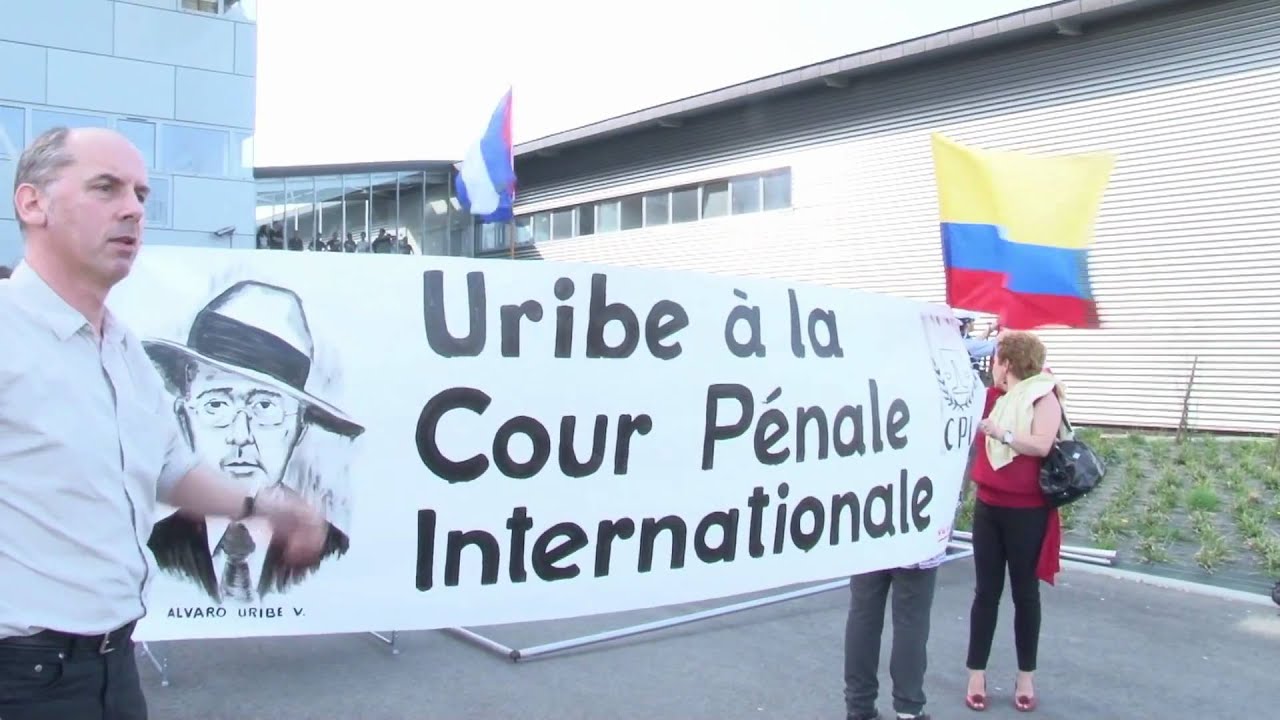 Georgetown’s ¡Adios, Uribe!campaign. However, the scope of these successes have been somewhat limited to individual protests against specific figures. Indeed, Georgetown subsequently brought on Abrams to its faculty, as well as other questionable figures.
But efforts like that of the Call to Conscience will benefit from internationalism and tireless truth-telling about Elliott Abrams’ well-established record—which he couldn’t refute before the Foreign Affairs Committee,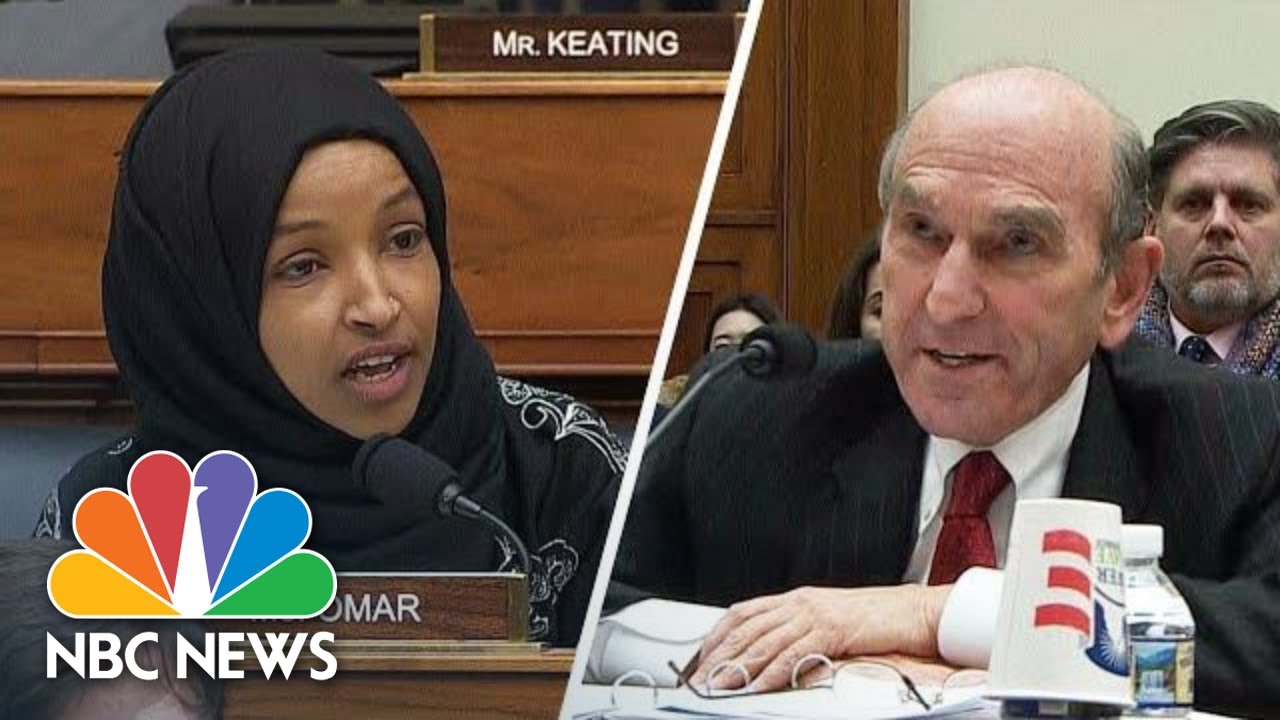 , putting on display a broader indictment of institutional U.S. foreign policy toward Latin America.
With avenues like the International Criminal Court being antagonized by fellow neoconservative John Bolton within the Trump administration, holding criminals like Abrams accountable may necessarily come through shining a light on the non-governmental institutions that are sanitizing their ignominious records. Key to this is remaining grounded in the human toll of his policies that stands in sharp contrast to the titles and prestige that have continued to whitewash figures like Abrams.
Abrams’ vast misdeeds, especially during the Reagan administration, may seem like “old news” to some. But especially with the renewed attention that came with Rep. Omar boldly confronting him in Congress, this is a moment to be seized, to undo the poisonous and bafflingly backward mythology of Elliott Abrams as a defender of “democracy” and “human rights.” If we’re serious about preventing potential future atrocities, we’ll step up, starting with the Holocaust Museum.
Walker Grooms is an activist and worker living in Washington, DC, currently with mission-driven communications firm Movement Media. He’s the former DC Program Manager at Witness for Peace, and a founding member of and advisor to the Witness for Peace Solidarity Collective. As a graduate student at Georgetown, he was part of the ¡Adios, Uribe! Coalition.
Tags:
==
==
220 sanctions venez?!
https://www.nytimes.com/2020/02/18/world/americas/venezuela-russia-sanctions-trump.html
nyt
no lnx
U.S. Imposes Sanctions on Russian Oil Company Supporting Venezuela’s Leader
The penalties seek to pressure President Nicolás Maduro of Venezuela to give up power, nearly two years after he was re-elected in a widely disputed vote.
By Lara Jakes
Feb. 18, 2020
WASHINGTON — The United States on Tuesday imposed tough economic sanctions against a Russian oil giant that is keeping Venezuela’s ruling government afloat, gambling that the newest penalties against President Nicolás Maduro will not roil global oil prices.
The broad sanctions were levied against Rosneft Trading, a subsidiary of the Russian state-controlled Rosneft Oil Company, and Didier Casimiro, the subsidiary’s president and board chairman. Mr. Casimiro is also identified on the Rosneft website as the parent company’s vice president for refining.
The sanctions may have only a limited impact on global markets, experts said. Venezuela’s oil exports have dwindled since the Trump administration began a campaign last year to pressure Mr. Maduro into leaving power, after his widely disputed re-election in May 2018.
Oil markets seemed to shrug off the sanctions, dipping about a half-percent in trading on Tuesday with prices at around $51.80 per barrel.
But the sanctions will lash Venezuela’s already-faltering economy. They also follow a highly public effort by Juan Guaidó, the Venezuelan opposition leader, to pressure allies to take a more aggressive stance against Mr. Maduro. On Tuesday, Mr. Guaidó called the sanctions “a victory” on Twitter, adding, “Those who support the dictator, whoever they are, wherever they come from, should assume the consequences.”
Venezuela is exporting about 70 percent of its oil through Rosneft in what Treasury Secretary Steven Mnuchin described as the “looting of Venezuela’s oil assets by the corrupt Maduro regime.”
:{
}:
“This is a campaign of pressure,” said Elliott Abrams, the State Department’s special envoy for Venezuela policy. “And the pressure continues to mount.”
“I would not say that any individual step can be calculated to bring an end to the crisis,” Mr. Abrams said. “But I think this is a very significant step, and I think you will see companies all over the world in the oil sector now move away from dealing with Rosneft Trading.”
Administration officials insisted that the global oil market was stable enough to withstand the new penalties against Rosneft or any entity that does business with it. Officials also said Rosneft’s customers would be given 90 days to unwind themselves from the Russian shipping company.
Mr. Maduro has led Venezuela’s economy into shambles and prompted an exodus of millions of people into neighboring South American states. The sanctions are among the biggest hits to Venezuela’s economy since the United States banned Venezuela’s state oil company last January, said Francisco Monaldi, a Venezuela energy expert at Rice University in Houston.
“Rosneft will now have to think how much Venezuela is worth from a business standpoint, compared to the costs of remaining under sanctions,” Mr. Monaldi said.
But, he added, the sanctions could misfire if Rosneft concludes that the higher costs of doing business in Venezuela are justified by the geopolitical benefit of helping out Russia’s key ally in South America.
Rosneft sells about two-thirds of Venezuela’s oil, largely to Asia, and often by obscuring the cargo’s source and destination. Officials said Mr. Maduro was taking the profits from the oil sales facilitated by Rosneft to hang onto power, in part by bolstering the Venezuelan military and its harsh crackdown against the public.
Rosneft’s trading subsidiary was created in 2011 to help its Moscow-based parent company carry out foreign projects, including shipping crude oil. In the last few years, faced with American and European sanctions, Rosneft has pushed deeply into places like Cuba, China, Egypt and Vietnam.
Its two largest customers are China and India, both of which have struggled to procure sufficient oil supplies after the Trump administration imposed sanctions against Iran. In the case of India, where Mr. Trump is scheduled to visit next week, the government in Delhi has been forced to find new suppliers — including from the United States.
Additionally, the world is currently flooded with oil since the coronavirus is cutting millions of barrels a day of demand in the Chinese market. Curtailing Venezuela’s 700,000 barrels of daily production should have little if any impact on global oil prices.
Clearview Energy Partners, a consultancy, described Tuesday’s sanctions as “somewhat limited in nature.” It can take weeks, however, for market effects from sanctions to be fully seen.
Mr. Abrams noted that global oil prices were down compared with when the Trump administration began its sanctions campaign against Mr. Maduro’s government.
“We’re not trying to raise oil prices — we’re trying to diminish the amount of money available to the Maduro regime,” Mr. Abrams told reporters at the State Department.
Trump administration officials outlined a series of transactions and planned shipments over the last year — including millions of barrels of crude oil — as evidence of Rosneft’s support to Mr. Maduro. Last month alone, officials said, Rosneft helped deliver two million barrels of crude to West Africa from Venezuela.
Anatoly Kurmanaev contributed reporting from Caracas, Venezuela; Julie Turkewitz from Bogotá, Colombia; and Clifford Krauss from Houston.
==
https://www.**jacobin**mag.com/2019/02/the-tragic-life-of-the-war-criminal-elliott-abrams
Abrams once said the animating force behind his and Ronald Reagan’s foreign policy was that the world is “an exceedingly dangerous place.” And this is true, largely because men like Elliott Abrams exist in it.
Last month, Abrams was tapped by Trump to serve as his special envoy to Venezuela, to essentially help steer the Trump administration’s slow-burn effort to topple that country’s government — or as Mike Pompeo put it, “restore democracy” in the country.
It should go without saying that the idea the Trump administration is pursuing regime change in Venezuela for the sake of democracy and human rights is as laughable as calling Jamal Khashoggi’s murder a surprise party gone wrong. But in case you need to explain this to politically confused friends and relatives, here are eight good reasons why the appointment of Abrams, in particular, makes a mockery of any such high-minded rhetoric.
1. He was knee-deep in human rights atrocities
Let’s start with the most obvious point, which is that Abrams’ chief claim to fame is his role in Ronald Reagan’s blood-soaked foreign policy in Central America in the 1980s, for which he earned the nickname, “contra commander-in-chief.” The contras were the brutal right-wing paramilitary groups in Nicaragua who terrorized civilians throughout the decade, cutting a swath of torture, rape, and murder aimed at everyone from the elderly to children. Their methods were similar to those of right-wing paramilitaries in the other countries of the region, including El Salvador and Guatemala, all of which were supported by the Reagan administration. If you have the stomach to read about them, there’s no shortage of sources that outline their barbarity.
To Abrams, however, they were “freedom fighters,” their work in El Salvador was a “fabulous achievement,” and he mocked critics of Reagan as people forced to “run the risk” of arguing that such groups were “doing something wrong and ought to stop it.” He himself had no illusions about what it is that the contras were doing. “The purpose of our aid is to permit people who are fighting on our side to use more violence,” he said in 1985.
How involved was Abrams? “Sure, there was excessive micromanagement [of the contras],” he told Policy Review in 1989; “and I was one of the people who engaged in it. But I’m not going to go around trying to assess blame, because the contras were an enormous success.” The contras would have floundered and faded away were it not for the tens of millions of dollars Abrams helped funnel to them, including personally soliciting $10 million from the Sultan of Brunei for their cause (that money never made it because Abrams gave the Sultan the wrong account number).
This “micromanagement” at one point also involved Abrams secretly delivering military equipment to the contras under the guise of humanitarian aid. As commentators have noted, this is particularly relevant now, when the Trump administration attacks Maduro for refusing to let humanitarian aid from the US into Venezuela.
2. He covered up brutal acts of terror
Key to Abrams’ role under Reagan was playing down and denying the copious human rights abuses being committed by the forces and governments he and the administration supported.
As Minnesota Rep. Ilhan Omar pointed out in her grilling of Abrams earlier this week, part of the Reagan administration’s “fabulous achievement” in El Salvador was the horrific El Mozote massacre, which took place shortly before Abrams took up his post. In his attempt to convince the Senate to certify that El Salvador’s government was improving its human rights record — a precondition for receiving US aid — Abrams testified that the massacre had been “publicized when the certification comes forward to the committee,” and was “being significantly misused, at the very best, by the guerrillas.” He claimed he had sent military officers to investigate the reports, and that the massacre couldn’t be confirmed.
Another incident was the 1980 assassination of Archbishop Oscar Romero, killed on the orders of Major Roberto D’Aubuisson, one of the administration’s partners in the country. “Anybody who thinks you’re going to find a cable that says that Roberto d’Aubuisson murdered the archbishop is a fool,” said Abrams. In fact, two such cables existed. Abrams would later insist that any criticism of the Reagan administration’s activities in El Salvador were simply “a post-Cold War effort to rewrite history.”
Meanwhile, as Guatemalan dictator Ríos Montt embarked on a campaign of genocide in the country, Abrams said he had “brought considerable progress” on human rights. He defended Reagan’s lifting of a military aid embargo on Montt’s government, claiming the slaughter of civilians was “being reduced step by step” and that it was “progress” that had to be “rewarded and encouraged.”
3. He’s an unrepentant liar
Abrams told Omar that it is “always the position of the United States” to protect human rights, including in Venezuela, and he stressed the US didn’t want to arm anti-Maduro forces. Besides his well-documented record of doing exactly the opposite, Abrams’ words are even less relevant when you consider his history of outright lying.
We’ve already seen how Abrams regularly lied to cover up or play down abuses by the right-wing forces he supported. This practice would ultimately land him in trouble when he misled Congress about the Iran-Contra affair with statements that ranged from outright lies (“we’re not in the fund-raising business”), to lawyerly parsing of the truth (“I said no foreign government was helping the contras, because we had not yet received a dime from Brunei,” he would write later).
Abrams would forever maintain he did nothing wrong, later writing a sanctimoniousbook that painted himself as the victim of an unjust, vindictive system that had criminalized “political differences.” “This kind of prosecution is something new in America, and it is wrong,” he wrote, before bleating about the “bloodsuckers” and “filthy bastards” who wanted to do him in.
Abrams rained ire upon Lawrence Walsh, the special prosecutor tasked with investigating the Iran-Contra scandal: “You, Walsh, eighty years old, and nothing else to do but stay in this job till the grim reaper gets you. Is this your idea of America?” Abrams insisted the independent counsel law under which Walsh (along with Watergate prosecutor Archibold Cox) served was unconstitutional, despite the fact that the Supreme Court had upheld it 7-1, with even the conservative chief justice Rehnquist affirming (Scalia dissented). It didn’t matter anyway, because the late George H. W. Bush pardoned him.
Abrams managed the trifecta of showing contempt for the truth, the constitution’s separation of powers, and the concept of checks and balances, all in one fell swoop. There’s no reason to believe any of his assurances now.
4. He hates democracy
Abrams has also shown a lifelong contempt for the very thing he’s now meant to be advancing: democracy.
When the Uruguayan military government imprisoned Wilson Ferreira, the country’s most popular politician and a fierce liberal opponent of its rule, Abrams defended the Reagan administration’s meek response, which the New York Times had called “stunning.” Abrams explained that “the transition [to elected government] itself is more important than the immediate situation of any individual politician.” Abrams had earlier insisted there was no evidence the Uruguyan military was stifling political freedom, even as it closed newspapers, arrested its opposition, and continued to ban political leaders, among other things.
Around this same time, Abrams was one of a number of Reagan officials who supported Oliver North’s call to pardon Honduran general Jose Bueso Rosa, despite his having received a relatively lenient sentence. Rosa had been convicted after being caught in Florida plotting to overthrow the Honduran government.
In 2002, Abrams reportedly “gave a nod” to the military coup that attempted, ultimately unsuccessfully, to remove the democratically elected Hugo Chavez from power. The Observer, which broke the story, called Abrams “the crucial figure around the coup.” Abrams has had his eye on toppling Venezuela’s government for some time.
When Hamas defeated Fatah in the 2006 Palestinian election, Abrams, then the point man for George W. Bush’s Middle East policy, helped implement a scheme to nullify the results by fomenting a Palestinian civil war which, they hoped, would remove Hamas from power. When the plan backfired, with Hamas emerging victorious and in full control of Gaza, Abrams accused Hamas of staging a “coup.”
5. His only political principle was anticommunism
Abrams’ disregard for democracy is part and parcel of his general philosophy, which views left-wing governments uniformly as threats to be stamped out.
Abrams, who once told a reporter that he’s “been a counterrevolutionary for a long time,” cut his teeth opposing student protesters at Harvard in the 1960s. He believes the idea that human rights extend past the political and into the economic realm to be “nonsense” and “old Soviet bromides.” As such, he viewed defeating the Soviet Union as the greatest US priority, telling one interviewer that “the greatest threat to human rights is the Soviet Union, not Guatemala or the Philippines.”
In 1984, Abrams quite candidly explained to Policy Review that his human rights policy was one of double standards: fierce opposition to communist rights abusers, and coddling of oppressors friendly to the US.
“Liberalization for purposes of letting out steam always involves line drawing,” he said. “How much steam should you let out? At what point do you risk anarchy and destabilizing the regime?” He went on to explain that “the line drawn varies from country to country,” and that “even a highly imperfect regime may well give a much better prospect of democratization than would the Communist regime that might follow.”
In other words, no matter how brutal or outright fascist a government, it was by default preferable to a communist one, a philosophy he applied in obvious ways to his work in the Americas. It was also evident in his treatment of Cuba, whose prisons he denounced in 1984 as “barbaric” and whose leader, Fidel Castro, he labeled “oppressive” and accused of “betrayal.” He attacked human rights groups, politicians, reporters, and church groups who praised Cuba as “apologists” who “will never take off their rose-colored glasses” and had spent “years defending tyrants” and “years obfuscating the truth.”
At literally the same time he was doing this, Abrams publicly defended Turkey, a key regional ally, from criticism of its human rights record. Abrams praised Turkey, which had recently been pilloried in an Amnesty International report for widespread torture of its people, for “extraordinary progress,” charging that “some who criticize Turkey’s human rights situation have no interest in human rights in Turkey or anywhere else,” but “simply use this issue as a weapon with which to attack a vital member of the Western alliance.” He dismissed Amnesty’s claims as “false history,” criticized human rights groups for “an appalling shallowness of analysis” that ignored social, political, and historical context, and charged that the Turkish people “resent the activists’ shrill and uninformed criticisms of their country.”
As Abrams had earlier said, “the line drawn varies from country to country.” If you played nice with the Reagan administration, your human rights record was tempered by nuance and context, and it was getting better anyway. And if you didn’t, you were beyond redemption.
6. He dislikes journalists and accountability
Abrams no doubt sympathized with Turkey’s rulers because he himself had first-hand experience dealing with pesky journalists and human rights groups.
He said critics of Reagan’s support of the contras would have “blood on their hands,” and accused human rights groups of having communist sympathies. He hopped aboard the Reagan administration’s McCarthyite attempt to shame congressional critics into giving him a blank check in Latin America, claiming that there was an “elaborate and skillful” campaign by Nicaragua’s Sandinista government to “manipulate Congress and the press.” When the GAO released a report alleging contra corruption that was inconvenient for the administration’s attempts to secure aid, Abrams dismissed it as a “smear campaign” cooked up by Democrats.
While Abrams didn’t have a police state at his disposal, that didn’t prevent him from lobbing heavy-handed broadsides against reporters he didn’t like. He refused to be questioned by or debate certain journalists he perceived as critical. Most infamously, from 1986 to 1987, Abrams accused left-wing Colombian journalist Patricia Lara of being a “Cuban agent” and “an active liaison” between Colombian terrorist organization M-19 and “the Cuban secret police.” In October 1986, Lara was stopped by New York immigration officials and imprisoned, before being sent back home, without explanation.
Abrams claimed to have “concrete evidence” that Lara was “heavily engaged” with M-19, but when challenged to reveal evidence, claimed it was based on “intelligence information” that he couldn’t reveal. The Colombian Defense Ministry, then battling M-19, categorically denied they had any such information, and assigned her a bodyguard because Abrams’ accusation had put her in danger. The country’s foreign minister said “we don’t know where the US government obtained” such information.
Abrams also granted a “meritorious honor” award on the Office of Public Diplomacy, a government body responsible for waging an illegal domestic propaganda campaign, in which Iran-Contra architect Oliver North was closely involved, that disseminated Abrams’ preferred narrative about the region. Abrams praised it for “setting out the parameters and defining the terms of the public discussion on Central America policy” and countering the “formidable and well established Soviet/Cuban/Nicaraguan propaganda apparatus.”
7. He’s a fan of regime change
Like any neoconservative worth his salt, Abrams has an abiding faith in the US government’s ability to simply remove world leaders it dislikes at will. (He’s also continued the neocon tradition of never personally fighting in any war, avoiding Vietnam thanks to a hurt back that happened to clear up once the war was over.)
When Abrams wanted to remove former ally Manuel Noriega from power in Panama, the former chairman of the Joint Chiefs of Staff under Reagan wrote, he threatened sanctions, then actually imposed sanctions, then established a Panamanian government-in-exile on a US military base. Abrams finally called outright for the US military to topple Noriega, in an op-ed titled “Noriega Respects Power. Use It,” which is what George H. W. Bush ultimately did. It was a chilling preview of where US policy on Venezuela may now be heading if Maduro stays in power.
Reflecting on the mistakes of Reagan’s Latin American policy in 1989, Abrams’ regret was that it hadn’t been more forceful. “You can make a very good argument that after the successful rescue mission in Grenada the president should simply have said, ‘Look, we have to enforce the Monroe Doctrine, we cannot have a Communist government in Nicaragua,’ and done whatever we needed to do to get rid of it, including a naval blockade or possibly even an invasion,” he said.
In 2007, Abrams blessed Bush’s plan to launch a covert operation to destabilize Iran’s government. Two years later, he mused about what should happen if Iran develops a nuclear weapon. “Responsible leadership cannot allow this to happen,” he said. “Preventing it through military action perhaps is the second worst decision we could make. The only worse one being to say it’s all right now, it’s acceptable, we will not act.” But this wouldn’t involve regime change or the killing of civilians, he stressed; just a strike on nuclear facilities. Iran, Abrams warned, was one to three years away from developing a nuclear weapon.
In 2013, Abrams told a House Armed Services Committee hearing that the US had to get militarily involved in Syria. Why? Because “a display of American lack of will power in Syria will persuade many Iranian officials that while we may say ‘all options are on the table,’ in reality they are not — so Iran can proceed happily and safely toward a nuclear weapon.” Two years later, he said at a Council of Foreign Relations event that Netanyahu had two options: either strike Iran right then, or wait two years and see if an administration willing to take a tougher line, or sanction an Israeli strike, would be elected. Abrams, it seems, got his wish.
8. He’s beloved by the Right
In case anyone still believes the fiction that “anti-Trump” conservatives actually oppose Trump, Abrams is a living reminder that there’s no daylight between Trump and the establishment Right that pretends to dislike him.
Abrams was once an “anti-Trump” Republican who signed a letter opposing his candidacy in 2016. He tutored Paul Ryan in foreign policy when he was Mitt Romney’s 2012 running mate, and served on Marco Rubio’s so-called National Security Advisory Council in 2016. It’s no surprise the Florida senator, long viewed as an establishment-friendly, “sensible” conservative alternative to Trump, is now all but directing Trump’s Latin American policy, sounding virtually indistinguishable from Abrams.
Abrams has now served in every Republican administration since he first entered government bar one. In between, he’s worked at the Heritage Foundation (whose head of Latin American policy just called him “a patriot and dedicated voice for repressed communities”), helped found “anti-Trump” Bill Kristol’s Project for the New American Century, was a fellow for the Council on Foreign Relations, and was a board member of the National Endowment for Democracy, the US government’s arm for foreign politicalmeddling.
Meanwhile, just look at who came to Abrams’ defense after his grilling by Rep. Omar. The National Review — which not long ago put out a much-celebrated “Against Trump” issue whose purpose, according to its editor, was to say, “He’s not one of us. He’s not a conservative, and he’s not what conservatism is” — just published an editorial calling Abrams “one of the wisest, most experienced foreign-policy heads in this country,” and “a steadfast advocate of freedom, democracy, and human rights.”
A former Bush administration official and current Harvard professor defended Abrams as “a devoted public servant who has contributed much of his professional life to our country.” The newly rebranded neocon Max Boot, who very publicly proclaims he’s seen the error of his ways and broken with the ugliness he now sees in the GOP, deemed him “a leading advocate of human rights and democracy.” Unfortunately, it’s not just the Right; the Center for American Progress’ vice president of National Security and International Policy called him “a fierce advocate for human rights and democracy” who simply “made serious professional mistakes.”
That someone like Abrams, who’s now leading Trump’s regime change efforts in Venezuela, is warmly embraced by the coterie of establishment and “never-Trump” conservatives should tell you everything you need to know about these groups.
https://www.vanityfair.com/news**/2008**/04/gaza200804
no lnx
THE GAZA BOMBSHELL
After failing to anticipate Hamas’s victory over Fatah in the 2006 Palestinian election, the White House cooked up yet another scandalously covert and self-defeating Middle East debacle: part Iran-contra, part Bay of Pigs. With confidential documents, corroborated by outraged former and current U.S. officials, the author reveals how President Bush, Condoleezza Rice, and Deputy National-Security Adviser Elliott Abrams backed an armed force under Fatah strongman Muhammad Dahlan, touching off a bloody civil war in Gaza and leaving Hamas stronger than ever.
BY DAVID ROSE
APRIL 2008
[Condoleezza Rice and George W. Bush
Secretary of State Condoleezza Rice and President George W. Bush, whose secret Palestinian intervention backfired in a big way. Photo illustration by Chris Mueller; left, by Debbie Hill/Sipa Press; right, by Issam Rimawi/ApaImages/Polaris; background by Ibraheem Abu Mustafa/Reuters/Corbis.]
The Al Deira Hotel, in Gaza City, is a haven of calm in a land beset by poverty, fear, and violence. In the middle of December 2007, I sit in the hotel’s airy restaurant, its windows open to the Mediterranean, and listen to a slight, bearded man named Mazen Asad abu Dan describe the suffering he endured 11 months before at the hands of his fellow Palestinians. Abu Dan, 28, is a member of Hamas, the Iranian-backed Islamist organization that has been designated a terrorist group by the United States, but I have a good reason for taking him at his word: I’ve seen the video.
001_alsoonvfcom_220px.gif
To hear an interview with David Rose and to see documents he uncovered, click here.
It shows abu Dan kneeling, his hands bound behind his back, and screaming as his captors pummel him with a black iron rod. “I lost all the skin on my back from the beatings,” he says. “Instead of medicine, they poured perfume on my wounds. It felt as if they had taken a sword to my injuries.”
On January 26, 2007, abu Dan, a student at the Islamic University of Gaza, had gone to a local cemetery with his father and five others to erect a headstone for his grandmother. When they arrived, however, they found themselves surrounded by 30 armed men from Hamas’s rival, Fatah, the party of Palestinian president Mahmoud Abbas. “They took us to a house in north Gaza,” abu Dan says. “They covered our eyes and took us to a room on the sixth floor.”
The video reveals a bare room with white walls and a black-and-white tiled floor, where abu Dan’s father is forced to sit and listen to his son’s shrieks of pain. Afterward, abu Dan says, he and two of the others were driven to a market square. “They told us they were going to kill us. They made us sit on the ground.” He rolls up the legs of his trousers to display the circular scars that are evidence of what happened next: “They shot our knees and feet—five bullets each. I spent four months in a wheelchair.”
Abu Dan had no way of knowing it, but his tormentors had a secret ally: the administration of President George W. Bush.
A clue comes toward the end of the video, which was found in a Fatah security building by Hamas fighters last June. Still bound and blindfolded, the prisoners are made to echo a rhythmic chant yelled by one of their captors: “By blood, by soul, we sacrifice ourselves for Muhammad Dahlan! Long live Muhammad Dahlan!”
There is no one more hated among Hamas members than Muhammad Dahlan, long Fatah’s resident strongman in Gaza. Dahlan, who most recently served as Abbas’s national-security adviser, has spent more than a decade battling Hamas. Dahlan insists that abu Dan was tortured without his knowledge, but the video is proof that his followers’ methods can be brutal.
Bush has met Dahlan on at least three occasions. After talks at the White House in July 2003, Bush publicly praised Dahlan as “a good, solid leader.” In private, say multiple Israeli and American officials, the U.S. president described him as “our guy.”
The United States has been involved in the affairs of the Palestinian territories since the Six-Day War of 1967,when Israel captured Gaza from Egypt and the West Bank from Jordan. With the 1993 Oslo accords, the territories acquired limited autonomy, under a president, who has executive powers, and an elected parliament. Israel retains a large military presence in the West Bank, but it withdrew from Gaza in 2005.
In recent months, President Bush has repeatedly stated that the last great ambition of his presidency is to broker a deal that would create a viable Palestinian state and bring peace to the Holy Land. “People say, ‘Do you think it’s possible, during your presidency?’?” he told an audience in Jerusalem on January 9. “And the answer is: I’m very hopeful.”
The next day, in the West Bank capital of Ramallah, Bush acknowledged that there was a rather large obstacle standing in the way of this goal: Hamas’s complete control of Gaza, home to some 1.5 million Palestinians, where it seized power in a bloody coup d’état in June 2007. Almost every day, militants fire rockets from Gaza into neighboring Israeli towns, and President Abbas is powerless to stop them. His authority is limited to the West Bank.
It’s “a tough situation,” Bush admitted. “I don’t know whether you can solve it in a year or not.” What Bush neglected to mention was his own role in creating this mess.
According to Dahlan, it was Bush who had pushed legislative elections in the Palestinian territories in January 2006, despite warnings that Fatah was not ready. After Hamas—whose 1988 charter committed it to the goal of driving Israel into the sea—won control of the parliament, Bush made another, deadlier miscalculation.
Vanity Fair has obtained confidential documents, since corroborated by sources in the U.S. and Palestine, which lay bare a covert initiative, approved by Bush and implemented by Secretary of State Condoleezza Rice and Deputy National Security Adviser Elliott Abrams, to provoke a Palestinian civil war. The plan was for forces led by Dahlan, and armed with new weapons supplied at America’s behest, to give Fatah the muscle it needed to remove the democratically elected Hamas-led government from power. (The State Department declined to comment.)
But the secret plan backfired, resulting in a further setback for American foreign policy under Bush. Instead of driving its enemies out of power, the U.S.-backed Fatah fighters inadvertently provoked Hamas to seize total control of Gaza.
Some sources call the scheme “Iran-contra 2.0,” recalling that Abrams was convicted (and later pardoned) for withholding information from Congress during the original Iran-contra scandal under President Reagan. There are echoes of other past misadventures as well: the C.I.A.’s 1953 ouster of an elected prime minister in Iran, which set the stage for the 1979 Islamic revolution there; the aborted 1961 Bay of Pigs invasion, which gave Fidel Castro an excuse to solidify his hold on Cuba; and the contemporary tragedy in Iraq.
Within the Bush administration, the Palestinian policy set off a furious debate. One of its critics is David Wurmser, the avowed neoconservative, who resigned as Vice President Dick Cheney’s chief Middle East adviser in July 2007, a month after the Gaza coup.
Wurmser accuses the Bush administration of “engaging in a dirty war in an effort to provide a corrupt dictatorship [led by Abbas] with victory.” He believes that Hamas had no intention of taking Gaza until Fatah forced its hand. “It looks to me that what happened wasn’t so much a coup by Hamas but an attempted coup by Fatah that was pre-empted before it could happen,” Wurmser says.
The botched plan has rendered the dream of Middle East peace more remote than ever, but what really galls neocons such as Wurmser is the hypocrisy it exposed. “There is a stunning disconnect between the president’s call for Middle East democracy and this policy,” he says. “It directly contradicts it.”
Preventive Security
...
It may seem small in the saga of President Trump’s first two weeks, but according to ...I don’t mean someone that we on the left like to call a “war criminal,” such as Henry Kissinger or Dick Cheney. These people might actually qualify, but the cases are at best arguable, and no one in authority has ever been asked to rule on them. Not so for Trump’s potential pick, the onetime neocon golden boy (and son-in-law to Norman Podhoretz and Midge Decter) Elliott Abrams.
The course of Abrams’s failing-upward career reveals the moral rot at the heart of our political establishment.
Like Trump himself, Abrams has behaved so badly in so many different arenas, it actually works in his favor: No one can keep up. The Post piece—which notes that the Trump administration has decided not to appoint a deputy secretary of state for management, giving the sole remaining deputy an enormous amount of influence over both policy and management issues—observes that Abrams was forced to plead guilty to deliberately misleading Congress regarding his nefarious role in the Iran-contra scandal. (He was also disbarred in the District of Columbia.)
However, this is just the tip of a colossal iceberg. As a member of George W. Bush’s National Security Council staff, Abrams encouraged, according to credible reports, a (briefly successful) military coup against the democratically elected government of Venezuela in 2002, poisoning the US relationship with that government once it returned to power. He also worked to subvert the results of the 2006 elections in the Palestinian territories, a move that ended up strengthening the most radical elements of Hamas and undermining—perhaps forever—the possibility of a democratic peace between Israel and the Palestinians.
But these are still relative misdemeanors in the Abrams dossier, paling in comparison with the role he played in the Reagan administration. As assistant secretary of state for human rights, Abrams sought to ensure that General Efraín Ríos Montt, Guatemala’s then-dictator, could carry out “acts of genocide”—those are the legally binding words of Guatemala’s United Nations–backed Commission for Historical Clarification—against the indigenous peoplein the Ixil region of the department of Quiché, without any pesky interference from human-rights organizations, much less the US government.
As the mass killings were taking place, Abrams fought in Congress for military aid to Ríos Montt’s bloody regime. He credited the murderous dictator with having “brought considerable progress” on human-rights issues. Abrams even went so far as to insist that “the amount of killing of innocent civilians is being reduced step by step” before demanding that Congress provide the regime with advanced arms because its alleged “progress need[ed] to be rewarded and encouraged.”
Promoted to assistant secretary of state for inter-American affairs, Abrams repeatedly denounced the continued protests by organizations seeking to call attention to the mass murders of both Ríos Montt and the no less bloodthirsty President Vinicio Cerezo Arévalo, who came to power fewer than three years later. In one village during the latter’s reign, “the army herded the entire population into the courthouse, raped the women, beheaded the men, and took the children outside to smash them to death against rocks,” according to Inevitable Revolutions, Walter LaFeber’s classic history of the United States in Central America. At the time, a leader of the Guatemalan Mutual Support Group (an organization of mothers of the disappeared), her brother, and her 3-year-old son were found dead in their wrecked car. Abrams not only supported the nonsensical official explanation (there was “no evidence indicating other than that the deaths were due to an accident”), he also denounced a spokeswoman for the group who demanded an investigation, insisting that she had “no right to call herself a human rights worker.” When The New York Times published an op-ed challenging the official State Department count of the mass murders under way—by a woman who had witnessed a death-squad-style assassination in broad daylight in Guatemala City without ever seeing it mentioned in the press—Abrams lied outright in a letter to the editor, even citing an imaginary story in a nonexistent newspaper to insist that the man’s murder had, in fact, been reported.
:{
I’ve been writing about Abrams and his crimes, here and elsewhere,}: since 1987. I’ve complained privately to the president of the Council on Foreign Relations, to numerous rabbis who book him to speak in their synagogues, and to the editors of Jewish newspapers who publish him. I’ve seen some regret, but never any action.I don’t know about you, but intentionally helping the US government to aid and abet the commission of genocide, while attacking the character and reputation of those trying to expose it, strikes me as securely within the definition of “war criminal.” But since Abrams’s 1991 conviction for his Iran-contra lies (and subsequent pardon by George H.W. Bush), the course of his failing-upward career has repeatedly revealed the moral rot at the heart of our political establishment. George W. Bush and Condoleezza Rice appointed Abrams to top national-security positions. The Council on Foreign Relations offered him a prestigious, high-profile title (senior fellow for Middle Eastern studies) and distanced itself only when he called President Obama’s nominee for defense secretary, former senator Chuck Hagel, an “anti-Semite.” Abrams is a respected regular on the American synagogue circuit and in the Jewish press, and rarely, if ever, does anyone have the bad manners to mention his pro-genocide past.
If Abrams had abetted genocide against Jews instead of Guatemalans, it might not have disqualified him from a top diplomatic position in the Trump administration, but he would at least have been treated as a pariah in the media, the establishment, and, one certainly hopes, the world of professional Jews. These days, however, it’s hard to be certain of anything ... abrams716
ref
http://www.unz.com/print/WashingtonMonthly-1987may-00019
Elliott Abrams: The Teflon Assistant Secretary
He hasn't always been this far to the right, but his enemy has always been the left.
The Washington Monthly, May 1987, pp. 19-27
0llie North is gone. John Poindexter is
gone. William Casey is gone. Even
Don Regan is gone. But Elliott
Abrams, who is, more than anyone,
officially and substantially responsible for the
contra policy that has been such a disaster
for the Reagan administration, is still giving
orders.
Despite serious questions about Abrams’s involvement in supplying the Nicaraguan contras,
the hard-line assistant secretary of state for Latin
American affairs appears to have ridden out the
storm that felled his colleagues on the contra support team. Abrams and his staff were reportedly
relieved by the content of the Tower Commission
report. Since the outbreak of the scandal, Abrams
has returned on various occasions to face his
critics on Capitol Hill. Unlike North and
Poindexter, Abrams answered every question
fired at him. His political adversary on
the Senate Foreign Relations Committee,
Christopher Dodd, praised Abrams’s forthcoming attitude. At a House hearing on
future U.S. aid programs, Abrams was treated
not as an object of scandal, but simply as a
Eric Alterman is a Washington writer and a fellow of the
World Policy Institute.
ELLIOTT
THE TEFLON
ABRAMS.
ASSISTANT
SECRETARY
by Eric Alterman
State Department officer who had a program to
administer.
Abrams still has his job in part because, according to the evidence revealed so far, he has
steered just clear of illegality, and in part
because he has practiced the neoconservative
art of deflecting even clearly legitimate criticism
by attacking the left-liberal biases of his opponents. He has not always been as far to the
right as he is now, but his enemy has always been
the left.
No sex and drugs
In 1968 at Harvard, where the word liberal was
often followed by “fascist” and Vietnam almost
inevitably by “war criminal,” where Dick Gregory
received more support in an election poll than
either of the two major party candidates, and
where the conservatives on campus split their vote
between Bobby Kennedy and Eugene McCarthy,
19-year-old Elliott Abrams was a lonely voice for
Hubert Humphrey. Humphrey, the standardbearer of cold war. liberalism, was undergoing a
process of political disintegration, unable to
distance himself from a war that even President
Johnson likened to a one-eyed retarded child.
Amazingly, Humphrey allowed Nixon to paint
himself the “peace candidate,” then prattled on
about “the politics of joy” in the wake of the
killings of Kennedy and King.
What drew Abrams-of liberal parentage and
a progressive education-to support Humphrey?
Idealism? What idealism could there be in supporting a worn-out candidate and a failed policy
in Vietnam? Ambition? The future of the party,
particularly for bright young men from Harvard,
was clearly with the “Dump the Hump” legions,
who, four years later, would coalesce in the
McGovern candidacy.
Abrams chose Humphrey because the peace
movement wanted not merely to end the war but
to smash the establishment with which he identified. Steven Kelman, one of Abrams’s college
roommates and now professor of public policy
at Harvard’s Kennedy School of Government,
recalls Abrams seemed uncommonly concerned
about “the real world” outside Harvard. He
remembers him as a “basically happy, well-adjusted, and unalienated guy.
He had good relations with his family and was always far more
oriented towards success, including monetary,
than anybody else we knew.”
At Harvard, Abrams ensconced himself in
Adams House, a hub of left-wing activity. He was
definitely “different,” even from his own crowd
of anti-SDS conservatives and social democrats.
Clean-shaven, neatly groomed, and serious to the
point of eccentricity, Abrams stood out on campus as a metaphor for the parents everybody had
left behind. He seemed immunized against the
common collegiate attractions of sex, drugs, and
rock ’n roll. His own theory as to why is that his
Greenwich Village high school, Elizabeth Irwin,
“constituted an inoculation of sorts. . . . Marijuana was all over Elizabeth Irwin when I was
in high school. That style of dress, radical
politics. And it was quite clear to me that this
was not a manifestation of individual thought;
it was mass thoughtlessness .” Moreover, he
recalls, “My parents were more traditional in a
number of ways than most parents raising
children in the sixties. . . . There were very strict
rules .” “Elliot was completely out of sympathy
with the cultural tone of the sixties,” says Benjamin Ross, another roommate. “He was the only
person I ever met who looked more comfortable
in a brand new pair of Levis than worn-out ones I’
Anti-war, anti-SDS
Abrams entered college with the demeanor of
a small-town pastor and the politics of an
Americans for Democratic Action (ADA) liberal.
He thought hard, made up his mind, and then
spoke it to anybody who would listen. In those
days, Abrams spoke as a disillusioned liberal, but
one who still believed in the possibility of a
reformed, peaceful, and progressive American
government. In his first published article, in The
New Leader in 1968, he explained to the
magazine‘s fuddy-duddy readership that students
were “voicing more subtle objections, I suppose,
than are convenient. . .we are talking about problems that even prosperity cannot solve I’
He worried that the war in Vietnam caused America’s
image in the world to suffer new damage each
day the war went on. “This is unfair to me and
to my generation,” he complained. “Destroy the
irreplaceable and you deprive us of our birthright. . . . There are riots in our cities and 10,000
boys are dying in Vietnam and people have the
nerve to tell us we object to the president because
of his style.’’
An Abrams piece published a year later on the
SDS riot at Harvard and the ensuing student
strike contained this passage about the Cambridge police: “With their helmets, plastic face
visors, and long riot clubs, the effect they created
was not merely terrifying, but grotesque.”
Abrams recalls these articles almost apologetically as “the most left-wing things I ever
wrote.” Yet more interesting than the left-wing
voice of youth Abrams adopted is the sophistication of his writing style and sentiments. Abrams
wrote about why American youth was aflame and
described the events that struck terror into the
hearts of Harvard students, administrators, and
faculty without once resorting to rhetorical condemnation of either side. His critiques of liberal
America have no hint of joyous rebellion or
cynical contempt for his elders; they’re models
of hard-headed liberal analysis.
Nevertheless, in Myra McPherson’s Long Time
Passing, Abrams portrayed himself as “the rarest
of political species-an outspoken hawk at
Harvard-class of 1969 .” He told McPherson,
“It always seemed to me that the so-called NLF
forces, the Buddhists, were in fact not going to
take over [Vietnam], but that the communists
were going to take over. The notion that if the
United States would just leave, the killing would
stop was unbelievably foolish.” In his office,
Abrams puts aside his public revisionism and admits to having opposed the war in Vietnam,
although he says he came to support the Nixon
position in Vietnam and Cambodia by the time
he left to get his masters at the London School
of Economics.
Abrams, exempt from the draft for medical
reasons, was opposed to Johnson’s Vietnam
policy while in college. But he was far more passionate in his opposition to the radical anti-Vietnam movement on campus that had united
in SDS. “Elliot opposed the war,” recalls Kelman,
“but it’s hard to say to what extent his opposition was his ticket to credibility. In order to get
anyone to listen to you in those days, you had
to be against the war.”
Kelman wonders whether Abrams’s current
feelings about El Salvador and Nicaragua derive
from his days in the besieged anti-SDS minority
at Adams House: “In many ways he is still living
in the sixties. . .where Harvard is about to be
taken over by left-wing radicals!’ Dan Hastings,
a law school comrade who is now a New York
attorney and conservative Republican, disagrees:
“Elliot had the rare personal experience to
observe a genuine totalitarian group-the SDSexercise its influence in American life.”
All in the family
While a law student, Abrams began to impress
leading neoconservative intellectuals. He rented
the attic of Nathan Glazer,who recruited him to
write for The Public Interest. Glazer also introduced him to Norman Podhoretz, who was in
the market for bright new conservatives for Commentary. Though increasingly skeptical of liberal
solutions to age-old problems of poverty and race
relations, Abrams’s writings remained civil and
reserved. Like Podhoretz, Irving Kristol, and
most of the New York-Cambridge neoconservatives, Abrams concentrated much of his
criticism on the New Politics wing of the
Democratic party.
After finishing law school, Abrams worked
briefly for the high-powered New York law firm
of Breed, Abbott and Morgan. He was getting
rich, but he was bored. “These people don’t even
read Commentary,” he complained to a friend.
So he accepted a job with Senator Henry
“Scoop” Jackson, the leader of the Democratic
party’s anti-McGovernism faction, and the father
of political neoconservatism.
Political neoconservatism, nurtured in Washington, was a parallel development to that of the
New York neoconservative intellectuals, though
instead of Marxists becoming Nietzscheans,
Democratic Cold War anticommunists became
Republican Cold War anticommunists. In the
years before he became a Republican and joined
the Reagan State Department, Abrams straddled
the worlds of political and intellectual neoconservatism, carefully maintaining his ties to the centrist establishment in both cities. He continuned
to contribute to Commentary, keeping his
rhetoric civil and deferential rather than adopting the inflammatory, prosecutorial tones of
Podhoretz. Abrams left Jackson’s staff in 1976
to become special counsel, then chief of staff for
the then- neoconservative senator, Daniel Patrick
Moynihan.
There, too, Abrams impressed his
associates. Chester Finn, now assistant secretary
of education for research and improvement,
Charles Horner, now USIA assistant director for
programs, and Timothy Russert, now vicepresident of NBC News, all former Moynihan
aides, are unanimous in their undiluted praise for
their ex-boss, Abrams.
When Jimmy Carter was elected president in
1976, his administration infuriated Abrams and
his friends by refusing to appoint them to important foreign policy jobs. “We were completely
frozen out,” he complained to Sidney Blumenthal. “We got one unbelievably minor job. It was
a special negotiator position. Not for Polynesia.
Not Macronesia. But Micronesia .” That Carter
chose Cyrus Vance, Zbigniew Brezinski, and
James Schlesinger for his cabinet somehow convinced Abrams that Carter’s was a “new left
administration .”
In 1980, Abrams married Rachel Mark Decter,
Podhoretz’s adopted daughter, in essence merging, in Abrams, the political and intellectual
schools of neoconservatism. Podhoretz jokingly
admits to trying to arrange the marriage, because
Rachel “had a lot of dangerous friends .” But in
marrying Decter, Abrams also enlisted in what
Blumenthal has called Podhoretz’s neoconservative “family-run dry cleaners,” which now includes Podhoretz, and Rachel’s mother, Midge
Decter, who is a writer and the executive director of the Committee for the Free World. It also
includes their daughter, Naomi Munson, a frequent contributor to the committee‘s publication,
Contentions, and her husband, Steve Munson,
until recently the committee‘s deputy director.
Their son, John Podhoretz, is executive editor of
Sun Myung Moon’s newsweekly, Insight.
After plotting revenge throughout the Carter
administration, Abrams, in 1980, joined
Democrats for Reagan and traveled across the
country giving speeches to Jewish organizations
on how much tougher Reagan would be than
Carter was. Shortly after the election, Abrams
enlisted in the conservative Counter-Establishment and became a card-carrying
Republican. It was a propitious decision.
Alexander Haig appointed Abrams assistant
secretary of state for international organizations;
his job was to stay out of the way of Jeane
Kirkpatrick, for whose operations at the UN he
was ostensibly responsible.
At the outset of his stormy tenure, Haig had
considered human rights sissy stuff and informed
the senators who confirmed him that since terrorism was the most serious violation of human
rights he could imagine, all resources previously
devoted to the promotion of human rights by the
American government would henceforth be
devoted to terrorism. That position, and the administration’s first nominee for it, Ernest Lefever,
proved unpopular with Congress and the
Washington media. So Haig redefined the job
and sought a new nominee.
Abrams was named to the high-profile position in the wake of a leaked memo recommending his selection.
The memo, ostensibly written
by Deputy Secretary William Clark and
Undersecretary Richard Kennedy, was actually
written by Abrams. “Human rights means trouble,” the memo said, “for it means choices which
may adversely affect bilateral relations. At the
very worst, we will have to speak honestly about
our friends’ human rights violations .” Shortly
after, in a memo approved by Reagan, Abrams
wrote: “Human rights is not something we tack
on to our foreign policy but is its very purpose:
the defense of freedom in the world .” Yet he also
made clear that he saw U.S. human rights policy
as a strategy to counter the Soviets.
The appointment was perfect both for Abrams
and for the promotion of neoconservative
philosophy.
:{
}:
Nothing had annoyed Kristol,
Kirkpatrick, and Commentary about Jimmy
Carter so much as his constant complaining
about this or that political prisoner in some
anticommunist jail somewhere. “Carter never had
a human rights philosophy except that the U.S.
was generally a bad place going around the world
doing bad things,” says Abrams.
As assistant secretary, Abrams managed to
redefine the concept of human rights with such
political dexterity that it took his opponents in
the human rights community a while to make
sense of what he’d done. Most of them had not
opposed his appointment, partially out of
political necessity but also because they believed
this “tough cookie-pusher,” as William Safire
called him, might actually mean some of the
reasonable things he was saying.
Today, the list of complaints against Abrams
by human rights activists and Central American
experts is long and deep.
Patricia Derian, Jimmy Carter’s human rights secretary, calls
Abrams’s policies a mixture of “hatred, pandering, cries of anti-Americanism, screwy logic, and
jingoistic slogans-all the shoddy hallmarks of
the Reagan era of human rights and foreign
policy.’’ The former head of the State Department’s Cuban Interests section in Havana, Wayne
Smith, calls Abrams “a man willing to lie and
misrepresent the facts about anything .” Vicechair of Americas Watch Committee, Aryeh
Neier, thinks he sees in Abrams “an opportunist
who uses human rights to advance other agendas” and the possessor of “a personal vicious
streak .” Larry Birns, the director of the Council
for Hemispheric Affairs, considers Abrams “the
most disreputable if not sleazy figure” he has met
in 30 years of monitoring U.S.-Latin American
relations.
Abrams regularly returns the favor. He calls
former ambassador to El Salvador, Robert White,
“a crank and a fanatical hater of the administration .” Neier’s human rights work is “garbage”
and “completely politicized,” and Father Robert
Drinan of ADA “stinks” for comparing U.S. action in El Salvador and Nicaragua with the Soviet
invasion of Afghanistan. Abrams routinely exercises his constitutional right to refuse to appear
on platforms with such critics as Alexander
Cockburn, Smith, Birns, and White. When informed that The Nation’s Christopher Hitchens
was among the journalists who would be questioning him on one television news show, Abrams
canceled his appearance. He has also instructed
his staff not to deal with Birns or his
organization.
Why the hatred? “I’ll tell you why,” Abrams
volunteered. “Over the period of the Vietnam
struggle in the U.S., the left, in which I include
people like Mary McGrory, Anthony Lewis, and
Aryeh Neier, became absolutely certain of its
moral superiority over the right. They were accustomed to having policies they believed in
challenged, but what drives them nuts is the attempt to undercut their position of moral
superiority.”
The Abrams attempt to undercut the “moral
superiority” of the human rights community is
based on the old “teach a man to fish” homily.
Get a dissident out of jail, and you’ll have to get
another one out tomorrow. But teach a country
to become democratic, and human rights will be
codified and protected forever. As long, then, as
a country is moving “in the direction of
democracy,” the U.S. must do what it can to avoid
antagonizing that country’s military so
democratic reforms are allowed to proceed.
Countries that are going to or have already gone
communist, however, must be pressured to make
...
Elliott was completely out of sympathy
with the cultural tone of the sixties, ” said Benjamin
Ross, a college roommate. “He was the only person I
ever met who looked more comfortable in a brand
new pair of Levis than worn-out ones. 77
their ruling elites realize the cost of being
undemocratic and refusing to respect human
rights. “We consider anticommunism to be a
human rights policy,” said Abrams. Thus we have
contras in Nicaragua, Savimbi in Angola, and
rebels in Afghanistan and Cambodia.
Abrams
does admit there are serious limits to this kind
of pressure. We haven’t aided an armed struggle
in, say, Poland “not because we don’t have the
right to.. .or because we wouldn’t like to,” he
says, but because it could lead to nuclear war.
In some cases, Abrams and the administration
may have had success with this kind of pressure,
though, of course, how much influence our
policies have is unknowable. Some countries in
Latin America are moving slowly towards greater
democracy.
:{
}:
Abrams also opposed Jesse Helms’s
attempt to pressure the State Department closer
to General Augusto Pinochet in Chile. There is
also reason to be proud of our support for Corazon Aquino and her peaceful revolution, however
belated it may have been.
Still, the net result of Abrams’s shift in
philosophical focus is that if a country receiving
U.S. aid surrounds itself with the trappings of
democratic process, it is likely that such things
as torture, disappearances, and denial of habeas
corpus will become less of a problem in bilateral
relations-particularly if the country can point
to a few Marxists in its hills.
No massacres
In early 1981, Haig drew the line against further Marxist advancement in El Salvador.The
Salvadoran government, led by the tattered remains of a reformist coup and in the midst of
a civil war with Marxist guerrillas, was helpless
to control a military on a rampage. Hundreds of
people were being murdered each month for
political reasons in a country the size of Vermont.
The U.S. Senate, confronted with reports of these
massacres, passed legislation requiring the presi
dent to certify that the Salvadoran government
was making progress toward controlling human
rights abuses before Congress would grant him
his requested military assistance. Reagan eventually circumvented this inconvenience using a
pocket veto, but the certification hearings in the
interim were highly embarrassing.
In July 1982, Abrams admitted to the House
Foreign Affairs Committee that “human rights
violations in El Salvador continue at levels that
could easily dishearten us.” That year, Tutela
Legal, the human rights office of the archdiocese
of San Salvador, attributed more than 6,000
political murders of noncombatants to the army,
the security forces, and their allied paramilitary
groups. While this was indeed an “improvement”
of more than 50 percent compared to 1981
figures, there were also fewer potential victims
after the tens of thousands of killings in 1980 and
- But, Abrams testified, the Salvadorans now
had “a government freely elected, committed to
democratic reform, including further free elections, and attempting. . .
to make significant improvements in the human rights situation .”
By early 1985, Abrams and the administration
were declaring victory for their El Salvadoran
policy. There had indeed been improvements.
Death squad massacres had been reduced considerably. The 1982 elections resulted in a new
constitution, and the election in 1984 brought to
power Jose Napolean Duarte, a leader who had
clear popular support. But Abrams and the administration oversold their success. No members
of the death squads were ever brought to justice.
The elections-with their mandatory voting, clear
plastic voting boxes, and soldier escorts-were
hardly pristine. And when the press reported
human rights problems, Abrams dismissed them
as fabrications. Appearing with Aryeh Neier on
“Nightline” in February, Abrams insisted to Ted
Koppel, “I’m telling you there were no massacres
in El Salvador in 19841’ When Neier asked about
reported massacres in Los Llanitos in July and
:{
}:
near the Gualsinga River in August, Abrams
countered, “They never happened,” insisting that
such reports were often guerrilla propaganda. Yet
remains of victims of the first massacre were
observed and survivors were interviewed by correspondents from three major newspapers, the
Catholic Church, and Americas Watch.
“[Rleporters who went to the scene and looked
at what took place, they were simply being propagandists for the guerrillas. Is that right?” asked
Neier. Responded Abrams: “I would have to tell
you that the U.S. embassy is in a better position
than a newspaper which has a one-man bureau,
to investigate what is going on in El Salvador.’’
When asked by Koppel if the embassy had investigated reports, Abrams’s confidence seemed
to drop: “My memory is that we did, but I don’t
want to swear to it because I’d have to go back
and look at the cables .” Neier says embassy officials have told him the investigations never took
place; the State Department has never offered
proof to the contrary.
Disappearing evidence
Abrams has reacted similarly to other incidents
that didn’t suit his perspective. In April 1985, a
leader of the Guatemalan Mutual Support Group
(an organization of mothers of the disappeared),
her brother, and two-year-old son, were found
dead in their overturned car. Friends of the
deceased had cause for suspicion; mourners at
the funeral, for instance, noted that the child’s
fingernails were missing. The case drew the attention of the international press. Yet Abrams
supported the official government explanation
and asserted that “so far there is no evidence indicating other than that the deaths were due to
an accident I’ In late 1986 Abrams denounced the
continued protests of the group and one of its
spokeswomen, Ninez de Garcia. “They are out
to get a man [President Vinicio Cerezo Arevalo]
who literally risked his life to bring democracy
to Guatemala .”
President Cerezo probably has
put his life on the line. And while the military
remains powerful and the killings continue, there
is now a civilian government in Guatemala; .no
small accomplishment given the country’s
authoritarian history. Rather than admit,
however, that the country has a long way to go,
Abrams simply impugned the motives of those
pointing out uncomfortable facts. “Ninez de Garcia considers this country to be a fascist country,”
he went on. “She has no right to call herself
a human rights worker.”
In another incident, Beatriz Mann noted in an
op-ed article for The New York Times that she
had witnessed the assassination of 29-year-old
Carlos Diaz in broad daylight on the streets of
Guatemala City. She said that reports of the
assassination never appeared in the press and that
therefore the State Department’s figures for
deaths and disappearances probably were not accurate. In a letter to the editor, Abrams insisted
that “the murder was reported in the Guatemalan
press” and named a nonexistent newspaper. A
State Department official later admitted that the
newspaper report to which Abrams had referred
was not a report of the assassination but a funeral
announcement paid for and placed by the victim’s family. There was no mention in the announcement of the cause of death.
Abrams has made strong assertions and then
been unable or unwilling to back them up time
and again. Perhaps the most widely publicized
case was that of Patricia Lara, the left-leaning
35-year-old star reporter for the largest, most important newspaper in Colombia. Upon entering
this country last October for a routine visit, Lara
was detained and then imprisoned in maximum
security at the Manhattan Correctional Center.
Following a brief hearing at which she was told
that her name had appeared on the Immigration
Service’s list of undesirable aliens, Lara was
deported.
The imprisonment and deportation caused an
international uproar. Lara was greeted at home
as a heroine and widely referred to as “Patricia
Daniloff .” A few weeks later, Abrams appeared
on “60 Minutes” to explain that Lara was not a
“journalist” but an administrative terrorist
directed by the Cuban secret service and M-19,
the Colombian guerrilla organization. Lara had
in fact written a book critical of M-19 and its
Cuban connection. Colombian Defense Minister
General Rafael Samudio Molina, in a December
letter, informed Lara that the Colombian government had “no evidence” of her participation in
guerrilla activities. Molina’s letter, says Abrams,
“would appear to be at variance with the facts
as they are known to both the United States and
the Colombian government .”
Contra Inc.
With the contras, as with the Salvadoran
government, Abrams has attempted to discredit
reports of human rights violations as politically
motivated. He has told Congress that “there are
strong grounds for skepticism concerning many
of the charges of abuse,” and personally, Abrams
did “not think it is that big a problem .” As with
At the New York law firm
of Breed, Abbott and Morgan, Abrams was getting
rich, but he was bored. “These people don’t even
read Commentary, ” he complained to
a friend.
El Salvador, Abrams is simply trying to wish away
inconvenient aspects of reality. While no solid
figures are available from any credible sources,
Americas Watch reported that in 1986 the contras continued to engage in, among other
reprehensible practices, “selective but systematic
killings. . . indiscriminate attacks against civilians. . .wholesale kidnapping of civilians for
the apparent purposes of recruitment as well as
intimidation. . .including a significant number of
children .”
On April 30, 1985, Abrams was appointed
assistant secretary for Latin American Affairs.
Flacking for the contras has been just one of his
new responsibilities. The Nicaraguan Humanitarian Assistance Office (NHAO), set up when
Congress mandated that the CIA was to have no
involvement in the distribution of the original $27
million “humanitarian” contra aid package, is
under Abrams’s direct charge.
Abrams chaired the weekly interagency
meetings attended by North, officials from the
Pentagon, the CIA, and whomever else was needed to discuss logistical details of the contra war.
The agenda at these meetings reportedly ranged
from the number of grenade launchers needed to
whether or not contra leader Adolfo Calero
should appear on “Nightline.”
Although Abrams so far has survived the contra investigations, the evidence shows he came
perilously close to running afoul of the law:
0An associate of North’s named Robert W.
Owen, who received a $50,000 contract from
Abrams’s NHAO for unspecified services, has
been identified by former mercenary Jack Terre11 as having been with Adolfo Calero at the contra planning session of the murder of Eden
Pastora, a contra leader the CIA was unable to
control. Pastora escaped with only injuries, but
four journalists were killed.
0 Abrams has admitted to giving the number of
North’s Swiss bank account to agents of the
sultan of Brunei, who then donated $10 million,
since “lost,” to fund the contras. When put under
oath by the Senate Intelligence Committee,
Abrams apologized to Congress for his earlier
testimony, which “clearly left a misleading impression,” about whether there had been any
solicitation, according to the committee‘s report.
U.S. ambassador to Costa Rica, Lewis A.
Tambs, who was under Abrams’s direct charge,
operated a secret airstrip in that country to supply
the contras against the wishes of its president,
Oscar Arias Sanchez, and without the knowledge,
much less the authorization, of Congress. Tktmbs
says his order to “open up a southern front” for
the contras was given by North and “confirmed
by Abrams .” Moreover, when Arias threatened
to go public about the existence of the airstrip,
North, according to the Tower Commission
report, informed Poindexter that he held a conference call with Abrams, Tambs,
and a CIA official in which all agreed that the Costa Rican
president should be threatened with the cutoff of
U.S. aid unless he kept his mouth shut. North
wrote that he made some threats and that Arias
had gotten “the same word from Elliott .” Abrams
told the Tower Commission that he could not
remember how or when he had learned about the
airstrip. Abrams denies ever agreeing that Arias
should be threatened with the aid cutoff. Arias
denies ever speaking to North.
Rhetoric at the door
Since taking responsibility for the contras,
Abrams, a brilliant.bureaucrat when it comes to
turf protection, has professed a startling degree
of ignorance before congressional committees,
not only of North’s activities and the Costa Rican
operation but also of the constant resupply of
the contras by mercenaries using the Ilopango
airbase in El Salvador, a base we practically own
and operate. Abrams’s enthusiasm for such
operations is unhidden. “Some members of Congress accuse us of approving of the [private aid]
with a wink and a nod,” he has explained. “A
wink and a nod, hell. We think it has been fine.”
Without apology, Abrams told the House
Western Hemisphere Subcommittee that NHAO
could not account for more than $16 million of
the original $27 million appropriated by Congress. He then instructed his country officers to
refuse to cooperate with the General Accounting
Office’s audit of those funds that had been
ordered by Congress.
Abrams has managed to retain plausible
deniability regarding the worst aspects of contra
funding. “Everybody involved in the [restricted
interagency group] knew that Ollie was somehow
connected” to contra funding, Abrams, with
disarming candor, told the Tower Commission.
“I think most of us were careful not to ask lots
of questions other than once in a while to say
‘Is this okay? Is this stuff legal?’ ”
But that’s not the only reason he’s still around.
George Shultz likes him, in part because Abrams
buys the secretary a measure of good will from
the right wing. Abrams is also a capable politician. A man with a moderate past, Abrams
knows to leave his vituperative neoconservative
rhetoric at the door when lobbying moderate congressmen who have been the key to continued
contra aid. Yet that same rhetoric has also given
him leverage with conservatives in Washington,
and with the squabbling egos in the contra high
command.
Cracking liberals
For all his rigid ideology and political arrogance, I must admit that I could not help liking
Abrams when I interviewed him. He is clearly
dedicated to what he considers a just cause and,
as much as anyone in the administration, has put
himself and his political future on the line in support of that cause. But his zealotry in fighting
those he has deemed communists, socialists,
liberals, or whomever the enemy happens to be
at the moment, has blinded Abrams. Honest
disagreements about means and ends are no
longer possible Intellectual arguments are judged
not on principle but on their usefulness as tactics in the ultimate struggle.
Rather than acknowledge that criticisms of his
policy might derive from differences on how to
contain the Sandinista revolution or whether or
not the U.S. has any right to intervene in
Nicaragua, Abrams regularly refuses to appear
publicly with those who would question his
policies’ ends. The motive is not fear; Abrams is
a skilled debater and could certainly hold his
own. But by refusing to countenance them as opponents, he helps eliminate dissident views from
the public dialogue.
Abrams complained to me that the “liberal
establishment line” had, until recently, considered
the president’s SDI program to be “madness” and
the contra policy to be “wrong .” “But now,” he
observed, “they’re cracking .” Who, I asked, is the
liberal establishment? “ The Washington Post,
The New York Times, Time, Newsweek, the TV
networks,” plus a few Democratic politicians and
some academics, in other words, the same journalists Abrams described in 1984 as “simply
yesterday’s peace activists in somewhat more
decorous garb.” “It is not surprising,” he noted,
“that their view of the world is distorted by a
seemingly invincible anti-Americanism on the one
hand, and by a profound reluctance to criticize
America’s adversaries on the other.” The SDS is
back, only they’ve changed their initials to CBS,
NBC, and ABC.
In the middle of last summer, while the administration was secretly diverting funds to arm
the contras, Abrams gave a speech to the InterAmerican Defense College. He told his audience,
“Overreaction will only discredit us. We must
guard against fighting the enemy indiscriminately
with an excess of zeal or an excess of force. To
lose sight of the values we defend is to help our
enemies!” Well said. w
The remains of victims of a massacre
in El Salvador were observed by correspondents from
three major newspapers, the Catholic Church, and
Americas Watch. Yet Abrams said the massacres 77 ‘ ‘never happened.
One reason the Tower Commission report did not
deal too harshly with Col. Robert McFarlane may be
that he had in the past served as aide to two of its
members, Brent Scowcroft and John Tower. He may
also have been helped by the sympathy that was inspired by his suicide attempt, which seems to have won
him a period of tenderness from the press as well. It
is our opinion, however, that McFarlane will emerge
as one of the principal architects of Irangate. . . . The Washington Times’s Michael Hedges, who
seems to have the best sources on Lt. Col. Oliver North,
recently reported some interesting quotes and observations from North’s friends:
‘‘Ollie is the kind of guy who’d take that hill for you
whether you wanted it taken or not!’
“I saw a side of him that was malevolent, so opportunistic that finally you had to get away from him.”
“He always had to prove he was better than everyone
else.”
“He could be a little crazy,” or “the most intense
person I’ve ever seen,” or a man who, “if I were in
trouble, he’d be one of the first I’d go to.”
Another said that, when North took off the jacket
of his uniform, “he’d set it up in a chair beside him
so everybody could see his medals.”. . . Howard Baker is going to have to come up with some
red meat for Ronald Reagan’s conservative constituency.
By appointing Kenneth Dubersteinas his chief
deputy, he has enraged the right-wingers who have
always regarded Duberstein’s mentor, Jacob Javits as
a flaming liberal. Of the three others Baker brought
in with him, A.B Culvahouse is said to be well-liked
by the White House staff, James Cannon is not around
very much and apparently isn’t in the running for a
major post, and Thomas Griscom won the director of
communications job after establishing his territorial
claim by physically taking over Pat Buchanan’s old office several weeks earlier. Dennis Thomas had tried a
similar ploy but it failed when his patron, Donald
Regan, went into exile.. . . Of the holdovers, Marlin
Fitzwater, Nancy Risque, and Frank Donatelli are all
smiling because Baker had told them he wants them
to stay on. . . . David Chew appears to be the only one
of Donald Regan’s “mice’’ to have a chance of surviving in the Baker White House. . . .
Frank J. Gaffney is almost certain that he will be
Richard Perle’s successor as assistant secretary of
defense for international security policy. If he is, expect
no changes. Gaffney is Perle’s protege. . . .
Why has the nomination of Trusten F. Crigler to be
ambassador to Somalia been put on hold? It seems
that Senator Jesse Helms has discovered that in 1984
Crigler contributed $100 to the Mondale campaign. . . . Clearly, Richard Gephardt’s presidential campaign
has not electrified the nation, but it is impressive that
he already has won the support of 21 of his House
colleagues. . . . Anne Burford says that she knew about the danger
of radon gas in 1982 and tried to get $2 million to study
the problem but got this response from Fred Khedouri,
then associate director of the Office of Management
and Budget: “Come on, if we give you $2 million,
you’re liable to uncover a problem and then you’ll be
coming back for millions more.”
Khedouri is now staff director for George Bush.
Another Bush aide, Donald Gregg, may be in hot water
for having told reporters that he had never discussed
the contras in an August meeting withFelix Rodriguez,
key leader in the contra supply effort. Gregg said all
they talked about was El Salvador. Later, however, according to David Hoffman of The Washington Post,
“Bush’s office issued a chronology showing that Gregg
had met with Rodriguez last August to discuss problems in the resupply operations, and that Gregg convened a second meeting afterward of top U.S. officials
to see how the resupply effort could be helped .” This
was a time when Congress had cut off US. military
aid to the contras. When asked why Gregg had at first
failed to disclose his contra discussions with Rodriguez,
Bush said, “He forgot .”. . .
In
WHITE HOUSE
Deputy Chief of Staff-Kenneth Duberstein has been
vice president at Timmons and Co. Inc, a Washington
lobbying firm.
Assistant to the President for Communications and
Planning-Thomas C Griscom was president and
chief operating officer of Ogilvy and Mather, a
Washington public relations firm.
Assistant to the President for Operations-Rhett
Dawson has been staff director on the Tower
Commission.
Assistant to the President for Domestic Affairs-T.
Kenneth Cribbwas counselor to the attorney general.
Deputy Press Secretary-Leslye A. Arsht was director
of public affairs at Cabot Corp.
Deputy Assistant to the President and Director of
Political Affairs-Franklin L. Lavin was deputy executive secretary at the NSC.
DEFENSE
Chief of Staff, Army-Gen. Carl E. Vuono was commanding general of Army training and doctrine command at Ft. Monroe, Virginia.
==
pension plan poster boy?
ethics and policy inst?!
also gaffney
omg
http://www.alternet.org/grayzone-project/here-are-five-ted-cruzs-most-fanatical-foreign-policy-advisors
==
DN
...
ALLAN NAIRN: Well, this was only—this was only politically possible because of the uprising. The uprising, where hundreds of thousands of people came into the streets, brought down General Pérez Molina, and it created a climate where the prosecutors dared to try to go forward with these charges.
These officers arrested the other day include a former army chief of staff, a group of intelligence chiefs, a former member of the Ríos Montt junta, a former minister of the interior. These are people at the heart of the power structure in Guatemala.They’re the partners of the oligarchy. They were the partners of the U.S. military. If you go back and read the cables that have so far been declassified from within the Defense Intelligence Agency and other U.S. agencies, you see them praising these officers, the very ones who were—have now been arrested for these atrocities. And these men arrested are also—also form part of the core of the group that’s the government of—the incoming government, Jimmy Morales, just elected. His right-hand man was Ovalle Maldonado, who is one of those charged with crimes at the Cobán base, which I was just describing, where they—the pits are just stacked with skeletons. So, this has big implications.
And it could have even bigger implications for the U.S. I spoke to, during the years when this was happening, three of the four CIA station chiefs who served there. I named their names in an article which appeared in The Nation in 1995. The prosecutors can go look at that article, see who they are. The U.S. personnel who were there, and who are still alive, can be subpoenaed. The U.S. should be subpoenaed to release all NSA, State Department and Pentagon documents regarding payments they made to these officers, training and advice they gave to them. The Guatemalan authorities, in theory, would have the right to extradite surviving U.S. officials.
AMY GOODMAN: Allan Nairn, I wanted to go back to 1995—we’re talking what? Twenty years ago—when you were interviewed by Charlie Rose about the piece inThe Nation called "C.I.A. Death Squad," in which you described how Americans were directly involved in the killings by the Guatemalan army. You were being interviewed alongside Elliott Abrams, who challenged what you were saying. Abrams had served as assistant secretary of state for human rights and humanitarian affairs under President Reagan from ’81 to 1985. It starts with you, Allan.
ALLAN NAIRN: We’re talking about more than 100,000 murders, an entire army, many of its top officers employees of the U.S. government. We’re talking about crimes, and we’re also talking about criminals, not just people like the Guatemalan colonels, but also the U.S. agents who have been working with them and the higher-level U.S. officials. I mean, I think you have to be—you have to apply uniform standards. President Bush once talked about putting Saddam Hussein on trial for crimes against humanity, Nuremberg-style tribunal. I think that’s a good idea. But if you’re serious, you have to be even-handed. If we look at a case like this, I think we have to talk—start talking about putting Guatemalan and U.S. officials on trial. I think someone like Mr. Abrams would be a fit—a subject for such a Nuremberg-style inquiry. But I agree with Mr. Abrams that Democrats would have to be in the dock with him.
AMY GOODMAN: So, there, as Allan is speaking, Elliott Abrams, the assistant secretary of state for human rights and humanitarian affairs under President Reagan, is simply throwing his head back and laughing. Allan, your thoughts today?
ALLAN NAIRN: Well, Abrams was perhaps the key figure in U.S. Central American policy during the time of the slaughter. He later became a top adviser to the Bush Jr. White House dealing with the Middle East, where the U.S. has mounted similar operations in support of killer forces. For example, in Iraq, in the capacity as a private contractor, the U.S. brought over one of the U.S. military men, Colonel Steele, who had worked alongside the Salvadoran death squads. And in Iraq, he helped to set up the Shiite militia operations that went out and targeted Sunnis in Iraq. This was under the time of General Petraeus, when Petraeus was also carving up Baghdad with walls on a sectarian basis. They called it the "Salvador Option." This is a policy that’s been applied uniformly around the world.But since the U.S. is not yet as civilized as Guatemala, people like Abrams have not been put in the dock. But the Elliott Abrams equivalent—equivalents in Guatemala are this morning being brought before a judge in Guatemala as prisoners, and they’re going to face their fate.
hmmn sparticus?
Iran-Contra and Arms-for-Hostages Scandals
Felix Rodriguez
Project: Iran-Contra and Arms-for-Hostages Scandals
Open-Content project managed by mtuck
1982: CIA, NSC Official Becomes Bush’s Foreign Policy AdviserEdit event
Vice President George H. W. Bush asks CIA agent and National Security Council official Donald Gregg to serve as his national security and foreign policy adviser. Gregg agrees, and retires from the CIA. Gregg will work closely with Bush and former CIA agent Felix Rodriguez to help put together a covert operation to supply the Nicaraguan Contras with arms, cash, and supplies. [SPARTACUS SCHOOLNET, 12/28/2007]
Entity Tags: National Security Council, Central Intelligence Agency, Contras, George Herbert Walker Bush, Felix Rodriguez, Donald Gregg
Category Tags: Aid for Nicaraguan Contras, Violation of US Law, George H. W. Bush, Felix Rodriguez, Donald Gregg
March 17, 1983: Bush’s Foreign Policy Adviser, Ex-CIA Agent Create Plan to Supply Nicaraguan ContrasEdit event
Vice President George Bush hosts a secret meeting with his foreign policy adviser, Donald Gregg (see 1982), and former CIA agent Felix Rodriguez. The meeting is the first impetus of the National Security Council (NSC)‘s initiative to secretly, and illegally, fund the Nicaraguan Contras in an attempt to overthrow that country’s socialist government. Rodriguez agrees to run a central supply depot at Ilopango Air Base in El Salvador. In a memo to NSC chief Robert McFarlane, Gregg will note that the plan is rooted in the experience of running “anti-Vietcong operations in Vietnam from 1970-1972.” Gregg will also note that “Felix Rodriguez, who wrote the attached plan, both worked for me in Vietnam and carried out the actual operations outlined above.” [SPARTACUS SCHOOLNET, 12/28/2007] Rodriguez and Gregg, along with others such as Watergate burglar Frank Sturgis (see April-June 1972), were part of the CIA’s “Operation 40,” an assassination squad that operated in Cuba and the Caribbean during the late 1950s and early 1960s. Rodriguez tried at least once, in 1961, to assassinate Cuban dictator Fidel Castro. In 1967, Rodriguez interrogated and executed South American revolutionary Che Guevara. He was part of the infamous and shadowy Operation Phoenix during the Vietnam War. [SPARTACUS SCHOOLNET, 1/17/2008]
Entity Tags: Felix Rodriguez, Donald Gregg, Contras, Robert C. McFarlane, Fidel Castro, Frank Sturgis, George Herbert Walker Bush, Ché Guevara, ’Operation 40’,National Security Council, ’Operation Phoenix’
Category Tags: Aid for Nicaraguan Contras, Violation of US Law, Robert McFarlane,Felix Rodriguez, Donald Gregg
December 21, 1984: Bush’s Foreign Policy Adviser Introduces North to Contra LiaisonEdit event
Donald Gregg, Vice President Bush’s national security and foreign policy adviser and one of the architects of the secret plan to fund the Nicaraguan Contras (see March 17, 1983), introduces his partner Felix Rodriguez to Lieutenant Colonel Oliver North of the National Security Council (NSC). North will head the NSC’s Contra resupply and funding operations. [SPARTACUS SCHOOLNET, 12/28/2007]
Entity Tags: Oliver North, Contras, Donald Gregg, National Security Council, George Herbert Walker Bush, Felix Rodriguez
Category Tags: Aid for Nicaraguan Contras, Violation of US Law, George H. W. Bush,Oliver North, Felix Rodriguez, Donald Gregg
Febuary 15, 1985: D. G. ‘Chip’ Tatum Makes Contact with Felix Rodriguez, Briefed on Pegasus MissionsEdit event
During a flight to La Cieba, Honduras, CIA operative D.G. “Chip” Tatum is instructed to make contact with Major Felix Rodriguez, assigned by Oliver Northas Tatum’s local handler. Upon arrival in La Cieba, Tatum meets Rodriguez, who then takes the crew to a CIA safe house for the night. Following dinner, Tatum and Rodriguez plan their four-month support calender. Tatum is scheduled to leave Honduras in June 1985. Tatum is instructed that in addition to flying normal MEDEVAC missions, his duties will include a covert group of missions, the control word for these missions being Pegasus, and with Pegasus missions to take priority over normal medical evacuations. Rodriguez also instructs Tatum as to his chain of command. Missions could be ordered by any of the following:
bullet Oliver North (assistant national security advisor to the White House);
bullet Amiram Nir (former Israeli intelligence officer (Mossad) and advisor to Vice President Bush);
bullet Felix Rodriguez (CIA). [TATUM, 1996]
Entity Tags: Oliver North, Amiram Nir, Felix Rodriguez
Category Tags: Felix Rodriguez
Summer 1985: Costa Rica Allows Contra Airstrip
Edit event
Lewis Tambs becomes the US Ambassador to Costa Rica. Tambs is under orders to open what is called a “southern front” for the Nicaraguan Contras; a small force of Contras is striking into southern Nicaragua from northern Costa Rica, and the Costa Rican government wants them out of their territory. Tambs believes that the orders for the “southern front” come from National Security Council (NSC) officer Oliver North, Assistant Secretary of State Elliott Abrams, and their Restricted Interagency Group (RIG—see Late 1985 and After). Tambs, with the assistance of North’s liaison in Central America, Felix Rodriguez (seeMid-September 1985), secures permission from the Costa Rican government to build an airstrip for use by the Contras in northern Costa Rica, as long as it is not close enough to the border to allow the Contras to use it as a staging area for ground raids. One of Abrams’s first questions to North after being tasked to “monitor” the NSC officer (see September 4, 1985) is why the Costa Ricans are allowing the airstrip. The airstrip will be built at Santa Elena, Costa Rica, by the Udall Corporation, one of the private firms controlled by North’s partner, retired General Richard Secord (see November 19, 1985 and February 2, 1987), and will be called “Point West.” Abrams will later testify, falsely, that no US officials were involved in securing permission to build the airstrip. Notes taken by the US Ambassador to El Salvador, Edwin Corr, about discussions concerning the airstrip, will prove that Abrams lies under oath about the airstrip. [FINAL REPORT OF THE INDEPENDENT COUNSEL FOR IRAN/CONTRA MATTERS: CHAPTER 25: UNITED STATES V. ELLIOTT ABRAMS: NOVEMBER 1986, 8/4/1993]
Entity Tags: Felix Rodriguez, Contras, Edwin Corr, Elliott Abrams, Richard Secord,Lewis Tambs, Udall Corporation, Restricted Interagency Group, Oliver North
Timeline Tags: US International Relations
Category Tags: Aid for Nicaraguan Contras, Geopolitics and Diplomacy, Violation of US Law, Elliott Abrams, Felix Rodriguez, Richard Secord
Mid-September 1985: North Persuades Former CIA Agent to Assist in Funneling Illegal Funds, Arms to ContrasEdit event
The National Security Council’s Oliver North persuades former CIA officer Felix Rodriguez to help him divert funds and weapons to the Nicaraguan Contras(seeDecember 6, 1985 and April 4, 1986). Rodriguez agrees to set up the servicing of CIA transport planes and other aircraft at the Ilopango Air Base in San Salvador, El Salvador. Rodriguez works out of Ilopango, helping the Salvadoran Air Force in its own counter-insurgency activities. Rodriguez was placed at Ilopango by Donald Gregg, a former CIA agent who now serves as the foreign policy adviser to Vice President Bush (see March 17, 1983). While in El Salvador, Rodriguez uses the alias “Max Gomez.” [FINAL REPORT OF THE INDEPENDENT COUNSEL FOR IRAN/CONTRA MATTERS: CHAPTER 25: UNITED STATES V. ELLIOTT ABRAMS: NOVEMBER 1986, 8/4/1993]
Entity Tags: National Security Council, Donald Gregg, Felix Rodriguez, George Herbert Walker Bush, Oliver North, Central Intelligence Agency, Contras
Category Tags: Aid for Nicaraguan Contras, Iran-Contra Affair, Violation of US Law,Felix Rodriguez, George H. W. Bush, Oliver North, Donald Gregg
October 1985: North Helps Distribute Humanitarian Aid to Contras
Edit event
The first meeting of the State Department’s Nicaraguan Humanitarian Assistance Office (NHAO) is held. Two aides to Assistant Secretary of State Elliott Abrams (see April 19, 1985 and After and September 4, 1985) attend the meeting. During the meeting, National Security Council (NSC) officer Oliver North offers the services of former CIA agent Felix Rodriguez to assist in distributing the $27 million in humanitarian aid recently approved for the Contras (see August 1985). Rodriguez is helping North channel illegal funds to the Contras (see Mid-September 1985). The agreement is to channel the funds to the Contras through El Salvador’s Ilopango Air Base, Rodriguez’s center of operations. By early 1986, the legal NHAO fund distribution will merge with the illegal North fund distribution (see December 6, 1985 and April 4, 1986). [FINAL REPORT OF THE INDEPENDENT COUNSEL FOR IRAN/CONTRA MATTERS: CHAPTER 25: UNITED STATES V. ELLIOTT ABRAMS: NOVEMBER 1986, 8/4/1993] Some of the $27 million is never used for humanitarian purposes, but instead used to buy weapons, both for the Contras and for themujaheddin in Afghanistan. [SPARTACUS SCHOOLNET, 12/28/2007]
Entity Tags: Oliver North, Elliott Abrams, Felix Rodriguez, Nicaraguan Humanitarian Assistance Office, Contras, US Department of State
Category Tags: Aid for Nicaraguan Contras, Iran-Contra Affair, Violation of US Law,Felix Rodriguez, Oliver North
January 9, 1986: North, CIA Official Discuss Possible Connection to Vice PresidentEdit event
National Security Council officer Oliver North, running the secret and illegal network that diverts funds from US-Iranian arms sales to the Nicaraguan Contras (see December 6, 1985 and April 4, 1986), has a phone conversation with CIA official Alan Fiers (see Summer 1986). A diary entry by North documenting the conversation reads in part, “Felix talking too much about V.P. connection.” “Felix” is CIA agent Felix Rodriguez, a key member of North’s network (see May 27, 1987). It is not clear whether the “V.P.” notation refers to Vice President George H. W. Bush or to former CIA official Donald Gregg, now Bush’s foreign policy adviser and a liaison to Rodriguez. In later testimony before the Iran-Contra Congressional committee (see May 5, 1987), Gregg will deny that Bush’s office was involved in recruiting Rodriguez to work with North.[TIME, 7/22/1991] Gregg has a long and clandestine relationship with Rodriguez, going back as far as 1959, when the two were involved in “Operation 40,” a CIA-led attempt to overthrow Cuba’s Fidel Castro. [SPARTACUS SCHOOLNET, 2/3/2008]Gregg also worked with Rodriguez in covert operations during the Vietnam War.[SPARTACUS SCHOOLNET, 12/28/2007]
Entity Tags: Fidel Castro, Contras, Central Intelligence Agency, Alan Fiers, Donald Gregg, Felix Rodriguez, National Security Council, Oliver North, Joint House-Senate Iran-Contra Committee, George Herbert Walker Bush
Category Tags: Aid for Nicaraguan Contras, Iran-Contra Affair, Violation of US Law,House-Senate Committee, Alan Fiers, Donald Gregg, Felix Rodriguez, George H. W. Bush, Oliver North
August 12, 1986: Contra Liaison Claims Contras Being Sold Shoddy Goods; Indicates Link between Contras and BushEdit event
Former CIA agent Felix Rodriguez, the liaison between the Nicaraguan Contras and the National Security Council (see Mid-September 1985), comes to Washington to argue that retired General Richard Secord (see November 19, 1985 and February 2, 1987) is providing shoddy airplanes and goods to the Contras at exorbitant prices. Rodriguez meets with his patron, Donald Gregg, the foreign affairs adviser to Vice President Bush (see March 17, 1983 andOctober 10, 1986). Gregg then meets with other administration officials to discuss Rodriguez’s concerns. Officials discuss Rodriguez’s claim that his “working w/VP [Bush] [is a] blessing for CIA,” indicating that despite later denials (see December 1986 and August 6, 1987), Bush is well aware of Rodriguez’s activities on behalf of the Contras and may be facilitating them. According to Gregg’s notes, he is particularly concerned that Rodriguez is “go[ing] around to bars saying he is buddy of Bush… we want to get rid of him from his [involvement] w[ith] private ops. Nothing was done so he still is there shooting his mouth off.” [FINAL REPORT OF THE INDEPENDENT COUNSEL FOR IRAN/CONTRA MATTERS: CHAPTER 25: UNITED STATES V. ELLIOTT ABRAMS: NOVEMBER 1986, 8/4/1993]
Entity Tags: Donald Gregg, Contras, National Security Council, Richard Secord, George Herbert Walker Bush, Felix Rodriguez
Category Tags: Aid for Nicaraguan Contras, Iran-Contra Affair, Violation of US Law,Donald Gregg, Felix Rodriguez, George H. W. Bush, Richard Secord
Early September 1986: Costa Rica Shuts Down Contra Airstrip, Threatens Public ExposureEdit event
Costa Rica’s newly elected president, Oscar Arias Sanchez, a foe of the Nicaraguan Contras, is outraged to learn of the deal made by his predecessor for a Contra airstrip in the northern portion of his country (see Summer 1985). He stops its use for Contra resupply. On September 6, 1986, CIA agent Felix Rodriguez, the liaison for National Security Council officer Oliver North in the region (see Mid-September 1985), informs North and CIA official Alan Fiers that Arias intends to hold a press conference denouncing the airstrip, revealing its construction by North’s partner, retired General Richard Secord, and announcing that its existence is a violation of Costa Rican law. North discusses the impending conference with Fiers, Assistant Secretary of State Elliott Abrams, and the US Ambassador to Costa Rica, Lewis Tambs. They mull over informing Arias that he will never be allowed in the White House, and will never get any of the $80 million promised to Costa Rica by the US Agency for International Development (USAID) if the airstrip is revealed. Tambs passes along these threats, and the press conference is initially canceled. Fiers later testifies (see July 17, 1991) that he, North, and Abrams are worried that the public revelation of the airstrip will expose the connections between the Contras, North, and the White House. [FINAL REPORT OF THE INDEPENDENT COUNSEL FOR IRAN/CONTRA MATTERS: CHAPTER 25: UNITED STATES V. ELLIOTT ABRAMS: NOVEMBER 1986, 8/4/1993] In late September, Costa Rica will publicly reveal the existence of the airstrip (see September 25, 1986).
Entity Tags: Felix Rodriguez, Alan Fiers, Contras, Elliott Abrams, Oscar Arias Sanchez,US Agency for International Development, Oliver North, Richard Secord, Lewis Tambs
Category Tags: Aid for Nicaraguan Contras, Geopolitics and Diplomacy, Iran-Contra Affair, Alan Fiers, Elliott Abrams, Felix Rodriguez, Oliver North, Richard Secord
October 9, 1986: Connections between CIA, US Government, and Contras AllegedEdit event
CIA cargo handler Eugene Hasenfus, in the custody of Nicaraguan officials after his transport plane filled with weapons and supplies for the Contras was shot down (see October 5, 1986), publicly states that he had made ten other trips to ferry arms and supplies to the Contras. Six of those were from the Ilopango airfield in El Salvador (see Mid-September 1985). He also states that he worked closely with two CIA agents, “Max Gomez” and “Ramon Medina.” “Gomez” is actually Felix Rodriguez, who serves as the liaison between the Contras and National Security Council officer Oliver North. “Medina” is another CIA operative, Rafael Quintero. Hasenfus says that Gomez and Medina oversaw the housing for the crews, transportation, refueling, and flight plans. The same day as Hasenfus’s public statement, Nicaraguan officials reveal that one of Hasenfus’s crew members, who died in the crash, carried cards issued by the Salvadoran Air Force identifying them as US advisers. And, the Nicaraguans claim, one of the crew members had a business card identifying him as an official with the US’s Nicaraguan Humanitarian Assistance Office (NHAO—seeOctober 1985). [FINAL REPORT OF THE INDEPENDENT COUNSEL FOR IRAN/CONTRA MATTERS: CHAPTER 25: UNITED STATES V. ELLIOTT ABRAMS: NOVEMBER 1986, 8/4/1993; SPARTACUS SCHOOLNET, 12/29/2007]
Entity Tags: Felix Rodriguez, Contras, Eugene Hasenfus, Rafael Quintero, Nicaraguan Humanitarian Assistance Office, Oliver North
Category Tags: Aid for Nicaraguan Contras, Iran-Contra Affair, Violation of US Law,Eugene Hasenfus, Felix Rodriguez, Oliver North
October 10, 1986: Press Alleges Bush, Not CIA, Is Government Link to ContrasEdit event
The US press reports that Vice President Bush, and not the CIA, is the US government link to the downed CIA flight intended to supply weapons to the Nicaraguan Contras (see October 5, 1986 and October 9, 1986). The San Francisco Examiner reports that Felix Rodriguez, the CIA liaison between the Contras and the White House (see Mid-September 1985), was assigned to El Salvador’s Ilopango airfield by Bush’s foreign policy adviser, former CIA official Donald Gregg (see January 9, 1986). [FINAL REPORT OF THE INDEPENDENT COUNSEL FOR IRAN/CONTRA MATTERS: CHAPTER 25: UNITED STATES V. ELLIOTT ABRAMS: NOVEMBER 1986, 8/4/1993]
Entity Tags: Contras, Central Intelligence Agency, George Herbert Walker Bush, Donald Gregg, Felix Rodriguez
Category Tags: Aid for Nicaraguan Contras, Iran-Contra Affair, Violation of US Law,Donald Gregg, Felix Rodriguez, George H. W. Bush
October 10, 1986: State Department Official Repeats Lies about Contra Knowledge to Conservative ColumnistEdit event
Assistant Secretary of State Elliott Abrams is interviewed by conservative columnist Robert Novak and Novak’s partner, Rowland Evans. Novak, who is openly sympathetic to the Nicaraguan Contras, asks Abrams about his knowledge of the connections between the US government and the Contras as revealed by the downing of a CIA transport plane over Nicaragua (see October 5, 1986). Abrams, who provides false testimony to Congress today and in the following days, tells a similar story to Novak. Abrams goes further with Novak than he does with Congress, denying that any such person as “Max Gomez,” the CIA liaison to the Contras, even exists (Gomez is actually former CIA agent Felix Rodriguez—see October 10-15, 1986). “Whoever that gentleman is, he certainly isn’t named Max Gomez,” Abrams notes. Abrams also denies that “Gomez” has any connection to Vice President Bush (see October 11-14, 1986). Abrams adds that whoever this “Gomez” is, “he is not on the US government payroll in any way.” Novak asks if Rodriguez has any connection to the National Security Council or any other government agency, and Abrams says: “I am not playing games.… No government agencies, none.” In June 1987, Abrams will admit that he lied to Novak. [FINAL REPORT OF THE INDEPENDENT COUNSEL FOR IRAN/CONTRA MATTERS: CHAPTER 25: UNITED STATES V. ELLIOTT ABRAMS: NOVEMBER 1986, 8/4/1993]
Entity Tags: Rowland Evans, Contras, Elliott Abrams, Robert Novak, National Security Council, Felix Rodriguez
Category Tags: Aid for Nicaraguan Contras, Iran-Contra Affair, Elliott Abrams, Felix Rodriguez
October 10-15, 1986: State Department, CIA Officials Lie to Congress about Government Support for ContrasEdit event
Assistant Secretary of State Elliott Abrams (see Late 1985 and After andSeptember 4, 1985) testifies three times to Congress that the Contra resupply operation, exposed by the downing of a CIA transport plane (see October 5, 1986 and October 9, 1986), is not a US government operation.There is no coordination whatsoever from any government official (see Summer 1985, Mid-September 1985, October 1985, Late 1985 and After, February 7-8, 1986, May 16, 1986, July 1986 and After, September 19-20, 1986, September 25, 1986, and January 9, 1986), and no one in the government knows who organized or paid for the transport flight that was shot down.
'Not Our Supply System' - Abrams tells the Senate Foreign Relations Committee that while he and other government officials are aware of the Contra resupply operation, “[i]t is not our supply system. It is one that grew up after we were forbidden from supplying the resistance, and we have been kind of careful not to get closely involved with it and to stay away from it.… We do not encourage people to do this. We don’t round up people, we don’t write letters, we don’t have conversations, we don’t tell them to do this, we don’t ask them to do it. But I think it is quite clear, from the attitude of the administration, the attitude of the administration is that these people are doing a very good thing, and if they think they are doing something that we like, then, in a general sense, they are right.” In testimony to the House Intelligence Committee, Abrams is asked by Chairman Lee Hamilton (D-IN), “Can anybody assure us that the United States government was not involved, indirectly or directly, in any way in supply of the contras?” Abrams responds: “I believe we have already done that, that is, I think, the president has done it, the secretary has done it [Secretary of State George Shultz], and I have done it.… Now again, this normal intelligence monitoring is there, but the answer to your question is yes.” Abrams and CIA officials Clair George and Alan Fiers tell the same falsehoods to a House Foreign Affairs subcommittee. “We don’t know,” Abrams asserts, “because we don’t track this kind of activity.”
No Knowledge of 'Gomez' - He also claims under questioning not to know the identity of “Max Gomez,” who he well knows is former CIA agent Felix Rodriguez (see Mid-September 1985). Senator John Kerry (D-MA) asks, “You don’t know whether or not [Gomez] reports to the vice president of the United States?” (see October 10, 1986). Both George and Abrams deny any such knowledge, though Abrams is highly aware of Rodriguez’s activities in El Salvador (he does not inform the committee of those activities). During the Congressional sessions, media reports identify Gomez as Rodriguez. [FINAL REPORT OF THE INDEPENDENT COUNSEL FOR IRAN/CONTRA MATTERS: CHAPTER 25: UNITED STATES V. ELLIOTT ABRAMS: NOVEMBER 1986, 8/4/1993]
Entity Tags: Lee Hamilton, Elliott Abrams, Contras, Clair George, Alan Fiers, Felix Rodriguez, George Herbert Walker Bush, George Shultz, House Intelligence Committee, Ronald Reagan, Senate Foreign Relations Committee, John Kerry, House Foreign Affairs Committee
Category Tags: Aid for Nicaraguan Contras, Iran-Contra Affair, Violation of US Law,Alan Fiers, Donald Gregg, Elliott Abrams, Felix Rodriguez, George H. W. Bush, George Shultz, Oliver North, Ronald Reagan
October 11-14, 1986: State Department Official Denies Any Knowledge of Contra Connection to Vice PresidentEdit event
After the press identifies former CIA agent Felix Rodriguez as Contra liaison “Max Gomez” (see October 10-15, 1986), and learns that Rodriguez reports to Vice President Bush’s foreign policy adviser, Donald Gregg (see October 10, 1986), Bush denies any knowledge of Rodriguez’s involvement with the Contras. Bush admits to having met Rodriguez a few times, but refuses to clarify what relationship, if any, they may have. Bush tells one reporter that Rodriguez is a US counter-insurgency adviser working with the government of El Salvador, an assertion strongly denied by the Salvadoran government. Assistant Secretary of State Elliott Abrams, who has lied repeatedly to Congress about the government’s role in supplying and supporting the Contras (see October 10-15, 1986), tells the House Intelligence Committee that he knows nothing of any link between Rodriguez and Bush that concerns the Contras. [FINAL REPORT OF THE INDEPENDENT COUNSEL FOR IRAN/CONTRA MATTERS: CHAPTER 25: UNITED STATES V. ELLIOTT ABRAMS: NOVEMBER 1986, 8/4/1993]
Entity Tags: Elliott Abrams, Donald Gregg, House Intelligence Committee, Felix Rodriguez, George Herbert Walker Bush
Category Tags: Aid for Nicaraguan Contras, Iran-Contra Affair, Violation of US Law,Donald Gregg, Elliott Abrams, Felix Rodriguez, George H. W. Bush
December 17, 1986: State Department Official Claims Not to Know Contra LiaisonEdit event
Assistant Secretary of State Elliott Abrams, testifying before the House Foreign Affairs Committee, says that before the Iran-Contra revelations of October 1986 (see October 5, 1986, October 10-15, 1986, and October 11-14, 1986) he had never even heard of CIA agent Felix Rodriguez, the liaison between the Nicaraguan Contras and the National Security Council (see Mid-September 1985). As he has done so many times before, Abrams is lying. When he took his position in July 1985 (see April 19, 1985 and After), Rodriguez was already working out of the Ilopango airfield in El Salvador. Notes taken by the US Ambassador to El Salvador, Edwin Corr, indicate that Abrams knew of Rodriguez by September 1985 at the latest (see September 4, 1985). During that month, Abrams and Corr discussed Rodriguez in at least one meeting. (Corr will later say he cannot recall any such meeting.) Rodriguez was also a frequent topic of discussion in meetings held in late 1985 by the Restricted Interagency Group (RIG—see Late 1985 and After) chaired by Abrams. And Abrams was aware of concerns within the government about Rodriguez’s involvement in disbursing humanitarian funds allocated by the US Congress to the Contras (see October 1985). [FINAL REPORT OF THE INDEPENDENT COUNSEL FOR IRAN/CONTRA MATTERS: CHAPTER 25: UNITED STATES V. ELLIOTT ABRAMS: NOVEMBER 1986, 8/4/1993]
Entity Tags: Elliott Abrams, Contras, Edwin Corr, Restricted Interagency Group, Felix Rodriguez, National Security Council, House Foreign Affairs Committee
Category Tags: Aid for Nicaraguan Contras, Iran-Contra Affair, Violation of US Law,Elliott Abrams, Felix Rodriguez
May 27, 1987: CIA Operative Testifies, Turns Questioning into Anti-Soviet DiatribeEdit event
CIA operative Felix Rodrigueztestifies before the Iran-Contra committee (see May 5, 1987). Rodriguez, a Cuban exile and former US Army officer, is notorious for his involvement in the execution of South American revolutionary Ernesto “Che” Guevara in 1967. Rodriguez also ran covert assassination operations for the CIA during the Vietnam War. Rodriguez’s connection to the White House was through Donald Gregg, the national security adviser to Vice President Bush (see March 17, 1983). Gregg had helped station Rodriguez at an airport in El Salvador, where Rodriguez could, under the pseudonym “Max Gomez,” manage the Contra resupply operation for Oliver North and Richard Secord (see Mid-September 1985 andNovember 19, 1985). CIA cargo handler Eugene Hasenfus (see October 5, 1986) told his Sandinista captors that “Max Gomez” was his contact with the CIA. Rodriguez’s testimony is potentially explosive, but committee member Dick Cheney (R-WY) has no interest in eliciting any such infomation. Instead, he invites Rodriguez to launch a well-scripted diatribe against allowing the Soviet Union to establish a Communist foothold in Latin America. [DUBOSE AND BERNSTEIN, 2006, PP. 73-74]
Entity Tags: Eugene Hasenfus, Richard Secord, Central Intelligence Agency, Felix Rodriguez, Donald Gregg, Richard (“Dick”) Cheney, Oliver North
Category Tags: Aid for Nicaraguan Contras, Iran-Contra Affair, Violation of US Law,House-Senate Committee, Dick Cheney, Donald Gregg, Eugene Hasenfus, Felix Rodriguez
October 7, 1991: Former State Department Official Pleads Guilty to Lying to CongressEdit event
Former Assistant Secretary of State Elliott Abrams, facing multiple counts of lying under oath to Congress about, among other things, his knowledge of the US government’s involvement in the resupply operation to the Nicaraguan Contras (see October 10-15, 1986), his knowledge of the role played by former CIA agent Felix Rodriguez in the resupply (see December 17, 1986), and his knowledge of third-party funding of the Nicaraguan Contras (see November 25, 1986), agrees to plead guilty to two misdemeanor charges of withholding evidence from Congress. Abrams agrees to the plea after being confronted with reams of evidence about his duplicity by investigators for special prosecutor Lawrence Walsh as well as from testimony elicited during the House-Senate investigation of 1987 (see July 7-10, 1987) and the guilty plea and subsequent testimony of former CIA agent Alan Fiers (see July 17, 1991). Abrams pleads guilty to two counts of withholding information from Congress, to unlawfully withholding information from the Senate Foreign Relations Committee and the House Intelligence Committee, and admits lying when he claimed that he knew nothing of former National Security Council official Oliver North’s illegal diversion of government funds to the Contras (see December 6, 1985, April 4, 1986, and November 25-28, 1986). Abrams says that he lied because he believed “that disclosure of Lt. Col. [Oliver] North’s activities in the resupply of the Contras would jeopardize final enactment” of a $100 million appropriation pending in Congress at the time of his testimony, a request that was narrowly defeated(see March 1986). Abrams also admits to soliciting $10 million in aid for the Contras from the Sultan of Brunei (see June 11, 1986). [FINAL REPORT OF THE INDEPENDENT COUNSEL FOR IRAN/CONTRA MATTERS: CHAPTER 25: UNITED STATES V. ELLIOTT ABRAMS: NOVEMBER 1986, 8/4/1993]
Entity Tags: Elliott Abrams, Alan Fiers, Contras, Felix Rodriguez, House Intelligence Committee, Senate Foreign Relations Committee, Lawrence E. Walsh
Category Tags: Aid for Nicaraguan Contras, Iran-Contra Affair, Violation of US Law,Special Prosecutor, Alan Fiers, Elliott Abrams, Felix Rodriguez, Lawrence Walsh,Oliver North
http://www.historycommons.org/timeline.jsp?timeline=irancontraaffair&irancontraaffair_key_figures=irancontraaffair_felix_rodriguez
==
bs blog
http://blogs.cfr.org/abrams/
ctr terror fund?
http://washingtonexaminer.com/new-nonprofit-seeks-to-cut-off-funding-for-extremist-groups/article/2553778
==
vice bk: ch 4 cia contractor cargo kicker broke rule parachute captured 1986 SAM; asst sec of state e abrams ex socialist, married podh, lied to congress? dems did not believe but dc on comm; ollie n gave iranians bible and choc cake (hezbollah had hostages; RR lied to congress comm, then to ppl; AG found memo that said 12m fr4om arms sales wd go to contras 66 1st house/sen joint invest comm, wright deferred to exec, wanted it over quick, lost lev when took impeach off table 69; casey resign brain tumor then died, big brk for gop; hearing TV favored bad guys says spielberg 72 dc et al said taking away $ was congr negligence; dc absurd q of felix rodriguez, cia killed che 73
question/praised abrams (pardoned b1 1992, tho he covered up 1k ppl massacre by el salv army at El Mozote) 74, later dc got him dep nat sec advisor 75 b2 ollie stack of WU telgrams, but co gave 1/2 off; mine nic harbor world ct ~; jw wanted unanimous, so dropped some tougher stuff, so gop spun as witch hunt, no big deal 81
==
ELLIOT ABRAMS
Role In Going To War: Abrams was one of the defendants in the Iran-Contra Affair, and he pled guilty to two misdemeanor counts of withholding information from Congress. He was appointed Special Assistant to the President and Senior Director on the National Security Council for Near East and North African Affairs during Bush’s first term, where he served as Bush’s chief advisor on the Middle East. His name surfaced as part of the investigation into who leaked the name of a undercover CIA operative Valerie Plame. [Washington Post, 5/27/03, 2/3/05]
Where He Is Now: Abrams was promoted to deputy national security adviser in February of 2005. In that position, he has led a smear campaign to attack Speaker Nancy Pelosi for visiting Syria. [Slate, 2/17/05; IPS, 4/9/07; Washington Post, 2/15/07]
Key Quote: “We recognize that military action in Iraq, if necessary, will have adverse humanitarian consequences. We have been planning over the last several months, across all relevant agencies, to limit any such consequences and provide relief quickly.” [CNN, 2/25/03]
2x highlight
Abrams Key Denier of Human Rights Abuses by Salvadoran Government
Of the Romero assassination, Abrams told the Washington Post in 1993 [9] that "anybody who thinks you're going to find a cable that says that Roberto d'Aubuisson murdered the archbishop is a fool." But as the Post noted in that same article, the U.S. Embassy sent at least two such cables to Washington fingering d'Aubuisson -- the December 21, 1981 cable, for example, describes: "A meeting, chaired by Maj. Roberto d'Aubuisson, during which the murder of Archbishop Romero was planned. During the meeting, some of the participants drew lots for the privilege of killing the archbishop."
But Abrams is perhaps best known for denying one of the worst atrocities of the war, the massacre at El Mozote, where in December 1981 U.S-trained government soldiers marched into a village and murdered around 800 civilians, many of whom were women and children. The men were tortured before being shot, and girls as young as 10 were raped before having their throats slit. Abrams, who at the time was Assistant Secretary of State for Human Rights and Humanitarian Affairs, dismissed reports published in the New York Times and Washington Post about the massacre, telling a Senate committee tasked with certifying the Salvadoran government's human rights record that the reports of deaths "were not credible" and suggesting the guerrillas had "significantly misused" the stories for propaganda. The U.N. Truth Commission later confirmed the newspapers' reports on the massacre, and the Salvadoran government (which elected its first left-wing president ever in 2009) officially apologized for the event in December of last year.
These and other denials helped justify another ten years of United States funding for the Salvadoran military and its death squads. The tiny country would receive $6 billion from the U.S. over the course of its civil war, making it the second-highest recipient of U.S. aid behind Israel during that period, despite mounting death tolls and continued atrocities.
Abrams has remained unrepentant about U.S. policy in El Salvador, calling it [9] "one of fabulous achievement." He was convicted in 1991 of two misdemeanors for unlawfully withholding information from Congress during the Iran-Contra scandal but was pardoned by the first President Bush.
Abrams, Neocons Passing the Torch to VP Pick Ryan
This week,The Daily Beast first reported [10] that Abrams' latest act is advising Republican GOP candidate Ryan on foreign policy. Abrams told the website Ryan "knows more about foreign policy than people may think, in view of his concentration on the economy." Other right-wing foreign policy experts told The Daily Beast that despite Ryan's professed fiscal conservatism, he, like Reagan, supports spending billions or trillions to preserve U.S. military power and international influence.
Ryan has long been mentored by neoconservative Republican leaders who advanced U.S. policy in El Salvador. His first job in D.C. was as an aide to Sen. Bob Kasten of Wisconsin, a cheerleader for sending billions to El Salvador's brutal military government and who in the 1980s chaired the Senate foreign operations appropriations subcommittee responsible for approving those funds.
After Kasten lost his seat to Russ Feingold in 1992, Ryan became a speechwriter for the right-wing think tank Empower America, which was founded by Jeane Kirkpatrick and Jack Kemp. As a foreign policy adviser to Reagan in 1980 Kirkpatrick famously defended the rape, murder, and torture of four American Catholic missionaries (three of whom were nuns and one a lay missionary) at the hands of El Salvador's government forces, claiming "the nuns were not just nuns. The nuns were also political activists." Kirkpatrick went on to become Reagan's UN Ambassador. Kemp, who Ryan recently identified [11] as a key mentor, was also a major supporter of U.S. funding to El Salvador's military government.
==
U.S.-Funded War in El Salvador Casts Shadow over Romney/Ryan Campaign
by Brendan Fischer [1] — August 16, 2012 - 8:39am
Topics: Election 2012 [2], Democracy [3], Politics [4]
Amidst reports that Mitt Romney launched Bain Capital with funds from investors tied to 1980s Salvadoran death squads, his new running mate Rep. Paul Ryan (R-WI) is getting foreign policy briefings from a man who actively covered-up some of the worst atrocities committed by those same death squads. The GOP's vice-presidential candidate also earned his political stripes working under neoconservative Republicans who funneled billions in U.S. aid to those military hitmen. Though the war in El Salvador was just one chapter in history, Romney and Ryan's relationship with that war may provide a snapshot into their worldview.
Between 1979 and 1992, an estimated 75,000 people were killed in the conflict in El Salvador and countless others were "disappeared" or displaced, an astonishing number for a country the size of Massachusetts. A United Nations Truth Commission estimated [6] that the right-wing, military-led government was responsible for 85 percent of the violence while the left-wing insurgency fighting against vast economic and political inequality, including farmers, teachers, priests and union activists, was responsible for only 5 percent. Much of the violence was attributable to clandestine military or paramilitary death squads, which committed countless assassinations and acts of brutal violence against suspected political dissidents.
Recent reports suggest that some of the same members of the Salvadoran oligarchy that backed the death squads gave Romney the startup funds for Bain Capital.
Romney's Early Bain Capital Funders Tied to Salvadoran Death Squads
Photo from El Salvador's civil war
Last week, the Huffington Post's Ryan Grim and Cole Stangler reported [7] on how Romney went to Miami in 1983, at the height of El Salvador's civil war, to raise $9 million from Salvadoran expatriate families to start Bain Capital. This seed money amounted to 40 percent of Bain's startup funds. Although Romney claimed that he had vetted the backgrounds of the investors, some of their families had been identified by the U.S. ambassador and others as closely tied to either death squads or death squad leader and ARENA Party founder Roberto d'Aubuisson (known as "Blowtorch Bob" for his use of blowtorches to torture political prisoners).
Archbishop Oscar Romero
D'Aubuisson was later found responsible for ordering the assassination of Salvadoran Archbishop Oscar Romero, a prominent advocate for the poor and critic of the Salvadoran government (who the Vatican has now placed in the process of canonization to become a saint). In the United States, though, the Reagan administration foreign policy team would actively deny d'Aubuisson's involvement in the assassination, as well as the Salvadoran government's involvement in other human rights atrocities, so as to justify a heavy flow of military aid to the country's government as part of Reagan's Cold War-era policy to suppress any chance of another Cuba emerging in Latin America. A key player in those official denials was Elliot Abrams, an Assistant Secretary of State under President Ronald Reagan who still boasts that he "supervised U.S. policy in Latin America and the Caribbean." [8]
In recent months, Abrams has been advising Romney's Vice Presidential candidate Paul Ryan on foreign policy.
Abrams Key Denier of Human Rights Abuses by Salvadoran Government
Of the Romero assassination, Abrams told the Washington Post in 1993 [9] that "anybody who thinks you're going to find a cable that says that Roberto d'Aubuisson murdered the archbishop is a fool." But as the Post noted in that same article, the U.S. Embassy sent at least two such cables to Washington fingering d'Aubuisson -- the December 21, 1981 cable, for example, describes: "A meeting, chaired by Maj. Roberto d'Aubuisson, during which the murder of Archbishop Romero was planned. During the meeting, some of the participants drew lots for the privilege of killing the archbishop."
Memorial at El Mozote
But Abrams is perhaps best known for denying one of the worst atrocities of the war, the massacre at El Mozote, where in December 1981 U.S-trained government soldiers marched into a village and murdered around 800 civilians, many of whom were women and children. The men were tortured before being shot, and girls as young as 10 were raped before having their throats slit. Abrams, who at the time was Assistant Secretary of State for Human Rights and Humanitarian Affairs, dismissed reports published in the New York Times and Washington Post about the massacre, telling a Senate committee tasked with certifying the Salvadoran government's human rights record that the reports of deaths "were not credible" and suggesting the guerrillas had "significantly misused" the stories for propaganda. The U.N. Truth Commission later confirmed the newspapers' reports on the massacre, and the Salvadoran government (which elected its first left-wing president ever in 2009) officially apologized for the event in December of last year.
These and other denials helped justify another ten years of United States funding for the Salvadoran military and its death squads. The tiny country would receive $6 billion from the U.S. over the course of its civil war, making it the second-highest recipient of U.S. aid behind Israel during that period, despite mounting death tolls and continued atrocities.
Elliot Abrams
Abrams has remained unrepentant about U.S. policy in El Salvador, calling it [9] "one of fabulous achievement." He was convicted in 1991 of two misdemeanors for unlawfully withholding information from Congress during the Iran-Contra scandal but was pardoned by the first President Bush.
Abrams, Neocons Passing the Torch to VP Pick Ryan
This week,The Daily Beast first reported [10] that Abrams' latest act is advising Republican GOP candidate Ryan on foreign policy. Abrams told the website Ryan "knows more about foreign policy than people may think, in view of his concentration on the economy." Other right-wing foreign policy experts told The Daily Beast that despite Ryan's professed fiscal conservatism, he, like Reagan, supports spending billions or trillions to preserve U.S. military power and international influence.
Ryan has long been mentored by neoconservative Republican leaders who advanced U.S. policy in El Salvador. His first job in D.C. was as an aide to Sen. Bob Kasten of Wisconsin, a cheerleader for sending billions to El Salvador's brutal military government and who in the 1980s chaired the Senate foreign operations appropriations subcommittee responsible for approving those funds.
After Kasten lost his seat to Russ Feingold in 1992, Ryan became a speechwriter for the right-wing think tank Empower America, which was founded by Jeane Kirkpatrick and Jack Kemp. As a foreign policy adviser to Reagan in 1980 Kirkpatrick famously defended the rape, murder, and torture of four American Catholic missionaries (three of whom were nuns and one a lay missionary) at the hands of El Salvador's government forces, claiming "the nuns were not just nuns. The nuns were also political activists." Kirkpatrick went on to become Reagan's UN Ambassador. Kemp, who Ryan recently identified [11] as a key mentor, was also a major supporter of U.S. funding to El Salvador's military government.
Even if Romney can distance himself from the death squad-linked Salvadoran investors that provided the seed money for his vast wealth, Ryan's political upbringing and his being mentored by a man of Abrams' pedigree makes it clear that the tragedies of El Salvador's civil war and this dark chapter in U.S. history will continue to cast a shadow over the Romney - Ryan campaign.
Center for Media and Democracy • 520 University Avenue, Suite 260 • Madison, Wisconsin 53703
Phone: 608-260-9713 • Fax: 608-260-9714
Source URL: http://www.prwatch.org/news/2012/08/11710/us-funded-war-el-salvador-casts-shadow-over-romneyryan-campaign
Links:
srcwtch:
Elliott Abrams works at the Council on Foreign Relations, as a senior fellow for Middle Eastern studies.[1] He is also best known for his hardline zionist advocacy, and he lists among the early neocons.[2] In March 1980, Abrams married Rachel Decter, daughter of conservative pundits Norman Podhoretz and Midge Decter.
He previously served as Deputy Assistant to President George W. Bush and Deputy National Security Advisor for Global Democracy Strategy.[3] In the Bush Administration, Abrams assisted Stephen J. Hadley "in work on the promotion of democracy and human rights ?!, and will provide oversight" to the National Security Council's directorate of Democracy, Human Rights, and International Organization Affairs and its directorate of Near East and North African Affairs. Abrams will work with Secretary of State Condoleezza Rice and Hadley, and "will maintain his involvement in Israeli/Palestinian affairs," the White House said.[3]
"Abrams has served as Special Assistant to the President and Senior Director for Near East and North African Affairs since December 2002. Prior to holding that position, he was Special Assistant to the President and Senior Director for Democracy, Human Rights and International Operations."[3]
Abrams was first appointed to serve as a deputy national security advisor to President George W. Bush and the National Security Council. He also served as Assistant Secretary of State for Inter-American affairs in the Reagan administration as Assistant Secretary of State under Ronald Reagan.
Contents
[hide]
1 Controversy
1.1 PNAC
1.2 Iran-Contra Scandal
2 Profiles
3 Affiliations
4 Government Service
5 Private Sector
6 Education
7 Published Works
8 Resources and articles
8.1 Related Sourcewatch
8.2 References
8.3 External articles
Controversy
PNAC
Abrams, considered to be a "neo-con", was a signatory of the 26 January 1998, Project for the New American Century sent to President Clinton.[4]
Iran-Contra Scandal
Abrams was heavily involved in the Iran-Contra scandal. In 1991, Abrams was indicted by the Iran-Contra special prosecutor for giving false testimony before Congress in 1987 about his role in illicitly raising money for the Nicaraguan Contras. He pleaded guilty to two lesser offenses of withholding information to Congress in order to avoid a trial and a possible jail term.[5]
He was pardoned by President George H.W. Bush along with a number of other Iran-Contra defendants on Christmas night 1992.[6]
Profiles
Elliott Abrams was appointed Dec. 3, 2002, as Special Assistant to the President and Senior Director for Near East and North African Affairs, including Arab/Israel relations and U.S. efforts to promote peace and security in the region.[7]
Mr. Abrams began his service in the U.S. Government in the 1970s as Assistant Counsel to the Senate Permanent Subcommittee on Investigations, as Special Counsel to Senator Henry Jackson, and as Special Counsel and then Chief of Staff to Senator Daniel P. Moynihan. During the Ronald Reagan Administration, Mr. Abrams served as Assistant Secretary of State for International Organization Affairs, as Assistant Secretary of State for Human Rights and Humanitarian Affairs, and then as Assistant Secretary of State for Inter-American Affairs.[8]
After Reagan left office in 1989, Abrams, like a number of other prominent neo-conservatives, was not invited to serve in the George H.W. Bush administration. Instead, he worked for a number of think tanks and eventually became head of the Ethics and Public Policy Center (EPPC) where he wrote widely on foreign-policy issues, including the Middle East, and the threats posed by U.S. secular society to Jewish identity. He also remained an integral part of the tight-knit neo-conservative foreign-policy community in Washington that revolved around one of his early mentors, Richard N. Perle and former UN Ambassador Jeane J. Kirkpatrick at the American Enterprise Institute (AEI).[citation needed]
"Before assuming his post at the State Department, he was an attorney with the law firm of Verner, Lipfert, Bernhard and McPherson of Washington, DC, in 1979 - 1981. He was special counsel to Senator Daniel Moynihan (D - NY) in 1977 - 1979. In 1973 - 1975 he was an attorney with the firm of Breed, Abbott and Morgan of Boston, MA."[9]
Elliott Abrams received his bachelor's degree from Harvard (1969), earned a master's in International Relations from the London School of Economics, and received his J.D. from Harvard Law School (1973).[10]
Affiliations
American Committee for Peace in Chechnya, Former Member;[11]
American Jewish Committee, Former Member, National Advisory Council;[11]
Beliefnet, Former Columnist;[11]
Center for Security Policy, Former Member, National Security Advisory Council;[11]
Committee on U.S. Interests in the Middle East, Former Member;[11]
Committee for the Free World, Member of 1985 Conference on Reagan-Gorbachev Summit in Geneva;[11]
Committee for Peace and Security in the Gulf, Former Member (1998)[11]
Council on Foreign Relations, Former Member;[11]
Ethics and Public Policy Center, President 1996-2001;[11]
Francisco Marroquin Foundation, Former Chairman;[11]
Heritage Foundation, Alumnus of Heritage Foundation Resource Bank;[11]
Hudson Institute, Senior Fellow 1990-1996;[11]
Inter-American Foundation, board 1985-1990;[11]
Middle East Forum: Signatory of 2000 report urging military action against Syria;[11]
National Review, Former Contributing Editor;[11]
Nicaraguan Resistance Foundation, Former Chairman[11]
Project for the New American Century, Founding Member;[11]
Social Democrats, USA: Former Member; [11]
U.S. Commission on International Religious Freedom, member and chairman 1999-2001.
Former member, Independent Task Force on Columbia
Former member, US Commission on International Religious Freedom [12]
Government Service
National Security Council: Special Assistant to the President and Senior Director for Near East and North African Affairs, 2002-present ; Senior Director for Democracy, Human Rights, and International Operations, 2001-2002[11]
U.S. Commission on International Religious Freedom: Chairman, 2000-2001; Commissioner, 1999-2001[11]
State Department: Assistant Secretary of State for Inter-American Affairs, 1985-1989; Assistant Secretary of State for Human Rights and Humanitarian Affairs, 1981-1985; Assistant Secretary of State for International Organization Affairs, 1981[11]
U.S. Senate: Chief of Staff for Sen. Daniel P. Moynihan, Special Counsel, 1977-1979; Office of Sen. Henry M. Jackson, Staffer/Special Counsel, 1975-1976[11]
Senate Permanent Subcommittee on Investigations: Assistant Counsel, 1975[11]
Private Sector
Verner, Lipfert, Bernhard, & McPherson: Associate, 1979-1981[11]
Breed, Abbott, & Morgan: Attorney, 1973-1975[11]
Education
Harvard University: B.A., 1969[11]
London School of Economics: M.Sc., 1970[11]
Harvard Law School: J.D., 1973[11]
Published Works
Democracy How Direct?: Views from the Founding Era and the Polling Era, 2002 ISBN 0742523187
The Influence of Faith, 2001 ISBN 0742507629
International Religious Freedom (2001): Annual Report: Submitted by the U.S. Department of State, editor 2001 ISBN 0756713382
Secularism, Spirituality, and the Future of American Jewry 1999 ISBN 0896331903
Close Calls: Intervention, Terrorism, Missile Defense, and 'Just War' Today 1998 ISBN 0896331873
Undue Process A Story of How Political Differences are Turned into Crimes 1998 ISBN 0029001676
Honor Among Nations: Intangible Interests and Foreign Policy 1998 ISBN 0896331881
Faith or Fear: How Jews Can Survive in a Christian America 1997 ISBN 0684825112
Security and Sacrifice: Isolation, Intervention, and American Foreign Policy 1995 ISBN 1558130497
Shield and Sword 1995 ISBN 002900165X
Resources and articles
Related Sourcewatch
Elliott Abrams/Foreign Policy Hawk
References
? [1]
? RightWeb: profile
? 3.0 3.1 3.2 President George W. Bush, "Personnel Announcement", Media Release, 2 February 2005.
?? Elliott Abrams et al, Letter to The Honorable William J. Clinton, Project for the New American Century, January 26, 1998.
? Lawrence E. Walsh, United States v. Elliott Abrams, Chapter 25 from Final Report of the Independent Counsel for Iran/Contra Affairs, August 4, 1993.
? Robert Parry, "Rehnquist's Legacy: A Partisan Court", Consortium News, September 7, 2005.
? George W. Bush, "Zalmay Khalilzad, Elliot Abrahms named to new positions", Media Release, December 3, 2002.
? Condoleezza Rice, "Statement by the Press Secretary", Media Release, June 28, 2001.
? "Appointment of 17 Members of the Commission on the Bicentennial of the United States Constitution, and Designation of the Chairman", Media Release, June 25, 1985.
? George W. Bush, "Personnel Announcement", Media Release, February 2, 2005.
? 11.00 11.01 11.02 11.03 11.04 11.05 11.06 11.07 11.08 11.09 11.10 11.11 11.12 11.13 11.14 11.15 11.16 11.17 11.18 11.19 11.20 11.21 11.22 11.23 11.24 11.25 11.26 11.27 "Profile: Elliott Abrams", RightWeb, December 22, 2008.
? 2000 Annual Report, U.S. Commission on International Religious Freedom, accessed September 20, 2007.
External articles
Deputy National Security Advisor Elliott Abrams Schema-Root.org cross-referenced newsfeed.
Appointments & Nominations, June 25, 1985, Ronald Reagan Archives, University of Texas.
David Corn, "Elliott Abrams: It's Back!", The Nation, June 14, 2001.
Jim Lobe, "Bush's trusty new Mideast point man," Asia Times, December 19, 2002: "Yet another Likudnik is moving to a position where they control Washington's agenda on the Mideast," said Rashid Khalidi, a Mideast historian at the University of Chicago. "This is a tragedy for the Israeli and American people." Supporters of Likud were naturally more enthusiastic. "I believe Abrams understands that this is a not a war over borders, but over Israel's existence, something that almost no one in the State Department acknowledges," Morton Klein, president of the Zionist Organization of America, told the Jewish weekly Forward last week.
Richard H. Curtiss, Elliott Abrams, Militant Zionist, Chosen for NSC Post (Side Bar), Washington Report on Middle East Affairs, January/February 2003.
Jim Lobe, "Israel's Likud Scores Big With White House Appointment," Inter Press Service (RadioIslam.org), January 4, 2003.
Richard Sale, "Staff change means Mideast policy shift," UPI (Washington Times) (RadioIslam.org), February 25, 2003.
Michael Dobbs, "Back in Political Forefront", The Washington Post (truthout), May 27, 2003.
Robert Parry, "Bush Taps Iran-Contra Figure Elliot Abrams to Promote Democracy" (transcript link to audio), Democracy Now!, February 4, 2005.
Tom Barry, "Elliott Abrams: the Neocon's Neocon", CounterPunch, February 9, 2005.
Michael Hirsh and Dan Ephron, "The Last Man Standing. With the neocons in disarray, Elliott Abrams may be their best hope for keeping President Bush onboard," Newsweek (MSNBC), December 4, 2006 (issue).
William M. Leogrande and Jim Lobe, "Wright Redux. The flap over Nancy Pelosi's Syria trip echoes a 20-year-old fight with a previous Democratic House Speaker -- and is being driven by the same right-wing Republican hawks," The American Prospect, April 9, 2007. re Nancy Pelosi, Dick Cheney, and Newt Gingrich
"The Architects of War: Where Are They Now?" Think Progress, July 2007.
Ran HaCohen, Was Elliott Abrams Hitler??s Senior Advisor?, Antiwar.com, 16 September 2011.
Categories:
All articles with unsourced statements
Articles with unsourced statements
Politics (U.S.)
US government
PNAC
Neocons
wikifluff:
Elliott Abrams (born January 24, 1948) is an American diplomat, lawyer and political scientist who served in foreign policy positions for U.S. Presidents, Ronald Reagan and George W. Bush.[7] While serving for Reagan, Abrams and retired U.S. Marine Corps officer Oliver North were integral players in the Iran-Contra affair.[8]
He is currently a senior fellow for Middle Eastern studies at the Council on Foreign Relations.[9] Additionally, Abrams holds positions on the Committee for Peace and Security in the Gulf (CPSG), Center for Security Policy & National Secretary Advisory Council, Committee for a Free Lebanon, and the Project for the New American Century.[10] He also was the president of the Ethics and Public Policy Center in Washington in 1996. Abrams is a current member of the U.S. Holocaust Memorial Council and teaches foreign policy at Georgetown University as well as maintaining a CFR blog called “Pressure Points” about the U.S. foreign policy and human rights.[8] In February 2014, Abrams, a commissioner of the U.S. Commission on International Religious Freedom, gave testimony before a House congressional committee that Christians globally are the most persecuted of the world religions.[11]
During the Reagan administration, Abrams gained notoriety for his involvement in controversial foreign policy decisions regarding Nicaragua and El Salvador. During Bush's first term, he served as Special Assistant to the President and Senior Director on the National Security Council for Near East and North African Affairs. At the start of Bush's second term, Abrams was promoted to be his Deputy National Security Advisor for Global Democracy Strategy, in charge of promoting Bush's strategy of advancing democracy abroad. His appointment by Bush was controversial due to his conviction in 1991 on two misdemeanor counts of unlawfully withholding information from Congress during the Iran-Contra Affair investigation.
Contents [hide]
1 Early years
2 Assistant Secretary of State, 1980s
2.1 El Salvador
2.2 Nicaragua
3 Iran-Contra affair
4 Special Assistant to President Bush
4.1 2002 Venezuelan coup
5 Advisor for Global Democracy Strategy
6 Affiliation history
6.1 Institutional affiliations
6.2 Editorial affiliations
6.3 Public service
7 Books
7.1 Government
7.2 Religion
8 Notes
9 Further reading
10 External links
brams was born into a Jewish family in New York in 1948. His father was an immigration lawyer. He attended Harvard College in the late 1960s and was a roommate of Steven Kelman, founder of the Young People's Socialist League campus chapter. Together they penned an article on the 1969 Harvard strike for The New Leader, “The Contented Revolutionists.”.[12] Abrams received his Bachelor of Arts from Harvard College in 1969, a master’s degree in international relations from the London School of Economics in 1970, and his J.D. from Harvard Law School in 1973. He practiced law in New York in the summers for his father, and then at Breed, Abbott and Morgan from 1973 to 1975 and with Verner, Liipfert, Bernhard and McPherson from 1979 to 1981.
Abrams worked as an assistant counsel on the Senate Permanent Subcommittee on Investigations in 1975, then worked as a staffer on Senator Henry “Scoop” Jackson’s brief campaign for the 1976 Democratic Party presidential nomination. From 1977 through 1979, he served as special counsel and ultimately as chief of staff for the then-new senator Daniel Moynihan. Through Senator Moynihan, Abrams was introduced to Rachel Decter, the stepdaughter of Moynihan’s friendNorman Podhoretz, editor of Commentary. They were married from 1980 until her death in June 2013. The couple had three children: Jacob, Sarah, and Joseph.[13]
Assistant Secretary of State, 1980s[edit]
Abrams first came to national prominence when he served as Reagan's Assistant Secretary of State for Human Rights and Humanitarian Affairs in the early 1980s and later as Assistant Secretary for Inter-American Affairs. His nomination to Assistant Secretary of State for Human Rights and Humanitarian Affairs was unanimously approved by the Senate Foreign Relations Committee on November 17, 1981.[14] Abrams was Reagan's second choice for the position; his first nominee,Ernest W. Lefever, had been rejected by the Senate Foreign Relations Committee on June 5, 1981.[14]
During this time, Abrams clashed regularly with church groups and human rights organizations, including Human Rights Watch.[15][16] and Amnesty International, over the Reagan administration's foreign policies. They accused him of covering up atrocities committed by the military forces of US-backed governments, such as those in El Salvador, Honduras, and Guatemala, and the rebel Contras in Nicaragua.
El Salvador[edit]
In early 1982, when reports of the El Mozote massacre of civilians by the military in El Salvador began appearing in U.S. media, Abrams told a Senate committee that the reports of hundreds of deaths at El Mozote "were not credible," and that "it appears to be an incident that is at least being significantly misused, at the very best, by the guerrillas."[17] The massacre had come at a time when the Reagan administration was attempting to bolster the human rights image of the Salvadoran military. Abrams implied that reports of a massacre were simply FMLN propaganda and denounced U.S. investigative reports of the massacre as misleading. In March 1993, theSalvadoran Truth Commission reported that over 500 civilians were “deliberately and systematically” executed in El Mozote in December 1981 by forces affiliated with the Salvadoran government.[18]
Also in 1993, documentation emerged suggesting that some Reagan administration officials could have known about El Mozote and other human rights violations from the beginning.[19] However, in July 1993, an investigation commissioned by Clinton secretary of state Warren Christopher into the State department’s "activities and conduct" with regard to human rights in El Salvador during the Reagan years found that, despite US funding of the Salvadoran government that committed the massacre at El Mozote, individual US personnel “performed creditably and occasionally with personal bravery in advancing human rights in El Salvador.”[20] Unrepentant Reaganite Abrams claimed that Washington’s policy in El Salvador was a ”fabulous achievement.”[21]
Nicaragua[edit]
When Congress shut down funding for the Contras' efforts to overthrow Nicaragua's Sandinista government with the 1982 Boland Amendment, members of the Reagan administration began looking for other avenues for funding the group.[22] Congress opened a couple of such avenues when it modified the Boland Amendment for fiscal year 1986 by approving $27 million in direct aid to the Contras and allowing the administration to legally solicit funds for the Contras from foreign governments.[23]Neither the direct aid, nor any foreign contributions, could be used to purchase weapons.[23] Guided by the new provisions of the modified Boland Amendment, Abrams flew to London in August 1986 and met secretly with Bruneian defense minister General Ibnu to solicit a $10-million contribution from the Sultan of Brunei.[24][25]Ultimately, the Contras never received this money because a clerical error in Oliver North's office (a mistyped account number) sent the Bruneian money to the wrong Swiss bank account.[25]
Iran-Contra affair[edit]
During investigation of the Iran-Contra Affair, Lawrence Walsh, the Independent Counsel tasked with investigating the case, prepared multiple felony counts against Abrams but never indicted him.[25] Instead, Abrams cooperated with Walsh and entered into a plea agreement wherein he pled guilty to two misdemeanors of withholding information from Congress.[26] He was sentenced to a $50 fine, probation for two years, and 100 hours of community service. However, Abrams was pardoned by President George H. W. Bush, in December 1992 (as he was leaving office following his loss in that year in the U.S. presidential election). On February 5, 1997, the D.C. Court of Appeals publicly censured Abrams for giving false testimony on three occasions before congressional committees. Although a majority of the court voted to impose a public censure, three judges in the majority would have imposed a suspension of six months, and a fourth judge would have followed the recommendation of the Board on Professional Responsibility that Abrams be suspended for a year.
Special Assistant to President Bush[edit]
President George W. Bush appointed Abrams to the post of Special Assistant to the President and Senior Director for Democracy, Human Rights, and International Operations at the National Security Council on June 25, 2001.[27] Abrams was appointed special assistant to the President and the NSC’s senior director for Near East and North African Affairs on December 2, 2002.[28] Some human rights groups and commentators considered his White House appointment repugnant due to his conviction in the Iran-Contra Affair investigation and his role in overseeing the Reagan administration’s foreign policy in Latin America which resulted in the deaths of hundreds of thousands.[29][30]
2002 Venezuelan coup[edit]
The Observer has claimed that Abrams had advance knowledge of, and "gave a nod to," the Venezuelan coup attempt of 2002 against Hugo Chávez.[31] However, a review by the State Department’s inspector general made the following conclusion: “Our government’s opposition to the use of undemocratic or unconstitutional means to remove President Chávez was repeated over and over again during the relevant period by key policymakers and spokespersons in Washington and by our representatives in Caracas in both public and private forums. And, far from working to foment his overthrow, the United States alerted President Chávez to coup plots and warned him of an assassination threat that was deemed to be credible.”[32] Yet the U.S. government gave tacit approval to the coup initially, refusing to condemn the coup until after the president installed by the coup had already been forced to resign by the people.[33]
Advisor for Global Democracy Strategy[edit]
On February 2, 2005, President George W. Bush appointed Abrams deputy national security adviser for Global Democracy Strategy.[34] In his new position, Abrams became responsible for overseeing the National Security Council’s directorate of Democracy, Human Rights, and International Organization Affairs and its directorate of Near East and North African Affairs.[34]
Abrams accompanied Condoleezza Rice as a primary adviser on her visits to the Middle East in late July 2006 in the course of discussions relating to the 2006 Israel-Lebanon conflict.[35]
Affiliation history[edit]
Institutional affiliations[edit]
American Committee for Peace in Chechnya: Member
NGO Monitor: member of the International Advisory Board[36]
American Jewish Committee: Former member, National Advisory Council
Center for Security Policy: Former member, National Security Advisory Council
Committee for the Free World: Member of 1985 conference on Reagan-Gorbachev summit meeting in Geneva
Committee for Peace and Security in the Gulf: Former Member (1998)
Committee on U.S. Interests in the Middle East: Former Member
Council on Foreign Relations: Member
Ethics and Public Policy Center: President, 1996–2002
Heritage Foundation: Alumnus of Heritage Foundation Resource Bank
Francisco Marroquin Foundation: Former chairman
Hudson Institute: Senior Fellow, 1990–96
Independent Task Force on Colombia: Former member
Middle East Forum: Signatory of 2000 report urging military action against Syria
Nicaraguan Resistance Foundation: Former chairman
Project for the New American Century: Signatory of 1997 Statement of Principles and various other statements
U.S. Commission on International Religious Freedom: Former member
National Endowment for Democracy: Board of Directors [37]
Editorial affiliations[edit]
National Review: Former contributing author
Policy Review: Former contributing author
Beliefnet: Columnist
Public service[edit]
U.S. Commission on International Religious Freedom: Chairman, 2000–2001; Commissioner, 1999–2001
Inter-American Foundation: nominated as member of Board of Directors for the 1985–90 term
Books[edit]
Government[edit]
Democracy How Direct?: Views from the Founding Era and the Polling Era. Rowman & Littlefield Publishers, Inc. 2002. p. 144. ISBN 0-7425-2318-7.
Abrams, Elliott and Johnson, James Turner, ed. (June 1998). Close Calls: Intervention, Terrorism, Missile Defense, and "Just War" Today. Ethics and Public Policy Center. p. 389. ISBN 0-89633-187-3.
Abrams, Elliott and Kagan, Donald, ed. (April 1998). Honor Among Nations: Intangible Interests and Foreign Policy. Ethics & Public Policy Center. p. 112. ISBN 0-89633-188-1.
Security and Sacrifice: Isolation, Intervention, and American Foreign Policy. Hudson Institute. January 1995. p. 152. ISBN 1-55813-049-7.
Shield and Sword: Neutrality and Engagement in American Foreign Policy. The Free Press. 1995. p. 256. ISBN 0-02-900165-X.
Undue Process A Story of How Political Differences are Turned into Crimes. Free Press. October 1992. p. 320. ISBN 0-02-900167-6.
Religion[edit]
The Influence of Faith. Rowman & Littlefield Publishers, Inc. 2001. p. 256. ISBN 0-7425-0762-9.
Abrams, Elliott, ed. (June 2004). International Religious Freedom (2001): Annual Report: Submitted by the U.S. Department of State. Diane Pub Co. p. 210. ISBN 0-7567-1338-2.
Abrams, Elliott and Dalin, David, ed. (February 1999). Secularism, Spirituality, and the Future of American Jewry. Ethics & Public Policy Center. ISBN 0-89633-190-3.
Faith or Fear: How Jews Can Survive in a Christian America. Free Press. June 1997. p. 256. ISBN 0-684-82511-2.
http://www.nndb.com/people/326/000024254/
Executive summary: Asst. Secy. of State involved in Iran-Contra
As Assistant Secretary of State for the Americas to Ronald Reagan, Abrams was deeply involved in the Iran-Contra scandal. Inexplicably appointed by George W. Bush to oversee the Palestine-Israel conflict.
Flew to London under the pseudonym Mr. Kenilworth and asked the Sultan of Brunei for a $10 million donation to the Iran-Contra startup. Plead guilty in 1991 to witholding information from Congress. Pardoned by George H.W. Bush for his Iran-Contra crimes.
In 2005, appointed by George W. Bush as Deputy National Security Adviser.
Father: (immigration attorney)
Wife: Rachel Abrams (m. Mar-1980)
Executive summary: Conservative activist
Father: Moshe Decter (b. 14-Oct-1921, d. 2007)
Father: Norman Podhoretz (stepfather)
Mother: Midge Decter
Sister: Naomi Munson
Sister: Ruthie Blum Leibowitz (Jerusalem Post columnist and features editor)
Brother: John Podhoretz
Husband: Elliott Abrams (m. Mar-1980, three children)
Then, Bosworth went on to say that the U.S. was not giving any military assistance to Guatemala, but I guess it was a couple weeks after that interview when we went down to Guatemala, I met a U.S. Green Beret, Captain Jesse Garcia, who was training the Guatemalan military in combat techniques, including what he called how—in his words, "how to destroy towns." This was apart from the weapons and U.S. munitions that I mentioned before, apart from the CIA trainers who were working in the CIA-built headquarters of the G-2, the military intelligence service that was doing the assassinations and disappearances.
AMY GOODMAN: The G-2 being the Guatemalan G-2. Now, today Stephen Bosworth is the dean of the Fletcher School at Tufts University. But before that, in 2009, well, he played a key role in the Obama administration.
ALLAN NAIRN: Yes, rather than being—you know, in what you might consider to be a normally functioning political system, if a high government official lied like that about matters of such grave, life-and-death importance and was involved in the supply of arms to terrorists, in this case the Guatemalan military, you would expect him at the minimum to be fired and disgraced, or maybe brought up on charges. But Bosworth was actually promoted. And under the Obama administration, Hillary Clinton chose him as the special envoy to North Korea. He’s been in the news a great deal in recent times because of his very prominent role there.
AMY GOODMAN: In 1995, Allan Nairn was interviewed on Charlie Rose about his piece in The Nation called "CIA Death Squad," in which he described how Americans were directly involved in killings by the Guatemalan army. He was interviewed alongside Elliott Abrams, who challenged what he was saying. Abrams had served as assistant secretary of state for human rights and humanitarian affairs under President Reagan from 1981 to 1985. This clip begins with Elliott Abrams.
ELLIOTT ABRAMS: Wait a minute. We’re not here to refight the Cold War. We’re here to talk about, I thought, a specific case in which an allegation is being made that—of the husband of an American and, another case, an American citizen were killed, and there was a CIA connection with—allegedly with the person allegedly involved in it. Now, I’m happy to talk about that kind of thing. If Mr. Nairn thinks we should have been on the other side in Guatemala—that is, we should have been in favor of a guerrilla victory—I disagree with him.
ALLAN NAIRN: So you’re then admitting that you were on the side of the Guatemalan military.
ELLIOTT ABRAMS: I am admitting that it was the policy of the United States, under Democrats and Republicans, approved by Congress repeatedly, to oppose a communist guerrilla victory anywhere in Central America, including in Guatemala.
CHARLIE ROSE: Alright, well, I—
ALLAN NAIRN: A communist guerrilla victory.
CHARLIE ROSE: Yeah, I—
ALLAN NAIRN: Ninety-five percent of these victims are civilians—peasant organizers, human rights leaders—
CHARLIE ROSE: I am happy to invite both of you—
ALLAN NAIRN: —priests—assassinated by the U.S.-backed Guatemalan army. Let’s look at reality here. In reality, we’re not talking about two murders, one colonel. We’re talking about more than 100,000 murders, an entire army, many of its top officers employees of the U.S. government. We’re talking about crimes, and we’re also talking about criminals, not just people like the Guatemalan colonels, but also the U.S. agents who have been working with them and the higher-level U.S. officials. I mean, I think you have to be—you have to apply uniform standards. President Bush once talked about putting Saddam Hussein on trial for crimes against humanity, Nuremberg-style tribunal. I think that’s a good idea. But if you’re serious, you have to be even-handed. If we look at a case like this, I think we have to talk—start talking about putting Guatemalan and U.S. officials on trial. I think someone like Mr. Abrams would be a fit—a subject for such a Nuremberg-style inquiry. But I agree with Mr. Abrams that Democrats would have to be in the dock with him. The Congress has been in on this. The Congress approved the sale of 16,000 M-16s to Guatemala. In ’87 and ’88—